Spain has been on our bike touring list for years, but we hadn’t made it here yet. Lots of people ask us why not? First off, much of Spain is arid and sunny, two conditions Cheryl (and I) don’t really like in large doses. Second, bike touring routes and infrastructure are known to be better in Northern Europe, so it’s been hard to pass up easier trips (at least to plan) in Belgium, Switzerland, Austria, Chéchia, Italy; Germany, the Netherlands, and Scandinavia.
Last Spring we got so close to Spain, but some nice house sitting opportunities kept us on the French side of the Pyrenees. Finally, I’ve been working on redeveloping my high school French the past few years and didn’t have an interest in muddling my brain with my more recently learned Spanish again. Only one additional language Sim slot in this engineer’s brain!
Cheryl atop the Roman ruins at the Panissars Pass. Cheryl is ready for Spain!The beautiful spring bloom near the French-Spanish Border.
But this year we were determined to give Spain a try and had a plan to ride the coast via Eurovelo 8 more or less to Barcelona and beyond. And if it started to get too arid or sunny for us, then we’d head up towards the mountains and green Basque Country instead. That’s the turn right.
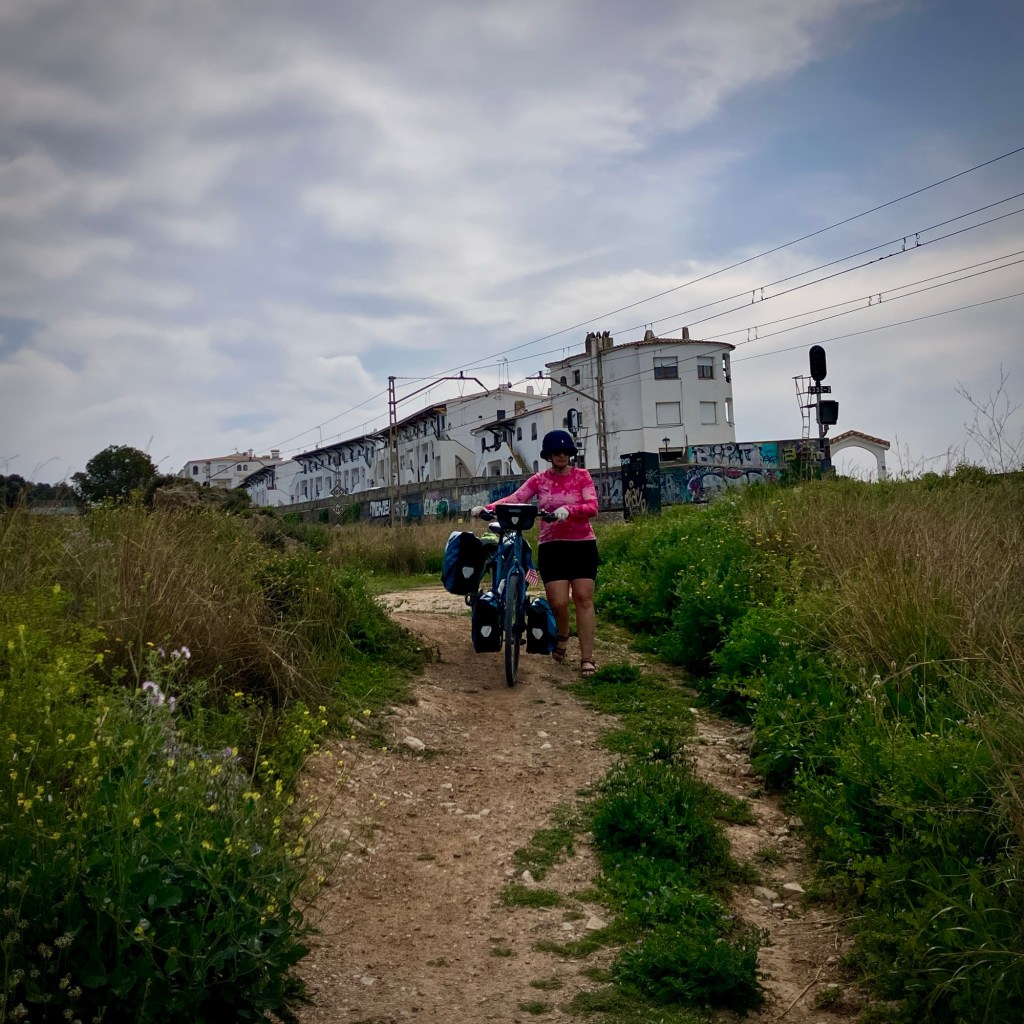
Giving Cheryl a break pushing up the steep and rocky road after crossing the border. Is this really Eurovelo 8?!At the bottom, someone appropriately added “MB-only!” Grafitti to the regional trail sign. A little too late for us, but luckily this hanging tube was not our fate.
Near the Spanish border, we opted for the quieter but hillier route into Spain over the Col de Panisares. Officially this seemed to be the Eurovelo 8 route on most maps and is also called the Pirinexus route, part of the Catalan greenway route network. The French side was paved, quiet, and delightful. But as always with bike touring, we were rewarded with some memorable views, and then punished on the Spanish side with more uphill kickers, steep rocky trails and unridable downhills. No cruising down into Spain.
Looking down to La Jonquera.Maybe we can sleep at this ranch?Our first Spanish cycling underpass/drainage culvert. Not our last.Cool culvert art.
So our entry into Spain was a bit bumpy and we found ourselves at the somewhat grungy and noisy frontier town of La Jonquera at 5pm after just 50 hard earned kilometers. We didn’t have a reservation anywhere as I suspected the day needed flexibility, but there were no good options around. We’ve been without lodging before at 5pm, as it goes with booking on the fly cycle touring.
National Route 2 had a decent shoulder near Figueres. Sometimes you just want to get there!Our hotel in Figueres old town. A bit of street construction meant no car traffic in front of our hotel and limited Saturday night bar noise -:)
So we decided to press onto Figueres on the main N-2 (II) road, as the official Pirinexus route had more dirt, hills, and would likely take us hours. We were both tired and a bit stressed, but knew this was just one of those days we just had to rally. To our pleasant surprise the N-II had a generous 6-foot shoulder the whole way to Figueres, and we made it there in less than an hour and a half, after a truck stop soda infusion. A shower and dinner at our atmospheric old town hotel and all was good.
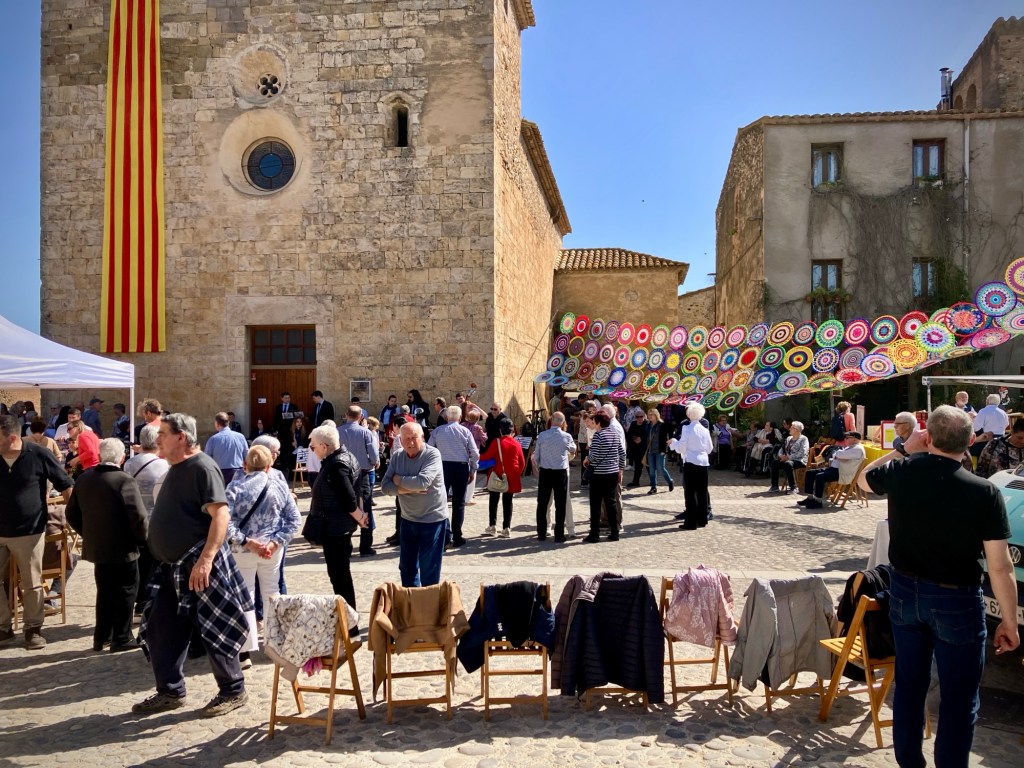
Hotel Duran in Figueres is family run and had a classic vibe, a fine restaurant and even side rooms that were part museum of local life.We set out the next morning after a brief stop outside the Dali museum. Salvador Dali was born in Figueres in 1904 and you can visit the large museum as well as the house where he was born.Always fun to ride through the cobbled little streets. Catalan felt different than France.Sunday bike touring days always surprise, such as this festival in Bàscara, complete with local Catalan dancing.
Although the dirt route was peaceful and had some nice natural beauty, I wished we had just taken the main road route up and over the pass. But again, I could find no info on the pass routes….not even a good blog. Maybe this blog will help people decide.
A random regional cycling route sign was appreciated, but better routes and signage everywhere would make this area more popular with people traveling by bicycle.Ok, this train bridge still baffles this engineer; why are the webs of these precast beams on the top. It’s upside down, but I guess it works.
We soon figured out this part of Spain does not have as developed a bike touring culture. People ride for sport; roadies, gravel, and mountain bikers, but it seems a small number of long distance tourers. We met a few bike tourists along the coast, but most were Dutch, Belgian, or Canadian. (The French were notably absent.)
Finally some signage, helped by the overlap with some of the Camino de Santiago routes.
The first things that struck me in Spain was the lack of useful signage in this area. No map of the border pass cycle routes, a few town directional signs, and just a few randomly placed EV8 route signs. And never distances. Also, no indication how rocky and unsuitable parts of the Spanish side of this route are for loaded touring bikes. If you are riding into Spain on this coastal route, be ready for a significant decline in signage and infrastructure from France. Routes just end and this is the land of random, short cycleways to nowhere.
Peaceful cycling into Girona along the Ter River.Wisteria blooming everywhere.
But Spain brought so much beauty and a completely different feel from France. Our trip has been perfectly timed for peak spring and the smell of blooming flowers, trees, and thick grasses abounded. The fresh Mediterranean Sea air filled our noses and coated us in a comfortable sheen of the promise of Spring and a new year. Forget the chaos of your home country.
The lively and beautiful arcades of Girona.Watching the bikes go by at “Bagels and Beers” in Girona, which also has delicious “Burgels”.We sort of happened upon the Medieval wall of Girona and couldn’t pass up following it along the city edge and University campus on our rest day.Looking back at the Pyrenees from Girona.Walking the wall offers a great overview of the city.No trip to Girona is complete without visiting some of the famous road cycling stores, including “Eat Sleep Cycle” store and cafe.The surprising Pont de les Peixateroes Velles, designed and built by Gutave Eiffel in 1876Girona’s old town core is actually an ancient and vibrant Jewish Quarter known as “El Cell” occupied from the 12th Century until 1492, when the purge happened.Girona is captivating to explore.Spring light in Girona on the Onyar River
The next day we headed to Girona, a long time dream of mine due to its famous road cycling culture. The ride into Girona was nice on self-selected routes, but loaded touring bikes are an anamoly there, and we soon felt a little out of place as we rode into the main square heaving with people drinking, chatting, strolling, and shopping on a beautiful Sunday spring afternoon. Various kitted out roadies wizzed by and seemed unimpressed that we carrying all our gear for 3 months on our heavy duty human-powered transport machines.
Heading out of Girona to the south, we encountered a group road ride tour of foreign cyclists. They were focused on staying on their bikes, so we didn’t want to bother them. For us, just another day.The roads outside Girona are popular with roadies for a reason.How many famous cyclists have ridden this decent?
We had a nice little apartment to enjoy for two nights in Girona and it’s a beautiful place to explore and hang out. Mixing with the road scene heading out of town was a bit strange, as we’re used to seeing more cycle tourists, and it’s really popular with Americans, so funny to here so much familiar English after so many less visited places.
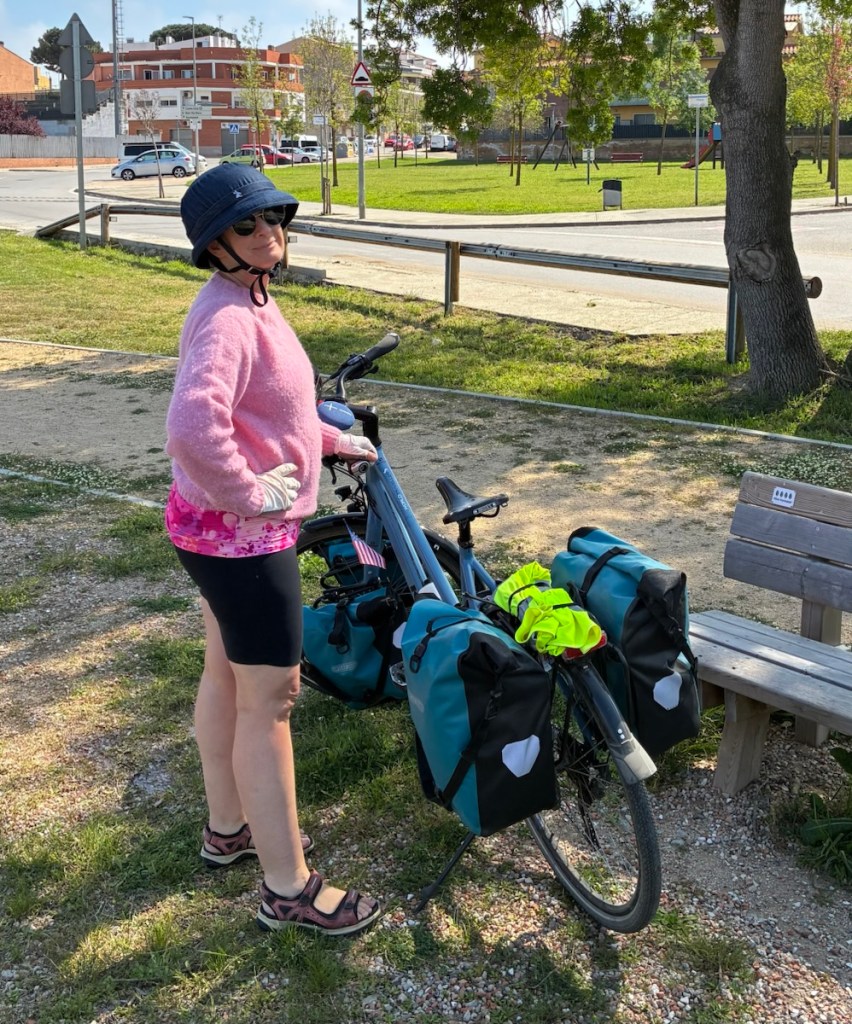
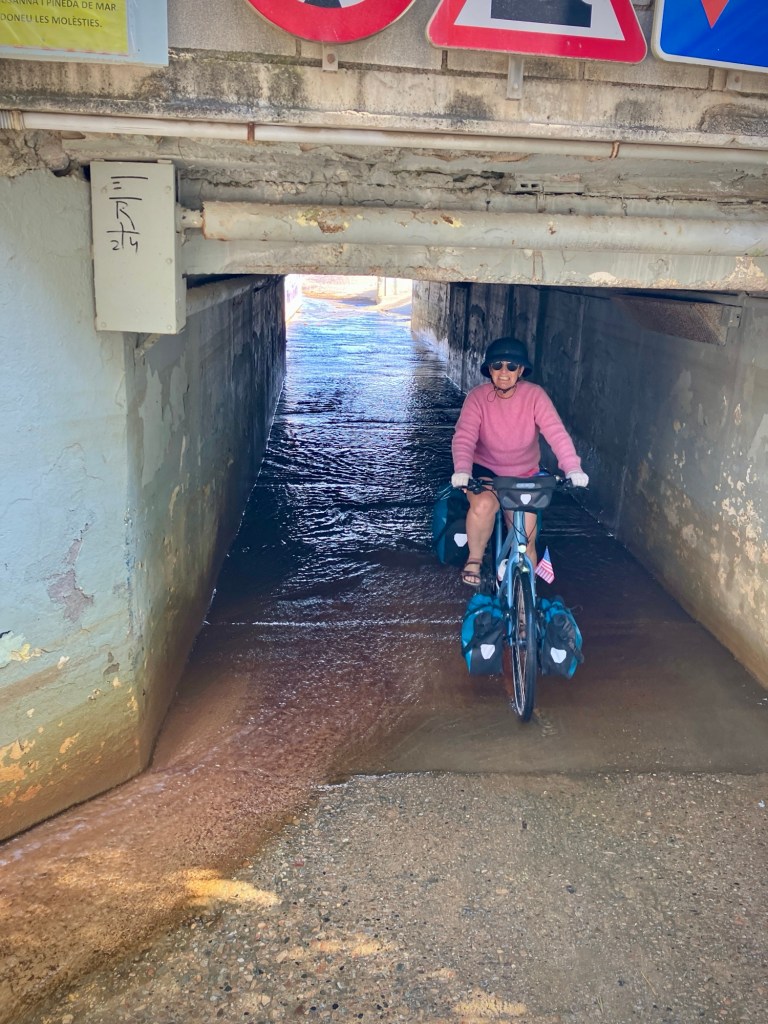
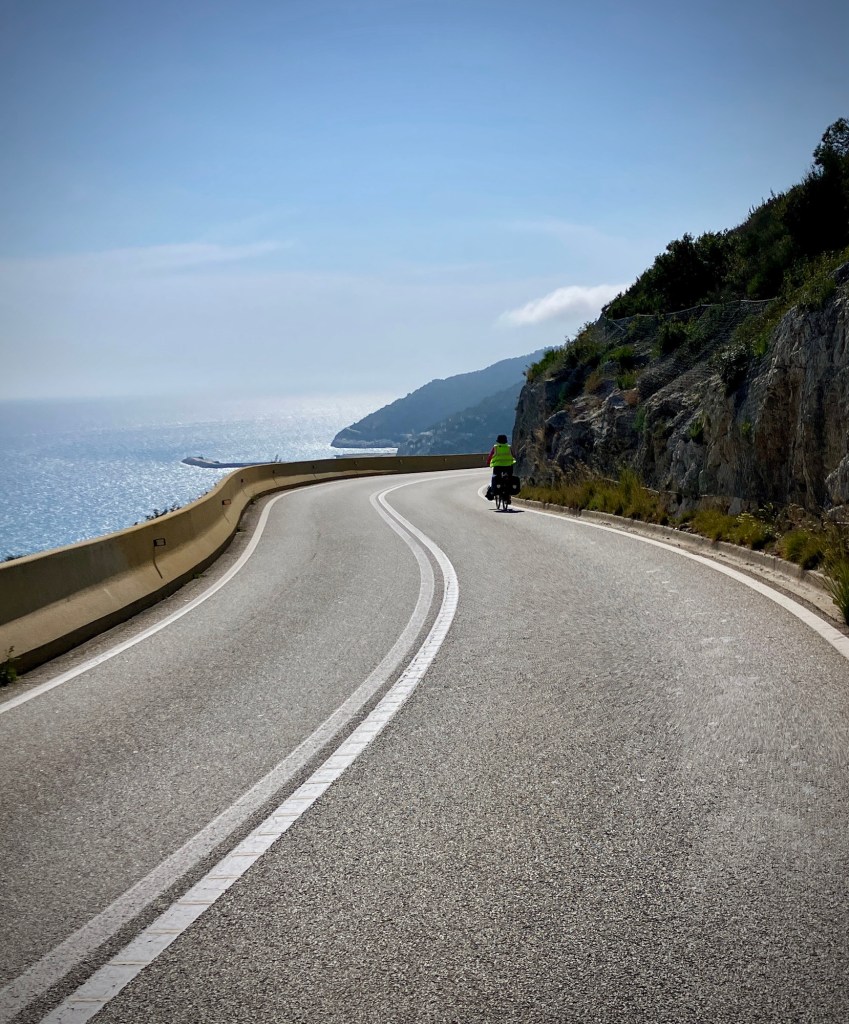
Spanish pastries.We were following the Via Marina for a while.Cheryl in her latest high tech cycling gear: fuzzy pink Shetland wool sweater. Soon we were at the Mediterranean coast via some more primitive rail underpasses/drainages. But the rare and heavy rains must go somewhere.We started to realize that the EV8 on this stretch of coast would not be bike heaven.Decent riding along some of the coast, but a little dull in places.We mostly picnic, but today cobbled a pre lunch snack at a cafe despite it being 12:30…a challenge cycle touring is Spanish lunch is from 1:30-4pm.The train line runs parallel to the sea along the coast north of Barcelona, making access between the sides challenging at times.Morning departure from our fun all-inclusive hotel in Pineda Del Mar. They had just opened for the season and it was very good value. Fun to mix with holiday makers and get a nice cool swim in the pool.Cheryl wondering if she was back in SoCal!The promenades were lovely, but we could only imagine how welcome shade would be in the hot summers. We were already missing it in early AprilThe sea is beautiful along the Costa Brava. But overall this stretch of EV8 is hit and miss.Catalan architecture charms in the few old towns still left on this part of the coast between the sprawlOur one night stay in Barcelona was pleasant at the Illunion Hotel in El Poblenou who kindly stored our bikes safely overnight.
We cycled towards the coast from Girona and spent two days meandering down to Barcelona. This stretch was not our favorite as the coastal sprawl felt a bit endless and the rail tracks make access between the coast and city sides challenging with loaded touring bikes as some access points are just stairs. But eventually we rolled into the northern neighborhood of Barcelona known as El Poblenou, which is also the core of the superblocks, which cleverly limit through traffic and prioritize pedestrian and bike movements. It was great and such a joy to cycle in most of Barcelona.
Morning school rush hour in El Poblenou meant an armada of kids, parents and bikes. Nice!On our way south by the famous Sagrada Familia.There are some beautiful bikeways in Barcelona, and very well used. Fixing a flat is never fun. Really not fun on a busy road. Thankfully we were at the quarry turnout so had some space.Cheryl ahead on a beautiful stretch of the C-31 from Garraf to Stiges. A rare shot without traffic as this road was almost constant cars and haul trucks to quarries. A shame.Early dinner and drinks in charming Sitges. We still haven’t solved the mystery of a charming coastal spot with outdoor dining and no Gulls. Why are there no gulls here? The April beach scene in Sitges. As we came into town folks were swimming.Costal glam couple.Komoot and and supposed EV8 Route?Ok, another underpass to a trail on the oceanside of the tracks….nope, dead end at rock slope and tiny beach! Cheryl was thoroughly unamused.Not the nicest stretch of Eurovelo and Cheryl not happy in a head wind and sunshine.
From Barcelona, we headed again out to the coast via the EV8, which is a nice route until past the airport, then forces you onto busier roads. It was a tough stretch as I had fixed a flat tire near the airport and then half way through the extremely busy coastal road from Garraf to Sitges, I felt my tire going soft again. Ugh! This time I really examined the tire and found the tiny glass shard culprit. This stretch would be ok on a fast road bike as the cars are very respectful, but on slow touring bikes, the constant traffic and haul trucks made it a somewhat teeth gritting experience. No pictures of the traffic as there are few places so stop and most is guardrailed.
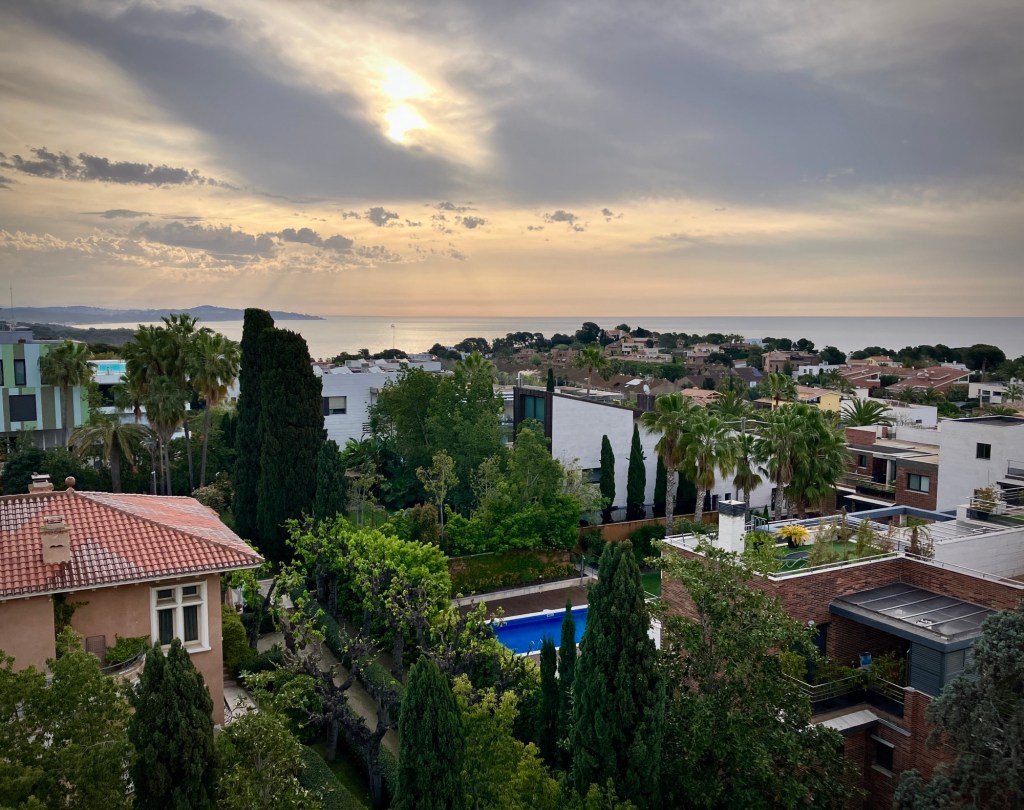
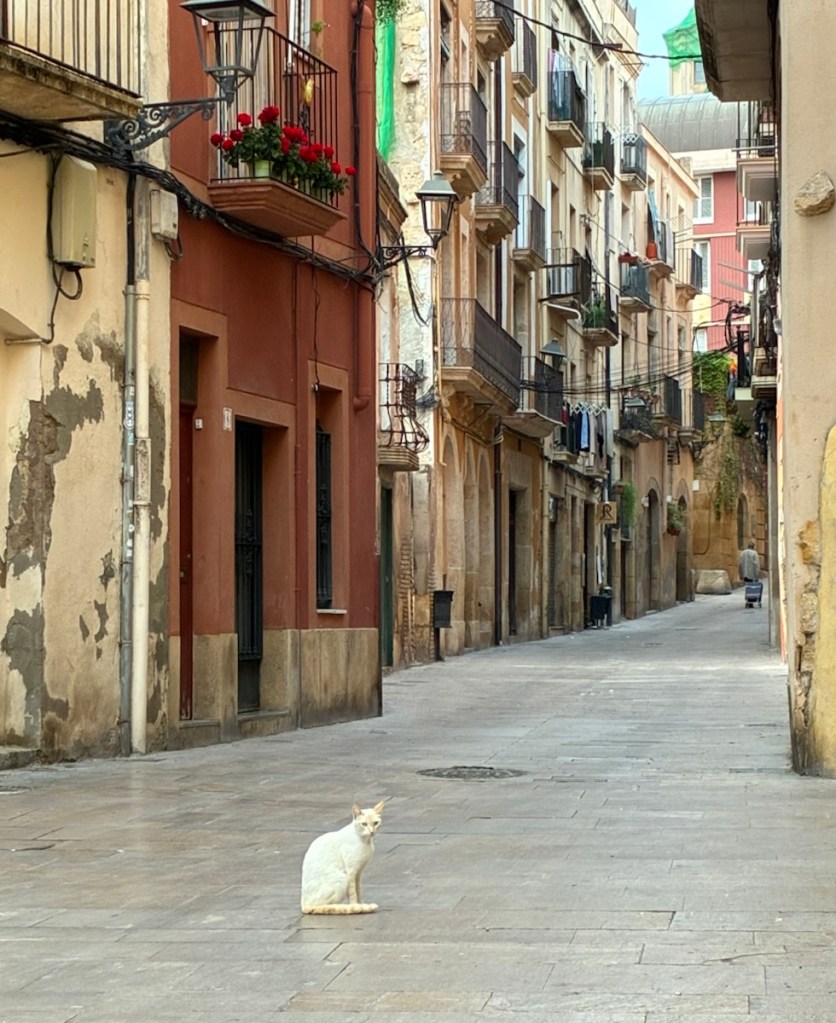
Cool to discover The Torre Del Escorpions or “Scorpio’s Tower”, a funerary monument built by the Romans outside Tarragona in the 2nd century. Our lovely view from our hotel in TarragonaTapas and Sangria in the main square of Tarragona. Set for Friday night people watching, Spanish style.We were excited to see and moved by the solemn Semana Santa processions in Tarragona. We didn’t know at first why everyone was headed towards the Cathedral. We quickly figured it out.The striking coastal Amphitheater of Roman Tarraco used to hold up to 12 thousand spectators until the decline of the empire 5th Century.A big port for Mega-Yachts in Tarragona. The cannon isn’t really aimed at them? Is it?Roman ruins = Feral Cats. This good looking kitty posed for us.Cats also liked the real and just slightly gritty feel of the Part Alta, the historic core of Tarragona.Colorful Tarragona Street Art. Cheryl snapped the pic before she actually read the words.Orange blossom scents filled the air of Tarragona. So many orange trees as street trees.Not a gentrified old town, Tarragona’s old city still is active with daily life.The processions weaved through the city. We were in Tarragona for three nights and watched processions on two nights.More crowds for the Semana Santa Procession. We felt lucky to witness this less touristy and more local version in Tarragona.Real flames added to the drama as night finally falls.The weight of the floats and human strength required to carry them was impressive. The folks carrying this heavy float marched in time and swayed in rhythm.
So after a really pleasant night in Sitges, we rolled onto Tarragona, where we spent three nice nights and rested prior to our turn inland. Tarragona is a small and ancient city with Roman ruins, a fascinating history, and great archeological museum by the old port. One of our favorite smaller museums with a great audio guide. It was also the start of the Semana Santa events, so we got to see two different nights of processions, each with a different vibe and purpose in the run up to Easter.
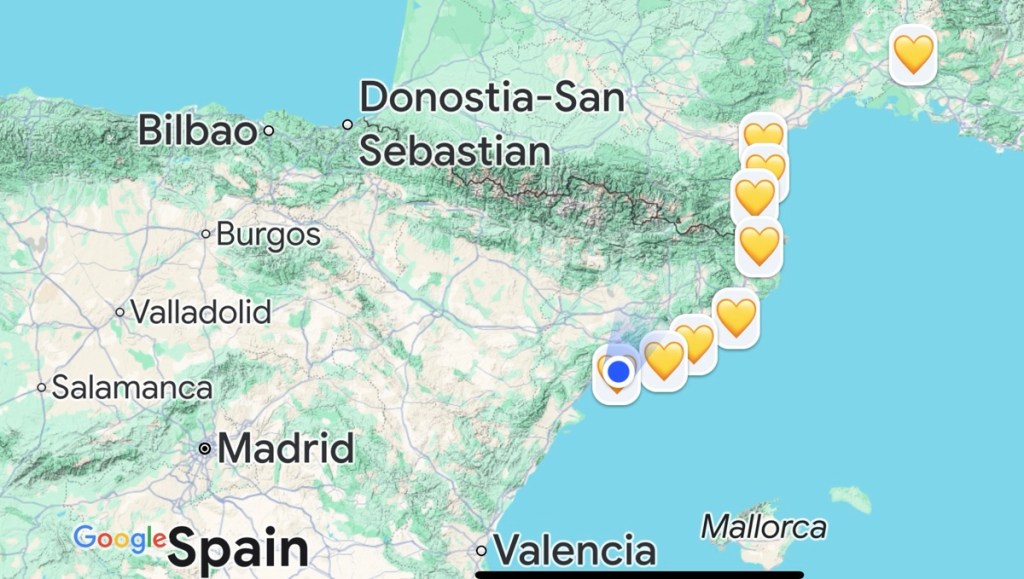
Finally leaving the pleasant and bike friendly Hotel Astari for the Tarragona train station. But where to next?Well, first some train pastries!Oh, and some buttery Jamin Iberico on rolls.We really liked exploring the layers of history in Tarragona for a few days. A bit of a hidden gem.Where we’ve been so far on this Spanish Sojourn. It’s a big country. Each heart is a place where we slept.Happy cycle tourists on the Spanish Mediterranean…at least for now.
Embarking on the next phase of my life after working as a full-time Civil and Transportation Engineer in the San Francisco for 30 years. My wife and I will be following our shared passions for world travel, culture, and sustainable transport.
View all posts by TravelRich
















 Less Car, More Life