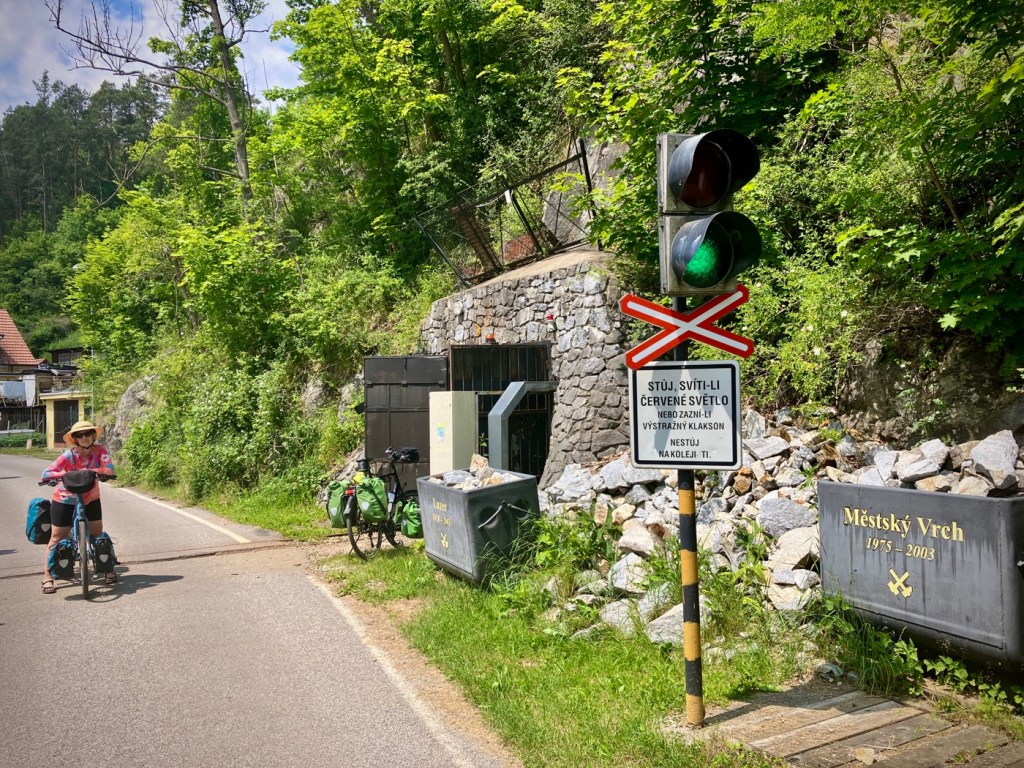
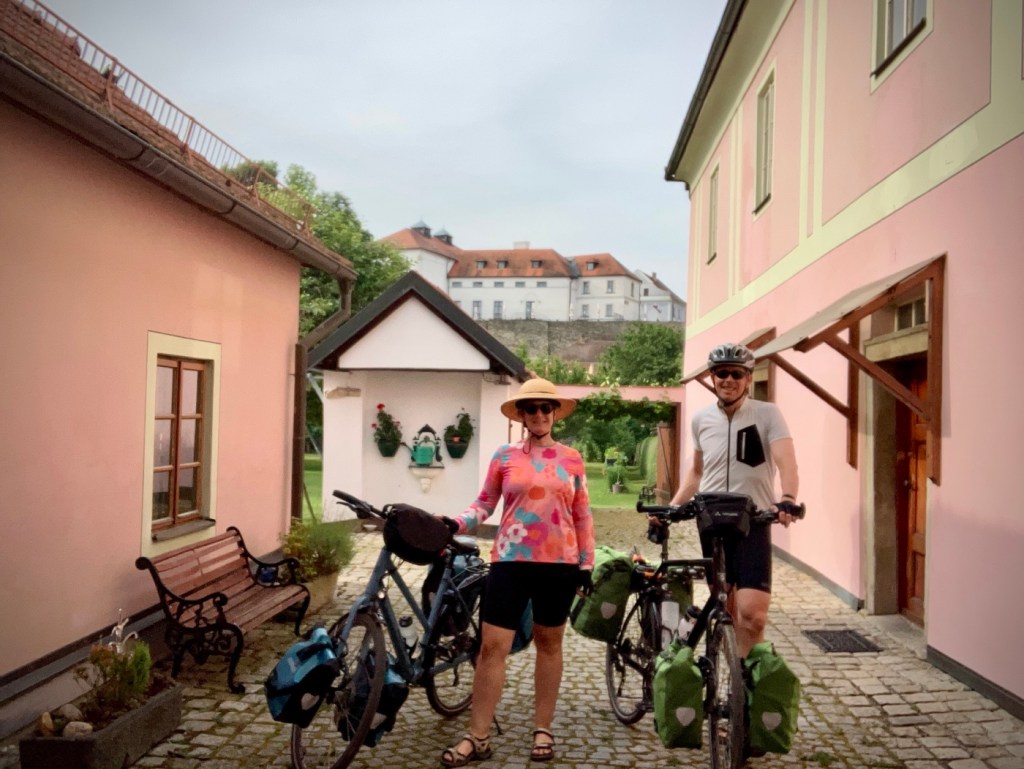
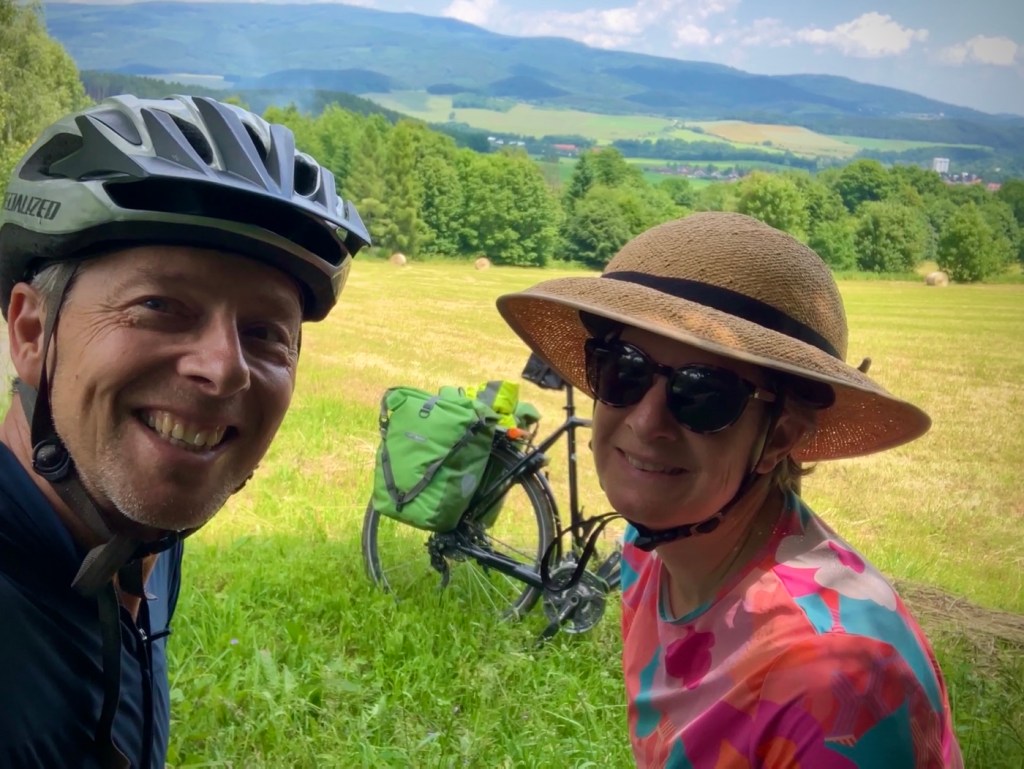
Leaving Czechia for Germany.

Sunflowers starting to bloom in the Moravian region of Czechia. They are raised as an oil crop. And are lovely to look at.

Bicycle touring is tiring. Our rest breaks in Český Krumlov and Znojmo were so lovely we decided, after a few more days riding, to take another break in Brno. As with Česky Krumlov we were just amazed at how beautiful these towns are. Although the country has a tumultuous history, most Czechia towns and cities were relatively unscathed from bombing during WW2.

Rich riding by Vranov nad Dyjí Chateau. So many stunning historical buildings.
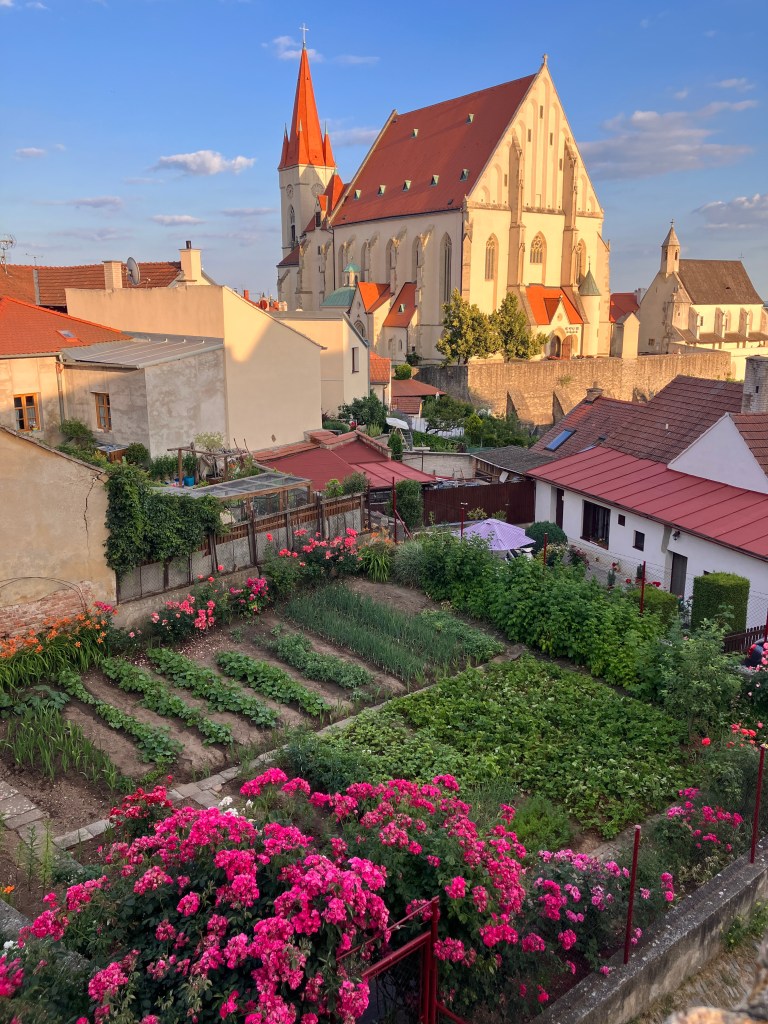
Znojmo in the evening sun.
Rich relieved to have found a gap in the fence and hedge to complete our detour away from a busy road. We were too busy trying to avoid the farmer and his haying machine to get photos of us crawling and pushing the bikes through the hedge.

Hmm…sounds like a lot of rest days, you may be thinking. Well, once we left the relatively quiet and empty region of Bohemia the roads started to get busier, and the car drivers faster and less careful around cyclists. Our day into Brno was pretty awful, a busy rural road with many trucks and no shoulder, long stretches with no towns or trees, but thankfully no head wind.

I usually have this Bluetooth speaker on my handlebars to listen to music or podcasts, the flowers I gather to amuse myself.
A tiny bee appreciating my tiny bouquet.

Once we got to the true outskirts of Brno we were on a cycle path again. Czechia has a lot of recreational bike riders, a lot of folks in road riding gear (mostly men), who ride fast. As we know from our bike activism in the US, women on bikes are an indicator of how safe and accessible places’ bike infrastructure is. And families. Parents with children in a cargo bike or on their own little bikes is a good sign too. We saw a few families coming into Brno along the Svratka River, but our hopes of a cycle friendly city center were not to be.

“Common path Be careful” Well, it’s something.
Another lovely Czech old town square in Brno. The deck chairs were a nice touch, folks were enjoying the evening.
So we did too.

We both know firsthand from years of activism and professional work the many challenges that face a city trying to become more bike and pedestrian friendly. Our own city, San Francisco, has come a long way but still struggles to make changes to the streets, fighting against the conventional beliefs that cars must have unfettered access. So we understand how hard it can be to create safe welcoming spaces for people on foot and on bikes. In many cities we joke that we should stick around create a bike and pedestrian advocacy group, Walk Bike Brno (Procházka Kolo Brno) has a nice ring to it. But there is the language challenge, and the irony of two Americans lecturing any place about sustainable transportation.

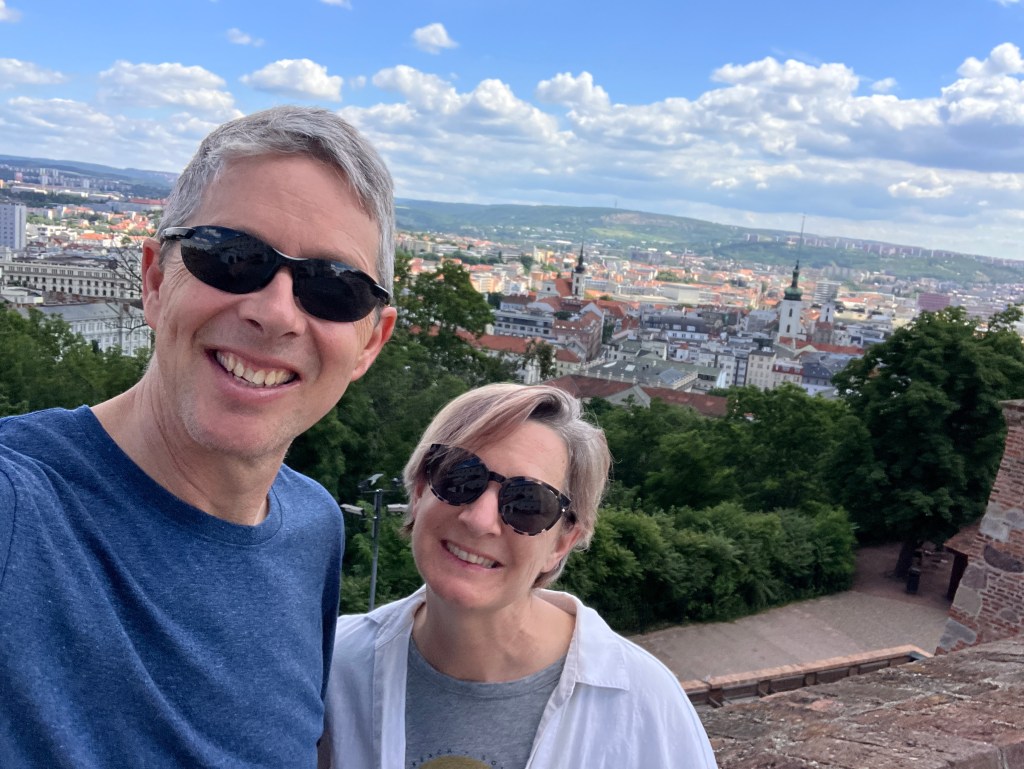
Špilberk Castle, a lovely view spot and a good cross challenge for our leg muscles that are too focused on cycling.
Ouch. We’ve learned the hard way to make sure we hike on our days off the bikes. Špilberk Castle was a good hill climb.

Brno is a perfect candidate for a Copenhagen style makeover, or even a San Francisco style makeover. It’s pretty flat in the core of the city, loads of Universities, trams and buses, not a great pedestrian environment due to long traffic signals and missing connections, and really no bike infrastructure. But despite that there is a bike culture. And lots of folks walking. They could harness what they have and create a more walkable and bikeable city. Sure, the first thought is about the cost, but as Copenhagen has proved, cities get a better return on their investment from bike and pedestrian projects than car projects.
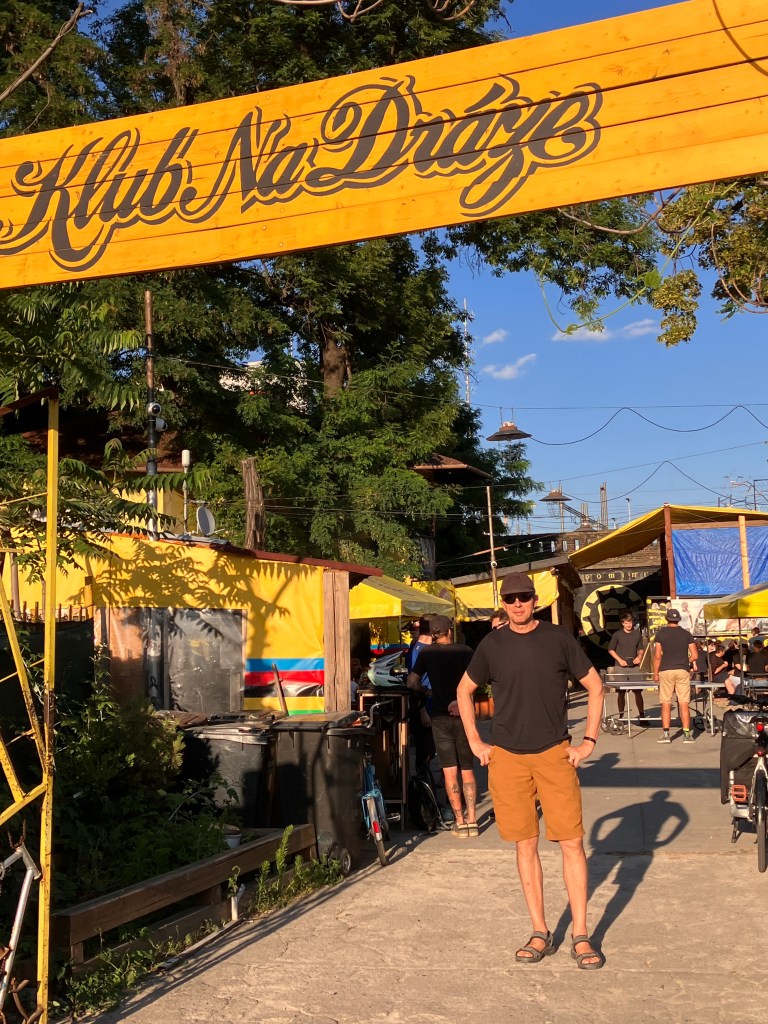
Our new favorite bicycle focused bar.
FBB Klub Na Dráze (Club On The Track) proof that bicycle culture is alive and well, and very cool, in Brno.

When we get to small cities like Brno, population 380k, we appreciate how quirky culture and experimental businesses can survive in a place which has not suffered the homogenization of wealth. We look back to San Francisco, which we love dearly, but which has changed due to loads of monied folks. And the subsequent pushing out of less monied folks. Many of our favorite places and favorite people have been priced out of SF, or they left to have a more complete life elsewhere. Sometimes while traveling and enjoying a bar or restaurant we say to each other: this business could never exist in SF (or name another A list city with space and money constraints). Or if it did, it would be so expensive we wouldn’t go to it.

After the bicycle bar it was off to Bar, který neexistuje (A Bar That Doesn’t Exist).
The cocktail menu was lovely. My rum based drink.
And Rich’s whiskey based drink. To save you from having to do the math, $23.70 for two cocktails.
A bartender using a rolling ladder to get to the top shelf liquor.
Not our usual kind of evening, but the joy of travel is sampling different things.

With the sad realization that we didn’t feel very safe cycling in the south Moravian region of Czechia, we bid a fond farewell to Brno and headed to the train station.

Goodbye Klub Na Dráze – keep it real.
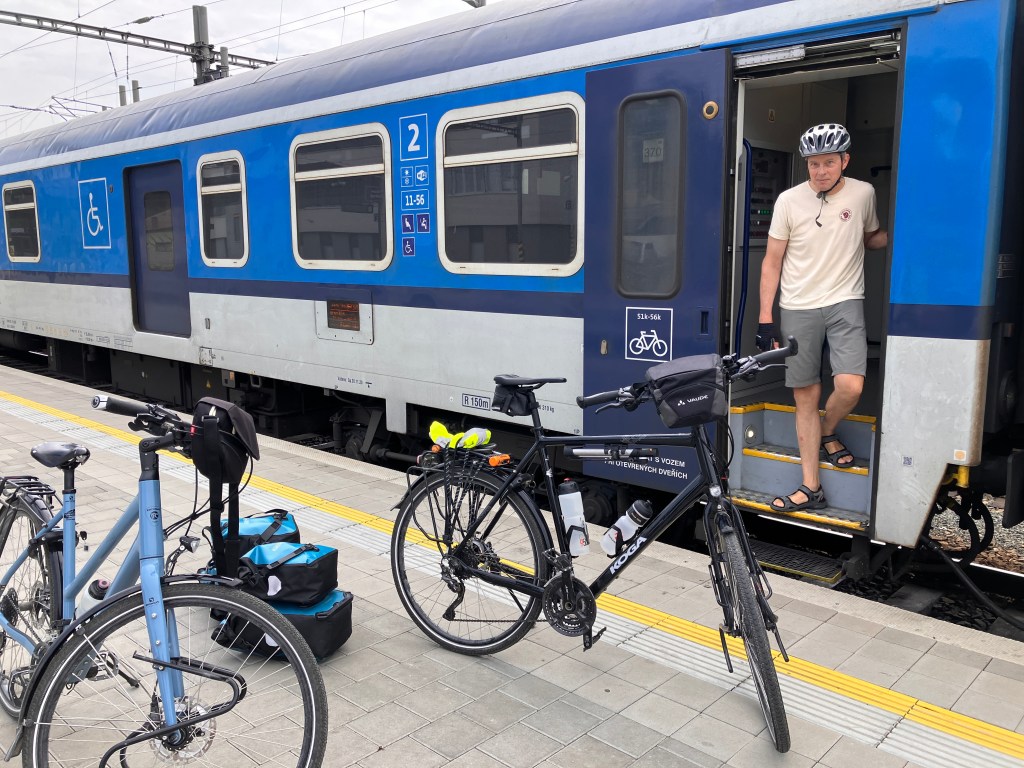
Hello train dance with loaded touring bikes! High boarding trains means removing the bike panniers. Those steps are not easy with a bike.

Rich does so much good work figuring out our cycling routes and train hops. If we can we get on a train at the start of its route, that allows us to get to the station early and load the bikes on the train before most folks show up. This is especially important if there is limited bike space. The Czech train did have on line booking of bike spaces and seats right near the bike space. Rich also booked the two bike slots far left, closest to the train wall, less chance of our bikes getting banged around by other bikes and train movements. These are the details that make our train travel days a bit better.
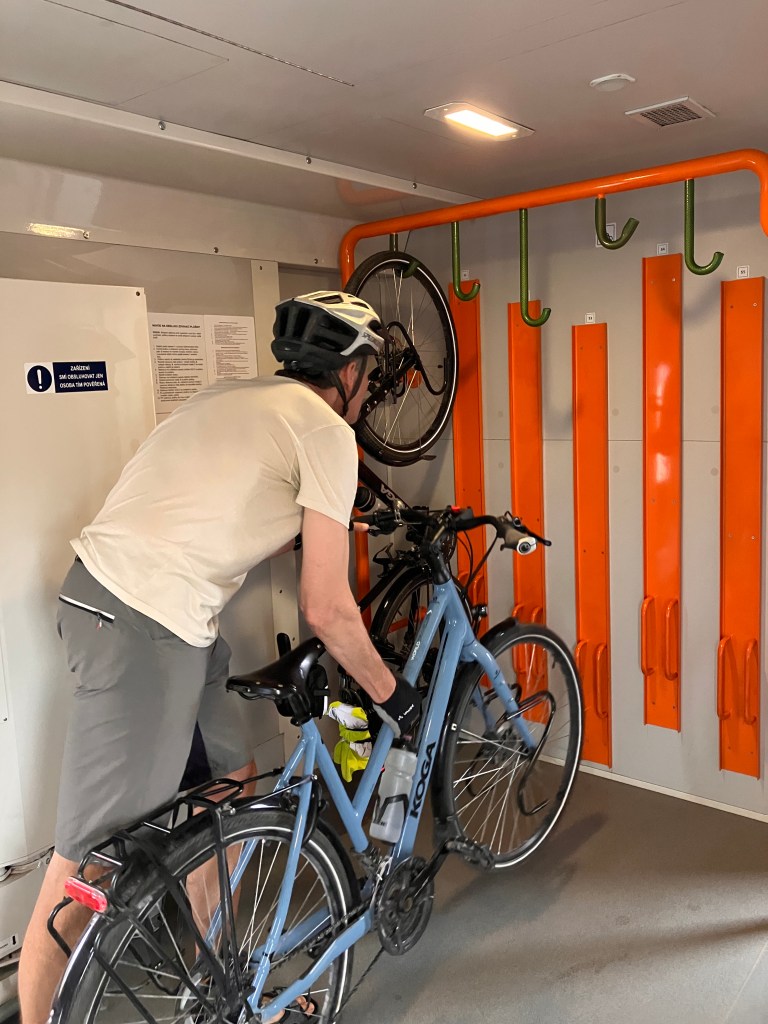
Rich getting the bikes onto the hanging hooks. Could I get my bike up there myself? Maybe.
Settling in with a fully charged Kindle for our six hour train day. Oh yes, I got a haircut in Brno too. My first since Bangkok in January.

A must have for train days is food, charging cables, and an extra power source in case the outlets don’t work – which these didn’t for several hours – which also meant the AC didn’t work, and the windows don’t open. Made for a slightly clammy journey. And I don’t think we or the other three cyclists were at our freshest to start with. The one empty unreserved seat in our bay of six seats was eyed by a few people, but something kept folks from choosing it… It was all of us! We were stinky cyclists.

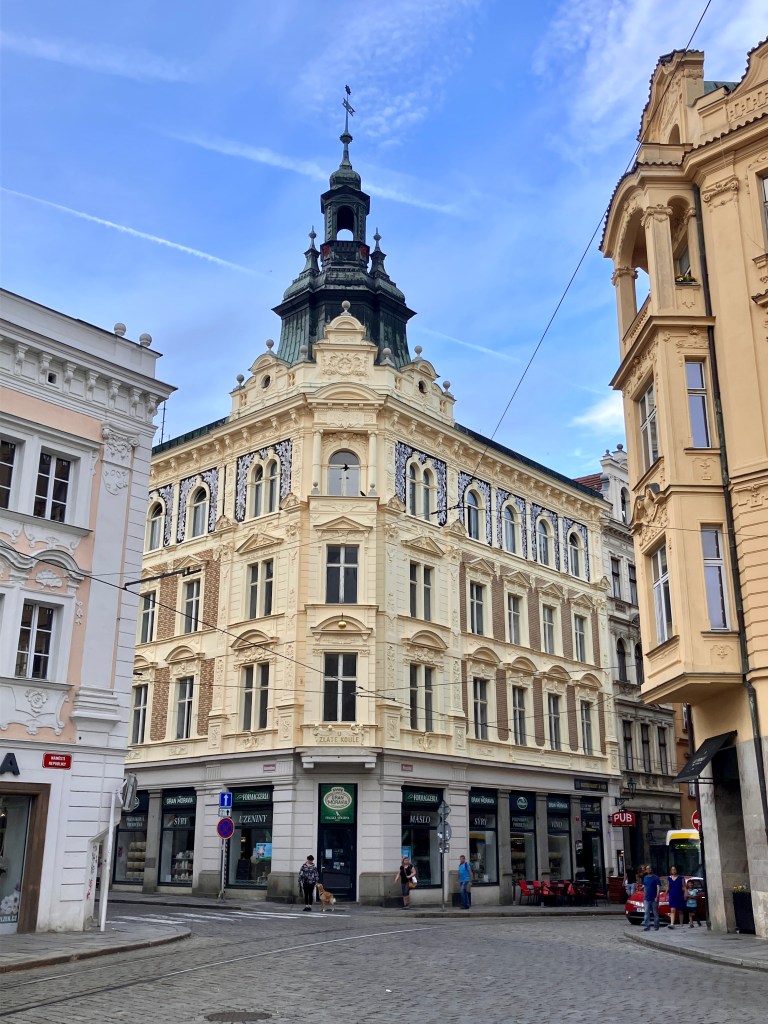
One night in Plzeň. Enough time to walk around, admire another beautiful historic square, and have dinner.
Plzeň is the home of the famous Pilsner Urquell Brewery, but we were happy just walking around and skipped the brewery tour.
It’s a tough time for a Tour de France fan to be traveling. Rich isn’t always able to stream le Tour, but if he can’t, we watch the wrap up show.

Our next hard date is July 18th on a ferry from Hook of Holland to Harwich, so another train hop was necessary to get us closer to the German border. So enough musing about bike infrastructure and affordability, let’s get off that train and ride.
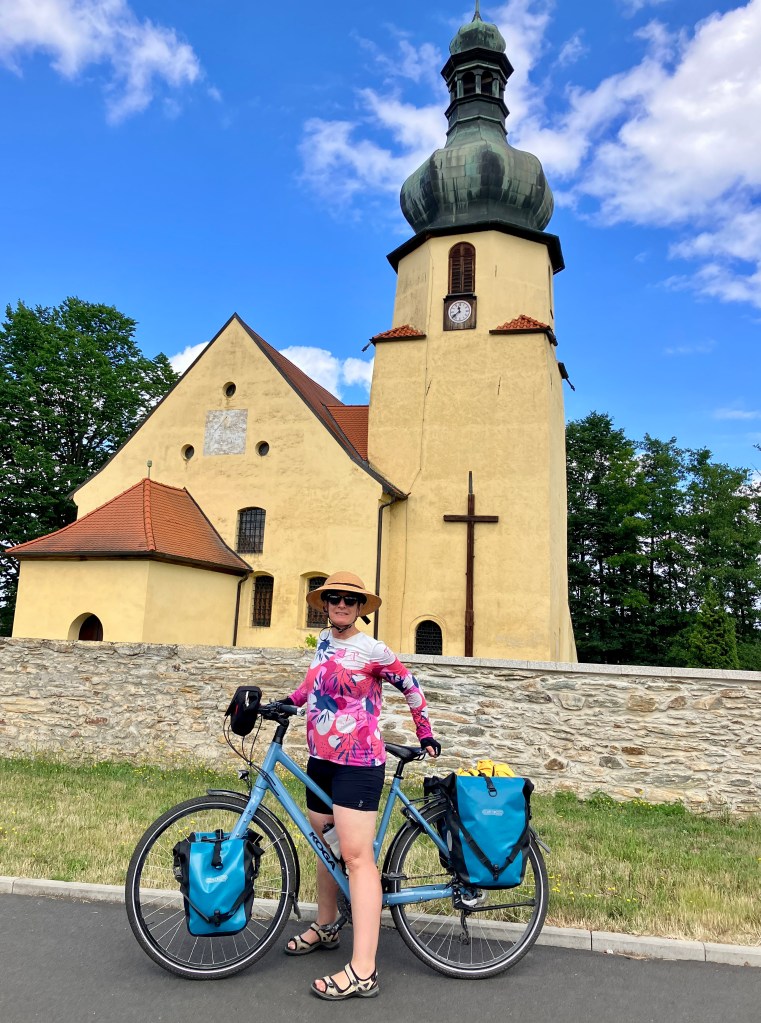
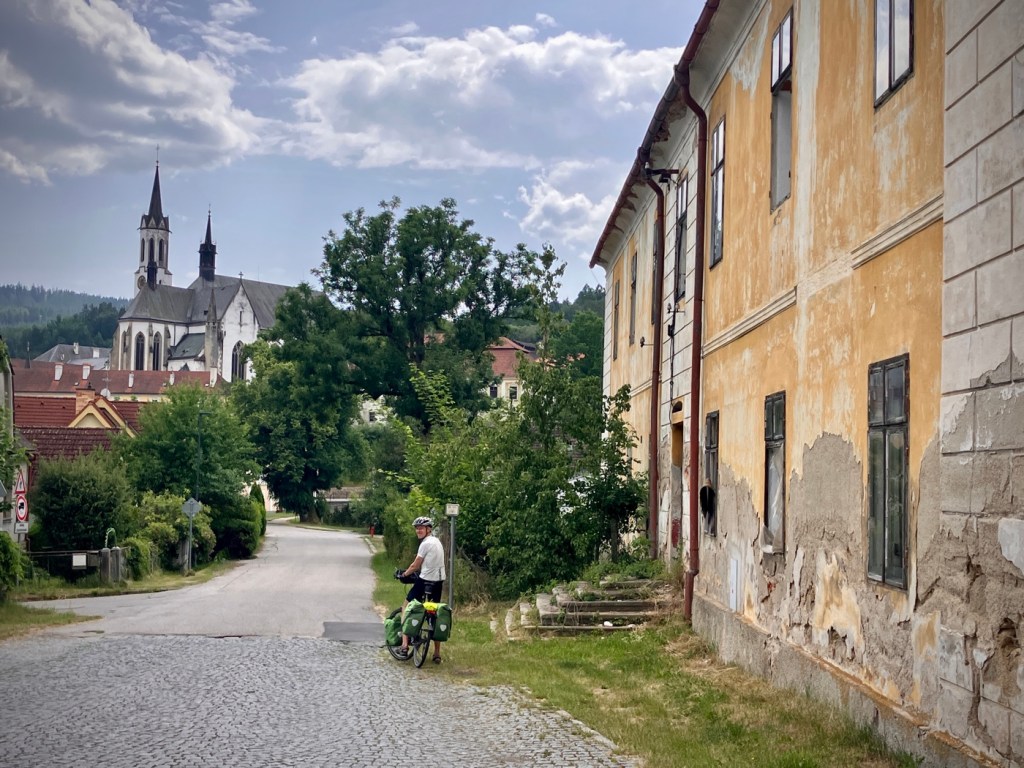
Off the train at Cheb, Chezchia, and back on the bikes. One more lovely Chezchian church and off we go.
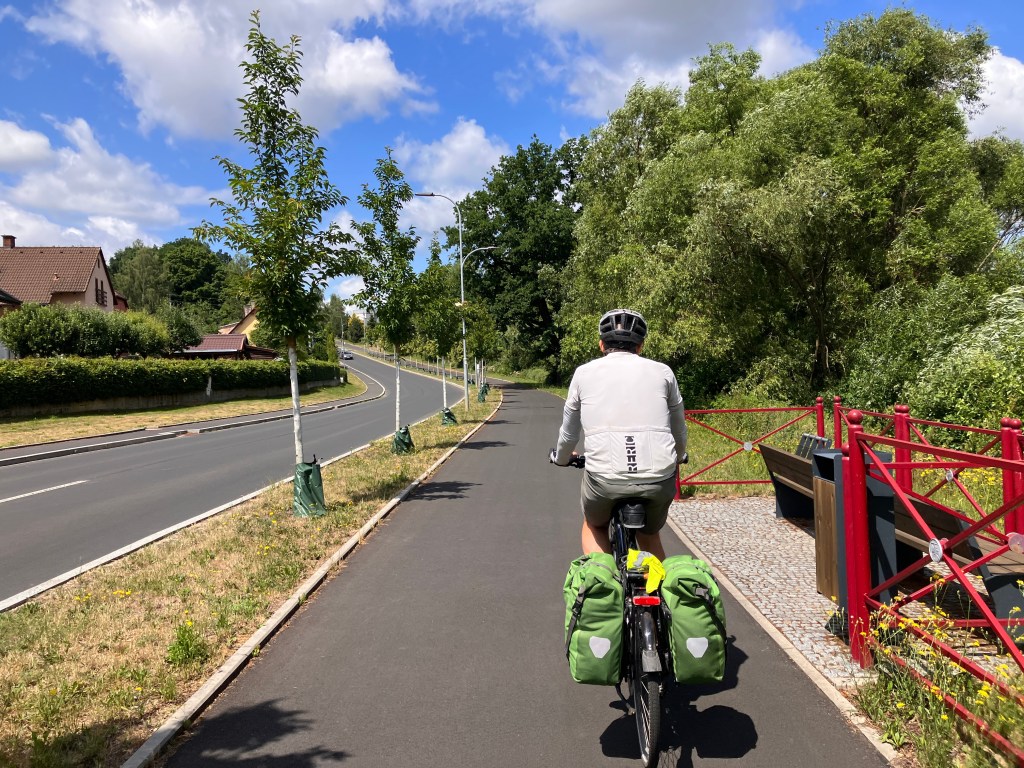
And look at that. New bike paths. And newly planted trees. Yay Chezia! I joked to Rich – maybe they’re starting at the German border and working in.
Look at that signage. So many bike routes. A sign like this makes us both very happy.

We’ve been amusing ourselves by noticing the license plate country registration as drivers pass us, and we can reliably predict when a driver is German vs. Chezch. The German laws have been updated to mandate a 1.5 meter passing of cyclists, and bless those German drivers, they do leave that passing distance even when driving in Czechia. So, we were happy to cross to Germany and feel safer on the roads. Love you so much Czechia, but you’re not a fully realized cycling destination yet.

Back in Germany. After a long climb up to Fichtelsee we were so happy to have a lovely dinner at the hotel, Hotel am Fichtelsee. It’s a relief after a tough ride to have dinner right at your hotel.
Such a tranquil alpine lake. The ducks were cruising over hopefully. Sorry guys, no treats for you.
It stays light quite late, so we always have enough daylight and energy for an after dinner stroll.

Even though the distances we cycle in a day seem quite short compared to driving a car, we feel so immersed in nature, thanks to the good bike path network in Germany. The routes keep you away from major roads as much as possible, and when you do need to spend time on a road the speed limit is frequently lowered and drivers do exercise caution. A hill or ridge that you might not notice while driving a car, we feel with every pedal stroke up, and every gleeful down hill coasting moment.
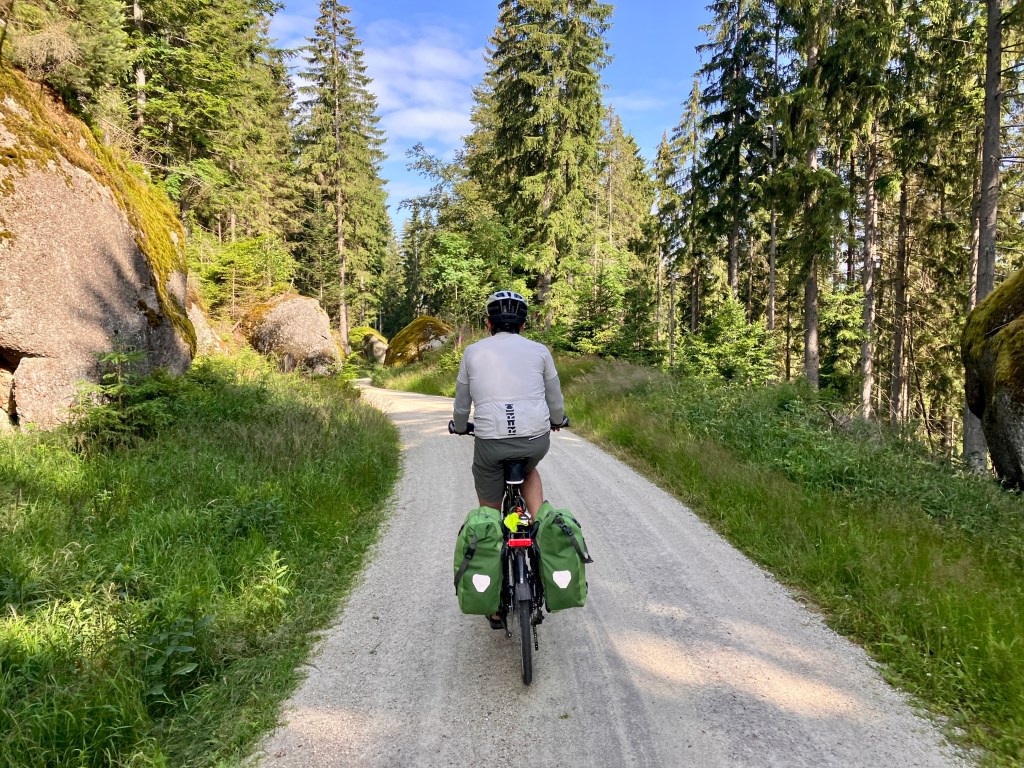
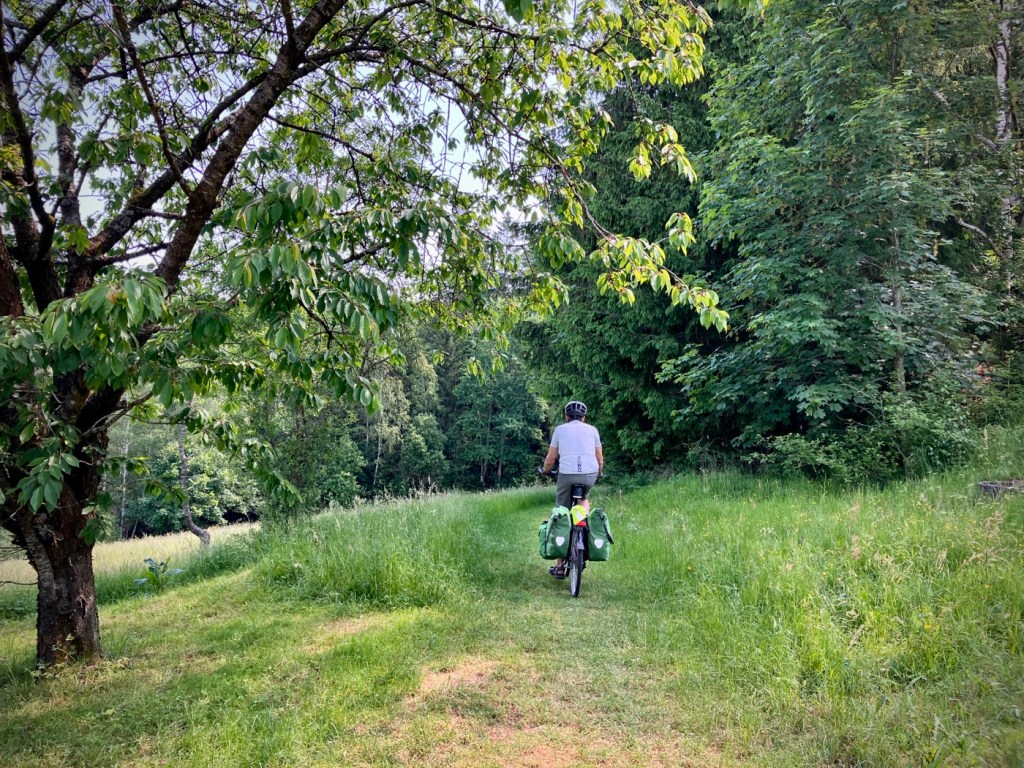
A perfect morning start, coasting downhill in the Neubauer Forst-Nord.
We both love the green forest scenery. So different from Coastal California.
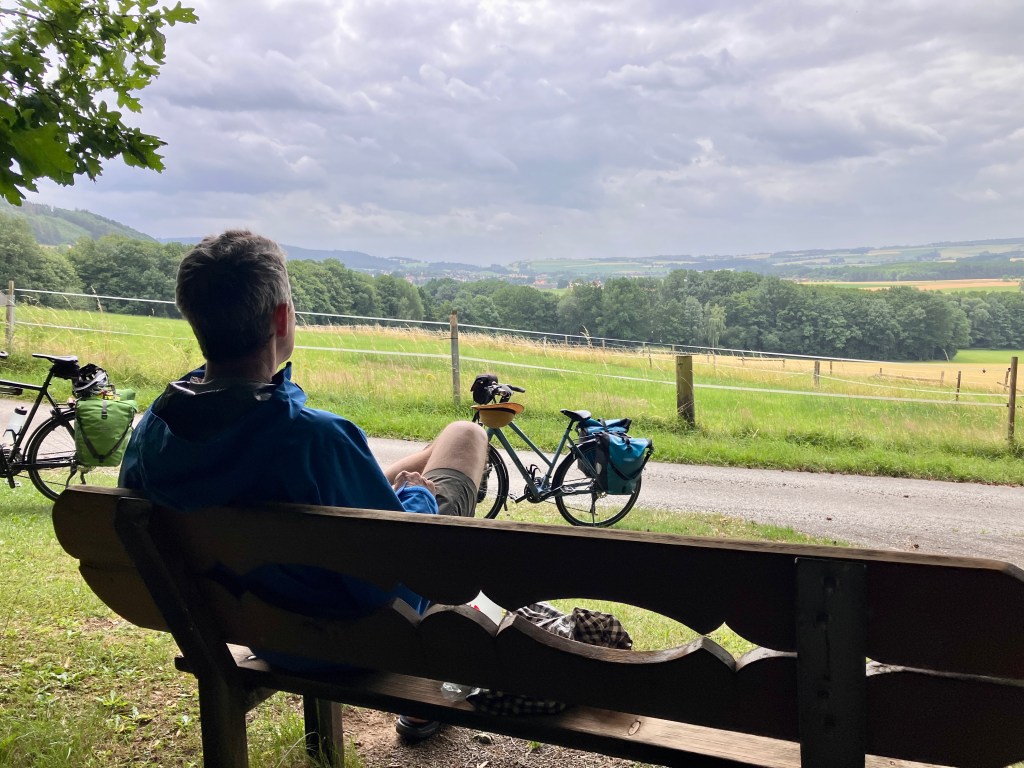
A nice bench for a break near Bad Berneck im Fichtelgebirge.
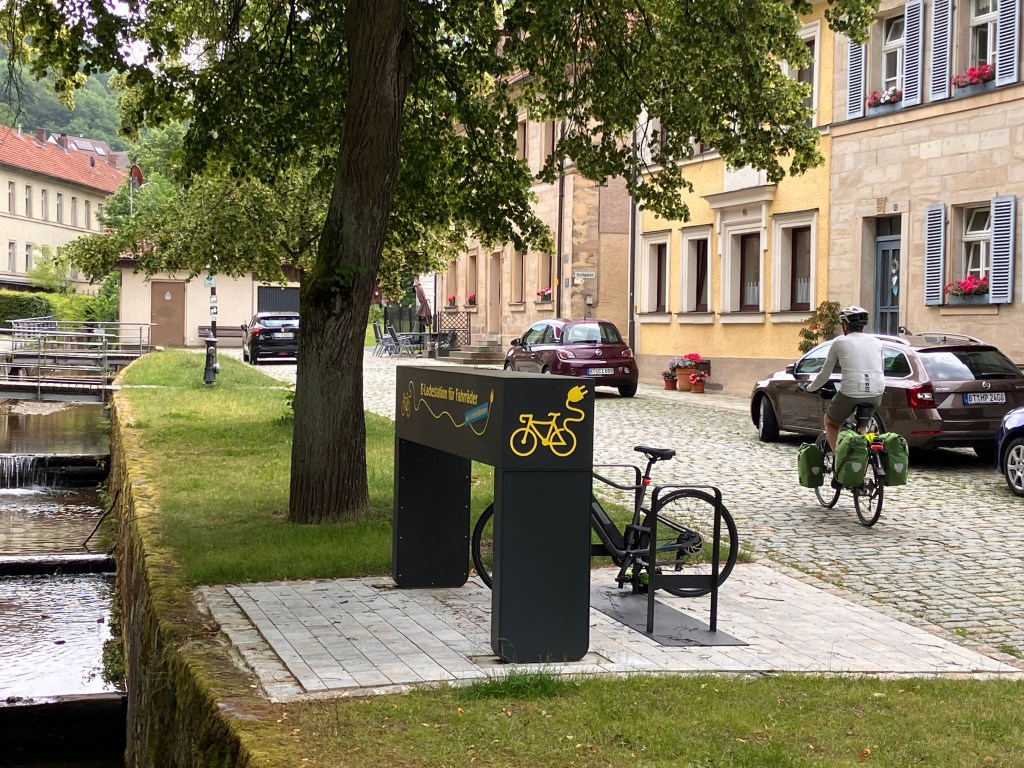
Our bikes are powered by muscles (and pastries) but I do appreciate the thought that goes in to providing charging stations for the many e-assist bikes in Germany. In Goldkronach.
Ripening fields of grain.
Back on the train! Taking full advantage of our German 49€ monthly ticket.
Bike Lodge Spessart, outside Lohr am Main, had everything we needed after a long day of trains and pedaling into a headwind.
Ready to roll. 80 km day coming. Quite flat along the Main River but that headwind would not leave us alone.
Riding down the river you get glimpses of history, and it’s easy to pull over and enjoy the scene.

Bicycle touring strips you down to basics. You need food and lodging. Unless we have a rest day we don’t really do any cultural activities. But we see so much. The hours on the bikes looking at the river, or winding along vineyards, or searching for a place to stop and have a picnic lunch, are very elemental. Once we get to our destination we want a shower, some food and drinks, maybe watch a Netflix show on the iPad, and then we sleep as if we’ve been dropped to bed from a high height.

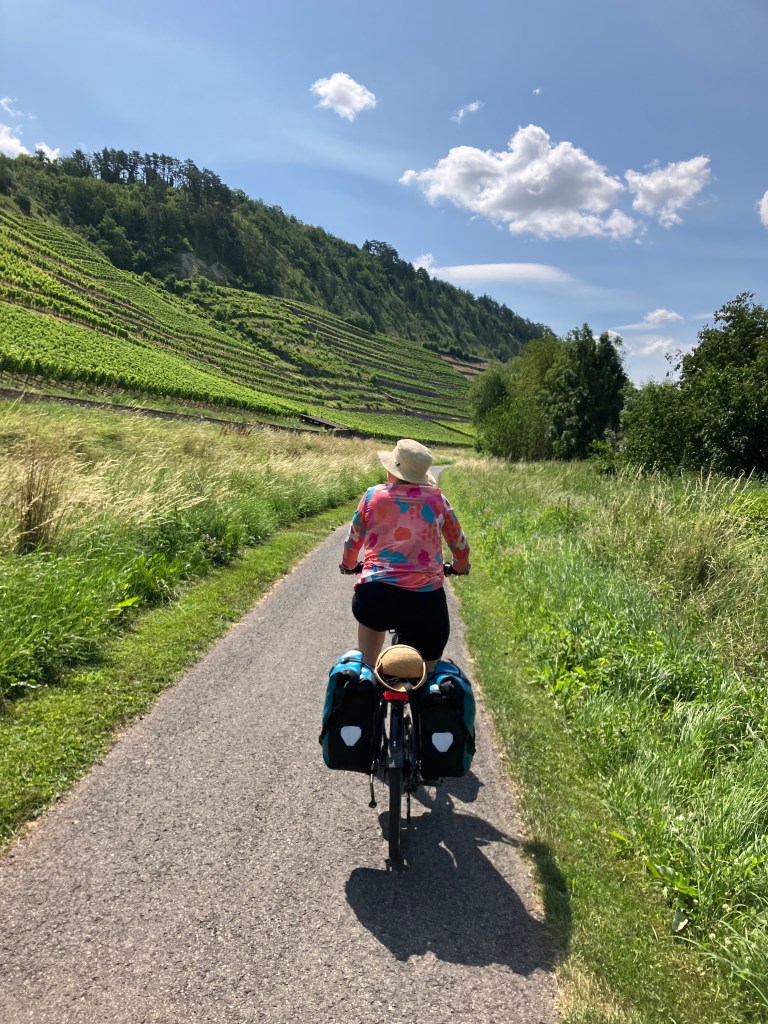
Riding down the Main River towards Miltenberg.
We’re entering a wine region where one of my favorite German white wines is grown, Silvaner.
Our goal in getting to Miltenberg was to get close enough to meet up with Beatte and Alex. Mission accomplished- thank you both very much for a much welcomed social break.

We have just a few more nights in Germany before we reach Belgium, and then the Netherlands. We need to get our new touring bikes to a Koga dealer for a tuneup. We’ve already ridden about 1,100 kms/800 miles on these bikes, and that’s tuneup territory. So off we go! More from the road later.

The happy and tired travelers, enjoying an after dinner walk after a long climb up to Fichtelsee.

Borders Are Still Borders – Cycling along Eurovelo 13.

The scruffy charm of the South Bohemian border town of Vyšší Brod.

After 10 days of breaking in our bikes, too much headwind, and a busier Danube bike touring scene, it was time for something hillier and wilder. So it was with double excitement we approached the hills and mountains separating Bavaria and Czechia. First of all, I love to cross land borders versus flying into a place. And, we both prefer the challenge of some hills in our bike tours. Well, maybe not this many hills…

A German farm road ends and the trail heads into the woods.
“Over the river and through the woods to Czechia we go”.

When you cross on foot or bike, you really appreciate the significance of a border. So, as we joined Eurovelo 13, the Iron Curtain Trail, and approached the former border with the Warsaw Pact nations of our childhoods, there was still an excitement.

Suddenly a border marker where a barbed wire fence use to stand.
Lush wooded highlands of the Plezn region of Sumava National Park.

We both fondly recalled a light snow falling on us 17 years ago while crossing a pass on foot with our backpacks into the younger Czech Republic outside Jelenia Góra, Poland. We got dropped by a bus on the Polish side and then walked down into Harrachov on a wooded fire road. It felt magical and adventurous.

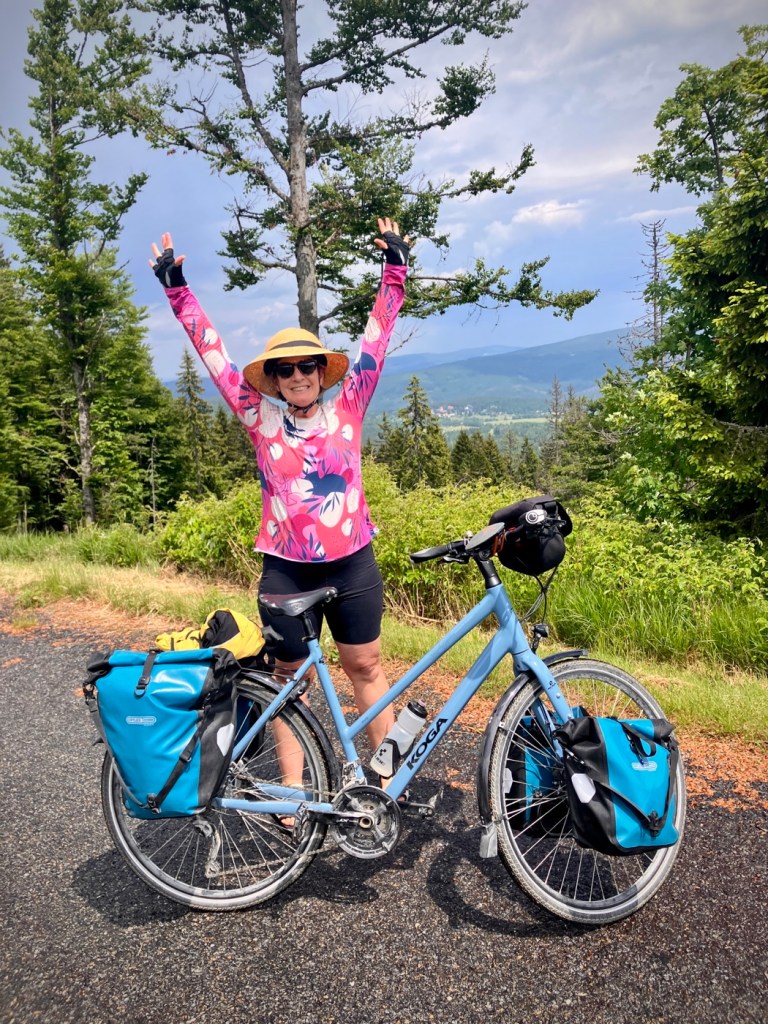
Cheryl celebrates a high point after a very steep climb….we were ramping up fast to the relentless climbs of the region.

Many of the border crossings are now quite ordinary as developed roads have been upgraded and offer seamless connections in the EU. However, the old edges of forest, mountains, and remote villages on each side of the old divide still show scars from the divide of nearly 45 years. Isolated and cut off from either side, with strict controls on who could be near the border on the Czechia side. Many small villages have come back to life after abandonment or use only by military personnel. Many are ghost ruins and have never come back.

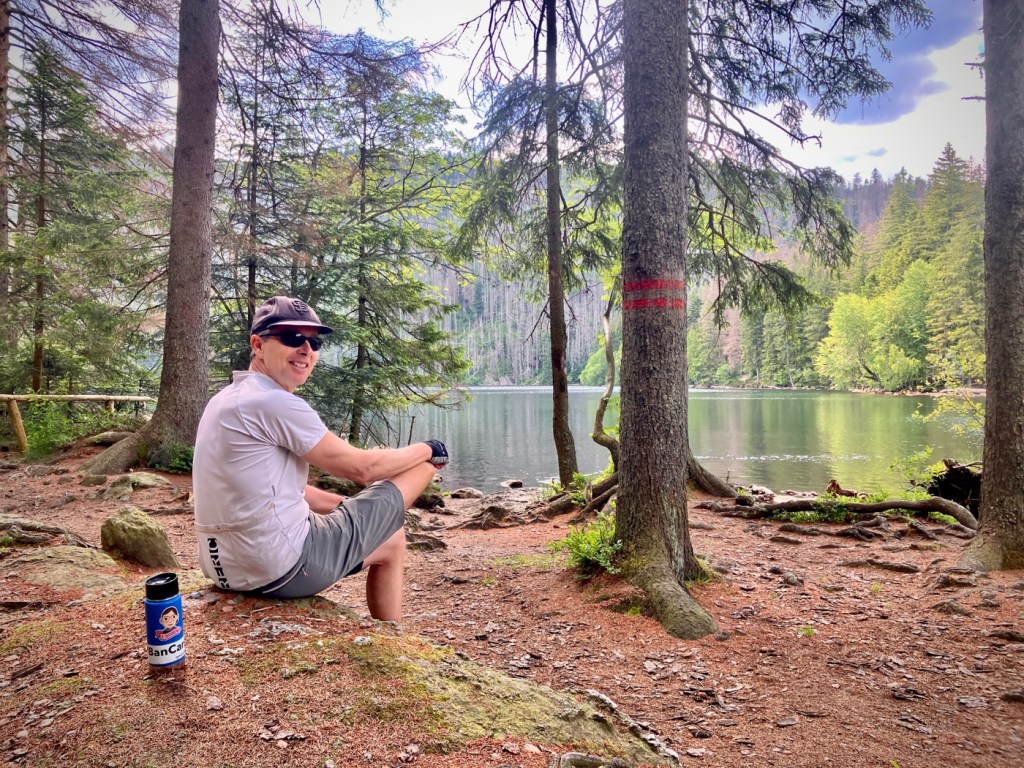
A promised tea break at the mythical Černé Jezero (Black Lake).
The signature National Park in SW Czechia.
The reward of Day 3 in Southern Sumava; beutiful river views, gentle grades, and buttery new pavement.

Consequently, this region also makes it a great place to see wildlife and unspoiled nature. Parts of the German Elbe River we cycled in 2019 had a similar dynamic, and the Elbe is still one of the wildest rivers in Central Europe

The wilds of Eurovelo 13.
Finally some downhill and a morning start gliding down through the trees.

Another change since we travelled through Eastern Europe in 2006, is the expanded dominance of English as a second language. Back then, anyone over 30 likely spoke some Russian, maybe a bit of German, but with limited English except for the young and educated. Now that age divide is about 50. Ages 30 to 50 often have some English, and many under 25 have excellent English. The schools all now have some English language classes. And when we dive deeper in conversation with the more fluent people, the reasons are varried, but all focus on a desire to be connected to the world, and to appreciate western, and more specifically American culture.

Chair Zeros for the win and a shady river view break.
Ready to head out for our third day in the mountains from the idyllic Penzione Ida.
It’s green in Sumava NP for a reason.
We soon learned that Czechs have a good sense of humor…even the sign vandals.

The first English speaker we met was a young waiter at a small resort hotel in the mountains. He was in Czechia on a limited Visa from Moldova and hoped to make enough money to advance his opportunities beyond his home country, which is still one of the poorest in Europe. (Moldova is aspiring to join the EU, but they still have some hurdles to that goal.)

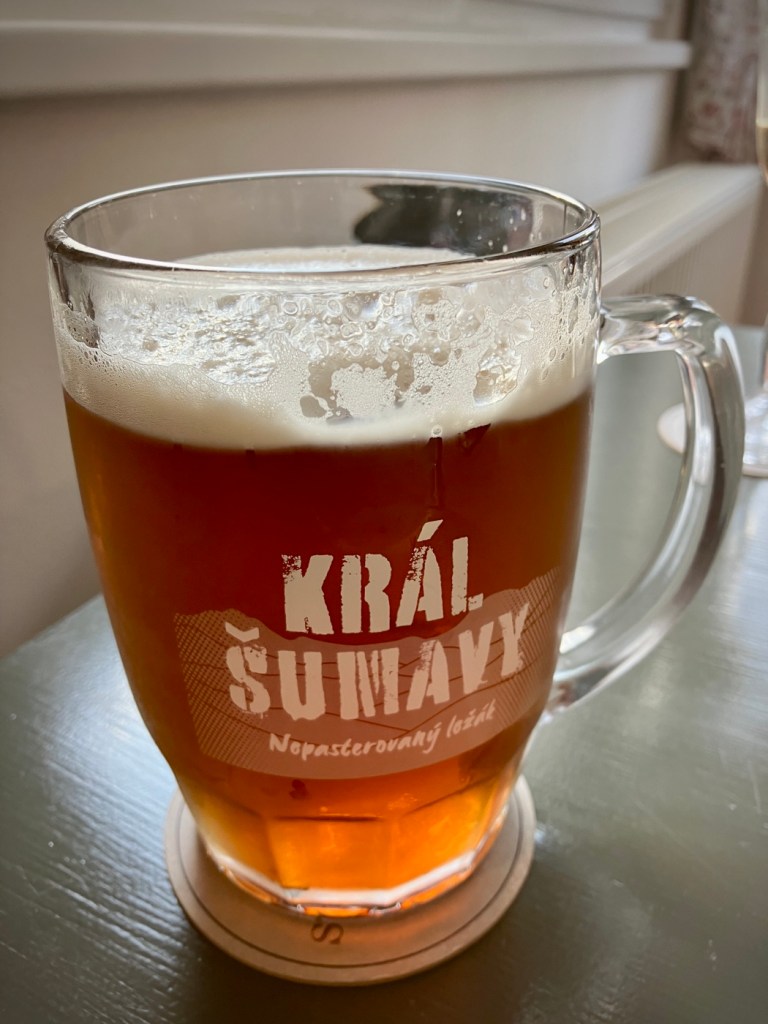
Yes, the beer in Czechia is great and scientifically proven recovery beverage-:).
But a brunch beer break on the Vltava River? Sort of. A refreshing Birrel Pomelo alcohol free beer on tap.

Labor shortages and global imbalances mean that people are in constant motion towards opportunity, and this only ceases if a country or region limits travel and migration. The extreme of this imbalance is the ongoing (and likely getting worse) migration wave from much of Africa into Europe. Desperation and tragedy go hand and hand as the recent and ongoing deaths in the Mediterranean exemplify. There are no easy answers, except to strongly support aid and development in struggling countries combined with humane refuge assimilation and admittance policies.

Typical of many small border areas, a new pedestrian bridge now connects Leopoldschlag, Austria to Czechia.
A restored church just across the border from Hammern, Austria, but no more Czech village here. People in towns near the Iron Curtain border were displaced and the areas were either abandoned or used for security purposes.

Germany is a different country since the post 2015 Syrian refuge crisis and many would argue that it’s for the better. However, it’s easy to see how immigrants from such a vastly different culture struggle in a very rigid German culture. America does seem a bit easier on that front. But I digress.

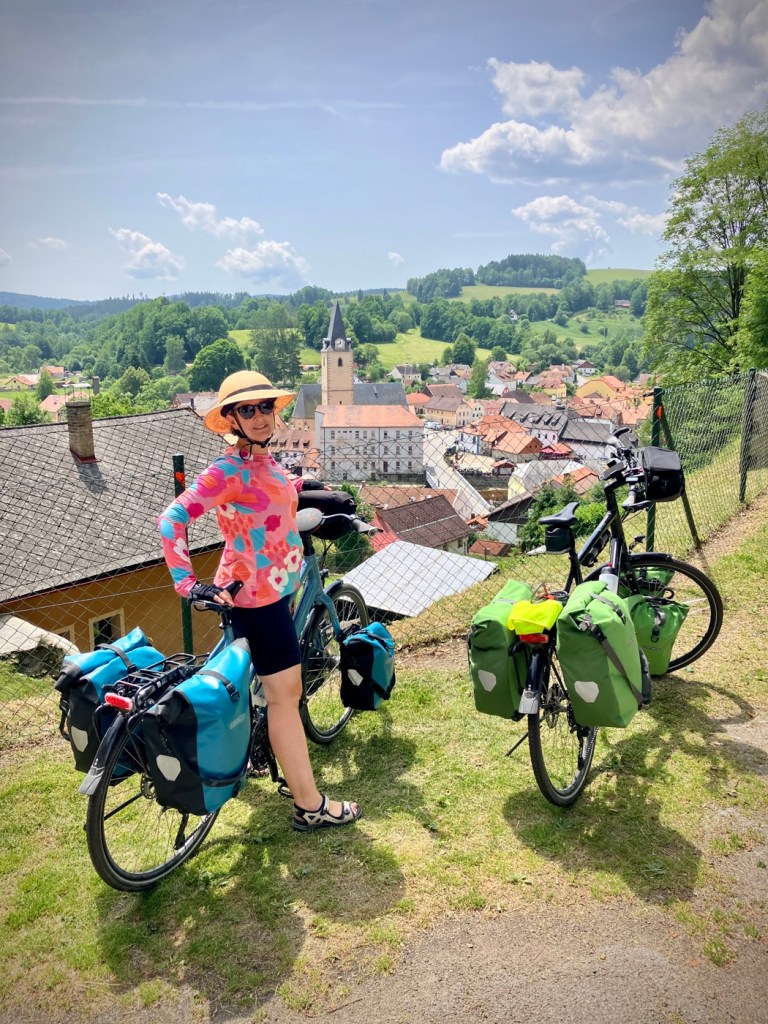
Beautiful river towns, castles, and churches surprised us around every corner in South Bohemia. Picnicking is easy with our snap fold bowls/plates.
Late spring flowers photobomb.
Cheryl smiling despite knowing that a ride down to the beautiful river town always means a climb out the other side!

The second person that fascinated us was the niece of an innkeeper at a family Pension in the Sumarva National Park. She translated for her Aunt and Mom as we all chatted at the end of dinner in the rural bar/dining room that felt more like someones cosy house. As it turned out, she was just entering Junior High, and told us that she got straight As in English and Cs in Czech! She was desperate to travel to the US, and obsessed with Manga and Japanese culture as well. Her mom just listened to her in a bit of awe.

On a very local “cycle route” between Lake Lipno and Český. Panniers crossed first.

Another small pension on the massive Lake Lipno was run by a father and son, and the son, Lucas, was fluent in English based on the fact that his parents put him in an intensive English class in Kindergarten. He’s never looked back and added months in the UK to hone his English skills. He exclusively watches online content in English, including YouTube and online gaming. Apparently online gaming is done all in English and of course, is borderless.

Český Krumlov was a great choice for a multi day heat wave break off the bikes. Touristy for sure, but lots of charm and quiet nearby.
The recommended Josef Seidel Museum in Český Krumlov, a beautifully restored 1905 house and photography studio.
Josef Seidel, despite being German, managed to survive post WWII resettlement. His son took over the photography business and survived until the early 2000’s.
Josef was the de facto historian of the regions and captured, preserved, and shared thousands of photos on glass slides from life in early 1900s South Bohemia.
Very effective building traffic protection in the old town.
We love the expanded hours and small markets of Czechia (versus rigid hours of Germany!) but this 24/7 off-hours staff free market was a step further. Upload your verified ID to an app and scan QR to enter and shop.
Historic graphite mines near Český Krumlov.
Leaving the peaceful gardens of The Orangerie in Český Krumlov.

That said, as we travelled further on along the border between Austria and Czechia, we found ourselves really off the beaten track in small valleys isolated by the former Cold War border. Our 10 words of Czech and Cheryl’s German skills have helped, but we have started to feel isolated after awhile without deep English conversations.

The local dunkel at Gasthoff Pammer in Leopoldschlag, Austria.
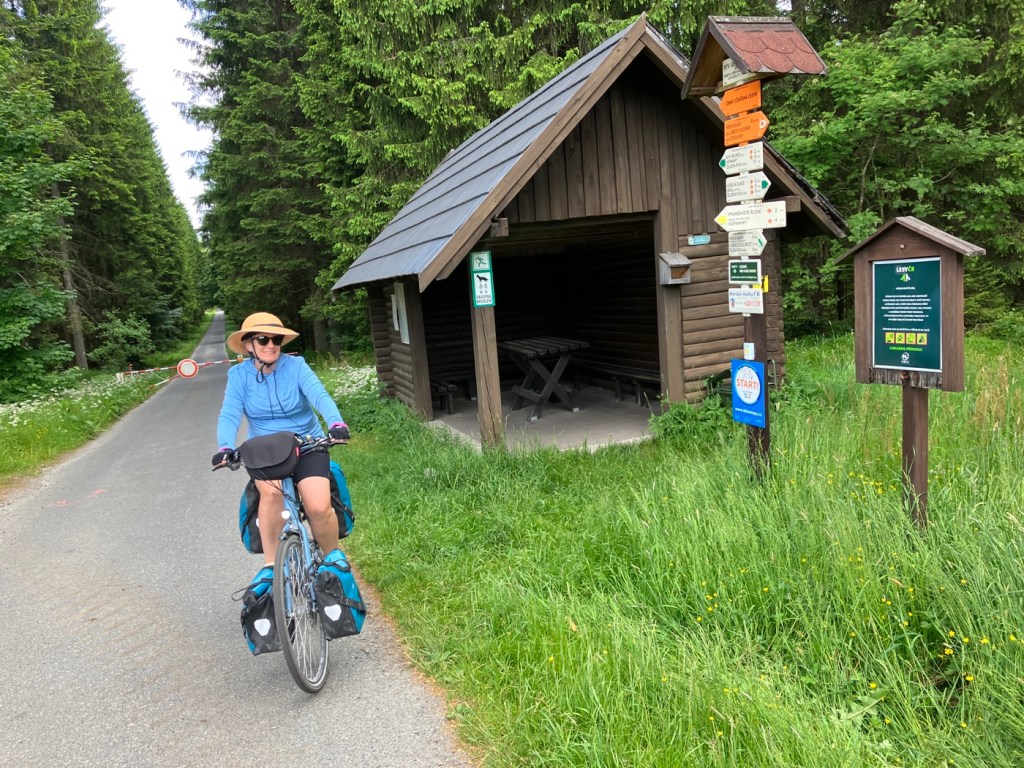
Lunch along the EV13, rarely were we competing for a spot.

The cycling in Czechia (and a bit of Austria) has been mostly fantastic, but really challenging our first week. The terrain of Sumava NP and the Vltava River valley is rugged and steep. Although the main roads meander around the geography more gently, the cycle routes follow little travelled forest and back roads, and are often steep (10-15%+) rough in places, and relentless. But many stretches are also magical smooth pavement with little or no traffic.

“Tunak!”Little tins of tuna spread has become a staple for lunches with bread, cheese, pepper and cucumber.
A more gourmet meal in Gmünd, Austria. Fresh Spargle (Asparagus) Risotto topped by lightly crusted catfish.
And the local Austrian Beer to complement.

As we approached Moravia, the steepness gave way to more gentle and long undulations.The small city we are in now, Znojmo, has a pleasant old town and prominent position above the river Thaya. It’s quite busy with local tourists and a few German speaking tour groups, but otherwise seems off the international tourist radar. It’s also the heart of the Moravian wine country, so lots of wine tasting options and a great historic brewery complex.

Another unexpected surprise along our route was Glashütte Andreas Apfelthaler in little Nagelberg, Austria.
These painted (somewhat creepy) gnomes are popular in the region.

You can sense this border city has rejuvenated significantly in recent years with a pretty tidy old town and lots of new housing, although it still has a decidedly Eastern European feel around the edges, with a bit of scruff and wear.

Outside Vyšší Brod …conditions really vary on Eurovelo 13 and sometime pushing 80lbs of bike load is the only option!
The Austrian-Czechia border. Cheryl’s happy too since much of the border is also the high point ridgeline (or a river).

Tomorrow, we ride again towards Brno across the Znojemská wine district. We are excited to spend three days in Brno and experience some of the energy and sights of Czechia’s second largest city.

My happy face means we’re on our bikes and off the beaten path in peak tourist season.

Our Koga touring bikes are still fantastic and a joy to ride, even fully loaded. The heat, wind, and being out in the sun for 8 hours still takes it toll though, not to mention moving into and out of a pension, hotel, apartment or guesthouse every night. But now our bodies are in week four of this tour and getting stronger every day. More on the details of our bike tour in our next post. Happy pedaling!