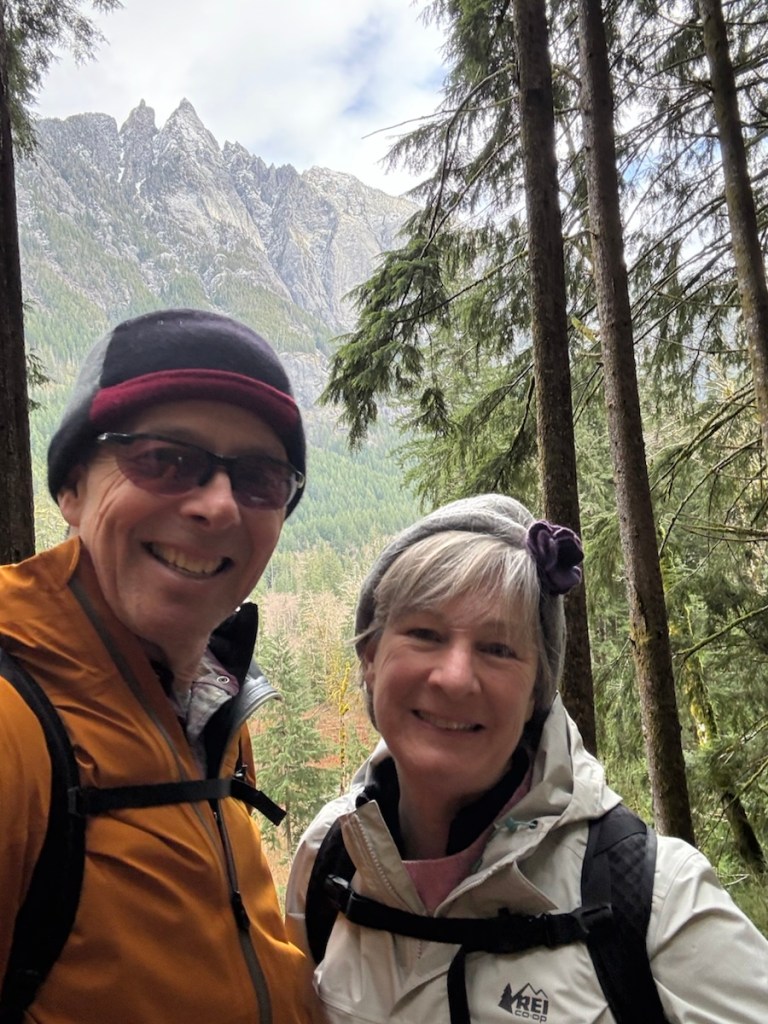
Hiking along the middle fork of the Snoqualmie River.
Now that we have a home base again, what is it going to be like to travel? We spent four years with only a storage unit in California, so there were no worries about a house, or about things and stuff. We had with us what we had with us. It all got packed up and moved with us every time. A lot of thoughts and worries can now swirl around our brains. The house. The small garden. Our friends and neighbors. And, an even bigger worry is how will we be greeted in the world now that American leadership has lost even more international credibility and respect?
After seven months of no international travel – except one fun train trip to Vancouver BC – have we lost our nomad travel mojo? Well, we’re about to find out. We’re headed out for seven weeks of bike touring in France.
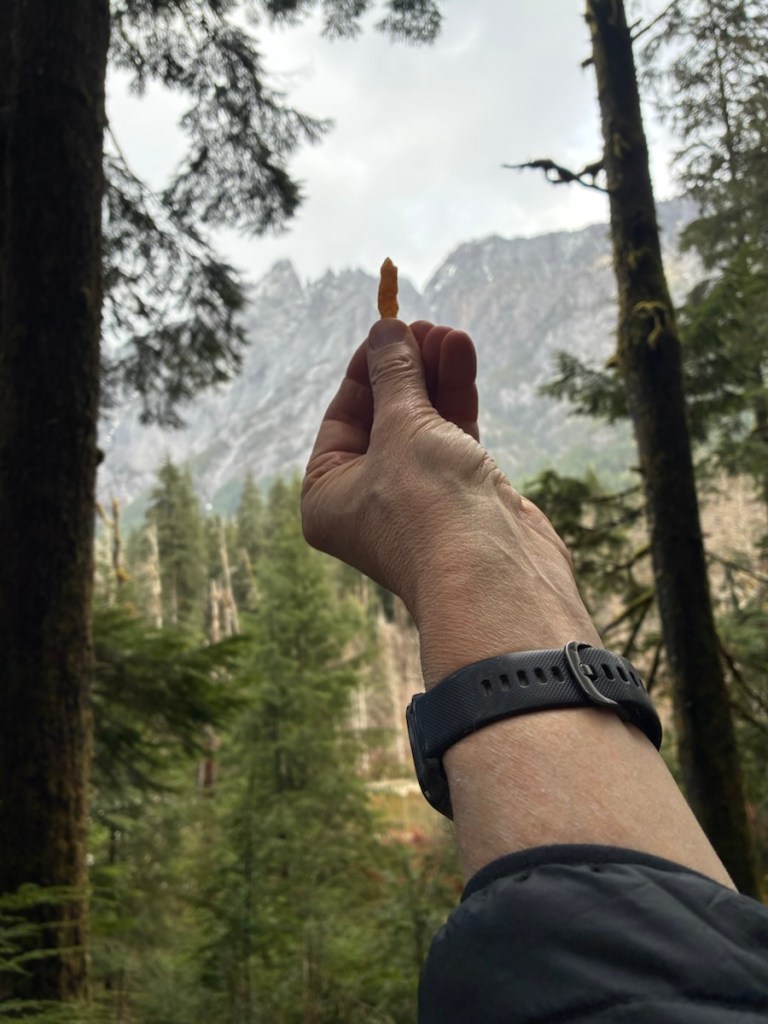
Cheese puff mimicking a rocky ridge.
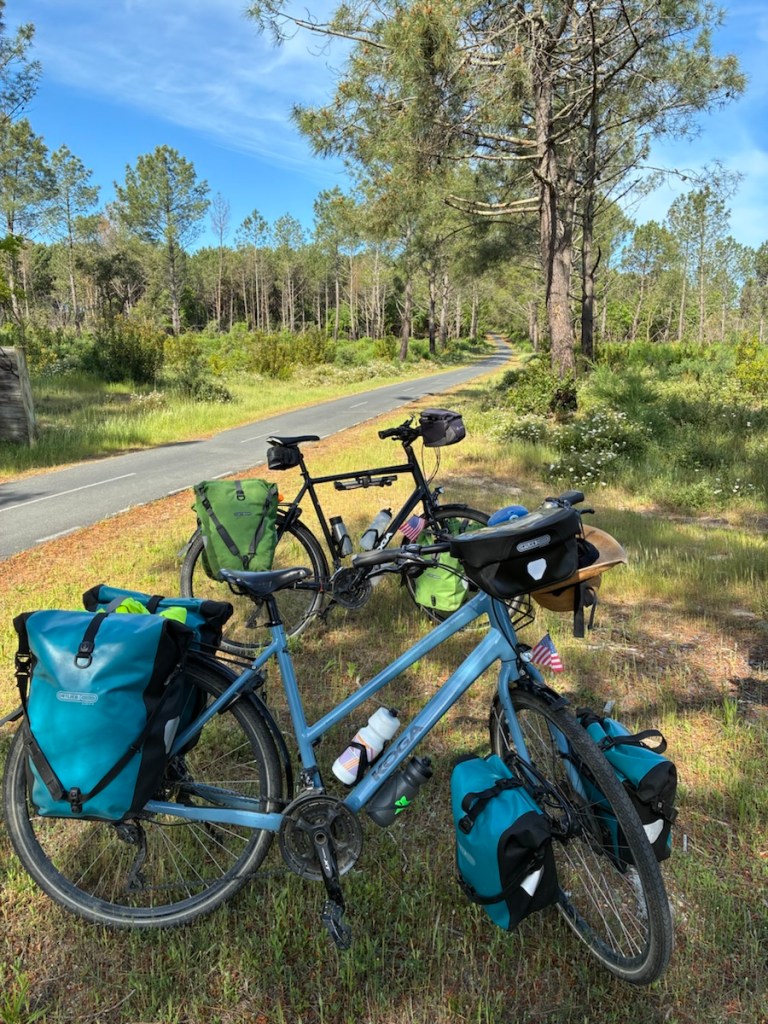
One big thing we don’t have to fret about is boxing and flying with our bikes. Our wonderful Koga World Traveler S bikes are still in France at our ‘What Did We Do to Deserve Such Good Friends’ place. We don’t really have to worry too much about our home either, since another set of WDWDDSGF will be checking in on it when house sitters aren’t in residence. We don’t need any new vaccinations or visas. So, any real worry is all in our heads.
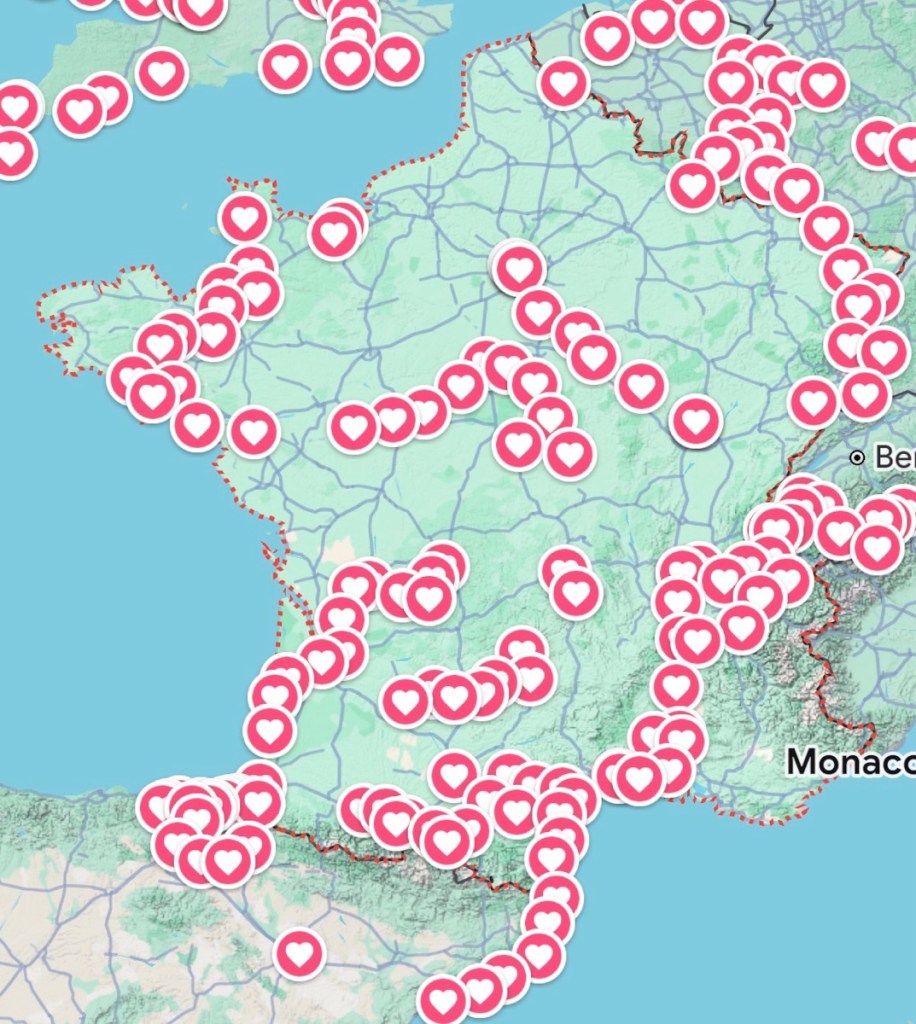
Every heart is a place where we’ve slept.
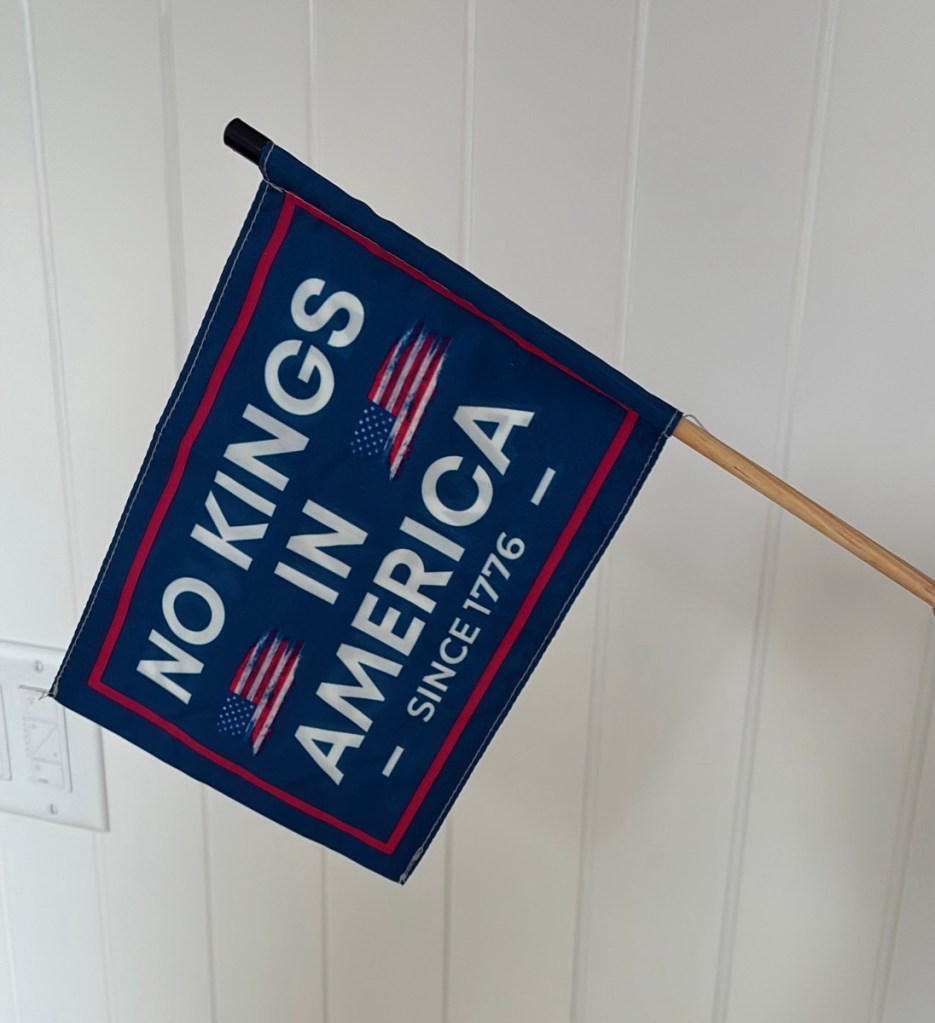
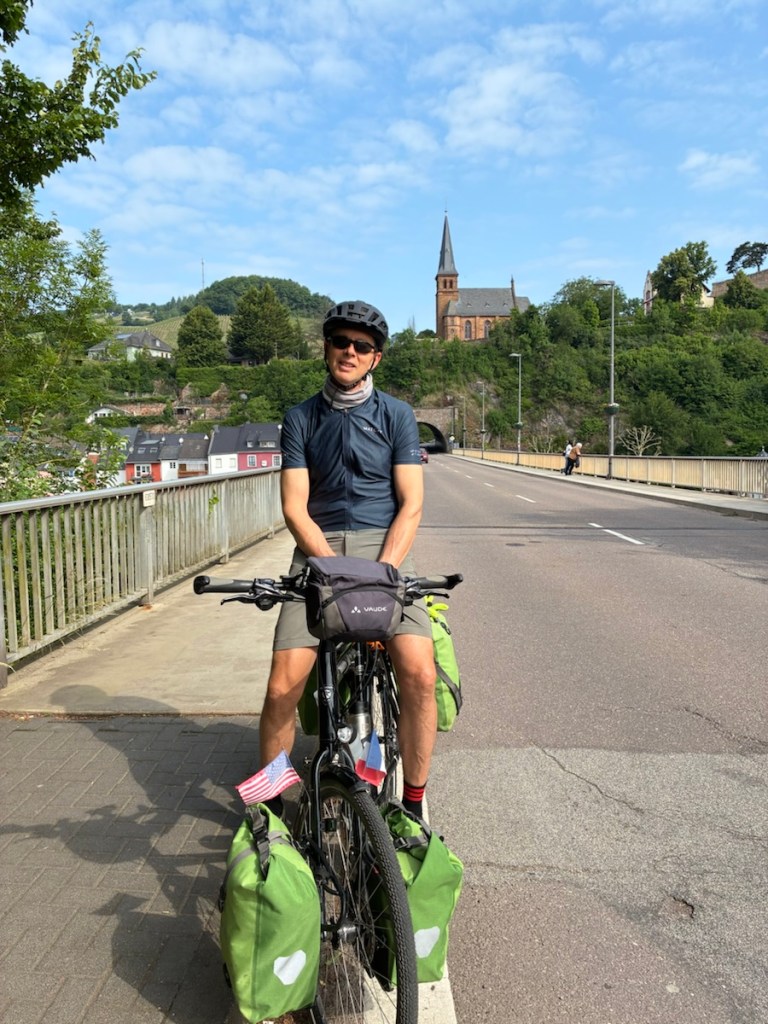
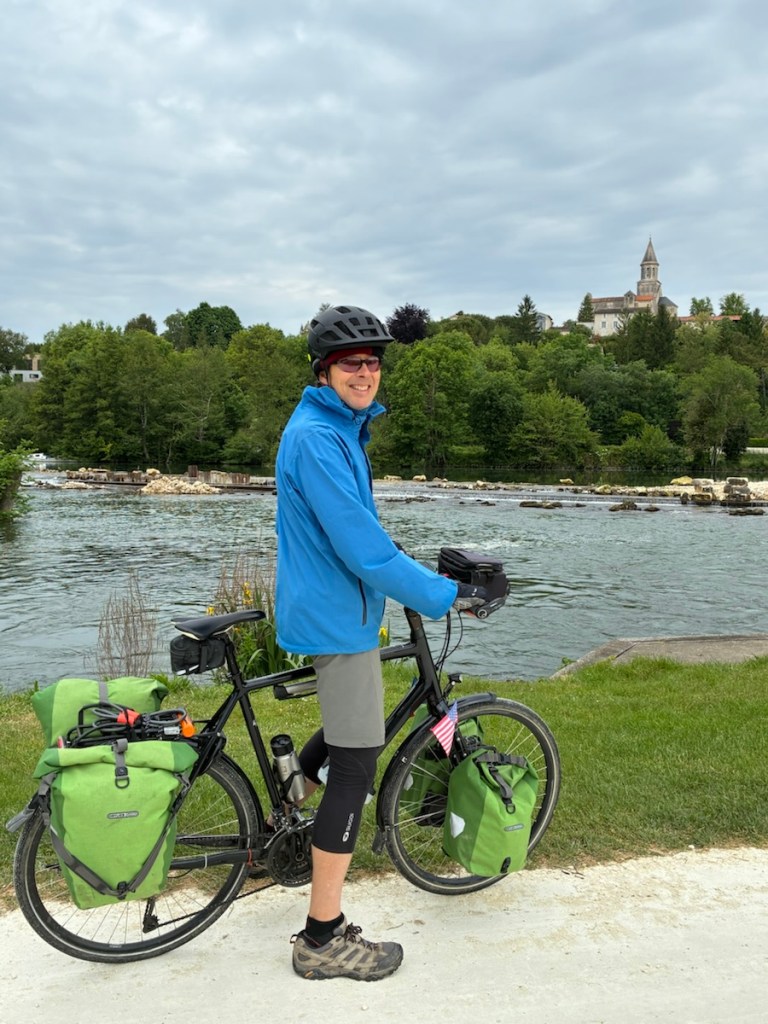
But the biggest cloud over our American heads is what our country is doing to the rest of the world and ourselves. We always bike tour with small American flags flying from our bikes. We know that everyone’s first question about travelers is “Where are they from?” The flags answer that question and start a lot of fun conversations with folks. This time we’re adding a No Kings flag to show our dismay over our current leadership.
No Kings.
We can’t hide our nationality, we don’t pretend to be Canadian- which is always silly but particularly rude these days, in light of how we’ve been treating our lovely neighbors to the north. We’re American. It’s obvious in so many ways. So, we’ll see how the conversations are going to be different on this trip.
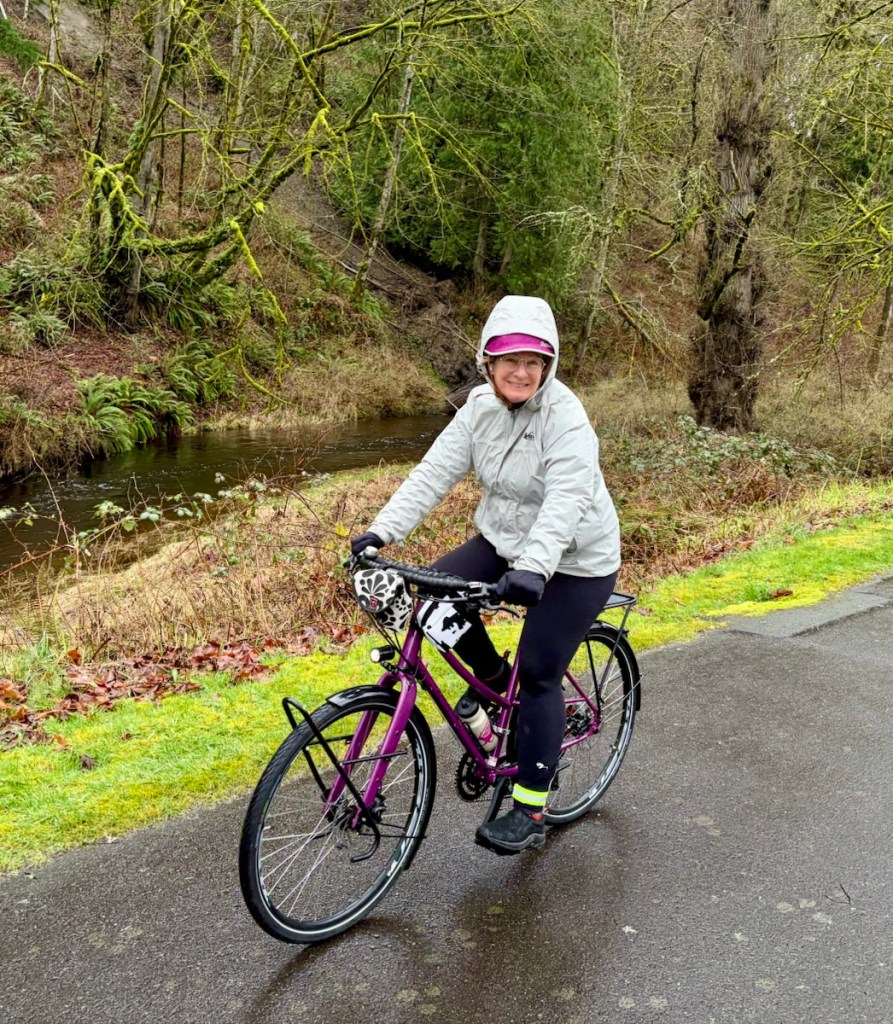
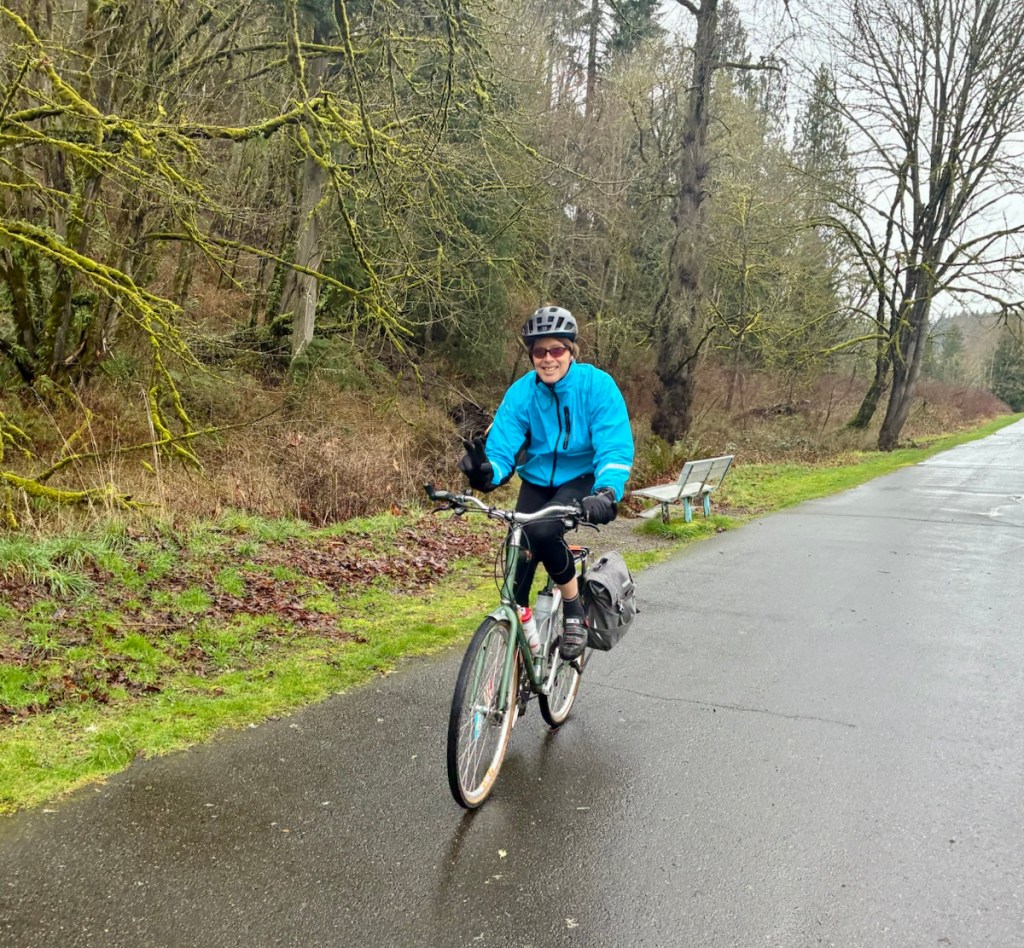
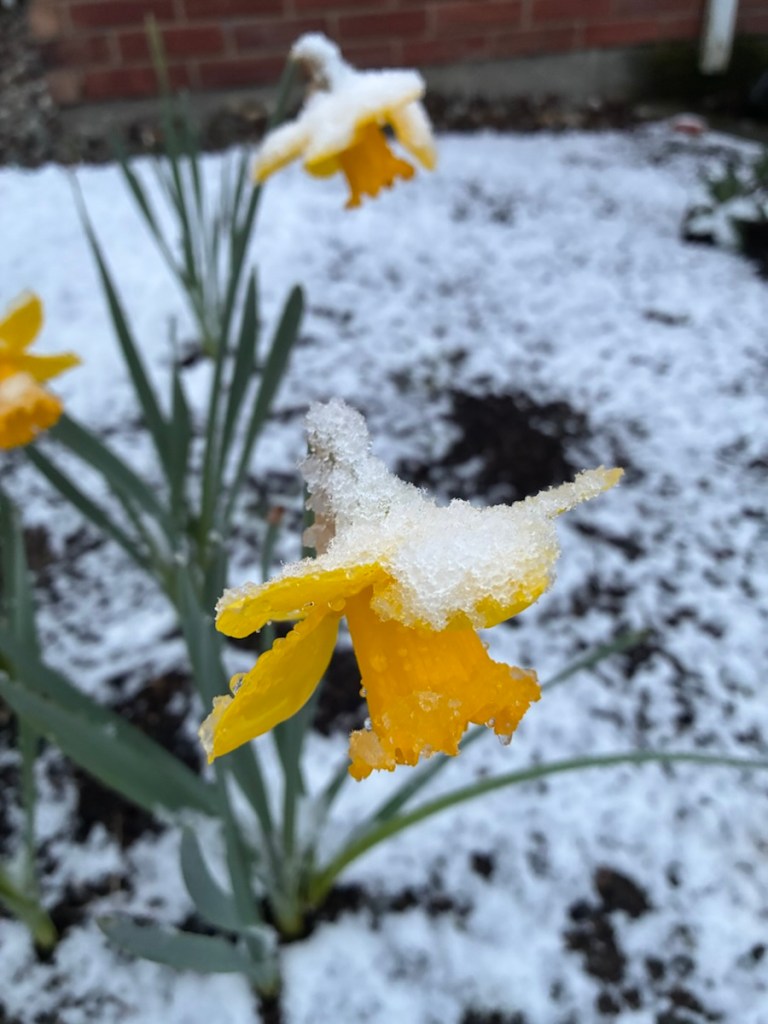
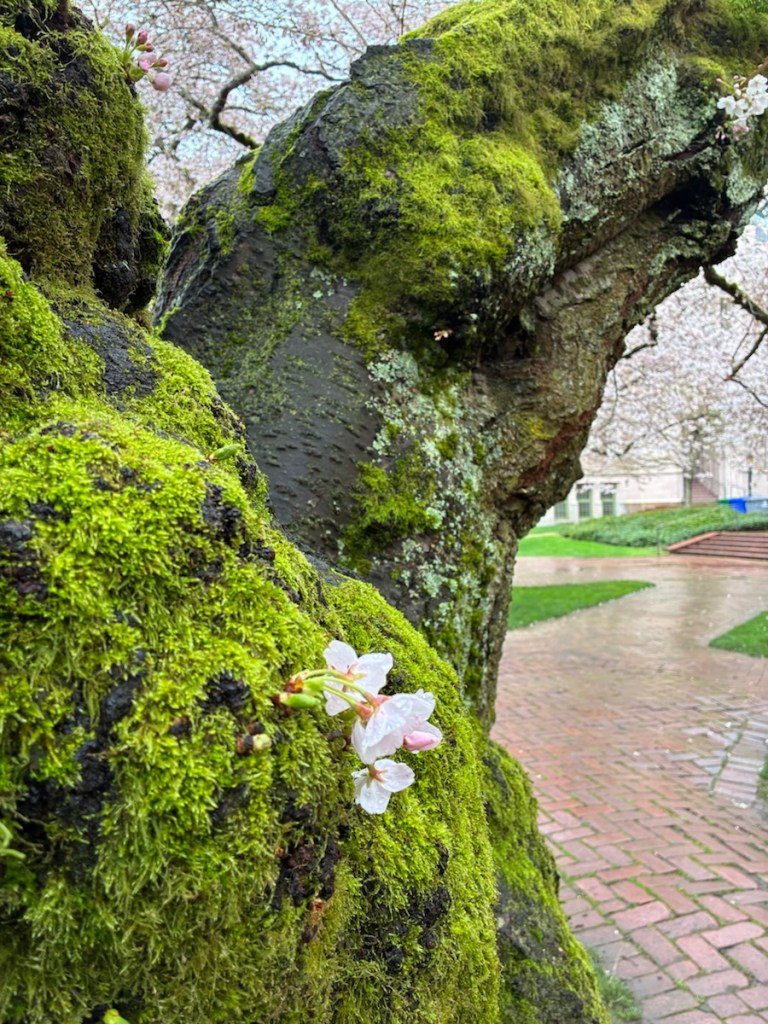
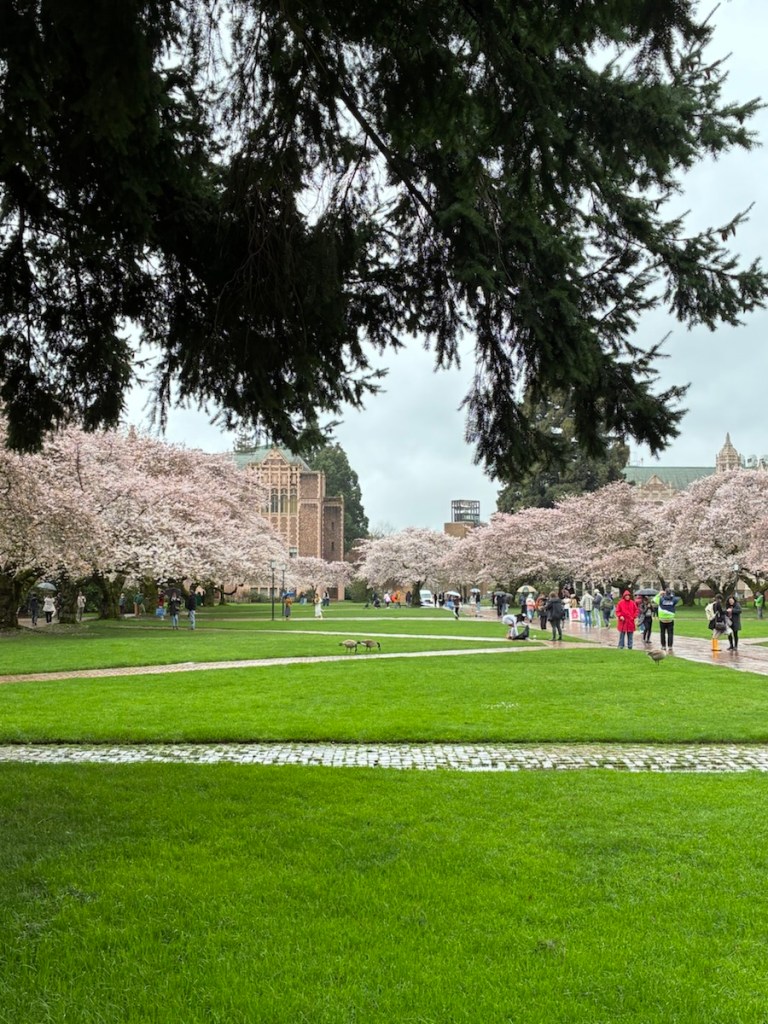
Riding the Centennial Trail out of Snohomish. Trying to get myself in at least a little bike touring shape. That’s my new US touring bike. Rich is already in shape, he just has to practice waiting for me!After a final cold snap and snow, spring is here in Seattle. Cherry trees on the UW Campus are a good indicator of spring. Spring fever and cherry blossoms.
What is our basic itinerary? A fun meet up with friends in the Haute-Savoie, and sort out our bikes, then Brittany and Normandy, and Paris. The travel planner (Rich) has many ideas and tricks up his sleeve. And, since he’s actually had time to travel plan, bookings for the first week or two! Our usual fly by the seat of our pants travel isn’t necessary when he has time on a laptop to research and plan. His one client (me) has absolute confidence in him.
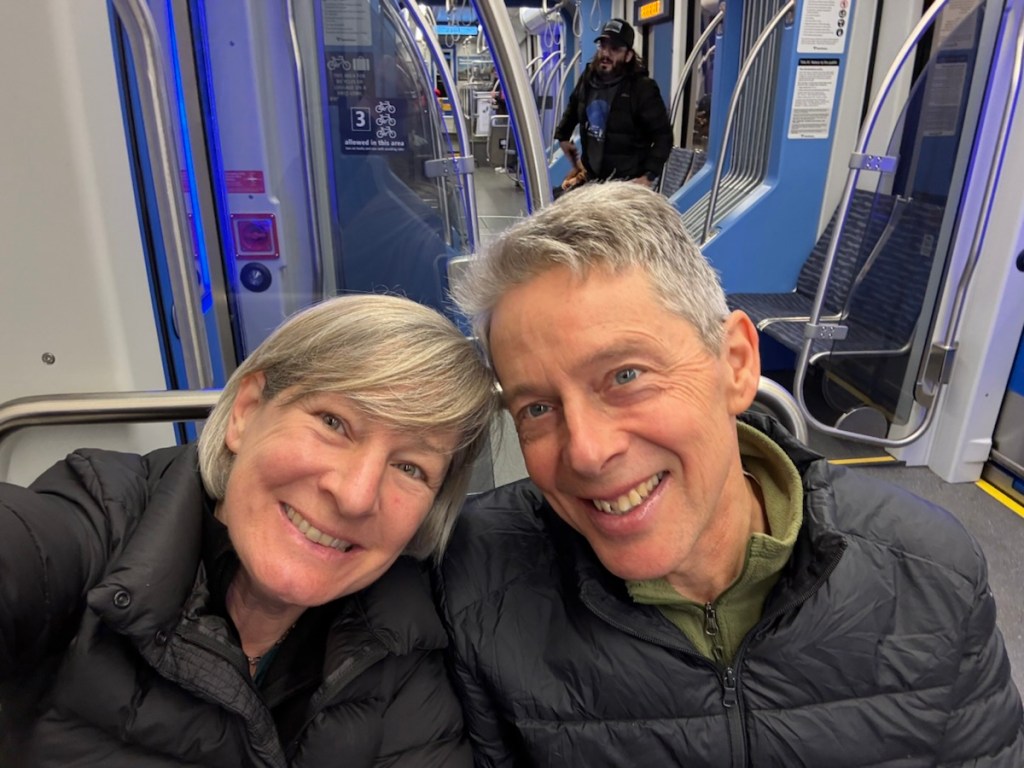
Headed to the Seattle airport on Link light rail.
So here we go! More from the roads of France later. As our SF friend BikeDave always said: “Have a nice ride home.”
Saarburg. Our first stop in our swing through Germany.
Saarburg Germany. The Venice of the Saar region. That’s what they say anyway. I’m not sure one river through town makes it Venice, but it was one of those towns that’s not super promising as you roll in, and actually had a fascinating and beautiful old part of town. The 15km long Leukbach River runs through the charming old town and meets up with the Saar River.
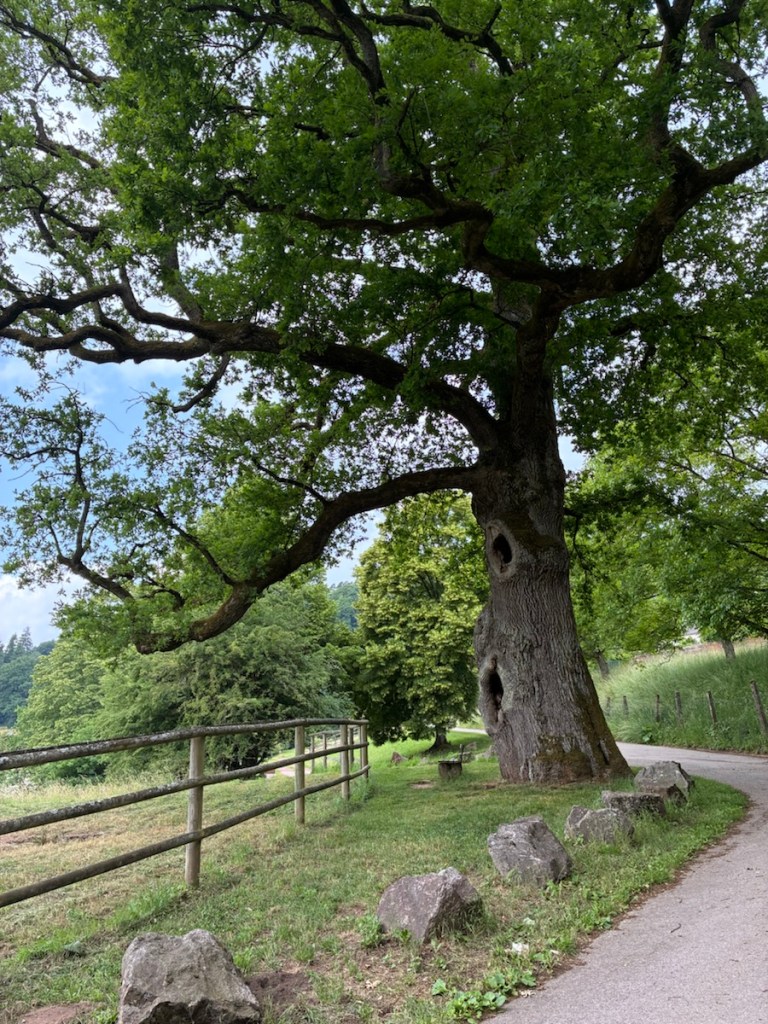
The Wasserfall Saarburg. Makes a lovely backdrop and sound for the restaurants and cafes. More impressive is the fact that this was a 13th century project to redirect the Leukbach River through town.The buildings rise right up from the river.The sound of the waterfalls and the cool air rising from the river are lovely.On our way out of town after a one night stay. That look says, can we just ride and not stop for photos every five minutes?Heading out along the Saar River. It was a calm morning, no wind.My dashboard. Many podcasts have been played on that Bluetooth speaker over the weeks of bike touring. Germany can be relied on for good paths linking you from city to city, town to town. We’re up from the river on this stretch by an industrial site.We headed up and over a hill to avoid a big bend in the river. Shortcut? Eh..it was steep so no real time savings, but what a view.Could this tree be any more classic and beautiful? Big sweeping limbs, check. Picturesque hollows offering tantalizing home for small furry creatures, check.Ah, the bike signage of Germany.Ah, the pastries as big as your head of Germany.
Since we spend so much time on bikes we entertain ourselves talking about bikes and bike infrastructure quite a bit. A lot. Ok, constantly! We had to detour off the river path to obtain that giant pastry and once again we were reminded that although Germany knocks it out of the ball park with bike paths connecting towns, in town is a different story. It was quite inhospitable in Merzig, the short ride from the river path to Bäckerei & Café Tinnes had zero bike infrastructure. The contrast with France, where so many towns have been given what we call the French City 2.0 treatment in town, with new bike and ped lanes and markings and calmed traffic, was dramatic. It was not an environment that would encourage bicycle use for errands and transportation.
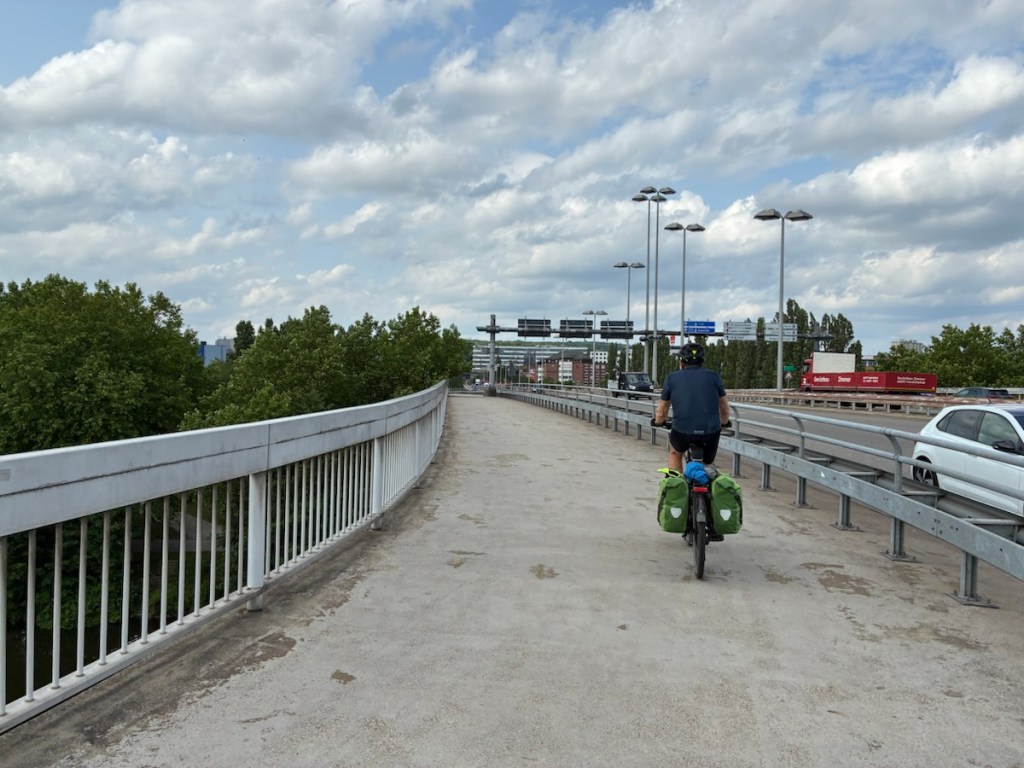
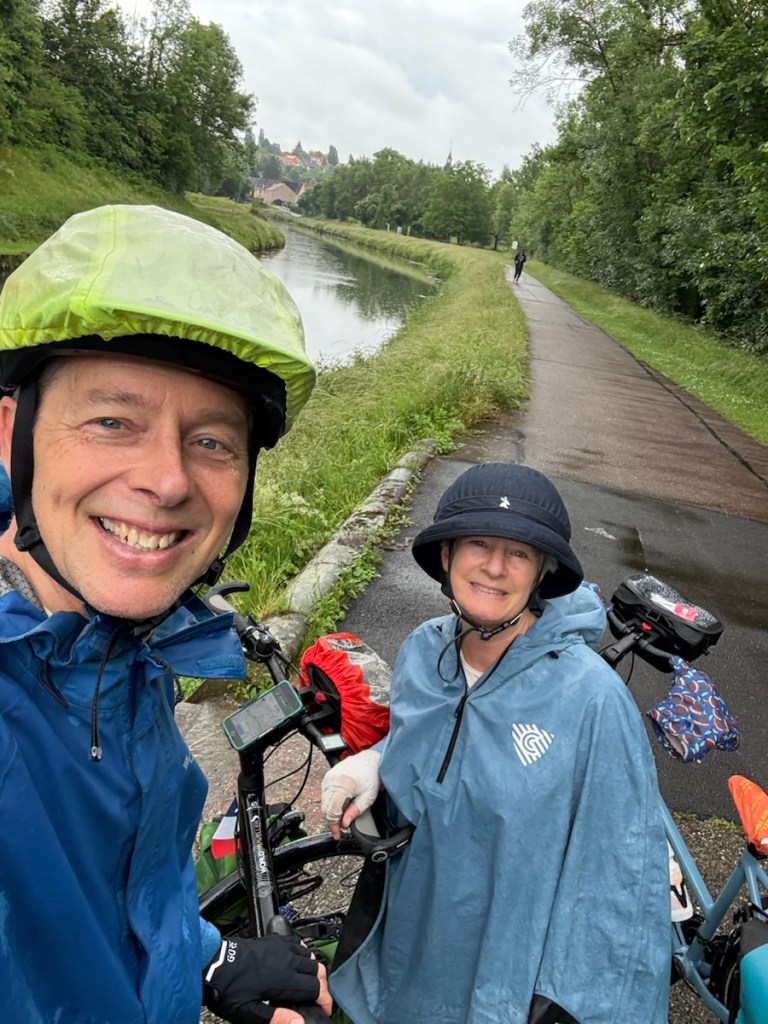
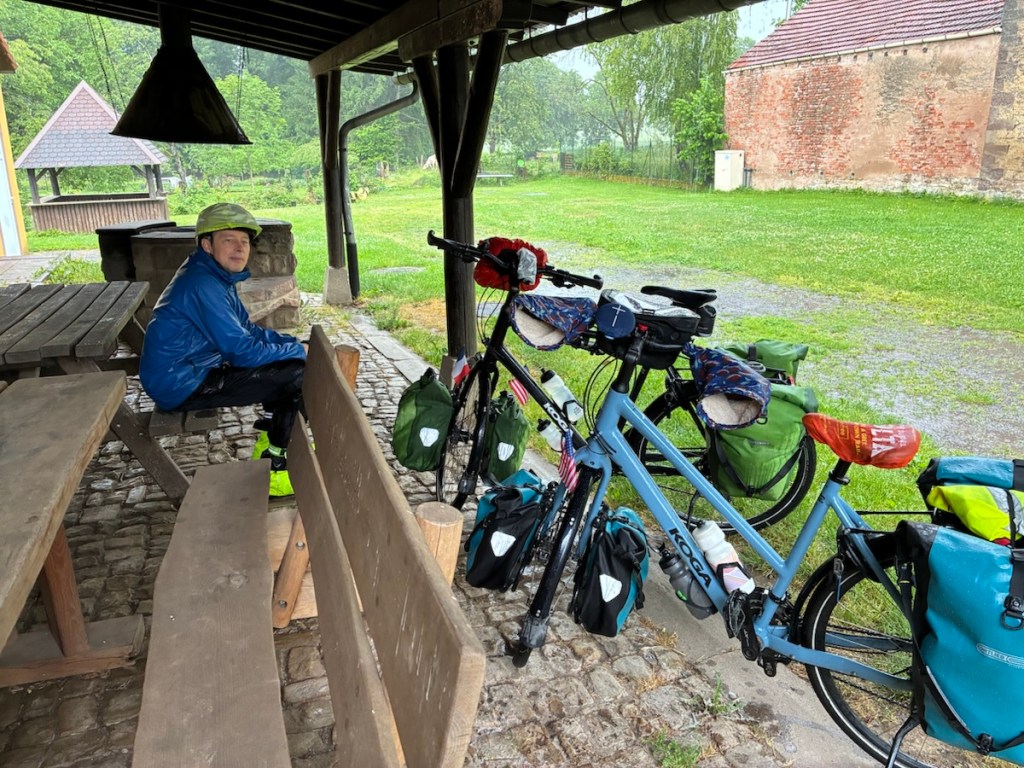
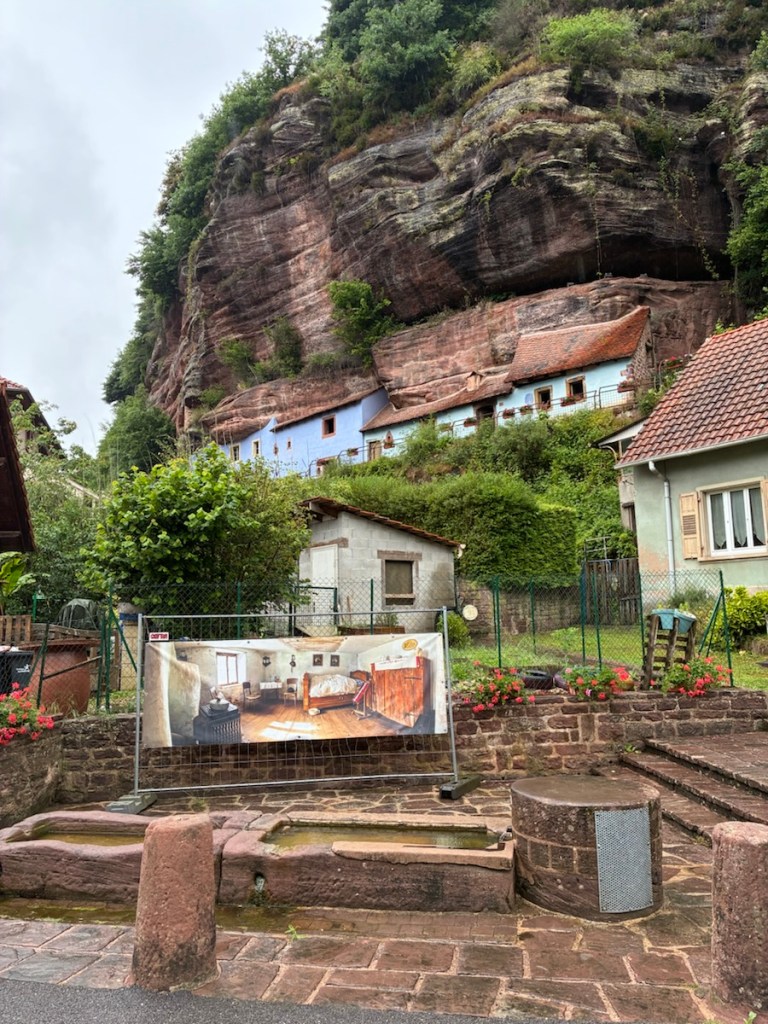
Over the bridge to our destination for the night, Saarbrücken.Recovery beverages for the win!What’s the easiest bike parking? In our hotel room. Doesn’t happen often but boy it’s nice. Roll in roll out. In this case it was roll out into a steady rain.Never stop smiling. We’re headed 25k to a train station to take a hop to shorten the day.Off the train at Diemeringen and we’re back in France! Feeling sassy. Drinking Sassy French cider at a Breton crepe restaurant lunch break to avoid the storm.We don’t often stop for a sit down lunch, but we had hoped to hunker down and avoid the worst of the storm. Delicious crepes. Very friendly locals.The rest of the day cycling was a series of hops to shelter from heavy rain. Overhangs at town halls, under a barn roof, and this community park with a covered picnic area. The storm moved slowly across the region so we didn’t avoid much of it, but we managed to duck out during some particularly heavy bits.We rolled into Eschbourg and marveled at Maisons des rochers de Graufthal. These houses were built into a rock cliff and the last inhabitant died in 1958. It’s now a museum.
We were booked into Au Vieux Moulin hotel, in a former mill and with a highly rated restaurant. After hanging our wet cycling clothes over every available surface in our room we headed downstairs to dinner. We opted for a four course tasting menu with the wine pairing – get ready for loads of photos of food. With only a few weeks left in France it made sense to maximize our dining experience. This meal certainly fulfilled that desire. The most French of modern French meals we’ve had. We don’t dine at fancy restaurants often, but French fancy is more attractive to us since the service is very straightforward and not overwhelming. The French assume that everyone enjoys food, it’s not a big deal, just life.
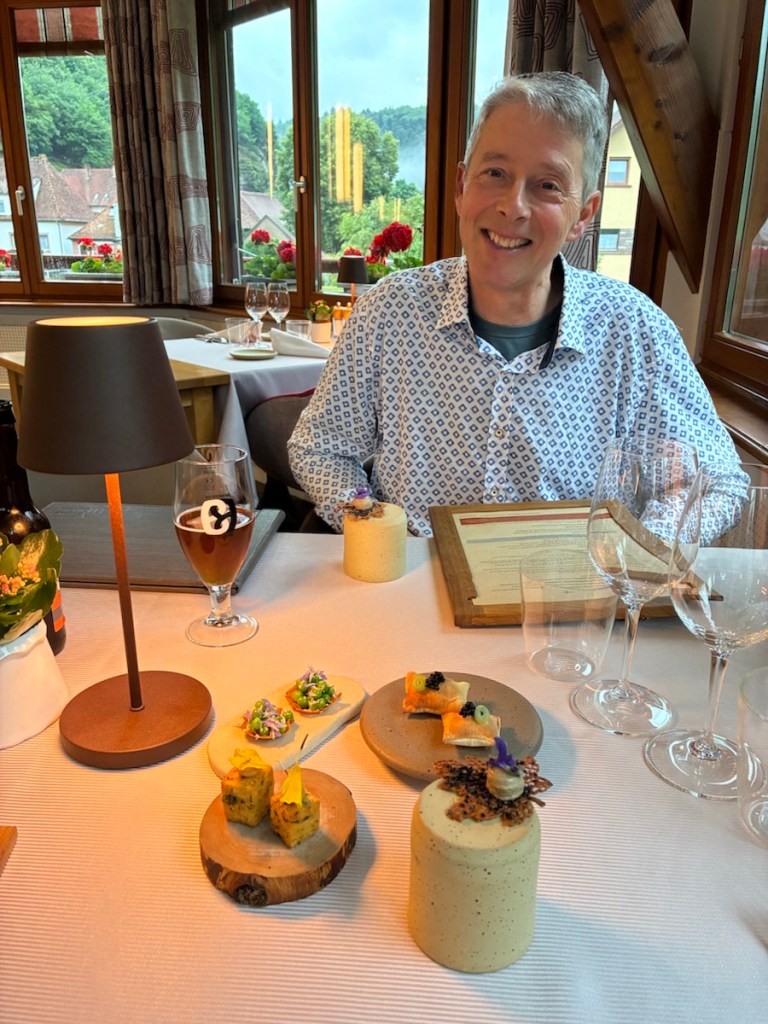
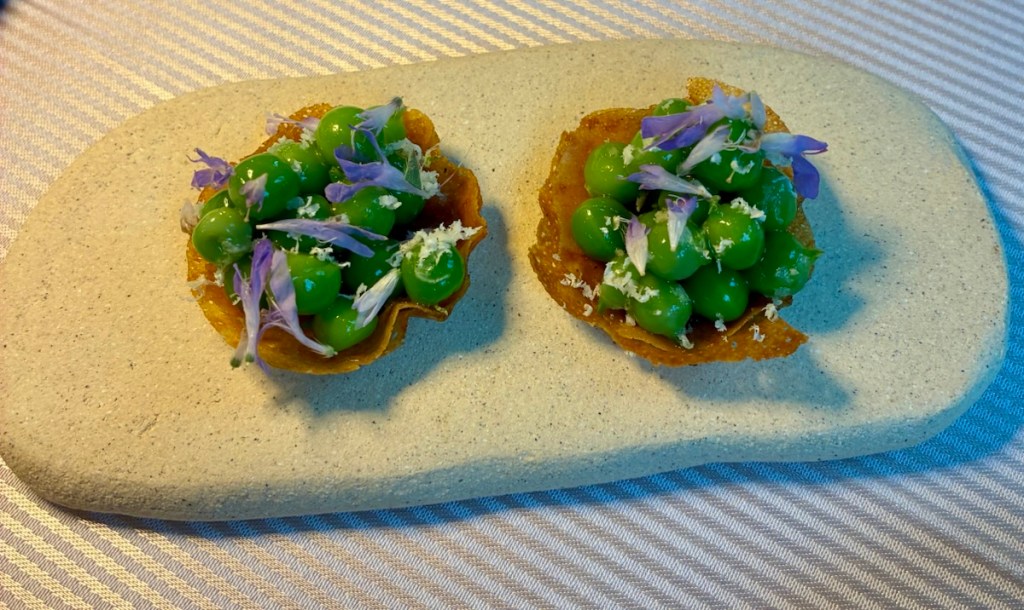
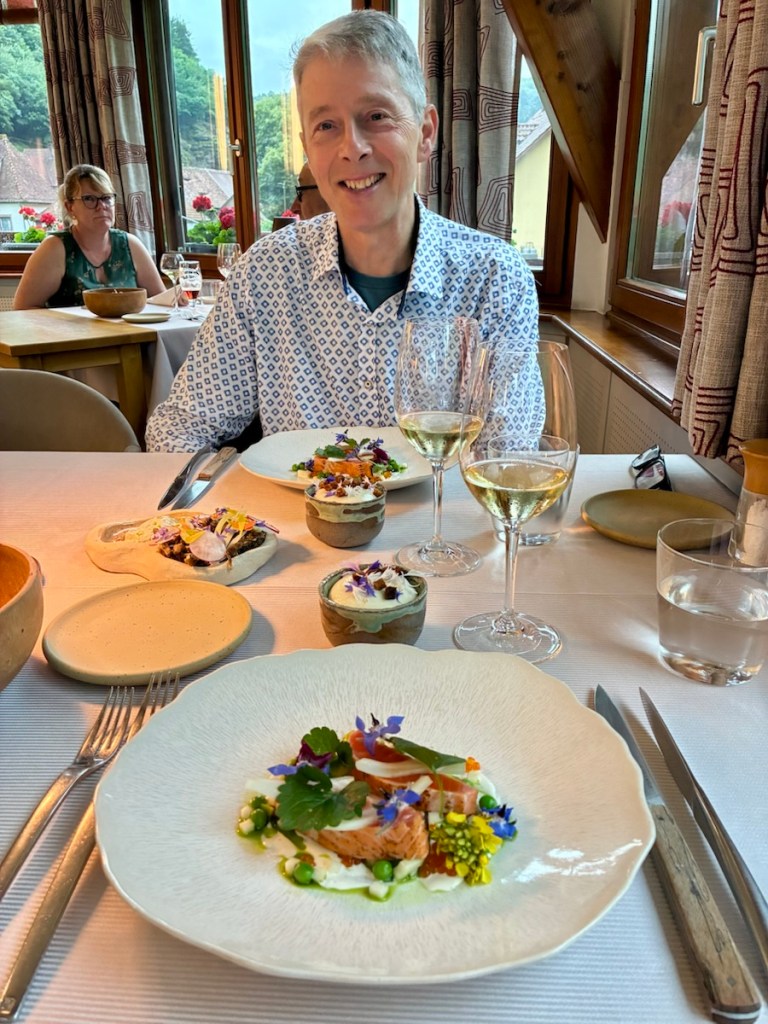
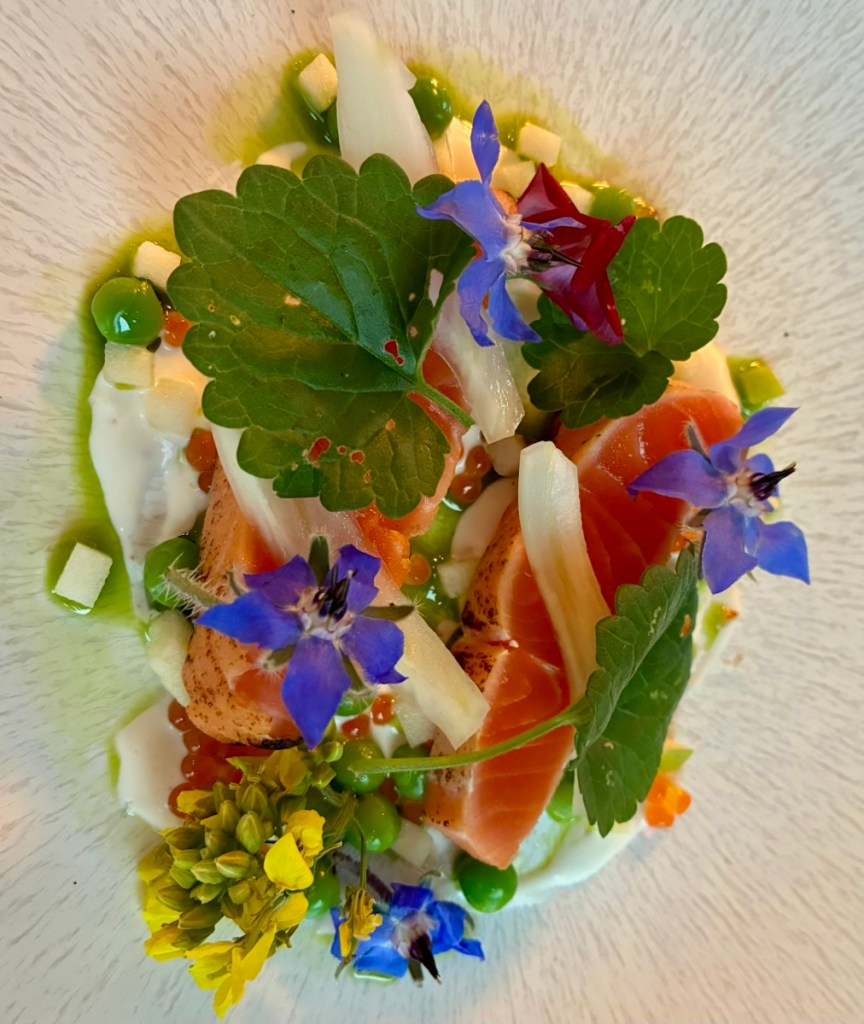
First, an amuse-bouche before we even decided on the tasting menu.Presentation was amazing. For aperitif Rich had a local beer and I had glass of white wine.Fresh peas in a little crisp crust.Eggplant on sesame cracker.Carte Blanche à Guillaume. Here we go. A wine pairing? Yes please!Another amuse-bouche to welcome us to the tasting menu. The first course was trout from Sparsbach served three ways. Small steaks, an airy foamy mousse of fennel, white asparagus from Ferme Waechter, and ground ivy. Close to Rich a small plate of tiny fried fingerlings. Troutelle, they were called. Or troutlings.
Trying to pay attention to and write down the details of this meal gave me so much respect for actual food writers. Ground ivy, the waiter said, I dutifully wrote that down and only now looked it up: Glechoma hederacea is an aromatic, perennial, evergreen creeper of the mint family Lamiaceae. It is commonly known as ground-ivy, gill-over-the-ground, creeping charlie, alehoof, tunhoof, catsfoot, field balm, and run-away-robin. Thankfully I had snapped a picture of the full menu, since these courses, or sequences, are mostly represented on the menu.
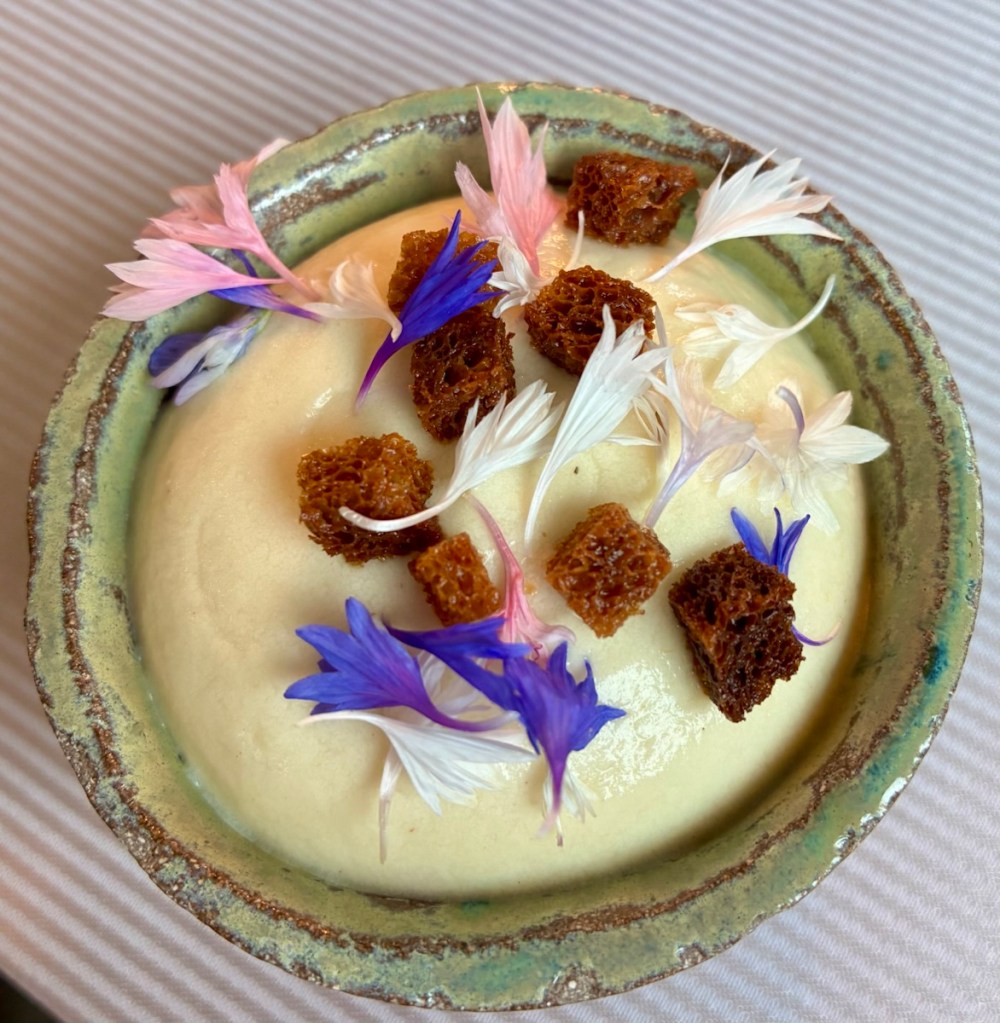
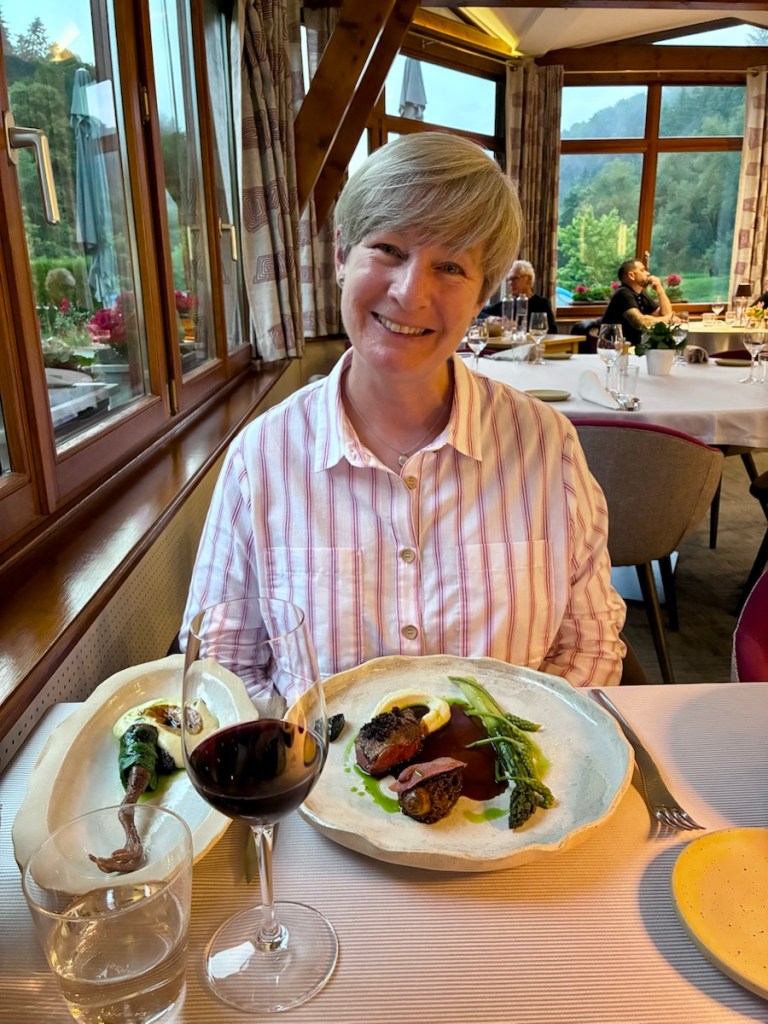
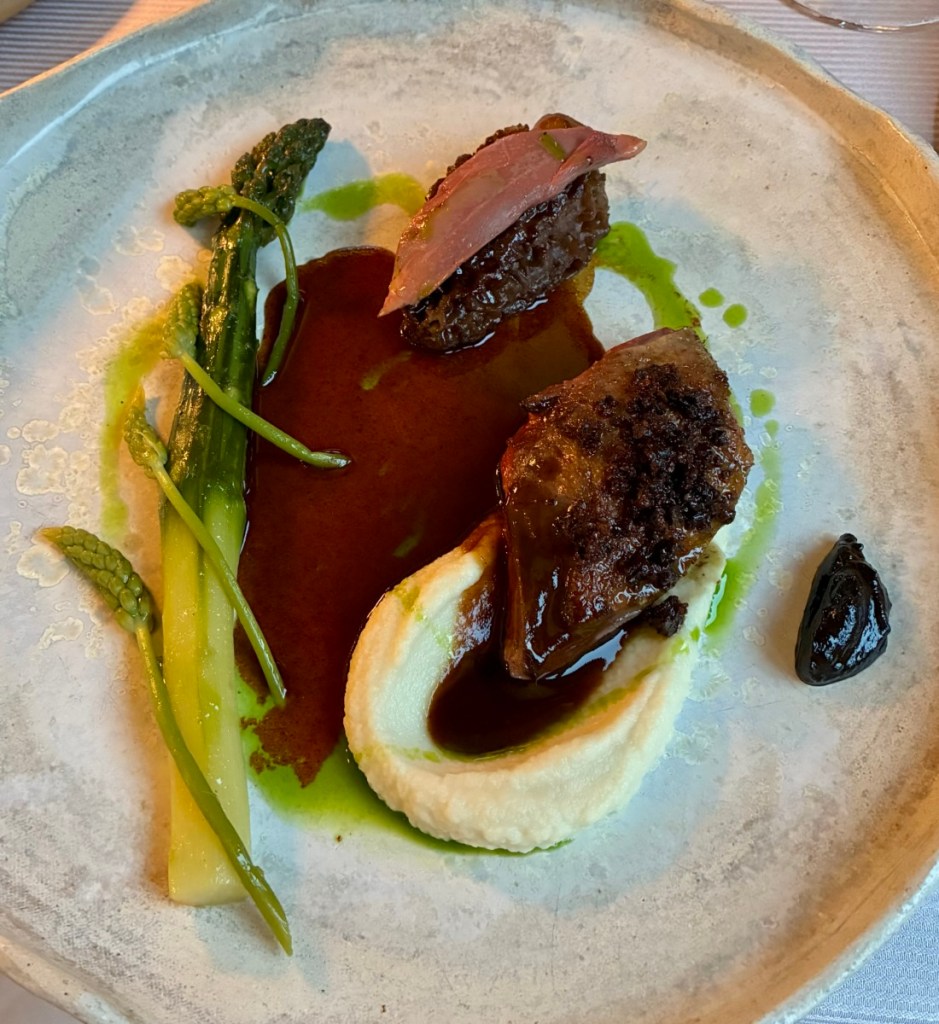
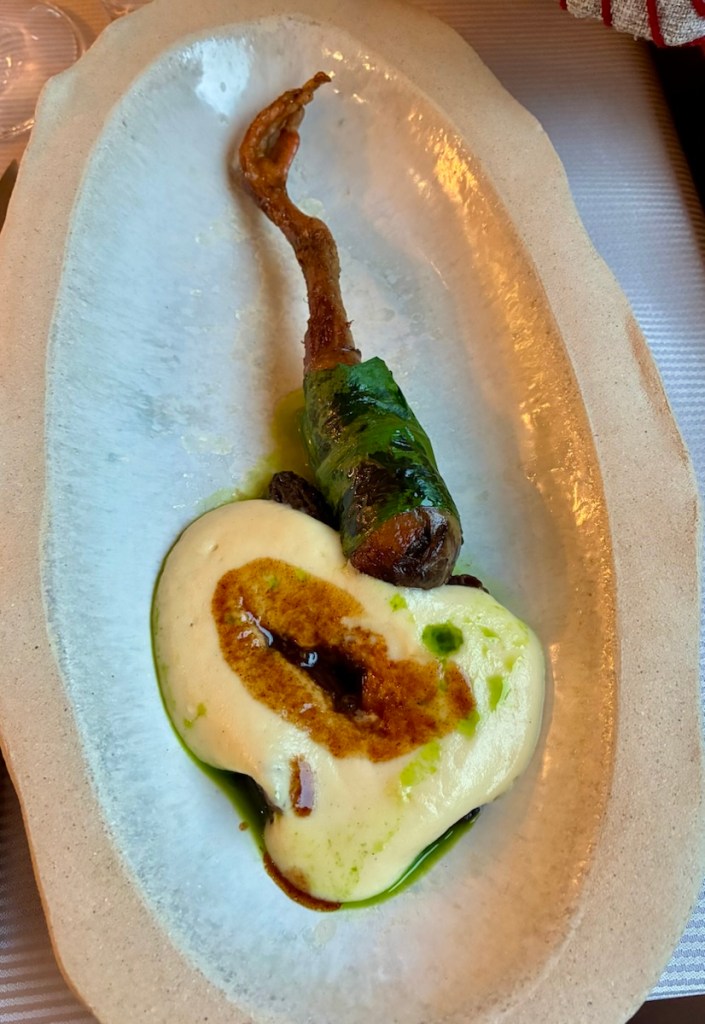
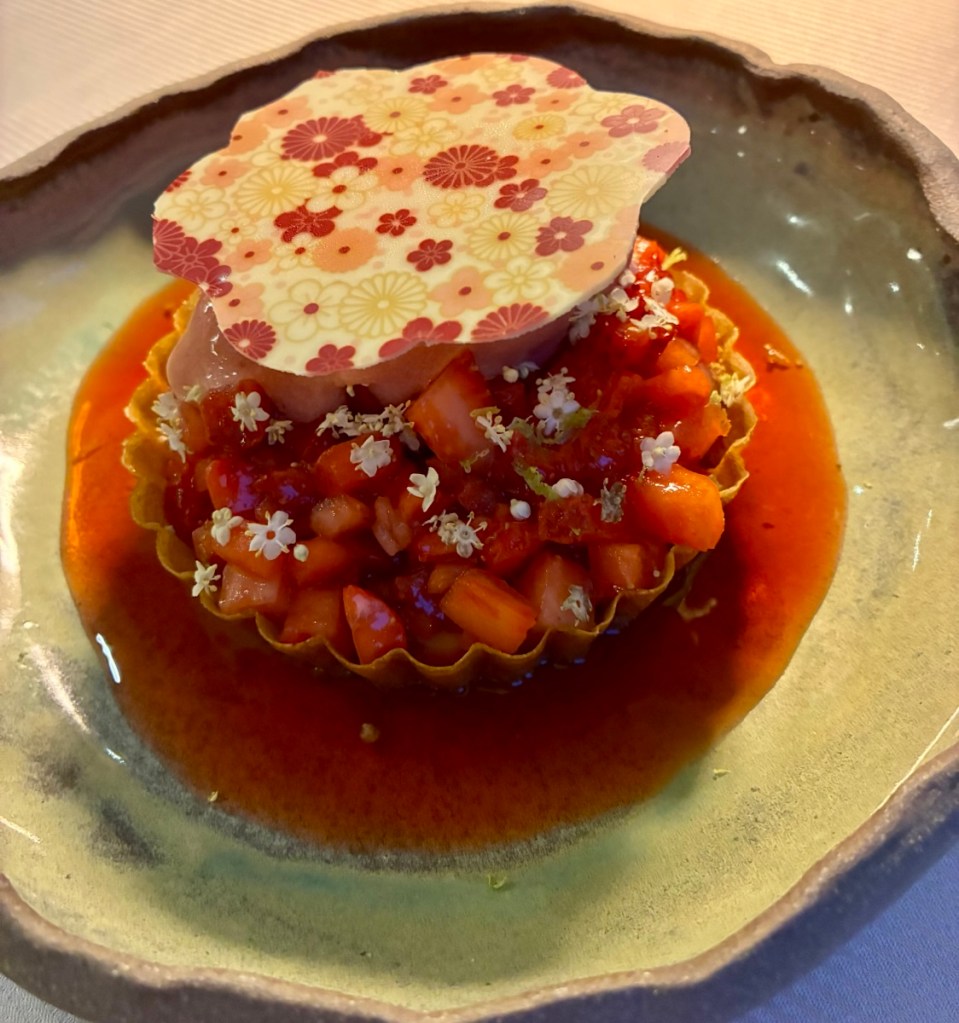
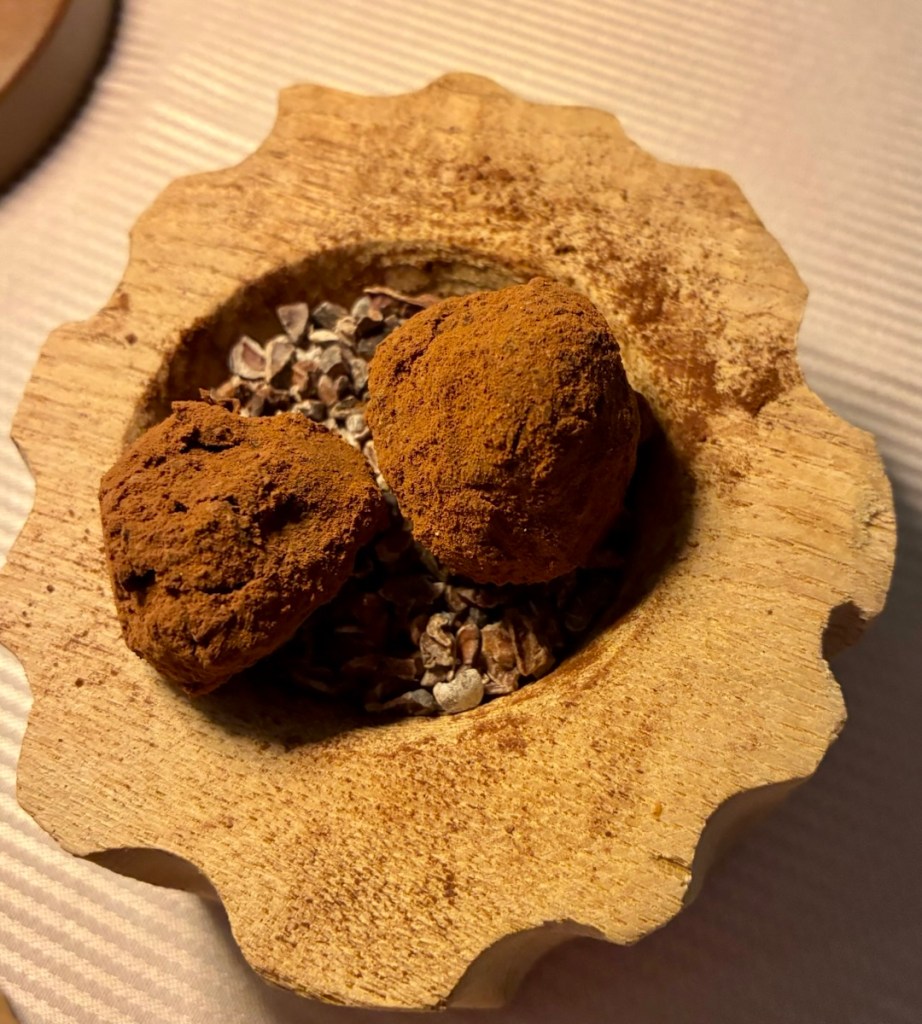
The largest green leaves are sorrel. The wine pairing was a delicious Riesling.Get used to eating tiny flowers. The mousse was flavored with ground ivy.Barbecued white asparagus, paired with Cote du Rhone Amour de Fruits.BBQ white asparagus with pistachios and pith of citrus. Amazing.The squab course, served with Le Migmatite Gamay Sur Granit. Which translates as delicious red wine. Düwehof pigeon breast, thigh with giblets, porcini mushroom praline, green asparagus, stuffed morel and wild garlic, Mokxa coffee-infused jus. The wild garlic is the small dark lump, it’s cooked in a rice cooker.Pigeon thigh with giblets. Yes, very rich this course.The palate cleanser, rhubarb sorbet in a delicate apple and herb sauce.With the dessert course an elderflower cider, Cidrerie de Reillon Grégoire Jacquot Fleurs de mal 2023 • Pétillant de miel. Strawberry horseradish ice cream, and a white chocolate top. Sprinkled with little white flowers.And finally, more little dessert treats. Raspberry tartlet, and a small Financier Cookie.Chocolate truffles on a bed of cacao nibs. It was a good thing we’d been bike touring for almost 70 days and our metabolisms were running high.
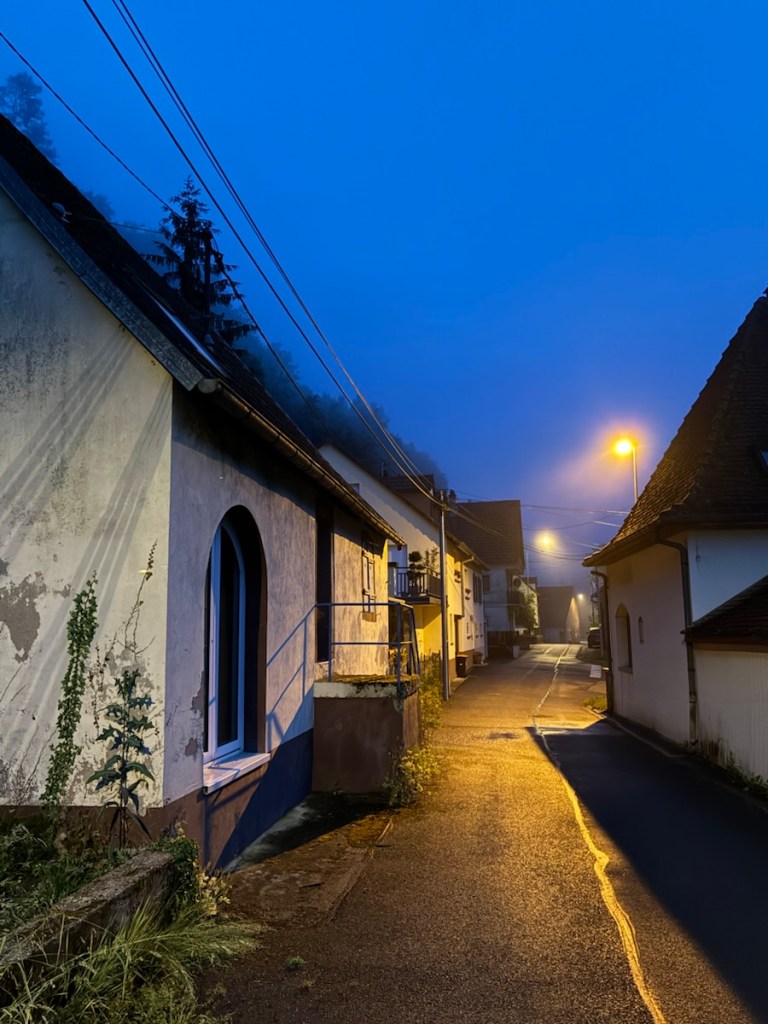
We definitely needed a walk after that amazing meal, so we headed out into the misty moonlit night for a turn around town.
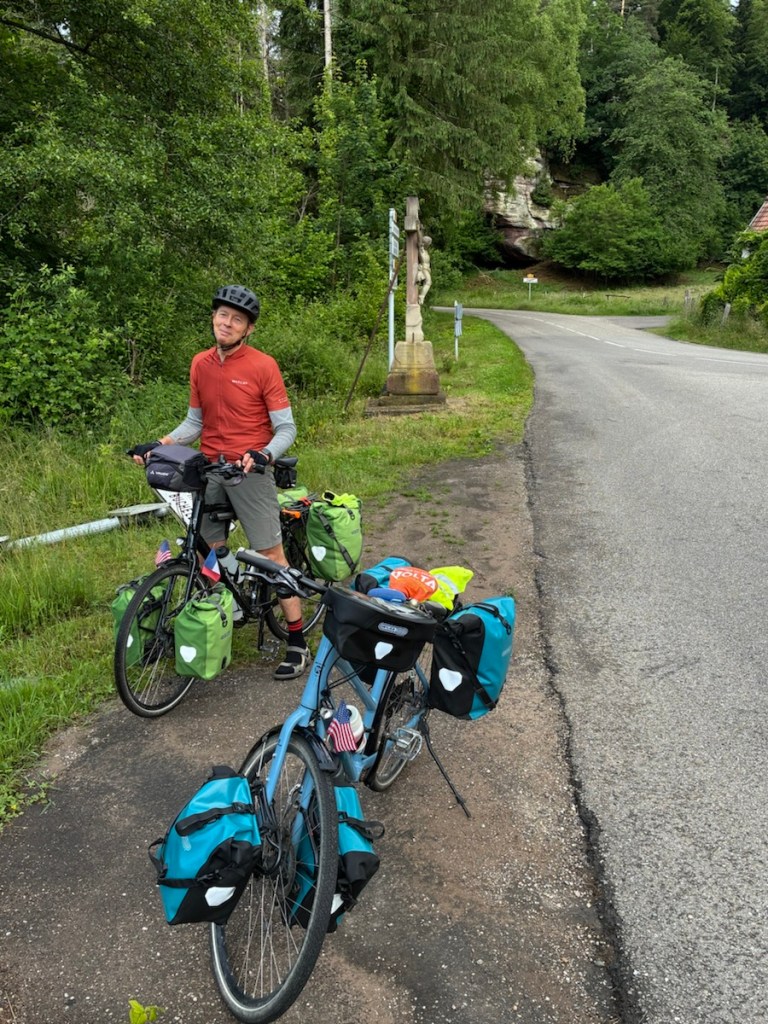
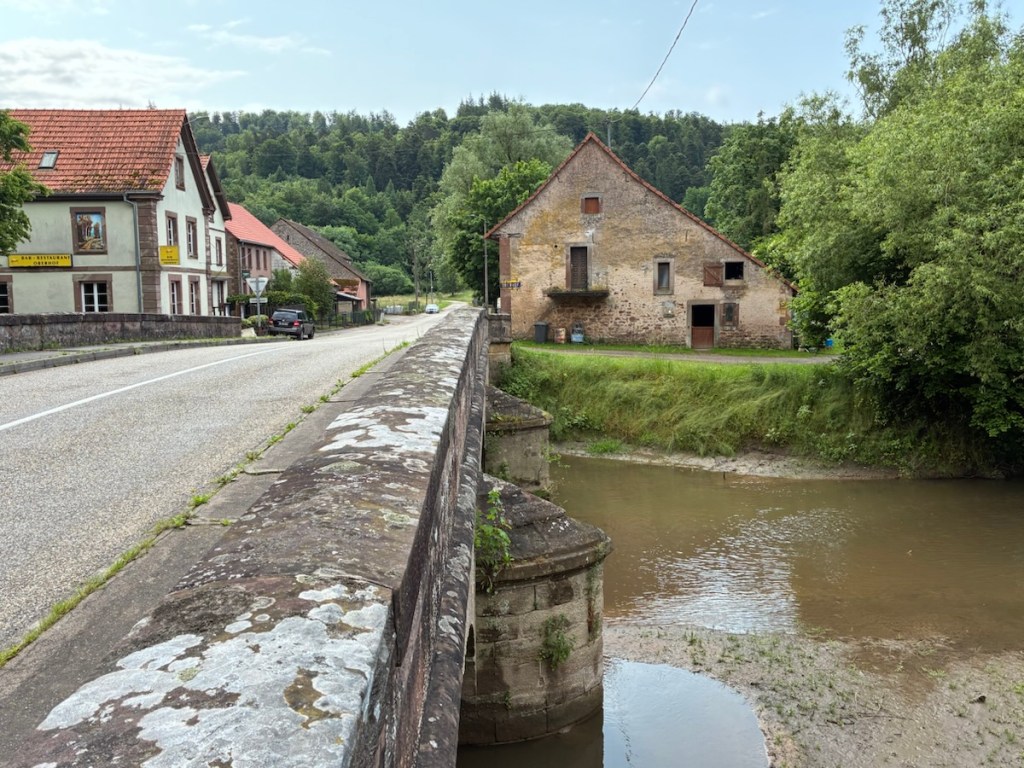
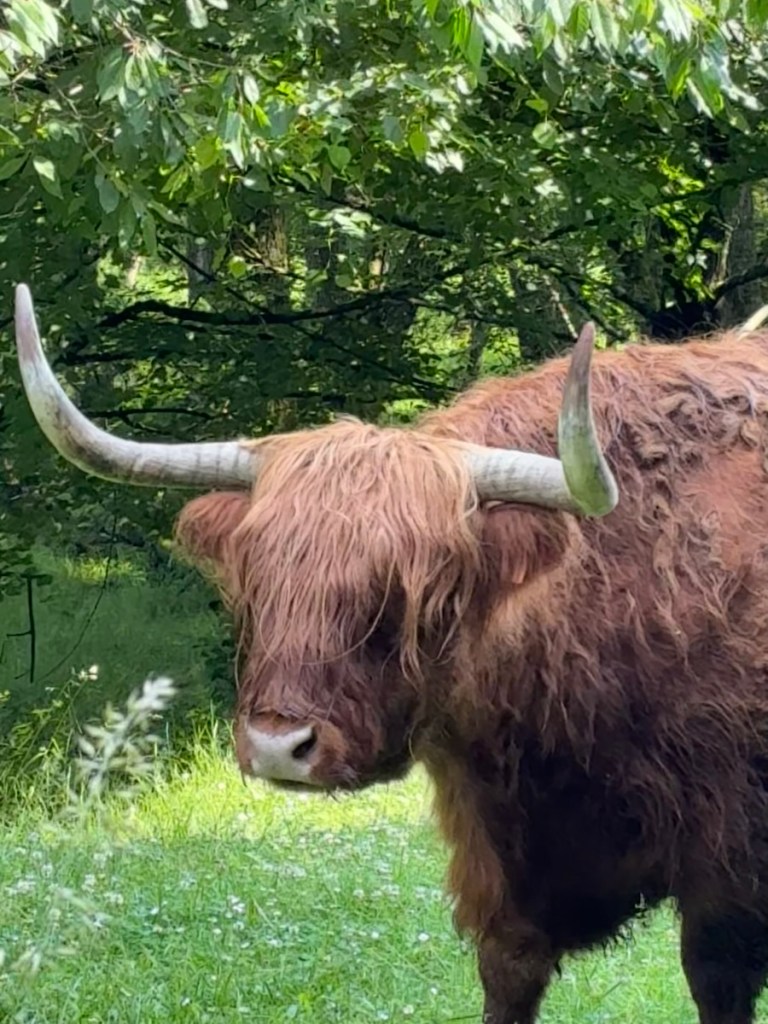
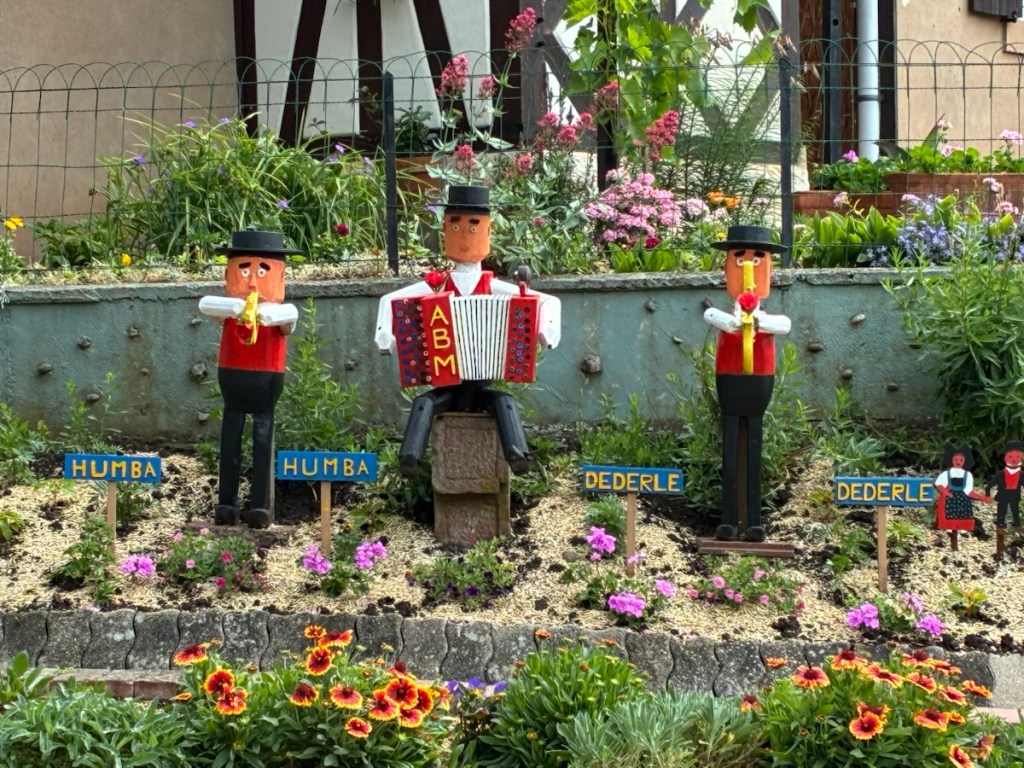
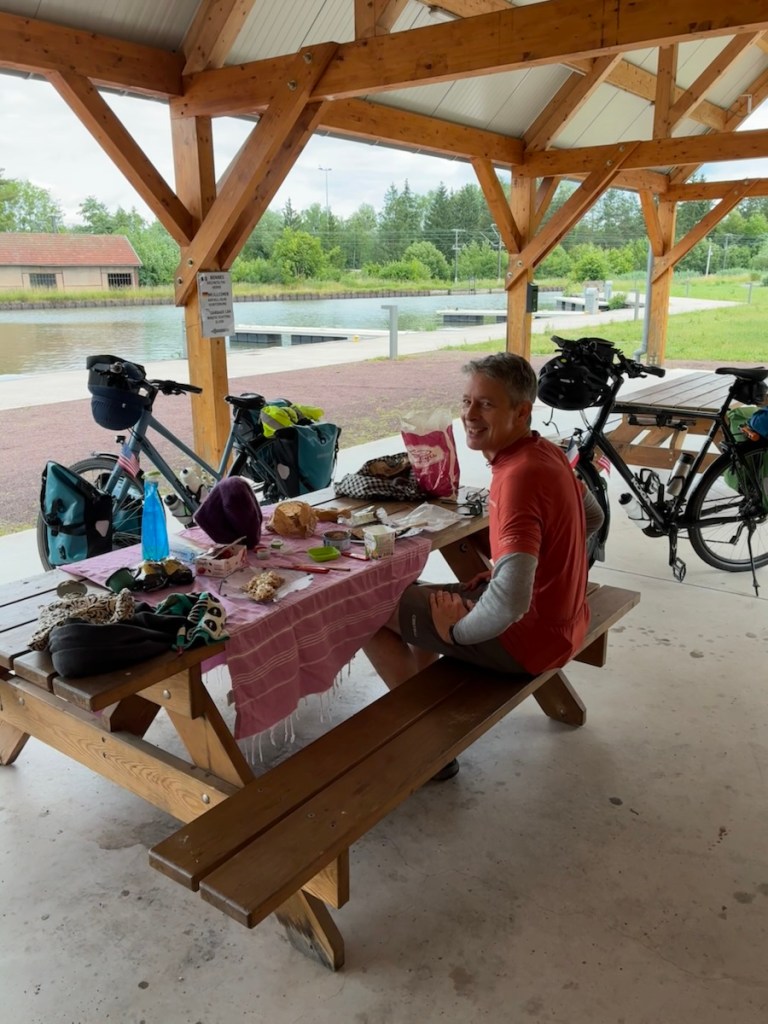
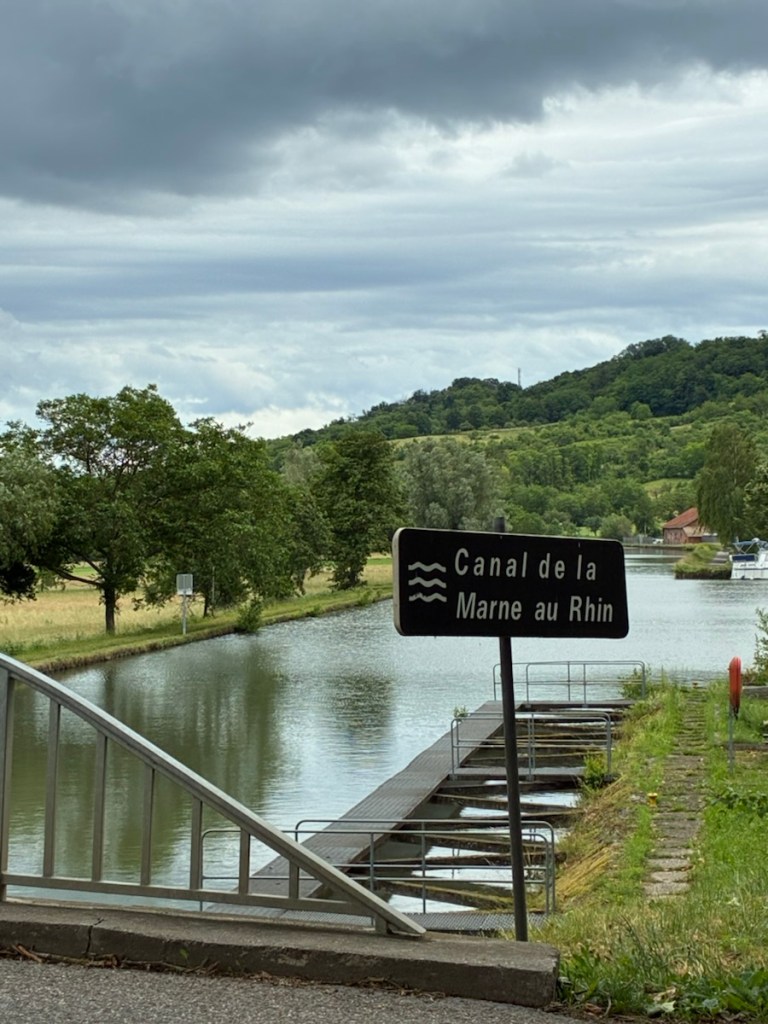
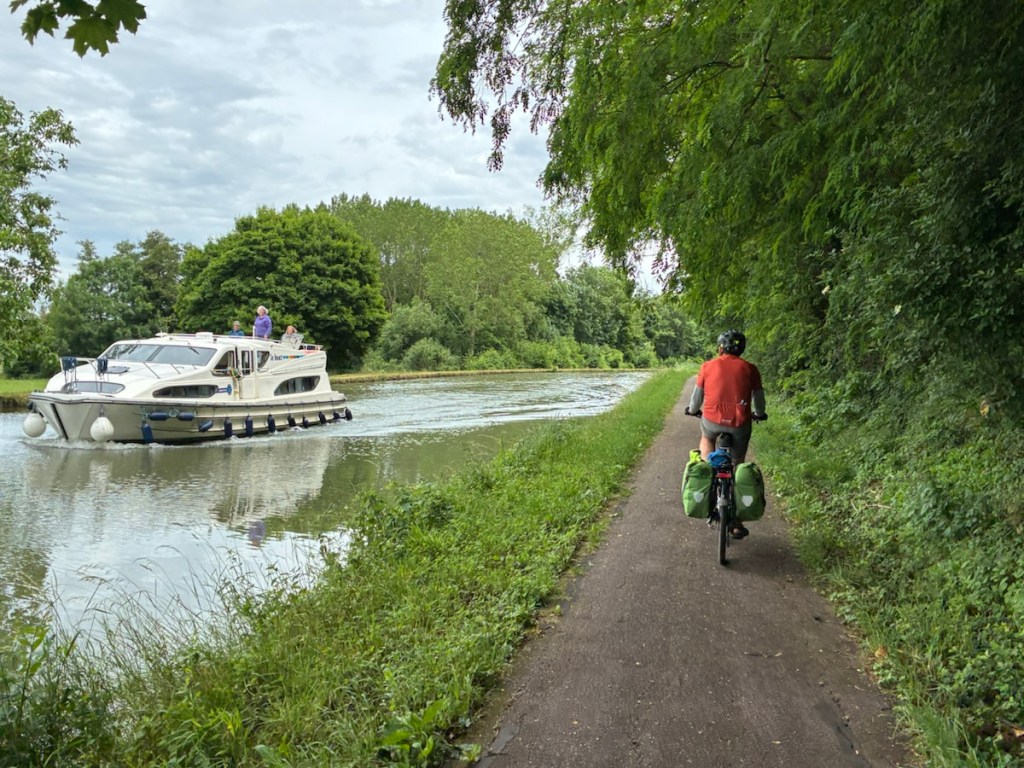
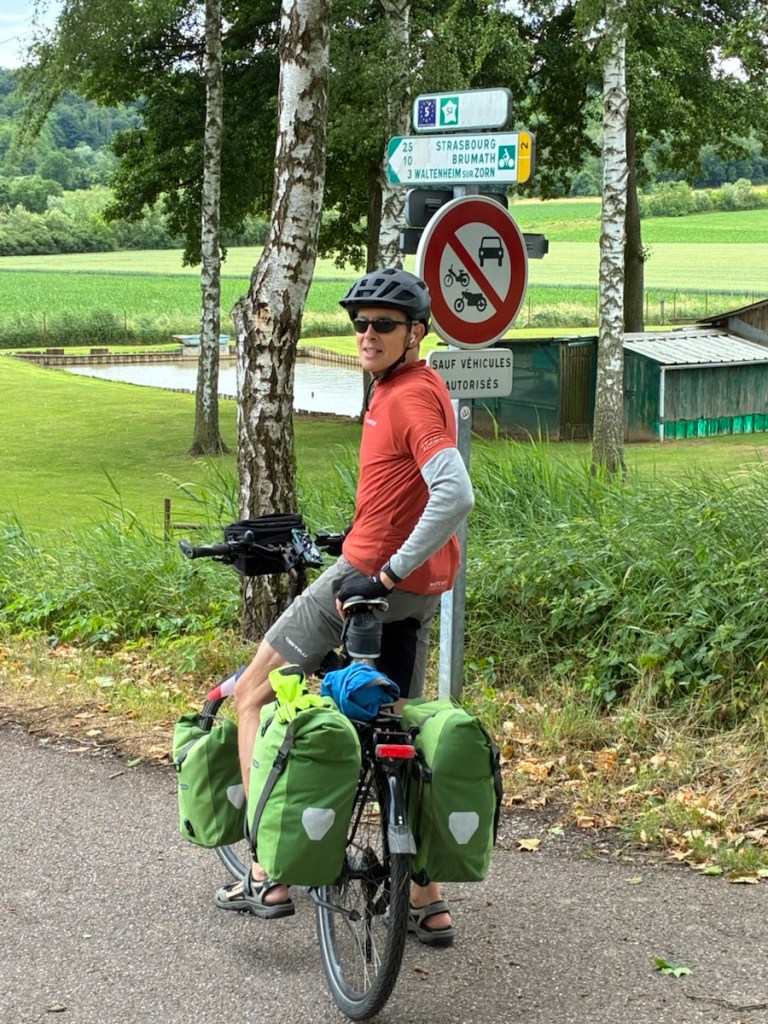
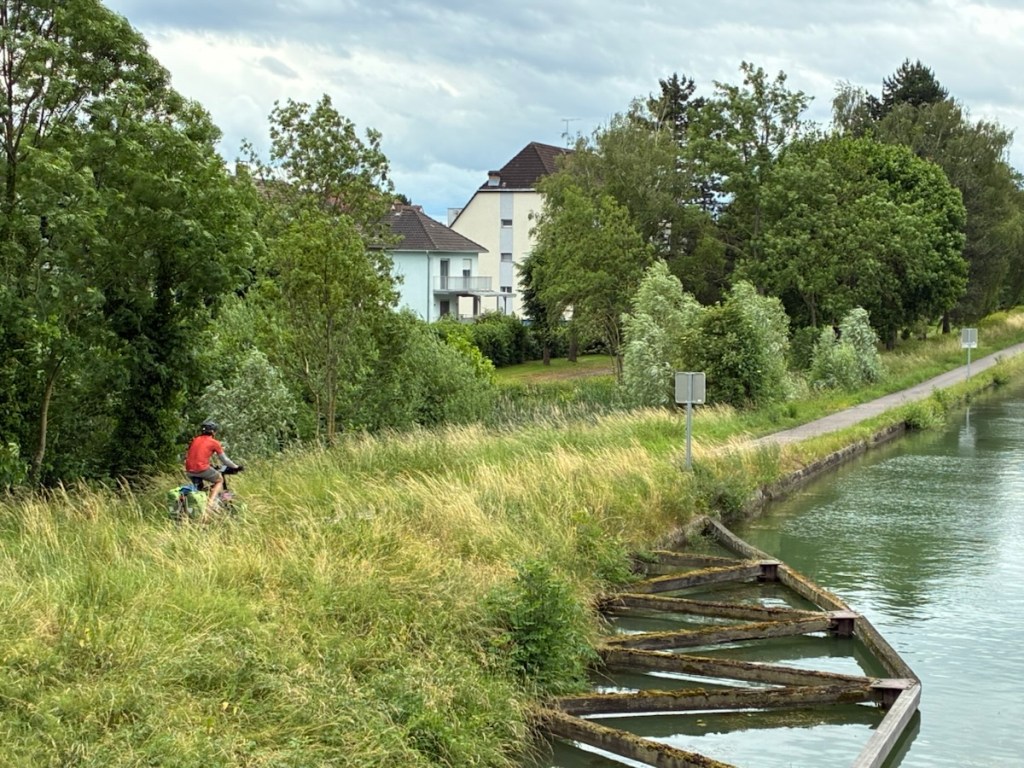
Eschbourg by night.The town church.The hotel and restaurant glowing in the gloom.The rain was over and we were ready to ride again.Crossing the Zinsel du Sud. Watched by a highland cow. Maybe. Are they asleep behind all that hair?We’re riding towards Strasbourg in the French Alsace region. I love the half timbered houses and steep gables. So picturesque. The hanging sign looks like an anvil, was this once a blacksmith shop?What the what? How cute are these musicians? Humba Humba Dederle Dederle. A striking stork against a stormy sky in Ernolsheim-lès-Saverne.Lunch along the Canal de la Marne au Rhin.It’s a popular canal for hiring boats and touring along.Which means we get to wave at lots of boaters and shout Bonjour!25 kilometers to Strasbourg. This cultural region of Alsace certainly has a sense of humor.The canal is taking us right to the Strasbourg train station.
Somewhere along the wet roads of the previous day, hiding from the rain, we decided that we were both ready to wrap this tour up and head back to our home base in France. Rich plotted out the fastest and most direct route: ride to Strasbourg, train to Basel and overnight, train to Geneva, ride to Annemasse and then up the valley to our good friends’ house. We were both looking forward to being in one place for a while before traveling back to the US, so off we went.
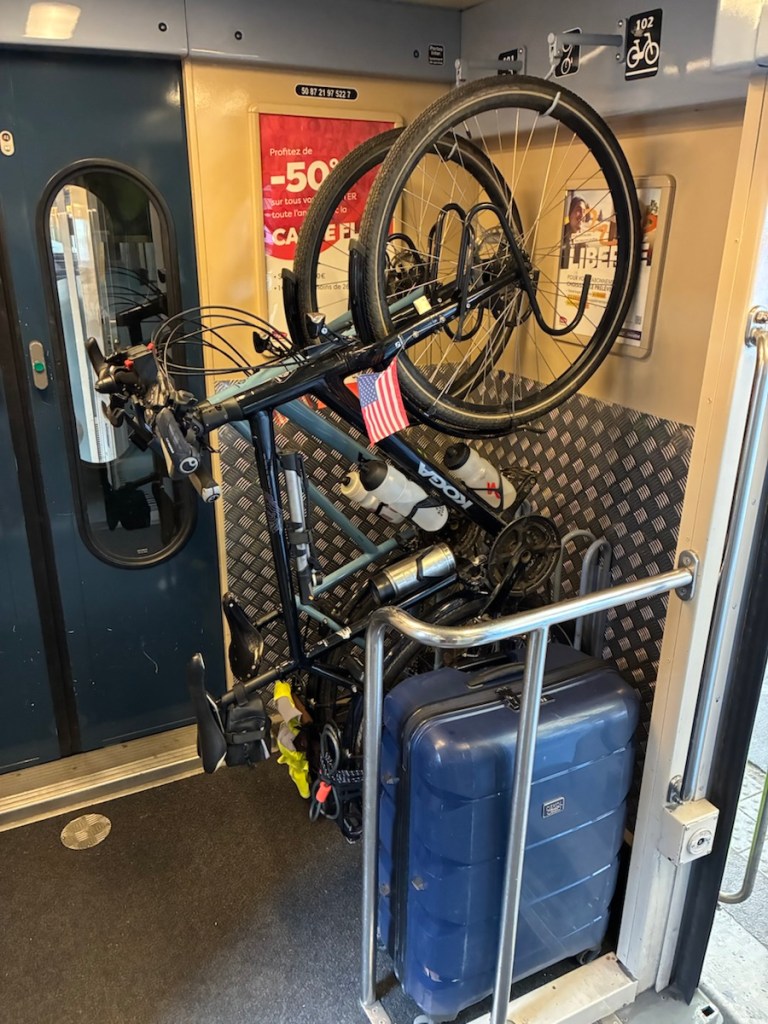
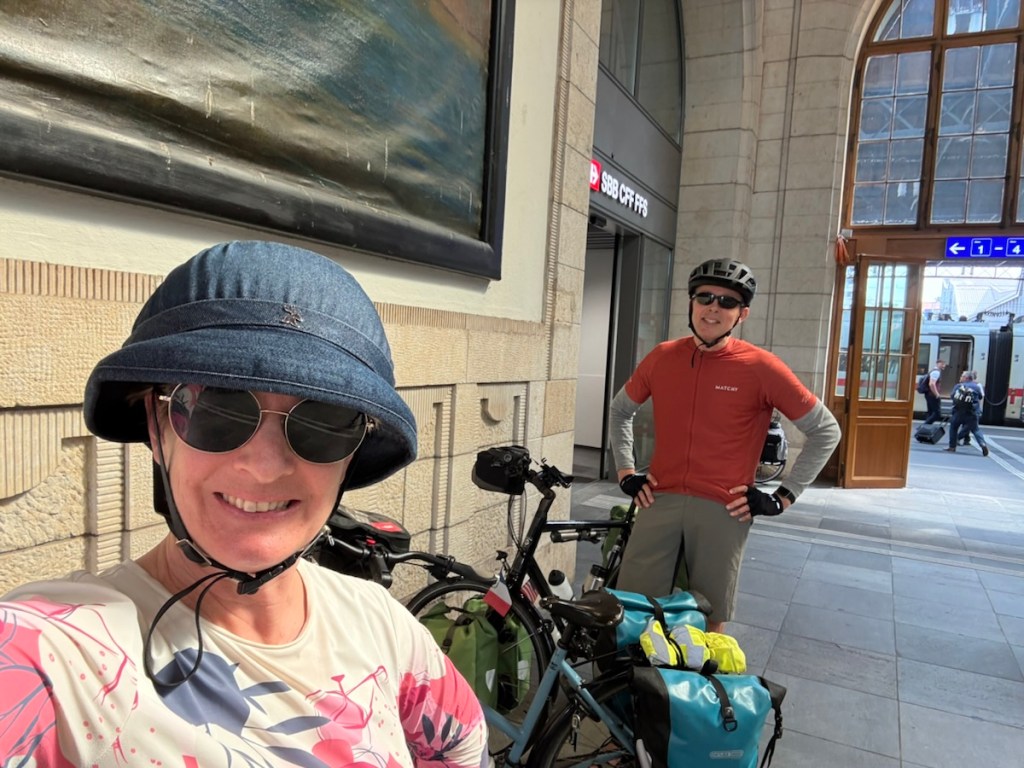
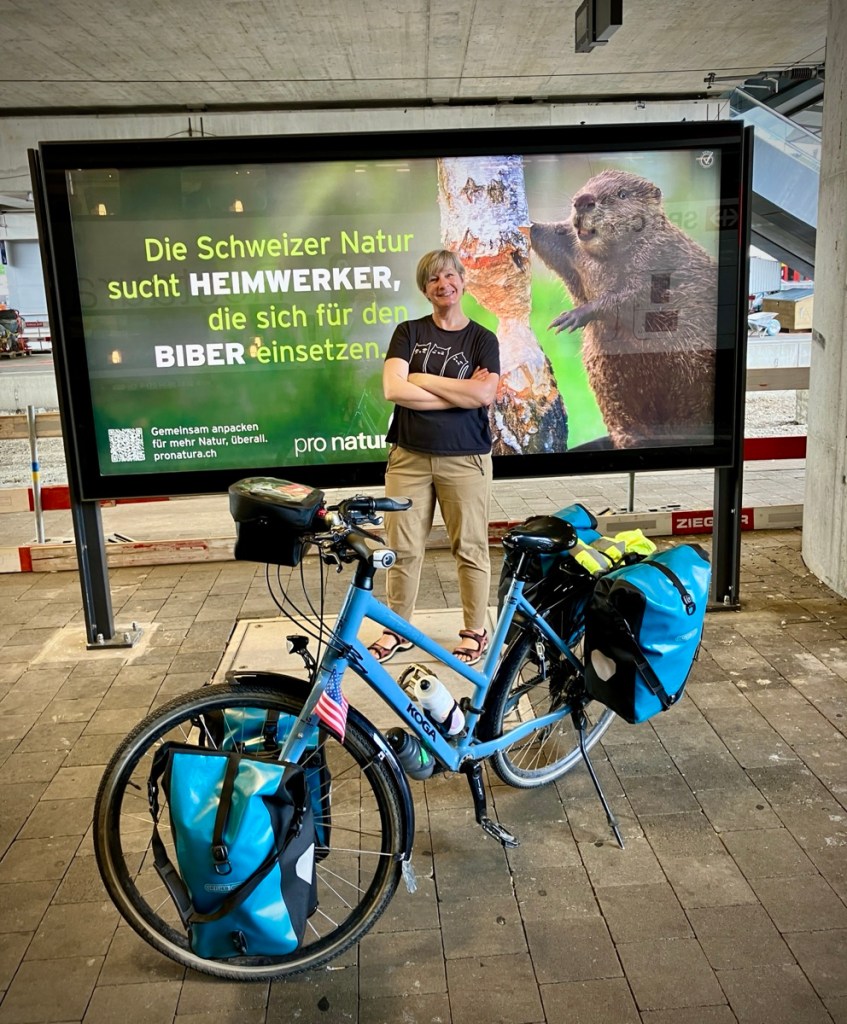
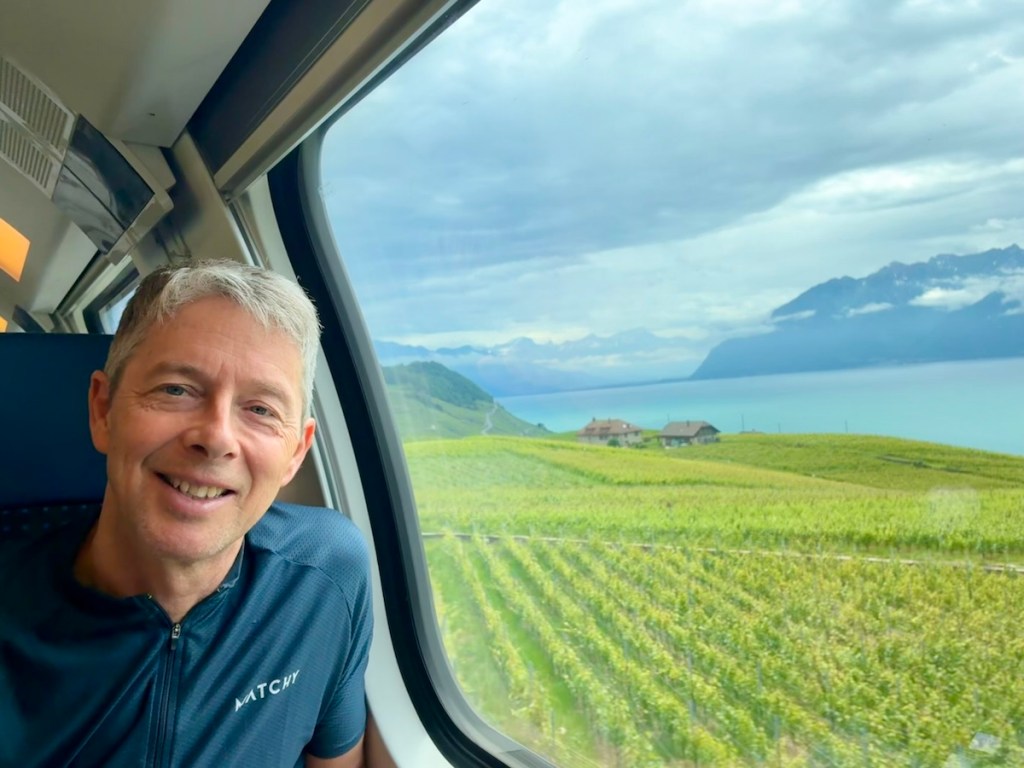
Train one of two to get us back to Geneva.Hooks to hang our bikes. You do need bike reservations and I think there were only four spots per train.Basel Switzerland train station.Riding to our hotel for a one night stay in Basel. The Rhine River.A border crossing, we stayed in French Basel. Saint-Louis actually. And yes the difference in bike infrastructure was dramatic once we crossed back into France. Oh, and hotels are about half the price of the Swiss side.Back to the Basel train station the next morning- not too early so we miss the crowded trains.A moment to celebrate the beavers, nature’s engineers. The scenery on the train to Geneva was stunning.Lac Léman and plenty of vineyards.The France/Belgium/Luxembourg/Germany/France/Switzerland/France portion of our final weeks of the trip.
We knew we’d be busy once we returned to the US, so a nice long 13 day break at our friends’ house was very appealing. The bike ride from Geneva to Annemasse is very easy, bike path the entire way, one night in Annemasse so we can ride up the valley after rush hour. It’s a great feeling of accomplishment to close our 70 day loop. We rode down the valley to start this tour, and now we ride up the valley to end the tour. In better shape, with even more appreciation of the countries we’ve visited, and looking forward to some days of rest.
Now that’s a bike path. Loads of regular bike riders commuting to and from Geneva.A fun beer place on a street being pedestrianized in Annemasse.Headed out. Final climb. Will the rain hold off?New lanes popping up everywhere!A climb with a stunning view.Finally eating a very well traveled protein bar. I insisted on eating it since it was about to also complete the 70 day loop.The rain did not hold off, but a playground pergola gave us some shelter.More new bike lanes!Bakery stop! Almost there.The neighbors’ cows provide a welcoming committee. Or at least a gazing with interest committee.Off the bikes and treated to a sunny day.
After quite a bit of countryside riding, with the food and lodging challenges taking their toll, we decided to just take a train from Limoges to…somewhere. Somewhere closer to Belgium which was on our want to go list. The easiest train from Limoges went to Paris, with just a few stops. Unfortunately we would not be getting on at the beginning of the run, the train was an Intercity coming from Toulouse. There was the usual medium stressful drama of getting the bikes and bags on the high boarding train, but two women, one taking her bike off the train, whom we helped, and another just boarding the train with no bike, both jumped in to help.
Two very nice Dutch cyclists whose names we failed to get were on our train. We had good platform chat and shared bike touring tips. They rode off to catch their connecting train in Paris.We headed to our favorite neighborhood in the 12th, our fourth time in this area, this time at the Adagio Apartment Hotel. Back to our favorite neighborhood bar, Bar & Beer Picpus.And to Le 217 Brasserie Restaurant for dinner.
The joy of being somewhere familiar. Other nomads will understand how pleasant it is to walk out your door and know where the market is, where the metro is, how to pay for it, and how to get to the fabulous greenway down the block. And, as an added bonus we have our Amis des Louvre cards and they were still valid.
Pichet of vin rouge.Somehow this was my first steak tartar of our time in France this year. Worth the wait as it was delicious.The street life in the 12th is wonderful. So much density, wide sidewalks, and folks who take their house cats out for a walk.A cheery shop window.A yummy shop window.This was the biggest and most curious missing cat poster we’ve ever seen. There were two attached to the front gate of a large apartment building.
Our Friends of the Louvre cards continue to more than pay for themselves. Once again we visited using the special members only entrance, and went to two of the special exhibits. The first was The Experience of Nature, Art in Prague at the Court of Rudolph II.
Hans Hoffman Hare.This work of art has a fascinating back story: Artwork recovered after the Second World War Provenance: Baudson collection, interior decoration (?), Paris; possibly acquired on 21 May 1941 by Jane Weyll, art dealer; auction Paris, Drouot, Baudoin, 16 December 1942, no. 41; acquired by Karl Haberstock, Berlin dealer, in 1943 for the Führer Museum in Linz, no. 2687; work recovered at the end of World War II; Central Collecting Point in Munich, 15 July 1945; transported to Paris on 25 June 1946; retained by the 3rd Commission for the Recovery of Works of Art and handed over to the Musée du Louvre on 22 December 1949 by the French Office for Personal Property and Interests; awaiting return to its rightful owners, should provenance research underway establish proof of spoliation or forced sale.
We’ve been to so many museums that display artwork still in limbo from WW2. It’s so moving to read the stories, and to see exhibits where remaining family members have made sure the work goes to a museum where it can be seen by the public, and the story of the family told, rather than disappearing into a private collection. The business of special exhibits also fascinates me. Imagine being able to put together an exhibit from not only the Louvre’s huge collection, but to borrow works of art from other world class museums to realize your theme?
Detail of animals from a painting by Roelant Savery, a Dutch Golden Age painter.
Rich and I decided we would have loved to been at the museum staff meeting where they discussed how to get visitors to venture into lesser known and less crowded parts of the museum. Maybe it was an intern who had the fantastic idea of placing 99 works of Haute Couture in the decorative arts wing?
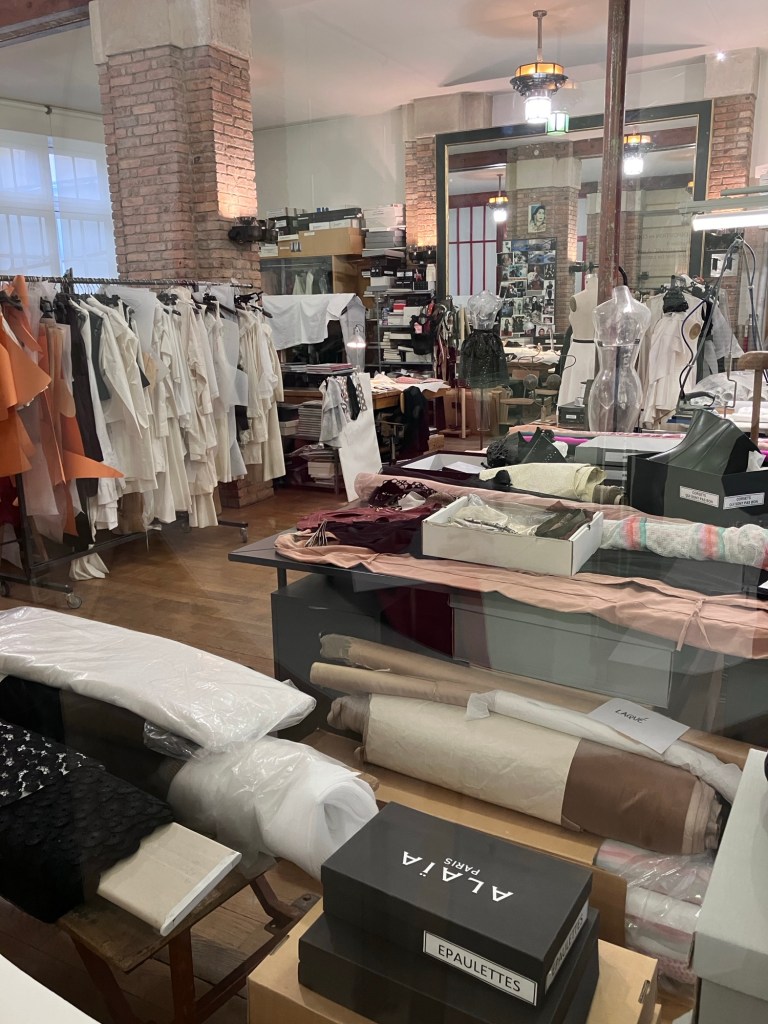
Louvre Couture. Art and fashion: statement pieces.Very thoughtfully placed.Azzedine Alaïa, a Tunisian couturier who museum I visited with our friend Nancy on our previous Paris trip.It’s not just inside the museum that we spot works of art. These new 100% electric buses are worthy of admiration. I call these the Bubble Butt Buses. Are they coming or going? That is the rear of the bus.The push me pull you bus. Sadly we didn’t get to ride one, but I could see the seats in the rear were arranged in a conversation seating style.Sunset bus glamour shot! I used the clean up feature to remove a car from the photo which is why the bottom left looks odd.Bicycling in Paris is a blast. Rush hour can be pretty crazy but if you head out after rush hour it’s fantastic. You do have to be careful of the Parisian cyclists- they ride ‘em like they stole ‘em. Prepare to be buzzed with just inches to spare, and be super cautious when stopping at red lights or for pedestrians. You might get rear ended.Our own bikes! Without panniers. So light and fun to ride.Notre Dame, construction side.The front is construction scaffolding free.What a way to sightsee.Break for hot chocolate.A mini Statue of Liberty, or Liberty Enlightening the World, and Le Tour Eiffel.Riding closer.The bikes pose for their Insta shot.And merrily we go along home for lunch.And back out in the afternoon for a visit to the Musée Cognacq-Jay. During our last visit to Paris this museum was closed after a brazen robbery.The museum has an exceptional collection of fine art and decorative items.Cute dog enhance!Our final day was a lot of walking. We were over our intense tiredness and ready to put some miles on our feet. Cimetière du Père-Lachaise.What’s your one funny Paris tip? Ours is that the cemeteries all have public toilets. Caffeine and croque monsieur stop.That old photo bomber.New clothing! I ventured out for some shopping. Last dinner atLe 217 Brasserie.Goat cheese bruschetta and salad.Shhhh…don’t tell the French we bought our breakfast bread the evening before! Packed up and leaving the Adagio Hotel. I can’t take many photos while cycling in Paris. Too much going on and a valid fear of crashing.Gare de l’Est. We arrived nice and early, ready for the train dance.But wait! What’s this? Smiling cyclist? Empty platform?A very nice SNCF staff member saw us waiting with our bikes, confirmed which platform our train was leaving from, and let us on the platform early. I’m sitting and reading my book, the bikes and bags are stowed, and all before any other passengers arrive.The Happy Travelers celebrating a successful train boarding.
We needed that Paris break. To stop moving for four nights and rest. We slept a lot. We had breakfast and lunch in our studio apartment with kitchenette, and dinner out. After our month in Paris last year, four days felt short, but we knew our way around and had plenty to see, and eat. So we’re headed north now to the Ardennes and a few new countries!
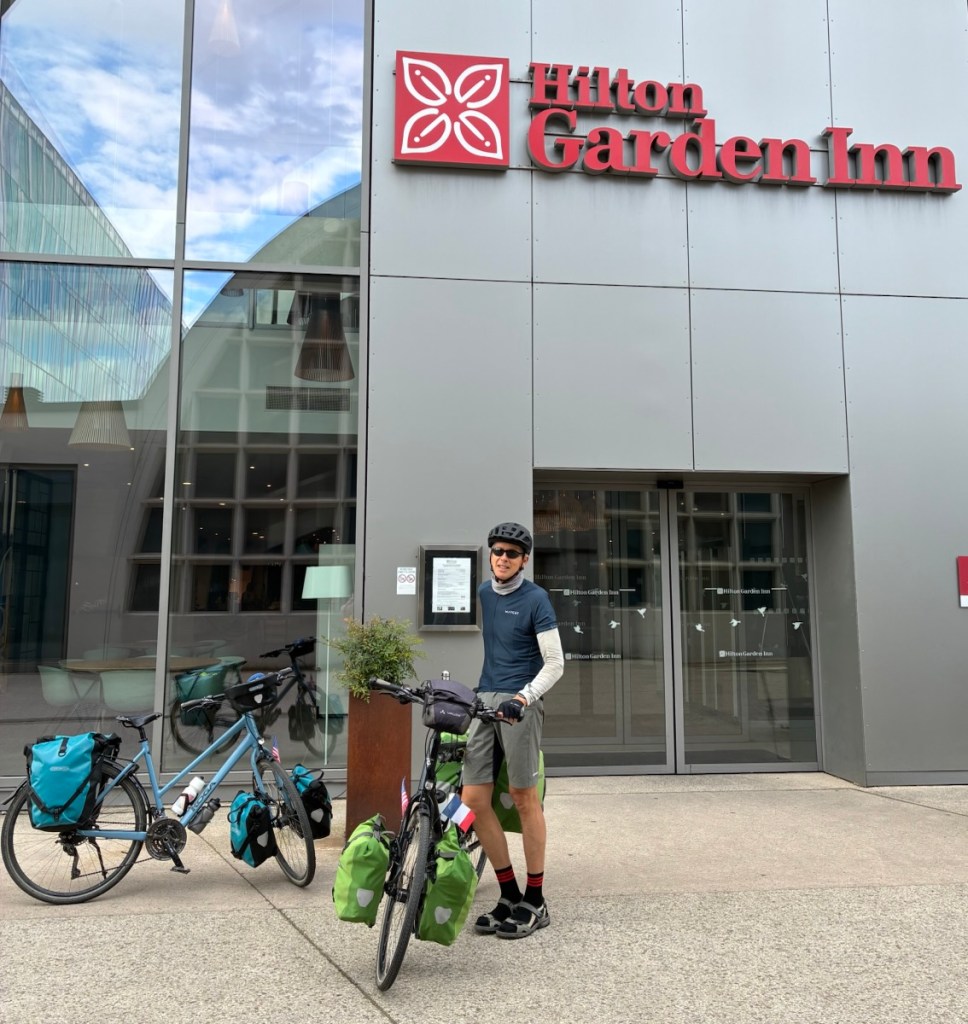
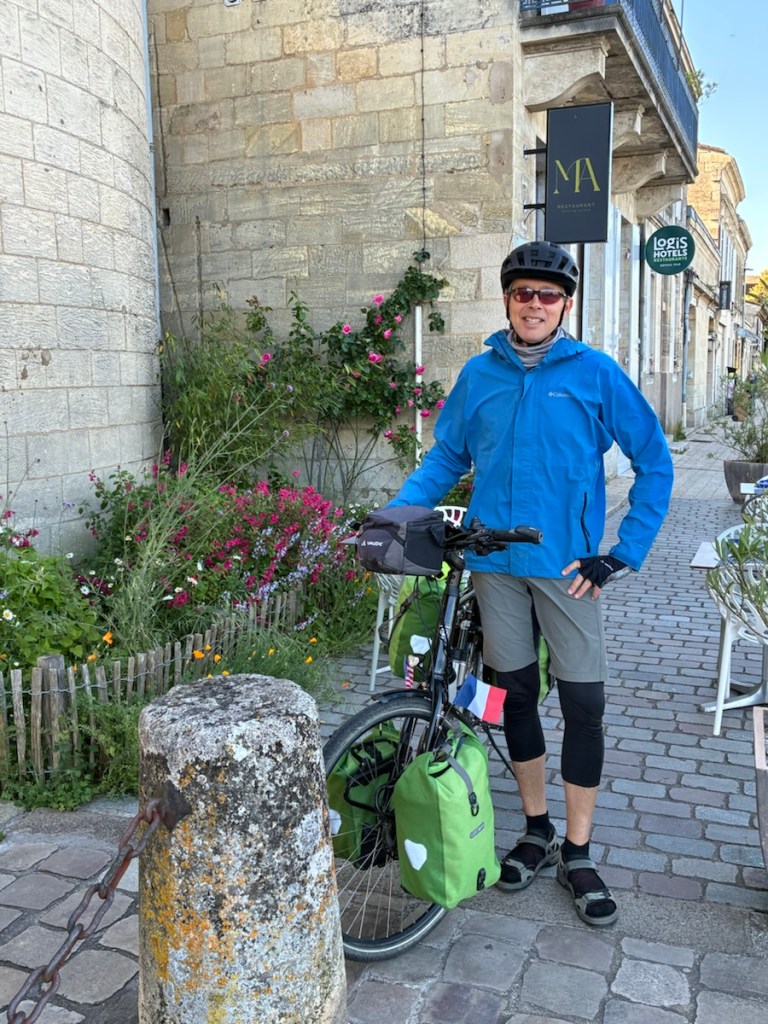
Yes, we do stay in a lot of small privately owned atmospheric, charming, quirky places. But it can be a relief to check in to a corporate hotel. Here, leaving Bordeaux.
We love cities. When bike touring and when not on bikes. Public transport, loads of food options, museums, great people watching. But the countryside has a lot to love about it too: birds and animals, tranquility, beautiful scenery, quiet cycle paths and long stretches of empty roads with nice pavement. No museums but lots of history. There are the downsides too: not a lot of lodging options, even fewer food options – grocery stores and restaurants are a bit more simple, not a lot of choices. And those lovely roads? They go up and down a lot for no damn good reason.
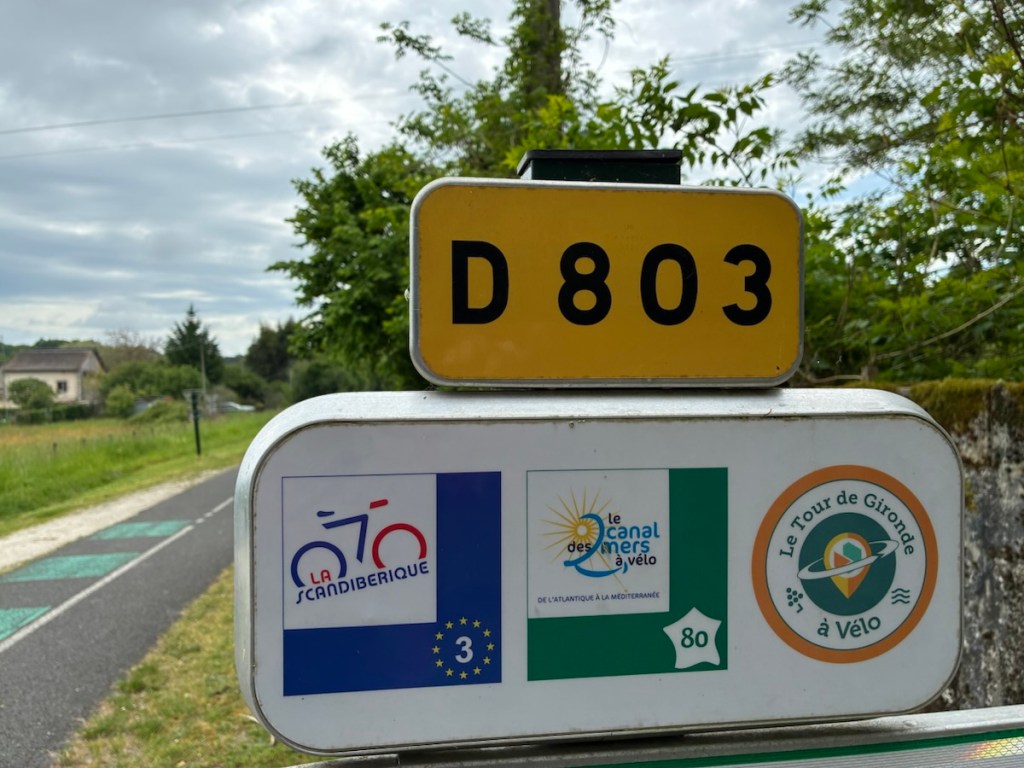
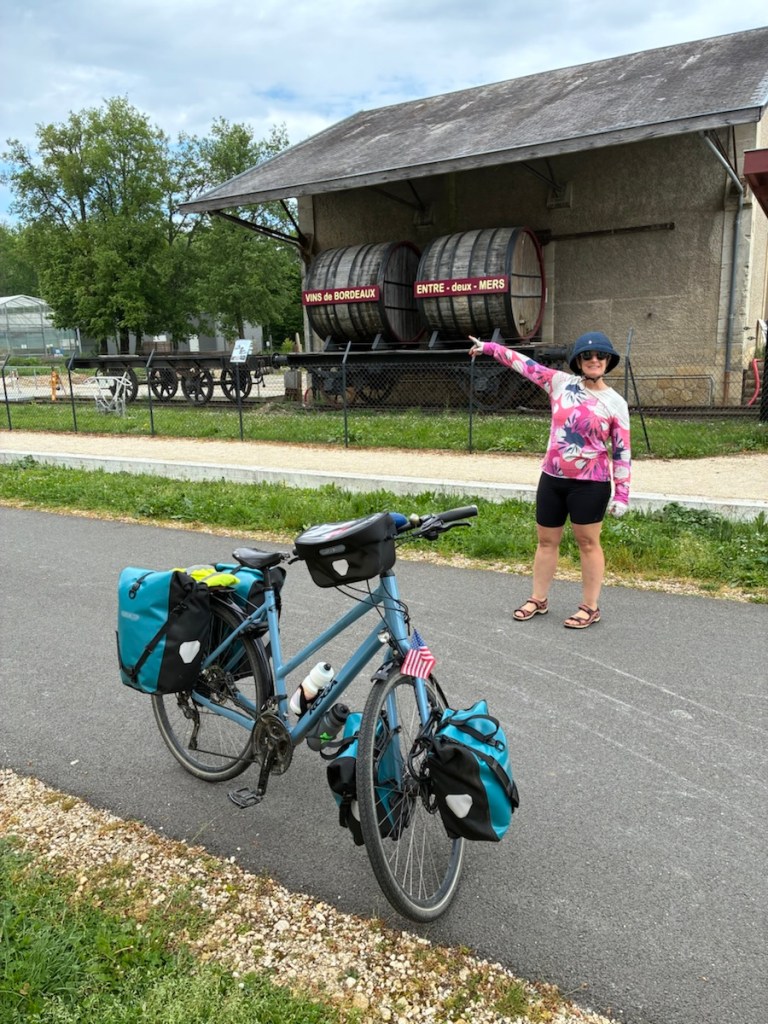
Now that’s a bike lane on a bridge! And so much pedestrian space to the left. Pont Simone Veil crossing the Garonne River leaving Bordeaux.The first information sign of the day.Three routes converge on a partially sunny day; Eurovelo 3 is international, Route 80 is a French National Route and the last is a local route.Giant wine casks! 7,000 liters each.“Twin-foudre wagons. Built in the late 19th century, they were primarily used for transporting wine. The numerous imports from Algeria and Spain transited through Béziers and Sète.”
Stopping to read about the wine wagons led to finding this article about the Algerian wine industry, which of course led to a rumination on colonialism- as it does.
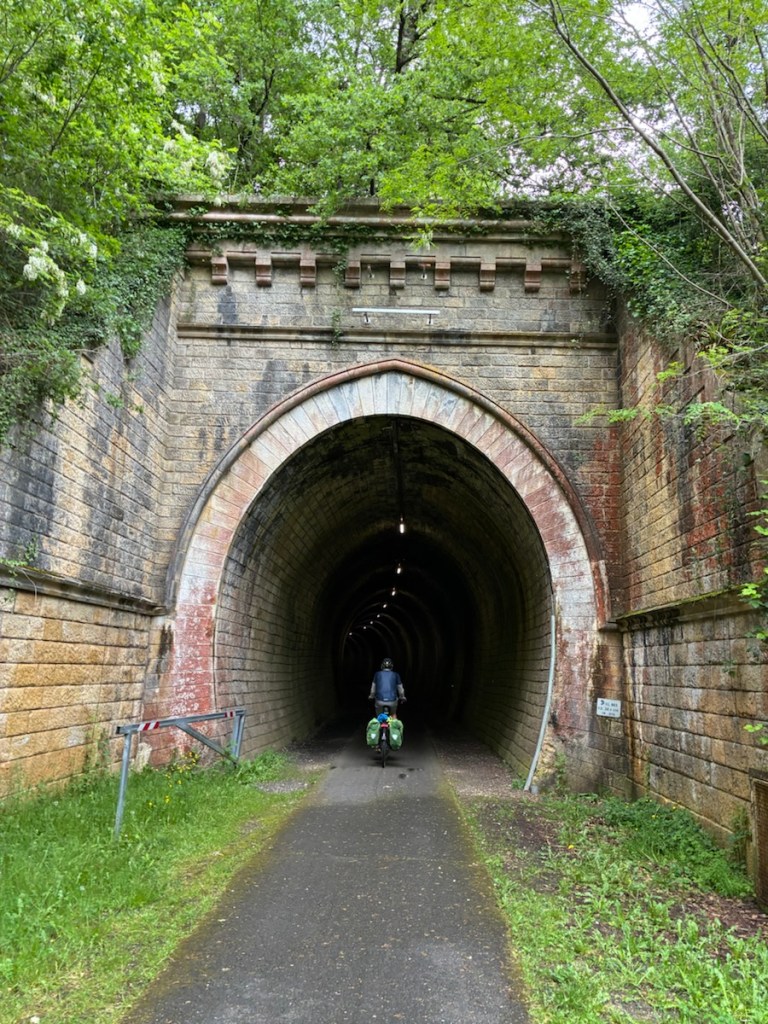
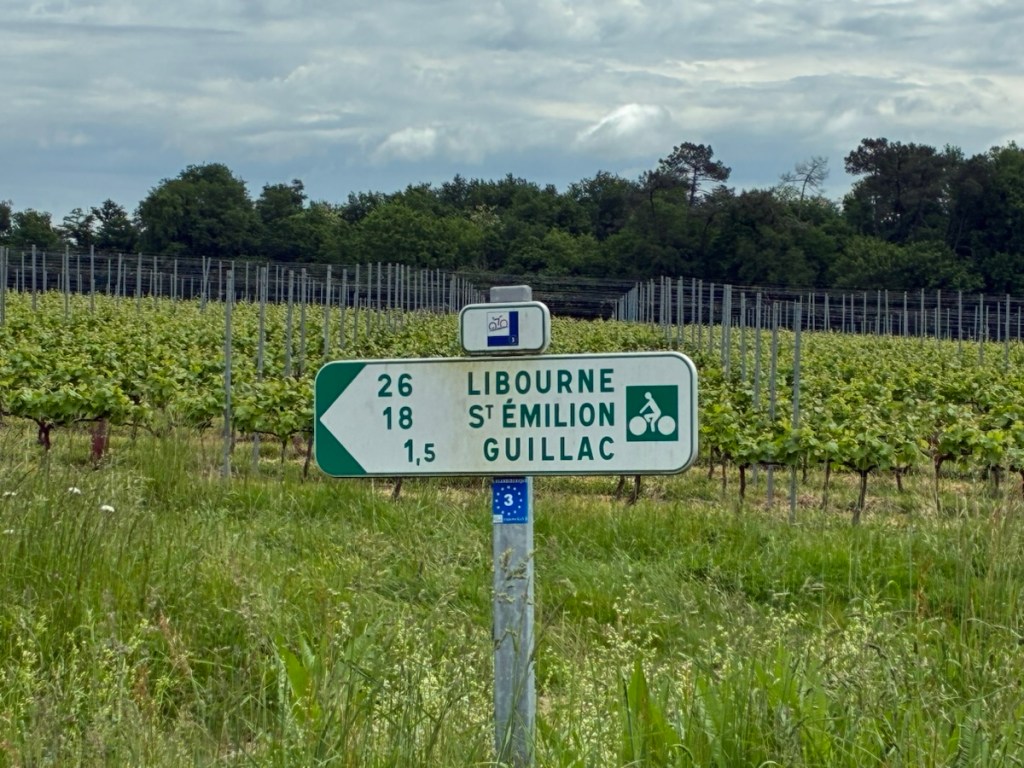
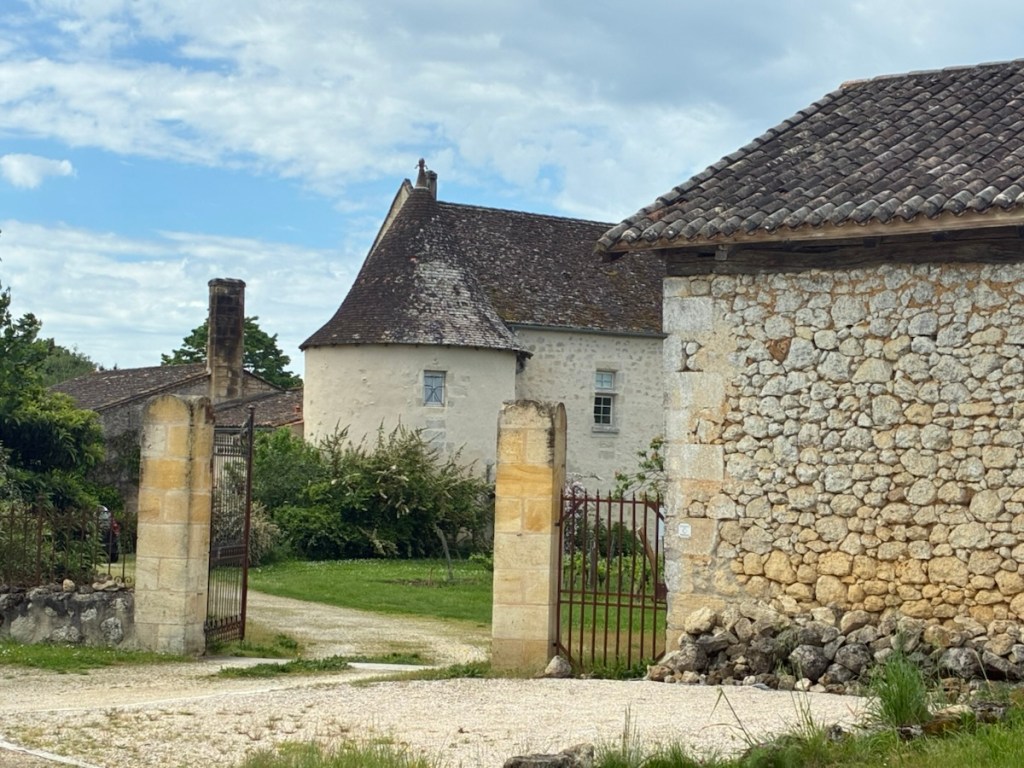
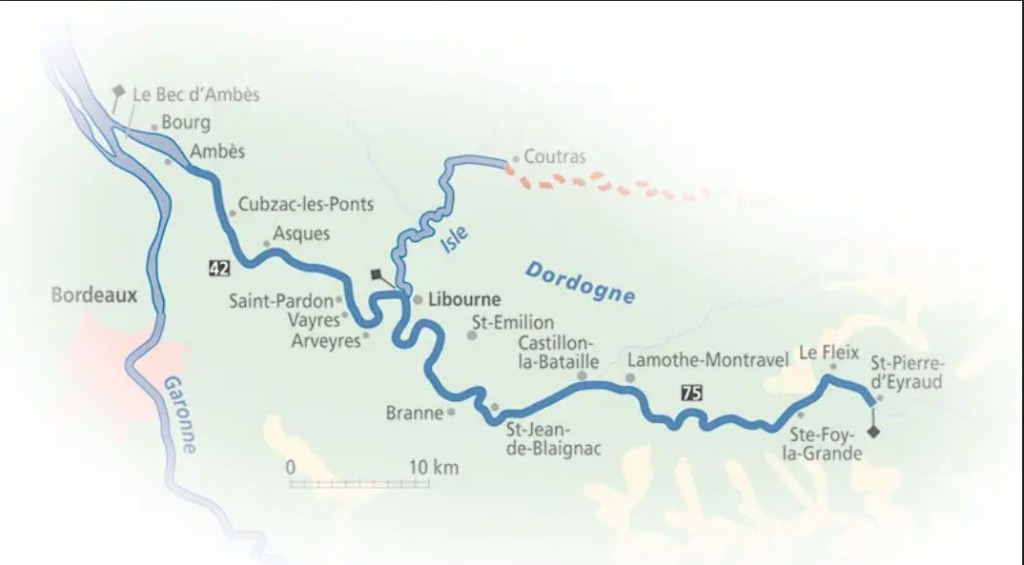
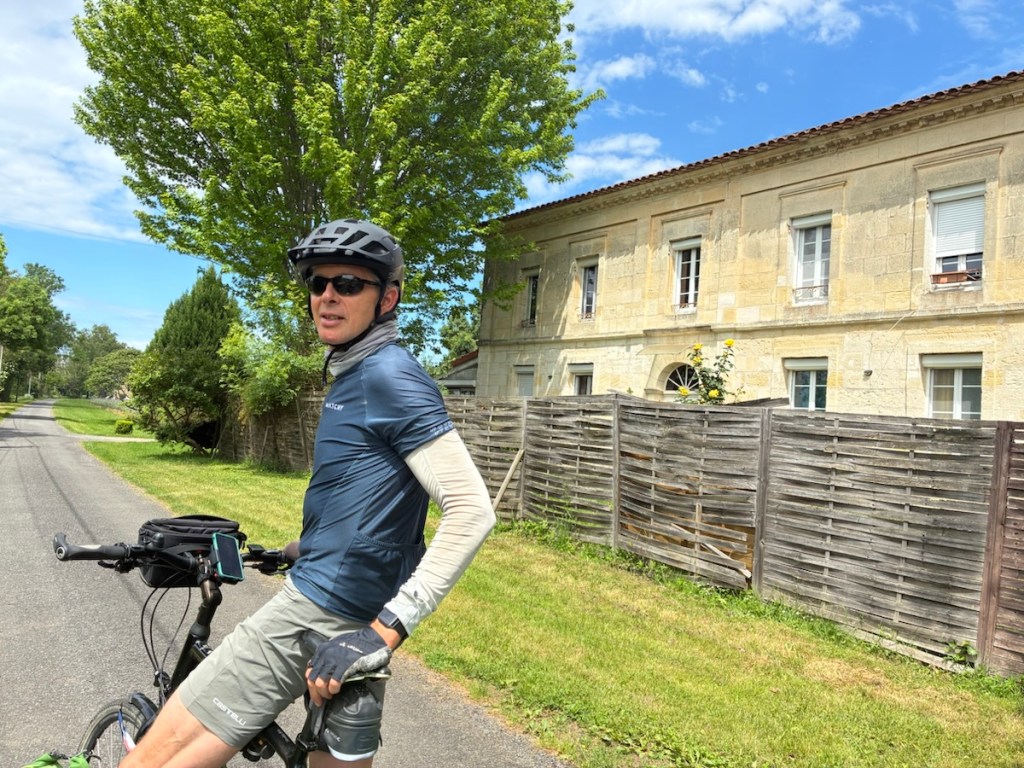
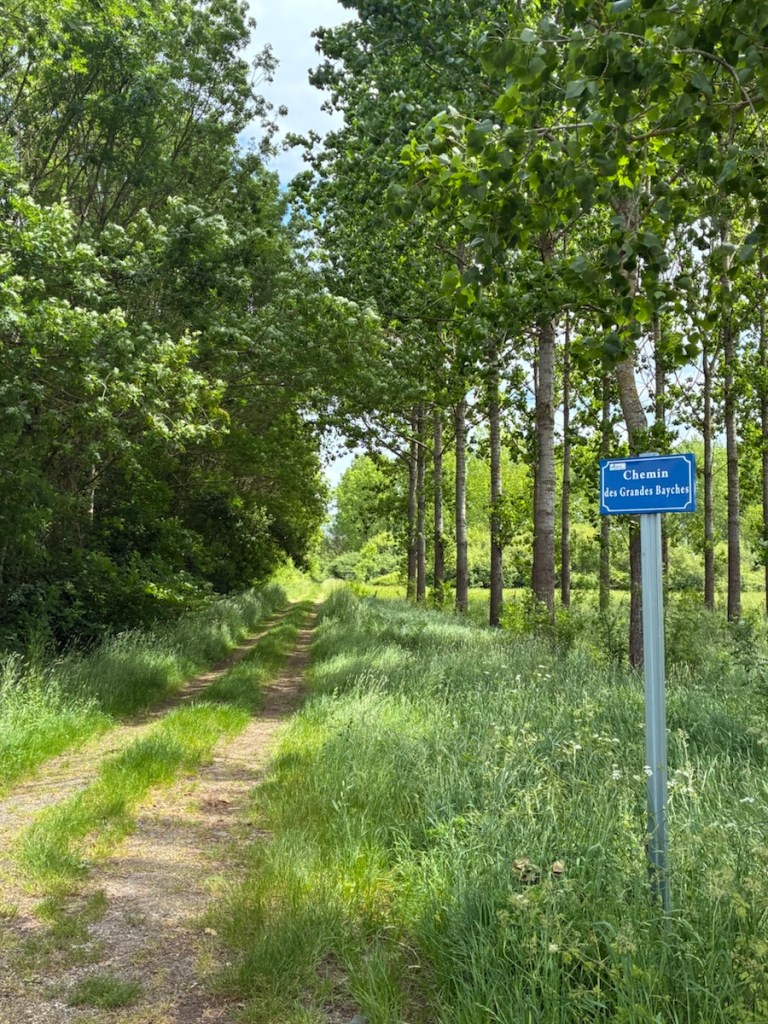
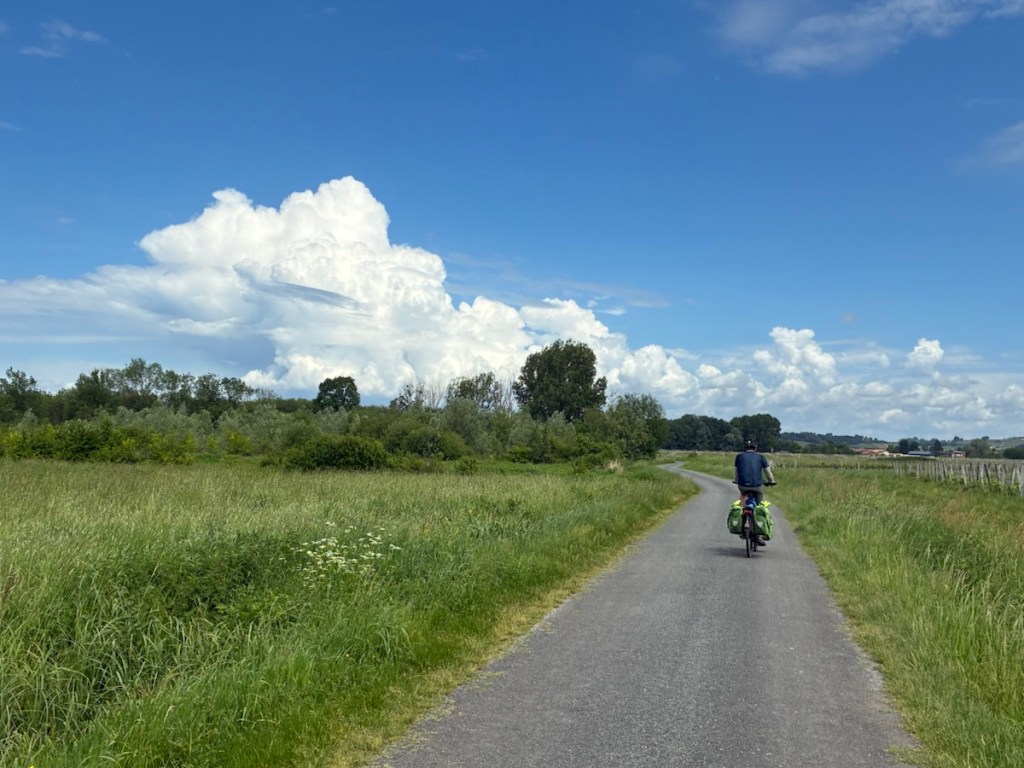
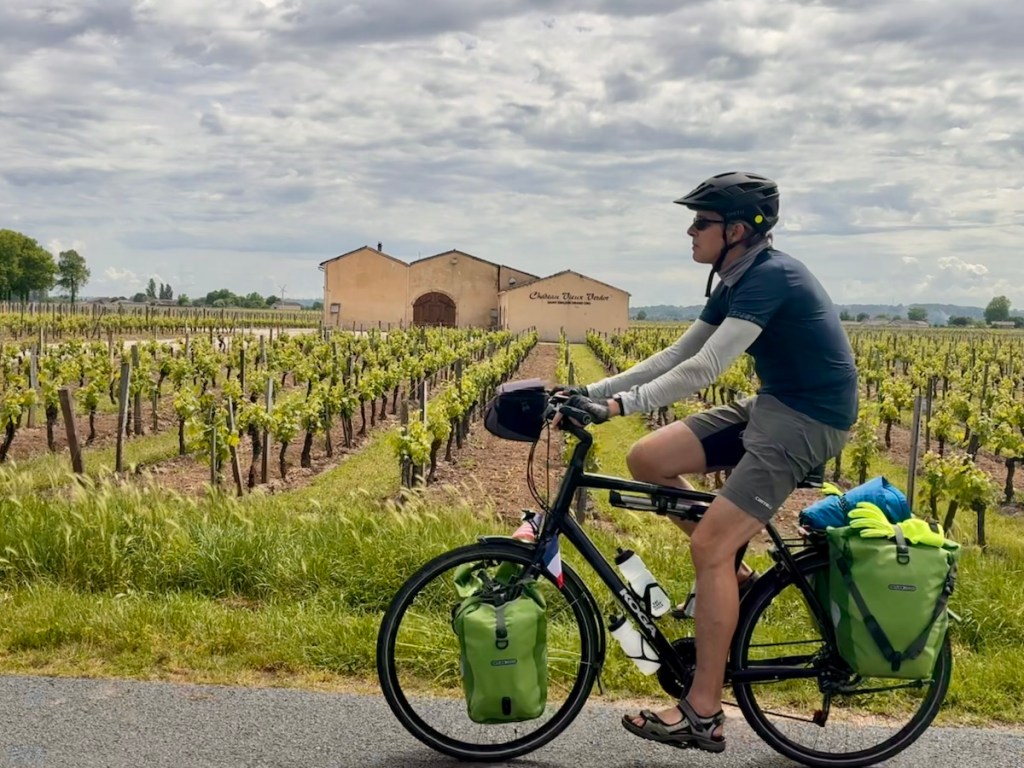
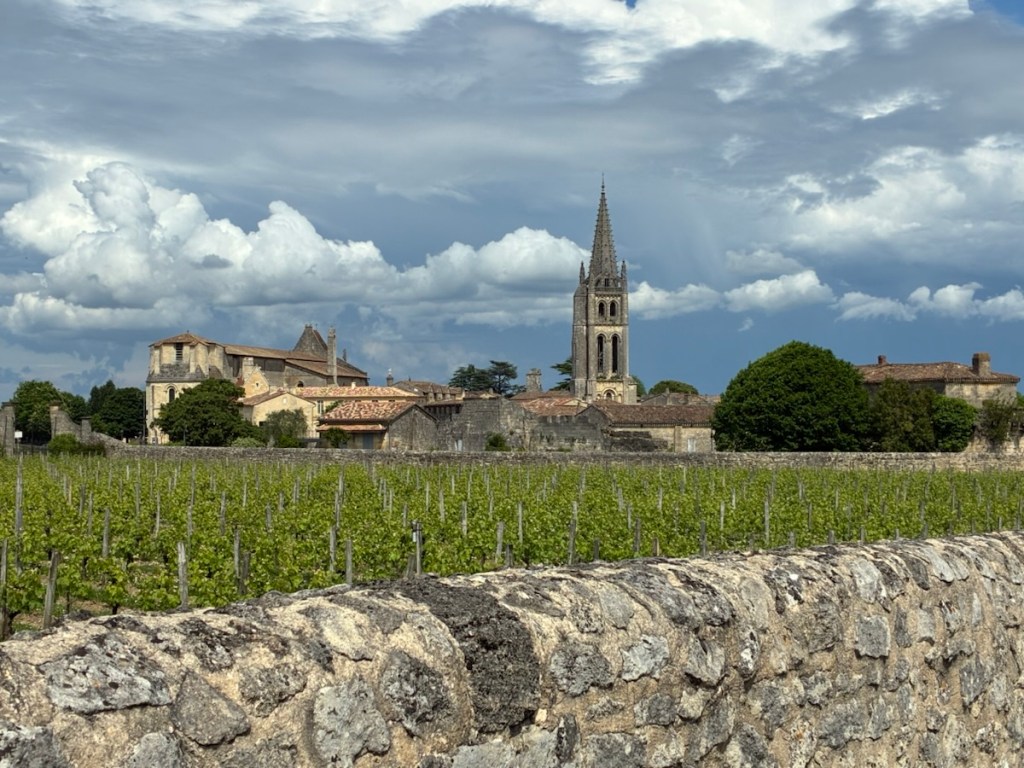
Repurposed rail lines are fascinating. Imagine all the wine that went through this tunnel.We are firmly in the Bordeaux wine region now.Buttery yellow stones and blue shutters.Wildflowers galore.The wine industry has created wealth for so long.Happily rolling along, looking for a lunch spot. We’re carrying our little chairs but it’s nice to find a bench with a view.A quiet riverside road in Branne, along the Dordogne River.Better know a French river, the Dordogne. 118 km long.More local yellow limestone buildings. And Rich.I love that this little dirt road has a name: Chemin des Grandes Bayches.Pastoral bliss and dramatic clouds. Getting close to Saint-Émilion, a very famous wine town.Which wine chateaux is this? No idea, but it’s sure pretty.The town of Saint-Émilion. Beneath that lovely skyline heaves a mass of tourists on this Sunday of open chateaux. Actually, it was only awful if you were trying to park a car. On bikes it was fine.We didn’t stay in Saint-Émilion, too busy. We headed to Libourne. On a bend of the Dordogne and at the confluence with the Isle River.
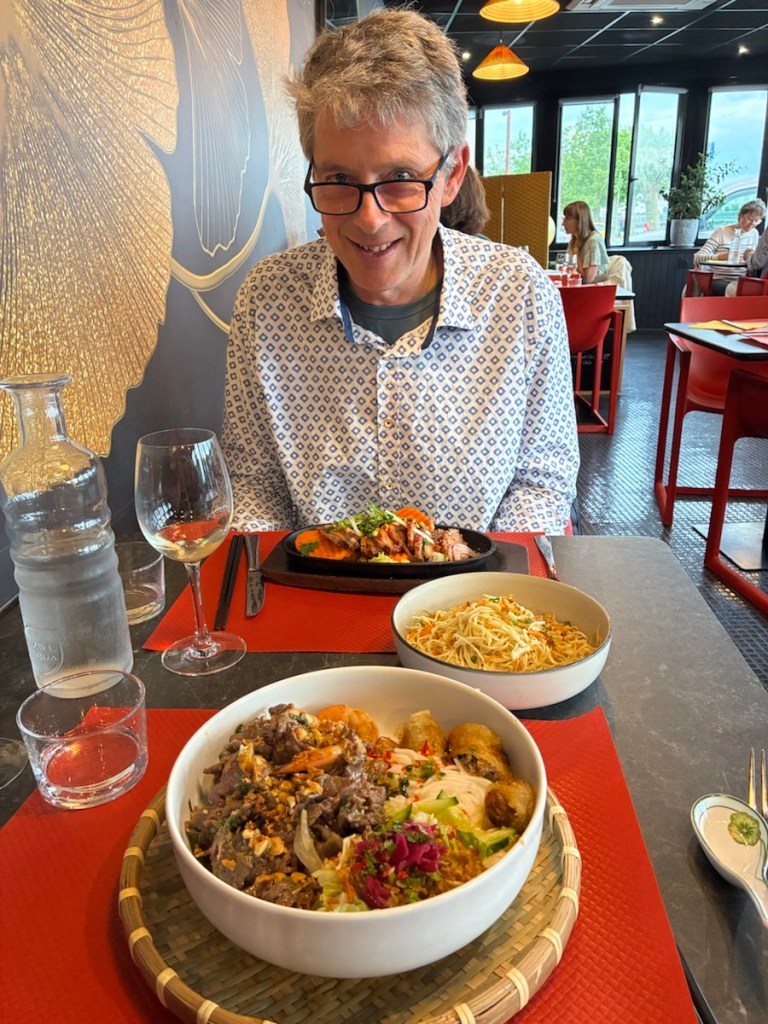
I took a quick dislike of Libourne riding in to town. It seems to suffer from ‘famous town adjacent’ syndrome. Folks were not friendly. Car drivers were downright hostile, and it managed to be both dead, with little activity in the streets, and hectic, with car drivers behaving as if they were negotiating a busy crowded downtown. It’s a difficult note to strike, dead but hectic, but they managed it. The first restaurant we went to, where our hotel had made a reservation for us, only had tall tables available. The last thing two tired cyclists want to do is perch on backless high stools to eat. We said no thanks and headed to the Vietnamese restaurant, the only other place open on a Sunday. It was quite good and with an impressive wine list. That must be expected in this area of famous wines.
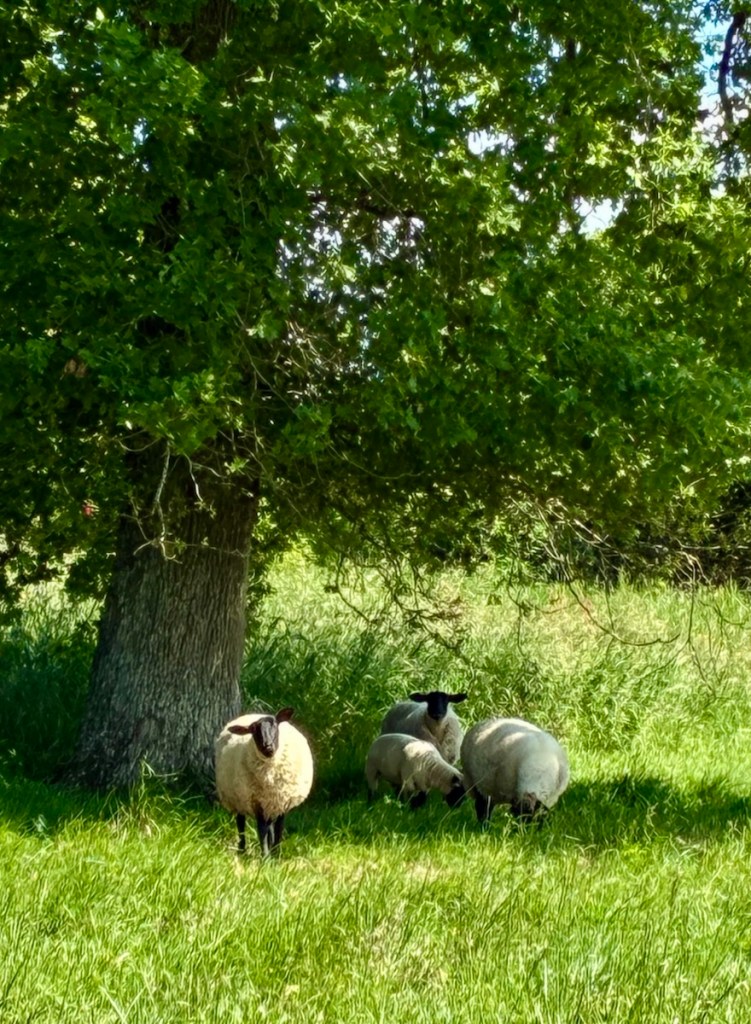
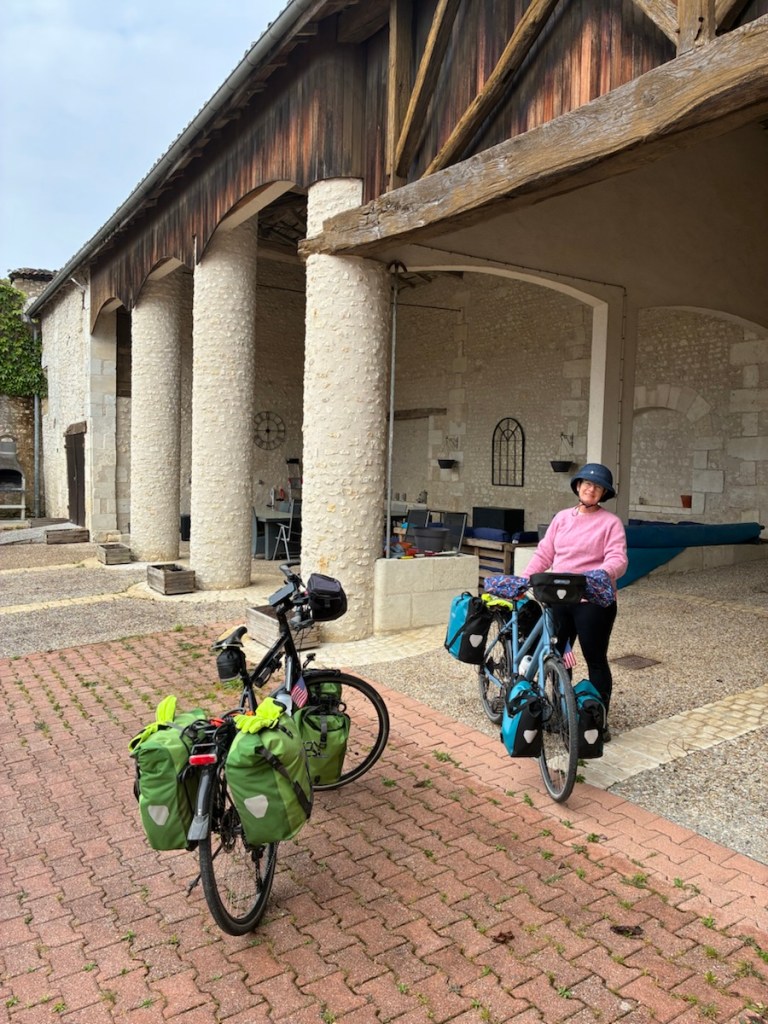
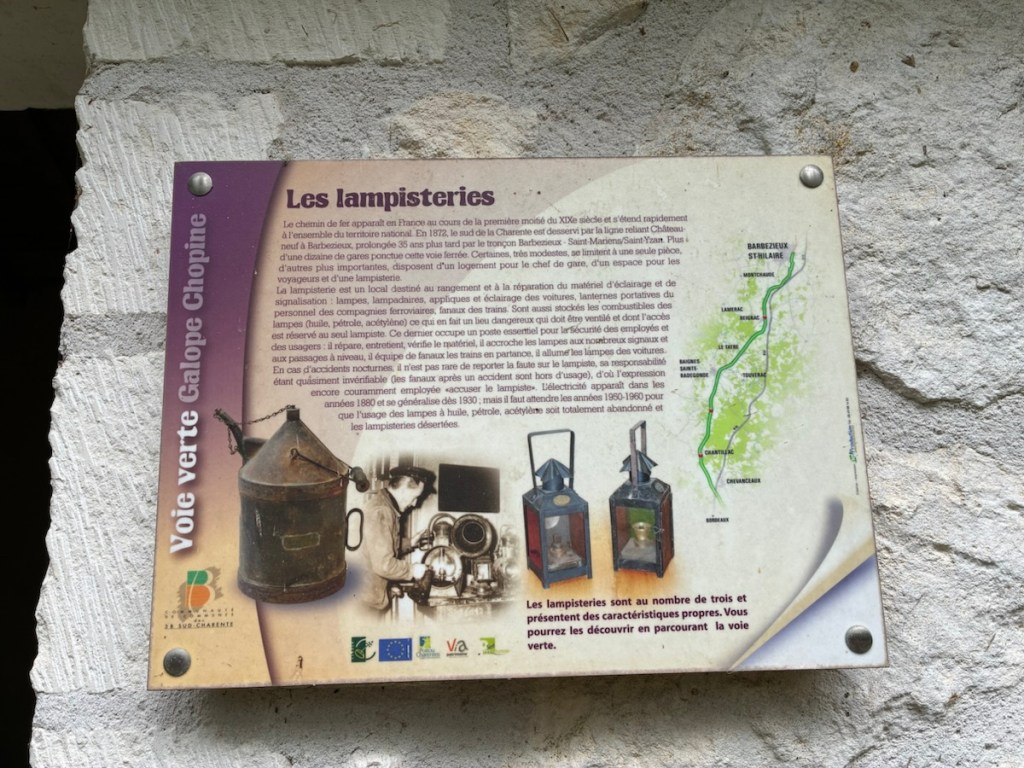
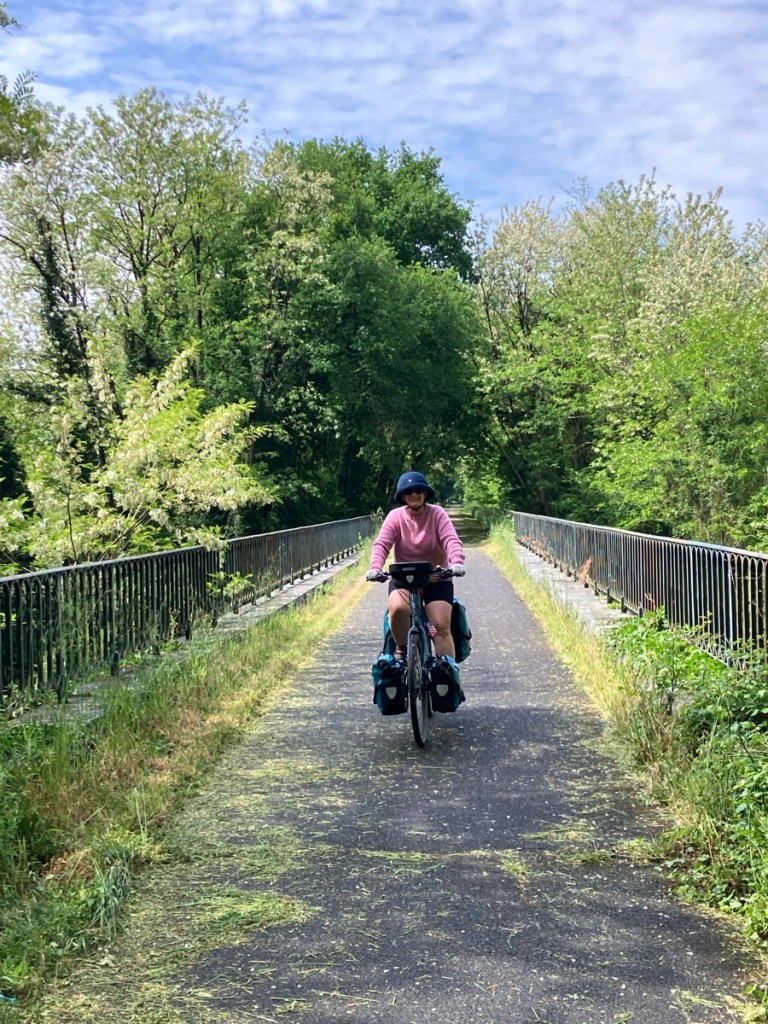
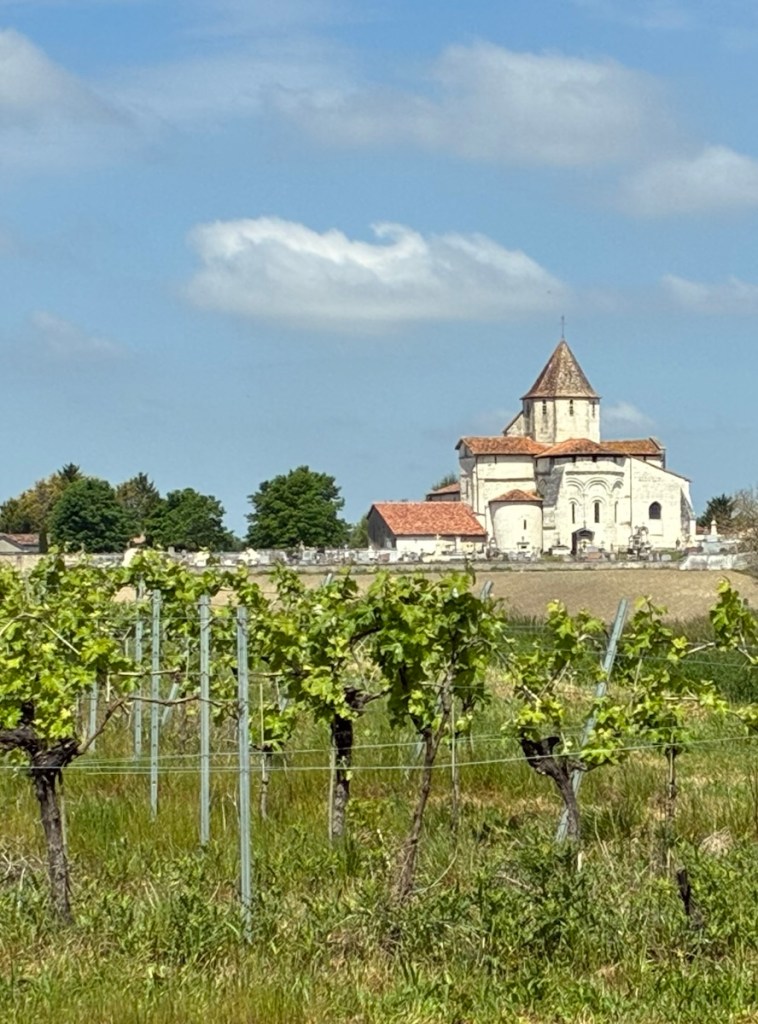
The wind may have been adding to our crankiness. There was so much seed fluff blowing around that my eyes itch just remembering it. Leaving Libourne. Later nasty car drivers! Attitude adjustment at the hyper market on our way out of town – the Wall Of Gazpacho! My favorite cycling lunch. Who could stay irritable when faced with these cartoon-character-like sheep?Or this cute calf grazing in a vineyard?Joining the Voie Verte at Clériic.Quite a lovely color scheme going on, the luscious green and bright white.Fantastic dinner at the wonderful Le Domaine du Haut Preau chambre d’hote. Run by a Belgium woman who does everything just perfectly while being so welcoming.It’s a beautiful old farm building.Back onto the Voie verte Galope Chopine. We didn’t make it far before the first informational sign beckoned us.All about the folks who worked lighting the lamps for the trains, and who were usually blamed for any crashes. This gives you a sense of the detail on the trail side signs. In a world of neon cycling clothing, be the fuzzy pink sweater. Outside of Reignac. First lunch. Second lunch in Barbezieux-Saint-Hilaire, with a chateau view.The view from the wall of the chateau. You can see Congnac noted on the map.Châteauneuf-sur-Charente, where we spent one night in a BnB in an old old building. Full of old old furniture.But with a friendly garden cat! Hello kitty. Creaky floors and loud plumbing is forgiven.
A plus for small countryside towns is that the locals aren’t tired of tourists. We reliably get into conversations in small towns. Here it was with the restaurant owner who had moved from Chile decades ago. She told us about the fears of the US tariffs destroying Cognac sales, and by extension, the town we were in. She also walked us through the local dialect a bit – the name of which I cannot remember.
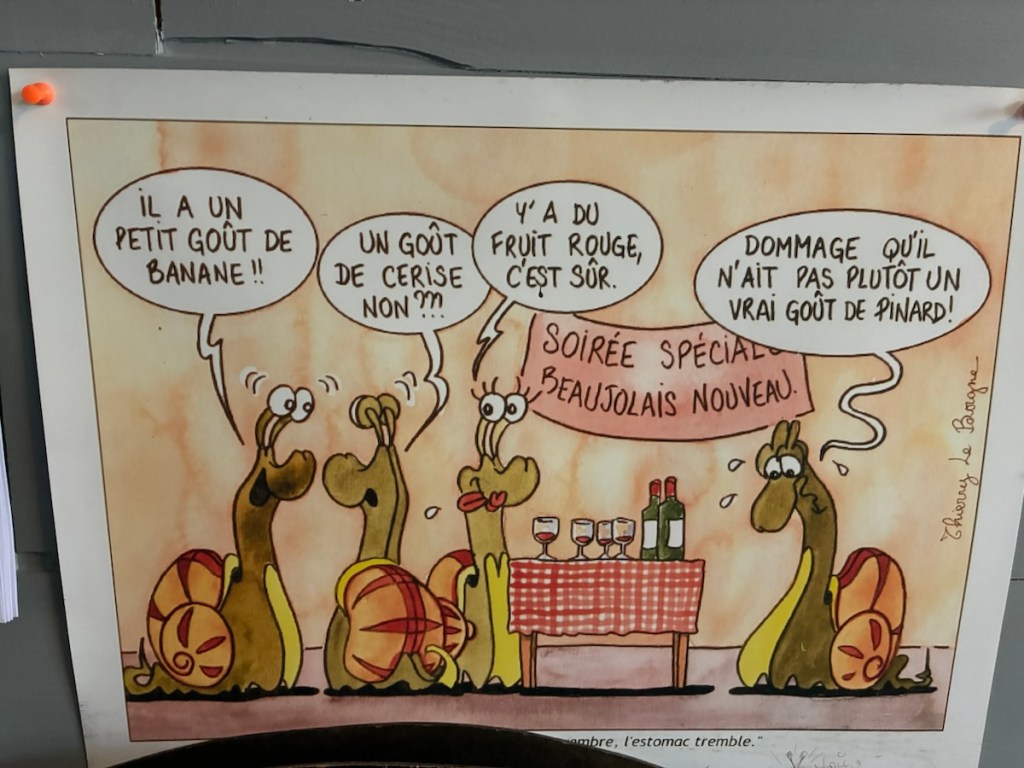
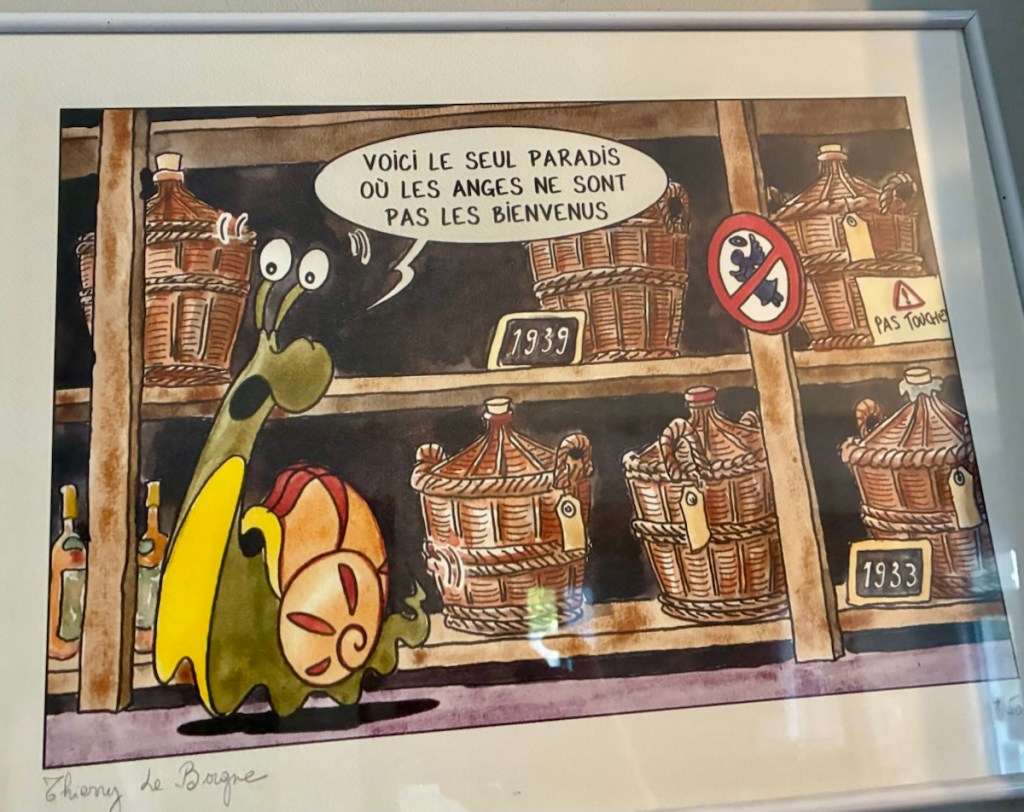
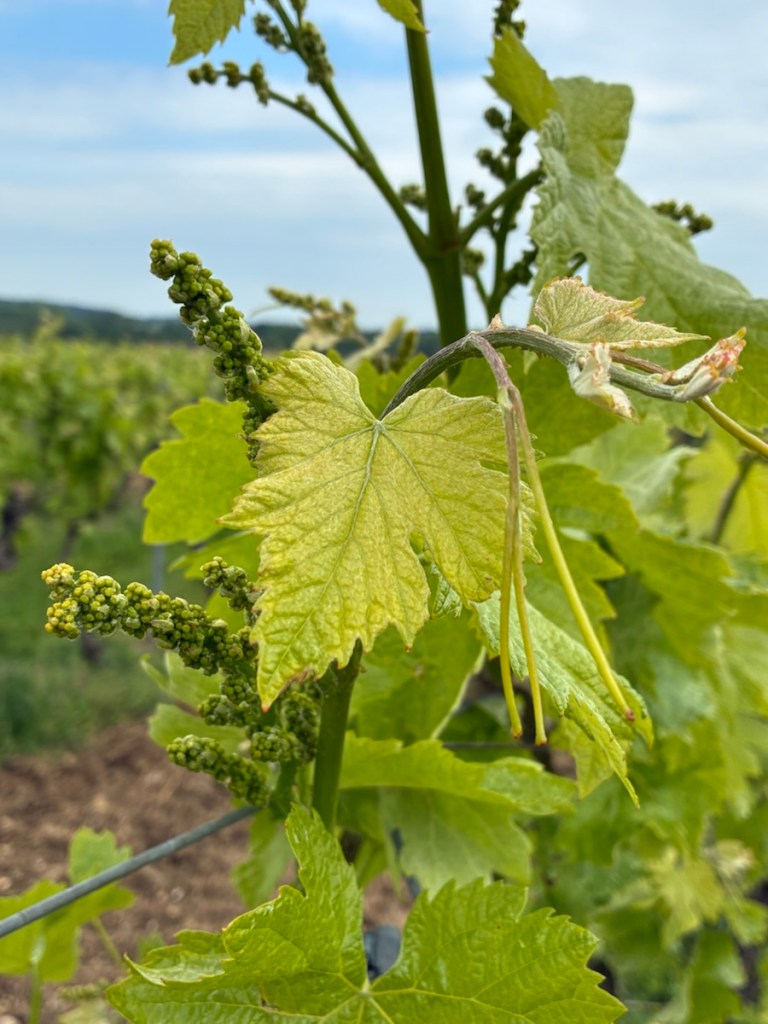
Cartoons by the town dentist. At the Beaujolais Nouveau party: “It tastes a bit of banana.” “A taste of cherry, no??” “There’s red fruit too.” Final snail “It’s a shame it doesn’t taste like real wine instead!” Local wine humor.“This is the only heaven where angels are not welcome.” I don’t get this one.Heading out of town to the riverside path called Le Velo Flow.The Charente River. I feel like we’re collecting French river badges. 381 kilometers long.It’s a beautiful river, with clean water which attracts swimmers, kayaks, and boaters.At Mosnac. Rich is grinning because I convinced him to ignore the sign saying path closed due to construction. Since it was VE Day the crew wasn’t working. It was a beautiful stretch of river.Time out for some artistic close ups of grape vines.How do we get anywhere, with all the photo stops?Our bikes posing for their glamour shots.Trois-Palis. We’re on our way to Angoulême, which we have just figured out is up on a hill.Such a fascinating town, Angoulême. Full of young hippy types, and hipster folks, against the backdrop of an old fortified city.
We noticed an animation school and did a little googling: Angoulême hosts 40 animation and video game studios that produce half of France’s animated production. Wes Anderson‘s The French Dispatch was filmed in this city. We were not imagining all the young arty folks.
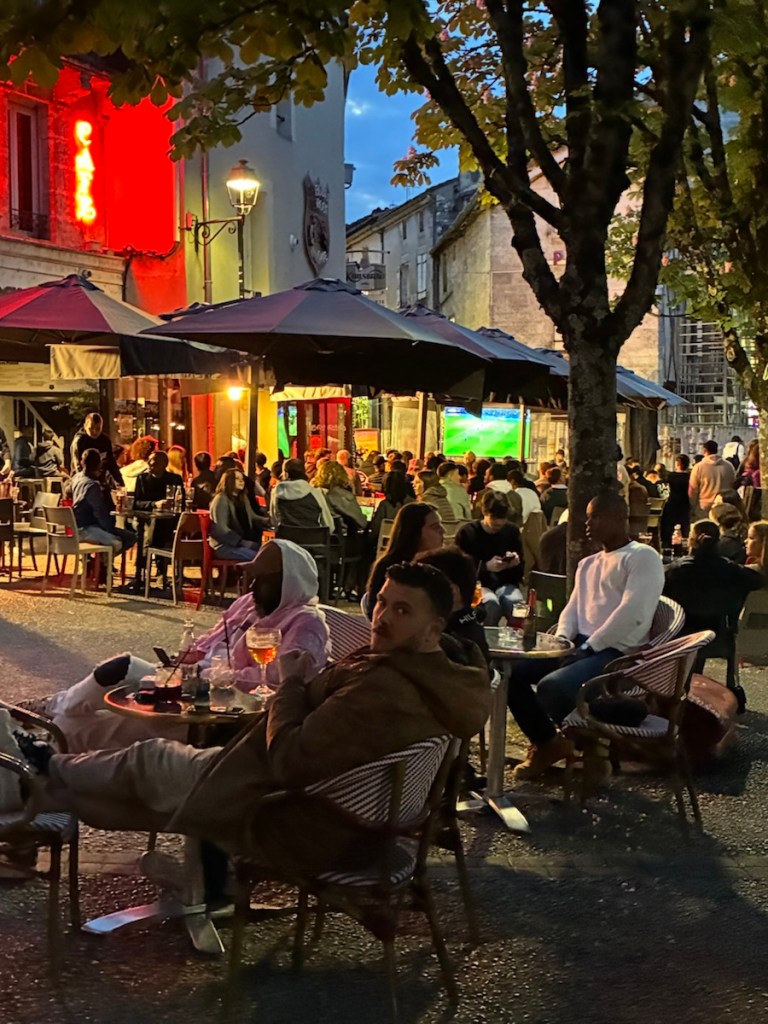
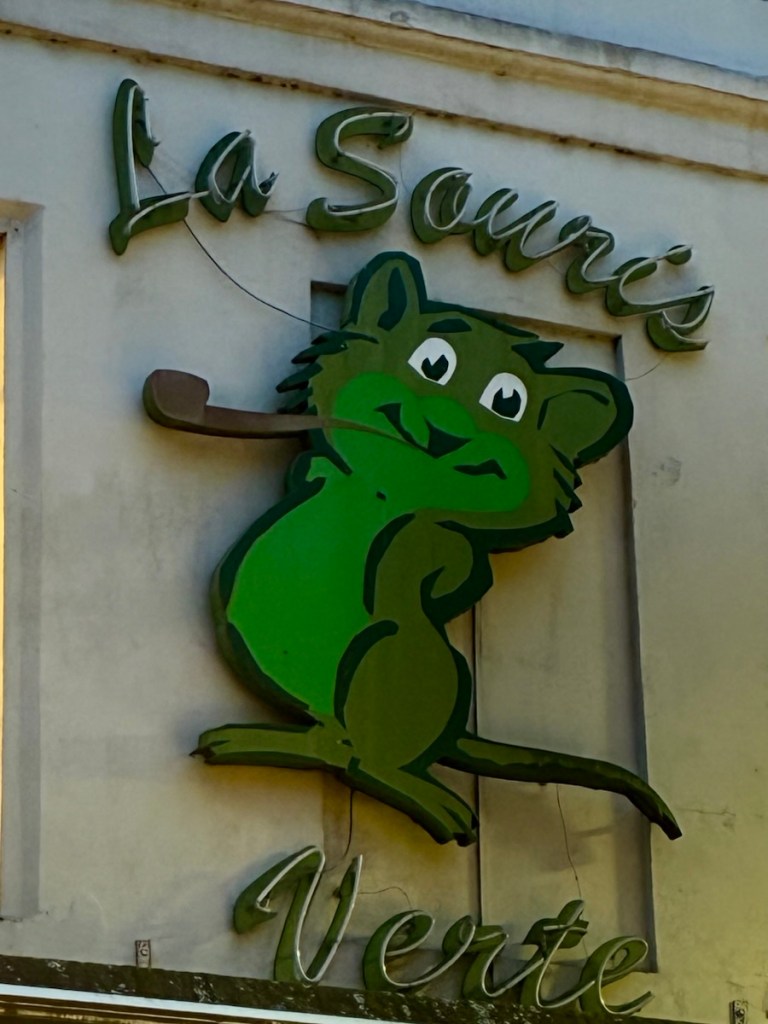
Football being shown makes for a lively evening on the plaza.I was hoping for the Green Mouse sign to be lit up after dark, sadly it was not. But how cute is that little pipe smoking mouse?The town is on a plateau overlooking a meander of the river Charente, and has the nickname “balcony of the south west.”The gorgeous murals I saw climbing up to town, and didn’t stop to photograph, made sense given the city’s visual arts connection. Here’s one from our ride down.
Now brace yourselves for my new favorite river: the Touvre.
For starters; only 12 kilometers separate its source from its confluence with the Charente. Yes, a 12 km long river.It has four sources, four springs (Le Dormant, Le Bouillant, La Lèche, and La Font de Lussac, the most recent of which appeared following the Lisbon earthquake of November 1, 1755. Chronicles of the time tell us that “on the same fateful day, an underground noise was heard, and shortly afterward, the earth opened up, and a torrent laden with red sand flowed out (…).” This is from the trail side info signs.The Touvre has an average flow rate of 13 cubic meters per second. Experts will tell you that the volume of water flowing here is disproportionate to the surface area of its topographical watershed (which covers only about 100 km). Really, some seriously good info signs.So much learning so early in the day?
It wasn’t until the early 20th century that science finally unraveled the mystery surrounding the origin of this water (which allows the Touvre to double the flow of the Charente). Several explorations then established the existence of a system known to geologists as the Rochefoucauld karst.
Scientists discovered that a formidable network of underground rivers extends over 450 km beneath the Braconne forest and in the La Rochefoucauld region. It was gradually formed by the infiltration of rainwater into highly soluble limestone rock, and by the inflow of water from the Bandiat and Tardoire rivers.
The springs of the Touvre constitute the second largest resurgence in France after the Vaucluse fountain. And if you’ve read this entire bit you too have now earned your Touvre River badge. Congratulations!
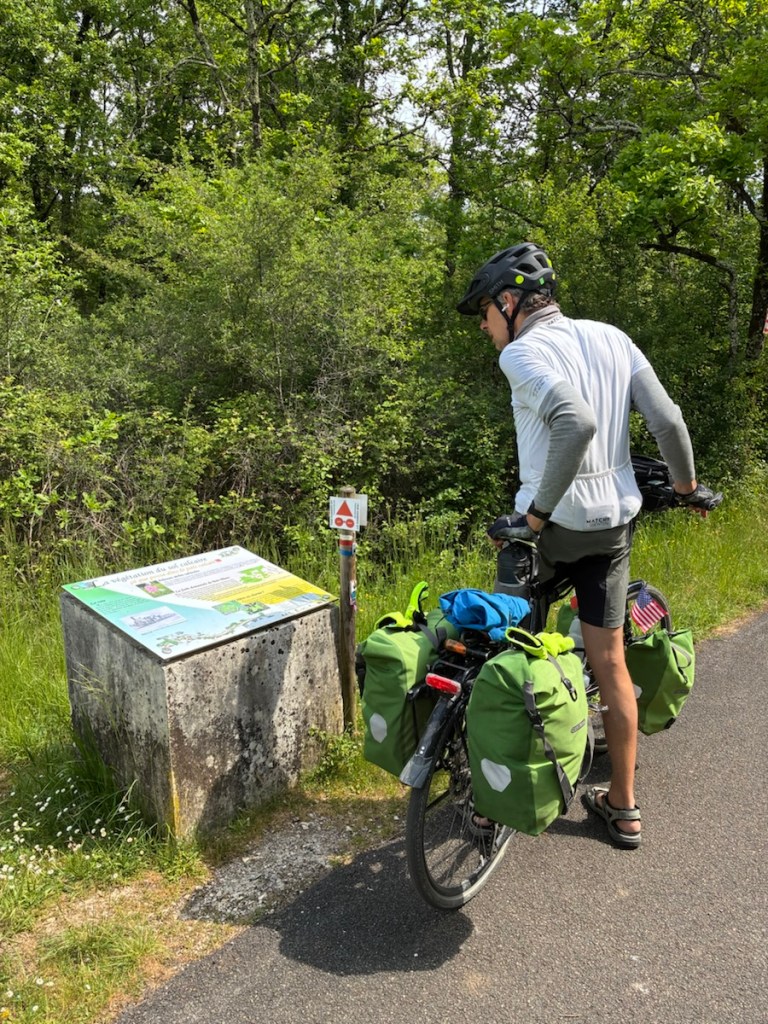
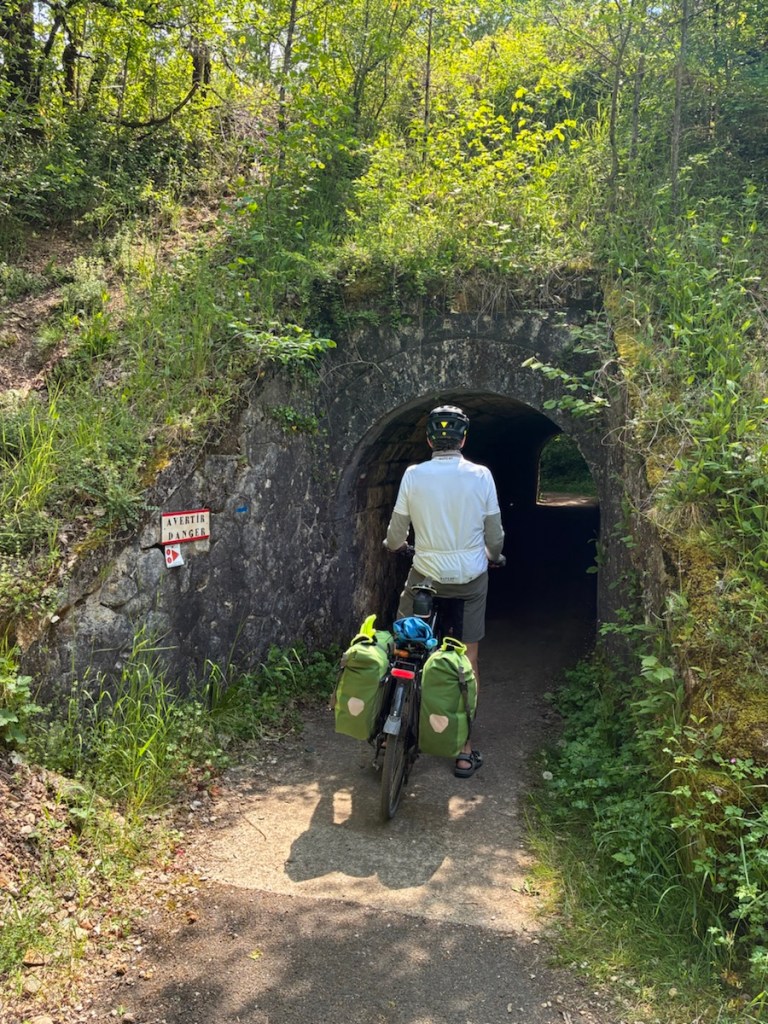
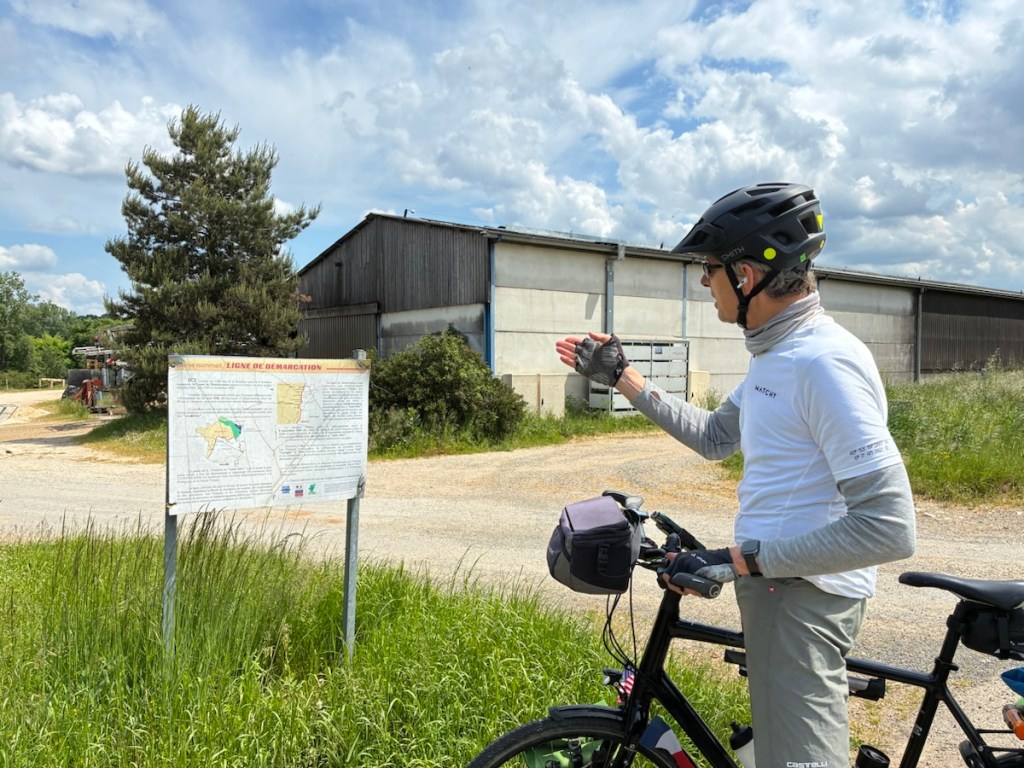
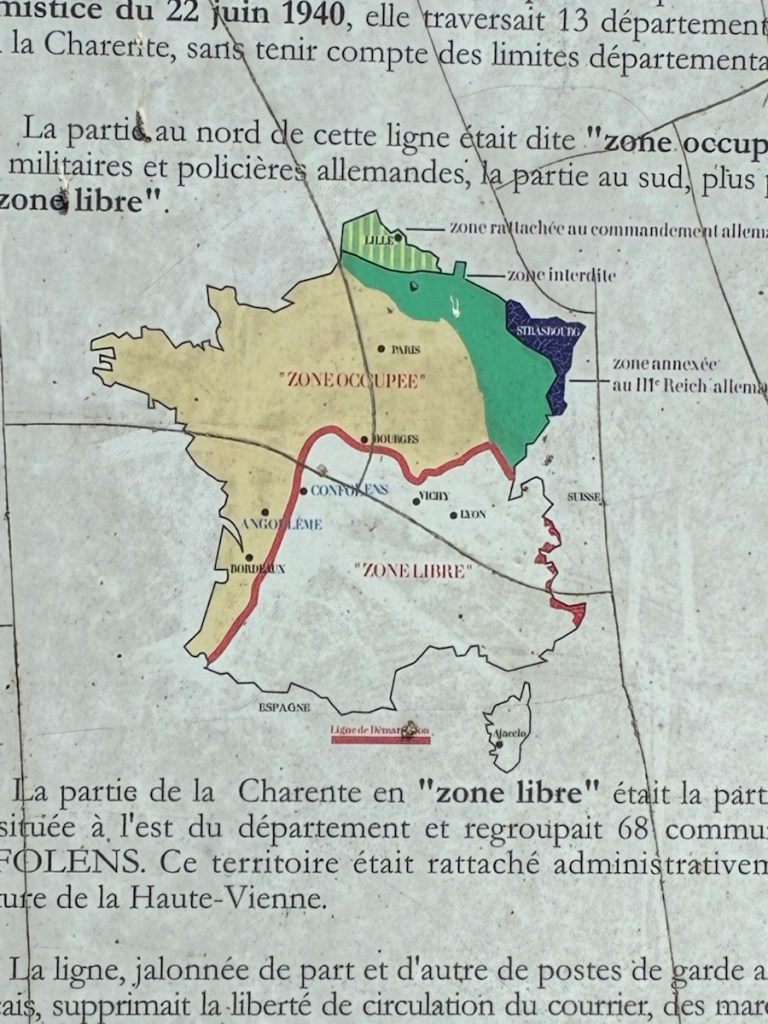
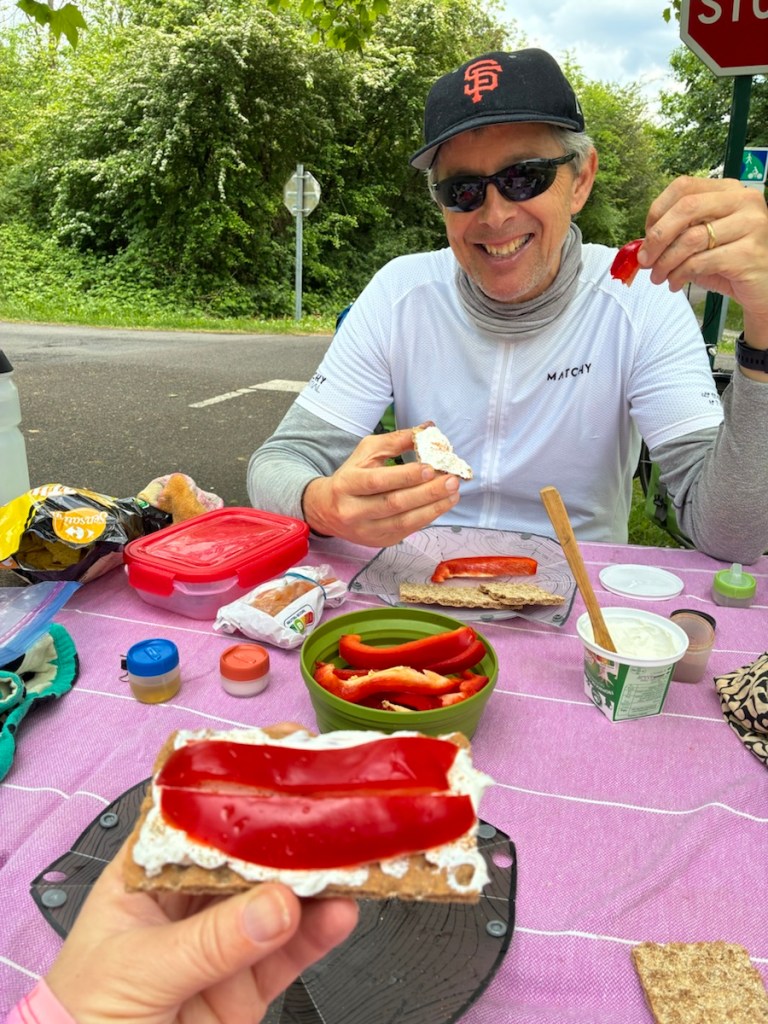
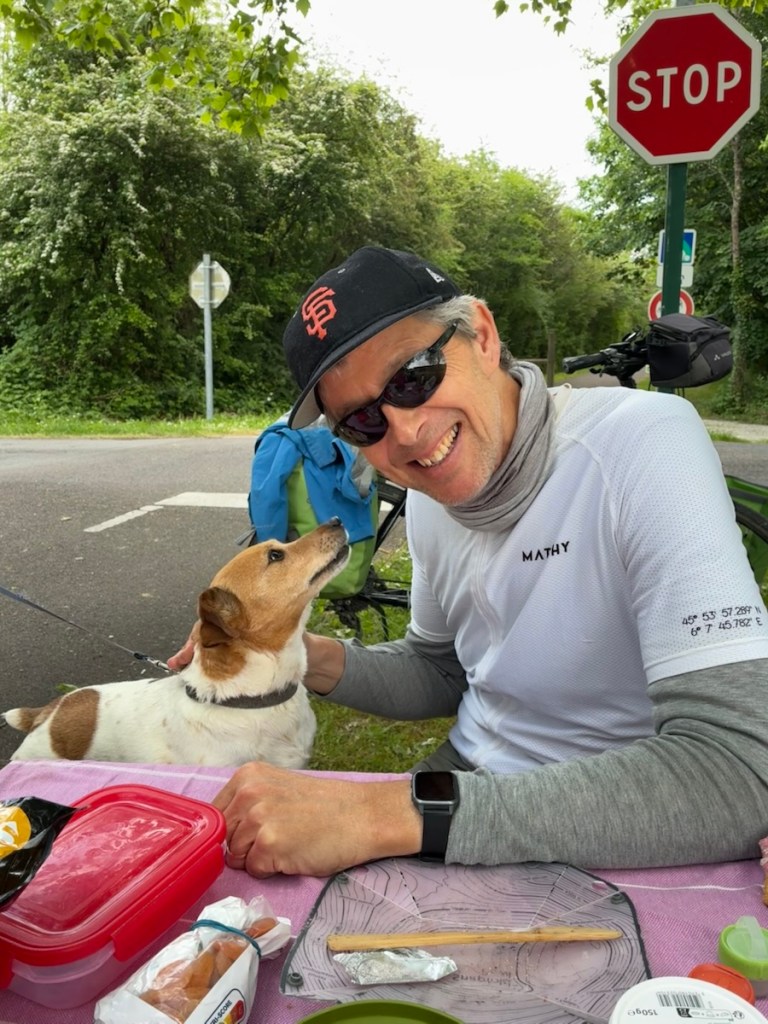
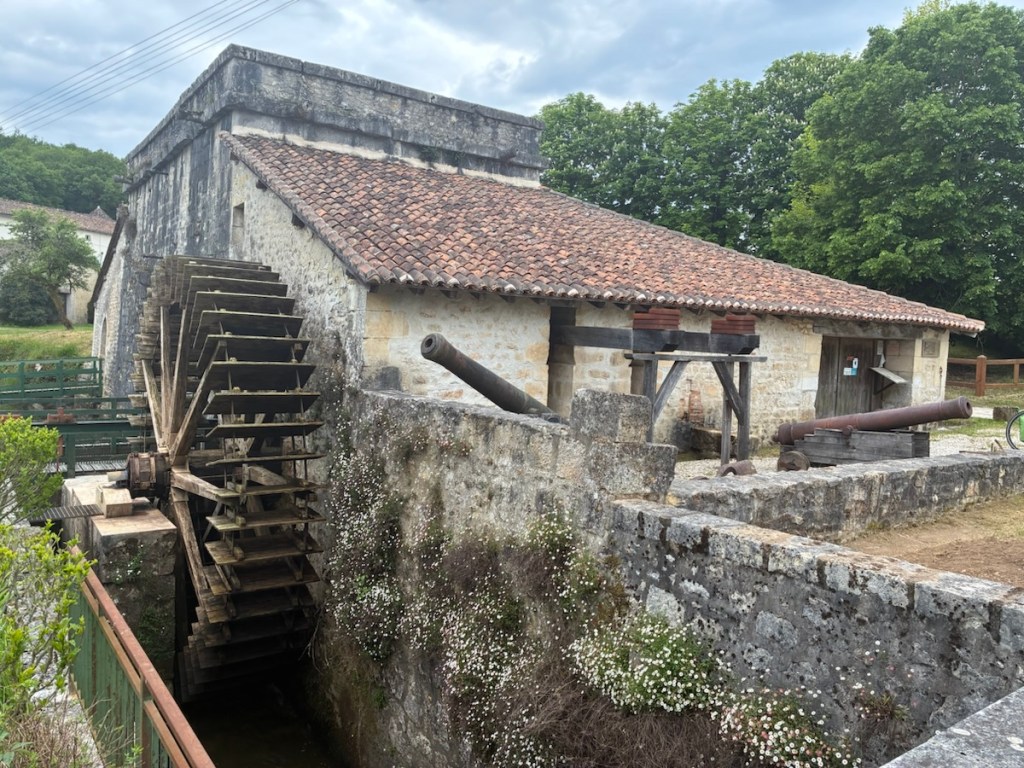
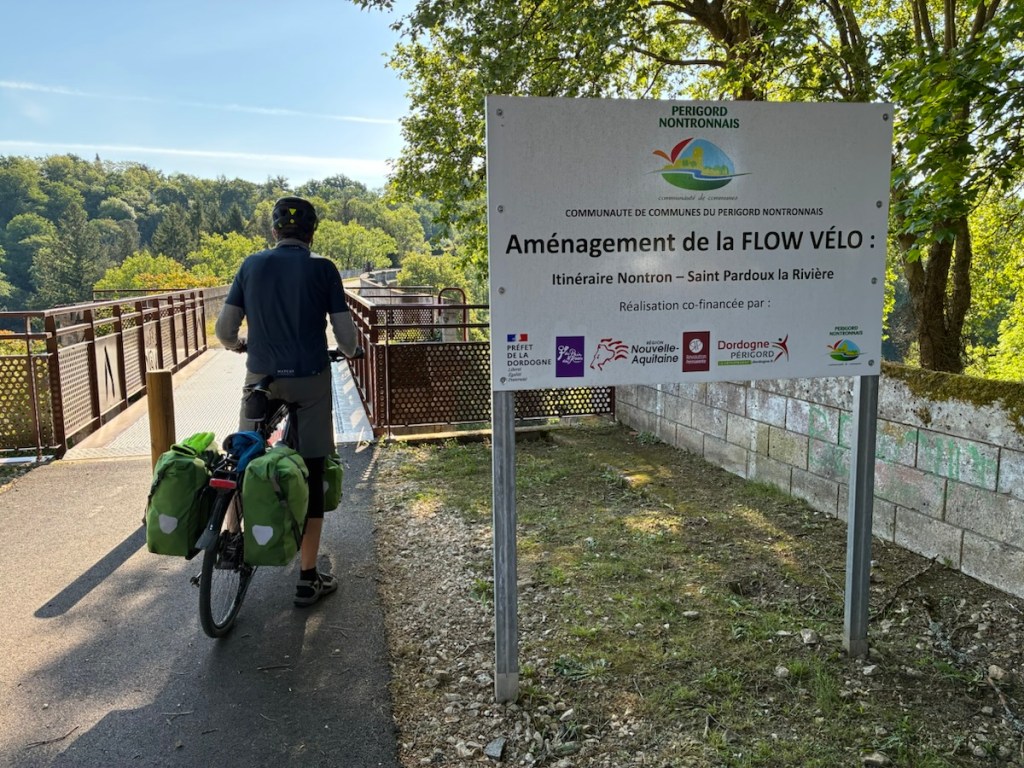
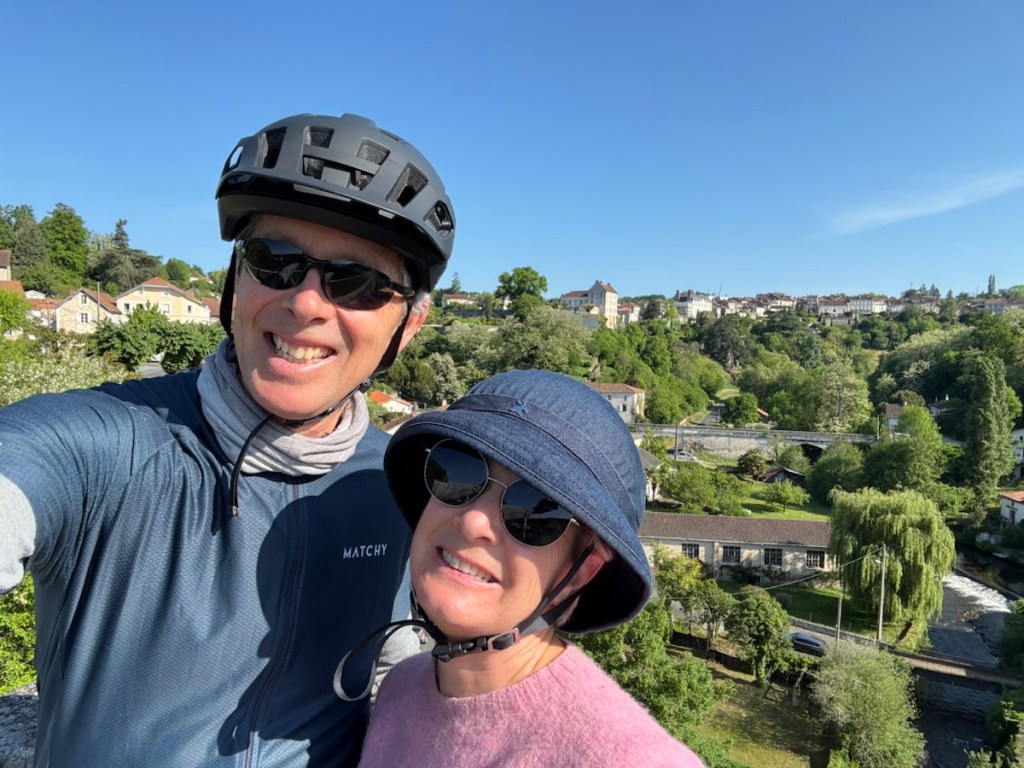
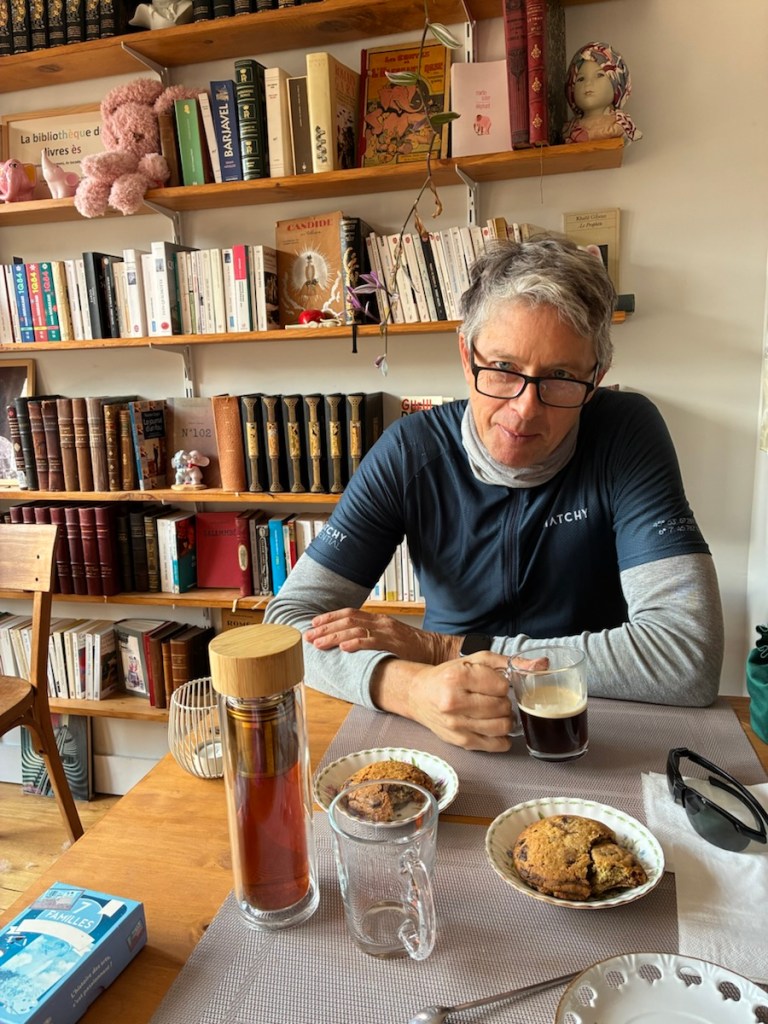
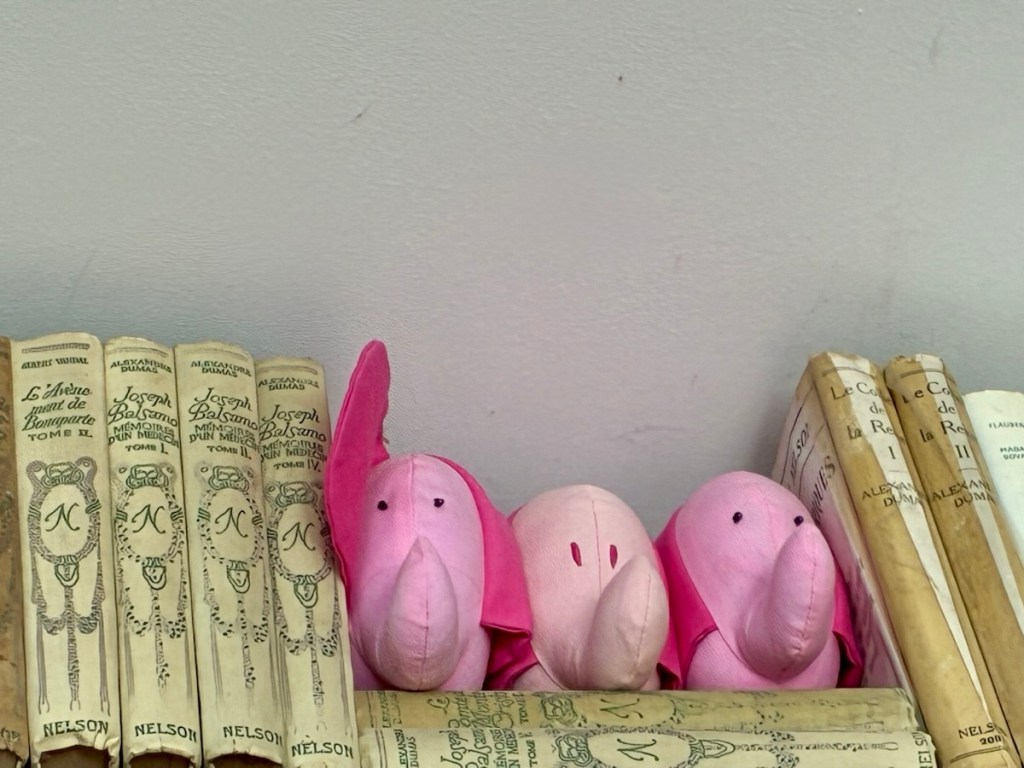
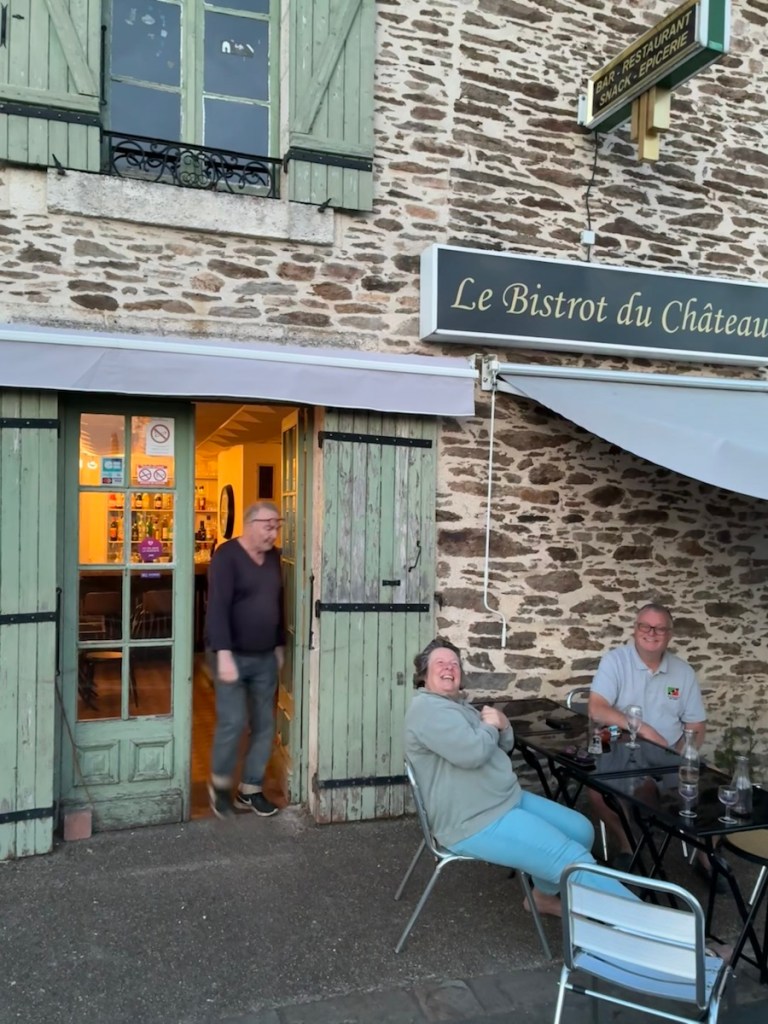
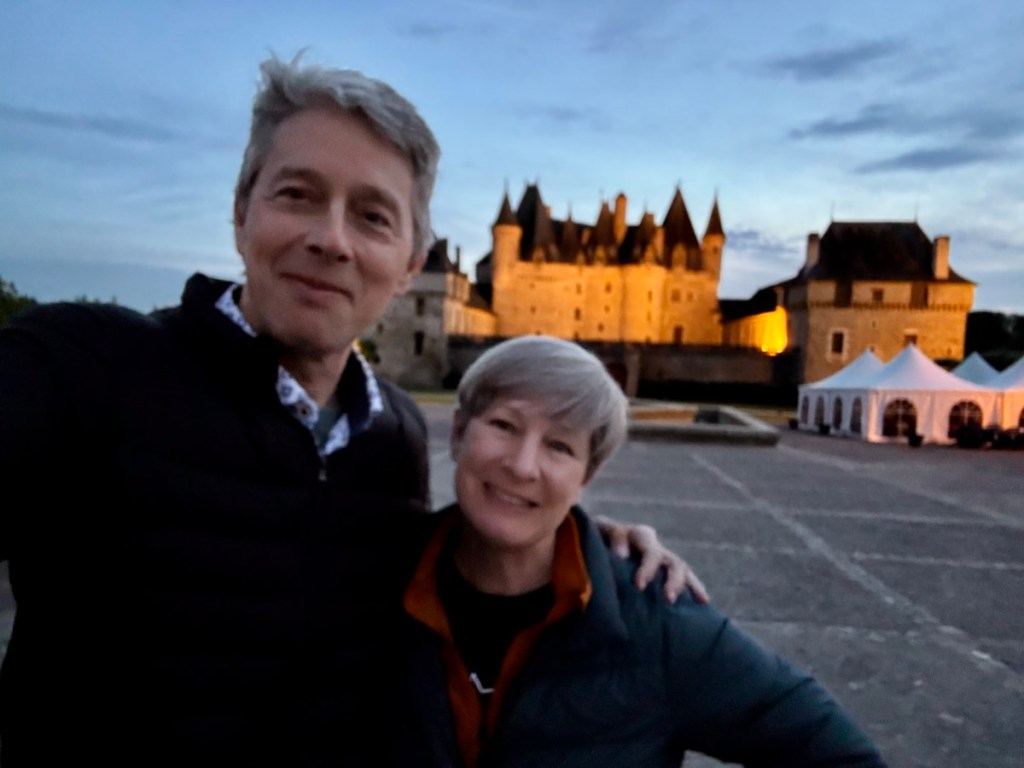
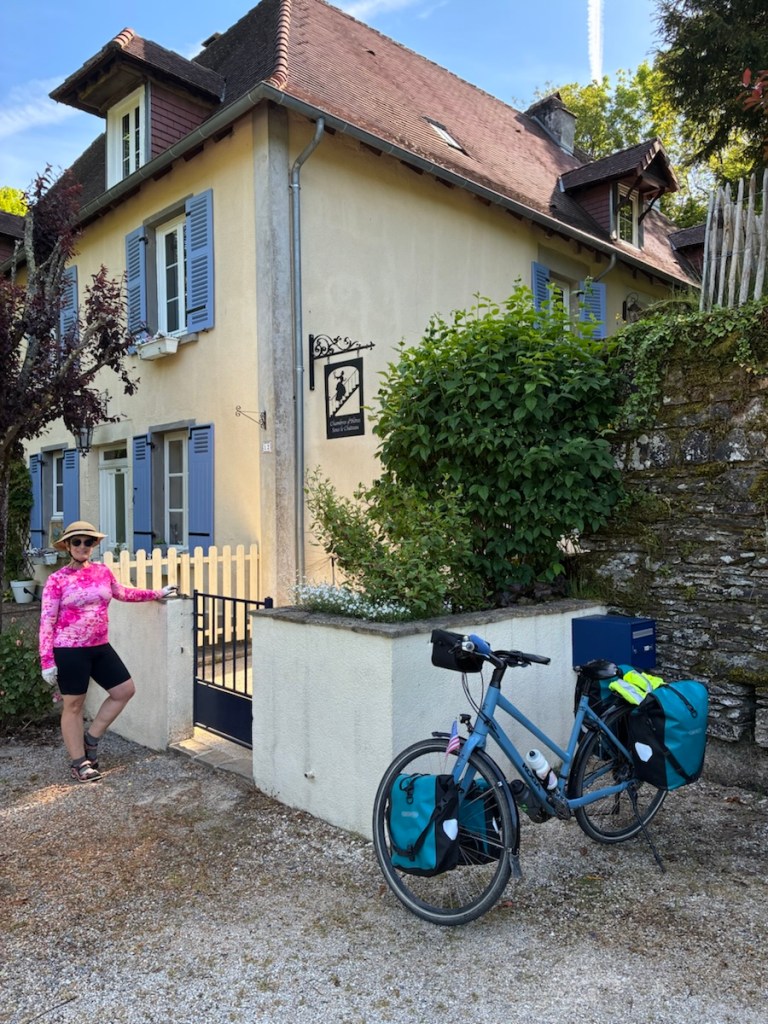
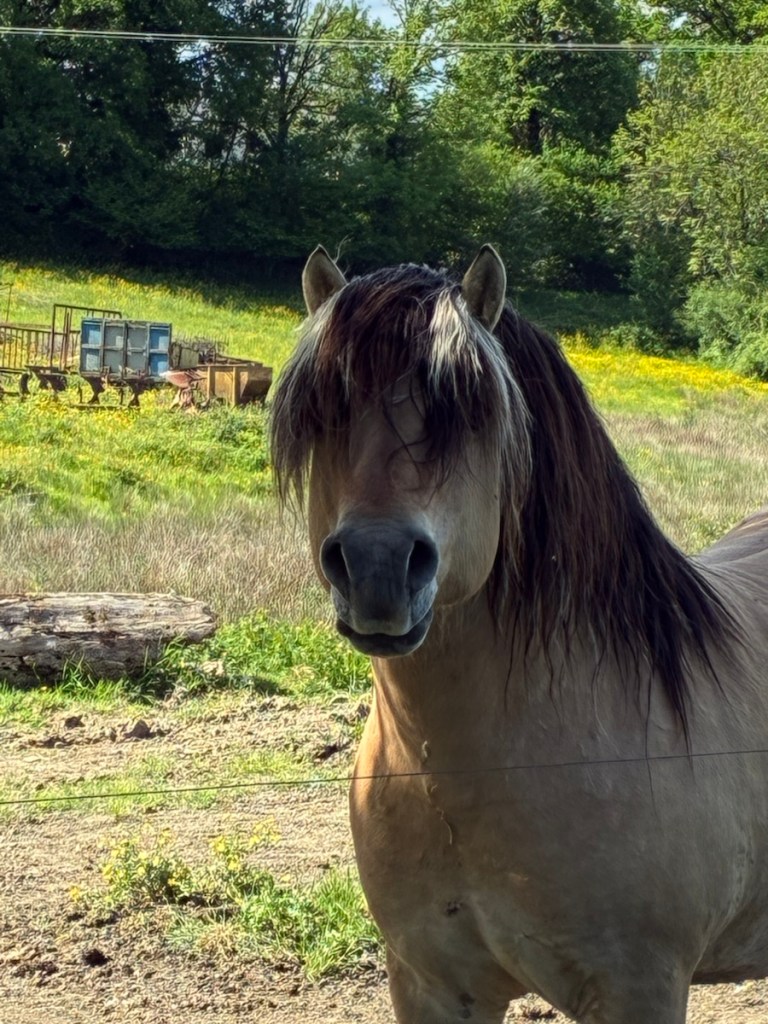
The path only hugs the Touvre for half its 12km length, so off we went on Eurovelo 3, la Flow Velo, Tour Charente, and one I can’t even read. Again, just amazingly detailed history signs. Our average speed was going down down down with all the stopping and learning.Tiny little tunnels that ran under the rail line originally for small tractors and livestock.History- the line of demarcation.Separating free France from occupied France in World War 2.Really, how can we get anywhere when there is so much to learn, and then we need to stop to eat.Peppers and cheese on crackers today. And cute dogs to snuggle. This is Cola, his owner, a lovely Irish woman, had been living in France for over twenty years.More stops for artsy photos. More up and down roads where the rail trail, the Velo Flow, couldn’t follow the rail line.An old mill which powered the forge which made cannons for the French military. Nontron, our destination for the night. How do you even keep a building this old standing?Another quirky, cold, not super well run lodging.The Velo Flow crossed over a newly restored trestle. Nontron has some tourist gold with this bike path and a lovely town.Nontron on the hill. Back on the bikes! Ride! Oh wait, divert to cute cafe in Saint-Jean-de-Côle where the town was prepping for a flower festival.Delicious cookies at the Pink Elephant Cafe.So many pink elephants.Ready for the festival.On the Côle River another lovely house.Carry on! Headed to Jumilhac-le-Grand for the night. Highly rated BnB, two restaurants in town. What can go wrong?Both restaurants closed. We threw ourselves on the mercy of the one bar open, not serving food that Friday night, and the lovely proprietors fixed us what she claimed would be a very simple meal. It was lovely.The group of ex-pats outside the bar happily absorbed us into their evening drink and chat and we spent a pleasant evening.A view of the privately owned Château de Jumilhac and gardens. Imagine keeping that repaired and running.It’s a beautiful town, Jumilhac-le-Grand. Us after going from thinking we can choose between two restaurants, to pleading for food from the one place open. But again, lovely lovely people.Leaving Sous le Chateau Chambre d’hote. Very comfortable, very well run.Out of town up some more hill under the watchful eye of the school cat.And this stallion who looked like he was spoiling for a fight.
Just after this handsome horse there was a field with a huge bull standing very close to the road with his herd of ladies on the other corner of the field. At first I could see no fence at all between me and him. As I got closer I could see one single strand of wire – electrified? Maybe? The wire barely came up to his chest. I wish I had a photo, he was like an anime cartoon bull, so muscle bound and very angry looking. I was way too nervous to stop, seeing Rich riding away in his red cycling jersey made me think this bull was not up for photos.
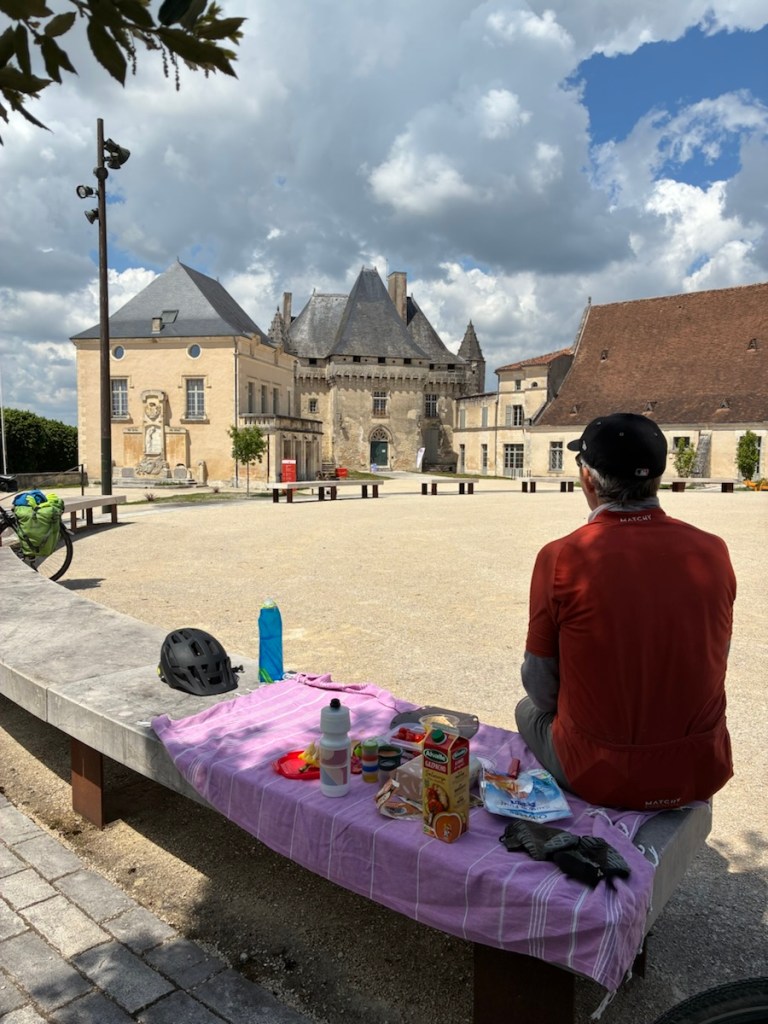
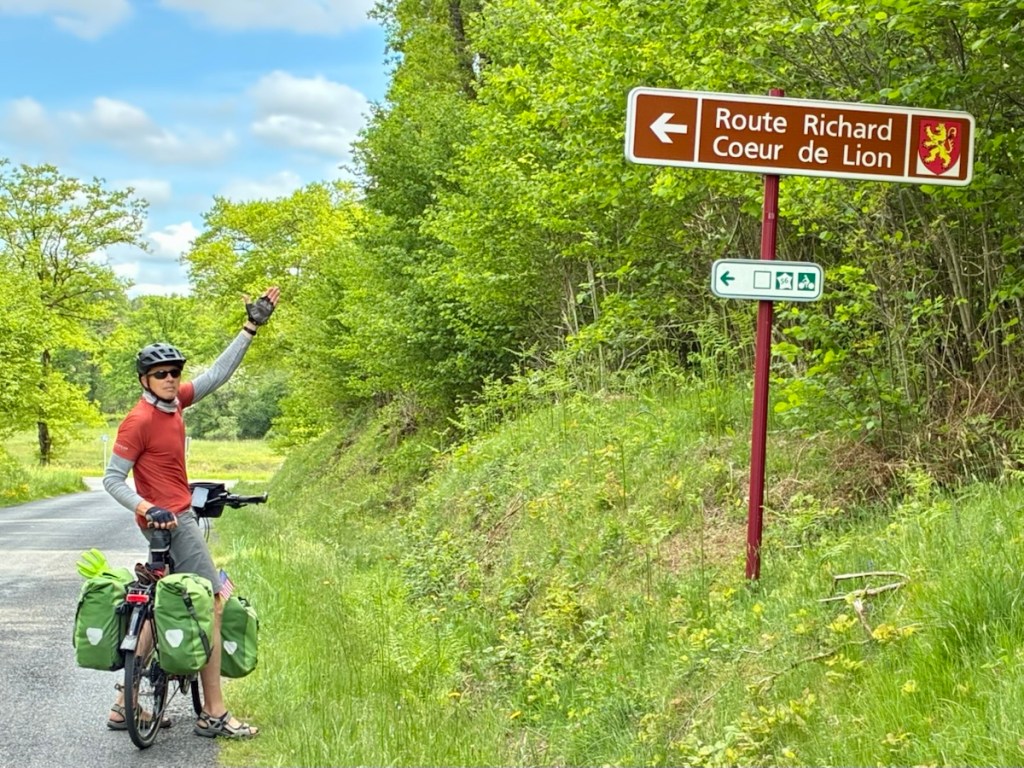
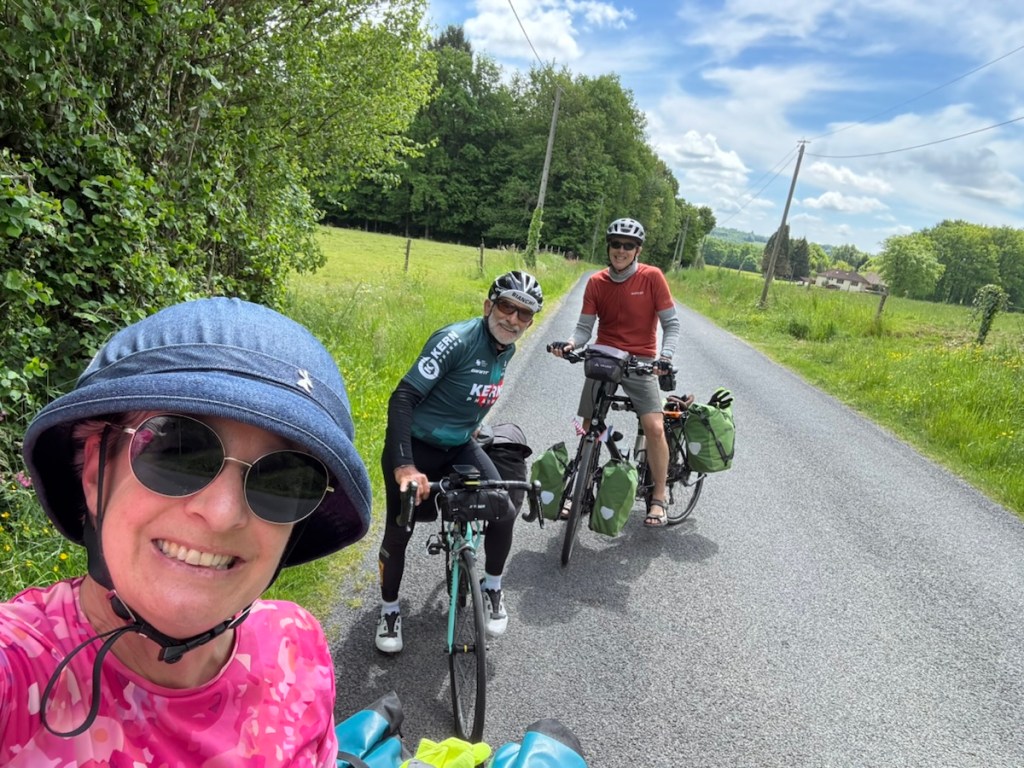
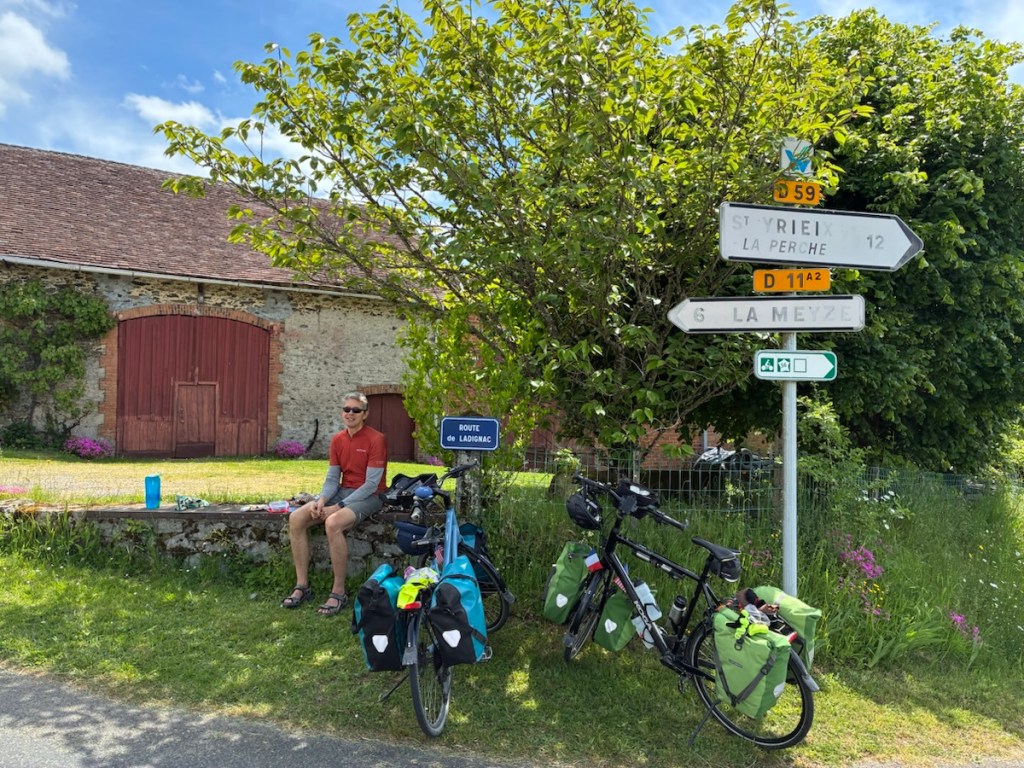
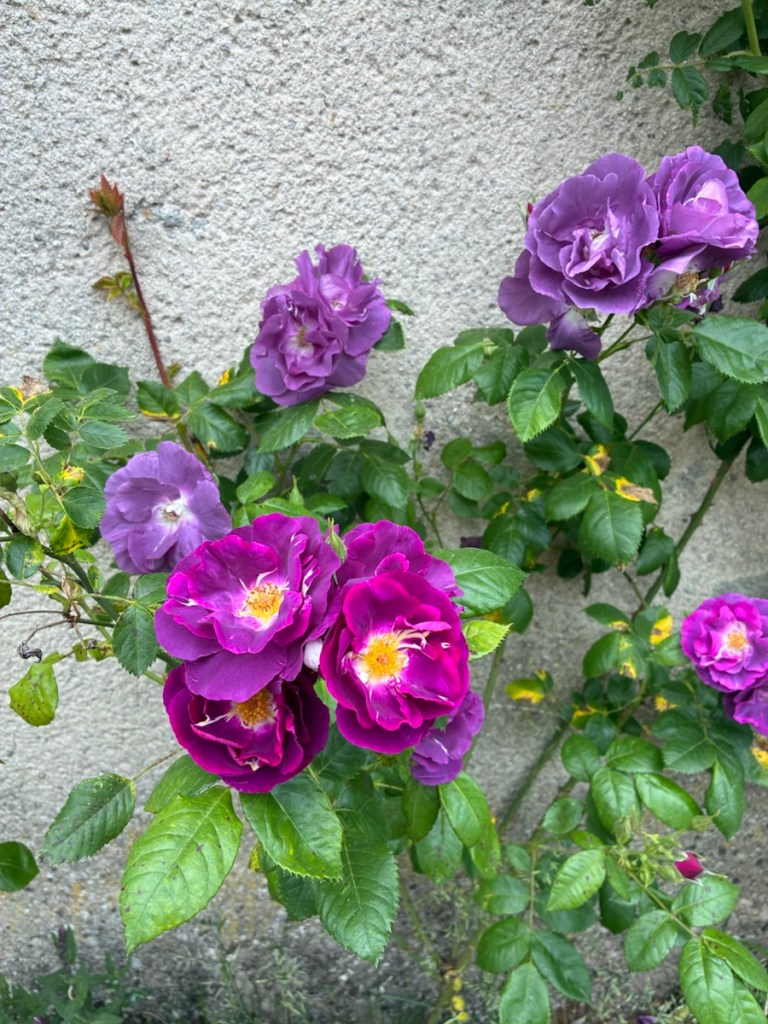
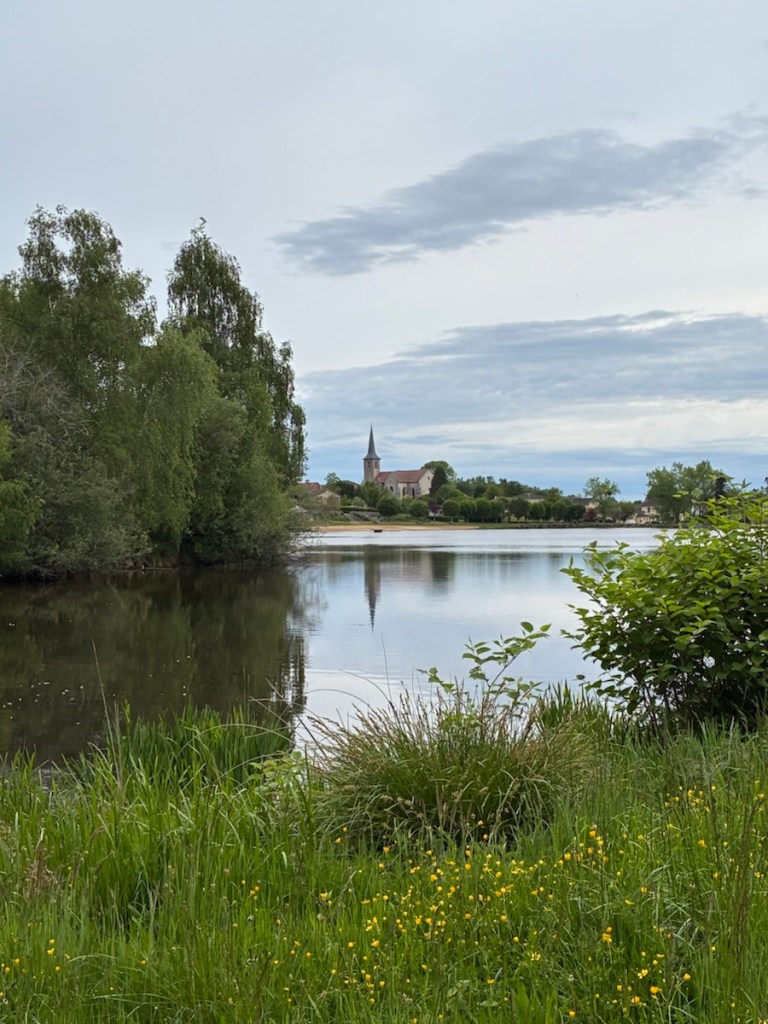
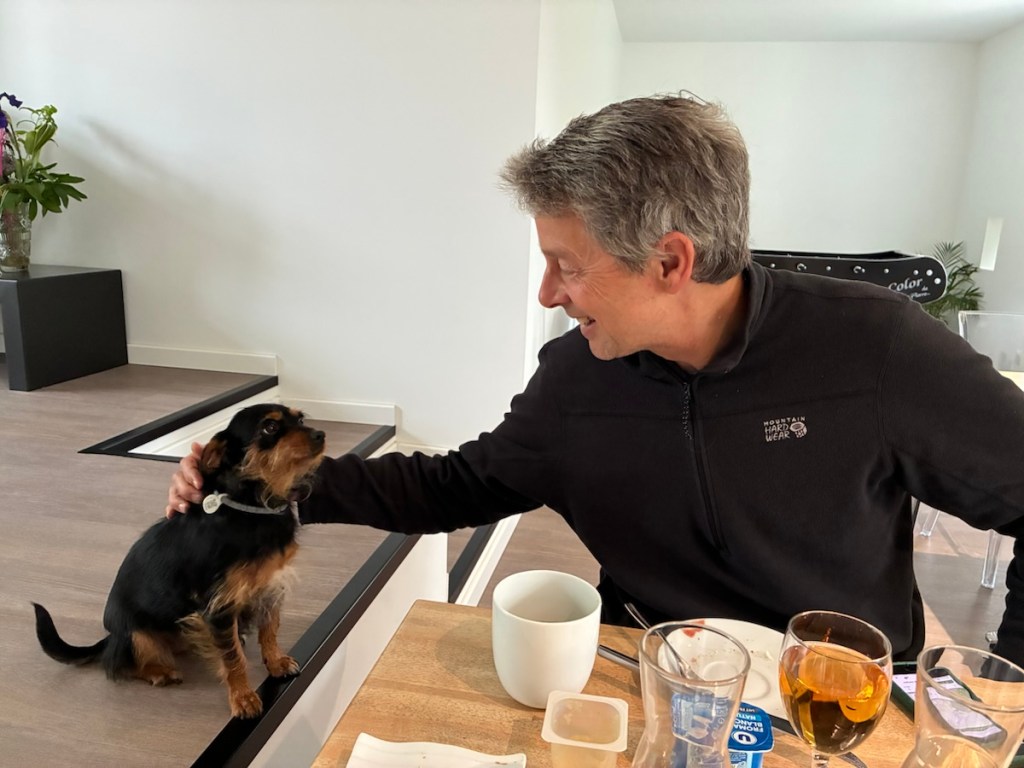
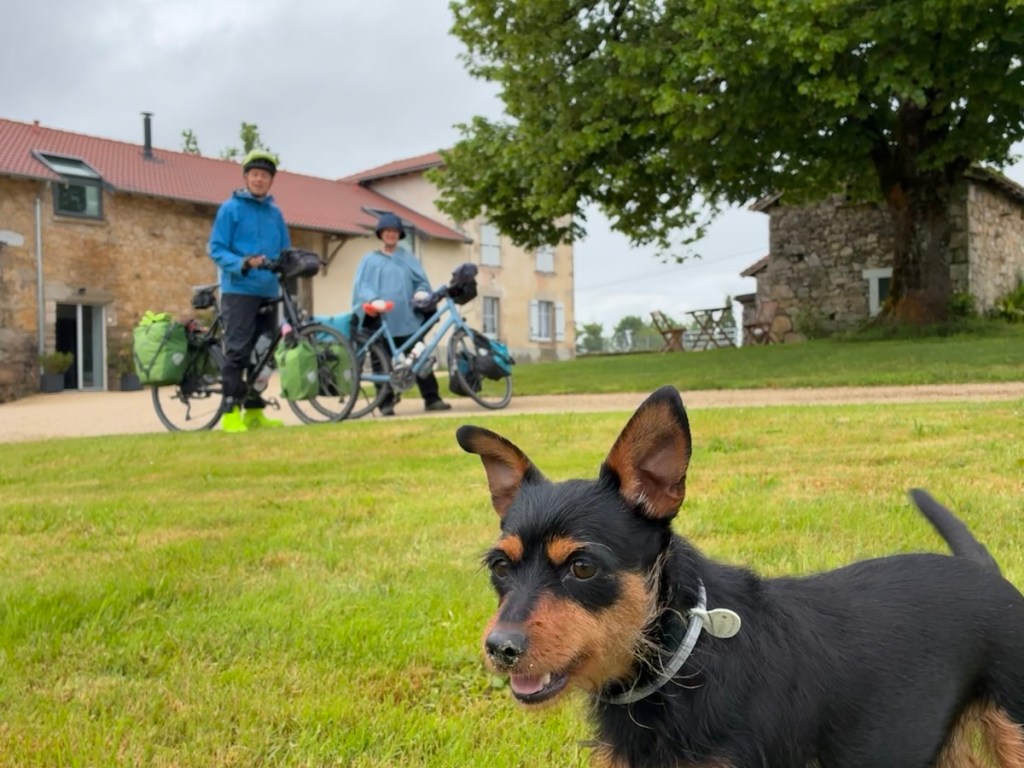
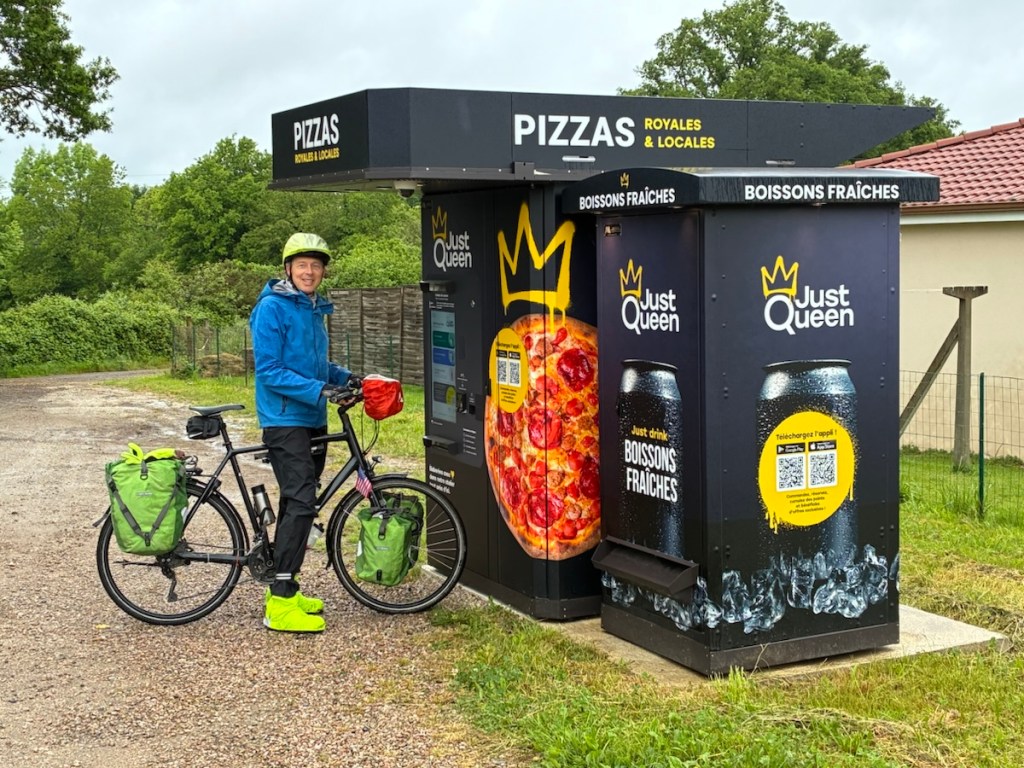
Our favorite sign of the trip. Richard the Lion Hearted Route.Who are the friendliest cyclists? The Spanish! We saw him twice in one day (failed to get his name), he was headed to Limoges that night, we had one more night on the road to Limoges.Downside of road riding, not many places to stop for a picnic lunch. This shady wall came through for us. Flavignac. It’s on a Camino Route. It’s on a bike route. The one new Chambre d’Hote will probably do quite well with a steady supply of hikers and bikers.I love the color of these roses. An easy walk into town along a small lake. What had been part of the owners barn was now accommodation.Breakfast greeter. We had a short day into Limoges so we tried to wait out the rain before heading out.What rain? Said the cute dog.Breakfast was pretty slim so we were tempted by the pizza machine. But heavy rain and no shelter made us decide no.Limoges! Arrived in the rain. Got a chance to walk around.We stayed for two nights, which was honestly one night too long. Other than the porcelain museum, Musée national Adrien Dubouché, which had an extensive collection of pottery, there was not a lot to recommend Limoges.A cute old town, but it was quite small, and ringed by unpleasant roads. Awful town in which to be a bike or pedestrian. On a hill. Long traffic signals. No bicycle infrastructure.So off we go! To the very dramatic train station. To catch a train.To Paris!From Bordeaux to Limoges. Each heart is a place we slept.
We cycled for 8 days with no day off. Taking a day off in a small town, at a little pension or BnB isn’t super easy or interesting. But moving every day for 8 days isn’t easy either. It can make travelers cranky. Every morning as we pack up our panniers it seems like one of us packs something in the bottom of a pannier that we actually wanted out for the days ride – rain gear, seat cover, leg warmers, something- if we manage to get going without one of us having to reopen a bag it’s a miracle! And, the amount of route planning and lodging research that Rich puts in for each day is significant. He’s constantly adjusting his plans and figuring out where the grocery stores are that are on or close to the route. To go back to a familiar place, like Paris, is such a treat.
The happy travelers back in a city.Spring 2025 tour so far. Up next, four days in Paris and on to…?
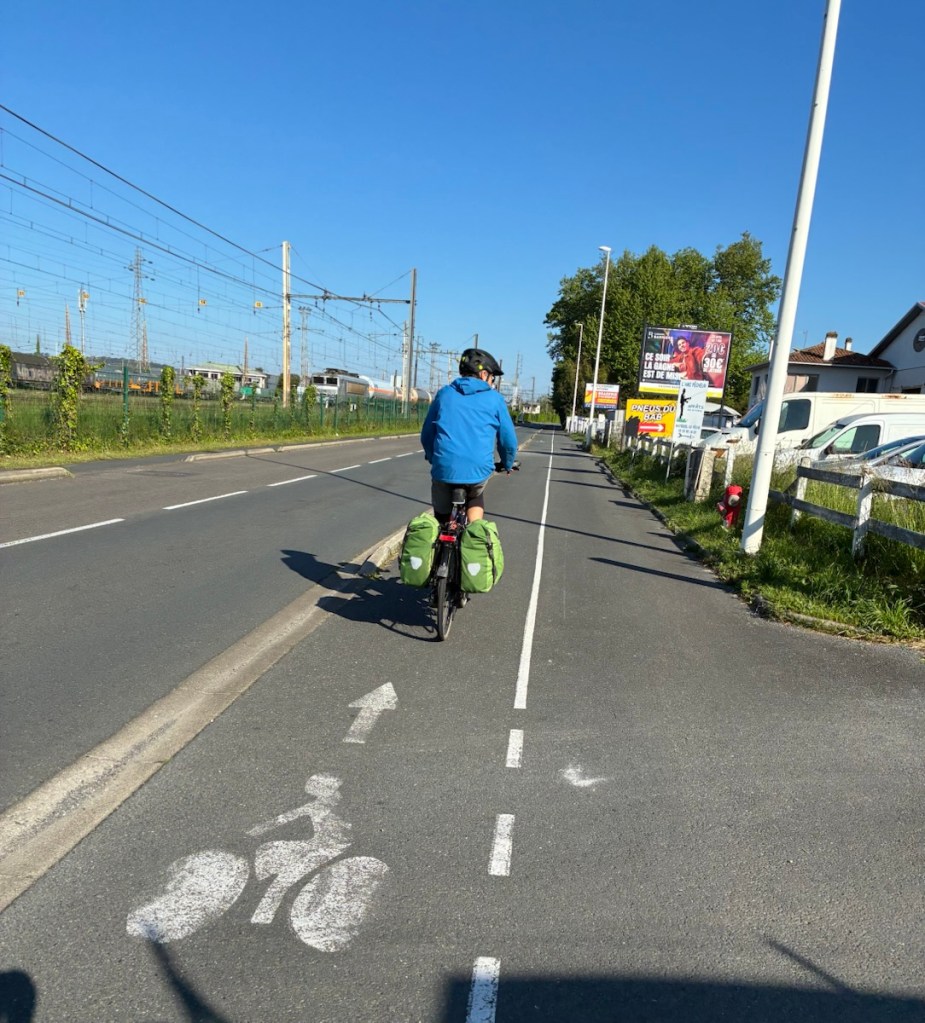
Infrastructure like this makes us so impressed with France. Obviously new, and so wide with a lovely surface. On our way out of Saint-Jean-de-Luz.
We knew the weather was changing. And boy did it! We woke in Saint-Jean-de-Luz to heavy rain. Nothing to be done but put on rain gear and hit the road. It was Saturday am and the hotel rooms that were available in this beach town were quite expensive, so on we went after a one night stay. A quick stop at the grocery store for lunch food and I did stop myself from buying espadrilles from the colorful display inside the Carrafour City grocery store, but only just. Absolutely no room in the bags for another pair of shoes.
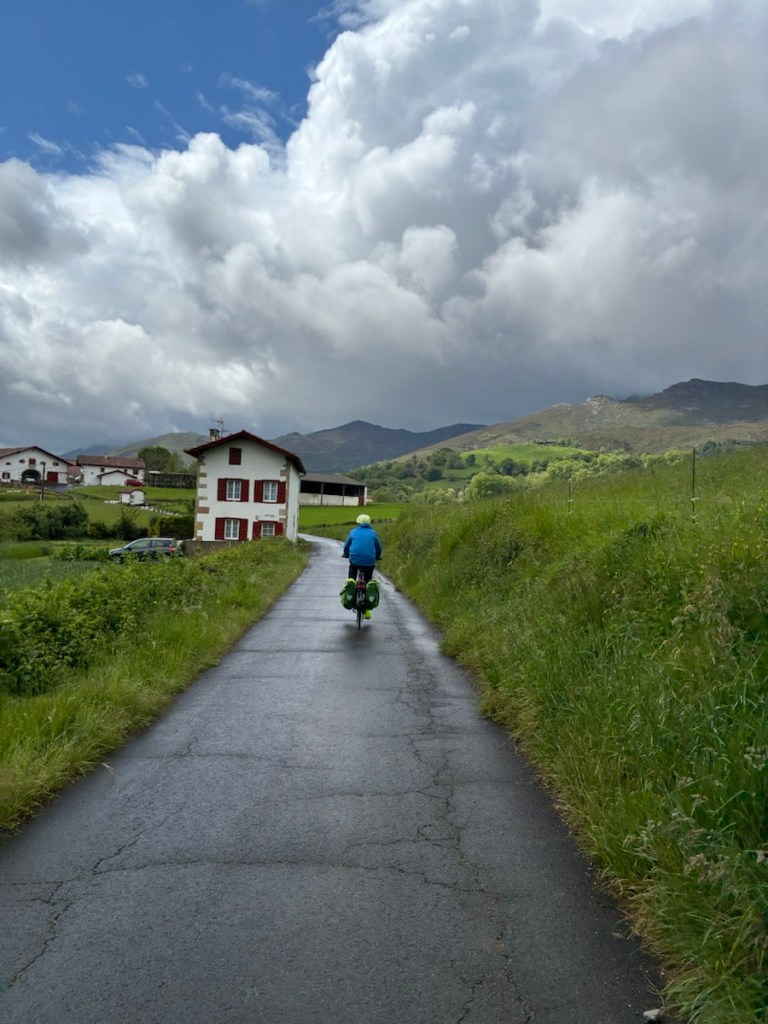
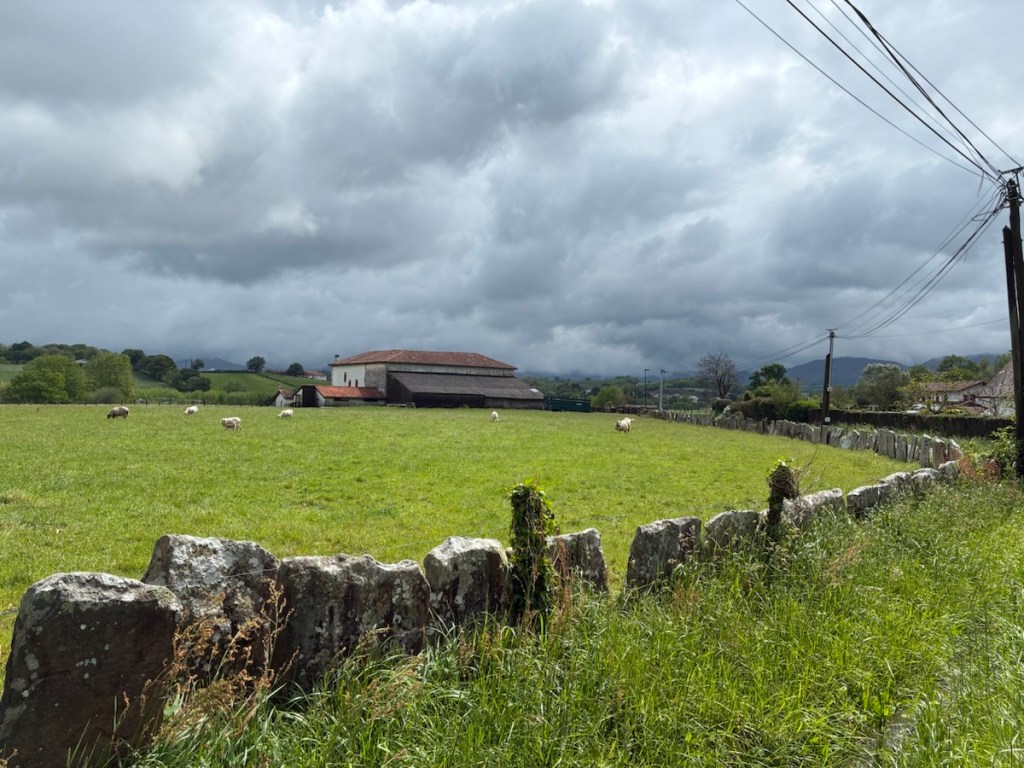
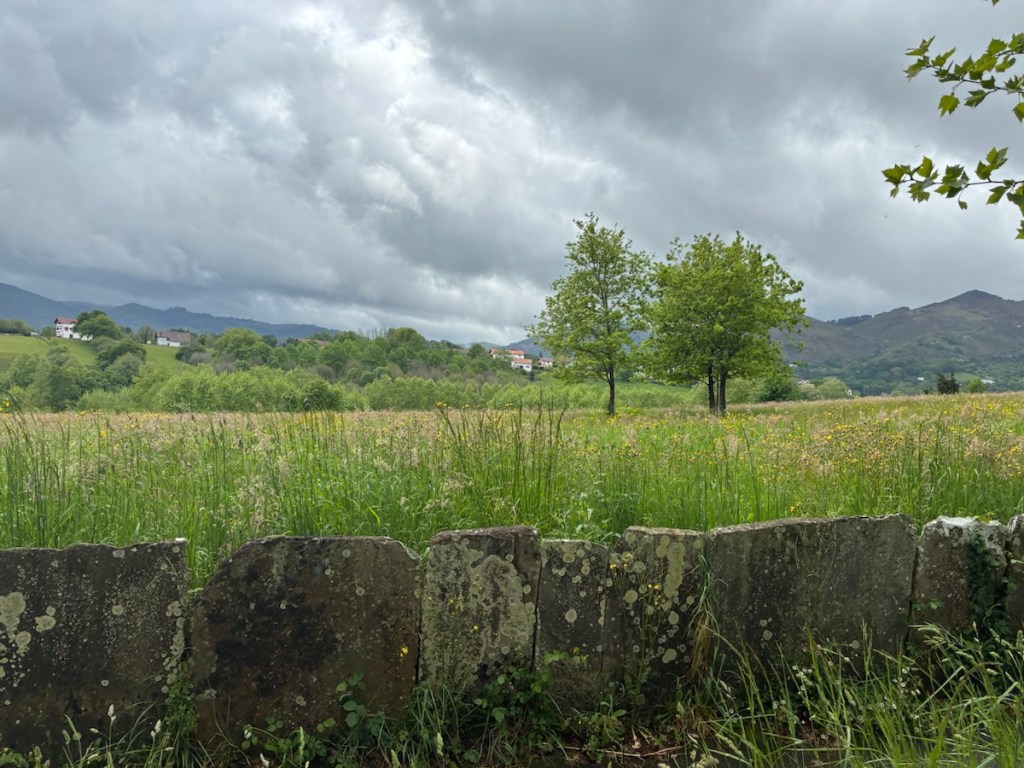
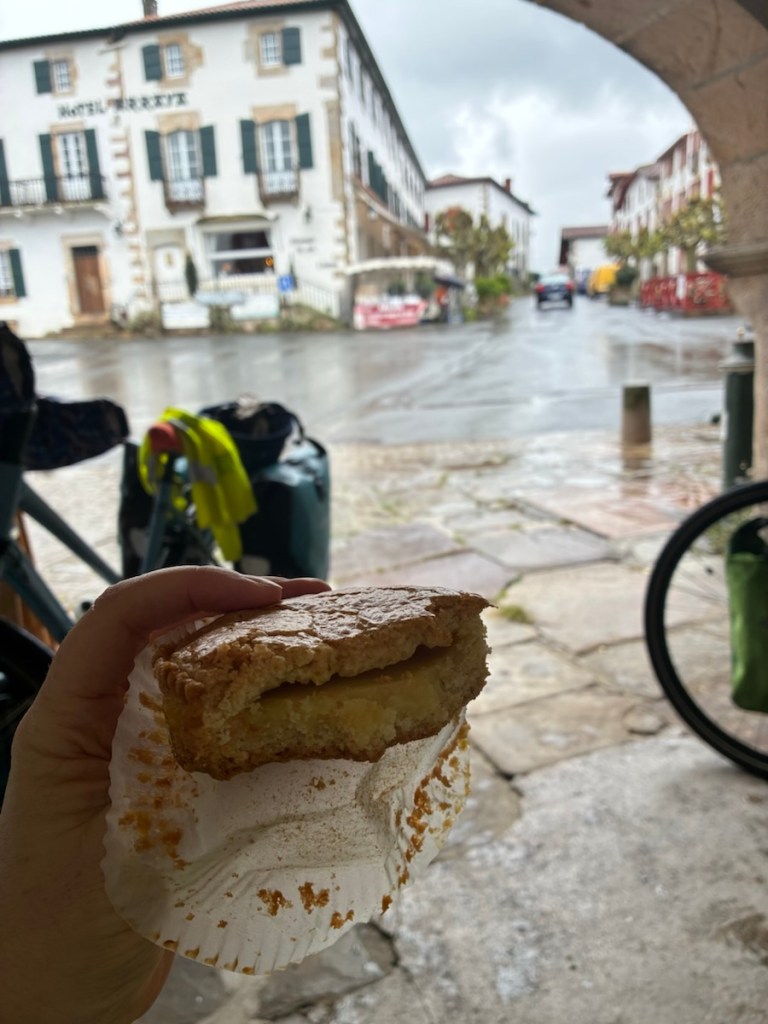
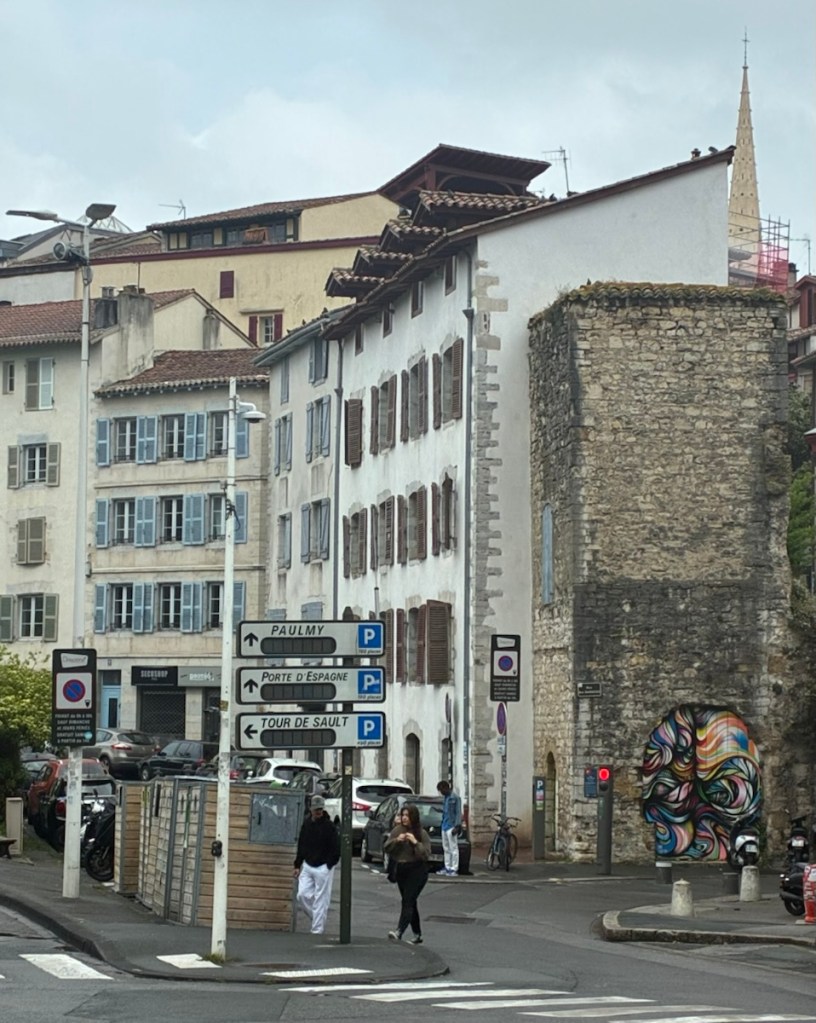
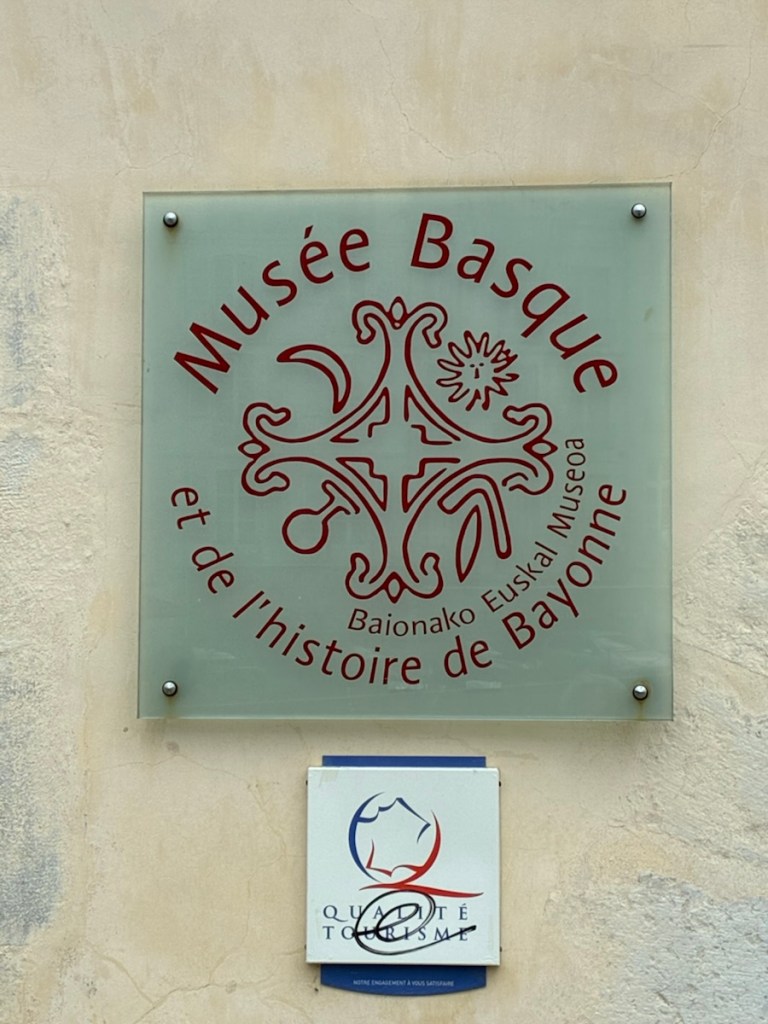
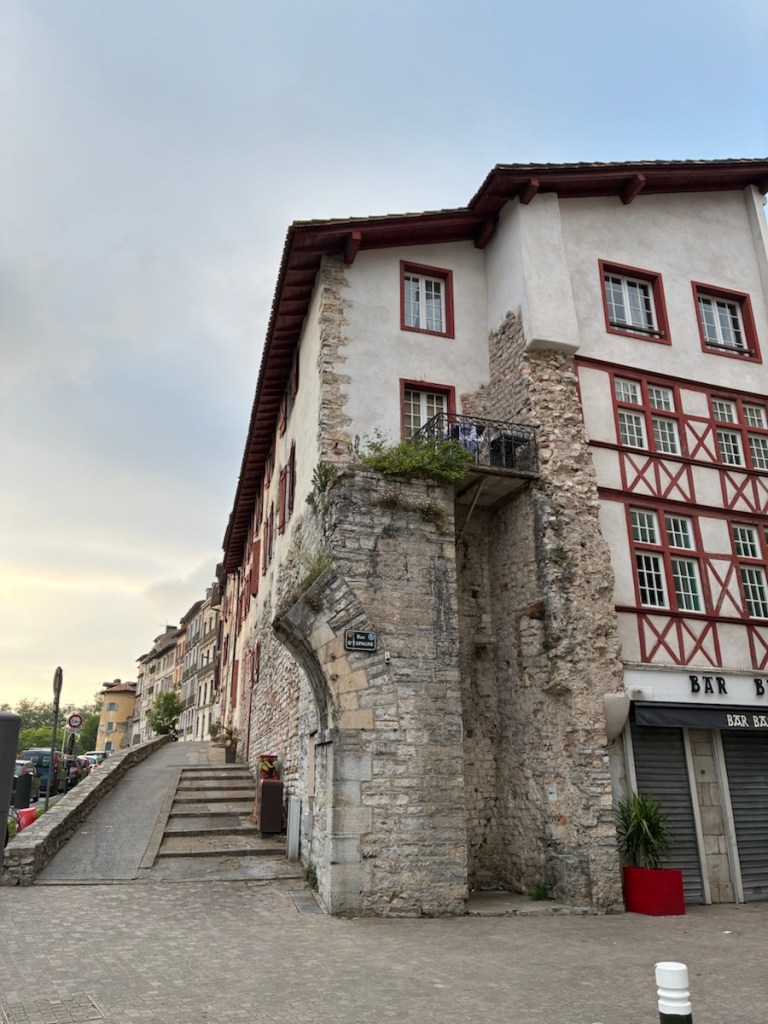
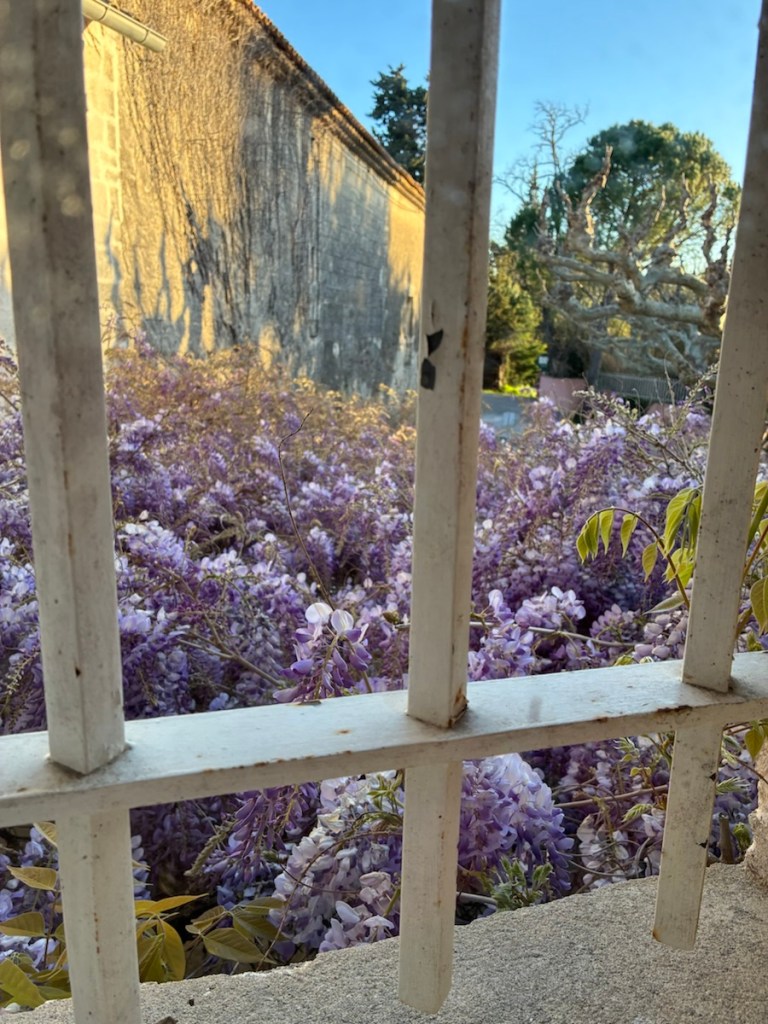
Hiding from the rain in the vestibule of a Church in Ascain. Rich went inside and told me I had to go in to see the cool wooden balconies.It is a traditional Basque church. Église Notre-Dame-de-l’Assomption de Ascain. The wooden galleries were new to us. We later learned in the Basque museum in Bayonne that they were added to accommodate the increase of population, and so women and men could sit separately. I imagine there was much making eyes and flirting going on across the way.Seafaring was an important part of Basque life. I love the model ship with its wee Basque flag.Churches with covered porticos are much appreciated. But, time to leave the church and head up another hill. With another helpful/motivational sign. 5% grade. This was the second segment after a starting 7% pitch.We topped the climb and the sun welcomed us to the downhill.Whee! Pay no attention to those big grey clouds.Focus instead on these fascinating stone fences. Walls? Enclosures?Flat stones lined up one after another.Whoops. While we were focused on the stone fences the clouds had their way.The little stand across the square was selling Gâteau Basque.The houses had a look to them in this French Basque area, the Pays Basque.White render (a surface coating), half timbered, and trim and shutters in the emblematic Basque red or green. The carved stone lintel usually tells the story of who first lived in the house when it was built, this one in 1662.Blue shutters and wisteria. This is in Ainhoa where we spent the night in what we shall always refer to as “dead mouse room”. No body was found but the smell was pretty recognizable. Staff was apologetic and thankful we didn’t pitch a fit. Eh, we said, old buildings have their challenges. We left the window open, they comped us wine.Stone fence AND a 1670 lintel stone! Pays Basque bingo anyone?Not many photos on this rainy Sunday. We’re trying to get to Bayonne in time to visit the museum of Basque History.Riding down the Nive River to Bayonne.Fragments of the old town walls still exist.Rich demonstrates how narrow some Bayonne buildings are – just about a Rich and a 1/2, about nine feet wide.We made it to the museum. So much information. If you don’t speak or read French it’s a bit of work to figure it all out, but worthwhile. A really picturesque town, and very lively.More bits of the ancient walls.And one of the few towers still standing. This was the executioner’s tower, now a private residence.The Nive river is running fast and high from all the rain.Narrow streets in old town.Bayonne in the sunset light.Looking down the Nive, towards the confluence with the Adour River.The look of a cyclist who knows she has a long day ahead of her. At least no rain! And we’re off riding out of Bayonne.Into the scrubby forests of the Atlantic coast.And the wide sandy beaches of the Capbreton area. We are still on the Bay of Biscay.Sand dunes and blue sky. A welcome change.Still smiling. Long day and headwinds haven’t gotten us down yet.
And then the photos kind of stop for the day. After about kilometer 60 or 70 I just focus on pedaling.
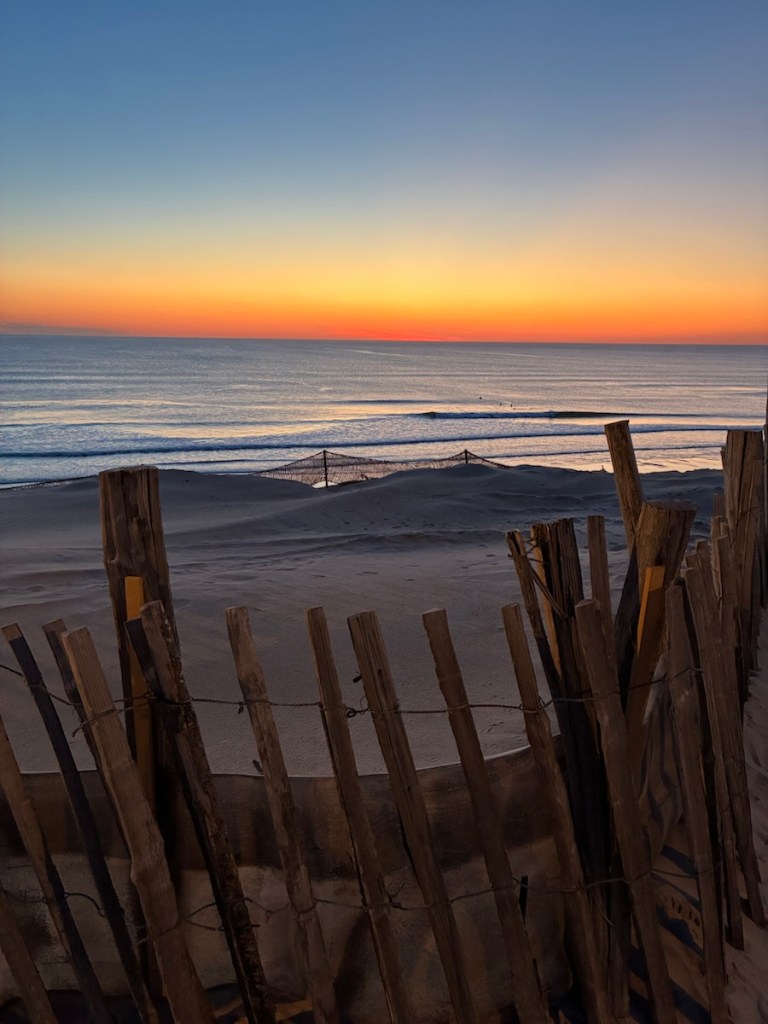
It was a lot of this. But at least the weather was nice! We made it! Giddy with relief and post shower. 90k/55m later. Contis les Bains and our long shadows on the beach at 8pm.The main drag down to the beach is packed with folks and noticeably car free. Space for restaurant and bar tables instead of parking.The Contis Lighthouse.If you weren’t on the Main Street you were up on the dune watching the sunset.Sunset, happy humans, and a weathered fence.And the next day we’re off again.
The reality of bike touring is a lot of packing and unpacking of panniers. We each have two back, two front, and one handlebar bag. Good times. When you have so many one night stays it’s a lot. But, it all came out of the bags so it must all fit back in, right?
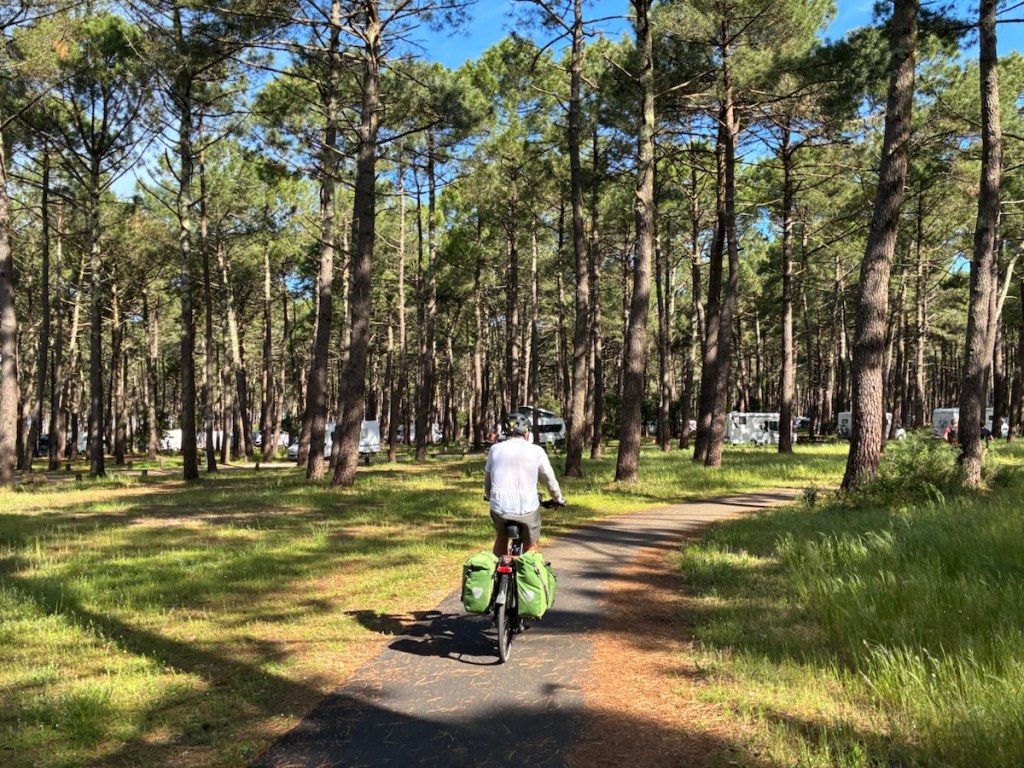
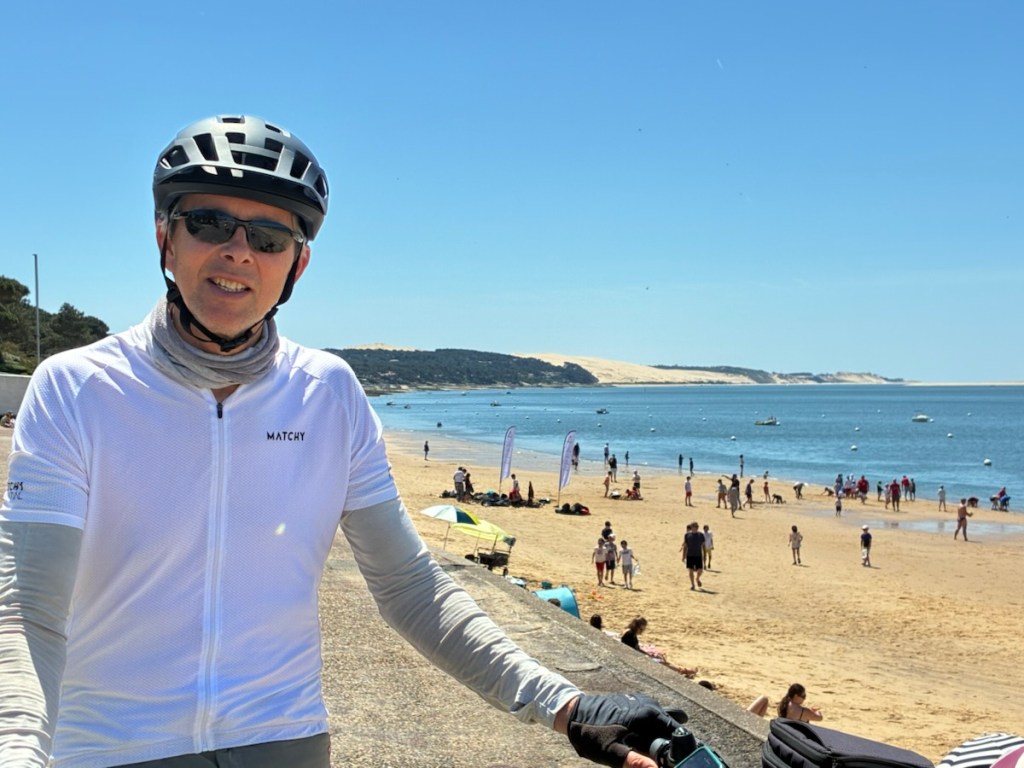
More Atlantic coast scrubby pine forest riding. This long stretch of bike path was just a dream. Lovely pavement, nice swooping curves.Take a break. At the grocery store. Big shaded entrance so why not relax?Riding by one of the lakes of Biscarrosse.The sunsets! Biscarrosse Plage where we spent the night.Breakfast fuel up for another day riding.The campgrounds were filling up on this Wednesday, April 30th. Folks ready for the May Day holiday.The terrain is about to change. Giant sand dunes! Folks practicing paragliding.Dune du Pilat in the background. Happy beach goers and a slightly cranky cyclist – this part of the coast is getting very busy. A long weekend and nice weather means lots of people out.Pour some more coffee in him! That might help. And tea for me. We’re in Arcachon, very close to where we will spend the night.The beach stretches were fascinating. Boardwalks and such a mix of old and new buildings.
Rich wisely booked us out of the fancier beach area and in a more relaxed area of the fascinating Arachon Bay: Gujan-Mestras. Oyster heaven.
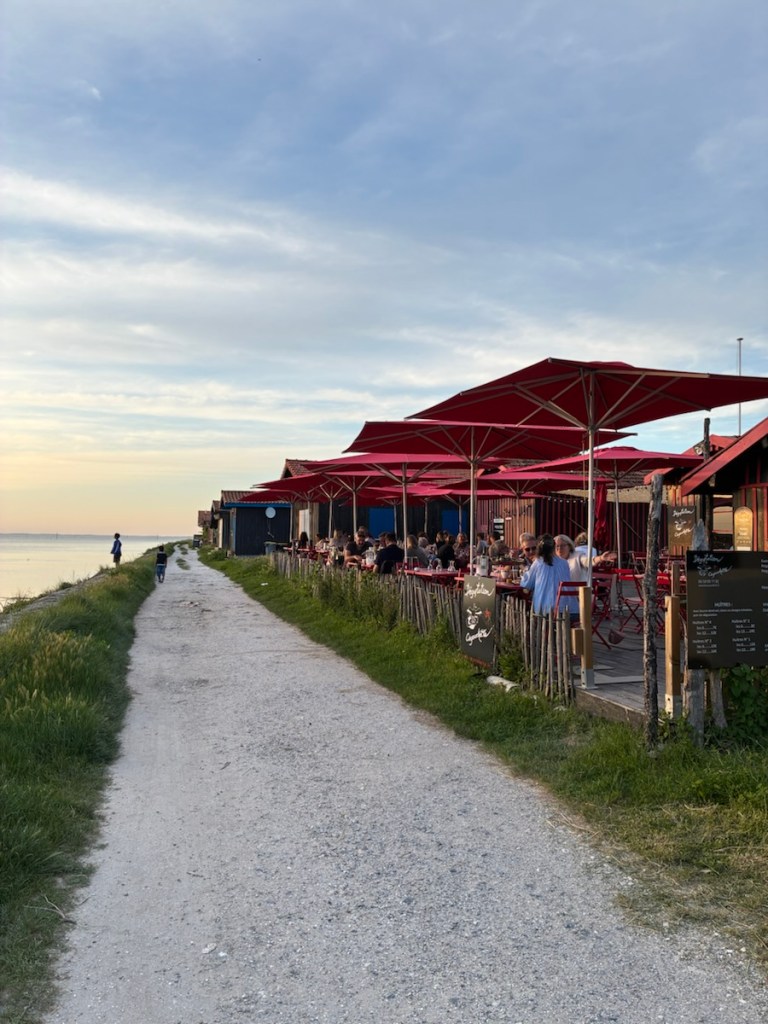
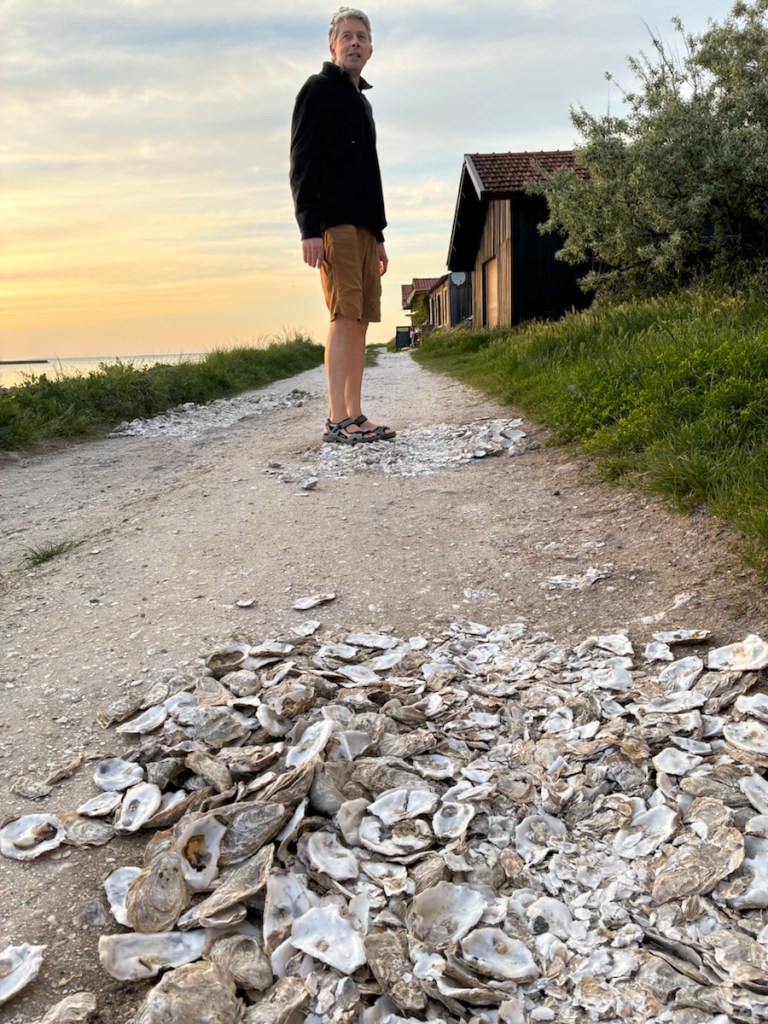
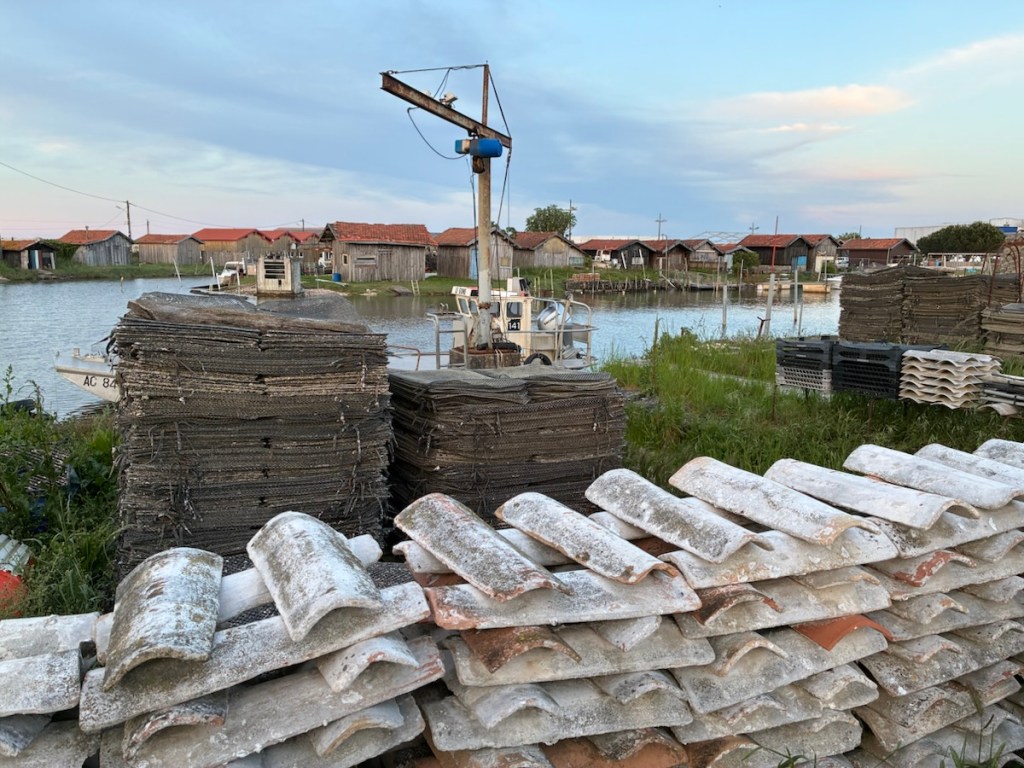
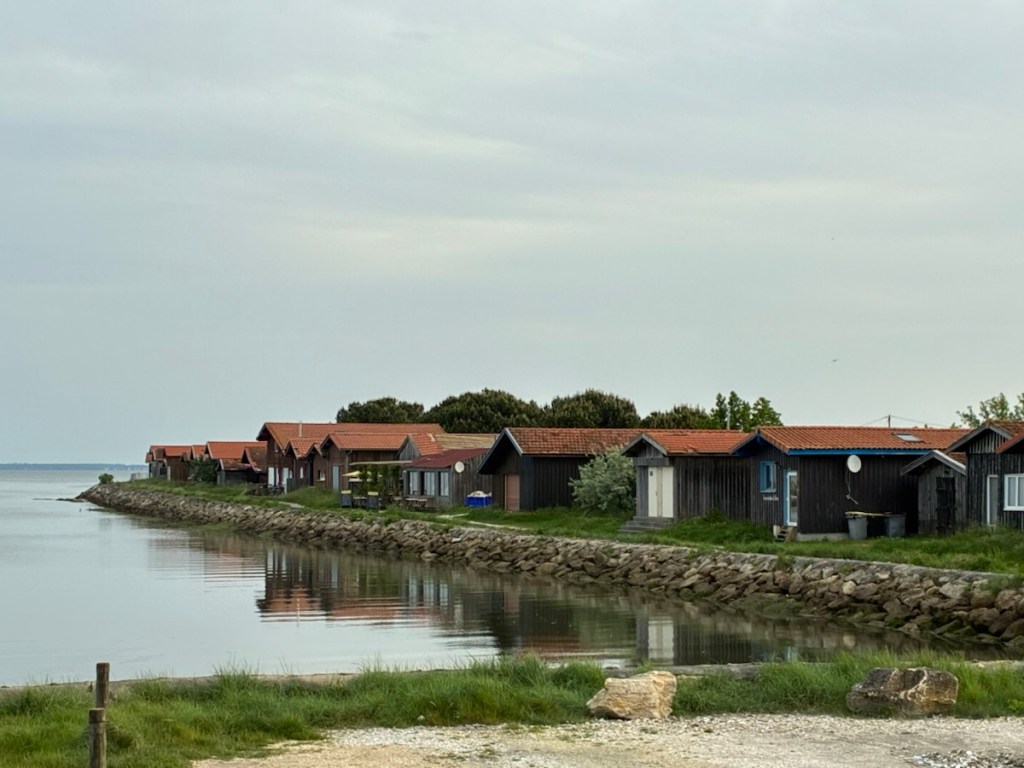
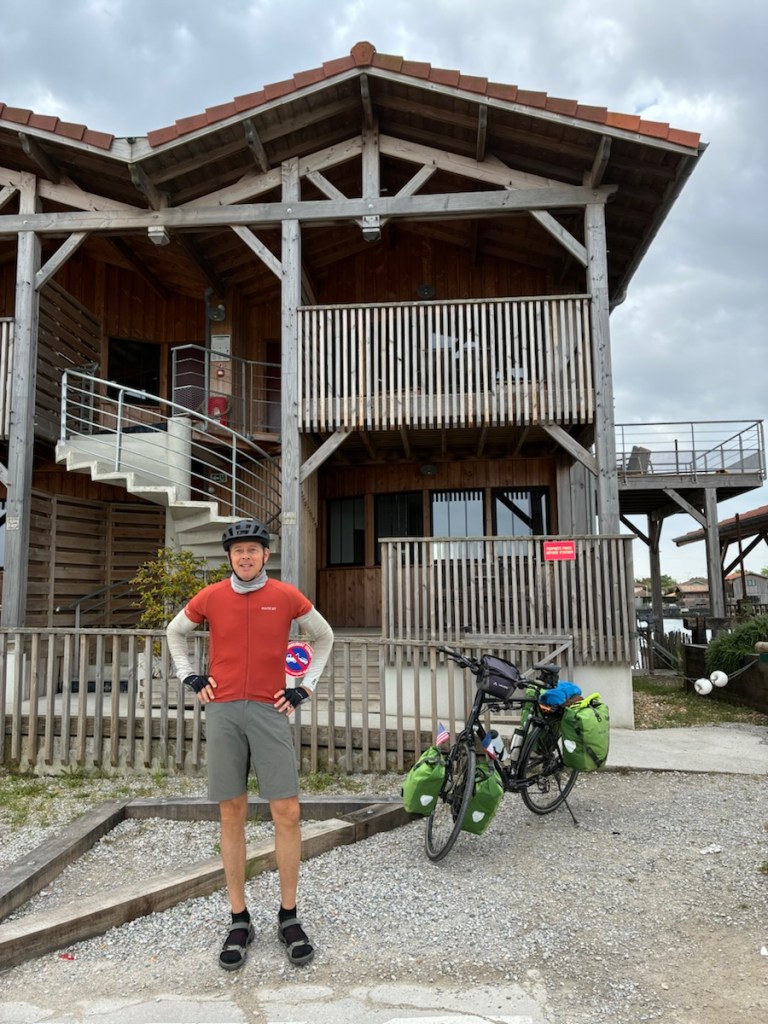
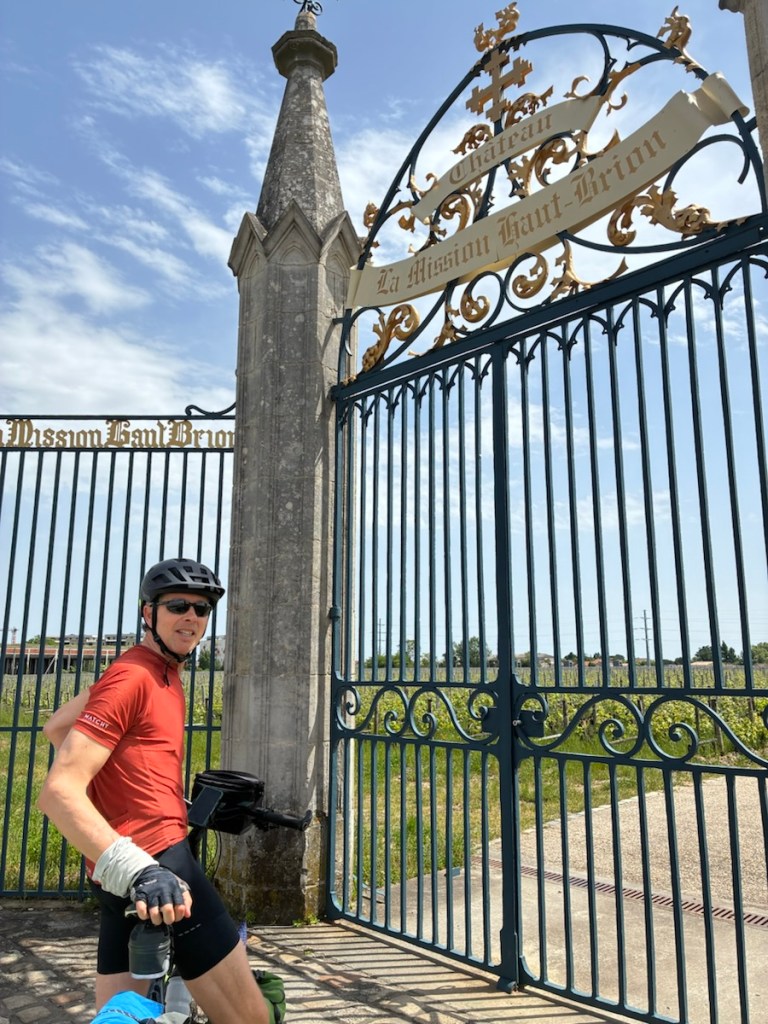
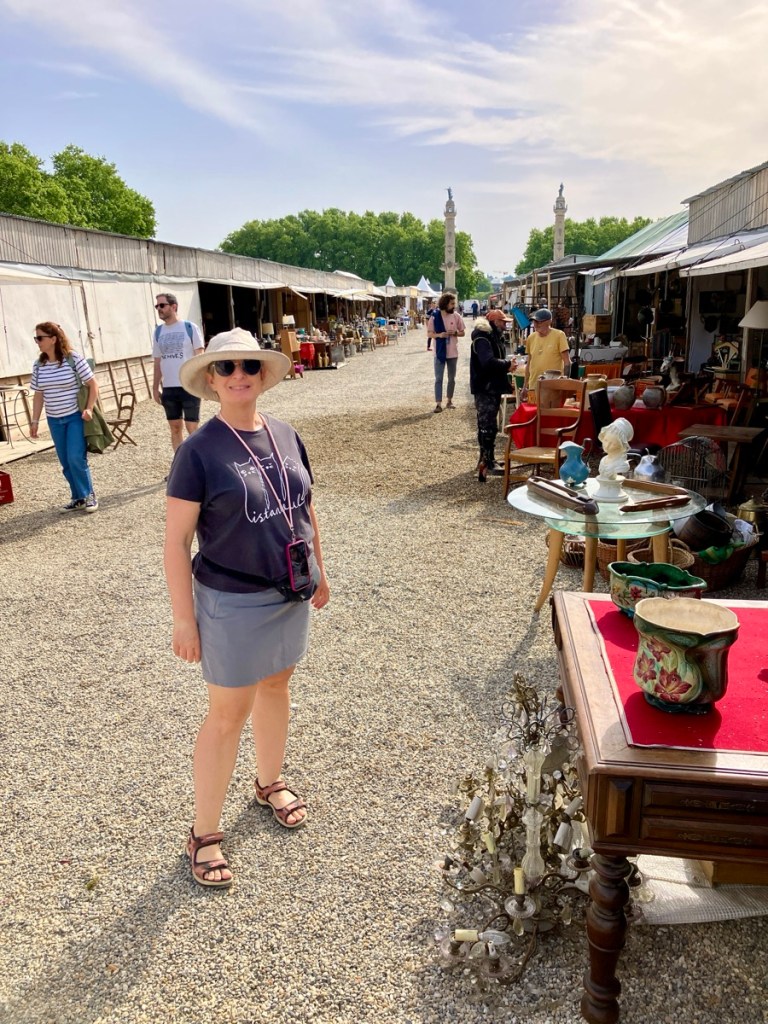
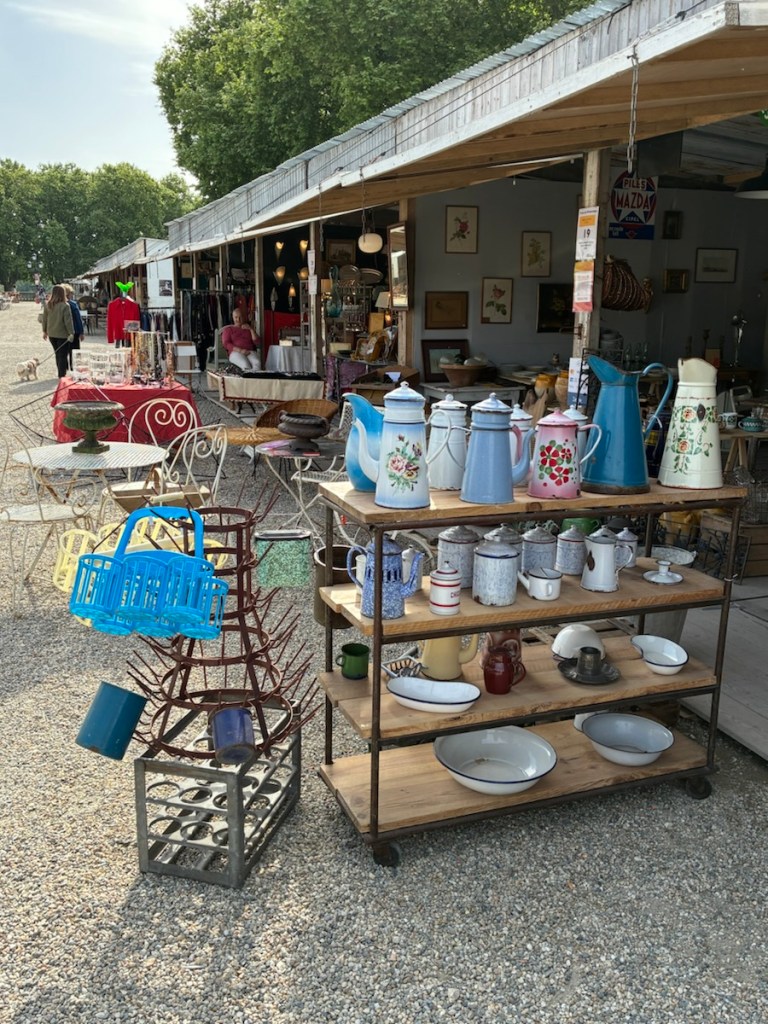
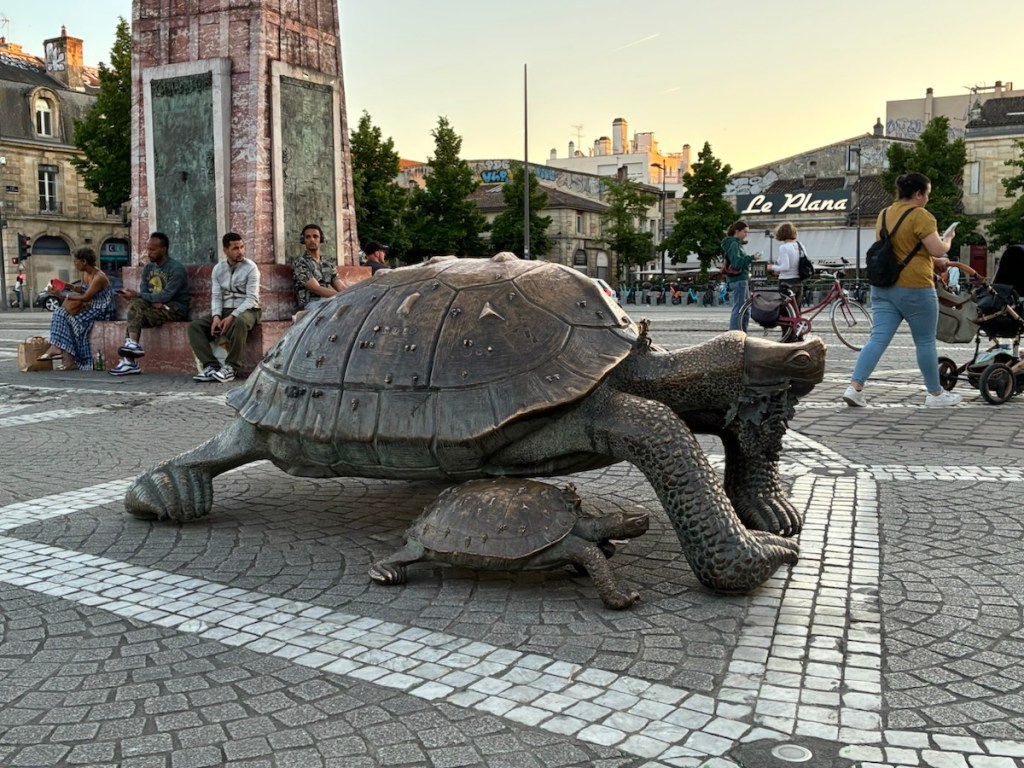
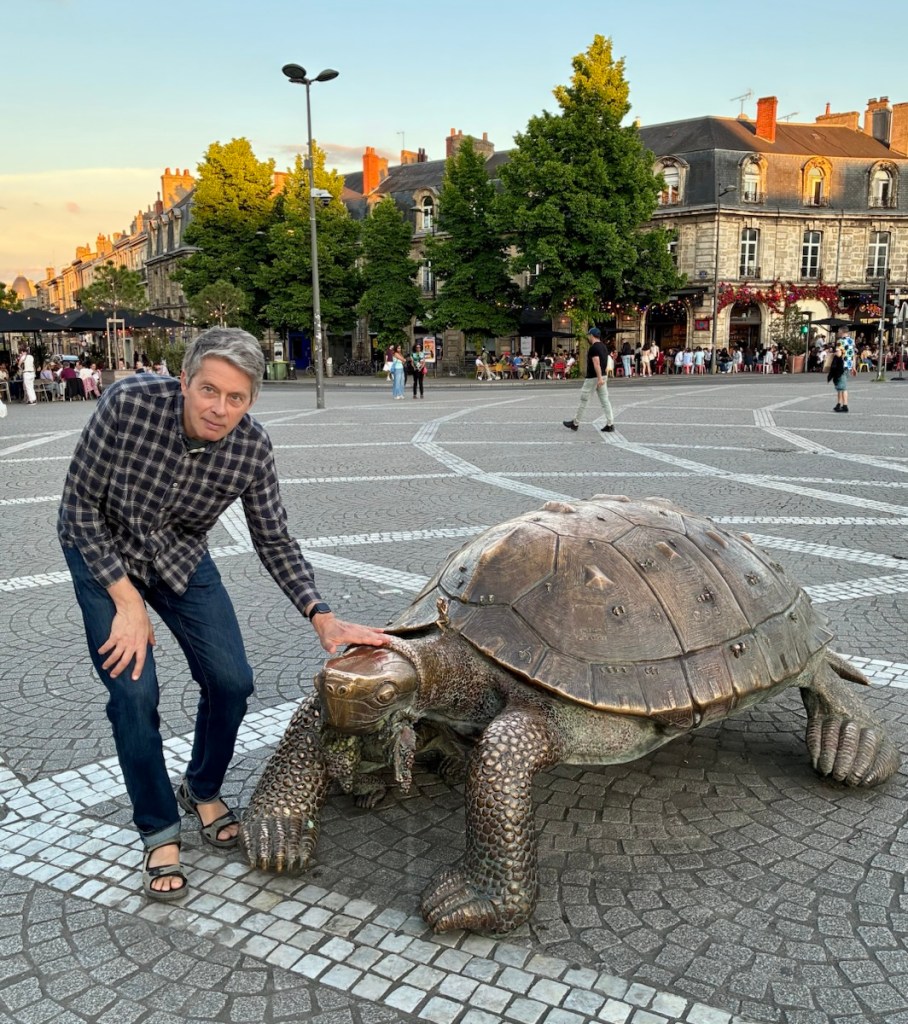
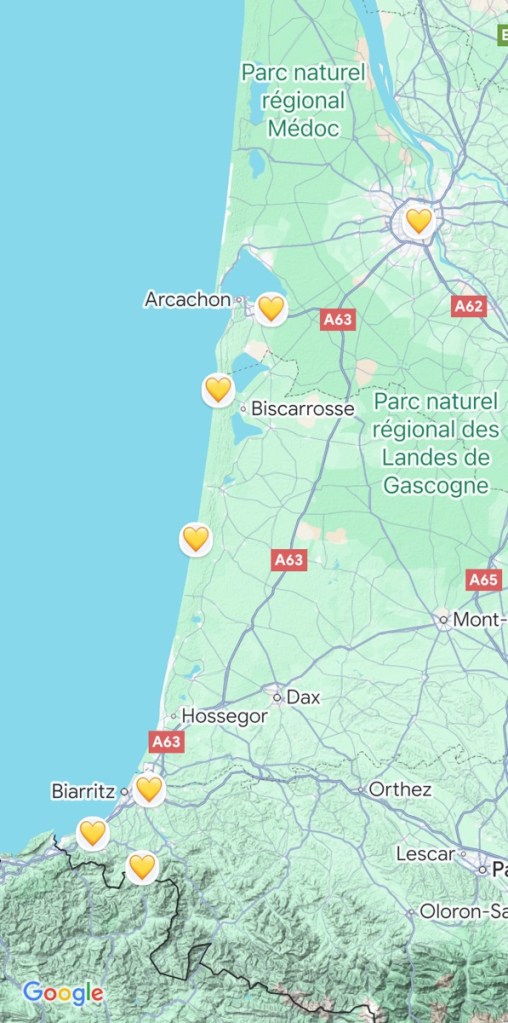
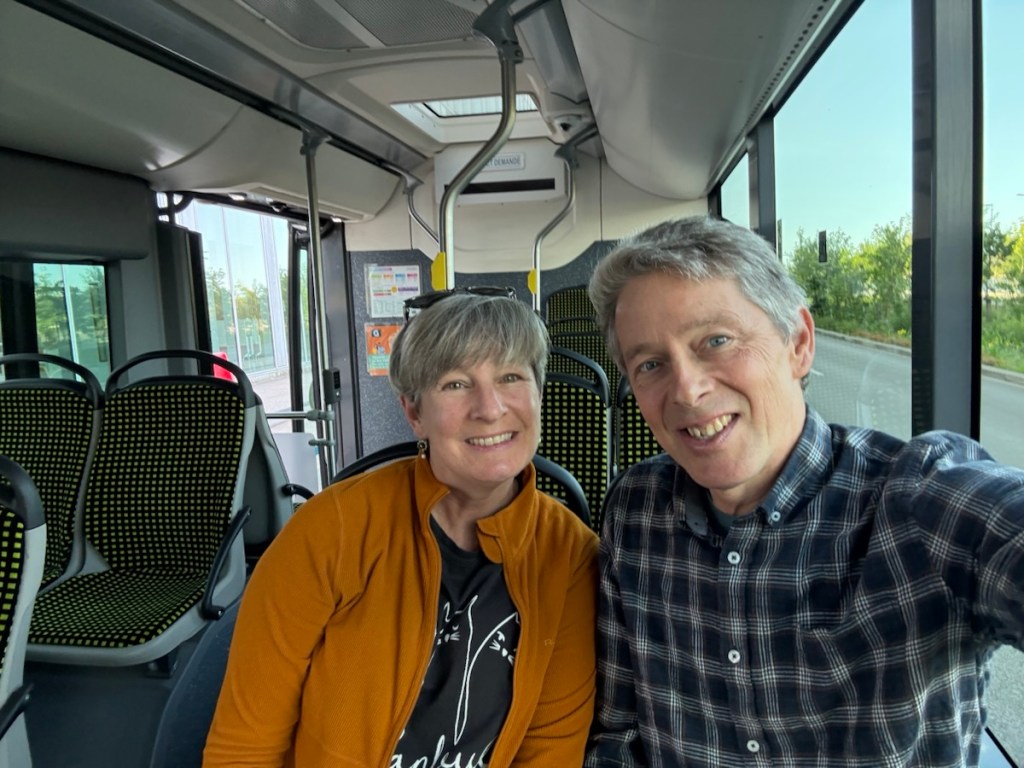
The oyster cabins. They serve oysters and wine. That’s it. The potholes in the dirt path are filled in the oyster shells.One of the seven ports of Gujan-MestrasA friendly cat helped us enjoy the sunset.On the jetty looking back towards the town.Celebrating the night before the May Day holiday. The barbecue is raging. Couldn’t tell if they were barbecuing oysters or other seafood. Or hamburgers.Tools of the trade.So many oyster shells. In most areas they are returned to the water to give the larvae of the next generation somewhere to hold on.Kitty showed up again to drink at the doggie bar.Port Larros, farewell.We’re off to Bordeaux for a much needed break. Three nights! We expected this road, Avenue de La Cotê d’Argon (D1250), to be an unfriendly bike route. But look! New cycle path! Not all the way but along a lot of it.May Day is a workers’ holiday, like Labor Day in the US, but way more widely celebrated. Little posies of Lilly of the Valley are sold at small road side stands. La Fête du Muguet (Lilly of the Valley Day).Why? In 1561 King Charles IX of France was given a posey of Lilly of the valley flowers as a present on May 1, and a tradition was born.Vineyards just outside Bordeaux. We hear they have good wine here? Who’s a good boy checking into the hotel? And sporting the French dog collar du moment – very wide. A huge bricolage, or flea market. I’d call it an antique market. Book a container and ship it all home…oh wait, we don’t have a home! Chicken pitchers!A bottle drying rack and enamel ware pitchers.Rich checking prices on bottle drying racks. Bassins des Lumières, a WW2 German constructed submarine base now a light show exhibit.Place de la Victoire has two stunning creations by Czech sculptor Ivan Theime to celebrate the culture of wine.First, the mama and baby tortoises. Rich added for scale. I didn’t realize how lucky we were to get a photo free of other people- ok, kids. Mama tortoise is eating grapes.And she is festooned with little figures, also holding or wearing grapes.The red marble obelisk, same sculptor. Makes an imposing focal point to go with the more whimsical tortoises.Since returning to France. The top heart is Bordeaux. We had seven days of riding, which explains why we were so tired when we got to Bordeaux.The tired happy travelers enjoying a tram ride in Bordeaux.
Next up, some pretty rural and remote riding through the French countryside, roads that go up and down for no good reason, and a train to Paris.
Suddenly you look up and two weeks have gone by! But you think back and can’t believe it was only two weeks ago that we got on our bikes (March 31) and headed to the train station in Annemasse. A hop through Lyon to Avignon to spend the night, and then train to Béziers, and ride on to Narbonne. Phew. That sounds easier than it really is, which is why we spent two nights in Narbonne to get our bike touring mindset on.
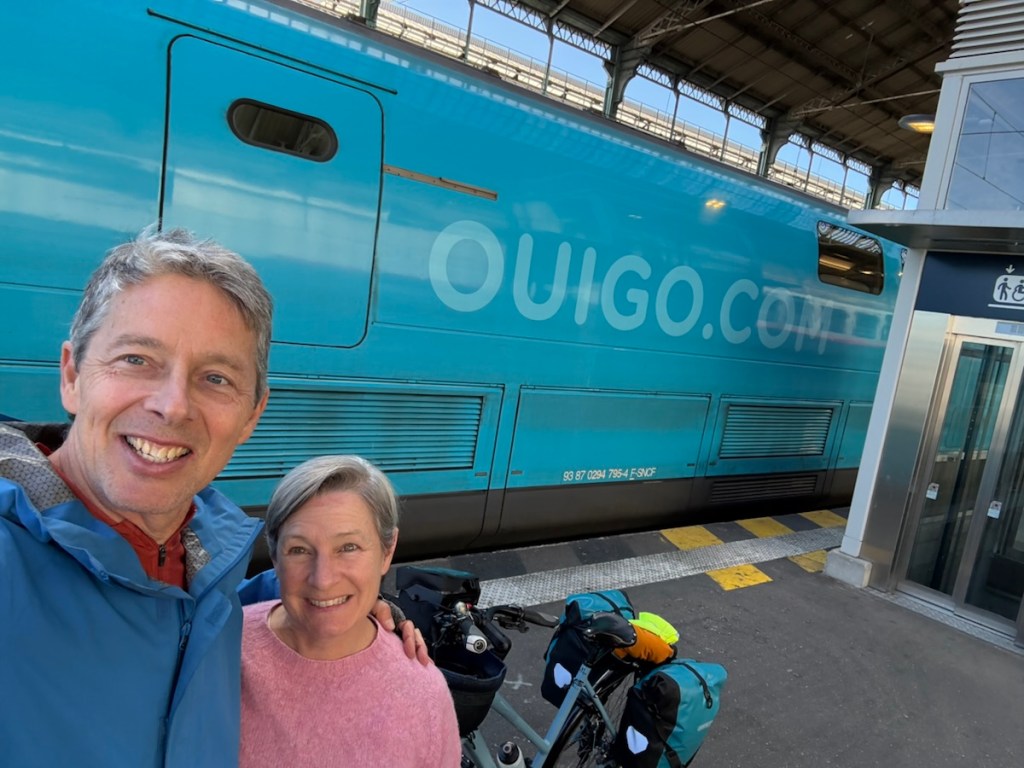
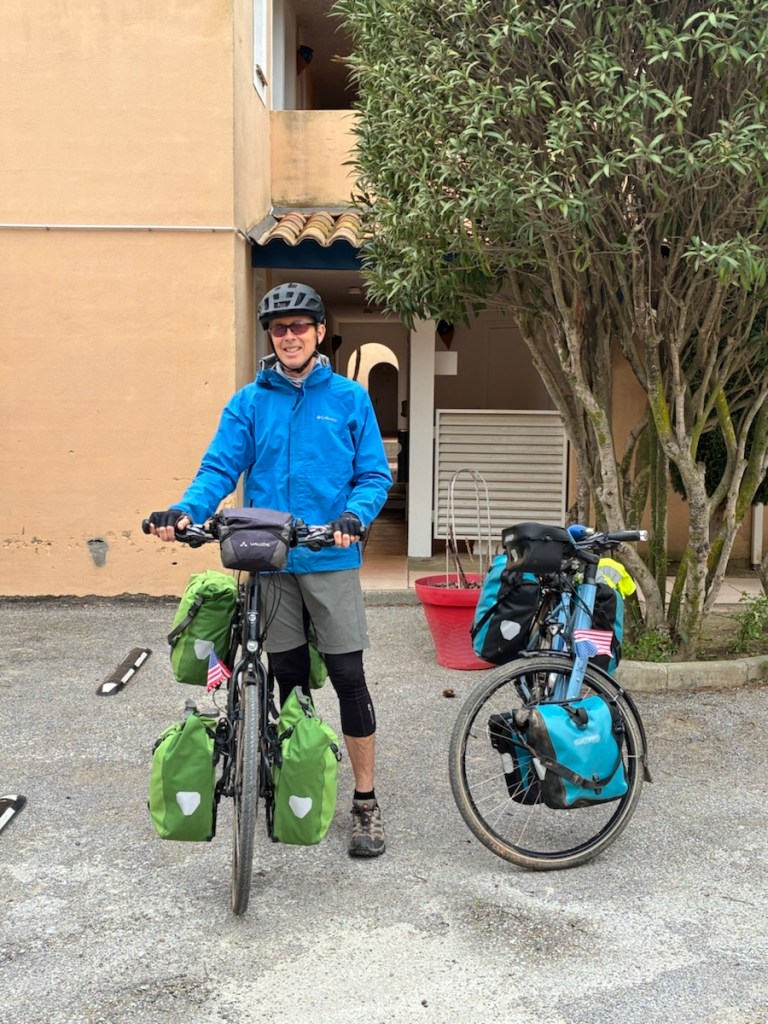
The alps coming out to say bon voyage.Lyon’s wonderful bike lanes. Our long train transfer was between stations so we got to leisurely ride across town.Rich’s American flag doing its job and attracting a chat from a local.My panniers match the train. Although the high speed Ouigo train is not for us.One night in Avignon.Ready to get off the train in Béziers.Our plan to get on our way was derailed by a long chat with another bike tourist, Martin from Holland.
Our plan was to use trains to get south and ride in Spain before the weather got hot. Neither of us are happy cycling in hot weather. We had been in Béziers on bikes before, but this time we’d ride out a different direction. After a good long chat with Martin who was also riding a Koga bicycle, it was time for a lunch stop.
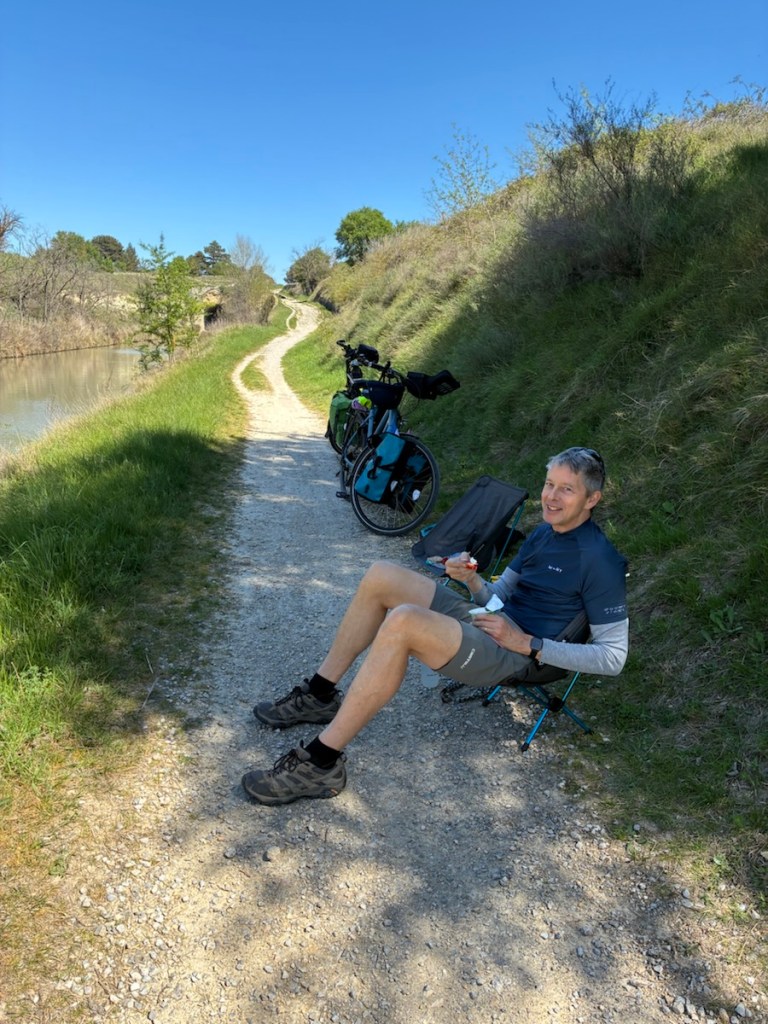
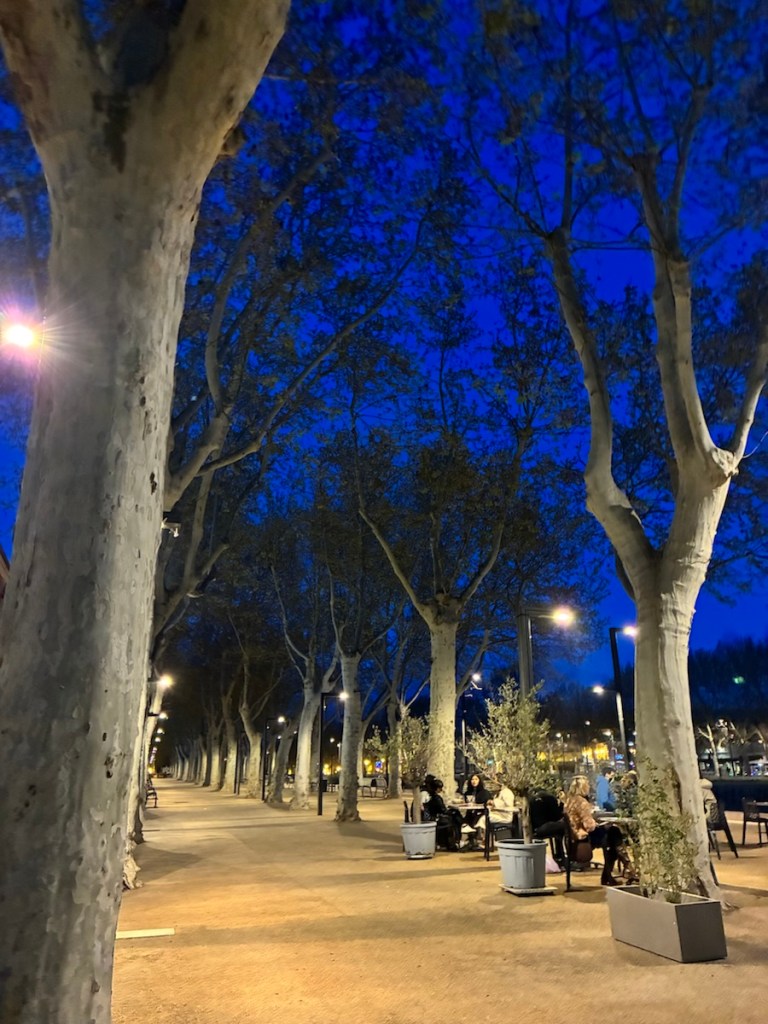
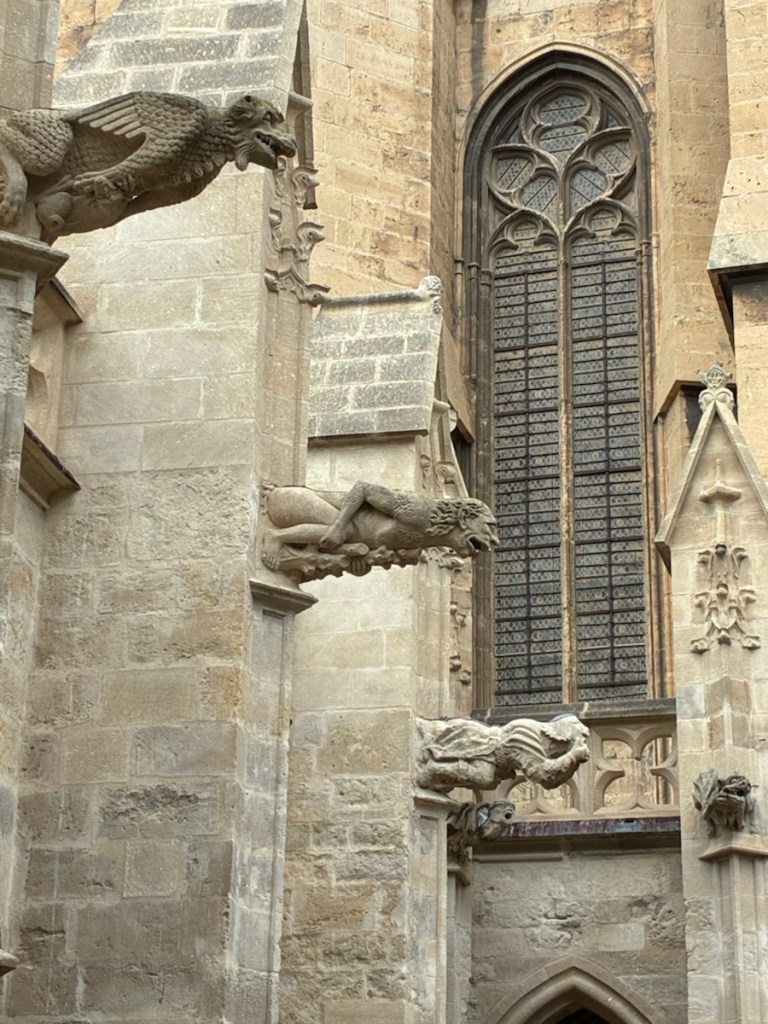
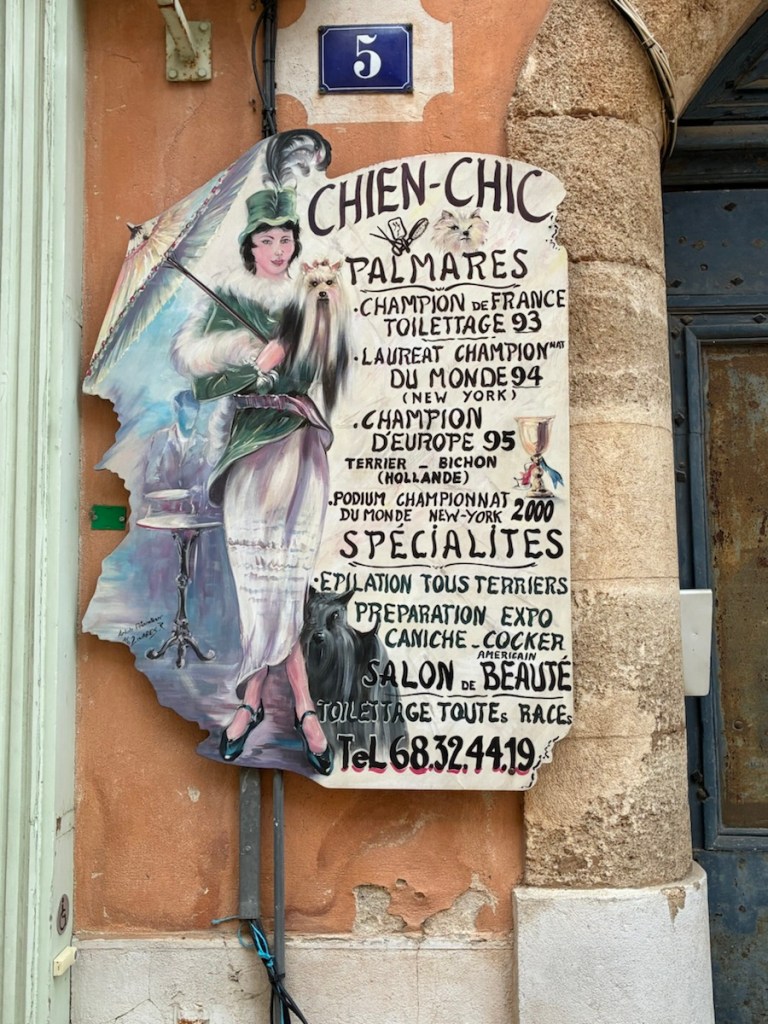
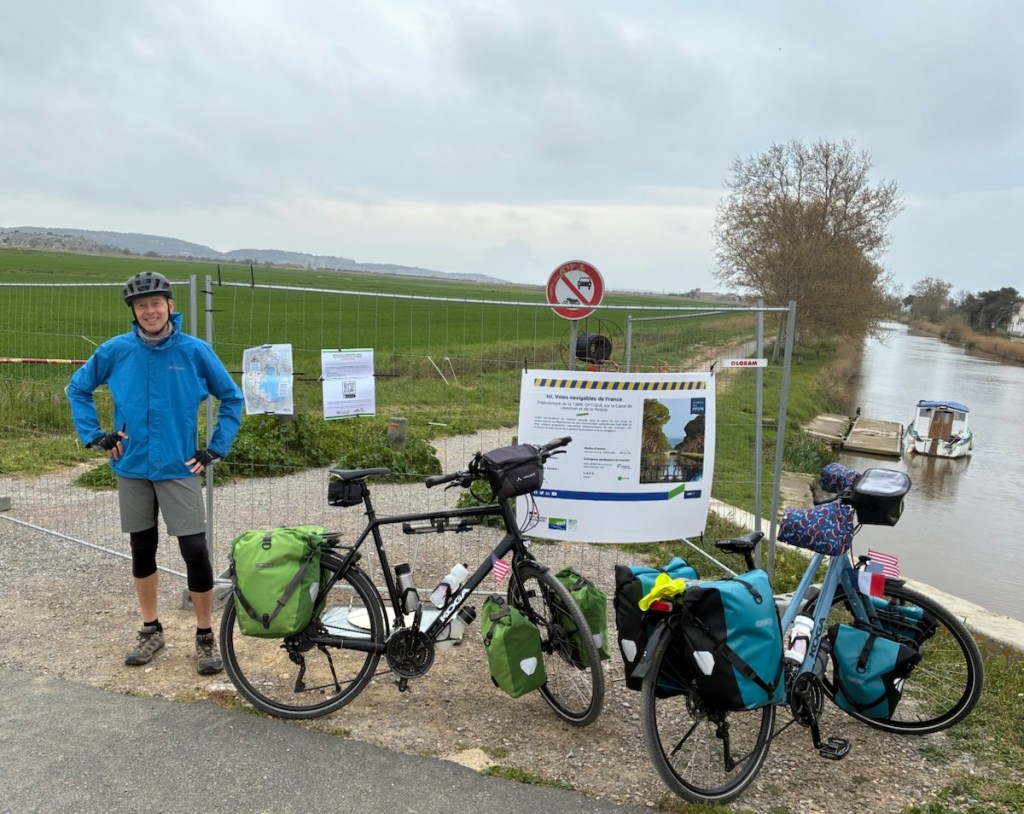
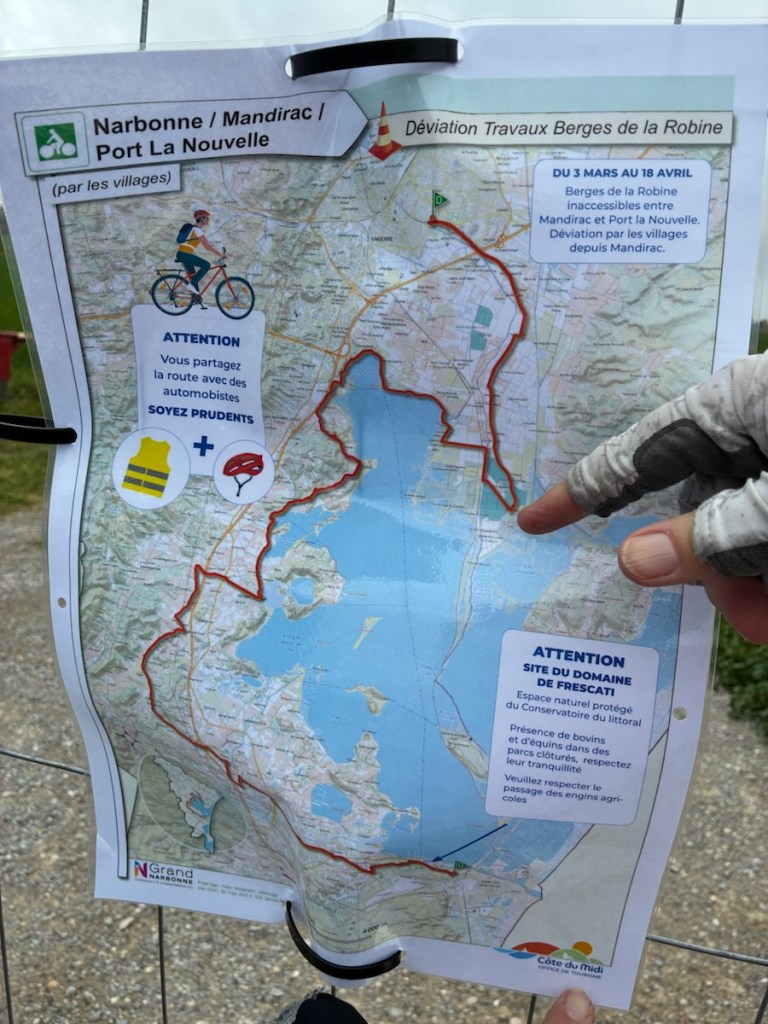
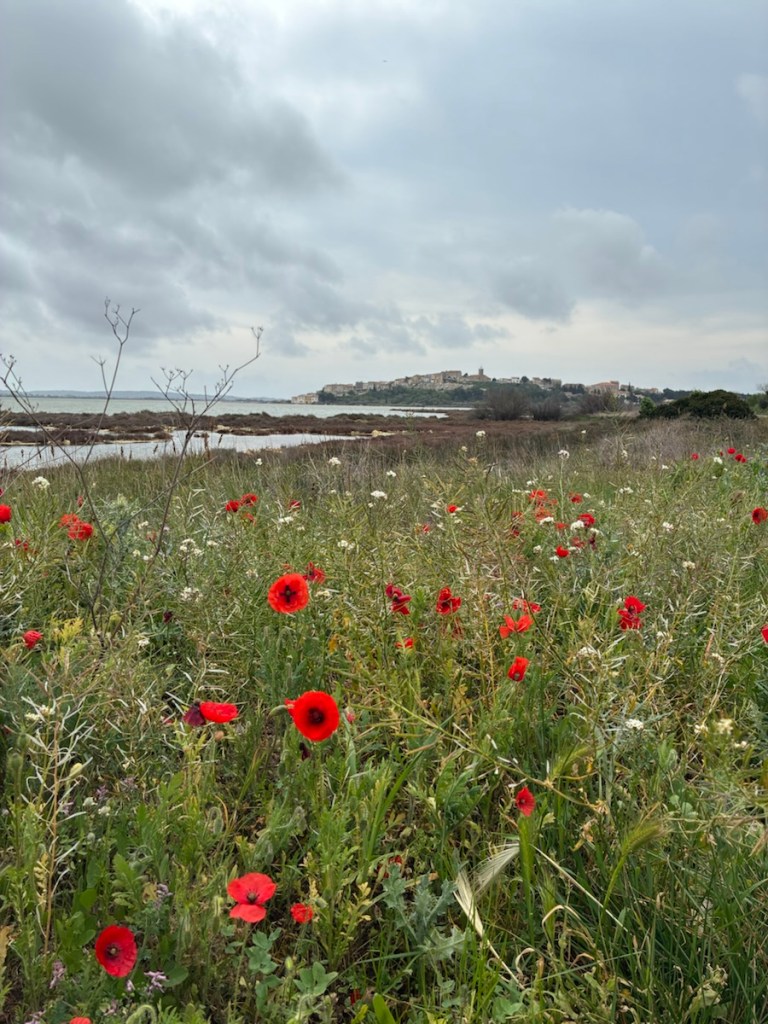
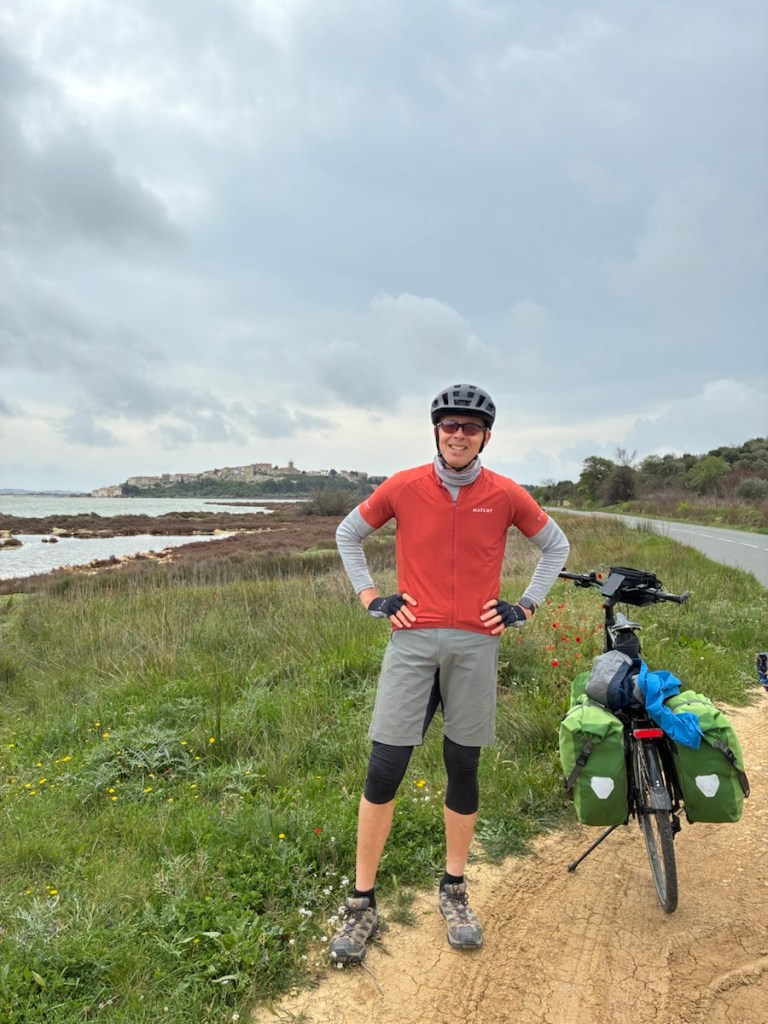
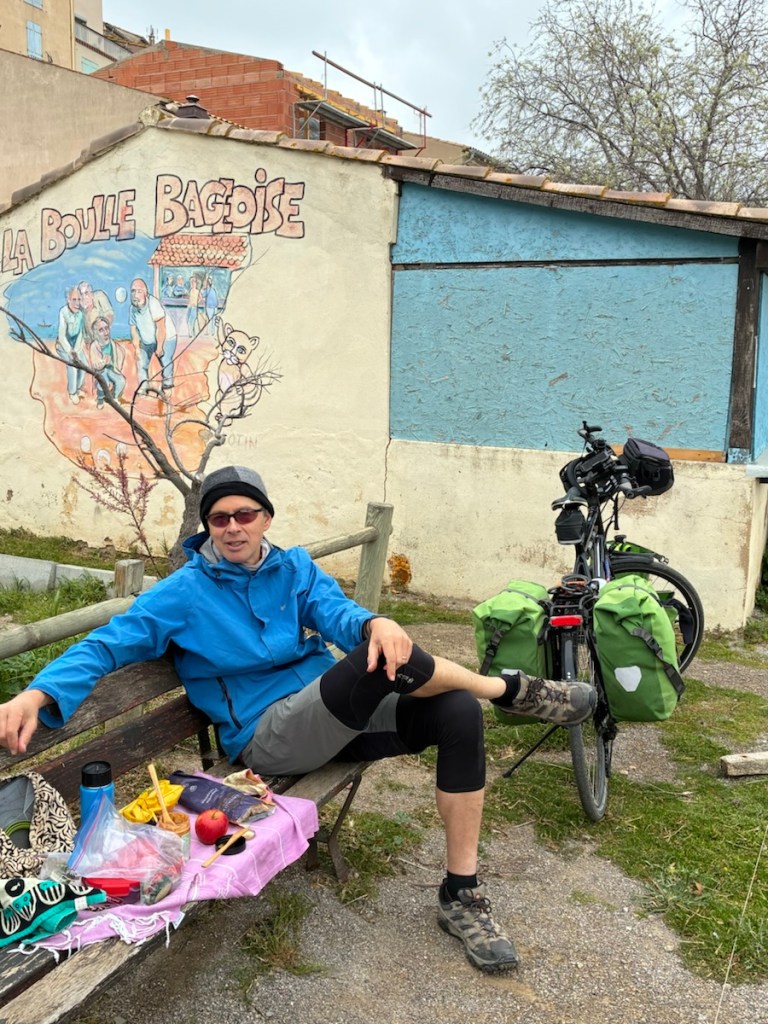
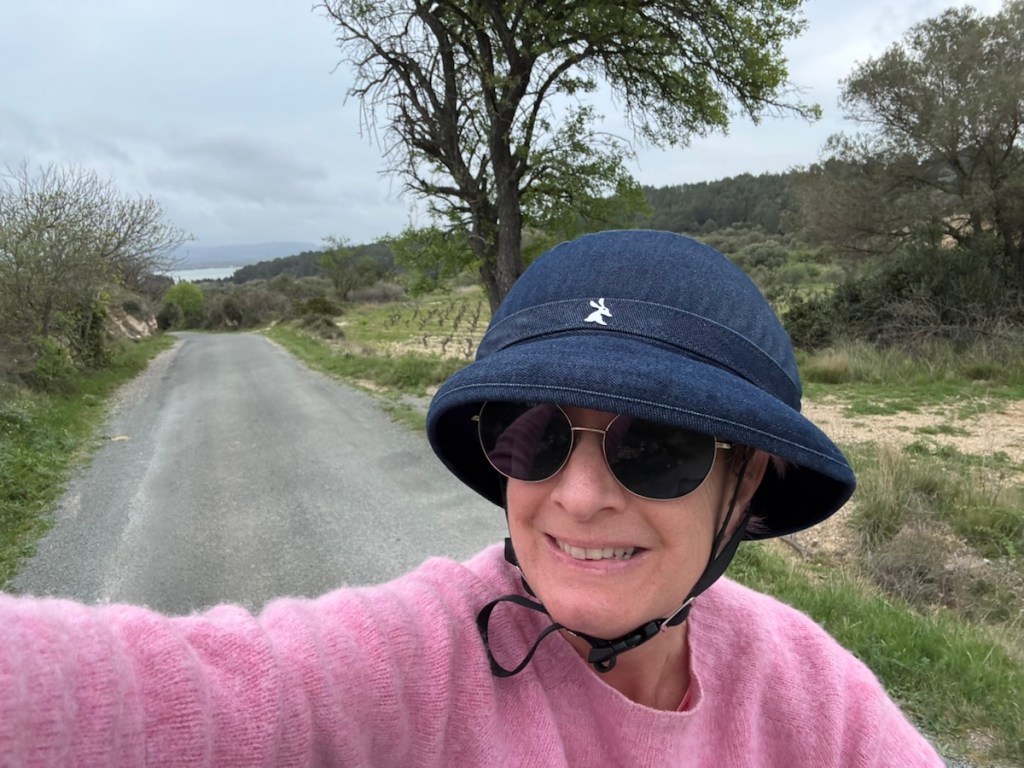
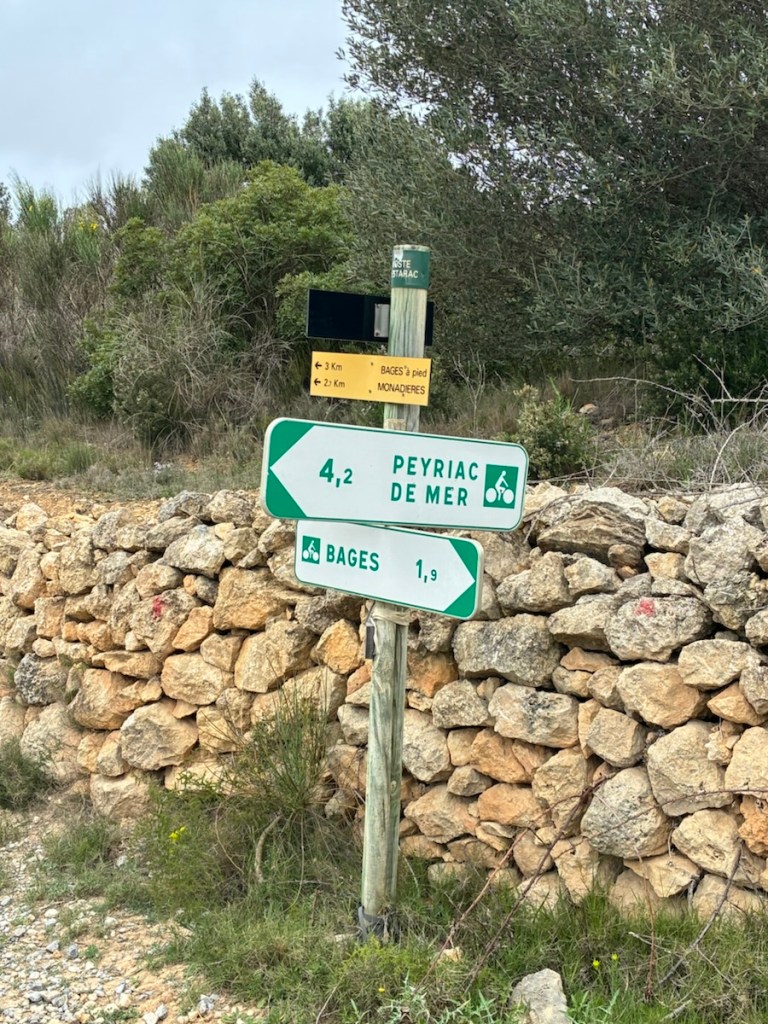
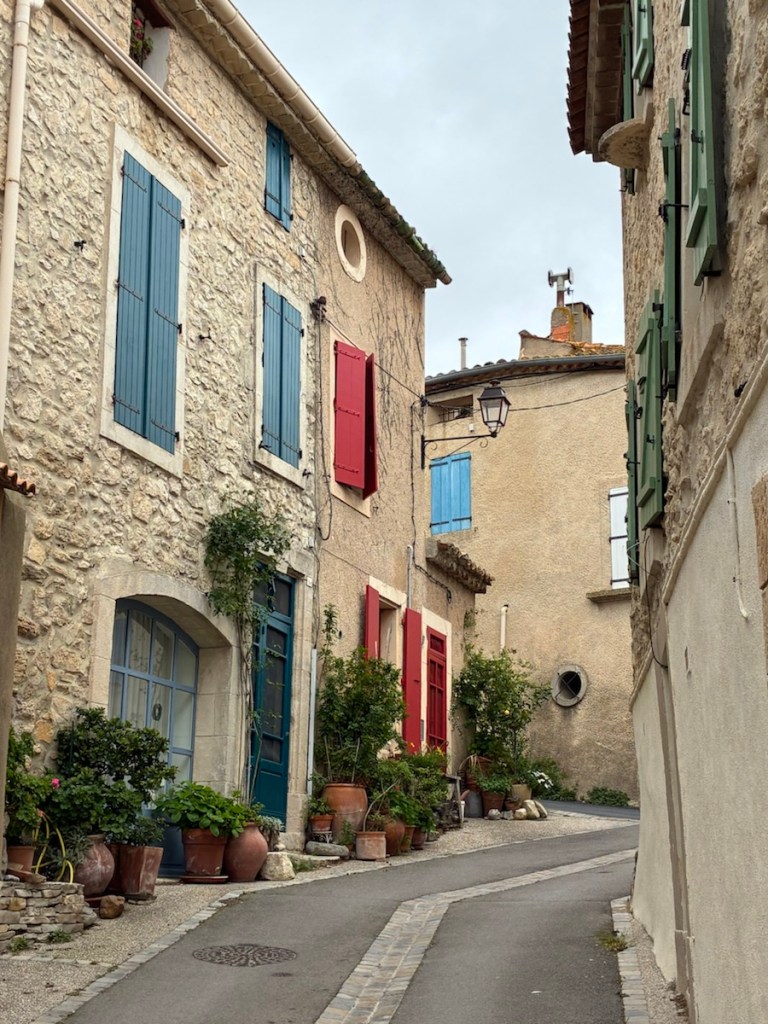
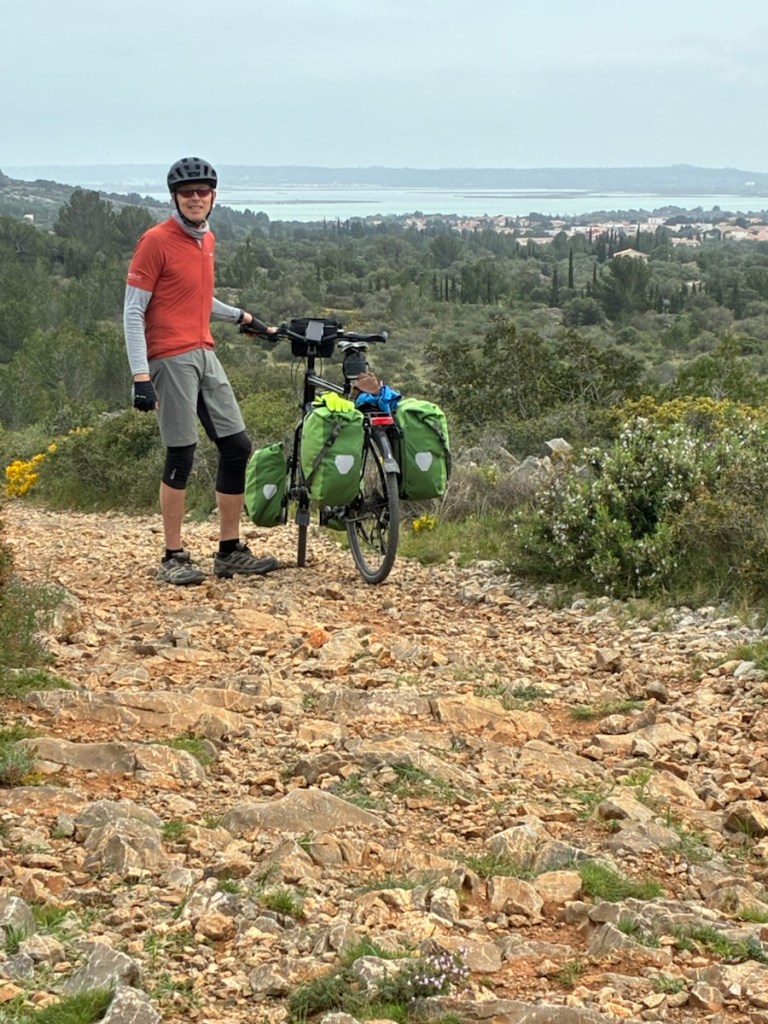
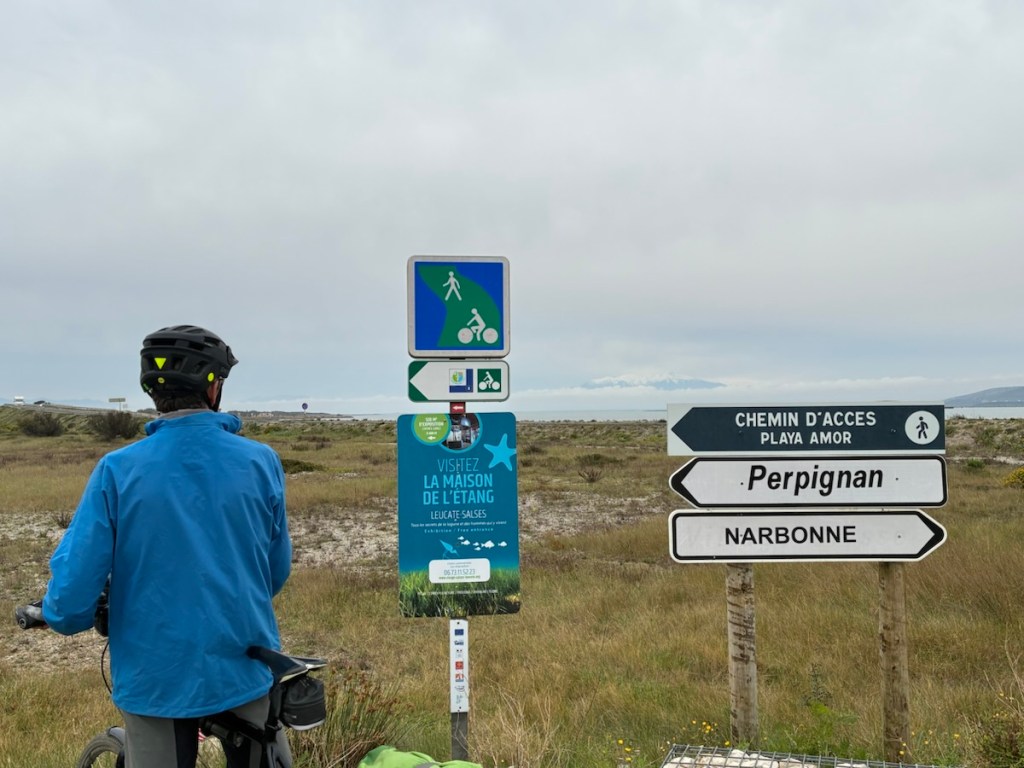
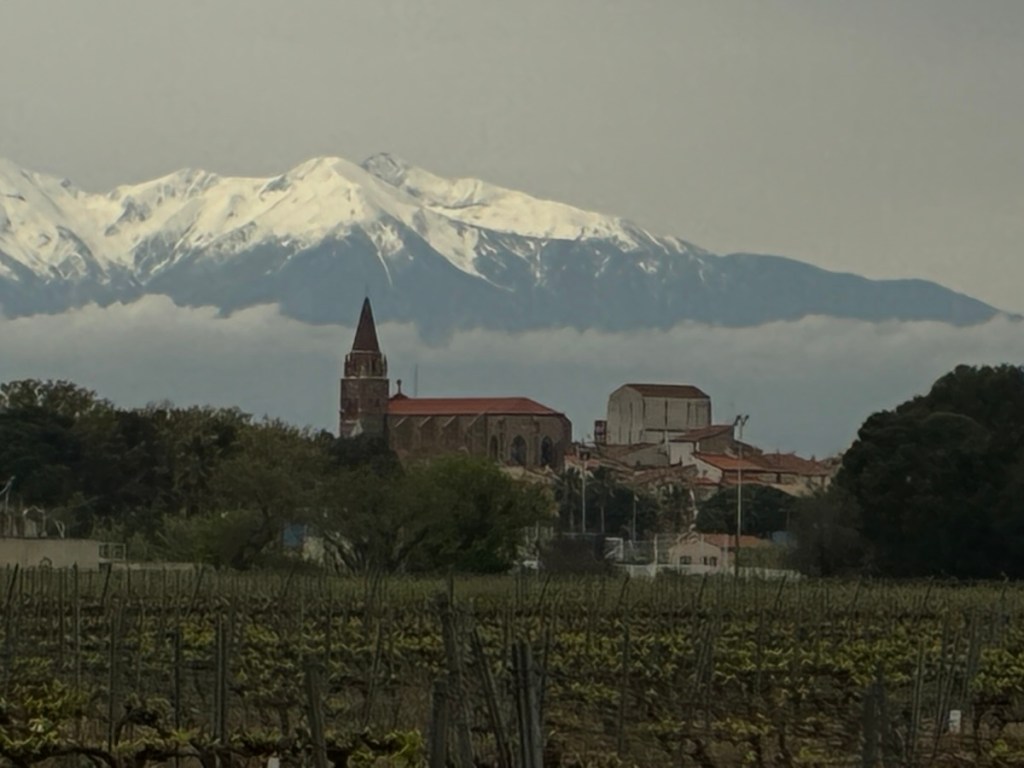
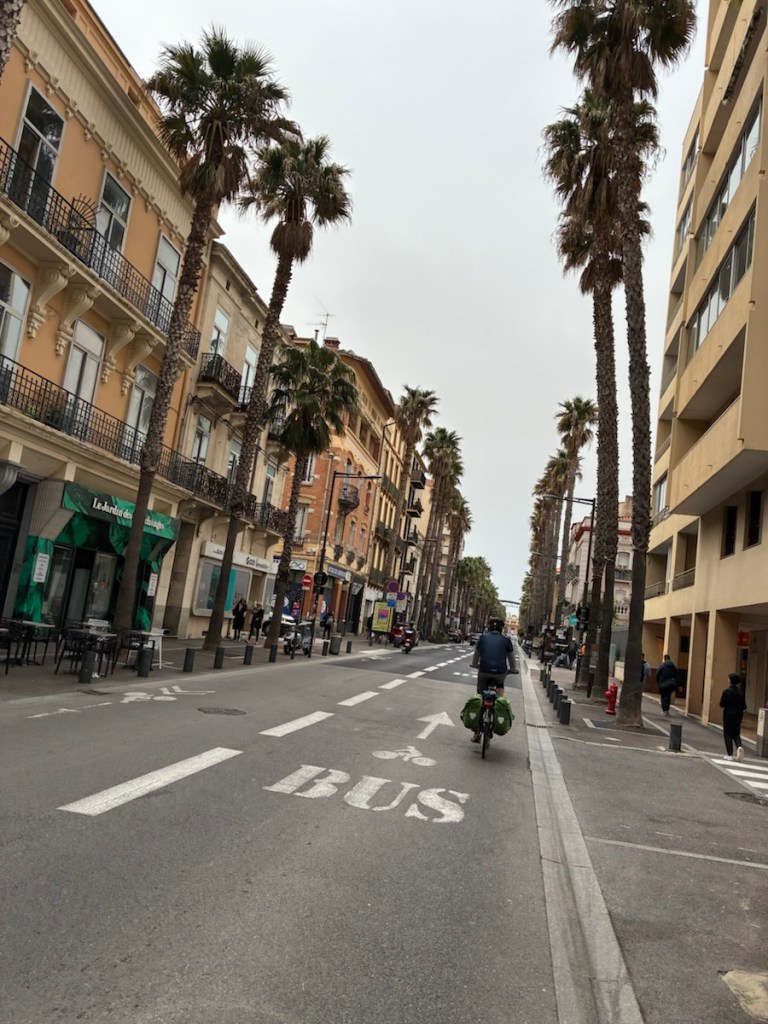
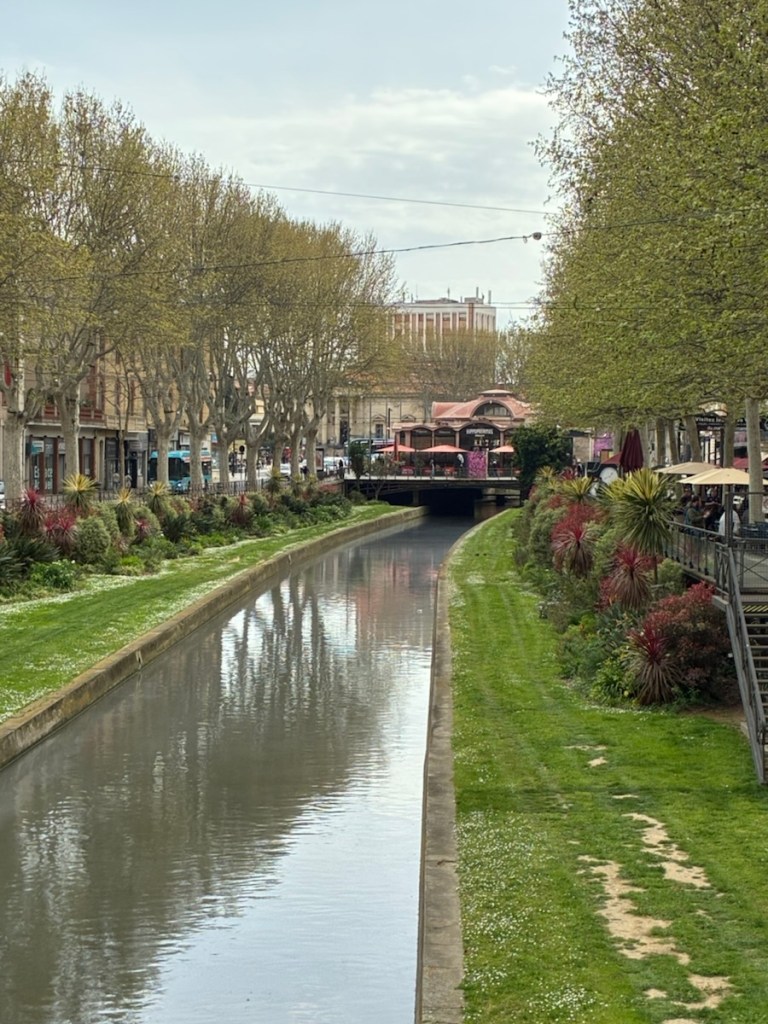
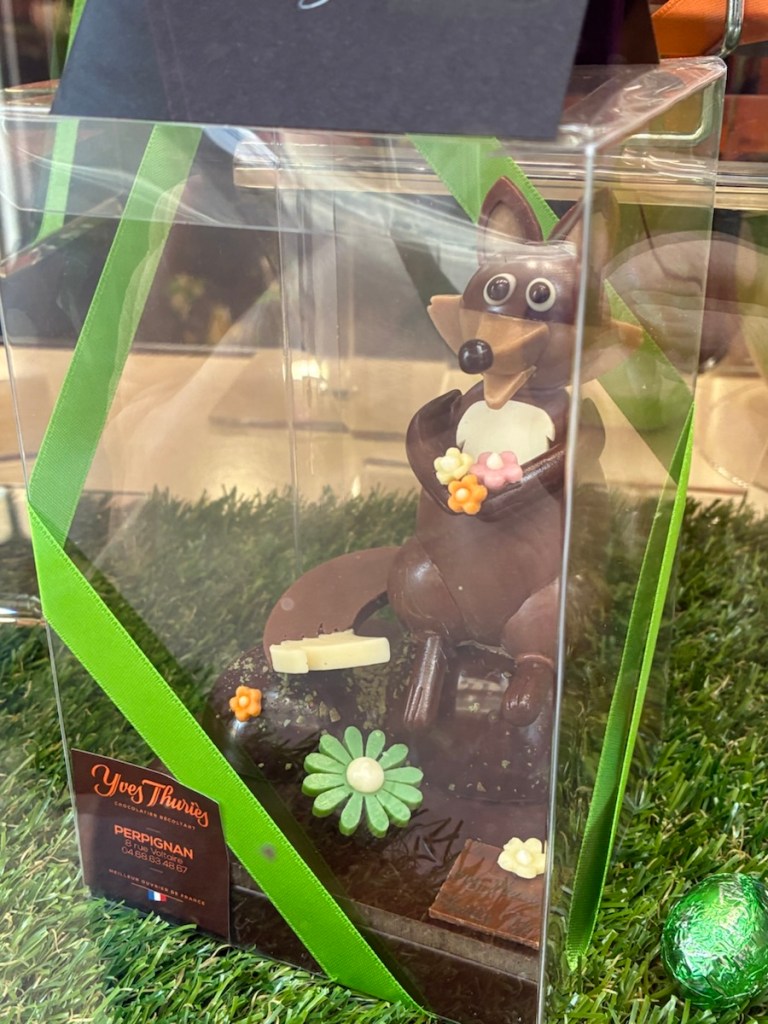
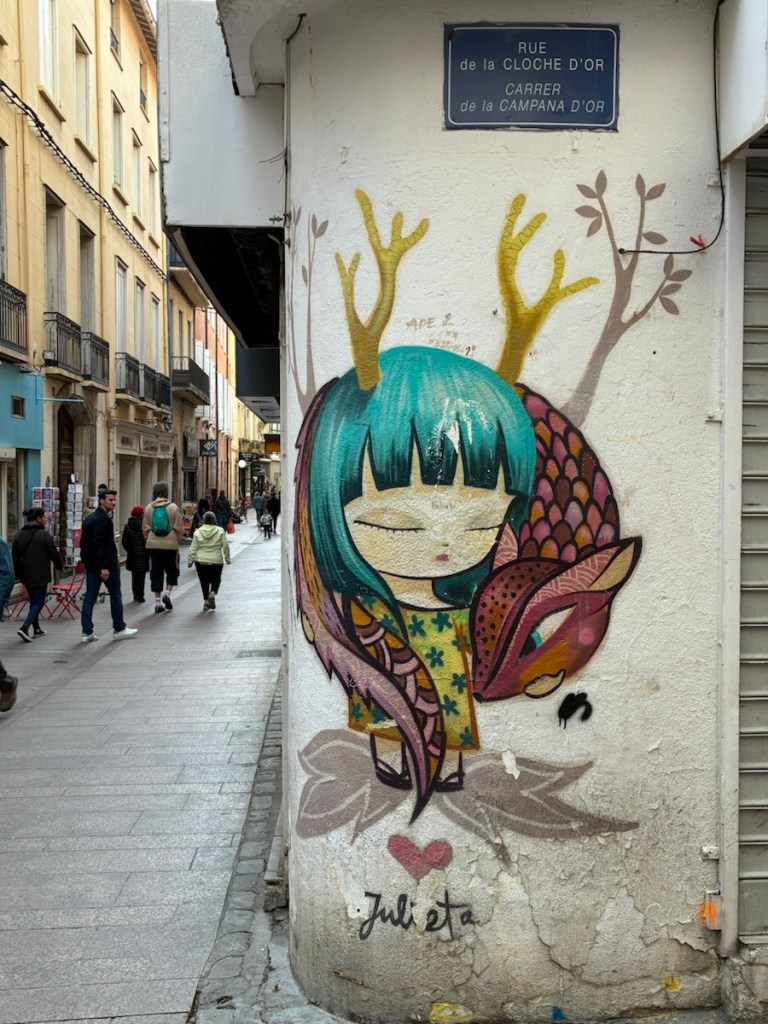
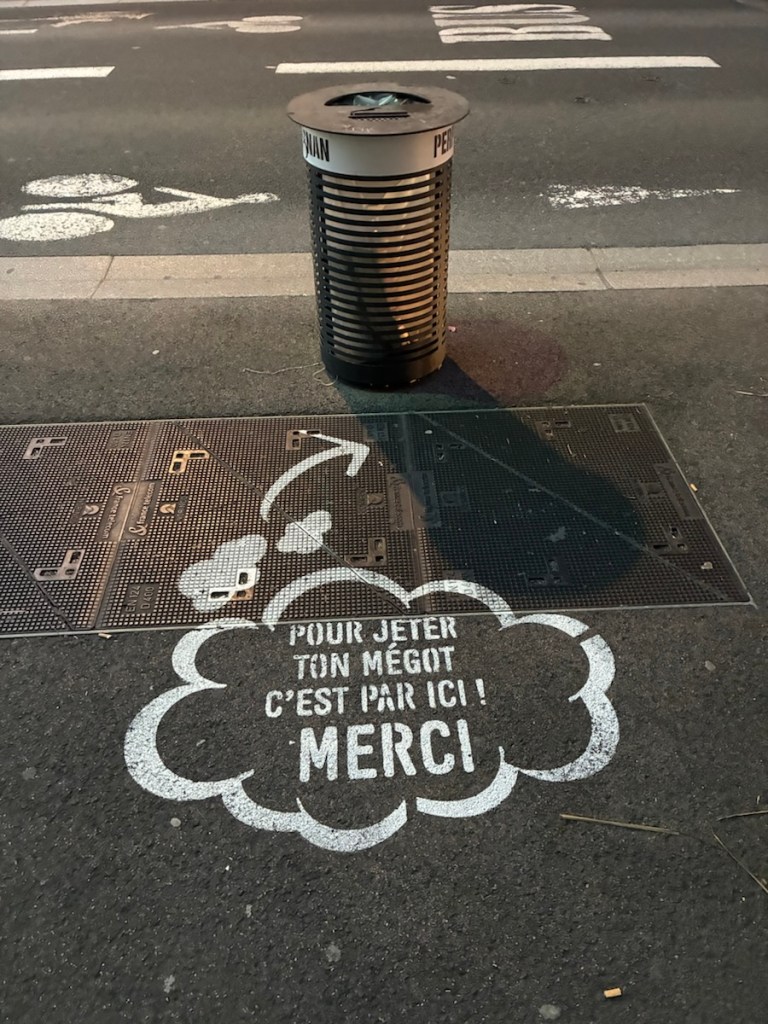
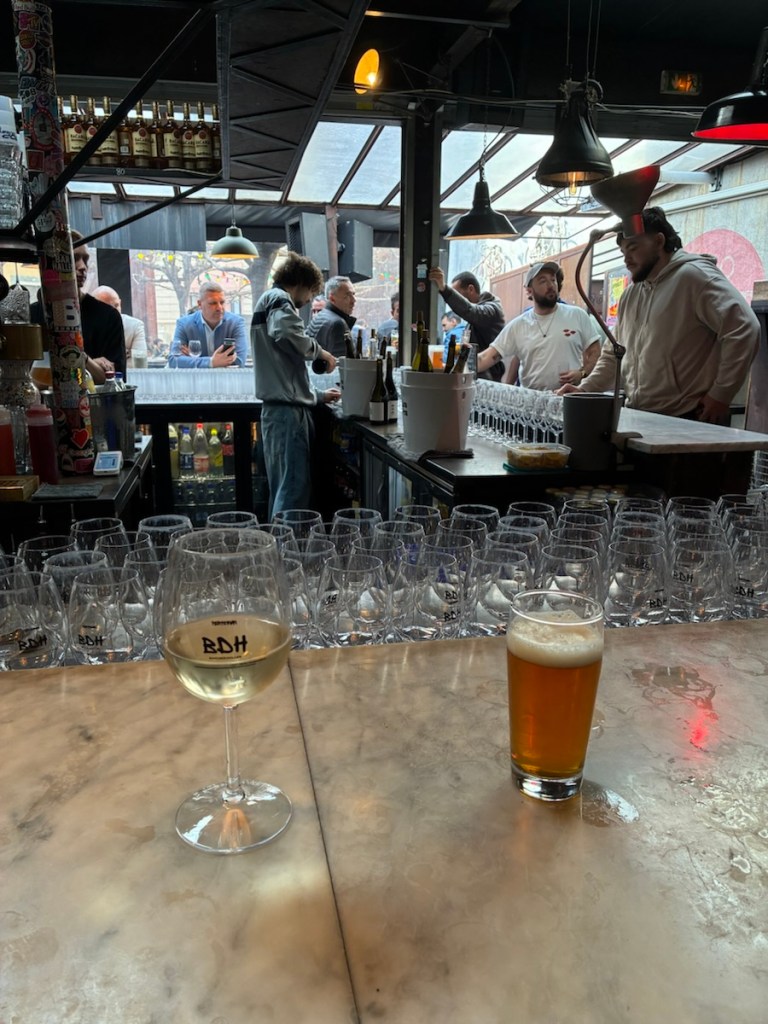
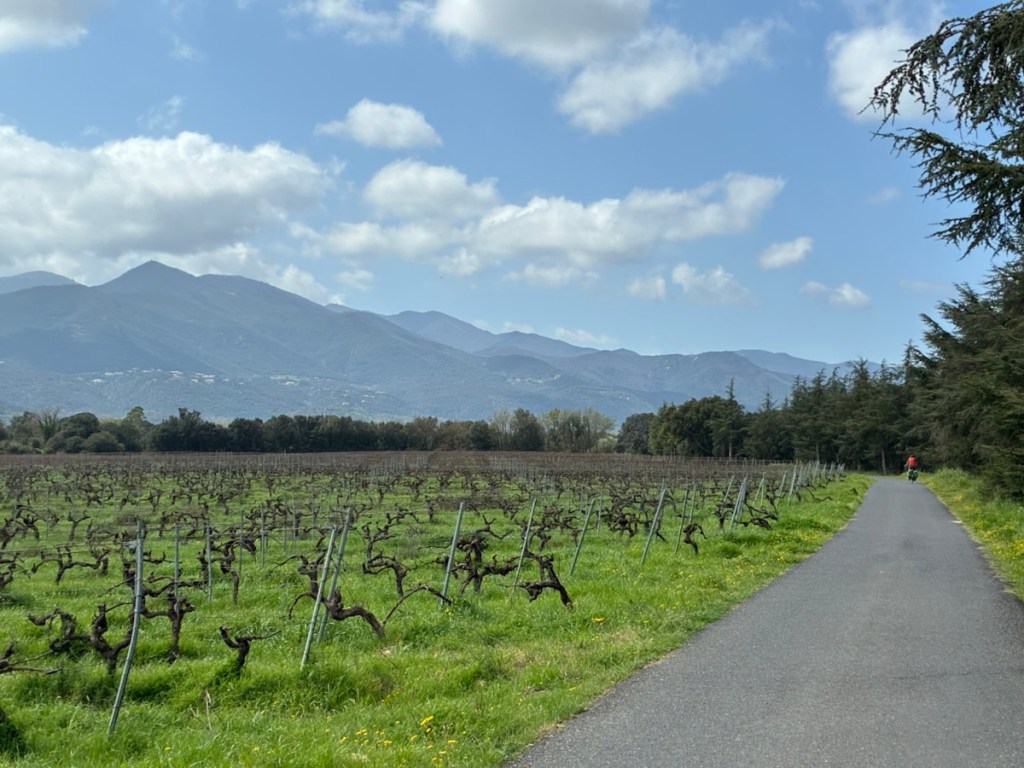
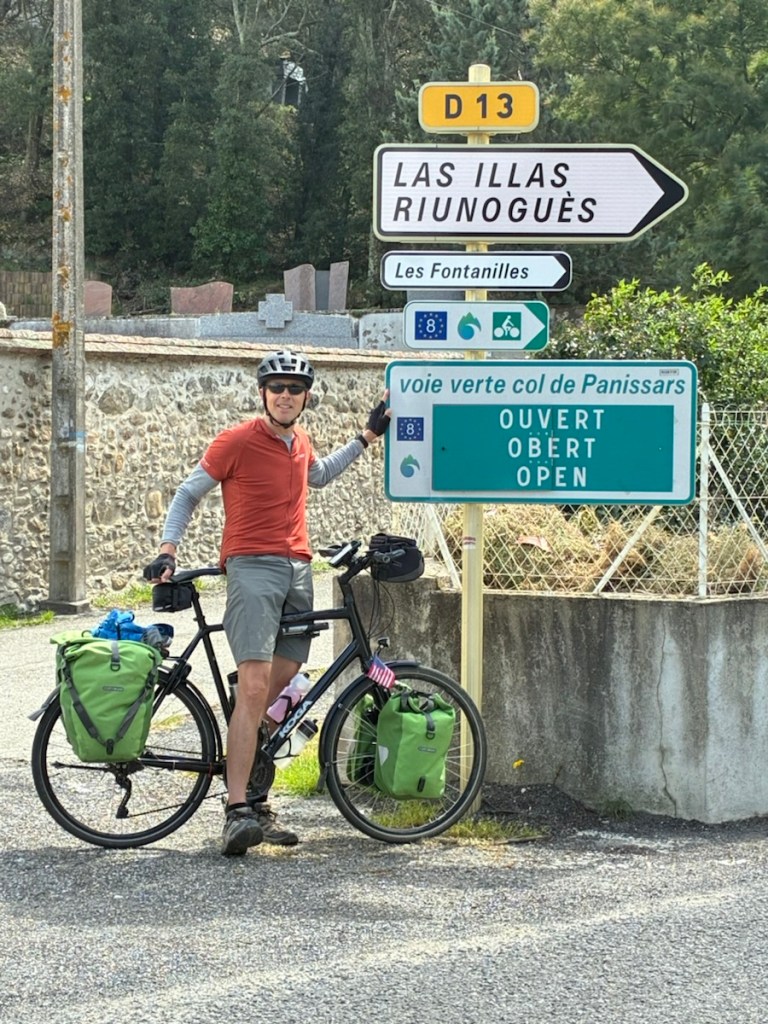
Lunch in the shade alongside Le canal du Midi. We brought our little travel chairs with us this trip.We decided to stay in Narbonne for two nights once we realized we’d be arriving quite late in the day, and it gave me an opportunity to have the brakes on my bike fixed.Who could resist this photo stop?Narbonne at dusk. Like a lot of French towns there is a focus on new public space, here a lovely newly redone stretch along the Canal de La Robine.Narbonne Cathedral’s gargoyles. I would love to see these spouting water. But that would mean rain.Creepy. Love it!Canal de La Robine. The work on the canal side path is ongoing to the south.A windy day meant indoor happy hour.The small black poodle being groomed inside this shop would certainly attest to the accolades on the sign.The canal trail. This is going to be a lovely day on a champagne gravel (hat tip to Annie) trail.Or will it? Blocked by fiber optic construction.A 47 kilometer detour. Thankfully a local road cyclist stopped and told us the detour was a fine route, one he rides often.So off we went, better know the marshes.It was a very scenic detour. A bit windy. Was it a headwind or a tailwind? I can’t remember. (Kidding. It was a headwind.)Flamingo sightings.Lunch at the boules court in Bages and a chat with some locals. The flags doing their jobs again by drawing folks in and starting a conversation.Still smiling. It’s chilly enough that my fuzzy pink sweater comes in handy. Bicycle signage is quite good in France.Peyriac de Mer, after a quick snack and map stop. Such a sweet street I stopped on an uphill climb to snap a pic.Although he was technically closed for lunch the owner came out from his apartment behind the shop to sell us some much needed fruits and veggies and home made cookies. Sigean, still in France.Out of Sigean the route climbed up a rocky pass. Definitely best suited to mountain bikes or gravel bikes, but here we go.This look says ‘Yes, I did just fall in that mud puddle’. My rear pannier caught on a branch as I tried to skirt the edge of the puddle and I ended up in the puddle.Ortleib panniers act like bumpers for the bike when you go over sideways. My bike and panniers were fine, I was very muddy with a few scratches on my left leg. Pride? Slightly wounded.Still in France so the signage is still strong.Headed down a very rocky route. Lots of walking the bikes.Leaving Leucate where we spent the night and a bit of time de-mudding me and my gear.Headed to Perpignan and our first good view of the snow capped Pyrenees mountains. Don’t worry, Rich says, we’ll have even closer views. Beach snack stop in Le Barcarès.Getting closer to those mountains along a very nicely paved cycle path.Are we riding or just always stopping to take photos?Oh photos, definitely stopping for photos.Perpignan. The French buildings and palm trees made me smile.The Basse canal, an off shoot of La Têt River. Coming in to Perpignan from the north it didn’t look promising but once in the heart of town it’s charming.Sweet little streets and cafes.Easter is approaching! Easter bunnies.And Easter foxes.Do I love chocolate shops? Yes!Sweet street art.Polite and obvious reminder of where your ciggy butts go.The days are long, sunset at 8:30, so lovely long twilight light.A nice apéritif.A hearty meal.Oops – an entire bottle of red wine. And a lovely chat with a Swiss/Spanish couple. In light of what’s going on in the US some of our conversations have gotten more intense. Not confrontational, but intense.Leaving Perpignan, next stop: Figueres, Spain. In the way: mountains.Ok, next stop actually still in France. Brouilla. But it’s starting to look like Spain.Over a river.Over a bridge. Foothills approaching.Through vineyards. That little orange speck is Rich. Who’s anxious to get to some mountain climbing? He is.This low pass closes not for snow, but for risk of fires.
Unlike France, information on cycle touring routes was a bit spotty as we headed into Spain, but we headed up the pass optimistic about our new adventures coming in Spain. Stay tuned.
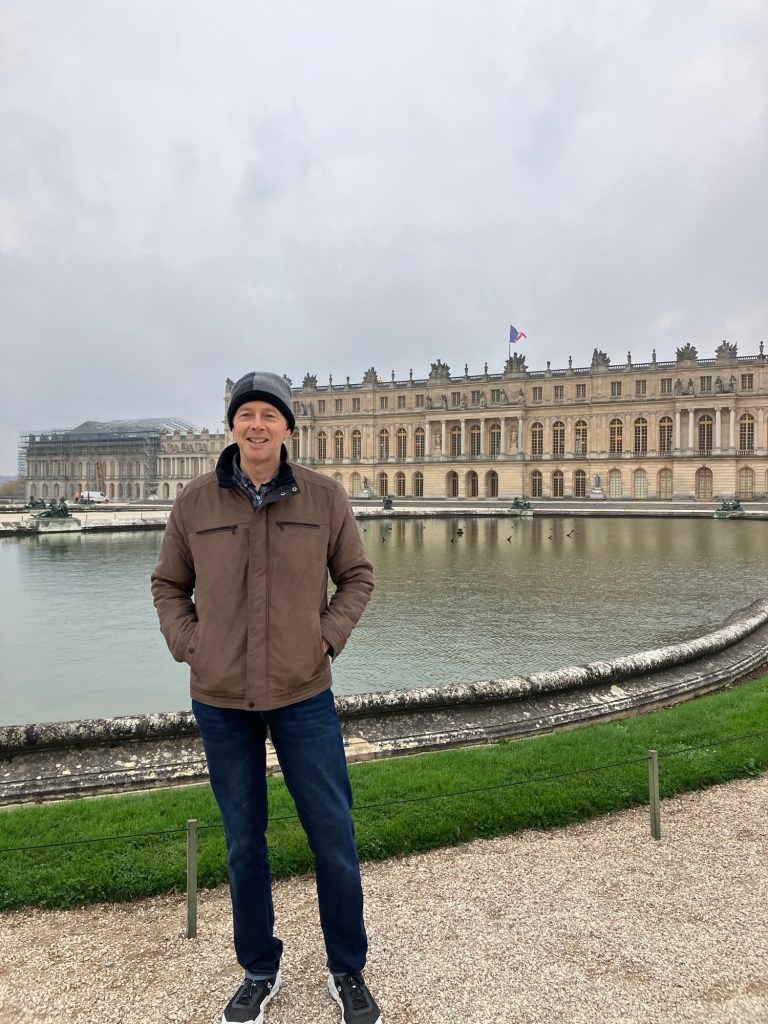
Palace of Versailles. 8:30 am on a Wednesday in November.
Museum planning can be quite a challenge in Paris. First – which museums? Choosing between the 136 options looks daunting. Even when you narrow it down to the 111 listed in the great book our friend Nancy brought with her, that’s too many for a one month visit. Second – which days are they closed? Monday is a popular closure day, so going to a museum that isn’t closed on Monday means it might be a bit more crowded than usual.
Two horses and humans walking through the forecourt of the Palace of Versailles. I think they were just locals who use the park as a cut through. The noise of hooves on cobblestones sounded like time travel.Looking down the gardens of the Palace.The palace opened at 9, so we used our 30 minutes to check out the view.Getting going early had the pay off of no crowds. And cold November weather helped too.
Versailles probably wouldn’t be fun for us crowd adverse people in Spring or Summer, so this might be our one and only visit to this A List site.
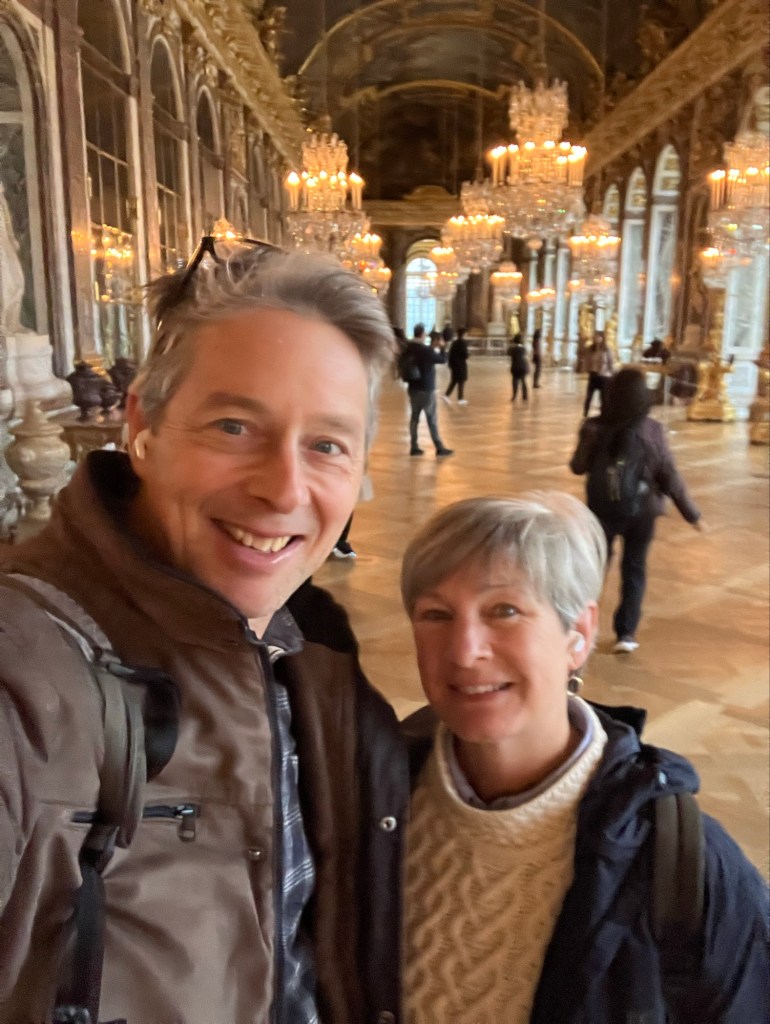
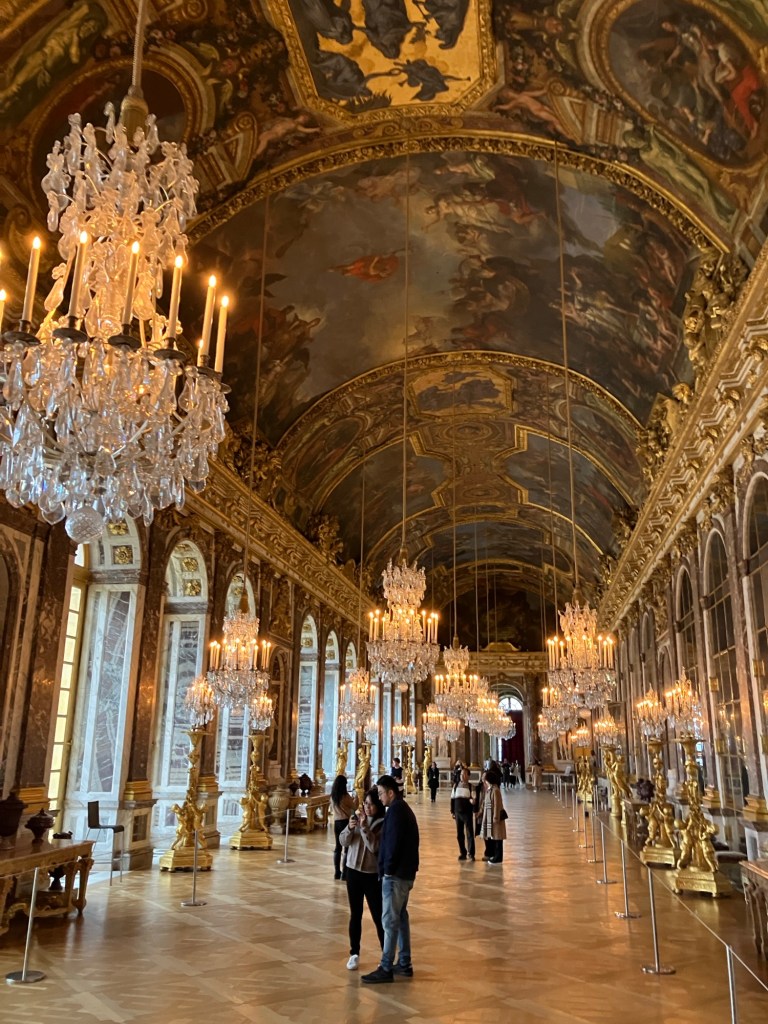
The Hall of Mirrors with our fellow early arrivals.As we walked around we kept joking “now why was there a revolution?” in response to the luxury on display.Pensive gazing out the window while listening to the quite good app based audio guide.Miles of parquet flooring! Shiny too! Make sure to budget enough time to explore Petit Trianón.Sophora Japonica, or Japanese pagoda tree, planted in 1764 for Marie-Antoinette near the Petit Trianón.Temple de l’Amour. The folly in the English Garden of the Petit Trianon.The Petit Trianon, a laughing American tourist, and the classical angel statue. The app based audio guide covered a lot.The “Water Mill” in the Queen’s Hamlet.The Hamlet had a rough time surviving but several renovations later, you have a good idea of what it was like originally.It is a peaceful respite from the grandeur of the Palace.
While we waited to get into the Palace there was a little guy, probably about seven years old, having a meltdown about having to visit the palace. He screamed and cried and his adult spent some time talking him down. He uttered a memorable phrase which we filed away for future use: “This is the stupidest thing in the entire stupid world!”
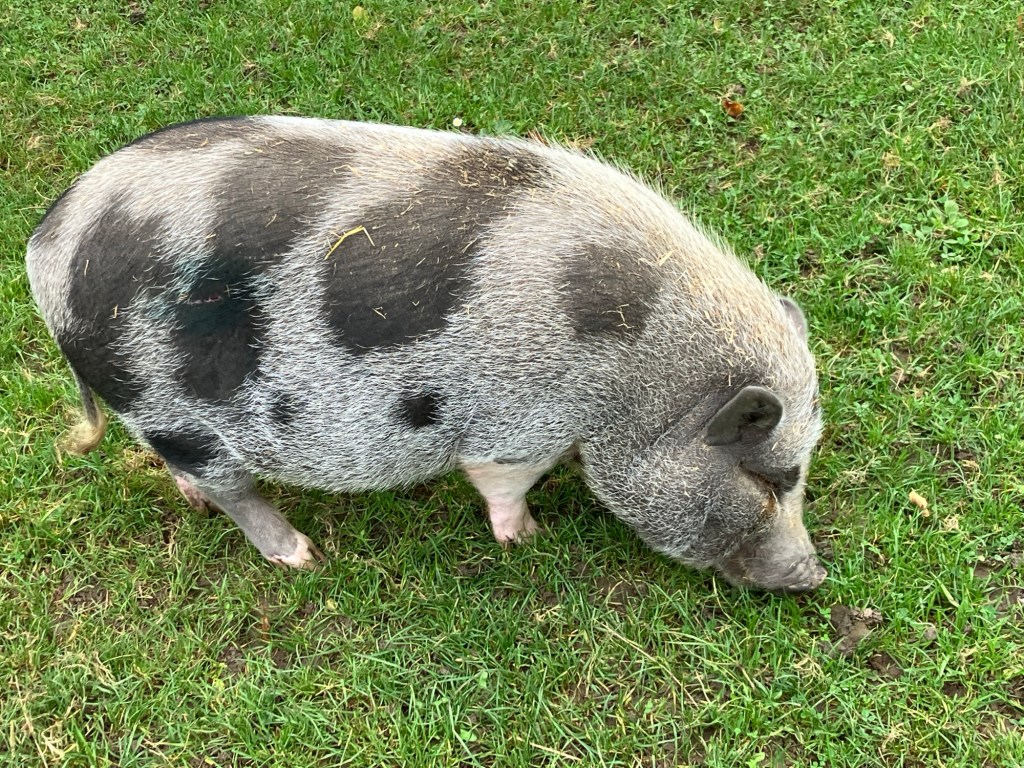
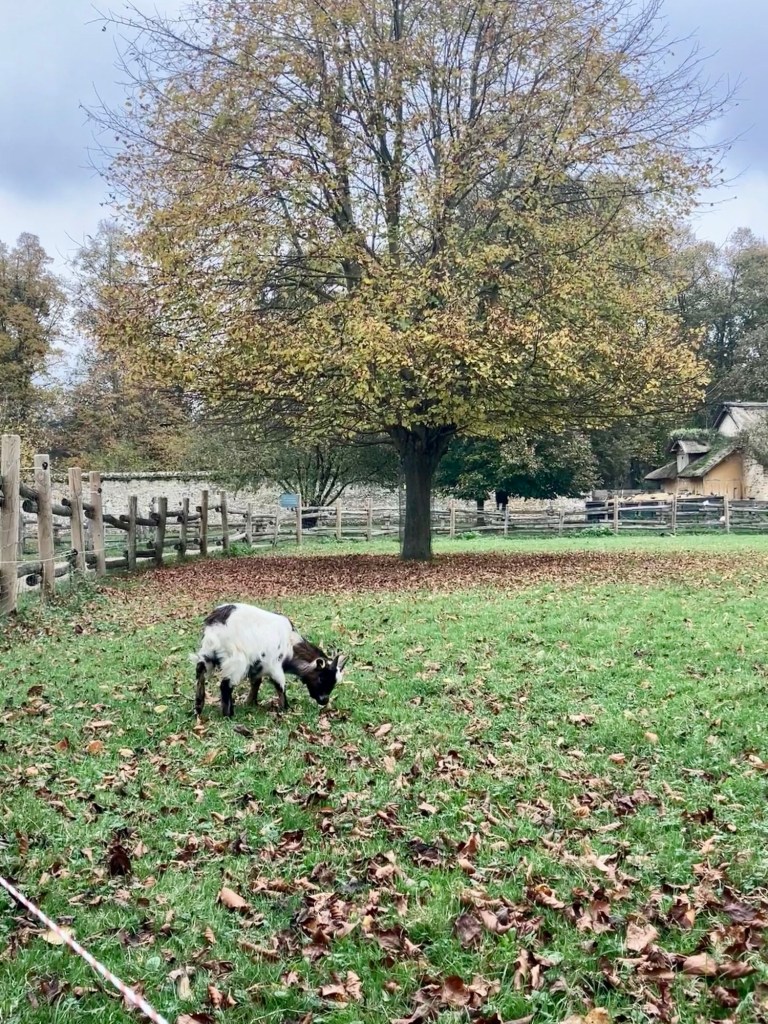
I sure hope that little guy made it to the hamlet and got to see the farm animals.I’m sure the pigs, goats, and bunnies would have cheered him up. Not stupid.
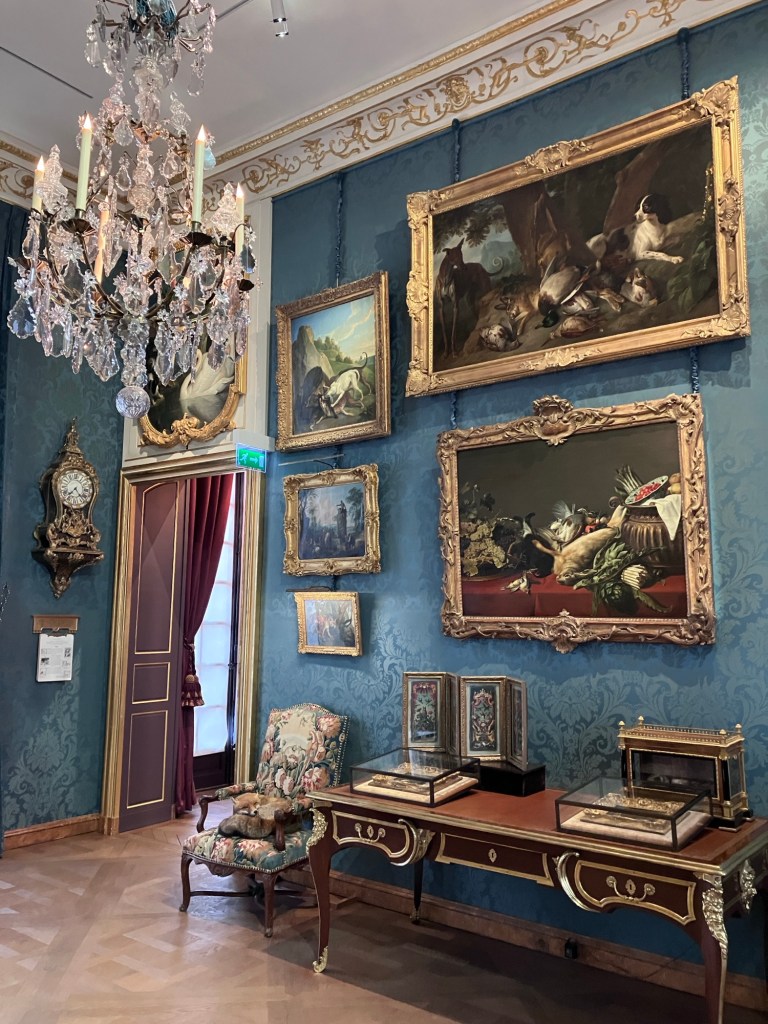
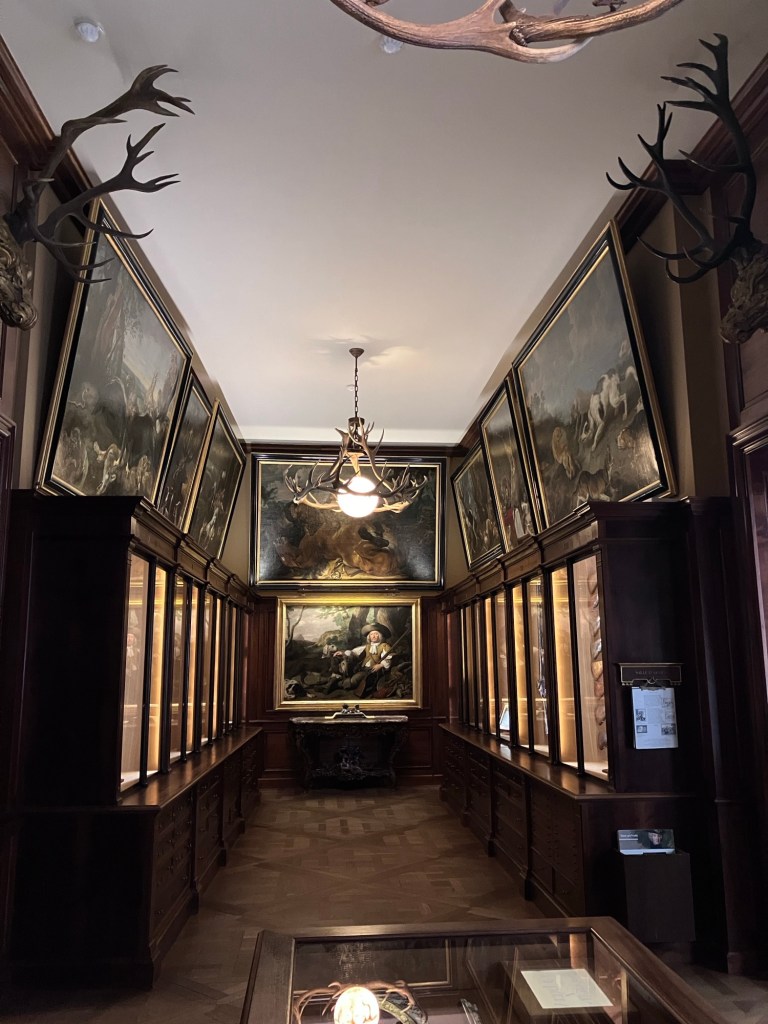
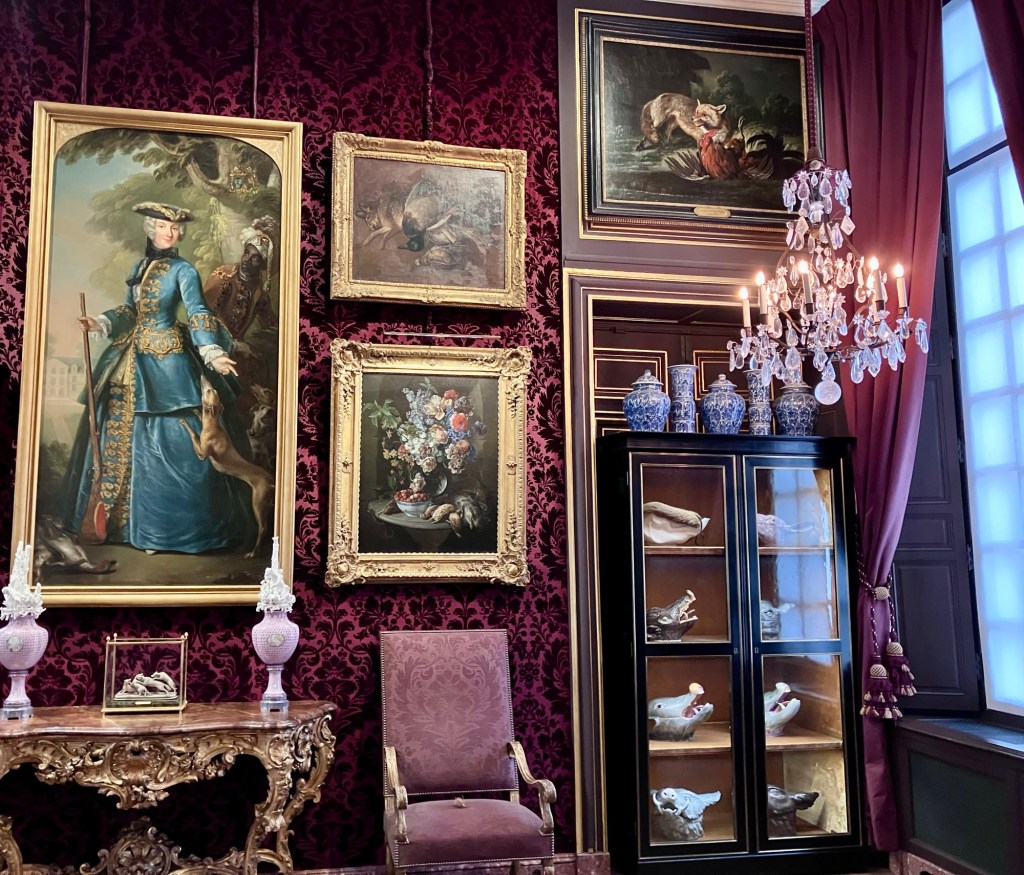
So how else do we decide on museums to visit? Well, when you go to a lot of museums in France, and in the world, you see connections. At a museum in – Lyon? Dijon? I honestly can’t remember – a little card said about a missing painting: currently on display at Musée de la Chasse et de la Nature in Paris. What what what? That sounds fascinating. So it was marked on a Google map and Rich remembered and off we went.
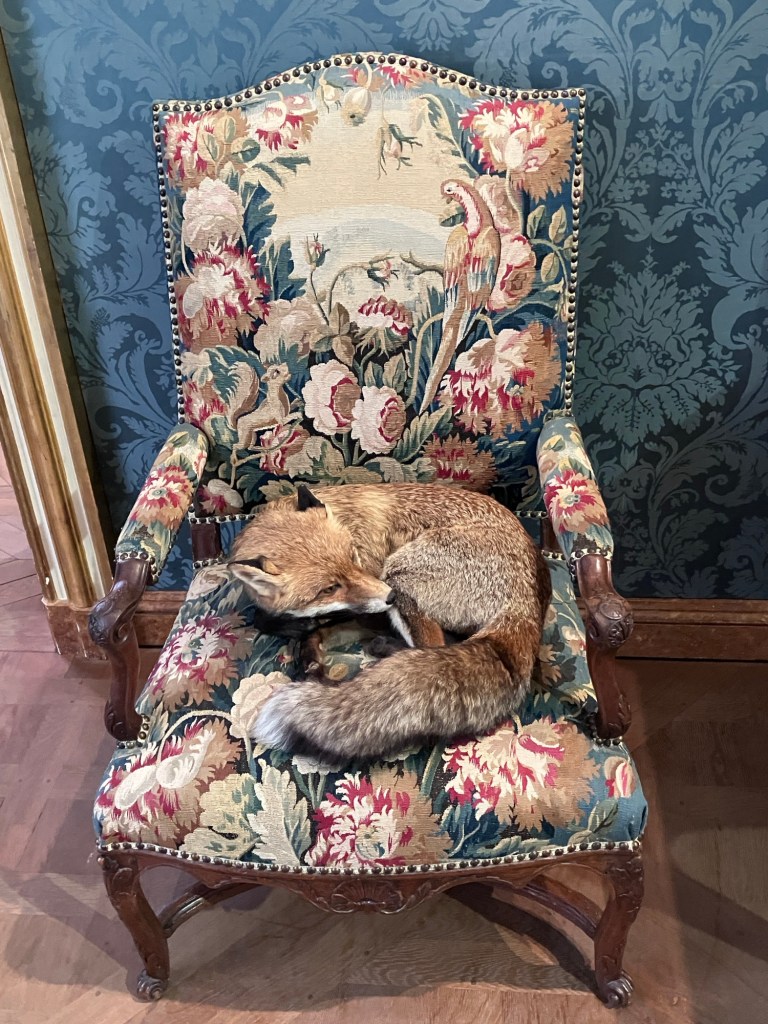
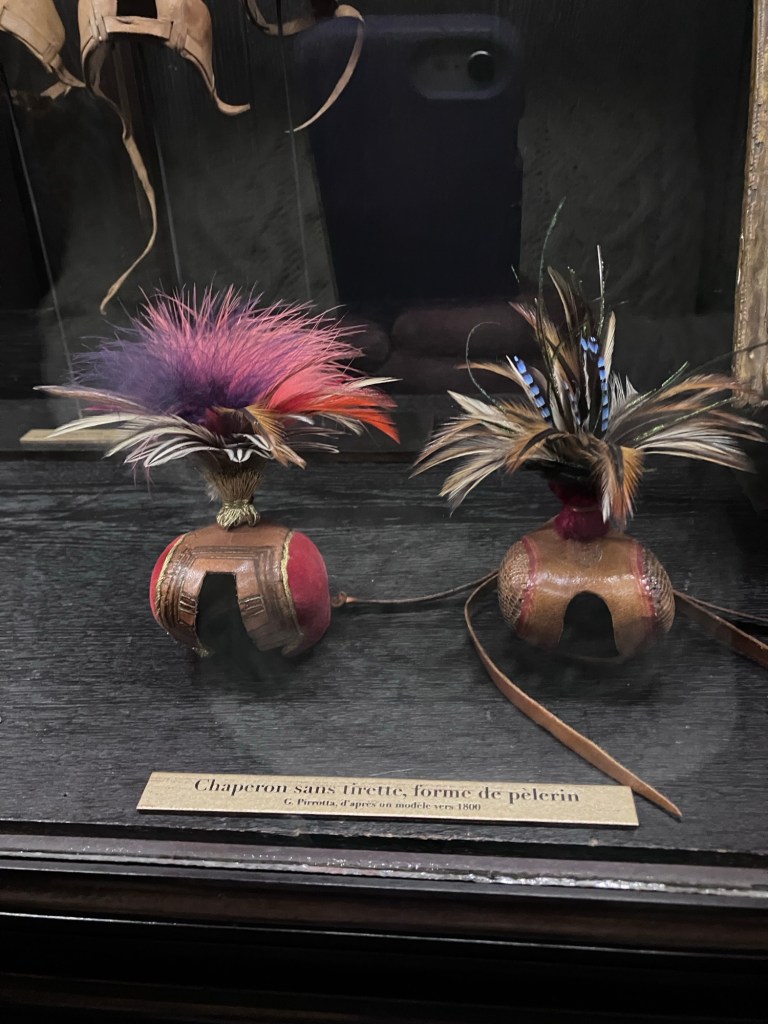
The museum is in an old Hôtel particulier. A grand urban mansion.Yes, that’s a stuffed fox curled up on the chair. The rooms were themed, and simply beautiful.Don’t let the name of the museum put you off. It’s not really a celebration of blood sports, but more humans relationship with nature and animals.The falconry room.Adorable little hoods for the falcons to wear. Putting feathers on a bird.
Even with only a month in Paris it was so fun to circle around topics or artists and come across them in different exhibits or even in cemeteries.
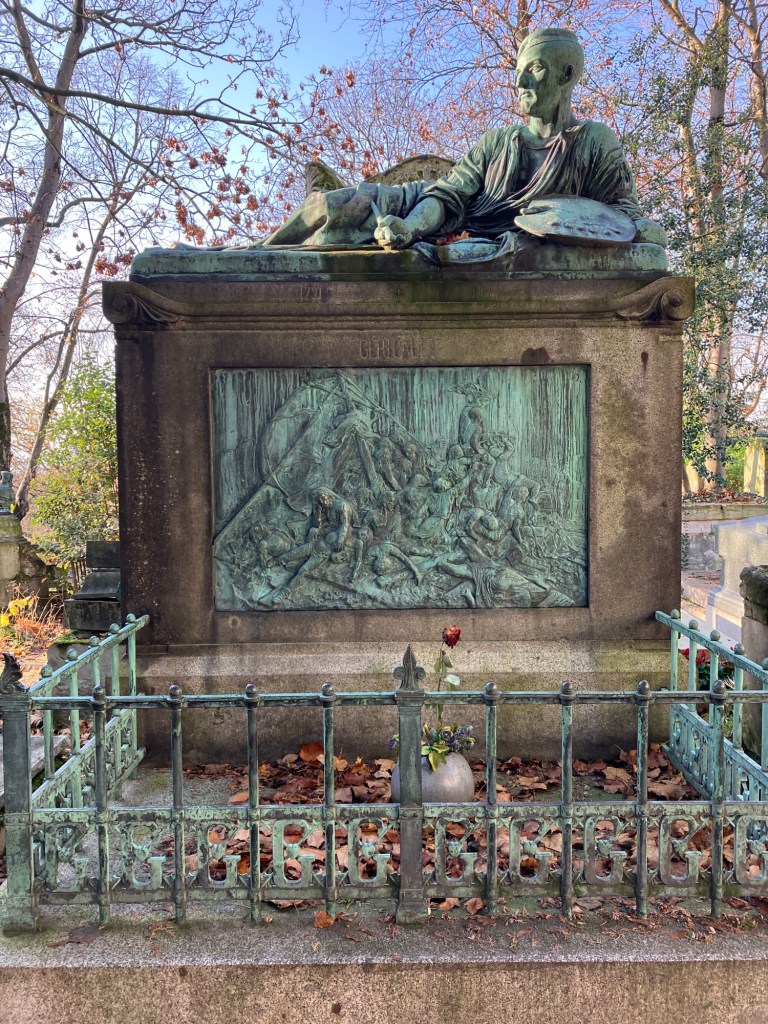
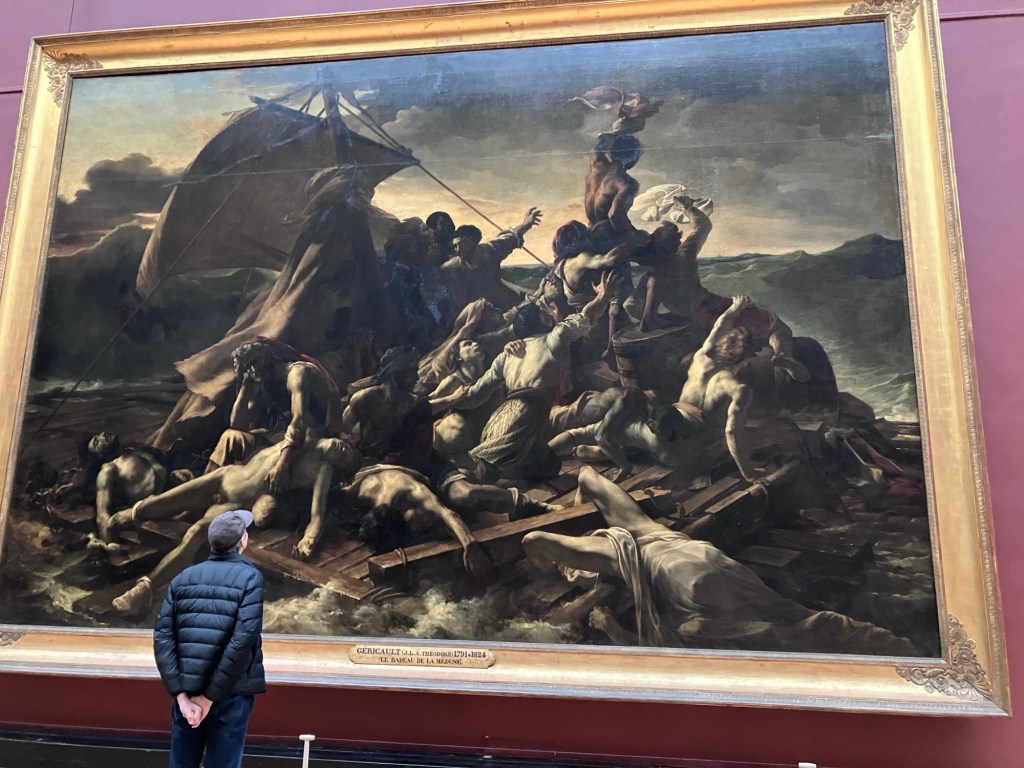
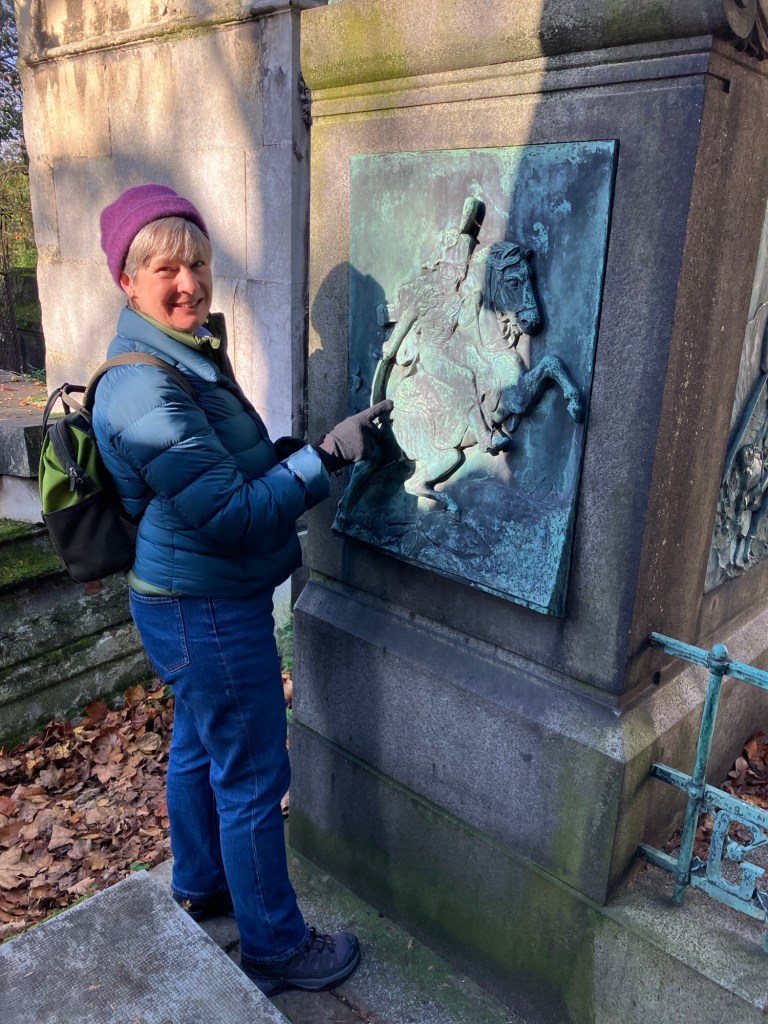
The grave of Théodore Géricault, in Cimetière du Père-Lachaise.One of our early morning Louvre visits was specifically to visit The Raft of the Medusa, by Géricault.Alone with this massive canvas.Which is replicated in bronze on his tomb.A cold and grim subject. Again, the smiling American tourist.
A college friend (thank you Jen) reminded me of the chapter in Julian Barnes’ book History of the World in 10 1/2 Chapters, chapter five, Shipwreck, which relays the story of the creation of this painting and the history behind it.
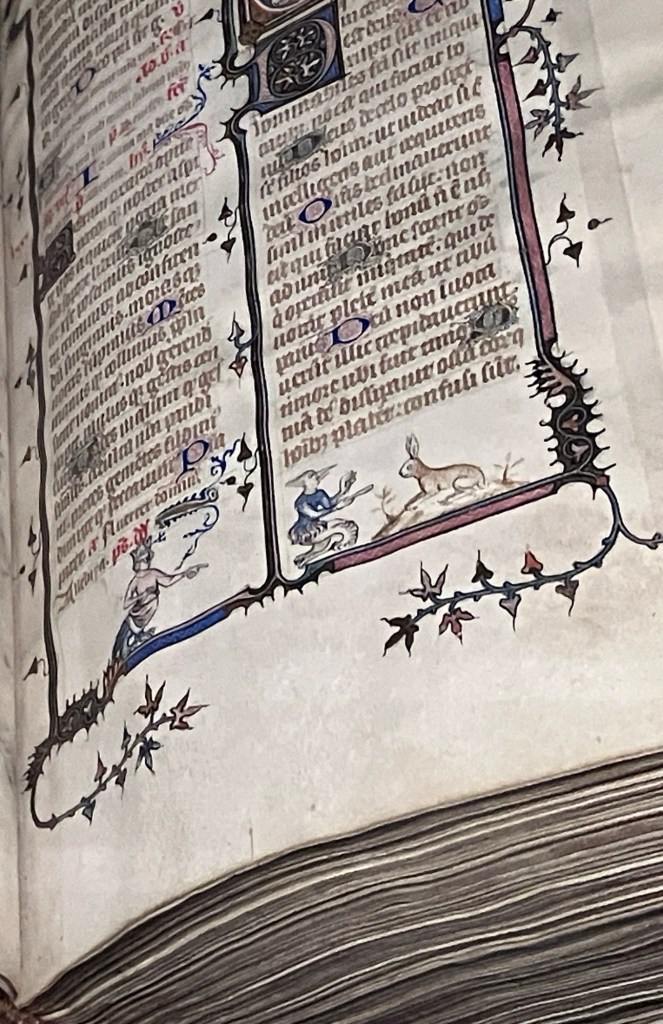
The artist visited morgues to achieve the correct shade of skin tone. Not far from The Raft in the Louvre is another famous Géricault painting: The Charging Chasseur, or An Officer of the Imperial Horse Guards Charging.Which is also recreated on the artist’s tomb.At our final Louvre Visit to see this exhibition, Figures of the Fool.Here was another work by Théodore Géricault, The Woman with Gambling Mania (French: La Folle Monomane du jeu) from 1822.I can’t be the only one who goes through museum exhibits hoping for fun reproductions in the gift shop? These marginalia of little monsters or grotesque characters would have made fantastic pieces for the museum shop.Chimeras of Notre-Dame de Paris: Monster Leaning on the Parapet Paris, 1847-1862
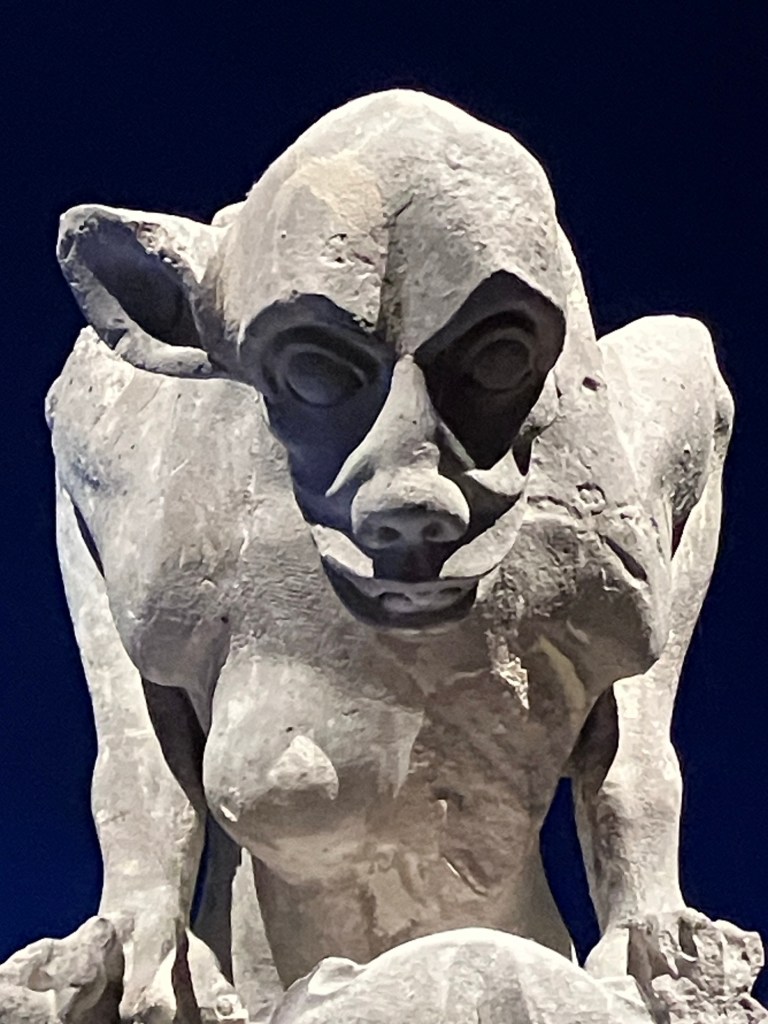
Although we missed the re-opening of Notre Dame by a few days, we did get to see four chimeras removed during a restoration in the 1800s. Gargoyles spout water away from a building, chimeras are ornamental, adding to the overall atmosphere of the Cathedral.
Such a moody and beautiful presentation.Chimeras of Notre-Dame de Paris: The Pelican The Lioness Monster Leaning on the Parapet The Wandering Jew.
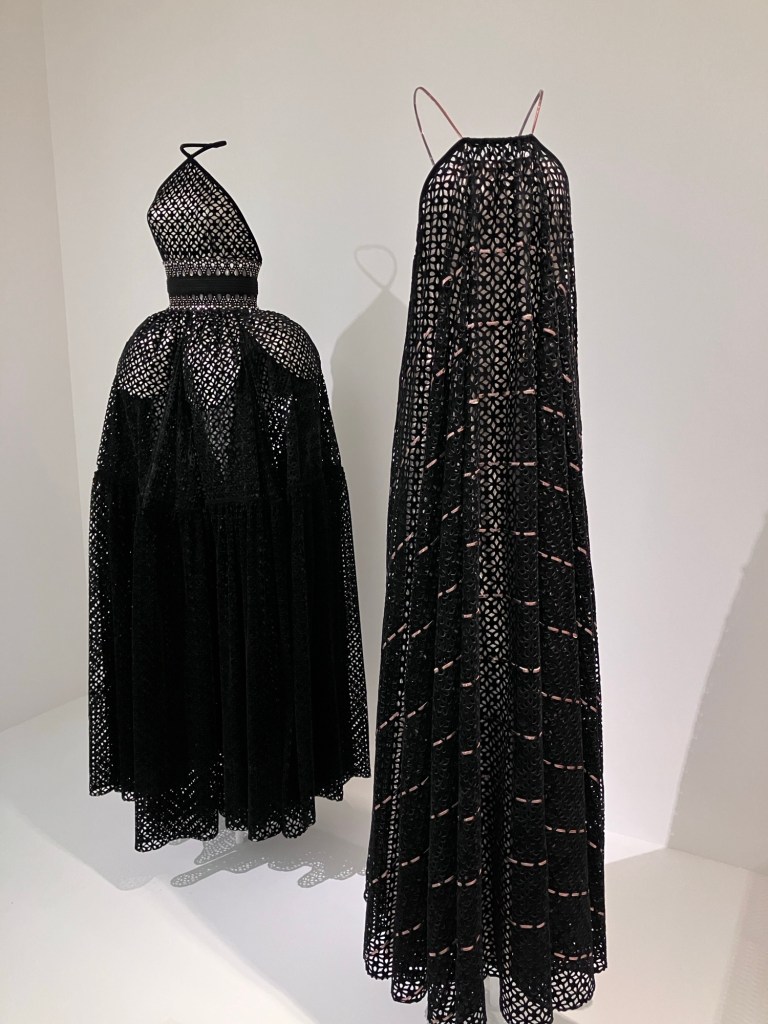
We also visited the Musée d’Orsay for the Gustave Caillebotte exhibit, amazing, and Nancy and I went to the Azzedine Alaïa museum. He was a talented and famous Tunisian couturier and shoe designer.
Laser cut velvet. Gown or work of art?Beautiful and beautifully displayed.We loved the window which let you see his atelier. Left exactly as it was when he died.
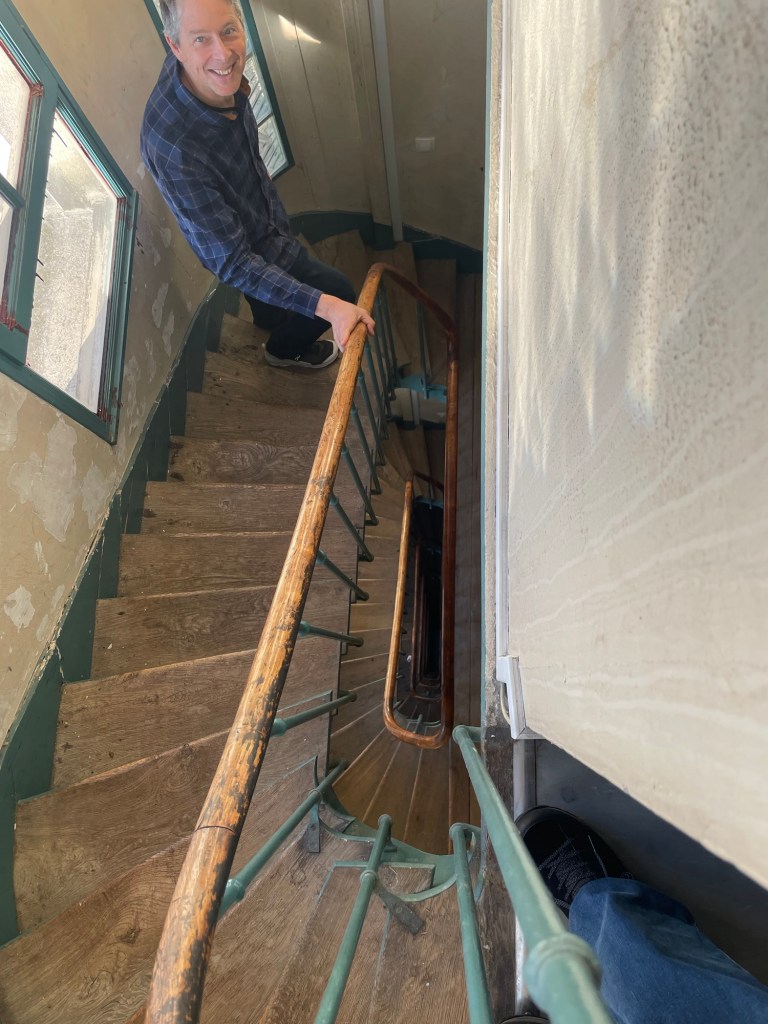
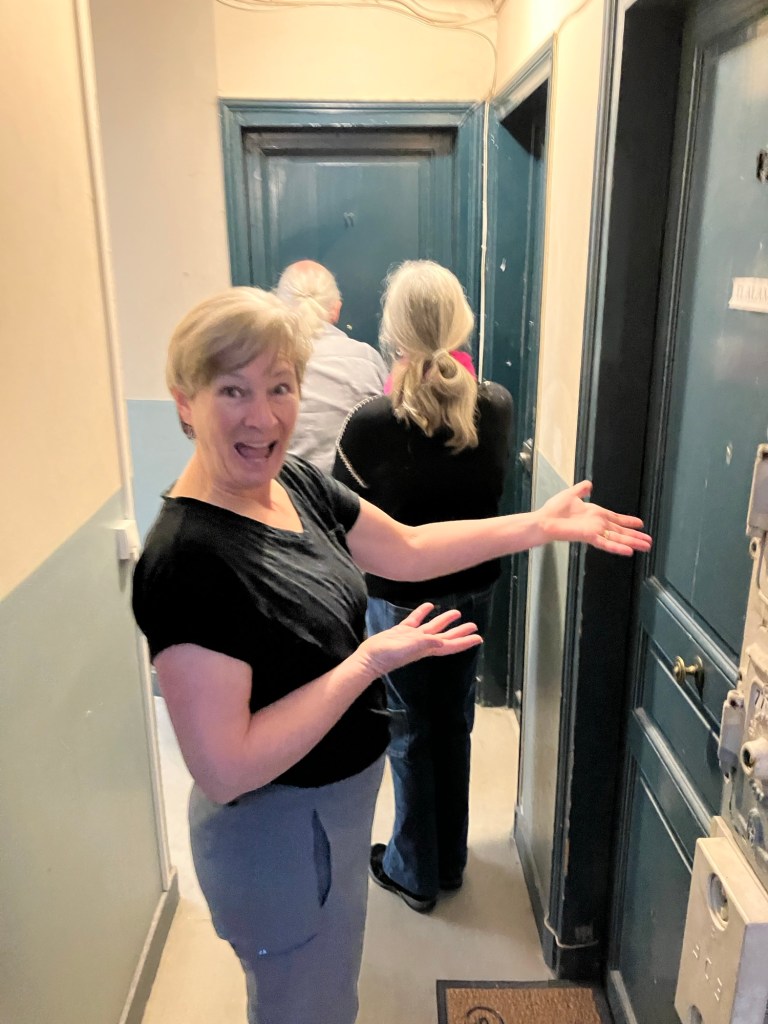
There were other museums we visited – my head is still spinning from what we saw – and of course, the best museum of all: the city itself. Thanks to our new friend Roy, whom Nancy met on her flight over to Paris, we even got to see a Chambre de bonne. These small top floor maids rooms on Baron Haussmann’s 19th century mansions. Ever since listening to this 99% Invisible podcast about Chambre de bonnes I’ve wanted to see one. But how? Well, have a friend who makes friends.
Hi Roy! Thank you again for showing us a side of Paris we wouldn’t have seen without you.The servants staircase.The corridor of doors to small, very small, apartments. Some have been joined together to make more useable spaces.How happy am I? In a Chambre de bonne. The view! Eiffel Tower one direction, Basilique du Sacré-Cœur the other.Those very top windows will be the Chambre de bonnes in this building.
Everyone who travels will tell you that the most amazing experiences are not found in guide books. They happen. You walk by them, if you’re lucky and open to saying yes, you get to have unexpected and delightful times, and even better with friends.
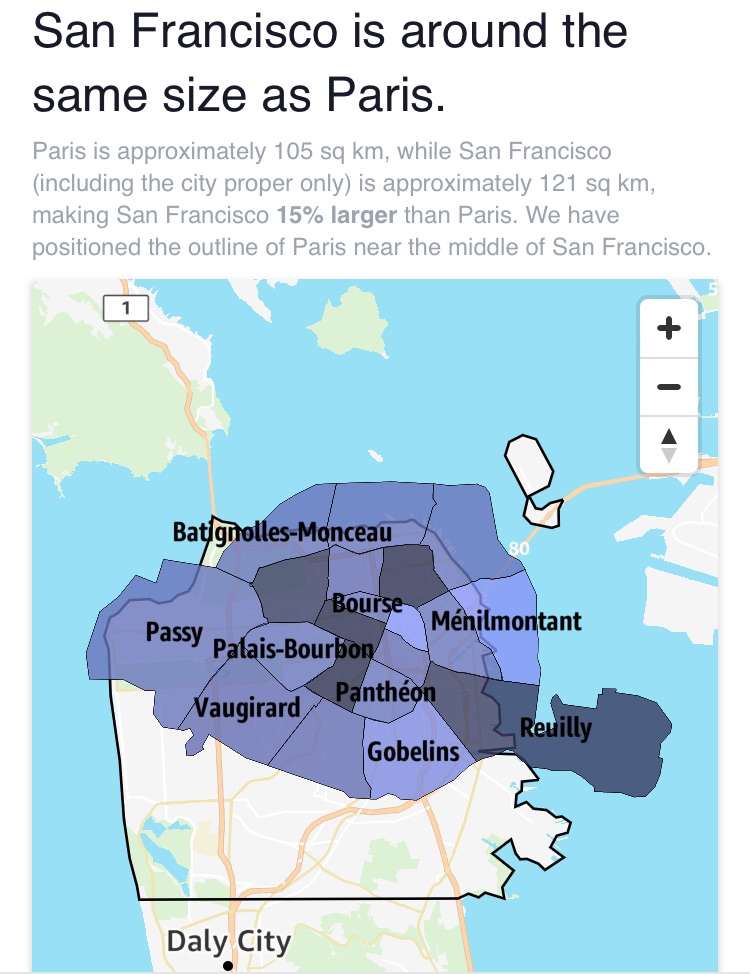
We have a running joke while we travel where we put things in a Bay Area context for each other. Guanajuato is the Mendocino of Mexico City. Parc Vincennes is the Golden Gate Park of Paris. When we discovered that Paris is actually smaller in size than San Francisco, but with over twice the population, we felt a bit more at home. We lived in SF for decades, most of those years without a car, so Paris felt like a super lively, more busy SF.
What? In my mind Paris was much bigger than SF.
Almost every Metro trip we mapped out on CityMapper was about 30 minutes or less from our Paris apartment. The Metro does move along and wastes very little time dwelling at stations – on the older lines you can actually open the doors while the train is still moving. And people do. But to walk across the city, or to your destination, really doesn’t take long. We started taking one Metro ride, and instead of transferring to a second line, just walked the rest of the way. Or, walked the whole way. We took buses as well, which is a great way to see the city and rest your feet.
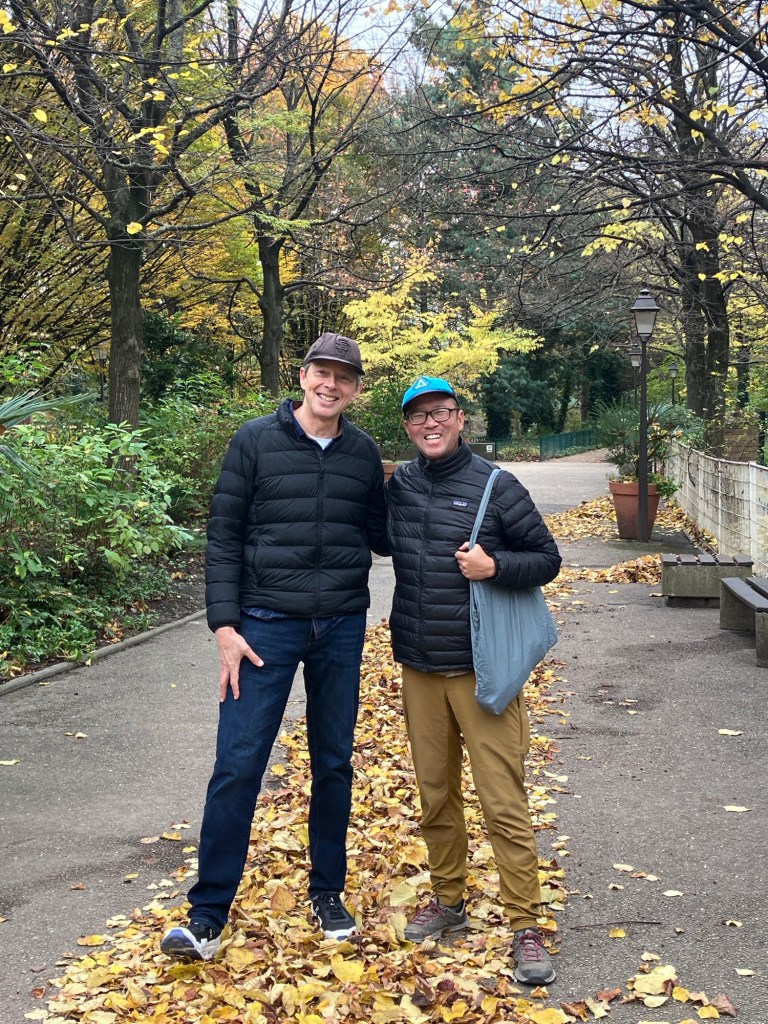
Paris is so walkable. Nancy demonstrates that even the weather can’t stop her. Rich and Dan on the Coulée verte René-Dumont.
The retail scene is so vibrant. Restaurants and shops abound. And bakeries- so many bakeries. Pharmacies everywhere. Laundromats – check. Chocolate shops – check. As you walk you never suffer from a lack of interesting things to see.
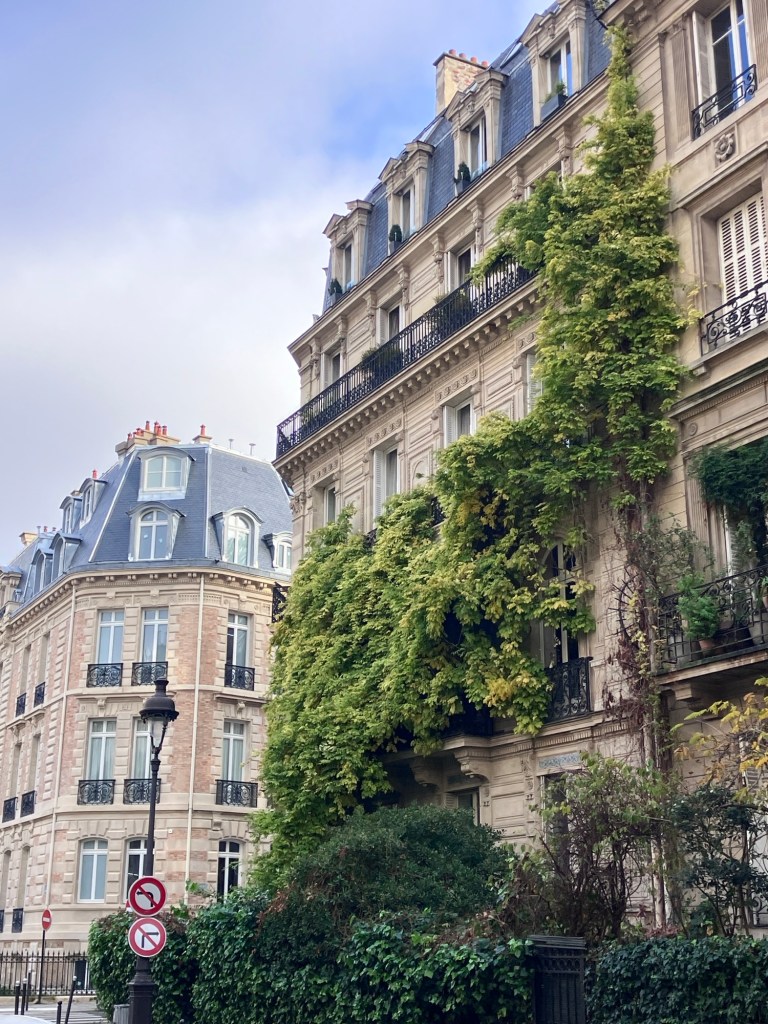
So many 6-8 story buildings. So much housing.
Although the population of Paris has shrunk since its high of 2.9 million in 1921, it now hovers around 2.1 to 2.2 million. As with many cities smaller family size and gentrification have had an impact. But the population certainly keeps the city humming! A street near our apartment simply teemed with parents and children at school drop off time. We quickly learned to try to avoid that street at morning drop off.
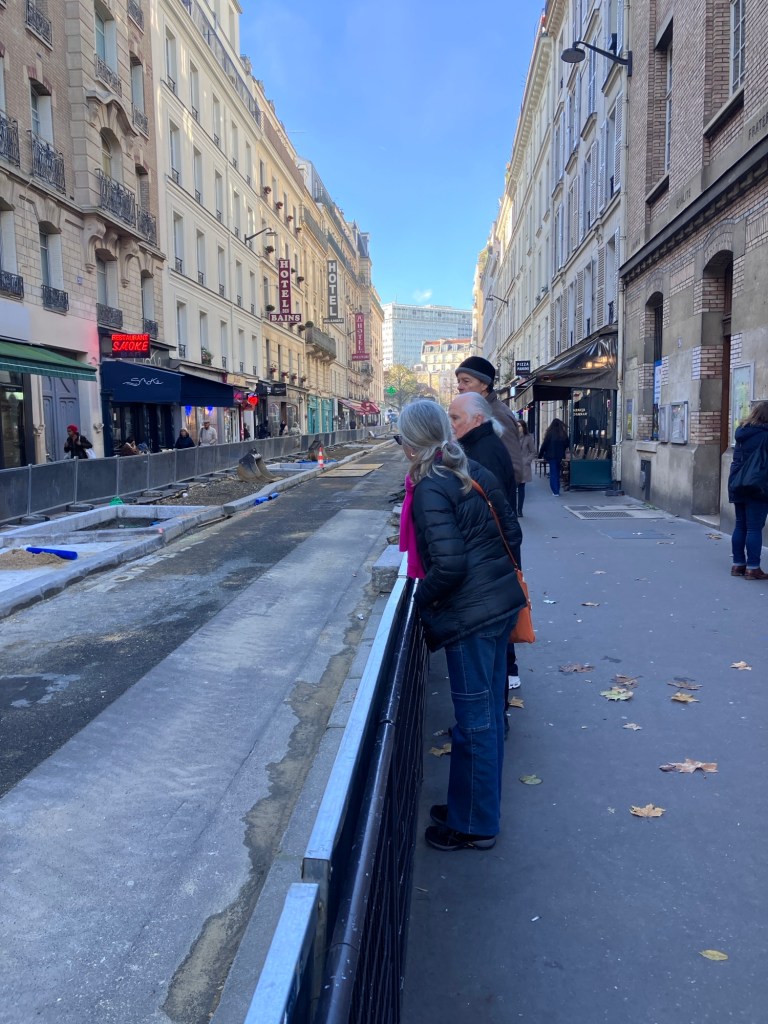
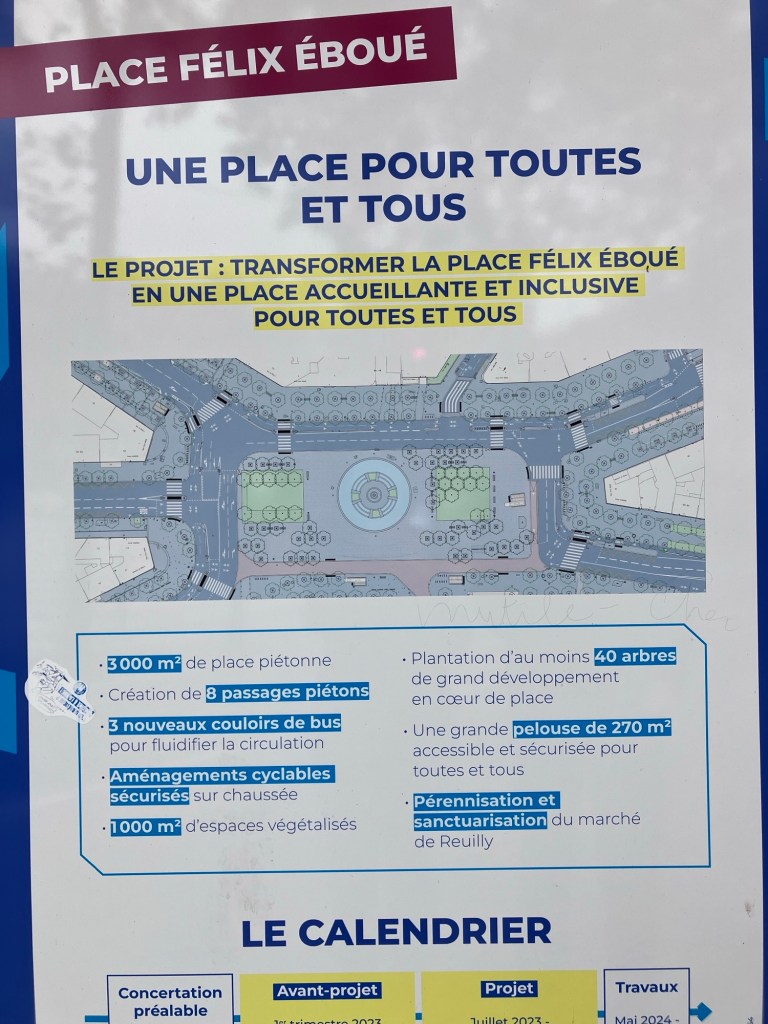
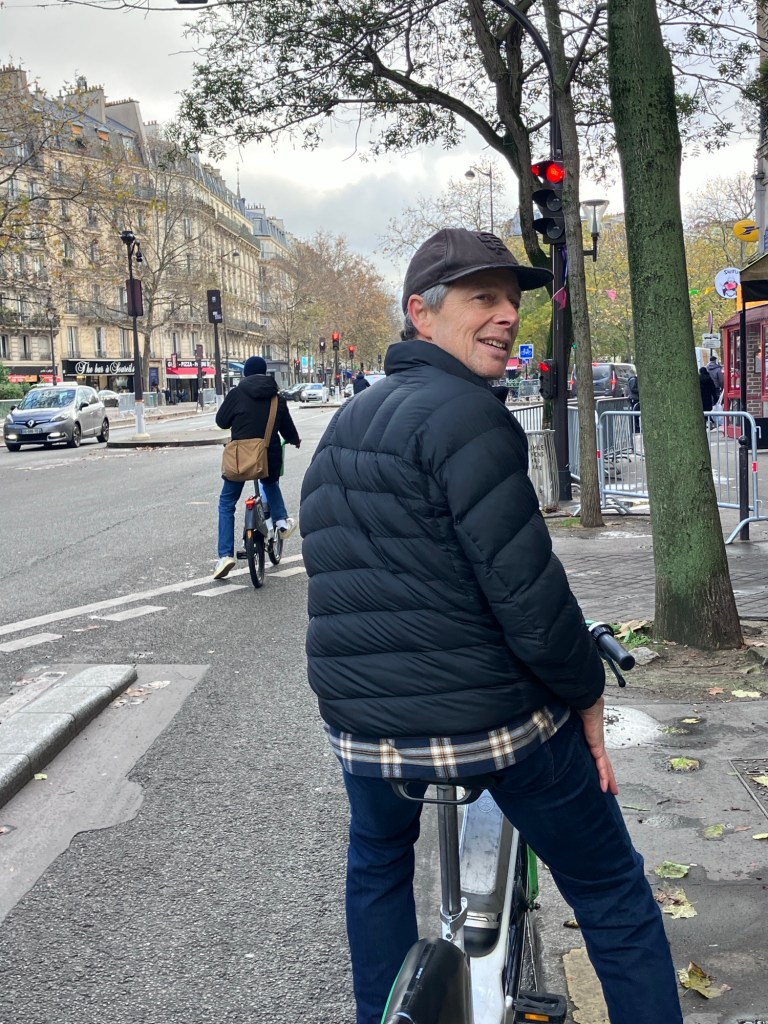
Paris is doing a lot of street re-imagining, making more space for people not using cars to get around. This is a street in the Montparnasse neighborhood getting an update. Wider sidewalks and planting areas.And in the 12th, a massive redesign of Place Félix Éboué, adding bike and pedestrian space, more trees and amenities, and removing car lanes.These changes seem to have brought out a lot of folks on bikes.On my Paris bingo card this lady transporting her dog and baguettes would be quite a get.Of course we got out on bikes! Despite the chilly weather.
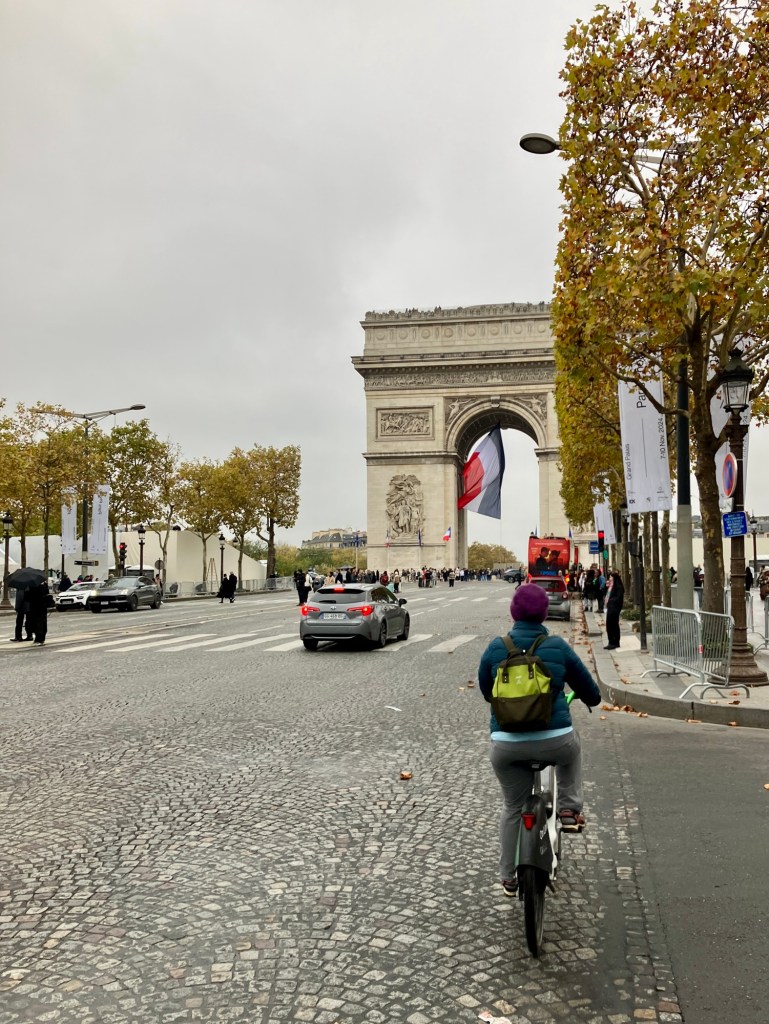
We used Lime bikes while in Paris. Cycling in Paris is quite good, although with so many cyclists I would recommend skipping rush hour at first, until you get the hang of Parisian cycling it can be intimidating. It helps to be a calm and confident urban cyclist since you will be passed by faster Parisian cyclists with only inches to spare. And be careful stopping at red lights since not all cyclists do and you risk a rear end collision!
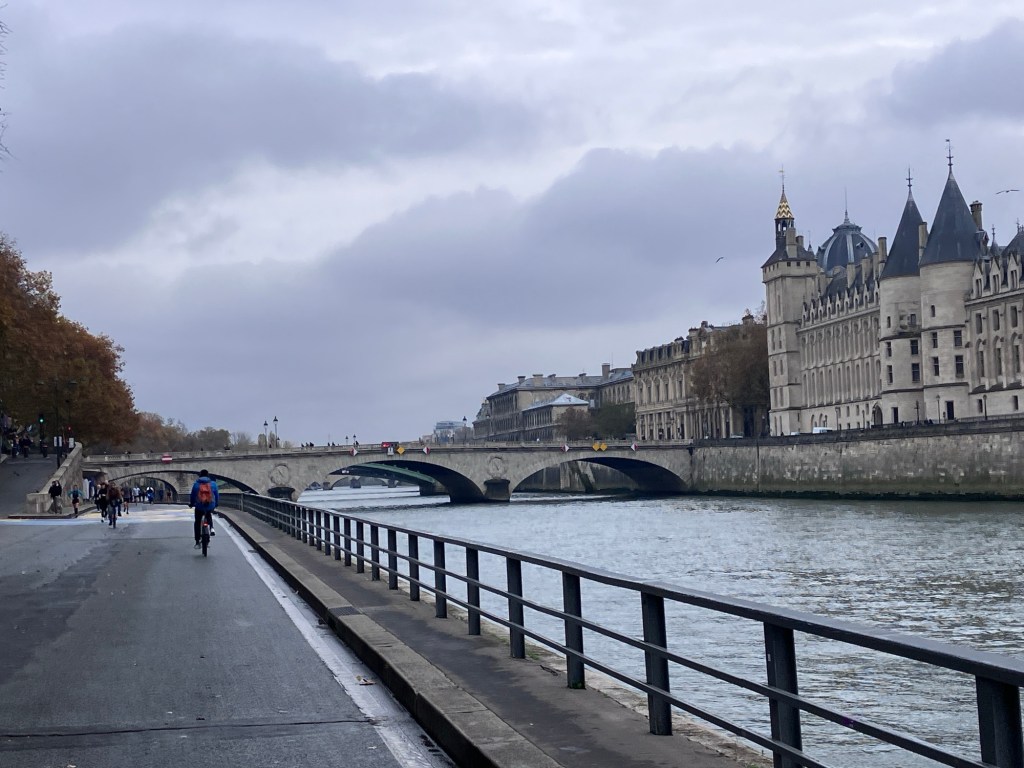
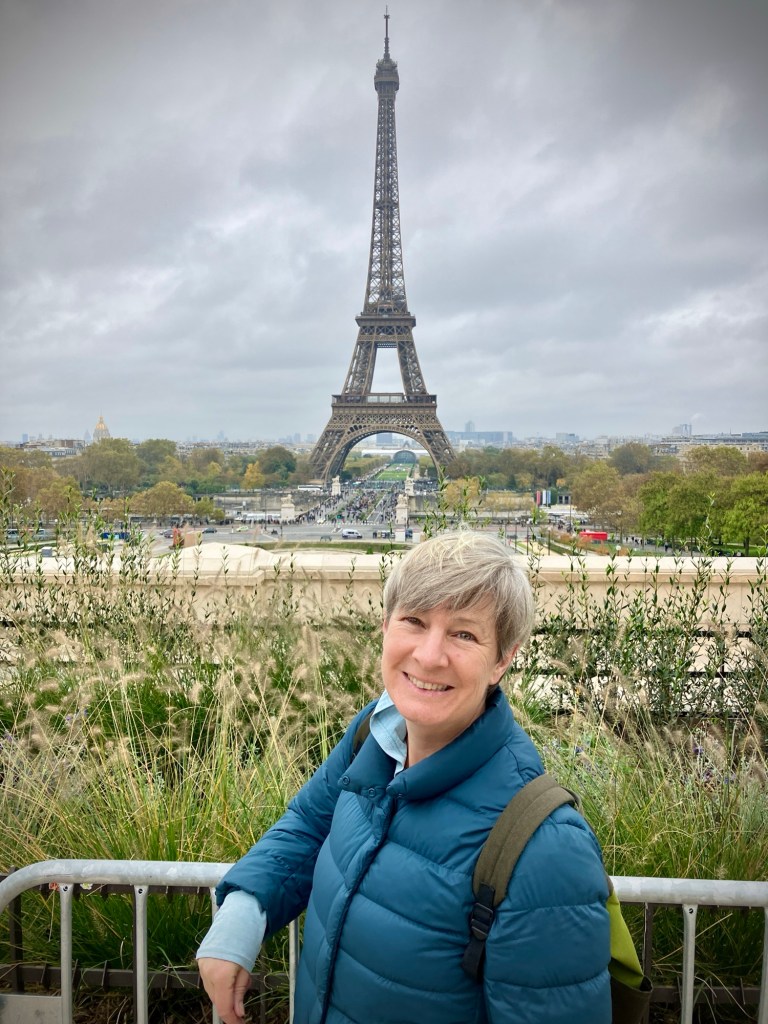
After all that cycling around France we did this year – finally! The Champs-Élysées to the Arc de Triomphe.Now we can fully appreciate the cobblestones the Tour de France cyclists face in the Paris circuits that typically feature in the last stage of the race.Not our own comfortable bikes, but a great way to explore Paris.The Tunnel des Tuileries. Once full of auto traffic, now graffiti, bikes, and pedestrians. Delightful.And along the Seine River on a road where cars used to be.Notre Dame, just a few weeks from re-opening after the devastating fire. That’s Rich on the bike on the right.After parking the bikes we snapped the apparently obligatory Eiffel Tower photos.Yup. We were here. Proof.
It’s fun to see, or bike by, the big attractions, but our joy really comes from simply wandering. Having an errand – find a good coffee roaster to buy beans – and then seeing what we see. Be a Flâneur. Wander the city. Stroll. Observe. Be delighted. It’s what we did for so long in San Francisco, and it was such a luxury to have the time to do the same thing in Paris. As we kept reminding each other, stop and look up, look around.
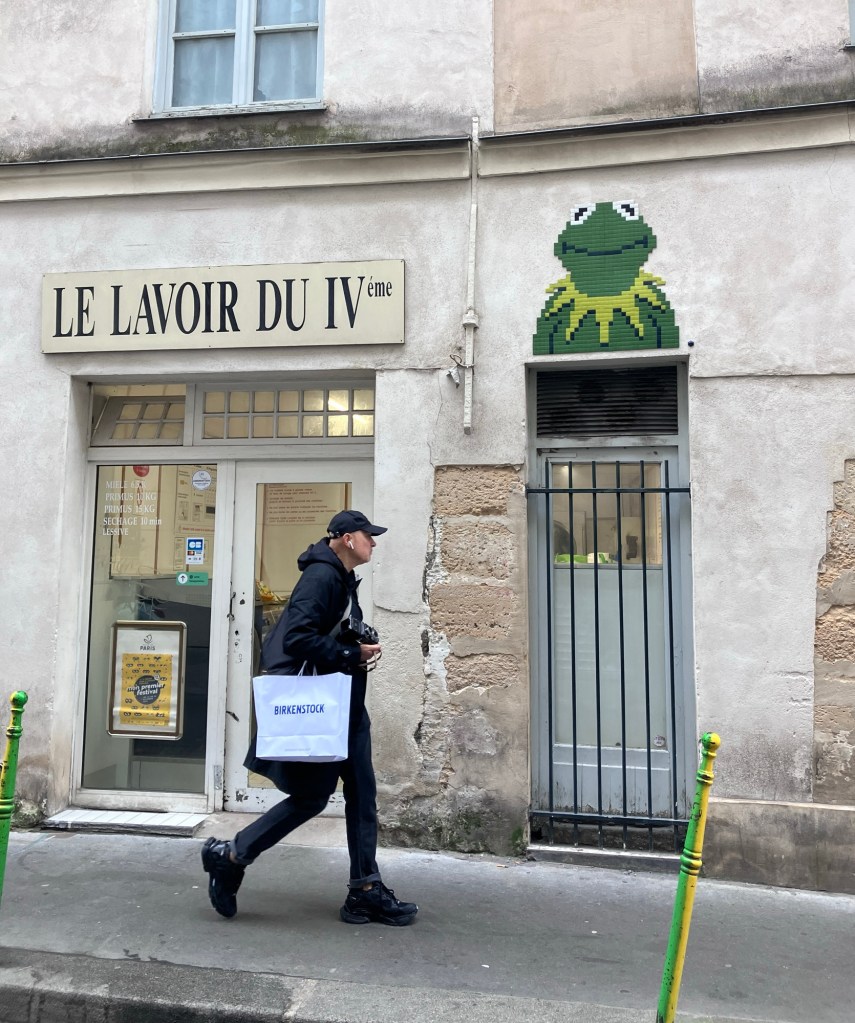
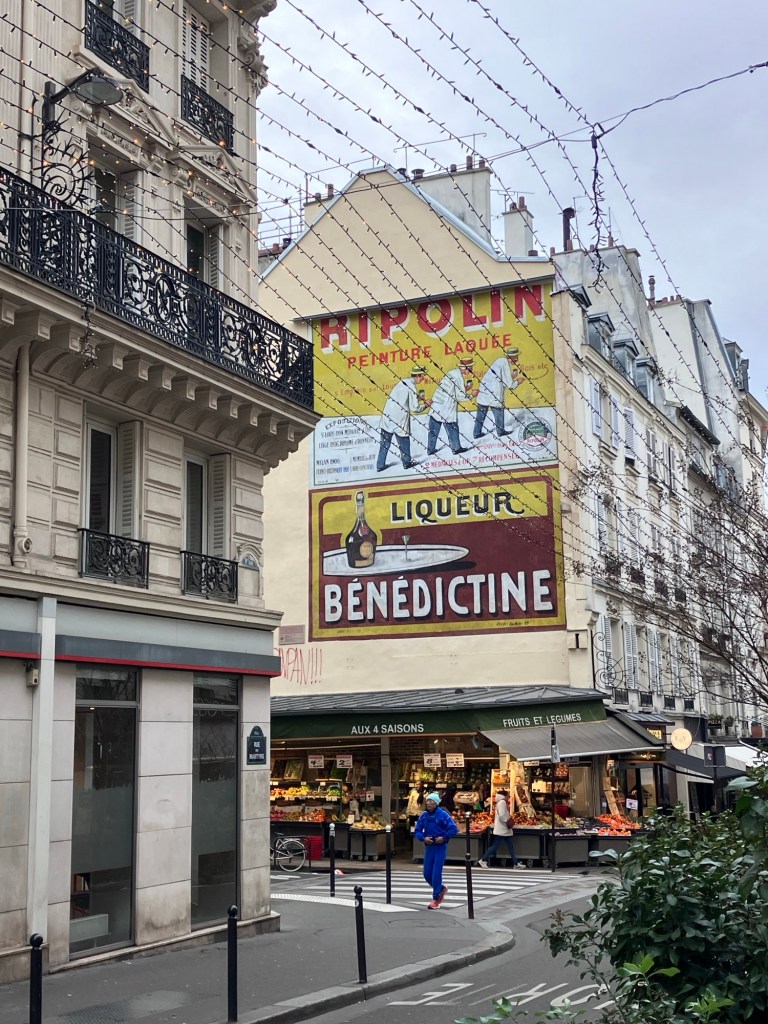
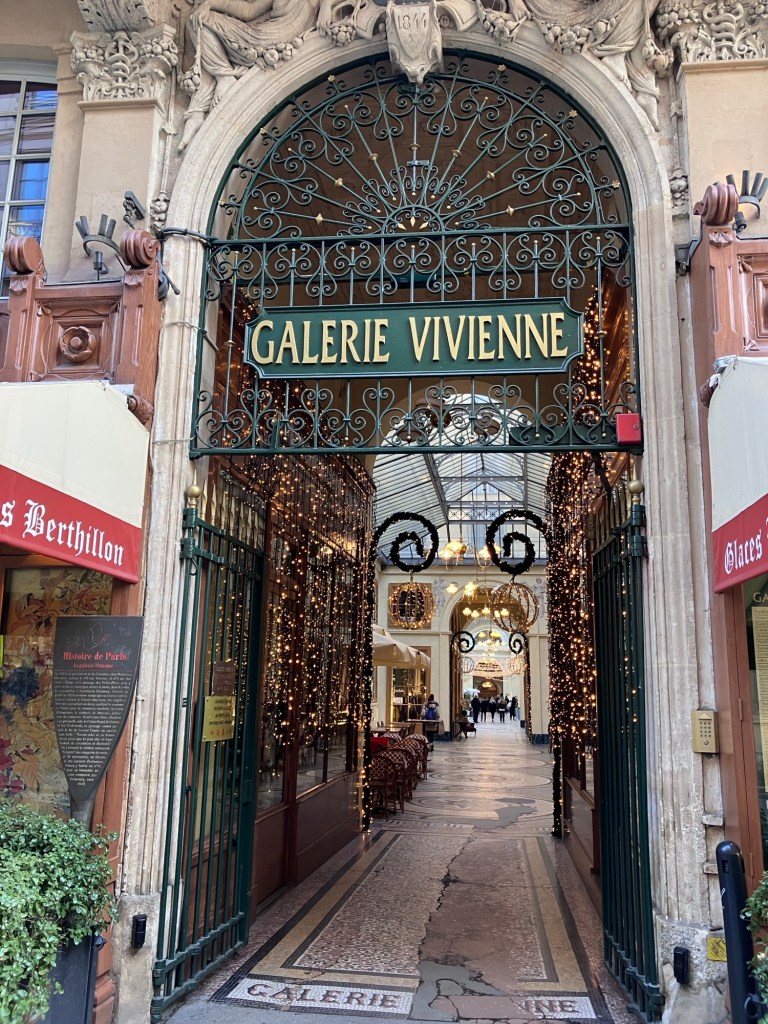
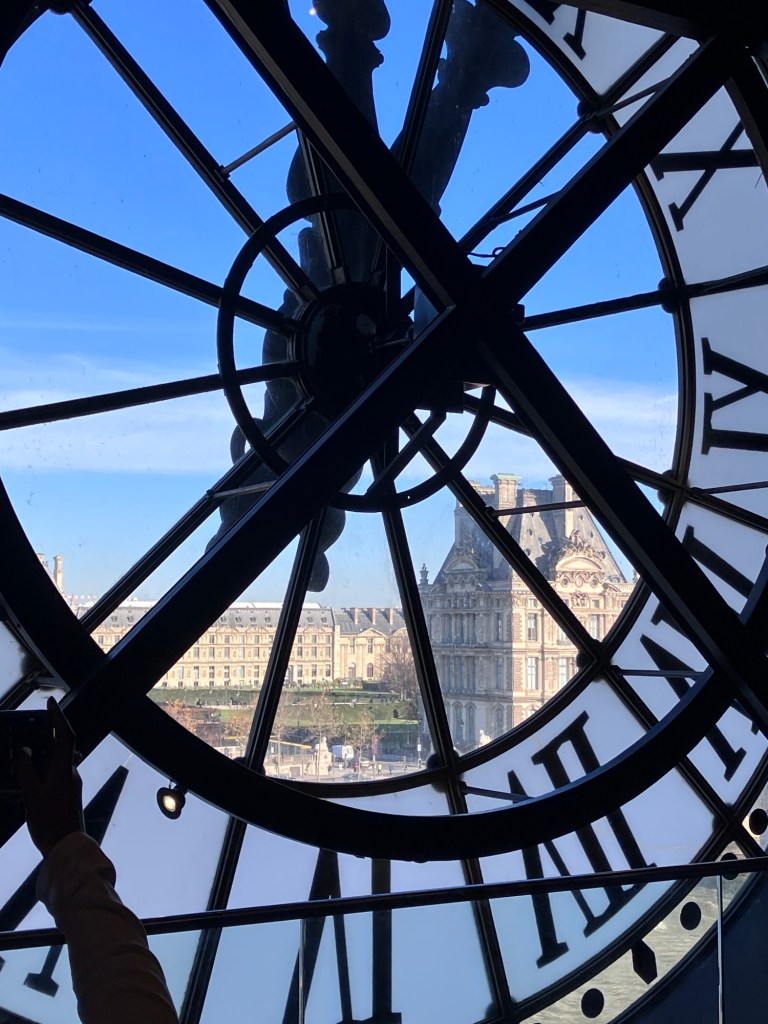
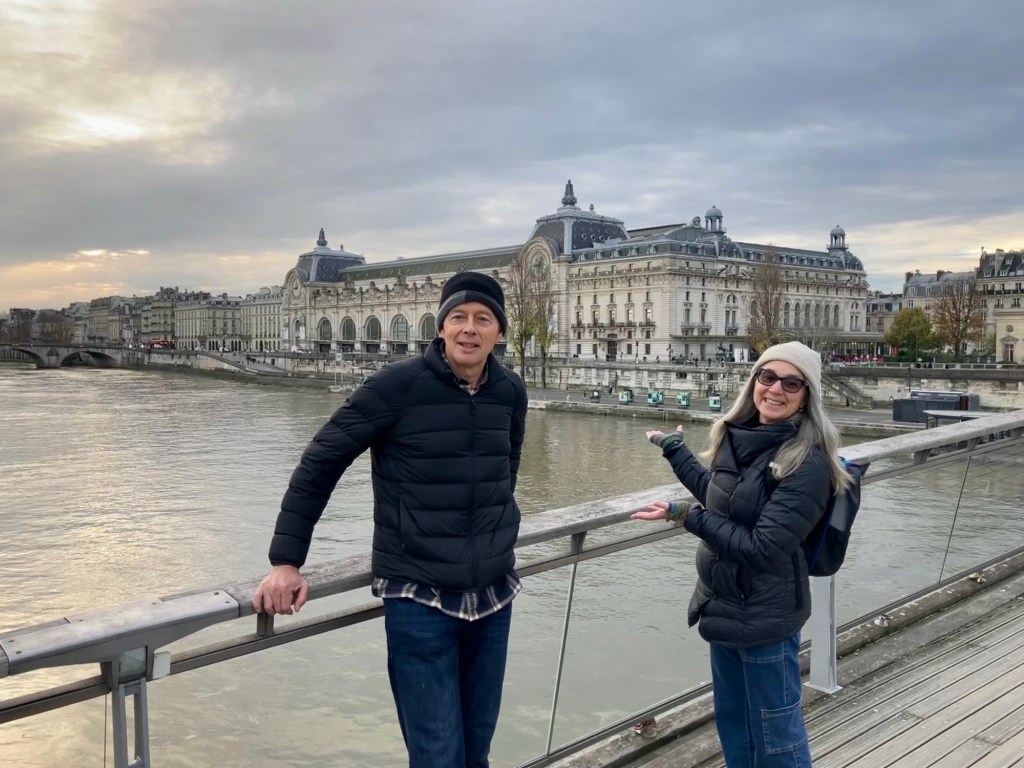
Enjoy coffee and chocolat chaud.Coffee shop dog. The family who ran the shop had their two kids and dog keeping them company since it was a holiday and schools were closed.Nancy joined us in Paris and shared our cafe stops and delightful times.I particularly love Kermit and the painted poles echoing his color scheme.Neighborhood markets and murals, Montparnasse. A wall of old advertising, uncovered and refreshed on Rue des Martyrs.In the 9th. The society of mineral water building.The bubbly water in the pipe!The beauty of Paris.The passages.The people in dark wool coats strolling the passages.Basilique du Sacré-Cœur de Montmartre glimpsed from Bd Haussmann on our way somewhere one morning. And the real life of a city going on.Sacré-Cœur from the Musée d’Orsay.Enjoying a chocolat viennois at the Cafe at d’Orsay.One of the famous and stunning clocks at the old train station turned museum.
Watching Paris put on her Christmas and holiday decor was wonderful. Although we didn’t see too many lights on private balconies, the commercial corridors and chocolate shops put on a show.
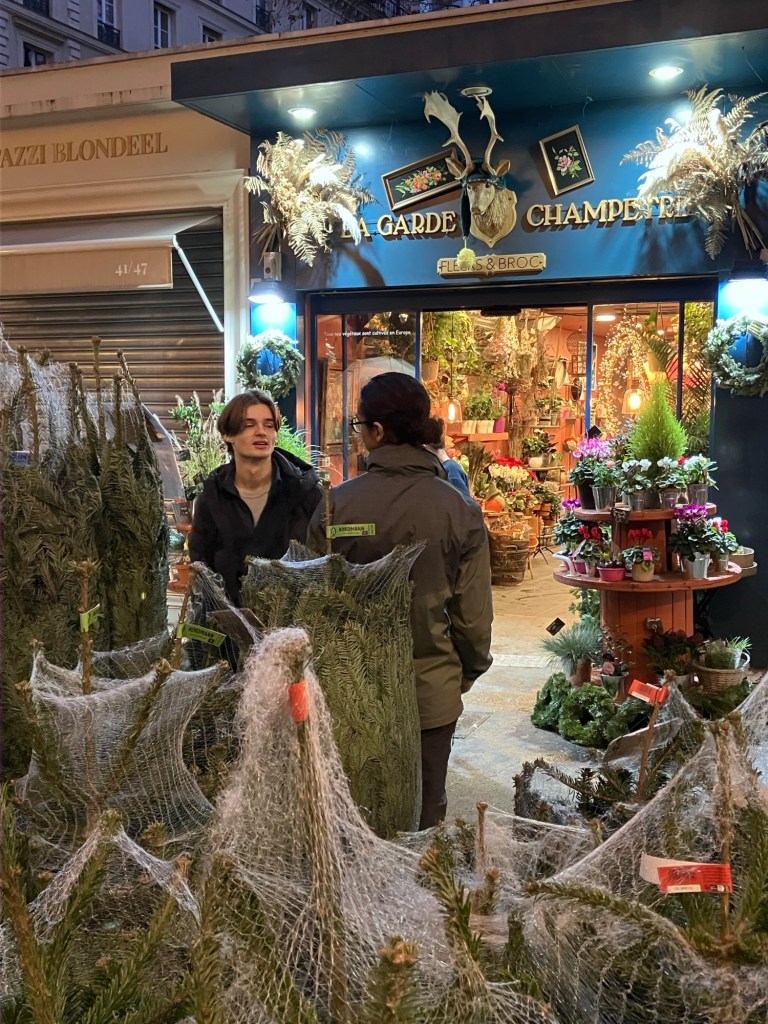
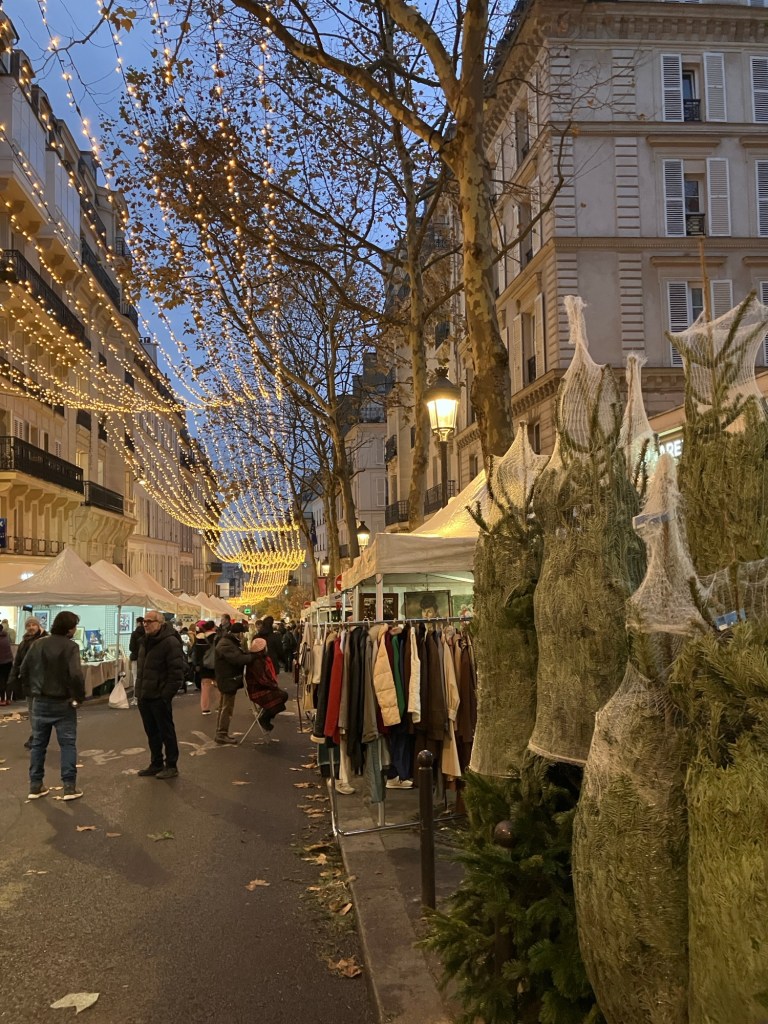
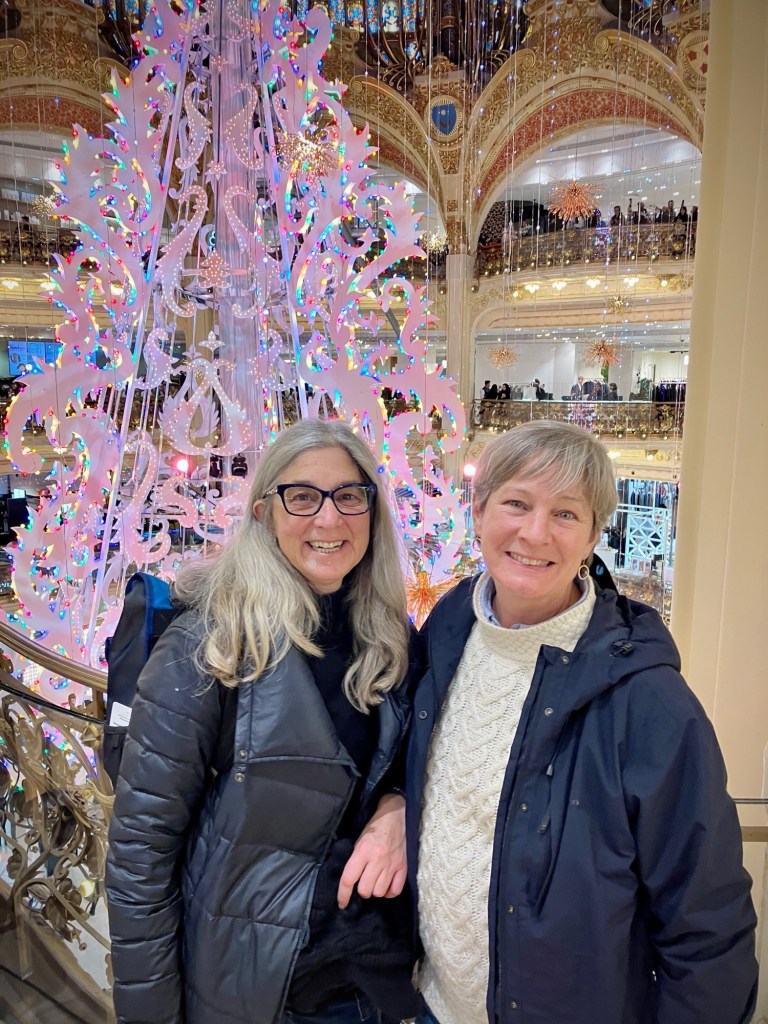
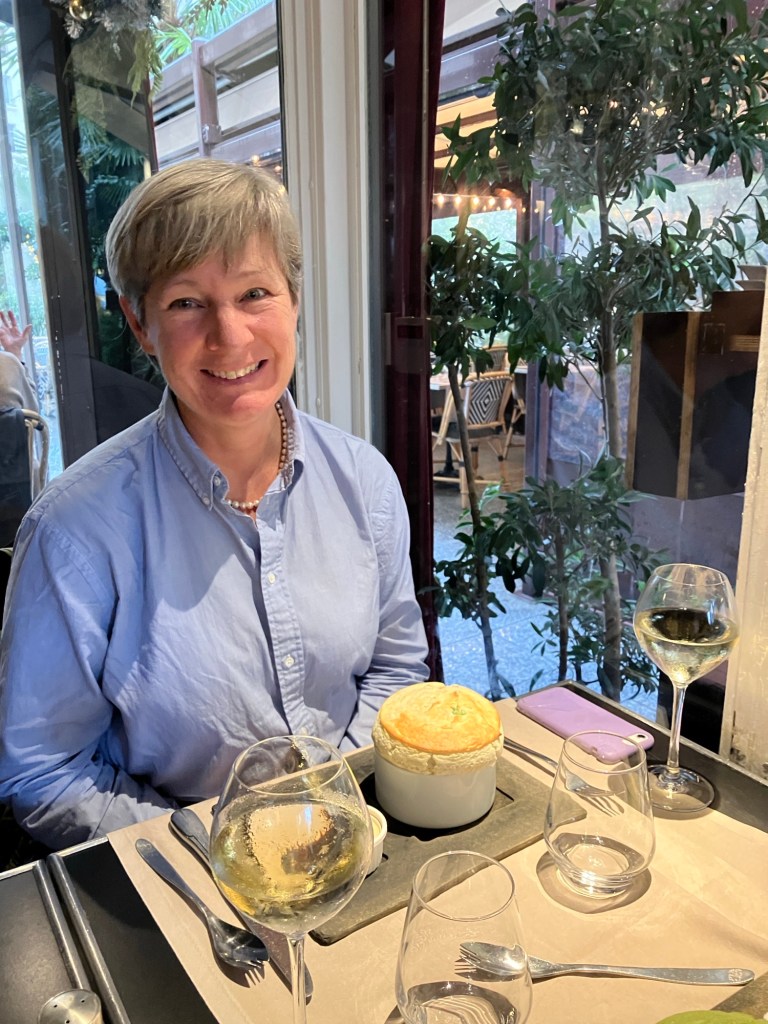
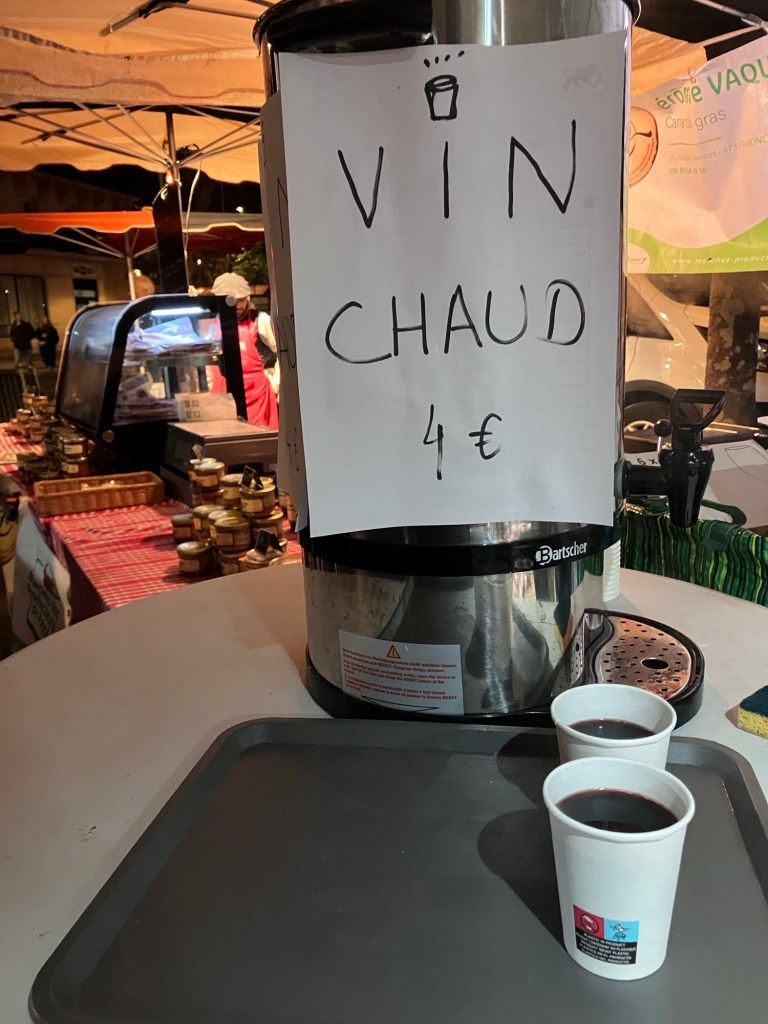
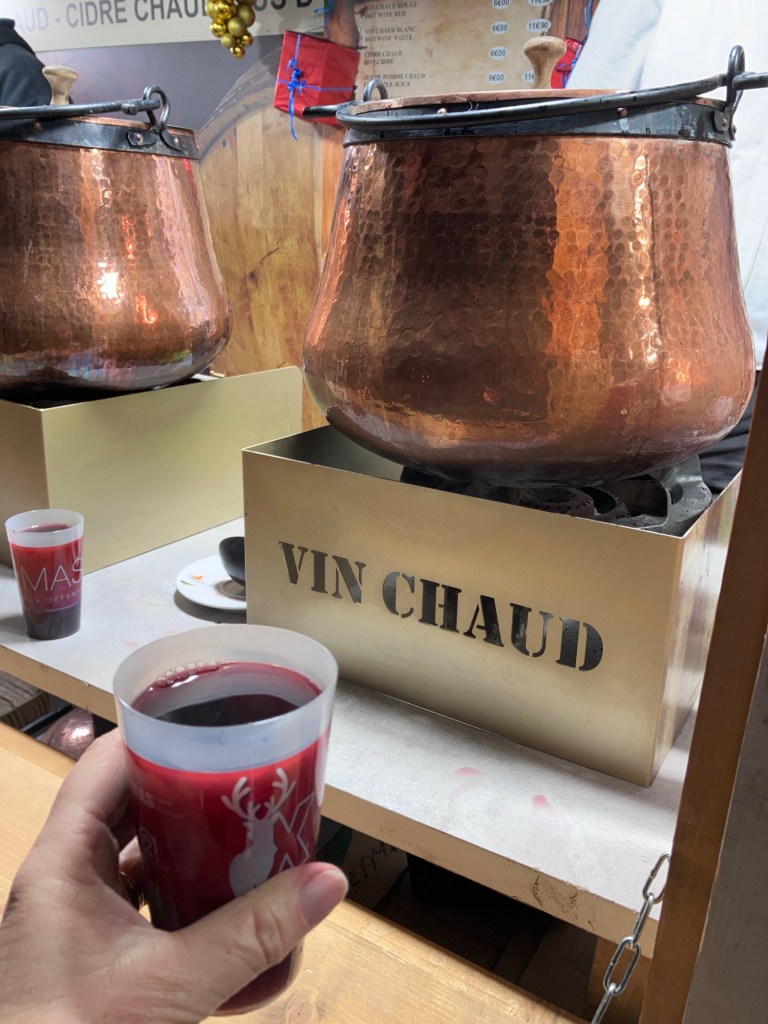
Chocolate Christmas tree. Buy a forest of them!Baby Jesus meringues. Apparently a retro treat, it’s a soft candy, not a hard crunchy one. I think it’s more like a marshmallow or melt away candy.A forest of Christmas trees for sale in the 17th arrondissement.The netting on the trees looks like spider webs.Trees for sale on R. des Martyrs which is closed to car traffic on Sundays.Nancy and I inside Galleries Lafayette admiring the massive Christmas tree.Which put on quite a show as it changed colors.We walked to museums.We walked to go to specialty shops only open on Saturdays to buy artistic stamps.We walked until the sun set (at 4 pm) to watch the lights come on.We even walked in the snow.All that walking meant we needed to keep up our strength. The soufflés at Le Récamier were just the thing.We had a one meal out per day rule. So we made those meals count. Sometimes we didn’t need to go far. This oyster stand set up one weekend for two evenings on our neighborhood market street.12 shucked oysters from Brittany and white wine.Thanks to Dan we visited Buns Land for some amazing Biangbiang noodles. Mostly take away with just three stools at a tiny counter.We also drank vin chaud when we could. Hot mulled wine. This was the best we tried, from the wine stand at the regional merchants evening market where we also had the oysters.Rosy cheeked vin chaud drinkers.Had to try it at La Défense Christmas market too! Complete with souvenir cup.Nice and hot, but a bit sweet. But we kept our souvenir cups to savor sweet memories.More vin chaud please! At a small Christmas market at Pl. des Abbesses.A nice version, not too sweet. The quality of the wine was not as good as at the regional merchants evening.
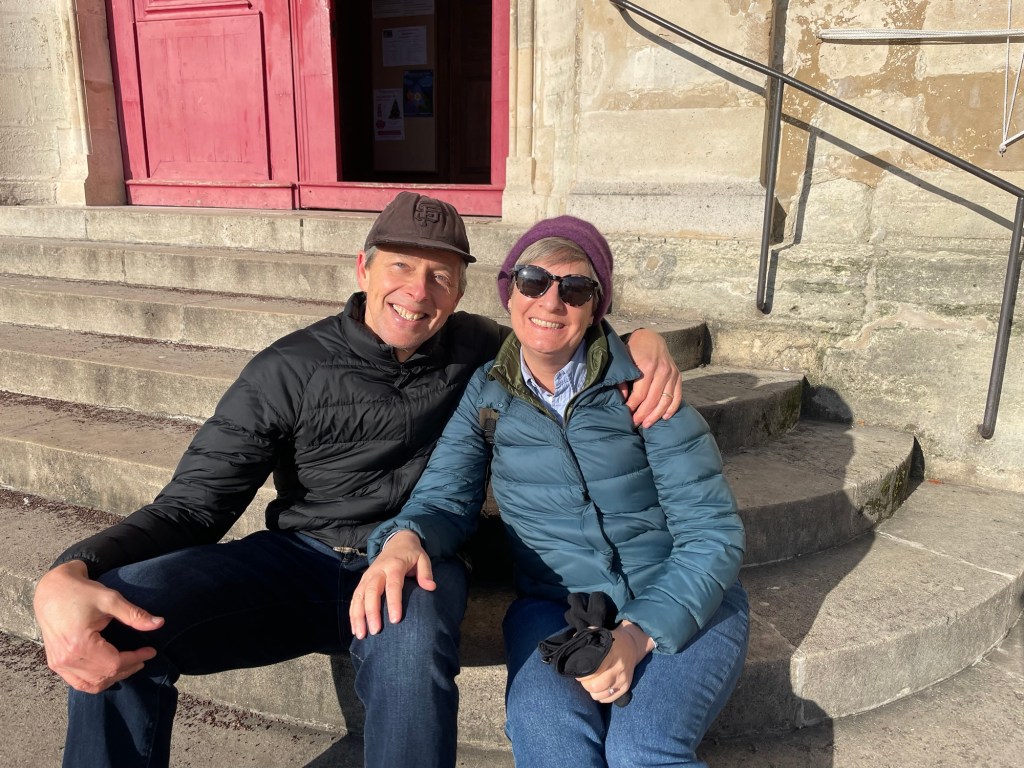
Late November and early December seemed to be a great time to visit Paris. Holiday cheer was getting going, but Christmas crowds hadn’t fully arrived yet. The weather was mostly grey but the sunny days we got felt even more special. The one day of snow was scenic but melted quickly. And having friends visit, first Dan and then Nancy, was just wonderful. And we got more photos of the two us than we usually take. As Nancy joked, it’s proof Rich does have a right arm – that’s his selfie taking arm usually not seen in our photos together. A big thank you to Nancy for the great photos.
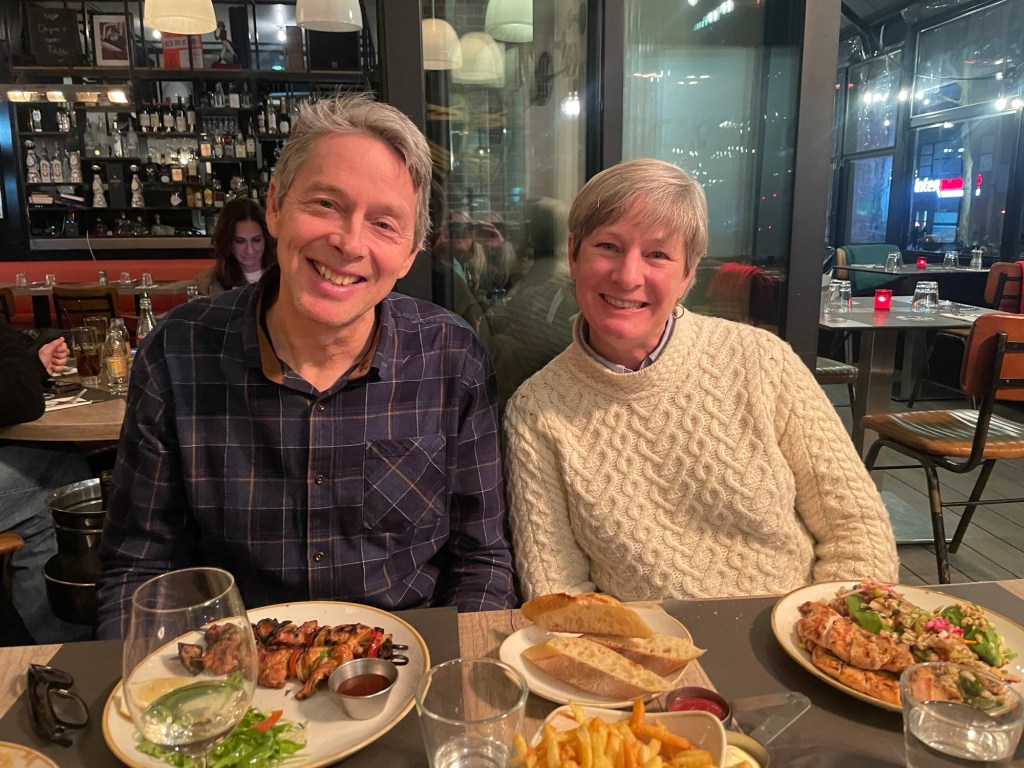
Look at that! We have legs and Rich has both arms!We sit together!We stand together at our local bar!We got to pose in front of a Christmas tree. And we got to spend time with one of our favorite people in all the world! Nancy.The flâneurs of Paris.Apartment lobby mirror group photo of the happy travelers.
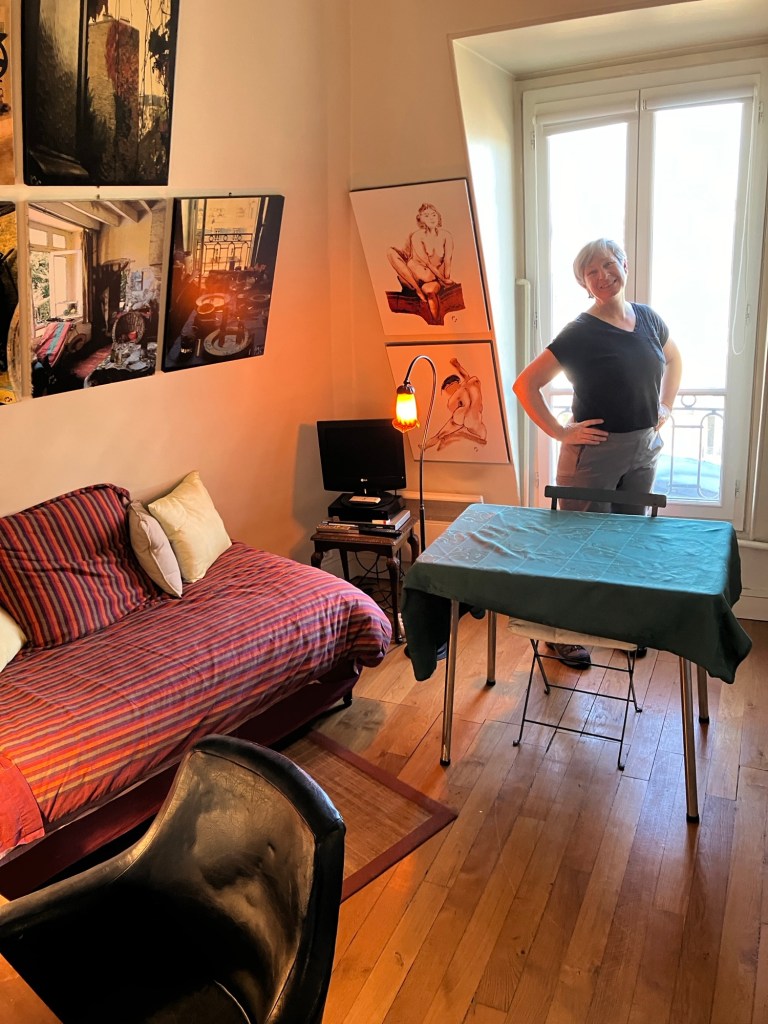
When we came through Paris in May, on our fantastic bike tour through France, we visited our friend Jason who was on sabbatical from his professorship and staying in an apartment he found through sabbatical homes. It turned out that he and his wife could only take two of the three month final increment on the lease and he asked us if we would like to take the third month. Yes – was our pretty fast reply. Since we’d stayed at an apart hotel just up the street from the apartment we knew we’d like the neighborhood, and we’d been to the apartment for dinner so it was an easy decision. And a great decision.
The neighborhood street market, Tuesday and Friday. An early visit to avoid crowds later.The wide sidewalks of Bd de Reuilly in our 12th arrondissement neighborhood.Windows that face La Promenade Plantée. A greenway somewhat similar to the high line in NYC. Those windows and iron balcony just scream ‘Paris’ to me.
We hit the ground running with our Amis du Louvre cards and a trip to Disneyland Paris. The high and the low? The culture and the pop? Mona Lisa and Micky Mouse!
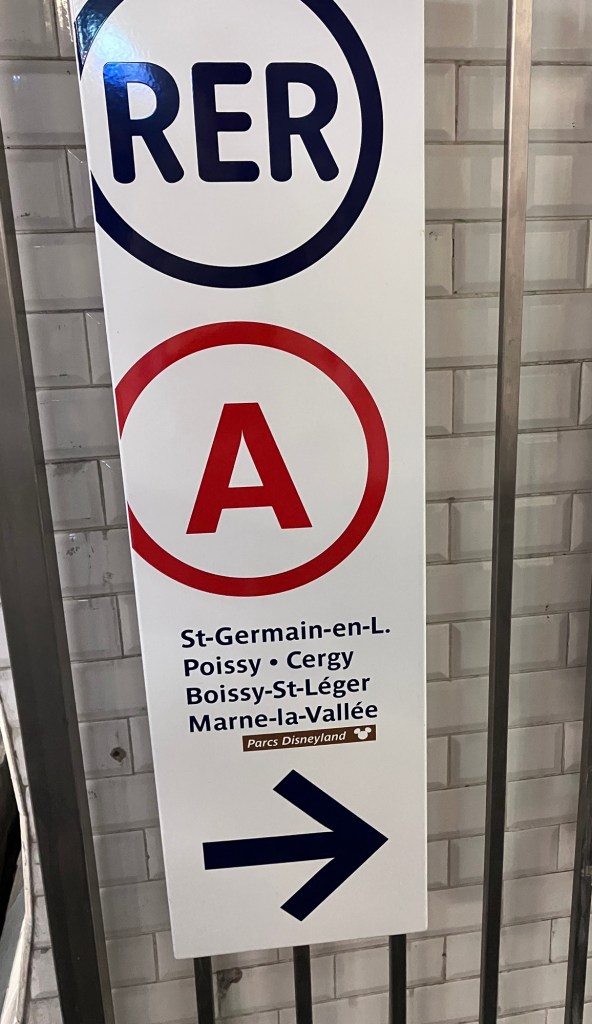
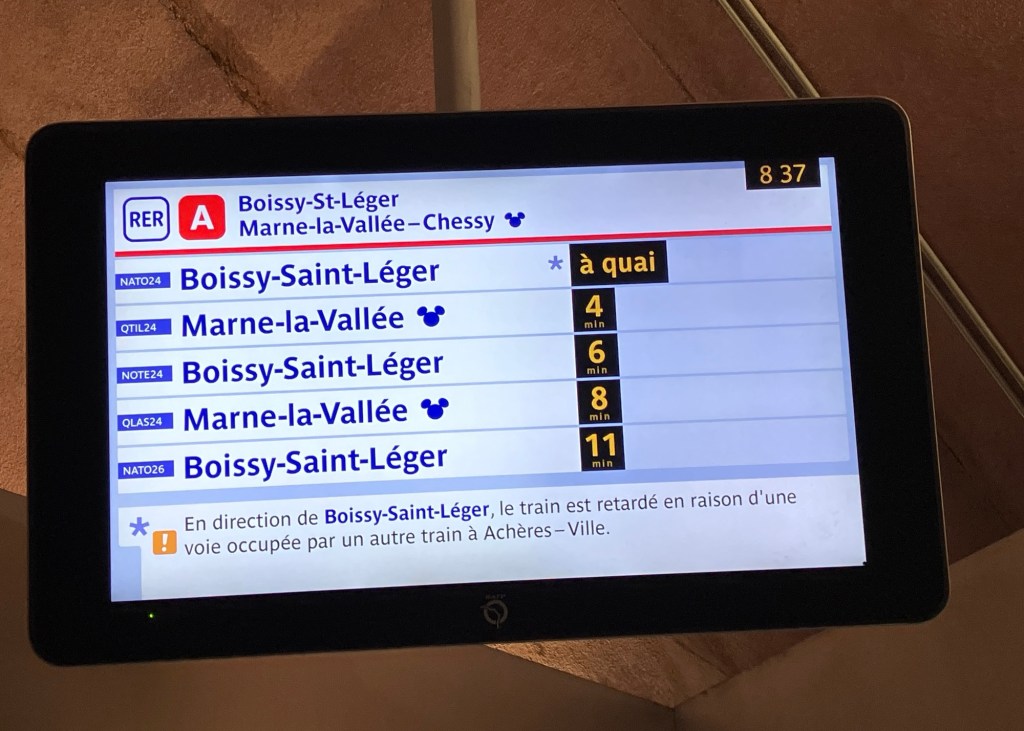
The RER A goes right to Disneyland. One transfer from our apartment, metro to RER.The mouse ears on the train departure signs are pretty darn cute. And helpful.Exit to Disneyland.
As huge fans of public transportation we were thrilled to take a train right to the entrance of Disneyland. We’re both very familiar with Disneyland Anaheim so we spent the day making comparisons and ranking the rides between the two parks. Paris for the transportation win, for sure. And our monthly Navigo passes (~€80) covered the entire trip, as well as all metro and trains in the Paris area (Zones 1-5)
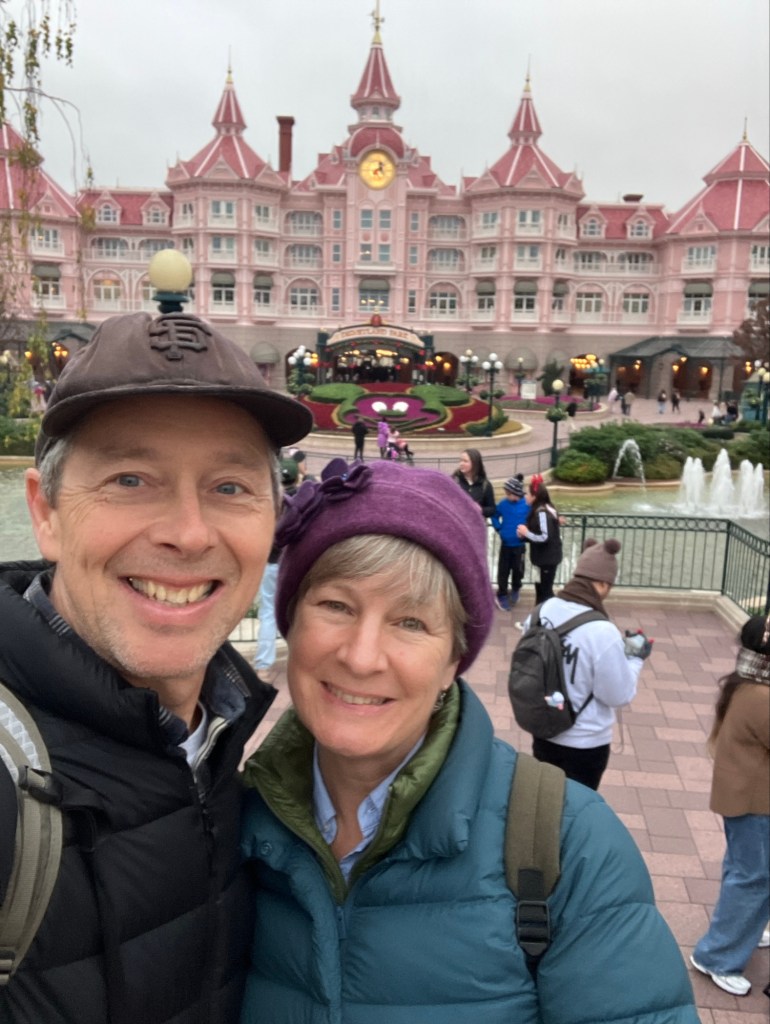
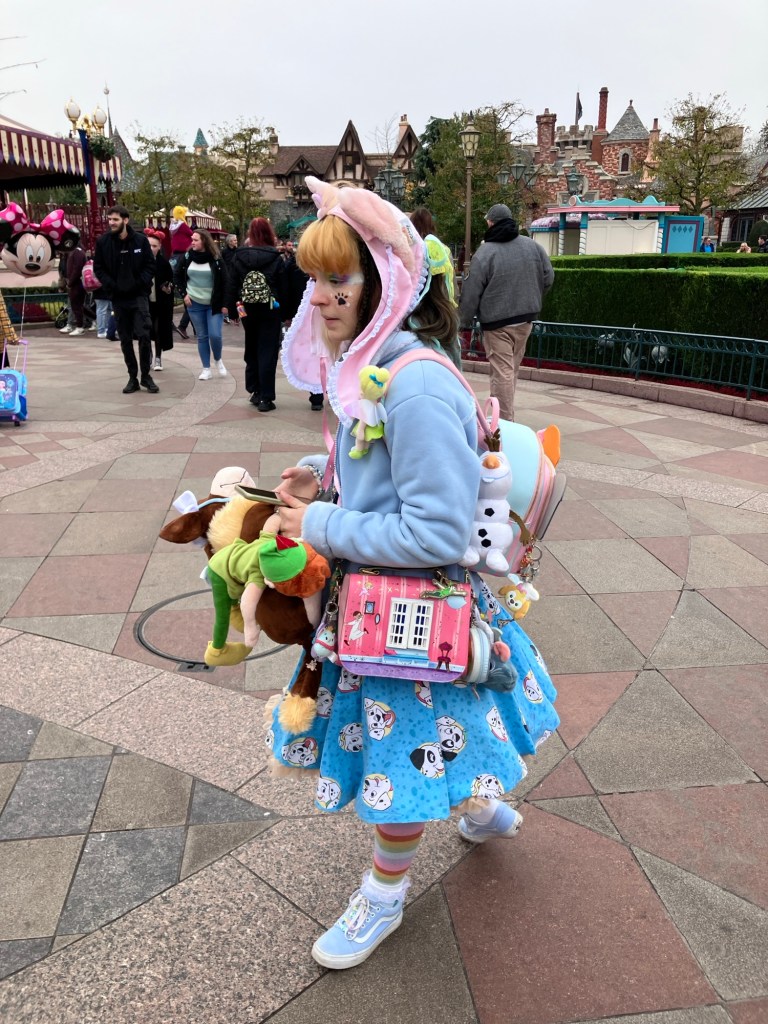
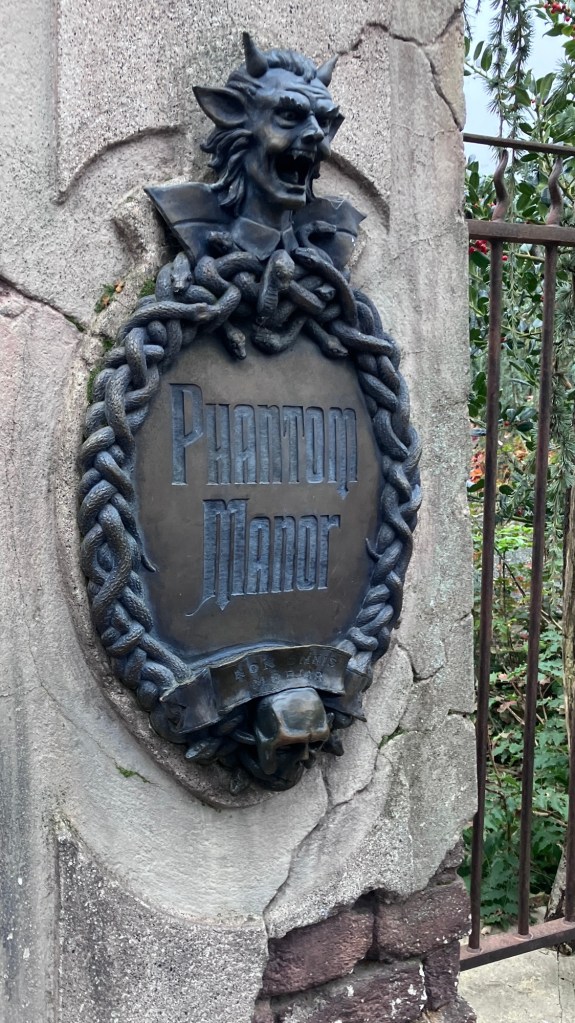
It was a grey and chilly day at the happiest place on earth.I sort of expected Europeans to be a bit blasé about Disneyland, maybe treat it as a brash American import. Nope. Disney fans are Disney fans. Thunder Mountain Paris for the win! Most of the ride is on this island, so you start and end through a tunnel. Phantom Manor, The Haunted Mansion in Anaheim. Both are fun, similar layouts, nothing terribly different, except the spooky French in lieu of English. Très amusant!Hyperspace mountain. My new nemesis. Before the ride. I should have paid attention to the signs warning about motion sickness. And noticed the shoulder harnesses.
It is right there in the name. Hyperspace. Not just space. I’m used to the one in Anaheim which is pretty much a simple rollercoaster in the dark. I knew right away this one was a mistake. It went upside down twice. We now call it the brain scrambler. I lurched off the ride to find a bench, feeling pretty shaken up and a bit nauseous. I am past rollercoaster age, I decided. I’ve always avoided rides that go in a circle, the worst motion sickness ride for me is the spinning tea cups, but this one really was awful. Even Rich thought it was a bit much in the dark, and he loves rollercoasters.
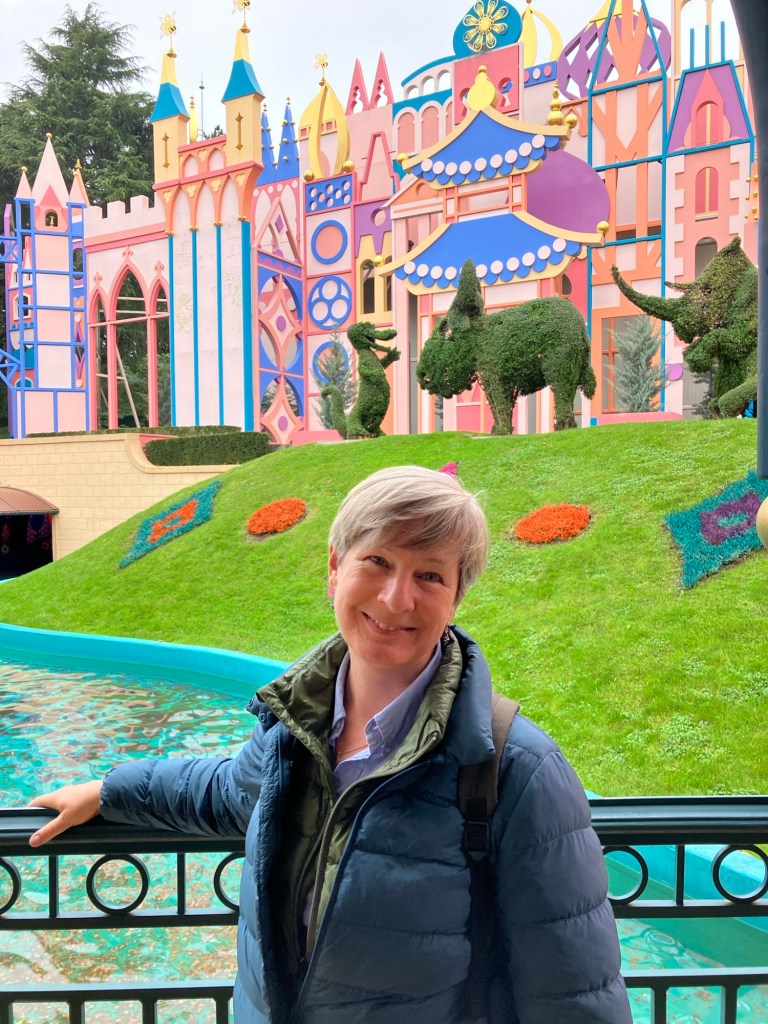
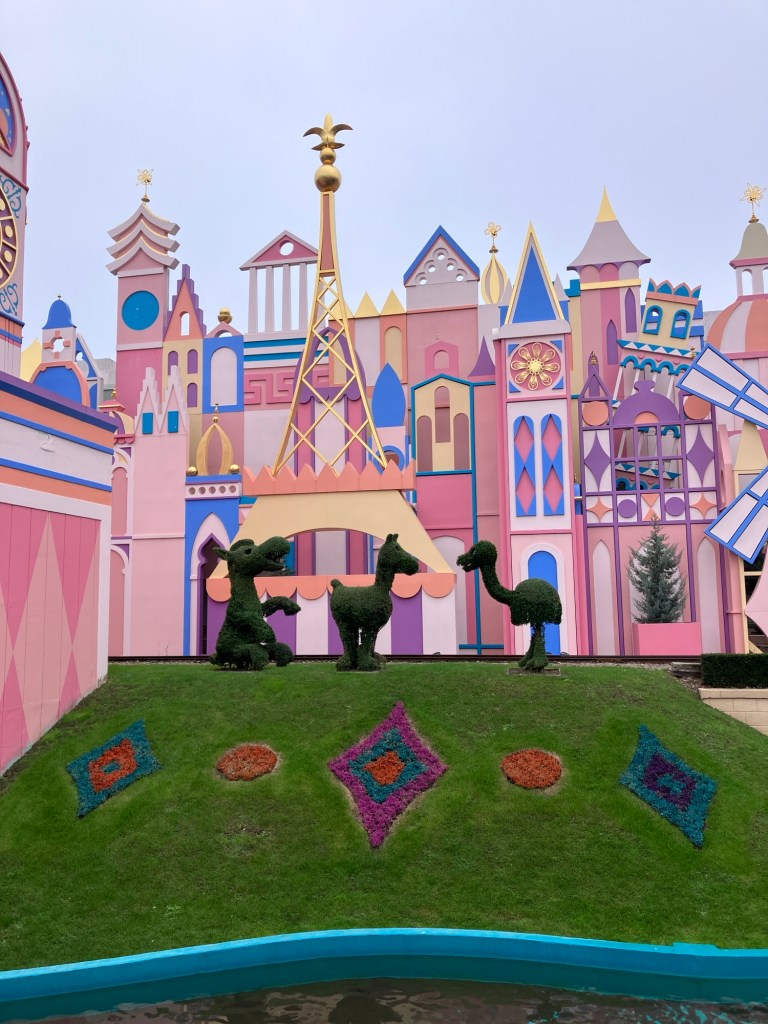
The only thing I could face was Small World. Go ahead. Start humming the song.
The grounds of Small World are more extensive in California, with more topiary animals, but the ride felt fresher and more culturally correct in Paris. One of the biggest differences we noticed was how quickly the lines for the rides go under cover in Paris. In Southern California you can be outdoors quite comfortably year round, and the rain isn’t torrential. It was chilly and a bit drizzly when we visited and we were glad for the shelter.
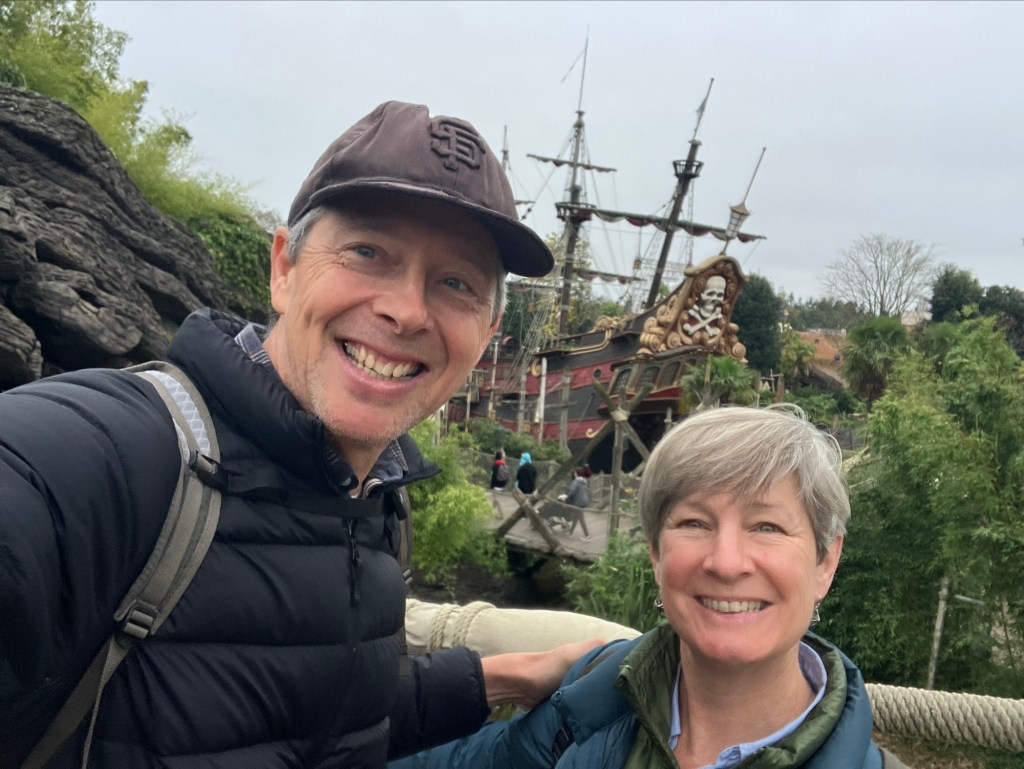
Recovered from my brain shaking. A big motivation to visit was that we were there during a very quiet time. The Halloween decorations were down and Christmas decorations not yet fully up, so it’s not a popular time to visit.But, being efficient Disneyland, some holiday decorations were already up.We could bore you much more with our detailed observations of how Paris is different than Anaheim, but won’t. Ask us the next time we see you in person about Pirates of the Caribbean. We have thoughts.Le Château de la Belle au Bois Dormant.
On to the high culture: we learned about the friends of the Louvre card from our Paris apartment connection, Jason. Not only do you get to go to the Louvre as often as you want, you also get a different entrance, at the Passage Richelieu, so no big line like at the pyramid or in the Carousel Mall.
Rich cracking the map.
We had visited the Louvre once before and it was a lesson in frustration. The audio guide is a Nintendo based handheld gizmo which is confusing to operate, even for people younger than us. Signage is not great, the layout is labyrinthine, and you will walk miles and miles finding the art you want to see. But it’s the Louvre! On display: 35,000 works of art. In the collection: 500,000.
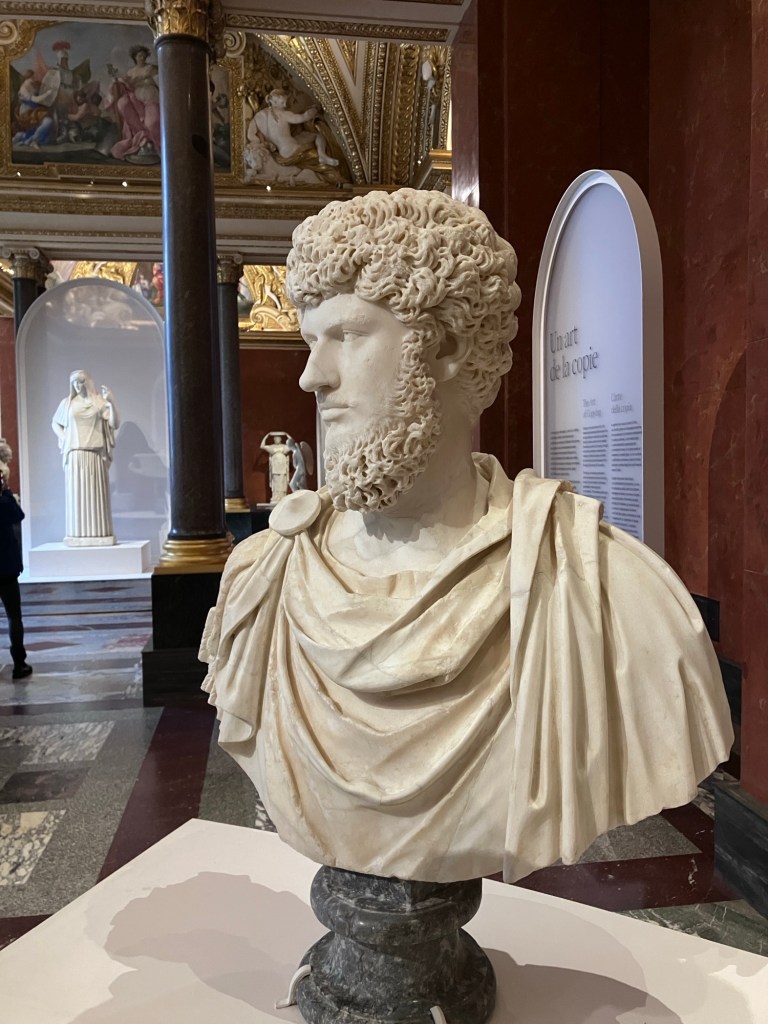
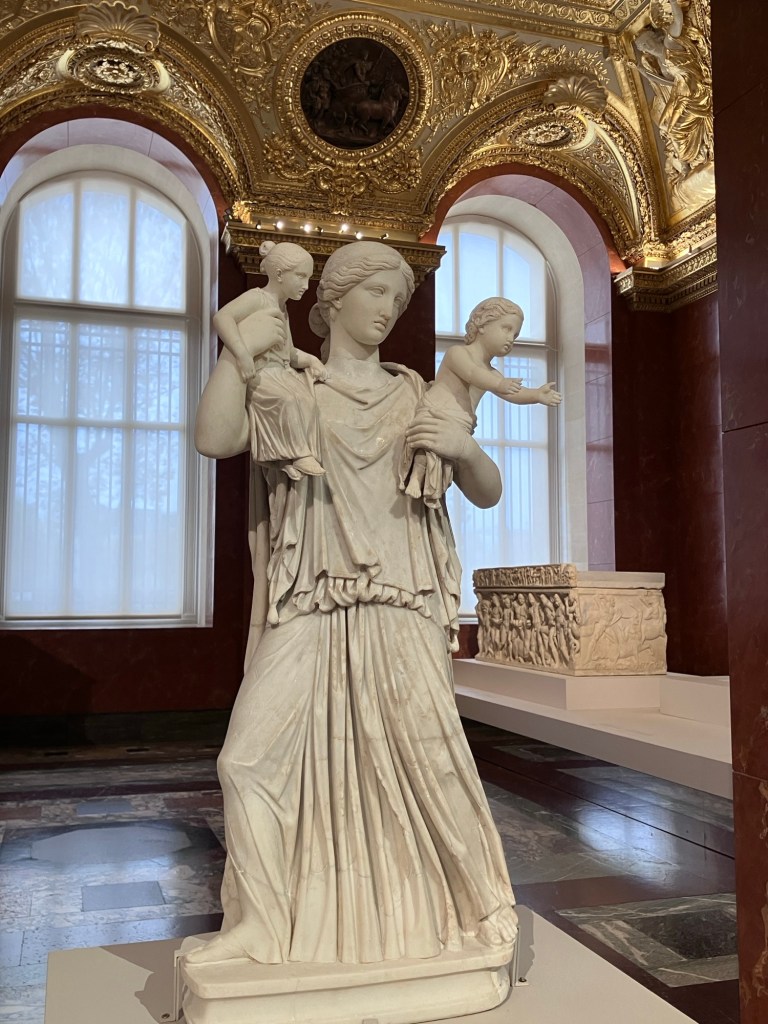
In the newly renovated Anne of Austria Summer Apartments, the Torlonia Collection.The marble sculptures are on display outside of Italy for the first time.Amazing detail.An early Birkenstock?Rich added for scale in front of a massive painting.
We visited the Louvre six times this visit. Once was only to visit the bathrooms and get a coffee, which was a mistake since it was afternoon and very busy, but we will share what we learned. The Friends of the Louvre card – fantastic if you can make it work. We had it mailed to our Paris Apartment, and we applied from within France. Sunday am turned out to be a fantastic time to visit. At peak times the crowds are thick, but for an hour or two Sunday am we wandered the halls and galleries of the less popular wings and rooms with very few other visitors. We even peeked at the Mona Lisa – no, no selfie.
A happy Louvre visitor. This is in a room just past the Mona Lisa, The salle Mollien Room 700, Denon wing, Level 1. The Red Rooms, Les Salles Rouges.
We visited three special exhibits during our six visits, The Torloni Collection, Figures de Fou, and A New Look at Watteau. We kept reminding ourselves how extensive the Louvre collection is that they can mount amazingly specific exhibits by plumbing the depths of their own collections. And when you view the Louvre outside from the I.M.Pei pyramid and understand how little of the connected buildings is display and how much is storage and other use – it’s overwhelming.
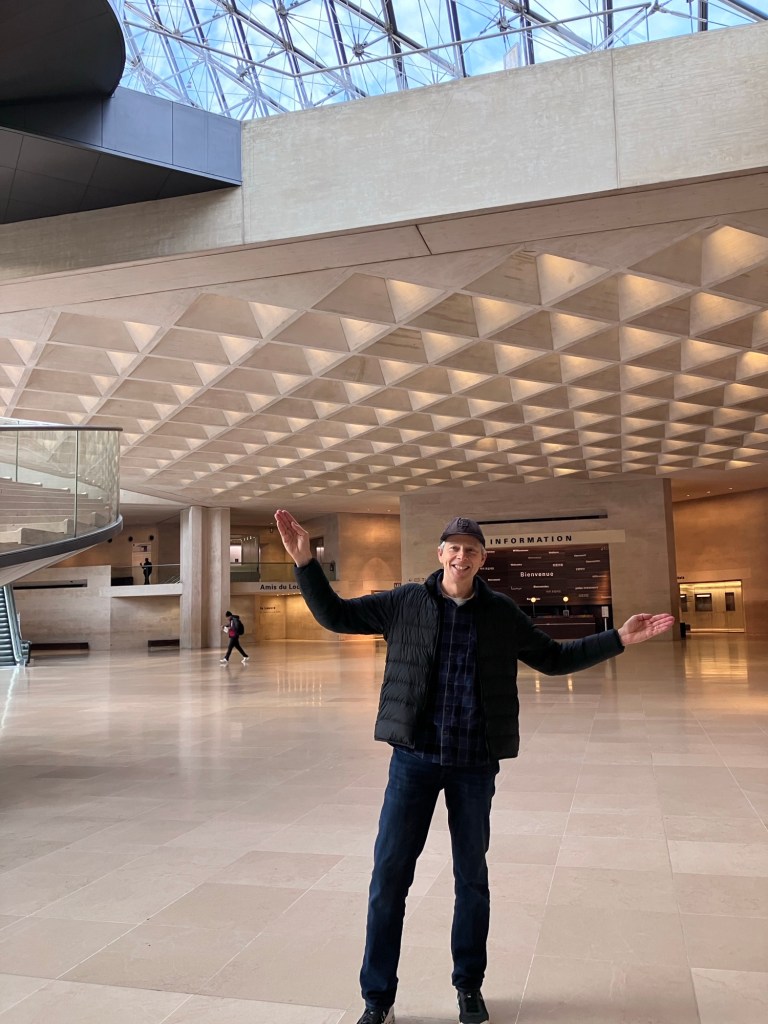
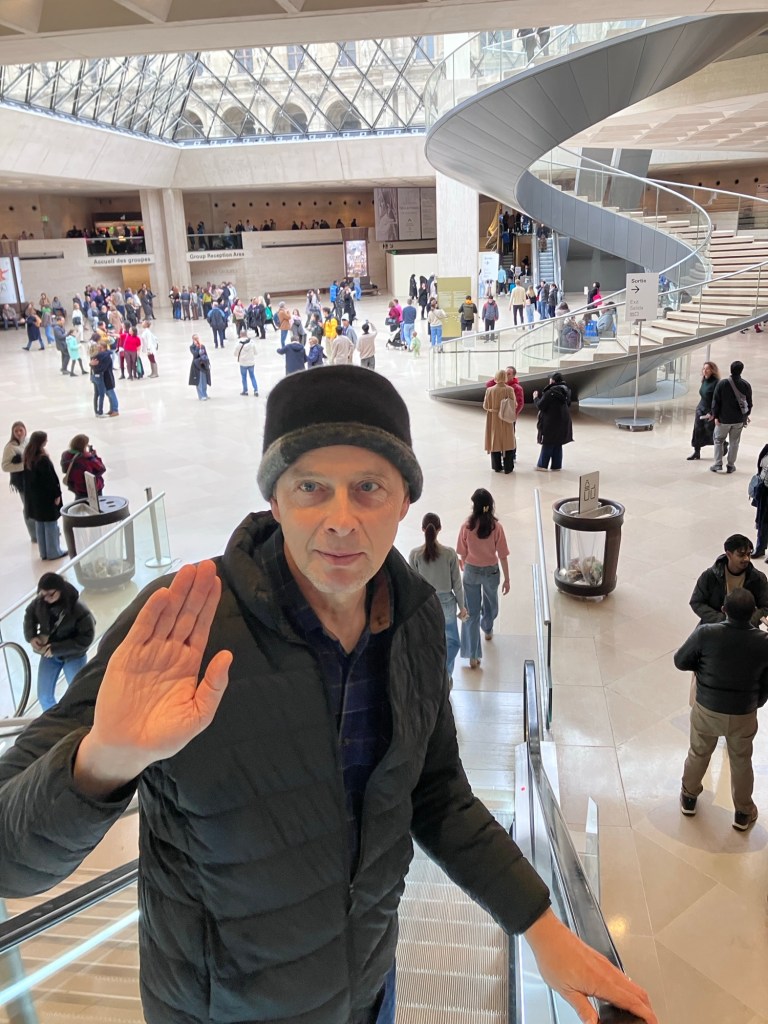
Under the pyramid at 9:02 am. My fearless tour guide. If you aren’t one, find yourself a map friend who won’t get lost in the many rooms and levels of this museum.Leaving on a Sunday at 11:24. After coffee at the Starbucks in the Louvre (!). Still not super crowded but the line to get in through security is now very long.
There will be more Louvre photos in later posts, but our recommendation is to get yourself a Friends of the Louvre card if you can. We paid 120€ for both of us, good for a year and allows you some discounts at other museums and into the Louvre Abu Dabi. Not sure we’ll use that benefit but who knows! The usual museum card coffee and gift shop 10% discount too. We ended every visit with a caffeine break.
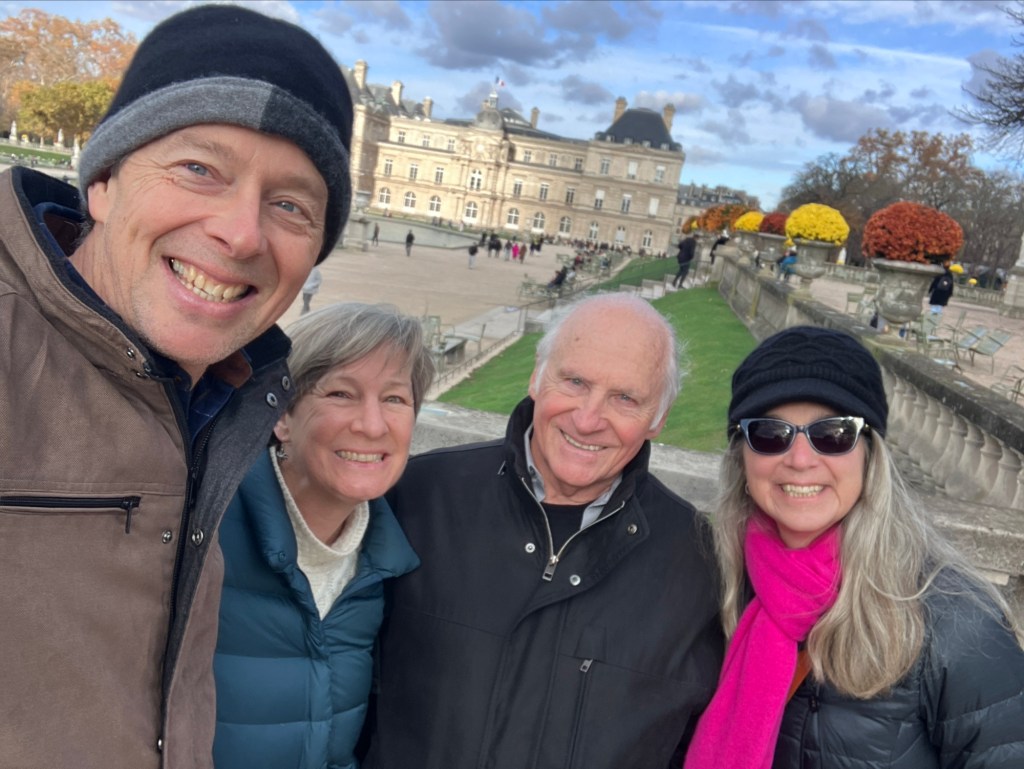
The Happy Travelers in the sun at Luxembourg gardens.
Some of the special exhibits will have their app based audio guides, Figures of the Fool did, so check before you go and bring your earbuds. We searched on line for paintings we knew we wanted to see and read write ups to each other standing in front of the paintings. There are small bathrooms scattered along the galleries, some very well hidden, so if the line is long at the main bathrooms- and it will be ladies – try to find one up in the galleries. More from Paris soon. We just arrived in the UK for a nice long stay, until January 14th, happy holidays to all.
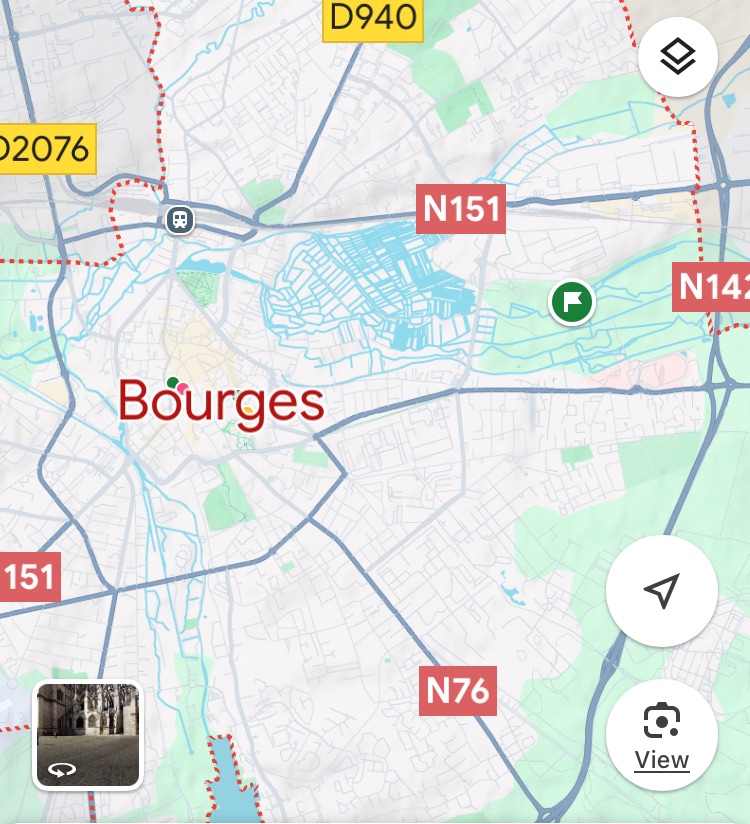
Bourges through a window of the Palais Jacques Cœur.Lyon is the bottom heart, then Bourges, then Orléans. All by train as our bicycles have entered winter hibernation.
Looking forward to a month’s stay in Paris we left Lyon, and the sunshine, although we didn’t realize it at the time. And we headed to Bourges. Bourges isn’t a big tourist destination, although Rick Steves tours do stop there to enjoy the half timbered houses and the huge gothic cathedral with its 13th century stained glass windows.
Cathédrale Saint-Étienne de Bourges. Seriously huge. We called it a triple decker cathedral.The soaring interior and lovely chandeliers.
Bourges has nearly 500 half timbered buildings, more than any other French town, and the ruins of a Gallo-Roman wall. A tea and cake shop, Cake Thé, uses one tower as a dining room, if you follow the path to the shop you will find the remains of the wall and a lovely walking path.
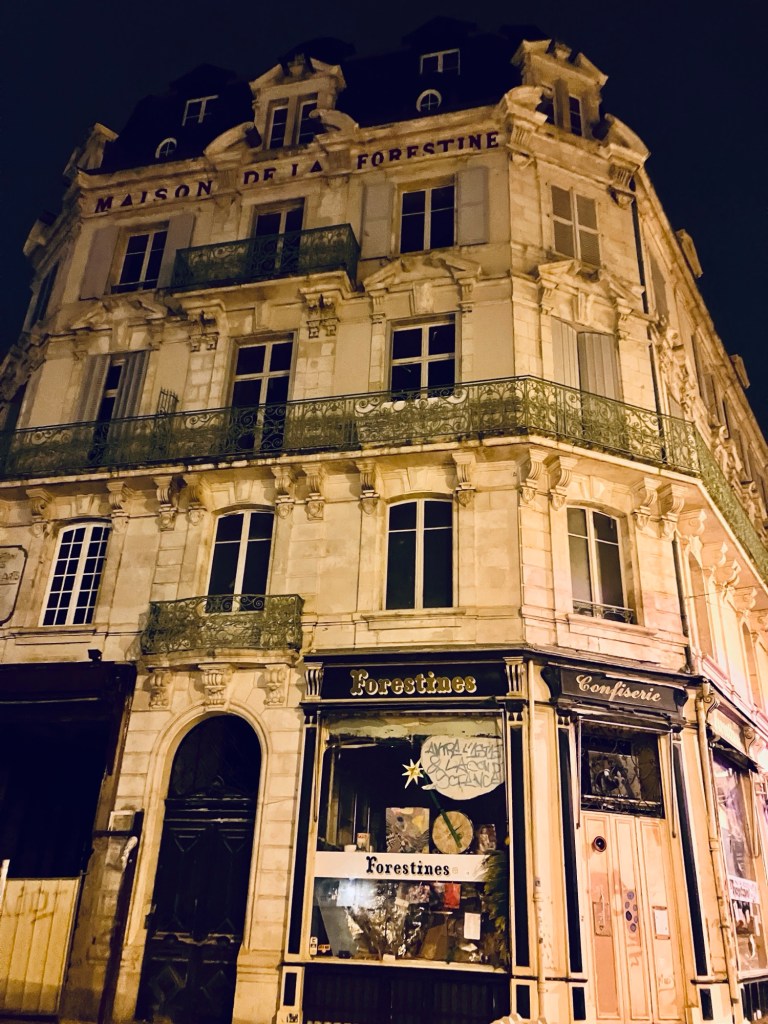
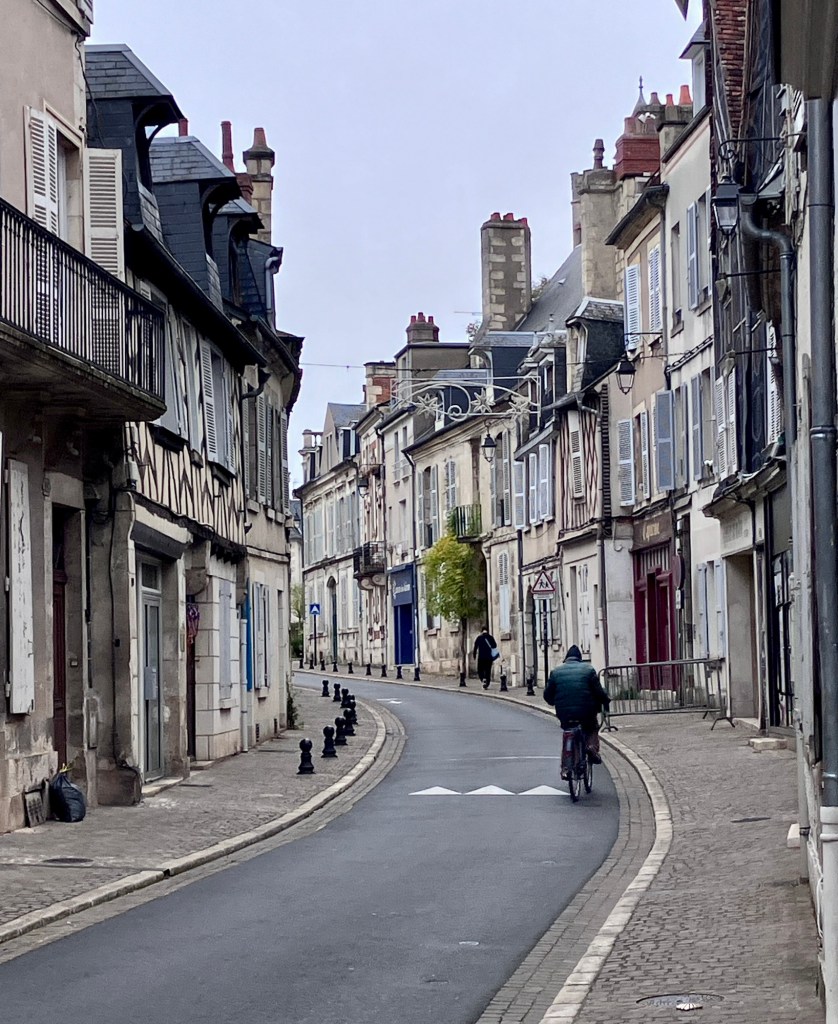
Twilight on a street of half timbered buildings.The upkeep of the buildings must be very challenging. We saw a few supported with external bracing like this.It was a great town to explore.With sweet little cobbled streets.Lined with small houses.And more half timbered buildings on a quiet street near the center of old town.Of course a Camino route goes through town. And, this is the last you will see of our sandals for a while.
One of Bourges’ other sites to see is the Palais Jacques Cœur, a large Hôtel particulier – a grand urban mansion, freestanding and not connected to its neighbors. Cœur was a government official and successful merchant in the 1400s. Too successful, as his ability to lend large sums of money led to his eventual arrest and downfall. It seems never to pay off to have a King in your debt.
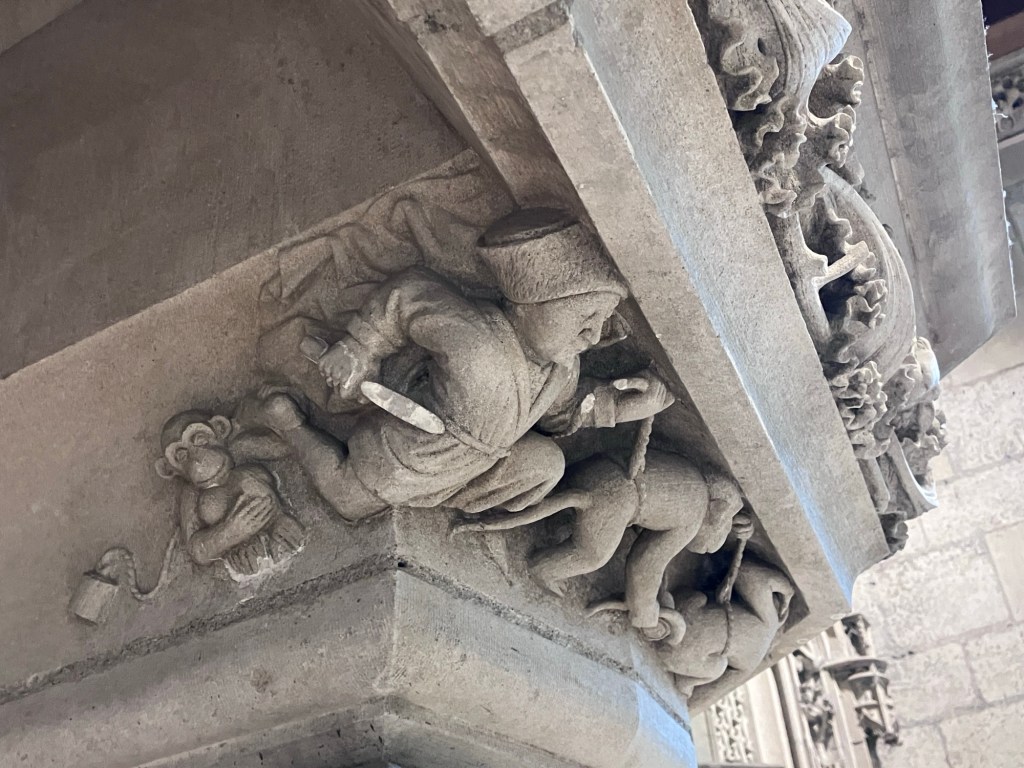
He did not get to enjoy his mansion, traveling during construction, arrested before he could live in it.So many craftsmen were employed to make this building an absolute masterpiece. Gargoyles abound.Stone carvings on every surface.You’d need a fireplace this size to heat the massive rooms.Another view through the old windows.A bat detail on the mantle piece.More fantastic stone work.
Although the palais is not furnished, it changed hands several times and was the town hall for a while, the audio guide helps you picture life in the building, and understand the amount of money and work that went into its construction.
And more gargoyle downspouts. Unfortunately for me the rain had stopped. I love seeing these in action.
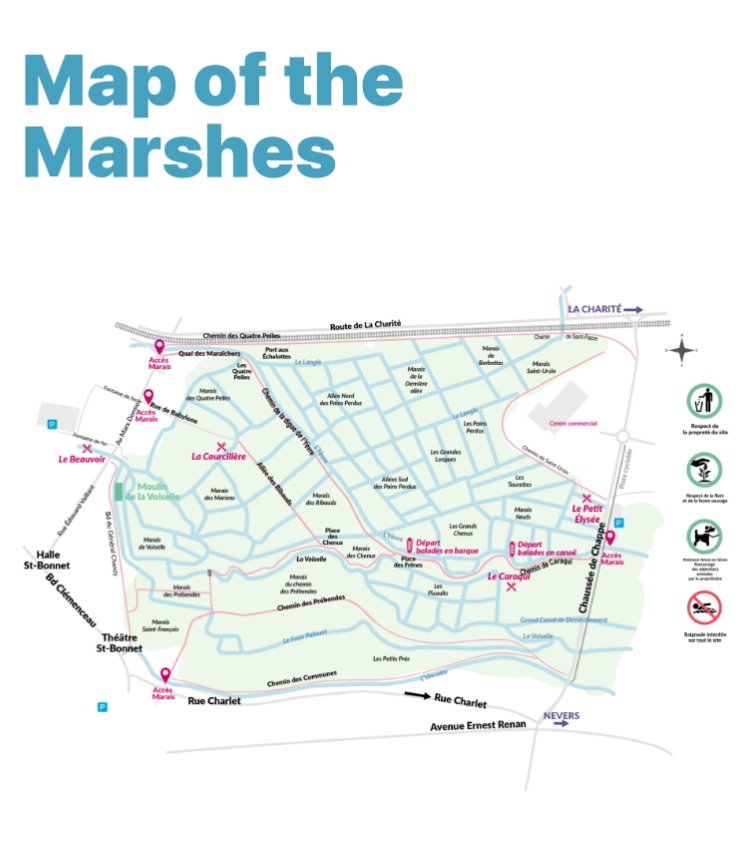
Our two night stay gave us enough time to visit one of Bourges other fascinating sites, Le Marais, or the marsh, or swamp, in English.
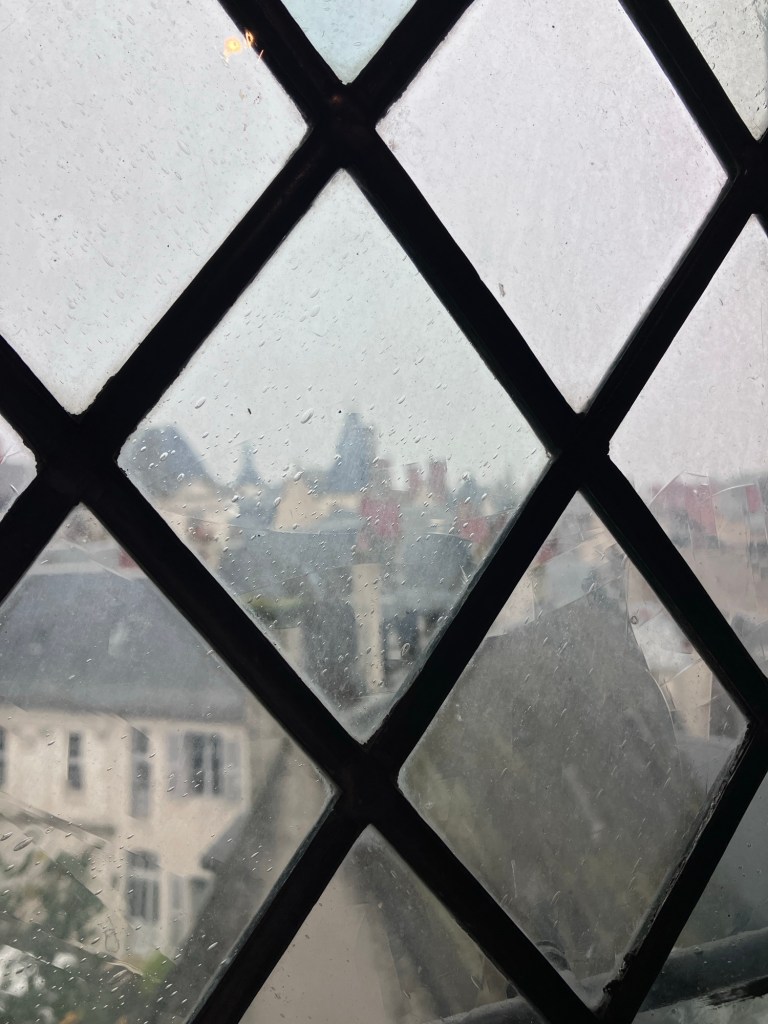
A sign pointed the way as you walked down a neighborhood street.On the map the Marais looks like a city of water. We caught a glimpse from the train and had to see it on foot.
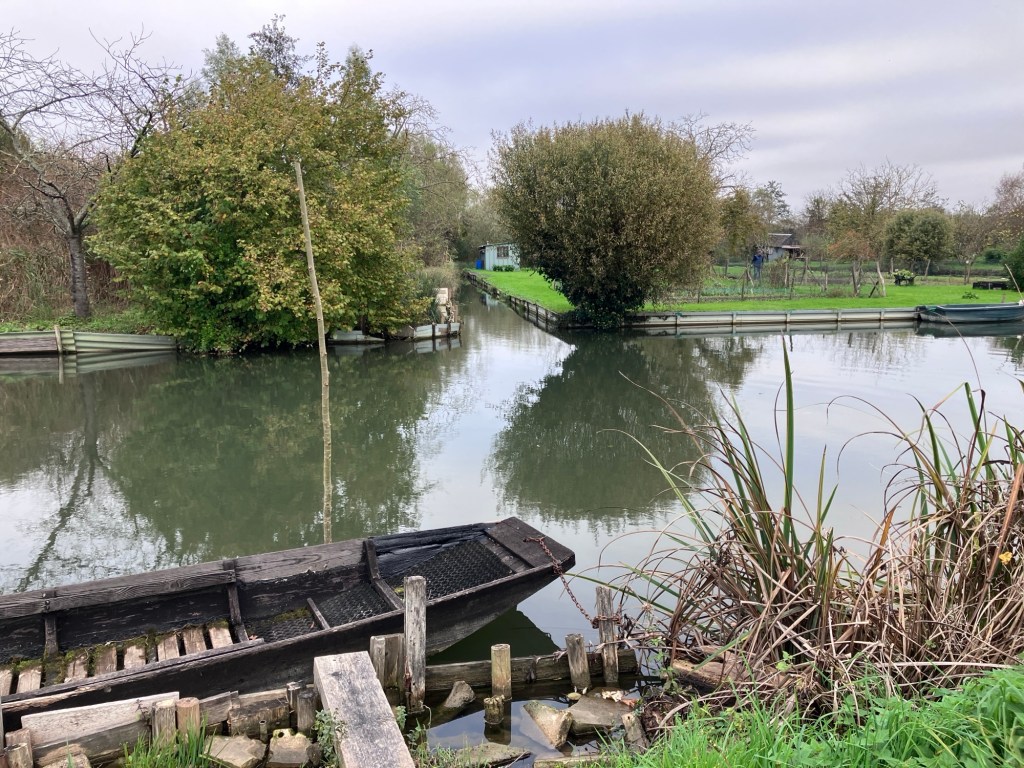
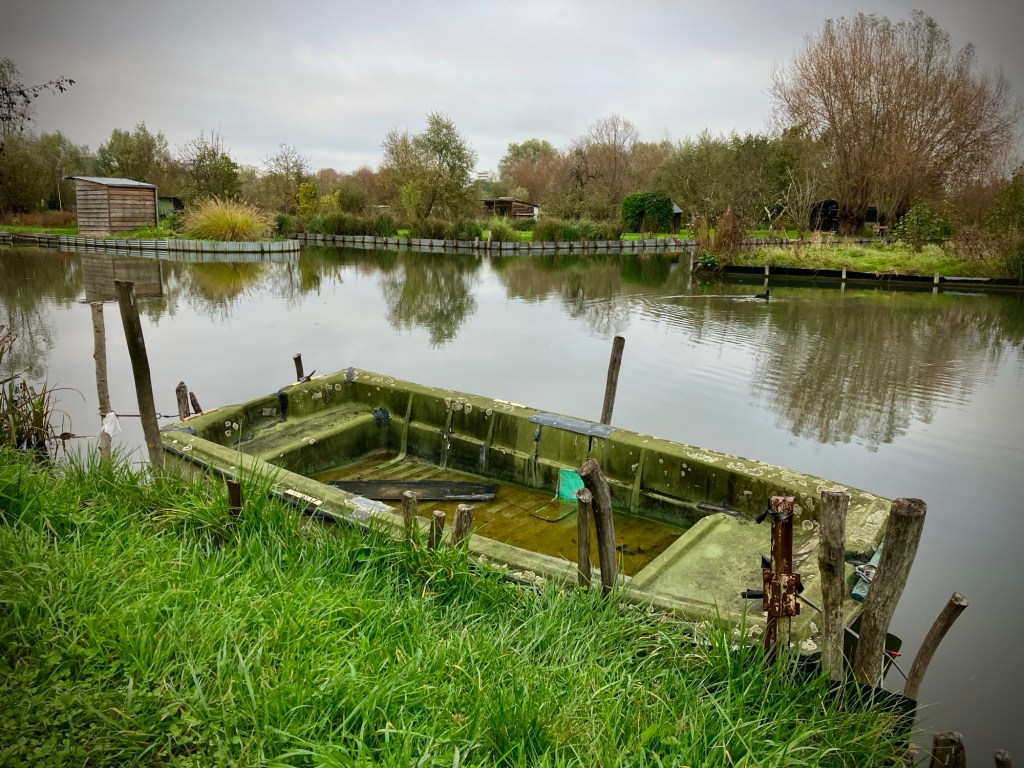
The Yèvre River is the source of water, and the swamp had provided a defendable space for the town. The 300 acres now hold 1,500 garden plots on which locals grow food, build small summer huts, and enjoy strolling on the levees. Some plots are only accessible by boat.
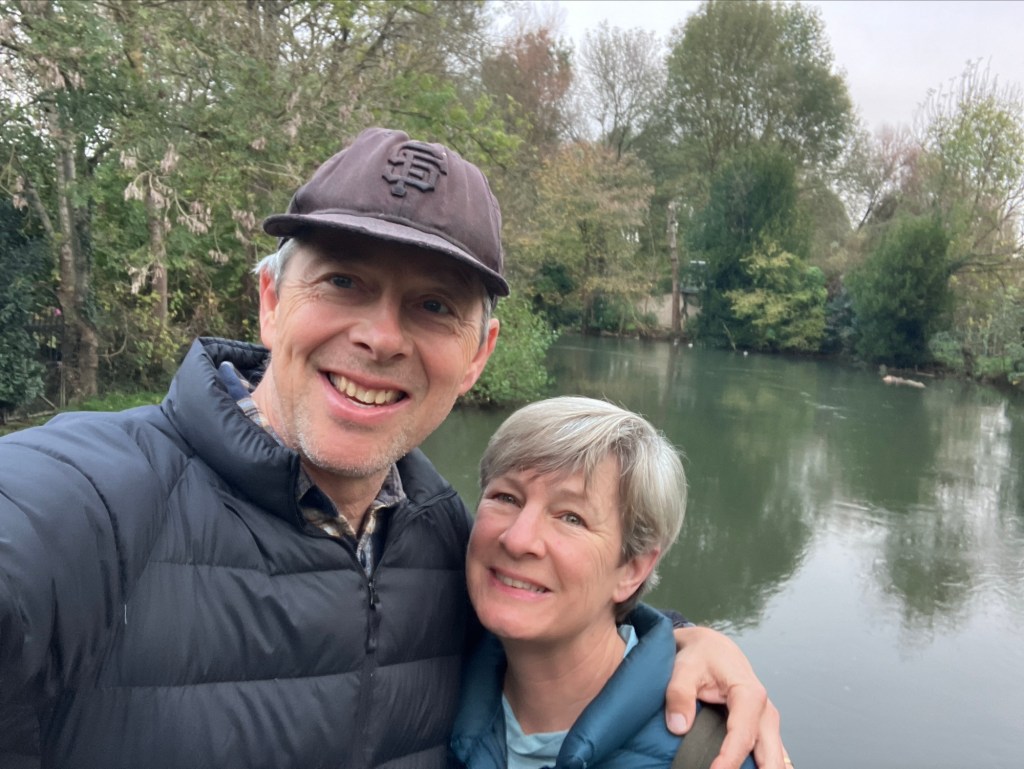
I imagine the locals know their way around the small paths and bridges, we had to check the map frequently.Whimsical folk art.A building being taken back by the vegetation.Very nice for an afternoon stroll.A boat ready to carry gardeners to their plot.We imagined quite a lovely summer scene in the Marais.Hey bourgeoisie, keep out!
It’s a fun way to travel, a few nights here, a few nights there, get the sense of a place and understand its place in the region and the country, and then off we go! But first, a nice dinner out at a restaurant we spotted our first night, and made a reservation for our second night. La gargouille.
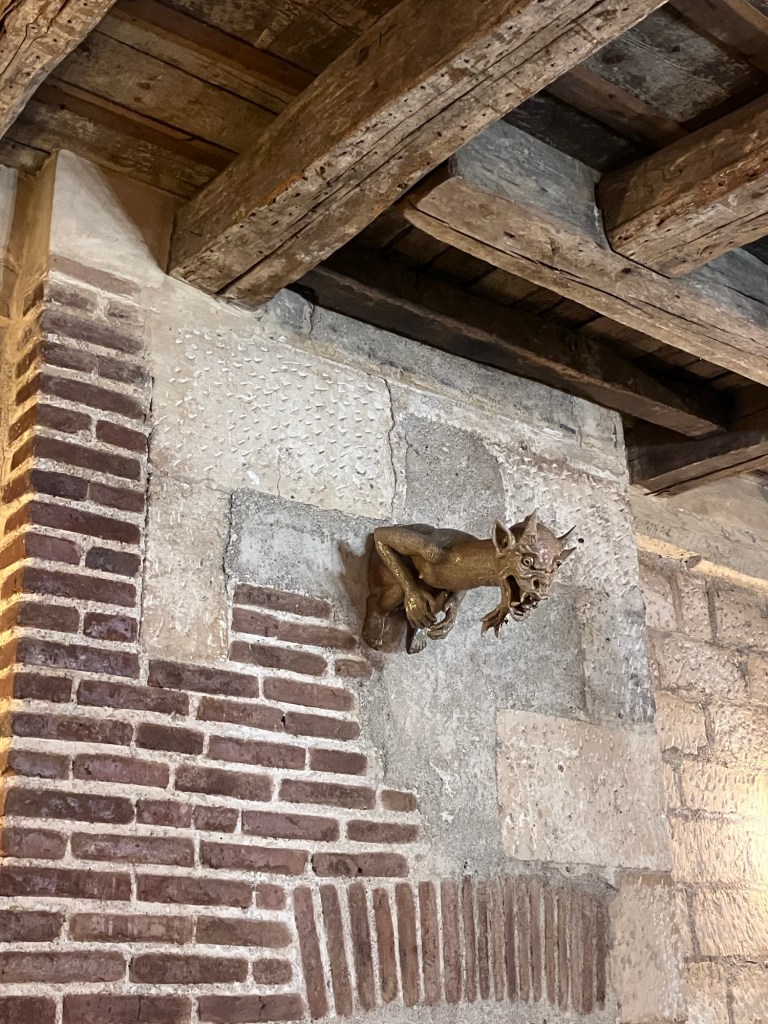
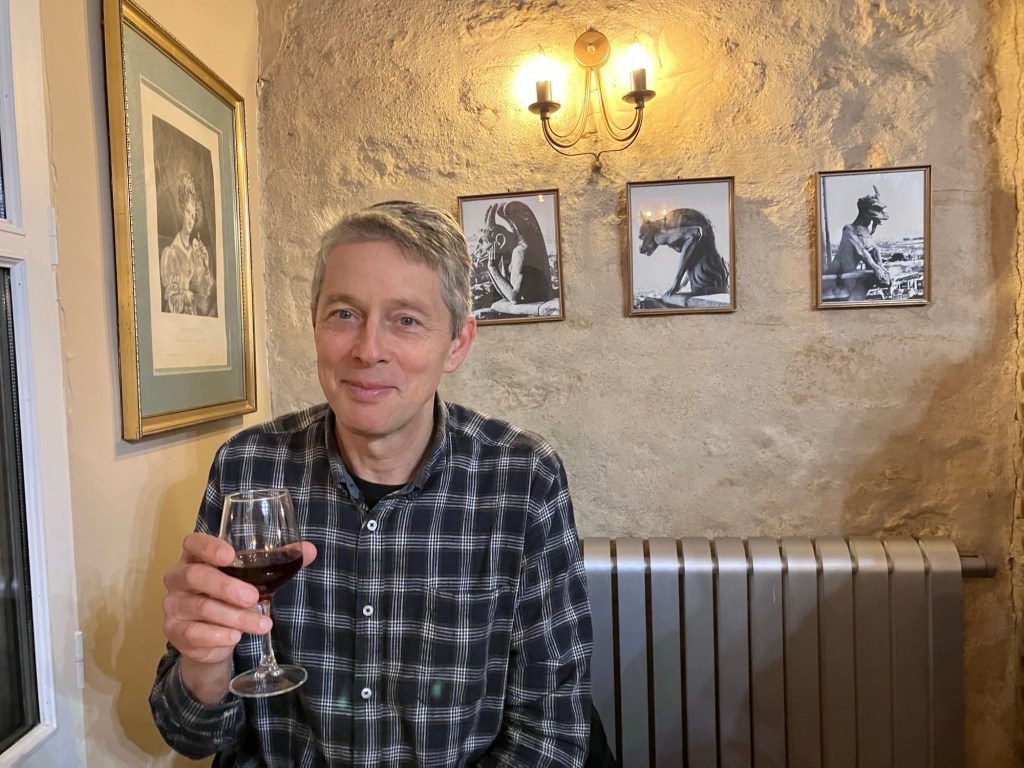
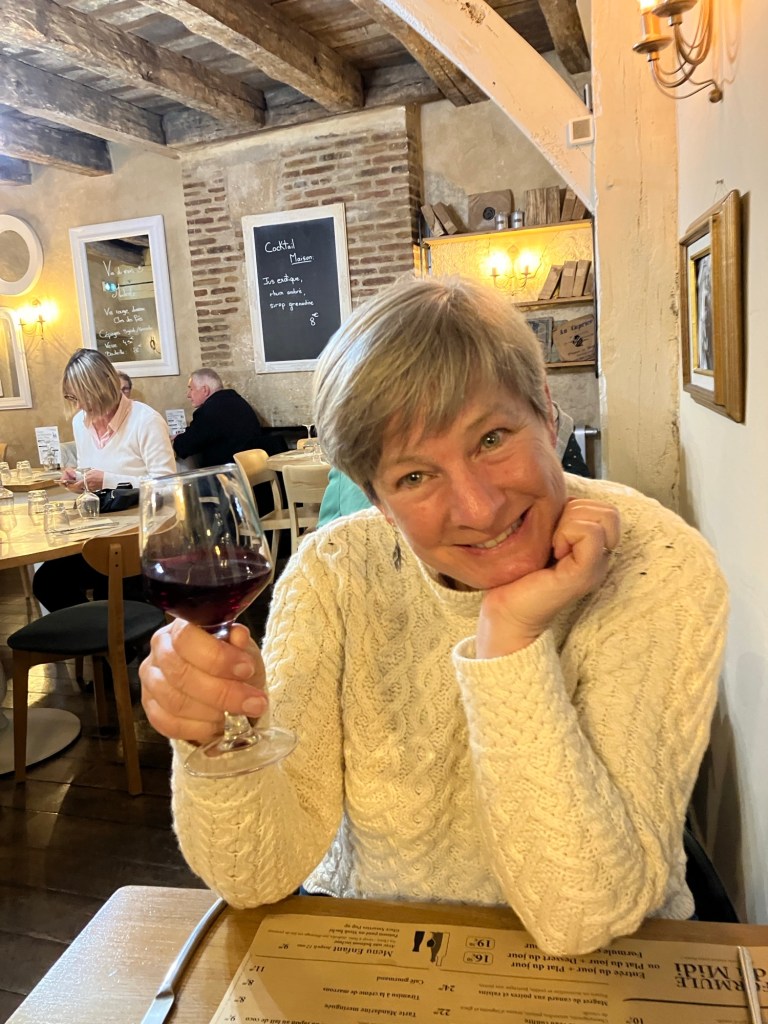
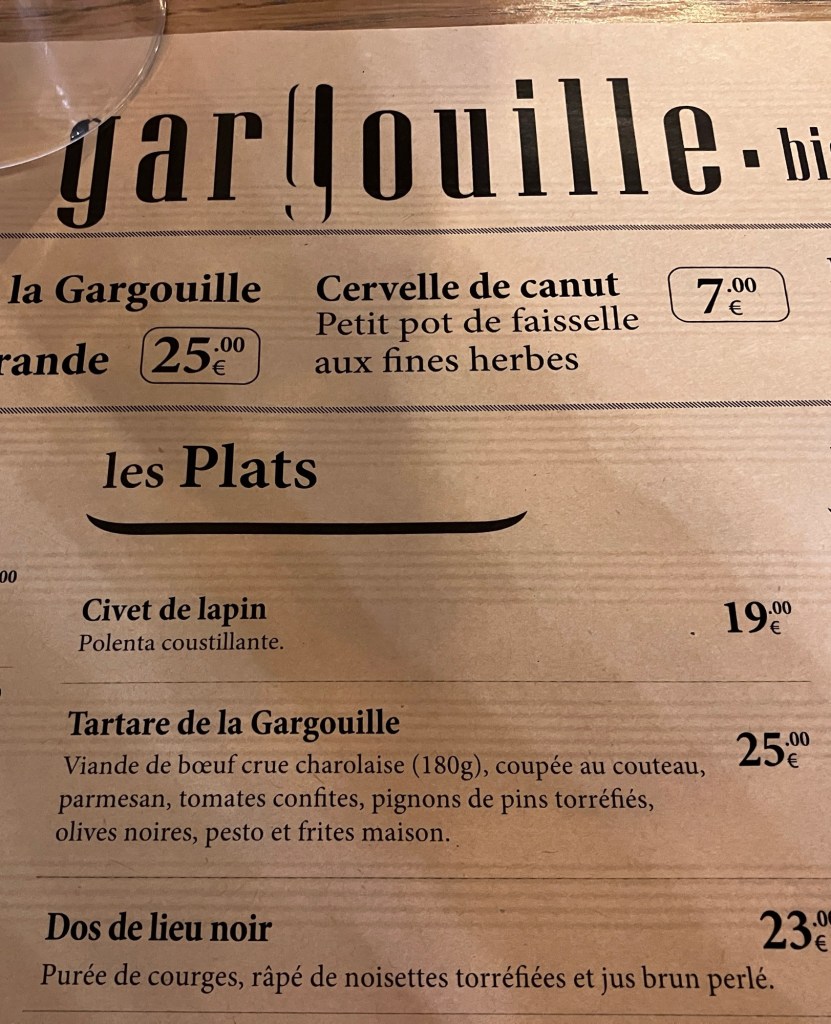
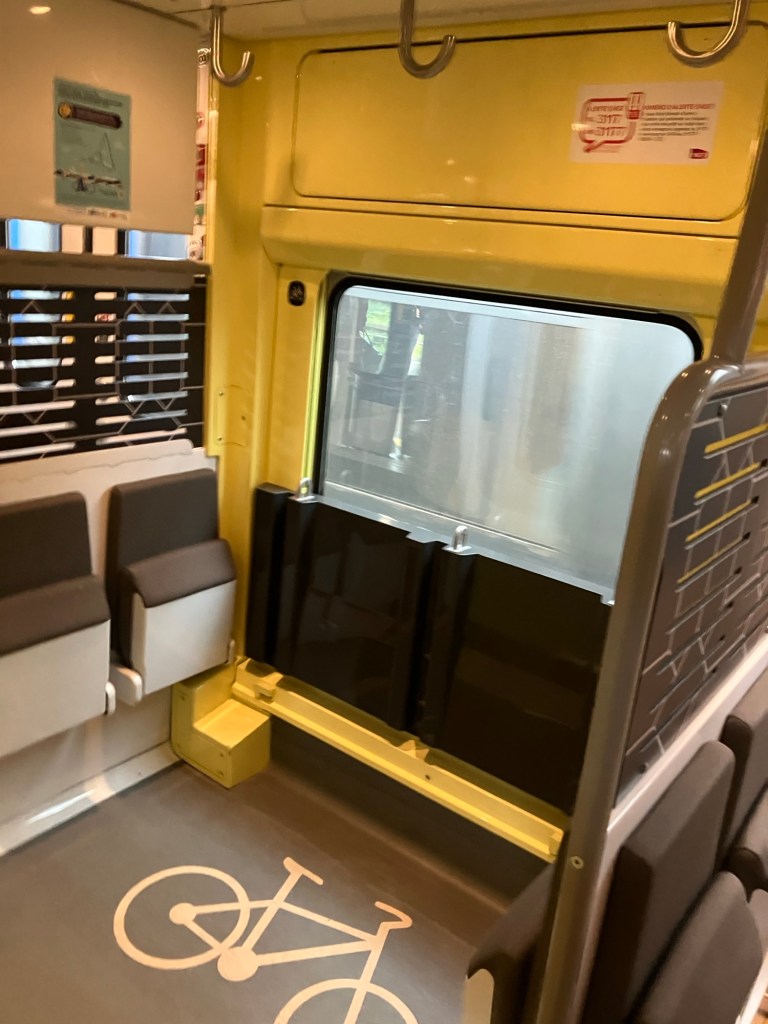
Such a cozy looking spot.With plenty of namesake decor.More gargoyles, and Rich, not a gargoyle. Anticipating dinner.Gargoyle tartar! (No gargoyles were harmed.)The second best tartare I have had in France.And off to the train! Even when traveling bike free we can’t help but check out the bike spots on the trains.
Our last stop before Paris was Orléans. We went through Orléans on our bicycles when we rode along the Loire River in 2021. We enjoyed it then, in a sunny October, and knew there was enough to see still for a short stay. This is where the grey November weather caught up with us. What the morning news show called la grisaille. The greyness.
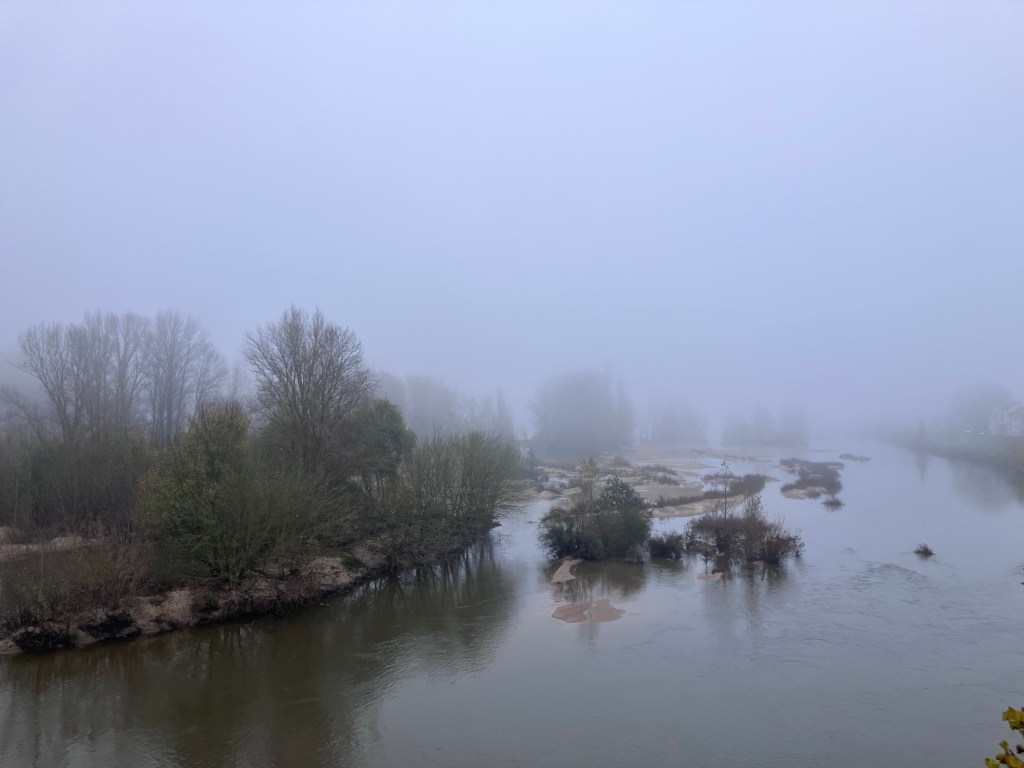
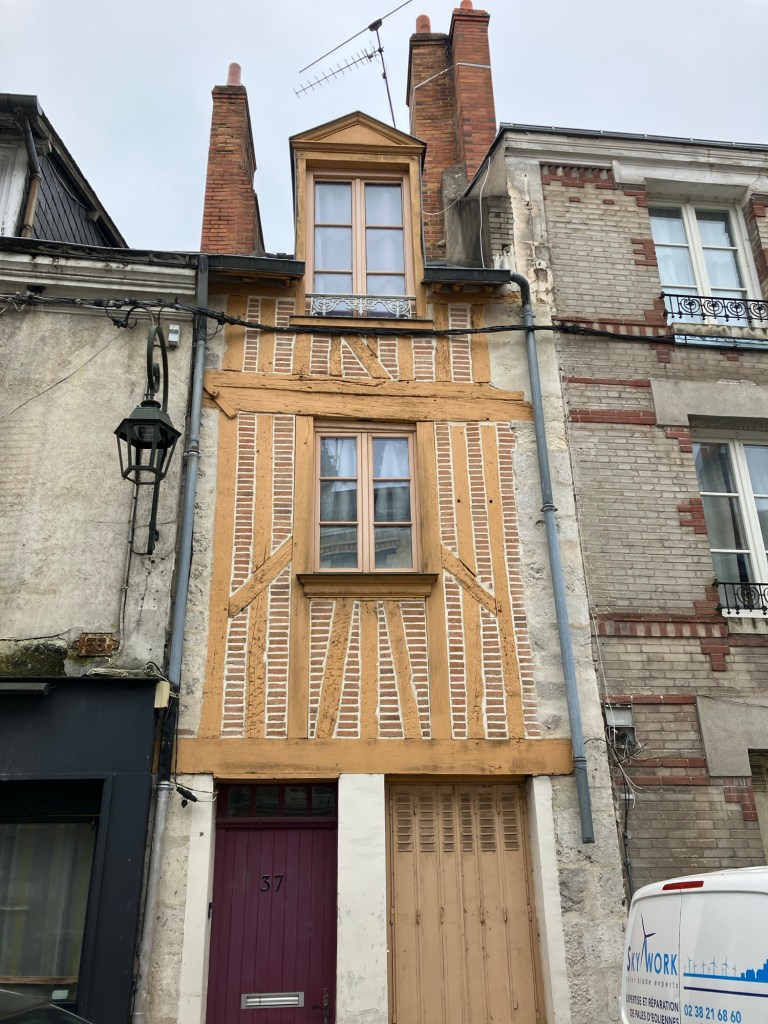
The Loire in la grisaille.The fog made for a very atmospheric walk along the river.This narrow building caught our attention in the old streets by the river.The old town streets giving framed views of Cathédrale Sainte-Croix d’Orléans.The front of the cathedral.Always crossing Camino routes.An autumnal display brightens a grey day.Inside the cathedral on All Saint’s Day. St. Joan in stained glass.
Joan of Arc, Jeanne d’Arc in French, is honored as a patron Saint of France for her role in defending Orléans in April 1429. You can find her in cathedrals, as statues, and paintings in the Musée des Beaux-Arts d’Orléans. Her story is powerful and poignant, as she was only 19 when she was tried for heresy and burned at the stake.
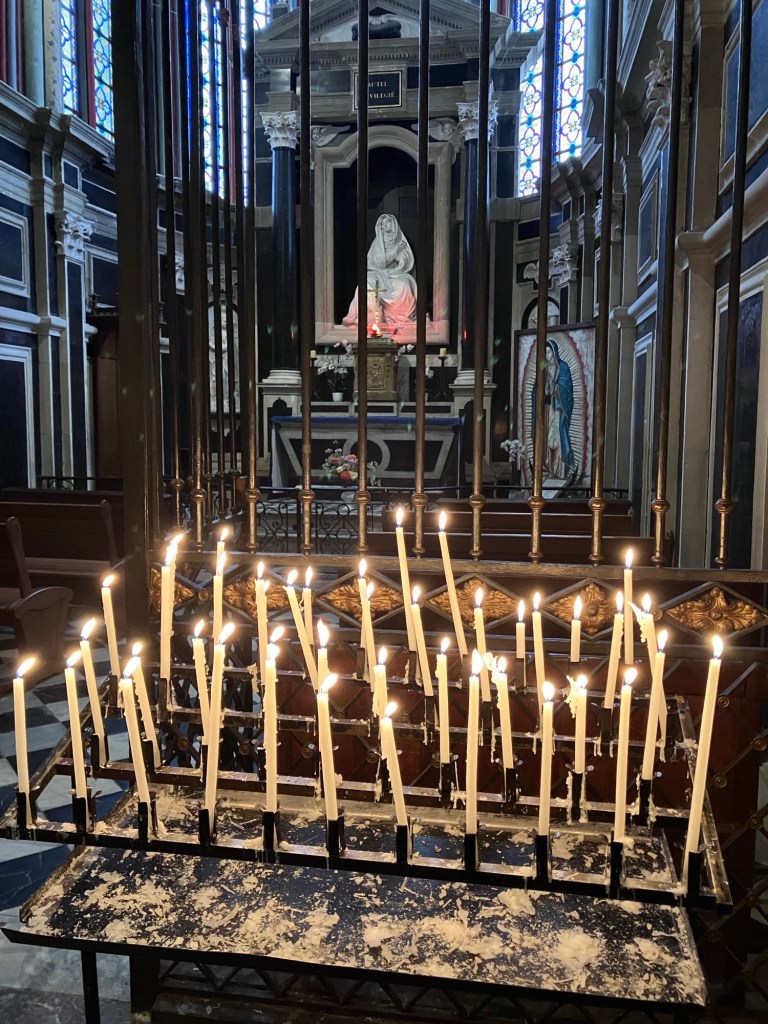
Many lit candles that day.St. Joan at night, dramatically lit.The Happy Travelers looking ahead to Paris.






























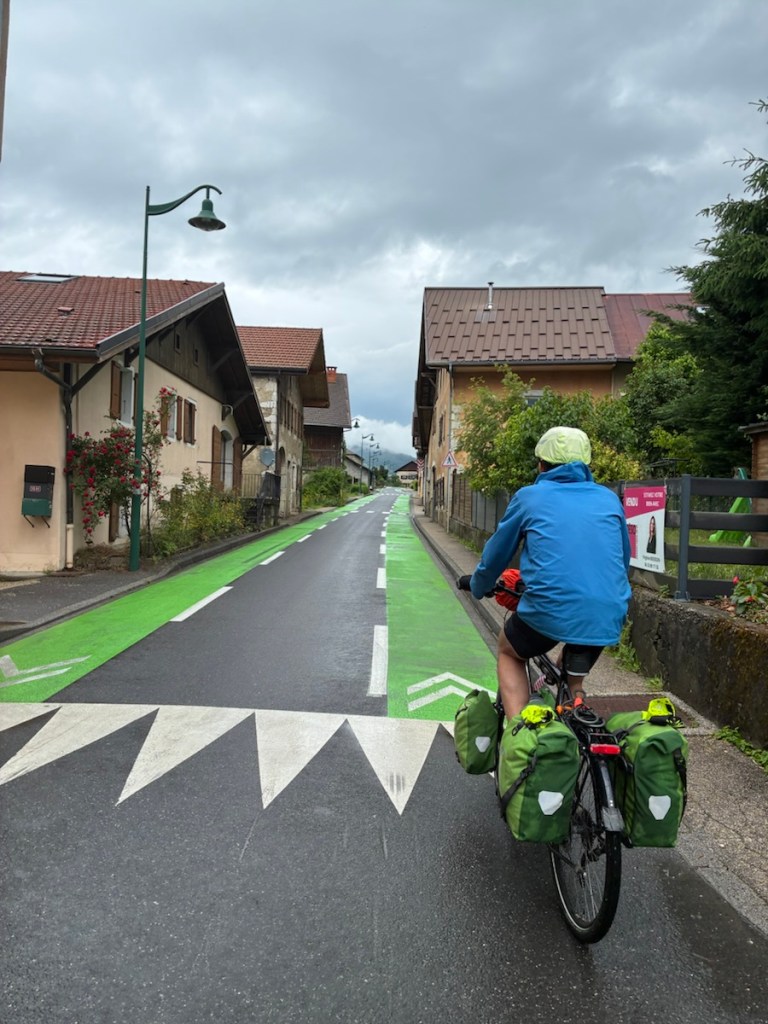


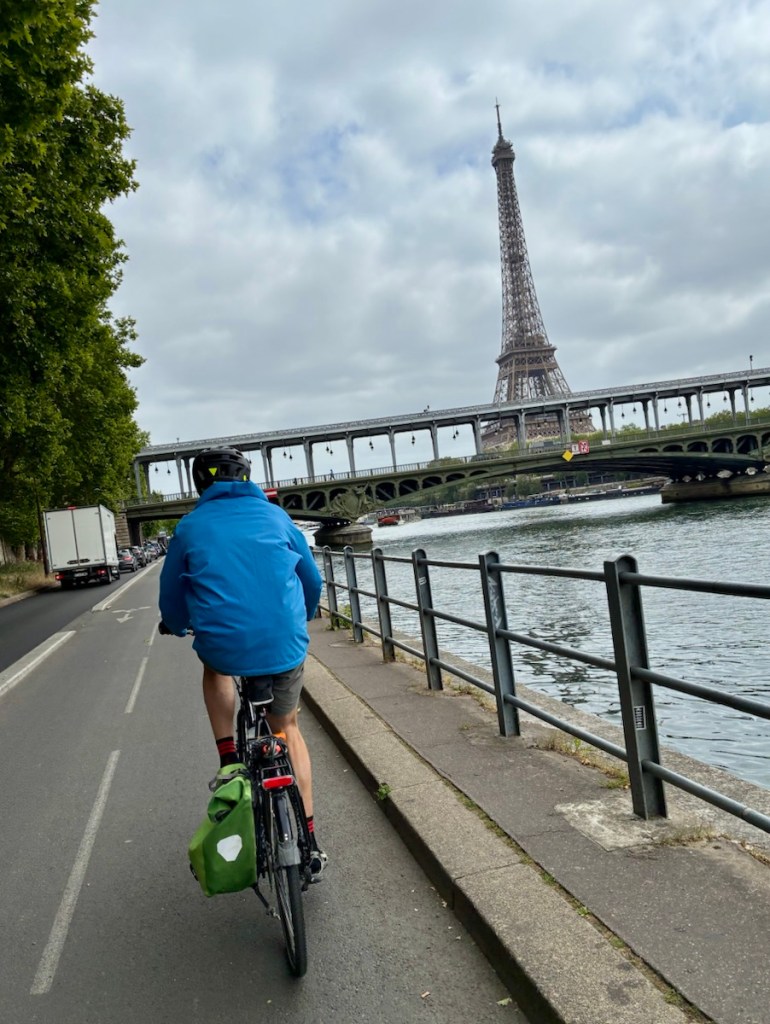


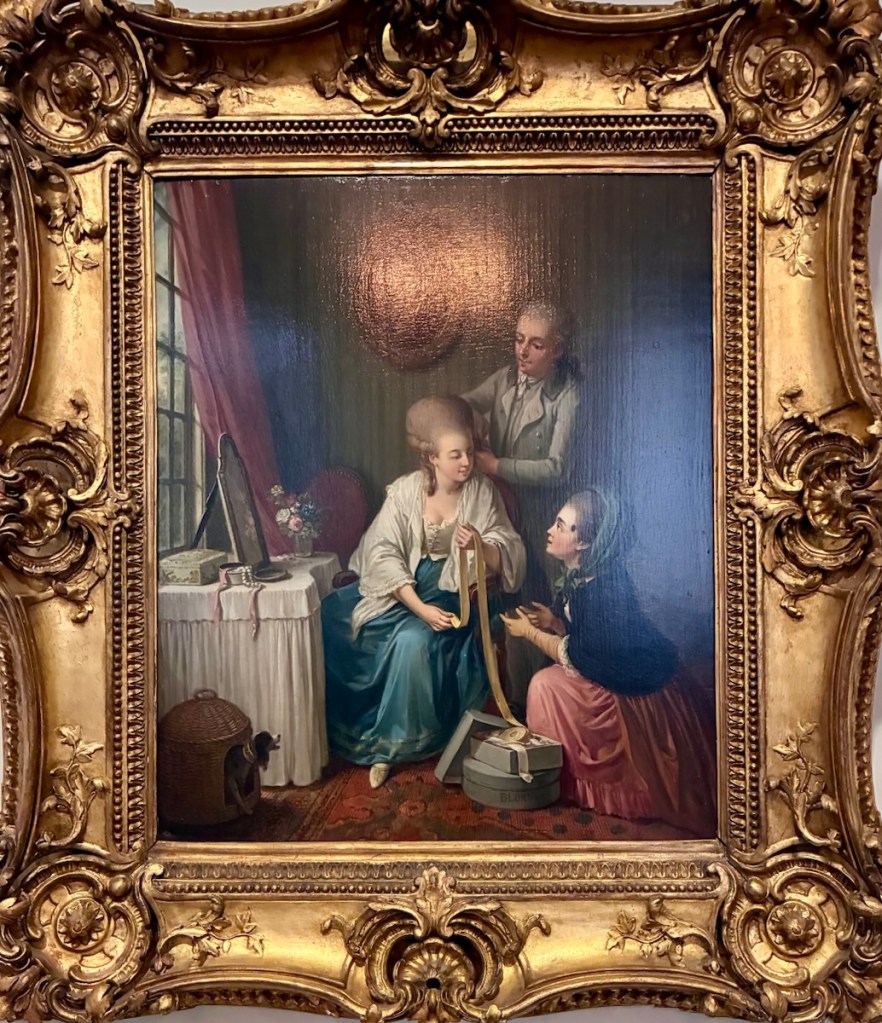

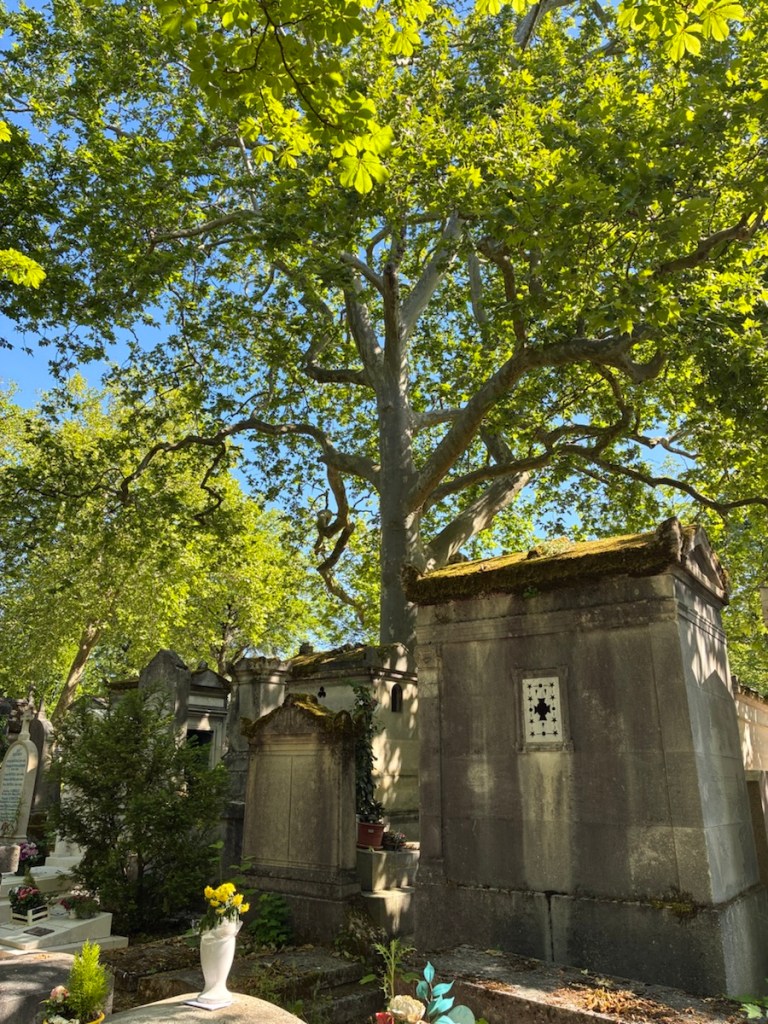




















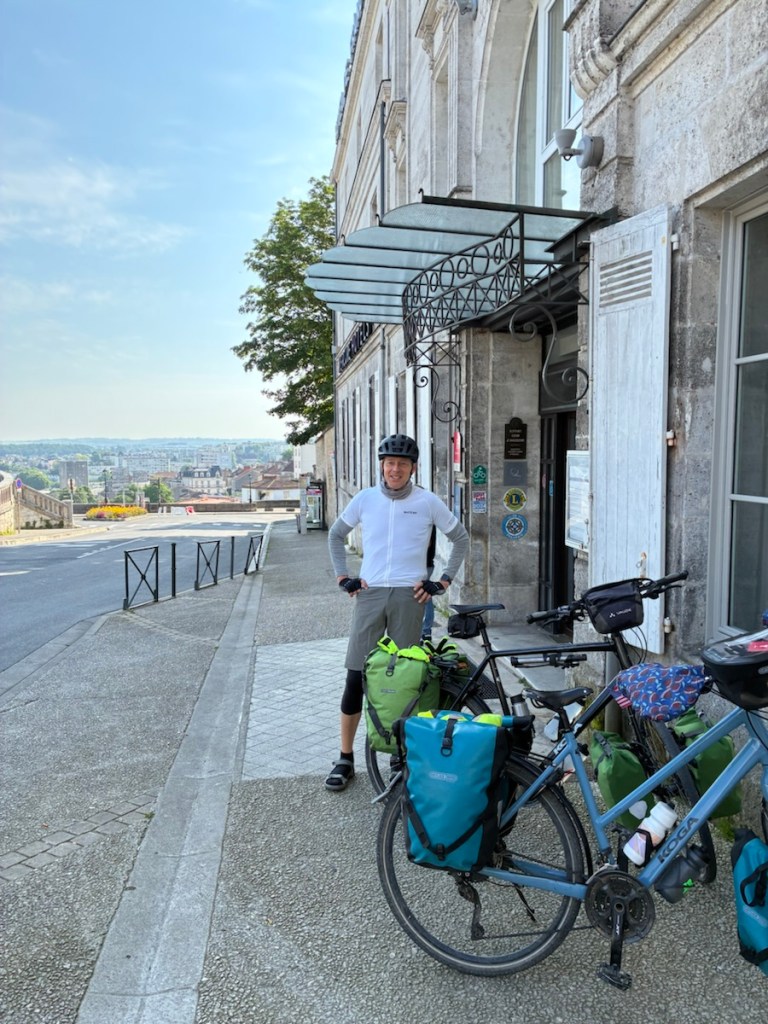
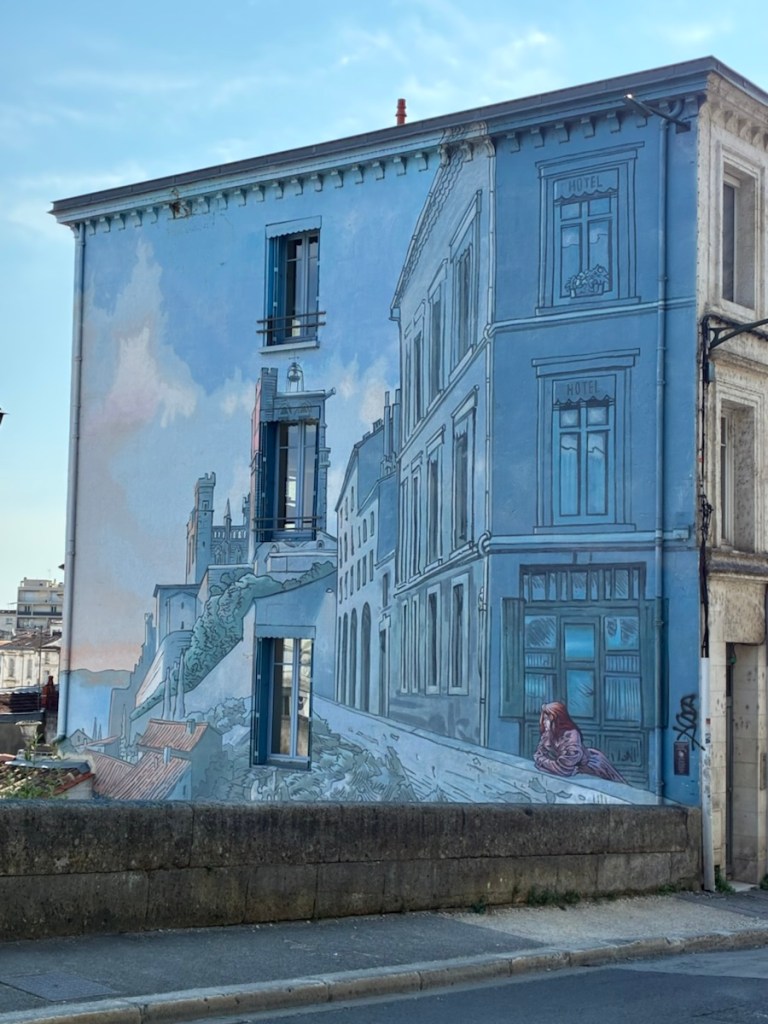
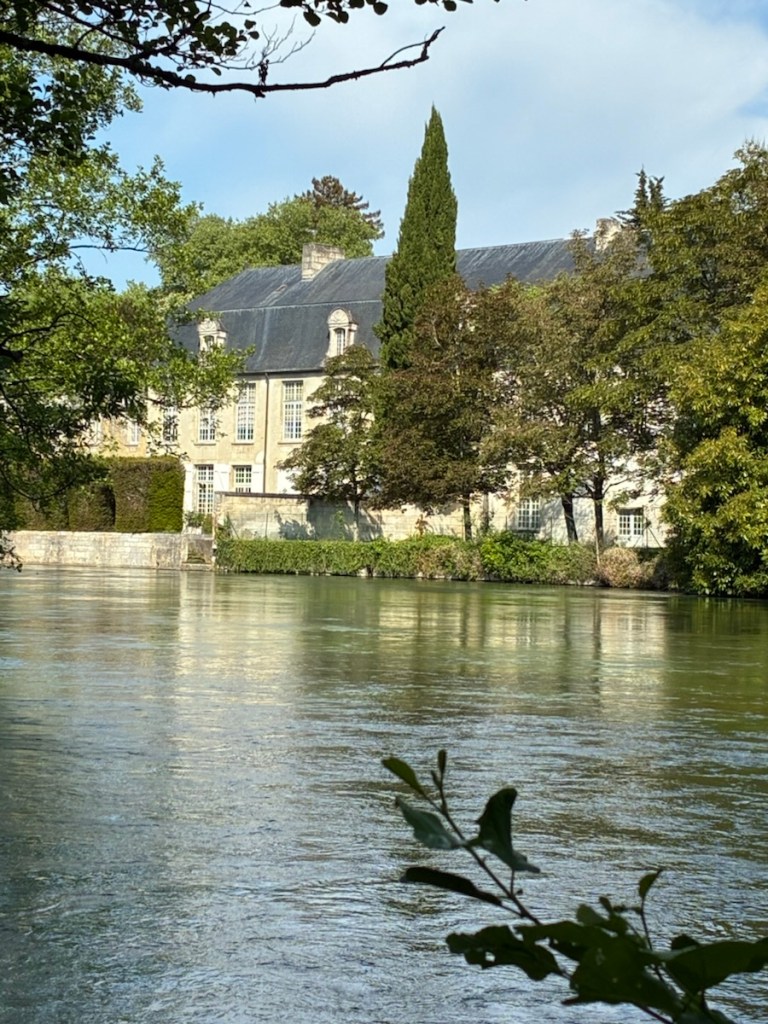

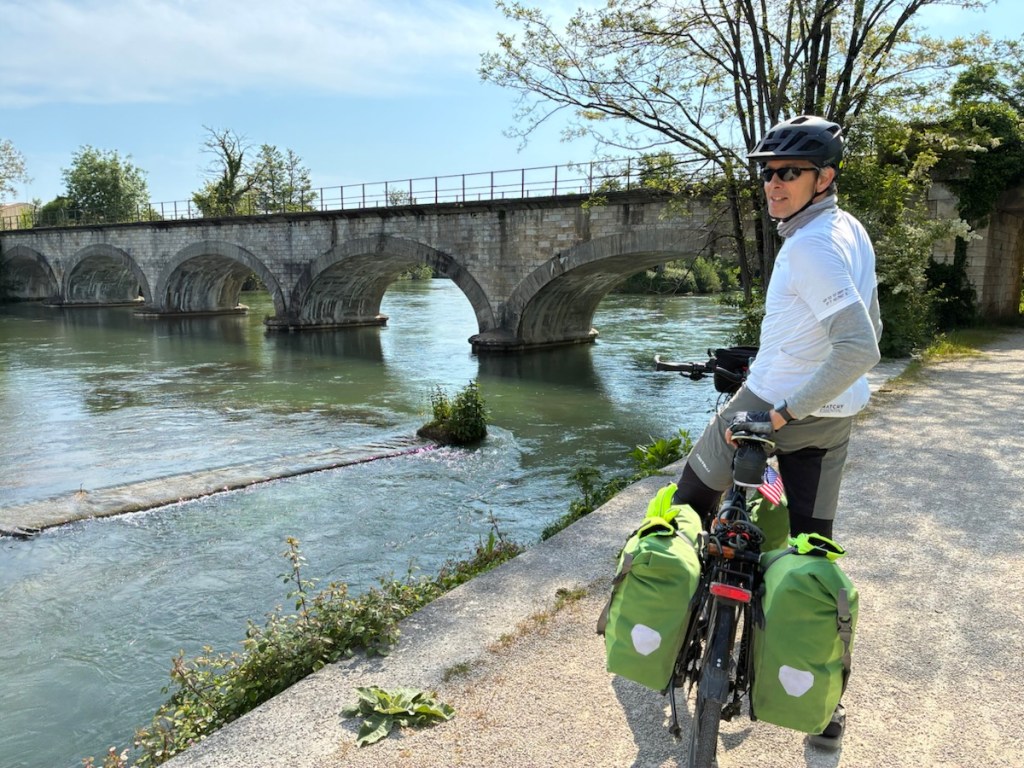


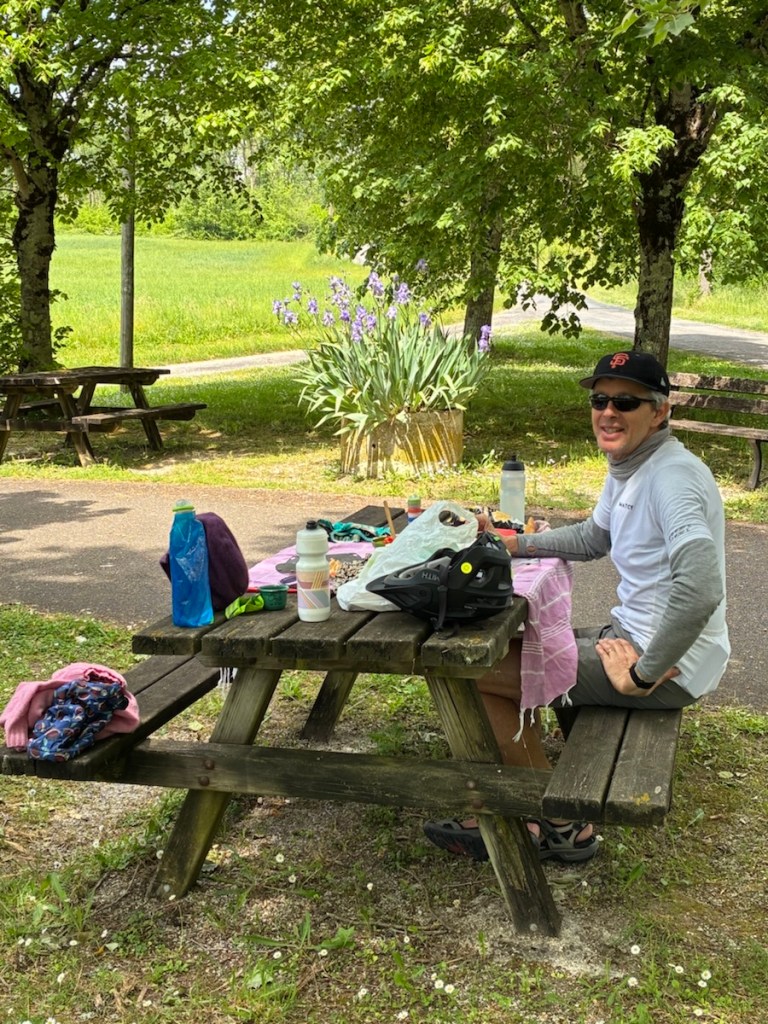
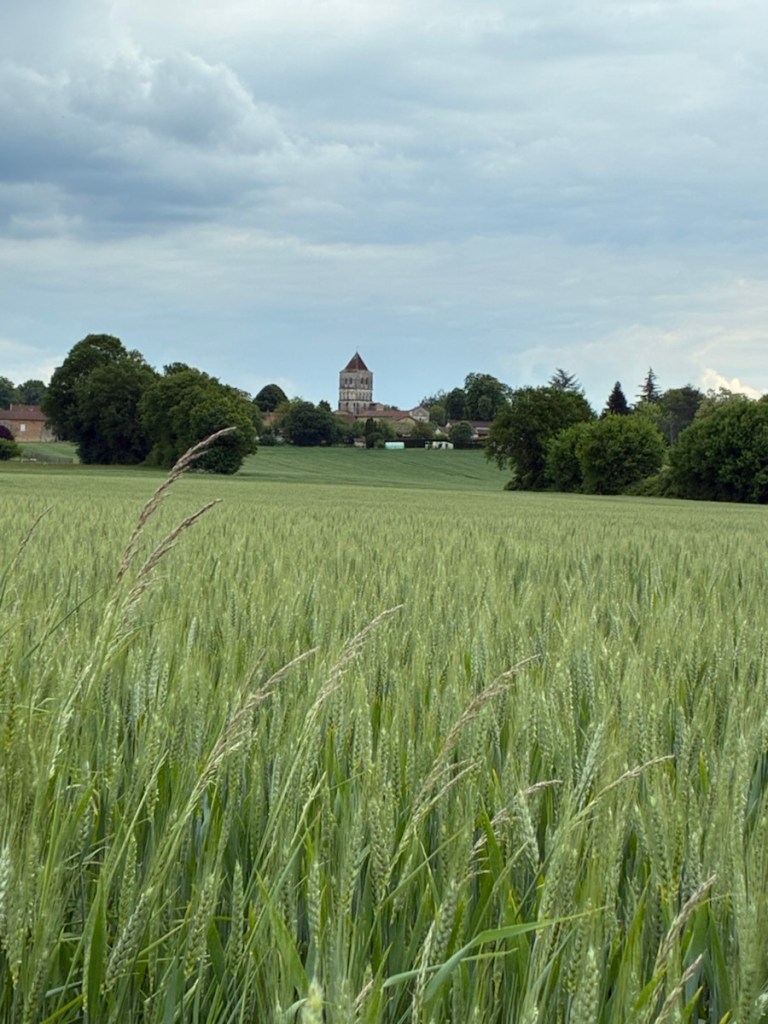












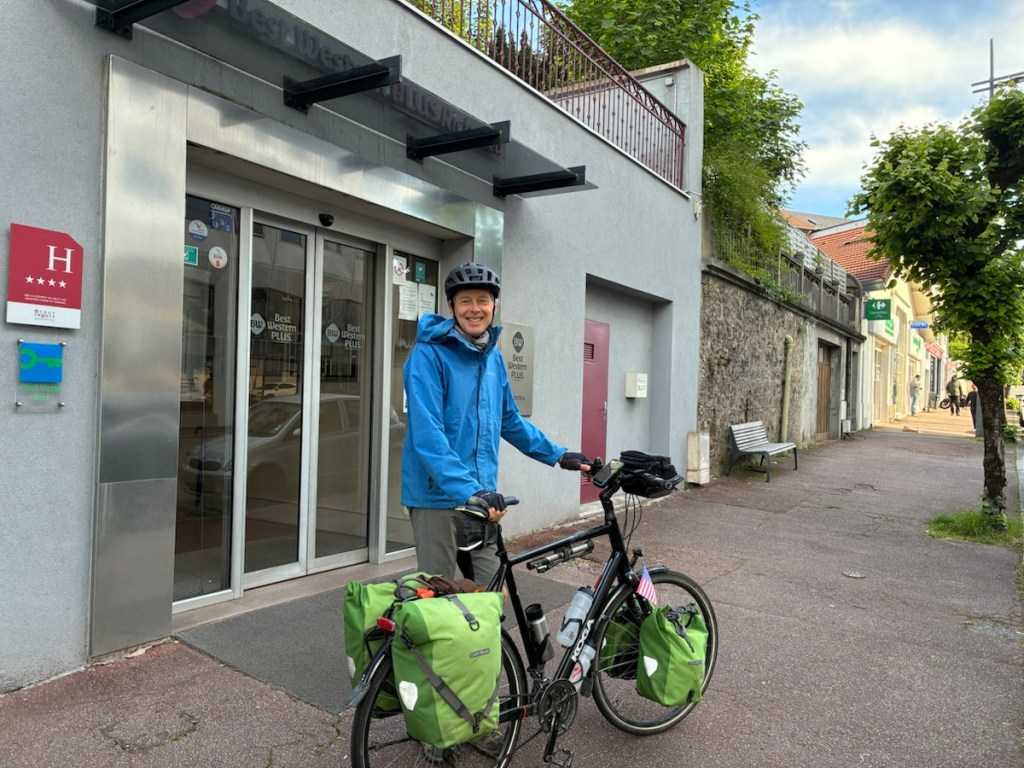

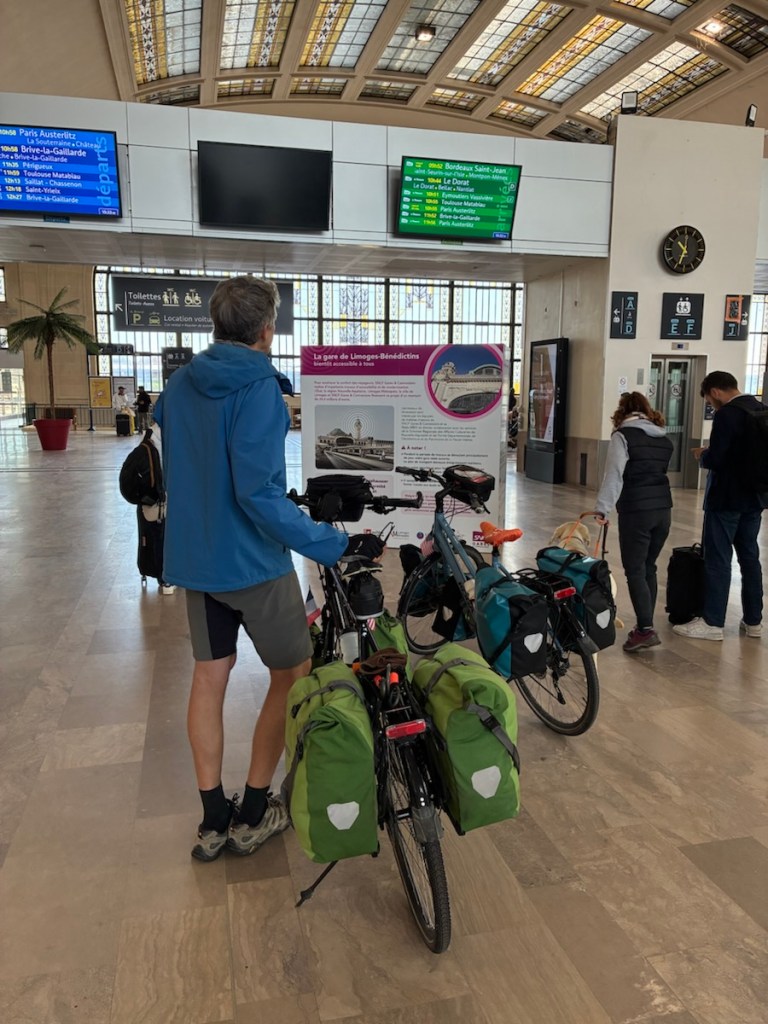
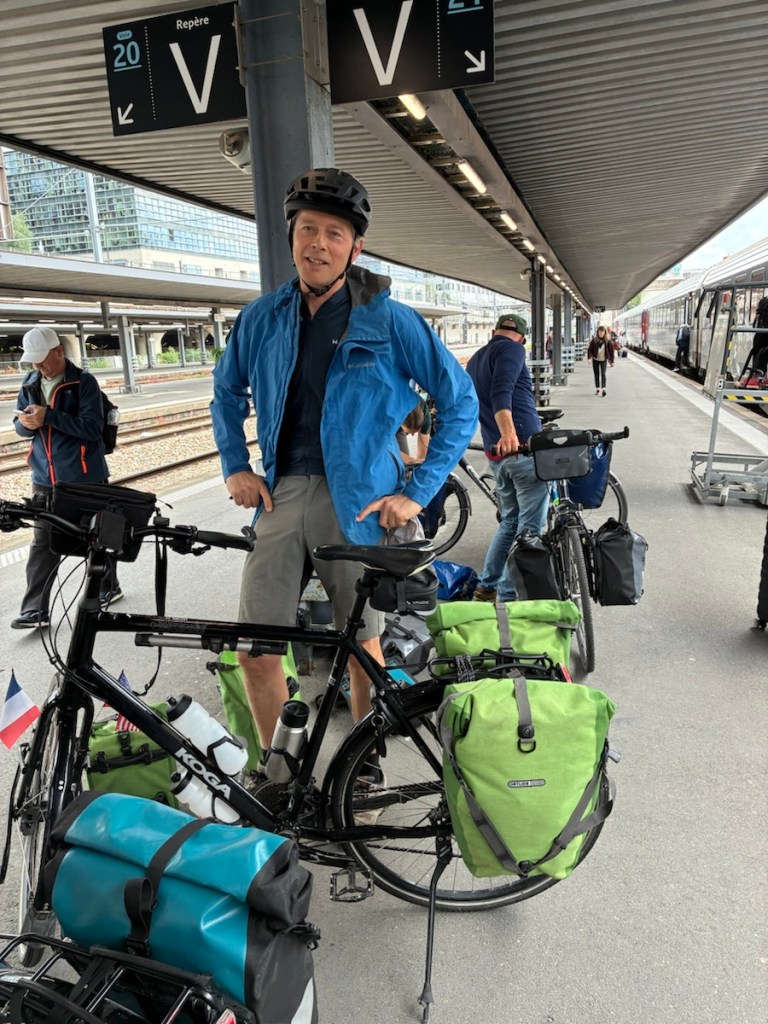


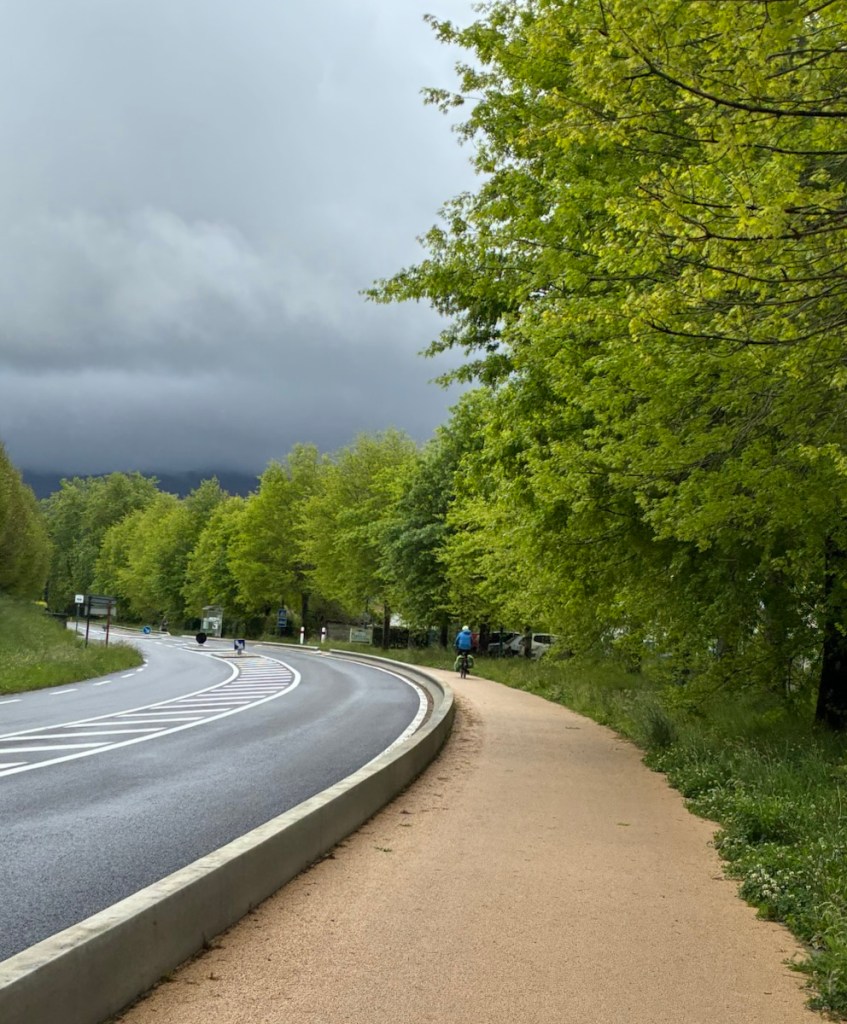
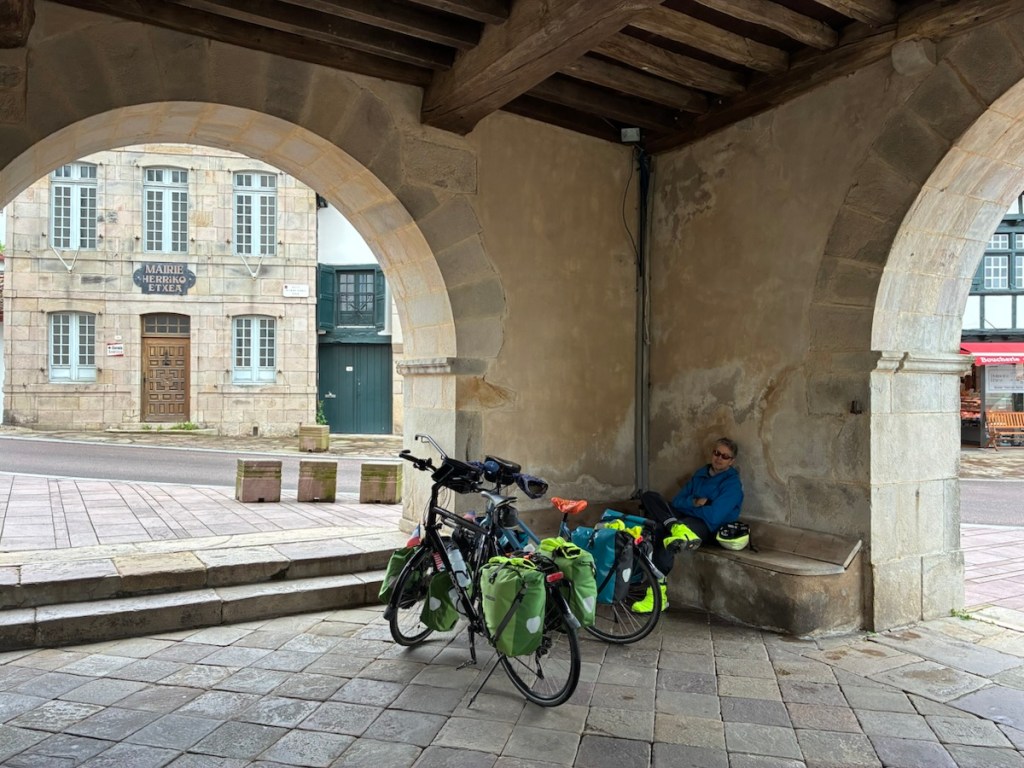


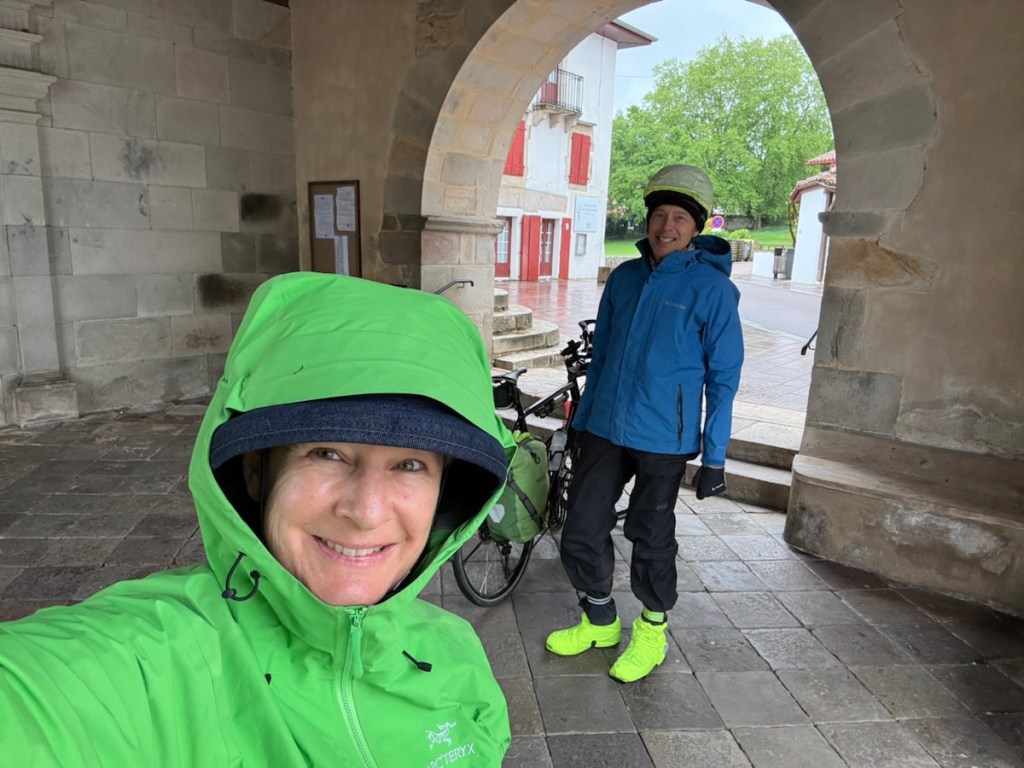
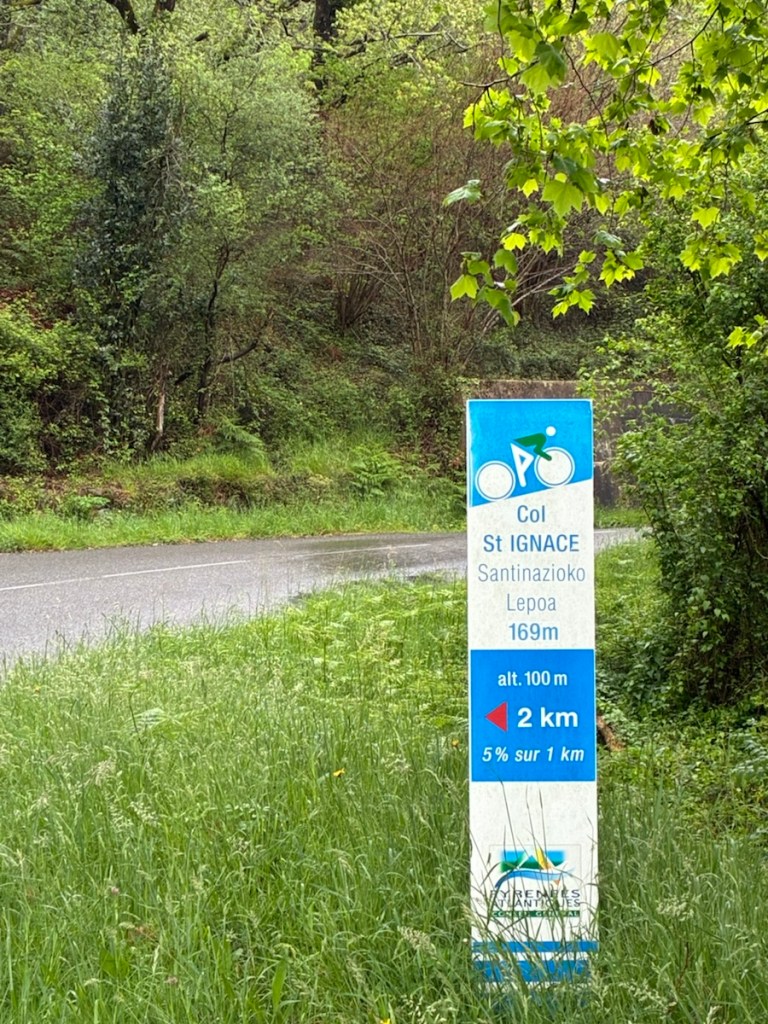
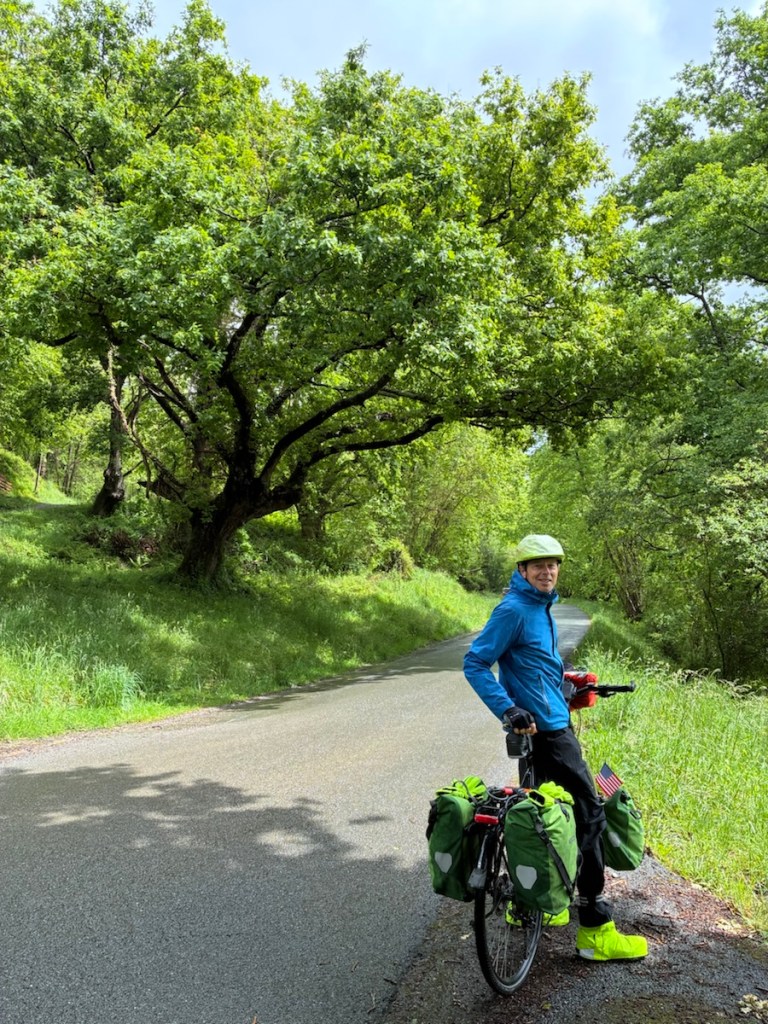








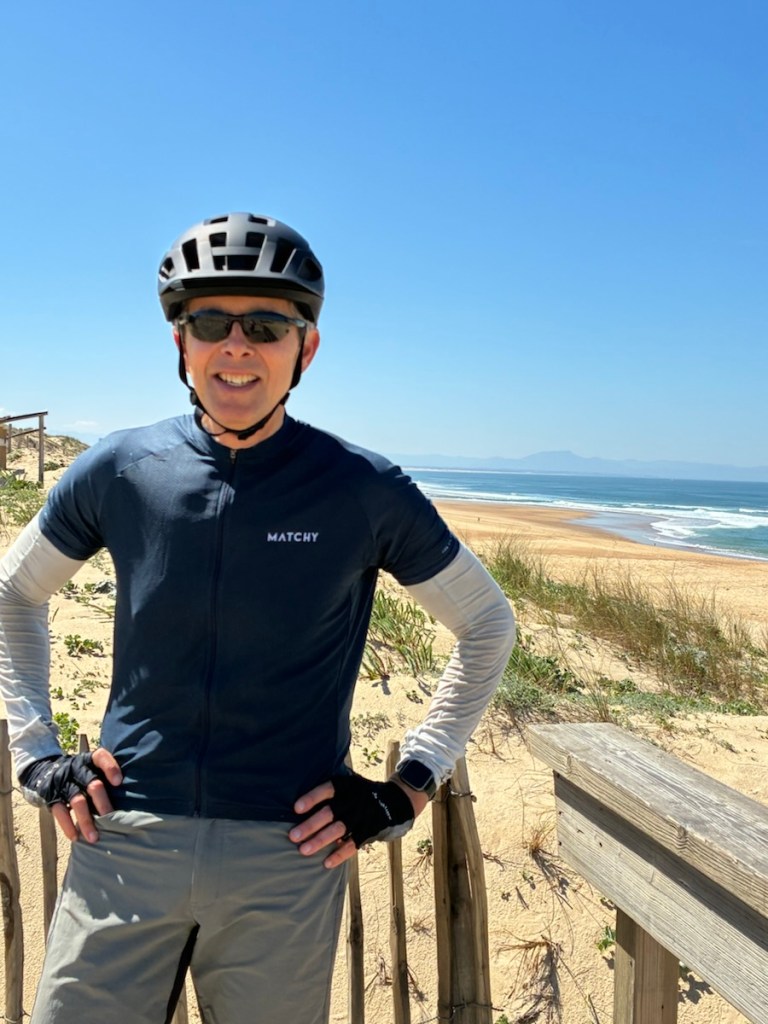
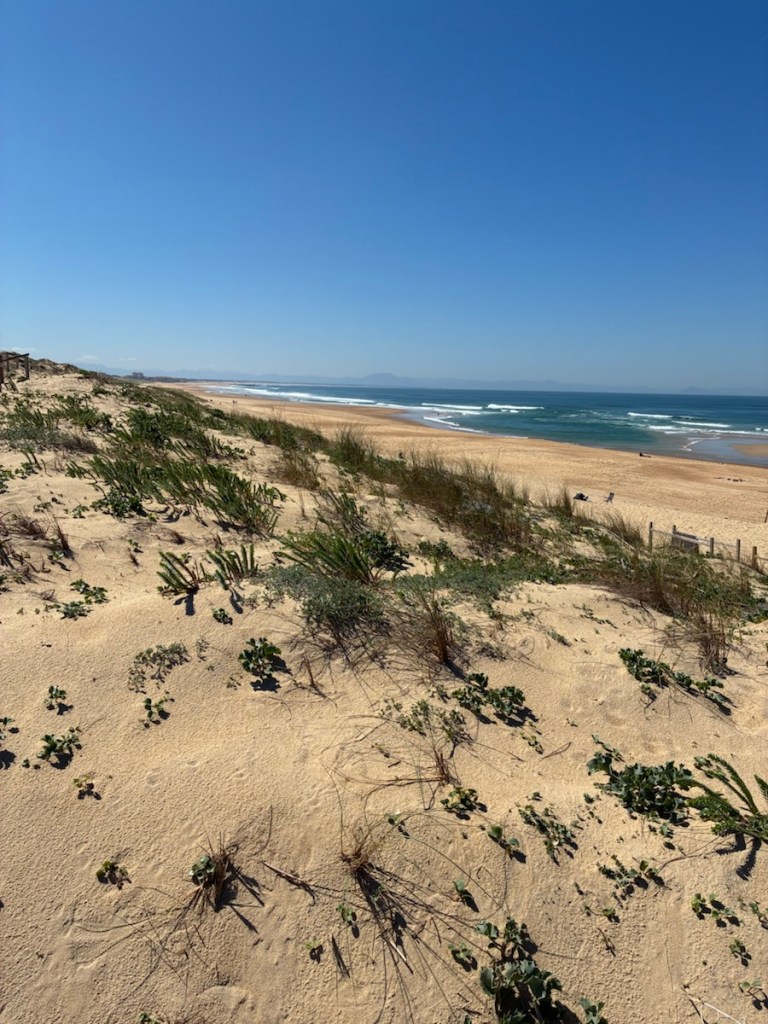


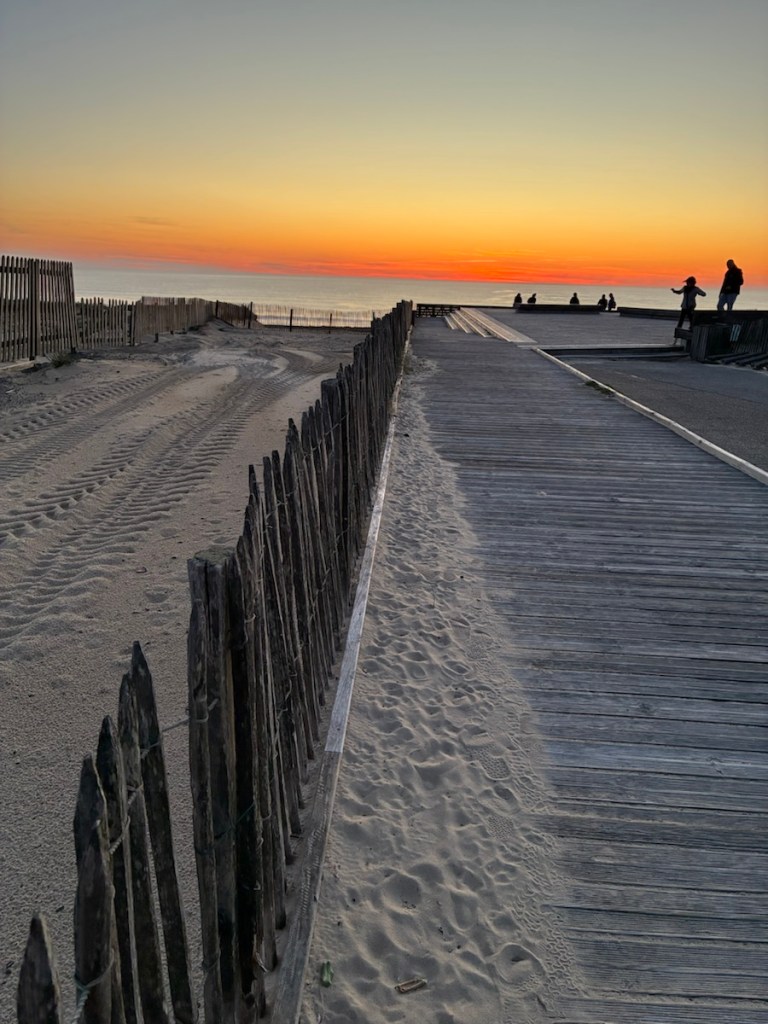


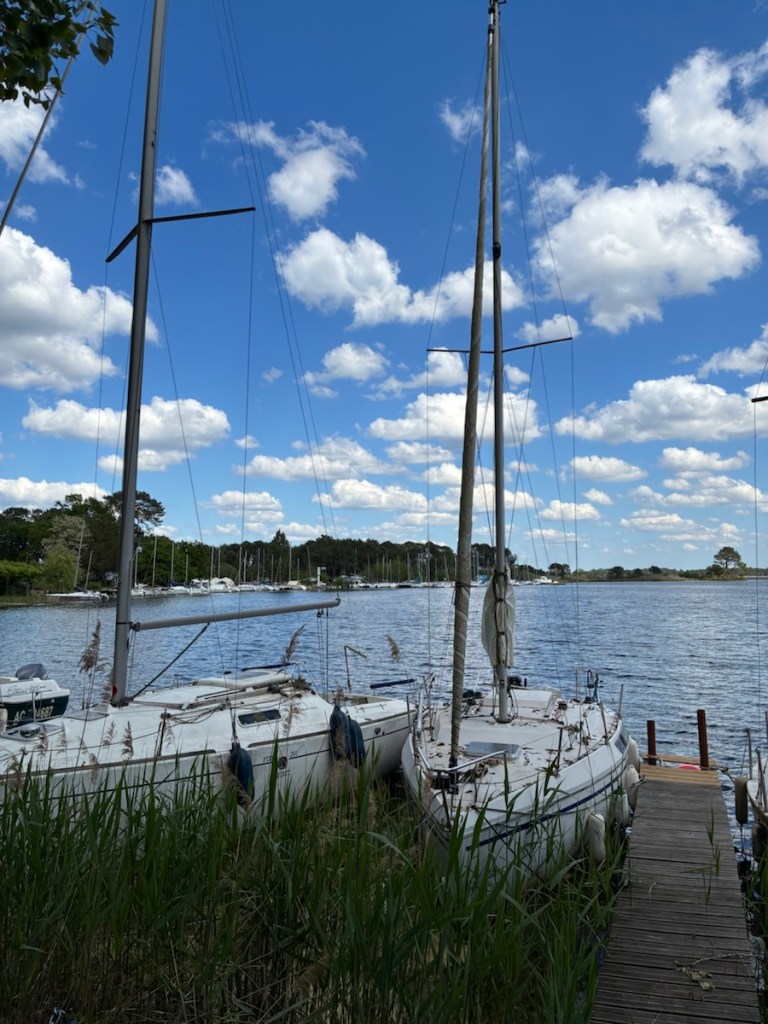


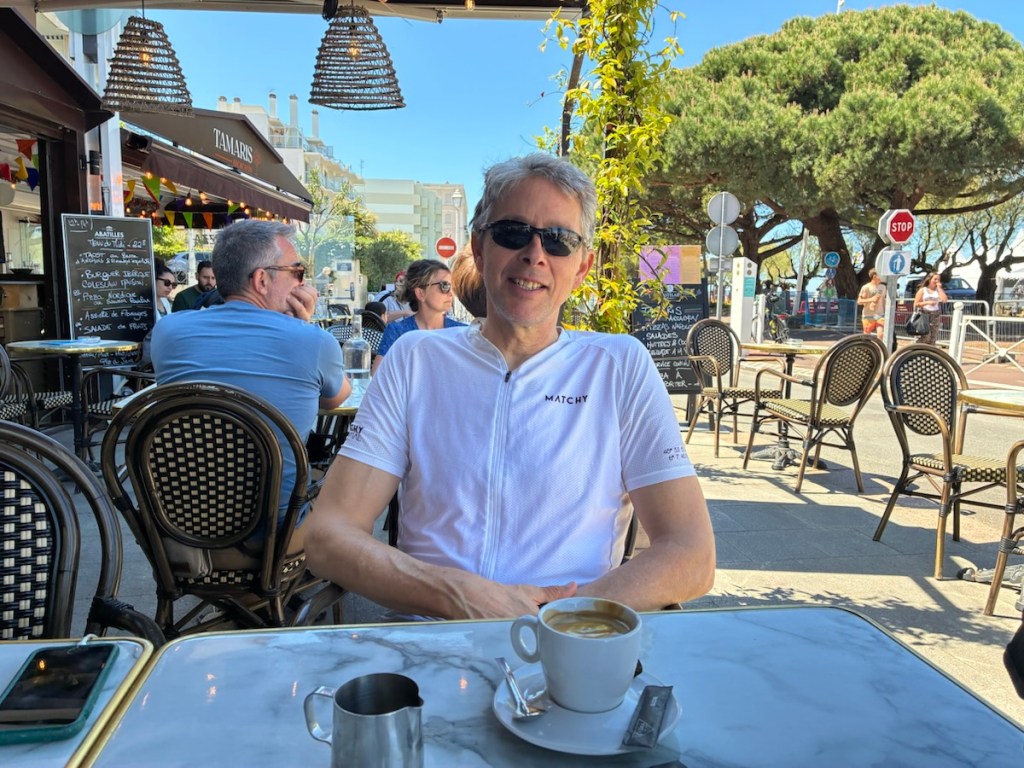





















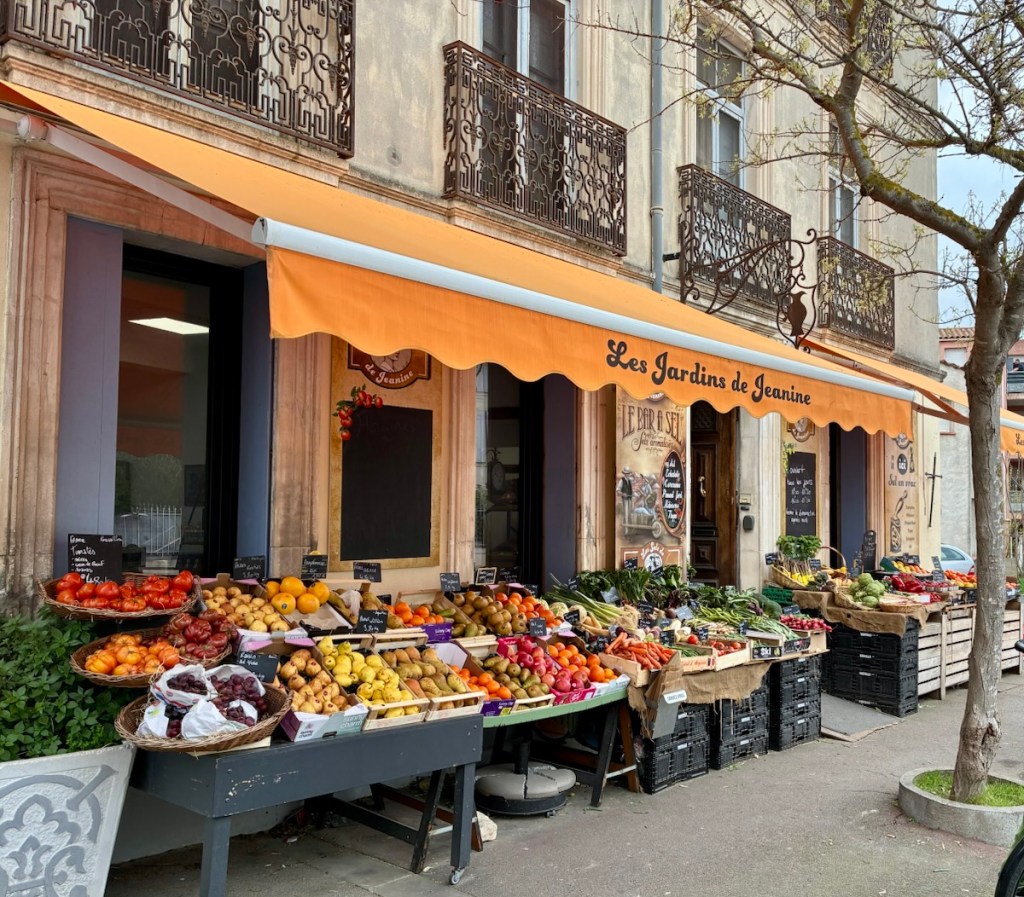
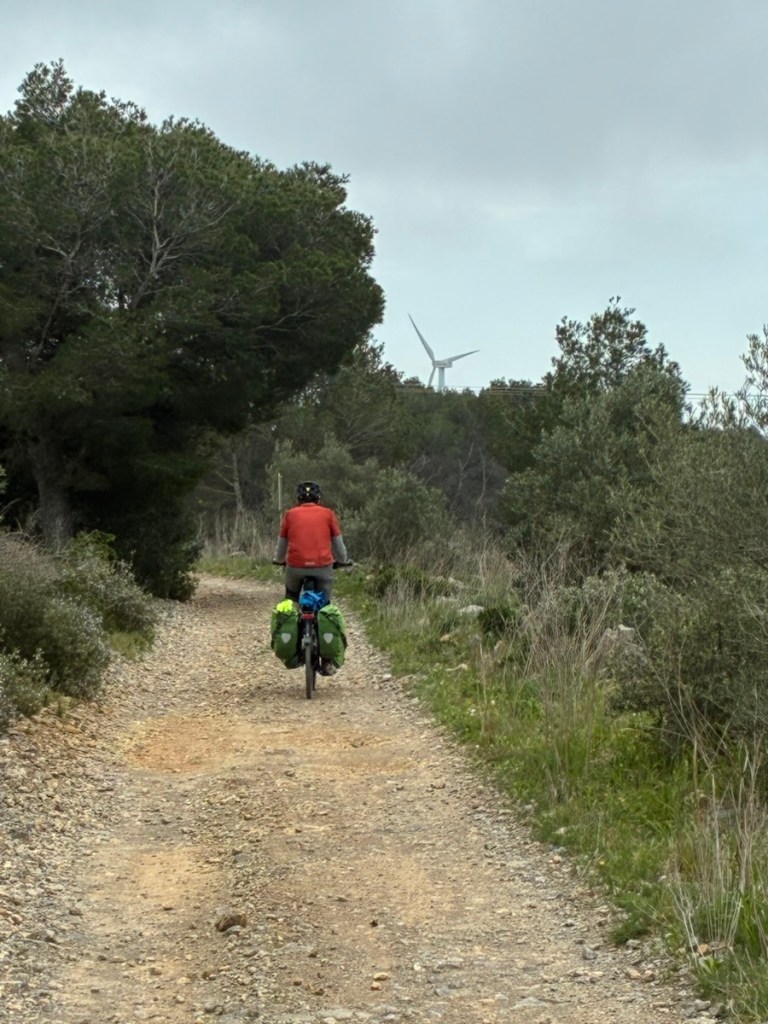
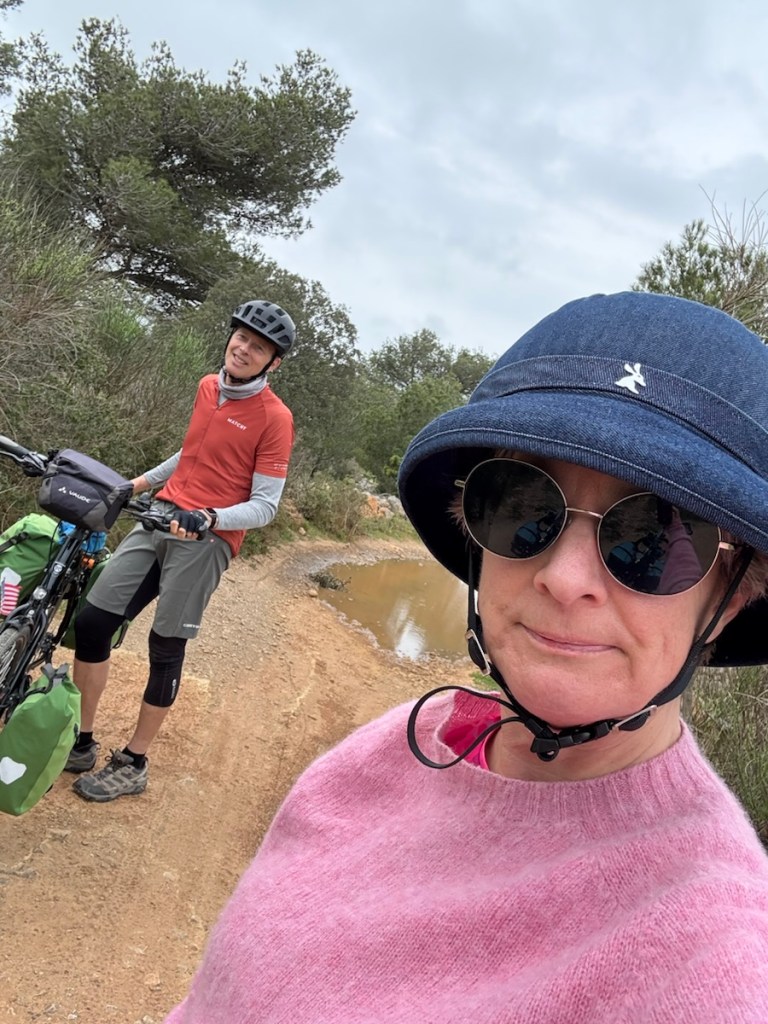
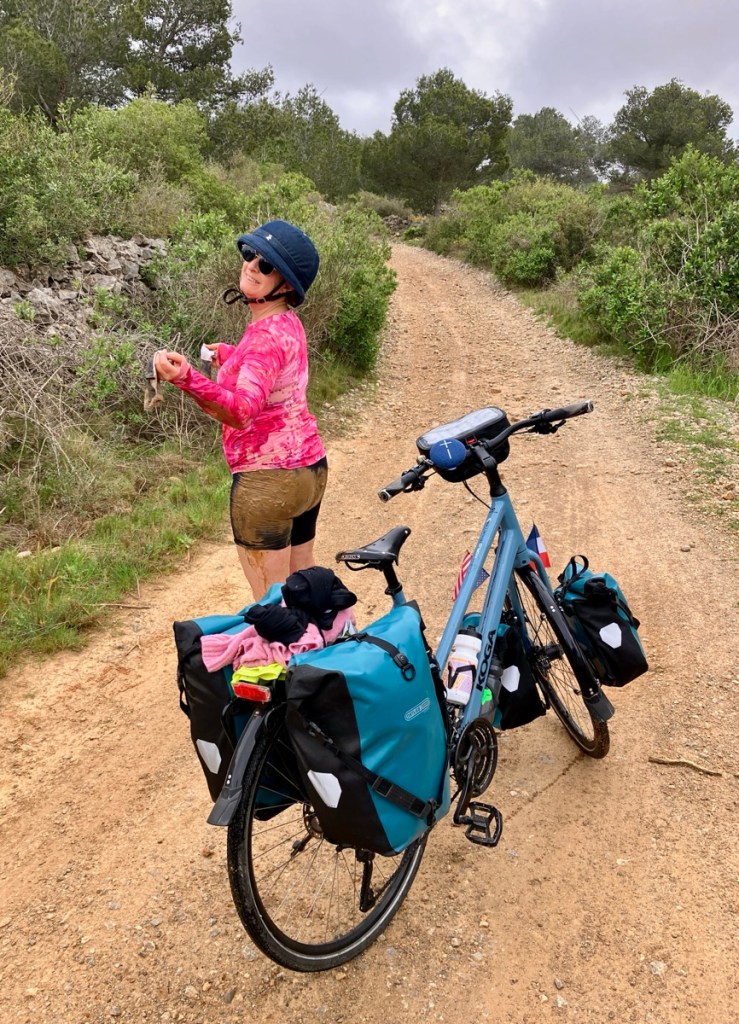
















































































 Less Car, More Life