After two amazingly easy and short train journeys from Paris, we were ready to get on with our cycling adventure.
Heading up into the central Ardennes of Belgium from France
The goal was to hit some hills and slightly different cultures after a lot of time in France. But we didn’t want to rush out of our adopted country of choice too fast, so started with a nice easy ride from the train to our first night’s lodging in Remily-Allincourt; all topped off by a surprisingly gourmet and pleasant dinner at our countryside hotel. But we really shouldn’t be surprised by a countryside gourmet meal in France anymore.
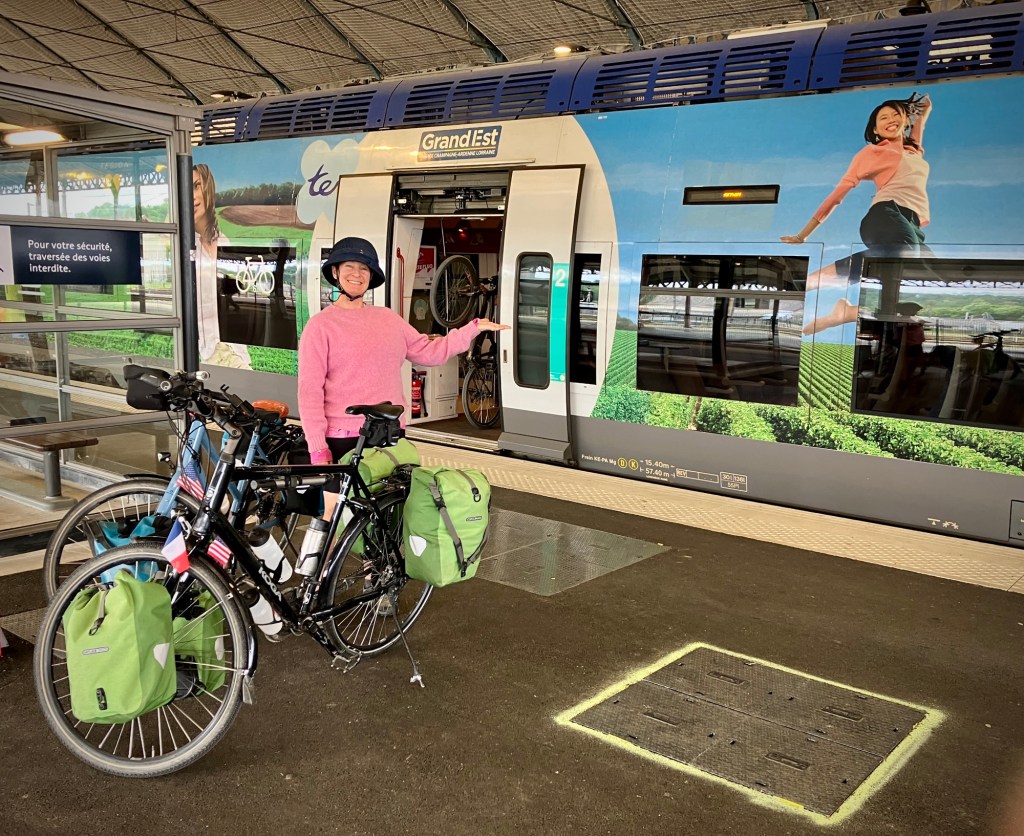
After our TGV to Reims, this lovely Grand L’Est regional train to Charleville-MézièresReims had some tight elevators but smaller Charleville-Mézières had really small platform elevators. I took stair rails down, while Cheryl opted for turning her bike upright in the elevator. By the way, a heavily loaded bike can slide out of control on the metal checker plate, especially if anything is wet!But hey, a new elevator up -:)
Transition travel days with a few train hops are always tiring, so I’ve learned to not plan too much riding on those days if possible. Just warm up the legs to make us sleep soundly. And of course, create some room for dinner!
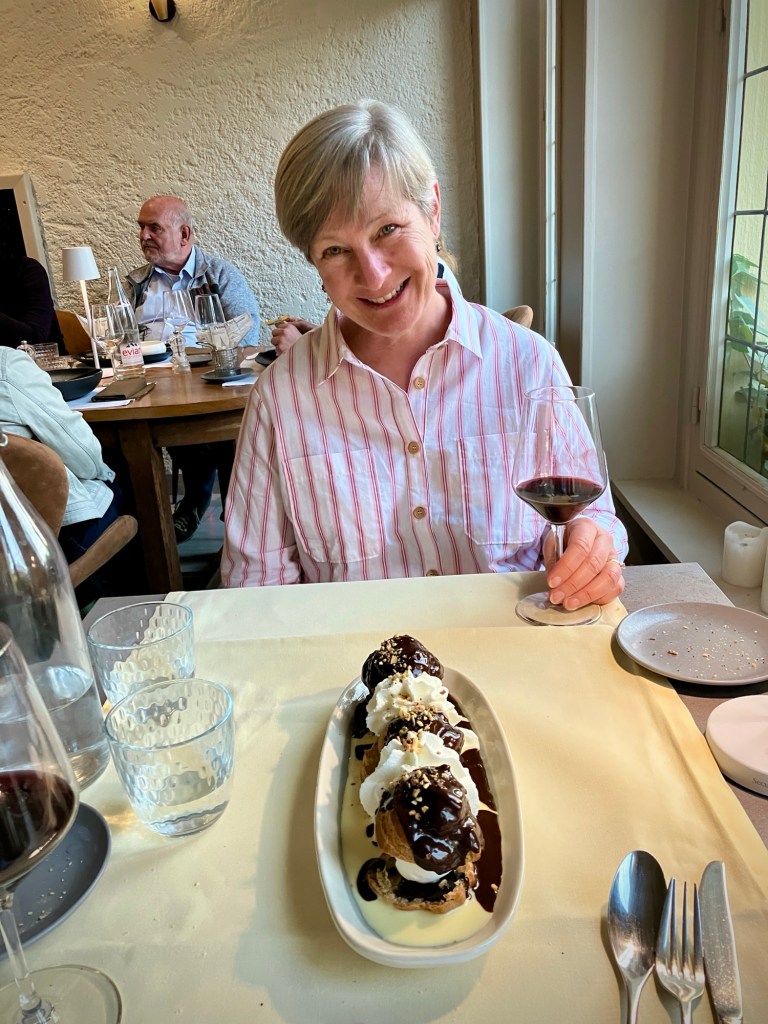
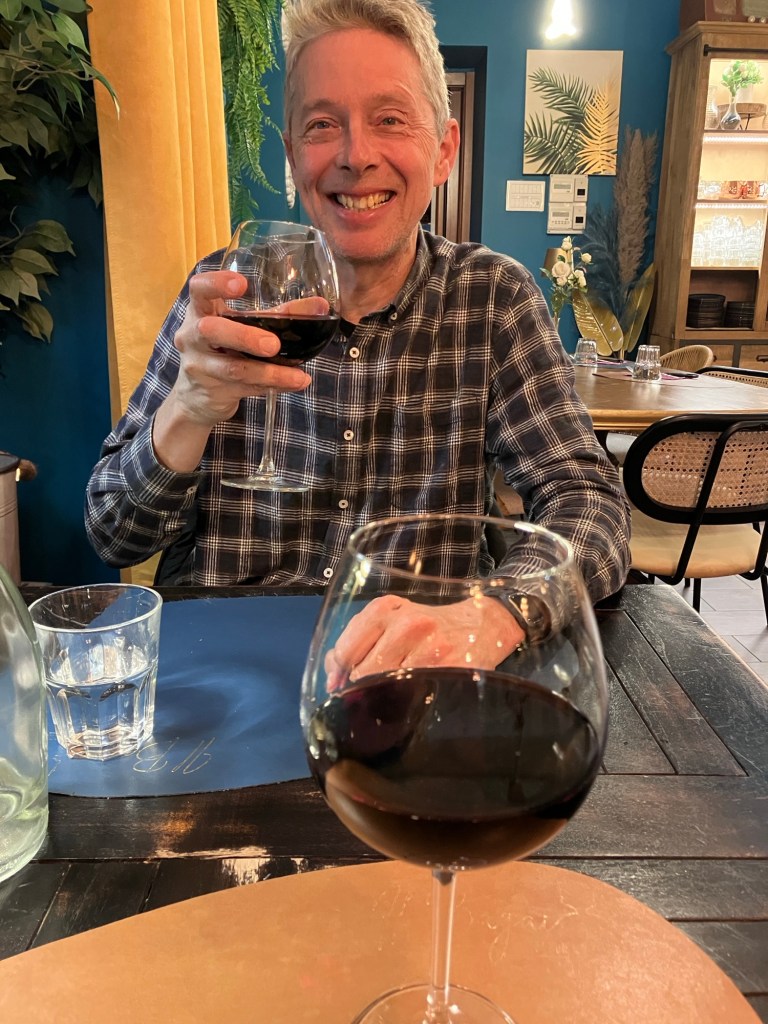
Nice to be touring again after our 4 day break in Paris Where are we going? Briefly on the popular Meuse cycle route, now also Eurovélo 19.The history of WWII in the region still feels fresh and even more interesting as you traverse the same landscape as advancing or entrenched forces. So many buildings were occupied by the Germans and repurposed, while others served the resistance.Cleaned up and with our best shirts on for a Saturday night dinner at the Hôtel la Sapinière. Our usual French restaurant trick is I get the 3-course menu and Cheryl just a main plate, and we split appetizer and dessert.Cheryl looking fresh and lovely in her new shirt. I think splitting dessert was a good idea.
As we left Paris, we had the prospect of a week long cat sit in Luxembourg, and were both anticipating a video call that night to seal the deal, which we did! For better or worse, the house sit constrained our route a bit and certainly eliminated any options of heading further North. So we had about a week to cover a distance we could theoretically do in 2 days if needed.
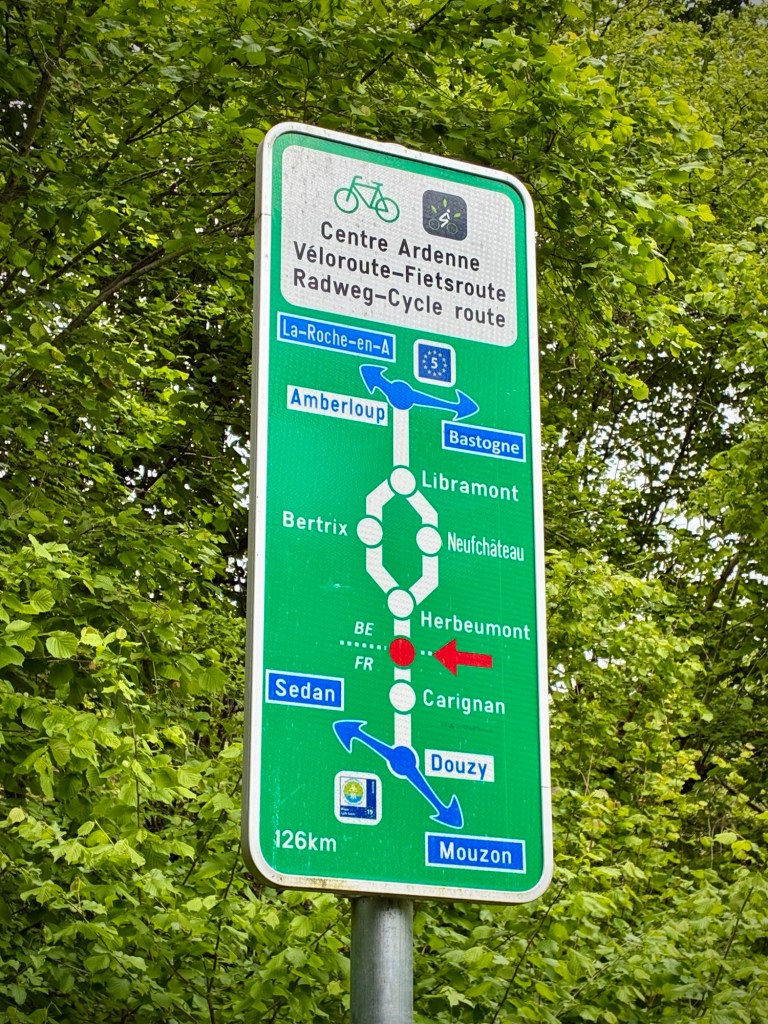
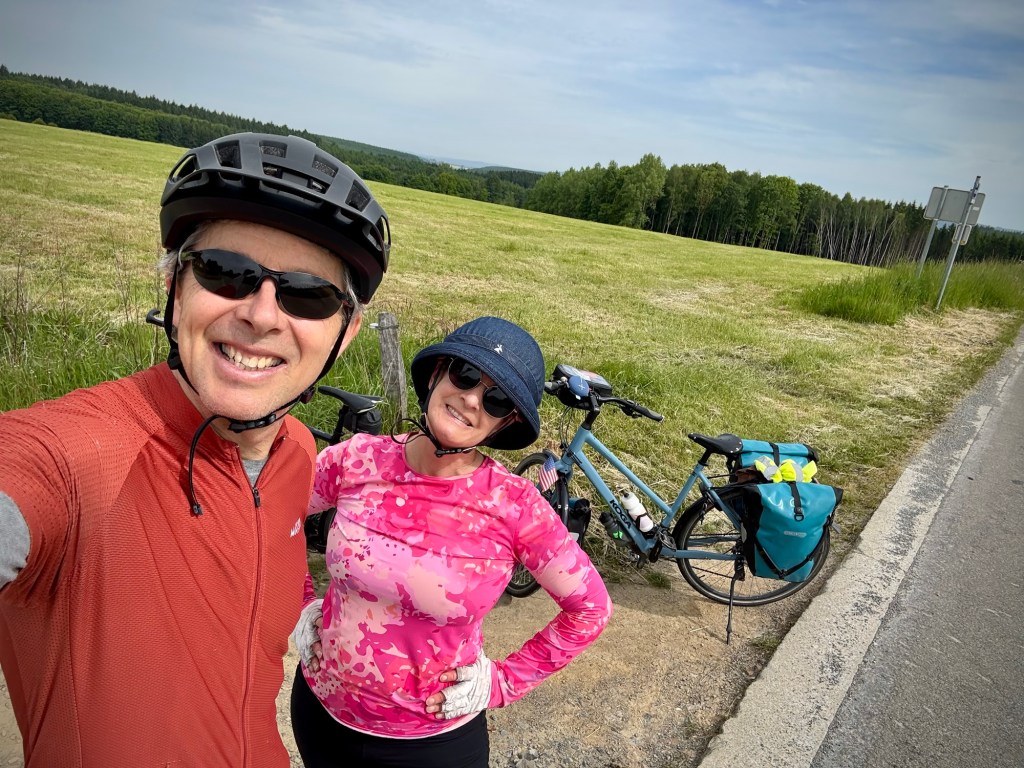
We were headed to Libramont from Douzy, so had a choice of routes. We went left.The RAVeLs are a series of fantastic routes in Belgium, mostly on repurposed rail lines, and mostly paved.
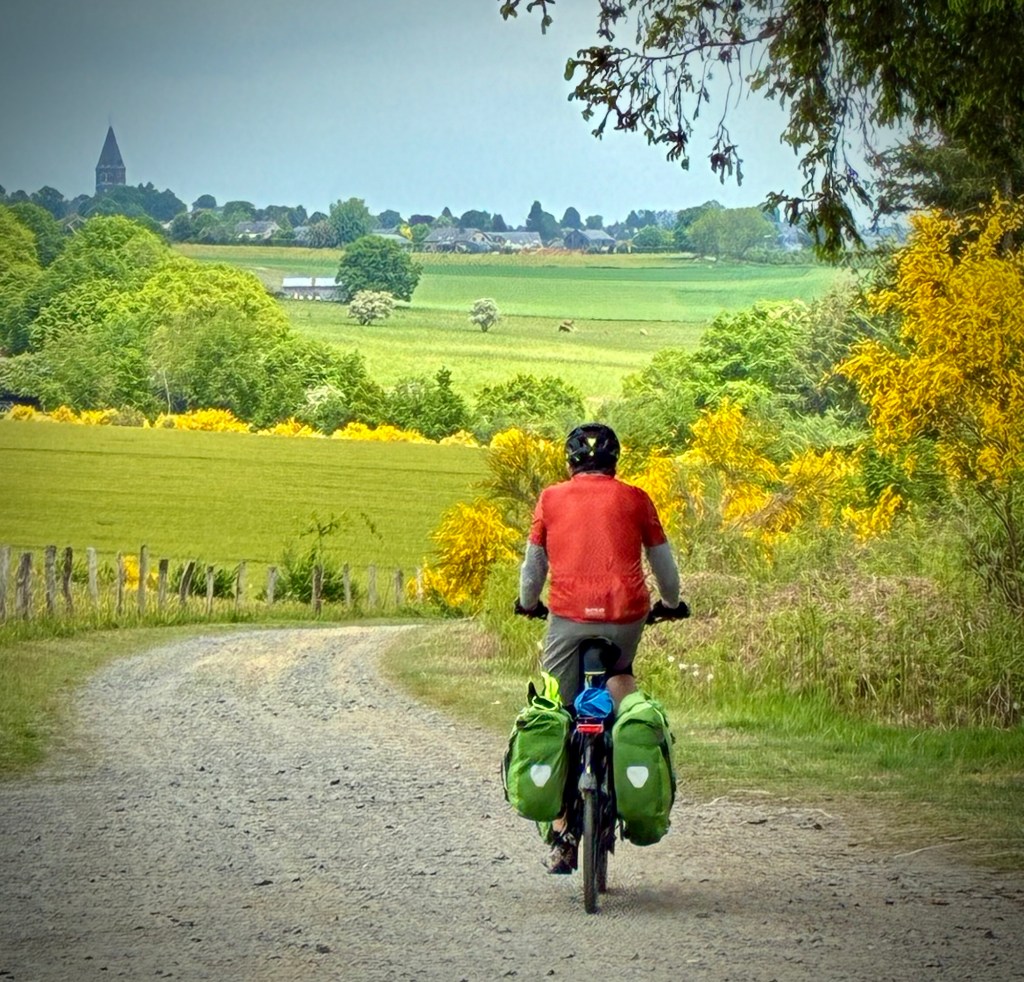
But adding distance is never much of a challenge in the dense web of great cycling routes of the Benelux region. So we decided to wander a bit in the central and southern Ardennes and it was very rewarding, both in scenery and in fascinating history.
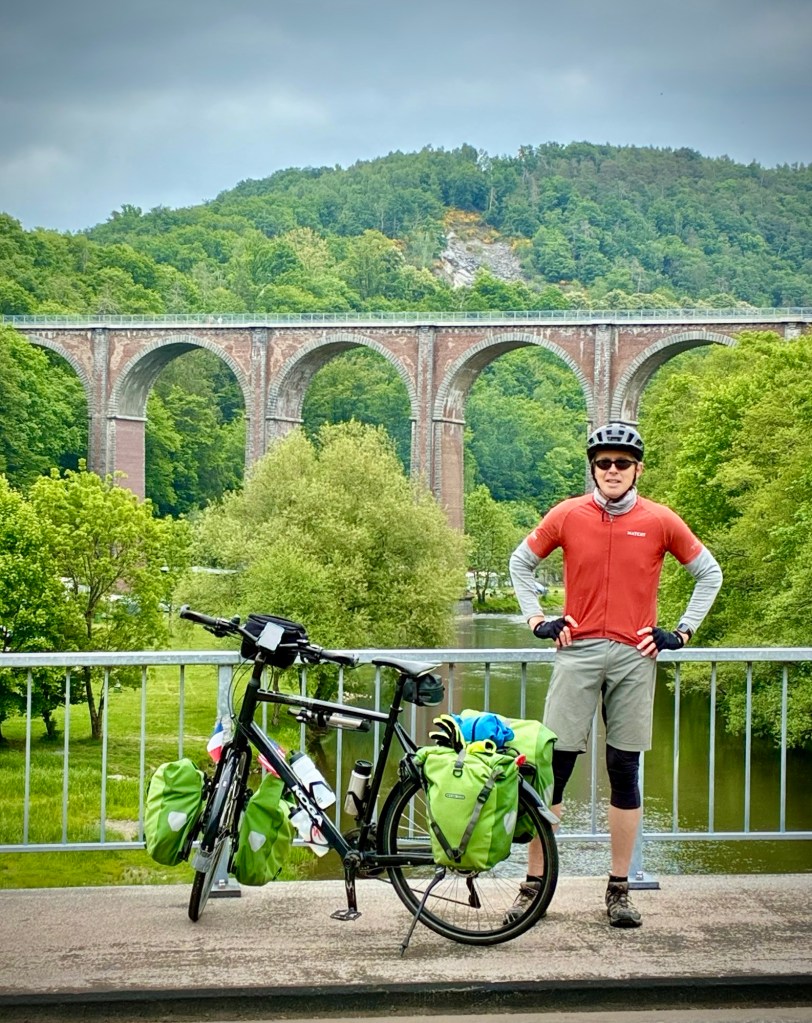
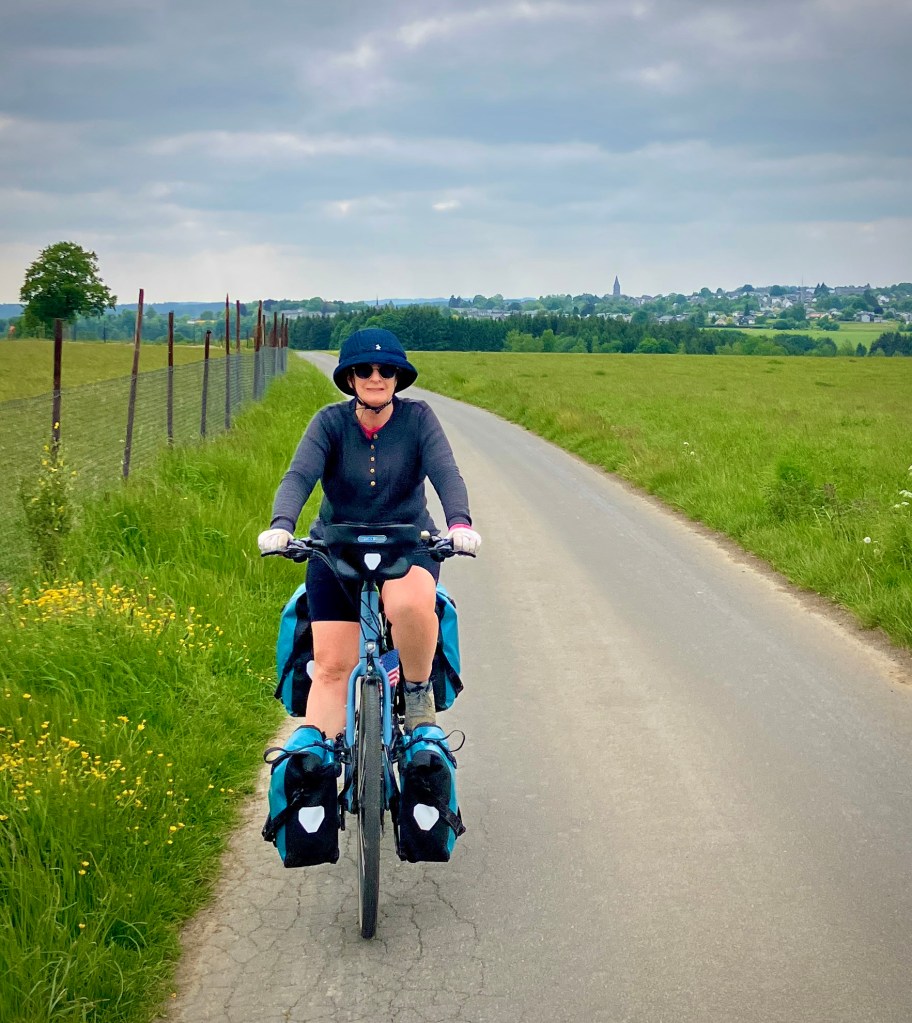
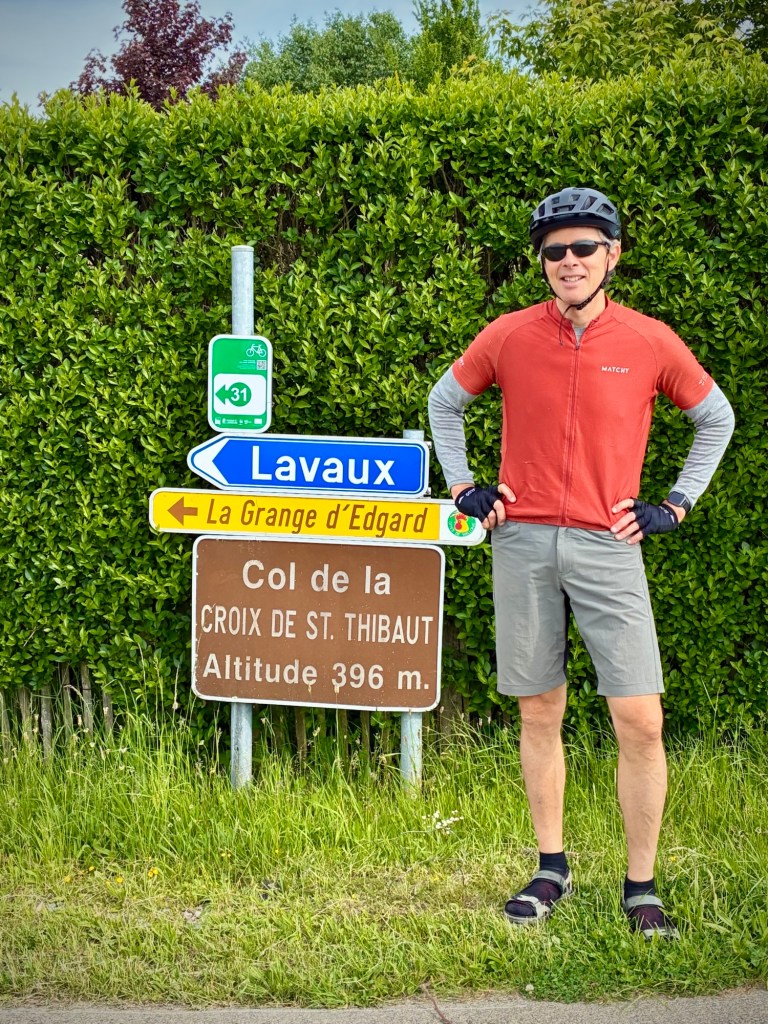
I wanted to see this beautiful rail viaduct near Bertrix, so we opted for a hillier route off the RAVel for a bit. Smiling at the top of one of the many climbs in the Ardennes
It was also tough terrain defined by endless rolling hills and steep river valleys. No easy going here, unless you find your way onto one of the nice rail trails or a free train in Luxembourg.
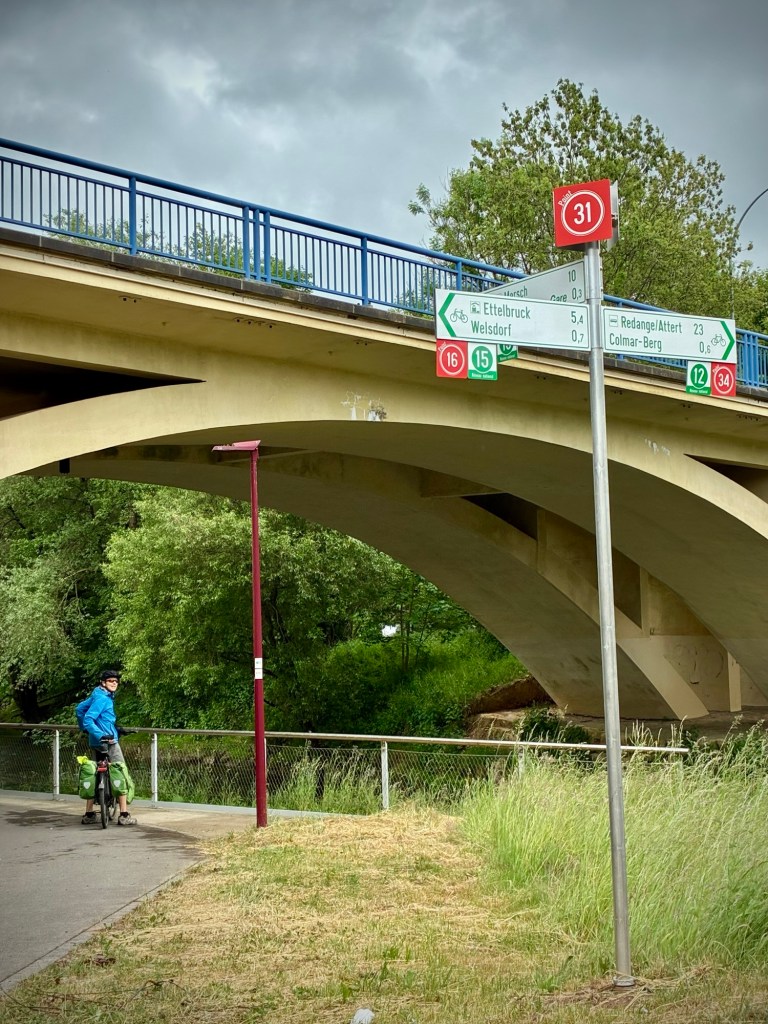
The pavement was smooth but a climb right out the door is not always appreciated.Very clear signage and markings in Belgium.
We love the way history unfolds as we ride through a new area. We now understand why people come to visit this area solely to revisit the WWII history. This area was occupied early by the Germans and then liberated by the Americans and other allies in the fall of 1944 as they advanced from the beaches of Normandy.
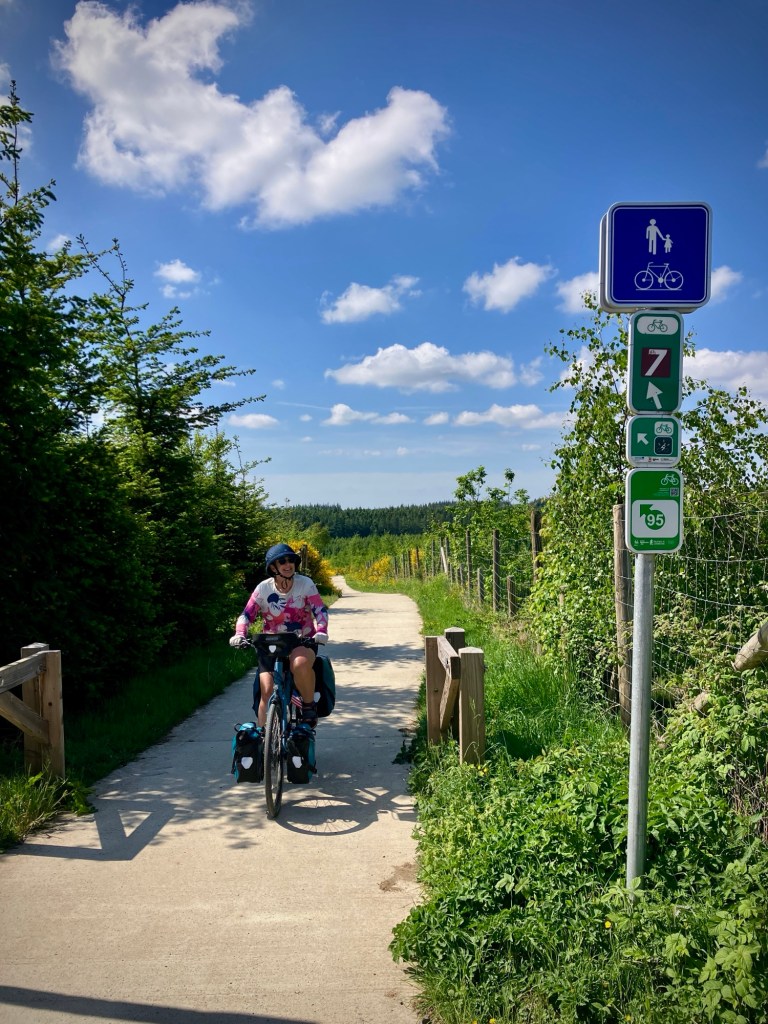
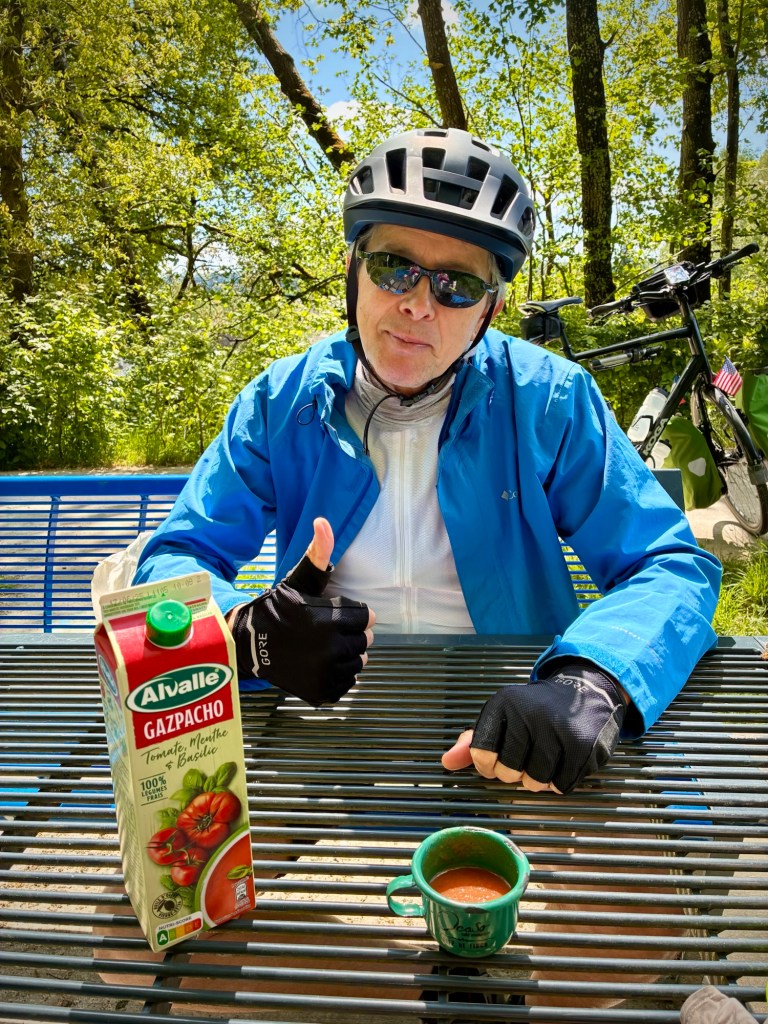
Climbing through commercial forests outside of Libramont. The drab monoculture was offset by the beautifully smooth new concrete path.The high point at an eye watering 560m! Ok, the Ardennes are not a high mountain range. But the buttery smooth pathway decent and rollers through lush mixed forests was a blast.Our favorite Gazpacho flavor currently; Tomato, Mint, and Basil
But Hitler’s last major effort in late December, 1944 aimed to split the allies in the middle of the Ardennes and crucially, isolate and take the strategic port of Antwerp. This is how the famous battle of the Bulge got its name. It seems the Battle of the Bulge has been rebranded as the Battle of the Ardennes to broaden its scope appropriately to all the stages of the war in the region.
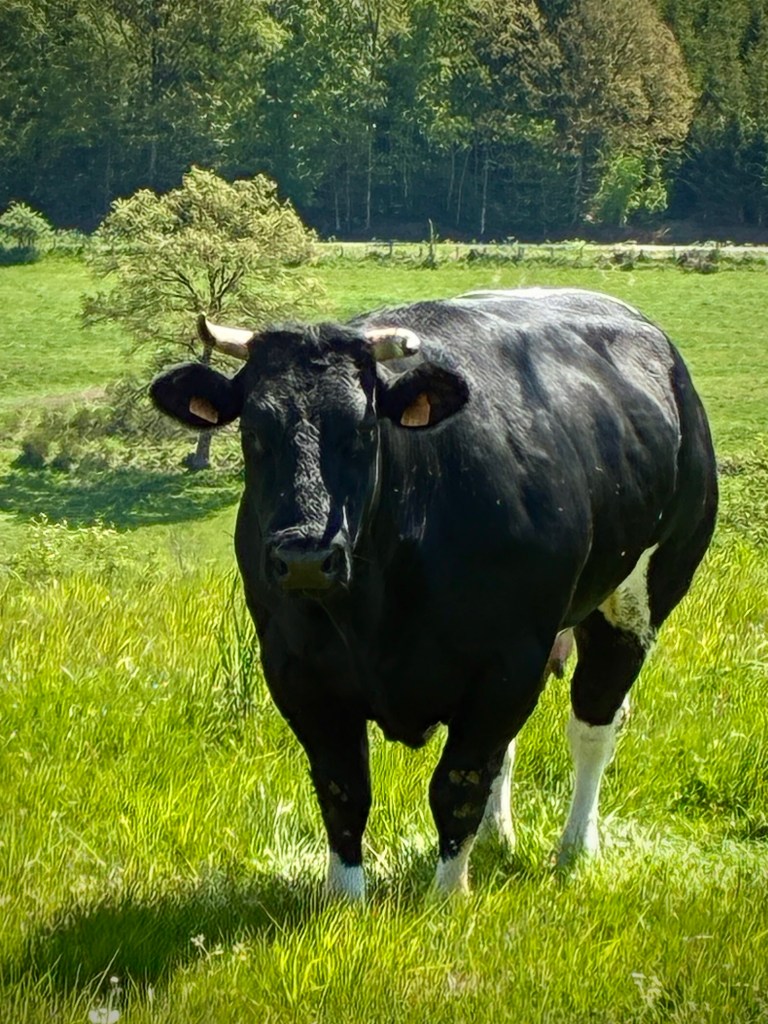
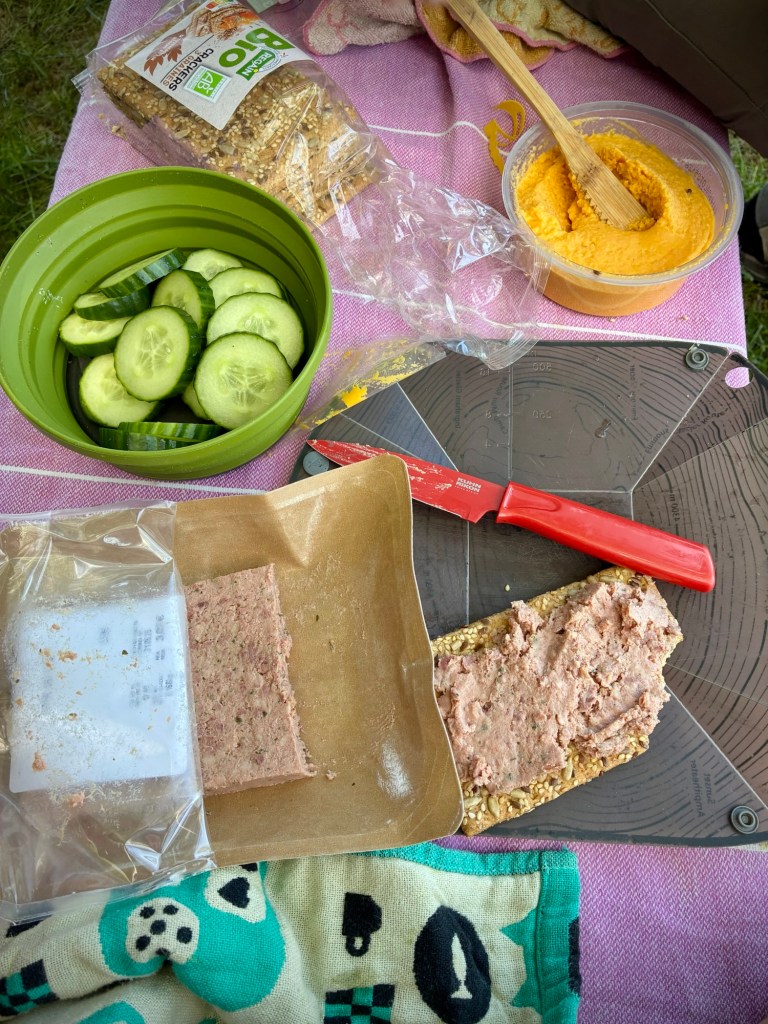
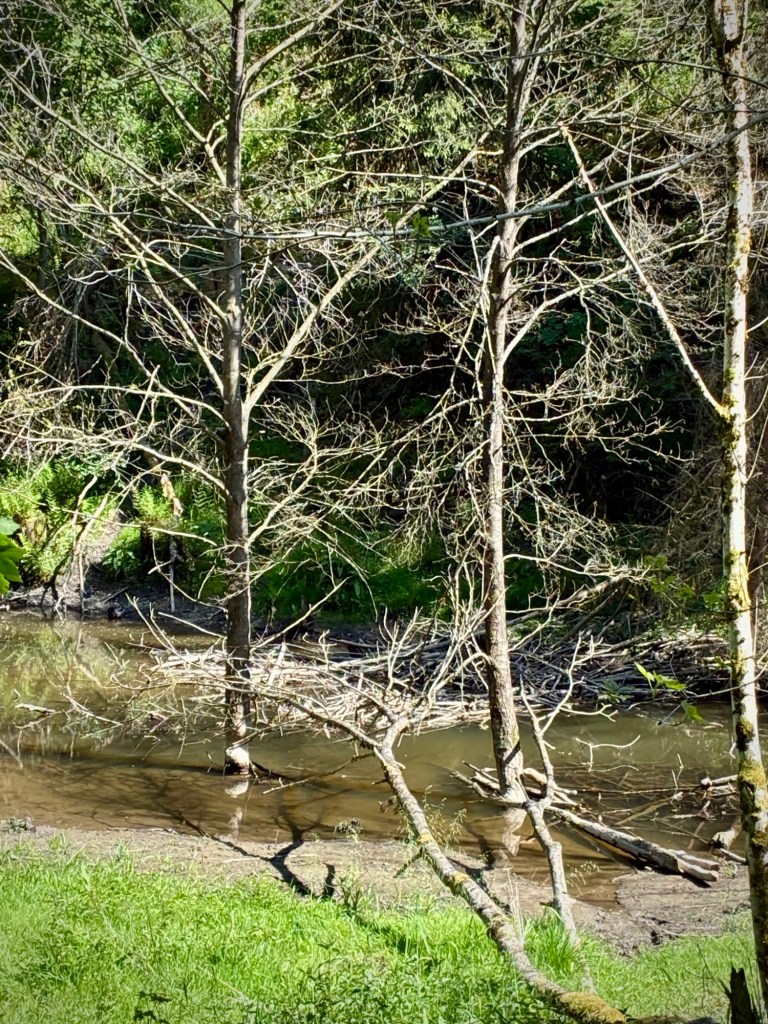
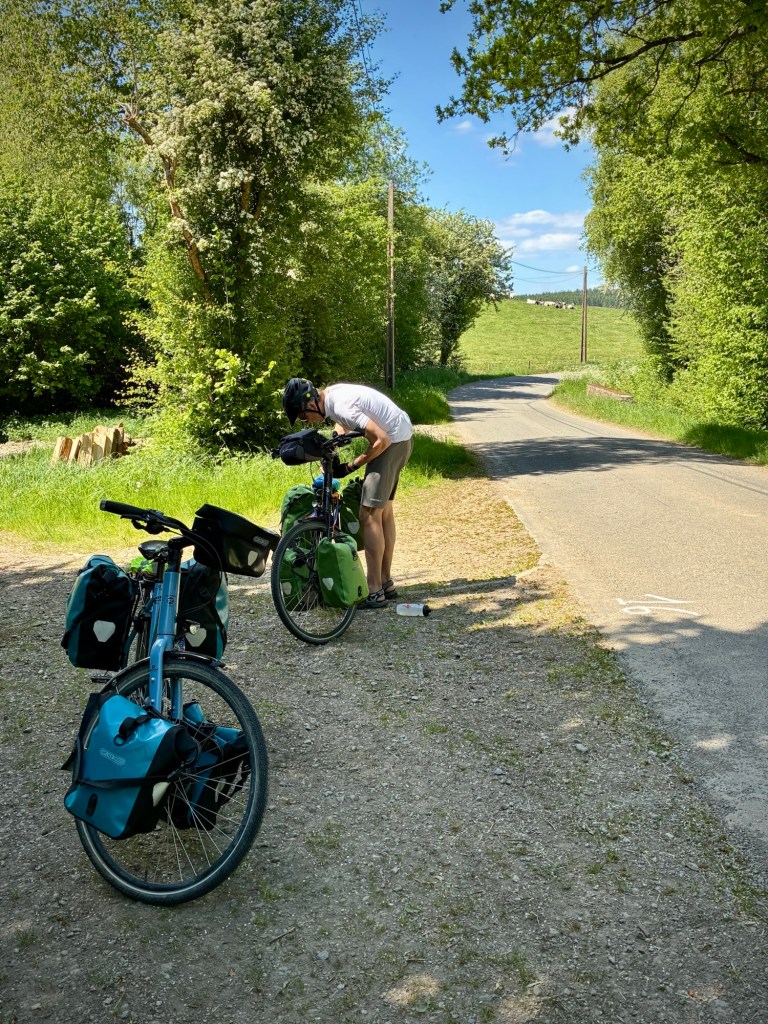
The entire area was the front lines of the advancing Germans after the battle of the Bulge. Virtually every village had a story of war, occupation, suffering, destruction, more war, and finally liberation in early 1945.What are you looking at?More ups and downs on the way to La Roche, but the weather was perfect.A typical quick picnic lunch of luscious pate, healthy sweet potato hummus, cucumber, and seeded whole grain crackers.Our final approach to La Roche had miles of Beaver habitait along a small tributary stream to the Ourthe River.So it was not the best time to spot one of the diurnal European Beavers, but the evidence of their work was everywhere. like the trees gnawed and ready to fall, and many dams across the stream.Reattaching my bottom water bottle cage after a full bottle flew off on a fast and bumpy decent. I was lucky not to go down as I might have if it had gone under my wheel. Reminder, check all the bolts on the bikes!
A bit of a side note on our trusty Koga World Traveller S bicycles. Inevitably heavily laden touring bicycles have mechanical issues and require maintenance, especially drivetrains, brakes, and tires. We’ve both had our bicycles tuned up and overhauled once since their purchase 2 years ago, but at different times and usually spurred on by an issue. I had to get a new disc and pads for my rear brake last year in Salzburg, and Cheryl needed her brakes bled and refilled, along with new brake pads this year in Narbonne, France.
Thankfully, most shops will take some pity on touring cyclists and accommodate a fix into their schedules. But not always, and major work or overhauls sometimes are scheduled out months in advance.
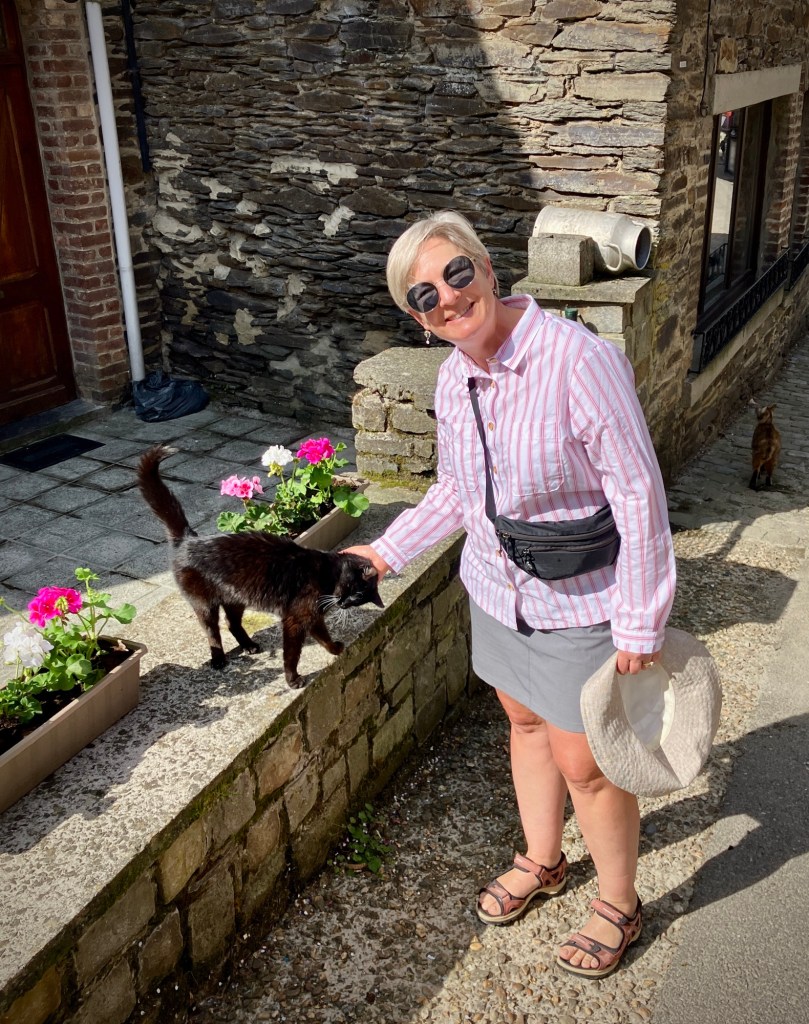
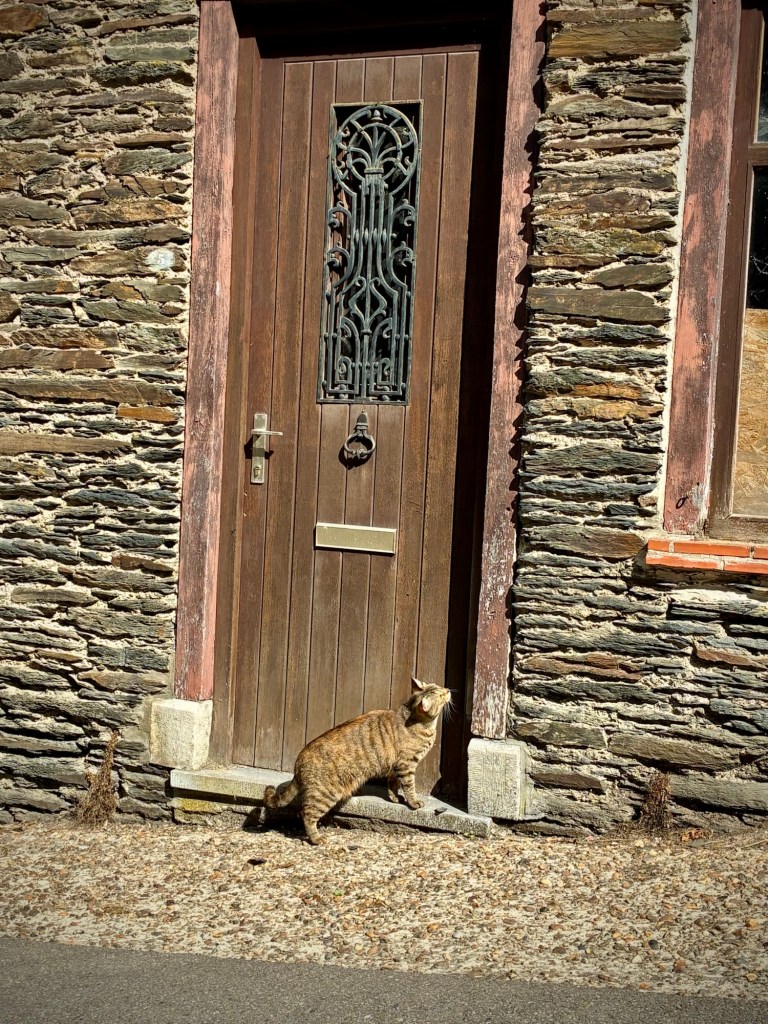
Happy for a day off the bikes in scenic La Roche-en-Ardenne.Exploring the small and fairly charming La Roche, including the local cat population.Is this cat trying to escape from Cheryl?The local Charcuterie…the reformed pigs were a little creepy to me.
So after numerous flat tires before Paris, I felt my Schwalbe Evolution rear tire was near retirement age. I had a chance in Paris to get a brand new first choice tire (Schwalbe Marathon Plus 700×38) but opted to ride on as the tire tread still seemed ok to me. What I didn’t notice until on the way out to Gare d’Est in Paris, was the wobble in my rear tire. It had a small bulge. Too late to get that perfect tire replacement!! Ugh. And no open bike shops for a few days. And then I noticed a second bulge. So it was rideable, but a constant wobble feel and concern that it would finally blow out the side made my cycling way less fun for a few days.
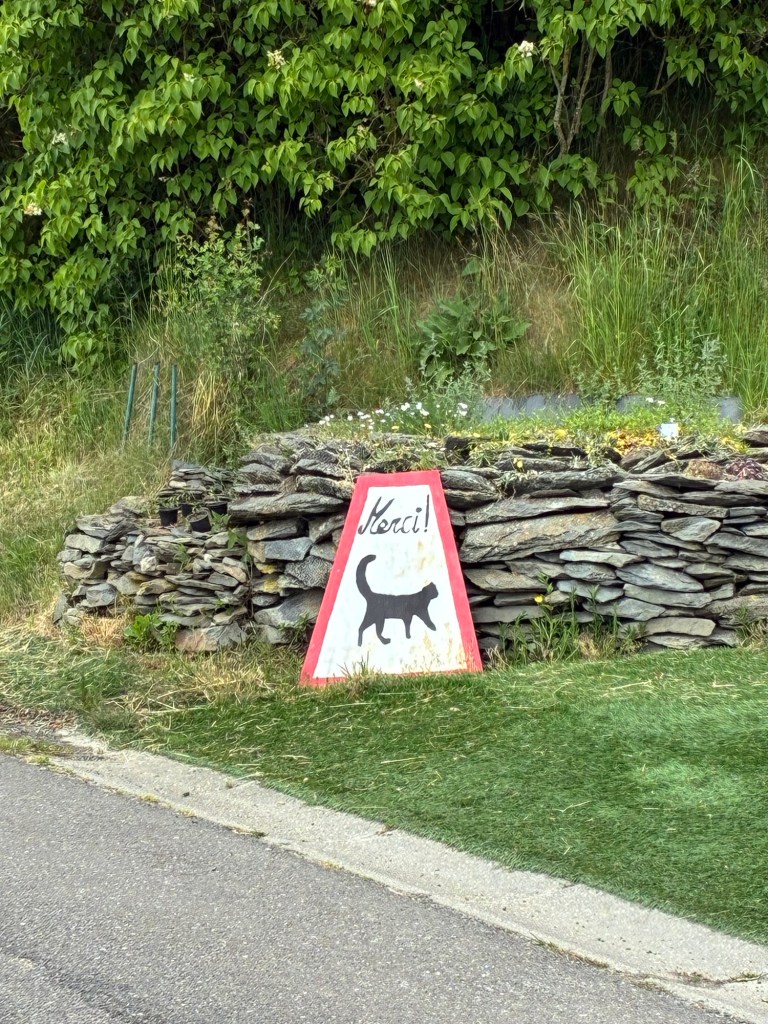
Not the alps, but a good little climb to warm us up out of La Roche en route to BastogneSo nice on TOP of the ridges. And most of the roads here are so quiet. Trying to ignore the bulges in my back tire!Just proving Cheryl was still with me. She was climbing like a pro after 7 weeks on the bike!And ripping up the gravel!Some fun off road sections in the Ardennes, but it can be rocky and muddy. Yes, thank you for slowing for the nice black cat!
So luckily after 3 days of riding, my back tire kept it together and we made it to Bastogne and a nice, well equipped bike shop that had a replacement tire. Not my dream Schwalbe tire, but actually a wider 700×50 Schwalbe mid range tire. This is as wide a tire as our Kogas will accommodate, and it certainly does have a nice supple ride now. But lesson learned, right? And Cheryl keeps reminding me that she said I should have gotten the new tire in Paris… and Cheryl is always right!
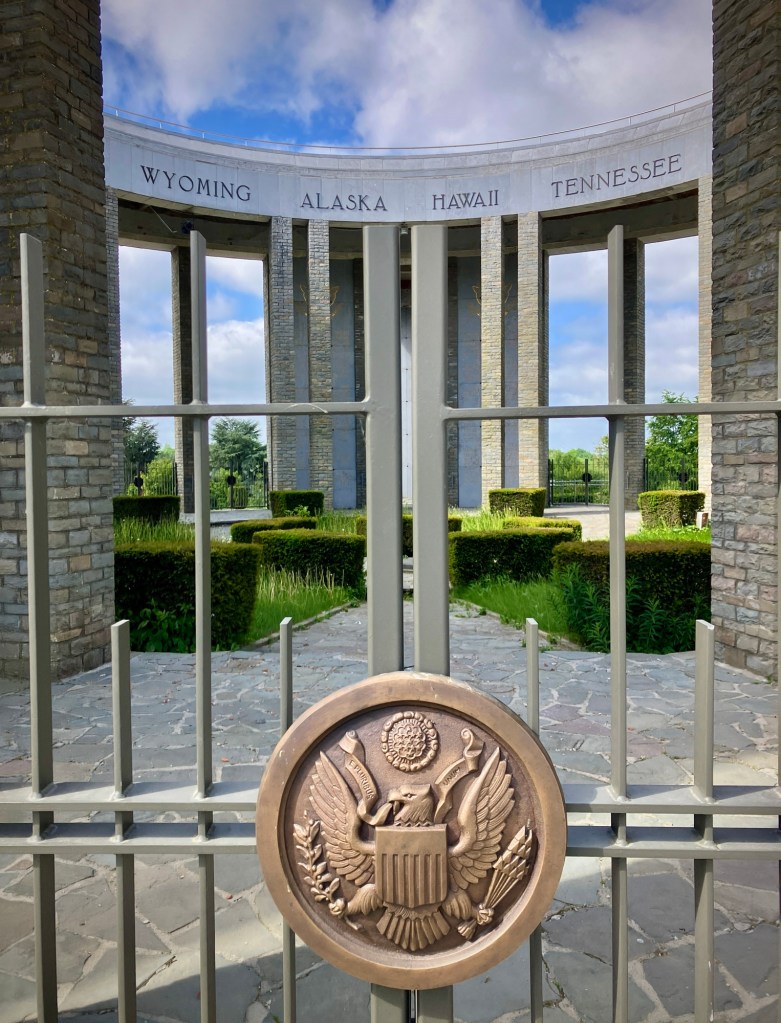
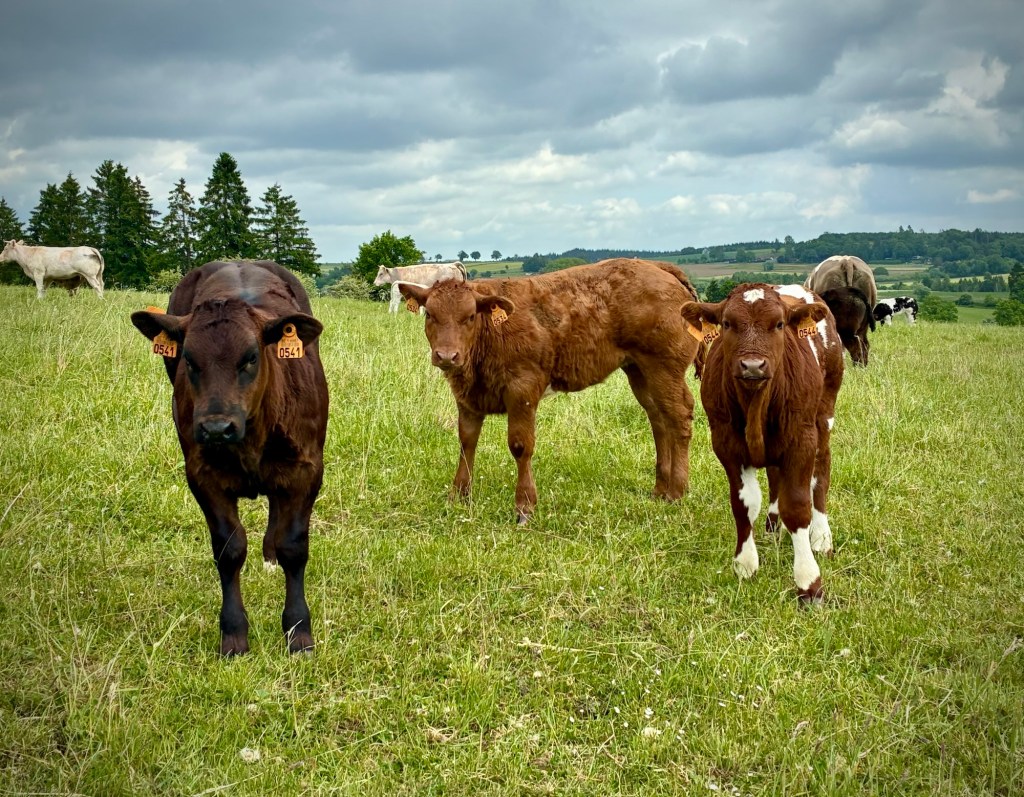
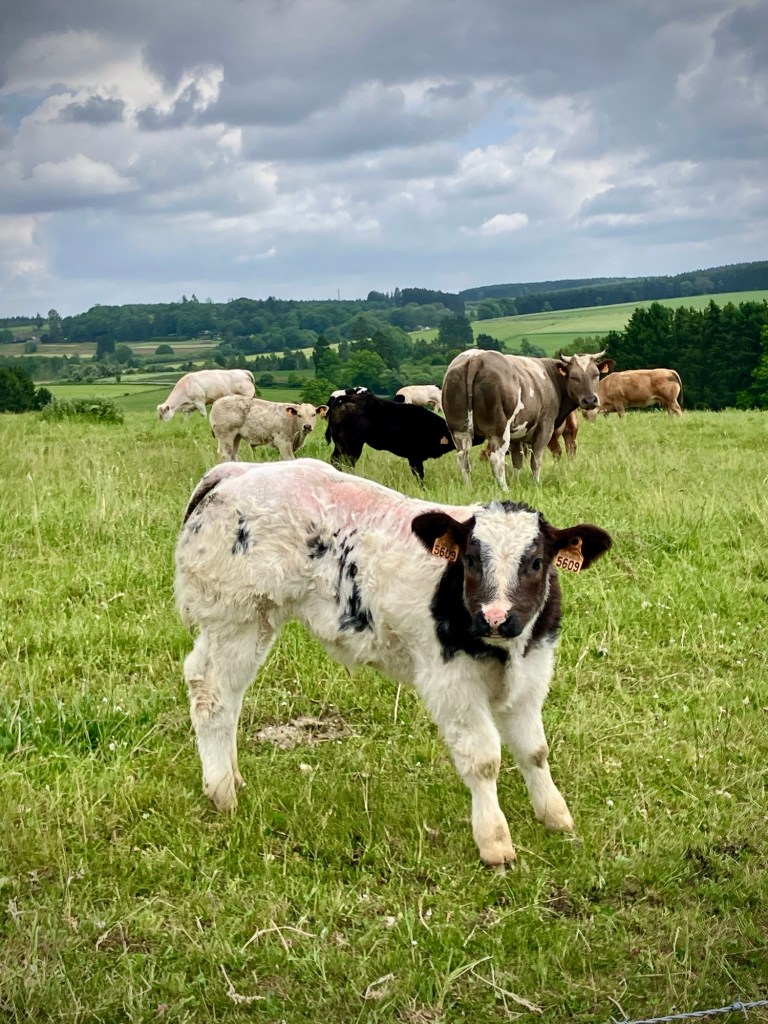
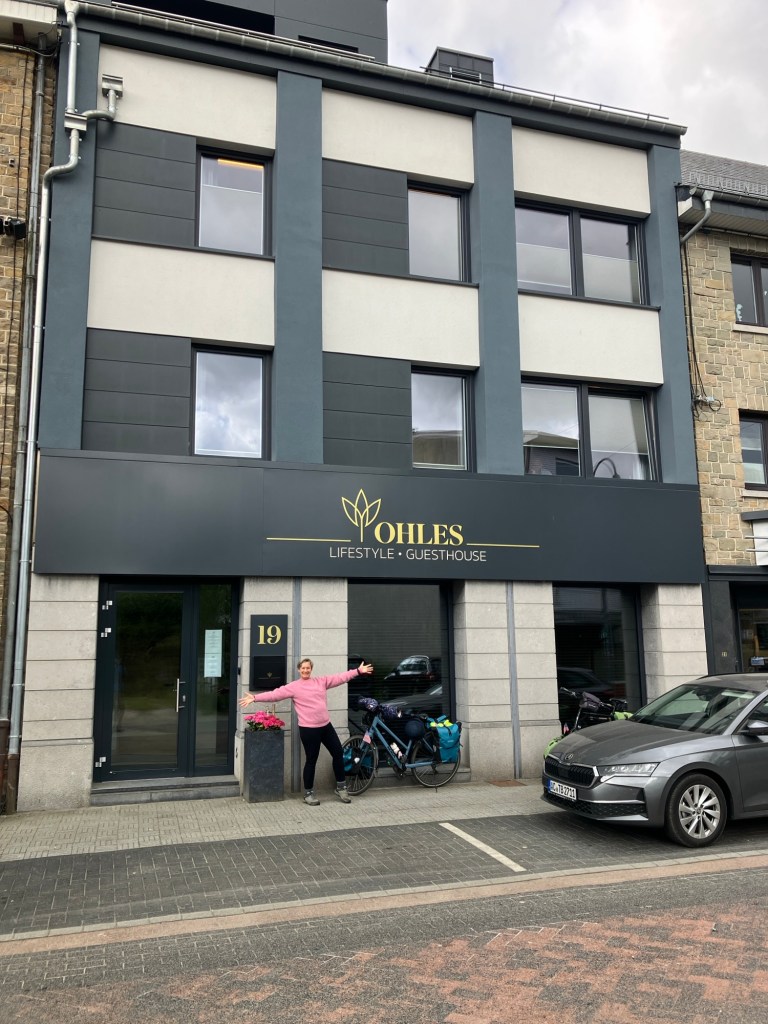
This tank is dedicated to the U.S. 10th Armored unit who were the first to defend Bastogne in the Battle of the Bulge. They were soon joined by the famous 101st Airborne Division who have their own museum in Bastogne. About 50m from here is a monument to the nurses in the battle.The beautiful and dramatically located Mardasson Memorial on the edge of Bastogne.A strategic location to defend.The RAVeL Line no 163 runs from Bastogne to Gouvy just along the Luxembourg border and traces a critical front line of the Battle of the ArdennesAnd more cow curiosity; what are these crazy people doing on top of our ridge?!And this cute little guy (gal?).And did we mention it’s Spargle (white asparagus) season!!Our nice bike friendly guest house in Sankt Vith. Nice new rooms and a self serve bar filled with Belgian Beers. (Of course.)
Another interesting quirk of this region is the bizarre mix of languages and political boundaries. After leaving Bastogne, we headed to Sankt Vith, the cultural hub of the small German speaking region of Belgium. Germany wanted this region back from Belgium after both wars, but Belgium resisted and it remains a semi autonomous region of Belgium with about 80k German speakers. We noticed a unique feel here, not quite like Germany, but also not like the French or Flemish region of Belgium. They also seem to speak an old dialect of German and not cater to the multi lingual flexibility offered by most Belgians.
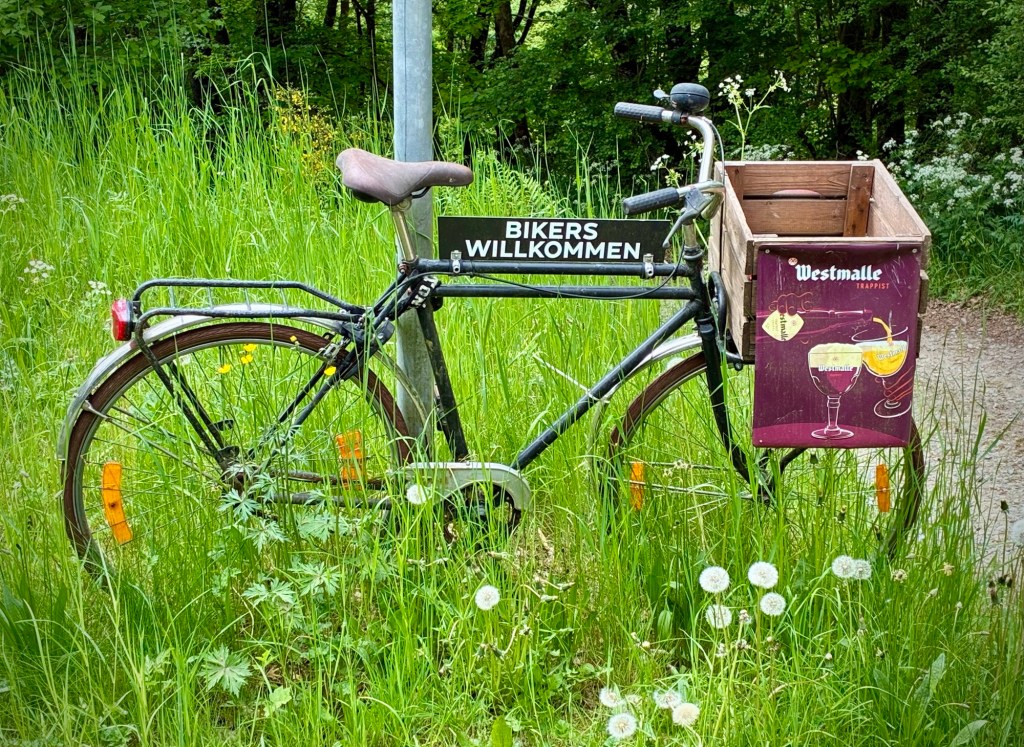
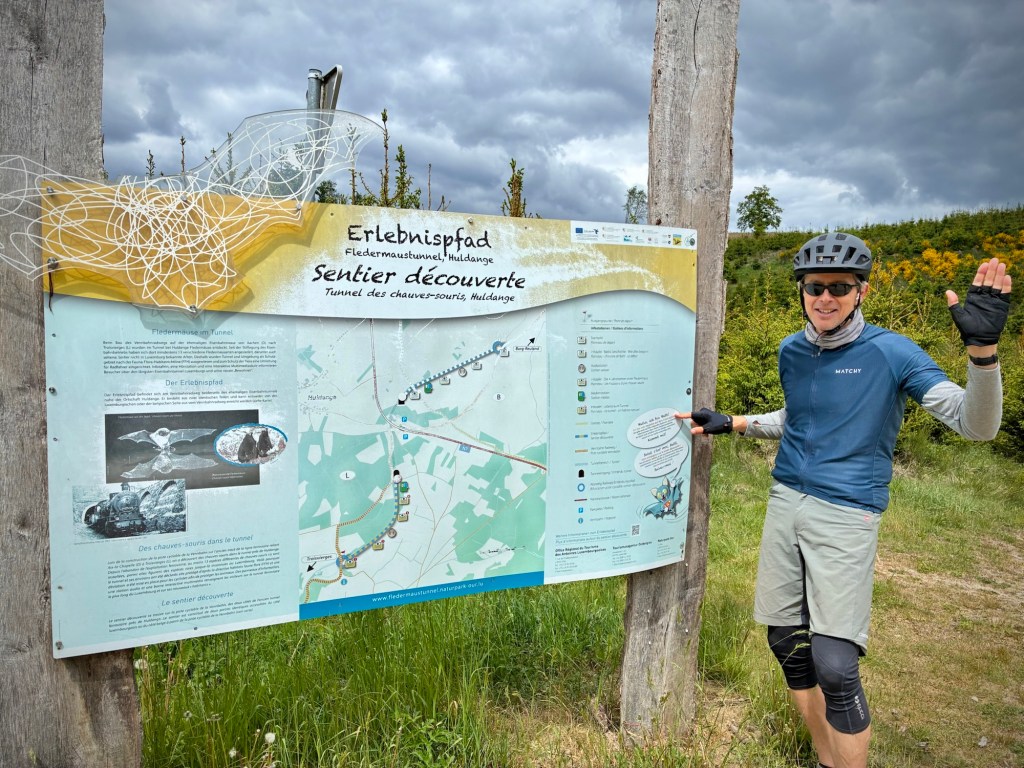
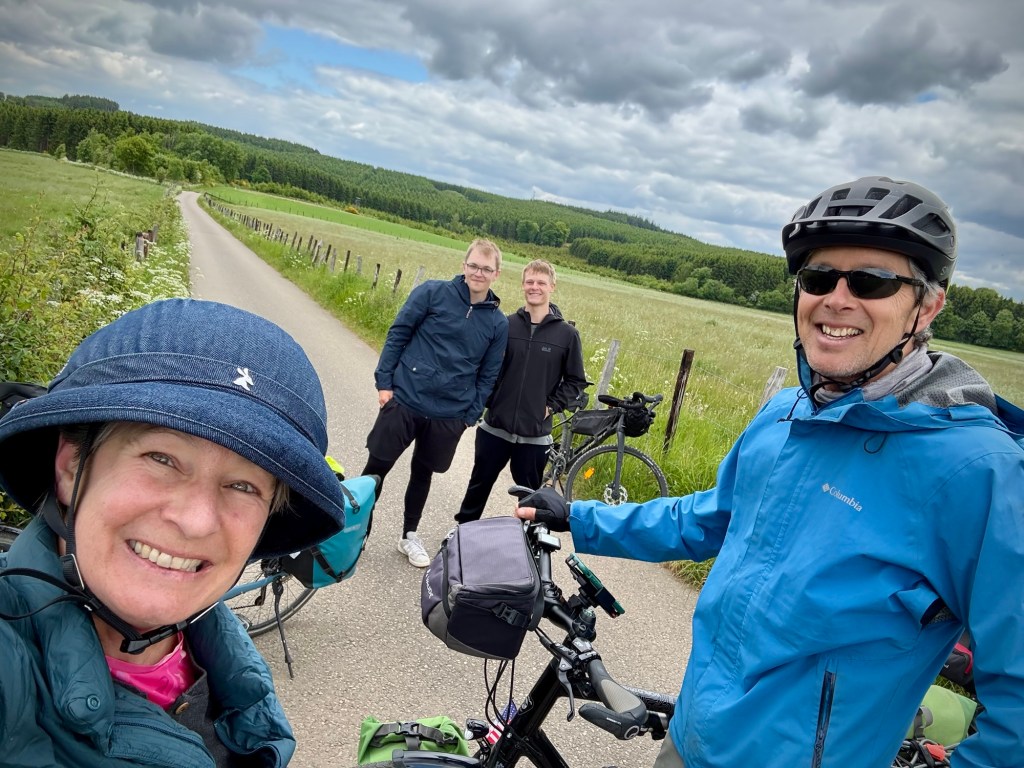
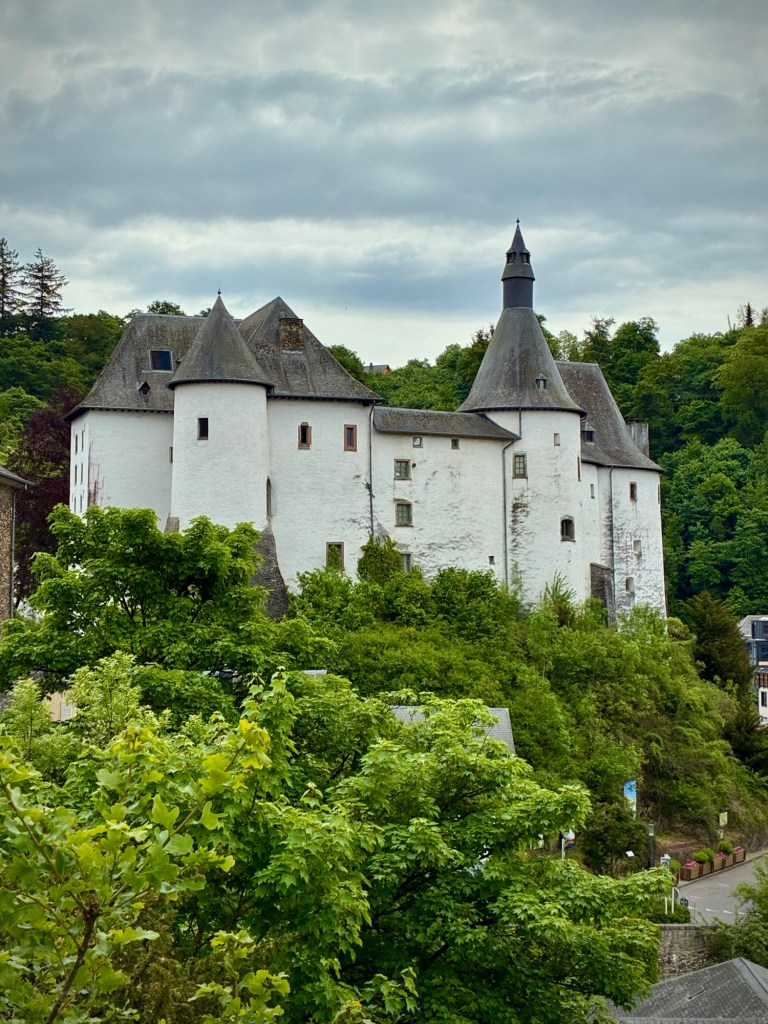
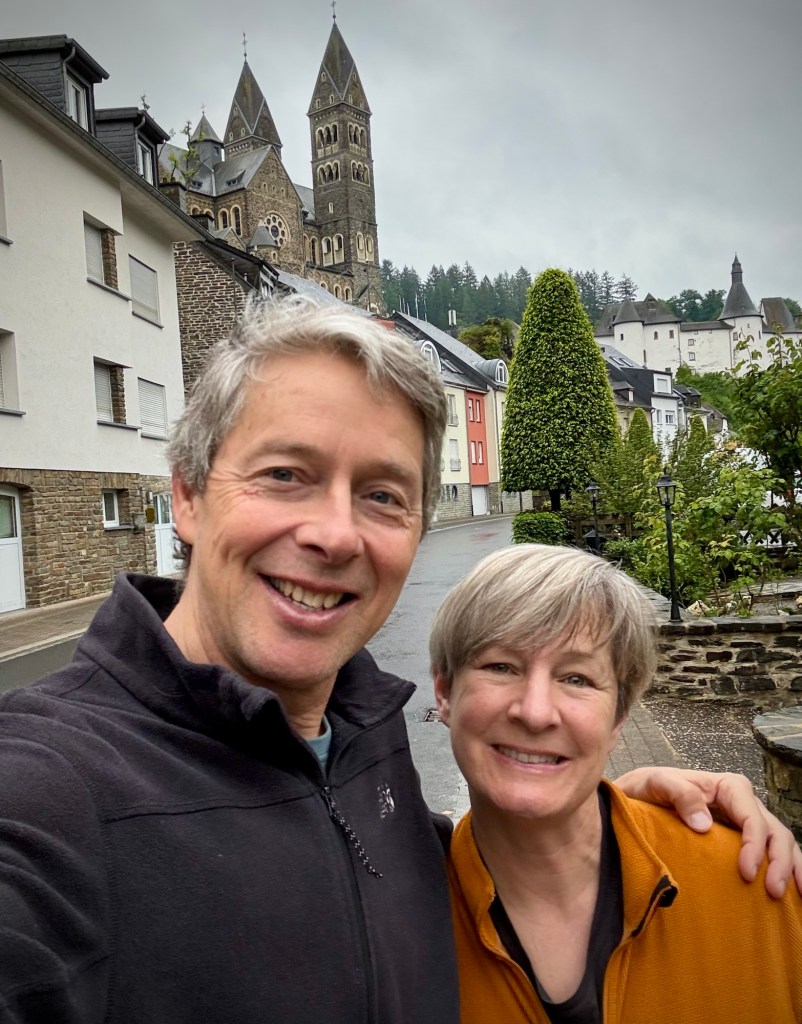
Cheryl trying out some local bike art next to a brief local history on the occupation, resistance, and use of the local farm houses during the war. Everyone and everyplace in this region was in the heart of the long struggle. Yes, we felt pretty welcome in this corner of the world.We were now on the Vennbahn for a while, a long distance route from Liege.As they refurbished the rail line, they discovered numerous bat species in the Lengeller tunnel. It’s closed to people now and they have turned both approaches into an informational journey. Bats are cool, so we were happy to divert.On the steeper pass road, we met these two nice young German guys out for a week of bike packing and camping.And swapped cameras to get pictures of the sticker laden border sign to Luxembourg.Passing under our first train station in Troisvierges, the southern terminus of the Vennbhn. I had to check out the nice departure screens and fact that all the trains and buses are free! All the time, everywhere. Very exciting!We arrived in sunshine to Clervaux, Luxembourg, and its beautiful church which looks ancient but was actually built in 1912.The Church of Saints Côme et Damien is just as impressive inside. Incredible quality and workmanship which was an effort to boost and promote Clerveux’s status as an economically successful village.The Clerveux Castle is in a dramatic spot on a bend in the Clerve River. It now houses a war museum and is permanent home to the Family of Man; a impressive presentation of 512 black and white photographs collected by Edward Steichen in 1956. Its focus on the commonalities of the human experience around the world felt especially poignant to us with Trump’s administration of uber-nationalism.A simple but effective monument to the American GIs who liberated Luxembourg twice from the Wehrmacht.And the townspeople cheering on their liberators.Waiting for our first FREE train in Clerveux, Luxembourg.Multiple bike cars, level boarding: and horizontal placement of bikes! (No hooks!!) Luxembourg spends even more than the Swiss per capita on train infrastructure.No tickets, no worry about missing a train. I think I like this!After our FREE train hop, a short ride today to our hotel near our cat sit. All on excellent cycle paths and routes. Have I mentioned all the trains are free in Luxembourg since 2020?!!Today’s ride was perhaps a bit too short so we had to kill some time along the river in our Chair Zeros.My first Battin, the de facto National Beer of Luxembourg. A pretty tasty lager with a malty and satisfying finish.
So we finally made it to Luxembourg (first time!), and so far, it’s been fascinating in its own right: unique languages, economic prosperity, and great infrastructure. But more on Luxembourg next time from Cheryl. Happy travels!
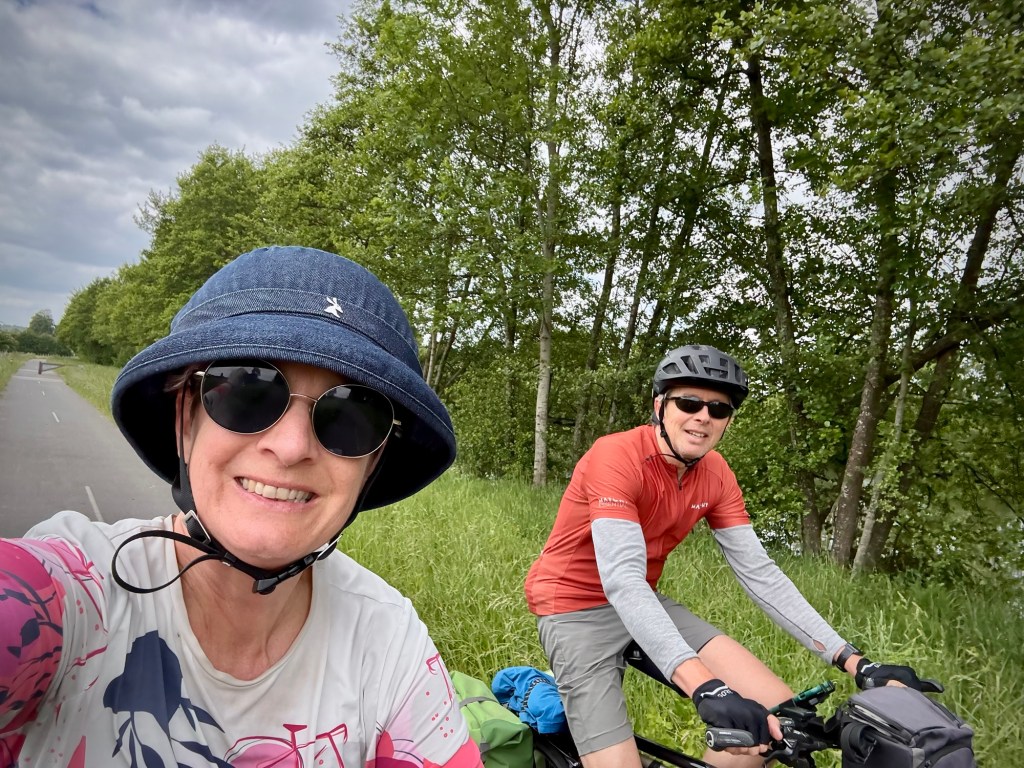
These nomads are still smiling and ready for our next cat sitting adventure in Luxembourg!
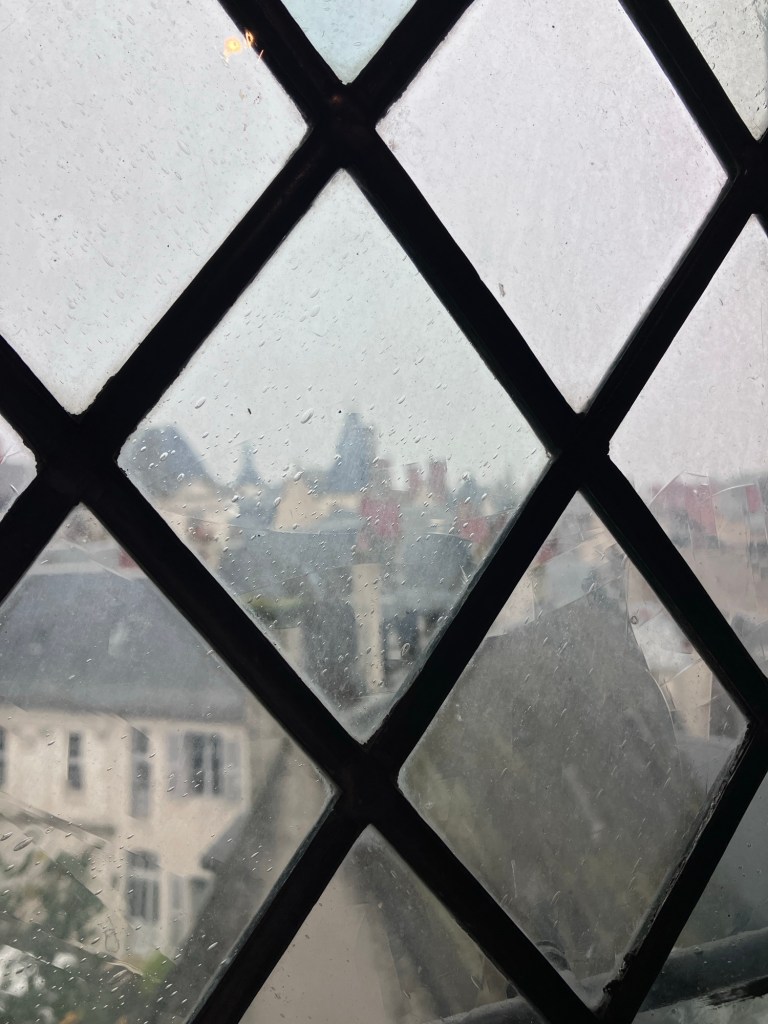
Bourges through a window of the Palais Jacques Cœur.Lyon is the bottom heart, then Bourges, then Orléans. All by train as our bicycles have entered winter hibernation.
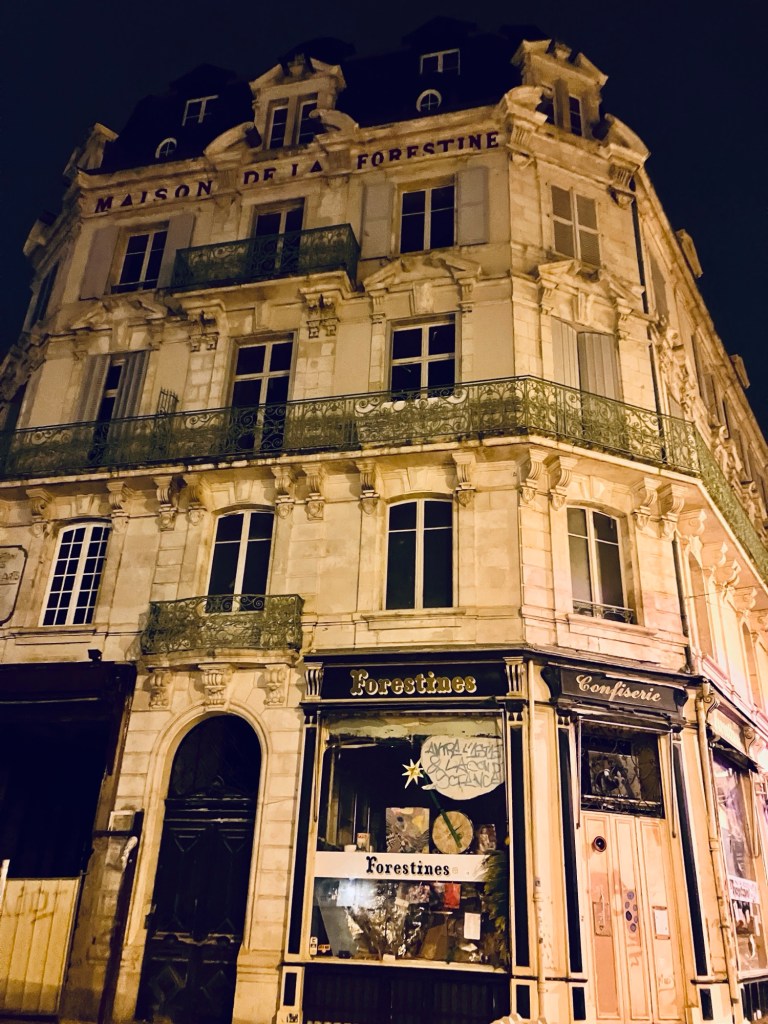
Looking forward to a month’s stay in Paris we left Lyon, and the sunshine, although we didn’t realize it at the time. And we headed to Bourges. Bourges isn’t a big tourist destination, although Rick Steves tours do stop there to enjoy the half timbered houses and the huge gothic cathedral with its 13th century stained glass windows.
Cathédrale Saint-Étienne de Bourges. Seriously huge. We called it a triple decker cathedral.The soaring interior and lovely chandeliers.
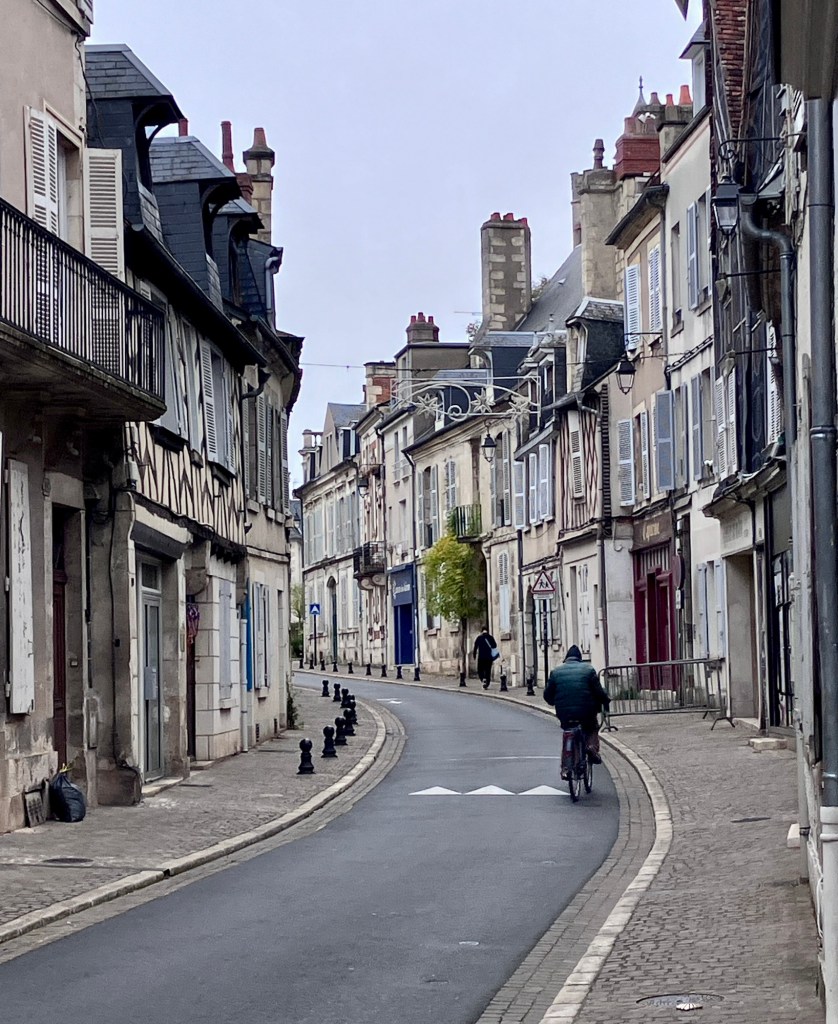
Bourges has nearly 500 half timbered buildings, more than any other French town, and the ruins of a Gallo-Roman wall. A tea and cake shop, Cake Thé, uses one tower as a dining room, if you follow the path to the shop you will find the remains of the wall and a lovely walking path.
Twilight on a street of half timbered buildings.The upkeep of the buildings must be very challenging. We saw a few supported with external bracing like this.It was a great town to explore.With sweet little cobbled streets.Lined with small houses.And more half timbered buildings on a quiet street near the center of old town.Of course a Camino route goes through town. And, this is the last you will see of our sandals for a while.
One of Bourges’ other sites to see is the Palais Jacques Cœur, a large Hôtel particulier – a grand urban mansion, freestanding and not connected to its neighbors. Cœur was a government official and successful merchant in the 1400s. Too successful, as his ability to lend large sums of money led to his eventual arrest and downfall. It seems never to pay off to have a King in your debt.
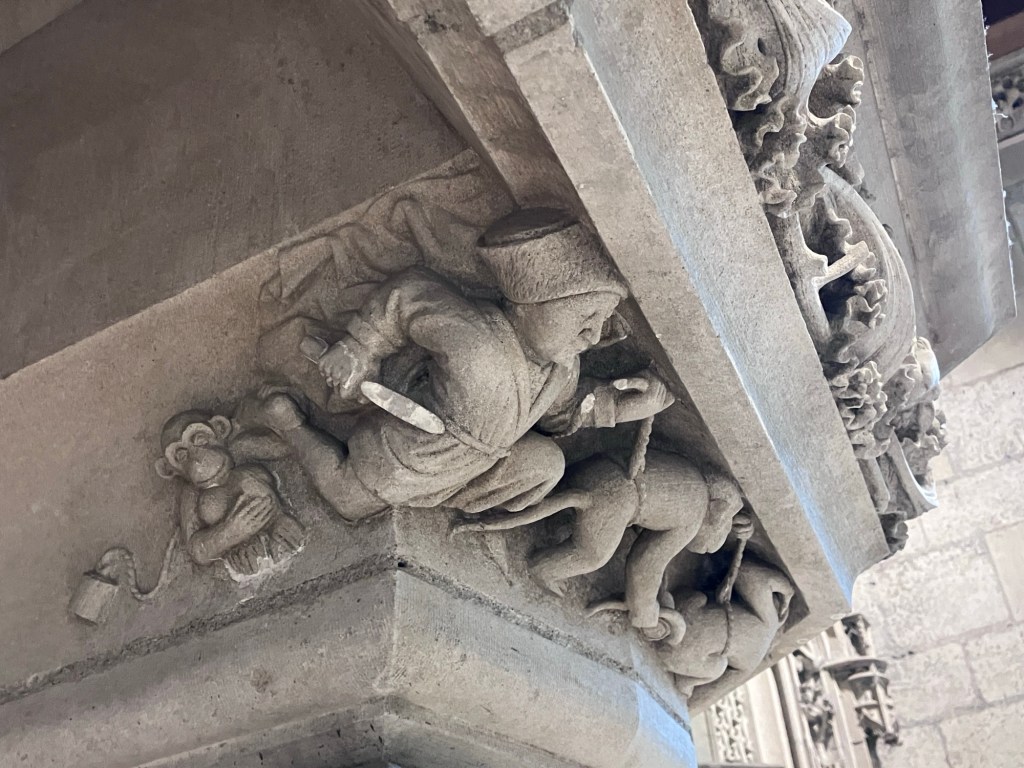
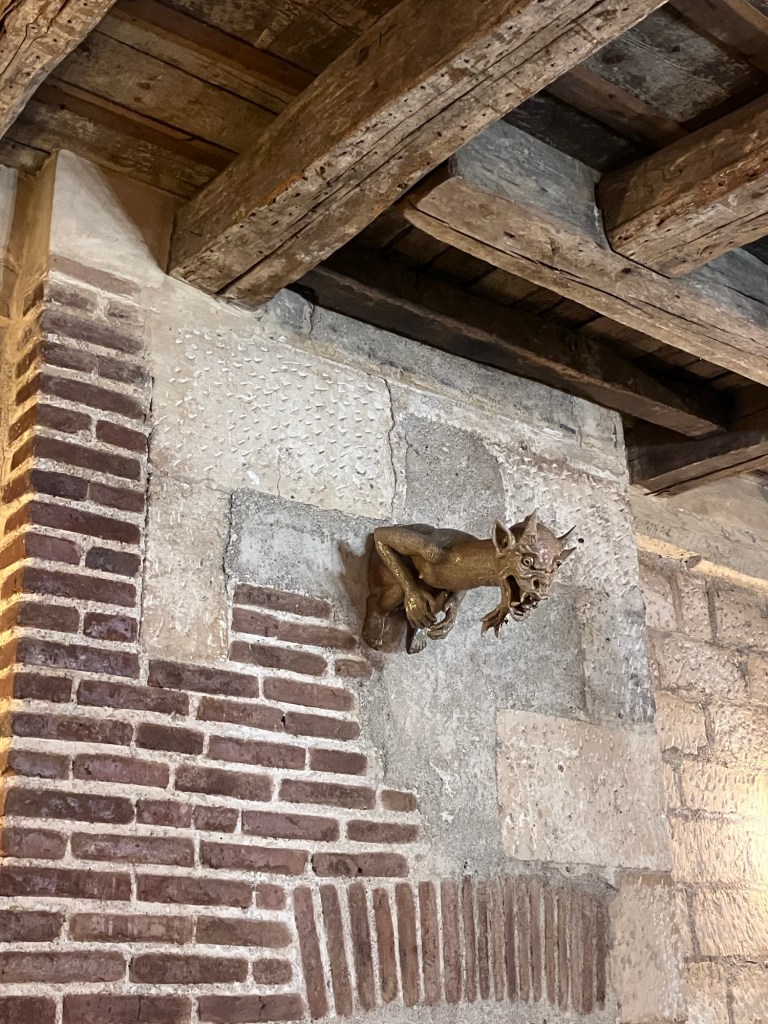
He did not get to enjoy his mansion, traveling during construction, arrested before he could live in it.So many craftsmen were employed to make this building an absolute masterpiece. Gargoyles abound.Stone carvings on every surface.You’d need a fireplace this size to heat the massive rooms.Another view through the old windows.A bat detail on the mantle piece.More fantastic stone work.
Although the palais is not furnished, it changed hands several times and was the town hall for a while, the audio guide helps you picture life in the building, and understand the amount of money and work that went into its construction.
And more gargoyle downspouts. Unfortunately for me the rain had stopped. I love seeing these in action.
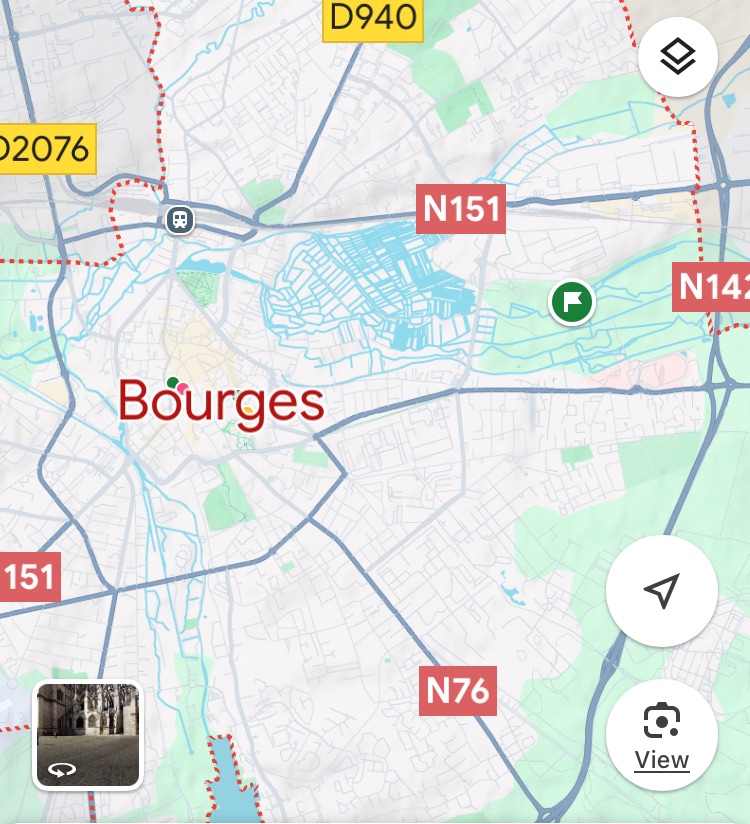
Our two night stay gave us enough time to visit one of Bourges other fascinating sites, Le Marais, or the marsh, or swamp, in English.
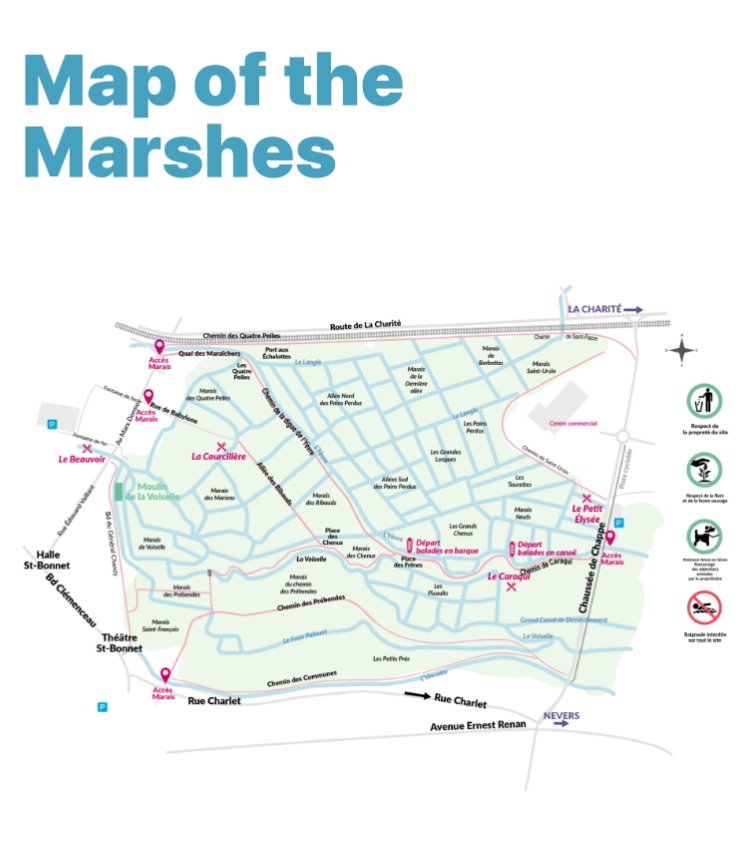
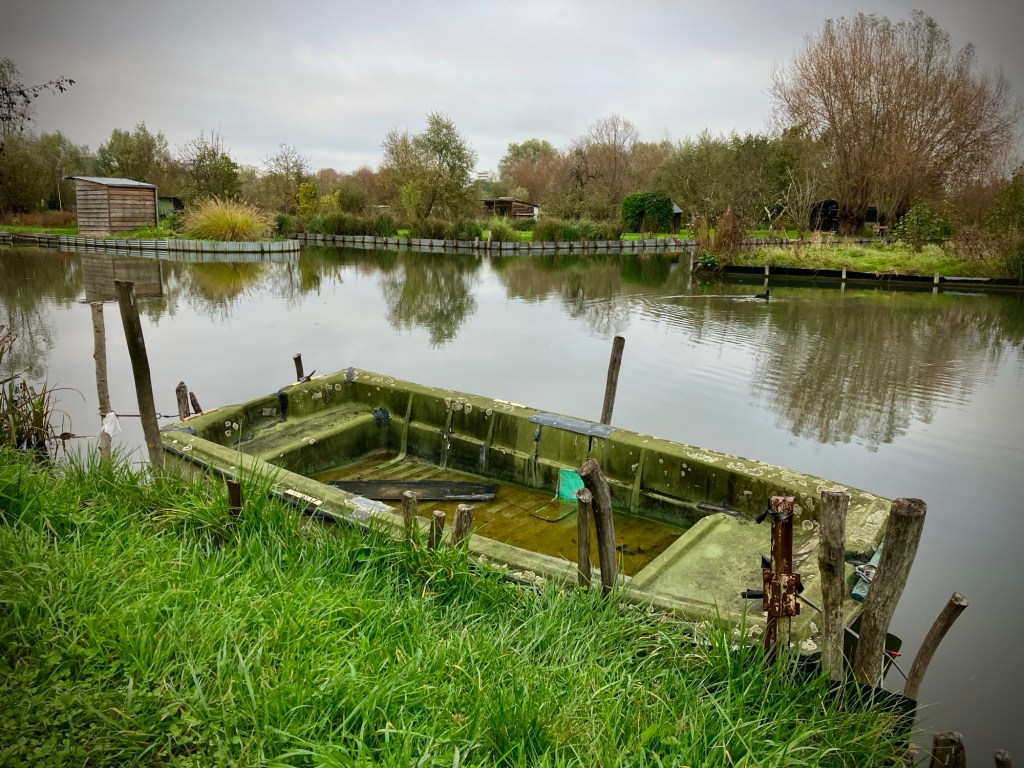
A sign pointed the way as you walked down a neighborhood street.On the map the Marais looks like a city of water. We caught a glimpse from the train and had to see it on foot.
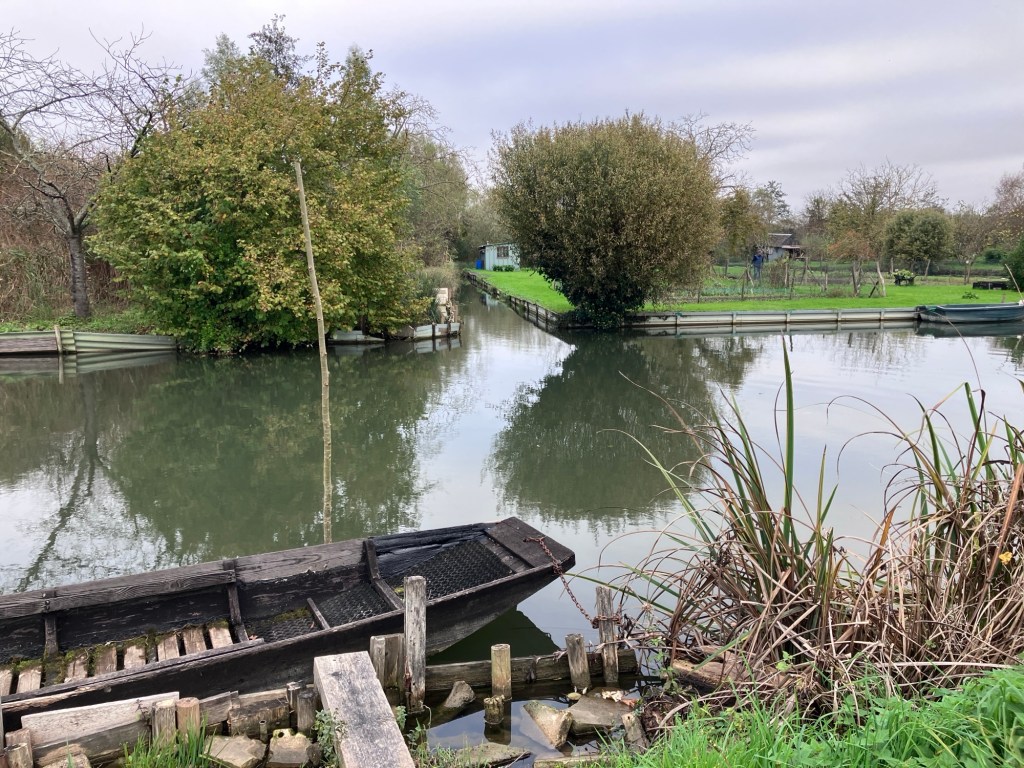
The Yèvre River is the source of water, and the swamp had provided a defendable space for the town. The 300 acres now hold 1,500 garden plots on which locals grow food, build small summer huts, and enjoy strolling on the levees. Some plots are only accessible by boat.
I imagine the locals know their way around the small paths and bridges, we had to check the map frequently.Whimsical folk art.A building being taken back by the vegetation.Very nice for an afternoon stroll.A boat ready to carry gardeners to their plot.We imagined quite a lovely summer scene in the Marais.Hey bourgeoisie, keep out!
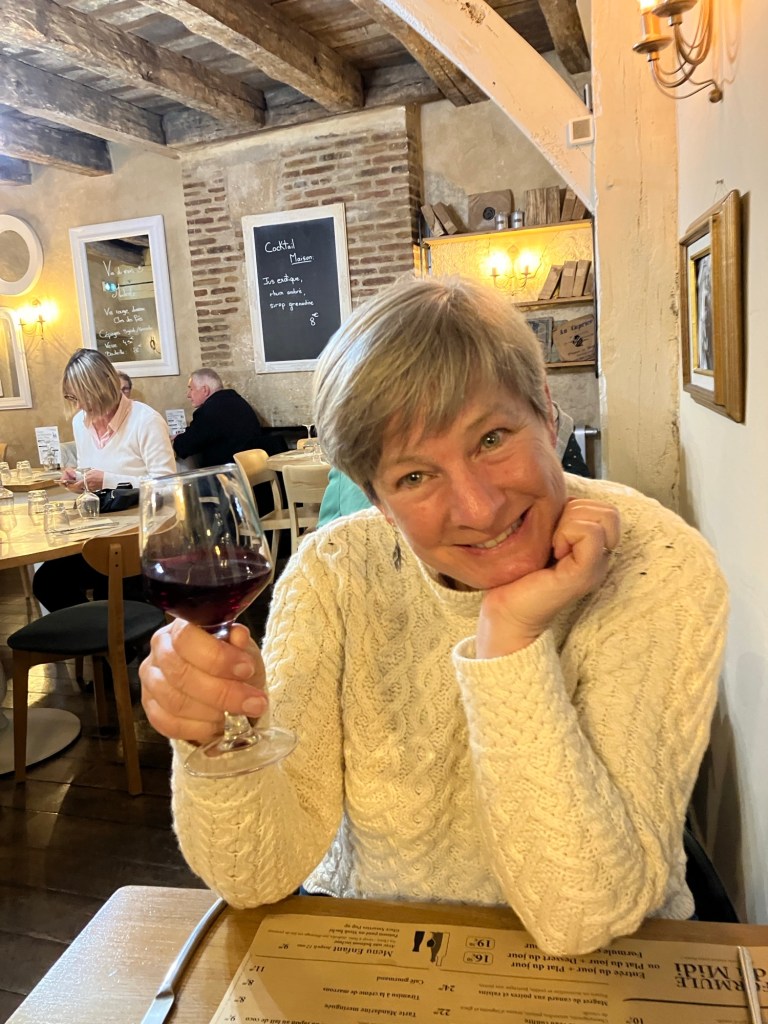
It’s a fun way to travel, a few nights here, a few nights there, get the sense of a place and understand its place in the region and the country, and then off we go! But first, a nice dinner out at a restaurant we spotted our first night, and made a reservation for our second night. La gargouille.
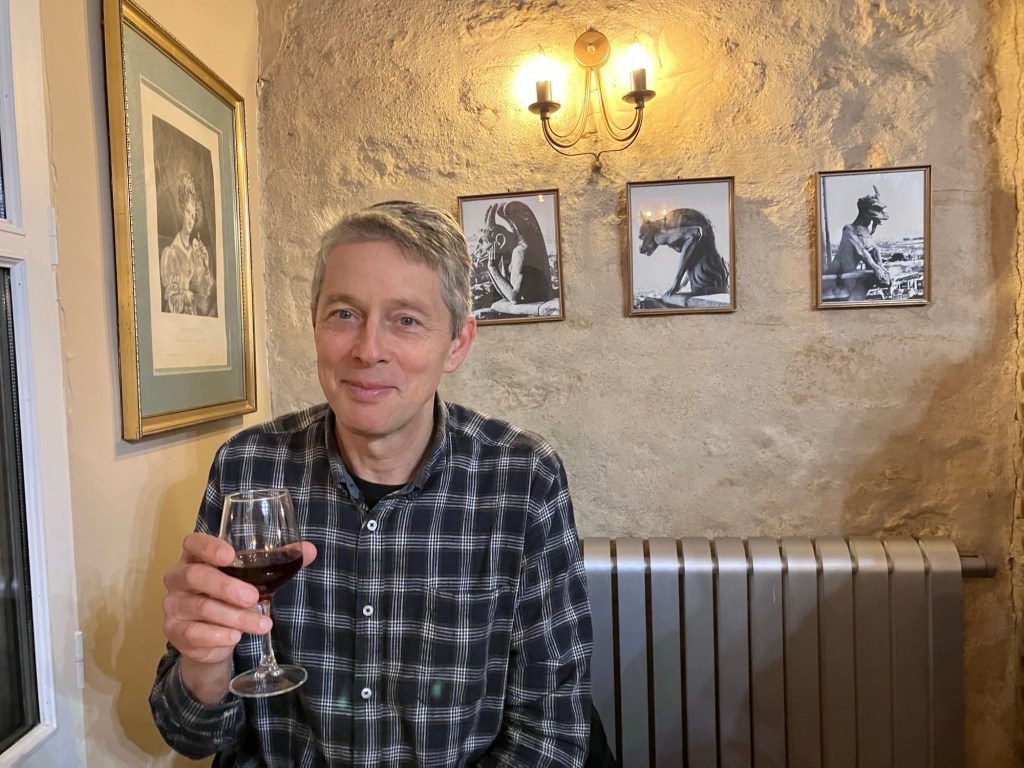
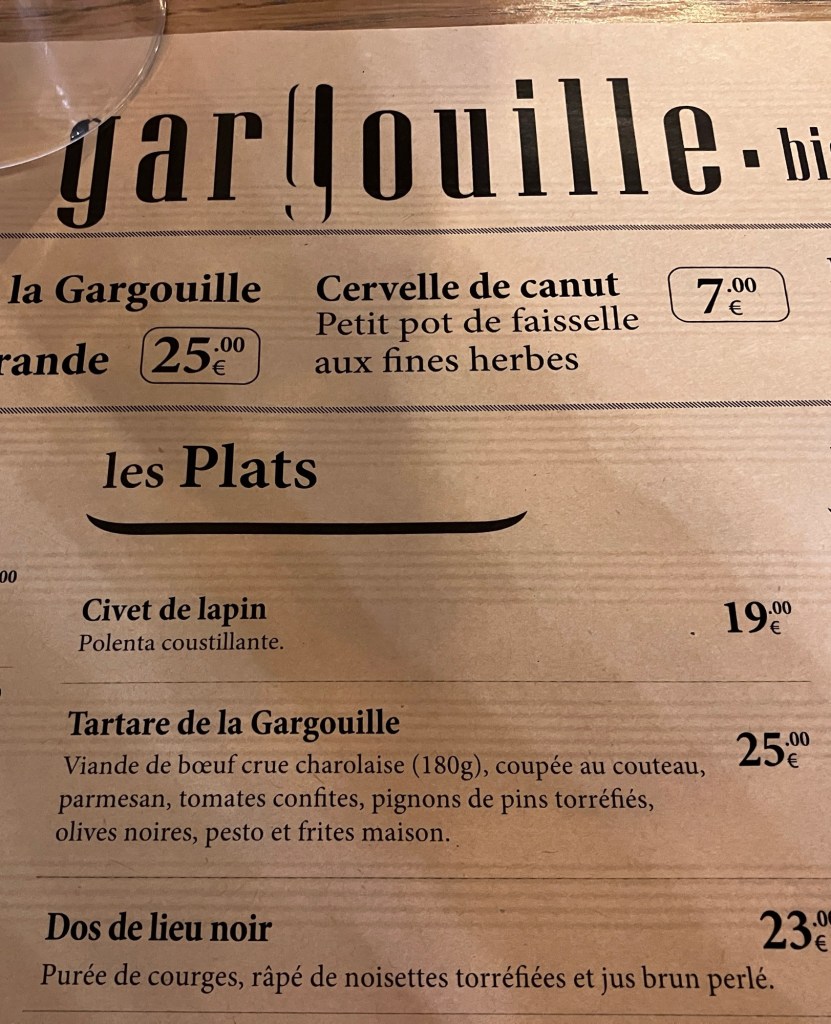
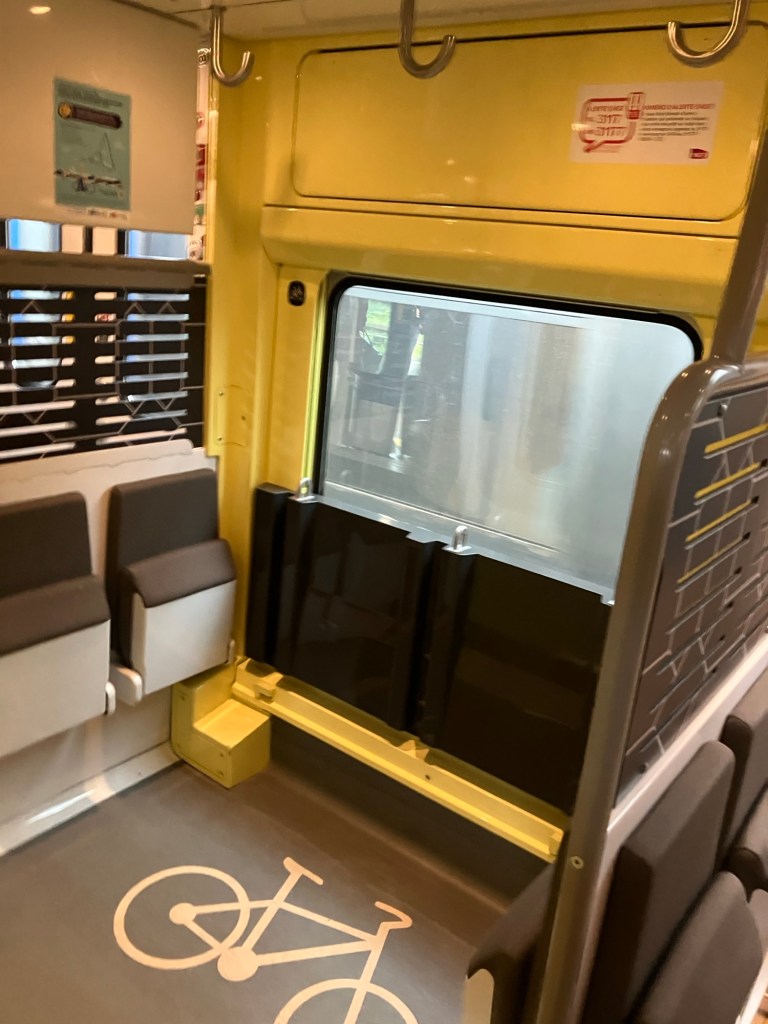
Such a cozy looking spot.With plenty of namesake decor.More gargoyles, and Rich, not a gargoyle. Anticipating dinner.Gargoyle tartar! (No gargoyles were harmed.)The second best tartare I have had in France.And off to the train! Even when traveling bike free we can’t help but check out the bike spots on the trains.
Our last stop before Paris was Orléans. We went through Orléans on our bicycles when we rode along the Loire River in 2021. We enjoyed it then, in a sunny October, and knew there was enough to see still for a short stay. This is where the grey November weather caught up with us. What the morning news show called la grisaille. The greyness.
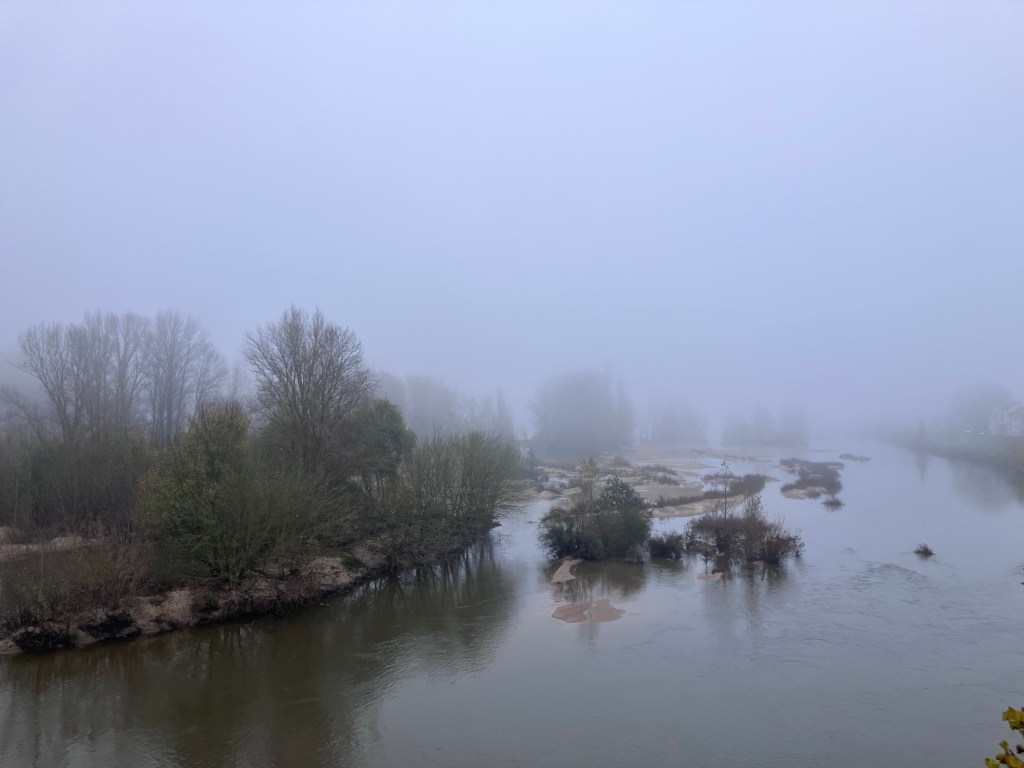
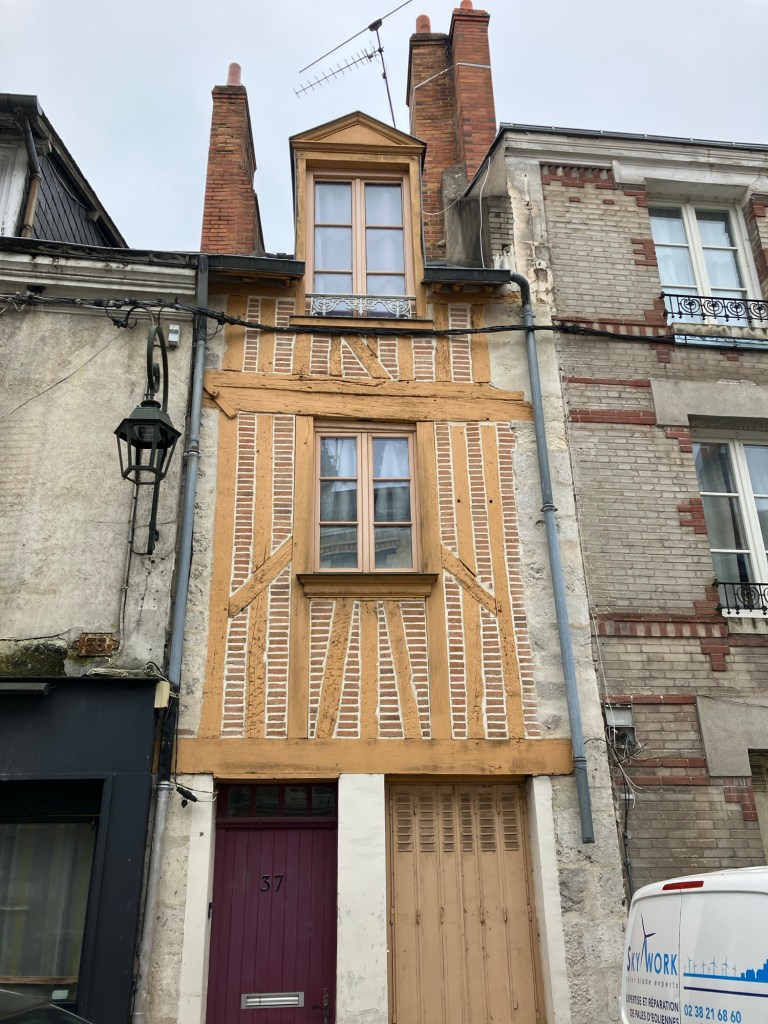
The Loire in la grisaille.The fog made for a very atmospheric walk along the river.This narrow building caught our attention in the old streets by the river.The old town streets giving framed views of Cathédrale Sainte-Croix d’Orléans.The front of the cathedral.Always crossing Camino routes.An autumnal display brightens a grey day.Inside the cathedral on All Saint’s Day. St. Joan in stained glass.
Joan of Arc, Jeanne d’Arc in French, is honored as a patron Saint of France for her role in defending Orléans in April 1429. You can find her in cathedrals, as statues, and paintings in the Musée des Beaux-Arts d’Orléans. Her story is powerful and poignant, as she was only 19 when she was tried for heresy and burned at the stake.
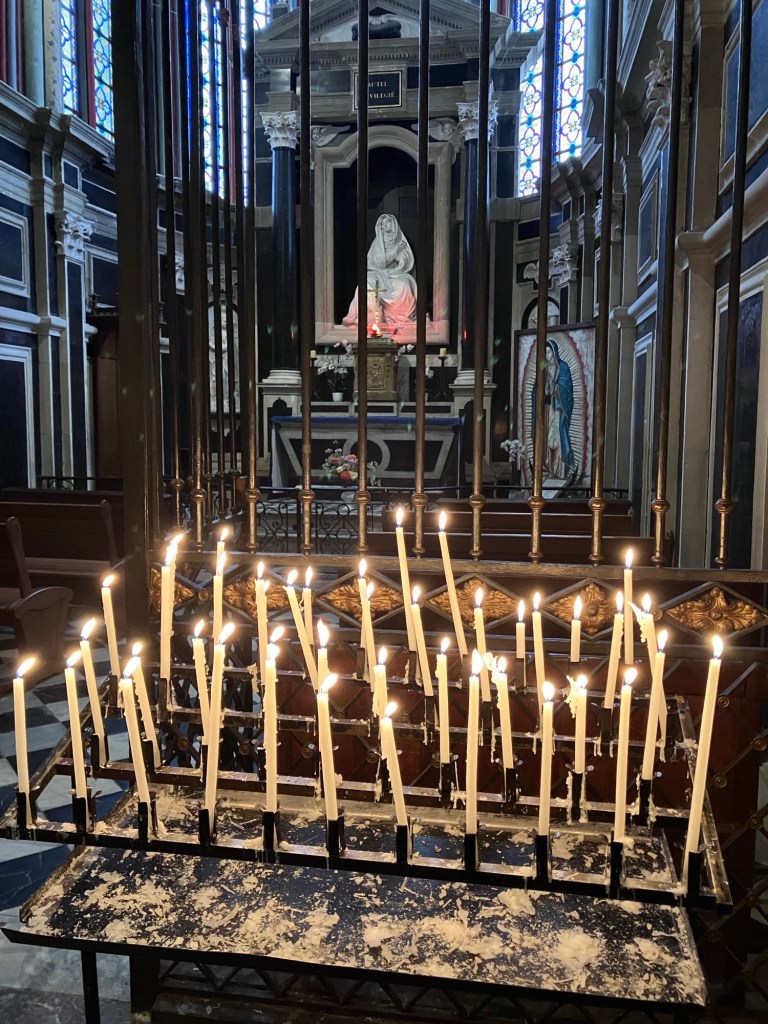
Many lit candles that day.St. Joan at night, dramatically lit.The Happy Travelers looking ahead to Paris.
Enjoying a view over Udine, Italy, on our one night in town.
Sometimes we get a very quick sense of how cycling in a region will be. We’ve cycled in Italy before, years and years ago, and were impressed with the smooth pavement and respectful drivers in Tuscany, but this part of northern Italy has not caught up with Germany, Austria, or France in welcoming cyclists. But that’s the roads, the cities are super walkable and beautiful. Udine was a lovely surprise with a pretty and walkable center.
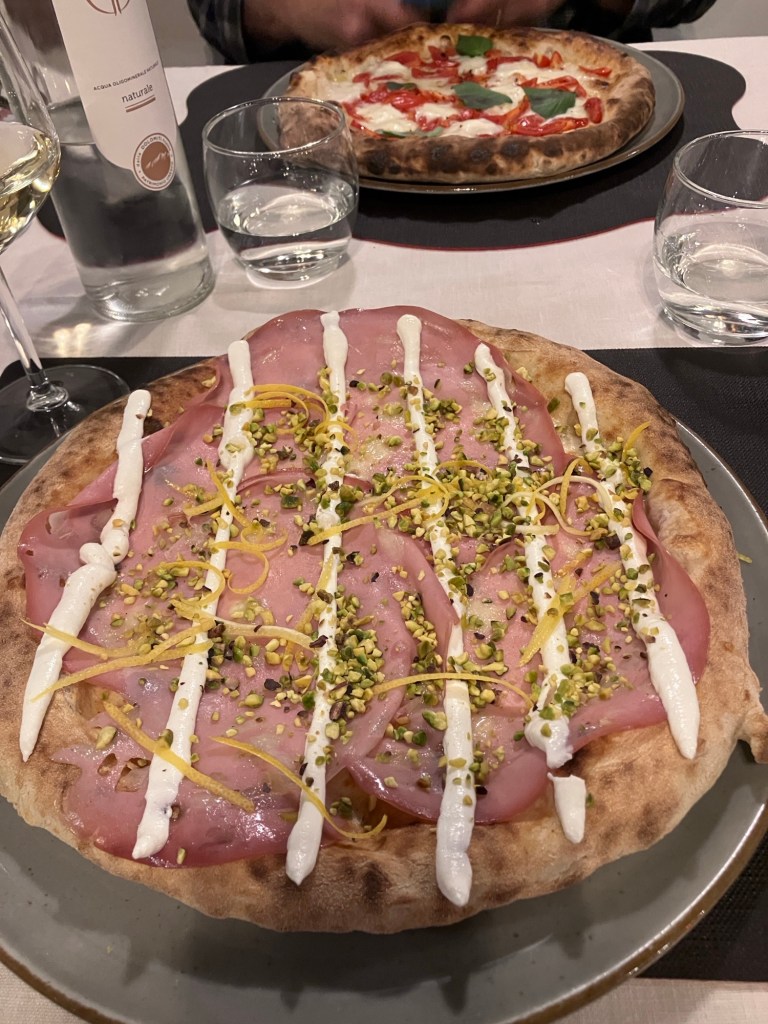
A gorgeous example of Italian marble.Rich has his loaner umbrella ready, but the rain held off.The warm glow of buildings in the twilight.Pizza with mortadella, pistachios, lemon zest, and fiore de latte. Amazing. In Italy the limoncello will find you.
With our deadline of a train from Milan we decided to make a train hop from Udine to Conegliano so we could make it to Treviso that day and spend less time riding in the rain.
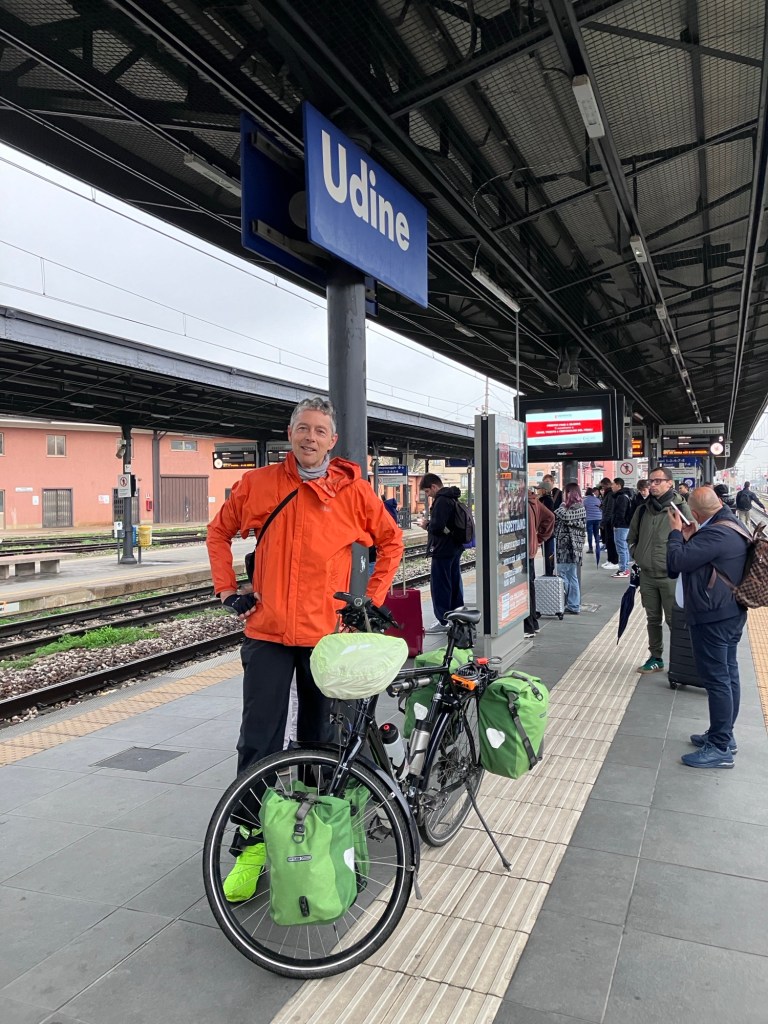
Trains in Italy come with some predictable challenges: track changes. With loaded touring bikes a track change can be beyond hectic. Thankfully there were elevators at the Udine station so the track change at least didn’t involve stairs.The look of a man whose patience with loaded touring bikes and trains is starting to wear thin. And is looking at 32k/20miles of rainy riding.One of our less glamorous but very welcome lunch stops. Between the rain and the roads this pavilion looked like heaven to us.Weather fit for ducks as we get to Treviso.Outside our hotel in Treviso, trying to drip dry a bit before going inside.
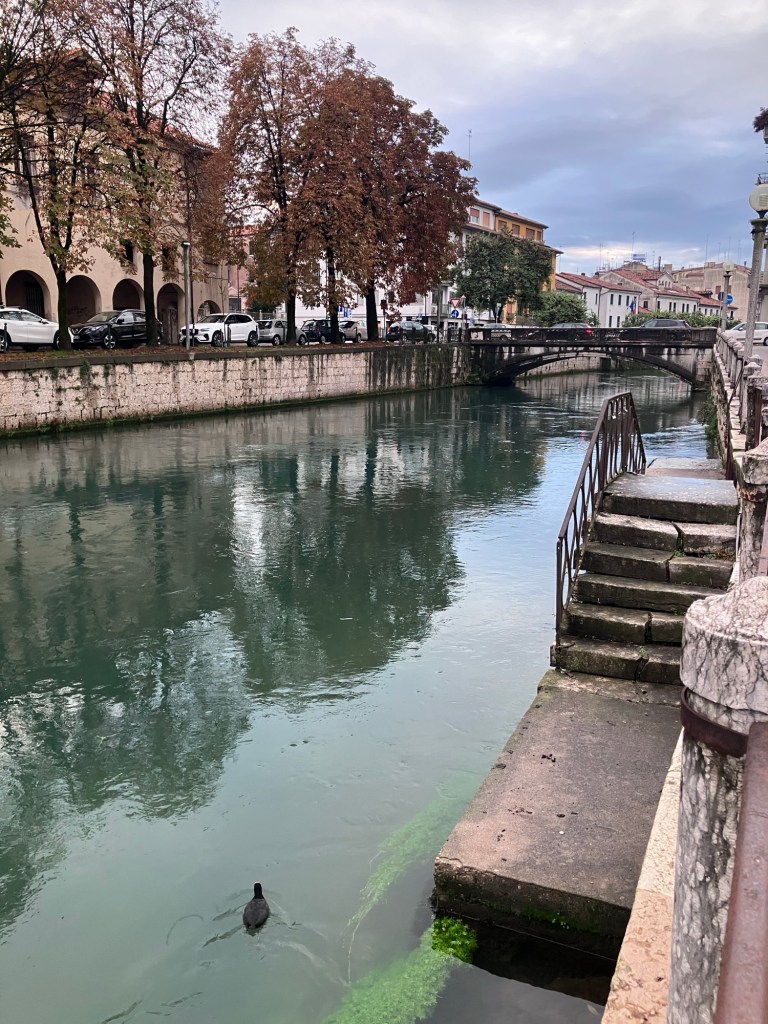
We both had Treviso marked on our Google maps as an interesting place to visit – sort of a little Venice. An alternative to the magical city, with its own canals and own culture.
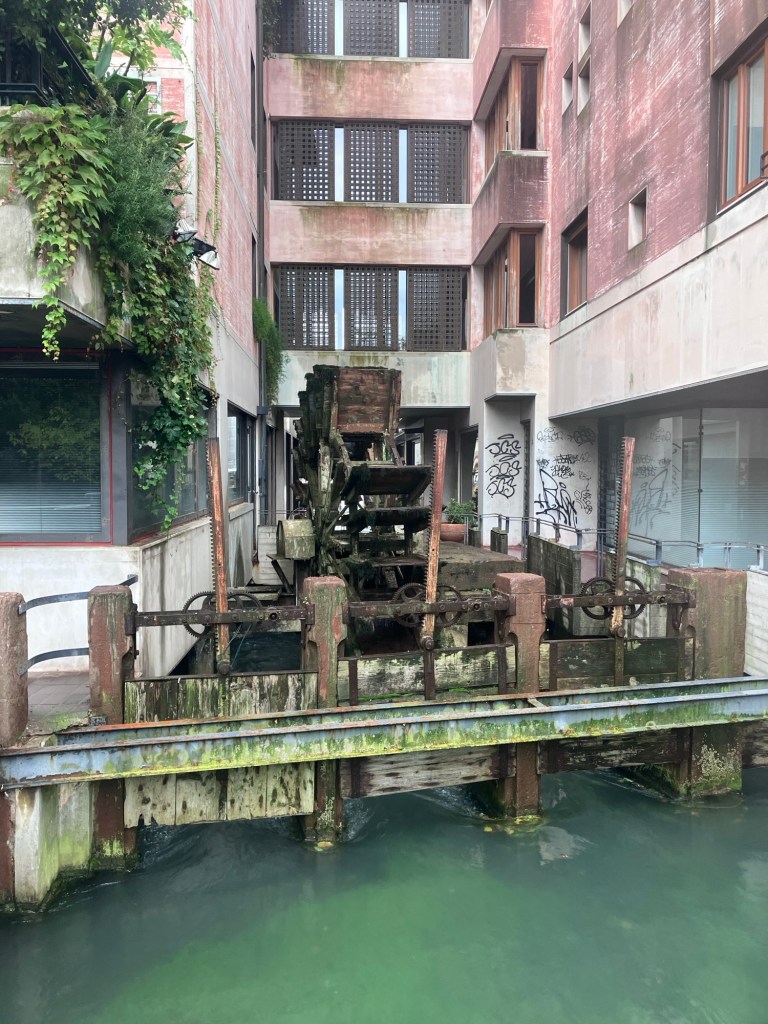
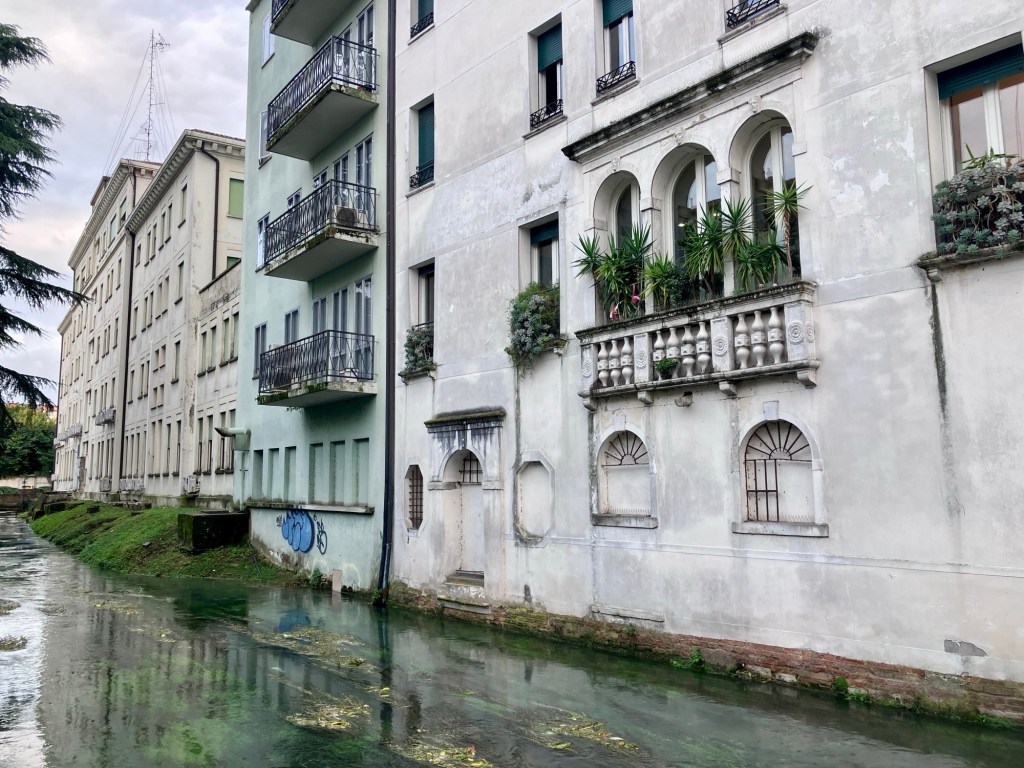
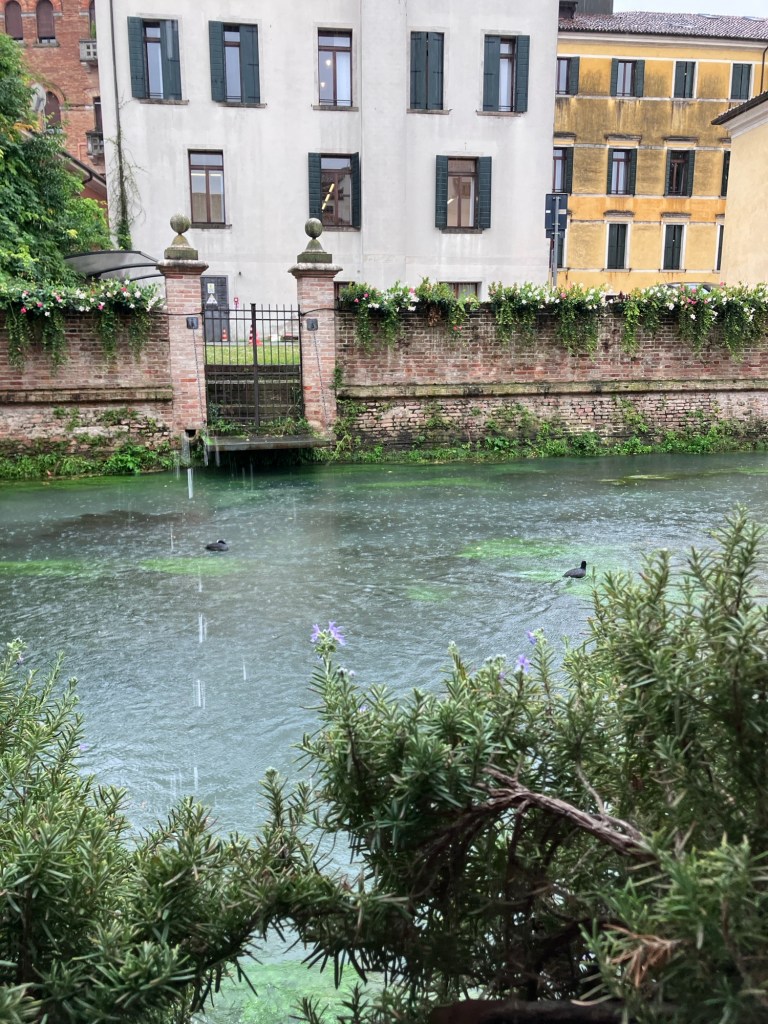
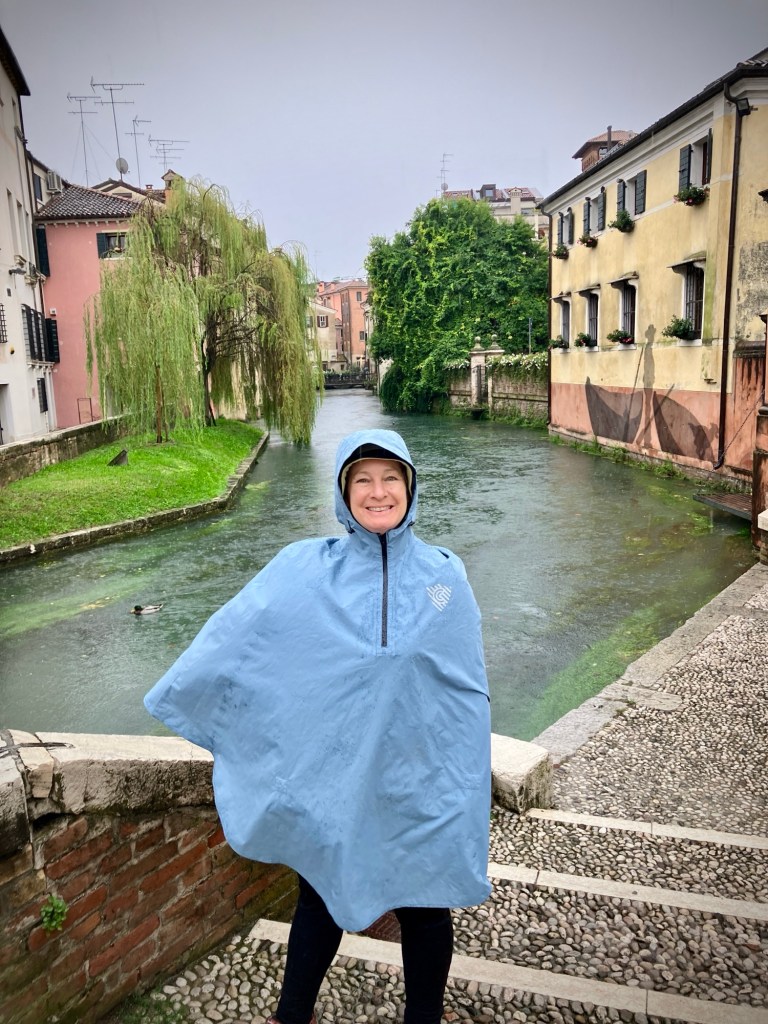
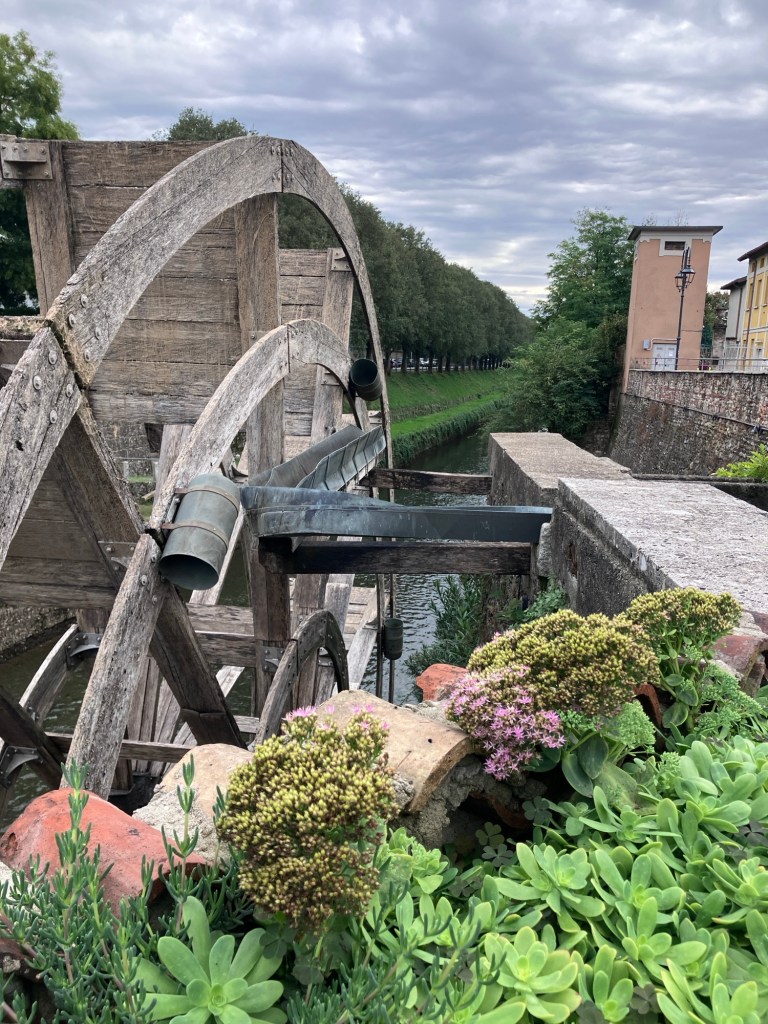
An old waterwheel in one of the canals.Canal side buildings absolutely bring to mind Venice.A mural which echoes the past.Yes, a lovely view even in the near constant rain.My Cleverhood Rain Cape had its time as I got really tired of wearing rain trousers and switched to tights and the rain cape.The fish market (Isola della Pescheria) on an island in the Cagnan River.Who wouldn’t be charmed by views like this? You can see from this photo what Treviso has which Venice doesn’t: cars.Sunset on the Sile River.
Our two nights in Treviso were fantastic. Even with a lot of rain. But the feeling we get in Venice, with no cars, not a whisper of car noise, is very different from Treviso. Definitely visit Treviso, but don’t be expecting the same scope of magic as one finds in Venice. It is much less crowded though, and a fairly short train ride from Venice for making a day trip one way or the other.
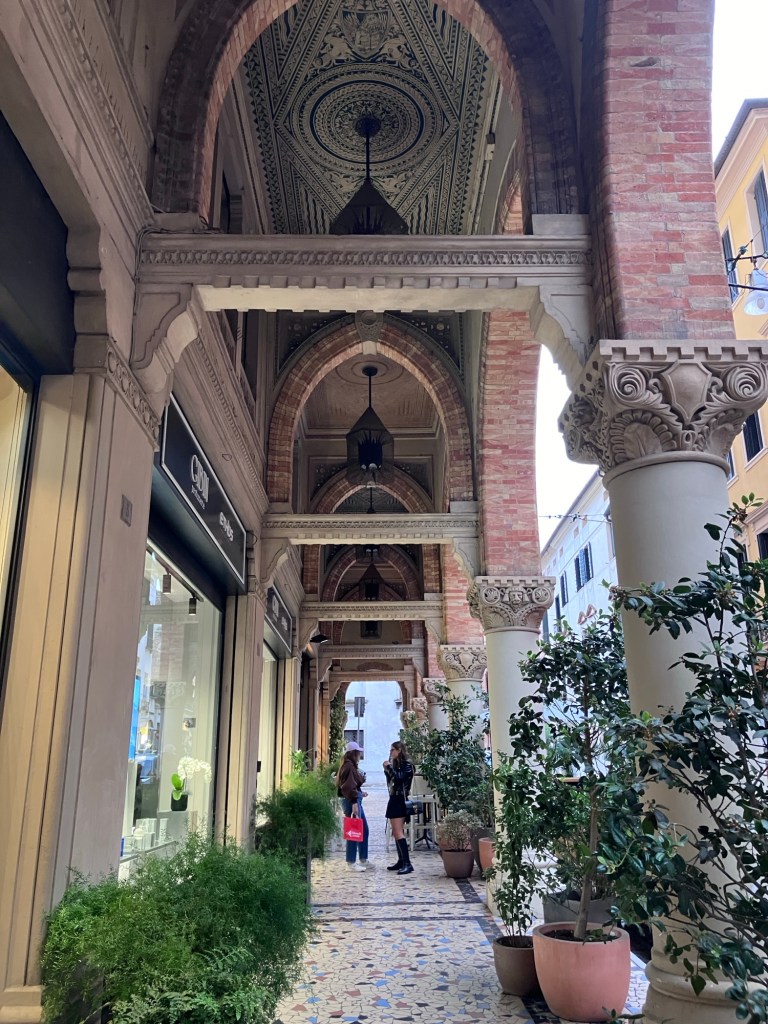
The arcades of Treviso made the rain less impactful.They were a place to walk, to stop and chat.And for restaurants to set up a charming scene.
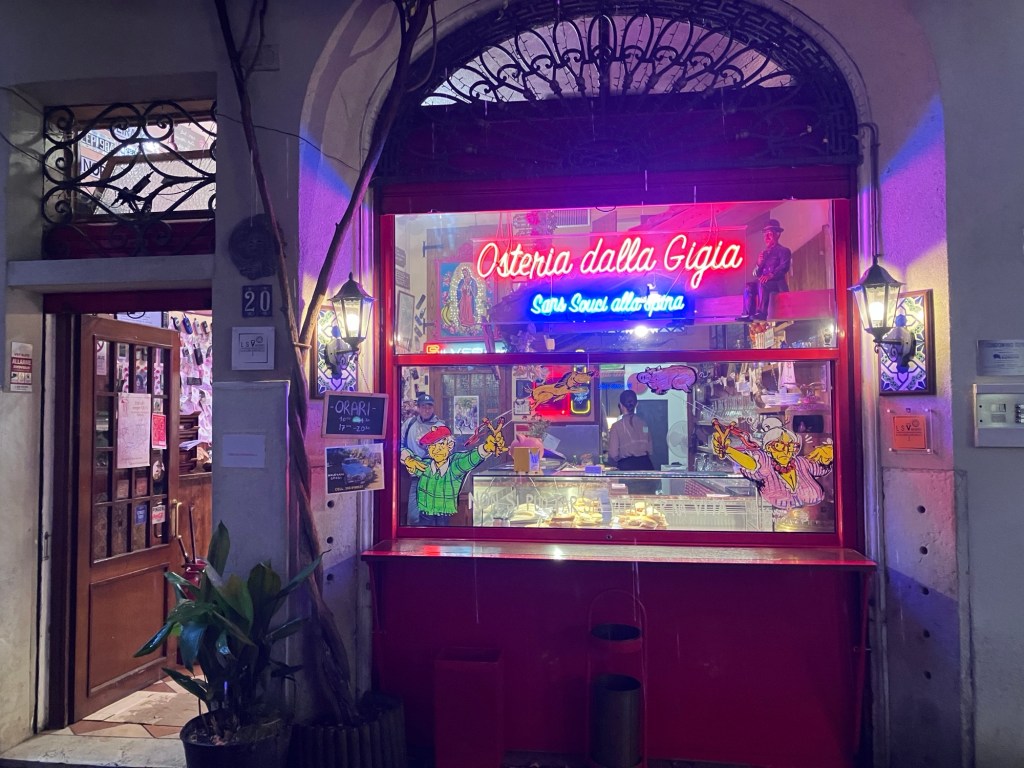
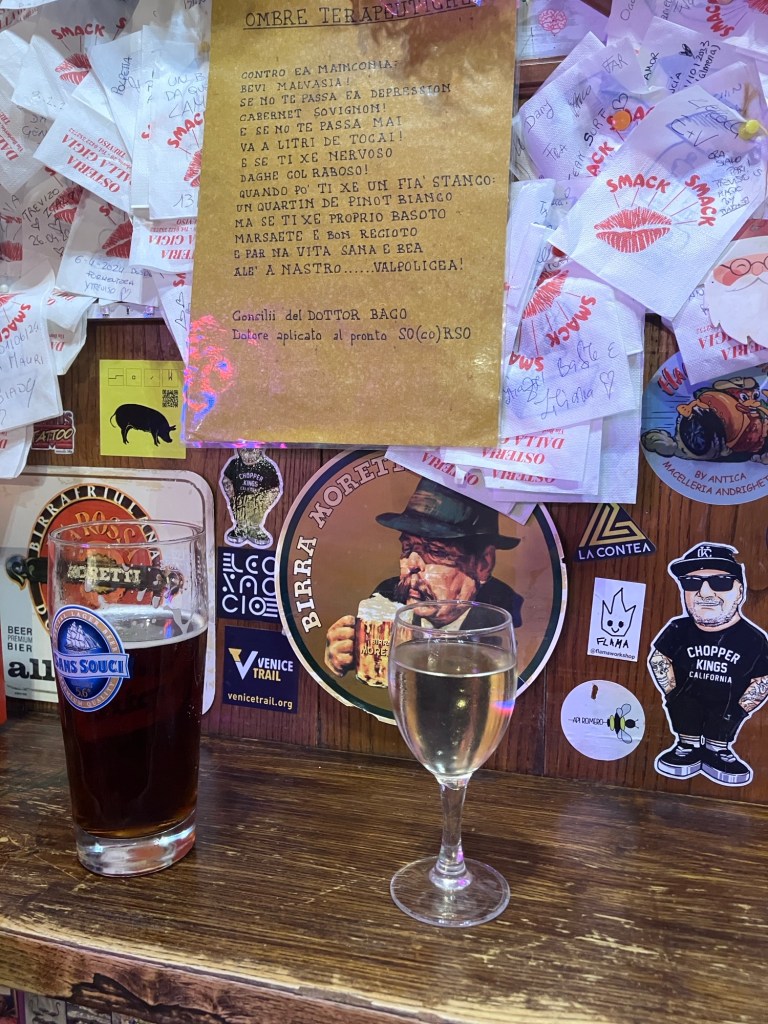
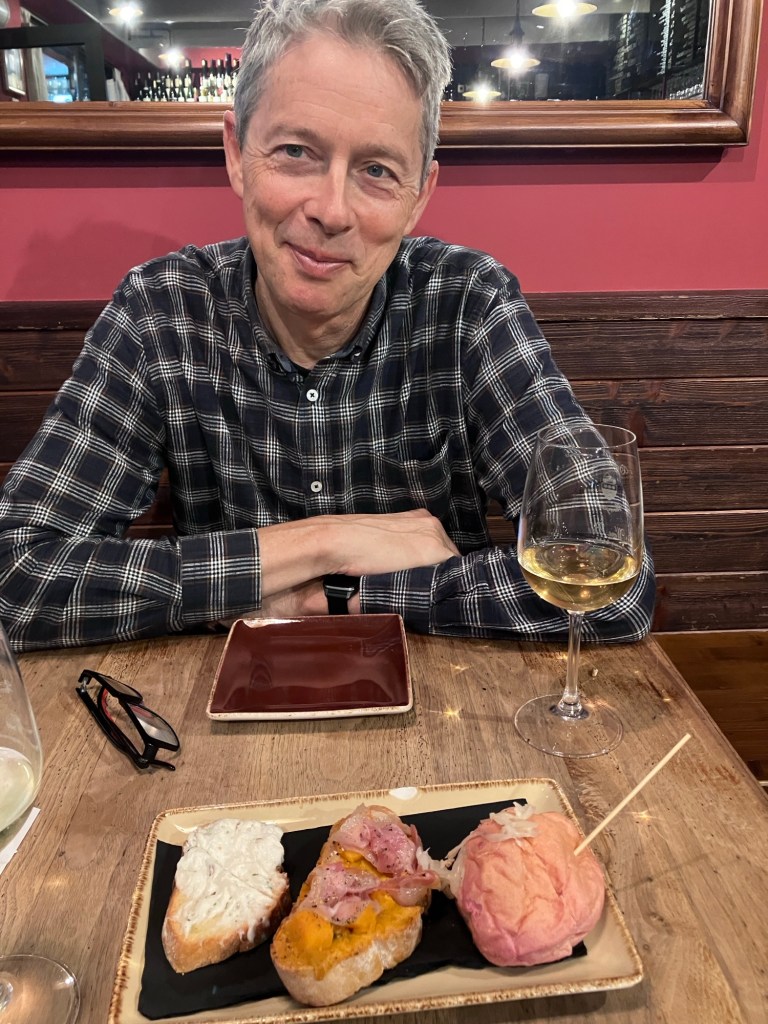
What else did we find delightful in Treviso, the birthplace of tiramisu? Cicchetti, which are small bar snacks like tapas or pinxos, served alongside a beer or wine. A quick aside about bike storage in old towns. It’s not easy to find a hotel with easy and convenient storage for our bikes. The hotel Rich found in Treviso, Palazzina 300, were super accommodating and we were able to store our bikes in one of the owners’ fire wood room about a five minute ride from the hotel. Behind a locked gate and in a room stacked with wood for the winter. The owner pointed out the video camera watching the courtyard and assured us they would be safe.
The outside of a little osteria, cicchette on display in the window.What? I can wander from place to place drinking and snacking? Sign me up please.The charming and handsome waitstaff who help you choose your cicchetti from a glass case. Our second stop of the night.So many options.Rich did a good job picking our first round. From the left, cod, zucca, and Gorgonzola and nuts.My favorite was the zucca (pumpkin) and prosciutto.
Well fueled from our snack dinner (not really, Rich was super hungry the next morning.), we headed to the train station for a hop from Treviso to Vicenza, and then a 44k/27m ride to Soave.
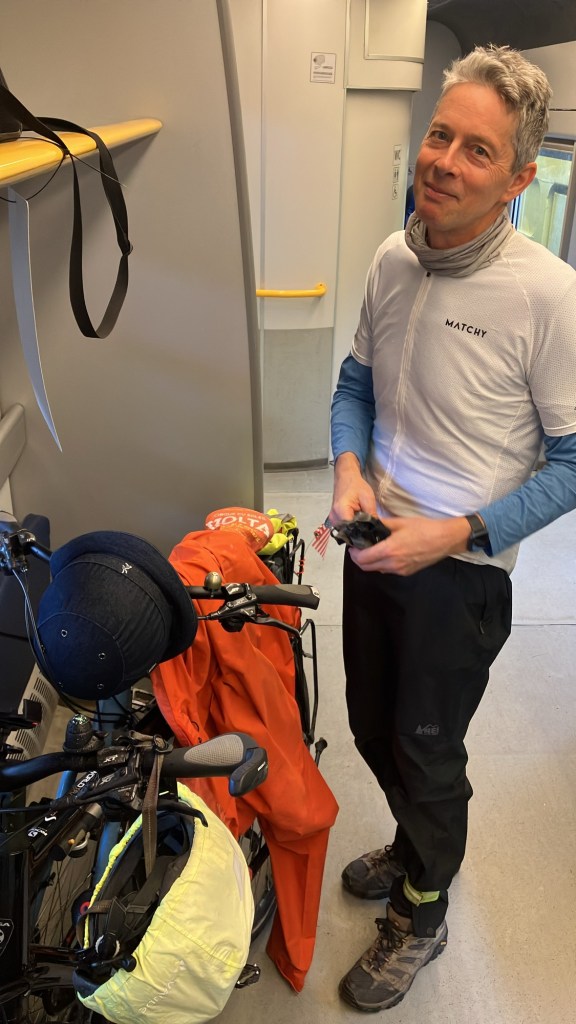
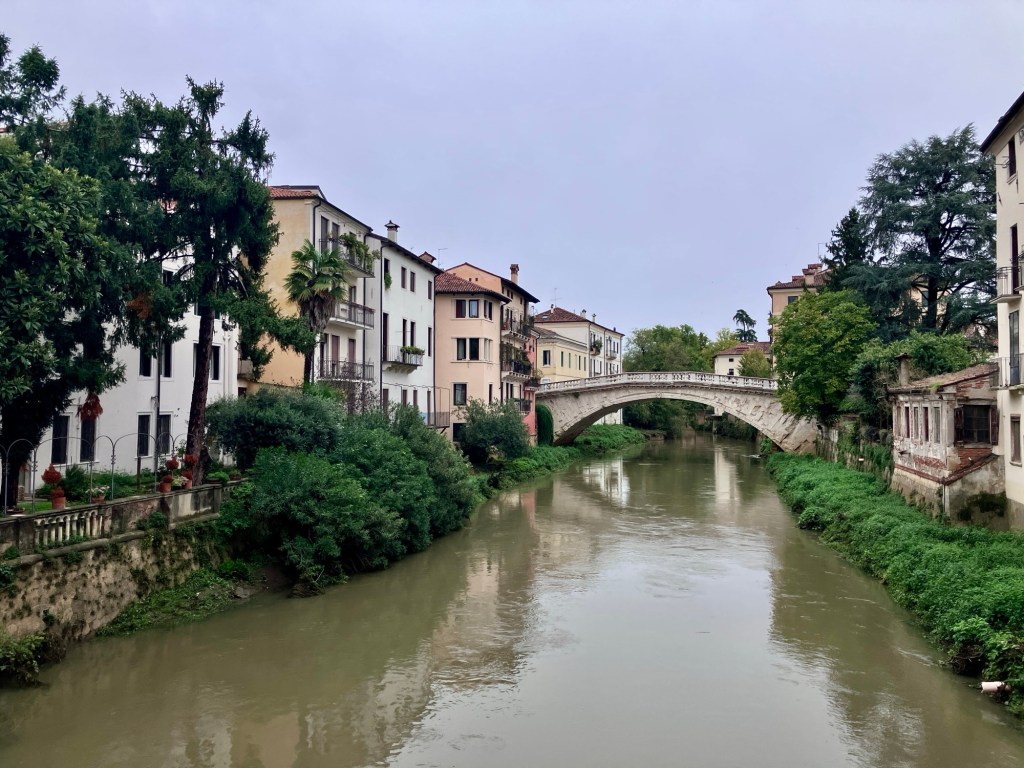
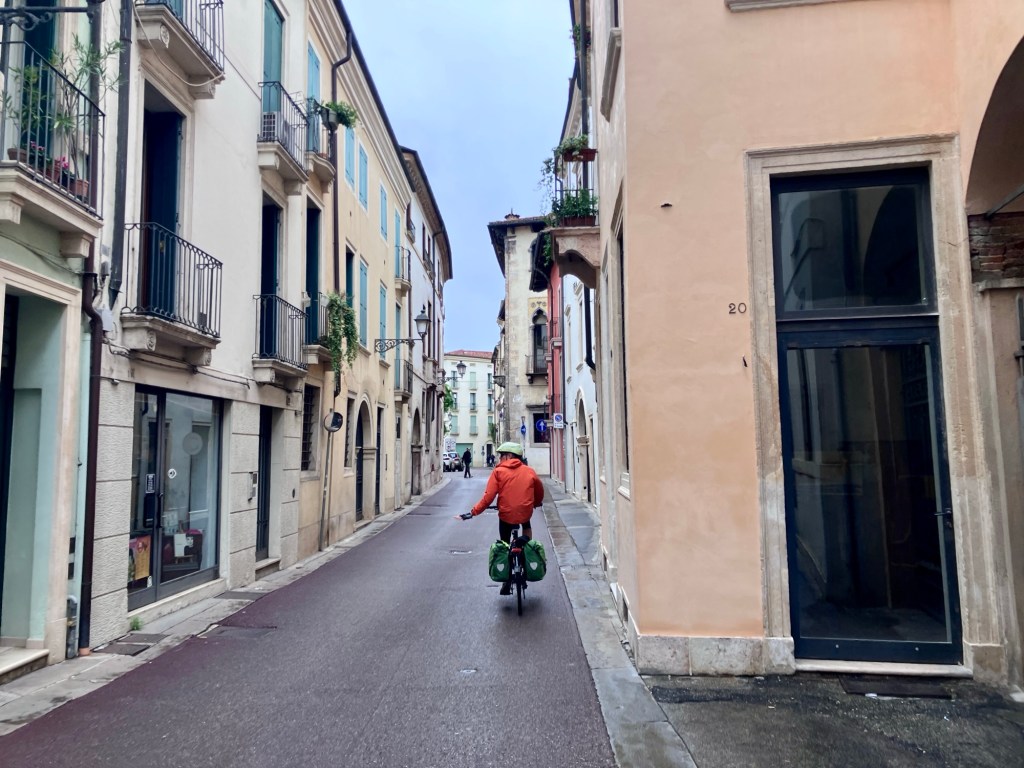
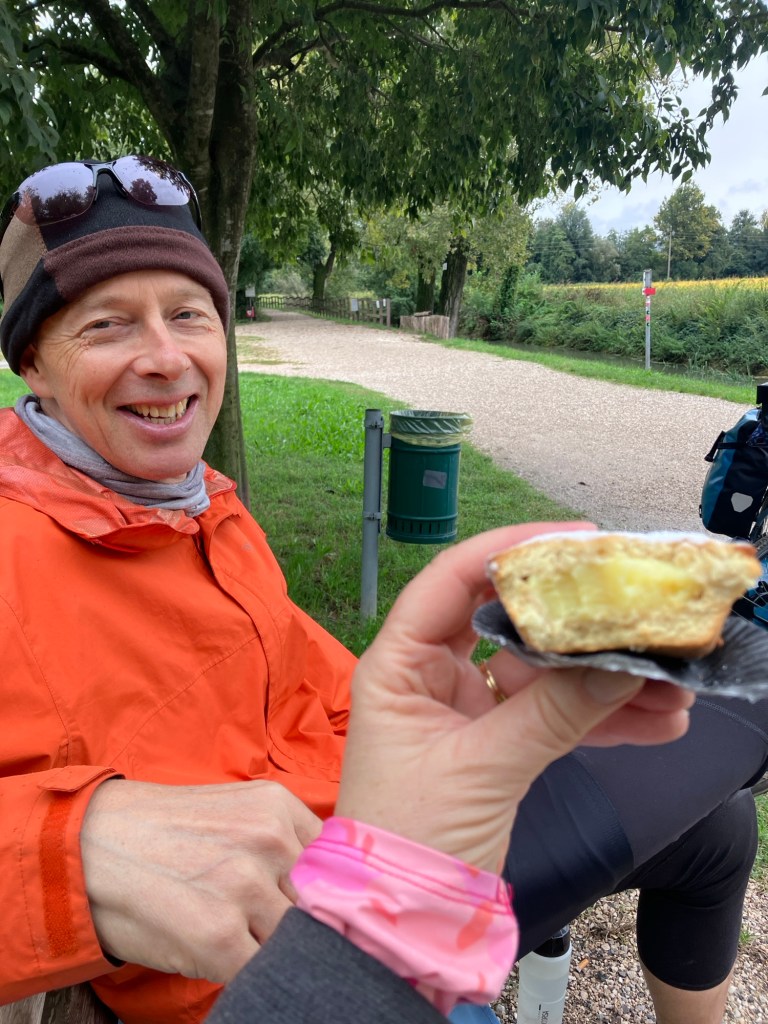
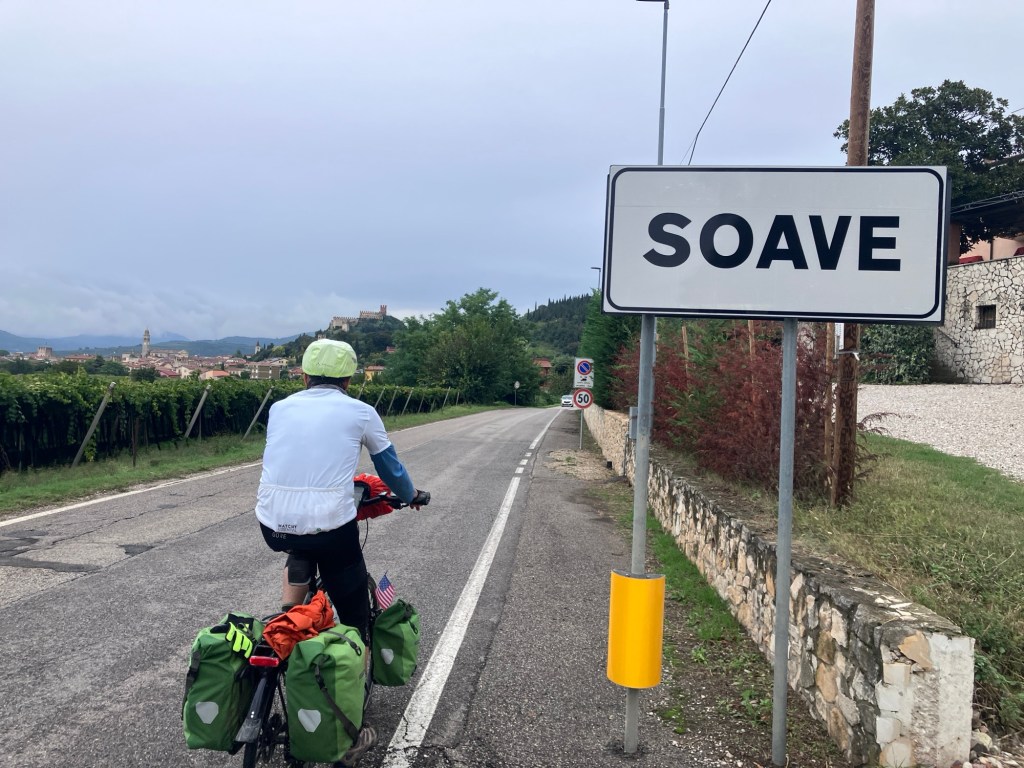
Another train another track change. But this train had nice bike space.We had a nice little ride through Vicenza.Rich way finding through the narrow streets.Piazza dei Signore. Italian cities and towns excel at big piazzas, plazas, and car lite or car free spaces.Is that a bench? Then it must be time for a pastry break. That is a Pasticciotto, filled with ricotta based lemony filling. It got powdered sugar all over our clothing, which the mist then turned to sugar paste.We were quickly out into the vineyards of the Veneto region.Vineyards are always scenic.
Americans will likely remember the Soave Bolla commercials from the 70s and 80s, which probably gave most people a somewhat bad opinion of Soave wine. The ads were super cheesy and apparently, the wine not very good. But happily wine now made from the garganega grape is delicious, and in 2002 Soave received DCOG status and joined the ranks of well respected wine in Italy.
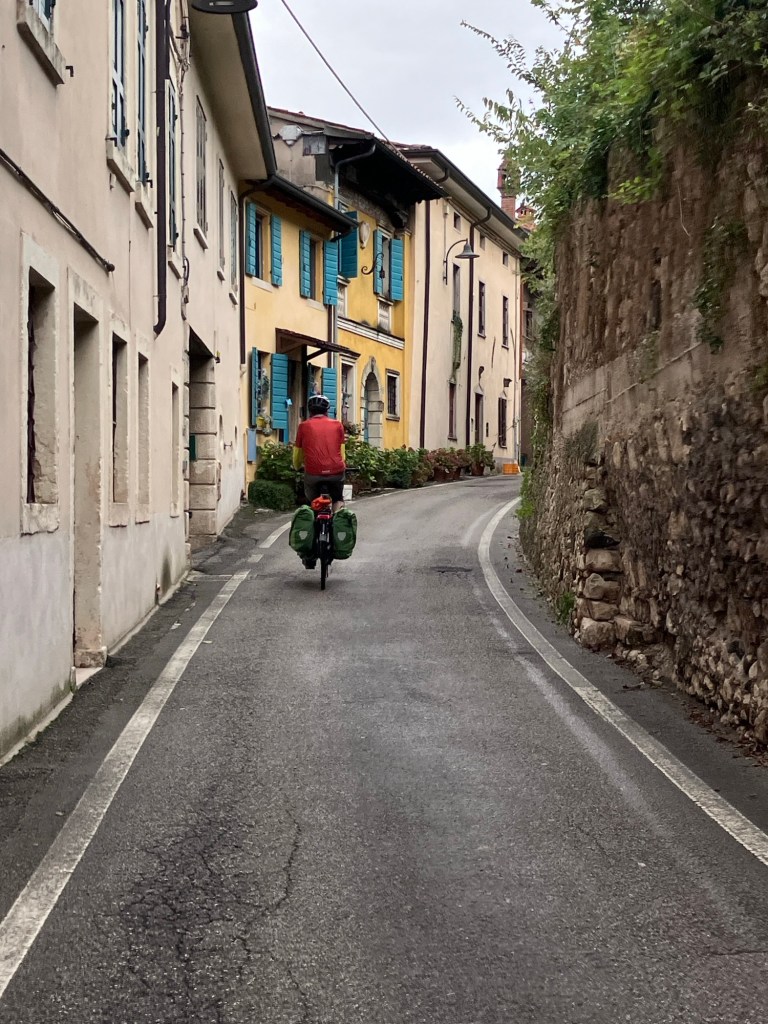
Say it with me: “Soave. Soave Bolla.”Soave Classico paired perfectly with the delicious pumpkin lasagna at Locanda ai Capitelli where we had a lovely stay and dinner.The view from the breakfast room.A view of Soave over the vineyards as we headed out in the morning to ride to Verona to catch a train to Brescia to shorten our day to 58k/36 miles.The harvest was in full swing. This nice workman smiled and waved when I stopped to take photos.Garganega grapes waiting to be harvested. Such a lovely color. What would this paint color be named? Wine blush? Whisper?We also rode by olive trees.Pomegranates.And climbed a hill with a classic Italian view.
The riding was lovely at times, but again, not an area of Italy with very welcoming bike infrastructure. We saw plenty of Italian road cyclists, but not many other bike tourists, and precious few bike lanes or decent shoulders to ride on the busy roads. And no transportation cyclists. No one headed to the shops or to and from school. And the terrain can’t be totally to blame as much of our ride was gently rolling, staying on the edge of the foothills.
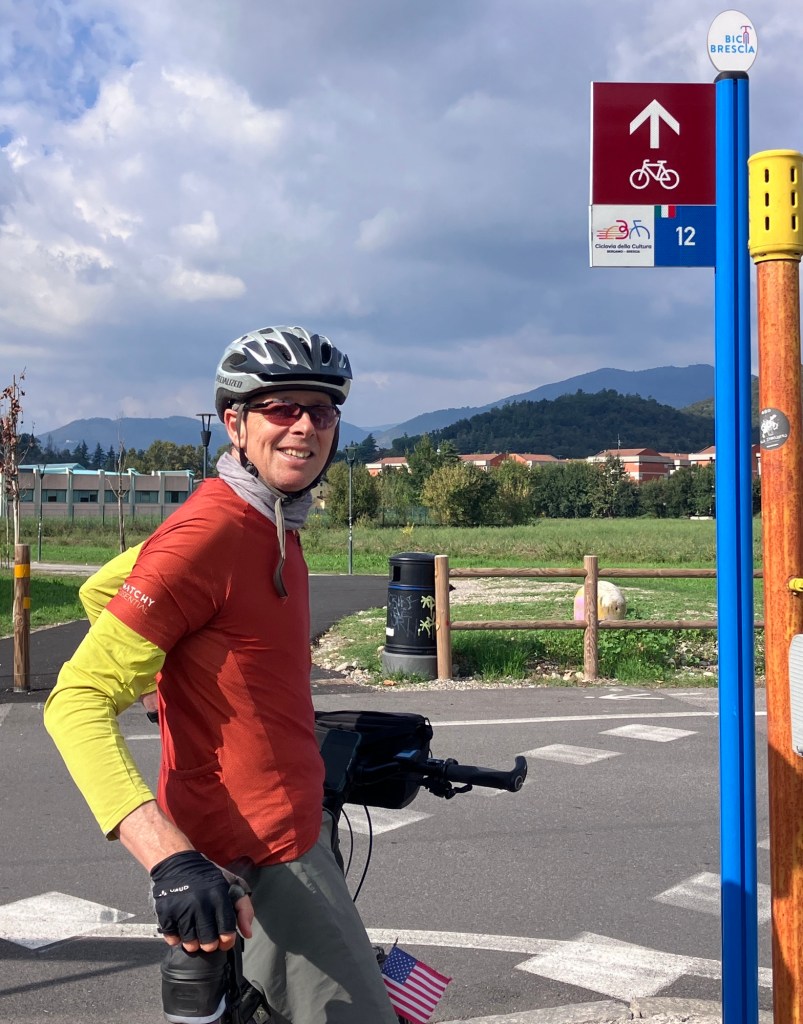
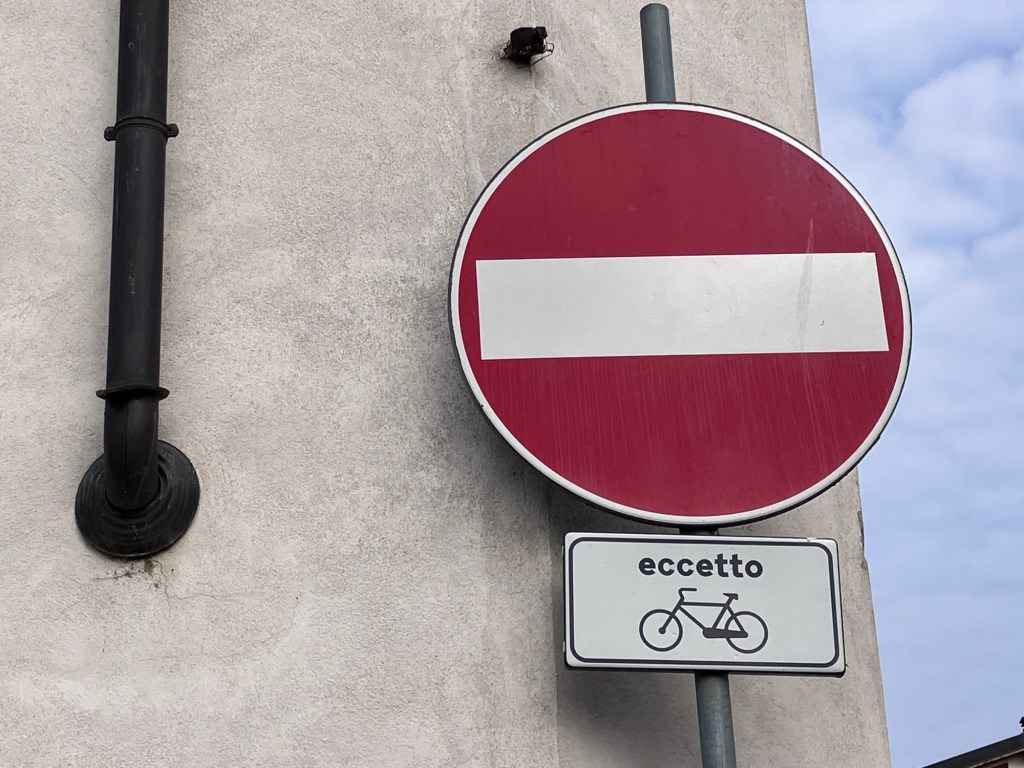
Traveling by bikes gives us such a range of experiences. We go from sweet little lanes, To a coffee and chocolate break at a gas station cafe. Verona! The Verona Arena is a Roman amphitheatre in Piazza Bra in Verona, Italy, built in 30 AD. And popular to visit on a Saturday in October. But we can’t spend too long sightseeing, we have a train to catch. Yay! Elevators at the Verona train station. Laughing because… platform change! Second to last train of the trip. Riding out of Brescia after our train hop, some nice new bike and pedestrian lanes.Signage and sunshine.My favorite sign in any language: Except bikes.Me me me! I’m on a bike! Except me!
We had quite a bit of rain on this section of the trip. I don’t have a lot of photos of rain riding since it’s so hard to take pictures in the wet. And, since we were not quite into the colder part of the year we had a run of hotel rooms where the electric towel racks hadn’t yet been turned on for the season. No heated towel rack and wet weather makes it very difficult to dry our bike gear and other laundry. We had two days of riding still so when we got a working towel rail we sprang into action and did laundry.
A working towel rail – finally! At Hotel Touring in Cocaglio.How many pizza dinners is too many pizza dinners in Italy?
We set out the next morning to ride to a town outside of Milan, Gorgonzola, 61k/44miles. As we approached Milan there were better bike paths and more folks out on bikes. We stayed outside Milan because the hotels in the city were quite full and expensive due to a pharmaceutical conference. Our hotel for our last night was close to the canal path that led right into Milan for our ride to town the next day.
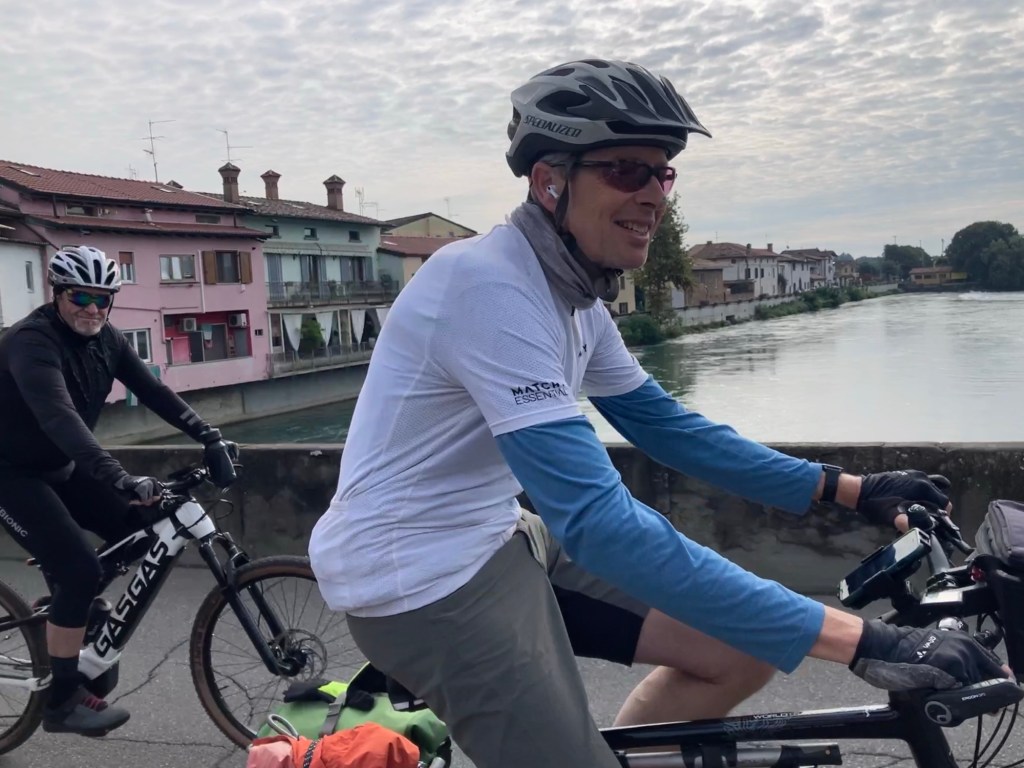
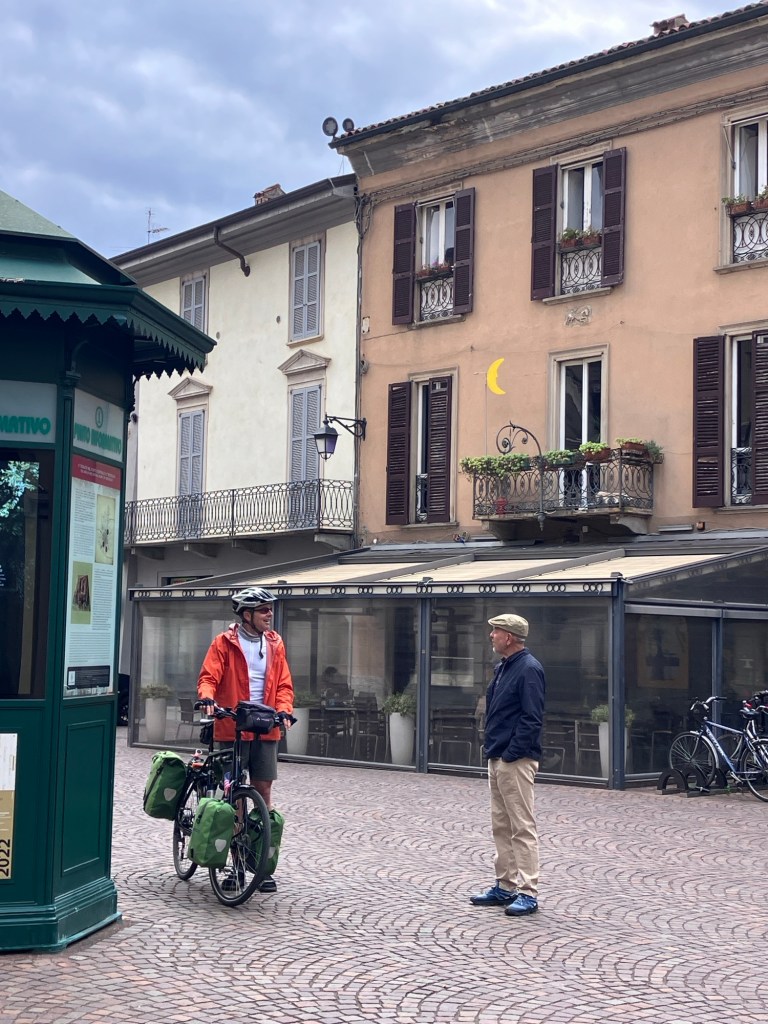
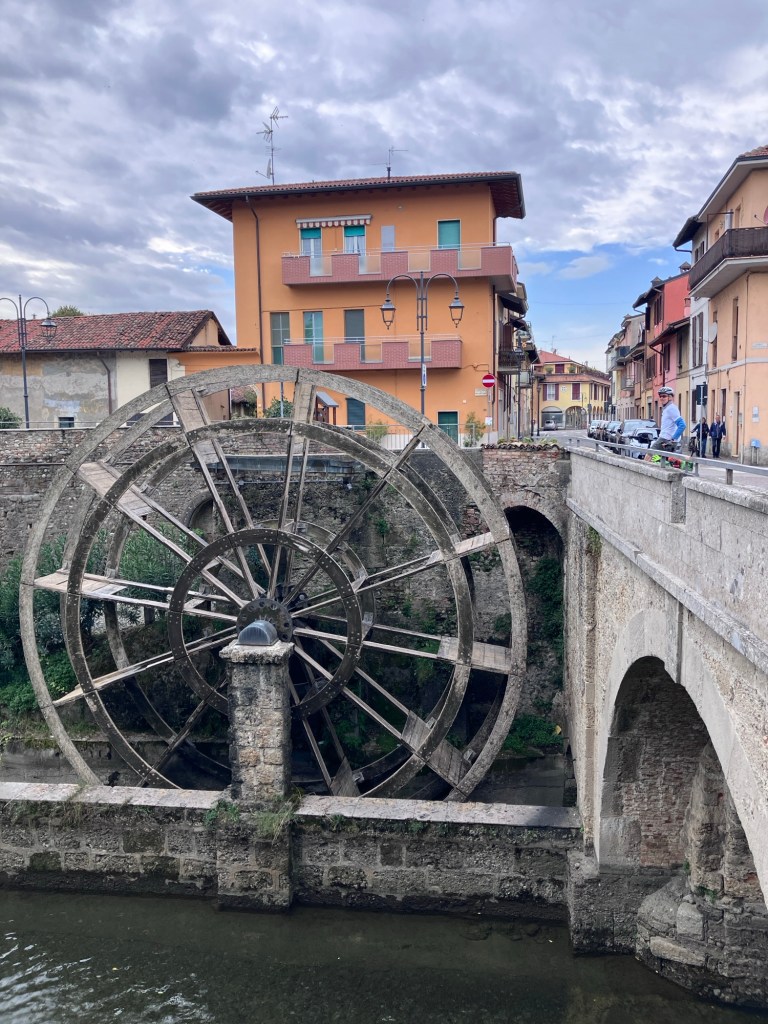
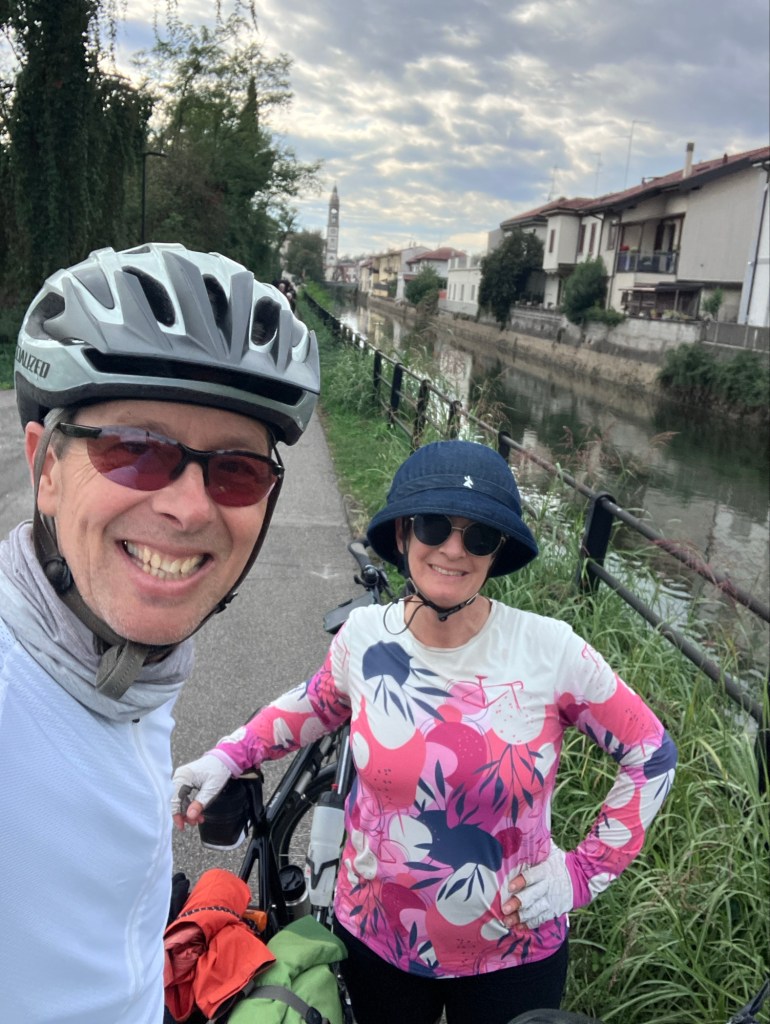
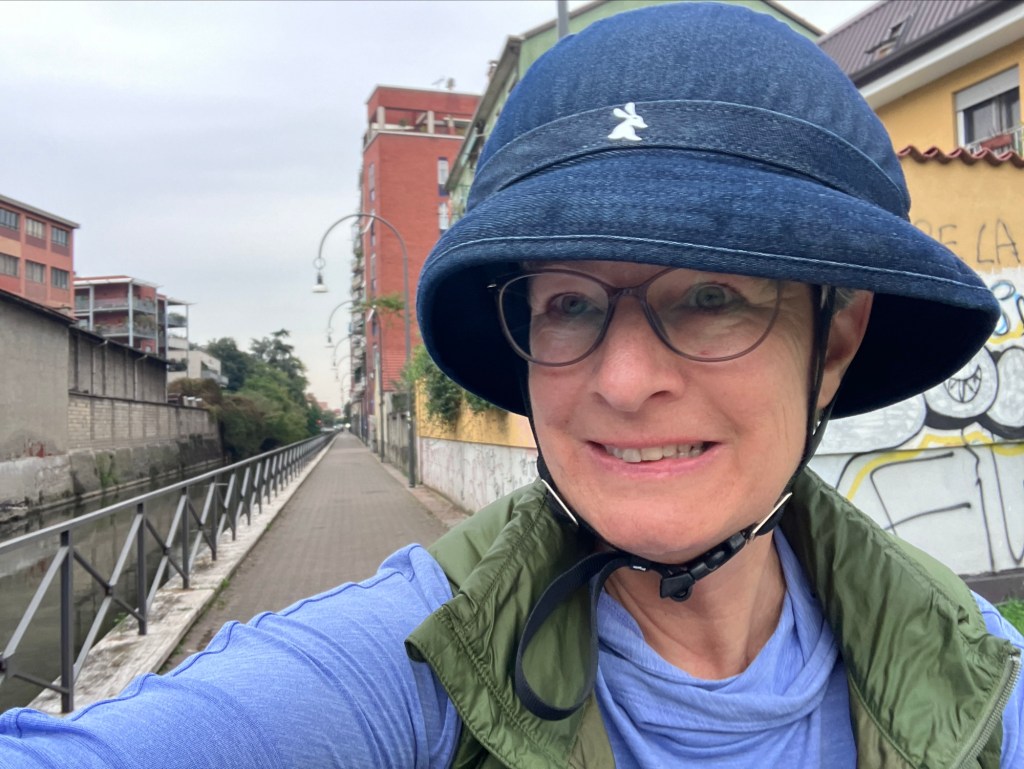
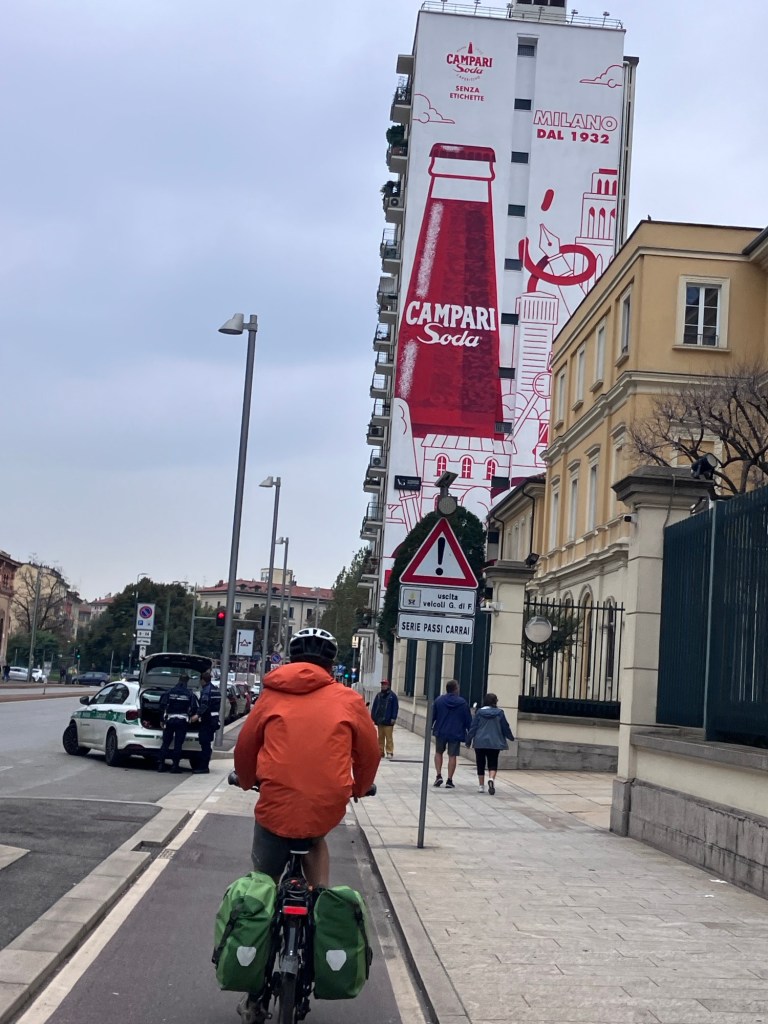
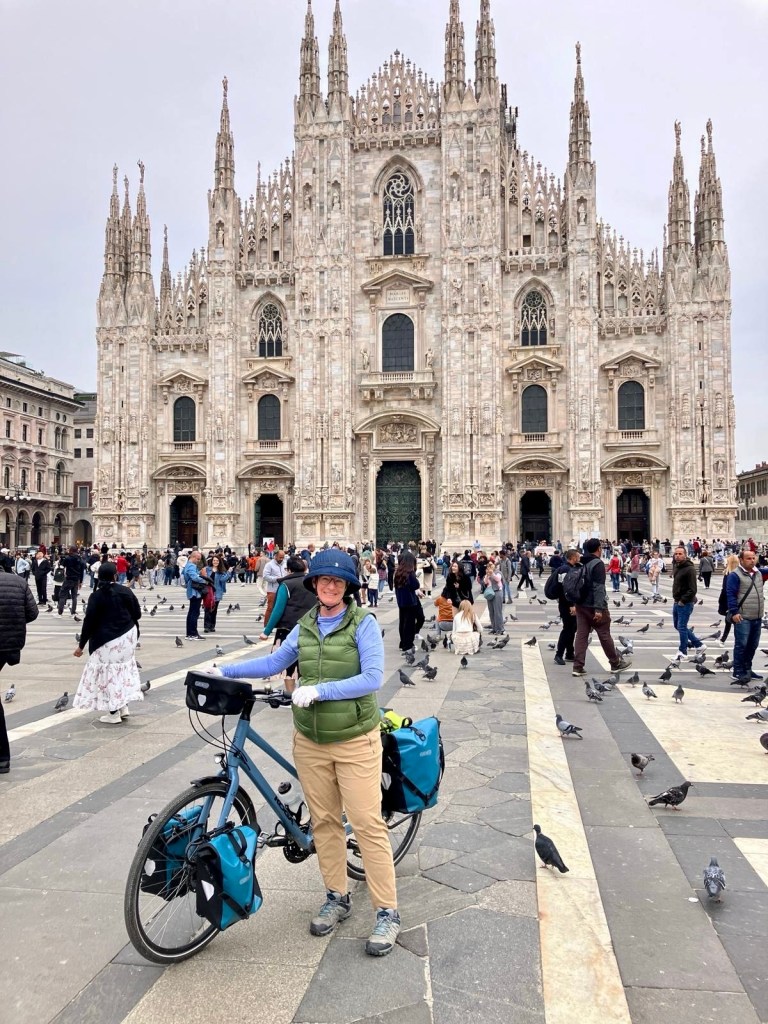
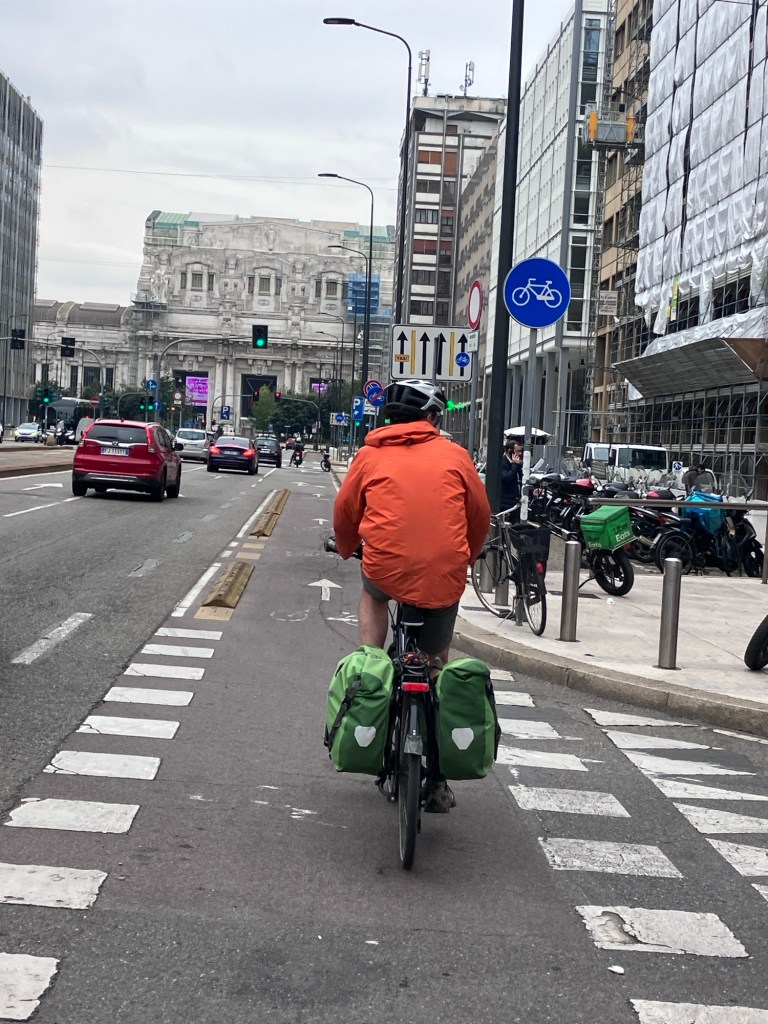
Crossing the Oglio River and a photo bomb by a friendly local cyclist. Espresso and gelato break in Caravaggio. With our days in Italy drawing down we knew we needed to eat gelato whenever possible. Rich chatting with a local in Treviglio. This gentleman was a bike activist in town, pushing for the local routes to be improved and was happy to see bike tourists.A restored water wheel that used to lift water from the canal to irrigate local noblefolks’ orchards. You can see the buckets and channel that moved the water to street level.Ciclovia della Martesana, a relaxing and popular canal path.On the outskirts of Gorgonzola. Yes, where the cheese was first produced. We had it on (what else?) pizza that evening.Yup. Still eating pizza. Our last evening in Italy. Tomorrow the ride to Milan and a train to Geneva.Back on the canal path.Rich chatting with Massimo who saw our American flags and greeted us. The flags on our bikes are the best conversation starters.We were in no hurry as we had several hours before our train left Milan Central. So we bumbled along the canal. Into Milan, admiring the new bike lanes.Riding by a Campari ad. How Italian.Hey! We have some of these Milan street cars in San Francisco. Arco della Pace. Somewhere else in Milan.Doobie doobie doo, somewhere else in Milan. Cathedral de Milano. We had been expecting it to be rainy while we whiled away our hours in Milan so we were happy to ride around sightseeing and eating our lunch sandwiches in the Parco Sempione. But finally we headed to the train station.That’s the train station at the end of the street. Final train of the trip!
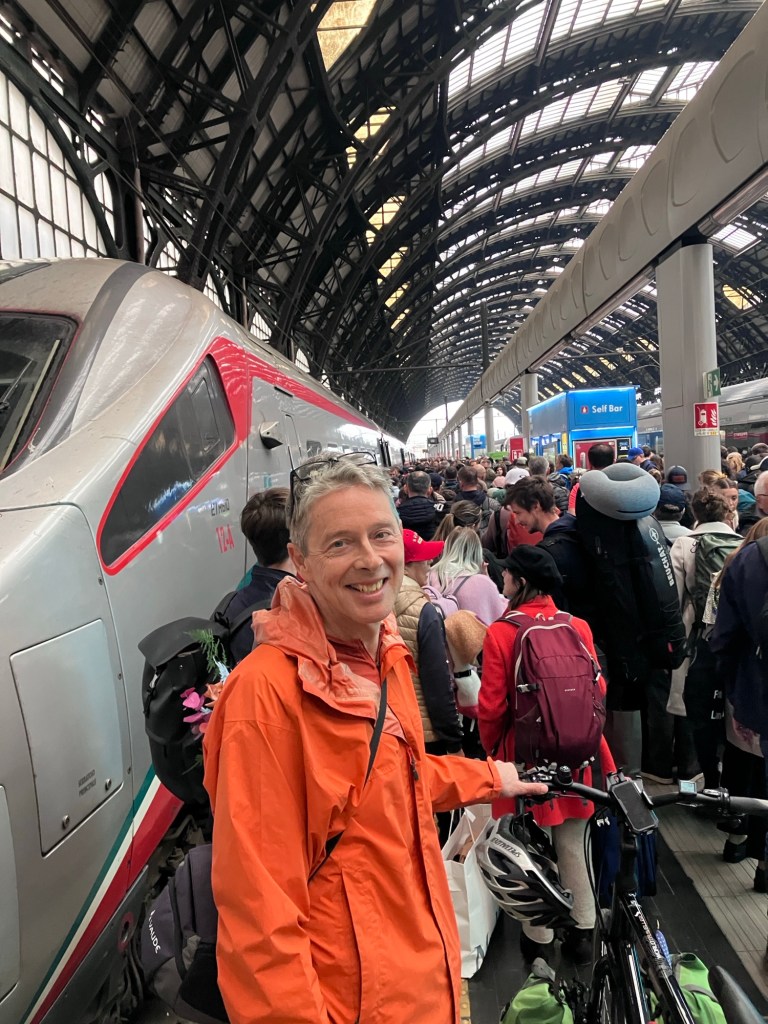
We had a few things going for us with this final long train hop. First positive is that Milan Central is an end station, you reach all the platforms from the same level, so no elevators or stairs in case of track change. Our train started at this station so we should have a decent chunk of time to get our bikes into their reserved spots on one car, and ourselves into our reserved seats in the next car.
Up we go to the platform level on an inclinator. Still looking good and feeling positive.Now we’ll just wait around until our platform is announced and we will proceed calmly to our train.
Ha! What really happened is that our train was late arriving and came in about 20 minutes late which put it cross platform from a Turin train arrival. The electronic tickets for just about everyone on our train did not work at the gates so the station agents had to check and let folks through one at a time – but with bikes we need the wide gates and for those we had to wait and wait and wait until we were just about the last folks to get through. With loaded bikes. Two trains unloading, and two trains worth of folks trying to load, equals one big mess.
At this point we just gave up. We figured the train wouldn’t be able to leave any time soon, so we just patiently shambled along the platform with everyone else.
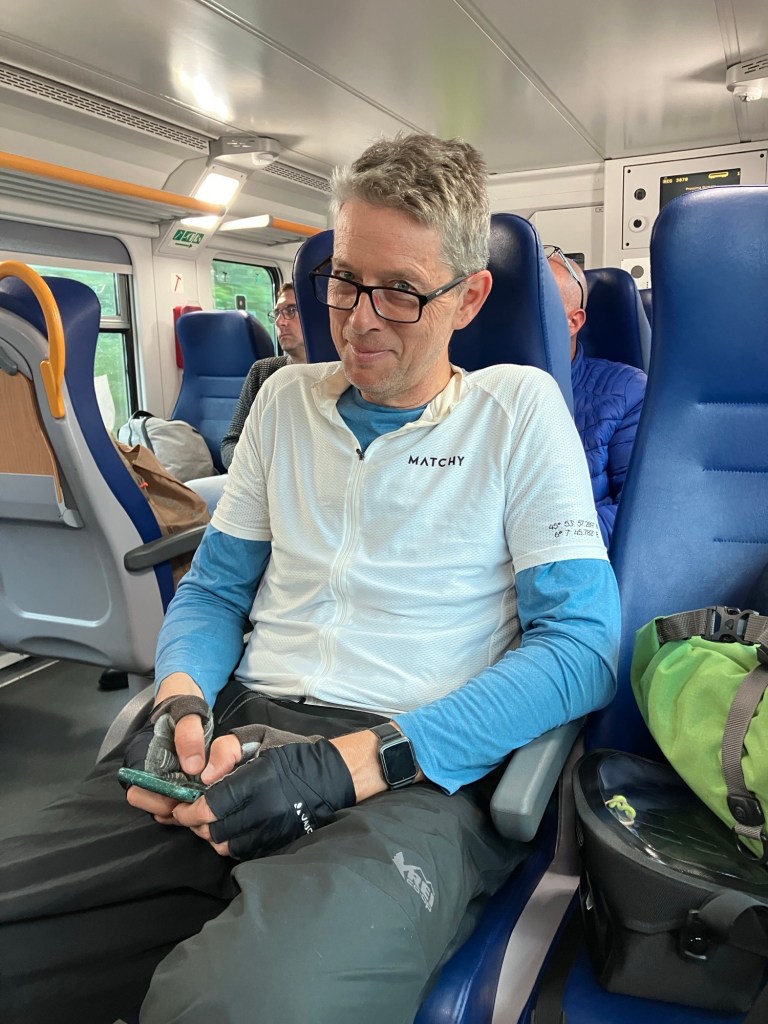
Folks who were not convinced the train would wait for them started boarding many cars before their seats which meant the aisles of every car were impassable as people tried to walk along four, five, or even six cars to get to their seats. Our “reserved” bike spaces? Completely filled with giant wheeled suitcases by the time we got to our car. The palaver it took to get our bikes and panniers and us sorted was monumental. We were moving suitcases, bargaining with other riders, helped by a lovely young and patient passenger, and at first greeted with shrugs from the train attendants. They finally had us move to another car where the bike space had a few fewer suitcases in it, and we eventually got to our seats, hot, exhausted, and giddy with joy that we were on our final train ride of the trip.
Along with dinner Rich wisely bought us train wine during our station wait. We needed it.
Our final destination was a hotel in Annemasse where we would spend the night before tackling the climb up the Vallée. (We ended up getting a ride up the Vallée due to heavy rain and cold and exhaustion.) We told ourselves that if it was raining when we arrived in Geneva, or if we were too exhausted we’d just take the train to Annemasse. Another ha! The train tracks were being worked on and no trains running after 8 pm. We arrived at 9:30 and headed out to ride to Annemasse. Thankfully there is a first rate bikeway all the way so even in the rain it wasn’t awful. Just very wet.
Ah, Geneva Cornavin station. Now just a 9 km/ 5.5 miles to our hotel in Annemasse. In the rain. We made it.Our loop in nights spent. Each green heart is a place we stayed. The far left heart is our good friends’ place in the Haute Savoie.
A few observations about our different experiences along the way. The Swiss are very no nonsense and straightforward. The bike infrastructure is good. Germany has really good infrastructure but it’s starting to be dated, and, with so many folks on e-bikes, crowded. Germans are gruff. They do not waste time being gentle. As I was pushing my loaded touring bike up a steep climb a man on an e-bike came down the hill. He took the time to stop and say to me “There are many steep hills ahead.”, with a rueful shake of his head at my blithe disregard of tough climbs. We could hear his internal question of why these silly Americans did not have e-bikes. A second German man cycling with his family, all on e-bikes, rode by and motioned to me with a wave of his hand and said “Come on, hurry. Keep up.” I snapped that my bike had no motor and when we encountered he and his family again they tried very hard to be nice. Was I holding a grudge? Why yes, I was.
The happy travelers in Treviso.
By contrast the Austrians we encountered were more friendly, and the Italians! We were cheered up climbs with calls of Brava- Bravo! Almost every cyclist called out ciao ciao and smiled and waved. When I was caught in the bike race on a climb the spectators clapped and called out as if I was part of the race when I finally got on my bike to finish the climb.
Although the infrastructure for our northern Italy route was not yet in place it is underway. Alta Alia D’Attraversare is the website for the formal route we partially followed and which is mostly in place and being improved all the time. Worth checking out if you plan to cycle this part of Italy.
We’re in France until December 4th, the 12th arrondissement of Paris and then off to the UK for Christmas and New Year.
We’ve been so thoroughly enjoying every day in Japan that we haven’t had much time or energy left to Blog. It’s a fantastic place to travel. But no place is perfect, and Japan has its weaknesses too, especially in the bike and pedestrian realm.
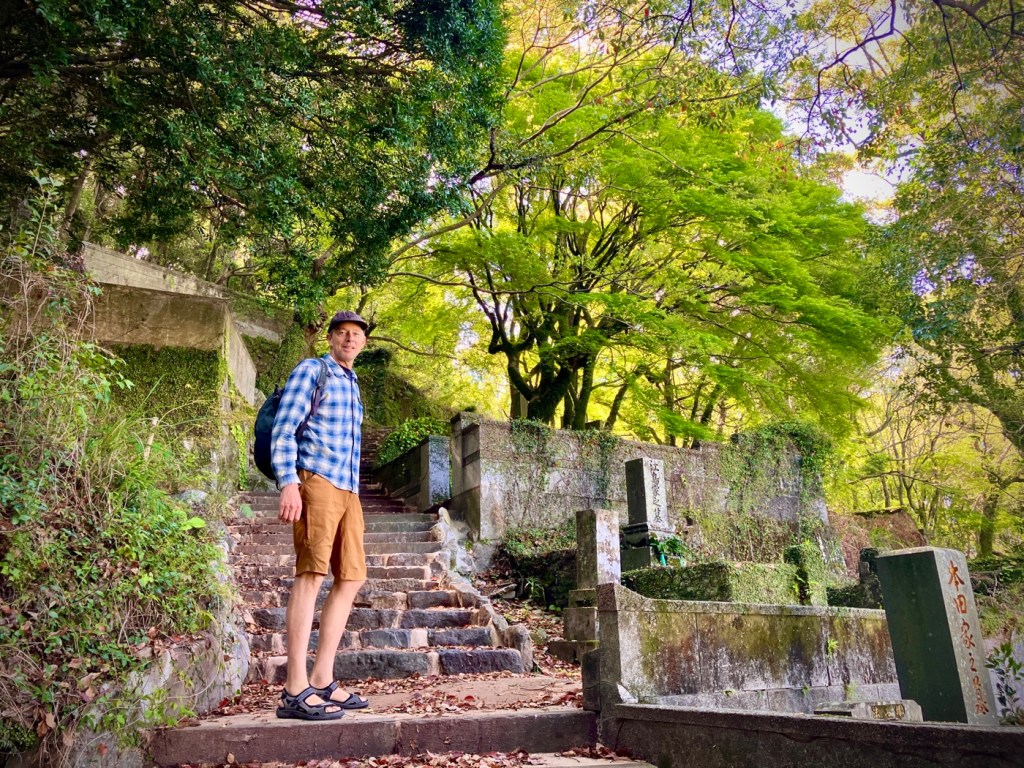
Exploring the hills and stairways of Nagasaki was a joy in the crisp spring weather.
We’ve been travelling our preferred way by train, bus, ferry, streetcar, subway, and bike. With a lot of walking to the beach to explore and get to our lodging. We’ve been luxuriating in the clean, punctual, and extensive intercity train system. And the local public transit is always clean and reliable, if not always fast.
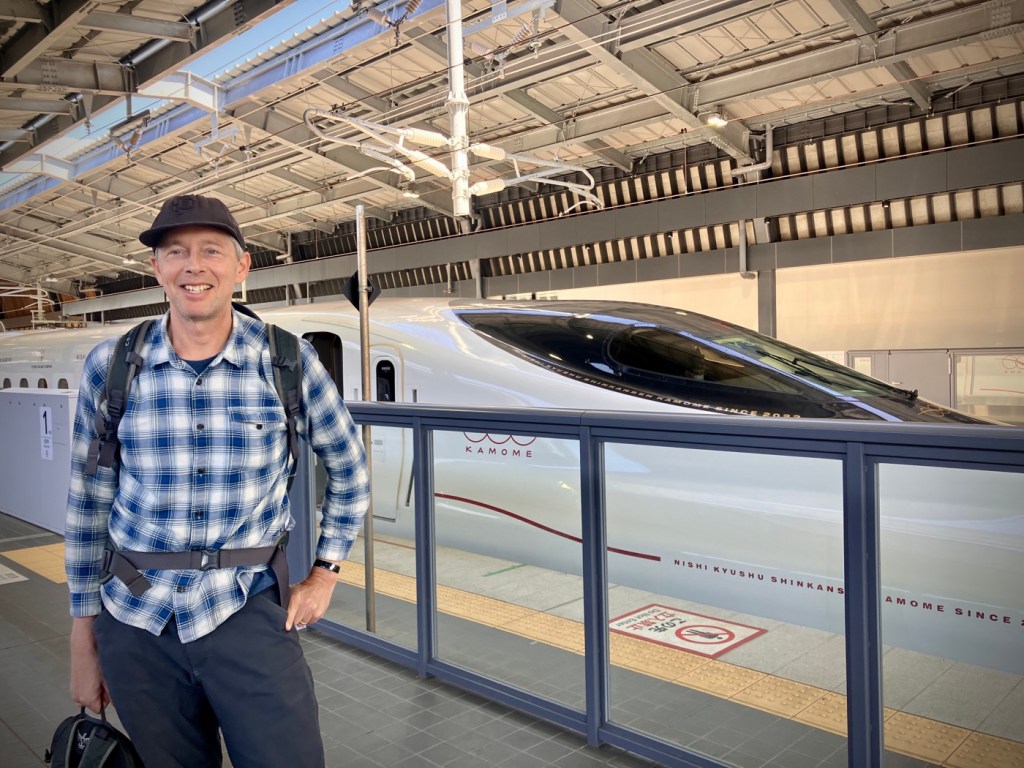
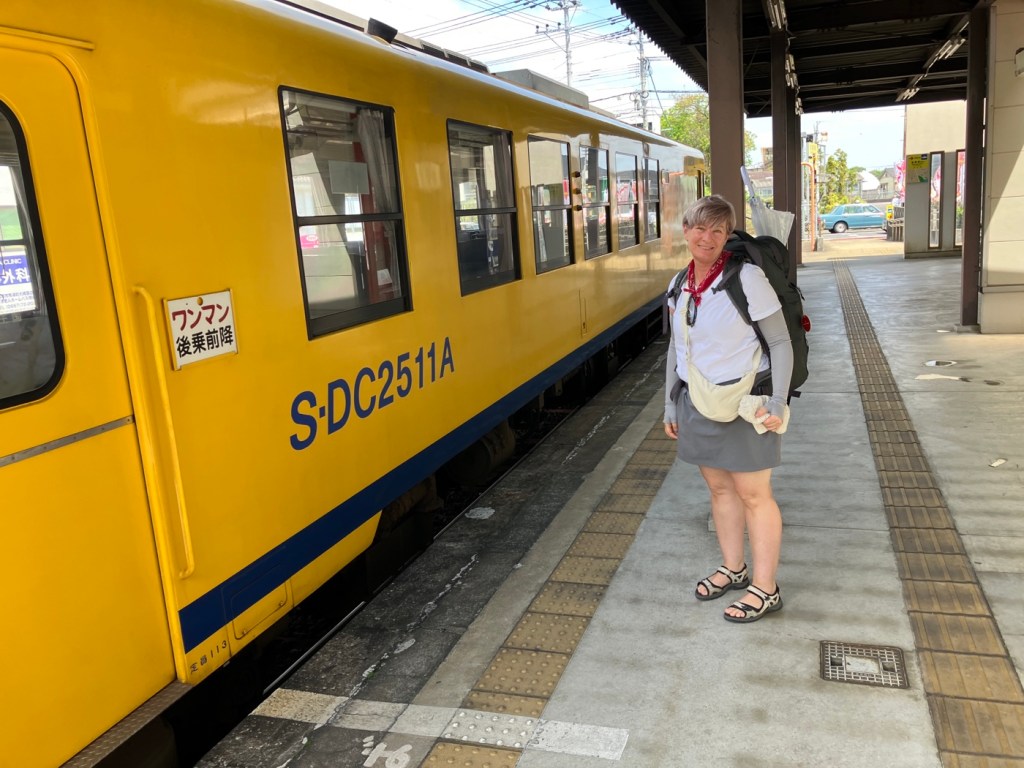
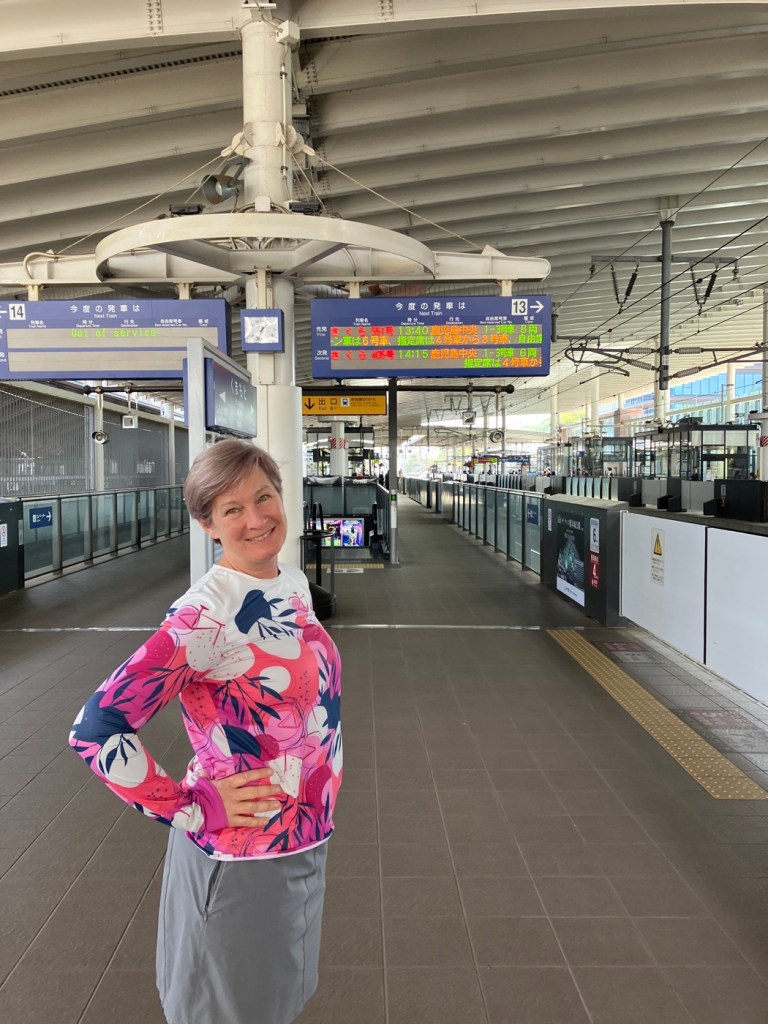
A shiny new Shinkansen on the recent extension to Kagoshima – marvelous and so fastA single car train on the Shimabara railway, operated and conducted by one person! Many small lines in Japan have shut down, and how long can the last private lines survive?
So here are a few transport observations. For you transport wonks and mega walkers, they may give you the same joy and a maybe bit of frustration if you visit.
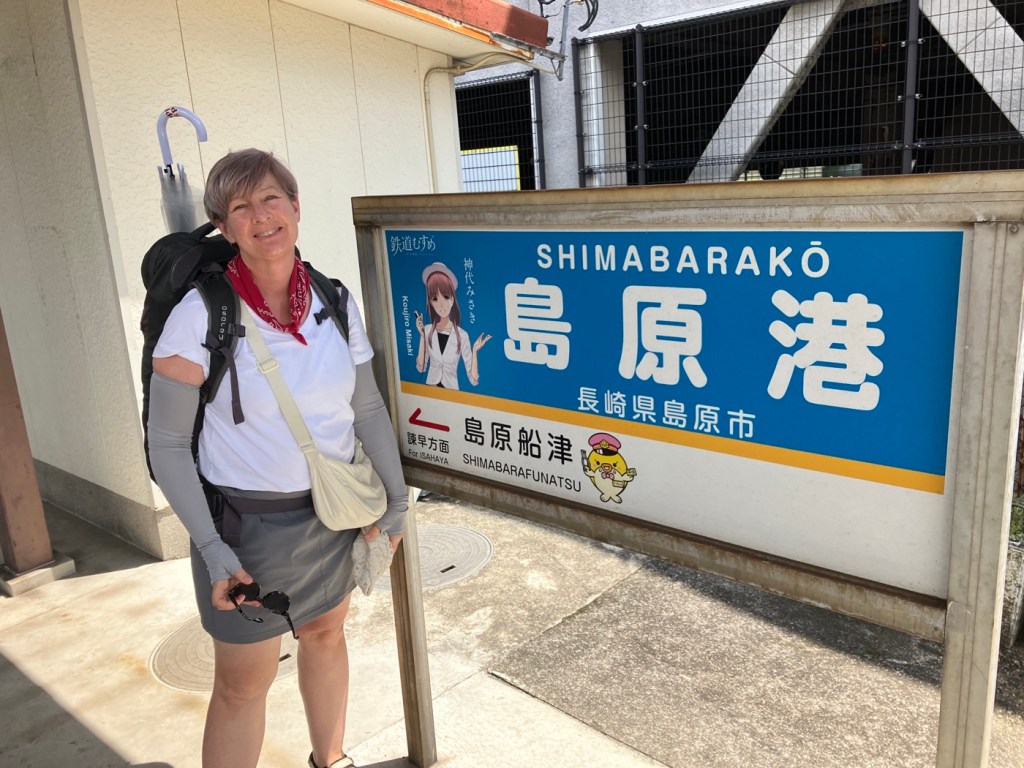
You can enjoy great connections in Japan, like the end of the line in Shimabara, with a ferry across the street that will take you to a bus and a Shinkansen line.
1. JR Rail Pass- Unless you are going to only visit a few cities or rent a car, then it’s a no brainer to get one of these passes subsidized for tourists. We bought two three-week passes and planned our trip to max its benefit to a 4 week visit by setting the activation for the day we left Tokyo and expiring when we get to Fukuoaka, where we are spending our last 3 days. This way we were able to exchange our vouchers at off peak time at Shinjuku station and avoid the mob we saw at Narita airport trying to exchange them to use immediately from the Airport. We instead bought $20 local rail tickets to central Tokyo. It was then easy and cheap to get IC (tap) Transit cards to get around for a few subway and loop rail trips in Tokyo until leaving Tokyo for Kanazawa.
JR Raíl stations are always clean, orderly, and the major ones have lots of food and shopping options and lots of vending machines
2. IC Card – Good for transit in most major cities. There are a dozen or so “brands” by region and they can mostly be used in other cities, although acceptance is a bit hit or miss outside the home zones. Don’t put too much on it initially, 5,000 yen ($40) is my recommendation, as you can always top it up but it’s hard to get a refund. You can also use them at many convenience stores.
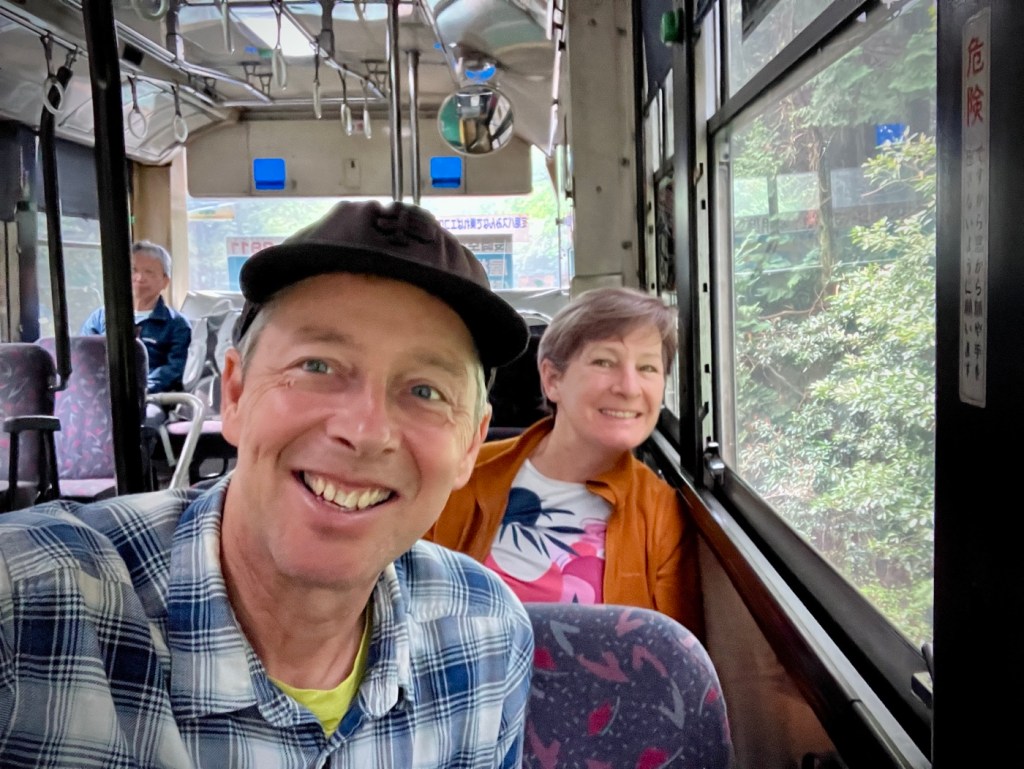
Buses run EXACTLY on timetables, so real time predictions really aren’t needed. And you may have them to yourself in more rural areas
3. Train Seat reservations – With your JR Pass, you can make free seat reservations for most higher speed trains (and Shinkansens). I found that I could get our choice if I booked at least 2 days prior to our next trip. You can do it at green JR Ticket machines in almost all JR stations. So I’d often get our seats for our next leg when we arrived to a city. If you book too early and want to change your trains later, you won’t be able to do it at a machine if the new journey overlaps with the old one. You will have to go to a JR ticket office which could take some time at busier times and stations. But, you can alway board in the unreserved cars, so no serious worries other than maybe sitting apart or standing for a bit.
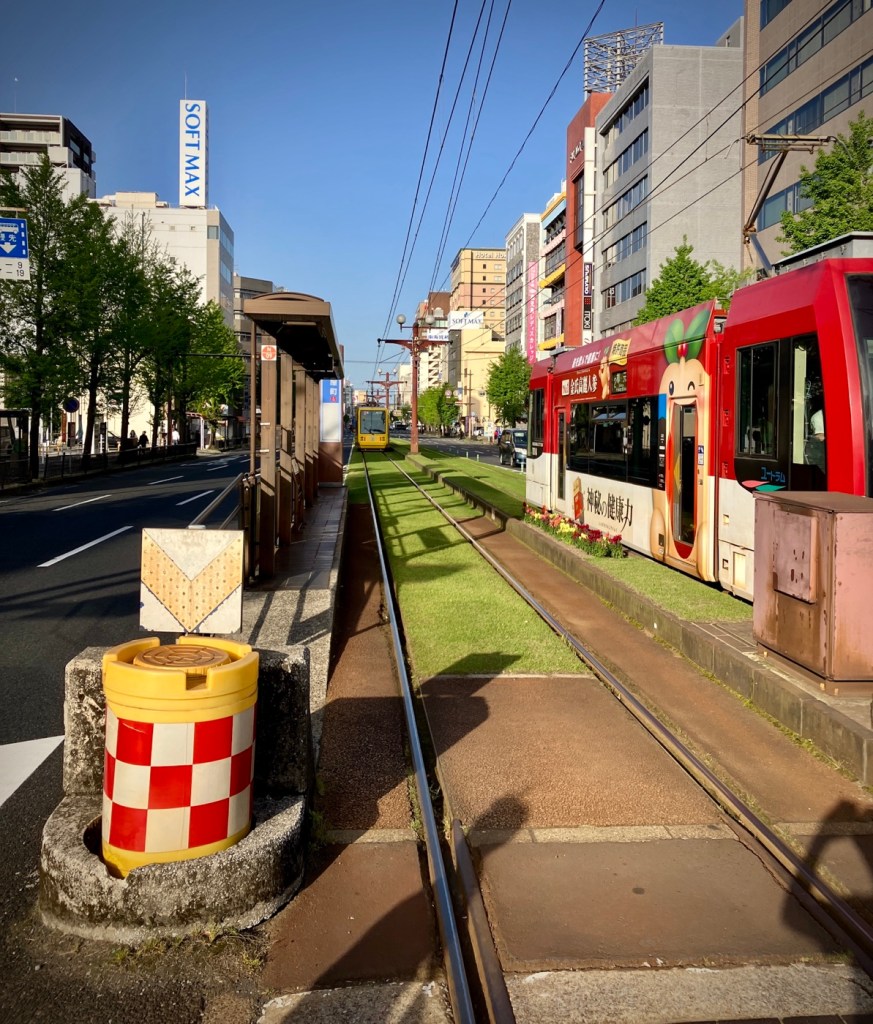
The worlds skinniest tram boarding platforms in Kagoshima next to 3 underutilized traffic lanes….hmmmThese poor tram passengers have lined up to wait for the lights to change, just to get off the narrow tram platform to the sidewalk.
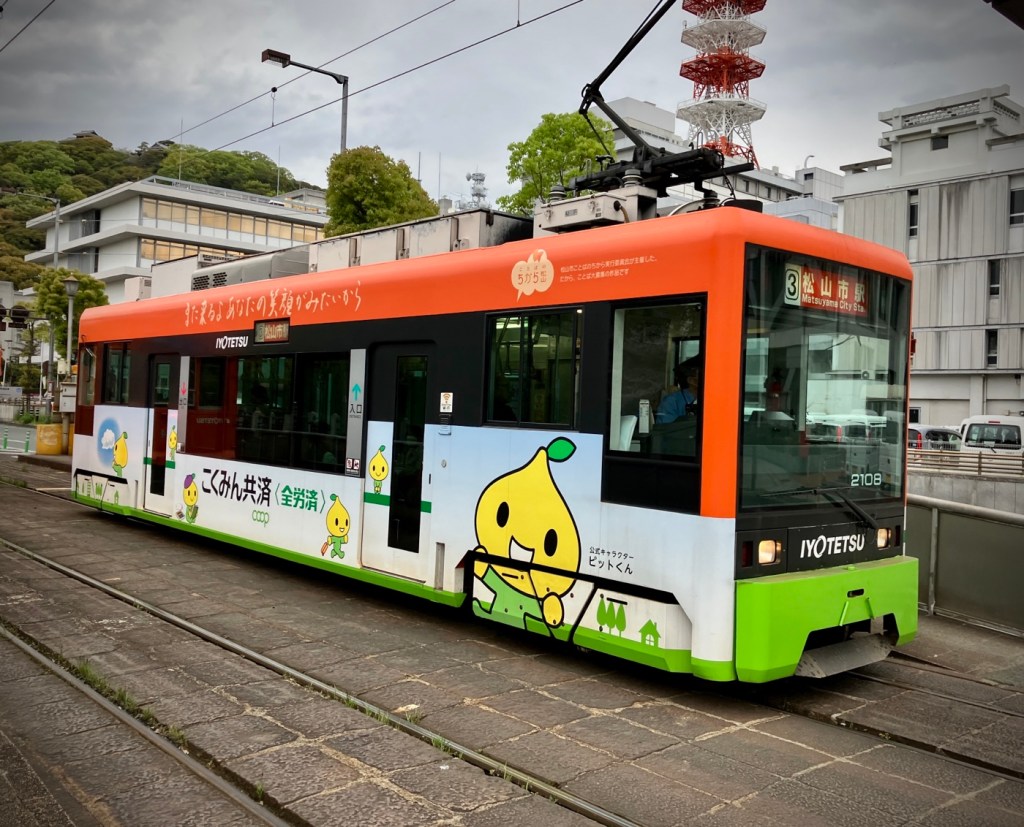
4. Buses and Trams – they run on schedule (especially buses). You board at the back door and tap your IC card if available or if not, take a little paper ticket from a dispenser that indicates your boarding zone. You always pay at the front door as you leave, calculating your fare from the easy digital sign at the front. Put your stop ticket and fare in the box or machine. They can always make change. This also applies to some of the small independent (Non JR) local trains. Once you get the hang of it, it’s pretty straightforward (Especially with IC Card), but it seems pretty inefficient at crowded times as many people still pay cash fares. There is a flow from the back of the bus towards the front door, but it doesn’t match the ease and speed of a proof of payment system.
Navigating the local systems can be challengingGoogle maps can really help as it has most timetables (but not all) available in navigation, but you still often need to id your bus in Kanji script or just be at the right place on time, because the bus will be.
5. Walking – You will do a lot of walking in Japan which is mostly great, and wandering the alleys, hidden temple stairways, and quiet back streets is one of the great joys of Japan. One downside though is that the arterial traffic signal timings are long, so get ready to wait for for 2-3 minutes at some crossings. It’s very annoying, and really delays walking trips across town. The only time you see Japanese run is for crossings, as they know it’s a long wait if you miss the light.
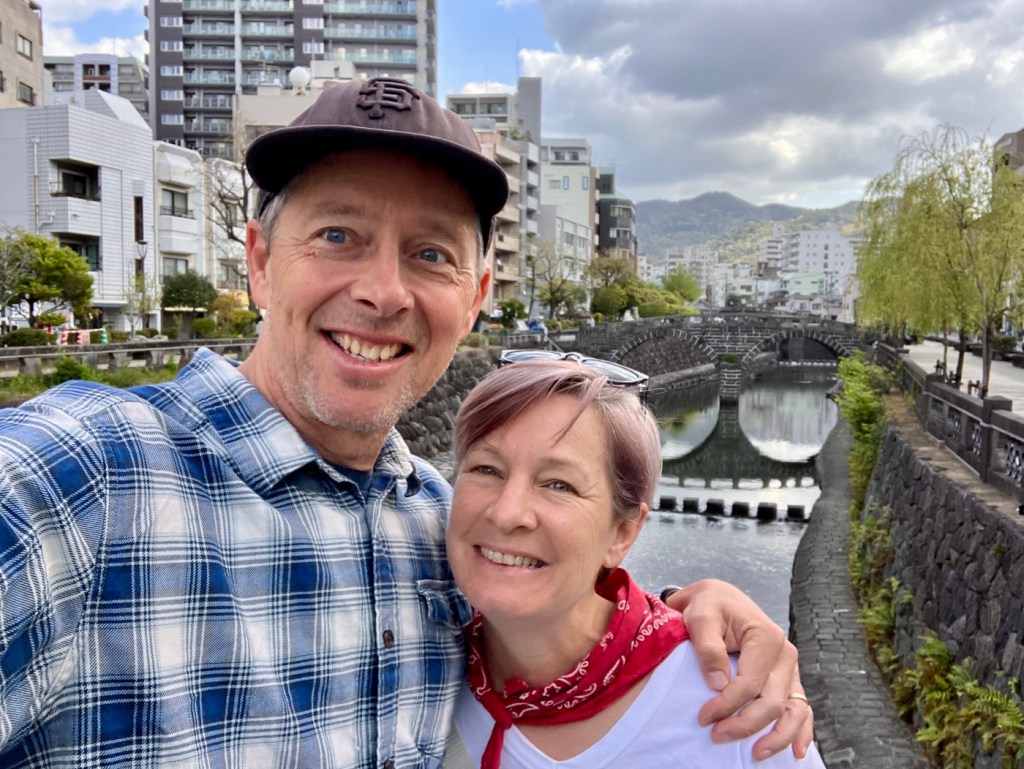
The cats and temples are always worth the long pedestrian lights A series of historic stone bridges line the Nakashima River in Nagasaki.
Also, pedestrian crossings can be spread out on major arterials, with occasional overhead or underpass ped crossings in lieu of at grade crosswalks. It seems like a legacy of 1960s traffic engineering that continues in philosophy today, but stairwell underpasses are not good for an aging population.
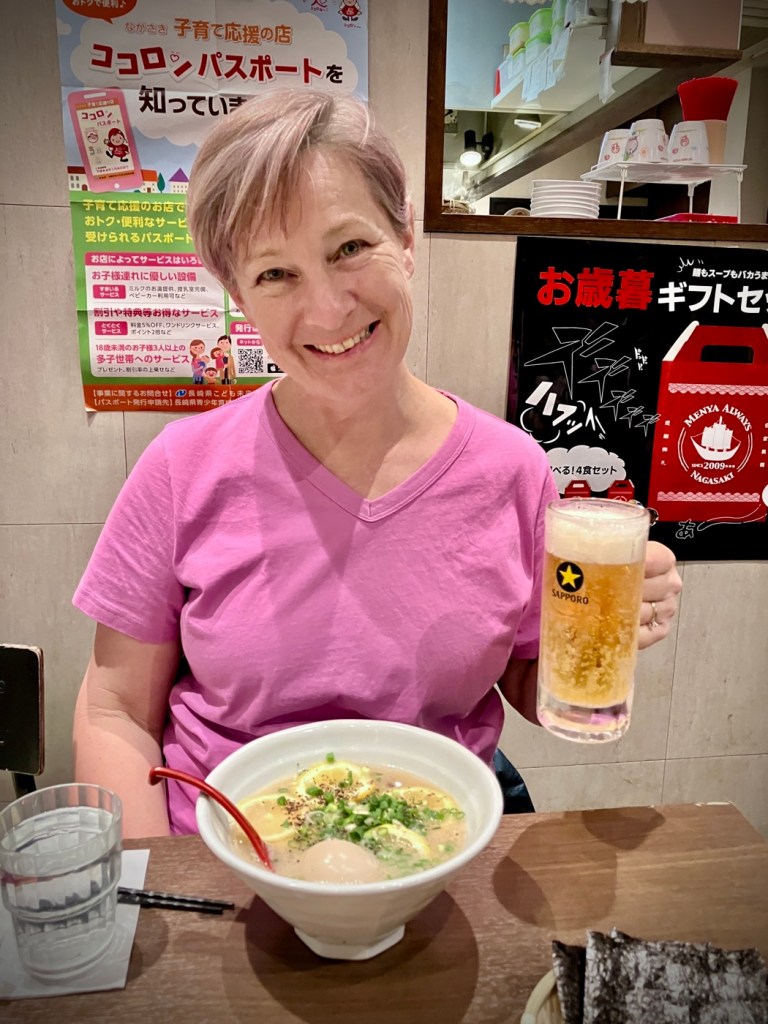
State of the art ramen ordering machine. Automation and an aging population go hand in hand as labor is getting scarcer every year in Japan A unique pork and lemon broth at Menya Always ramen in Nagasaki
So what about Jaywalking? A few people, especially in larger cities will jump a signal or cross midway, but 98% of Japanese wait until the light is fully green. As time has gone on in our travels here, we are getting less and less patient, and will cross at will when it makes sense and traffic is clear. We are surely going to incite a pedestrian revolt here!
The main shopping arcade doubles as a cycleway in Takamatsu. It does provide weather protection to cyclists but is hectic in the evening rush hour when shoppers are outHappy walking; riding bikes is not allowed in the busier hours or areas of the arcades
6. Bikes: There are many more than you think, especially in flatter cities. But the bikes share most sidewalks and it’s all a bit chaotic, which could be solved by more on street protected lanes. Cyclists routinely cut corners and swerve across intersections and are an outlier to order on the streets. (Yeah cyclists!)
Amazing underground automated bike storage in Takamatsu. “Hello Cycling” bike shares were located in underground bike parking facilities in Takamatsu and the App was (mostly) English and foreign credit card friendly.
So my quick transport report card for Japan based on our scientific analysis:
Trains – A-….ok, amazing at a high level, but deductions for lack of App based e-tickets/seats please…and stringent bike policies keep it from A+
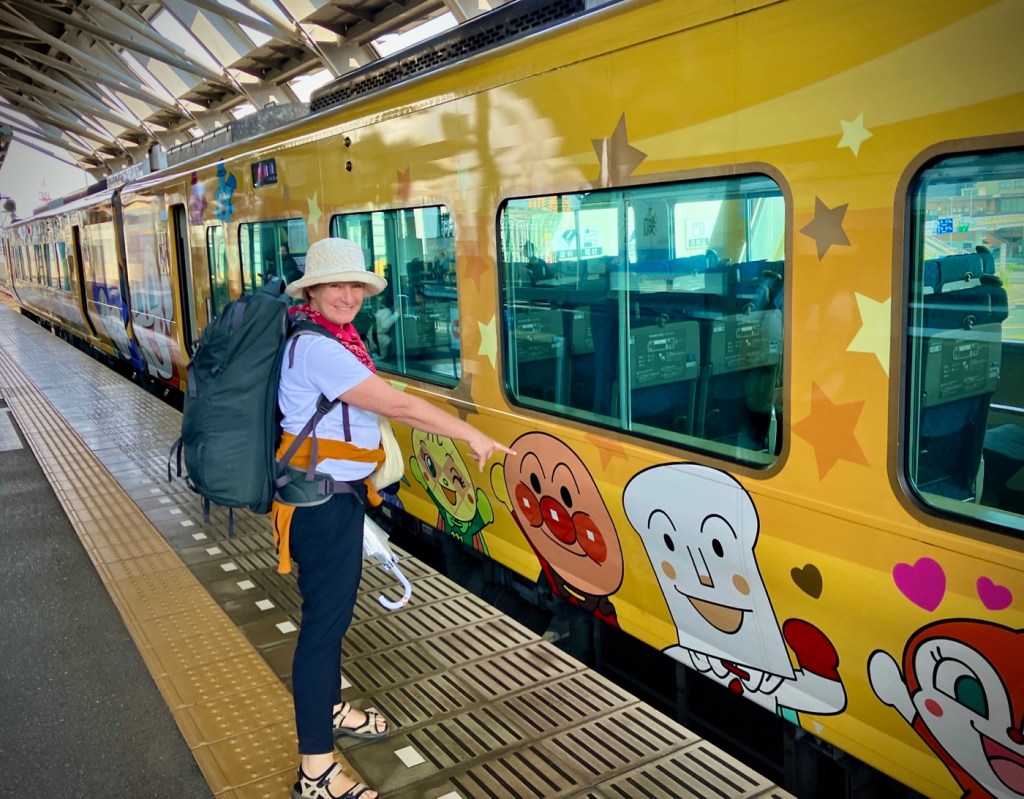
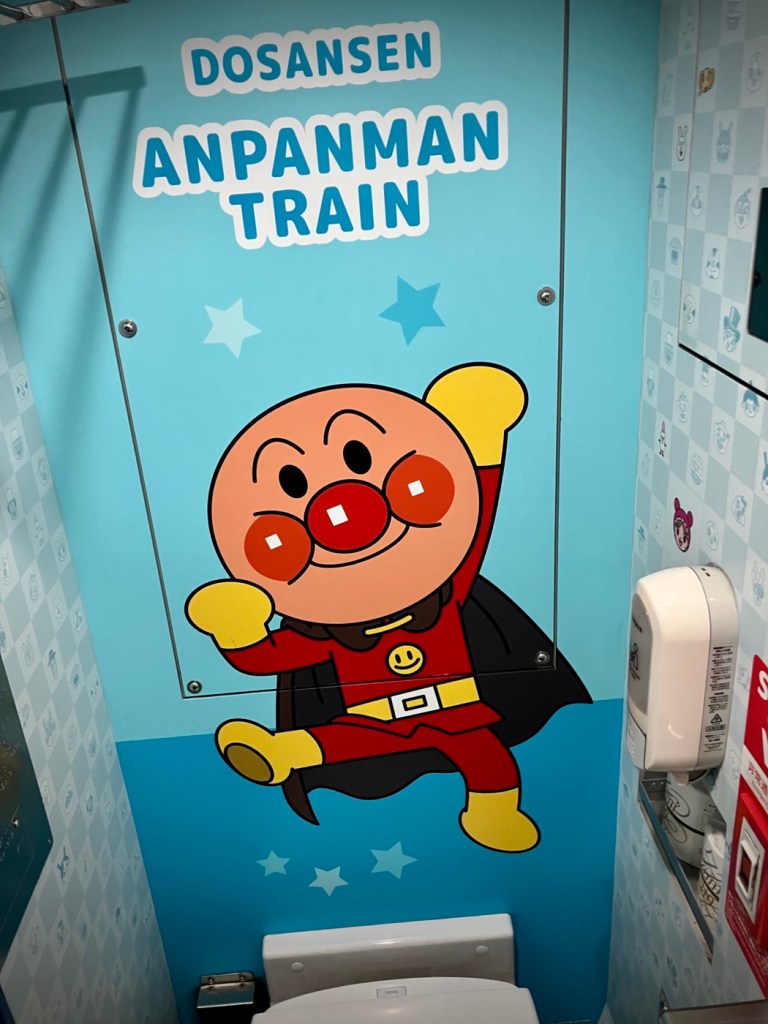
There are themed trains too, including a Hello Kitty Shinkansen (missed it) and our train to TakamatsuAnd the theme continues inside…Apanman is a beloved TV series based on Takashi Yanese’s picture books that he produced for over 40 years.Even to the WC
Buses: B+ Reliable; on schedule, and fair pricing but they get stuck at long traffic lights too, so can be slow in cities. And there are few express buses. BRT?
Buses in rural areas are reliable, but sometimes only run hourly or a few times a day
Walking: B- Wider sidewalks are needed in many places. Alleys and many quiet urban streets are very pleasant and low stress to walk, but many arterial sidewalks are a bit narrow or degraded by detectable rubber strips. I appreciate that these assist the vision impaired, but sidewalks are just not wide enough to accommodate them and side by side walking space. There seems to be a legacy of traffic lanes and road capacity. Giving more road cross section to peds, bikes and tram boarding is needed. Smart traffic signals could be used to mitigate lane reductions. Many heavy pedestrian neighborhoods in Tokyo and other larger cities have nice wide sidewalks in a new generation of streetscape designs, but many places still have a 1970s-1990s feel.
Rush hour on the sidewalks of Matsayuma. Wide here, but a slick rock surface makes cycling in the rain a bit dodgy.
Cycling: C+ Quiet back streets and sidewalk cycleways do the trick, but more on street protected bikeways are needed everywhere
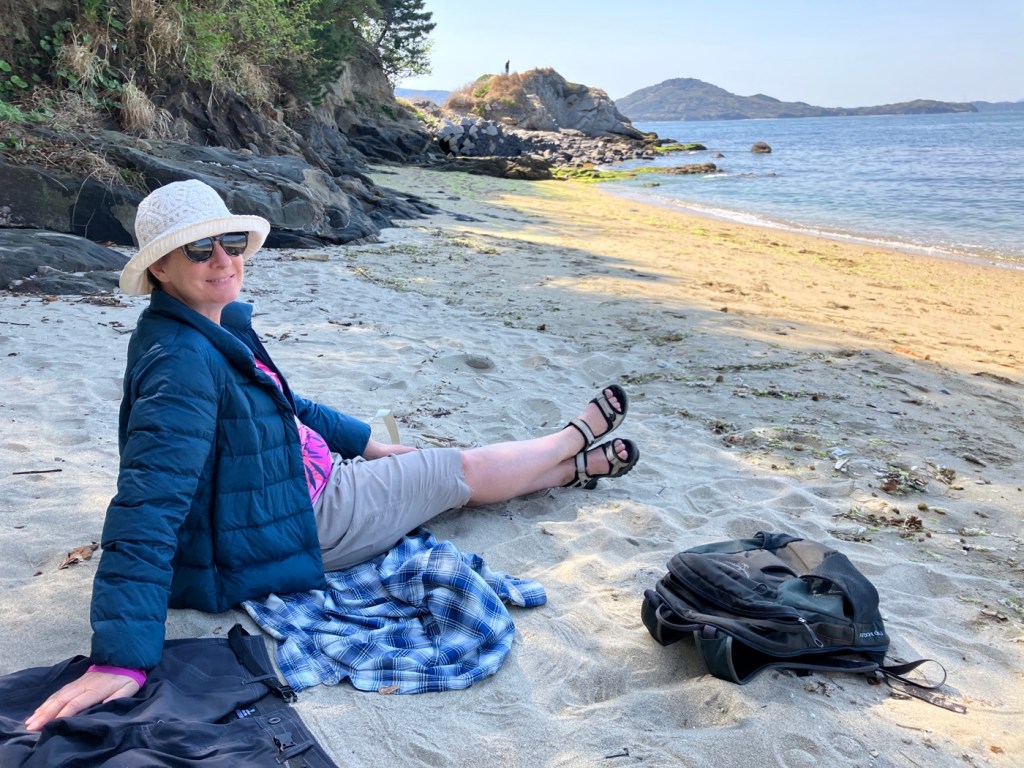
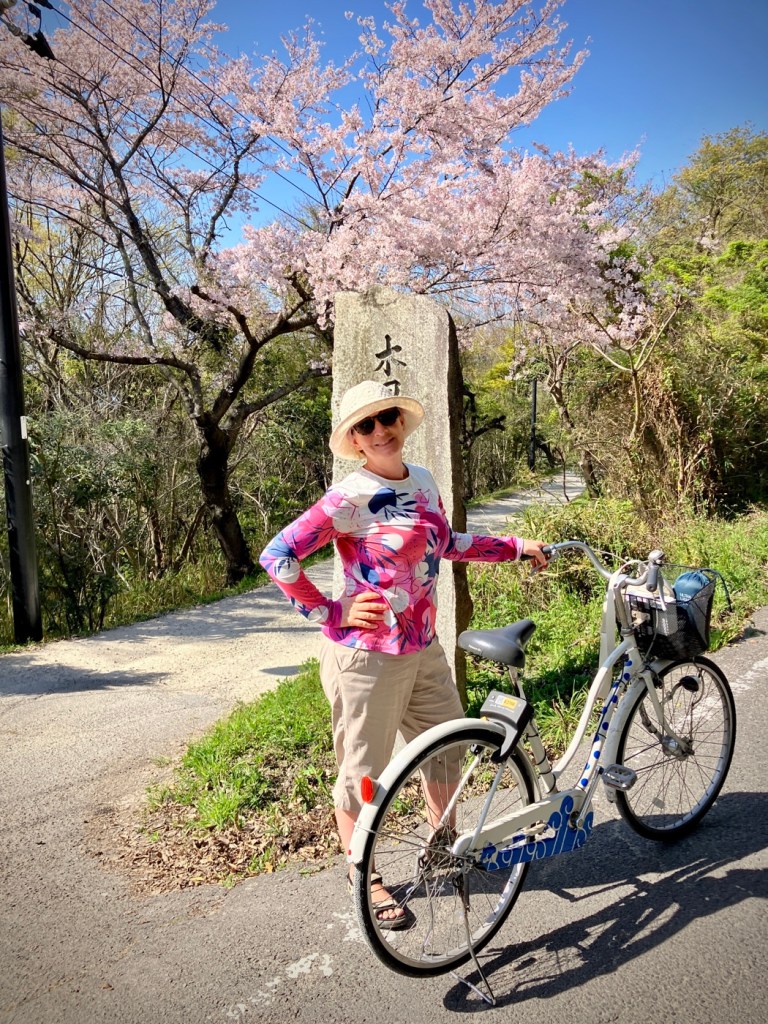
Yashima National Park – nice beaches on Shikoku but a little chilly to swim yet Cycling to Yashima NP from Takamatsu was pleasant on sidewalk paths and quiet roads
But enough nitpicking. As a traveler, the lack of personal safety concerns and good transport frees you up to focus on the unique culture, sights, and most of all, the food and friendly people. And oh man the food is SO good.
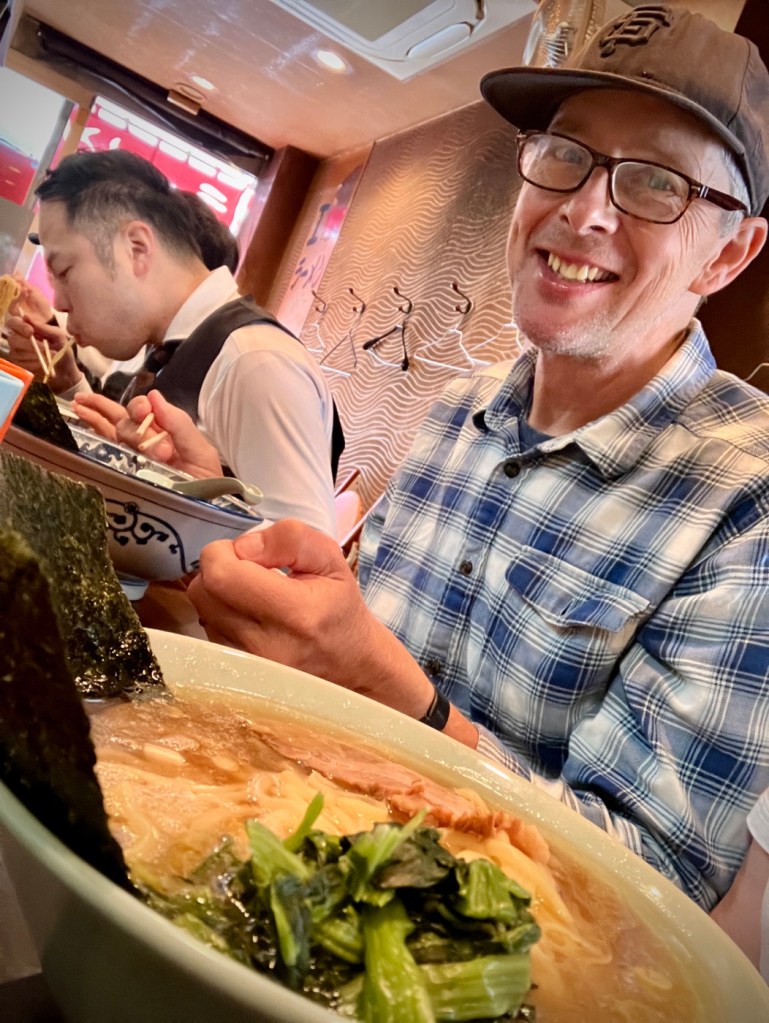
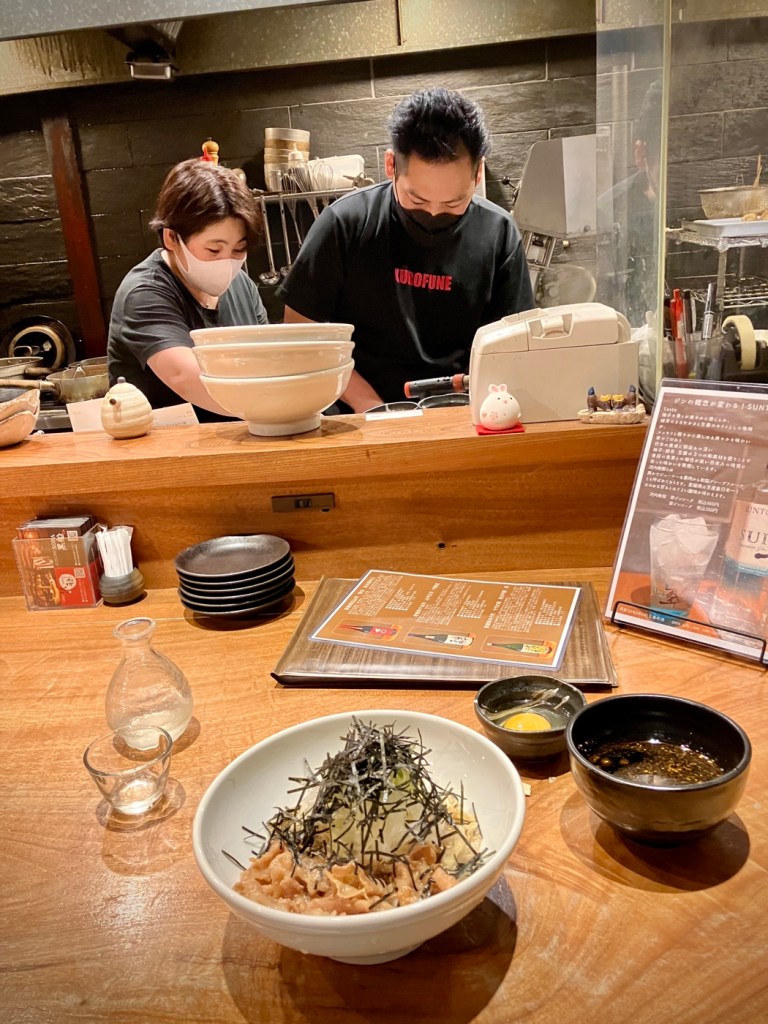
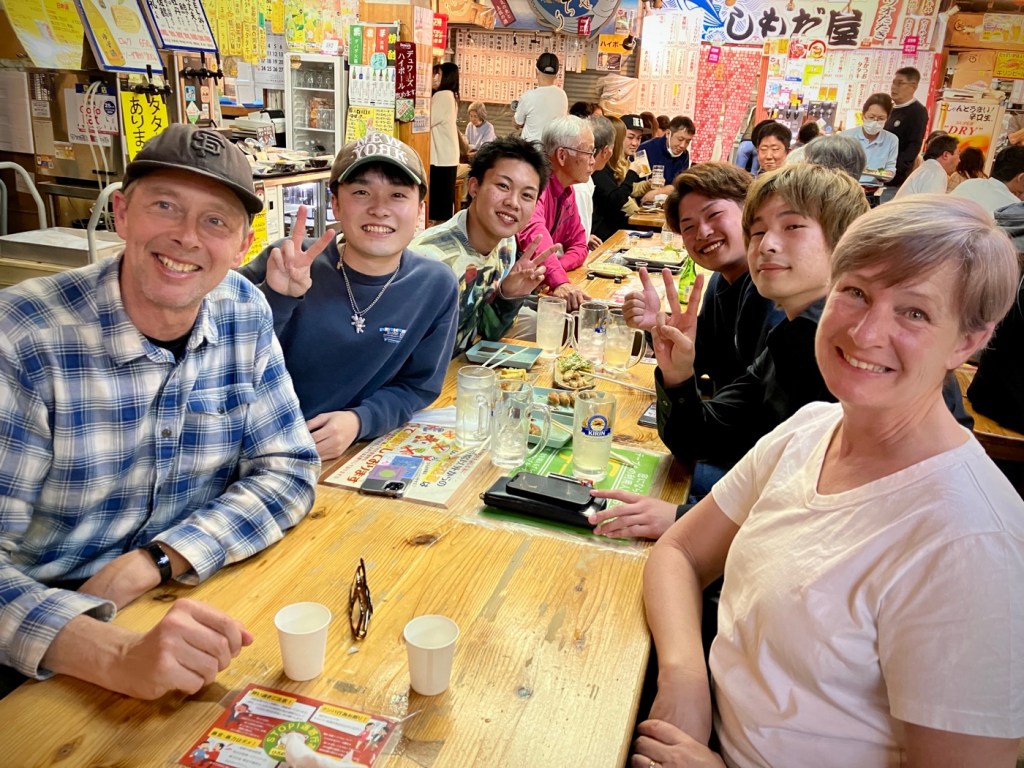
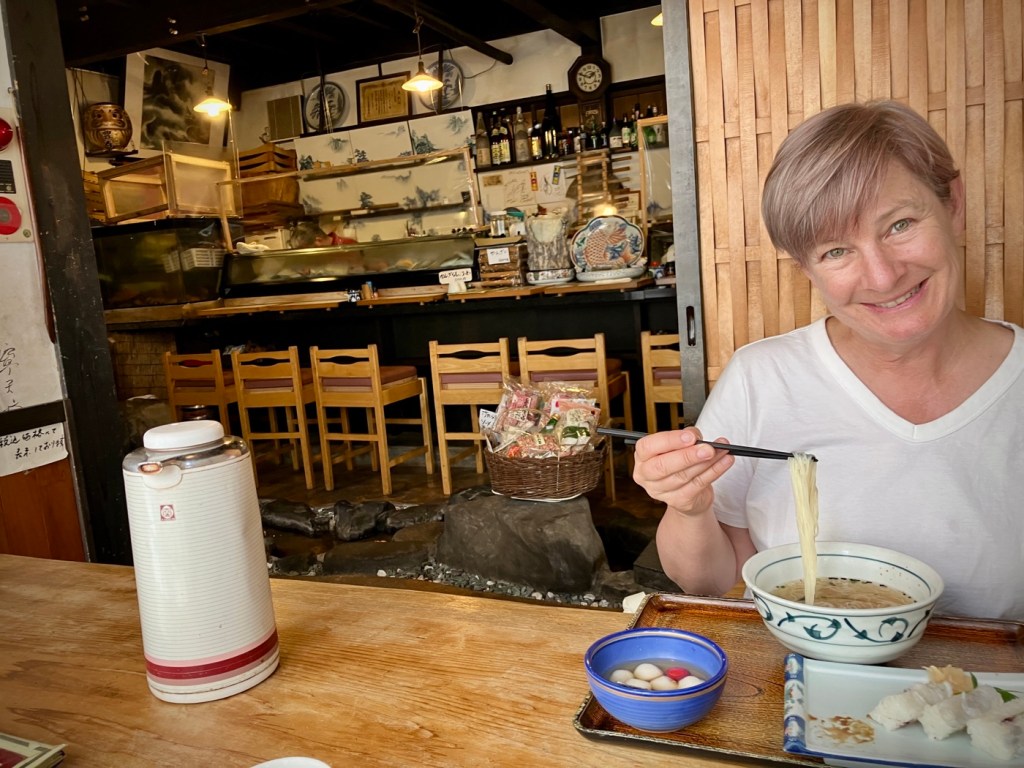
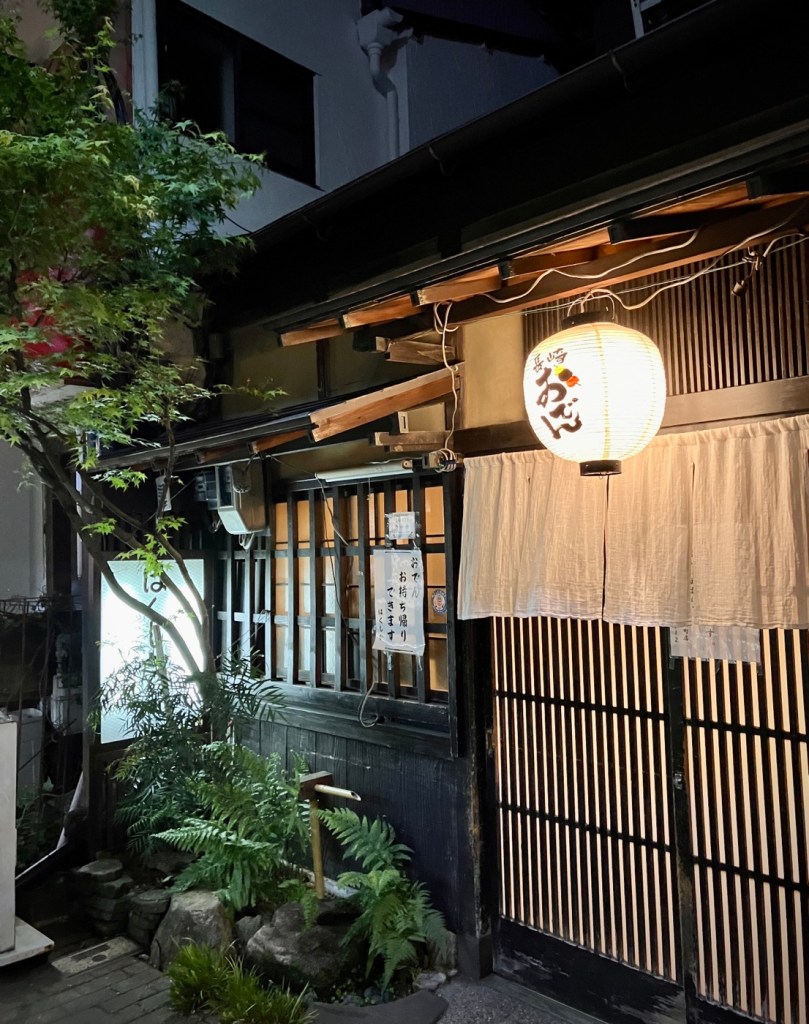
Smiles allowed, but ramen is serious lunchtime business at Ramenya Mass in NagasakiSmall izakayas are the souls of Japan. Dedication to craft and coziness abound Pure soba and dashi heaven
And it’s good value for most lodging and food, as long as you are willing to give up western norms and keep some distance from the tourist hot spots. The yen has weakened against most currencies over the past 5 years, so it’s a great time to travel here. Except in Tokyo, there are great 3 to 4 star Hotels in the $100-$125 range, and a bit more on the weekends, especially Saturday nights. And most include breakfast.
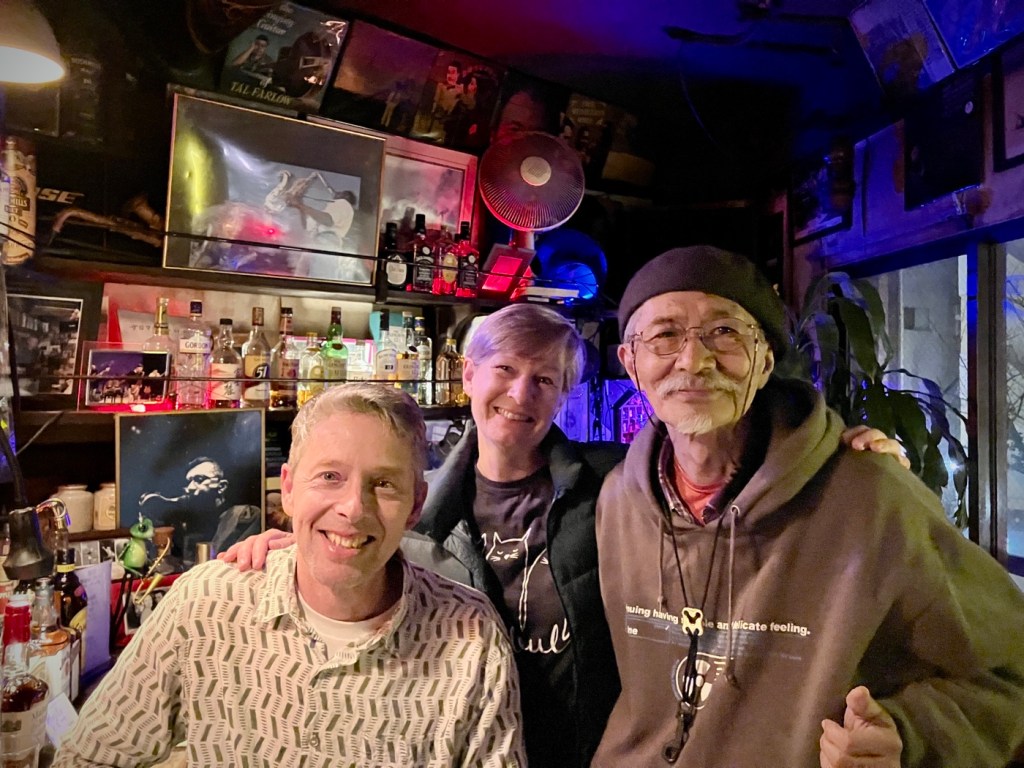
Wonderfully cozy 3rd floor jazz bar in Nagasaki . The owner played us his tenor sax music while we chatted. The Japanese love classic jazz. And so do I.In addition to hot and cold drinks, vending machines in Japan are used for almost everything; even fresh soba noodles
If you go for more modest 1-2 star hotels, then you can find many in the $70-$90 range. Remote or resort area hotels (often with Onsen or Rotemburo baths) are definitely higher in the $150-$300+, so will be a splurge if on a budget. It’s definitely better value than most of the US, and similar to Europe, although I think a bit cheaper overall. A few other lodging tips. Book some nice Ryokan or Onsen properties well in advance as they are lovely, but don’t do anything but go up in price or sell out. Small or exclusive places are not into last minute bargains.
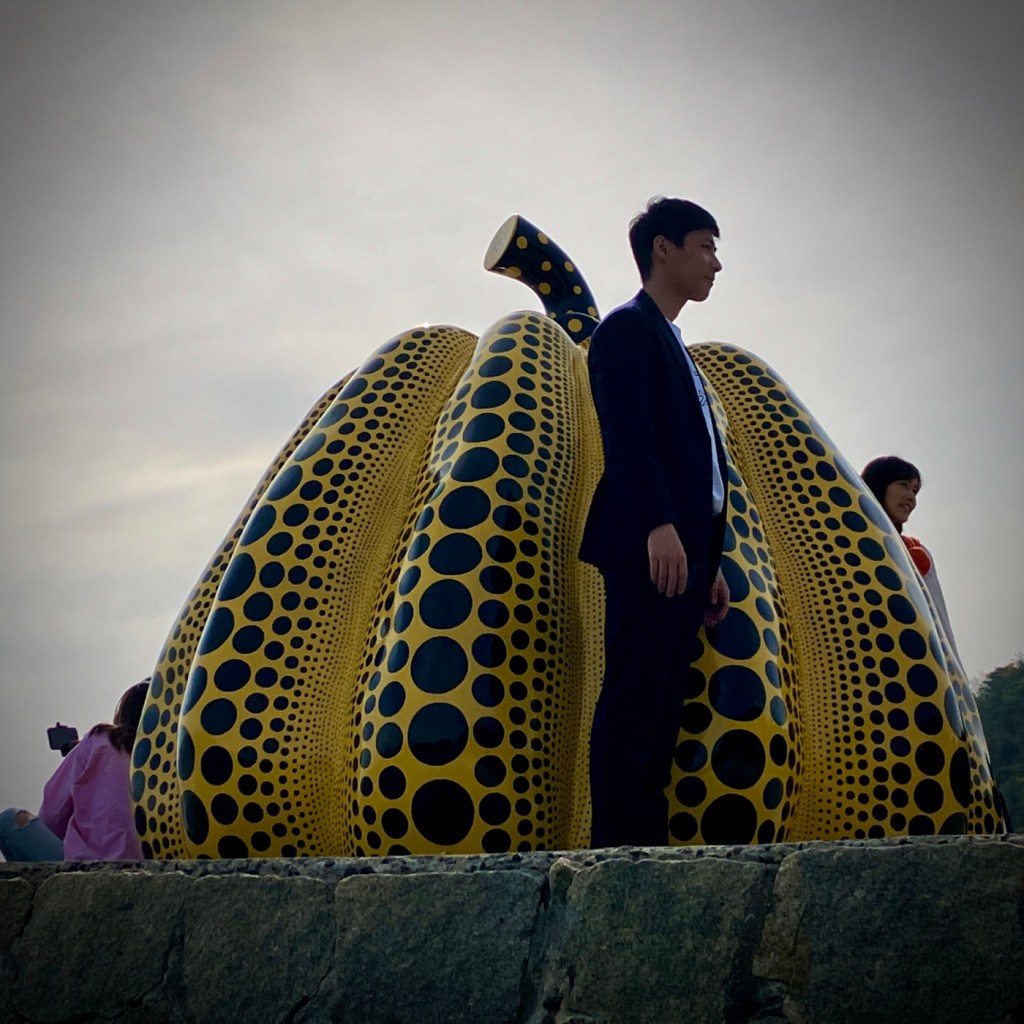
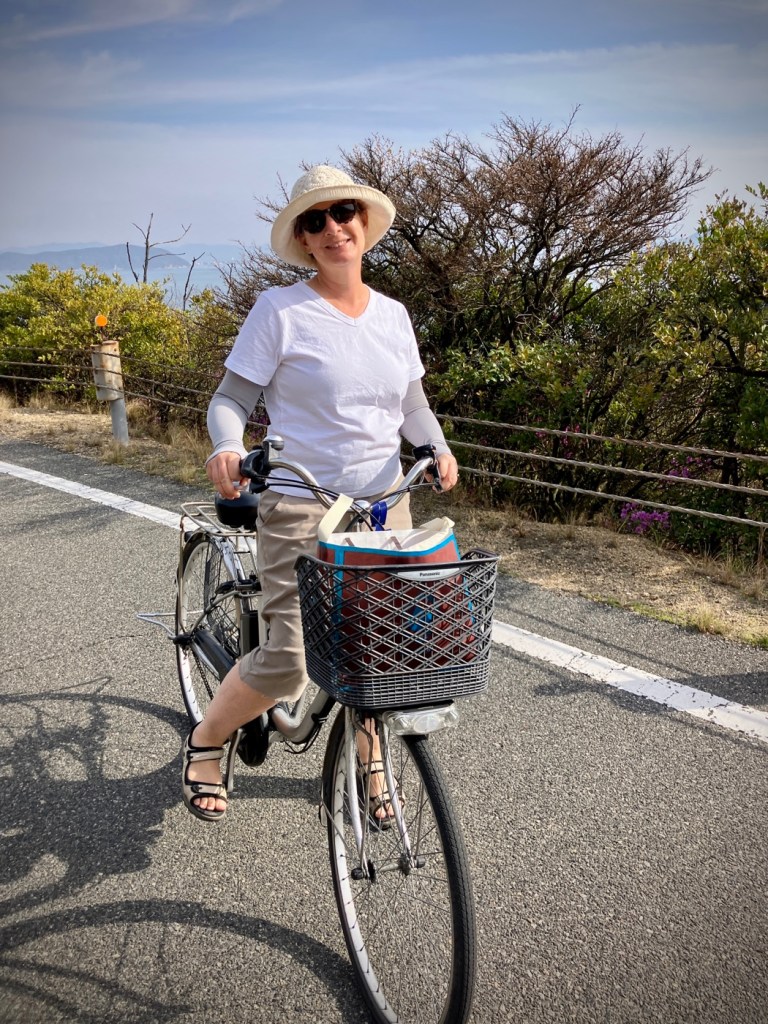
A Western-Japanese hybrid room in Shinabara. This hotel had lovely Onsen and Rotemburo (outside baths) and more spacious rooms than most urban hotelsNaoshima IslandInstagram of Instagramers on NaoshimaMore bikes to explore Naoshima…these with a bit of eboost
And big western brand hotels in major cities here often 2-3x as expensive as local alternatives for a similar (or better) product. Avoid them, unless you only have a week and a surplus of loyalty points to burn. (For example, during the Sakura of late March, Marriott properties in Tokyo ranged from $600-$2000/night!). Big waste of money.
Kochi on Shikoku is a bit off the beaten track but worth the effort for its friendliness Kochi’s famous seared Bonito (Katsuo) has ruined us for life for lesser fish. Delicious.
Another tip. Many western style rooms are cosy in Japan, at 120-180 sq ft, but if you book a twin instead of a “double”, the rooms are larger at 180-250 sq ft. They have two full or queen beds that can usually be pushed together. So you have a lot more space, often for just a bit more money. “Twins or Quads” seem to sell out first as locals know this too,
We found a small traditional house to rent on Naoshima Island. Wood and Tatami mats were a refreshing break from city hotels (and it had a washing machine!)Even a basic meal is pleasant in Japan
But as great as it is to travel here, it’s not all easy, as travel in Japan has its own breed of travel stress due to constant language and cultural nuances. And the country faces a battery of challenges, including rural depopulation, economic stagnation, and a location in an increasingly volatile region, just to name a few.
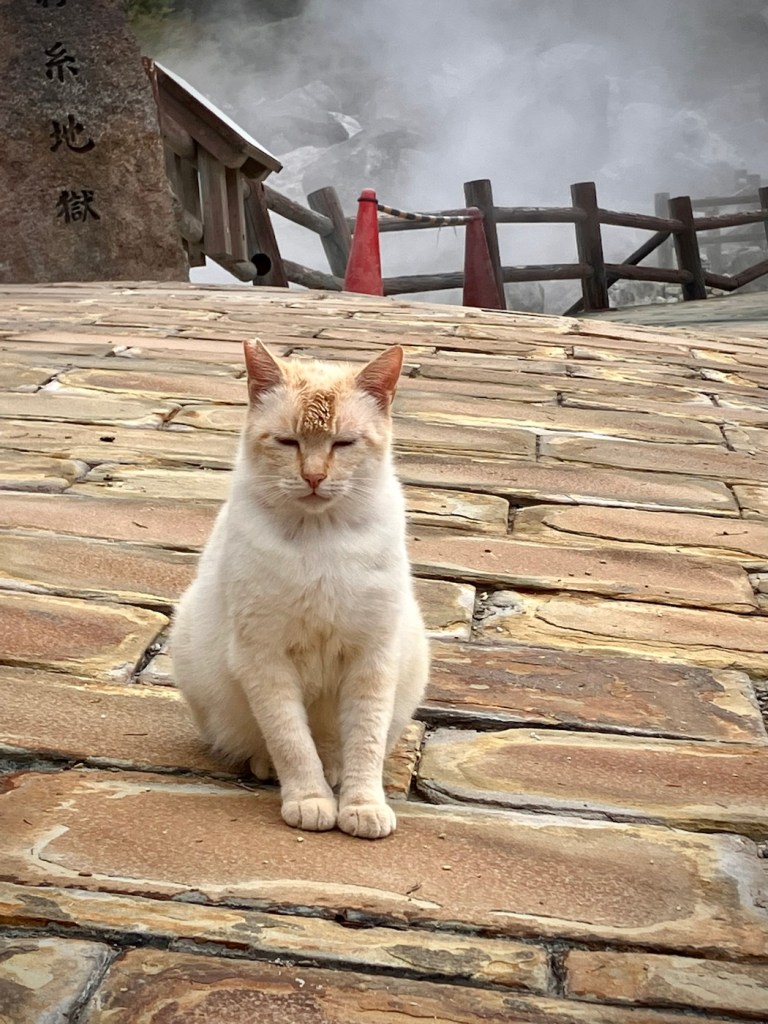
You have to open the doors to know what awaits you in JapanCats seem to guard popular spots such as Unzen National Volcanic Park, and are looked after by the locals.
But we are judging against a high bar, as we are already talking about coming back to bike tour, renting an apartment for a month in Tokyo, or even a car tour to see more rural sights that are tough or impossible by public transit. If you do want to rent a car in Japan you will need an international driver’s license.
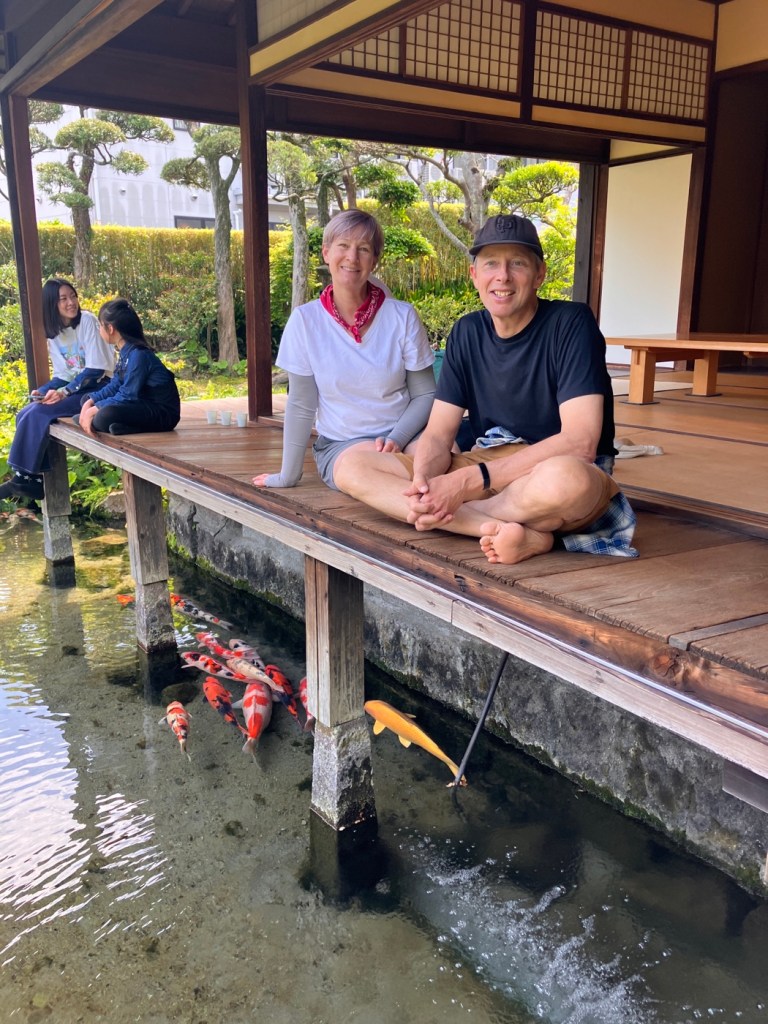
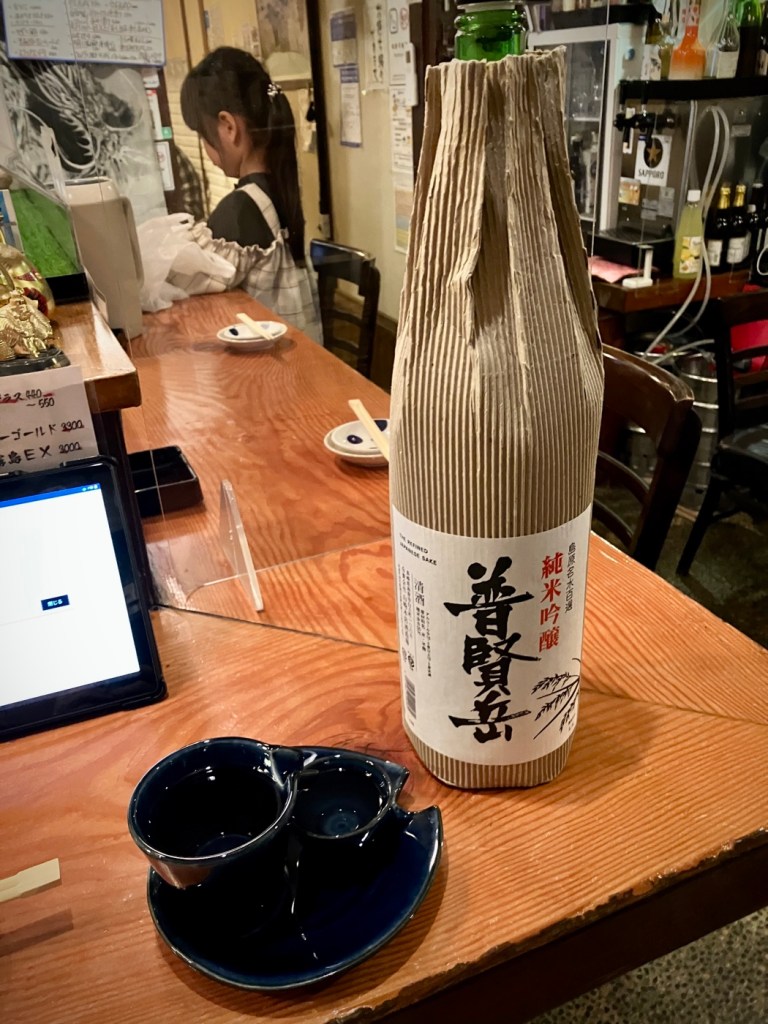
Zen, spring water, and Coi at a tea house in ShimabaraAlways ask for the local Sake as we did at this family run Izakaya in Shimabara
We are excited to head to South Korea next week, but first we are going to eat as much amazing food as we can in quirky and cosy settings, served by some of the most dedicated and friendly people in the world.
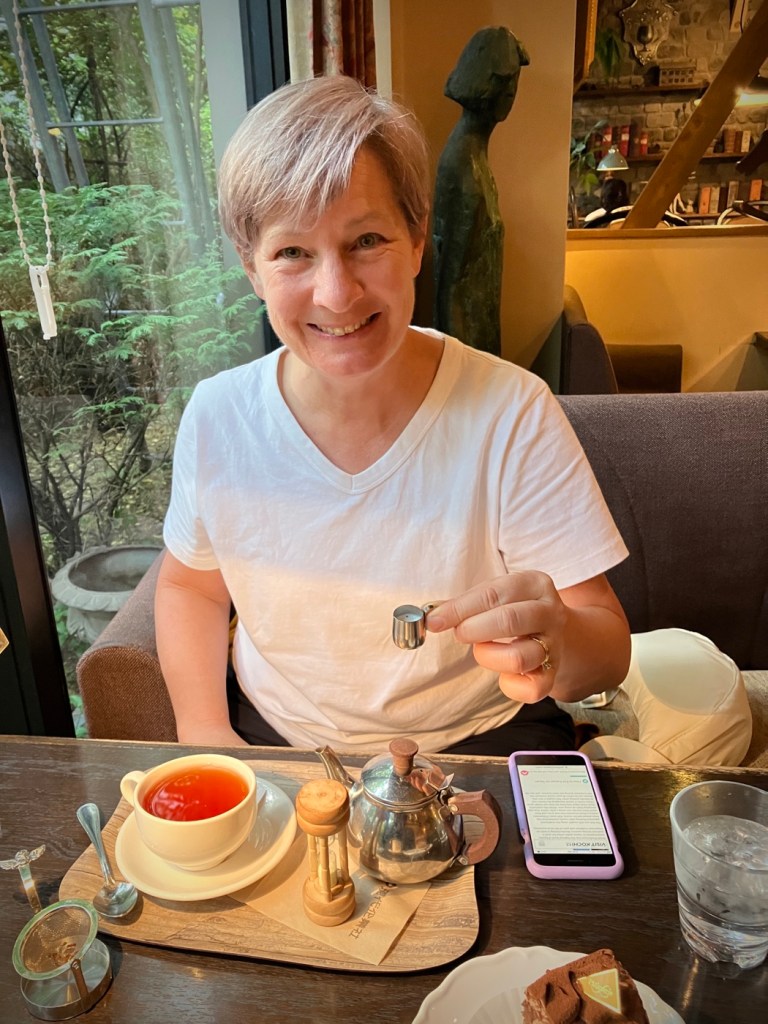
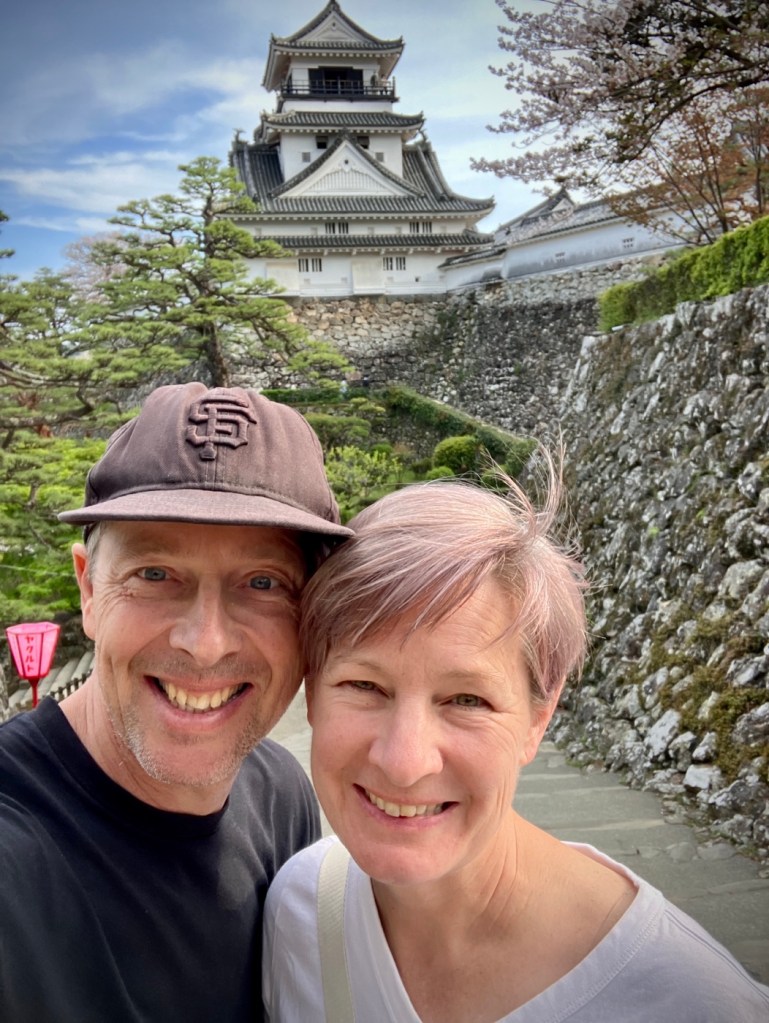
My favorite travel companion enjoying some cozy afternoon teaJapan makes us smile































































































 Less Car, More Life