Hiking along the middle fork of the Snoqualmie River.
Now that we have a home base again, what is it going to be like to travel? We spent four years with only a storage unit in California, so there were no worries about a house, or about things and stuff. We had with us what we had with us. It all got packed up and moved with us every time. A lot of thoughts and worries can now swirl around our brains. The house. The small garden. Our friends and neighbors. And, an even bigger worry is how will we be greeted in the world now that American leadership has lost even more international credibility and respect?
After seven months of no international travel – except one fun train trip to Vancouver BC – have we lost our nomad travel mojo? Well, we’re about to find out. We’re headed out for seven weeks of bike touring in France.
Cheese puff mimicking a rocky ridge.
One big thing we don’t have to fret about is boxing and flying with our bikes. Our wonderful Koga World Traveler S bikes are still in France at our ‘What Did We Do to Deserve Such Good Friends’ place. We don’t really have to worry too much about our home either, since another set of WDWDDSGF will be checking in on it when house sitters aren’t in residence. We don’t need any new vaccinations or visas. So, any real worry is all in our heads.
Every heart is a place where we’ve slept.
But the biggest cloud over our American heads is what our country is doing to the rest of the world and ourselves. We always bike tour with small American flags flying from our bikes. We know that everyone’s first question about travelers is “Where are they from?” The flags answer that question and start a lot of fun conversations with folks. This time we’re adding a No Kings flag to show our dismay over our current leadership.
No Kings.
We can’t hide our nationality, we don’t pretend to be Canadian- which is always silly but particularly rude these days, in light of how we’ve been treating our lovely neighbors to the north. We’re American. It’s obvious in so many ways. So, we’ll see how the conversations are going to be different on this trip.
Riding the Centennial Trail out of Snohomish. Trying to get myself in at least a little bike touring shape. That’s my new US touring bike. Rich is already in shape, he just has to practice waiting for me!After a final cold snap and snow, spring is here in Seattle. Cherry trees on the UW Campus are a good indicator of spring. Spring fever and cherry blossoms.
What is our basic itinerary? A fun meet up with friends in the Haute-Savoie, and sort out our bikes, then Brittany and Normandy, and Paris. The travel planner (Rich) has many ideas and tricks up his sleeve. And, since he’s actually had time to travel plan, bookings for the first week or two! Our usual fly by the seat of our pants travel isn’t necessary when he has time on a laptop to research and plan. His one client (me) has absolute confidence in him.
Headed to the Seattle airport on Link light rail.
So here we go! More from the roads of France later. As our SF friend BikeDave always said: “Have a nice ride home.”
Saarburg. Our first stop in our swing through Germany.
Saarburg Germany. The Venice of the Saar region. That’s what they say anyway. I’m not sure one river through town makes it Venice, but it was one of those towns that’s not super promising as you roll in, and actually had a fascinating and beautiful old part of town. The 15km long Leukbach River runs through the charming old town and meets up with the Saar River.
The Wasserfall Saarburg. Makes a lovely backdrop and sound for the restaurants and cafes. More impressive is the fact that this was a 13th century project to redirect the Leukbach River through town.The buildings rise right up from the river.The sound of the waterfalls and the cool air rising from the river are lovely.On our way out of town after a one night stay. That look says, can we just ride and not stop for photos every five minutes?Heading out along the Saar River. It was a calm morning, no wind.My dashboard. Many podcasts have been played on that Bluetooth speaker over the weeks of bike touring. Germany can be relied on for good paths linking you from city to city, town to town. We’re up from the river on this stretch by an industrial site.We headed up and over a hill to avoid a big bend in the river. Shortcut? Eh..it was steep so no real time savings, but what a view.Could this tree be any more classic and beautiful? Big sweeping limbs, check. Picturesque hollows offering tantalizing home for small furry creatures, check.Ah, the bike signage of Germany.Ah, the pastries as big as your head of Germany.
Since we spend so much time on bikes we entertain ourselves talking about bikes and bike infrastructure quite a bit. A lot. Ok, constantly! We had to detour off the river path to obtain that giant pastry and once again we were reminded that although Germany knocks it out of the ball park with bike paths connecting towns, in town is a different story. It was quite inhospitable in Merzig, the short ride from the river path to Bäckerei & Café Tinnes had zero bike infrastructure. The contrast with France, where so many towns have been given what we call the French City 2.0 treatment in town, with new bike and ped lanes and markings and calmed traffic, was dramatic. It was not an environment that would encourage bicycle use for errands and transportation.
Over the bridge to our destination for the night, Saarbrücken.Recovery beverages for the win!What’s the easiest bike parking? In our hotel room. Doesn’t happen often but boy it’s nice. Roll in roll out. In this case it was roll out into a steady rain.Never stop smiling. We’re headed 25k to a train station to take a hop to shorten the day.Off the train at Diemeringen and we’re back in France! Feeling sassy. Drinking Sassy French cider at a Breton crepe restaurant lunch break to avoid the storm.We don’t often stop for a sit down lunch, but we had hoped to hunker down and avoid the worst of the storm. Delicious crepes. Very friendly locals.The rest of the day cycling was a series of hops to shelter from heavy rain. Overhangs at town halls, under a barn roof, and this community park with a covered picnic area. The storm moved slowly across the region so we didn’t avoid much of it, but we managed to duck out during some particularly heavy bits.We rolled into Eschbourg and marveled at Maisons des rochers de Graufthal. These houses were built into a rock cliff and the last inhabitant died in 1958. It’s now a museum.
We were booked into Au Vieux Moulin hotel, in a former mill and with a highly rated restaurant. After hanging our wet cycling clothes over every available surface in our room we headed downstairs to dinner. We opted for a four course tasting menu with the wine pairing – get ready for loads of photos of food. With only a few weeks left in France it made sense to maximize our dining experience. This meal certainly fulfilled that desire. The most French of modern French meals we’ve had. We don’t dine at fancy restaurants often, but French fancy is more attractive to us since the service is very straightforward and not overwhelming. The French assume that everyone enjoys food, it’s not a big deal, just life.
First, an amuse-bouche before we even decided on the tasting menu.Presentation was amazing. For aperitif Rich had a local beer and I had glass of white wine.Fresh peas in a little crisp crust.Eggplant on sesame cracker.Carte Blanche à Guillaume. Here we go. A wine pairing? Yes please!Another amuse-bouche to welcome us to the tasting menu. The first course was trout from Sparsbach served three ways. Small steaks, an airy foamy mousse of fennel, white asparagus from Ferme Waechter, and ground ivy. Close to Rich a small plate of tiny fried fingerlings. Troutelle, they were called. Or troutlings.
Trying to pay attention to and write down the details of this meal gave me so much respect for actual food writers. Ground ivy, the waiter said, I dutifully wrote that down and only now looked it up: Glechoma hederacea is an aromatic, perennial, evergreen creeper of the mint family Lamiaceae. It is commonly known as ground-ivy, gill-over-the-ground, creeping charlie, alehoof, tunhoof, catsfoot, field balm, and run-away-robin. Thankfully I had snapped a picture of the full menu, since these courses, or sequences, are mostly represented on the menu.
The largest green leaves are sorrel. The wine pairing was a delicious Riesling.Get used to eating tiny flowers. The mousse was flavored with ground ivy.Barbecued white asparagus, paired with Cote du Rhone Amour de Fruits.BBQ white asparagus with pistachios and pith of citrus. Amazing.The squab course, served with Le Migmatite Gamay Sur Granit. Which translates as delicious red wine. Düwehof pigeon breast, thigh with giblets, porcini mushroom praline, green asparagus, stuffed morel and wild garlic, Mokxa coffee-infused jus. The wild garlic is the small dark lump, it’s cooked in a rice cooker.Pigeon thigh with giblets. Yes, very rich this course.The palate cleanser, rhubarb sorbet in a delicate apple and herb sauce.With the dessert course an elderflower cider, Cidrerie de Reillon Grégoire Jacquot Fleurs de mal 2023 • Pétillant de miel. Strawberry horseradish ice cream, and a white chocolate top. Sprinkled with little white flowers.And finally, more little dessert treats. Raspberry tartlet, and a small Financier Cookie.Chocolate truffles on a bed of cacao nibs. It was a good thing we’d been bike touring for almost 70 days and our metabolisms were running high.
We definitely needed a walk after that amazing meal, so we headed out into the misty moonlit night for a turn around town.
Eschbourg by night.The town church.The hotel and restaurant glowing in the gloom.The rain was over and we were ready to ride again.Crossing the Zinsel du Sud. Watched by a highland cow. Maybe. Are they asleep behind all that hair?We’re riding towards Strasbourg in the French Alsace region. I love the half timbered houses and steep gables. So picturesque. The hanging sign looks like an anvil, was this once a blacksmith shop?What the what? How cute are these musicians? Humba Humba Dederle Dederle. A striking stork against a stormy sky in Ernolsheim-lès-Saverne.Lunch along the Canal de la Marne au Rhin.It’s a popular canal for hiring boats and touring along.Which means we get to wave at lots of boaters and shout Bonjour!25 kilometers to Strasbourg. This cultural region of Alsace certainly has a sense of humor.The canal is taking us right to the Strasbourg train station.
Somewhere along the wet roads of the previous day, hiding from the rain, we decided that we were both ready to wrap this tour up and head back to our home base in France. Rich plotted out the fastest and most direct route: ride to Strasbourg, train to Basel and overnight, train to Geneva, ride to Annemasse and then up the valley to our good friends’ house. We were both looking forward to being in one place for a while before traveling back to the US, so off we went.
Train one of two to get us back to Geneva.Hooks to hang our bikes. You do need bike reservations and I think there were only four spots per train.Basel Switzerland train station.Riding to our hotel for a one night stay in Basel. The Rhine River.A border crossing, we stayed in French Basel. Saint-Louis actually. And yes the difference in bike infrastructure was dramatic once we crossed back into France. Oh, and hotels are about half the price of the Swiss side.Back to the Basel train station the next morning- not too early so we miss the crowded trains.A moment to celebrate the beavers, nature’s engineers. The scenery on the train to Geneva was stunning.Lac Léman and plenty of vineyards.The France/Belgium/Luxembourg/Germany/France/Switzerland/France portion of our final weeks of the trip.
We knew we’d be busy once we returned to the US, so a nice long 13 day break at our friends’ house was very appealing. The bike ride from Geneva to Annemasse is very easy, bike path the entire way, one night in Annemasse so we can ride up the valley after rush hour. It’s a great feeling of accomplishment to close our 70 day loop. We rode down the valley to start this tour, and now we ride up the valley to end the tour. In better shape, with even more appreciation of the countries we’ve visited, and looking forward to some days of rest.
Now that’s a bike path. Loads of regular bike riders commuting to and from Geneva.A fun beer place on a street being pedestrianized in Annemasse.Headed out. Final climb. Will the rain hold off?New lanes popping up everywhere!A climb with a stunning view.Finally eating a very well traveled protein bar. I insisted on eating it since it was about to also complete the 70 day loop.The rain did not hold off, but a playground pergola gave us some shelter.More new bike lanes!Bakery stop! Almost there.The neighbors’ cows provide a welcoming committee. Or at least a gazing with interest committee.Off the bikes and treated to a sunny day.
Our cat sit in Luxembourg was great for getting to explore the area, and with the free transit we keep raving about, we did explore. But, our big fluffy charge, the Maine Coon Cat, kept us on our toes.
She was allowed out on the balcony and roofline.She would do a circuit and return by the window on the other side.With scaffolding around the building however, she figured out how to get down to the ground.
Our hosts got messages from the neighbors alerting them to her escape via the scaffolding. After we tempted her back with treats and carried her in, we kept the doors and windows closed or cracked. There was a bit of hot spell so the house was stuffy and warm as a result. And yes, she managed to get out again, and yes, it was a kerfuffle, but we had some great hikes, fun side trips into Luxembourg City, and enjoyed cooking and watching a big screen tv.
The view from the Luxembourg City History Museum.A wedding dress made from the silk of an American parachute.Their 1945 wedding portrait. The human spirit endures. Imagine what trying times those were to embrace the future and go forward. Bravely.Statue of Charlotte, Grand Duchess of Luxembourg from 1919 to 1964.Luxembourg coat of arms.
Luxembourg City is an interesting place. The country and city are very wealthy, with the highest per capita GDP in the world. Its population of 681k people makes it the least populated country in Europe, and half of its population is foreign born. It reminded us both of Geneva, another capital of wealth and finance, with a similar feel to us of tidy, and calm, but not much in the way of organic city life with messiness and bustle. Pleasant, beautiful in places, easy to get around with free transit, but missing a sense of culture. Or, with a culture that is difficult for the visitor to find and appreciate.
Hike day! A short bus ride to Mersch and a quick stop to admire the dragon fountain, emblem of the town. And up into the hills on the well marked hiking and mountain biking trails.The sandstone rock formations were fantastic.Confused legs, what’s with the hiking – we usually just bike.OK legs, have a rest.The next day it was a train trip to the town of Wiltz.We had lunch and a wander around town.I love the old hanging signs. And a beautiful clock.Old and new hanging sign.The history museum had a big section on beer and breweries.And then back to our kitty cat on the (all together now) Free Train!Our bikes were feeling left out so we went out for a spin and a grocery store run.And to admire the catapult, or trebuchet, at Pettingen Castle.Carved detail of a dragon.The climbs in Luxembourg are not huge, but long sustained climbs with rewarding views. Oh, and sometimes very steep too.On our last day we took the bus back into Luxembourg City to have another look around.It was a quiet Sunday morning.It’s a beautiful old town.The Alzette River makes a horseshoe bend through the city.Is that a funicular? Is it free?Yes and yes. The Pfaffenthal-Kirchberg Funicular.Our cat sit was over and it was back on the bikes to ride out of Luxembourg and on to Germany which would be our fifth country of this bike tour.The cows of Luxembourg will miss us, I’m sure.This was the field where we stopped to watch and listen to skylarks. And we got a fantastic lunch spot. We call these BarcaLoungers.The signposts with so many routes!The Betzder Panorama Tour Shortcut!That’s Germany over there.We’re about to drop down to the Mosel (or Moselle) River, I have my downhill smile on!The Moselle River is the border between Luxembourg and Germany here.Right before we leave Luxembourg there is a bike repair station. Is it to prove to arriving Germans that Luxembourg is welcoming to cyclists? Or to wish you good luck on your time in Germany? Whatever the intent, very nice.A sad border shot. There was a constant flow of cars so no car free photo. Vineyards along the Moselle.The happy Travelers at the confluence of the Mosell and the Saar Rivers. Not the most dramatic confluence.
As it always goes on these long bike tours, we were both getting a bit burnt out. The cat sit was not as comfortable as we had hoped, but we did get to rest and recharge. But I was happy to bid farewell to that huge mess of fluff and attitude. We hoped a change of county would help, Germany and beer gardens? Will that put a pep back in our pedals?
After two amazingly easy and short train journeys from Paris, we were ready to get on with our cycling adventure.
Heading up into the central Ardennes of Belgium from France
The goal was to hit some hills and slightly different cultures after a lot of time in France. But we didn’t want to rush out of our adopted country of choice too fast, so started with a nice easy ride from the train to our first night’s lodging in Remily-Allincourt; all topped off by a surprisingly gourmet and pleasant dinner at our countryside hotel. But we really shouldn’t be surprised by a countryside gourmet meal in France anymore.
After our TGV to Reims, this lovely Grand L’Est regional train to Charleville-MézièresReims had some tight elevators but smaller Charleville-Mézières had really small platform elevators. I took stair rails down, while Cheryl opted for turning her bike upright in the elevator. By the way, a heavily loaded bike can slide out of control on the metal checker plate, especially if anything is wet!But hey, a new elevator up -:)
Transition travel days with a few train hops are always tiring, so I’ve learned to not plan too much riding on those days if possible. Just warm up the legs to make us sleep soundly. And of course, create some room for dinner!
Nice to be touring again after our 4 day break in Paris Where are we going? Briefly on the popular Meuse cycle route, now also Eurovélo 19.The history of WWII in the region still feels fresh and even more interesting as you traverse the same landscape as advancing or entrenched forces. So many buildings were occupied by the Germans and repurposed, while others served the resistance.Cleaned up and with our best shirts on for a Saturday night dinner at the Hôtel la Sapinière. Our usual French restaurant trick is I get the 3-course menu and Cheryl just a main plate, and we split appetizer and dessert.Cheryl looking fresh and lovely in her new shirt. I think splitting dessert was a good idea.
As we left Paris, we had the prospect of a week long cat sit in Luxembourg, and were both anticipating a video call that night to seal the deal, which we did! For better or worse, the house sit constrained our route a bit and certainly eliminated any options of heading further North. So we had about a week to cover a distance we could theoretically do in 2 days if needed.
We were headed to Libramont from Douzy, so had a choice of routes. We went left.The RAVeLs are a series of fantastic routes in Belgium, mostly on repurposed rail lines, and mostly paved.
But adding distance is never much of a challenge in the dense web of great cycling routes of the Benelux region. So we decided to wander a bit in the central and southern Ardennes and it was very rewarding, both in scenery and in fascinating history.
I wanted to see this beautiful rail viaduct near Bertrix, so we opted for a hillier route off the RAVel for a bit. Smiling at the top of one of the many climbs in the Ardennes
It was also tough terrain defined by endless rolling hills and steep river valleys. No easy going here, unless you find your way onto one of the nice rail trails or a free train in Luxembourg.
The pavement was smooth but a climb right out the door is not always appreciated.Very clear signage and markings in Belgium.
We love the way history unfolds as we ride through a new area. We now understand why people come to visit this area solely to revisit the WWII history. This area was occupied early by the Germans and then liberated by the Americans and other allies in the fall of 1944 as they advanced from the beaches of Normandy.
Climbing through commercial forests outside of Libramont. The drab monoculture was offset by the beautifully smooth new concrete path.The high point at an eye watering 560m! Ok, the Ardennes are not a high mountain range. But the buttery smooth pathway decent and rollers through lush mixed forests was a blast.Our favorite Gazpacho flavor currently; Tomato, Mint, and Basil
But Hitler’s last major effort in late December, 1944 aimed to split the allies in the middle of the Ardennes and crucially, isolate and take the strategic port of Antwerp. This is how the famous battle of the Bulge got its name. It seems the Battle of the Bulge has been rebranded as the Battle of the Ardennes to broaden its scope appropriately to all the stages of the war in the region.
The entire area was the front lines of the advancing Germans after the battle of the Bulge. Virtually every village had a story of war, occupation, suffering, destruction, more war, and finally liberation in early 1945.What are you looking at?More ups and downs on the way to La Roche, but the weather was perfect.A typical quick picnic lunch of luscious pate, healthy sweet potato hummus, cucumber, and seeded whole grain crackers.Our final approach to La Roche had miles of Beaver habitait along a small tributary stream to the Ourthe River.So it was not the best time to spot one of the diurnal European Beavers, but the evidence of their work was everywhere. like the trees gnawed and ready to fall, and many dams across the stream.Reattaching my bottom water bottle cage after a full bottle flew off on a fast and bumpy decent. I was lucky not to go down as I might have if it had gone under my wheel. Reminder, check all the bolts on the bikes!
A bit of a side note on our trusty Koga World Traveller S bicycles. Inevitably heavily laden touring bicycles have mechanical issues and require maintenance, especially drivetrains, brakes, and tires. We’ve both had our bicycles tuned up and overhauled once since their purchase 2 years ago, but at different times and usually spurred on by an issue. I had to get a new disc and pads for my rear brake last year in Salzburg, and Cheryl needed her brakes bled and refilled, along with new brake pads this year in Narbonne, France.
Thankfully, most shops will take some pity on touring cyclists and accommodate a fix into their schedules. But not always, and major work or overhauls sometimes are scheduled out months in advance.
Happy for a day off the bikes in scenic La Roche-en-Ardenne.Exploring the small and fairly charming La Roche, including the local cat population.Is this cat trying to escape from Cheryl?The local Charcuterie…the reformed pigs were a little creepy to me.
So after numerous flat tires before Paris, I felt my Schwalbe Evolution rear tire was near retirement age. I had a chance in Paris to get a brand new first choice tire (Schwalbe Marathon Plus 700×38) but opted to ride on as the tire tread still seemed ok to me. What I didn’t notice until on the way out to Gare d’Est in Paris, was the wobble in my rear tire. It had a small bulge. Too late to get that perfect tire replacement!! Ugh. And no open bike shops for a few days. And then I noticed a second bulge. So it was rideable, but a constant wobble feel and concern that it would finally blow out the side made my cycling way less fun for a few days.
Not the alps, but a good little climb to warm us up out of La Roche en route to BastogneSo nice on TOP of the ridges. And most of the roads here are so quiet. Trying to ignore the bulges in my back tire!Just proving Cheryl was still with me. She was climbing like a pro after 7 weeks on the bike!And ripping up the gravel!Some fun off road sections in the Ardennes, but it can be rocky and muddy. Yes, thank you for slowing for the nice black cat!
So luckily after 3 days of riding, my back tire kept it together and we made it to Bastogne and a nice, well equipped bike shop that had a replacement tire. Not my dream Schwalbe tire, but actually a wider 700×50 Schwalbe mid range tire. This is as wide a tire as our Kogas will accommodate, and it certainly does have a nice supple ride now. But lesson learned, right? And Cheryl keeps reminding me that she said I should have gotten the new tire in Paris… and Cheryl is always right!
This tank is dedicated to the U.S. 10th Armored unit who were the first to defend Bastogne in the Battle of the Bulge. They were soon joined by the famous 101st Airborne Division who have their own museum in Bastogne. About 50m from here is a monument to the nurses in the battle.The beautiful and dramatically located Mardasson Memorial on the edge of Bastogne.A strategic location to defend.The RAVeL Line no 163 runs from Bastogne to Gouvy just along the Luxembourg border and traces a critical front line of the Battle of the ArdennesAnd more cow curiosity; what are these crazy people doing on top of our ridge?!And this cute little guy (gal?).And did we mention it’s Spargle (white asparagus) season!!Our nice bike friendly guest house in Sankt Vith. Nice new rooms and a self serve bar filled with Belgian Beers. (Of course.)
Another interesting quirk of this region is the bizarre mix of languages and political boundaries. After leaving Bastogne, we headed to Sankt Vith, the cultural hub of the small German speaking region of Belgium. Germany wanted this region back from Belgium after both wars, but Belgium resisted and it remains a semi autonomous region of Belgium with about 80k German speakers. We noticed a unique feel here, not quite like Germany, but also not like the French or Flemish region of Belgium. They also seem to speak an old dialect of German and not cater to the multi lingual flexibility offered by most Belgians.
Cheryl trying out some local bike art next to a brief local history on the occupation, resistance, and use of the local farm houses during the war. Everyone and everyplace in this region was in the heart of the long struggle. Yes, we felt pretty welcome in this corner of the world.We were now on the Vennbahn for a while, a long distance route from Liege.As they refurbished the rail line, they discovered numerous bat species in the Lengeller tunnel. It’s closed to people now and they have turned both approaches into an informational journey. Bats are cool, so we were happy to divert.On the steeper pass road, we met these two nice young German guys out for a week of bike packing and camping.And swapped cameras to get pictures of the sticker laden border sign to Luxembourg.Passing under our first train station in Troisvierges, the southern terminus of the Vennbhn. I had to check out the nice departure screens and fact that all the trains and buses are free! All the time, everywhere. Very exciting!We arrived in sunshine to Clervaux, Luxembourg, and its beautiful church which looks ancient but was actually built in 1912.The Church of Saints Côme et Damien is just as impressive inside. Incredible quality and workmanship which was an effort to boost and promote Clerveux’s status as an economically successful village.The Clerveux Castle is in a dramatic spot on a bend in the Clerve River. It now houses a war museum and is permanent home to the Family of Man; a impressive presentation of 512 black and white photographs collected by Edward Steichen in 1956. Its focus on the commonalities of the human experience around the world felt especially poignant to us with Trump’s administration of uber-nationalism.A simple but effective monument to the American GIs who liberated Luxembourg twice from the Wehrmacht.And the townspeople cheering on their liberators.Waiting for our first FREE train in Clerveux, Luxembourg.Multiple bike cars, level boarding: and horizontal placement of bikes! (No hooks!!) Luxembourg spends even more than the Swiss per capita on train infrastructure.No tickets, no worry about missing a train. I think I like this!After our FREE train hop, a short ride today to our hotel near our cat sit. All on excellent cycle paths and routes. Have I mentioned all the trains are free in Luxembourg since 2020?!!Today’s ride was perhaps a bit too short so we had to kill some time along the river in our Chair Zeros.My first Battin, the de facto National Beer of Luxembourg. A pretty tasty lager with a malty and satisfying finish.
So we finally made it to Luxembourg (first time!), and so far, it’s been fascinating in its own right: unique languages, economic prosperity, and great infrastructure. But more on Luxembourg next time from Cheryl. Happy travels!
These nomads are still smiling and ready for our next cat sitting adventure in Luxembourg!
After quite a bit of countryside riding, with the food and lodging challenges taking their toll, we decided to just take a train from Limoges to…somewhere. Somewhere closer to Belgium which was on our want to go list. The easiest train from Limoges went to Paris, with just a few stops. Unfortunately we would not be getting on at the beginning of the run, the train was an Intercity coming from Toulouse. There was the usual medium stressful drama of getting the bikes and bags on the high boarding train, but two women, one taking her bike off the train, whom we helped, and another just boarding the train with no bike, both jumped in to help.
Two very nice Dutch cyclists whose names we failed to get were on our train. We had good platform chat and shared bike touring tips. They rode off to catch their connecting train in Paris.We headed to our favorite neighborhood in the 12th, our fourth time in this area, this time at the Adagio Apartment Hotel. Back to our favorite neighborhood bar, Bar & Beer Picpus.And to Le 217 Brasserie Restaurant for dinner.
The joy of being somewhere familiar. Other nomads will understand how pleasant it is to walk out your door and know where the market is, where the metro is, how to pay for it, and how to get to the fabulous greenway down the block. And, as an added bonus we have our Amis des Louvre cards and they were still valid.
Pichet of vin rouge.Somehow this was my first steak tartar of our time in France this year. Worth the wait as it was delicious.The street life in the 12th is wonderful. So much density, wide sidewalks, and folks who take their house cats out for a walk.A cheery shop window.A yummy shop window.This was the biggest and most curious missing cat poster we’ve ever seen. There were two attached to the front gate of a large apartment building.
Our Friends of the Louvre cards continue to more than pay for themselves. Once again we visited using the special members only entrance, and went to two of the special exhibits. The first was The Experience of Nature, Art in Prague at the Court of Rudolph II.
Hans Hoffman Hare.This work of art has a fascinating back story: Artwork recovered after the Second World War Provenance: Baudson collection, interior decoration (?), Paris; possibly acquired on 21 May 1941 by Jane Weyll, art dealer; auction Paris, Drouot, Baudoin, 16 December 1942, no. 41; acquired by Karl Haberstock, Berlin dealer, in 1943 for the Führer Museum in Linz, no. 2687; work recovered at the end of World War II; Central Collecting Point in Munich, 15 July 1945; transported to Paris on 25 June 1946; retained by the 3rd Commission for the Recovery of Works of Art and handed over to the Musée du Louvre on 22 December 1949 by the French Office for Personal Property and Interests; awaiting return to its rightful owners, should provenance research underway establish proof of spoliation or forced sale.
We’ve been to so many museums that display artwork still in limbo from WW2. It’s so moving to read the stories, and to see exhibits where remaining family members have made sure the work goes to a museum where it can be seen by the public, and the story of the family told, rather than disappearing into a private collection. The business of special exhibits also fascinates me. Imagine being able to put together an exhibit from not only the Louvre’s huge collection, but to borrow works of art from other world class museums to realize your theme?
Detail of animals from a painting by Roelant Savery, a Dutch Golden Age painter.
Rich and I decided we would have loved to been at the museum staff meeting where they discussed how to get visitors to venture into lesser known and less crowded parts of the museum. Maybe it was an intern who had the fantastic idea of placing 99 works of Haute Couture in the decorative arts wing?
Louvre Couture. Art and fashion: statement pieces.Very thoughtfully placed.Azzedine Alaïa, a Tunisian couturier who museum I visited with our friend Nancy on our previous Paris trip.It’s not just inside the museum that we spot works of art. These new 100% electric buses are worthy of admiration. I call these the Bubble Butt Buses. Are they coming or going? That is the rear of the bus.The push me pull you bus. Sadly we didn’t get to ride one, but I could see the seats in the rear were arranged in a conversation seating style.Sunset bus glamour shot! I used the clean up feature to remove a car from the photo which is why the bottom left looks odd.Bicycling in Paris is a blast. Rush hour can be pretty crazy but if you head out after rush hour it’s fantastic. You do have to be careful of the Parisian cyclists- they ride ‘em like they stole ‘em. Prepare to be buzzed with just inches to spare, and be super cautious when stopping at red lights or for pedestrians. You might get rear ended.Our own bikes! Without panniers. So light and fun to ride.Notre Dame, construction side.The front is construction scaffolding free.What a way to sightsee.Break for hot chocolate.A mini Statue of Liberty, or Liberty Enlightening the World, and Le Tour Eiffel.Riding closer.The bikes pose for their Insta shot.And merrily we go along home for lunch.And back out in the afternoon for a visit to the Musée Cognacq-Jay. During our last visit to Paris this museum was closed after a brazen robbery.The museum has an exceptional collection of fine art and decorative items.Cute dog enhance!Our final day was a lot of walking. We were over our intense tiredness and ready to put some miles on our feet. Cimetière du Père-Lachaise.What’s your one funny Paris tip? Ours is that the cemeteries all have public toilets. Caffeine and croque monsieur stop.That old photo bomber.New clothing! I ventured out for some shopping. Last dinner atLe 217 Brasserie.Goat cheese bruschetta and salad.Shhhh…don’t tell the French we bought our breakfast bread the evening before! Packed up and leaving the Adagio Hotel. I can’t take many photos while cycling in Paris. Too much going on and a valid fear of crashing.Gare de l’Est. We arrived nice and early, ready for the train dance.But wait! What’s this? Smiling cyclist? Empty platform?A very nice SNCF staff member saw us waiting with our bikes, confirmed which platform our train was leaving from, and let us on the platform early. I’m sitting and reading my book, the bikes and bags are stowed, and all before any other passengers arrive.The Happy Travelers celebrating a successful train boarding.
We needed that Paris break. To stop moving for four nights and rest. We slept a lot. We had breakfast and lunch in our studio apartment with kitchenette, and dinner out. After our month in Paris last year, four days felt short, but we knew our way around and had plenty to see, and eat. So we’re headed north now to the Ardennes and a few new countries!
Yes, we do stay in a lot of small privately owned atmospheric, charming, quirky places. But it can be a relief to check in to a corporate hotel. Here, leaving Bordeaux.
We love cities. When bike touring and when not on bikes. Public transport, loads of food options, museums, great people watching. But the countryside has a lot to love about it too: birds and animals, tranquility, beautiful scenery, quiet cycle paths and long stretches of empty roads with nice pavement. No museums but lots of history. There are the downsides too: not a lot of lodging options, even fewer food options – grocery stores and restaurants are a bit more simple, not a lot of choices. And those lovely roads? They go up and down a lot for no damn good reason.
Now that’s a bike lane on a bridge! And so much pedestrian space to the left. Pont Simone Veil crossing the Garonne River leaving Bordeaux.The first information sign of the day.Three routes converge on a partially sunny day; Eurovelo 3 is international, Route 80 is a French National Route and the last is a local route.Giant wine casks! 7,000 liters each.“Twin-foudre wagons. Built in the late 19th century, they were primarily used for transporting wine. The numerous imports from Algeria and Spain transited through Béziers and Sète.”
Stopping to read about the wine wagons led to finding this article about the Algerian wine industry, which of course led to a rumination on colonialism- as it does.
Repurposed rail lines are fascinating. Imagine all the wine that went through this tunnel.We are firmly in the Bordeaux wine region now.Buttery yellow stones and blue shutters.Wildflowers galore.The wine industry has created wealth for so long.Happily rolling along, looking for a lunch spot. We’re carrying our little chairs but it’s nice to find a bench with a view.A quiet riverside road in Branne, along the Dordogne River.Better know a French river, the Dordogne. 118 km long.More local yellow limestone buildings. And Rich.I love that this little dirt road has a name: Chemin des Grandes Bayches.Pastoral bliss and dramatic clouds. Getting close to Saint-Émilion, a very famous wine town.Which wine chateaux is this? No idea, but it’s sure pretty.The town of Saint-Émilion. Beneath that lovely skyline heaves a mass of tourists on this Sunday of open chateaux. Actually, it was only awful if you were trying to park a car. On bikes it was fine.We didn’t stay in Saint-Émilion, too busy. We headed to Libourne. On a bend of the Dordogne and at the confluence with the Isle River.
I took a quick dislike of Libourne riding in to town. It seems to suffer from ‘famous town adjacent’ syndrome. Folks were not friendly. Car drivers were downright hostile, and it managed to be both dead, with little activity in the streets, and hectic, with car drivers behaving as if they were negotiating a busy crowded downtown. It’s a difficult note to strike, dead but hectic, but they managed it. The first restaurant we went to, where our hotel had made a reservation for us, only had tall tables available. The last thing two tired cyclists want to do is perch on backless high stools to eat. We said no thanks and headed to the Vietnamese restaurant, the only other place open on a Sunday. It was quite good and with an impressive wine list. That must be expected in this area of famous wines.
The wind may have been adding to our crankiness. There was so much seed fluff blowing around that my eyes itch just remembering it. Leaving Libourne. Later nasty car drivers! Attitude adjustment at the hyper market on our way out of town – the Wall Of Gazpacho! My favorite cycling lunch. Who could stay irritable when faced with these cartoon-character-like sheep?Or this cute calf grazing in a vineyard?Joining the Voie Verte at Clériic.Quite a lovely color scheme going on, the luscious green and bright white.Fantastic dinner at the wonderful Le Domaine du Haut Preau chambre d’hote. Run by a Belgium woman who does everything just perfectly while being so welcoming.It’s a beautiful old farm building.Back onto the Voie verte Galope Chopine. We didn’t make it far before the first informational sign beckoned us.All about the folks who worked lighting the lamps for the trains, and who were usually blamed for any crashes. This gives you a sense of the detail on the trail side signs. In a world of neon cycling clothing, be the fuzzy pink sweater. Outside of Reignac. First lunch. Second lunch in Barbezieux-Saint-Hilaire, with a chateau view.The view from the wall of the chateau. You can see Congnac noted on the map.Châteauneuf-sur-Charente, where we spent one night in a BnB in an old old building. Full of old old furniture.But with a friendly garden cat! Hello kitty. Creaky floors and loud plumbing is forgiven.
A plus for small countryside towns is that the locals aren’t tired of tourists. We reliably get into conversations in small towns. Here it was with the restaurant owner who had moved from Chile decades ago. She told us about the fears of the US tariffs destroying Cognac sales, and by extension, the town we were in. She also walked us through the local dialect a bit – the name of which I cannot remember.
Cartoons by the town dentist. At the Beaujolais Nouveau party: “It tastes a bit of banana.” “A taste of cherry, no??” “There’s red fruit too.” Final snail “It’s a shame it doesn’t taste like real wine instead!” Local wine humor.“This is the only heaven where angels are not welcome.” I don’t get this one.Heading out of town to the riverside path called Le Velo Flow.The Charente River. I feel like we’re collecting French river badges. 381 kilometers long.It’s a beautiful river, with clean water which attracts swimmers, kayaks, and boaters.At Mosnac. Rich is grinning because I convinced him to ignore the sign saying path closed due to construction. Since it was VE Day the crew wasn’t working. It was a beautiful stretch of river.Time out for some artistic close ups of grape vines.How do we get anywhere, with all the photo stops?Our bikes posing for their glamour shots.Trois-Palis. We’re on our way to Angoulême, which we have just figured out is up on a hill.Such a fascinating town, Angoulême. Full of young hippy types, and hipster folks, against the backdrop of an old fortified city.
We noticed an animation school and did a little googling: Angoulême hosts 40 animation and video game studios that produce half of France’s animated production. Wes Anderson‘s The French Dispatch was filmed in this city. We were not imagining all the young arty folks.
Football being shown makes for a lively evening on the plaza.I was hoping for the Green Mouse sign to be lit up after dark, sadly it was not. But how cute is that little pipe smoking mouse?The town is on a plateau overlooking a meander of the river Charente, and has the nickname “balcony of the south west.”The gorgeous murals I saw climbing up to town, and didn’t stop to photograph, made sense given the city’s visual arts connection. Here’s one from our ride down.
Now brace yourselves for my new favorite river: the Touvre.
For starters; only 12 kilometers separate its source from its confluence with the Charente. Yes, a 12 km long river.It has four sources, four springs (Le Dormant, Le Bouillant, La Lèche, and La Font de Lussac, the most recent of which appeared following the Lisbon earthquake of November 1, 1755. Chronicles of the time tell us that “on the same fateful day, an underground noise was heard, and shortly afterward, the earth opened up, and a torrent laden with red sand flowed out (…).” This is from the trail side info signs.The Touvre has an average flow rate of 13 cubic meters per second. Experts will tell you that the volume of water flowing here is disproportionate to the surface area of its topographical watershed (which covers only about 100 km). Really, some seriously good info signs.So much learning so early in the day?
It wasn’t until the early 20th century that science finally unraveled the mystery surrounding the origin of this water (which allows the Touvre to double the flow of the Charente). Several explorations then established the existence of a system known to geologists as the Rochefoucauld karst.
Scientists discovered that a formidable network of underground rivers extends over 450 km beneath the Braconne forest and in the La Rochefoucauld region. It was gradually formed by the infiltration of rainwater into highly soluble limestone rock, and by the inflow of water from the Bandiat and Tardoire rivers.
The springs of the Touvre constitute the second largest resurgence in France after the Vaucluse fountain. And if you’ve read this entire bit you too have now earned your Touvre River badge. Congratulations!
The path only hugs the Touvre for half its 12km length, so off we went on Eurovelo 3, la Flow Velo, Tour Charente, and one I can’t even read. Again, just amazingly detailed history signs. Our average speed was going down down down with all the stopping and learning.Tiny little tunnels that ran under the rail line originally for small tractors and livestock.History- the line of demarcation.Separating free France from occupied France in World War 2.Really, how can we get anywhere when there is so much to learn, and then we need to stop to eat.Peppers and cheese on crackers today. And cute dogs to snuggle. This is Cola, his owner, a lovely Irish woman, had been living in France for over twenty years.More stops for artsy photos. More up and down roads where the rail trail, the Velo Flow, couldn’t follow the rail line.An old mill which powered the forge which made cannons for the French military. Nontron, our destination for the night. How do you even keep a building this old standing?Another quirky, cold, not super well run lodging.The Velo Flow crossed over a newly restored trestle. Nontron has some tourist gold with this bike path and a lovely town.Nontron on the hill. Back on the bikes! Ride! Oh wait, divert to cute cafe in Saint-Jean-de-Côle where the town was prepping for a flower festival.Delicious cookies at the Pink Elephant Cafe.So many pink elephants.Ready for the festival.On the Côle River another lovely house.Carry on! Headed to Jumilhac-le-Grand for the night. Highly rated BnB, two restaurants in town. What can go wrong?Both restaurants closed. We threw ourselves on the mercy of the one bar open, not serving food that Friday night, and the lovely proprietors fixed us what she claimed would be a very simple meal. It was lovely.The group of ex-pats outside the bar happily absorbed us into their evening drink and chat and we spent a pleasant evening.A view of the privately owned Château de Jumilhac and gardens. Imagine keeping that repaired and running.It’s a beautiful town, Jumilhac-le-Grand. Us after going from thinking we can choose between two restaurants, to pleading for food from the one place open. But again, lovely lovely people.Leaving Sous le Chateau Chambre d’hote. Very comfortable, very well run.Out of town up some more hill under the watchful eye of the school cat.And this stallion who looked like he was spoiling for a fight.
Just after this handsome horse there was a field with a huge bull standing very close to the road with his herd of ladies on the other corner of the field. At first I could see no fence at all between me and him. As I got closer I could see one single strand of wire – electrified? Maybe? The wire barely came up to his chest. I wish I had a photo, he was like an anime cartoon bull, so muscle bound and very angry looking. I was way too nervous to stop, seeing Rich riding away in his red cycling jersey made me think this bull was not up for photos.
Our favorite sign of the trip. Richard the Lion Hearted Route.Who are the friendliest cyclists? The Spanish! We saw him twice in one day (failed to get his name), he was headed to Limoges that night, we had one more night on the road to Limoges.Downside of road riding, not many places to stop for a picnic lunch. This shady wall came through for us. Flavignac. It’s on a Camino Route. It’s on a bike route. The one new Chambre d’Hote will probably do quite well with a steady supply of hikers and bikers.I love the color of these roses. An easy walk into town along a small lake. What had been part of the owners barn was now accommodation.Breakfast greeter. We had a short day into Limoges so we tried to wait out the rain before heading out.What rain? Said the cute dog.Breakfast was pretty slim so we were tempted by the pizza machine. But heavy rain and no shelter made us decide no.Limoges! Arrived in the rain. Got a chance to walk around.We stayed for two nights, which was honestly one night too long. Other than the porcelain museum, Musée national Adrien Dubouché, which had an extensive collection of pottery, there was not a lot to recommend Limoges.A cute old town, but it was quite small, and ringed by unpleasant roads. Awful town in which to be a bike or pedestrian. On a hill. Long traffic signals. No bicycle infrastructure.So off we go! To the very dramatic train station. To catch a train.To Paris!From Bordeaux to Limoges. Each heart is a place we slept.
We cycled for 8 days with no day off. Taking a day off in a small town, at a little pension or BnB isn’t super easy or interesting. But moving every day for 8 days isn’t easy either. It can make travelers cranky. Every morning as we pack up our panniers it seems like one of us packs something in the bottom of a pannier that we actually wanted out for the days ride – rain gear, seat cover, leg warmers, something- if we manage to get going without one of us having to reopen a bag it’s a miracle! And, the amount of route planning and lodging research that Rich puts in for each day is significant. He’s constantly adjusting his plans and figuring out where the grocery stores are that are on or close to the route. To go back to a familiar place, like Paris, is such a treat.
The happy travelers back in a city.Spring 2025 tour so far. Up next, four days in Paris and on to…?
Infrastructure like this makes us so impressed with France. Obviously new, and so wide with a lovely surface. On our way out of Saint-Jean-de-Luz.
We knew the weather was changing. And boy did it! We woke in Saint-Jean-de-Luz to heavy rain. Nothing to be done but put on rain gear and hit the road. It was Saturday am and the hotel rooms that were available in this beach town were quite expensive, so on we went after a one night stay. A quick stop at the grocery store for lunch food and I did stop myself from buying espadrilles from the colorful display inside the Carrafour City grocery store, but only just. Absolutely no room in the bags for another pair of shoes.
Hiding from the rain in the vestibule of a Church in Ascain. Rich went inside and told me I had to go in to see the cool wooden balconies.It is a traditional Basque church. Église Notre-Dame-de-l’Assomption de Ascain. The wooden galleries were new to us. We later learned in the Basque museum in Bayonne that they were added to accommodate the increase of population, and so women and men could sit separately. I imagine there was much making eyes and flirting going on across the way.Seafaring was an important part of Basque life. I love the model ship with its wee Basque flag.Churches with covered porticos are much appreciated. But, time to leave the church and head up another hill. With another helpful/motivational sign. 5% grade. This was the second segment after a starting 7% pitch.We topped the climb and the sun welcomed us to the downhill.Whee! Pay no attention to those big grey clouds.Focus instead on these fascinating stone fences. Walls? Enclosures?Flat stones lined up one after another.Whoops. While we were focused on the stone fences the clouds had their way.The little stand across the square was selling Gâteau Basque.The houses had a look to them in this French Basque area, the Pays Basque.White render (a surface coating), half timbered, and trim and shutters in the emblematic Basque red or green. The carved stone lintel usually tells the story of who first lived in the house when it was built, this one in 1662.Blue shutters and wisteria. This is in Ainhoa where we spent the night in what we shall always refer to as “dead mouse room”. No body was found but the smell was pretty recognizable. Staff was apologetic and thankful we didn’t pitch a fit. Eh, we said, old buildings have their challenges. We left the window open, they comped us wine.Stone fence AND a 1670 lintel stone! Pays Basque bingo anyone?Not many photos on this rainy Sunday. We’re trying to get to Bayonne in time to visit the museum of Basque History.Riding down the Nive River to Bayonne.Fragments of the old town walls still exist.Rich demonstrates how narrow some Bayonne buildings are – just about a Rich and a 1/2, about nine feet wide.We made it to the museum. So much information. If you don’t speak or read French it’s a bit of work to figure it all out, but worthwhile. A really picturesque town, and very lively.More bits of the ancient walls.And one of the few towers still standing. This was the executioner’s tower, now a private residence.The Nive river is running fast and high from all the rain.Narrow streets in old town.Bayonne in the sunset light.Looking down the Nive, towards the confluence with the Adour River.The look of a cyclist who knows she has a long day ahead of her. At least no rain! And we’re off riding out of Bayonne.Into the scrubby forests of the Atlantic coast.And the wide sandy beaches of the Capbreton area. We are still on the Bay of Biscay.Sand dunes and blue sky. A welcome change.Still smiling. Long day and headwinds haven’t gotten us down yet.
And then the photos kind of stop for the day. After about kilometer 60 or 70 I just focus on pedaling.
It was a lot of this. But at least the weather was nice! We made it! Giddy with relief and post shower. 90k/55m later. Contis les Bains and our long shadows on the beach at 8pm.The main drag down to the beach is packed with folks and noticeably car free. Space for restaurant and bar tables instead of parking.The Contis Lighthouse.If you weren’t on the Main Street you were up on the dune watching the sunset.Sunset, happy humans, and a weathered fence.And the next day we’re off again.
The reality of bike touring is a lot of packing and unpacking of panniers. We each have two back, two front, and one handlebar bag. Good times. When you have so many one night stays it’s a lot. But, it all came out of the bags so it must all fit back in, right?
More Atlantic coast scrubby pine forest riding. This long stretch of bike path was just a dream. Lovely pavement, nice swooping curves.Take a break. At the grocery store. Big shaded entrance so why not relax?Riding by one of the lakes of Biscarrosse.The sunsets! Biscarrosse Plage where we spent the night.Breakfast fuel up for another day riding.The campgrounds were filling up on this Wednesday, April 30th. Folks ready for the May Day holiday.The terrain is about to change. Giant sand dunes! Folks practicing paragliding.Dune du Pilat in the background. Happy beach goers and a slightly cranky cyclist – this part of the coast is getting very busy. A long weekend and nice weather means lots of people out.Pour some more coffee in him! That might help. And tea for me. We’re in Arcachon, very close to where we will spend the night.The beach stretches were fascinating. Boardwalks and such a mix of old and new buildings.
Rich wisely booked us out of the fancier beach area and in a more relaxed area of the fascinating Arachon Bay: Gujan-Mestras. Oyster heaven.
The oyster cabins. They serve oysters and wine. That’s it. The potholes in the dirt path are filled in the oyster shells.One of the seven ports of Gujan-MestrasA friendly cat helped us enjoy the sunset.On the jetty looking back towards the town.Celebrating the night before the May Day holiday. The barbecue is raging. Couldn’t tell if they were barbecuing oysters or other seafood. Or hamburgers.Tools of the trade.So many oyster shells. In most areas they are returned to the water to give the larvae of the next generation somewhere to hold on.Kitty showed up again to drink at the doggie bar.Port Larros, farewell.We’re off to Bordeaux for a much needed break. Three nights! We expected this road, Avenue de La Cotê d’Argon (D1250), to be an unfriendly bike route. But look! New cycle path! Not all the way but along a lot of it.May Day is a workers’ holiday, like Labor Day in the US, but way more widely celebrated. Little posies of Lilly of the Valley are sold at small road side stands. La Fête du Muguet (Lilly of the Valley Day).Why? In 1561 King Charles IX of France was given a posey of Lilly of the valley flowers as a present on May 1, and a tradition was born.Vineyards just outside Bordeaux. We hear they have good wine here? Who’s a good boy checking into the hotel? And sporting the French dog collar du moment – very wide. A huge bricolage, or flea market. I’d call it an antique market. Book a container and ship it all home…oh wait, we don’t have a home! Chicken pitchers!A bottle drying rack and enamel ware pitchers.Rich checking prices on bottle drying racks. Bassins des Lumières, a WW2 German constructed submarine base now a light show exhibit.Place de la Victoire has two stunning creations by Czech sculptor Ivan Theime to celebrate the culture of wine.First, the mama and baby tortoises. Rich added for scale. I didn’t realize how lucky we were to get a photo free of other people- ok, kids. Mama tortoise is eating grapes.And she is festooned with little figures, also holding or wearing grapes.The red marble obelisk, same sculptor. Makes an imposing focal point to go with the more whimsical tortoises.Since returning to France. The top heart is Bordeaux. We had seven days of riding, which explains why we were so tired when we got to Bordeaux.The tired happy travelers enjoying a tram ride in Bordeaux.
Next up, some pretty rural and remote riding through the French countryside, roads that go up and down for no good reason, and a train to Paris.
We both had been looking forward to coming back to San Sebastián. We visited two years ago while walking the Camino with Christine and Cecily and did a fantastic food tour that helped us all learn to love Pinxos. Not that much help is needed, but the scene can be a bit intimidating. Here in San Sebastián they prefer that you pay as you go, order drinks and pinxos and tap your card to pay. In less busy towns and cities you could pay once you were ready leave. When the popular bars open there can be quite a rush of folks piling in.
Stop one on our first night, Bar Txepetxa. A rather famous bar with photos of famous people on the walls.Antxoa con jardinera. Anchovies with jardinera sauce, peppers, and onions. Gildas: anchovy, olives, and guindilla peppers. Piquillo Peppers Stuffed with Tuna (Pimentos del Piquillo Rellenos de Atún).It was a bit crowded so we moved on. Hungry from the ride. Need more Pinxos. Loads of youngsters outside, let’s try this one!Belfast Irish Tavern! With Pinxos, of course.Two boccadillas and another round of drinks.A stroll around old town to keep our appetites up and admire the graffiti. “The fire you light lights the way.”Probably the same food tour we did two years ago, Mimo Bite The Experience. An excellent tour.Bar Martinez. We scored two bar stools at the side counter which meant we got table service. It was nice to have a menu to order off of. (We ate more than the stuffed peppers)La Viña. Our final stop of the night. We had a nice conversation with the Spanish couple to our right after Rich copied her red wine order – it was excellent and we thanked her.La Viña is famous for their Basque cheesecake, left. Anchovies on the right. Don’t get those two confused.Basque Cheesecake. Our final dish of the evening. We over ordered and had two plates with two slices per plate! Time to waddle back to our hotel.The street scene in old town is lovely and relaxed.Through the decorative railing along the promenade.This guy makes art in the sand. You throw coins onto the white sheet to show your appreciation.On our first rest day we walked a lot and visited the small maritime museum which had a decent history of Basque seafaring history and a cute exhibit about animals on board ships.
On our second rest day we had a bus failure trying to get to an outdoor sculpture park. On line info was not just confusing but incorrect. There are two bus providers in town and we walked around searching for the stop for the bus that would take us right to the sculpture park. Fail. Asked people. Fail. Finally found someone who helpfully pointed us towards the stop, on a totally different street! and we watched the bus roll by since we were a block away from the stop. Schedule wrong. Next bus probably in 45 minutes. When Rich can’t figure out a bus system you know it’s confusing. So we walked around town, took a small community hill bus and had a lovely conversation with a young woman who grew up in San Sebastián but now works as a nurse in Edinburgh, Scotland.
Dinner in our neighborhood at La Cervecería del Antiguo. It’s fun to try a neighborhood place and enjoy inventive Pinxos. Baked confit tomato with sheep cheese flakes and walnuts.Gamberro bluefin tuna tartare and pulpo.Heading out to ride to Saint-Jean-de-Luz, France. Only thing between us and France is another big climb.Not every mile is beautiful and picturesque. I try to remember to take photos of the less glamorous parts of a ride. Turning up the road to the Jaizkibel summit.The spine is the Jaizkibel mountain range. Our climb started in Lezo and had a gain in altitude of 455 m (1,493 ft) over 8.0 km (5.0 mi).Fueling for the climb with chocolate milk.
I never seek out climbs, but Rich loves them, and I’m never daunted by them. I say my spirit animal is a Shetland pony. I’m not setting any Strava records but I’ll get there eventually. Rich waits at the summit. So, big climbs are not a deal breaker. This one was again made fun by the Basque road cyclists. They are the nicest riders ever. I don’t think a single one went by me (me as if I was standing still and them in their sleek cycling kits) without a greeting. And the work crew chopping back vegetation for which traffic was held one way at a time? The guys in their fluorescent yellow with safety googles and gas powered weed trimmers and chainsaws? My personal cheering section as I ever so slowly rounded a hairpin turn.
And this is what I was wearing. Pink flowery top and a straw hat helmet cover. Sandals. Sun gloves. Hilarious. Rich waiting, not at the summit yet, but up the worst of the climb.At the summit. The view back to San Sebastián. Saucy riders! What a beautiful day we got. Rich and the summit sign. King of the Mountain! That’s my downhill face. Big smile.I like the signs put up to inform cyclists how steep the road is. Motivational?Mountain bikers, road cyclist, and faint words on the asphalt from the Clásica San Sebastián road race.A shade break at the Hermitage of Guadalupe. Familiar to us from our Camino which started in Irun, just down the mountain.Down we go.Rich points to France!Across Etorbideko Zubia, the bridge over the Bidasoa River, the border with France.We give the nod to France over Spain for bike infrastructure. But Spain wins for super nice cyclists and considerate car drivers. Hendaye, a sunny day at the beach before the storm blowing in. Still fascinated by these sheep.And how cute is that lamb?Over another hill. Coming into Ciboure, the town before Saint-Jean-de-Luz where we’ll spend the night.More beach goers. It’s a Friday and this weather is not going to last much longer.The happy travelers overlooking the Grande Plage of Saint-Jean-de-Luz. Our Basque horseshoe. The blue dot is us in France again. We’re actually still in Basque territory, French Basque.Celebrating with pizza right before the wind blew in. All the other outdoor diners headed inside. The next day’s ride will be a bit wetter.
So did we enjoy our Spain bike tour? Yes! The Coast around Barcelona was not our favorite, as we’ve explained we both avoid hot weather and I’m about as sun phobic as they come. I think we just hit the right season for us, any hotter and there would have been epic meltdowns. And, as I’ve repeated, Basque cyclists are so welcoming and friendly. Spanish car drivers are among the best around cyclists, maybe the Swedish are just a bit better but that’s also due to better cycling infrastructure that gives bikes their own space. Spanish car drivers behave admirably well around bikes even without much infrastructure. Food – yum! Late dinner hours – eh, we adjusted and slept later than we usually do. There is no fighting local customs. All in all a lovely small dip into Spain. And now we are even bigger fans of the Basque Country.
One is amusing, two is a trend. Rich in front of the second Spanish town sign we found.
The drill when we arrive in a new town is as follows. Roll up to the hotel, Rich goes inside while I get the bikes ready to go stay wherever they will spend the night- garage, storage room, corner of the lobby, or occasionally our room. I empty the water bottles and stuff them all in one of my front panniers for easy carrying so we can rinse and refill for tomorrow. Rich checks us in, a new rule in Spain makes this longer than we think it should take. Not just scans or xerox of the passports but address, names, and signatures on either actual paper, or a tablet form. We haul all the bags to the room, frequently at the end of a loooong hallway, dump bags, shower, wash out the days’ cycling clothes and drape them all over the room to dry. If there is a heated towel rail we struggle to figure out how to turn it on to sped up the laundry drying. Chill for a bit then head out.
After a quick early (by Spanish standards) dinner we head to the procession route. It’s Good Friday. We stake out a spot right at a turn.Charmed by the children in the procession. Note the thorny crown with small Jesus on it.I guess due to the hill on which the Cathedral sits, these floats are on wheels. The other two processions we saw were not wheeled.As the darkness came on, the drama heightened.Even without understanding the full meaning, these processions are powerfull.I spend some time imagining everyone ironing their robes and fretting over which shoes to wear.We got a glimpse of snowy mountains as we headed to our Cathedral tour the next morning.The old cathedral tried its hardest to fall down and the tour of the restoration is just amazing. Thank you for the tip Hannah! Another city, another pretty chocolate shop. A sculpture by Juan Jose Eguizabal “El Caminante” The Walker.“The Bullfighter” by Casto Solano. A popular spot to sit and snap a photo.Dinner at a gem of a restaurant near our hotel, Restaurante asturiano “El Chigre ALI13”. This is a cachopo. An Asturian dish of pounded veal stuffed with ham and cheese.What and where is Asturia? Another autonomous region of Spain.
We had never really heard of the Asturian region of Spain. This is our favorite part of travel, finding out about all the things we don’t know. As we headed into the Basque countryside on our bikes we would come to see and understand how different the culture is. At one point we said this is foreign on top of foreign!
Leaving Vitoria-Gasteiz, Easter Sunday, on a colorful trail through an industrial area.Quickly it got rural.Rain and a junior pro bike race. Rich started chatting with Mikel, a local cyclist, and he filled us in on the race and rode us down the big hill for coffee.Our first taste of how friendly and welcoming the Basque cyclists would be. Thank you Mikel.
Even though it was Easter Sunday and we assumed most places would be closed the cafes were open until 2 pm, at which point everyone headed home for Easter lunch with family. We were glad to meet Mikel for many reasons, and I was so happy to have him explain to me that what the road cyclists were calling out to us was “Opa!” which loosely translates as “go up” in Basque. I’m not sure I have the spelling correct, but once I learned that did I call it out to almost every cyclist who passed me on the climbs? Yup.
We said goodbye to Mikel and headed towards Bergara. More tunnels.And stunning new infrastructure too. This is a train trestle.Crossing the Deba River going into Bergara.One of the many beautiful buildings in Bergara.
It is Easter Sunday and we were wondering if anything would be open at all. Would we be able to find a drink and dinner? Answer, yes! The bars and cafe were all open and restaurants were opening up for dinner at 8 or 8:30. We joked that Easter Sunday in Spain shares a tradition with Christmas Eve and Day in the UK – go get a drink. Or a few. On our ride to Bergara I passed a group of young men standing outside a bar smoking and drinking. Oh fun, I thought, my favorite- young dudes drinking. I was greeted with Opa! Fuerte! Hola! and then Hello! when they saw my American flag! Where are you from? A quick exchange and they waved me on my way still cheering. Not what I was expecting at all.
We’ve learned to adapt to Basque time. Pinxos and a drink at 6:30, after a 6:00 paseo (stroll) around town.Our 8:30pm reservation – the earliest we could get. We are the only ones in the restaurant for at least 30 minutes.We’re finishing up at 9:30 and folks are just arriving and ordering drinks.An after dinner walk around town. The lighting was so atmospheric and town so peaceful.The rain soaked cobbles made for an extra pretty evening.Ready to go the next am. We leave our hotel and immediately start our big climb of the day, up to the Elosua pass, 681 m/2,234 feet.Ready to climb? Starting at 160 meters for a 510 meter climb with loaded touring bikes.What a dramatic view.What a tough climb.There’s Bergara, 30 minutes into our climb.An hour into the climb and Rich finds a bench to wait for me.Now we’re seeing other cyclists. Not many bike tourists on this pass (none) so we get loads of hellos and opas!Photo opp or screaming legs break?Clouds are coming in and another view of town, to the far left you can see the train trestle from the day before.Rich had enough time at the top waiting for me that he set up a chair! He graciously gave it up for me once I arrived. My time was two hours up the climb. Not setting any Strava records, that’s for sure.The king of the mountain.Starting down on smooth asphalt. A hint of rain coming on.There is a little tiny Rich in blue. He’s off like a rocket sled on rails.A turn onto a smaller less smooth road to connect us to a rail trail.Another stunning church spire. And onto the Via Verde del Urola.Wildflowers against blazing greenery.Lunch stop in Azkoitia. Iglesia Santa María la Real de la Asuncion. The view down the Urola River. I love how folks hang laundry out the windows, but I would worry about wind taking my clothing and flinging it in the river. Good pegging skills I guess.The wisteria on this riverside building. Dramatic. It was so nice to know we’d find water taps.This was a first. A bike wash station. Just as we headed out of town.Our bikes needed it. They were still showing signs of our muddy Pyrenees crossing and gravel riding in the Navarre.So shiny and clean!
Our audience while at the bike cleaning station was a young mom and her tiny son on his scoot bike. He watched, fascinated, and his mom obliged him by spraying off his little bike when we were done. My Spanish is quite basic but enough to start a conversation, and the little US flags again did their jobs and she switched to excellent English for the rest of the chat.
Hanging with the locals in Aizarnazabal.A day bike touring can feel so long. You really get to experience the changes in terrain and whiplash from city to town to countryside. No grocery stores in town but one bar sold some basics, so eggs it is for breakfast.These stunning sheep across from our casa rural in Aizarnazabal!Curly horns and long fleeces.Heading out in the morning after a scrambled egg feast.Barely two minutes from the hostel and I’m already pushing my bike.Headed through Zarautz to San Sebastián. But first, another hill.Pastry break in Zarautz, a famous surf town and on the Camino del Norte.We came through here two years ago, on foot, with our friends Christine and Cecily.We all sat on this bench two years ago.Camino Pilgrims headed to Zarautz and eventually Santiago de Compostela.Down the hill through the vineyards.Through Orio and a picnic lunch break.We leave the Camino (which we are riding reverse direction here) and head up a steep steep little path to avoid the busier road along the river.Steep enough that Rich comes back to push my bike up some stretches.Stunningly beautiful as we ride by farm land.A perfect weather day. Sunny at times, cloudy at others, no rain. Just us, the road, and the occasional farm vehicle.And there it is! San Sebastián. A three night stay awaits. And a lot of yummy food. But that’s for the next post. The lower heart is Zaragoza, the long gap is the train hop to Pamplona, and then our horseshoe route in the mountains.
Zaragoza. Cathedral-Basilica of Our Lady of the Pillar behind us.
Our first train hop to get me out of the sunny Spanish coast was from Tarragona to Zaragoza. Rich could tell from the map landscape that it would not be a good idea, or fun, to pedal across the plains of Spain with a sun adverse travel companion like me. So trains it was. Mission: get Cheryl to greener northern climes. And it wasn’t even hot yet. So much for our Spanish bike touring, huh?
The Renfe media distances trains in Spain seem to have two distinct types of rolling stock.These older train sets with narrow doors and three steps. This was our first train to Zaragoza.With bike hooks – my nemesis. I can lift my bike up, but only if the train is not moving and I have loads of space. Rich is the bike lifter when it comes to trains.The other type are these lovely wide doored newer train sets. Second train to Pamplona.These newer cars have much easier access: one small step in and loads of leaning space. Of course, you have no idea which train you will get. The waiting is stressful.
Bikes with touring gear on trains are not always, almost never, easy. Our first train hop ended up being the older and less bike friendly train cars. A train station attendant told us the bike car would either be the first or last car, so we waited at the beginning of the platform so the train would go by us and we could see the bike car. First car. Of course. High boarding. Of course. As we ran up the platform to reach the bike car, dodging other passengers and their rolly bags, we knew it would be a fire drill train boarding. Yank the bags off the bikes since they would be too heavy to lift up into the train. Rich grabs the bags and chucks them on the train as I stay on the platform with the bikes. Rich gets through the narrow door with one bike and by now the conductor is blowing his whistle so I grab my bike and attempt to jam it up the stairs as the doors start to close and I search for the door open button with both feet still on the platform and half of my bike through the closing door. We are saved by a super nice Belgium cyclist who is already on the train which started in Barcelona where he lives. He helps Rich get both bikes on and through a second narrow door to the bike hooks. Phew.
A strong rain had just passed so we got a nice ride to our hotel in Zaragoza and got to see this Zaha Hadid designed bridge.
When possible Rich books trains where we get on at the beginning of the run, and get off at the end. Mid trip stops like our boarding in Tarragona can be super challenging, especially if there are bikes other than ours and we have to navigate a bike dance – handlebars tangling, pedals hooking on spokes. Zaragoza was the last stop for this train so we had a calm exit. It would be a one night stay and a second train the next day. And that one ended up being a lovely low floor wide door media distance.
This was a fun first. The hotel brought out a ramp so we could wheel our bikes right into the lobby with panniers still attached.The sky cleared and all of Zaragoza came out for a walk. Zaragoza is in the Aragon Region Spain. Not Basque yet.First stop, the chocolate shop. Do I have room in my panniers for a cake? No.A beer, a glass of wine, and a little bag of chocolates, which I do have room for.After a quick ramen dinner we headed out to join the crowds waiting for a Semena Santa procession. Our second of the trip.Rich deployed his long arms for over the crowd shots.This was a somber and somewhat chilling procession. The drum beats were very loud and los penitentes in their capirotes (cone-shaped hats) were numerous.Our next train left after noon so we had time for a workout in the hotel gym, breakfast, and a walk to see the Roman bath ruins in town. These were discovered (uncovered) in 1972 when a neighbor noticed something in a construction site. Now it’s a museum and the ruins are protected by a canopy.Off and a slight backtracking to the Zaragoza Miraflores train station, so we’d have an end to end journey. Get on at the start, get off at the end in Pamplona. Pamplona is in the Navarre province of Spain. Still not Basque yet.Riding into Pamplona old town for a one night stay.Now the Pinxos feasting begins in earnest.How to choose?All delicious.Hello my darling Gildas. Olive, anchovy, and guindilla peppers. Spicy sweet little peppers pickled in wine vinegar.Pamplona el ayuntamiento, or town hall.Water prep. We each carry two bottles and an extra liter water bag. Once we realized how often we find taps of potable water in Basque towns we stopped filling the water bags and saved the weight.My favorite sign in Spanish and Basque. We would head out of Pamplona on a Camino route, such fun signage. From here we bike. No more train hops.One route for walkers and one for bikers.The Camino markers always make me happy. Fond memories.The still snowy Pyrenees mountains in the distance. Hello friends.The trail unwinds like a ribbon ahead of us.Between Pamplona and Lorca.It’s fun to follow a Camino route. This is the main Camino Frances. We got to greet pilgrims and be greeted with “Buen Camino”.The Way. Vineyards. Hillside town.A countryside stay at Casa Nahia Alojamiento Rural in Lorca. Home made dinner and a bottle of wine. Still in Navarre.Our dining companion was a rainbow.I love a good livestock sign. This cow’s legs look short to me.Wait for the photographer!Oh, actual cows. And yes, they do look a bit short legged. With those distinctive Spanish horns.A quick stop in the town of Estella to buy pastries and start on the Vía Verde del Ferrocarril Vasco-Navarro. We part ways with the Camino Frances here. (Still in Navarre.)Town was super busy with market day and pre Easter holiday shut down so we took our pastries up the trail a bit.The Via Verde is one of the area’s repurposed rail lines. Tunnels and bridges, oh my!Ah, trees. And shade. Tunnels and nice riding surfaces.Signage and sights to see.The surface was quite good for riding, such a treat to ride long car free stretches. The route has a few nice hilly diversions where tunnels have not been restored.Happily listening to a podcast on my Bluetooth speaker and pedaling along.A valley near Metauten reminded us of the Grand Valley in Colorado with stunning mesas. Maybe a little greener.You can see from the map that we were flirting with the foothills. Pamplona to the right, and far left is Vitoria Gastiez. There were good trails keeping us to the valleys, but inevitable climbs up those ridges. The Vasco Navarro Railway Nature Trail Greenway follows the route of the Trenico, which between 1927 and 1967 ran between Estella-Lizarra and Mekolalde (Gipuzkoa)Between Estella-Lizarra, Vitoria-Gazteiz and Bergara (Gipuzkoa) Length: 133,7 km; 27 km in NavarreAncín, in Navarre. A stunning backdrop of oilseed rape. We know it as canola oil but it also used for industrial applications and animal feed. Most Americans call it mustard seed, and both are members of the Brassicaceae family and are cultivated for their oil-rich seeds.Our destination for the night is not far away. The Easter holiday week has been challenging already and this night, Thursday the 17th of April is about to get even more logistically tough.The rail trail gets us through the edge of the Codés mountains. Rail trails will only ever have about a 3-5% max incline, which makes riding them up quite easy, and riding down super fun.More tunnels and bridges, oh my!This trail is loaded with benches and picnic tables, which is so nice. And some are even in the shade.
We arrived in Campezo/Kanpezu – finally in the Basque Country – and checked in to our hostel, Aterpe Kanpezu Hostel, showered, threw a load of laundry in, hung it to dry and then wandered into town. We knew that finding an open restaurant in this small town the night before Good Friday would be challenging- but we assumed one of the restaurants would be open. Open yes, for drinks. Food? Not so much. After asking at three places which all said the kitchen would not be open tonight we were directed to a restaurant down one the main road next to a gas station which had the worst reviews. A range of rude, bad food, slow service. Yippee! They lived down to their reviews and the kitchen didn’t open until 9pm, at which point two hungry cycle tourists would be desperate. Part of the challenge was that now in the Basque Country we encountered what may have been our first Basque only speakers. However, they did have the most delicious home made tortillas, the Spanish potato and egg omelette. So two of those and a drink later we decided we’d survive and headed back to old town.
We found a small Bodega now open and got ice cream bars. Then a bar for drinks and Gildas (anchovies, olives, and peppers). It was an odd food progression but you do what you need to do on Good Friday Eve.We joined the rest of the town enjoying the car free main street and watching the children play while enjoying our drinks.The Spanish do public spaces so well. And everywhere we visited we enjoyed the Paseo, the traditional 6pm evening stroll.Spring blooms over a weathered fence in town.As we were getting on our bikes the morning of Good Friday we heard this van honking as it rolled through town. We realized it was the bread van so we hustled over to buy bread for our picnic lunch. Basque bread van. Shadow photographer.Headed to Vitoria Gasteiz for a two night stay. Only 38 kms, and all on rail trail, right? Not quite.I’m not the only one who finds the cows picturesque.The walled town of Antoñana and our fearless tour guide, Rich.A slightly spooky tunnel.And more bridges.Good Friday Holiday meant a lot of road cyclists out.Other cyclists meant we could follow them to a water source.Trail side cuties.A long dramatic tunnel. And then the sound of a sad trombone. There is a tunnel through the highest part of the mountain ridge that is not open, so the trail diverts up and over.Up up up.But wait. What’s this?My little flag is blowing forward! Tail wind to the rescue.Hat deployed for warm day climb.The summit. It must have been one long tunnel, it was quite a climb.We had a nice decent on asphalt before joining the rail trail again for our final stretch in Vitoria Gastiez.It’s nice to get off the trail and into towns. In Spain churches are our first try for benches for lunch. This one came with a friendly dog who would have happily shared our lunch. You know, to be helpful.I think I will always recognize the shape of a Basque church and spire. We made it to Vitoria-Gasteiz, which is the capital of the Basque Autonomous Community and where we will spend two nights.
Up next, our time in the Basque mountains and why I am now a huge fan of the Basque.
The Happy Travelers. Looking forward to a rest day in Vitoria-Gasteiz.
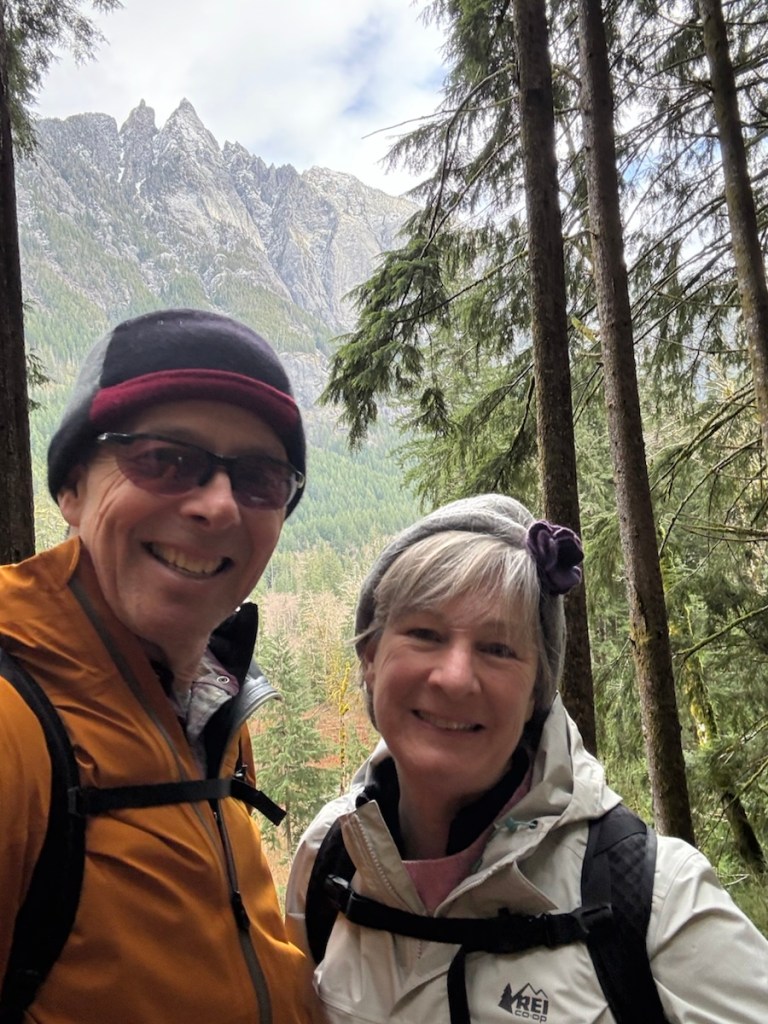
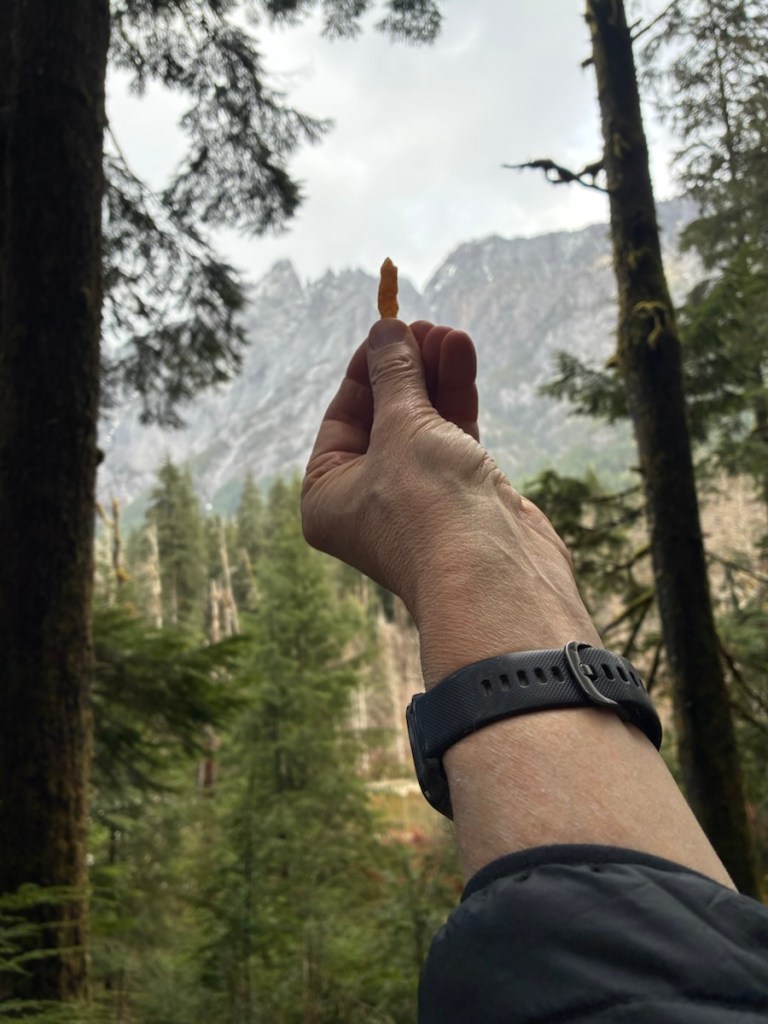
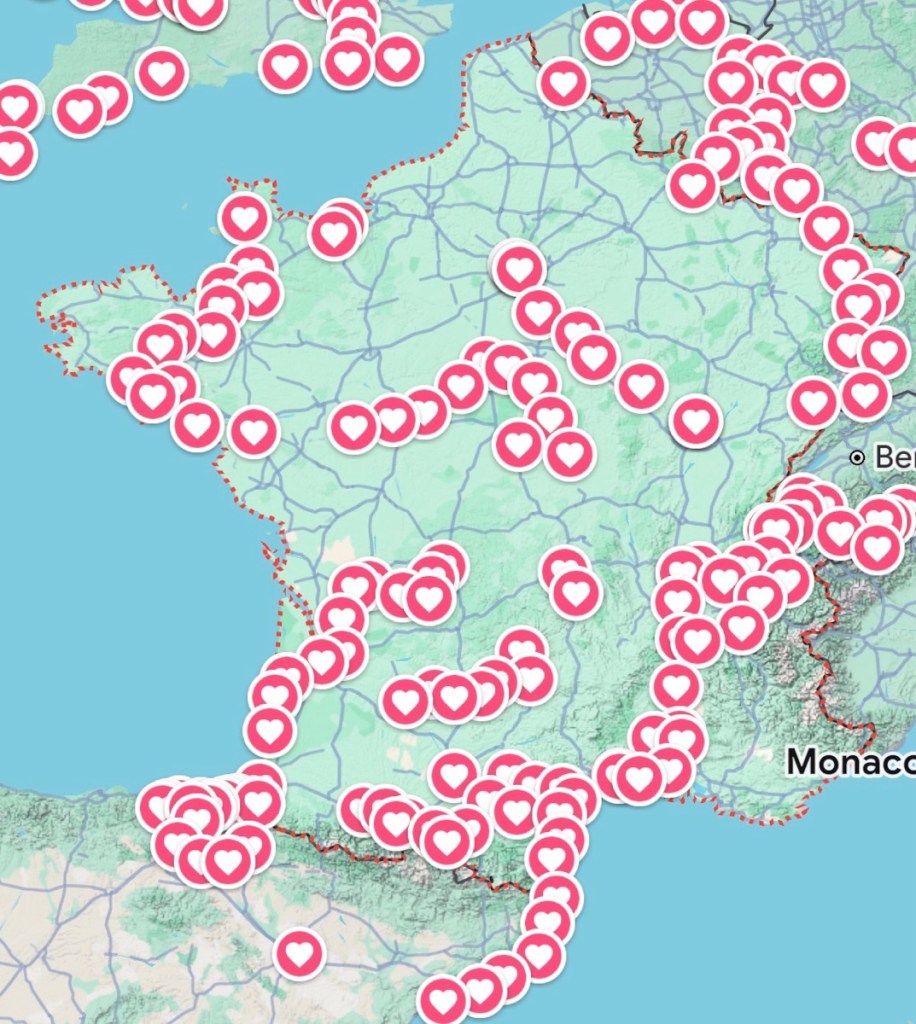
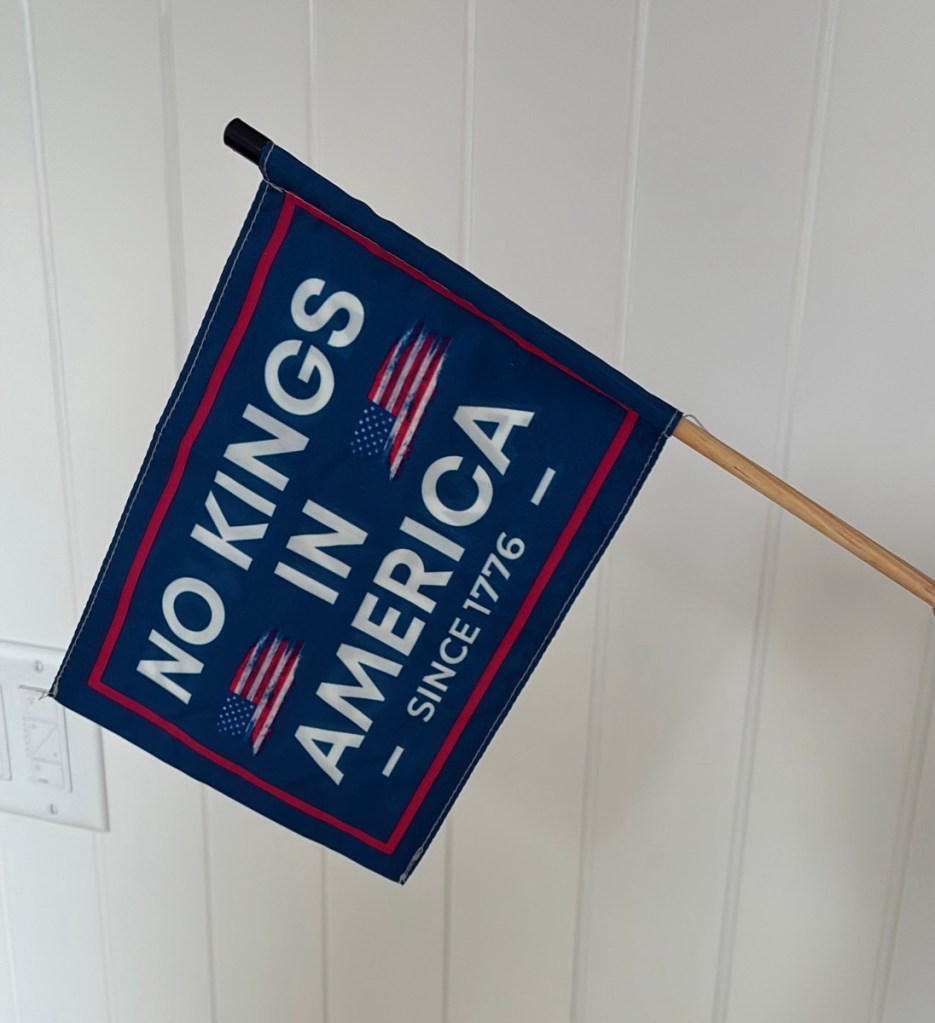
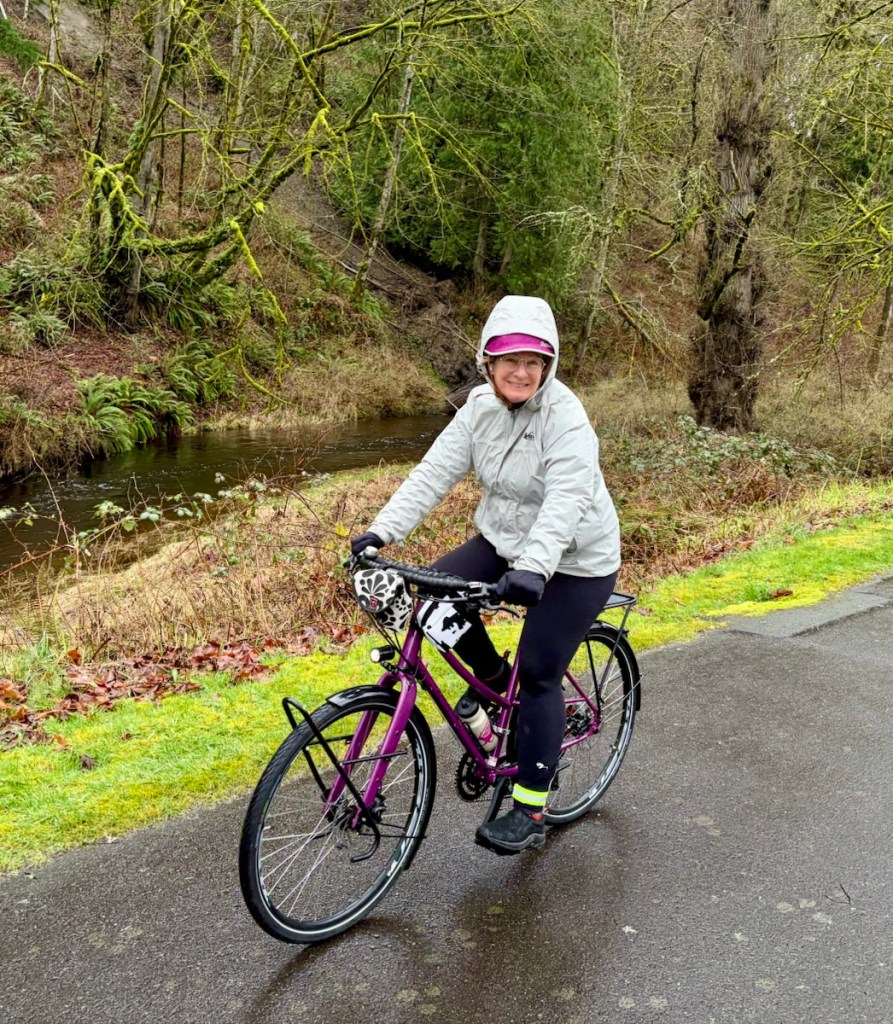
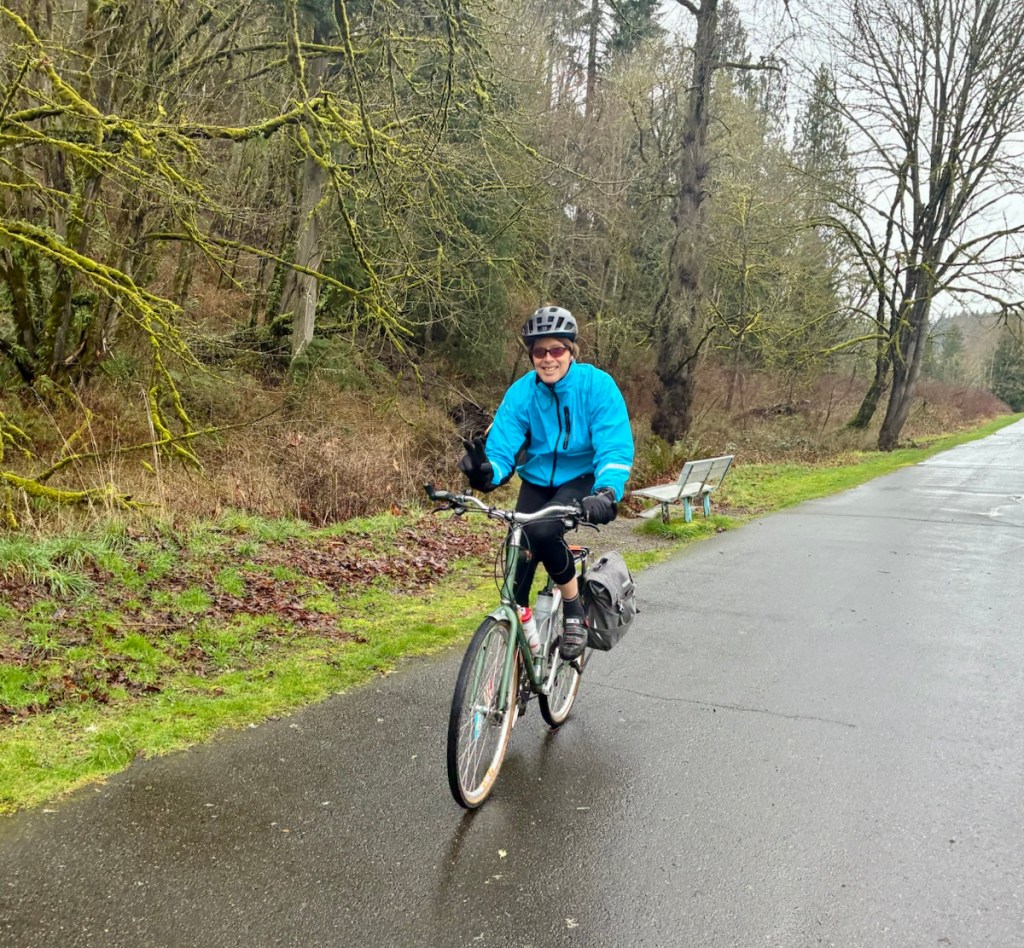
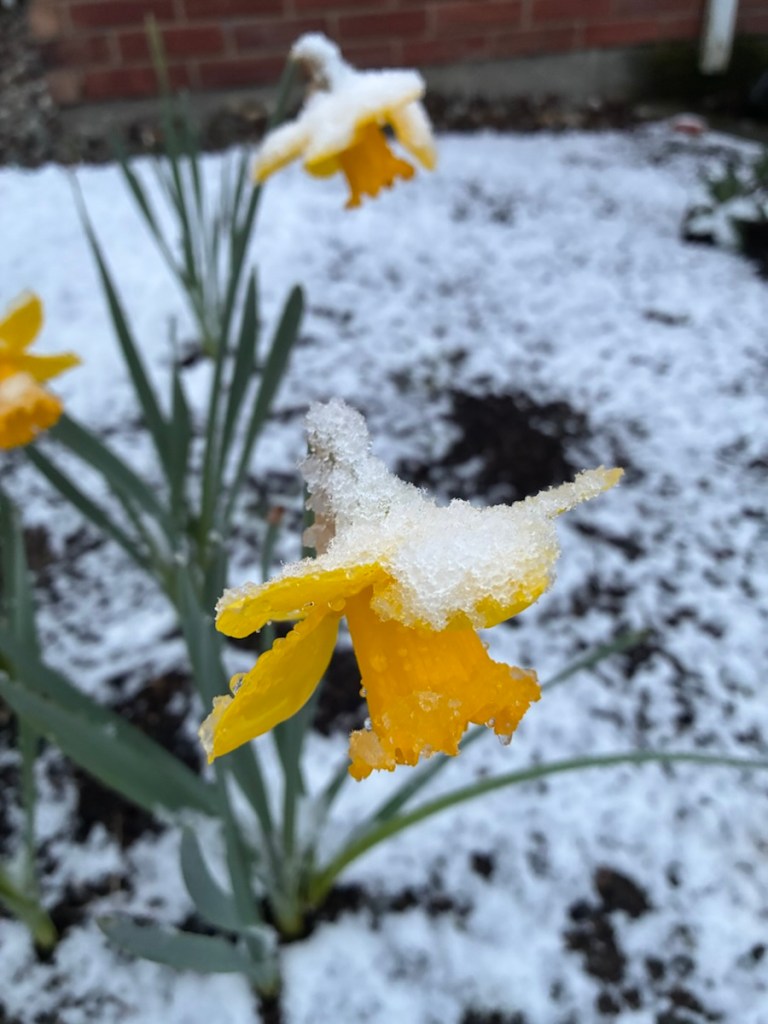
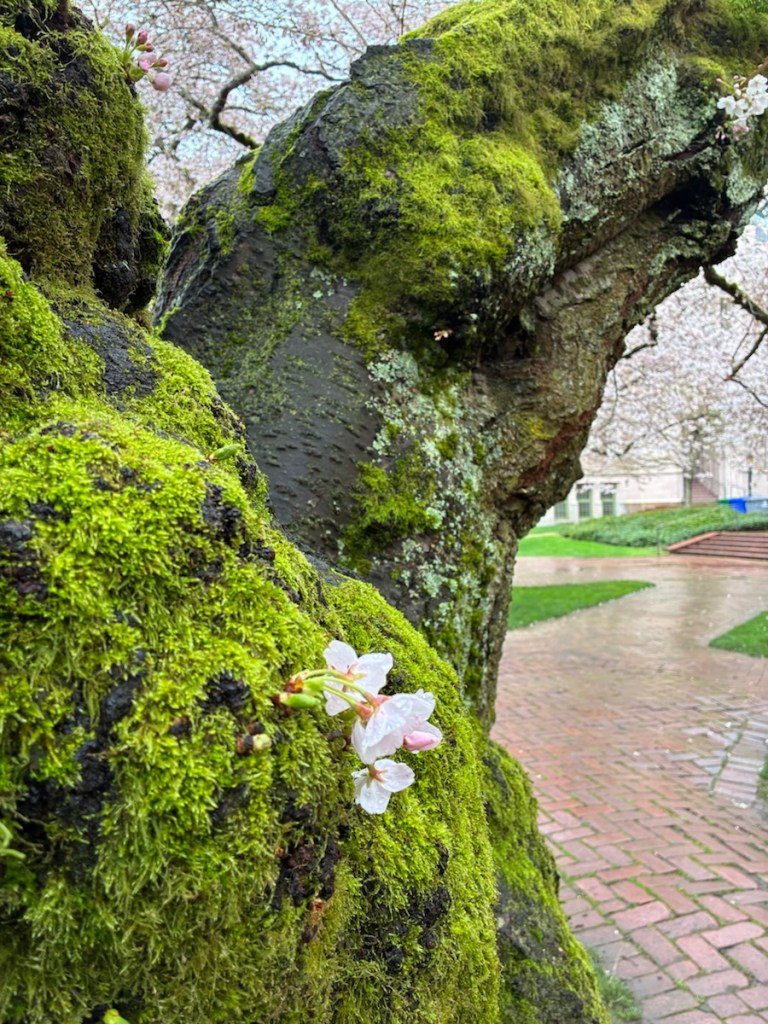
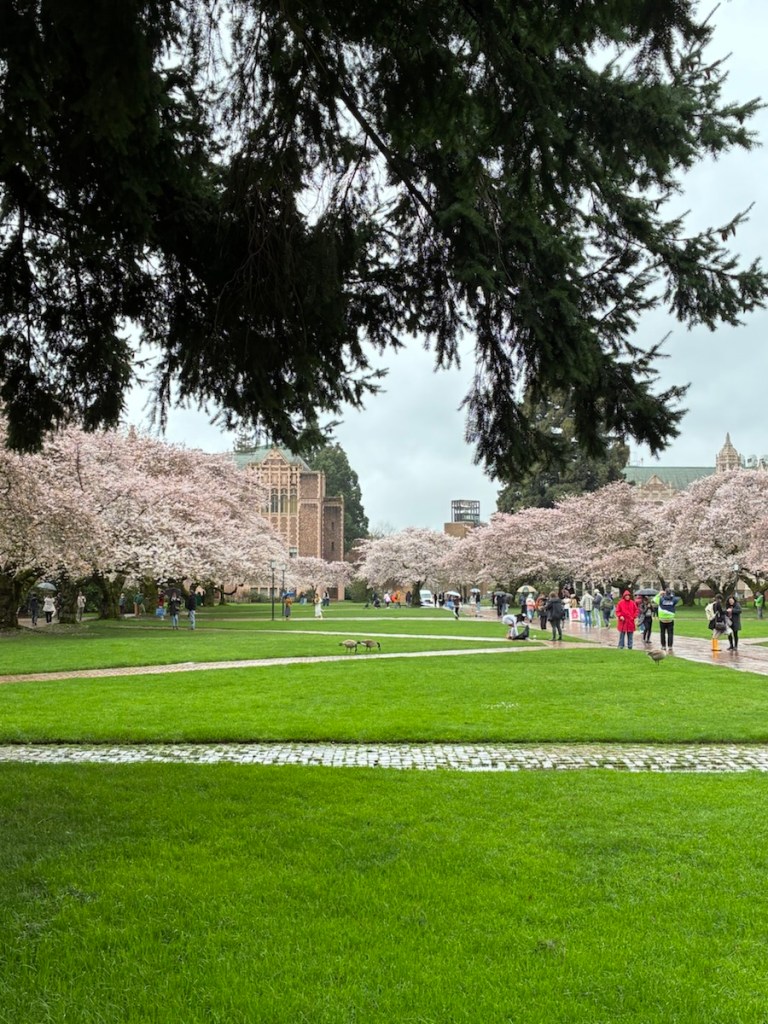
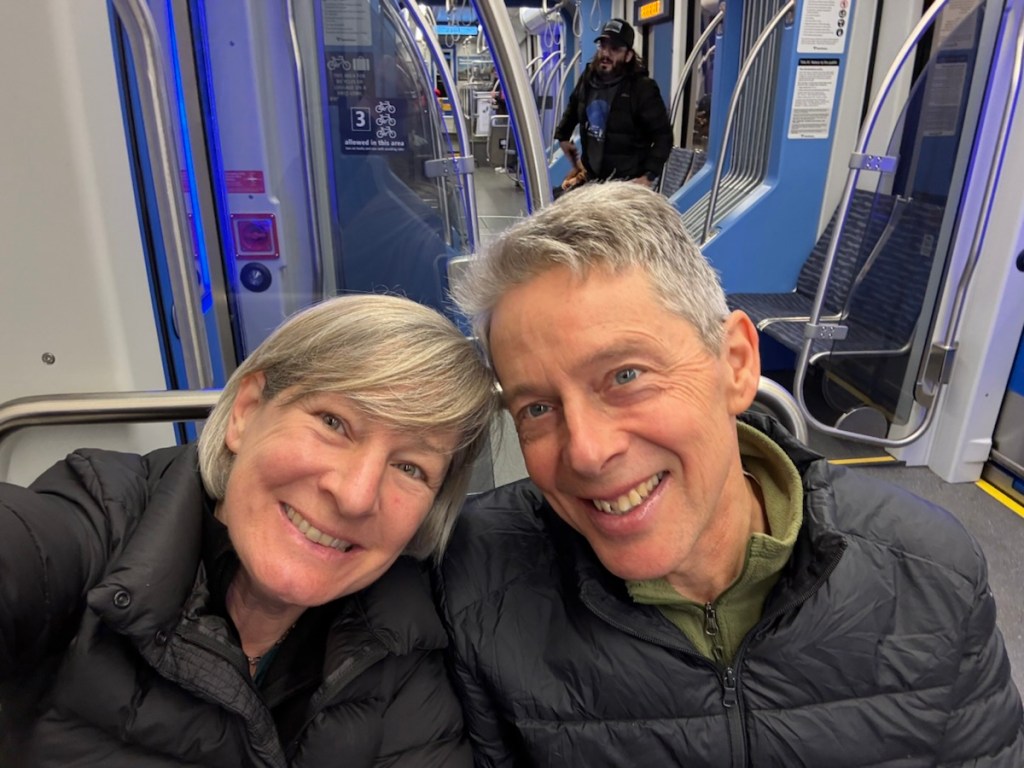


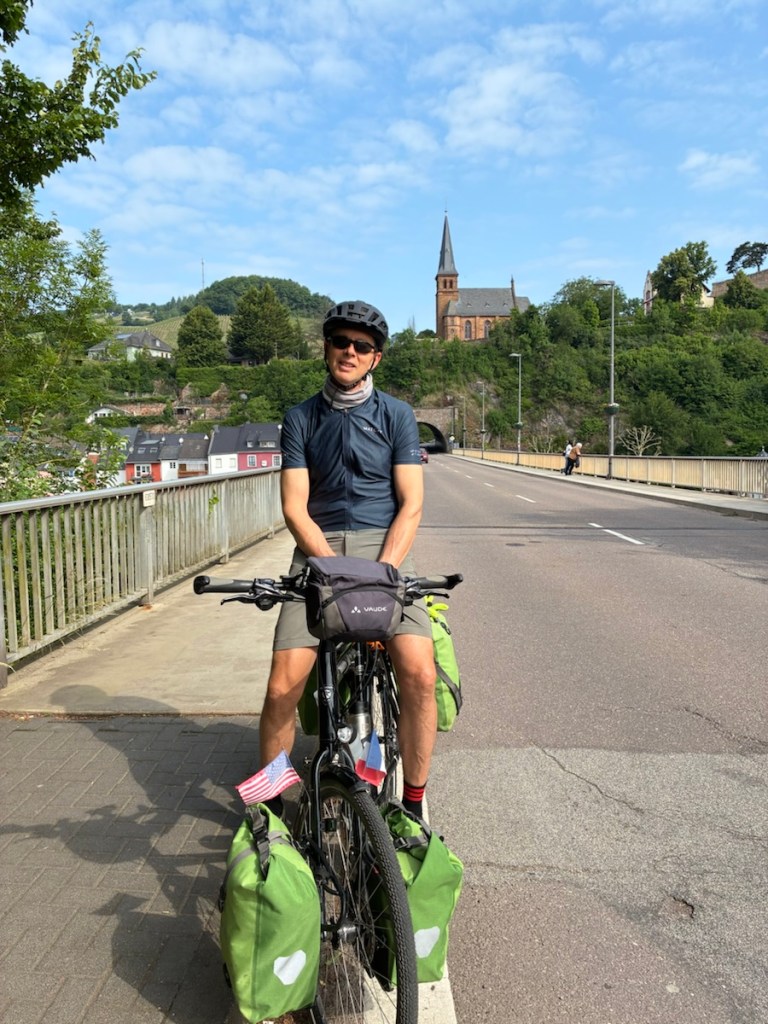


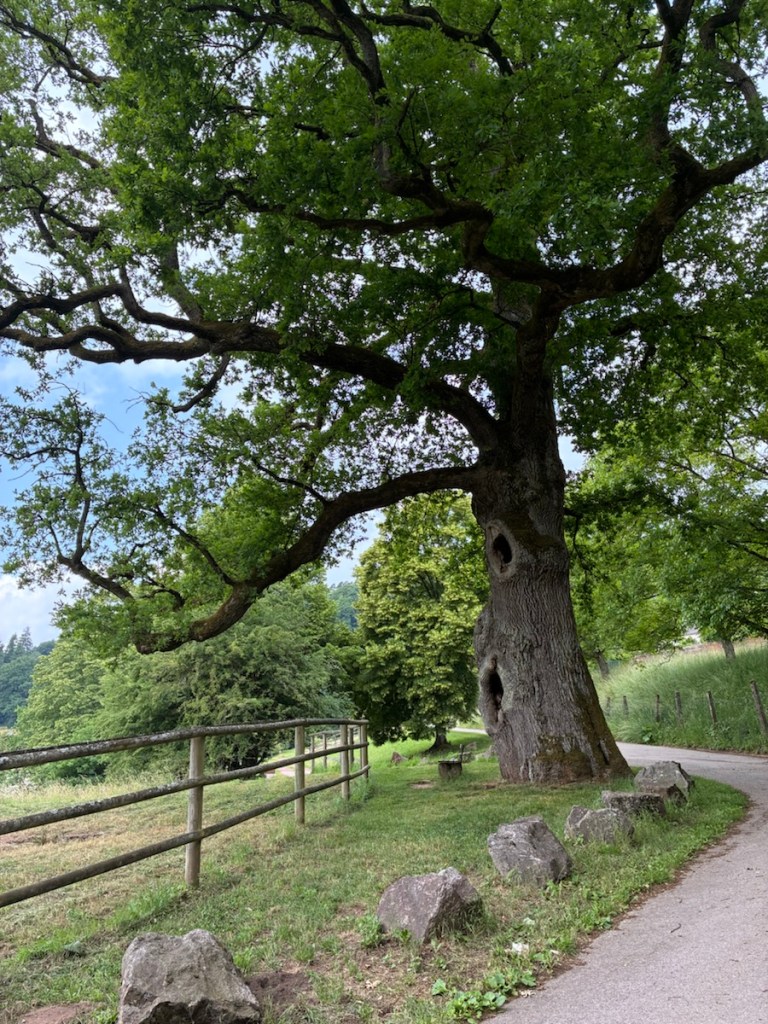


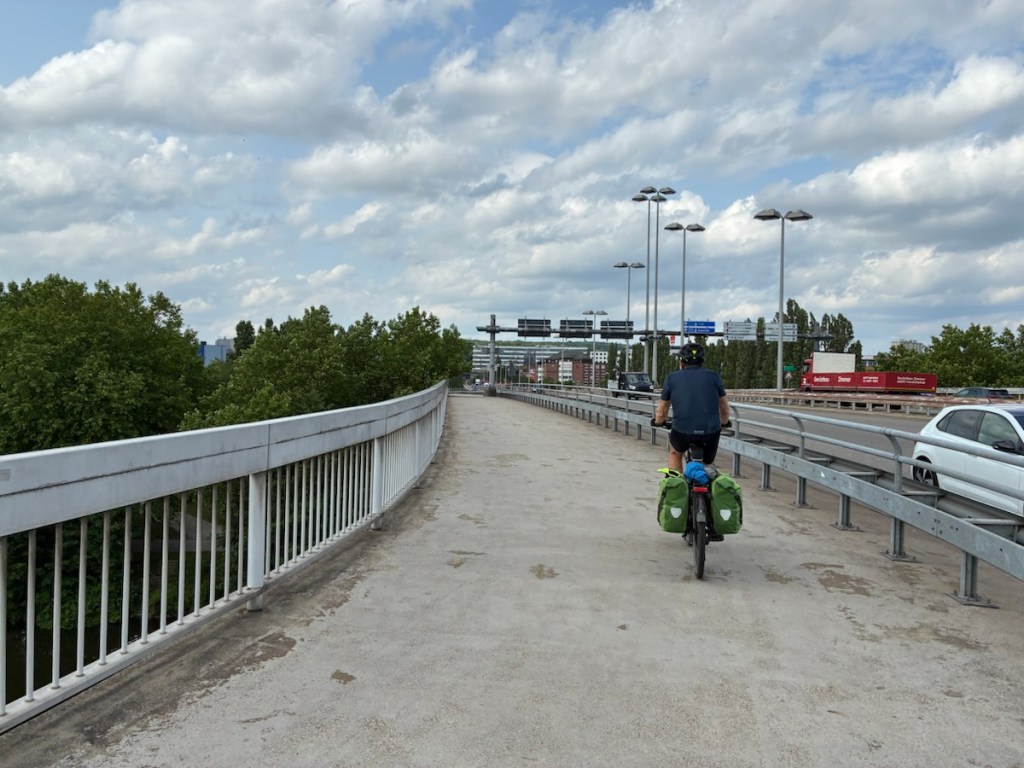


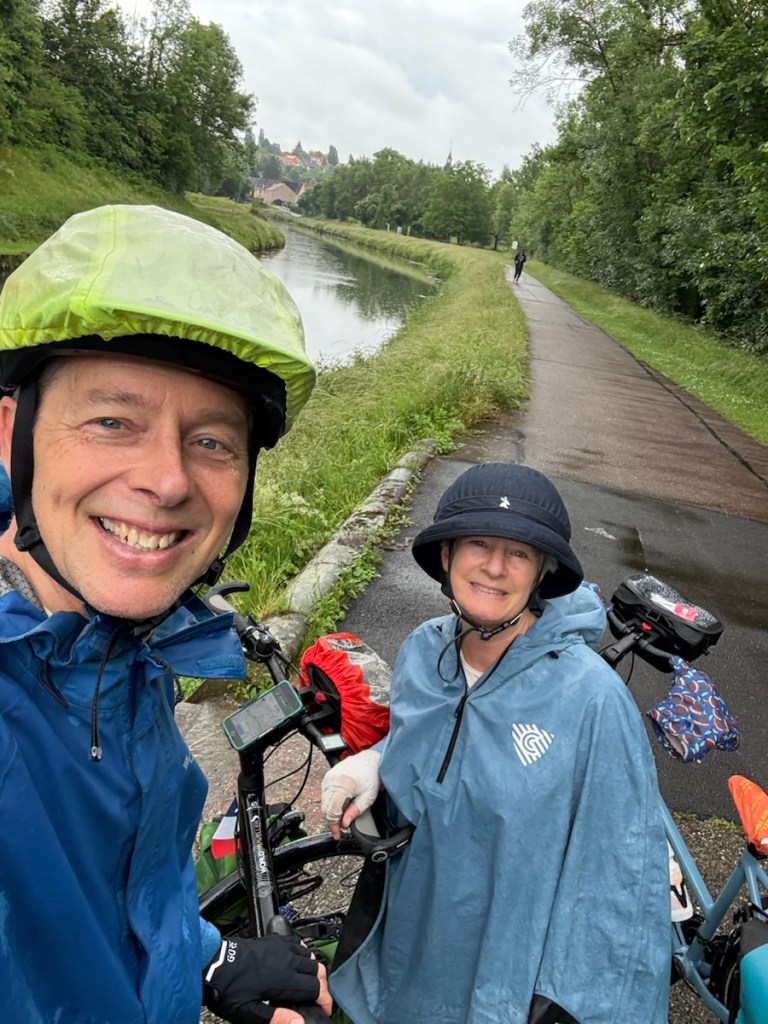


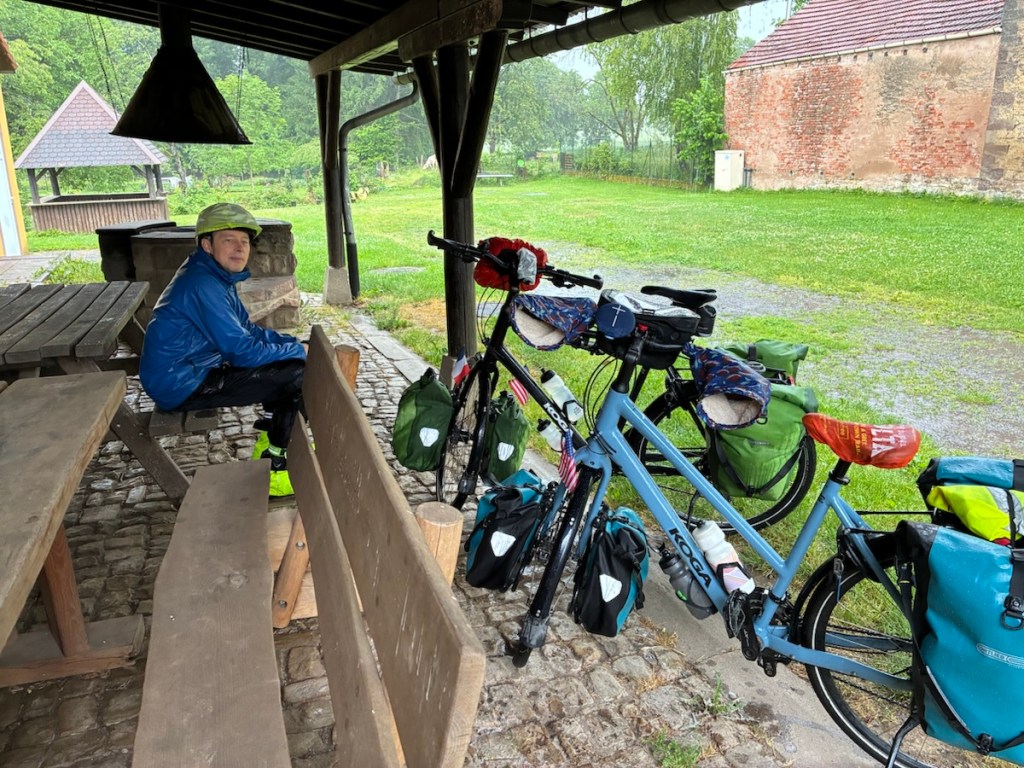

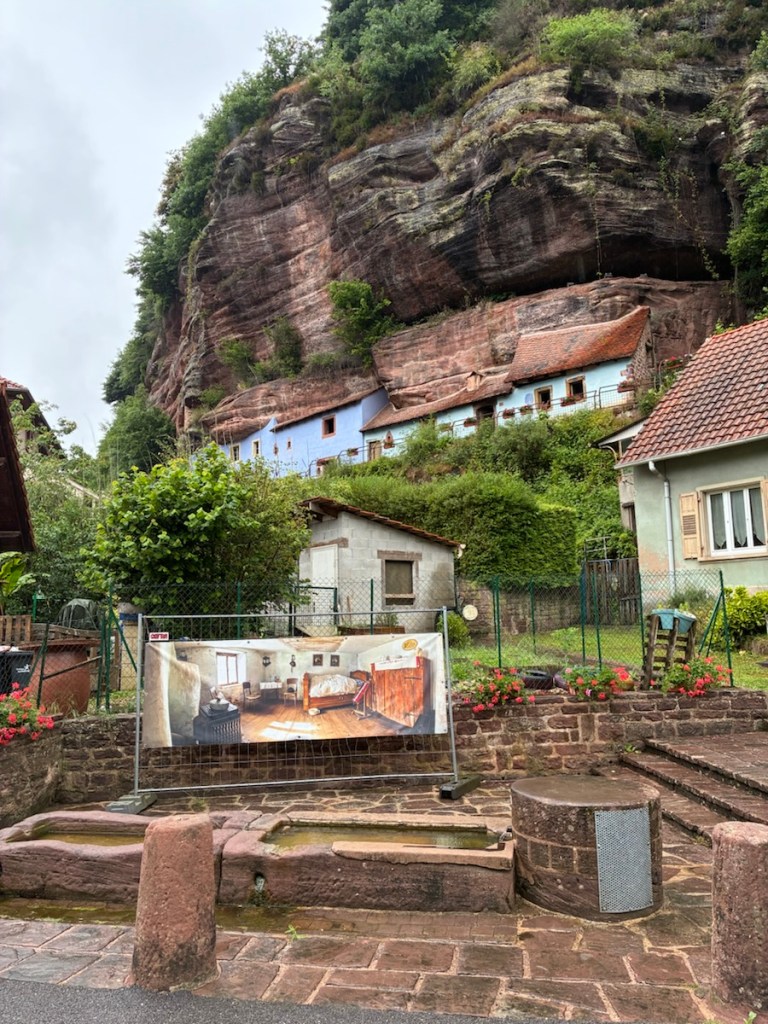

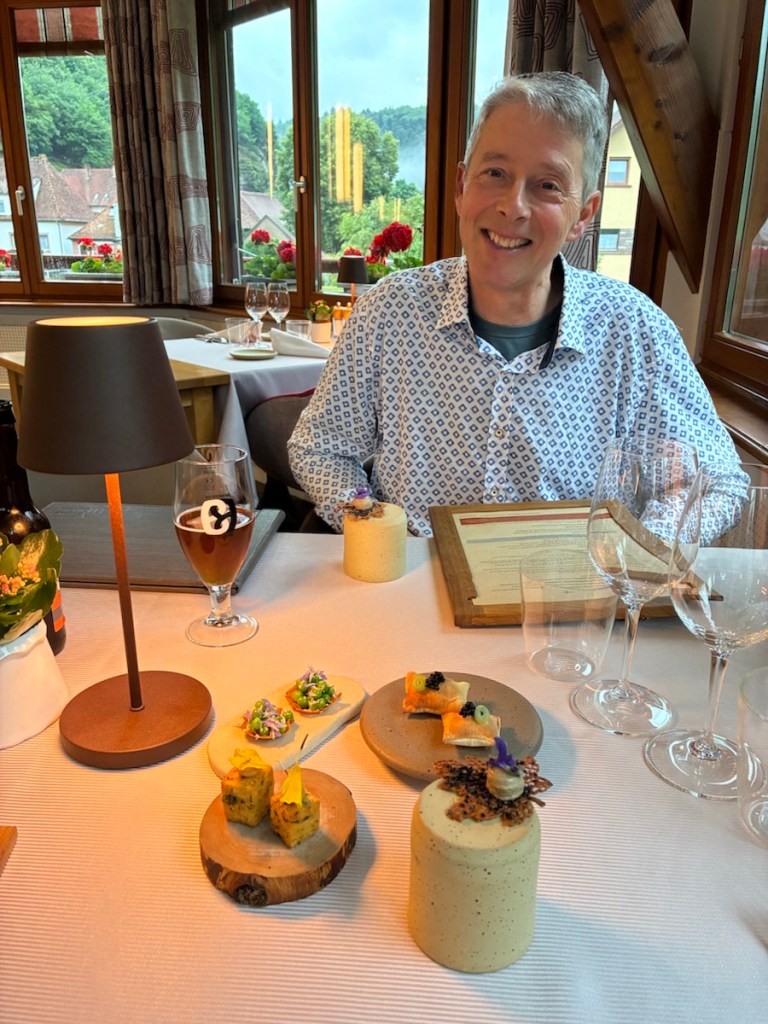
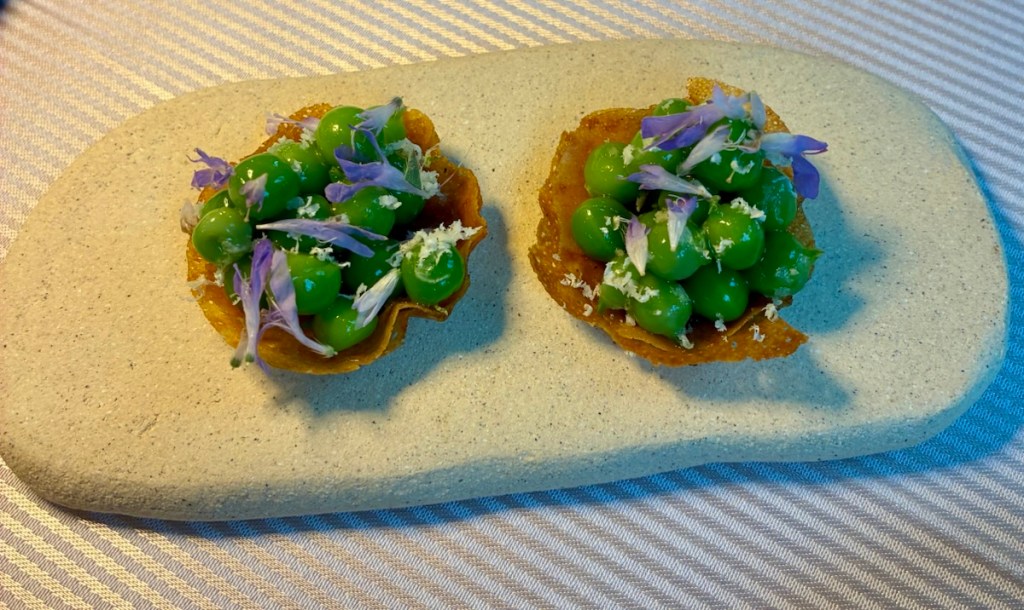


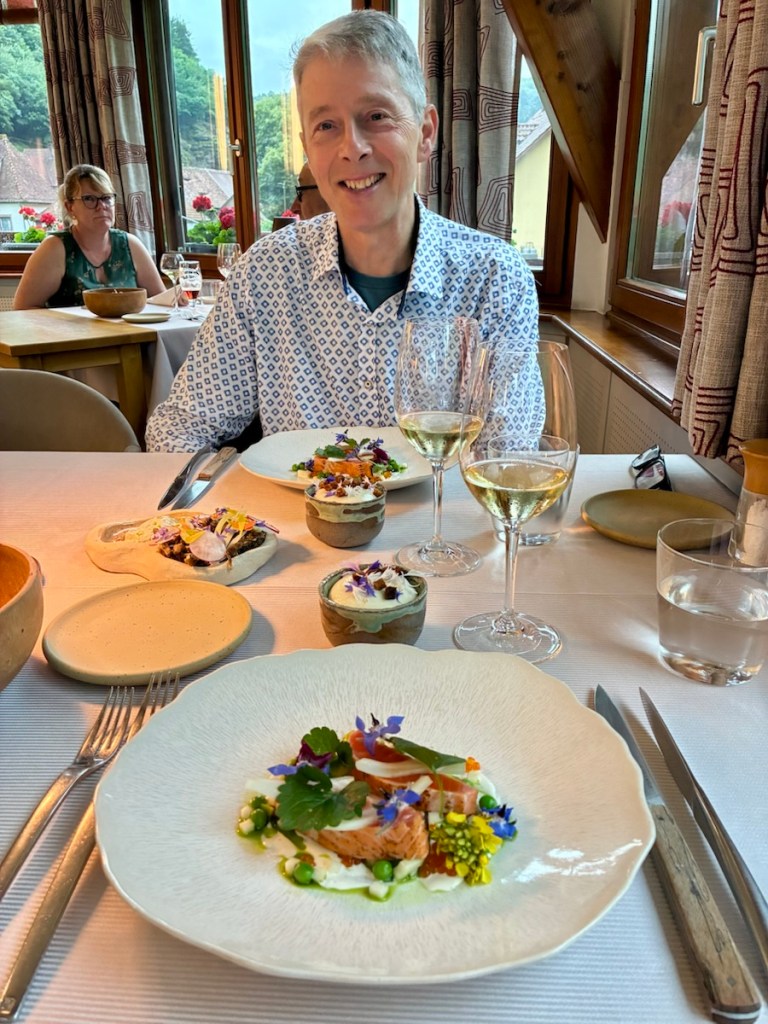
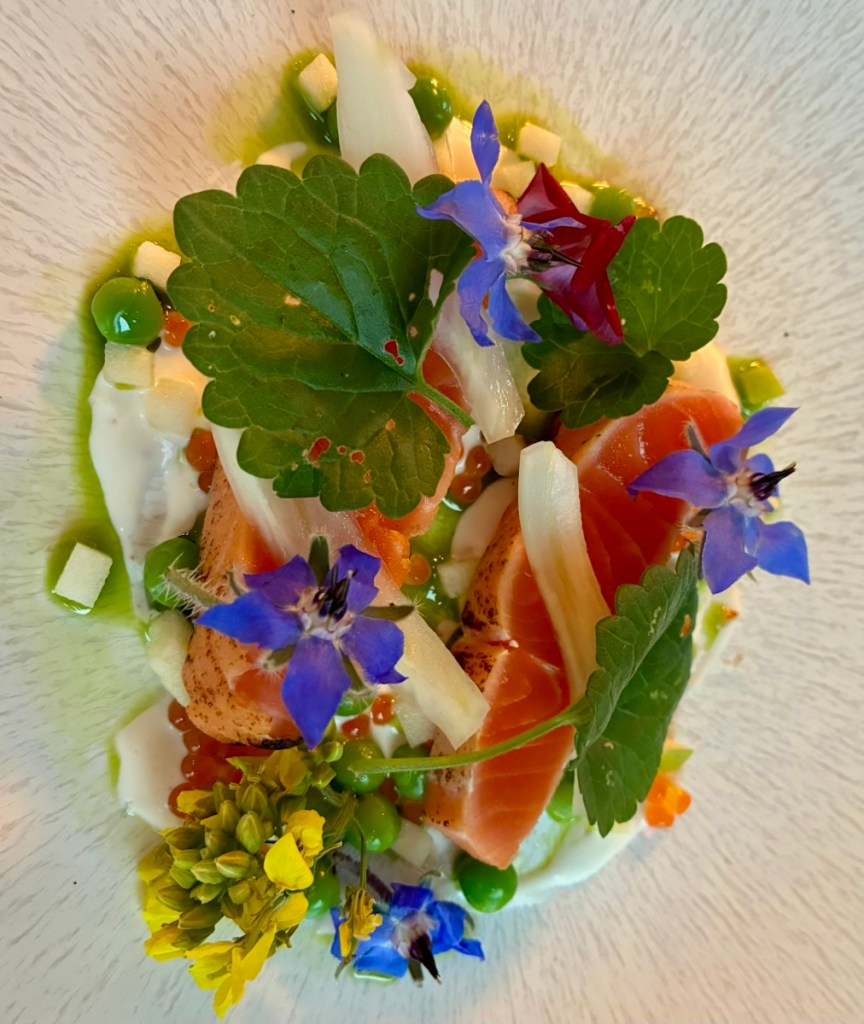
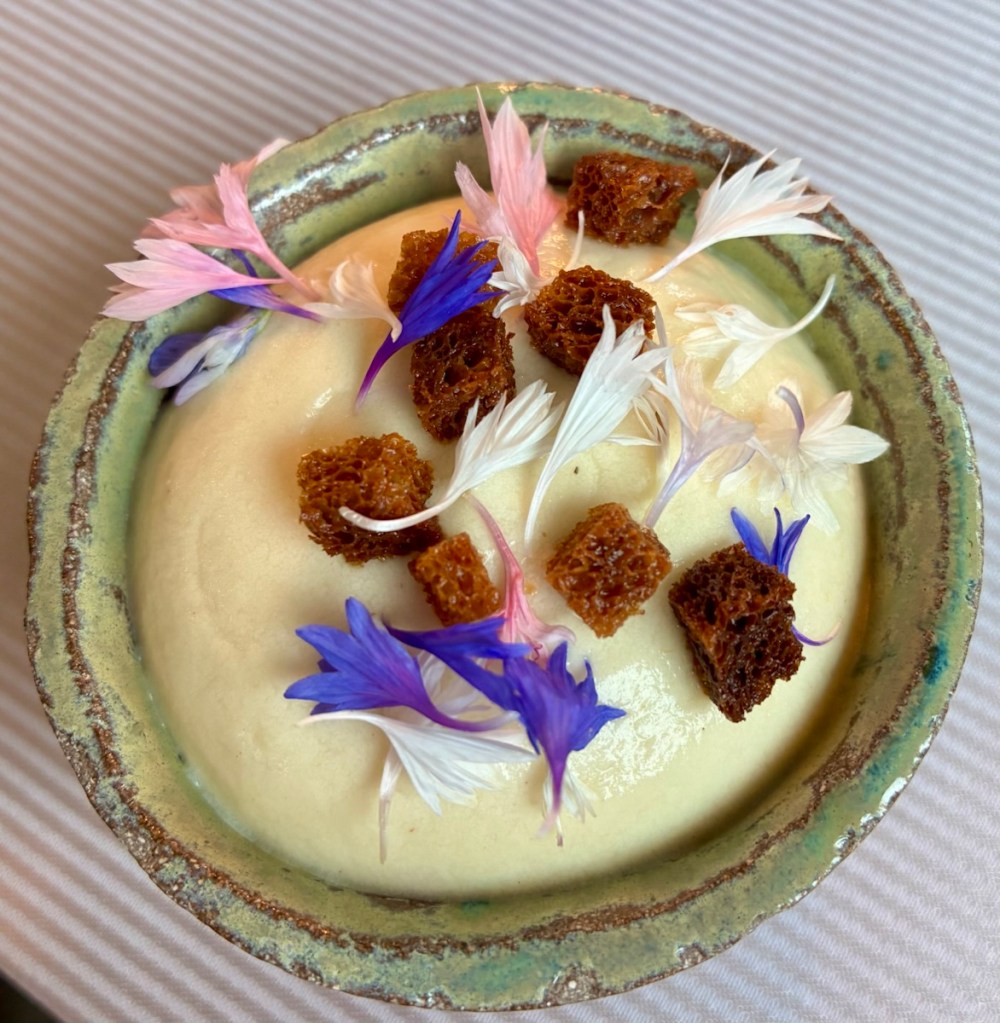


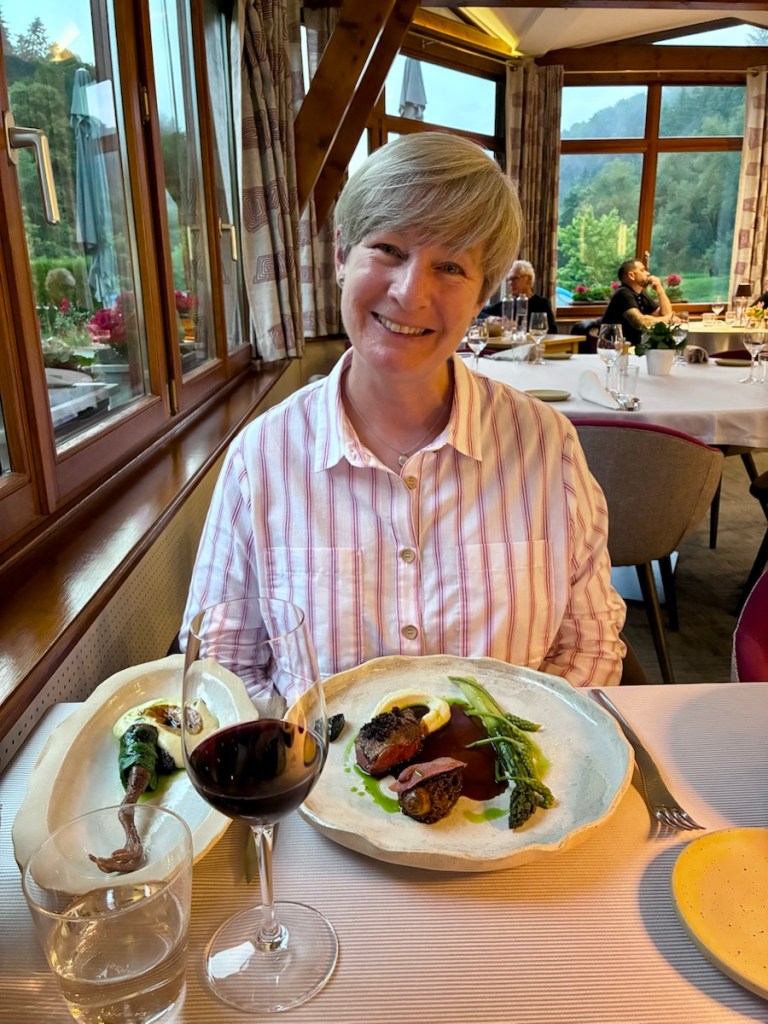
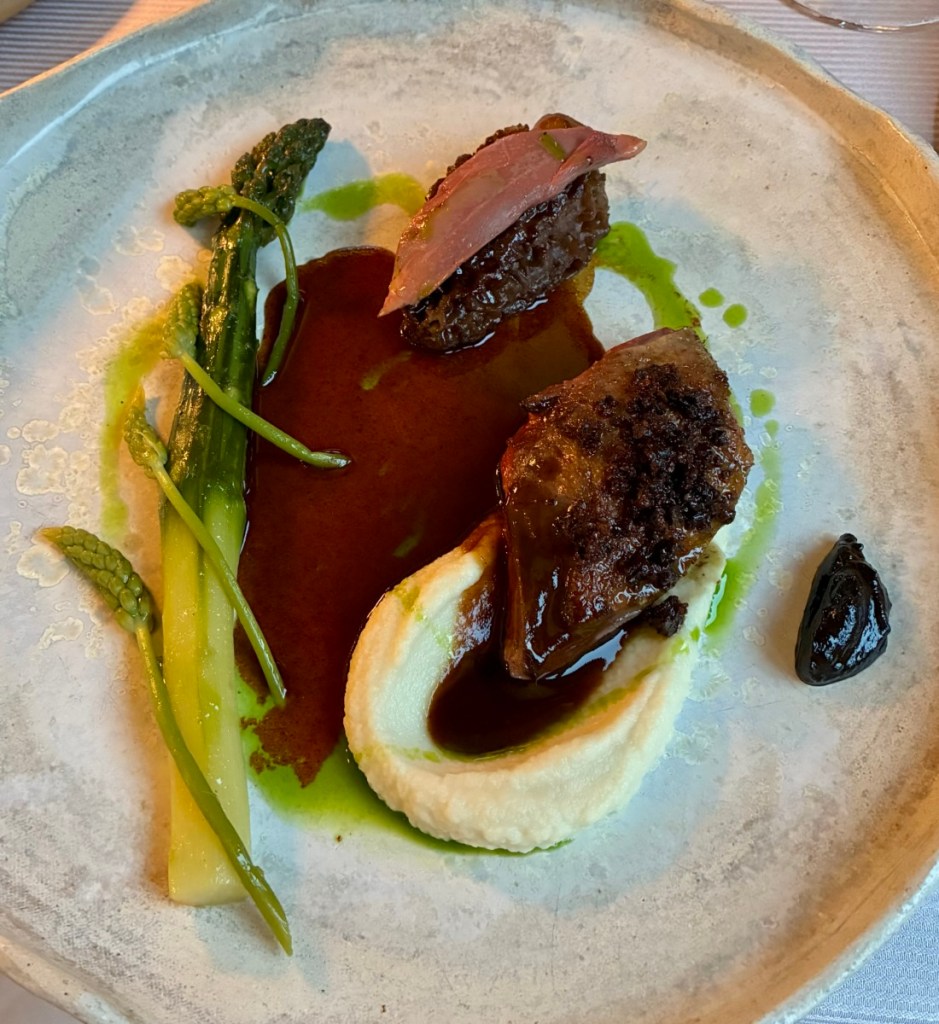
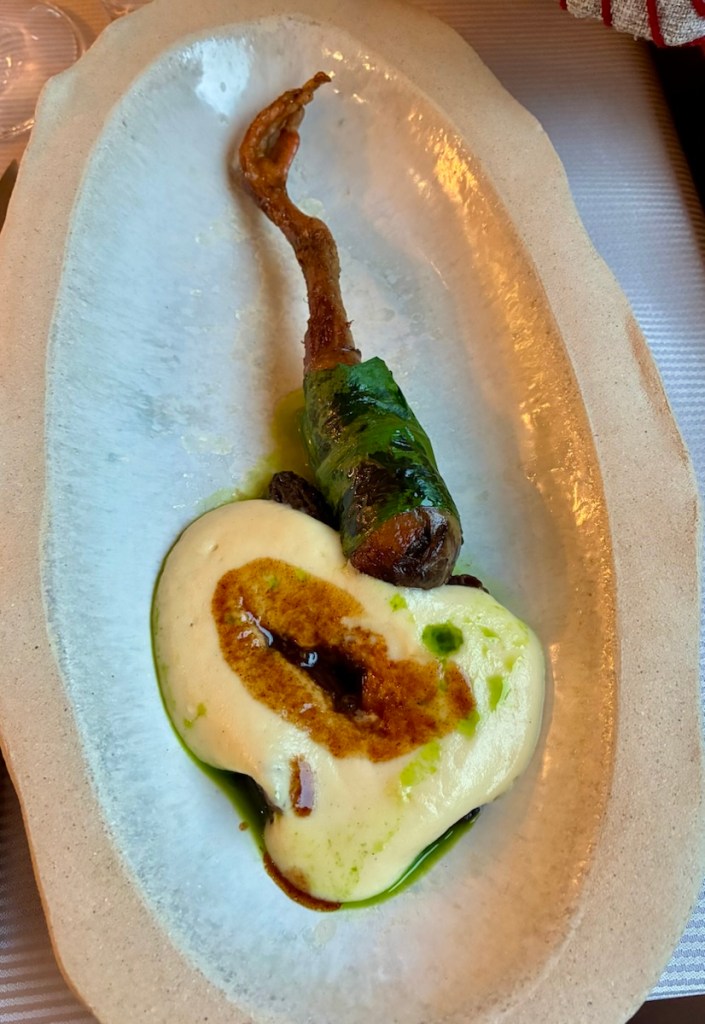


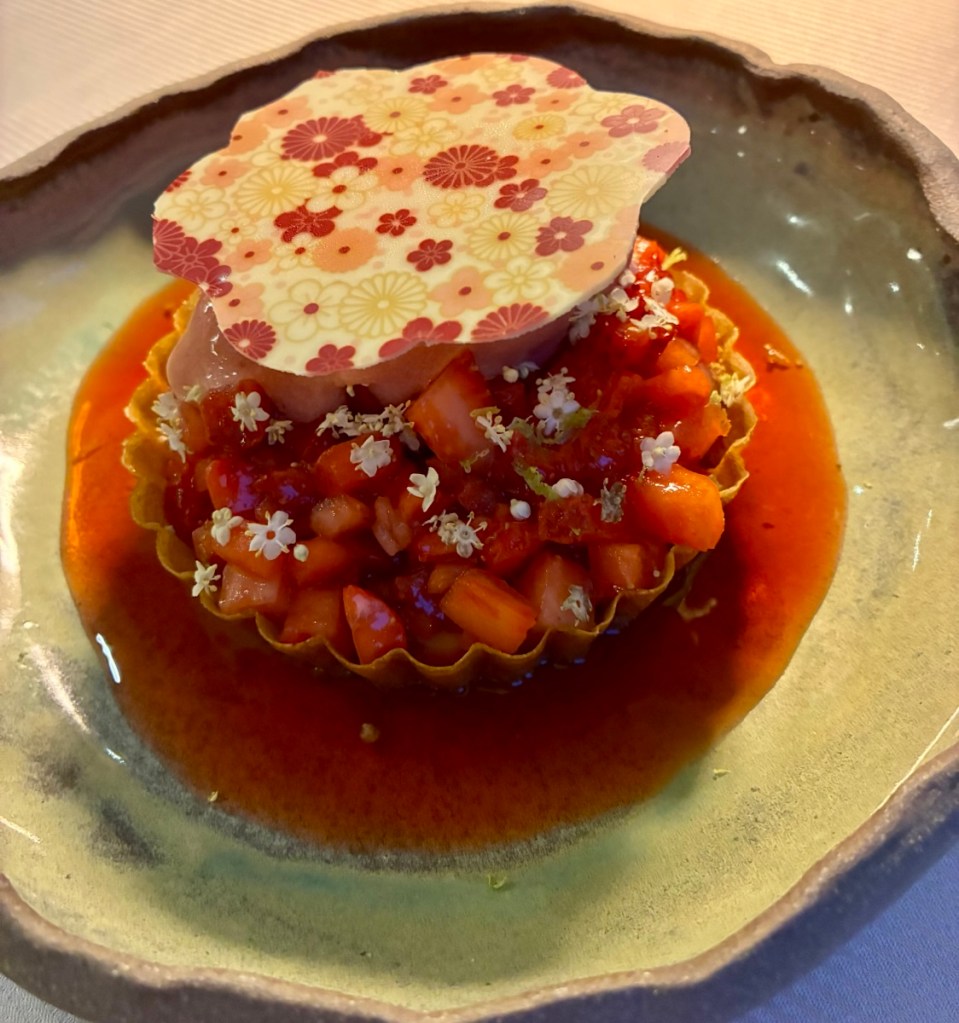

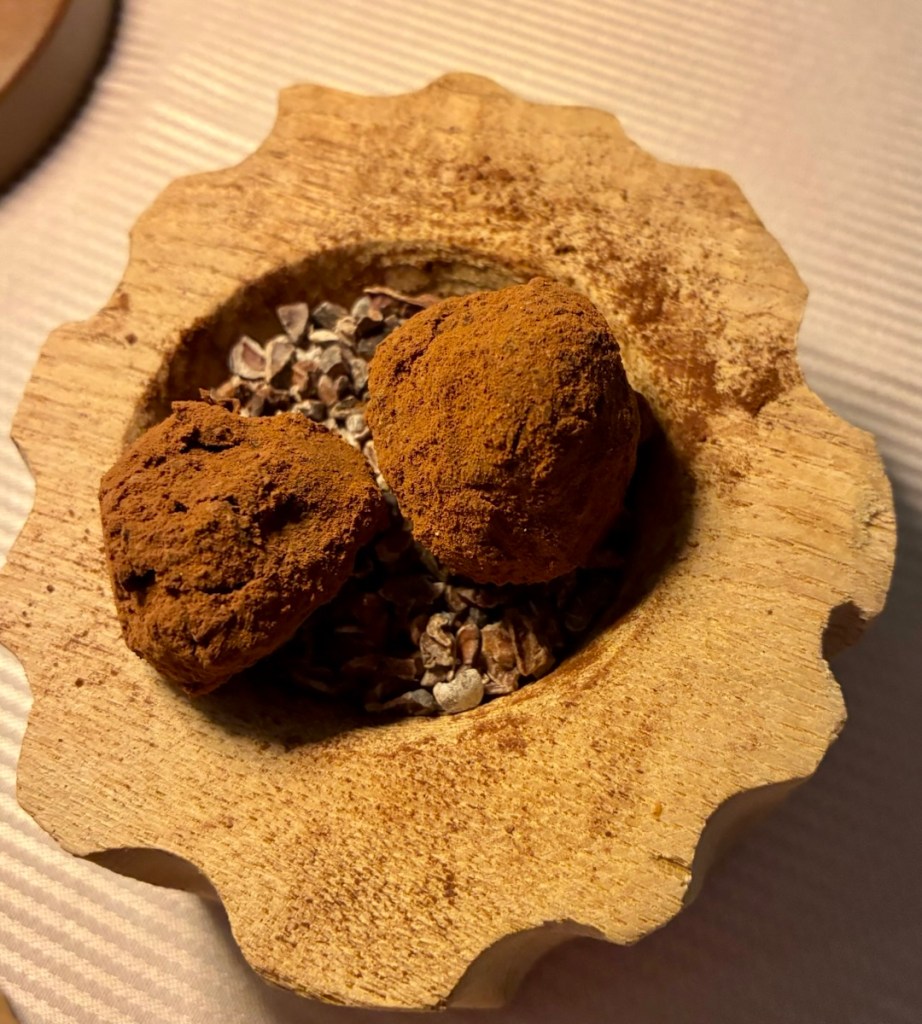
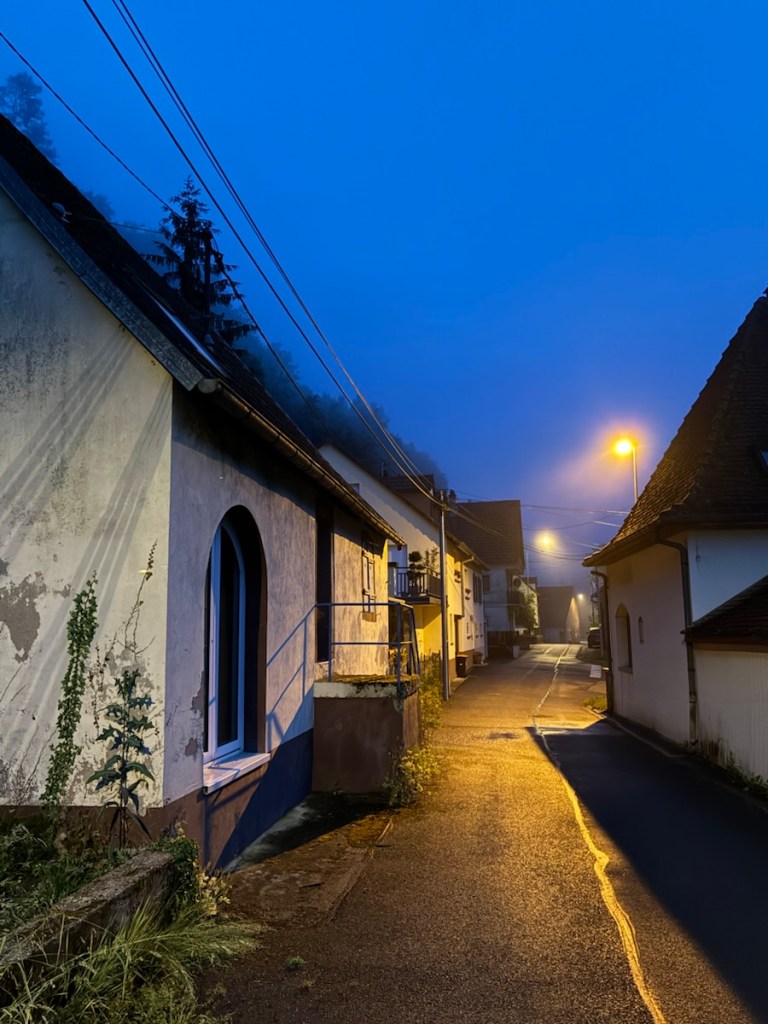


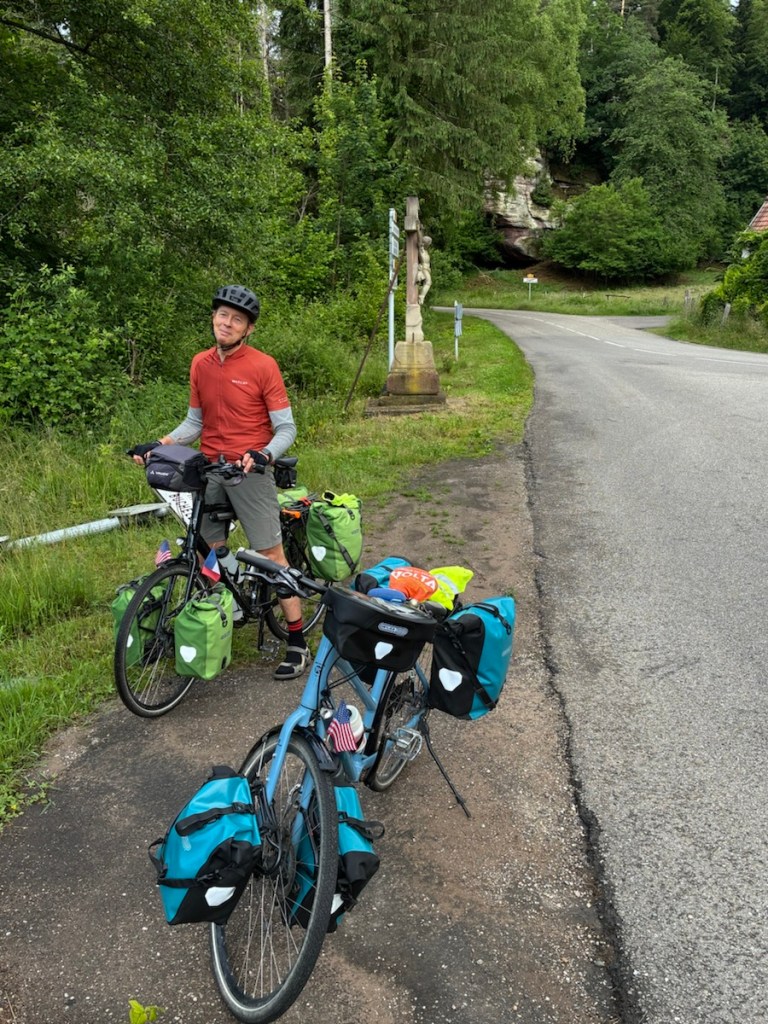
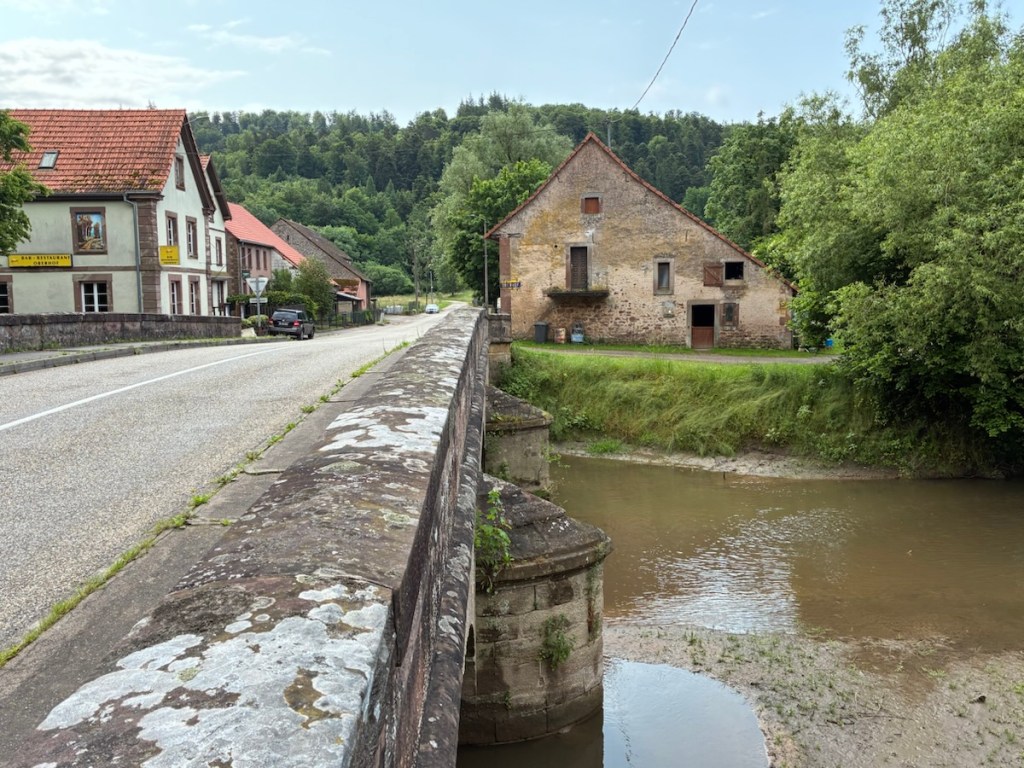
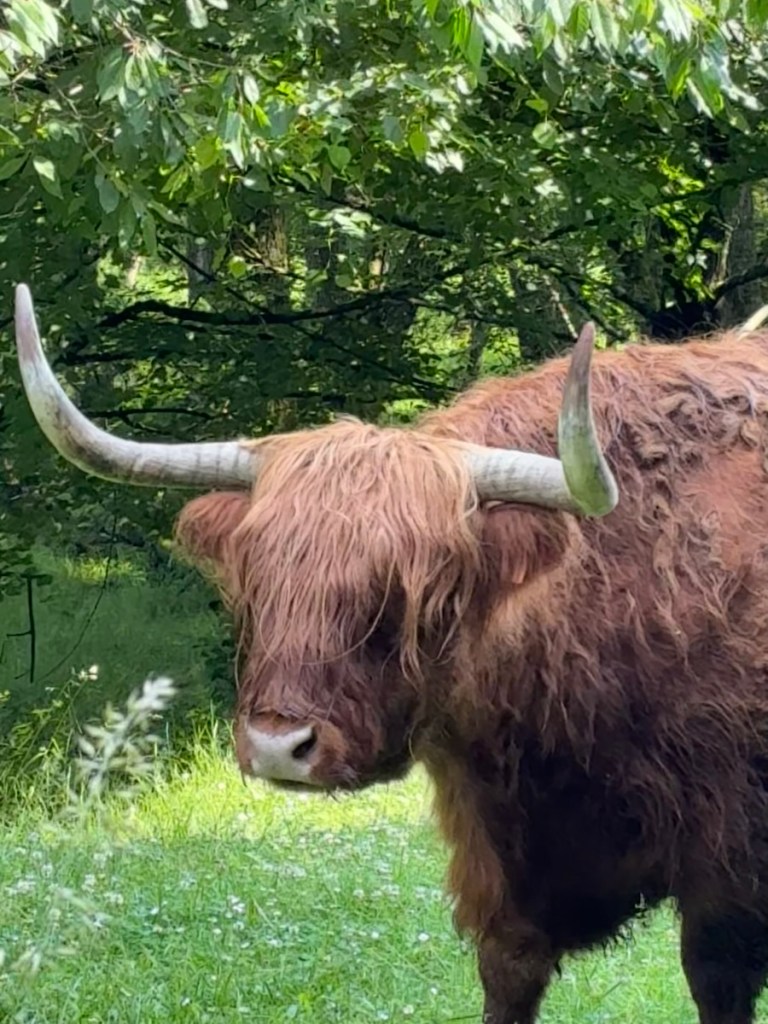


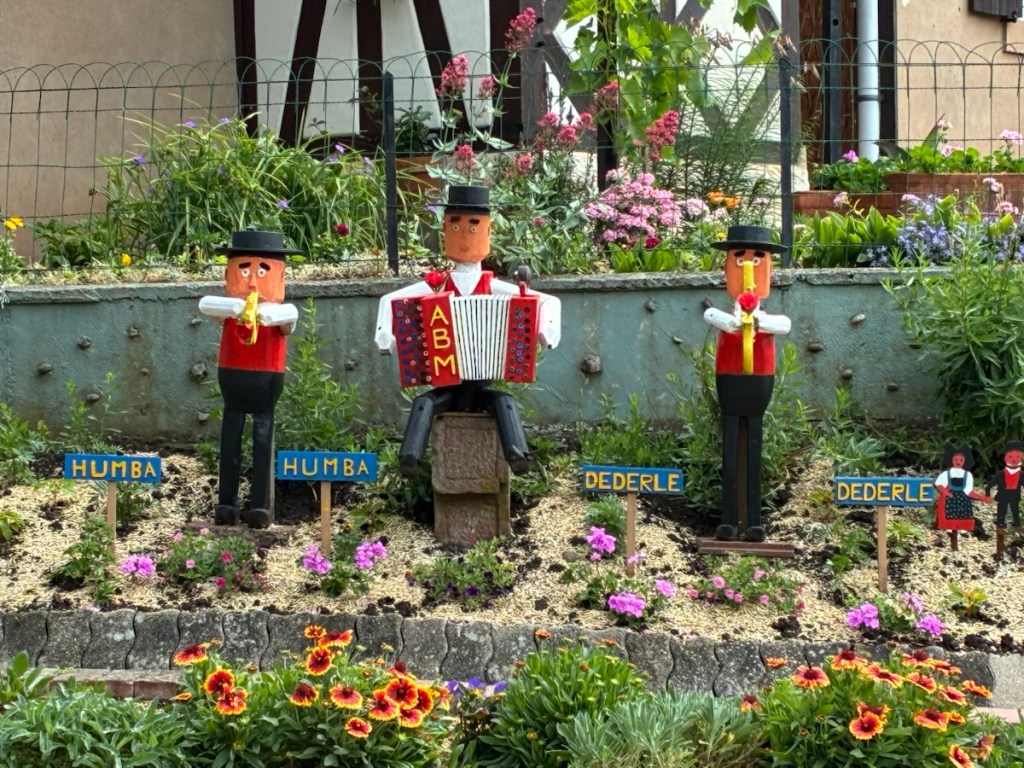

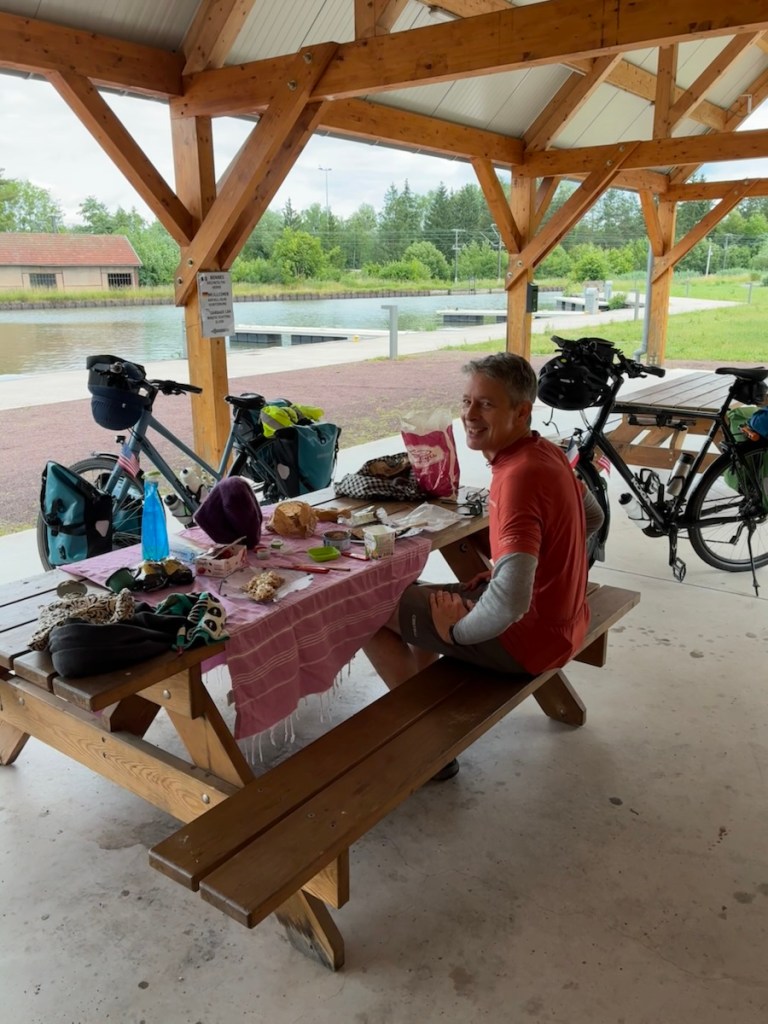
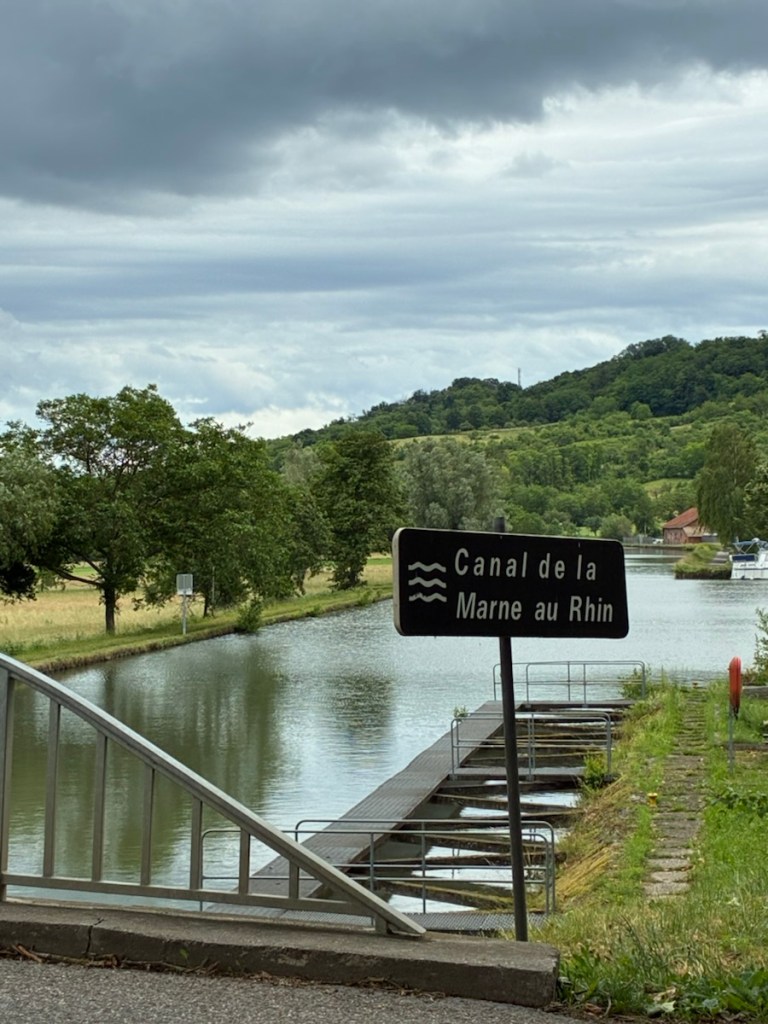
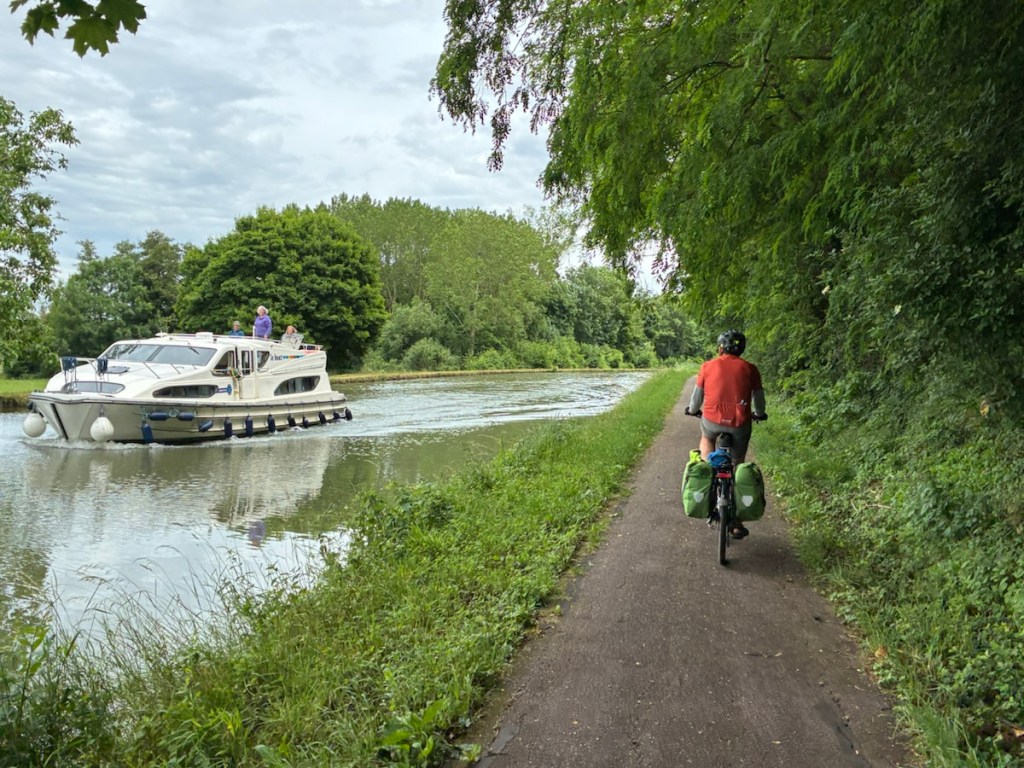
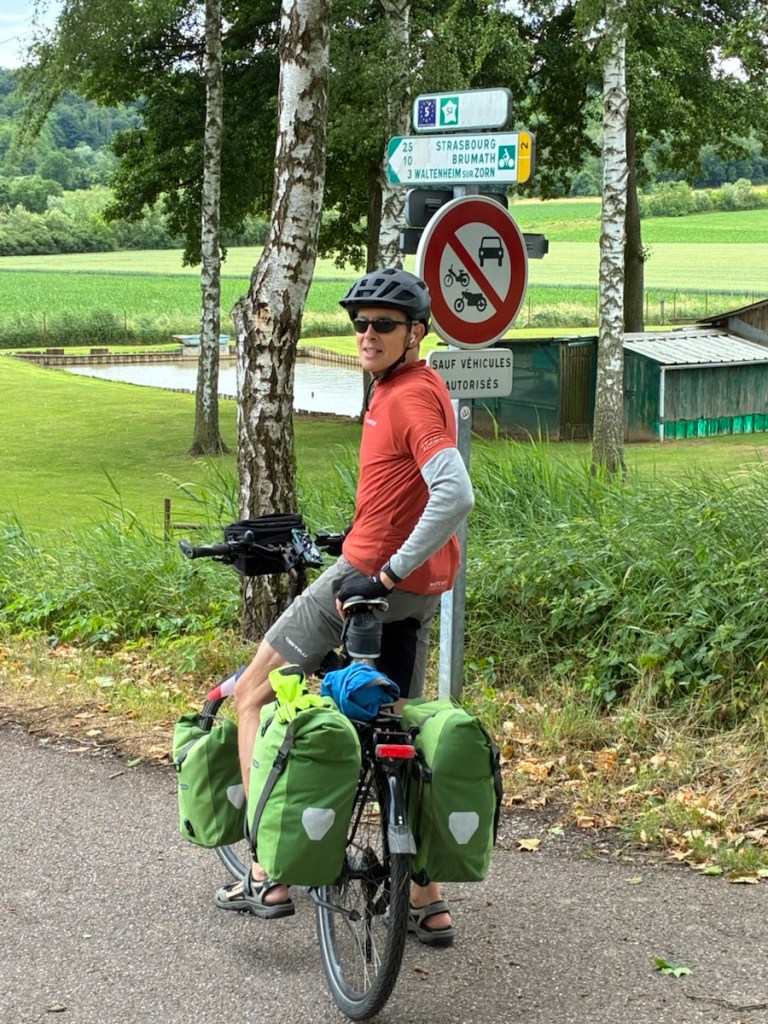

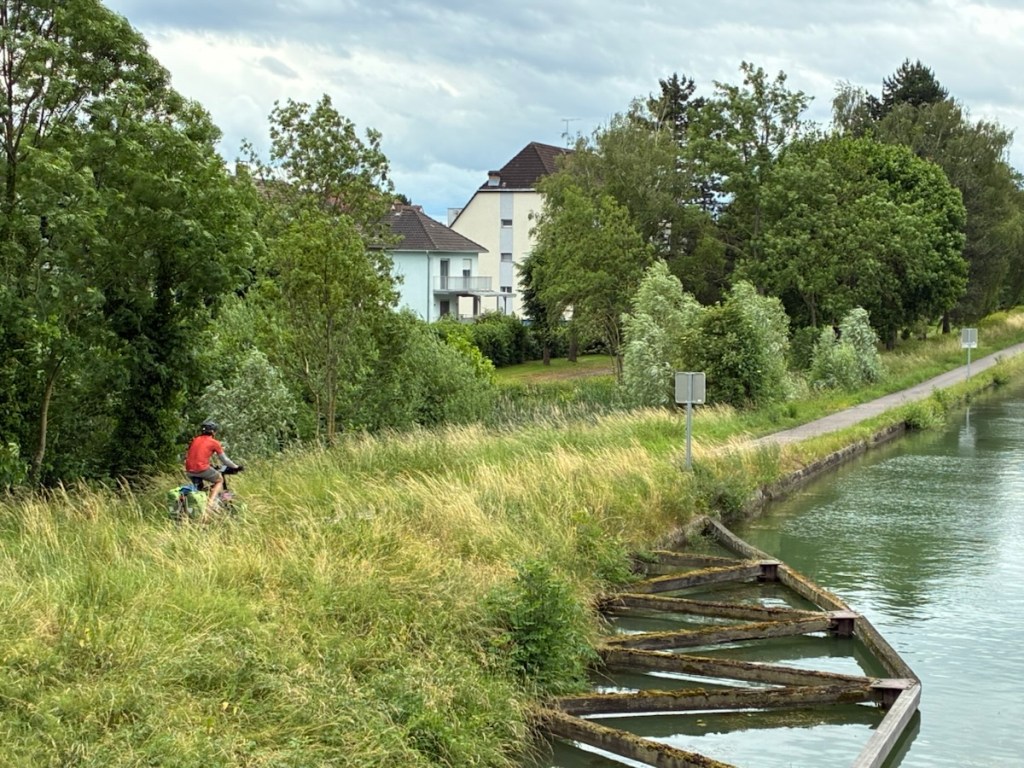

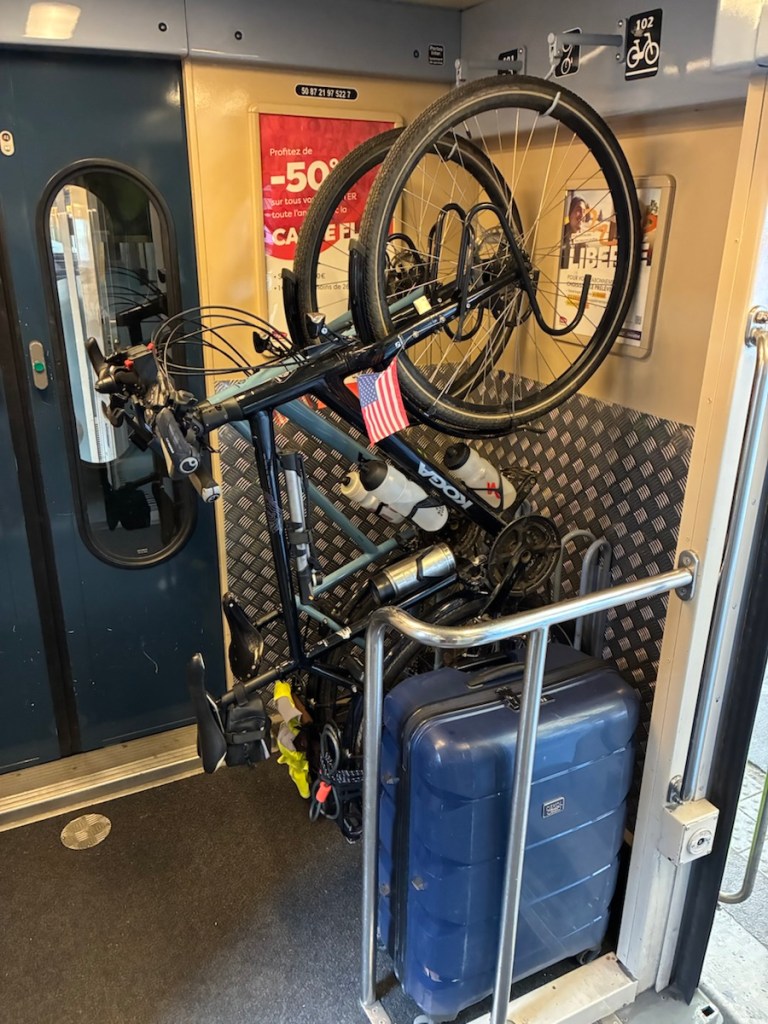
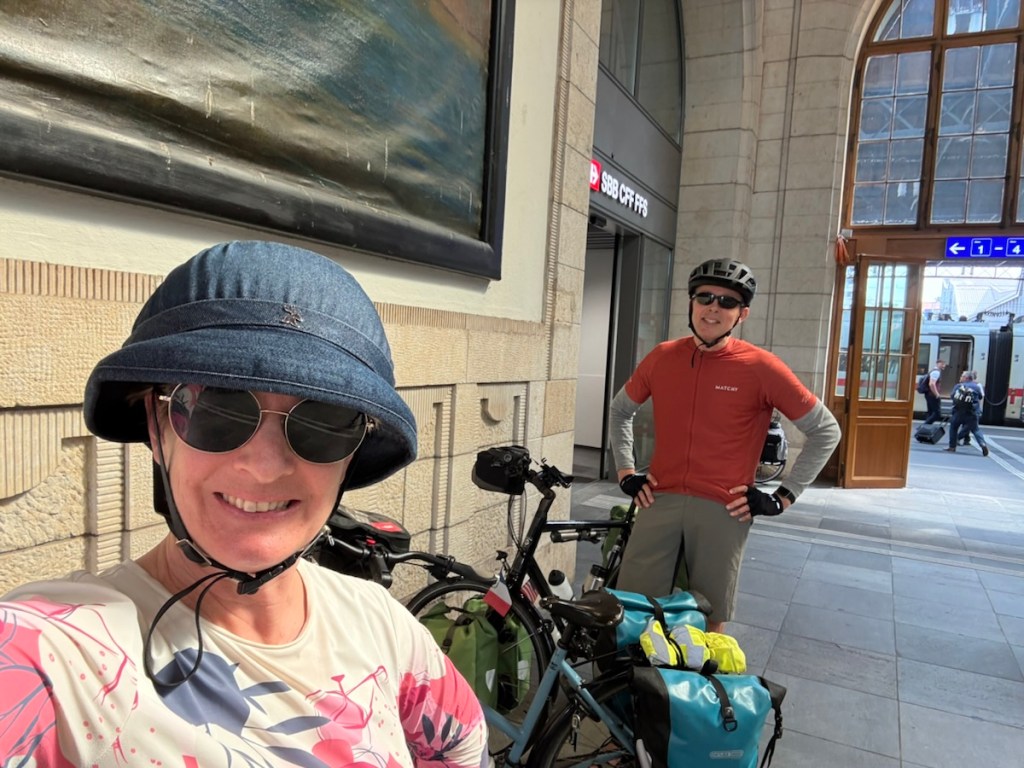


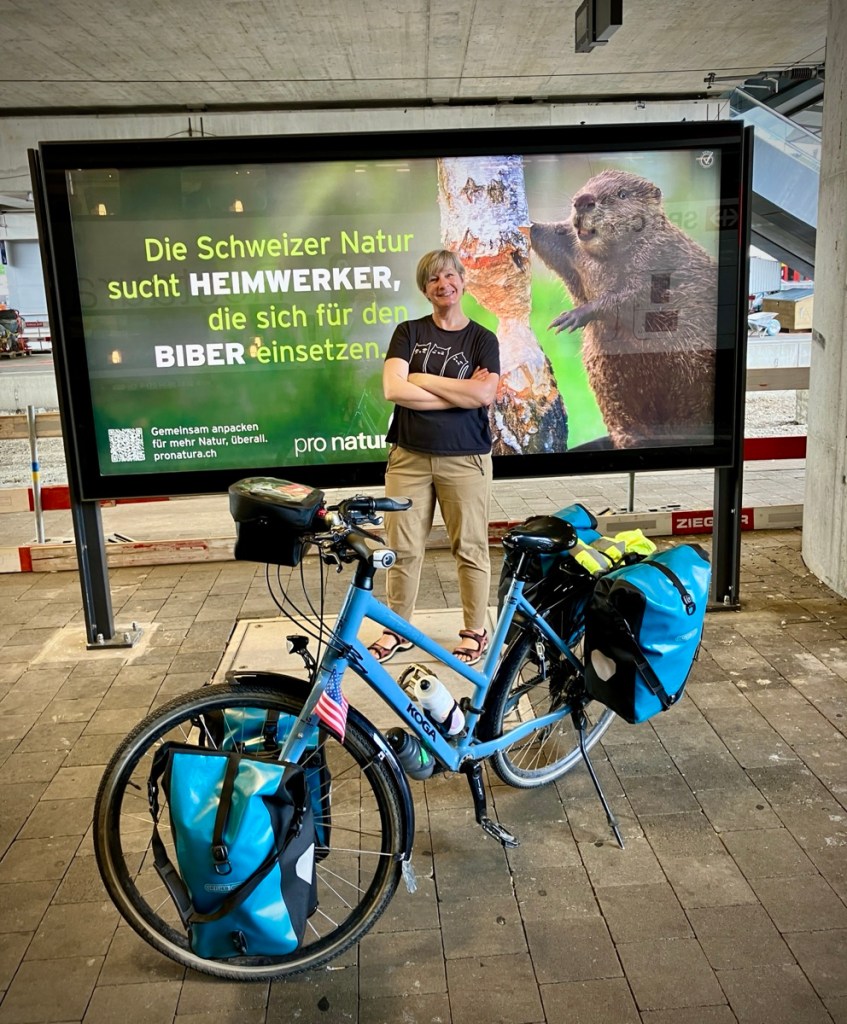
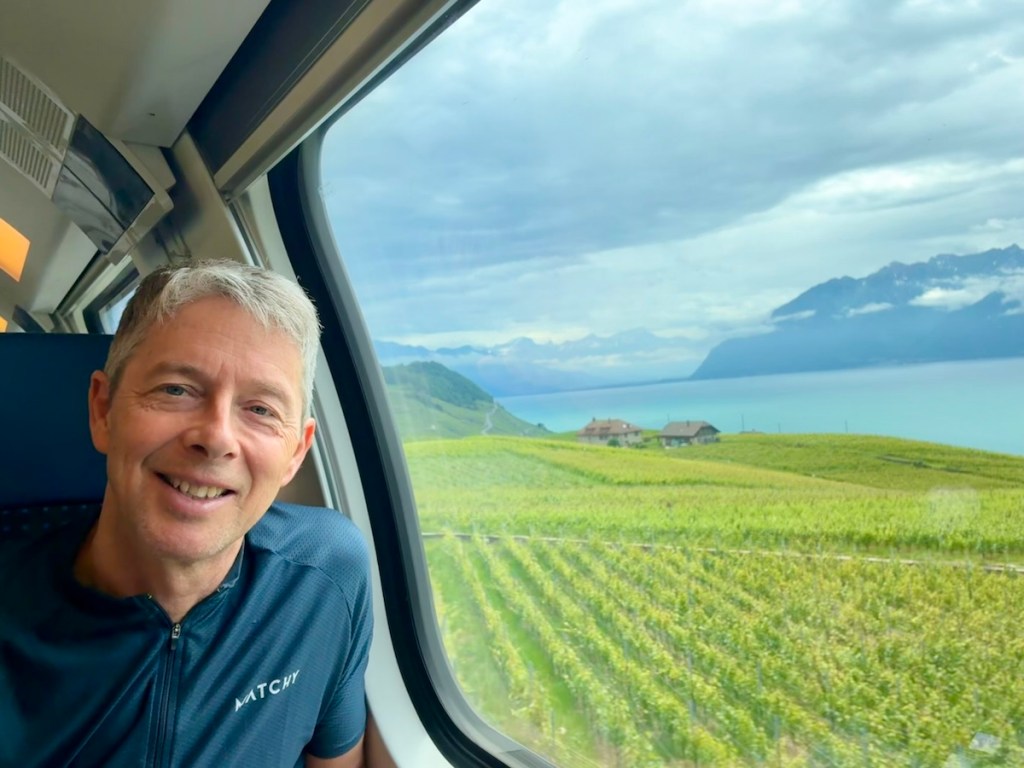


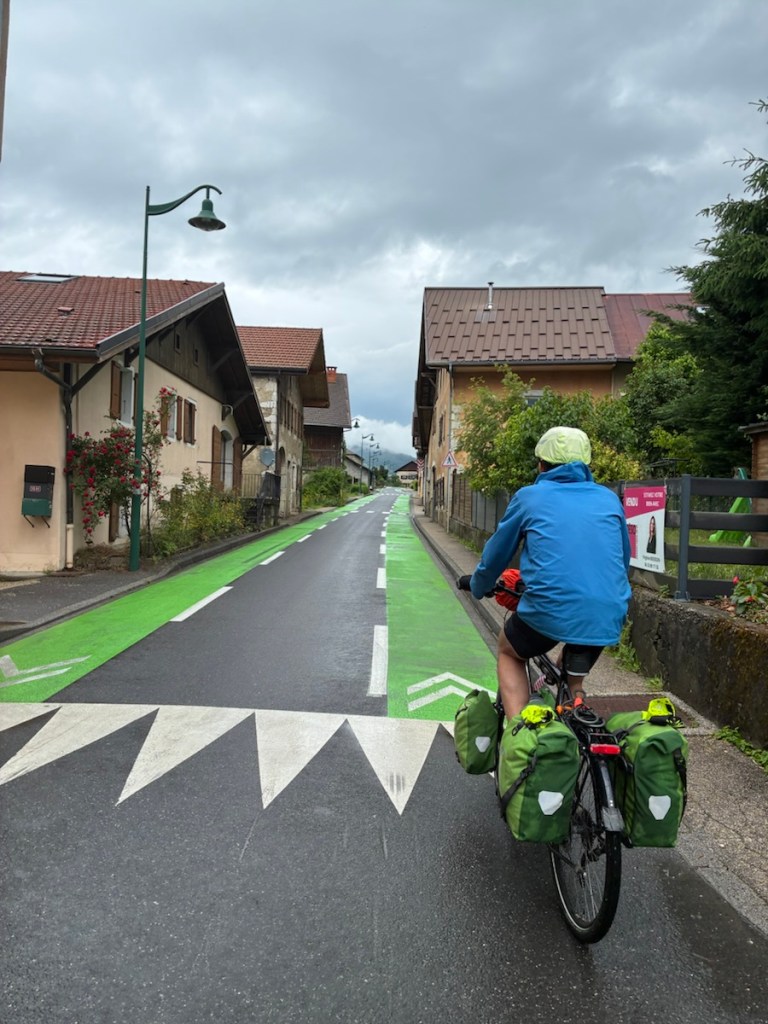


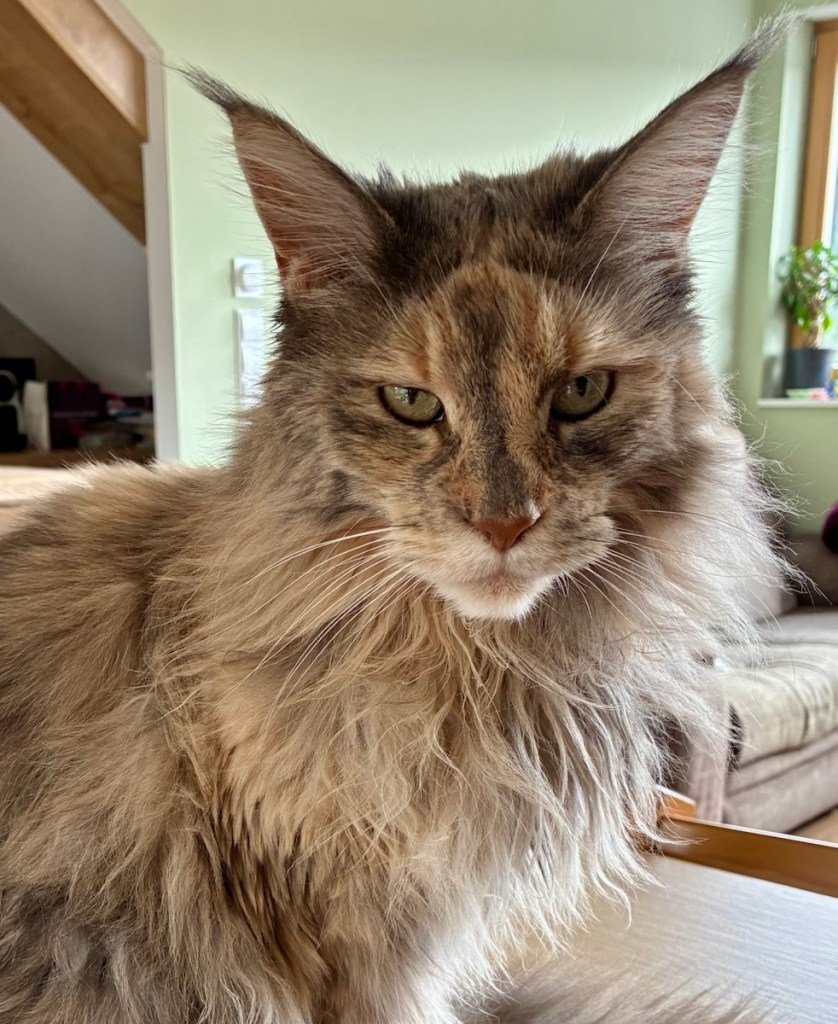
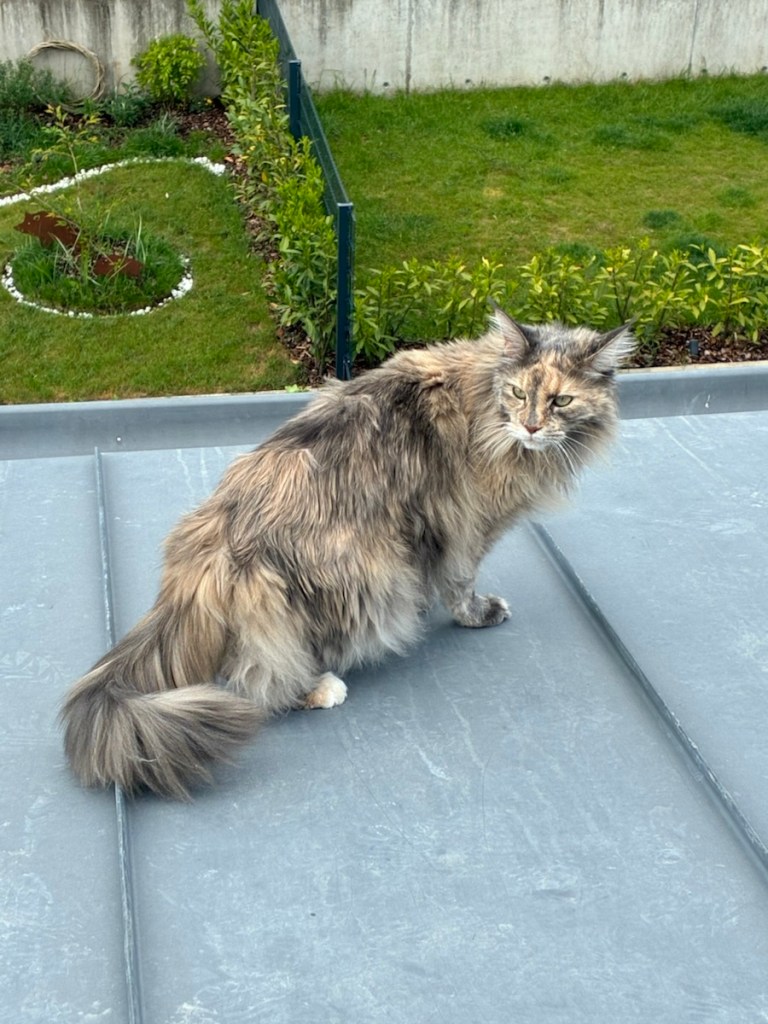


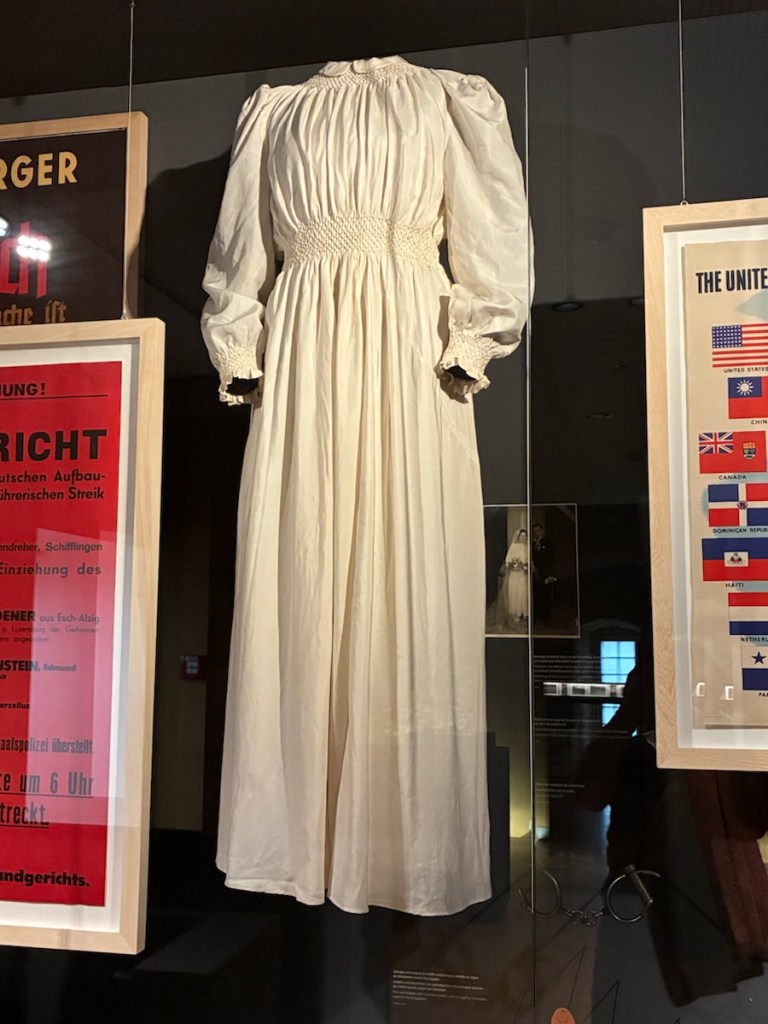
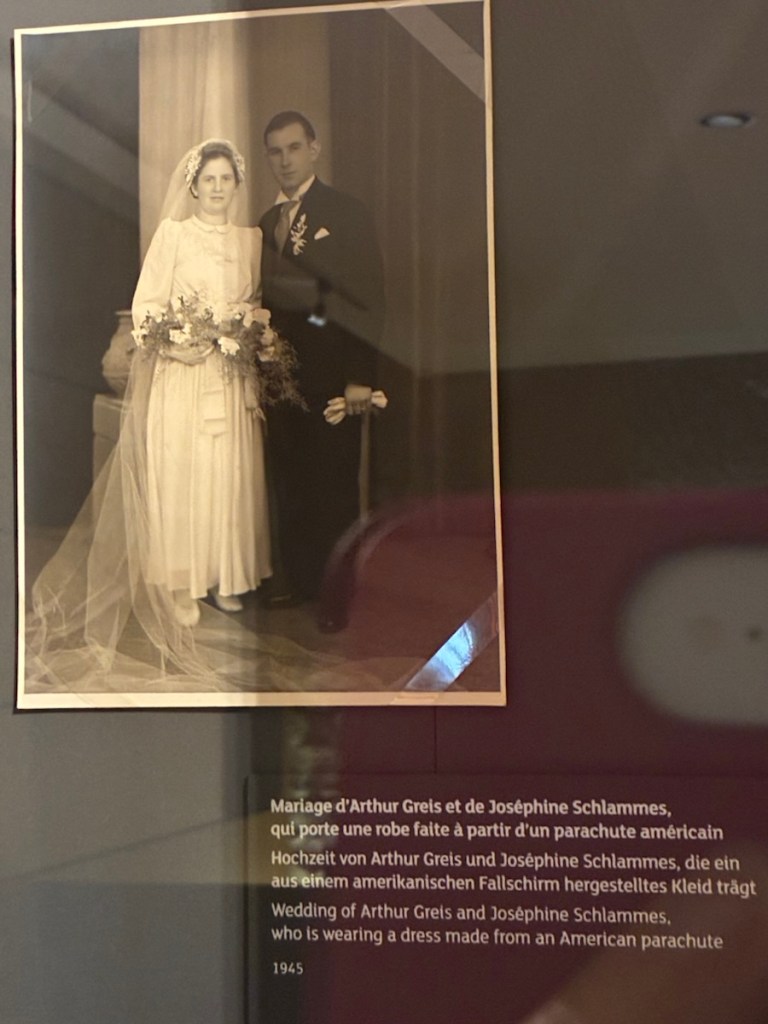
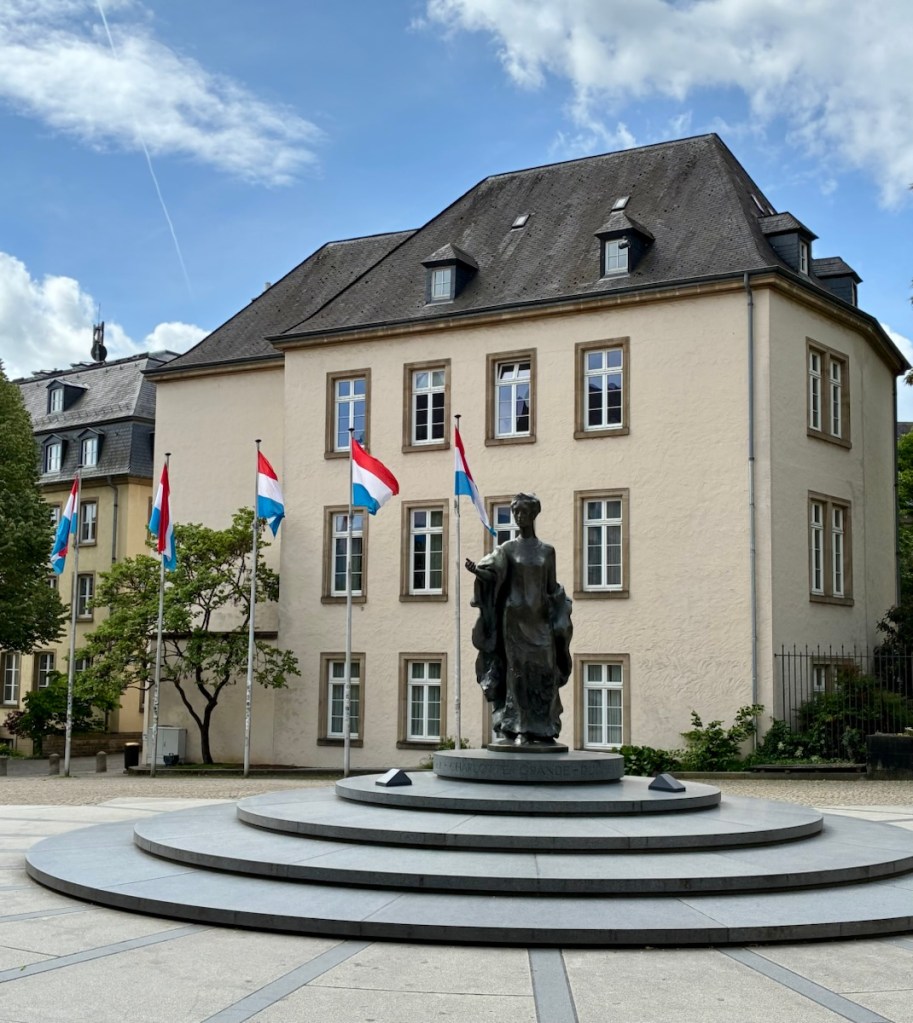
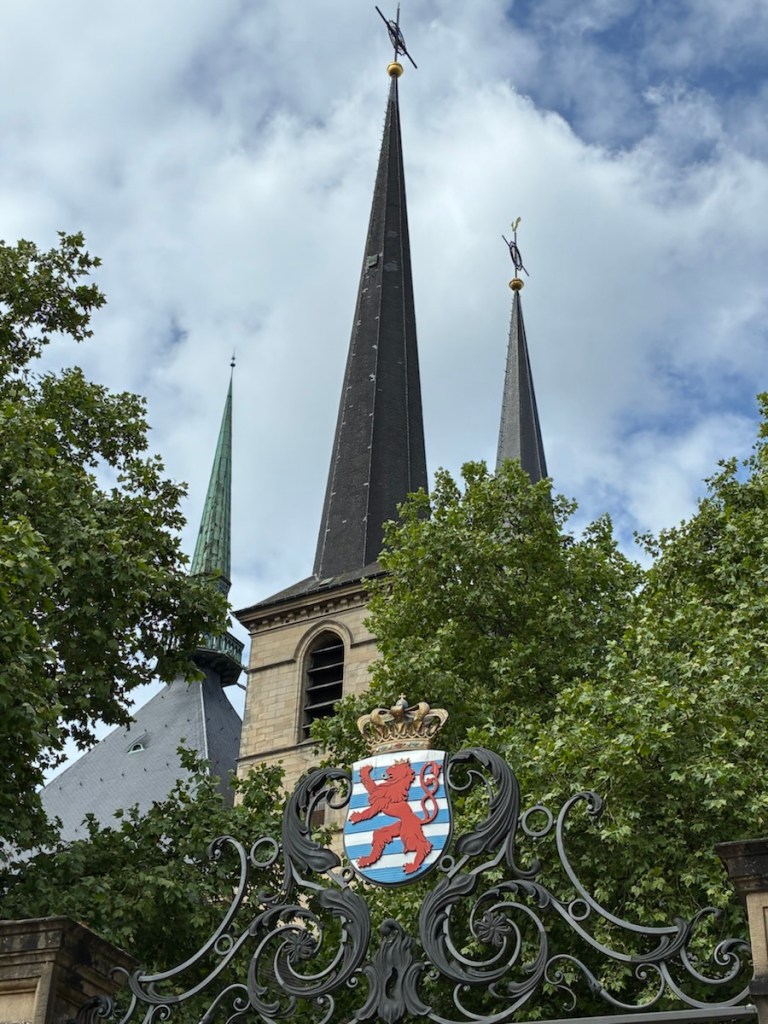

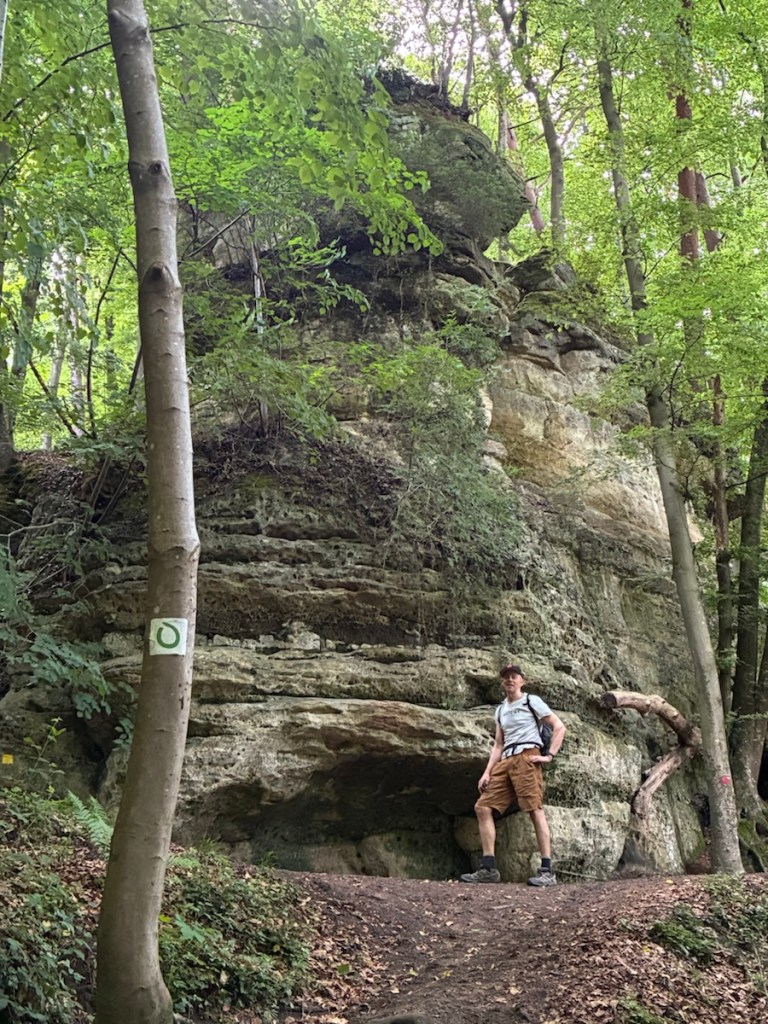
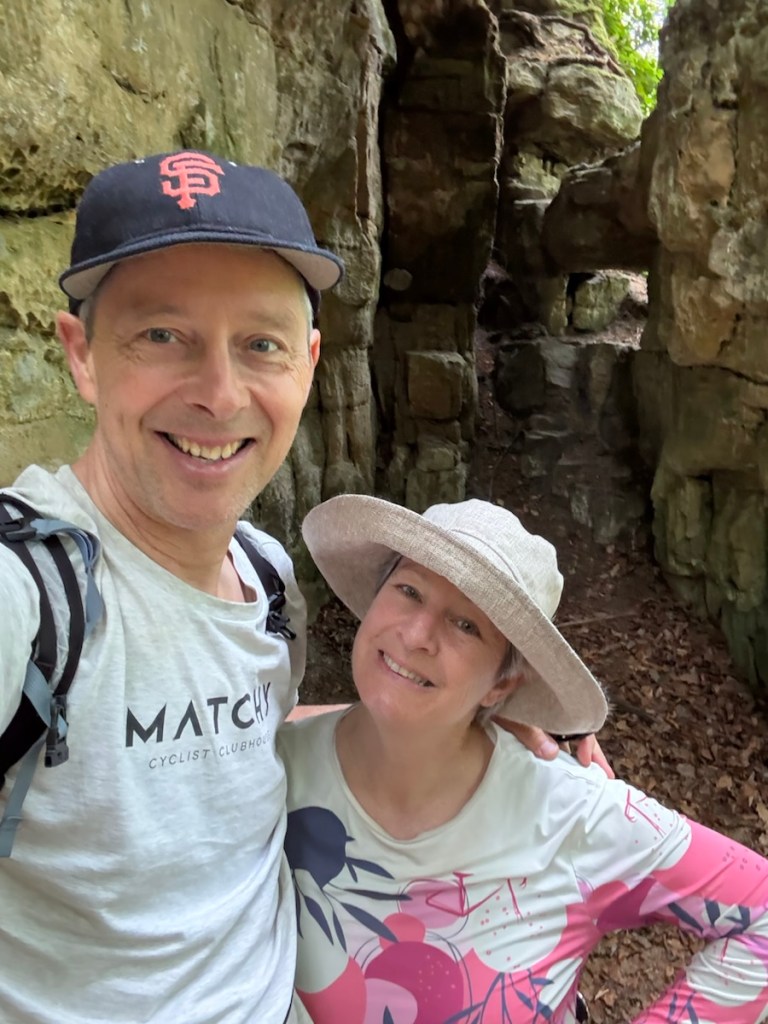

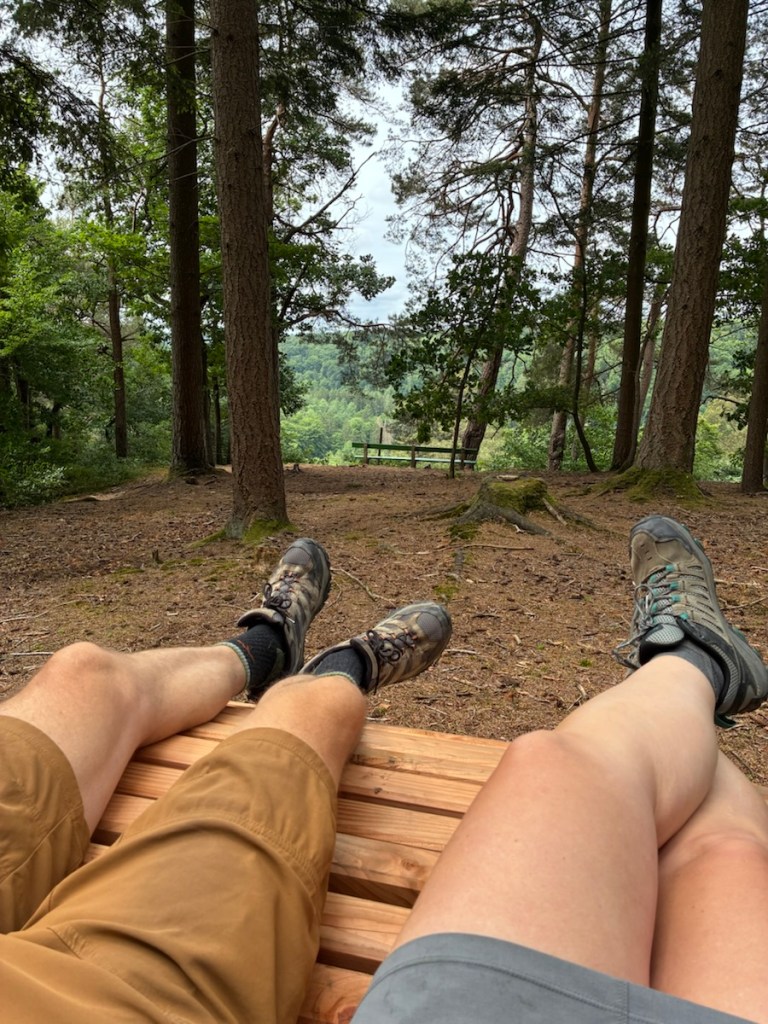

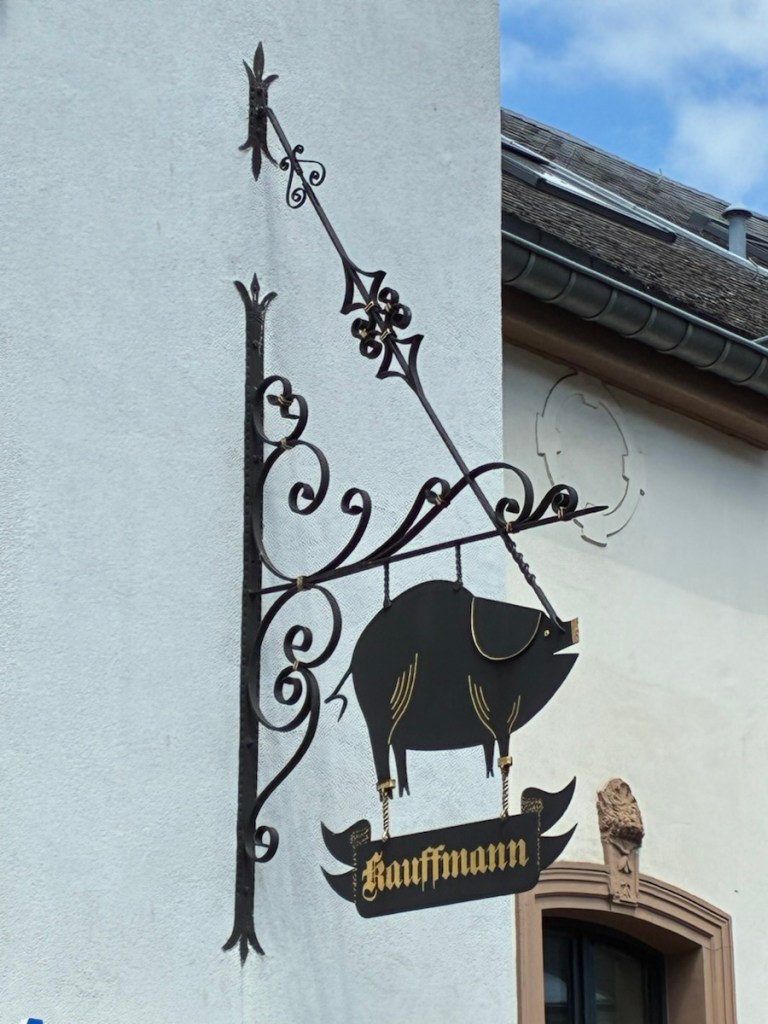
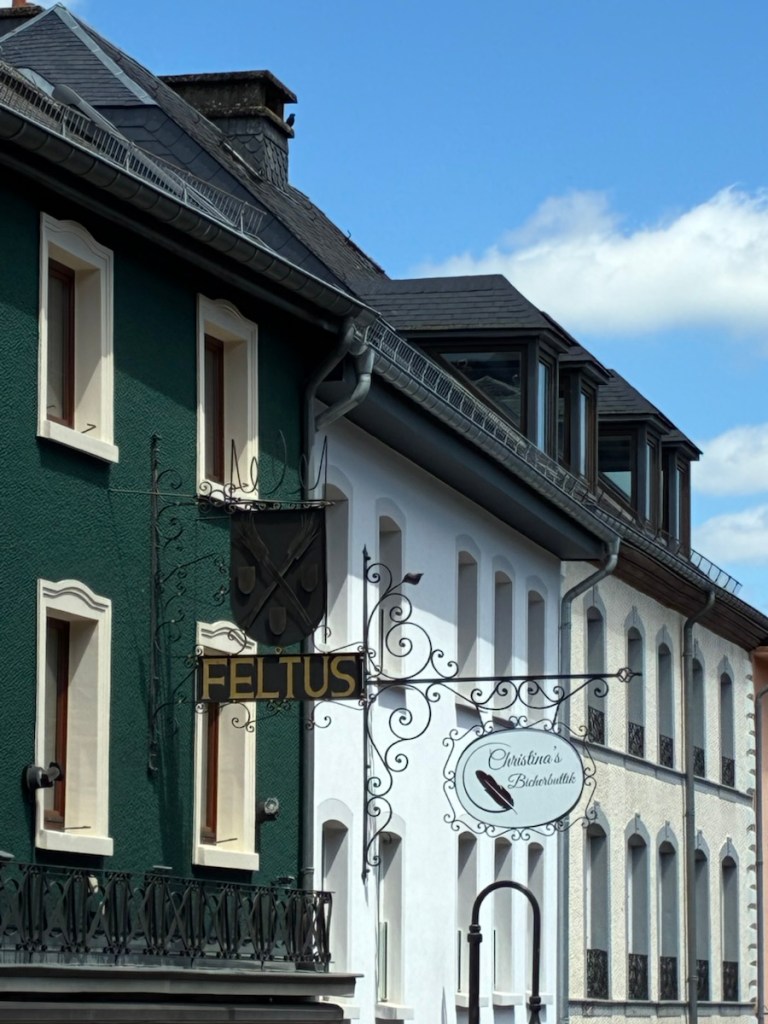


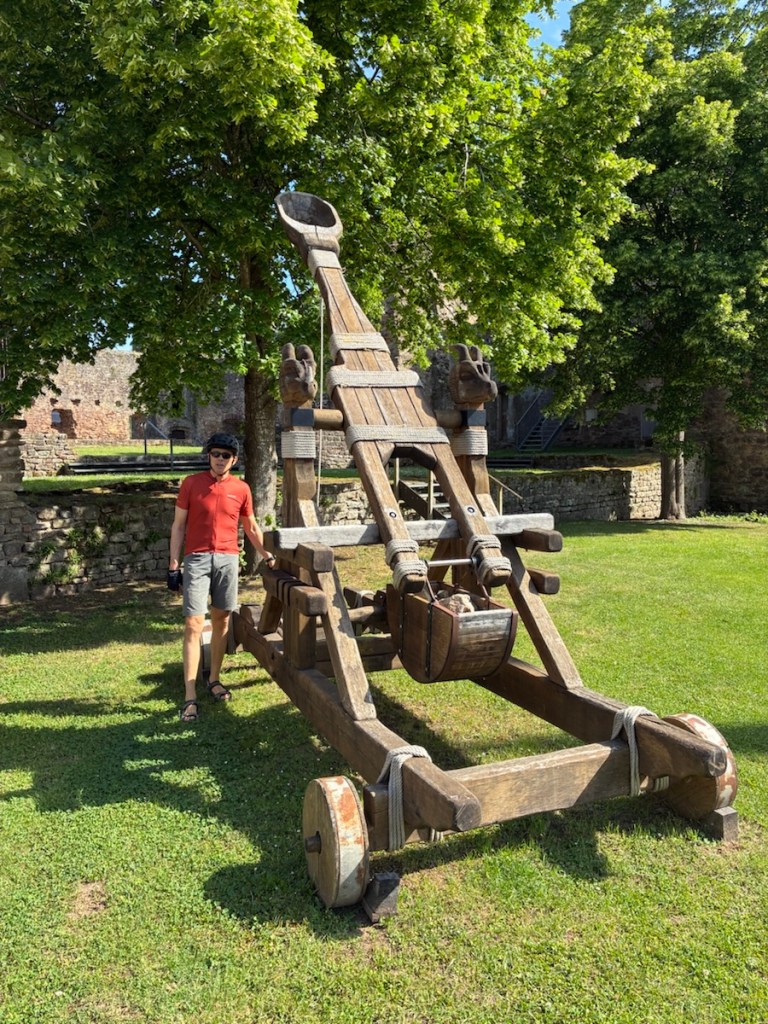


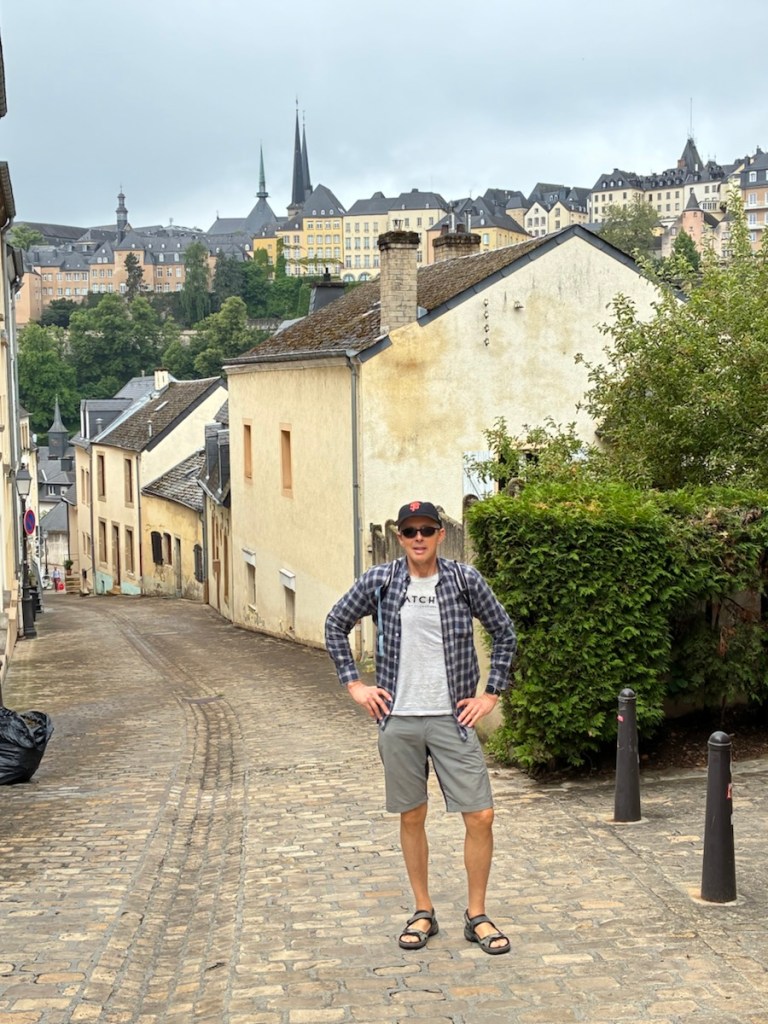
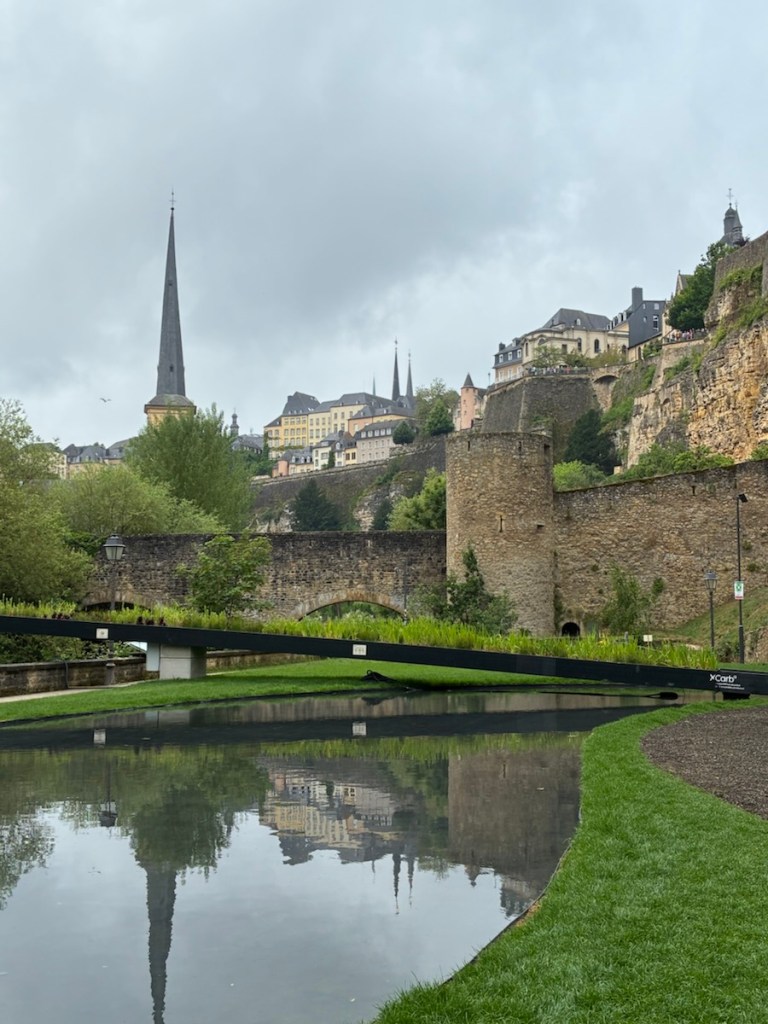

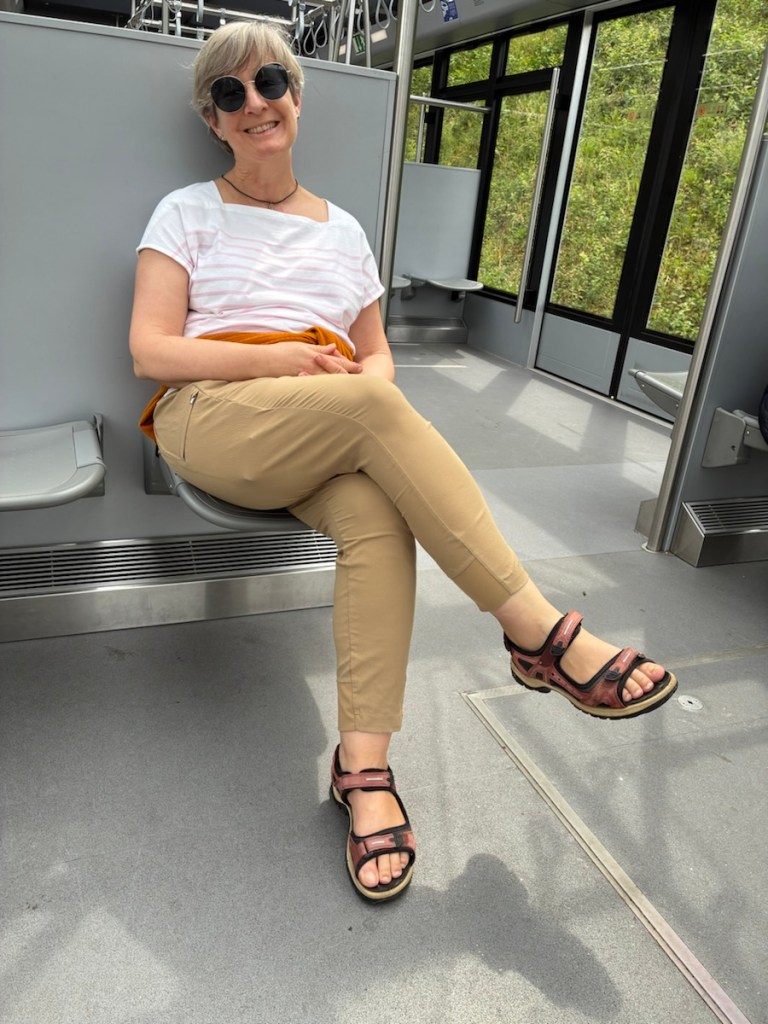

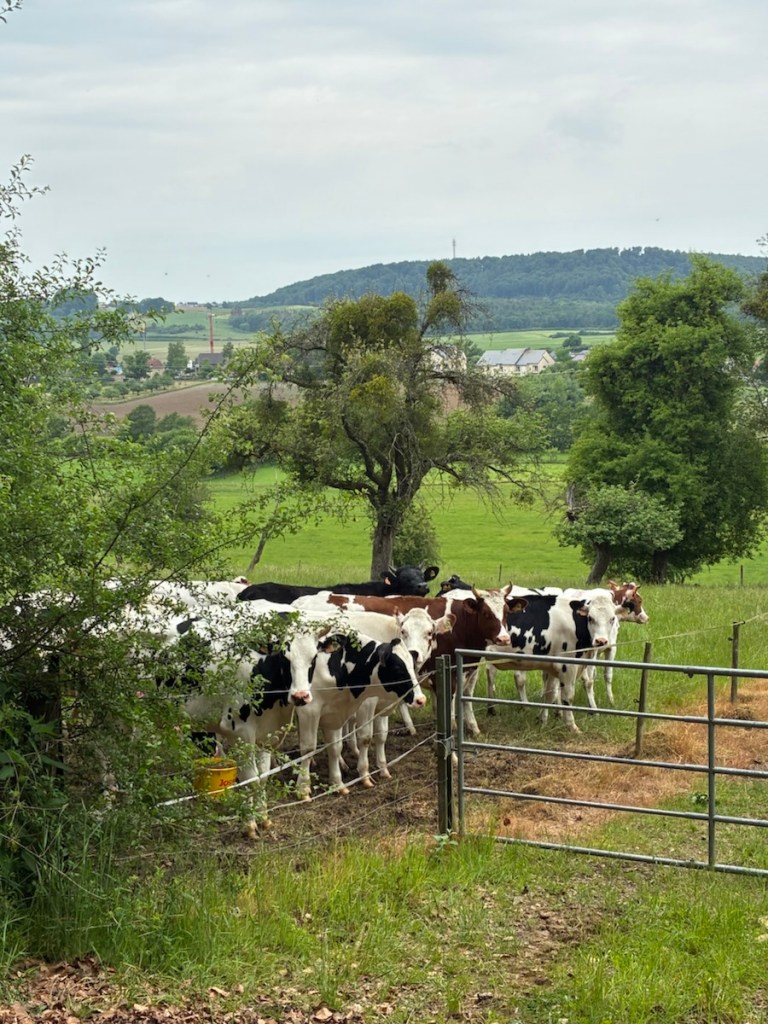
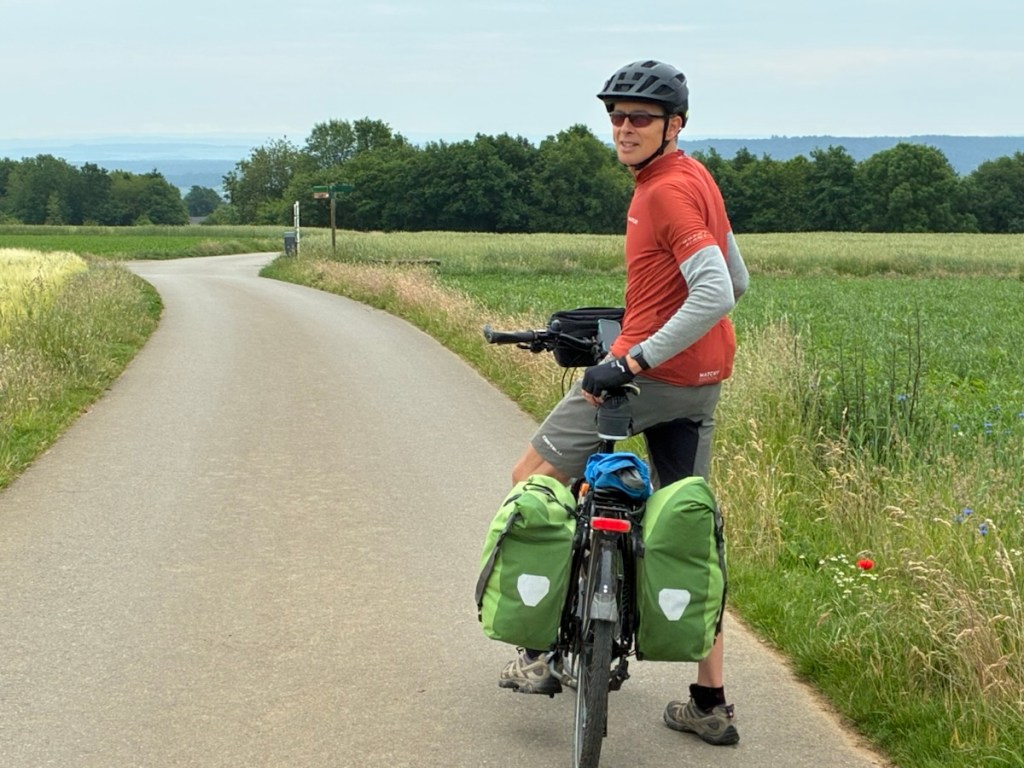
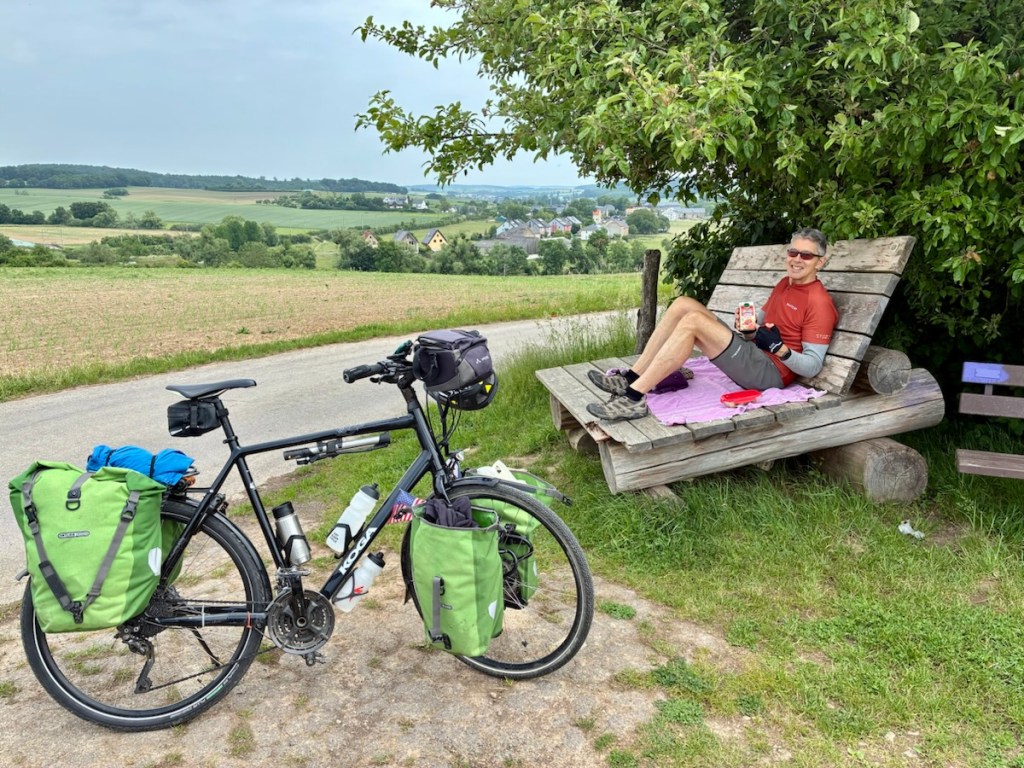

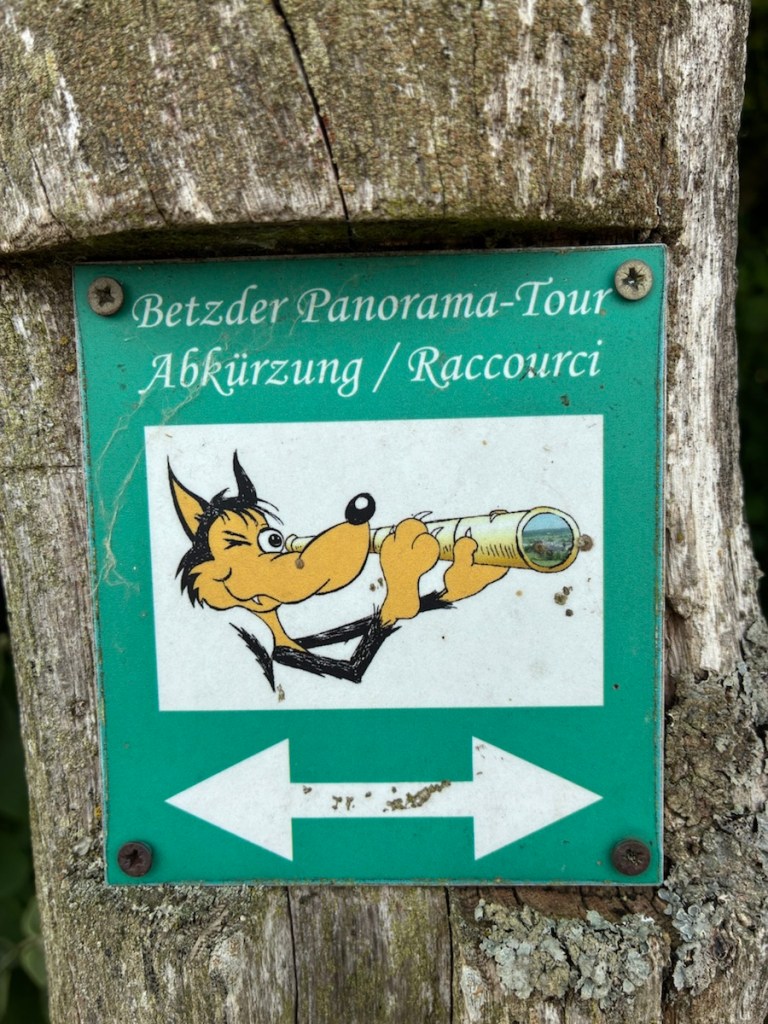
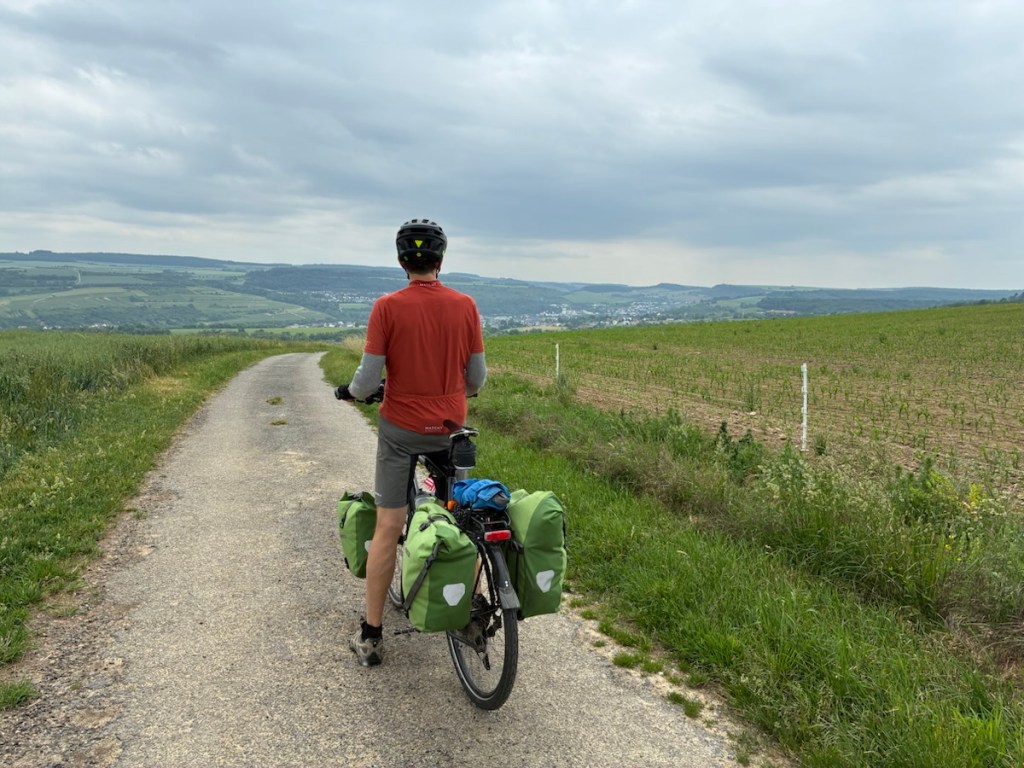


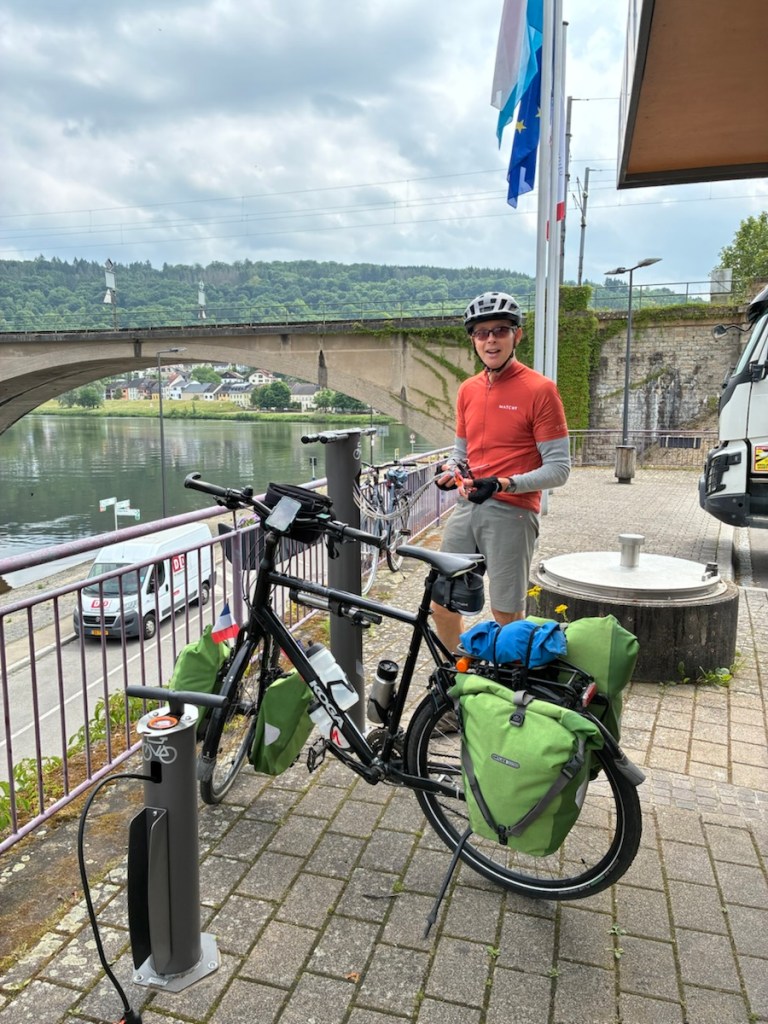

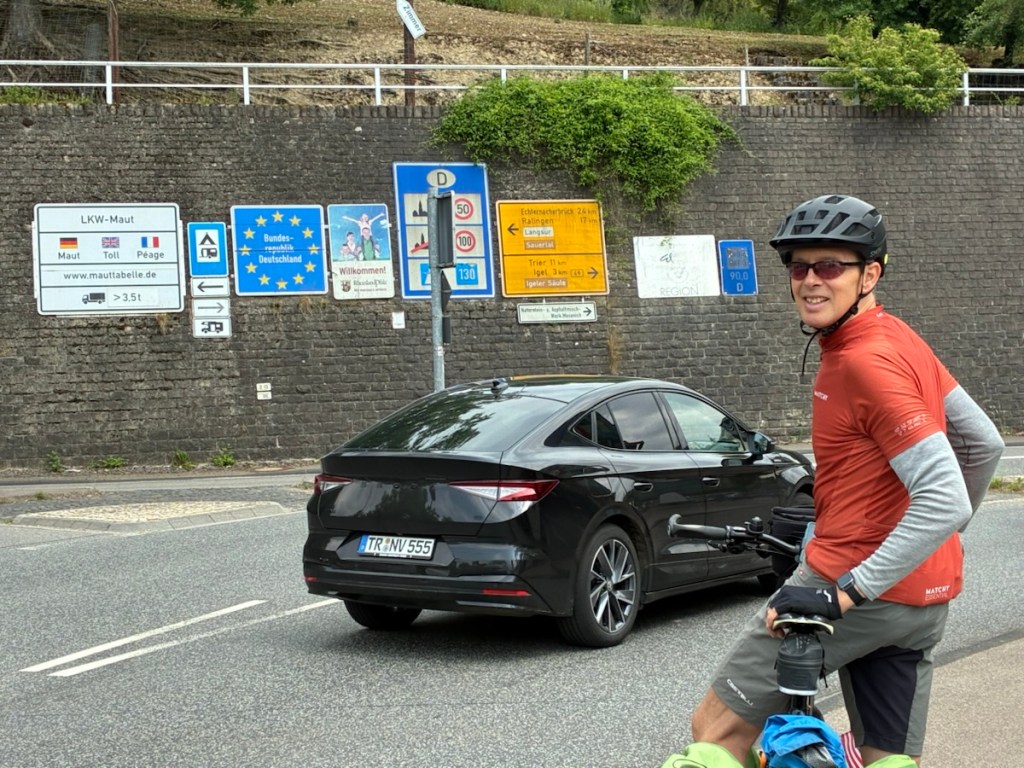
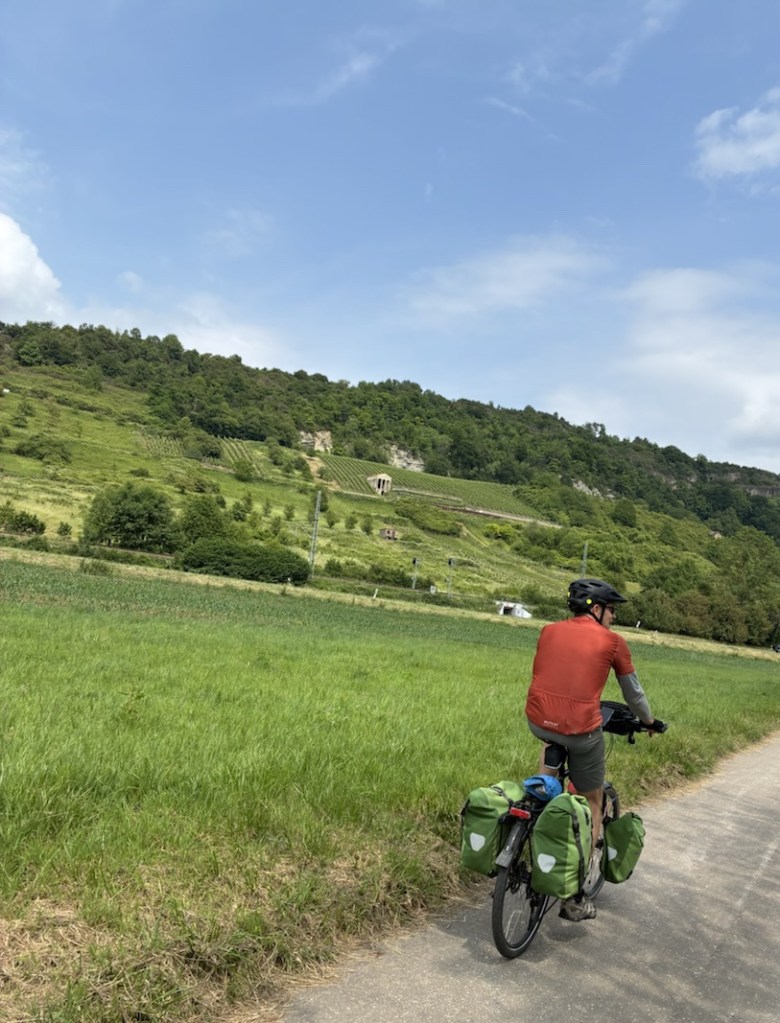
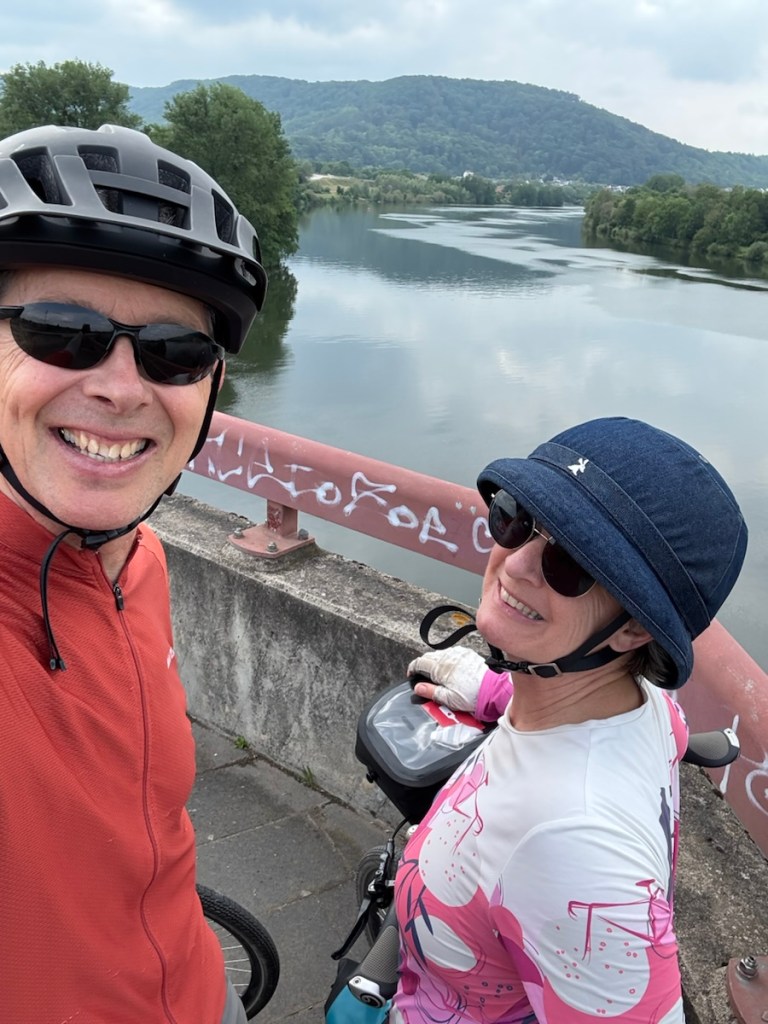
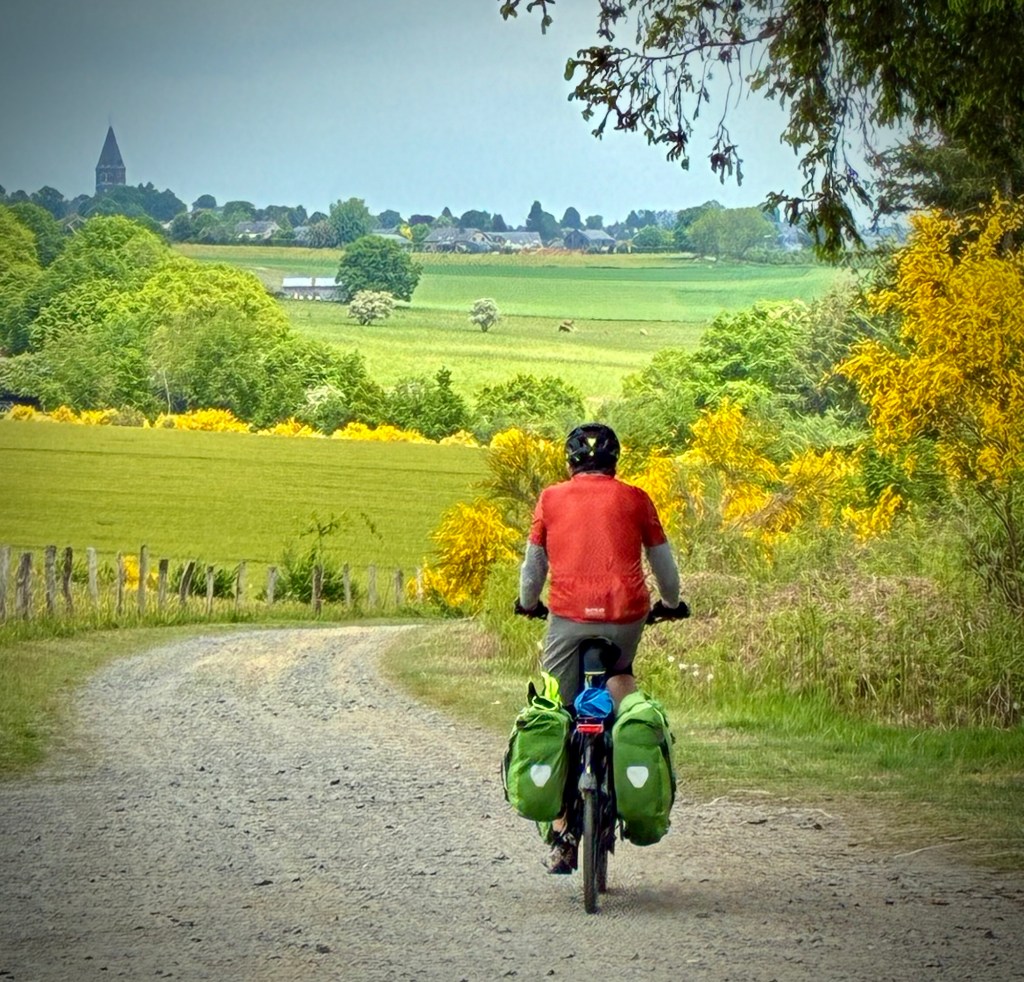
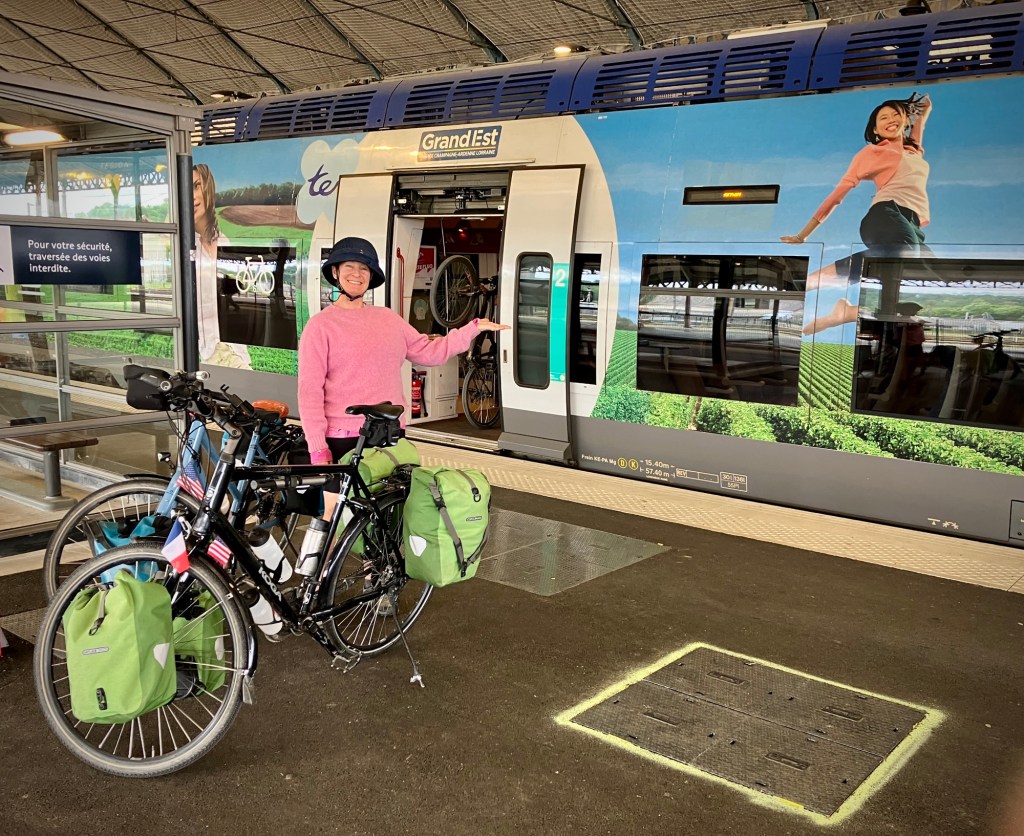


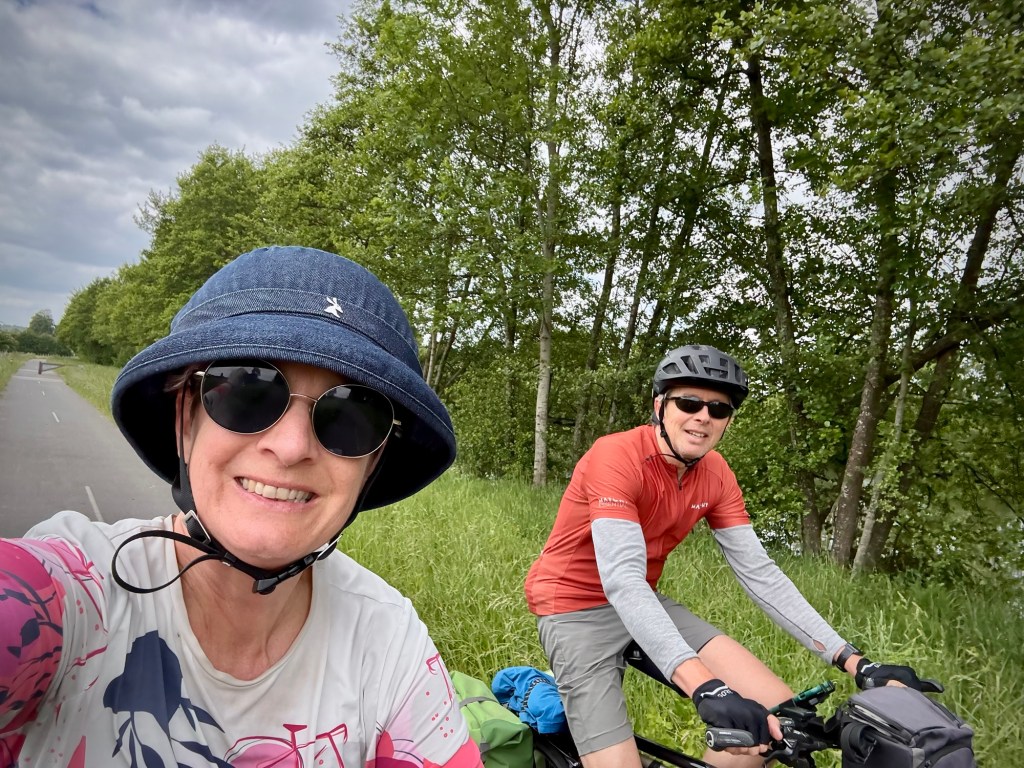


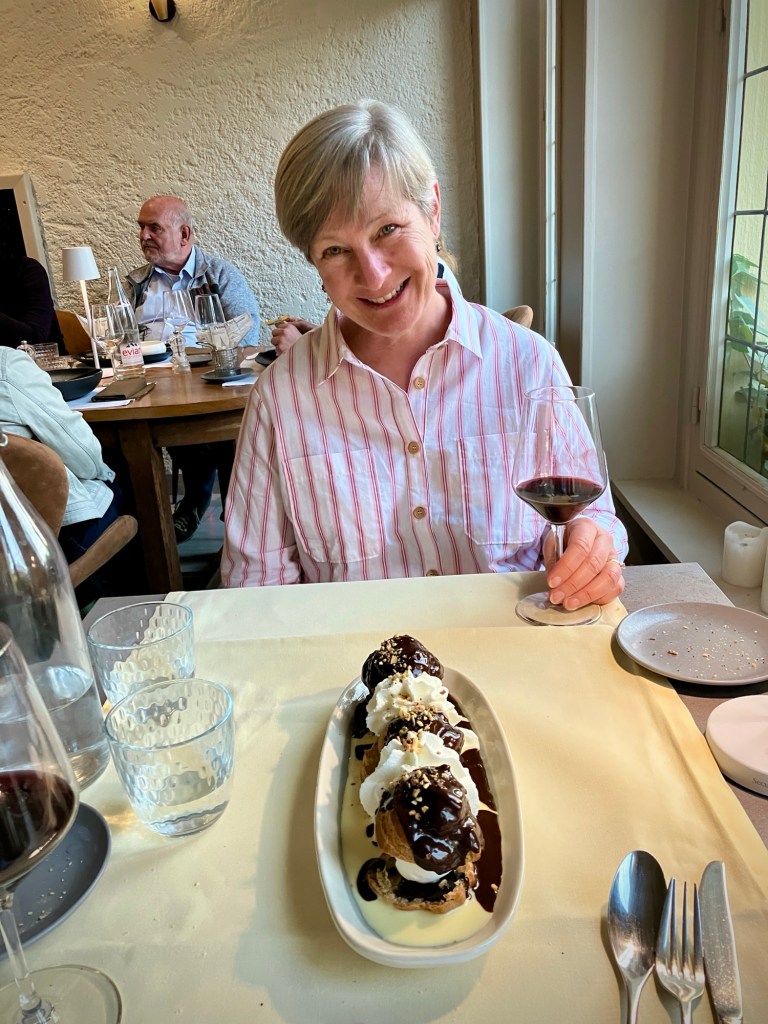
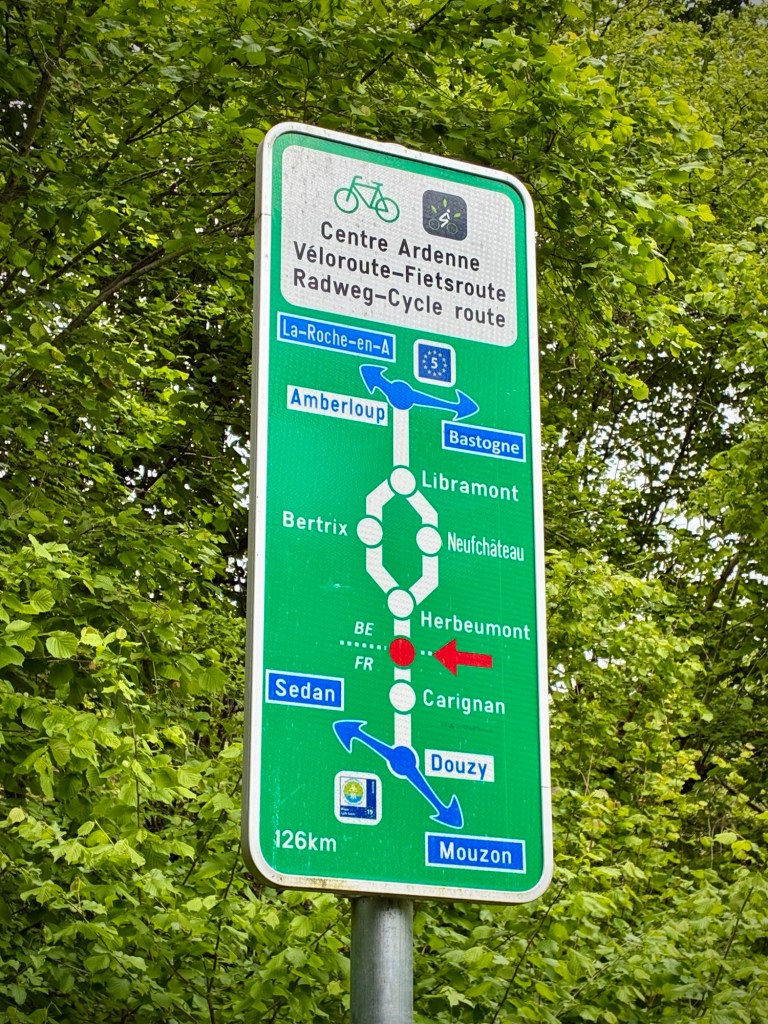

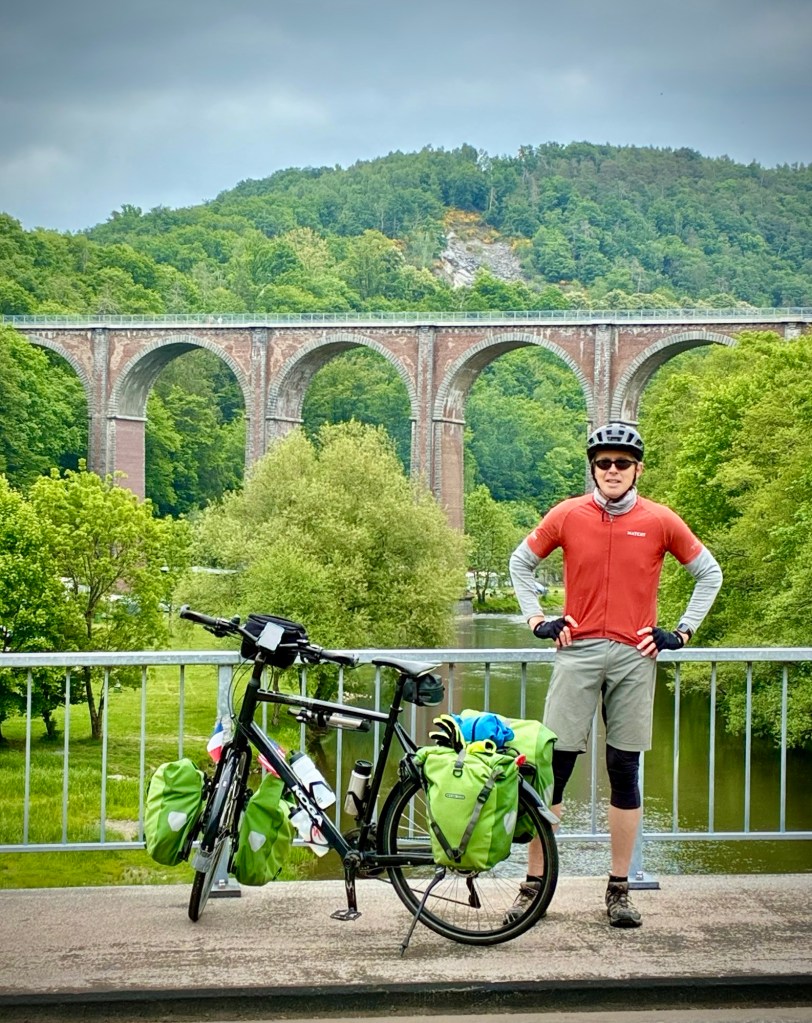

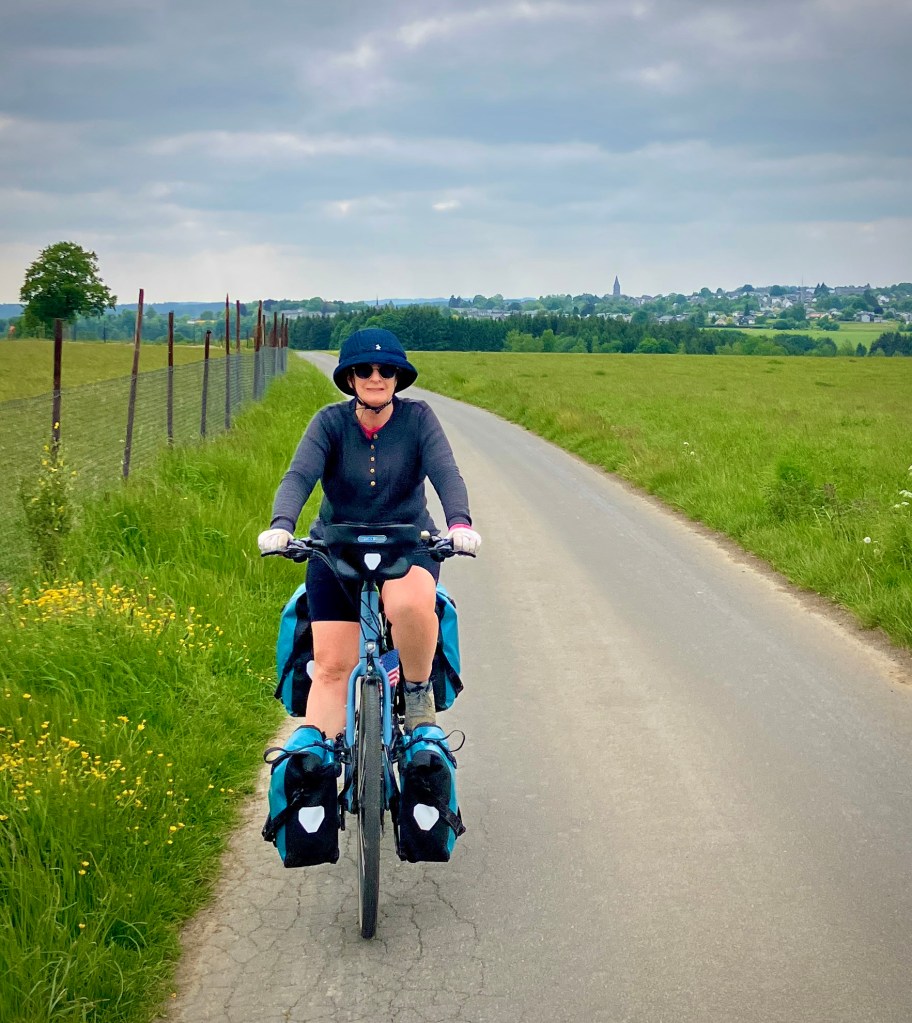


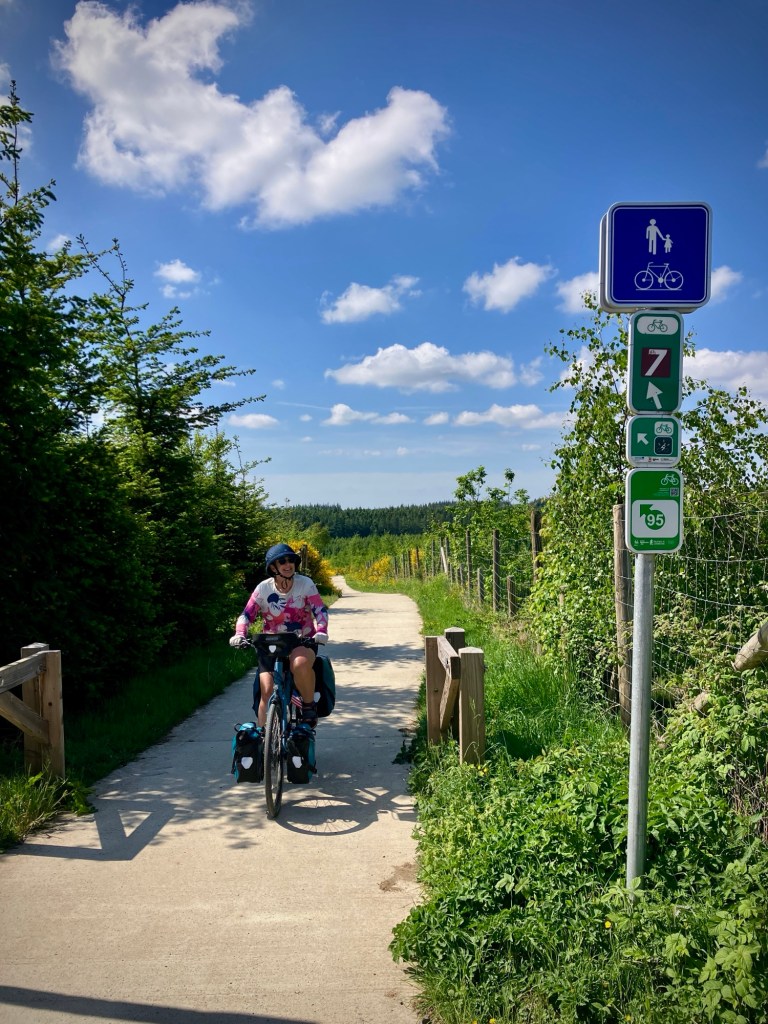
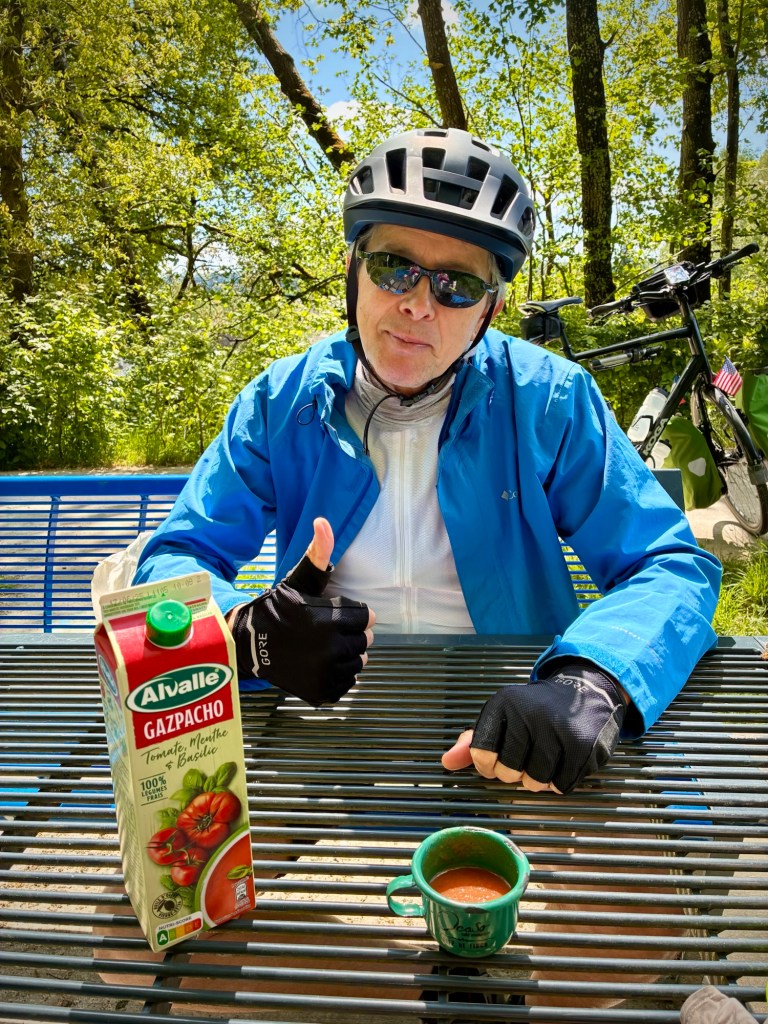

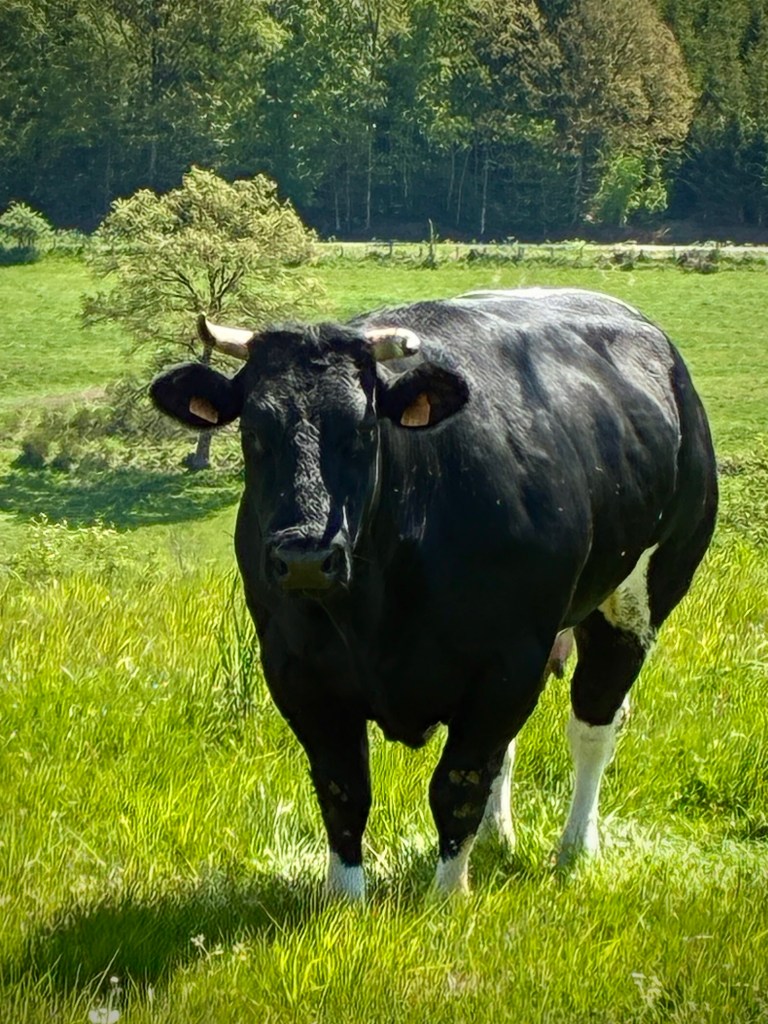

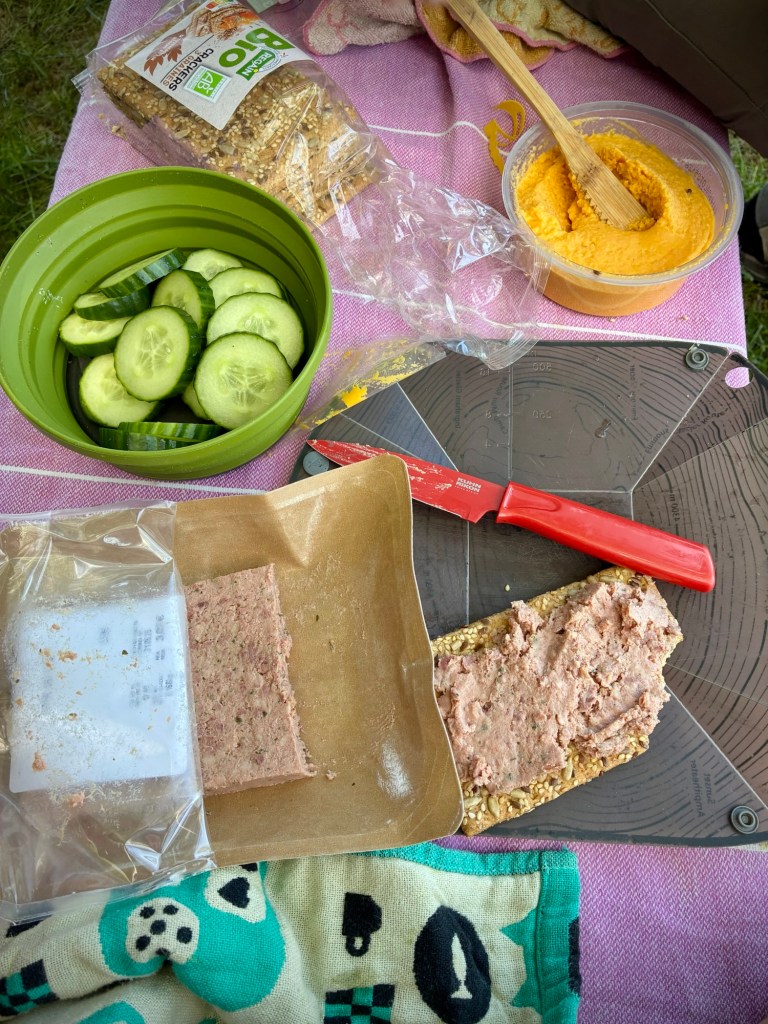

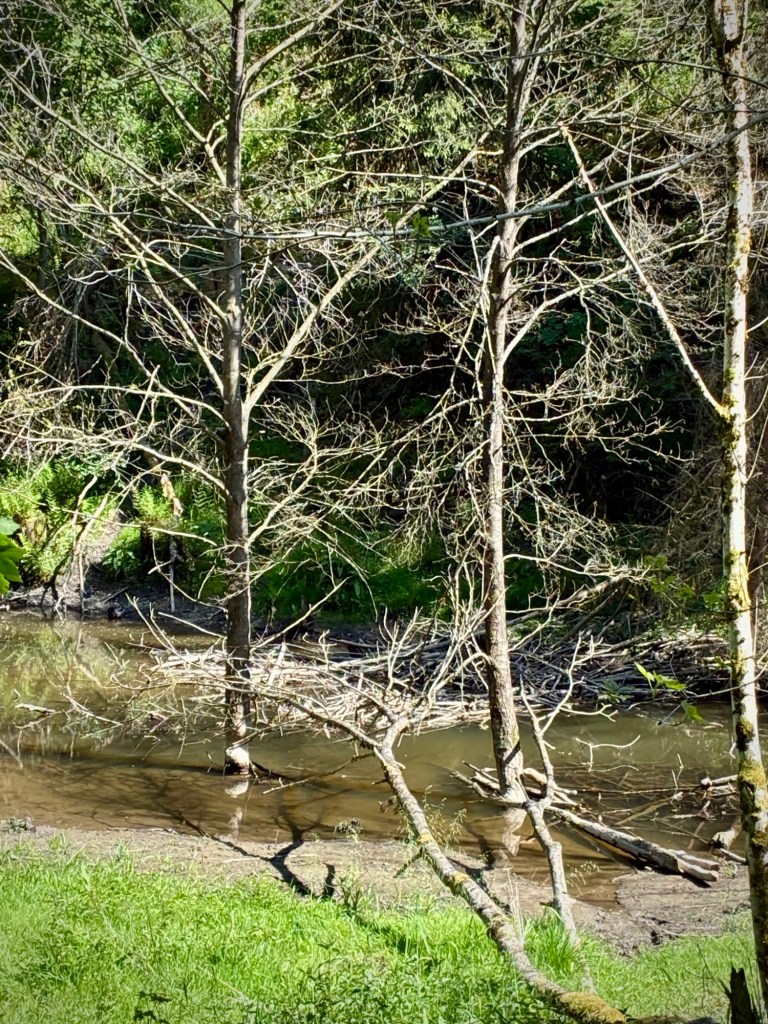
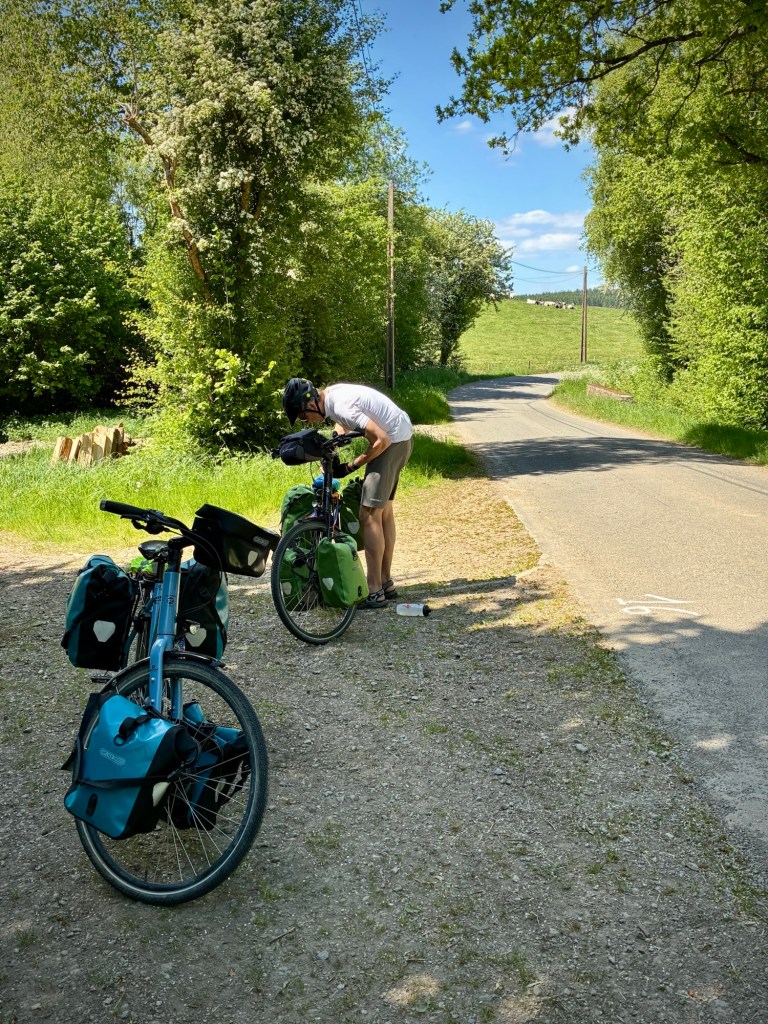

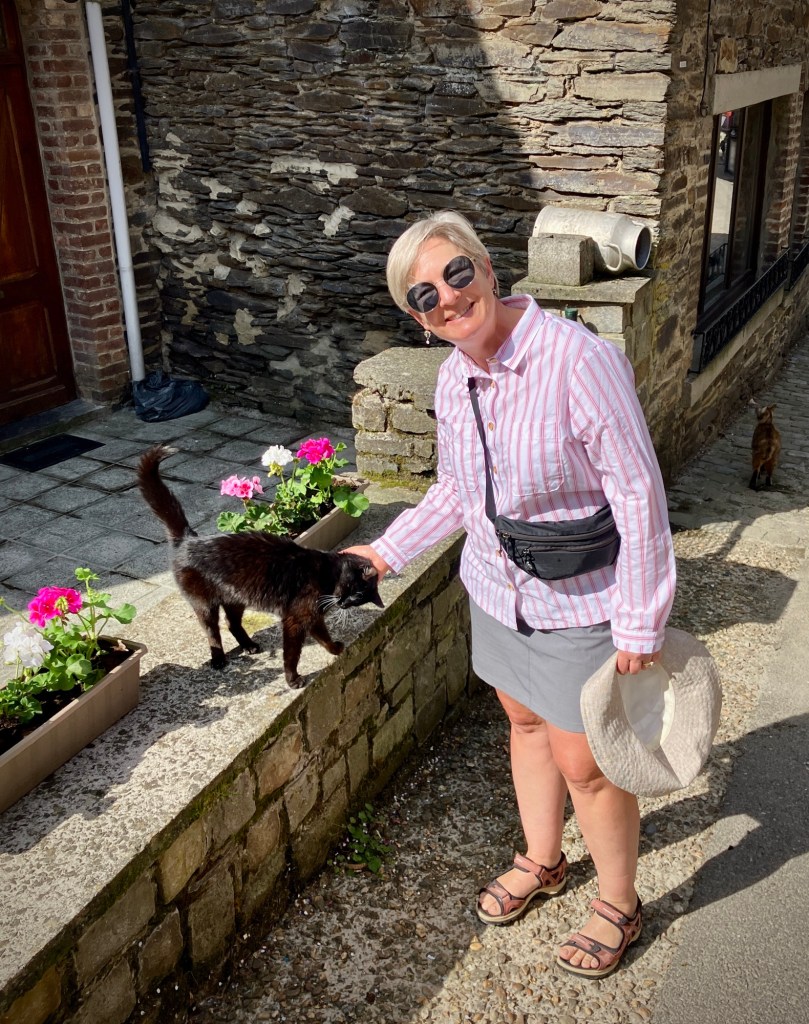
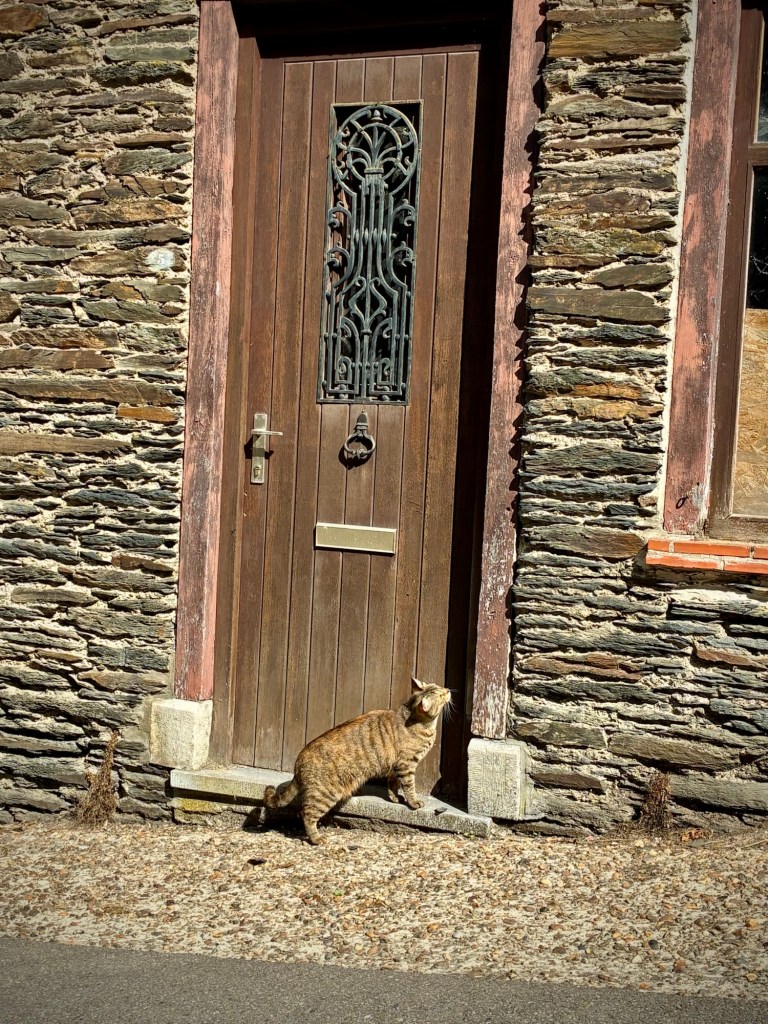

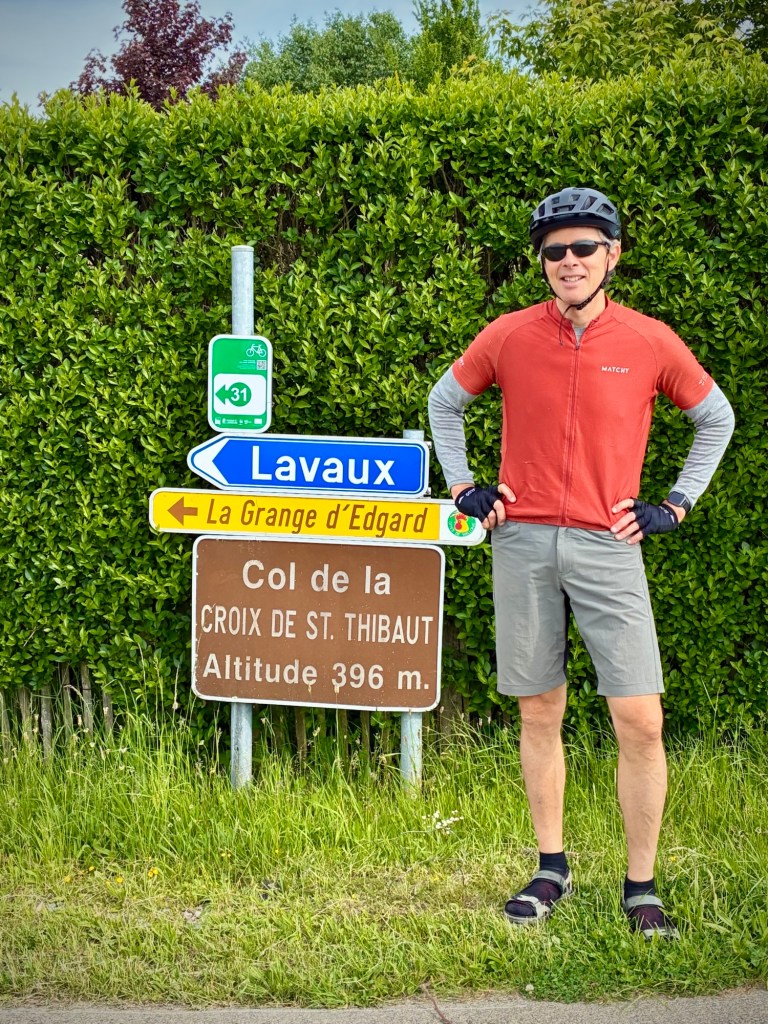

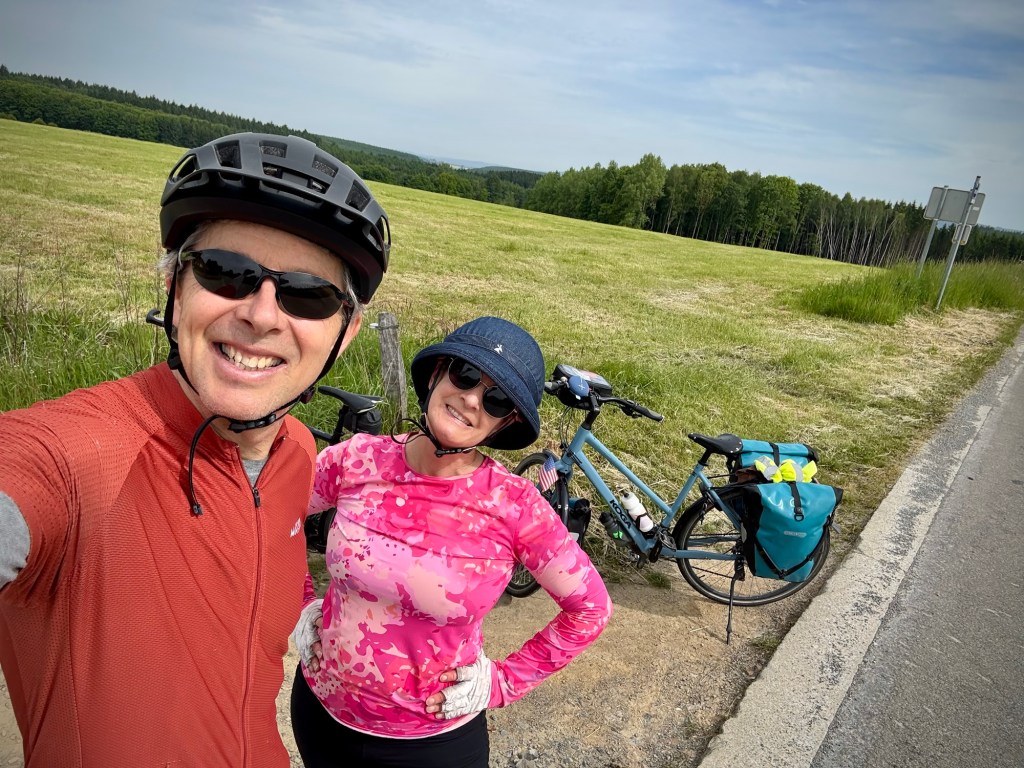


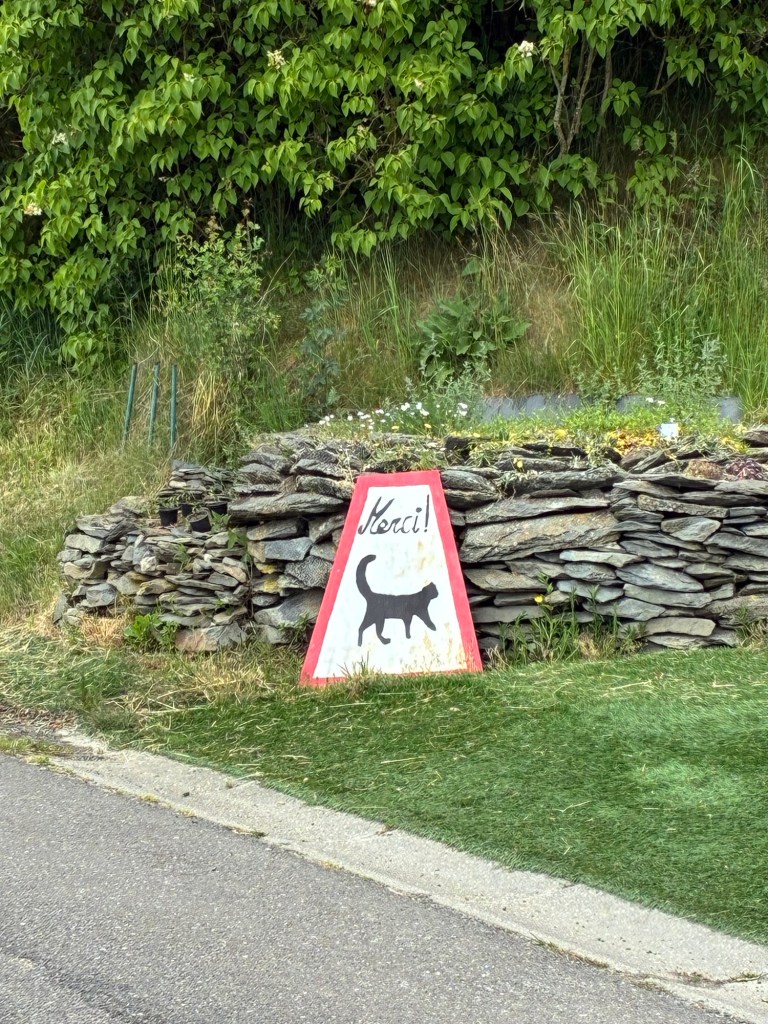

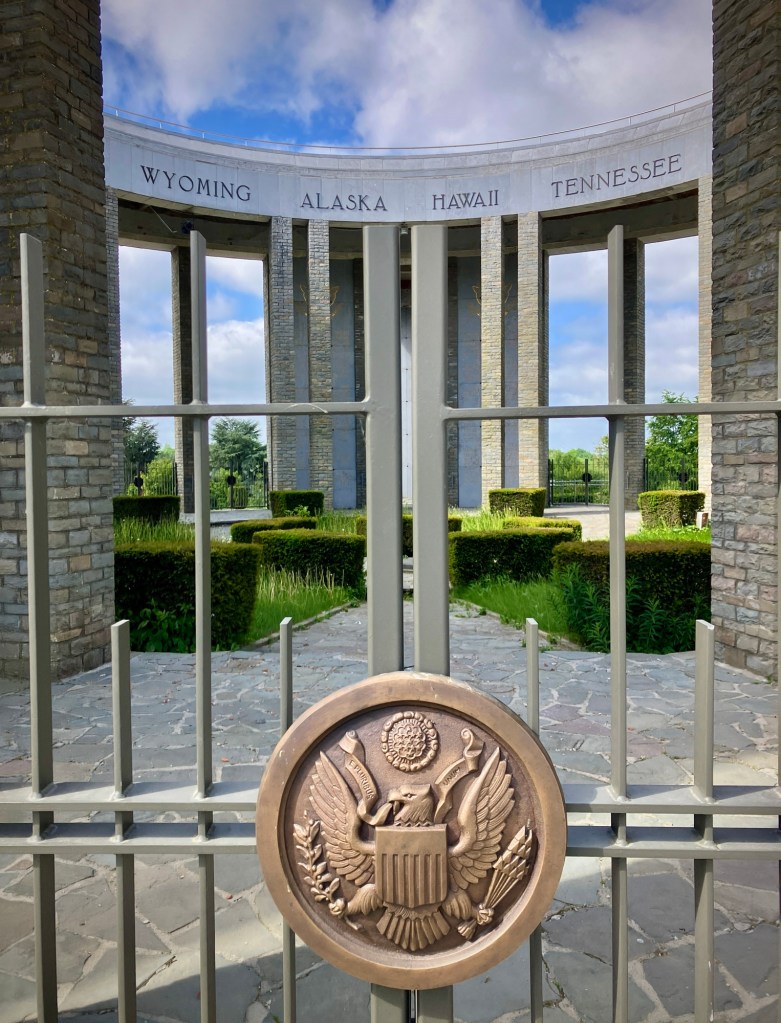


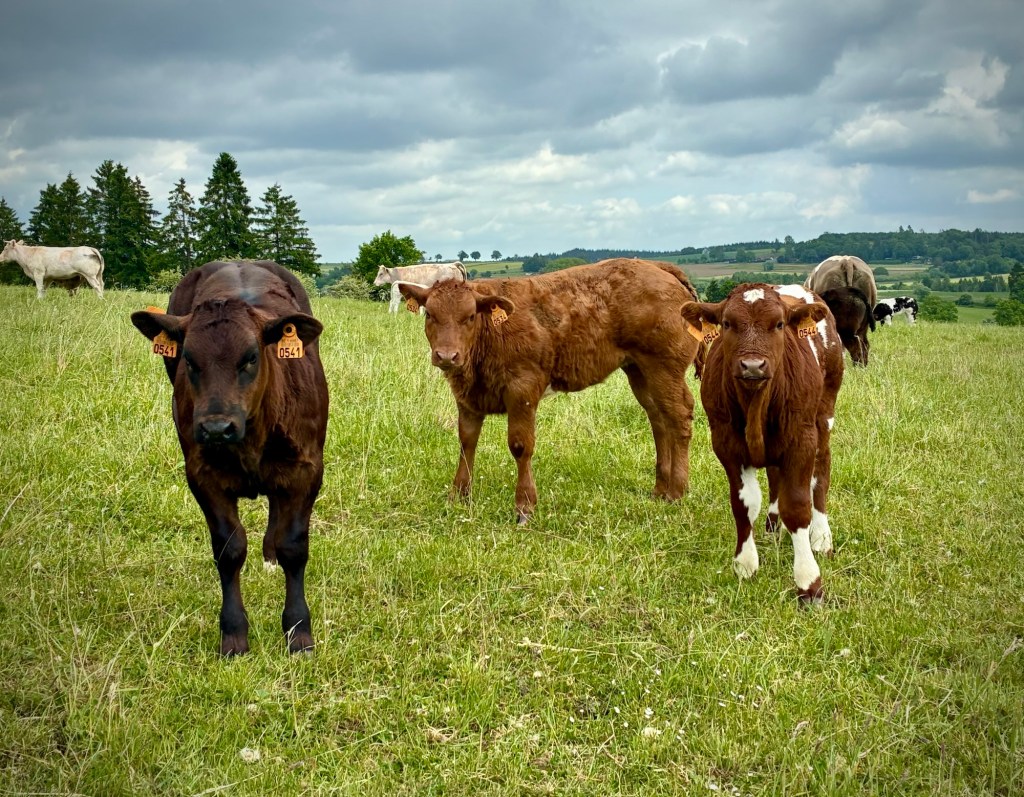
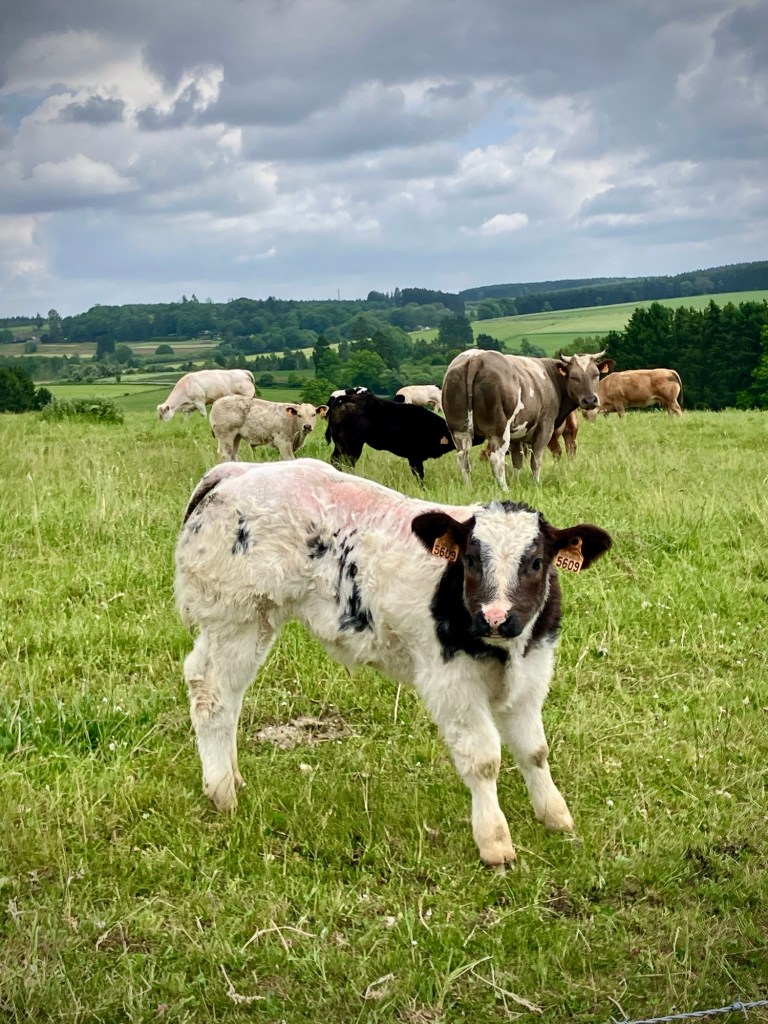

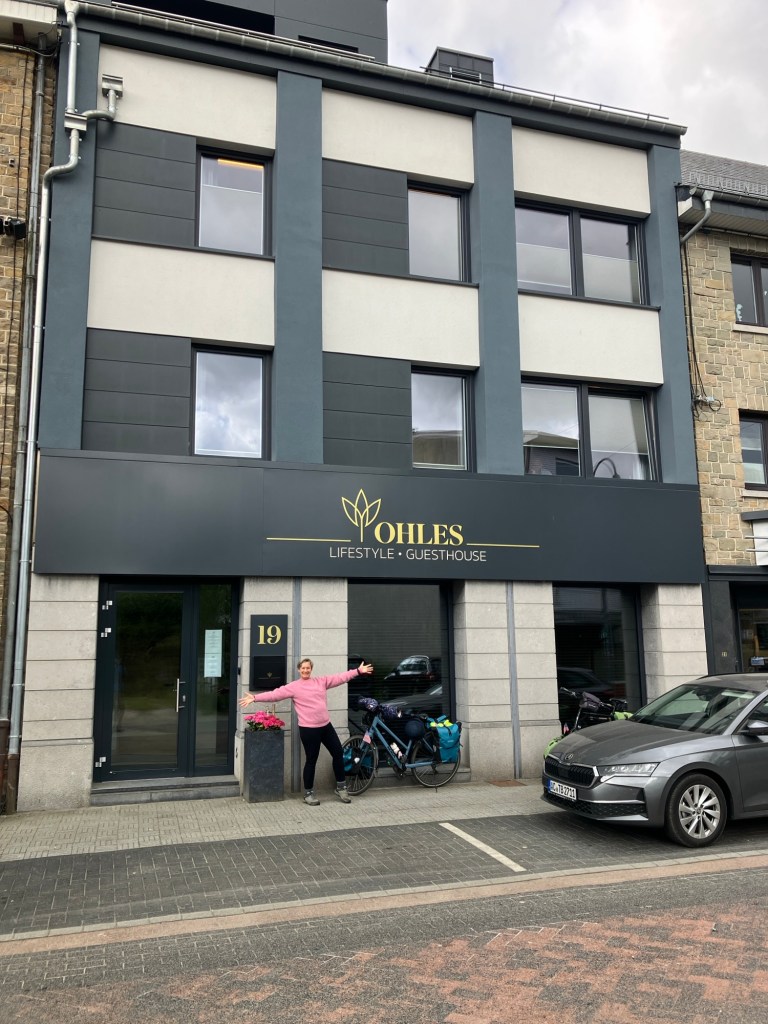

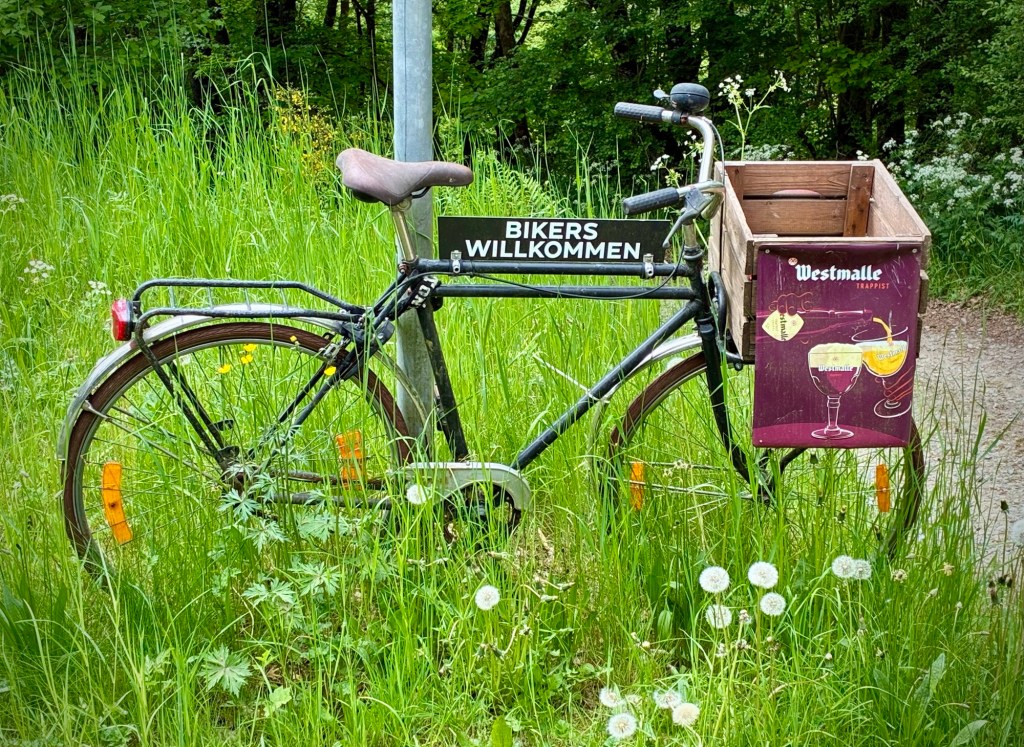

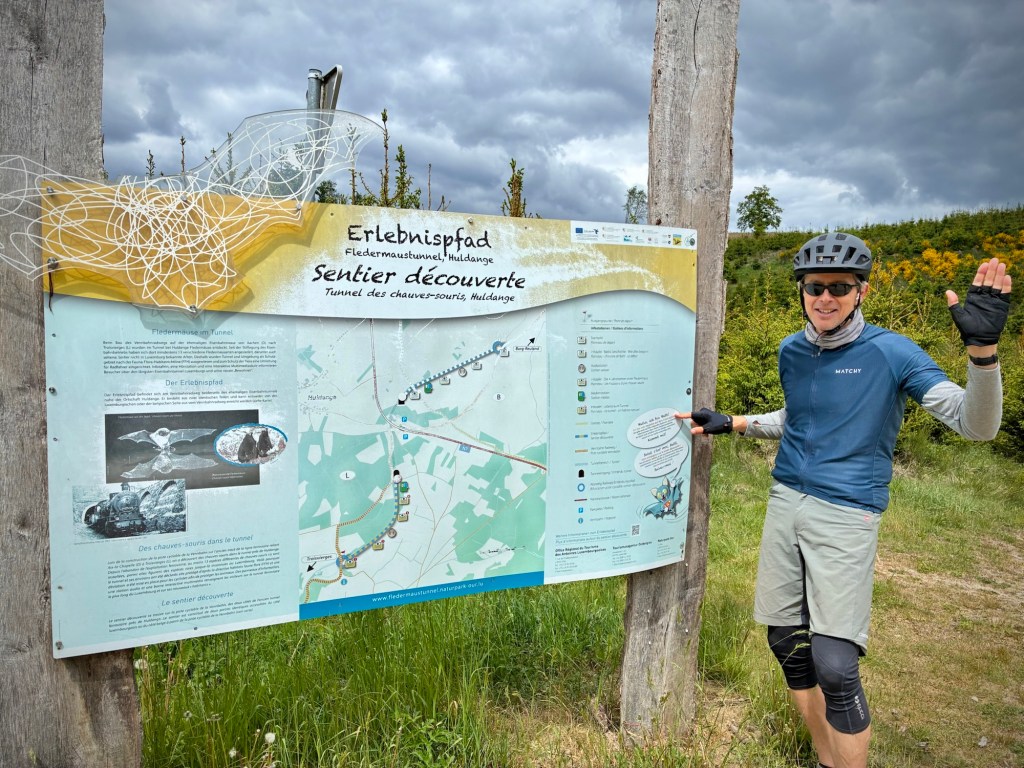
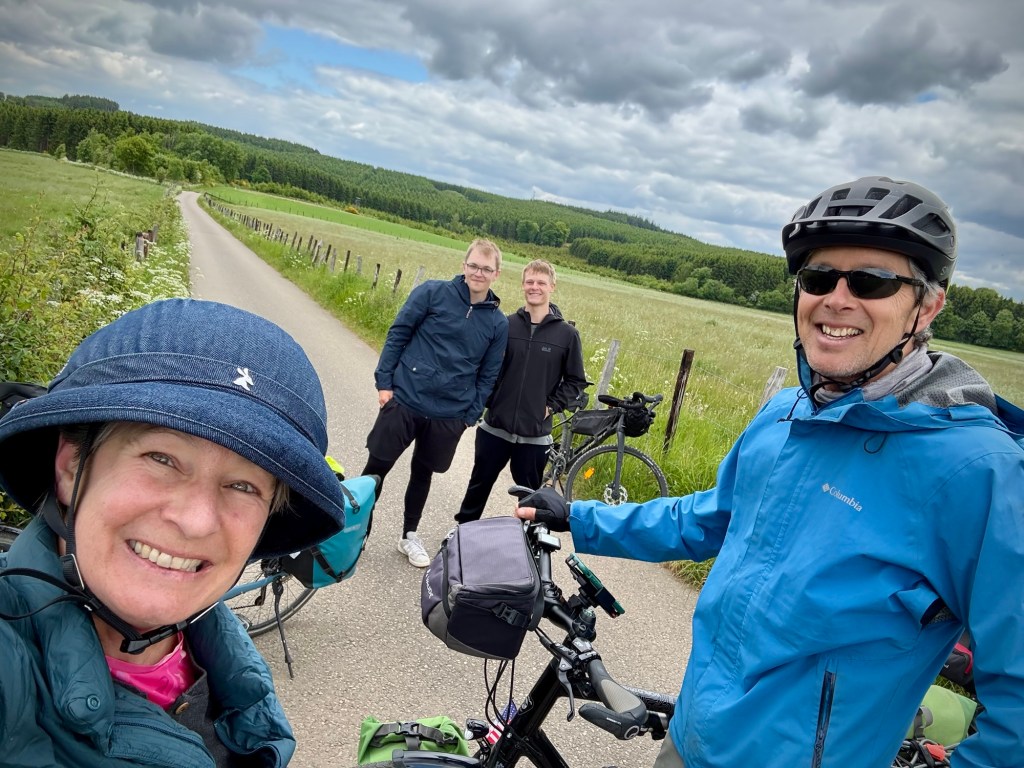


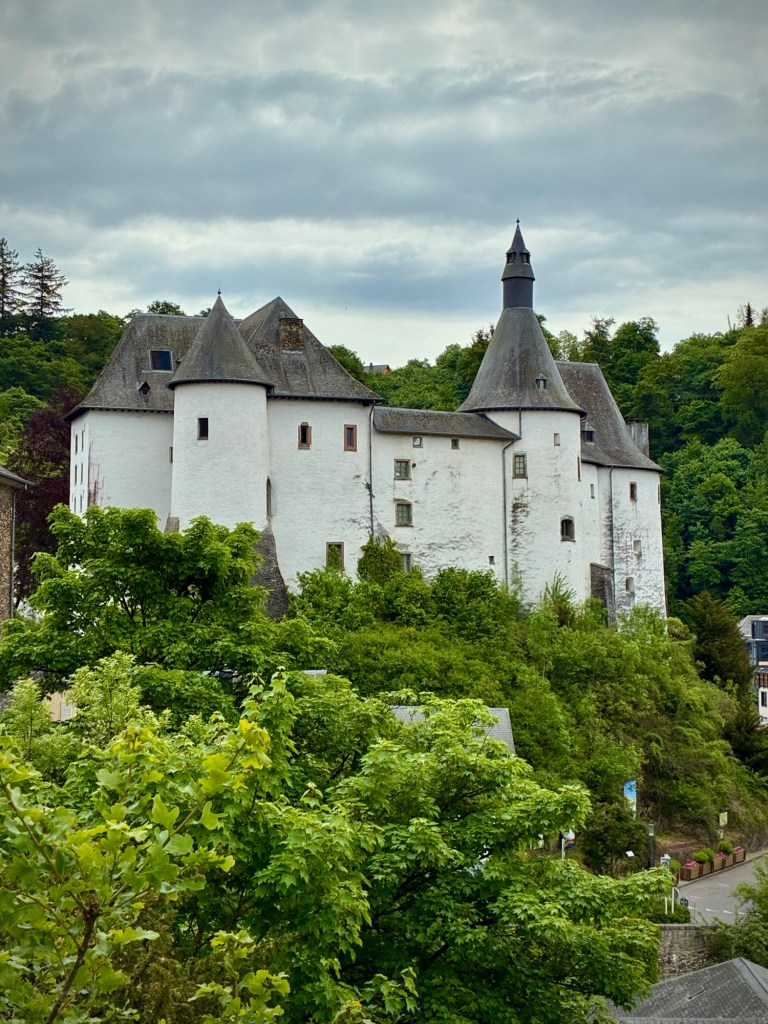


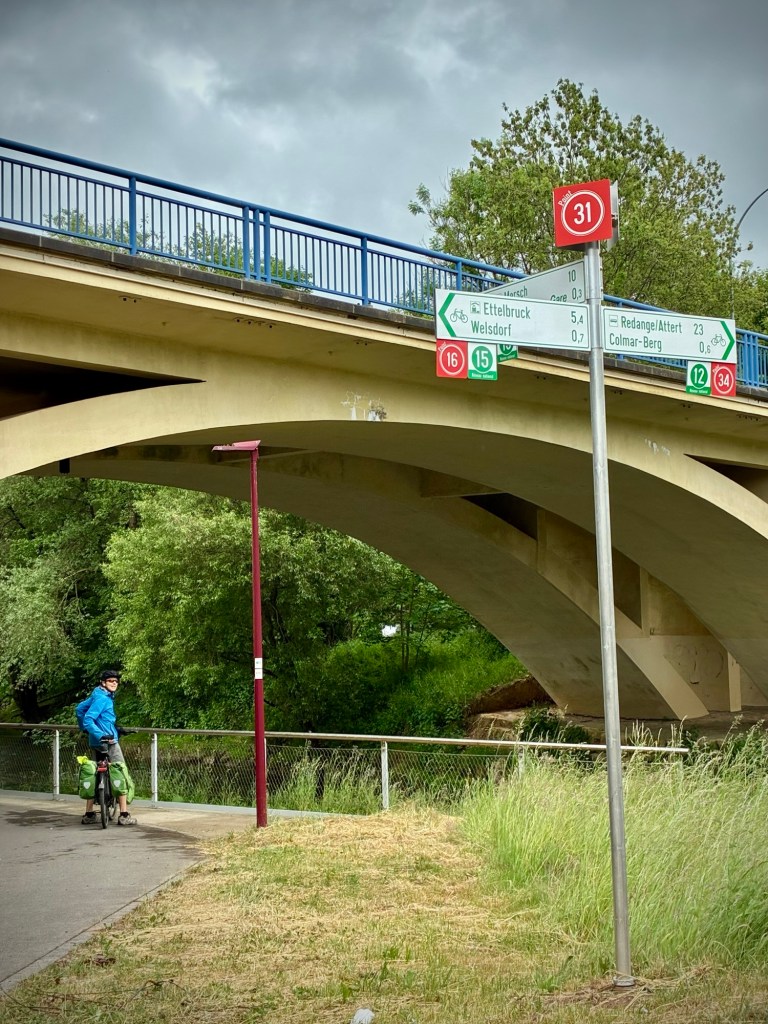


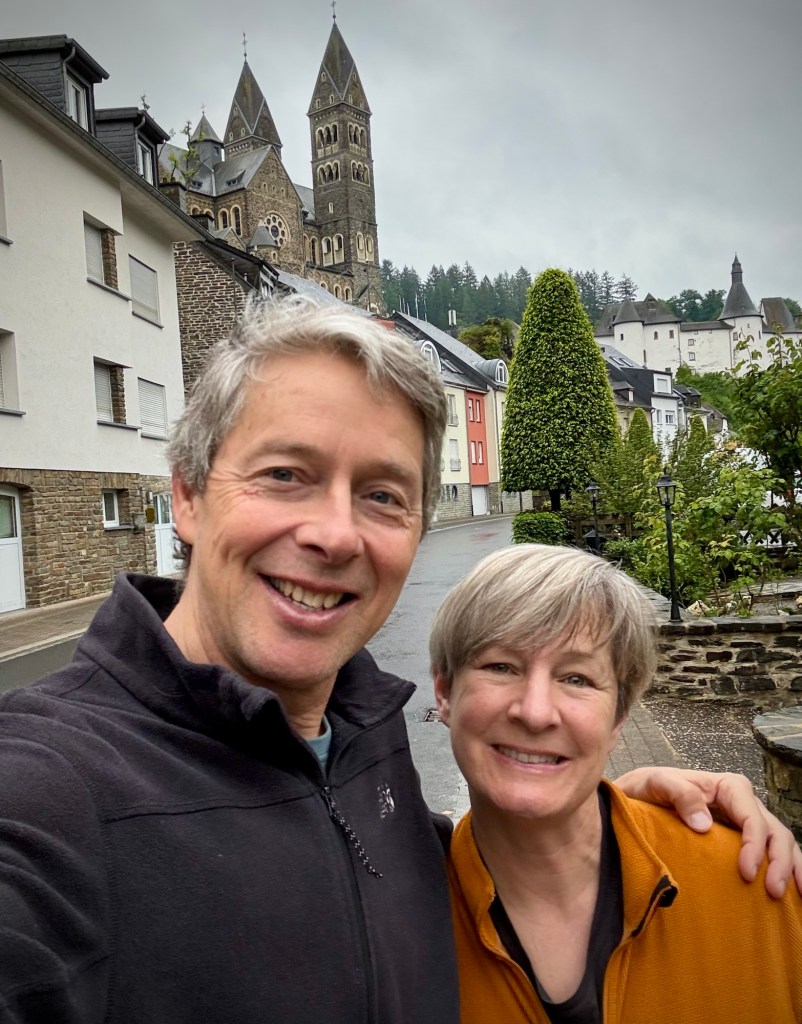


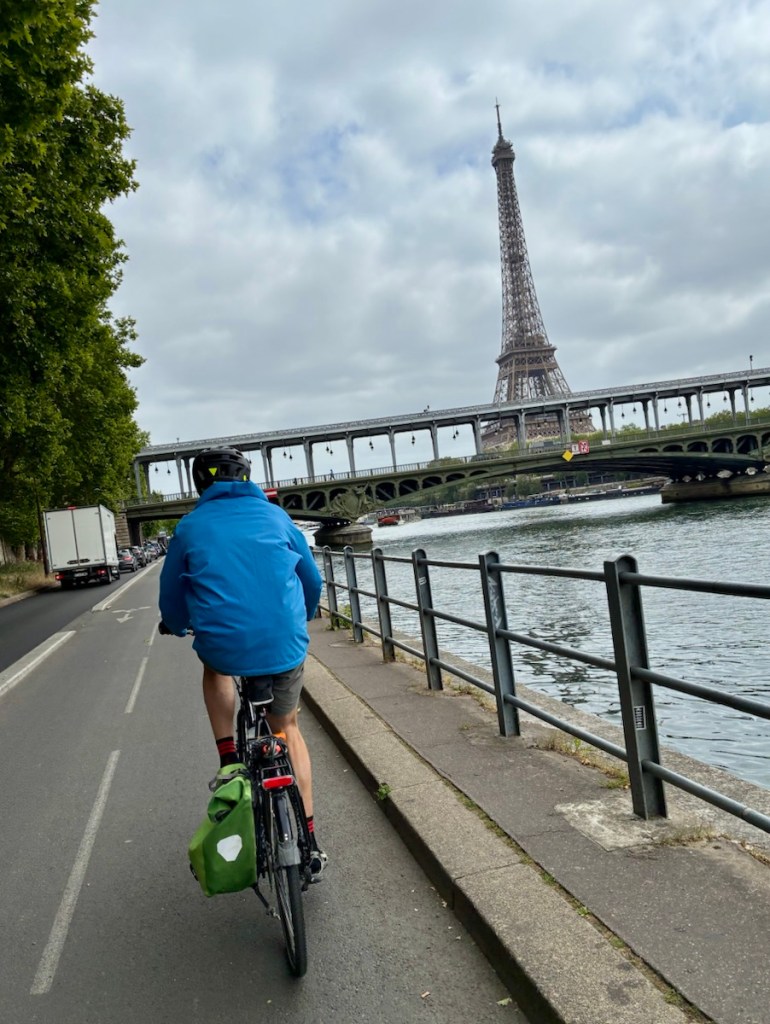


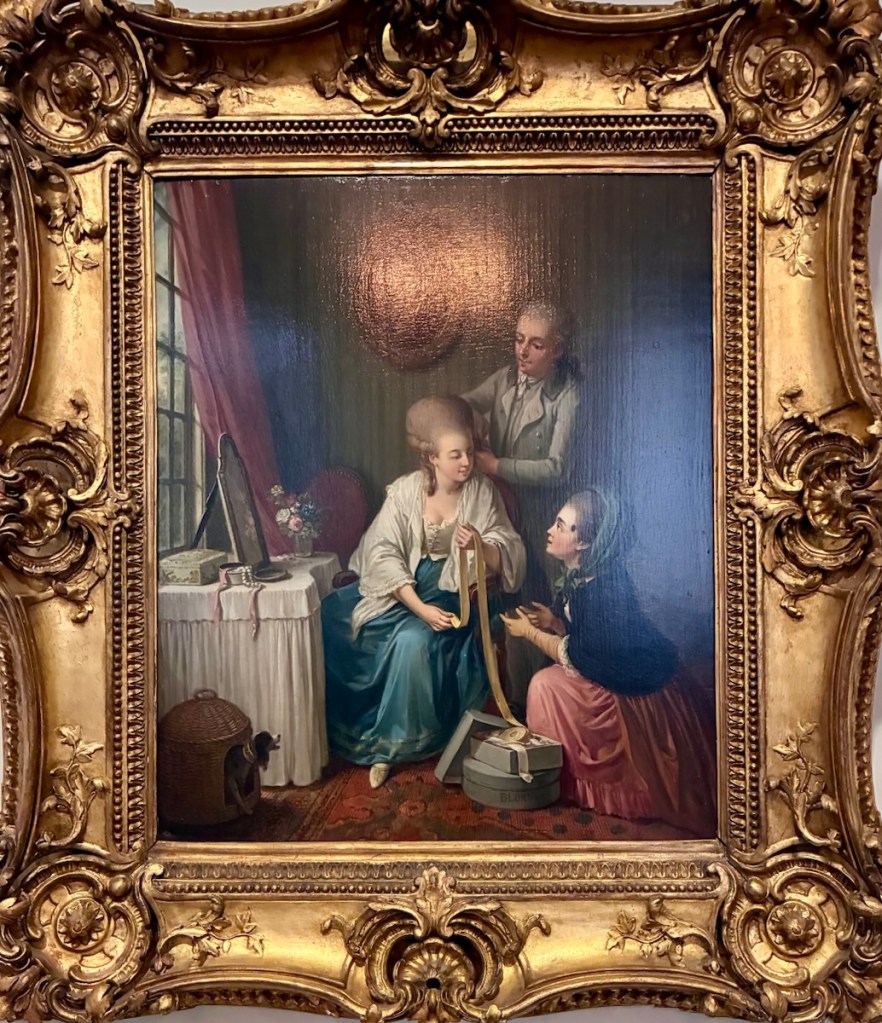

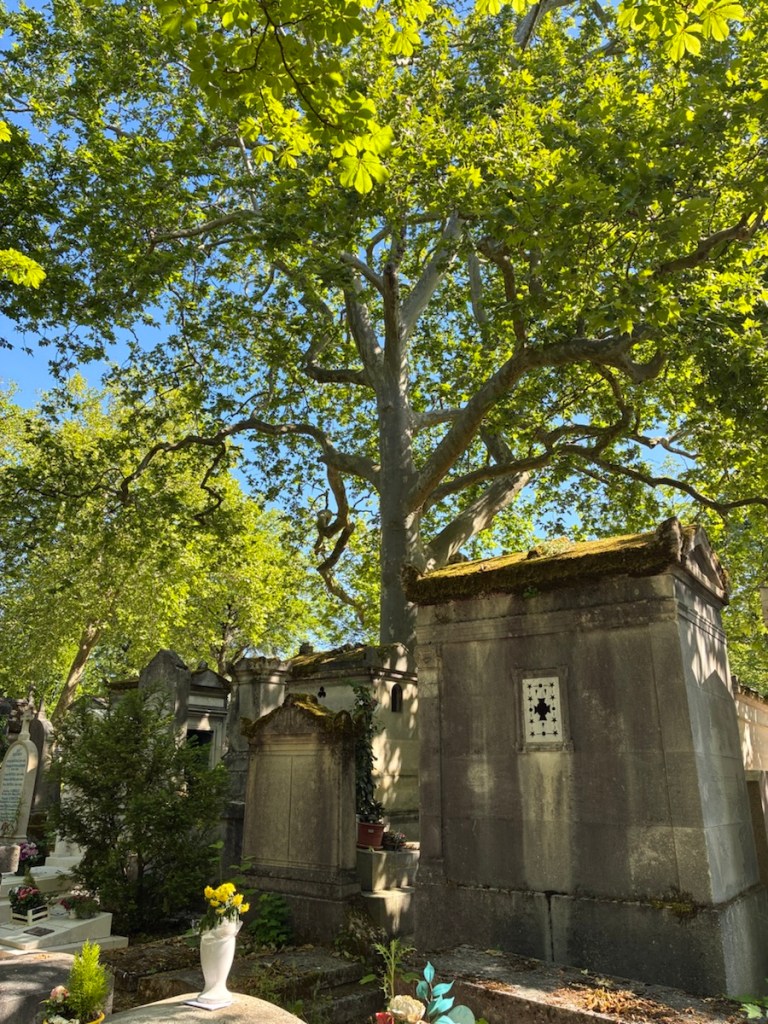


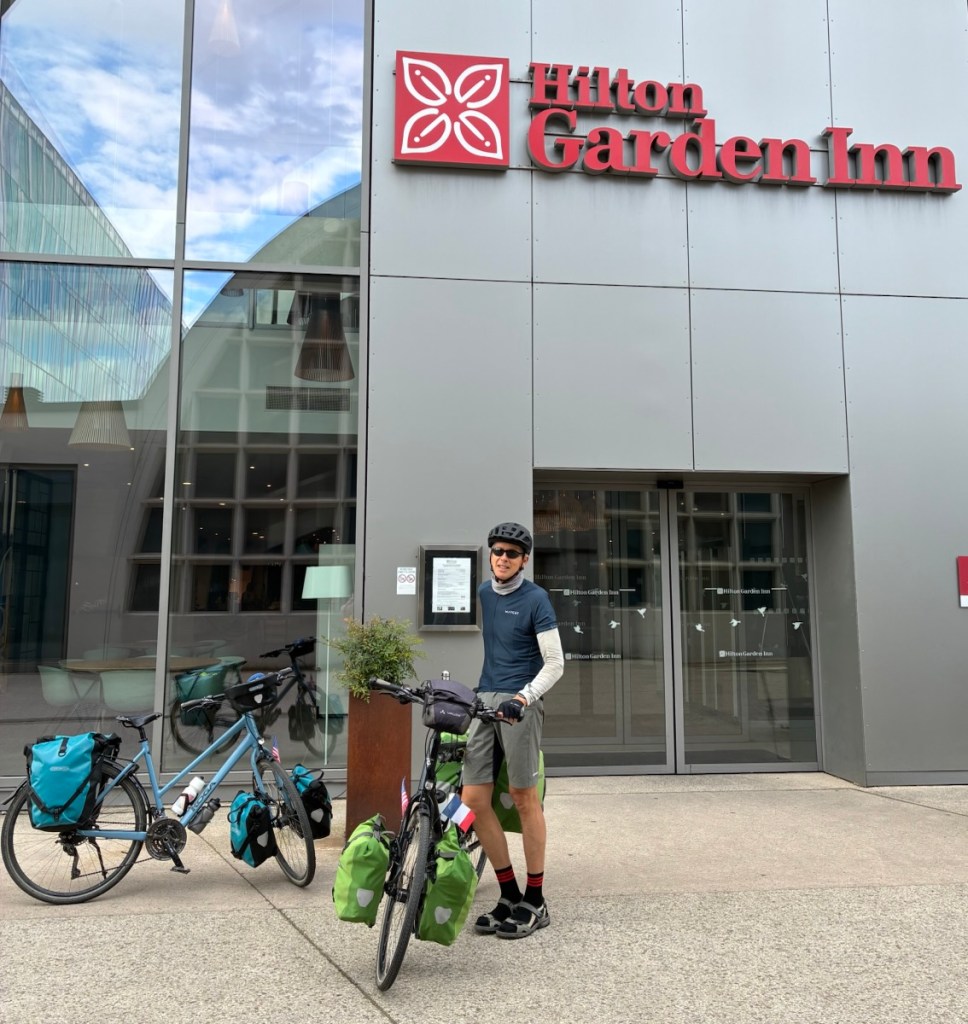


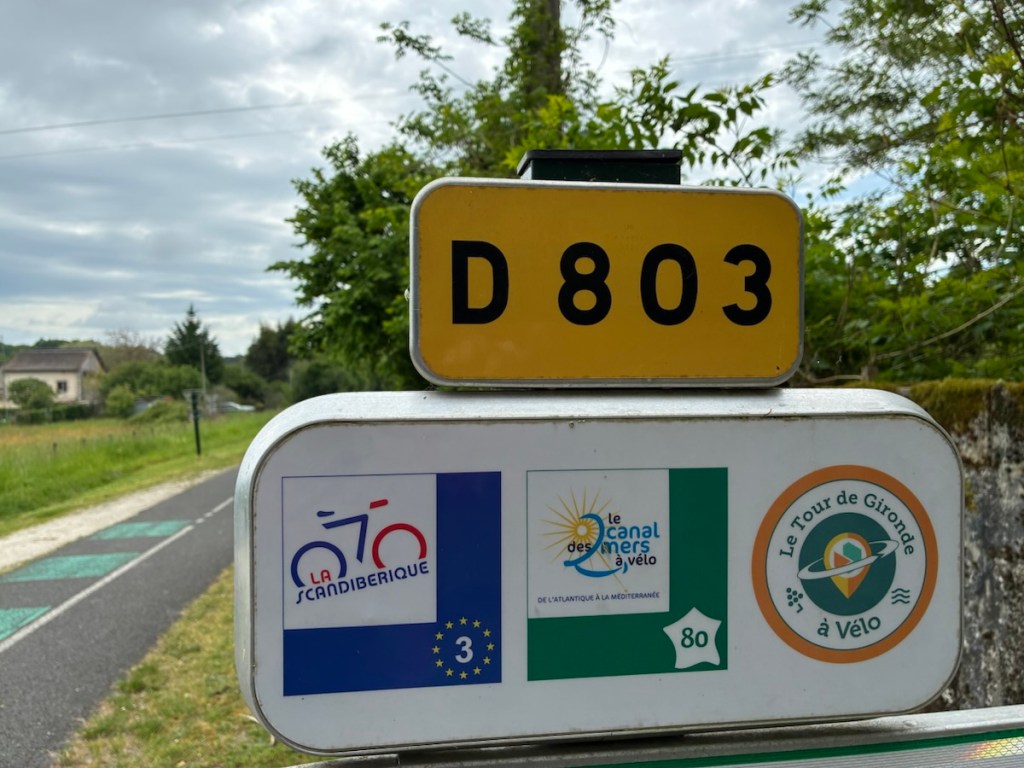
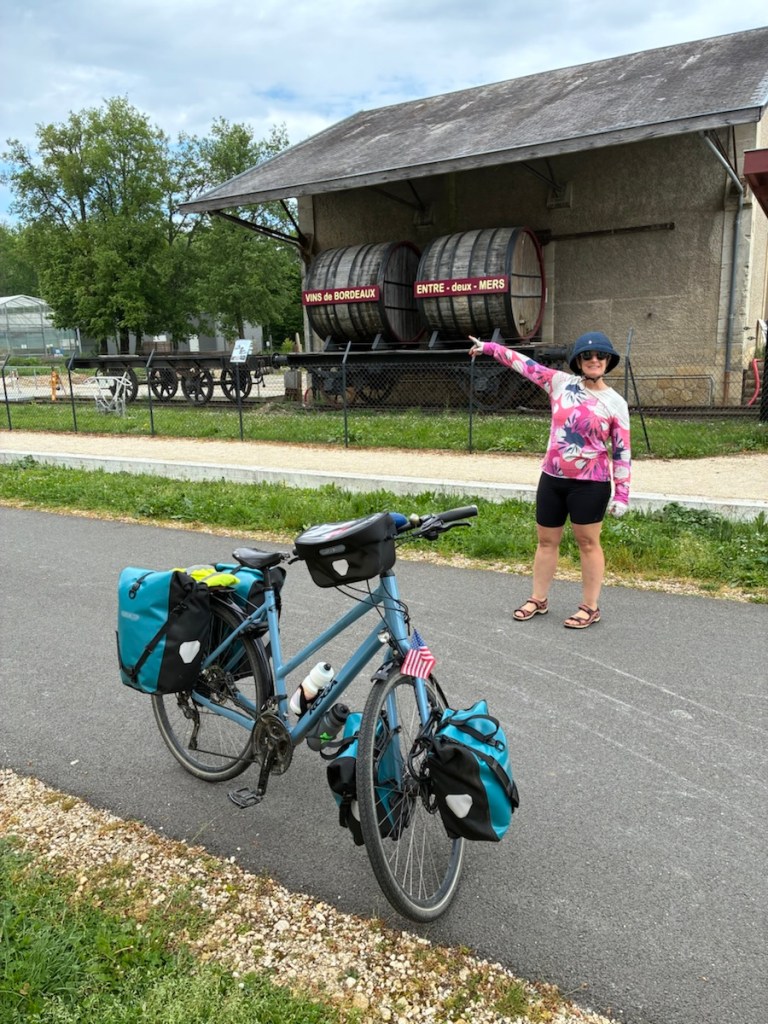

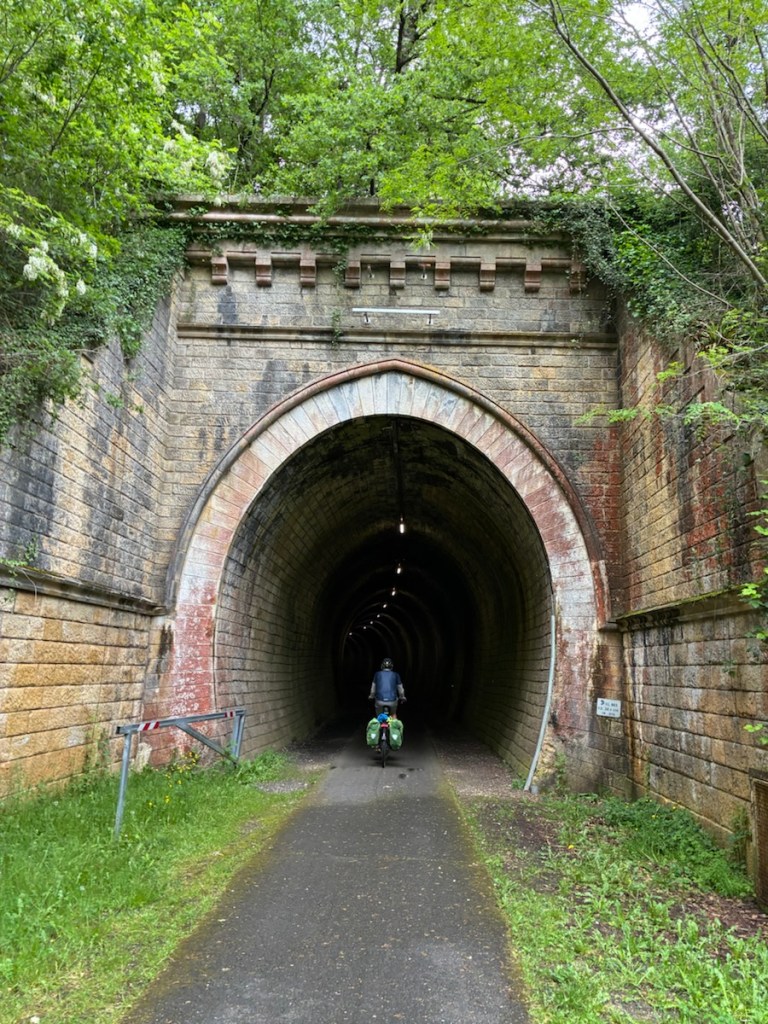
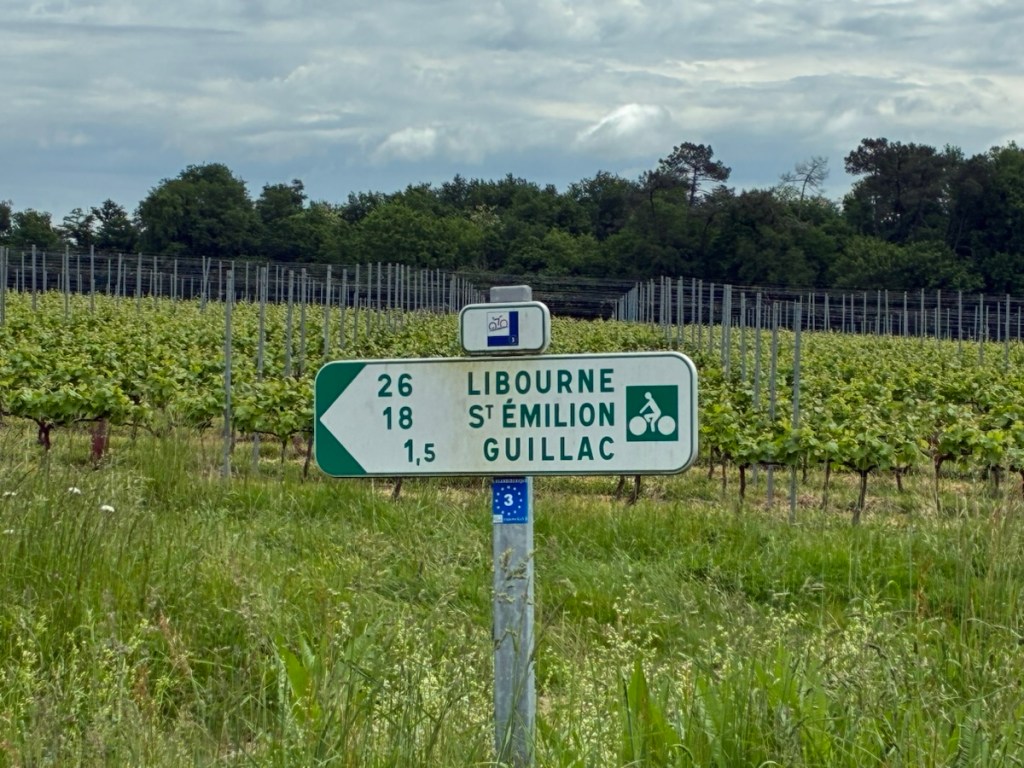

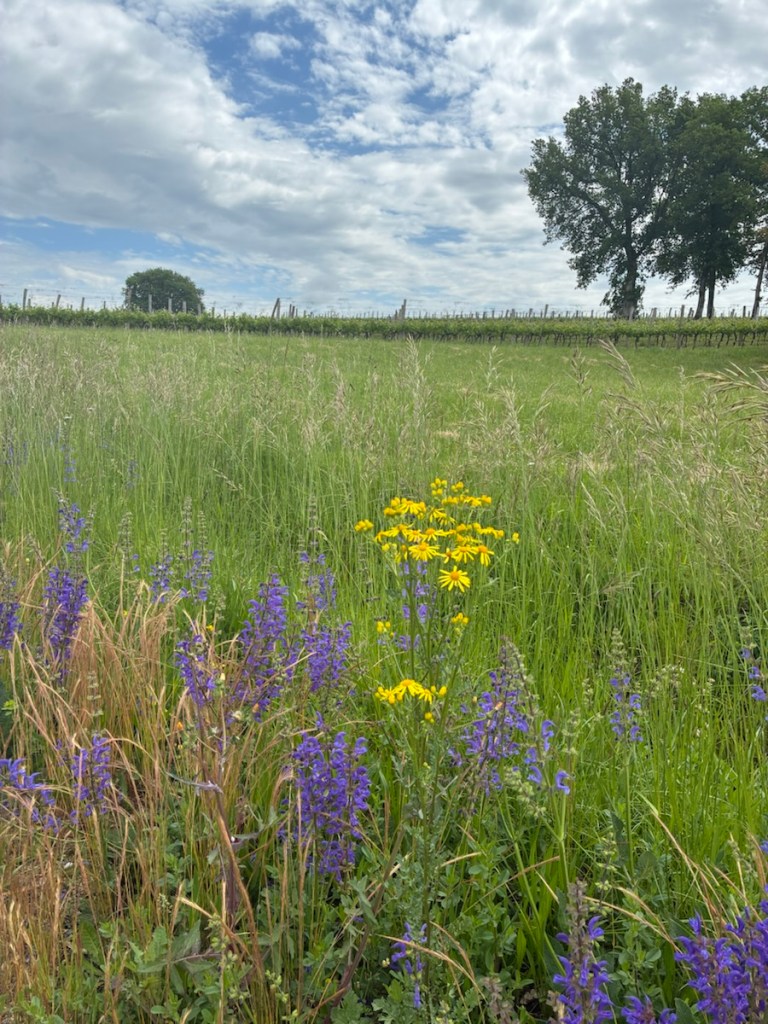
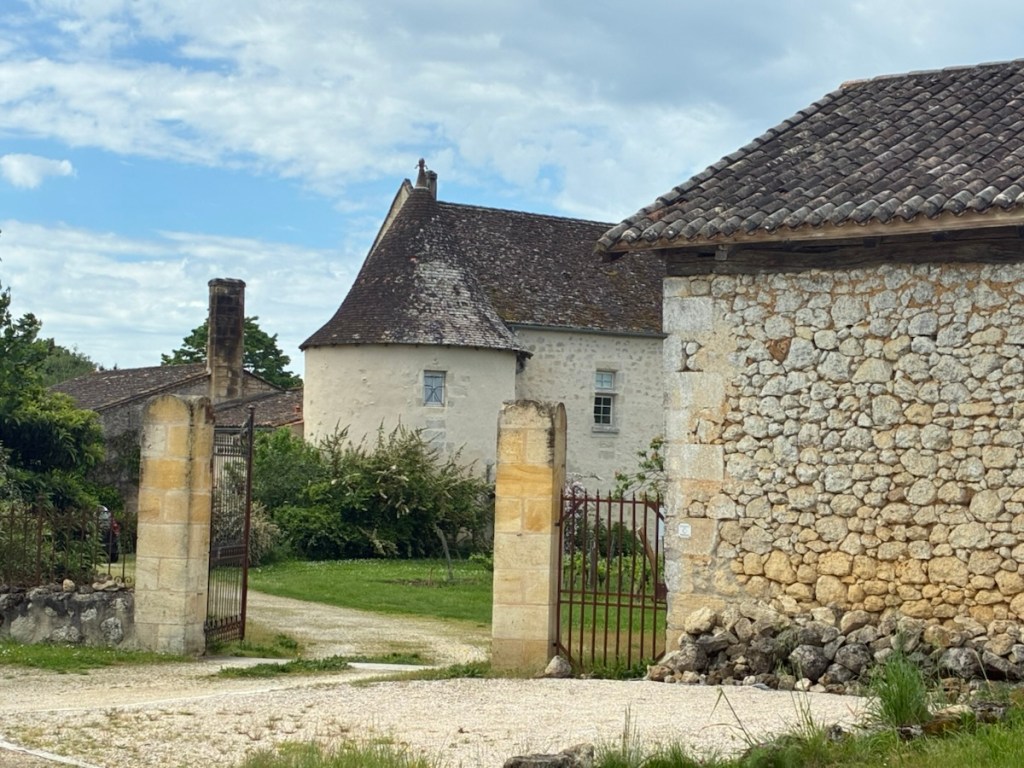


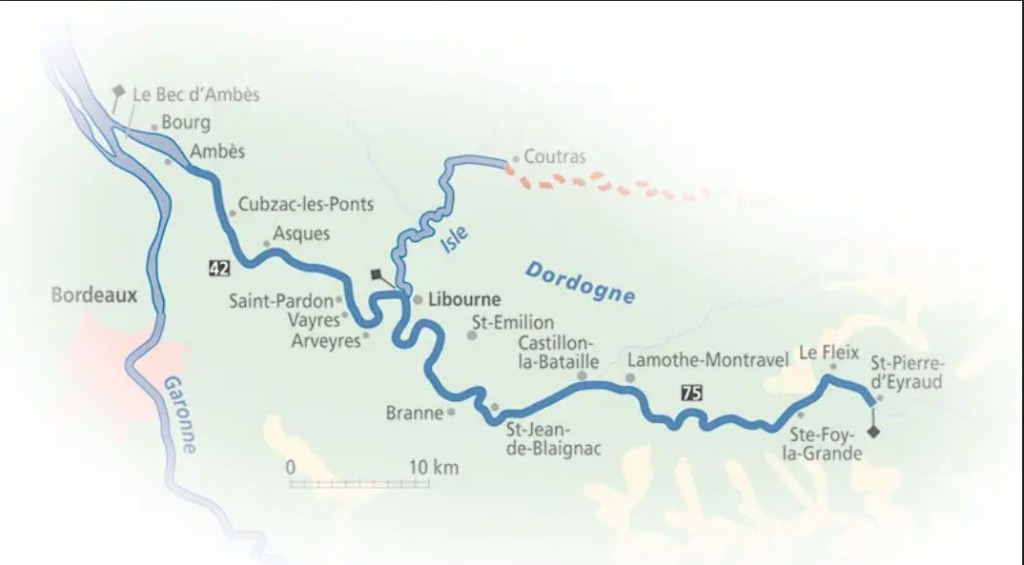
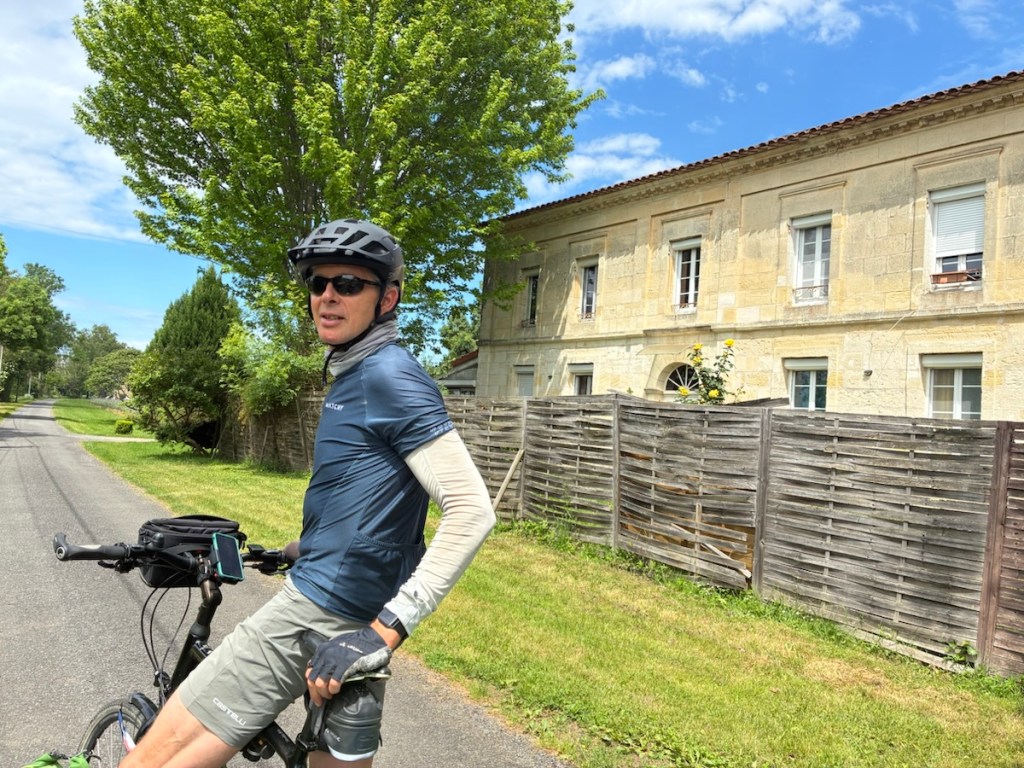
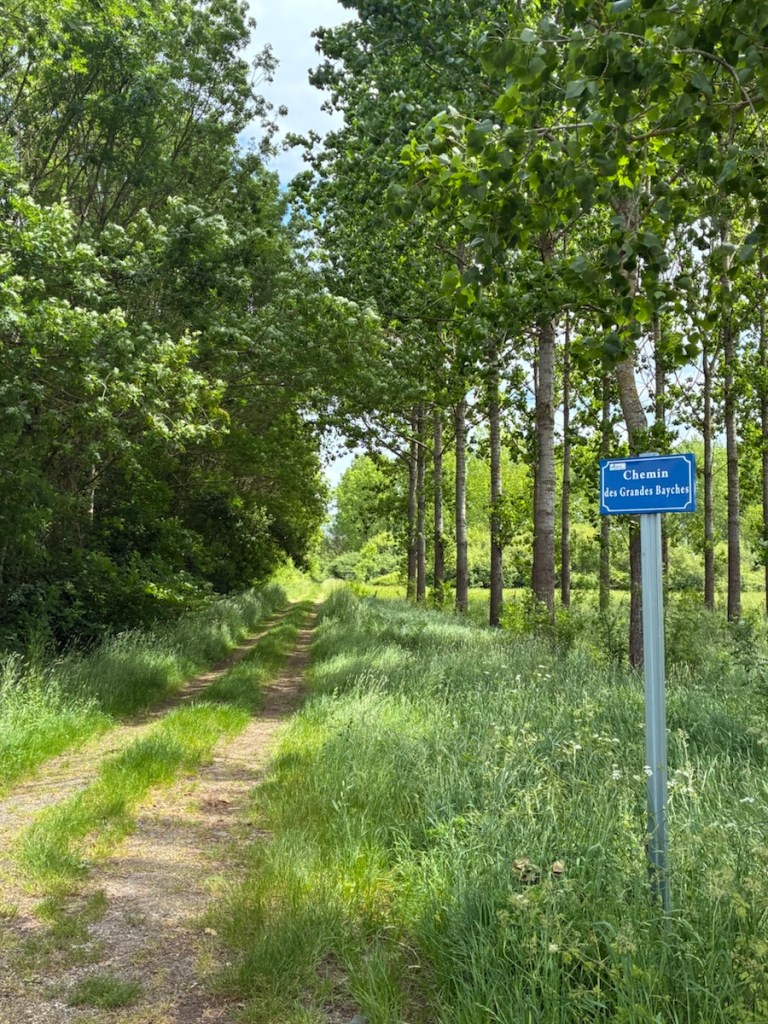
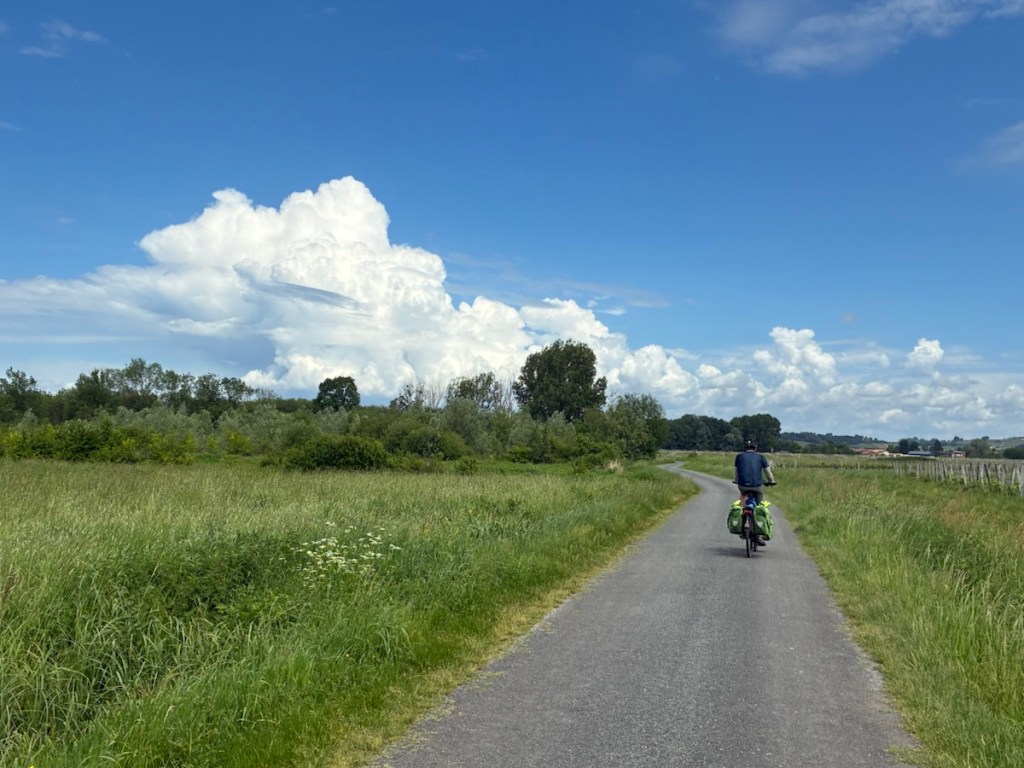
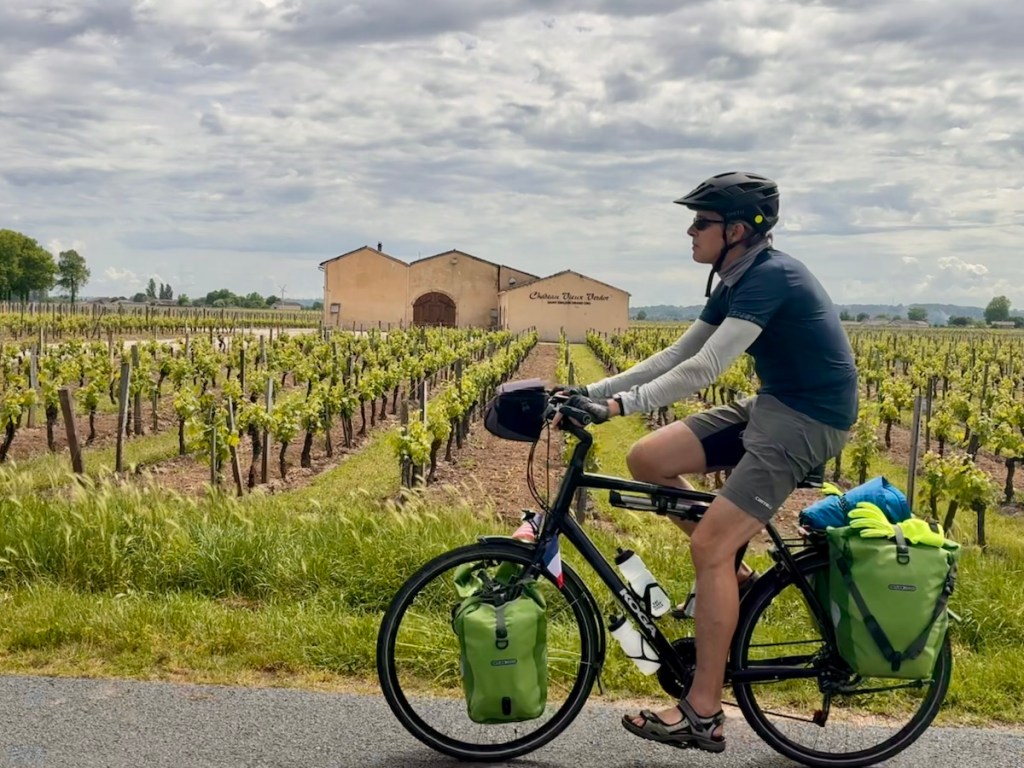

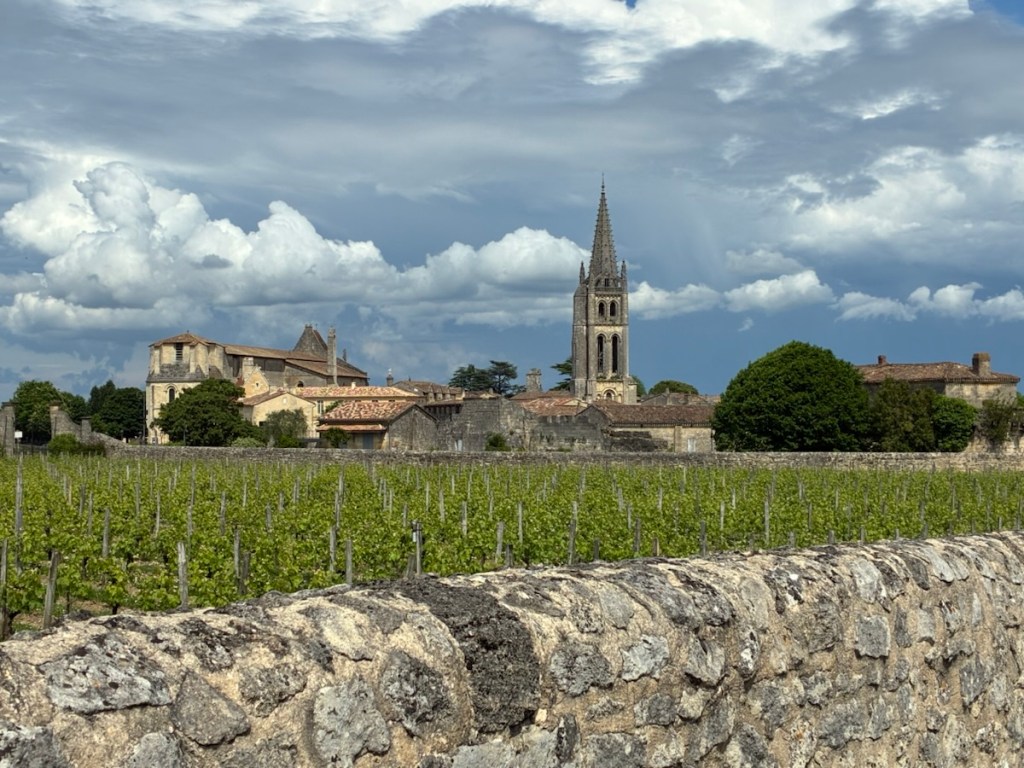
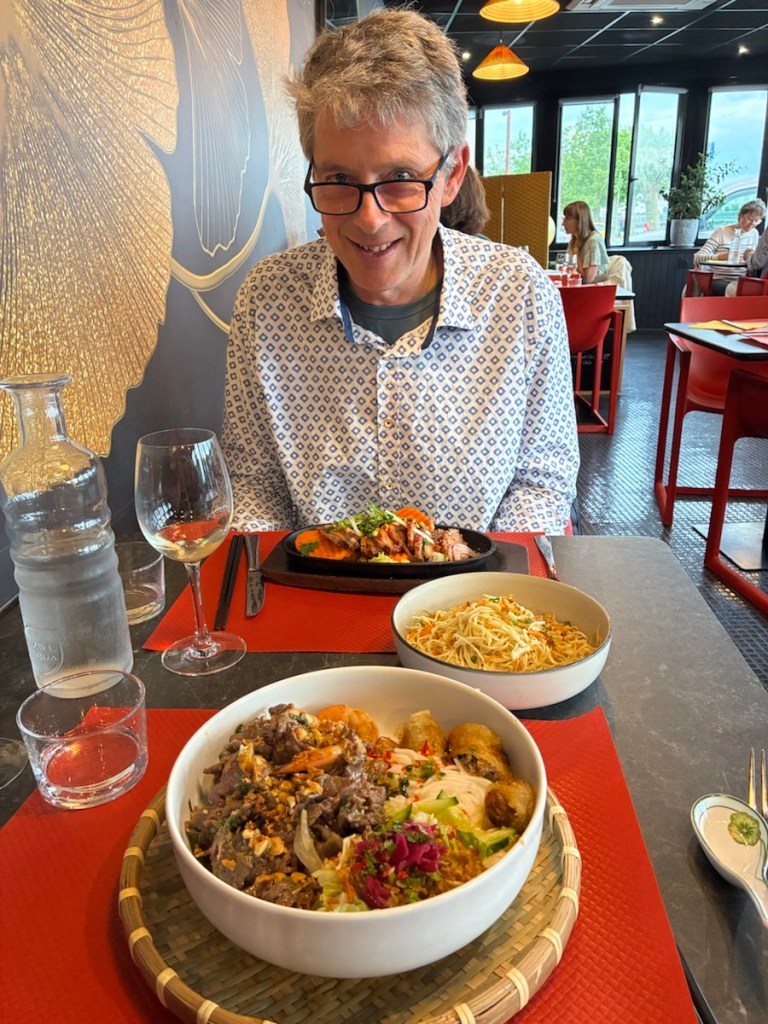
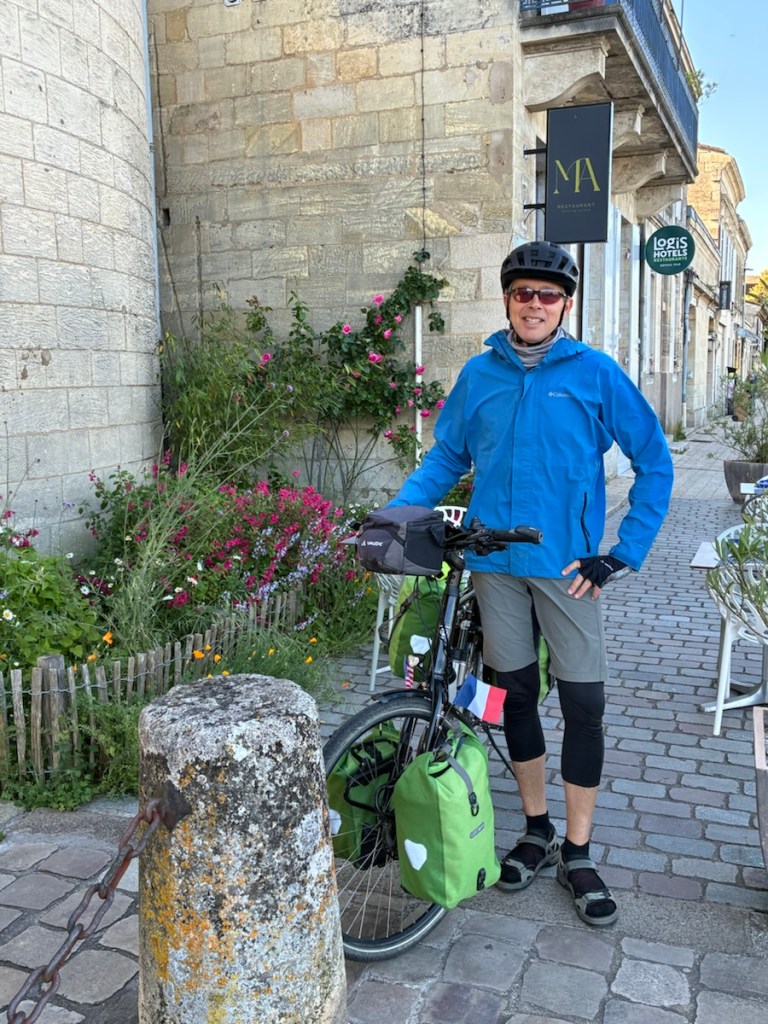

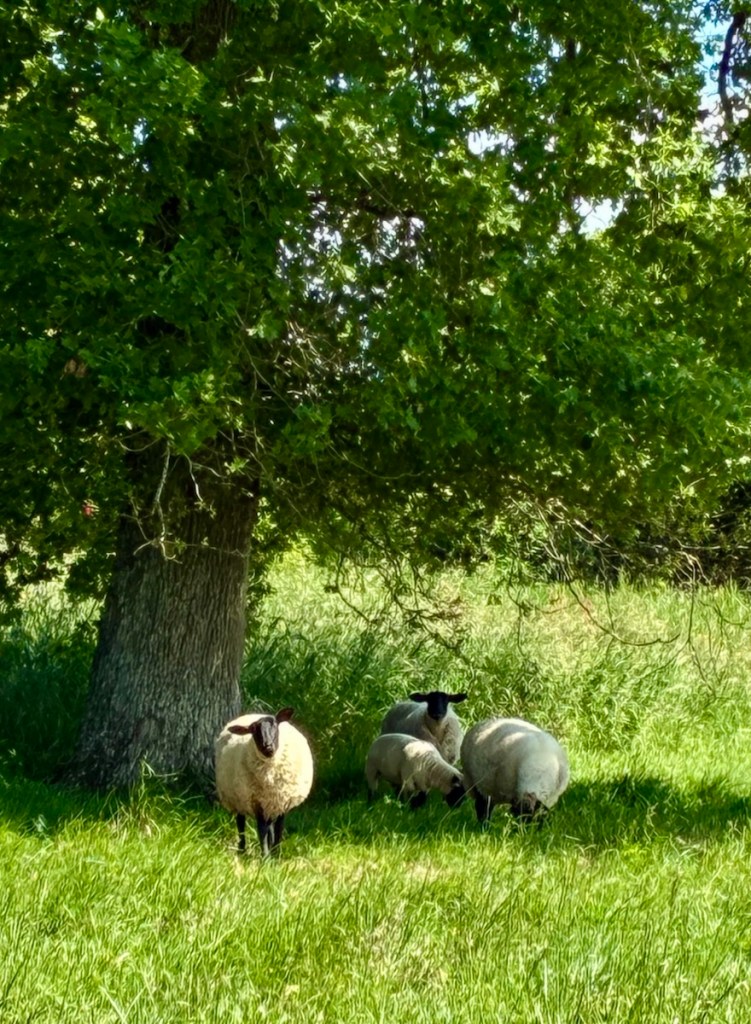


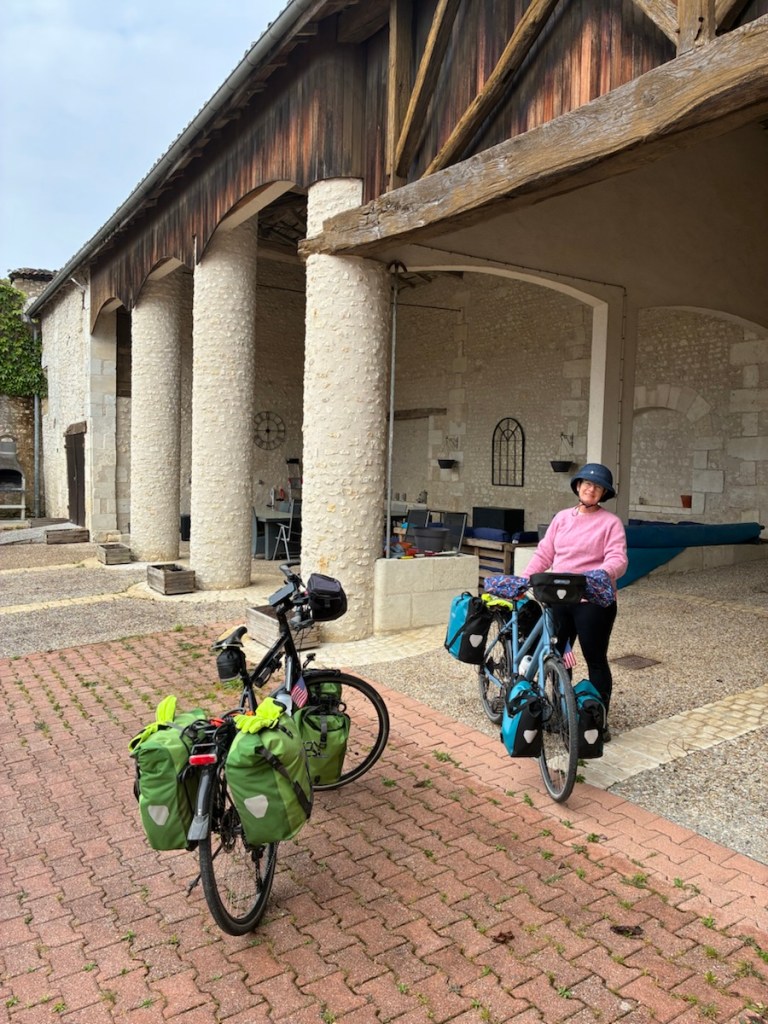

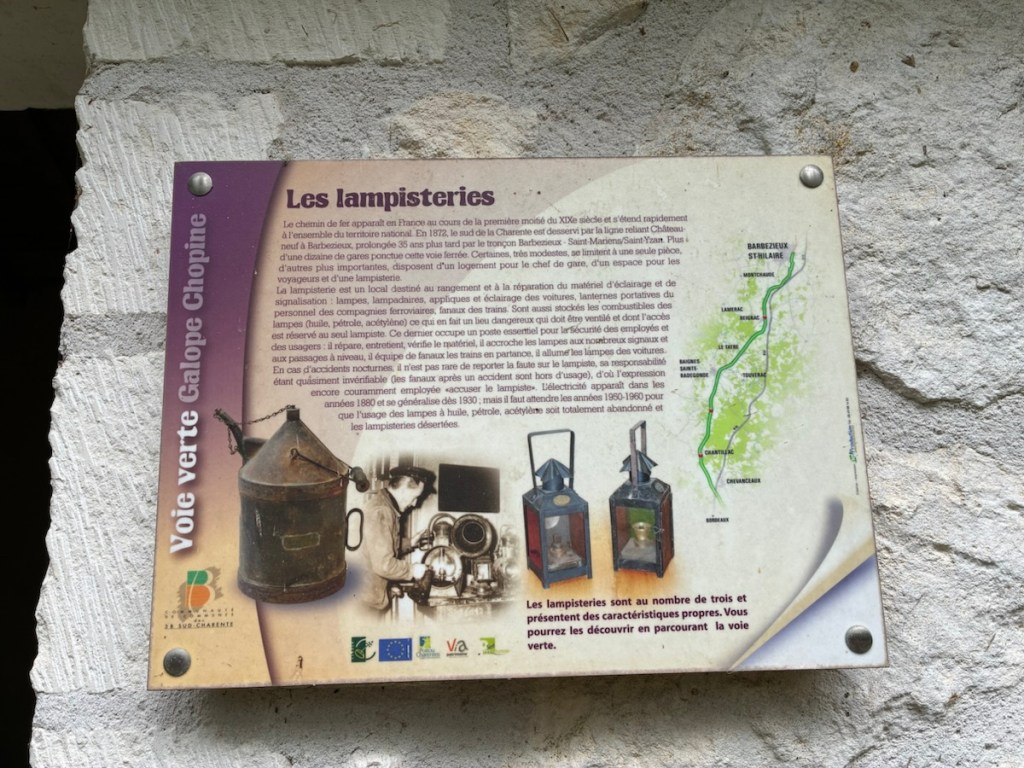
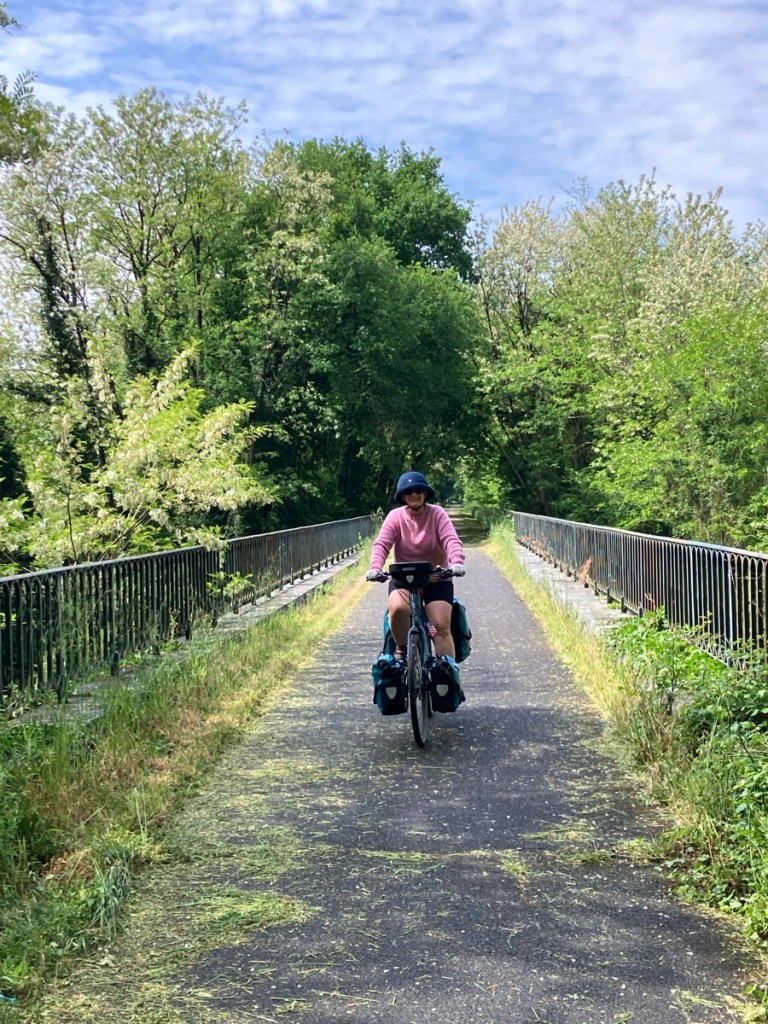
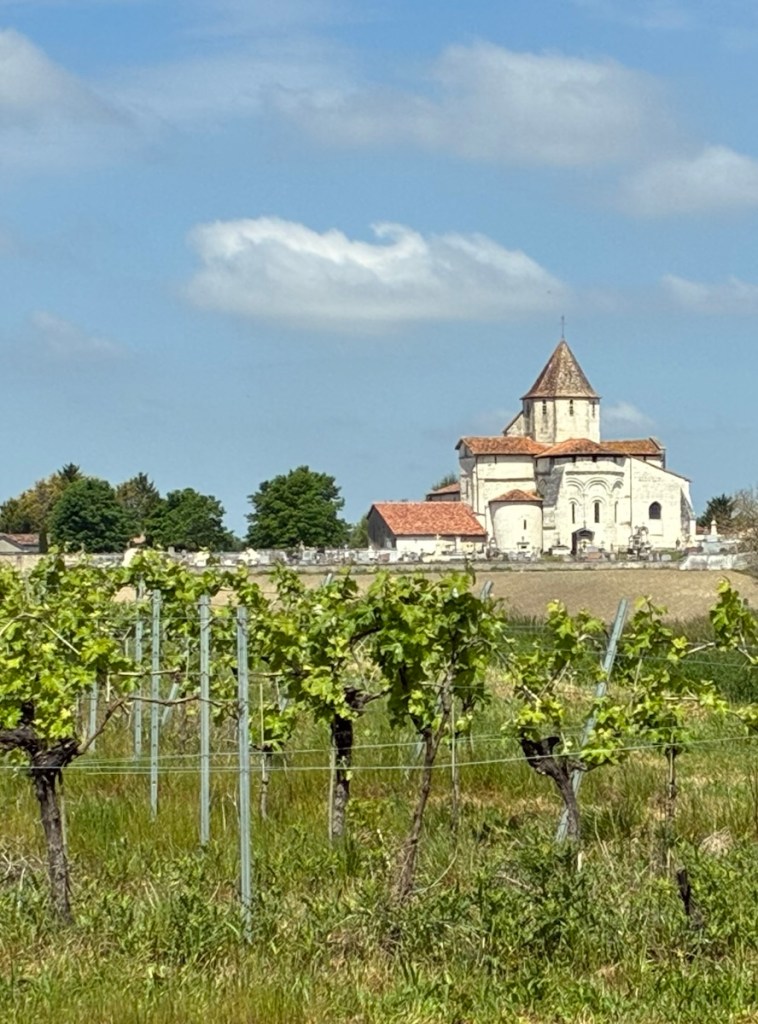

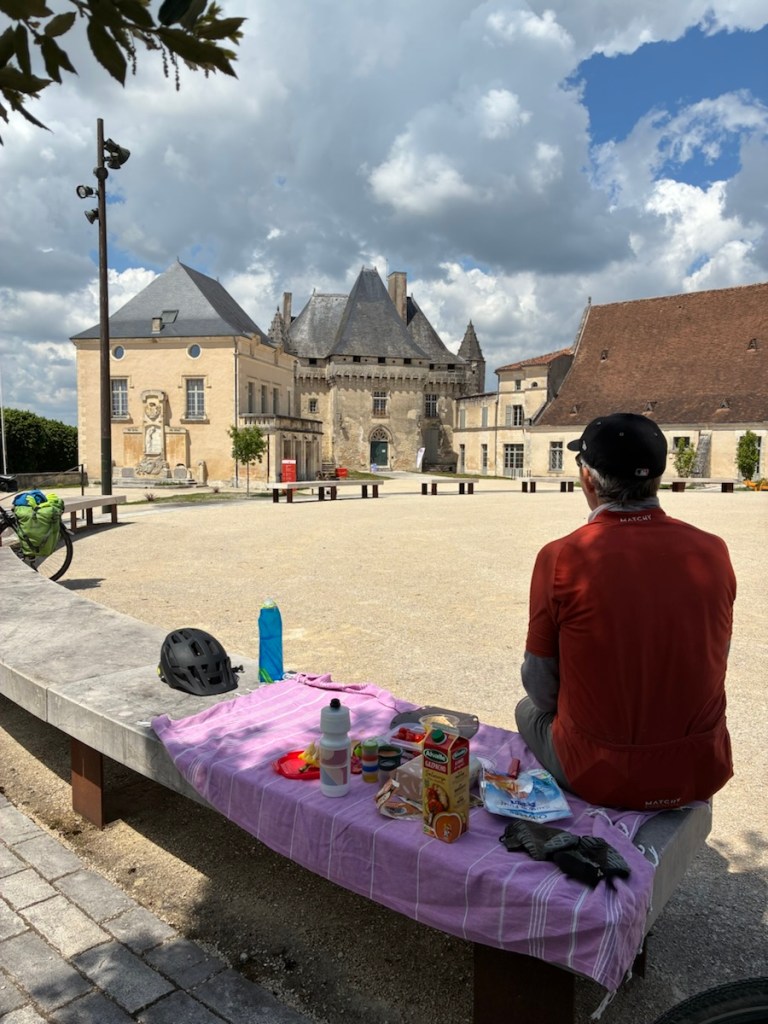


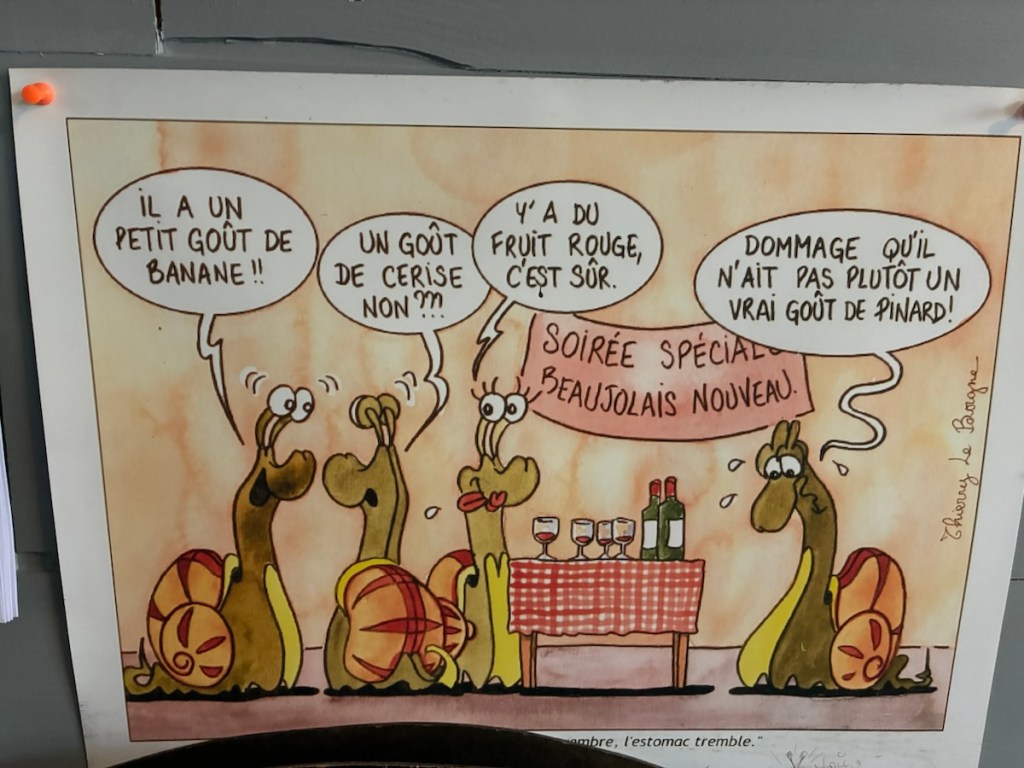
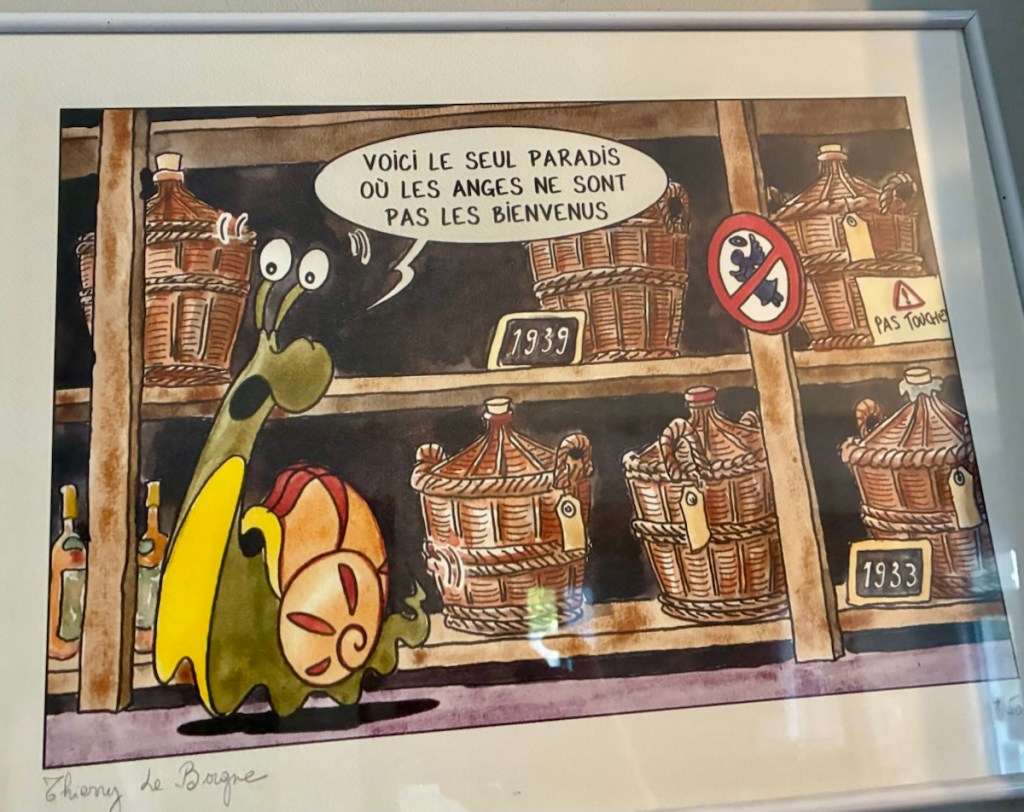

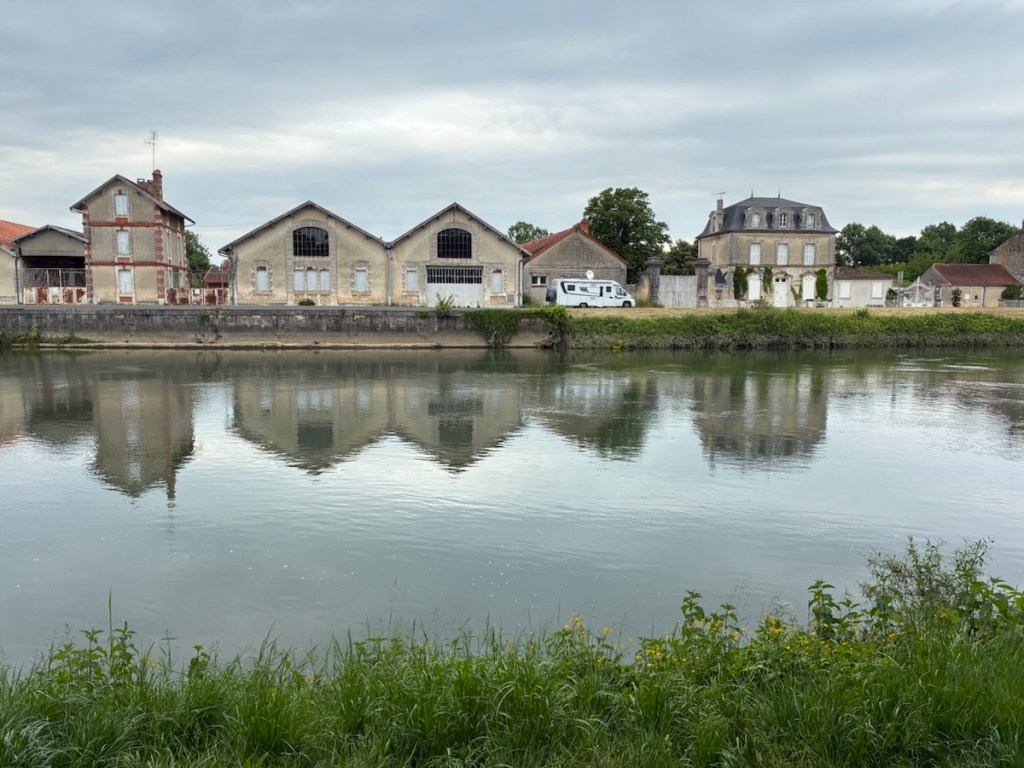

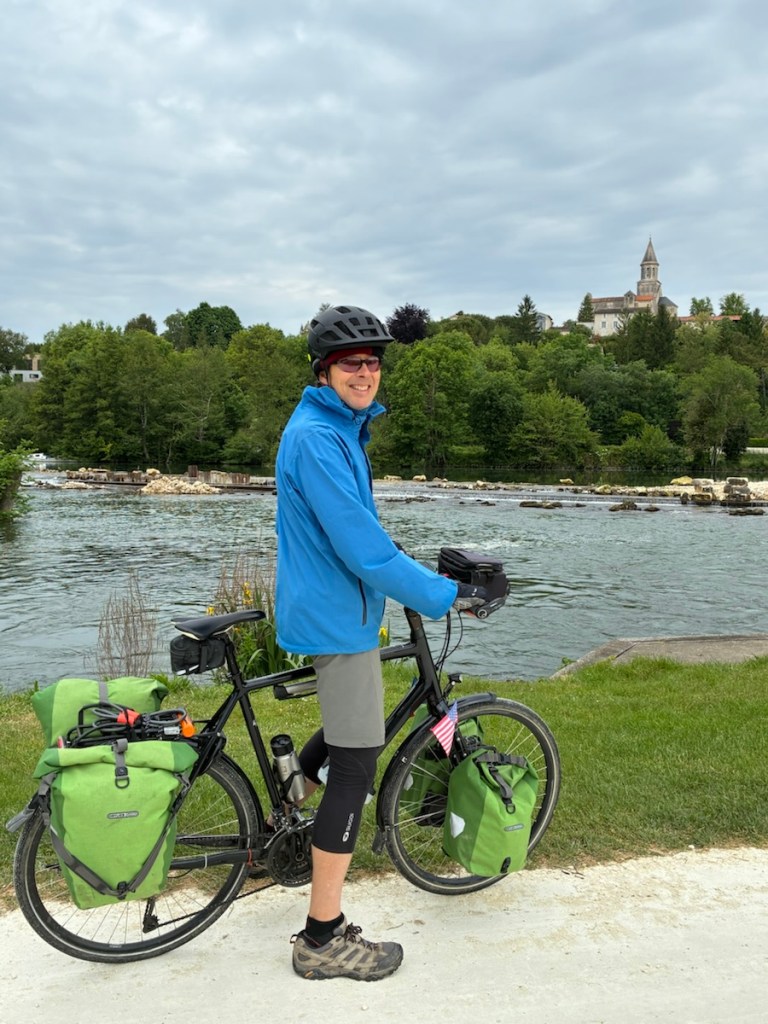
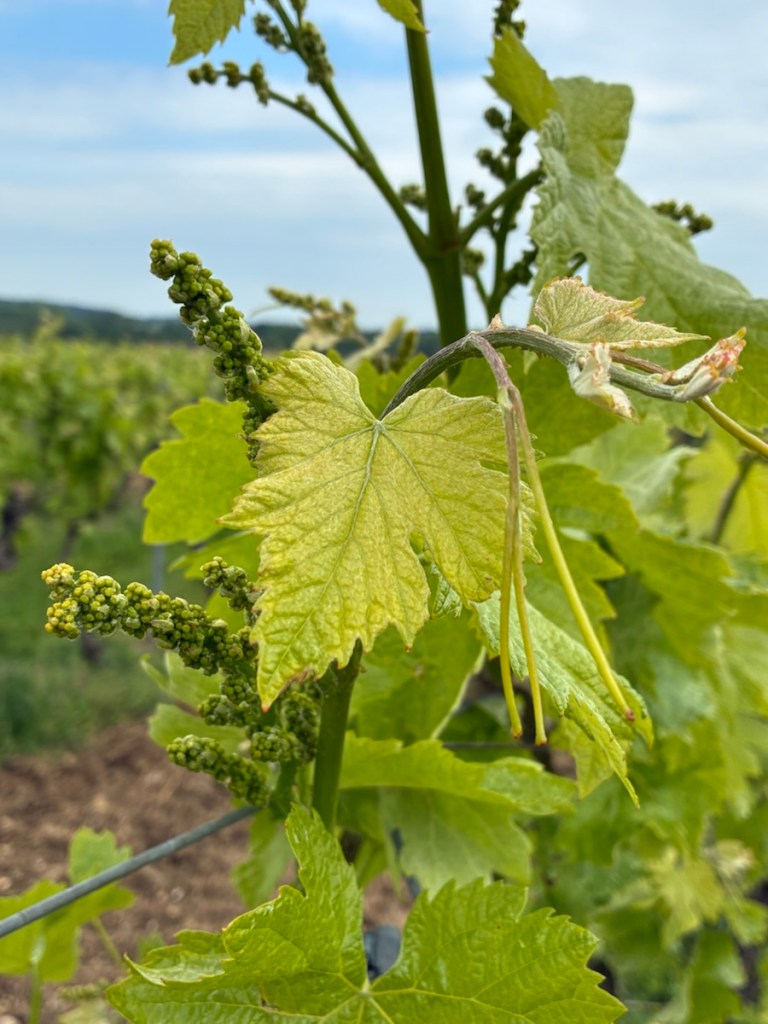


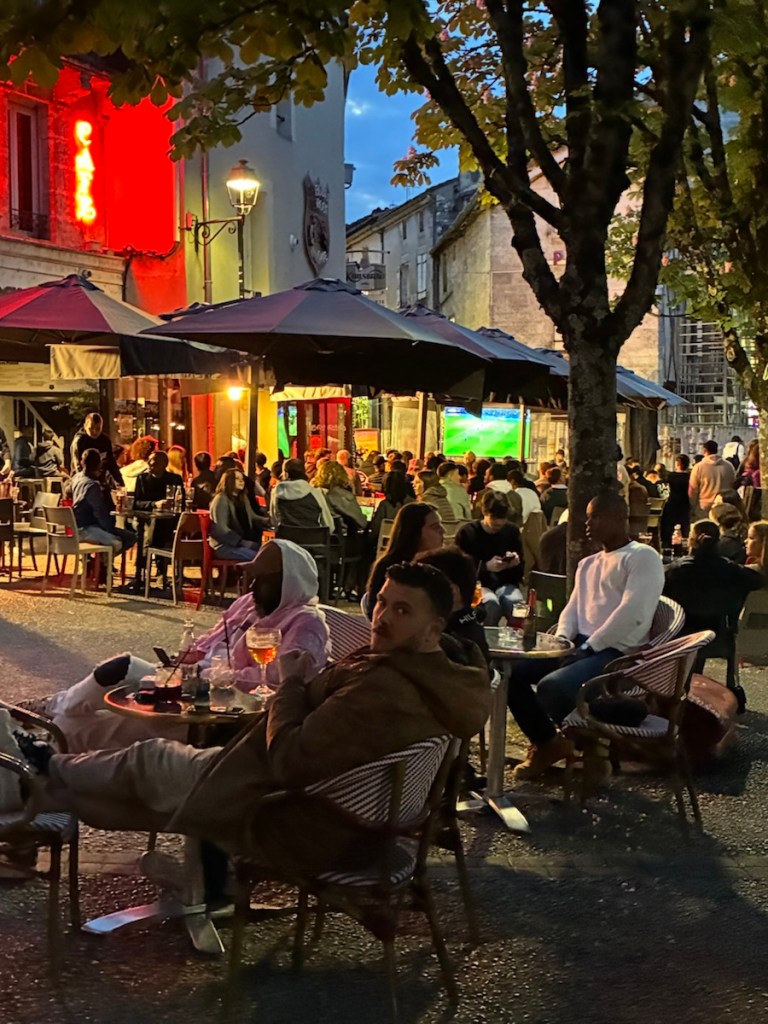
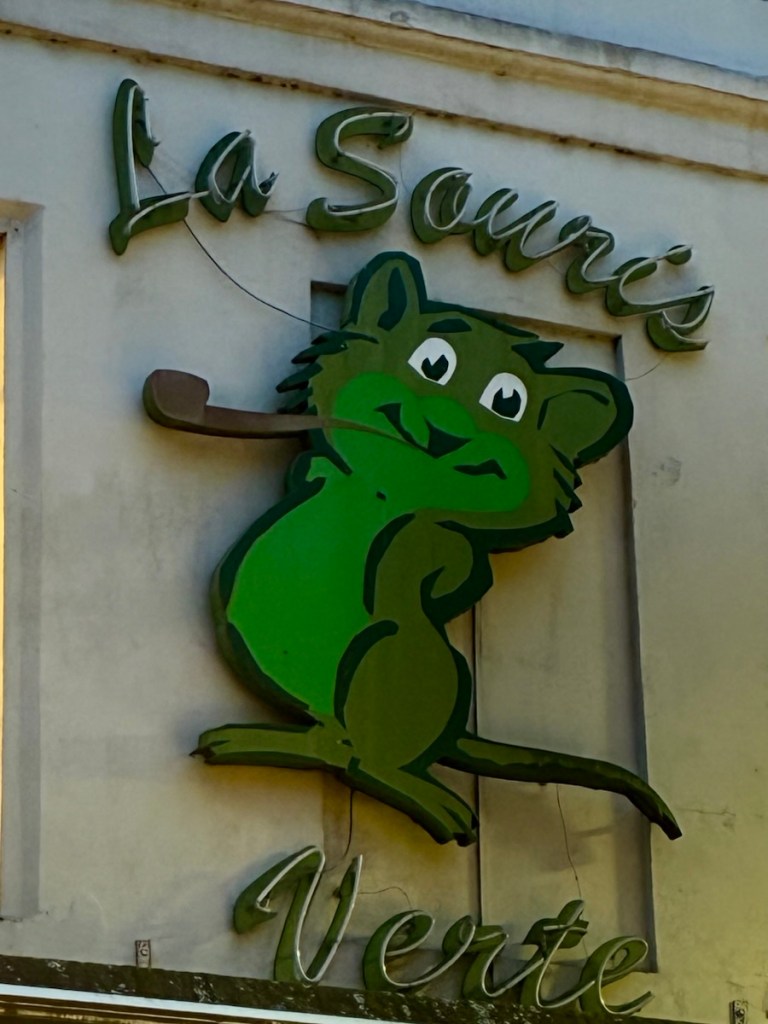
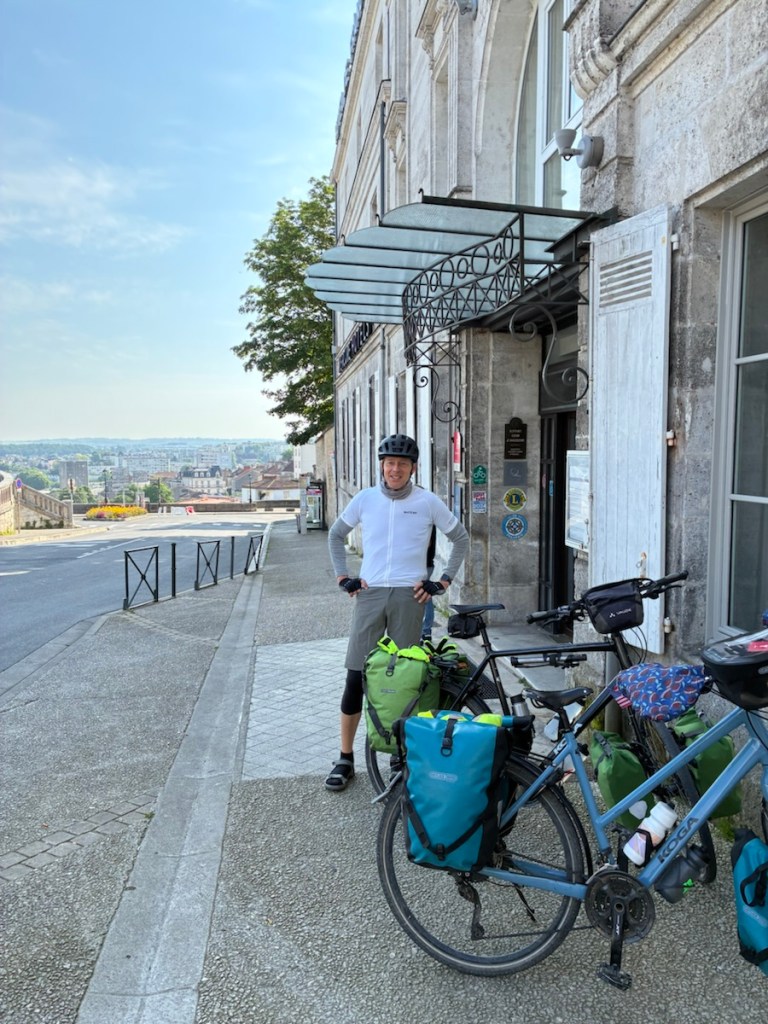
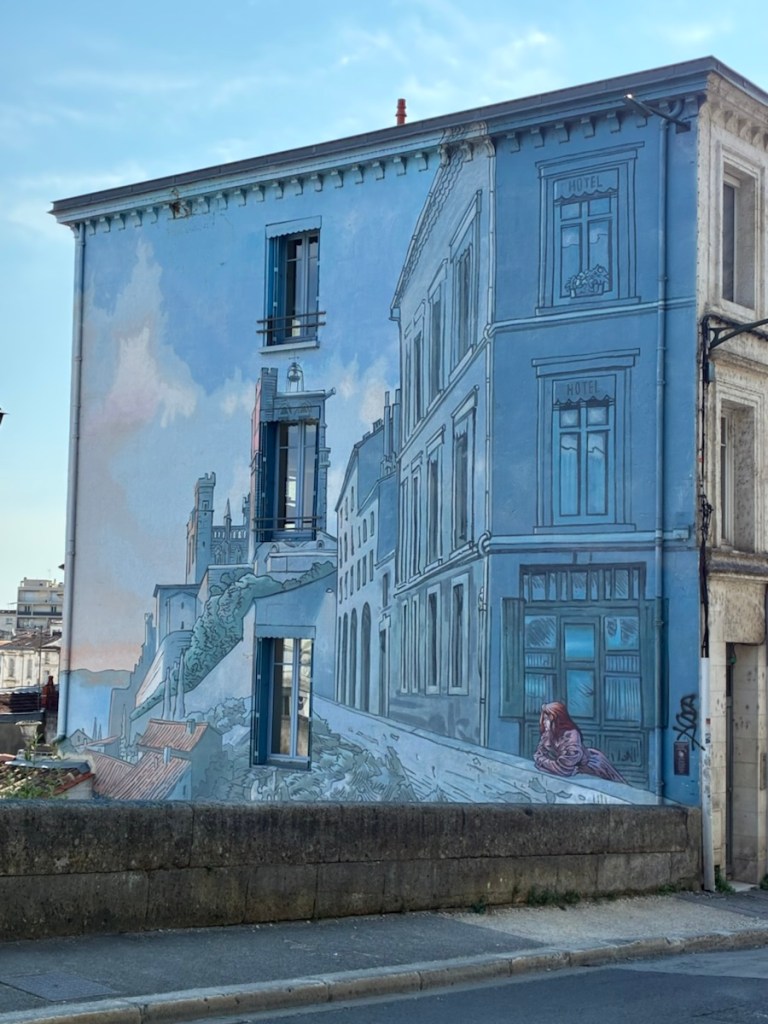
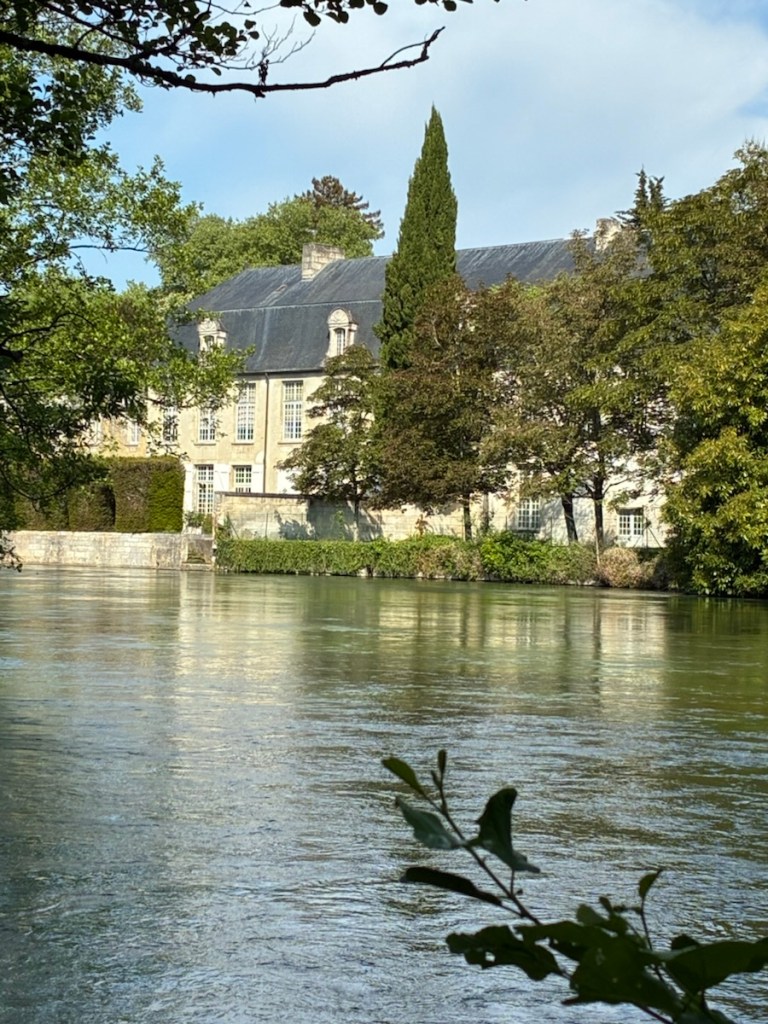

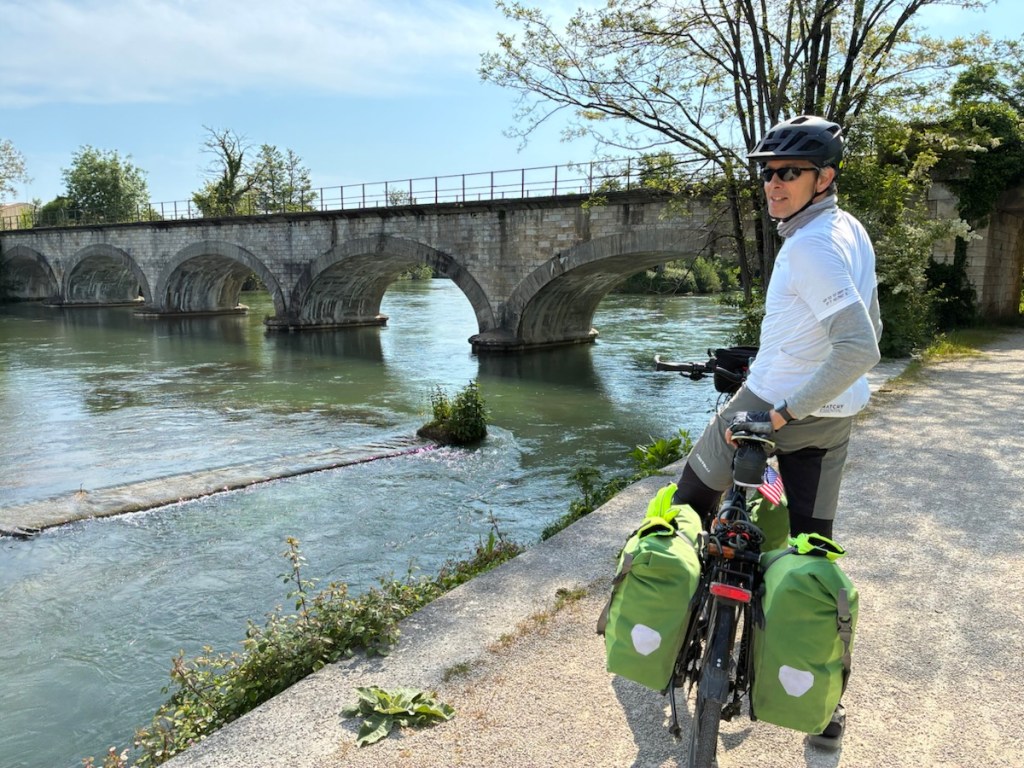


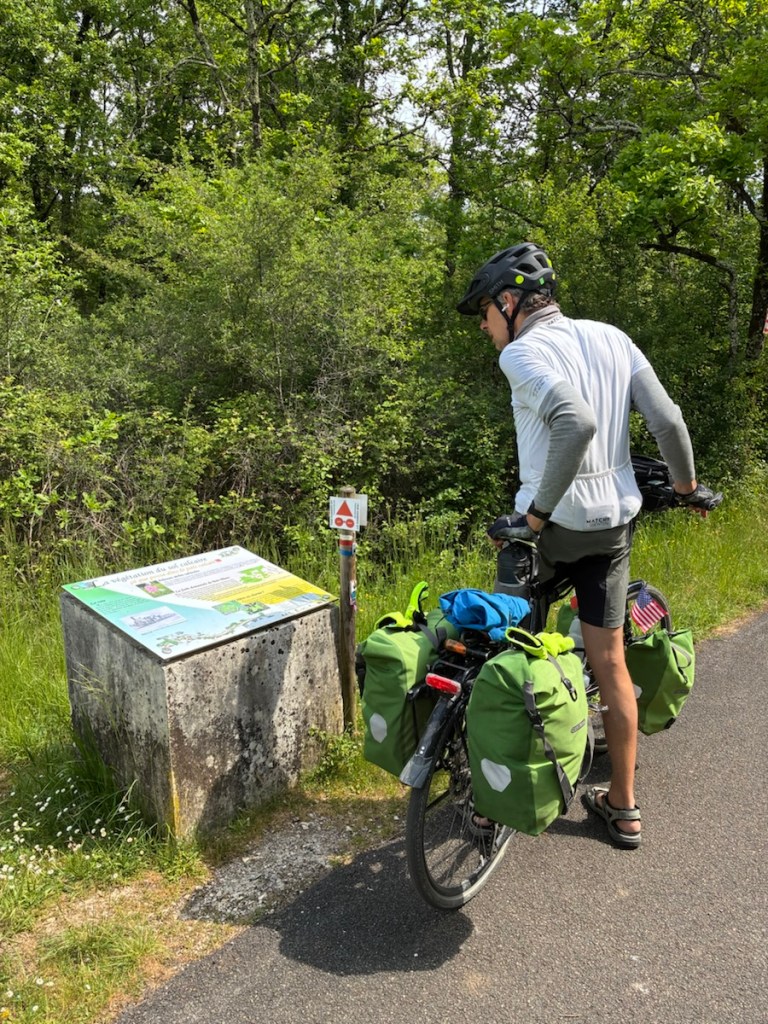
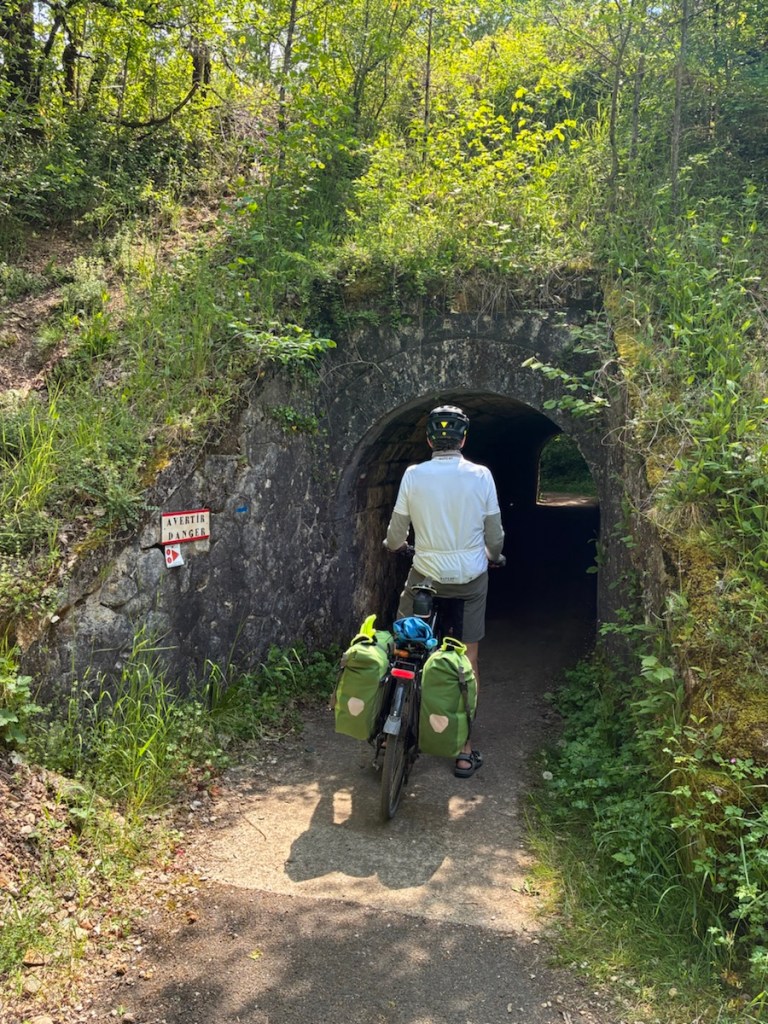
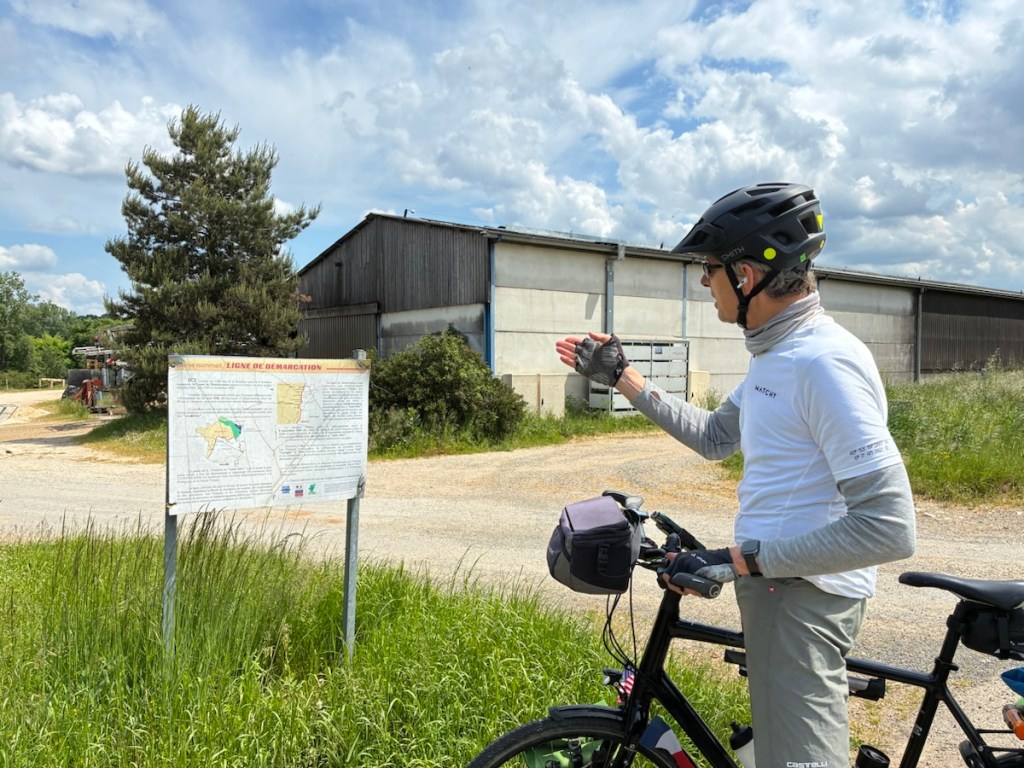
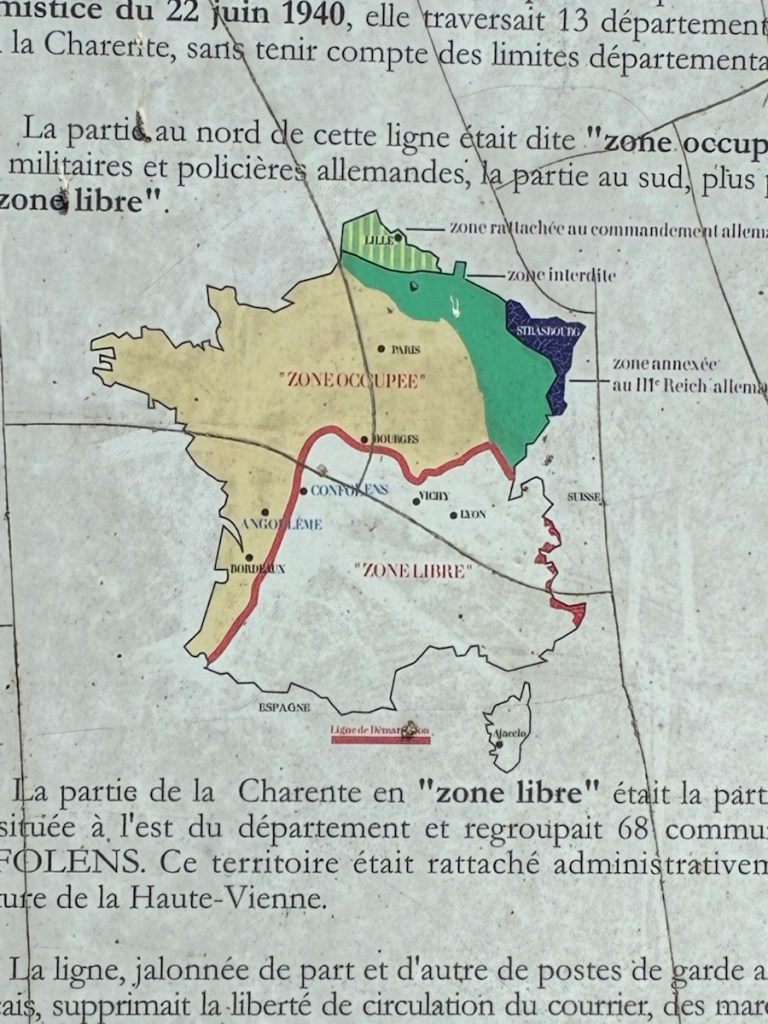
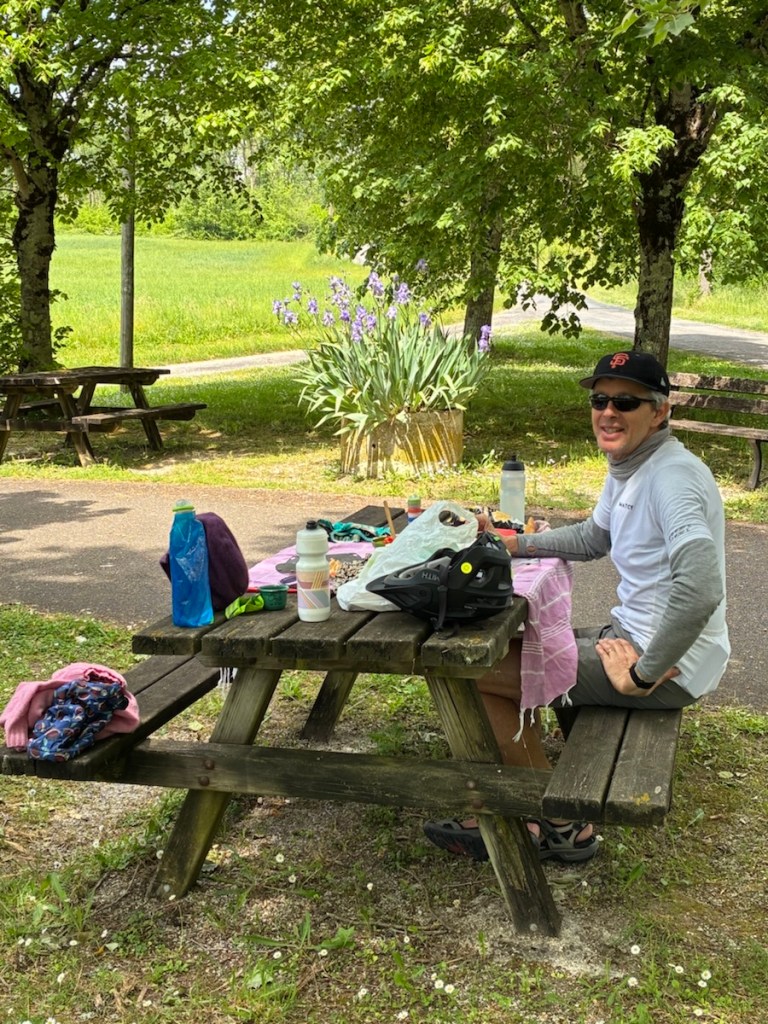
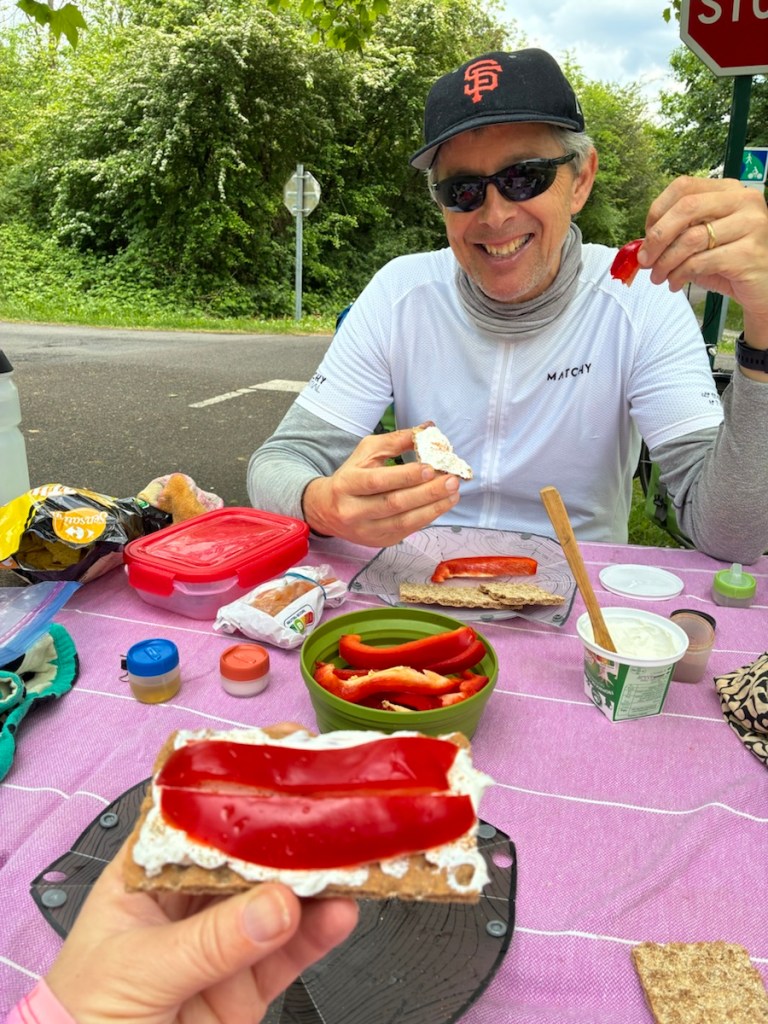
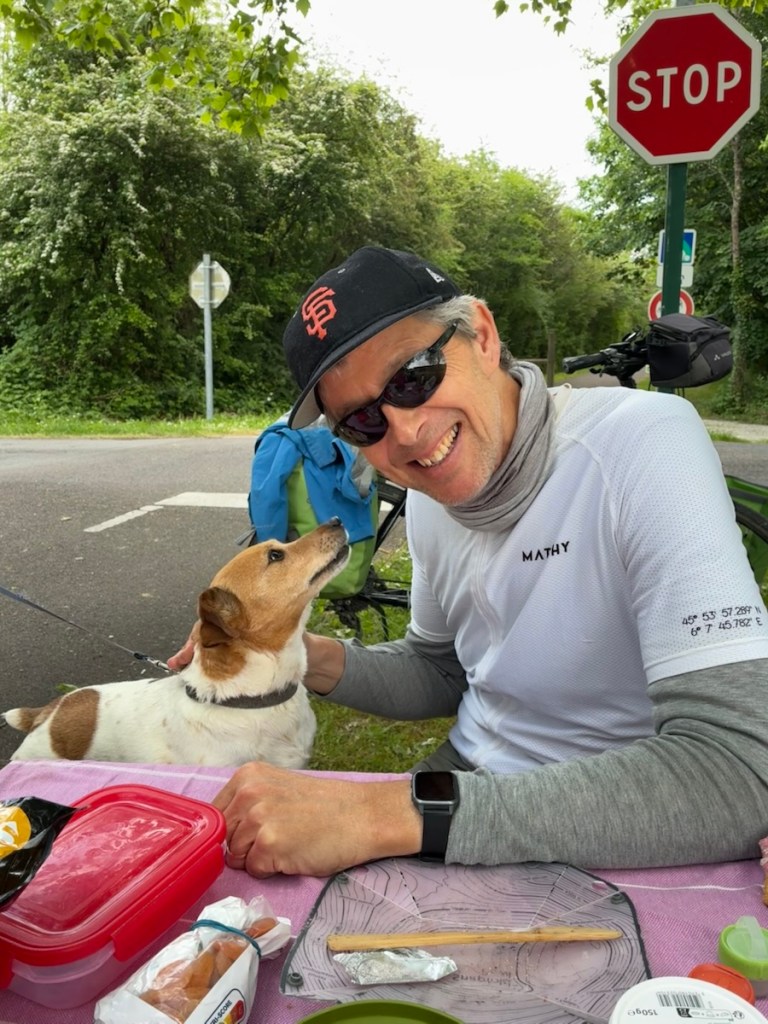
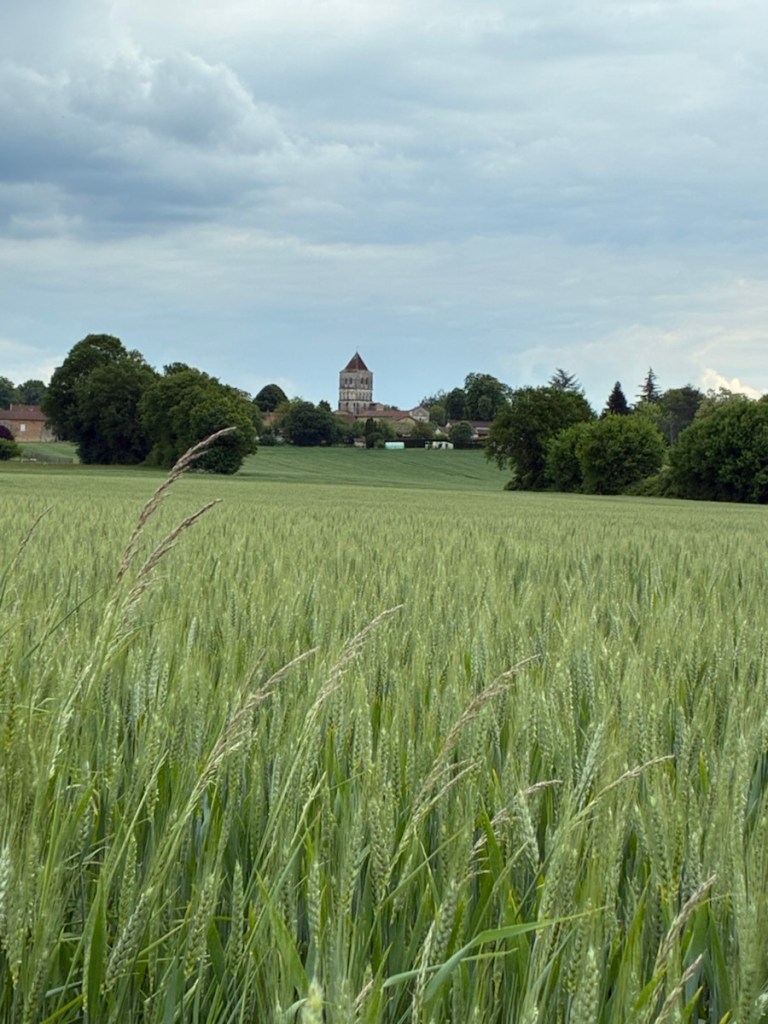
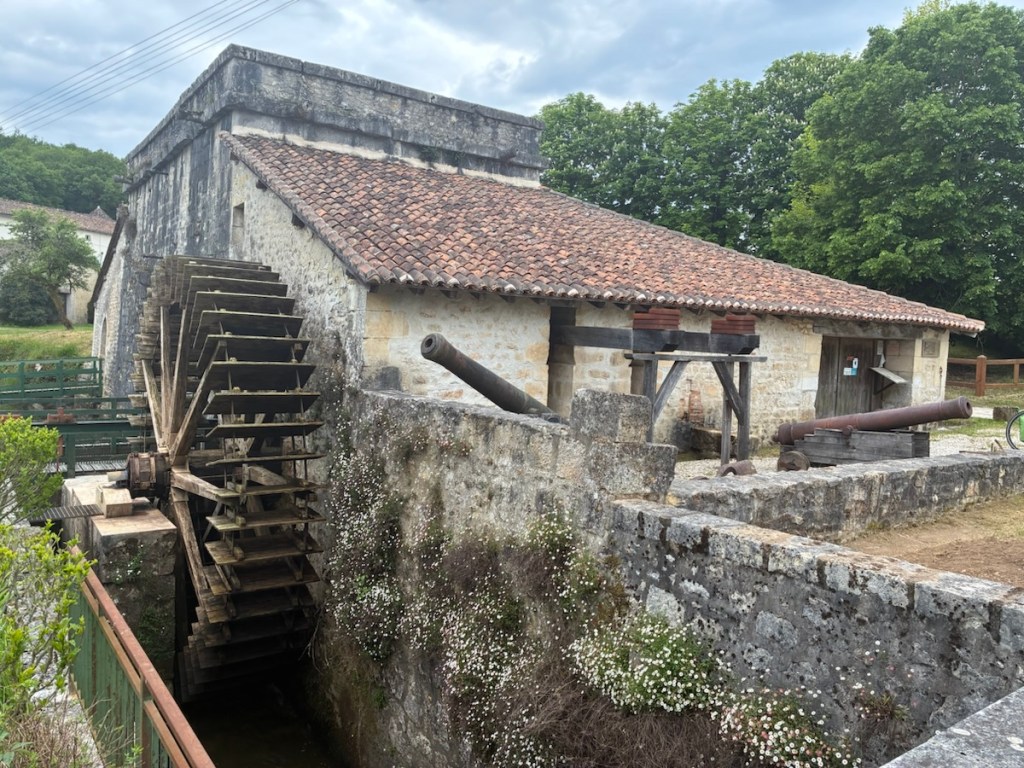


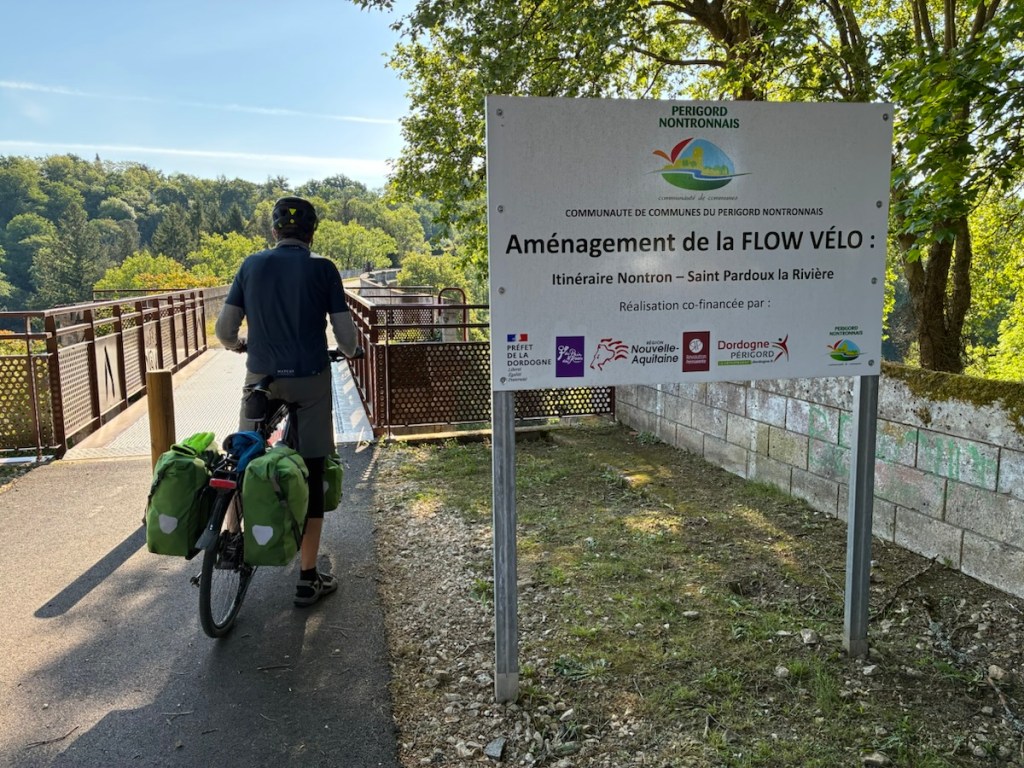
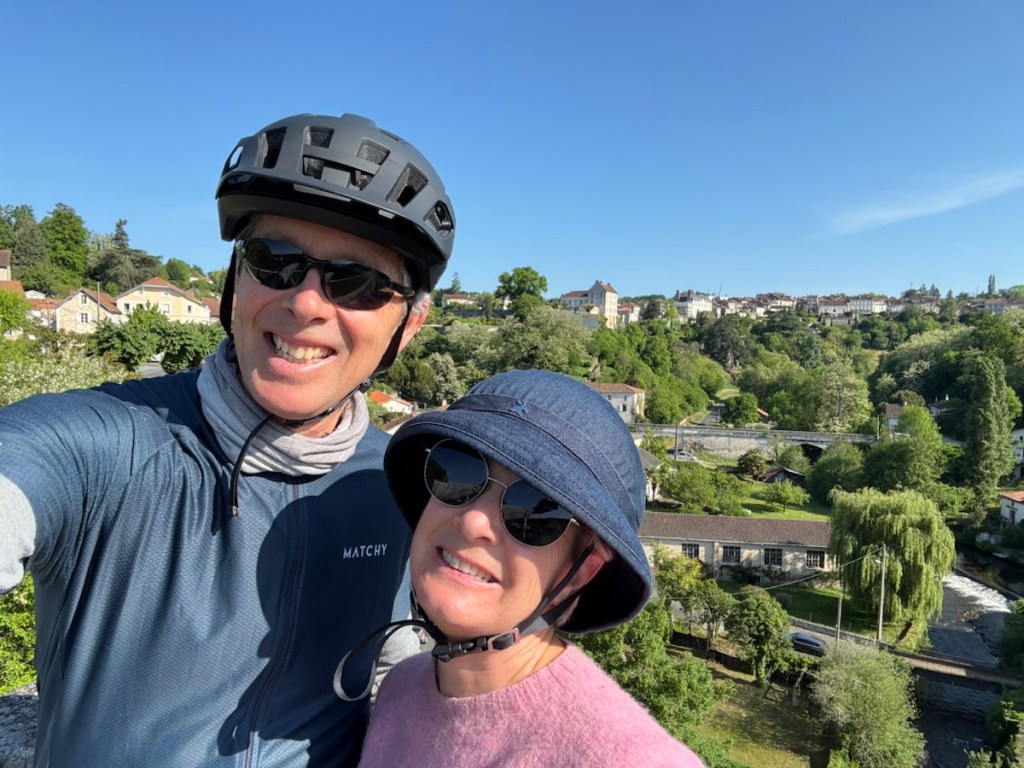


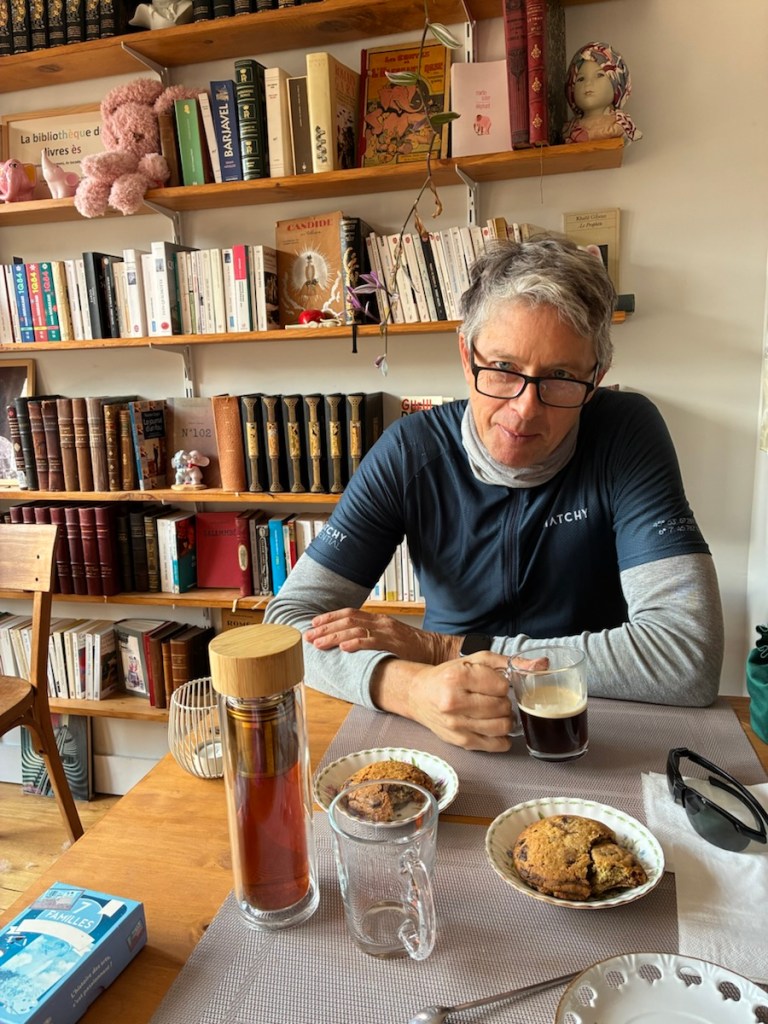
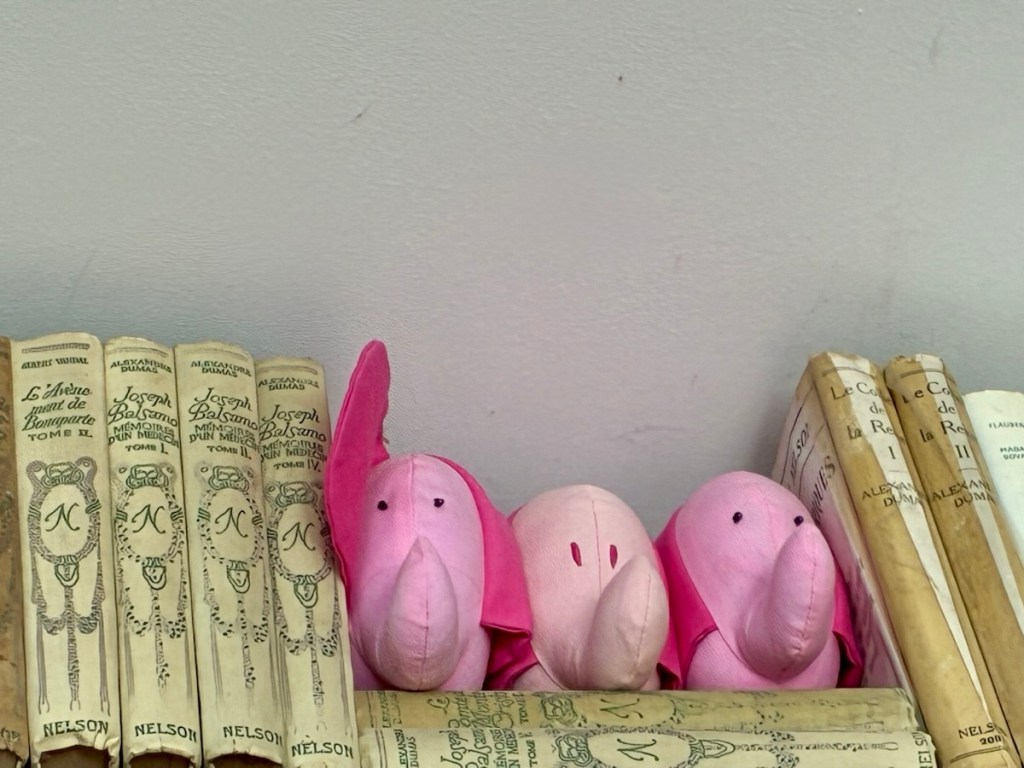

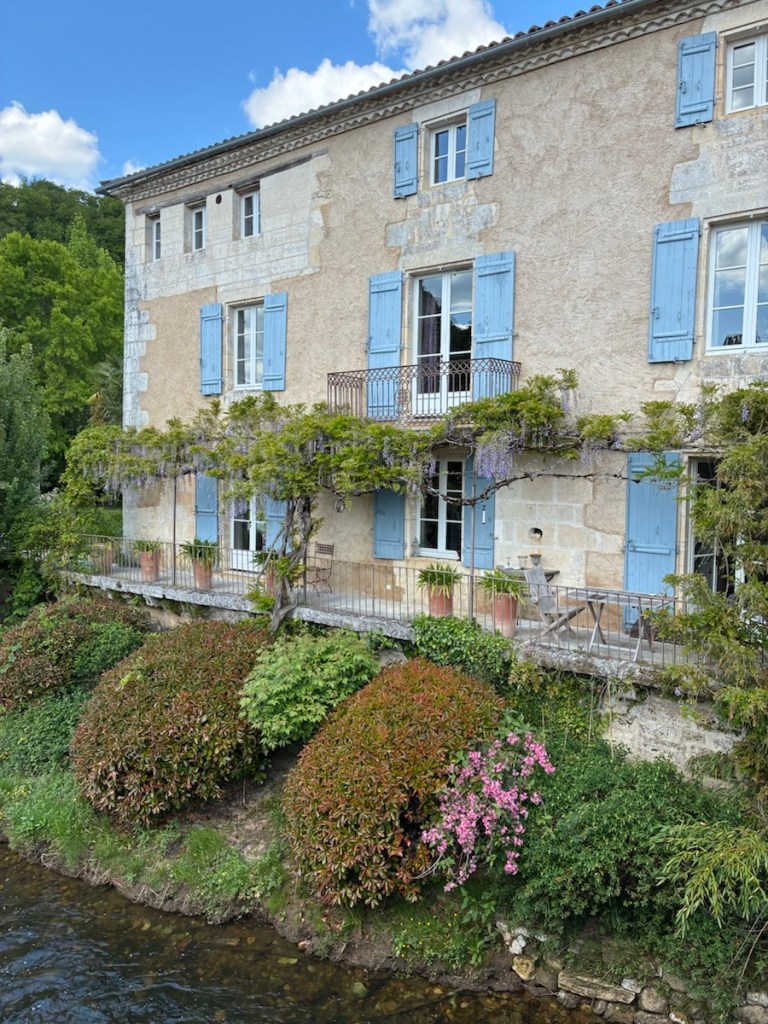


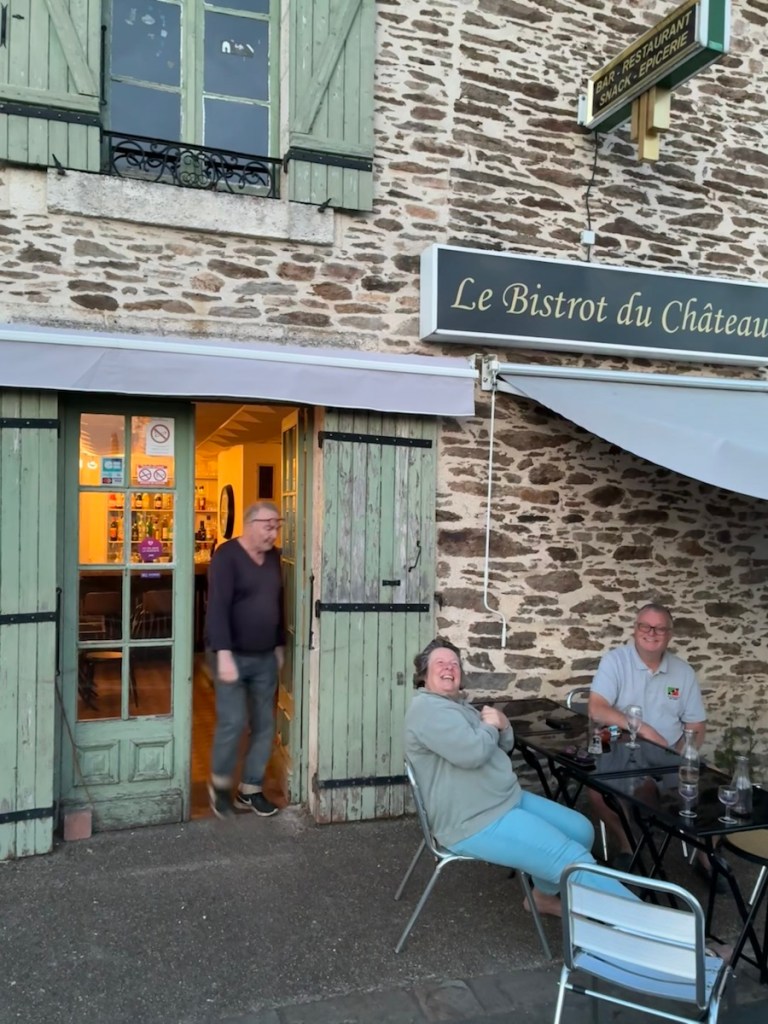

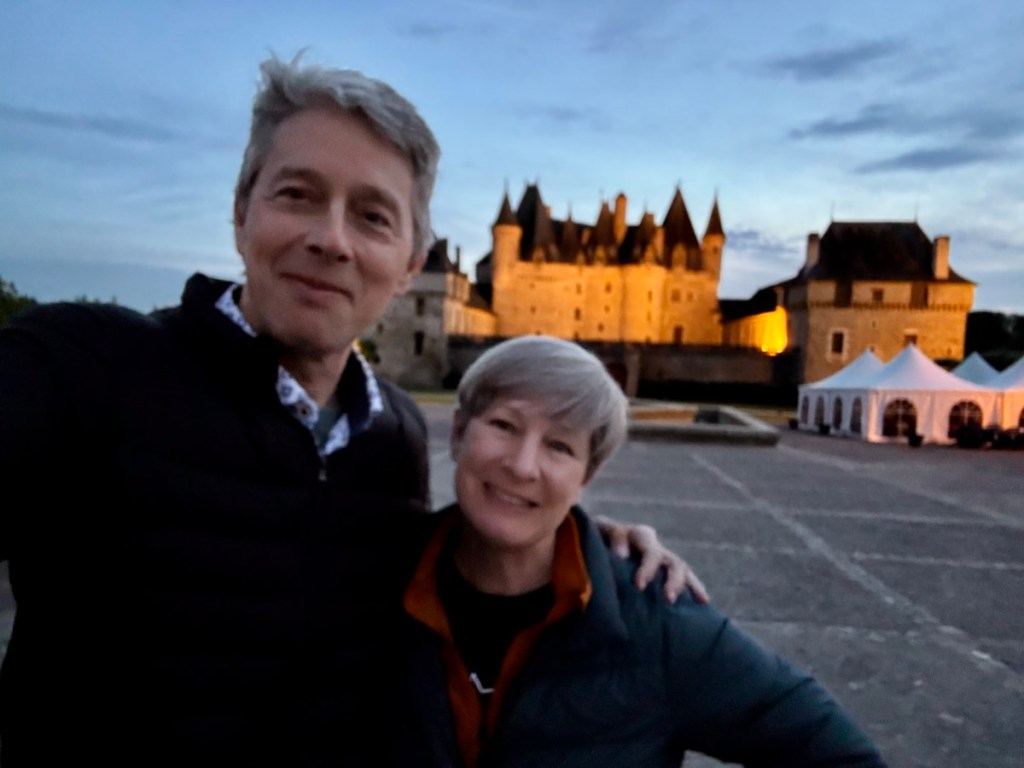
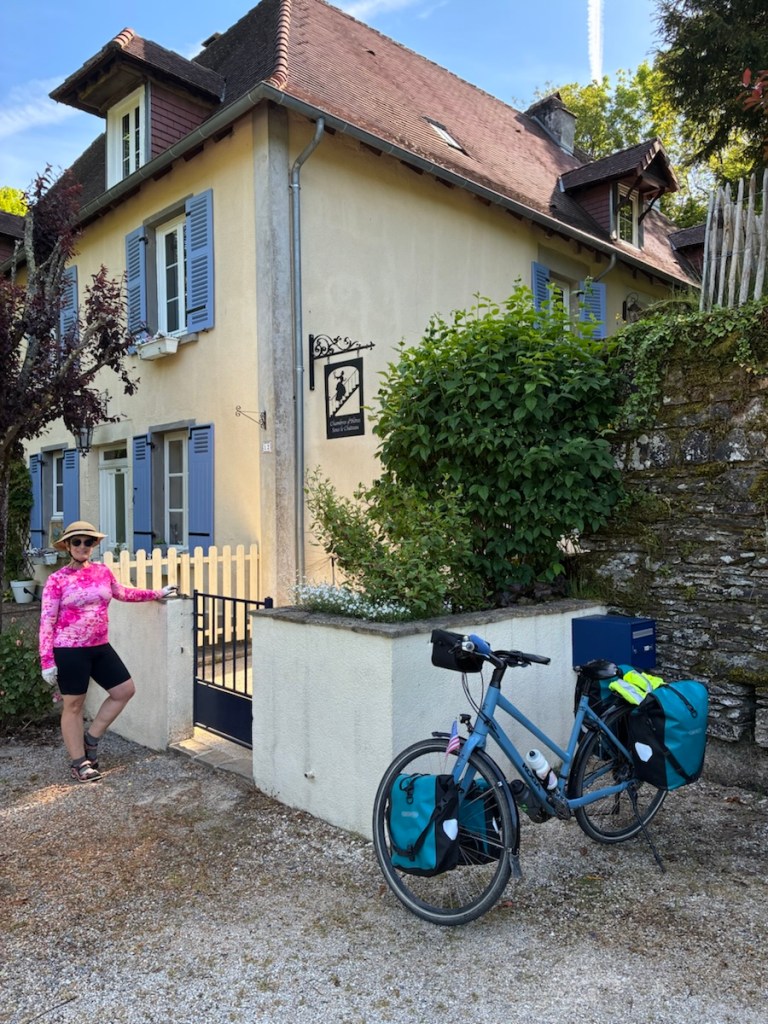

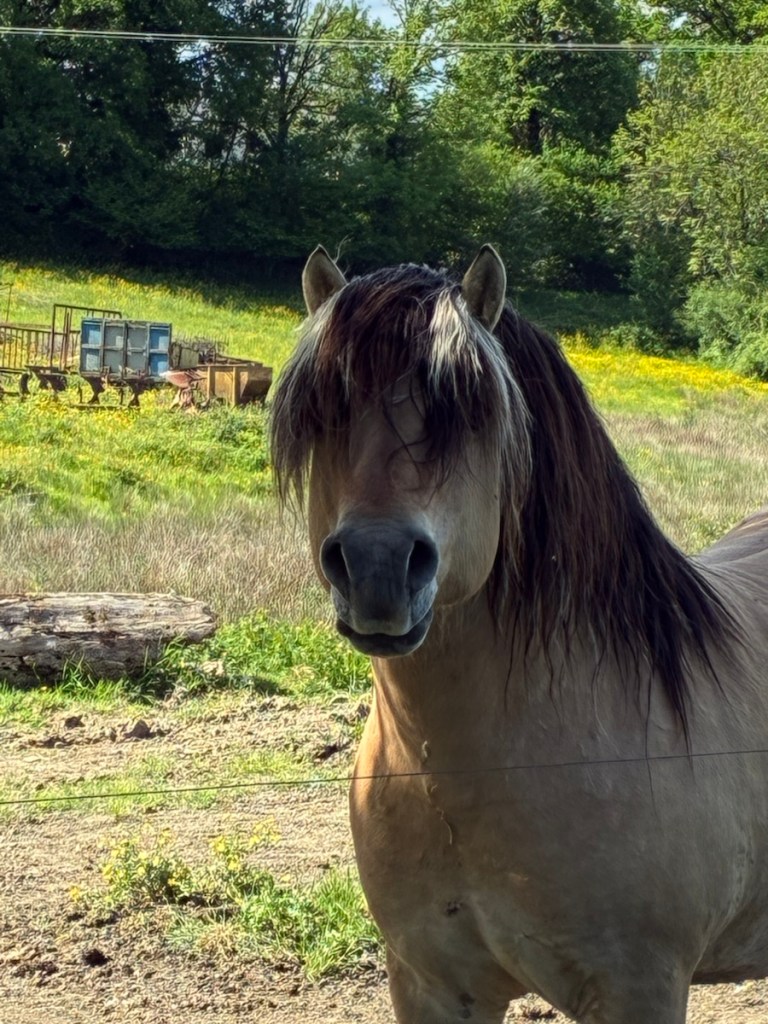
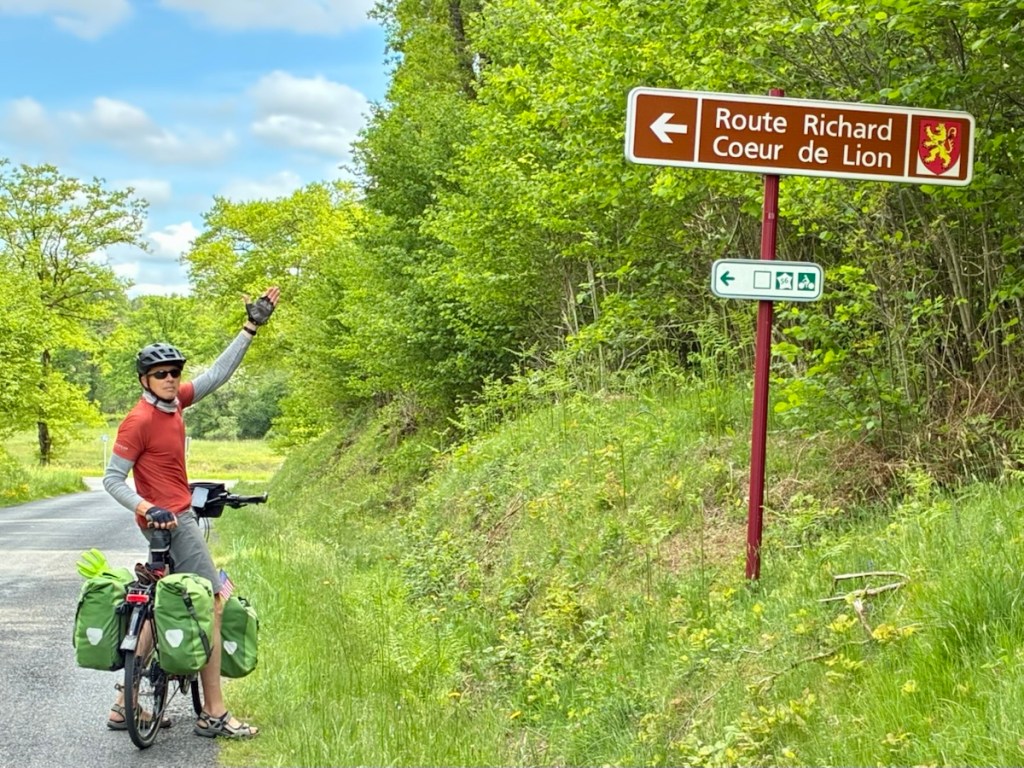
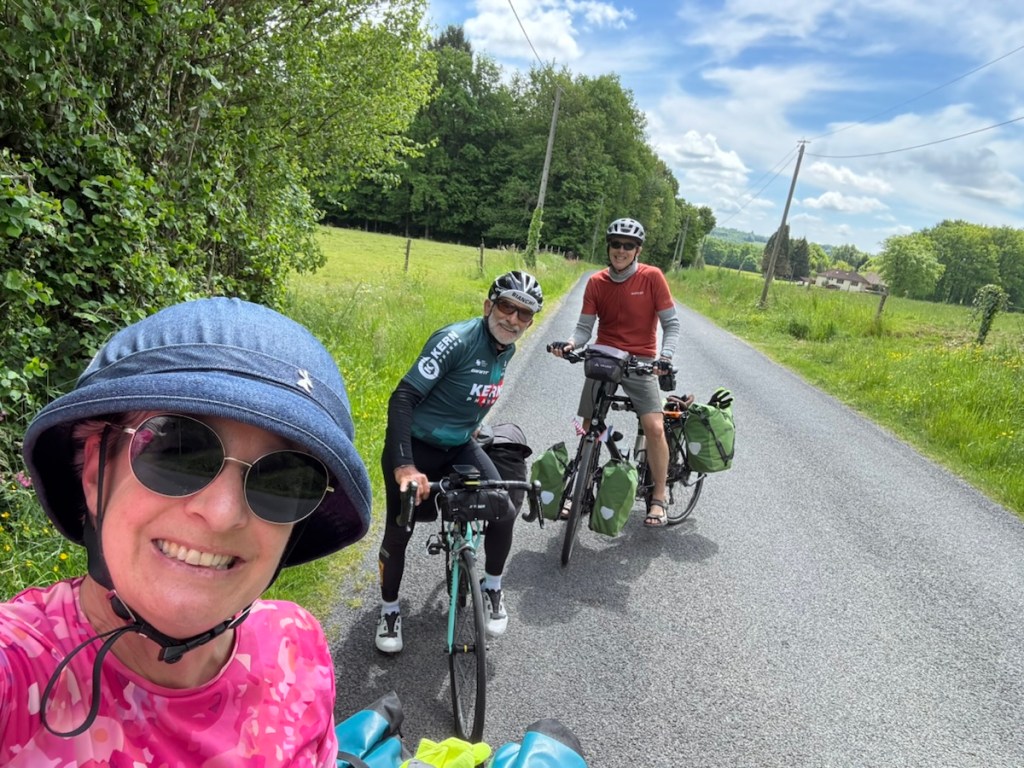
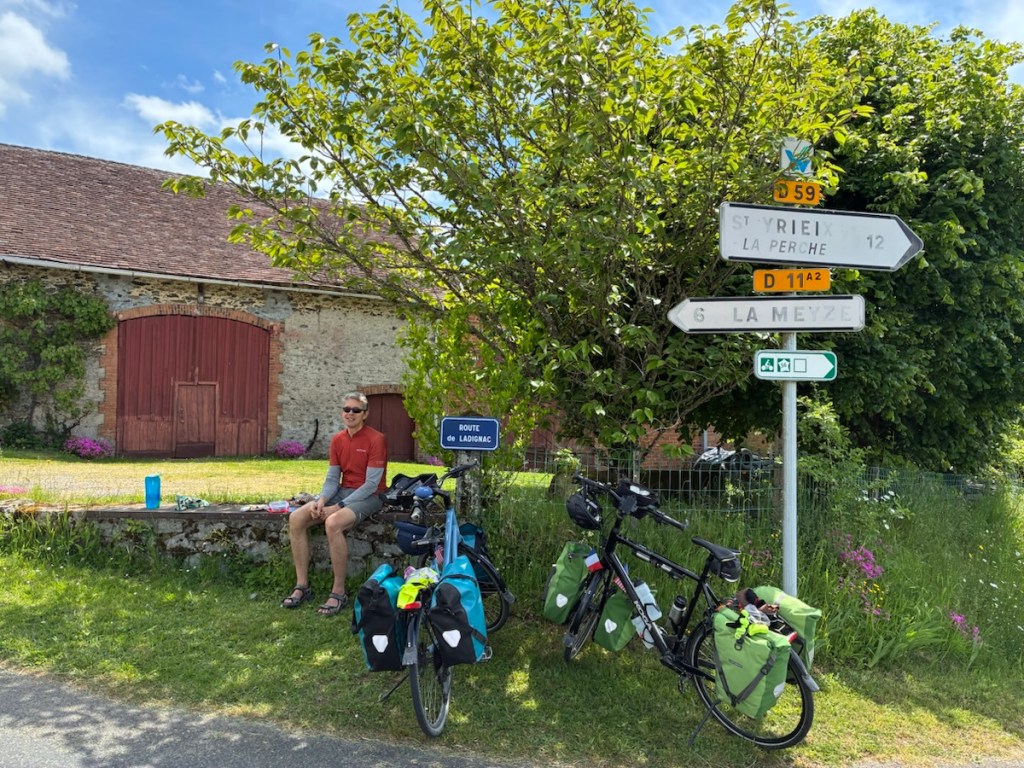
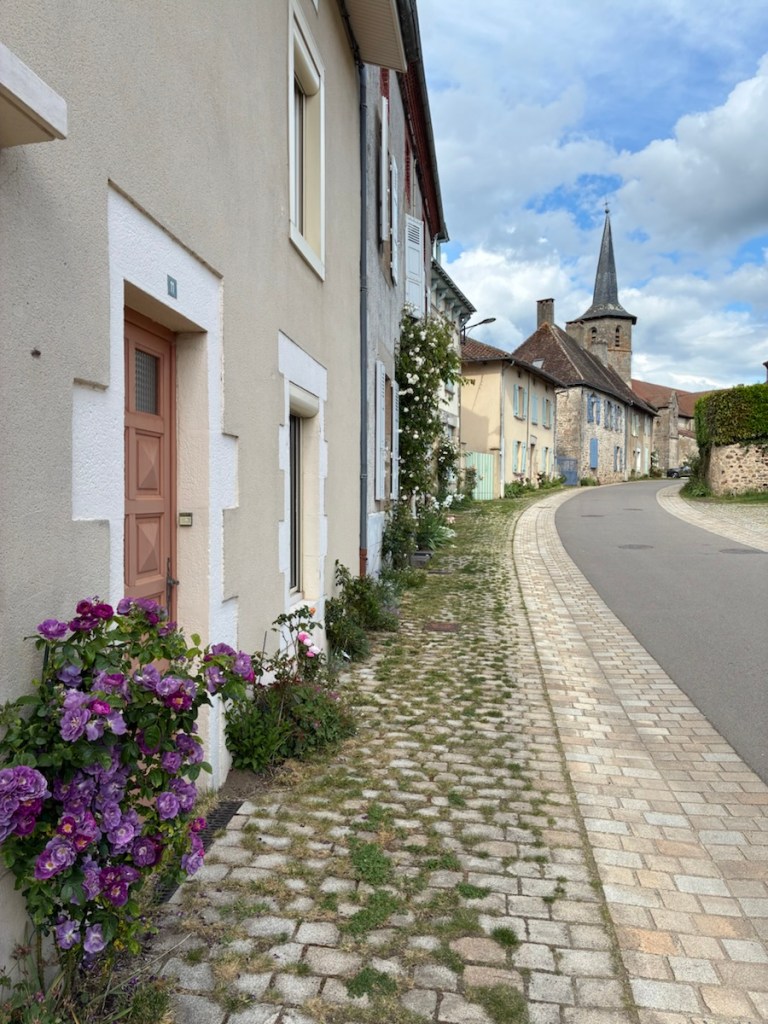
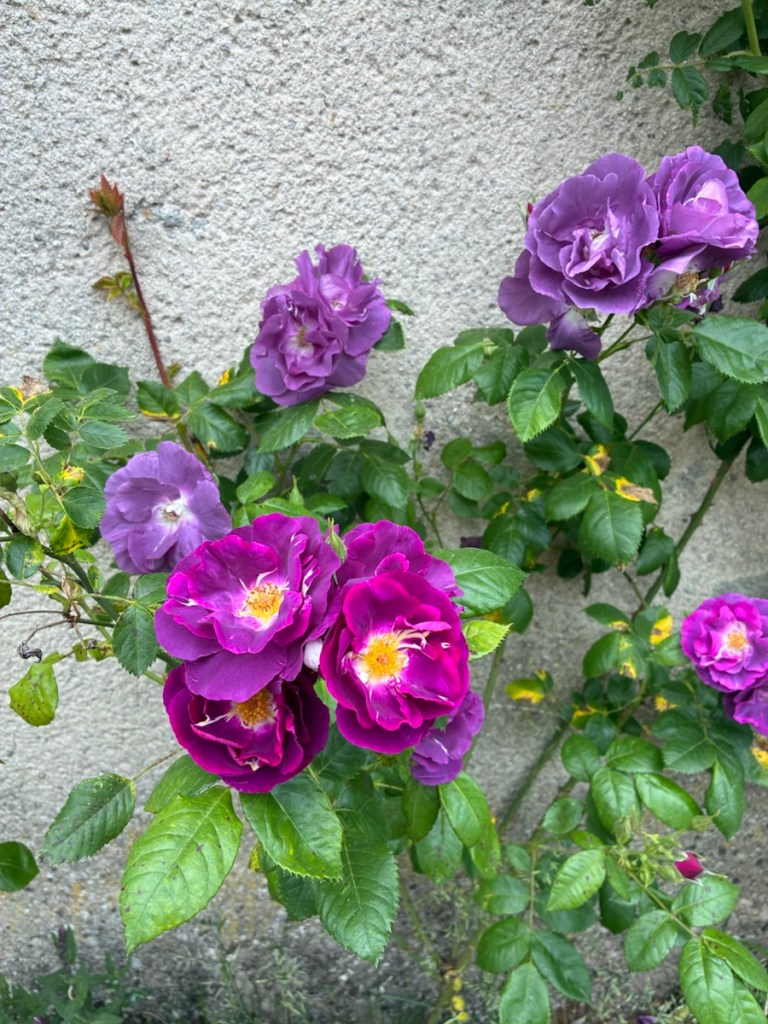
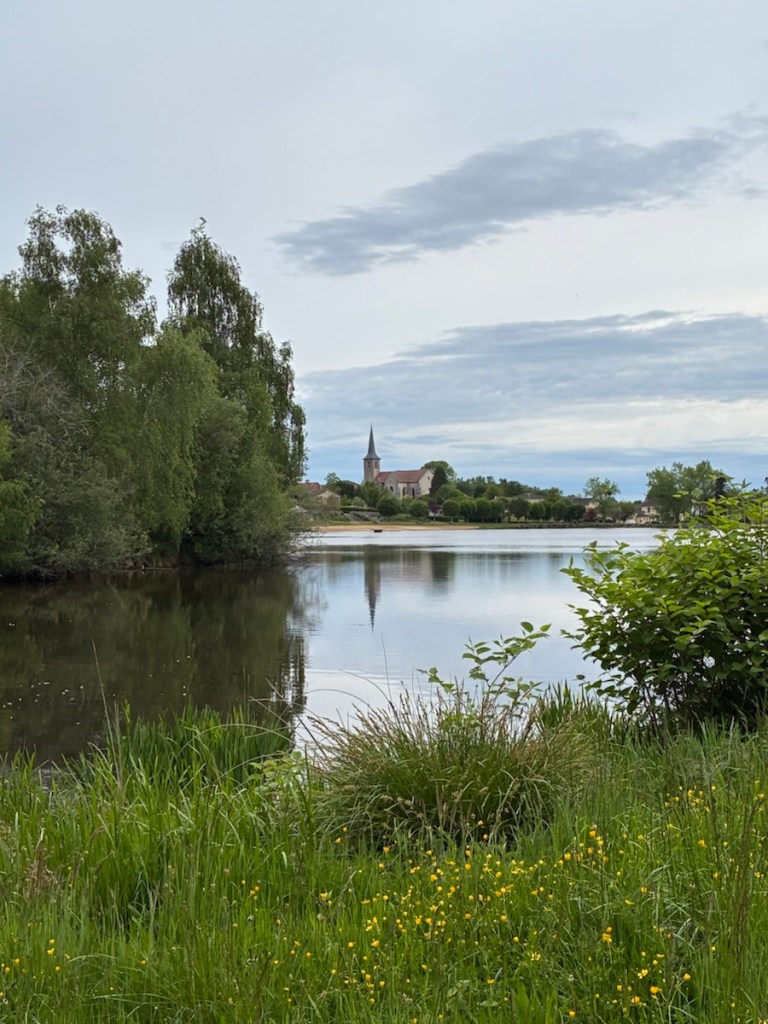
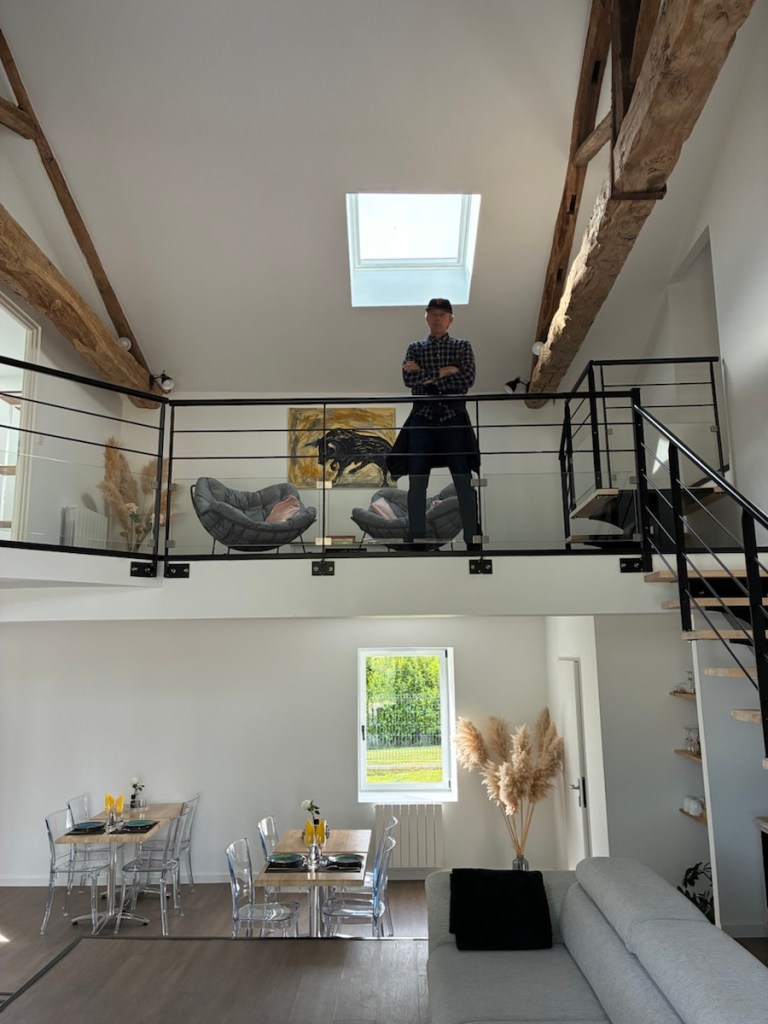
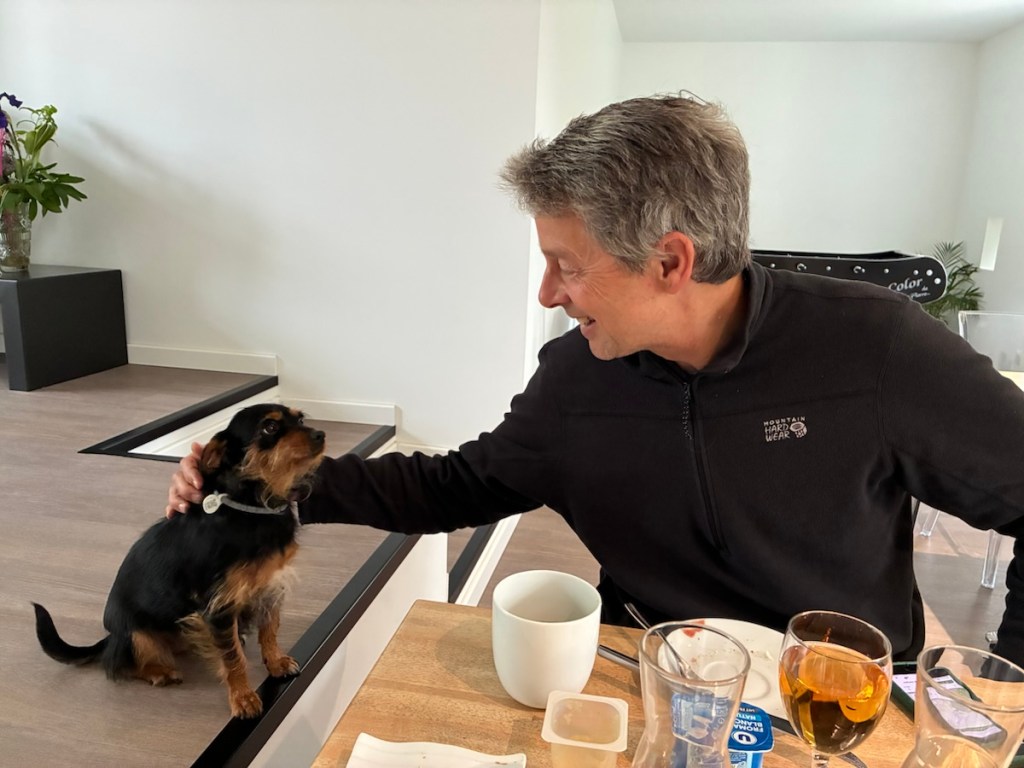

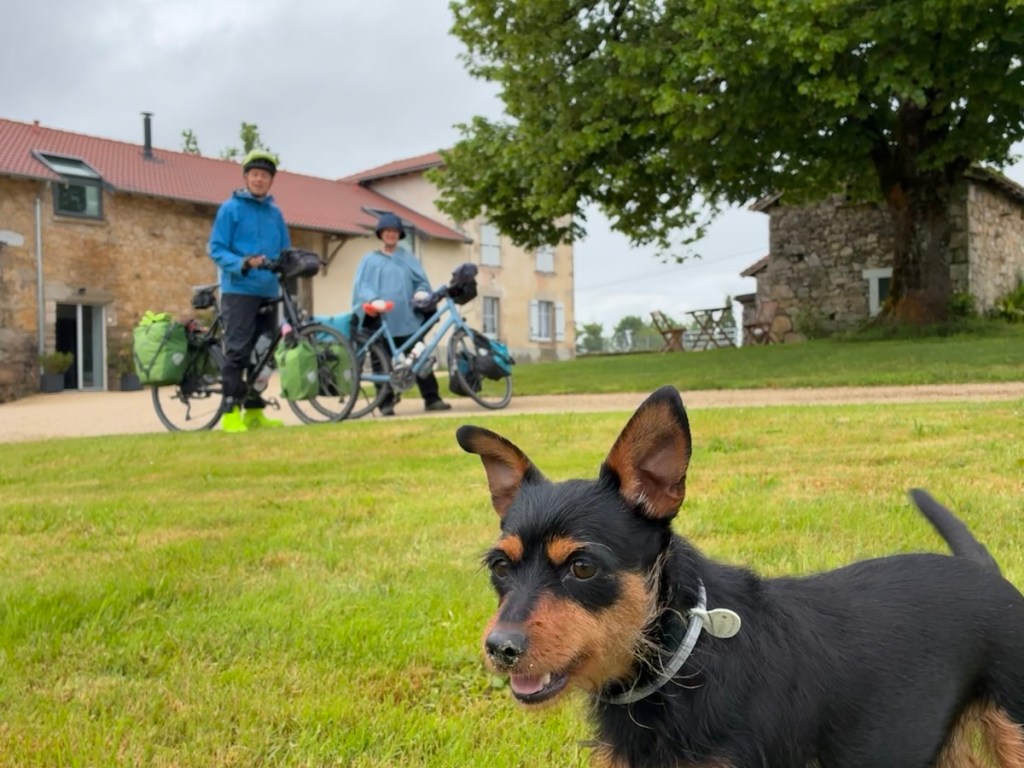
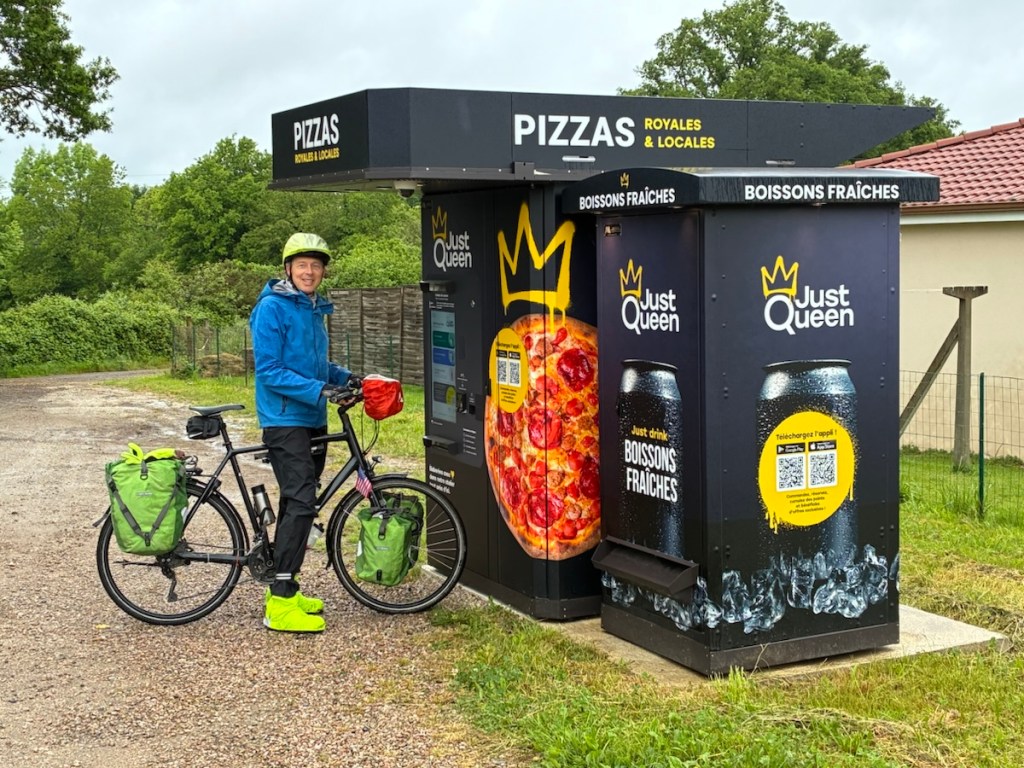


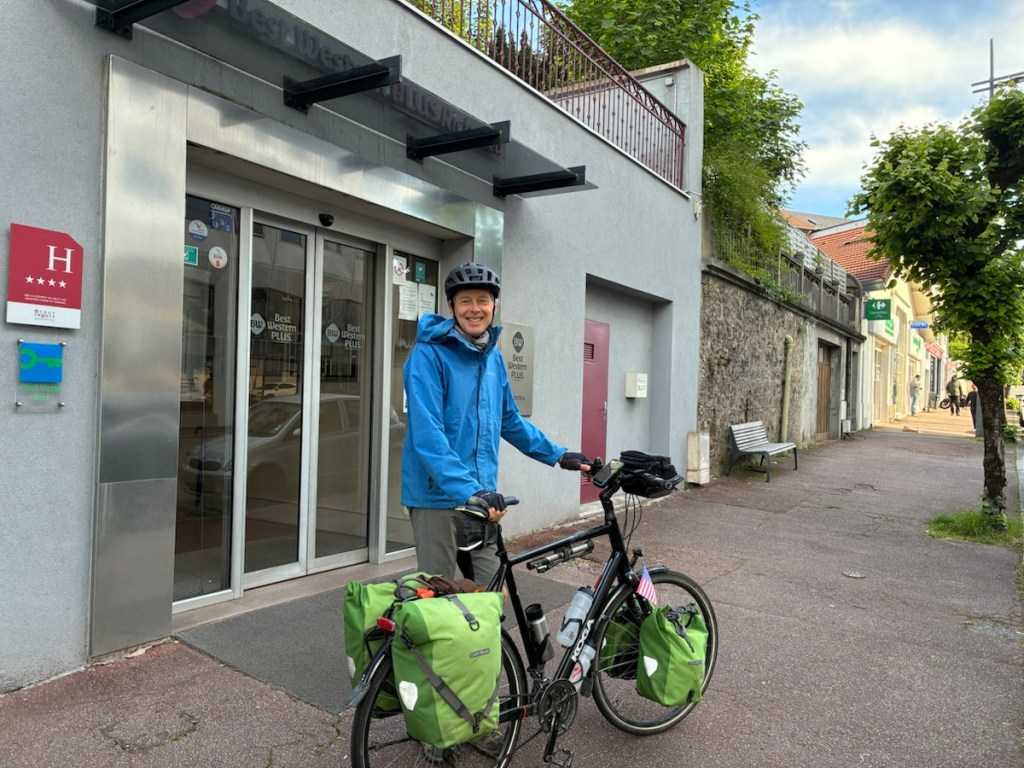

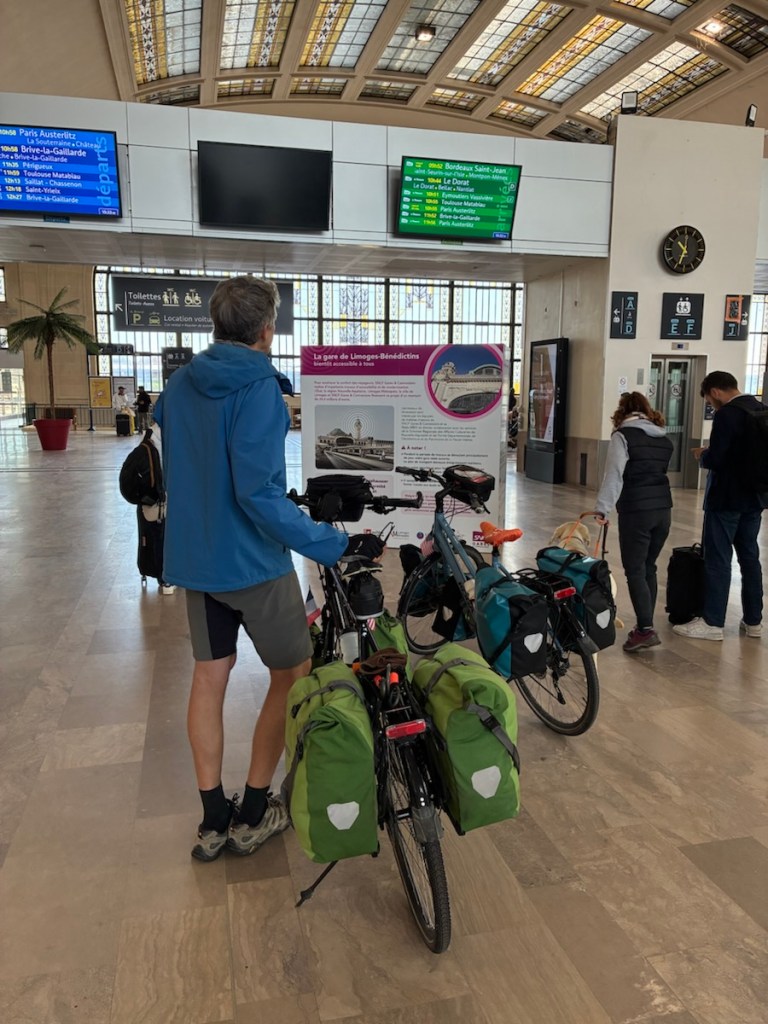
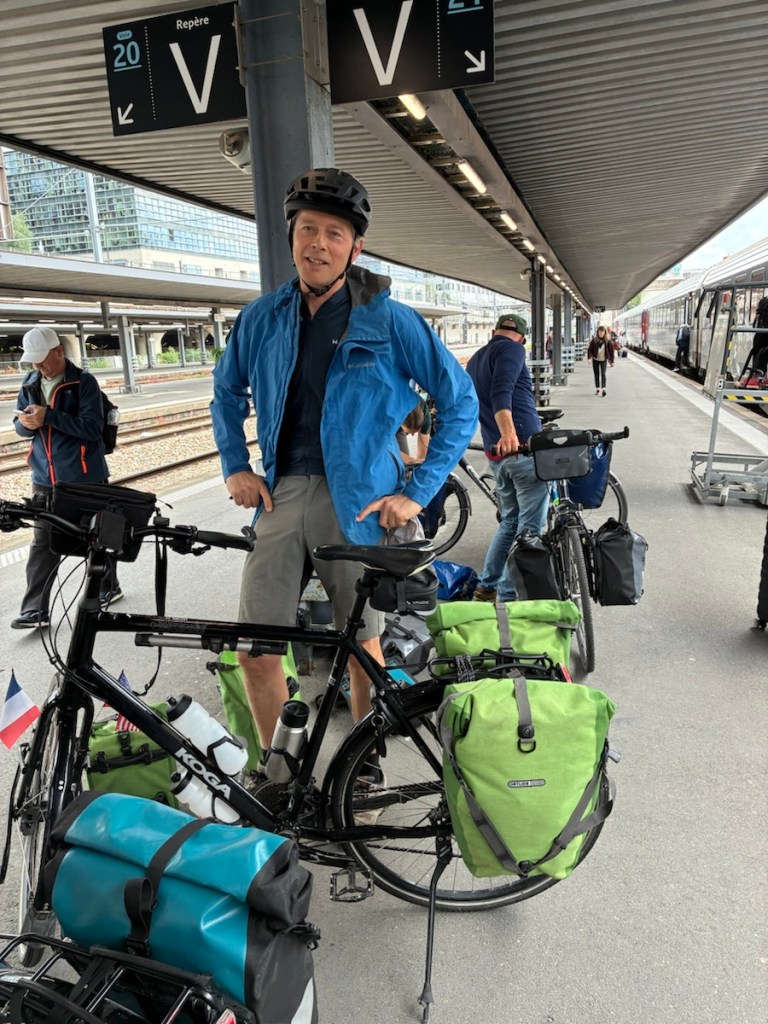


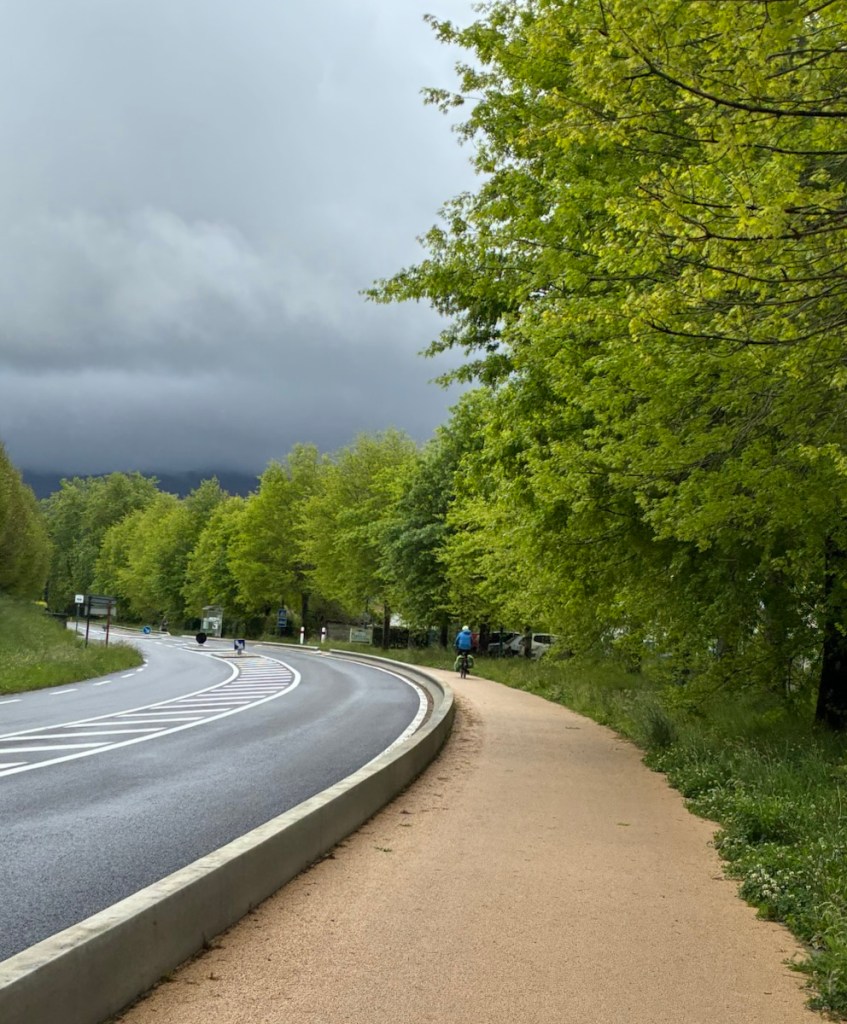
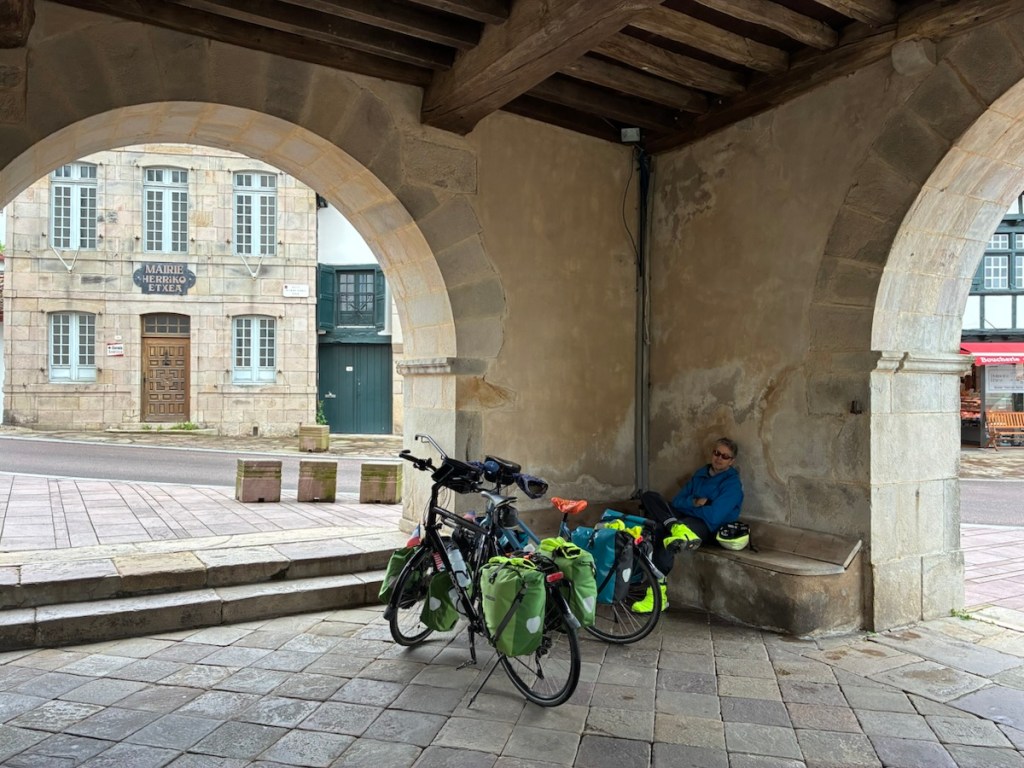


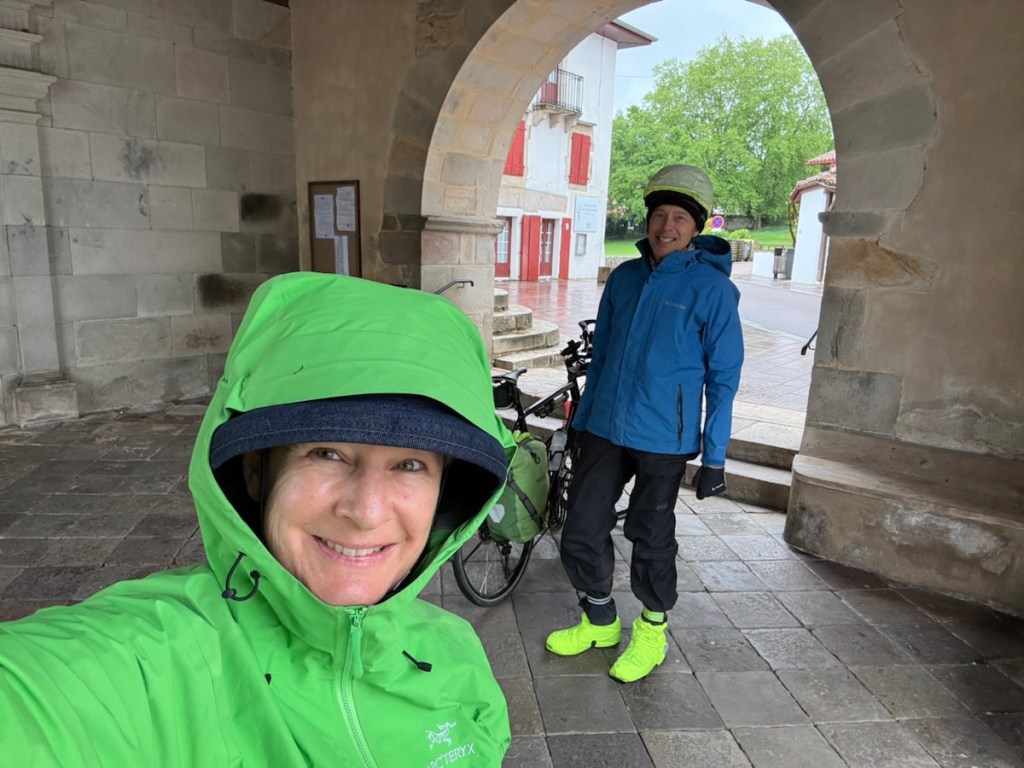
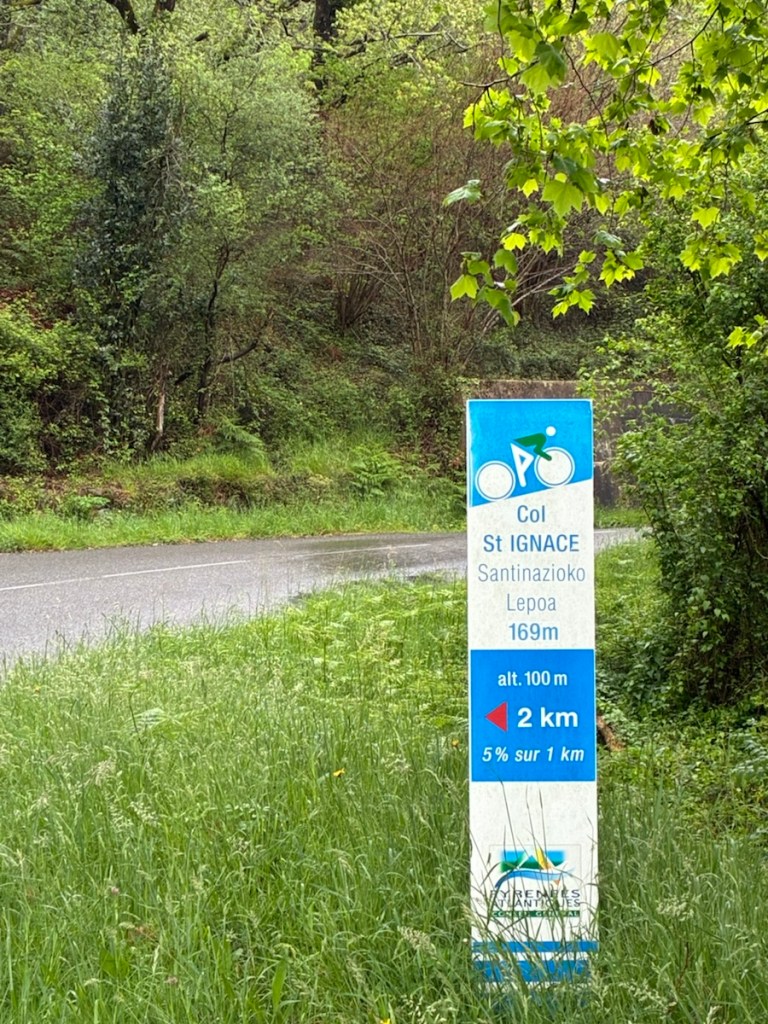
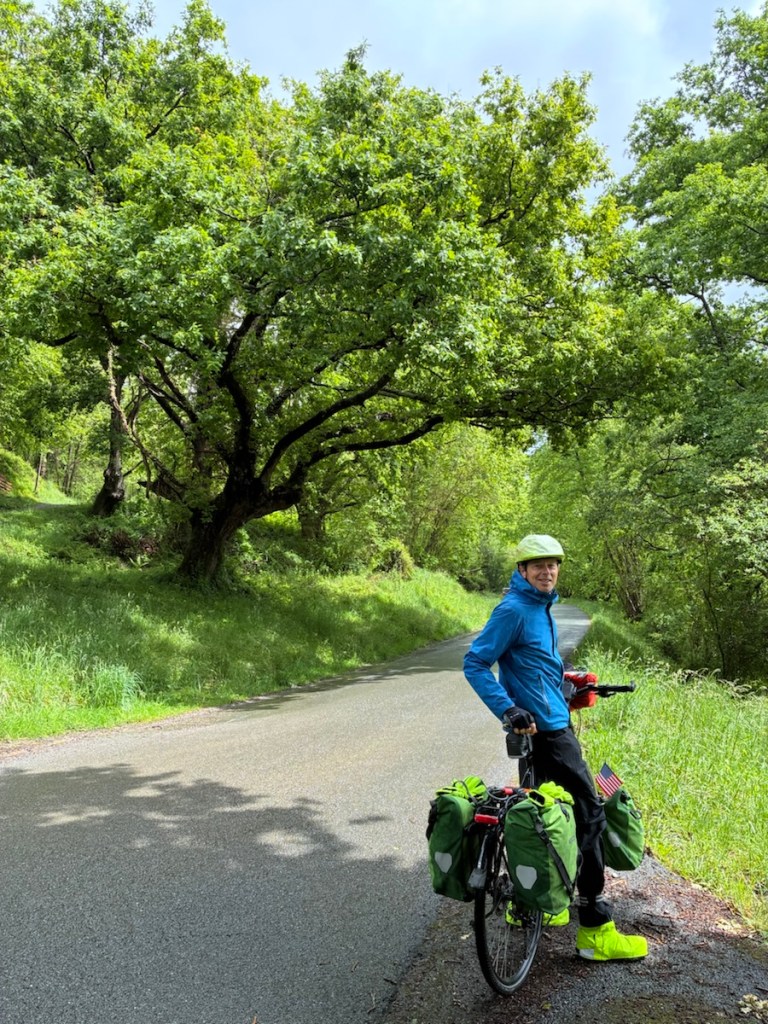
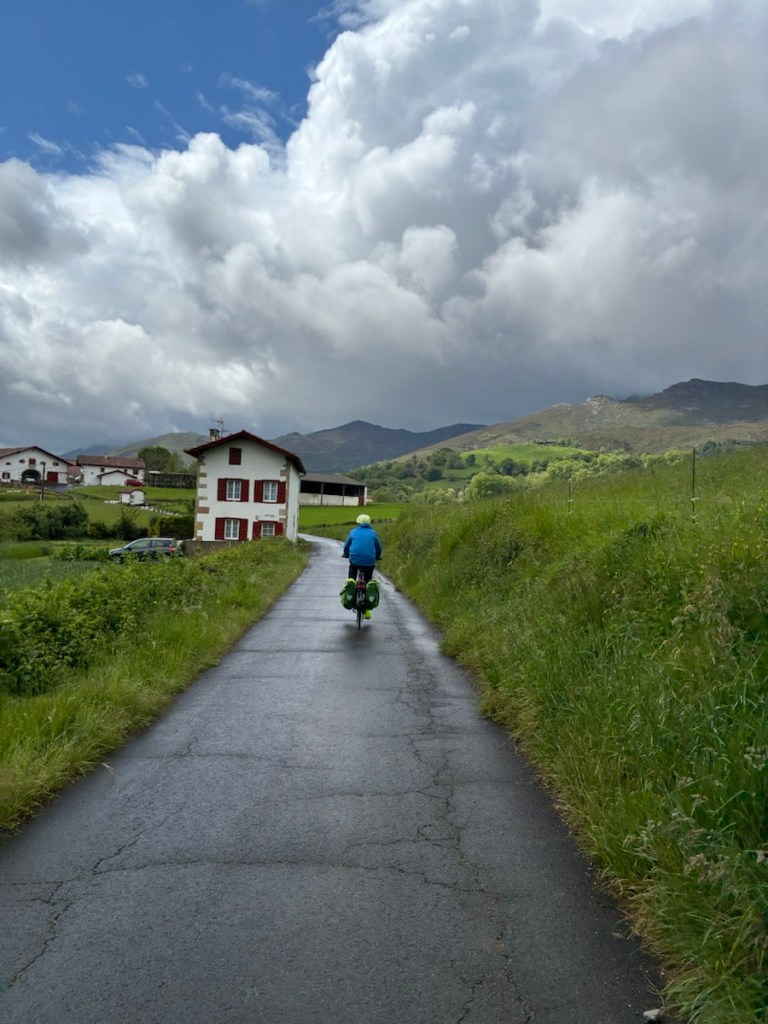
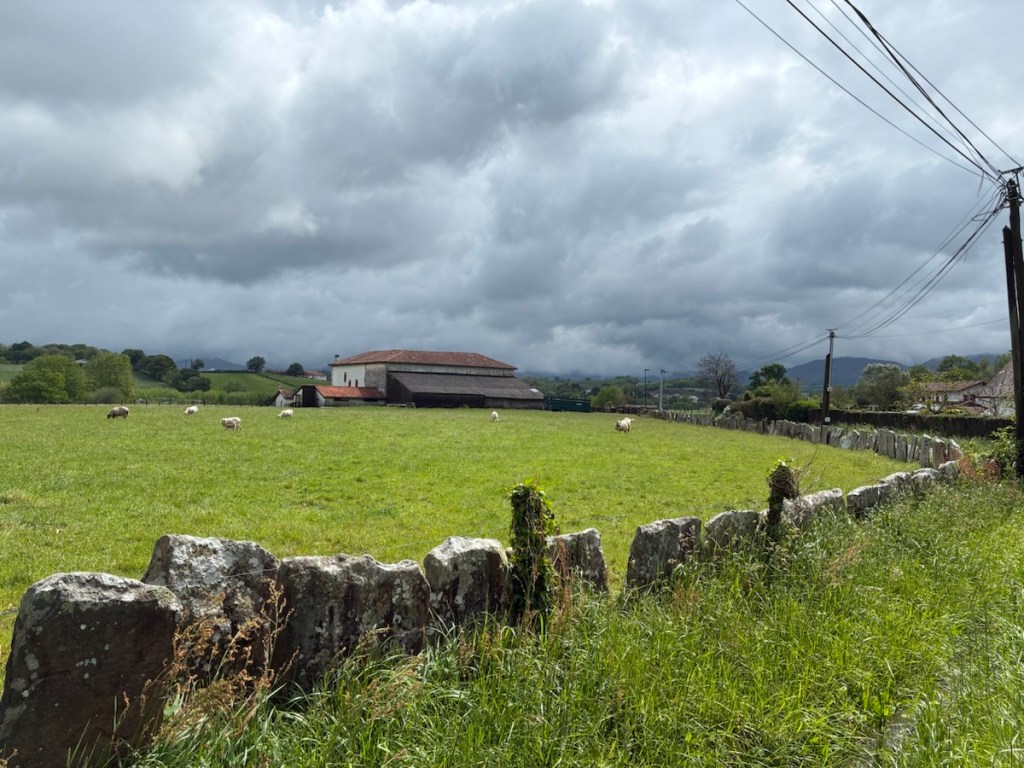
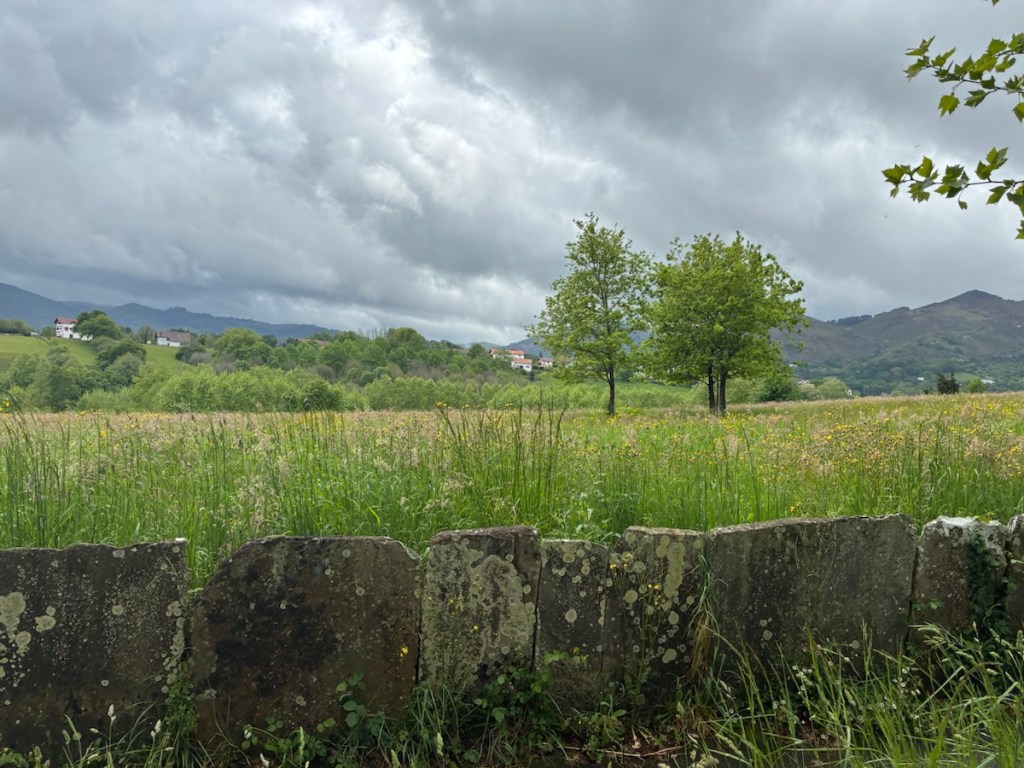

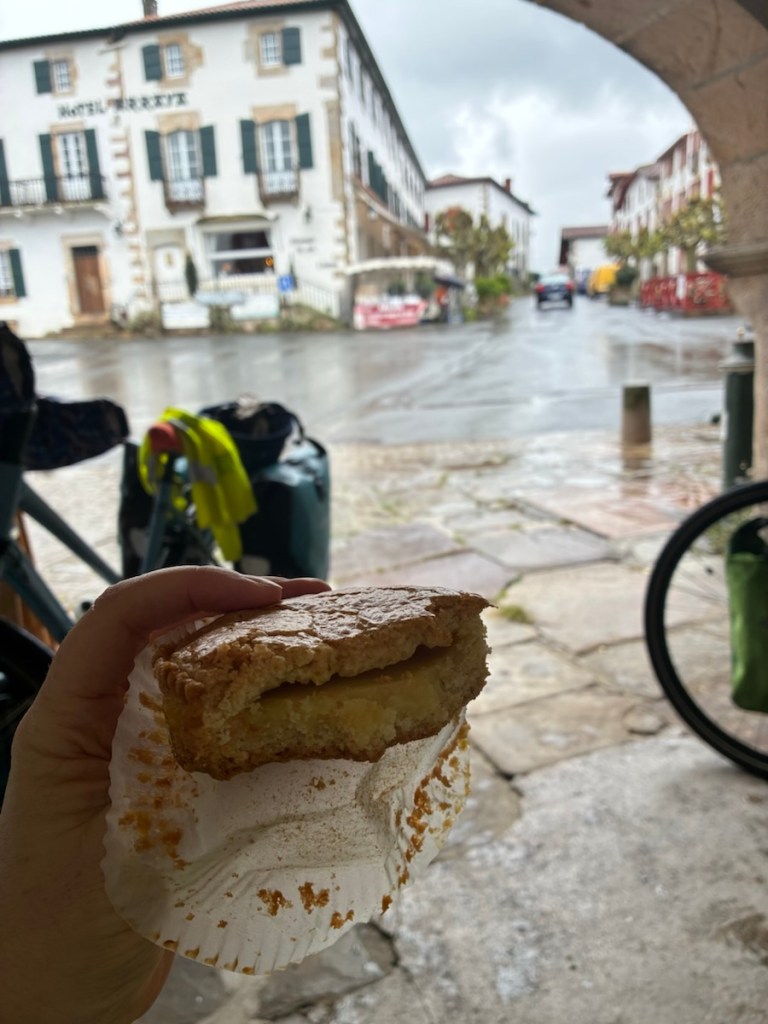


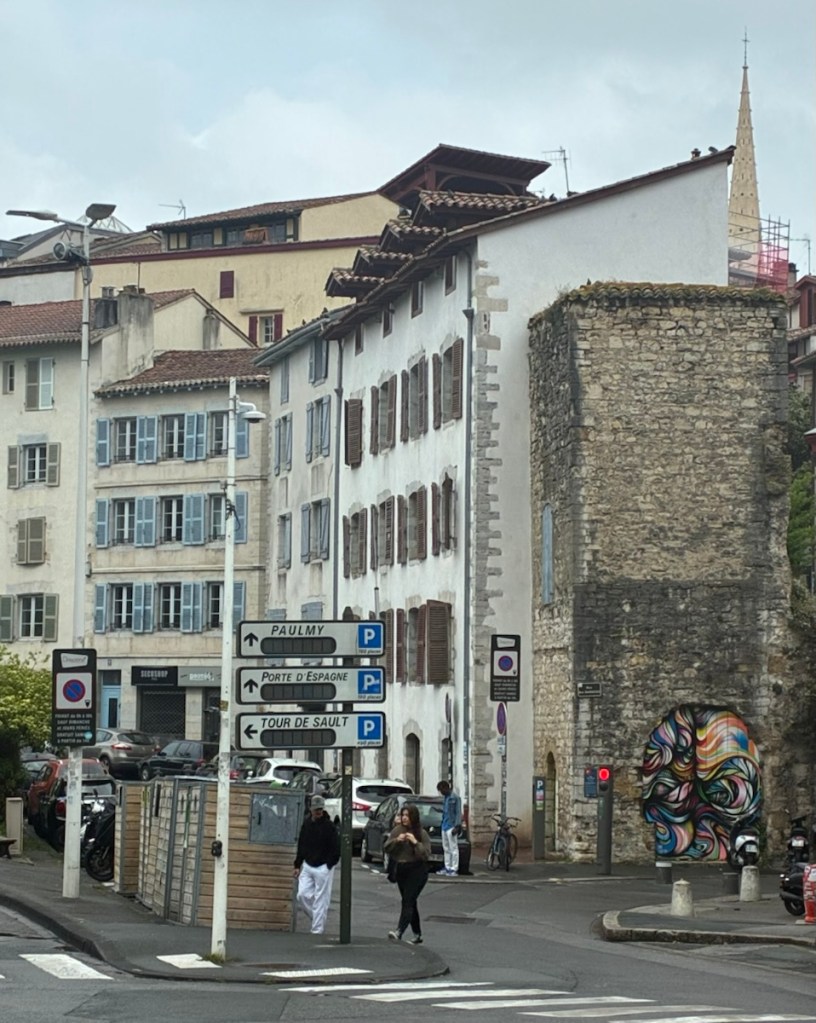

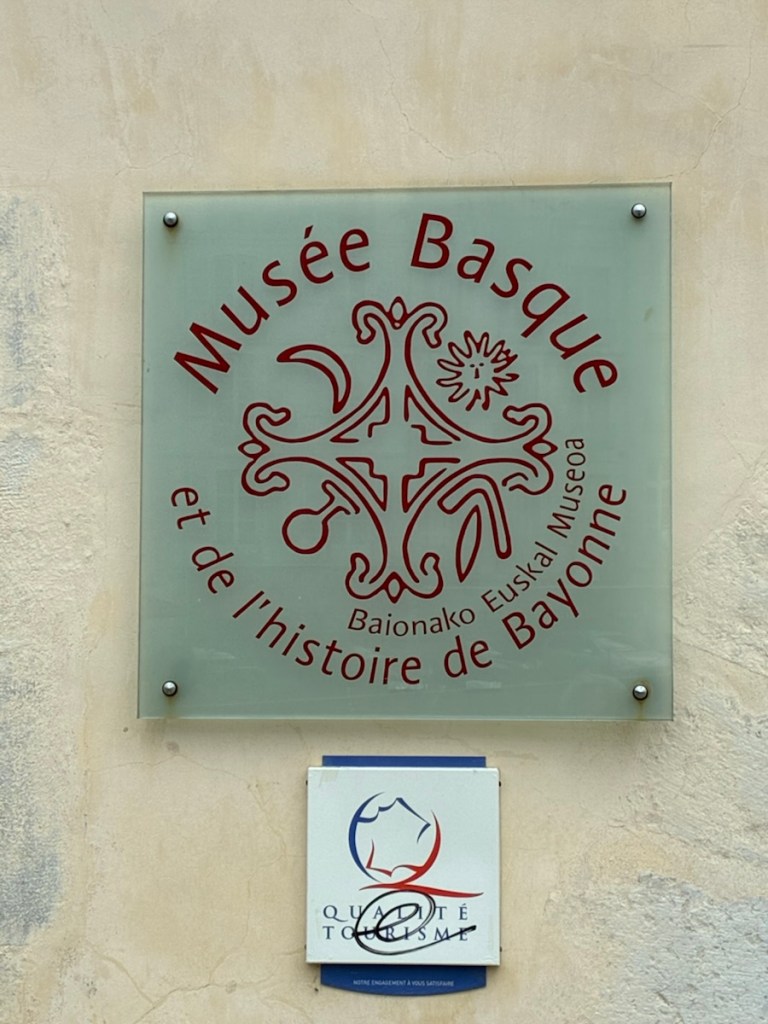

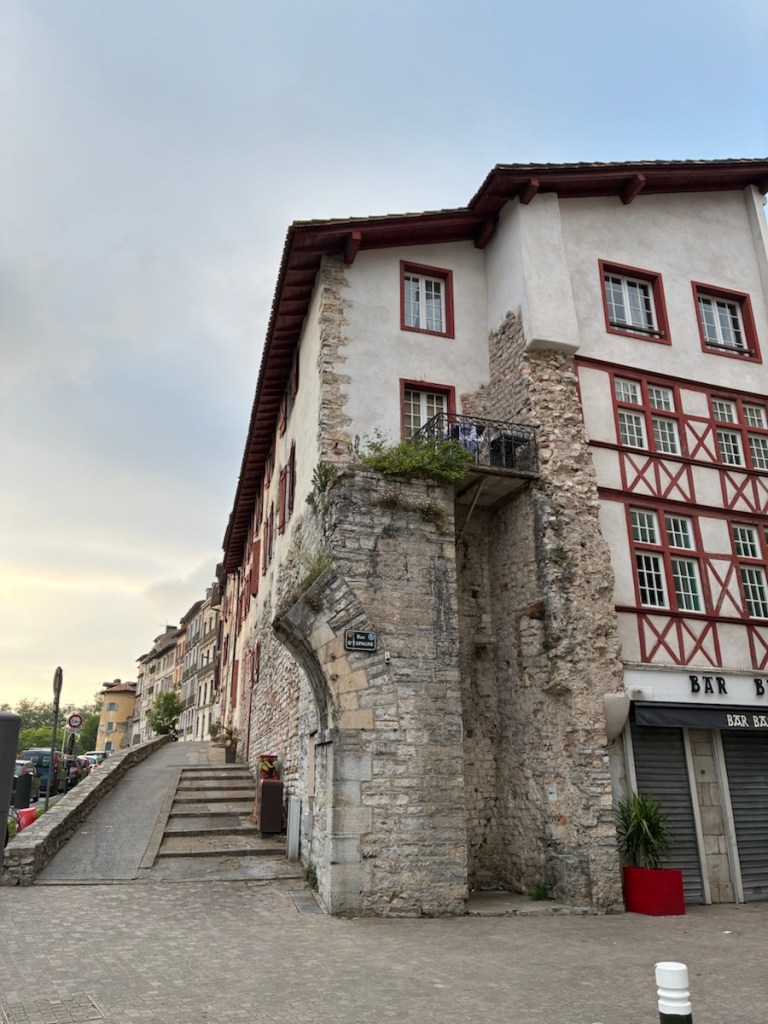


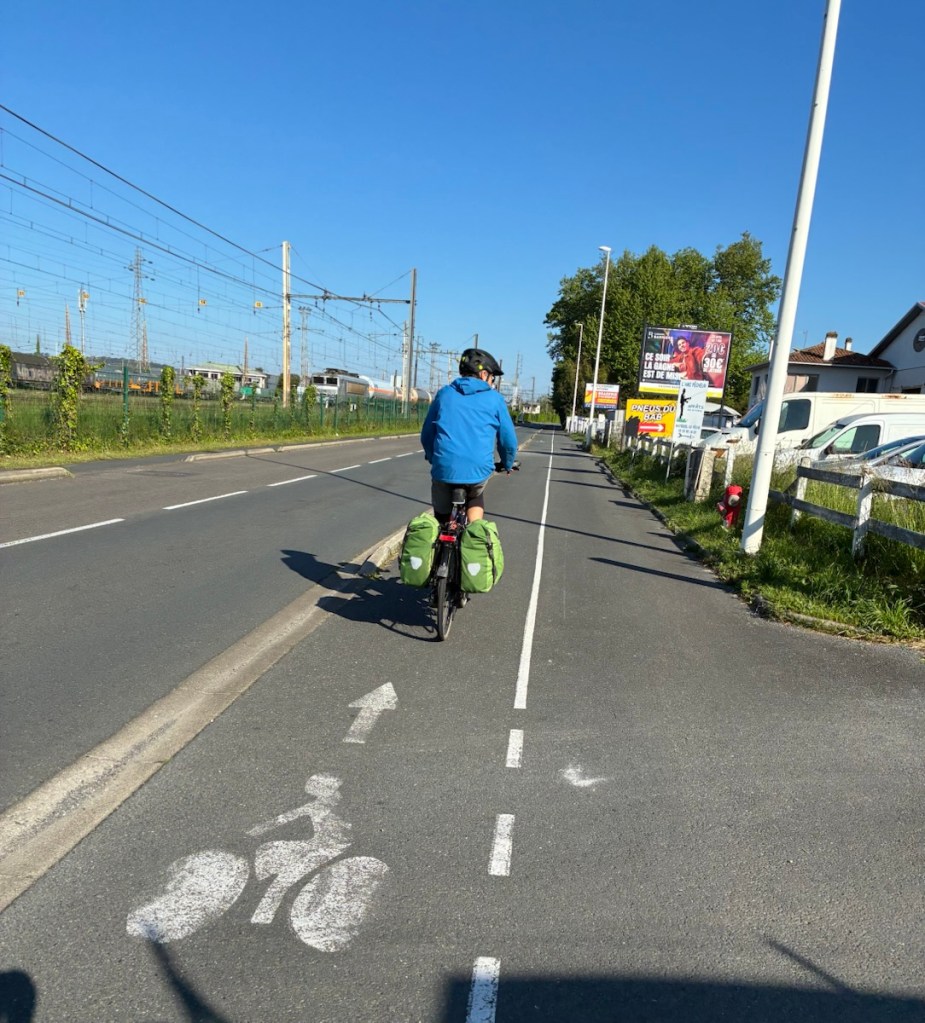

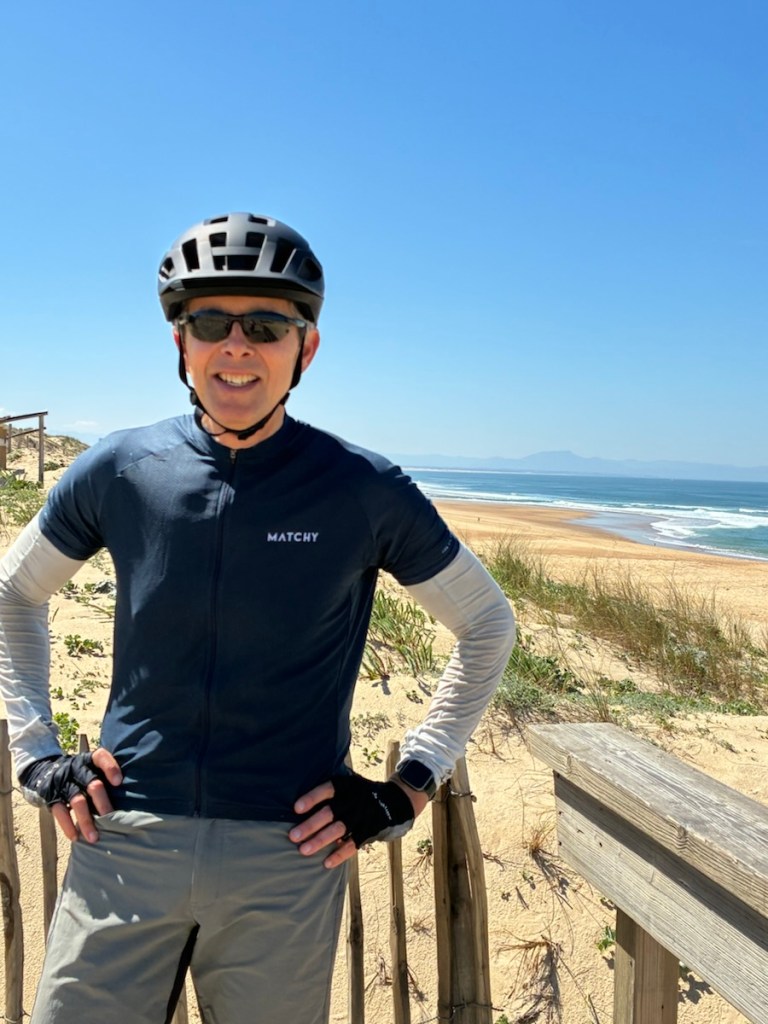
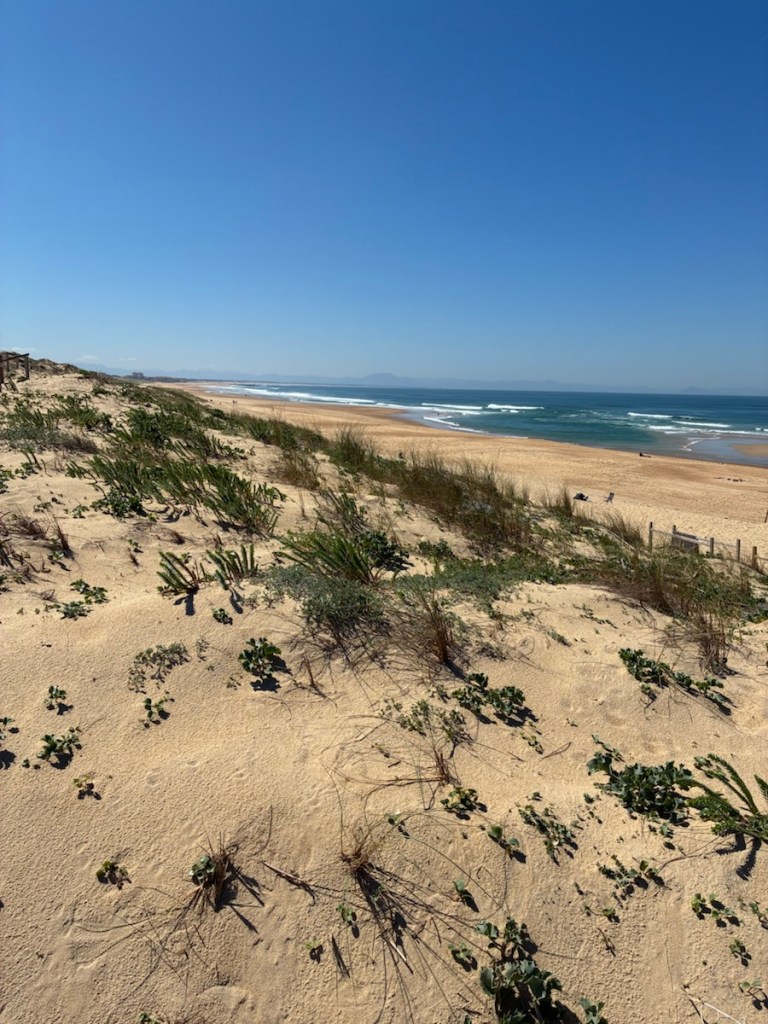


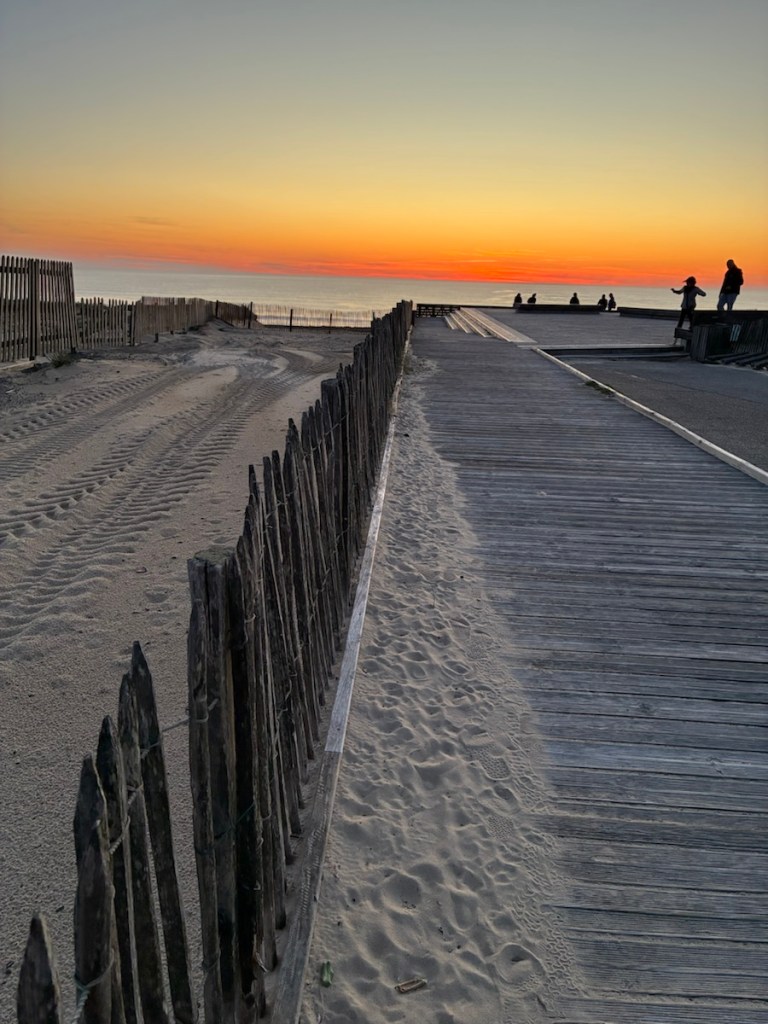


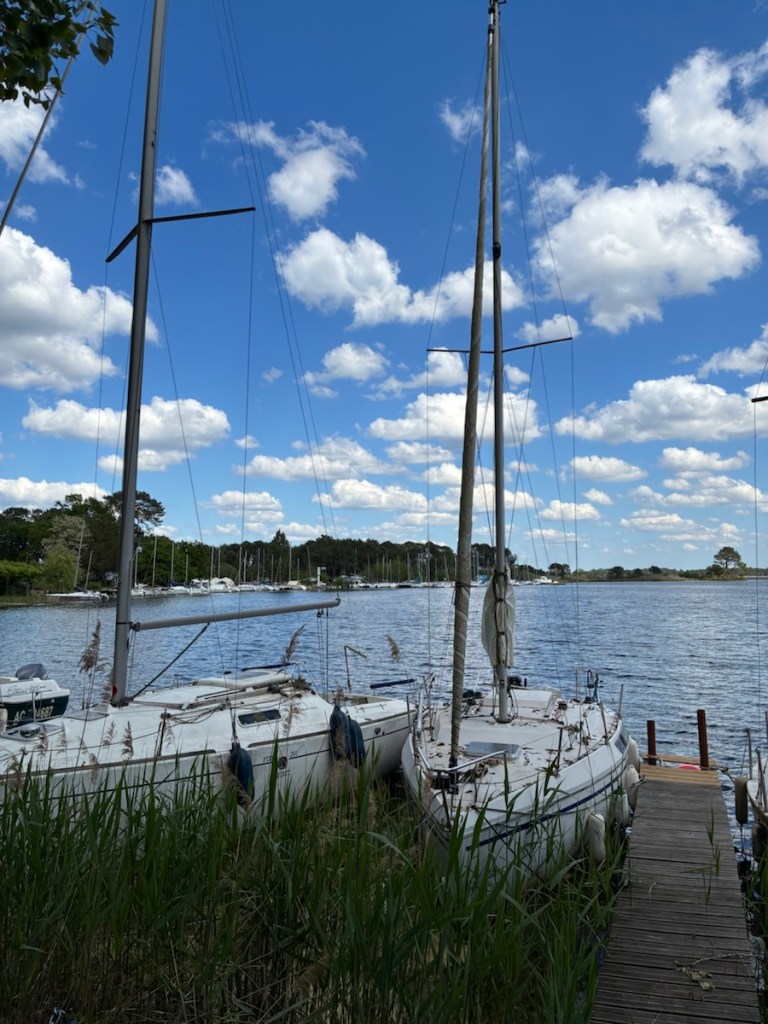
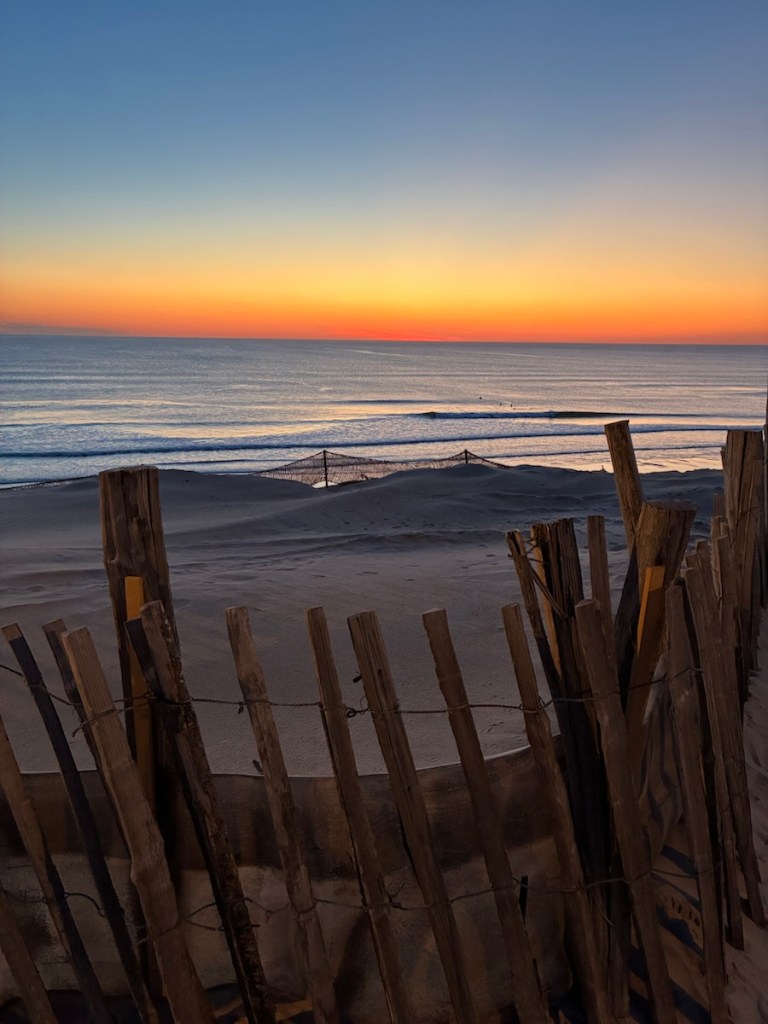

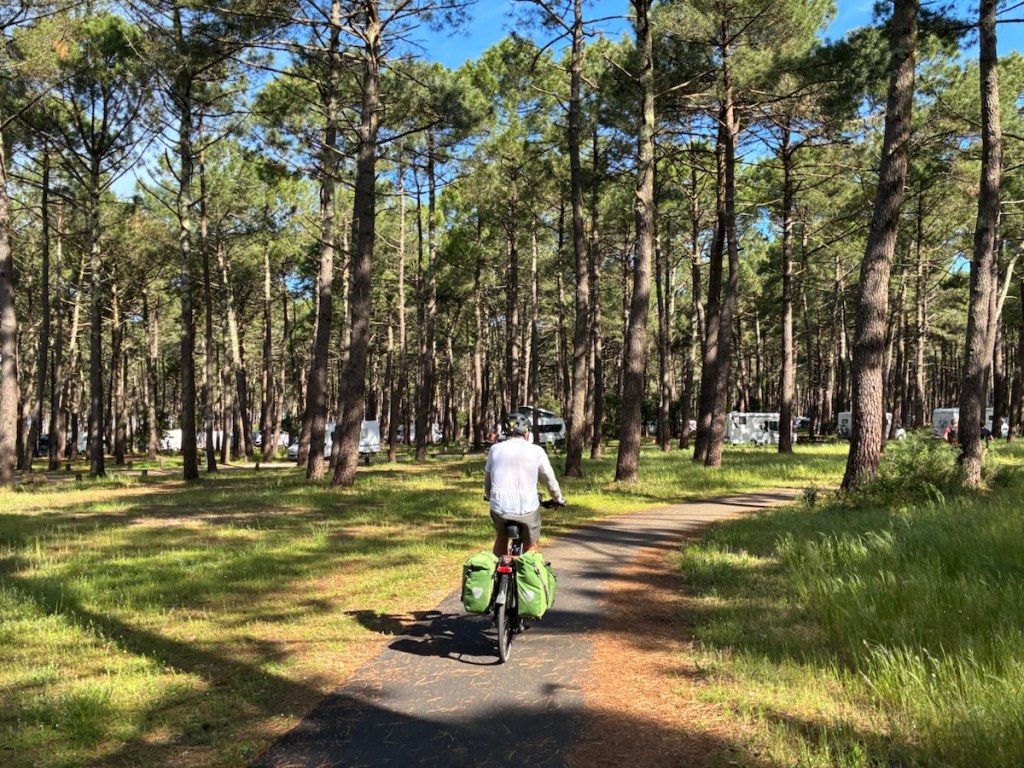
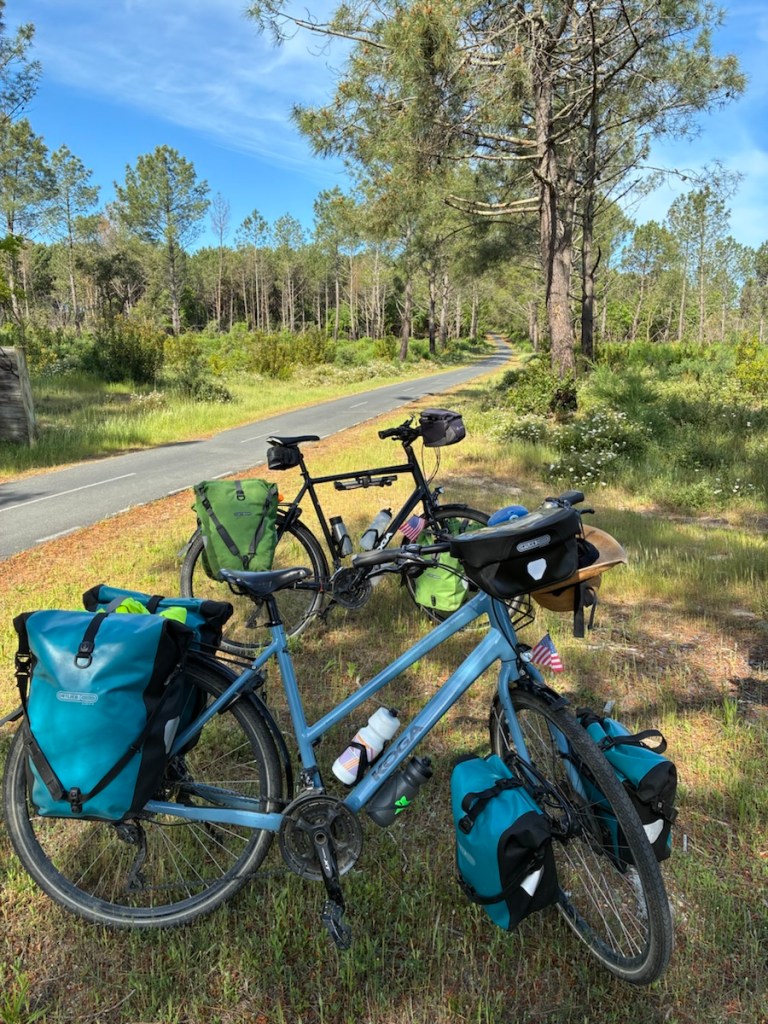

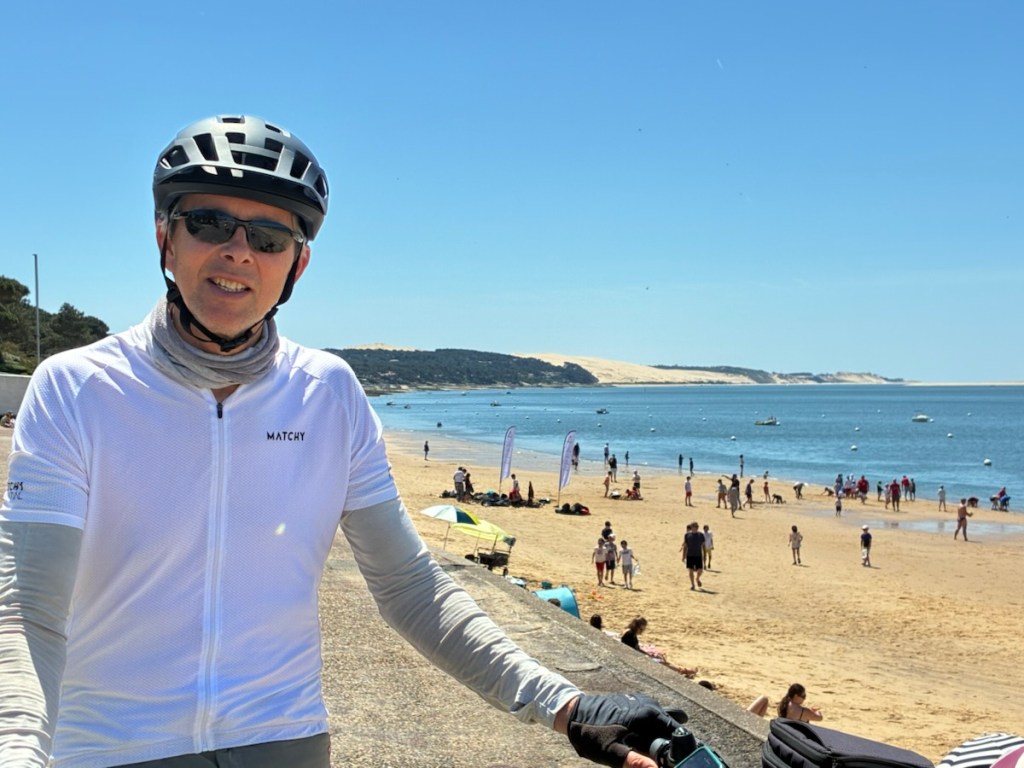
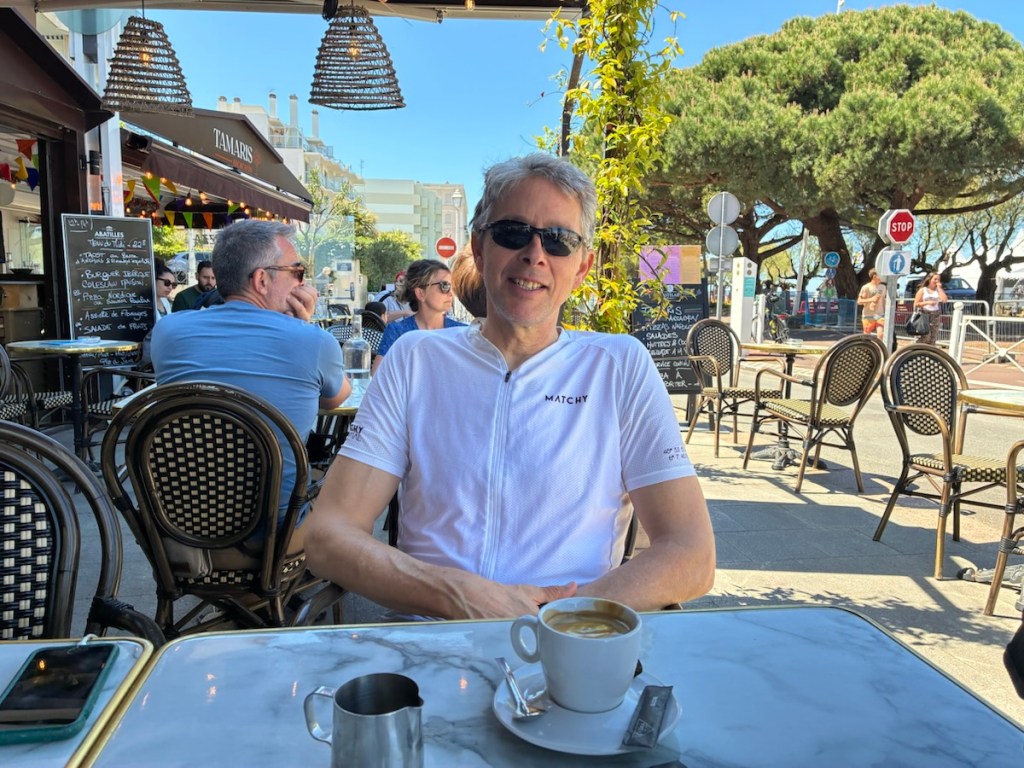


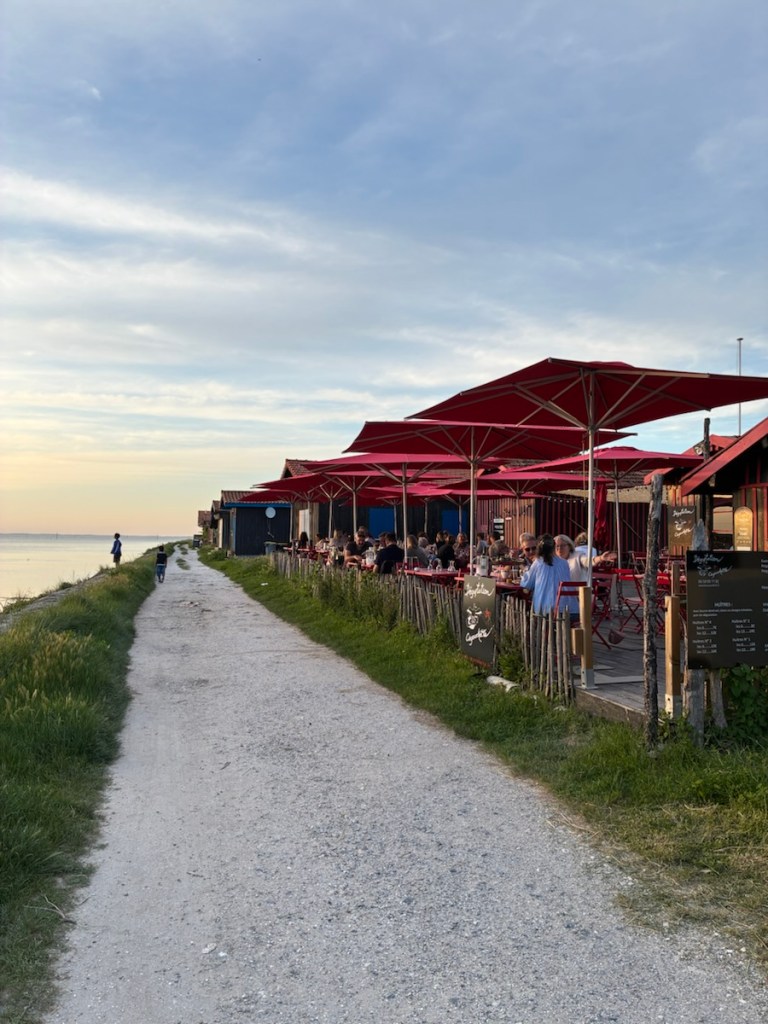
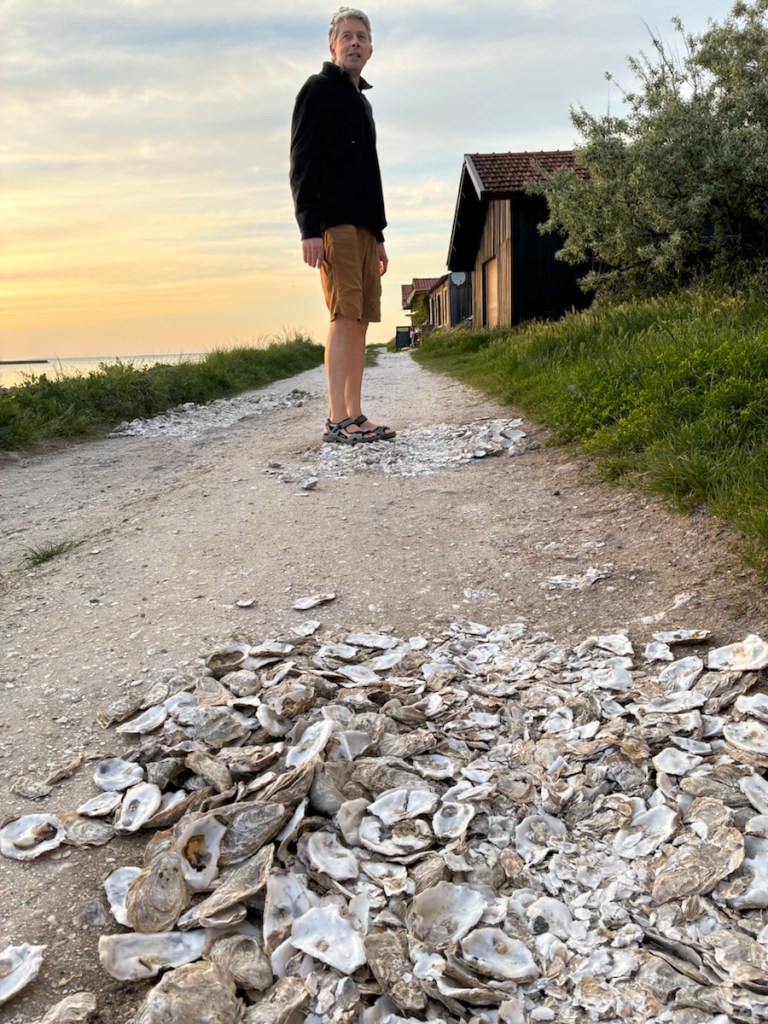


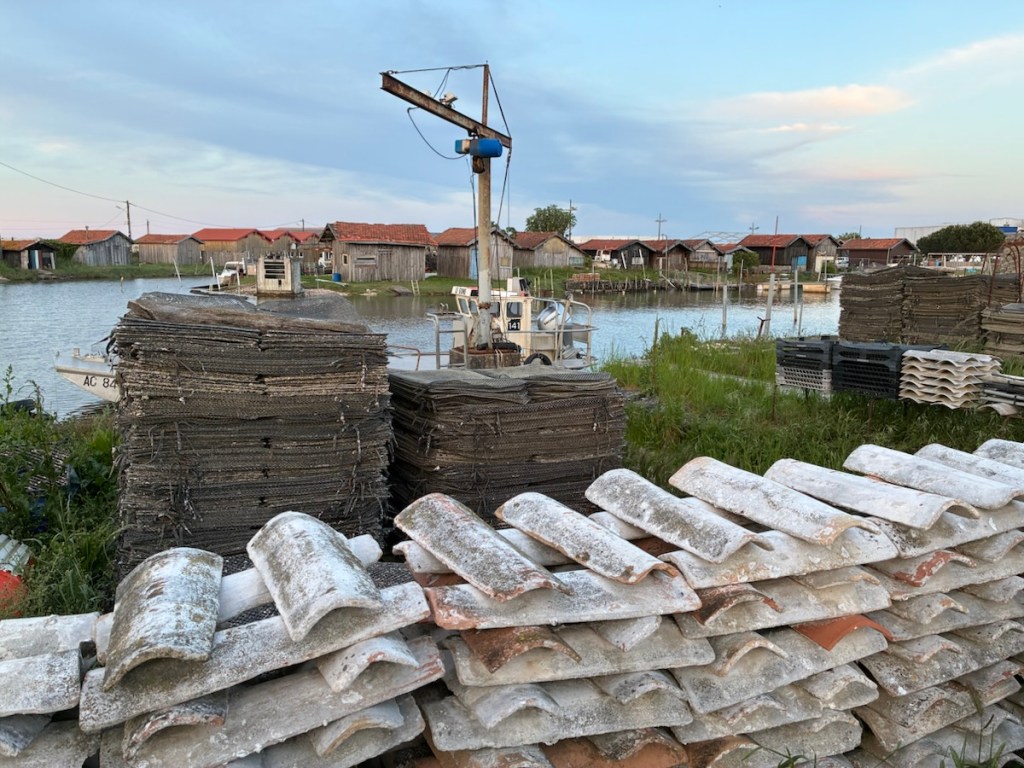


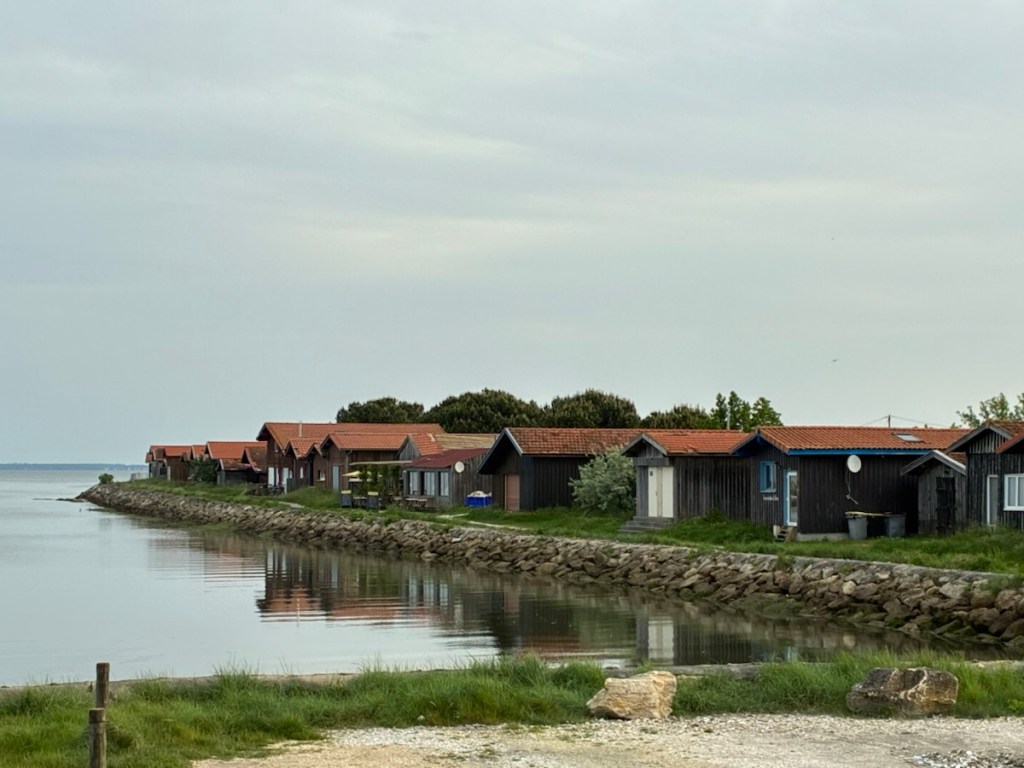
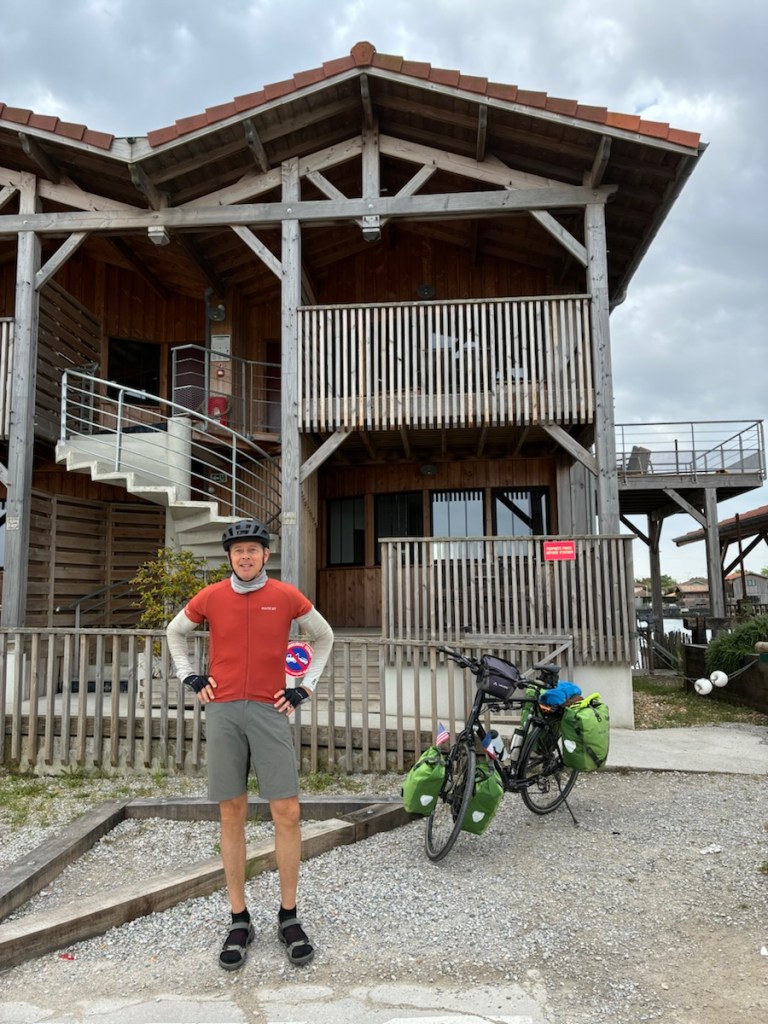
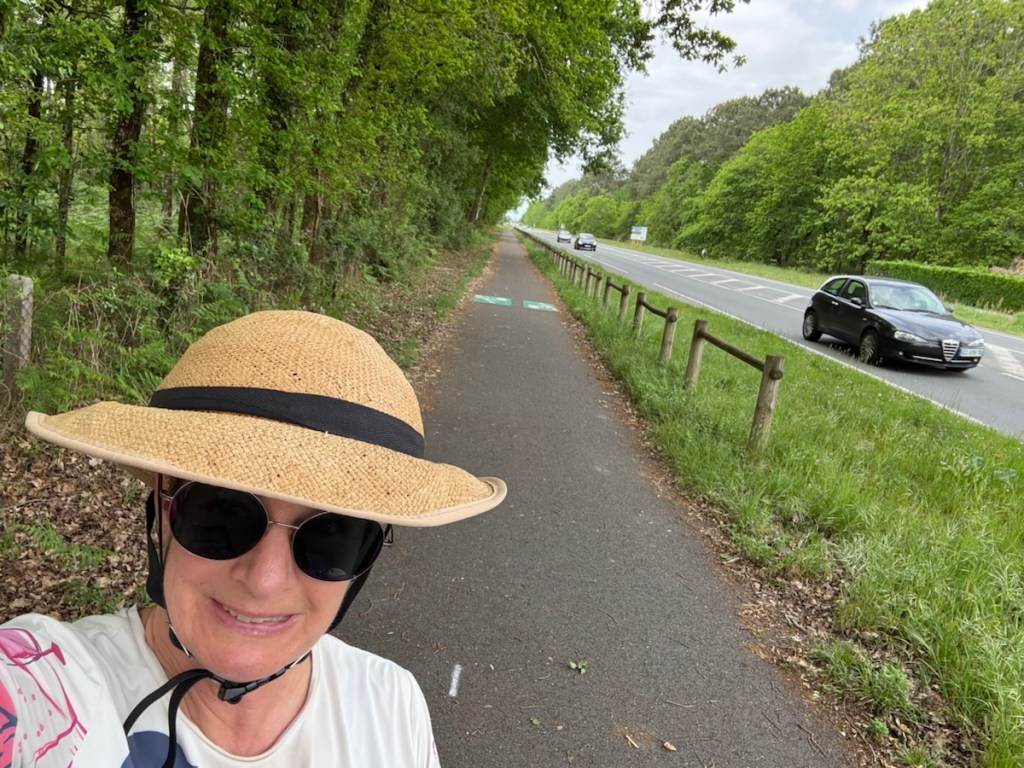
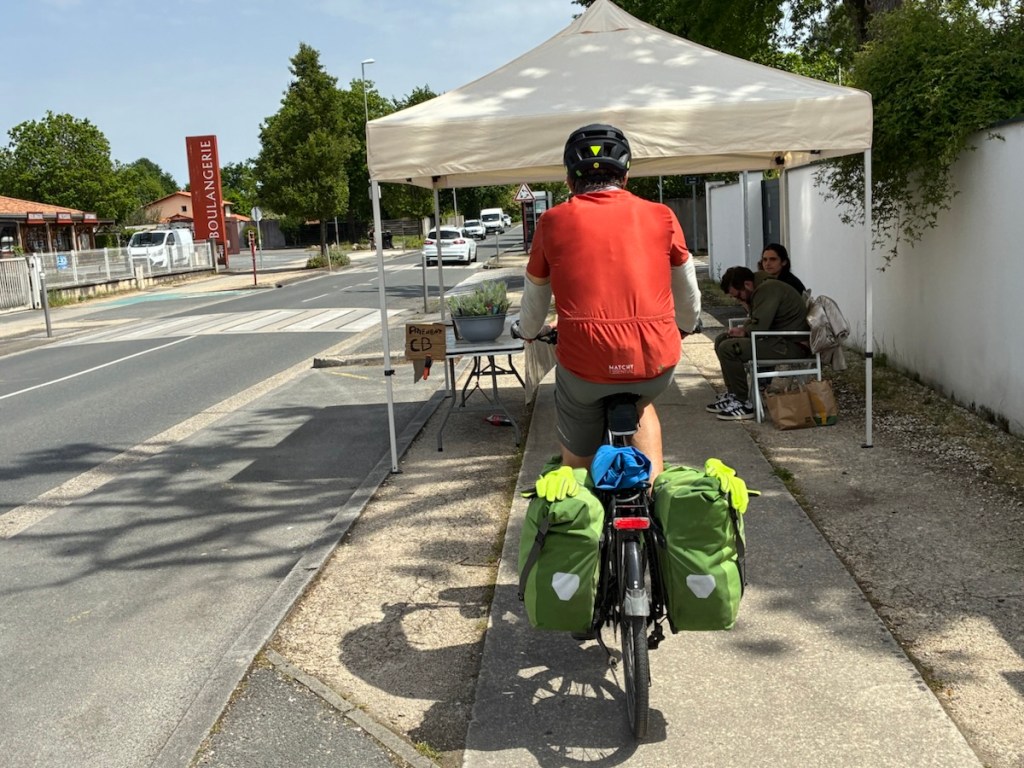

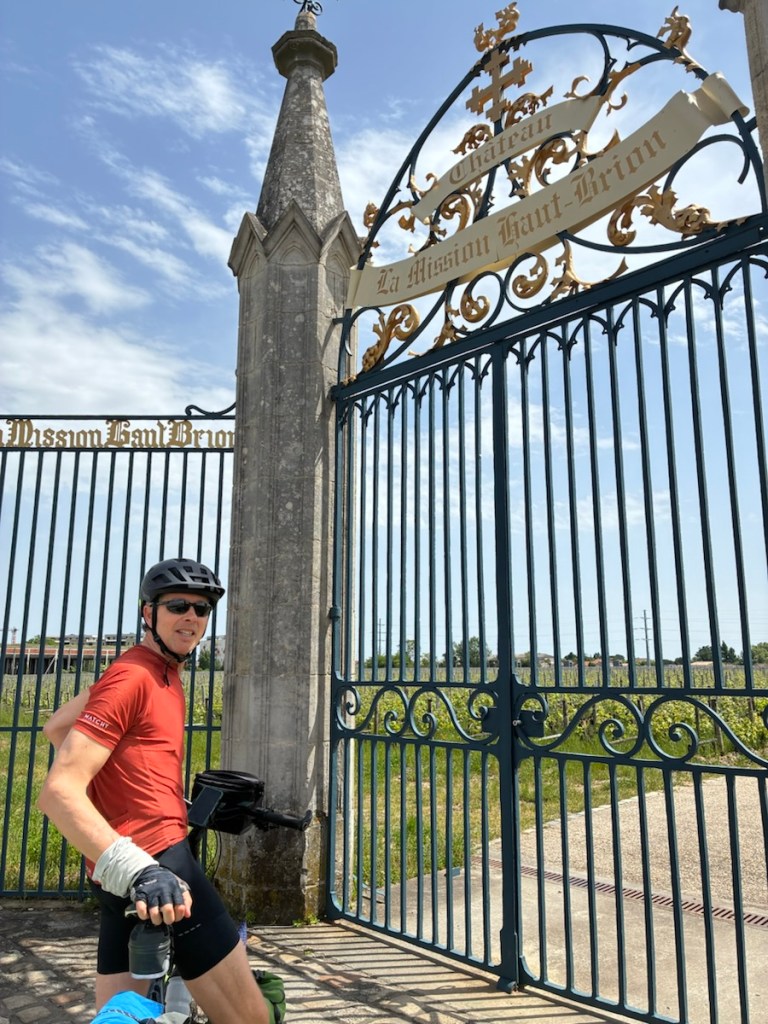

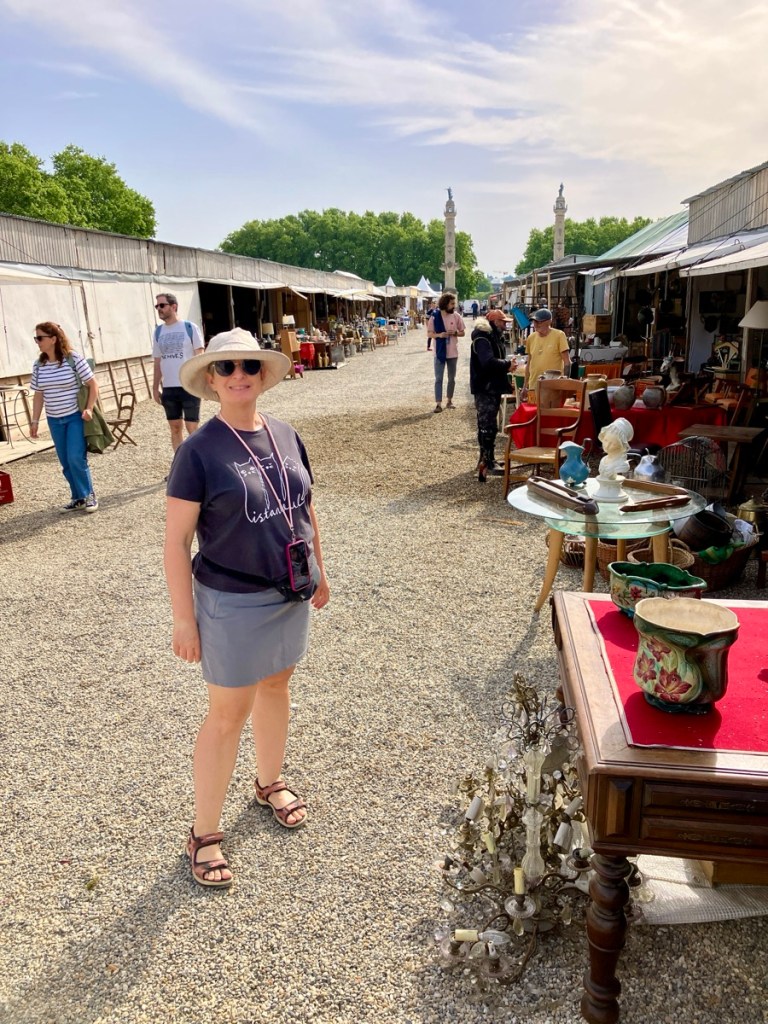

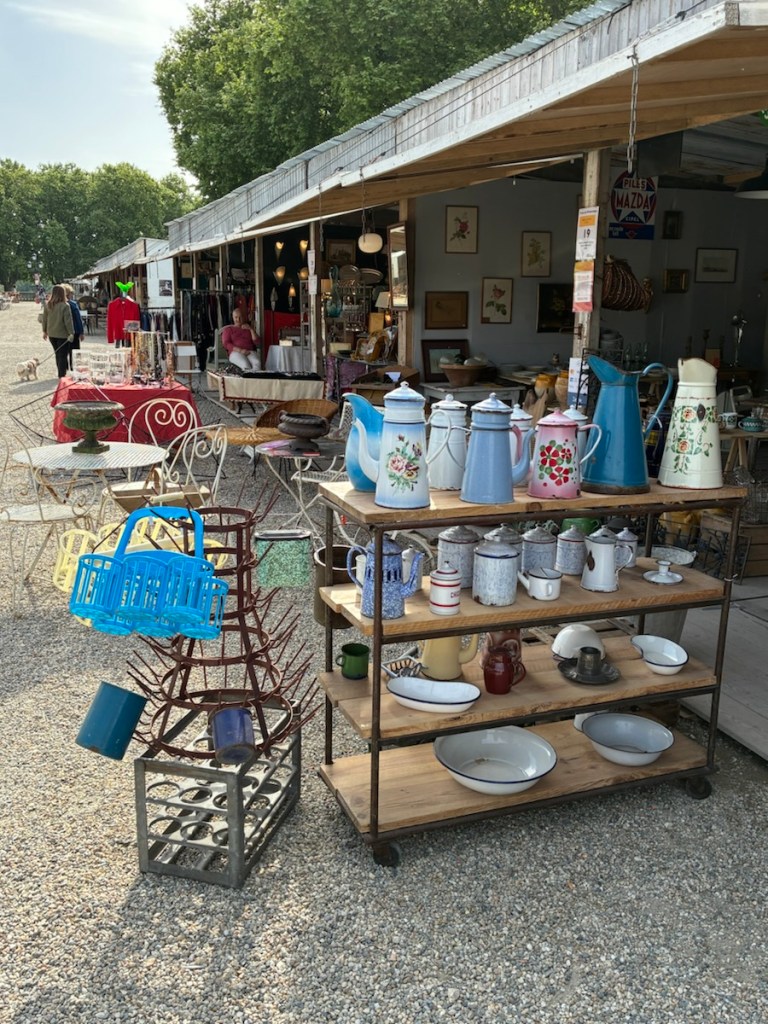


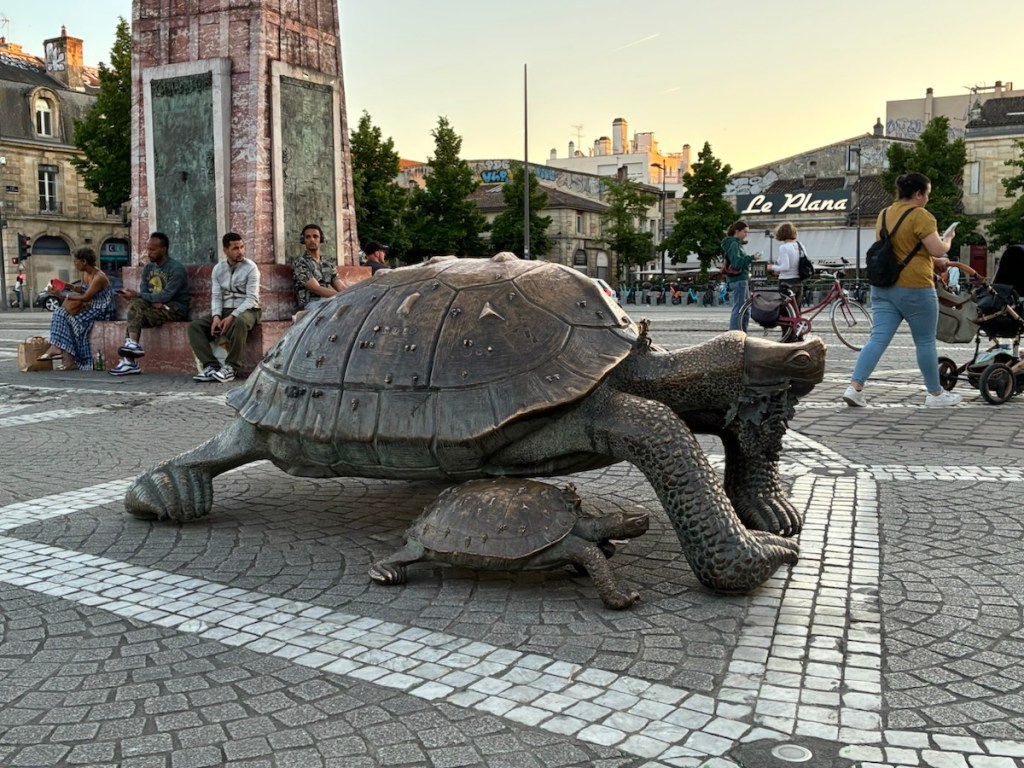
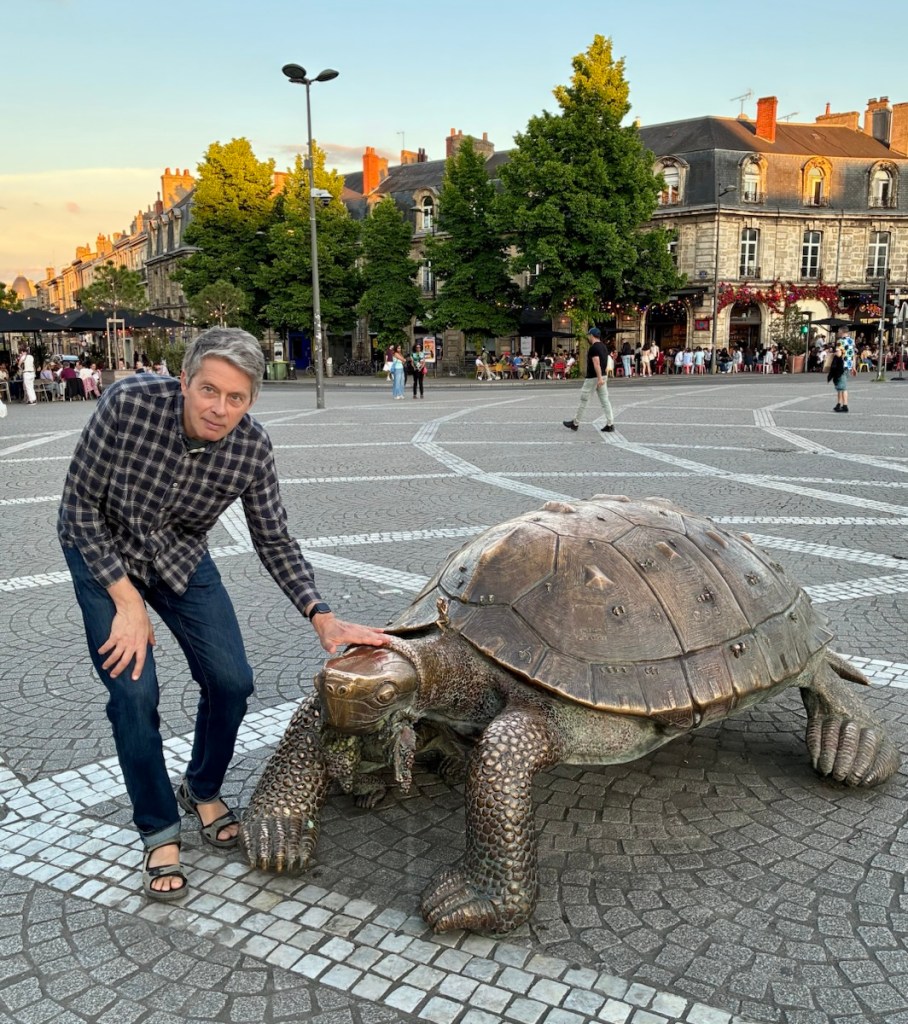


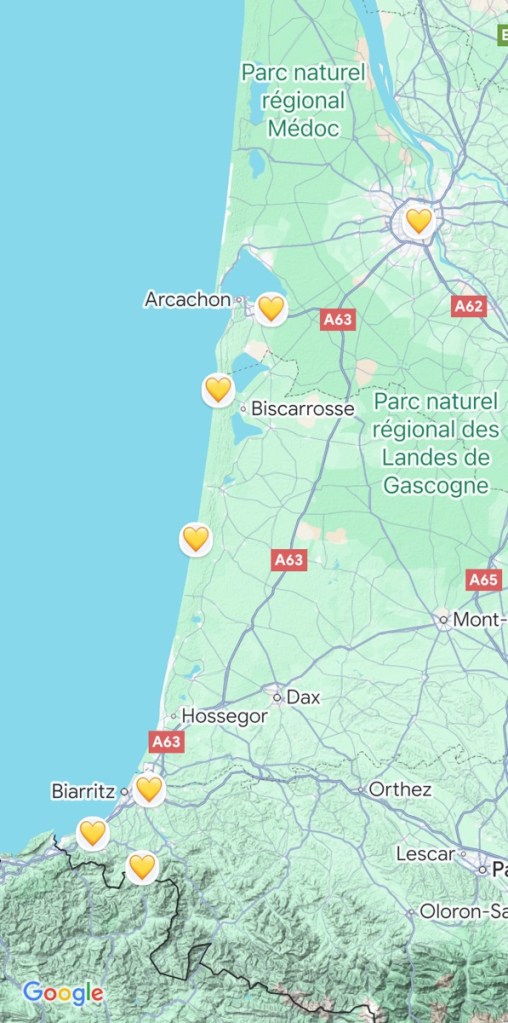
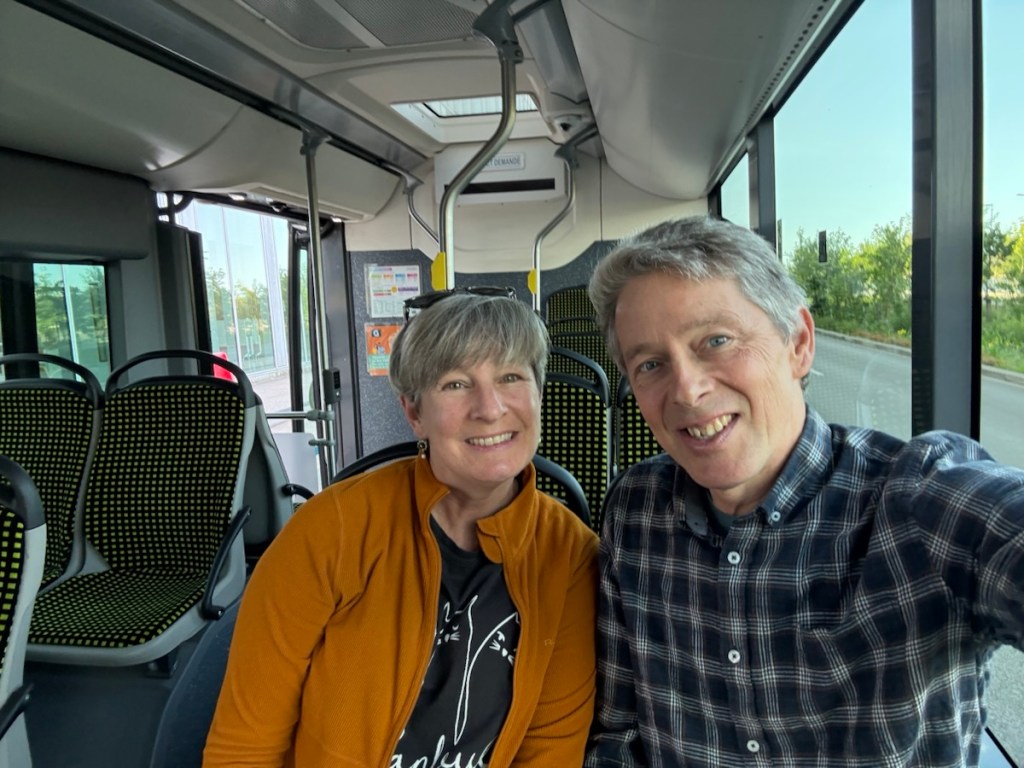
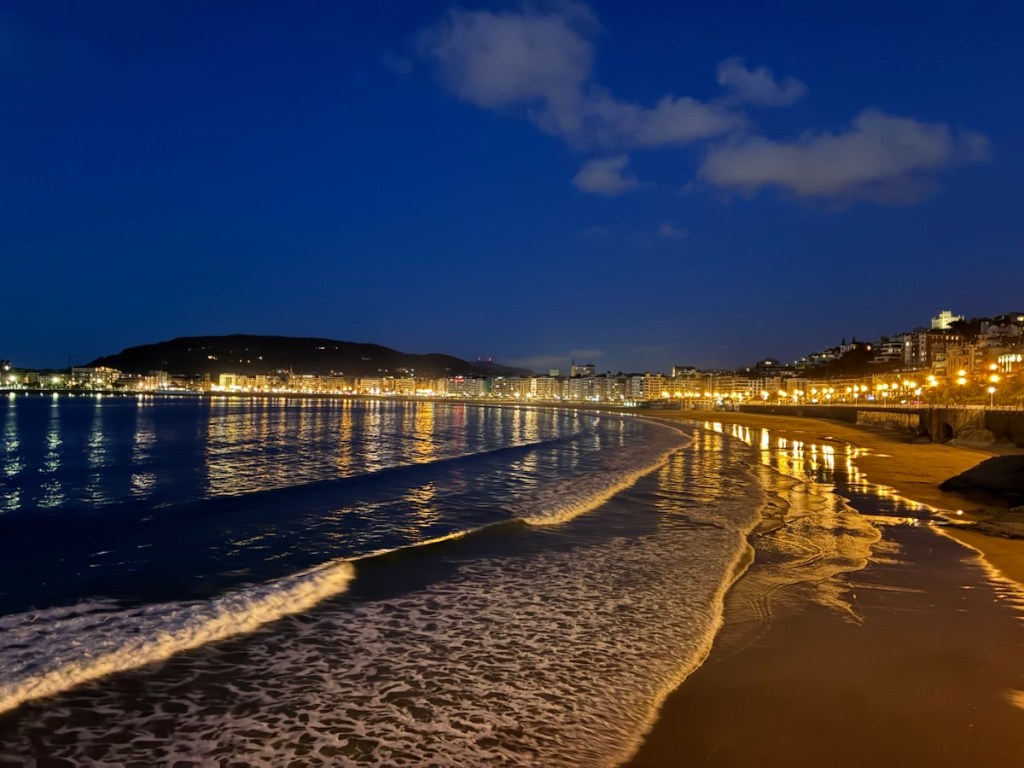
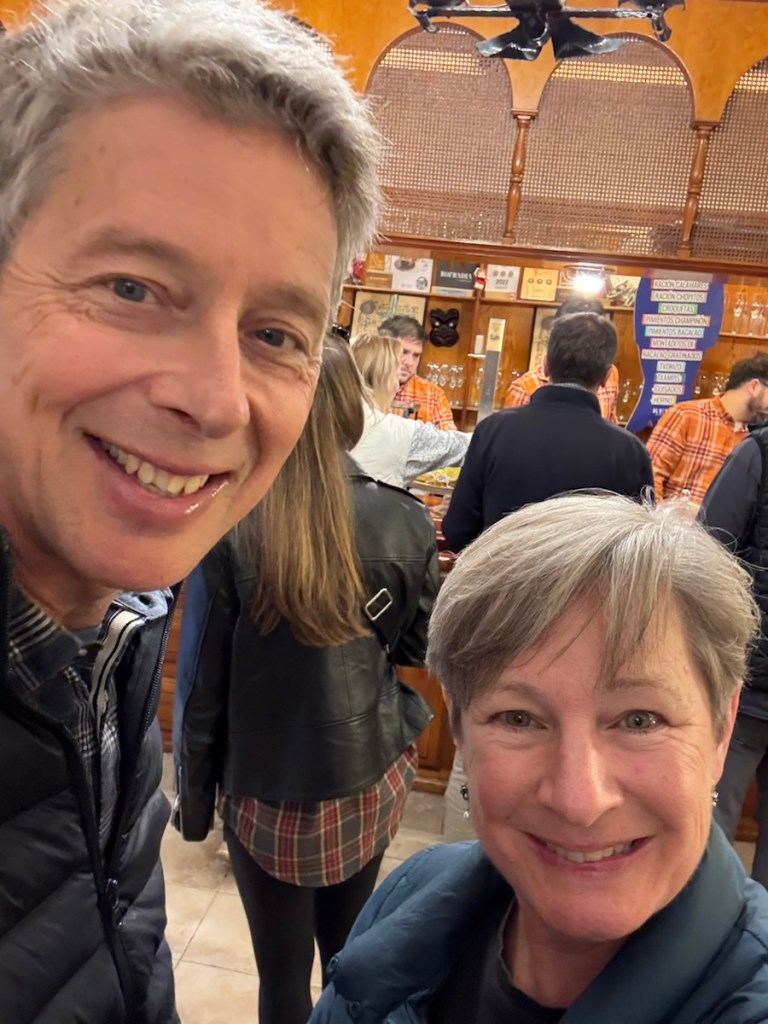

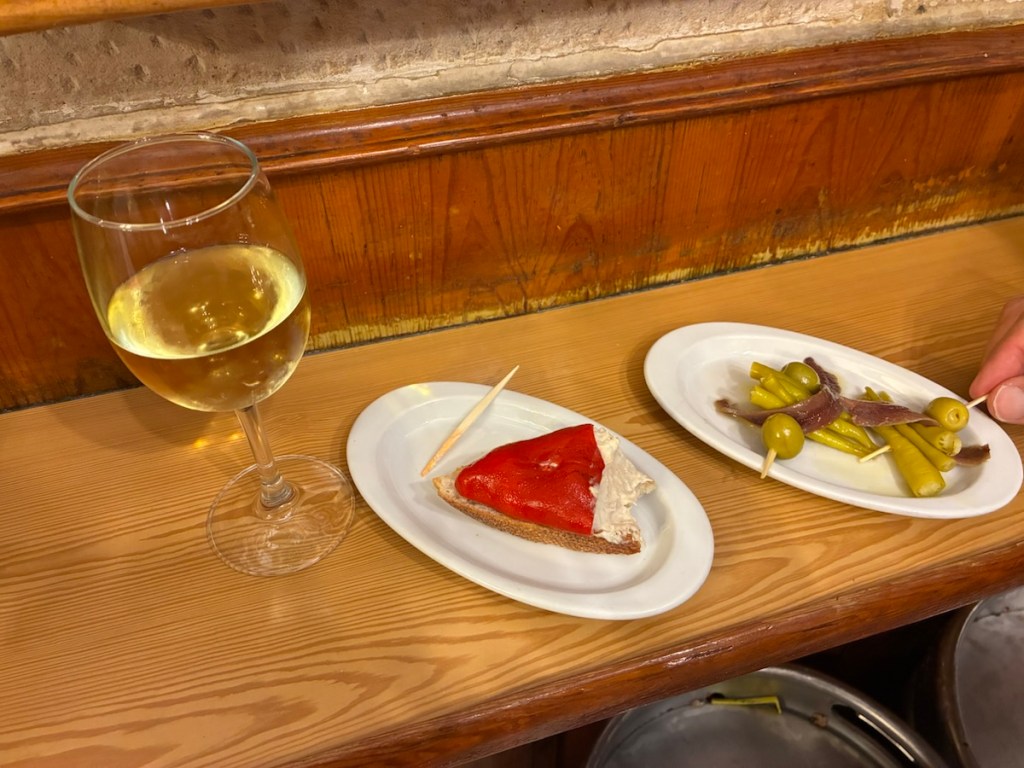


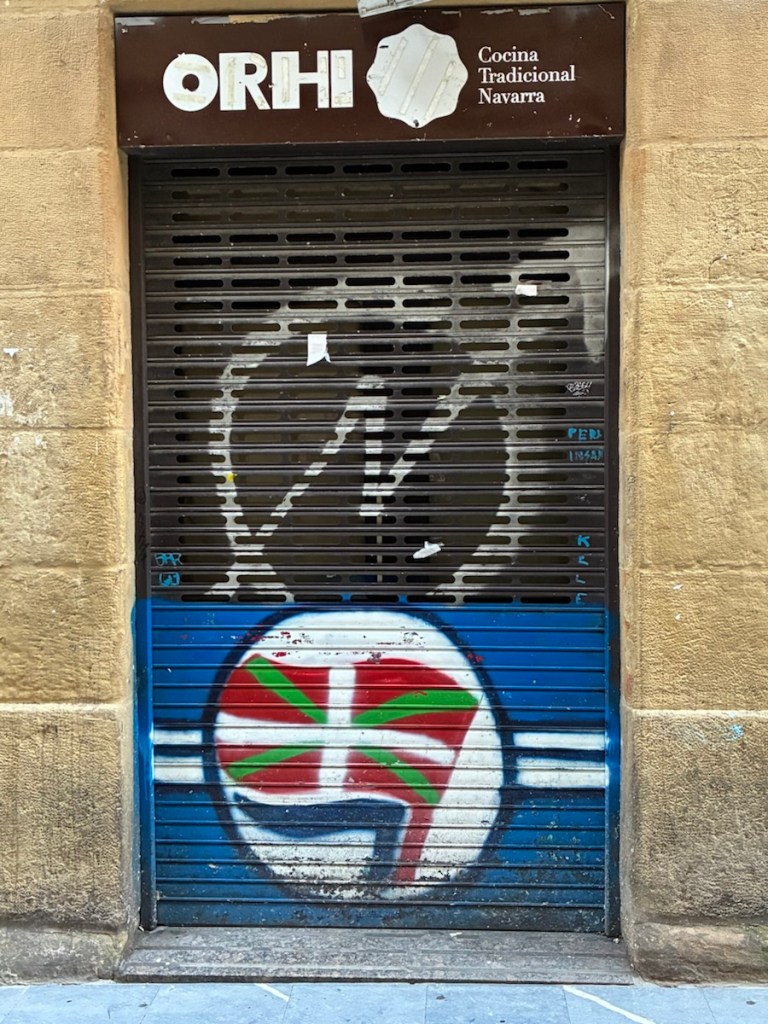

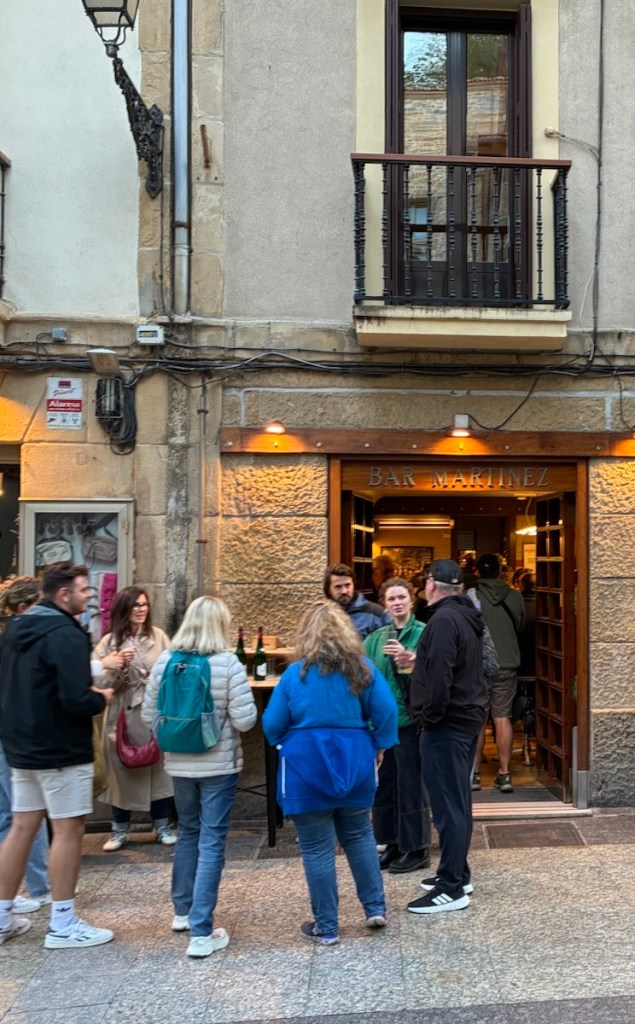
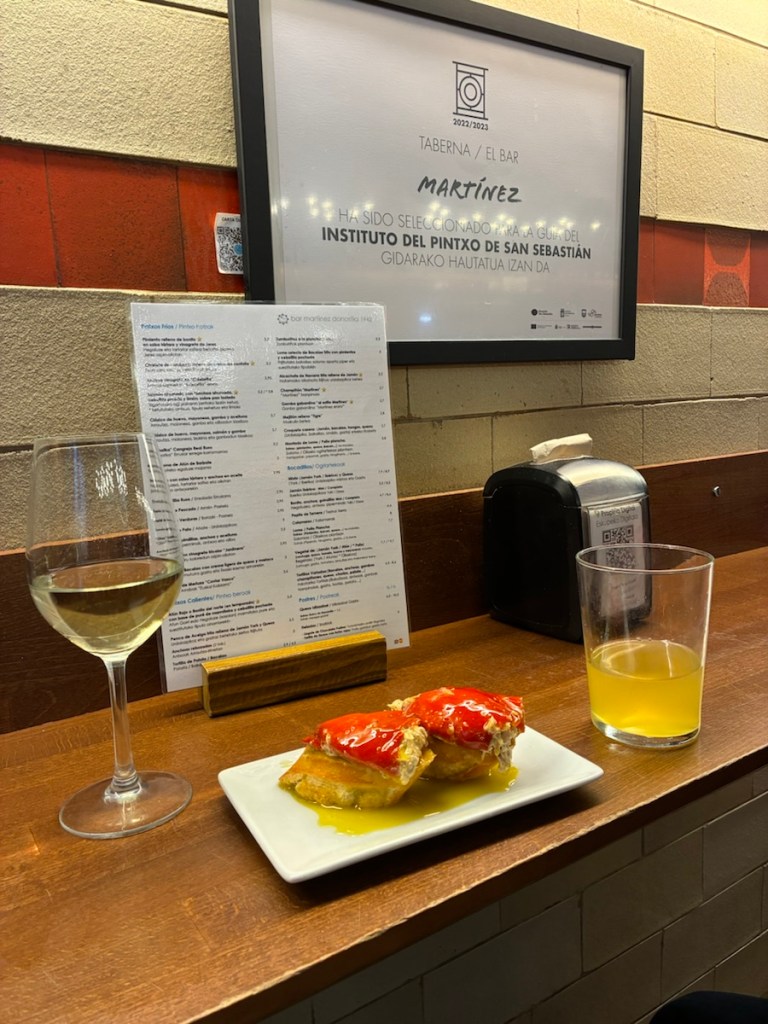

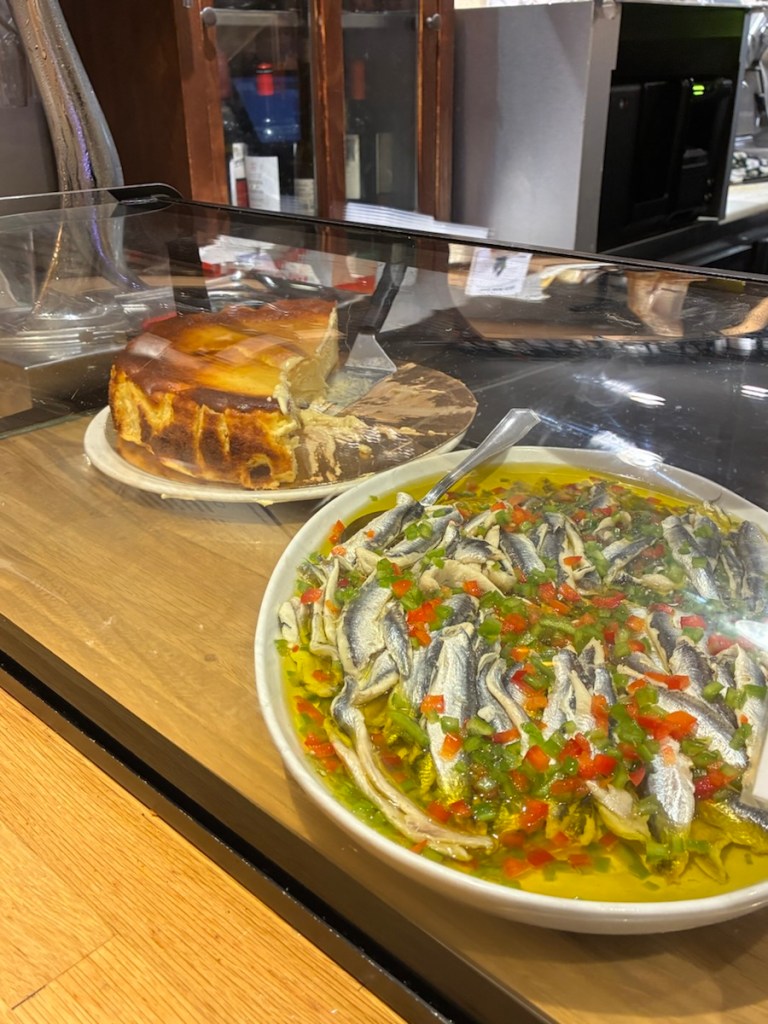
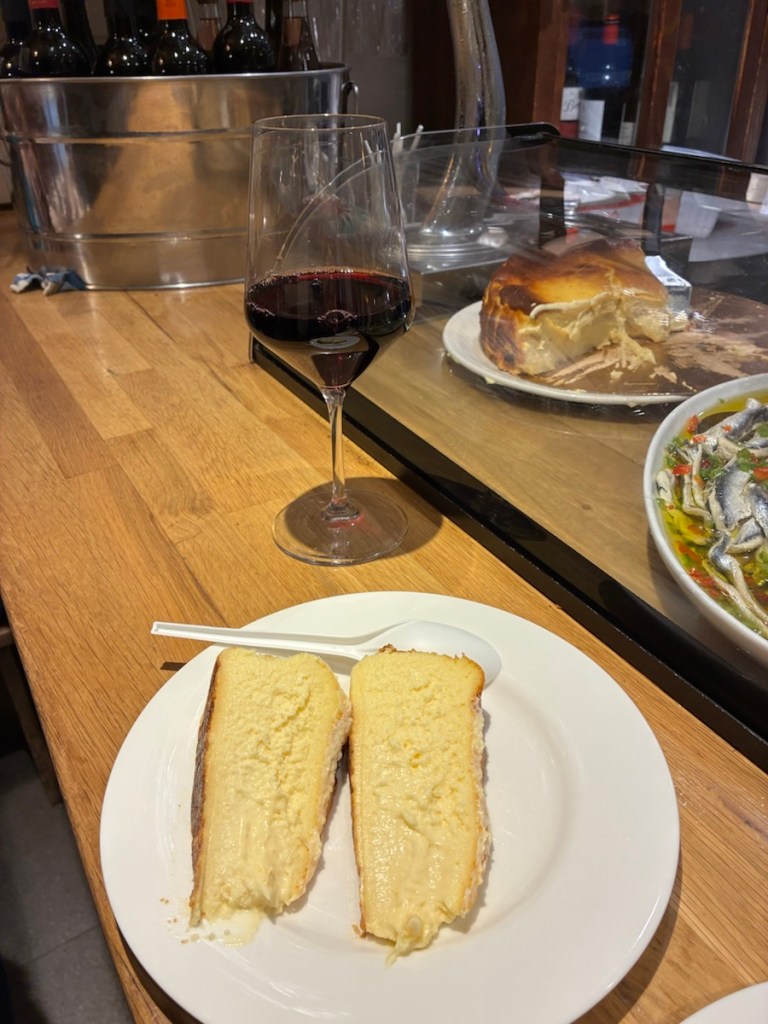

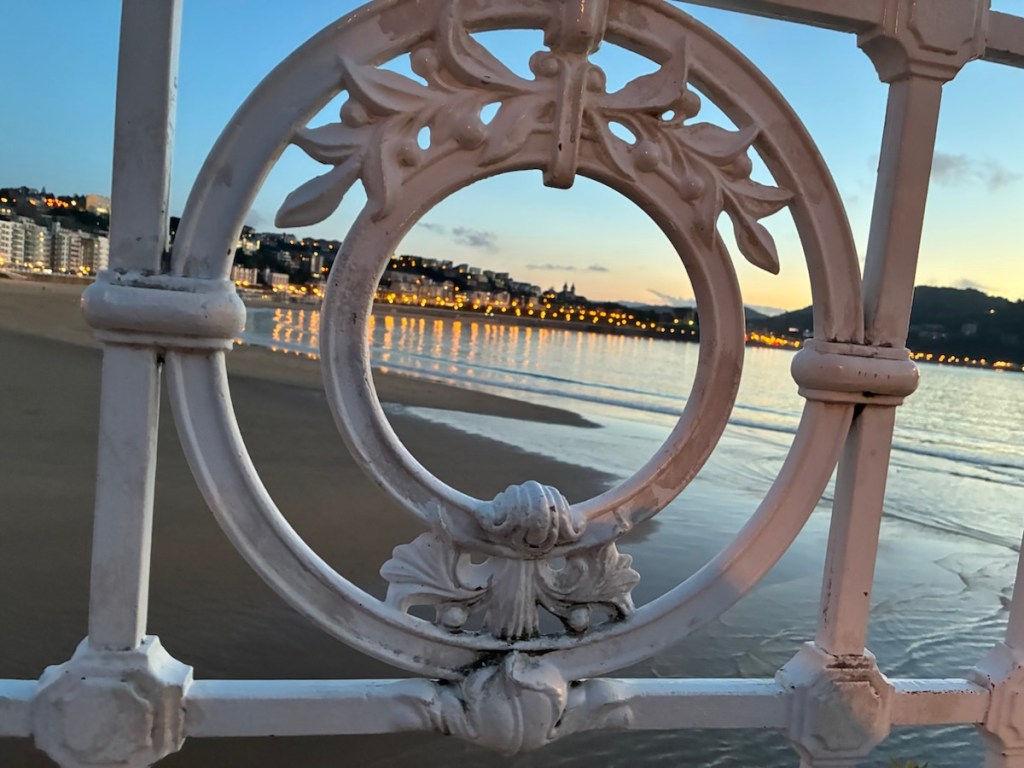


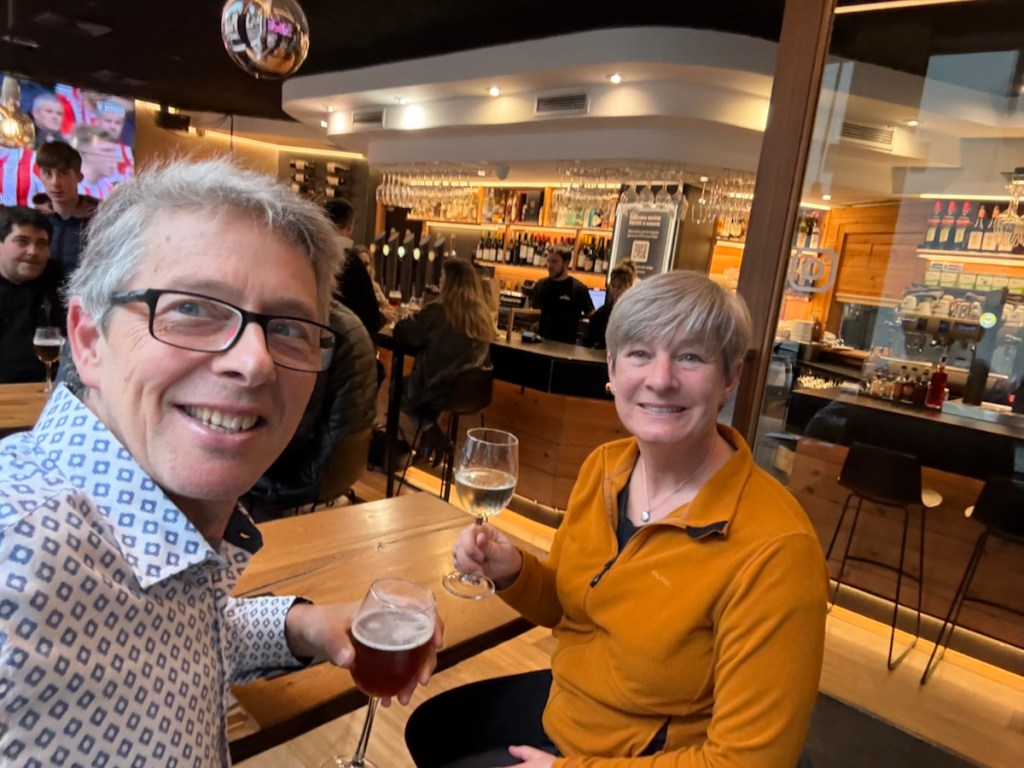
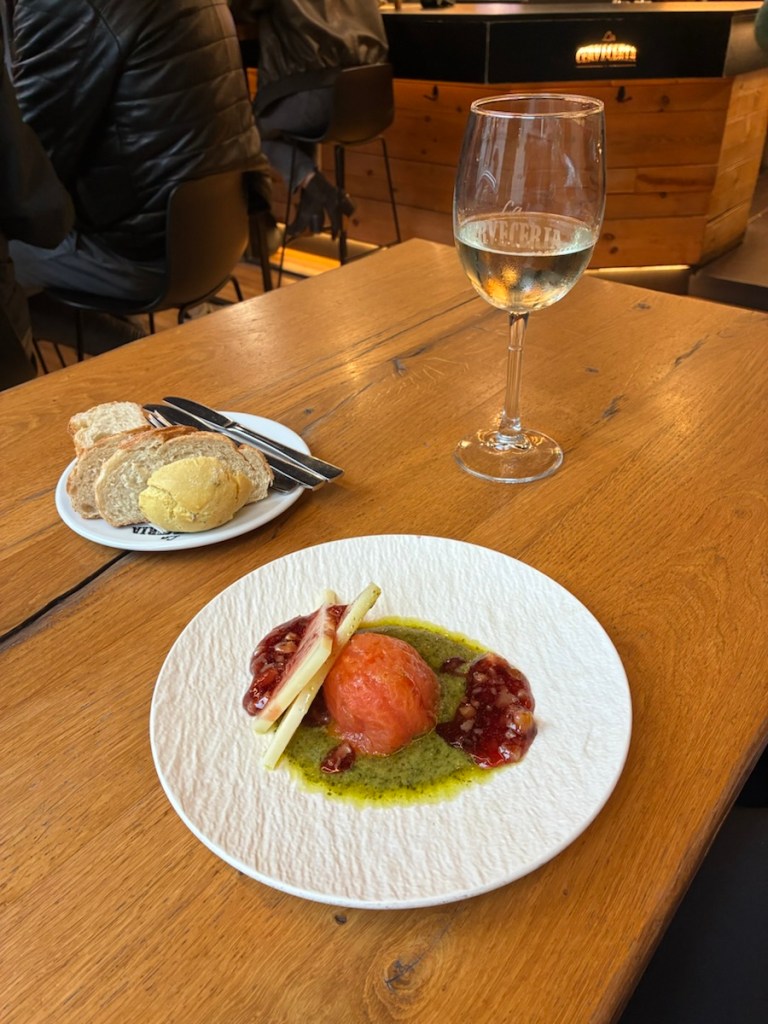


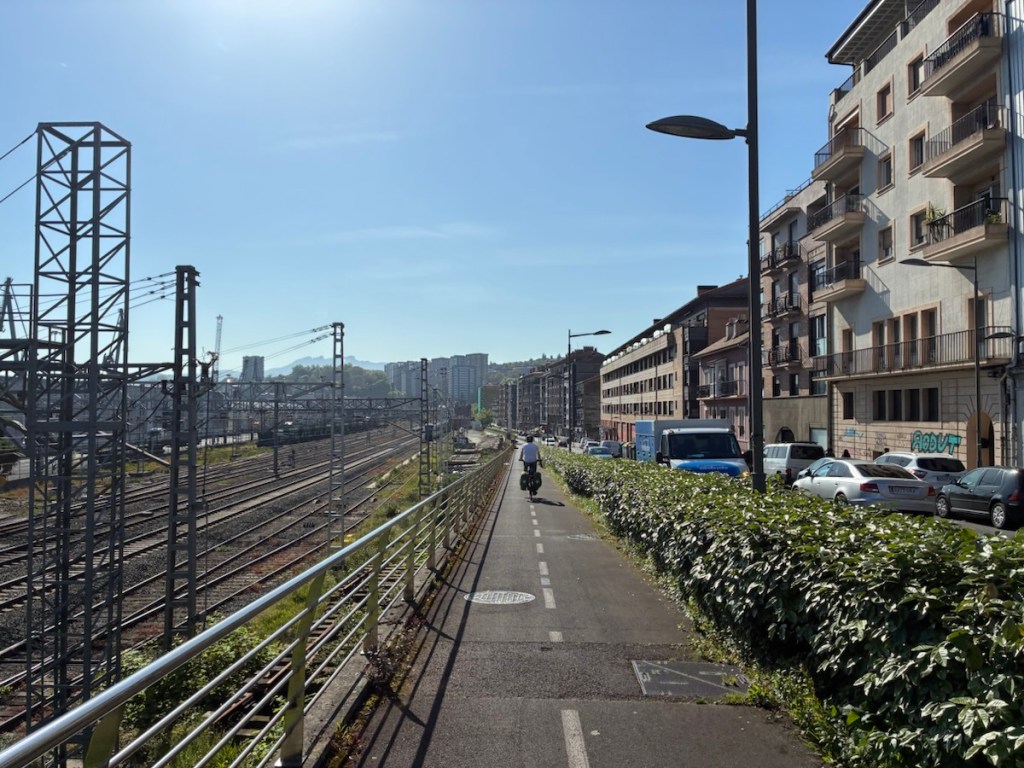
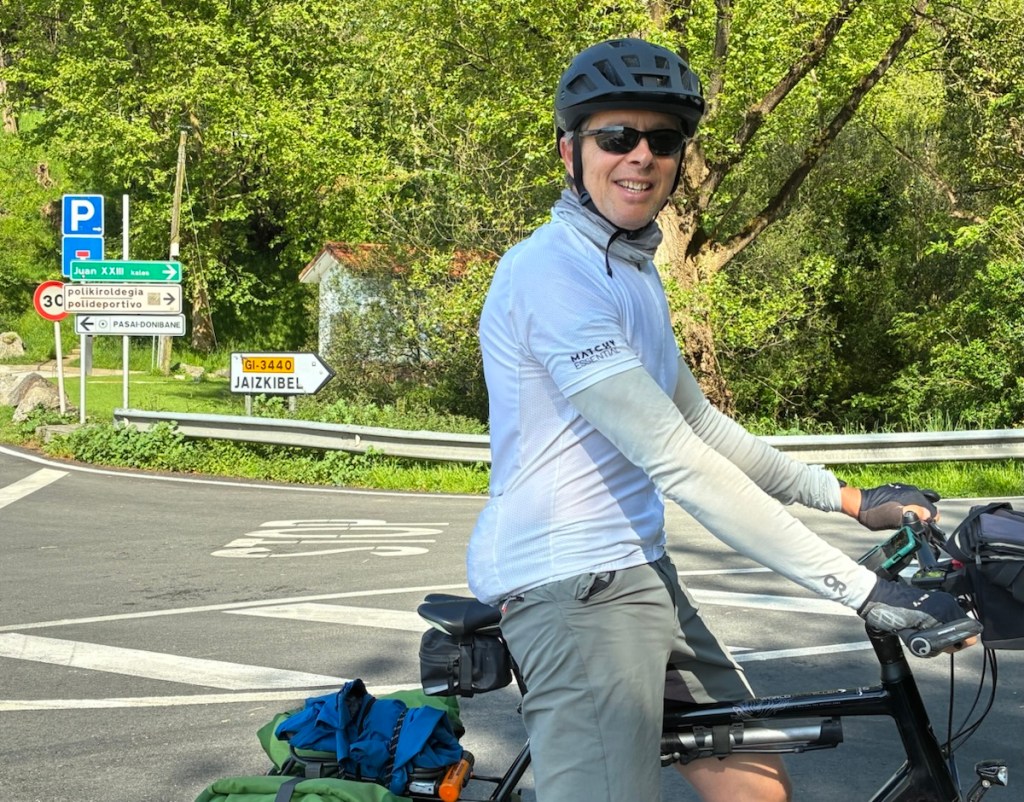
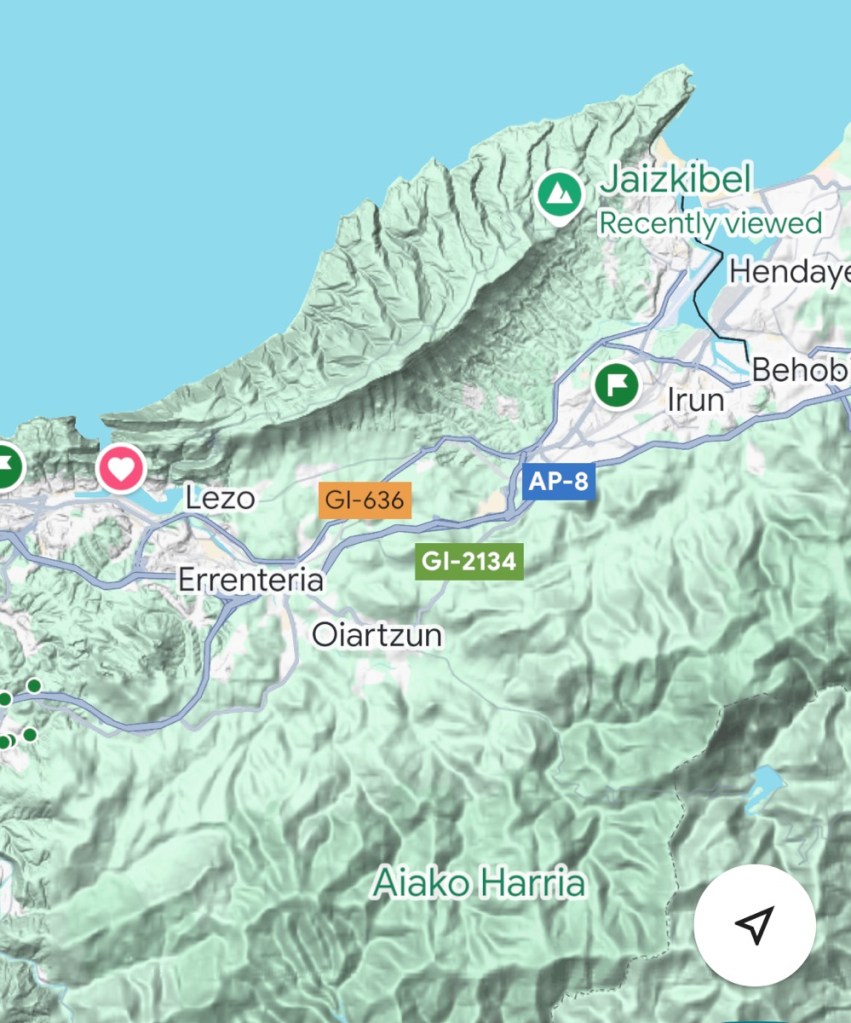
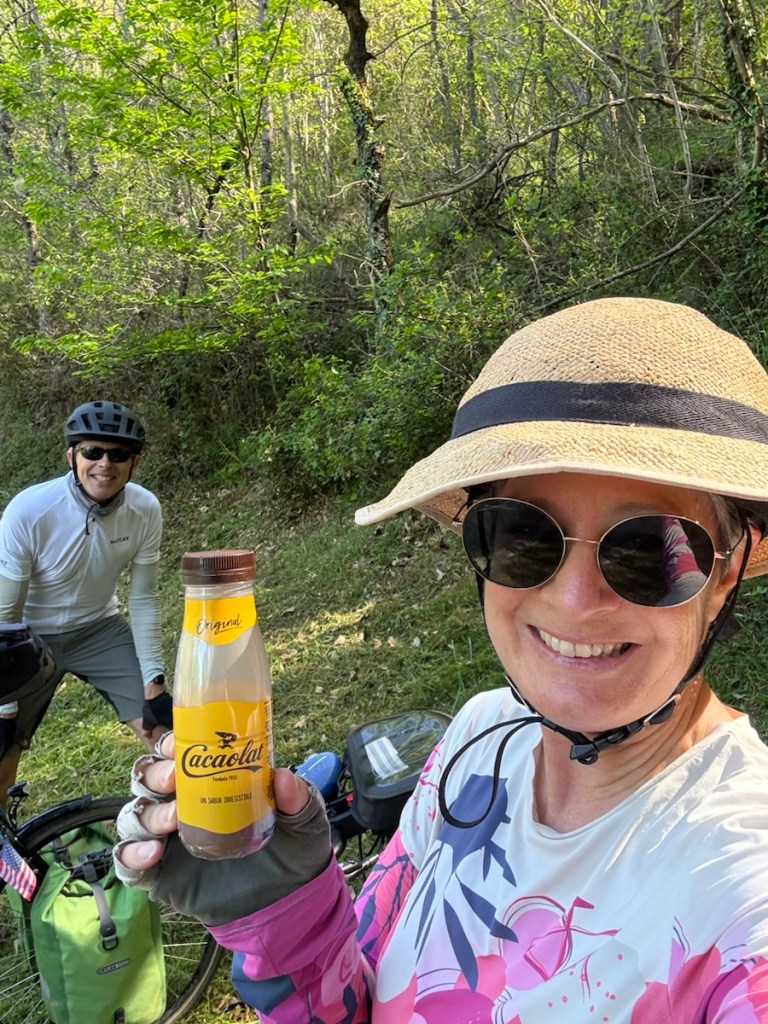

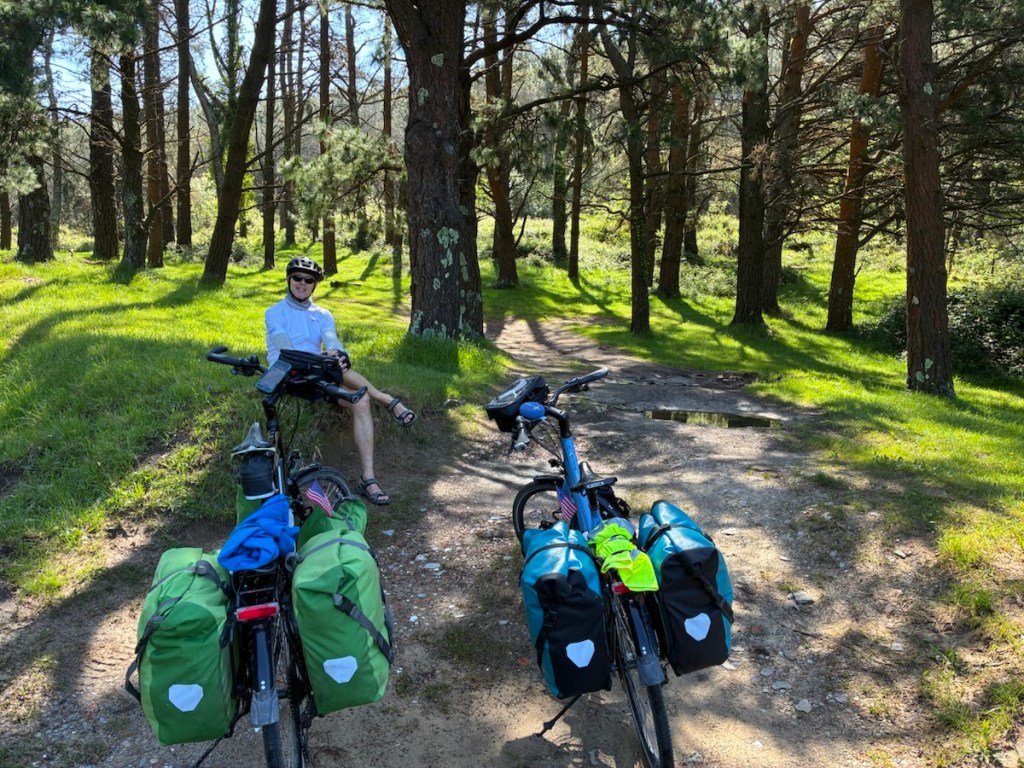

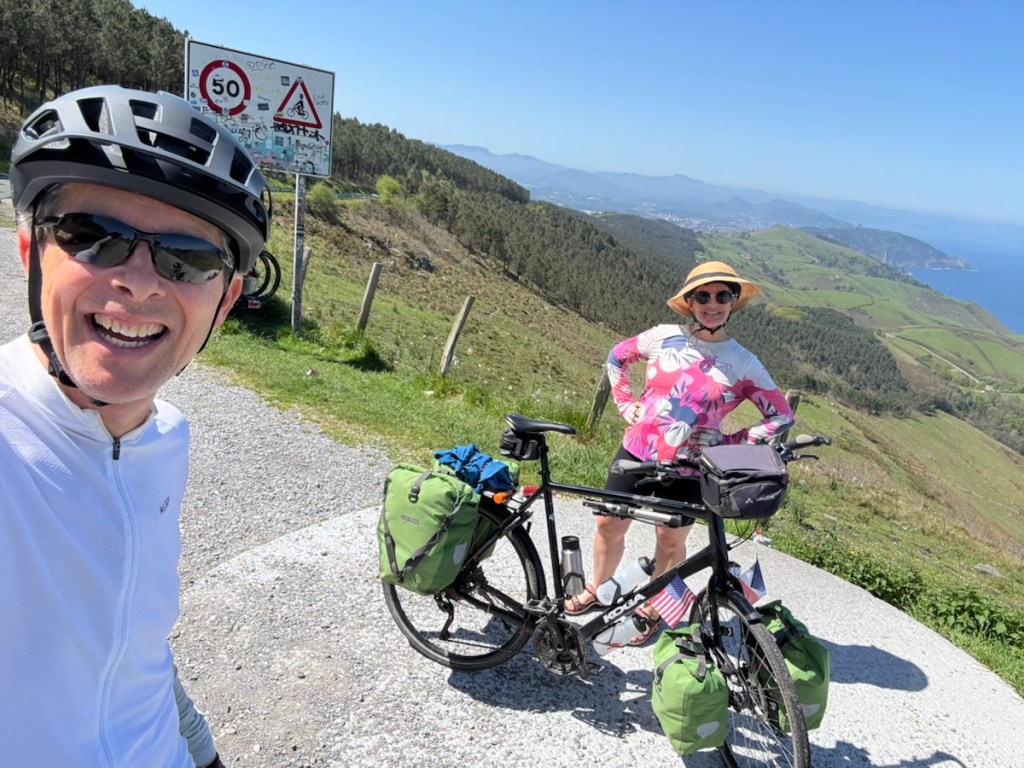
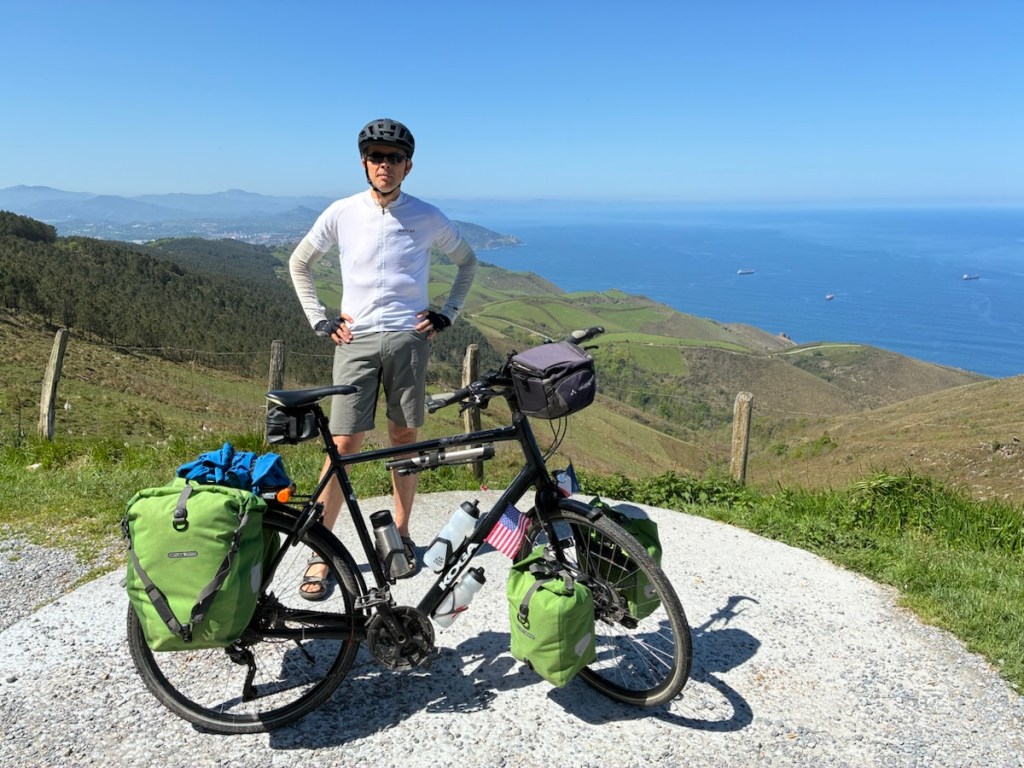

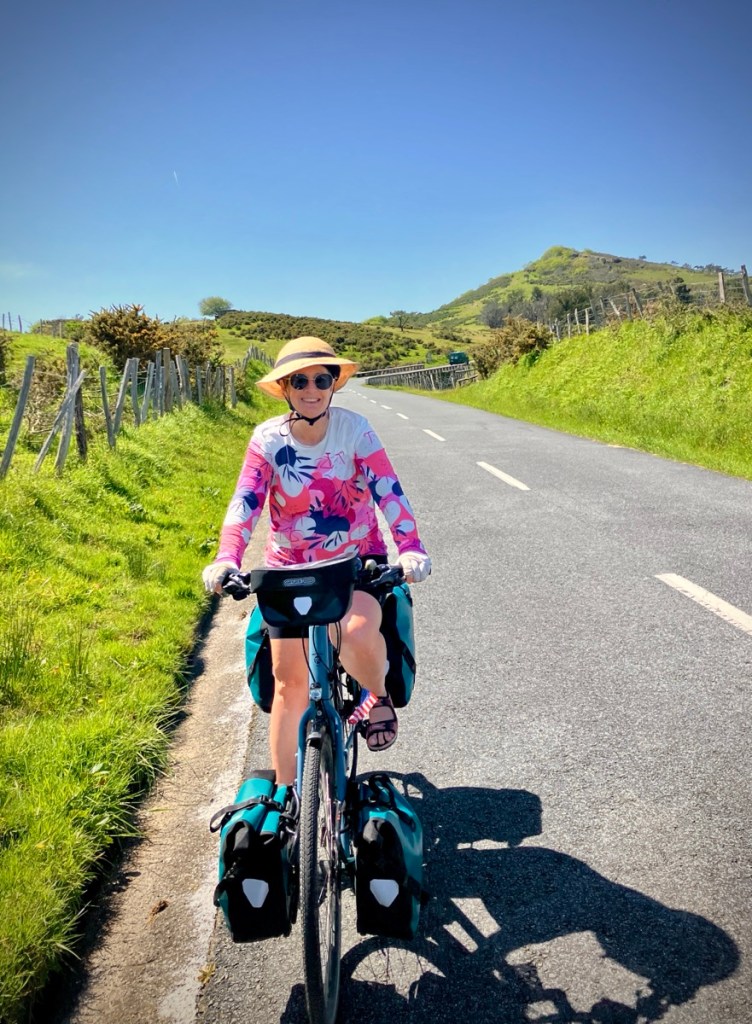

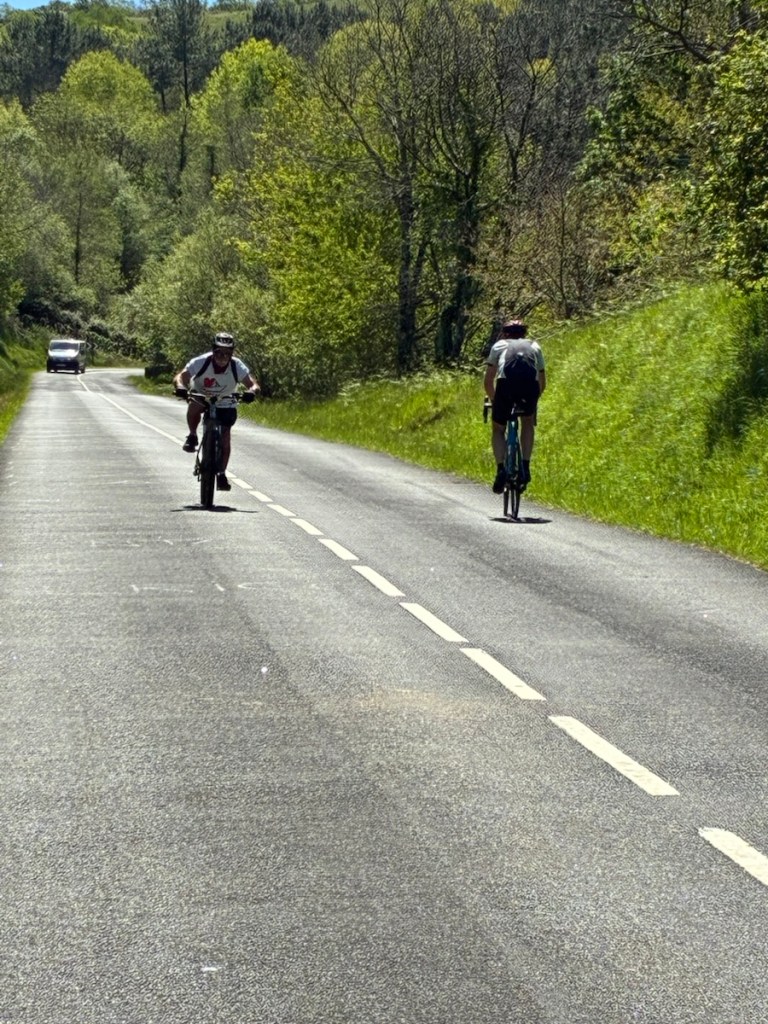
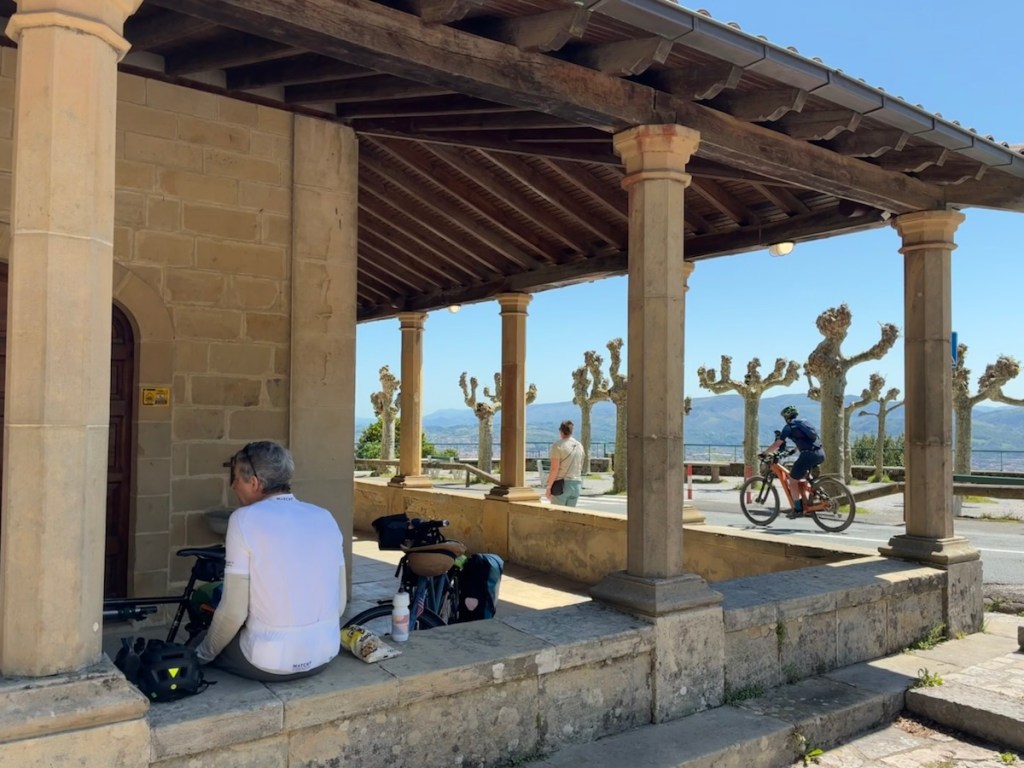
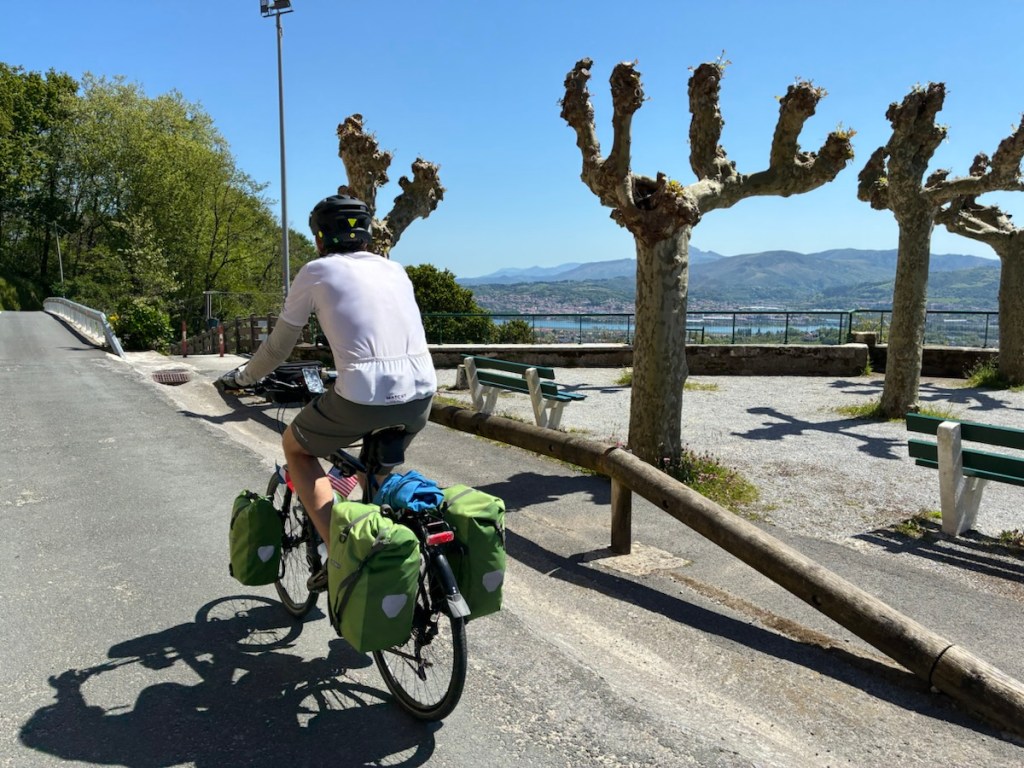

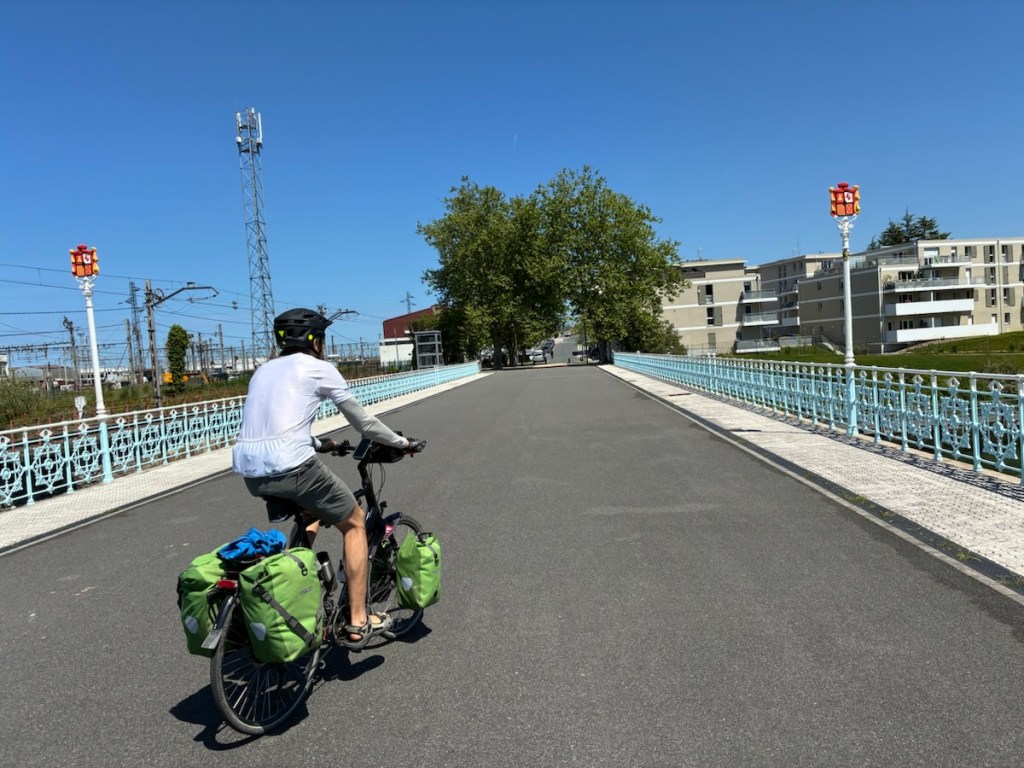
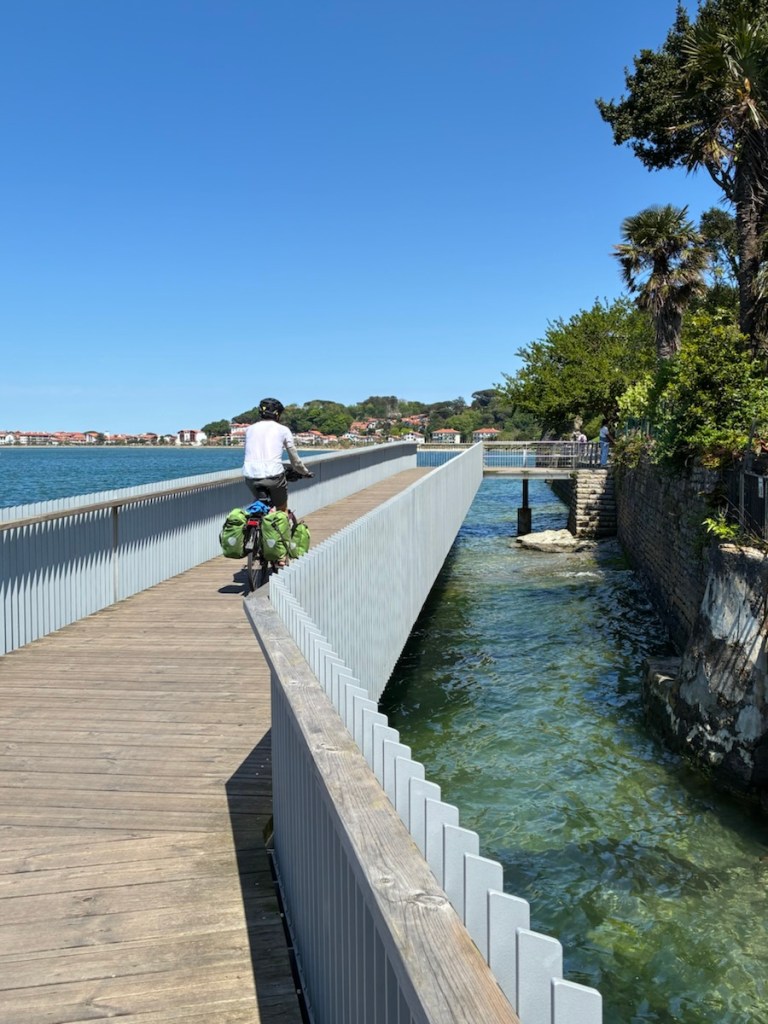


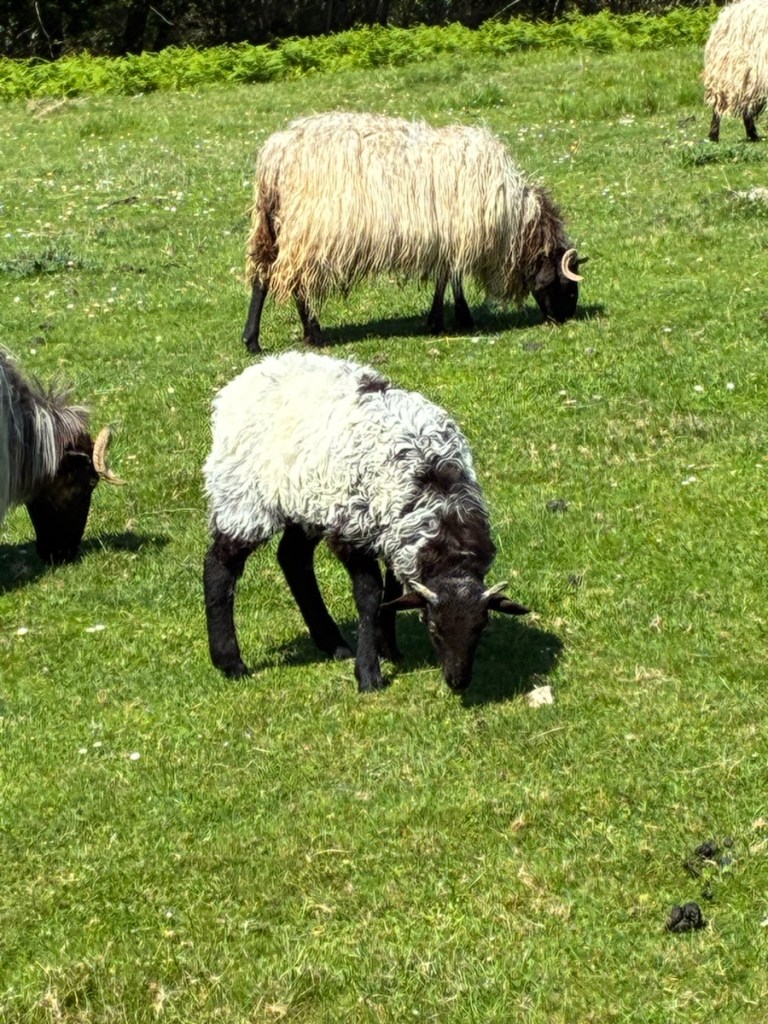


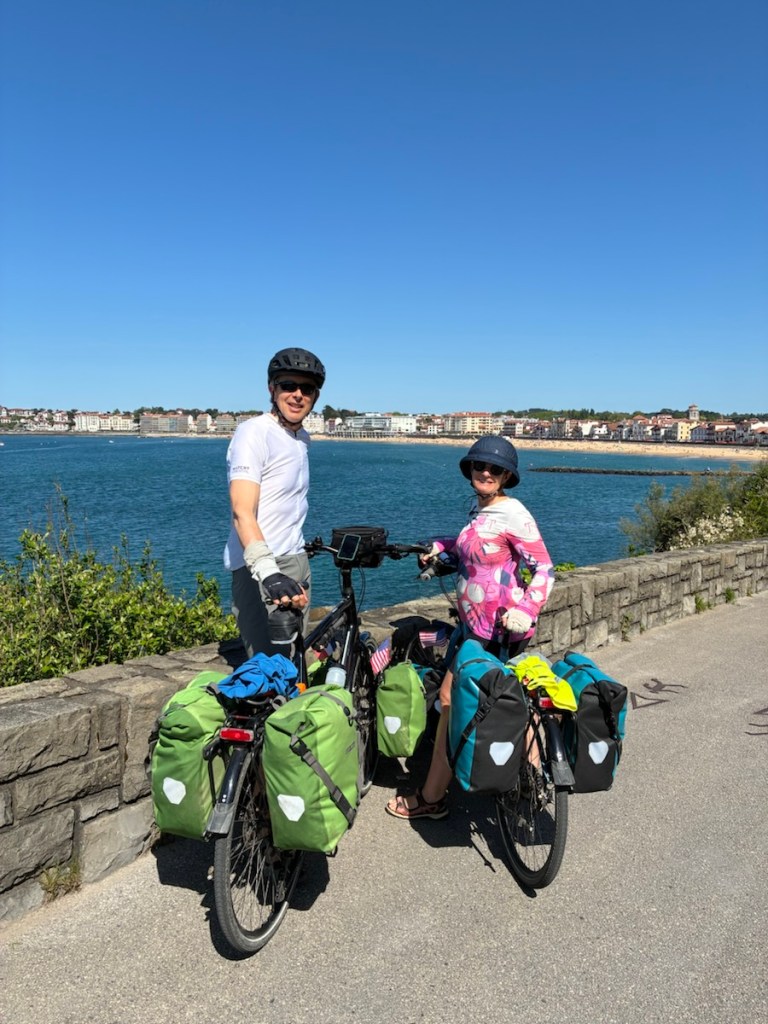


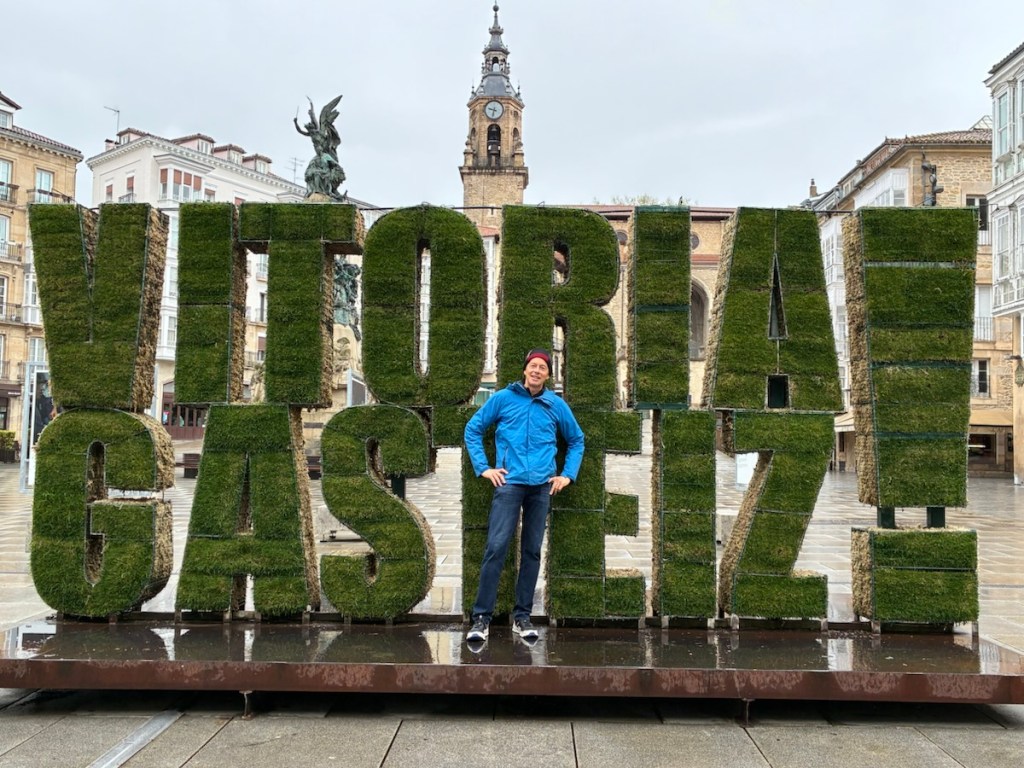


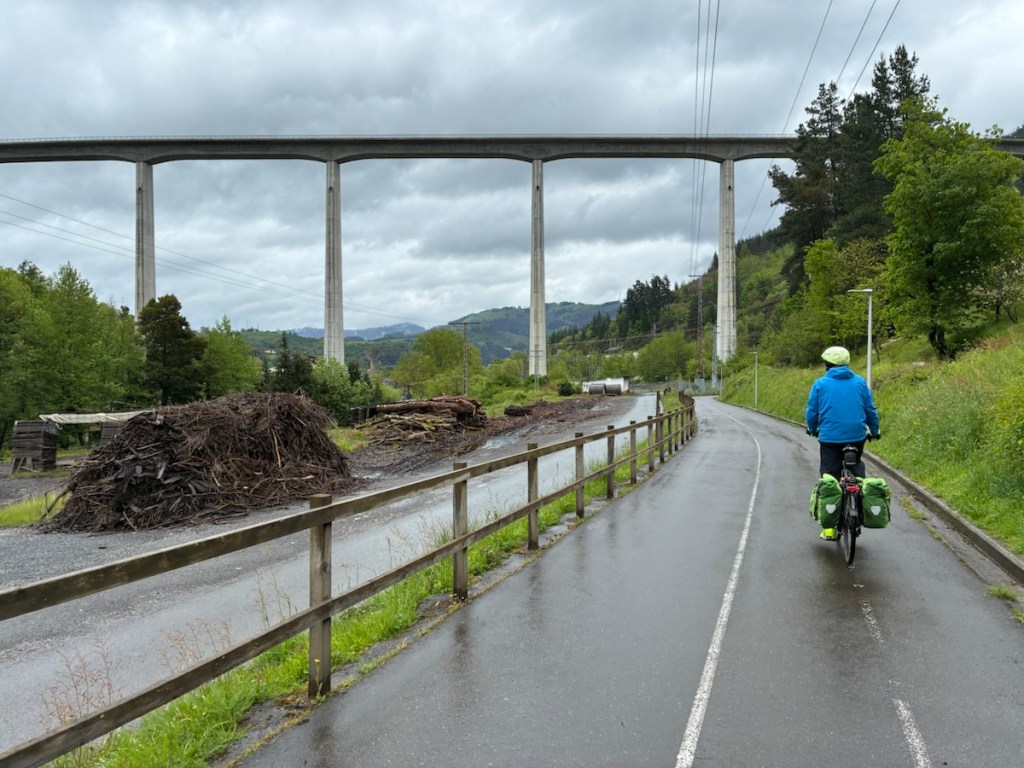


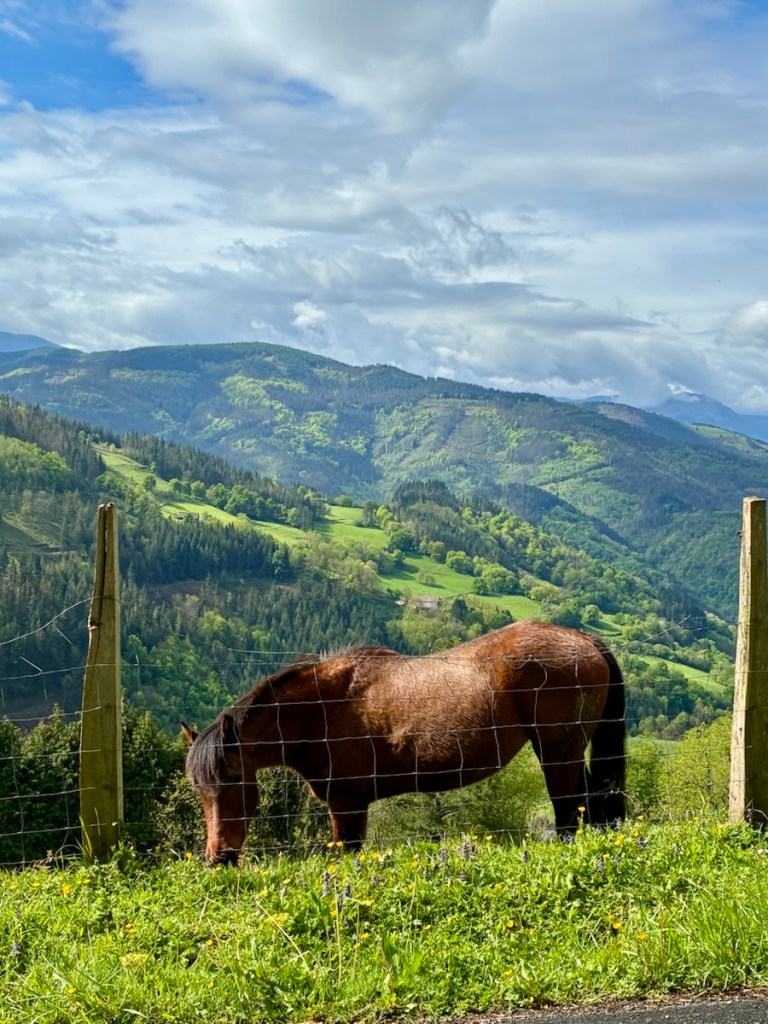


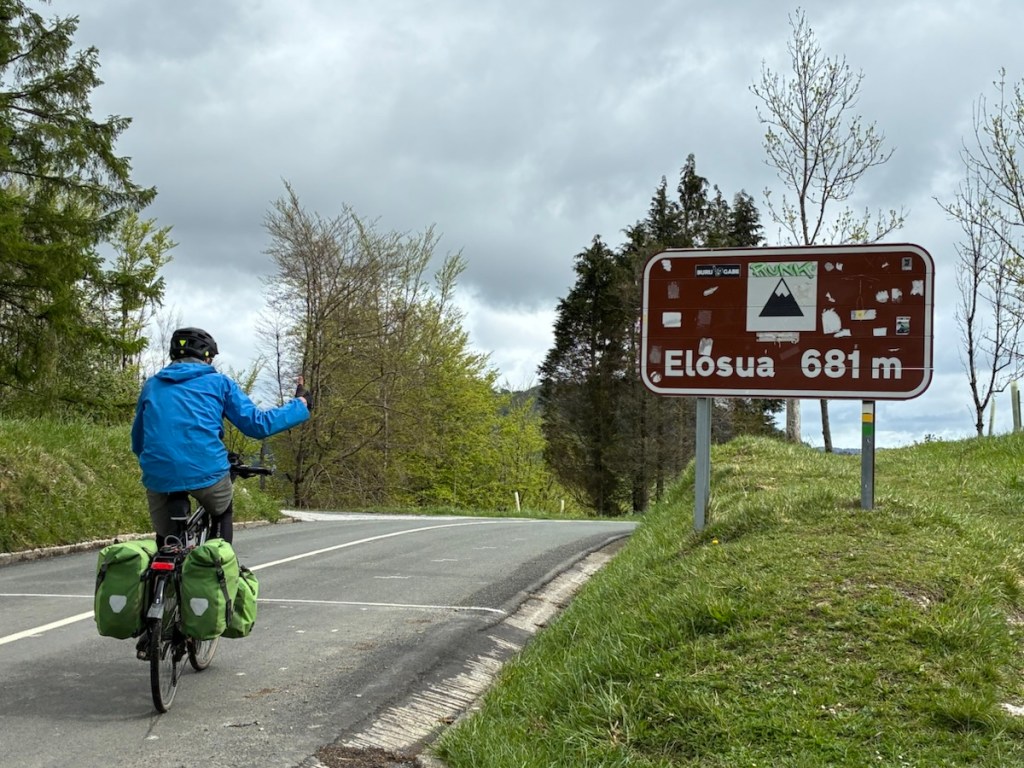


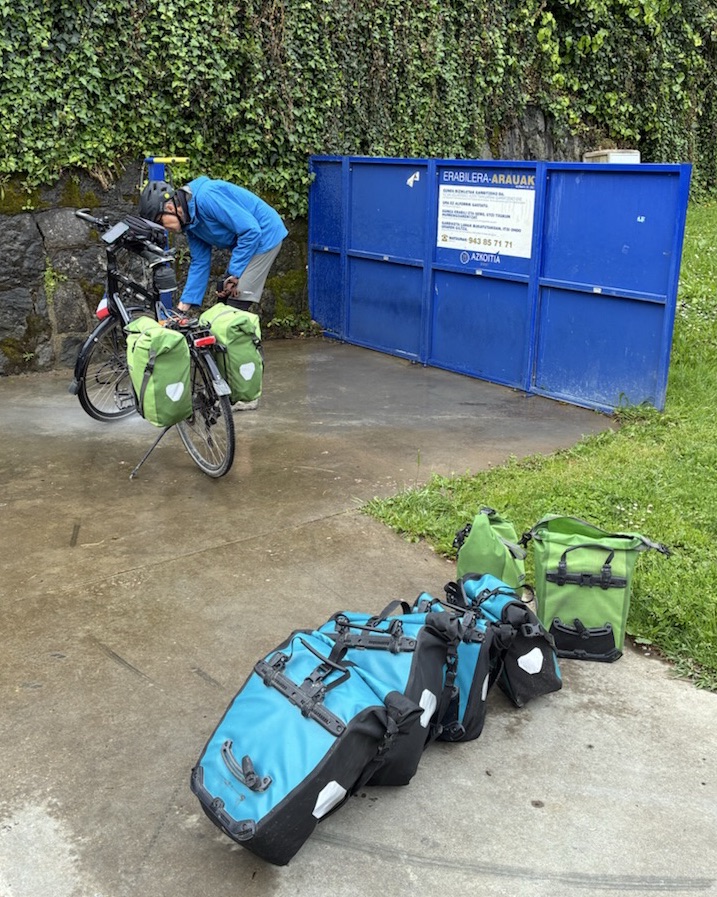


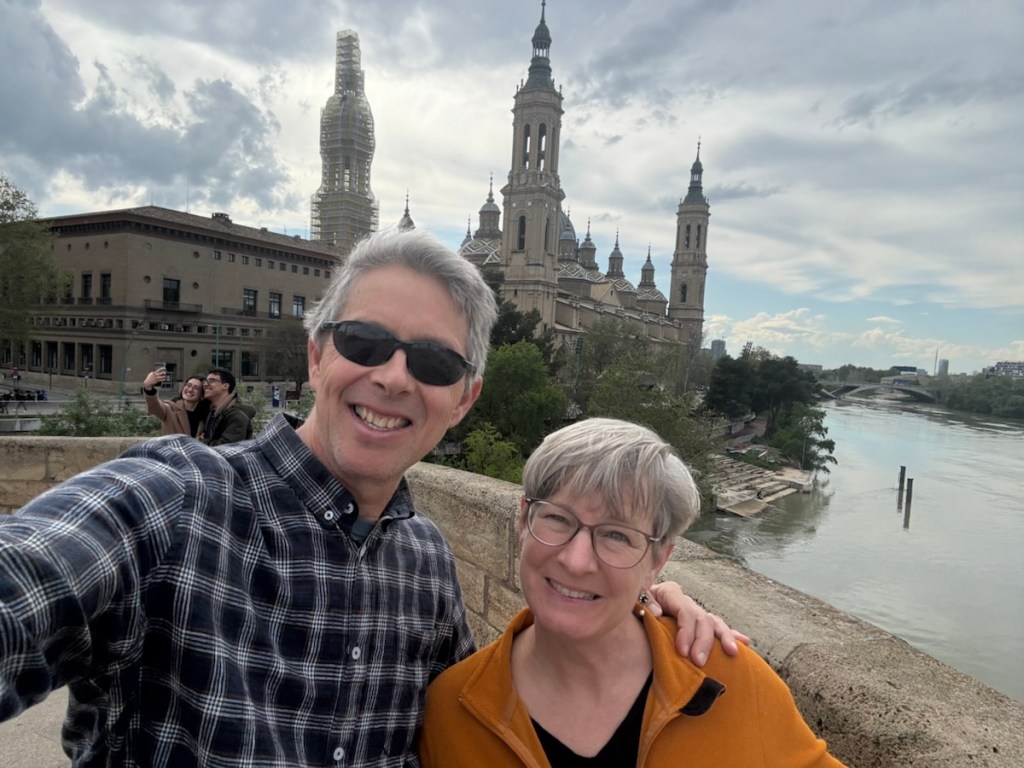
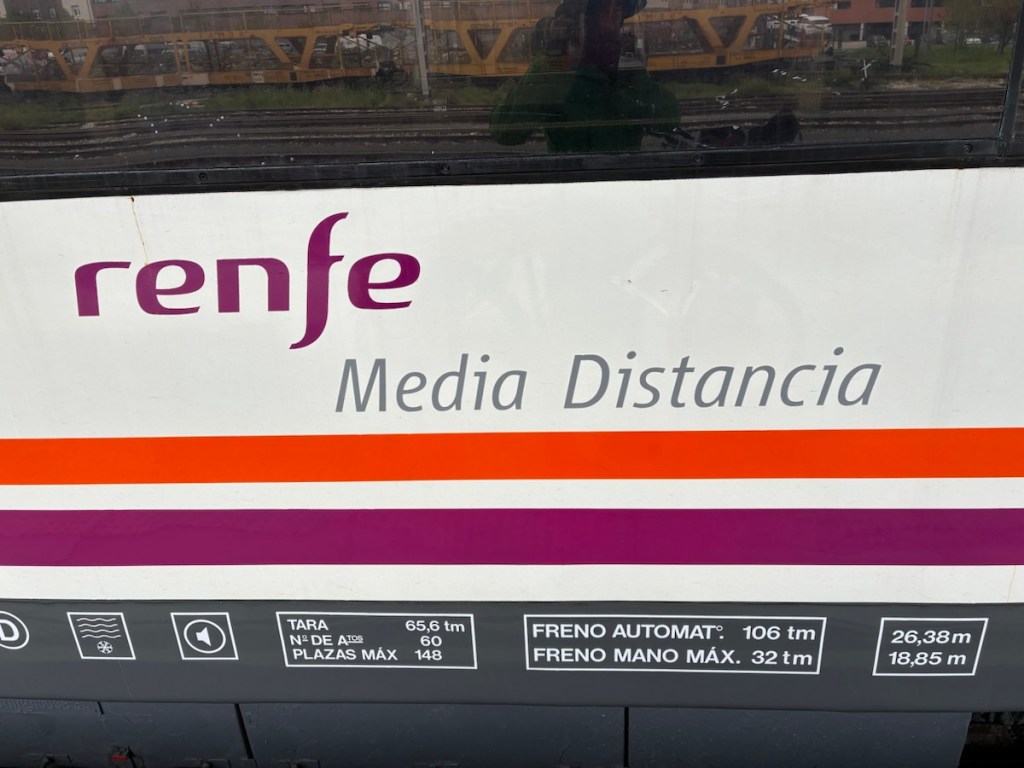

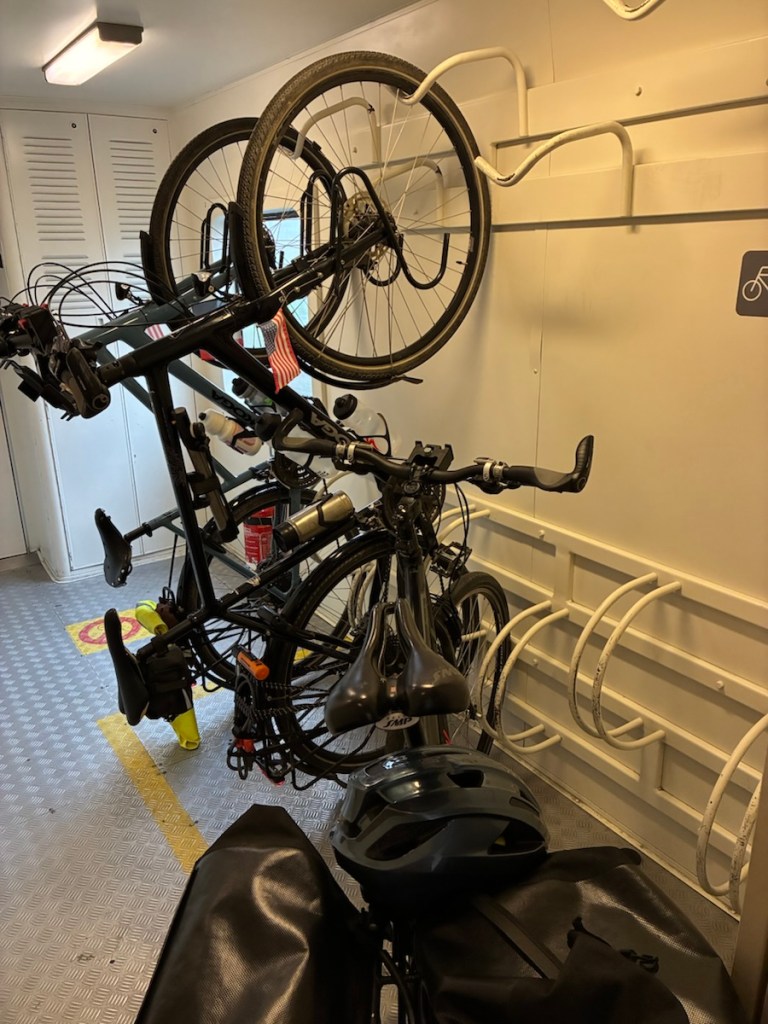


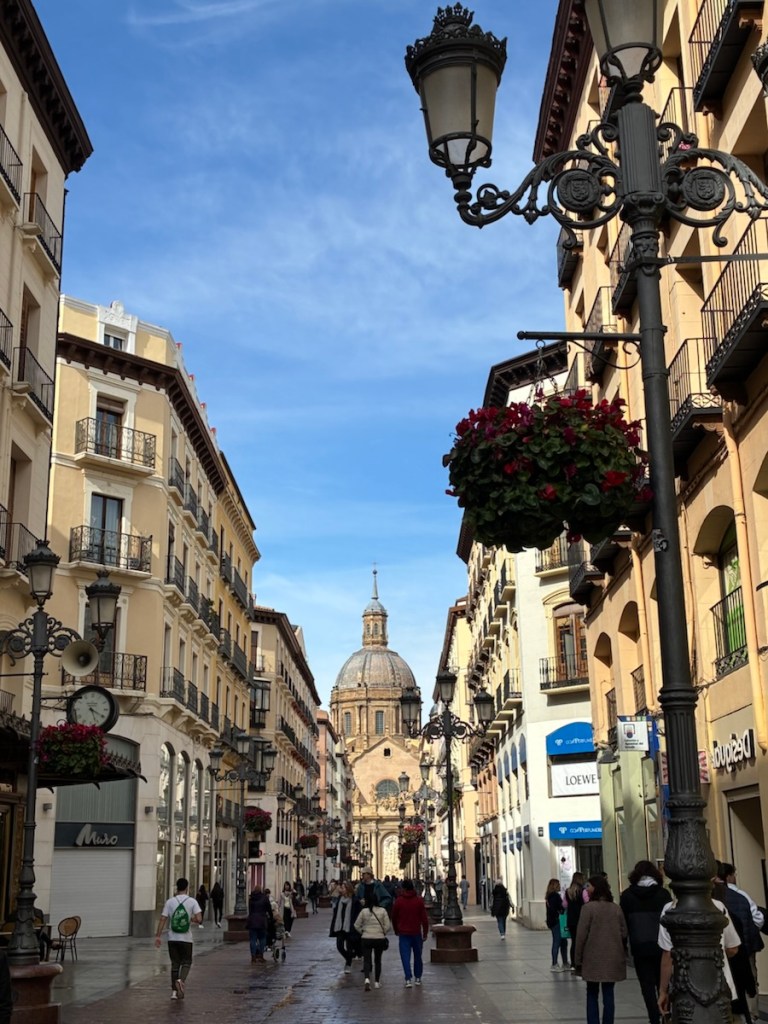
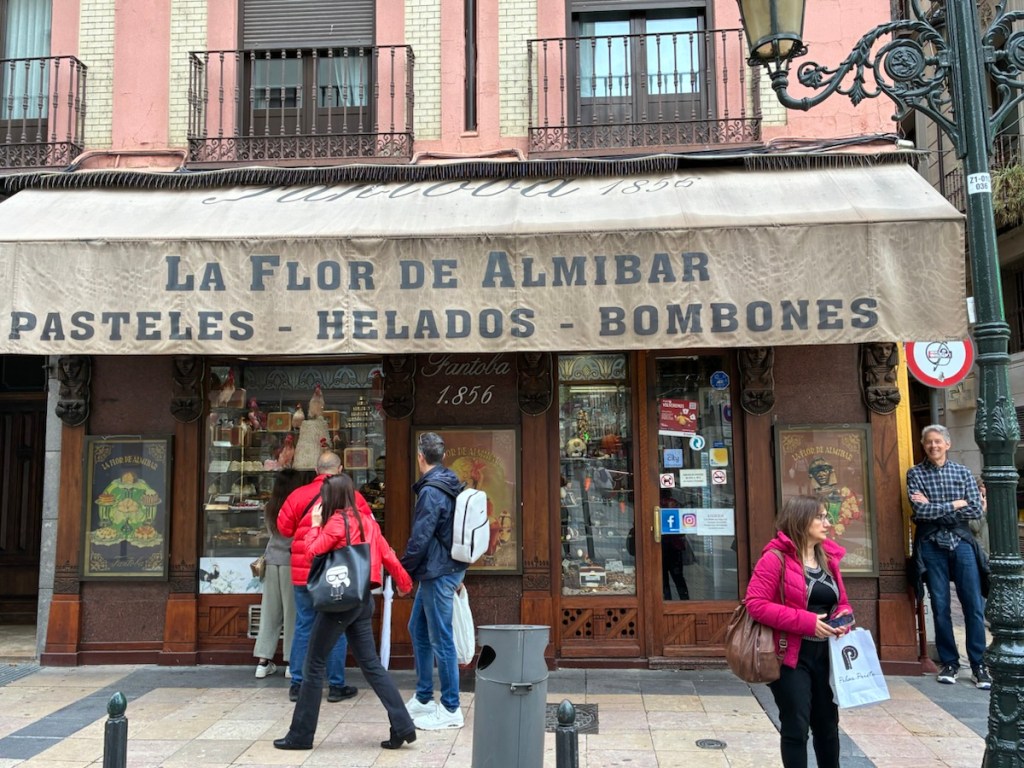


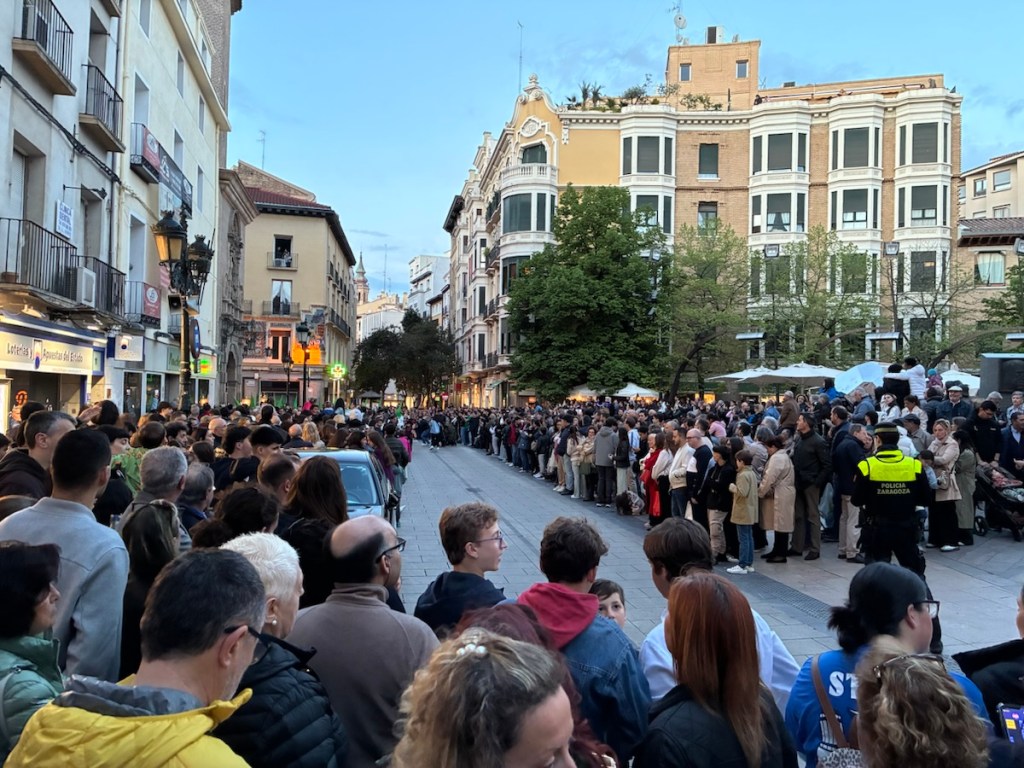
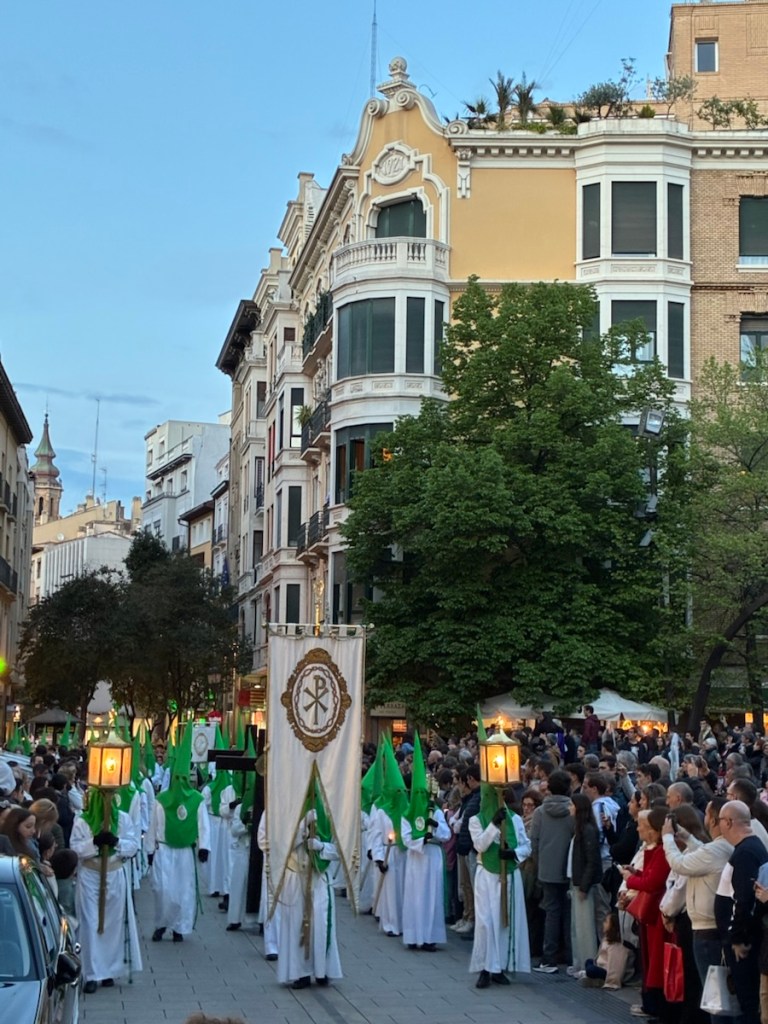


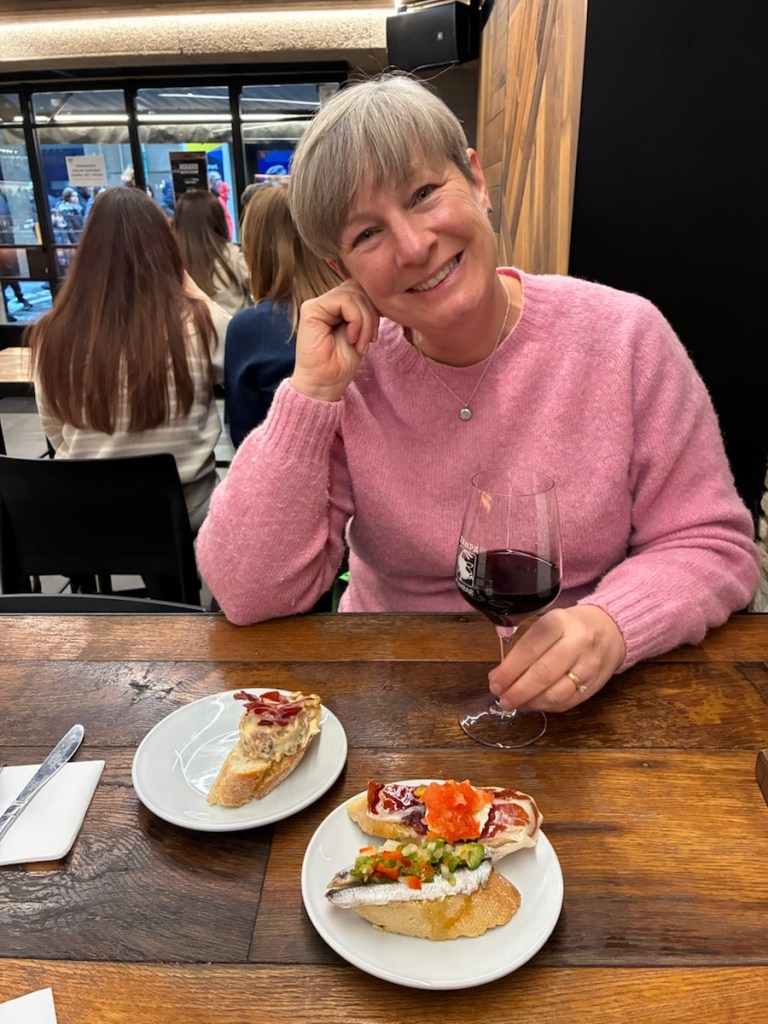


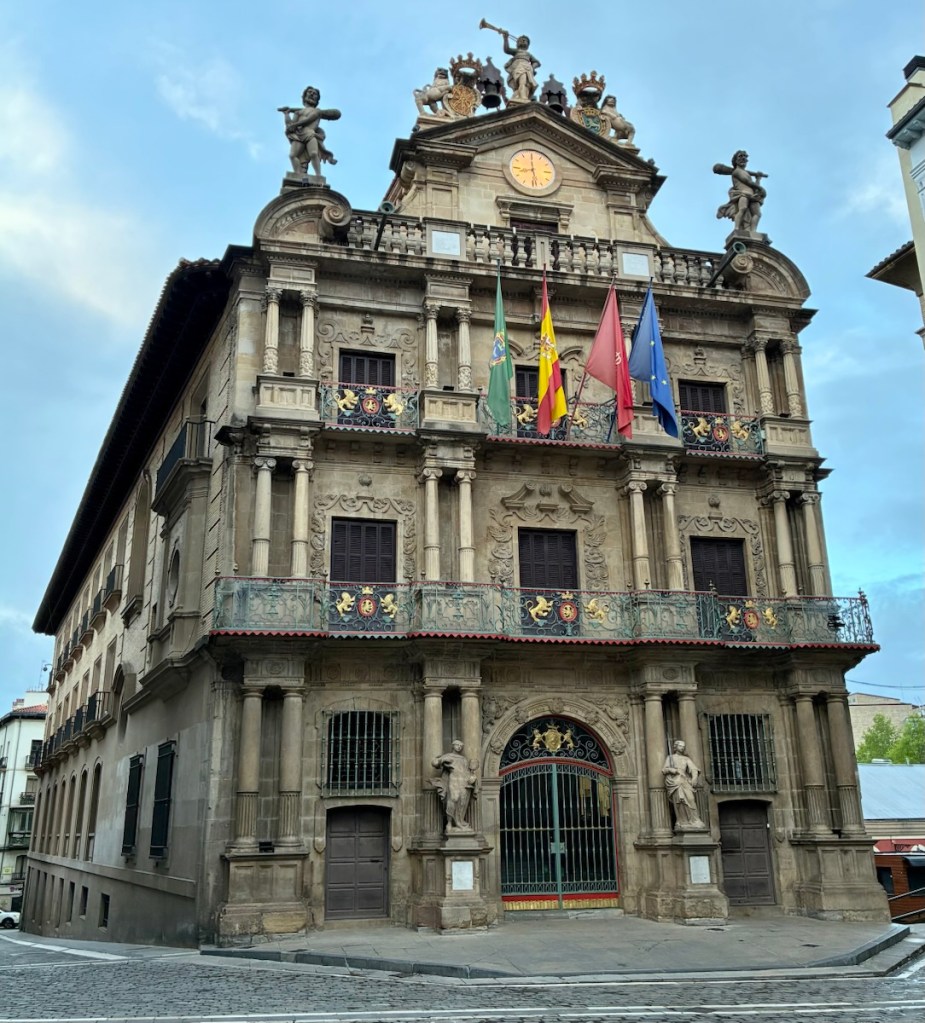
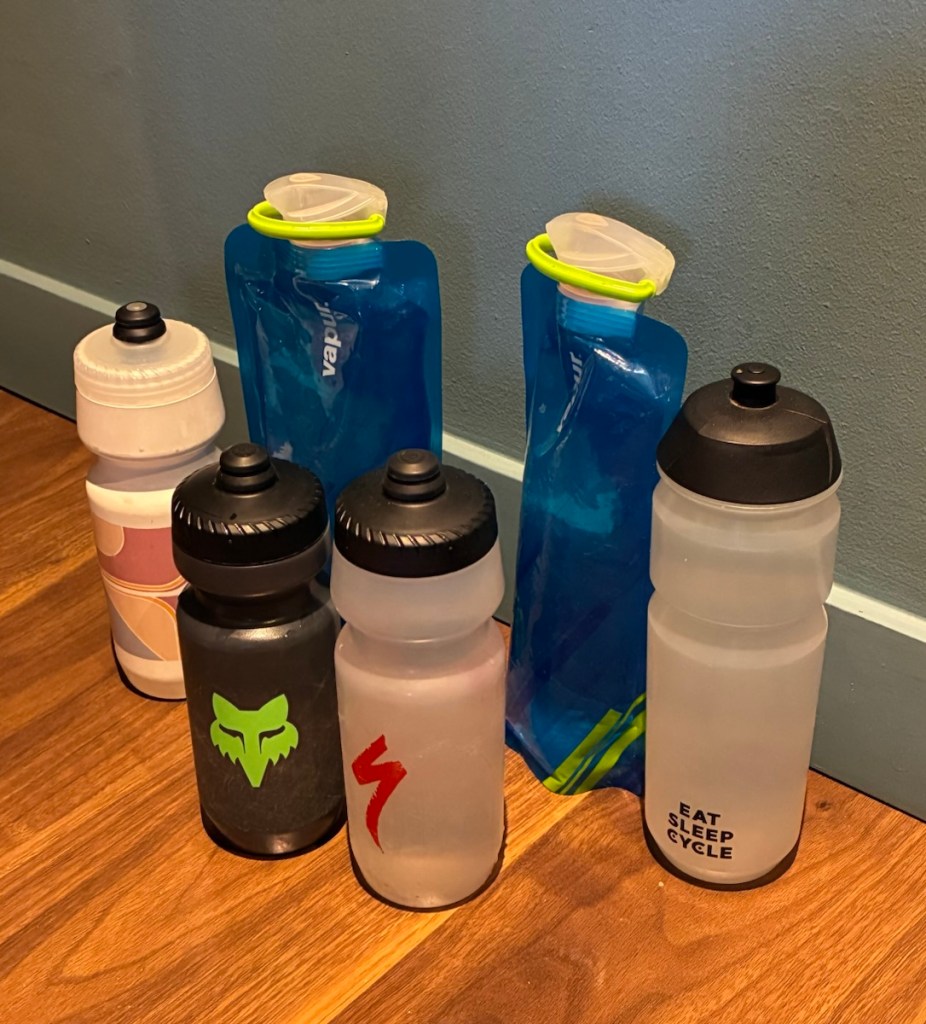


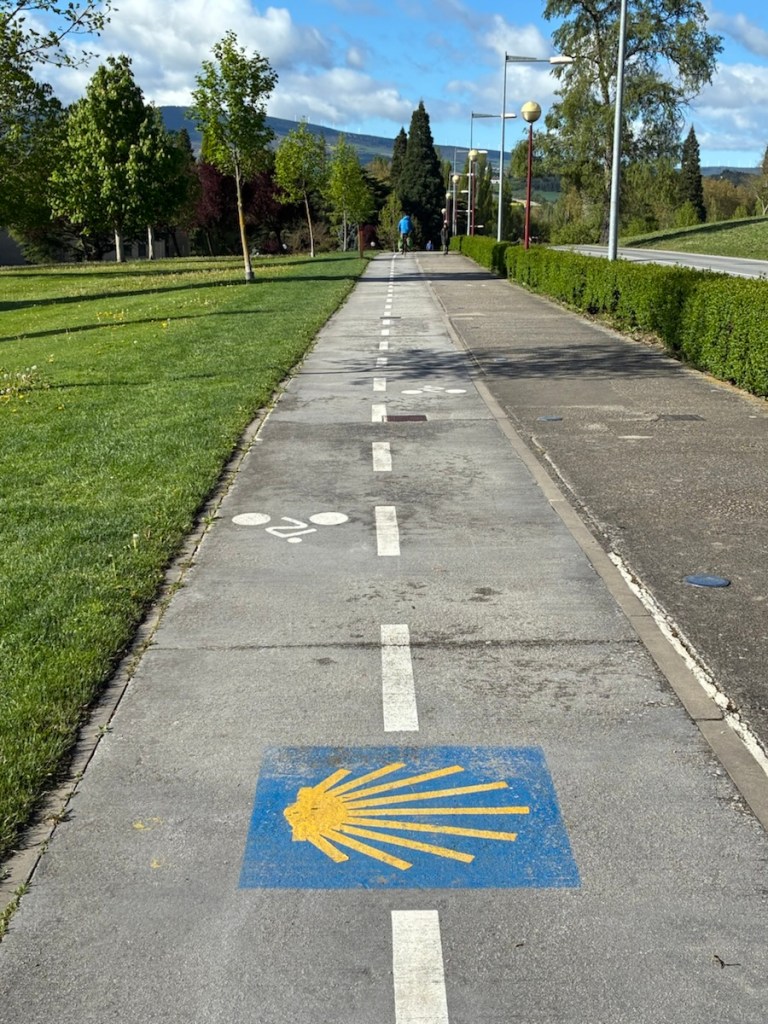

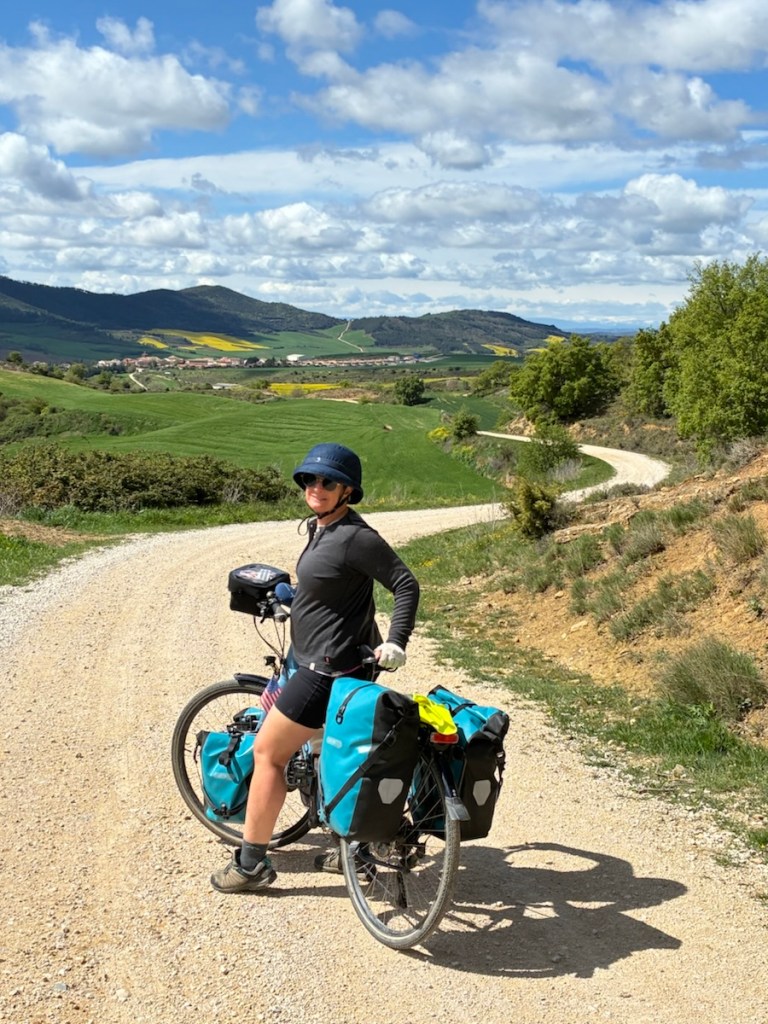
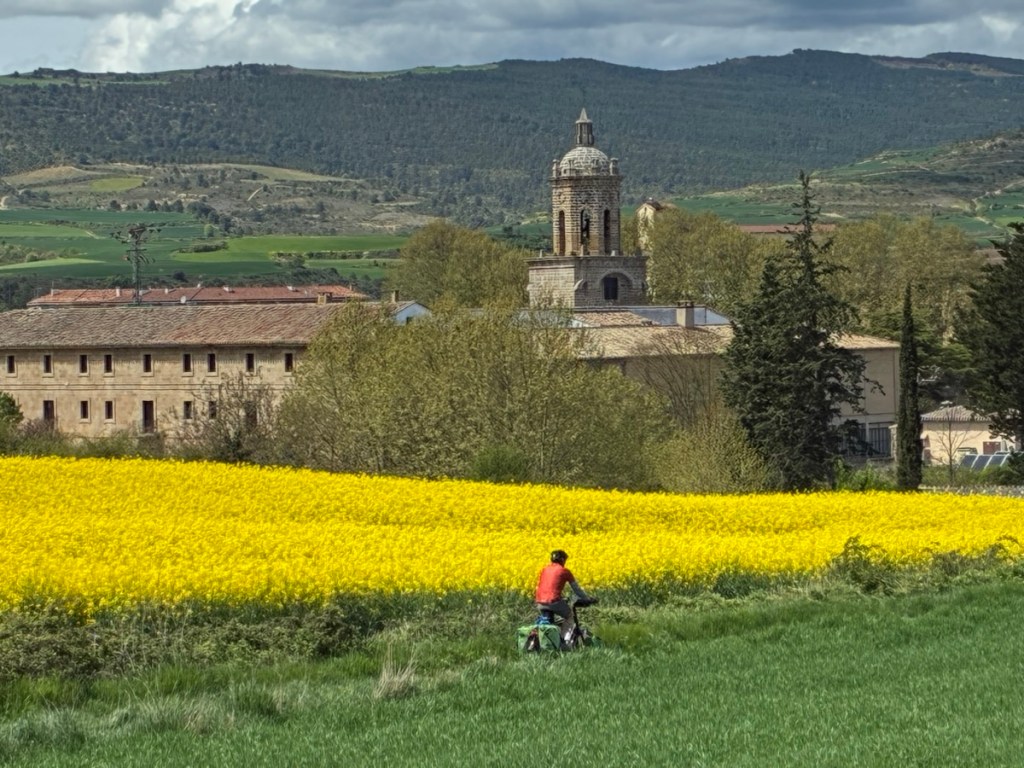
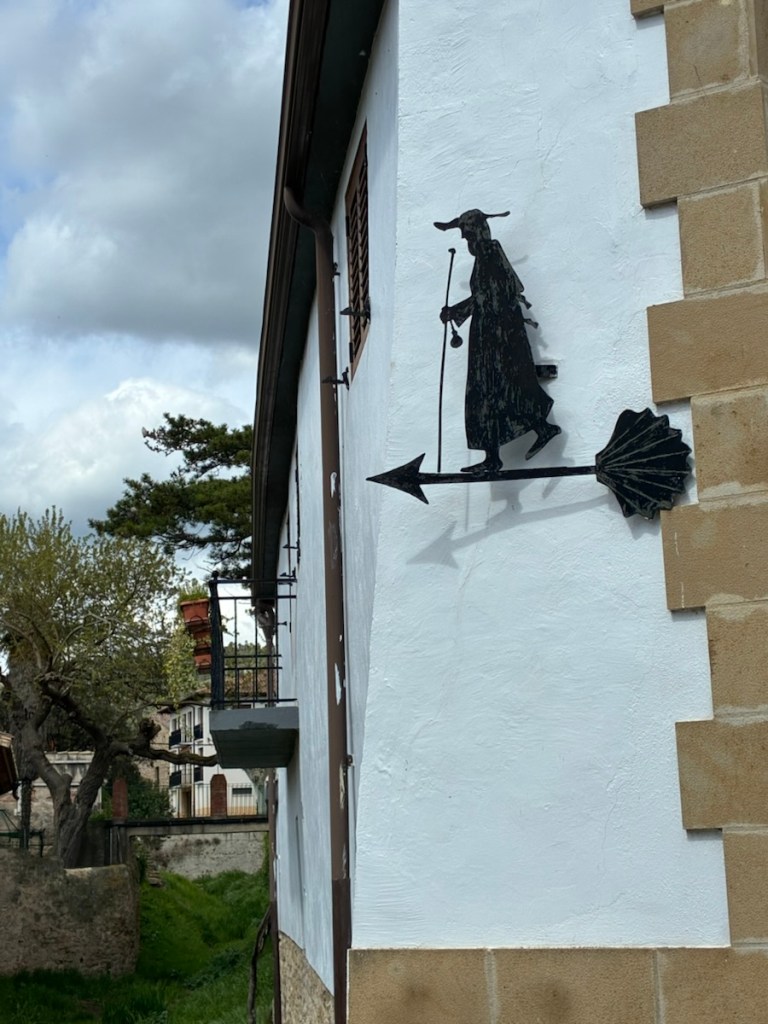

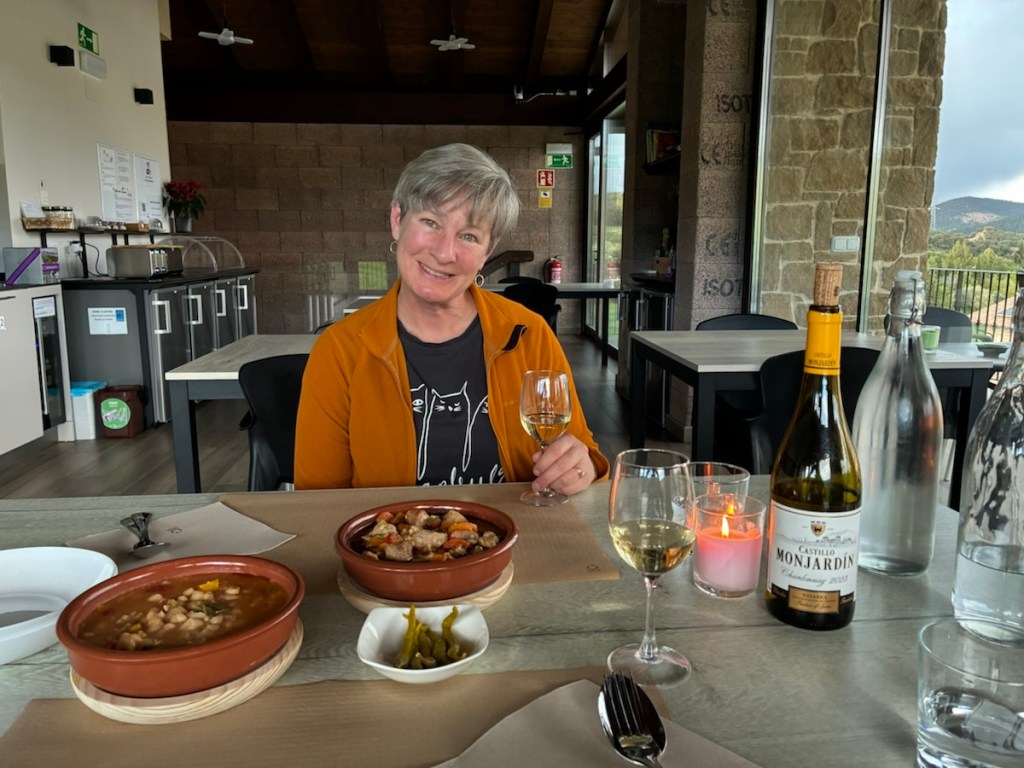
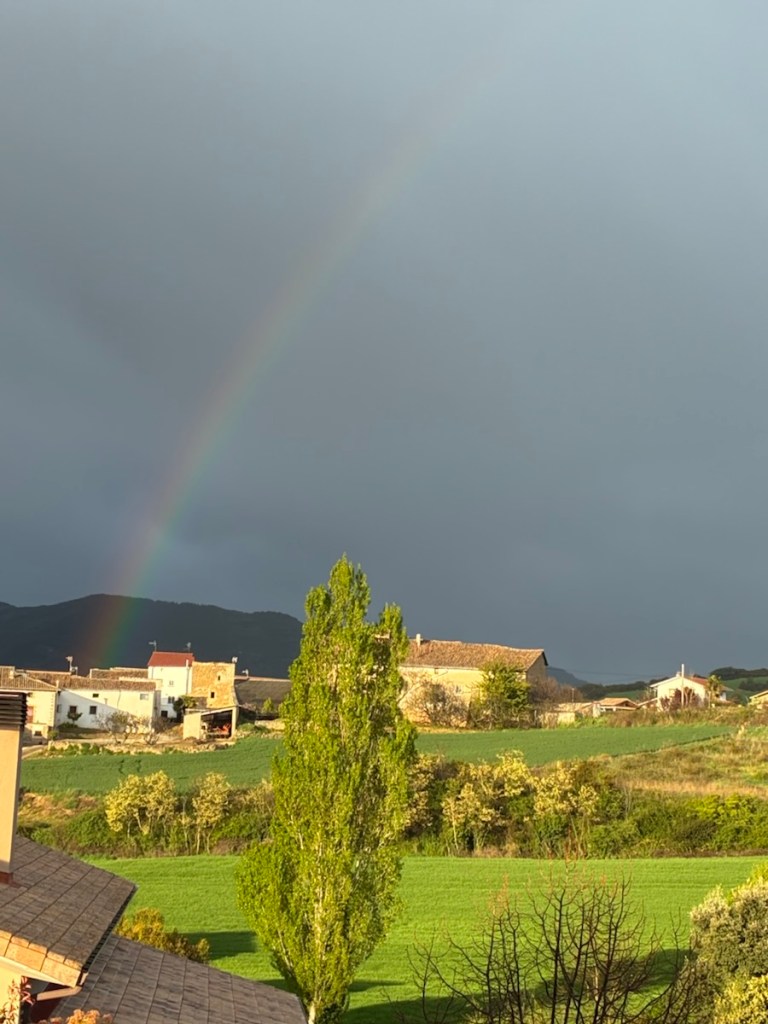


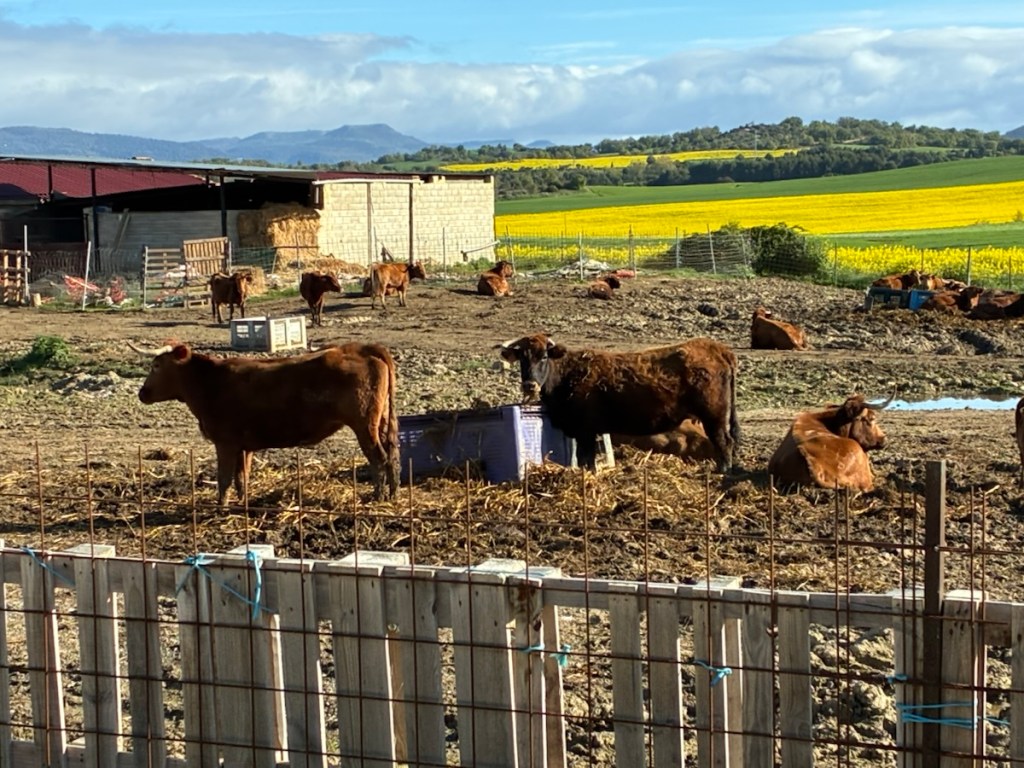
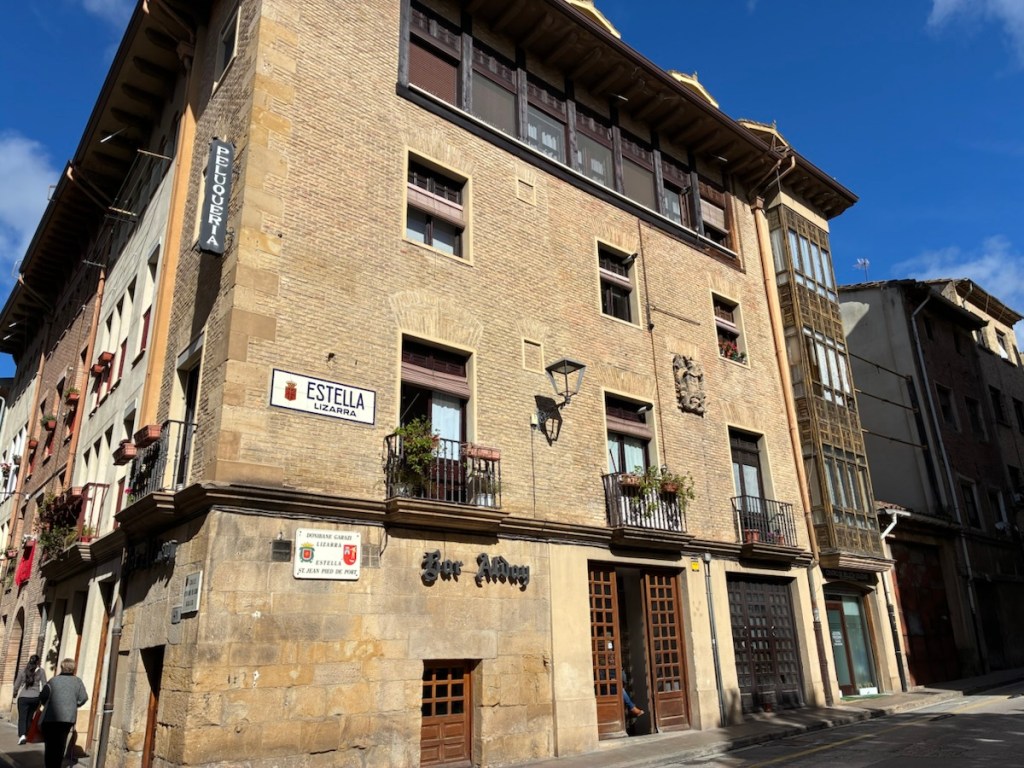

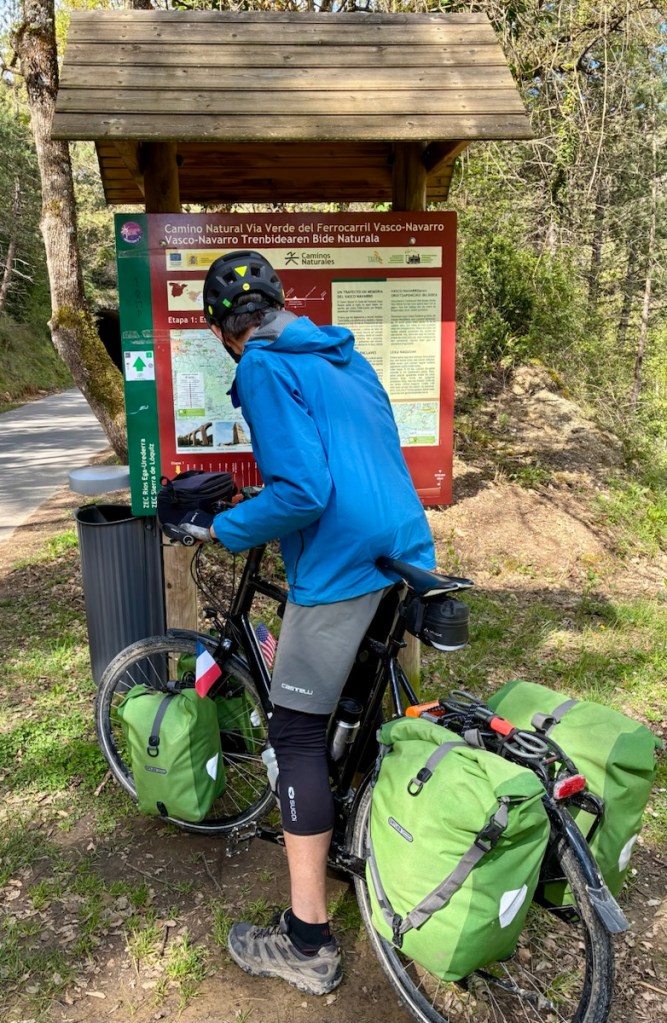
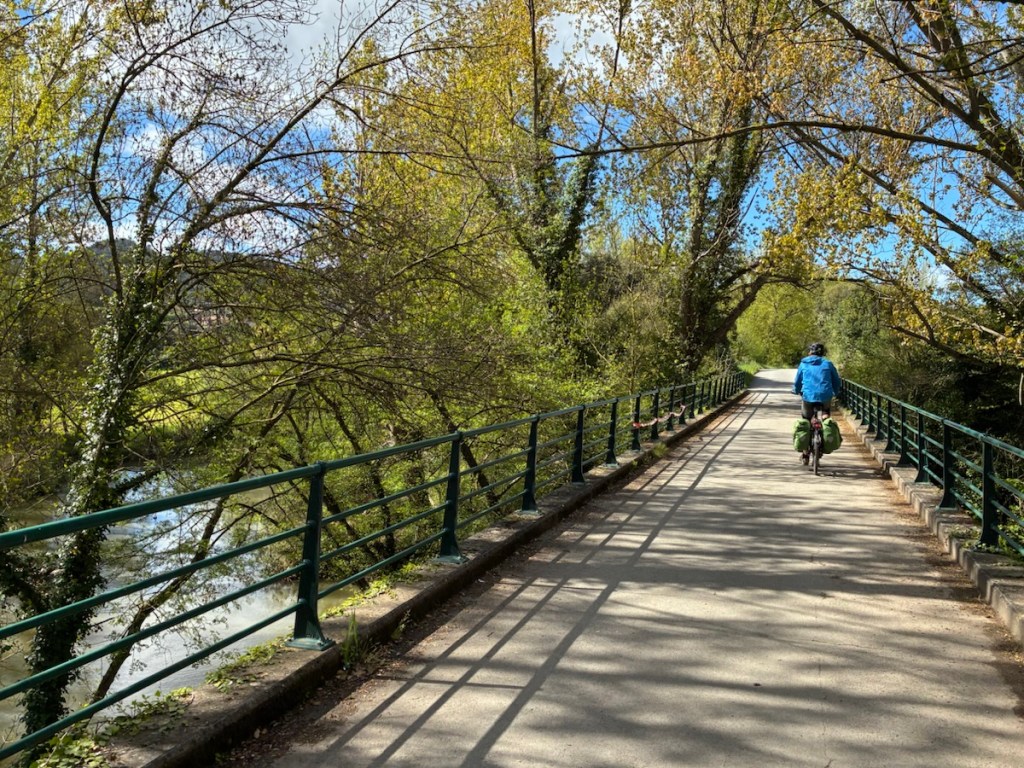
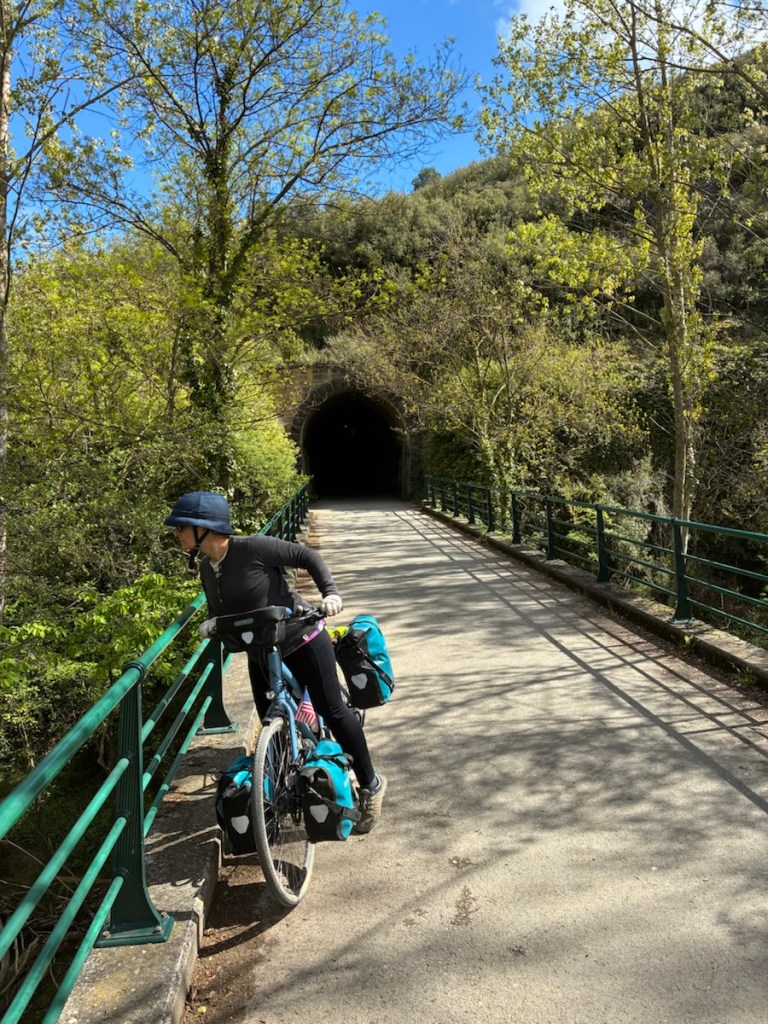



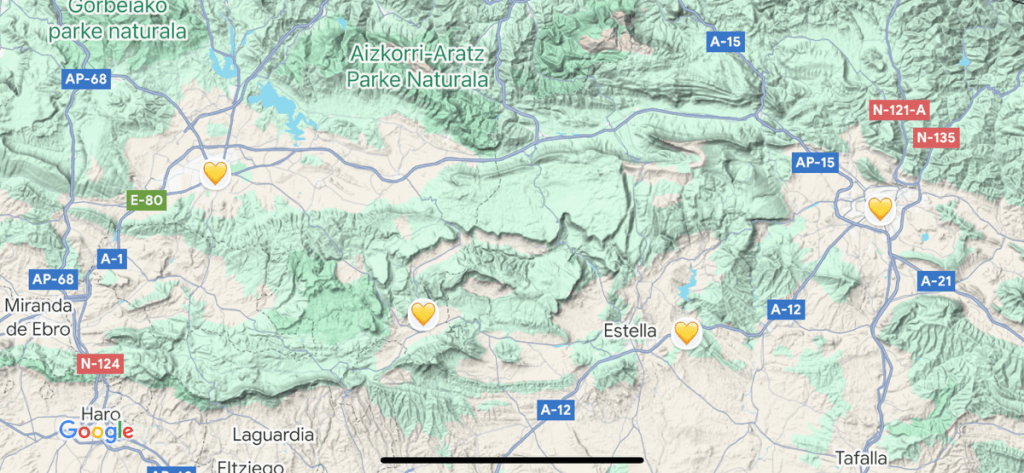

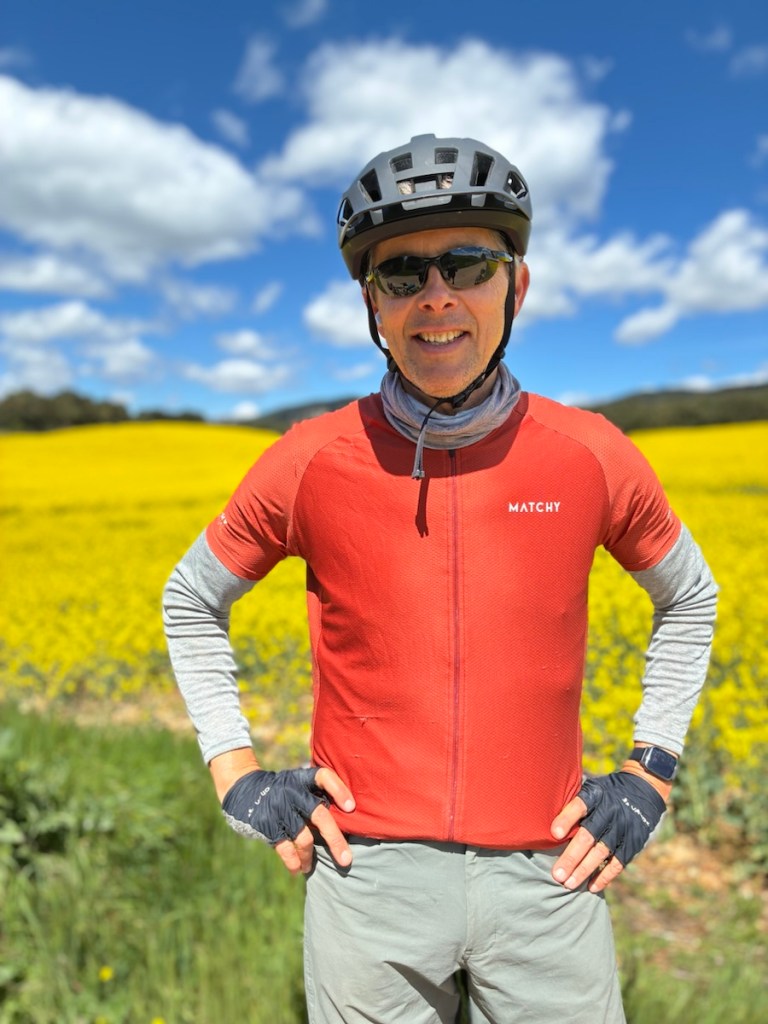


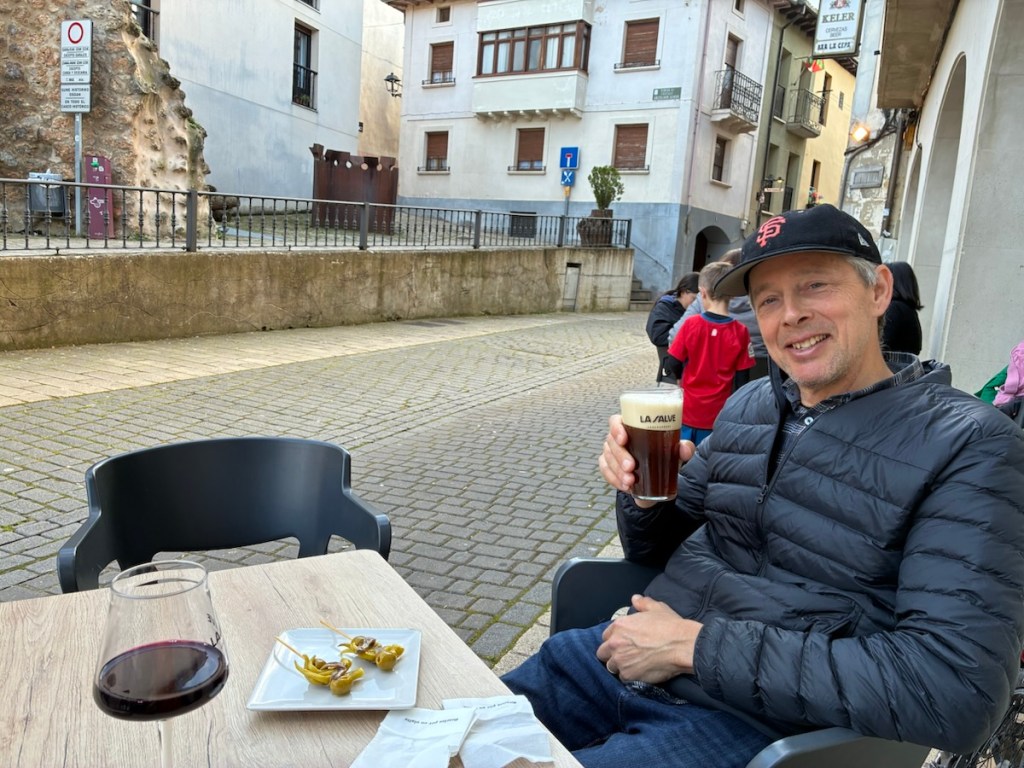

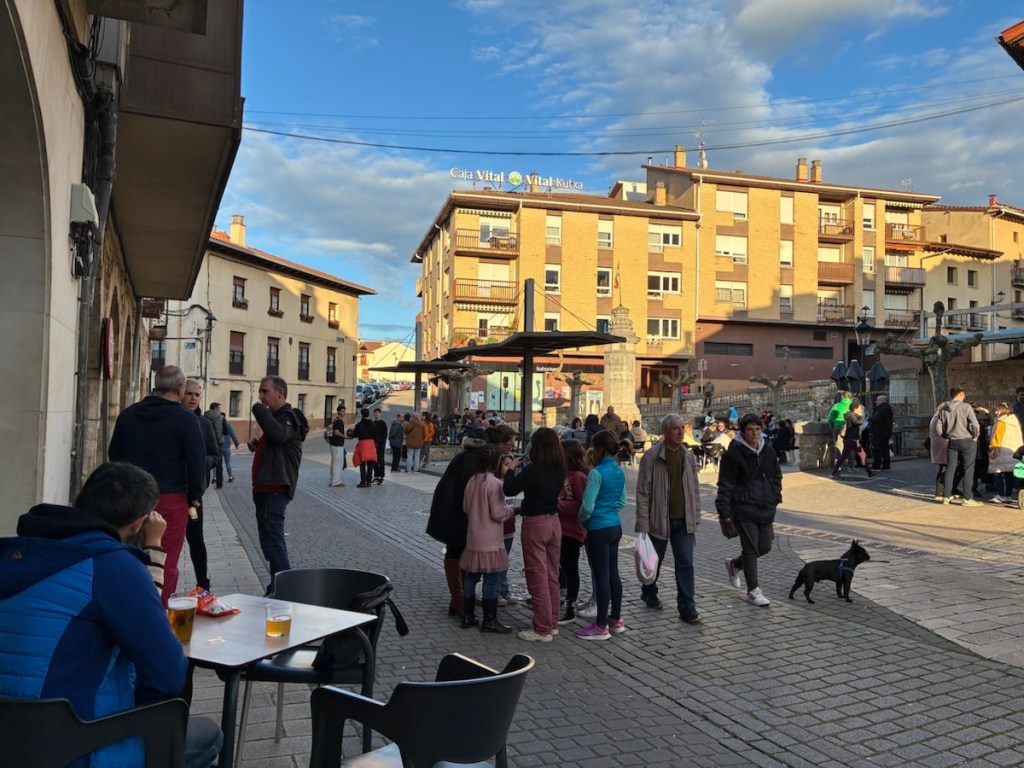
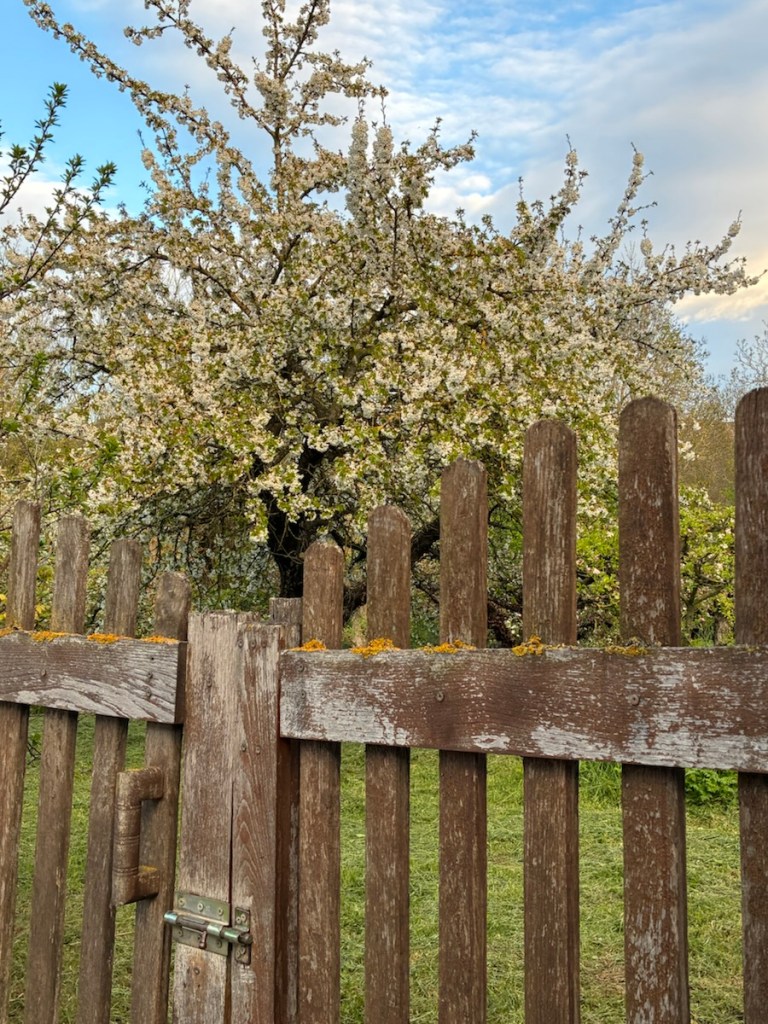

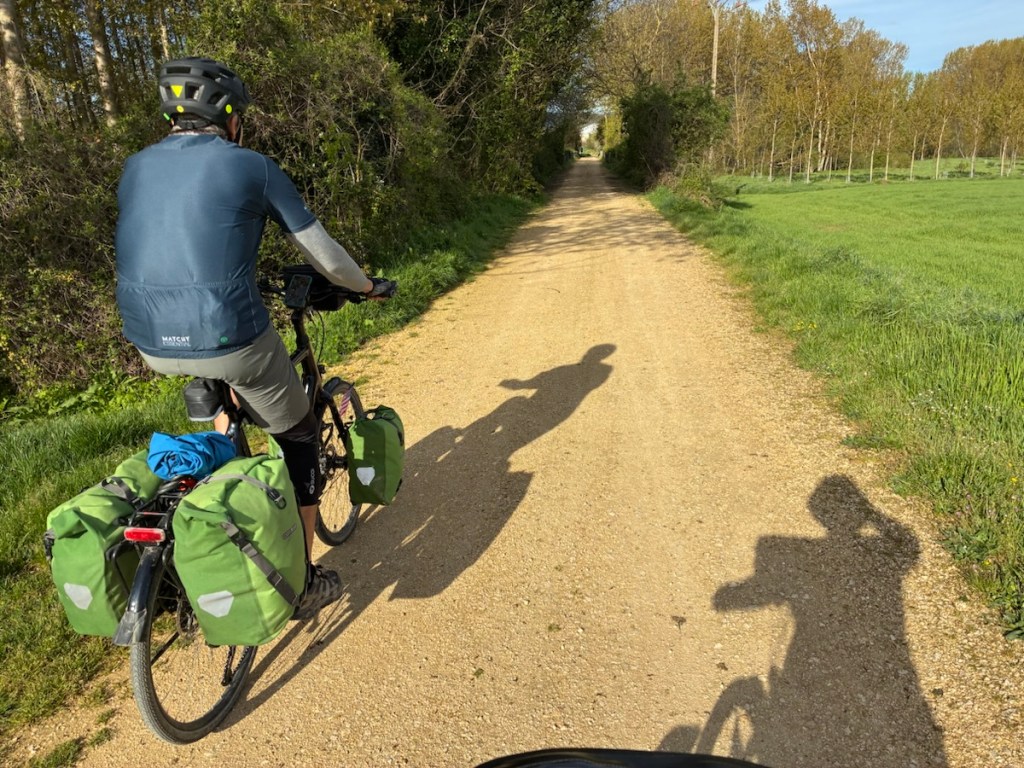


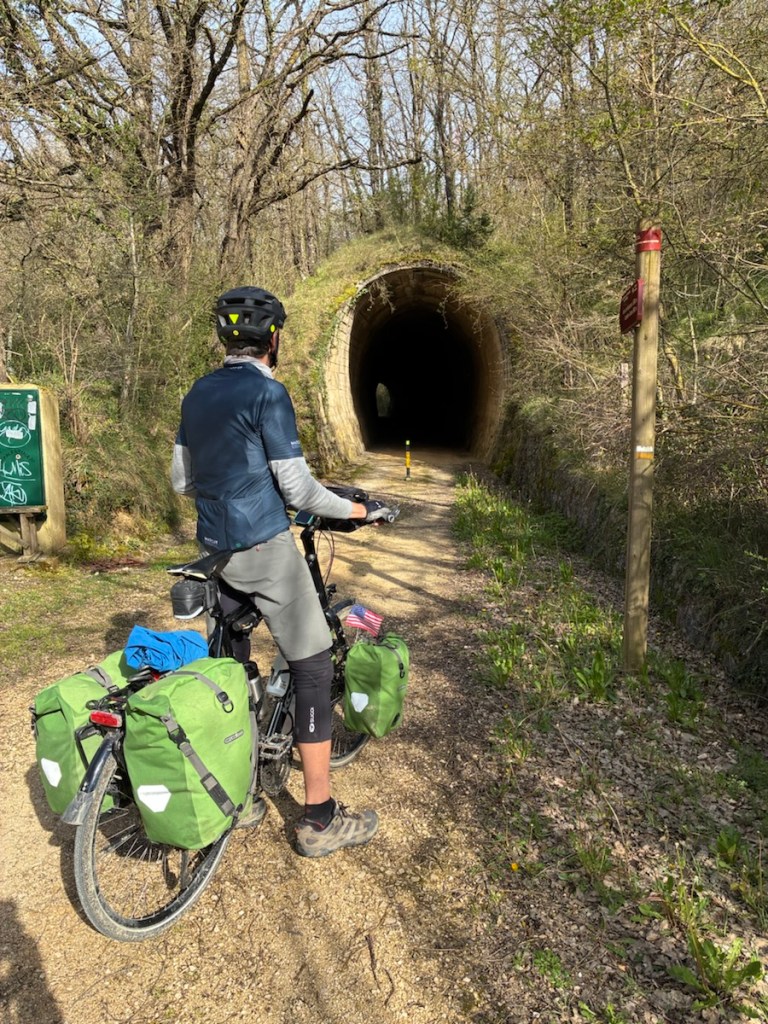


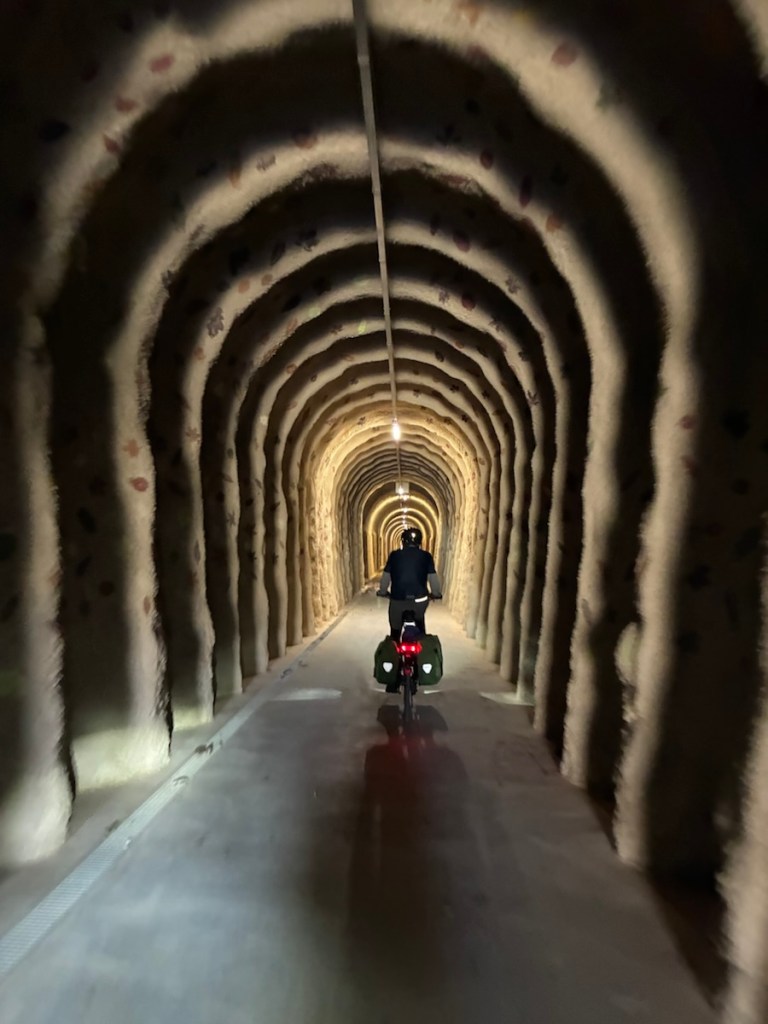
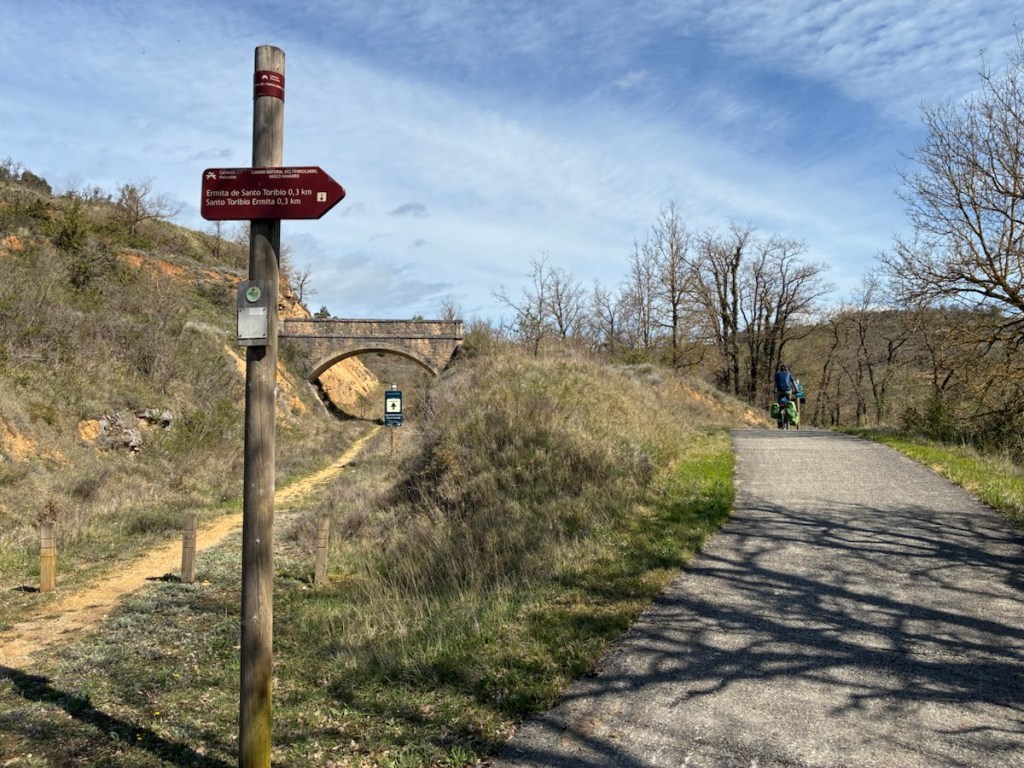

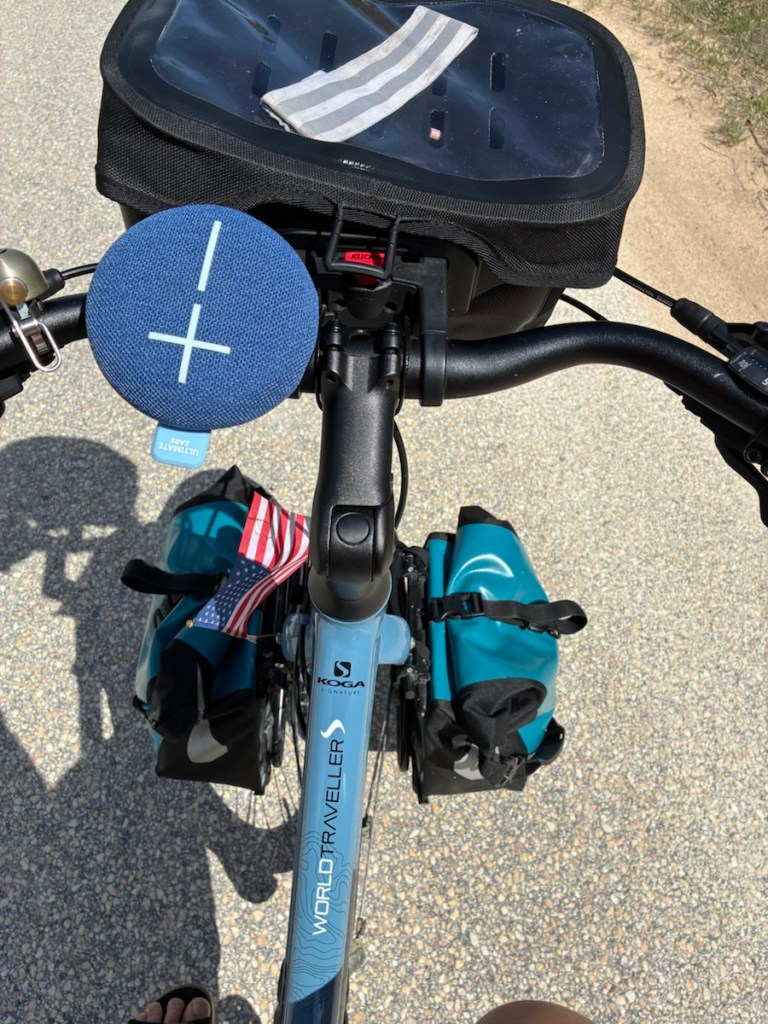
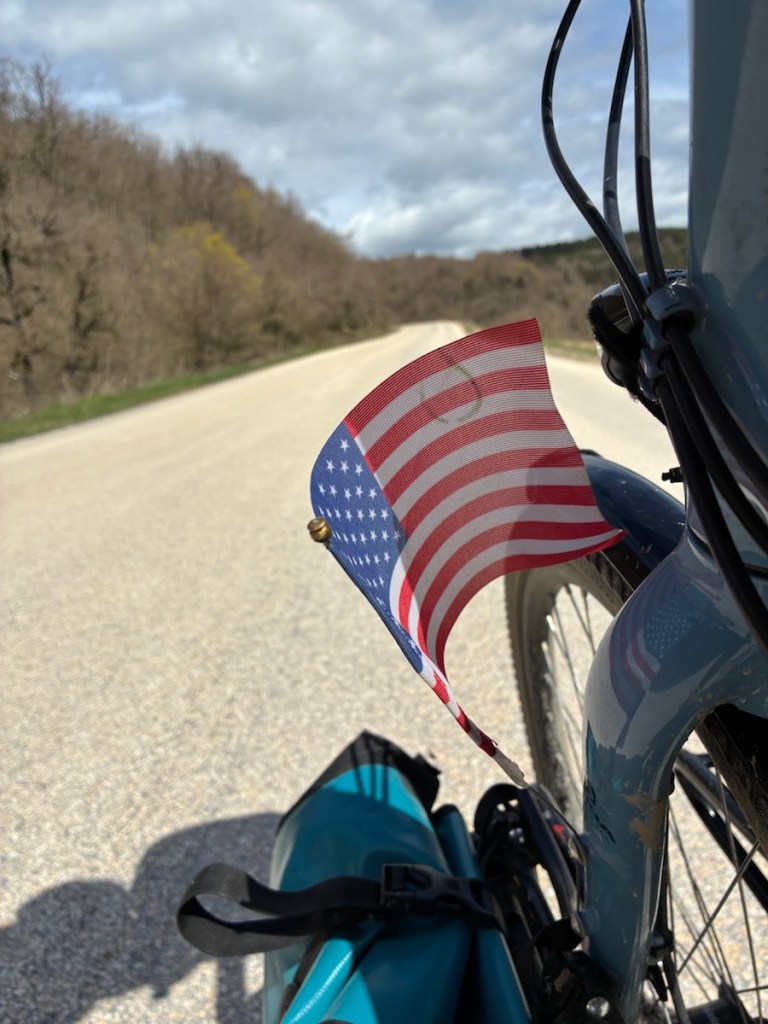
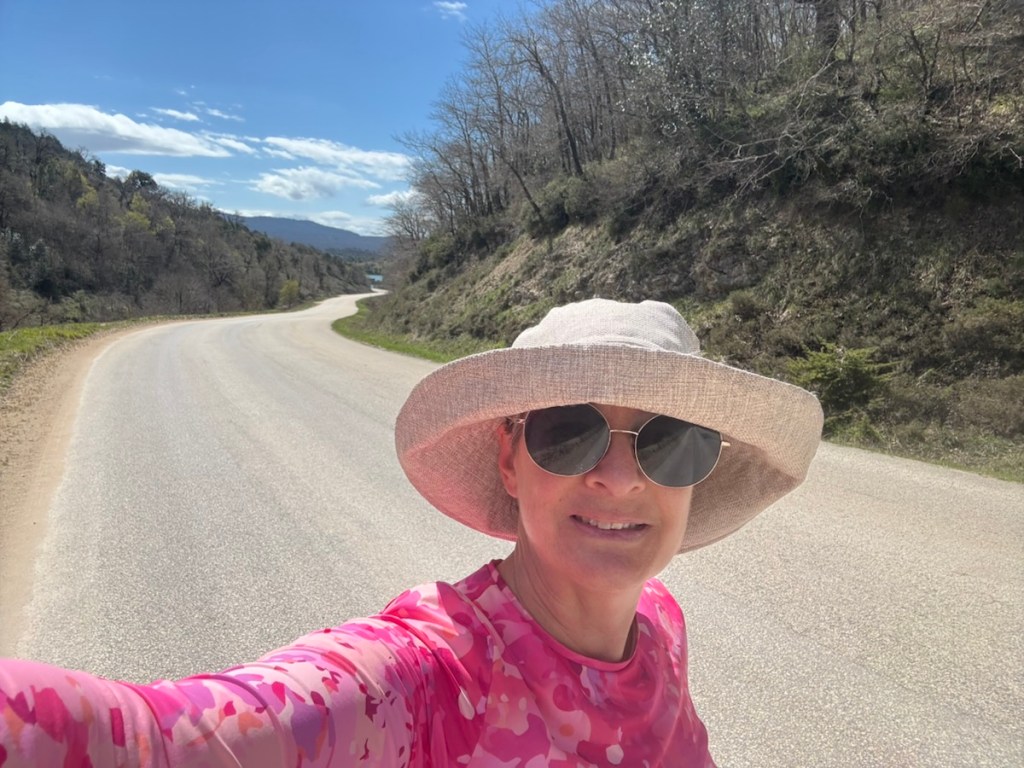


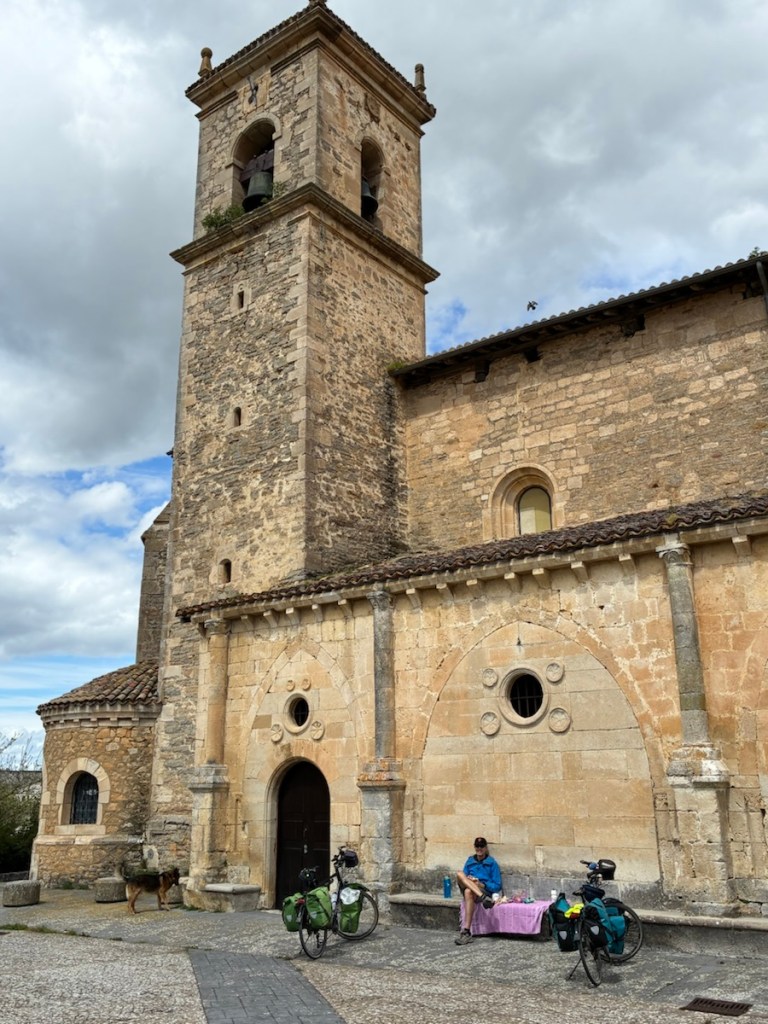


 Less Car, More Life