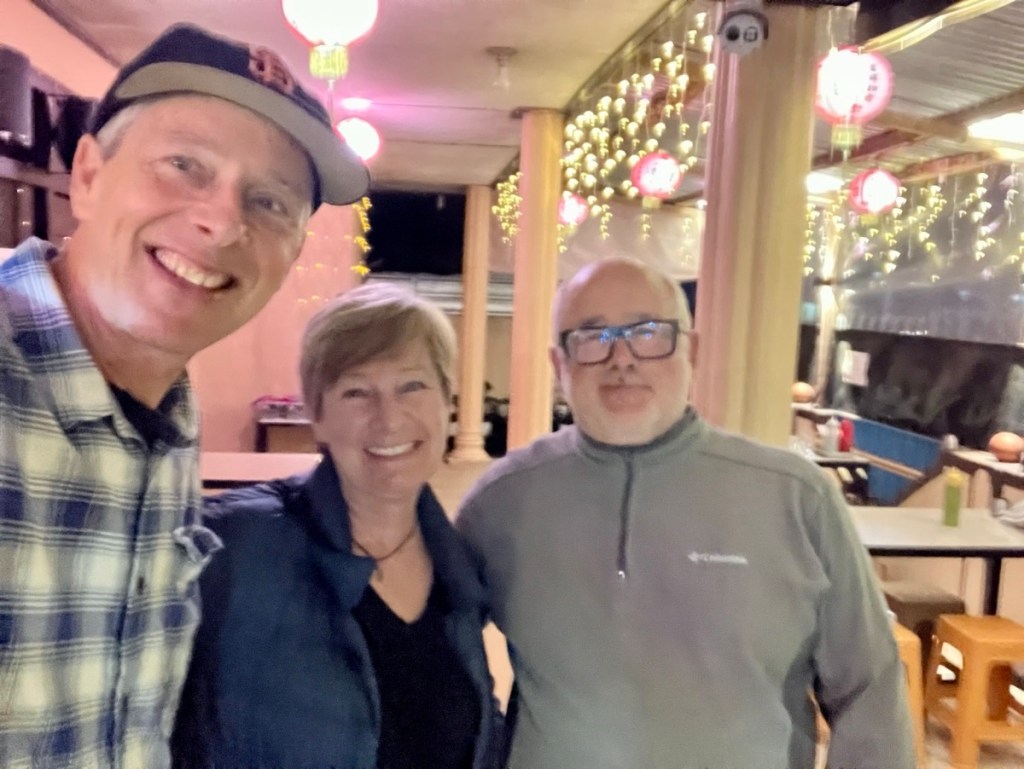
On our second night in Maumere a Portuguese/German couple who had just finished a weeks long motorbike trip on the islands of Indonesia told us that they were headed to Pirate Island for 7 nights, as a final destination and ultimate relaxation to finish their trip. Pirate what what, now? We decided we’d go too, and we would get to meet up with them, Merrick and Isabelle, again. It’s nice to be able to share tips and gather advice from other travelers.
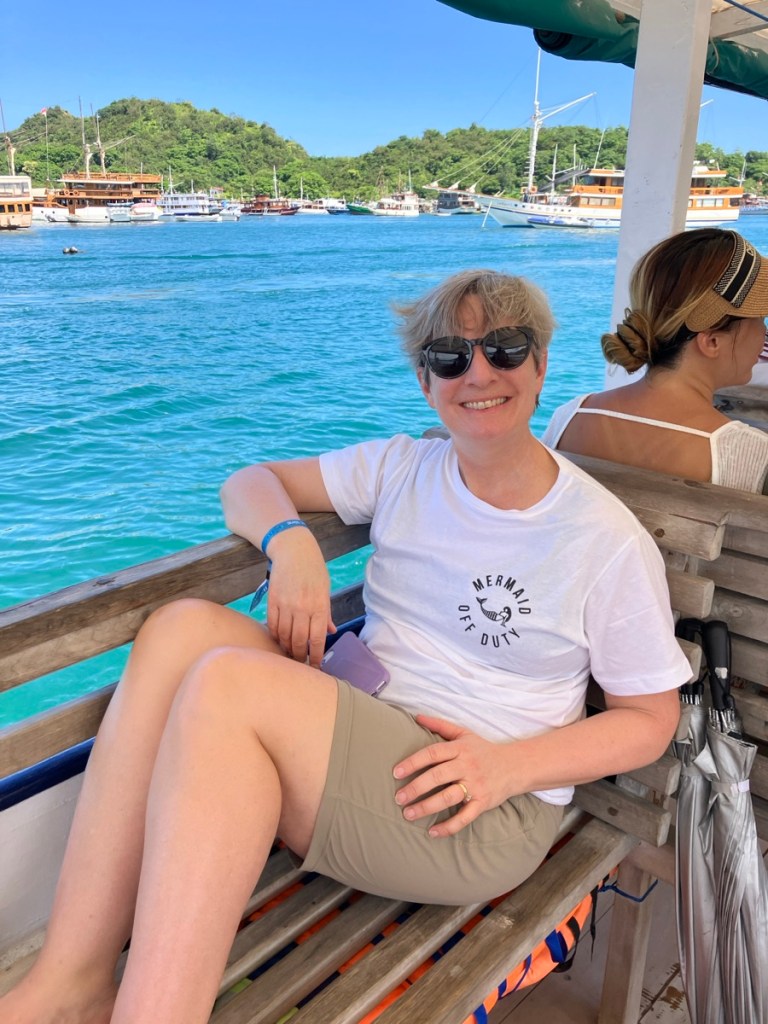
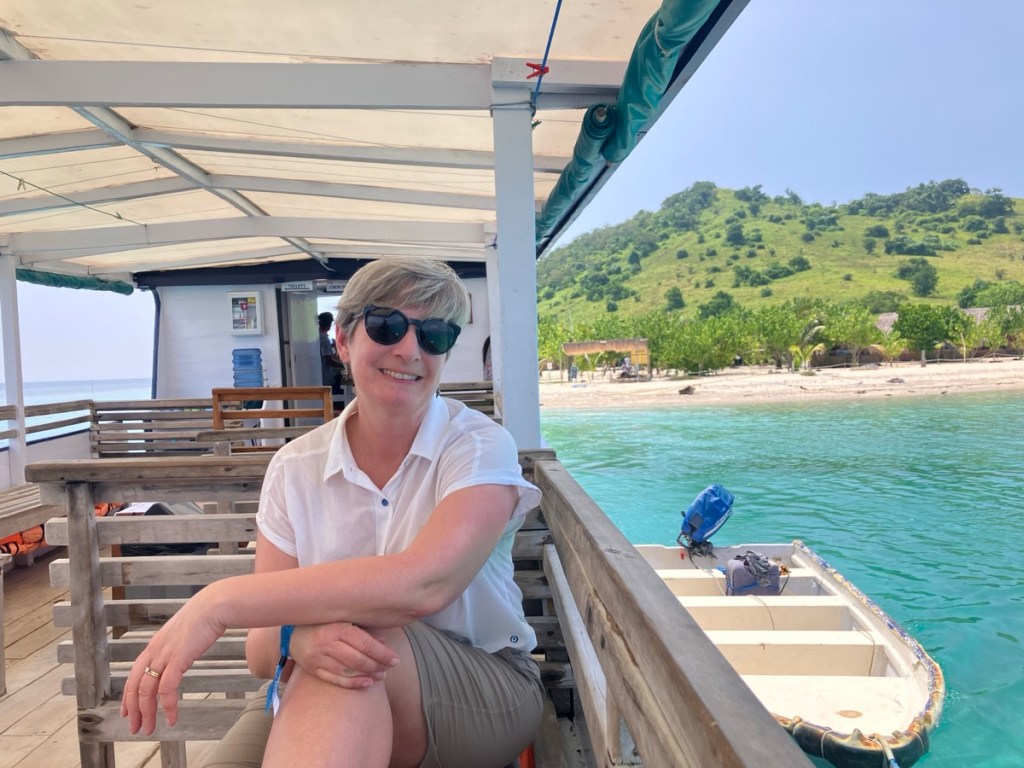
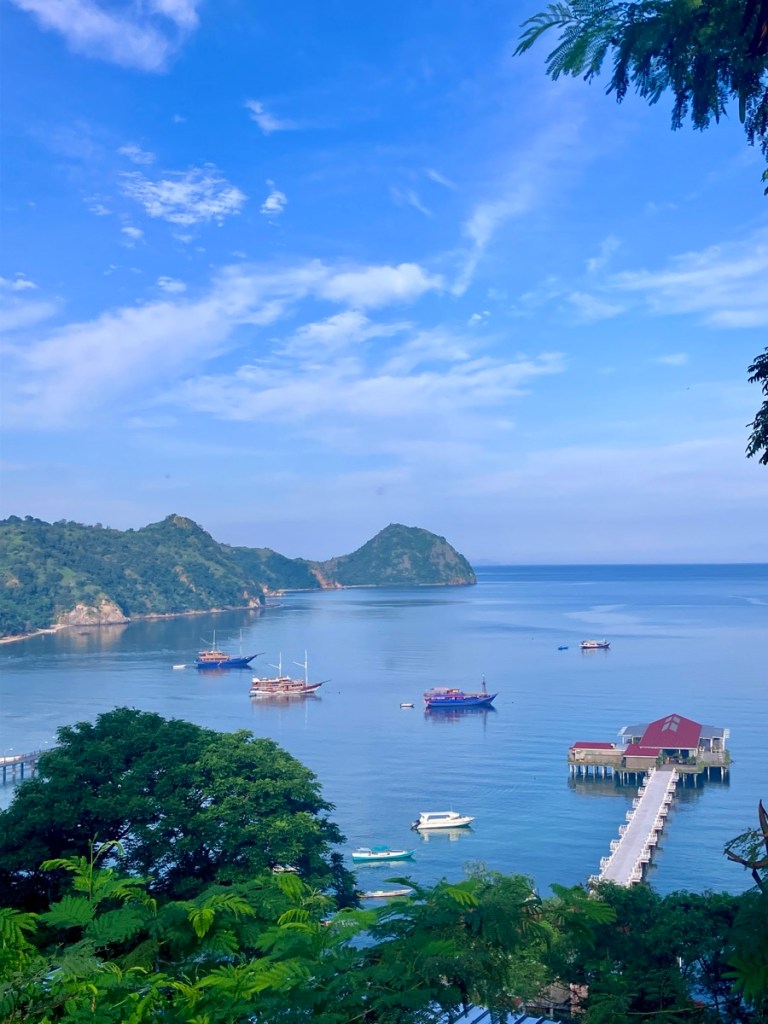
Fabian, from Germany, also headed out to the Island. He was at our hotel in Labuan Bajo, Cool Breezes, so we all walked over to the Pirate office together to board the boat.Leaving Labuan Bajo harbor, and ready to settle into the island vibe. Aaarrggh!
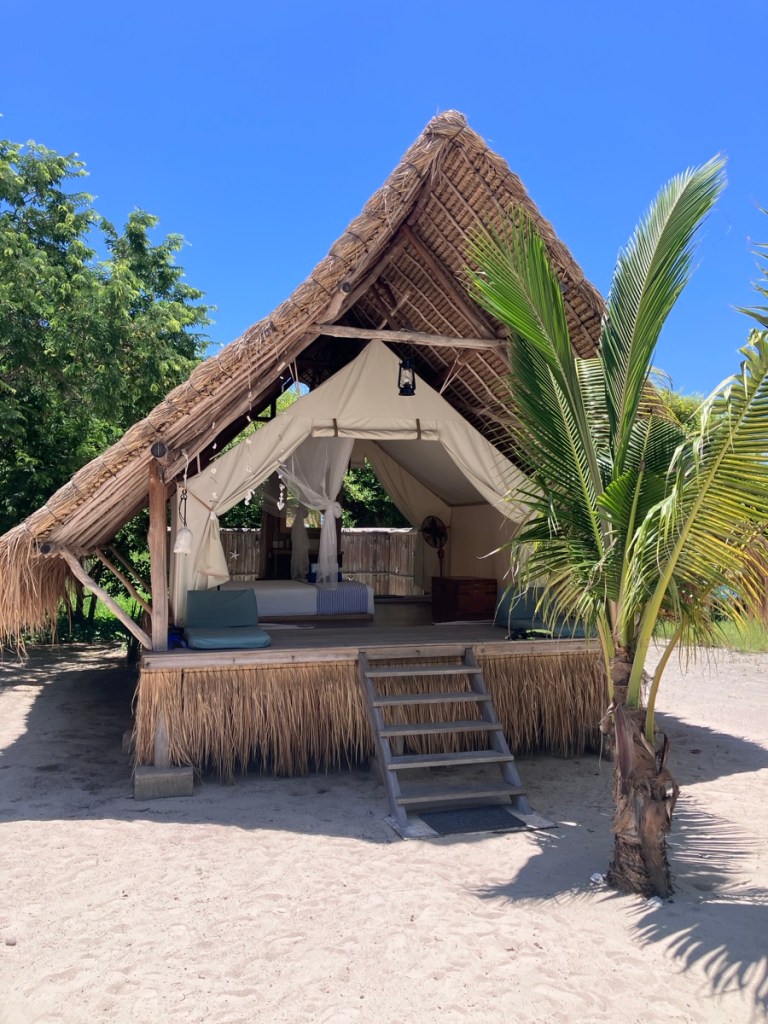
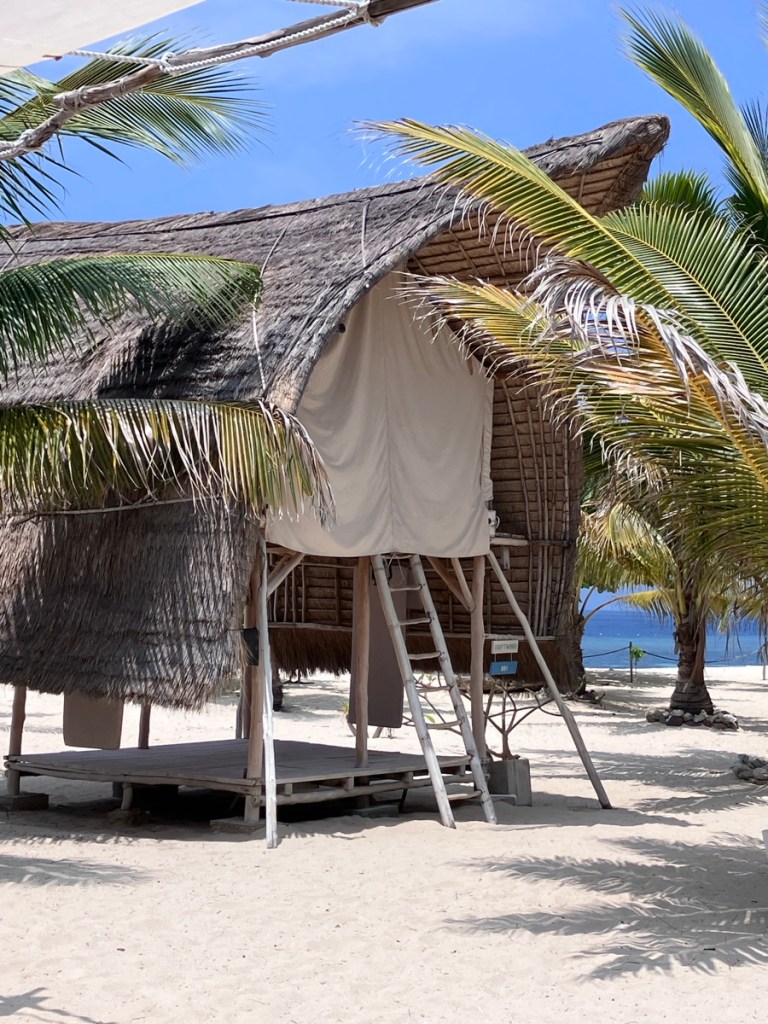
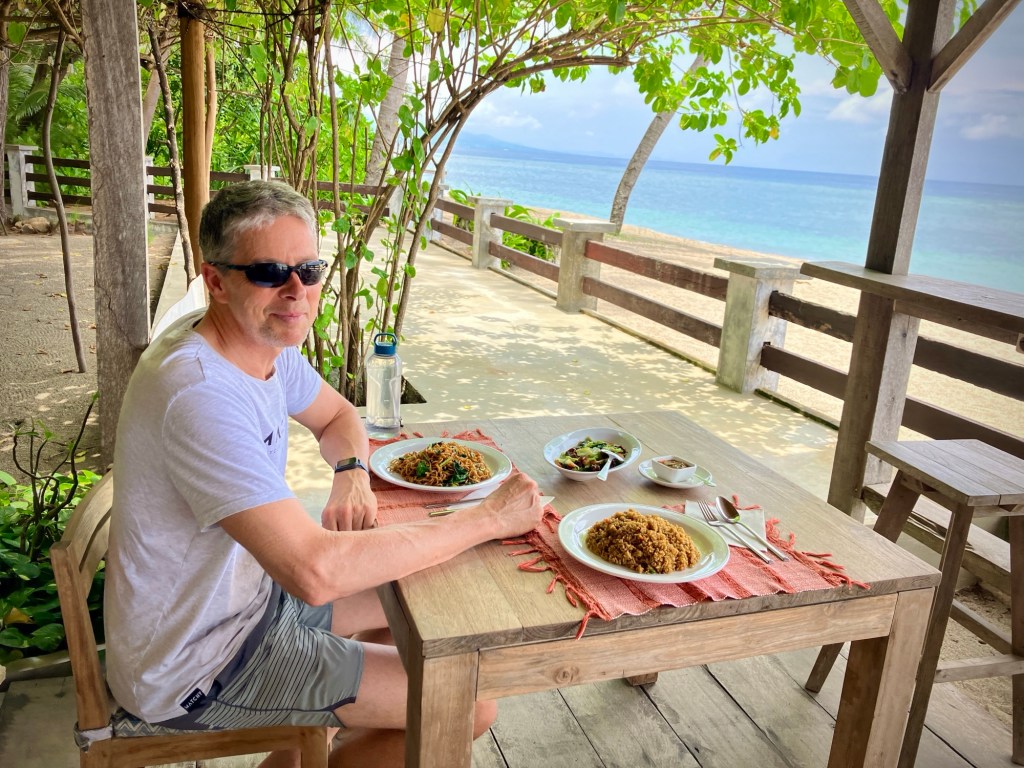
Pirate Island is like summer camp for adults. You buy a package for all meals, there is no air conditioning or hot water, and you have snorkel gear waiting at your glamping tent for you. They also arrange scuba dives. Your tent has a fan, and when we stayed you could turn it on all day and night, but since the island is only powered by solar, in the busy season we read that the fans and the electricity may not be available all day. We brought headlamps which meant we didn’t need to turn on the overhead lights in our tent if we didn’t want to.
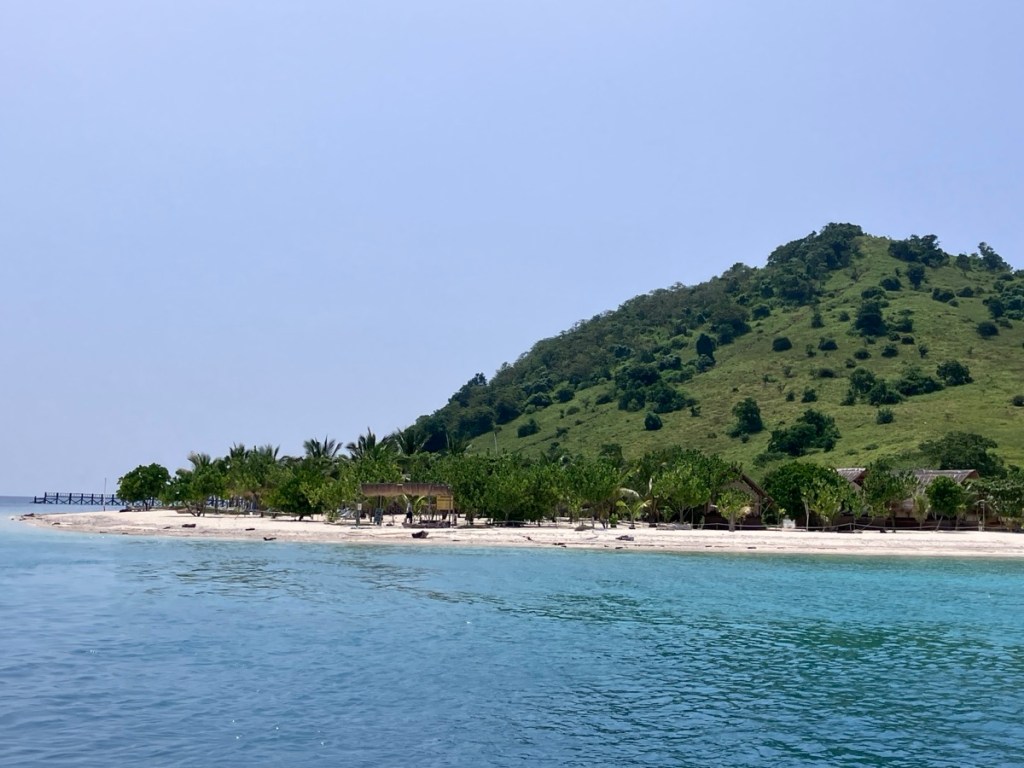
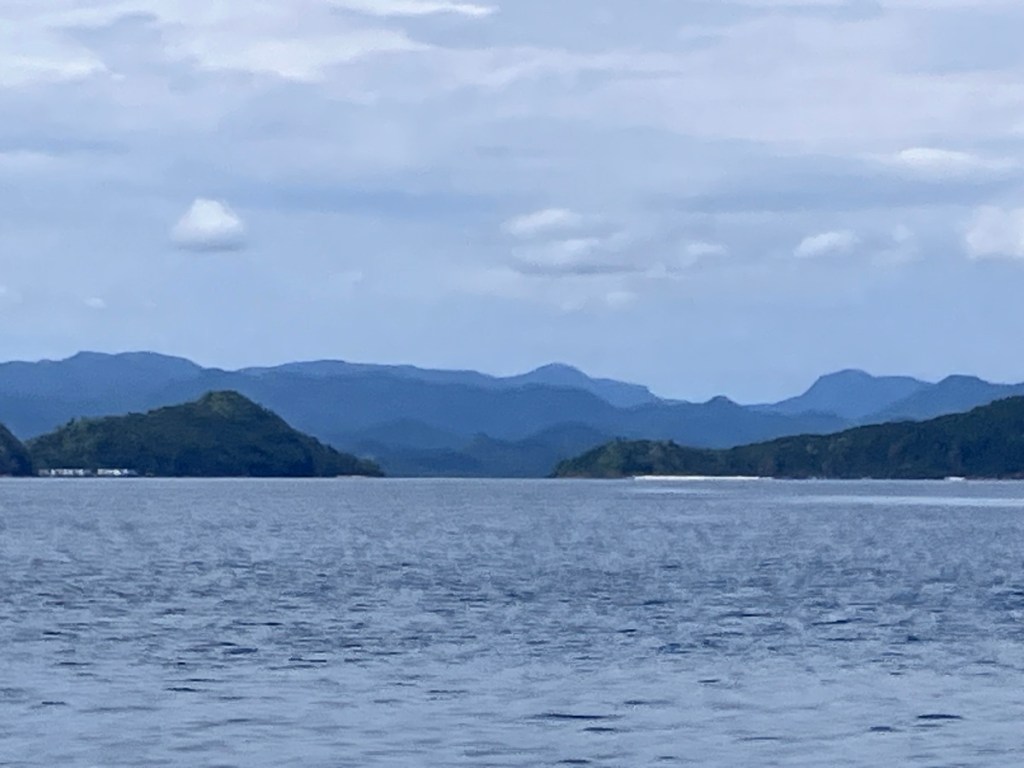
Leaving LB and admiring the mountains of Flores Island.After a boat ride of a little less than an hour we arrive. Welcome to Pirate Island.
Rich and I are just the age to keep making allusions to and jokes about Fantasy Island, Survivor, and White Lotus.
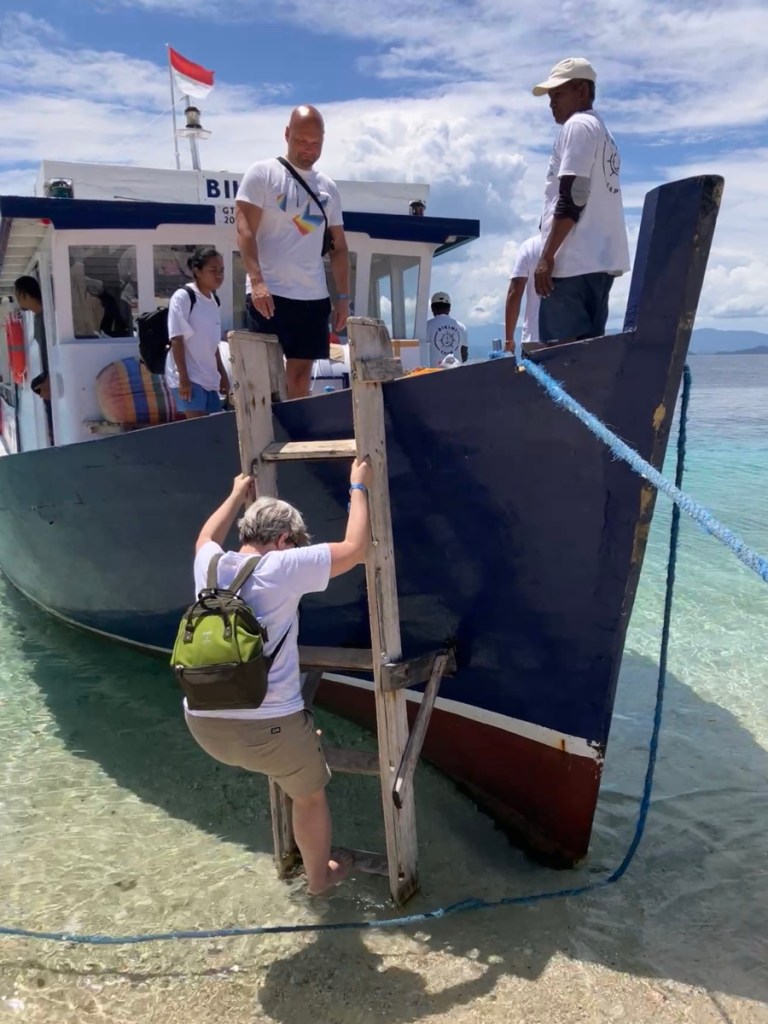
The boat which arrives once a day bringing new guests. It’s a shallow water disembark. The lovely staff bring your luggage and shoes off the boat for you.
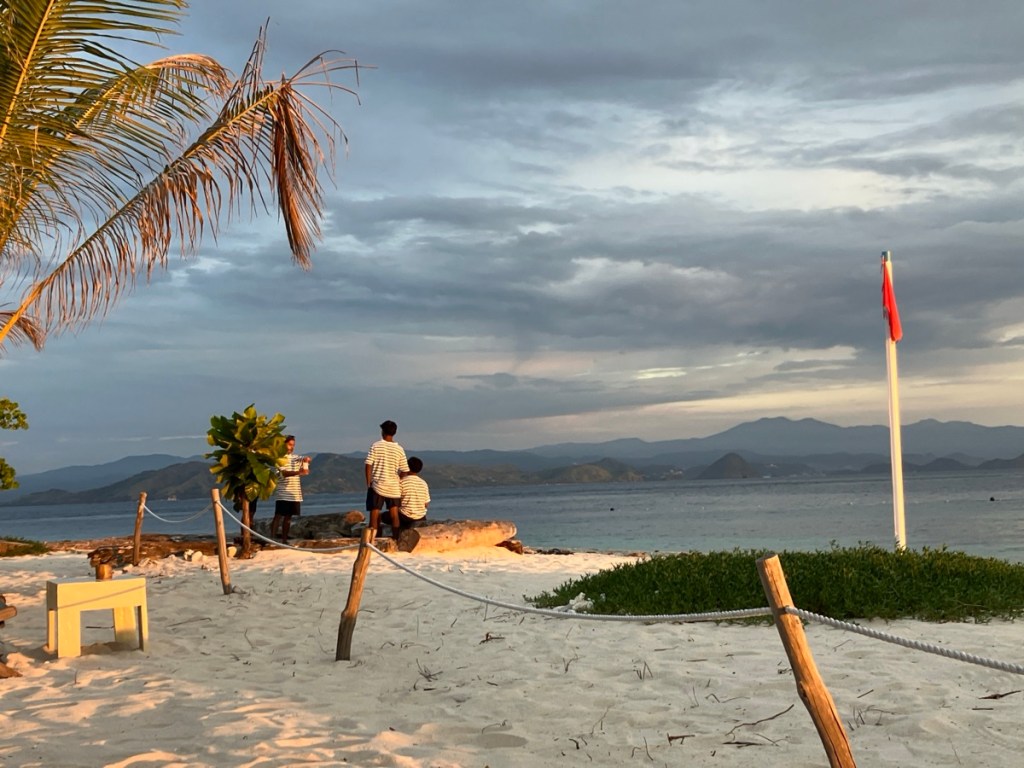
You start your stay with a welcome drink and an orientation by staff. There is a map to show the snorkeling area, and a red or white flag for when you can snorkel from the beach (white flag high tide), or when you should walk out the jetty (red flag low tide.) Then the lunch buffet (you preorder your choice of main), and check in to your tent.
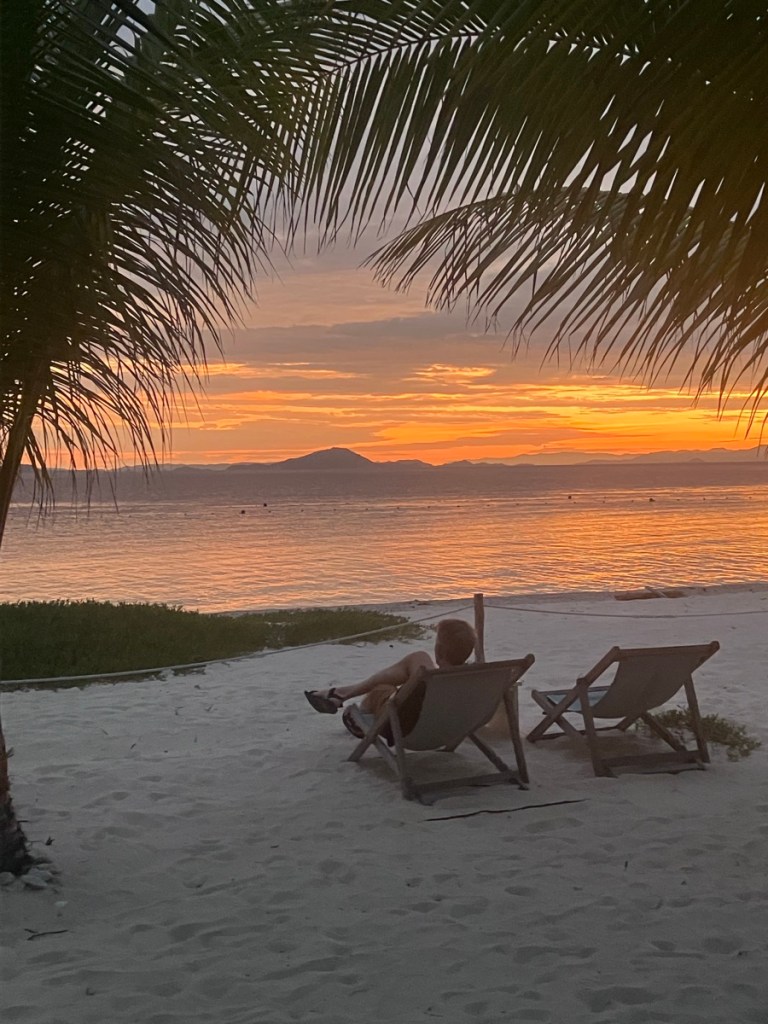
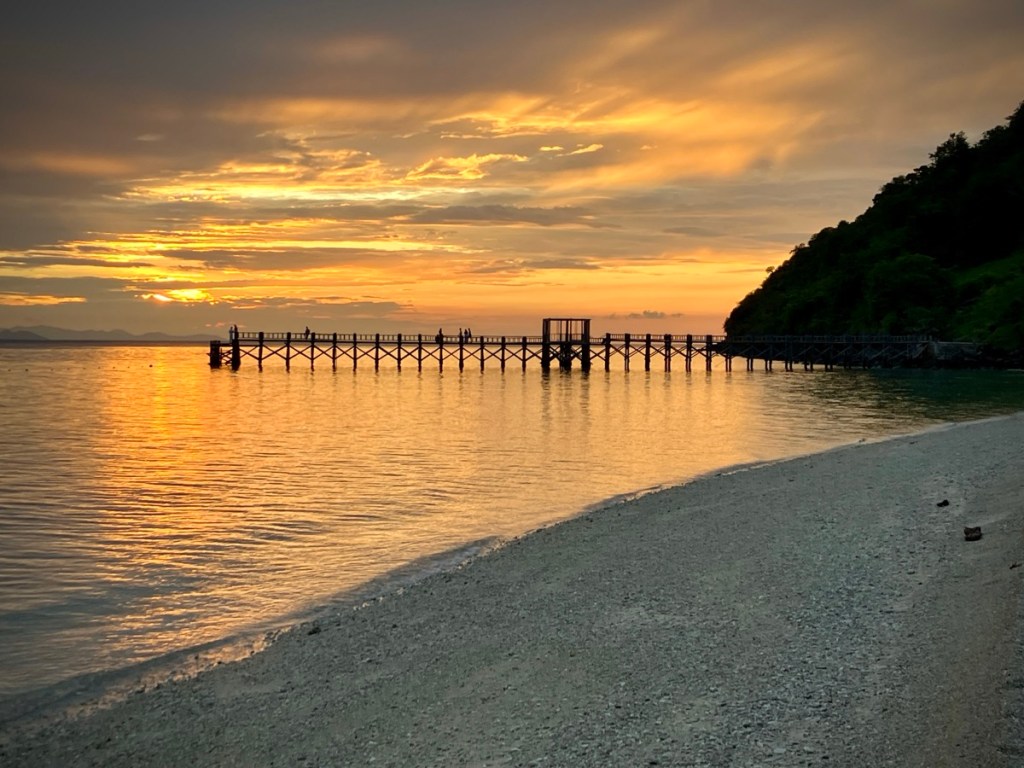
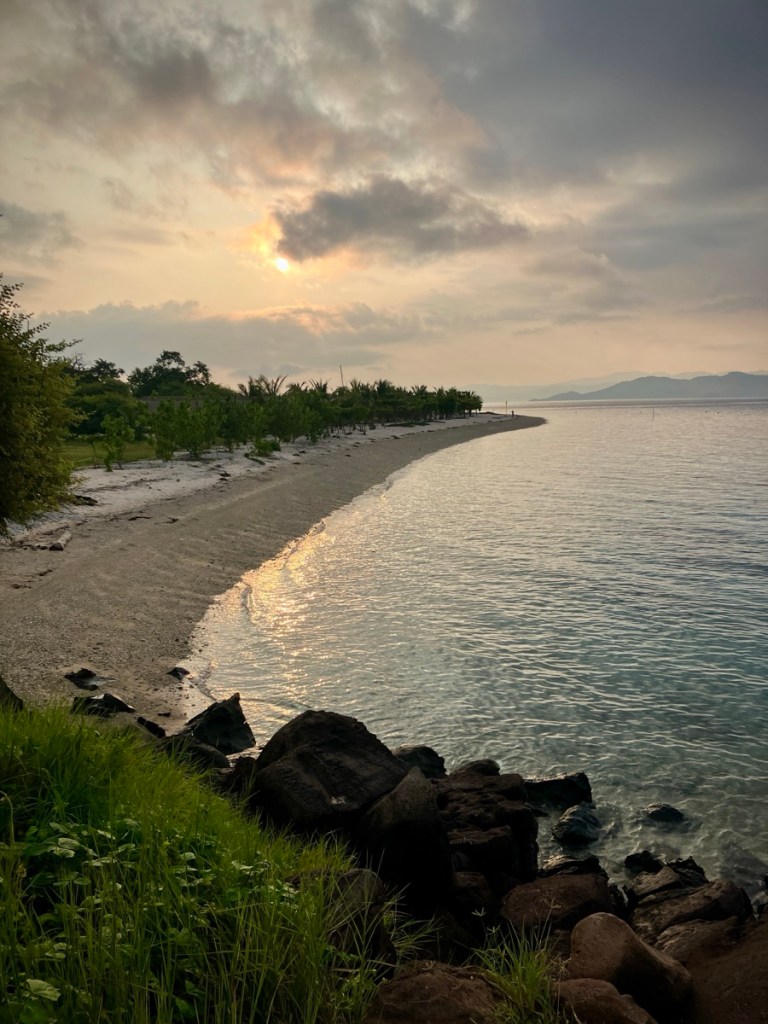
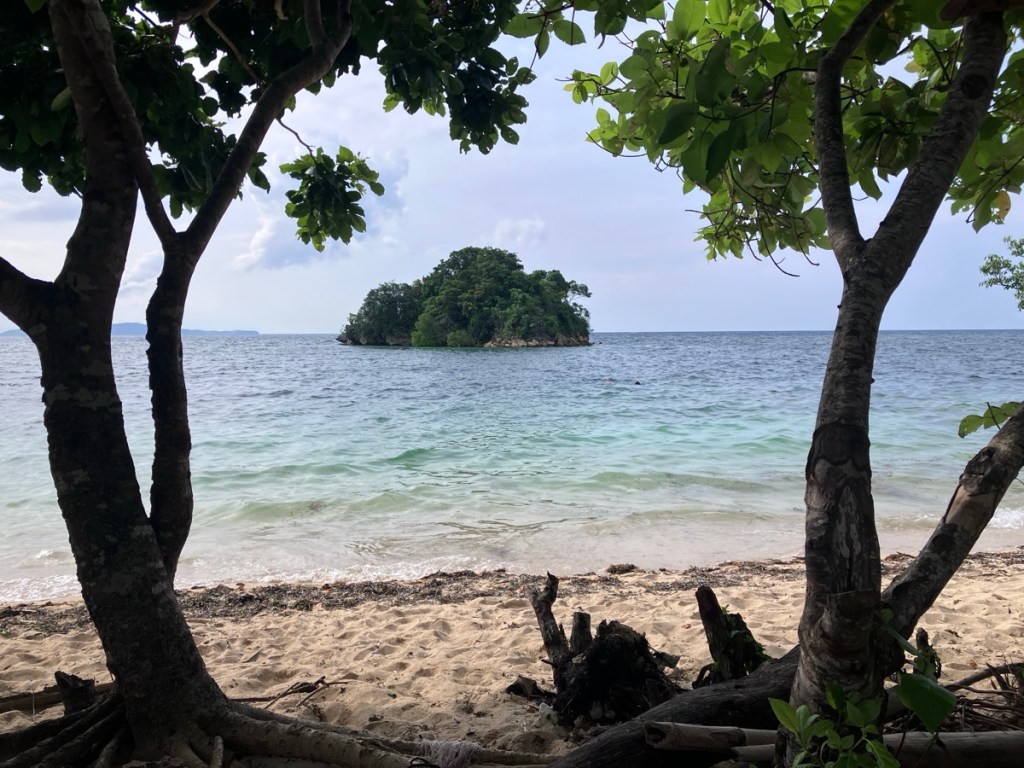
Our tent. Rich chose sunrise beach, so we got morning sun and then nice deep shade in the afternoon. Our own private bathroom. Relaxing and enjoying the view.The beach aesthetic is lovely. Ready for sunset!The sunset is getting dramatic.Let the relaxation begin. Our first night of two had the most dramatic sunset.Even the staff were out taking golden sunset light photos.A few people watched the sun set from the jetty.Final dramatic moments of the sunset.
The open air dining and hang out spaces were comfortable and had fans blowing a breeze. We had dinner at tables with other folks, but there were plenty of tables at which couples could be by themselves. Did I mention that Pirate Island is adults only? No guests under the age of 16.
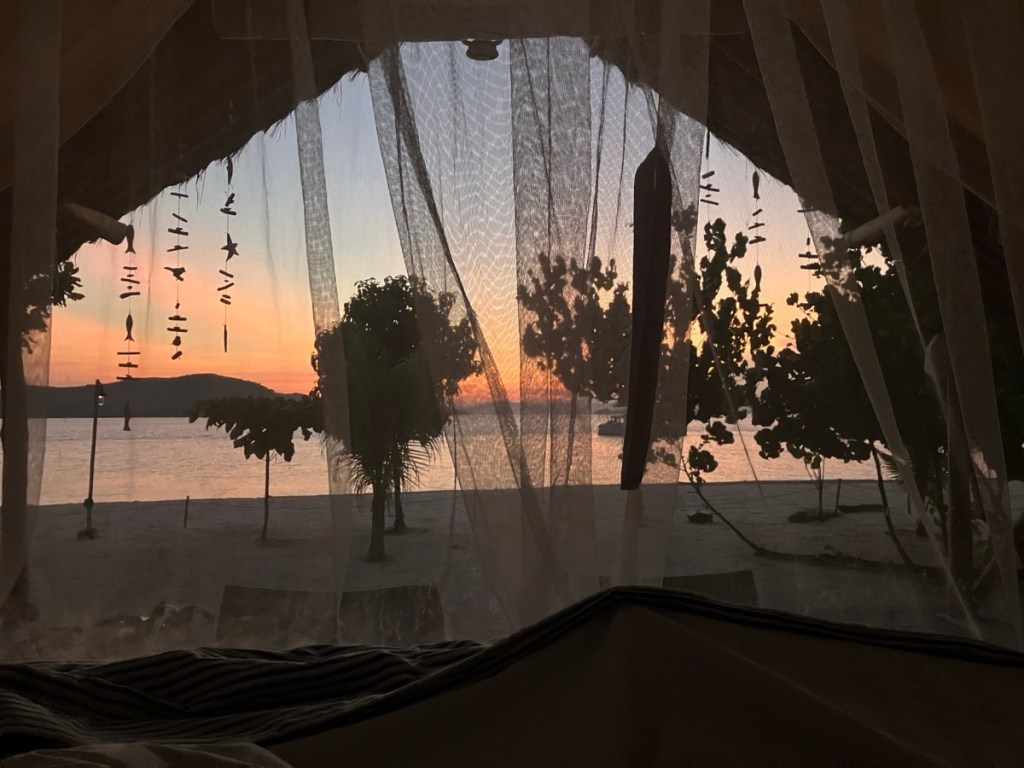
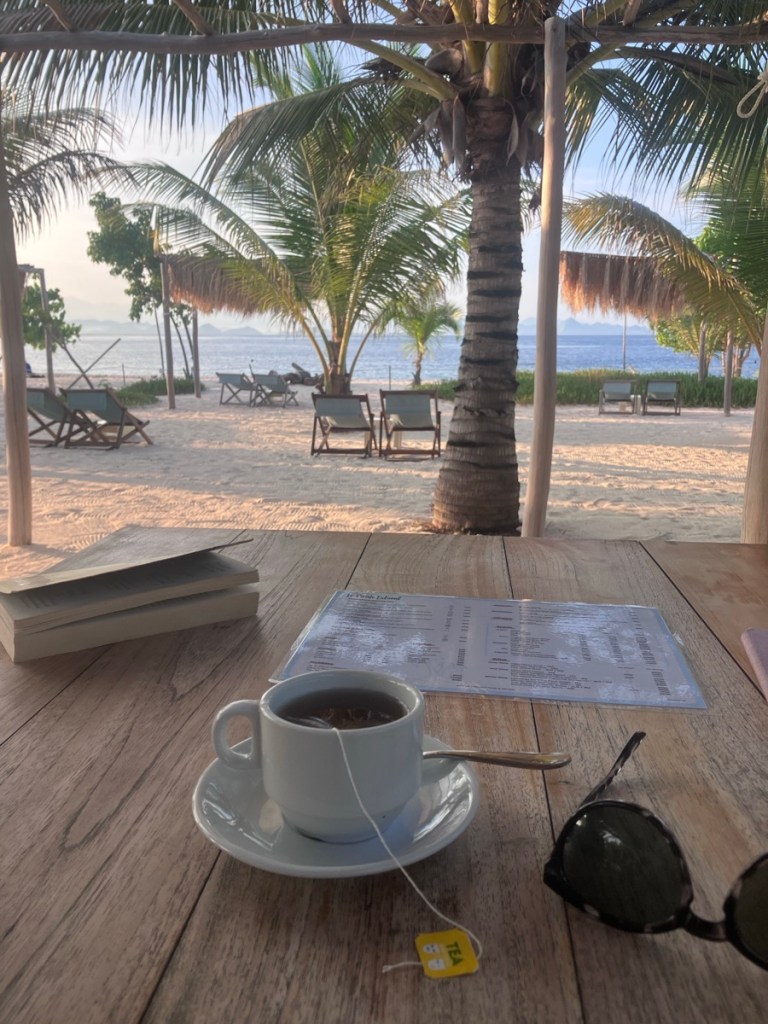
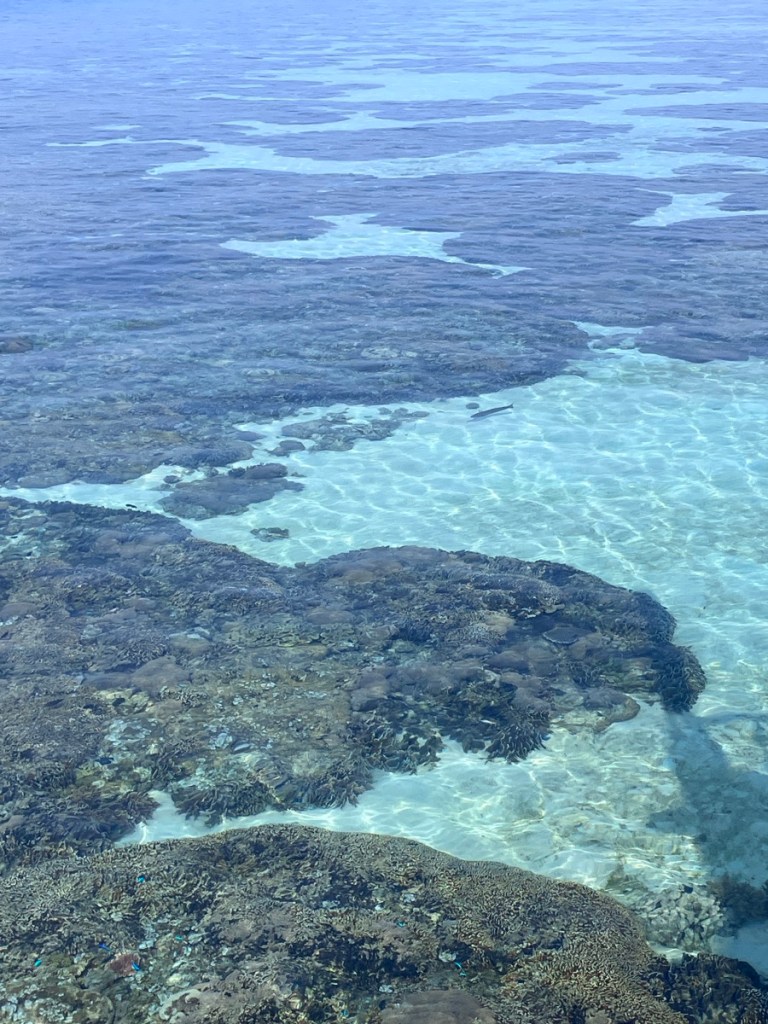
Sunrise from our bed. There is a mosquito net. If you prefer not to be woken by the sunrise you would lower the tent flaps, but then you wouldn’t get the nice ocean breezes at night.We let the sun wake us for a six am swim.Coffee and tea are available from about 6:30 am to 9 pm.Super clear water, this is taken from the jetty.
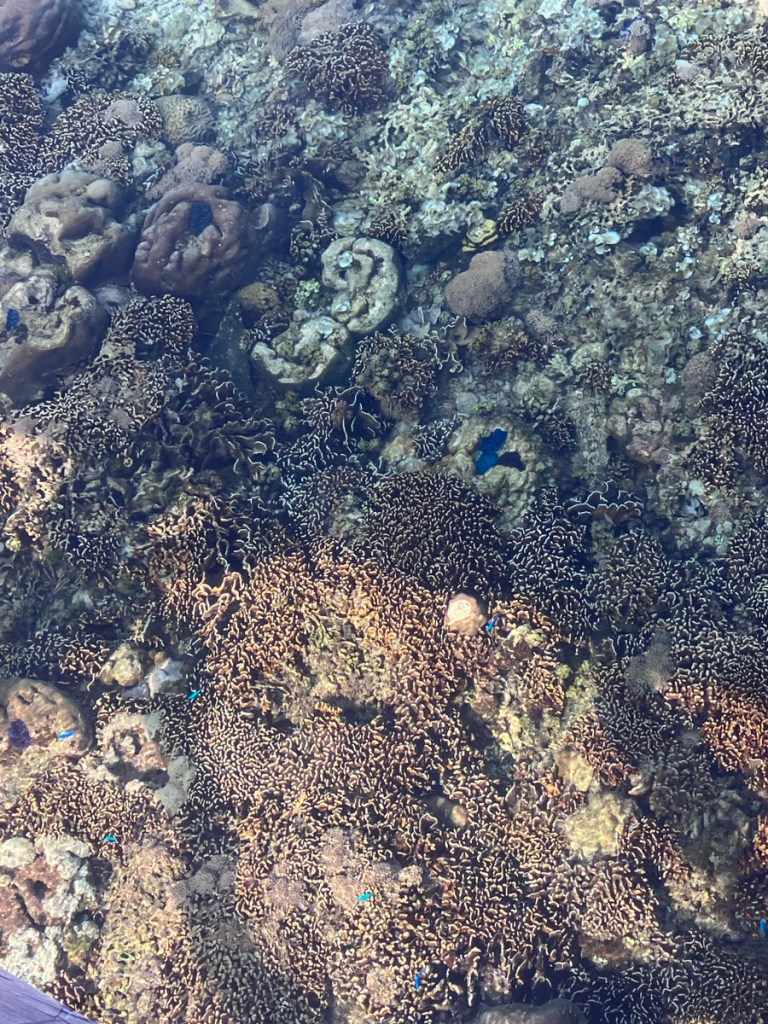
The resort is working to protect and restore the coral reefs. Indonesia suffers from dynamite fishing. Apparently still a challenge to stop. When you snorkel you can see the newly started coral on wire frames. We always like to support tourism that celebrates natural beauty and wildlife as a way of preserving it.
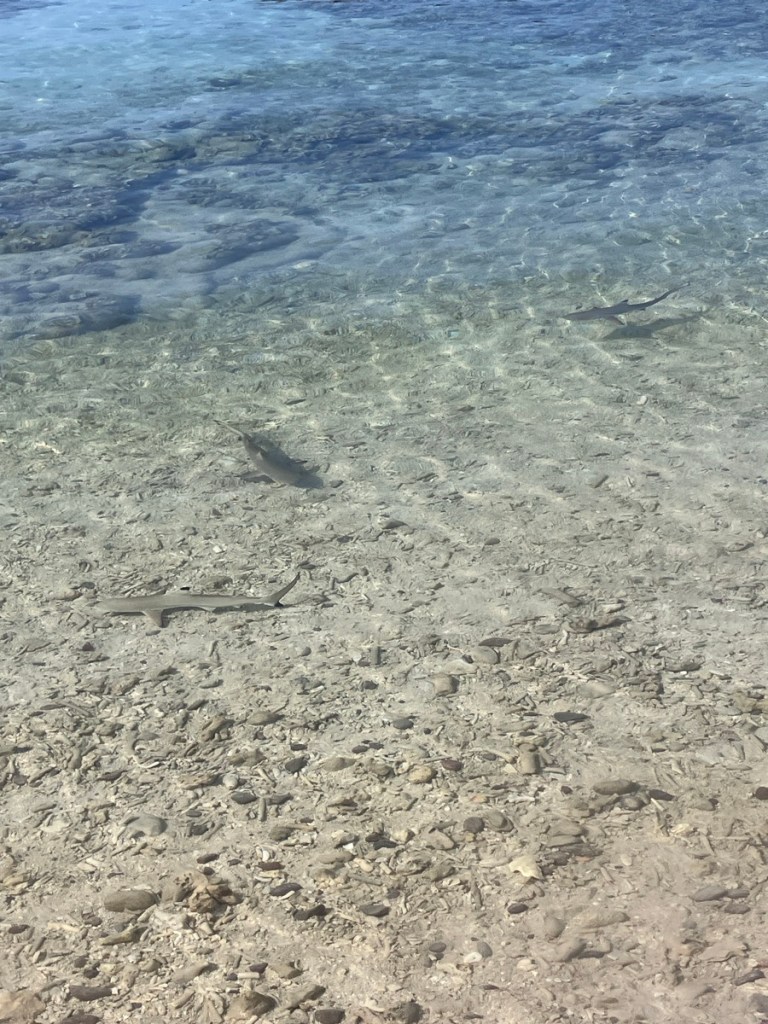
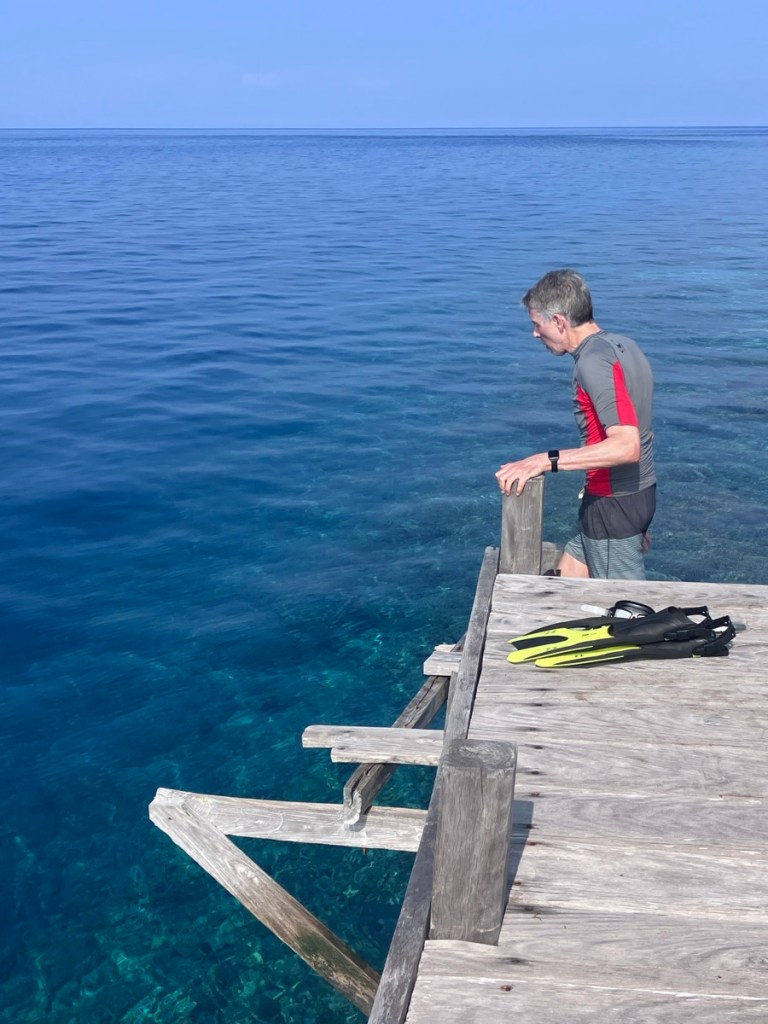
Looking down from the jetty.Baby black tipped reef sharks cruising the shallows.At low tide you start your snorkel by jumping from the jetty. I would have preferred a ladder but it got the job done.Rich went first, I tossed his gear, waited, and then tossed my gear and jumped. Ok, it wasn’t that fast. I had to psyche myself up a bit to jump.
The snorkeling was fantastic, especially at higher tides when you could pass over the entire protected coral area. Massive schools of fish all around and a huge variety of colorful species. Not to mention turtles and sharks.
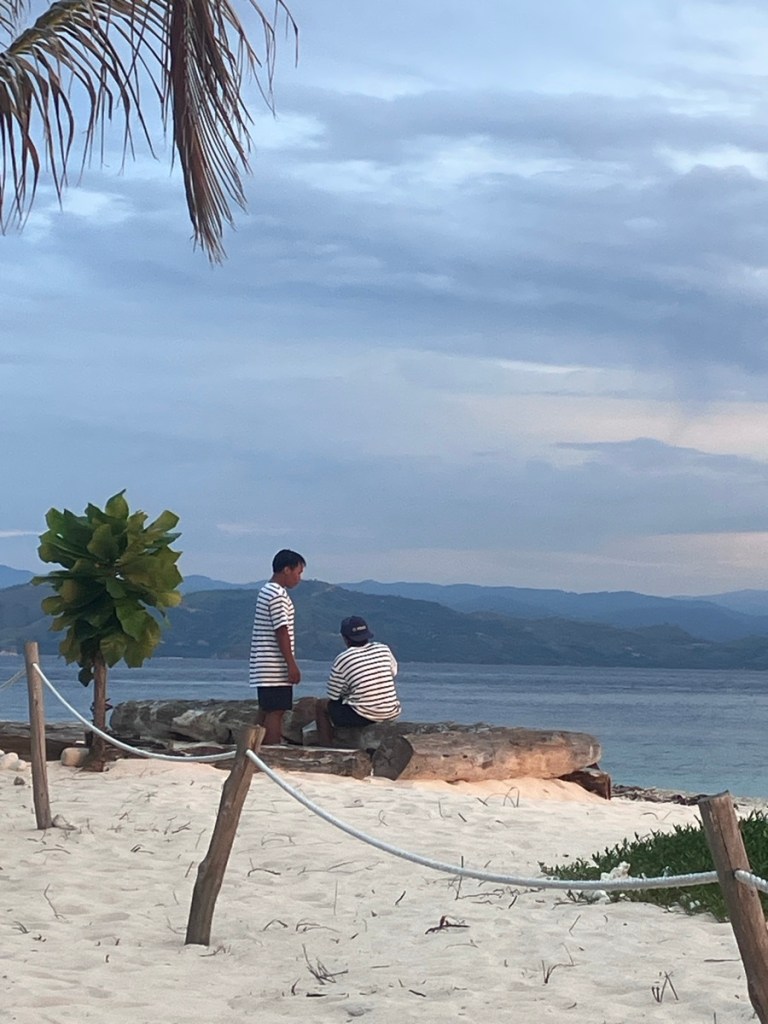
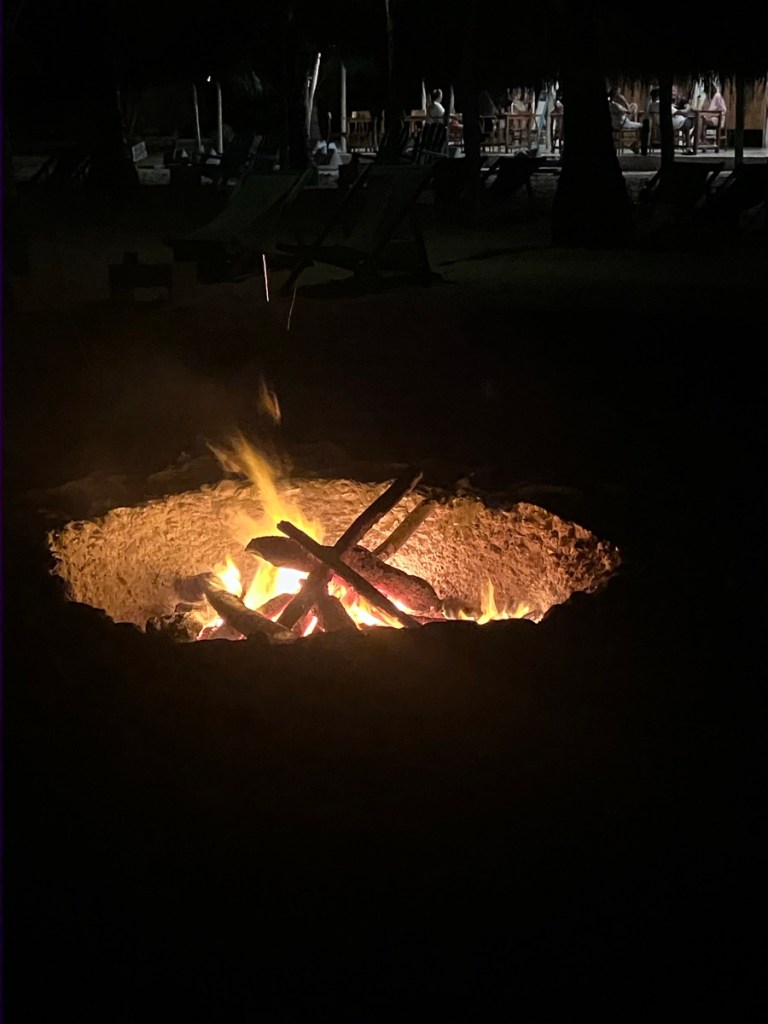
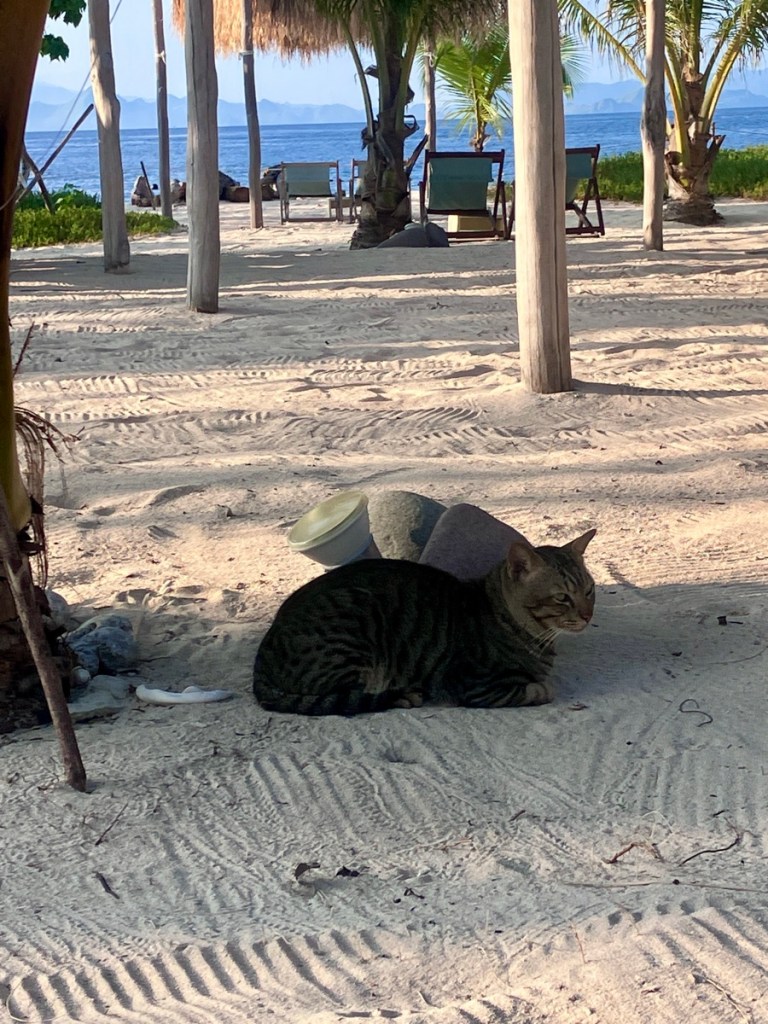
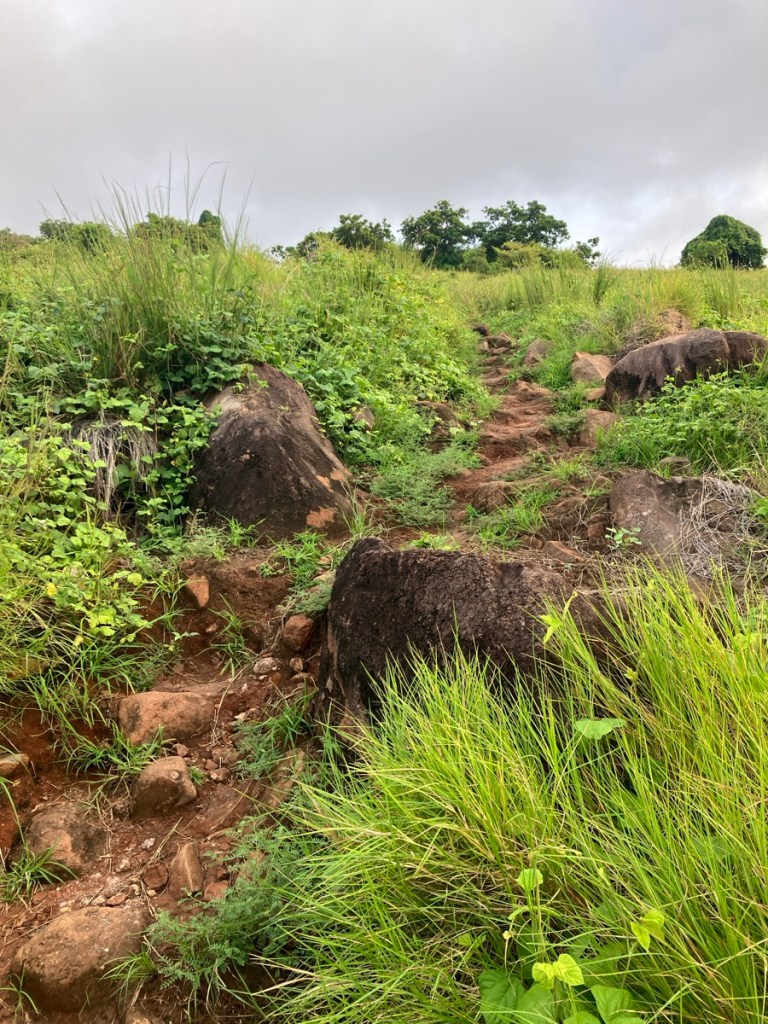
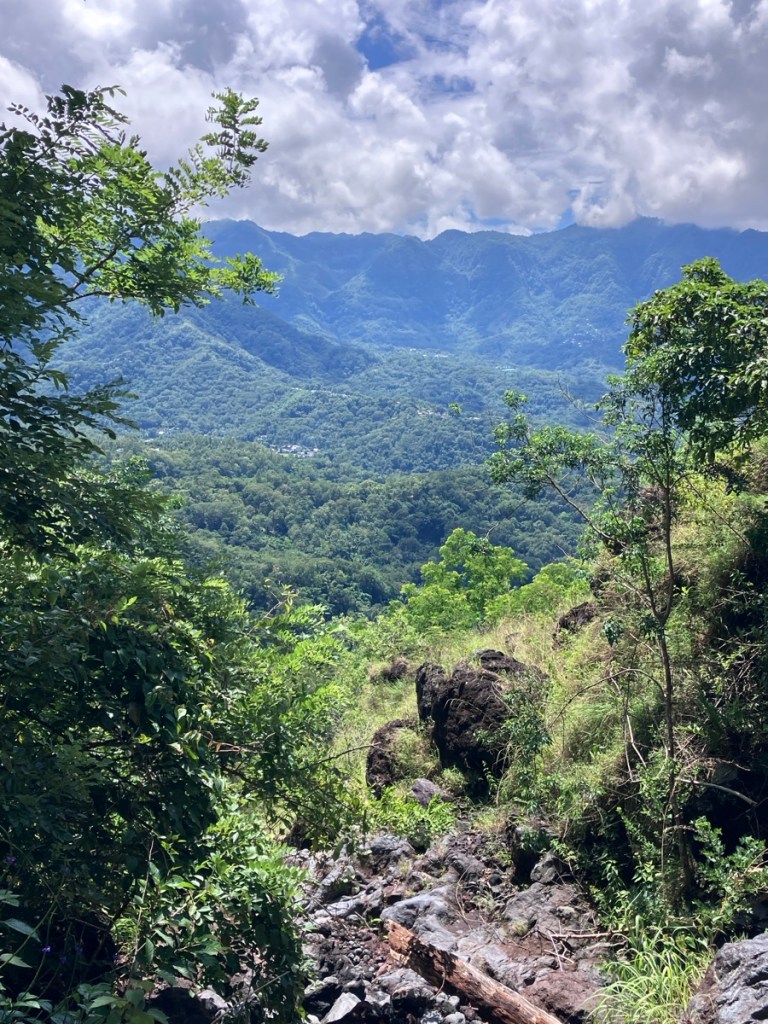
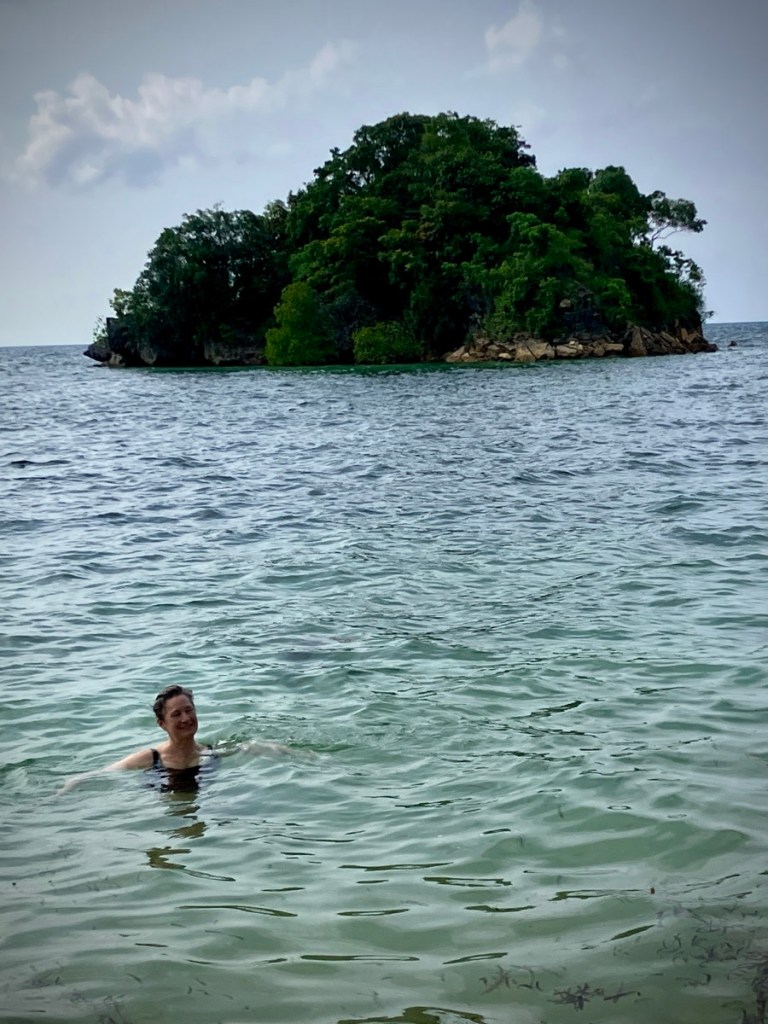
One of the smaller tents, more budget friendly and using shared bathrooms.All the staff wore cute blue striped shirts and were super helpful and friendly. From 7-9pm each evening was either a movie or a bonfire sing-along with a talented staff guitar player. Seriously like summer camp for adults. It’s always interesting what songs a diverse age and nationality crowd all know. Bob Marley. Yes. Fiona Hill. Yes. Local Indonesia songs, no but so fun to hear.The resident cat, named Grande. Waking from his afternoon nap.Not to be confused with his morning nap.Or his early afternoon sit and stare.Our final morning Rich climbed the hill.He started out with cloud cover.The jetty and a few land sightings.The climb up a rocky trail got him a good view.The sun came out. Ready for another swim. It was hot and humid.Sad to be leaving. Such gorgeous water.Goodbye Pirate Island, two nights was perfect for us.The happy travelers. Up next: Vietnam.
Being driven around is not our ideal way to travel. But Flores Island, with its one National Road and many smaller off shoot roads to attractions and villages, has only a few motor driven options. Scooters are obviously the first choice among locals, but we’re not scooter or motorcycle competent and these roads would be a bad place to learn or practice many folks told us. So, drivers and cars it was. Yes, there are buses, but with the bus trips you can’t stop and enjoy the view or take photos, and apparently they go as fast as they can which makes for a bumpy ride. Not good for anyone prone to motion sickness. We did spot a solo bike tourist but didn’t get to chat.
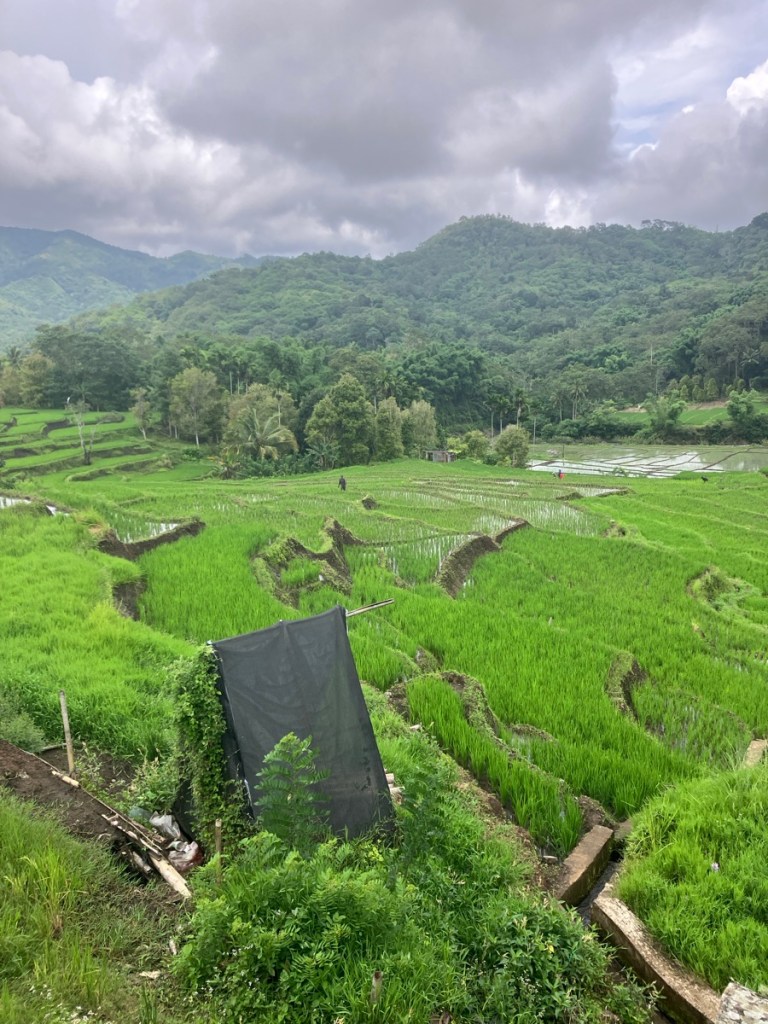
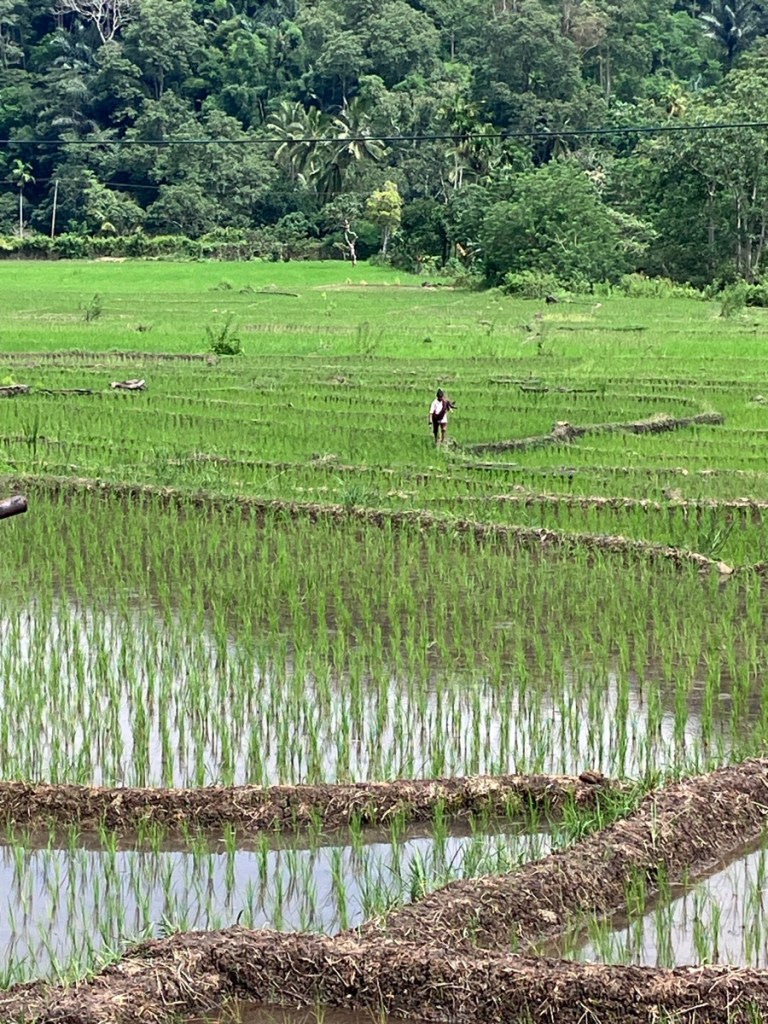
Indonesia is the world’s third largest rice producer. Rainy season means plenty of water and so much green!
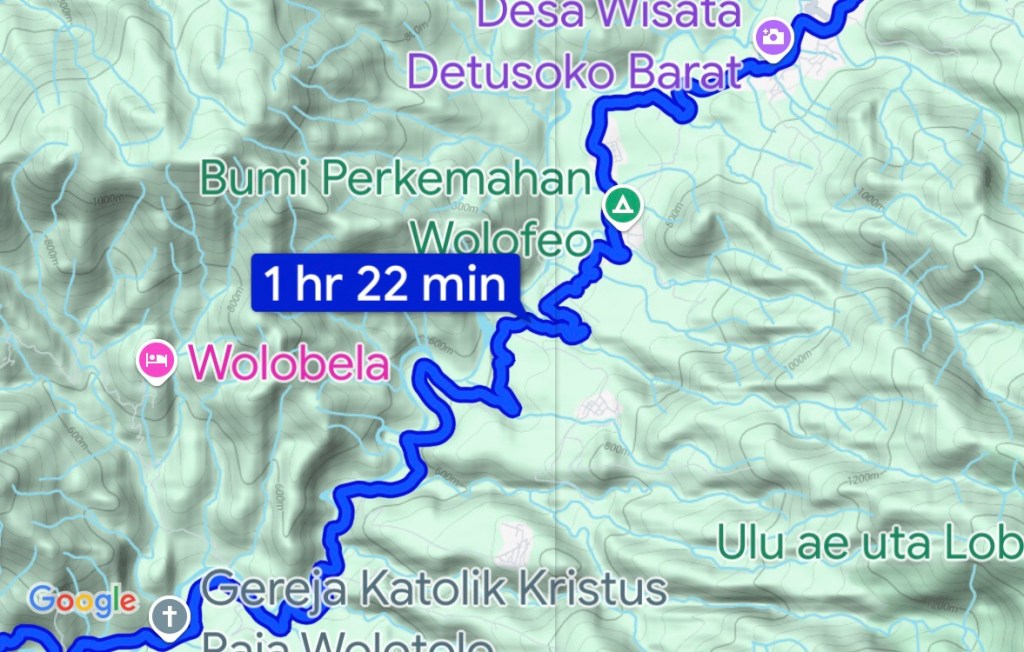
From Moni to our next overnight stay, Ende, the journey shows up on Google maps as 1 hour and 22 minutes driving time. With a few stops along the way to snap photos and have a coffee it was about 2 hours and 30 minutes. Our second driver, hired just for the day, was named Nopi, and he was a lovely calm driver. He got us to Ende in time for a late lunch.
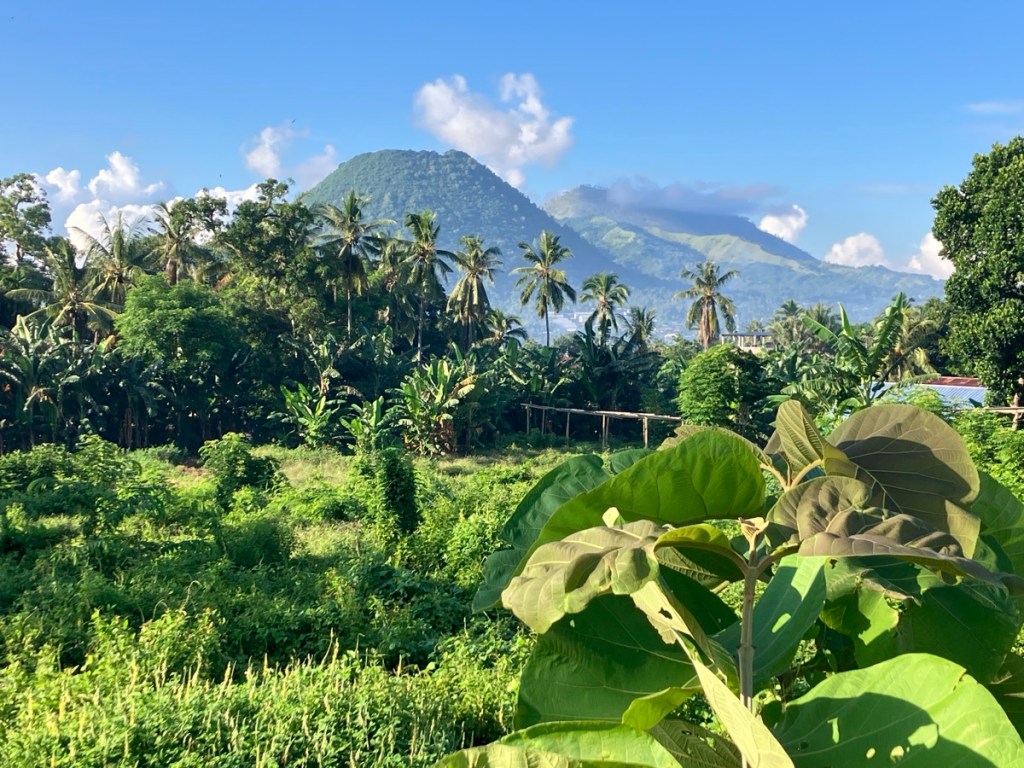
A few of the twists and turns of the National Road. This keeps speed down for sure.On the outskirts of Ende. The steep volcanic mountains are so dramatic.
Would we be able to handle days of being driven? We are so used to traveling on our own and at our own pace. Add in the heat at the stays near the coast and you have a recipe for cranky travelers who aren’t getting enough exercise.
Ende is a long volcanic slope of a town. 86f/30c isn’t too hot, but the 80% humidity gets you.A cold drink in the shaded PariKoro Resto. This great lunch stop was only a 12 minute walk from our hotel.
Ende is not a good walking town. The sun and heat, the long slopes, and the noise from traffic and scooters combine for an unpleasant experience. Until Rich got us off the main roads with a little help from MapsMe.
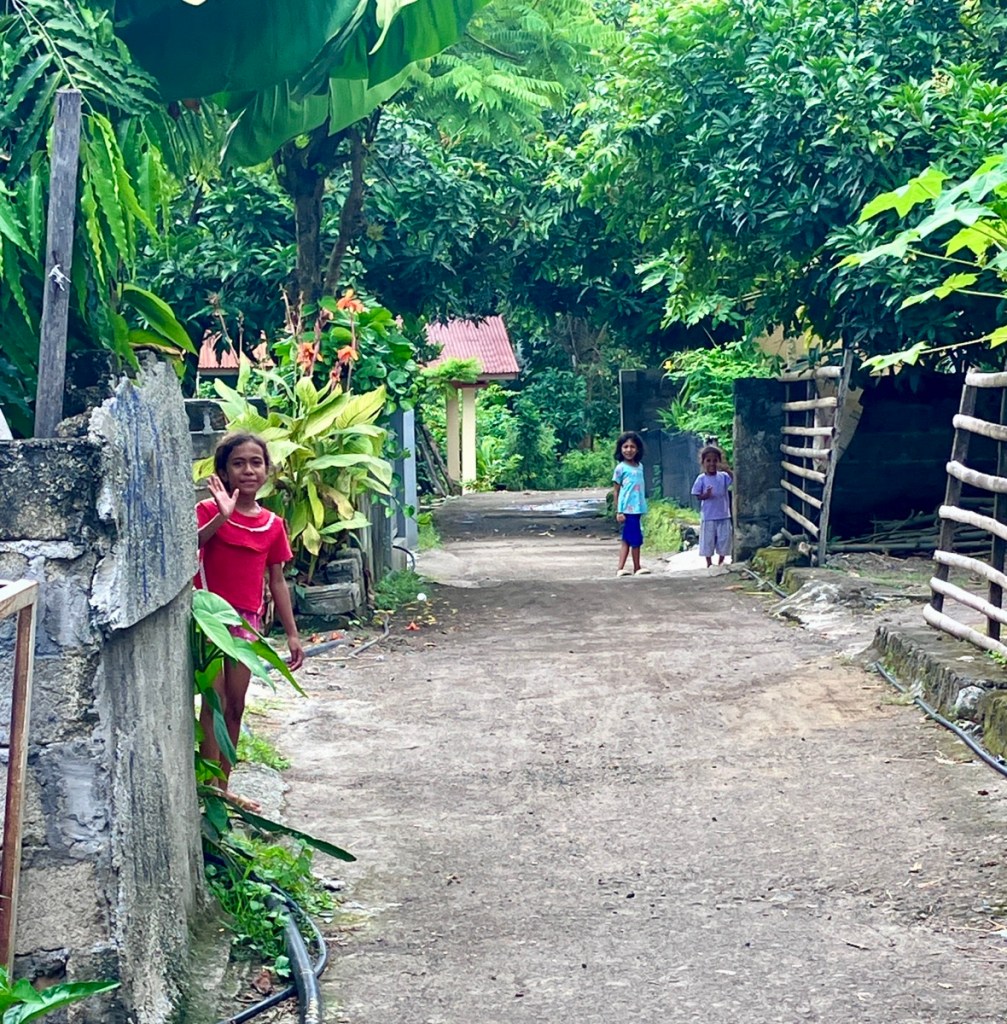
These young women were practicing a dance and chased us down for photos.And then I got a photo of the photographers.The shady small streets were scooters and pedestrian only. The kids came out to wave hello.
After just one night in Ende we were picked up by our third and final driver, Nyoman, who would take us all the way back to Labuan Bajo over four more days of driving and stops for lunch and to see sights, and one two night stay in Bajawa.
A view from town of your friendly neighborhood volcano. Flores has numerous volcanoes, 14 of which are considered active.First stop, the optical shop so Rich could get his reading glasses fixed.
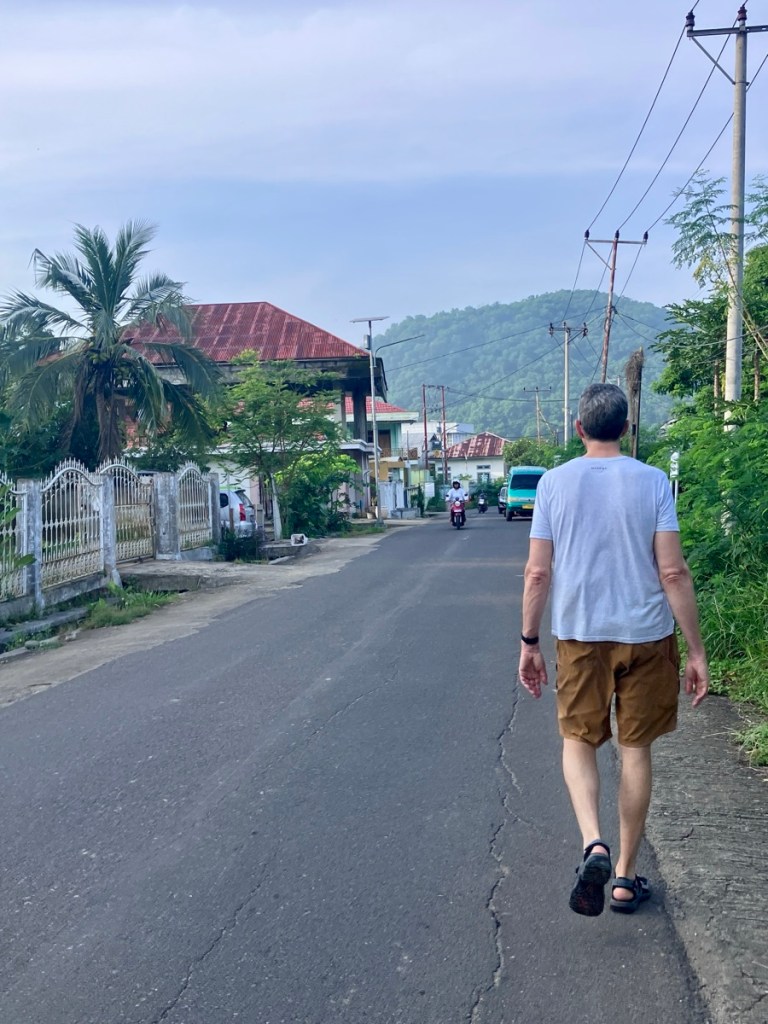
A few things made the driving not just tolerable but fun. First was of course nice, safe, calm drivers. Second was saying no to air conditioning and just leaving the windows down. Our first driver started this practice, he asked if we would be ok with no AC. Well, we’ll try we said. What a difference it made to be able to see and be seen by the locals. With the tinted windows up they couldn’t see us, and we couldn’t make eye contact, wave and say hello. And we said hello or selamat pagi (good morning) a lot! The kids call out Bulay! when they see a foreigner, or yell Hello Mister! Traveling at 30mph or less because of the twisting roads we got to see a lot. And the experience of driving along seeing the locals and the amazing jungle was unlike any other trip we’ve made.
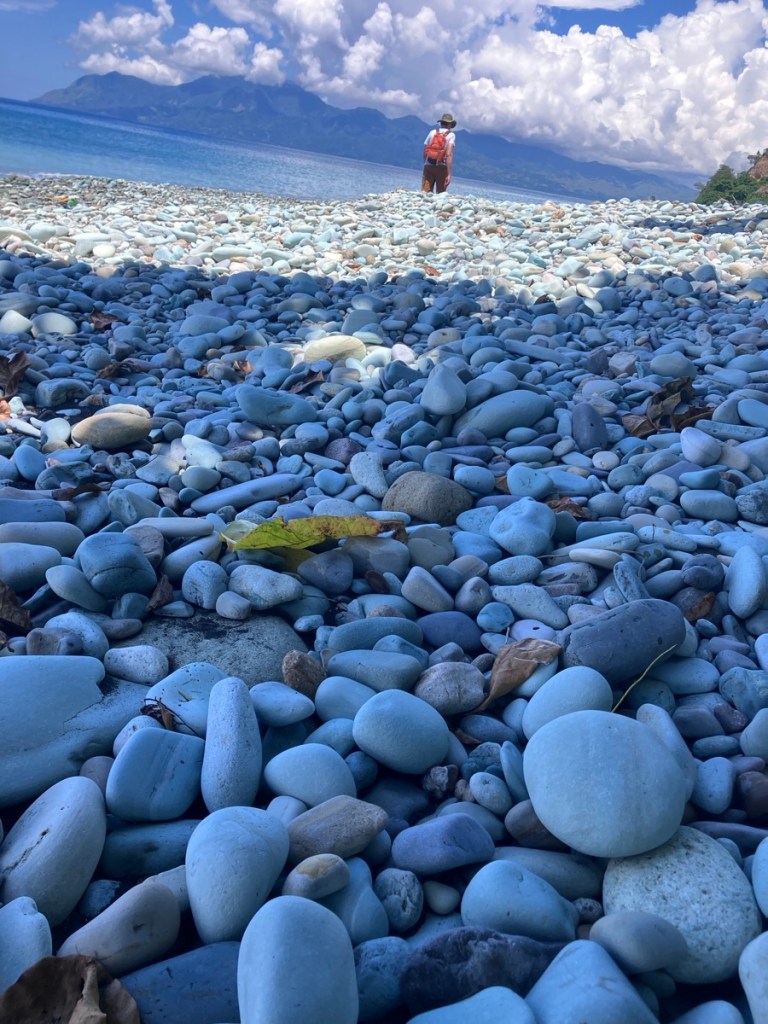
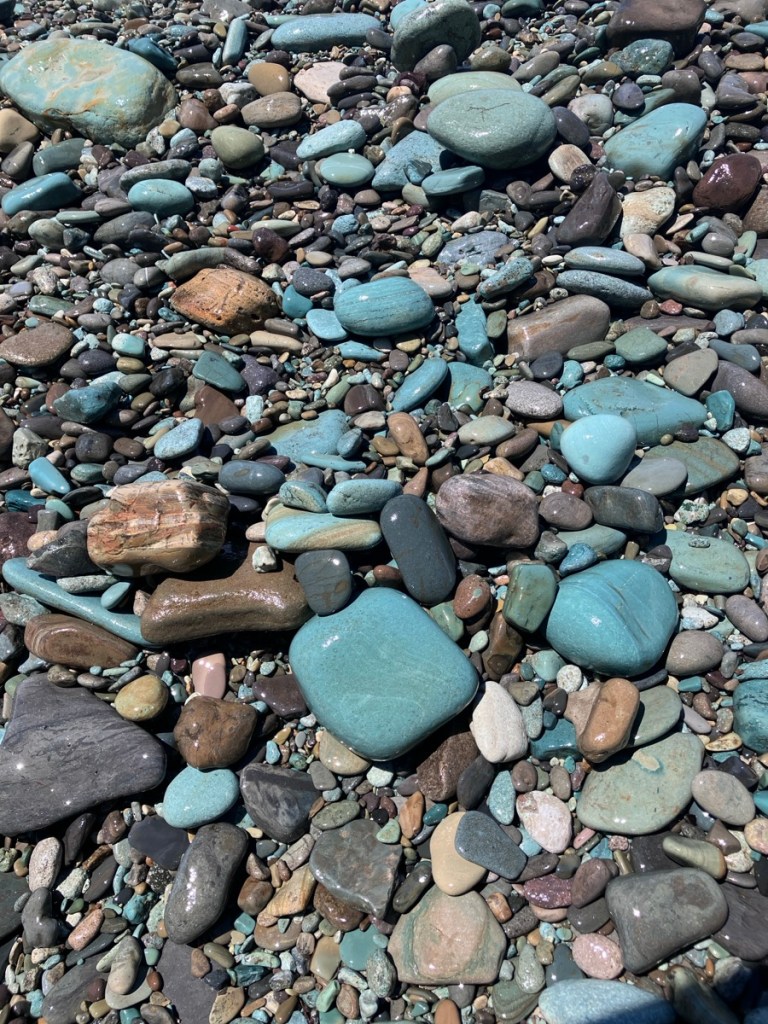
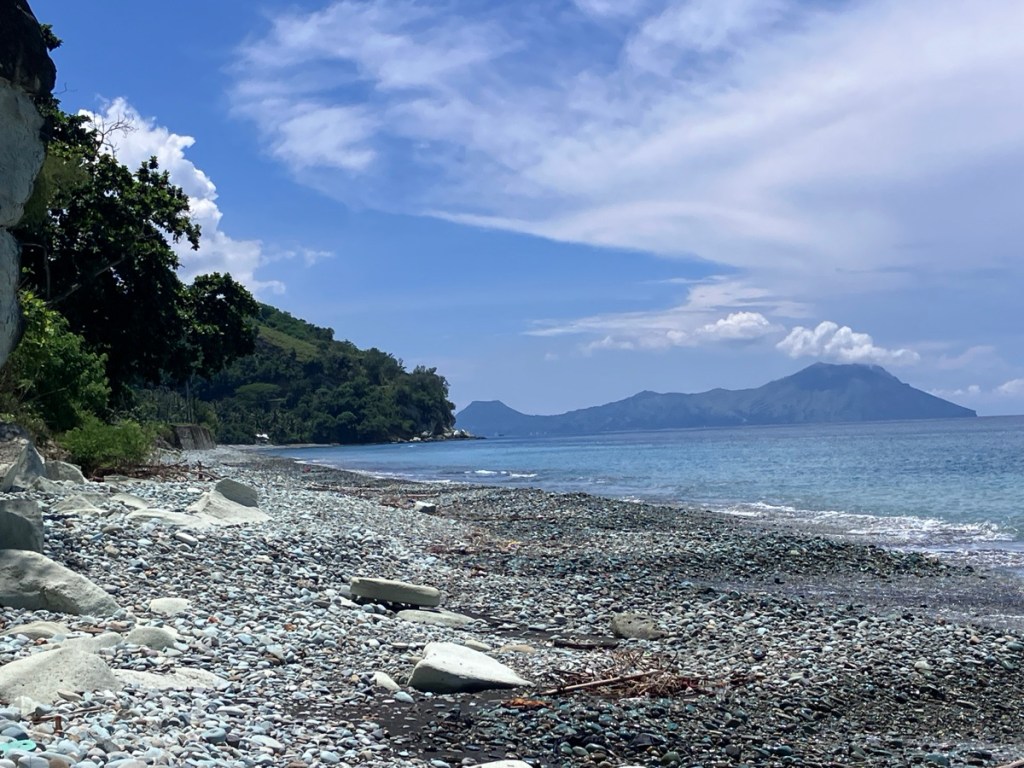
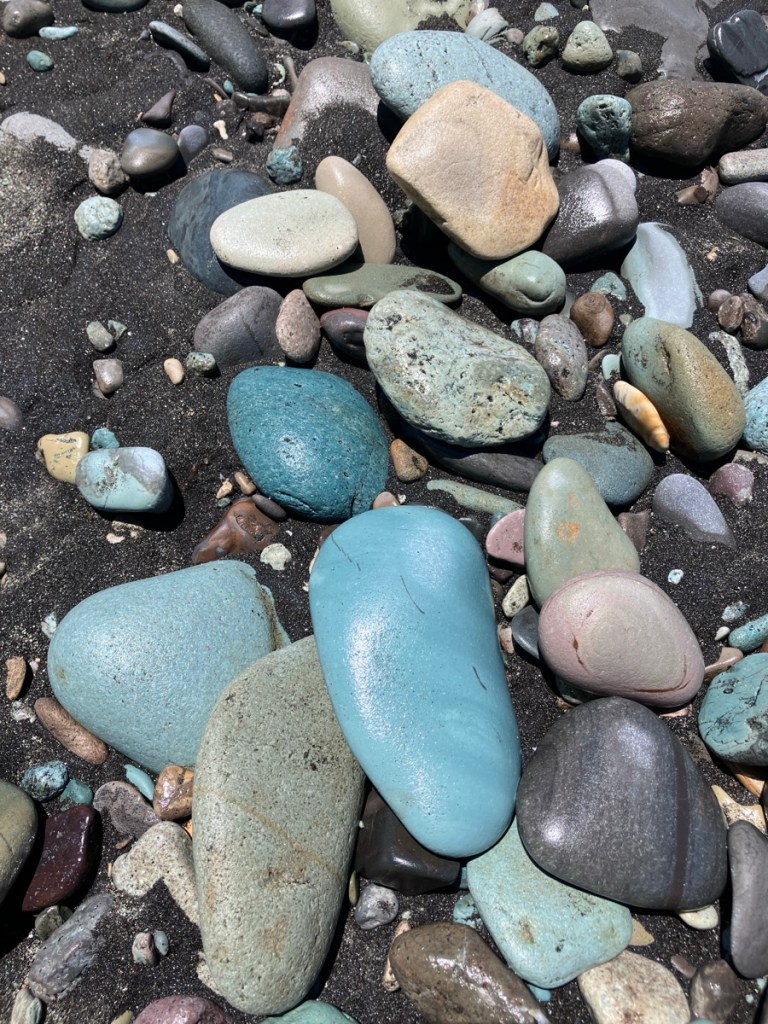
Lunch stop at Blue Stone Beach. I love my puddle of shade.When dry the stones are not so blue, more gray.But when the water washes over them! Shade break and time for viewing dramatic clouds.A view back towards Ende and some volcanoes.The blue is most likely due to volcanic minerals such as sulphides and rock-forming feldspar. So thank you for that, volcanoes.Still not blasé about volcanic mountains.
Nyoman asked if we wanted to stop by the Mangeruda Hot Springs, and although hot water didn’t sound too appealing we said yes. But first a stop at a huge regional market.
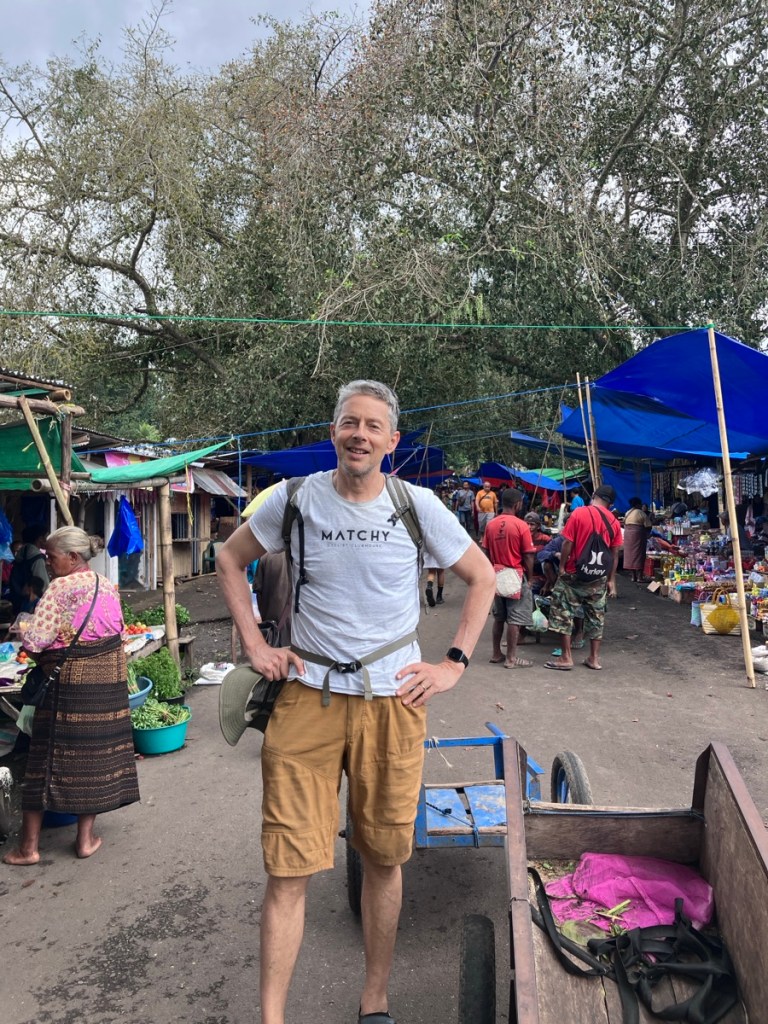
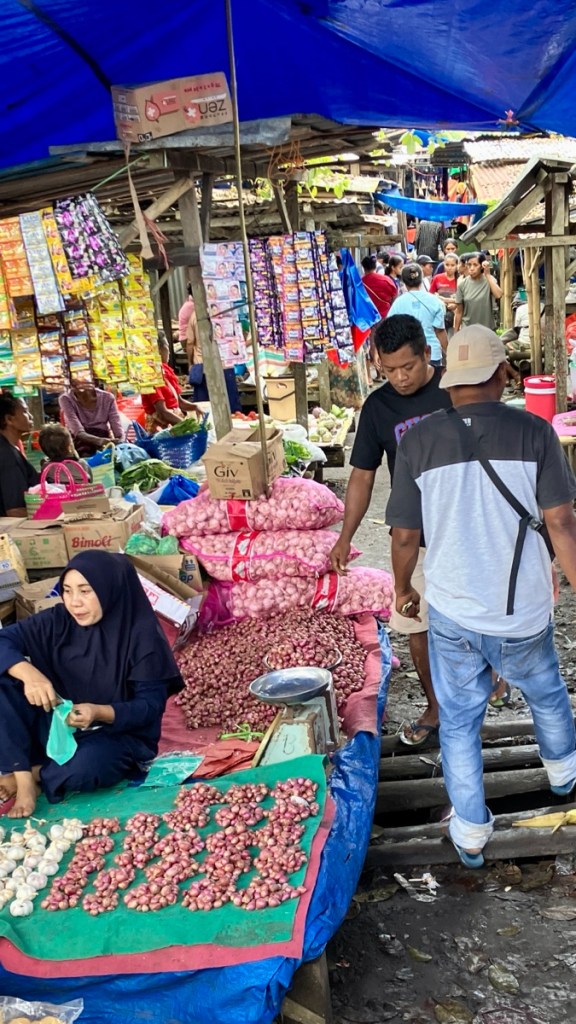
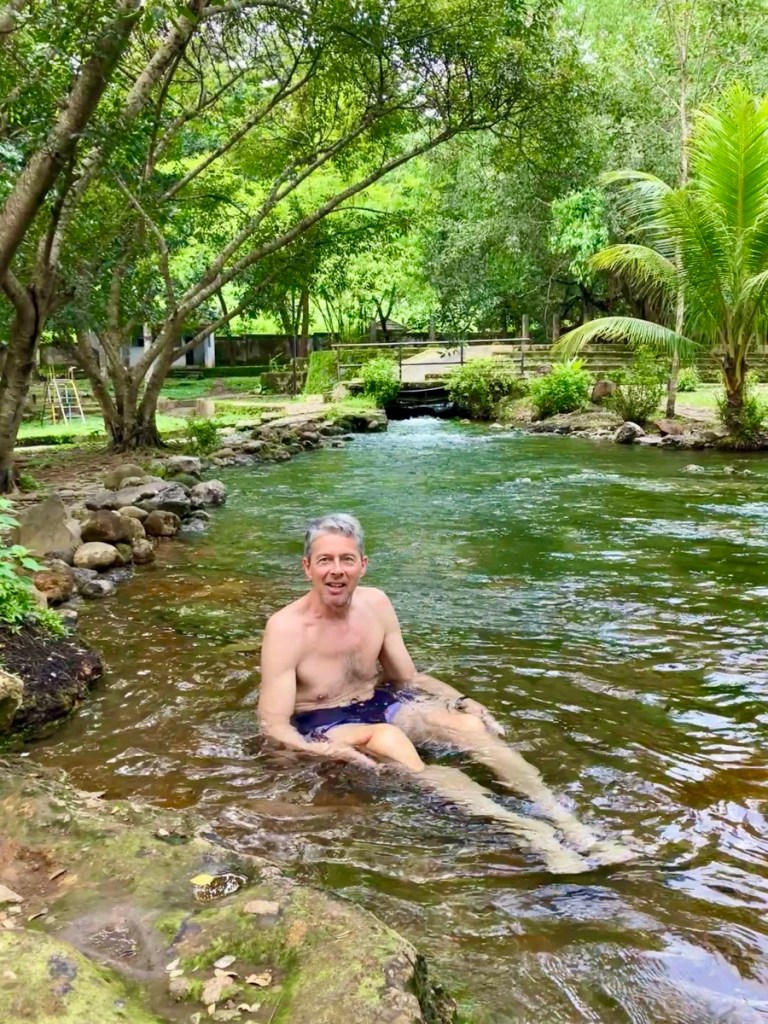
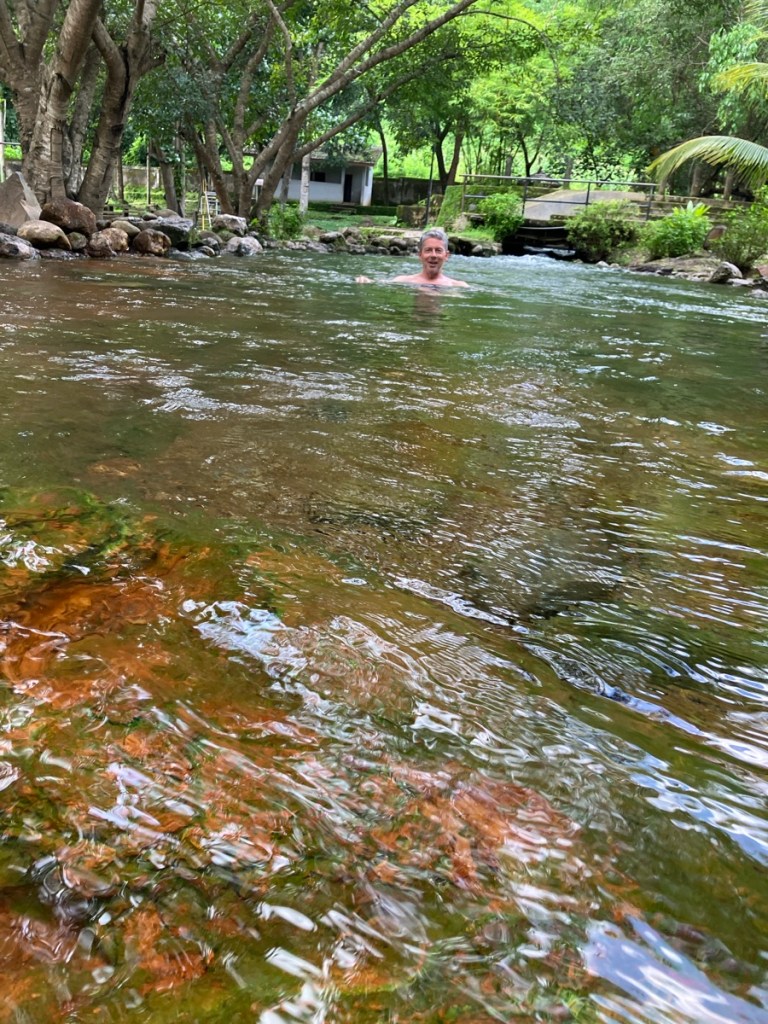
The weekly market was in full swing so Nyoman dropped us off and we walked through.We only stayed on the primary street, but the market stretched back quite a way.So many greens for sale. Without our driver as a guide we didn’t feel as welcomed at this market. We made one pass through and headed on.Mangeruda Hot Springs and Rich heating up. Thank you again volcanoes.Rich says the water was about 95-100f/35-37c.There was also a big, deeper and cooler pool, with rather sharp stones in the bottom.
After Rich had a good soak and I took photos we headed to Bajawa, where we had a two night stay booked at the Bajawa Roo Hotel. Bajawa was our favorite stop on the drive across Flores. Part of that was the town, it was cool at 3,900 feet/1,200 m above sea level – we got to wear our down jackets and long trousers – which made them not ridiculous to bring along. The Bajawa Roo Hotel was a fantastic travelers hotel run by a super friendly and helpful couple, Sri and Moses.
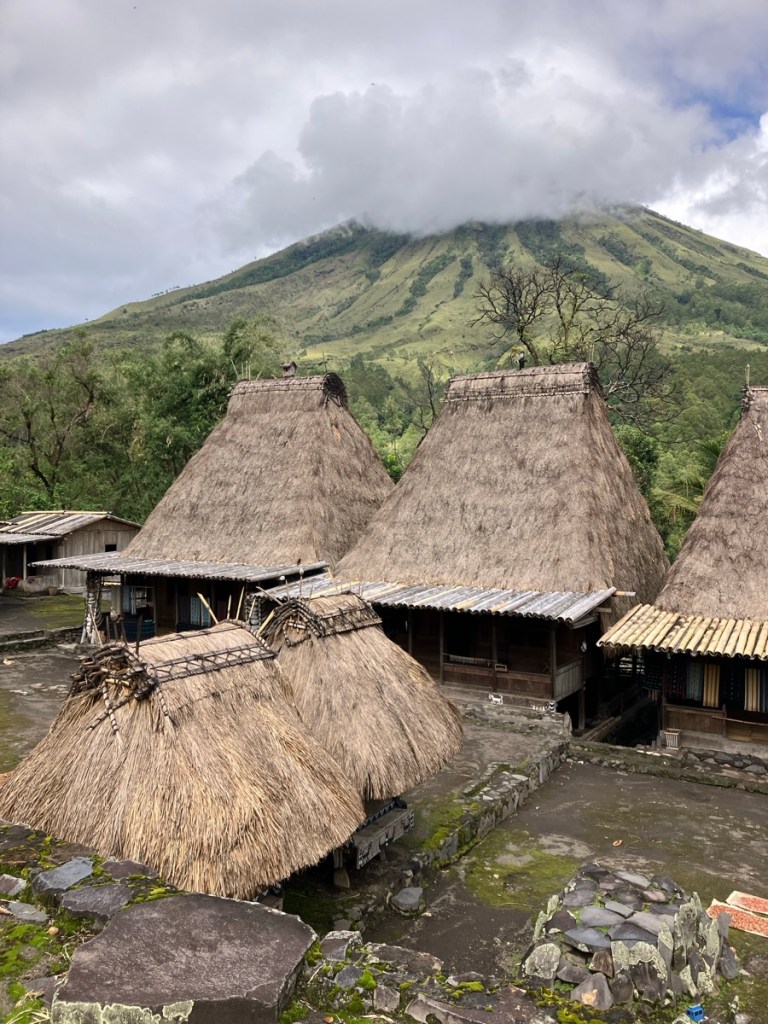
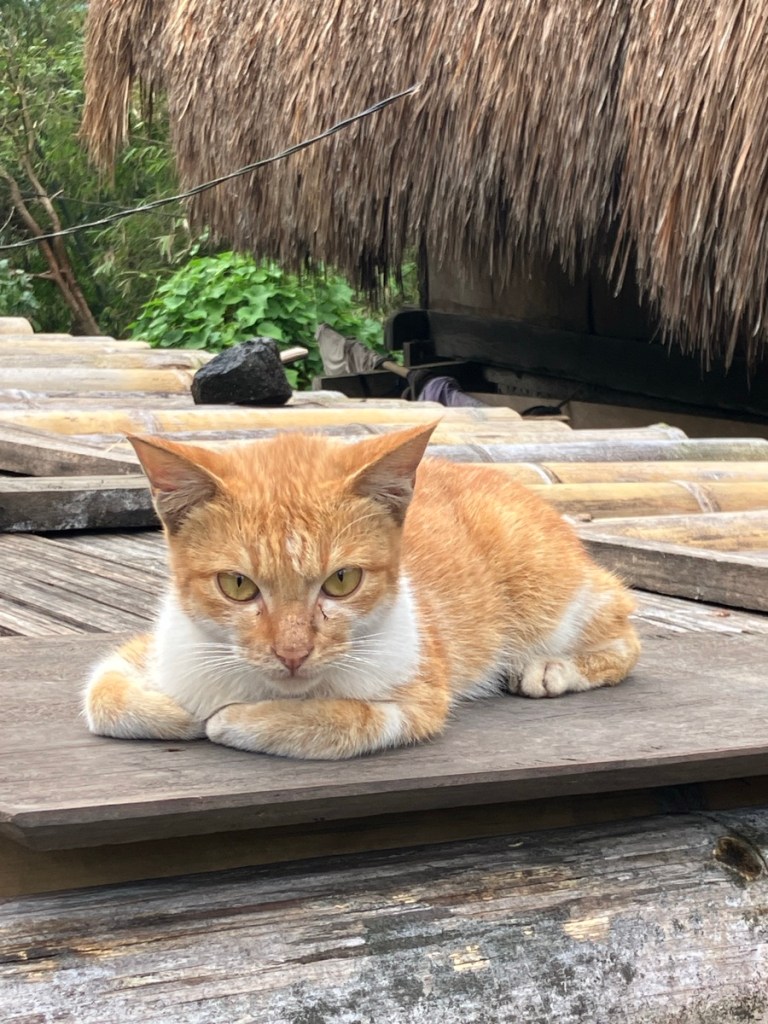
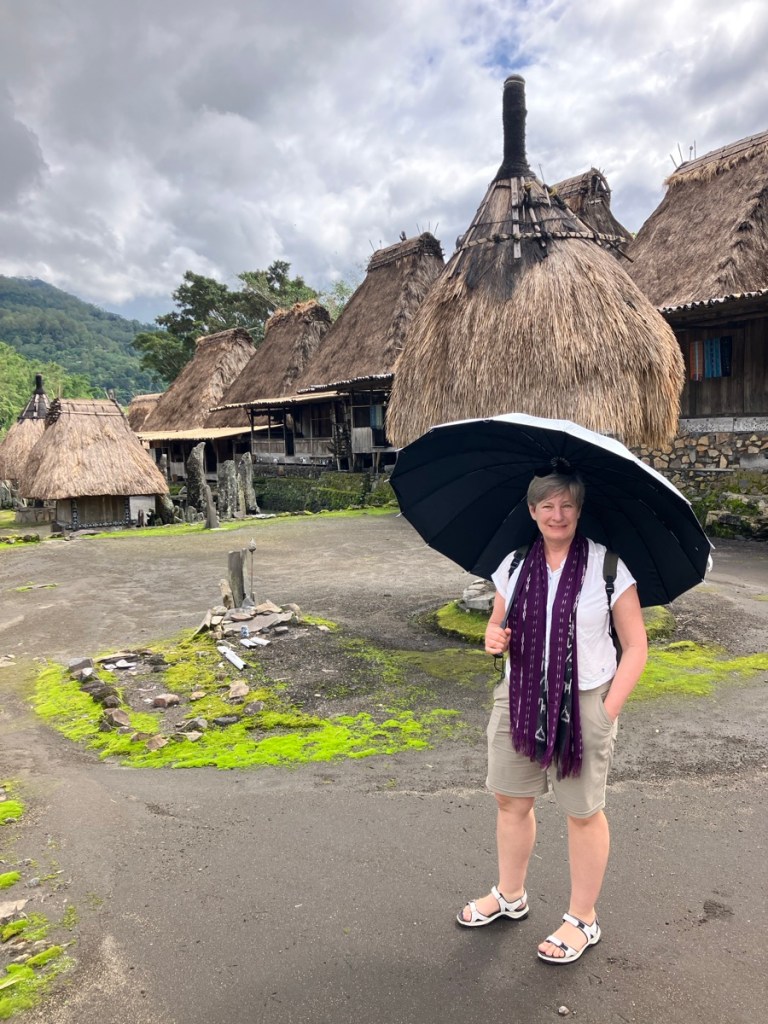
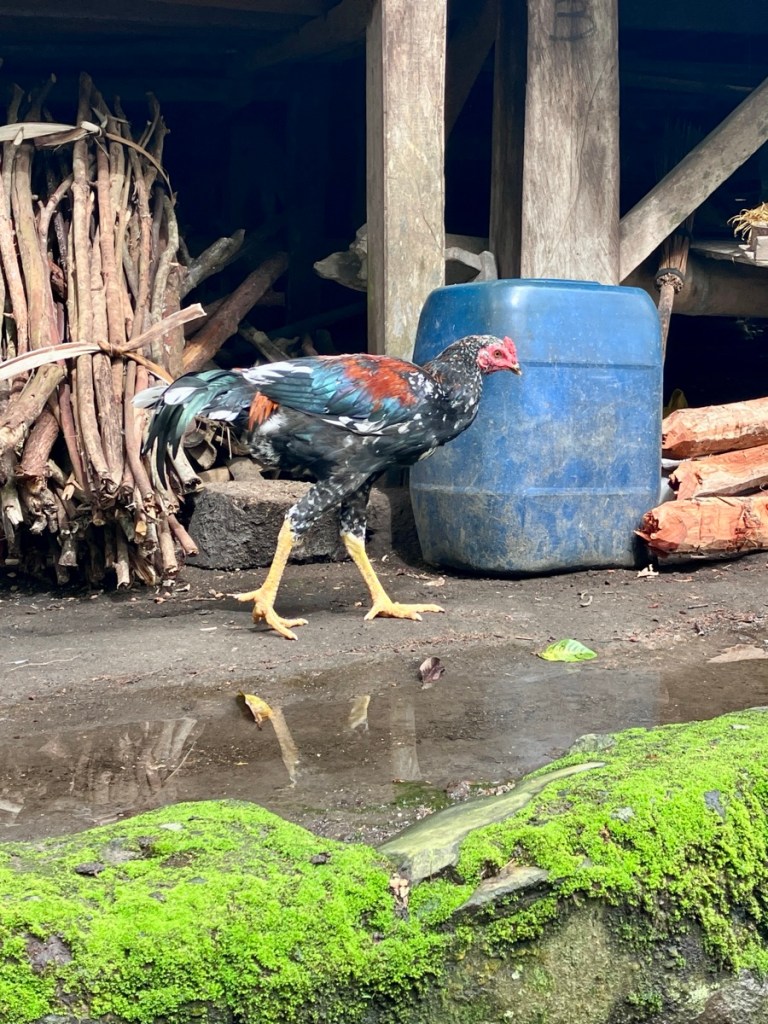
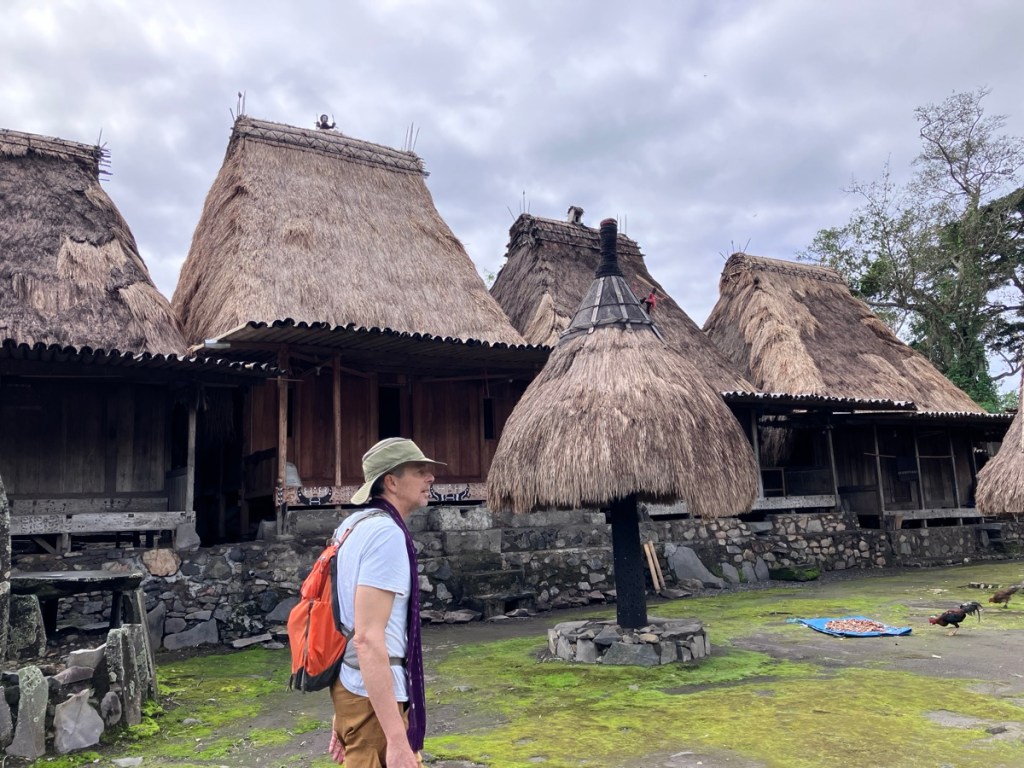
Rich and Martin, who was from Poland and a surfer.Volcano view from our terrace.Down jacket finally came in handy!We were happy to walk to dinner at a Chinese restaurant nearby. Nyoman offered to drive us to and from dinner but we always prefer a walk.Bena Traditional Village was our first stop of our non travel day. Kitty greeter. They look less than delighted to see us.Me and my portable shade.What a colorful chicken. It can feel awkward to wander around the village, but the scarfs we are wearing show that we have registered and made a donation. And I always buy something- this time it was traditional textile.Wood carving decorating the buildings.Toilet buildings were communal.And cats were plentiful.View spot, that’s the ocean out there.
Nyoman showed us the trail to the next traditional village, Tololela. It was an hour walk through stunning jungle. We would meet up with Nyoman again after walking down the very steep road from Tololela.
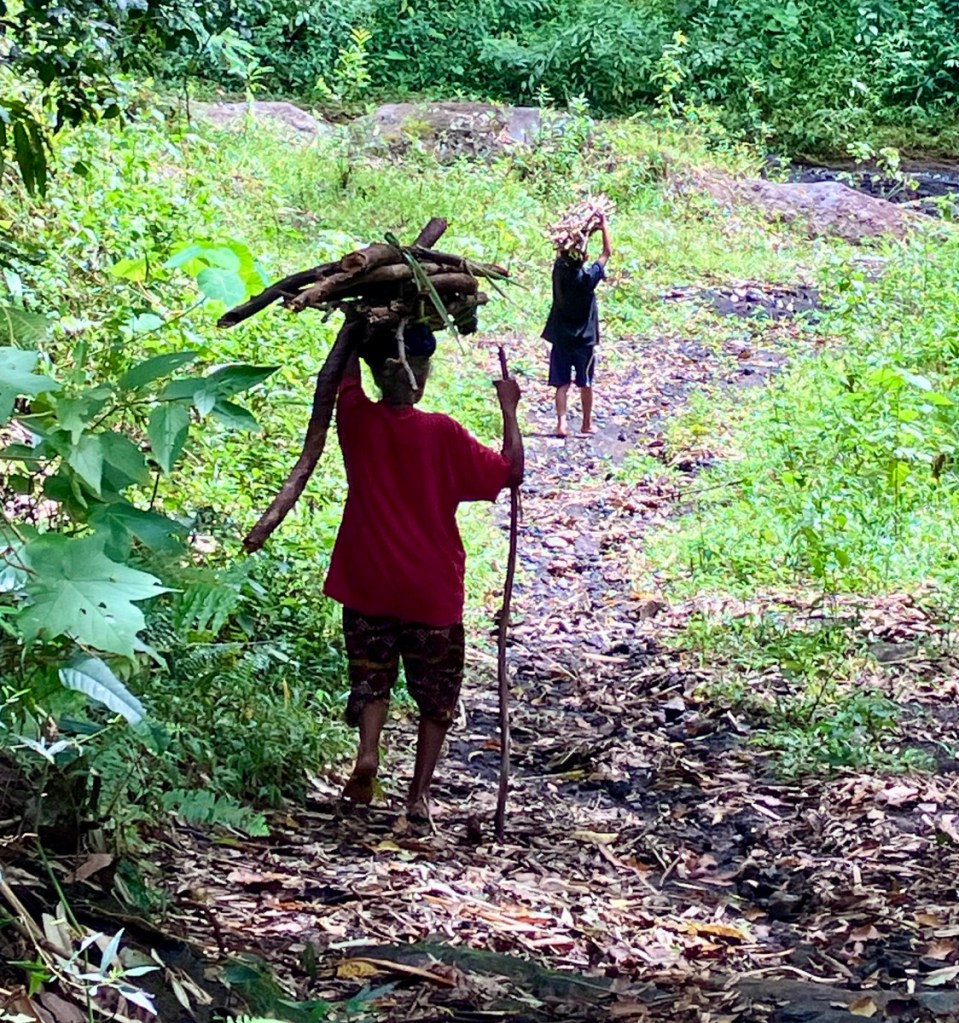
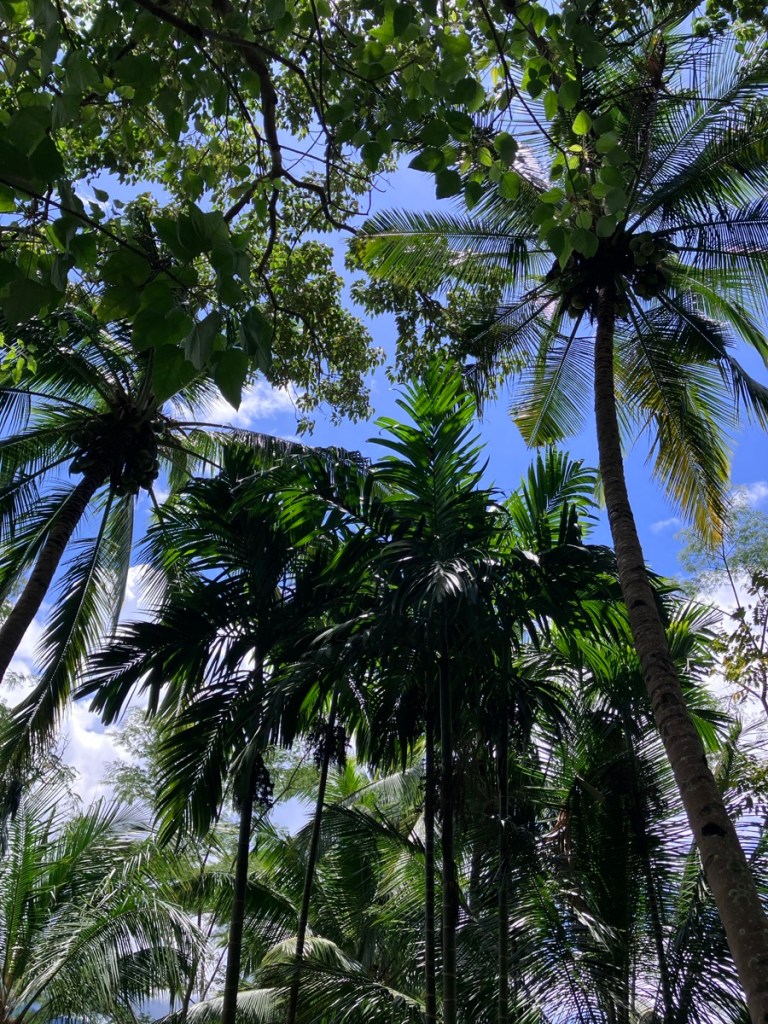
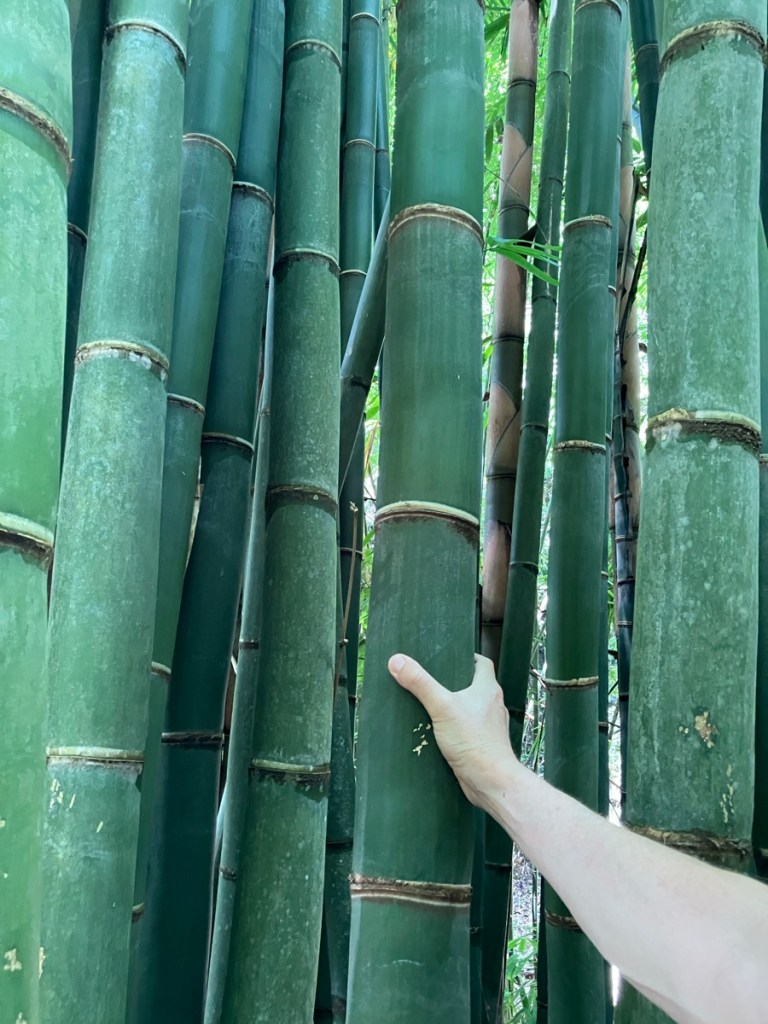
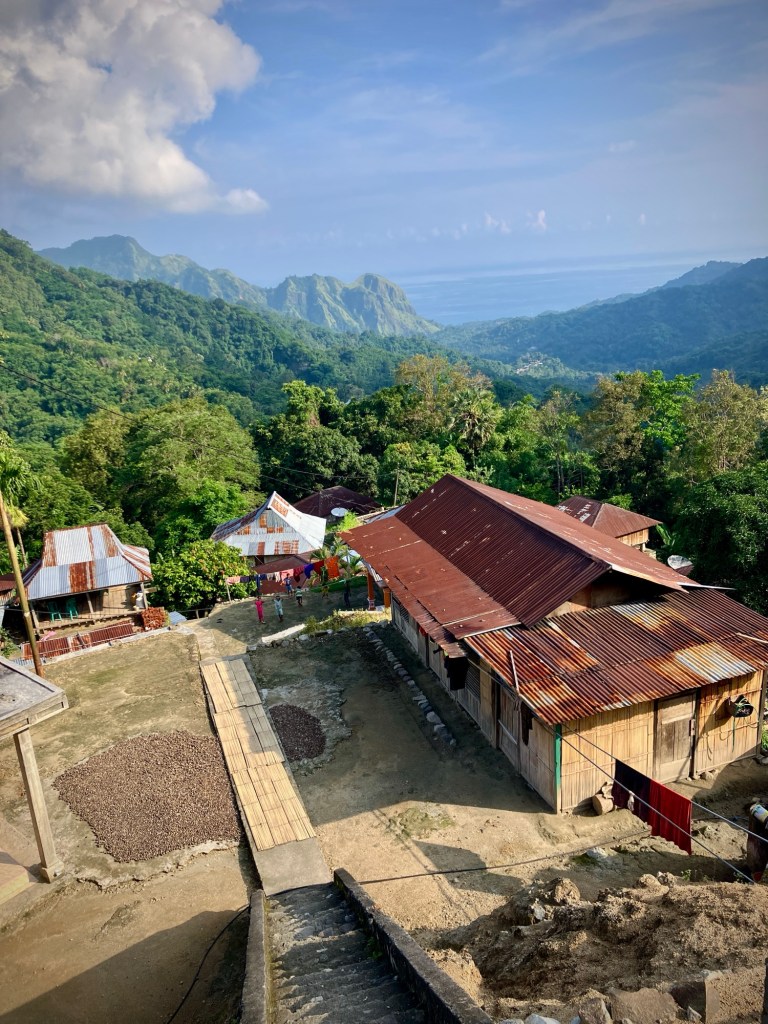
The roads are in a constant state of repair, especially in rainy season. Hati hati translates as be careful! A woman and a child carrying firewood back to the village.It’s not easy to navigate the jungle with an umbrella. But I did.Almost hidden by ferns.So much intact jungle. Such steep slopes.Palms reaching for the sky.And so much bamboo. Rich added for scale. The bamboo plants were massive.A mixed jungle. No monoculture here.Tololela Village. Again, you stop by the first building on the right and make a donation. It helps the villages stay viable in these modern times.Deep overhangs for shade and rain protection.Wood carvings. I’m not sure why a horse, we didn’t see any.Horns and jawbones.Not just cats, cute dogs too.I was glad that we visited both villages, they had different feelings to them, and I noticed more details at the second village.A chicken strutting past drying candlenuts. The sun was so hot we could hear the nuts sizzling. The nut is used in cooking, and the oil for hair products or illumination.
We headed down the very very steep road, marveling at the scooters taking the sharp turns loaded with several people, met up with Nyoman, and headed back up the mountains for a view restaurant for lunch.
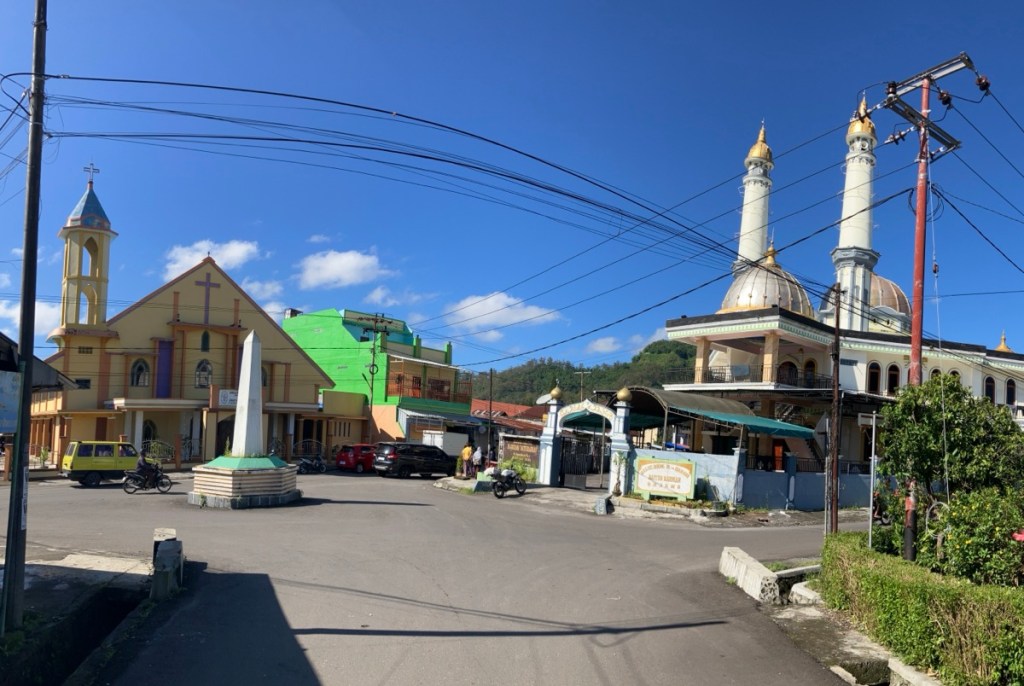
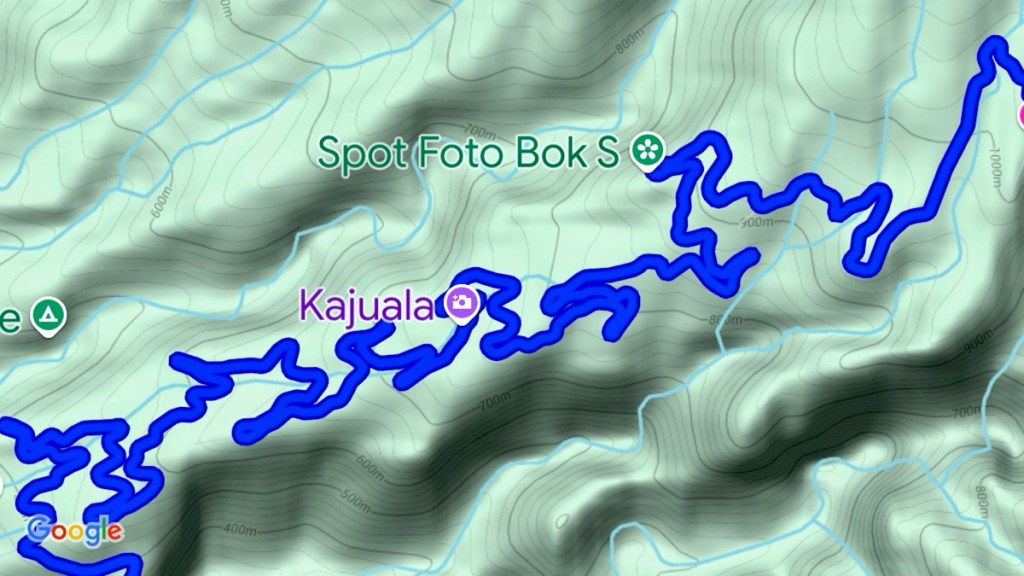
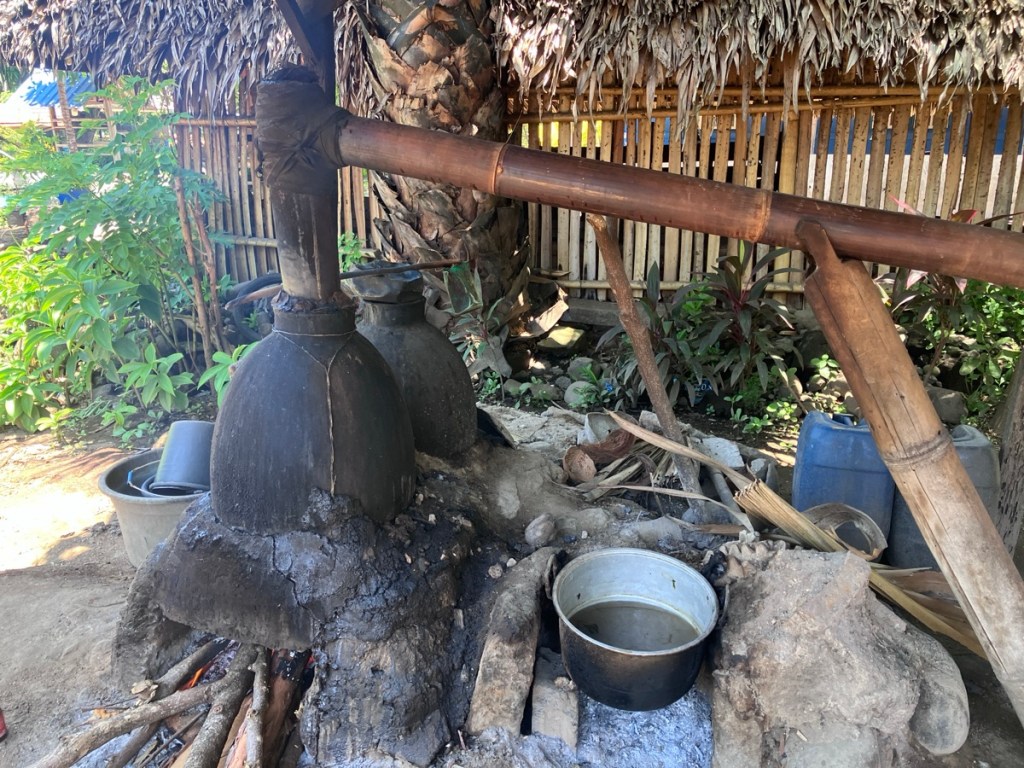
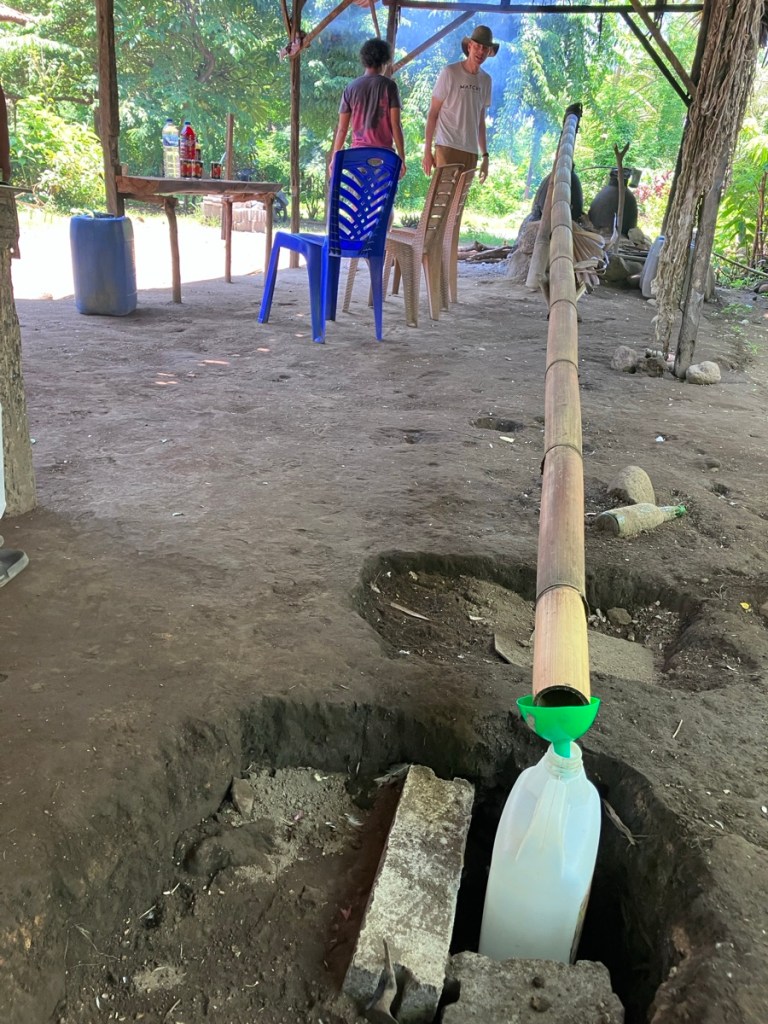
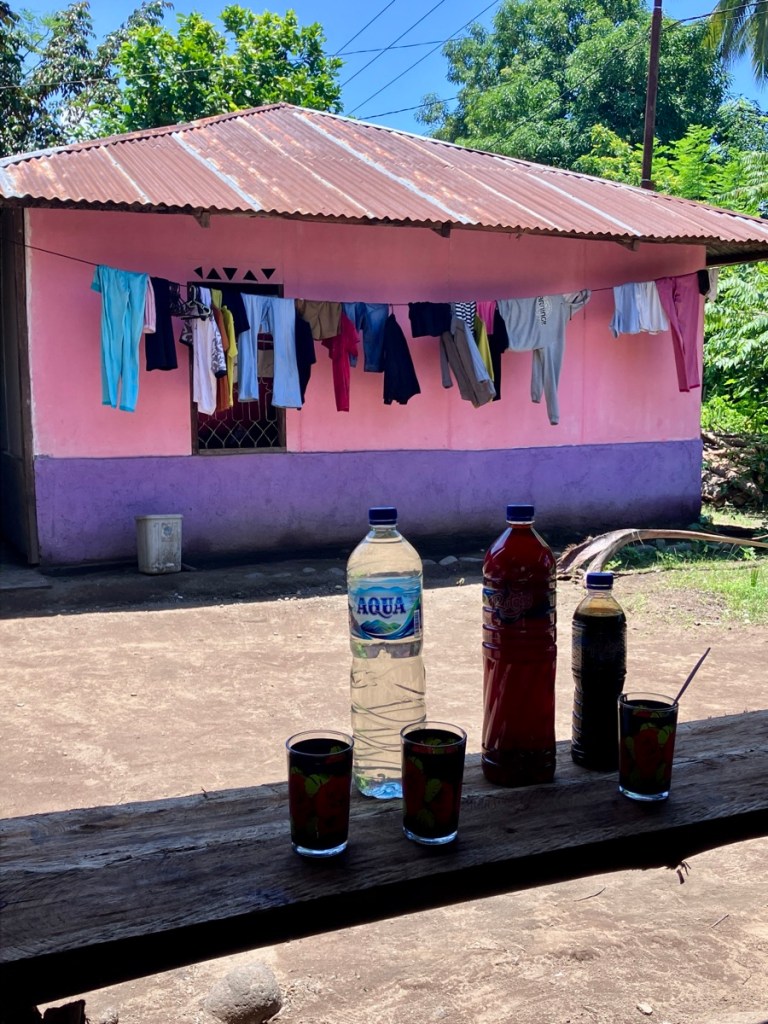
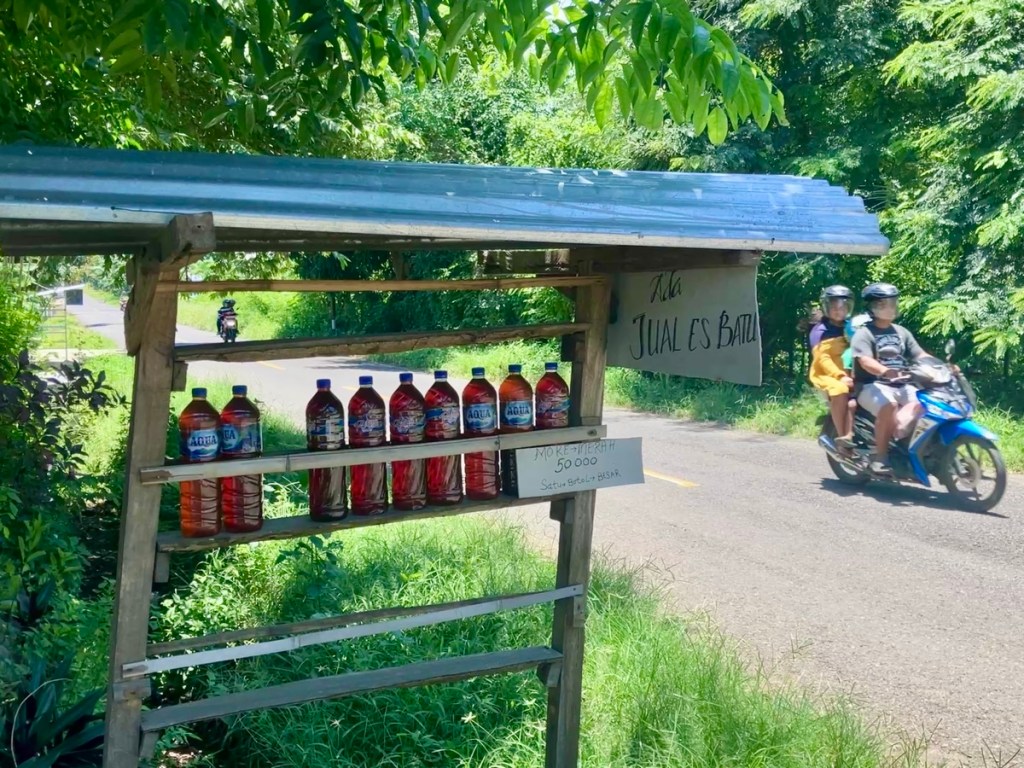
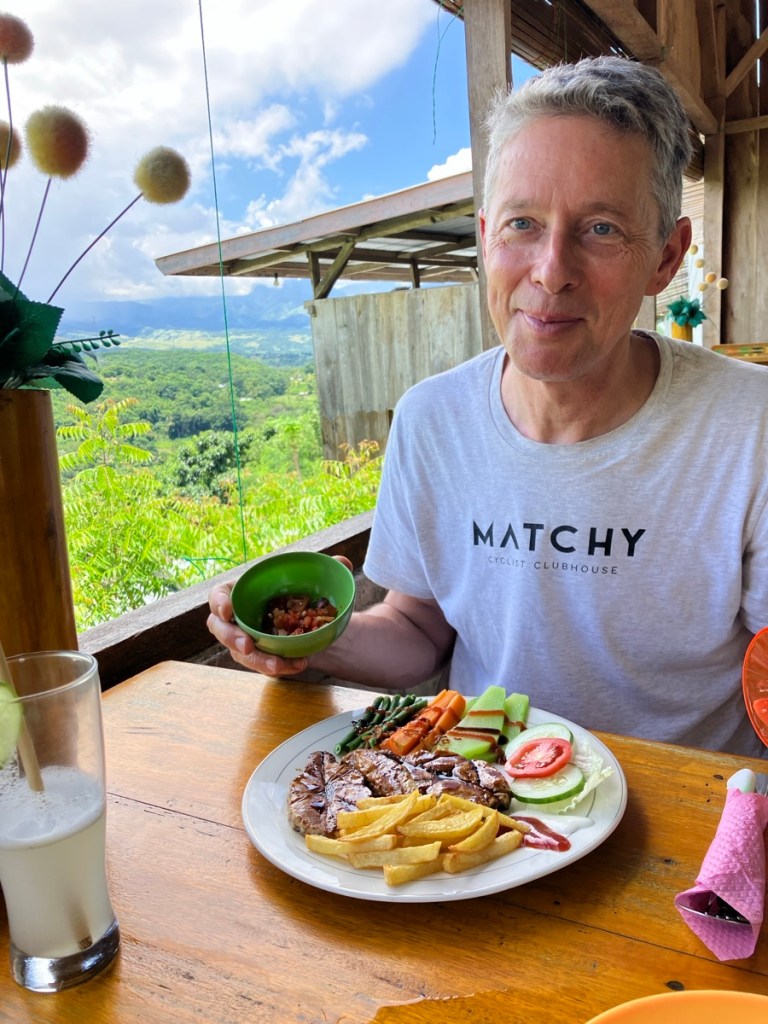
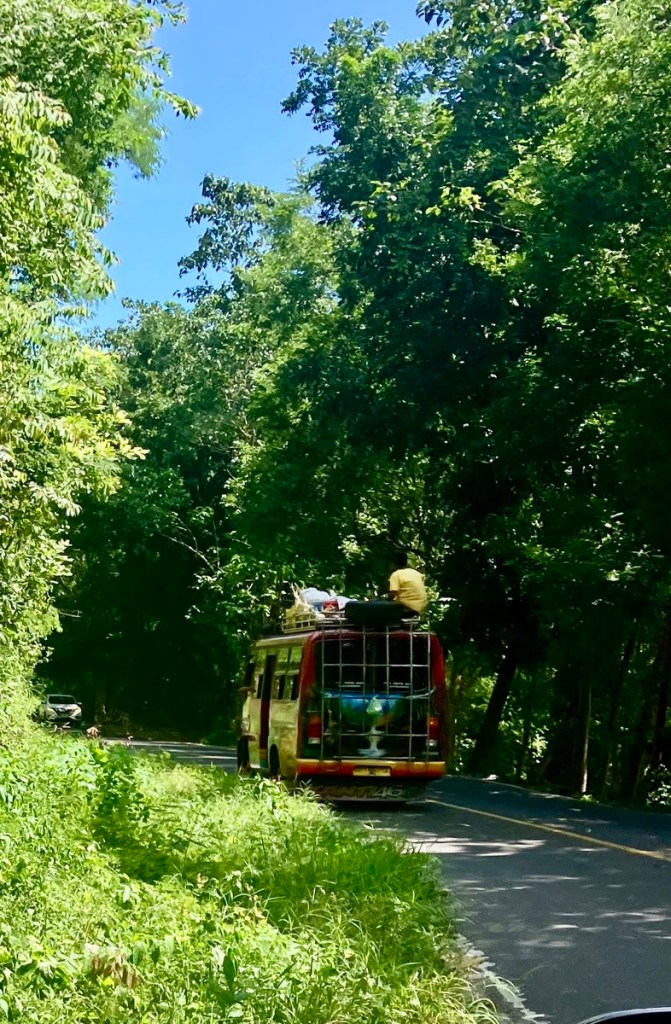
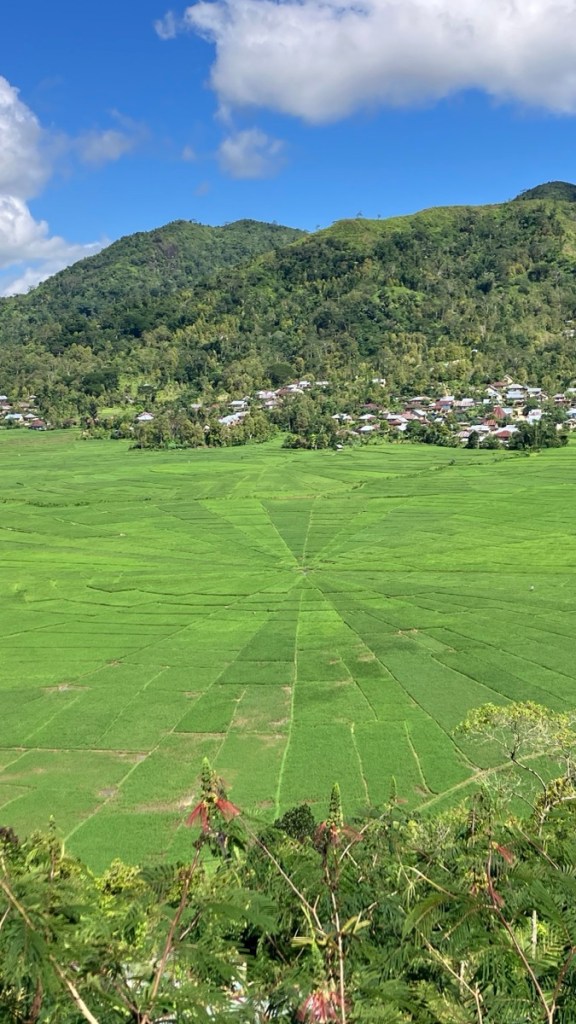
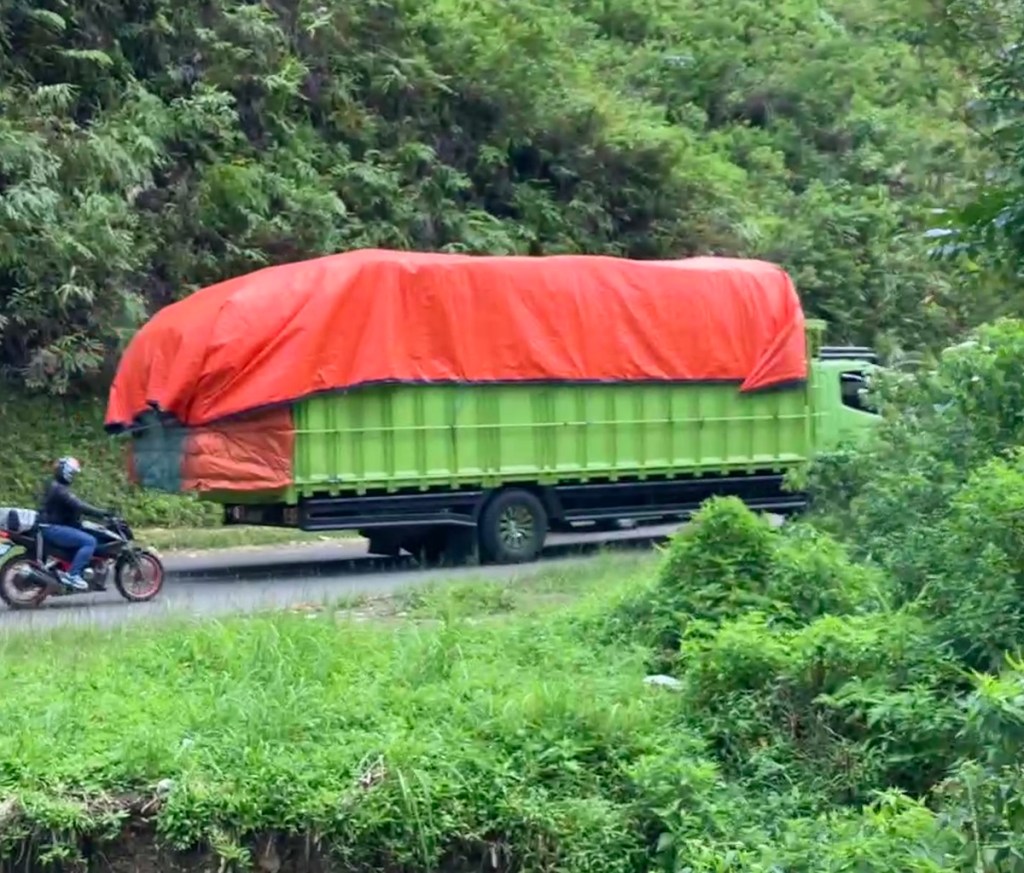
Volcano view at Heaven’s Door Bar & Restaurant.Rich finally got to try the smoked barbecued pork.Dinner with a fellow traveler, Ramon from Catalonia. Sunrise on another travel day.But first a walk into town. Must navigate puppy lane without scooping one up. Bajawa was setting up for a festival and folks were using the walking track in the park.A Catholic Church and a Muslim Mosque across the street from each other. Ramadan was starting in a few days.Goodbye Bajawa! Hello more volcanoes. Nyoman and I stayed in the car while Rich snapped photos.When you look at the route, the twists and turns, it’s really amazing this road exists. And it does suffer from land slides and fallen trees, but it’s the one cross island connection, so when it’s blocked there is a fast effort to reopen it.Our first stop on this almost four hour drive was a Moke home distillery. An alcoholic beverage made from palm tree fruits.A rather simple distillery after the harvesting of the sap from the fruits.The tasting room. Left is the clear very high proof Moke, middle is the same but flavored with spices and sugar, and right is the thick sap condensed down to sugars.The owner and distiller. We are on the coast again and it was hot. Her retail stand on the side of the road. The drivers always know the good lunch stops. Tuna steak, veggies, fries and plenty of sambal.Passed by a local bus. There were usually a few guys riding on the top, and some poultry hanging from the back rack.One night Ruteng at the Ara Garden Inn, 1,100 m, 3,800 ft elevation meant the jackets came out again.An early breakfast so we could get on the road – one final day of driving!A stop at the lingko (circle) rice fields and Rich with our two little guides, 12 and 14 years old. Similar to the traditional villages you make a donation and then are guided up to the viewpoint.Sheno and Clifford explained that the villages which share the field originally each had a pie shaped plot, divided further by families – which makes a spiderweb formation.The National Road has good asphalt, and is shared with a lot of scooters, some cars, and big trucks hauling manufactured goods from other islands and mostly agricultural goods from Flores.
From Ruteng to Labuan Bajo the road climbs over passes and down to the coast twice. The difference in heat is very noticeable. When we finally reached Labuan Bajo Nyoman even shook his head and said “So hot.” He is from Moni which is at 700m/2,200 feet so a bit cooler than the coast. I was pleased to hear that even a local found the weather hot.
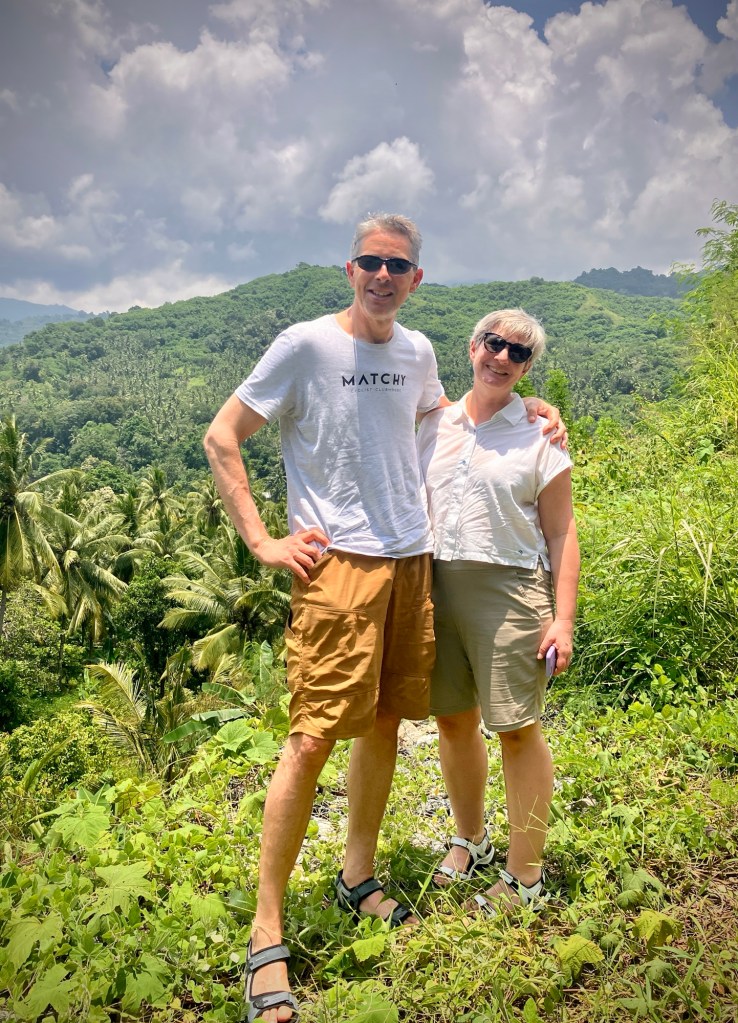
The happy travelers in Labuan Bajo again, after 8 days exploring the island.
Crossing the island at 30 mph (or so) was amazing. That is a slow enough speed to leave the windows down and not be wind blown. It’s the right speed to spot things and ask to stop. The jungle goes by slowly enough that you can marvel at the mix of trees and plants. See the cows grazing at the sides of the roads. Laugh at the dogs asleep in the middle of the road (drivers always carefully avoid the dogs). It may not be our favorite mode of travel, but for this trip our more car decision was the right one. Next up: Pirate Island!
And a map! Hearts are where we spent the night.And a larger map. The hearts across Java are from a trip in 2017/2018. The blue dot is us in Dalat, Vietnam right now.
After being surprised by Labuan Bajo’s sidewalks and rapidly developing tourist infrastructure, we flew from Labuan Bajo to Maumere, a small city on the Northeast coast of Flores to start our cross island exploration.
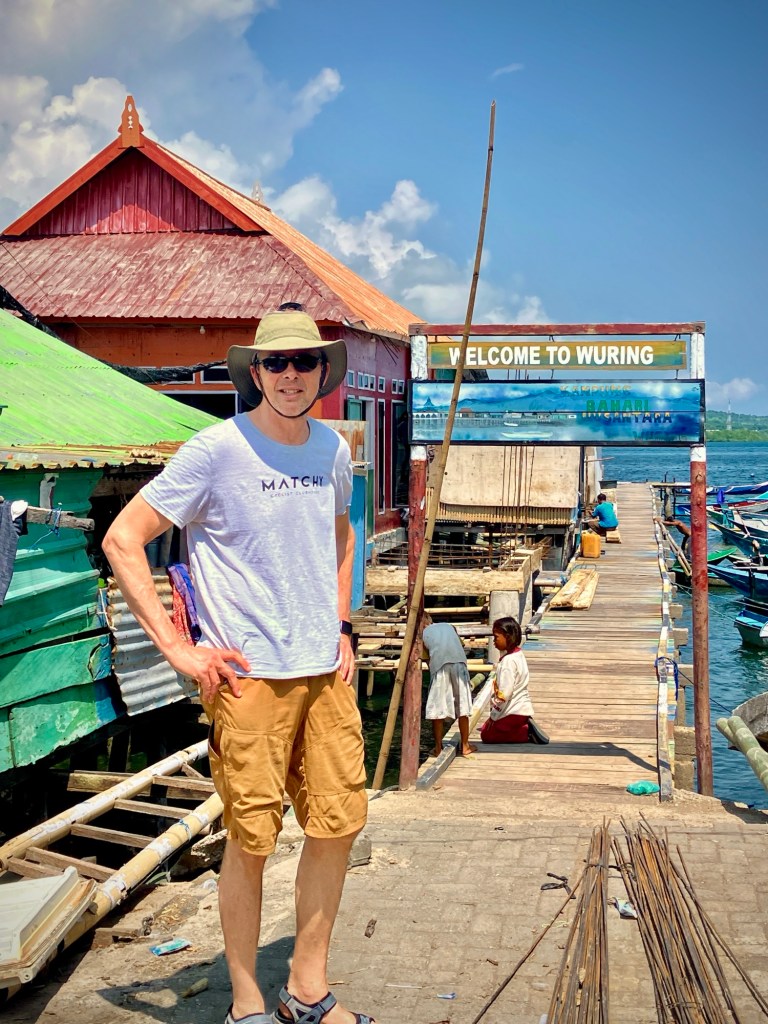
Wuring, a traditional fishing village near MaumereCheryl arriving at Fransiskus Xaverius Seda Airport in Maumere; happy that our Wings Air turboprop made the journey today
We didn’t know exactly what to expect. Maumere is remote and there are only 3 flights a week between Labuan Bajo and Maumere on a Wings Air Turboprop. It was a bit risky itinerary as the flights are often delayed or cancelled in the rainy season, but we lucked out and had a scenic flight along Flores’ north coast. It was a fairly empty flight of locals and maybe 6 tourists. Flores in the rainy season is still a delightfully beautiful exotic experience, but maybe not the best for anyone on a tight schedule. These nomads are not on a tight schedule -:)
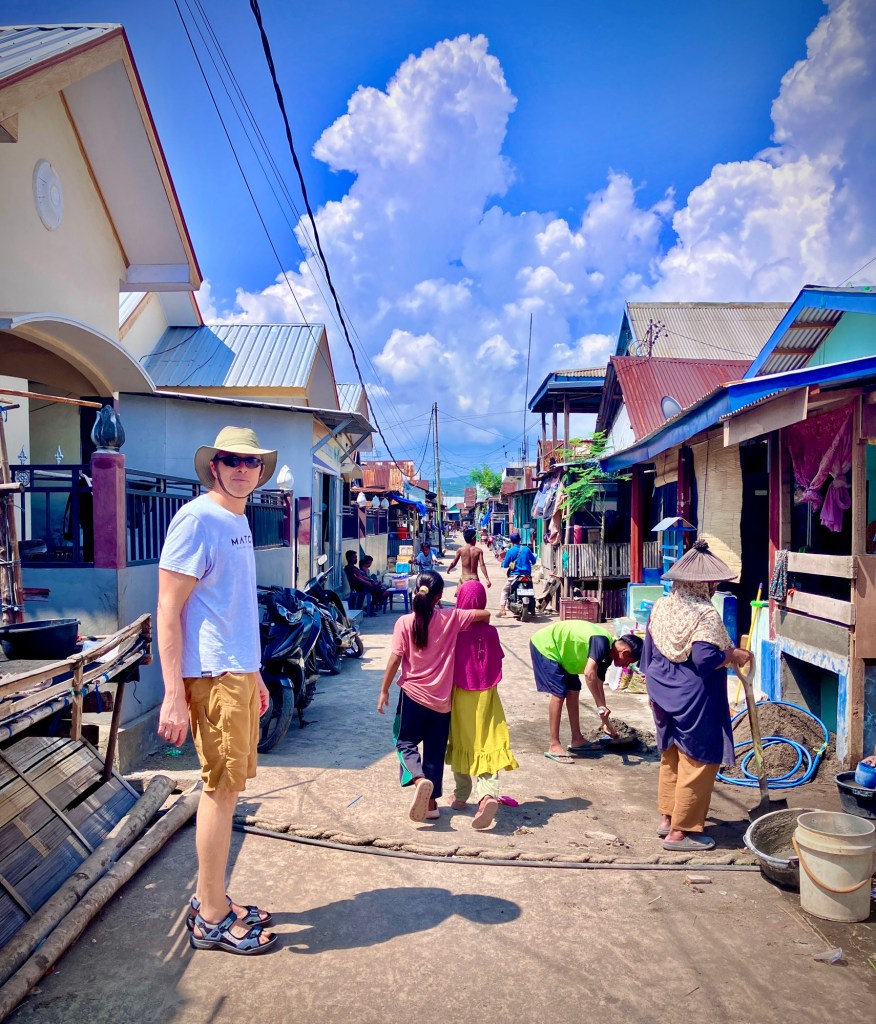
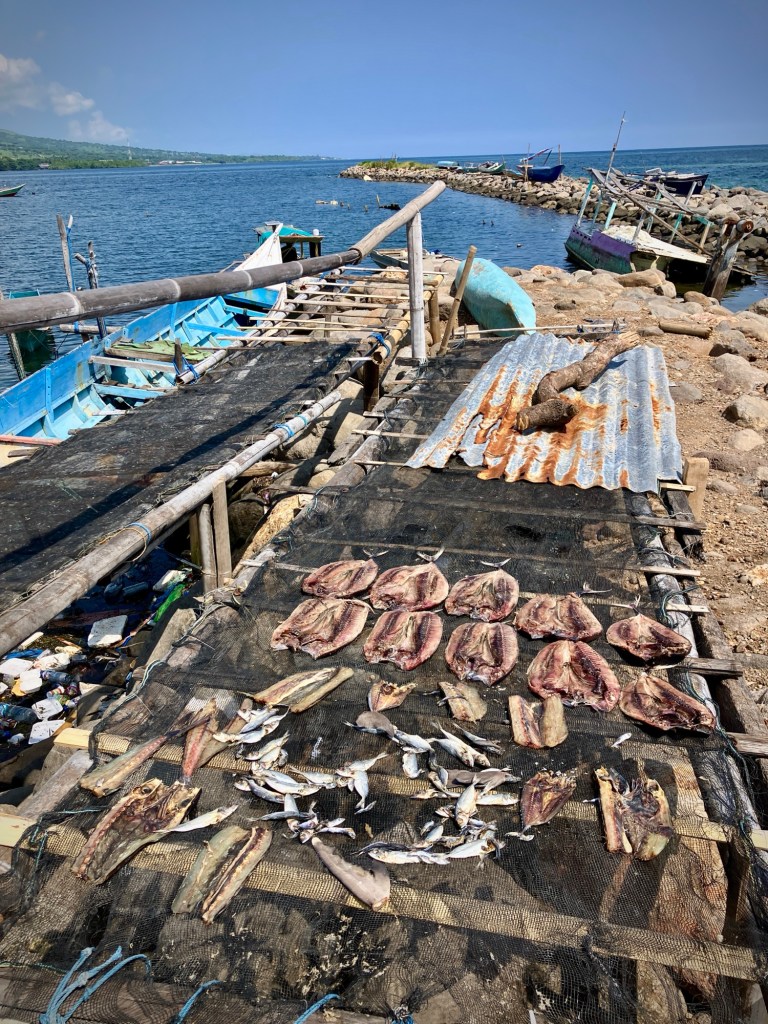
Wuring, or Fisherman’s Village is a predominantly Muslim community settled by notoriously tough sailors from the Bajo, Bugis and Buton tribes, and mostly from neighboring South Sulawesi.Dried fish are a staple of a Flores diet.The structures are almost all on stilts over the water off of two main spurs. We felt a bit awkward walking around as there were no other tourists anywhere. Of course people were friendly and gracious as they went about their daily business and we were definitely a curiosity.Wanting to observe but not disturb.Goats and scooters are other village essentials
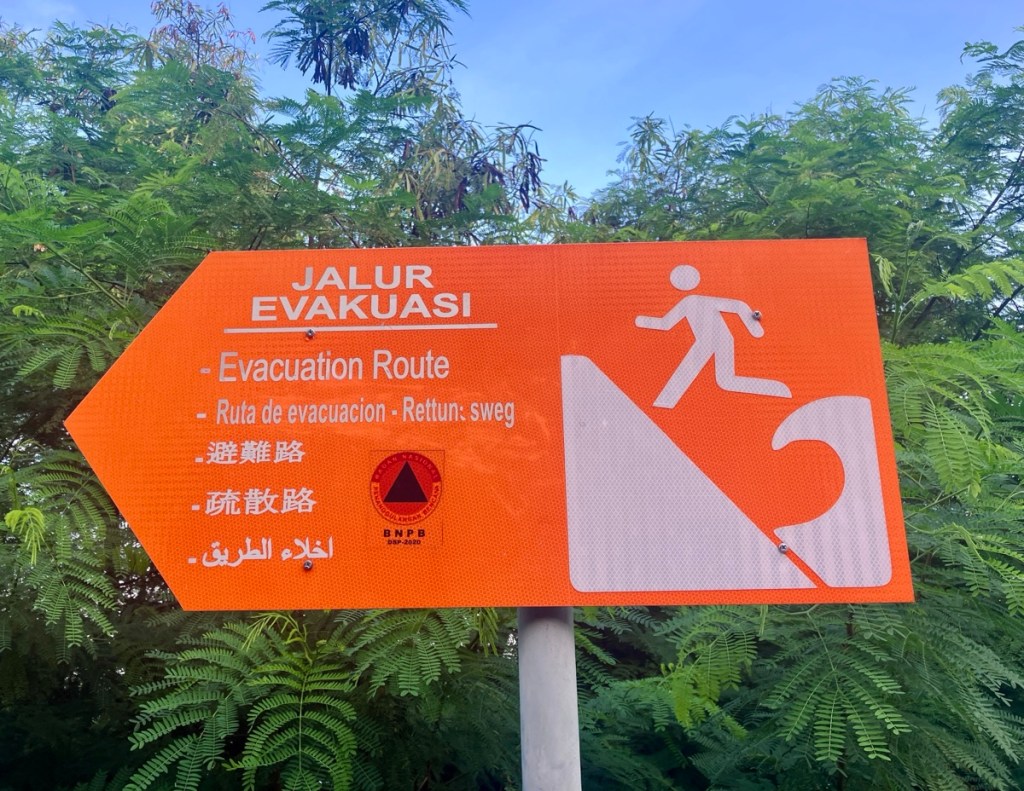
We had an extremely friendly driver pick us up from the airport to one of a handful of tourist accommodations along the coast. Maumere proper is a still a work in progress and still recovering from the devastating 1992 earthquake and Tsunami that killed 2,500 people. The 7.8 earthquake damaged or destroyed many structures and was followed just six minutes later by a large tsunami that reflected off part of the coast and adjacent Babi island. Indonesia’s volcanic and seismic activity makes a lot of it a risky place to live, so the people have to be resilient and resourceful. In the Fisherman’s Village alone, a 10 foot (3m) high wave swept through the village in 1992 killing 100.
Our nice cabana at the Amrita Resort east of Maumere in the village of Waiara. It was small and we were the only people there the first night.The beach in front of the Amrita is as also popular with the locals and was noticeably cleaner than adjacent areas. They are restoring the reef here and the snorkeling was enjoyable in the morning before the breezes came up.A classic Indonesian lunch, Mie Goreng, Nasi Goreng, Cap Chay, and local Sambal (Fried noodles and rice with chicken, mixed local vegetables, and spicy pepper/salsa)
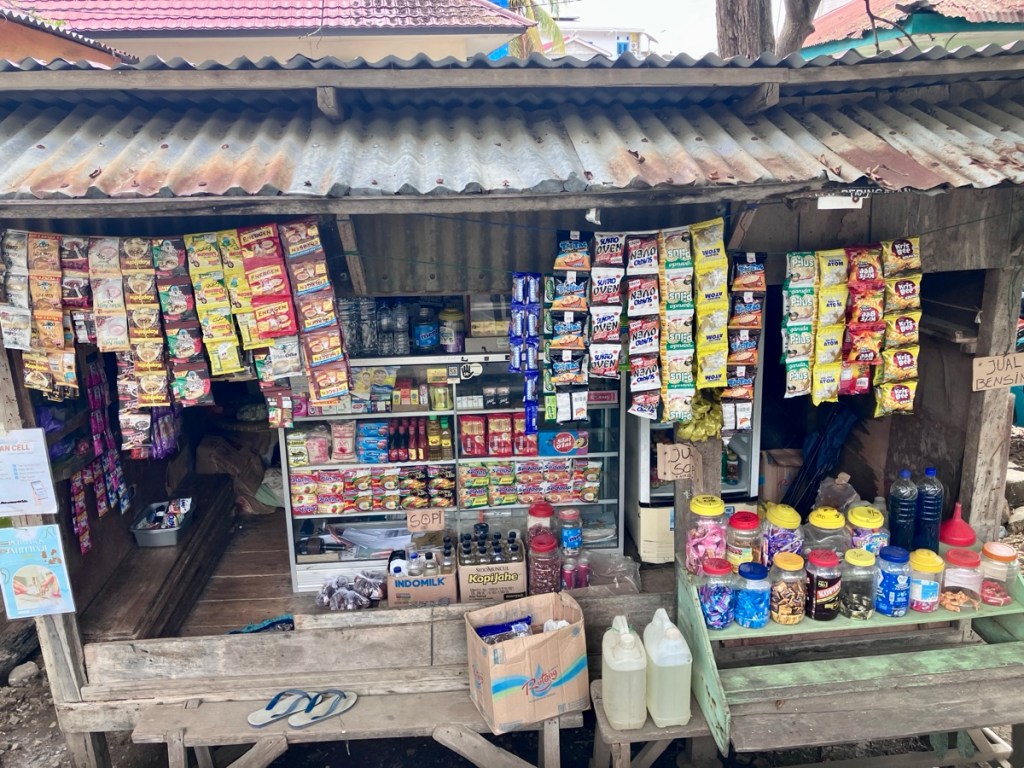
I have to say, the Fisherman’s village and the Maumere central market were pretty astonishing. We have travelled a lot but were still surprised at the low level of development on Flores and the consistent base of rural subsistence living across the massive island. There is virtually no industry or manufacturing on the island and power outages are frequent. Untreated water is trucked to tanks. Processed food is rare, which is a good thing, as it’s the source of lots of waste and most of it we saw in small minimarts was junk food.
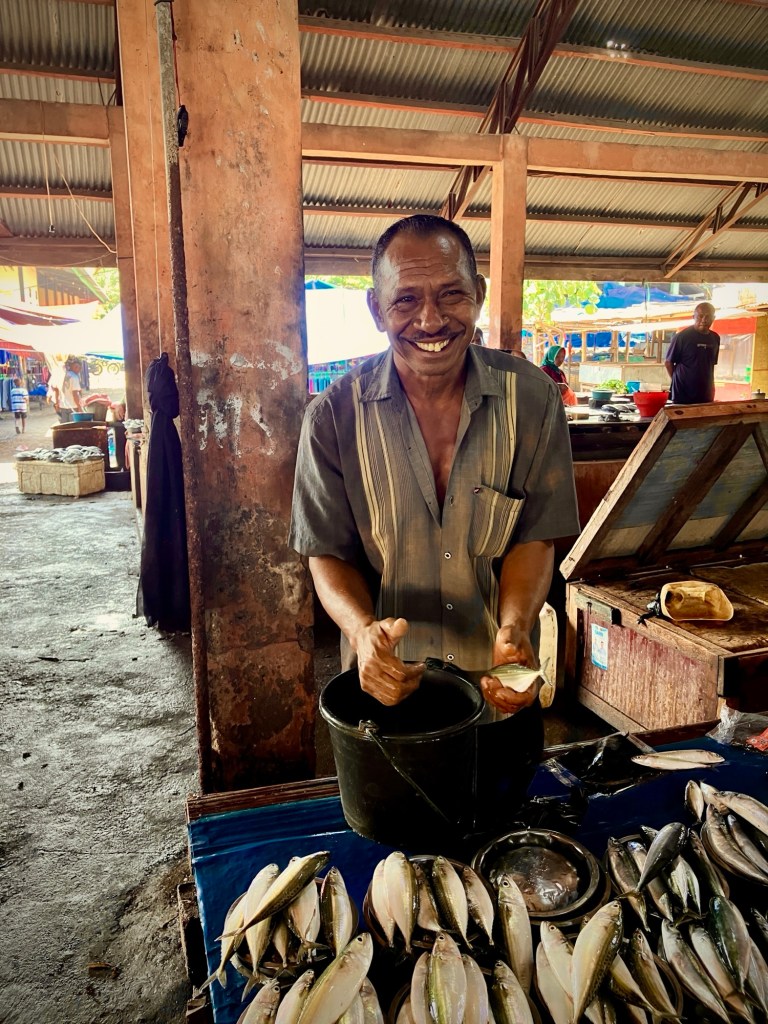
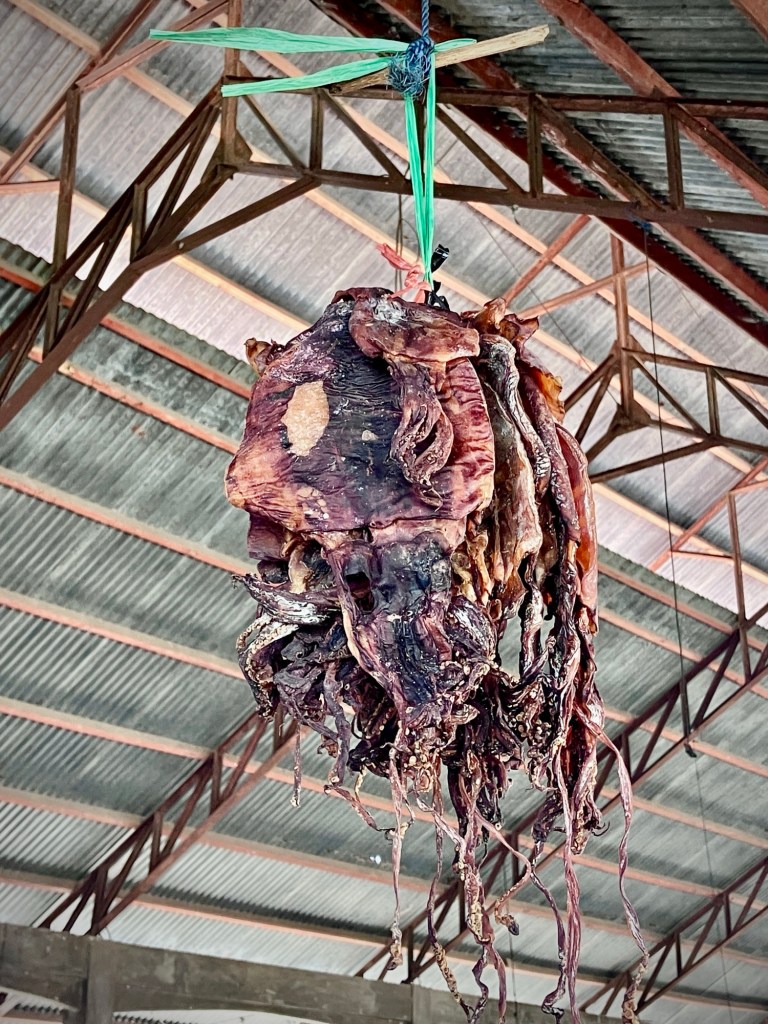
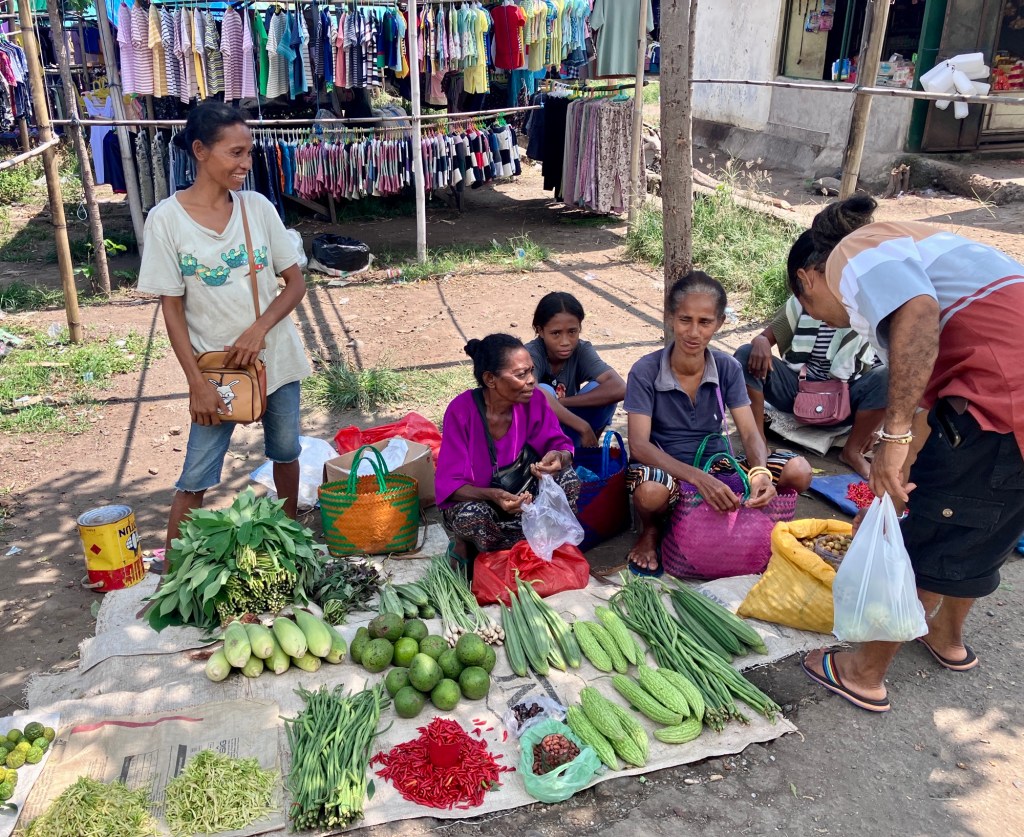
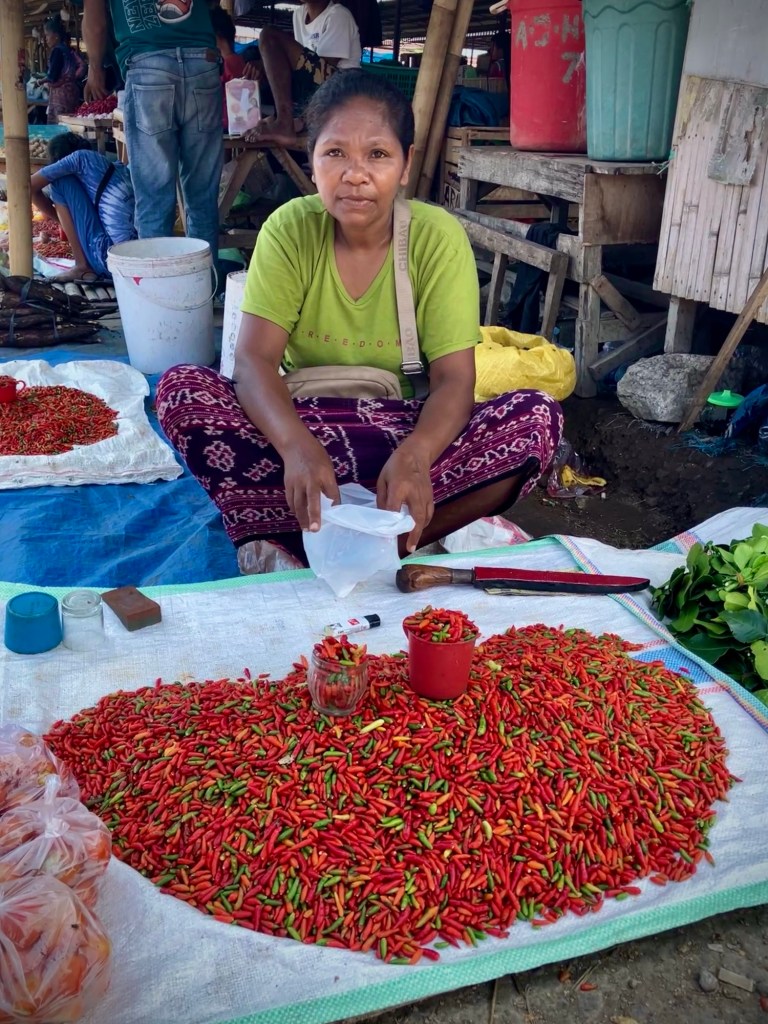
Entering the fish market in Maumere with our brilliant guide and driver for the day, Donatus It was a bit later in the morning and not peak market day, but still a healthy supply of fresh catch and the ubiquitous dried fishFlores smiles.So much fish is dried to preserve and provide a reliable source of food when the fresh catch is lighter. This is likely tuna.Market pride.Dried squid (we think!).A wide choice of local vegetables. Nothing we ate in Flores was processed (except our well traveled Cliff Builders Bar!).Donatus buying a few local specialties for us to tryEverything grows somewhere in Flores due to the elevation variations. These are banana flowers, used in a local dish.And so many peppers for sambal variations.The makings for Betel chewing; Areca nuts, slaked lime, and betel leaves.Taro. The large roots are sold as pig food.Cinnamon, ginger, and turmeric.
Flores had been off the radar to the government until the late 1990’s and the end of the Suharto era. There are complex political and religious dynamics in Indonesia that I won’t even pretend to understand but it is clear that the control and power for the country comes from its heart of Jakarta and Java. It is also key to understand that Flores is predominantly Catholic from the legacy of the Portuguese time of control, although they eventually ceded control of Flores to the Dutch, who officially held control until Indonesia’s independence in 1945. The island is now a mix of Catholics and Muslims, overlaid with traditional Melanesian cultures and beliefs.
Most transport on Flores is by scooter or shared rides. There are some small and medium size scheduled buses.From the market, a delicious srikava fruit, also known as sugar apples; it kinda melts in your mouth.
The Flores Islanders are very proud (rightly so) of their peaceful coexistence. Our driver and guide from Maumere was Christian but very proud of the coexistence and acceptance, even pointing out small graveyards with alternating Christian and Islamic graves. We sensed no tension anywhere and apparently they celebrate and revel a bit in each others holidays. Flores really is a special place.
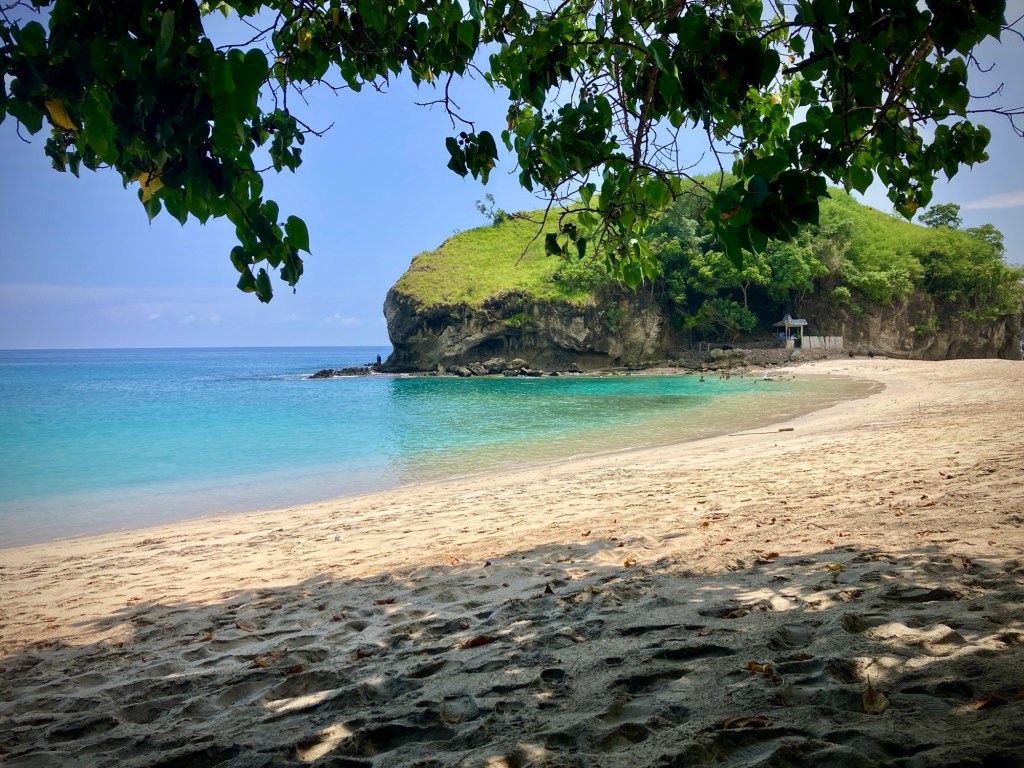
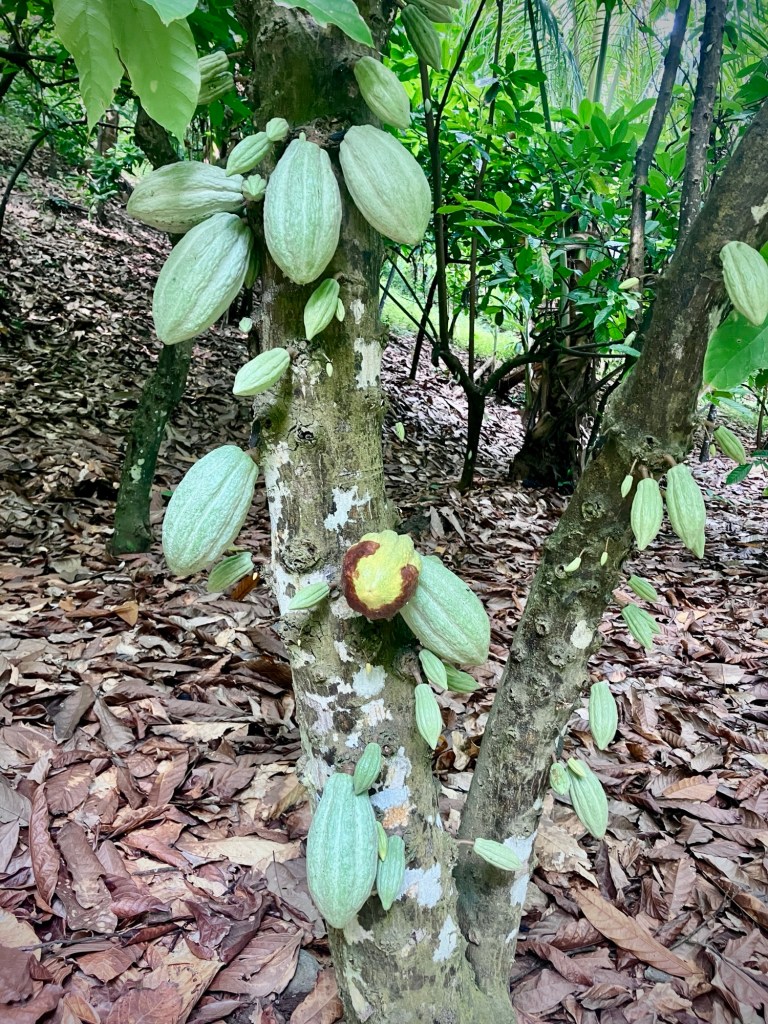
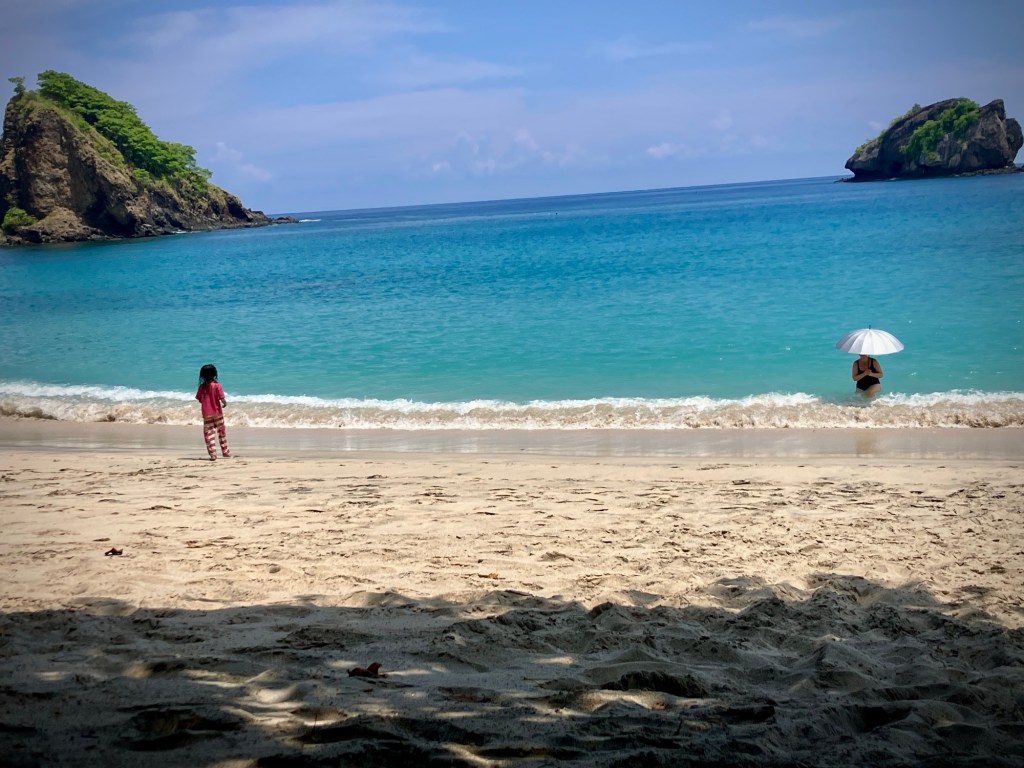
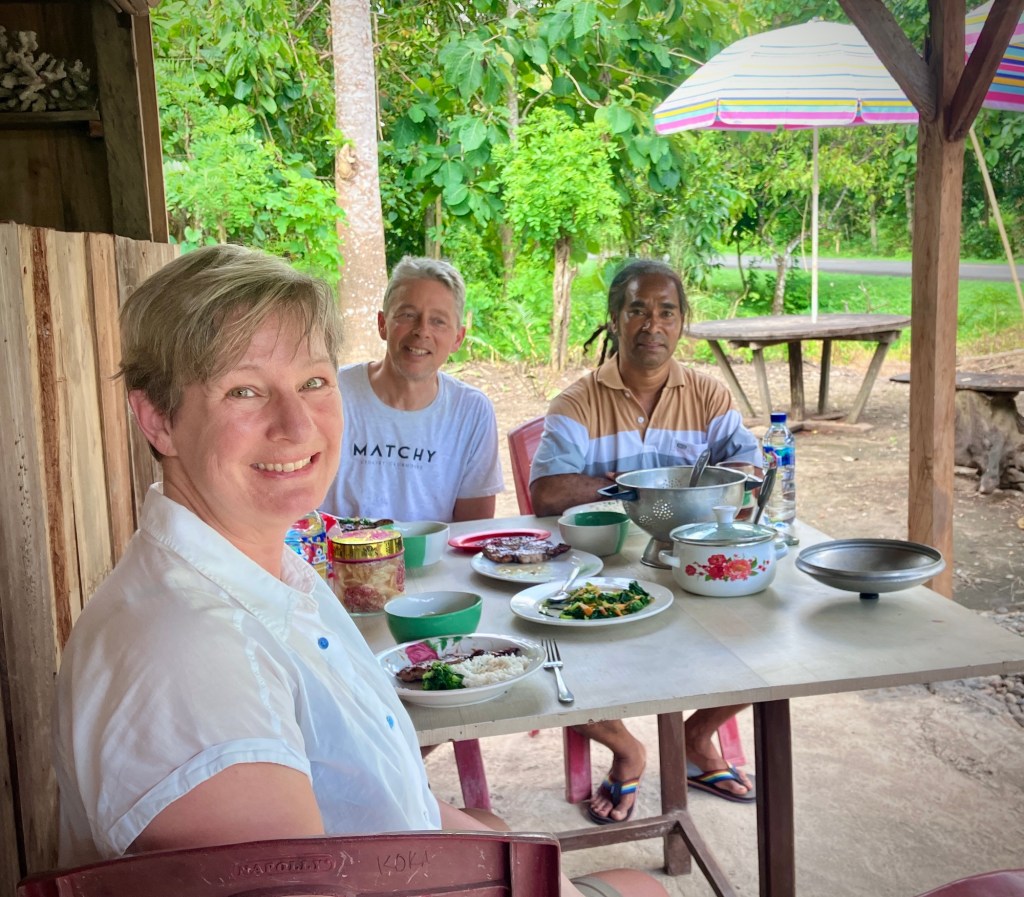
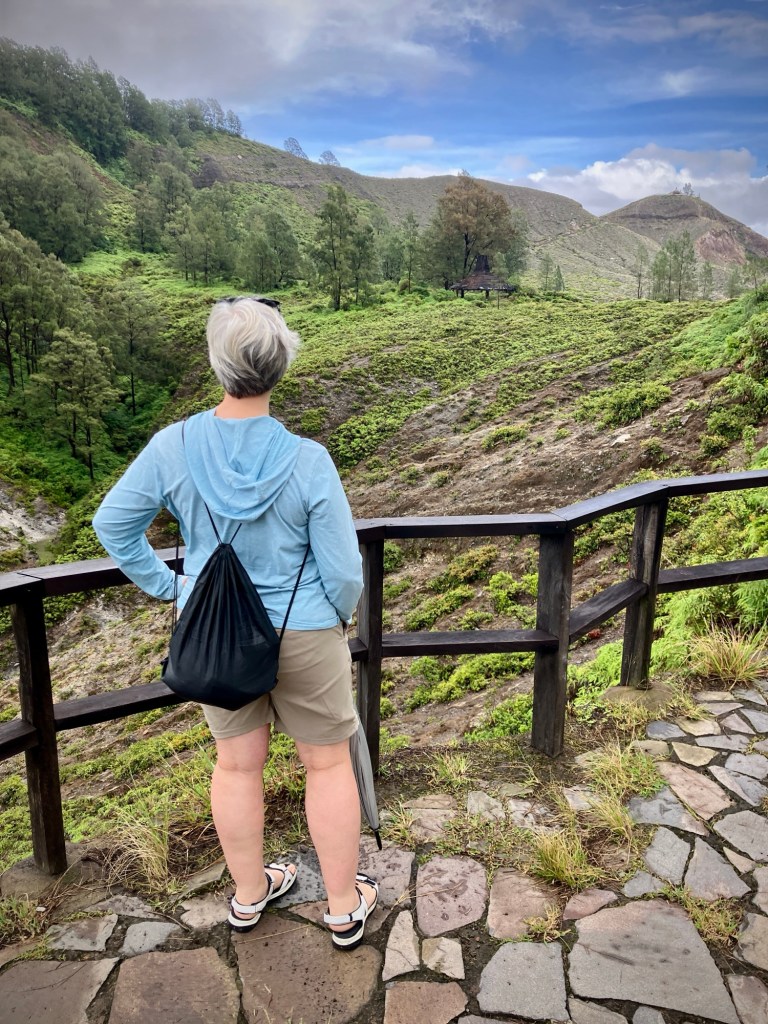
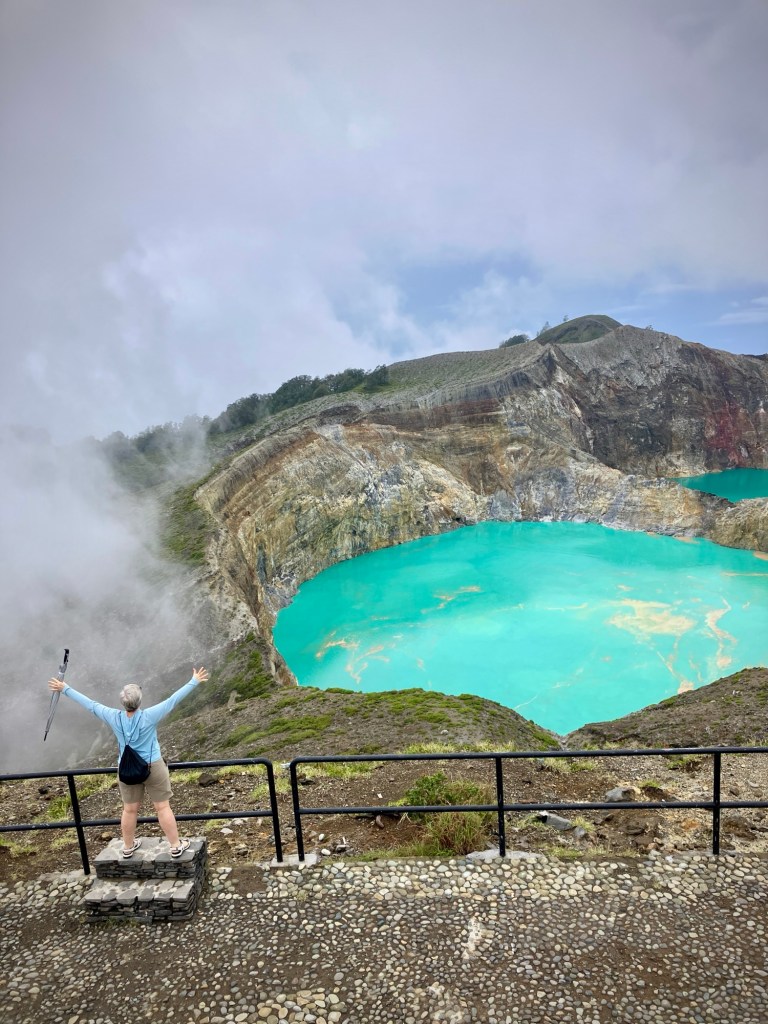
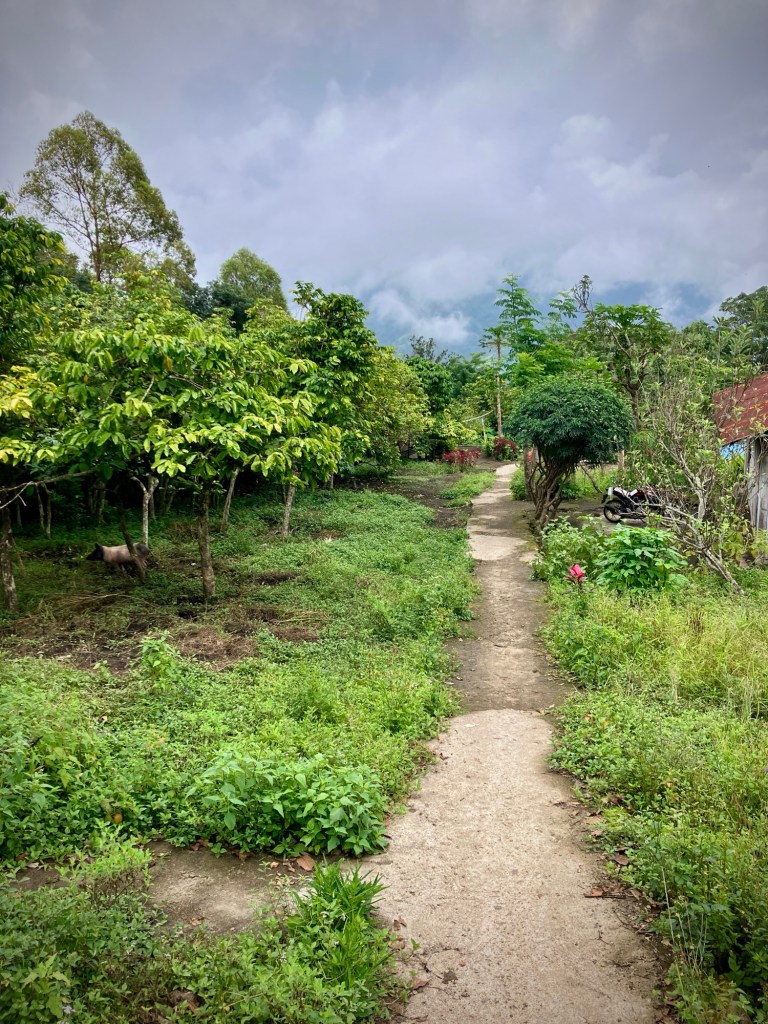
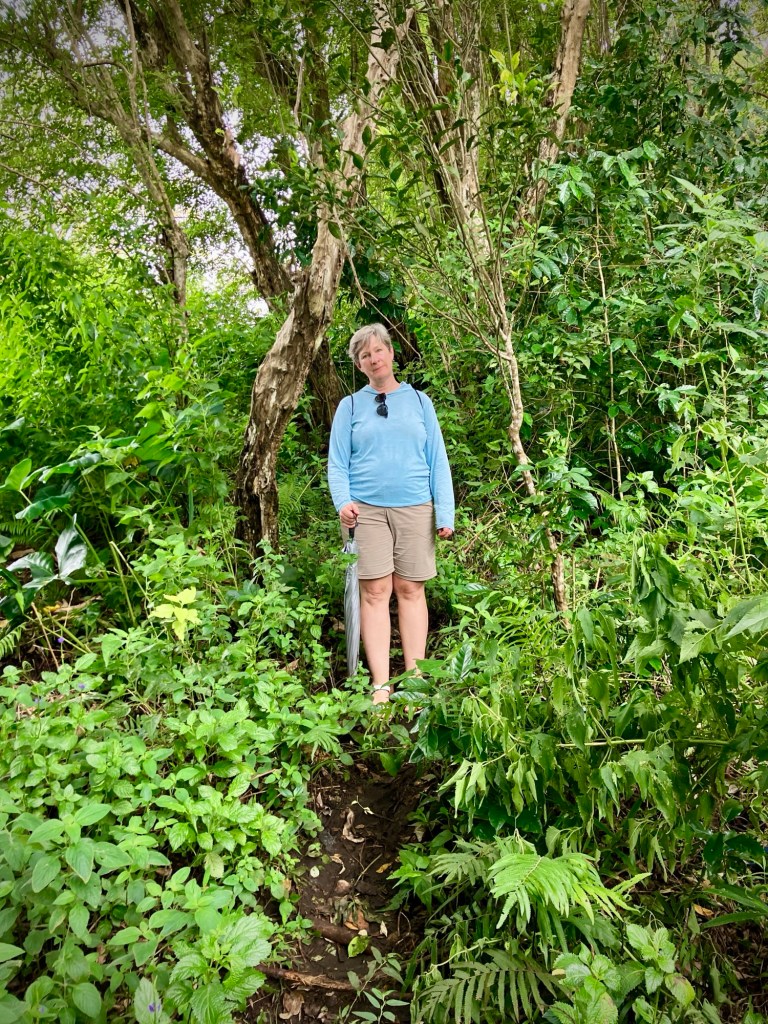
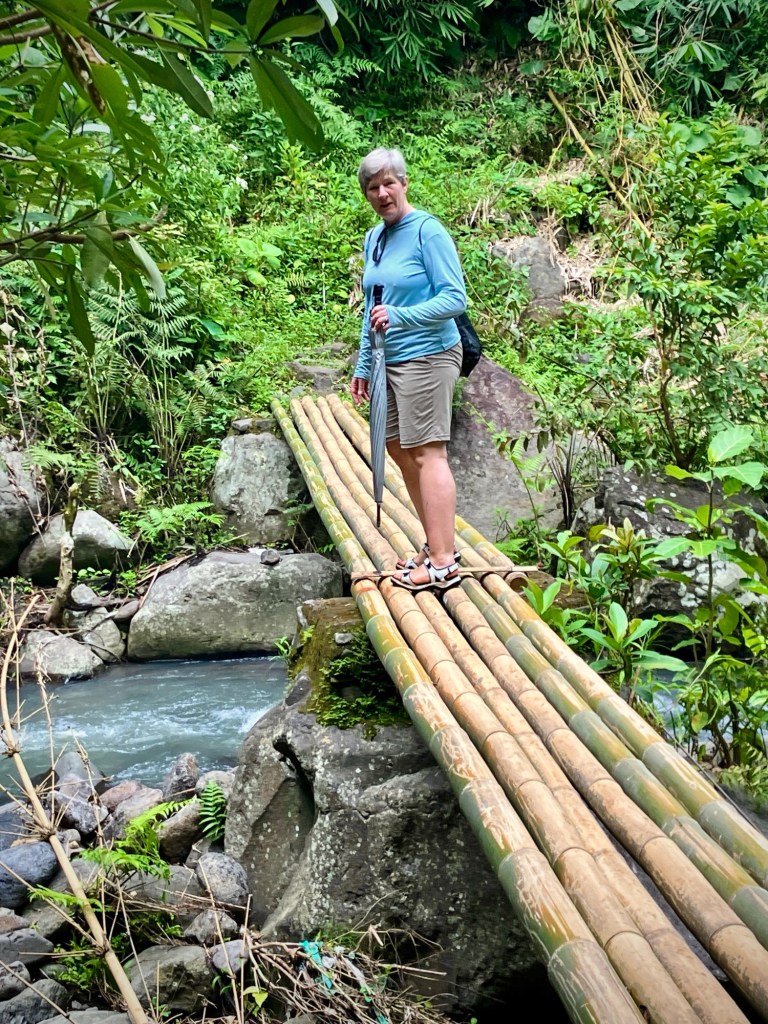
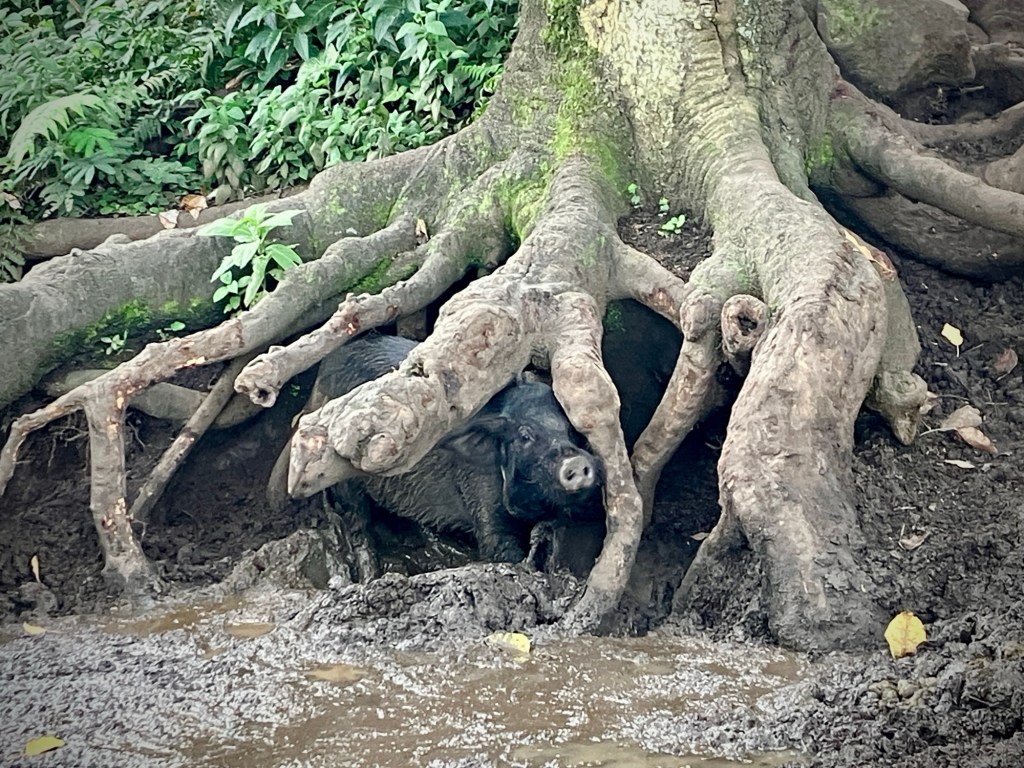
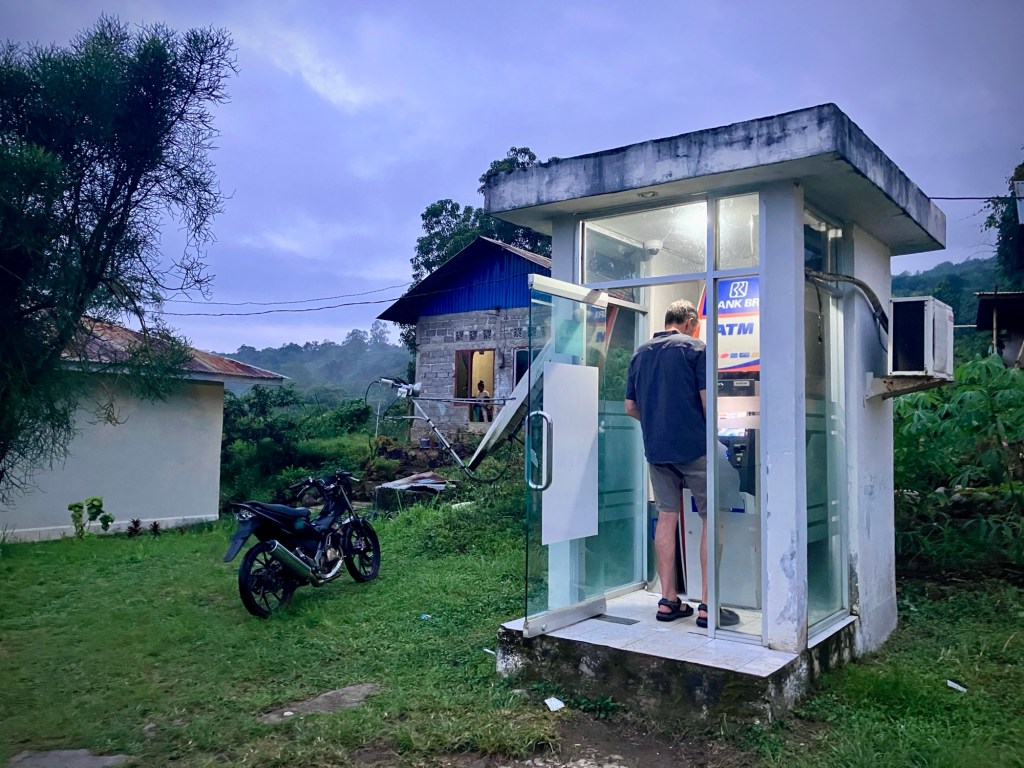
Donatus cracking some Candle nuts for us to try.One of the two idyllic beach coves at Koka Beach.Our stop here was midday and the UV was extreme, but that didn’t stop Cheryl.Cacao trees and pods that give the beach its name.À local girl is baffled by the pale woman under an umbrella.Oh, but the water feels so nice in the oppressive heat of the Flores coast.Grilled fish lunch near Koka Beach, a very pleasant and rustic affair.The Trans-Flores Highway is never straight and winds its way up and down the islands rugged topography. Villages cling to hillsides.Approaching the volcanic lakes of Mt. Kelimutu with anticipation.First views of two of the lakes. No filters.At the summit, I am calm and reflective.Cheryl, on the other hand, is having her moment. We are the only ones here, which feels amazing.By the time we get back down to the upper trailhead, more people show up, including these friendly nuns.And another group posing in the parking area before their trip up to the lakes.We decided to hike down the mountain 5 miles or so to Moni, and the first part was a steep but easy walk on the small road.The lower part of the Mt Kelimutu Road is wide, graded shoulders were a popular and level spot for cattle grazing in the green rainy season. Our next shortcut to Moni started off ok, but then turned steep, muddy, slippery, and overgrown in places.This dog was wondering where we were headed?Thanks to a mostly accurate gps track we eventually found our way and stayed on our feet (yes, umbrellas for their third and fourth purposes; walking sticks and snake clearing!).Cheryl was not pleased with this « shortcut ».Lots of random farming and gathering, including Taro.Uhm, the trail is somewhere there?!We finally made it down to Murundao Waterfall,Near the falls were two streams that were just raging a bit too much in the rainy season to cross by foot. Cheryl’s good balance made it standing across the loose and wonky bamboo. Full disclosure, I crawled across as my high center of gravity and fear of falling onto the rocks below got the best of me. You make different decisions when medical care is potentially very far away.A pig living under tree roots. Safe for now. Our rustic homestay in Moni, Jaya Hill Garden.The lone ATM of Moni (accidentally Wes Anderson).
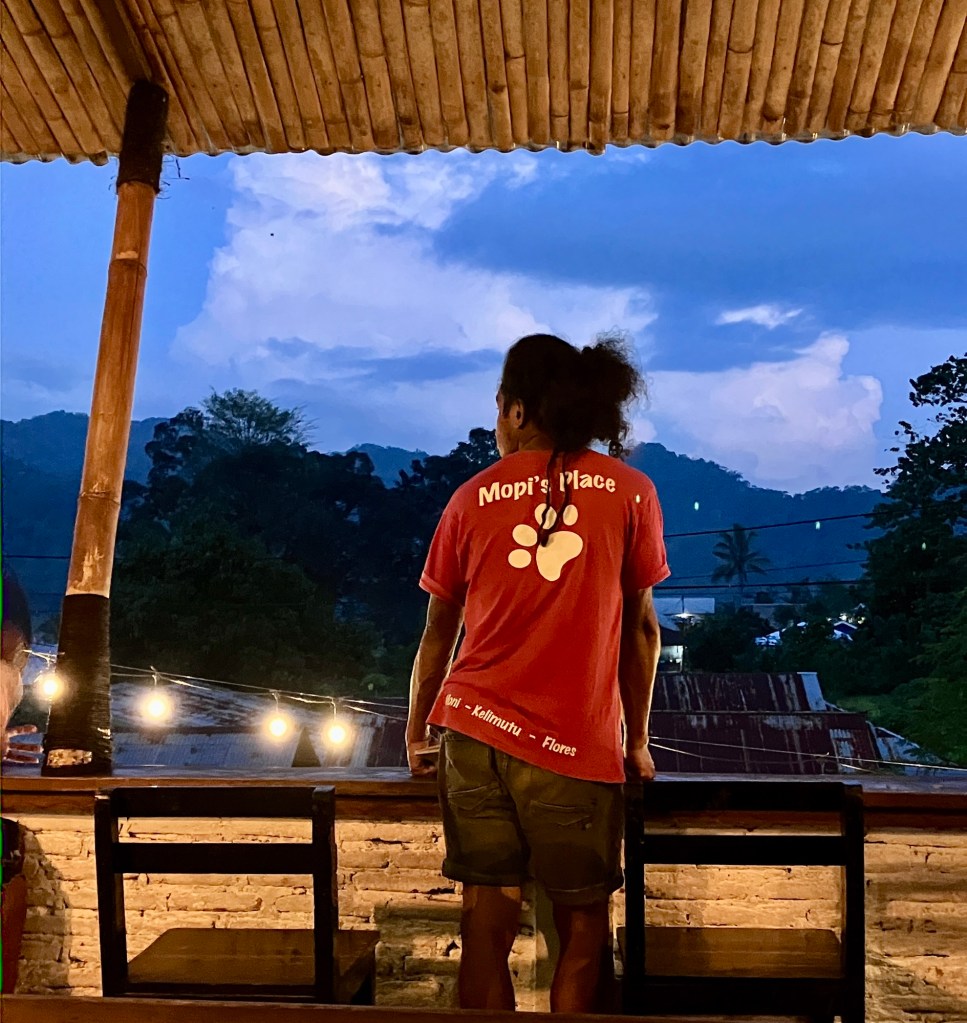
We said goodbye to our great driver from Maumere and spent two nights in the small mountain town of Moni to explore and see Mount Kelimutu. It was great and thankfully a bit cooler at 1000m. Moni has a relaxed vibe and one of the great global travelers bar and restaurant called Mopi’s, run by some local Rastafarians. It was quiet this time of year, but we could imagine a different scene in the peak and dry June/ September season.
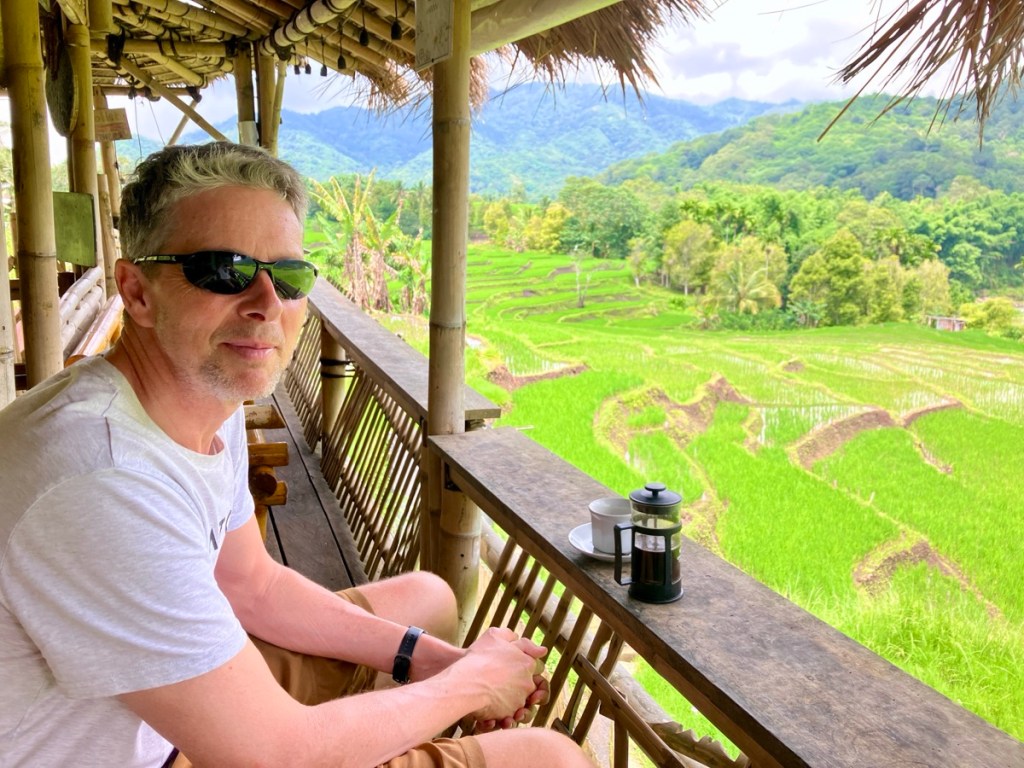
The view from Mopi’s Place.The endless jungles and mountains of Flores, so happy we decided to come here.
But we had a lot more of Flores to explore, so let’s get going!
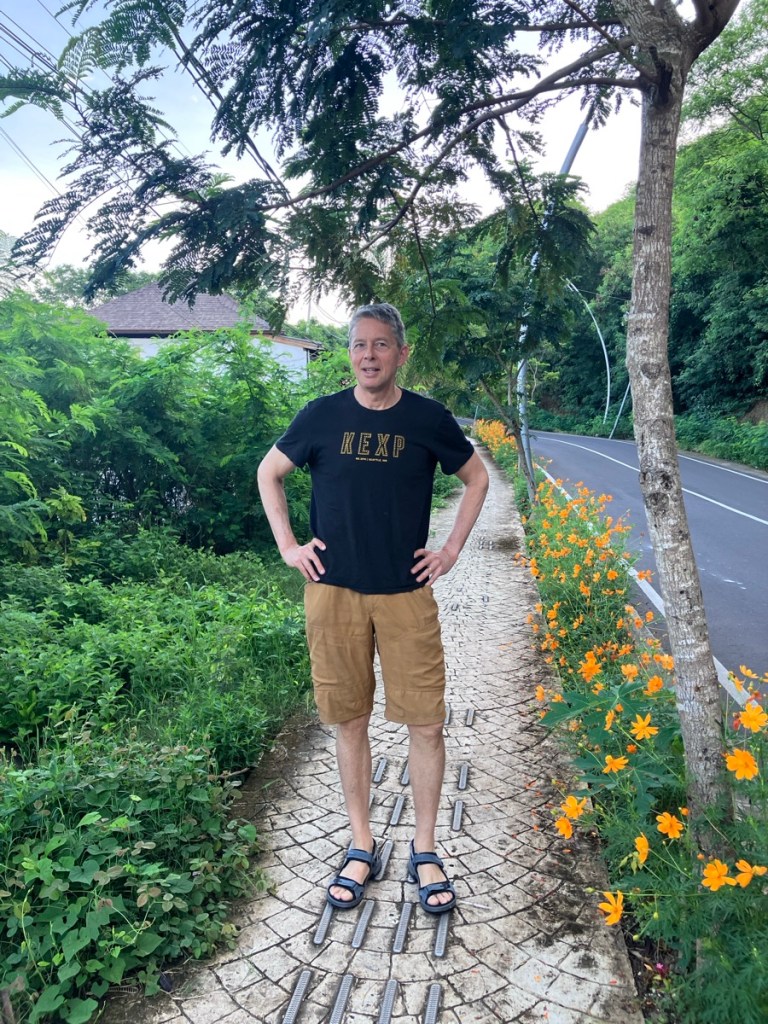
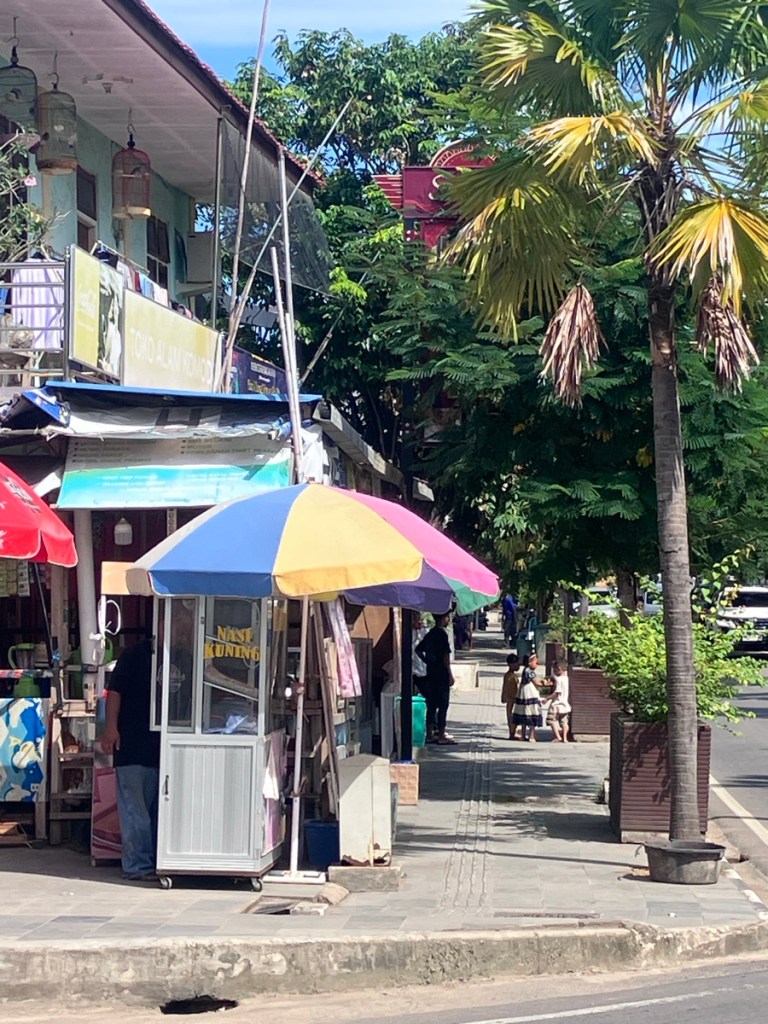
In the taxi from the airport to our hotel in Labuan Bajo Rich looked out the window and said “Sidewalks. There are sidewalks.” If you’ve traveled in a developing country you will understand his surprise. Walking in a lot of places – India, Sri Lanka, Vietnam, Mexico – can be challenging for a multitude of reasons, lack of sidewalks being a big one. Or, big holes or incomplete sidewalks. And, places that do have sidewalks, like a lot of Thailand, will come with a lot of scooters and street stalls to block your way.
Sidewalk! Complete with tactile guidelines for visually impaired folks.
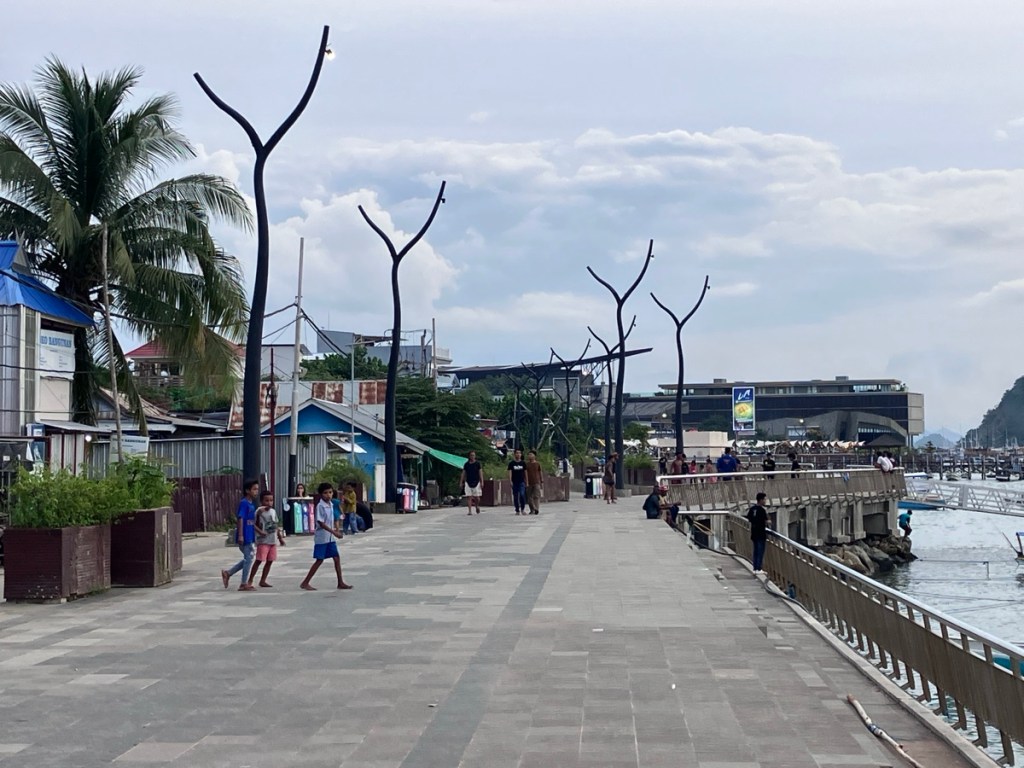
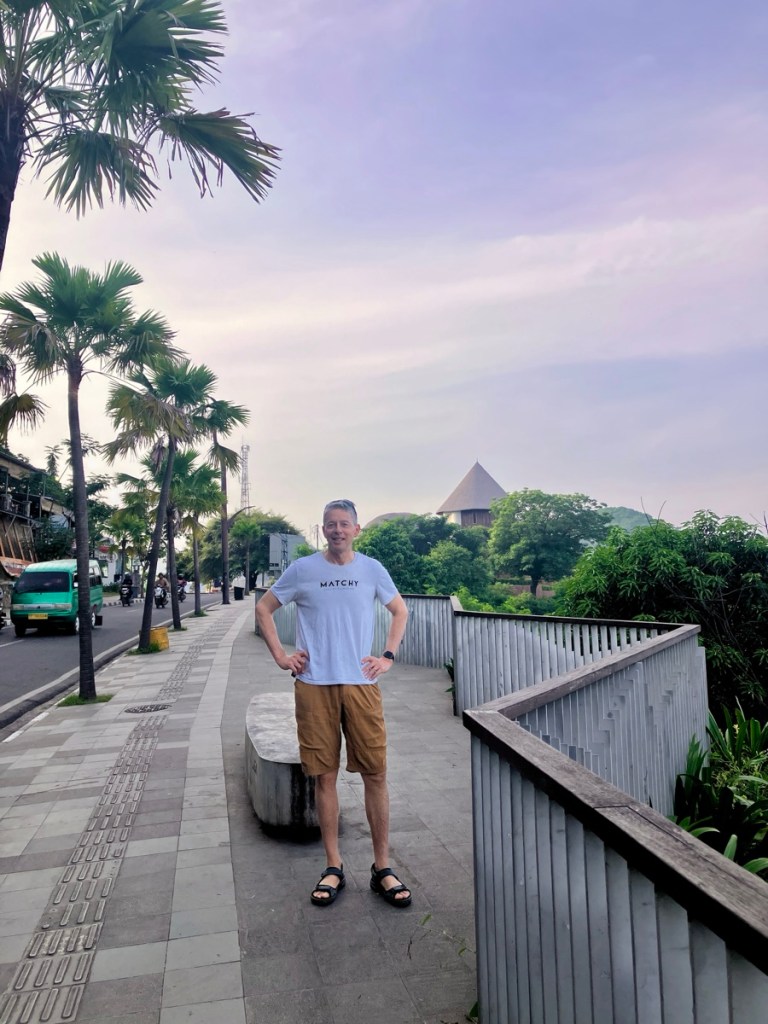
Labuan Bajo on Flores Island is one of the “Five New Balis” the Indonesian government has identified and put money into. Technically it’s called the Five Super Priority Destinations Program. The goal is to get travelers to visit other parts of Indonesia, not just Bali. And some of the money has gone into infrastructure. I can’t find when the sidewalks were built, but they have definitely been a good investment for locals and tourists. We picked our hotel because it’s close to the commercial area. We always prefer to walk to dinner and around town instead of taking taxis.
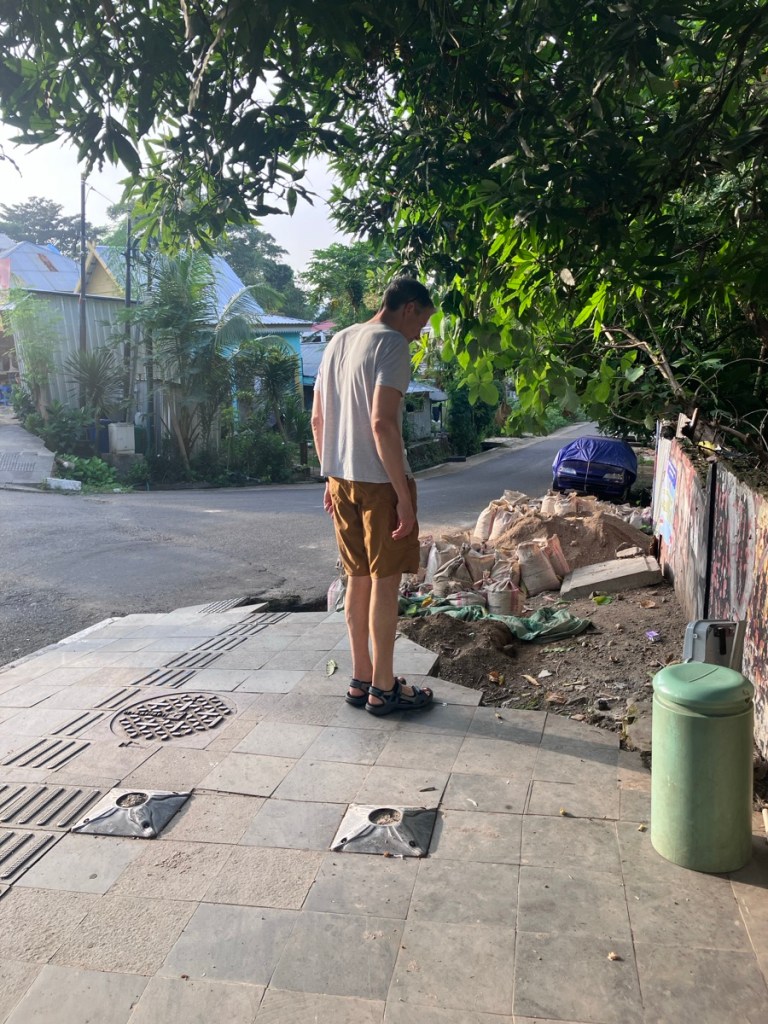
Tourists making good use of sidewalks.Sidewalks are so important for children. Walking and playing.Children playing on the waterfront promenade. Recreational paving stones. Some lovely views from the road leading up from town and to the airport.So many boats and construction projects.Warning of the permanence of plastic.Where the sidewalk ends. This is what we expected of the streets. All this walking is before 8 am.
We spent a day just exploring town and debating a trip out to Komodo Island to see the dragons. Our intent in coming to Flores Island was to explore the island, not specifically to see the dragons. Komodo Island is firmly on the tourist track and offers of trips to see the dragons, visit the pink sand beach and walk to the view spot on Padar Island are ubiquitous. Also, so many dive shops and folks offering live aboard boat trips.
Ruling the roost.Helpful signage.
The Indonesian government has a plan for periodic shutdowns of Komodo Island beginning in mid 2025 to not only to help the island regenerate, and hopefully to rewild the dragons, but also to encourage tourists to visit other sites and spread the tourist visits to more attractions. We read enough about dragons being fed (and possibly drugged?!?!) to keep them on the beach and easily visible to tourists to give us pause about visiting. At busy times of the year the scrums of folks getting dragon photos looks pretty awful. This isn’t the busy time of year since it’s the rainy season, but we still just couldn’t find the motivation to visit Komodo Island. Maybe on our way back through Labuan Bajo. Maybe.
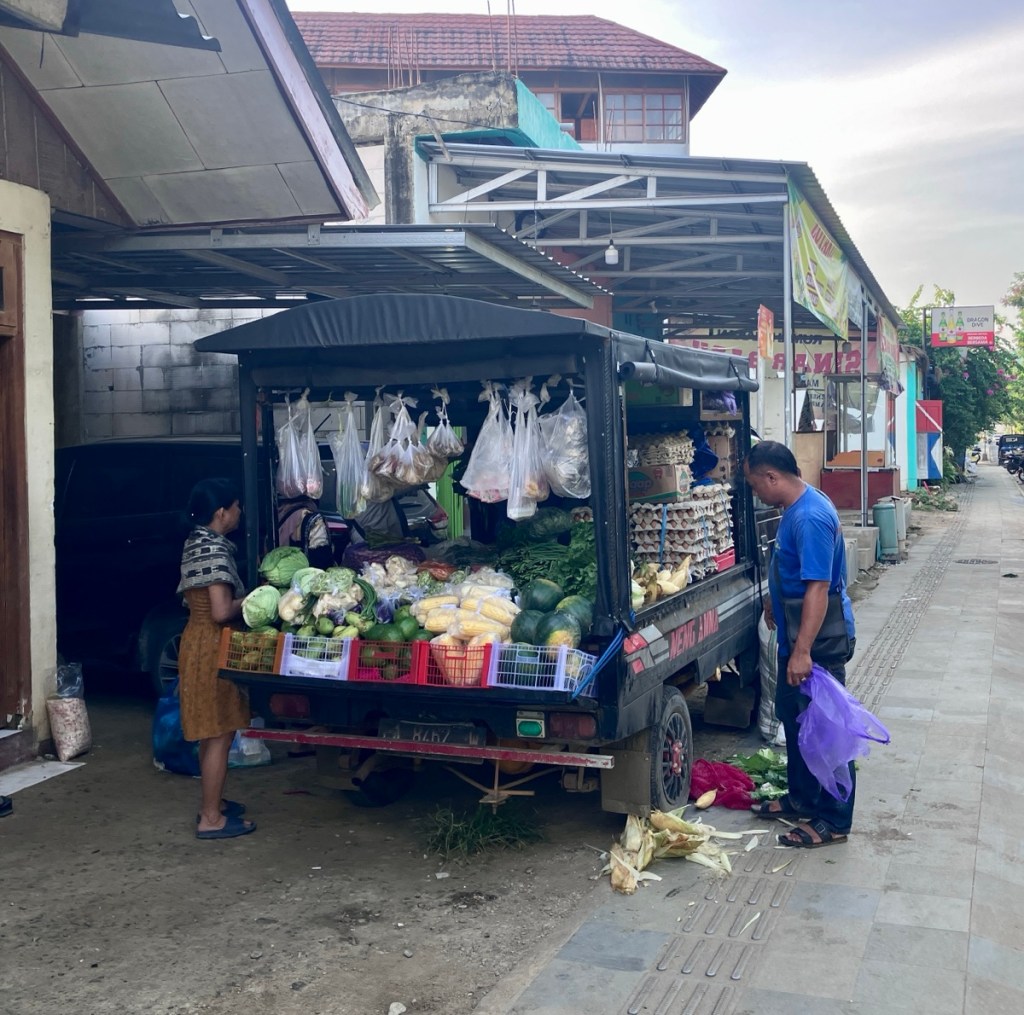
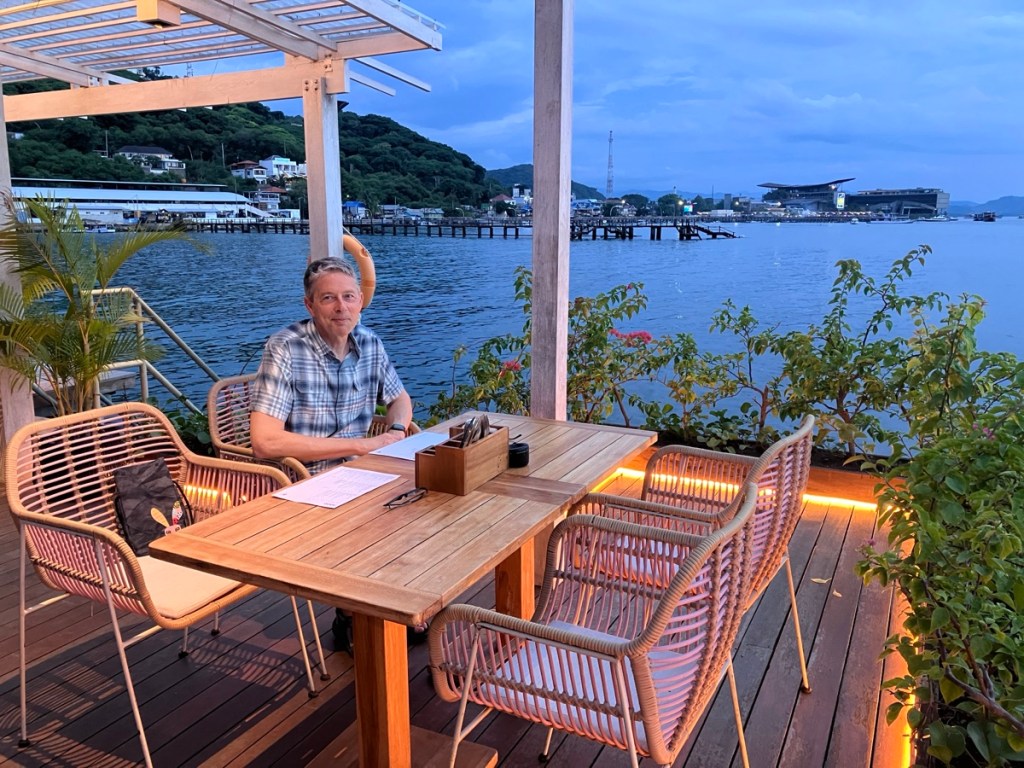
An alley suitable only for scooters and pedestrians.Kitty tenderizing a scooter seat. Handy scratching post! Lots of cats out in the coolish morning air.Mama cat and kittens.Street side stall. Colorful snacks whose wrappers sadly end up everywhere!Farmers come down from the hills to sell good in town. There is a market street further up town but this farmer has a mobile market.No egg shortage here. (The USA has an egg shortage due to avian flu.)I arrived in Indonesia without an umbrella! Mistake corrected. Lunch at a locals spot, Kantin Primkopal. Rich happy with the Ayam Goreng Sambal specialty. And dinner out on the end of that pier, the fanciest spot in town.Heading to the restaurant we saw turtles and had a good chat with some young Indonesian tourists.Quite a lovely spot, Le Bajo Restaurant. One of three new higher end restaurants on the pier.Best Waterside table, low season perk. What a place to watch the sun set.Have a cocktail.And some local food – octopus! This restaurant is ready for the folks who will be coming to the new resorts being built.
So what did we do instead of a Komodo Island visit? Well, a big downside to Labuan Bajo is that there are almost zero beaches at which to swim. One public beach close to town is a bit of a mess with trash, and the only other close by beach has been privatized by a fancy new luxury collection Marriott resort. We want to spend our tourist dollars visiting attractions so we hired a driver for the day and headed out to visit two caves.
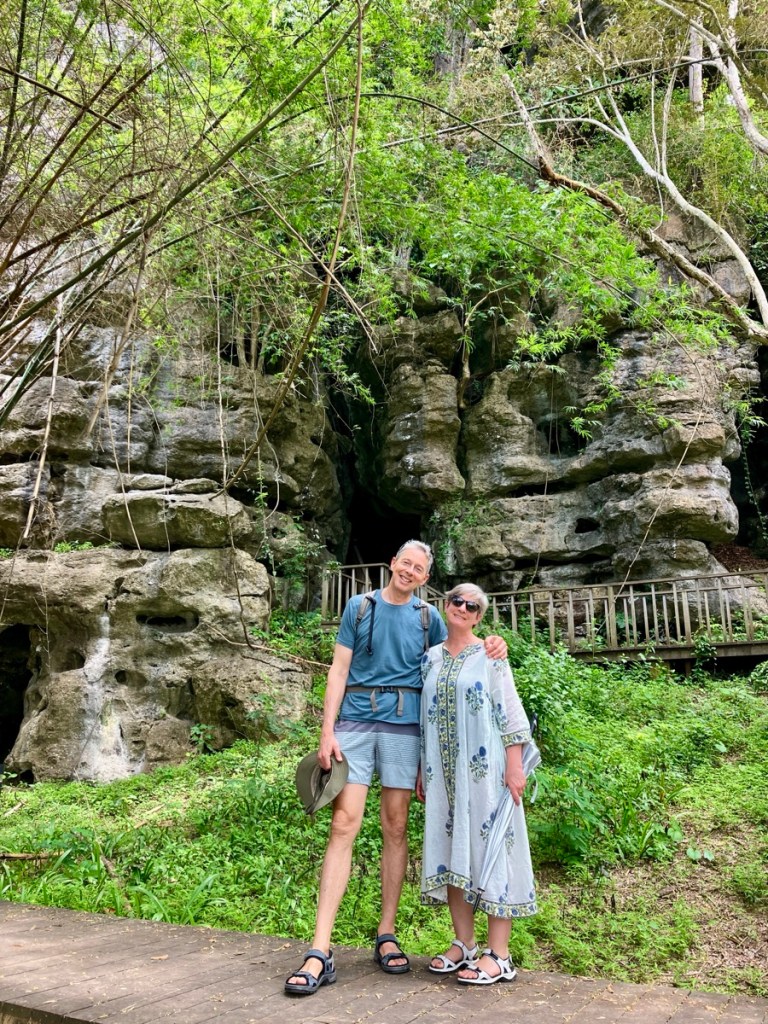
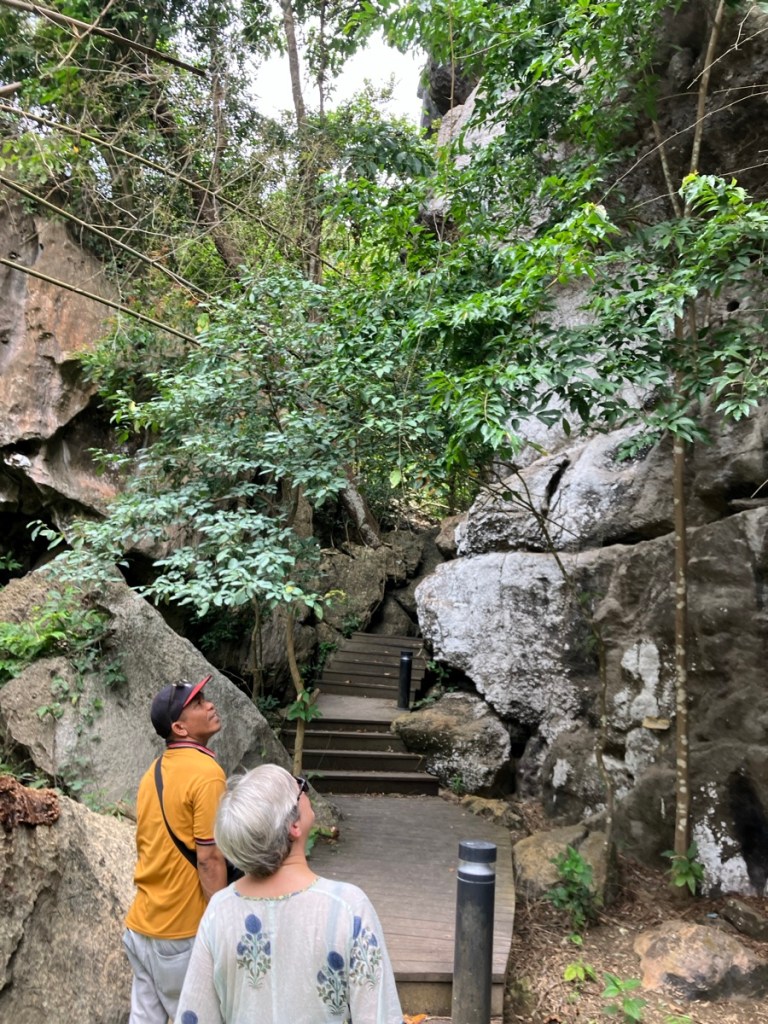
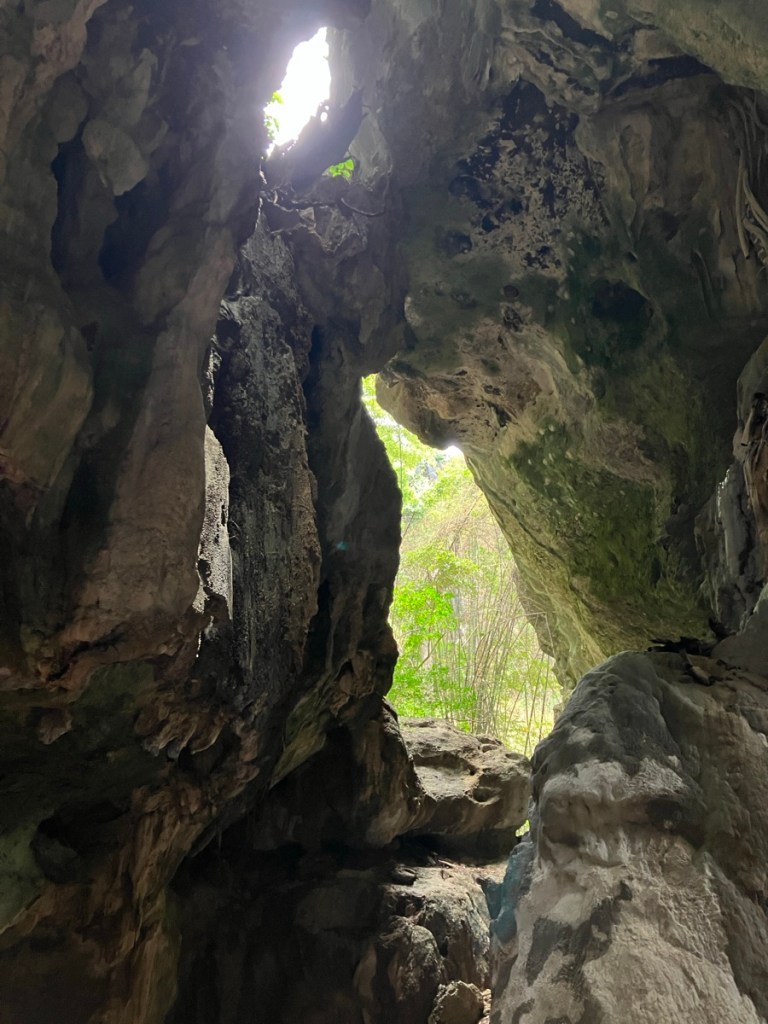
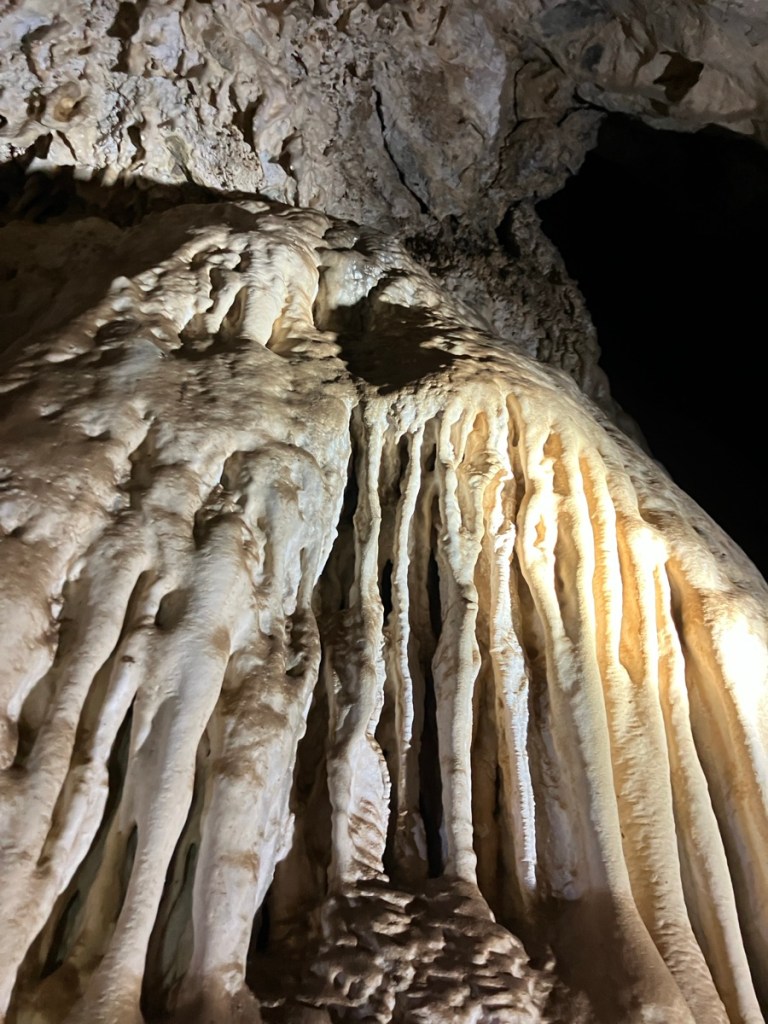
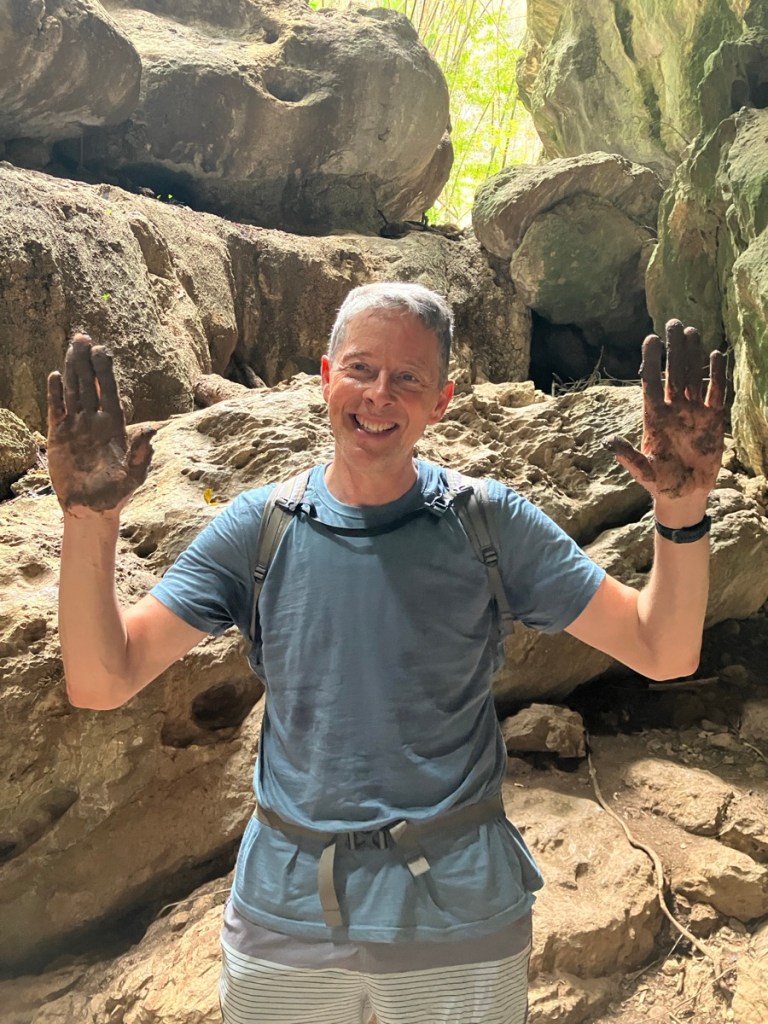
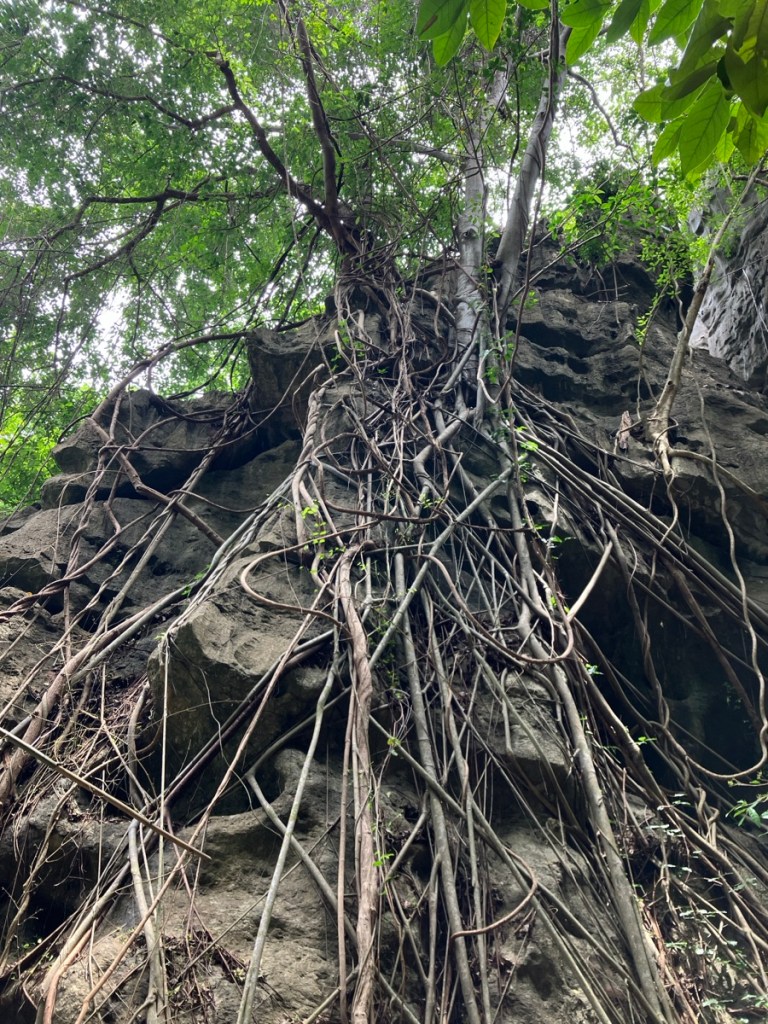
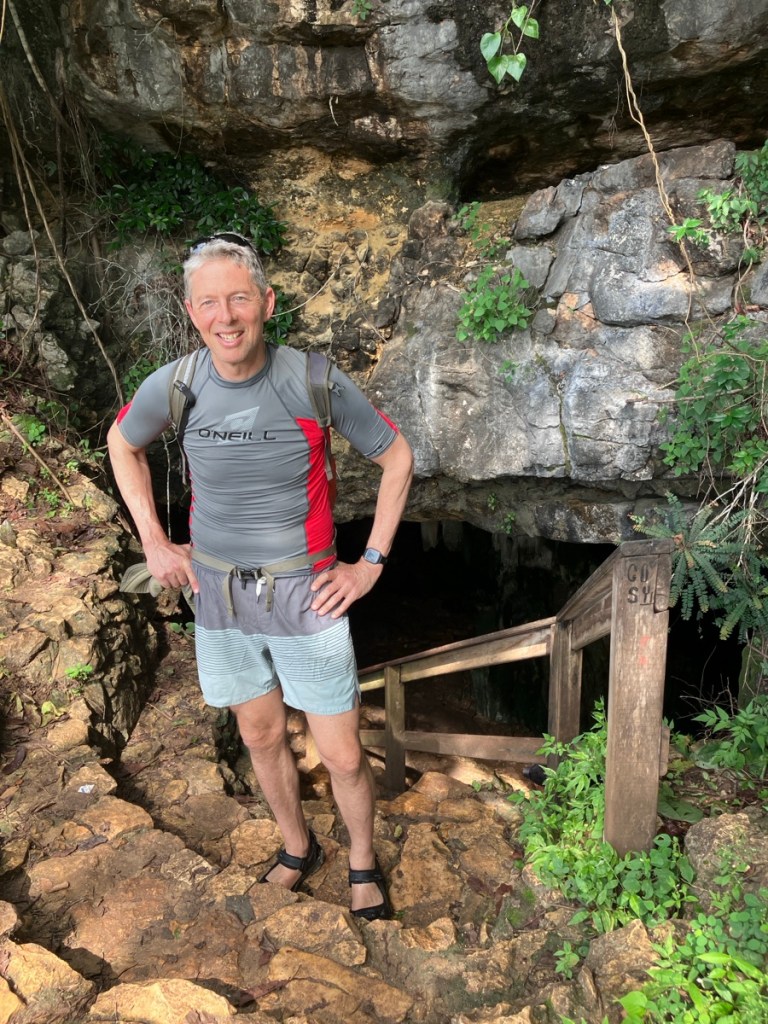
First up: Mirror Stone Cave, Gua Batu Cermin.Our guide from the park. You need a guide to go in the caves. They are unlit and have no walkway once you are inside.Not many photos from inside the caves. It was a muddy scramble complete with hardhats and headlamps (provided by the guide.).Lovely formations.Terrifying spiders! Cave portrait thanks to our guide. Not pictured- many many bats!Cave scrambler.Tree roots searching for ground.Muddy handed Rich and our guide.Another locals spot thanks to our driver, we could watch the school kids pour out for lunch.The food was good and I was surprised and delighted to find a bat in the toilet cubicle! They flew about a bit before settling down to keep me company.
After lunch we went to Rangko, the small village is the launching place to visit Rangko Cave. A cave with swimming.
The path to the beach complete with cute goats.Settled in for the 15 minute ride.It’s pretty hot and the water looks so tempting.Group photo! I like how effortlessly our boatman sat cross legged to drive.Approaching the beach.A five minute walk to the entrance of Rangko Cave.The steps into the cave.And into the seawater! Amazingly clear. You could hear the gurgle as fresh seawater entered the cave.I swam too but was chief photographer. Looking into the cave as we left. The guidelines.And a swim at the beach before we left. The water at the beach was warmer, not as refreshing.Relaxing in the shade. As always.
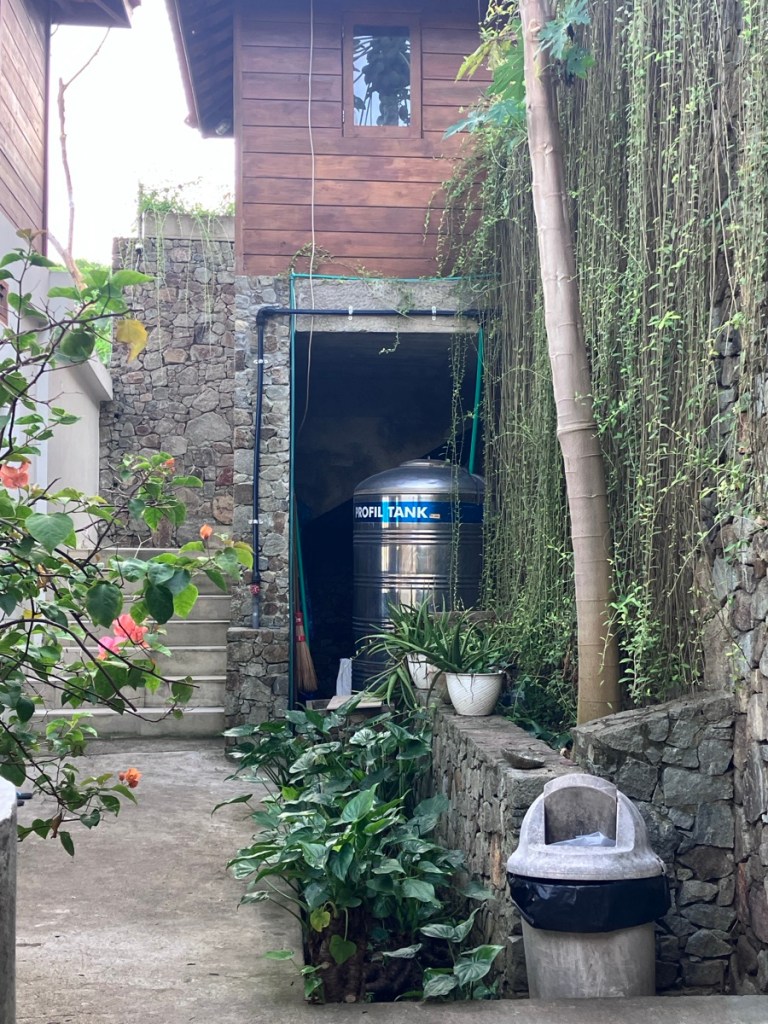
The highs of Labuan Bajo were the sidewalks, the views, the two good restaurants we ate dinner at, Happy Banana and Le Bajo, in addition to the local lunch place. The lows were the lack of a swimming beach and the missing mid range small locally owned resorts which you find on Bali. Labuan Bajo had a few fancy expensive resorts (one of which had privatized a local beach), but Rich couldn’t find a good small resort. A swimming pool would have been nice since there was no beach access, but there is a water issue in town. All water is delivered by truck filling large tanks, and drinking water in 5 gal/18 liter bottles.
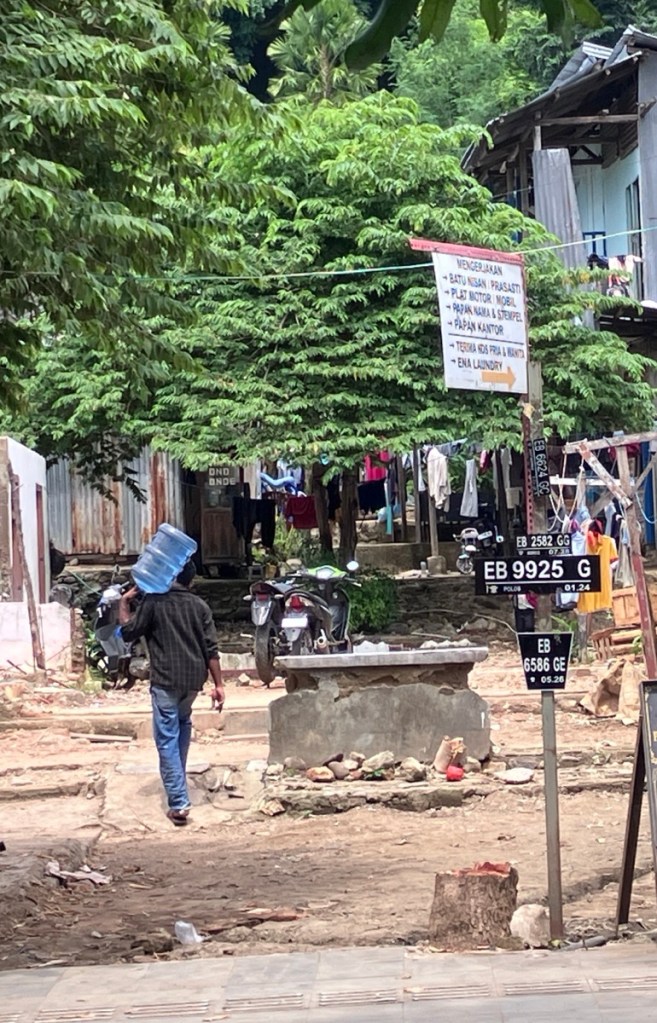
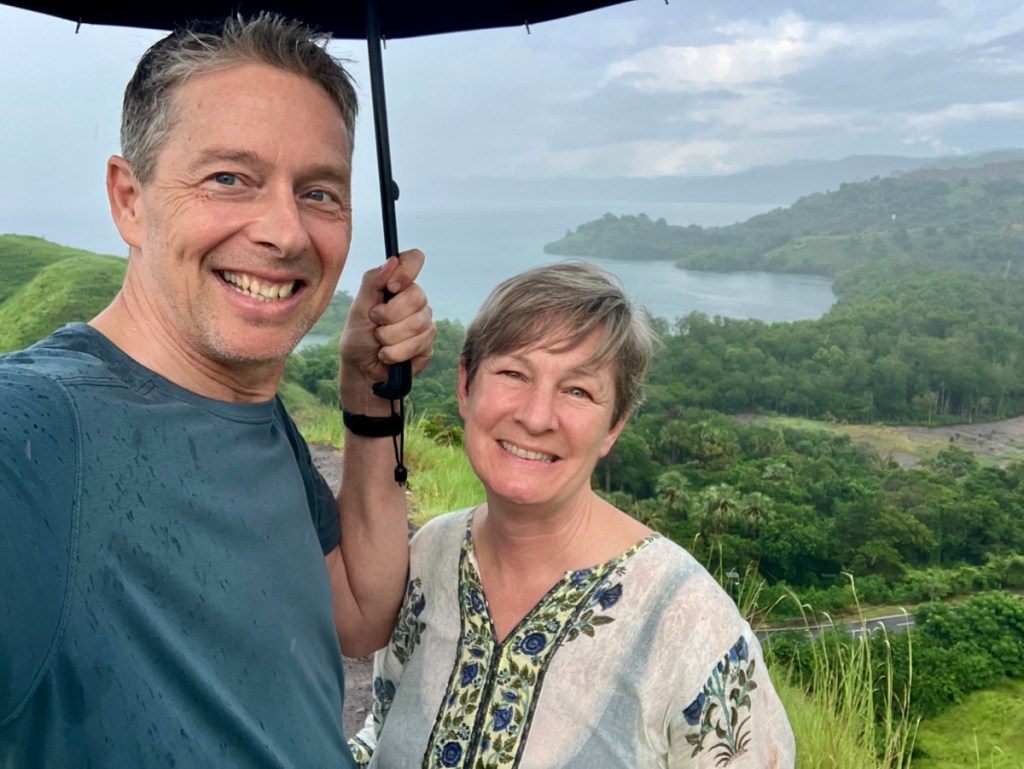
Drinking water delivery.Water tanks at a house.The water tank at our small 3 room hotel, The Blue Parrot. Once we learned about the water situation and saw this I immediately started taking shorter showers!The happy travelers. Under our umbrella.
To go or not to go? As we planned our trip to Flores, Indonesia, we quickly figured out that we had to fly via Jakarta or Denpensar, Bali to get to Labuan Bajo. Bali made more sense as it is shorter flying from Taipei.
Balangan Beach at low tide
But after spending a week or so on Bali during our 2017-2018 « Java by train, ferry to Bali adventure » we vowed to stay away until the plastic problem was improving and development seemed a bit more sustainable. Bali is a tourism juggernaut, but is often cited as a global example of overdevelopment.
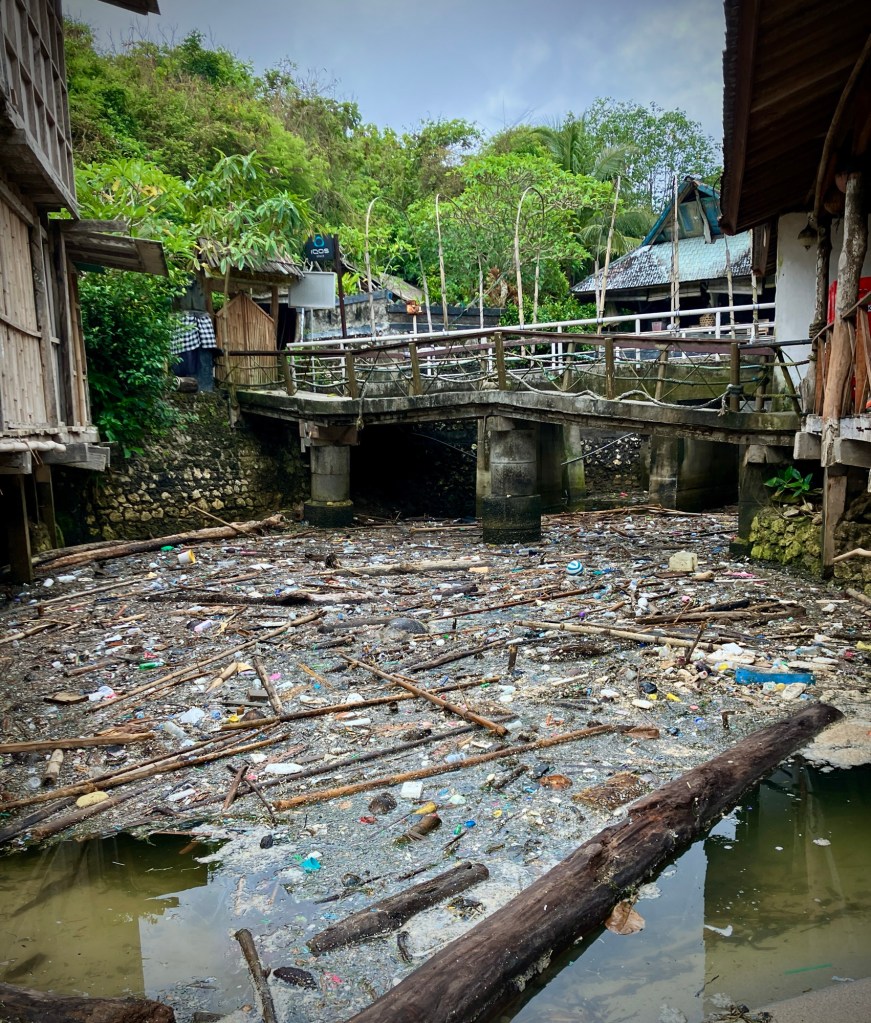
Balangan beach is a popular surfing beach, but pretty quiet landside this time of year. Bali tourism is still recovering from the pandemic, which devastated the islands’ economy as the airport was completely closed for an entire year! 6,000,000 tourists suddenly gone.Rotating left from that photo, here is the backwater area. It’s hard to identify the area and exact source of the plastic pollution, but the problem is clear around the island.
During that trip, we spent time in Pemuteran (NW Coast), Ubud, and Padangbai. The ocean plastic problem here is somewhat seasonal as the rainy season (Nov-Mar) washes much more plastic into the sea from creeks, channels, and other areas. It swirls around the islands and is carried to sea and redeposited into coves and beaches. In 2018, along with some well intentioned Canadians and Aussies, we would spend some time picking up plastic after each high tide left a deep line of plastic debris. But we soon realized the futility of this exercise. And I still have nightmares of my arms stuck in a giant plastic bag and debris flotsam mess in Padangbai, while trying to snorkel at the Blue Lagoon Beach. If you’ve travelled across SE Asia, then you have certainly seen the same challenges in other countries.
Heading down to explore the beach, hoping for the best. Did we cause this and are we adding to this by being here?
So Bali, and much of the developing world, has a massive sanitation, disposal, and plastic problem. If you have been here and not noticed it, then you probably isolated yourself in 5-star resort grounds or have been lucky to be in a clean area during the dry season. And much of Bali is still charming and peaceful. We also generate a huge amount of waste in the US (we’re #1 baby!) but it is generally disposed of properly.
Surf beach funkiness and faded glory feel at BalanganThe infrastructure of Bali varies, but is certainly still developing. More economic development may lead to more opportunities and spending on the environment and sanitation.
So we decided to spend 3 nights here and assimilate a bit into the tropics after a lot of cold weather and moving about the US and UK. We found a lovely, locally run, small resort on a bluff above Balangan Beach. We know the traffic here is a nightmare, so we planned to just get here and relax with one trip from and to the airport. We walked to a few local restaurants as we could, but basically stayed put for a few days, which is rare for us. The walking is not great on the busy back roads and the maze of historical alleys and streets is generally disconnected and cutoff by development or geography, so taking a scooter or car even to go short distances is the norm in most areas.
The view of Balangan Beach from above Sunset Point. A reliable swell hits the reef and creates beautiful surfing conditions.
We did not want to add to the traffic as much as possible and also strived to minimize our single use plastic use. We almost never use plastic bottles in areas with safe drinking water. And if the tap water passes the sniff and flotsam test, we boil or use our UV SteriPen. The tap water may not always taste the best, but this treatment ensures we won’t get sick from any microbes. The water may still have some undesirable elements, but those generally won’t harm you in limited doses. And as Cheryl likes to say, it may make us stronger!
There are over 10,000 hotels, guest houses, and other lodging on Bali, and dozens just in the small Balangan area. Light traffic here as it’s at the end of the road.
But regardless of what little steps we take, just traveling here inevitably generates a lot plastic waste that may not be disposed of properly. And of course, so many broader impacts from flying and local transport. Sustainable development is so hard to get right, and even more challenging when the economic disparity between the locals and tourists is so great.
Dragon fruit muesli bowl and a banana pancake, a classic Bali visitors breakfast. Cows grazing peacefully in the distance. Plastic straws at our guest house not appreciated. Jimmy Beach cafe is the place to go on Balangan, and we really appreciated the paper straws!Very well-presented and delicious Avocado toast at the Jimmy Beach Cafe. Is Avocado toast the new travelers’ Banana Pancake?
Now I realize that the carbon generation of our travels are not helping the planet and that’s a bigger ethical question for all who get around by jet. But the plastic embedded everywhere here along roads, ditches, coasts, beaches, and forests is visible. And it’s terribly depressing, and we find it nearly impossible to enjoy ourselves in the midst of it. But it’s also symbolic of the overdevelopment and a government that maybe isn’t always looking out for the locals. Not as much free and happy local space left here.
Collected plastic bottles, we assume for reuse or disposal?
And coupled with the low standard of living and income disparity, we find the whole scene tough to swallow. It’s not that we don’t accept the income disparity, but here it feels like the locals have been pushed to the margins and lost a lot of what makes the area livable, all in the name of even more touristic development.
Every residence seems to double as a surf shop and travel agent, but very little business here in February.
Maybe Hawaii got it a bit more right by limiting new resort and tourist development expansion the past 30 years. That has made Hawaii an expensive place to travel, but most of the islands are pristine and many areas are protected. There is still the local/tourist tension there for sure, not to mention a legacy of cultural appropriation and displacement. OK, maybe Bhutan is getting it right.
The local Bali cattle are smaller, very tame, and resemble deer, especially when they are young. They are very effective at clearing local vegetation.Cheryl above Balangan Beach. The grass is kept short by grazing cows.
But Bali is a large and complex island with over 4 million people, and 6 million annual visitors, with a huge variety of experiences and places. Indonesia is still a developing country of over 200 million people and tourism brings huge income and opportunities when applied correctly. It’s a lifeline and draws people from other islands to work. Indonesia is also embarking on its goal to spread the love and have higher end tourism in their “10 Balis » initiative. (More on that in our next post)
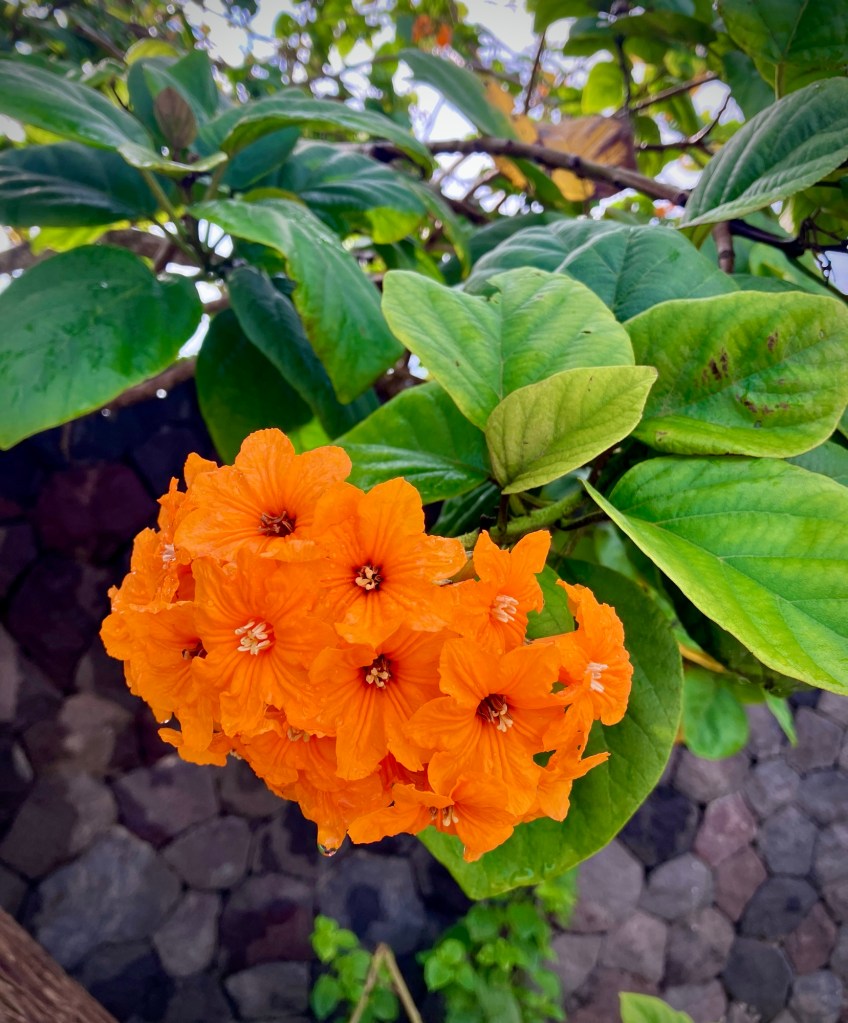
Dramatic sunsets and clouds from our balcony.Beautiful flowers on BaliIt’s beautiful here and charming, but we feel a bit out of place without our bicycles and a transit card in our hands.
So we are now off to East Nusa Tenggara or Flores Island as it’s better known for a few weeks of exploration. It’s certainly less developed than Bali and also one of the poorer regions of Indonesia with a vast array of cultures and religions. What will it feel like compared to Bali? Each Indonesian island is so different. Stay tuned.
Although we’ve spent a lot more time in the peaceful countryside over the past three years, we still love cities. We know the potential benefits of proximity and convenience. We love efficient transit and the embedded health gains offered by traveling on foot to a myriad of urban destinations.
Petronas towers in KLCC. Where can we walk from here?
So after our Borneo adventure, we decided to return to Kuala Lumpur (KL) after 10 years and spend a week soaking up its multiethnic mix, food, and smattering of sights. It’s changed and grown a lot, and mostly for the better on the transit and walking front.
Indeed, KL has developed rapidly
So this post is about our brief experience getting around only by foot and metro for a week. First. we choose to stay in a centrally located high rise apartment complex in the KLCC (city center) that had pools, gym and was close to two major transit lines. The amenities at KL apartments and hotels are nice, and relatively affordable. And pools and a gym can be an effective way to avoid the heat of the day.
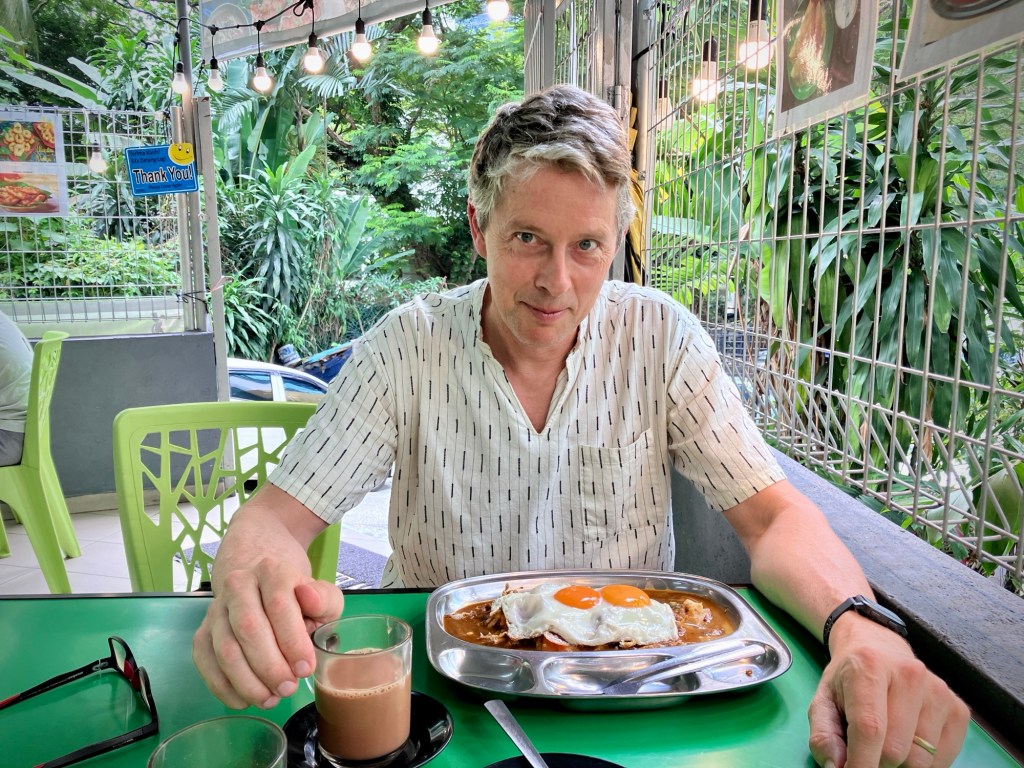
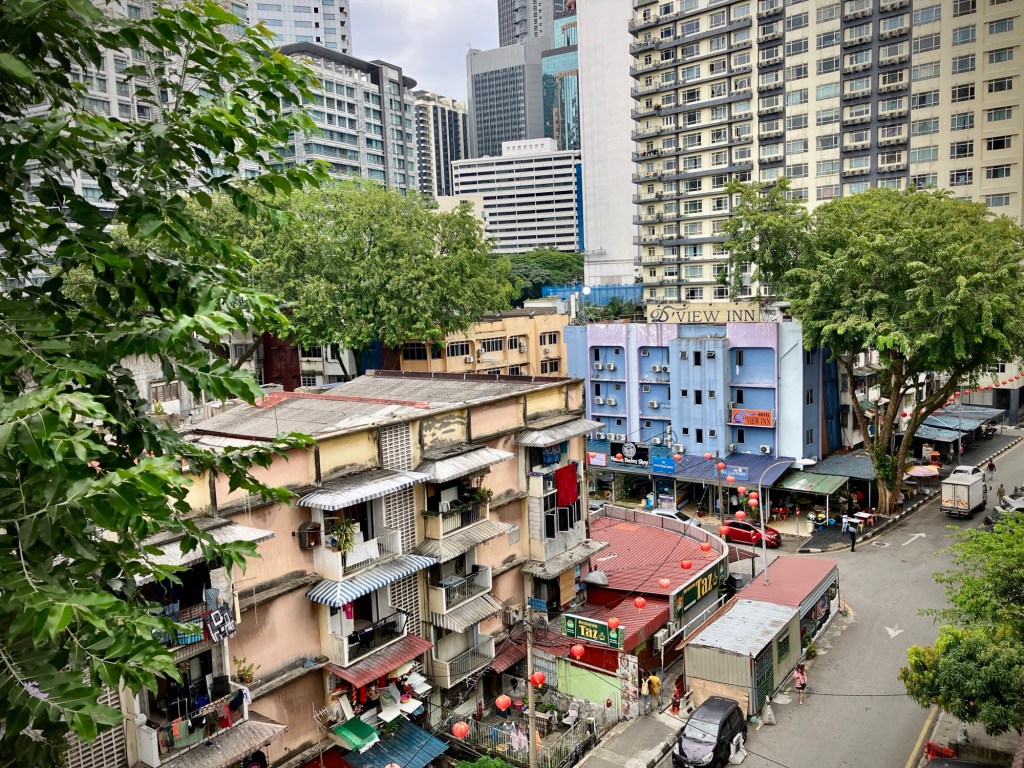
Fenced and hemmed in on a major street. It’s often single file and one way jockeying. The newer sidewalks are better.Sidewalks are often used for other uses than walking.But the food in KL is awesome, such as this curry laksa, and great food courts hidden away in shopping centers and office buildings
It’s key to note that as KL has proudly developed from a swampy tin mining village over the past 100 years into a city of over 2 million, in a region known as the the Klang valley that has over 7 million people. Its human scaled grid of walkable Kampungs has mostly been replaced and overlain by a network of developments, asphalt and slip ramps and arterials designed to move people around (almost) solely by automobile. This is a very different trajectory than some other Asian cities such as Hong Kong or Tokyo that have had layers of transit systems functioning for over a hundred years and never lost their core walkability. It’s much smaller than Bangkok and has developed much later when the automobile has been king.
The 57th floor sky pool at the Ascott Star was an experience and great way to beat the heat. We were not suffering this week.Buildings are often wrapped in one or two additional asphalt lanes for “local circulation”Masses of people fighting for measly sidewalk space near the Petronas Towers. Did I mention the food? Old school KL open air Indian Food at the Sai Hills CornerPedestrian pain by design. A ridiculous 15 second crossing at the major intersection of Jin Sultan Ismail and Jalan P Ranlee in KLCC.
This continued mega development has been masterminded by leaders, designers, and developers that see a vision of auto-only travel. But there are changes afoot as the realization that moving EVERYONE in a car is not possible with the sort of real density being built in much of KL, and especially the KLCC. We noted at least a dozen new high rise buildings under construction in the core. And they are big and tall, and often have a mall or retail.
As somewhat overwhelming and dystopian it feels at times, I think it’s really an amazing city center as the lack of a grid makes a random, somewhat circular pattern of buildings swirling around the hub of the city at KLCC Park and the beautiful Petronas twin towers. And you can walk on most streets and get between sites via transit and foot. But it’s not always easy. Cars are always first priority.
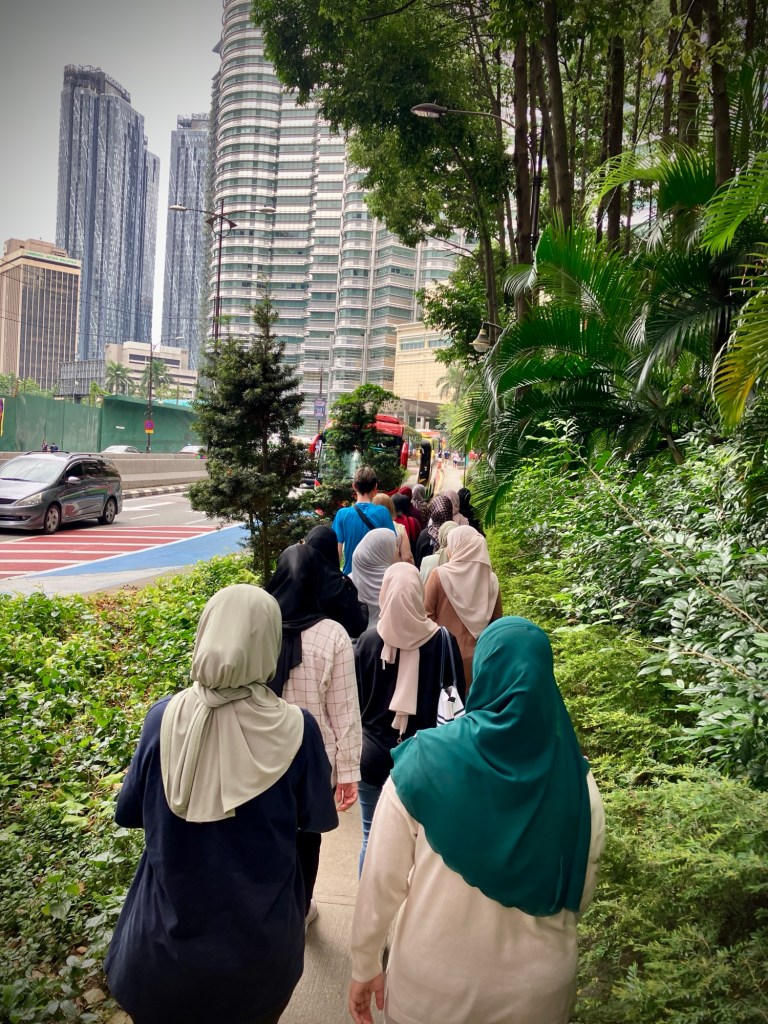
But to be fair about walking, we have to talk about the heat. My god the heat! It’s hot most of the time and only mildly dips in the evenings and early mornings. The lowest temperature EVER recorded in KL is 64F (18C), a temperature our native San Francisco barely exceeds on average day! March starts to get hotter in KL and it topped out at 95 (35C)for much for our stay. It did cool off the last few days and some rain and cloud cover kept it to 32C/89F which makes waking more bearable from midday onwards. With full sun, the vast stretches of asphalt and concrete heat up and limit the cooling possible at street level, even into late evening. But anywhere with trees is pleasant and notably cooler.
Cars blocking both ends of a bus stop in KLCC.Crossing the Saloma Link pedestrian bridge, a beautiful and critical link between KLCC and Kampung Baru that opened in 2018.Crossing the highways and Klang River to Kampung Baru.Walking through Kampung Baru makes you appreciate the immense urbanization that has occurred in the rest of KL.Old school Malaysian life in Kampung Baru.More people walking and biking in this human scaled and gridded neighborhood.
And other issues wear you down. The ubiquitous forecourts, now even more essential for ride hailing trips, dominate the streetscape. You must cross or share the space with moving cars, And slip, frontage, and garage access ways define the pedestrian environment. As a lifelong advocate (and sometimes designer) for better walking environments, KL offers a huge opportunity. Sidewalks come and go, curb heights are massive (perhaps for storm drainage?) and pedestrian crossings few and far between.
But from what we’ve experienced in our brief week, you CAN walk in a lot of KL, especially in the city center (KLCC) and adjacent dense neighborhoods.
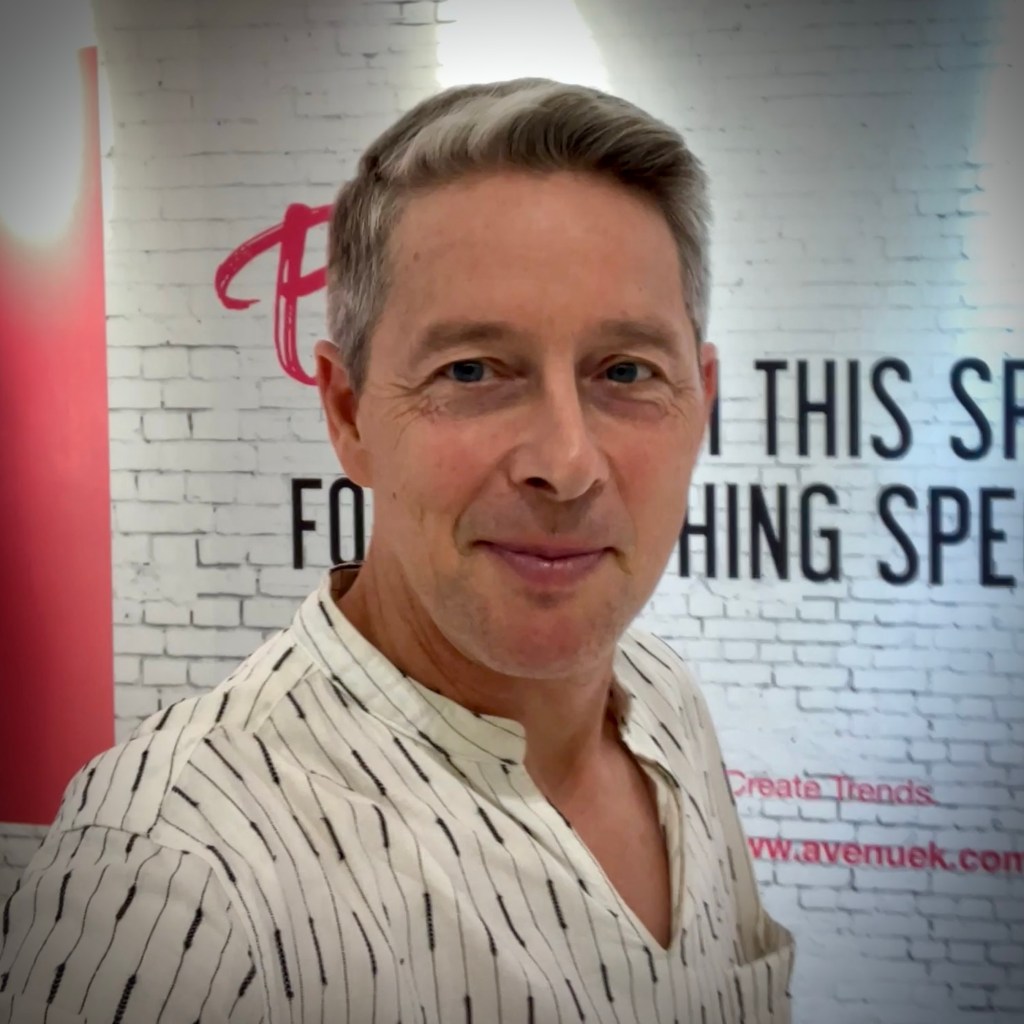
What else do you do in KL for a week? Get a haircut at the mall!
Mass rail transit started late here, but is now starting to change the center of gravity of movement. We especially loved the new Yellow line which opened in 2022, and has excellent design standards for comfort and station access. The older lines (such as red and blue) are have lower capacity and get packed at rush hour; even requiring guards to monitor and control platform crowding from the mezzanine or concourse levels. Clearly, people want to take transit or are choosing it over the congestion and cost of car ownership. But capacity and design have not matched road building to date; but with two more metro lines being built and set to open in the next 10 years, things may get even better.
There is some tropical randomness and greenery at street level which keeps things interesting and cooler. This is Ficus racemosa, the cluster fig. Edible. Macaques eat this and humans make it into chutneys.
The City leaders are now recognizing that walking trips are essential in the core and in station areas. But outside the center neighborhood, most areas are still designed as disconnected nodes of business or residential developments with masses of parking.
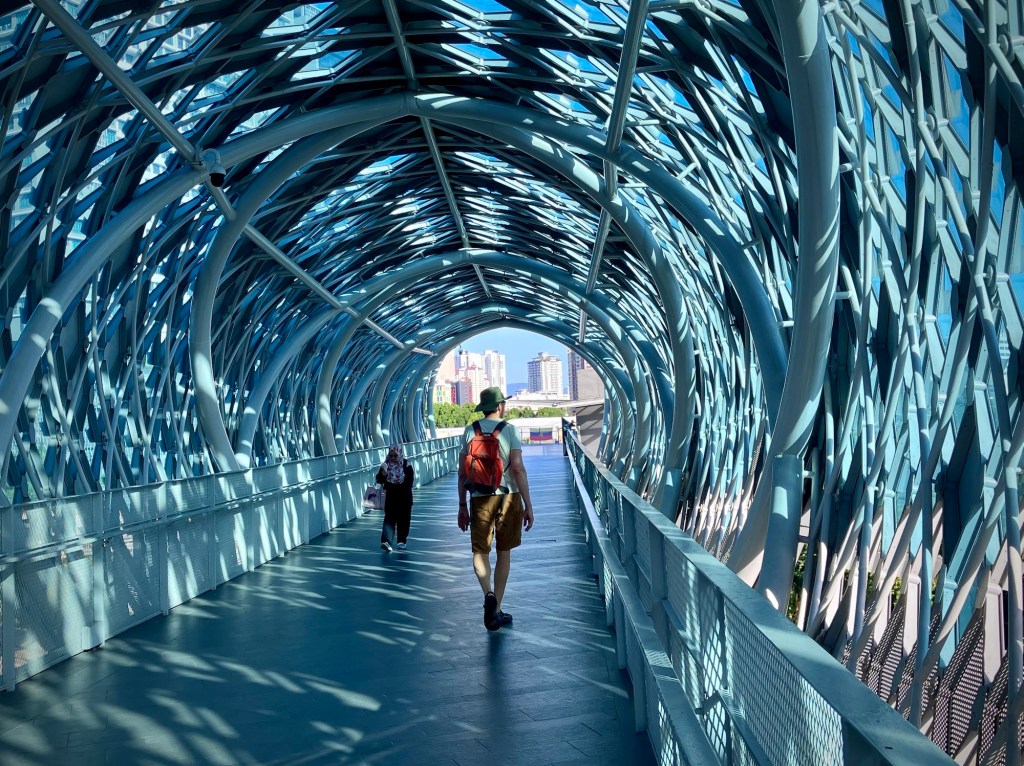
Bikes are decorations only in most of KL.Bukit Bintang is another refreshingly human scaled neighborhood.The 1km pedestrian skyway links a few malls and buildings south of Petronas Towers. It’s nice to have a somewhat cooler walkway, but not a great overall solution to lousy streets.
The inefficiency adds cost to everything and may be an extra reason why KL is such the labor draw. It’s one of the few places in Malaysia where you can live and work without a car. Car ownership is a huge burden on a striving lower and middle class. All of the Borneo cities we spent time in had virtually no public transit and were fairly spread out. With modest wages; car transport and maintenance is a huge part of the monthly budget.
Some riverside amenities- like the mist cloud- make taking a walk more appealing.The boardwalk was fun to explore.
Interestingly enough, scooter culture is small in Malaysia. It’s hot, distances are far, and there is a long rainy season. It’s also further along the development scale than its neighbors like Thailand and Indonesia, where scooters are still huge. But an average car costs 5-10x more than a scooter.
This is a disease all over the developing and developed world. Many cities and suburbs in the United States lack a good walking environment and culture, so I’m not singling out KL or Malaysia, for a unique deficiency, just noting that it could be so much better with some real focus on pedestrian access, comfort, and connectivity. Wider sidewalks, more crosswalks, and more trees and canopies. New buildings need proper pedestrian access. Pedestrian signage and more dignity for pedestrians. It won’t be easy as most of the built environment of KL was really (and sometimes comically) built 100% for cars.
The colorful steps to Batu Caves – part natural wonder, part Hindu temple Sure, it’s really touristy, but at least we could take the metro here!
But we enjoyed our time in KL and managed to do everything we wanted by walking and metro, except our airport Grab trips (you can take a train from KL Central to the airport!). You need to be patient, plan your walking as early in the morning as possible, and navigate on the shady sides of major streets. KL is not going to crack any top ten walkable cities list soon, but we hope when we return again in 10 years that it has realized even more of the promise we saw on this trip.
Perhaps a Taylor Swift Fan on the MRT in Singapore?This super friendly superfan from Bangkok was ready with smiles and friendship bracelets!
After leaving KL, we got to spend part of a day in Singapore as we connected late back to Europe out of Changi Airport. We had originally planned to spend a few days in Singapore, but the Taylor Swift effect was strong and hotel prices crazy surrounding her 6 sold out shows. The only shows in SE Asia.
The beautiful Park Royal Hotel in Singapore doubles the green growing potential of its site with vertical gardens.
Singapore is a testament to dense, but livable urbanism. It’s eminently walkable and pedestrian friendly, with very little traffic. It’s achieved this by famous green design and a transit first policy. KL should strive for some of the success of its tiny neighbor.
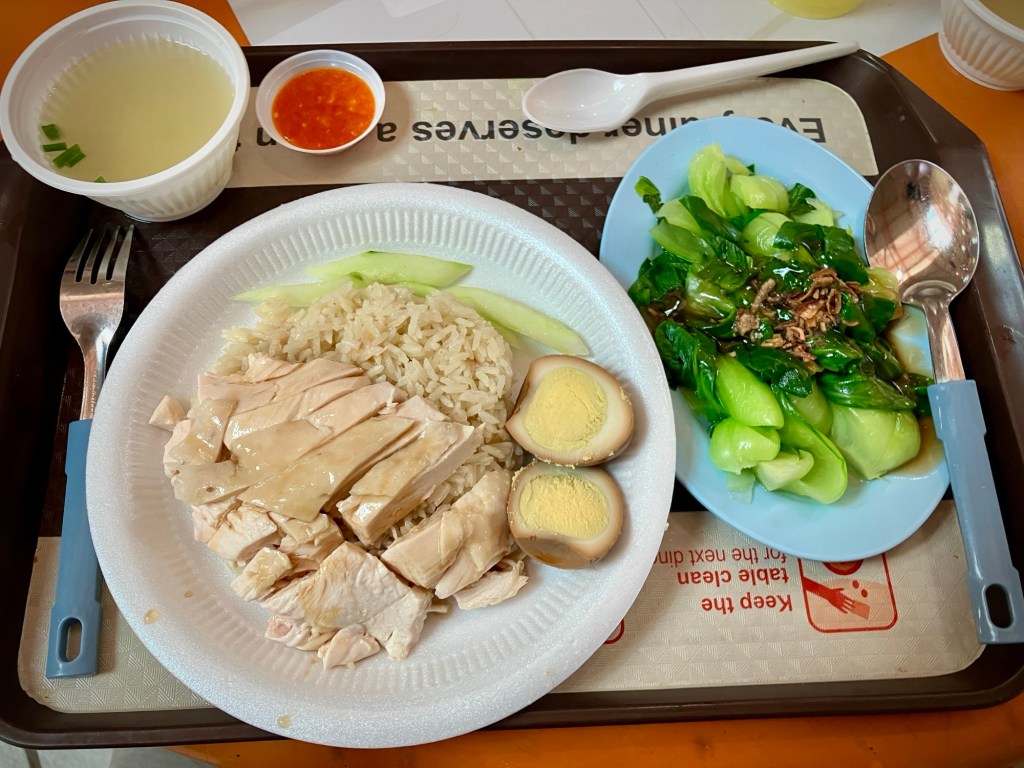
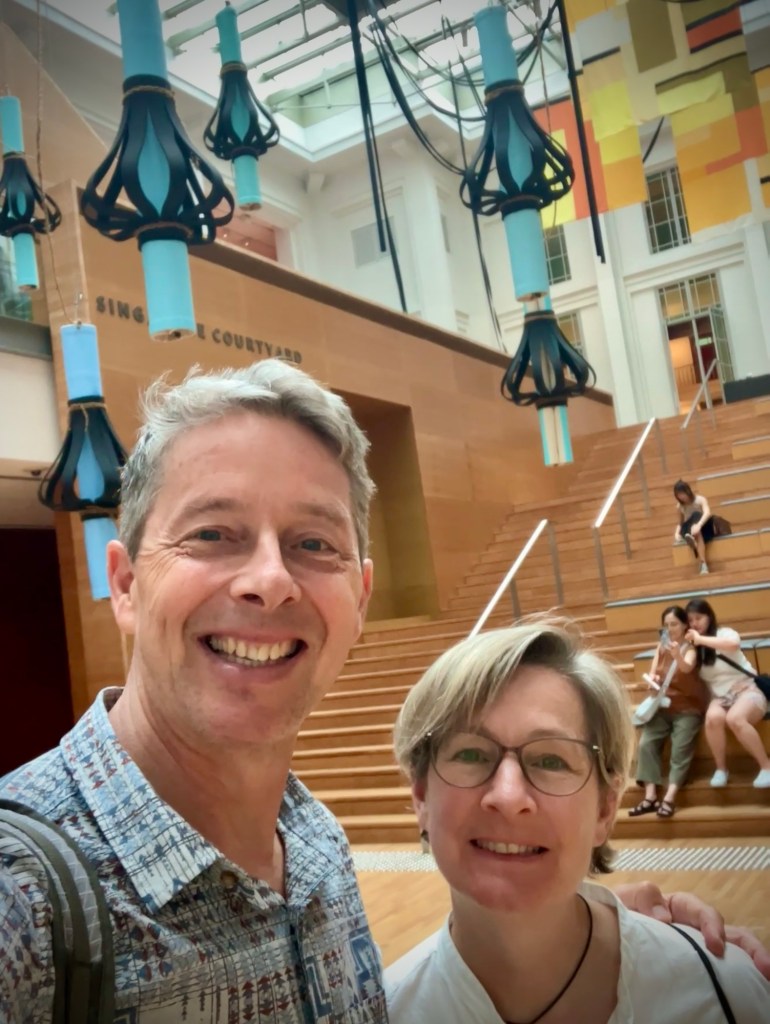
Enough tine for a fix of delicious Chicken Rice at the Maxwell Street Hawker Center.The Singapore National Gallery is worthy of a half day exploration and made these layover travelers very happy -:)
So it’s goodbye to Asia for now. We’re now back in Europe and have started our late winter bicycle adventure…more on that soon…



































































































 Less Car, More Life