Palace of Versailles. 8:30 am on a Wednesday in November.
Museum planning can be quite a challenge in Paris. First – which museums? Choosing between the 136 options looks daunting. Even when you narrow it down to the 111 listed in the great book our friend Nancy brought with her, that’s too many for a one month visit. Second – which days are they closed? Monday is a popular closure day, so going to a museum that isn’t closed on Monday means it might be a bit more crowded than usual.
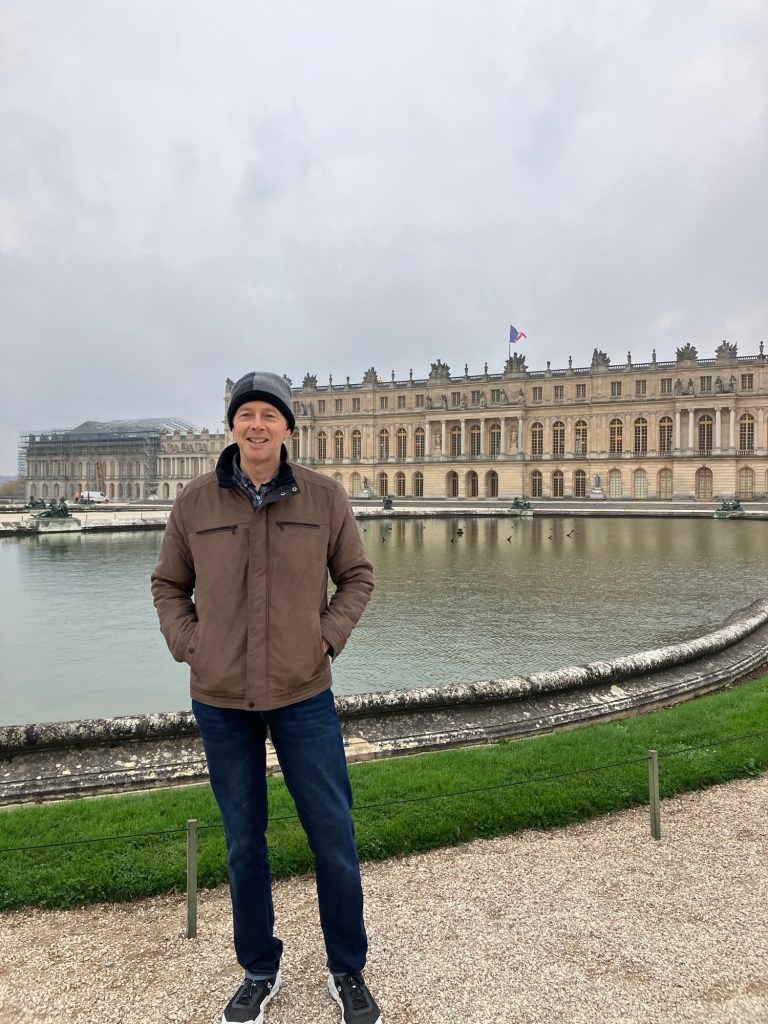
Two horses and humans walking through the forecourt of the Palace of Versailles. I think they were just locals who use the park as a cut through. The noise of hooves on cobblestones sounded like time travel.Looking down the gardens of the Palace.The palace opened at 9, so we used our 30 minutes to check out the view.Getting going early had the pay off of no crowds. And cold November weather helped too.
Versailles probably wouldn’t be fun for us crowd adverse people in Spring or Summer, so this might be our one and only visit to this A List site.
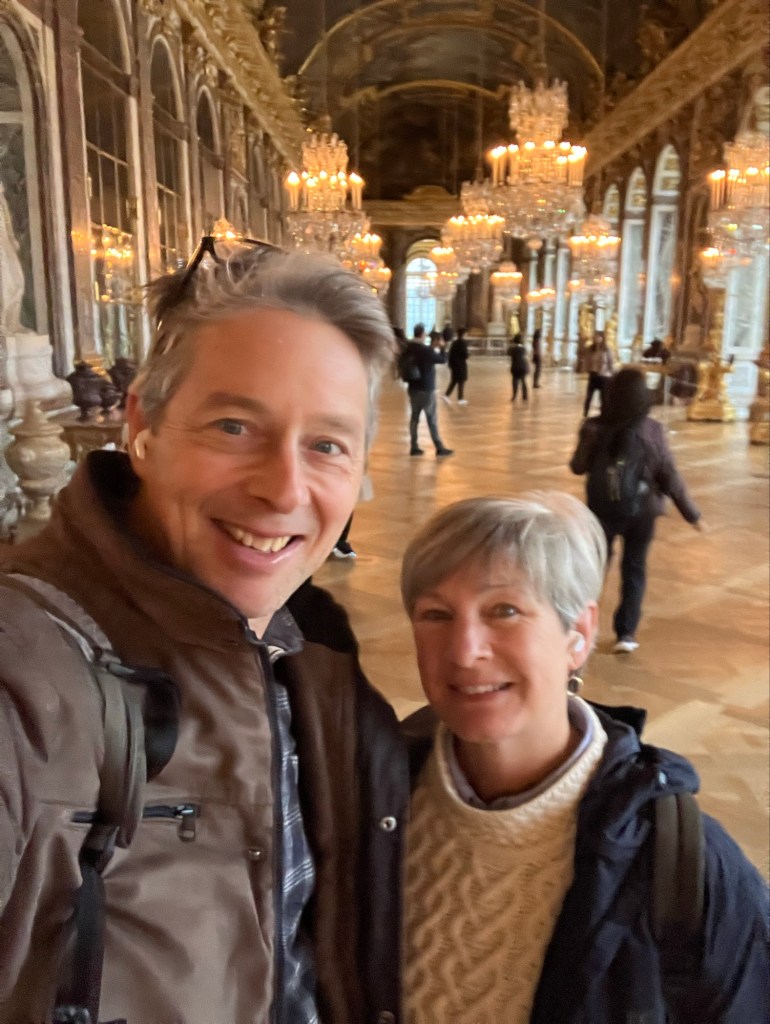
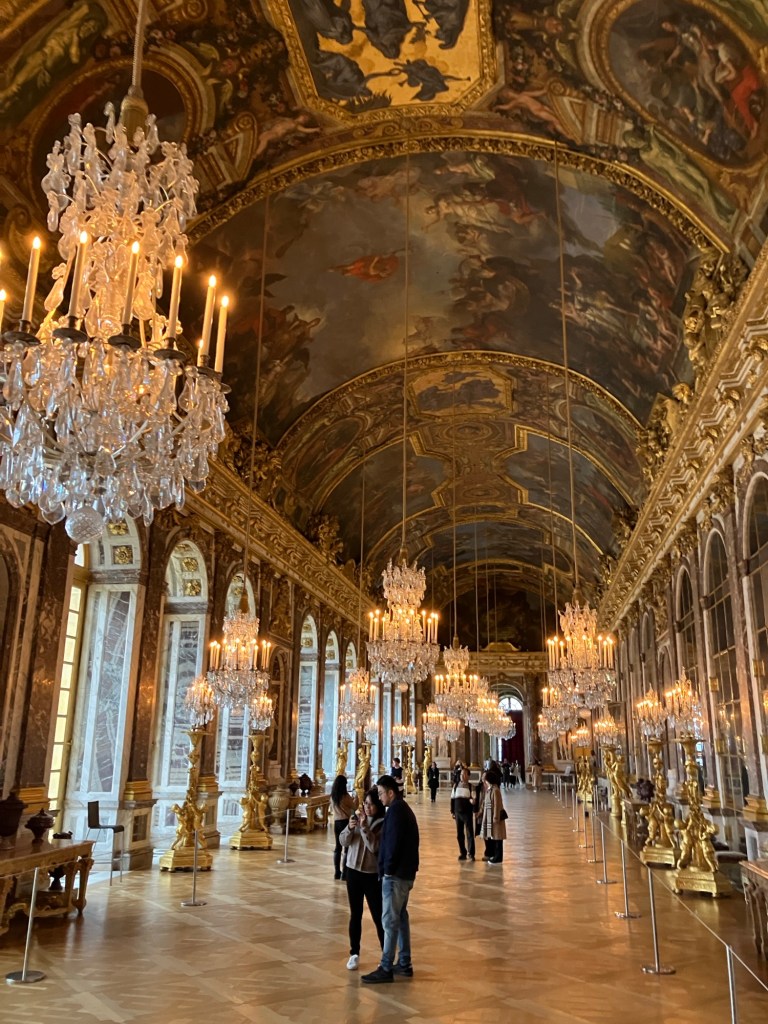
The Hall of Mirrors with our fellow early arrivals.As we walked around we kept joking “now why was there a revolution?” in response to the luxury on display.Pensive gazing out the window while listening to the quite good app based audio guide.Miles of parquet flooring! Shiny too! Make sure to budget enough time to explore Petit Trianón.Sophora Japonica, or Japanese pagoda tree, planted in 1764 for Marie-Antoinette near the Petit Trianón.Temple de l’Amour. The folly in the English Garden of the Petit Trianon.The Petit Trianon, a laughing American tourist, and the classical angel statue. The app based audio guide covered a lot.The “Water Mill” in the Queen’s Hamlet.The Hamlet had a rough time surviving but several renovations later, you have a good idea of what it was like originally.It is a peaceful respite from the grandeur of the Palace.
While we waited to get into the Palace there was a little guy, probably about seven years old, having a meltdown about having to visit the palace. He screamed and cried and his adult spent some time talking him down. He uttered a memorable phrase which we filed away for future use: “This is the stupidest thing in the entire stupid world!”
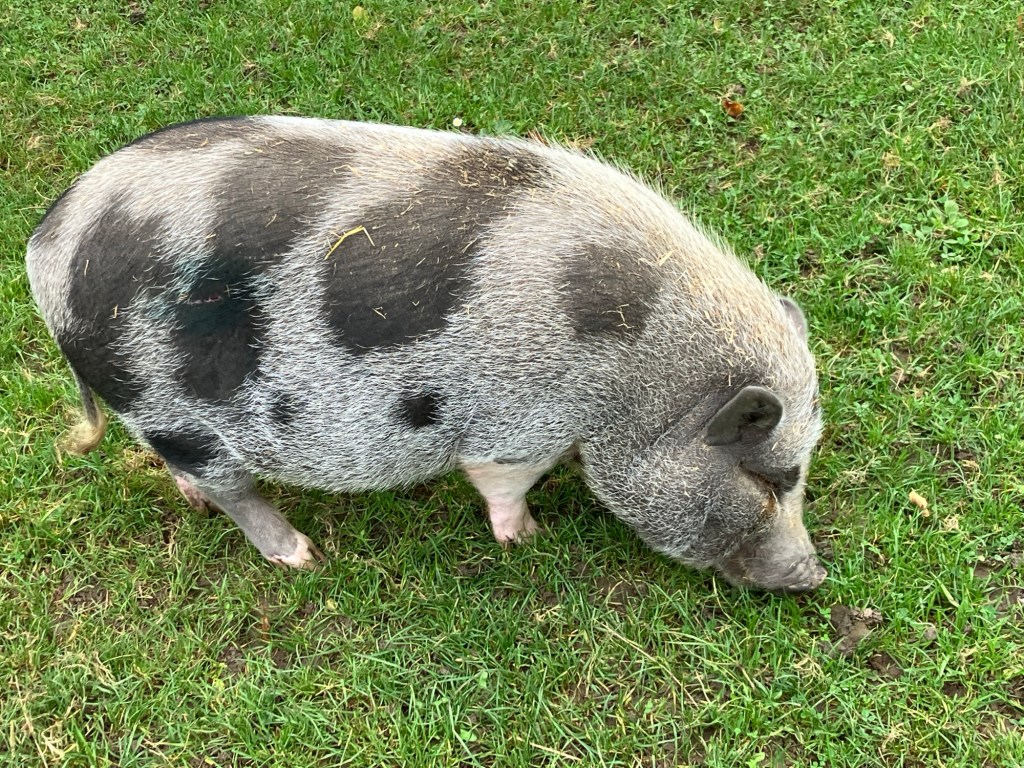
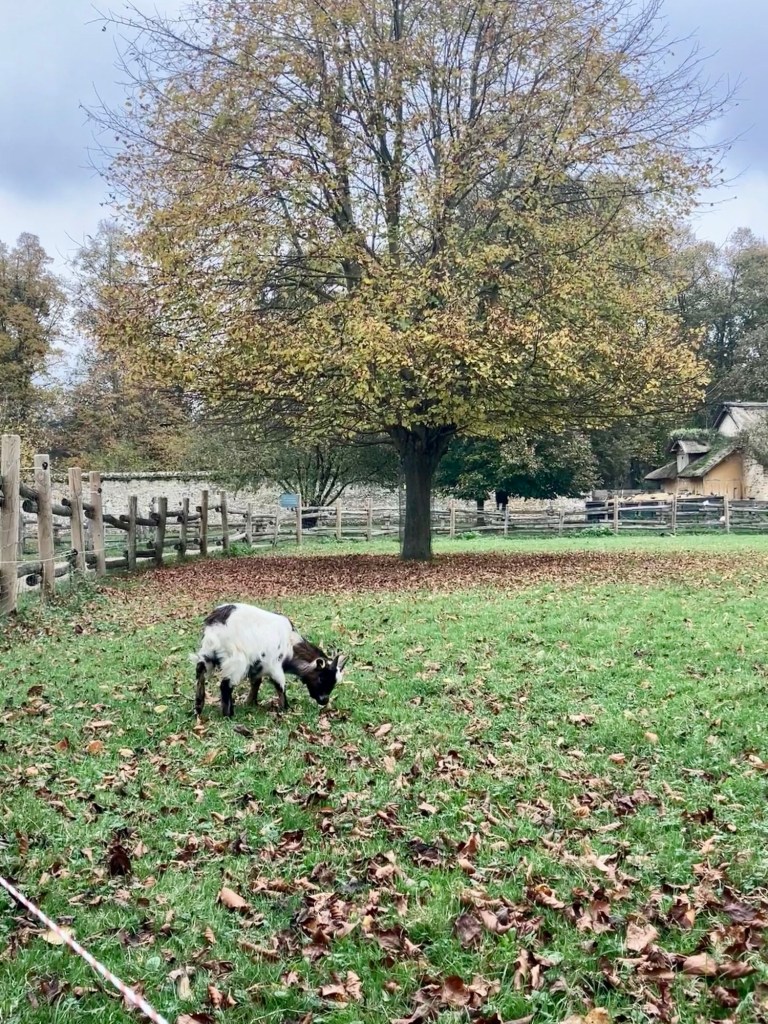
I sure hope that little guy made it to the hamlet and got to see the farm animals.I’m sure the pigs, goats, and bunnies would have cheered him up. Not stupid.
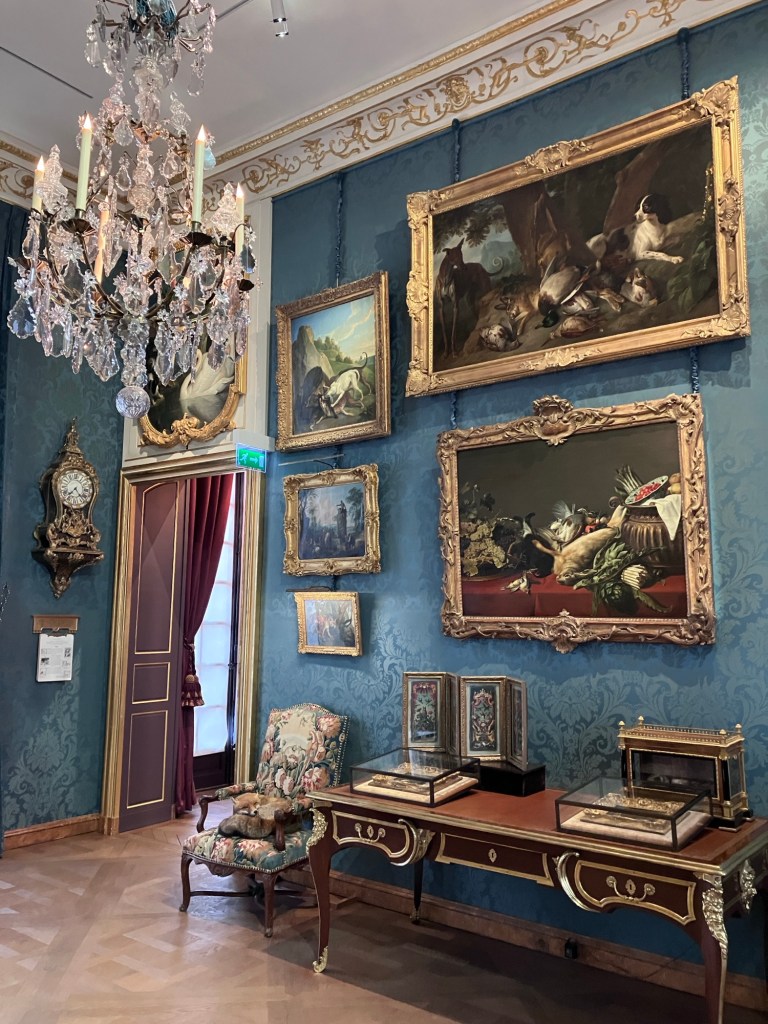
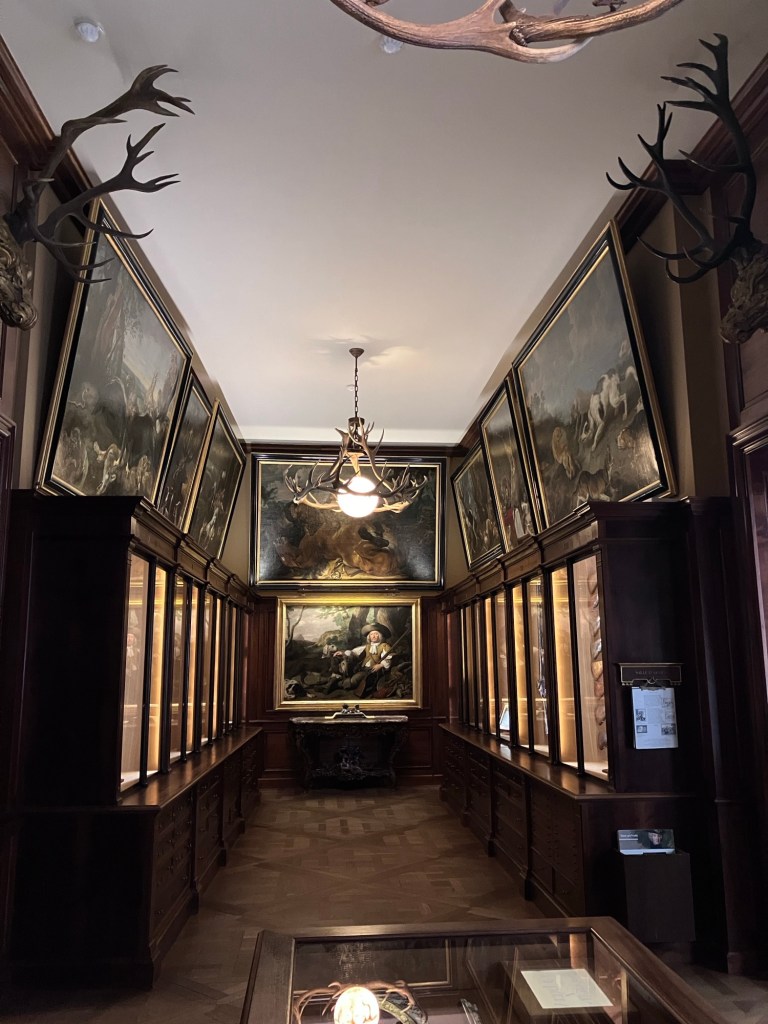
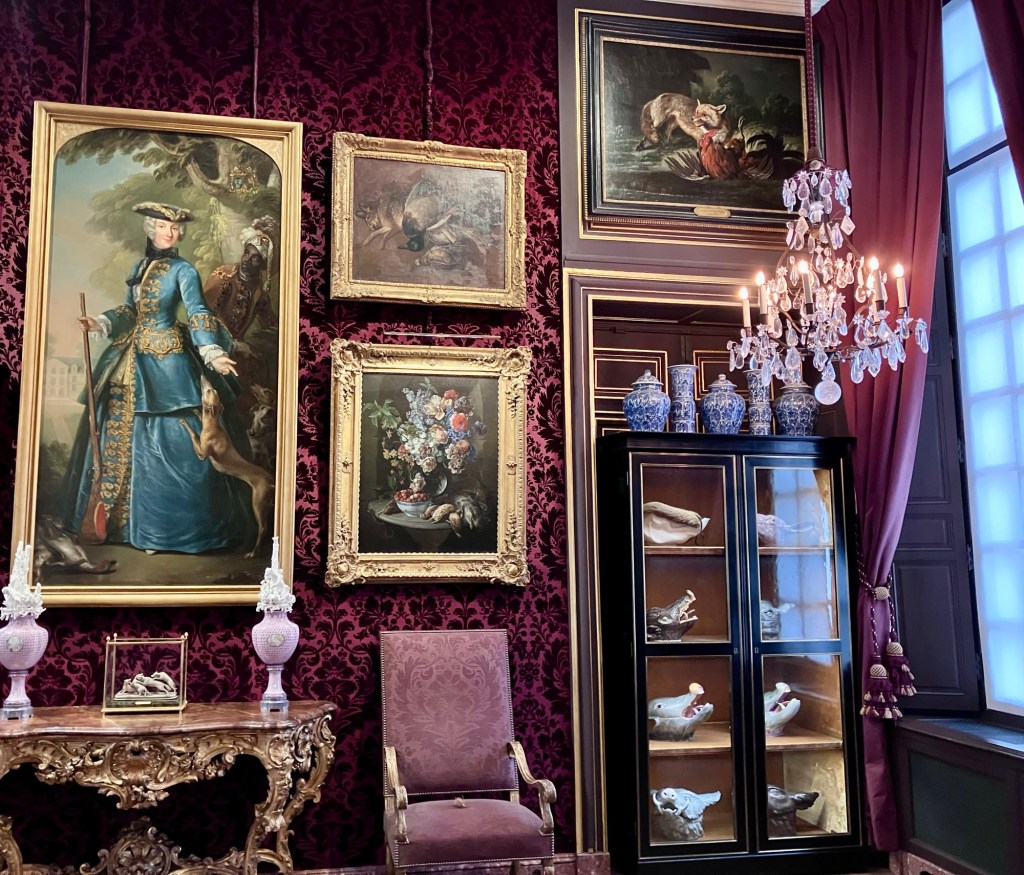
So how else do we decide on museums to visit? Well, when you go to a lot of museums in France, and in the world, you see connections. At a museum in – Lyon? Dijon? I honestly can’t remember – a little card said about a missing painting: currently on display at Musée de la Chasse et de la Nature in Paris. What what what? That sounds fascinating. So it was marked on a Google map and Rich remembered and off we went.
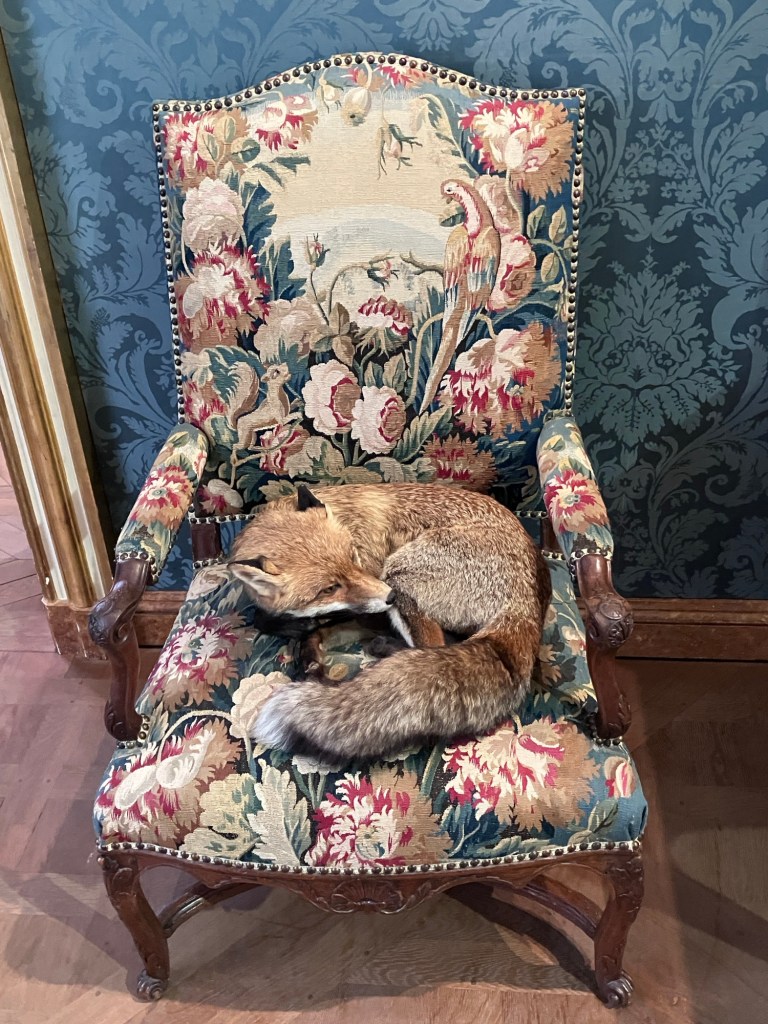
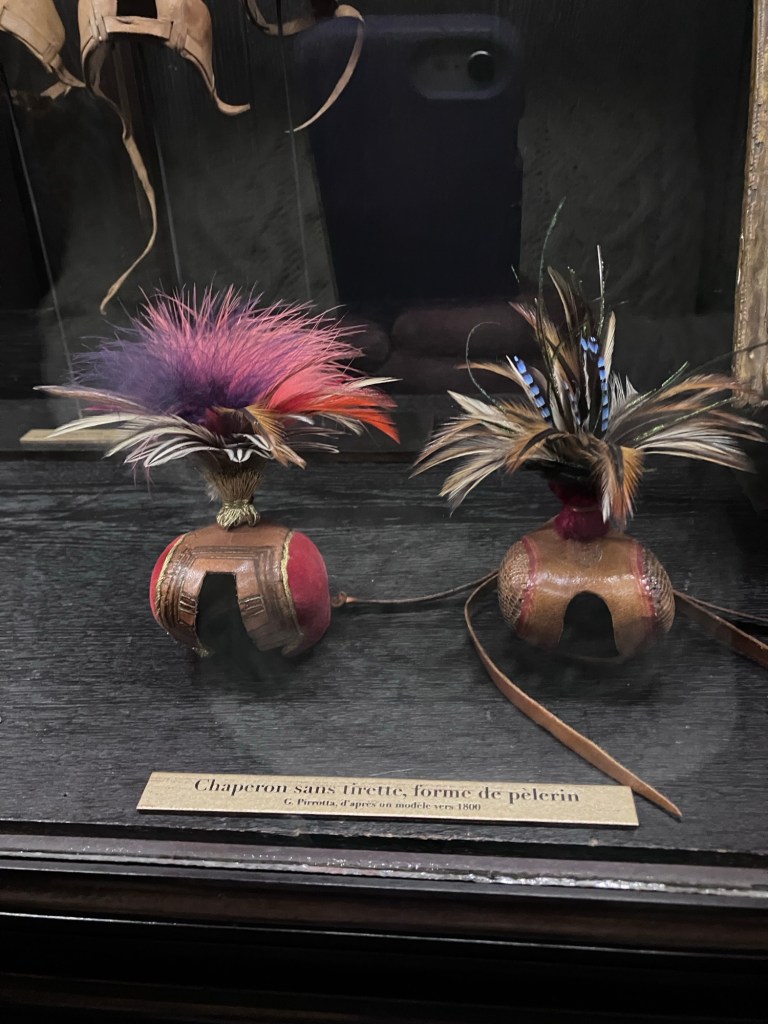
The museum is in an old Hôtel particulier. A grand urban mansion.Yes, that’s a stuffed fox curled up on the chair. The rooms were themed, and simply beautiful.Don’t let the name of the museum put you off. It’s not really a celebration of blood sports, but more humans relationship with nature and animals.The falconry room.Adorable little hoods for the falcons to wear. Putting feathers on a bird.
Even with only a month in Paris it was so fun to circle around topics or artists and come across them in different exhibits or even in cemeteries.
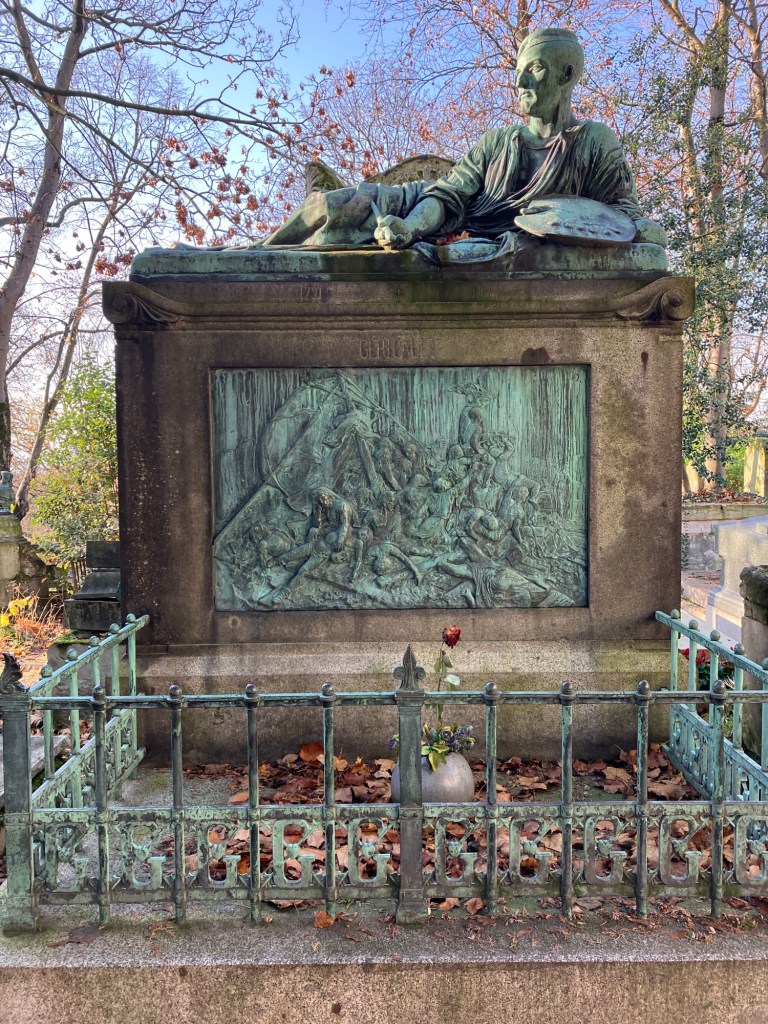
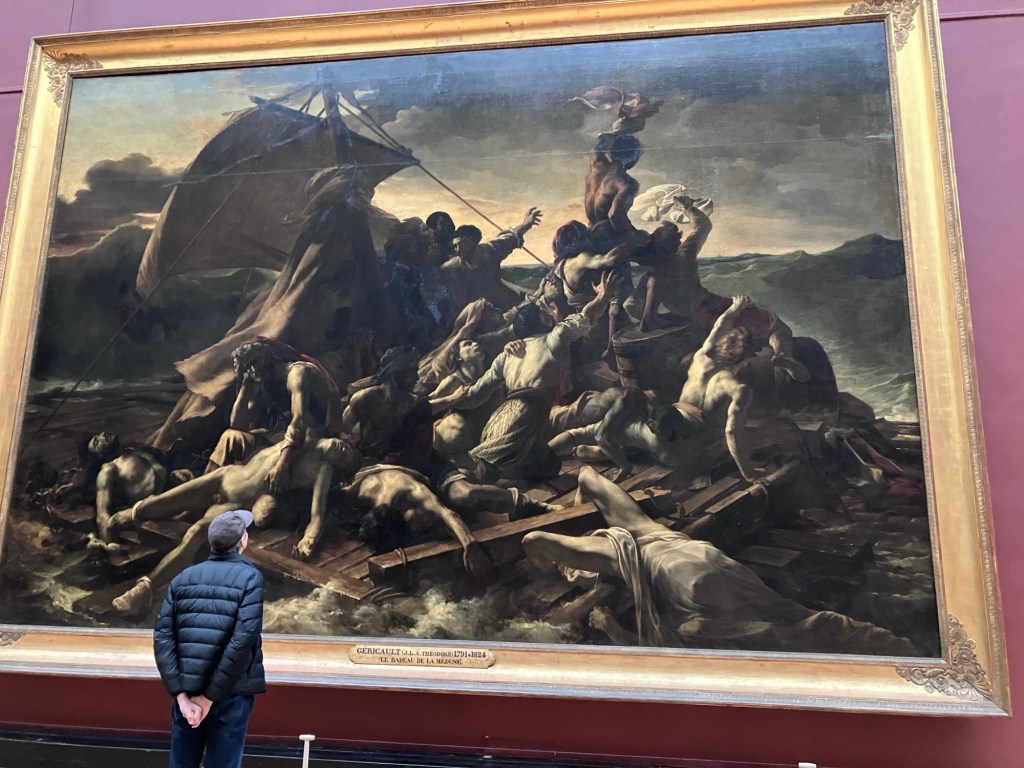
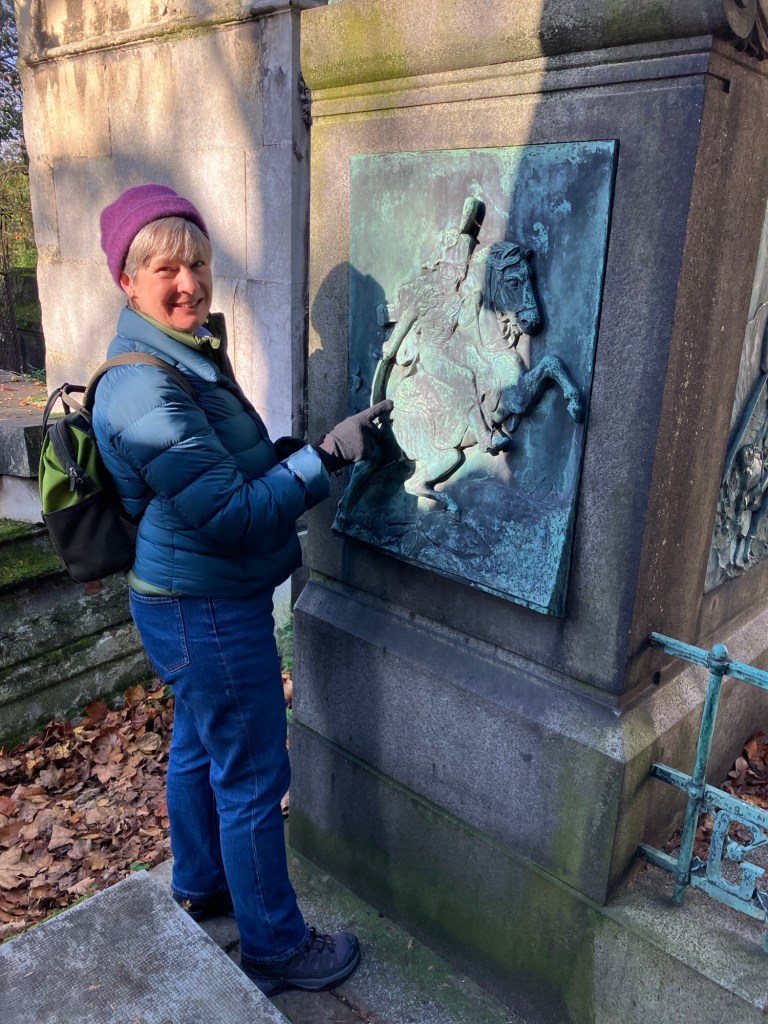
The grave of Théodore Géricault, in Cimetière du Père-Lachaise.One of our early morning Louvre visits was specifically to visit The Raft of the Medusa, by Géricault.Alone with this massive canvas.Which is replicated in bronze on his tomb.A cold and grim subject. Again, the smiling American tourist.
A college friend (thank you Jen) reminded me of the chapter in Julian Barnes’ book History of the World in 10 1/2 Chapters, chapter five, Shipwreck, which relays the story of the creation of this painting and the history behind it.
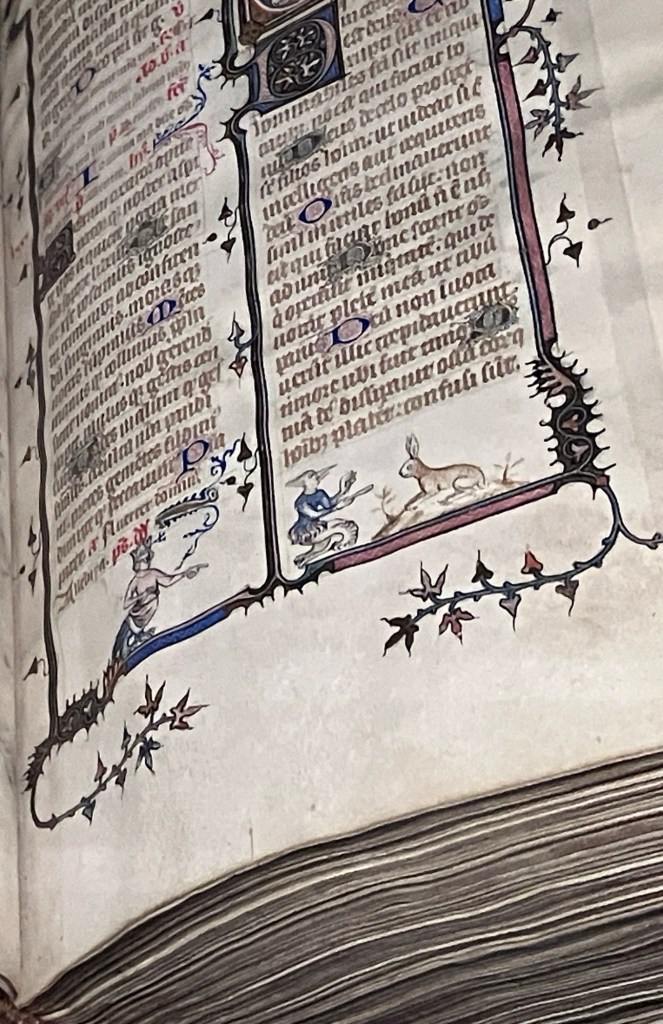
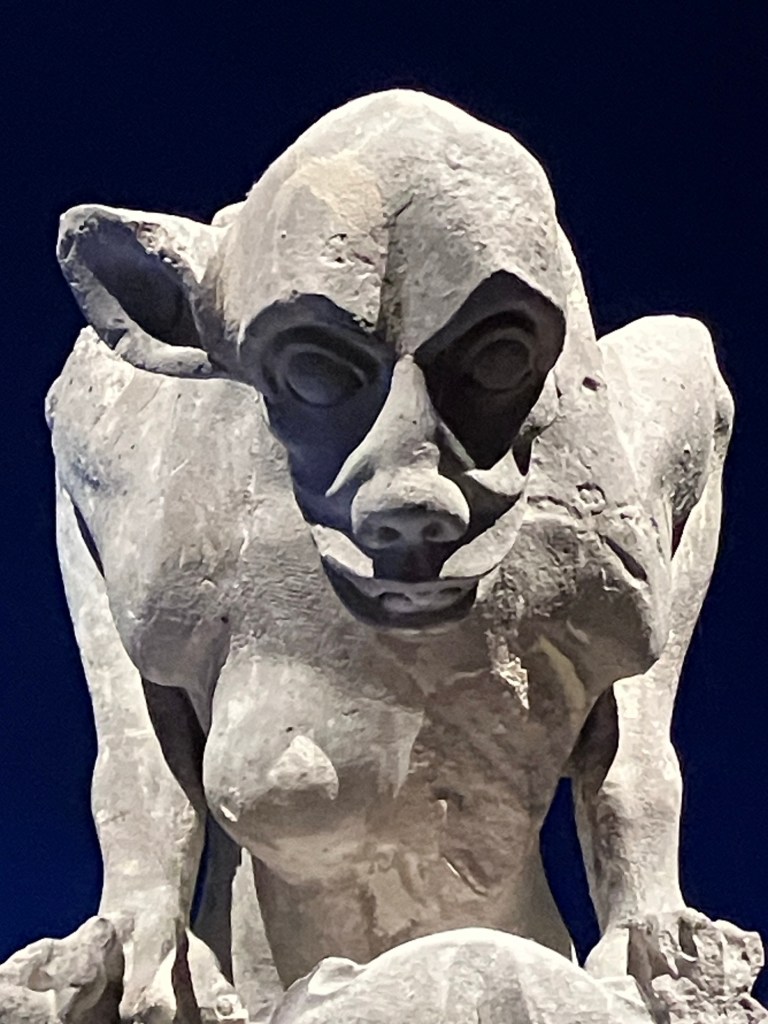
The artist visited morgues to achieve the correct shade of skin tone. Not far from The Raft in the Louvre is another famous Géricault painting: The Charging Chasseur, or An Officer of the Imperial Horse Guards Charging.Which is also recreated on the artist’s tomb.At our final Louvre Visit to see this exhibition, Figures of the Fool.Here was another work by Théodore Géricault, The Woman with Gambling Mania (French: La Folle Monomane du jeu) from 1822.I can’t be the only one who goes through museum exhibits hoping for fun reproductions in the gift shop? These marginalia of little monsters or grotesque characters would have made fantastic pieces for the museum shop.Chimeras of Notre-Dame de Paris: Monster Leaning on the Parapet Paris, 1847-1862
Although we missed the re-opening of Notre Dame by a few days, we did get to see four chimeras removed during a restoration in the 1800s. Gargoyles spout water away from a building, chimeras are ornamental, adding to the overall atmosphere of the Cathedral.
Such a moody and beautiful presentation.Chimeras of Notre-Dame de Paris: The Pelican The Lioness Monster Leaning on the Parapet The Wandering Jew.
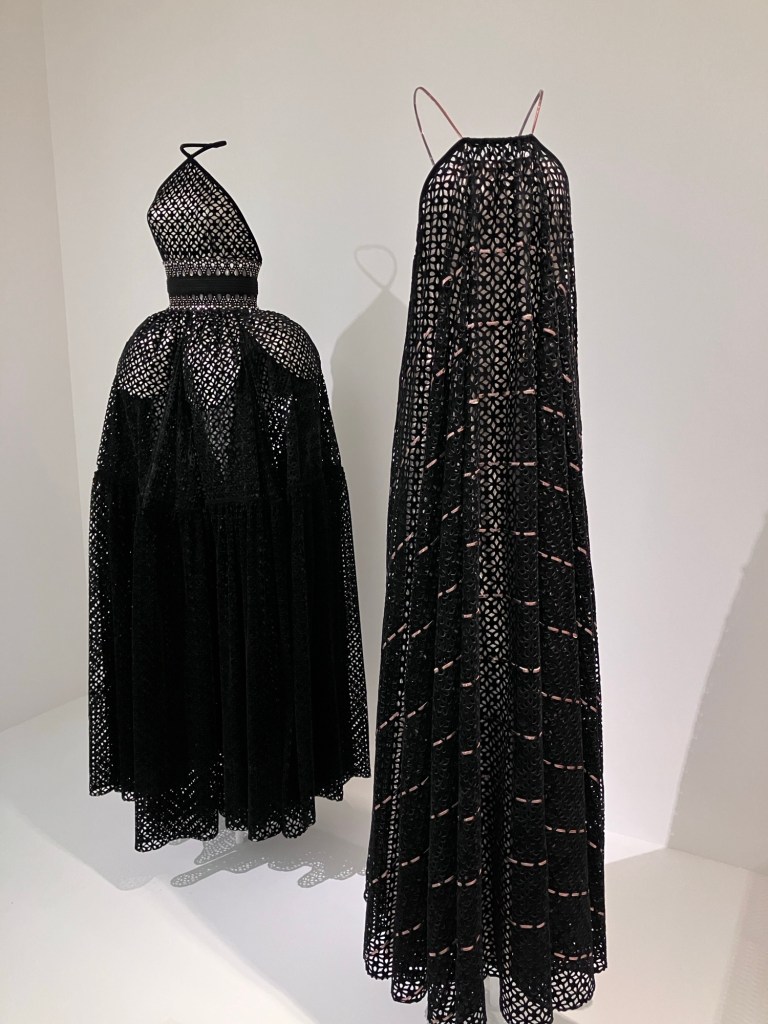
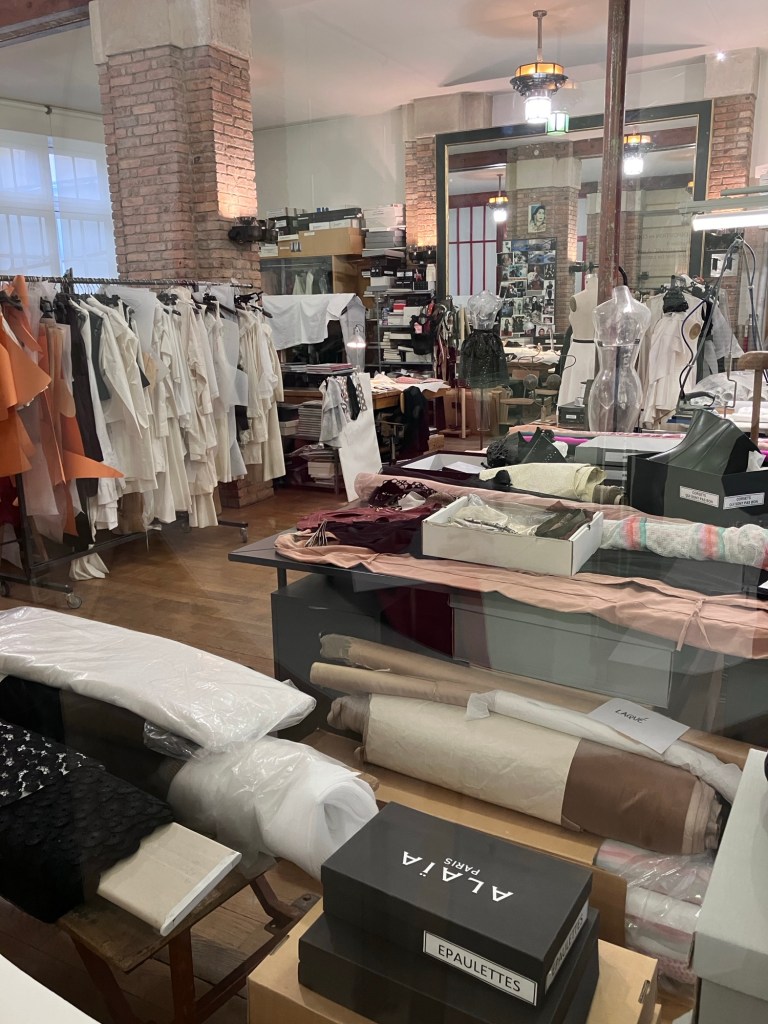
We also visited the Musée d’Orsay for the Gustave Caillebotte exhibit, amazing, and Nancy and I went to the Azzedine Alaïa museum. He was a talented and famous Tunisian couturier and shoe designer.
Laser cut velvet. Gown or work of art?Beautiful and beautifully displayed.We loved the window which let you see his atelier. Left exactly as it was when he died.
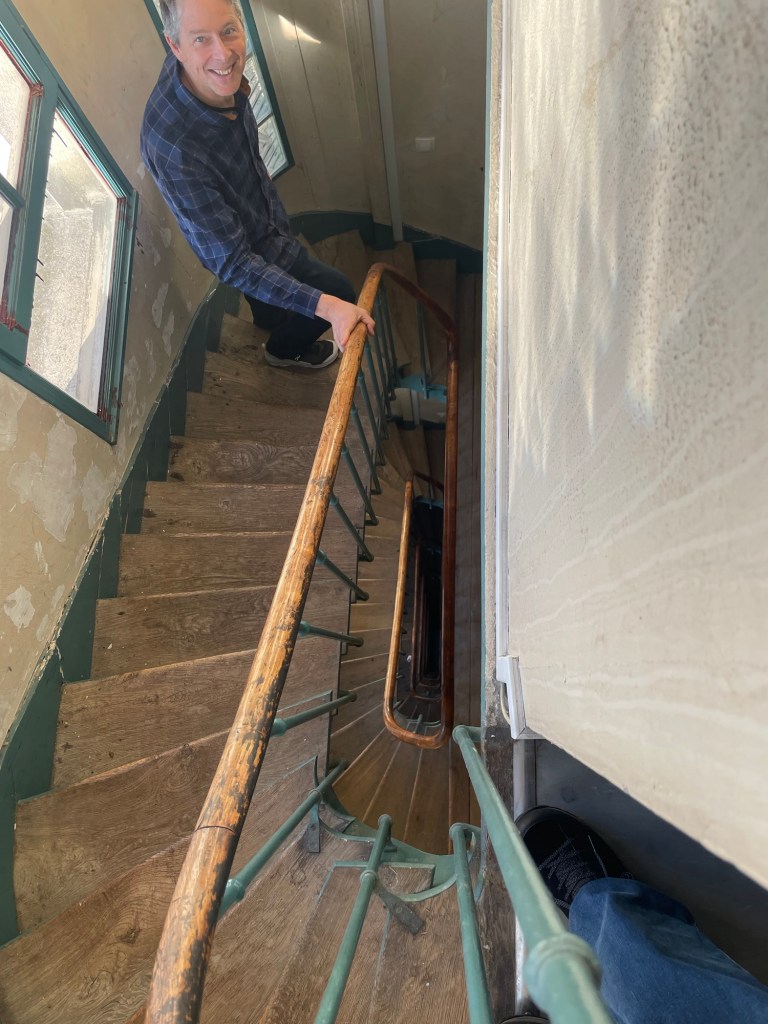
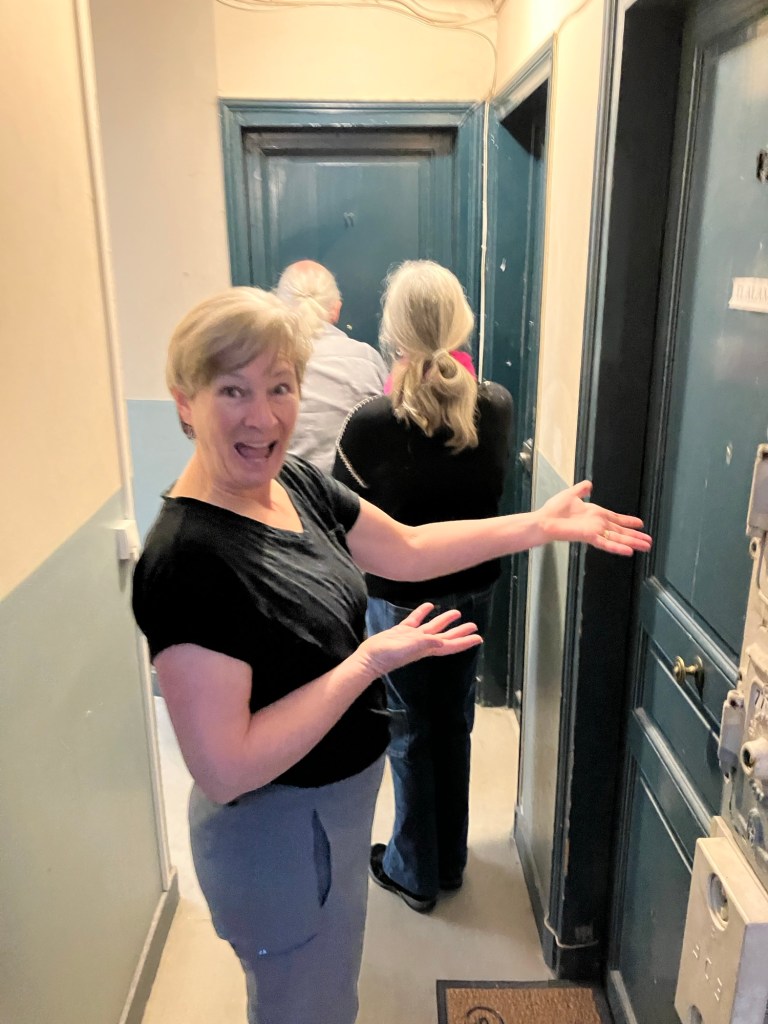
There were other museums we visited – my head is still spinning from what we saw – and of course, the best museum of all: the city itself. Thanks to our new friend Roy, whom Nancy met on her flight over to Paris, we even got to see a Chambre de bonne. These small top floor maids rooms on Baron Haussmann’s 19th century mansions. Ever since listening to this 99% Invisible podcast about Chambre de bonnes I’ve wanted to see one. But how? Well, have a friend who makes friends.
Hi Roy! Thank you again for showing us a side of Paris we wouldn’t have seen without you.The servants staircase.The corridor of doors to small, very small, apartments. Some have been joined together to make more useable spaces.How happy am I? In a Chambre de bonne. The view! Eiffel Tower one direction, Basilique du Sacré-Cœur the other.Those very top windows will be the Chambre de bonnes in this building.
Everyone who travels will tell you that the most amazing experiences are not found in guide books. They happen. You walk by them, if you’re lucky and open to saying yes, you get to have unexpected and delightful times, and even better with friends.
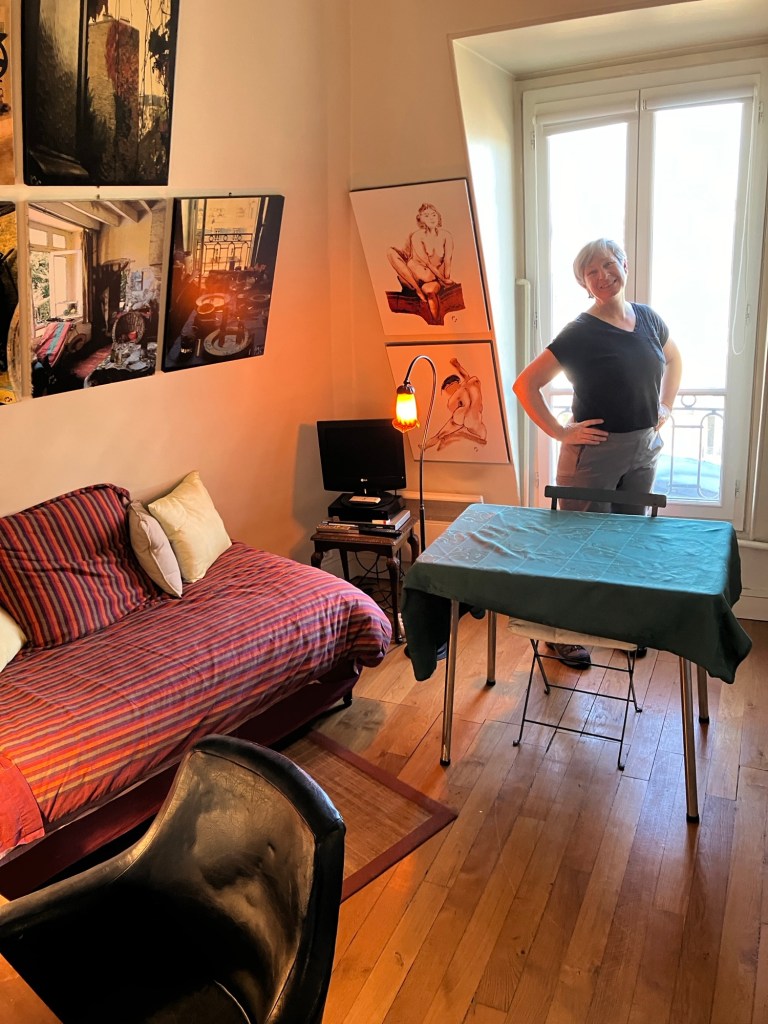
When we came through Paris in May, on our fantastic bike tour through France, we visited our friend Jason who was on sabbatical from his professorship and staying in an apartment he found through sabbatical homes. It turned out that he and his wife could only take two of the three month final increment on the lease and he asked us if we would like to take the third month. Yes – was our pretty fast reply. Since we’d stayed at an apart hotel just up the street from the apartment we knew we’d like the neighborhood, and we’d been to the apartment for dinner so it was an easy decision. And a great decision.
The neighborhood street market, Tuesday and Friday. An early visit to avoid crowds later.The wide sidewalks of Bd de Reuilly in our 12th arrondissement neighborhood.Windows that face La Promenade Plantée. A greenway somewhat similar to the high line in NYC. Those windows and iron balcony just scream ‘Paris’ to me.
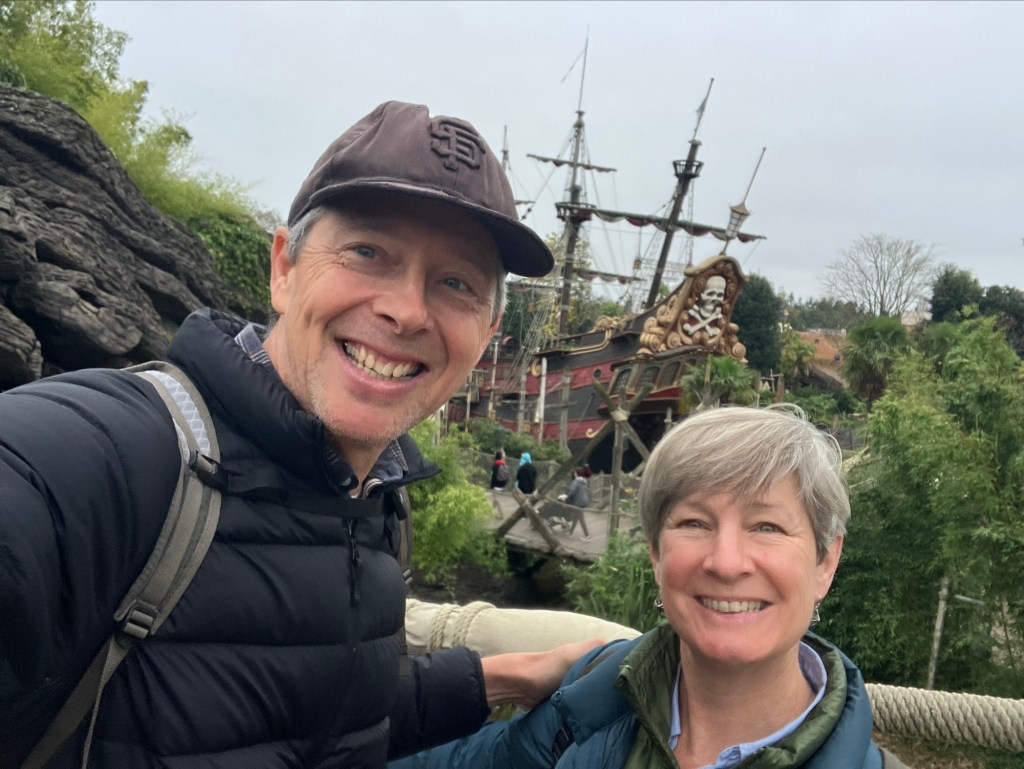
We hit the ground running with our Amis du Louvre cards and a trip to Disneyland Paris. The high and the low? The culture and the pop? Mona Lisa and Micky Mouse!
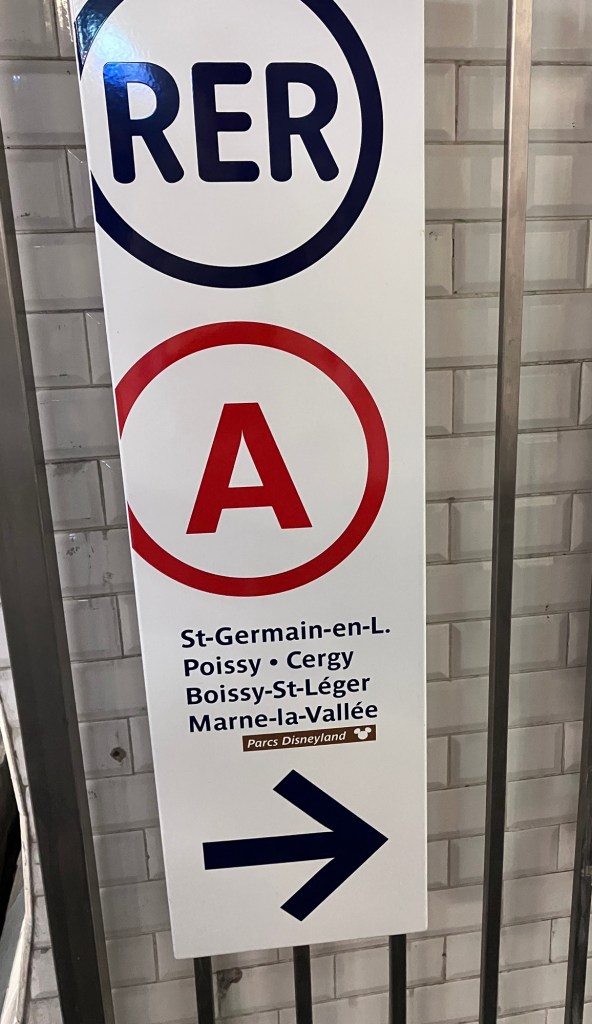
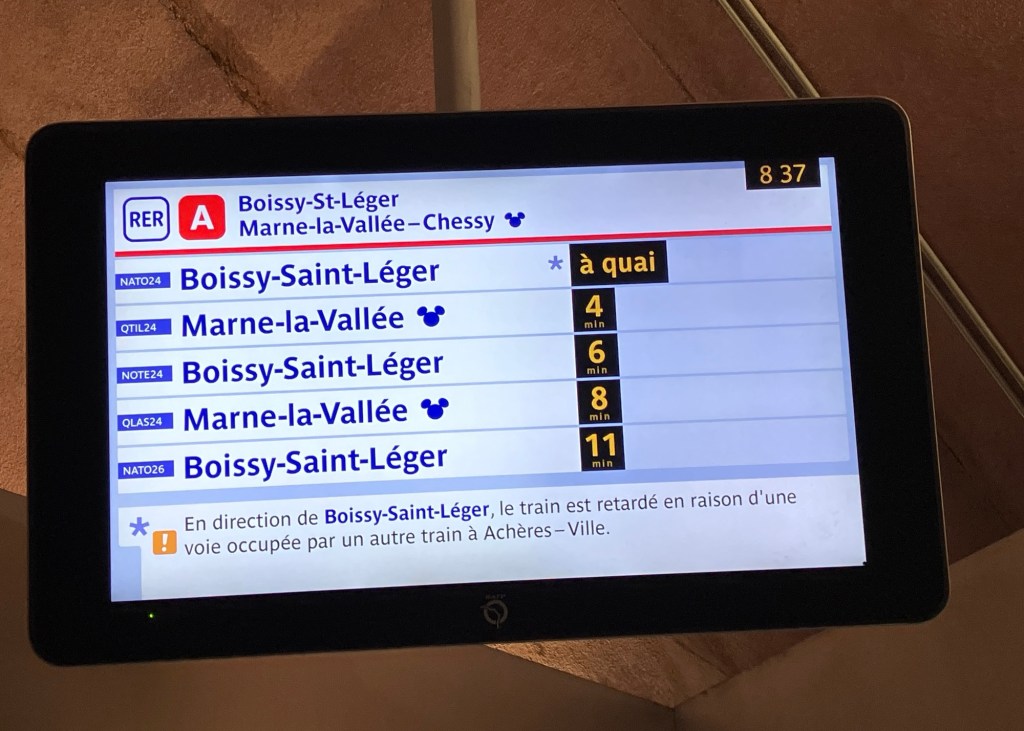
The RER A goes right to Disneyland. One transfer from our apartment, metro to RER.The mouse ears on the train departure signs are pretty darn cute. And helpful.Exit to Disneyland.
As huge fans of public transportation we were thrilled to take a train right to the entrance of Disneyland. We’re both very familiar with Disneyland Anaheim so we spent the day making comparisons and ranking the rides between the two parks. Paris for the transportation win, for sure. And our monthly Navigo passes (~€80) covered the entire trip, as well as all metro and trains in the Paris area (Zones 1-5)
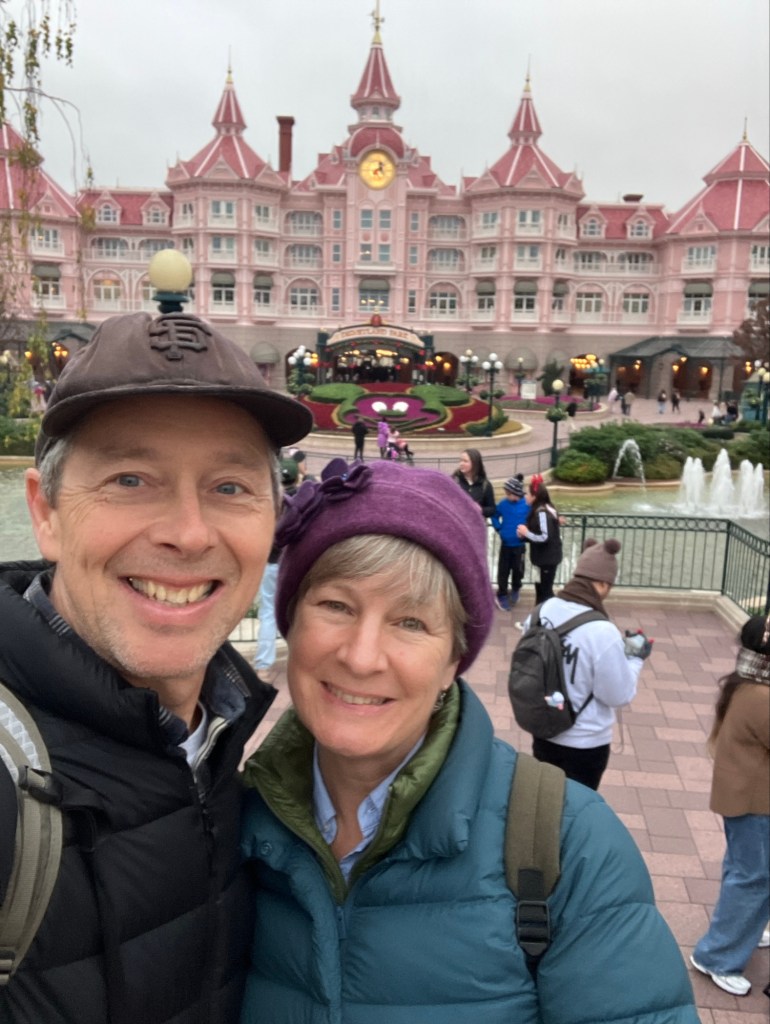
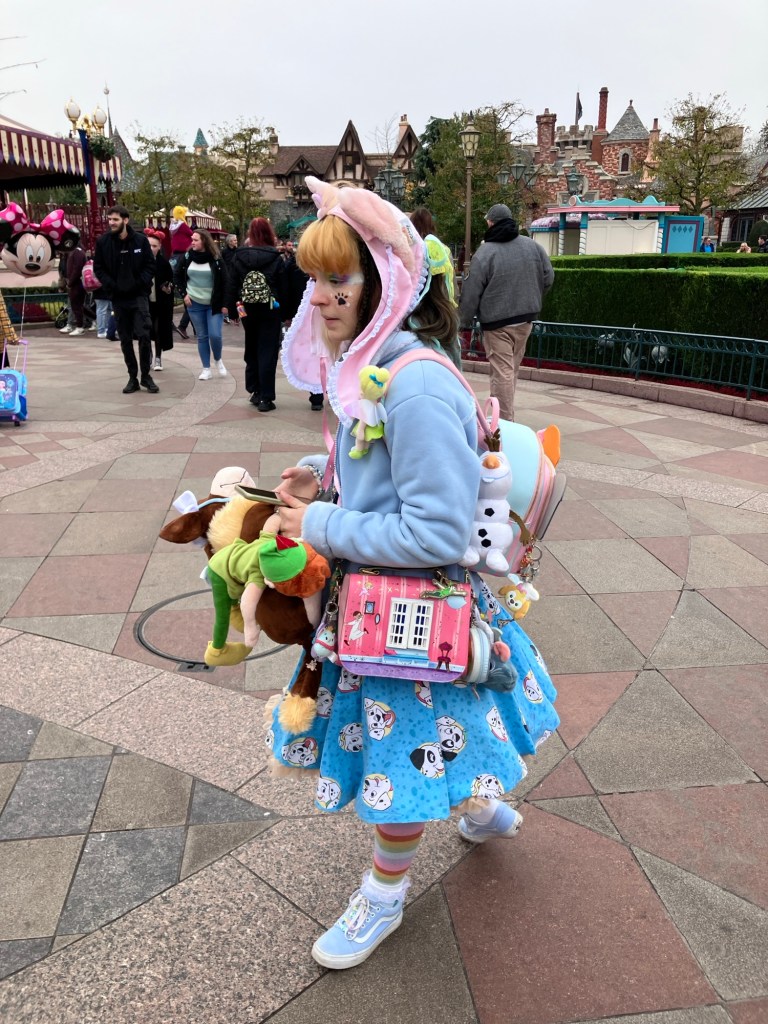
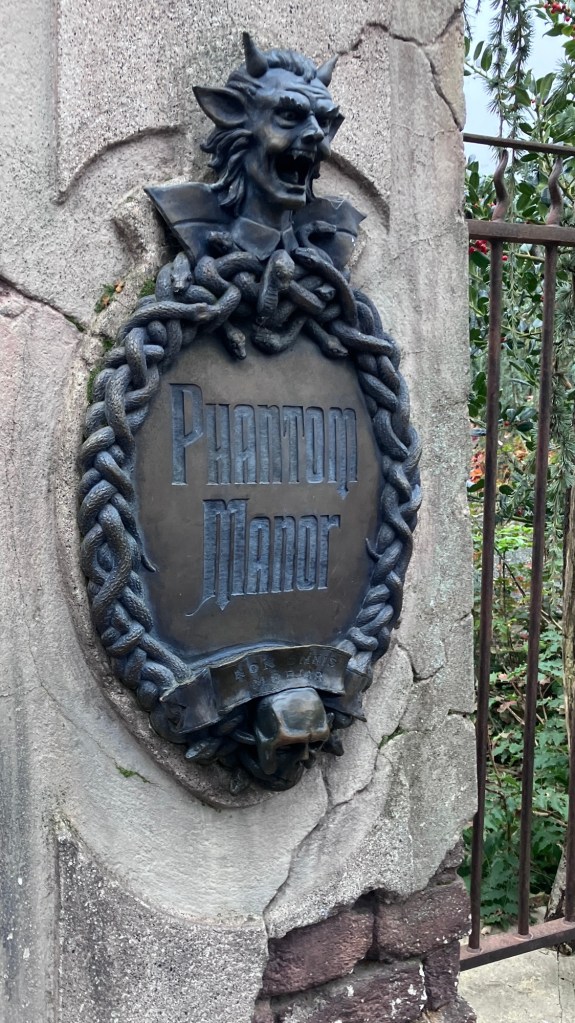
It was a grey and chilly day at the happiest place on earth.I sort of expected Europeans to be a bit blasé about Disneyland, maybe treat it as a brash American import. Nope. Disney fans are Disney fans. Thunder Mountain Paris for the win! Most of the ride is on this island, so you start and end through a tunnel. Phantom Manor, The Haunted Mansion in Anaheim. Both are fun, similar layouts, nothing terribly different, except the spooky French in lieu of English. Très amusant!Hyperspace mountain. My new nemesis. Before the ride. I should have paid attention to the signs warning about motion sickness. And noticed the shoulder harnesses.
It is right there in the name. Hyperspace. Not just space. I’m used to the one in Anaheim which is pretty much a simple rollercoaster in the dark. I knew right away this one was a mistake. It went upside down twice. We now call it the brain scrambler. I lurched off the ride to find a bench, feeling pretty shaken up and a bit nauseous. I am past rollercoaster age, I decided. I’ve always avoided rides that go in a circle, the worst motion sickness ride for me is the spinning tea cups, but this one really was awful. Even Rich thought it was a bit much in the dark, and he loves rollercoasters.
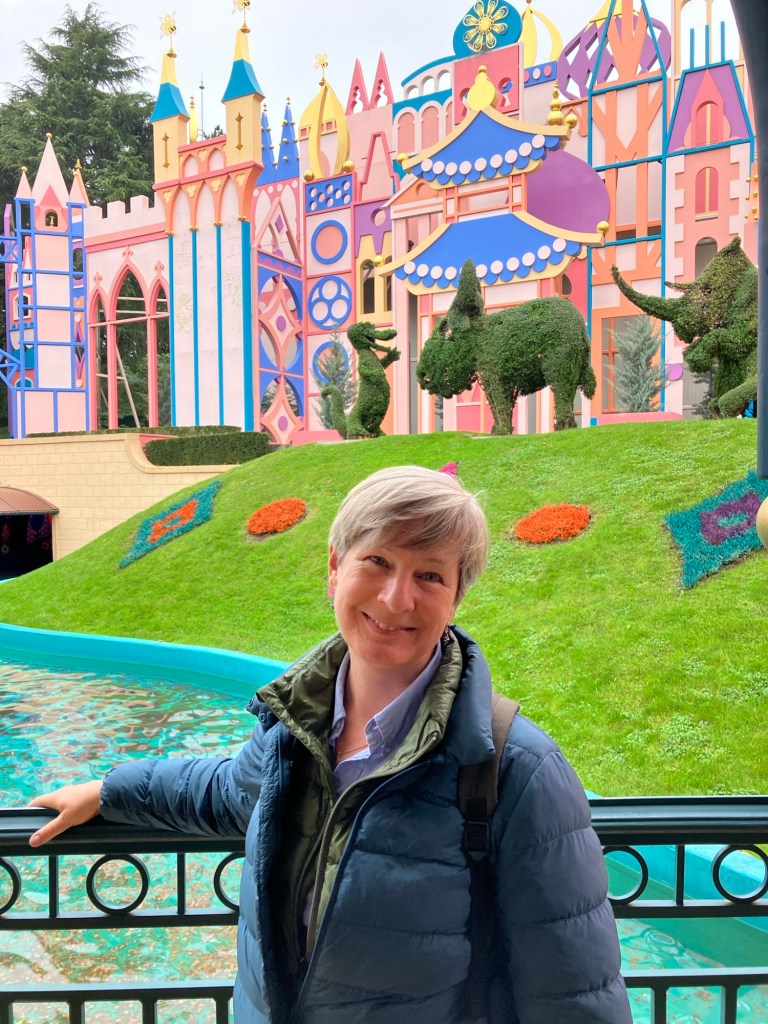
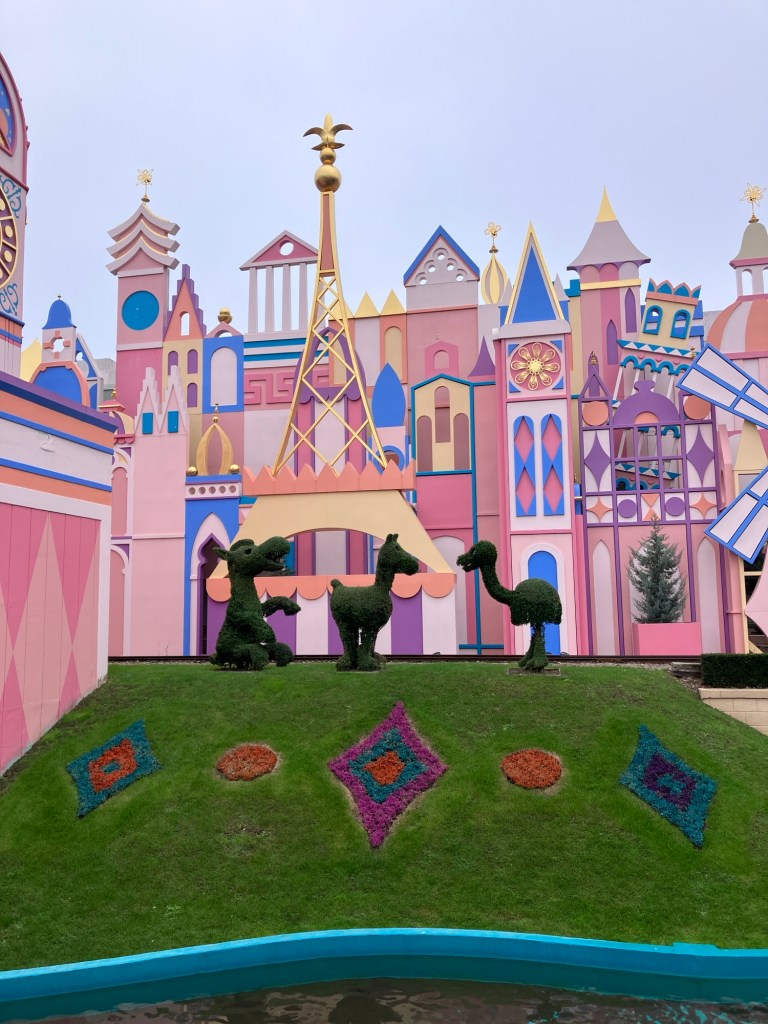
The only thing I could face was Small World. Go ahead. Start humming the song.
The grounds of Small World are more extensive in California, with more topiary animals, but the ride felt fresher and more culturally correct in Paris. One of the biggest differences we noticed was how quickly the lines for the rides go under cover in Paris. In Southern California you can be outdoors quite comfortably year round, and the rain isn’t torrential. It was chilly and a bit drizzly when we visited and we were glad for the shelter.
Recovered from my brain shaking. A big motivation to visit was that we were there during a very quiet time. The Halloween decorations were down and Christmas decorations not yet fully up, so it’s not a popular time to visit.But, being efficient Disneyland, some holiday decorations were already up.We could bore you much more with our detailed observations of how Paris is different than Anaheim, but won’t. Ask us the next time we see you in person about Pirates of the Caribbean. We have thoughts.Le Château de la Belle au Bois Dormant.
On to the high culture: we learned about the friends of the Louvre card from our Paris apartment connection, Jason. Not only do you get to go to the Louvre as often as you want, you also get a different entrance, at the Passage Richelieu, so no big line like at the pyramid or in the Carousel Mall.
Rich cracking the map.
We had visited the Louvre once before and it was a lesson in frustration. The audio guide is a Nintendo based handheld gizmo which is confusing to operate, even for people younger than us. Signage is not great, the layout is labyrinthine, and you will walk miles and miles finding the art you want to see. But it’s the Louvre! On display: 35,000 works of art. In the collection: 500,000.
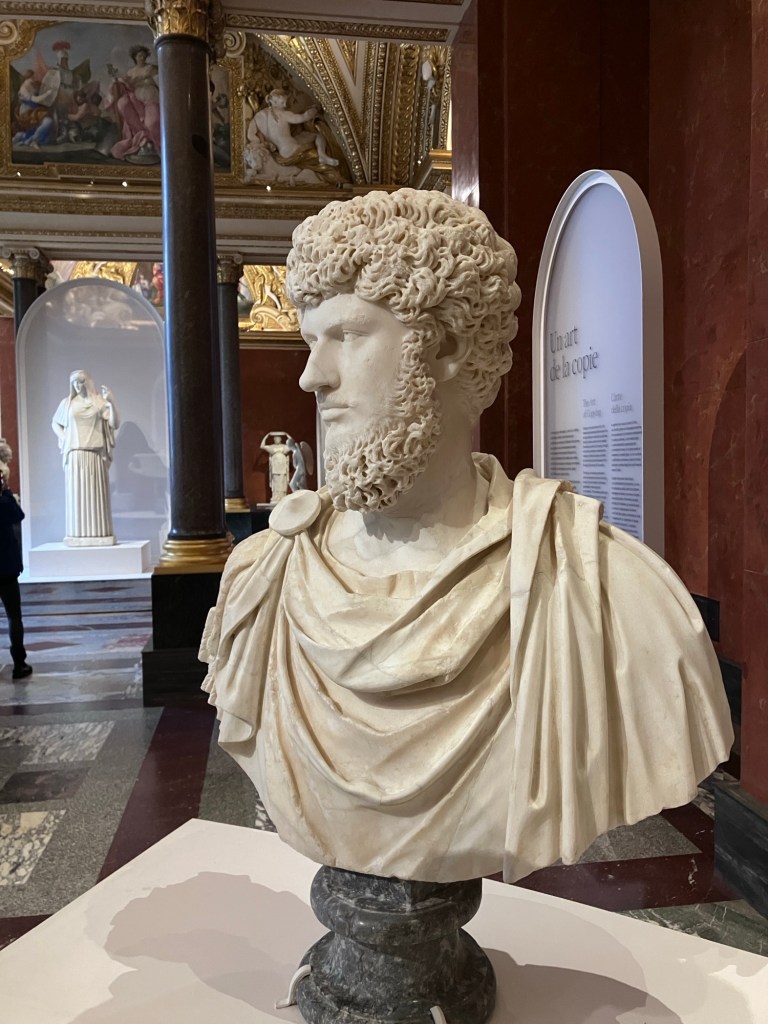
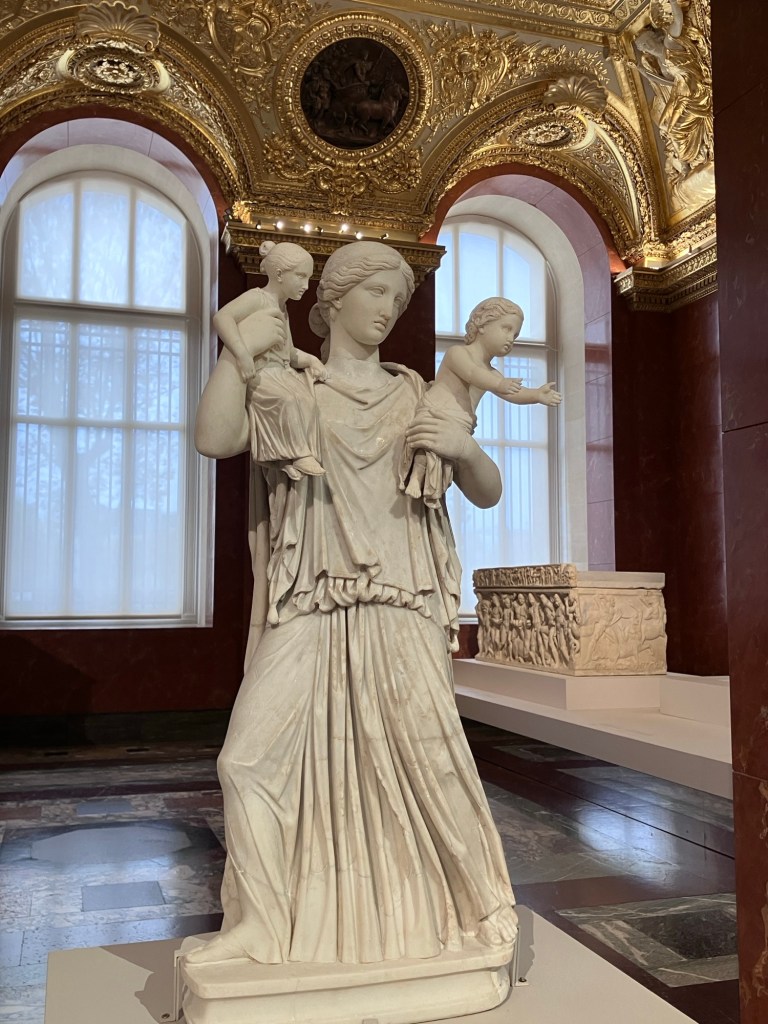
In the newly renovated Anne of Austria Summer Apartments, the Torlonia Collection.The marble sculptures are on display outside of Italy for the first time.Amazing detail.An early Birkenstock?Rich added for scale in front of a massive painting.
We visited the Louvre six times this visit. Once was only to visit the bathrooms and get a coffee, which was a mistake since it was afternoon and very busy, but we will share what we learned. The Friends of the Louvre card – fantastic if you can make it work. We had it mailed to our Paris Apartment, and we applied from within France. Sunday am turned out to be a fantastic time to visit. At peak times the crowds are thick, but for an hour or two Sunday am we wandered the halls and galleries of the less popular wings and rooms with very few other visitors. We even peeked at the Mona Lisa – no, no selfie.
A happy Louvre visitor. This is in a room just past the Mona Lisa, The salle Mollien Room 700, Denon wing, Level 1. The Red Rooms, Les Salles Rouges.
We visited three special exhibits during our six visits, The Torloni Collection, Figures de Fou, and A New Look at Watteau. We kept reminding ourselves how extensive the Louvre collection is that they can mount amazingly specific exhibits by plumbing the depths of their own collections. And when you view the Louvre outside from the I.M.Pei pyramid and understand how little of the connected buildings is display and how much is storage and other use – it’s overwhelming.
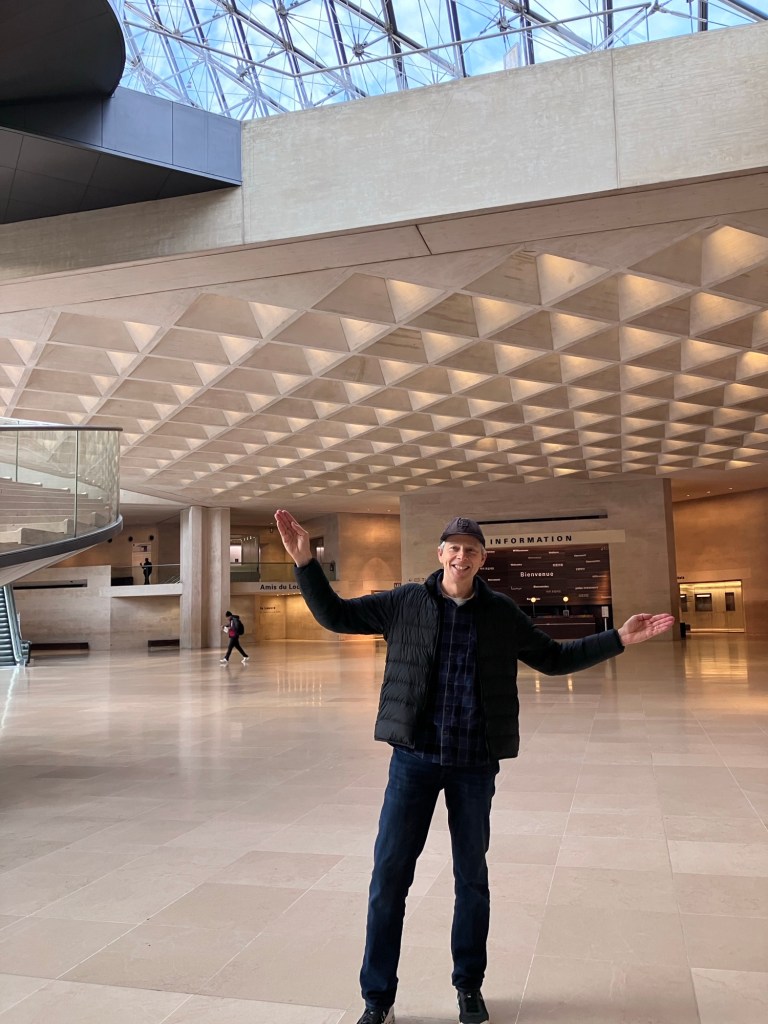
Under the pyramid at 9:02 am. My fearless tour guide. If you aren’t one, find yourself a map friend who won’t get lost in the many rooms and levels of this museum.Leaving on a Sunday at 11:24. After coffee at the Starbucks in the Louvre (!). Still not super crowded but the line to get in through security is now very long.
There will be more Louvre photos in later posts, but our recommendation is to get yourself a Friends of the Louvre card if you can. We paid 120€ for both of us, good for a year and allows you some discounts at other museums and into the Louvre Abu Dabi. Not sure we’ll use that benefit but who knows! The usual museum card coffee and gift shop 10% discount too. We ended every visit with a caffeine break.
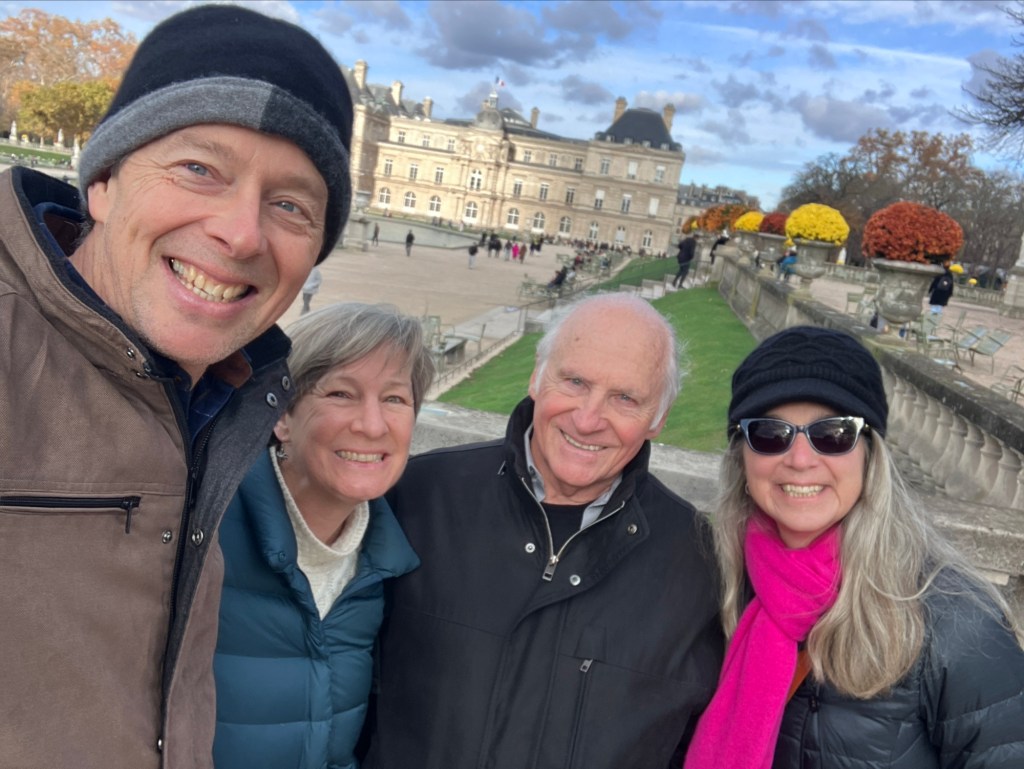
The Happy Travelers in the sun at Luxembourg gardens.
Some of the special exhibits will have their app based audio guides, Figures of the Fool did, so check before you go and bring your earbuds. We searched on line for paintings we knew we wanted to see and read write ups to each other standing in front of the paintings. There are small bathrooms scattered along the galleries, some very well hidden, so if the line is long at the main bathrooms- and it will be ladies – try to find one up in the galleries. More from Paris soon. We just arrived in the UK for a nice long stay, until January 14th, happy holidays to all.
Sometimes you are really in the groove of bike touring. The daily physical challenge, the rhythm of plotting our route, checking the weather, procuring food and lodging, and working in some fun and history along the way.
Trois Bornes: where Germany, Belgium, and the Netherlands meet. It also happens to be the highest point in the Netherlands at 322m.Morning saddle-up at our little garden apartment in Miltenberg; a long travel day ahead.
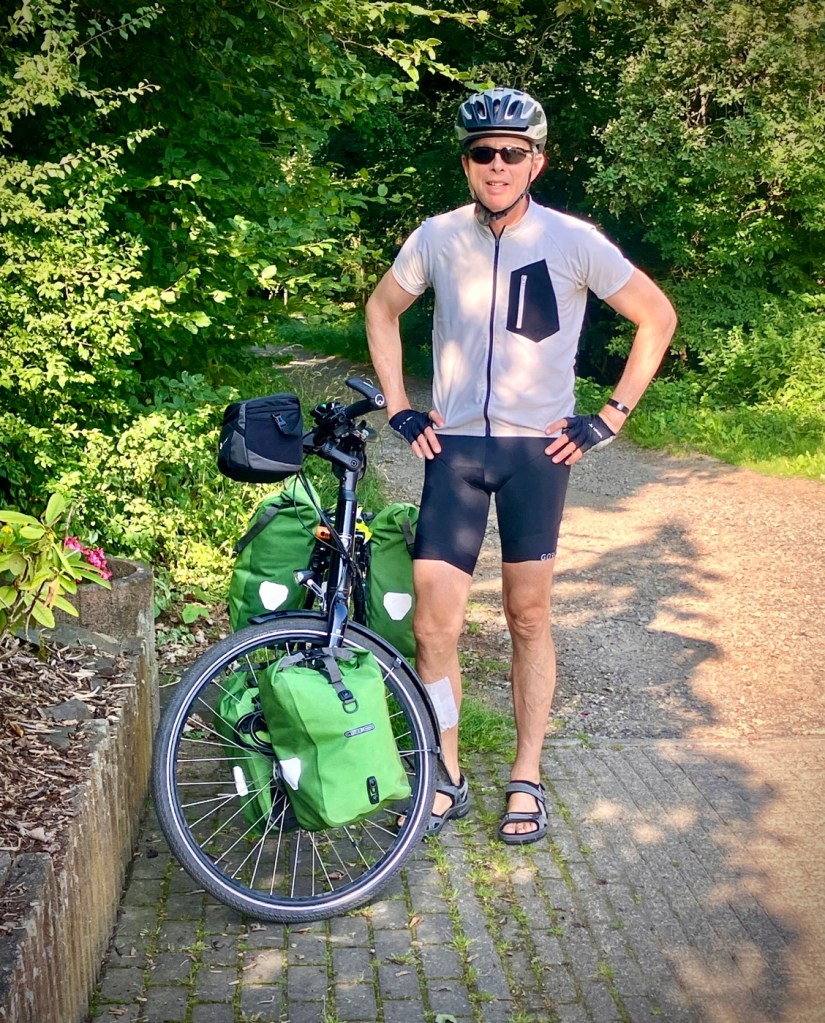
You also tend to get a few bumps and bruises along the way; maybe bang your leg on a pedal or kickstand, maybe some chain ring grease, and always a few achy spots.
Our second train from Mainz to Bonn was a long local run and crowded from the get go, but we were able to wrangle our bikes against the wall…but way too late for proper seats.Then even more bikes, including these two friendly German bikepackers heading out for a month ride to Nord Cap, Norway. Impressive!
You assume any minor nicks, scrapes, or pains will be eventually go away. And summer bike touring in the forests and fields always means nettles, bugs, and bug bites. So, as we headed out of our two day stay in Miltenberg, I still thought the growing red spot on my right leg would probably just go away…
Off the Train and headed towards Eifel NP.
Oh sure I was feeling a bit funky, but again, your body goes through ups and downs bike touring, so thought maybe this too would pass like an off day in the Tour de France. Plus we had an ambitious agenda to get us across Germany to a point where we could ride into unexplored regions of Belgium and Holland.
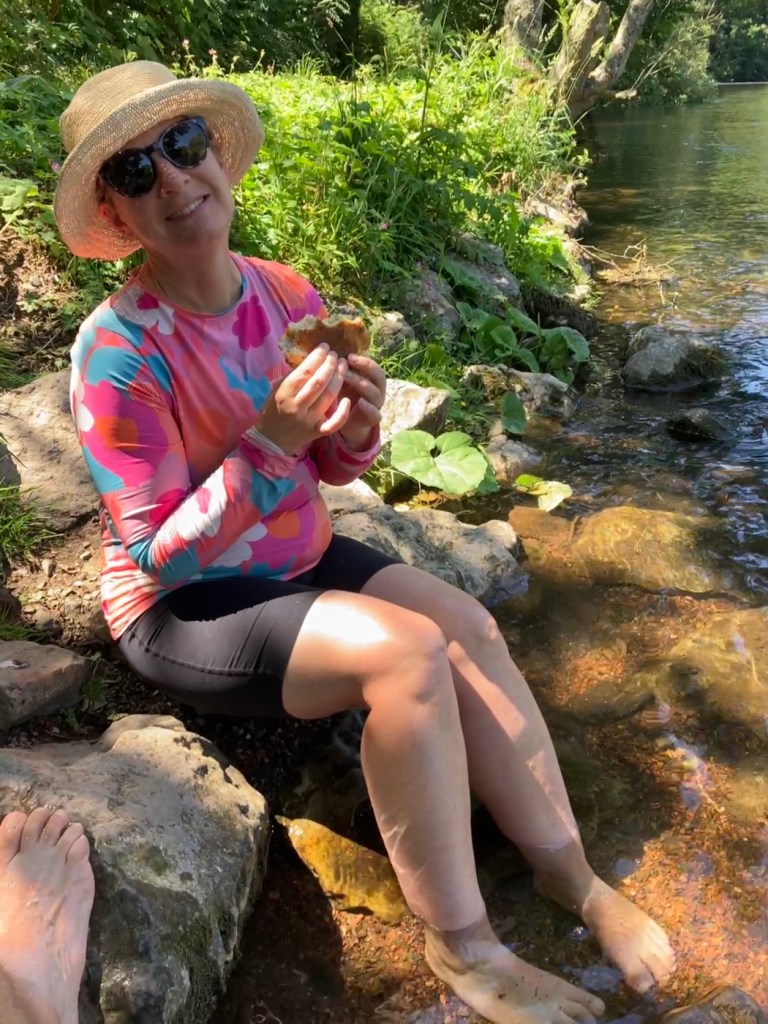
Cooling our feet in the Roer River near Heimbach, Germany
The 40k ride up the Main river to Aschaffensburg was fine and we had plenty of time to pre-board a local train to Mainz with our bikes. I had planned our route using local (RB/RE) trains that were covered by our €49 monthly tickets, and only boarding at the beginning of routes to ensure there was a spot for us and our bikes.
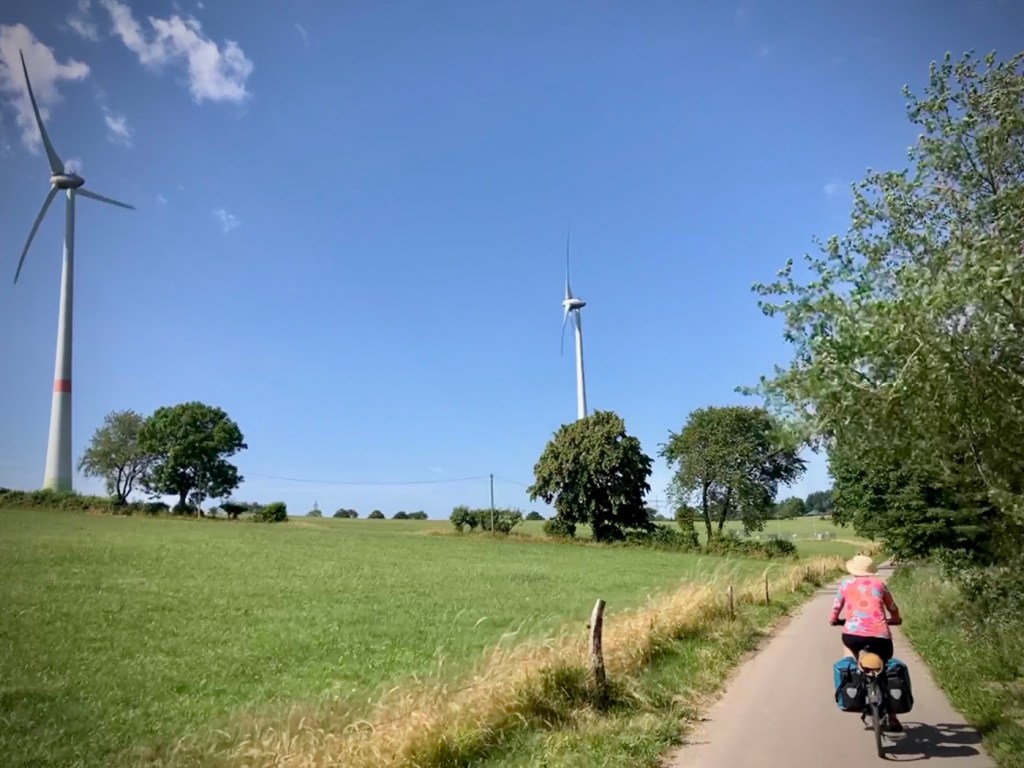
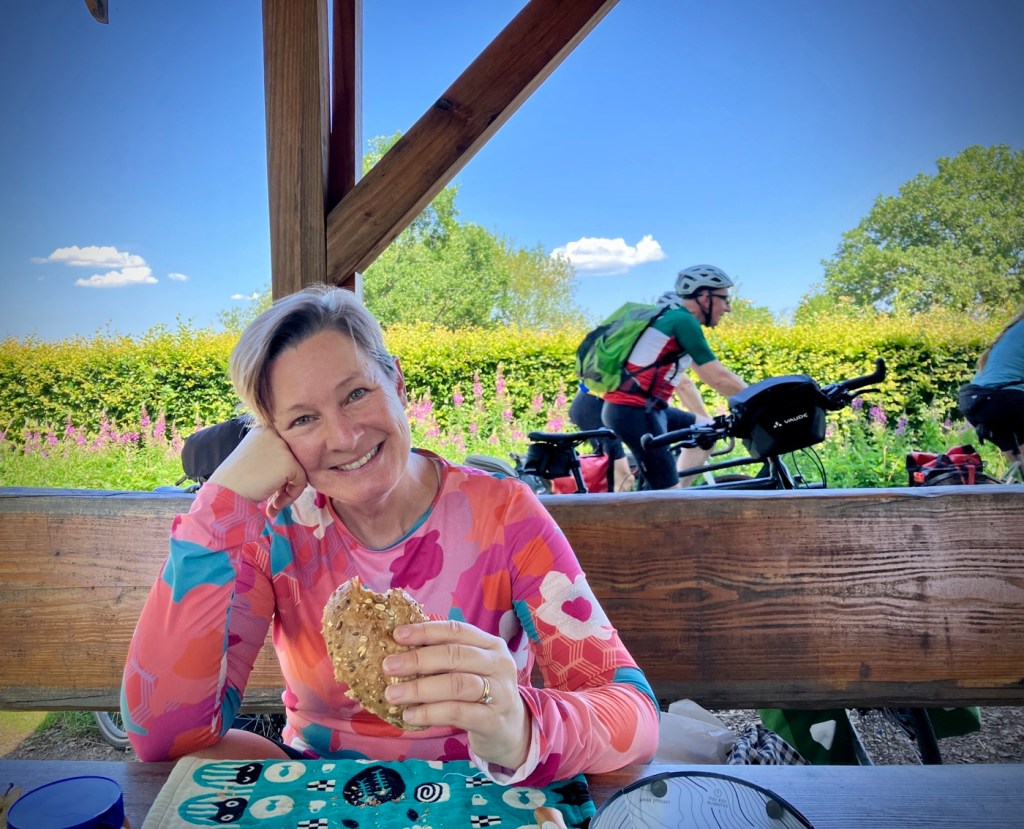
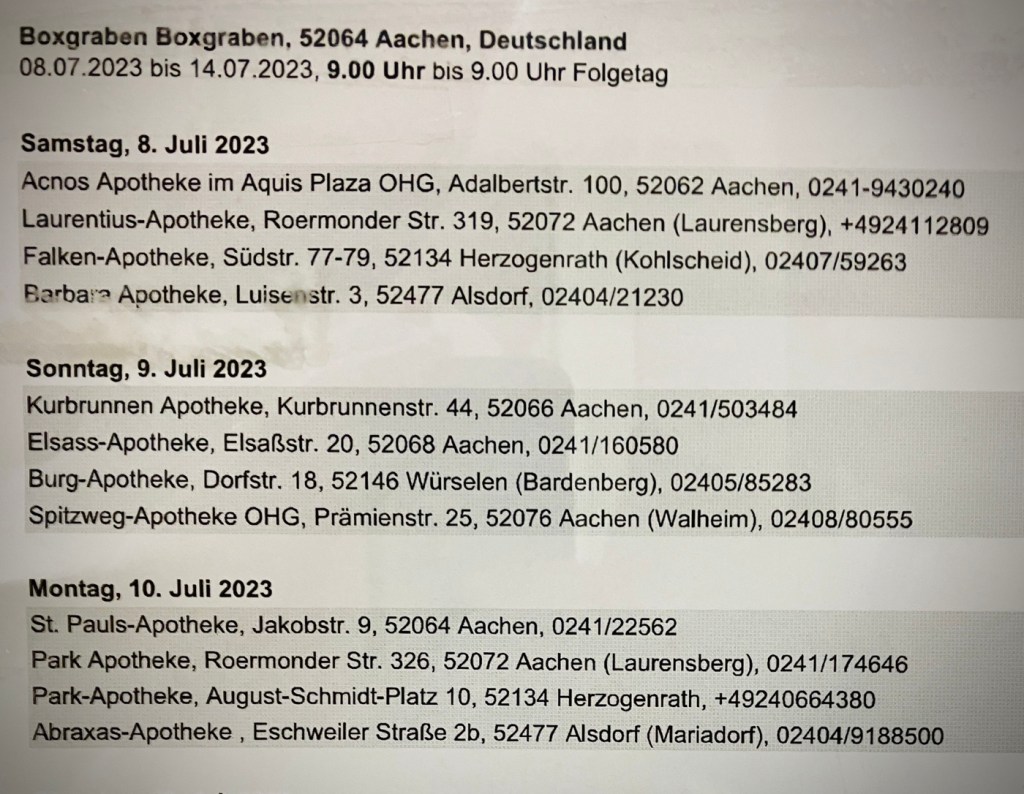
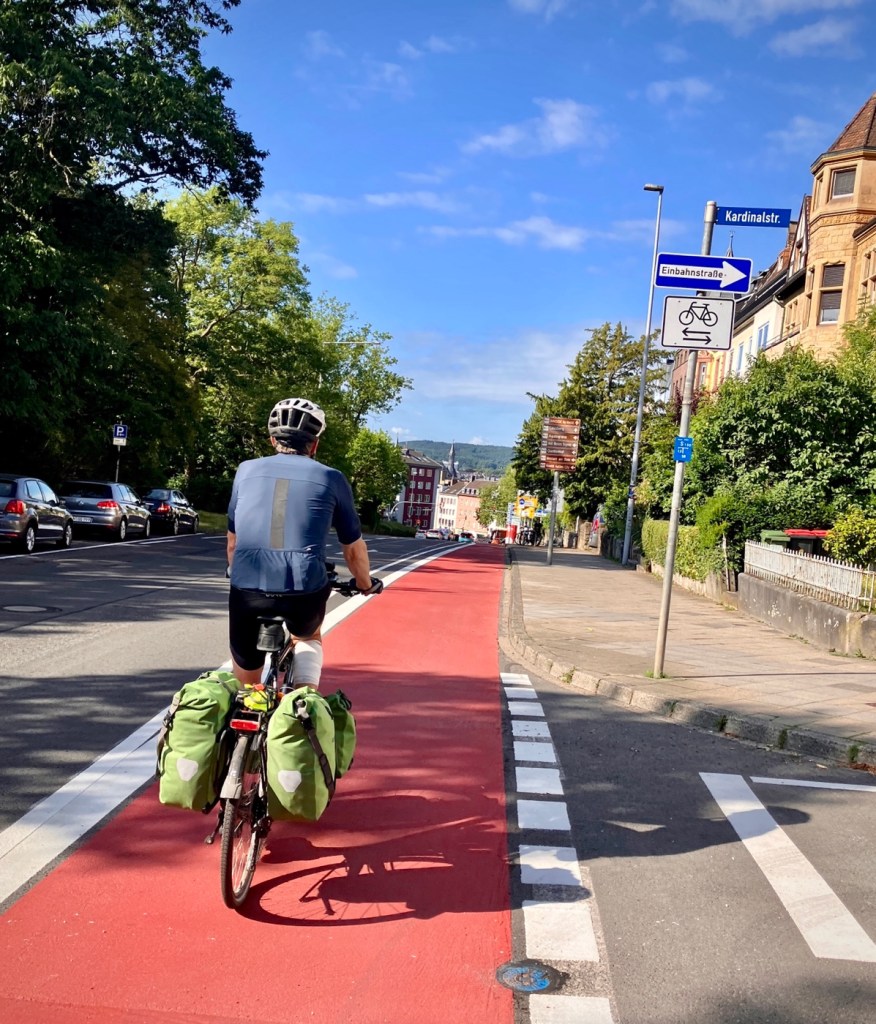
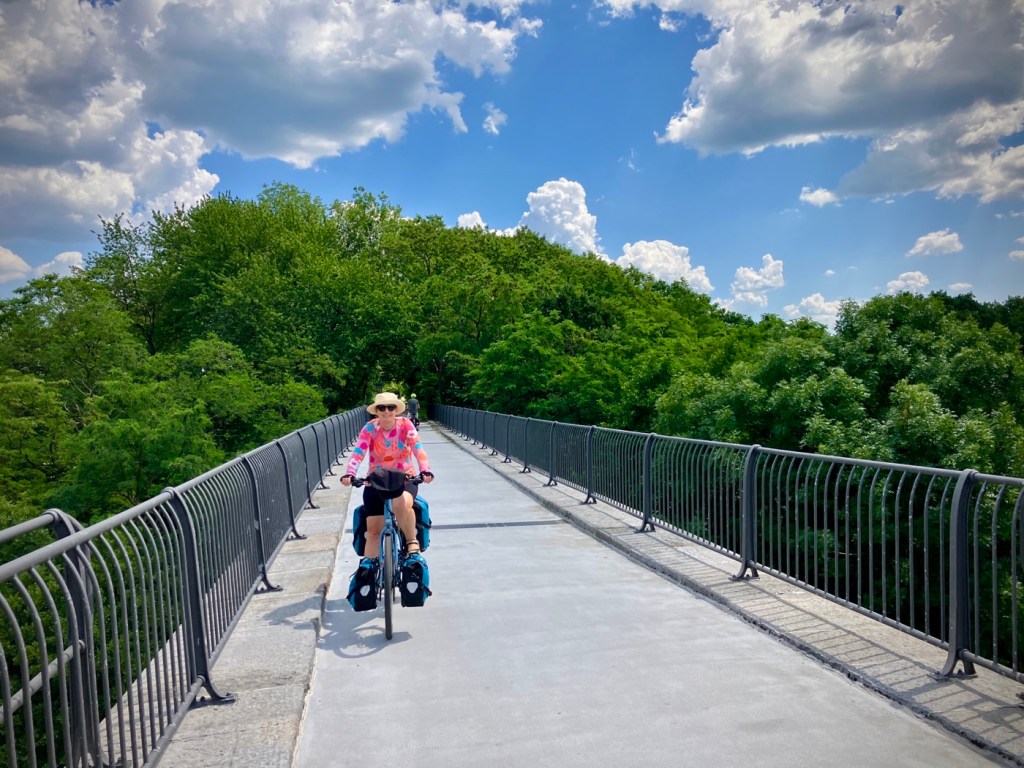
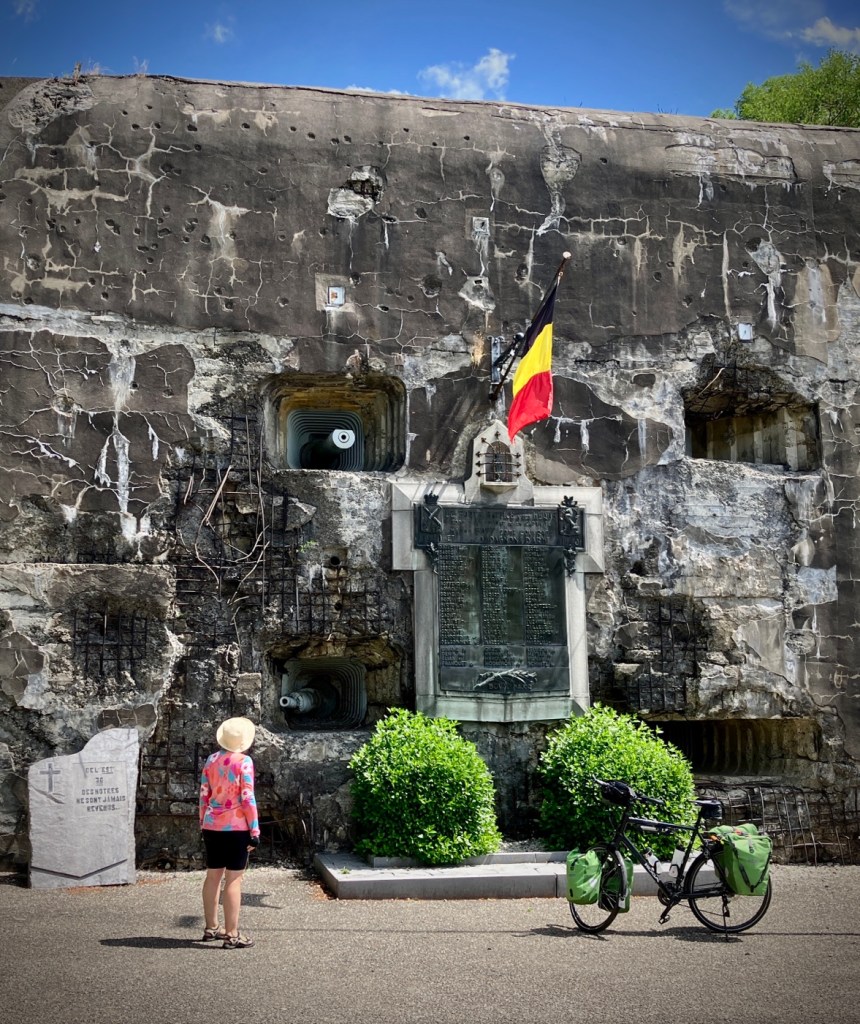
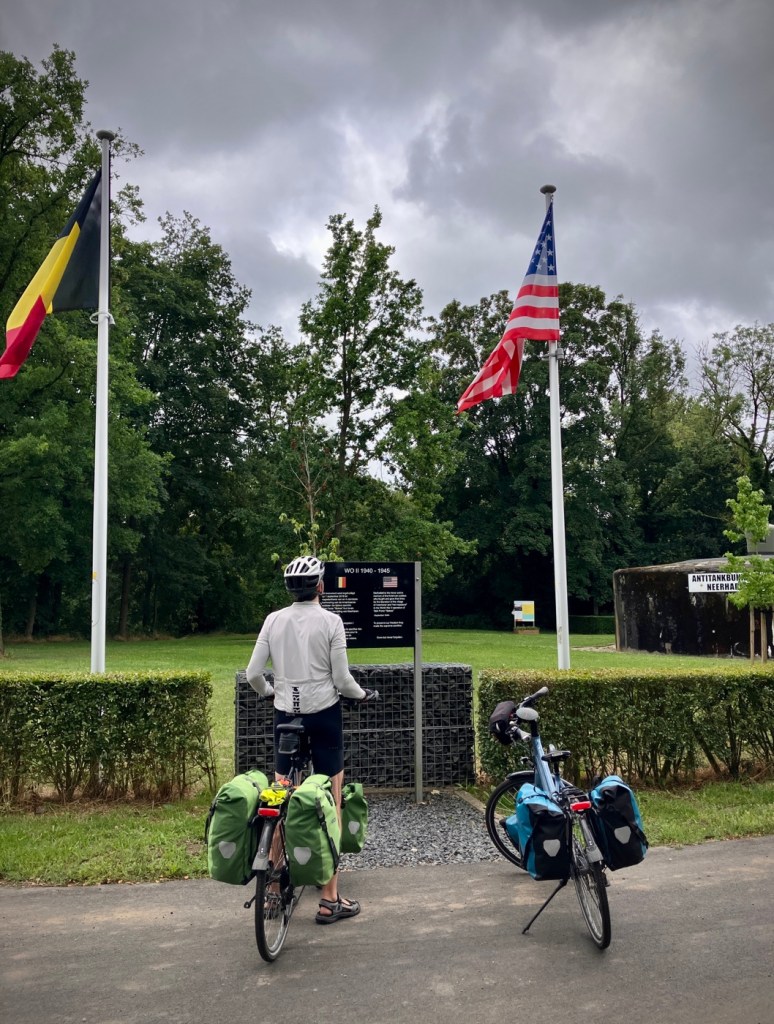
Bug bite infection now bandaged and first antibiotics in my system…still feeling apprehensive about a hot tough ride out of Eifel NP, but the doctor said it was ok to ride. Wind turbines all over the Three Border Area as it’s ridges are windy!Peanut butter and apples were our Sunday savior in Germany, when most everything is closed.The Ravel bike route has great rest areas.The rotating 24 hour pharmacy schedule in the Aachen area allowed us to fill our prescriptions on the weekend after a second visit to an urgent care and second opinion on antibiotics. A rare and new bright urban bike lane in Germany. Happy to be heading out of Aachen…now doped up on two antibiotics! After crossing into Belgium on Eurovelo 3, we appreciated the smooth pavement and well marked bikeway crossings and transitions.The rail-trail Ravel route straddles the Flemish-Wallone border and is like sailing through the sky…highly recommended.You know you are in Belgium…pavé!A small defensive bunker from WWII. This almost classifies as a “pillbox”, which are smaller square or cylindrical defensive structures still found in the area.A memorial to the soldiers who died defending the Vaals region from the Nazis in 1940.The fragility of borders and freedom haunts us again in this region.
Feeling confident after our first easy train transfer to Mainz, we waited strategically on the platform for our next key leg to Bonn. As the platform got more crowded, we knew this might be a challenge, and unfortunately the empty train rolled in further up the platform than expected. Doh! As mobs converged, we quickly passed the first car marked with some bike space to find a better car. Big mistake.
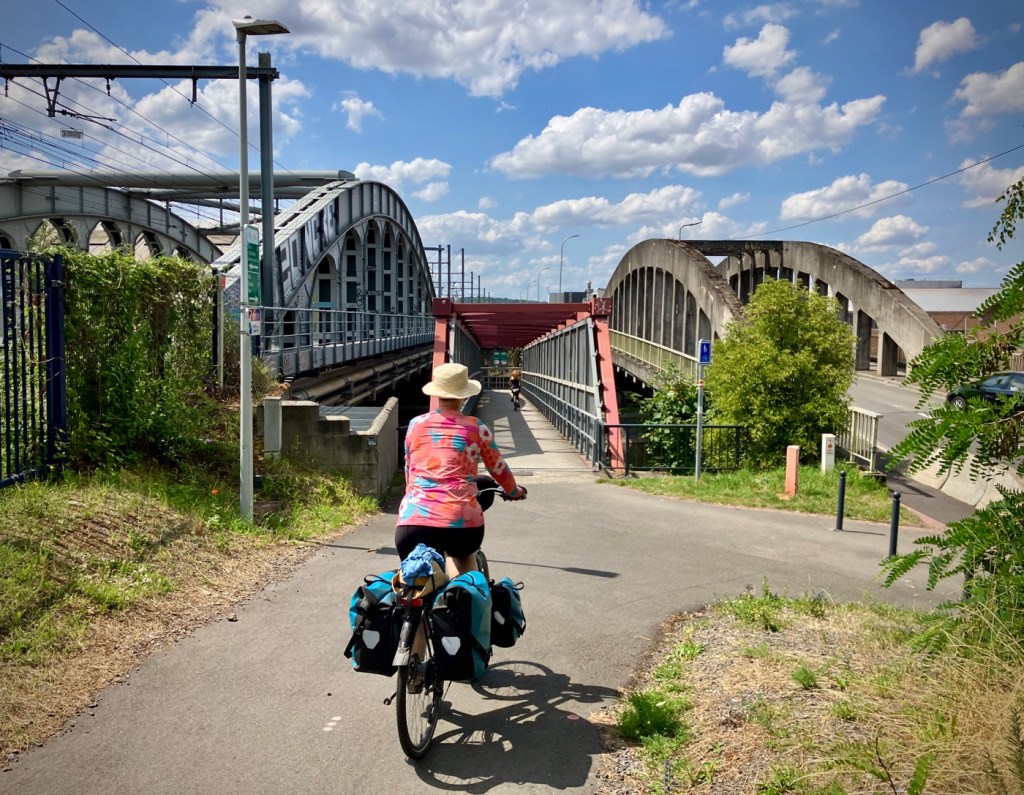
Heading into Liege, a city in transition with new streetcar and brownfield development construction engulfing it for a few tough years. Visit in 2025!
However, it turned out to only have two bike cars; and by the time we got in the door of the second car way down the platform, it was crowded. People were already on the pop down seats in the bike area with large luggage. So after some fairly aggressive negotiating, we managed to squeeze in with our bikes and 8 panniers scattered about above and below seats and on top of our bikes. Poor Cheryl was standing almost the whole 3 hour endurance test of 22 stops; while I managed to find a seat for some of the ride in the main area, after asking two young men to move over and move their bags off the seats.
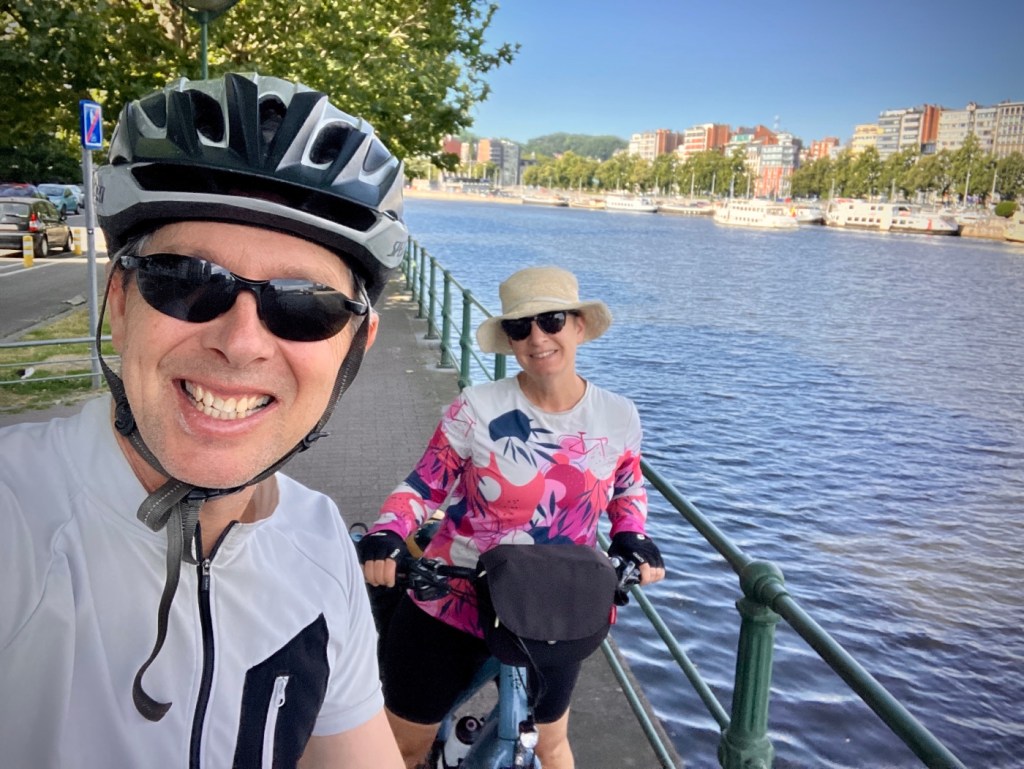
Heading down the Mass (Meuse) River. Goodbye to Liege and Wallonia.
So here is the thing about the €49 tickets; many trains are busier, but the long distance local runs covered by the tickets are especially popular. Next time we’d spring for the €100 intercity train with bike reservation on a trip this long…and you probably should too.
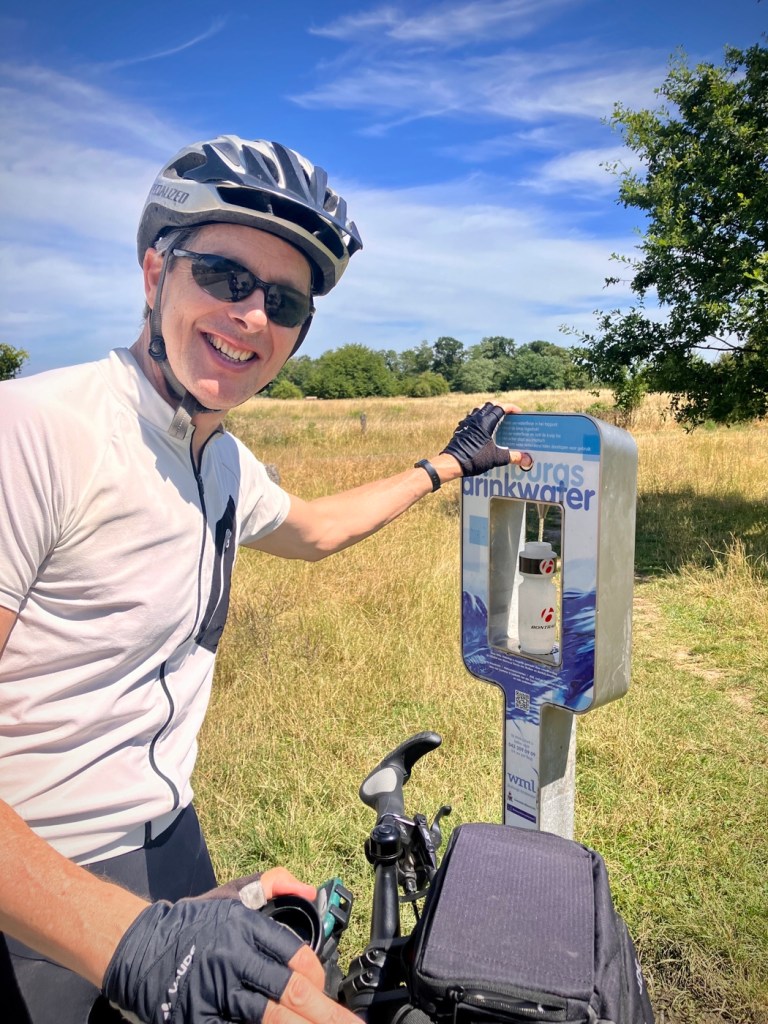
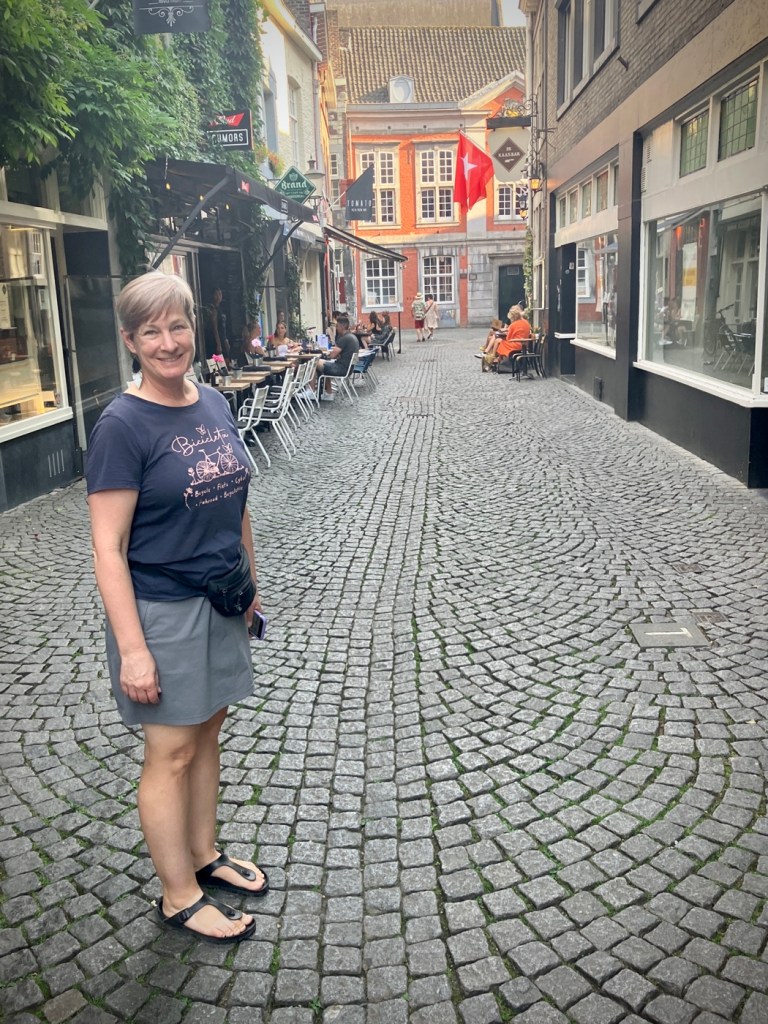
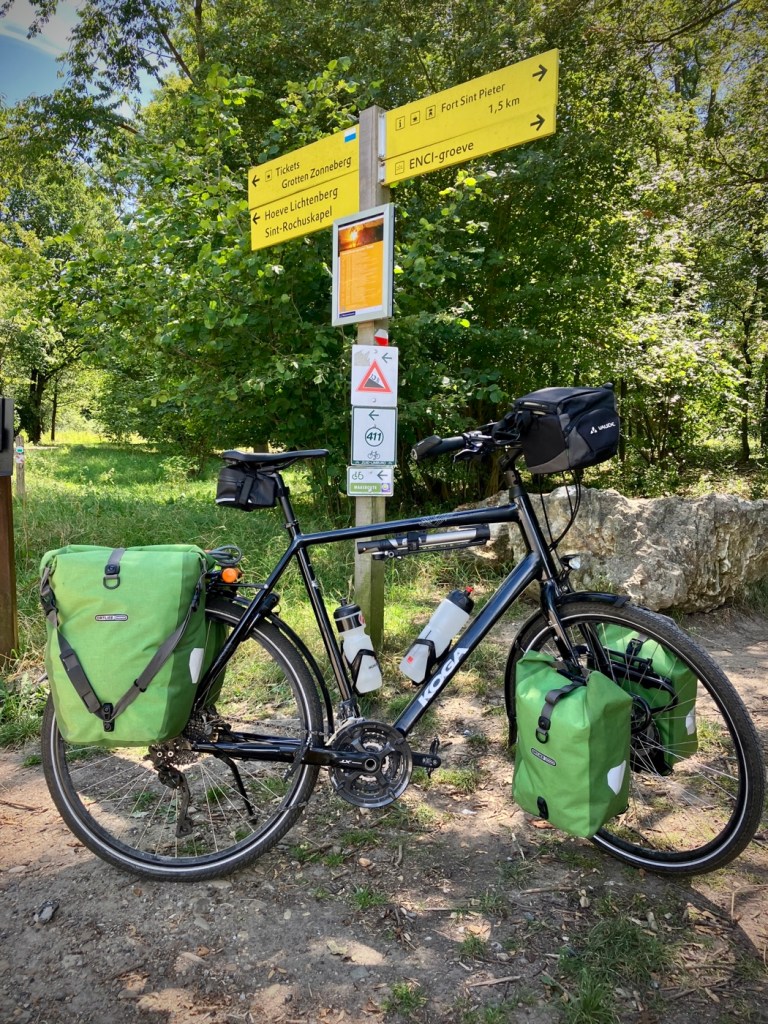
A water tap! Welcome to the Netherlands, there are almost no public water sources in Belgium or Germany.Delightful Maastricht, Netherlands…we dipped into the Netherlands just for a night. Mount Saint Peter just south of Maastricht is perched on a limestone hill; a quarry on one side and views of the Maas on the other. Bikes everywhere around Maastricht University, home to more than 22,000 students.
But the upside of these adventures is that I ended up chatting to the two young men for an hour or so, after they offered me some cookies. It turns out they were both relatively recent refuges to Germany from Iraq and Syria and had fascinating (and somewhat heartbreaking) stories of their families’ trips via Greece and Turkey, where some of their family was still “stuck”. Again, they both said that they would love to go to the U.S. someday, but were ok in Germany, but not thriving. Germany has been overly generous in accepting refuges and should rightly be proud, but it’s a fairly rigid culture to assimilate into or even find your own community within the traditional Anglo-Saxon framework. Heck, we even find Germany a bit hard to assimilate into, so we can only imagine.
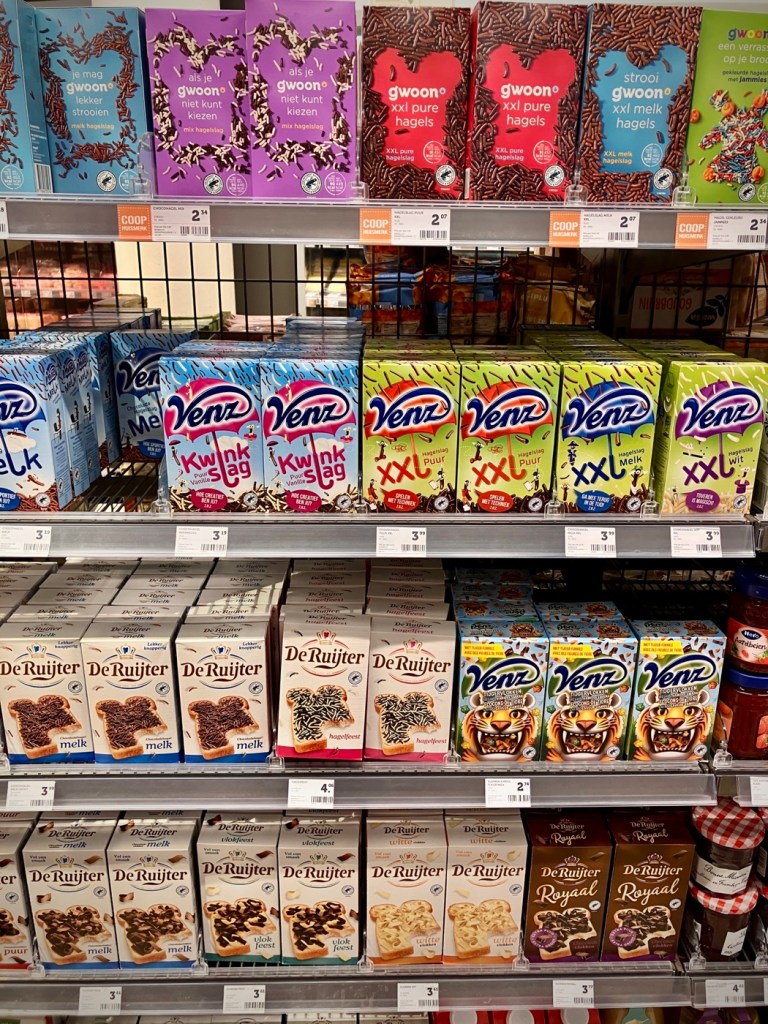
Even more toast chocolate sprinkles at the Coop to peruse…amazing how breakfast customs vary just a few miles over the border.Survived the end of a heat wave with just a fan at the lovely and historic Hotel au Quartier in central Maastricht. Still cool compared to India and Sri Lanka!
So after a difficult exit in Bonn with less than helpful commuters plowing into the train before we could get off completely and refusing to move, we headed out to ride 25k up the plateau to a little B&B room at the edge of Rheinbach. We were mentally and physically shattered, but managed to buy some groceries for an easy dinner at our room and our hosts helped us out by cooking the frozen pizza for us in their big oven.
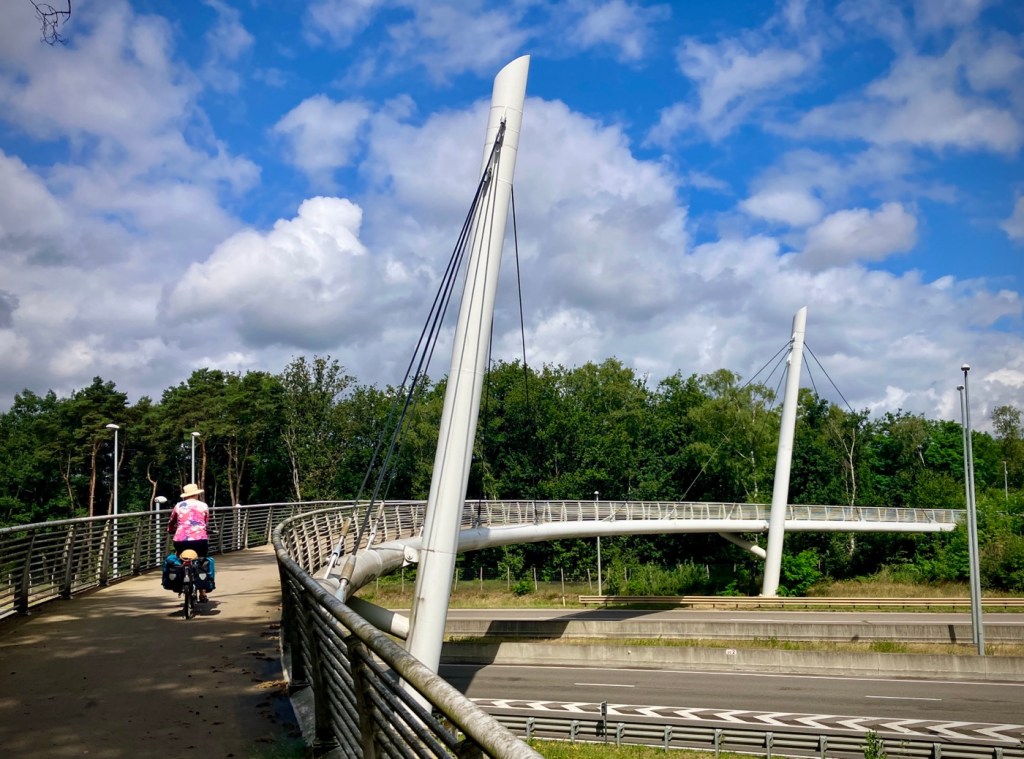
More familiar flags and some pride and appreciation for the sacrifice the US made in the mutual defense and liberation of Europe.Great bike infrastructure continued as we crossed back into Flanders.Howdy train riders…this new Flemish bikeway is amazing!
So we headed out the next morning and I did sort of notice that the spot on my leg had continued to grow and was now over 4” x3”…hmmm? We made it to our next Guesthouse in Hasenfeld and decided, despite the heat; we’d walk down to try to see the lake. As we returned, we both realized my leg was brighter, redder, and the spot had a bullseye center. Yup, I needed to get this looked at ASAP, so asked the innkeeper about a taxi to a hospital about 30 minutes away. When I pointed to the red spot on my leg; she exclaimed in horror “Scheiste!” or some hybrid of shock in her German-Polish vernacular.
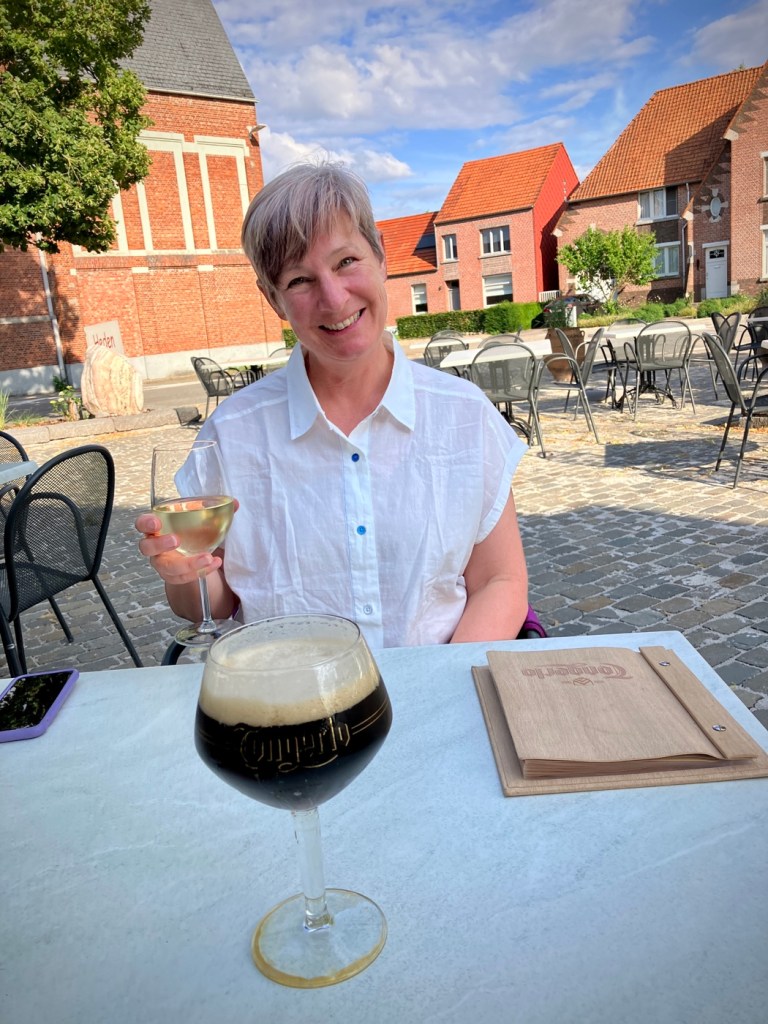
Reward for an 85k day goal reached; a short walk to a neighborhood brasserie for wine and a luscious Belgian beer near Mols, Belgium.The next day, a 75k meander to Antwerp primarily along the rural Kempenroute in Northern Flanders.
Her panic did not help. It was now Friday evening, but she was as able to get us a taxi to the urgent care clinic of the local hospital, and I was seen in less than an hour. The doctor spoke English and was pretty sure it was an infected bug bite (but not a tick) and prescribed an antibiotic course and ibuprofen. He recommended I get it looked at again in the bigger city of Aachen; where we planned to cycle the next day.
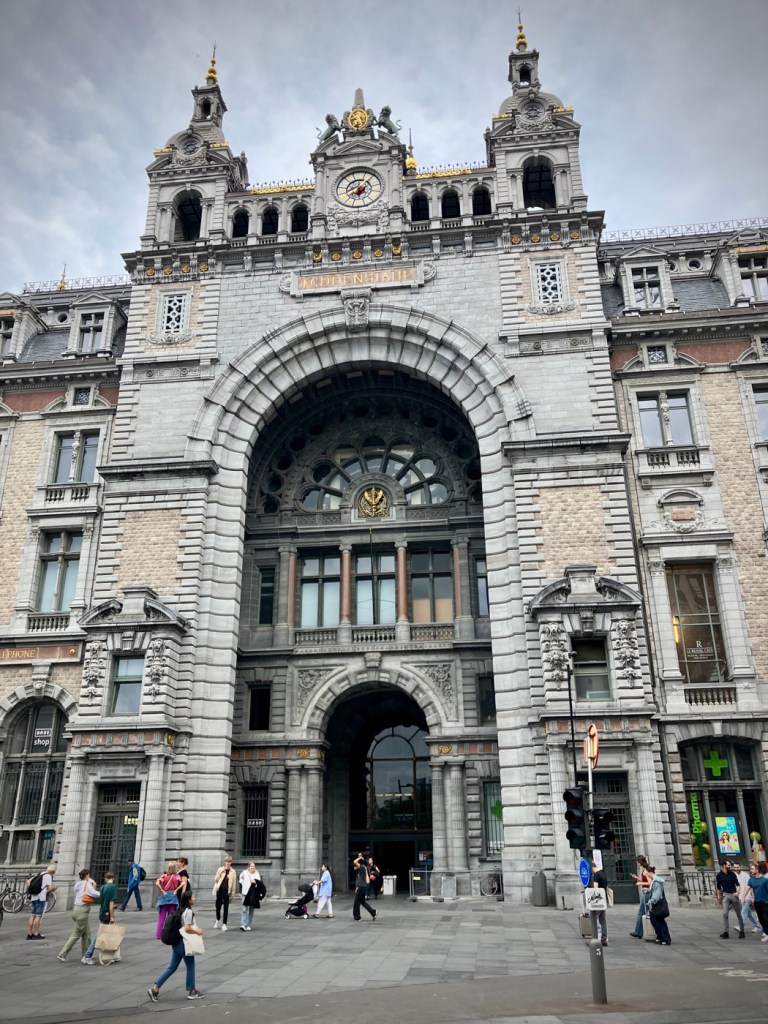
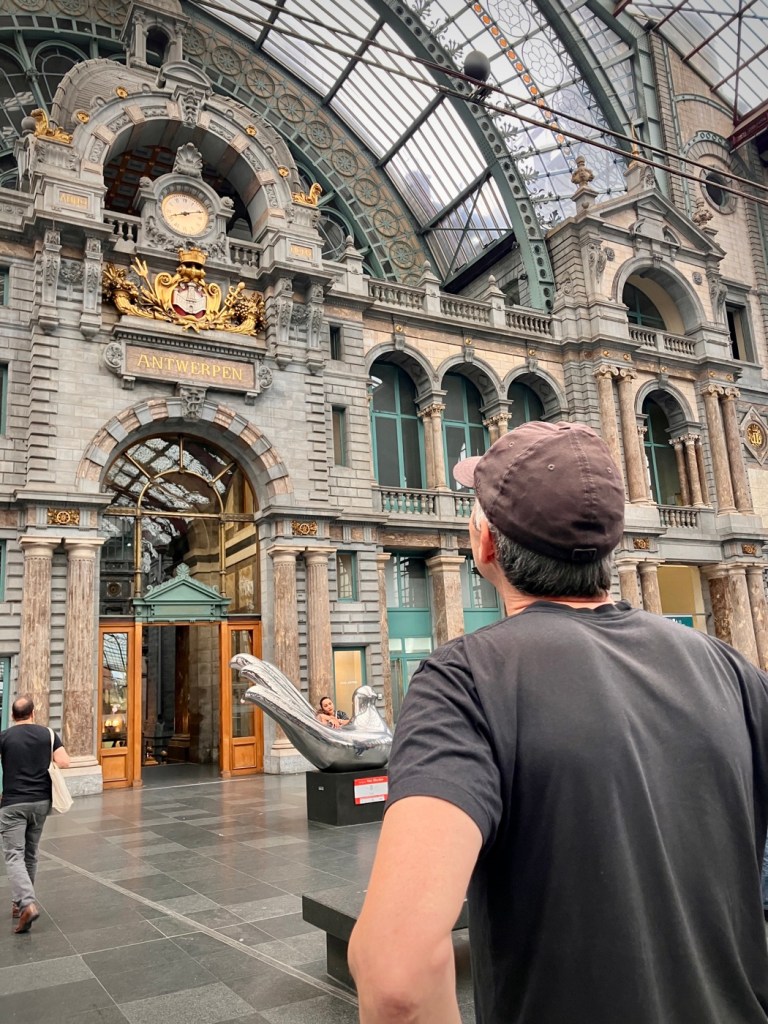
Antwerp Central.Now THIS is a train station. Wow!
Feeling mentally better with the antibiotics, we headed to Aachen on a scenic route along the Rursee, one of the largest reservoirs in Germany, and then up and over the next ridge, and finally a blissful coast down the Ravel rail route to Aachen. In Aachen, we visited another (more crowded) urgent care on Saturday evening and the Doctor seemed to have a different opinion on which antibiotic was best, so started me on another course, as well as some prednisone, to quell a possible allergic reaction to the bite. Given our (rushed/efficient?) 7 minute visit and her lack of spoken English (and super fast German), we are still not entirely sure of her opinion, but I did have a new prescription and was able to start on her advice the next morning. The amazing thing about antibiotics is how fast they work as I was already feeling better by day 2, and by day 3 the redness had dulled, and dissipated completely within the week. Not sure which antibiotic did the trick, but have been re-boosting on yogurt and other pro-biotic foods ever since.
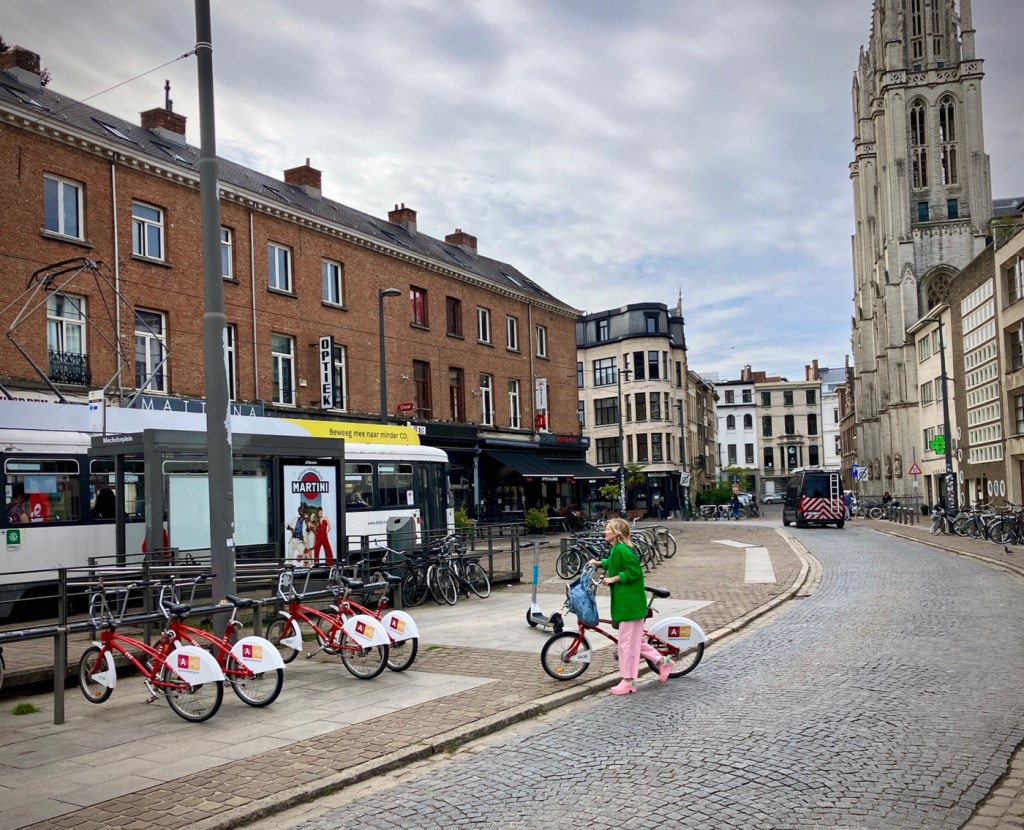
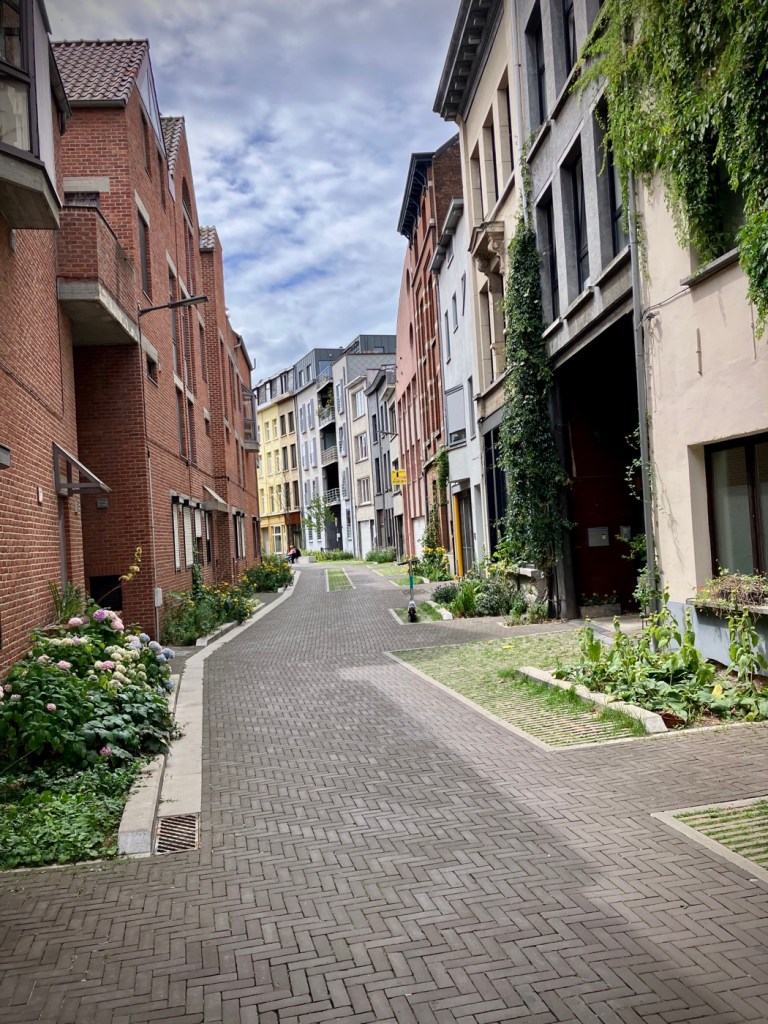
Multi-modal and car-light Antwerp.Streets are for people in central Antwerp. It was bustling in the center…just not in this morning photo -;)
So thank you again German health care system for your kindness to foreigners. And by the way, the TOTAL walk in costs, €70 (two urgent care visits), €40 (4 prescriptions), and €140 for taxis. No insurance needed. Yes, the taxis were more expensive than two urgent care visits and drugs.
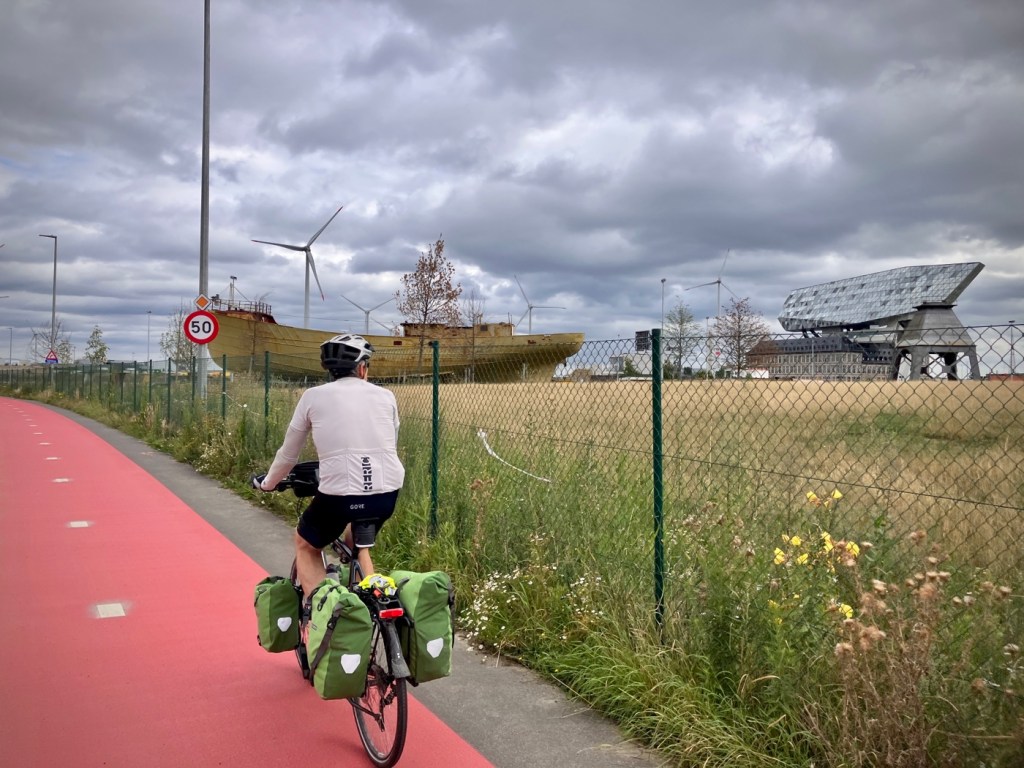
The recently renovated and highly recommend Royal Museum of Fine Arts in Antwerp puts the Dutch Masters in context with modern works and a great audio guide App.The port area of Antwerp… with two ships on the horizon? Nope, on the right is the stunning Port House designed by the late Zaha Hadid. On our list to visit next time! Sculpture snack break.
So after a Sunday rest day in Aachen, we headed out on our journey towards the Belgium border and had a great ride to Liege, in the Wallonia region of Belgium. Liege has a lot of potential and we didn’t get to explore much in one night, as the whole city is pretty much torn up for a massive streetcar and streetscape redo well into 2024. From there we had an easy ramble down the Maas river to Maastricht, dipping into the dogleg of the Netherlands for a night.
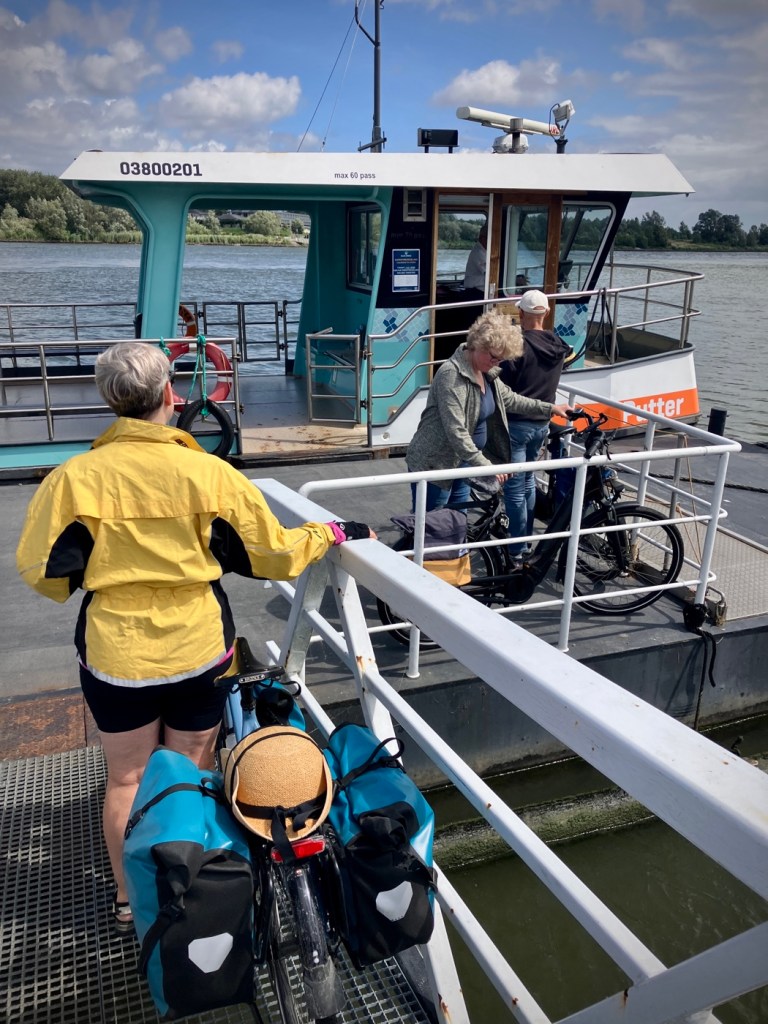
This “bikeways first” rural road layout makes car drivers work it out in the center while bikes get two wide lanes.And bridges AND tunnels designed with separate bikeways.Crossing the Oude Maas River near Dordrecht.Mind the freighters please.
Maastricht is a lively Dutch city dominated by a young (est. 1976) but highly respected state university. The vibe is very international, especially as over half the students are foreign. Feeling 100% now, I next plotted a 160k two day route to Antwerp across northern Flanders. We noticed that the bike infrastructure in Flanders is nearly equal to that of the Netherlands, as there has been a huge push to catch up to that high standard the past 20 years. Belgium also felt a bit more sophisticated and gourmet than many of the smaller places of Germany and Czechia we had spent the last month.
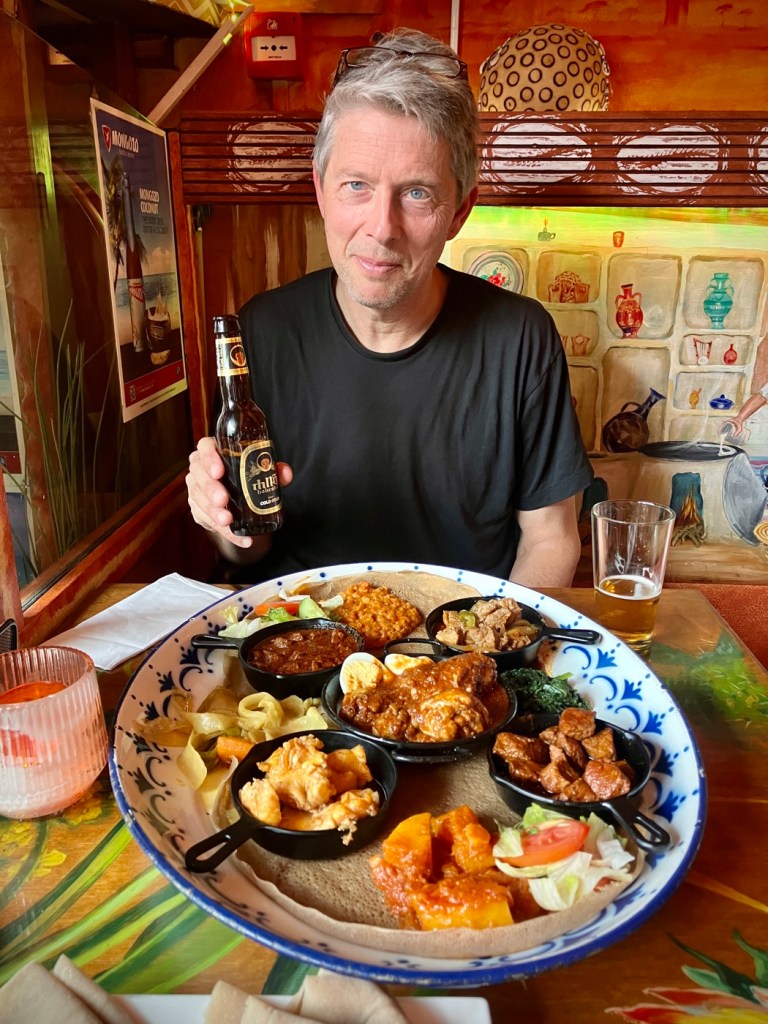
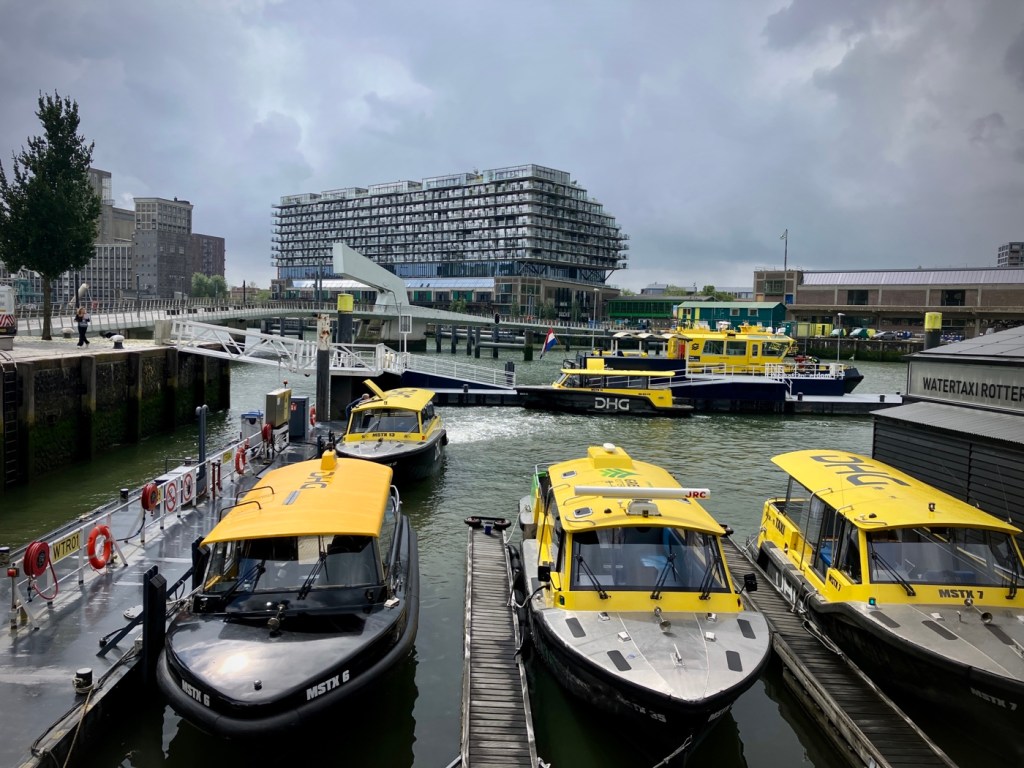
Enjoying the culinary diversity of Rotterdam at Restaurant De Smaak van Afrika.And more traditional, but delicious fare at Cafe Pierre; Dutch bitterballen, mushroom risotto, and a goat cheese and fennel tarte tartin (frites and bier a given…)Rotterdam is the largest port in Europe, so bridges, tunnels, ferries, and these typical water taxis provide key links.
I think Antwerp is one of the underrated and overlooked gems of Europe. It’s bustling, has amazing architecture, great international food, pleasant neighborhoods, and fantastic museums, such as the KMSKA and Red Line. From there, we rode two days to Rotterdam, another interesting city, although more focussed on the future and modern architecture as it was completely rebuilt after the devastation of WWII. Yes, we love the “B cities” of Europe, especially in peak tourist season. You get a more genuine experience with fewer crowds. And you can you usually get a seat, even at the most popular cafes.
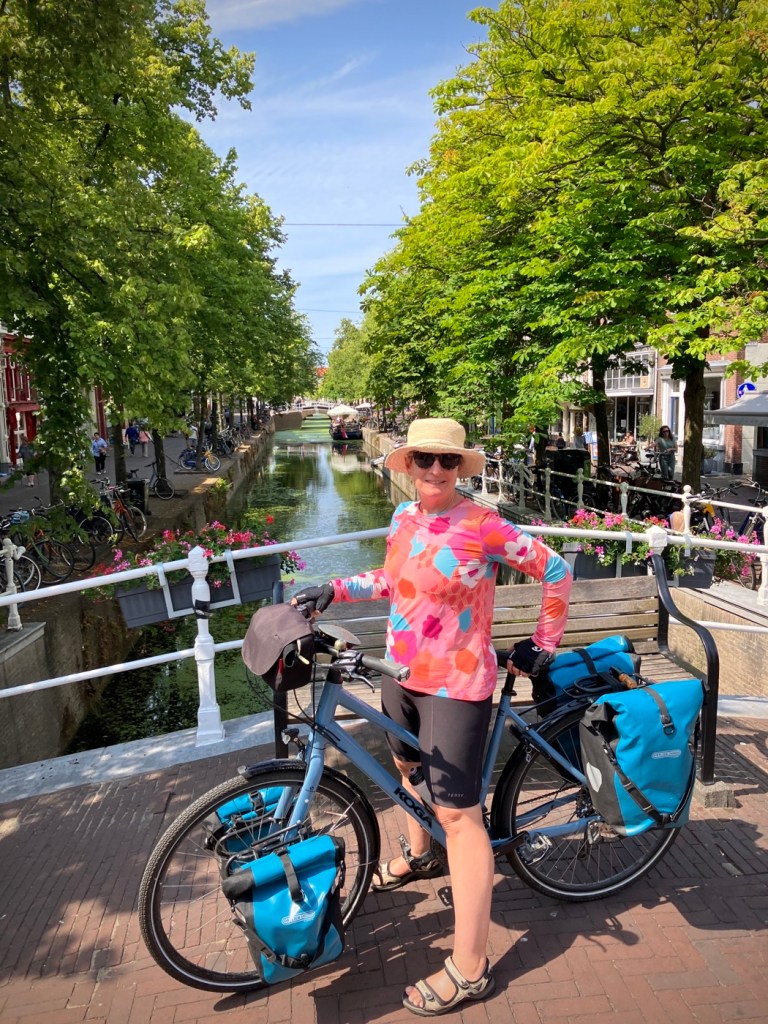
Off again towards the Hook of Holland.Time for a quick sightseeing ride around Delft on the way to our night ferry.
Our rest day in Rotterdam was well timed as heavy rain came through, perfect for exploring the Harbour areas and fantastic Dutch Photography Museum. The next day, we finally set out for our last destination on the continent, the Hook of Holland, for our overnight ferry to the UK.
Water on all sides; about a quarter of the Netherlands is below sea level, yet somehow seems closer to the sky.
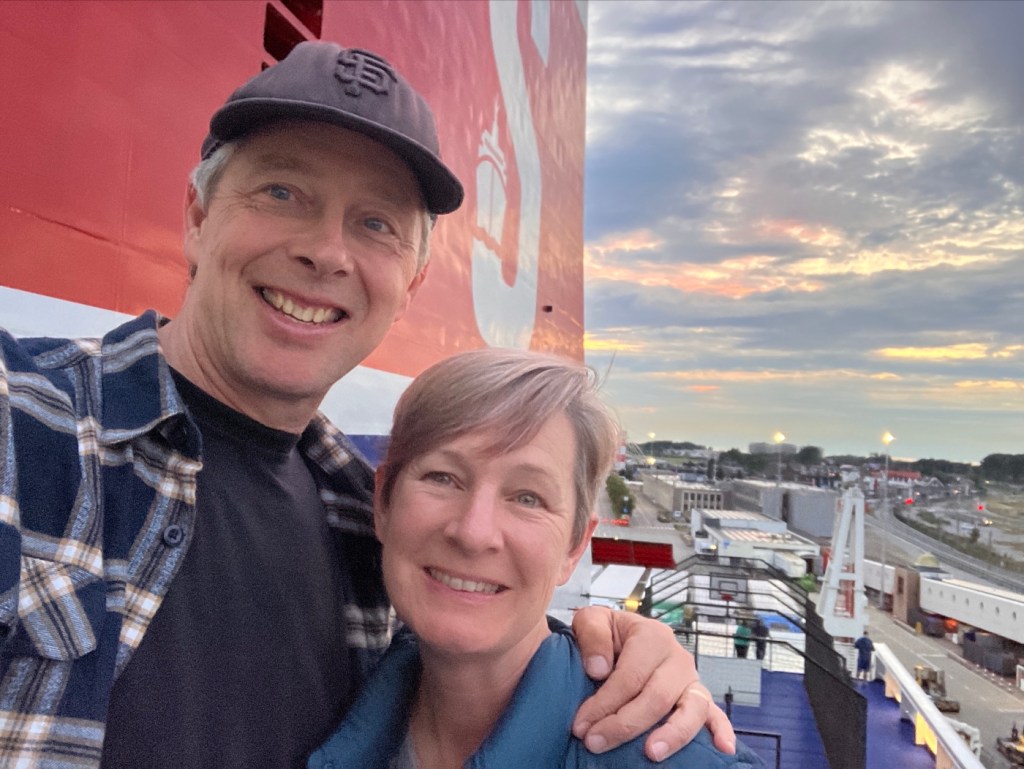
This is our favorite crossing to the UK as the Stena line is well run and bike friendly. You check in with the cars and ride onto the main car deck to park your bike, and then plenty of time to enjoy a drink in the bar, have dinner, and catch sunset as the ship sets out about 10pm. Then up to your cozy cabin to sleep. And then cycling off the ferry to our next adventures. Stay cool and note our next post will be soon!
Enjoying the late sunset with my favorite traveler as we pull out of Hoek Van Holland.
One of the joys of extended travels is discovering the connections and overlapping layers of history, from the Neolithic to this shocking few weeks in Post Cold War Europe. You see snippets of history, in both the context of the ancient society, and the modern context of how it is presented.
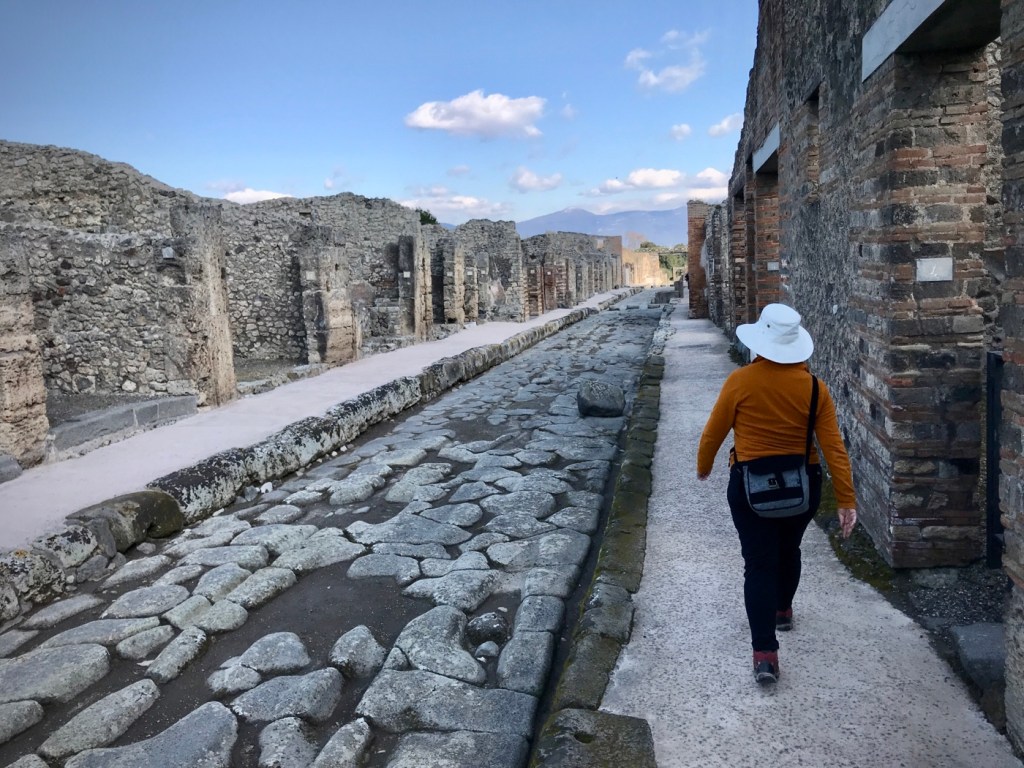
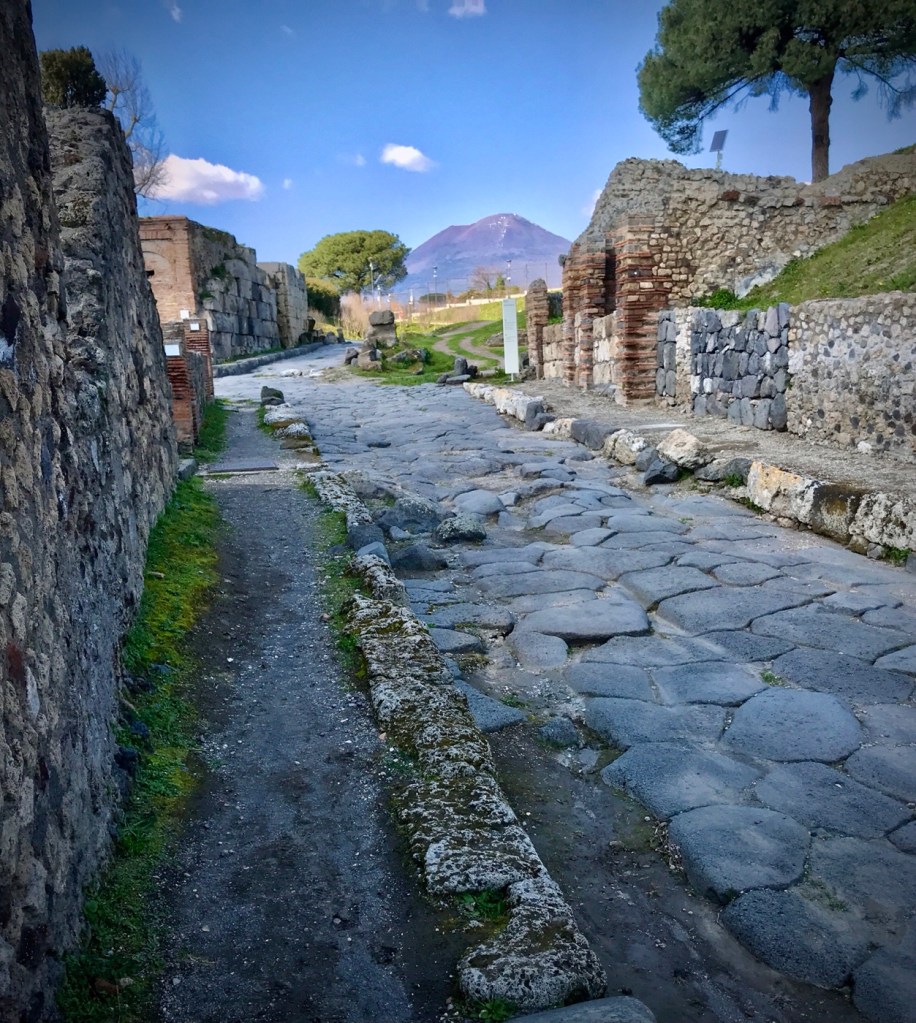
Chariot ruts in Pompei show just how much traffic plied these streets, and that there are always infrastructure maintenance backlogs!
In this part of the world, it is still stunning to discover the vastness and complexities of the Roman empire from Morocco to England, and of course, in modern Italy.
Literally layers of history at Herculaneum, right up to the old shoreline.
The past week’s events in Ukraine overlapping with visits to two of the world’s greatest archeological sites, Herculaneum and Pompéi has been sobering. Most of us understand the risks of Putins end game, but it’s especially painful for Europeans who bore the brunt of two world wars and protracted Cold War. History does feel like it is doomed to repeat itself.
The empty Herculaneum on a Monday morning; a joy to explore!
There is a lot to take in at both UNESCO sites, so we decided it was best to separate our visits by a few days. We had planned on trying to get to Herculaneum early on Sunday morning from Naples, and set out from our hotel at 8am sharp only to be stymied by misinformation on the metro and train schedules….(BTW the Moovit app is best in Naples).
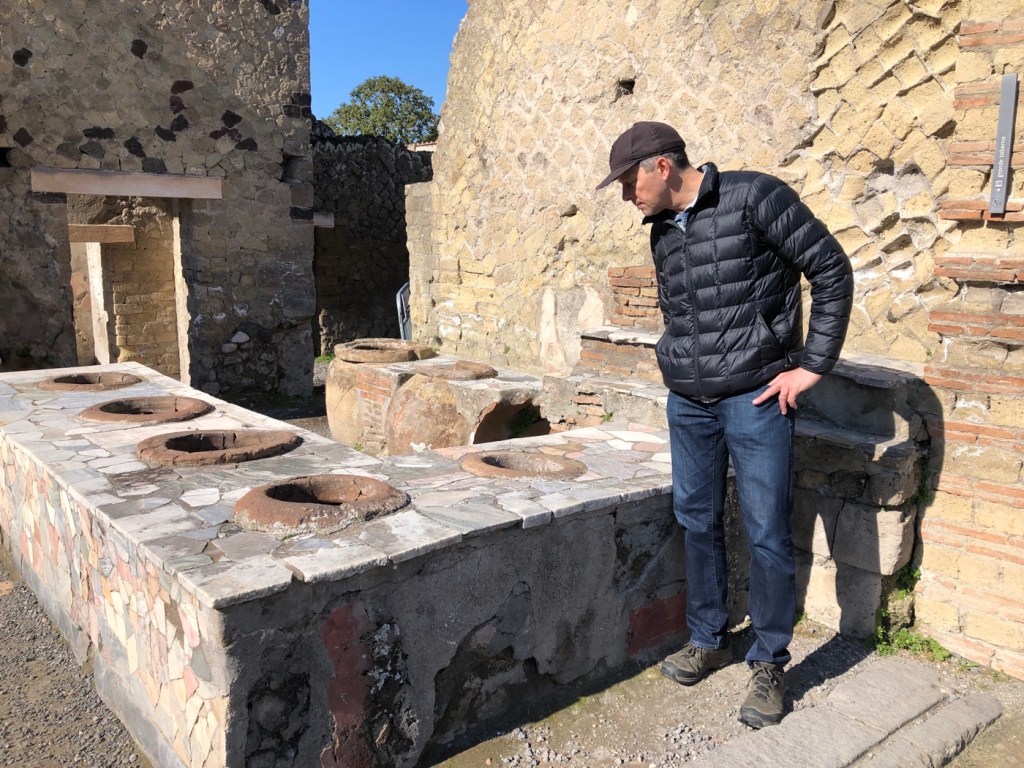
I wonder what was for lunch?
So as we sat on a crowded platform, with the prospect of getting to Herculaneum 1 1/2 hours after opening on by far the busiest day of the week, we decided eating €5 train tickets was a small price to pay for a better experience and left the station for another day. Another blessing of long term travels.
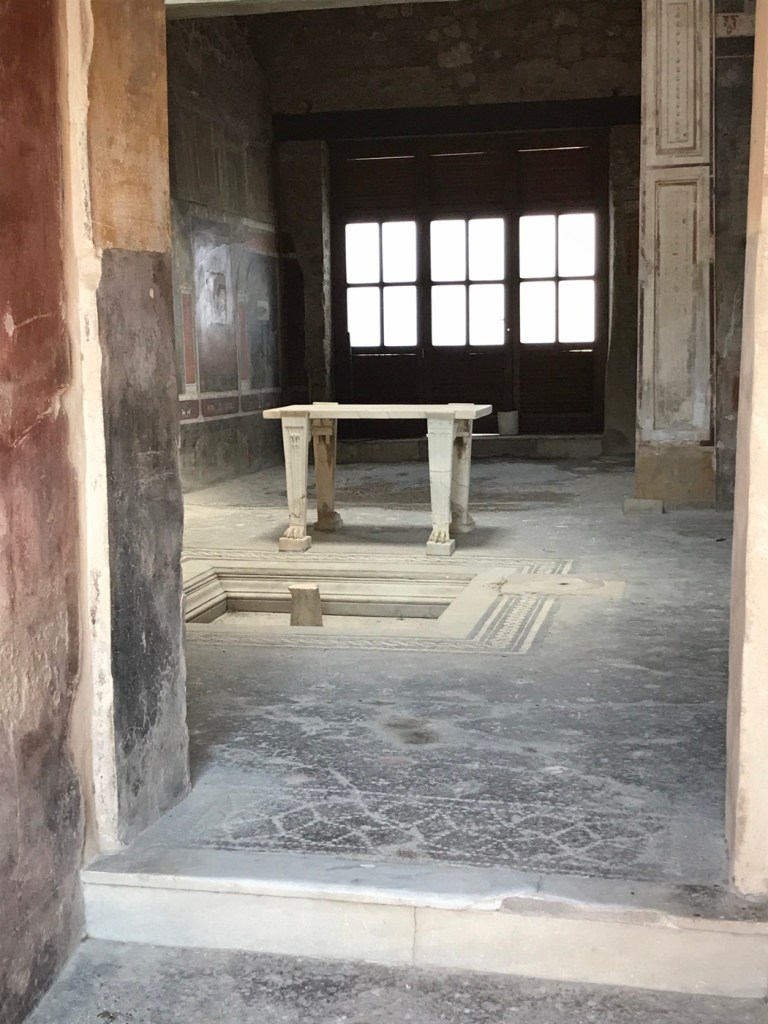
Looking towards the impluvium…Roman Villas are so impressive for their thought in design and layout; not much to improve in 2000 years of architectural development.
It was a great decision as we were able to stop at Herculaneum on the way to Sorrento on Monday, and had the place practically to ourselves….oh, and the sky was bluer on Monday too -:). This also gave us the opportunity to watch the excellent BBC documentary on Herculaneum which really did enhance our experience the next day.
Endless Pompei….20,000 lived here at its peak and 18,000 did get out on August 24, AD 79
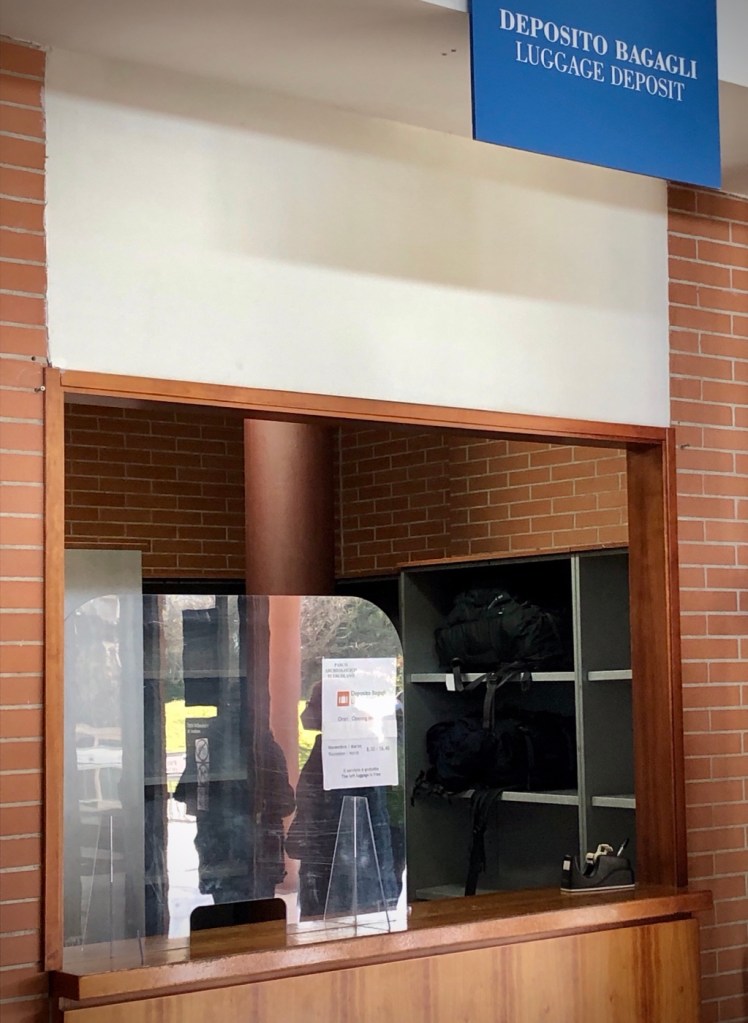
Both Herculaneum and Pompéi are on the CircumVesuvia regional train line that runs from Naples to Sorrento, so an “on the way” visit is a great option, especially as both sites have left luggage facilities. The Pompéi entrance is very close to the train station, but Herculaneum is almost a kilometer away downhill, so best if you are traveling light with backpack luggage, but it is certainly doable with a roller bag (if you can stand the sound on the sidewalks!)
Left luggage at Herculaneum…simple services like this can make a travel day possible.
Herculaneum was a prosperous and smaller city than Pompéi; kind of a posh suburb. When it was hit by the huge earthquake of AD 62, many of its wealthier residents took the damage as an opportunity to remodel…of course, only to be buried by 50 feet of the pyroclastic flows of Mt. Vesuvius just years later in AD 79. The site is compact and surprising in its somewhat dense surroundings of a more modern town.
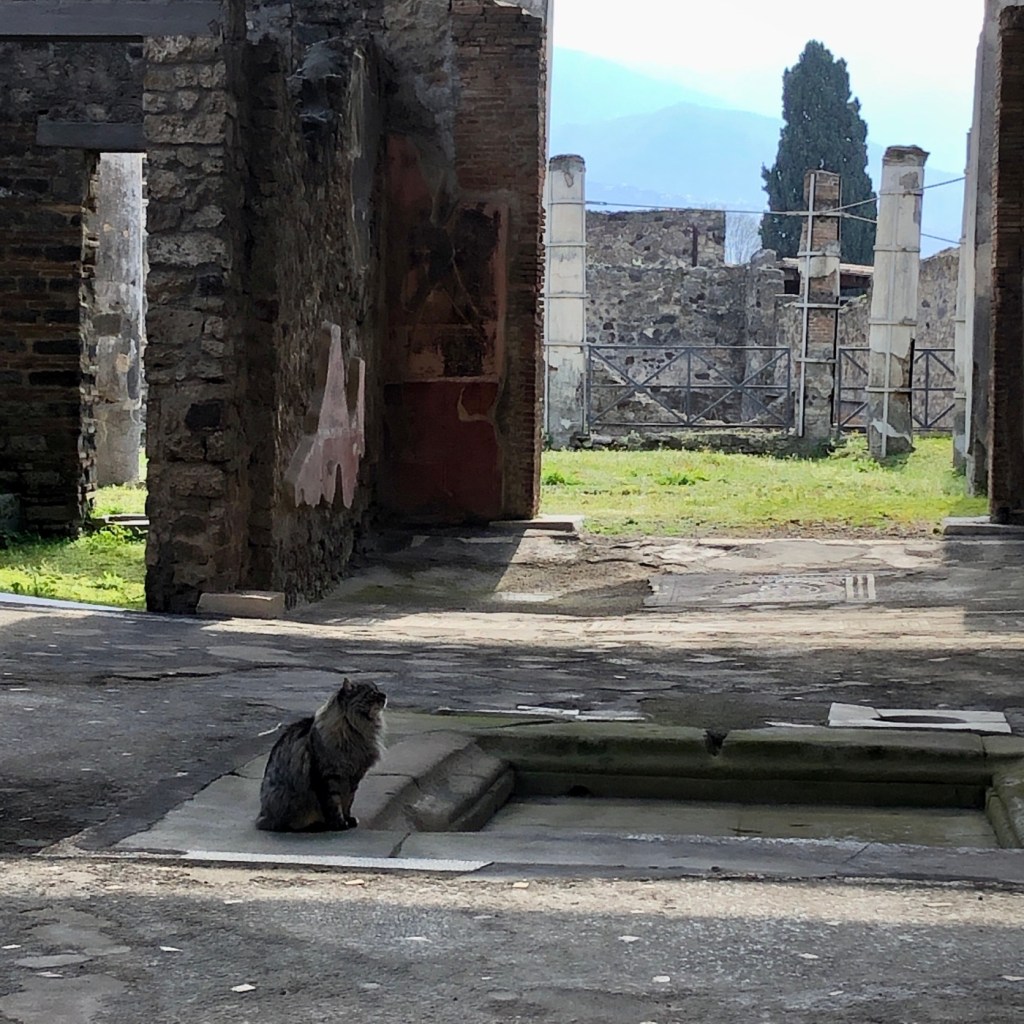
Yes, there were cats in Pompei
What was also surprising to us, was all the people that still live in the shadow of the mountain, taking a calculated risk that it won’t erupt soon, or with such force. They say there will be some warning from the vulcanologists and seismologists next time. And of course, we lived in San Francisco for 30 years, so can understand taking a risk living somewhere you love or is your home. Or both.
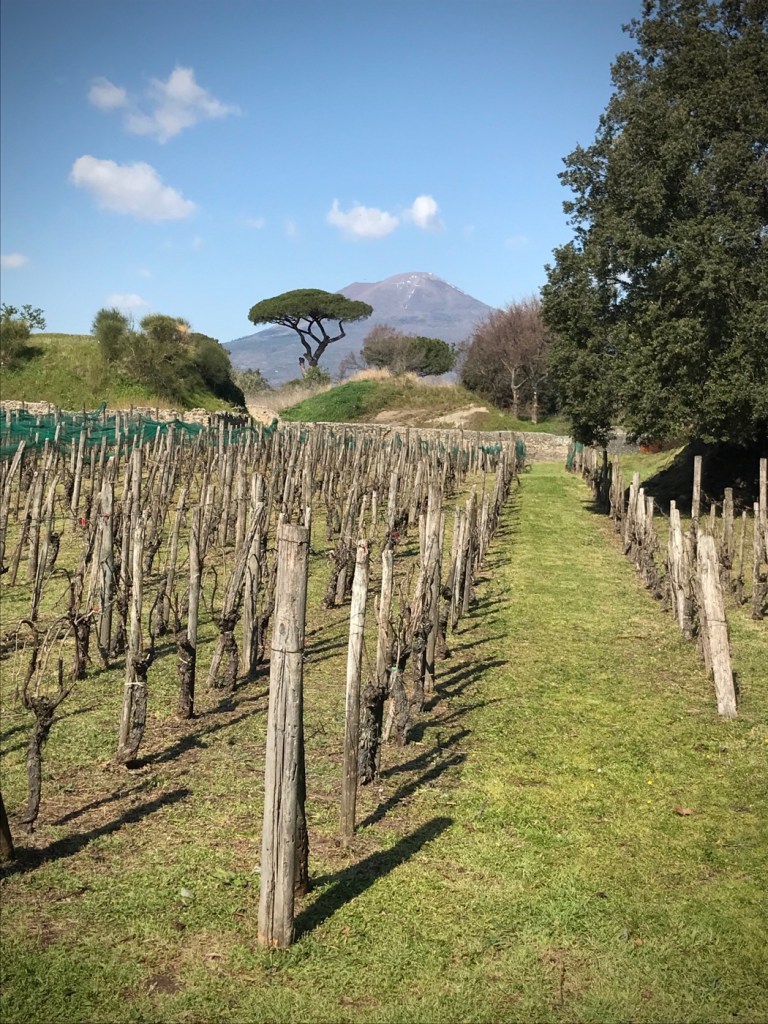
The restored vineyards of Pompei with Vesuvius in waiting.
After a nice day off in Sorrento walking in the local hills of lemon groves, we visited Pompéi by taking the train back from Sorrento on Wednesday, and again enjoyed light crowds.
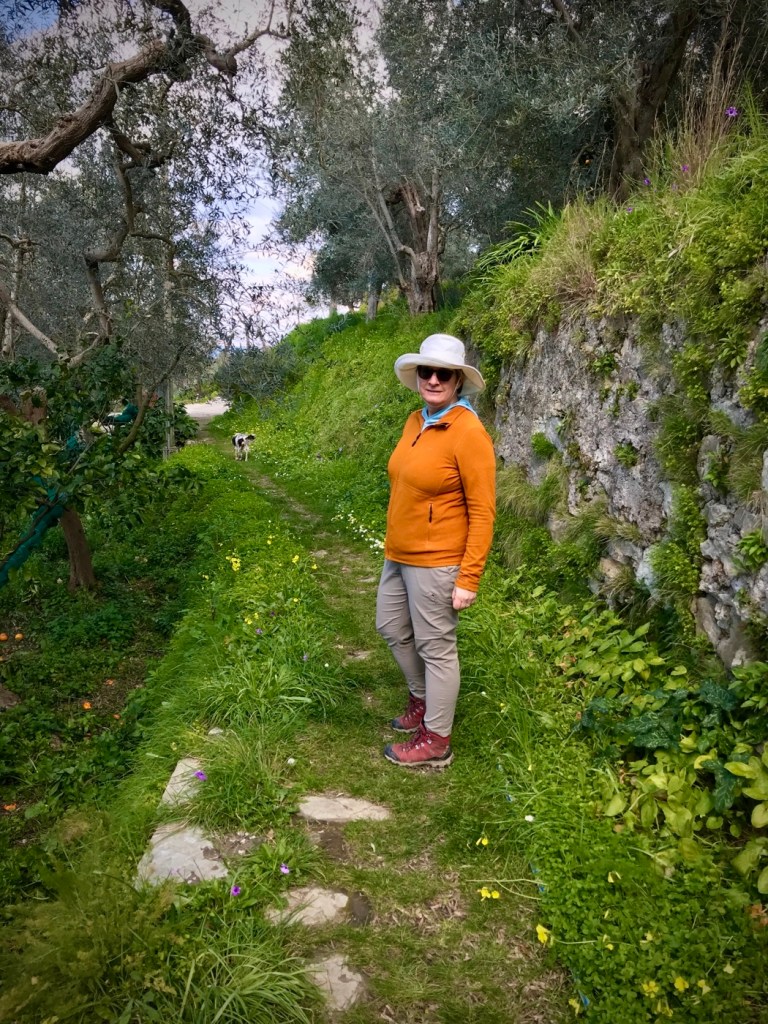
Taking a Roman break walking in the hills of Sorrento, with spring finally showing it’s serious in Southern Europe
In fact we walked up to the ticket window at 9:30 am with no line. It did get a bit busier as the day went on, but still an apparent trickle compared to pre-COVID times, as the tour buses have not returned yet. Somewhat a golden time for travel if you can get here.
The tranquil footpaths to Marina Lobra, near Sorrento
Pompéi is vast and sprawling, and it stuns you with the scale of the city’s ancient streets, sidewalks, and lunch cafes. Romans ate lunch out routinely, apparently to feed their appetites building vast baths, forums, and an amphitheater.
The slight curves and meanders of Pompeii’s roads was insightful urban planning
It was so easy to visualize the vibrant community, with its rolling and meandering streets, variety of villas, and the detailed understanding that has been miraculously deduced about the residents of almost every significant building. Artists, traders, cooks, politicians, and more recently nearby, slave quarters that give insight into the reality of the indentured servitude that supported much of the Roman’s impressive legacy.
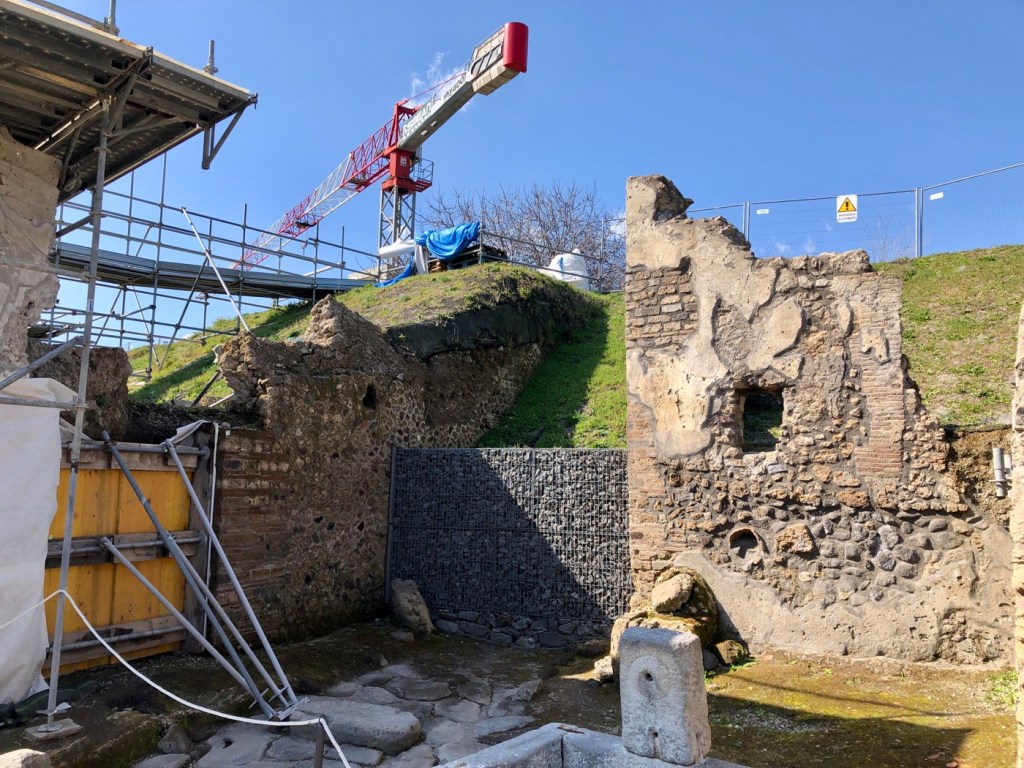
The work never stops at Pompei, as new discoveries await daily. Amazing.
It also helps to visit the fantastic Archaeology museum in Naples first as we did, so you can see many of the original artifacts, frescos, sculptures, and mosaics first, and the drop them into Pompéi and Herculaneum, like objects in SimCity AD79. There are a lot of in situ items still remaining at both sites, and many buildings at Pompéi are under restoration or access is limited to protect the fragile elements from so many visitors.
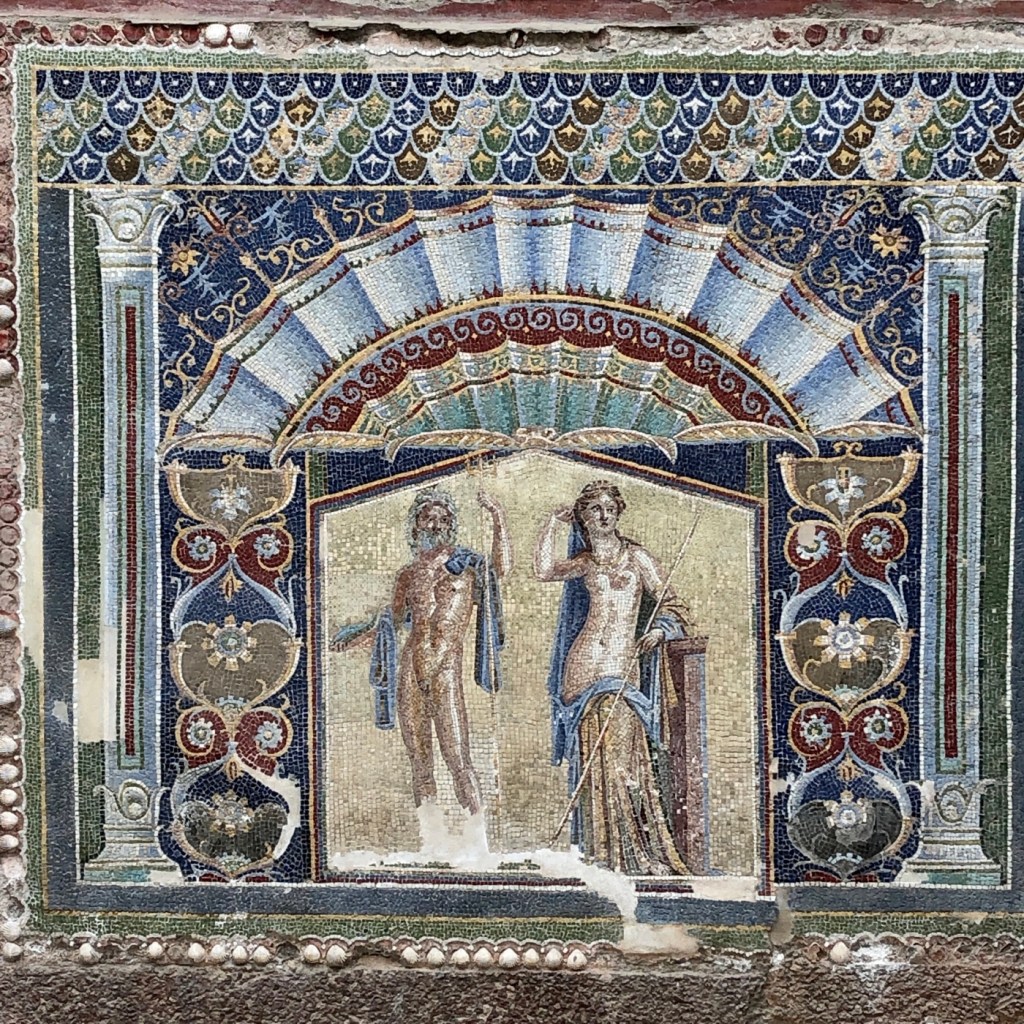
Art and story telling enriched every aspect of Roman life….it all feels so modern.
So as we headed out of Pompéi to continue along the Amalfi coast, we both relished this unique time to travel, our freedom, and the fact that our civilization is generally still thriving. But also more cognizant than ever that it can fall apart in an instant….or at least an archeological instant. We have to learn from history and react.
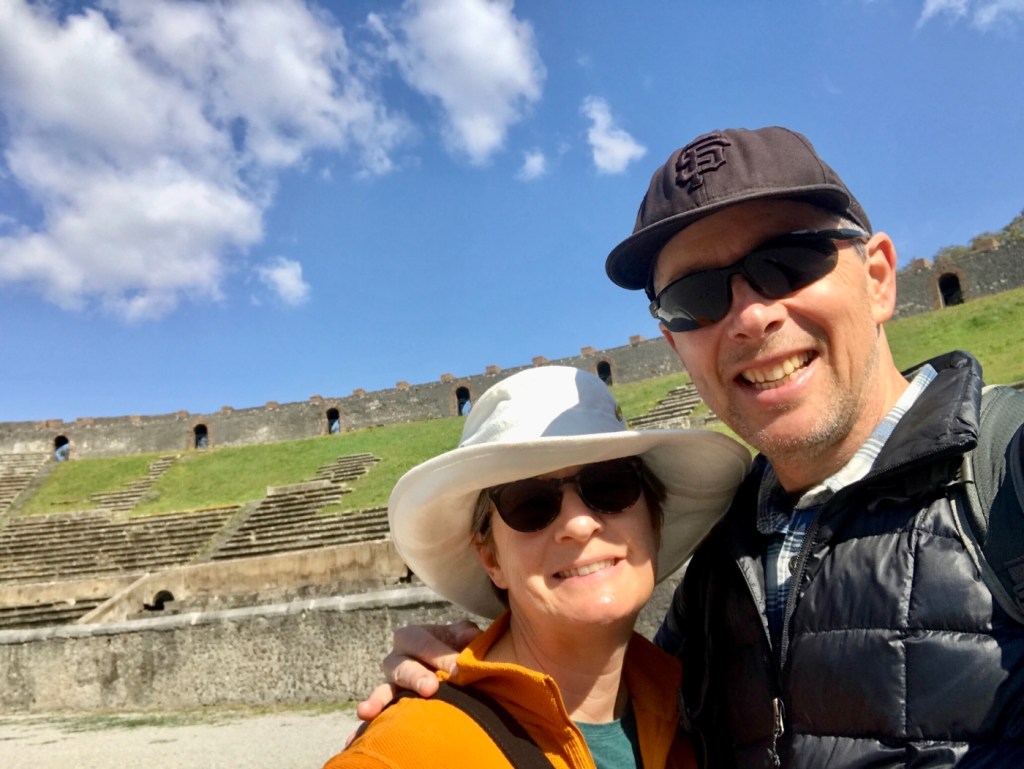
The happy travelers looking for their seats in the Amphitheater
Peace and love to all, especially to those who have recently fled their homes from an impending calamity.
We’re in Zermatt, Switzerland, which is famous for skiing, being car free, and the Matterhorn. OK, that car free part might only be relevant to some for its fame, but it was a big reason why we came here.
Golden hour selfie with the Matterhorn being imposing in the background.
Who reads in room magazines at their hotel? Me! Zermatt Magazine has a super interesting article about the first woman to go up, and summit the Matterhorn – get ready, it’s earlier than you might think. And, like much of women’s history, kind of sort of ignored a bit.
This plaque was placed on the Zermatter Walk of Climb in …. 2019. A bit late, thinks me.This plaque outside the Zermatt museum is a bit misleading, An Italian woman came close to summiting in 1867.
Per the excellent hotel magazine article (I’m a big fan of airline magazines too.), an 18 year old Italian woman, Félicité Carrel was the first woman to attempt to summit but had to turn back 100 meters from the summit as the wind came up, caught her wide skirts, and almost blew her off the mountain. Take a moment and imagine that, climbing in skirts- big skirts.
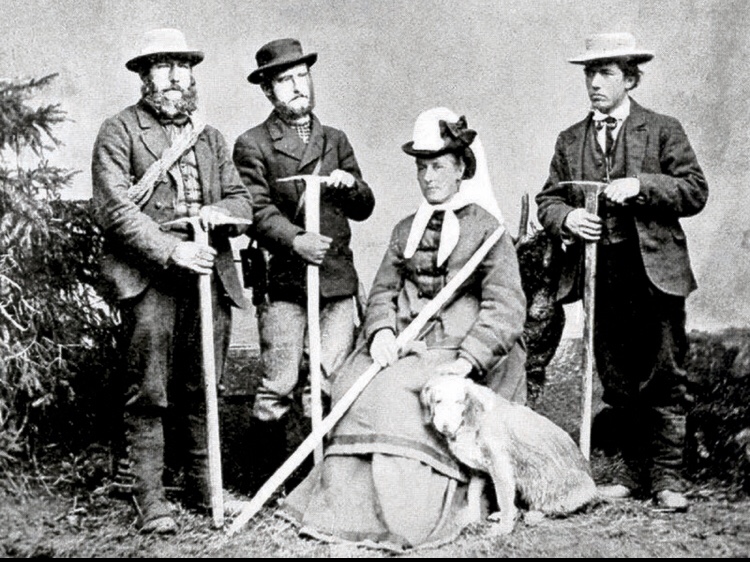
This American climber got there a bit late, the British climber Walker heard she was on her way to Zermatt and quickly got her team in place to try for, and reach, the summit.
Did I care about mountain climbing women before reading this article? No. Had I even thought about when women started mountaineering in the Alps? No again. But I made a point of going to find the plaques on the street and visiting the Zermatt museum because of the article.
The museum is trying to address the fact that women have been left out of so much cataloging of history. These orange signs were a new addition, reminding visitors that there were women and they were not included in the official accounts.
There’s Lucy Walker, on the right – the one in the dress. Bad photo, sorry.These orange placards alerted you to a bit of missing history.
Oh yes, the excellent article by Thomas Rieder also points out that that the woman from Liverpool, Ms Lucy Walker, summited the Matterhorn only six years after the first ascent by Edward Whymper and team. Read that and think about Mt. Everest which took 22 years for a woman, Junko Tabei from Japan, to follow the first summit of Hillary/Norgay in 1953.
The American climber Brevoort, photo from Wikipedia.
I get overwhelmed just looking at that mountain and imagining climbing it. But I am so grateful to this excellent opportunity to add meaning to our visit here. Hotel room magazines for the win. Museums for the win, and adding women back into history as a goal.
The mountain has more meaning for me now. It’s not just a beautiful background.
















































 Less Car, More Life