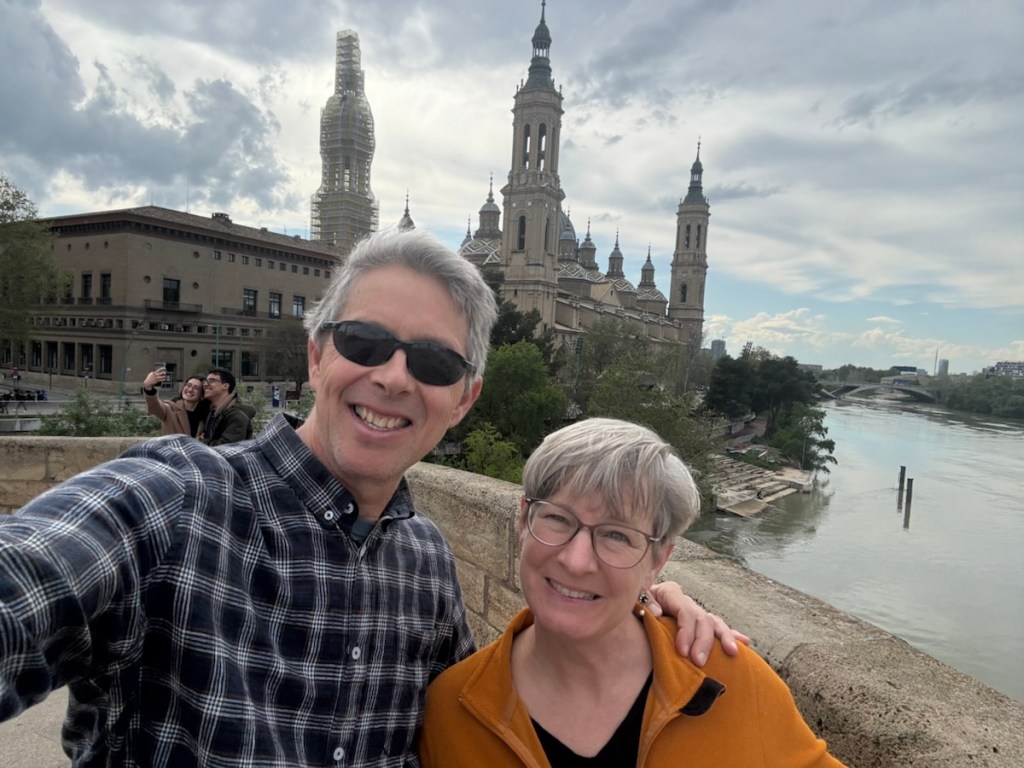
Zaragoza. Cathedral-Basilica of Our Lady of the Pillar behind us.
Our first train hop to get me out of the sunny Spanish coast was from Tarragona to Zaragoza. Rich could tell from the map landscape that it would not be a good idea, or fun, to pedal across the plains of Spain with a sun adverse travel companion like me. So trains it was. Mission: get Cheryl to greener northern climes. And it wasn’t even hot yet. So much for our Spanish bike touring, huh?
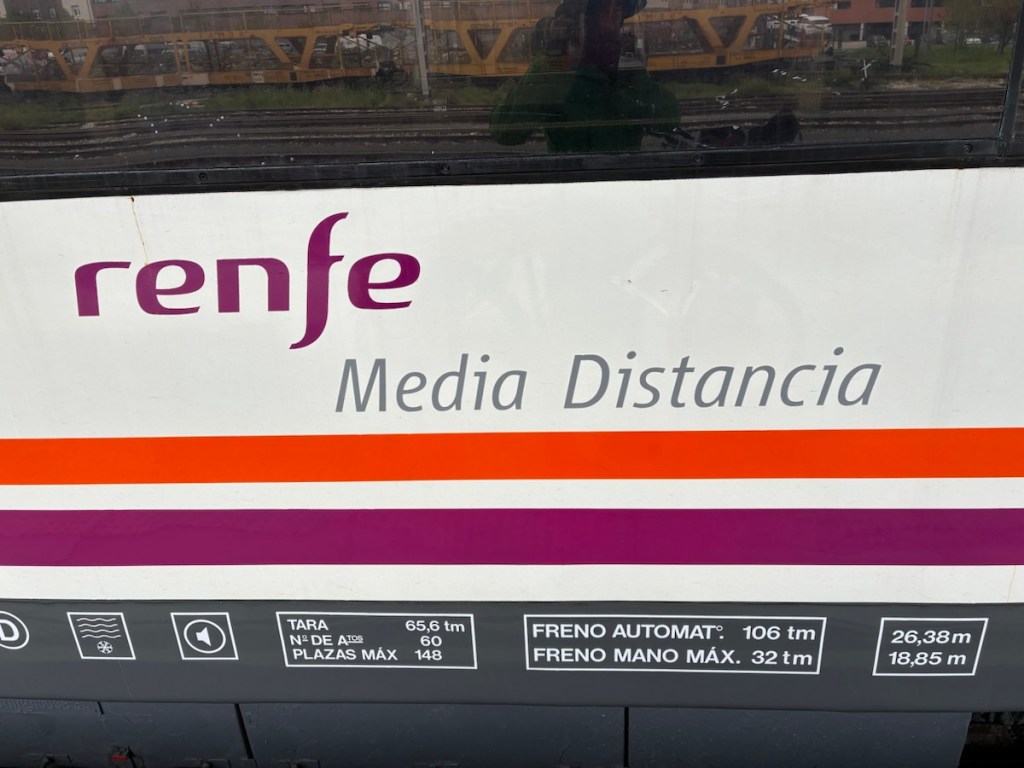
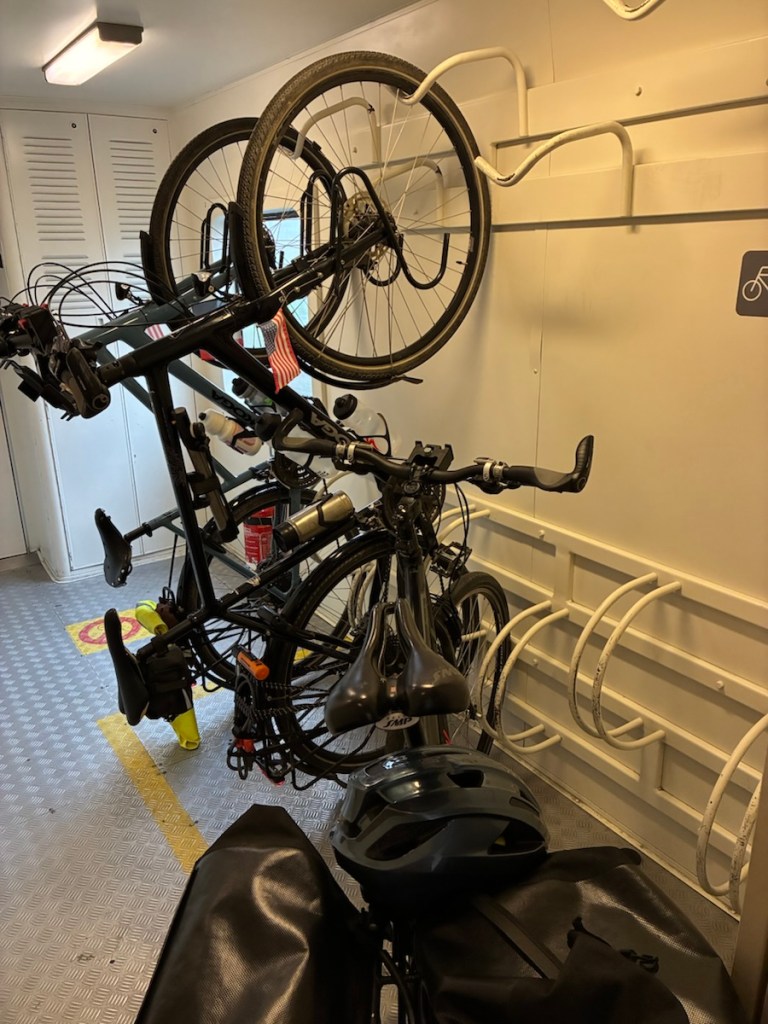
The Renfe media distances trains in Spain seem to have two distinct types of rolling stock.These older train sets with narrow doors and three steps. This was our first train to Zaragoza.With bike hooks – my nemesis. I can lift my bike up, but only if the train is not moving and I have loads of space. Rich is the bike lifter when it comes to trains.The other type are these lovely wide doored newer train sets. Second train to Pamplona.These newer cars have much easier access: one small step in and loads of leaning space. Of course, you have no idea which train you will get. The waiting is stressful.
Bikes with touring gear on trains are not always, almost never, easy. Our first train hop ended up being the older and less bike friendly train cars. A train station attendant told us the bike car would either be the first or last car, so we waited at the beginning of the platform so the train would go by us and we could see the bike car. First car. Of course. High boarding. Of course. As we ran up the platform to reach the bike car, dodging other passengers and their rolly bags, we knew it would be a fire drill train boarding. Yank the bags off the bikes since they would be too heavy to lift up into the train. Rich grabs the bags and chucks them on the train as I stay on the platform with the bikes. Rich gets through the narrow door with one bike and by now the conductor is blowing his whistle so I grab my bike and attempt to jam it up the stairs as the doors start to close and I search for the door open button with both feet still on the platform and half of my bike through the closing door. We are saved by a super nice Belgium cyclist who is already on the train which started in Barcelona where he lives. He helps Rich get both bikes on and through a second narrow door to the bike hooks. Phew.
A strong rain had just passed so we got a nice ride to our hotel in Zaragoza and got to see this Zaha Hadid designed bridge.
When possible Rich books trains where we get on at the beginning of the run, and get off at the end. Mid trip stops like our boarding in Tarragona can be super challenging, especially if there are bikes other than ours and we have to navigate a bike dance – handlebars tangling, pedals hooking on spokes. Zaragoza was the last stop for this train so we had a calm exit. It would be a one night stay and a second train the next day. And that one ended up being a lovely low floor wide door media distance.
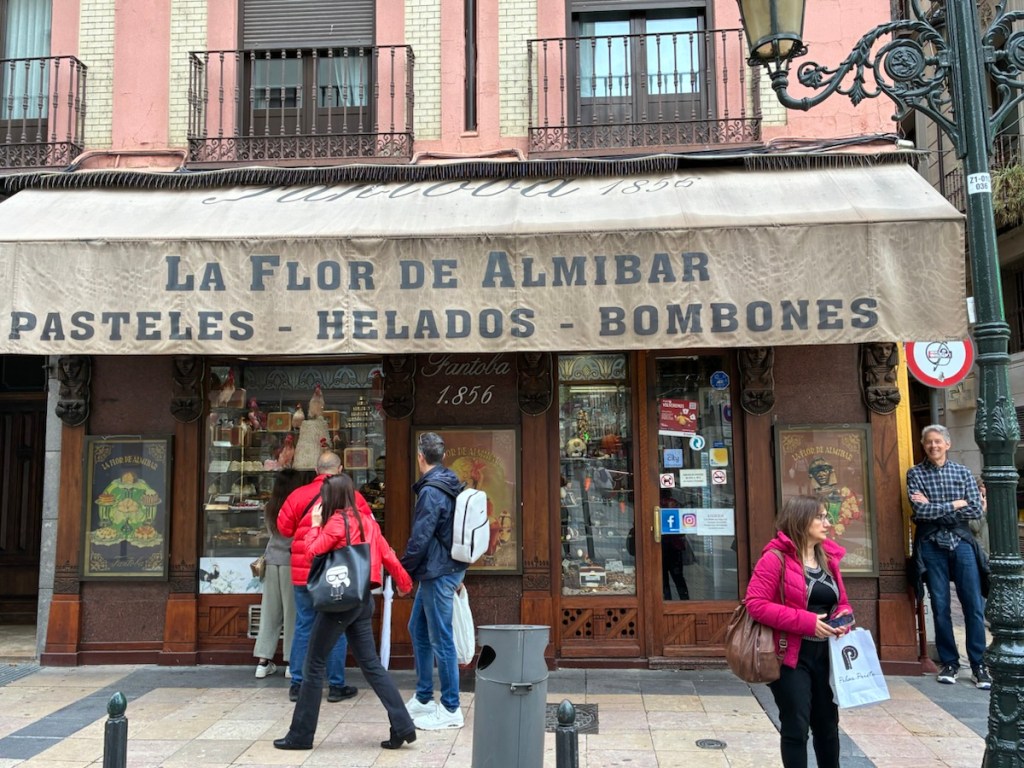
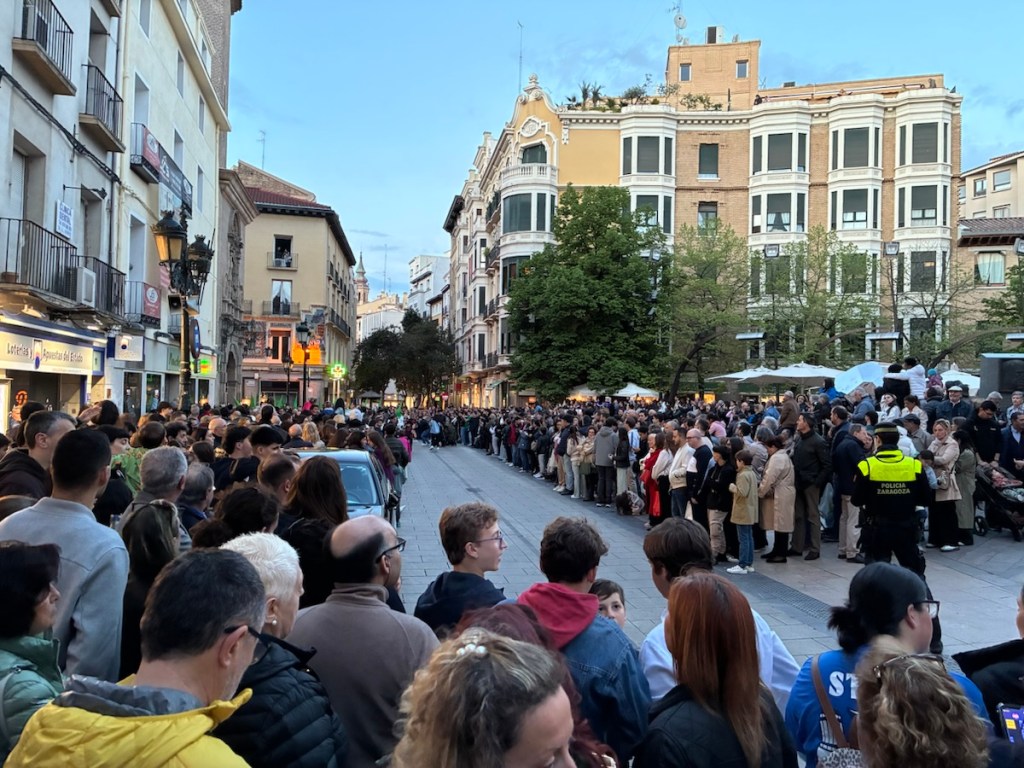
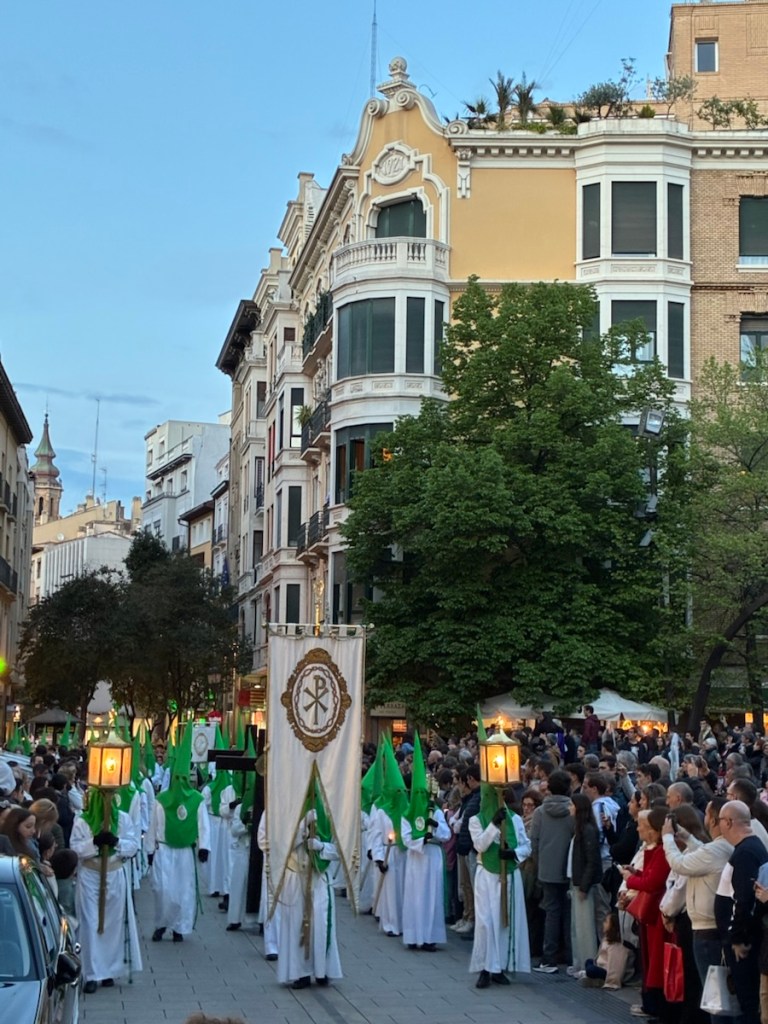
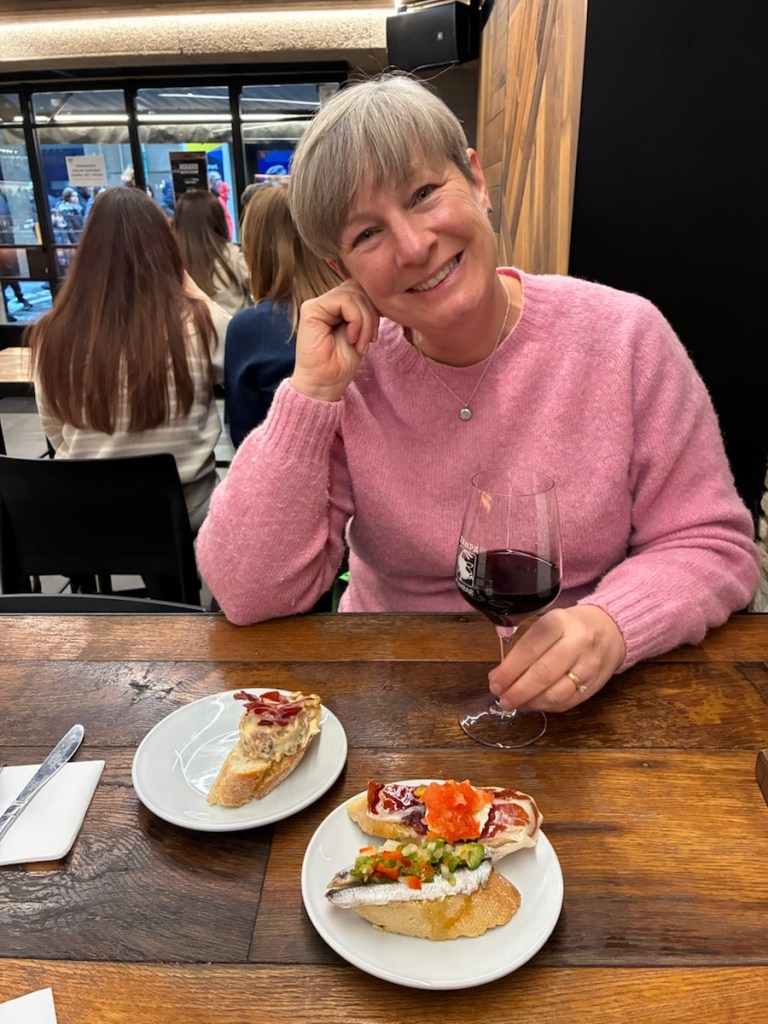
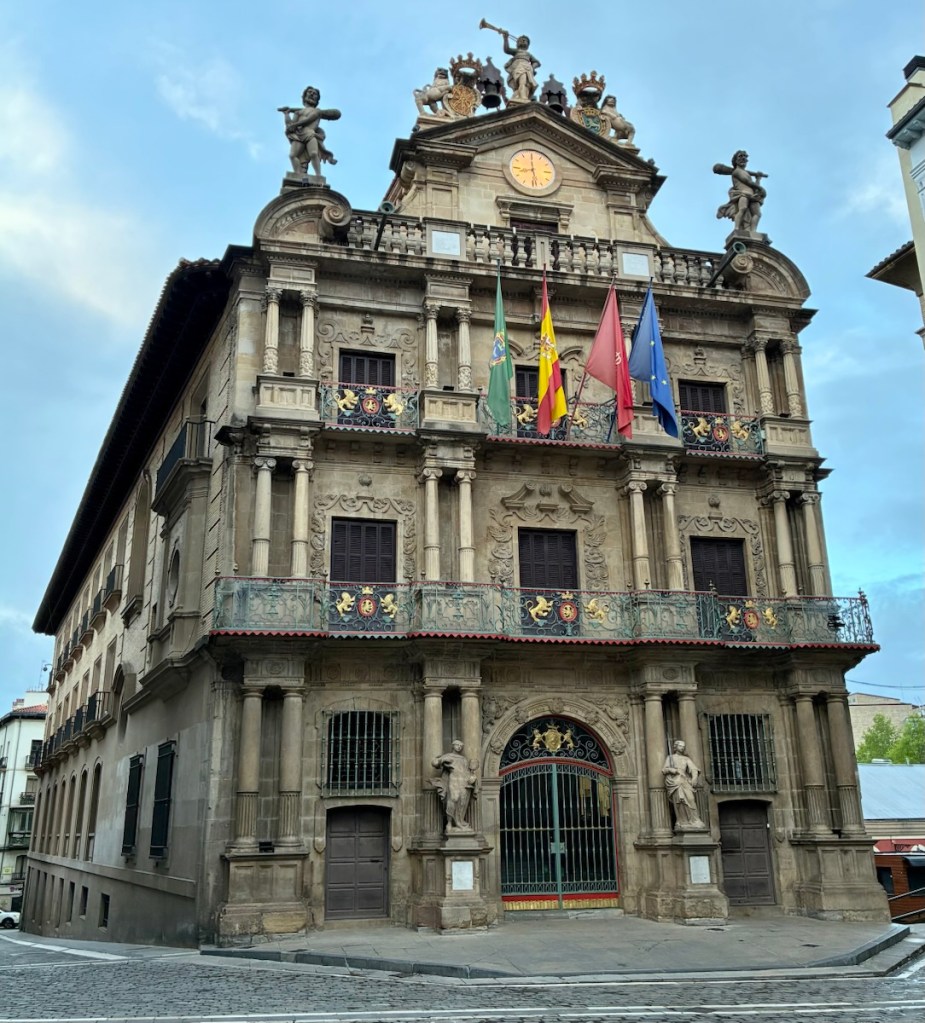
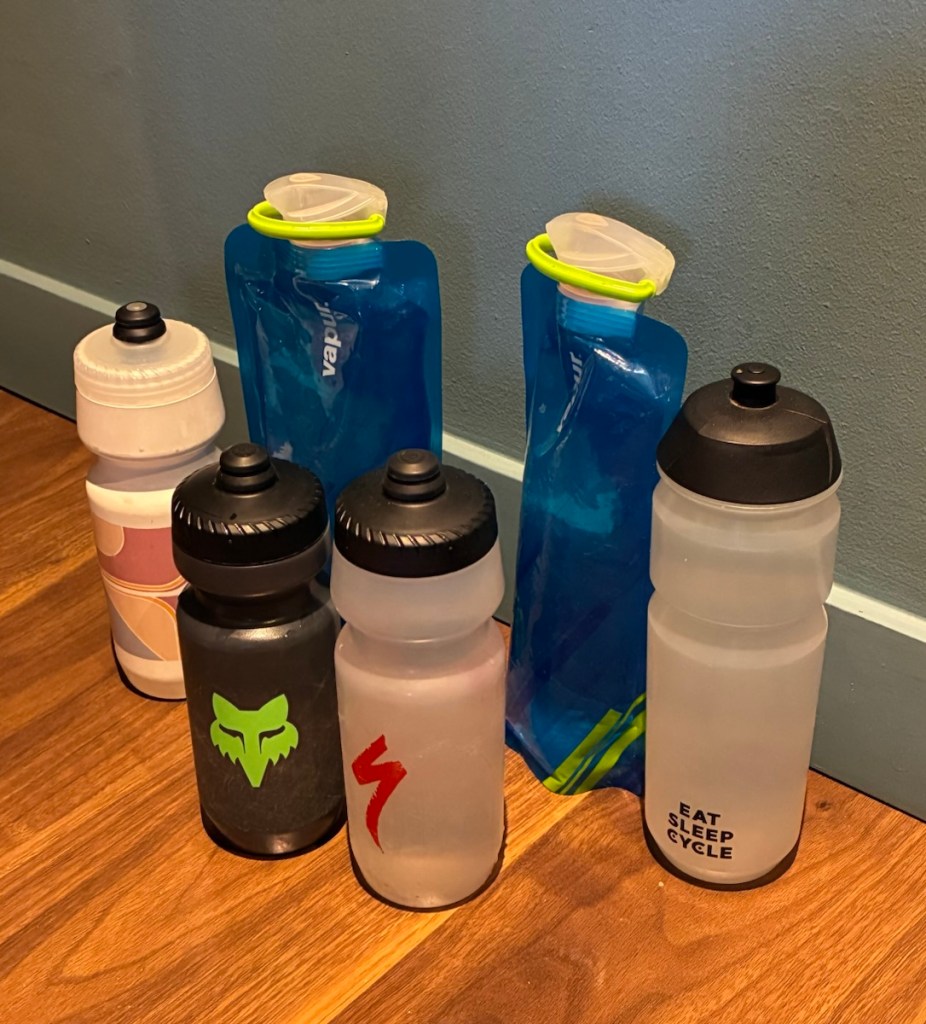
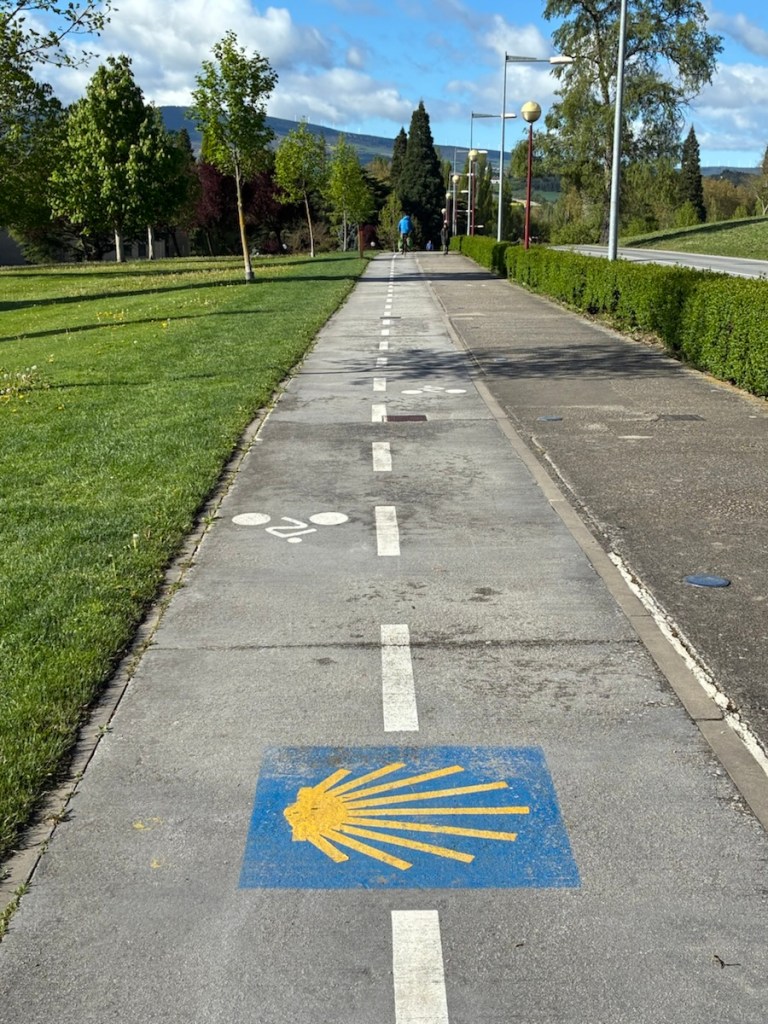
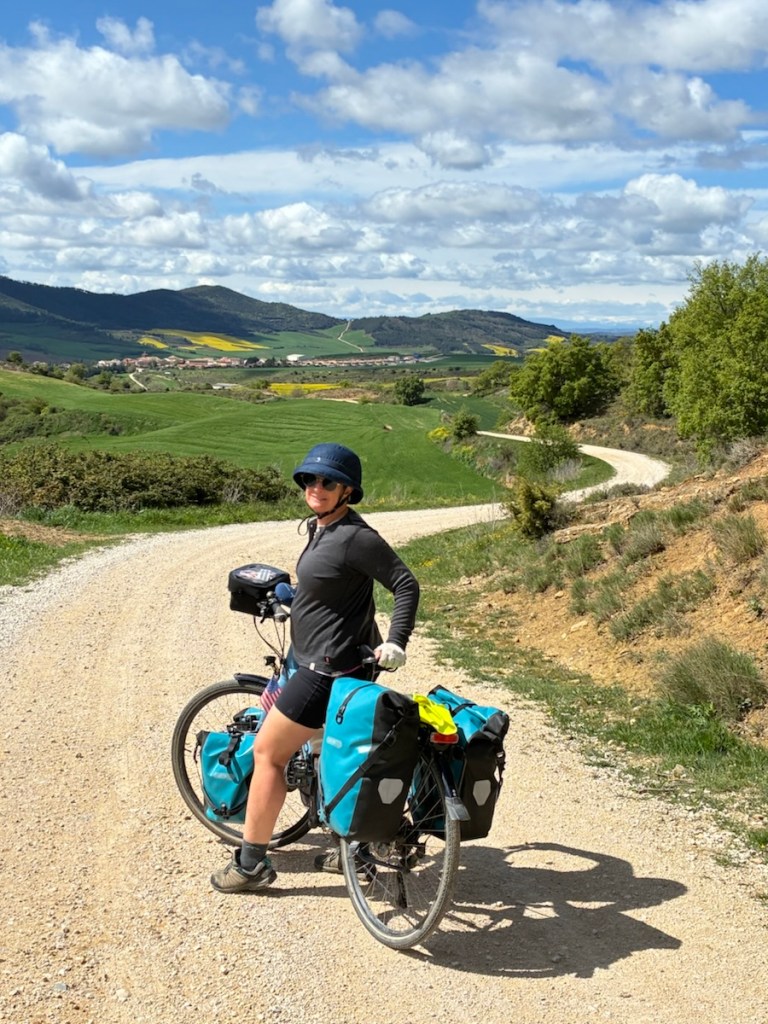
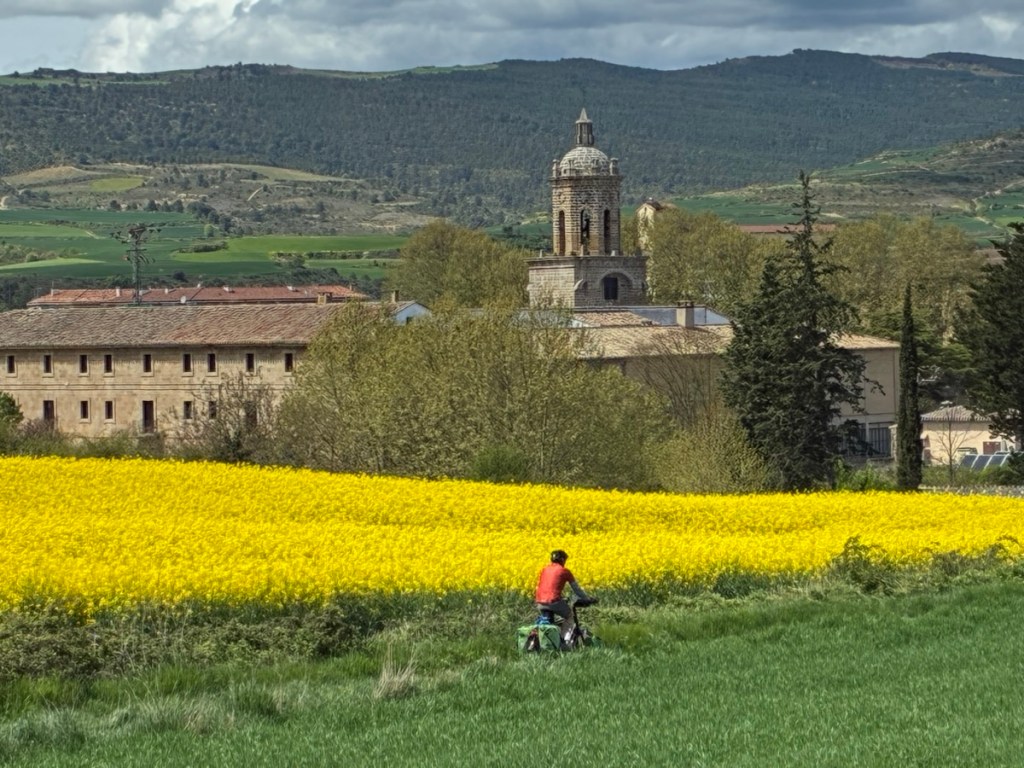
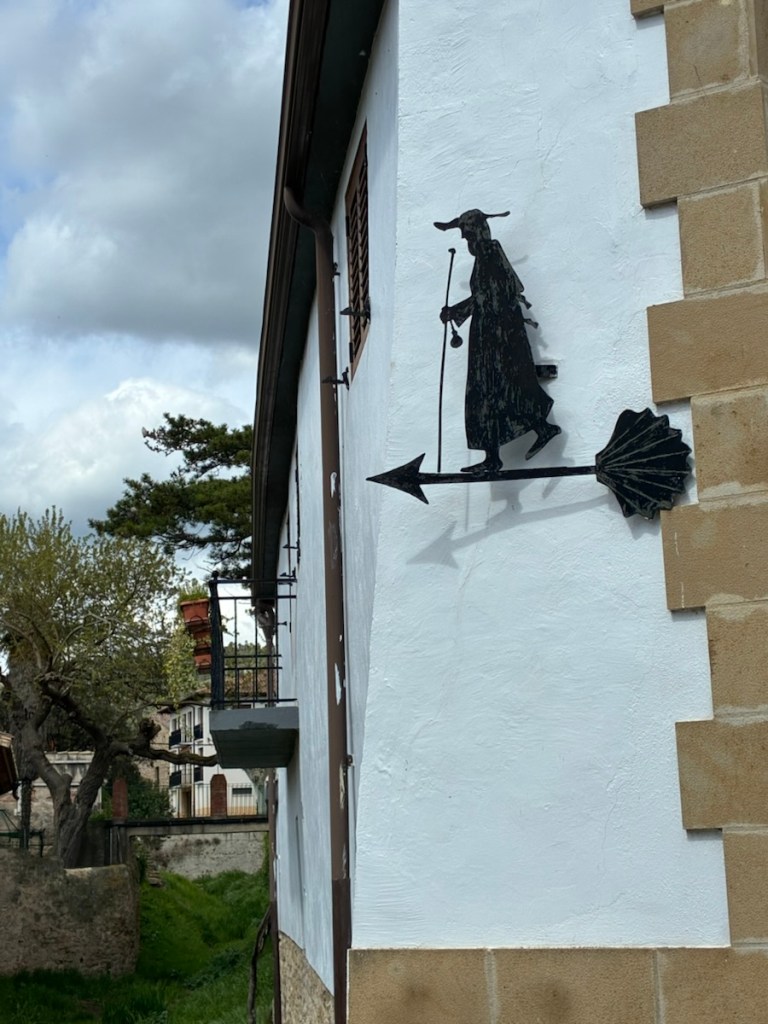
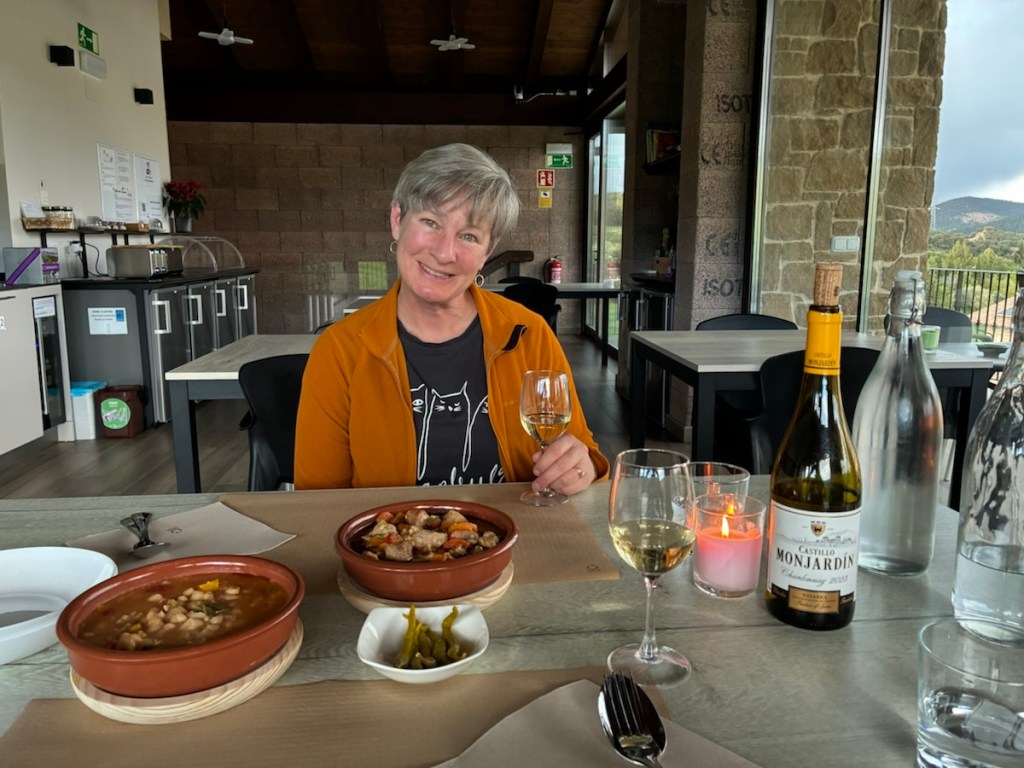
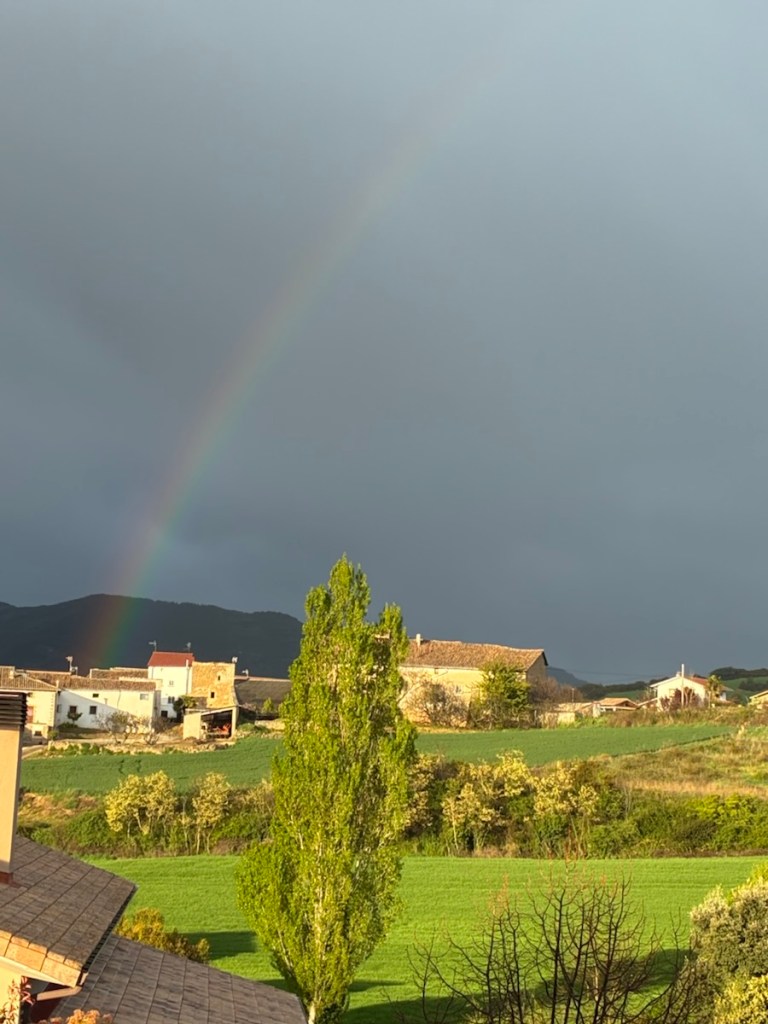
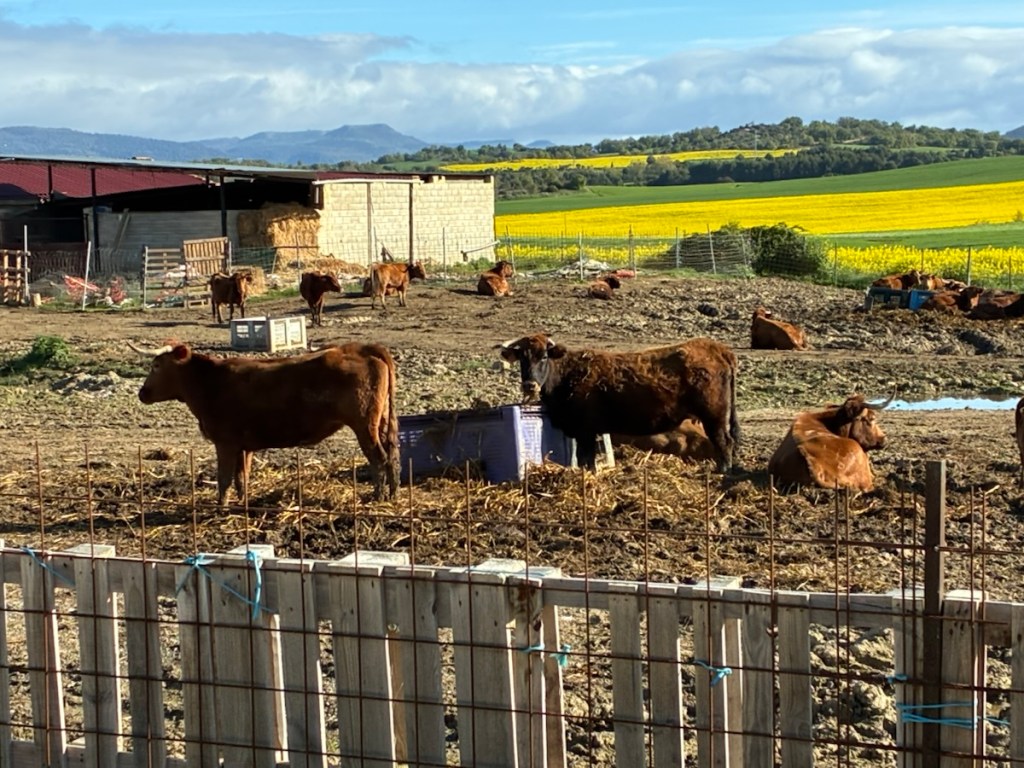
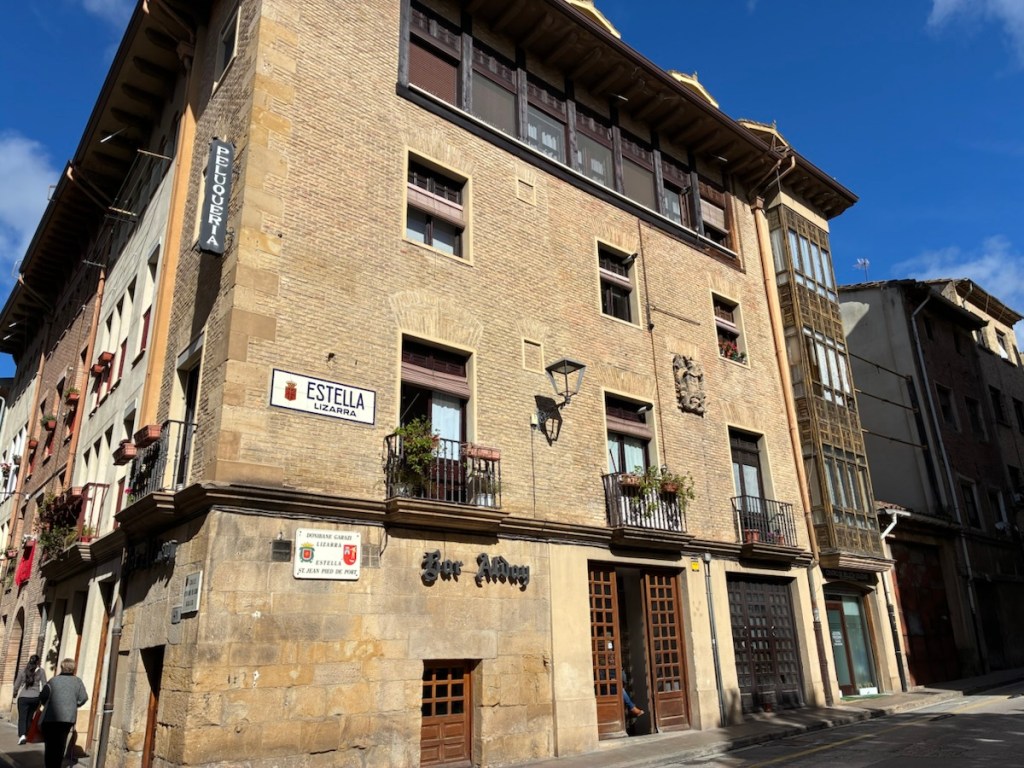
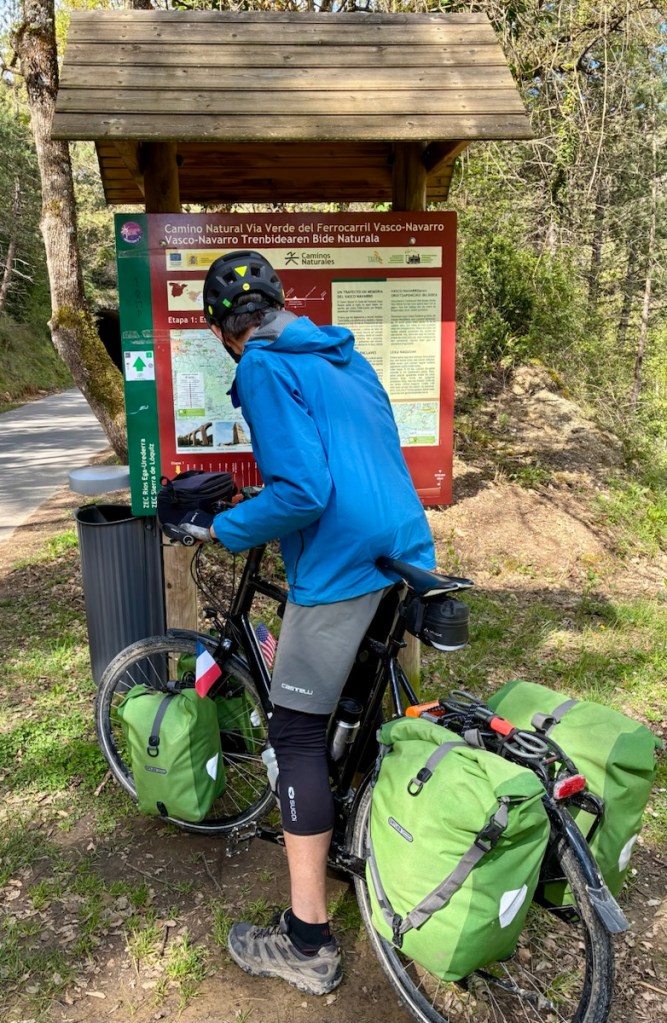
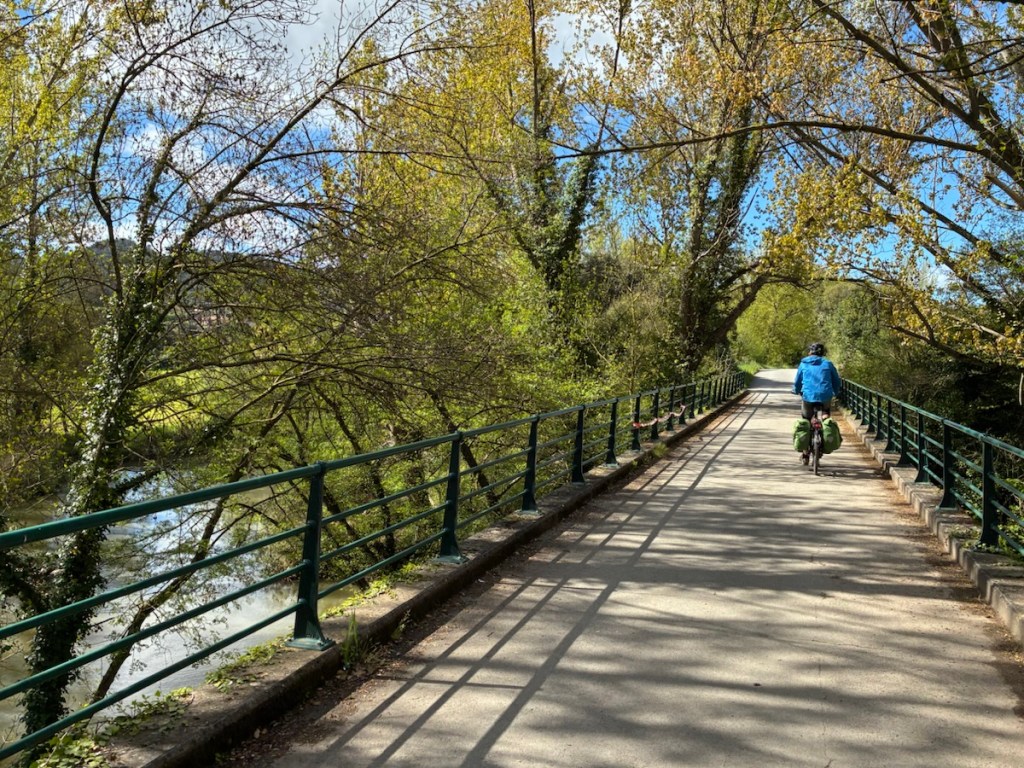
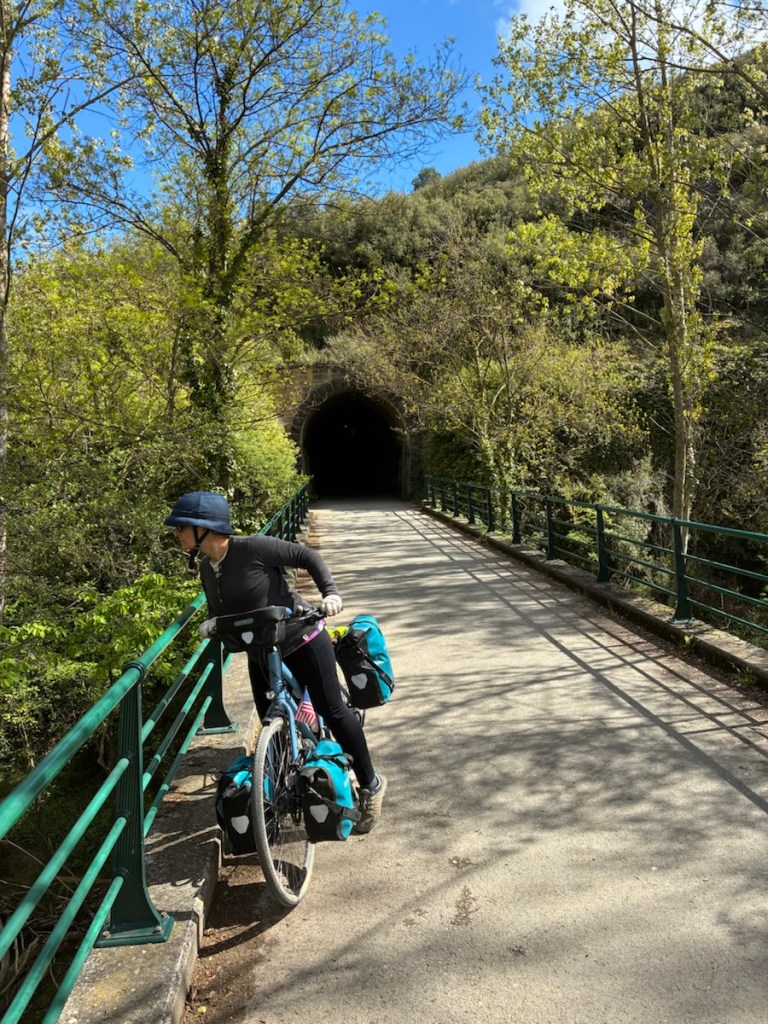
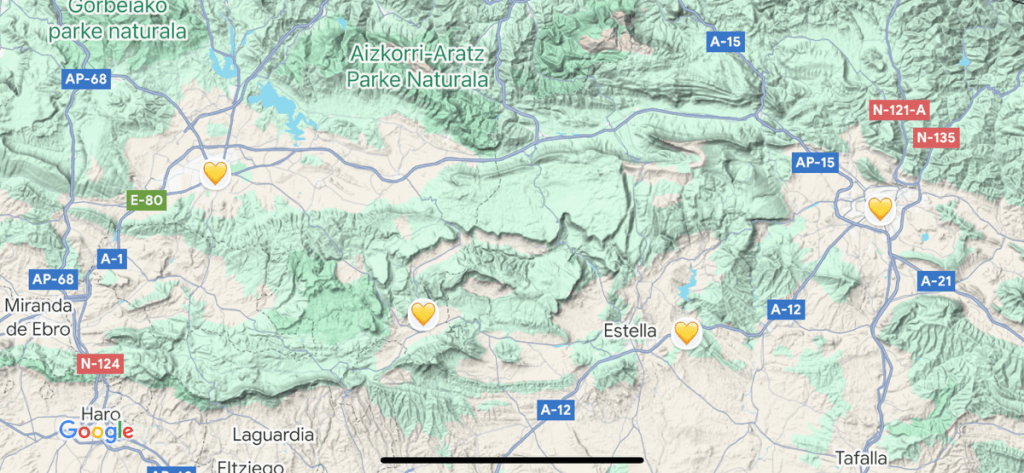
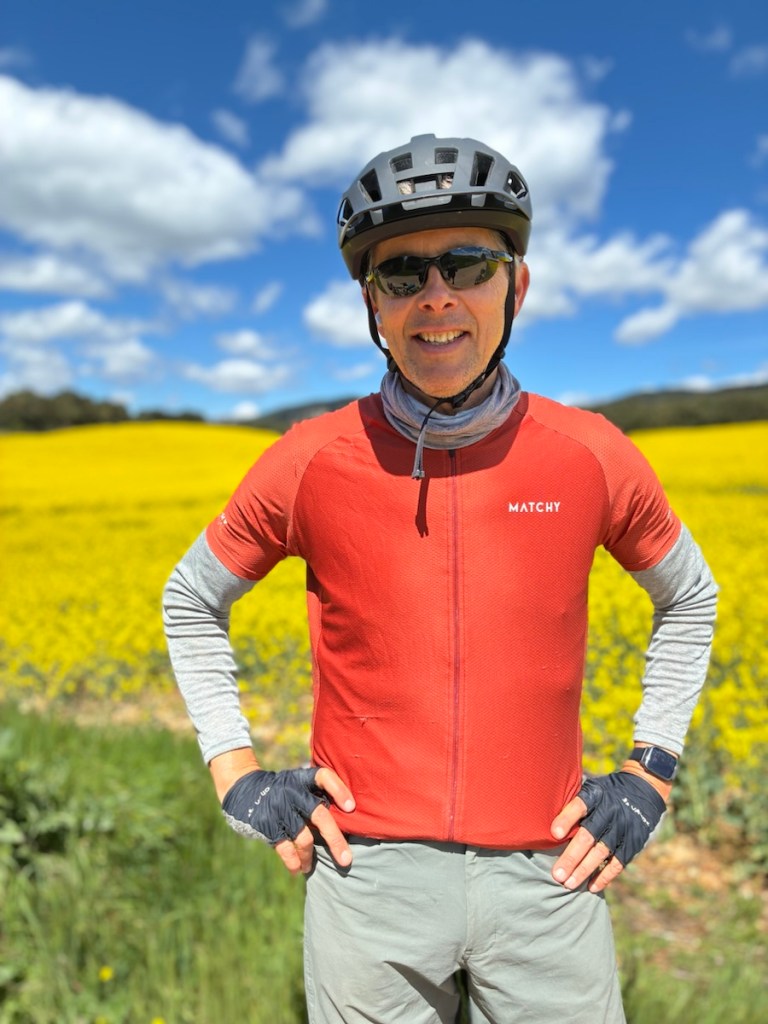
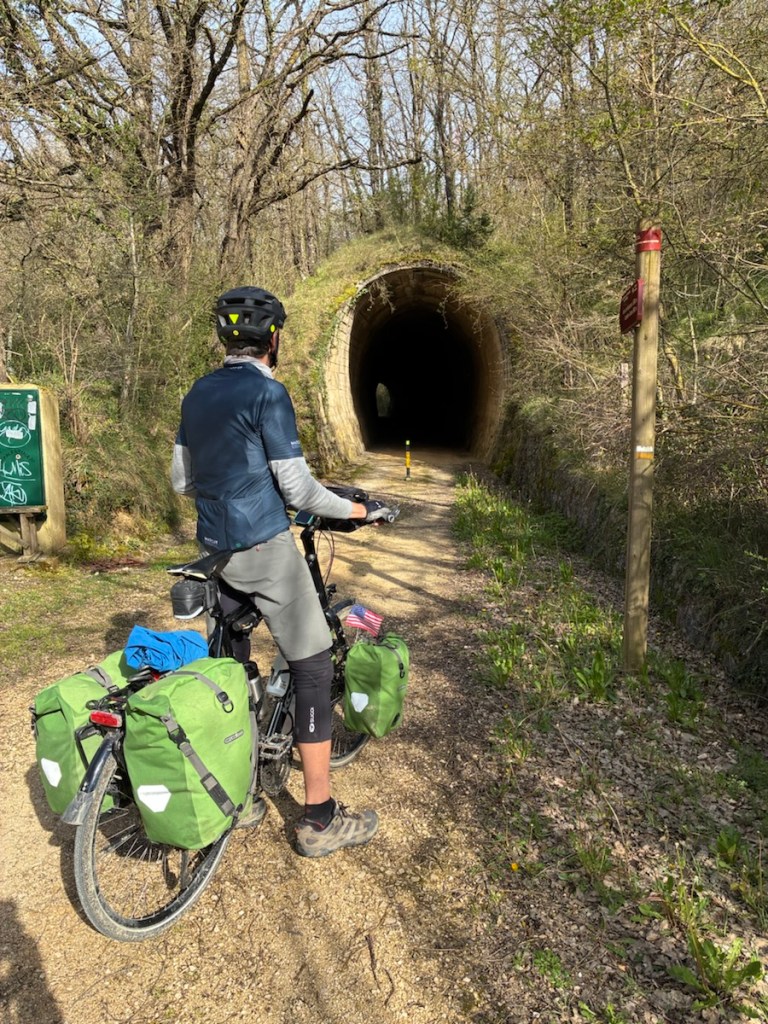
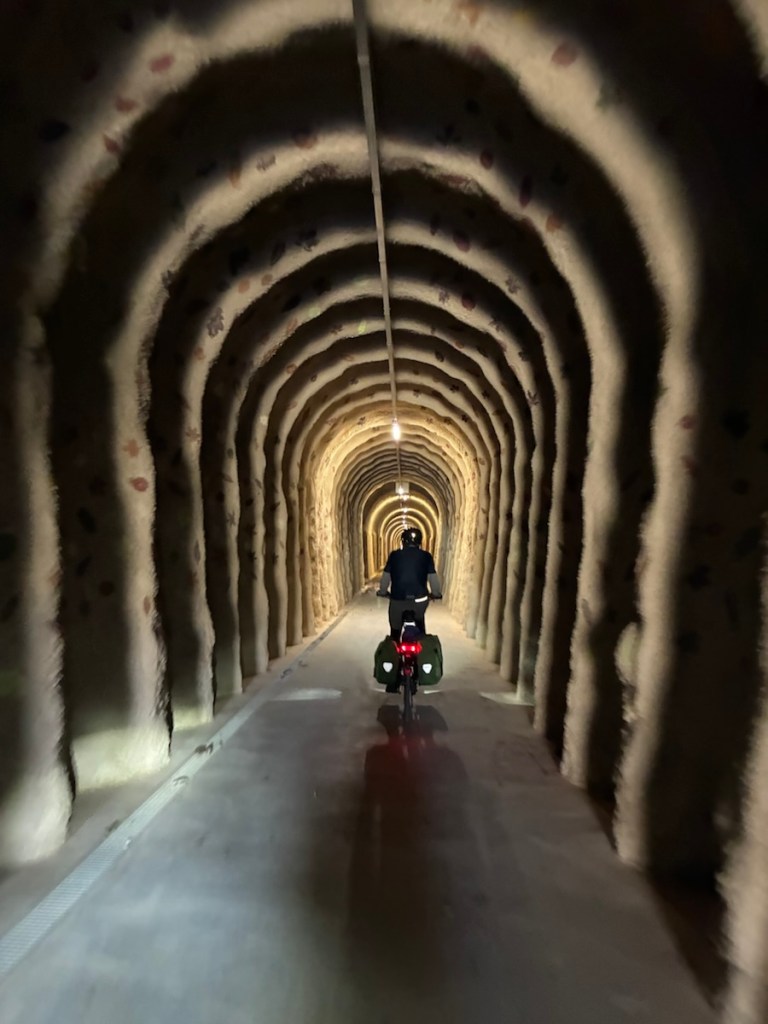
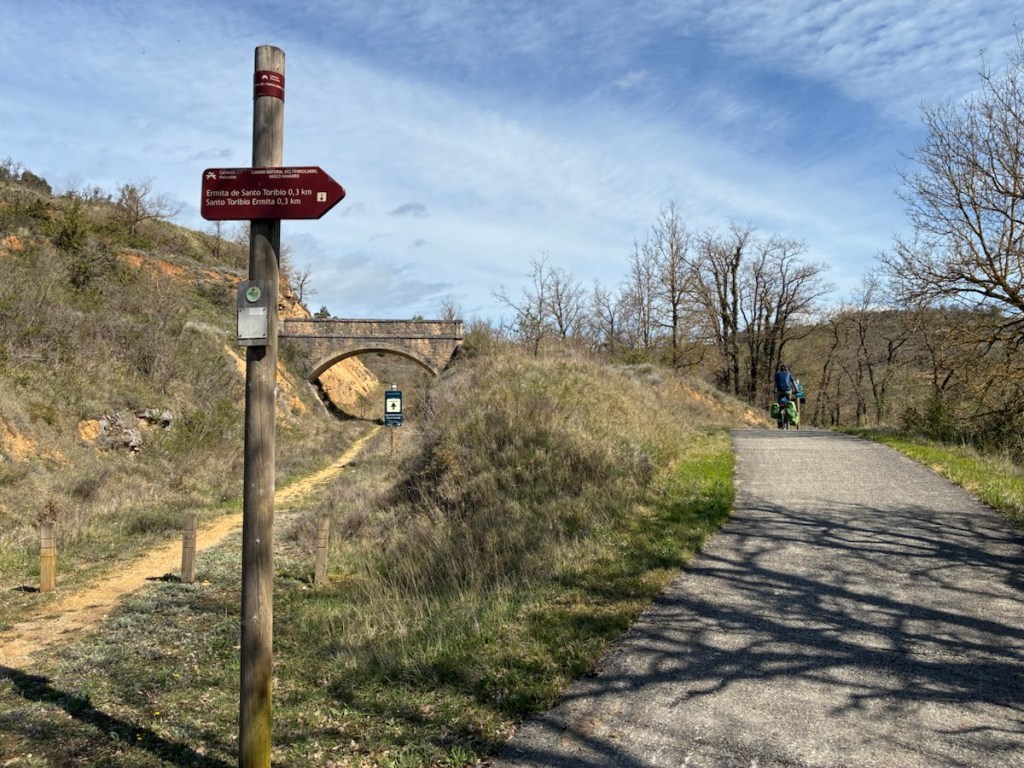
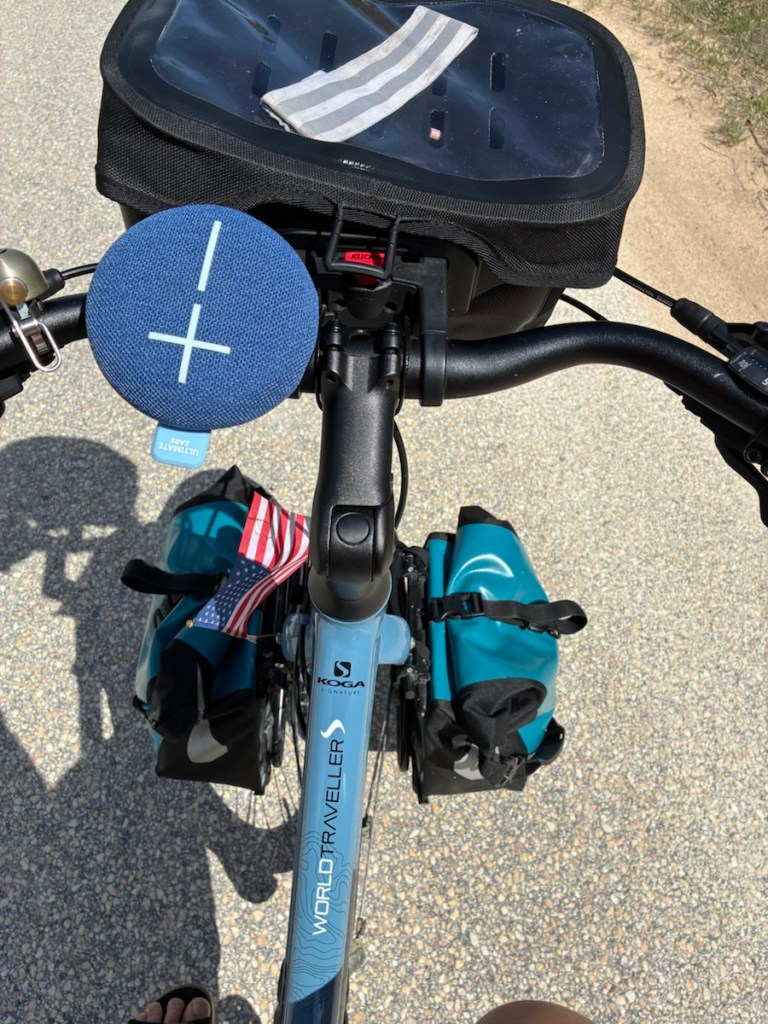
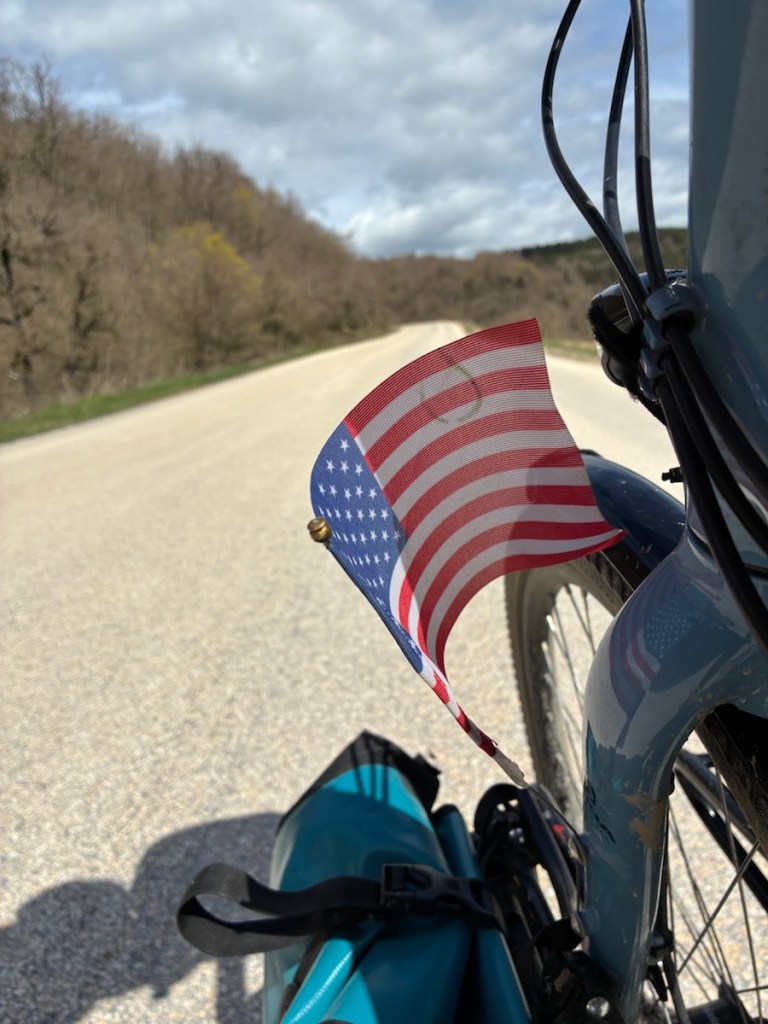
This was a fun first. The hotel brought out a ramp so we could wheel our bikes right into the lobby with panniers still attached.The sky cleared and all of Zaragoza came out for a walk. Zaragoza is in the Aragon Region Spain. Not Basque yet.First stop, the chocolate shop. Do I have room in my panniers for a cake? No.A beer, a glass of wine, and a little bag of chocolates, which I do have room for.After a quick ramen dinner we headed out to join the crowds waiting for a Semena Santa procession. Our second of the trip.Rich deployed his long arms for over the crowd shots.This was a somber and somewhat chilling procession. The drum beats were very loud and los penitentes in their capirotes (cone-shaped hats) were numerous.Our next train left after noon so we had time for a workout in the hotel gym, breakfast, and a walk to see the Roman bath ruins in town. These were discovered (uncovered) in 1972 when a neighbor noticed something in a construction site. Now it’s a museum and the ruins are protected by a canopy.Off and a slight backtracking to the Zaragoza Miraflores train station, so we’d have an end to end journey. Get on at the start, get off at the end in Pamplona. Pamplona is in the Navarre province of Spain. Still not Basque yet.Riding into Pamplona old town for a one night stay.Now the Pinxos feasting begins in earnest.How to choose?All delicious.Hello my darling Gildas. Olive, anchovy, and guindilla peppers. Spicy sweet little peppers pickled in wine vinegar.Pamplona el ayuntamiento, or town hall.Water prep. We each carry two bottles and an extra liter water bag. Once we realized how often we find taps of potable water in Basque towns we stopped filling the water bags and saved the weight.My favorite sign in Spanish and Basque. We would head out of Pamplona on a Camino route, such fun signage. From here we bike. No more train hops.One route for walkers and one for bikers.The Camino markers always make me happy. Fond memories.The still snowy Pyrenees mountains in the distance. Hello friends.The trail unwinds like a ribbon ahead of us.Between Pamplona and Lorca.It’s fun to follow a Camino route. This is the main Camino Frances. We got to greet pilgrims and be greeted with “Buen Camino”.The Way. Vineyards. Hillside town.A countryside stay at Casa Nahia Alojamiento Rural in Lorca. Home made dinner and a bottle of wine. Still in Navarre.Our dining companion was a rainbow.I love a good livestock sign. This cow’s legs look short to me.Wait for the photographer!Oh, actual cows. And yes, they do look a bit short legged. With those distinctive Spanish horns.A quick stop in the town of Estella to buy pastries and start on the Vía Verde del Ferrocarril Vasco-Navarro. We part ways with the Camino Frances here. (Still in Navarre.)Town was super busy with market day and pre Easter holiday shut down so we took our pastries up the trail a bit.The Via Verde is one of the area’s repurposed rail lines. Tunnels and bridges, oh my!Ah, trees. And shade. Tunnels and nice riding surfaces.Signage and sights to see.The surface was quite good for riding, such a treat to ride long car free stretches. The route has a few nice hilly diversions where tunnels have not been restored.Happily listening to a podcast on my Bluetooth speaker and pedaling along.A valley near Metauten reminded us of the Grand Valley in Colorado with stunning mesas. Maybe a little greener.You can see from the map that we were flirting with the foothills. Pamplona to the right, and far left is Vitoria Gastiez. There were good trails keeping us to the valleys, but inevitable climbs up those ridges. The Vasco Navarro Railway Nature Trail Greenway follows the route of the Trenico, which between 1927 and 1967 ran between Estella-Lizarra and Mekolalde (Gipuzkoa)Between Estella-Lizarra, Vitoria-Gazteiz and Bergara (Gipuzkoa) Length: 133,7 km; 27 km in NavarreAncín, in Navarre. A stunning backdrop of oilseed rape. We know it as canola oil but it also used for industrial applications and animal feed. Most Americans call it mustard seed, and both are members of the Brassicaceae family and are cultivated for their oil-rich seeds.Our destination for the night is not far away. The Easter holiday week has been challenging already and this night, Thursday the 17th of April is about to get even more logistically tough.The rail trail gets us through the edge of the Codés mountains. Rail trails will only ever have about a 3-5% max incline, which makes riding them up quite easy, and riding down super fun.More tunnels and bridges, oh my!This trail is loaded with benches and picnic tables, which is so nice. And some are even in the shade.
We arrived in Campezo/Kanpezu – finally in the Basque Country – and checked in to our hostel, Aterpe Kanpezu Hostel, showered, threw a load of laundry in, hung it to dry and then wandered into town. We knew that finding an open restaurant in this small town the night before Good Friday would be challenging- but we assumed one of the restaurants would be open. Open yes, for drinks. Food? Not so much. After asking at three places which all said the kitchen would not be open tonight we were directed to a restaurant down one the main road next to a gas station which had the worst reviews. A range of rude, bad food, slow service. Yippee! They lived down to their reviews and the kitchen didn’t open until 9pm, at which point two hungry cycle tourists would be desperate. Part of the challenge was that now in the Basque Country we encountered what may have been our first Basque only speakers. However, they did have the most delicious home made tortillas, the Spanish potato and egg omelette. So two of those and a drink later we decided we’d survive and headed back to old town.
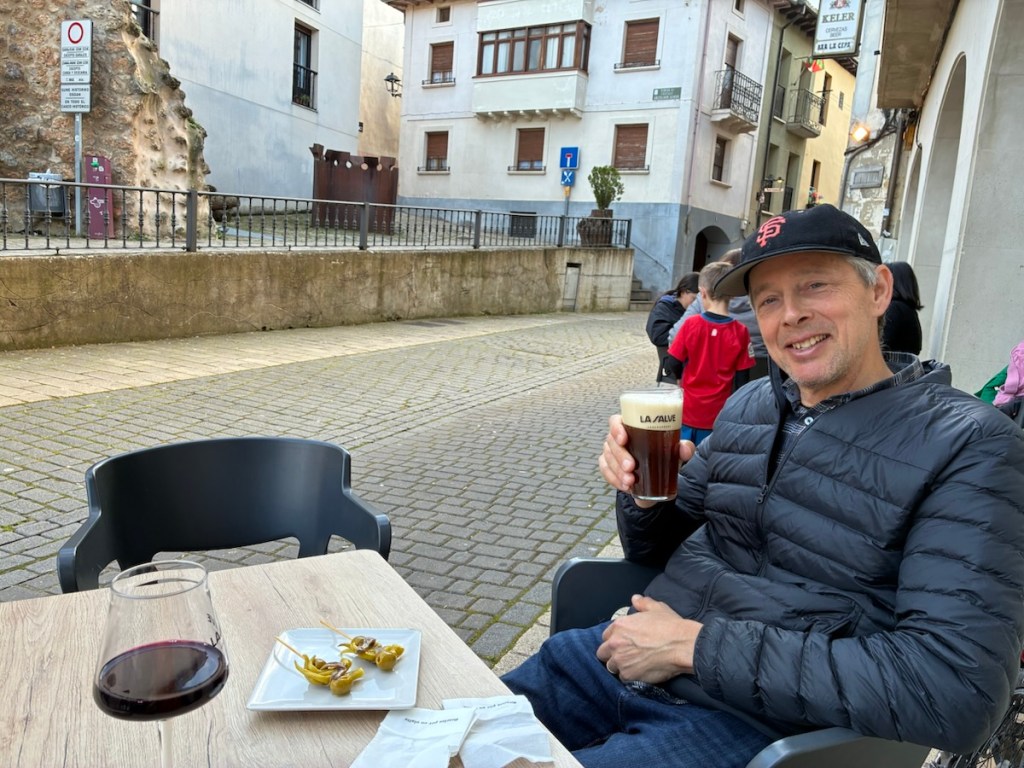
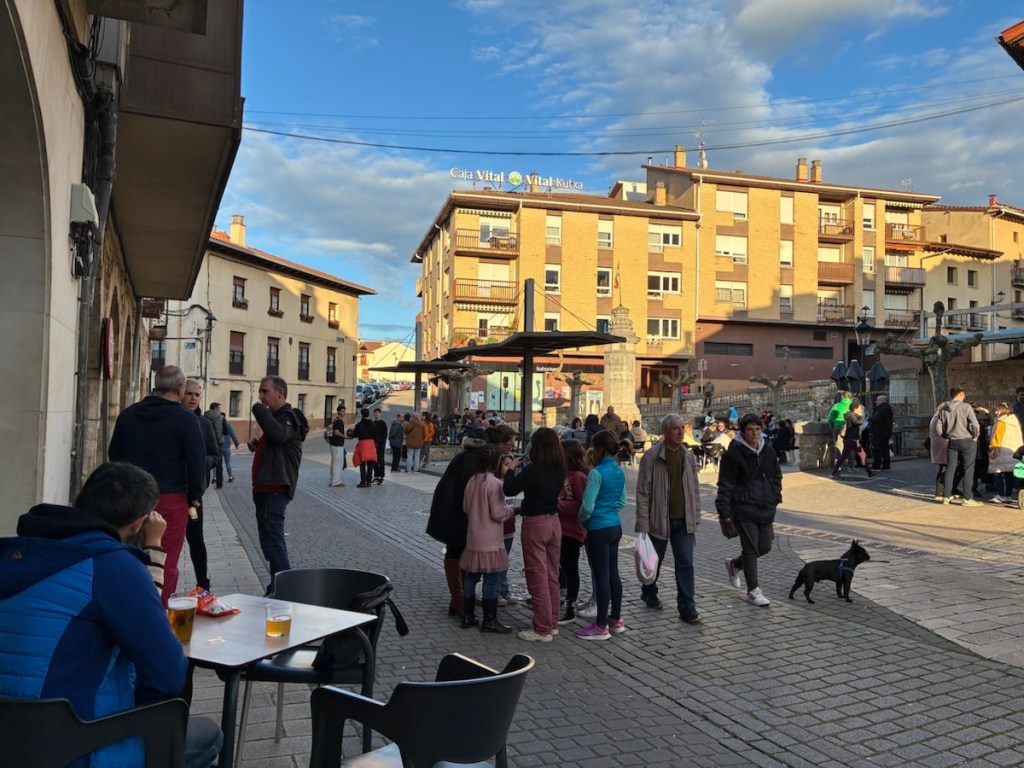
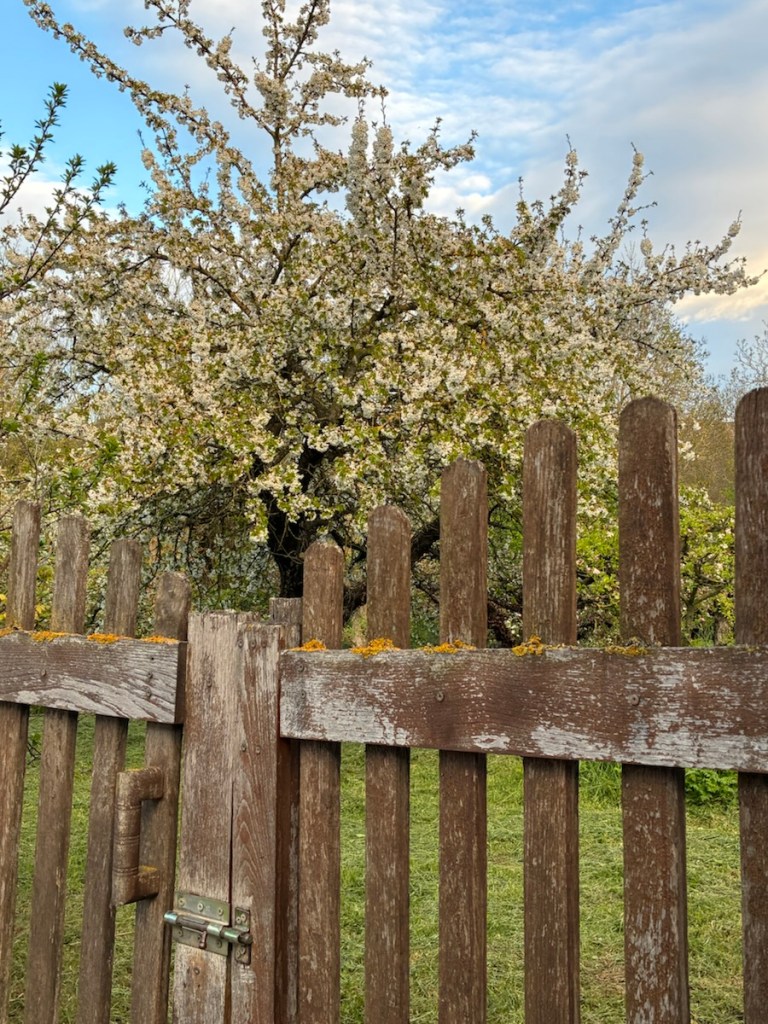
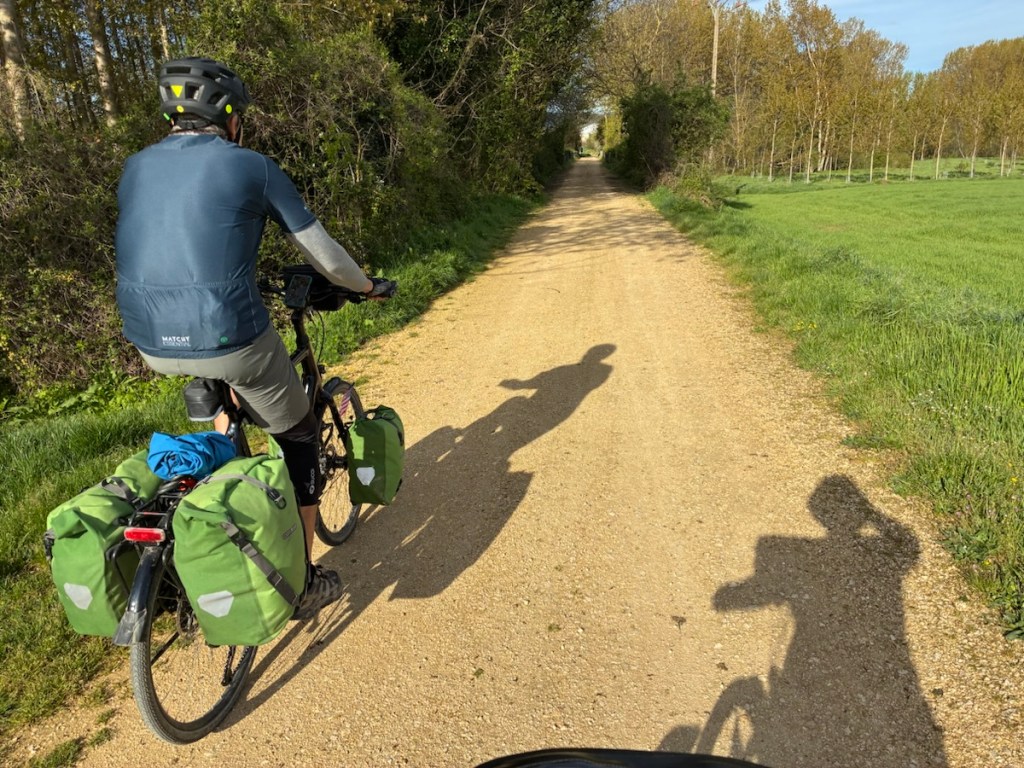
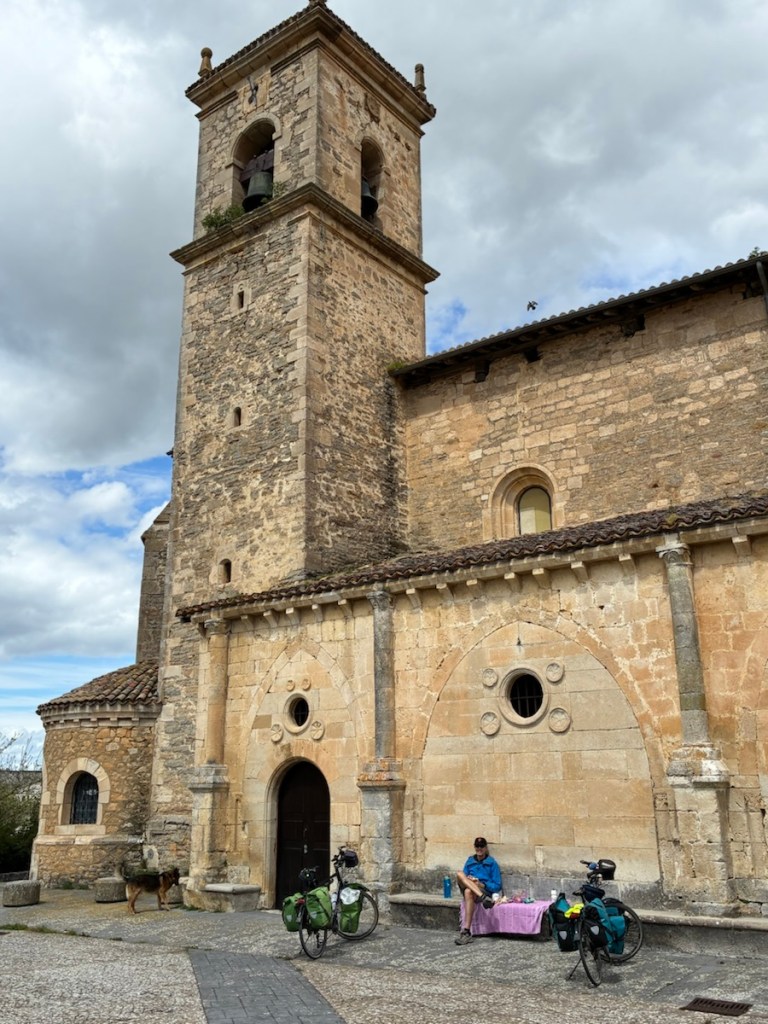
We found a small Bodega now open and got ice cream bars. Then a bar for drinks and Gildas (anchovies, olives, and peppers). It was an odd food progression but you do what you need to do on Good Friday Eve.We joined the rest of the town enjoying the car free main street and watching the children play while enjoying our drinks.The Spanish do public spaces so well. And everywhere we visited we enjoyed the Paseo, the traditional 6pm evening stroll.Spring blooms over a weathered fence in town.As we were getting on our bikes the morning of Good Friday we heard this van honking as it rolled through town. We realized it was the bread van so we hustled over to buy bread for our picnic lunch. Basque bread van. Shadow photographer.Headed to Vitoria Gasteiz for a two night stay. Only 38 kms, and all on rail trail, right? Not quite.I’m not the only one who finds the cows picturesque.The walled town of Antoñana and our fearless tour guide, Rich.A slightly spooky tunnel.And more bridges.Good Friday Holiday meant a lot of road cyclists out.Other cyclists meant we could follow them to a water source.Trail side cuties.A long dramatic tunnel. And then the sound of a sad trombone. There is a tunnel through the highest part of the mountain ridge that is not open, so the trail diverts up and over.Up up up.But wait. What’s this?My little flag is blowing forward! Tail wind to the rescue.Hat deployed for warm day climb.The summit. It must have been one long tunnel, it was quite a climb.We had a nice decent on asphalt before joining the rail trail again for our final stretch in Vitoria Gastiez.It’s nice to get off the trail and into towns. In Spain churches are our first try for benches for lunch. This one came with a friendly dog who would have happily shared our lunch. You know, to be helpful.I think I will always recognize the shape of a Basque church and spire. We made it to Vitoria-Gasteiz, which is the capital of the Basque Autonomous Community and where we will spend two nights.
Up next, our time in the Basque mountains and why I am now a huge fan of the Basque.
The Happy Travelers. Looking forward to a rest day in Vitoria-Gasteiz.
Spain has been on our bike touring list for years, but we hadn’t made it here yet. Lots of people ask us why not? First off, much of Spain is arid and sunny, two conditions Cheryl (and I) don’t really like in large doses. Second, bike touring routes and infrastructure are known to be better in Northern Europe, so it’s been hard to pass up easier trips (at least to plan) in Belgium, Switzerland, Austria, Chéchia, Italy; Germany, the Netherlands, and Scandinavia.
Last Spring we got so close to Spain, but some nice house sitting opportunities kept us on the French side of the Pyrenees. Finally, I’ve been working on redeveloping my high school French the past few years and didn’t have an interest in muddling my brain with my more recently learned Spanish again. Only one additional language Sim slot in this engineer’s brain!
Cheryl atop the Roman ruins at the Panissars Pass. Cheryl is ready for Spain!The beautiful spring bloom near the French-Spanish Border.
But this year we were determined to give Spain a try and had a plan to ride the coast via Eurovelo 8 more or less to Barcelona and beyond. And if it started to get too arid or sunny for us, then we’d head up towards the mountains and green Basque Country instead. That’s the turn right.
Giving Cheryl a break pushing up the steep and rocky road after crossing the border. Is this really Eurovelo 8?!At the bottom, someone appropriately added “MB-only!” Grafitti to the regional trail sign. A little too late for us, but luckily this hanging tube was not our fate.
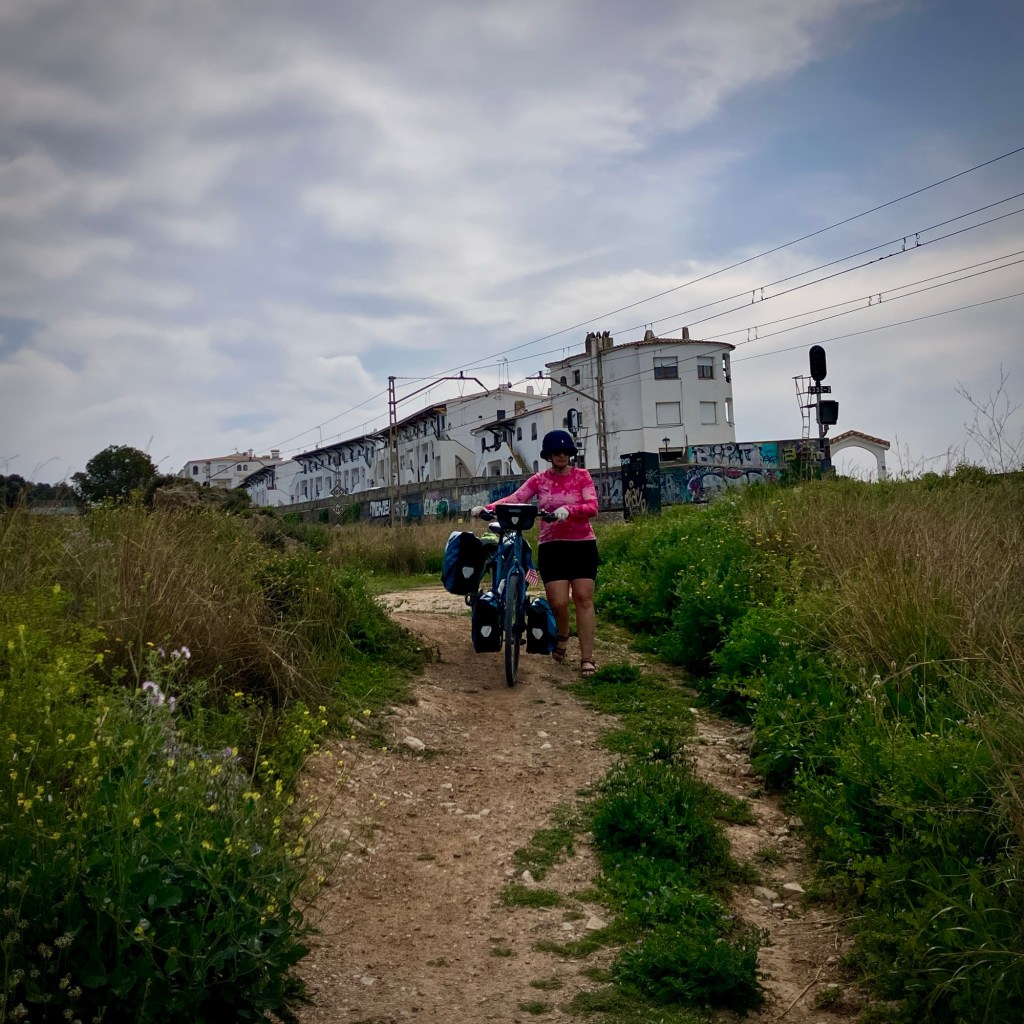
Near the Spanish border, we opted for the quieter but hillier route into Spain over the Col de Panisares. Officially this seemed to be the Eurovelo 8 route on most maps and is also called the Pirinexus route, part of the Catalan greenway route network. The French side was paved, quiet, and delightful. But as always with bike touring, we were rewarded with some memorable views, and then punished on the Spanish side with more uphill kickers, steep rocky trails and unridable downhills. No cruising down into Spain.
Looking down to La Jonquera.Maybe we can sleep at this ranch?Our first Spanish cycling underpass/drainage culvert. Not our last.Cool culvert art.
So our entry into Spain was a bit bumpy and we found ourselves at the somewhat grungy and noisy frontier town of La Jonquera at 5pm after just 50 hard earned kilometers. We didn’t have a reservation anywhere as I suspected the day needed flexibility, but there were no good options around. We’ve been without lodging before at 5pm, as it goes with booking on the fly cycle touring.
National Route 2 had a decent shoulder near Figueres. Sometimes you just want to get there!Our hotel in Figueres old town. A bit of street construction meant no car traffic in front of our hotel and limited Saturday night bar noise -:)
So we decided to press onto Figueres on the main N-2 (II) road, as the official Pirinexus route had more dirt, hills, and would likely take us hours. We were both tired and a bit stressed, but knew this was just one of those days we just had to rally. To our pleasant surprise the N-II had a generous 6-foot shoulder the whole way to Figueres, and we made it there in less than an hour and a half, after a truck stop soda infusion. A shower and dinner at our atmospheric old town hotel and all was good.
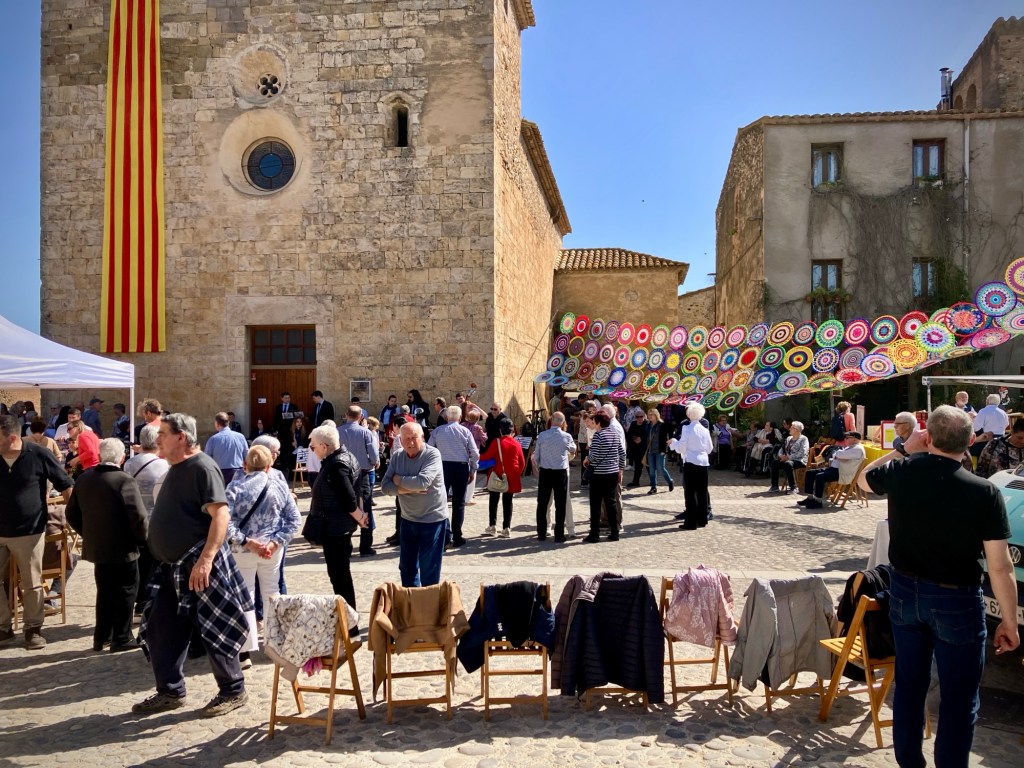
Hotel Duran in Figueres is family run and had a classic vibe, a fine restaurant and even side rooms that were part museum of local life.We set out the next morning after a brief stop outside the Dali museum. Salvador Dali was born in Figueres in 1904 and you can visit the large museum as well as the house where he was born.Always fun to ride through the cobbled little streets. Catalan felt different than France.Sunday bike touring days always surprise, such as this festival in Bàscara, complete with local Catalan dancing.
Although the dirt route was peaceful and had some nice natural beauty, I wished we had just taken the main road route up and over the pass. But again, I could find no info on the pass routes….not even a good blog. Maybe this blog will help people decide.
A random regional cycling route sign was appreciated, but better routes and signage everywhere would make this area more popular with people traveling by bicycle.Ok, this train bridge still baffles this engineer; why are the webs of these precast beams on the top. It’s upside down, but I guess it works.
We soon figured out this part of Spain does not have as developed a bike touring culture. People ride for sport; roadies, gravel, and mountain bikers, but it seems a small number of long distance tourers. We met a few bike tourists along the coast, but most were Dutch, Belgian, or Canadian. (The French were notably absent.)
Finally some signage, helped by the overlap with some of the Camino de Santiago routes.
The first things that struck me in Spain was the lack of useful signage in this area. No map of the border pass cycle routes, a few town directional signs, and just a few randomly placed EV8 route signs. And never distances. Also, no indication how rocky and unsuitable parts of the Spanish side of this route are for loaded touring bikes. If you are riding into Spain on this coastal route, be ready for a significant decline in signage and infrastructure from France. Routes just end and this is the land of random, short cycleways to nowhere.
Peaceful cycling into Girona along the Ter River.Wisteria blooming everywhere.
But Spain brought so much beauty and a completely different feel from France. Our trip has been perfectly timed for peak spring and the smell of blooming flowers, trees, and thick grasses abounded. The fresh Mediterranean Sea air filled our noses and coated us in a comfortable sheen of the promise of Spring and a new year. Forget the chaos of your home country.
The lively and beautiful arcades of Girona.Watching the bikes go by at “Bagels and Beers” in Girona, which also has delicious “Burgels”.We sort of happened upon the Medieval wall of Girona and couldn’t pass up following it along the city edge and University campus on our rest day.Looking back at the Pyrenees from Girona.Walking the wall offers a great overview of the city.No trip to Girona is complete without visiting some of the famous road cycling stores, including “Eat Sleep Cycle” store and cafe.The surprising Pont de les Peixateroes Velles, designed and built by Gutave Eiffel in 1876Girona’s old town core is actually an ancient and vibrant Jewish Quarter known as “El Cell” occupied from the 12th Century until 1492, when the purge happened.Girona is captivating to explore.Spring light in Girona on the Onyar River
The next day we headed to Girona, a long time dream of mine due to its famous road cycling culture. The ride into Girona was nice on self-selected routes, but loaded touring bikes are an anamoly there, and we soon felt a little out of place as we rode into the main square heaving with people drinking, chatting, strolling, and shopping on a beautiful Sunday spring afternoon. Various kitted out roadies wizzed by and seemed unimpressed that we carrying all our gear for 3 months on our heavy duty human-powered transport machines.
Heading out of Girona to the south, we encountered a group road ride tour of foreign cyclists. They were focused on staying on their bikes, so we didn’t want to bother them. For us, just another day.The roads outside Girona are popular with roadies for a reason.How many famous cyclists have ridden this decent?
We had a nice little apartment to enjoy for two nights in Girona and it’s a beautiful place to explore and hang out. Mixing with the road scene heading out of town was a bit strange, as we’re used to seeing more cycle tourists, and it’s really popular with Americans, so funny to here so much familiar English after so many less visited places.
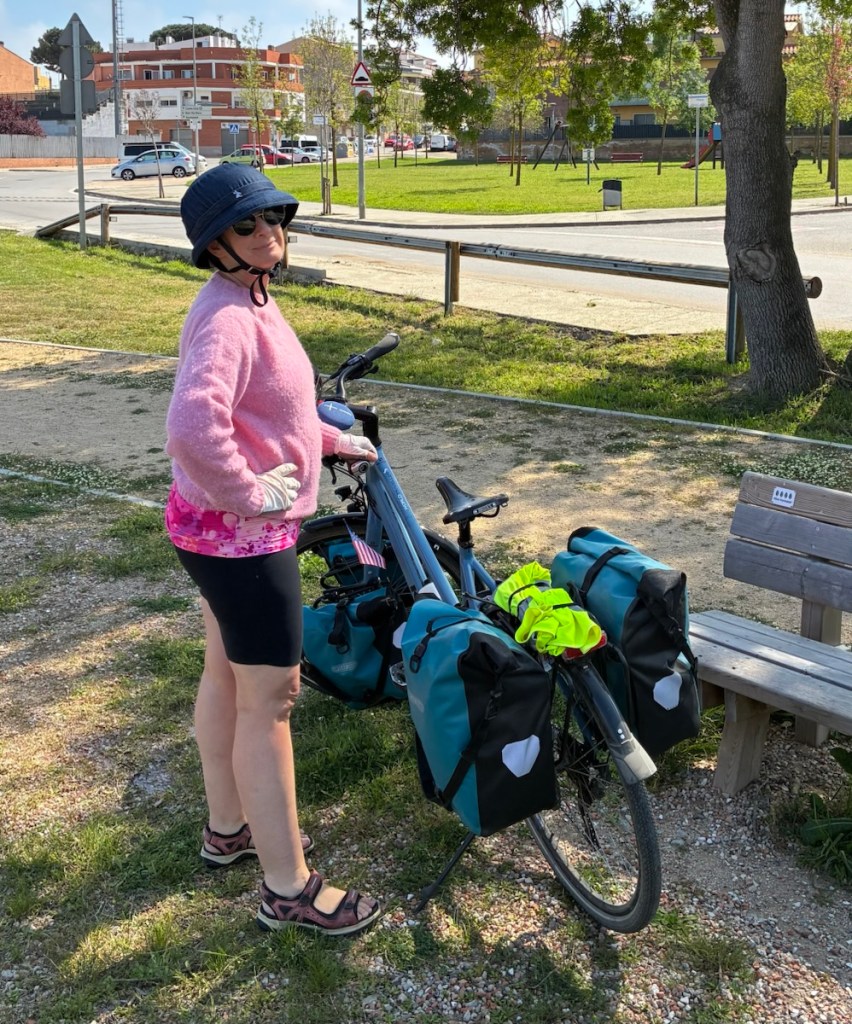
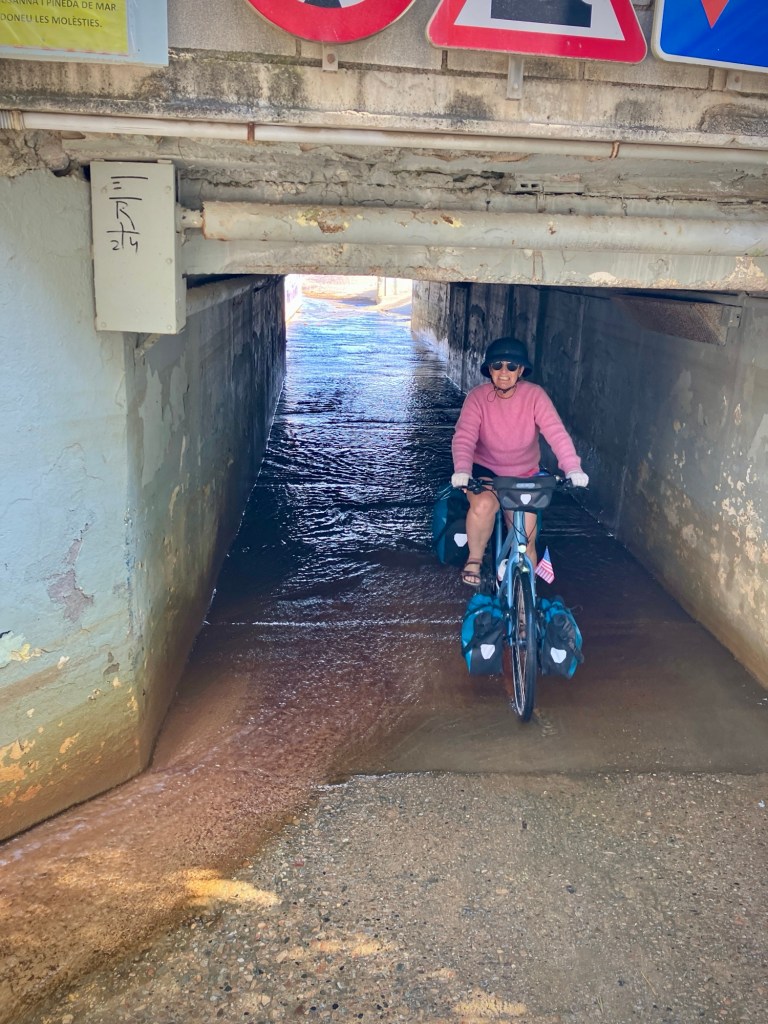
Spanish pastries.We were following the Via Marina for a while.Cheryl in her latest high tech cycling gear: fuzzy pink Shetland wool sweater. Soon we were at the Mediterranean coast via some more primitive rail underpasses/drainages. But the rare and heavy rains must go somewhere.We started to realize that the EV8 on this stretch of coast would not be bike heaven.Decent riding along some of the coast, but a little dull in places.We mostly picnic, but today cobbled a pre lunch snack at a cafe despite it being 12:30…a challenge cycle touring is Spanish lunch is from 1:30-4pm.The train line runs parallel to the sea along the coast north of Barcelona, making access between the sides challenging at times.Morning departure from our fun all-inclusive hotel in Pineda Del Mar. They had just opened for the season and it was very good value. Fun to mix with holiday makers and get a nice cool swim in the pool.Cheryl wondering if she was back in SoCal!The promenades were lovely, but we could only imagine how welcome shade would be in the hot summers. We were already missing it in early AprilThe sea is beautiful along the Costa Brava. But overall this stretch of EV8 is hit and miss.Catalan architecture charms in the few old towns still left on this part of the coast between the sprawlOur one night stay in Barcelona was pleasant at the Illunion Hotel in El Poblenou who kindly stored our bikes safely overnight.
We cycled towards the coast from Girona and spent two days meandering down to Barcelona. This stretch was not our favorite as the coastal sprawl felt a bit endless and the rail tracks make access between the coast and city sides challenging with loaded touring bikes as some access points are just stairs. But eventually we rolled into the northern neighborhood of Barcelona known as El Poblenou, which is also the core of the superblocks, which cleverly limit through traffic and prioritize pedestrian and bike movements. It was great and such a joy to cycle in most of Barcelona.
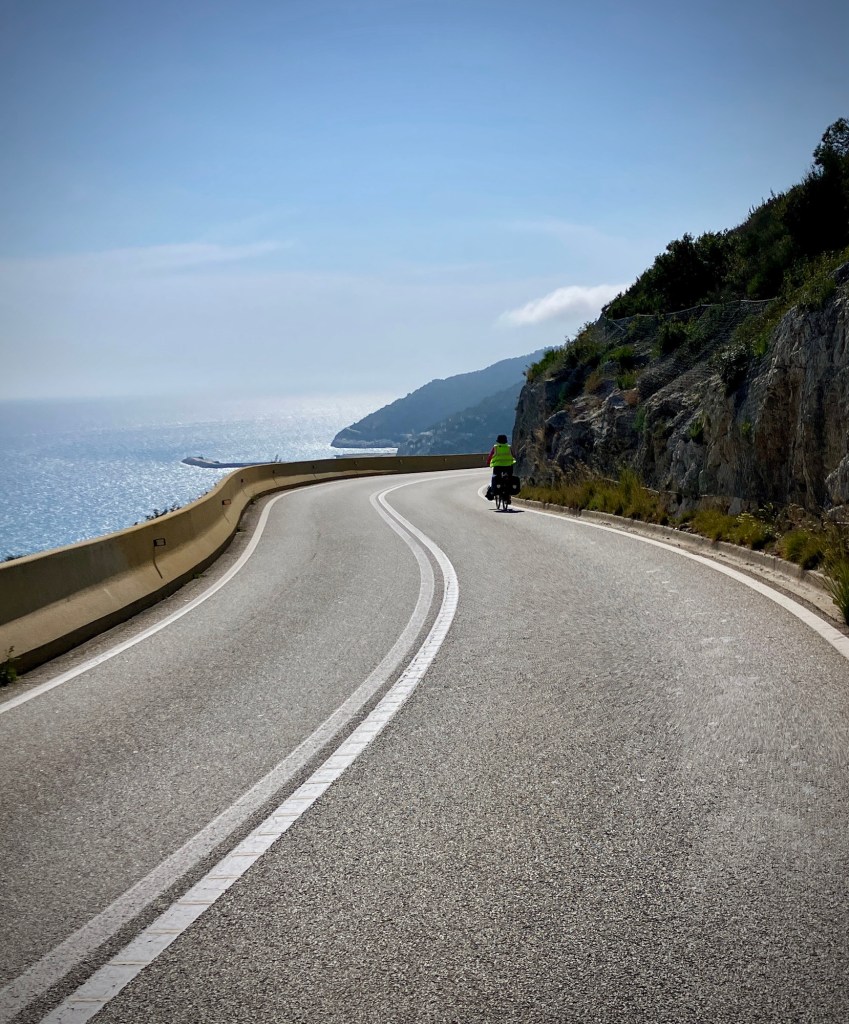
Morning school rush hour in El Poblenou meant an armada of kids, parents and bikes. Nice!On our way south by the famous Sagrada Familia.There are some beautiful bikeways in Barcelona, and very well used. Fixing a flat is never fun. Really not fun on a busy road. Thankfully we were at the quarry turnout so had some space.Cheryl ahead on a beautiful stretch of the C-31 from Garraf to Stiges. A rare shot without traffic as this road was almost constant cars and haul trucks to quarries. A shame.Early dinner and drinks in charming Sitges. We still haven’t solved the mystery of a charming coastal spot with outdoor dining and no Gulls. Why are there no gulls here? The April beach scene in Sitges. As we came into town folks were swimming.Costal glam couple.Komoot and and supposed EV8 Route?Ok, another underpass to a trail on the oceanside of the tracks….nope, dead end at rock slope and tiny beach! Cheryl was thoroughly unamused.Not the nicest stretch of Eurovelo and Cheryl not happy in a head wind and sunshine.
From Barcelona, we headed again out to the coast via the EV8, which is a nice route until past the airport, then forces you onto busier roads. It was a tough stretch as I had fixed a flat tire near the airport and then half way through the extremely busy coastal road from Garraf to Sitges, I felt my tire going soft again. Ugh! This time I really examined the tire and found the tiny glass shard culprit. This stretch would be ok on a fast road bike as the cars are very respectful, but on slow touring bikes, the constant traffic and haul trucks made it a somewhat teeth gritting experience. No pictures of the traffic as there are few places so stop and most is guardrailed.
Cool to discover The Torre Del Escorpions or “Scorpio’s Tower”, a funerary monument built by the Romans outside Tarragona in the 2nd century. Our lovely view from our hotel in TarragonaTapas and Sangria in the main square of Tarragona. Set for Friday night people watching, Spanish style.We were excited to see and moved by the solemn Semana Santa processions in Tarragona. We didn’t know at first why everyone was headed towards the Cathedral. We quickly figured it out.The striking coastal Amphitheater of Roman Tarraco used to hold up to 12 thousand spectators until the decline of the empire 5th Century.A big port for Mega-Yachts in Tarragona. The cannon isn’t really aimed at them? Is it?Roman ruins = Feral Cats. This good looking kitty posed for us.Cats also liked the real and just slightly gritty feel of the Part Alta, the historic core of Tarragona.Colorful Tarragona Street Art. Cheryl snapped the pic before she actually read the words.Orange blossom scents filled the air of Tarragona. So many orange trees as street trees.Not a gentrified old town, Tarragona’s old city still is active with daily life.The processions weaved through the city. We were in Tarragona for three nights and watched processions on two nights.More crowds for the Semana Santa Procession. We felt lucky to witness this less touristy and more local version in Tarragona.Real flames added to the drama as night finally falls.The weight of the floats and human strength required to carry them was impressive. The folks carrying this heavy float marched in time and swayed in rhythm.
So after a really pleasant night in Sitges, we rolled onto Tarragona, where we spent three nice nights and rested prior to our turn inland. Tarragona is a small and ancient city with Roman ruins, a fascinating history, and great archeological museum by the old port. One of our favorite smaller museums with a great audio guide. It was also the start of the Semana Santa events, so we got to see two different nights of processions, each with a different vibe and purpose in the run up to Easter.
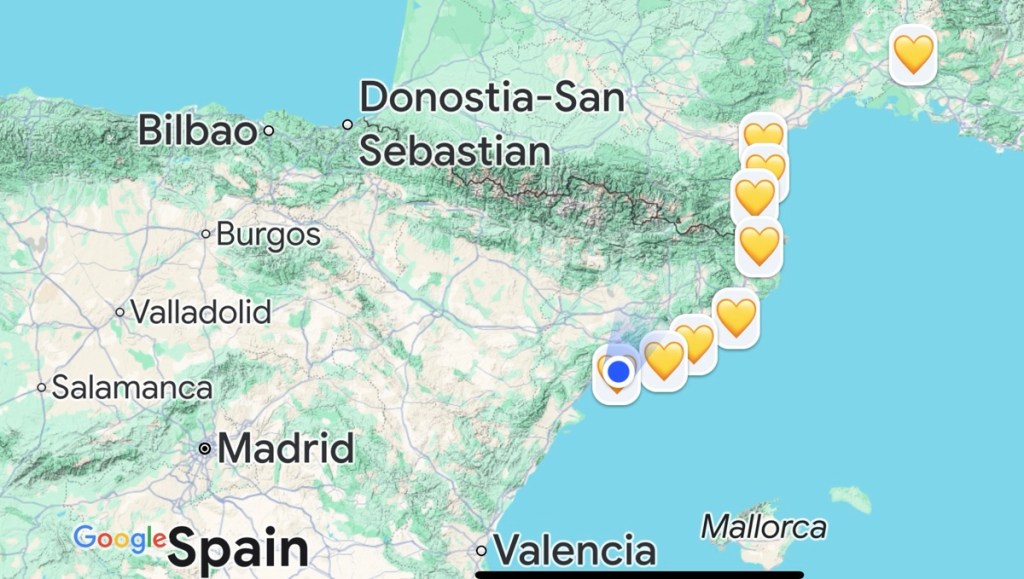
Finally leaving the pleasant and bike friendly Hotel Astari for the Tarragona train station. But where to next?Well, first some train pastries!Oh, and some buttery Jamin Iberico on rolls.We really liked exploring the layers of history in Tarragona for a few days. A bit of a hidden gem.Where we’ve been so far on this Spanish Sojourn. It’s a big country. Each heart is a place where we slept.Happy cycle tourists on the Spanish Mediterranean…at least for now.
We missed summer in Europe in 2024. Like really missed it. It was great to be in the US for the summer, but it’s been a relativley cold spring and fall in Europe. So we were thrilled to get a last gasp of pleasant fall weather in one of favorite French cities, Lyon. Some places we seek out, such as our return to Taiwan and further exploration of Malaysia earlier this year. Other places in Europe we seem to end up in more often due to their location, and Lyon is one of these places since it’s usually our train gateway to and from the Vallée Verte.
Soft autumn light on the Rhône.
This was actually our fourth visit to Lyon, and the second time this year, as we passed through for two nights in March on our spring bike tour along the Via Rhôna. In March, we caught up with some freinds staying in Lyon, and explored a few new places, but didn’t have time to dive in deeper. So we decided to return and spend a week this time, and it was really a joy, from the lovely autumn warth and sunshine (finally!) to the amazing food and friendly people.
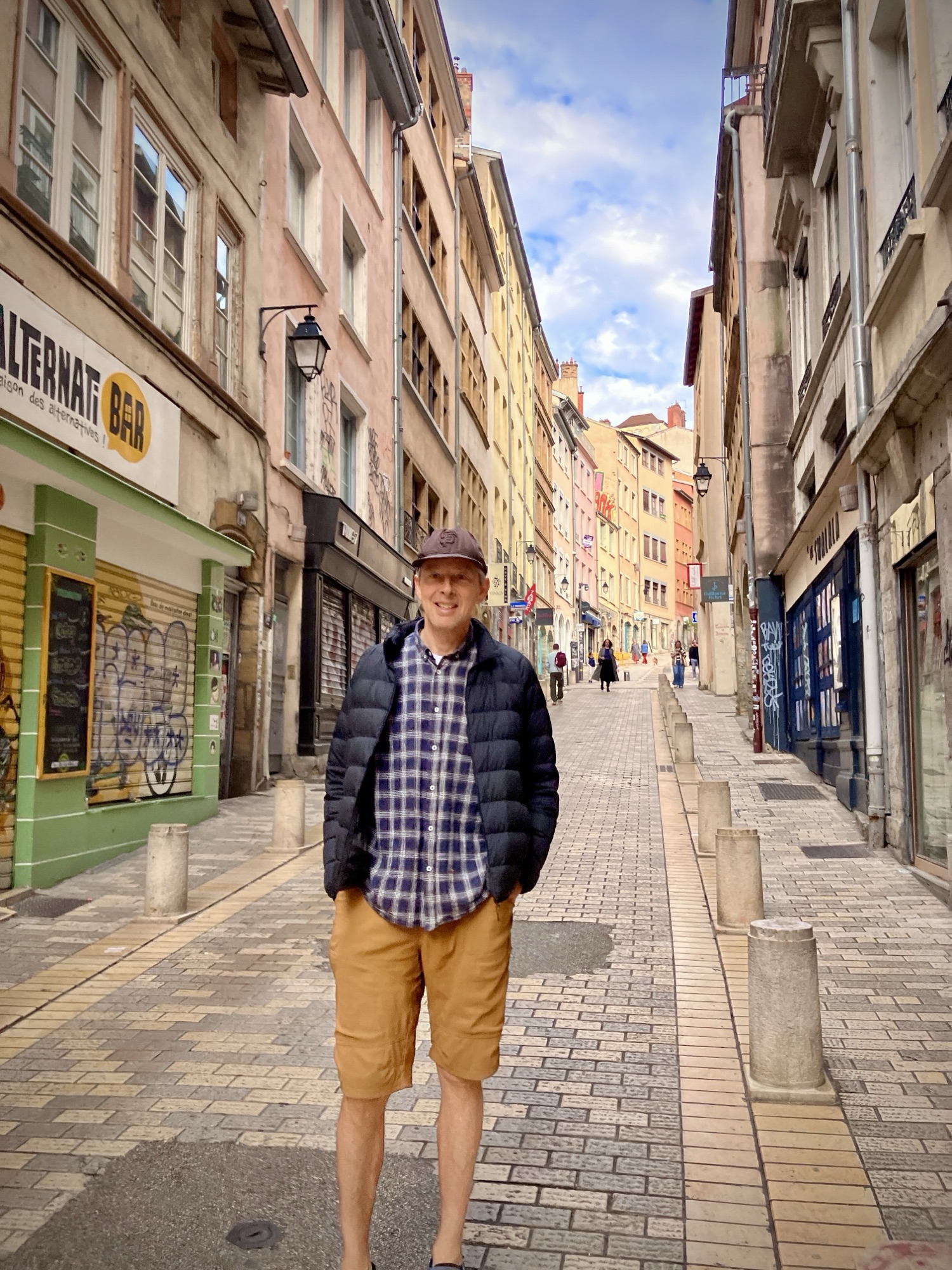
Shorts and sandals! On the pedestrianized Montée de la Grande-Côte, which takes you up to the Croix-Rousse neighborhood.A snipet of the vast Mur Du Canuts. A huge building mural depicting the rebellion of the local silk workers from 1831-1848, some of the first labor revolts of the industrialized world.
Lyon is France’s third largest city, but for many French, it’s the best. As we found out, many Lyonnais wouldn’t consider living in Paris or Marseille. It reminds me of the rivalry between New York City and Boston growing up; one clearly the biggest and dominant in cultural icononography, but the other more livable and approachable, espcially as a tourist.
Along the Saône River, which has a more industrial and gritty feel than the Rhône promendaes.
What I really enjoy about Lyon is the geography, as it has some dramatic hills at it’s edges, and the confluence of two major rivers at it’s core. You even get views of the Alps when it’s clear. It’s also very walkable and easy to get around by bike and public transit, although pales to Paris in its extent of metro and trams. I imagine the access to the Alps, Massif Central, and Mediterranean is a huge benefit with those with the means to get away regulary. Oh, and the weather is a bit nicer than Paris.
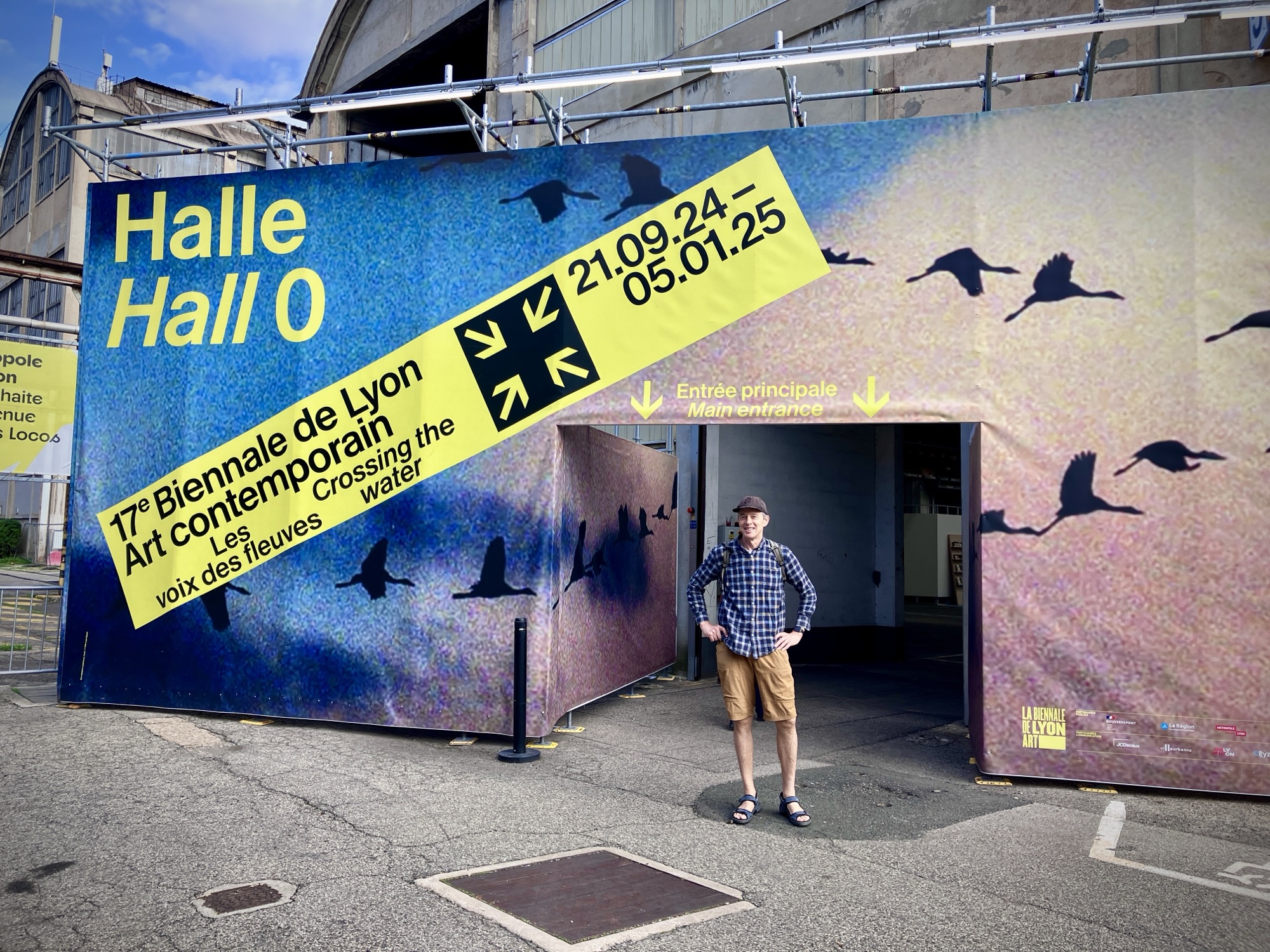
Ready to explore the Lyon Bienalle’s largest installations at the former SNCF workshops known now as “Les Grands Locos”.
We also were lucky to time our visit with the large Biennale Art Show, which showcases about 75 artists in venues around the city. The 2024 theme of “Crossing the Water” invitied a wide array of interpretations and seemed especially pertinant to the migrations of people across the globe due to wars and economic opportunity, as well as animal life impacted by climate change.
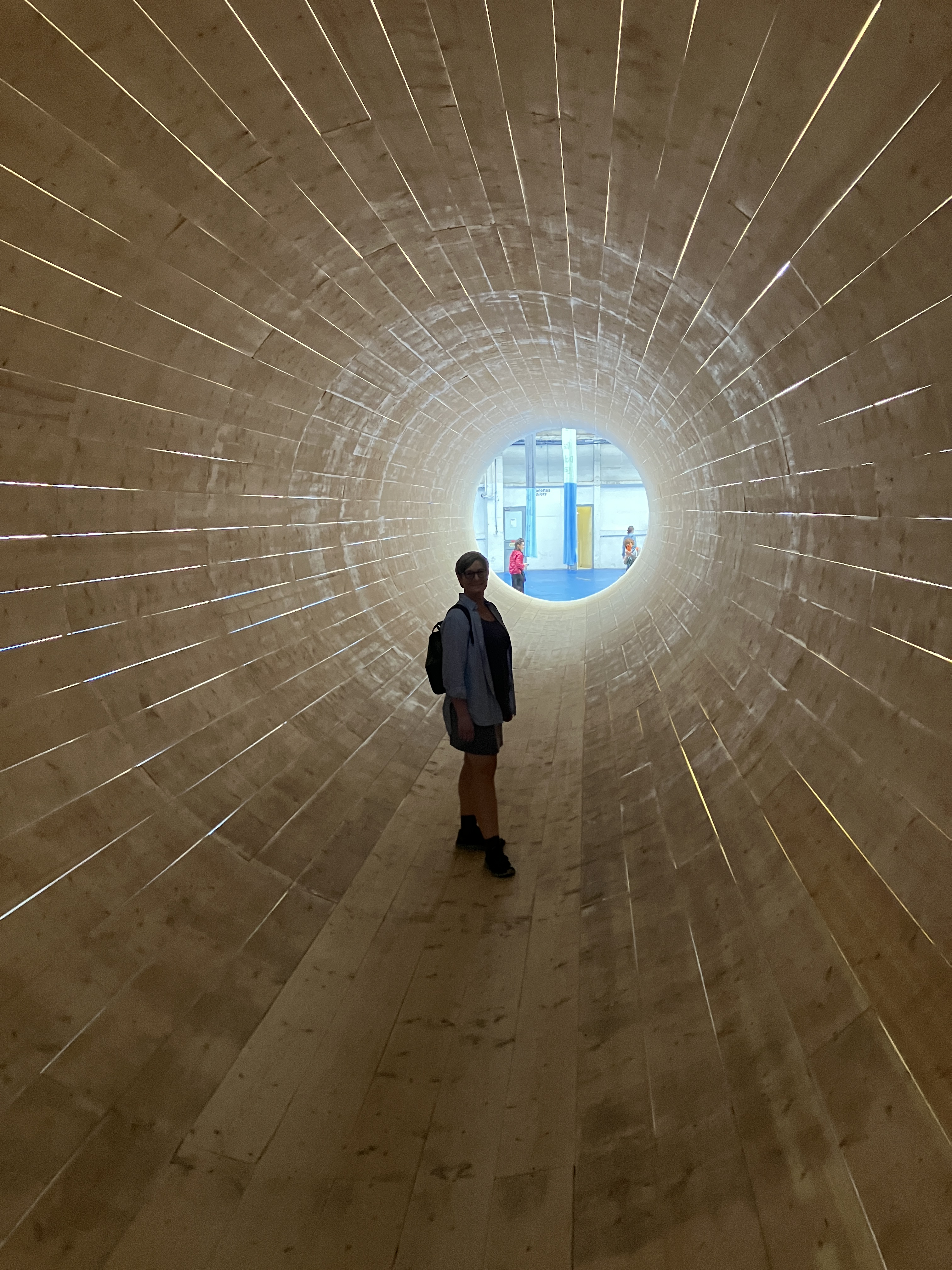
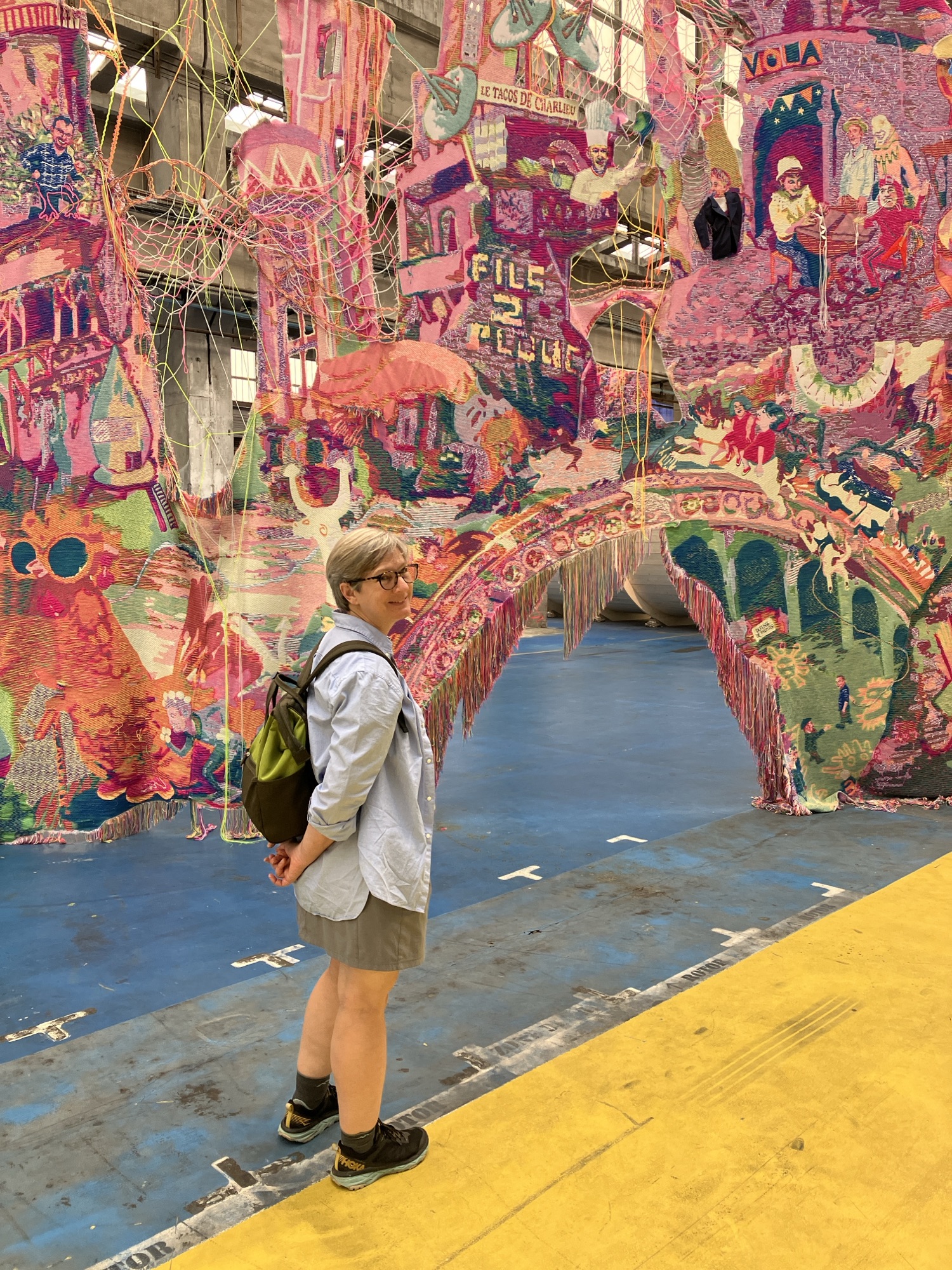
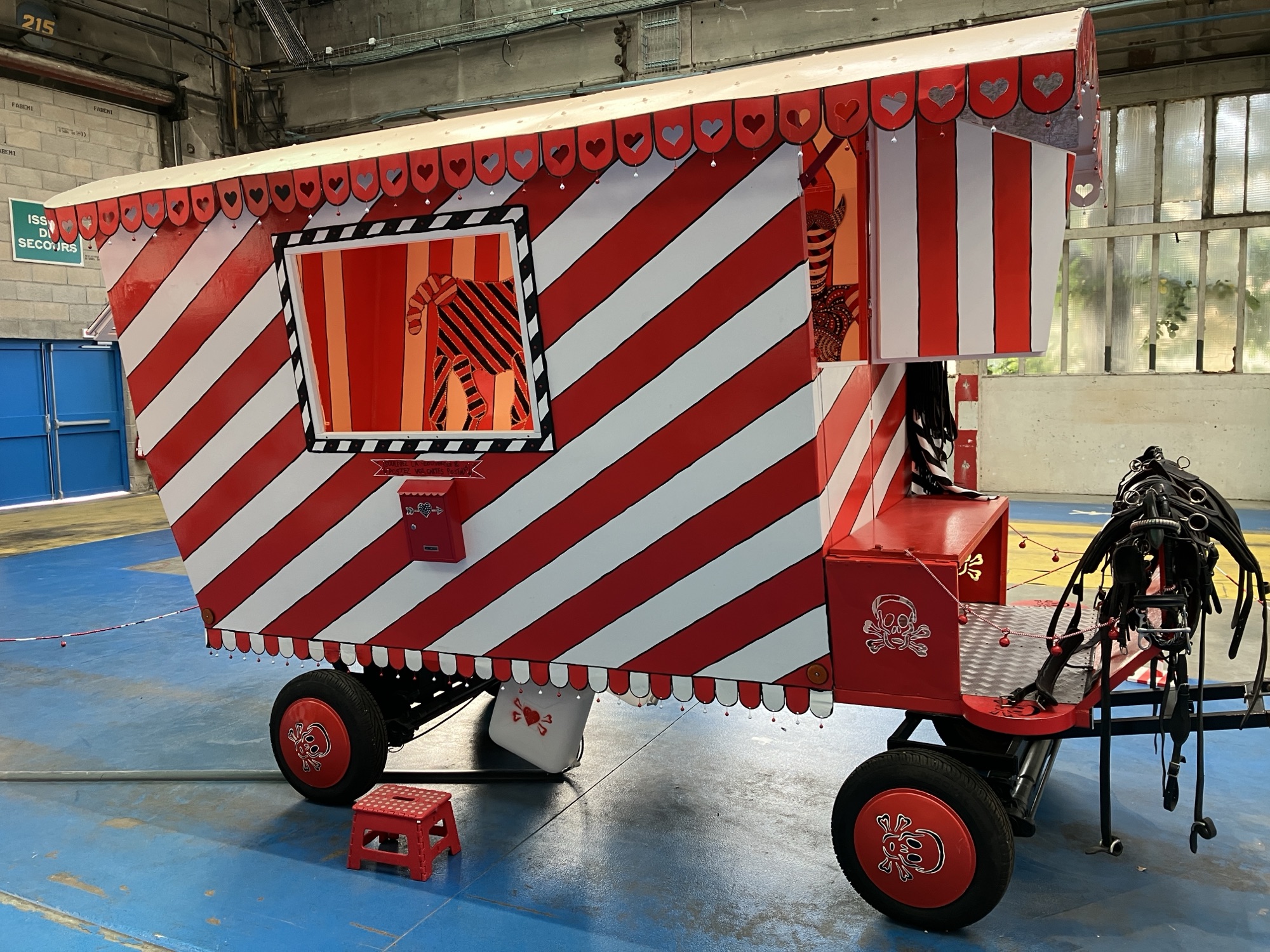
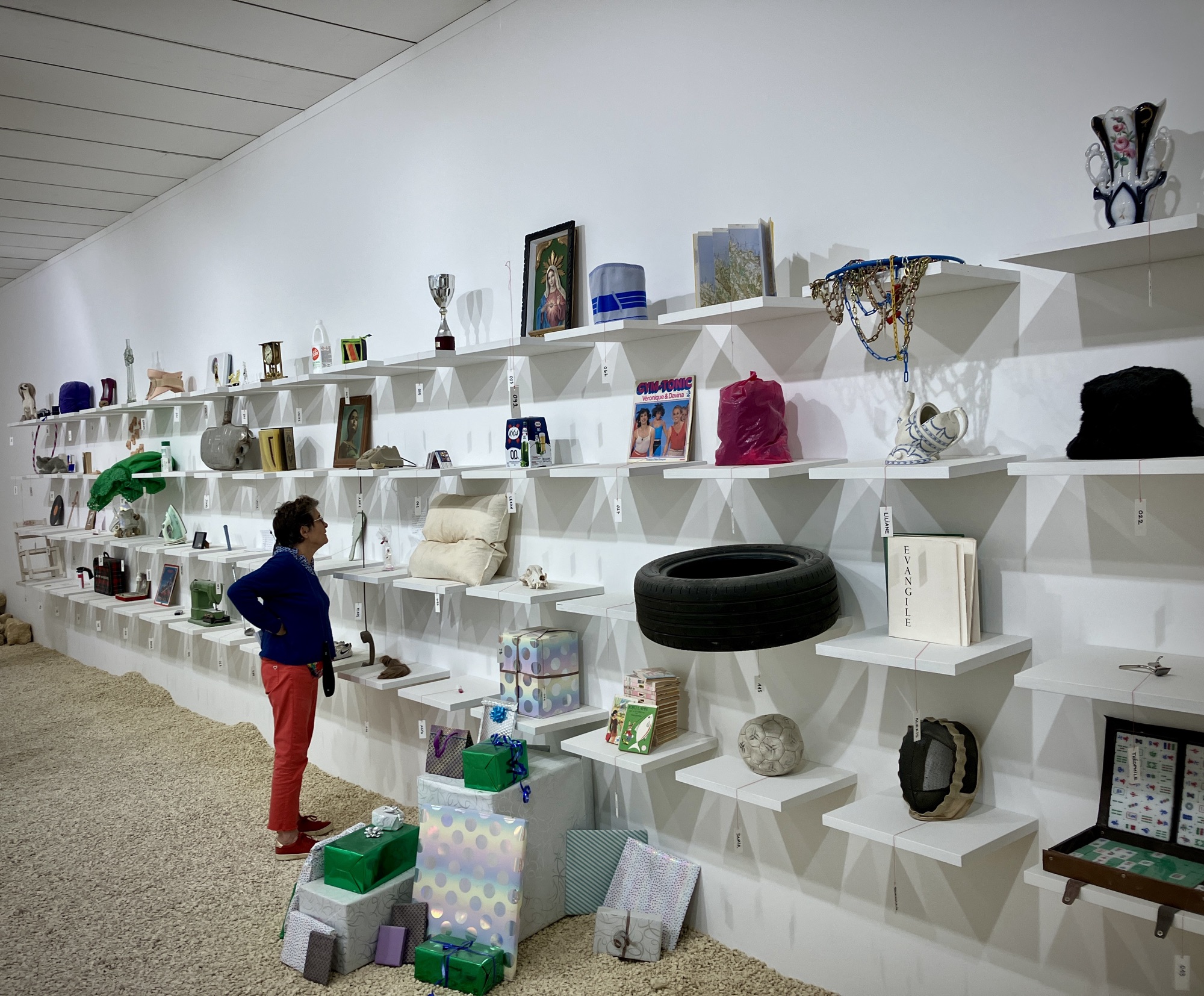
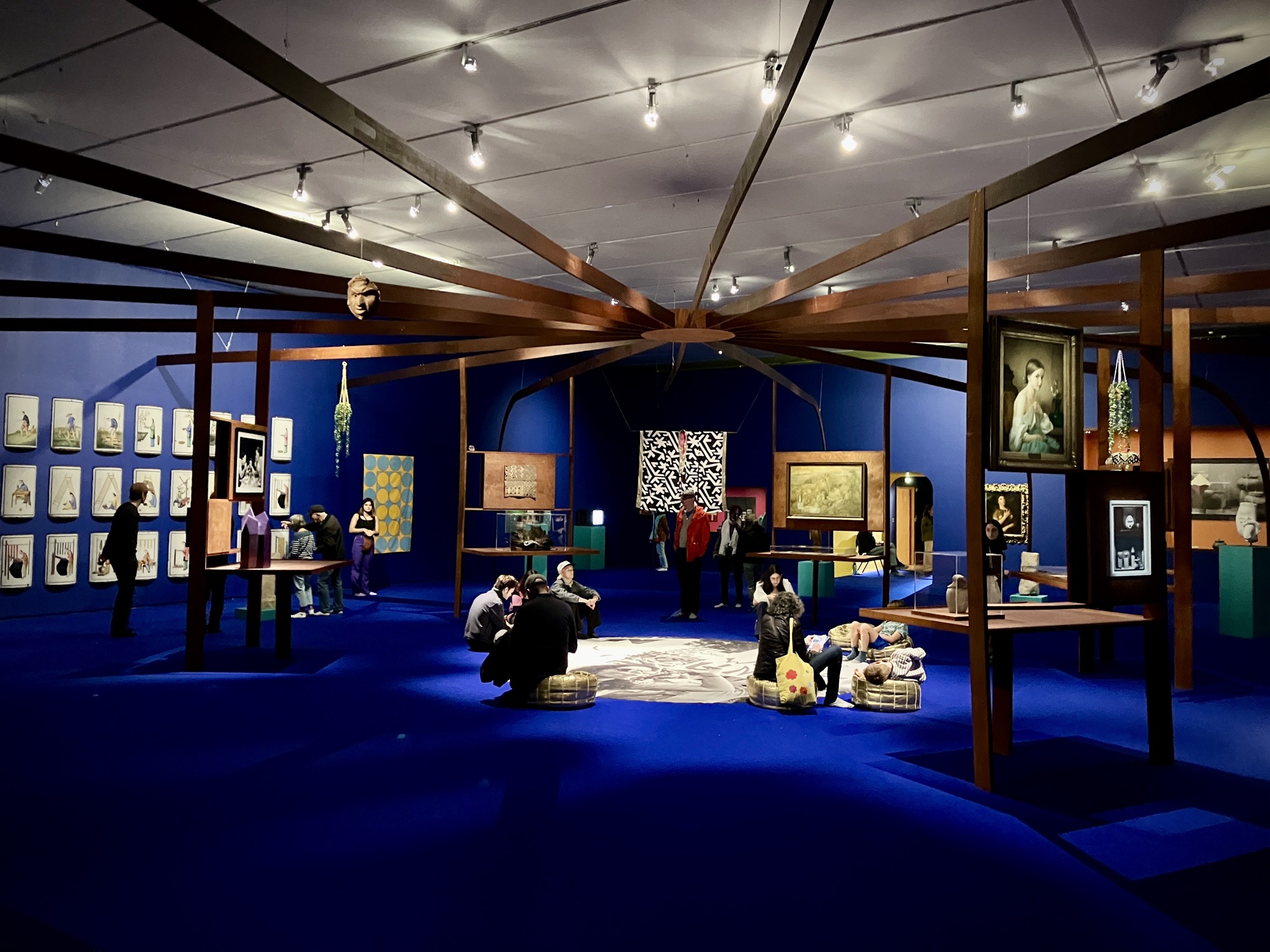
The installations at the SNCF Railyards site were often extrememly large scale and experiential like Hans Schabus – Monument for People on the MoveMona Cara – The CactusSlightly Creepy carnival installation by Clément Courgeon – The Cart of the CleverLorraine de Sagazan & Anouk Maugein – Monte di Pietà at the MAC. Labeled and recorded, the objects that compose it are linked to traumatic memories. I have also crossed the water many times, but luckily by choice.Grace Ndiritu – The Blue Room features around a hundred prehistoric, Roman, Egyptian, medieval, modern and contemporary pieces from various Lyon museums. It was part the Biennale at the Musée d’art contemporain de Lyon (MAC).
I really enjoyed the Biennale and it was well attended but did not have a crush of visitors, due to its long run and dispersed venues. The artists also seemed to represent a modern and diverse cross-section of Fench and foriegn artists, something often missing from all the classical art museums of Europe. The other musuem we really enjoyed was the recently renovated Musée Lumière. Dedicated to the cinematogorphy and the history of the Lumière family, the Musée Lumière looks back at the various technical creations of Louis and Auguste Lumière and their family. It’s well curated and has a great collection of early film equipment, as well as engaging and interactive elements, all set on the grounds of the historic building and workshops.
We reluctantly skipped the striking new Confluence Museum as the week we were in Lyon was one of the Autumn school holiday weeks and anything child and family friendly was very busy….saved for our next visit to Lyon.
The Place Des Jacobins dates back to the mid 16th Century is an important historic junction of 12 streets. The fountain was added later in 1885 after the start of the Third Republic and some disputes about content. Public art and monuments are taken seriously in France.Off the bikes and back on transit!
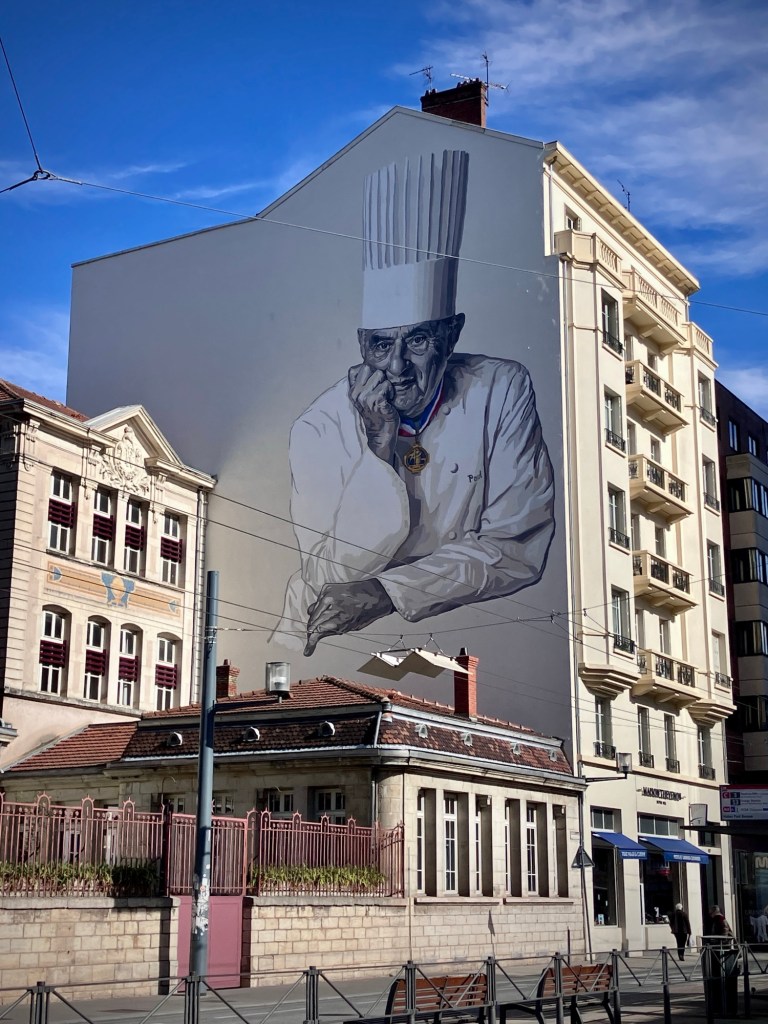
Paul Bocuse looks over the street nearby Les Halles. He is Lyon’s most famous chef and has a legacy 3 star Michelin restaurant and the new Les Halles is named in his honor.
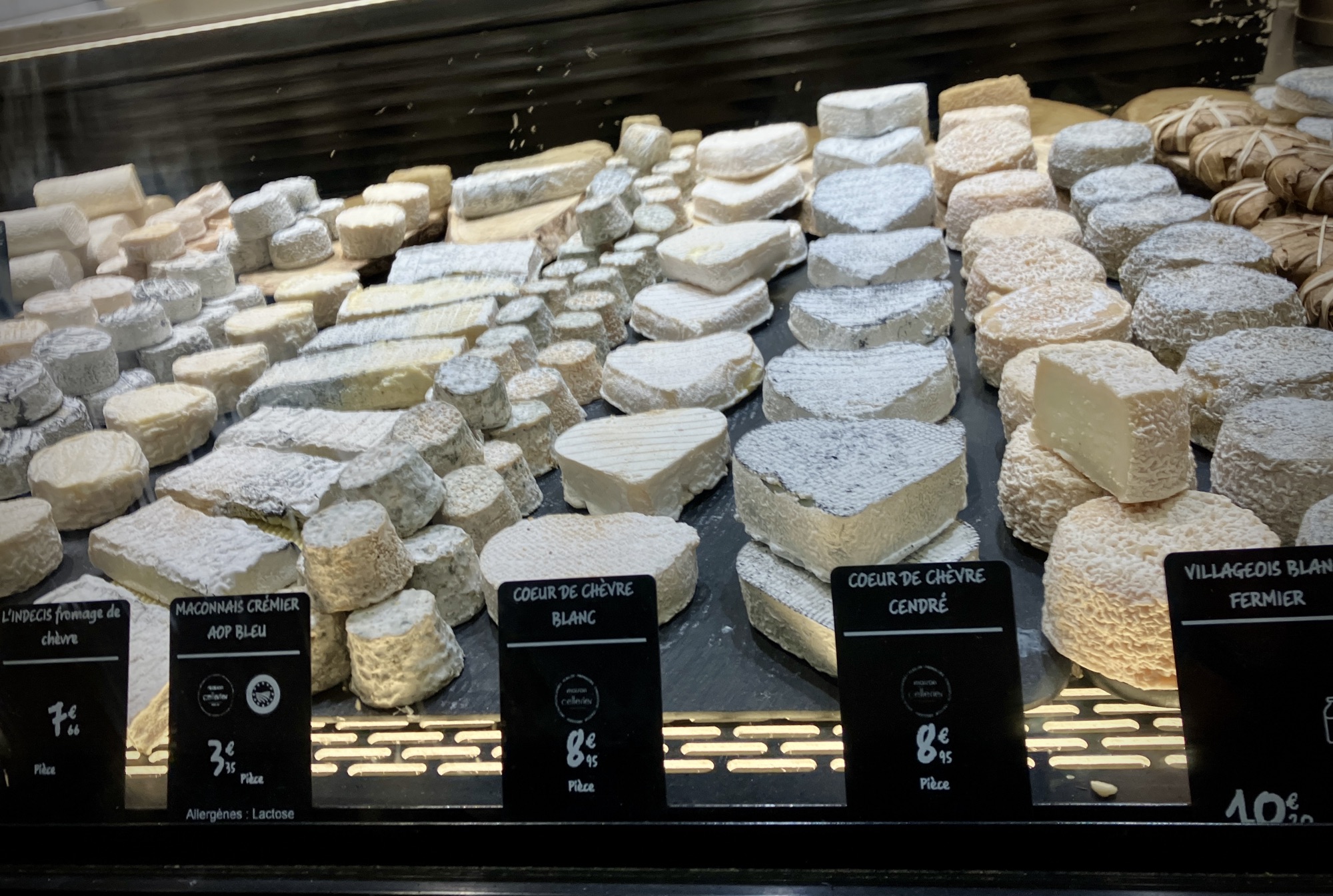
The way the locals eat and drink in Les Halles.
The food presentation at Les Halles is often like a museum installation.
We opted for a classic Moules marinière feast at Chez Lyon in Les Halles. Mussels are generally in season from August to January.
We probably could have shared a bucket, as they were huge! But sooo good.
I can do this…and I did, as well as about 1/3 of Cheryl’s bucket -;)
The typical chimneys of Lyon with Grafitti/Art?….how did the the street artists get up there?The famous Frédéric Bartholdi fountain featuring Amphitrite looking over the four tributaries of the Garonne River….in Bordeaux?! It was his intention to sell this to the City of Bordeaux in 1892, but Lyon scooped it up instead.We stayed in an apartment and a hotel for parts of our visit, but both were just a block from the Left Bank of the Rhone; a perfect location to access all the city and the river’s many cafes and 5km of paths, but out of the tourist zones.Lots of space for people, dogs, and bikes along the extensive Berges du Rhône.Selfie on one of my frequent runs along the Rhône, with the Mussée de la Confluence in the distance.Access in pedestrianized zones is generally controlled by retractable bollards activated by residents and delviery vehicles only. Why is this hard to transfer to US cities?
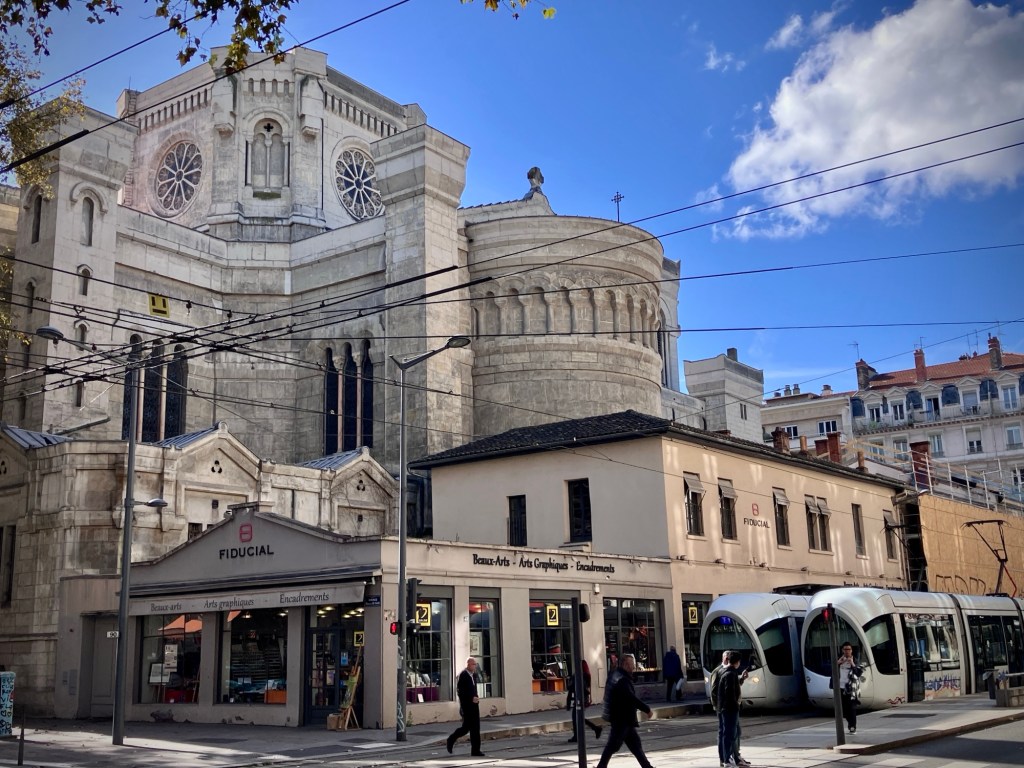
Besides the great variety of food in Lyon, we really were impressed by the lack of impactful car traffic in most nighborhoods. There are some busy main arterials, but in general, you can walk freely and cross small streets with ease. There are 7 tram and 4 underground metro lines that cover the ciy pretty well, and an extensive bike network. And as in much of France, they are investing more in public spaces for people with a huge project to expand car free space in the commercial core, not to mention a massive renovation of the always busy Lyon Part-Dieu train station. As always, the surface tram lines are a nice way to get around and sightsee as well.
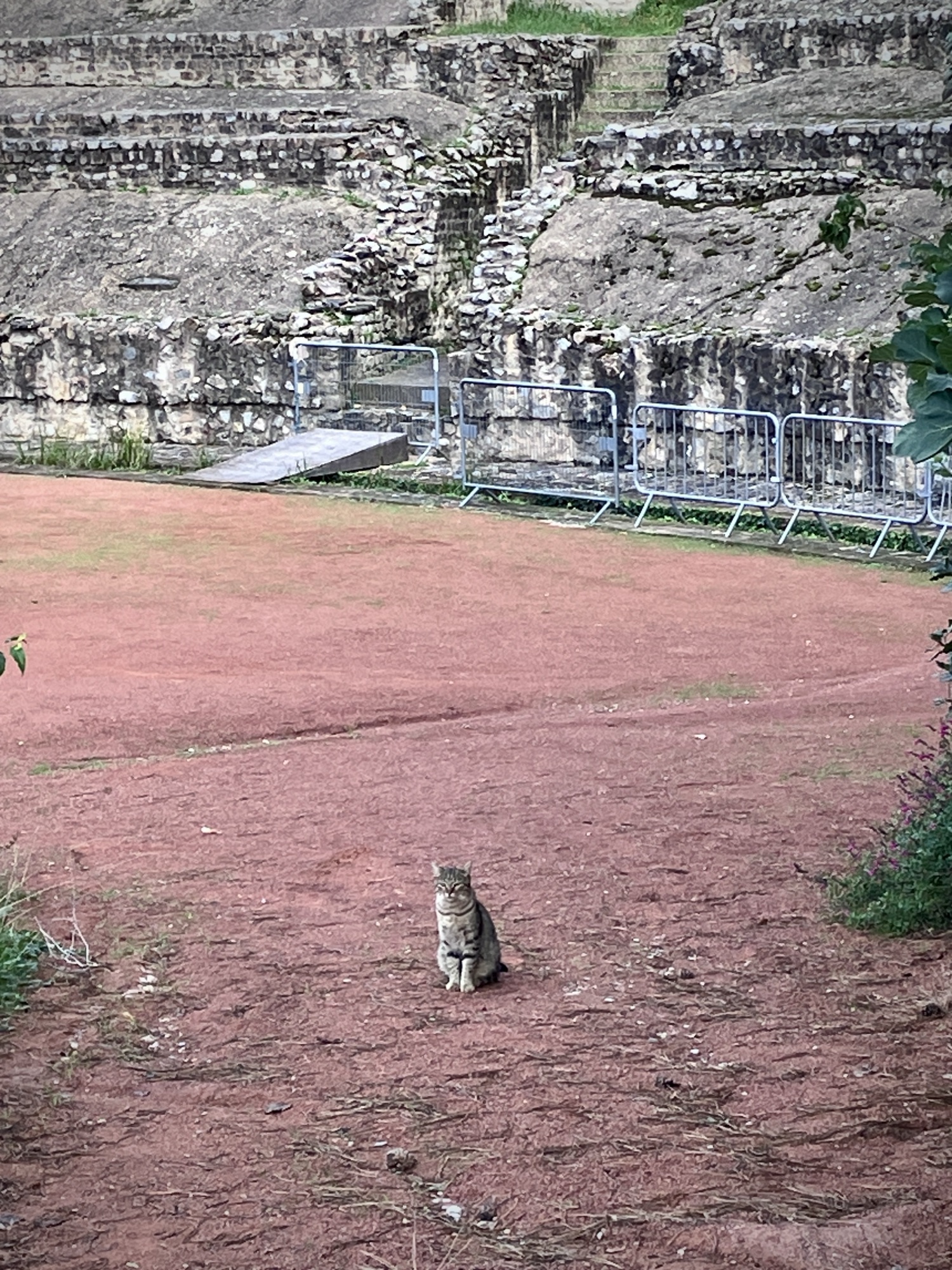
Roman ruins are tucked into Lyon in surprising locations, such as the 19AD Amphitheater of the Three Gauls in the 1st Arrondisement.Random Roman ruin fragmants yet to be pieced togther by a grad strudent, and cats…always!This cat seemed to be in some sort of guardina role. We kept our distance.Taking advantage of water collected in the ruins.
Cities with layers of history are always intriguing, and Lyon city along the Saône used to be the core of Lugdunum, a thriving Roman city dating back to 43 BC. It may have had up to 200,000 inhabitants at its peak, which is in incredible as Lyon today only has 500,000 inhabitants in the age of modern infrastructure. There is a large Gallo-Roman museum, two amphitheaters, and lots of other remnants to be seen if you want to dive deeper into this history.
Beyond the usual recycling and residential composting, we were surprised to see public compopsting bins in such a large city.Delicious dumplings at Enginomo. The culinary scene in Lyon includes a good variety of food choices, not just French Gastronomie.The “Pot Lyonnais” The usual French wine ‘pichet’ comes with a twist in Lyon as it has a thick glass bottom and only accomodates 46cl instead of the usual 50. Apparently the factory bosses used these bottles to take a little from each worker of their weekly wine rations.Notice the thick glass bottom, which also makes a “Pot Lyonnais”very stable!
Beautiful architecture, trams, and sunshine.
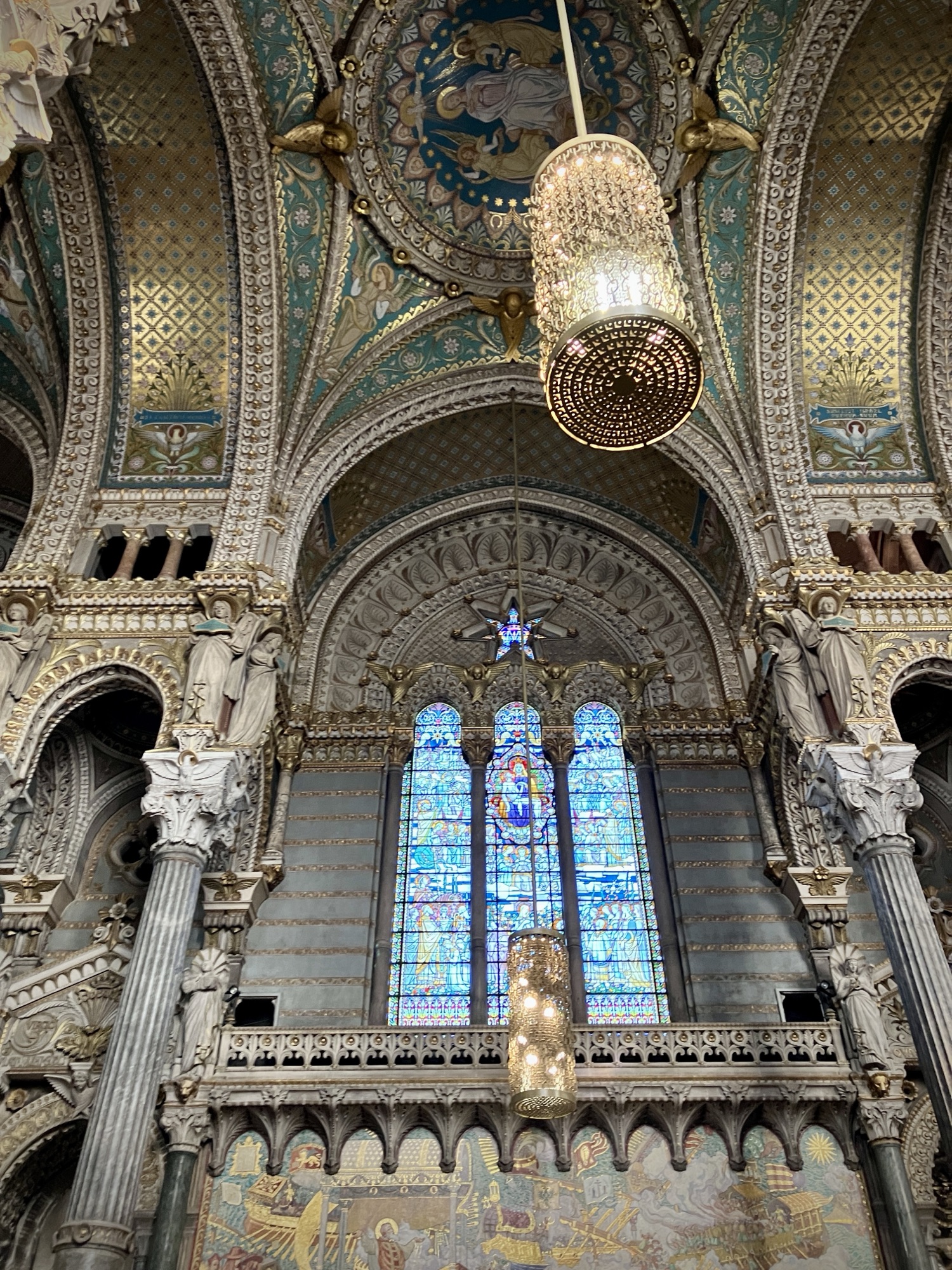
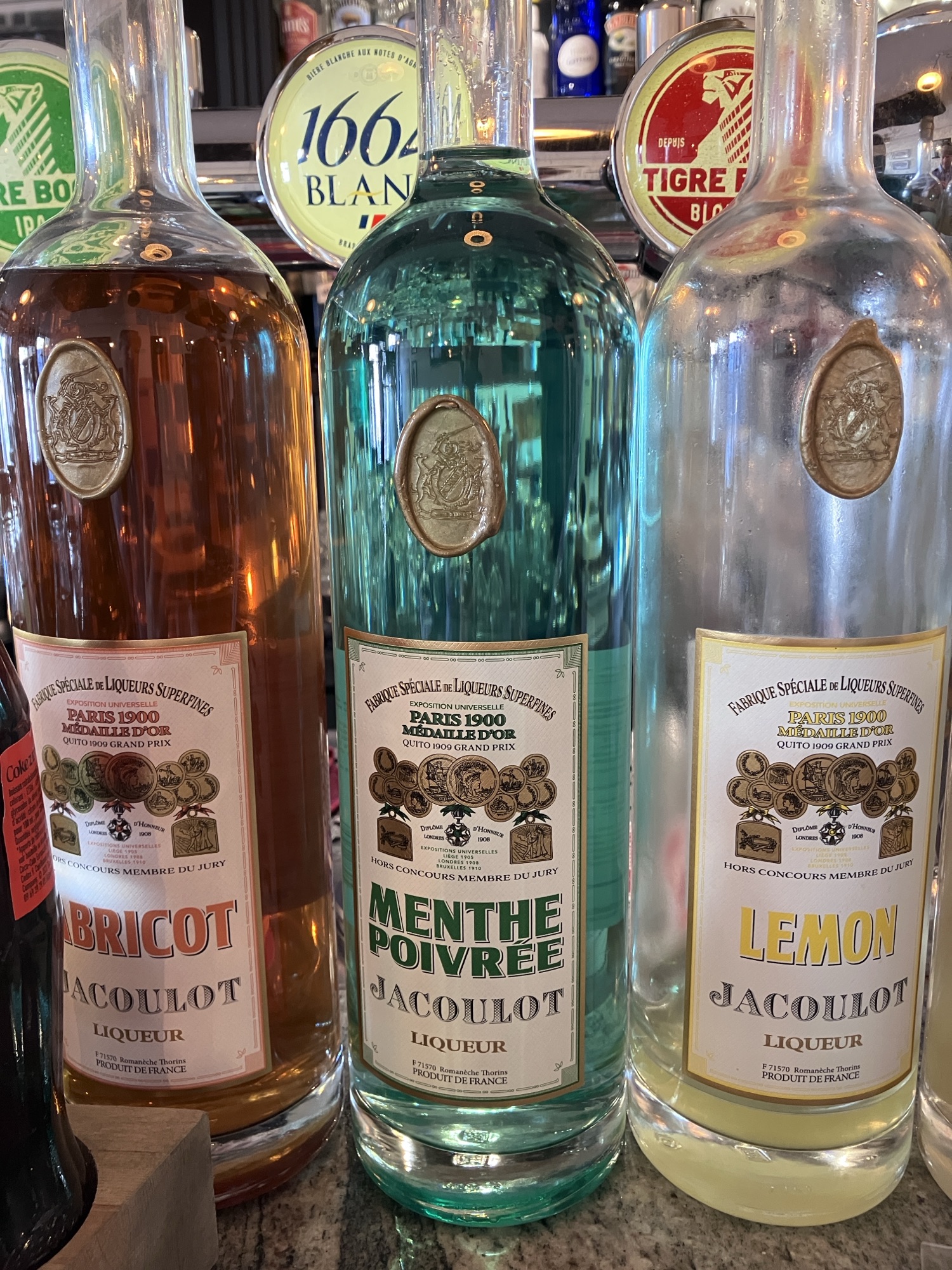
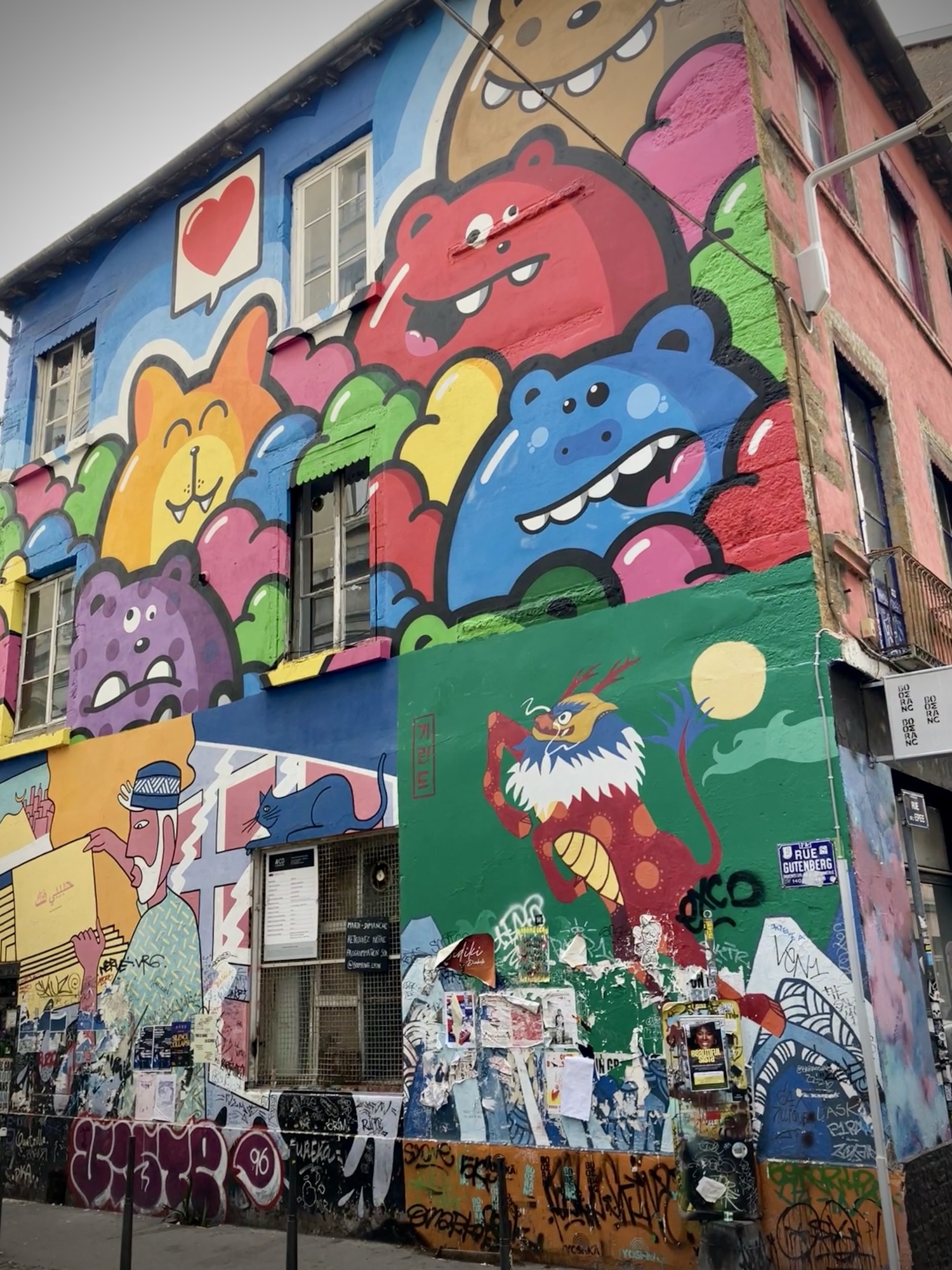
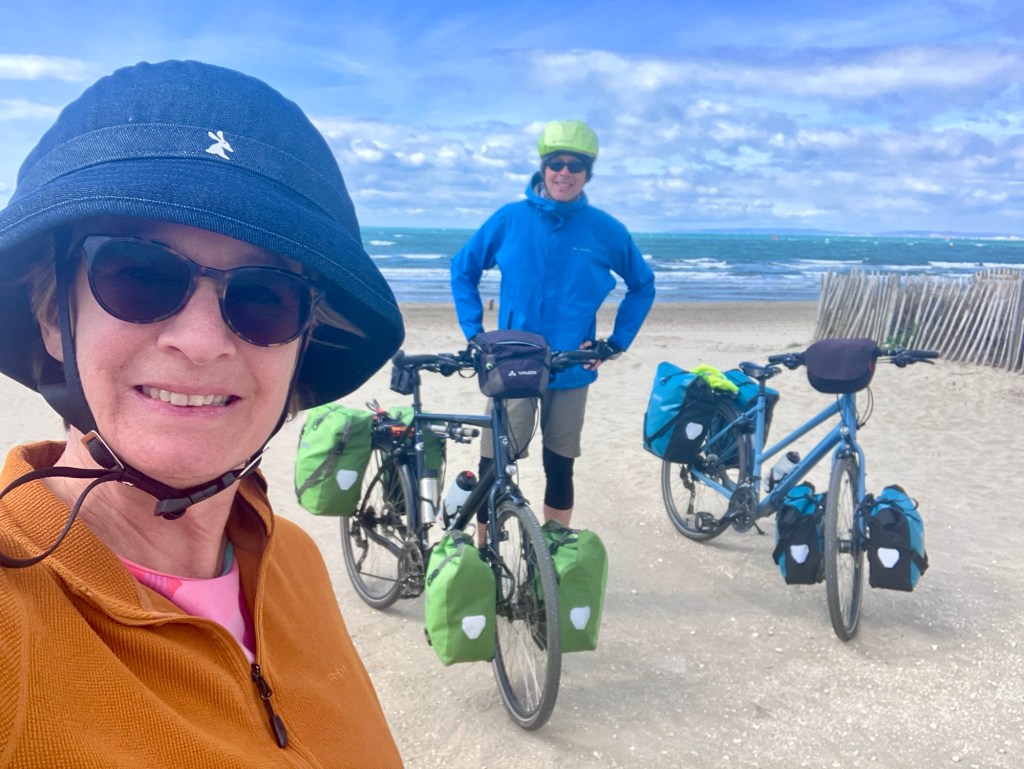
Former 19th century hospital is now the Grand Hôtel-Dieu, as well as shops and gathering spaces.Low morning autumn light on Les Célestins Theater.We used the last few minutes of our 24-hour transit pass to take the funicular up to the Basilica of Notre Dame of Fourvière. It’s impressive and one of Lyon’s top sights, with views of the city from the nearby terrace.Remains of the Gier Aqueduct which brought water to Lugdunum from over 50 miles away. Parts are still fully intact while other sections are now one with later development. Amazing.This streetscape reconstruction in Sainte-Foy-lès-Lyon was still in the archeolgical phase, as Lyon sits atop layers of history.Enjoying the nice weather on our exploration of the hills.Colorful liquor bottles caught Cheryl’s eye at a casual neighborhood bistro where we had lunch in Sainte-Foy-lès-Lyon.Sunshine on the Saône looking toward Croix-Rousse.Street Art and murals are a mainstay of Lyonnais life and there are websites dedicated to the various artists.We feel the same way.Nothing but smiles after a stimulating week in Lyon. But will this great weather last?
Lyon is not always a must see to most visitors to France, and I think it’s still a bit overlooked. Paris is amazing, but Lyon is a place you can really feel comfortable in quickly and will be rewarded by friendly people and a vibrant cultural scene. We were glad we came back for a longer look. Happy travels!
Le Grau-du-Roi, our first real sight of the Mediterranean after two days of salt marshes around the Carmague.
The Via Rhôna. We started with snow, rain, and hail, and ended about 800k later in sunshine and wind.
Each heart is a place we stayed on our ride down through Southeastern France.
When we start a specific EuroVelo route, or any other point to point cycle tour, we always assure each other that we can absolutely take a train boost if needed. I’m happy to report we didn’t take a train, bus, or taxi for the ViaRhôna. We rode the entire way. The blue dot is us in Montpellier, our 15th night since leaving our friends’ house in the Alps. We spent two nights in Lyon seeing friends, and two nights Uzés to have a needed rest day.
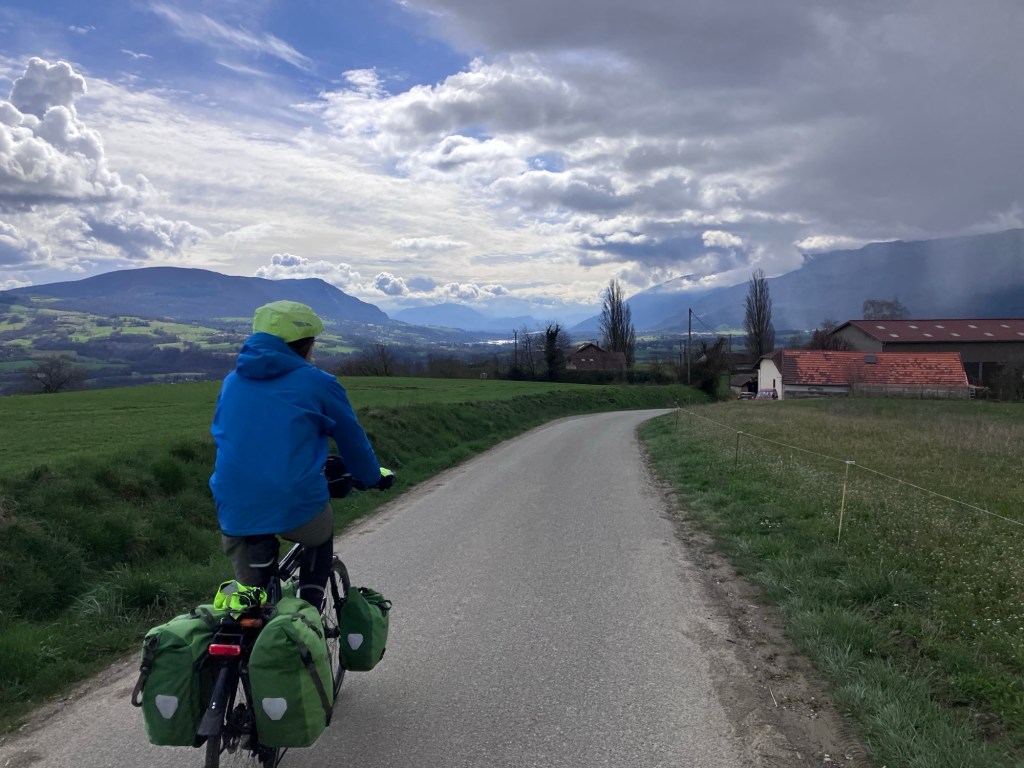
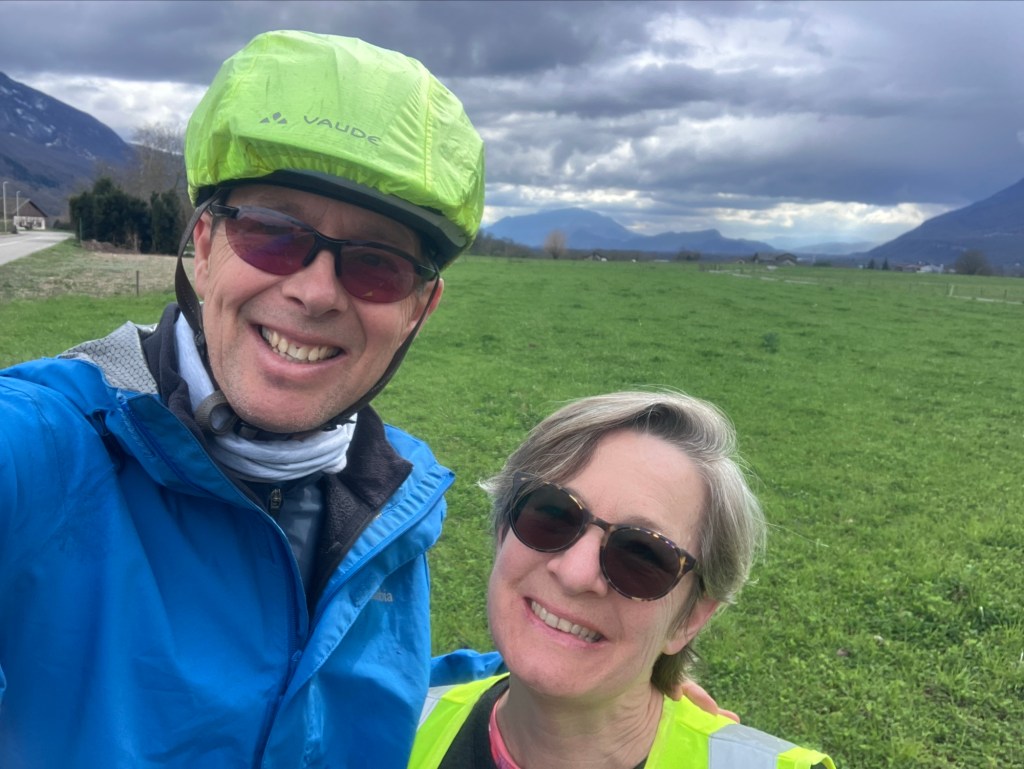
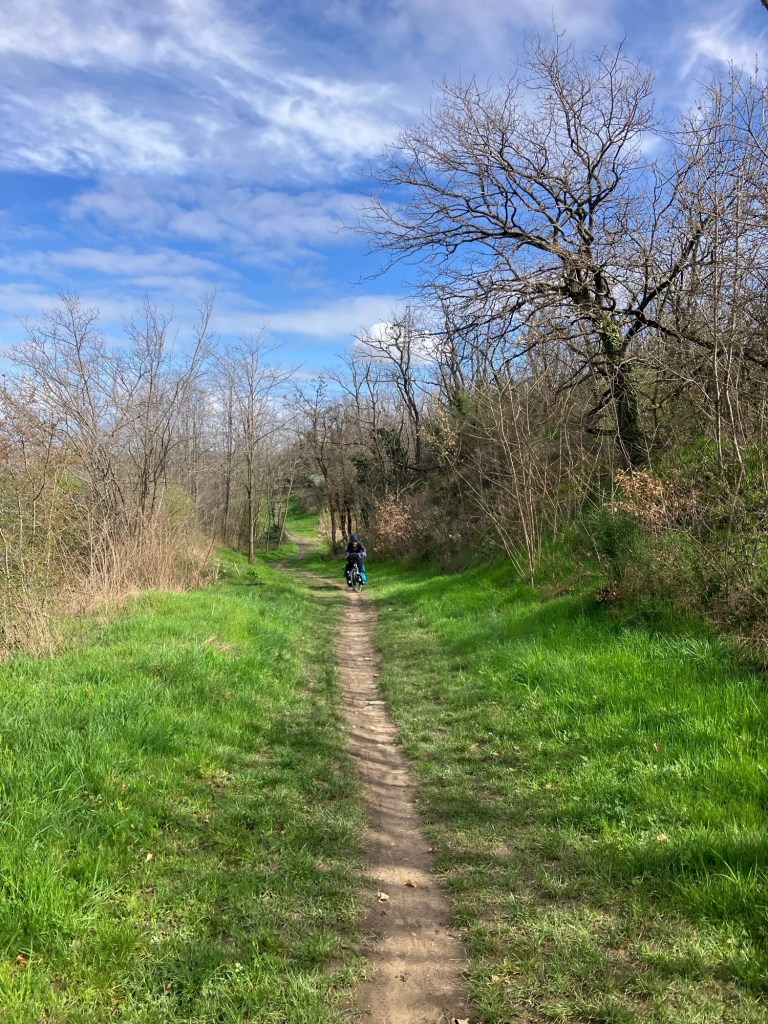
Day two of riding. All rain gear was used. We were glad the rain was never sustained, but just occasional showers or hail.Still smiling in the face of dicey weather.South of Lyon the route is still undergoing some work and much is labelled “Itinéraire Provisoire”In some spots even Rich needed to push his bike. Or as the kids call it – hike a bike.
The one stretch we might recommend skipping is between Lyon and Vienne. You can take a local TER train for 30 minutes out of Lyon. The cycle route was mostly on street, with some narrow bike lanes, poor pavement, and quite a bit of diverting around industrial sites, mixed with off street trail riding. We’re not purists who insist on riding every kilometer, and more realistic about having a good (and safe) time, while not suffering TOO much. There will always be enough accidental or incidental suffering on a bike tour, so, if you can skip some known unpleasantness- go for it. That said, it was rideable and ok if you want to do every km of the route.
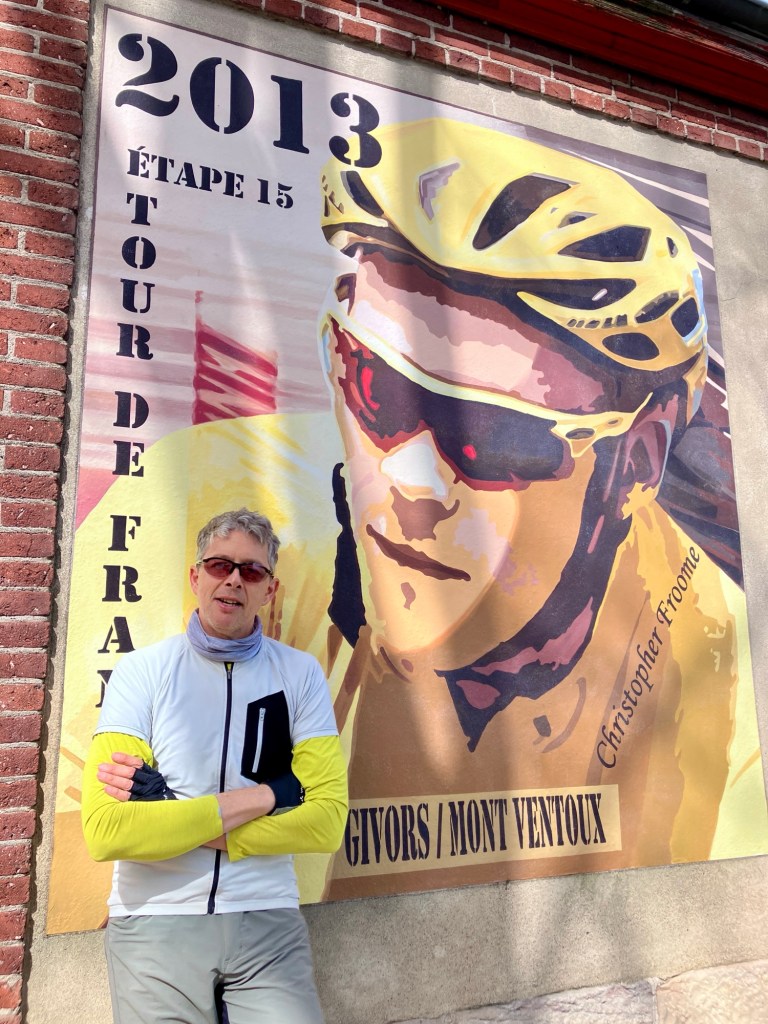
But, this historic bridge across the river at Givors was beautiful. We would have missed that via train.And missed this! As a long time and avid Tour de France watcher Rich appreciates riding through the historic stages of le Tour.Chris Fromme from the 2013 Tour.
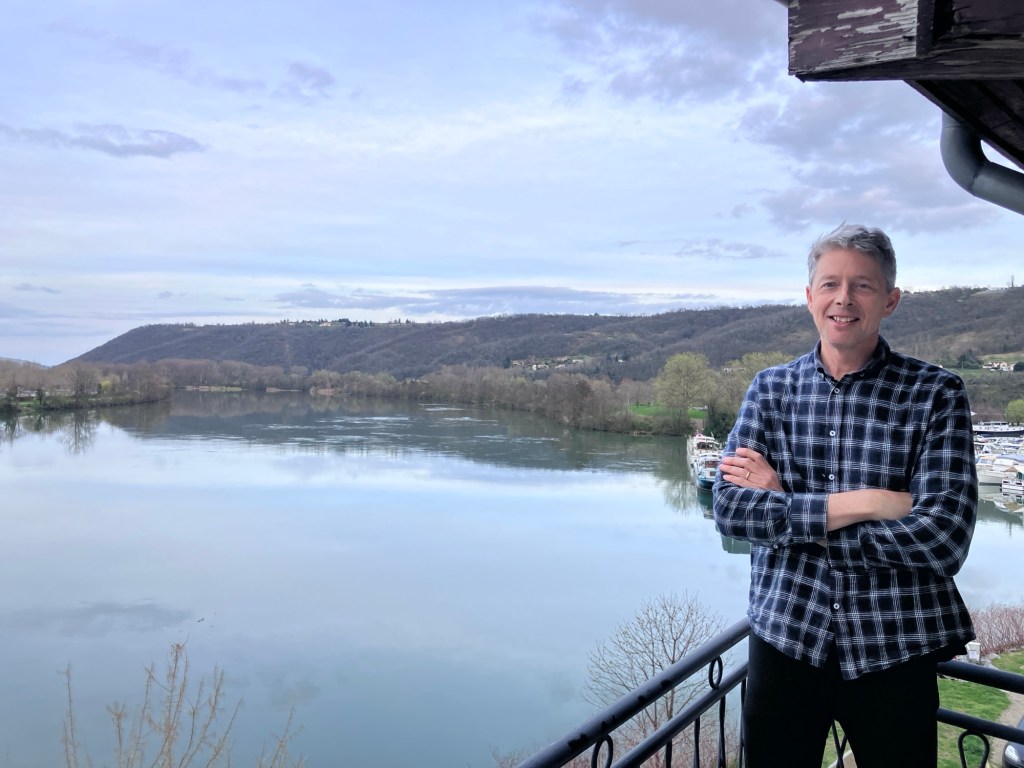
Our first night after Lyon was in Les Roches-de-Condrieu, at a small hotel called Hotel-Restaurant Le Bellevue. A decent hotel above a fantastic restaurant, as are many in the Logis network of locally owned lodging.
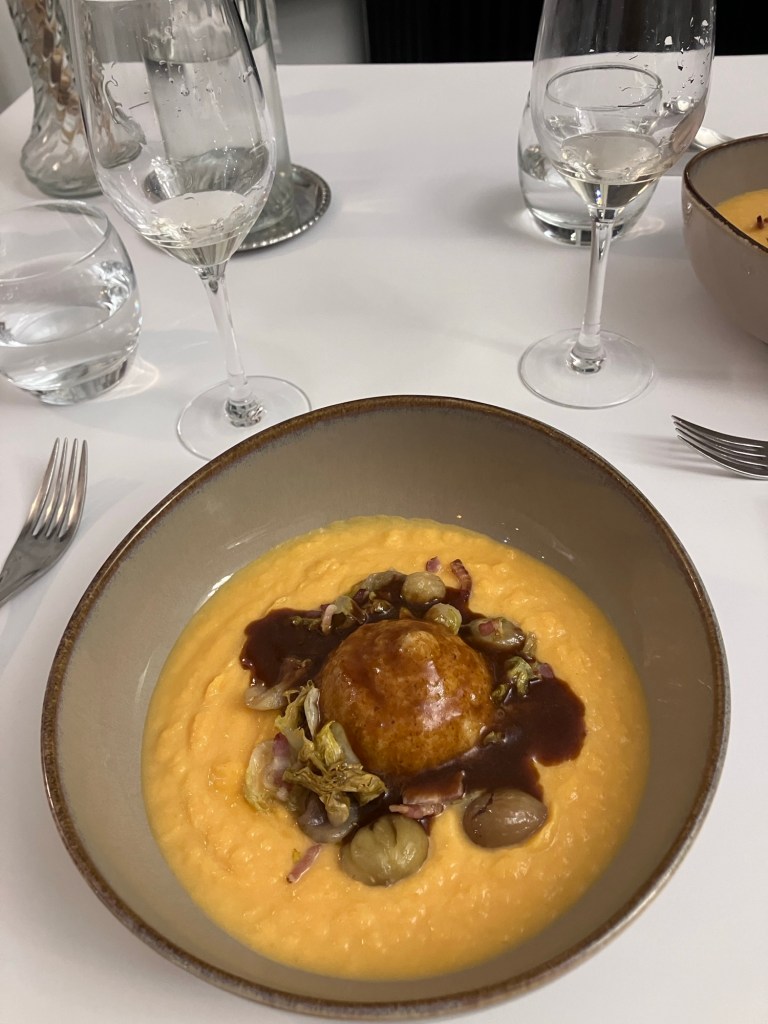
Bare vineyards. We’ve never toured this early in the year.Another view of the Rhône River from our little balcony (good for drying laundry) at the Bellevue.Yup, being those folks who snap photos of their food. Fantastic pumpkin soup.Didn’t snap a photo of the main, but here’s dessert. My Black Forest inspired cake and Rich’s artistic layered confection avec use crème glace
Usually we seek out something casual and simple for dinner, after a hotel breakfast buffet and a picnic lunch. But, when in a small town with not many close by options we sometimes choose the hotel restaurant; especially in France. I am always impressed and grateful with the way the French approach food. Even in a restaurant like this, which I would consider fancy and upscale, the service is lovely and straightforward. No attitude, no showy or flashy flourishes, just good service and delicious food.
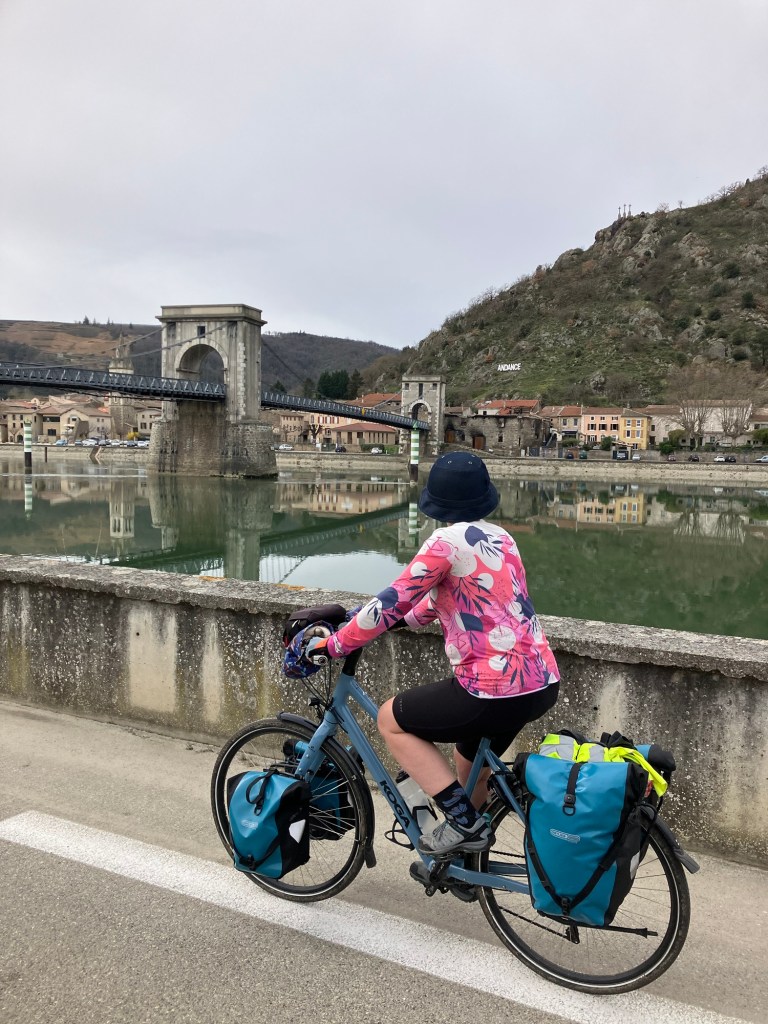
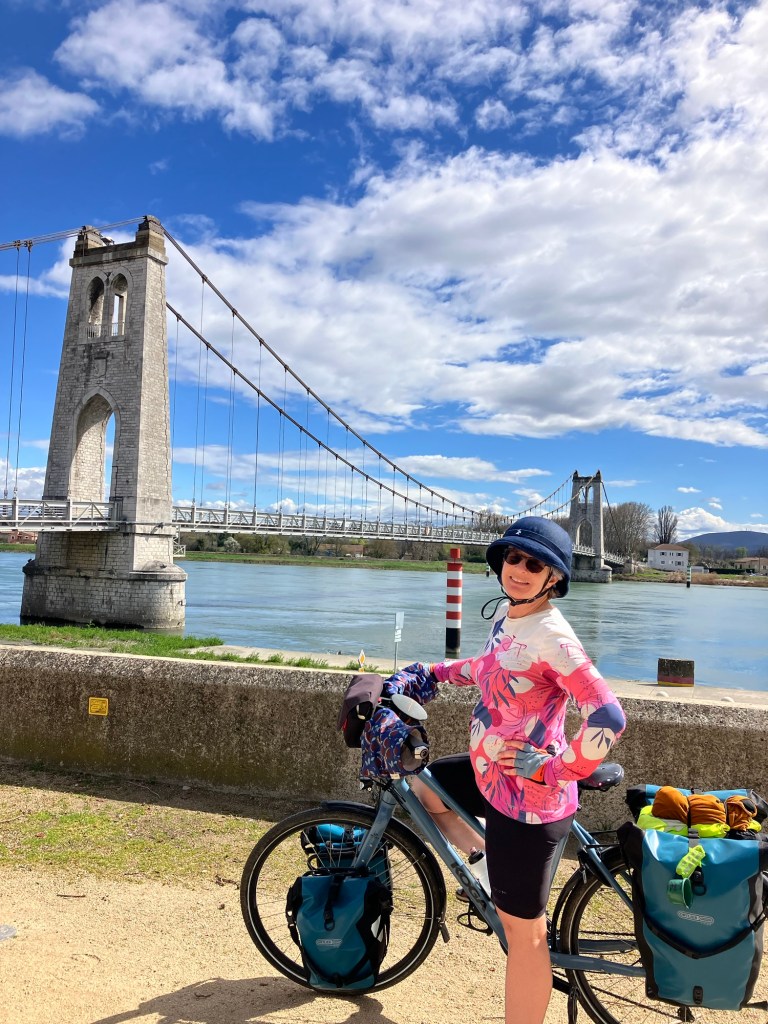
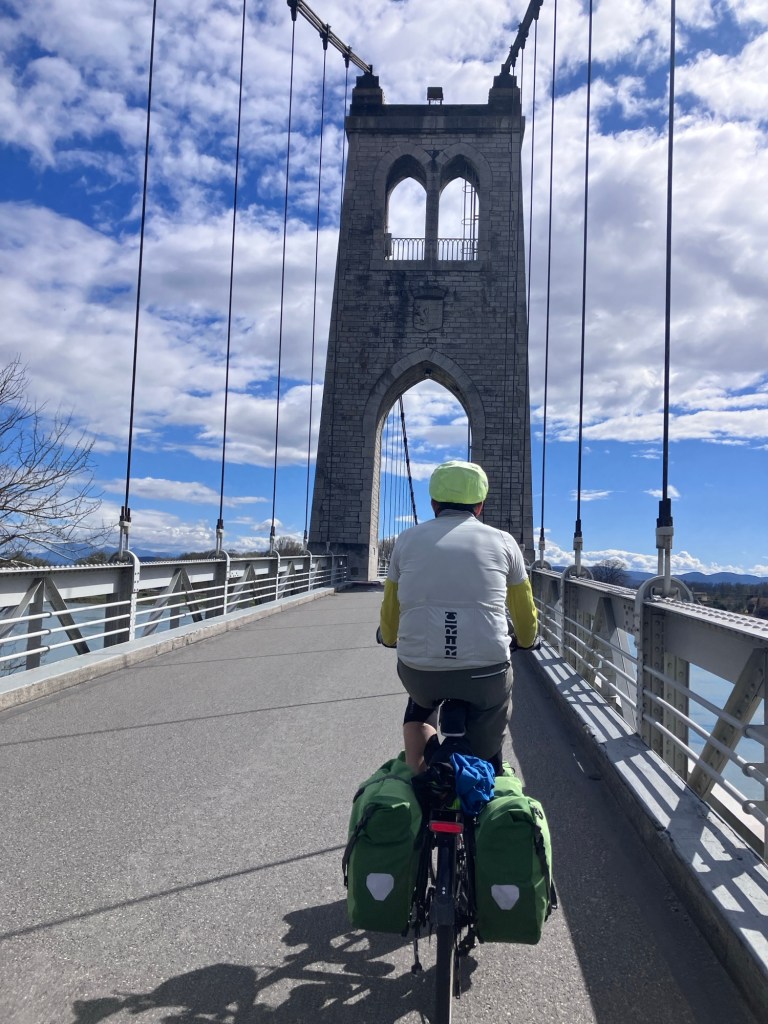
Well fed and riding along the river, day two past Lyon.Rest stop in Chevany. Still chilly.Andancette. We’re riding along the borders of the Drôme and the Ardèche regions. It’s warming up. Jackets off.If cool old bridges are your thing, the Rhône is a great river to ride. Many of the suspension bridges date back to the 1880sTournon-sur-Rhône where the Passerelle Marc-Seguin is a pedestrian and bike only bridge. Even when exhausted it’s great to go for a walk after dinner.Leaving our bike friendly Gite Le Pied Du Géant in Tournon sur Rhône. And a strong tailwind is finally blowing!Monday morning on the bikes on the Rhône. Such an amazing experience and much more fun than Monday morning staff meetings.Dramatic view from Valence of the Ardeche mountains. We went into town to get lunch supplies.The route crosses the river quite often. Which means you get to ride across these stunning bridges.Stopping on a bridge for a photo is not always an option, but we got one.
Montélimar was night 3 past Lyon, and as we headed there we had peek a boo views with Mont Ventoux all day. Mont Ventoux is the stuff of Tour legends, and its white top can be mistaken for snow when it’s only its bare limestone 1,910 m (6,266 ft) elevation.
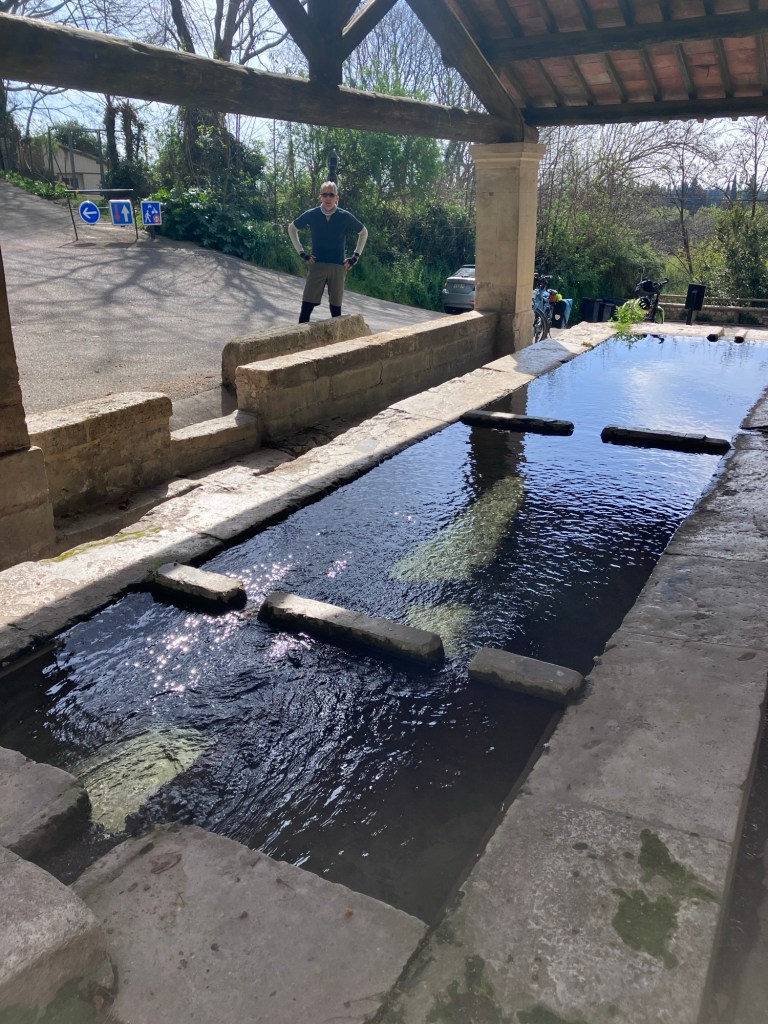
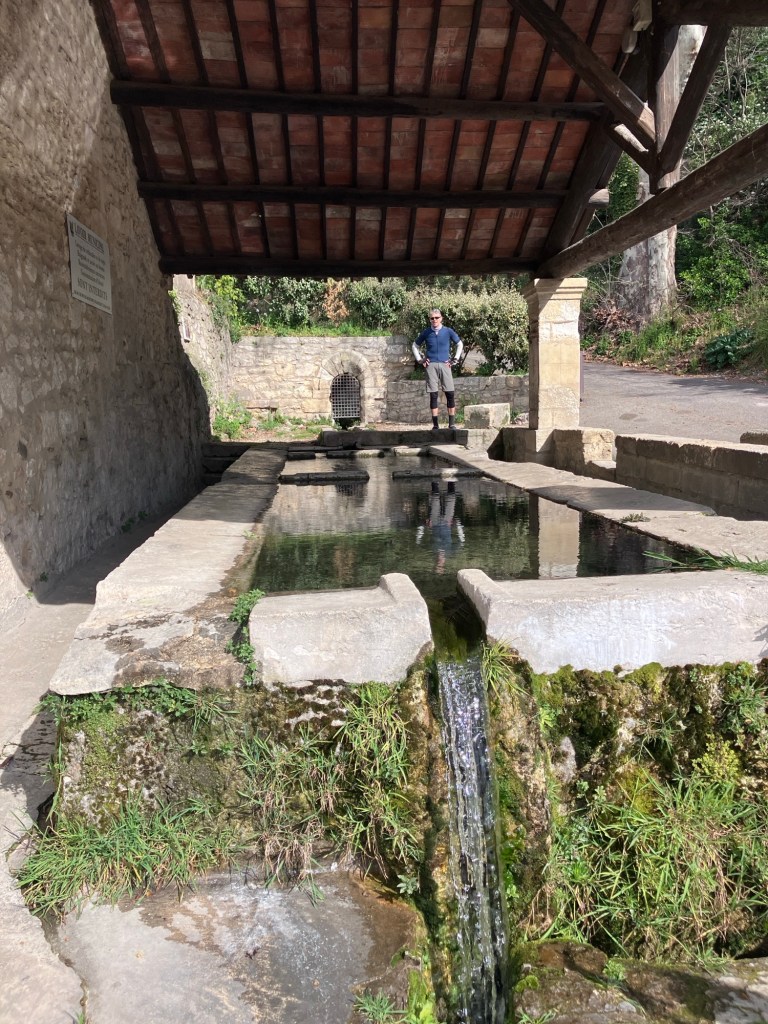
Mount Ventoux.Bicycle themed decor along the route is always appreciated.Lavender fields not yet blooming and blue shutters. Still beautiful.Riding by Avignon. We crossed the river and went right by. We did stop to admire this ancient communal laundry. I’m always fascinated by these.The spring coming out of the hill.A constant source of water.Riding towards Théziers, we’re in the Occitanie region. It feels very Mediterranean. Riding by Montfrin. We ride by a lot of beautiful villages. If we stopped at all of them we’d never get anywhere.
At this point we veered off the Rhone and EuroVelo 17 to visit a famous Roman aqueduct, the Pont du Gard, and spend two nights in Uzés for a rest. Regional routes V66 and V60 take you to the Pont du Gard and Uzes mostly on a beautiful route and rail-trail.
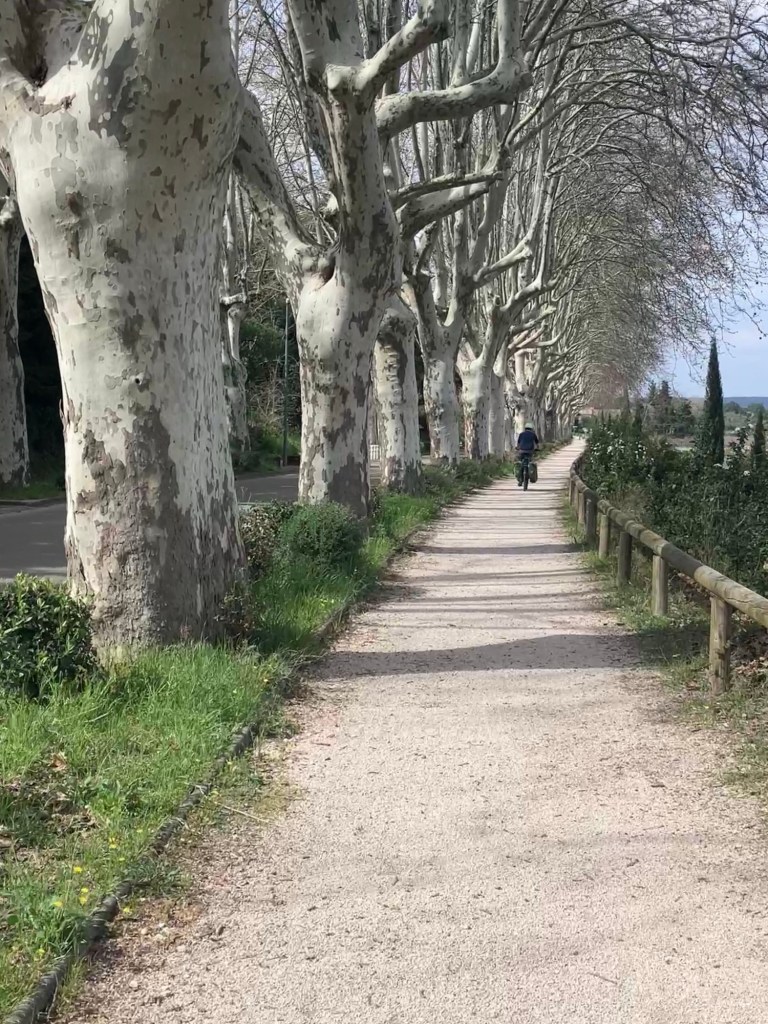
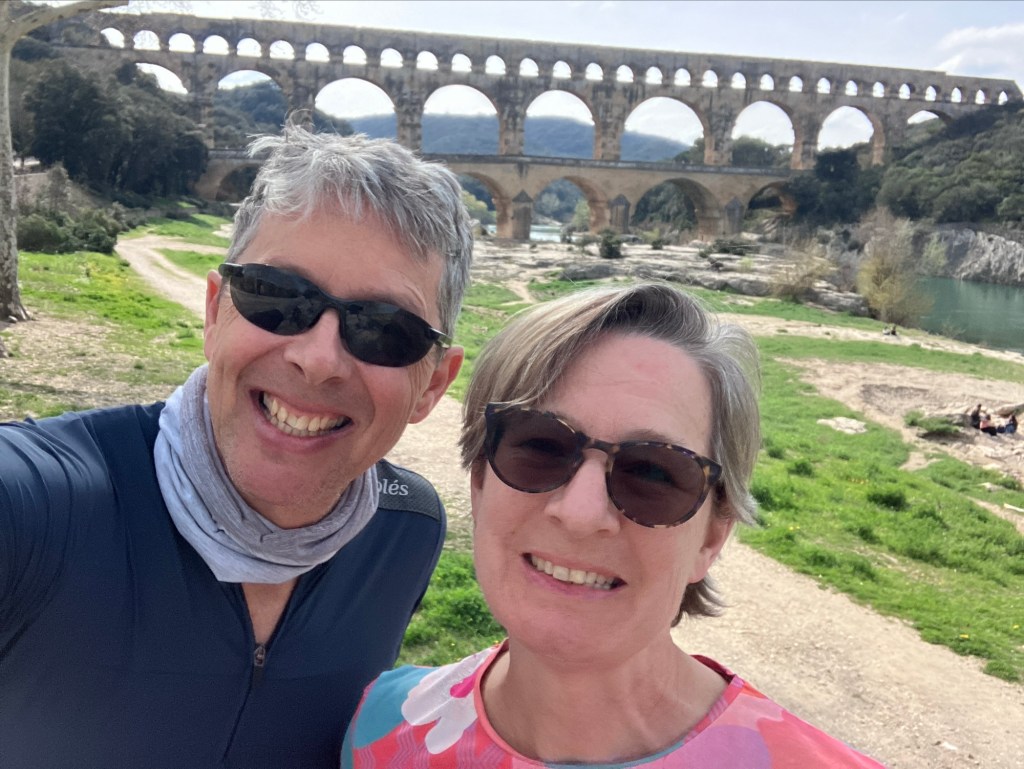
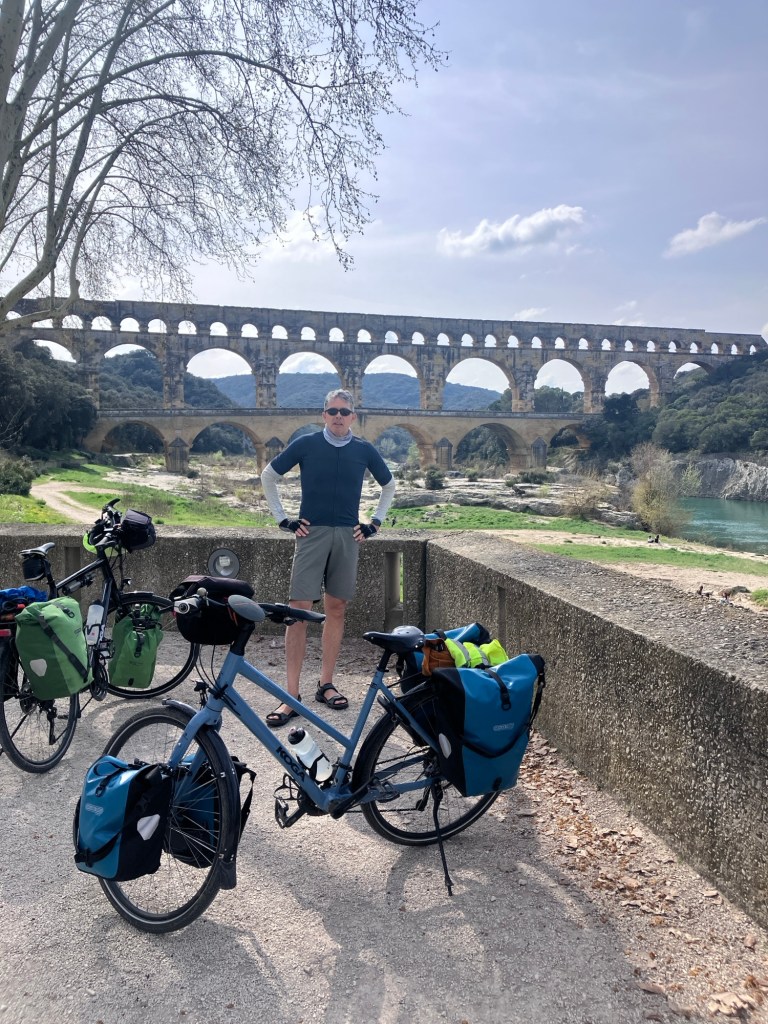
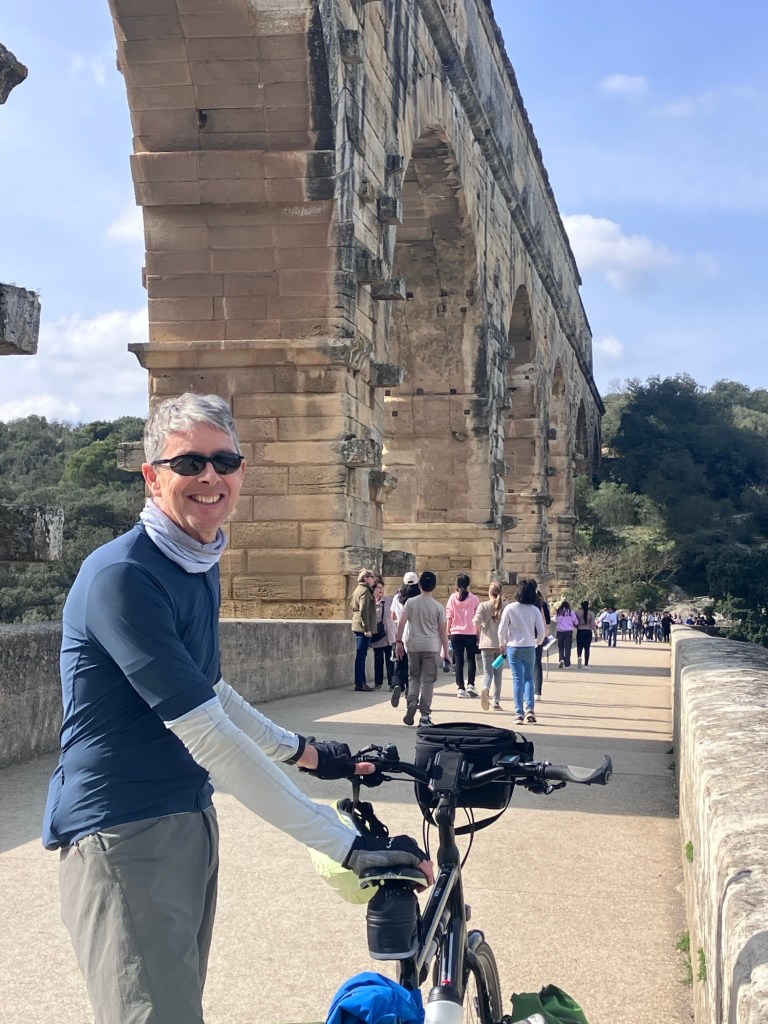
Remoulins, and an Allée of Plane trees. Getting close to the Pont du Gard.No self respecting civil engineer could pass up the opportunity to visit this marvel built in the first century AD.In the summer folks canoe under the aqueduct in the Gardon River.We followed the rules and walked our bikes across.
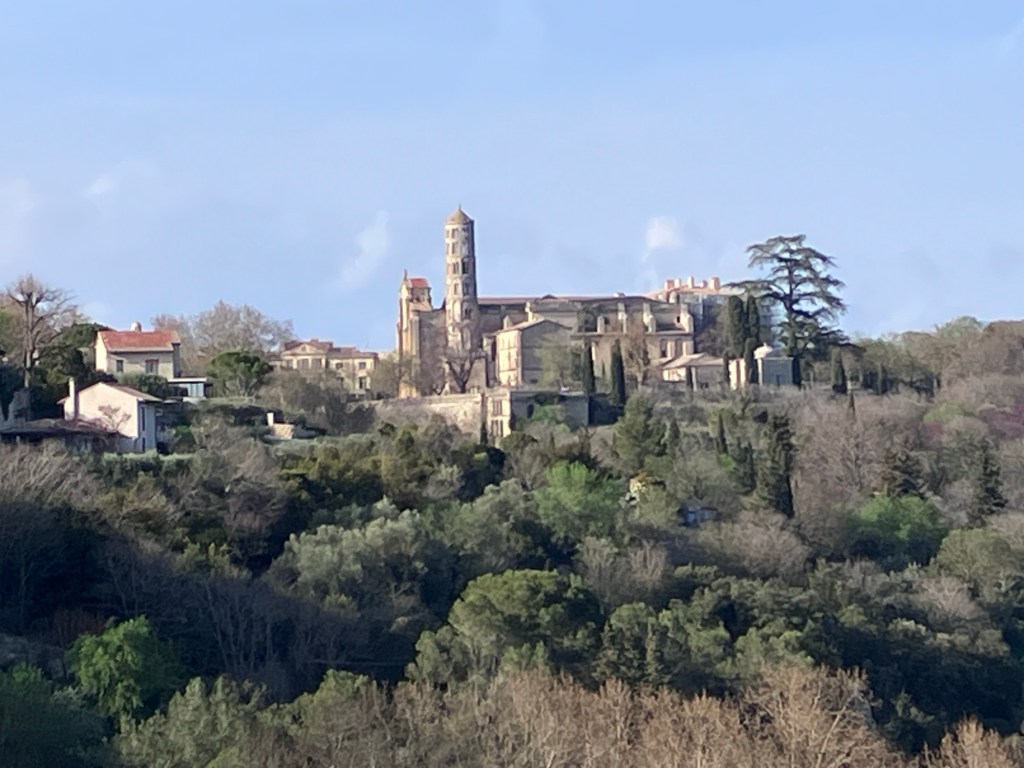
Our two night stay in Uzés was very relaxing. We cooked in one night, walked the small and fancy old town by daylight and night, visited the cathedral, and walked by the Gardon River below town.
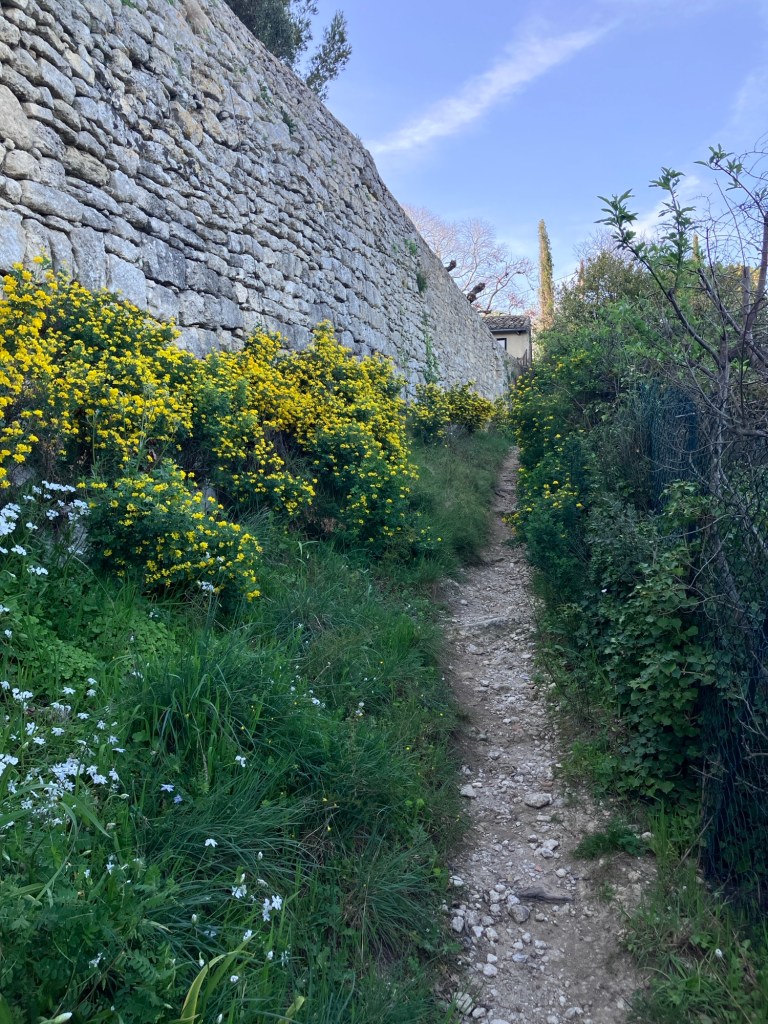
My street at night, this black cat seems to think.It’s a beautiful old town, very fixed up. At the cathedral, a campanile, the Tour Fenestrelle.A view from our walk out of town. Gotta keep the legs used to hiking.Pathways wind around outside the city walls.Loaded up in the courtyard of our apartment.Sometimes staying in old town with touring bikes is a pain. But this ground floor flat worked out perfectly and was beautifully restored.
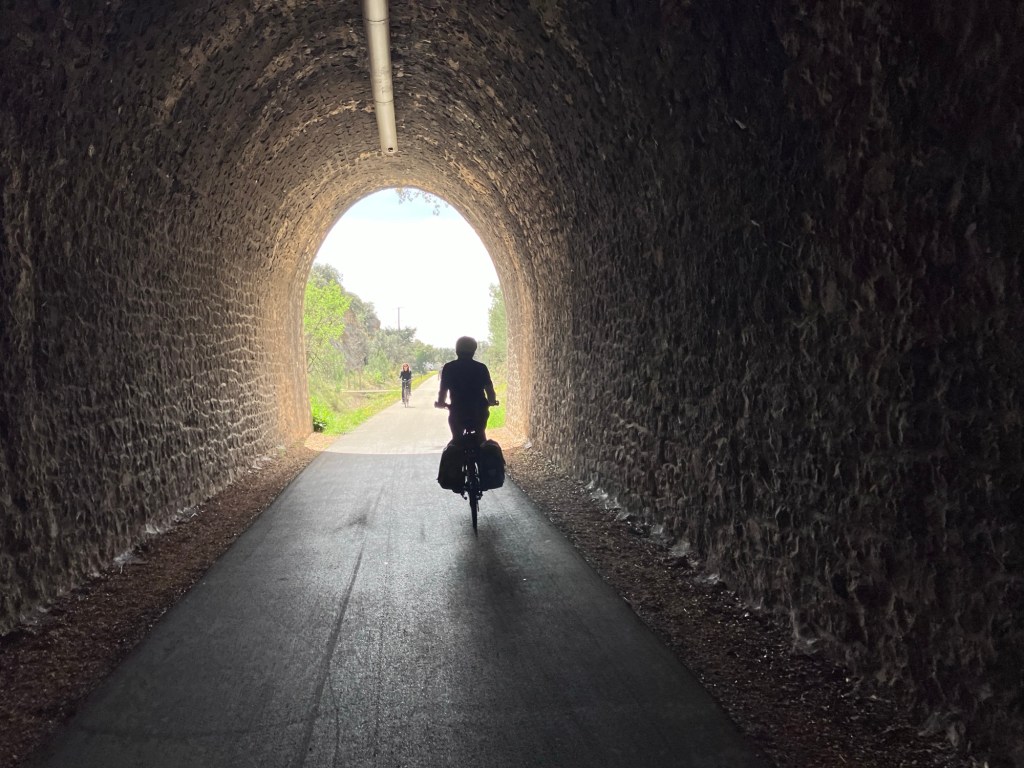
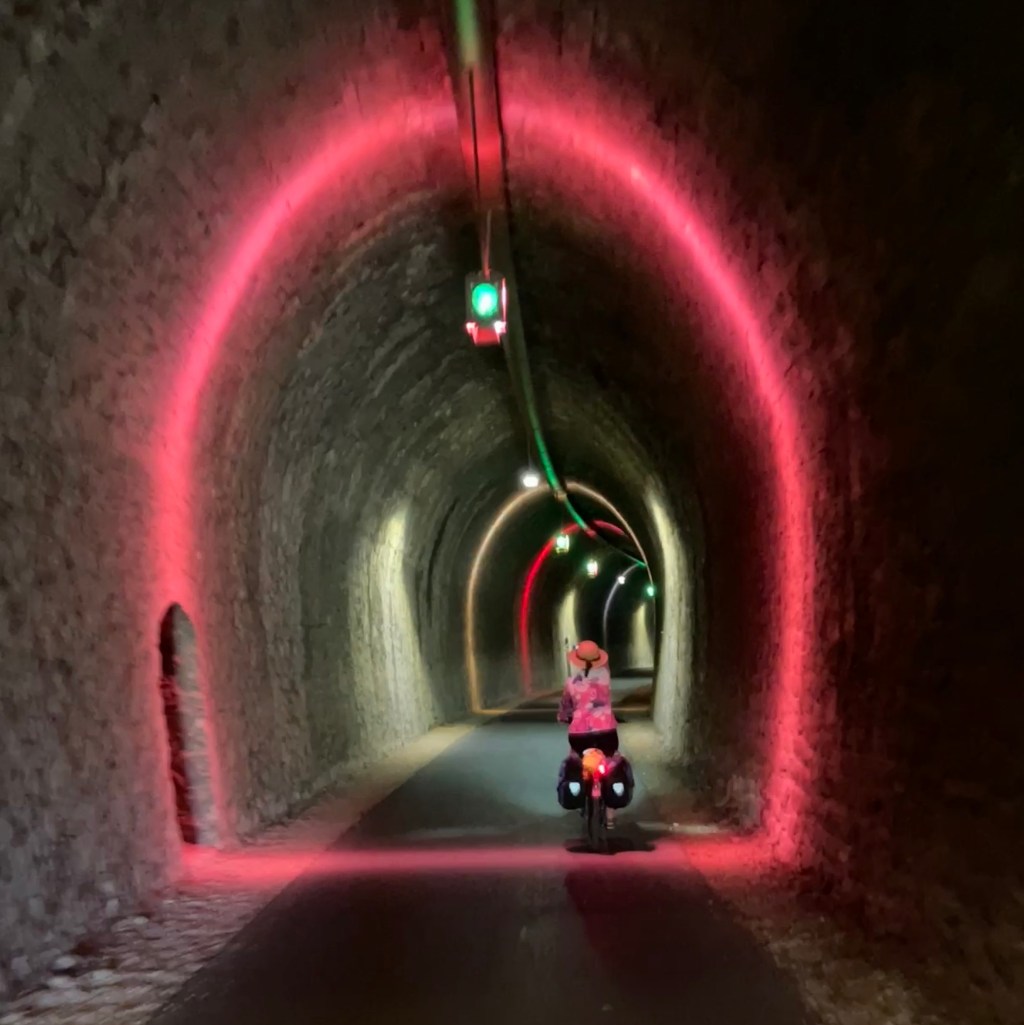
We rode back down to the Rhône and rejoined EV17 through the Tunnel voie verte Beaucaire. It really felt like a change of climate and zones, as if once through that fairly short tunnel we were in a drier much more Mediterranean climate.
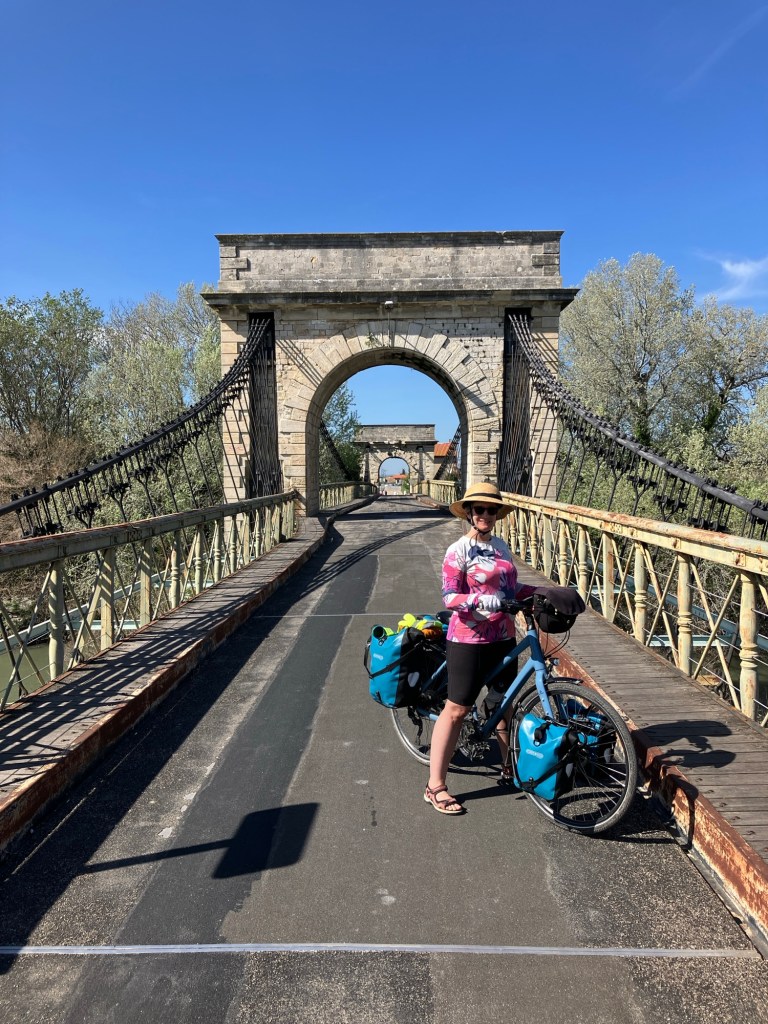
Tunnel voie verte Beaucaire.Dramatic lighting inside the tunnel.Sunshine? Time for my wide brimmed helmet hat!Cactus as landscaping.Another fun and car-free bridge.
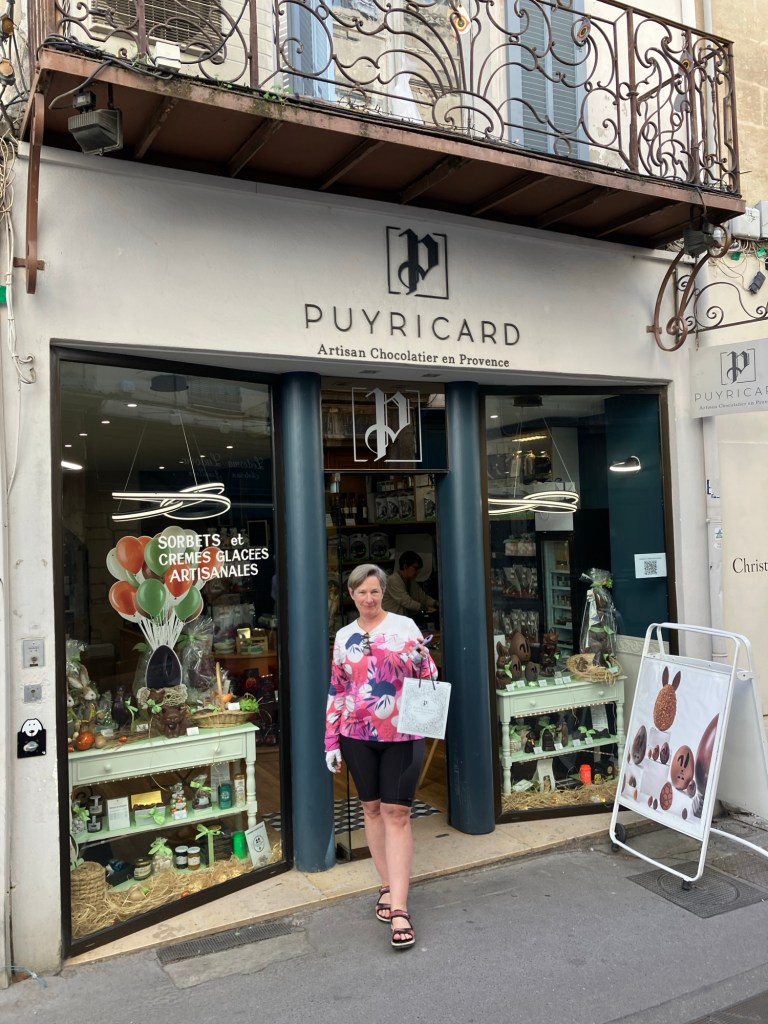
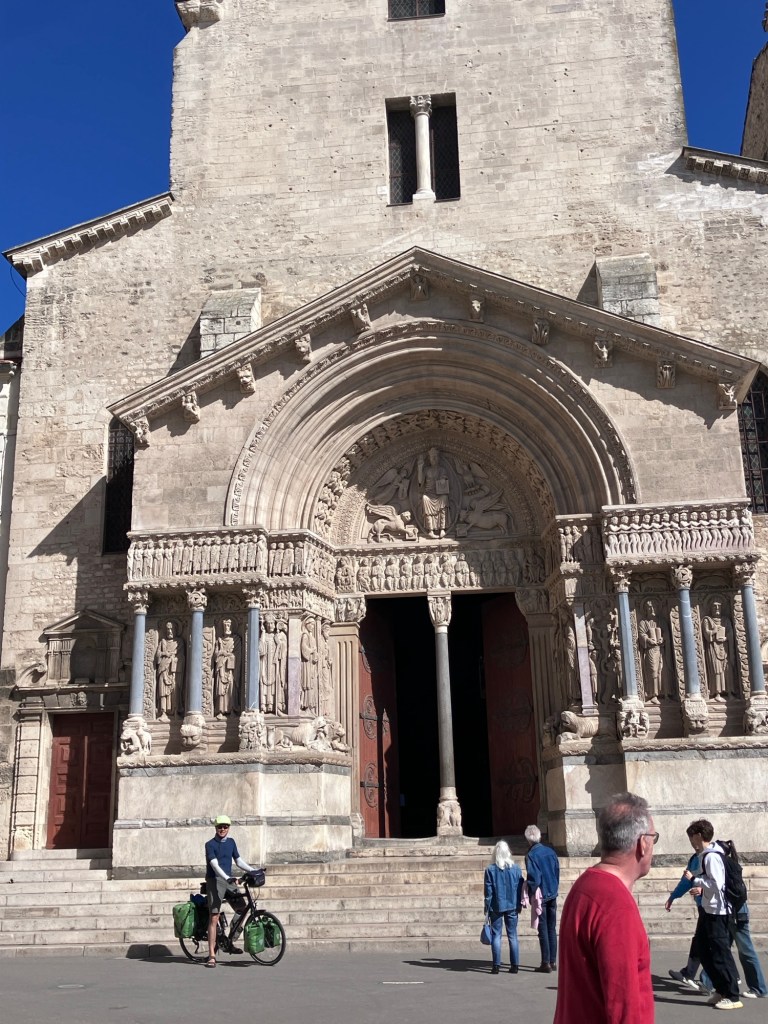
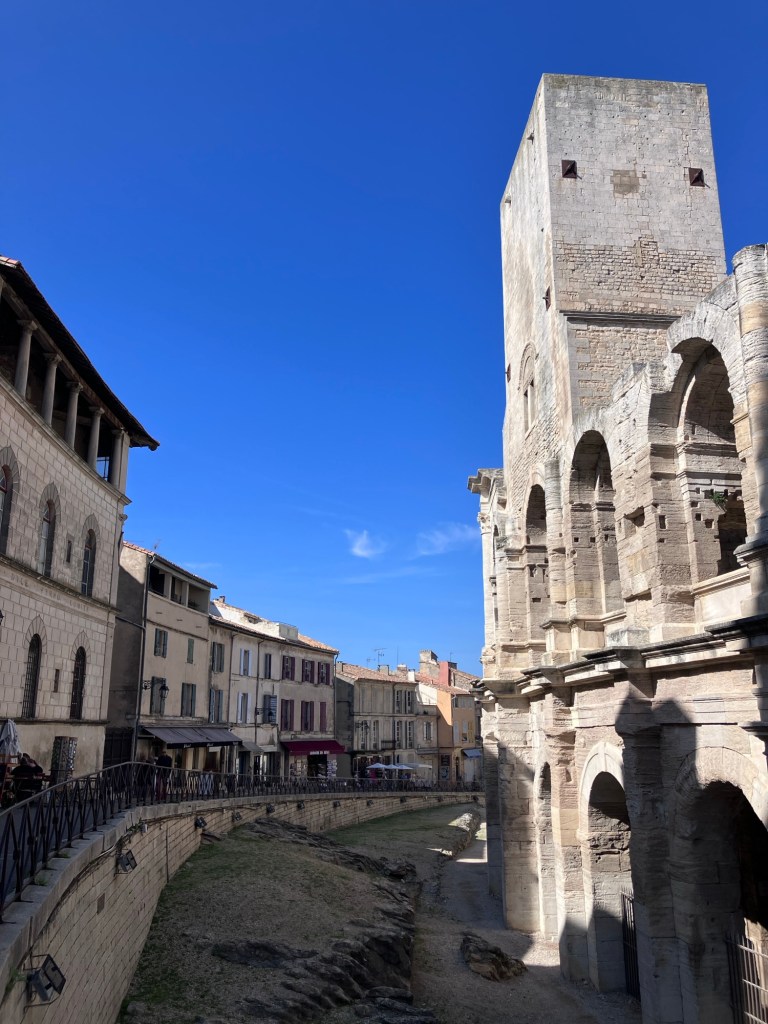
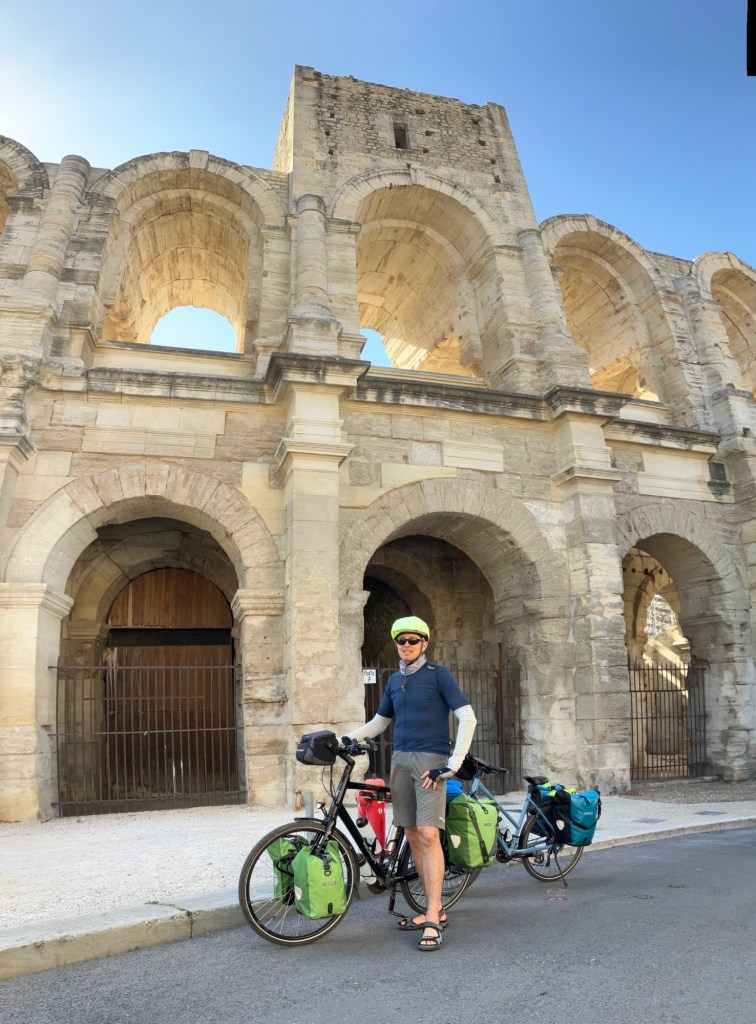
Our next stopover was Arles. Famous for its association with Van Gogh and a stunning Roman amphitheater and coliseum, and visited by many tourists every year. Rich had booked us a hotel out of old town – much easier with loaded touring bikes – and since we assumed that once at our hotel we might not have the energy and enthusiasm to walk back into old town, we did a bike through visit. During a busier season I would not recommend visiting old towns with big loaded bikes but Arles was pretty quiet on this Friday afternoon in late March. So we biked around and admired town and the sights for a few hours before heading to our hotel.
What? This is a sight.Easter chocolate acquired. On to the famous sights.Arles Hotel del Ville.I love how the coliseum is right in the center of town. And, how folks had built homes inside the walls at one point. “The clearing and restoration of the Roman monuments started in August 1822. This major decision taken by the city council was to remain a main objective for 100 years. This meant the compulsory purchase of the houses built, both inside the building and onto the façade, then their demolition.”Our bikes take us everywhere.It’s easy to explore by bike. Dead end? No problem.
After Arles we had one more night before reaching the Mediterranean, in Aigues-Mortes. Unfortunately, Rich was developing a nasty cold, complete with a hacking cough and burning sinuses. And, to make the final part of the ViaRhôna even more painful – the headwind gods decided to pay us a sustained visit.
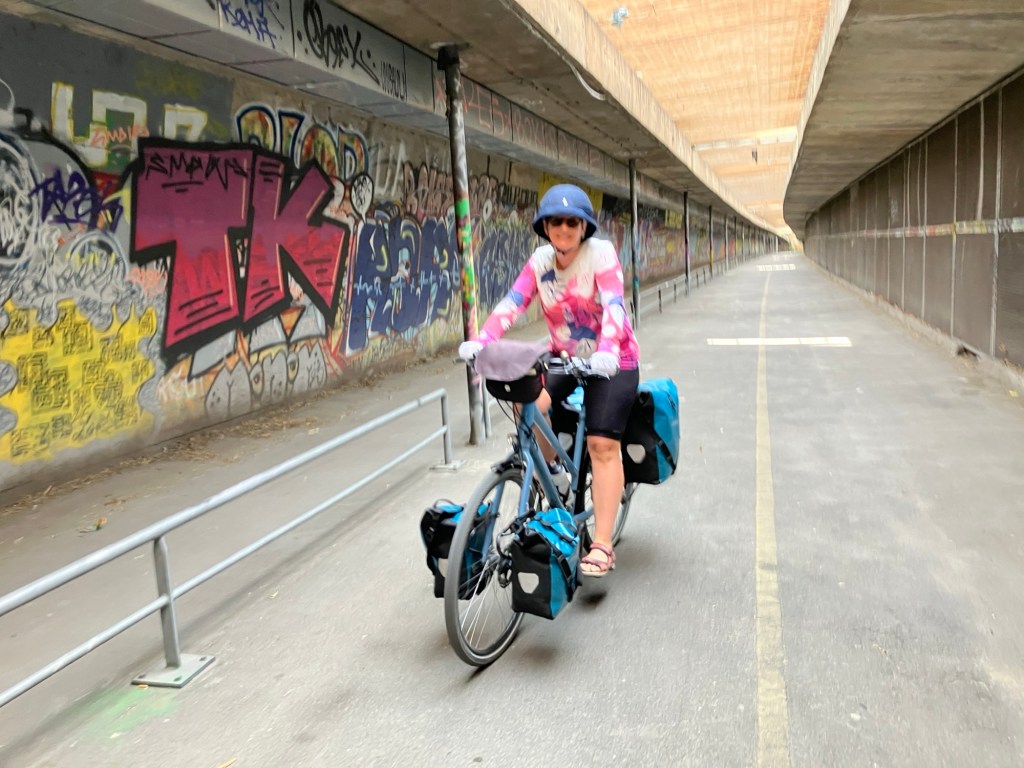
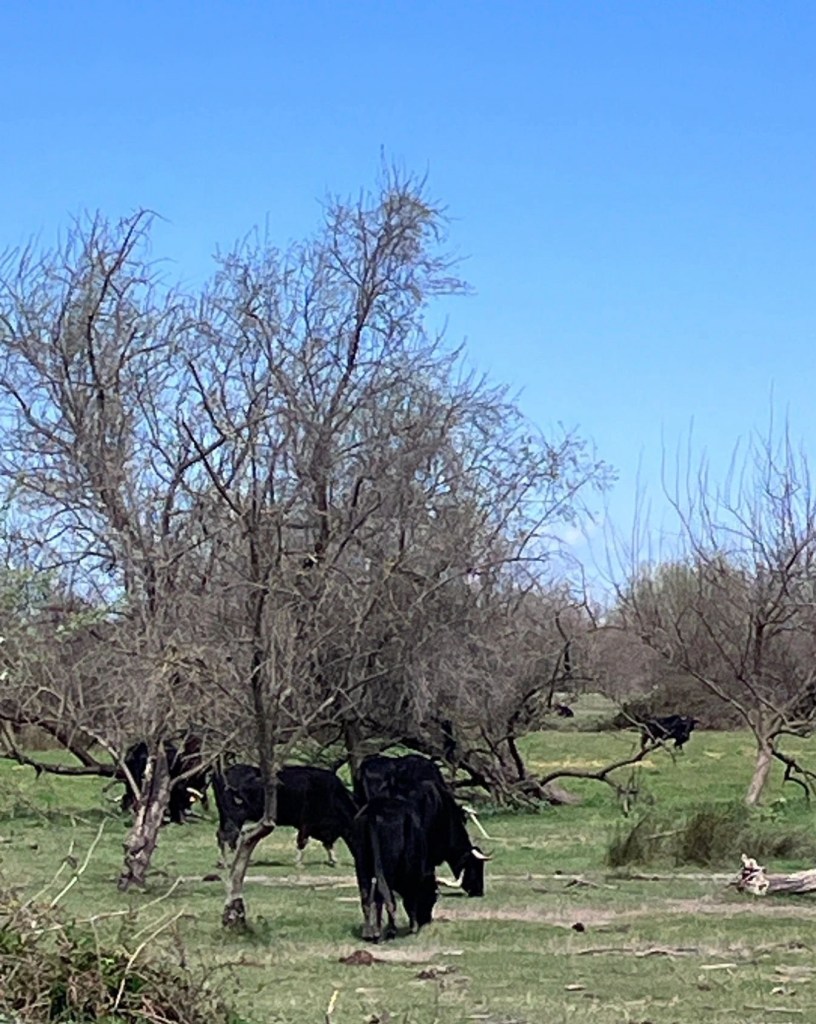
The most unusual bridge over the Rhône. It was bike and pedestrian only and obviously a favorite of local taggers.Homage to the black bulls of Carmague.
So, filing this under you never know what you don’t know: France still has bullfighting. The arena in Arles hosts bullfights in the summer. I shouldn’t be surprised that this activity traditionally exists in France as well as Spain, what’s a border, really. France has a law protecting bullfighting as a long standing cultural tradition. From what I can find online it seems that the bulls are no longer killed. So there’s that.
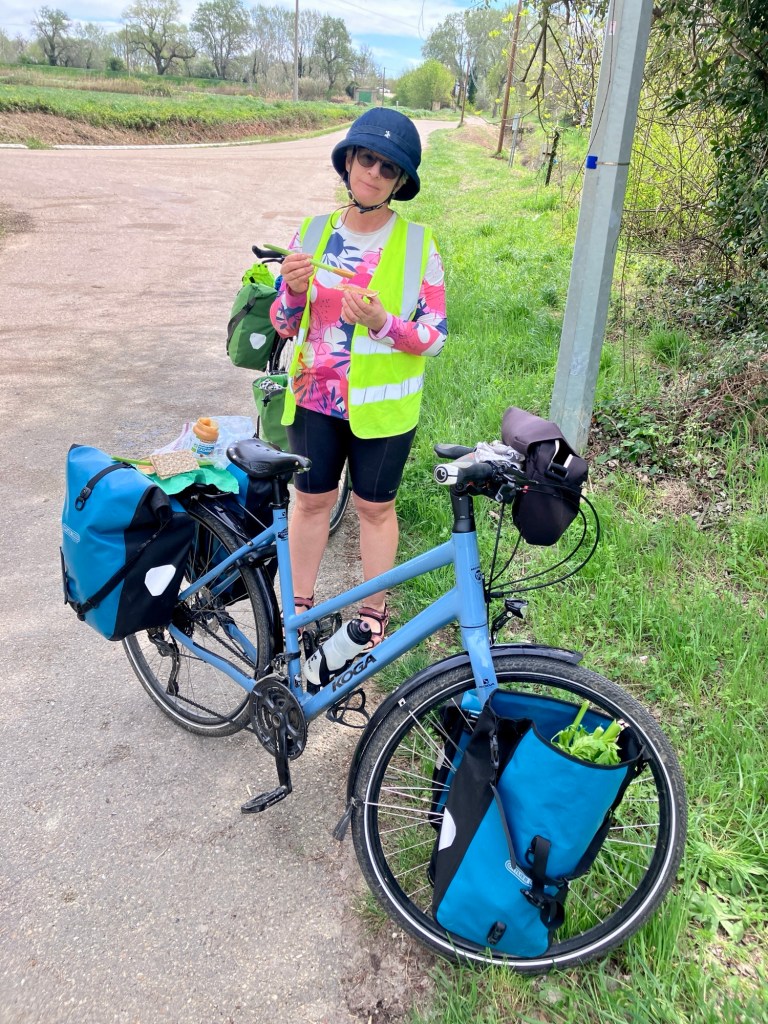
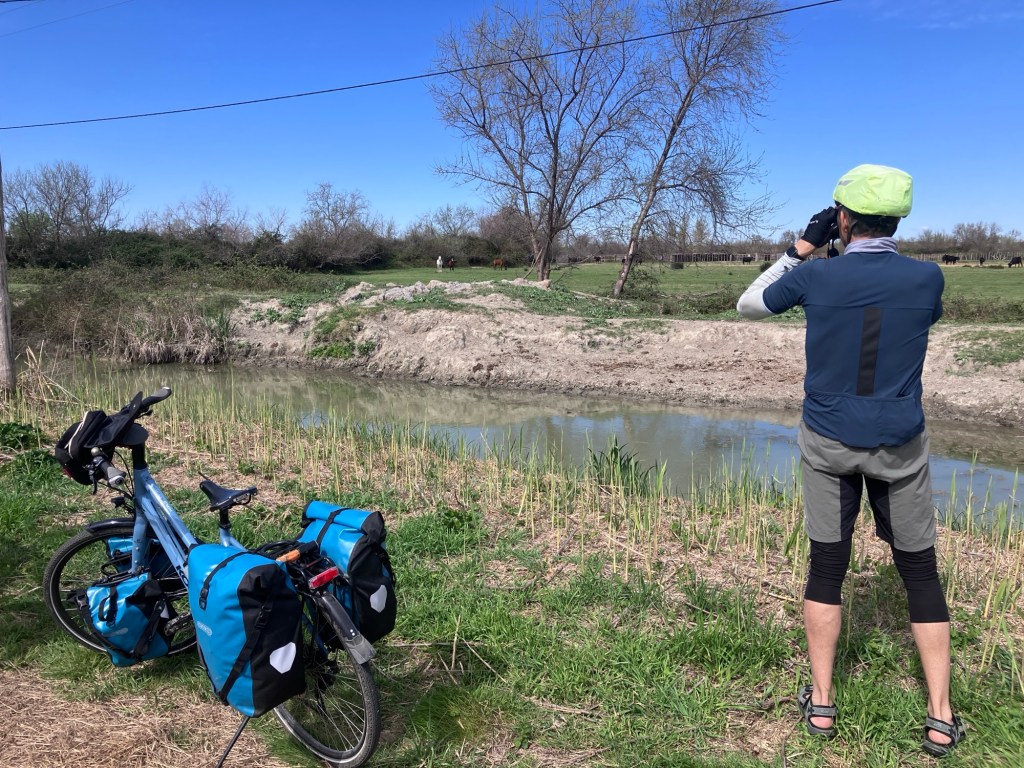
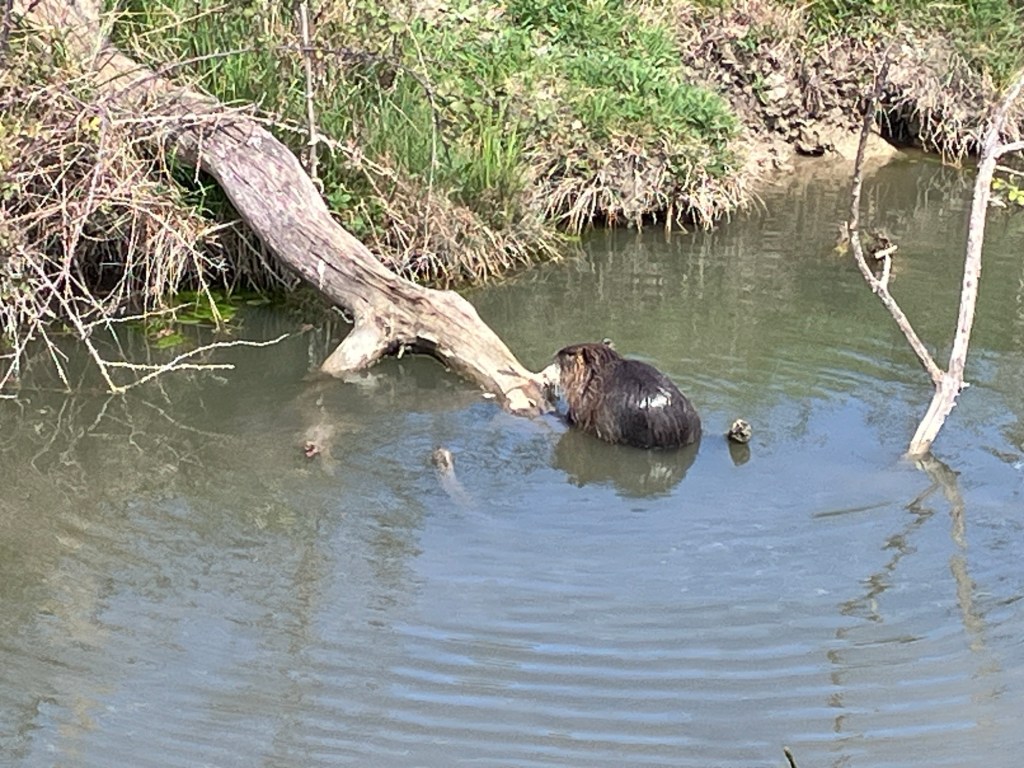
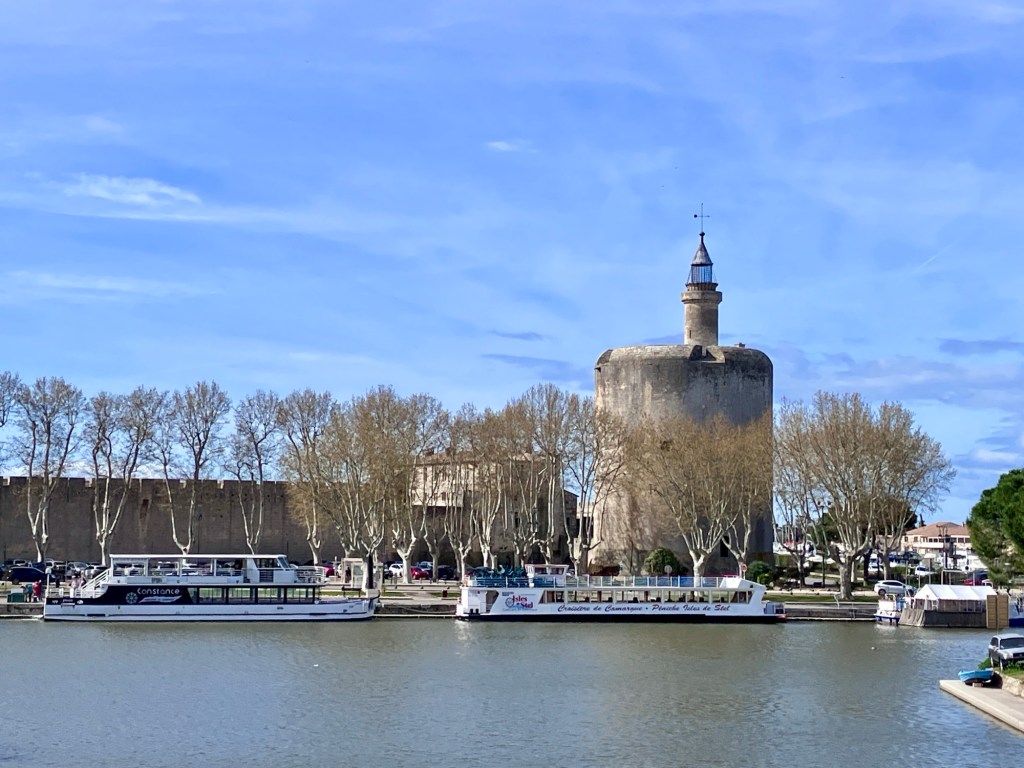
Black Carmague cows, or steer, or maybe young bulls? The white horses of the Carmague are semi feral and we did see some roaming ones. This one is behind fences.This stretch of the route is very poorly benched and exposed. Nowhere for tired bike tourists to sit and have lunch. So, a rather unsatisfying stand up snack.A stop for birdwatching.Muskrat being quite adorable. Flat. Marshy. Very windy. Water on both sides. Beautiful but not a super fun ride on this windy day.Heading into Aigues-Mortes for dinner. It’s a fascinating old city, but we were tired, Rich was sick, so we only did a quick walk around before and after dinner.Aigues-Mortes is an old walled city with fortifications dating to the 13th century.
Rich didn’t get much to time to rest up, as we could have stayed two nights at Aigues-Mortes but the hotel was a bit overpriced and we knew that after the headwind a rainstorm was coming so we wanted to press on to Montpellier and spend two nights there. So, out into the wind it was. Oh, and the train spur to Nimes from here was not running due to work.
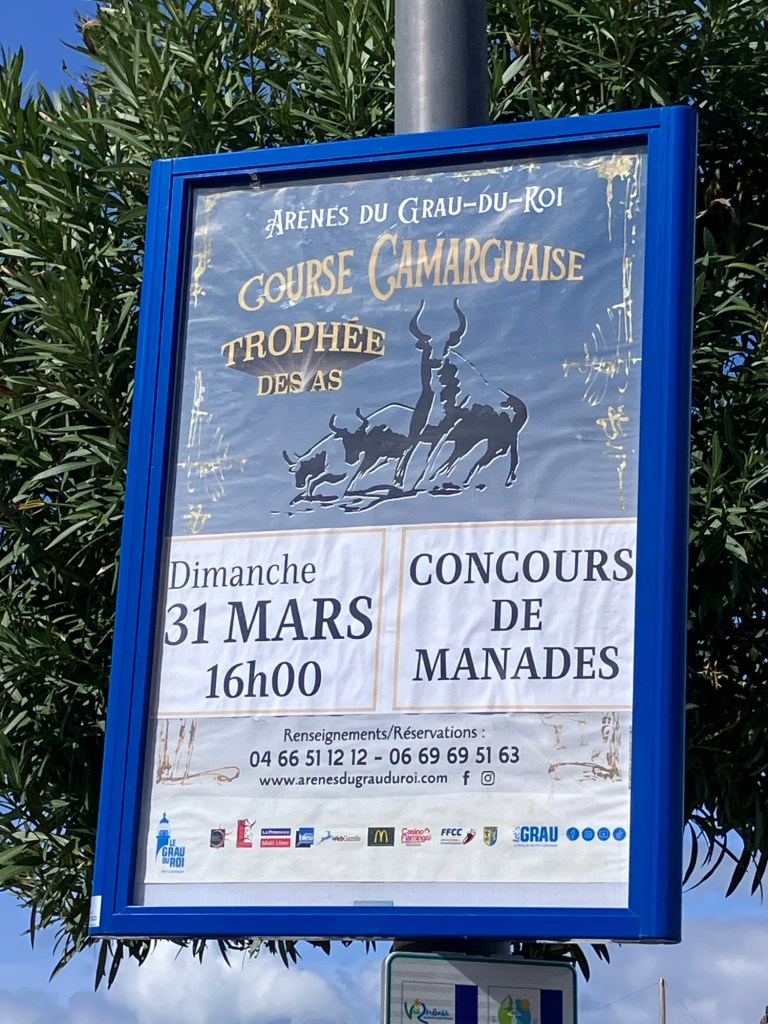
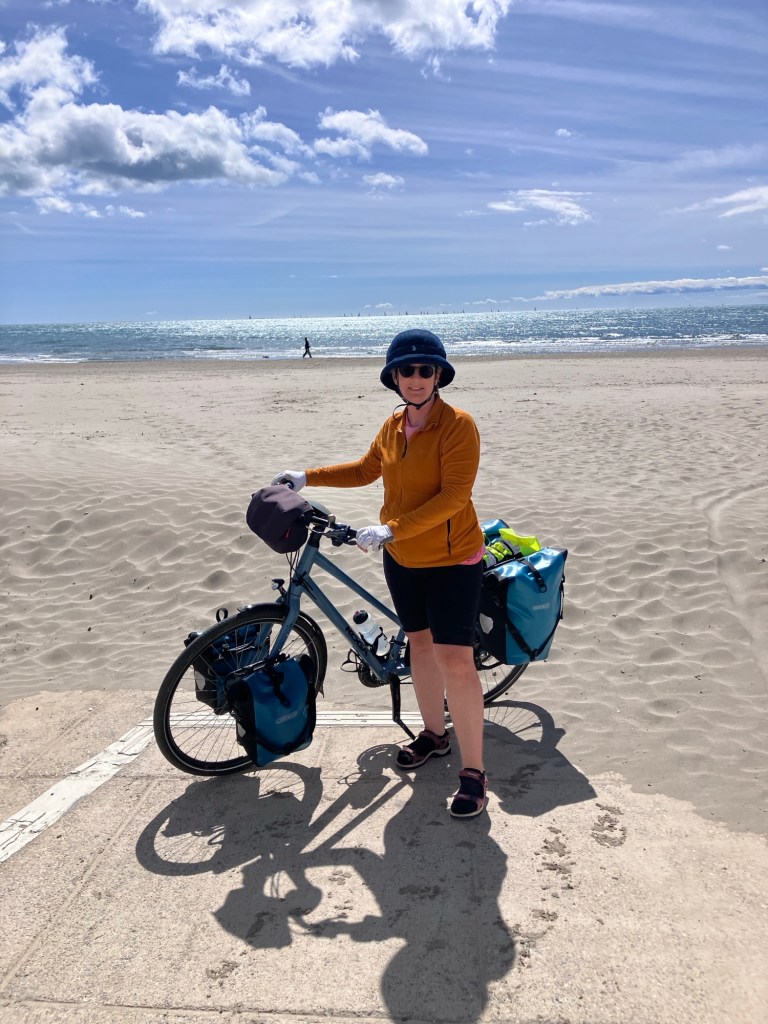
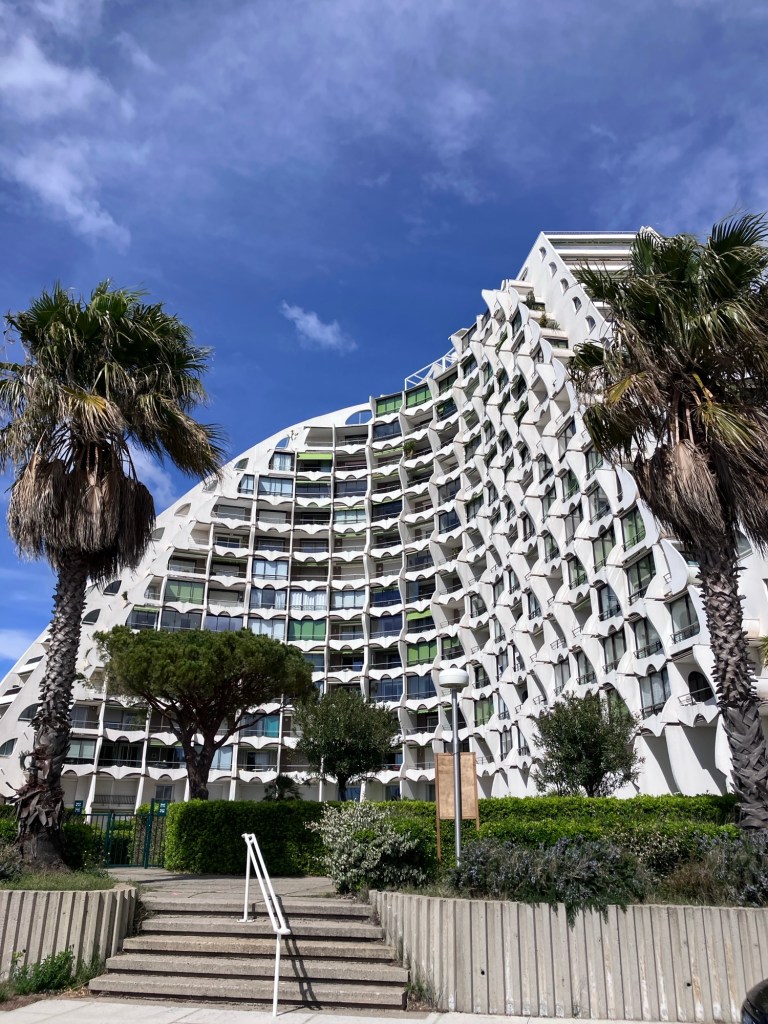
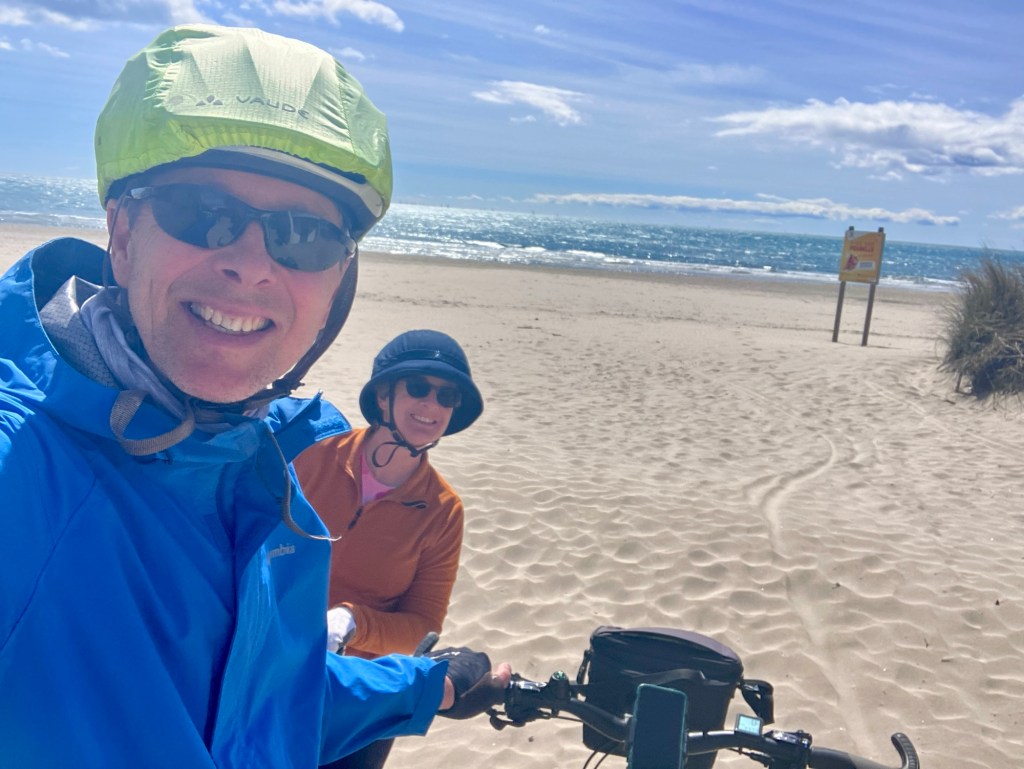
Aigues-Mortes by day. It’s on the Canal du Rhône à Sête.La Baleine sea salt production. Those are salt piles behind Rich.Greater Flamingos. We didn’t think we’d see them on this trip as they mostly stay further east in the Carmague. Head down into the wind I’m pedaling along and glance right…hit the brakes! Flamingos!Bull fight poster at Grau-Du-Roi.The arena where the bull fight will be.And finally, the Mediterranean Sea. It’s hard to capture how windy it was this day. The sand was blowing and we had to be careful to not let our bikes get knocked over when we parked them.Hold on tight to that bike and smile! Ignore the head cold that is coming for you too.Across the sand dunes is La Grande-Motte, a seaside resort and port built in the 1960s and 70s with a unique pyramid architecture style.La Grande-Motte.Happy that we will soon turn inland towards Montpellier for a rest day.
With the Via Rhôna complete, and two more months of bicycle touring ahead of us – what do we think of the Via Rhôna? I enjoyed it, the river isn’t as wild or beautifully stunning as parts of the Loire, nor is the route as complete. Parts are definitely still under development. But, with a route passing through so many municipalities there must be so much negotiating and planning behind it. Certain areas were so well marked with fantastic new protected lanes and intersections, loads of benches and rest areas for weary cyclists, and other stretches had almost nothing beyond an occasional sign.
The happy travelers ready to pedal inland, get over our colds, and out of the wind.
I think the Carmague is a place I’d like to return to with a car. Apparently the mosquitos get thick during the summer and then you wish for wind, but the bird watching is fantastic. As we were pushing along into the wind I did slightly envy the visitors in cars, but I know, that as always, we have a more up close experience from the seats of our bikes.
It’s a travel cliche; you can read all you like, but until you touch the ground and meet the people, you’ll never get a true sense of a place. And some places feel particularly dynamic with extreme drama in their recent history or a promising future dawning. Albania is smack dab in the middle of a multi generational transformation. And we are here now.
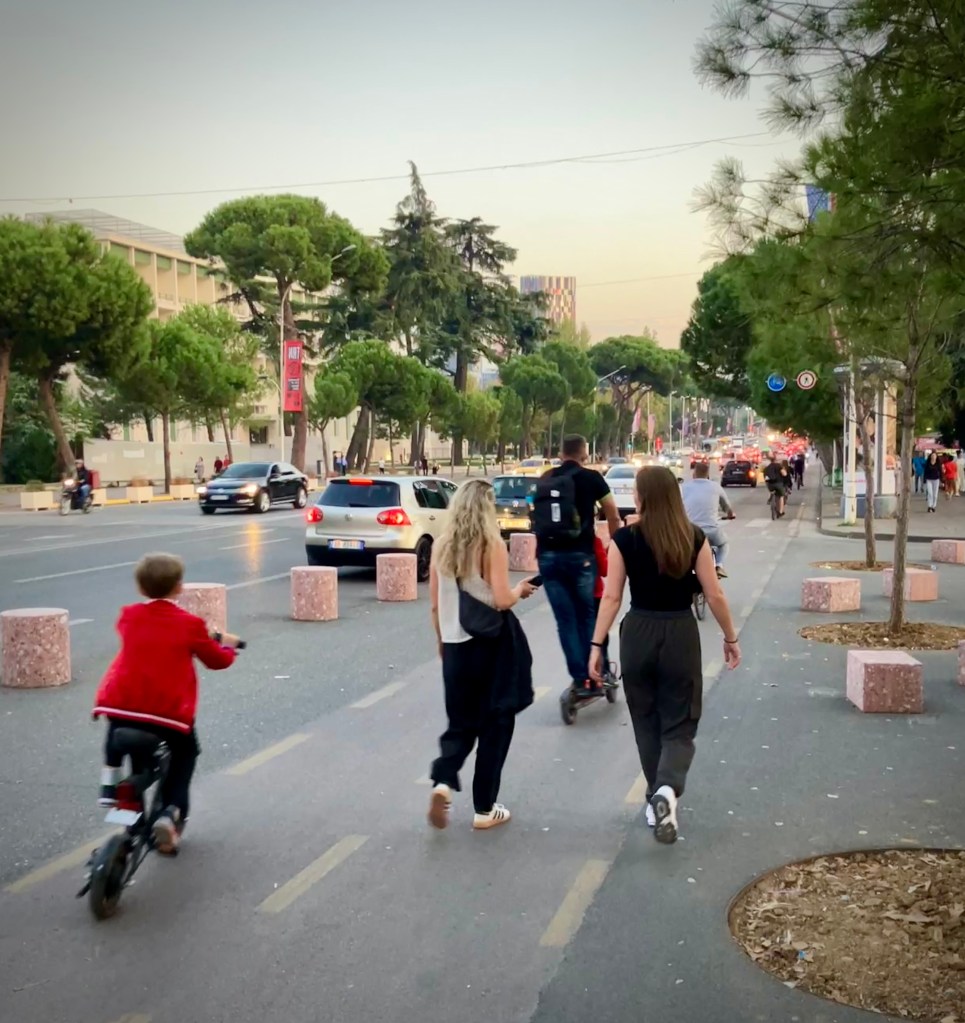
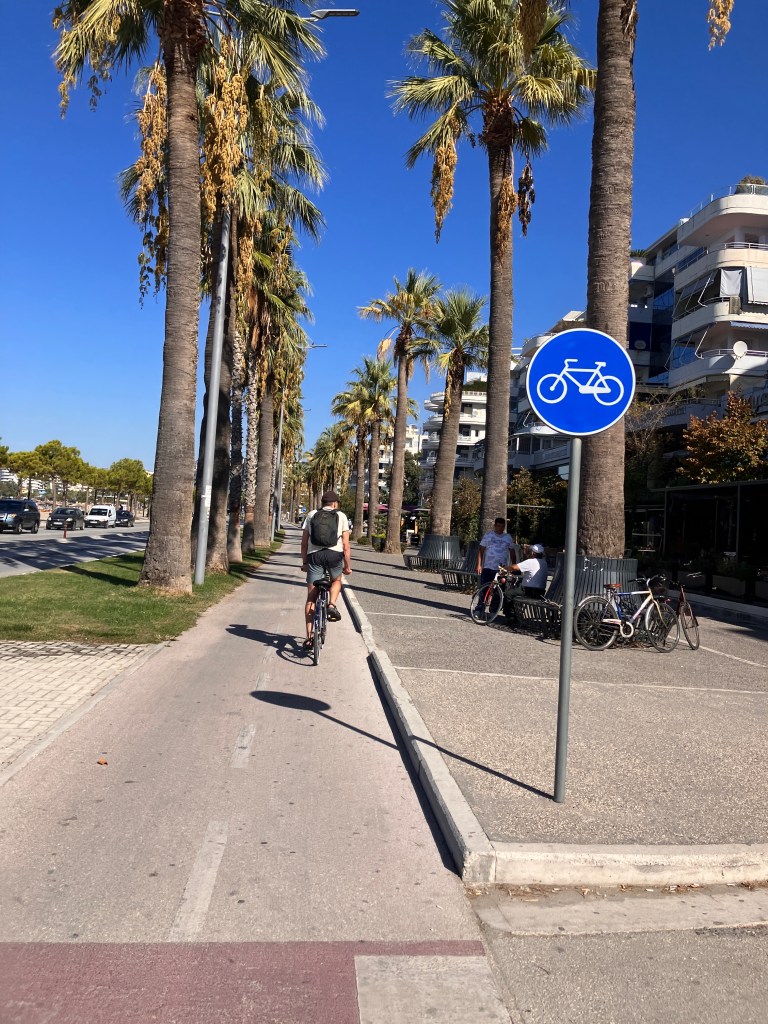
A greener future for Albania and new opportunities to join the EU.This was NOT how I pictured “chaotic and congested” Tirana.Bikeways now connect a lot of central Tirana. Some double as walkways…We were lucky to enjoy the recent renovation of the Pyramid of Tirana by MVRDV Architects and Arup. You can now climb the stairs on all sides and enjoy a variety of public spaces and views of central Tirana. It’s cool.It’s become quite a hang out space. Took some waiting to get a photo without young people climbing the stairs.The stunning renovation of the Pyramid includes TUMO, an educational organization focused on teaching youth innovation skills such as software, robotics, and animation.
Albania’s history gives it a very unique character. It came out of the gates slowly from the years of a repressive and isolationist government with continued troubles in the 90’s and modest economic growth until recently. But now it’s now on a faster rise and you can sense the optimism here. But it still has a GDP per capita about 1/3 that of Croatia and Greece, and challenges remain.
A delicious first dinner at Era restaurant in Tirana, which does creative takes of Albanian classics like this meatballs with pistachio Of course I had to try one of the signature micro brews of Albania, Birra e Gjyshit, in the name of global research. It’s good.
But why are people so chill? Why is car ownership so low and why are the drivers surprisingly considerate of pedestrians and bikes? We started observing the character of the people in line for our flight from Geneva. Pretty chill. The Tirana customs and immigration was chill. Getting a SIM card? Chill. Taxi? Fixed fare and you guessed it, chill! In fact, adapting to just how chill people can be here takes some adjustment. (Especially my Type A personality!) It’s clearly a legacy of the past, but defines the present here. The young people do have a more energetic and engaged vibe.
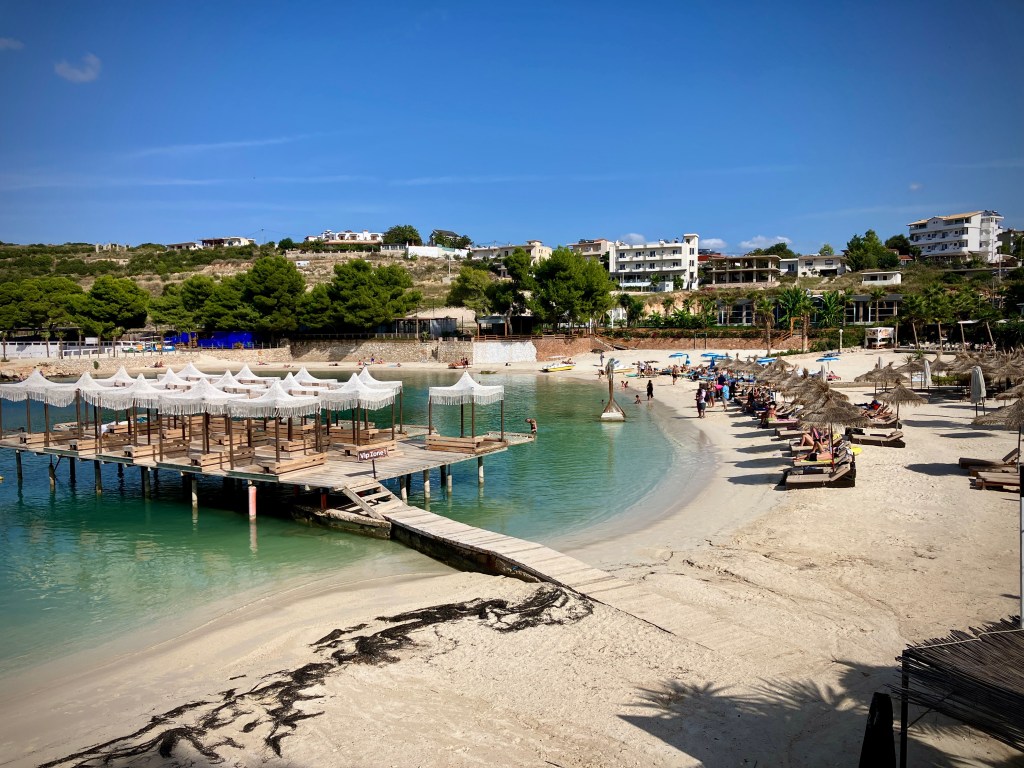
Many things are a work in progress, especially in the coastal areas; the view from a cafe where we stopped briefly for lunch and a swim after Buntrint.Tirana’s underground BunkArt2 Museum was a good overview of Albania’s communist era. Bike culture had been here a lot longer than the recent car culture, and Albania still has one of the lowest car ownership rates in Europe.
One thing travellers often refer to when describing a country is the “hassle factor”. How difficult is it to get around, complete transactions, order food, get money, etc? Albania scores well on this front as interactions tend to be straightforward and prices are generally clear. (Exception: some taxis…which really is a global problem!) It can also be little things like making change for large bills spit out by ATMs. No problem in Albania. Credit cards are also taken at some places, especially in bigger cities and everywhere in trendy neighborhoods of Tirana (like Blokku).
Heading to the “North-South Bus Station” in Tirana. Cracking the code for the bus and minibus system is one of the bigger challenges for travelers in Albania.That look says; ok, where the heck is the bus to Vlorë?! But no worries as we just walked around a bit and were quickly pointed to the right bus. Take a seat and pay on board. Generally.
I would recommend bringing a healthy supply of Euros as this can make it easier and cheaper to pay at places priced in Euros (most lodging). And note that all ATMs charge $5-$8 per withdrawal, so withdraw as many Lek as you can per transaction to minimize fees.
The minibuses or “Furgón” also transport packages such as these giant boxes taking 6 seats on our run. We were worried for the guys in front of the boxes in case of a sudden stop 😬.Vlorë comes alive in the evening with pleasant sidewalk dining and great people watching. We had a good chat with the nice guys at the next table who were from the UAE.
Our strategy for a mid October visit was to head to the coast first as many places do start to shut down, and by early November only the bigger coastal destinations (such as Sarandë) still have a lot of life. We’d then explore the inland cities and villages in the mountains and high interior.
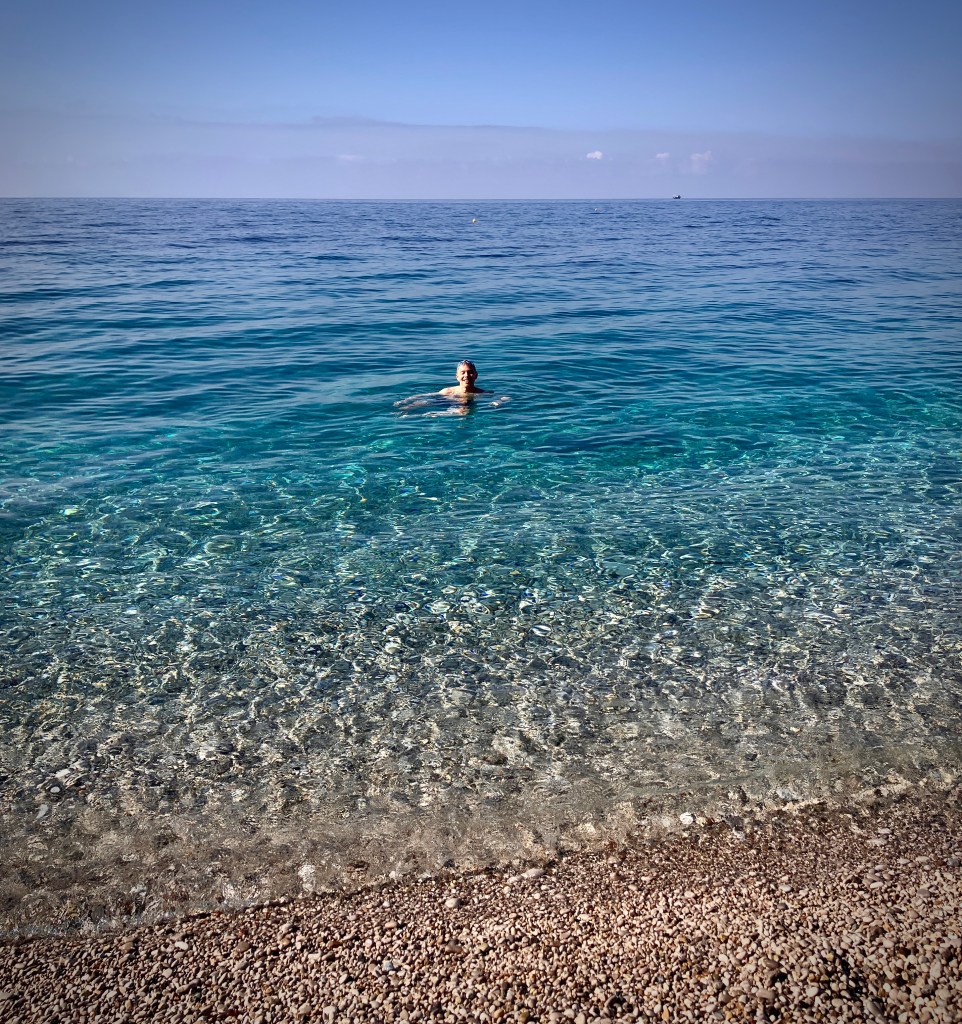
Our hotel had a fleet of free bikes which was great for getting around cycle friendly Vlorë and to our favorite swimming spot.The promenade and small Azar Beach about 4 km south of central Vlorë offered turquoise water and better swimming than the main stretches of Lungomare.Swimming near a Barrel Jellyfish (?) which just look beautiful and don’t have nasty stings (right?).
The strategy paid off as we still had nice weather, the beaches were still swimable, and enough was open to have a rewarding experience. We loved the chilled vibe of late season, and still met some nice fellow travelers, but if you want more of a scene, come earlier. If you want a full on party, packed nightclubs, and crazy beach scene, come in late July and August!
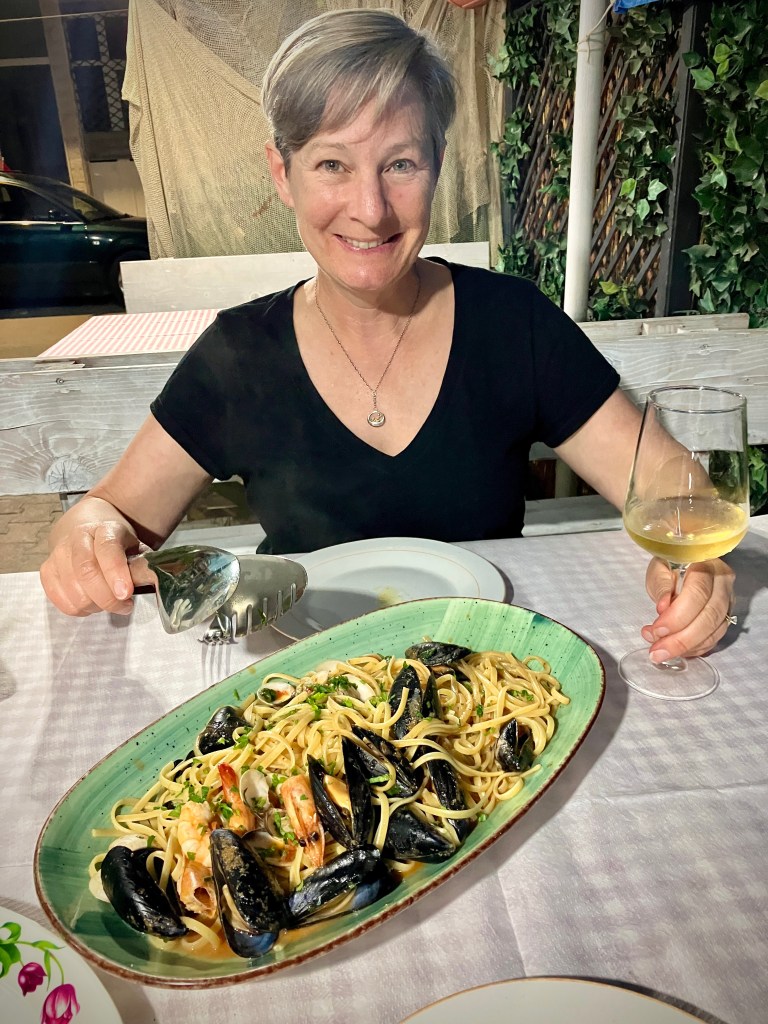
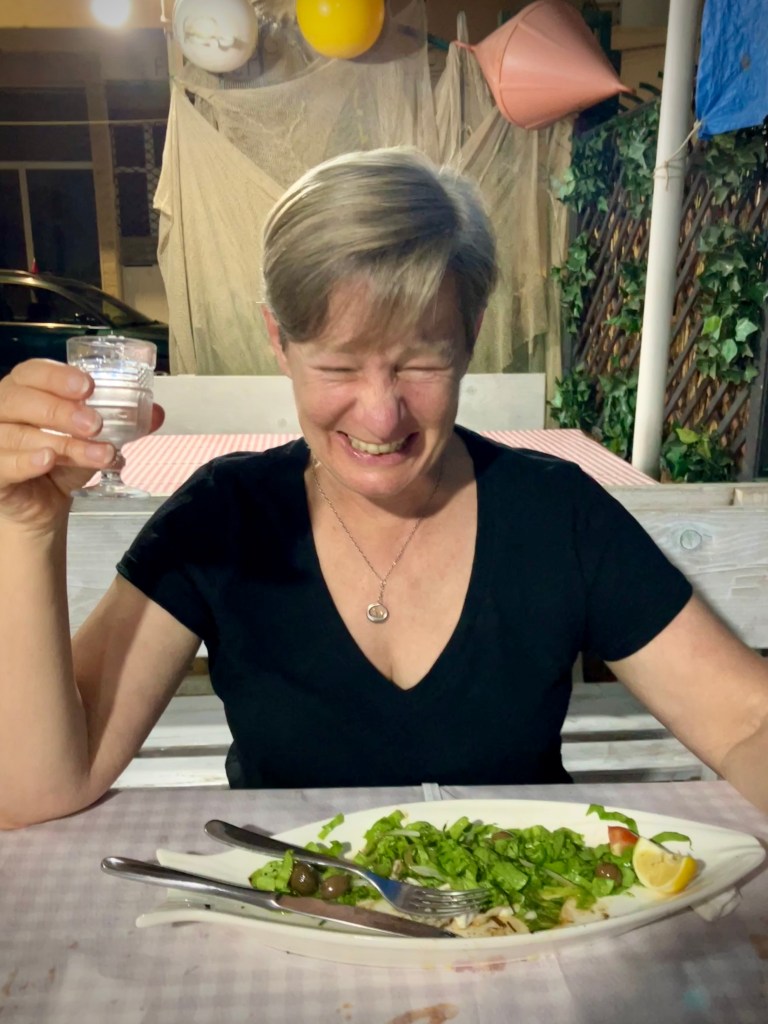
First course of seafood and perfect linguini at the wonderful little Skerdi Restaurant in Vlorë. The friendly owner/chef cooks amazing seafood and pastas.Nothing but bones. A clean removal.And this is what we call “Raki face”. We don’t seek out Raki in Albania, but with so many friendly restauranteurs, the Raki finds us.
We decided to stop in the small coastal city of Vlorë on the way to the more popular parts of the coast and were really glad we did. Vlorë is extremely pleasant and has a wonderful primary shopping and restaurant street as well as a long beach promenade, all with heavily used bikeways.
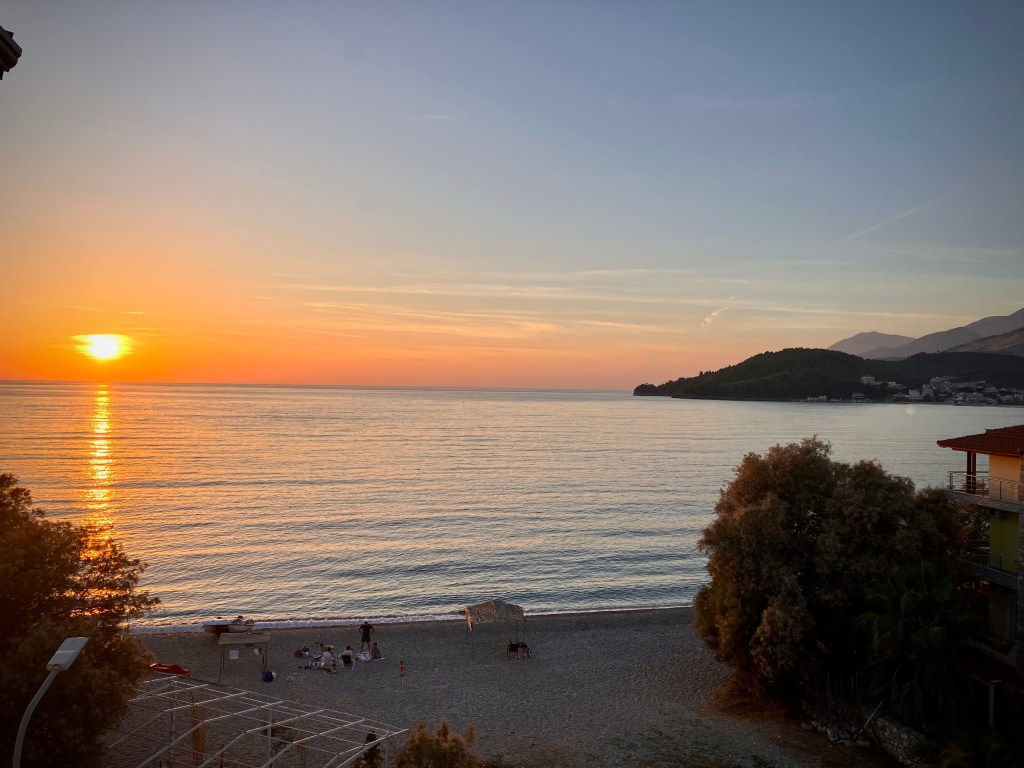
The public buses in Vlorë are easy and clean. You can board any door and just pay the fare collector who comes around, and makes change. (40 lek)Vlorë’s bus station is a long curb lined with shady cafes. Waiting for our 10am minibus to Himarë…until we were told it actually leaves at 11:30. Another coffee, please.The minibus station…finding out schedules can be tough. Ask around or stop by the day before about the time you want to leave. Hotels and guest houses can also help a lot.Our Transbus to Hiramë left Vlorë at 11:30 and arrived at 2:20 with one 20 minute bathroom and cafe stop. The trip is spectacular/slightly scary over the coastal mountains.Sunset view from our apartment along Potami Beach in Himarë
The trip south from Vlorë heads over the Llogora Pass, with a stunning 3,000 foot decent towards the ocean. Traffic is still remarkably light and little towns dot the coast; some a bit charming and others more scruffy and modern. Himarë (or Himara) was very pleasant but it’s vibe was much more beach town than the real city scene of Vlorë. But it’s a spectacular setting and the 3 beaches around the bay of the City are pretty nice.
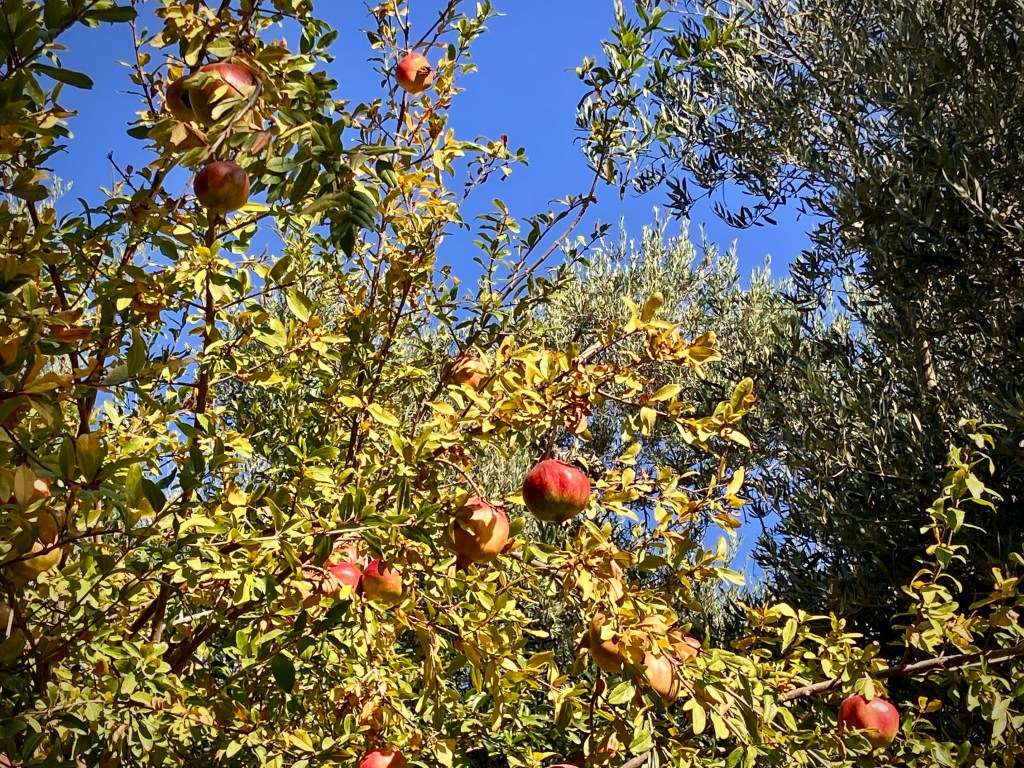
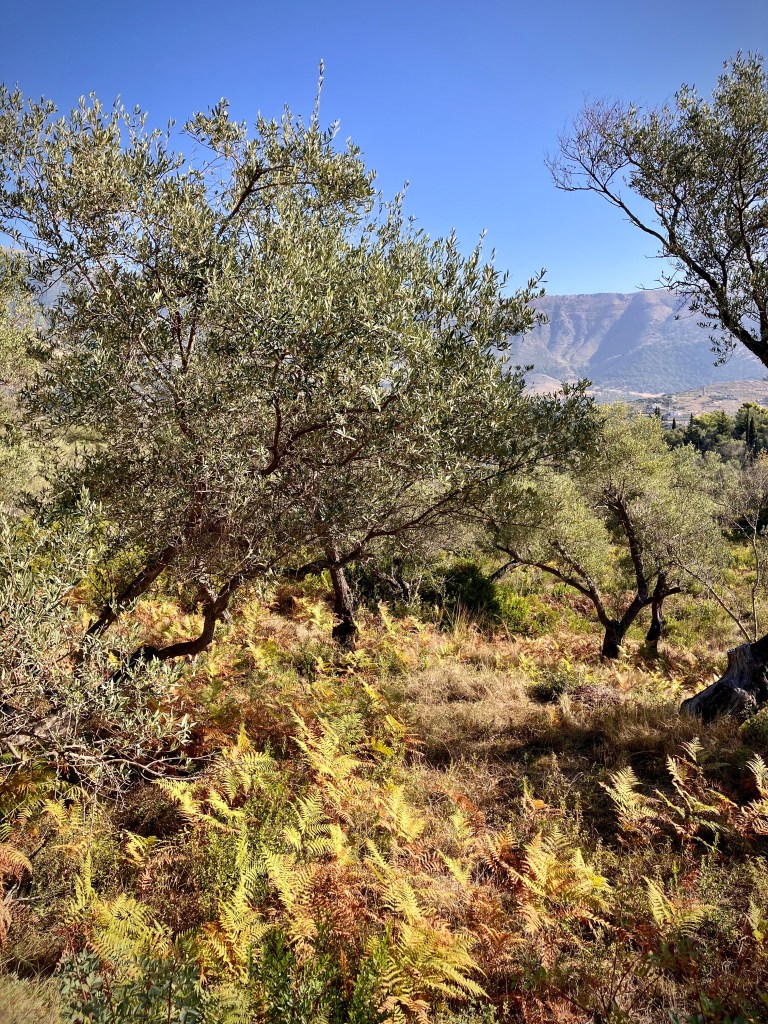
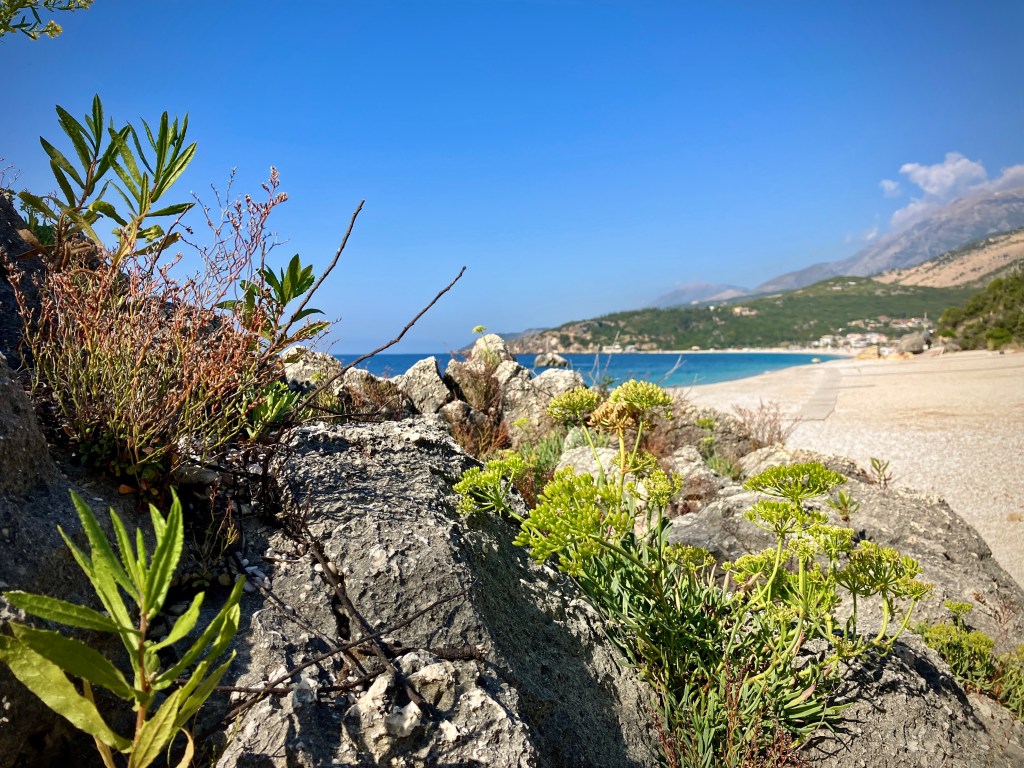
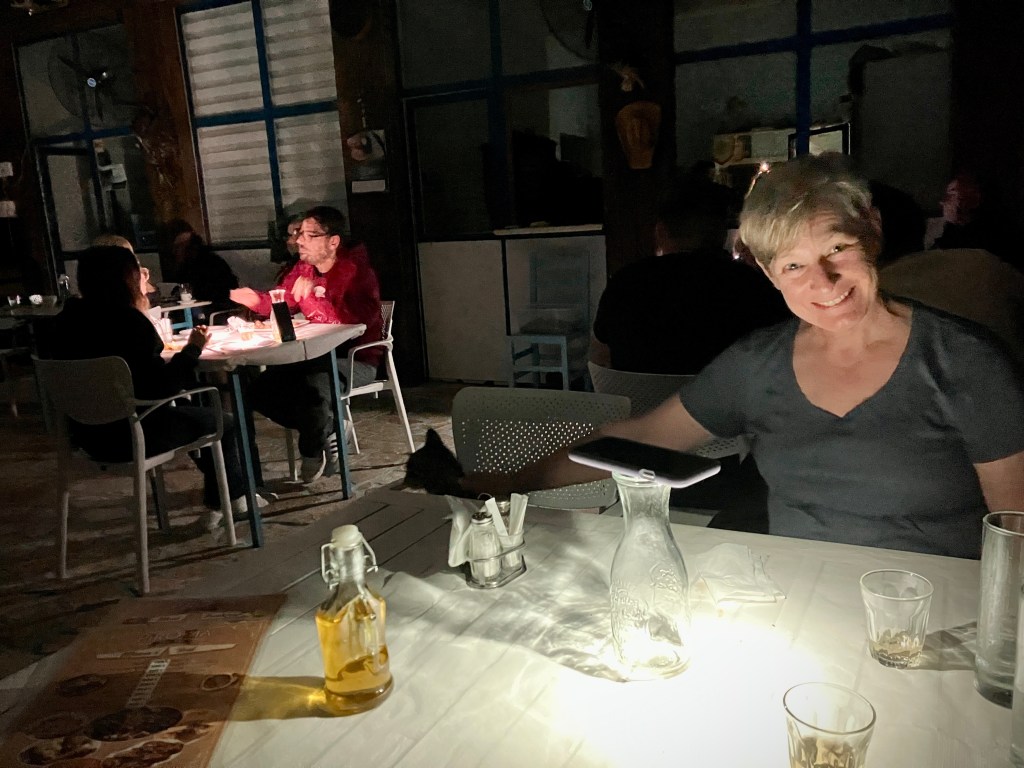
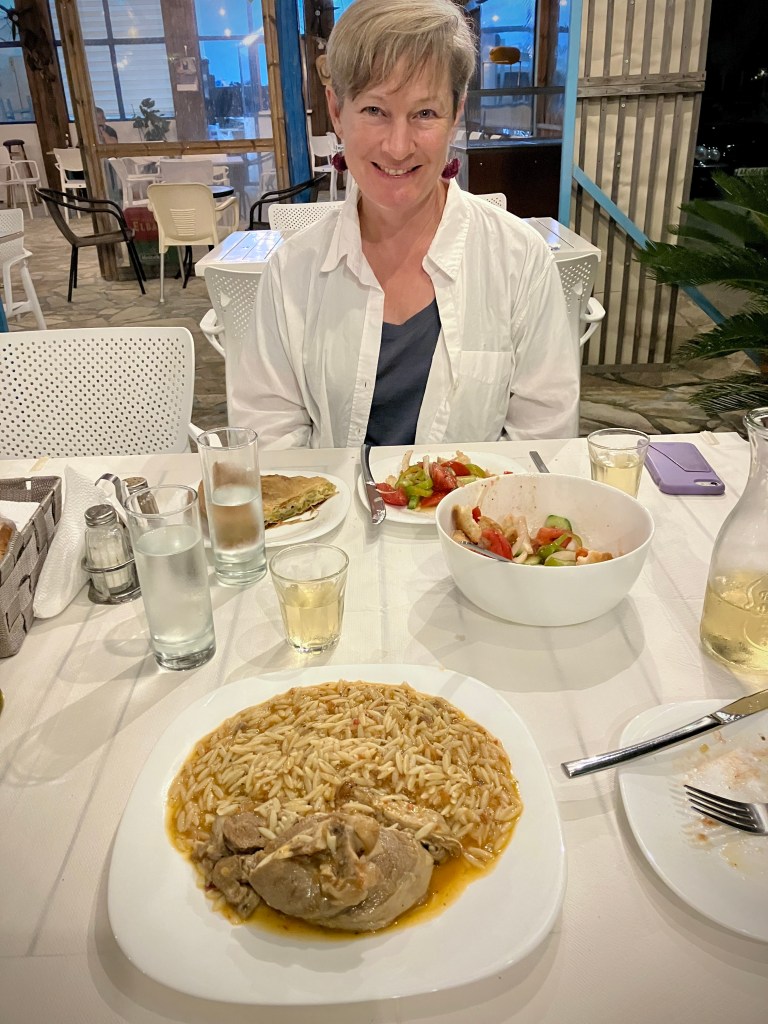
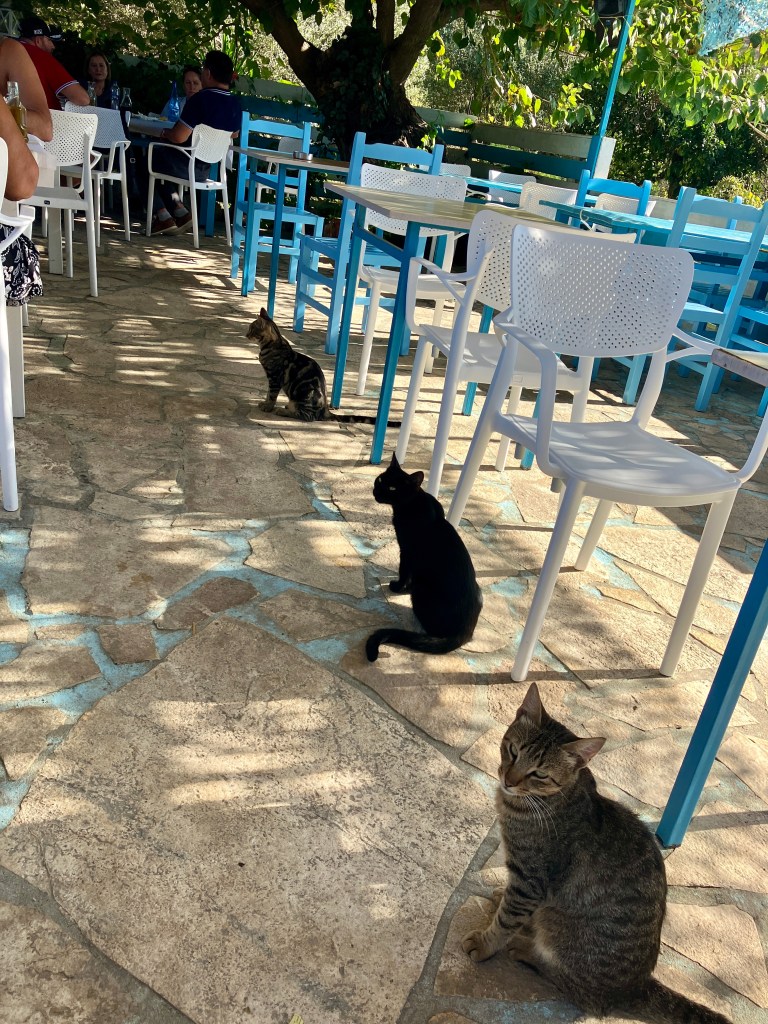
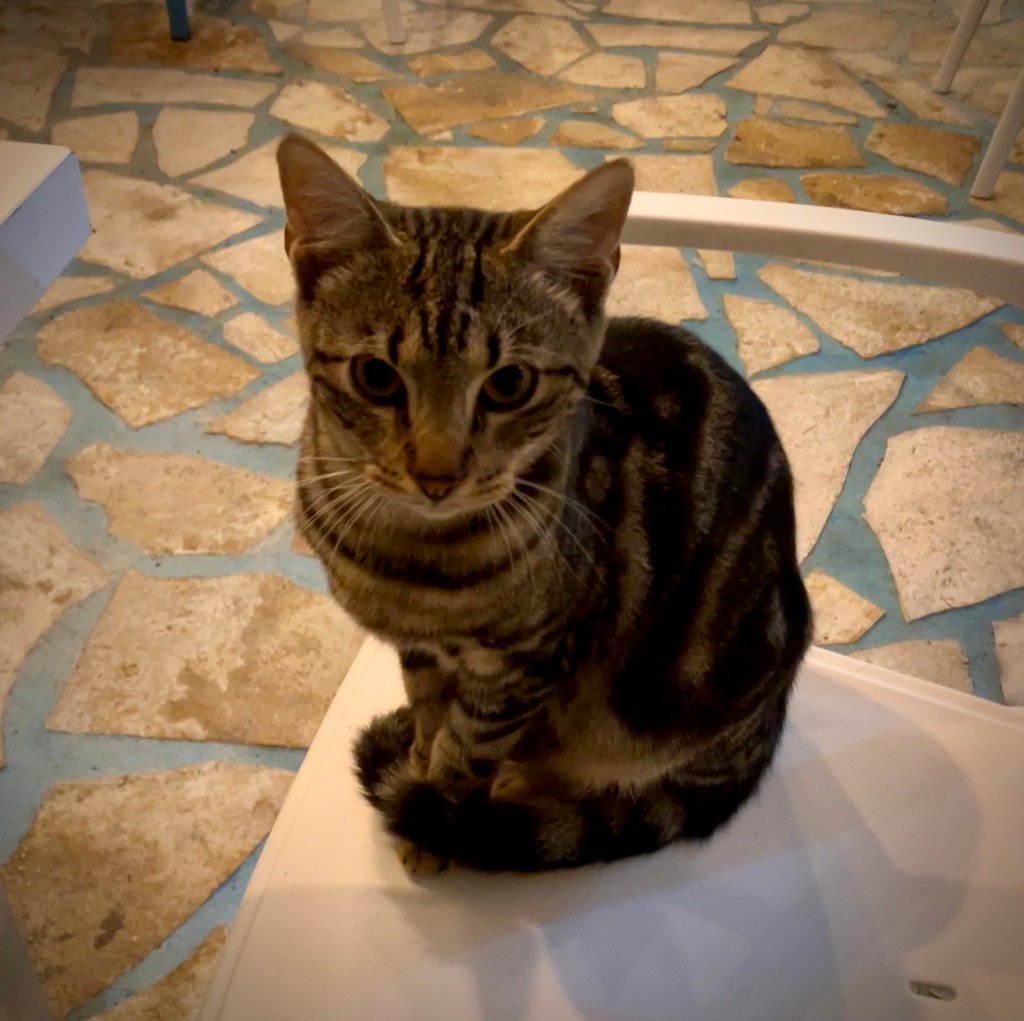
Sheep herder on the beachfront of Himarë.Local markets abound with the ubiquitous cucumbers, peppers, tomatoes, onions, eggplant, and spices which make up most dishes. Some longer trails such as the Albanian coastal trail have been established recently but in general, hiking is an adventure using partially mapped roads, fire roads, and foot paths.Grapes and vines adorn many house; on the way to Livadi beach from HimarëPomegranates and citrus.Olive trees were often mixed with ferns, which felt a bit out of place in the arid environment. Olives and olive oil are a base of life in the region. And delicious.Livadhi Beach…our favorite and a short hike from Himarë with some nice shade (at the undeveloped southern end).Ionian Sea paradise at Livadhi.By mid October many of the beach restaurants in our neighborhood had closed, so we made this friendly Taverna PiroΣia our home in Himarë as we preferred its vibe (and the walk) to main town.And then the power went out during a rain storm, making for a romantic IPhone candlelight setting. Power can still be a bit spotty in Albania.Zucchini pie, a Greek village salad, and Lamb “Juvetsi”. There are many Greek or Albanian-Greek restaurants in this coastal region.Did I mention the restaurant cats?How can you say no?
Our next bus leg to Sarandë went well as the nice host of our apartment confirmed the minibus time and walked us to board (south of the main stop in Himara) where we found the driver had reserved two upfront seats for us based on her call to him. So nice. The Albanians we have met have been kind to a fault; but sometimes it takes a bit to draw them out from their extremely low-key nature. But it is really nice to travel here.
Central produce market in SarandëCafé culture is strong here. Chilling in Sarandë
Since we were out of the main part of town in Himare, we decided to go for a centrally located family hotel in Sarandë. It was nice to enjoy the main pedestrian beachfront promenade in low season, and have access to more of the city’s less touristy restaurants. Yet we still could swim in the main beach with just a 5-10 minute walk. Just a few people still “beaching” at this time, but the water was still nice, with just a slight chill. (~20-22 deg C)
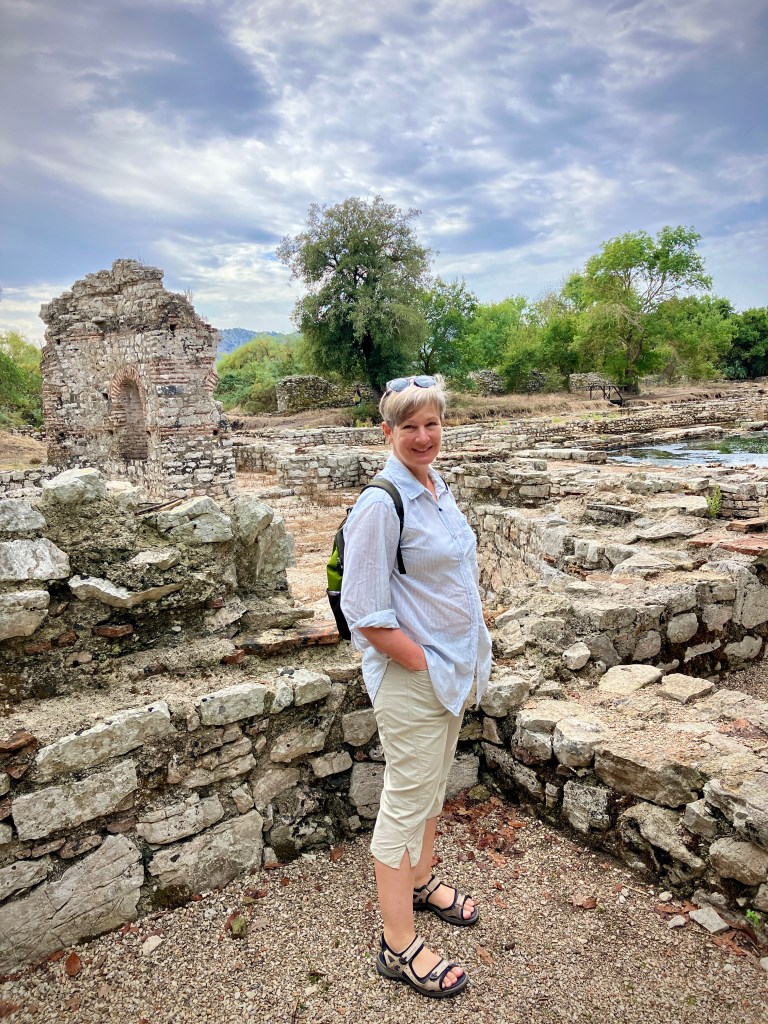
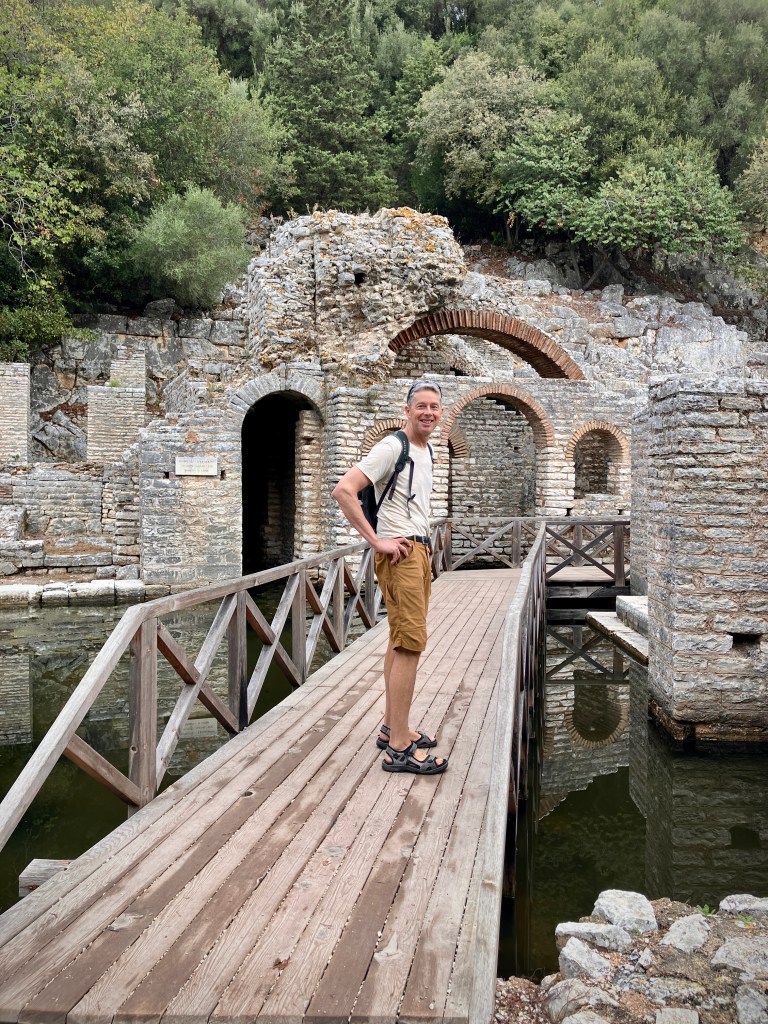
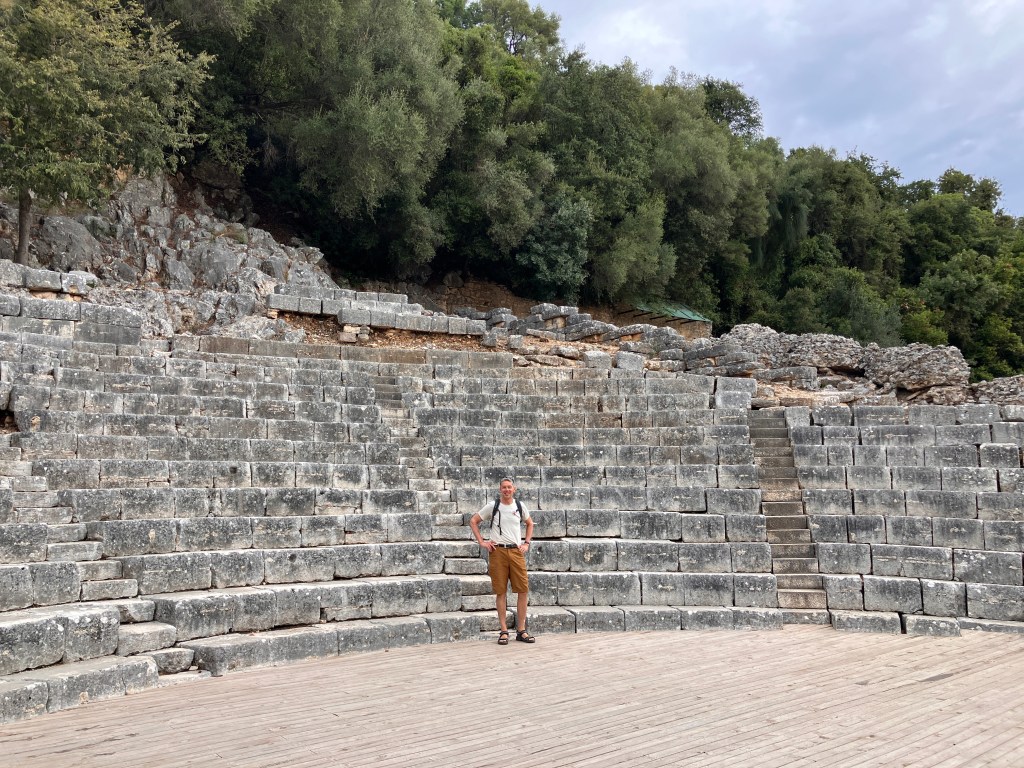
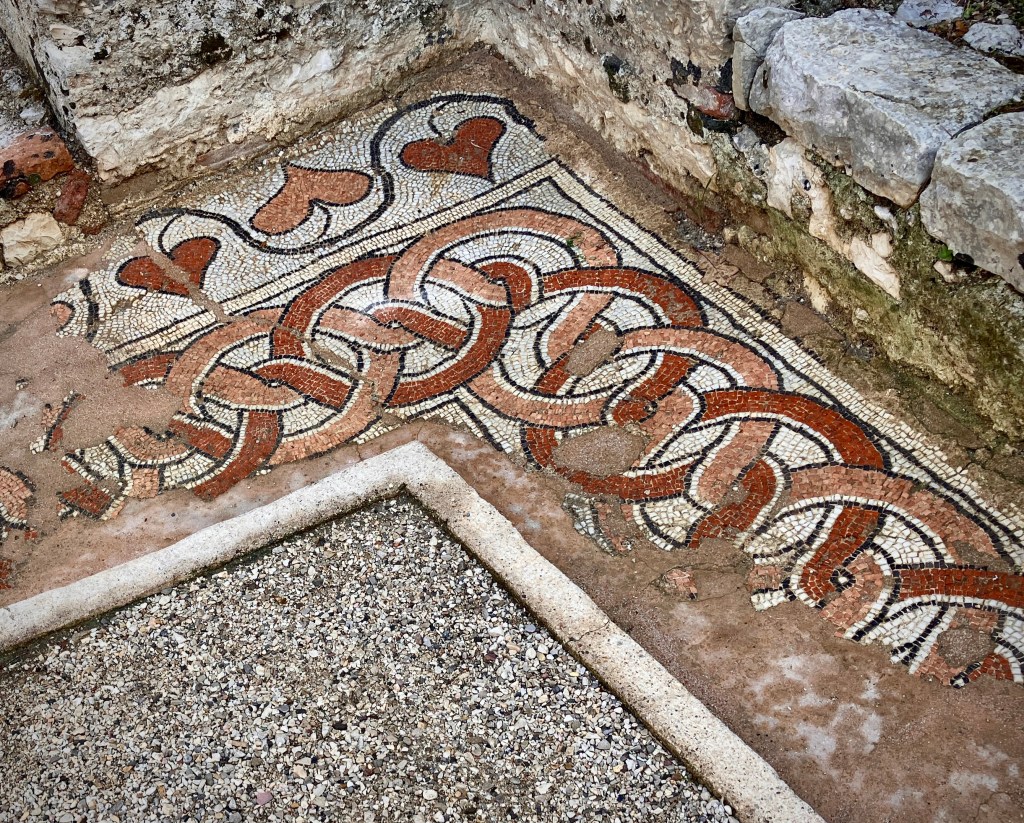
My dog buddy followed us to the bus stop in Sarandë and was determined to go to Butrint with us.The forum at Butrint. Although not as intact as Pompei, Herculaneum, or Ephesus, we were able to fill in the structural and decorative gaps from our experiences there.Exploring Butrint Archeological Park just before the big crowds. Sea level rise is a problem for the site.Layers of history at Butrint include the Greeks, Romans, and Byzantine empires.Much of the original city defensive walls are intact.This is one of the few mosaics visible in Butrint as most are kept covered by sand to protect them from the elements.
Our central location in Sarandë also meant easy access to the municipal buses that run every 30 to 60 minutes right to Butrint National Park. (200 lek) However, the bus stops at 3 or 4 places along the main road out of Sarandë, so you can still catch the city bus a few km or more south of the city center, which is now an endless line of new boutique hotels, apartment buildings, and mostly seasonal businesses.
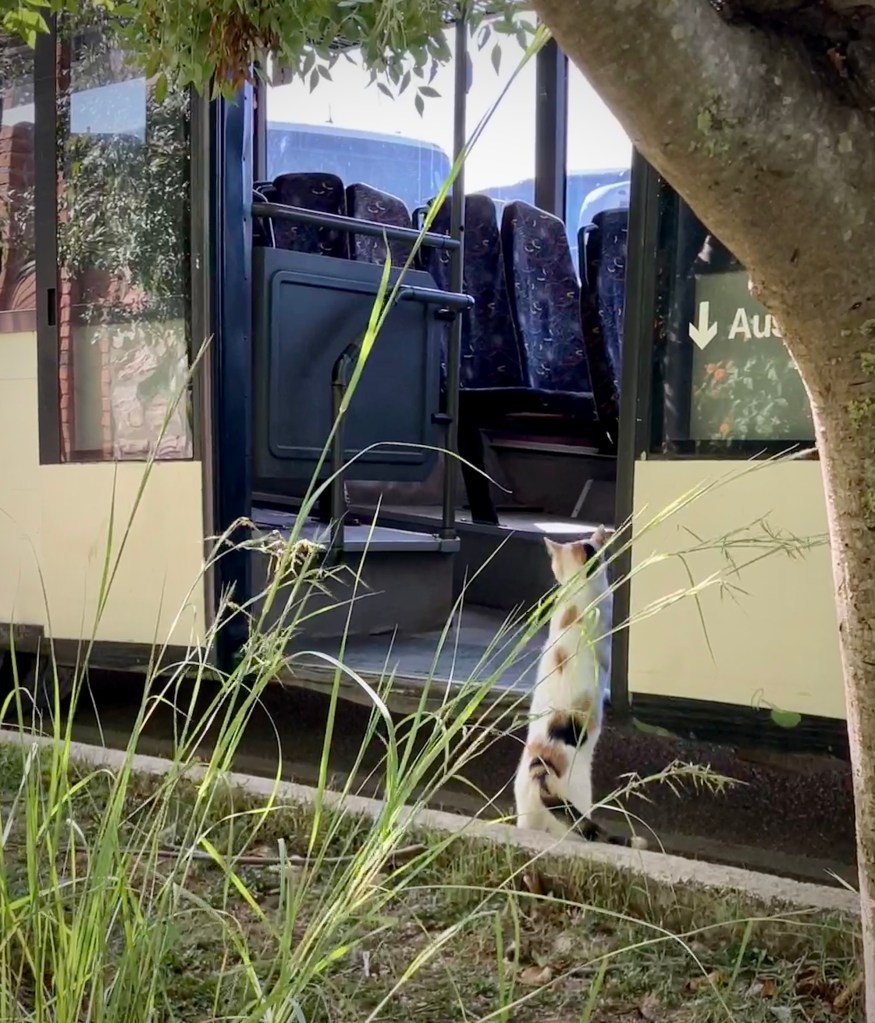
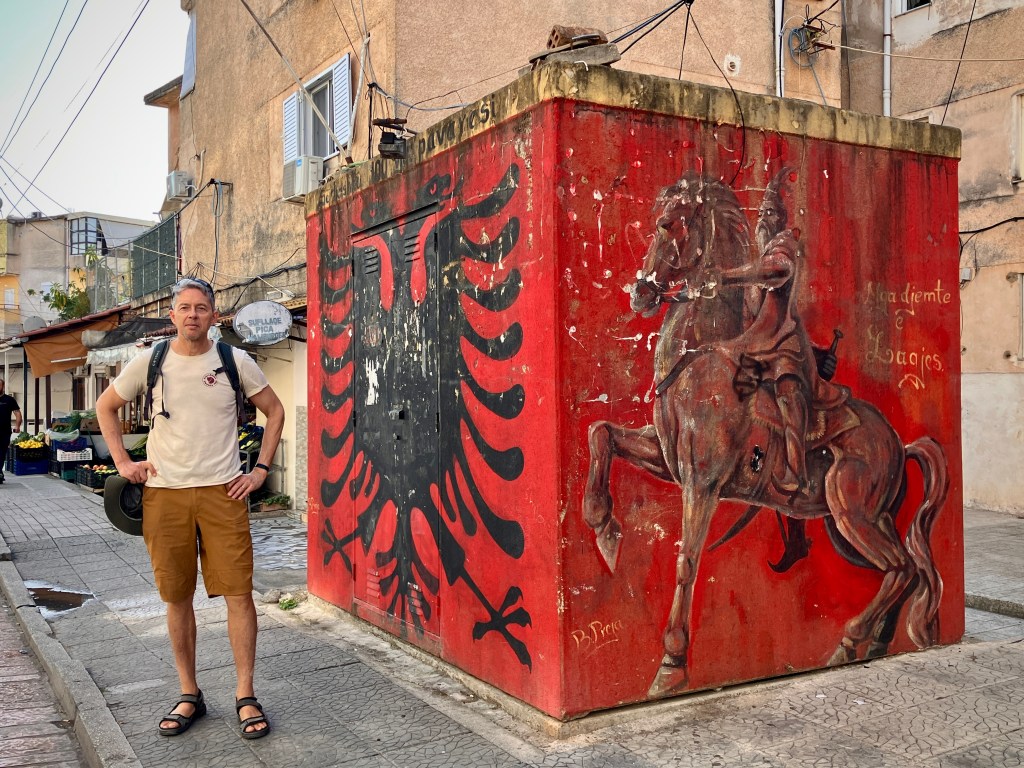
The springs and wells of Butrint were a reason for its early success.The Butrint museum has some interesting artifacts and info but could use a refresh. Apparently a vastly expanded visitors center is in the works as visitation has grown quickly.We loved the natural setting of Butrint.This cat was opting for back door boarding on the bus back to Sarandë.But then changed their mind.We stopped briefly for a swim at the main beach in Ksamil (pronounced “Sam-ill”) but it was not our scene. In summer, no part of the beach is free and you have to pay for a sunbed.Nicely painted utility substation.There are many unfinished/abandoned buildings on the fringes of Sarandë, and unfortunately a pretty serious garbage and sanitation problem.
It’s been an enlightening time so far in Albania, and we have been charmed by the pace of life here and optimism we are seeing for the future. We will be rooting for a positive trajectory in this complex world and region, and hopeful that more of their talented and educated youth stay to build a stronger future. But for now, we all get to enjoy this snapshot in time.
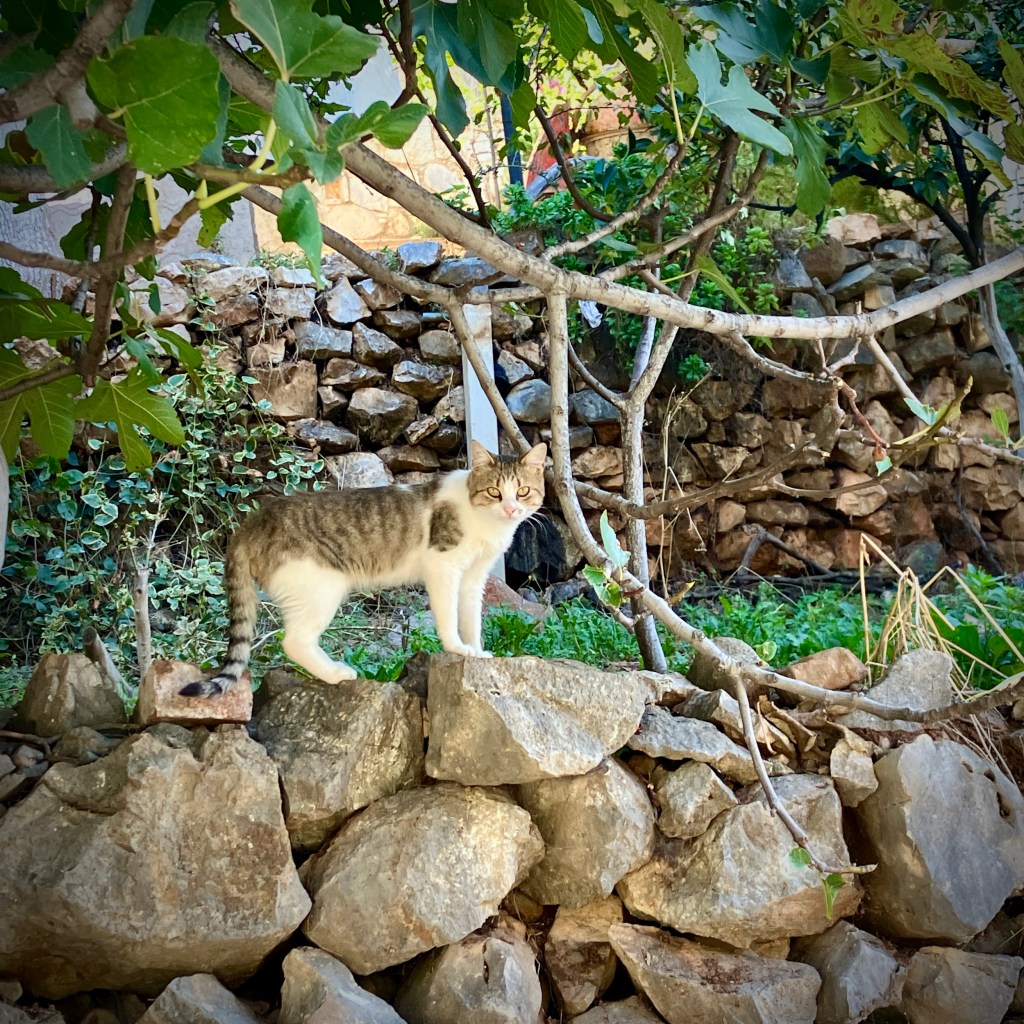
Cat curious why these tourists are wandering in his hill neighborhood above Sarandë.A memorable visit to the Albanian Riviera, but ready to explore inland.
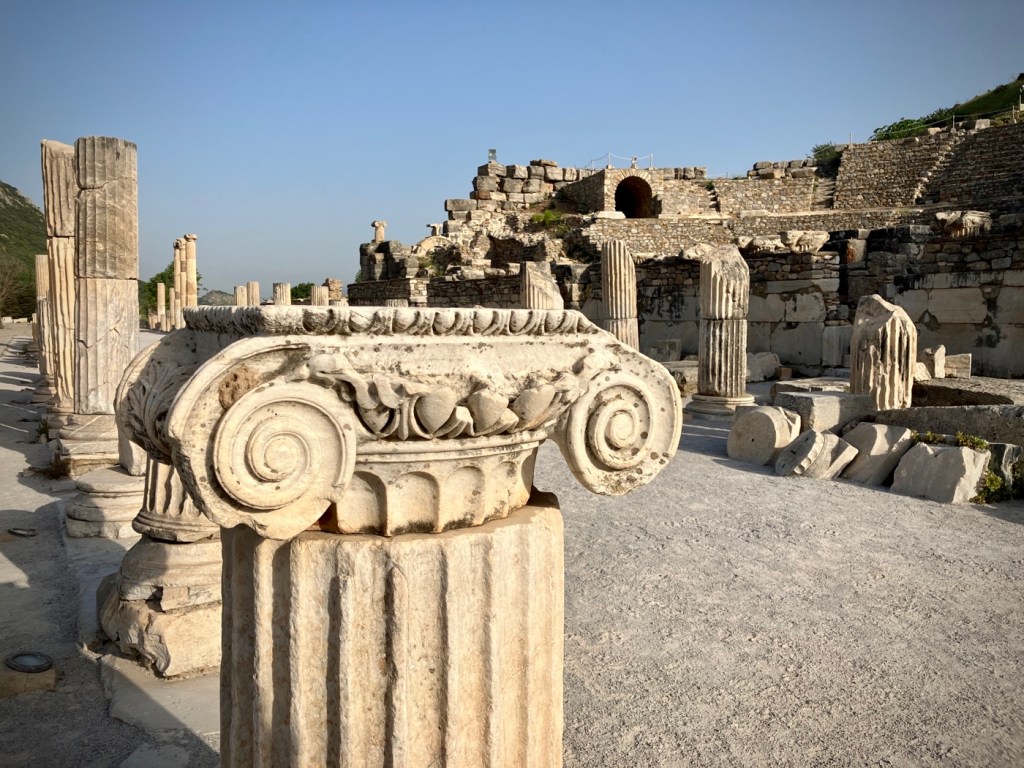
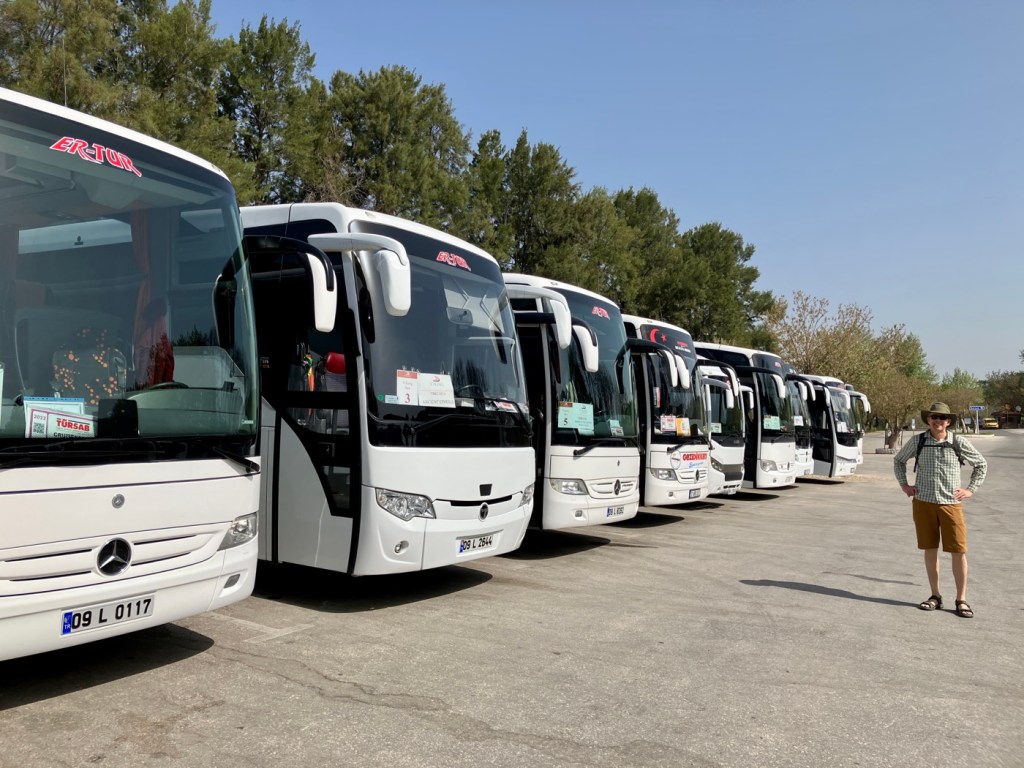
Like many tourists/travelers, we really enjoy visiting places that are not so clearly tourist attractions. Selçuk is one of those, the town nearest to Ephesus, a 10th century BC settlement. What, you ask? Ephesus is obviously a big attraction, it was declared a UNESCO World Heritage Site in 2015, with impressive ruins and ongoing archeological work. How is that not a tourist place? All right, it is. But these days many of the visitors seem to arrive for the day, bused in off a cruise ship.
Once again we timed our visit to have some alone time in the ruins.
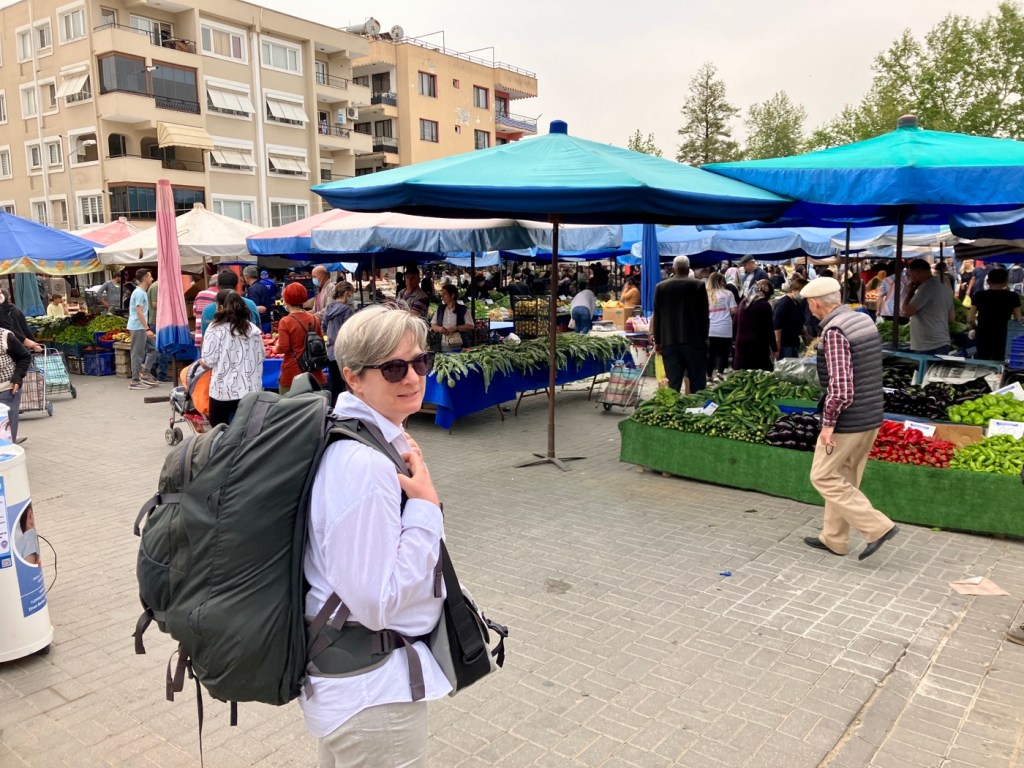
The town of Selçuk is charming. Some of the cruise ship buses do stop at the Archeological Museum in town, where you can view the most impressive treasures uncovered at Ephesus, but the town itself is a lovely, relaxed, and friendly place and once again we felt like the only non Turkish tourists in town.
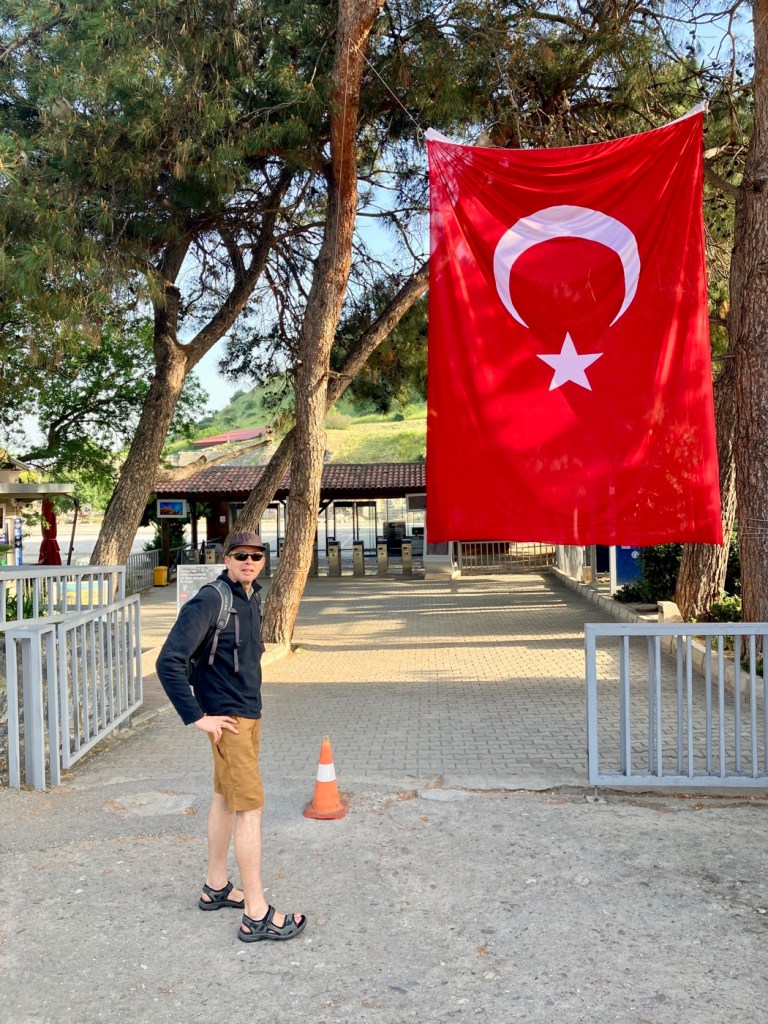
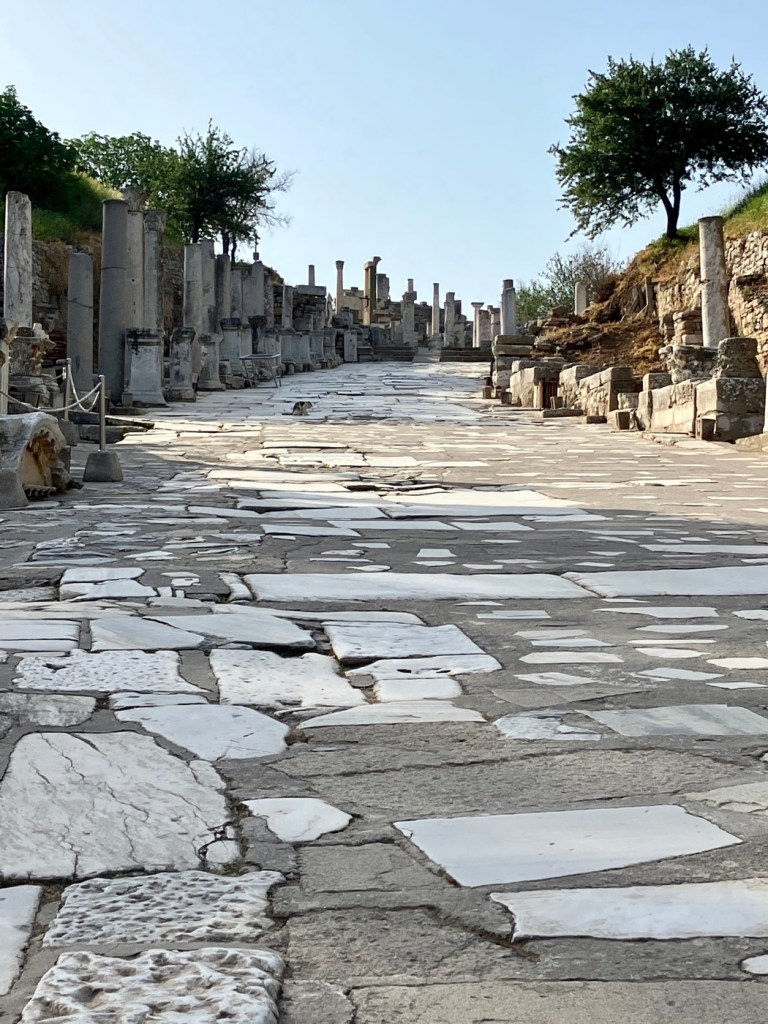
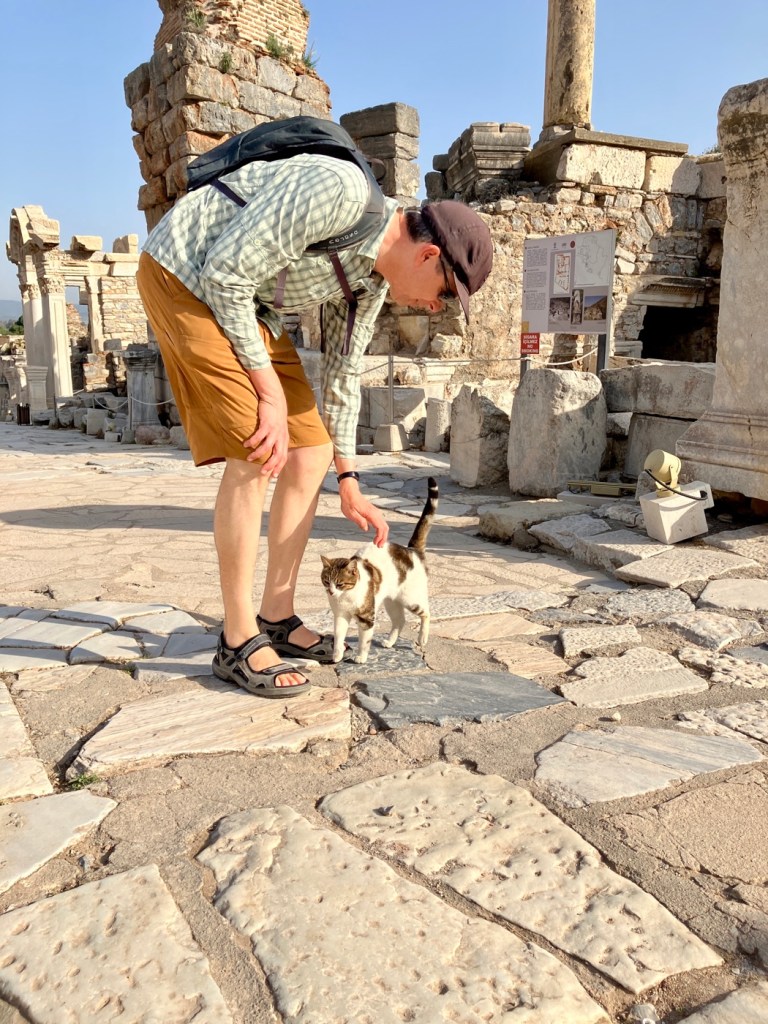
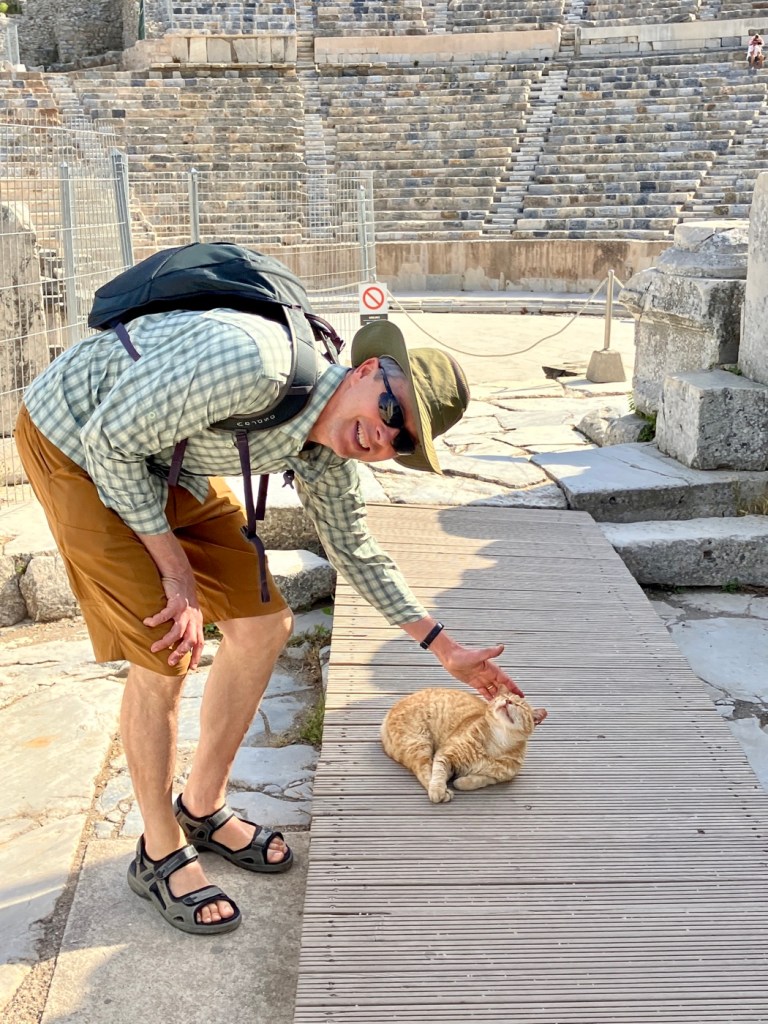
Rich at the upper gate of Ephesus. See, this look says – no one else here yet. Looking up the main road of Ephesus. I am always fascinated by the paving stones. Some of these bore the initials of the workers who laid them in place.Rich walking down the main road of Ephesus. The harbor used to be very close, but as it silted up the town struggled and eventually failed.Quickly waylaid by a friendly Turkish cat.The Library of Celsus, the most recognizable and amazing structure of the site.
The trick to having this site to ourselves was actually setting an alarm clock (something we rarely do these days), arranging for a quick 7:30 am breakfast at our hotel, and being in a pre arranged taxi at 8:00. The taxi dropped us at the upper gate, and with our tickets already bought at the museum the day before, the Selçuk Pass, good at four sites and well worth the price, we waltzed right in to an empty experience. Empty for about an hour, then a few others started to arrive.
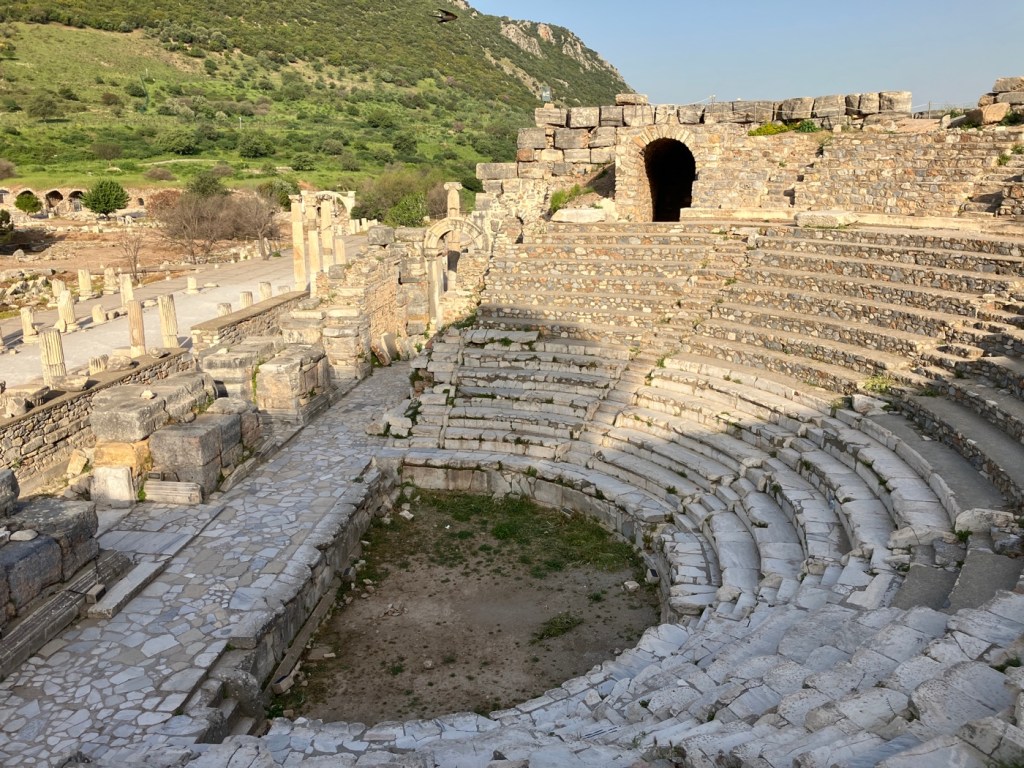
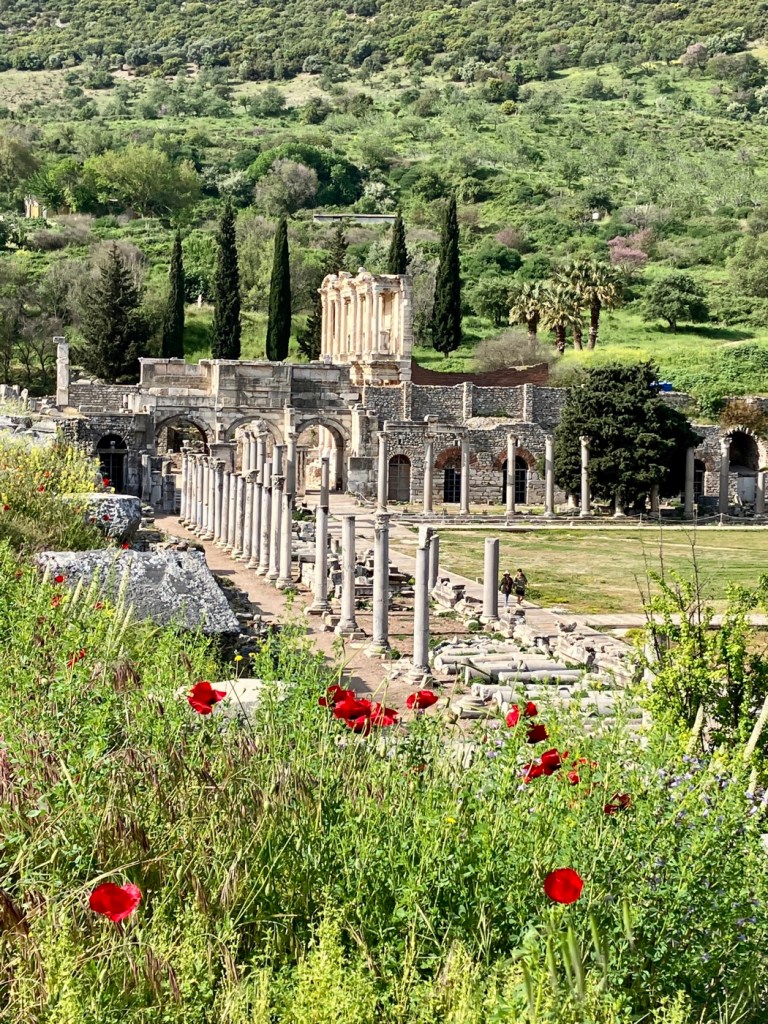
The terrace houses. We were equally impressed with the amazingly engineered shelter over the houses.Plexiglass walkways and a roof to keep the rain and sun off the terrace houses. I’m sure the grad students who are painstakingly piecing together walls and floors appreciate it too.The amphitheater. Capable of holding 21,000 spectators.Amphitheater greeter kitty.Green hills and blooming poppies made for a lovely and slightly heart wrenching view. How terrible it must have been to give up this city.
About two 1/2 hours later as we headed to the lower gate to walk the 3 km back into town, the cruise ship buses had started to arrive. Perfect timing.
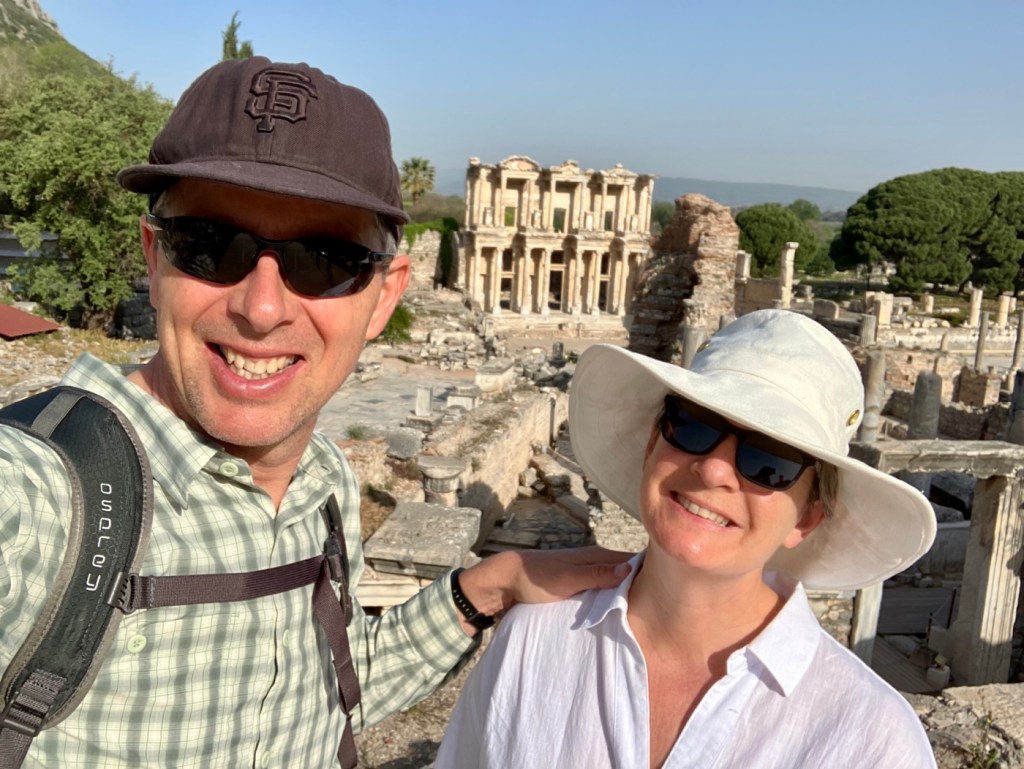
Happy travelers in Ephesus.The travel planner enjoys his well executed plan.
Selçuk has a neighborhood charm we hadn’t experienced yet in Turkey, having only been to big cities before this stop. After returning from an outing earlier than expected, our innkeeper was out running an errand and not there to let us in. Seeing our plight, a neighbor quickly walked over with the innkeepers number already dialed on his cell phone to help us out.
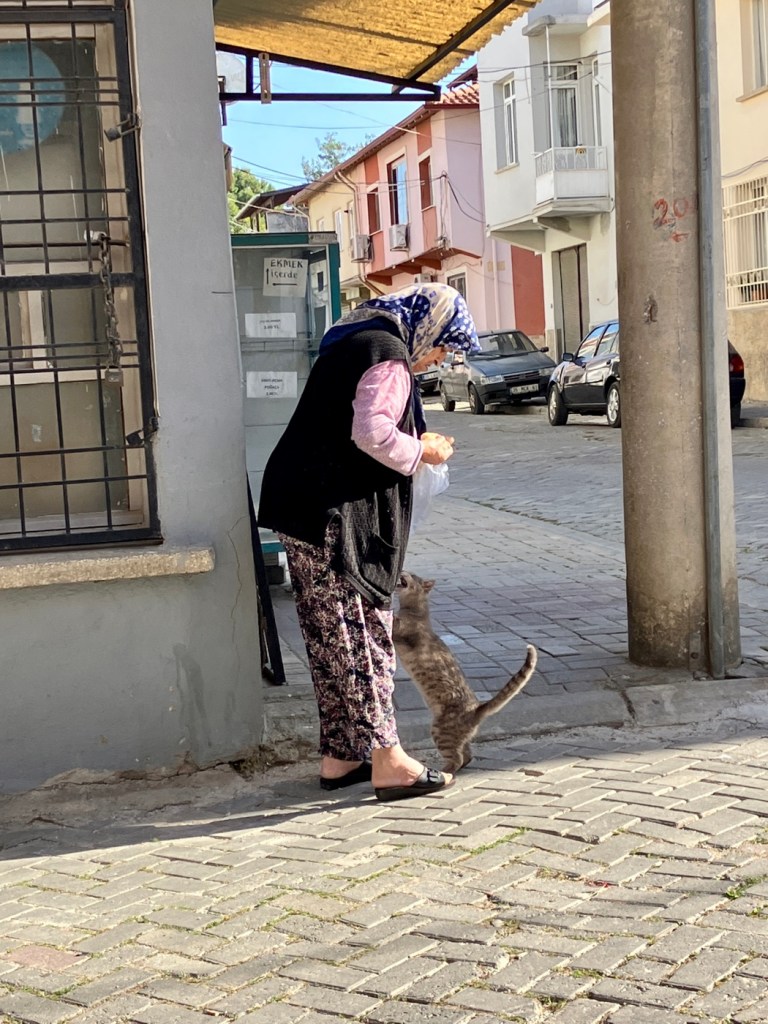
One of the 15 cats adopted and cared for by our hotel host, this one blind, greeting a neighbor.
We slept through it our first night, but on our second we heard the drummer who walks the town beating their drum to wake residents for their “sahur” meal, the first meal of the day eaten before observing the fast of Ramadan. And that night we saw dozens of tables set up in the street so neighbors could share iftar, the meal that breaks the fast.
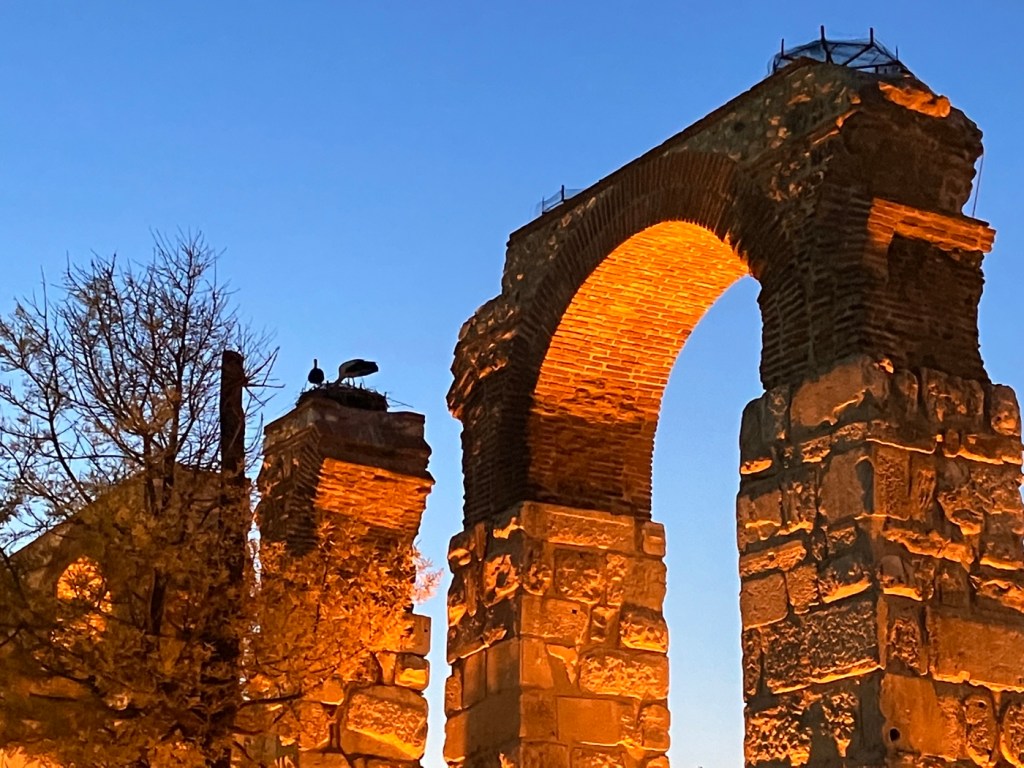
Storks nesting on the ruins of the aqueduct in Selçuk.
The white storks are referred to as pilgrim birds in Turkey, and one man told us you can set your calendar for the date of their return in March each year. The 15th, he claimed. Always the 15th.
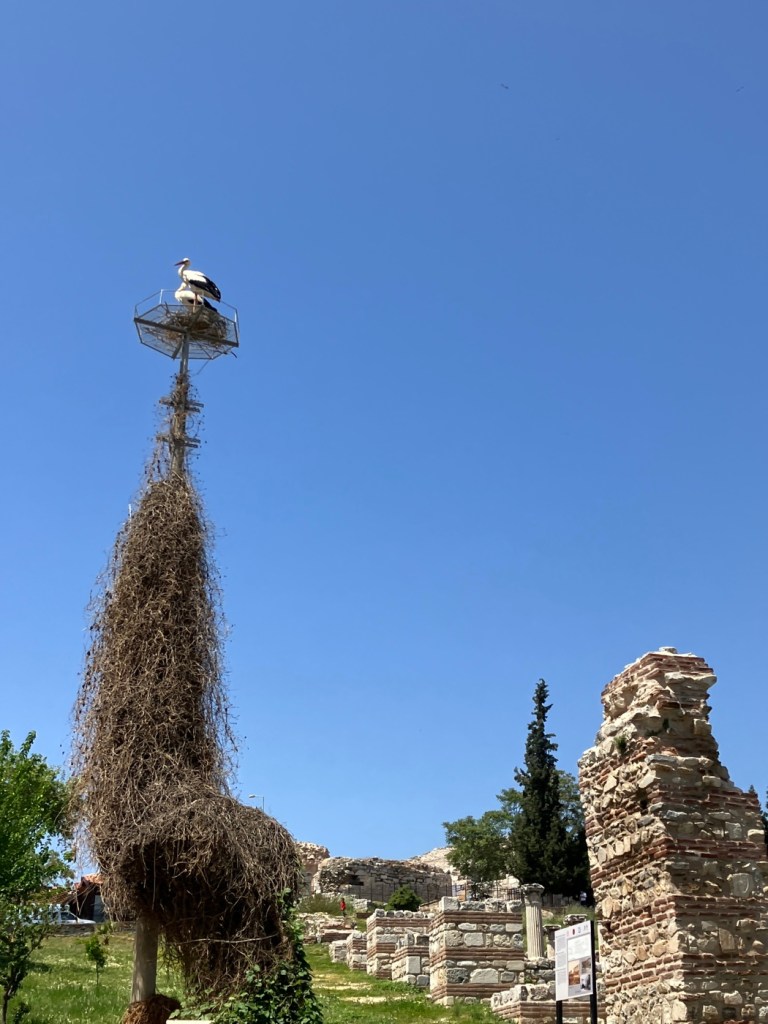
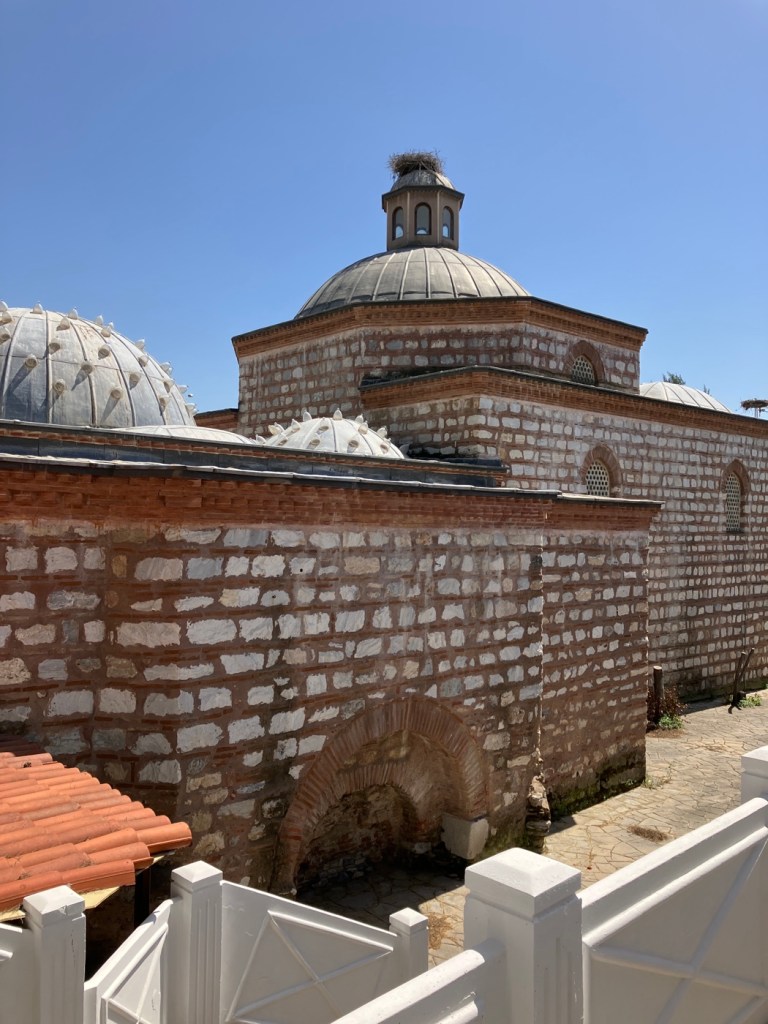
You see the big stork nest cages around town, giving the pilgrim birds a spot to build a nest which can weigh up to 250 kilos/500 pounds. The top of this mosque will do for these stork parents.Şirince is known as the ‘Greek village’ about 8 kms from Selçuk.
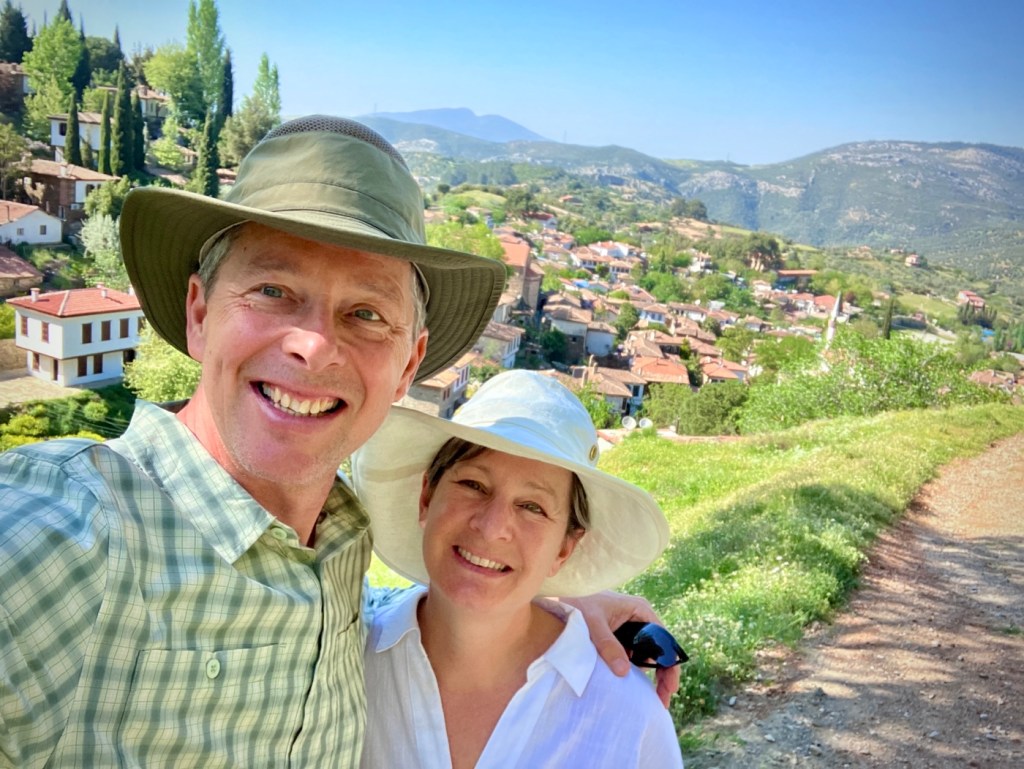
Our host dropped us off for a lovely walk around Şirince. Although its main street is mostly catering to day trippers, once you walk above town it’s rural rhythms quickly reveal themselves and a frequently running mini bus took us back to town.
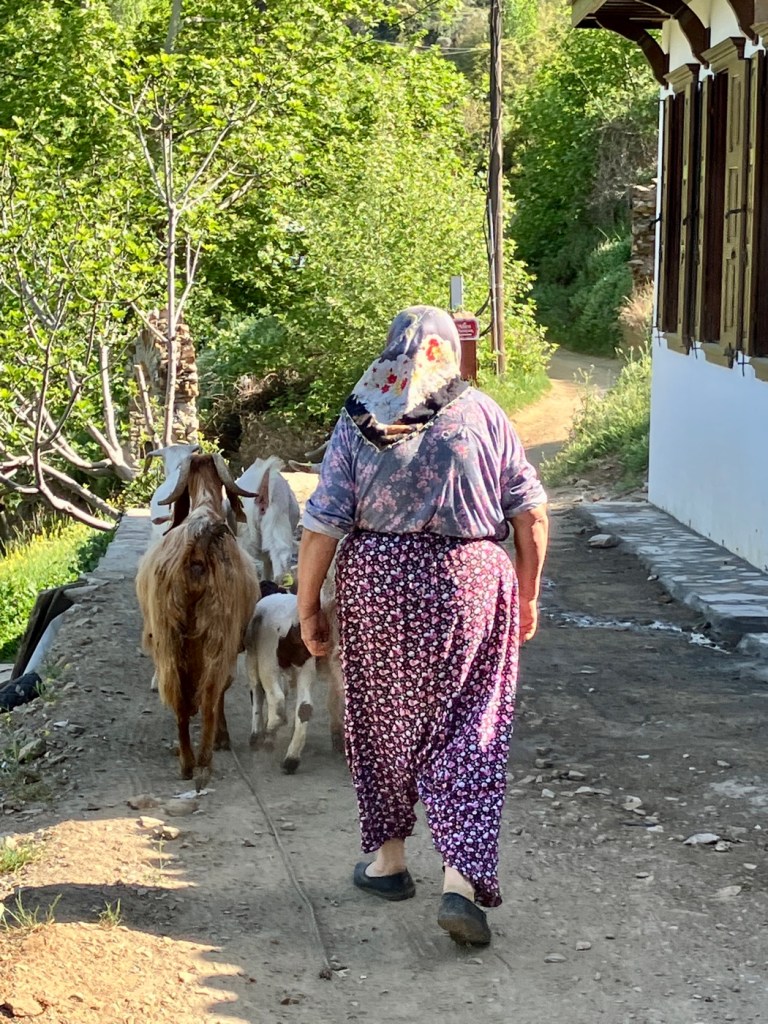
Getting the goats home in the afternoon.
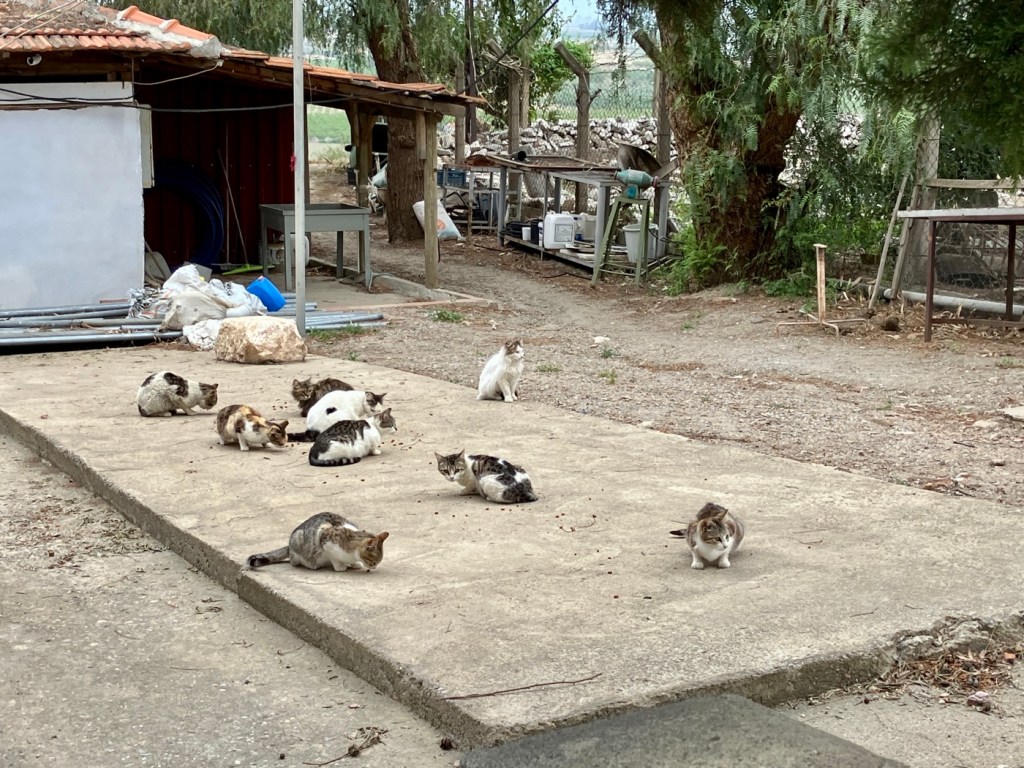
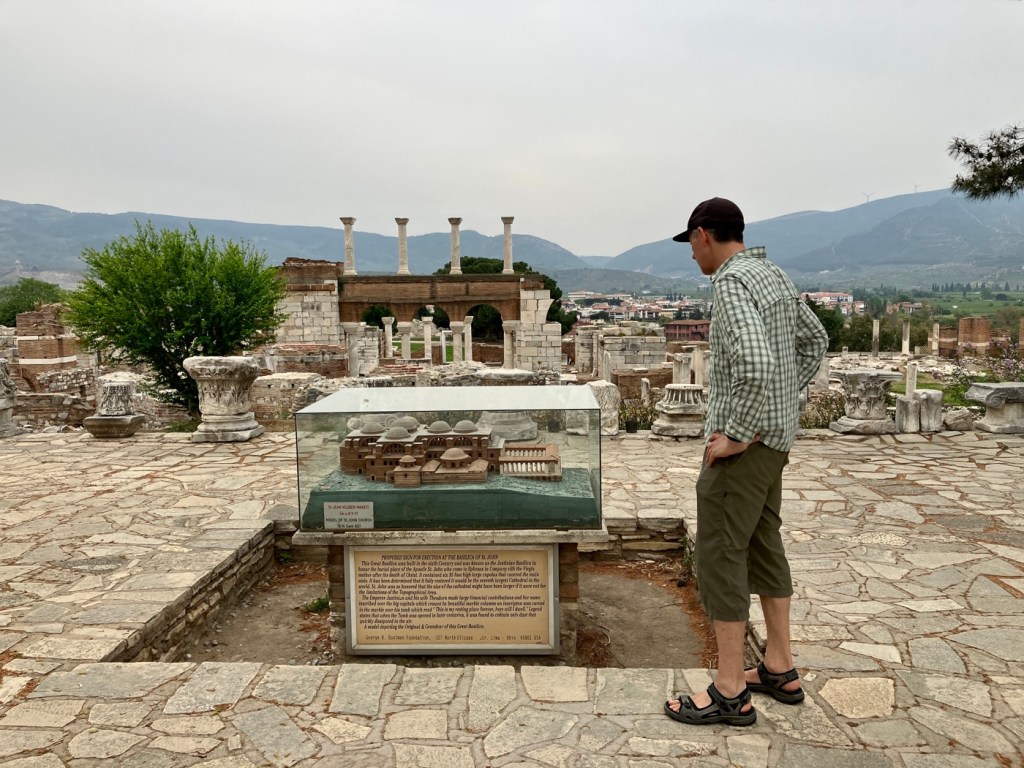
On our last morning with one final site on our Selçuk museum pass, and an 11:45 am bus to catch, we walked up above our hotel to the Castle and the Basilica of St. John – a 6th century site which is the believed burial location of John the Apostle. Once again arriving early we had the site to ourselves – well, us and quite a few cats enjoying their breakfast, provided by one of the groundskeepers.
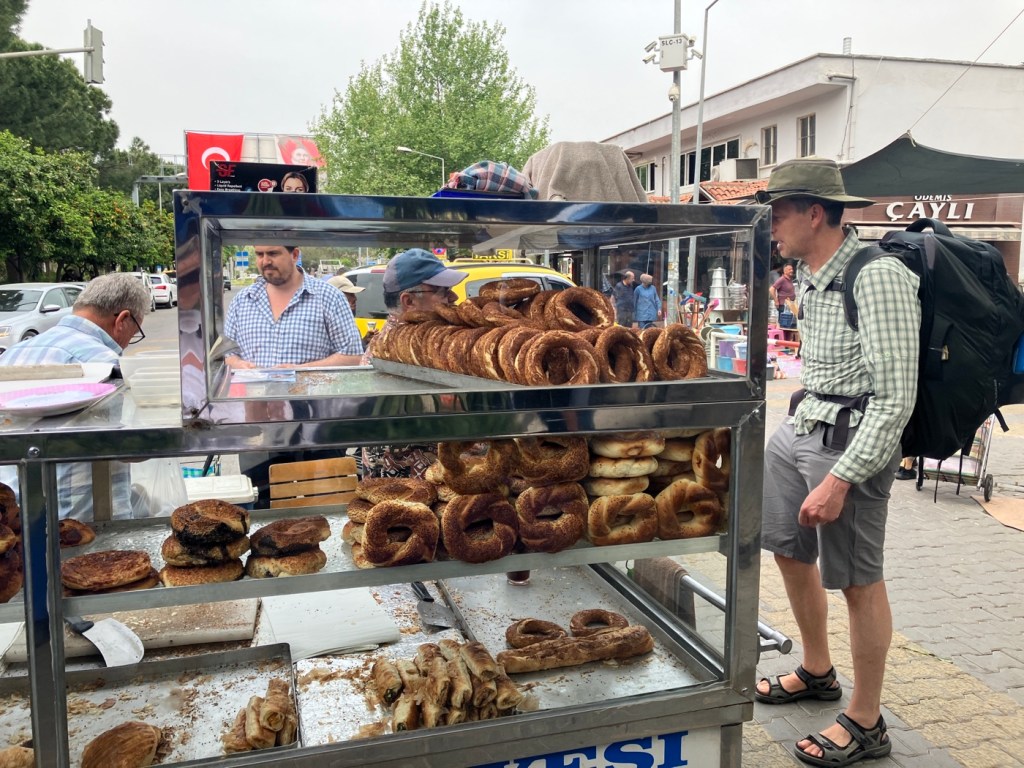
A very common sight, communal cat breakfast.The model of the Basilica gives you detail of what you’re seeing.The size of the Basilica, and the amount of carved marble, is amazing. Heading to the castle, past what we called grad student alley. Piecing together even some of these fragments would take an entire career.One town, four amazing attractions.From castle hill looking towards Ephesus.Off to catch that bus. Quick detour through the Saturday market.Bus snacks being acquired.
We considered staying longer in Selçuk, but the coast and swimming beckoned. After some holiday traffic induced bus stress, and some luck with a bus connection, we made it to Bodrum to enjoy the holiday ending Ramadan, the three-day Ramadan Bayram, also known as Eid al-Fitr. More on Bodrum in our next post.
The happy travelers looking forward to more of what Turkey has to offer.
We get a lot of questions about long-term travel and what is it like when you return after 7 months abroad. First off, it’s wonderful to see friends and family again. Nothing beats it.
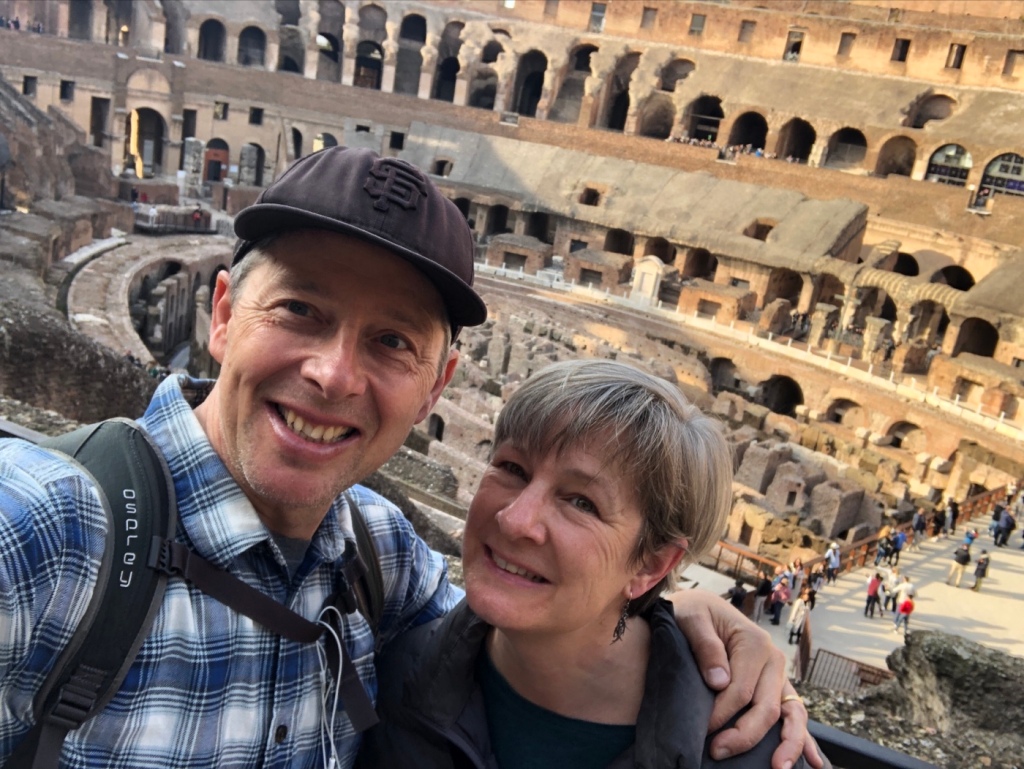
When will the Coliseum be so empty again? A unique time to travel.
But now that we’ve been back in the US a little over a week, I can tell you that it IS a bit of culture shock. We have experienced so much together, and adjusted to a life where people and places are constantly unfamiliar. Our first reaction when landing in Chicago was how clean everything looked. As much as we loved Rome and live in awe in the layers of history, there is little arguing that it is a pretty untidy city. Dirty, some might say. It’s hard to get 2,500 years of urban stains off things, right? America is actually pretty tidy, or at least we hide our trash well.
Gritty and organic Rome, some wouldn’t want it any other way.
The second thing we noticed immediately is the change in scale and space. Ah yes, precious elbow room, as almost everything in the U.S. is upsized. It felt nice to stroll the endless connected Chicago sidewalks, with plenty of room to pass, and streets wide enough to turn a stagecoach.
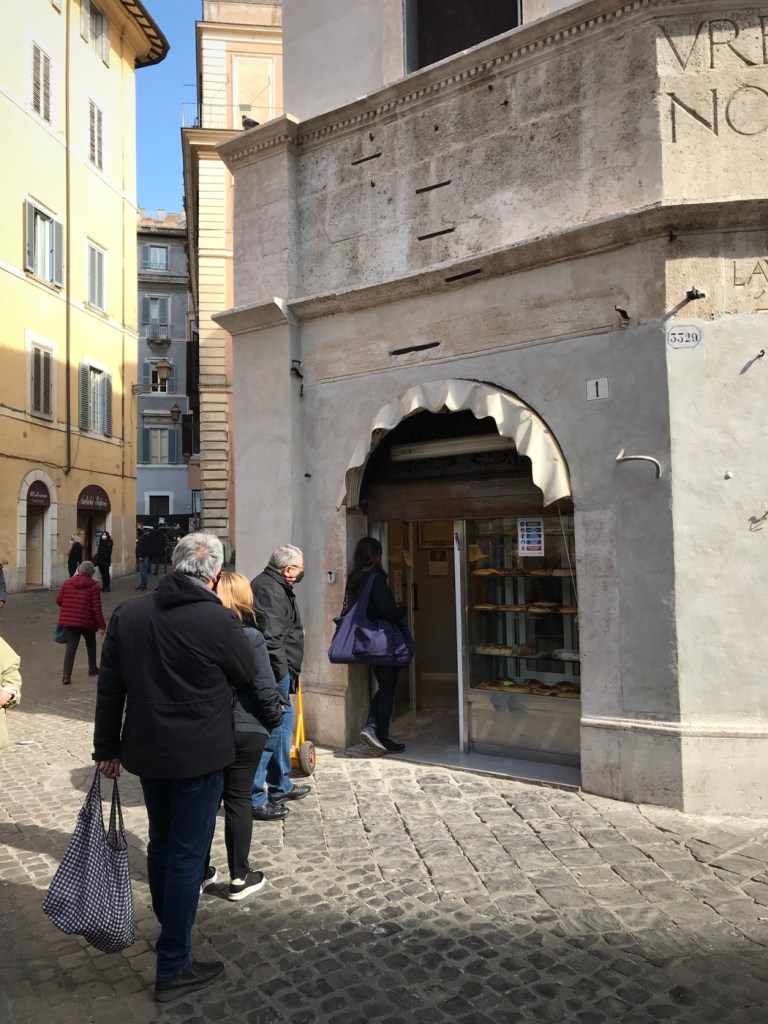
The venerable Pasticceria Boccione in Rome, which features 300-yr old recipes for wood-fired Pizza Ebraica and other Kosher treats. Luckily, Cheryl was already inside!
And after arriving in Colorado this week, we can’t help but be awestruck by the vastness in which many of us live, especially in the American West. There is really nothing in Europe that even comes close, and I think this is why Europeans (and Americans of course) especially love to travel to this area, and always insist on going to Vegas. They are unique, vast, and truly American. And they do define who we are, as most Americans are more comfortable in a Costco than a compact urban Bodega.
Yup, lots of space here in Western Colorado.
Finally, I realized that the past 7 months has changed us and our outlook. Cliches about travel aside, we absorbed more European (and Moroccan) culture and, as with all good travels, take the positive aspects with us. For me, I have learned to truly enjoy slow coffee and the plaza cafe culture. The impact on your psyche from the wet and dark Northern European winter. (Gimme sun!)
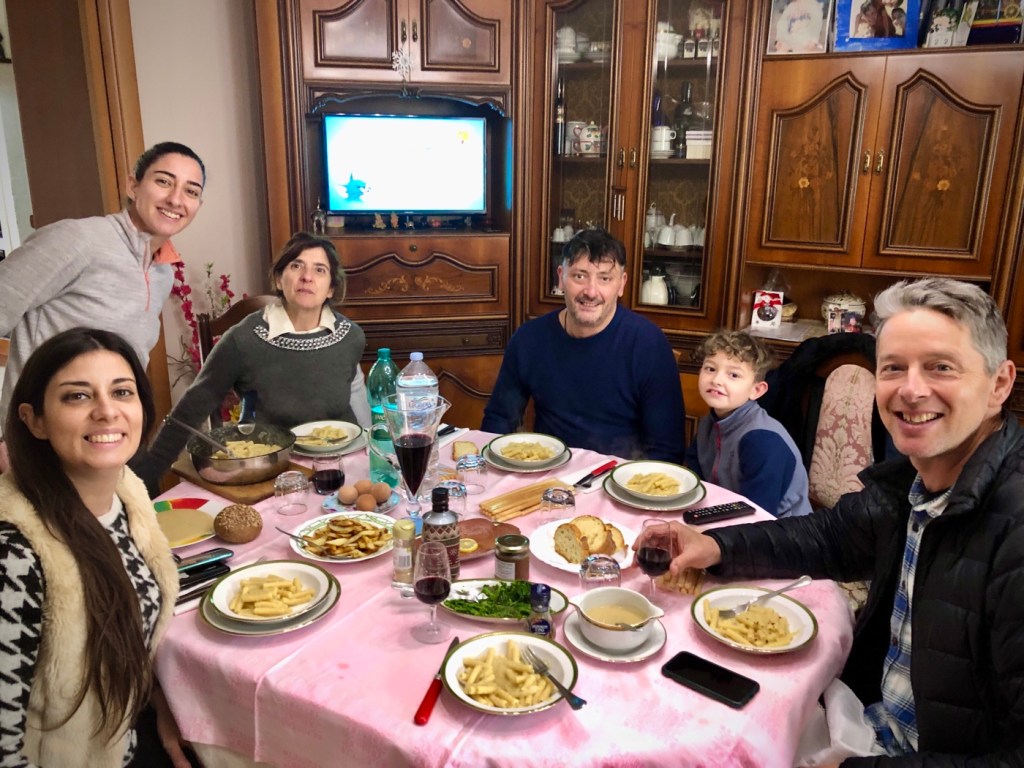
Our wonderful Italian hosts in Conversano: embracing the joy of a long family lunch
And the pure and simple pleasure of a 3-hour Italian dinner with new friends. You need to have a general humility when you approach foreign cultures as an outsider. Embrace the new, and adjust your expectations. And maybe now I’m a bit more patient….maybe.
New family friends in Italy after a typical Italian breakfast of a Cornetto and caffe.
Travel is also always unique because it happens in the context of the time. We experienced the end of one COVID wave and rode out the first surge of Omicron. The pandemic has mostly been a shared global experience that immediately connects you. The recent drama and tragic unfolding of the Russian invasion of Ukraine is of global concern, but also a way to immediately connect with other travelers or locals.
City hall rally in support of Ukraine, Bari, Italy
So first a few logistics updates on how we got here? From Bari in Puglia, we caught one of two daily intercity trains to Rome. (They actually start further south in Lecce). We opted for the morning train, as the late afternoon train arrived Rome at 9pm, and we always find arriving a foreign city is especially disorienting after dark. We stayed in the Travestere neighborhood of Rome, which is an excellent alternative to the more touristed and hectic side of the Tiber river.
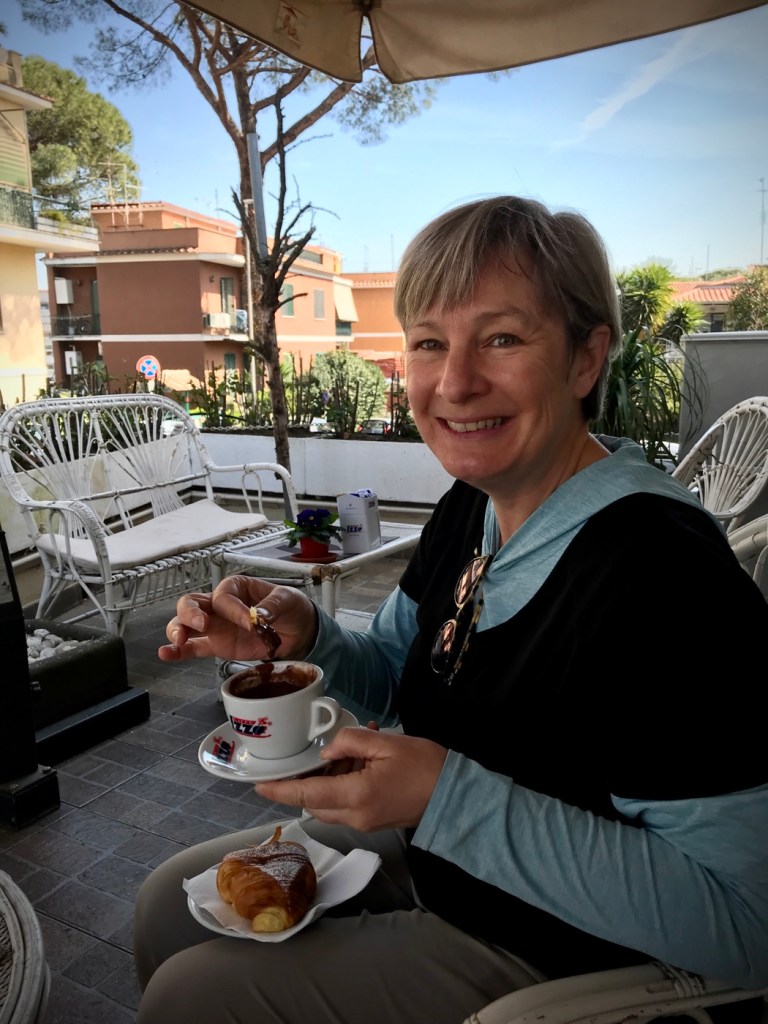
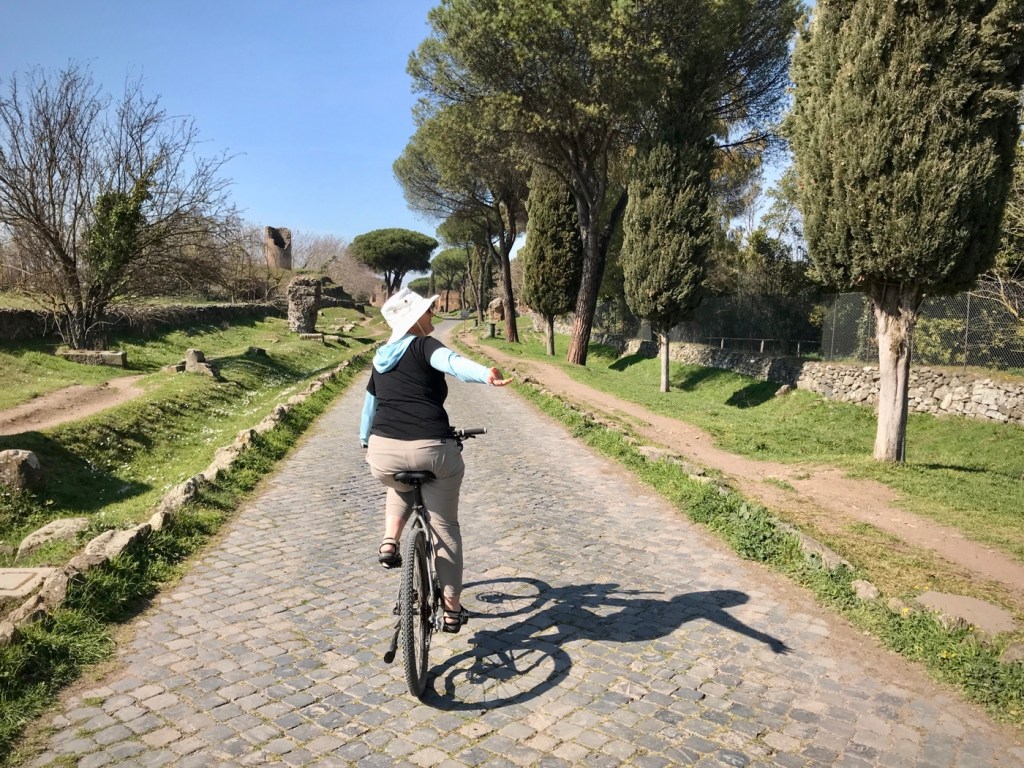
Elevenses in the UK or just a late breakfast cycling break off the Appian Way – Ciccolado caldo and a Sfogliatella
It was also easy to catch the bus or tram to the airport trains at the Roma Travesterre train station. The train connection to Rome Fucinolo airport is excellent and nice new trains leave every 15-20 minutes.
Catching the airport train….still traveling light after all the pizza and pasta!
For our air travel, we again flew TAP Airways from Rome To Chicago via Lisbon. TAP is a member of Star Alliance, and has nice new A330s on most of their long haul services. Very comfortable seats in a 2-4-2 layout in economy. I also highly recommend getting the Plus fare, as for just a bit more money, you get seats in the ExtraEconomy section, two checked bags, and priority check-in. Worth it if you’re tall, and as we noted, our section was less crowded that standard economy. The other big upside of TAP is that they sell one-way fares à la carte, so no penalty versus outrageous one-way fares still charged by the bigger legacy airlines such as Lufthansa and United.
Sparkling new airport trains to Roma Fiumicino. Luggage racks, digital displays, and USB power sockets….check!
The downside of TAP is the Lisbon airport itself….it can get very crowded, and the gate/plane connections are often via shuttle buses from the tarmac, as were both our arrival and departures this trip. But they do pass the savings on to you! They also allow free stopovers in Lisbon or Porto, which is great, and a way to break up the LIS airport experience.
Sticking to our preferred travel modes to O’Hare – CTA bus to the Blue Line El…a bargain in Airport transfers at $2.50, and easy with contactless payment
We arrived to Chicago pretty late, so stayed at a convenient Airpot hotel before visiting family near the Airport, and then two Metra trains to connect with other great friends, who generously hosted us for 4 nights. As a bonus, it was St Patrick’s Day and the Chicago river had a visible green tinge. Americans love to celebrate our immigrant culture, which is still a huge differentiator from many countries in the world. The brave and bold immigrants who continually arrive in the United States are a strength that should not be underestimated.
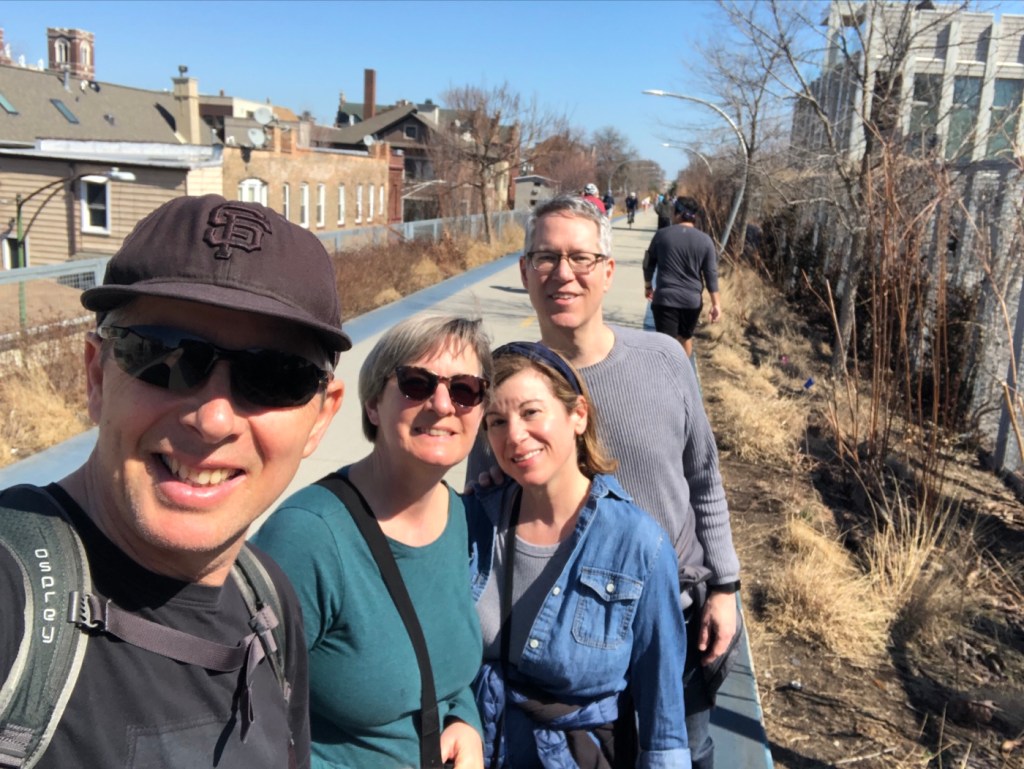
Exploring the fantastic elevated 606 trail in North Chicago is even better with good friends!
Another wonder of America is the food, as we quickly checked off 3 major food cravings; a great Mexican platter, Thai/Lao delight, and a heaping bowl of ramen. Oh, soooo good! The food in Italy is amazing, but these American taste buds miss the foods of the world.
A Classic Roman lunch in Travestere: Tonnarelli Cace e Pepe, Trippa alla Romana, and Cicoria Strascinata in Padella.
So as we head back to California this week, we are filled with the anticipation of the familiar world of the San Francisco Bay Area, but also both feel a bit of apprehension. We are different people than the working, locally engaged homeowners of a year ago. We have embraced the vagabond life, worked hard to get to this place of freedom, and both know know that we still have a lot of the world and new passions to explore.
Getting our America on in Devil’s Canyon, CO
We will settle down again some day, and when we do, will invite everyone we have met to join us…but not quite yet.
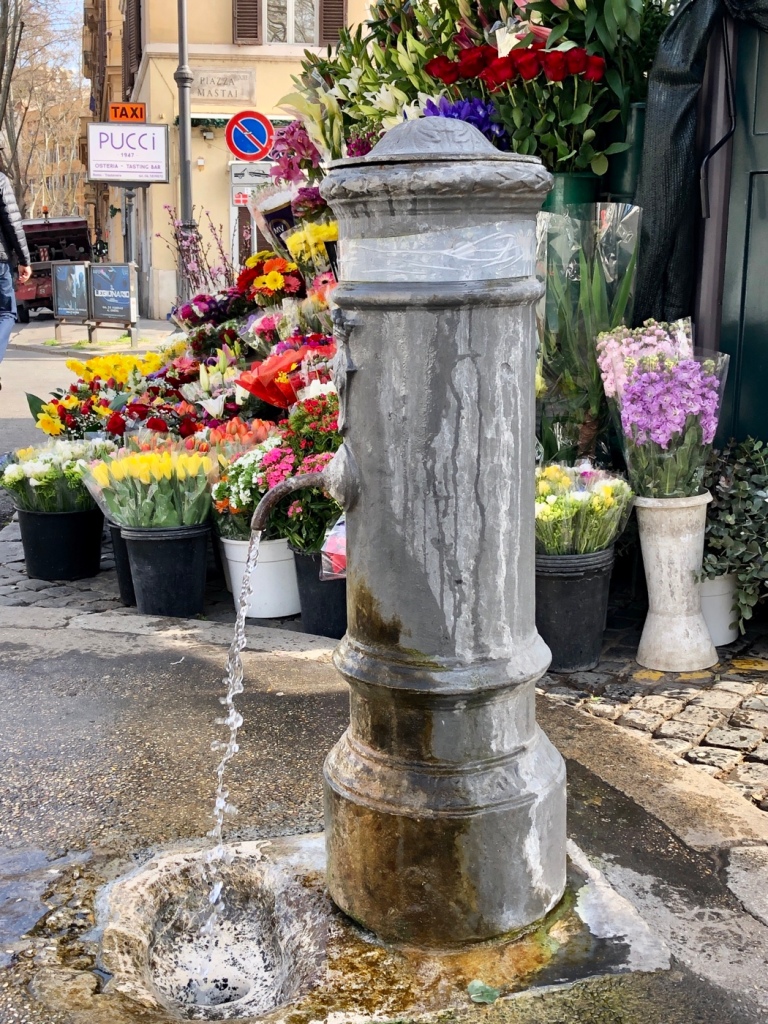
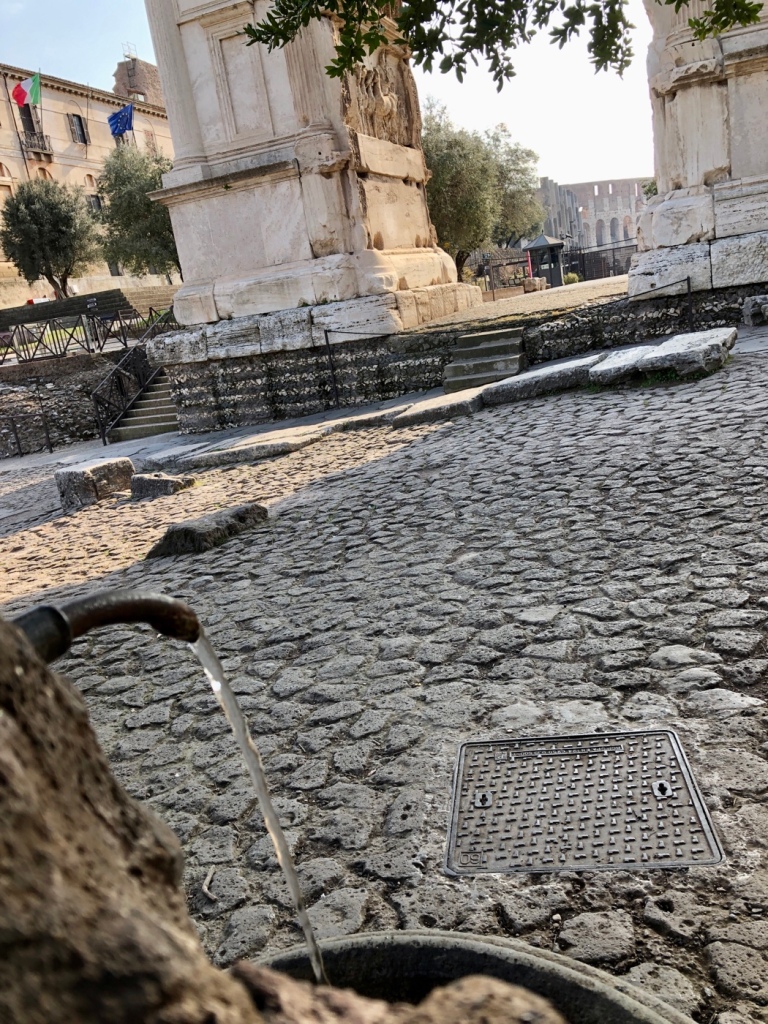
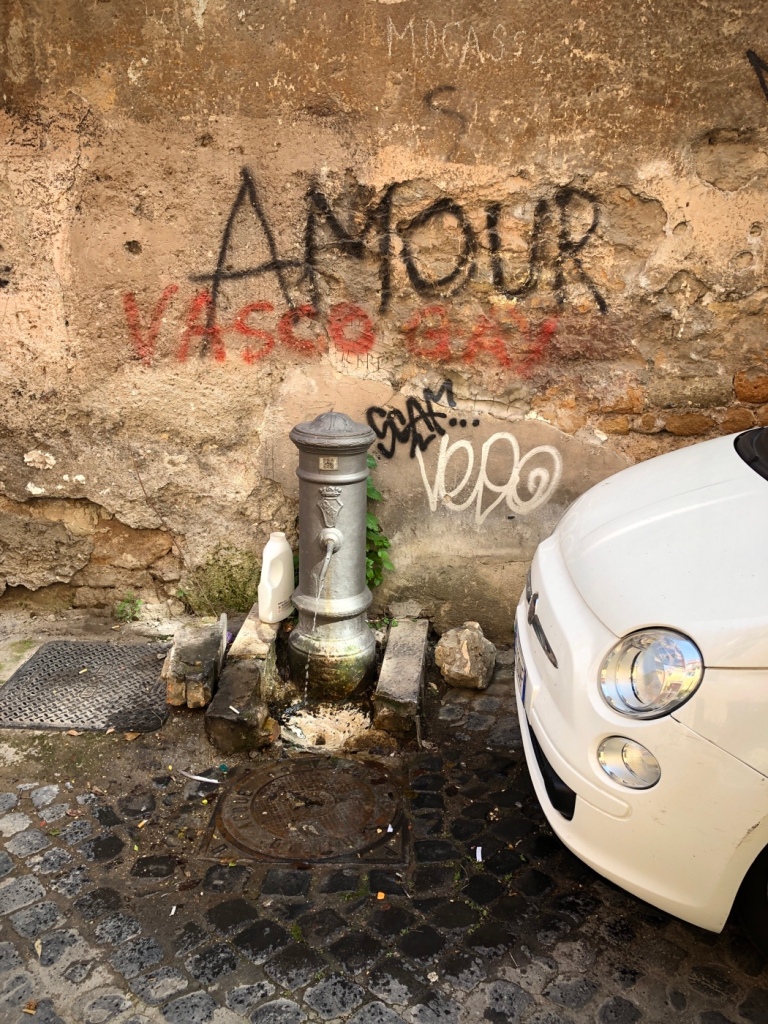
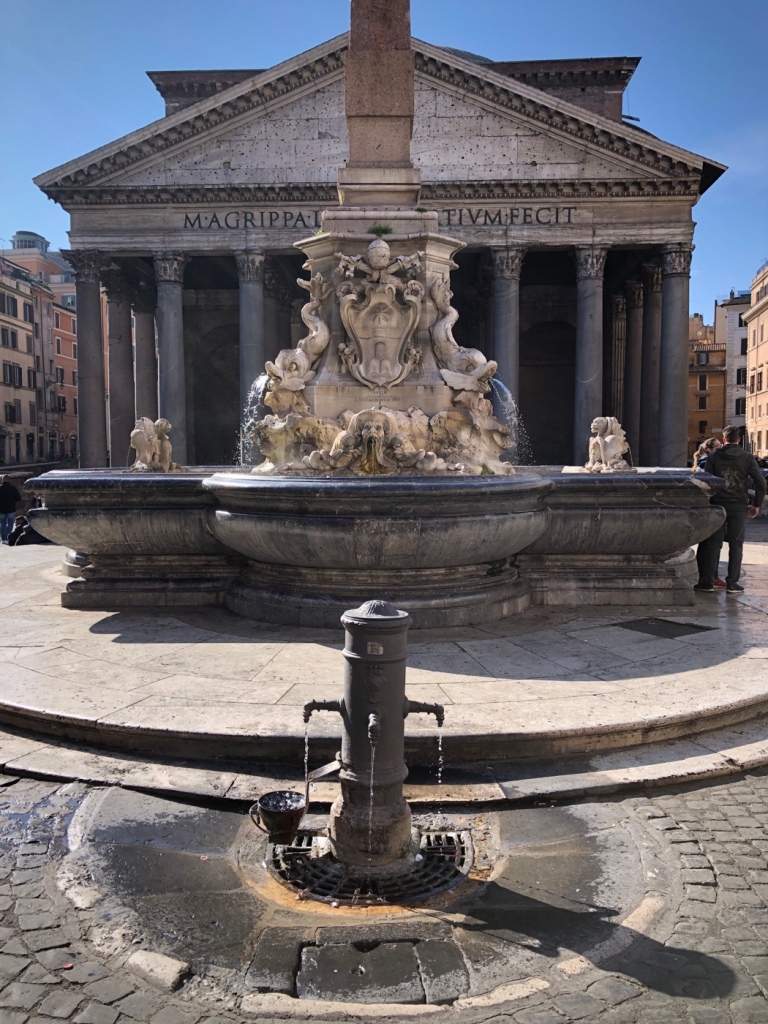
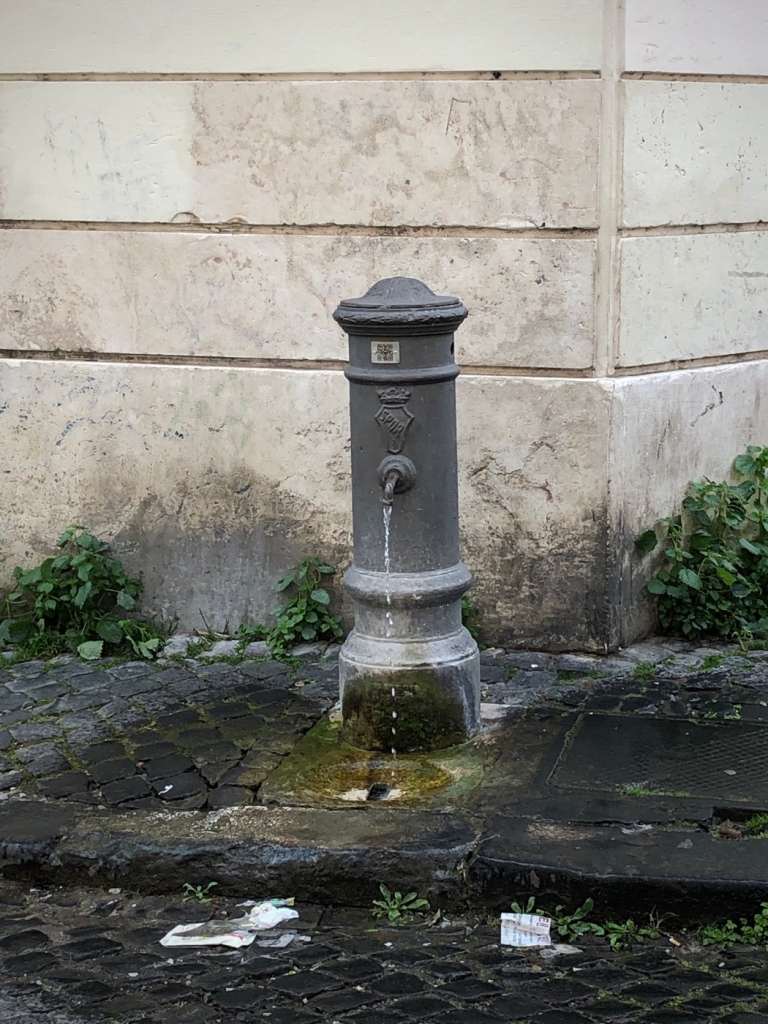
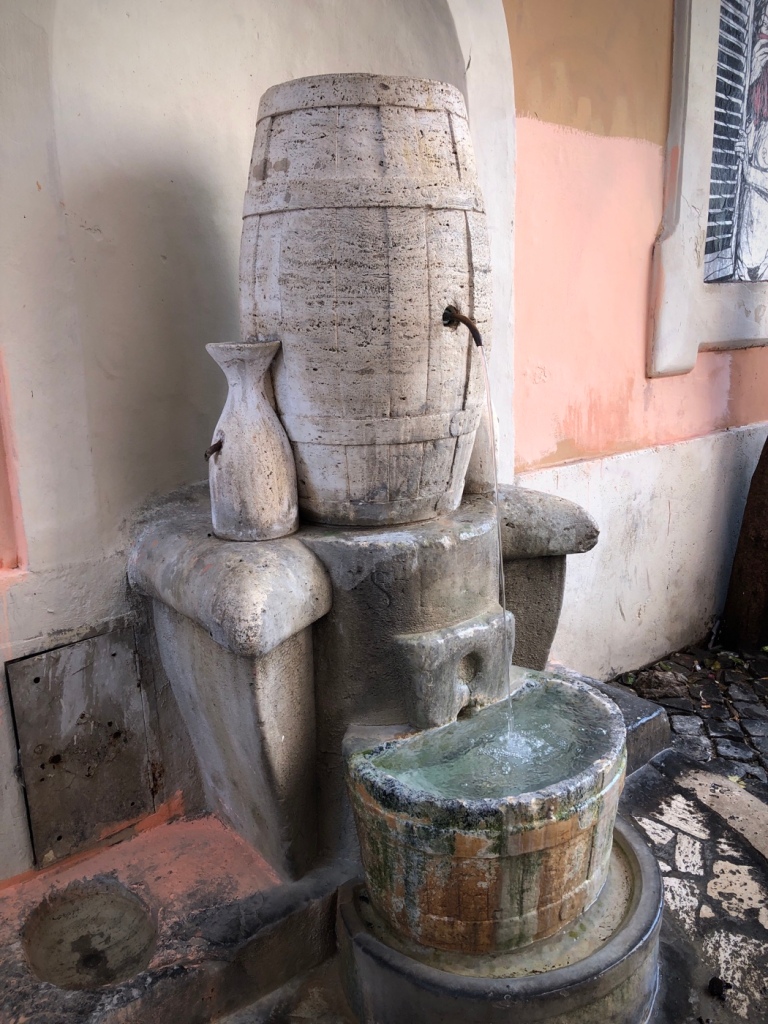
The noses of Rome? They are everywhere. Approximately 2,500 -2,800 big noses. Water fountains to you and me. The nose refers to the metal spout, which sticks off the fountain like a … nose. In place since the 1870s they are a little Easter egg hunt as you walk the city.
Nasone (plural nasoni) in front of a flower vendor.
If you come from California, a state usually struggling with and talking about drought, the sight of constantly running water fountains is a bit shocking.
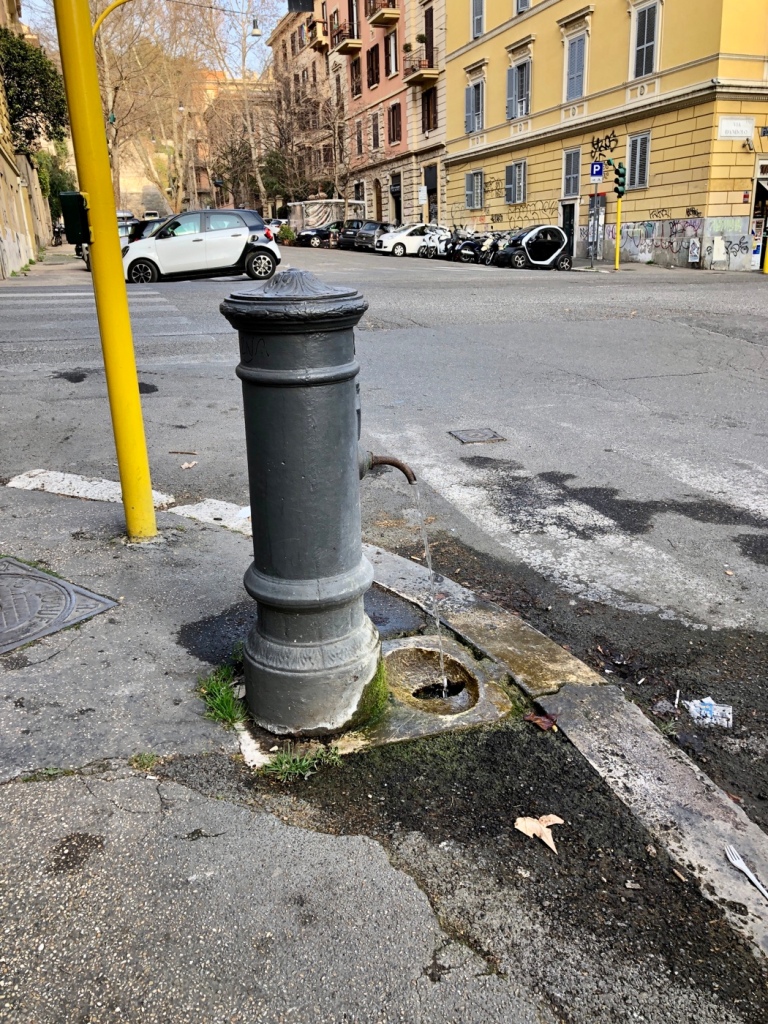
The nasone down the street from where we stayed.
It may seem wasteful to us, but the company in charge of supplying water to Rome says the constantly running fountains only account for a small percentage of water loss, 1% or so, compared to the loss from old and leaky pipes. It is the same tasty drinking water as that supplied to homes.
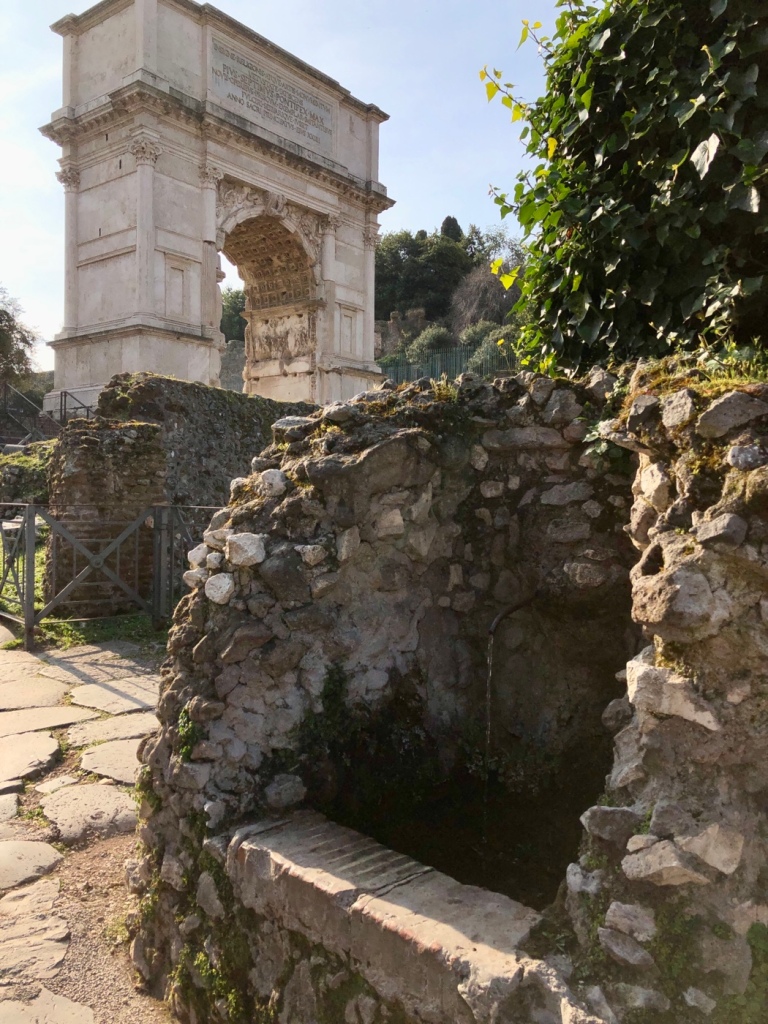
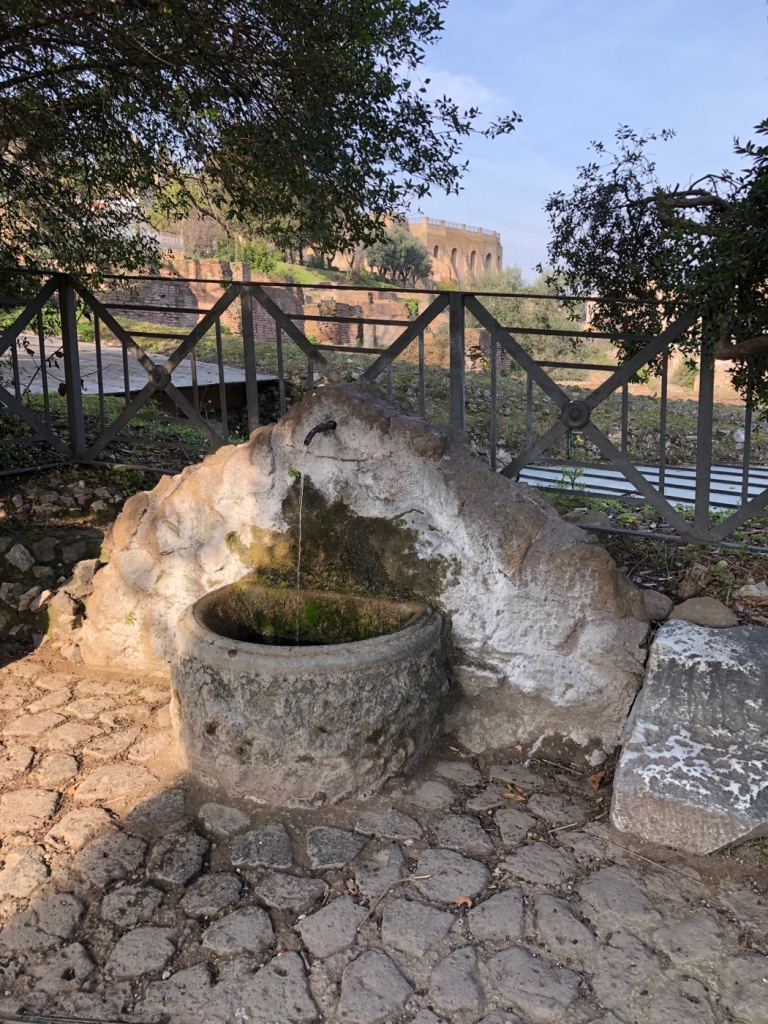
A nasone in the forum with Arch of Titus in the background.
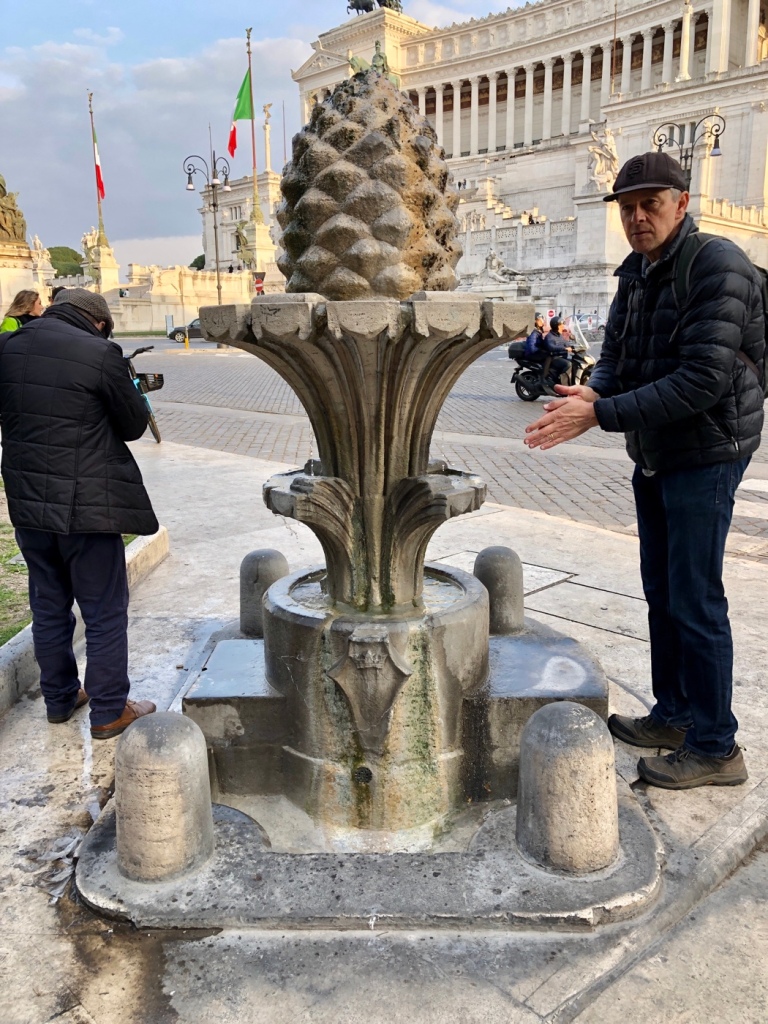
Some fountains have glamorous backgrounds.
Beautiful fountain across the street from the Alter of the Fatherland.Another nasone near the Arch of Titus in the forum.
Other nasoni have more utilitarian surroundings.
Representative of a typical street scene.
The metal spout has a small hole at the top of the arch. If you put your finger over the bottom spout water will arc up from the hole to create an easier to drink from fountain. We didn’t know this until later, so we either filled our water bag or slurped the old fashioned way.
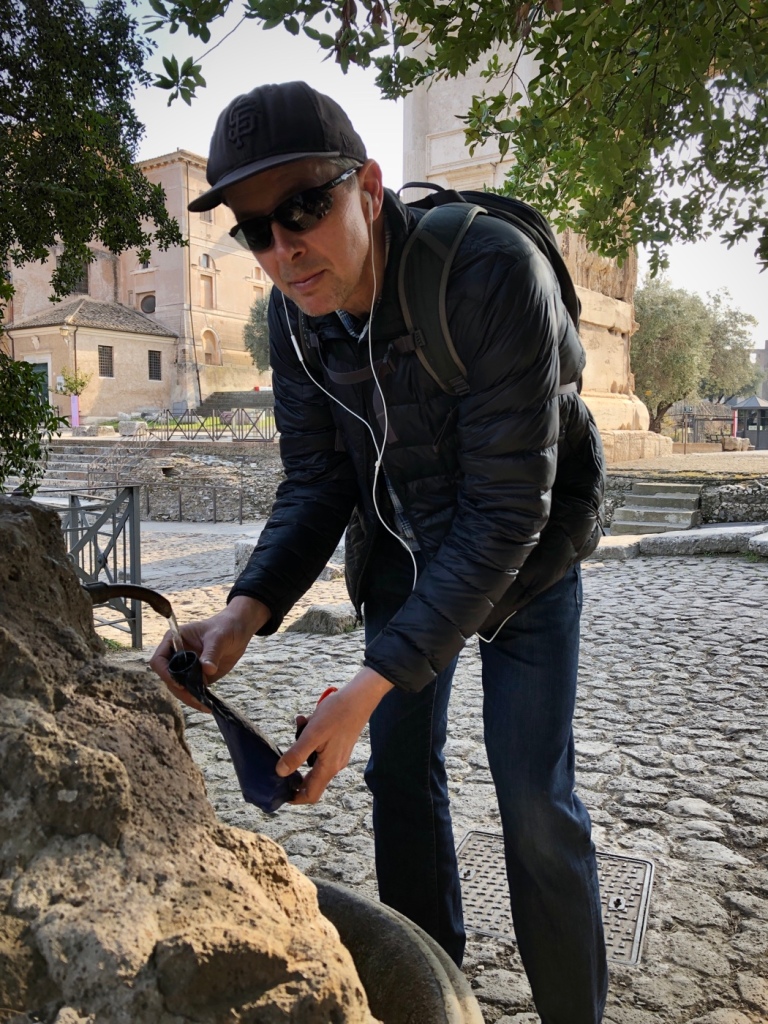
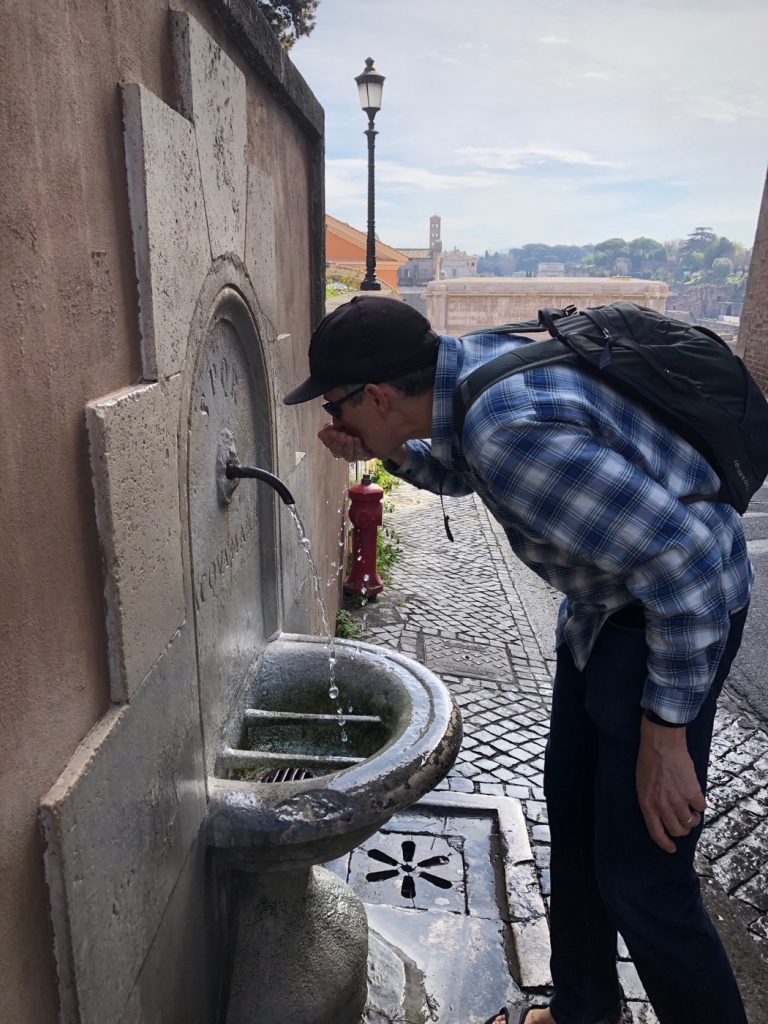
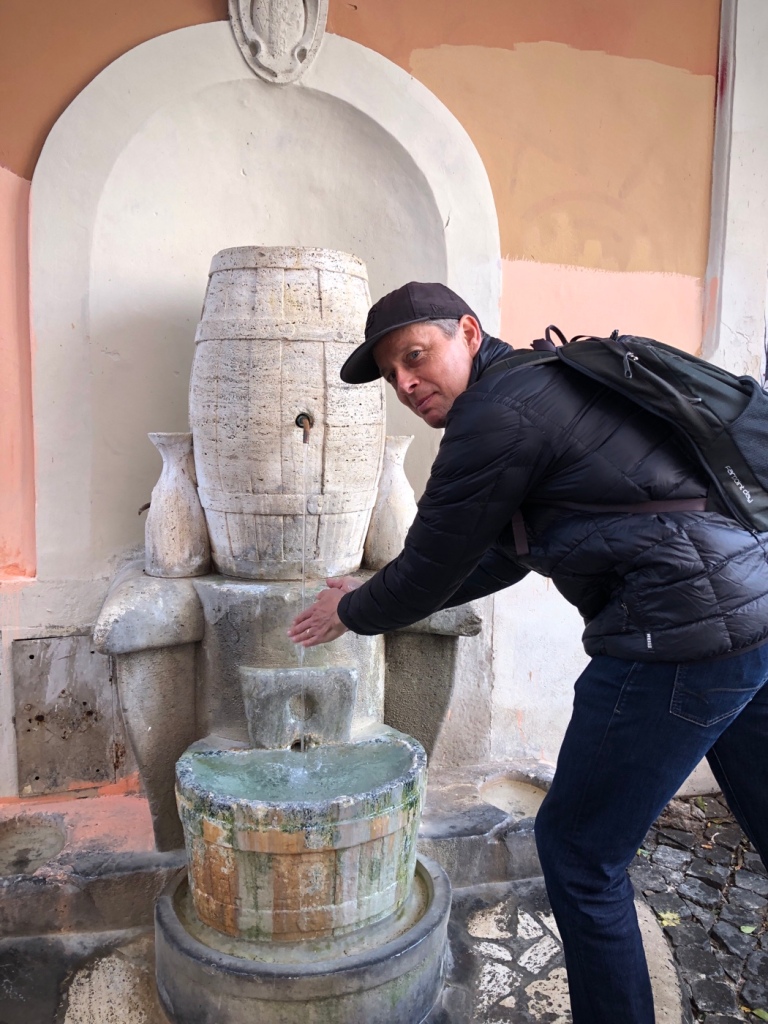
Rich filling our water bag while listening to an audio tour of the forum.Slurping. Again with a dramatic background.Piazza della Rotunda nasone, that’s the Pantheon in the background.
It wasn’t hot while we were in Rome, but I imagine these fountains are even more appreciated in the heat of summer. It’s nice as a tourist not to have to worry about finding water. And, no need to carry a full water bottle, which keeps your day pack lighter.
Unassuming but so useful.Is my back to an amazing Roman ruin while I snap pics of a fountain? Yes.My favorite fountain. With my favorite travel guy.This stunner is in the Travestere neighborhood. The two side spouts weren’t running, but the theme is fantastic.
We’re back in the US now for a visit to friends and family. Our five days in Rome were not enough to see all the sights, but we did visit many of them, in between fountain spotting.
One of the joys of extended travels is discovering the connections and overlapping layers of history, from the Neolithic to this shocking few weeks in Post Cold War Europe. You see snippets of history, in both the context of the ancient society, and the modern context of how it is presented.
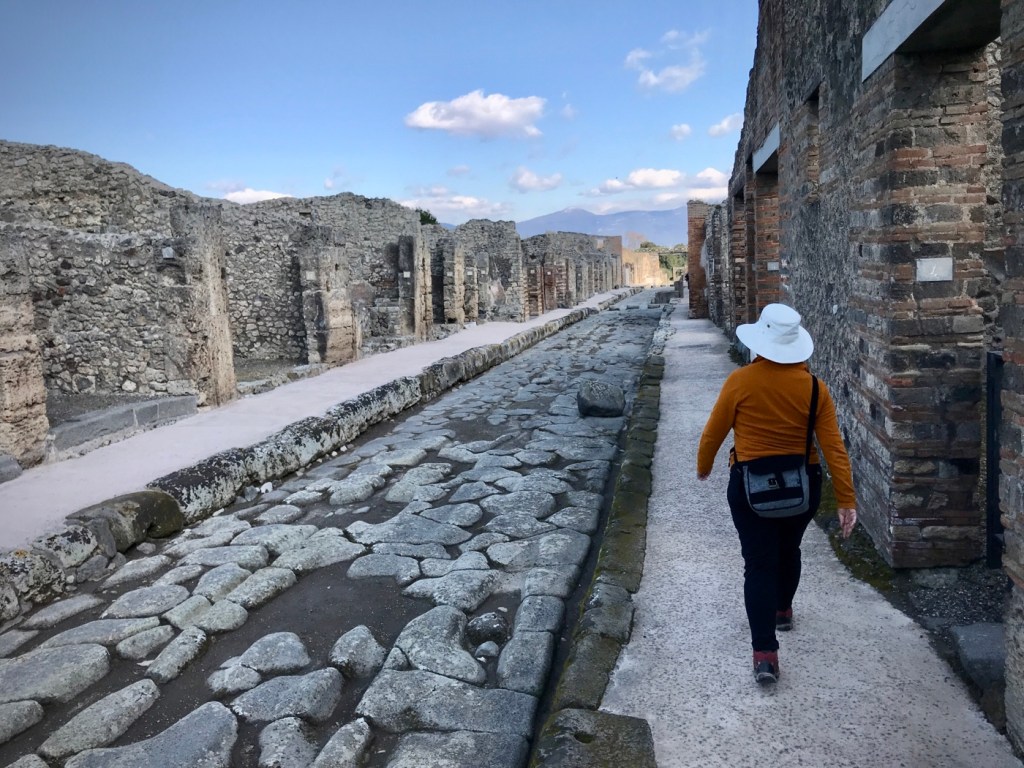
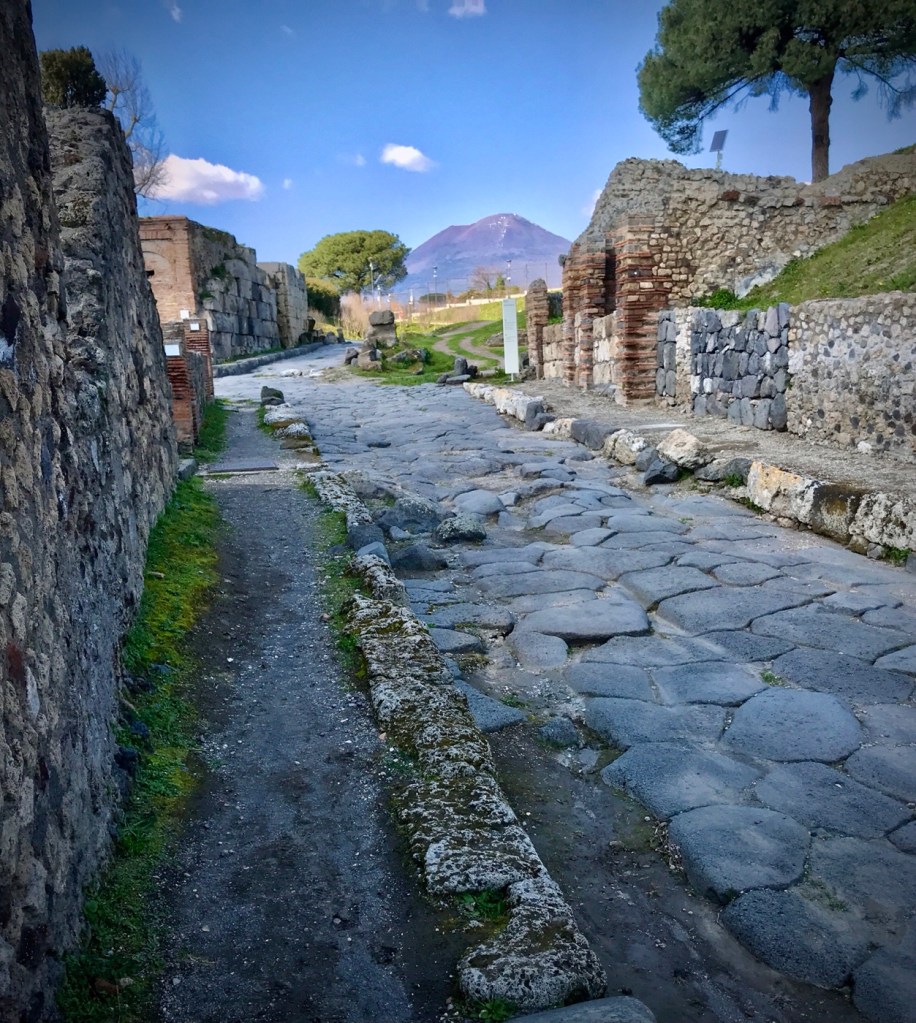
Chariot ruts in Pompei show just how much traffic plied these streets, and that there are always infrastructure maintenance backlogs!
In this part of the world, it is still stunning to discover the vastness and complexities of the Roman empire from Morocco to England, and of course, in modern Italy.
Literally layers of history at Herculaneum, right up to the old shoreline.
The past week’s events in Ukraine overlapping with visits to two of the world’s greatest archeological sites, Herculaneum and Pompéi has been sobering. Most of us understand the risks of Putins end game, but it’s especially painful for Europeans who bore the brunt of two world wars and protracted Cold War. History does feel like it is doomed to repeat itself.
The empty Herculaneum on a Monday morning; a joy to explore!
There is a lot to take in at both UNESCO sites, so we decided it was best to separate our visits by a few days. We had planned on trying to get to Herculaneum early on Sunday morning from Naples, and set out from our hotel at 8am sharp only to be stymied by misinformation on the metro and train schedules….(BTW the Moovit app is best in Naples).
I wonder what was for lunch?
So as we sat on a crowded platform, with the prospect of getting to Herculaneum 1 1/2 hours after opening on by far the busiest day of the week, we decided eating €5 train tickets was a small price to pay for a better experience and left the station for another day. Another blessing of long term travels.
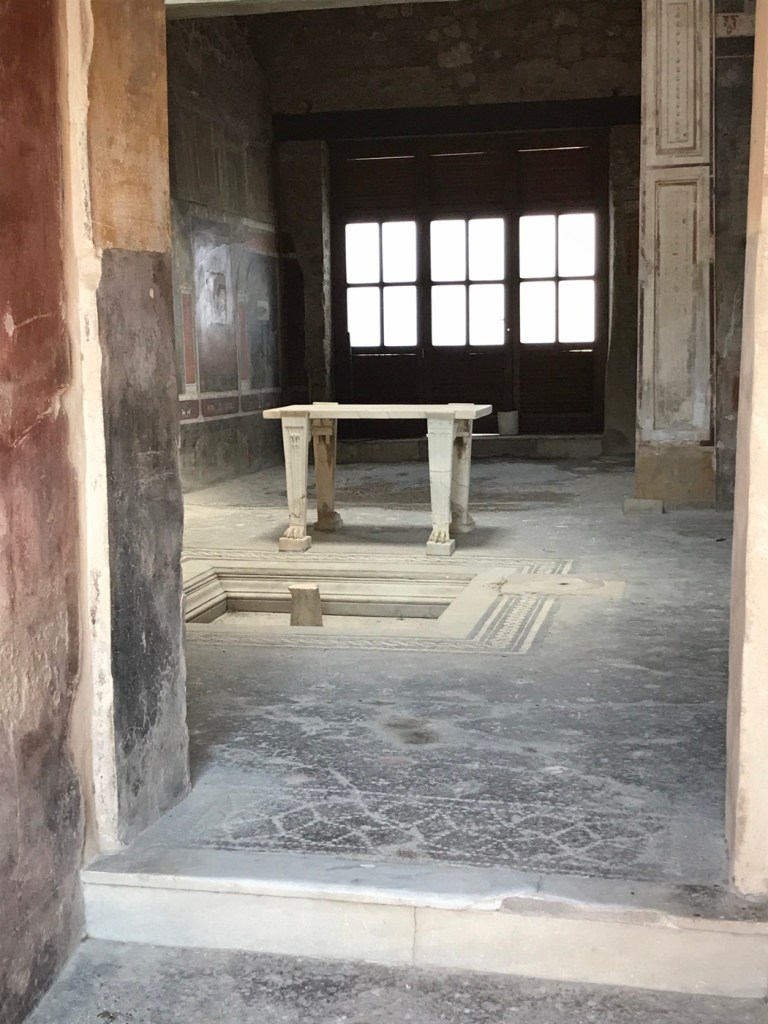
Looking towards the impluvium…Roman Villas are so impressive for their thought in design and layout; not much to improve in 2000 years of architectural development.
It was a great decision as we were able to stop at Herculaneum on the way to Sorrento on Monday, and had the place practically to ourselves….oh, and the sky was bluer on Monday too -:). This also gave us the opportunity to watch the excellent BBC documentary on Herculaneum which really did enhance our experience the next day.
Endless Pompei….20,000 lived here at its peak and 18,000 did get out on August 24, AD 79
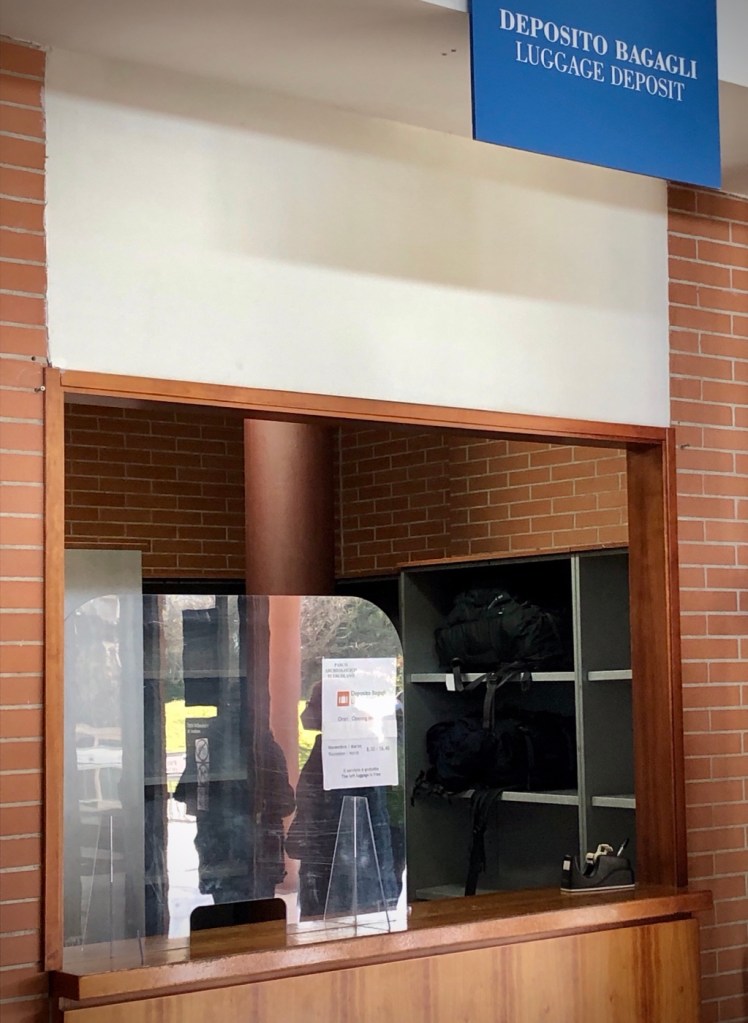
Both Herculaneum and Pompéi are on the CircumVesuvia regional train line that runs from Naples to Sorrento, so an “on the way” visit is a great option, especially as both sites have left luggage facilities. The Pompéi entrance is very close to the train station, but Herculaneum is almost a kilometer away downhill, so best if you are traveling light with backpack luggage, but it is certainly doable with a roller bag (if you can stand the sound on the sidewalks!)
Left luggage at Herculaneum…simple services like this can make a travel day possible.
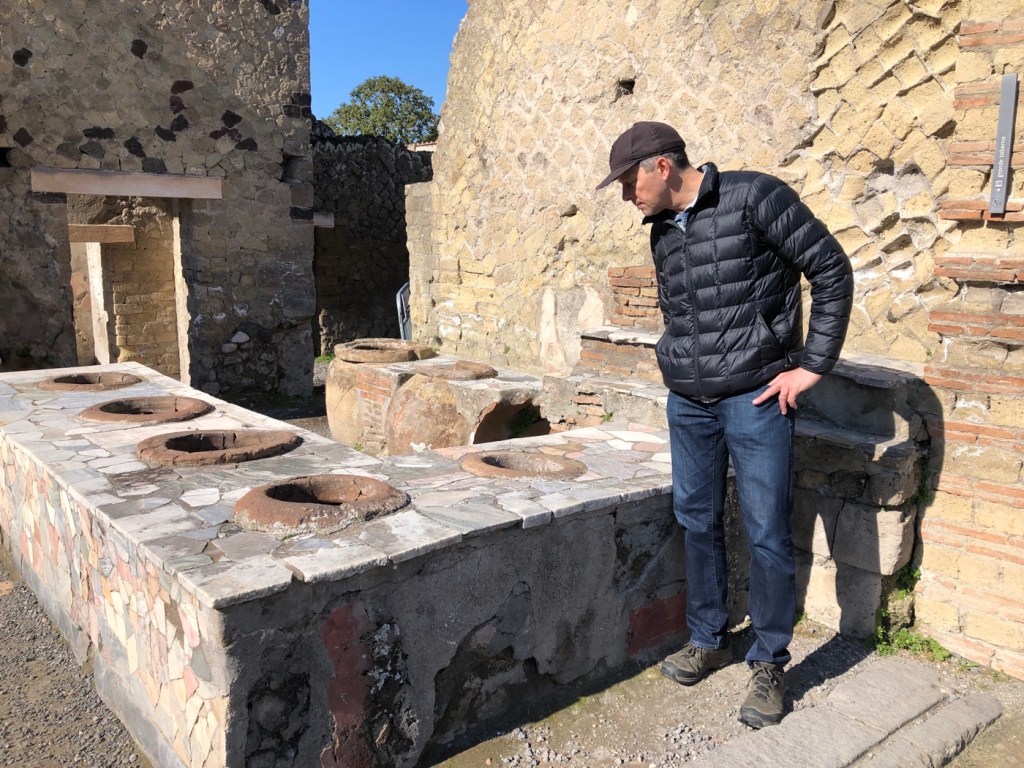
Herculaneum was a prosperous and smaller city than Pompéi; kind of a posh suburb. When it was hit by the huge earthquake of AD 62, many of its wealthier residents took the damage as an opportunity to remodel…of course, only to be buried by 50 feet of the pyroclastic flows of Mt. Vesuvius just years later in AD 79. The site is compact and surprising in its somewhat dense surroundings of a more modern town.
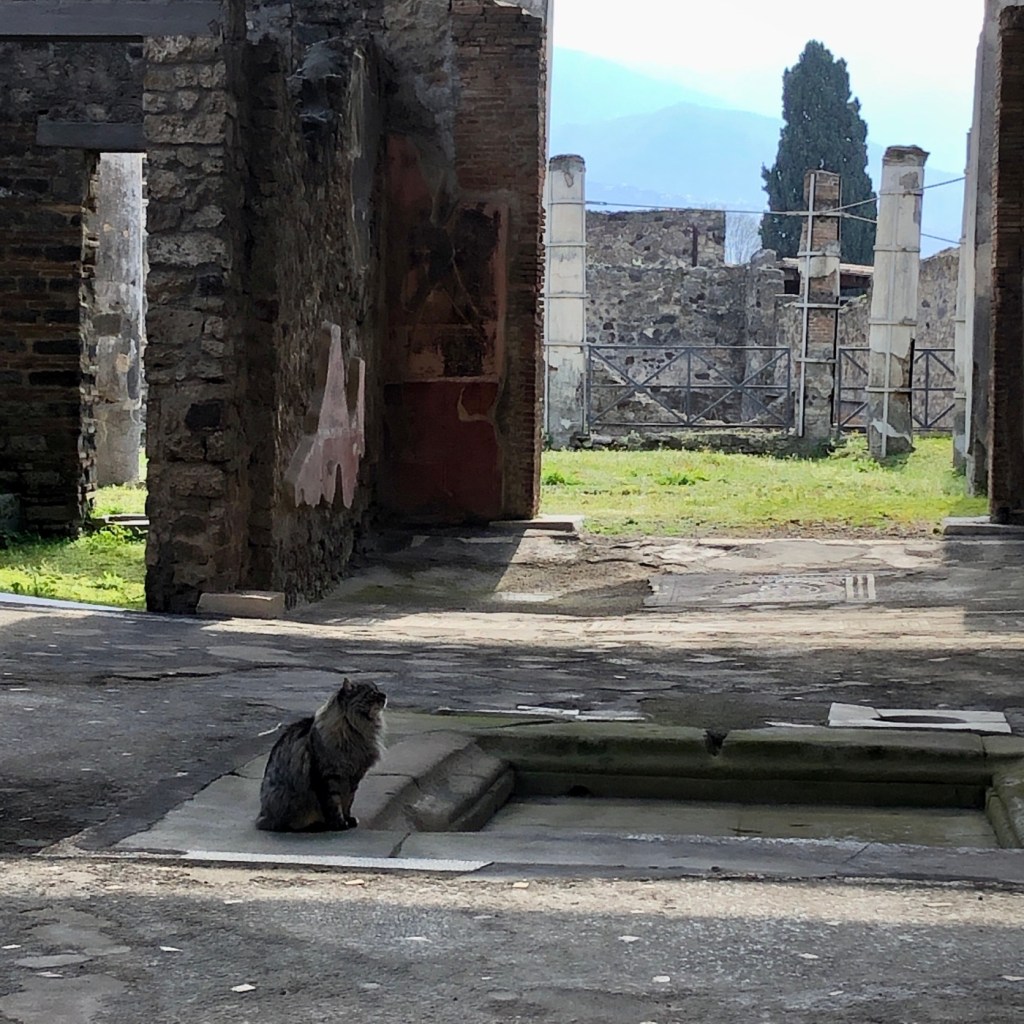
Yes, there were cats in Pompei
What was also surprising to us, was all the people that still live in the shadow of the mountain, taking a calculated risk that it won’t erupt soon, or with such force. They say there will be some warning from the vulcanologists and seismologists next time. And of course, we lived in San Francisco for 30 years, so can understand taking a risk living somewhere you love or is your home. Or both.
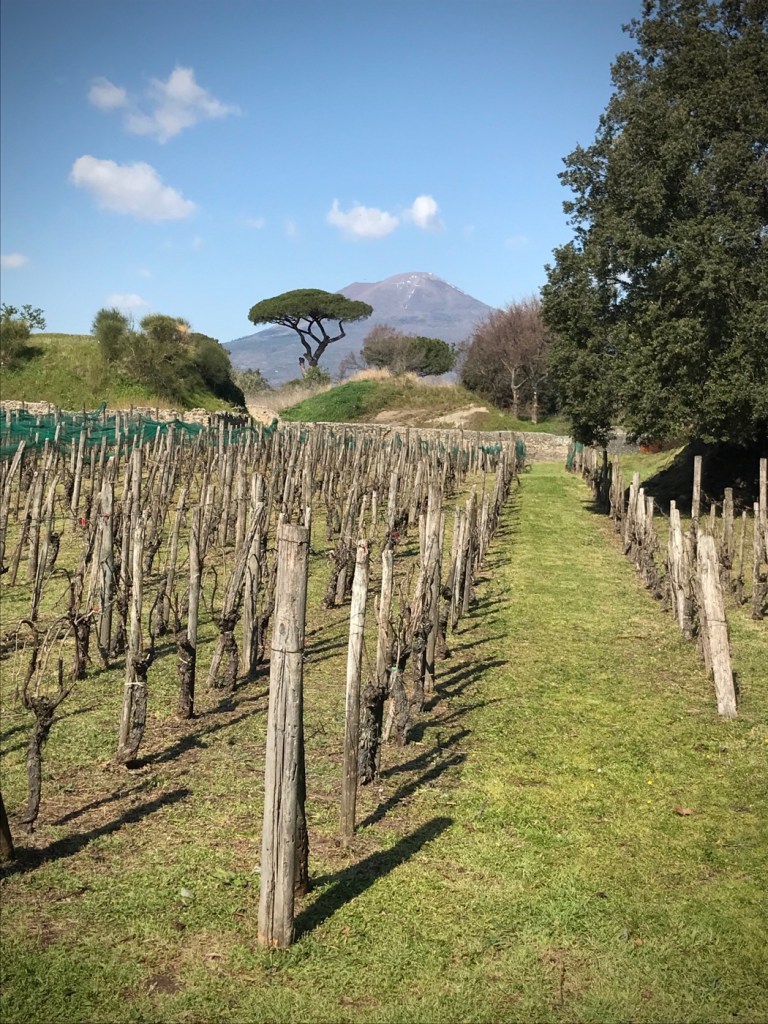
The restored vineyards of Pompei with Vesuvius in waiting.
After a nice day off in Sorrento walking in the local hills of lemon groves, we visited Pompéi by taking the train back from Sorrento on Wednesday, and again enjoyed light crowds.
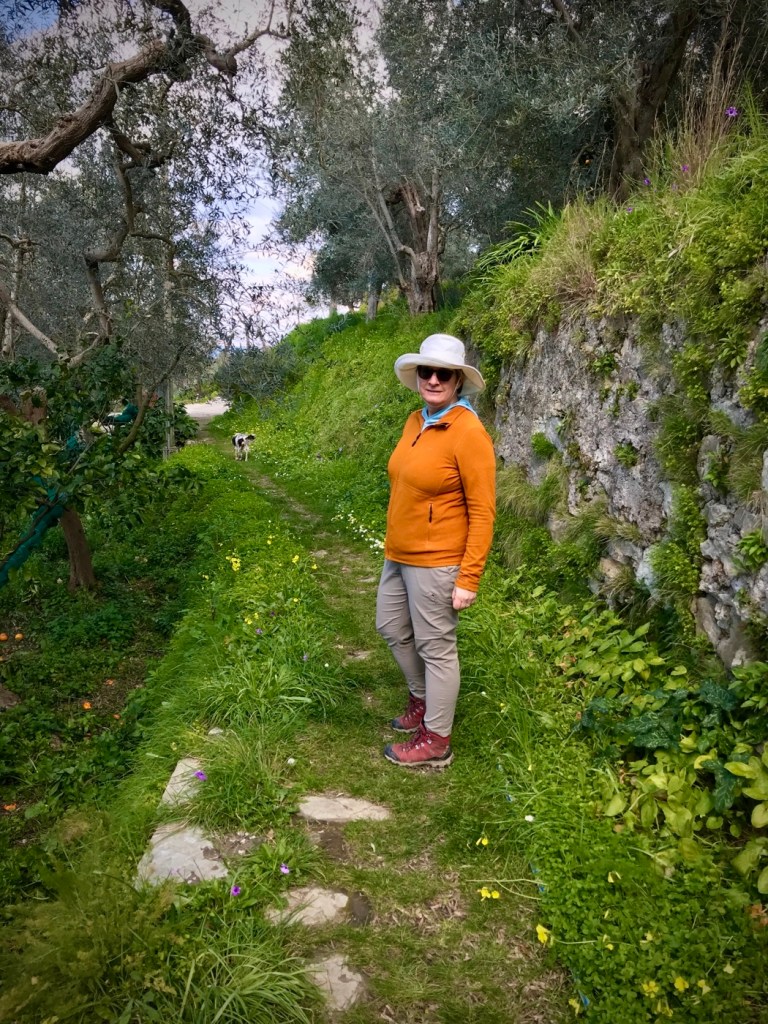
Taking a Roman break walking in the hills of Sorrento, with spring finally showing it’s serious in Southern Europe
In fact we walked up to the ticket window at 9:30 am with no line. It did get a bit busier as the day went on, but still an apparent trickle compared to pre-COVID times, as the tour buses have not returned yet. Somewhat a golden time for travel if you can get here.
The tranquil footpaths to Marina Lobra, near Sorrento
Pompéi is vast and sprawling, and it stuns you with the scale of the city’s ancient streets, sidewalks, and lunch cafes. Romans ate lunch out routinely, apparently to feed their appetites building vast baths, forums, and an amphitheater.
The slight curves and meanders of Pompeii’s roads was insightful urban planning
It was so easy to visualize the vibrant community, with its rolling and meandering streets, variety of villas, and the detailed understanding that has been miraculously deduced about the residents of almost every significant building. Artists, traders, cooks, politicians, and more recently nearby, slave quarters that give insight into the reality of the indentured servitude that supported much of the Roman’s impressive legacy.
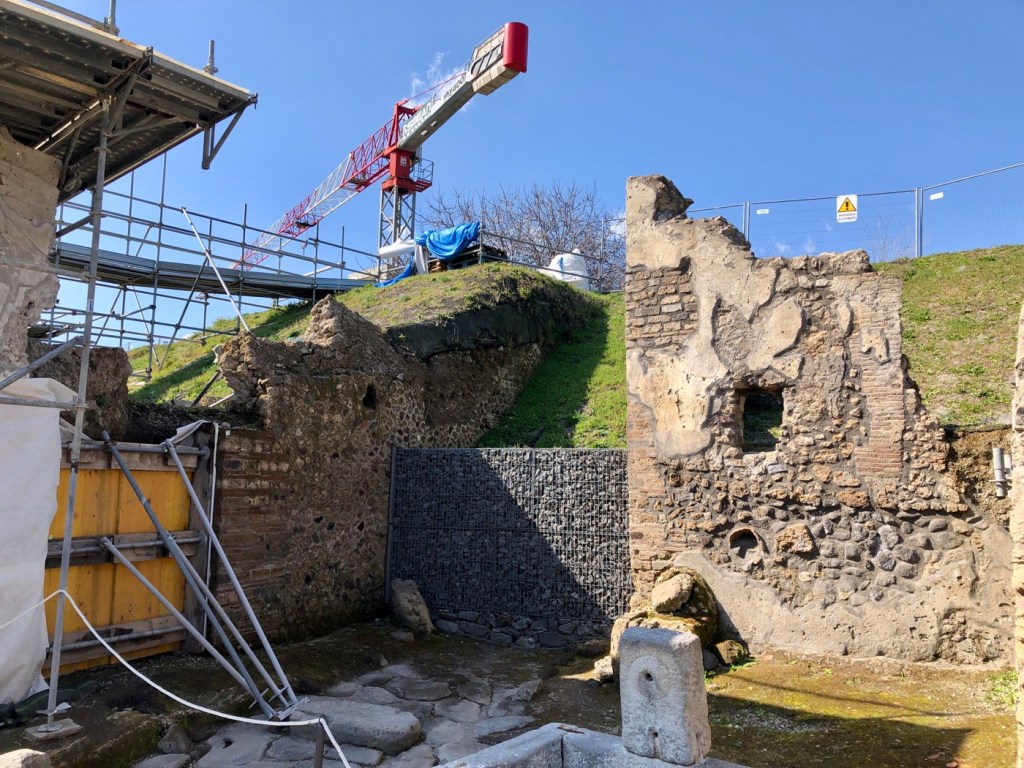
The work never stops at Pompei, as new discoveries await daily. Amazing.
It also helps to visit the fantastic Archaeology museum in Naples first as we did, so you can see many of the original artifacts, frescos, sculptures, and mosaics first, and the drop them into Pompéi and Herculaneum, like objects in SimCity AD79. There are a lot of in situ items still remaining at both sites, and many buildings at Pompéi are under restoration or access is limited to protect the fragile elements from so many visitors.
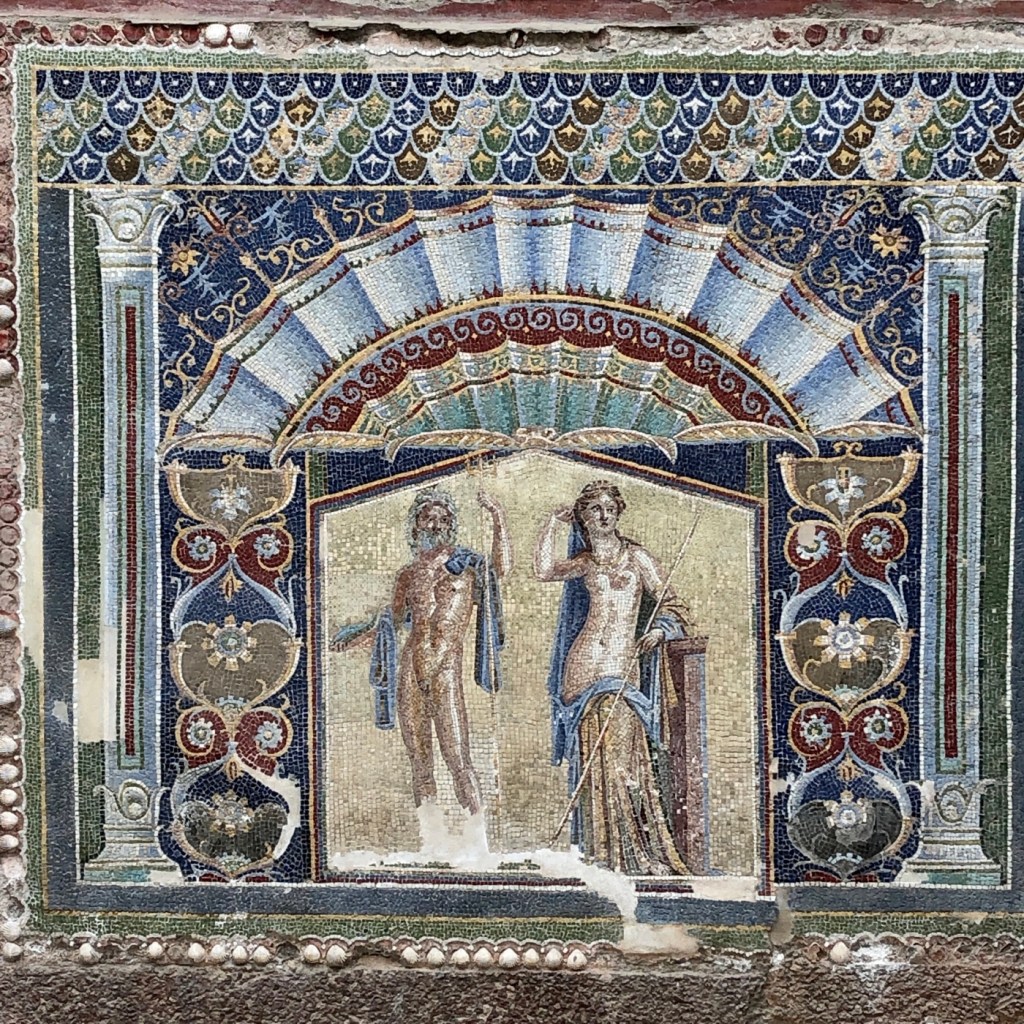
Art and story telling enriched every aspect of Roman life….it all feels so modern.
So as we headed out of Pompéi to continue along the Amalfi coast, we both relished this unique time to travel, our freedom, and the fact that our civilization is generally still thriving. But also more cognizant than ever that it can fall apart in an instant….or at least an archeological instant. We have to learn from history and react.
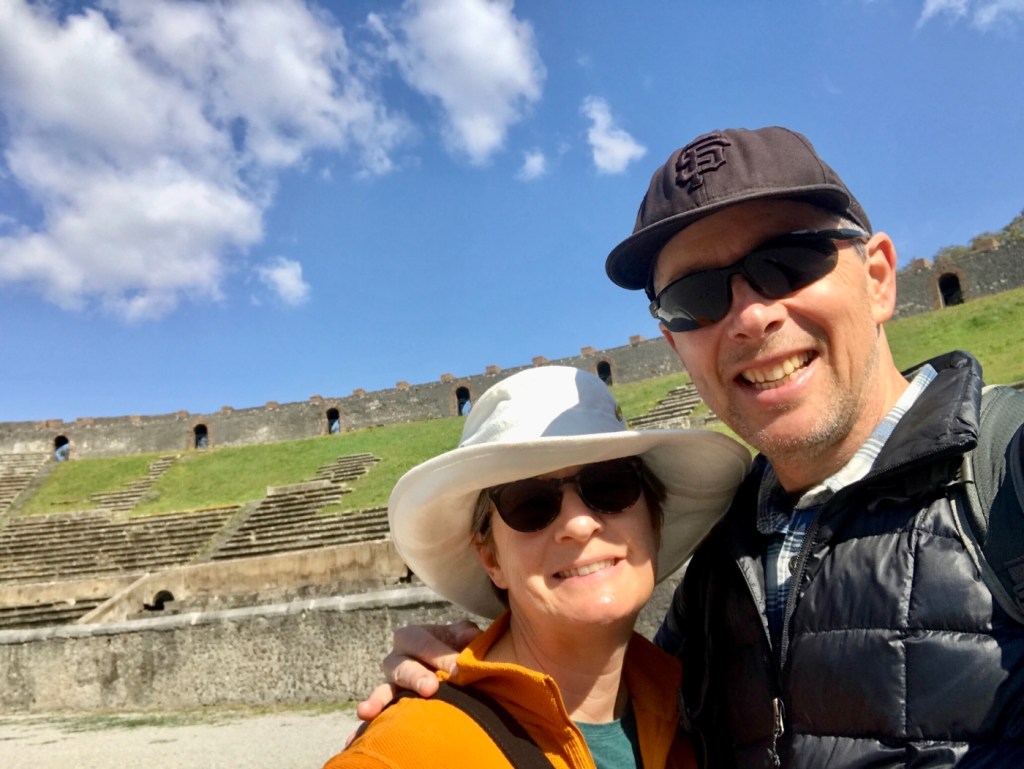
The happy travelers looking for their seats in the Amphitheater
Peace and love to all, especially to those who have recently fled their homes from an impending calamity.












































































































































 Less Car, More Life