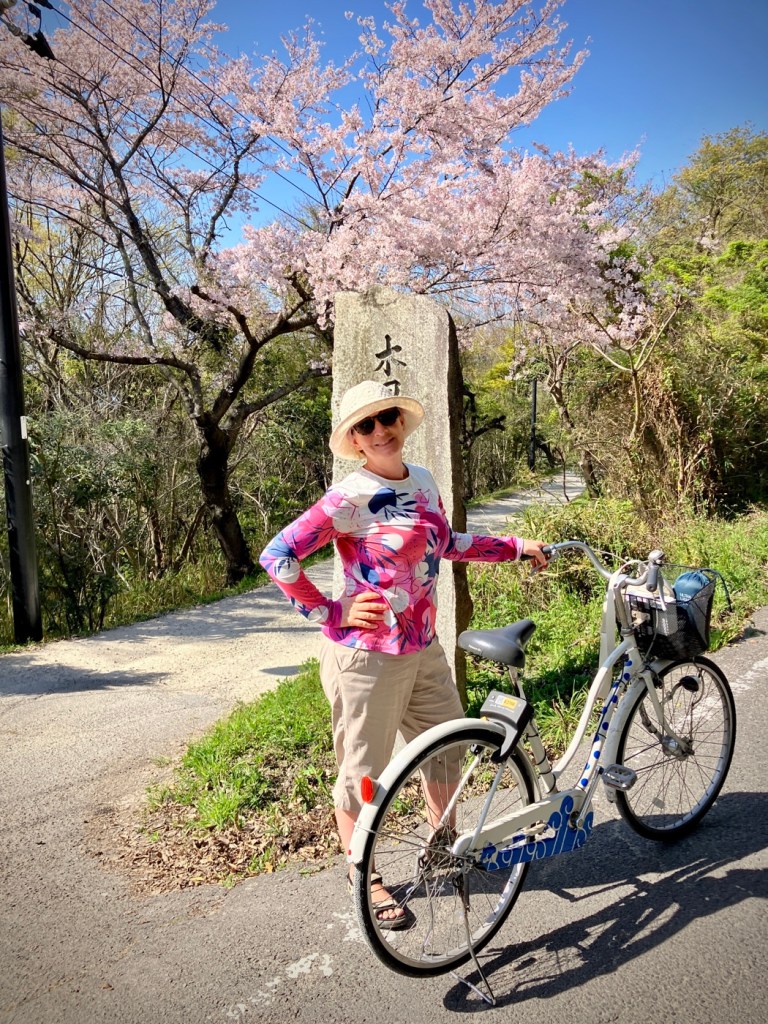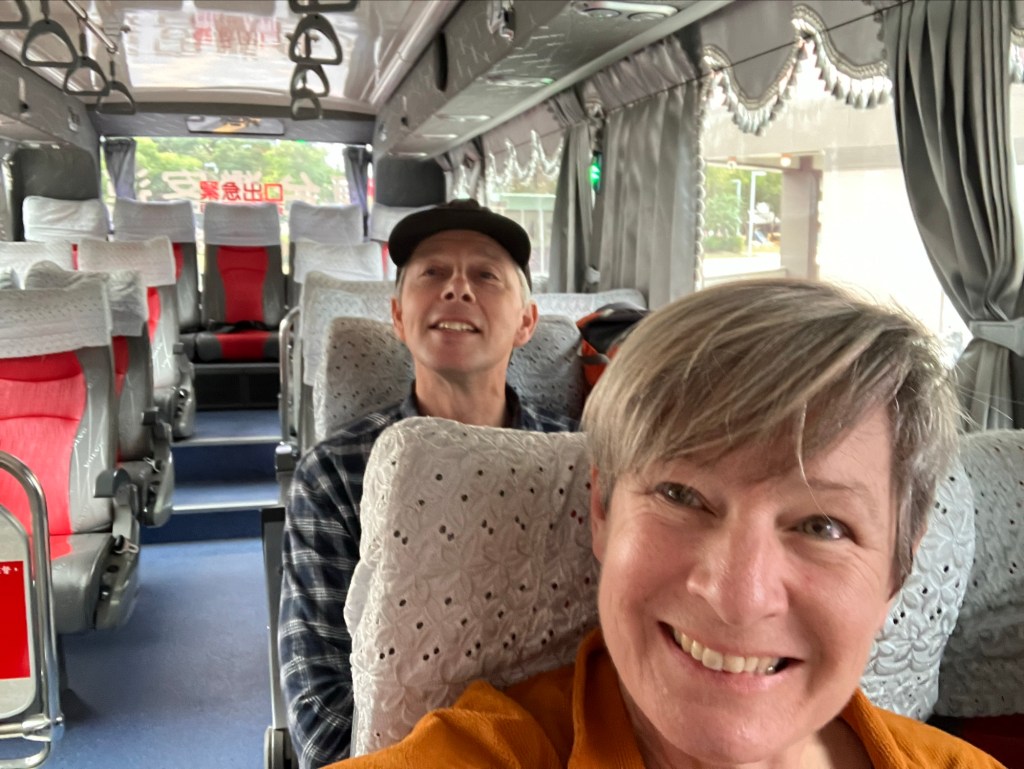
Three weeks in Taiwan by train, bus, bike, and only two taxi rides.

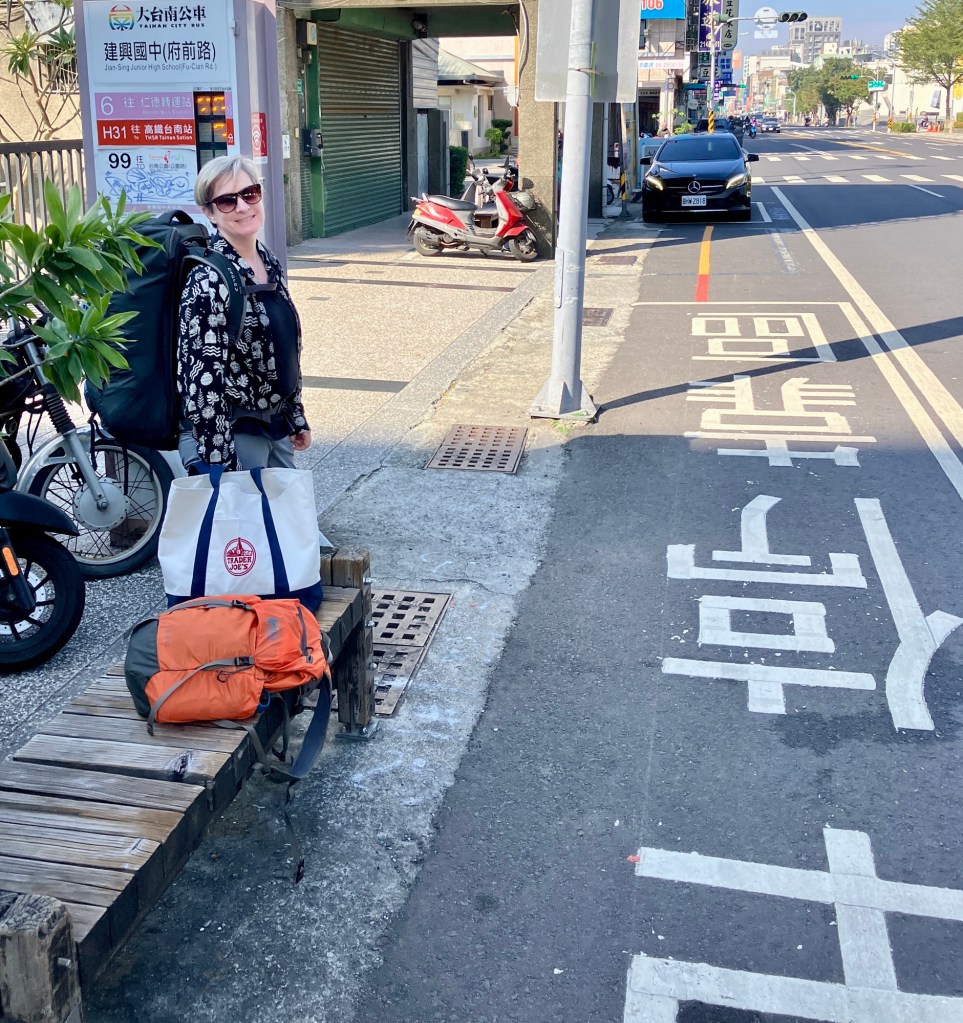
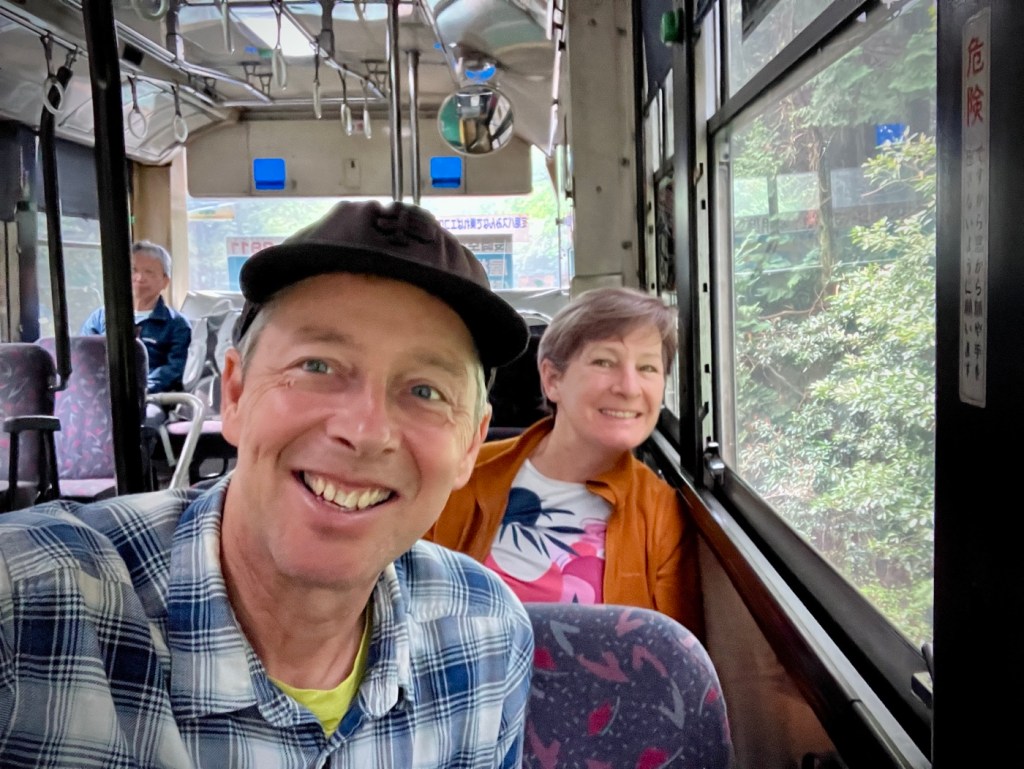
Taking the city bus in Taitung to get to the train station.

Yes, we keep track of our travel modes. As long term travelers we have the luxury of time and room for errors, or spending extra time that other travelers might prefer not to “waste” taking buses instead of taxis. We also like to try to experience life the way locals do, as much as we can. Of course Rich always has a back up plan – if this bus hadn’t shown up in ten more minutes we’d walk over to the taxi stand. But show up it did, and we were off to the train station to go to Kaohsiung, a city of 2.7 million.

Last minute mochi snack purchase at the train station.
The business class seating.

Rich, in his quest to really understand Taiwan trains, got us business class seats which weren’t really necessary since standard class is comfortable, but you know, for research sake. He also managed to book us in the single seats on the coastal side of the train, so fantastic views out a window each. Interestingly enough, a mother daughter duo from the bus were also in the business class train car with us.

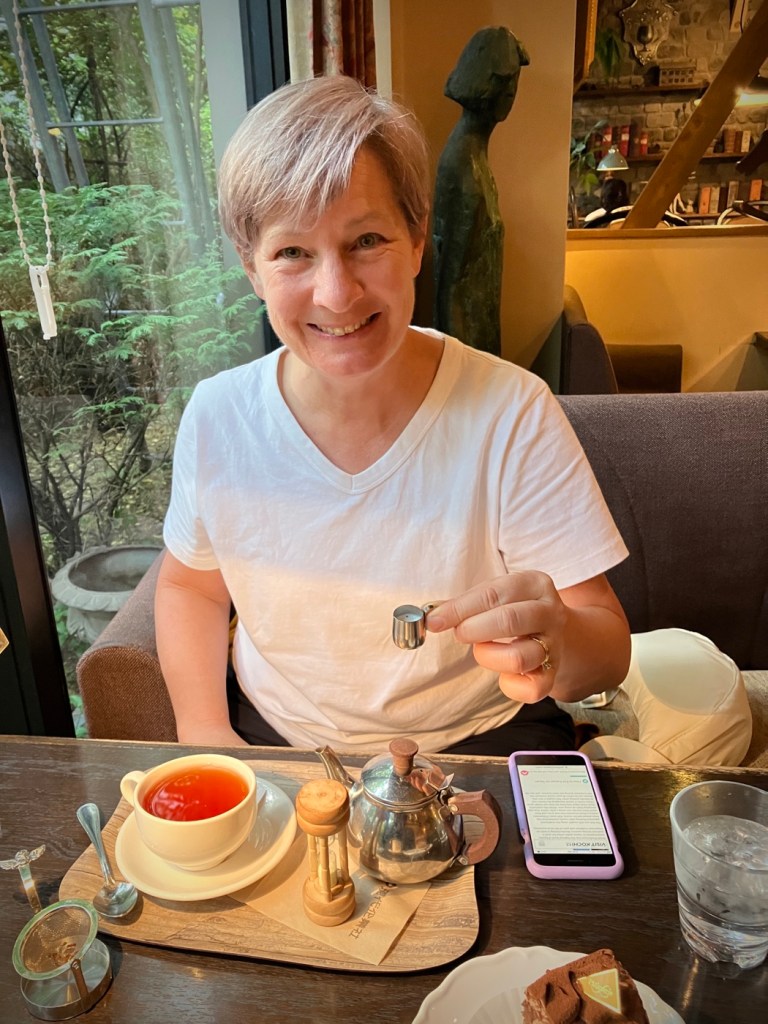
Tea at the Kaohsiung Museum of History.

Something that is necessary is a plan for what to do when you arrive at your destination before your hotel lets you check in. Check in times in Taiwan are quite strict, usually 3 or 4 pm, so if your train arrives before that, you need to have an idea of where to go after you drop your bags at your hotel. We were glad our hotel in Kaohsiung, Hotel dua, let us check in when we arrived at about 1:30. We think that was due to the fact that we were staying for four nights. But we were ready with our plan. YouBikes to the Museum of History.

Our trusty Easy Card works for any city bus, and all YouBikes everywhere in Taiwan. Awesome!
The Easy Cards, purchased in Taipei when we landed, reloadable in any convenience store – and also works in vending machines and some shops.

For us, riding bikes in an urban environment isn’t daunting. And with so many scooters in Kaohsiung we felt in good company. The cycling is certainly not the best in the world, but with the long distances and flat terrain, riding bikes is such a good way to get around. We met up with a fellow traveler, Martin (Hi Martin!), from Sweden, for pizza at a place that seemed not too far away from both our hotels. Ha! We all exclaimed at how much further it was than it first appeared on the map, us bicycling and Martin walking. It’s always so great to meet other travelers and swap stories and travel tips and learn about each other’s lives. Always say hello to fellow travelers, even if it feels awkward at first. I’ve had to get over my uncomfortableness about asking people where they are from, I’ve learned to phrase it “Where are you visiting from?”. That helps avoid awkward moments when you might have assumed incorrectly about a person’s home country. Taiwan doesn’t have that many western tourists so seeing other travelers is not common, which makes it even more fun to find out where folks are from and what their deal is.

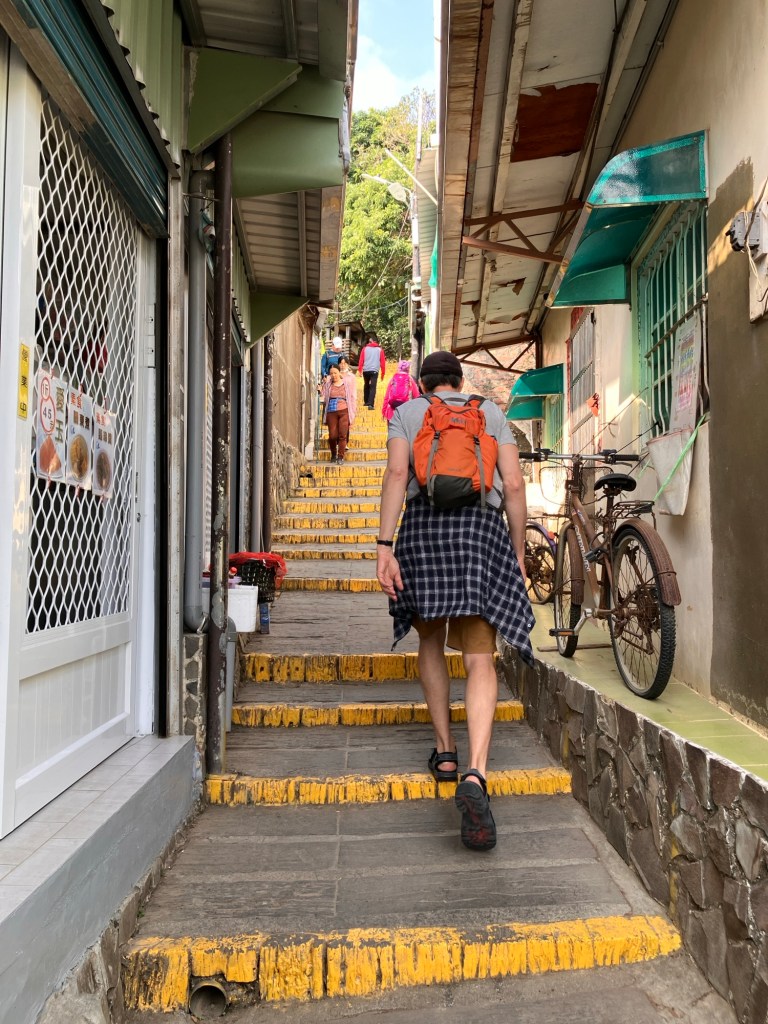
Our YouBikes outside a 7-11 on our way to hike Monkey Mountain, also known as Shoushan Mountain. We stopped for snacks.
Starting up the many many stairs of Monkey Mountain.
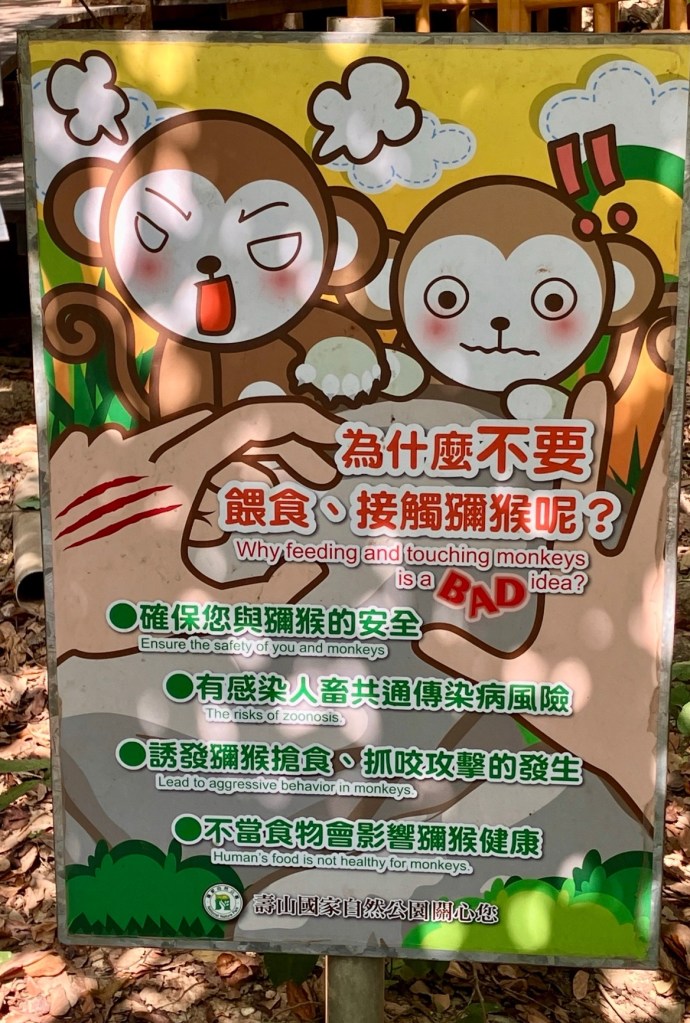
After seeing this sign we stopped eat all of our snacks before encountering any ravenous monkeys.
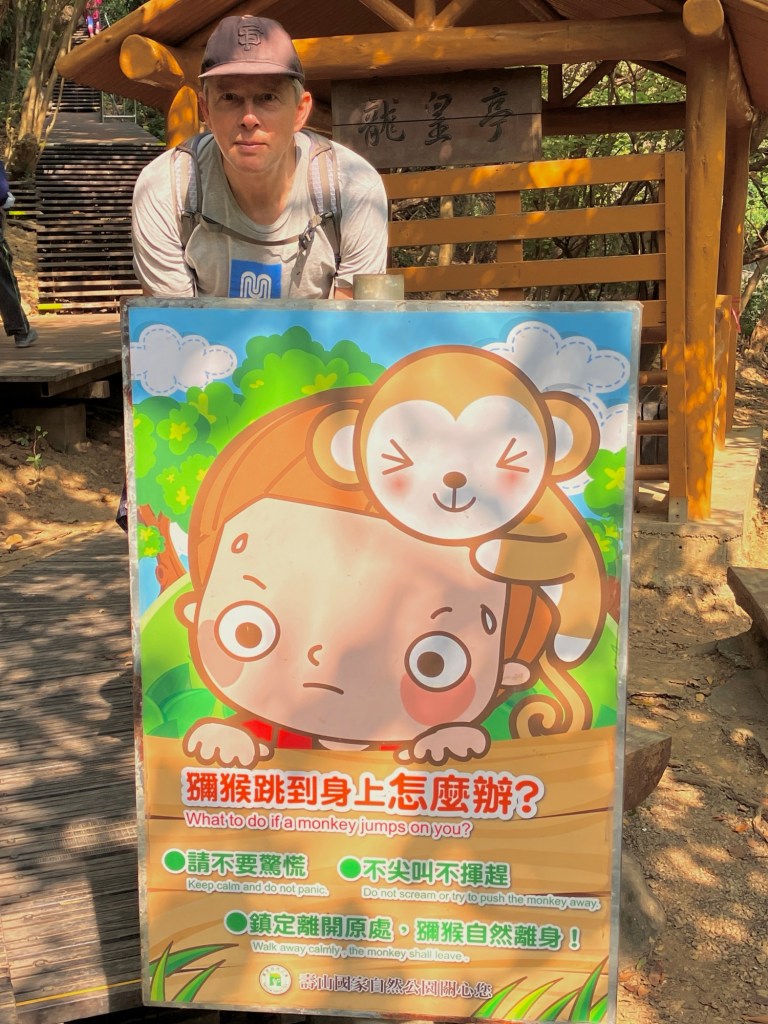
The second sign warning not to feed the monkeys. Ok ok, we thought.
Wait? We also have to worry about monkeys jumping on our backs? Keep calm. Don’t panic. Don’t try to push the monkey away? Walk away calmly?

We did spend some time pretending to screech and swat monkeys off our backs, and then when we did encounter some Formosan rock macaques we walked by gingerly, saying hey buddy, no food in our packs, it’s all in our bellies now.
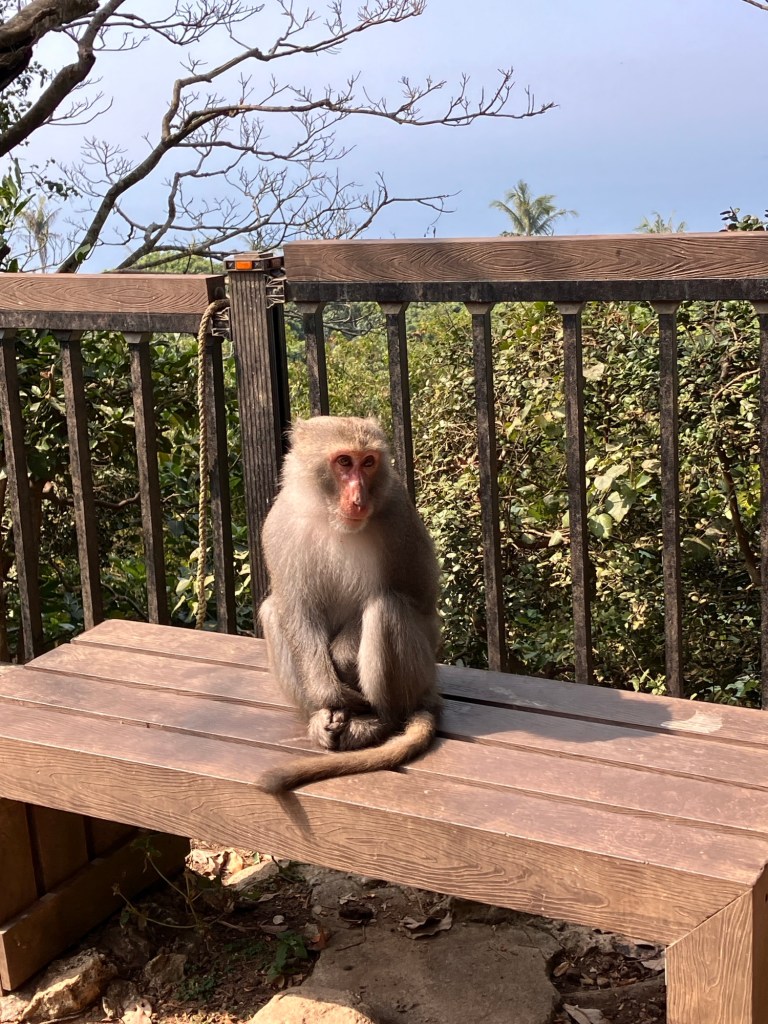
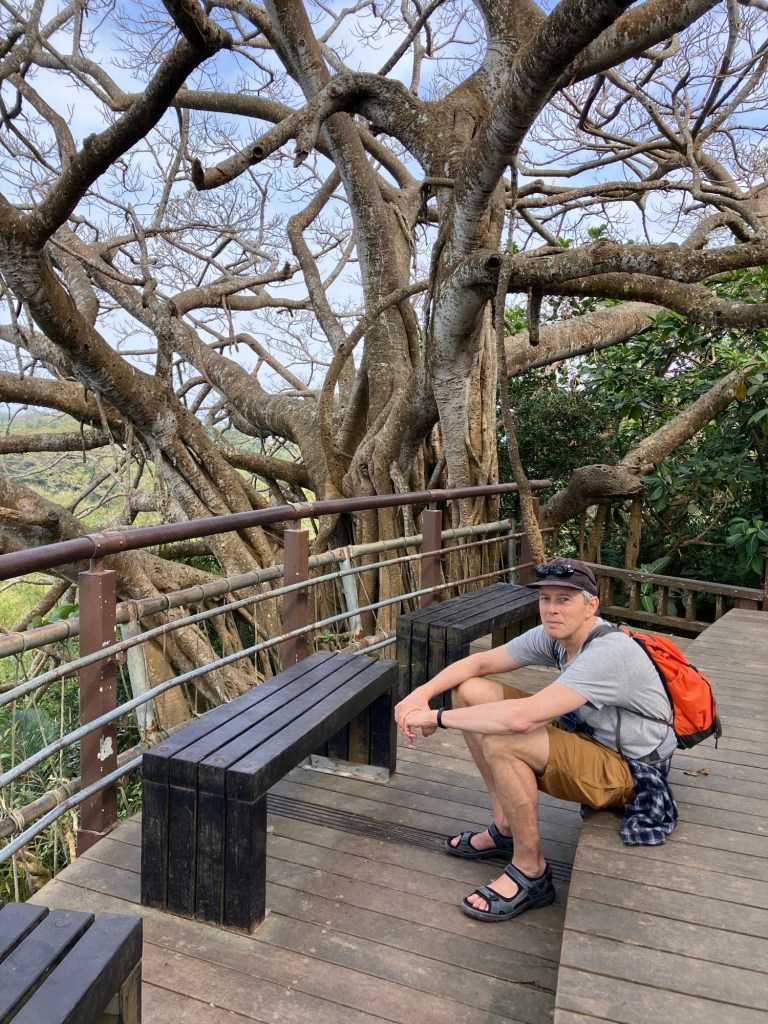
I will sit innocently on this bench. Just a cute monkey.
I will sit fifteen feet from that monkey watching it like a hawk.

Just as we were thinking the monkey problem was maybe overblown, someone took an empty crisp bag out of their backpack and chaos erupted when one monkey grabbed it and took off and ten other monkeys gave chase! Round and round the seating and view area the monkeys went until they gave up and the ringleader discovered his prize was an empty bag.
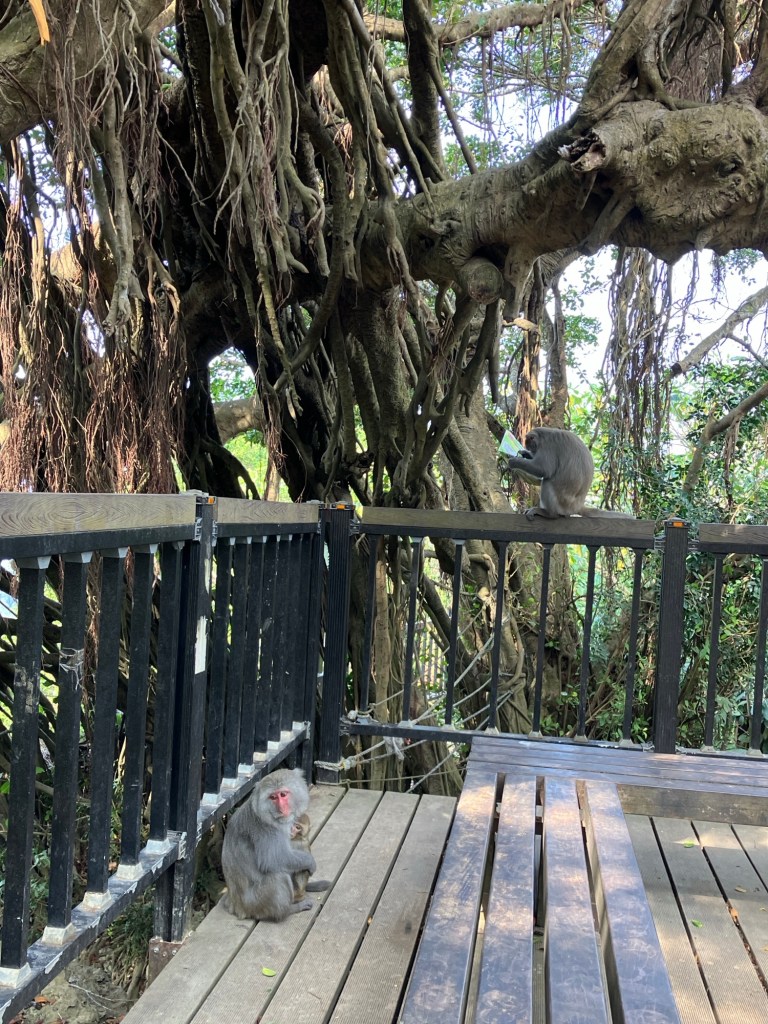
Count the disappointed monkeys in this photo. Three. Adorable tiny baby learning to be a menace at mama’s knees.

Monkeys aside, the trail up and around the mountain is very nice, well worth hiking. We were there on a weekday and were surprised at how many folks were hiking. I suspect it would be very crowded on a weekend.

When the trail is not going up or down loads of stairs it winds through old coral reefs pushed up out of the sea eons ago.
The views of both the city and the Taiwan Strait/Pacific Ocean, on a clear day would be amazing. However, the air quality was not brilliant the day we hiked.
Coming down from the hike you can again spot the dominant mode of transport: scooters. Spot the monkey. Locals put sticks across their scooter seats to prevent Mr. Monkey from making himself comfortable.
A nighttime ride to dinner.

All this hiking and biking makes for hungry travelers. We joke that we are rarely so happy as when at a good hotel breakfast buffet, and Hotel dua fit that requirement well. Breakfasts in Taiwan are veggie heavy which is wonderful. We’re not strict vegetarians but certainly prefer to eat healthy, and the vegetables and tofu options available at a Taiwanese hotel buffet are fantastic.

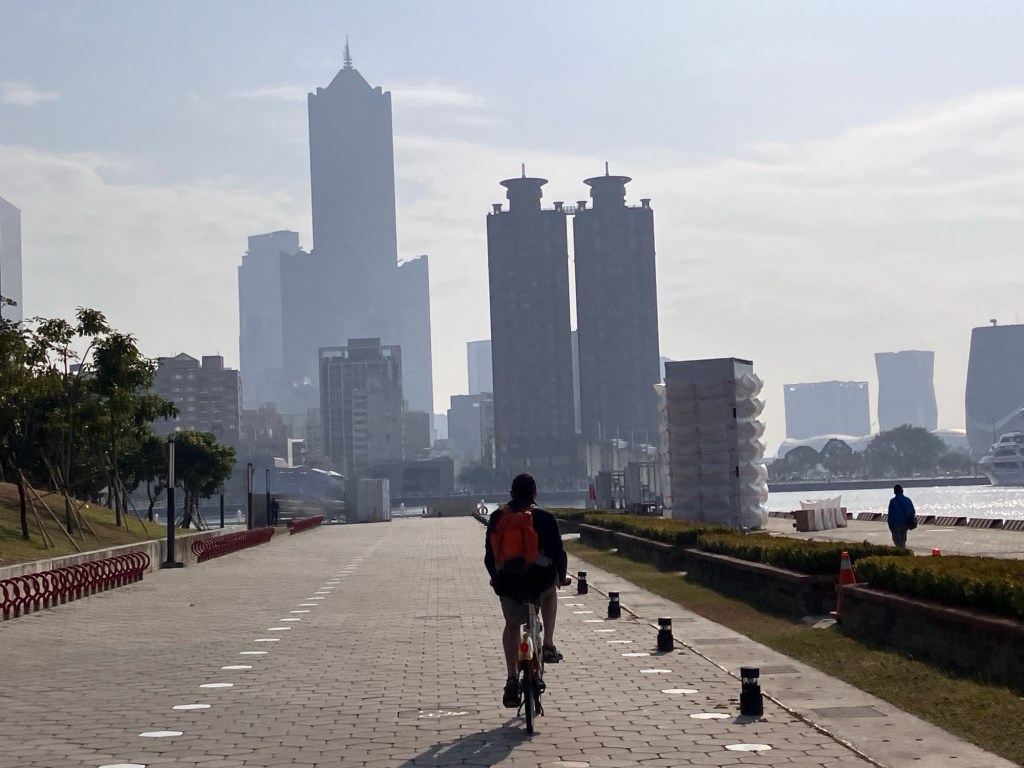
That is a good start to the day.
Energy to ride along the Love River in Kaohsiung.
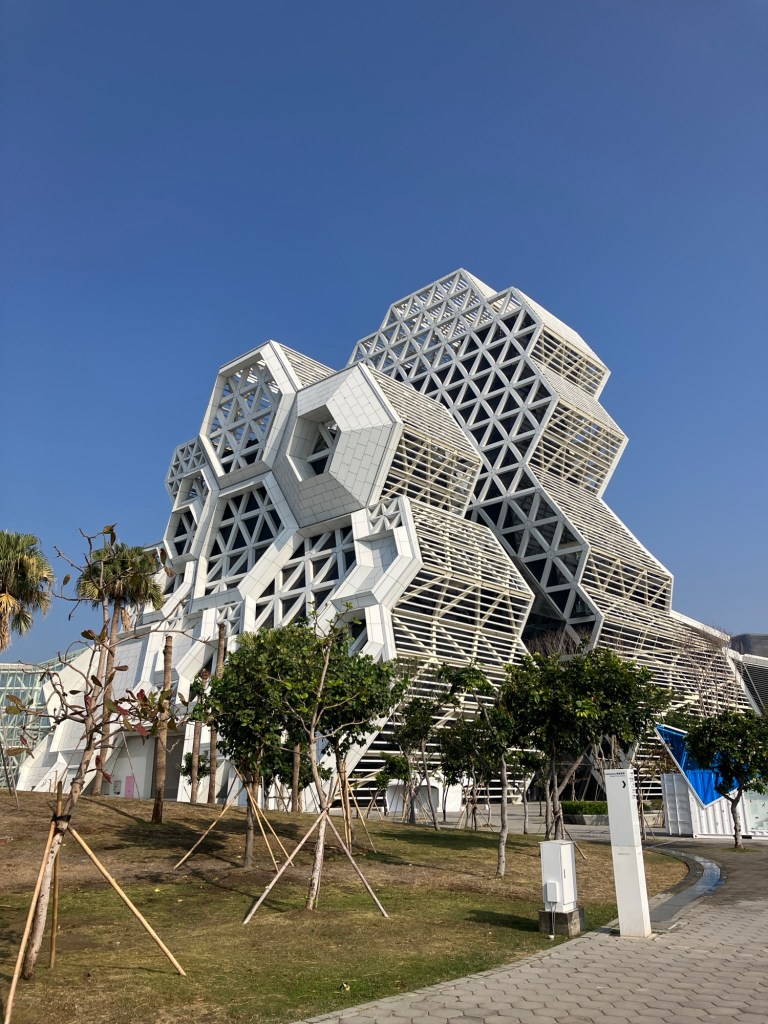
And to admire the Kaohsiung Music Center.
And just enough energy to wait for and board the ferry to Cijin Island, a quick five minute ride.
And refuel with a boba tea before checking out another YouBike to explore the small barrier island.
We brought our swim suits along, but it was a bit too chilly and windy to swim.
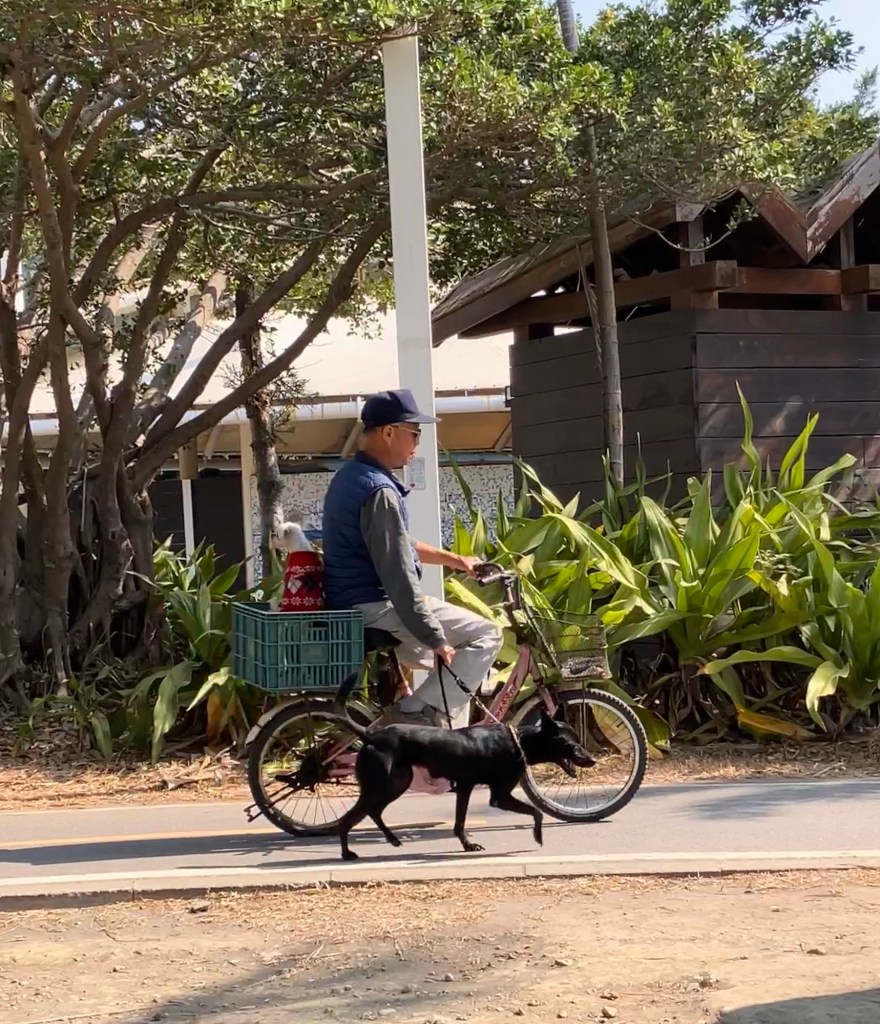
So we people and dog watched for a while.

Cijin was first settled as a fishing village and has morphed into to a shipping hub, and a tourist attraction. It’s a pleasant place to ride bikes along the beach, and in warm weather, to swim. The main street is a typical tourist drag of kinda tacky shops and restaurants. We returned to the main city to eat lunch but if you like crab, there are loads of places to chow down on crab.
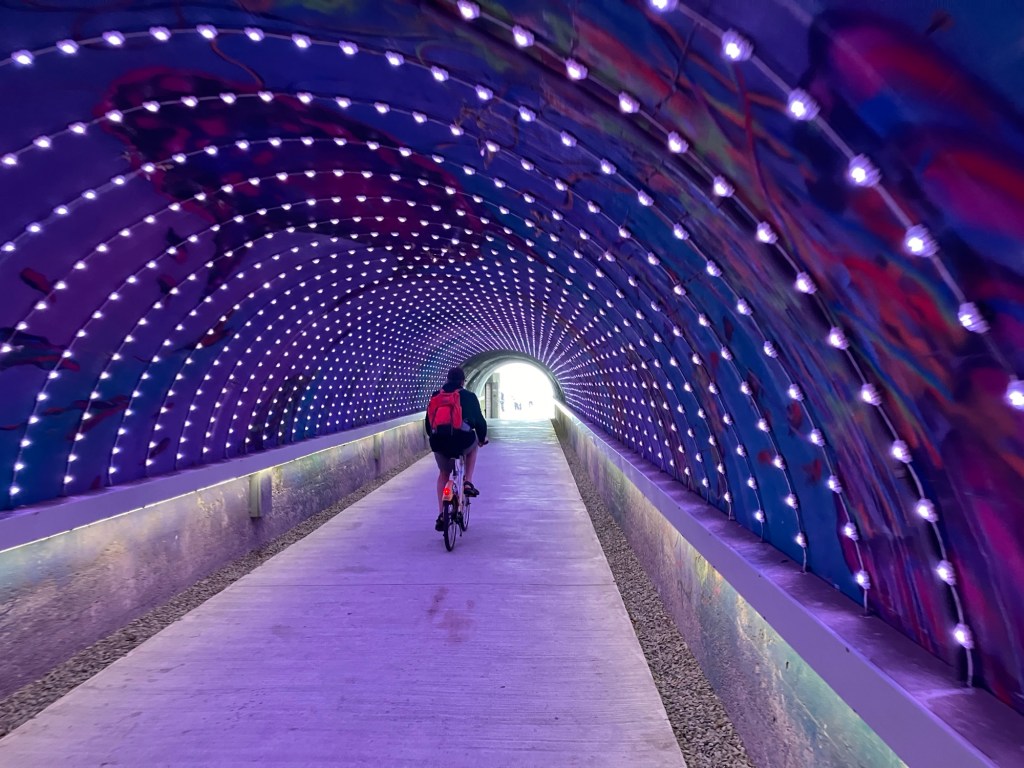
Cijin Tunnel, complete with fun light display. Spits you out on the windy north end of the island.
Strait of Taiwan. Next landmass, China.

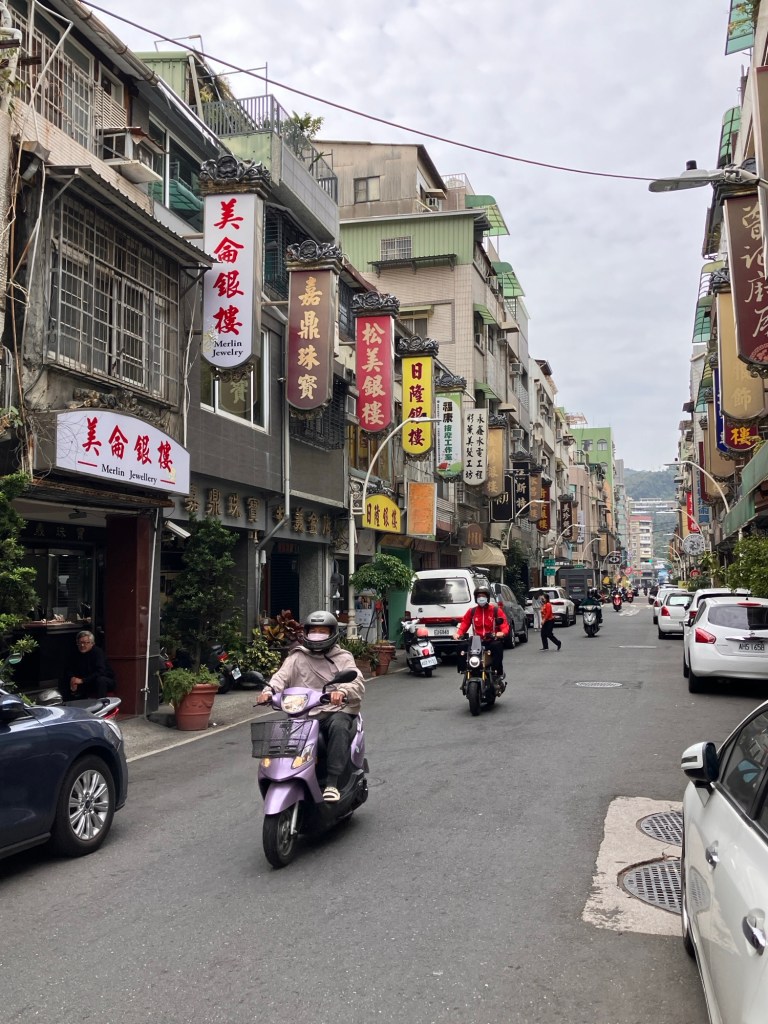
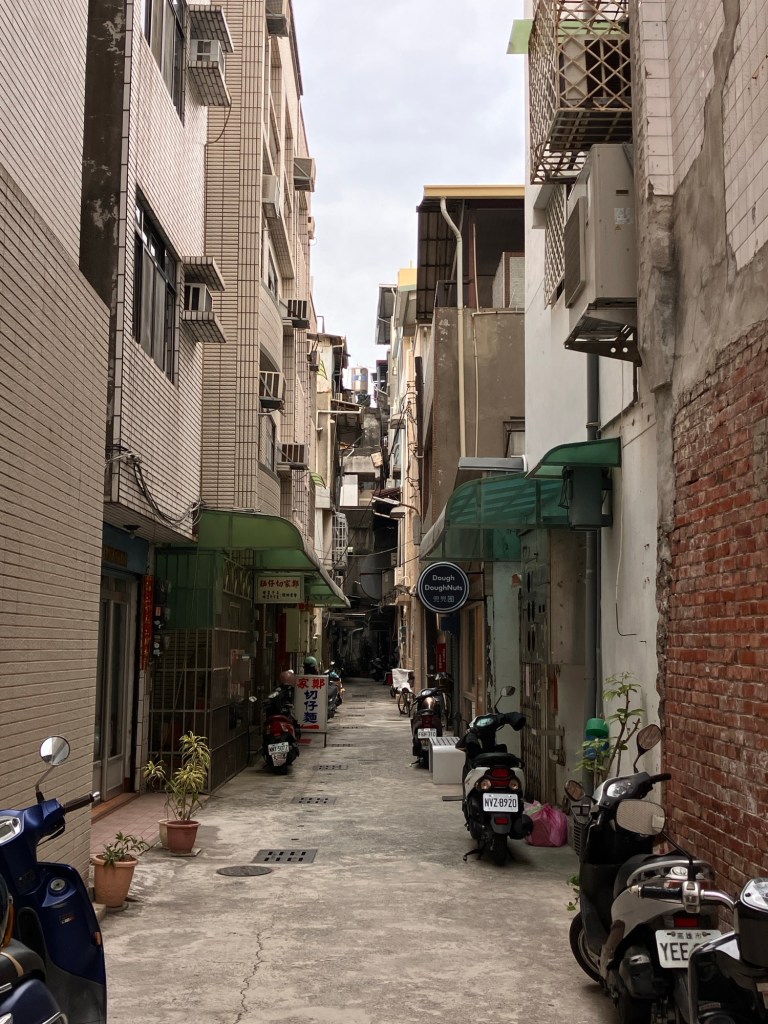
Other than Taipei, walking in the larger cities we visited, Kaohsiung and Tainan for example, is not fantastic. There are main streets with nice wide sidewalks but loud traffic, and smaller back streets with loads of scooters, which keeps you looking over your shoulder and ducking into doorways to get out of the way. The traditional shop house streetscape (business shop downstairs and living quarters upstairs) used to mean that you had a connected and sheltered arcade to walk through. In the world of scooters and cars that space is frequently occupied by, yes, cars and scooters.
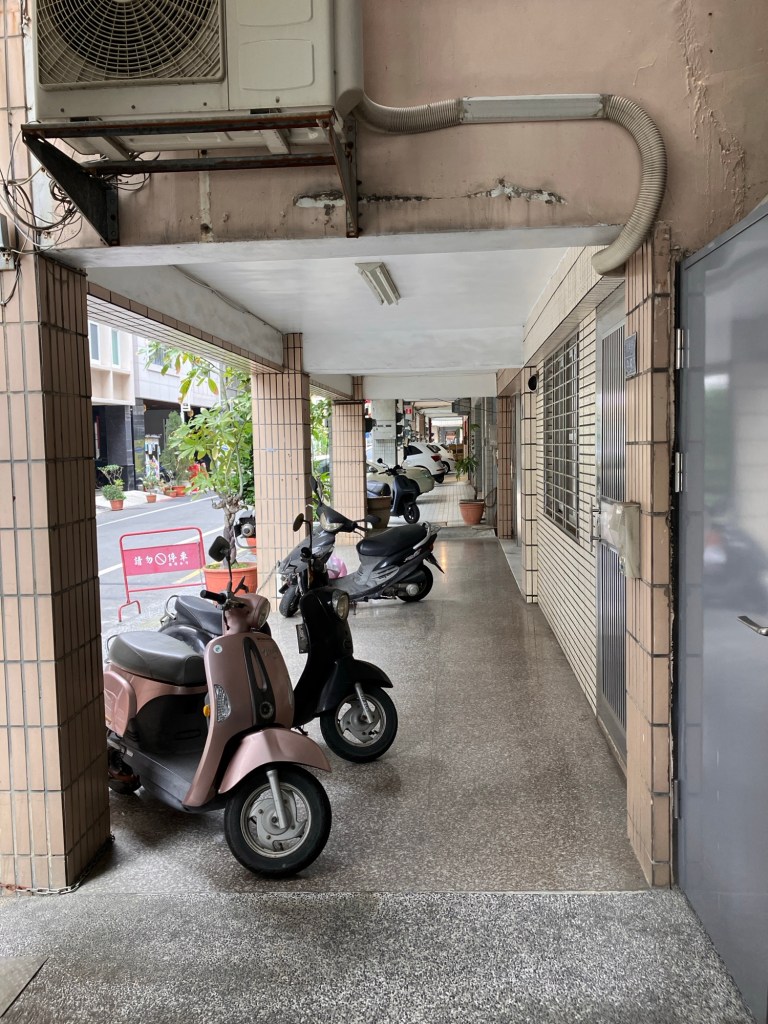
This arcade is passable, many are even more parked in.
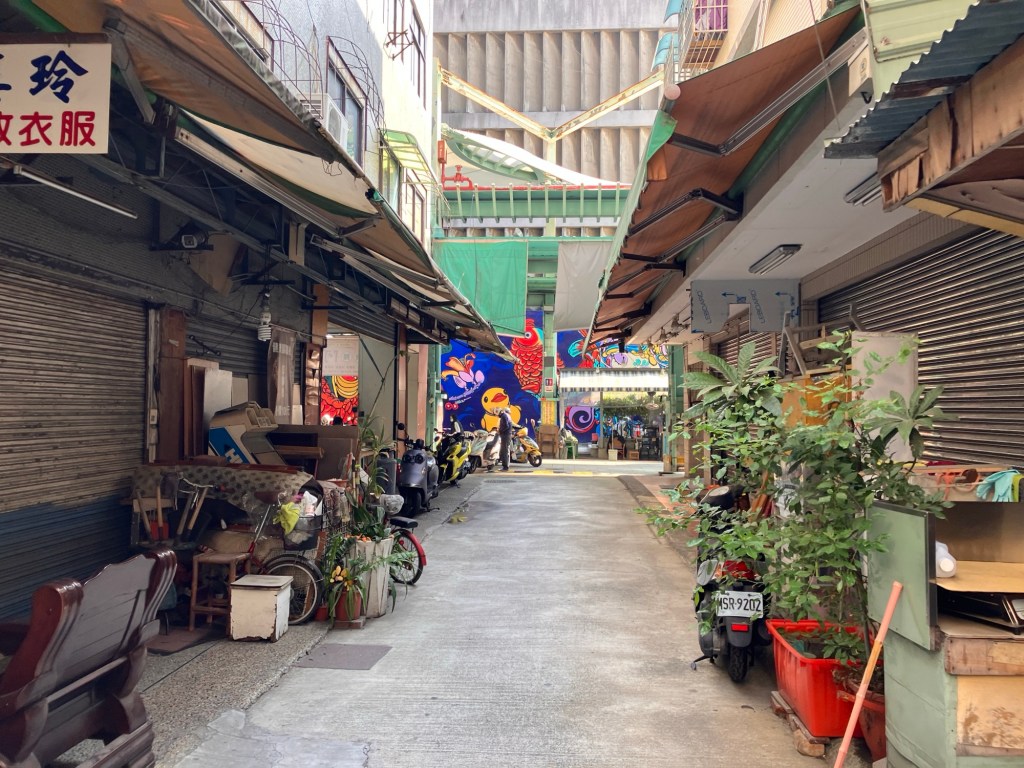
The smaller alleyways offer shade but you do need to listen for scooters and make way.
Typical mid sized street. Not much space for pedestrians. The arcades are not contiguous at all.

There are many charming things to see as you walk though. And since the weather was mild, not hot and no rain, we did a lot of walking. You can’t let the first impression of cities focusing for cars and scooter access put you off, if you walk and look more closely you can see the life of these of cities playing out at street level.
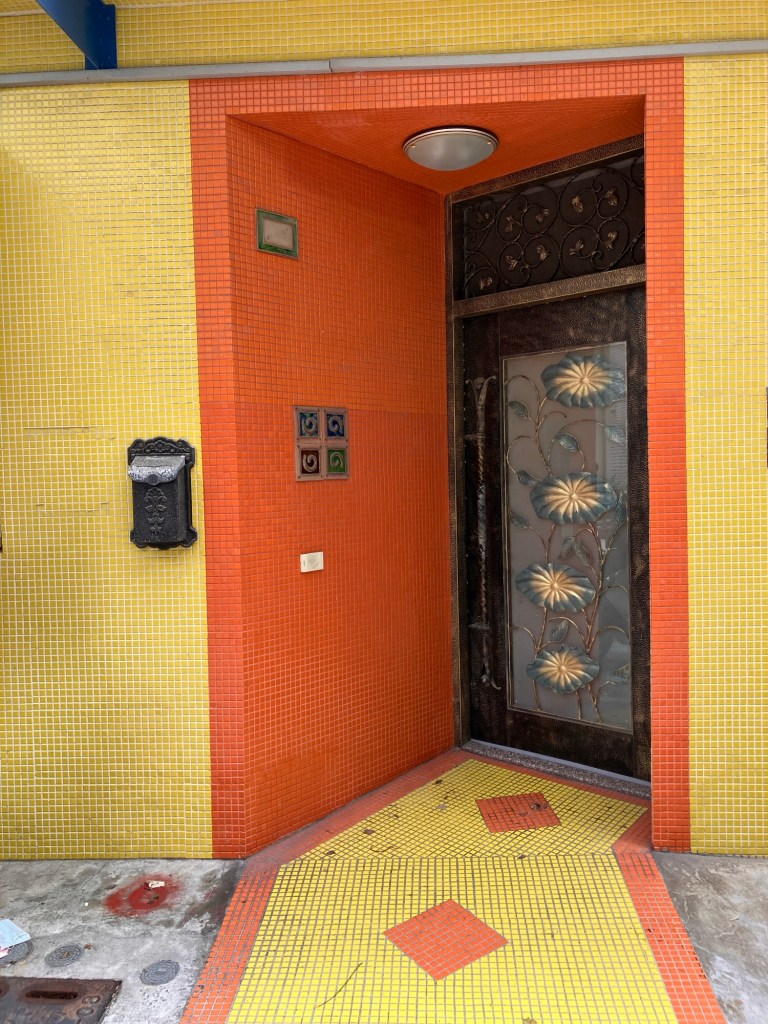
A beautifully tiled and colored doorway, Tainan.
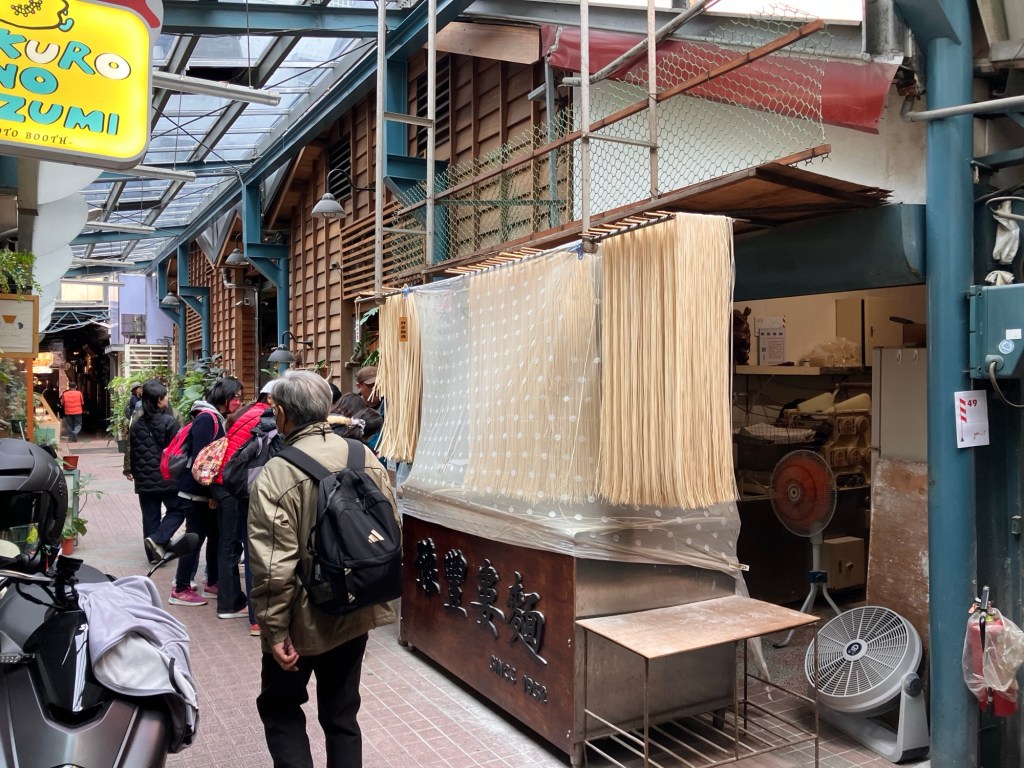
Noodles hanging in the old market streets in Tainan.
The noodles have fans blowing on them.
Minding the tea shop and waiting for customers.
Did I mention how clean everything is?
A covered street, this must be welcome relief from the sun and rain. Kaohsiung.
Not far from these small streets are wide main boulevards with huge wide sidewalks and long lights to wait at before you cross. Kaohsiung.

Everywhere we went in Taiwan, cities, farmland, trails, we saw almost zero trash. And you also see almost no trash cans. If you purchase food or drink you have three choices: give the empty packaging back to the vender, carry it with you until you see a convenience store and go inside to throw it away, or carry it with you for a long time until you see a public trash can. They do exist but not a lot of them. Taiwan mounted a successful campaign against waste, one which is a model for other countries. In a nutshell, you pay as you throw away, by buying the garbage bags you must use, and producers have more responsibility for the products they create and the waste that generates. Per this article “Taiwan’s household recycling rate in 2017 was over 50%, making it second in the world to Germany.” And yes, the garbage trucks play “Für Elise” or “Maiden’s Prayer” as they ply the streets. After three weeks here both Rich and I are humming along with the trash truck tunes when we hear them.

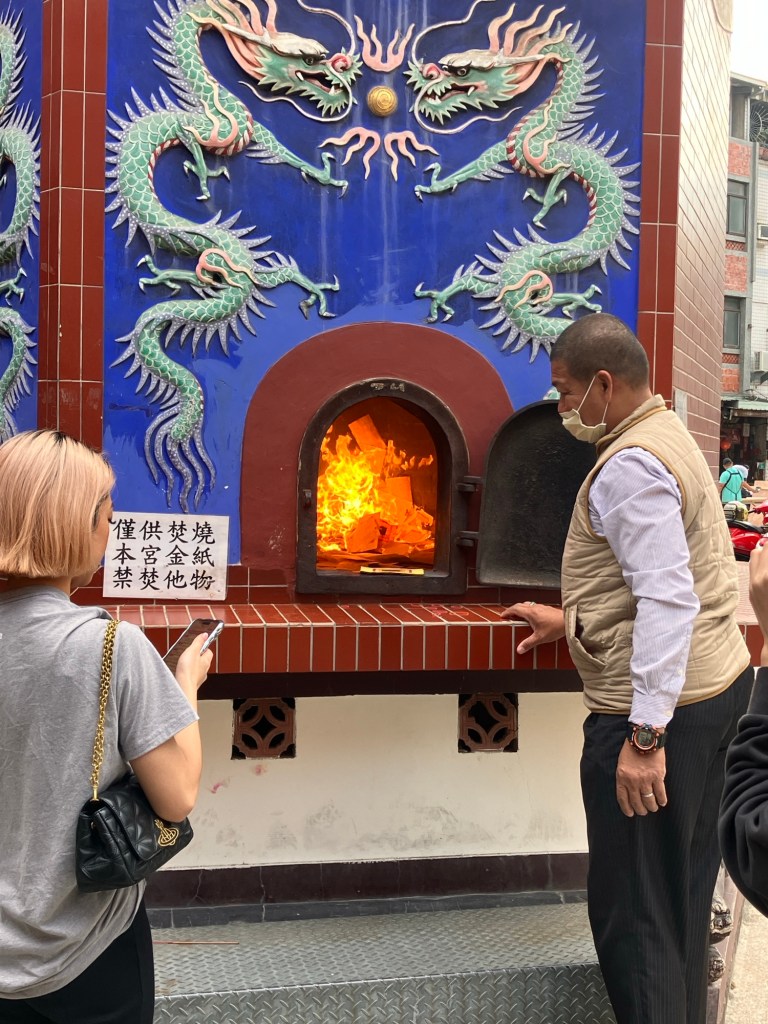
Ok, enough with city garbage logistics! Lunar New Year is coming. The year of the wooden dragon. Temples have piles of spirit money for people to purchase and burn to honor their ancestors.
Outside a temple folks line up to burn the joss paper, or spirit money.
The spirit money is to make sure your ancestors are well provided for in the afterlife.
A street turned over for a banquet.
Happening on a New Year Parade in Tainan.

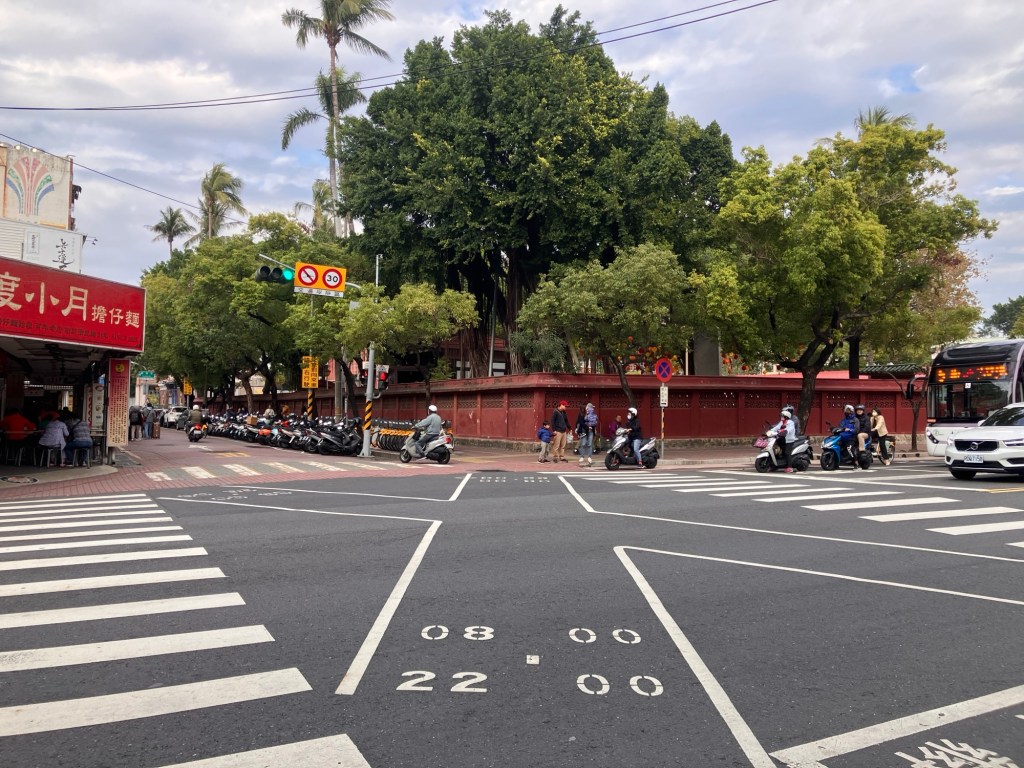
I don’t want to leave the impression that Taiwan has forsaken pedestrians and bicyclists, the bike share program YouBike is very robust. And there are pedestrian scrambles (where the lights turn red in all directions and pedestrians can cross kitty corner) at busy intersections.

A big bike share pod.
Scrambles are marked with hours they are in effect.
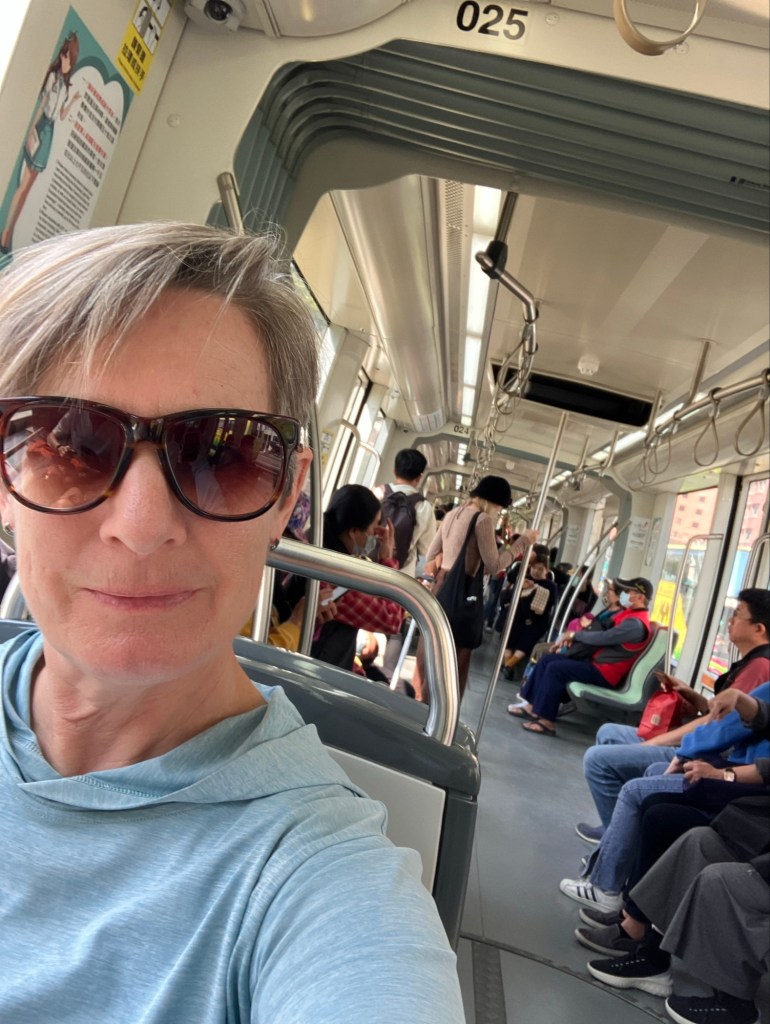
In Kaohsiung a new light rail loops the city. Folks were sightseeing from it, including us.
I’m always happy to see new public transit systems.

However, it’s not as easy to be a bicyclist as say, a scooterist. And outside of a big city like Taipei where you would use a bike as a last kilometer solution after taking the MRT, in Kaohsiung and Tainan a scooter is the clear choice. It gets hot much of the year, we’re here in January for a reason – cool enough for us to walk and bike. So we’re viewing this transportation scape through tourist eyes, and seeing what’s missing for us. Honestly, the scooter life seems to work very well for folks. You go right where you want and easily park. If Taiwan could accelerate the switch to electric scooters it would be amazing. The noise and pollution would be decreased and streets would be much more pleasant and livable.

Heading out to Anping in Tainan. A decent bike path along the Anping Canal.
But as in many cities, it’s the intersections where things fall apart. This one took us some long awkward time to get through, if it had been hot it would have been intolerable.

I’m going to write a separate post about our escape from cities to countryside, but first, a few more photos of the fun we had.
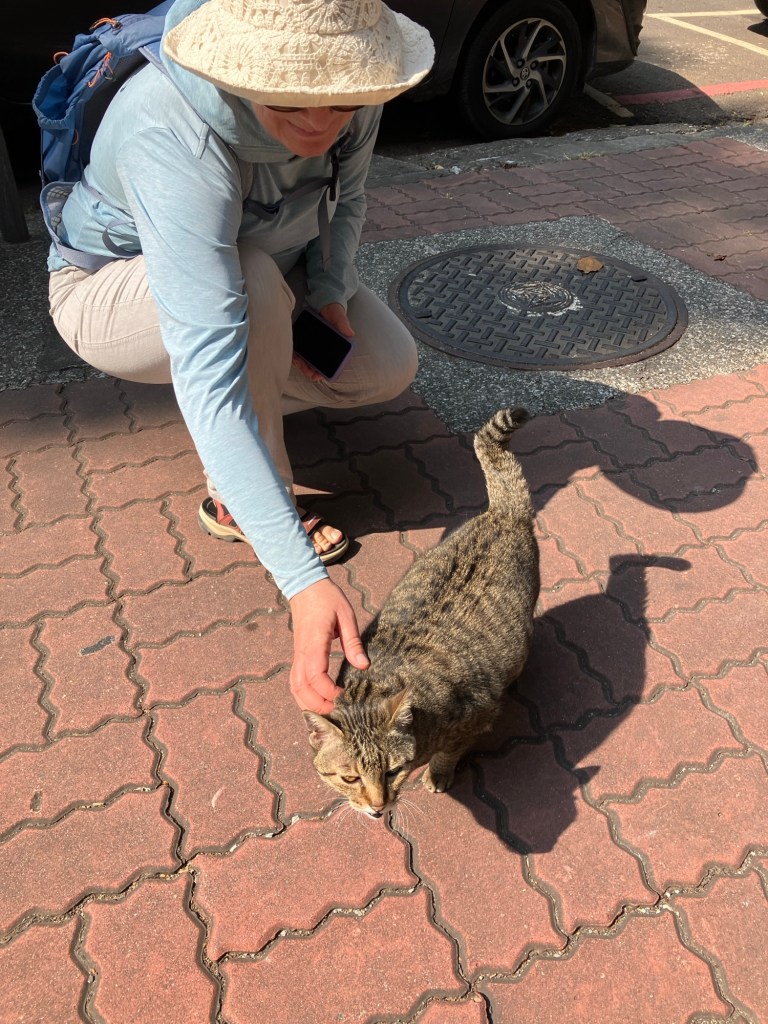
There were cats we pet.
Many dumplings to eat.
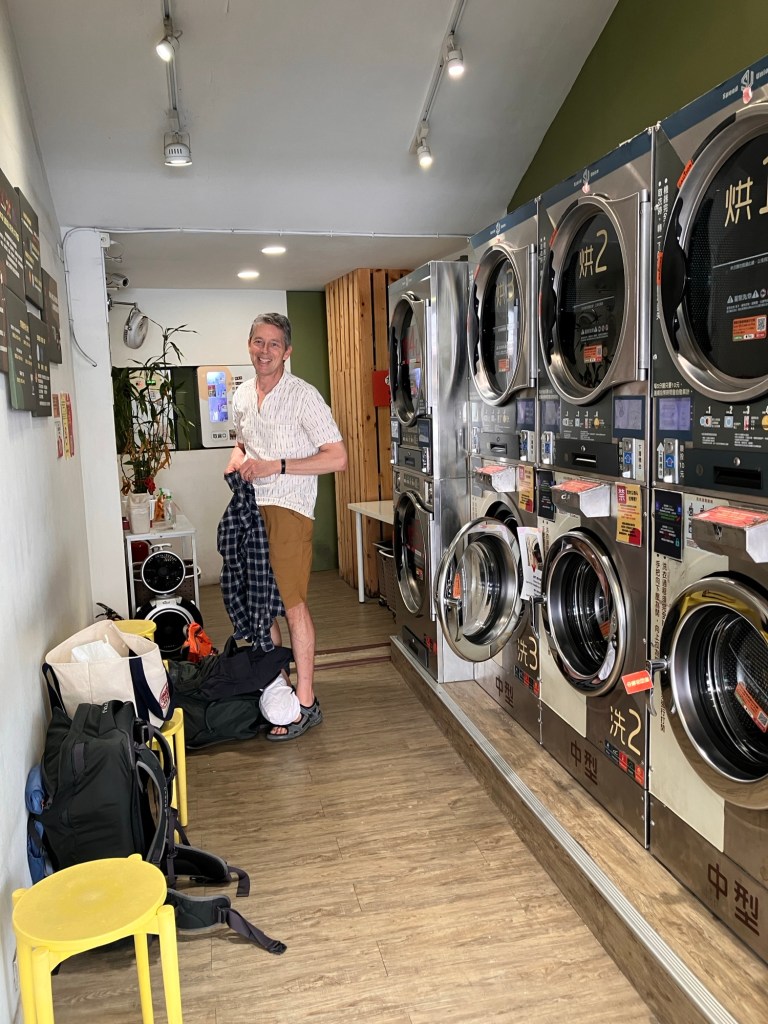
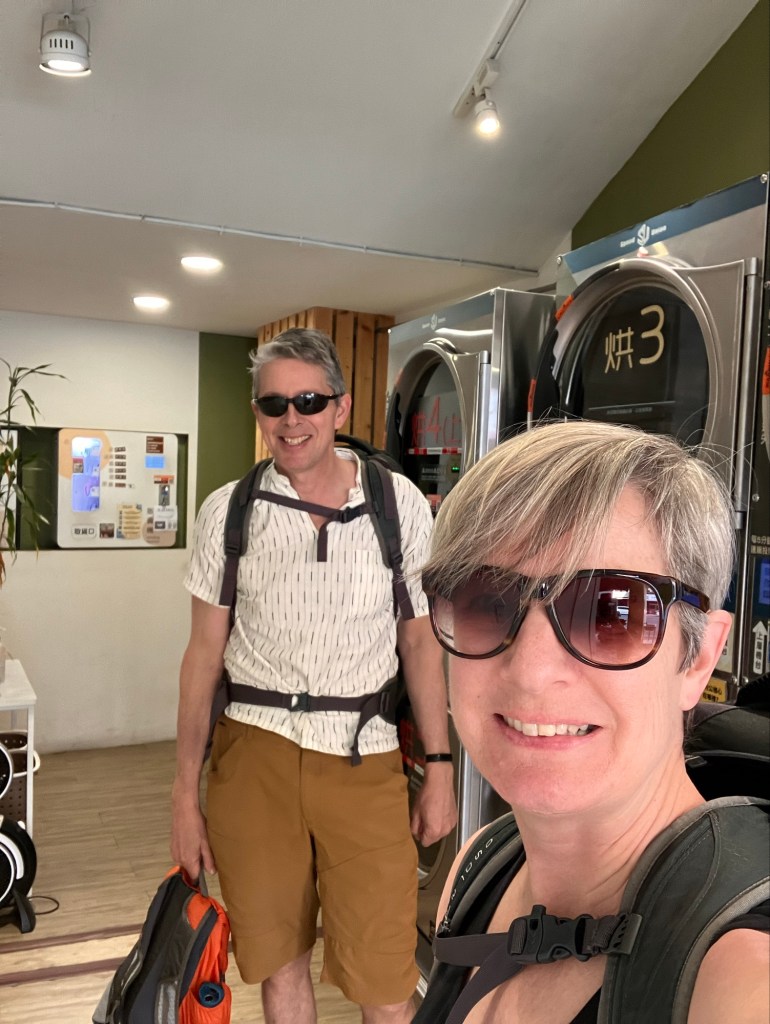
Laundry to get done.
Boba to drink while waiting for laundry to get done.
Laundry success!
And finally, a bus to catch to the high speed rail station.
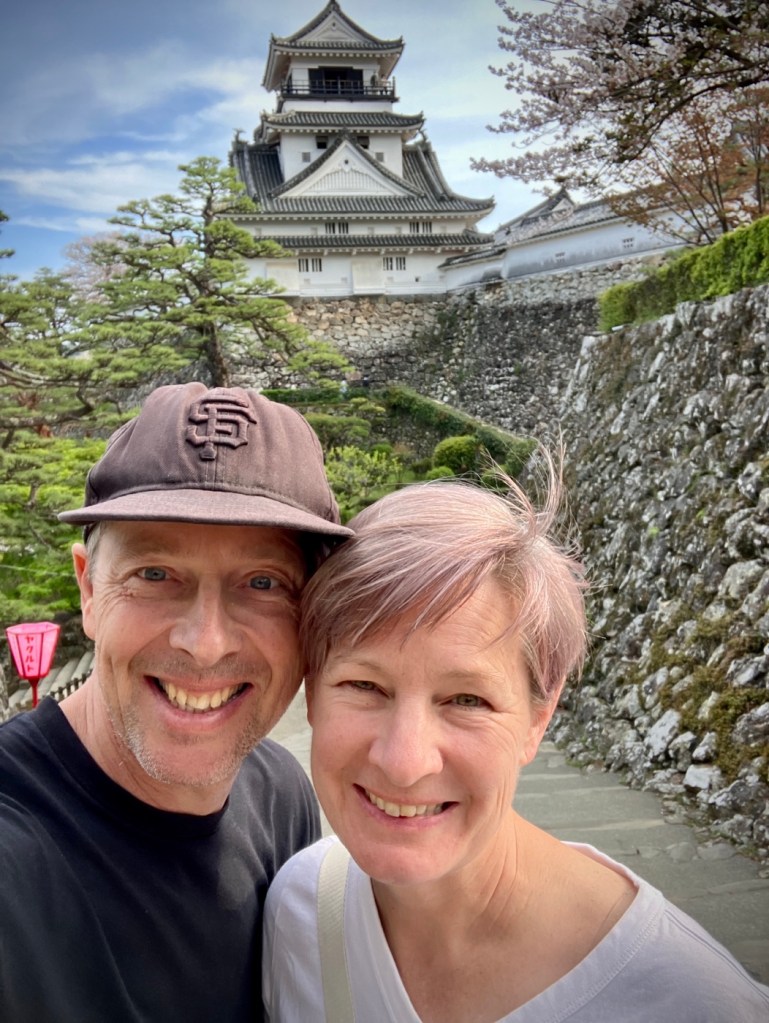
The Happy Travelers at Chikan Tower, Tainan.
The map! Hearts are where we stayed, the blue dot is us in Taipei when I snapped this photo. Thanks google maps.

Albania-America

Cheryl and I are finally back in America now experiencing a bit of culture shock after 5 1/2 months in Europe. But after a jarring first few days where I felt both dizzy from the jet lag and the immersion into abundance, everything is feeling familiar again. There is a nice sense of relief that comes from being in a culture we understand. Well, mostly understand.

Off the tourist track in Elbasan, Albania.
Walking up Rhuga Thoma Kalefi, the busy market street of Elbasan.

And coming to America directly after a month in Albania has given us a real sense of contrast and the imbalance of opportunity. The GDP per capita of America is over 10x Albania’s. After 45 years of a repressive and closed dictatorship, no one takes their opportunity for granted in Albania. Young Albanians are globally aware with media and the internet, and emigration is still seen as the primary path to success, whether it be legal emigration to the US, UK, France, or Germany or a more desperate journey to Italy across the Adriatic. 10% of Albania’s GDP is in the form or remittances from abroad, a very high number for what now is technically considered a middle income country.

Ohrid, North Macedonia had a proper bus station which already differentiated it from our experiences in Albania.

But as always, I digress and obsess about geo and socio-economic issues. It’s one of the main reasons I love to travel…a fuller understanding of the world. A chance to talk to people at the source. Read, learn, and experience at the same time.

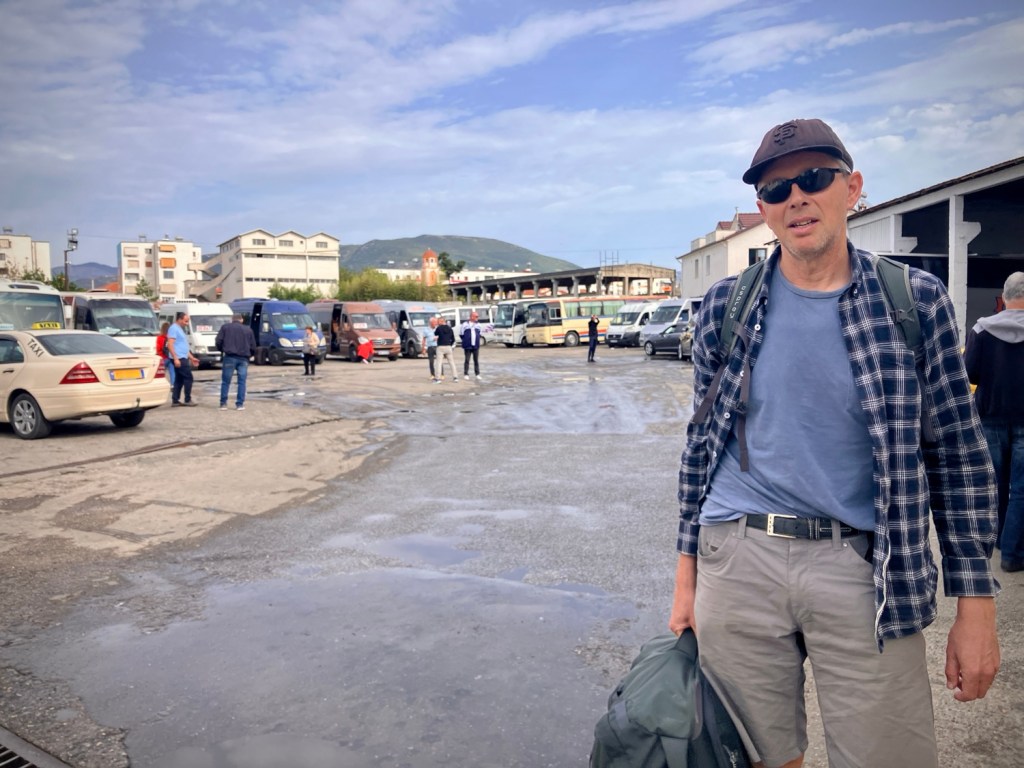
Trying to remember that we were still in Europe at the Elbasan Bus “Station”.

So when we have an opportunity to stop at a small city off the tourist track, especially if it’s on the way to another destination, we almost always say yes. Sometimes these hidden gems are some of your favorite places. Untouristed cities offer the opportunity to get off the guidebook and instagram track. Elbasan, Albania is the fourth largest city in Albania and only about 45 minutes south of Tirana. A few people had mentioned Elbasan, but I didn’t really have a “recommendation”. I figured out that the one international bus from Lake Ohrid to Tirana went right through Elbasan on the way. The challenge was that Elbasan wasn’t an official stop and this was a large coach bus run by the international Bus company, Eurobus. It would also save us going back into busy Tirana to transfer to Berat later.

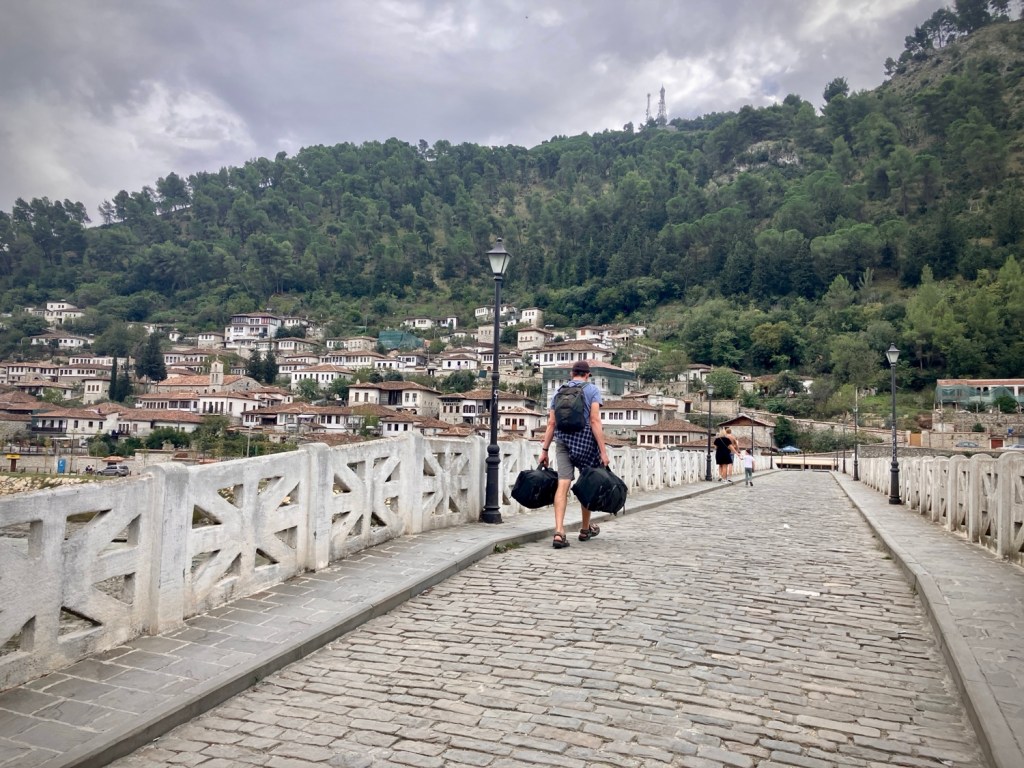
Crossing the Gorica Bridge in Berat. The hostel was close enough to just carry our (~10kg) bags and not go to backpack mode.
14th-16th century frescoes in the Kisha e Shën Kollit, one of the many churches inside the sprawling Berat Castle.

So we decided we’d buy bus tickets online to Tirana (as this was the only option) and then hope the bus could drop us on the way. I held off booking any accommodation until we confirmed on the bus. We asked the driver as we boarded and they put our luggage in a separate compartment underneath. Cool, we’re doing this. As it turned out, we were the only two getting off anywhere else on this run. Hmm, why isn’t anyone else getting off in Elbasan?

The pleasant streetscape view from our apartment in Berat with the nearly 8,000 foot Mt. Tomorri in the clouds.
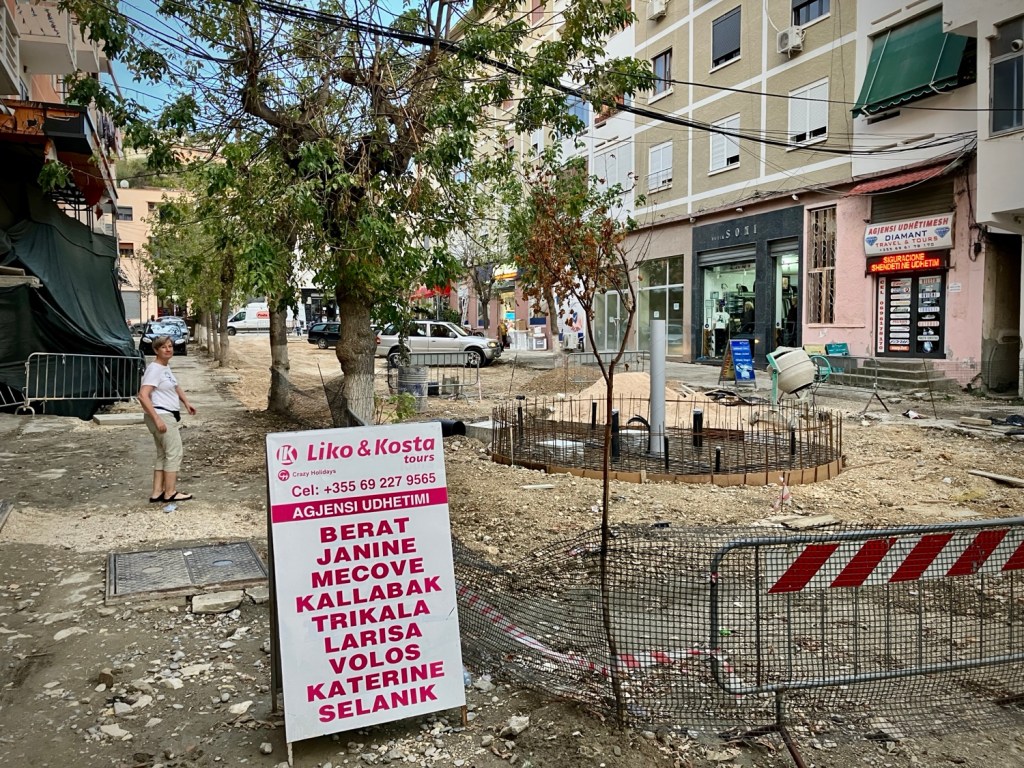
Our apartment in Berat was accessed off this side street under construction. A bit noisy for us, but happy they were creating more pedestrian space and plazas.

The bus was a complete mix of passengers from other Balkan countries and further afield, so the border crossing between North Macedonia and Albania was slow. We all handed our passports to a young (unmarked) guy who walked down the aisle of the bus and then disappeared. He finally returned 45 minutes later and then tried to make his way down the aisle with 50 passports. He tried to call out many challenging names as the bus swerved and swayed in sweeping corners descending over a thousand feet from the pass that separates North Macedonia from Albania. As he balanced all the passports in two hands, a particularly sharp corner sent dozens of them scattered across the floor of the bus. Oh great. And then it happened again a few minutes later. It was simultaneously comical and concerning (our passports!), but we mostly felt for the guy as we figured it must be his first day on passport duty.

Traditional clay tile roofs are constantly being patched and repaired.

As it turns out, he was just a random college student sitting up front who was selected/volunteered. I chatted with him at the rest break 20 minutes east of Elbasan. He was ethnic Albanian, but living just over the border in North Macedonia, and attending medical school in Tirana. He said the region near Lake Ohrid was mostly ethnic Albanian. He was likely headed abroad after training as Germany and other countries with staffing shortages are recruiting educated Albanians aggressively.

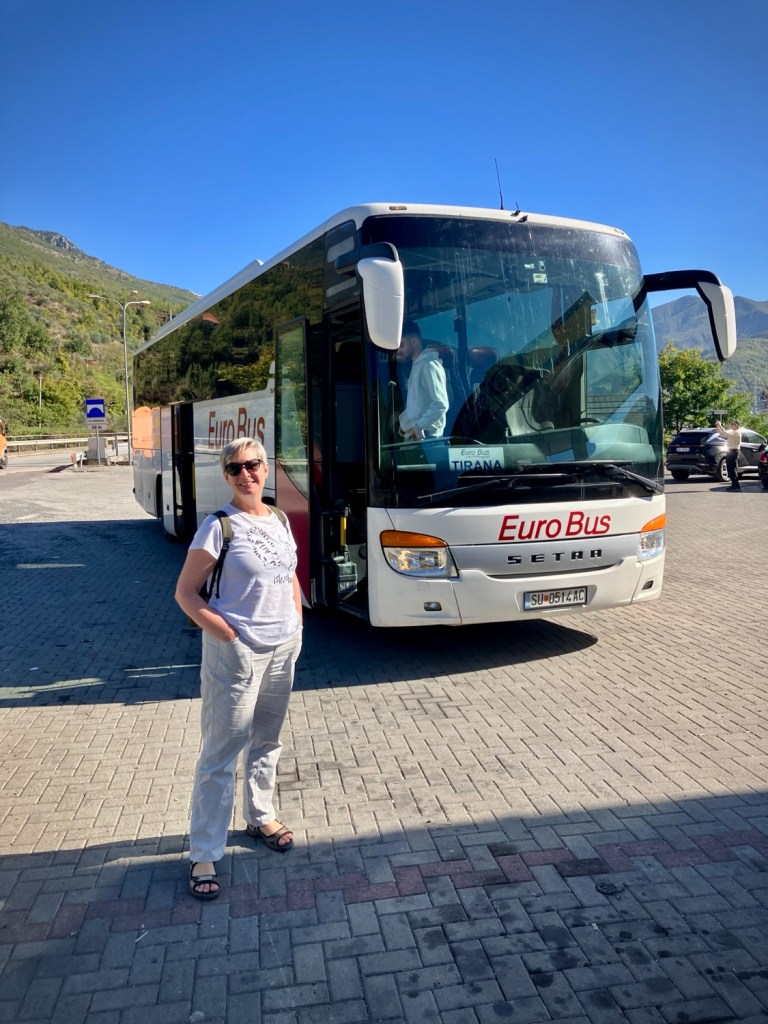
Cheryl posing with our only full size coach ride Ohrid to Tirana (Elbasan). Just hang on to your passport!

I hope he got a free bus fare or something for his effort. By the way, we did all get our passports back eventually as the travel gods made it all work out just fine.

Climbing to the high ridge towards the village of Drobonik above Berat. Look for the trail that heads SW out of Gorica.
Our 6 mile loop took us past grapes ready for harvest, possibly Pulës for white wine or Raki.
Old school still rules in much of Albania.
A hayrick (haystack).
Trying to get back on course after a lively conversation with school kids in Drobonik.
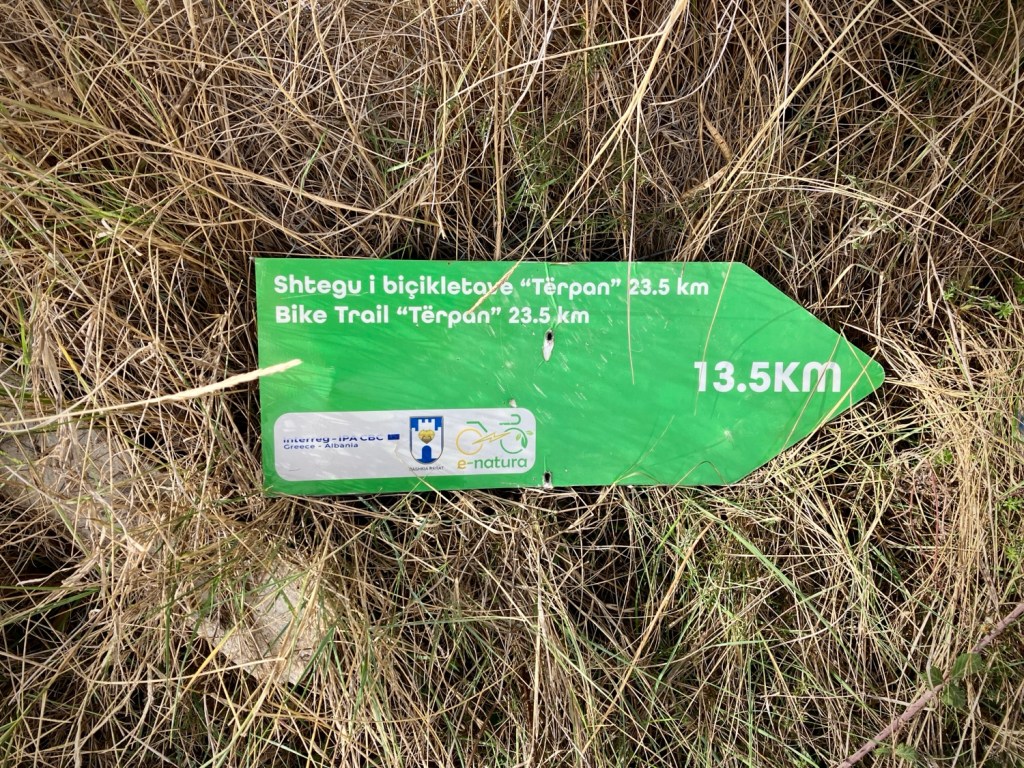
A mountain/rural cycle route program above Berat was slightly aspirational here, but there are real opportunities for robust outdoor and green tourism in the future.

Elbasan itself has a nice Main Street lined with buzzy cafes, wide sidewalks, and ending at a large car free promenade space in front of its historic castle walls. It’s a busy market city too and has lots of young people and a university. The castle is unique as it’s on the flats of a valley, and is integrated into the fabric of the city with a few cafes and lodging options, mixed with regular city residents. It’s not the most picturesque castle or old town, and there are not really any other major sities of interest in Elbasan, but it does have a pleasant park, and we enjoyed our 24 hours there. People were friendly and genuinely pleased to see us tourists, and we were happy to see them. We did spot a cycle tourist from Germany at a cafe, but it turns out he was going to camp in the nice river valley west of town, so it did seem to be just Cheryl and I as far as tourists in this small city of 140,000. Our reward was really friendly locals at lunch and dinner, with a clear excitement to have Americans visiting. Albanians really are nice once you get through their guarded facade. The old adage that the fewer tourists a place gets, the more friendly and genuine the engagements resonated here.

How old is this olive tree? Older than me?
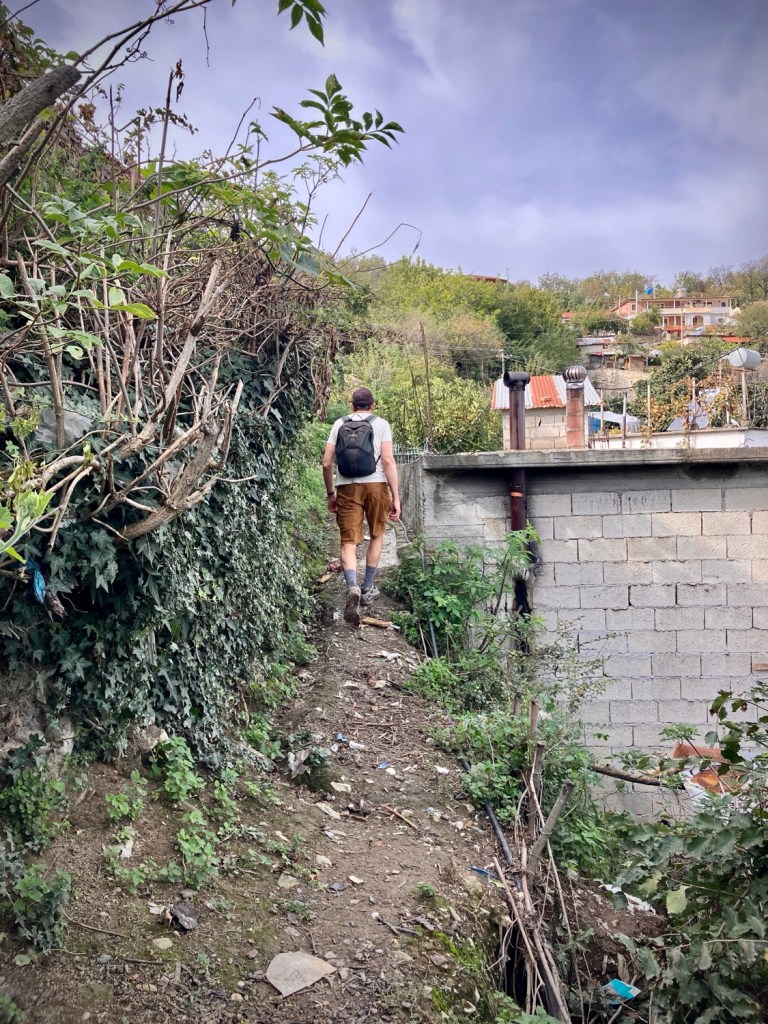
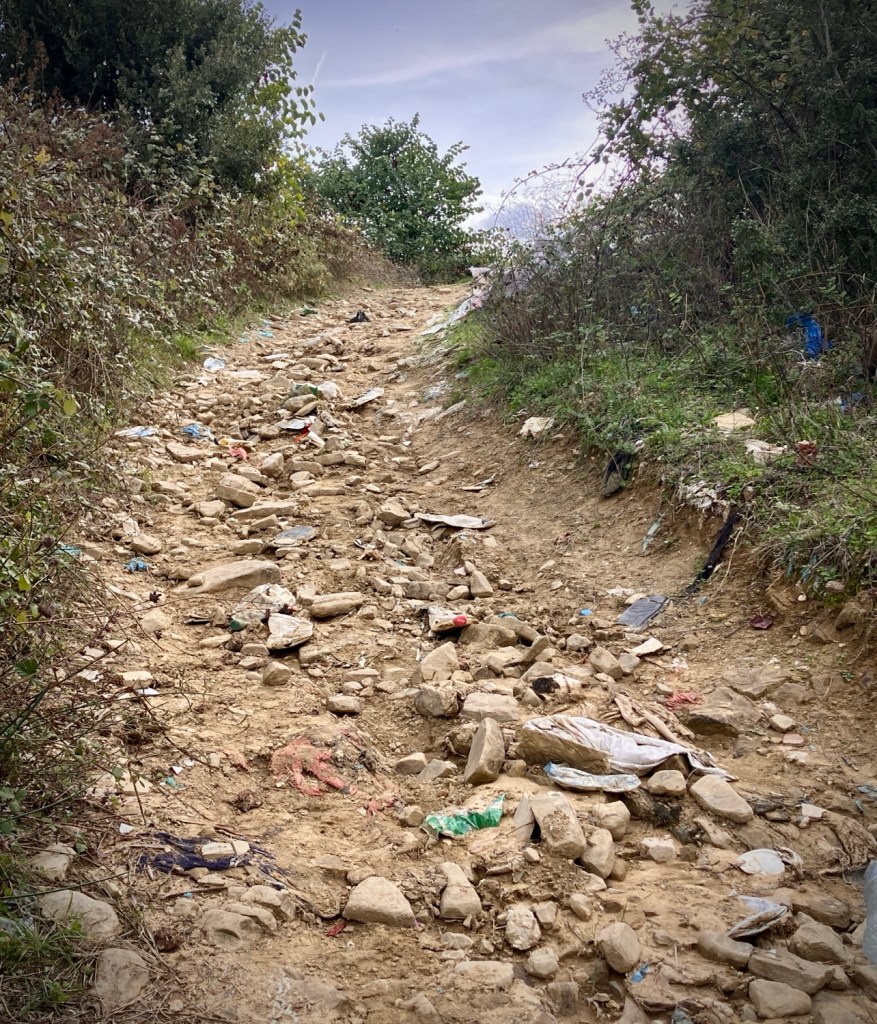
A sad reality of Albania is ubiquitous garbage and a lack of proper sanitation, especially at the edges of towns and villages
Slightly off course hiking but we now had a visual on Berat so just had to let gravity do its thing.

But our real goal after Ohrid was the historic city of Berat, so we took another stab at minibus roulette and had a hotel taxi take us to the bus station of Elbasan. It was both a lively and grungy spot, and once again, we were the ONLY obvious foreign tourists hanging out there. And thanks to the random minibus schedules, we were there for almost two hours. There is a decent cafe with a rustic bathroom (squat loos) on its edge, so it was ok. And as always, people were super friendly and leave you be as desired. Albania is chill.

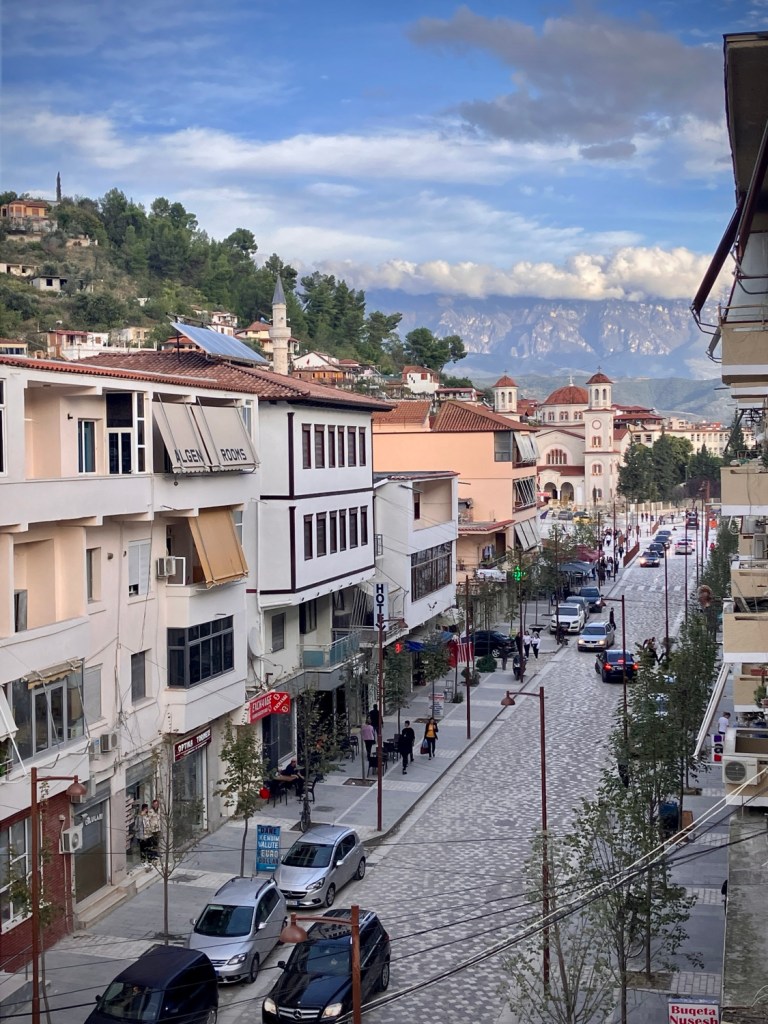
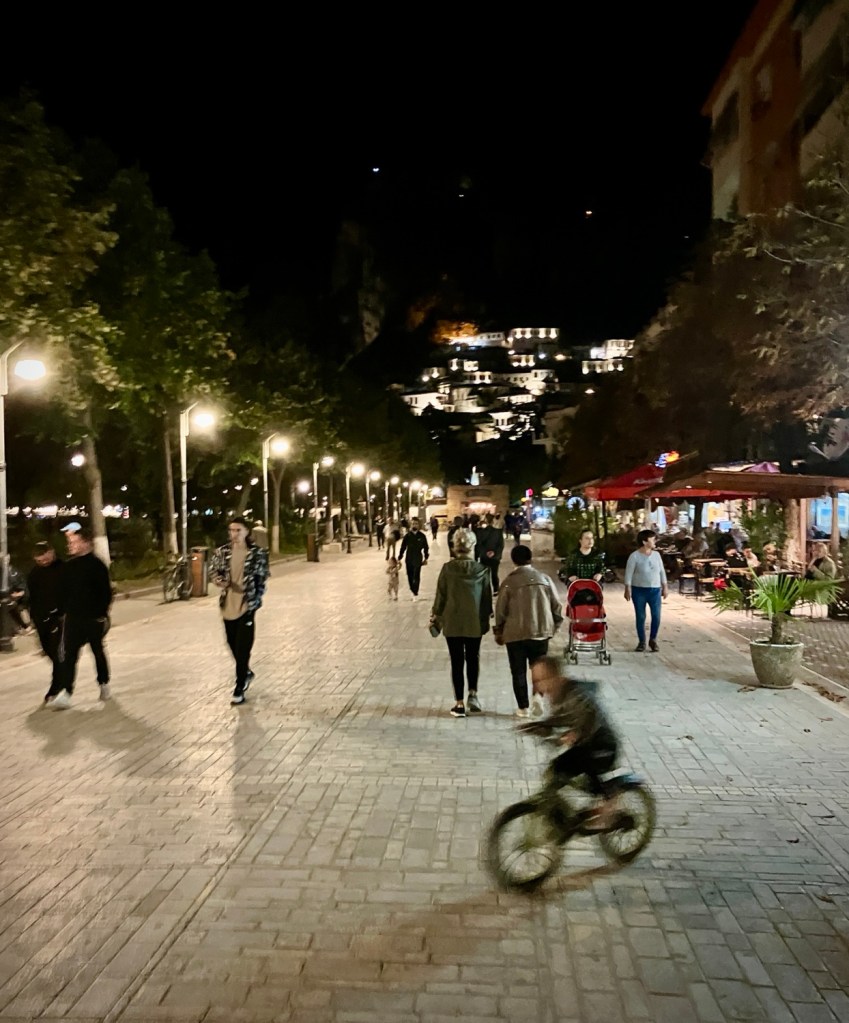
The lively main promenade of Berat was a delight to stroll in early evening

The nice thing about our minibus from Elbasan to Berat (besides the cool music) was that it dropped us near the center of Berat and we could walk to our first nights’ lodging at a popular hostel in Gorica. (Double room, no bunks for these 50 somethings -:) The buses from Tirana to Berat generally only stop at the bus station outside of town, so you need to taxi or take the public bus.

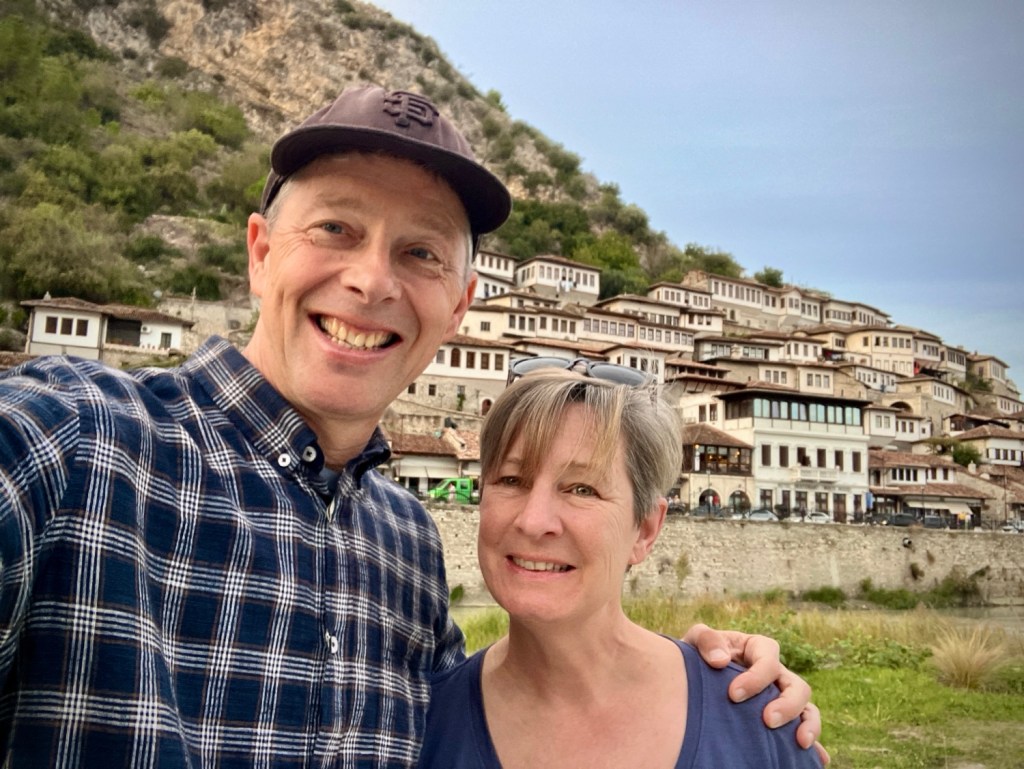
The classic Ottoman style wood and stone architecture of Berat, a UNESCO world heritage site since 2008
Berat has a few different historic subvillages to explore on both sides of the river.

Berat is in located in an atmospheric location the Osum River valley and is a fascinating place to explore with rapidly developing tourism. It’s been a tourist star for a long time, but civic improvements and more restorations of crumbling buildings and ancient sites is making it even more appealing. After our night in the friendly (but young) Maya Hostel, we found a nice apartment in the center of town to settle into for three days. A number of apartments in older (non historic) buildings have surprisingly nice interiors in a rough shell and exterior. I had to block my inner civil engineer concerns as lightly reinforced concrete buildings with clay blocks are the standard construction style. Most would probably ok in a smaller earthquakes but would be no match for a big one. A moderate earthquake in Northern Albania in 2019 did kill and injure a lot of people, so hopefully more investment will bring more modern buildings and retrofits.

Back to a more standard minibus in Berat…departure TBD.
Legroom varied on the minibuses, but I usually straddled two seats or an aisle no problem.

We then caught our final minibus back to Tirana, with half hourly departures posted everywhere online…. but our (small bus/large minibus) still left randomly off of any schedule. We were excited to head back to Tirana for our final 5 nights, as we found it so surprisingly pleasant and green in our first touch down.

The Grand Park of Tirana was busy on a Sunday morning with walking, cycling, exercise areas, and a few cafes to enjoy.
Choices are nice.
Tirana’s Skanderberg Square shines at night.
Gyro style lunch is a “fast food” staple in Albania. I opted for the plate.

Plus, we knew we could now explore Tirana knowing a lot more about Albania after going full circle for nearly a month. Wow, a month in Albania. It was not even on our travel radar until this summer. It’s geographically diverse, but has less than three million people. But our slower tour of the country rewarded us with perspective. Pieces of history and cultural knowledge layered in our minds and gave us a clear understanding of how the complex and recent past has deeply influenced the character of the people. Oh, and the swimming on the coast was divine.

The access tunnel to the BunkArt 1 complex at the edge of Tirana sets the mood.
No person, chemical, or radioactive material was going to get in this massive bunker complex designed to protect Enver Hoxha and his government.
Living quarters for the leaders and basic operational services in the event of an attack from the imperialist forces. Hoxha created an isolated world based on fear most similar today to North Korea.
BunkArt uses many of the unique underground spaces to house art installations.
Lots of new construction on the fringes of Tirana, this with both city and mountain views.

Most Albanians in the world now live outside of Albania. They live all over Europe and the energetic youth clearly have their sights on opportunities abroad, especially Germany, France, and America. But it felt like we were experiencing a tipping point in the fall of 2023. More new and exciting things were happening in Tirana and that energy and prosperity seems to be starting to radiate out. But the reality is much more complex than our optimistic lens from two enthusiastic visitors.

This memorial across the street from the German Embassy commemorates the storming of the embassies by youth seeking asylum in June 1990.
An ad at the French Embassy. Countries are competing for the best and brightest Albanians.

The brain drain is continuing as the youth don’t have the time to wait around for their country to to triple their GDP. (Such as fellow Balkan Croatia) or an order of magnitude of economic opportunity as in Germany. But time and time again, our conversations with locals brought out their pride for their country, but a much more negative view of many aspects of daily life (drivers, corruption, pollution, etc).

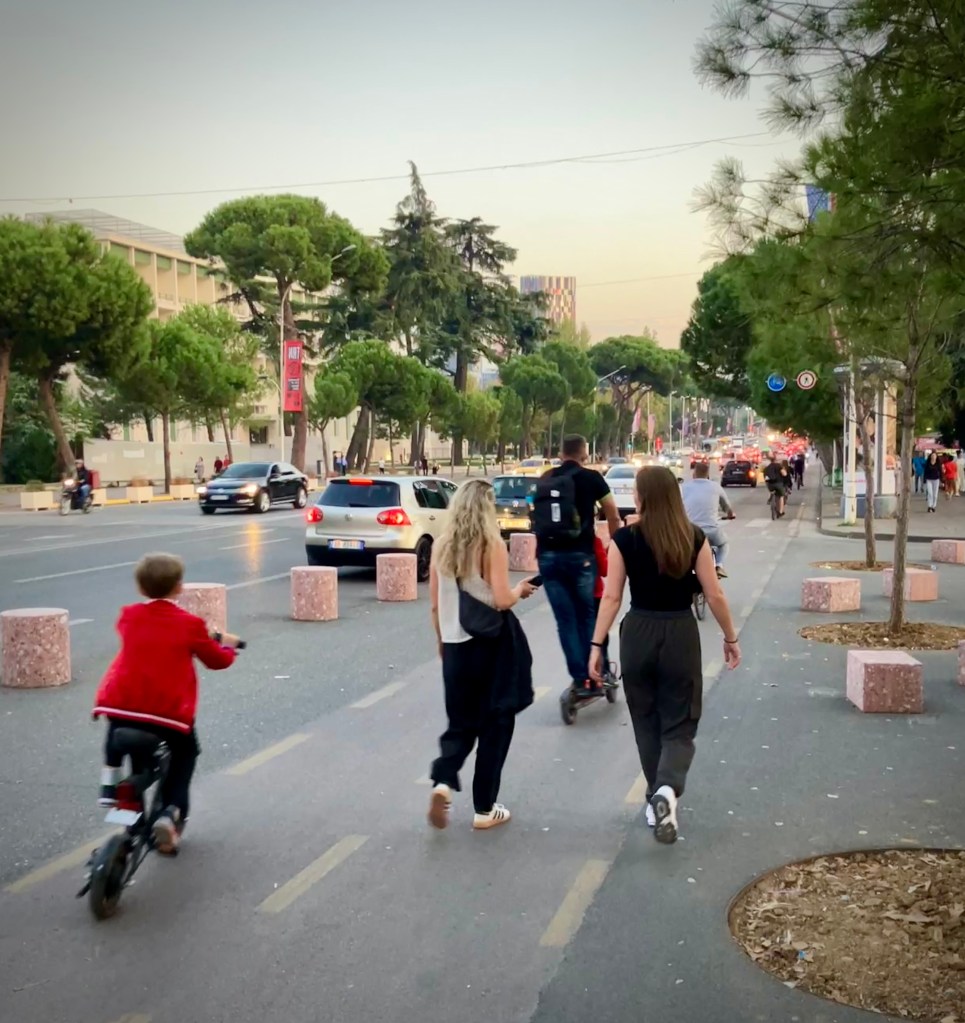
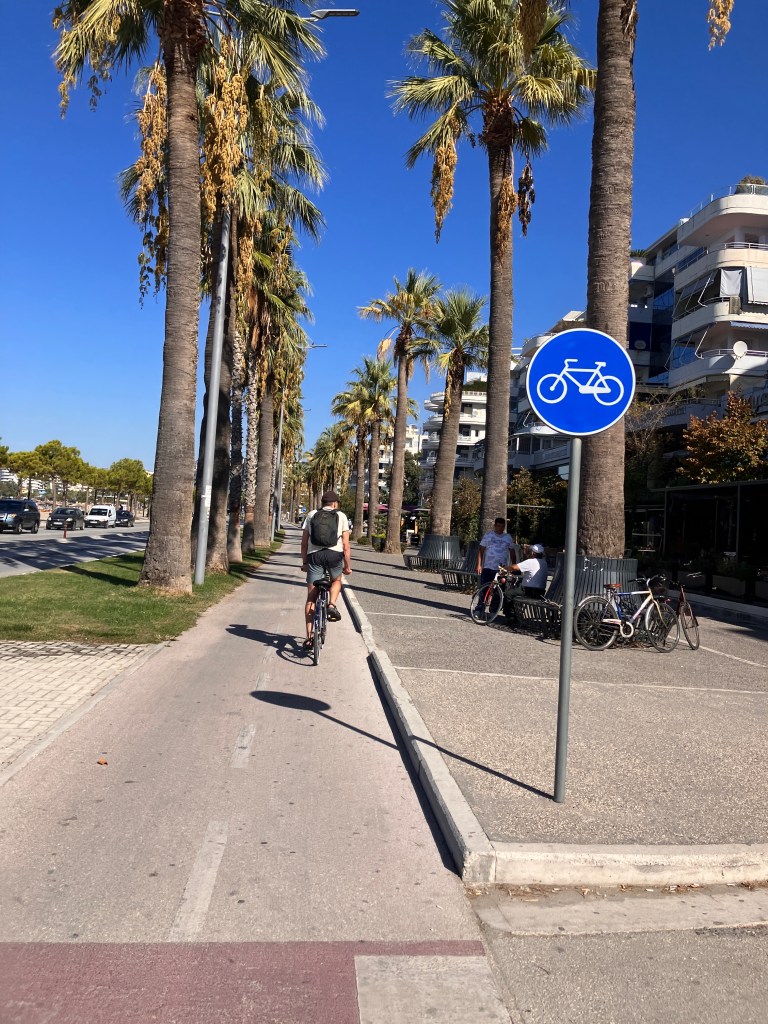
A beautiful center running bikeway on Kavaja Street in Tirana. The mayor is progressive and dedicated to greening the City.
Fleets of all-electric taxis were a common sight.
Livable side streets and pedestrian space abounds in central Tirana.
Historic buildings and architecture are now being preserved in Tirana, even if there is not yet money to renovate.
Tirana is green on the inside now, but there is still work to do around the edges.

But this was one of my favorite places to experience now, because of the innocence of the people, and complex and overwhelming history. This innocence will (and is) changing as Albania integrates into the world fully, but for now, you can still experience a bit of the past overlaid by hope for a brighter future.

Ready to go “home” at Tirana International Airport.
Atop the newly renovated and reopened Pyramid of Tirana in a city that will surely be popping up in more travel sections in the coming years.

Happy Thanksgiving to all our American friends and peace to all!

Albania – A Snapshot in Time

It’s a travel cliche; you can read all you like, but until you touch the ground and meet the people, you’ll never get a true sense of a place. And some places feel particularly dynamic with extreme drama in their recent history or a promising future dawning. Albania is smack dab in the middle of a multi generational transformation. And we are here now.

A greener future for Albania and new opportunities to join the EU.
This was NOT how I pictured “chaotic and congested” Tirana.
Bikeways now connect a lot of central Tirana. Some double as walkways…
We were lucky to enjoy the recent renovation of the Pyramid of Tirana by MVRDV Architects and Arup. You can now climb the stairs on all sides and enjoy a variety of public spaces and views of central Tirana. It’s cool.
It’s become quite a hang out space. Took some waiting to get a photo without young people climbing the stairs.
The stunning renovation of the Pyramid includes TUMO, an educational organization focused on teaching youth innovation skills such as software, robotics, and animation.

Albania’s history gives it a very unique character. It came out of the gates slowly from the years of a repressive and isolationist government with continued troubles in the 90’s and modest economic growth until recently. But now it’s now on a faster rise and you can sense the optimism here. But it still has a GDP per capita about 1/3 that of Croatia and Greece, and challenges remain.

A delicious first dinner at Era restaurant in Tirana, which does creative takes of Albanian classics like this meatballs with pistachio
Of course I had to try one of the signature micro brews of Albania, Birra e Gjyshit, in the name of global research. It’s good.

But why are people so chill? Why is car ownership so low and why are the drivers surprisingly considerate of pedestrians and bikes? We started observing the character of the people in line for our flight from Geneva. Pretty chill. The Tirana customs and immigration was chill. Getting a SIM card? Chill. Taxi? Fixed fare and you guessed it, chill! In fact, adapting to just how chill people can be here takes some adjustment. (Especially my Type A personality!) It’s clearly a legacy of the past, but defines the present here. The young people do have a more energetic and engaged vibe.

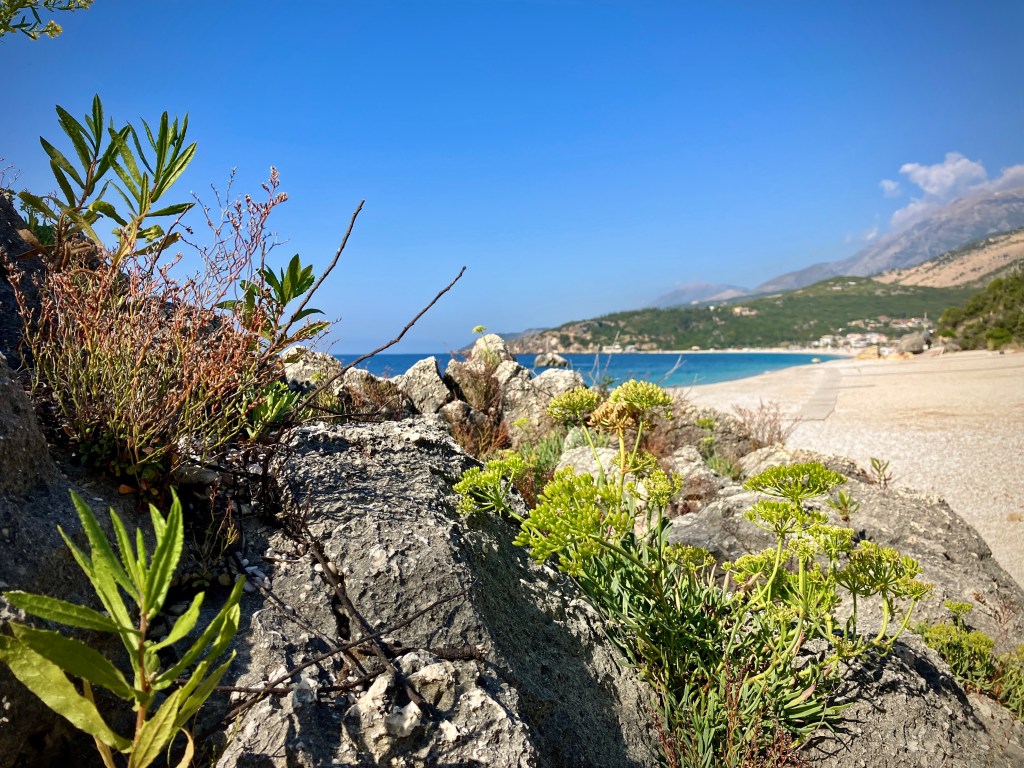
Many things are a work in progress, especially in the coastal areas; the view from a cafe where we stopped briefly for lunch and a swim after Buntrint.
Tirana’s underground BunkArt2 Museum was a good overview of Albania’s communist era.
Bike culture had been here a lot longer than the recent car culture, and Albania still has one of the lowest car ownership rates in Europe.

One thing travellers often refer to when describing a country is the “hassle factor”. How difficult is it to get around, complete transactions, order food, get money, etc? Albania scores well on this front as interactions tend to be straightforward and prices are generally clear. (Exception: some taxis…which really is a global problem!) It can also be little things like making change for large bills spit out by ATMs. No problem in Albania. Credit cards are also taken at some places, especially in bigger cities and everywhere in trendy neighborhoods of Tirana (like Blokku).

Heading to the “North-South Bus Station” in Tirana. Cracking the code for the bus and minibus system is one of the bigger challenges for travelers in Albania.
That look says; ok, where the heck is the bus to Vlorë?! But no worries as we just walked around a bit and were quickly pointed to the right bus. Take a seat and pay on board. Generally.

I would recommend bringing a healthy supply of Euros as this can make it easier and cheaper to pay at places priced in Euros (most lodging). And note that all ATMs charge $5-$8 per withdrawal, so withdraw as many Lek as you can per transaction to minimize fees.

The minibuses or “Furgón” also transport packages such as these giant boxes taking 6 seats on our run. We were worried for the guys in front of the boxes in case of a sudden stop 😬.
Vlorë comes alive in the evening with pleasant sidewalk dining and great people watching. We had a good chat with the nice guys at the next table who were from the UAE.

Our strategy for a mid October visit was to head to the coast first as many places do start to shut down, and by early November only the bigger coastal destinations (such as Sarandë) still have a lot of life. We’d then explore the inland cities and villages in the mountains and high interior.

Our hotel had a fleet of free bikes which was great for getting around cycle friendly Vlorë and to our favorite swimming spot.
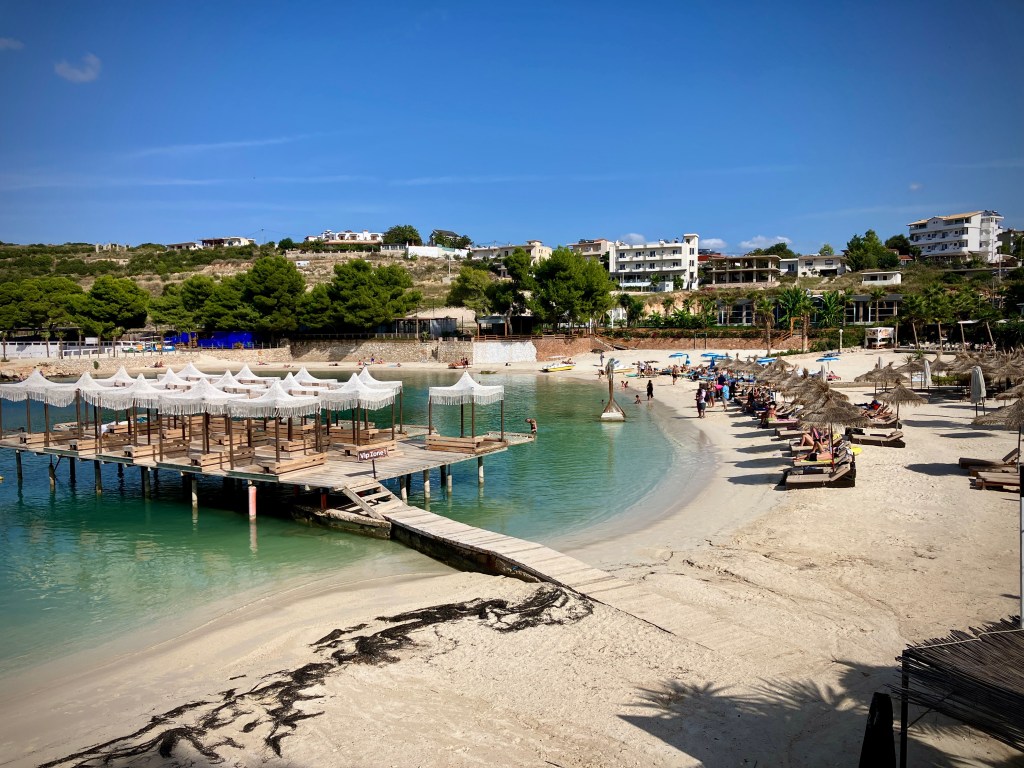
The promenade and small Azar Beach about 4 km south of central Vlorë offered turquoise water and better swimming than the main stretches of Lungomare.
Swimming near a Barrel Jellyfish (?) which just look beautiful and don’t have nasty stings (right?).

The strategy paid off as we still had nice weather, the beaches were still swimable, and enough was open to have a rewarding experience. We loved the chilled vibe of late season, and still met some nice fellow travelers, but if you want more of a scene, come earlier. If you want a full on party, packed nightclubs, and crazy beach scene, come in late July and August!

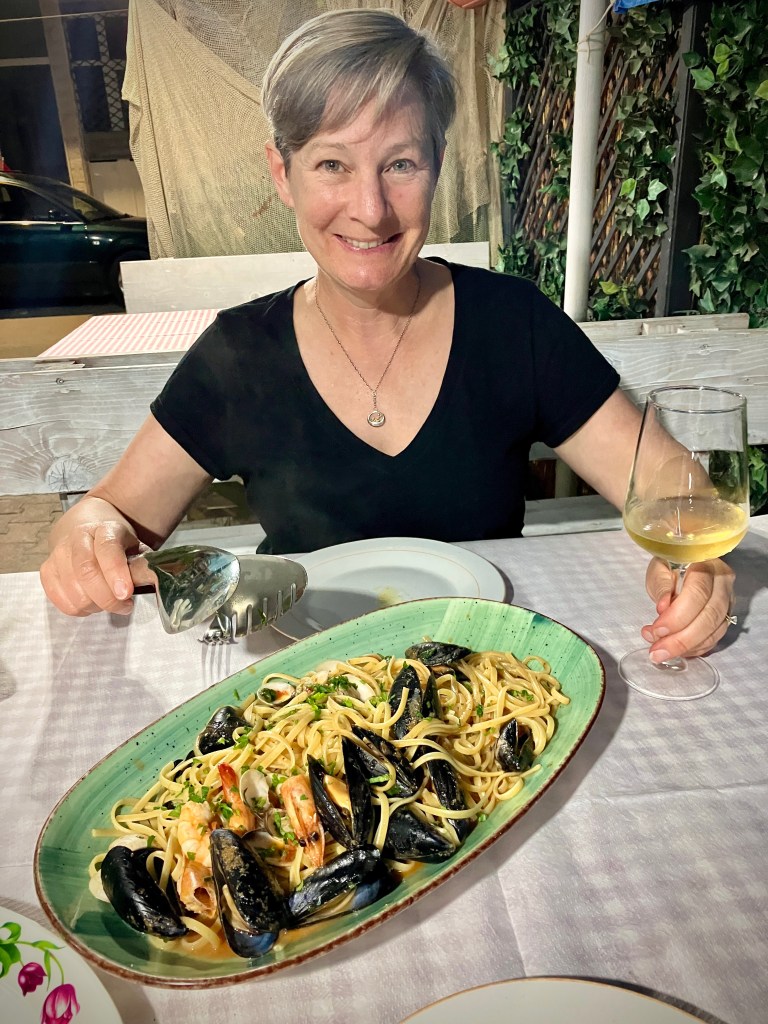
First course of seafood and perfect linguini at the wonderful little Skerdi Restaurant in Vlorë. The friendly owner/chef cooks amazing seafood and pastas.
Nothing but bones. A clean removal.
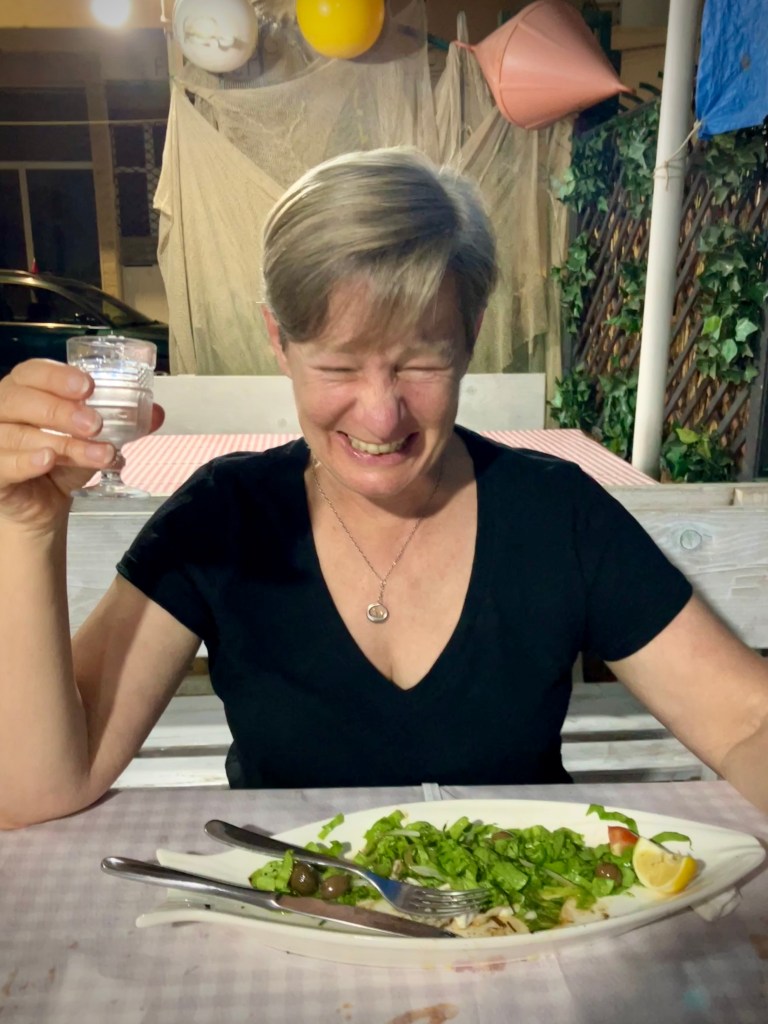
And this is what we call “Raki face”. We don’t seek out Raki in Albania, but with so many friendly restauranteurs, the Raki finds us.

We decided to stop in the small coastal city of Vlorë on the way to the more popular parts of the coast and were really glad we did. Vlorë is extremely pleasant and has a wonderful primary shopping and restaurant street as well as a long beach promenade, all with heavily used bikeways.

The public buses in Vlorë are easy and clean. You can board any door and just pay the fare collector who comes around, and makes change. (40 lek)
Vlorë’s bus station is a long curb lined with shady cafes. Waiting for our 10am minibus to Himarë…until we were told it actually leaves at 11:30. Another coffee, please.
The minibus station…finding out schedules can be tough. Ask around or stop by the day before about the time you want to leave. Hotels and guest houses can also help a lot.
Our Transbus to Hiramë left Vlorë at 11:30 and arrived at 2:20 with one 20 minute bathroom and cafe stop. The trip is spectacular/slightly scary over the coastal mountains.
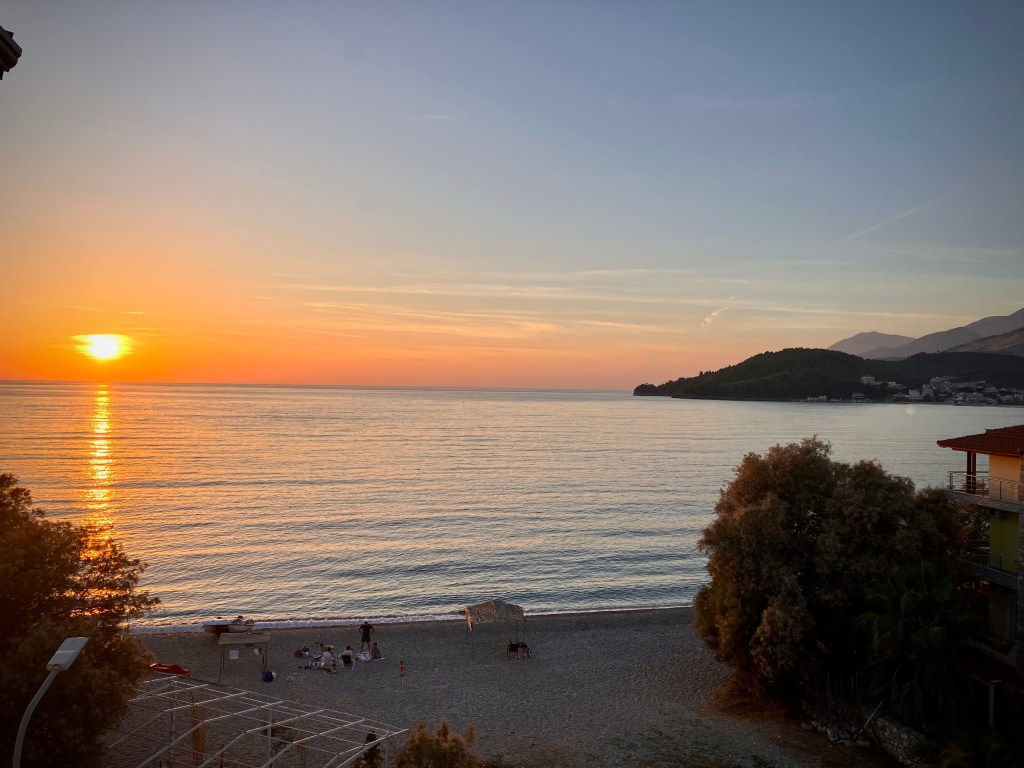
Sunset view from our apartment along Potami Beach in Himarë

The trip south from Vlorë heads over the Llogora Pass, with a stunning 3,000 foot decent towards the ocean. Traffic is still remarkably light and little towns dot the coast; some a bit charming and others more scruffy and modern. Himarë (or Himara) was very pleasant but it’s vibe was much more beach town than the real city scene of Vlorë. But it’s a spectacular setting and the 3 beaches around the bay of the City are pretty nice.

Sheep herder on the beachfront of Himarë.
Local markets abound with the ubiquitous cucumbers, peppers, tomatoes, onions, eggplant, and spices which make up most dishes.
Some longer trails such as the Albanian coastal trail have been established recently but in general, hiking is an adventure using partially mapped roads, fire roads, and foot paths.
Grapes and vines adorn many house; on the way to Livadi beach from Himarë
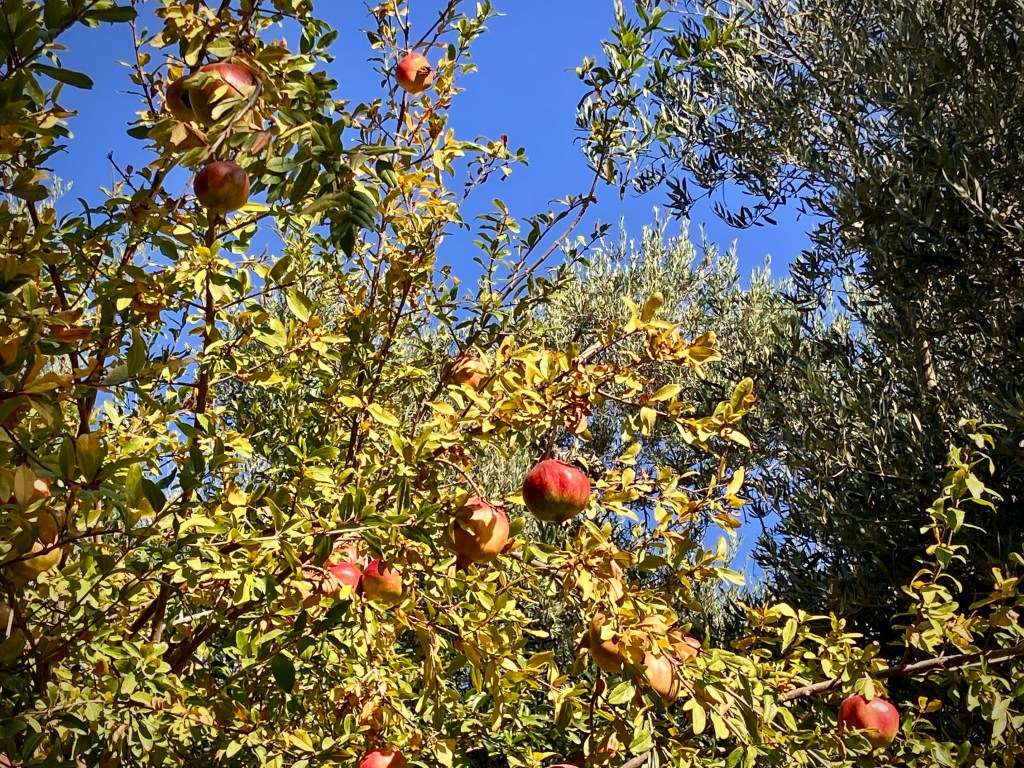
Pomegranates and citrus.
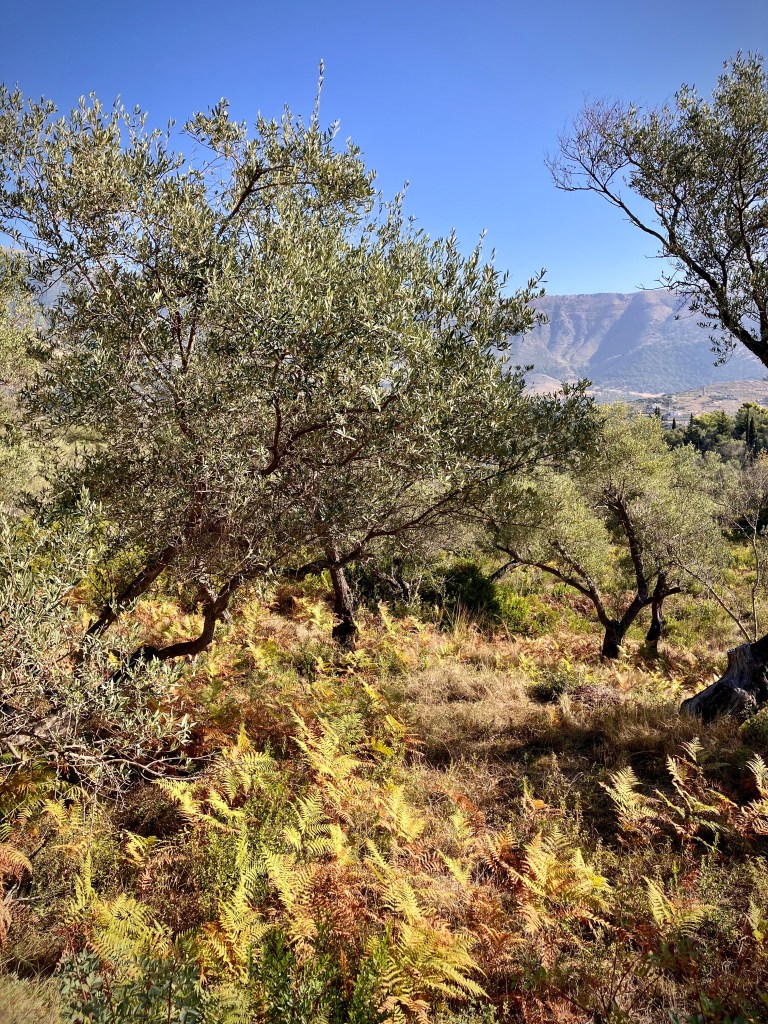
Olive trees were often mixed with ferns, which felt a bit out of place in the arid environment.
Olives and olive oil are a base of life in the region. And delicious.
Livadhi Beach…our favorite and a short hike from Himarë with some nice shade (at the undeveloped southern end).
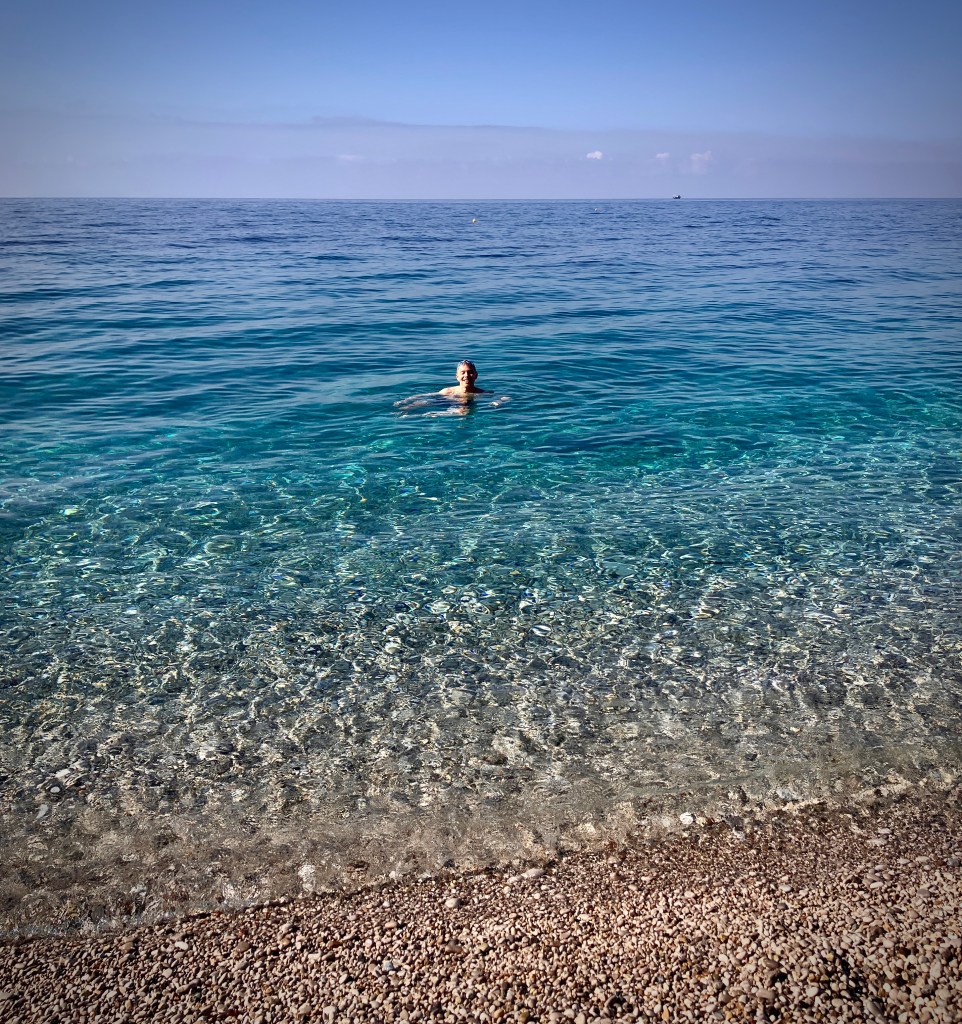
Ionian Sea paradise at Livadhi.
By mid October many of the beach restaurants in our neighborhood had closed, so we made this friendly Taverna PiroΣia our home in Himarë as we preferred its vibe (and the walk) to main town.
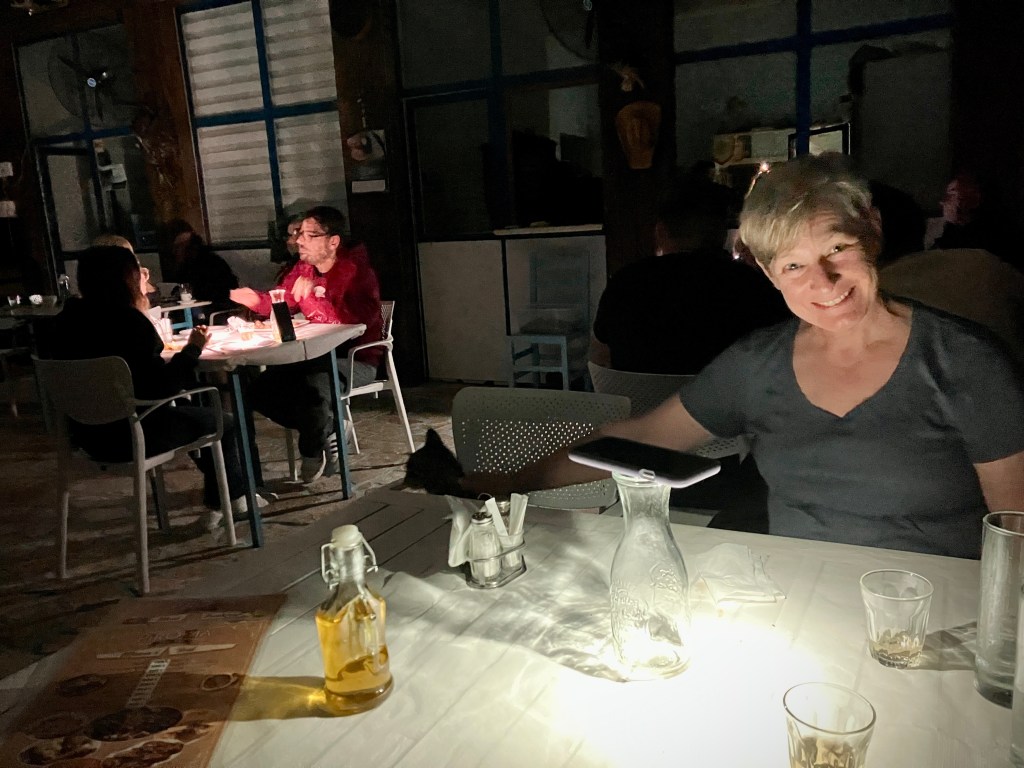
And then the power went out during a rain storm, making for a romantic IPhone candlelight setting. Power can still be a bit spotty in Albania.
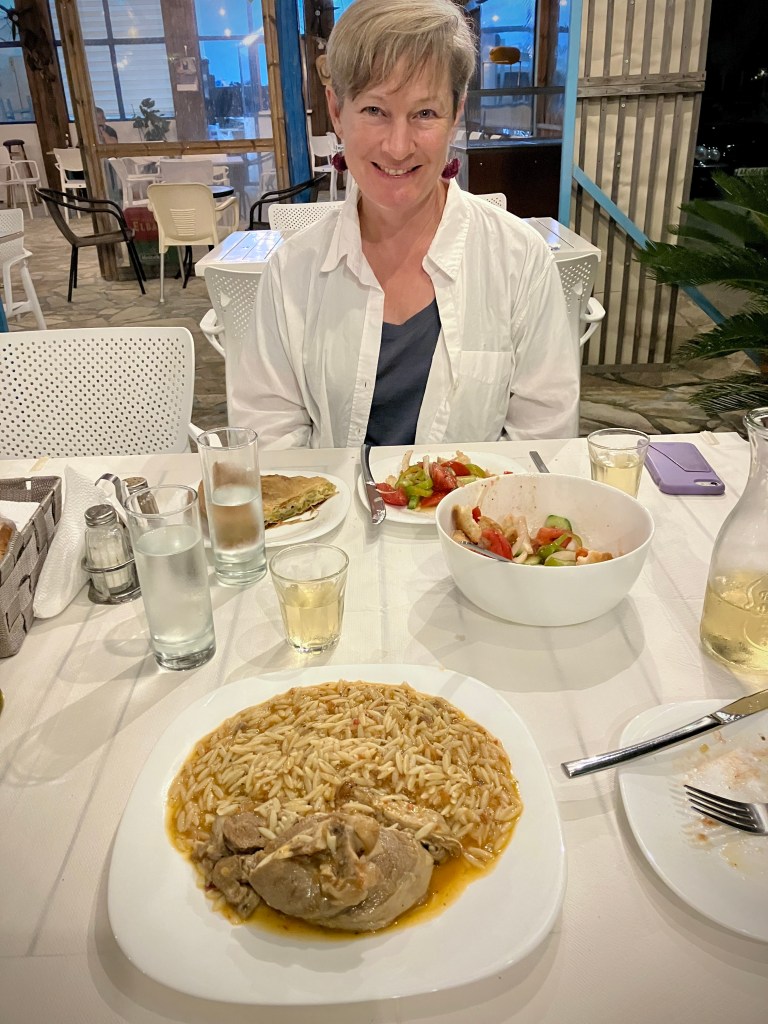
Zucchini pie, a Greek village salad, and Lamb “Juvetsi”. There are many Greek or Albanian-Greek restaurants in this coastal region.
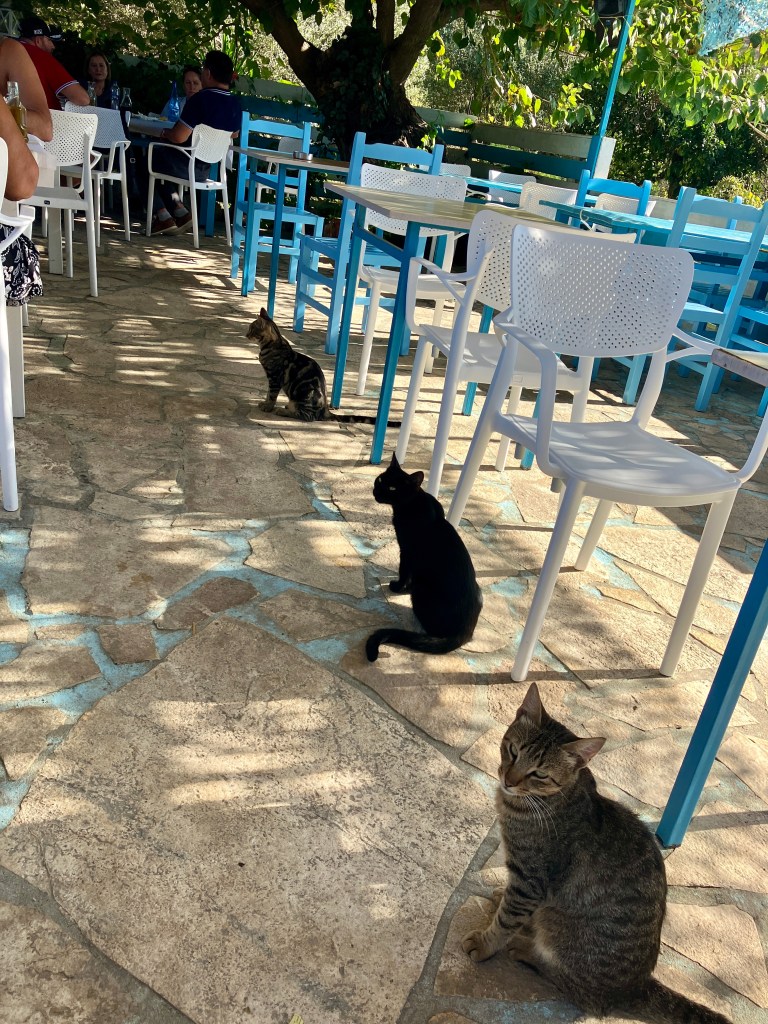
Did I mention the restaurant cats?
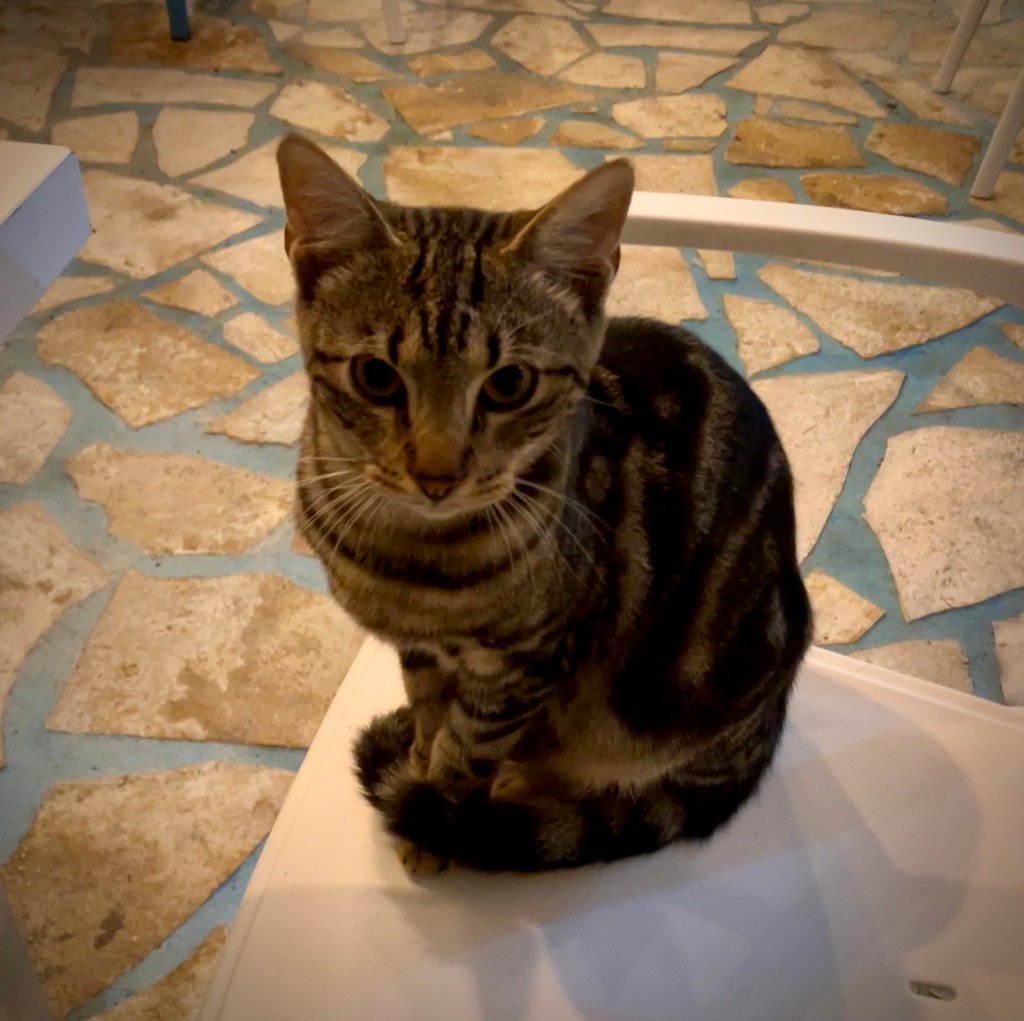
How can you say no?

Our next bus leg to Sarandë went well as the nice host of our apartment confirmed the minibus time and walked us to board (south of the main stop in Himara) where we found the driver had reserved two upfront seats for us based on her call to him. So nice. The Albanians we have met have been kind to a fault; but sometimes it takes a bit to draw them out from their extremely low-key nature. But it is really nice to travel here.

Central produce market in Sarandë
Café culture is strong here. Chilling in Sarandë

Since we were out of the main part of town in Himare, we decided to go for a centrally located family hotel in Sarandë. It was nice to enjoy the main pedestrian beachfront promenade in low season, and have access to more of the city’s less touristy restaurants. Yet we still could swim in the main beach with just a 5-10 minute walk. Just a few people still “beaching” at this time, but the water was still nice, with just a slight chill. (~20-22 deg C)

My dog buddy followed us to the bus stop in Sarandë and was determined to go to Butrint with us.
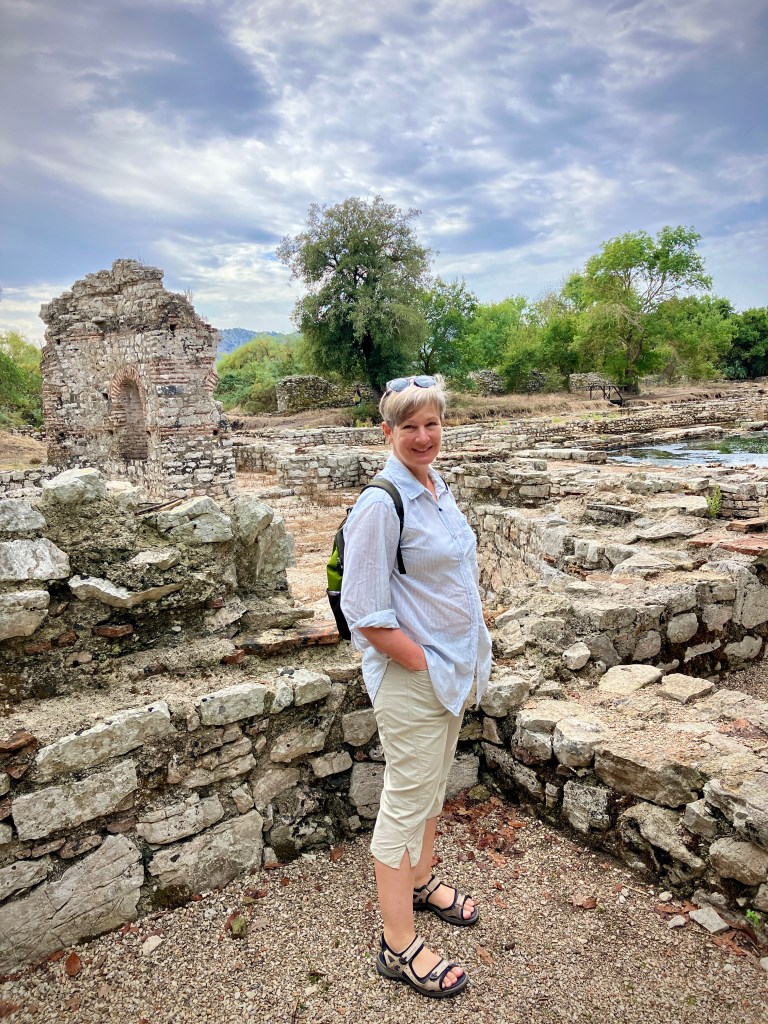
The forum at Butrint. Although not as intact as Pompei, Herculaneum, or Ephesus, we were able to fill in the structural and decorative gaps from our experiences there.
Exploring Butrint Archeological Park just before the big crowds. Sea level rise is a problem for the site.
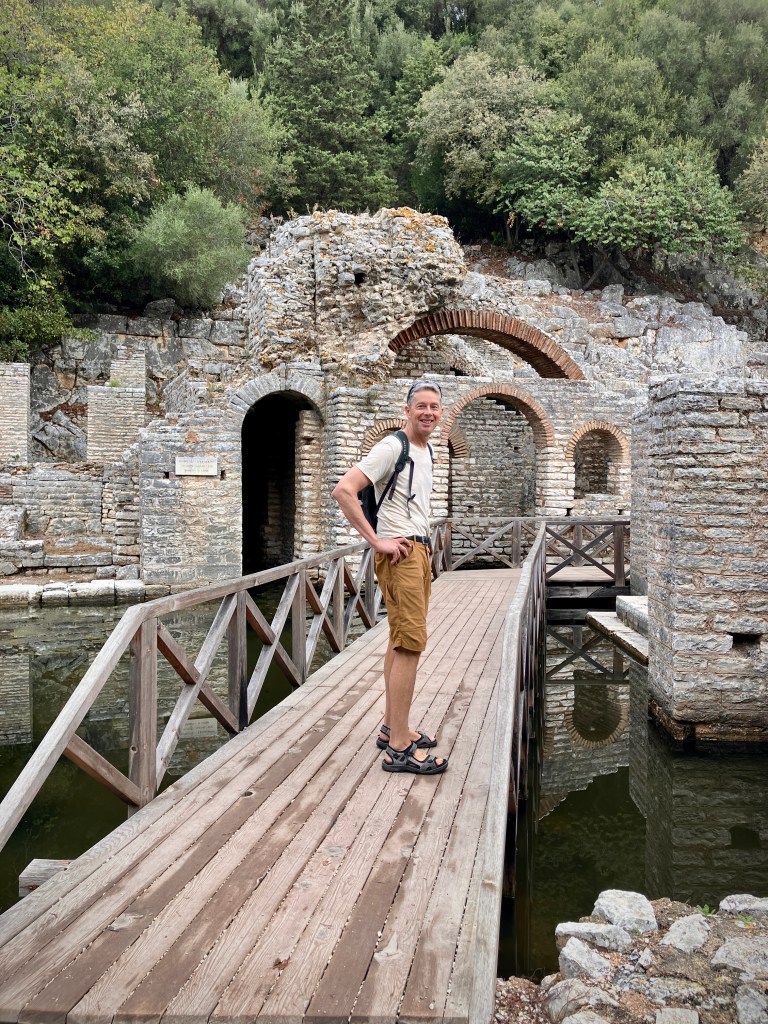
Layers of history at Butrint include the Greeks, Romans, and Byzantine empires.
Much of the original city defensive walls are intact.
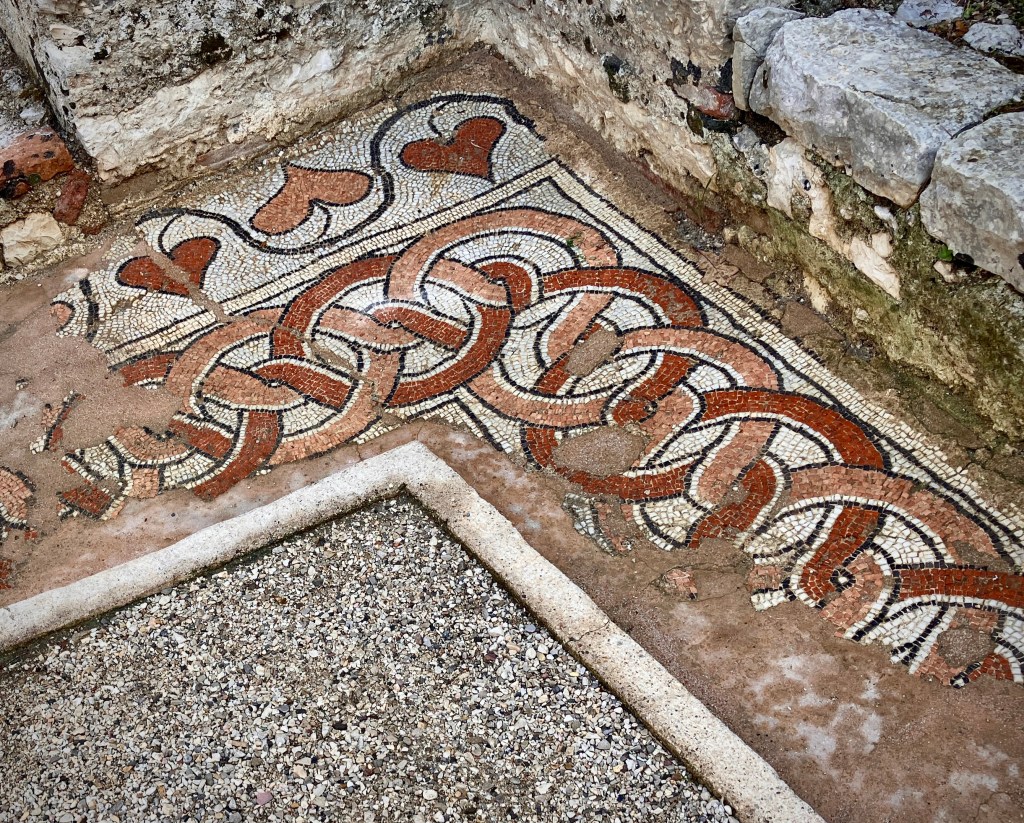
This is one of the few mosaics visible in Butrint as most are kept covered by sand to protect them from the elements.

Our central location in Sarandë also meant easy access to the municipal buses that run every 30 to 60 minutes right to Butrint National Park. (200 lek) However, the bus stops at 3 or 4 places along the main road out of Sarandë, so you can still catch the city bus a few km or more south of the city center, which is now an endless line of new boutique hotels, apartment buildings, and mostly seasonal businesses.

The springs and wells of Butrint were a reason for its early success.
The Butrint museum has some interesting artifacts and info but could use a refresh. Apparently a vastly expanded visitors center is in the works as visitation has grown quickly.
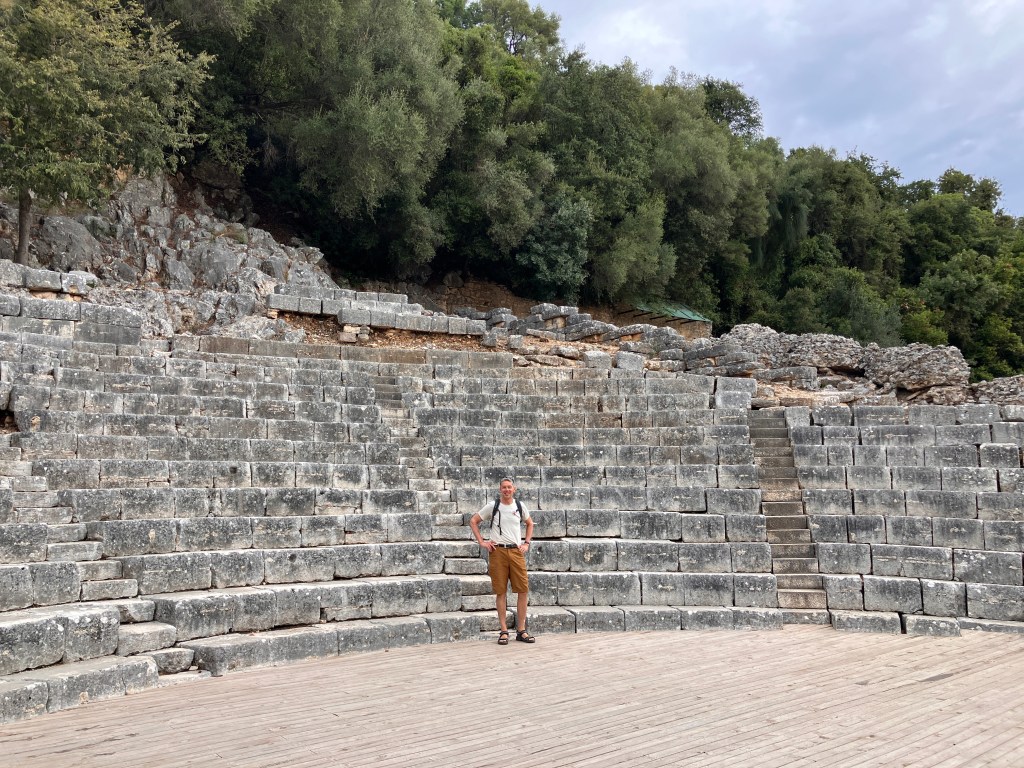
We loved the natural setting of Butrint.
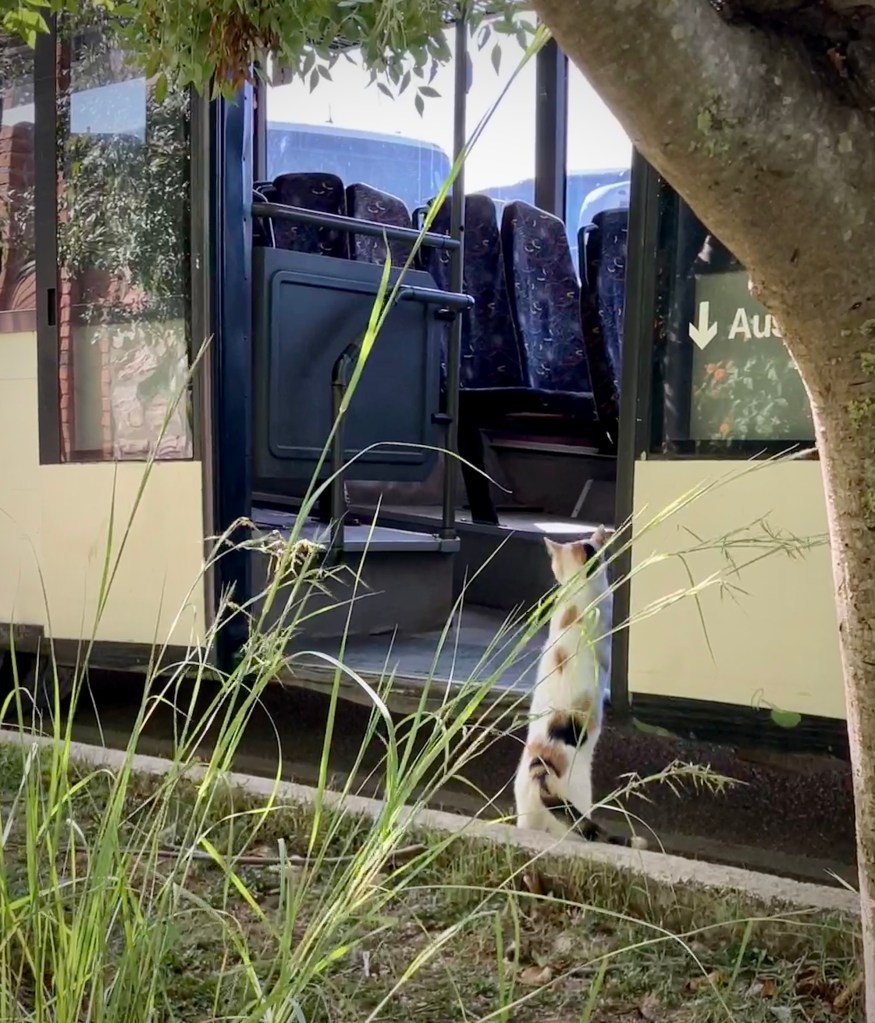
This cat was opting for back door boarding on the bus back to Sarandë.
But then changed their mind.
We stopped briefly for a swim at the main beach in Ksamil (pronounced “Sam-ill”) but it was not our scene. In summer, no part of the beach is free and you have to pay for a sunbed.
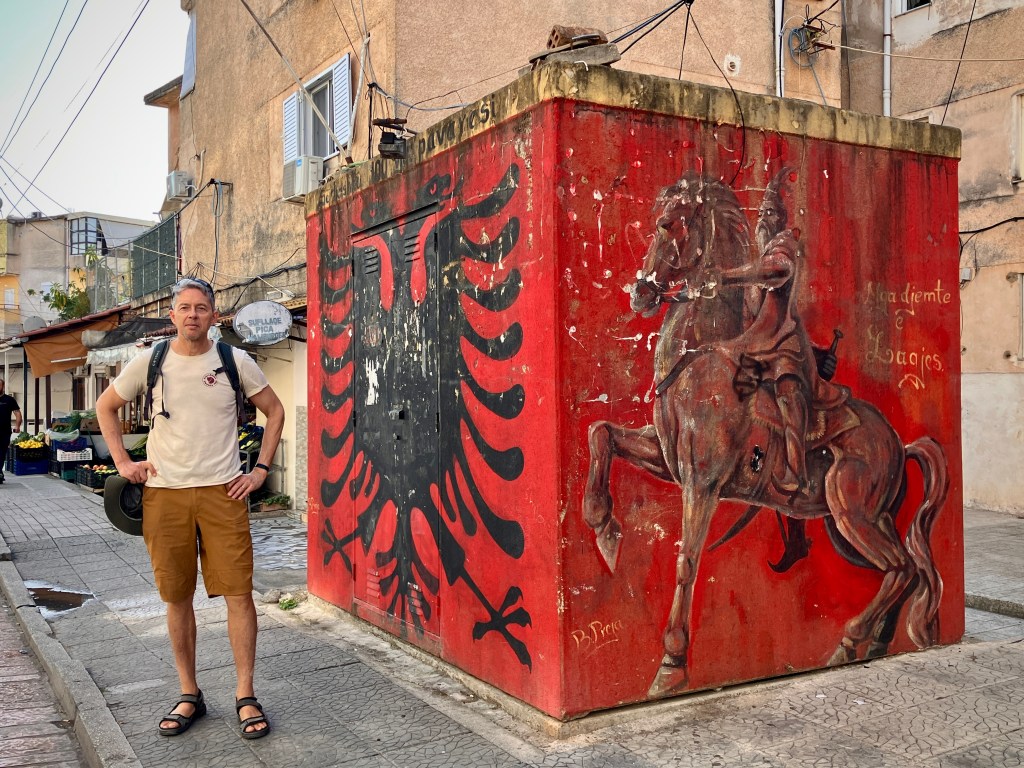
Nicely painted utility substation.
There are many unfinished/abandoned buildings on the fringes of Sarandë, and unfortunately a pretty serious garbage and sanitation problem.

It’s been an enlightening time so far in Albania, and we have been charmed by the pace of life here and optimism we are seeing for the future. We will be rooting for a positive trajectory in this complex world and region, and hopeful that more of their talented and educated youth stay to build a stronger future. But for now, we all get to enjoy this snapshot in time.

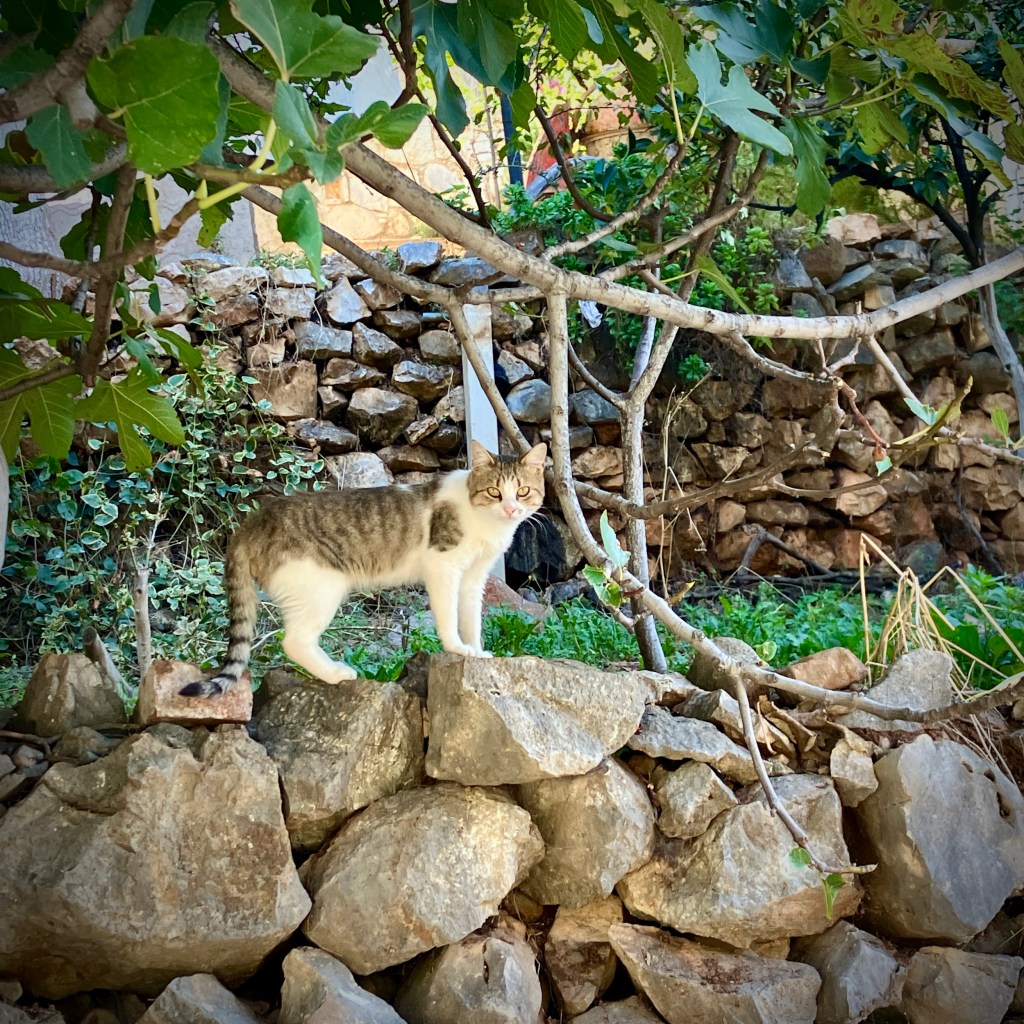
Cat curious why these tourists are wandering in his hill neighborhood above Sarandë.
A memorable visit to the Albanian Riviera, but ready to explore inland.

Happy travels!

Winging it through Brittany (and Normandy) by bicycle.

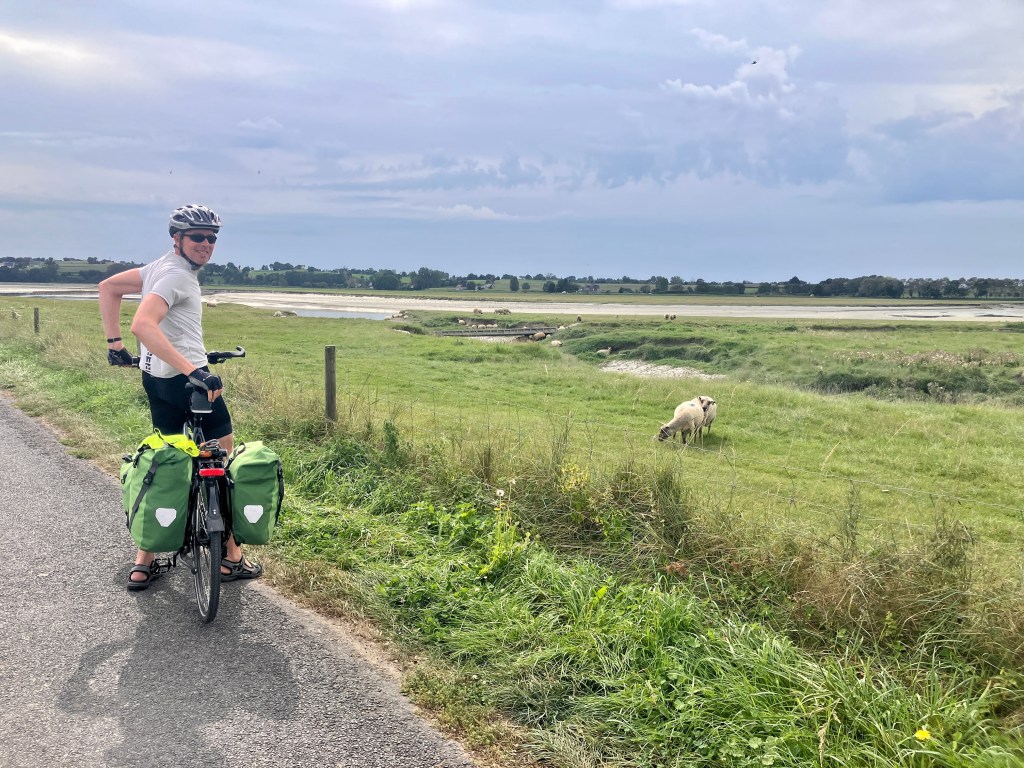
The fearless leader of our tour of Brittany. In Normandy.

Rich and I joke that he is a tour leader with one client: me. He plans routes and navigates, books hotels, fixes mechanical issues on the bikes, and here in France, is also our translator. I provide restaurant and museum research, maintain a positive attitude in the group, and look for cats.

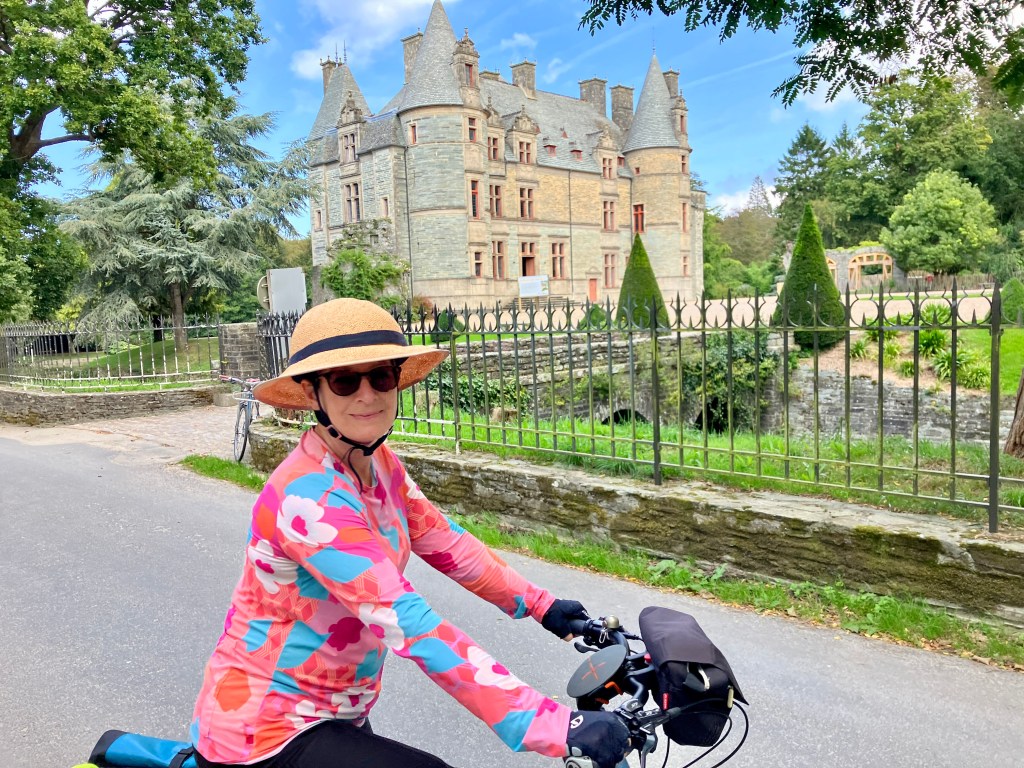
Off the ferry and on the bikes. Parc du Château des Ravalet. Hello France.
The long stone farm buildings are so captivating.

Our tour started later than we normally get riding, the ferry docked at 2pm at Cherbourg, Normandy, and we had a hotel reservation in Port-Bail-sur-Mer, about 42km/26m south. That was our only reservation and destination. The first day riding in a new area means getting used to the traffic and temperament of the drivers, shifting to riding on the right hand side of the road, being charmed by the buildings and gardens, and bonjour-ing everyone I see.

The restaurant across the street from our hotel.
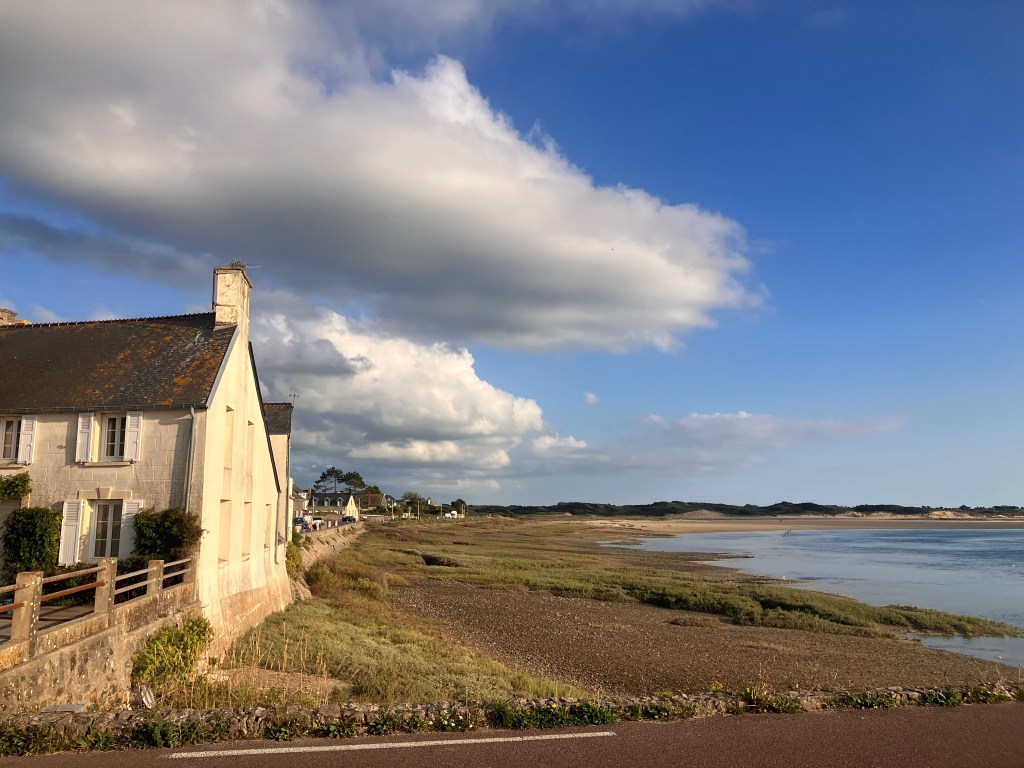
Our first look at the tidal flats of Normandy.
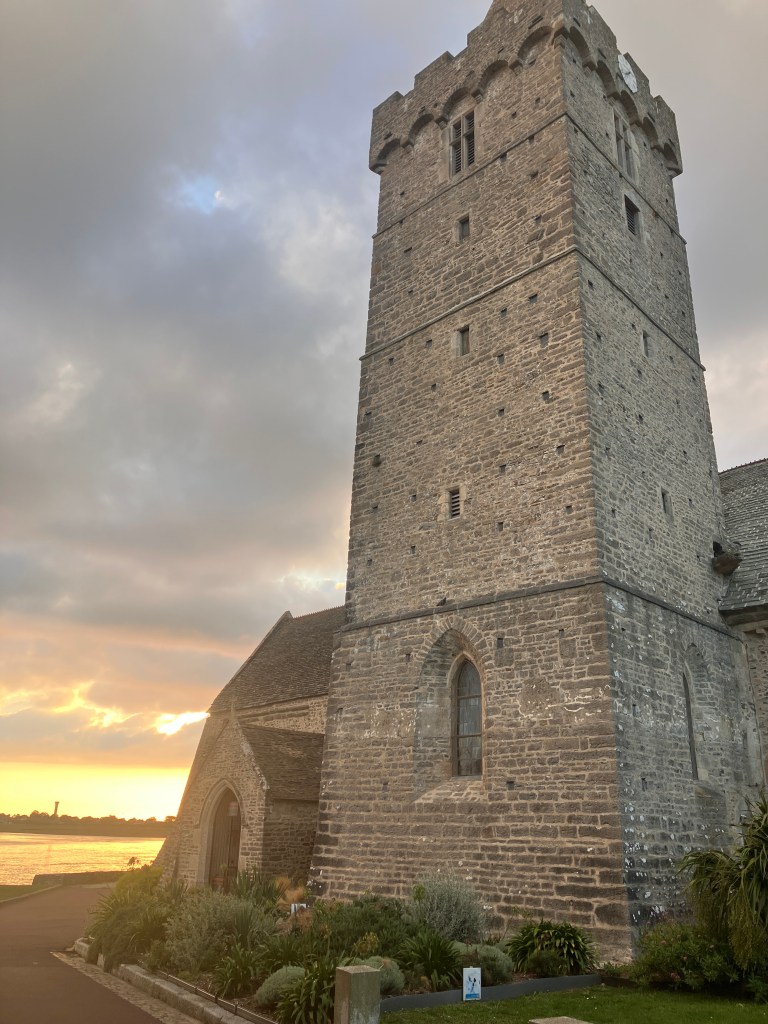
Sunset casts a golden light on the Church of Our Lady.

I get a bit stressed by eating out in France at first. My French is minimal at best, and I can find the handwritten chalk board menus difficult to read.

Oh yes, I’m reminded that I have entered the land of chalk board menus and delicious food.
Moules marinières with frites. An easy choice in the land of seafood.
The tide rushes in so quickly, and the water is so clear.

Switching to bike touring mode again after a lovely summer of long stays at house sits and with friends is a little tough. We tend to stay only one night in places until we need a rest day, but after a long day riding, the checking in, lugging bags, unpacking, doing shower or sink laundry, have dinner, sleep, breakfast and repeat, seems overwhelming the first few days. “Did we get bad at this?” I asked Rich. He was wondering the same thing, but, it only took a few days for what felt like too much, to become normal again.

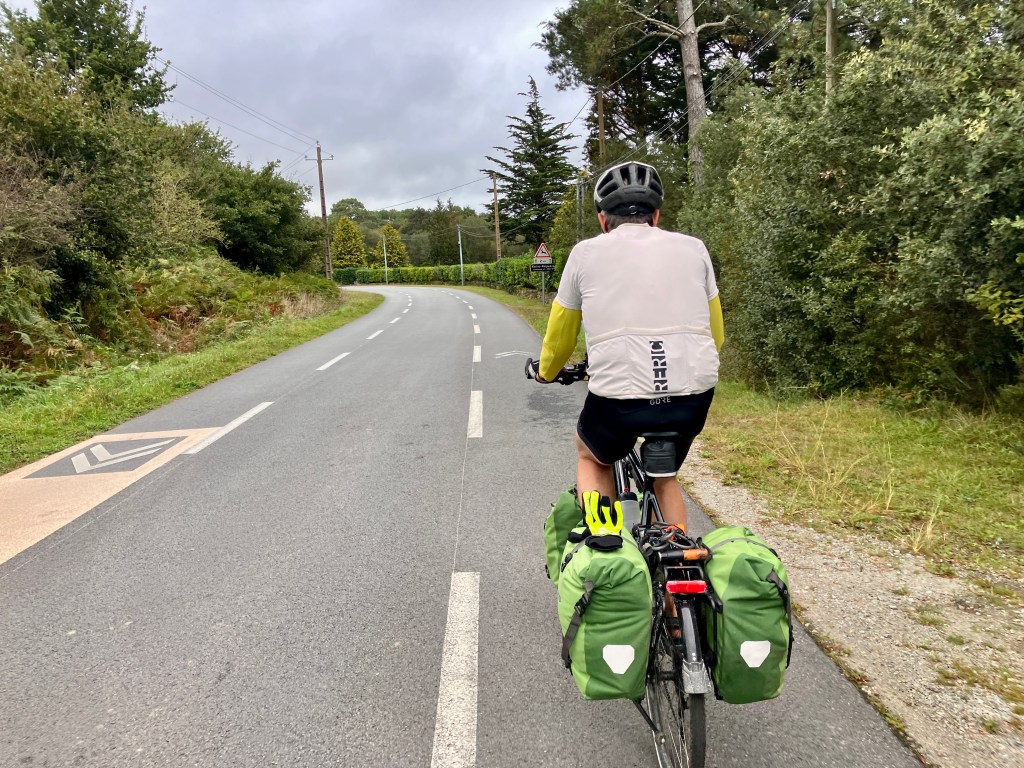
Ready to roll from Port-Bail-sur-Mer. Panniers are perfect on the bike, but awkward off the bike.
On to a multi use trail. Very relaxing riding.
You know you’re in France when…
…you have baked goods strapped to your rack.
The almost daily bakery stop, today in Lessay.
Which is followed by the daily search for a bench in the shade upon which to enjoy the pastries at about the 20k mark. This one was in a cemetery.
And an hour or two later, the search for a lunch spot. A picnic table is a welcome sight.

It’s not all about food, although food is important and delicious here, we also have a lot of stops to read history markers. Our first few days followed the path of General Patton’s Third Army as they broke through Normandy. We had a lot of history to ride though. Towns have streets named 28 of July, and further on 29 of July, to mark the day General Patton and the troops marched through, and bridges have plaques commemorating the march. It’s always spine tingling to read of what the French went through, and how much destruction was caused.

Pont de la Roque, bombed by the Allies to try to prevent the German troops from escaping.
Welcome bike and pedestrian improvements in towns and villages. This road into Granville looked very new.

Over the last few years we’ve noticed France becoming more and more bicycle friendly. Towns have more car free space, speed limits have been lowered nationwide in town limits and signs put up showing that people on foot and bike have priority. Wider sidewalks with bollards, separated bike lanes, and rules for car drivers to give 1.5 meter passing space to bicyclists (1 m in town) have all made quite a difference. We love pedaling into a town and seeing the completed work, or the work underway, as France has pledged a billion euro more to make streets safer for bikes and pedestrians.

We had previously only seen this street treatment in Denmark. Bike lanes and a car lane shared by both directions of car traffic.
In Denmark the bike lanes are red, here in France just marked by a dashed white line.
Outdoor dining in Granville. That’s a bottle of cider.
An extension of summer. Outdoor space still up and running.
Sunrise, Port de Hérel. The view is from our room at the Ibis hotel.
Heading out of Granville, another nice wide bike lane.
How many times will I call a town charming? Bacilly was charming.

Our third night would be spent near Mont Saint-Michel, and it would be our final night in Normandy. We would cross into Brittany just west of Mont Saint-Michel.

Riding the coast of Normandy means skirting a lot of river estuaries, at Le Val-Saint-Père.
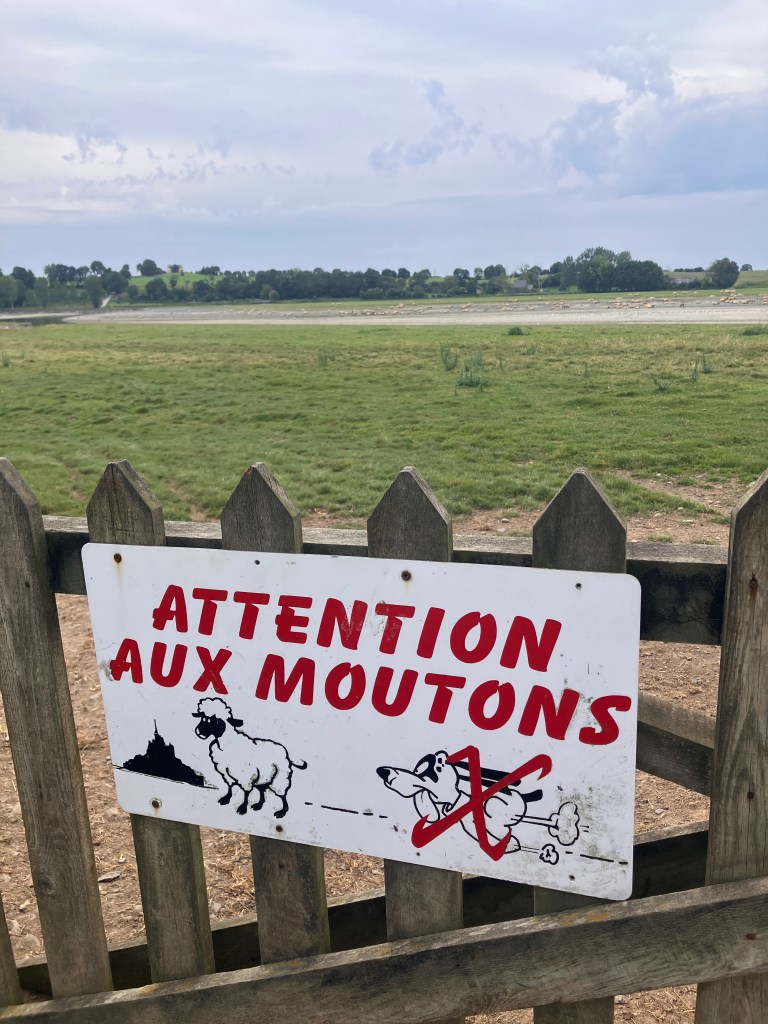
Do not let your dog chase the Agneau de pré-salé (salt marsh lamb). A specialty of the area.
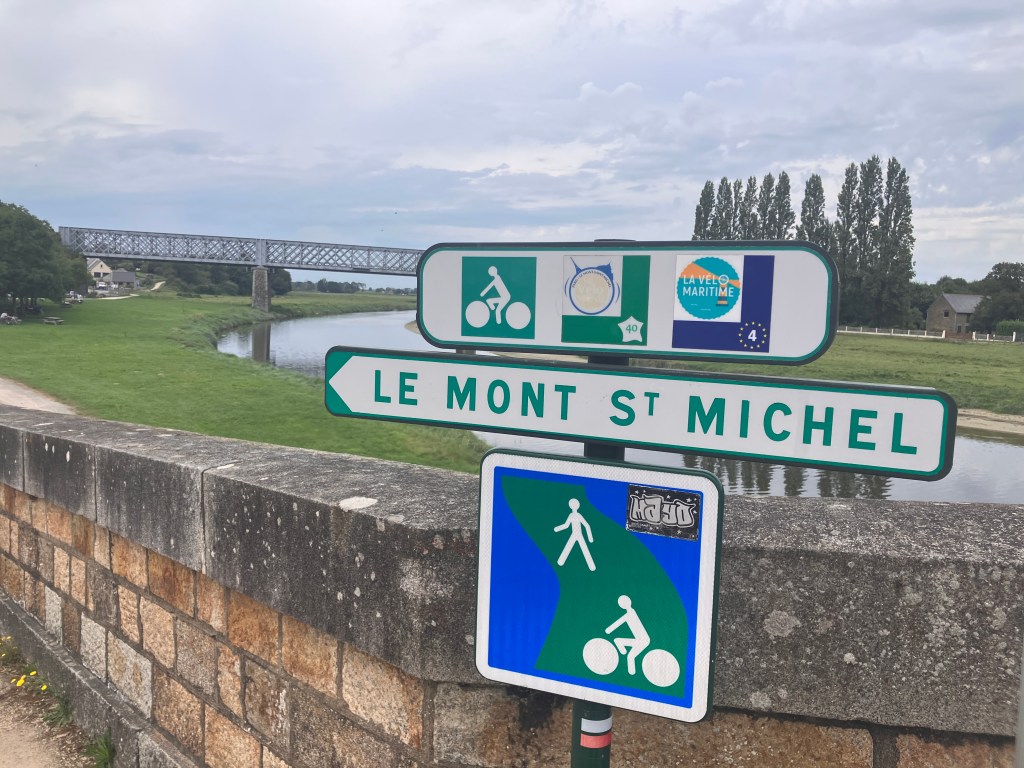
This way to Le Mont.
Now this way. The coast route is squiggly.
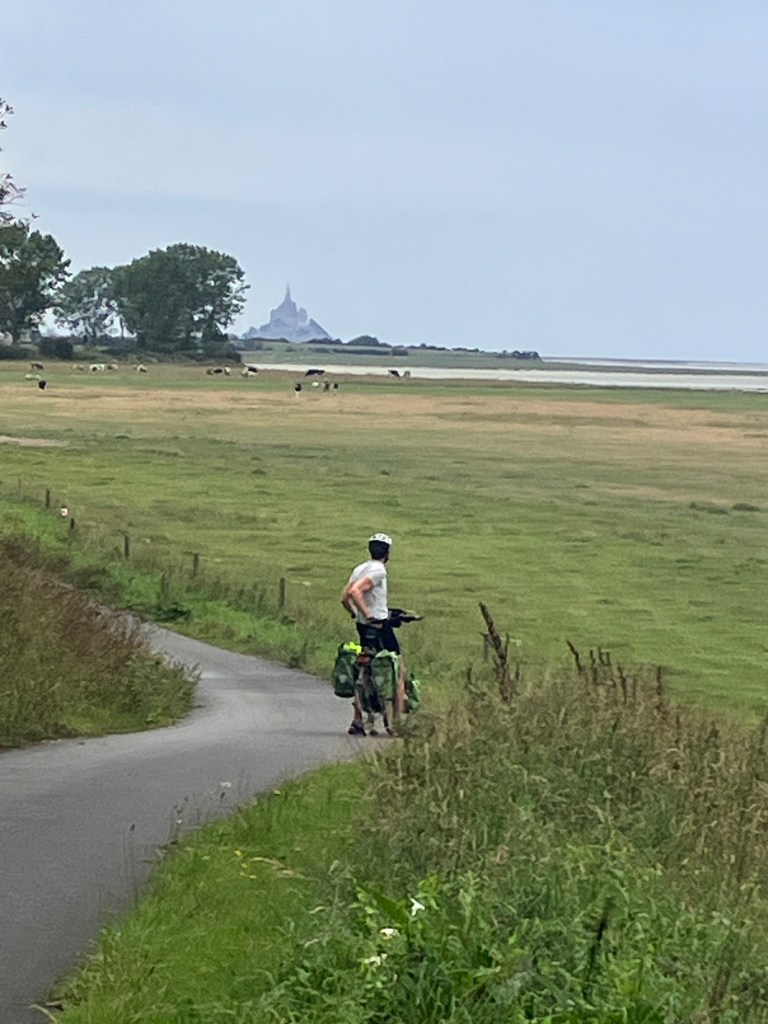
There it is. We’d been catching glimpses of it all day as we rode, but this view – it’s otherworldly.

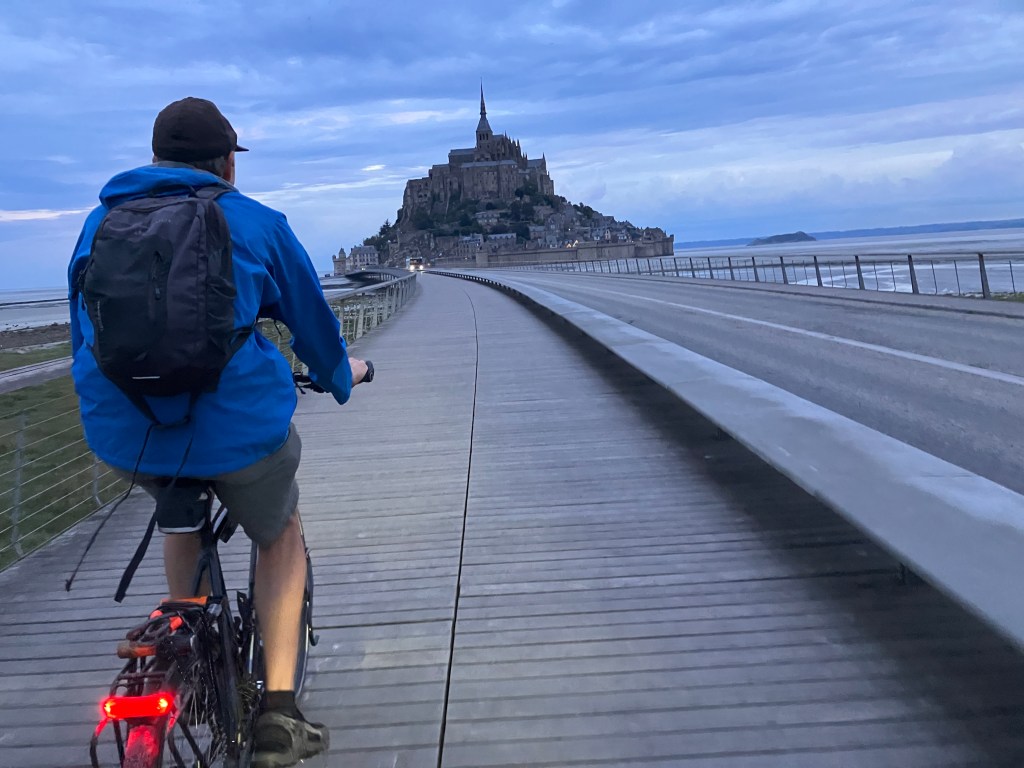
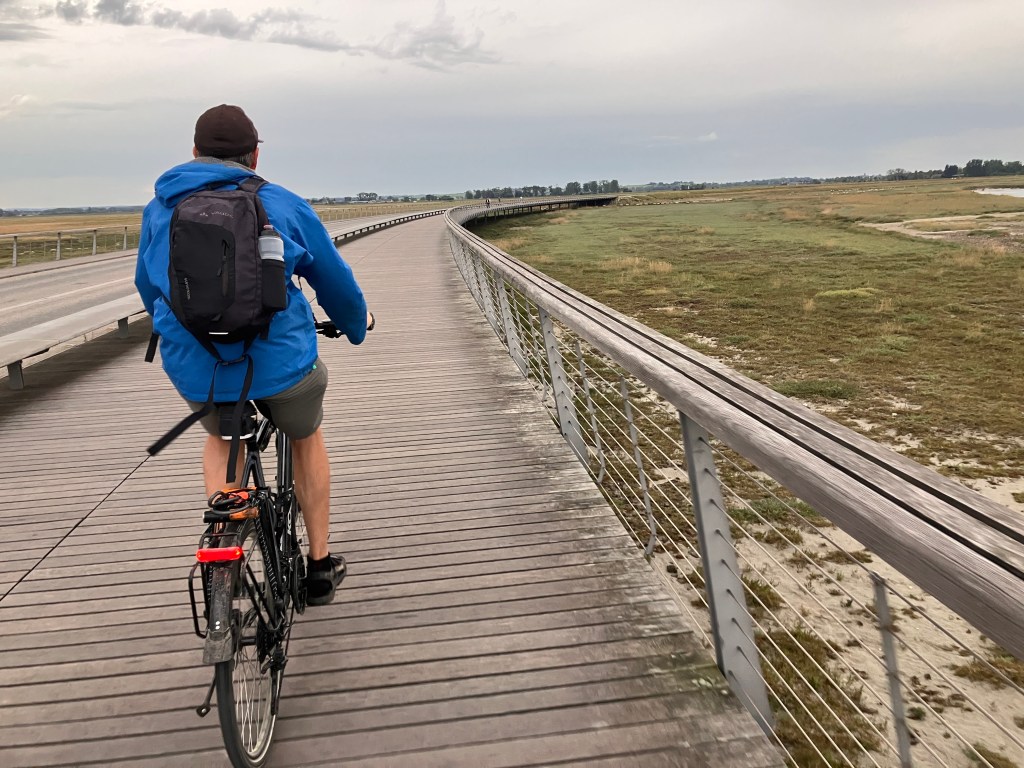
Rich booked the hotel near Le Mont just the day before. Off season means much more availability, even on a Saturday night. We debated riding right out to Le Mont before checking in at our hotel but we decided to check in, shower, leave the bags and ride back out the 5 kilometers so we could lock our bikes and walk around. The causeway leading out to Le Mont is only open to shuttle buses, bikes, and pedestrians.

Hotel Rose. Such character.
But even better, we had a cabin with resident friendly cat whom we promptly named Deuce, for our cabin, number 12.
Here we come, Mt. St. Michel!
Denied! The causeway was closed to bikes for a light show extravaganza that evening.
We retreated to the dam which was built to settle the sand from the incoming tide and avoid the river silting up.
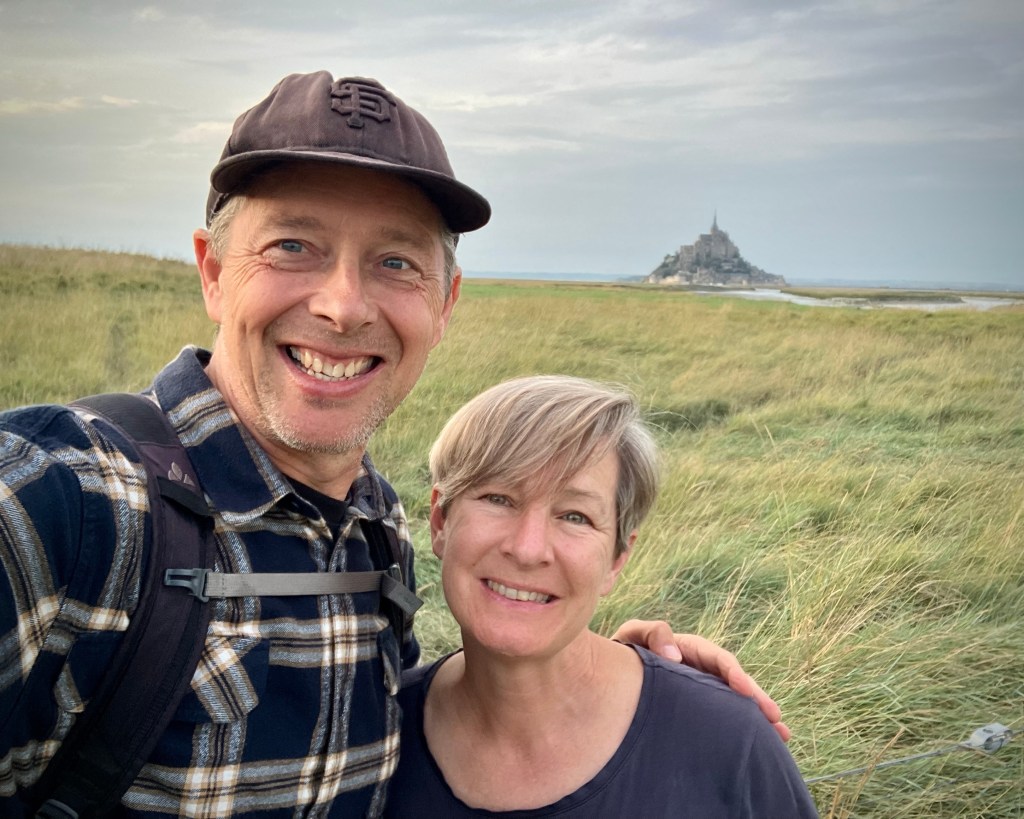
We got a nice photo with Le Mont.
Did a little pouting.
Watched some adorable tourists all get their Instagram shots.
And back to our hotel for a bottle of wine and an Afgani dinner from the food truck run by the hotel owner’s sister and her husband.

Do not think we gave up. Even though the mosquitoes were feasting on us as we watched the wave from the incoming tide travel up the river to the dam, no staying for the extravaganza for us, we decided to get up with the sunrise and ride back out to Le Mont.

The next morning, rain was headed our way but we were not deterred. This is pre caffeine.
Success. At the island with a dramatic sky.
We were ready for the rain.
Yikes! Let’s get this island viewing under way!
Early Sunday morning and rain rolling in means very few other tourists.
The Abby has a 1,300 year history.
One other small group was walking around when we first arrived but we only saw them once.
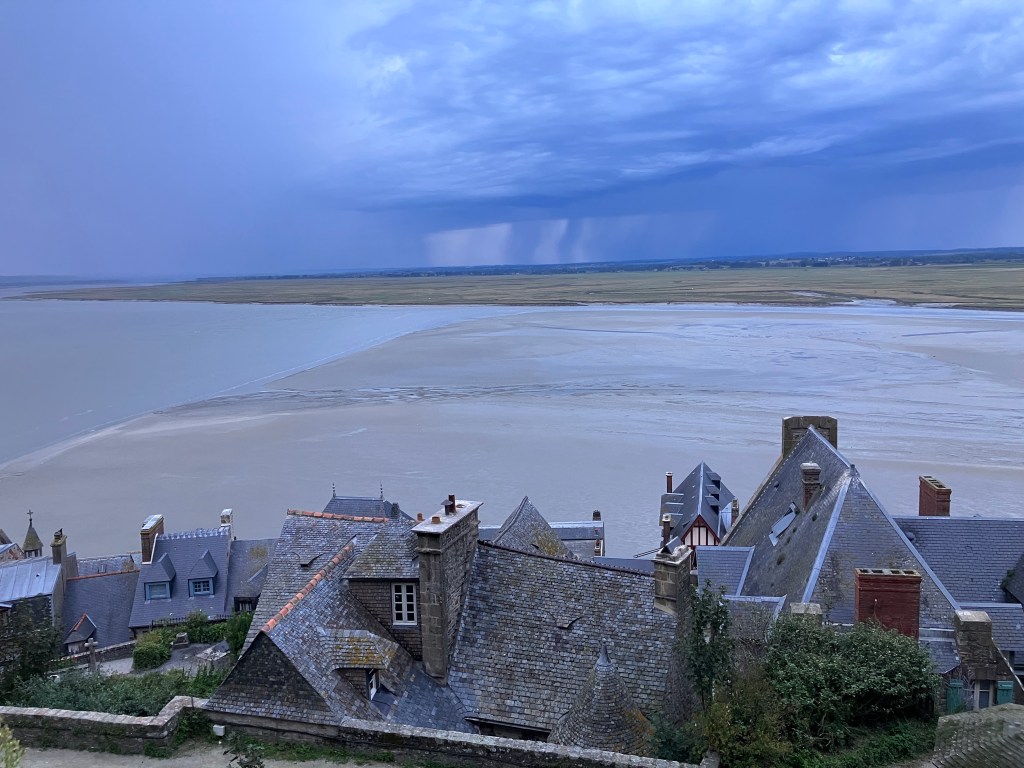
The rain and the tide rolling in.
The medieval streets below the abbey.
Although the shops cater to the tourists, the bones of the town remain visible.
It was well worth getting up early and braving the threat of rain to see the Mont with so few other tourists.
And back to our hotel for breakfast and much needed coffee and tea.

With the history of WW2 still so close, and much documented by historical markers and plaques, I had to look up what happened to Le Mont during that time. As you can guess it was held and occupied for four years and two months and – to our delight – we read it was liberated by one American, Private Freeman Brougher. You read that correctly, one Private in a jeep with two British reporters. Read the entire story here for a jolt of emotion and a few fantastic photos: https://warfarehistorynetwork.com/article/freeing-mont-saint-michel/

Photo from the article. More photos in the link to the website.

Although the rain held off for our visit to the island we were eventually caught after checking out of the hotel and heading out. We had to shelter to let the hardest rain pass by.

Barely on the road and already stopping to put our rain gear.
The weather cleared as we continued along the coast, past windmills.
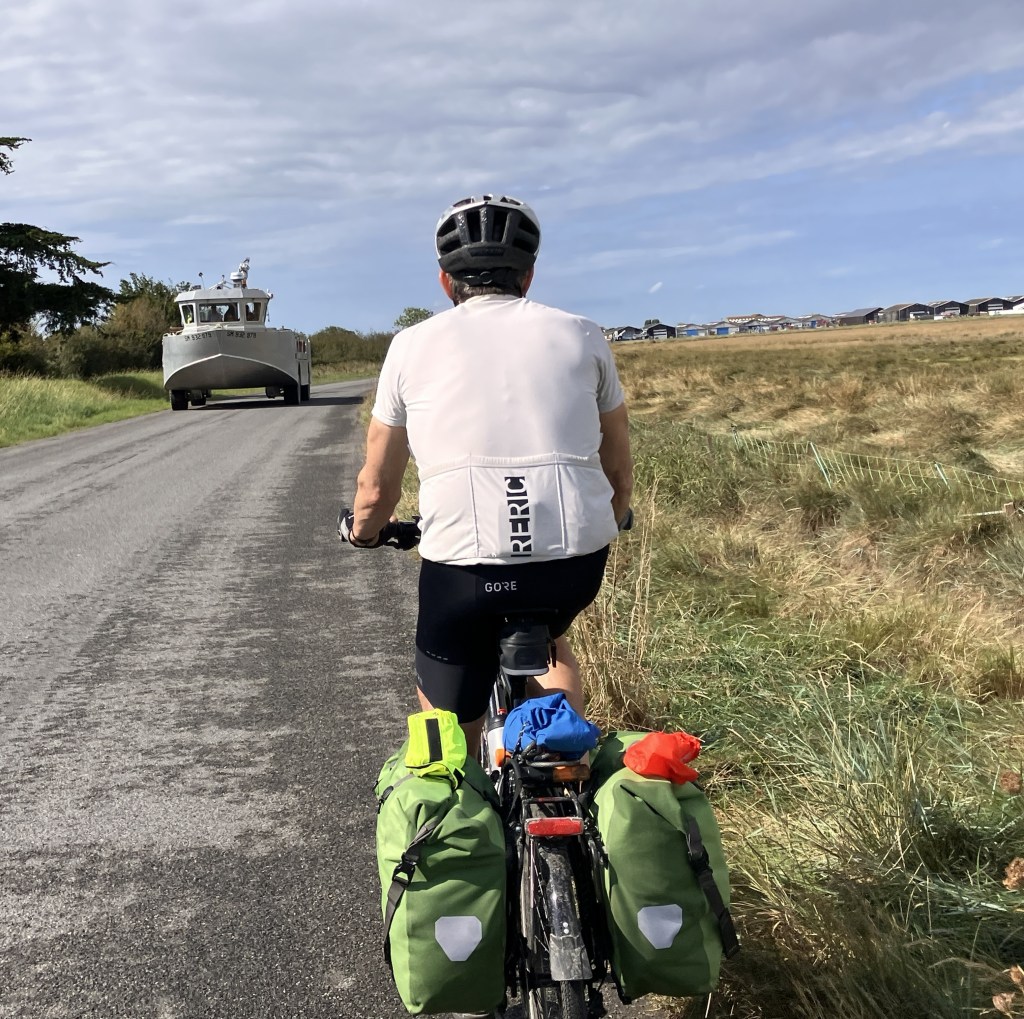
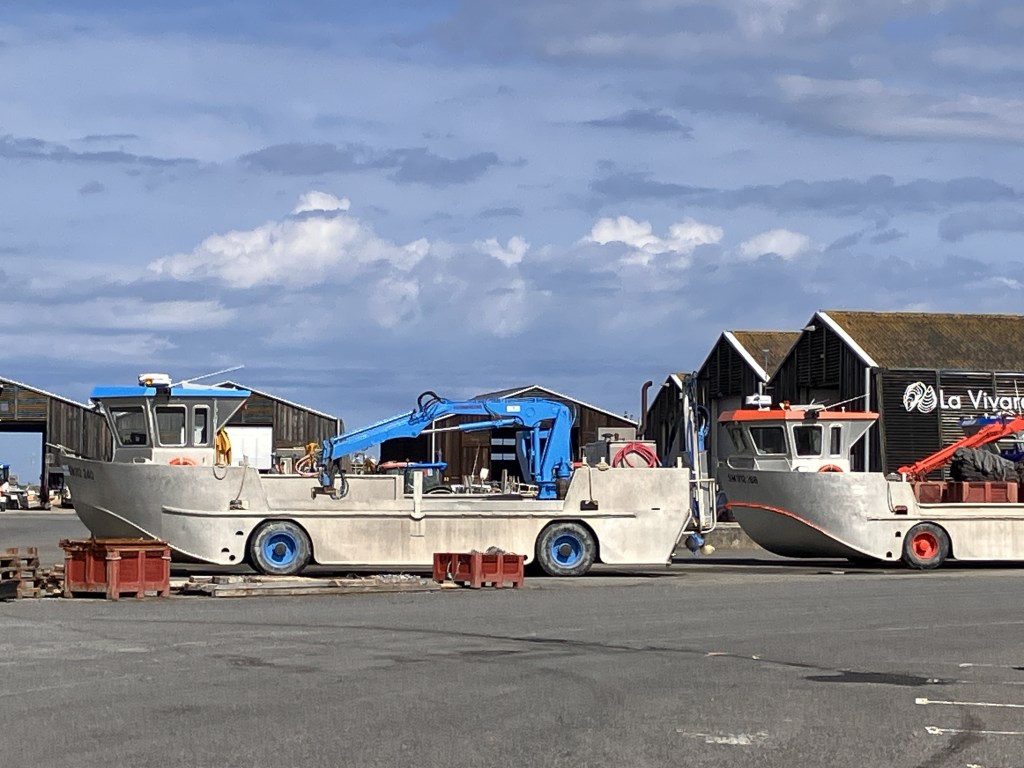
And past these funny amphibious boats.
They are used to harvest mussels. They can drive along the road, across the beach, and into the sea where the mussels are growing on pilings.
Picnic spots of the world. We had managed to get to a small shop just before it closed for Sunday afternoon

There is a lovely feeling of familiarity, going from Wales to Brittany. Both are Celtic lands and we find similarities that catch us by surprise. The style of the old buildings, the way the doors and windows are framed by brick, certain words, and, arriving in Saint Malo, reading that Saint Malo arrived in Brittany from Wales. He was one of the seven founding saints of Brittany.

We had to look up this city emblem, it’s a dog.

Saint Malo is the setting for the book All the Light We Cannot See, which we both read, and we were reminded of that fact by our friend Bob (Hi Bob! Thanks!).

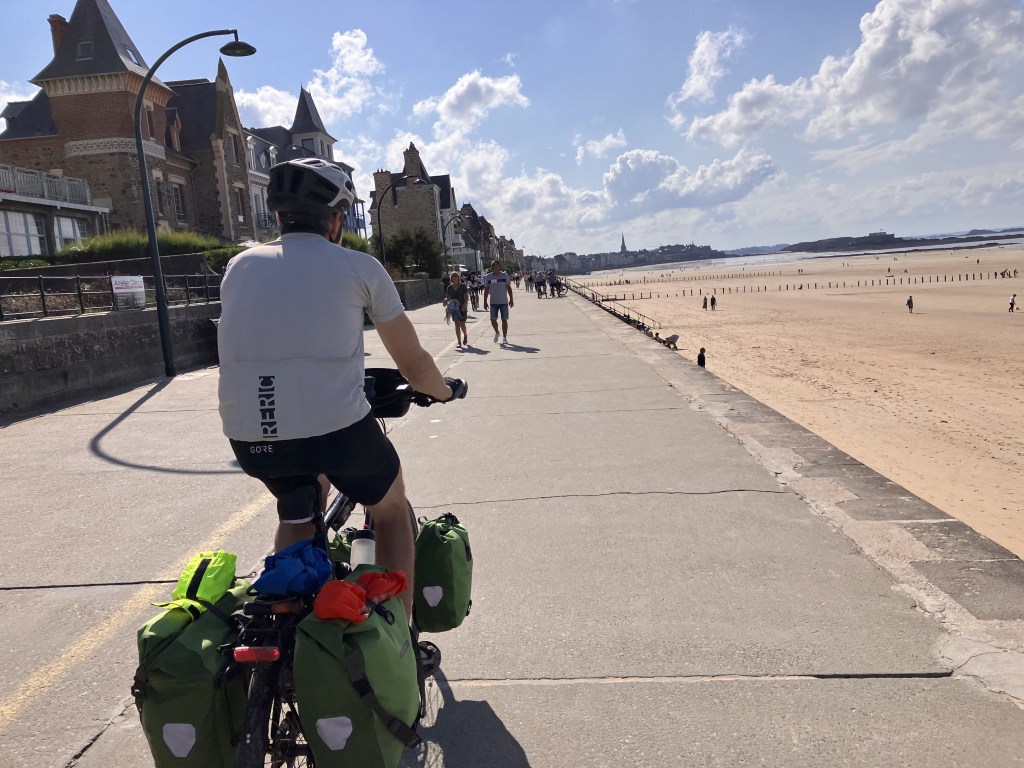
Another super bike friendly French city.
With loads of beaches.
Walking along the old ramparts. The city has a history of pirates!
We stayed out in a neighborhood called Saint-Servan-sur-Mer.
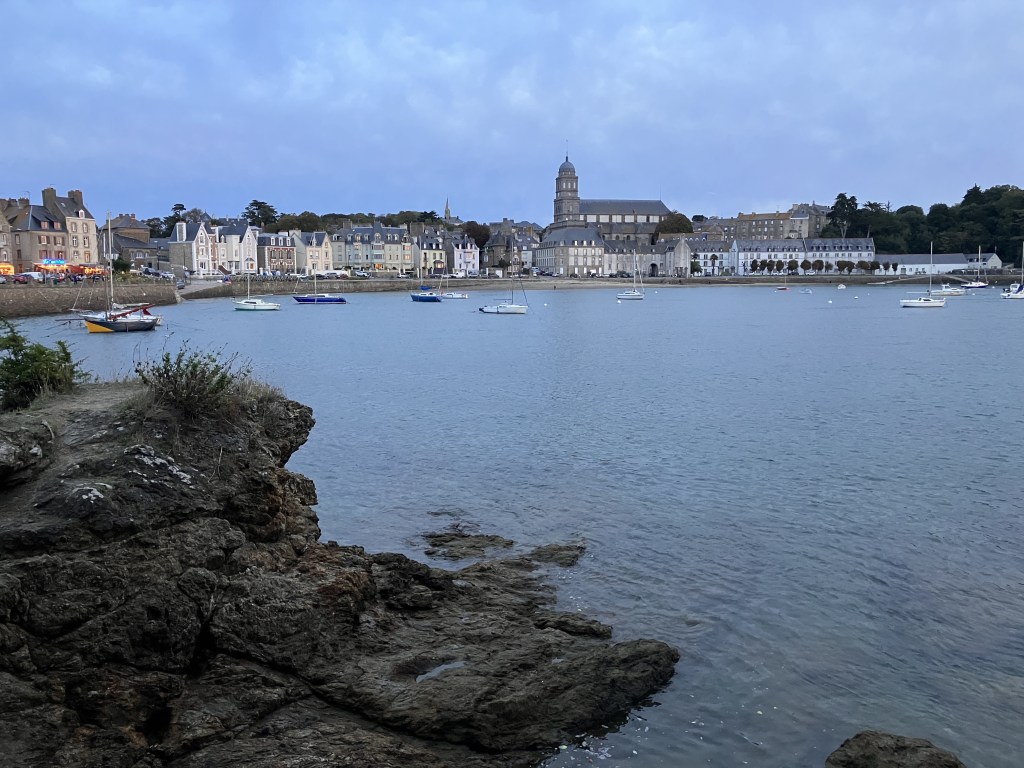
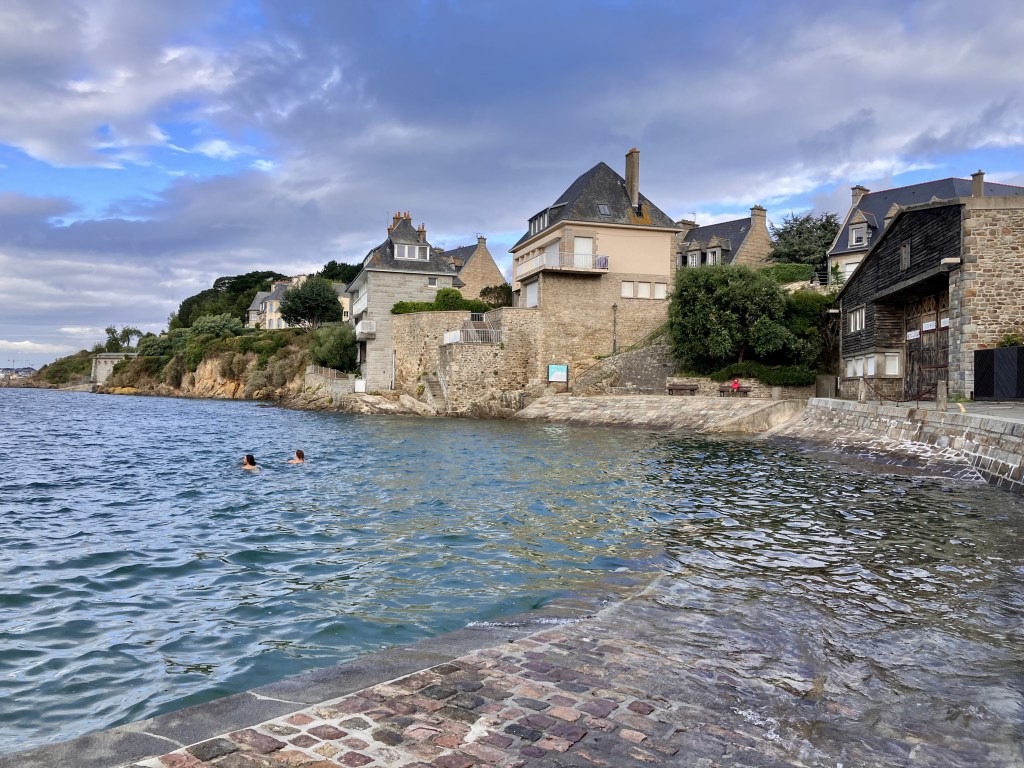
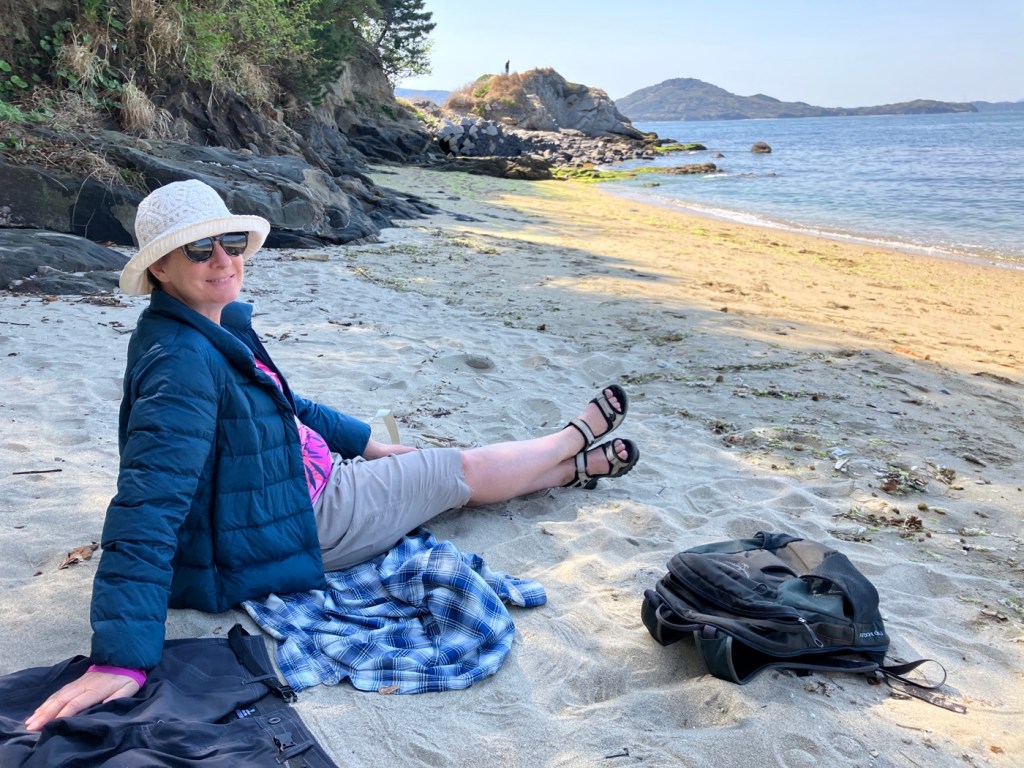
We rode our bikes down to a lovely harbor for high tide swims both mornings.
You can see how the tide and ramp makes for a great swimming spot.
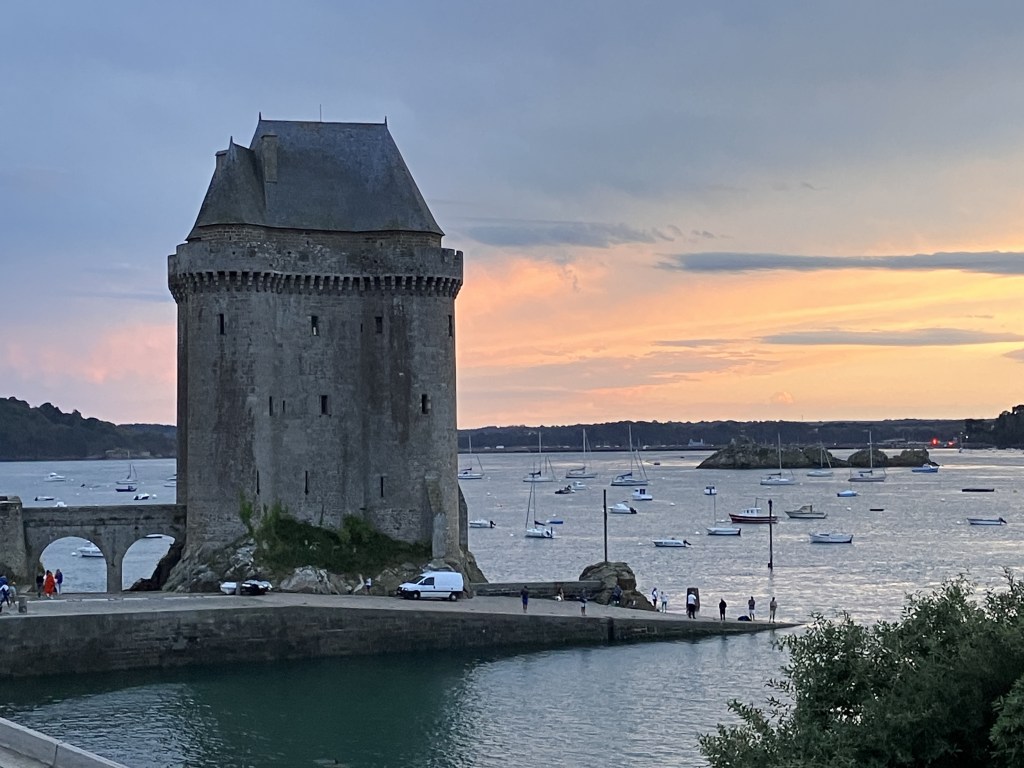
Lovely sunsets.
Rich added for scale.
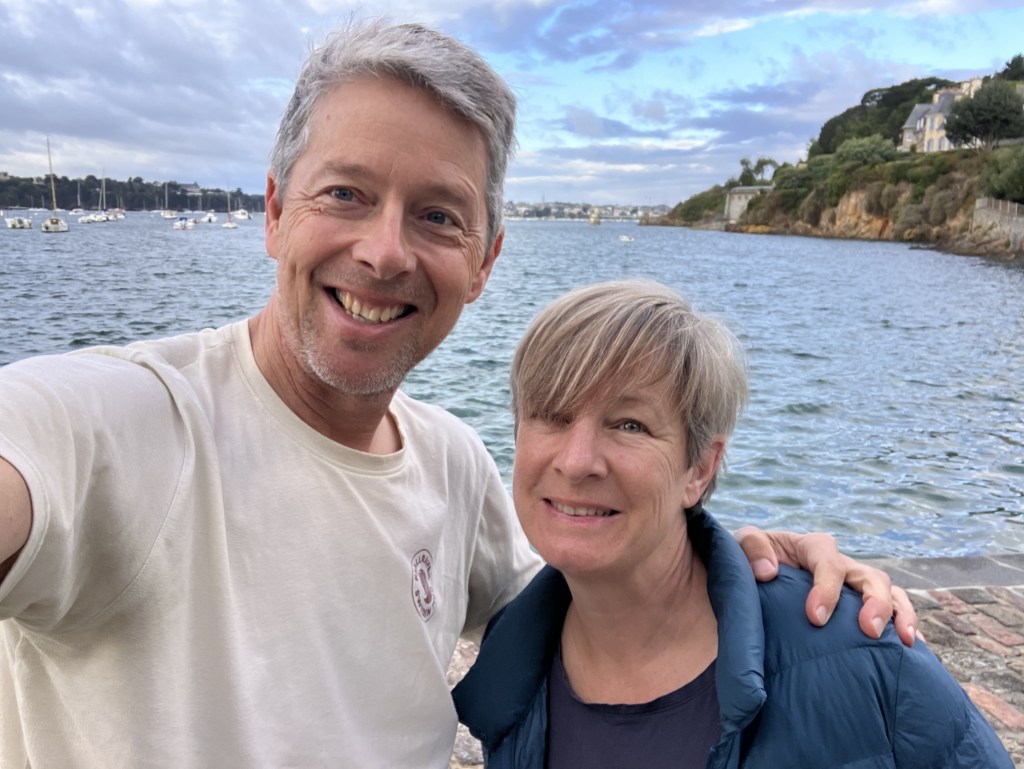
The happy travelers, just before a swim.

So far, some pretty fierce headwinds aside, we’re really enjoying Britanny. The history, the food (the butter and the salted caramel made from the butter!), and friendly people. Especially once we’ve pedaled away from the tourist areas – then we really enjoy the opportunities to chat with locals who don’t often get Americans pedaling through town. On we go!

The star is where we landed, the hearts are where we slept. The blue dot was me when I snapped this pic from google maps. (For you Ruth!)

We Love Japan, but….

We’ve been so thoroughly enjoying every day in Japan that we haven’t had much time or energy left to Blog. It’s a fantastic place to travel. But no place is perfect, and Japan has its weaknesses too, especially in the bike and pedestrian realm.

Exploring the hills and stairways of Nagasaki was a joy in the crisp spring weather.

We’ve been travelling our preferred way by train, bus, ferry, streetcar, subway, and bike. With a lot of walking to the beach to explore and get to our lodging. We’ve been luxuriating in the clean, punctual, and extensive intercity train system. And the local public transit is always clean and reliable, if not always fast.

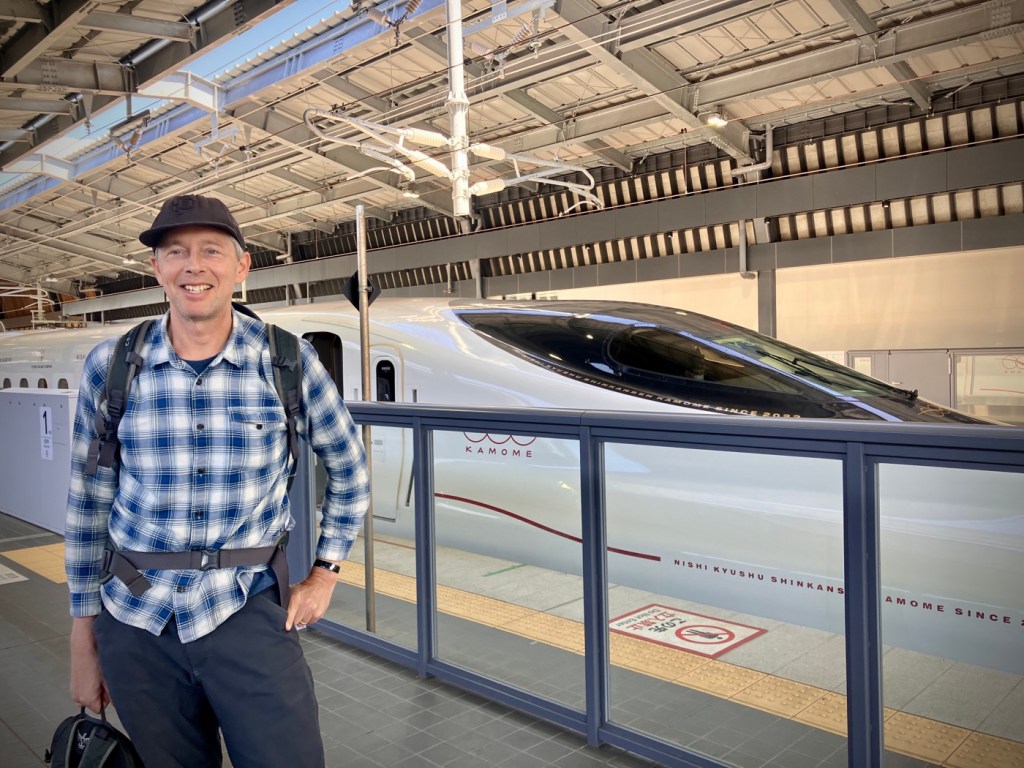
A shiny new Shinkansen on the recent extension to Kagoshima – marvelous and so fast
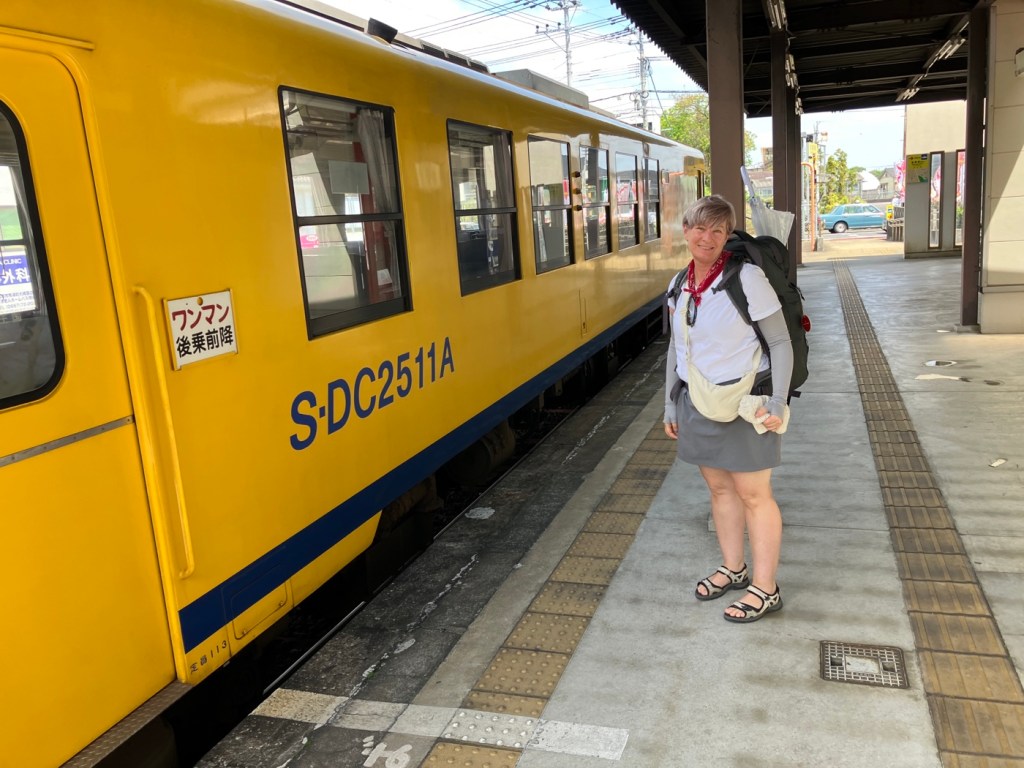
A single car train on the Shimabara railway, operated and conducted by one person! Many small lines in Japan have shut down, and how long can the last private lines survive?

So here are a few transport observations. For you transport wonks and mega walkers, they may give you the same joy and a maybe bit of frustration if you visit.

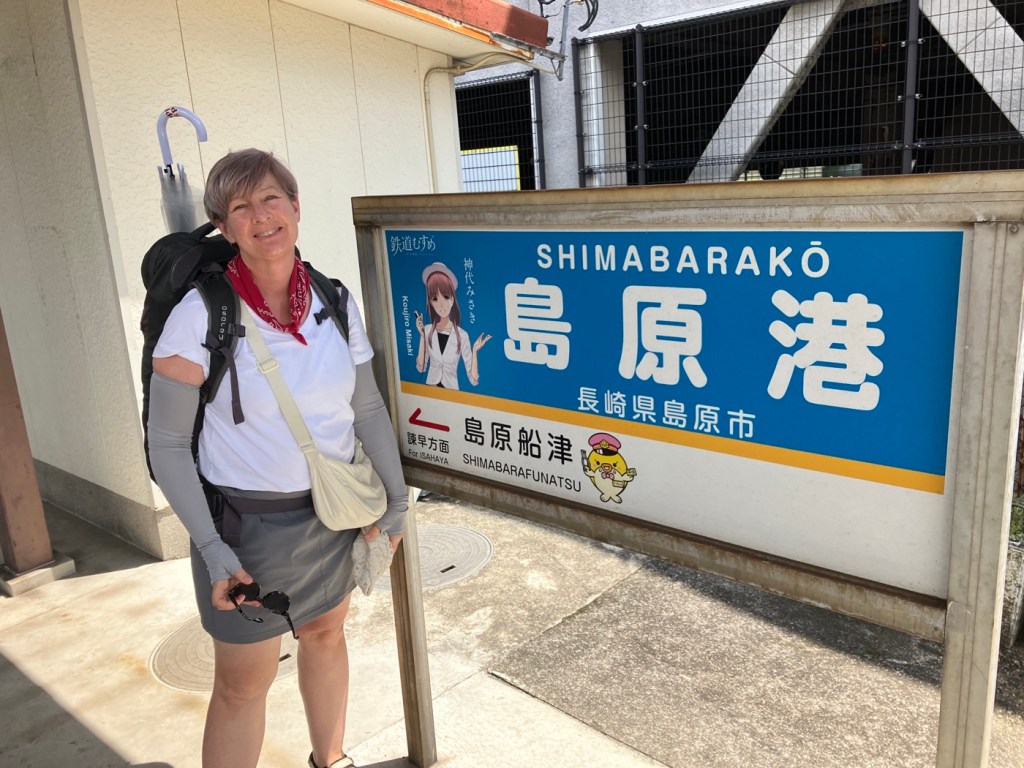
You can enjoy great connections in Japan, like the end of the line in Shimabara, with a ferry across the street that will take you to a bus and a Shinkansen line.

1. JR Rail Pass- Unless you are going to only visit a few cities or rent a car, then it’s a no brainer to get one of these passes subsidized for tourists. We bought two three-week passes and planned our trip to max its benefit to a 4 week visit by setting the activation for the day we left Tokyo and expiring when we get to Fukuoaka, where we are spending our last 3 days. This way we were able to exchange our vouchers at off peak time at Shinjuku station and avoid the mob we saw at Narita airport trying to exchange them to use immediately from the Airport. We instead bought $20 local rail tickets to central Tokyo. It was then easy and cheap to get IC (tap) Transit cards to get around for a few subway and loop rail trips in Tokyo until leaving Tokyo for Kanazawa.

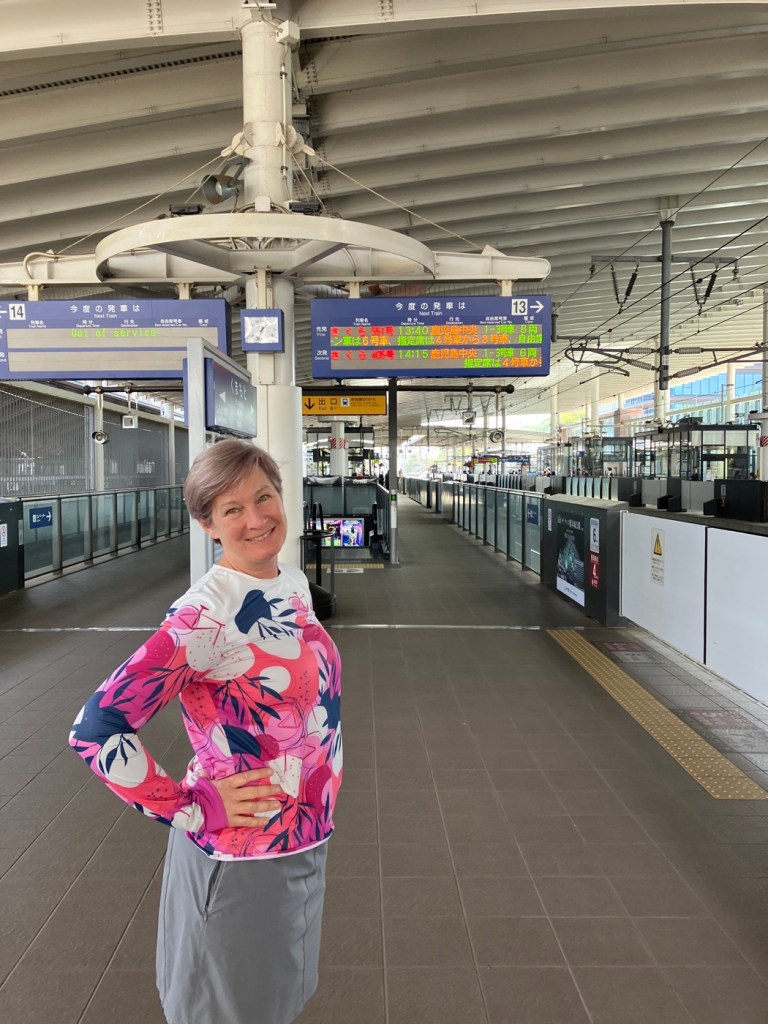
JR Raíl stations are always clean, orderly, and the major ones have lots of food and shopping options and lots of vending machines

2. IC Card – Good for transit in most major cities. There are a dozen or so “brands” by region and they can mostly be used in other cities, although acceptance is a bit hit or miss outside the home zones. Don’t put too much on it initially, 5,000 yen ($40) is my recommendation, as you can always top it up but it’s hard to get a refund. You can also use them at many convenience stores.

Buses run EXACTLY on timetables, so real time predictions really aren’t needed. And you may have them to yourself in more rural areas

3. Train Seat reservations – With your JR Pass, you can make free seat reservations for most higher speed trains (and Shinkansens). I found that I could get our choice if I booked at least 2 days prior to our next trip. You can do it at green JR Ticket machines in almost all JR stations. So I’d often get our seats for our next leg when we arrived to a city. If you book too early and want to change your trains later, you won’t be able to do it at a machine if the new journey overlaps with the old one. You will have to go to a JR ticket office which could take some time at busier times and stations. But, you can alway board in the unreserved cars, so no serious worries other than maybe sitting apart or standing for a bit.

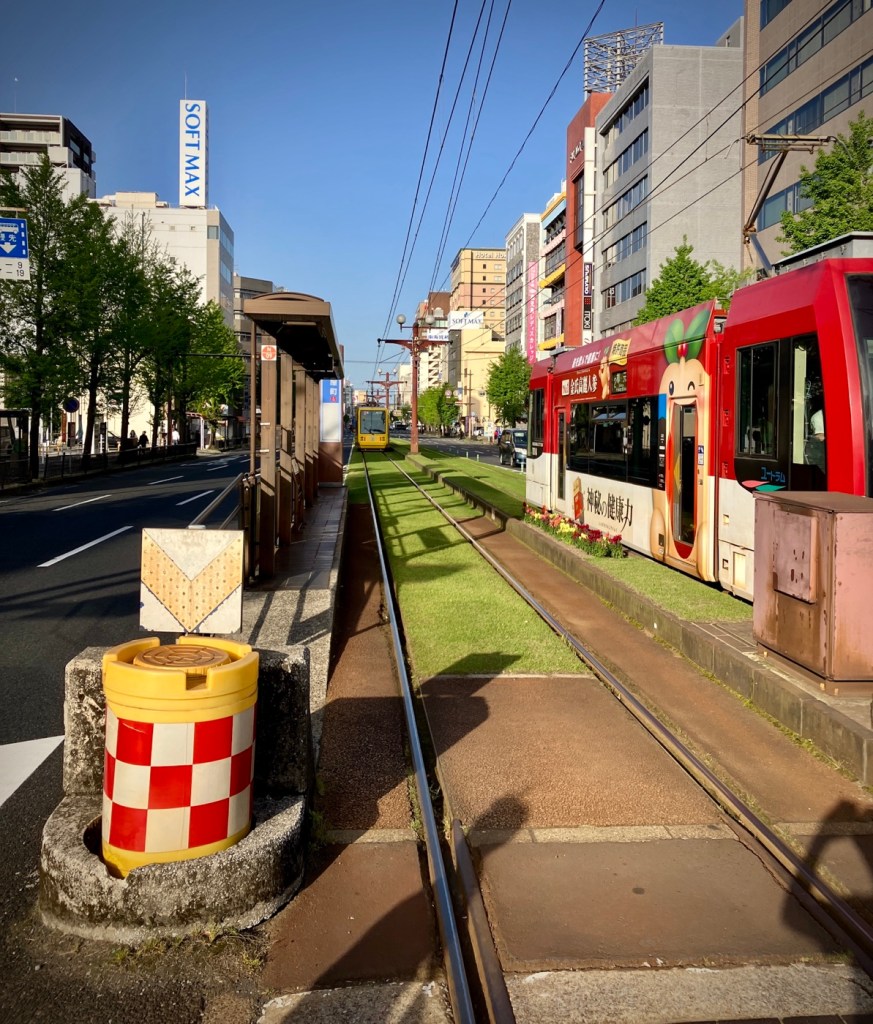
The worlds skinniest tram boarding platforms in Kagoshima next to 3 underutilized traffic lanes….hmmm
These poor tram passengers have lined up to wait for the lights to change, just to get off the narrow tram platform to the sidewalk.

4. Buses and Trams – they run on schedule (especially buses). You board at the back door and tap your IC card if available or if not, take a little paper ticket from a dispenser that indicates your boarding zone. You always pay at the front door as you leave, calculating your fare from the easy digital sign at the front. Put your stop ticket and fare in the box or machine. They can always make change. This also applies to some of the small independent (Non JR) local trains. Once you get the hang of it, it’s pretty straightforward (Especially with IC Card), but it seems pretty inefficient at crowded times as many people still pay cash fares. There is a flow from the back of the bus towards the front door, but it doesn’t match the ease and speed of a proof of payment system.

Navigating the local systems can be challenging
Google maps can really help as it has most timetables (but not all) available in navigation, but you still often need to id your bus in Kanji script or just be at the right place on time, because the bus will be.

5. Walking – You will do a lot of walking in Japan which is mostly great, and wandering the alleys, hidden temple stairways, and quiet back streets is one of the great joys of Japan. One downside though is that the arterial traffic signal timings are long, so get ready to wait for for 2-3 minutes at some crossings. It’s very annoying, and really delays walking trips across town. The only time you see Japanese run is for crossings, as they know it’s a long wait if you miss the light.

The cats and temples are always worth the long pedestrian lights
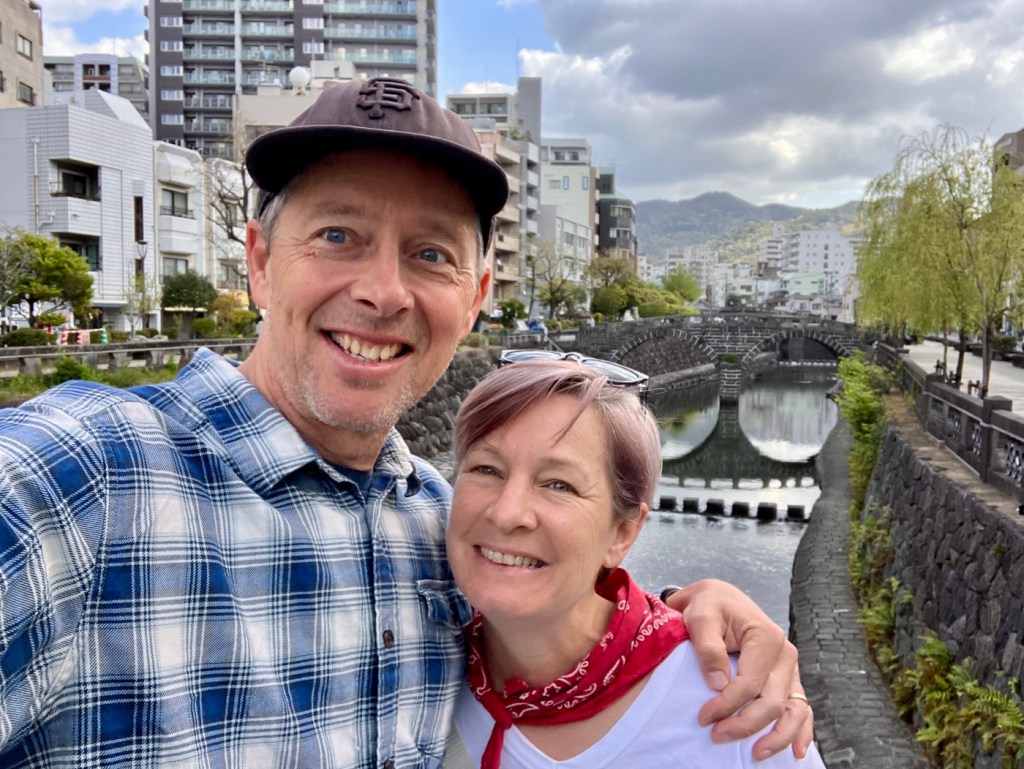
A series of historic stone bridges line the Nakashima River in Nagasaki.

Also, pedestrian crossings can be spread out on major arterials, with occasional overhead or underpass ped crossings in lieu of at grade crosswalks. It seems like a legacy of 1960s traffic engineering that continues in philosophy today, but stairwell underpasses are not good for an aging population.

State of the art ramen ordering machine. Automation and an aging population go hand in hand as labor is getting scarcer every year in Japan
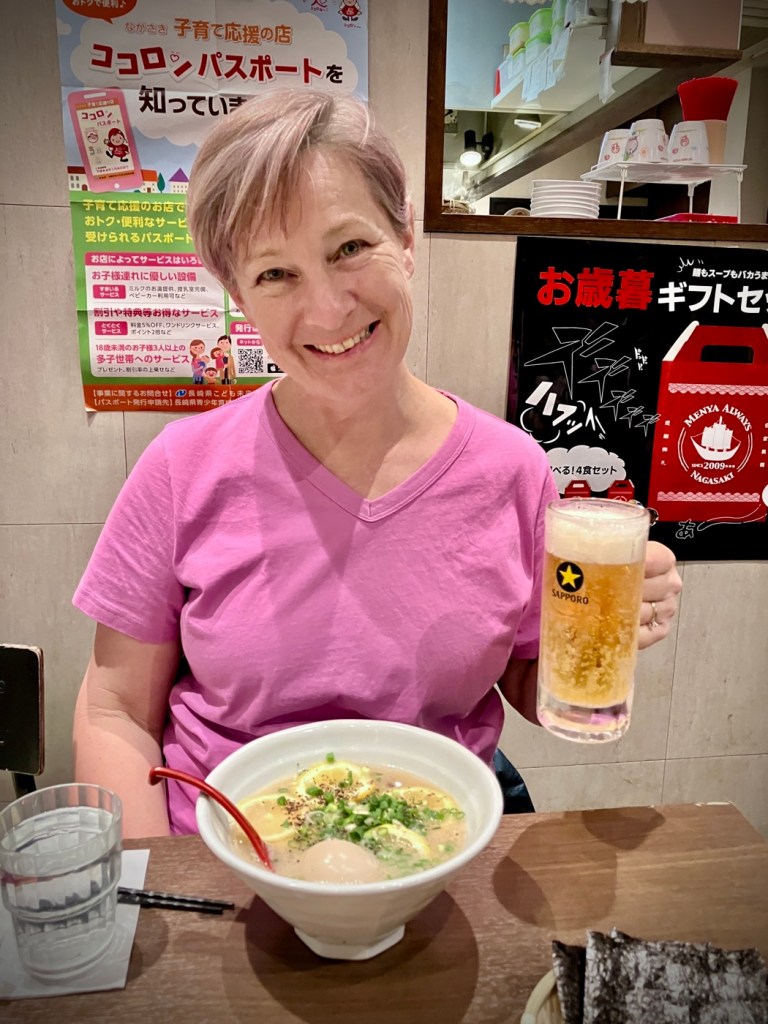
A unique pork and lemon broth at Menya Always ramen in Nagasaki

So what about Jaywalking? A few people, especially in larger cities will jump a signal or cross midway, but 98% of Japanese wait until the light is fully green. As time has gone on in our travels here, we are getting less and less patient, and will cross at will when it makes sense and traffic is clear. We are surely going to incite a pedestrian revolt here!

The main shopping arcade doubles as a cycleway in Takamatsu. It does provide weather protection to cyclists but is hectic in the evening rush hour when shoppers are out
Happy walking; riding bikes is not allowed in the busier hours or areas of the arcades

6. Bikes: There are many more than you think, especially in flatter cities. But the bikes share most sidewalks and it’s all a bit chaotic, which could be solved by more on street protected lanes. Cyclists routinely cut corners and swerve across intersections and are an outlier to order on the streets. (Yeah cyclists!)

Amazing underground automated bike storage in Takamatsu.
“Hello Cycling” bike shares were located in underground bike parking facilities in Takamatsu and the App was (mostly) English and foreign credit card friendly.

So my quick transport report card for Japan based on our scientific analysis:

Trains – A-….ok, amazing at a high level, but deductions for lack of App based e-tickets/seats please…and stringent bike policies keep it from A+

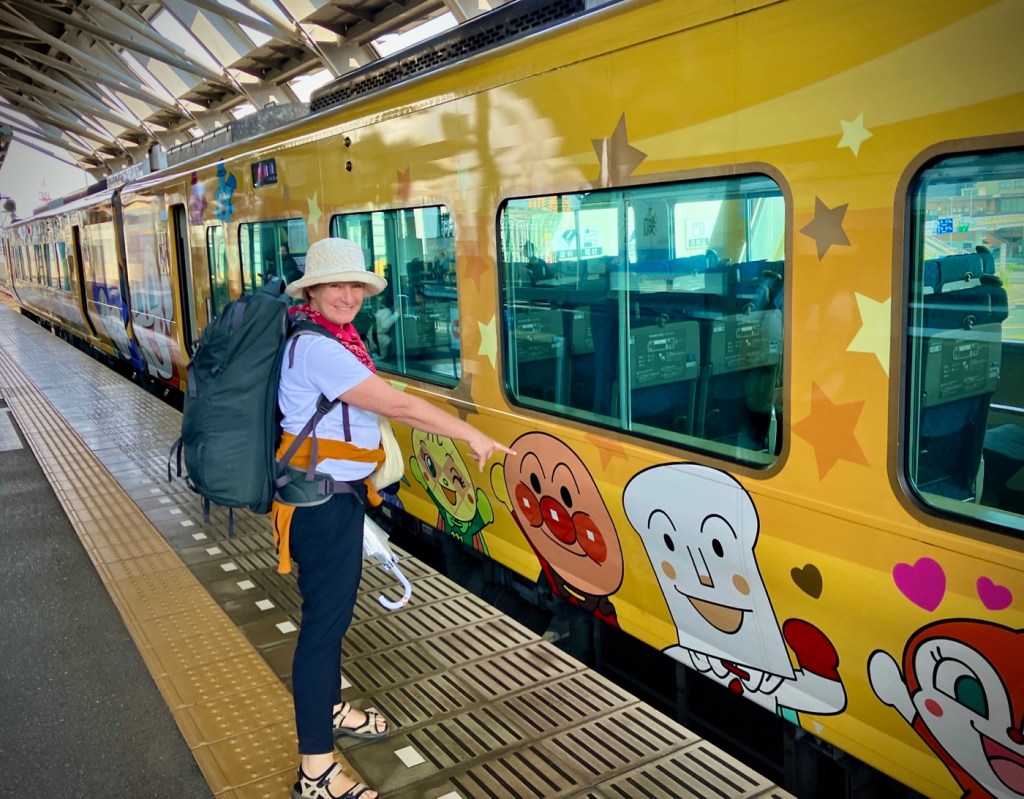
There are themed trains too, including a Hello Kitty Shinkansen (missed it) and our train to Takamatsu
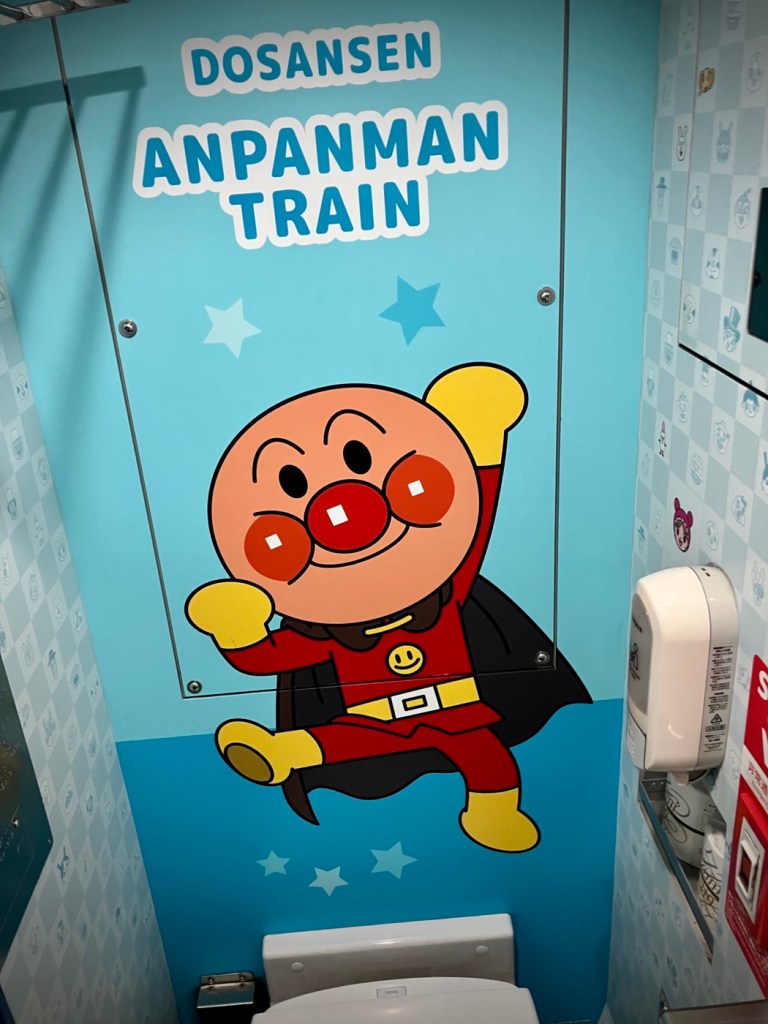
And the theme continues inside…Apanman is a beloved TV series based on Takashi Yanese’s picture books that he produced for over 40 years.
Even to the WC

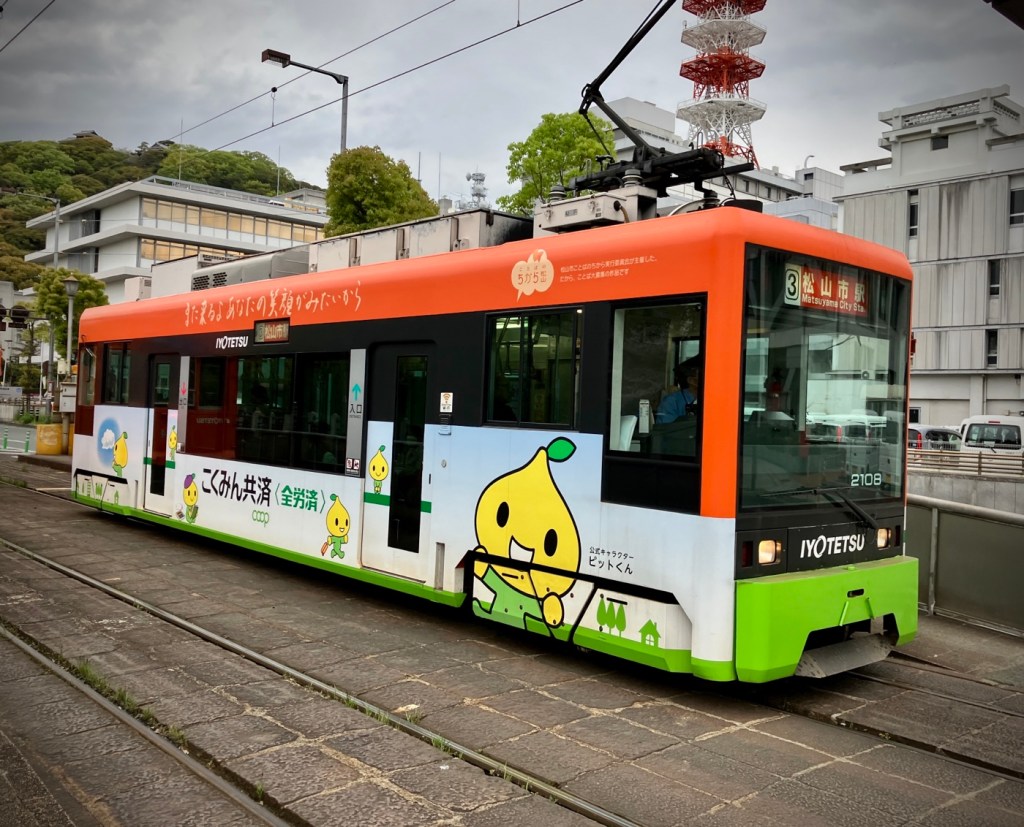
Trams – C+. Mostly old, narrow platforms, steps, clunky ticketing…. Few dedicated signals.

The trams are so cute, but less functional.

Buses: B+ Reliable; on schedule, and fair pricing but they get stuck at long traffic lights too, so can be slow in cities. And there are few express buses. BRT?

Buses in rural areas are reliable, but sometimes only run hourly or a few times a day

Walking: B- Wider sidewalks are needed in many places. Alleys and many quiet urban streets are very pleasant and low stress to walk, but many arterial sidewalks are a bit narrow or degraded by detectable rubber strips. I appreciate that these assist the vision impaired, but sidewalks are just not wide enough to accommodate them and side by side walking space. There seems to be a legacy of traffic lanes and road capacity. Giving more road cross section to peds, bikes and tram boarding is needed. Smart traffic signals could be used to mitigate lane reductions. Many heavy pedestrian neighborhoods in Tokyo and other larger cities have nice wide sidewalks in a new generation of streetscape designs, but many places still have a 1970s-1990s feel.

Rush hour on the sidewalks of Matsayuma. Wide here, but a slick rock surface makes cycling in the rain a bit dodgy.

Cycling: C+ Quiet back streets and sidewalk cycleways do the trick, but more on street protected bikeways are needed everywhere

Yashima National Park – nice beaches on Shikoku but a little chilly to swim yet
Cycling to Yashima NP from Takamatsu was pleasant on sidewalk paths and quiet roads

But enough nitpicking. As a traveler, the lack of personal safety concerns and good transport frees you up to focus on the unique culture, sights, and most of all, the food and friendly people. And oh man the food is SO good.

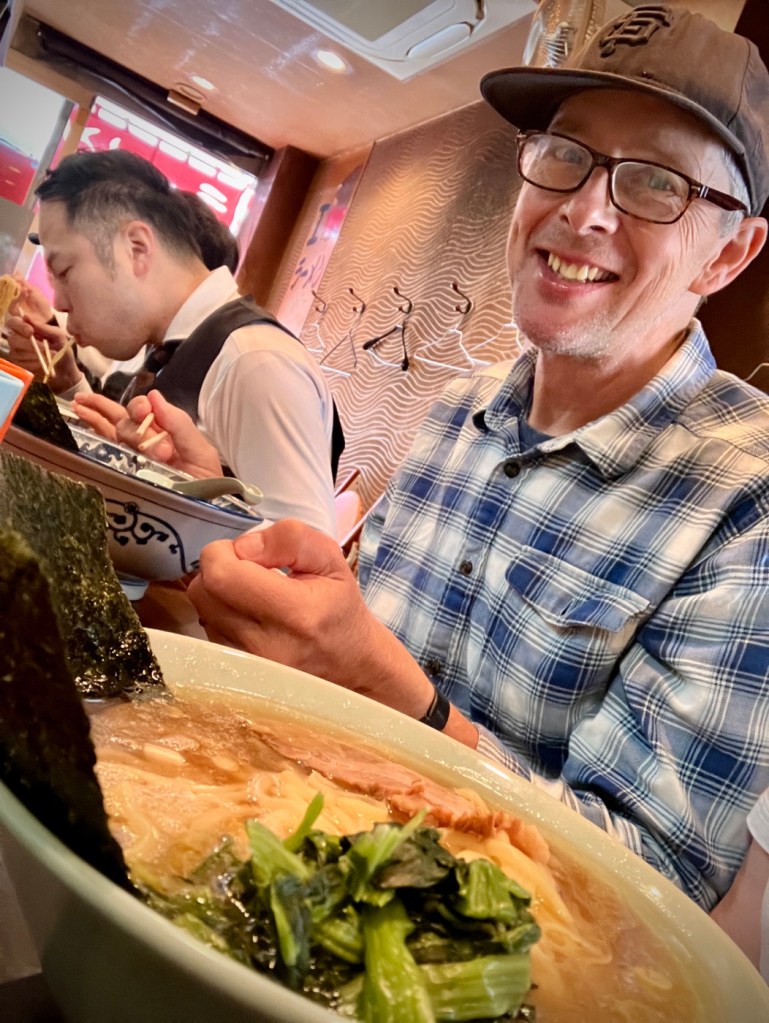
Smiles allowed, but ramen is serious lunchtime business at Ramenya Mass in Nagasaki
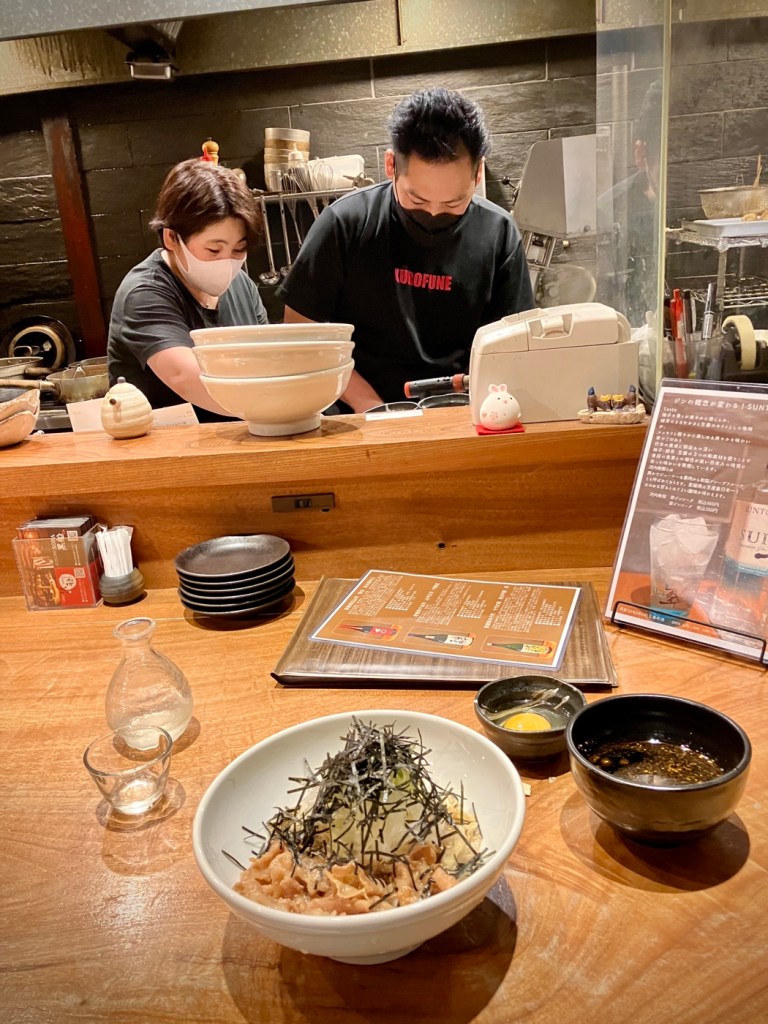
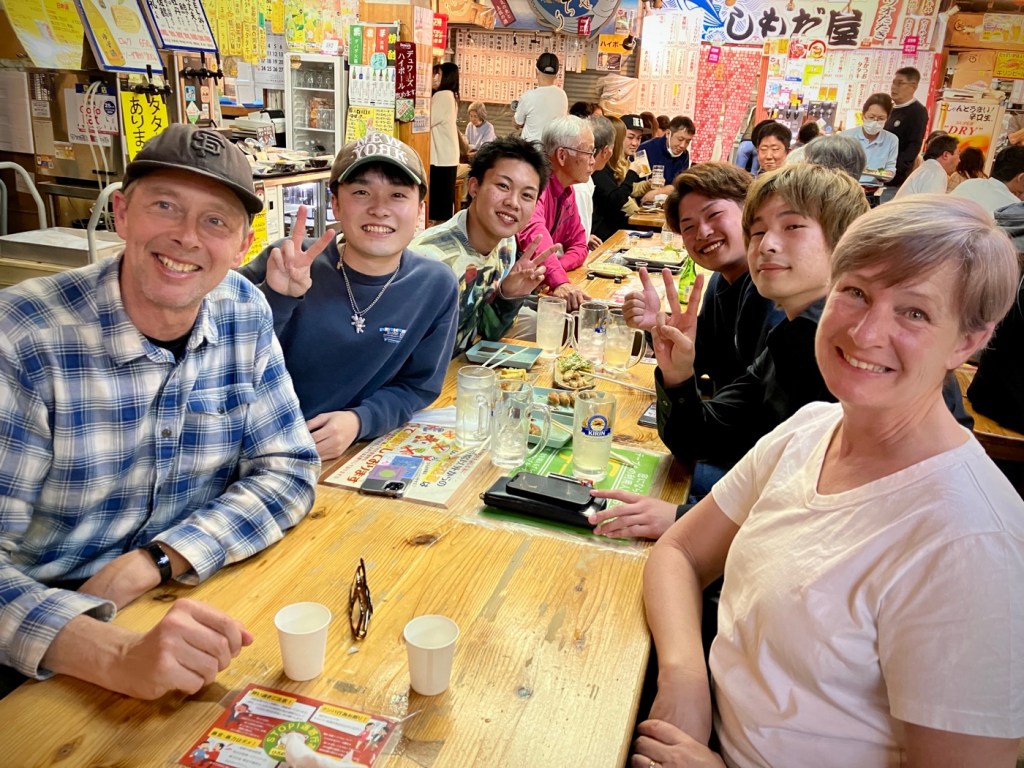
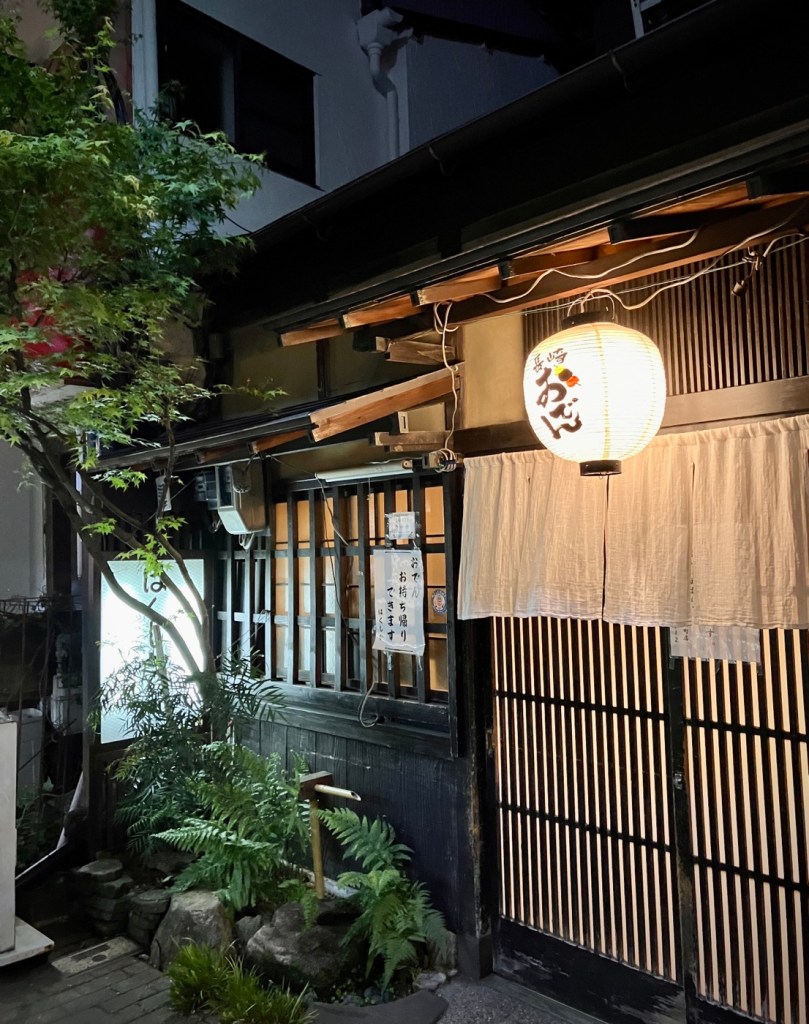
Small izakayas are the souls of Japan. Dedication to craft and coziness abound
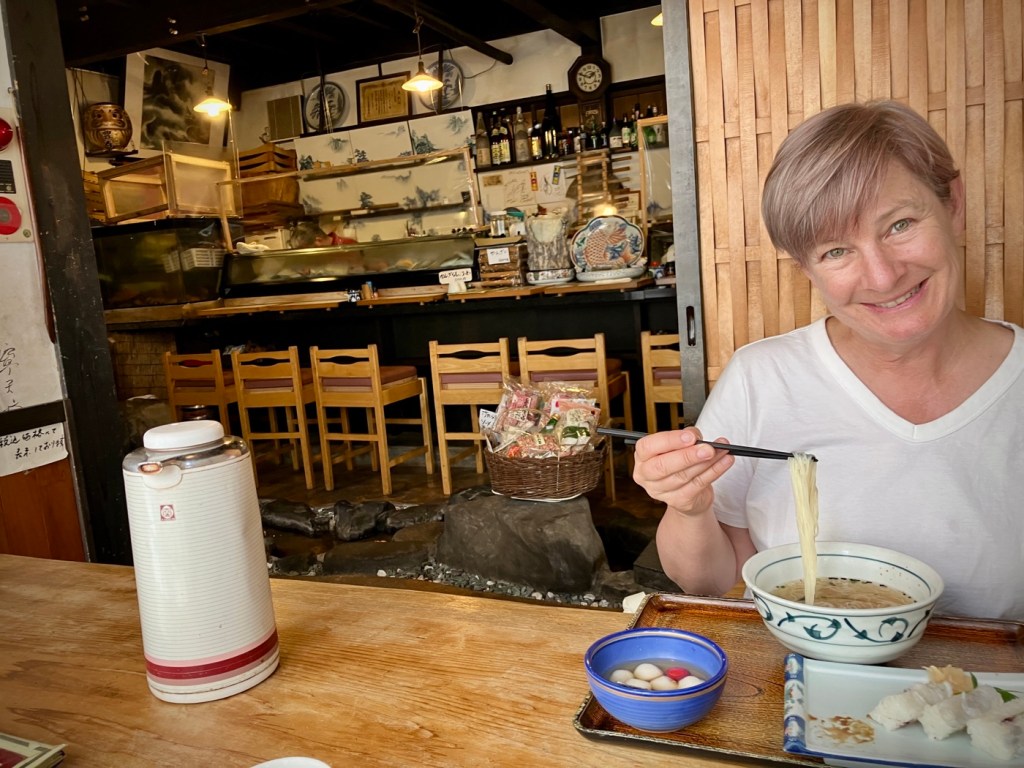
Pure soba and dashi heaven

And it’s good value for most lodging and food, as long as you are willing to give up western norms and keep some distance from the tourist hot spots. The yen has weakened against most currencies over the past 5 years, so it’s a great time to travel here. Except in Tokyo, there are great 3 to 4 star Hotels in the $100-$125 range, and a bit more on the weekends, especially Saturday nights. And most include breakfast.

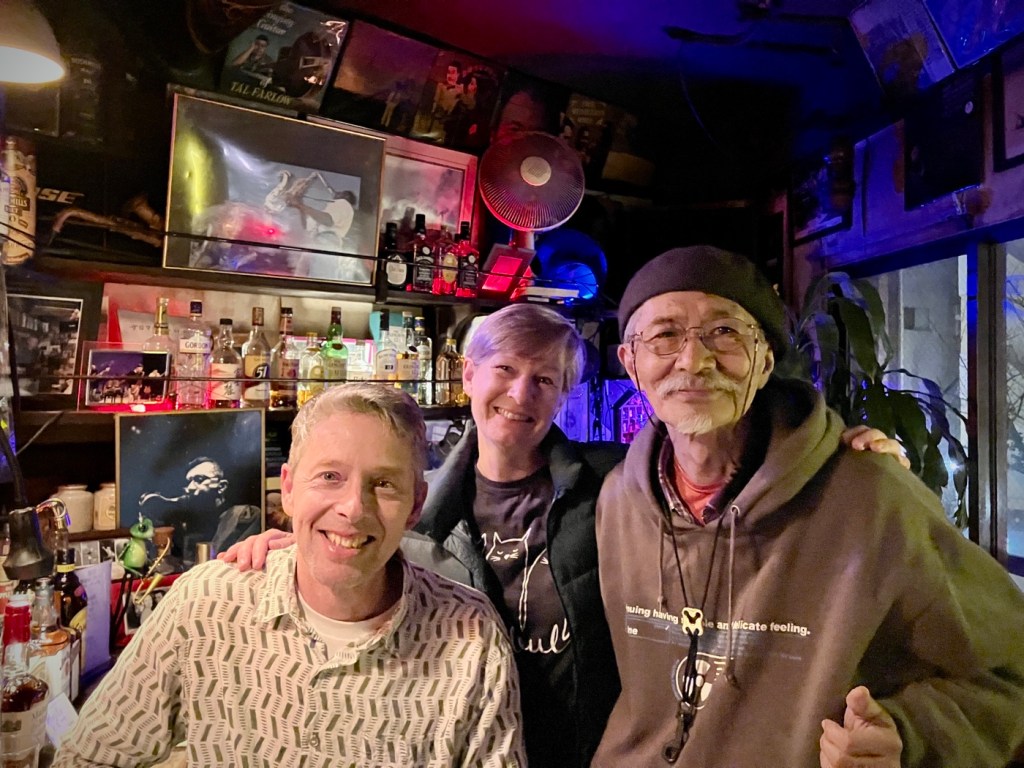
Wonderfully cozy 3rd floor jazz bar in Nagasaki . The owner played us his tenor sax music while we chatted. The Japanese love classic jazz. And so do I.
In addition to hot and cold drinks, vending machines in Japan are used for almost everything; even fresh soba noodles

If you go for more modest 1-2 star hotels, then you can find many in the $70-$90 range. Remote or resort area hotels (often with Onsen or Rotemburo baths) are definitely higher in the $150-$300+, so will be a splurge if on a budget. It’s definitely better value than most of the US, and similar to Europe, although I think a bit cheaper overall. A few other lodging tips. Book some nice Ryokan or Onsen properties well in advance as they are lovely, but don’t do anything but go up in price or sell out. Small or exclusive places are not into last minute bargains.

A Western-Japanese hybrid room in Shinabara. This hotel had lovely Onsen and Rotemburo (outside baths) and more spacious rooms than most urban hotels
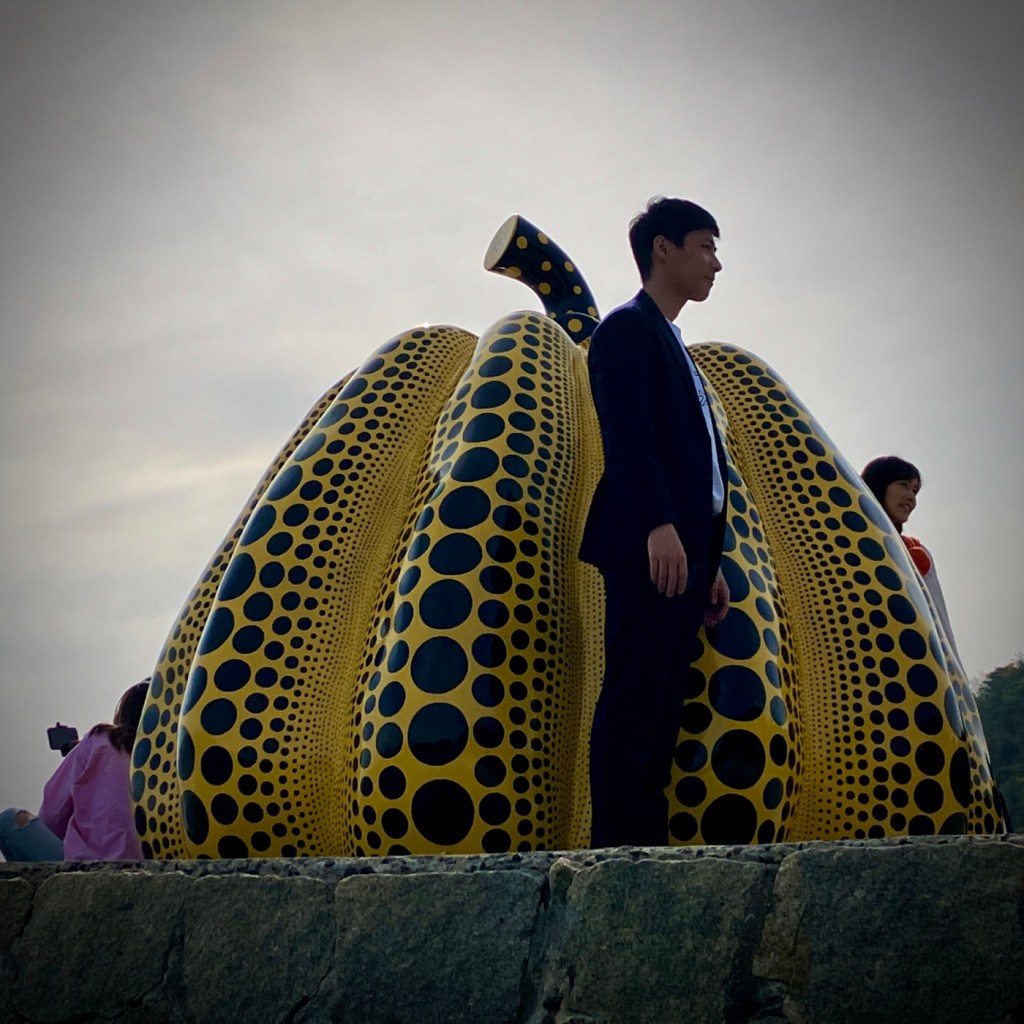
Naoshima Island
Instagram of Instagramers on Naoshima
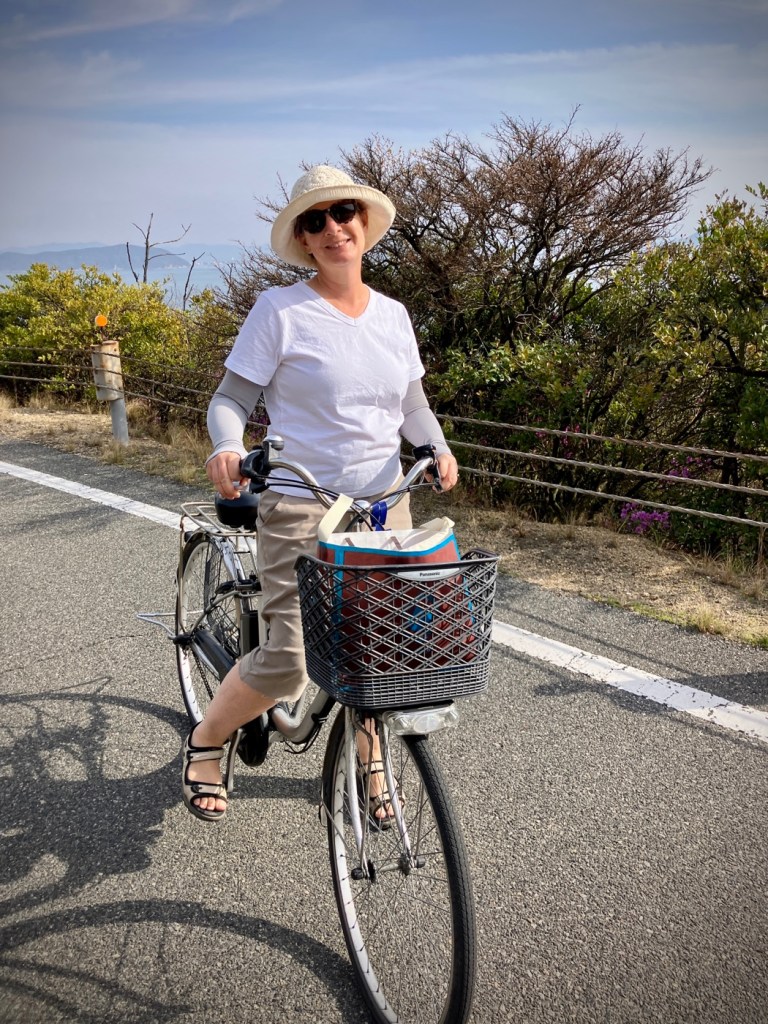
More bikes to explore Naoshima…these with a bit of eboost

And big western brand hotels in major cities here often 2-3x as expensive as local alternatives for a similar (or better) product. Avoid them, unless you only have a week and a surplus of loyalty points to burn. (For example, during the Sakura of late March, Marriott properties in Tokyo ranged from $600-$2000/night!). Big waste of money.

Kochi on Shikoku is a bit off the beaten track but worth the effort for its friendliness
Kochi’s famous seared Bonito (Katsuo) has ruined us for life for lesser fish. Delicious.

Another tip. Many western style rooms are cosy in Japan, at 120-180 sq ft, but if you book a twin instead of a “double”, the rooms are larger at 180-250 sq ft. They have two full or queen beds that can usually be pushed together. So you have a lot more space, often for just a bit more money. “Twins or Quads” seem to sell out first as locals know this too,

We found a small traditional house to rent on Naoshima Island. Wood and Tatami mats were a refreshing break from city hotels (and it had a washing machine!)
Even a basic meal is pleasant in Japan

But as great as it is to travel here, it’s not all easy, as travel in Japan has its own breed of travel stress due to constant language and cultural nuances. And the country faces a battery of challenges, including rural depopulation, economic stagnation, and a location in an increasingly volatile region, just to name a few.

You have to open the doors to know what awaits you in Japan
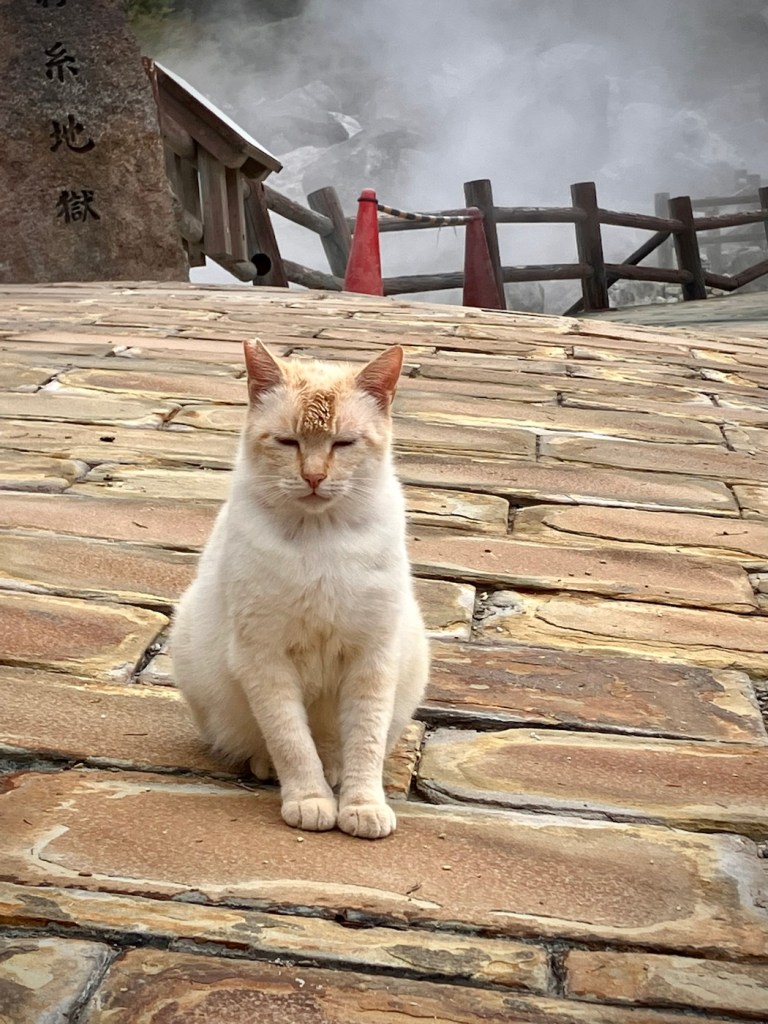
Cats seem to guard popular spots such as Unzen National Volcanic Park, and are looked after by the locals.

But we are judging against a high bar, as we are already talking about coming back to bike tour, renting an apartment for a month in Tokyo, or even a car tour to see more rural sights that are tough or impossible by public transit. If you do want to rent a car in Japan you will need an international driver’s license.

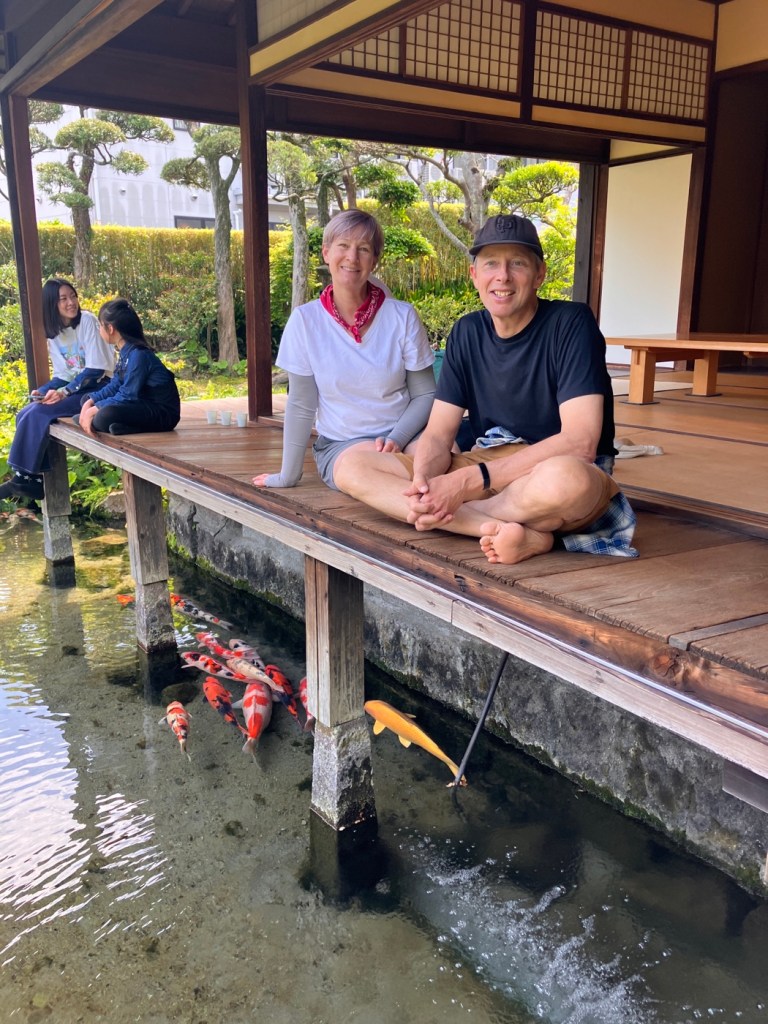
Zen, spring water, and Coi at a tea house in Shimabara
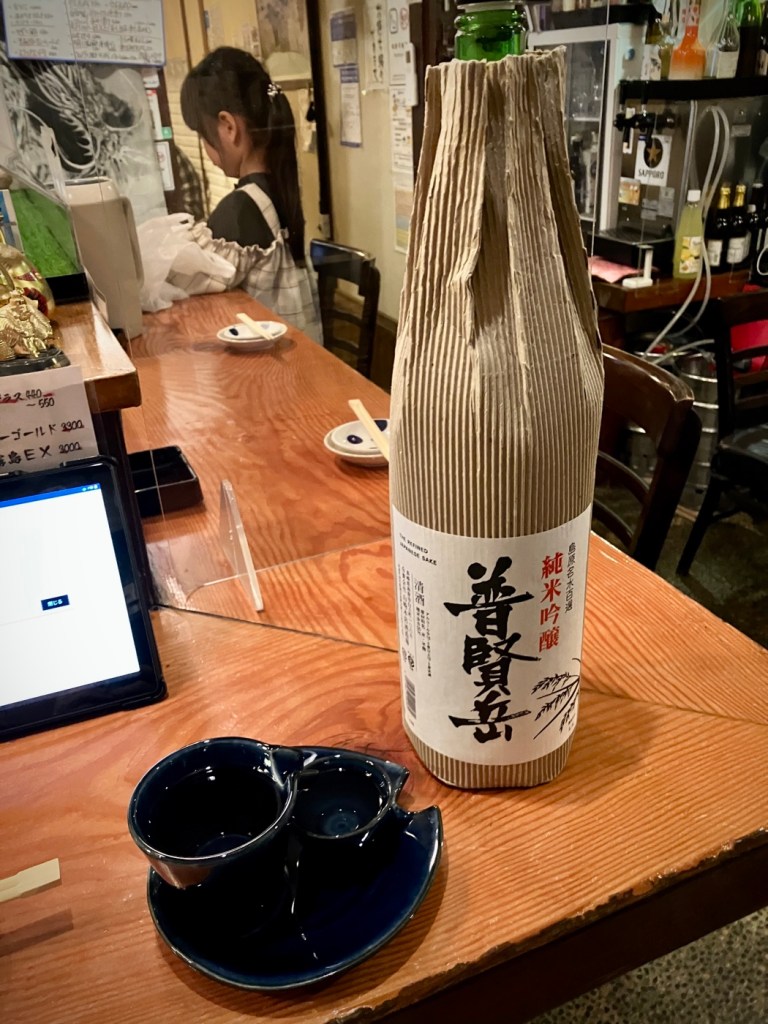
Always ask for the local Sake as we did at this family run Izakaya in Shimabara

We are excited to head to South Korea next week, but first we are going to eat as much amazing food as we can in quirky and cosy settings, served by some of the most dedicated and friendly people in the world.

My favorite travel companion enjoying some cozy afternoon tea
Japan makes us smile

Happy travels!

The Engineer as Hero

Isambard Kingdom Brunel …a name hard to forget, especially in Bristol, England. As a professional Civil Engineer, it was so refreshing to see an engineer given their proper dues, as it’s usually the Architects that get (or take?!) all the credit for innovative projects. And boy did I K Brunel do it all: Paddington Station, the Great Western Railway, Thames Tunnel, SS Great Britain, and my personal favorite, the Clifton Suspension Bridge. His designs are credited with revolutionizing public transport and modern engineering.

Engineers are great, aren’t they….

We started our Brunel tour at the fantastic SS Great Britain, which is a magnificently preserved and restored steamship that Brunel designed in the 1830s and was the largest steamship in the world when it launched in 1843.

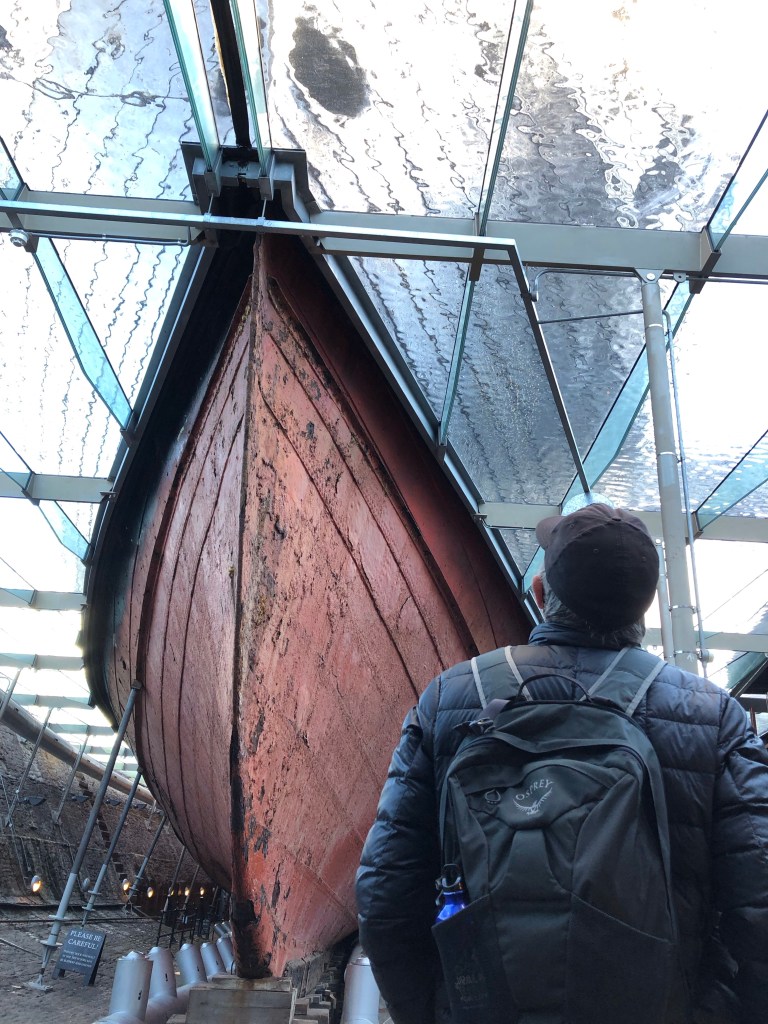
In the Dry Dock – that’s water up there!

I think the best way to see the ship is to start below the water in the dry dock. It allows you to appreciate the scale of the ship, as well as understand how the unique hull was constructed and is being preserved. It takes a massive array of dehumidifiers running 24/7 to keep any further corrosion of the steel hull at bay. The array keeps at about 20% relative humidity, similar conditions to “the deserts of Arizona”, and paralleling the path of millions of other retirees being preserved in the Sunbelt.

Brunel chose to use a new and highly efficient propeller for the SS Great Britain, shaving weeks off a Transatlantic journey

You also can see how they moved the ship from its near demise in the Falkland Islands in 1970 and dragged it all the way back home to Bristol on a special barge. But the dedication to restoration didn’t stop at the exterior of the ship. The cabins have been fully restored with the sights, sounds, and yes, smells of the ship when it served as a passenger ship to the US and Australia.

The Kitchen…spooky realism abounds, as even rats can be seen moving about the cupboards.

The Steerage class quarters are strikingly small, but as a docent pointed out, still offered those crammed in 4 1/2 foot bunks a chance at better conditions and more opportunity in the New World. Life in the early industrial revolution days of Britain was hard. The crew barely had it better, as had to toil all hours shoveling coal into the furnace and keeping the ship going over grueling 3 week to 6 month journeys. Of course first class was quite grand and the Titanic-like dining hall is now available as a wedding venue, minus the swells and nausea of the open seas. (As it turns out, Brunel’s hull design was a little unstable…until a later wood extension was added to to the keel)

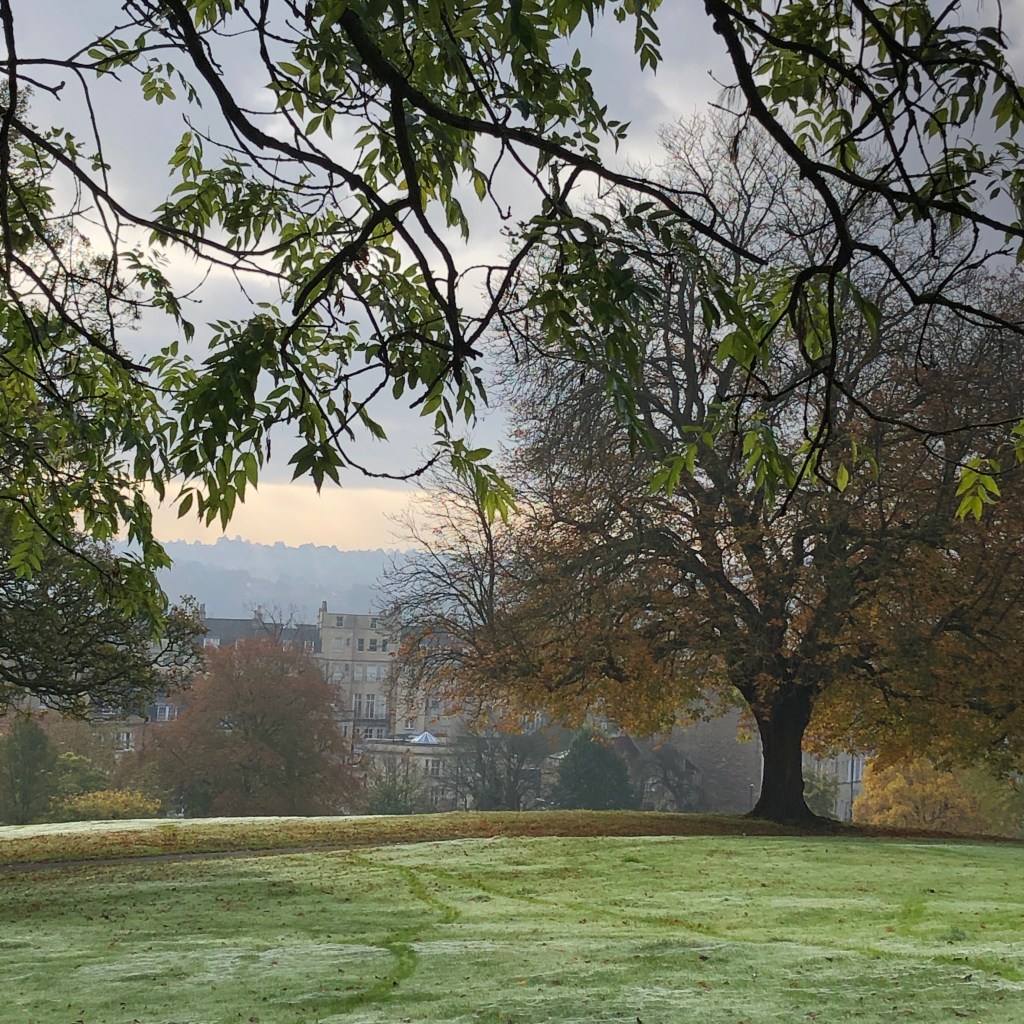
Morning dew on Brandon Hill, Bristol

Bristol and Bath were both a pleasant surprise. The crisp fall weather and foliage were perfect for exploring on foot and both cities offer fascinating sites, museums, culture, and vibrant food scenes.

Proper tea and a scone at the American Museum and Gardens in Bath

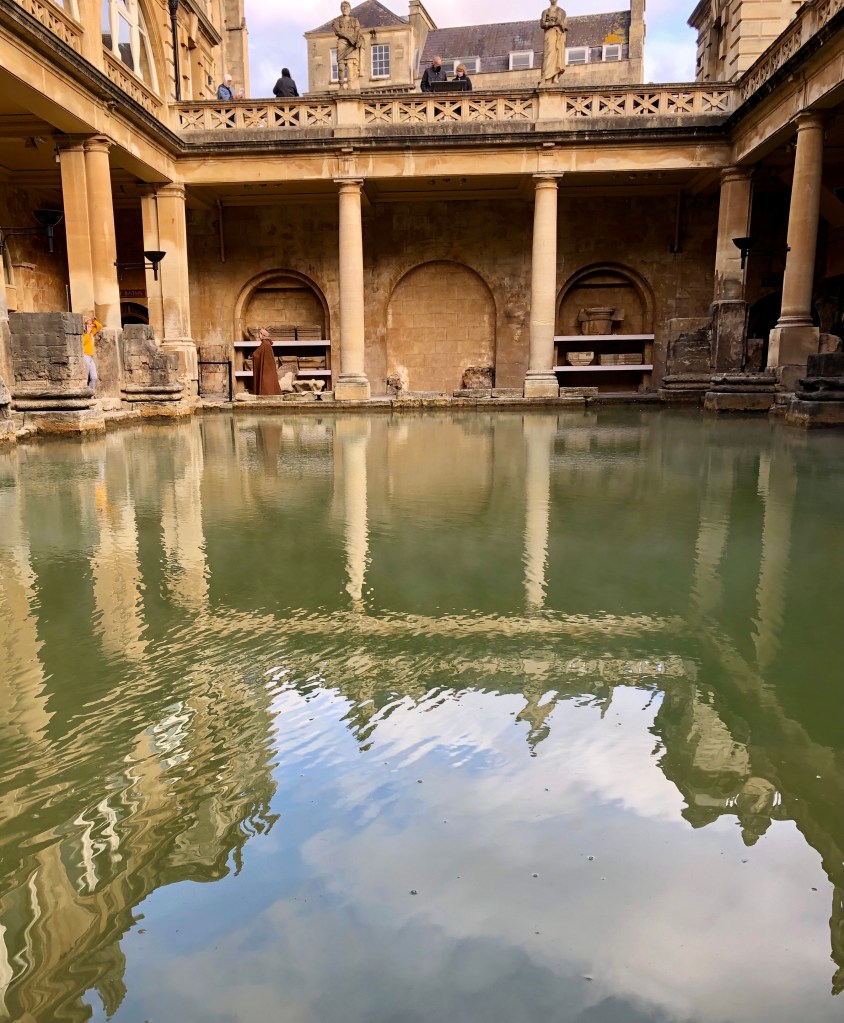
Bath is like a living Georgian museum, pleasantly frozen in the 1770’s, while Bristol offers a modern revitalized waterfront, lots of history, and more diversity, all supported by a large University population. The American Museum has beautiful views and a offers a unique British perspective on American history and culture. The Roman Baths are the big attraction and surprisingly engaging with brilliant holograms in each room and an audio tour featuring humor of Bill Bryson.

As much as you want to, you shouldn’t touch the water at the Roman Baths

After 3 nights up the hill in Bath near the Royal Crescent, we decided to stay just 7 minutes away from the Temple Meads station in Bristol. The Station itself is worth a look, and yes, I K Brunel provided the base design and inspiration for the main station as the terminus of his Great Western Railway from Paddington in London. How was he so many places? (4 hours of sleep helped apparently)

The Temple Gardens out the back door of our hotel

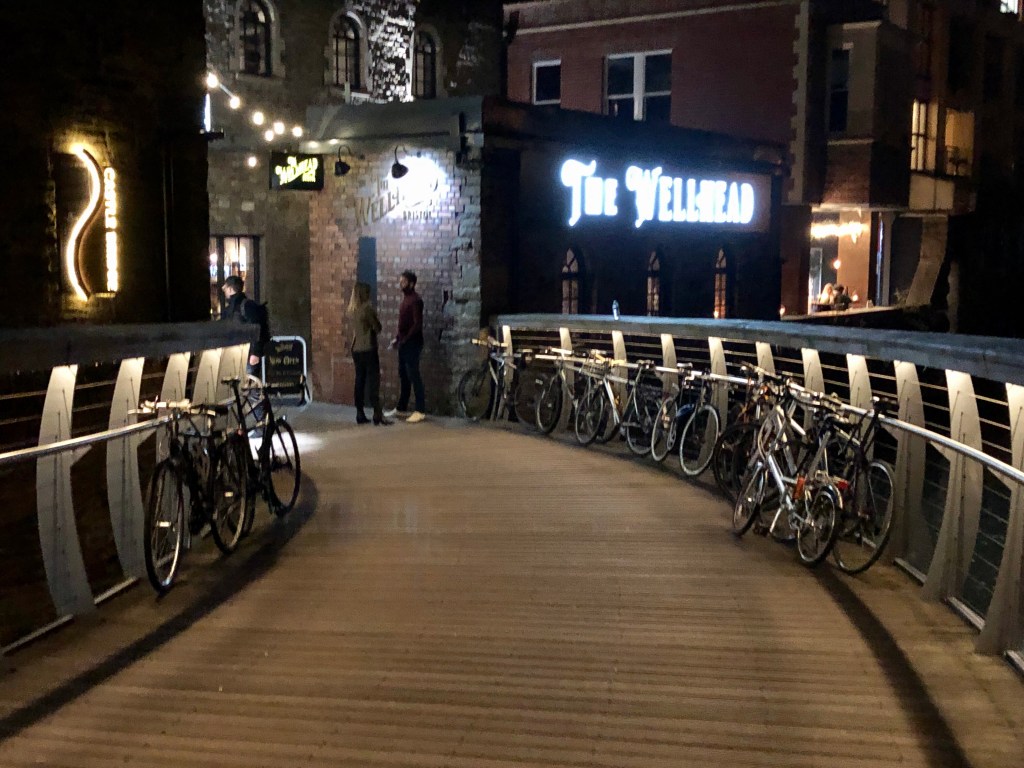
After a day on the waterfront and Brunel museum, we decided to explore more neighborhoods and walked out through the pleasant and upscale Clifton village. We walked back through the University and along Gloucester Road, which is full of an eclectic mix of shops, pubs, and restaurants. 8 miles overall and great walking up and down the undulating hills, with constant surprises and new views.

The Castle Bridge opened in 2017, offering an inspiring human powered crossing of the Bristol Harbour (but still not enough bike parking!)

But the hands-down thrill of the day was the Clifton Suspension Bridge. A structure that highlights the need for visionary technical leadership and perseverance. Brunel’s original design took over 35 years to be built. He succeeded in a design competition in 1830 with his proposed bold 700- foot steel chain suspension span. This span allowed a full span of the gorge, which was key to the intrinsic beauty of the structure in the unique context of the Avon River Gorge. But many, including his father, doubted that such a span could be built. Unfortunately, cost overruns and contractor financial trouble (sound familiar) put the half completed project on hold by 1843. Luckily, the bridge was finally completed in 1864 with the assistance of other designers, but sadly 5 years after Brunel died. And like many of his bold designs, the ultimate bridge required some design modifications to the deck to make it stiffer, as his original design would have likely failed in high winds. Engineering is a constant process of improvement and optimization.

The 1,300-foot long Clifton Suspension Bridge soars more than 300-feet above the Avon Gorge…so nice!

But his vision survives and his grand engineering projects are still serving millions of people today. So anytime someone doubts that a large infrastructure project can ever be finished or if a new design innovation can really work, just shout out the name of Isambard Kingdom Brunel. Or say it three times if you can!