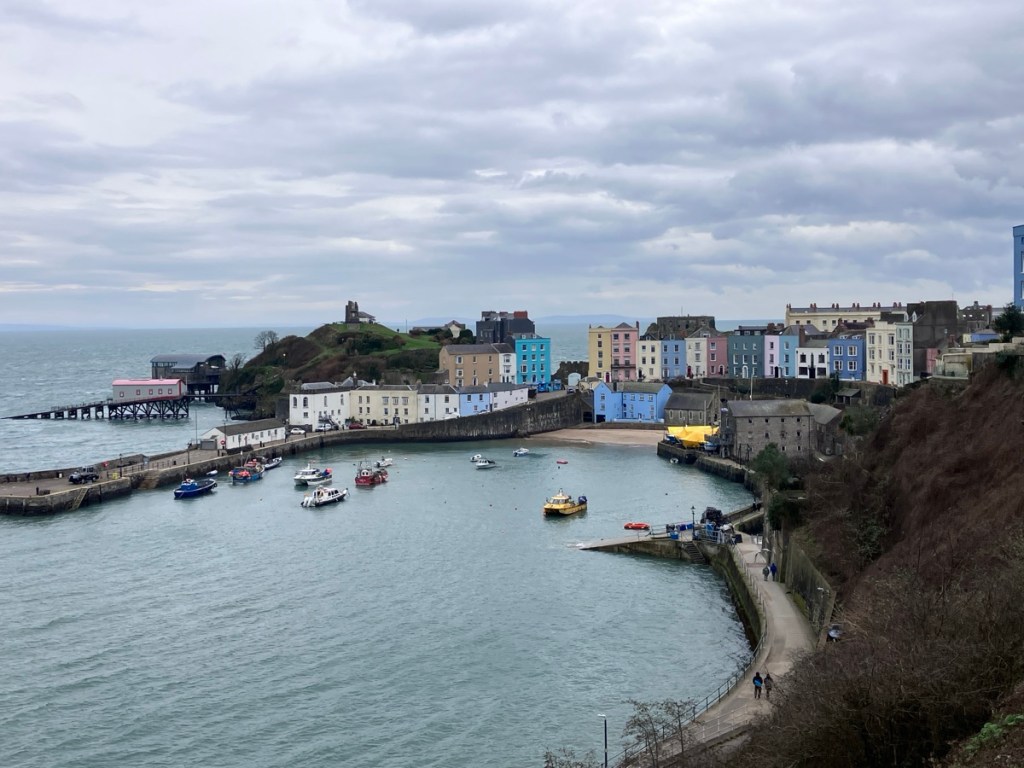
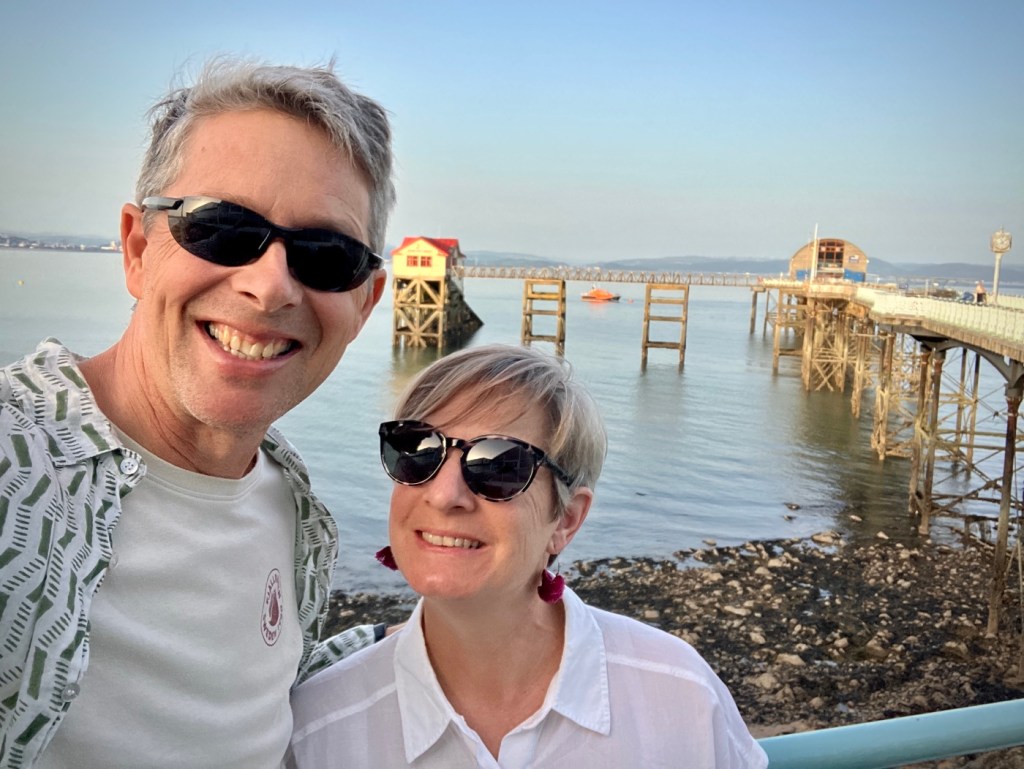
Definitely one of our favorite views in the UK. The harbor at Tenby, Wales.
When we were both working our vacations were at most three weeks long, and were in search of new places and new experiences. Now that we’re in our fourth year of constant travel we still love new places and experiences but also love to revisit familiar places.
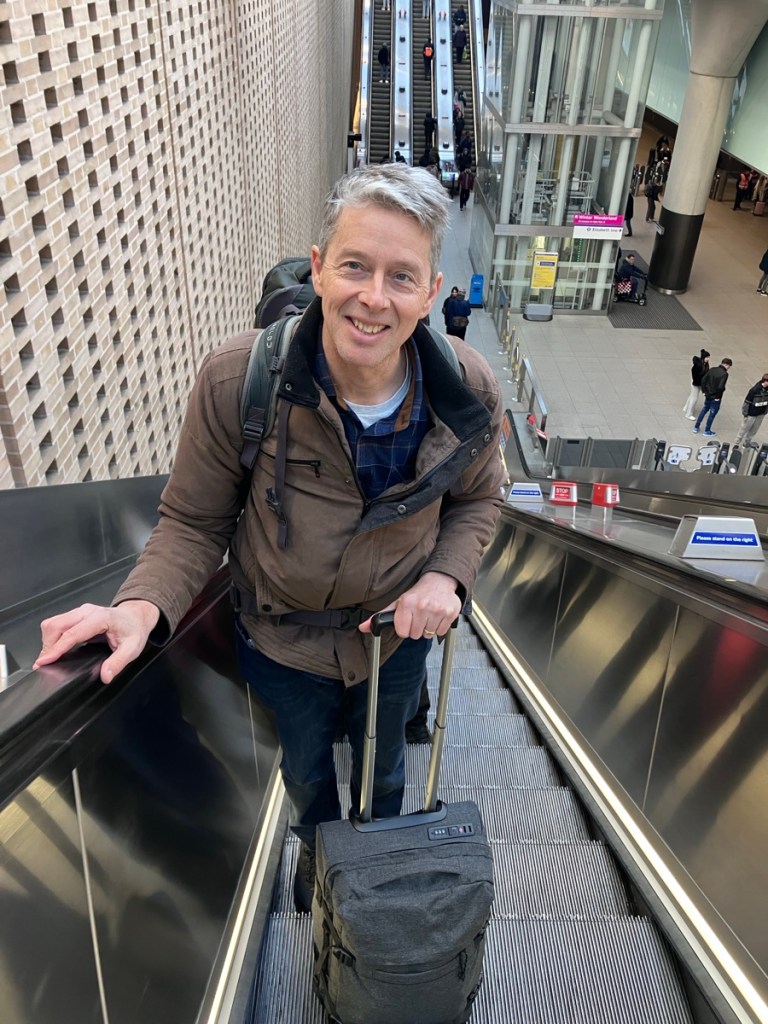
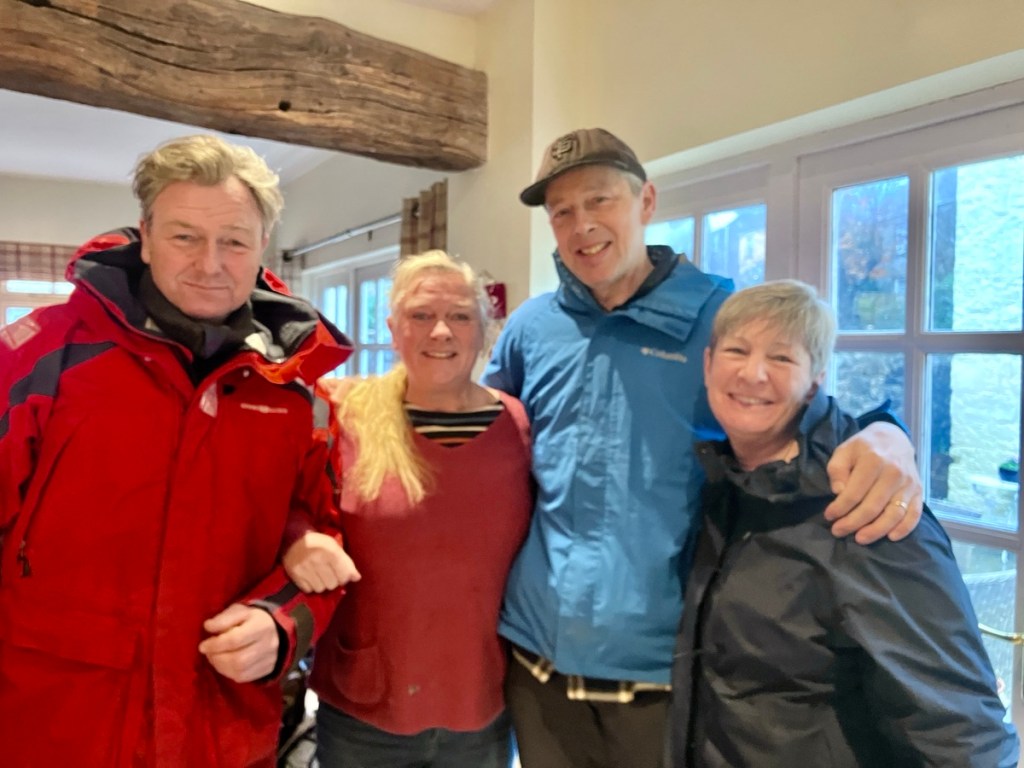
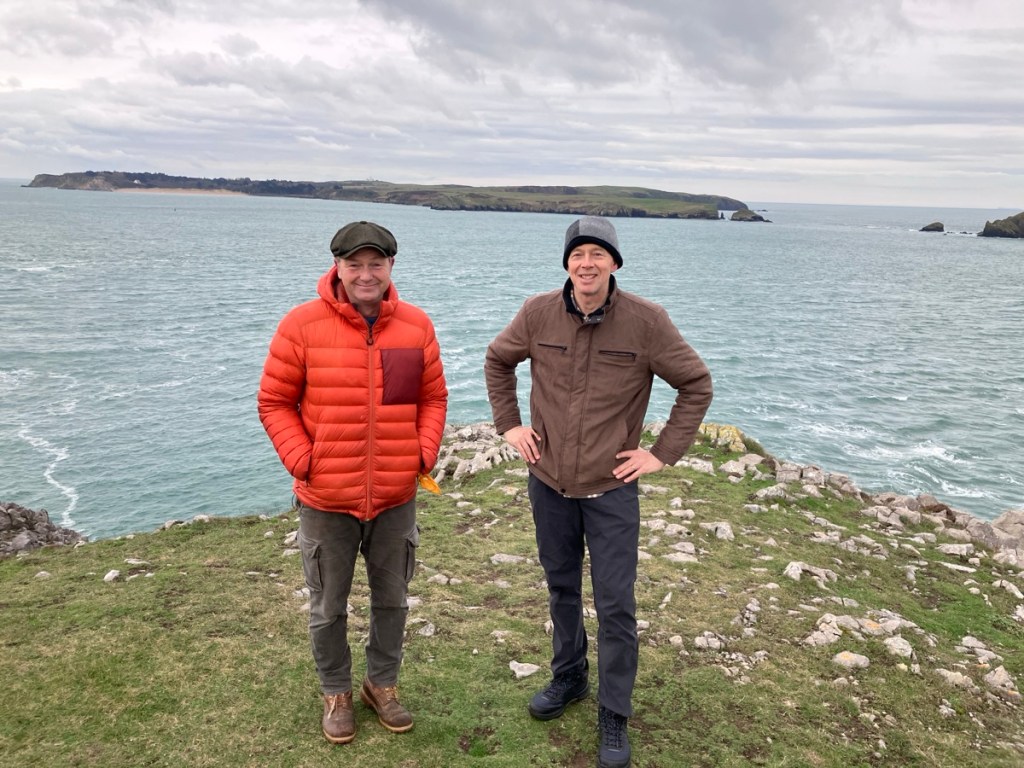
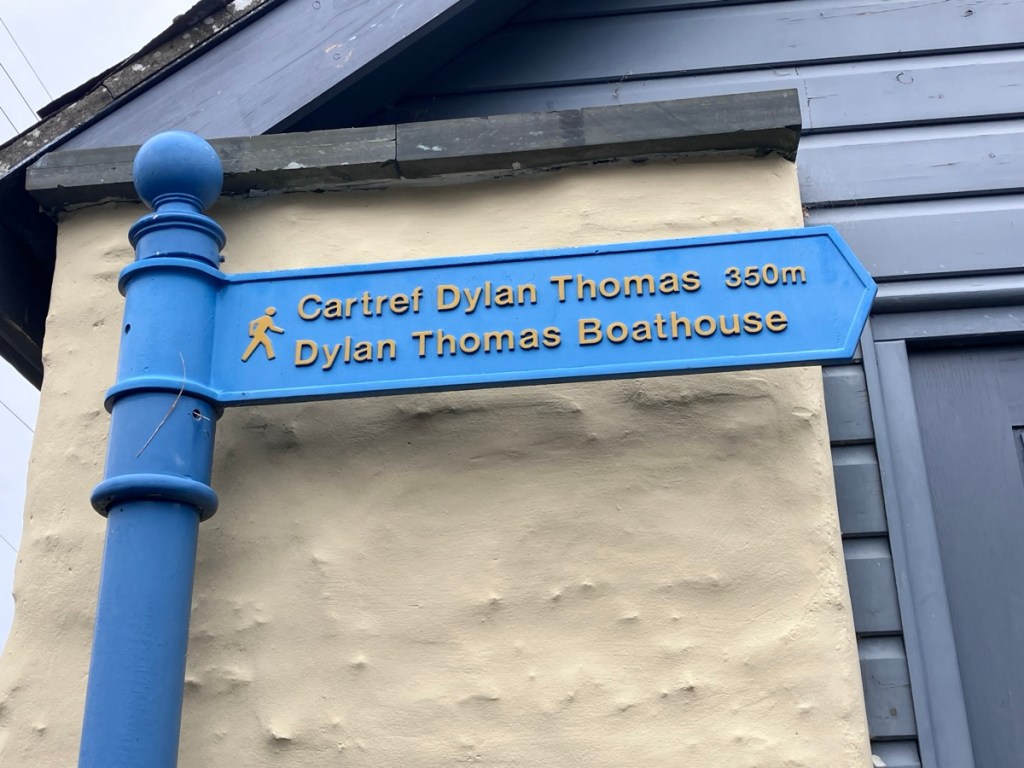
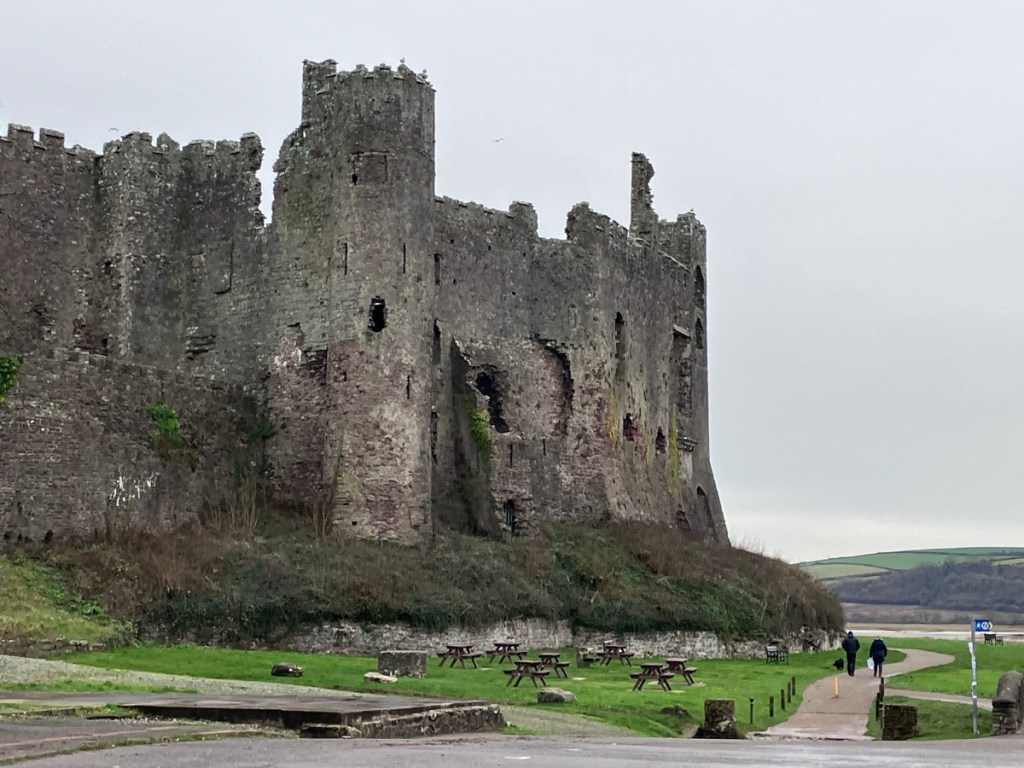
Arriving from Norwich to London, Liverpool Street Station. And back with our good friends Erik and Hannah in Tenby Wales. One of our happy familiar places.Coast walks from Tenby are stunning.Two handsome men and a lovely view.Headed to lunch in Laugharne which is famous for being Dylan Thomas’s home for the last four years of his life.The garage of the boat house, where Thomas wrote a lot of his most famous works.It’s set up as if he walked away for a cup of tea. He died while on tour in New York City, so in a way, he did just walk away.The boat house. It’s a small museum.I requested that the guys look “moody and poetic”. Rich is used to my requests, Erik laughed! I first visited Laugharne in 1984 or so, it’s nice to see that Dylan Thomas’s popularity is still strong.Laugharne Castle. Such an imposing site. Such a tough place to find on the map when you’re looking for “Larn”.Rich packed up and ready to leave Tenby.
After a delightful stay in Tenby we headed off to Bristol, another of our favorite UK cities. This was our third stay in Bristol. It’s always fun to chat to a local and see their sometimes puzzled delight over our love of Bristol. It’s an easy train ride from Tenby, and easy to get back to London from Bristol, thanks to the Great Western Railway which linked London and Bristol in 1841. Engineered by Isambard Kingdom Brunel. Yes, we are fans of his work and highly recommend the SS Great Britain museum ship, which he also designed.
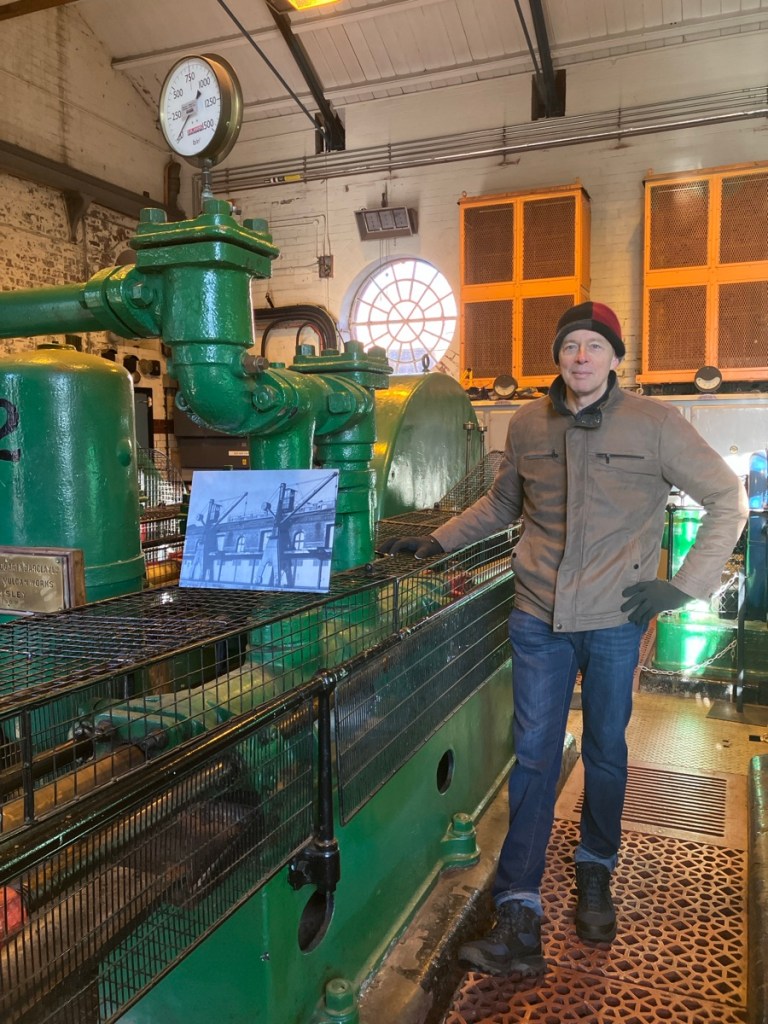
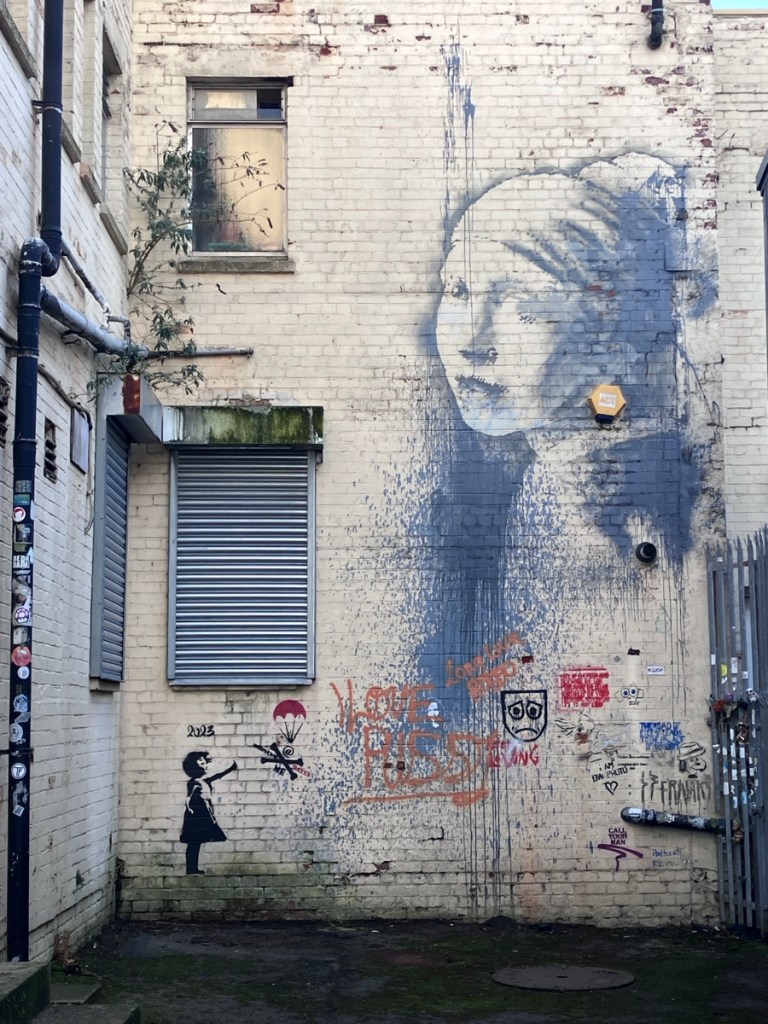
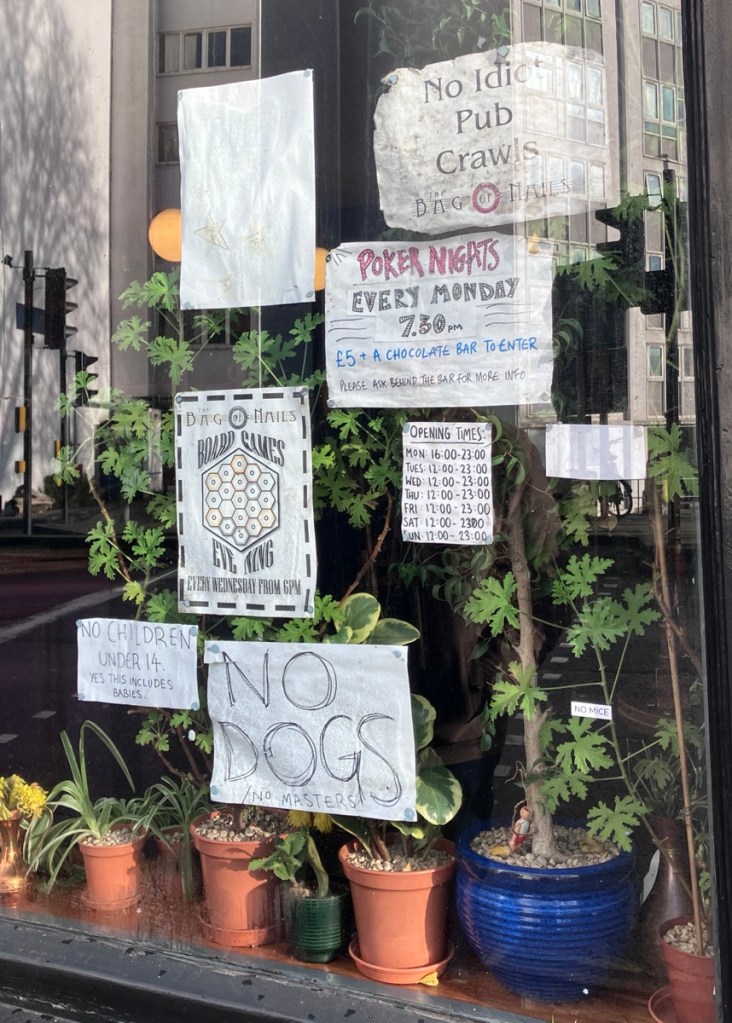
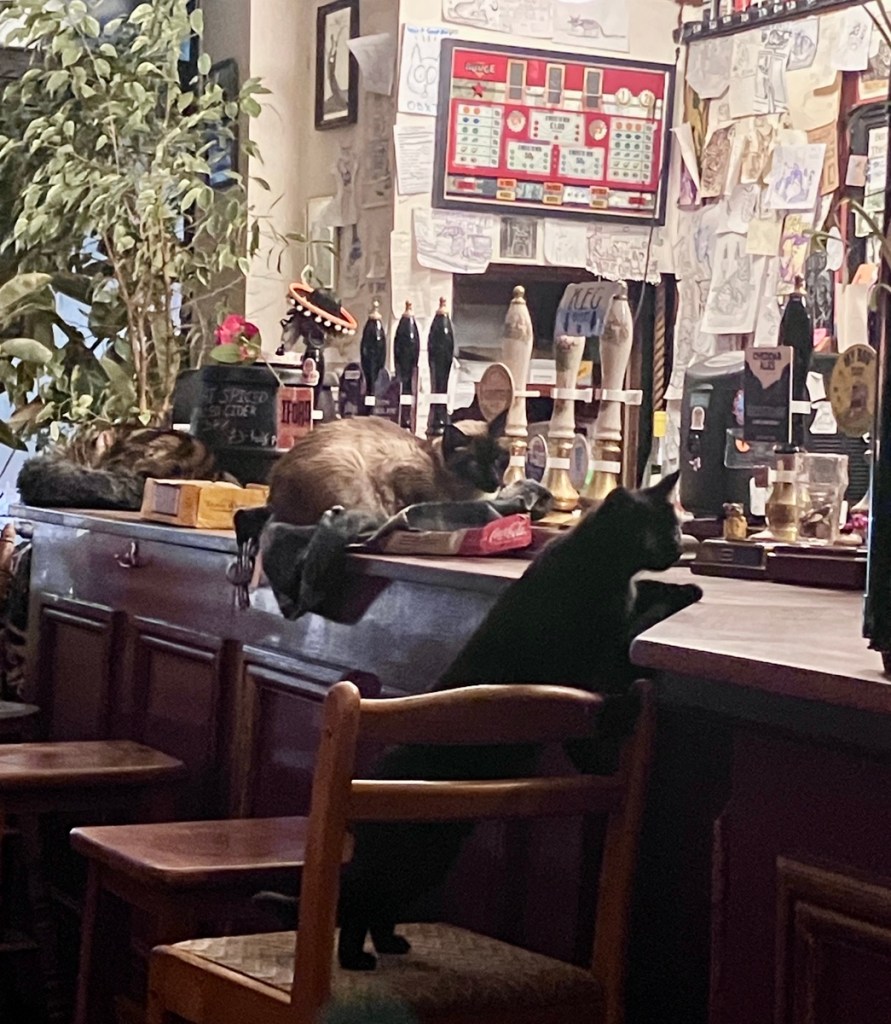
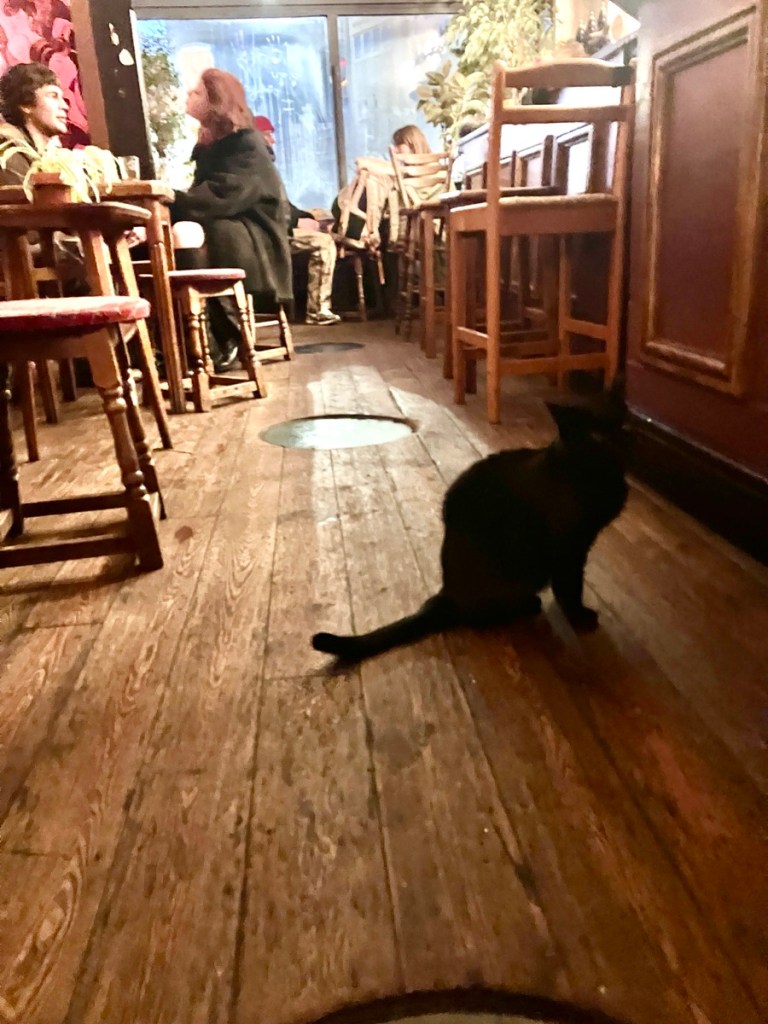
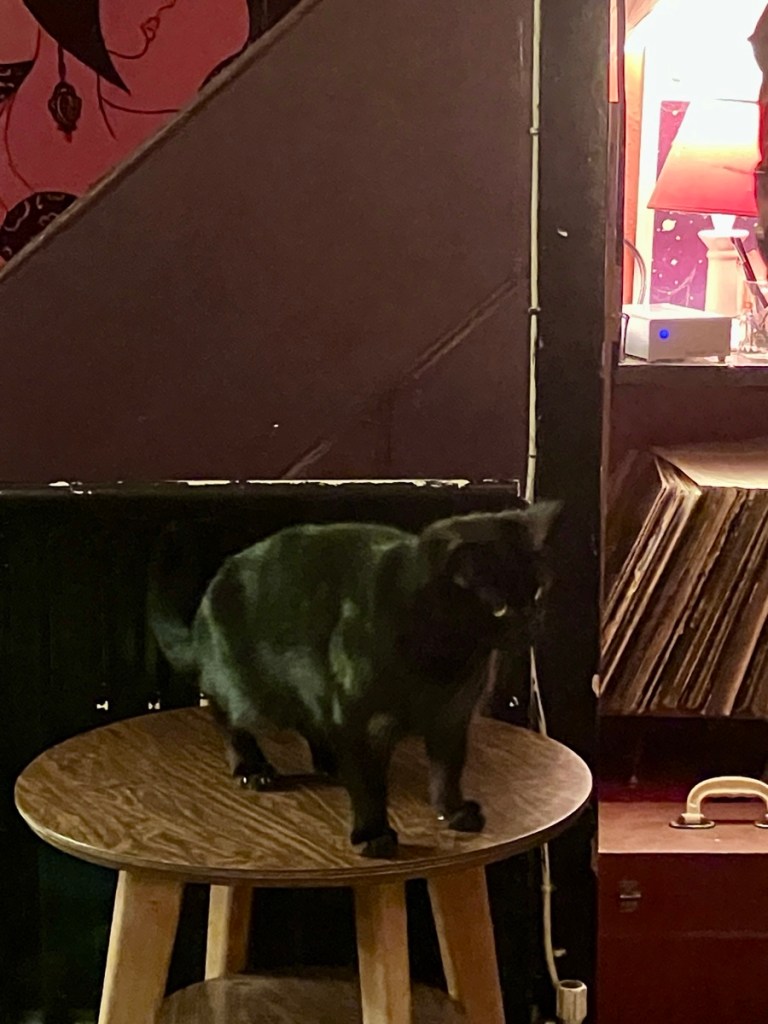
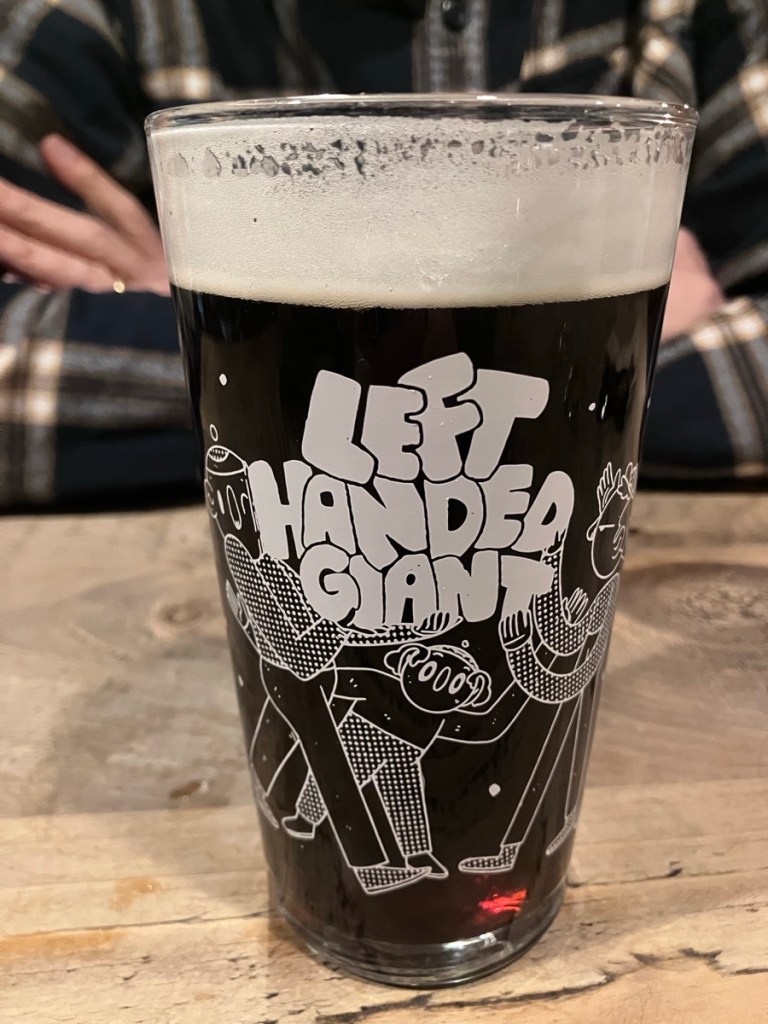
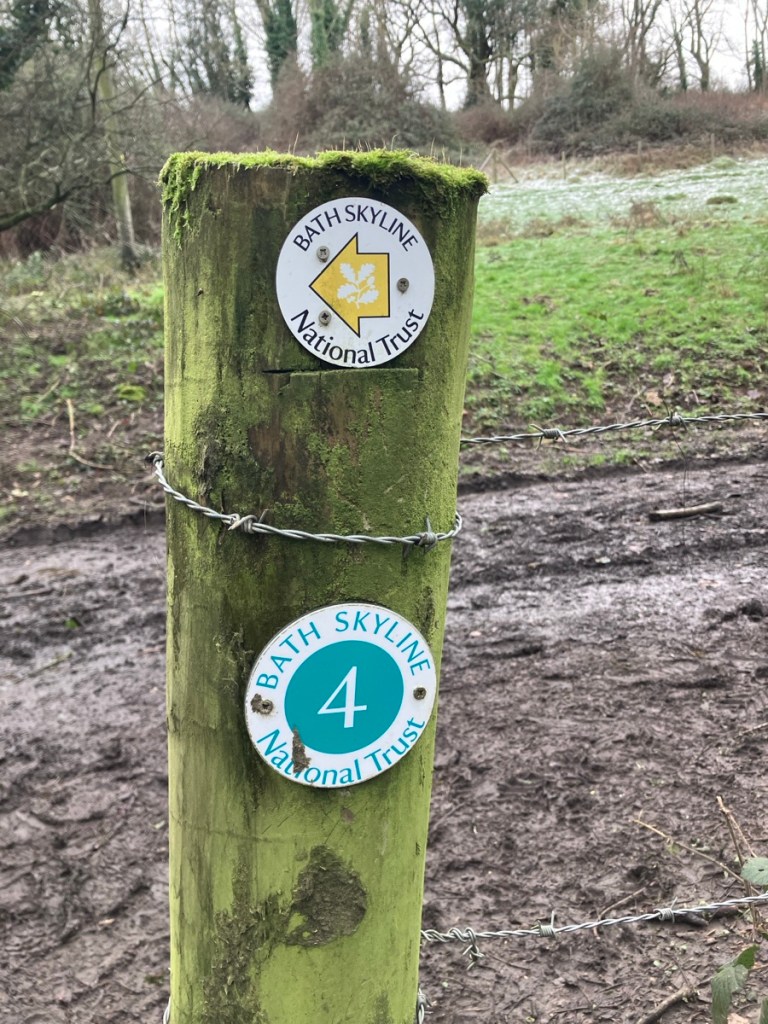
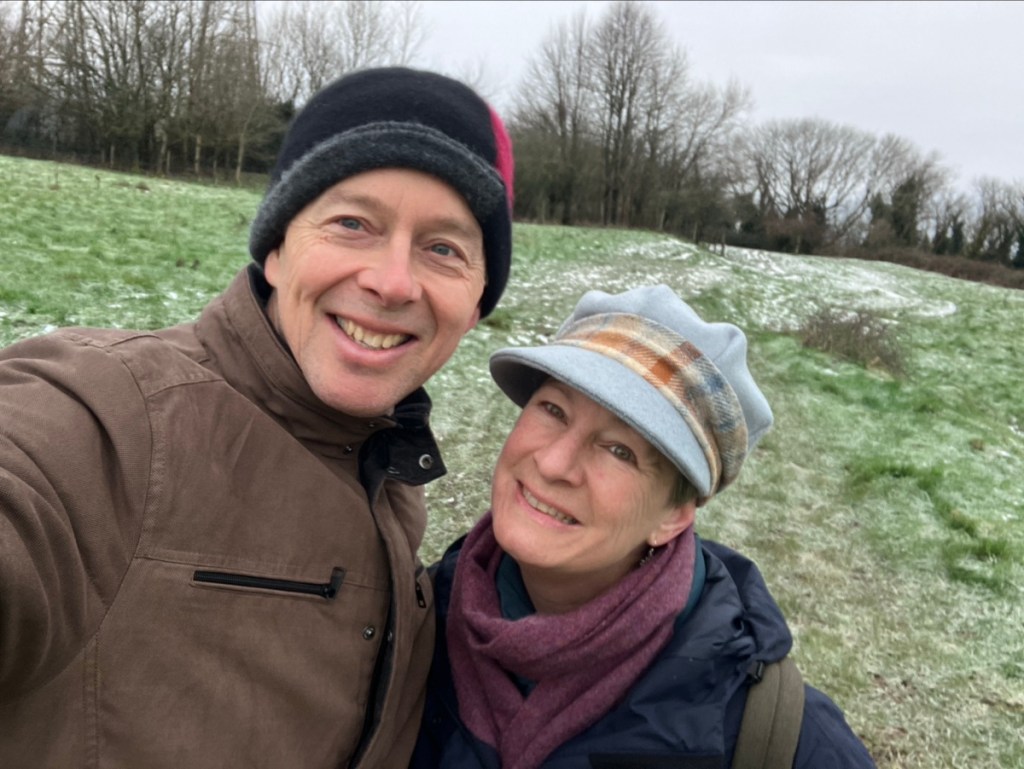
Bristol Temple Mead station. Plenty of bikes in Bristol.A swan and a view over the Floating Harbor, a lock controlled off shoot of the tidal River Avon created in 1809.Homages to Brunel are many in Bristol!The hydraulic equipment at Underfall Yard Visitor Centre, which explores and explains the elegant engineering behind the Floating Harbor, and its importance in the development of Bristol.Artsy shot out of the historic building.It wouldn’t be a trip to Bristol without a visit to a Banksy artwork.And, like a magnet pulling us in.The Bag O’Nails pub. My favorite pub. Another must visit place for us.The cats of the Bag O’Nails pub.Pub patrons trying to seem uninterested in the cats.The cats truly uninterested in the pub patrons.Just minding my own business by the record player.Gotcha! Lured in by my wool sweater and scarf and spot near the heater. I failed to look nonchalant when this cat graced me with their presence.The Left Handed Giant pub, another favorite of ours.Sometimes it was also a bit cold inside the pubs.The ceiling of The Cornubia pub. Horse brasses and beer mats. Yes, a lot of pub visits.It was not cold inside the Cornubia. My favorite pub fire so far. Clean burning coal. Wood fires not allowed in that area, the bartender said, but clean burning coal is ok.We took the train to Bath to go for a walk in the hills.The Bath Skyline Trail.A break on a well placed bench.Snow hanging on thanks to the cold weather.
We take as many opportunities as we can to meet up with friends, so we shoved off from Bristol towards Hastings, where friends from London had recently moved.
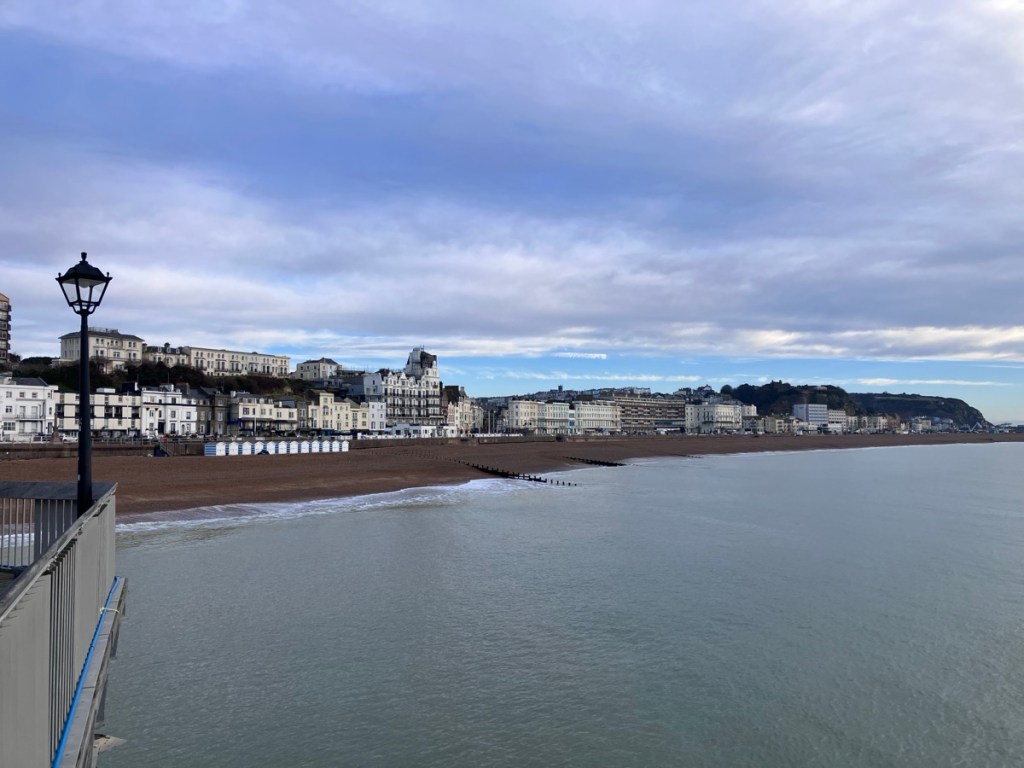
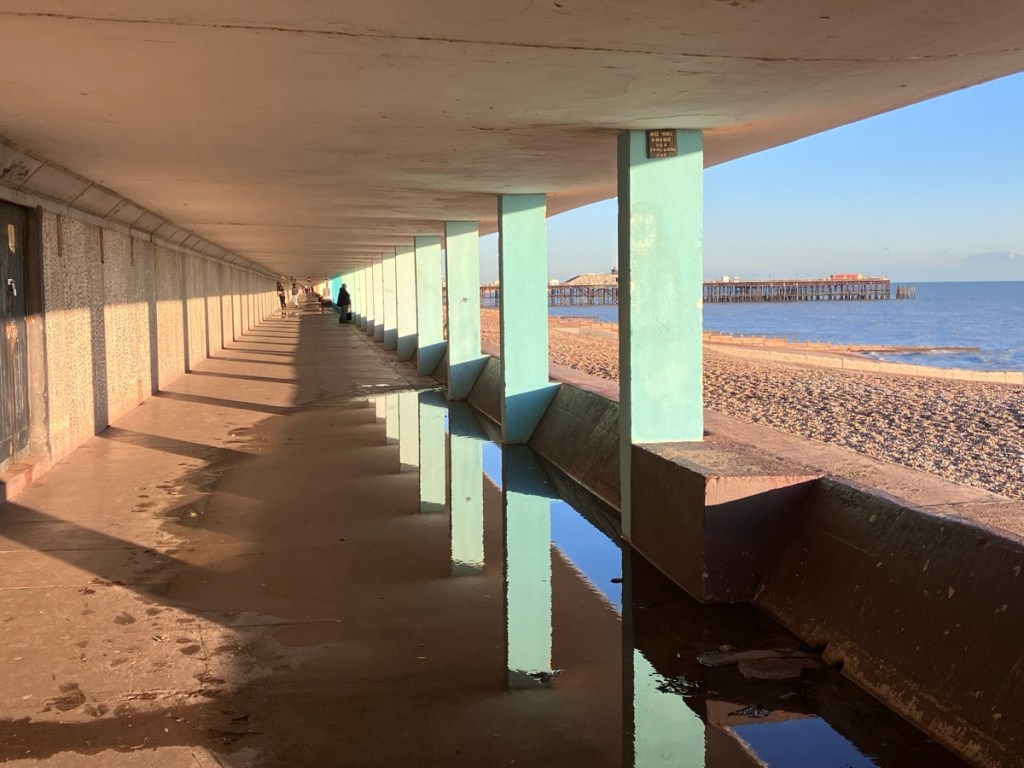
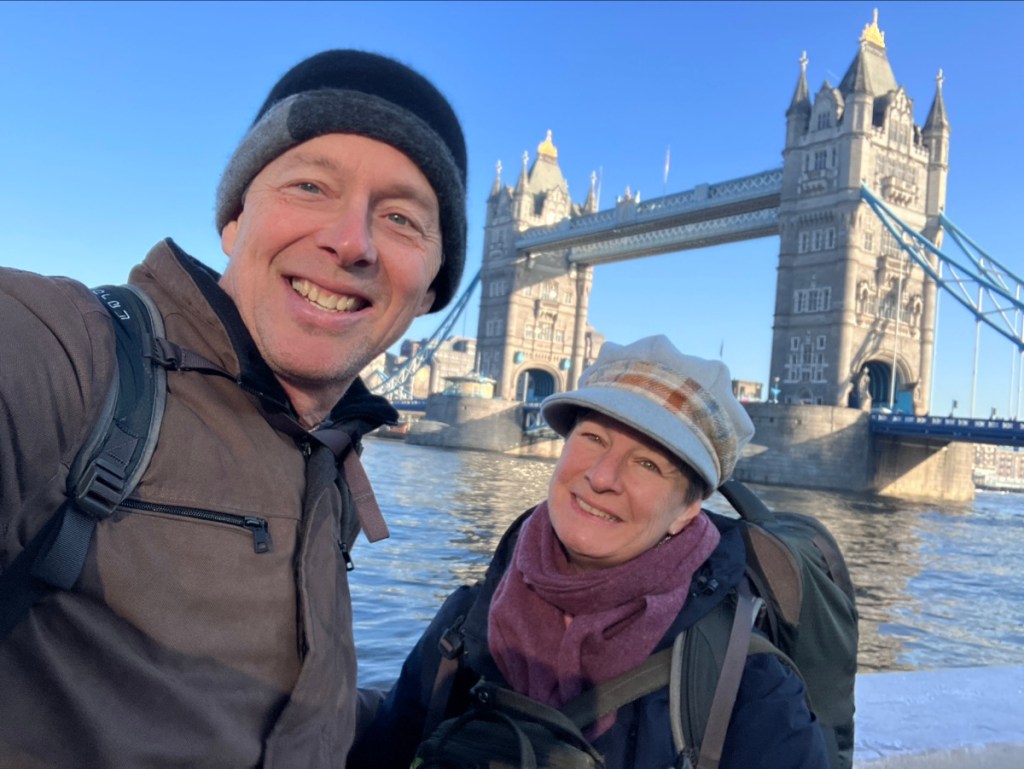
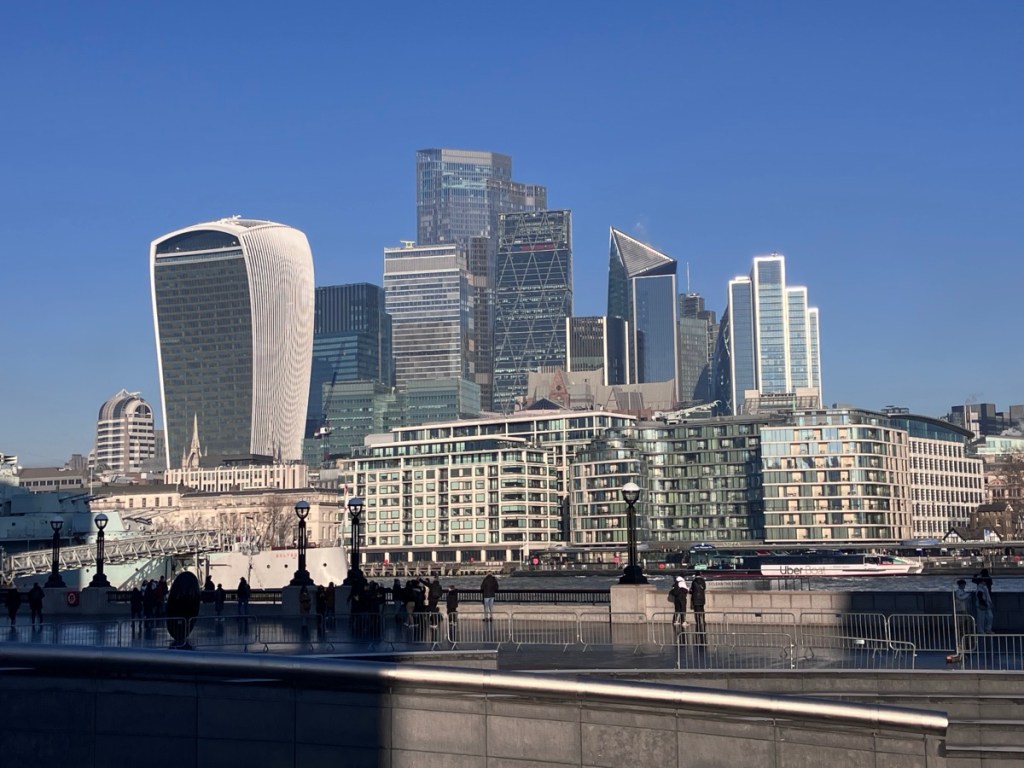
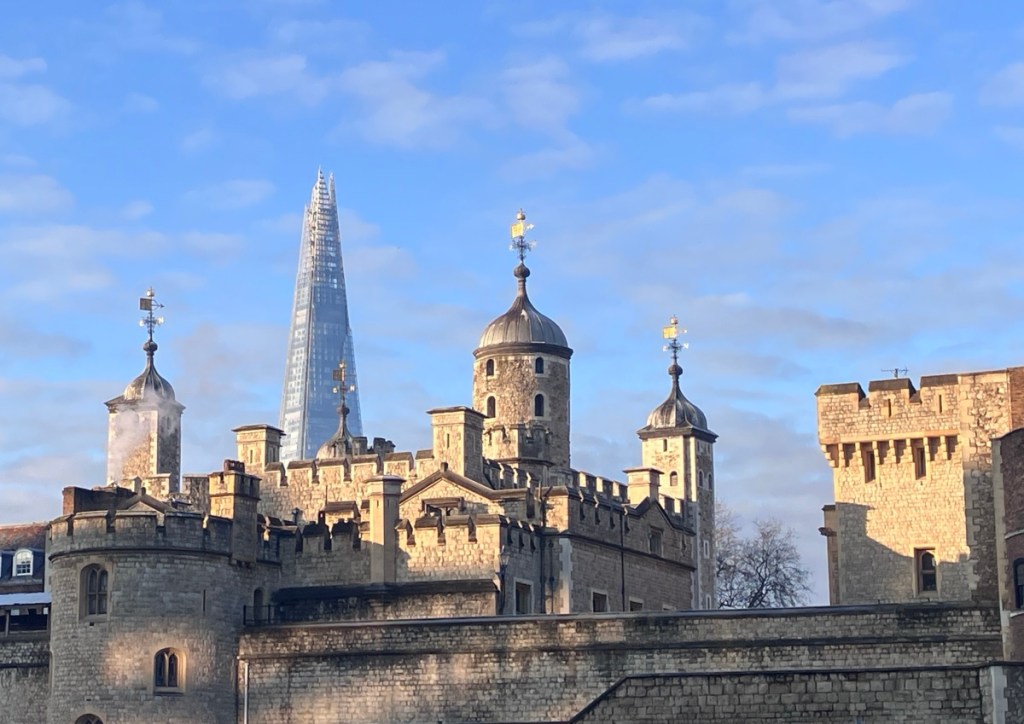
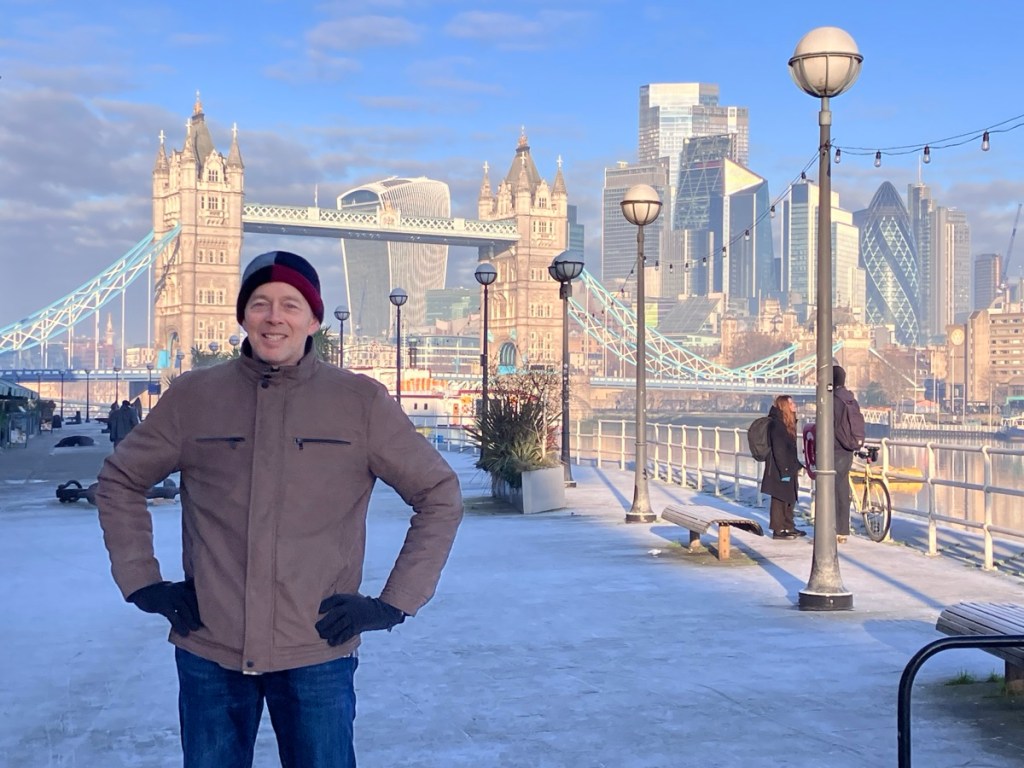
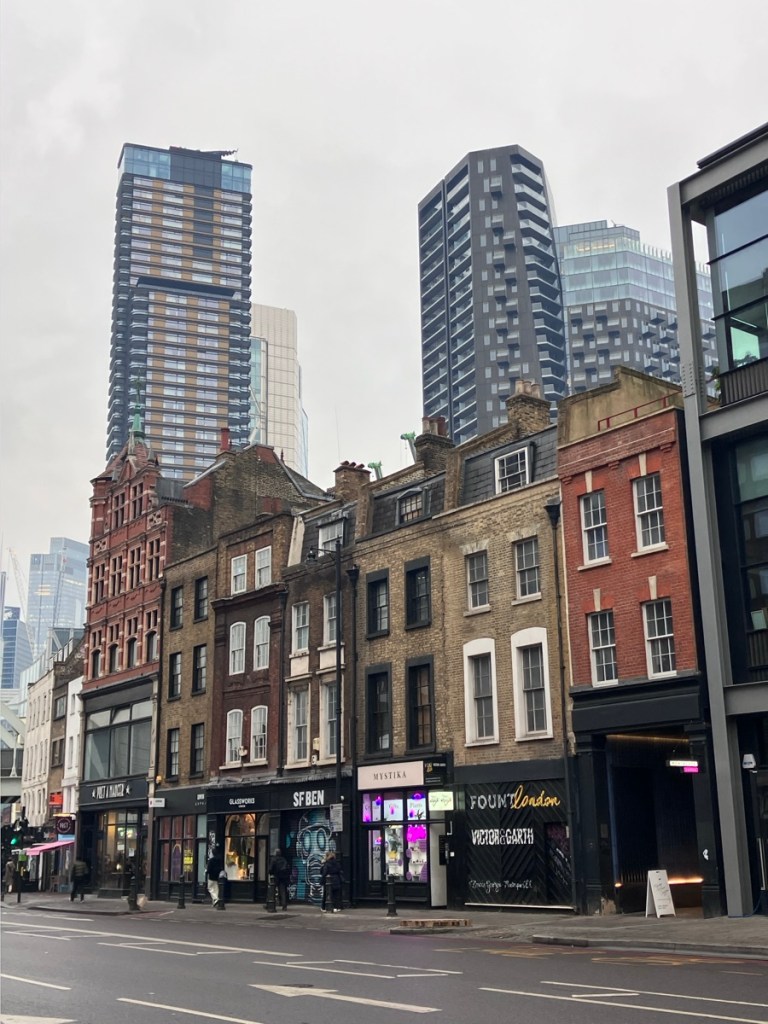
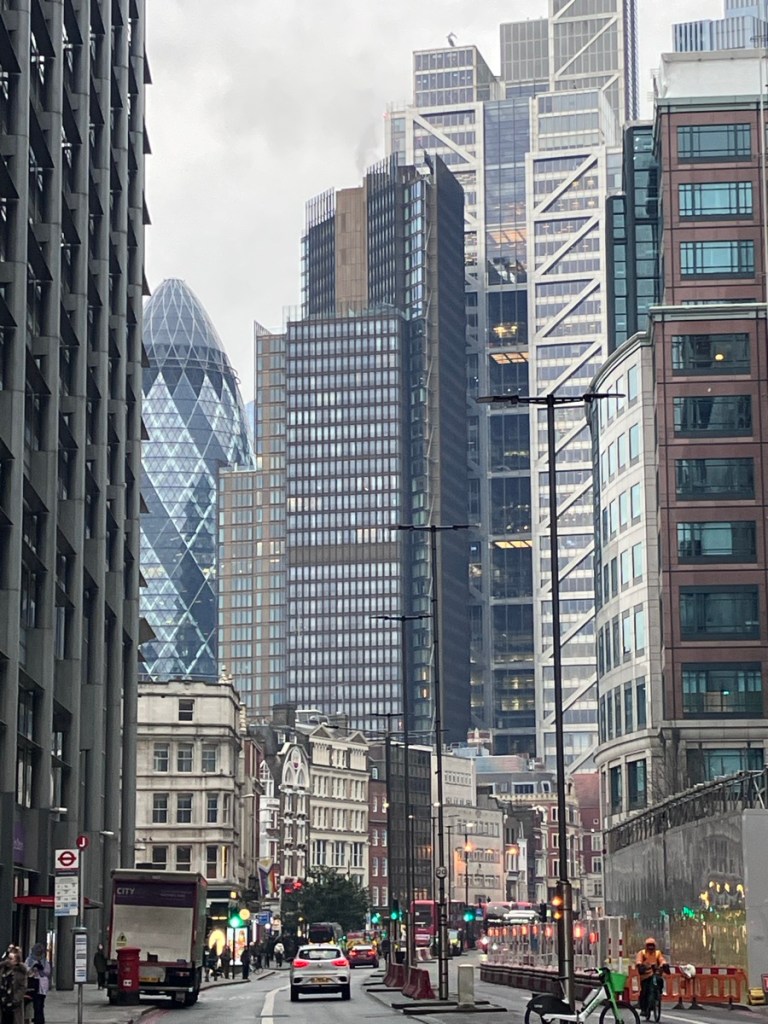
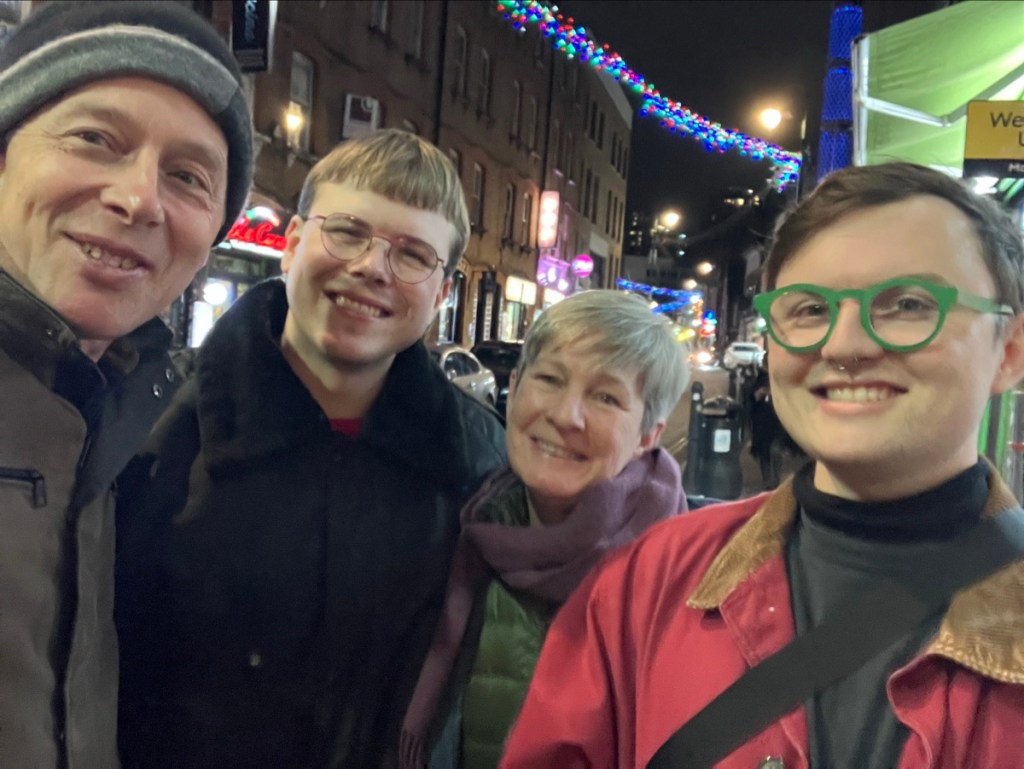
Charing Cross Station, London. On our way to Hastings. Nice digital departure board.British seaside towns. Love them. They share similarities but are all so different.The covered promenade with the Hastings pier in the background.What does this British seaside town have that no other one does? Our friends Joe and Justina!We had a great walking tour of Hastings. A lovely town well worth visiting. Up on the East Hill.The net shops on the harbor. Where fisherfolk store their equipment and hang their nets to dry. From above the tall narrow black buildings look like toys or monopoly houses.And no day is complete without a pub stop, this time at The Clown.And after an easy train ride, back in London for a few days.The modern skyline in the glorious winter sunshine.I love the juxtaposition of the Tower of London and the Shard. It was a super cold and still morning, the reflection of the bridge in the river caught our attention.Frost on the river walk, and slightly hazy air made the view soft focus and golden.We were staying right near Spitalfields and the view of City of London with the old buildings in the foreground was captivating.Modern buildings looming over old buildings.Museum of the Home, located in a row of old almshouses. Loved the Rooms Through Time exhibit, the evolution of London dwellings from 1630 to present. Dinner date with young friends who recently moved to London.
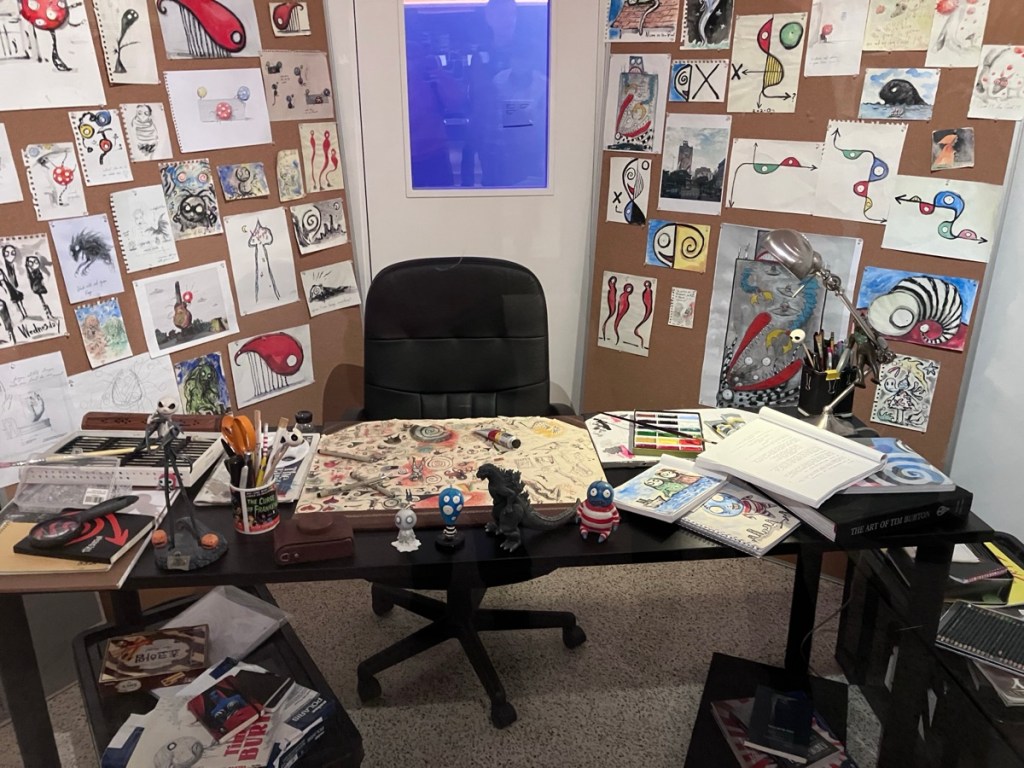
When we were in Lyon on our way to Paris we caught an arts update on TV which mentioned the Tim Burton exhibit in London. We quickly booked tickets for our last day in the UK. So glad we did. Our two London museum visits, Museum of the Home and the Tim Burton exhibit couldn’t have been more different. Where one dealt with the practicalities of home, changing styles of furniture and social interaction, the other was the products of one man’s talent and creativity.
Recreated office, the desk blotter doodles were fantastic.I wasn’t aware what a talented artist he is.Obligatory selfie set up.Many of the movie sets and costumes had signs not to photograph them. This Nightmare before Christmas-esque mobil and wallpaper had no such sign.
I’ve been having a hard time with this blog post. We flew from London to Chicago, saw our good friends Michelle and Alan – I have no pictures! – and Rich’s birth mom. From Chicago it was off to Grand Junction Colorado to see my Mom and Sister and Niece, very few pictures. Then Seattle, then San Francisco.
Lori looking out the window on January 20th, 2025.
A lot of Americans will understand the trepidation we were feeling, trepidation that has proved correct. It feels frivolous to do anything but focus on the state of the nation. Watch the news? Keep the news at bay? Focus on family and friends? Yes, that.
Winter hiking near Fruita, Co.My Mom. Seattle with our favorite Pacific Northwesters. Northwesterns? Cecily and Christine.
41 months. That’s how long we’ve been traveling since selling our place in San Francisco. So many amazing places and wonderful people. Many hotel rooms, wonderful house and pet sits, pensions, apartments. We both realized this winter that we are ready to have a place to call our own. Spring our stuff from storage and move it into our own space. We still intend to travel a lot, but we’ll be able to go home. Cook in our own kitchen. Sleep in our own bed. Host guests! Have parties!
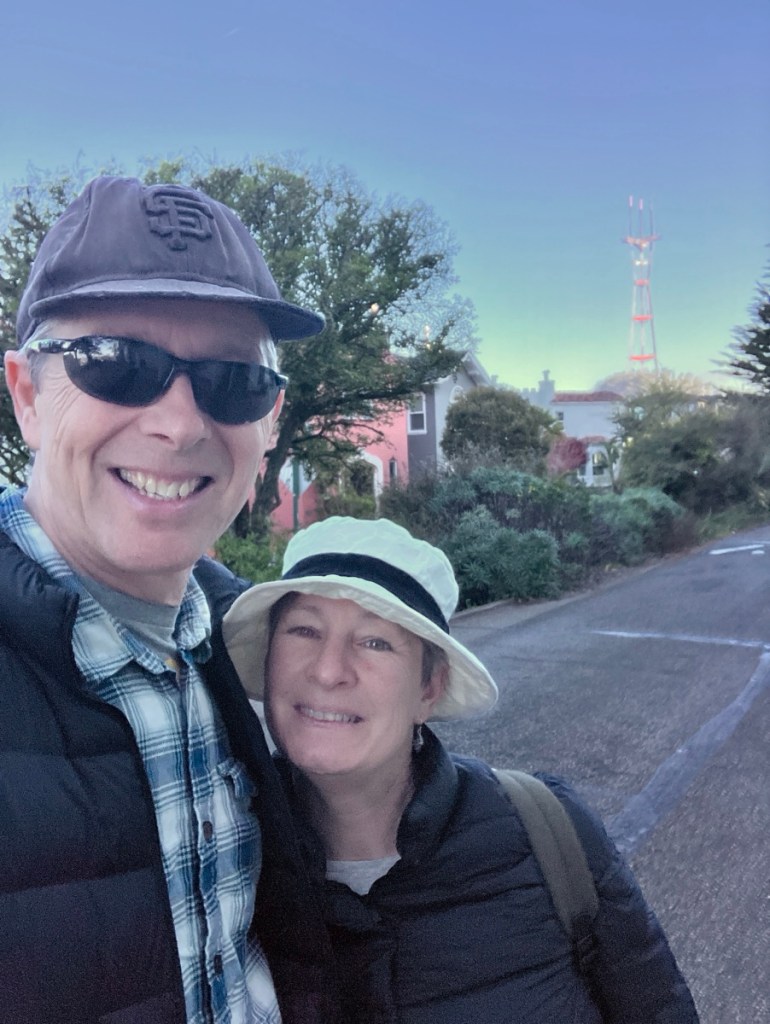
Sutro Tower in San Francisco and the Happy Travelers.
But first we head off to Taipei and then Indonesia. The house hunting can wait until we return to the US in the summer. Stay tuned!
One of the only riddles I can always remember is “How do you get two whales in a Mini?” Answer: Over the Severn Bridge. Doesn’t work written down (to Wales in a Mini), and rarely works for an American audience- the Severn Bridge? Wales? What?
Our riddle was how to get us and two bikes quickly and efficiently from Wales to France. Big touring bikes that do not fit easily in the bike closets provided on many UK trains. We could have ridden all the way to Portsmouth or another southern England port, but to be honest bike touring in a lot of the UK is not fantastic. And we wanted to get back to France to tour while the weather was still good, not spend more time crossing Britain. The answer to our riddle? Stena Lines Ferry.
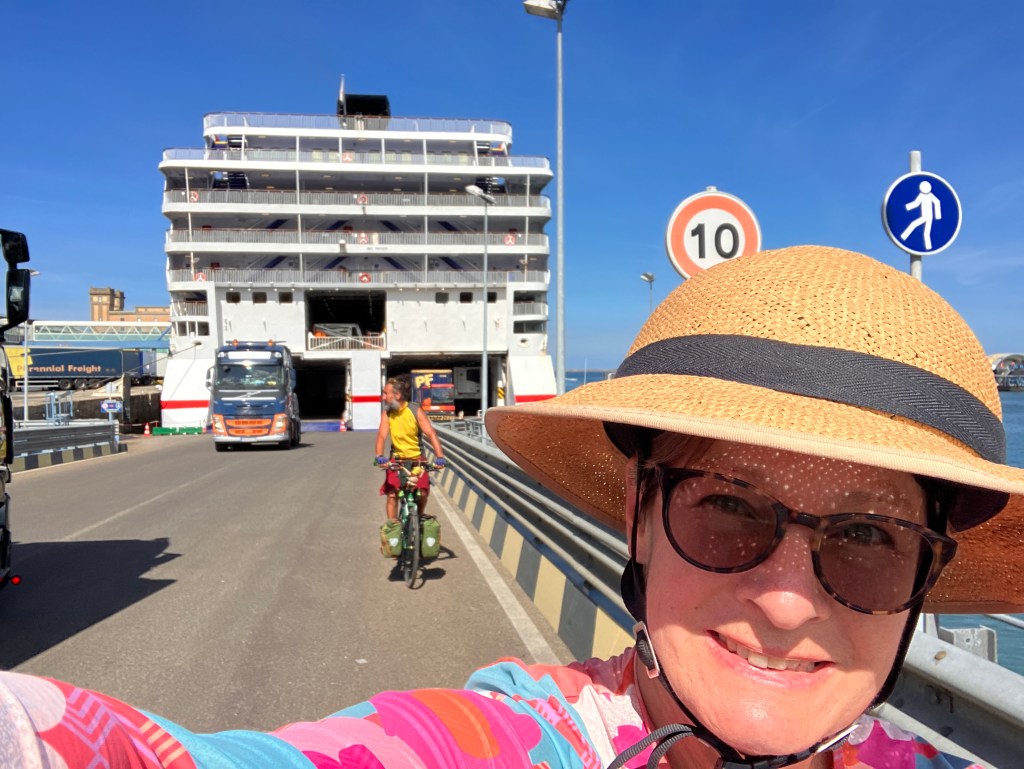
There’s our ferry.
For the first leg of our trip our friends in Tenby generously drove us and our bikes to Fishguard, Wales, for our 24 hour fun journey to France.
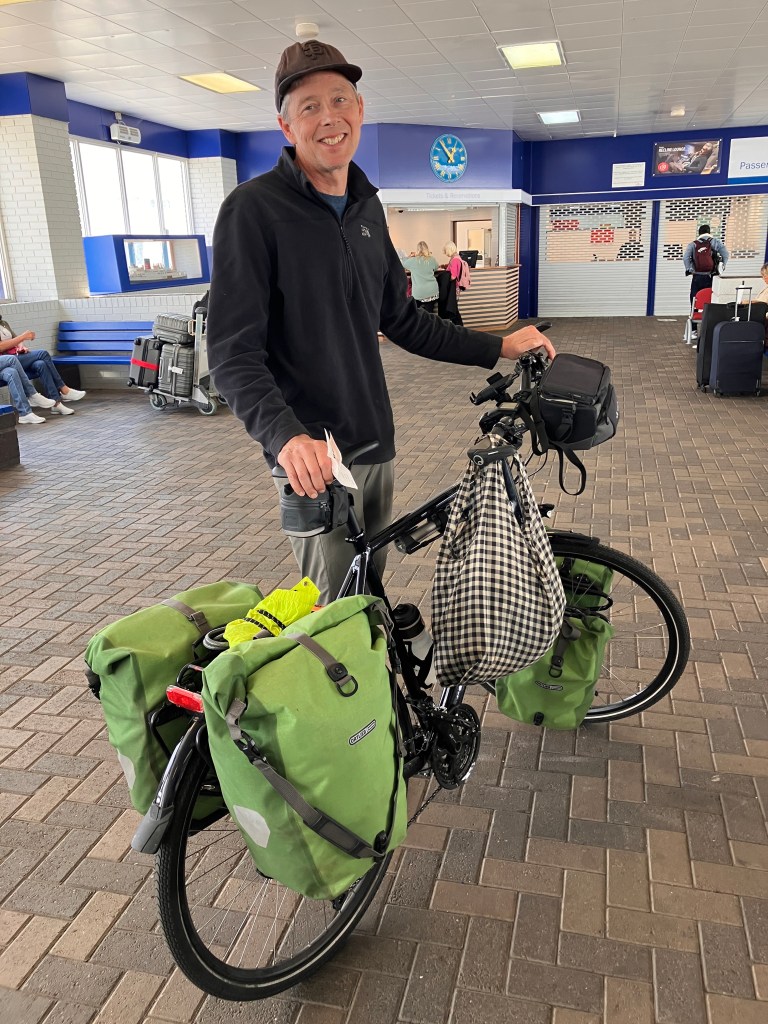
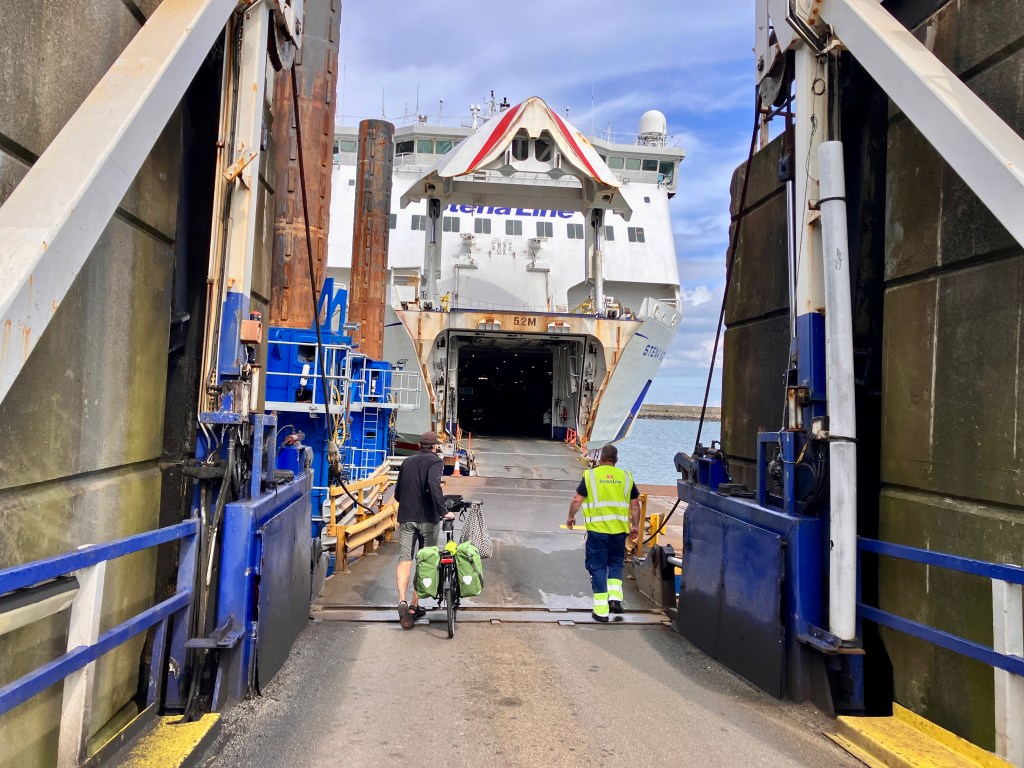
Rich waiting with our ferry behind him. This ferry will take us to Ireland.Let’s get this show on the road! Lunch and snacks in the bag.Being escorted onto the ferry by staff.
I love traveling by ferry. It’s a fantastic way to get between the continent and the UK or Ireland without flying. Flying not only has a bigger carbon footprint than the ferry, but it’s also a pain with bicycles. Ferries and bikes are quite easy. At Fishguard the bikes wait with foot passengers, who are driven onto the ferry by a bus, but we bikes get to wheel on with our own escort.
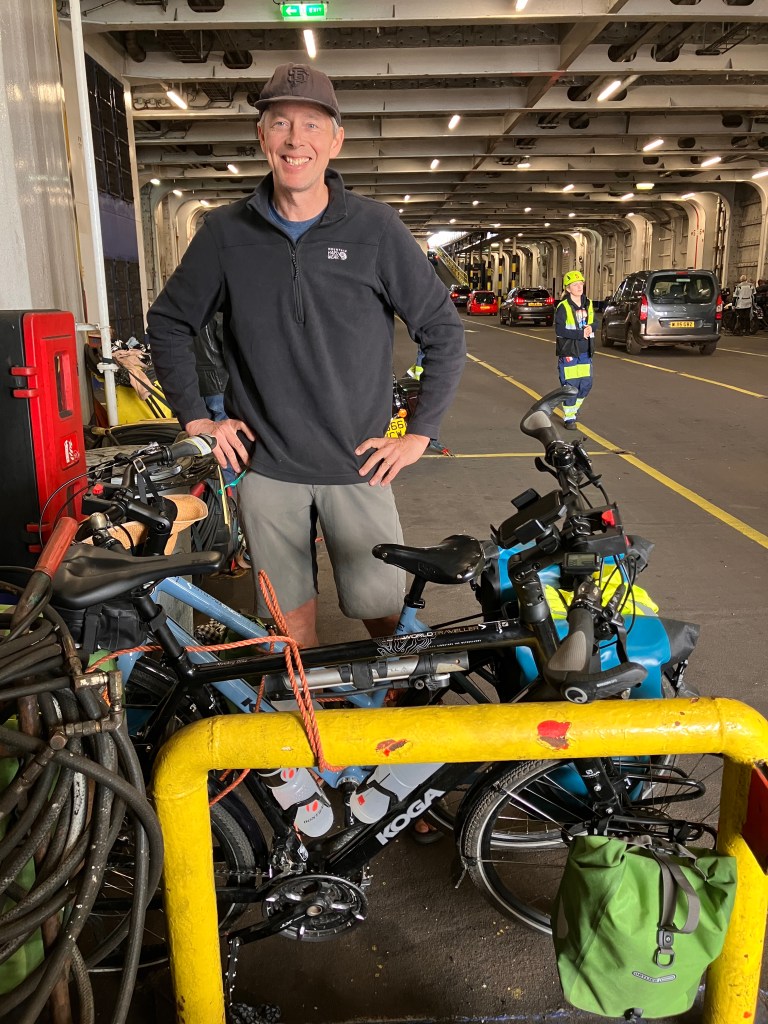
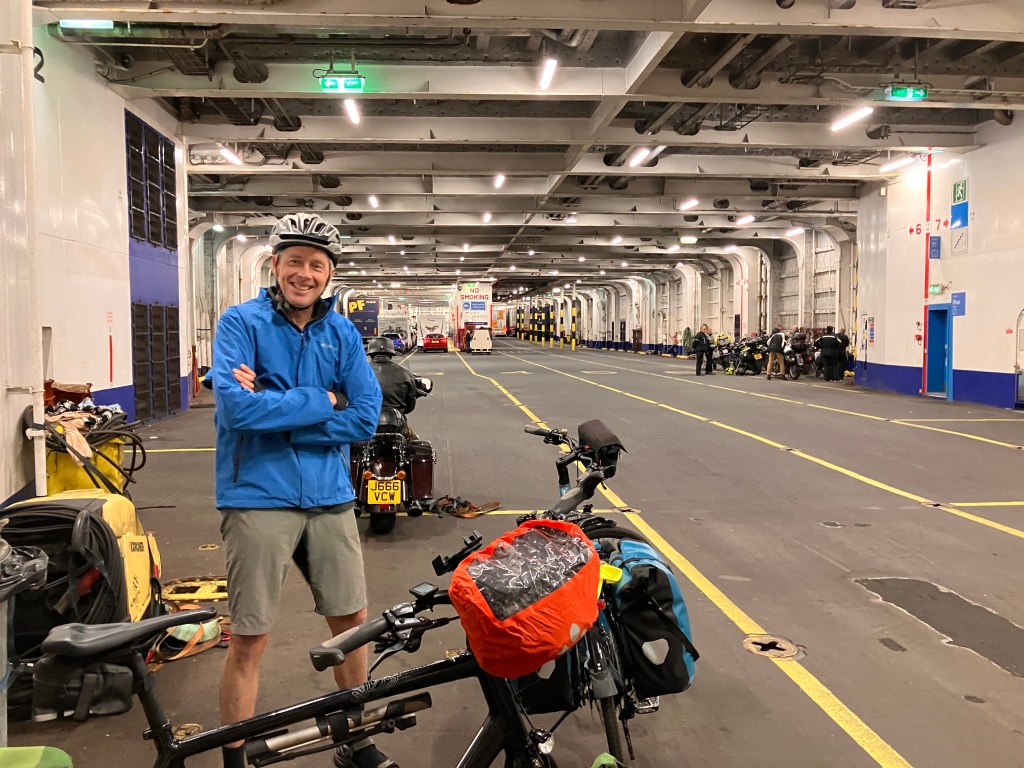
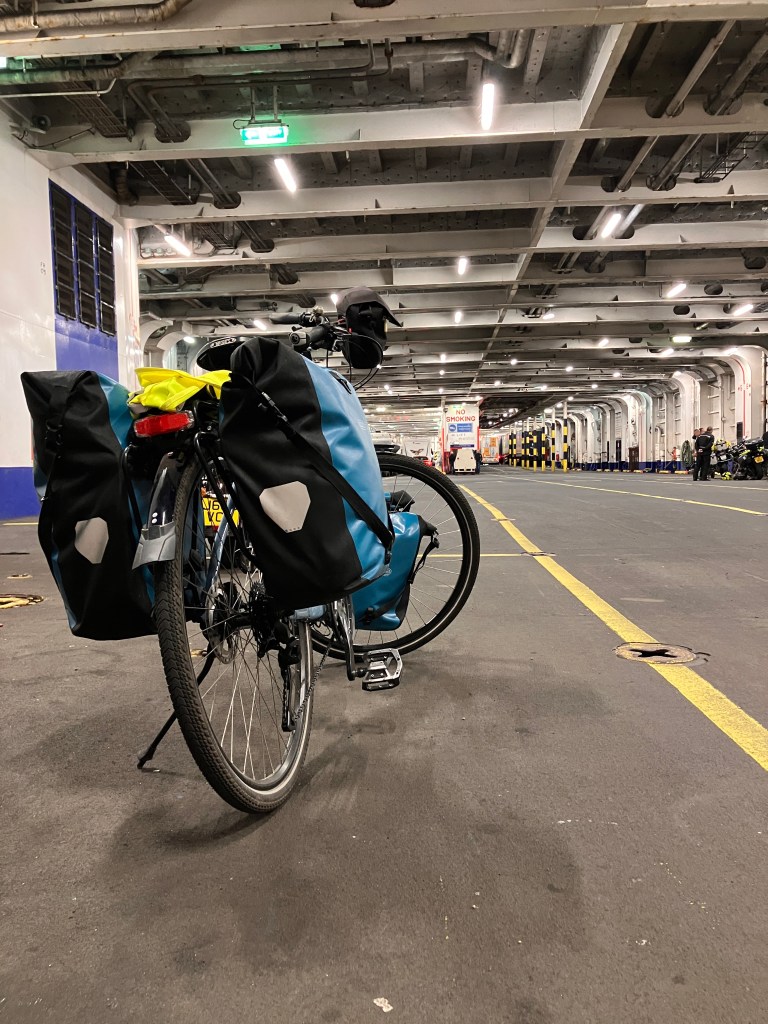
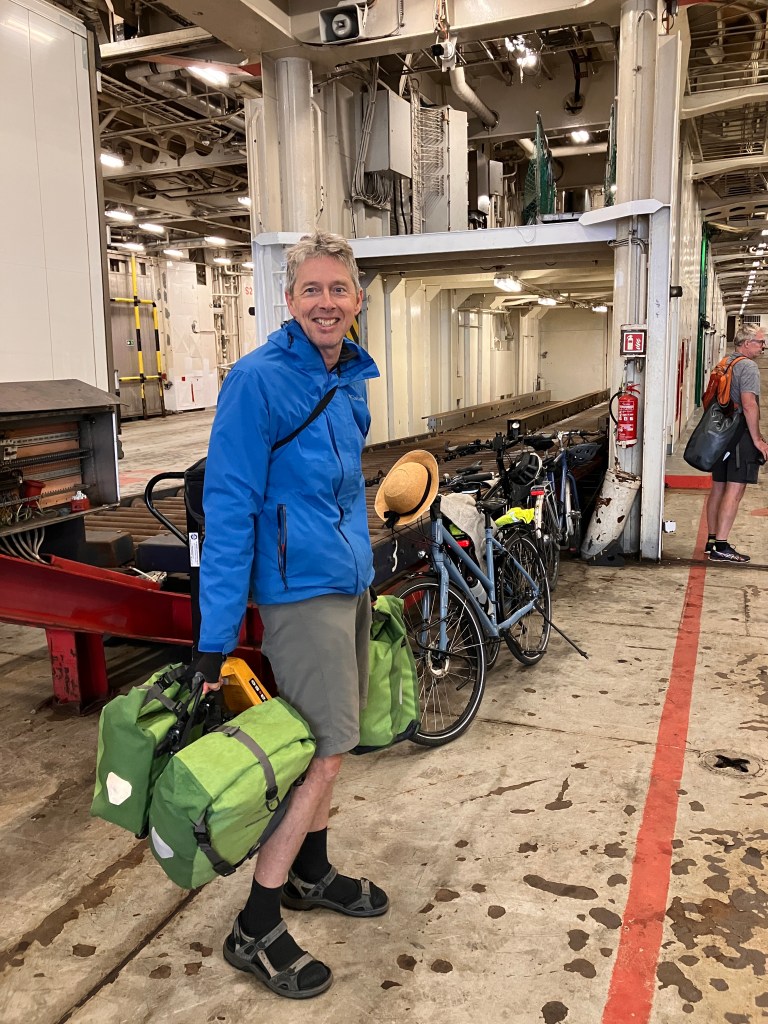
Rich in the bike nook, cars loading on behind him.The bikes are secured with a rope, provided by the helpful staff person you see securing a motorcycle behind Rich. The motos are strapped down to recessed hooks in the floor.Secure and ready to go. For this 3 hour journey we leave the bags on the bikes.I always snap a photo of our deck number and stairwell color. Just in case we both forget.Then it’s a cup of tea, a coconut macaroon from Loafly Bakery in Tenby, and a sheltered spot on the sun deck.
We were the only two people with bikes on this ferry trip, but there were quite a few motorcycles. We all wait to unload together.
Ready to go as soon as we get the word.I’m still fascinated by the huge car and truck decks on these ferries. It’s a bit intimidating to be a little cyclist surrounded by trucks and cars as you exit.
I don’t take pictures while disembarking, I’m too busy trying to keep up with the flow and not skid on the steel plates of the ramp. It looks more dodgy than it is, but I prefer both hands on my handlebars for this part of the trip.
Off one ferry and in line for the next.
Our next ferry, from Rosslare Harbour, County Wexford, would take us to Cherbourg, France. This was a long ferry ride, 16 hours. You have to purchase a cabin, no sleeping in the chairs. While in line for this ferry we chatted with a nice Irish cyclist named David, headed to France for a Rugby World Cup game and to meet up with his brother. Also traveling by bike.
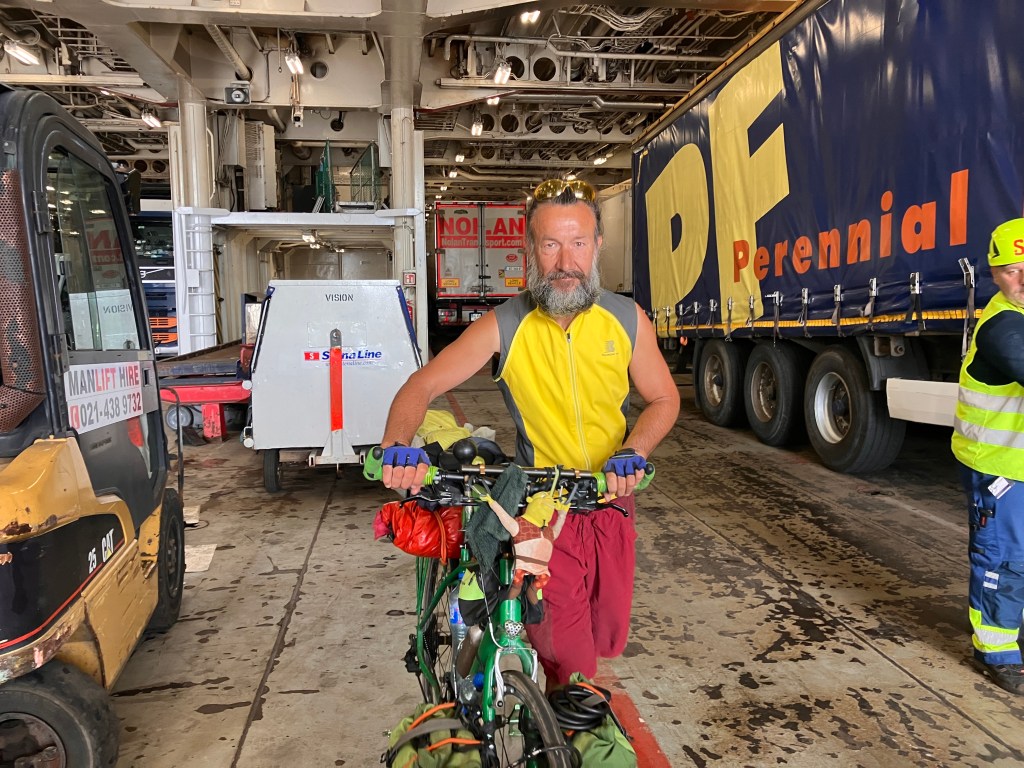
Motorcycles and bikes loading from lane 12.The bikes on this ferry were stashed next to a conveyor belt, and lashed to it by a staff person.
We were a bit mystified and annoyed by the fact that this ferry seemed to allow only four bikes on. When Rich was making reservations the website told him at first that there was only 1 bike space left. He was able to get both bikes on the next day, it seems that when his initial attempt to reserve and pay hung up in the payment phase, it locked down the 2 bike spots and they needed some time to reset and release. David agreed with us that it was ridiculous to allow only four bikes on a massive ferry loaded with cars and trucks, he said he would probably just show up and talk his way on, if he had been denied a bike reservation. We’re not that confident in our gift of gab, not being Irish, but we all agreed to send sternly worded emails to the Stena Line Ferry company. (We otherwise really like this ferry company.)
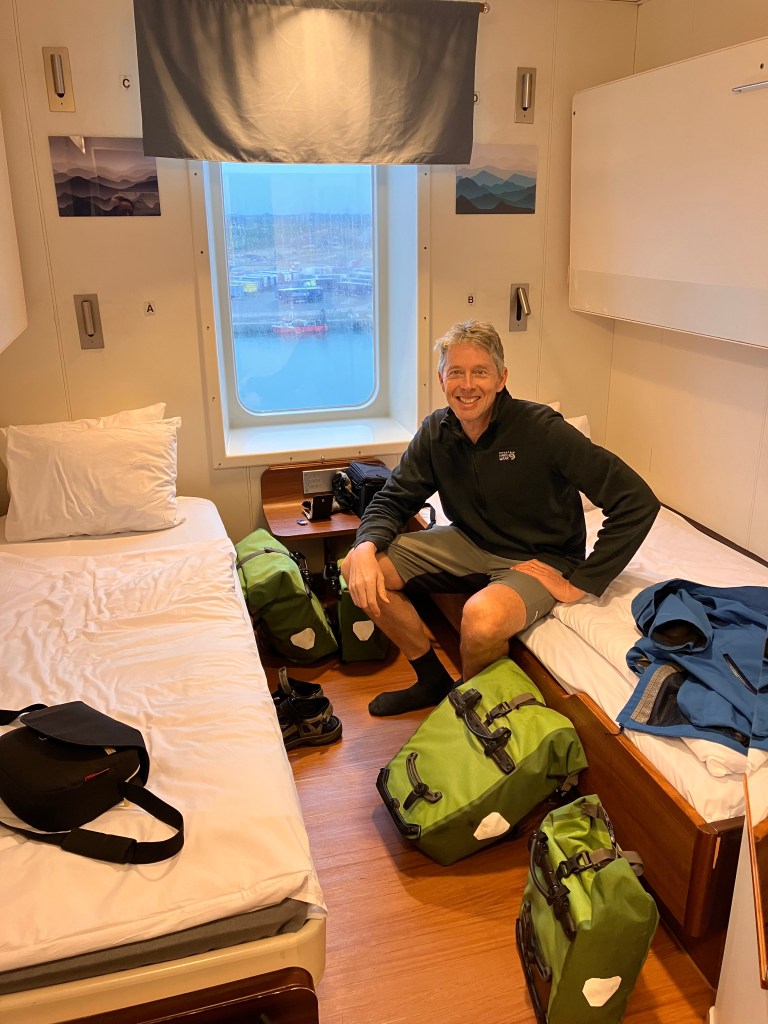
Behind this door, Premium Class Cabins. That was us! We went Premium Class. A very comfortable cabin. You can see one of the upper bunks above Rich, this cabin could sleep four.Bathroom with shower to the left.
The cabin had a kettle, tea and coffee, some snacks, outlets with continental plugs – two pin – and a very decent sized bathroom. More later on morning amenities. First, off to the bar!
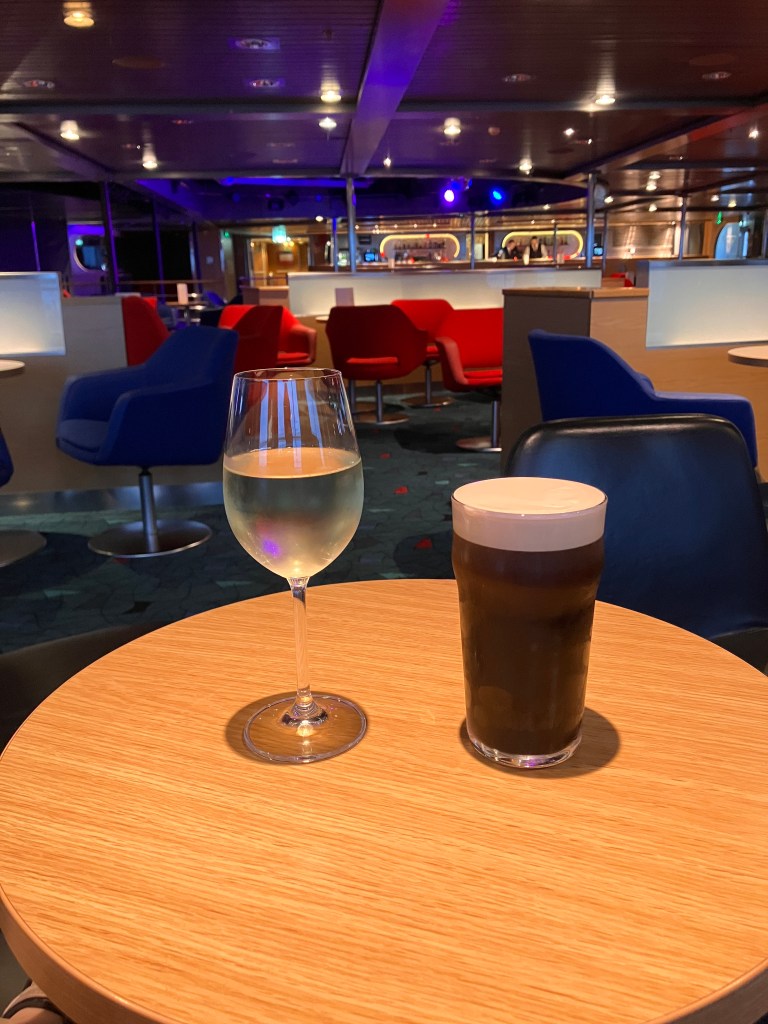
White wine and Guinness. Rich couldn’t be in Ireland, however briefly, without having a Guinness. Dance floor available, pop music blaring from the sound system. The view from the Metropolitan Bar. We imagine that during busy summer holidays the dance floor gets some use.Night time falls and we’re out to sea.
We decided on this trip to just eat from the restaurant instead of bringing on our own dinner or breakfast. You could certainly save money by taking on your own picnic meals, but the food got pretty good reviews so we made our lives easier and went to the buffet restaurant for dinner and breakfast.
The buffet and a guy who gets his money’s worth from a buffet. My first plate, noodle salad, Greek salad, and veggies. All quite good.Dinner at the buffet was a success. There was a bar in the restaurant, drinks not included except water and tea/coffee, we opted for water.We went for an after dinner walk on deck and then it was off to bed in our comfortable cabin.
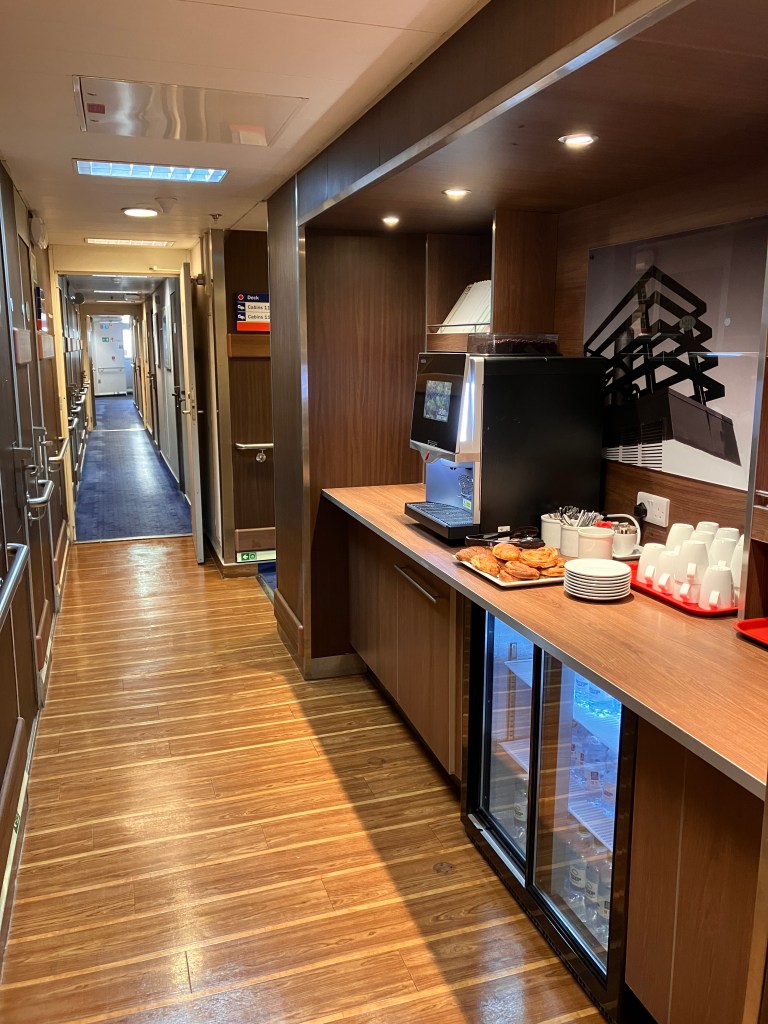
Another benefit of Premium Class was the morning coffee and milk from the coffee machine in the hallway, and croissants and raisin rolls, and oddly, magazines. Good Housekeeping and Men’s Health, and the duty free magazine.
Coffee, pastries, and water in the fridge.Yes, I was out in the hallway in my jammies, this was just outside our door.And then I was tucked up back in bed with tea made with the room kettle, with fresh milk from the machine, a croissant, and a magazine.
Since we had a ride planned from when the ferry docked at 2pm to our first night in Normandy at Port-Bail-sur-Mer, we went and enjoyed the breakfast buffet to make sure we were fueled for our 46 km hilly ride.
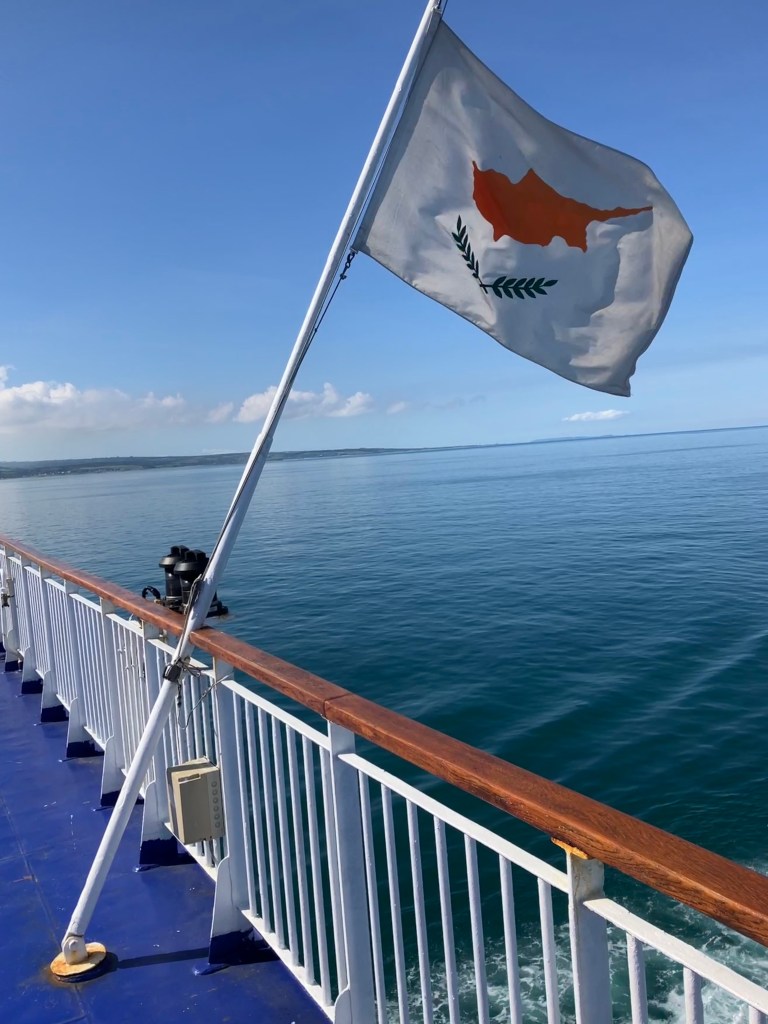
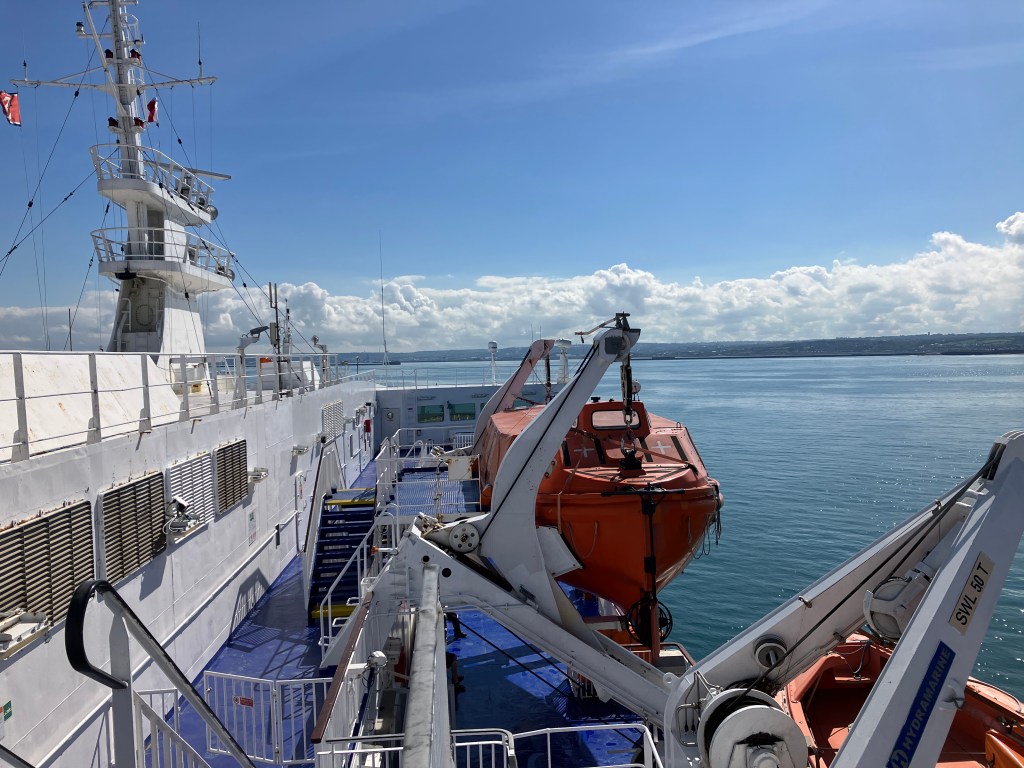
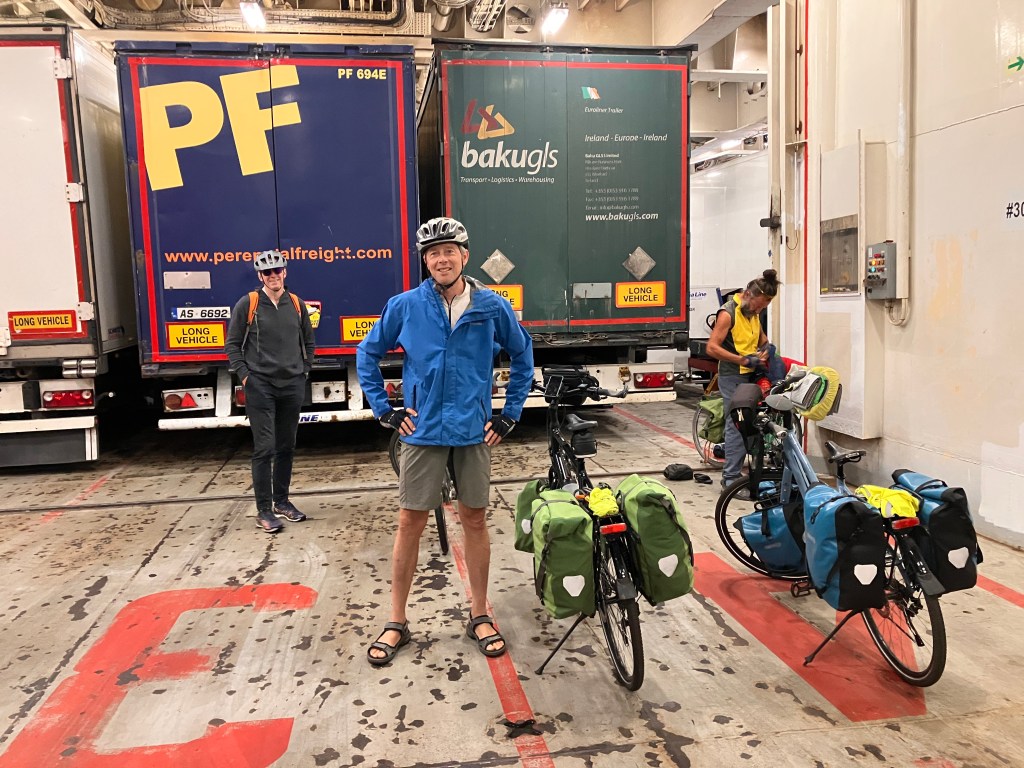
Breakfast buffet was served from 8 to 10 am. Another walk on the deck, watching for land.The flag has the silhouette of Cyprus, where this boat is registered. Lifeboats. Which you hope no one ever has to use. They hold 114 people each. Finally allowed back to our bikes, we found the trucks were parked right next to our bikes and the floor had puddles of sea water. David, Rich, and a nice nomadic French cyclist whose name I didn’t get. Chatting with other cyclists is a fun bonus of ferry travel.Ten years nomadic cycling. He said he’s off to the US next. Nice guy. And away we go.
Traveling with bikes on the Stena Line or Brittany Ferries is becoming our regular way of getting to and from the UK from the continent or Ireland. This was our 12th ferry trip, seventh with bikes, since going nomadic just over two years ago. Eight have been long crossings, and four were shorter hops, Germany to Sweden, Denmark, etc. On this trip our Stena lines reward number got a work out as we bought so many meals – not inexpensive – but now we have points for future discounts. As I mentioned above, you could certainly make this journey less expensive by getting a standard cabin, and either bringing your own picnic meals or opting for a non buffet dinner and breakfast. The premium cabins vary ship to ship, on one from Hook of Holland to Harwich we had a full sized bed in the cabin and no upper bunks. Both were very comfortable and we slept well.
The happy travelers headed from Wales to Ireland.
We’re now in France, cycle touring in Normandy and Brittany. And guess what? That heat wave in Wales may have been our last summer heat, the weather has taken a decidedly autumnal turn.
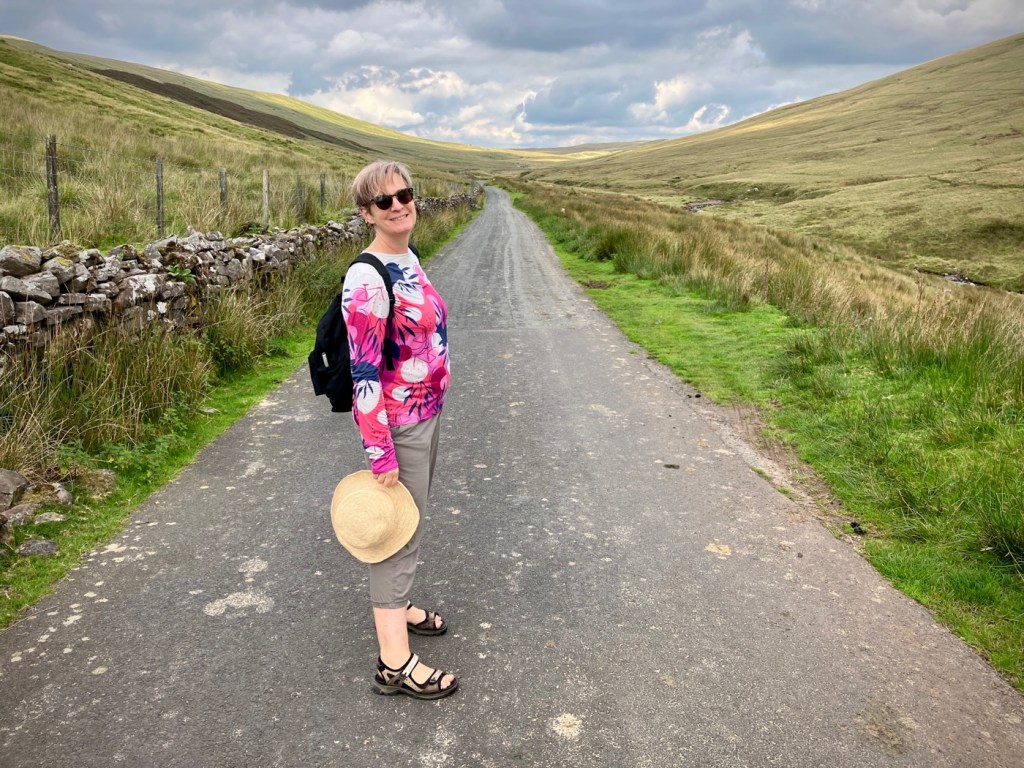
We had a wonderful 12 days in Treorchy, not only visiting the two national museums Cheryl detailed in the last post, but hiking around the Rhondda Valley and the Brecon Beacons. But alas, it was time to move on to a new adventure from our cozy house sit and lap cat.
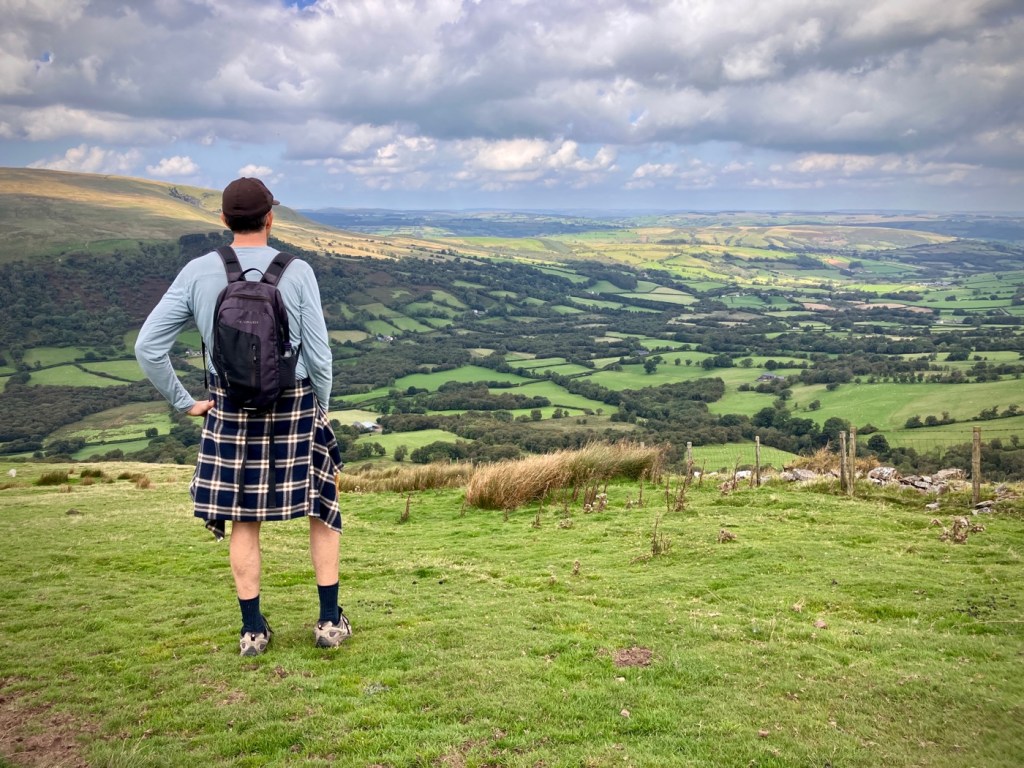
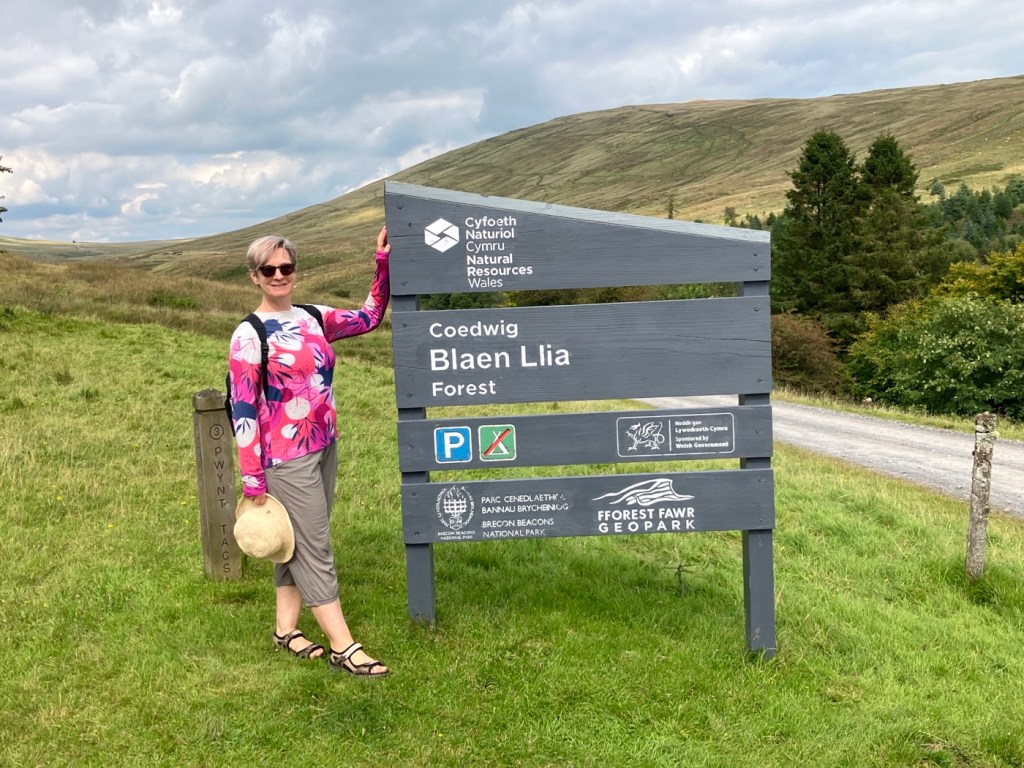
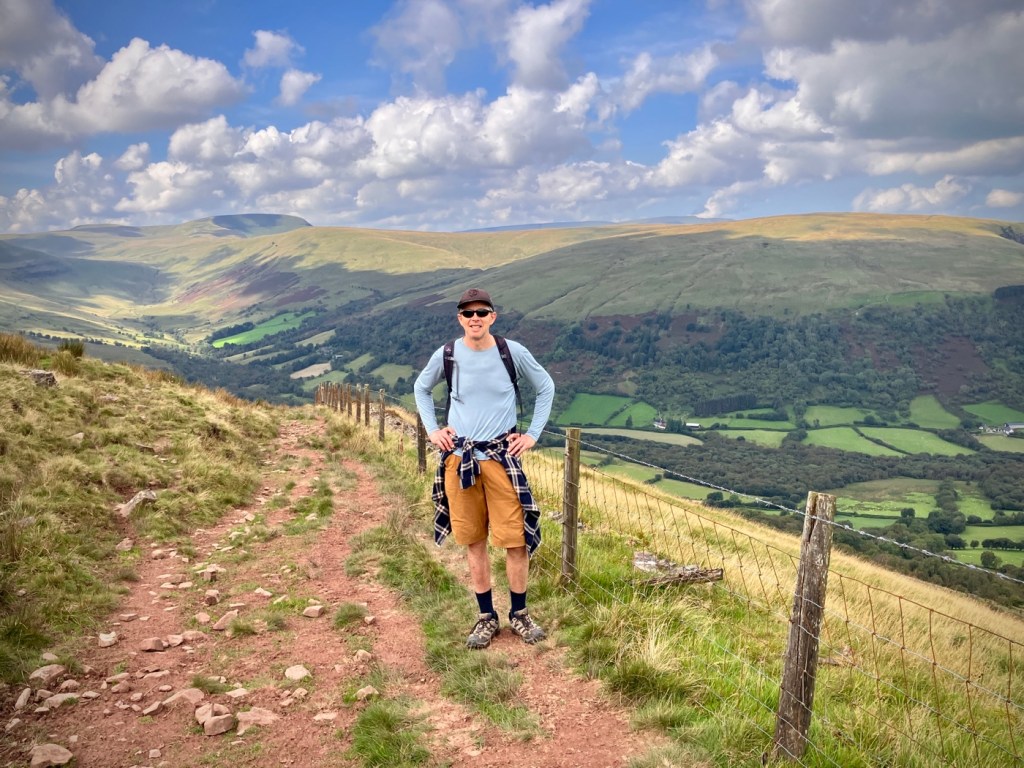
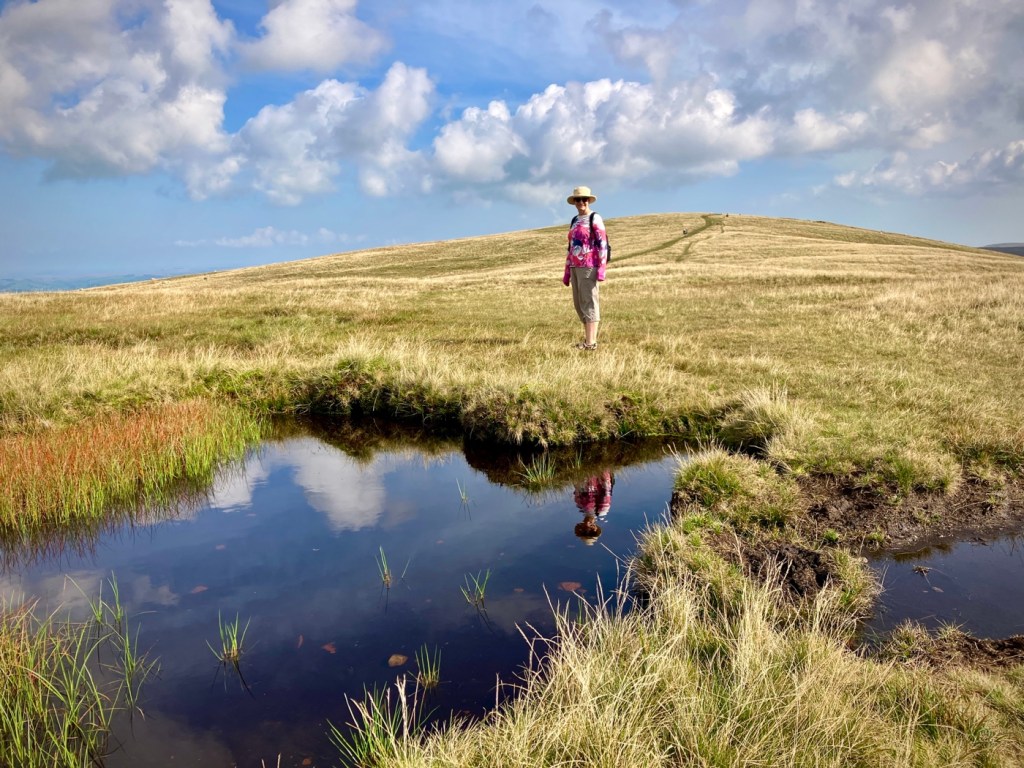
We loved hiking in Wales. Looking towards the verdant hills of Mid Wales from Bannau Brycheiniog, also known by their English name, the Brecon Beacons.We picked this less crowded part of the park for a Sunday hike and it was perfect.Coming down the backside of Fan Dringarth.A subtle beauty to these boggy highlands.The nine mile loop varied, had great views and kept us away from the hoards climbing Pen y Fan, the highest point in the park.
When we planned our various house sits this summer, we had to consider how we would get between then with loaded bikes. Most connections were a day or two, so we had to take two long trips on LNER and Great Western Railway trains. Both were stressful with our touring bikes due to the (ridiculous) storage closet bike hooks in a space too tight for my bike. (And many other bikes larger than average.) Anytime you take 50 pounds in 4 bags off the bikes, it becomes awkward. Add a 1-minute crowded station platform, bike closets, and a mid line stop and it becomes a frantic fire drill.
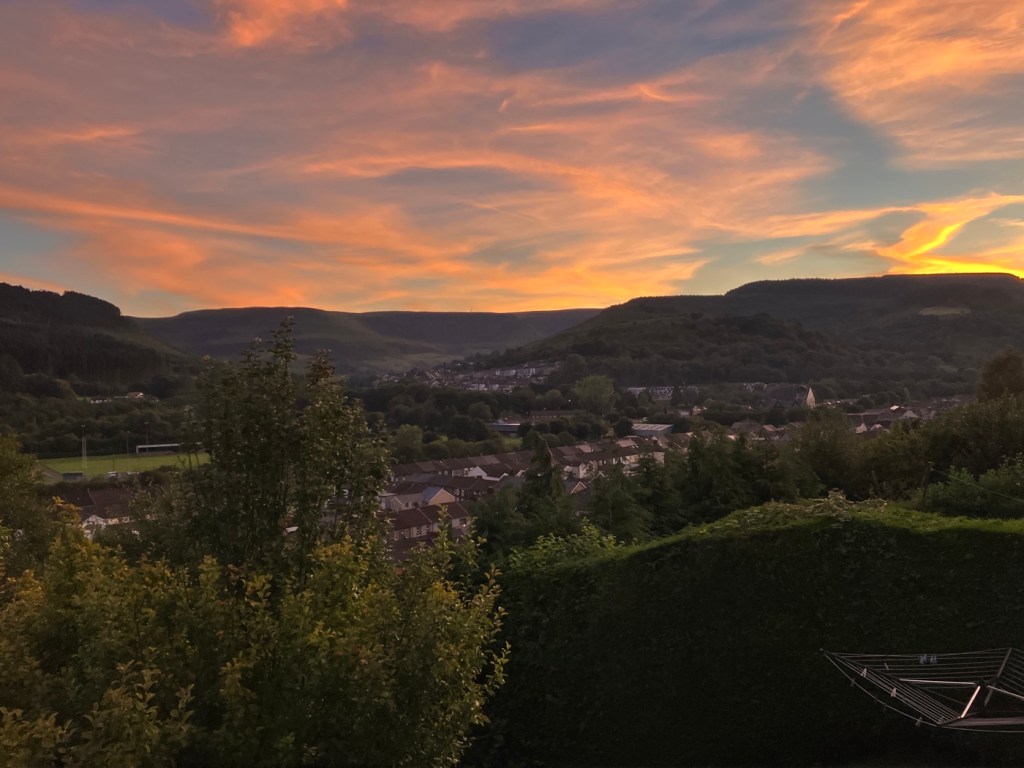
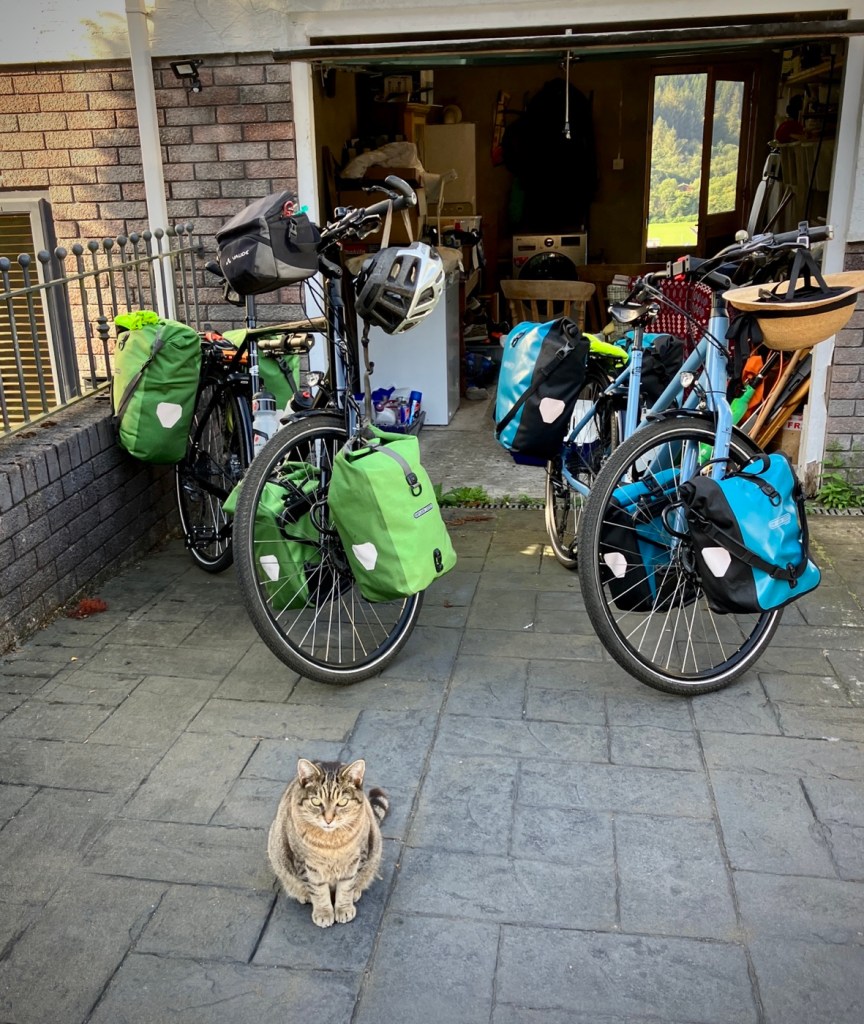
Last night sunset from our terrace in the Rhondda Fawr Valley.Our sweet cat Tibbs was determined to block our exit from Treorchy.
So we decided that if the weather looked better than a monsoon, we’d cycle our next leg, so I started planning a route considering the following;
1. How do we get out of the Rhondda Valley? Its a 1000+ foot climb straight up out of Treorchy to the North or West, both on A Roads, unless we wanted to go back down the Rhondda towards Cardiff, which would break our cycle touring motto of “never go backwards” (even when we make a wrong turn).
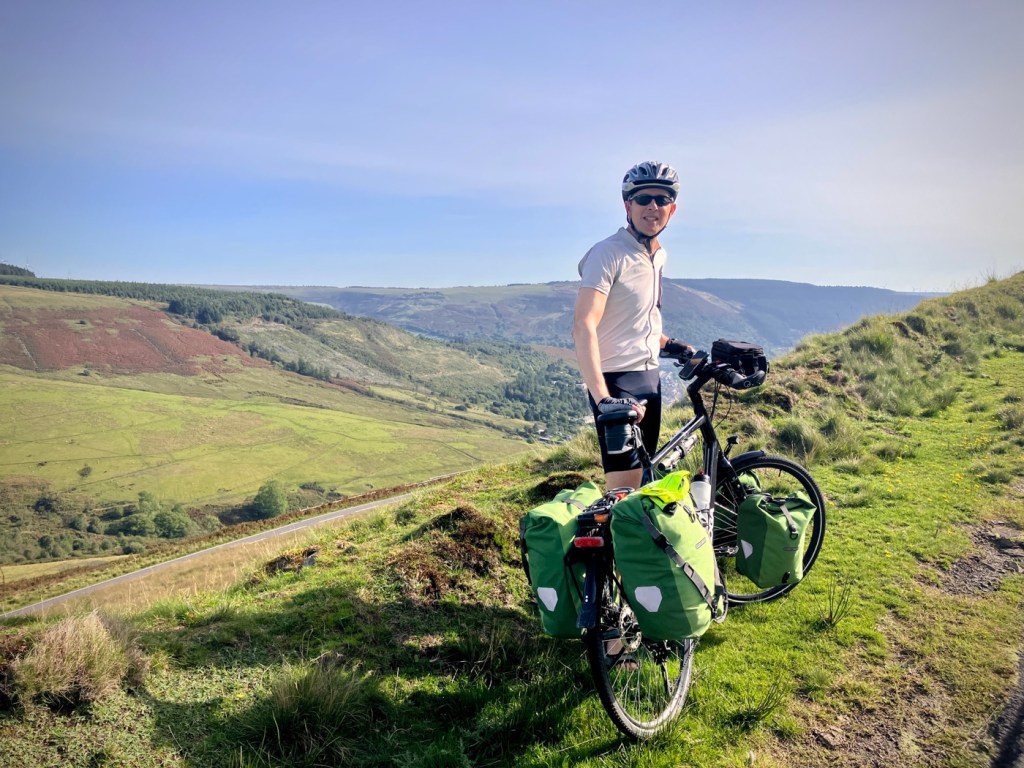
Heading up the switchbacks of the A4061 west of Treorchy Headed over the top of Bwlch Mountain.Free roaming sheep kept the car speeds under control and they sure were friendly.Couldn’t resist an Ussie with our new pal.
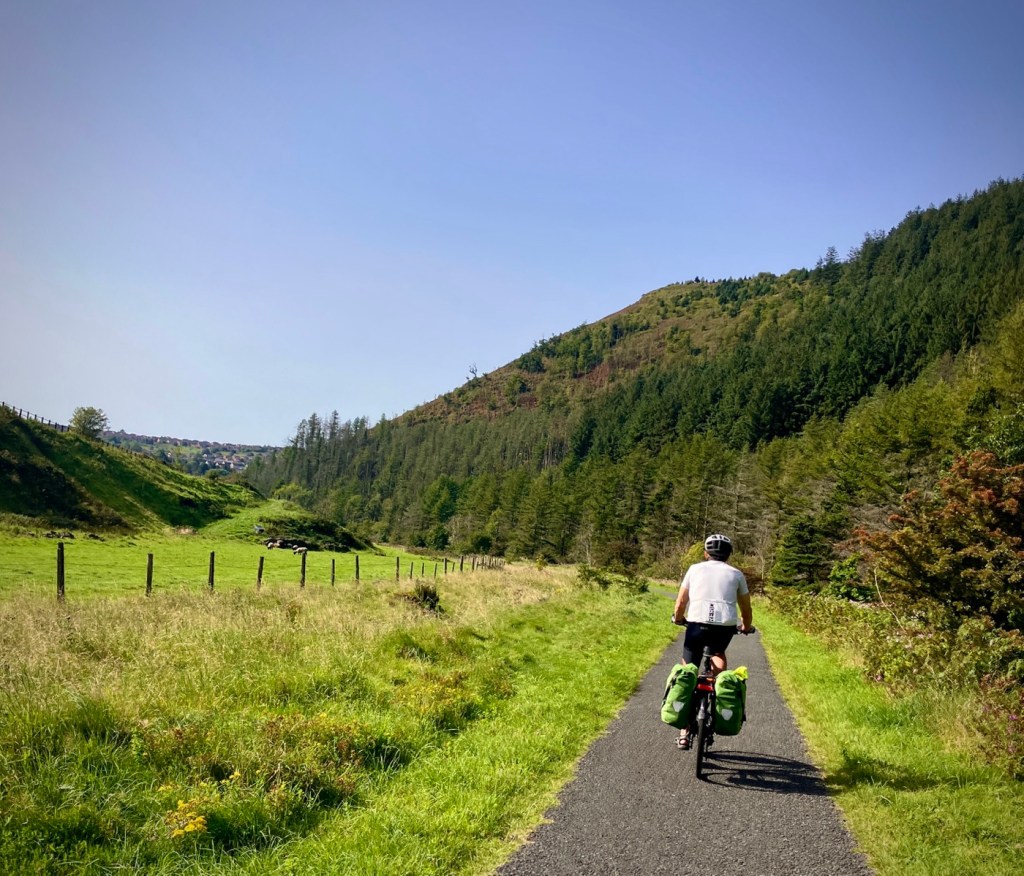
2. What is the nicest route.? Heading to a UK national route or Eurovelo was a logical choice and the western route out of Treorchy landed us in the Afan valley, which looked to have a beautiful rail trail along the Afan river. It was also the pass we looked at for 12 days from the deck of our house sit, so it beckoned.
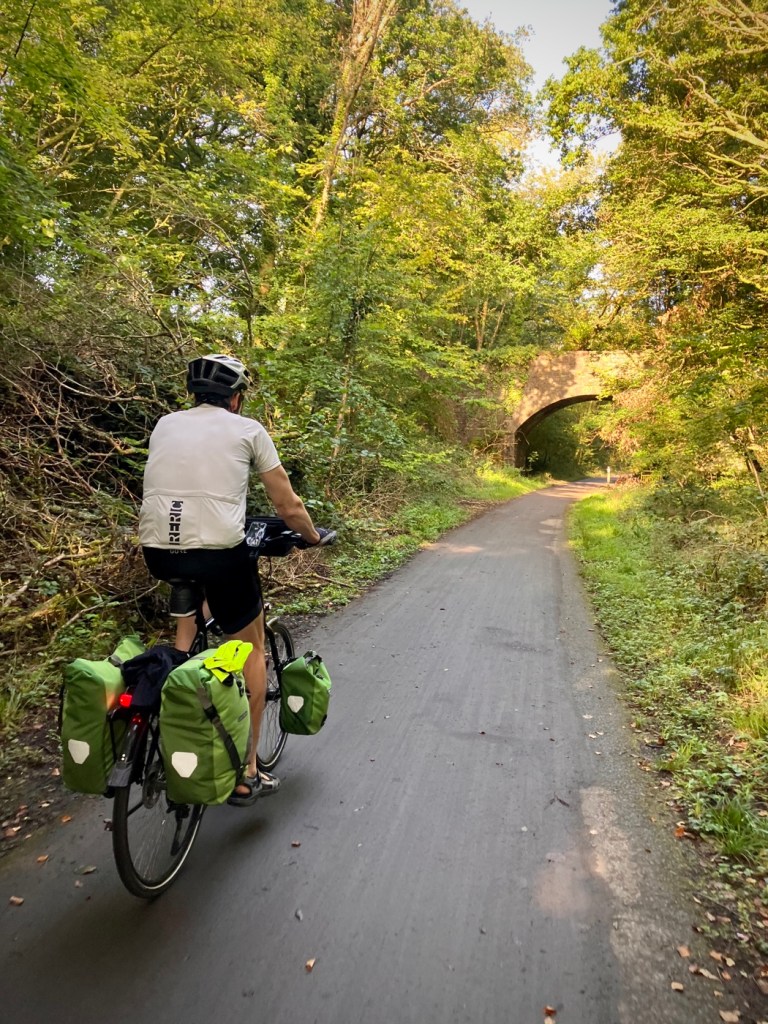
After a descent with some nice sweeping switchbacks on the A4061, you reach the start of National Cycle Route 887 and the Afan Valley Trail.This Afan Valley had its heyday at the turn of the last Century but has reinvented itself as a recreational hub, especially mountain biking.The historic Bethel Chapel in Pontrhydfen.More legacies of the coal and steel days in the valley.
3. Where can we stay and break up the trip comfortably? As our bikes are fully loaded beasts, we wanted to keep mileage in the 50-75k daily range, especially as there are a number of challenges in this region of Wales, primarily steep hills, strong winds, and frequent rains. We also were in no rush and wanted to enjoy the ride.
A relatively short 62k from Treorchy to Mumbles meant we had energy for some exploring.Hanging with the locals at The Pilot in Mumbles. And the heatwave meant magical evenings along Swansea Bay.Loaded up and ready to leave Mumbles.Day 2 on National Cycle Route 4 was nice, despite this warning for motorbikes.
Well, the steep hills were there, and we lucked out with virtually no wind. However, instead of rain, we had the unexpected challenge of a mild heat wave. It was shocking to us how hot you can feel and get in 82F humidity, but some of the afternoon climbs in full sun felt brutal.
The route from Mumbles to Gowerton follows an old rail corridor that last ran in the 1960s. The Swansea to Mumbles seaside railway was dismantled in 1960 but was the first horse driven passenger tramway in the world.
So we set out from Treorchy and headed up the beautiful pass. Perfect pavement, mild 7-8% grades, and great views. The descent down the back side was great and we finally hit the bottom of the steep portion and found our way down to the head of National route 887, the Afan Valley to Port Talbot.
Cheryl cooling down AND picking up trash from the Afan River.
We were excited to cycle this region as we had traversed it many times by car and train, but never cycled.
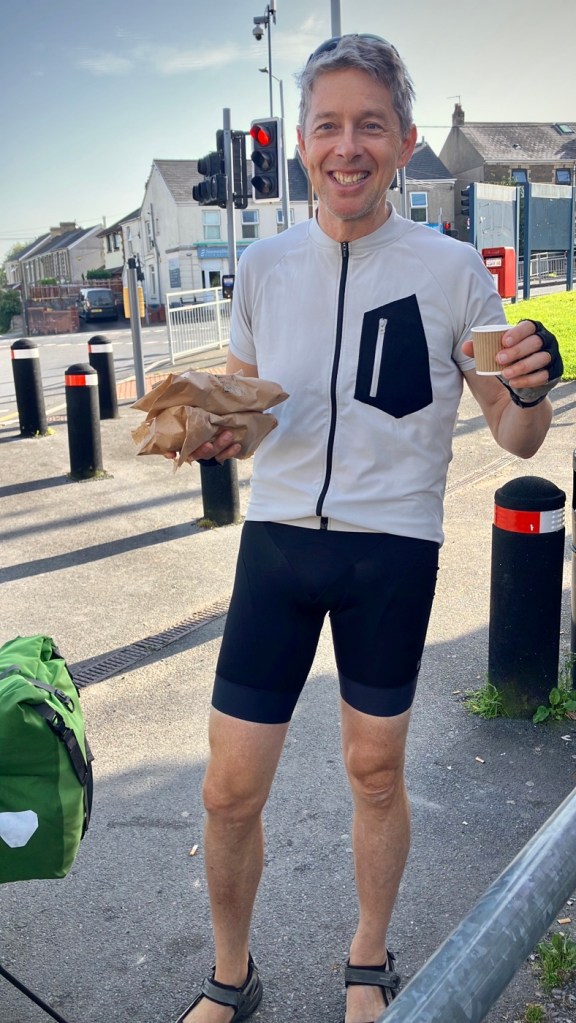
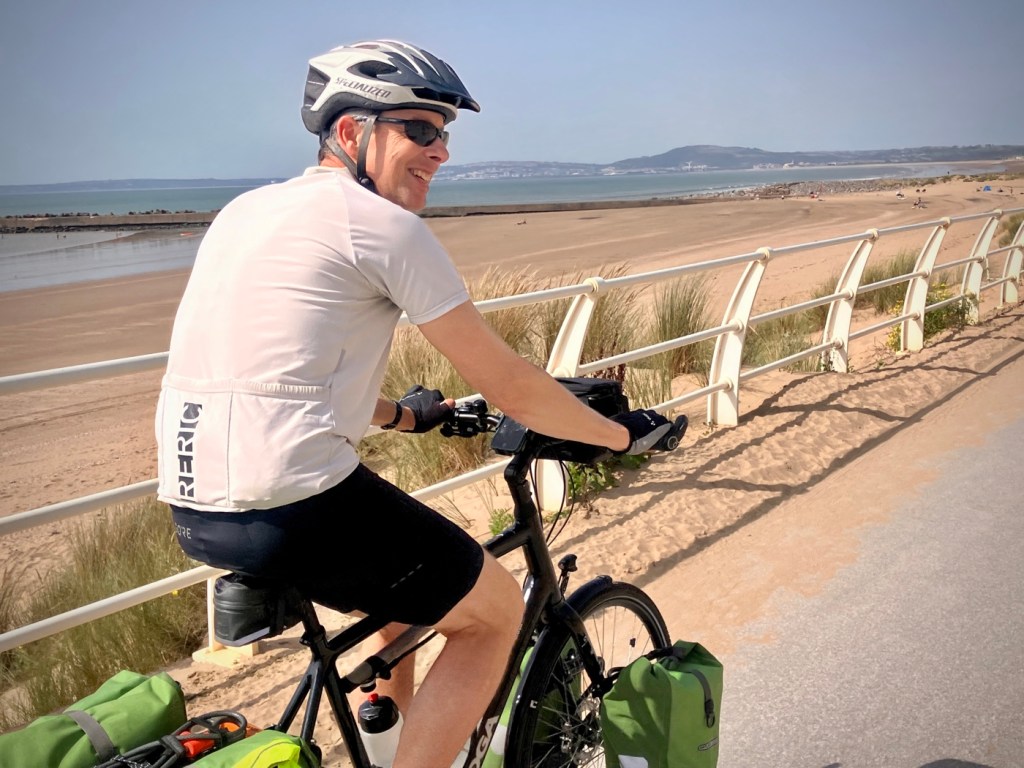
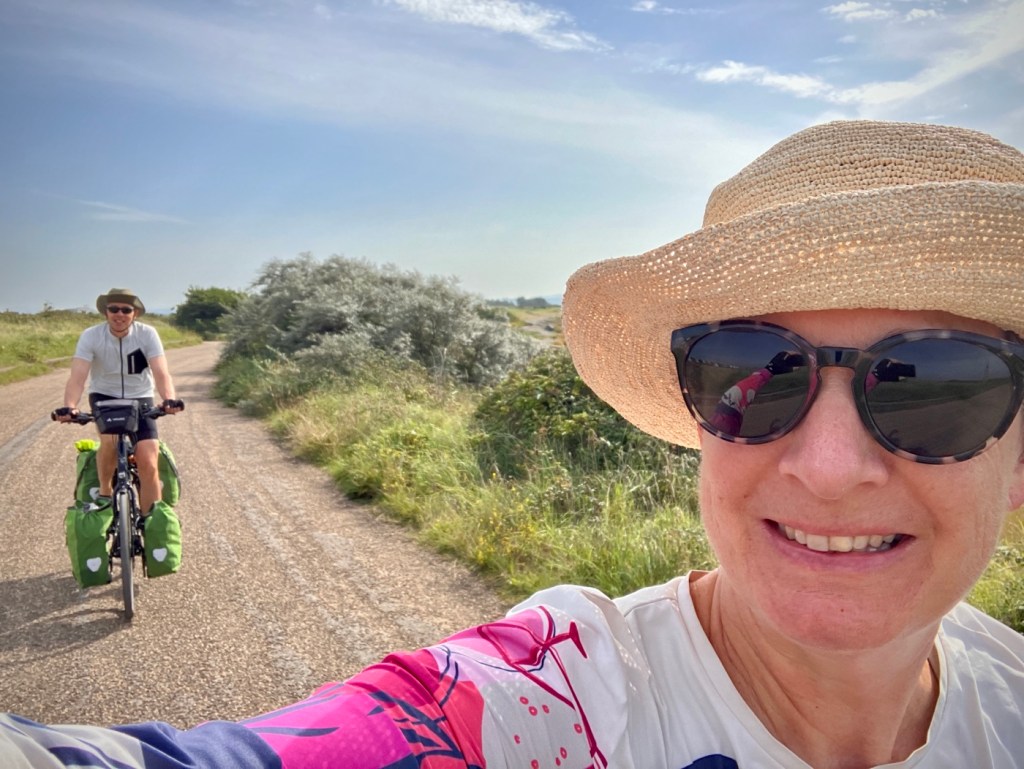
Homemade savory pies and a double espresso. aka “Brunch”.Finally reaching the Aberavon beach promenade in Port Talbot.Along Carmarthen Bay. Cheryl took most of the photos these days (I was on a heat strike), so she needed a selfie to prove she was there.My Tilley for shelter on the hot backroads as we turned inland again along Carmarthen Bay.
Cars were very considerate for the most part. In fact, so many waited for us along small lanes at pull outs, even when we were climbing up hills at a snails pace, we often felt we needed to tell them in was fine to pass us slowly. The slower pace is a refreshing differentiator between lower density Wales and much of high density England.
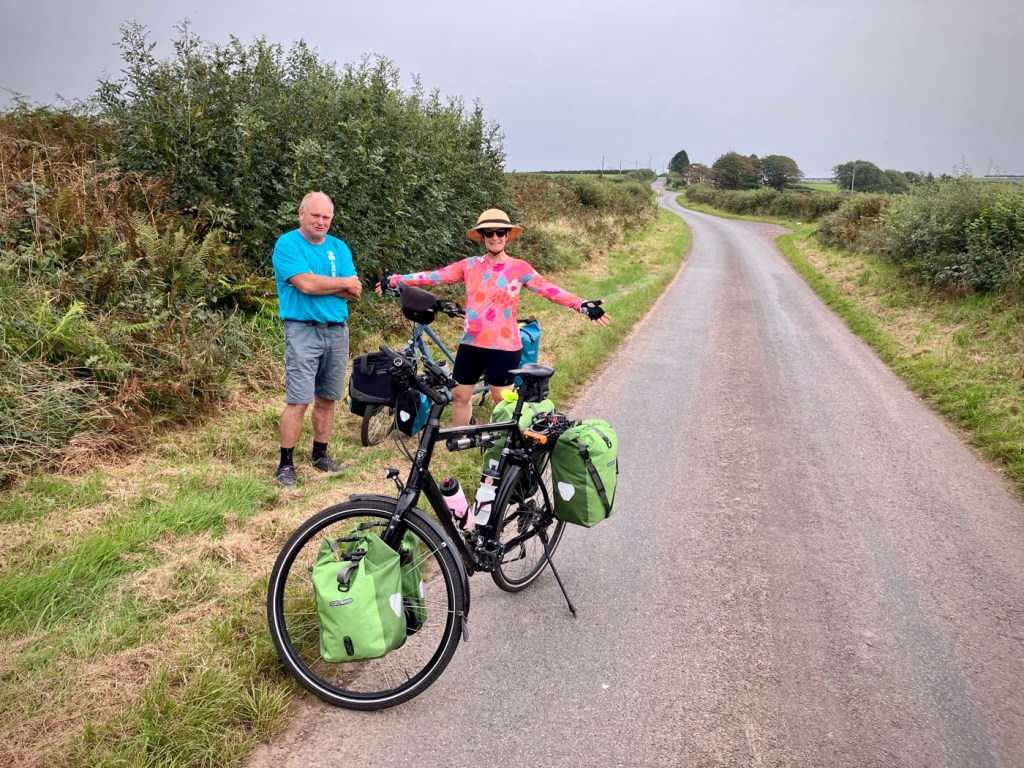
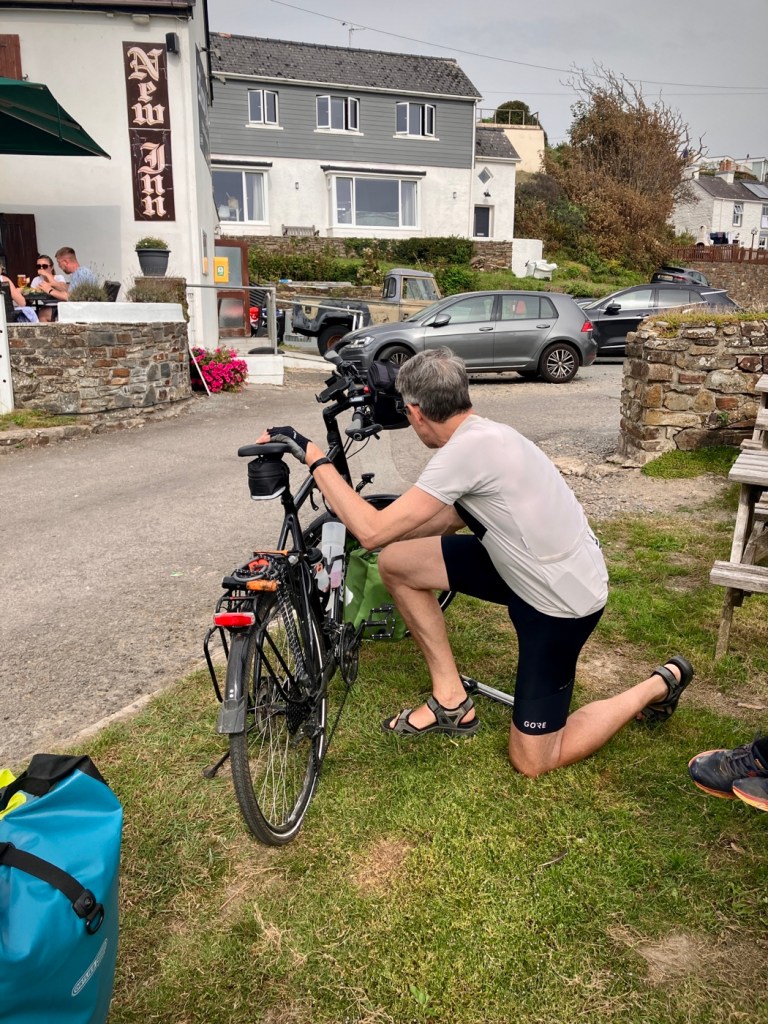
What are the odds of meeting up with a local we know in Wales? Pretty good apararently, as our friend Alex drove by us on this county road. So we all met down the road for a pub lunch in the lovely and rare warmth.Bragging about our 3 1/2 months without a flat finally caught up with me after our pub lunch in Amroth. (Still love our Schwable Evolution /Almotion tires though.)There is some nice new bike infrastructure along NR4 in Wales and it was definitely better than the segments west of London.
We did have some poor youngsters in the Swansea area try spook us by yelling out their car windows and screaming as they passed us, but to no avail, as one skill we have learned in 30+ years of urban cycling is the art of road zen and “zero response”. We both equally ignored them (we were riding apart) so perhaps they won’t even bother next time they see two lone cycle tourists on the cross country cycle path.
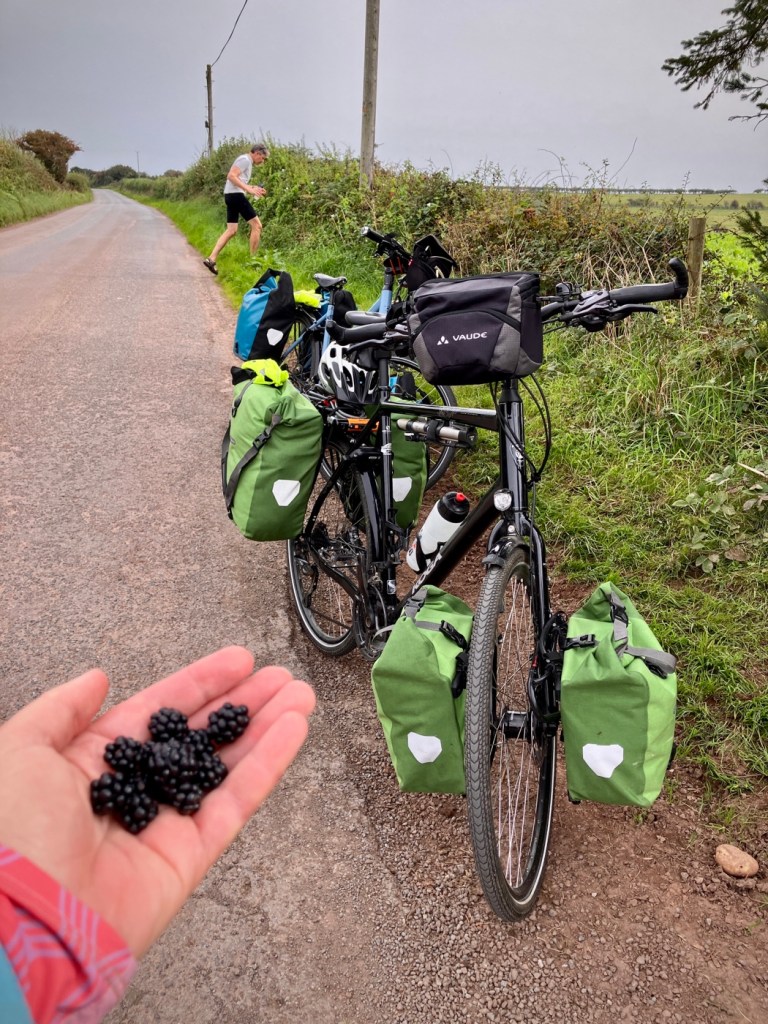
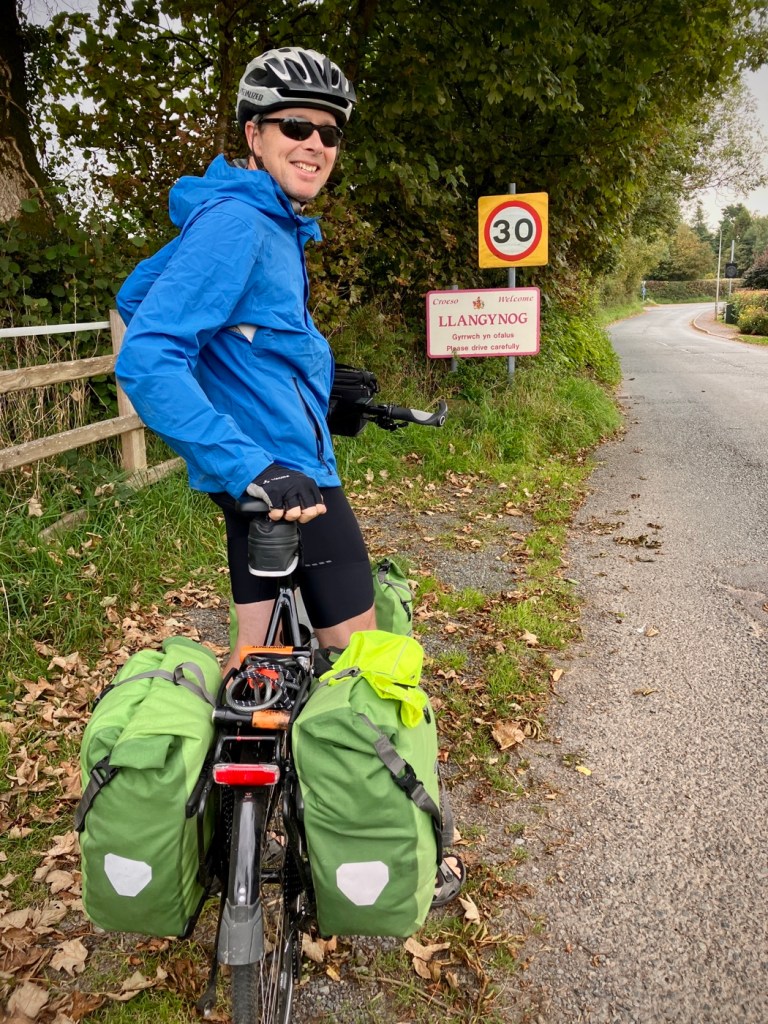
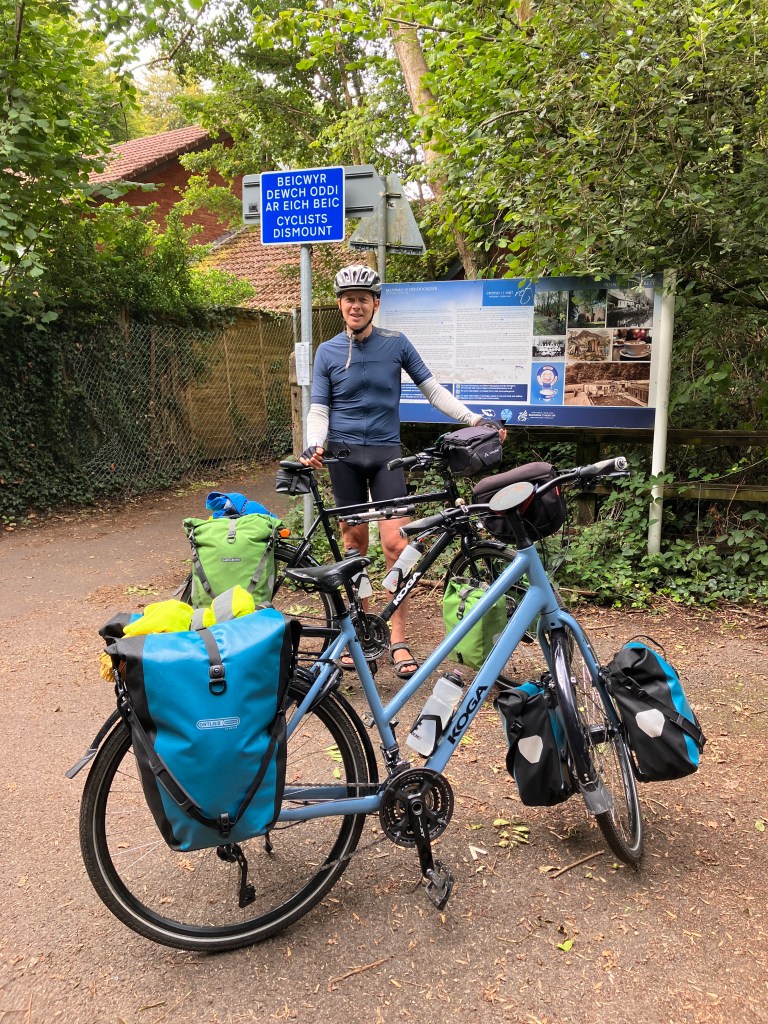
Getting close, the path from Amroth to Saundersfoot escapes a few climbs by passing through three short tunnels.So hot, but time for a refreshing blackberry break.Heading out of Day 2 B&B in Llangynog. A little steamy morning rain-mist set in on the hill, but the jacket still came off in 5 minutes.
A physical threat with a vehicle is another matter, but this was just cheeky youths yelling to try to impress their mates. Cheryl even takes a more positive spin by saying that she was sure they were yelling positive words of encouragement! (Not an indecipherable Welsh-English slur.) And that’s why she is such an amazing travel companion; always keeping on the sunny side and assuming the best in people -:).
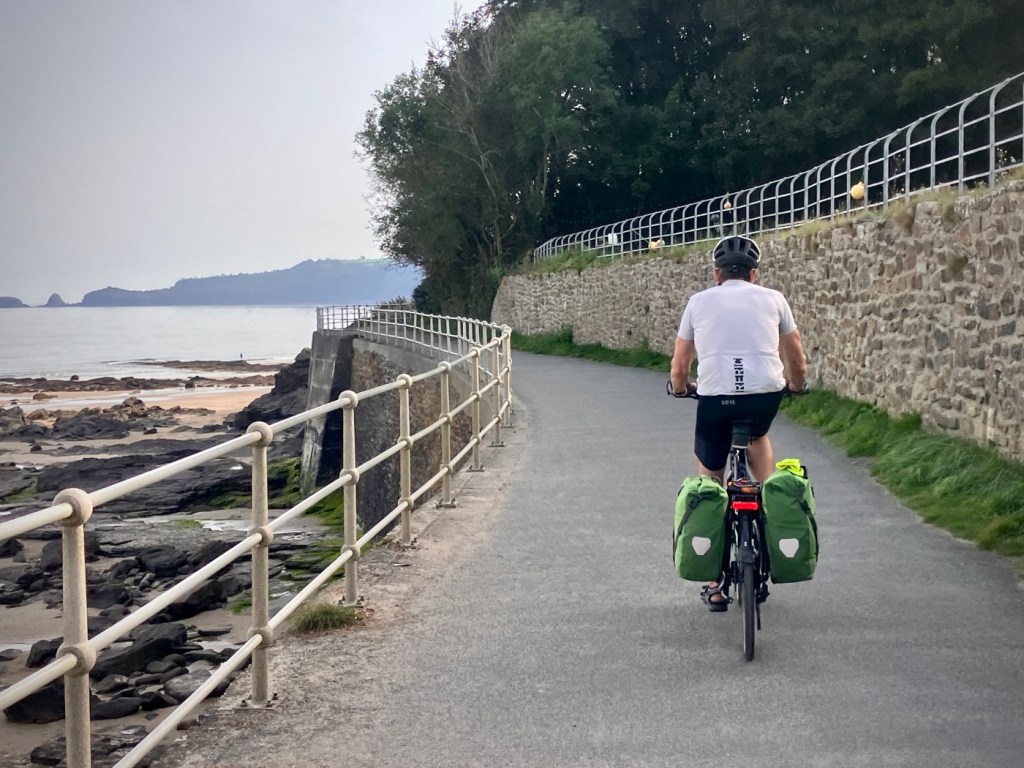
The final ridge before Tenby. Pembrokeshire coast cycling is not for the leisurely as the ups and down are constant!
Overall, it was a wonderful three days minus the hot afternoons. Cycling in Wales and on much of the National Cycle Network feels adventurous as the conditions can vary so wildly, and you encounter few others on the way, except around some city areas and popular stretches of rail-trail, river, or coastal paths.
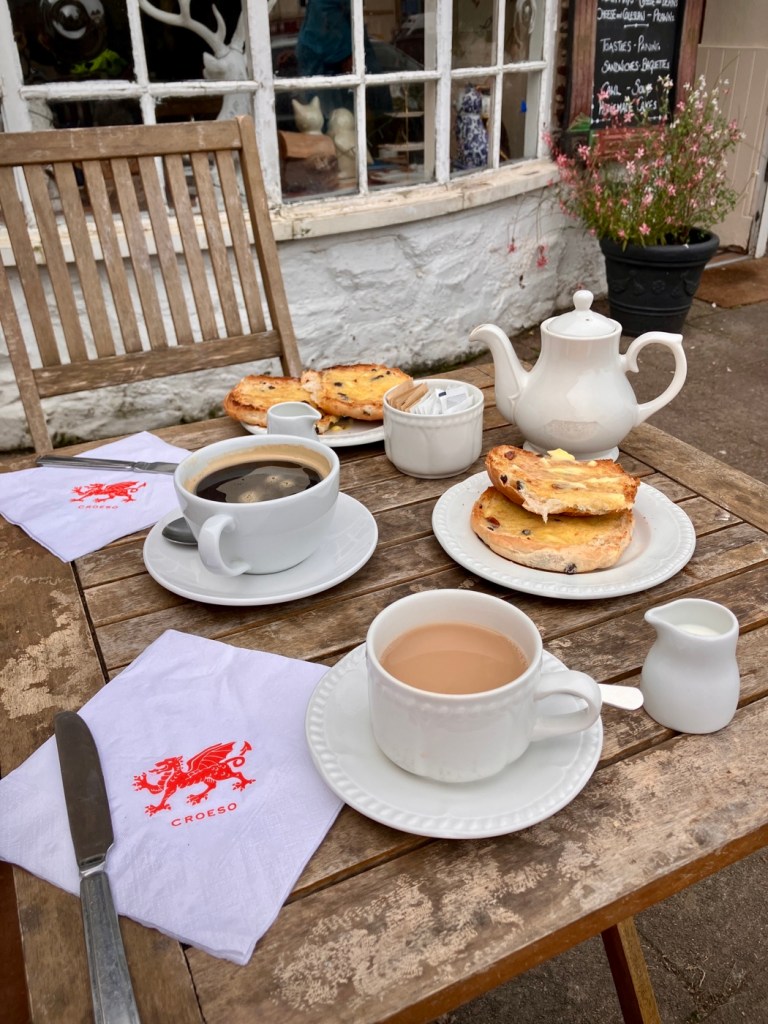
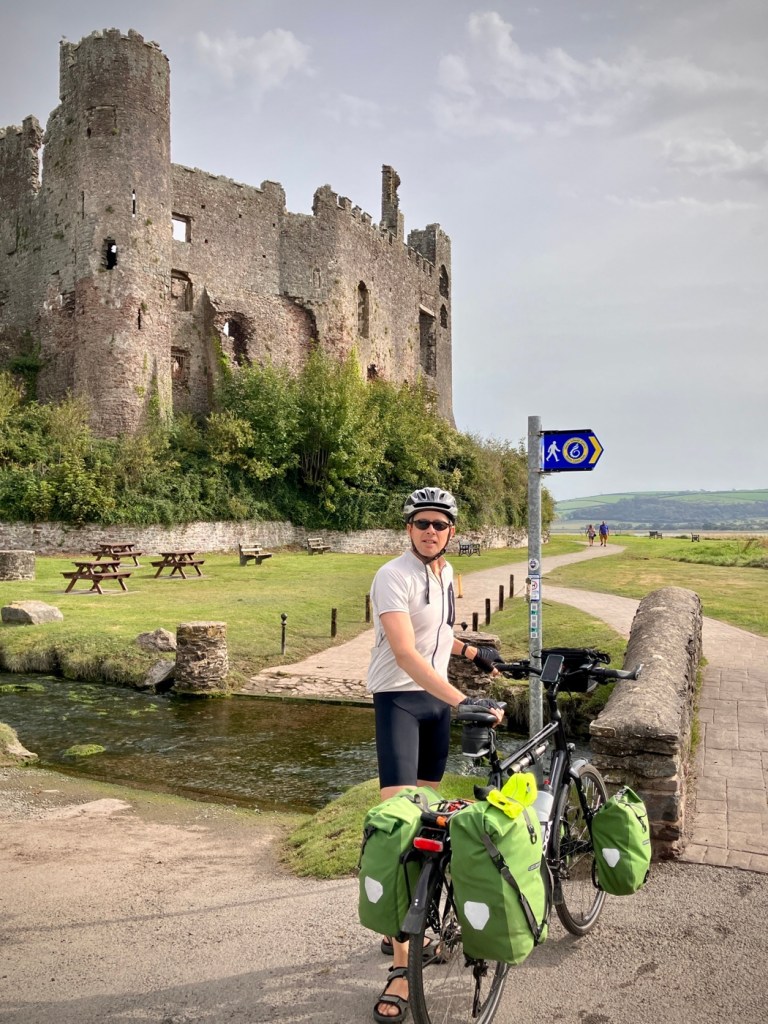
Our new favorite snack, Welsh Tea Cakes smothered in local butter.The medieval and stunning Laugharne Castle.The reward was six great days with our most generous and dear friends in Tenby.Our friends took us out for a great afternoon on the water and swimming at a secluded beach.
So we decided that we definitely want to come back and cycle more in central Wales, where smaller green hills, and small lanes are coupled with the Welsh friendliness. Apparently a new route is being developed there, so we look forward to exploring it…maybe in 2024.
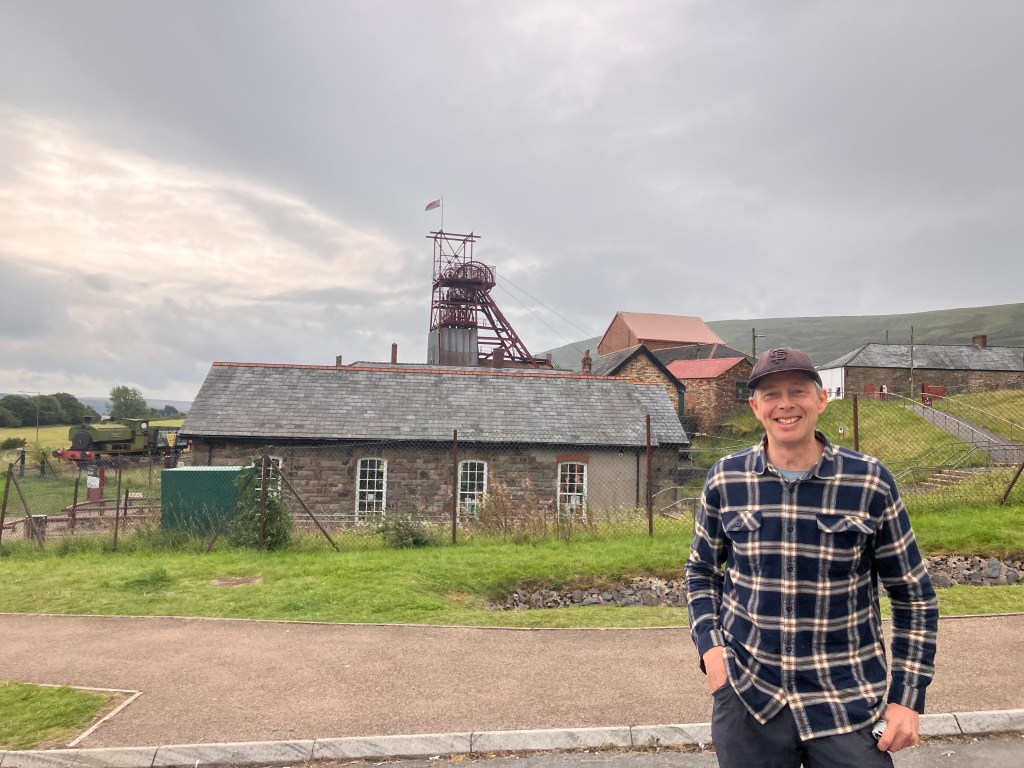
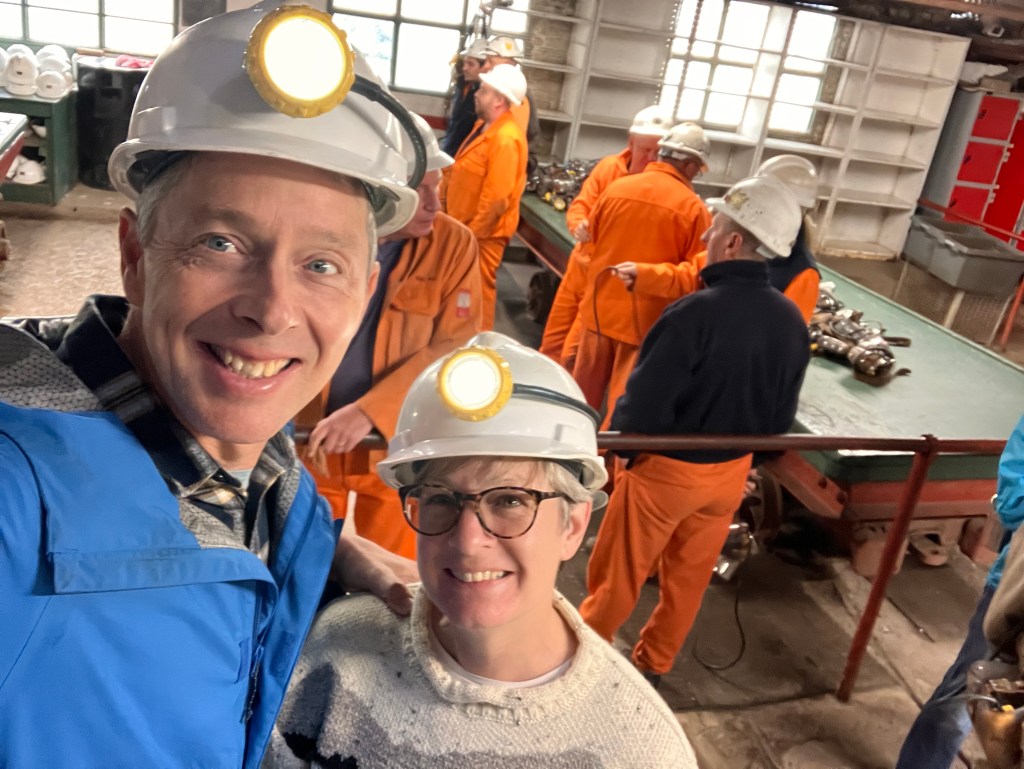
Rich at the Big Pit Coal Museum in Pontypool, Wales.
What makes us happy? Returning a rental car! Although we were so grateful to have the opportunity to explore the valleys of South Wales, driving is never our favorite form of transportation. Really I should clarify that Rich drives and I try to be helpful and supportive. As he noted today after we returned the car in Cardiff, we’re not the first couple to get into a fight in a rental car. But, for the moments of stress and breathless passing of other cars on narrow streets (knowing that a damaged wing mirror was £200 per the rental agency, and we saw plenty of cars with damaged mirrors.), there was so much excitement and happiness as we got to visit places that would have been impossible on public transit or as day trips by bike from our house sit.
Ready to descend into the pit by cage.
Wales is beautiful. The coal valleys of south Wales have such a rich and heart wrenching history. The Big Pit Coal Museum is so packed with history and details and artifacts and machinery it’s overwhelming. But, the history of Wales is everywhere in this region. Our introduction to Welsh coal mining history started with our bike ride from Cardiff to Treorchy, where we had a lovely house sit for 12 days.
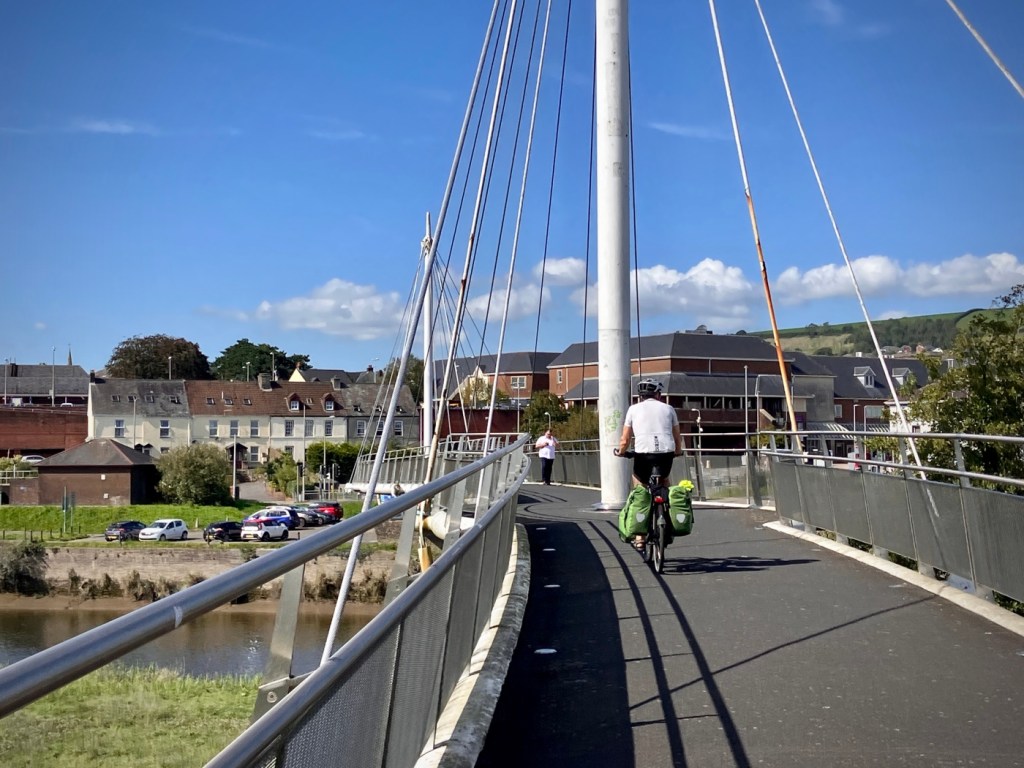
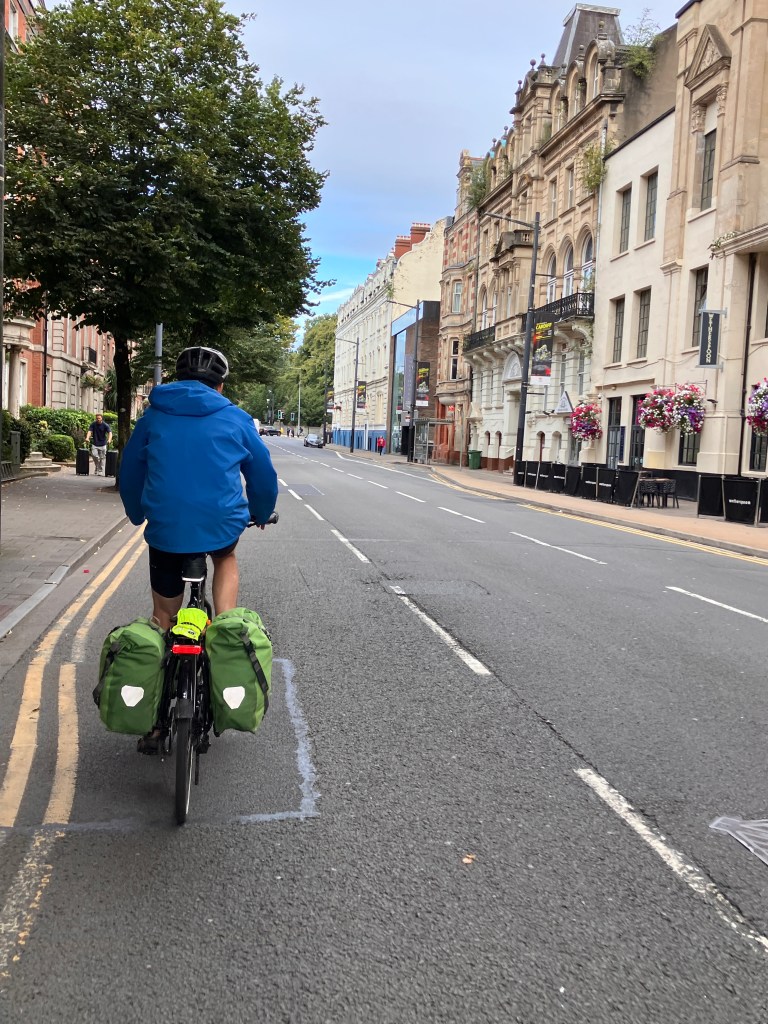
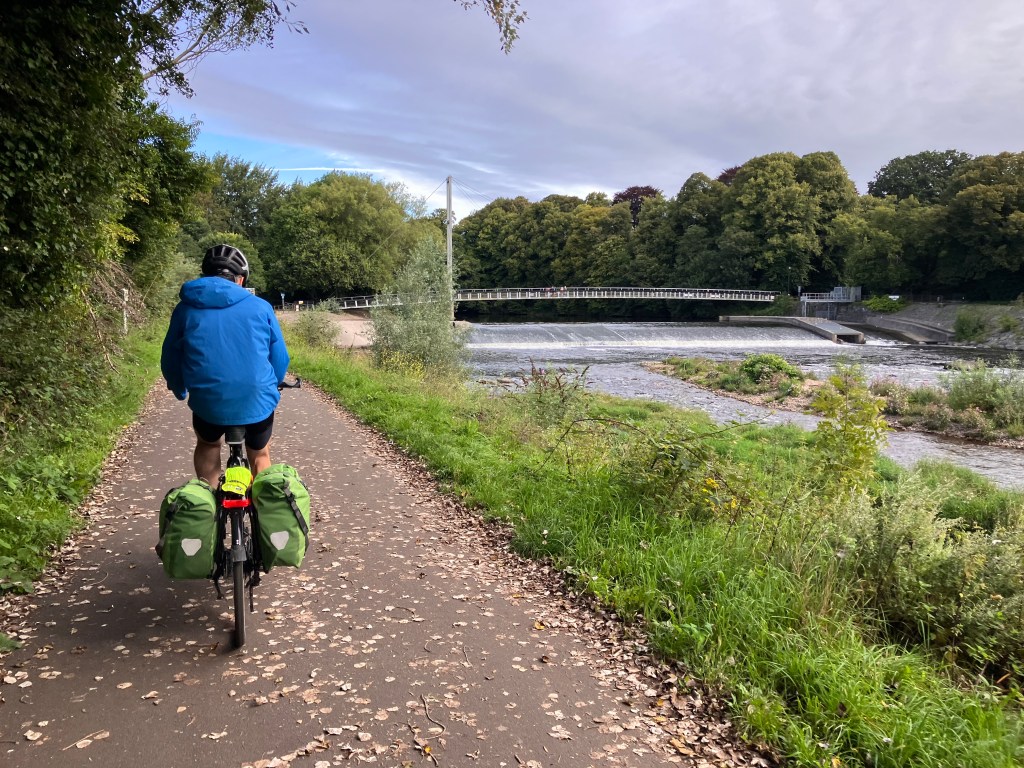
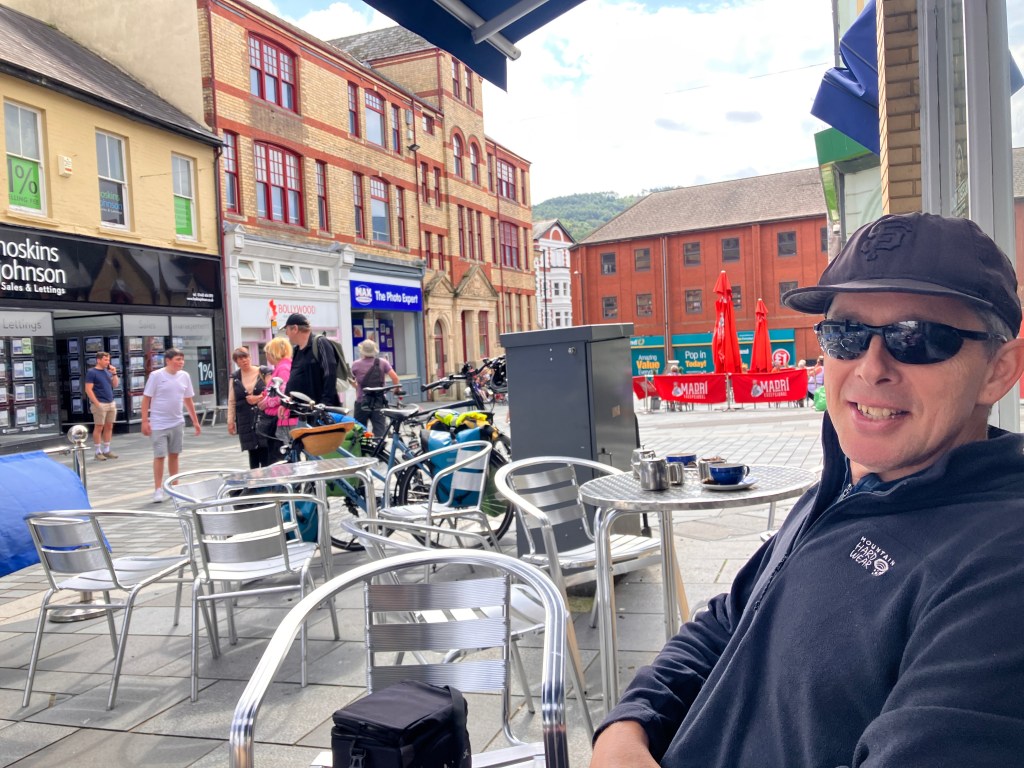
Rolling out of central Cardiff to the Taff River trail. A very quick transition from city streets to the river trail.Helmets off to all the agencies who coordinated the trail and history information boards.Eurovello 1 bike route.I wonder how many rail-trails we’ve ridden? Lunch in Pontypridd. A lovely surprise of a town.
Riding into a town where you hope to have lunch and finding not a high street cowering in the face of car traffic, but instead a pedestrianized charming core really made us happy. We usually have to search for a spot where we can keep an eye on our bikes while we eat, maybe through a window or from an outside table hopefully with some shade and not to close to car traffic, but Pontypridd made our day with its car free and wonderfully lively shopping streets.
Not one little pedestrian section, but an actual network. Window shopping by bike while rolling slowly through town.Barry Sidings Countryside Park.
Pontypridd is the beginning of the Rhondda Fawr Valley, named for the Rhondda River. As we would learn, coal mining changed the valley from a sparsely populated rural area to a teeming coal based economy.
Always stop for the information boards. Those in the Rhondda Valley and along the Taff Trail are particularly compelling.
The transition to coal came with a very high price. As the above photo states “ In Britain between 1868 and 1914 a miner was killed on average every six hours and seriously injured every two.”
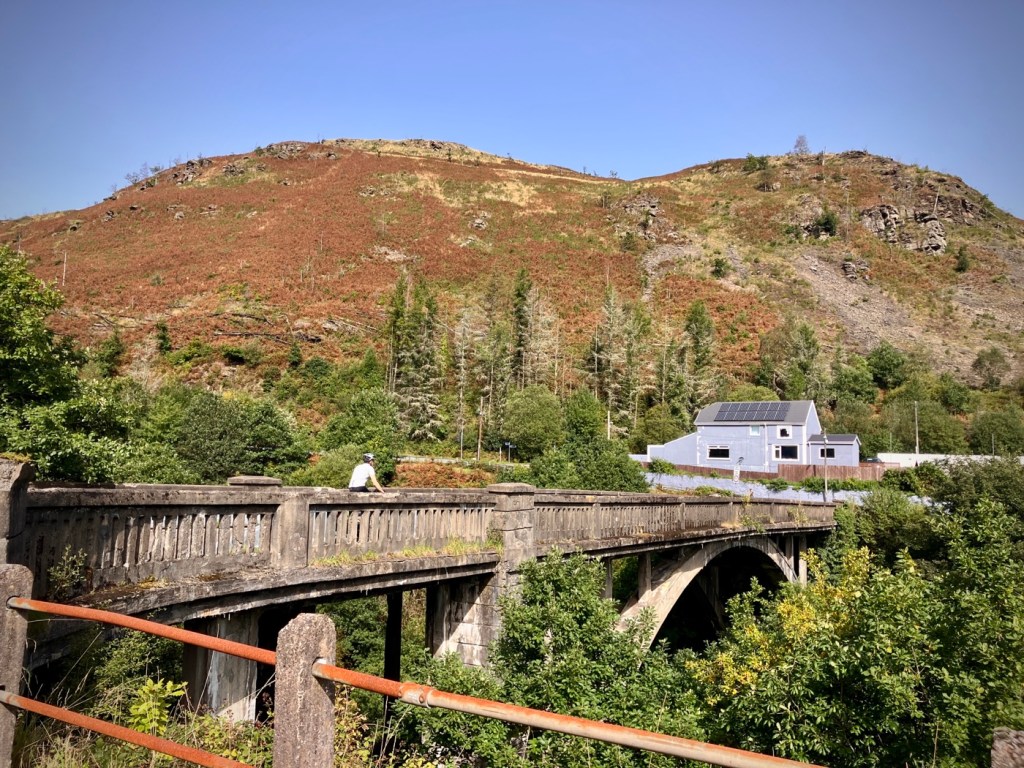
The Rhondda River. The geology makes for such a dramatic river course.A colliery looming over the river.Rich riding into Porth, and one of our first views of the terrace houses that were built to house the colliers and their families. At the high point of our climb from the Rhondda Fach valley before we dropped down into Rhondda Fawr.
We settled in to our lovely house sit with the wonderful cat Tibbs, for whom we quickly came up with a variety of nicknames, as we charmed and fed our way into her heart, and she into ours.
A snoozer and a champion lap sitter.
We had arranged a get together with another nomad couple who were in their campervan not far from us. We met up for a walk and a pub lunch and hours of chatting. When you live a nomad lifestyle like ours it’s nice to chat with others with the same kind of life. We always learn so much from other nomads and come away with great recommendations for places to visit and how to overcome challenges.
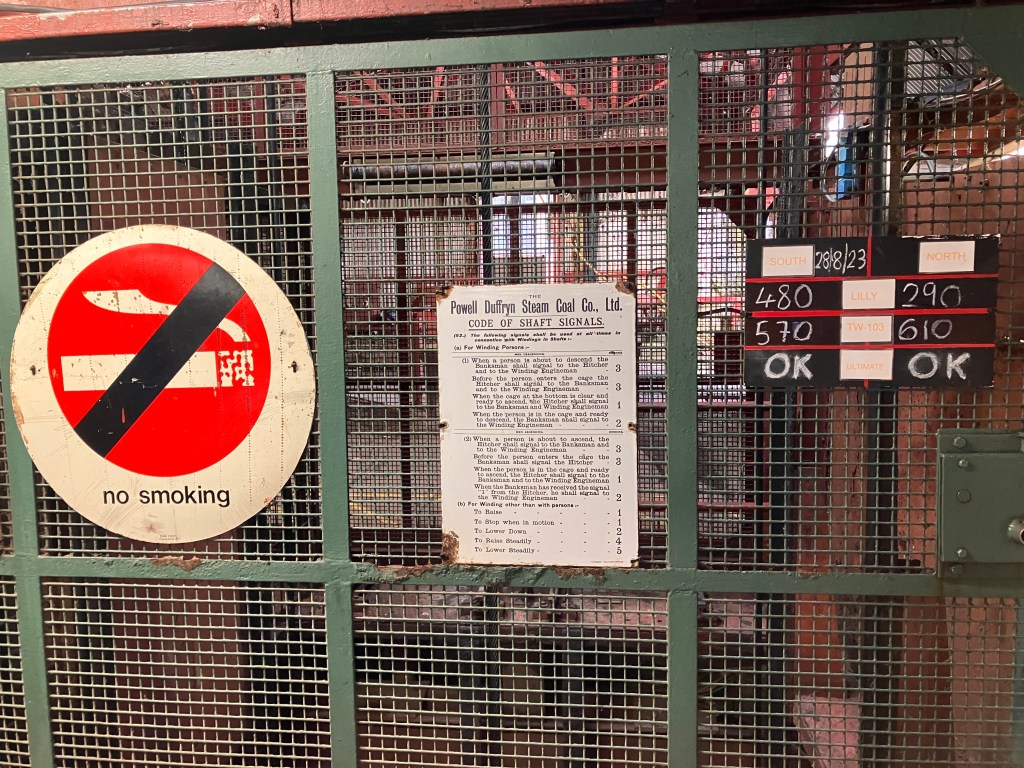
Hi Steve and Linda! Hope to meet up again somewhere in the world. The cage. Don’t call it a lift or an elevator!
The first question you get about your visit to the Big Pit National Coal Museum is “Did you go down?” Down into the mine in the cage. At 300 feet below ground this isn’t one of the deepest mines in Wales, but the hour long tour, led by a miner, is so unique and educational. No phones or cameras are allowed down since although this isn’t a working mine, it is still considered an active site and anything that could possibly trigger a spark or has a battery is not allowed. It’s a good thing to be forced to leave your phone behind occasionally, you do focus more, and images are etched into your memory instead of saved in your camera. As we stood in the stall area where the pit ponies had been stabled, our guide, Peter, had us all switch off our headlamps to experience the complete darkness of the mine.
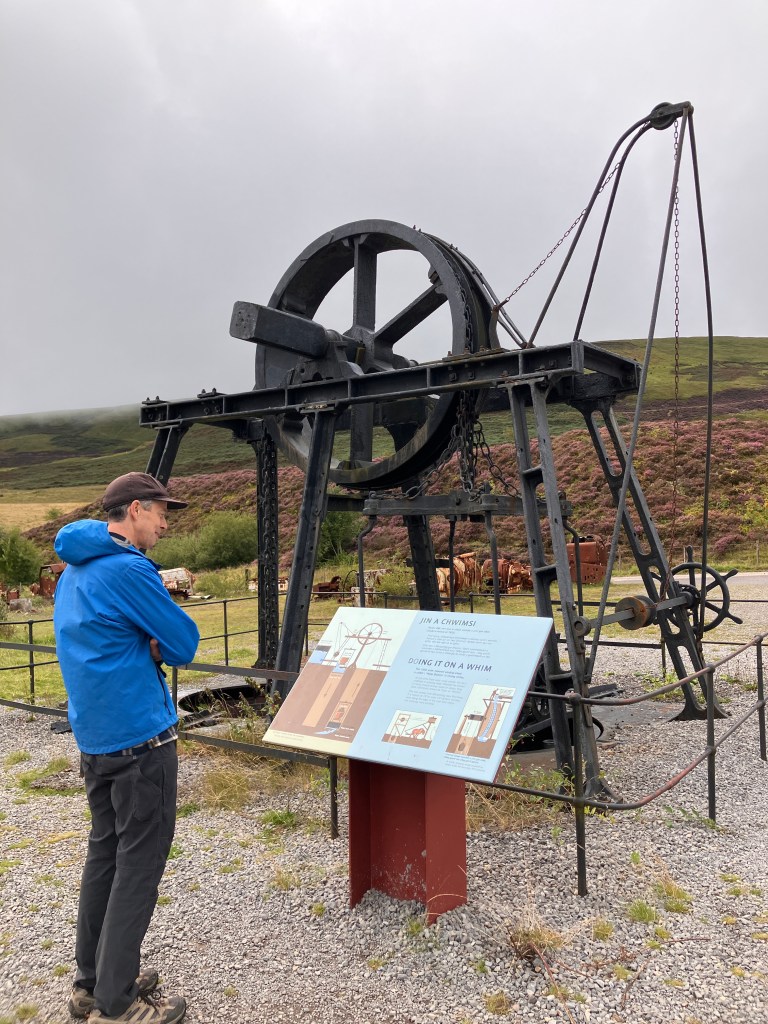
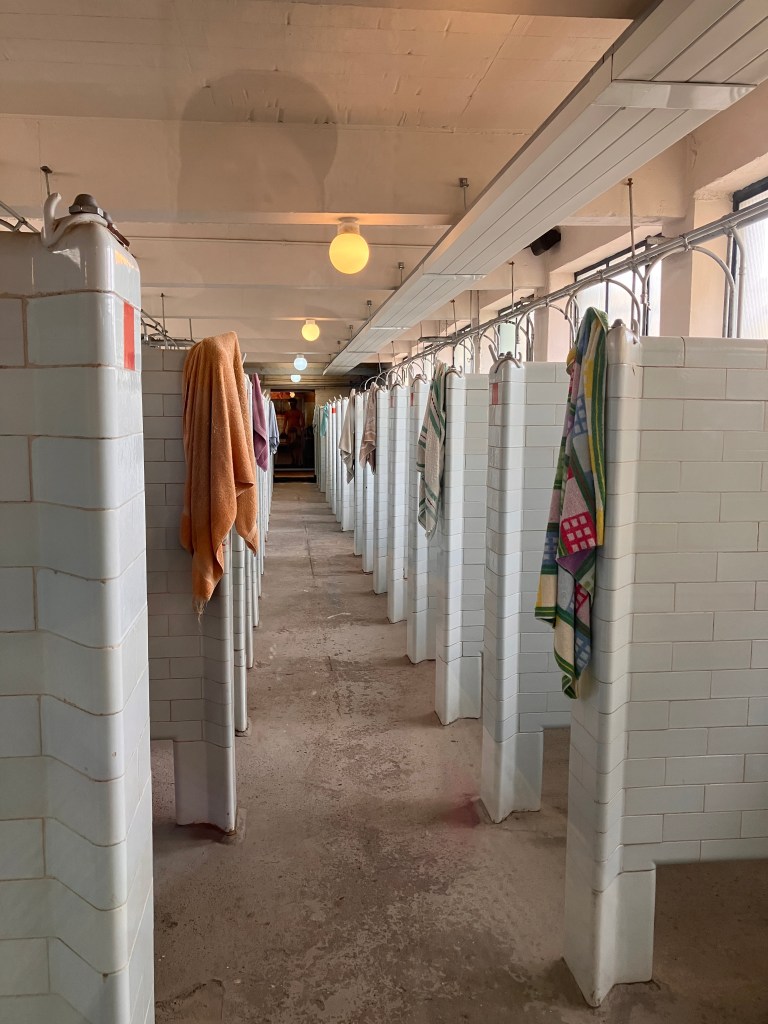
Big Pit, big Rich, and the moors of Blaenafon.An 1850s water powered winding wheel.We were told by locals how they remember riding buses with men just off shift at mines, and how dirty and dusty they were. The baths helped change that.Lockers in the miners bath house. Utilitarian and much welcome shower facilities.
We learned so much about the life of the miners, and although the grit, strength,and pride of the miners is clear, it was a grueling job done under some inhumane conditions.
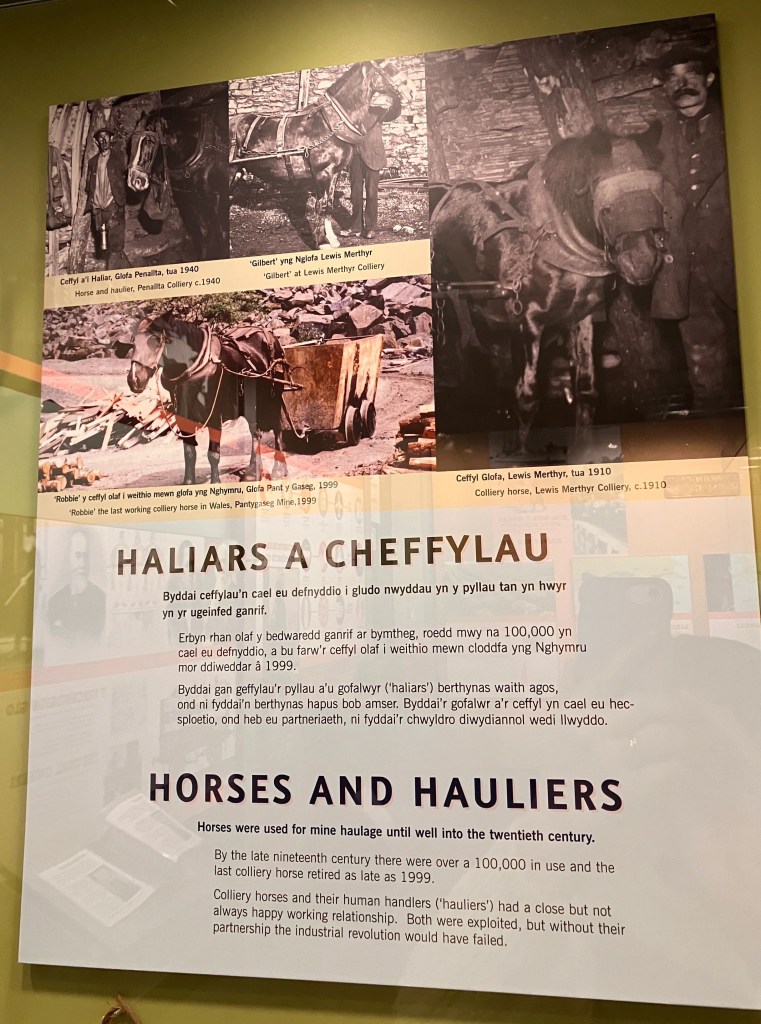
Biographical information on some of the lockers was intense. Yes, miners started as young as 12, even younger before the 1842 regulations passed.Happily examining all the mining items – so much information.The horses of the coal mines.
Our tour guide called them pit ponies, and the stalls where they lived when not working were 300 feet underground. Although that was awful, and hard to imagine, it was pointed out that the ponies were assets for which the company had spent money, and so they had a vested interest in keeping the ponies healthy. The same couldn’t be said for the miners.
Big Pit Coal Museum.
We went away with a much fuller understanding of what coal meant to Wales, and why the coal mined in South Wales was so valuable. As with many extraction based economies, the profits went to the owners and investors, and when the mines were nationalized and ultimately shut down, entire areas were plunged into poverty. I felt the Big Pit did a good job of telling the story of coal, and its impacts on Wales, negative and positive. The museum hasn’t been updated to include the impacts of fossil fuels on our planet, that would be a good challenge for new curation. I can imagine a team of museum scientists adding a fascinating section on climate change and the impact of coal. Although the story of the mines is about the folks working and living in Wales, the reach is global.
Our next visit was to St. Fagans National Museum of History.
Visiting museums can add up for families, taking the kids for a day out and paying per person can get expensive. I really like that the National Museums in Wales charge for parking, but entry is free. There are ample opportunities to donate either in cash or with tap cards, and we always do. This was my second visit to St. Fagans, I visited decades ago with my friend Hannah who grew up in Wales. We couldn’t remember exactly when it was that we visited, but we think about 30 years ago.
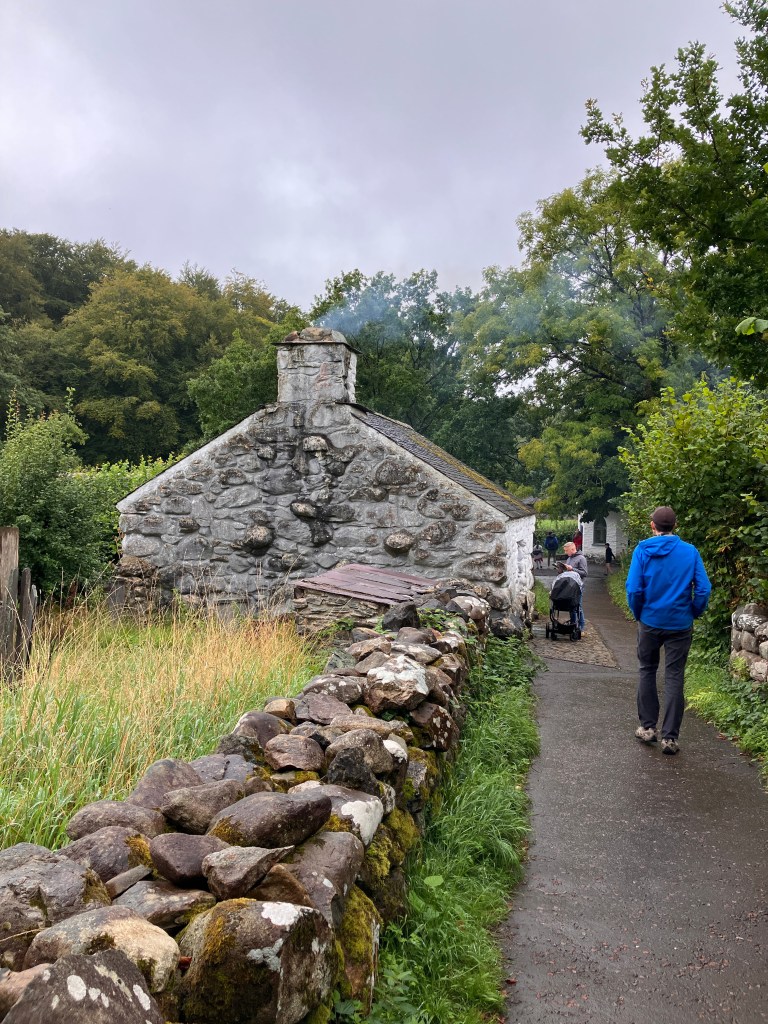
Do you see the smoke from the cottage beyond the sheep field?
If you are imagining a large building full of glass cases with artifacts, stop right now! This is an open air museum, with buildings relocated from all across Wales, rebuilt on site and furnished according to the time period being featured. That noise you just heard was me squealing with delight- this is my favorite kind of museum. You get to walk around lovely grounds and go into buildings that look as if the inhabitants have just stepped out. Since it was a chilly rainy day most of the buildings had fires burning which upped the level of atmosphere.
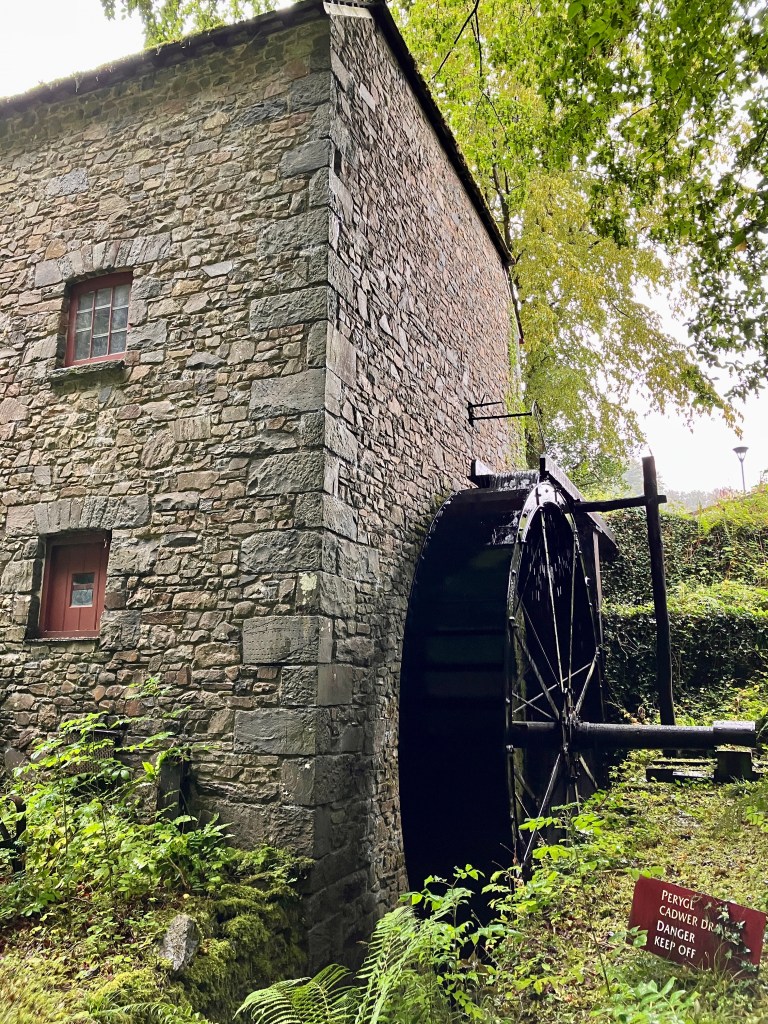
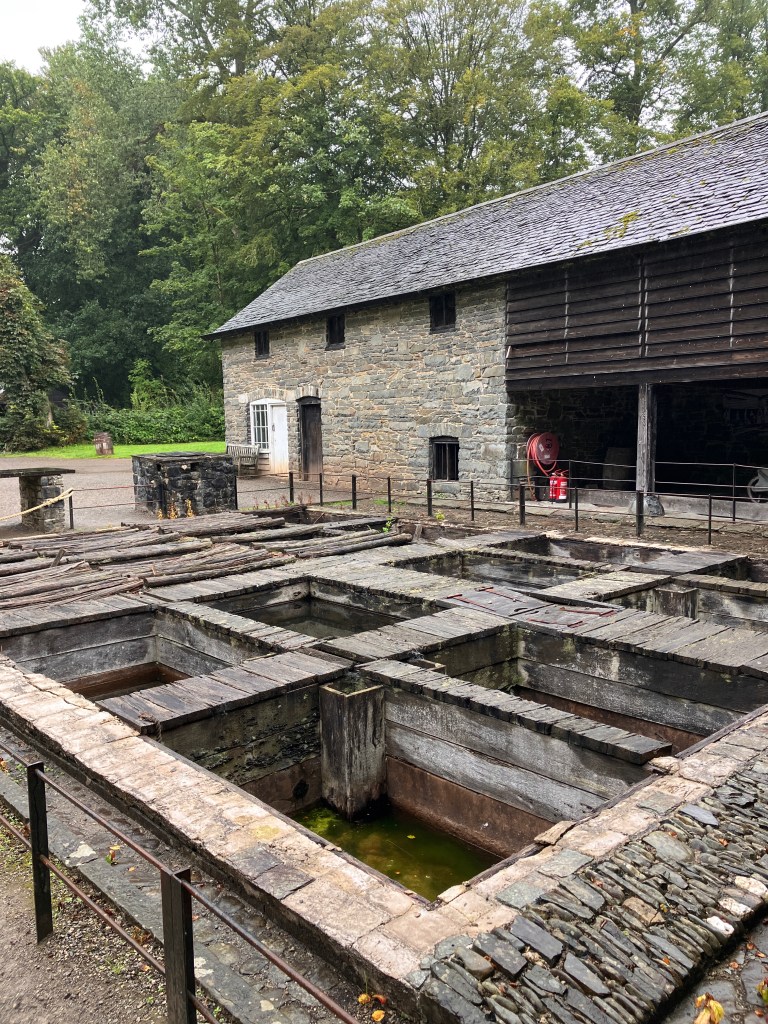
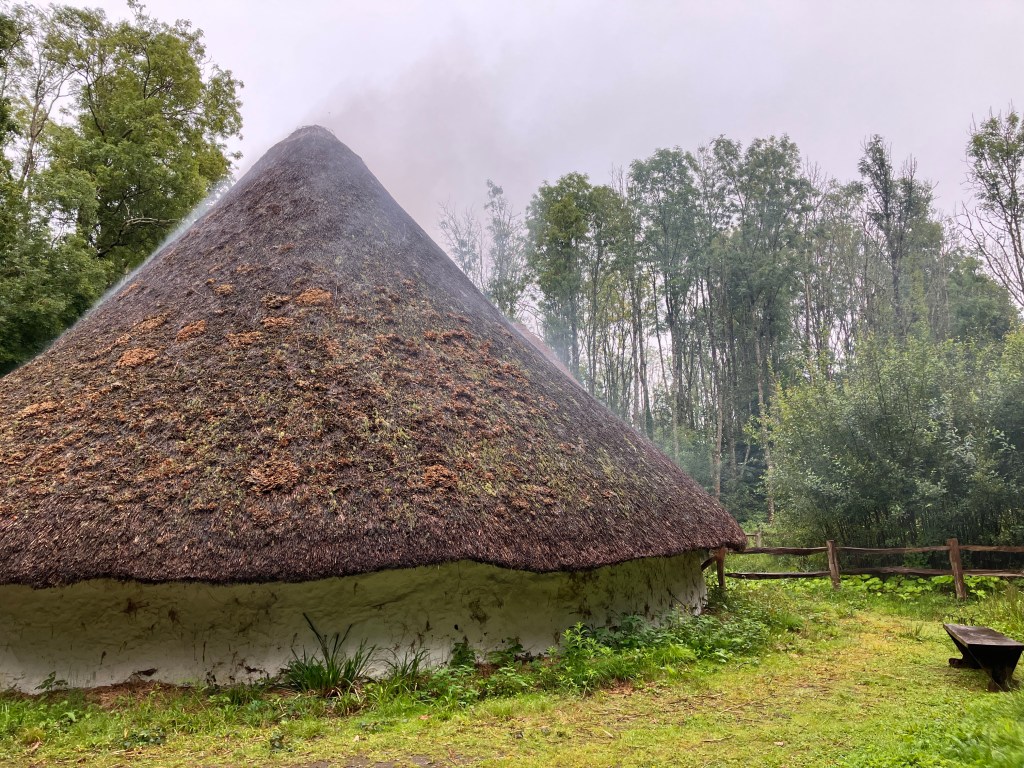
A pigsty. Why is it round? Because pigs dig, and the lack of corners helped prevent them from digging out.I love water wheels as much as I love open air museums. A tannery. We visited an active tannery in Morocco and it looked so similar. This one smells a bit better, and is now occupied by newts, which we sadly did not see. After a stop for tea and Bara Brith, a traditional Welsh tea bread, it was off to the Stone Age huts! Rich is trying to look cranky but he was as excited as me. Ok, maybe not quite. Why is the thatched roof steaming? It’s smoke. From the fire built on the floor. No chimney meant the smoke just seeped out.In case you are wondering, yes, it was very smoky inside. The very knowledgeable staff member inside was wisely seated on a log, staying low and mostly out of the smoke. Information signs in Welsh and English gave good background and showed where the building originated.
A museum guide told me that since I had last visited, approximately ten buildings had been added to the site. The decision to include a building depends on quite a few factors, including a compelling back story or history about the structure.
1544 farmhouse.Just walking around the 100 acre parkland was pleasant.
Possibly my favorite buildings at St. Fagans are the terrace row houses. The six are displayed as they would have been in 1805, 1855, 1895, 1925 1955 and 1985. Originally there would have been a community oven at the end of the row in which the women would bake bread. Terrace houses are all over Welsh coal country, so ubiquitous you can almost stop noticing them.
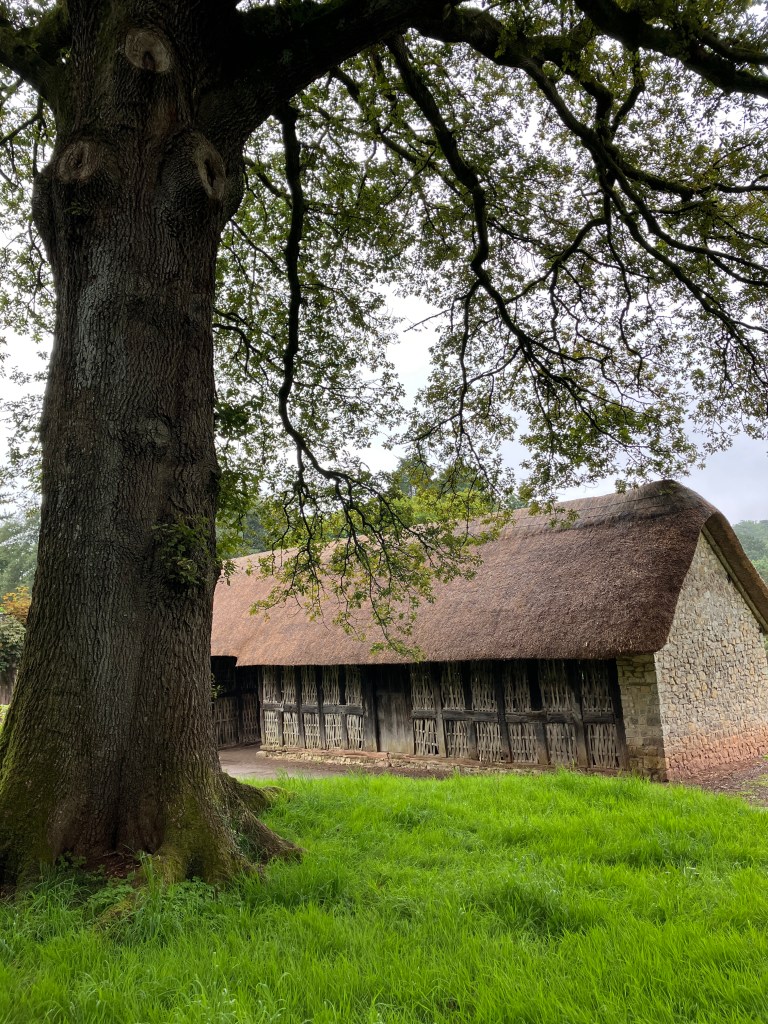
From the Big Pit Coal Mining Museum.A street in Treorchy. We were told by a local there were 16 mines near town. I was pleased to get a photo with not many cars blocking the view of the houses.Looking down on Cwm-parc terrace houses as we climbed the hill out of Treorchy. There once was a colliery in the valley to the left of the photo.Looking towards the terrace houses from the gardens. When you entered the houses you started to see the modernization through the decades.The outhouse. Rich warming up in front of the fire, while managing to not hit his head on the decor.A cock fighting pit inside a purpose built building. Stryd Lydan Barn. From the museum description: A cruck and timber-framed barn, the walls are wattled using flat chestnut laths woven vertically through horizontal staves. The building is thatched with wheat straw.
The grounds at St. Fagans are absolutely worth a visit even if you don’t care about old buildings and history. Which would be impossible, I think, once you start walking and reading the signs and imagining how life was for folks who lived in these houses. Happy to have gotten to visit both these National Museums, we returned the rental car and got ready to pedal out of Treorchy and on to visit good friends in Tenby over a few days of Welsh heat wave.
The happy travelers in Pontypridd (The name Pontypridd is from “Pont-y-tŷ-pridd” the Welsh for “bridge by the earthen house”) Thank you Wikipedia.





























































 Less Car, More Life