A Rift in Our Travels

After three days of romping around Taipei and getting over our jet lag, we set off from the city on a big clockwise loop of Taiwan.

Rail is in my heart at the Hualien Railway Culture Park

We were excited to head out of Taipei Central to Hualien City, at the north end of the East Rift Valley. Hualien is a city reinventing itself with culture and art, and is now more than a gateway to the immensely popular Taroko Gorge.
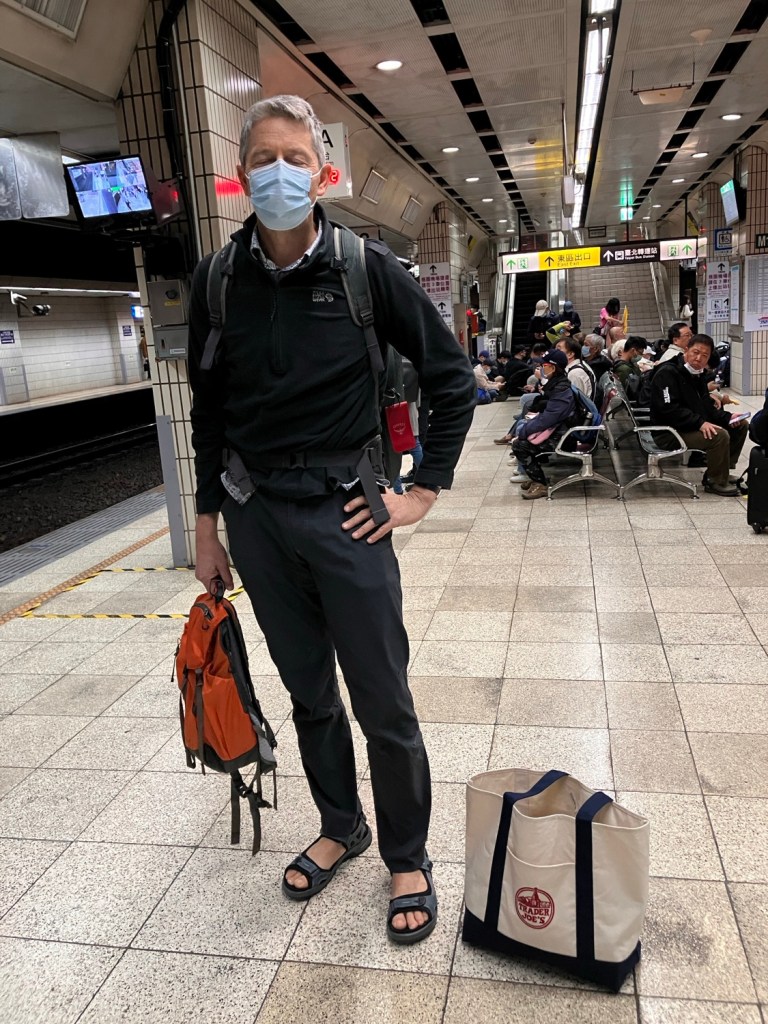
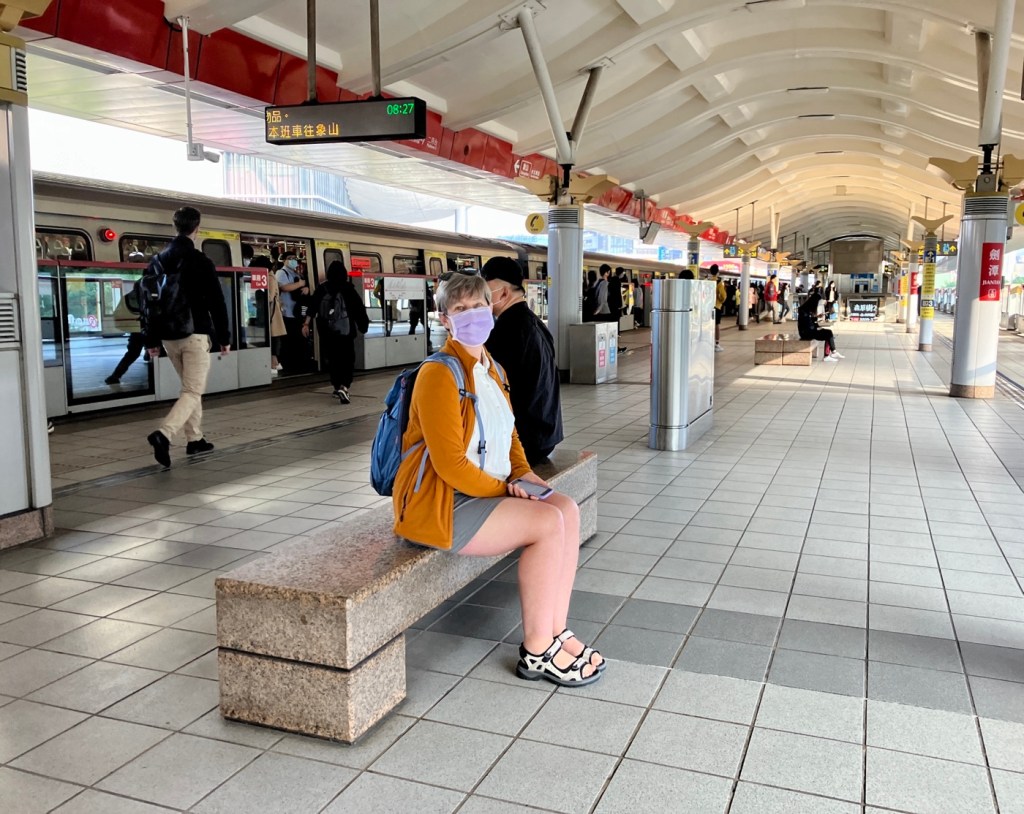
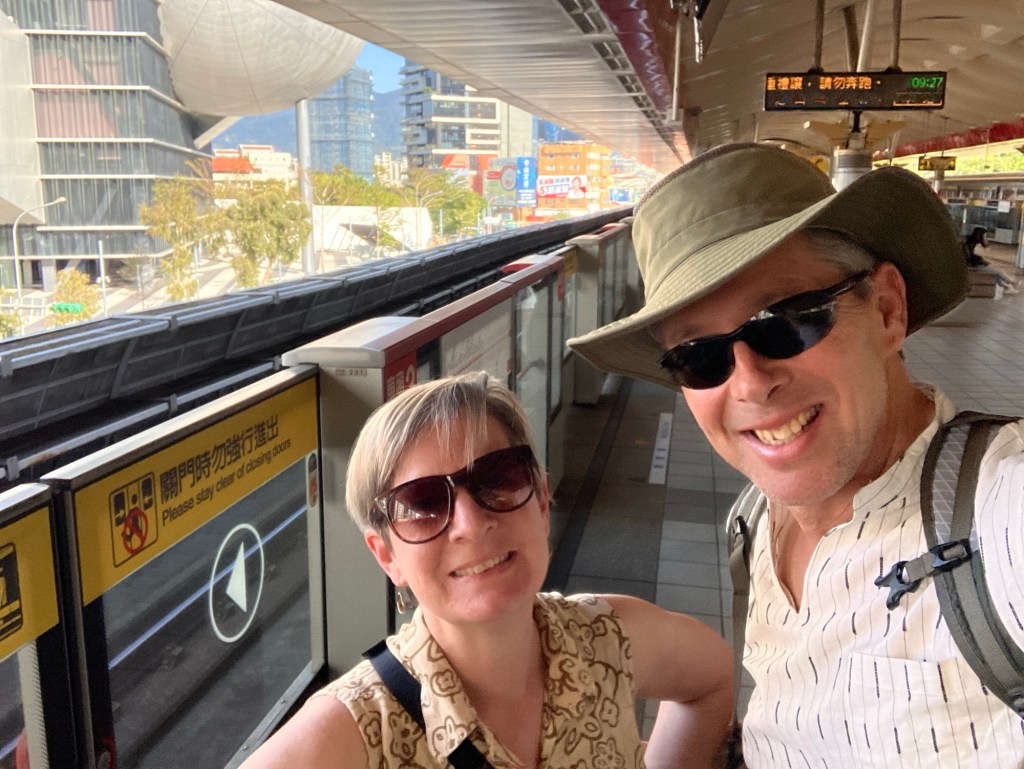
A bit too early on the platform at Taipei Central; Cheryl’s trendy TJs bag at my side
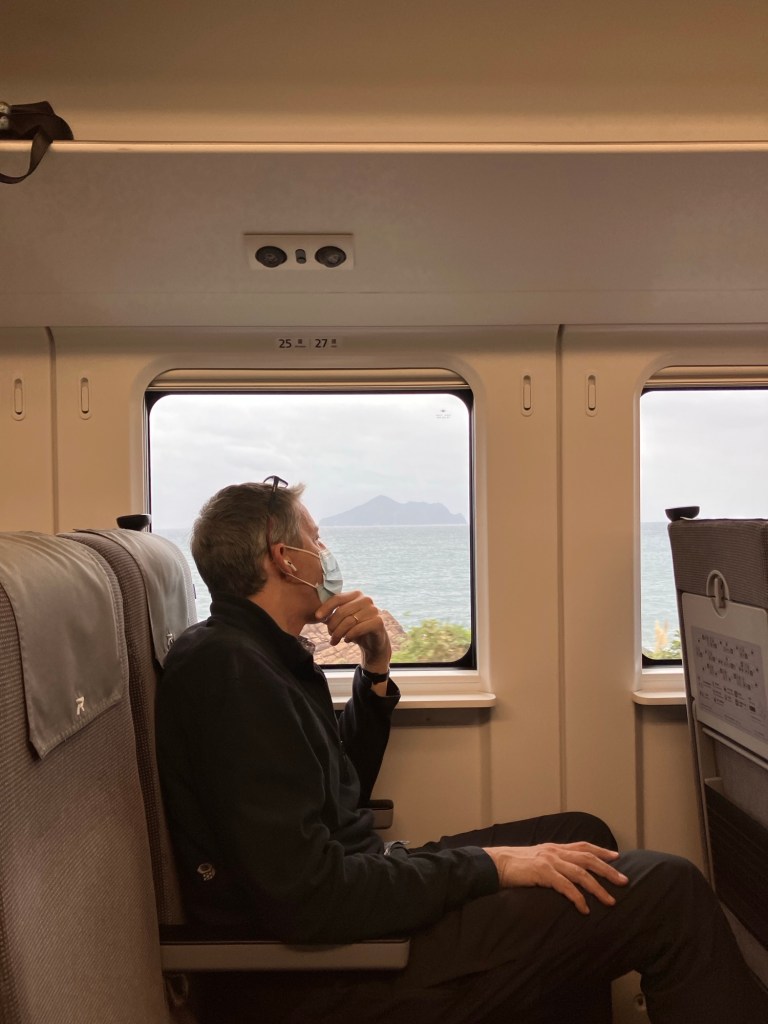
Ocean view from the TzeChiang Express train. Plenty of room in the standard seats

But first, a few train tips for the wonky planners out there. In addition to local and high speed rail on the west coast, the east is served by modern Tze Chiang limited express trains travelling up to 125mph. They are spotless, spacious, and punctual. And although we tried the business class on one segment, regular cars and seats are plenty roomy. If anything, we found the new trains a bit too clean and sterile, but certainly a pleasant and very low stress way to go.

You can pre-order a train bento on the TRA App for less than $3 and it’s delivered to your seat

Taipei Central’s local platforms are not wide or particularly pleasant and there are not really any services beyond the pay gates, so I’d recommend getting to the platform no more than 10 minutes prior to departure as it’s easy to find the platforms and coach number sign. Hang out or get food in the adjacent shopping mezzanine. At some stations; they don’t let you onto the platforms until 10 minutes prior.
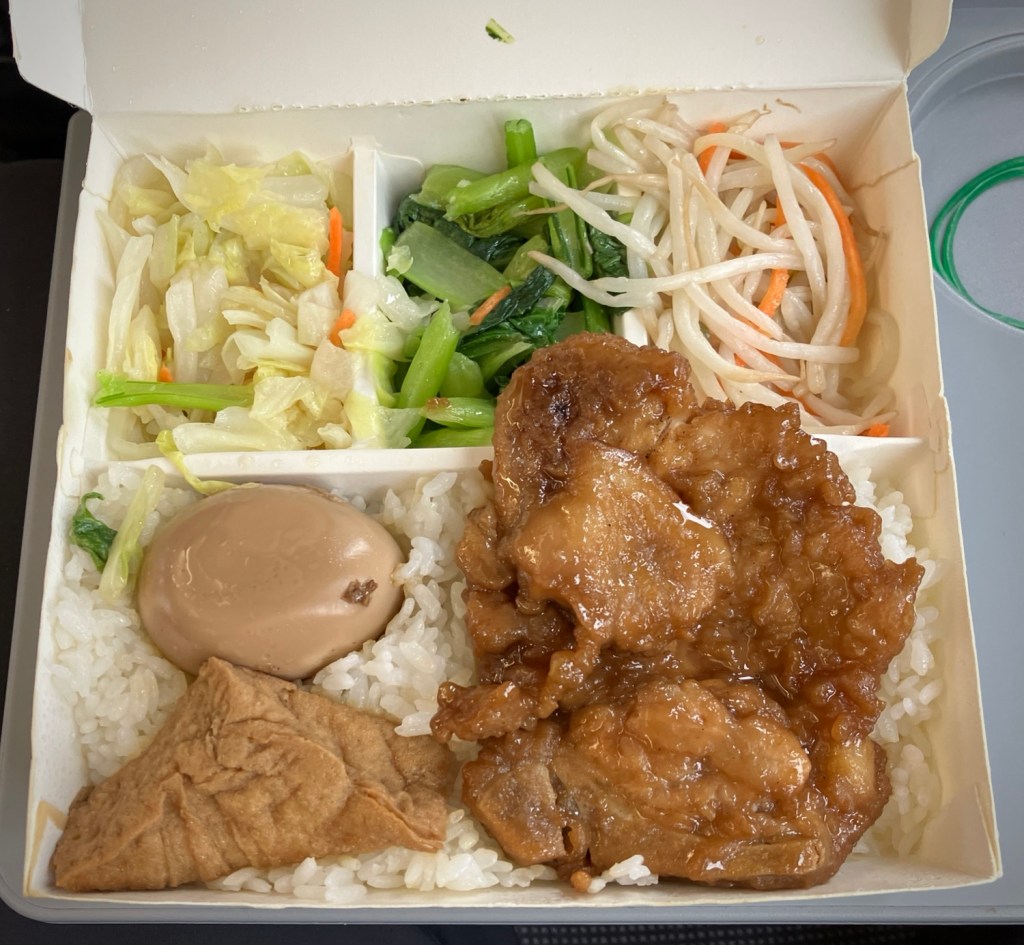
The regular meat bento was pretty good considering, although maybe not up to the hype of its somewhat cult following. Cheryl got the veggie version -:).
Happy arrival at Hualien Station.

You can buy tickets on the TRA App or at the stations, but I found the app pretty convenient for booking tickets once you get the hang of it. One person can buy tickets using their passport number for up to 5 people and pay by Credit card or Apple Pay. You then collect your ticket on your mobile and have the other passenger (s) download their ticket on their phone (in the App) as you provide the reservation # and a 3 digit collection code.

Back at the railway park
The charms of many smaller Taiwanese cities take awhile to reveal themselves in back alleys, converted old buildings and lots of plants.
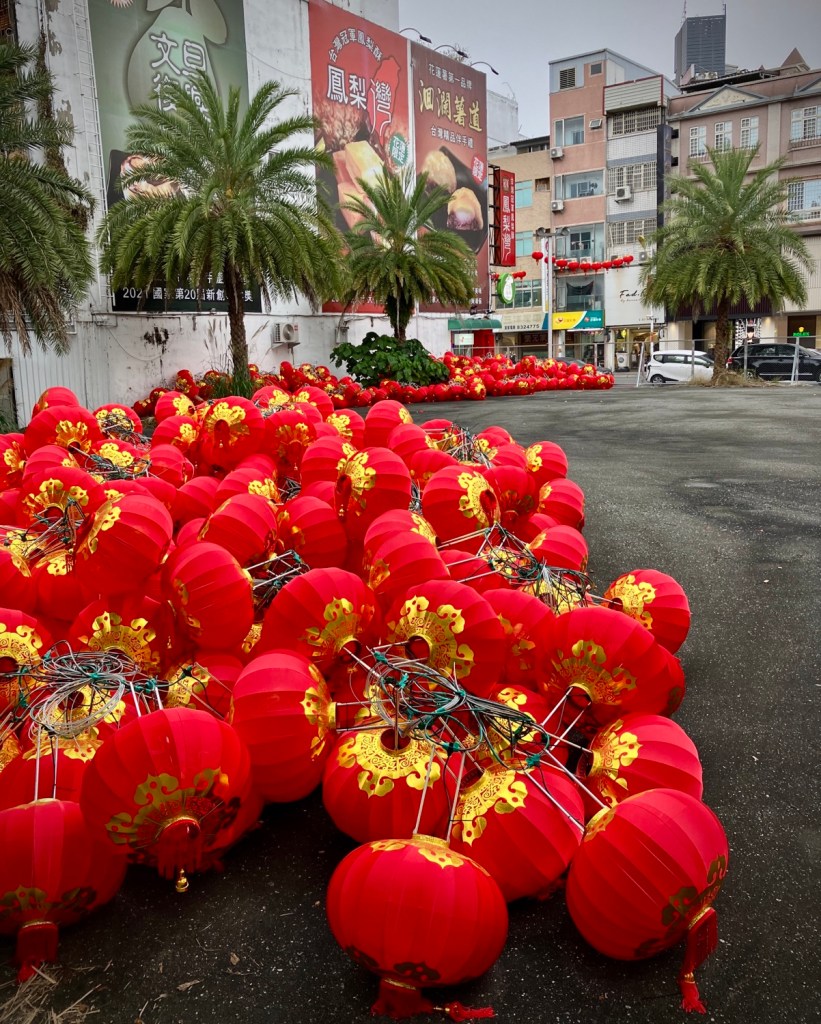
Red lanterns ready to be deployed in Hualien for the month+ long Lunar New Year celebrations.

Note that as soon as you click on a specific train after searching time and destination, a reservation and seats will be made immediately. You have a reservation and specific deadline shown to pay via credit card or Apple Pay (very convenient) or at the station. You can delay paying for tickets for a day or two (it gives you the deadline). This gives you an easy option to change or cancel tickets, but a word of warning, I did this a few too many times as I was learning the system and it locked my passport number for a month! I’m guessing the limit was about 4-5 incomplete/unpaid reservations. I could have called customer service and perhaps begged for tourist mercy, but we got around this by reversing our process and buying the tickets on Cheryl’s TRA app (and her passport number) and then I downloaded second ticket to my phone. You only need one ID to buy tickets via the App.

The hipster guide to Hualien

It also is smart to wait to collect the tickets on the App (or at the station) until you are sure that you want to take that specific train, as this allows you to change a ticket on the App, not just at the station. Apparently locals don’t “collect” tickets until the last minute for this reason.

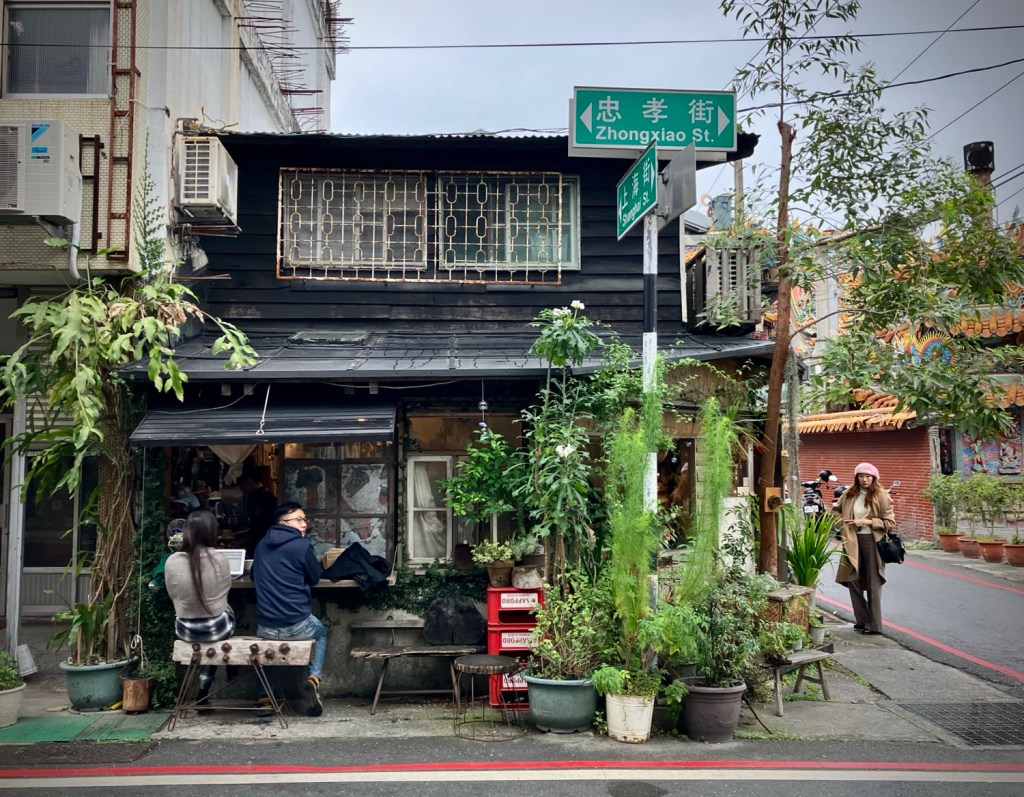
Funky and green charm in Hualien.
Hip coffee shops abound and are generally only open after 11am or even later as the coffee cafe culture is an afternoon thing in Taiwan.

By the way, there are also local trains that you can see on the App timetables but you can’t buy reserved tickets. For those, you just show up and use your IC tap card to enter and exit the station and take any seat on those trains. They are also the easiest option with bikes.

Ready to scan my QR ticket at the turnstiles.
Taiwan is really promoting cycle tourism and these helpful signs are everywhere around cities, transfer areas, and stations.

Besides trains, I love to study the geography and geology of the very place we visit. It always shapes the history; culture, and economy. The geography of Taiwan is dominated by a central ridge of mountains, the remnants of the formation of the island from magma rising up between the junction of the Eurasian’s and Philippine tectonic plates. The central range reaches heights of over 3000m (10,000ft) and it does snow sometimes in the higher elevations in winter. So only 30% of the country is flat, and much of that is highly developed.
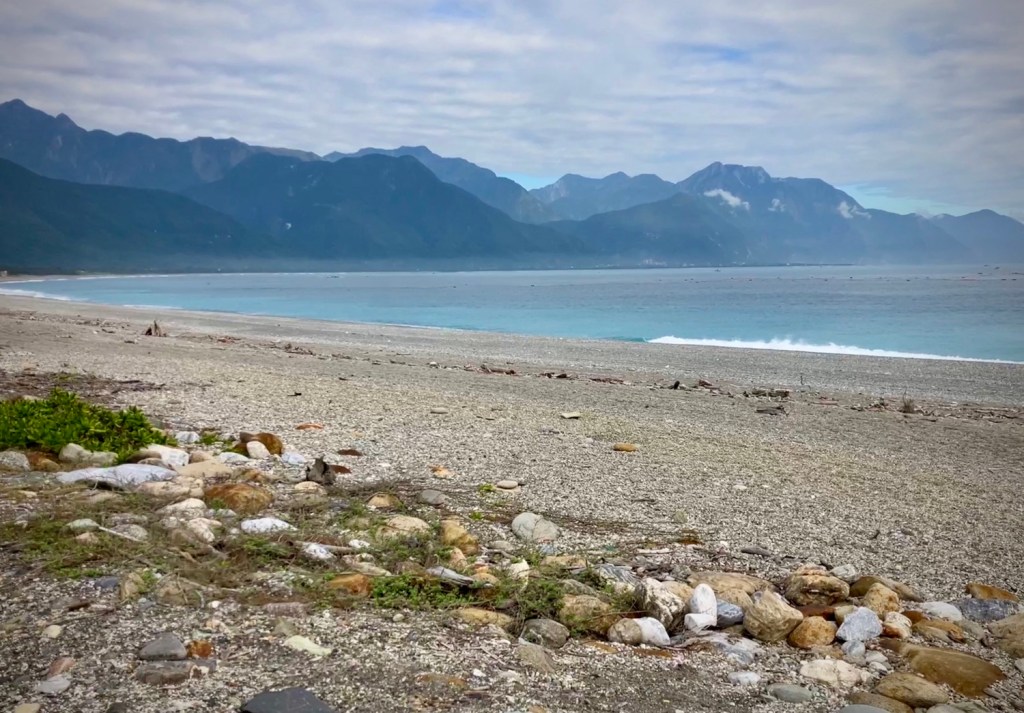
The coast north of Hualien.

A second smaller coastal mountain range hugs the east coast. These ranges are both actually rising as the Philippine plate continues to push against and under the Eurasian plate. The valley where the plates meet, the East Rift, is one of the only flat areas on the east side of the country. It’s also fertile for growing things year round and attractive for cycling. Most of the industry and population of Taiwan is concentrated on the north (Taipei valley) and west sides, so the east has always been considered a more wild and remote place.

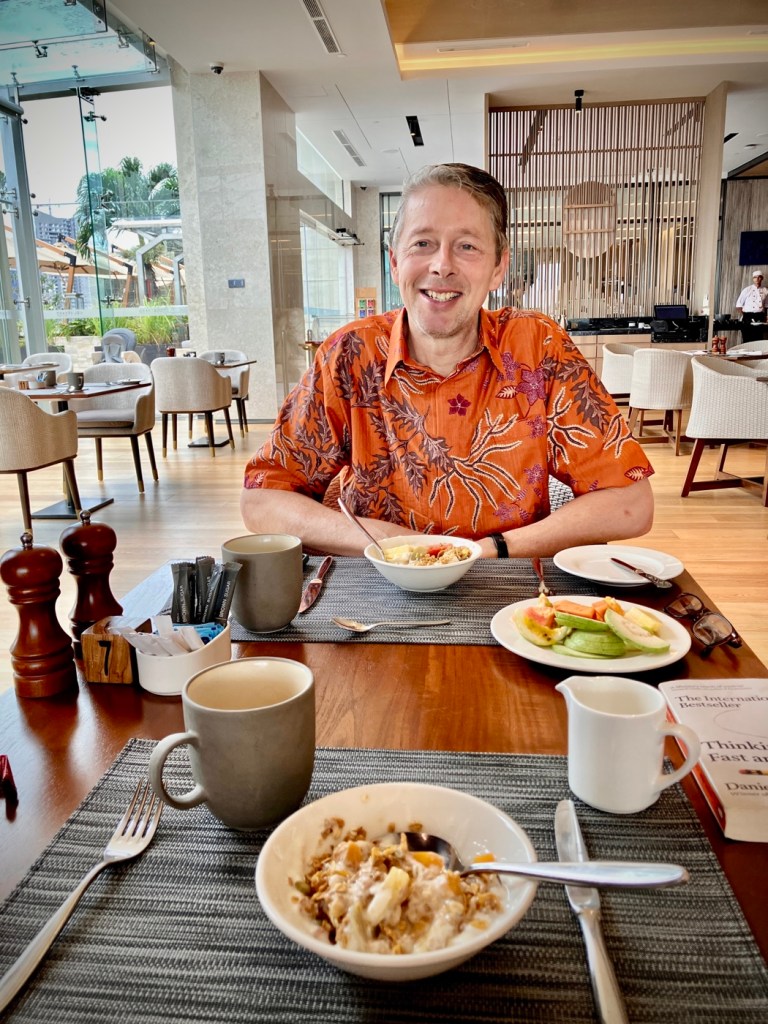
We loaded up on veggies at the Azure Hotel’s amazing vegetarian breakfast buffet for three days and used it as an excuse for street food, night markets and other less healthy options the rest of the day -:).

Ok, so onto our travels. We spent three days in Hualien and used it as a base to visit the famous Taroroko gorge and Taroko National Park for a full day by train, bus, and foot. The geography of the mountains is dramatic and consequently there are a lot of issues with rockfall, slides and road/trail closures. There are very limited bus services up and down the gorge now due to construction around a massive landslide that occurred in October 2023. There is single lane traffic controls and you can wait for up to an hour to get through each way, even if you hire a scooter or taxi for the day.
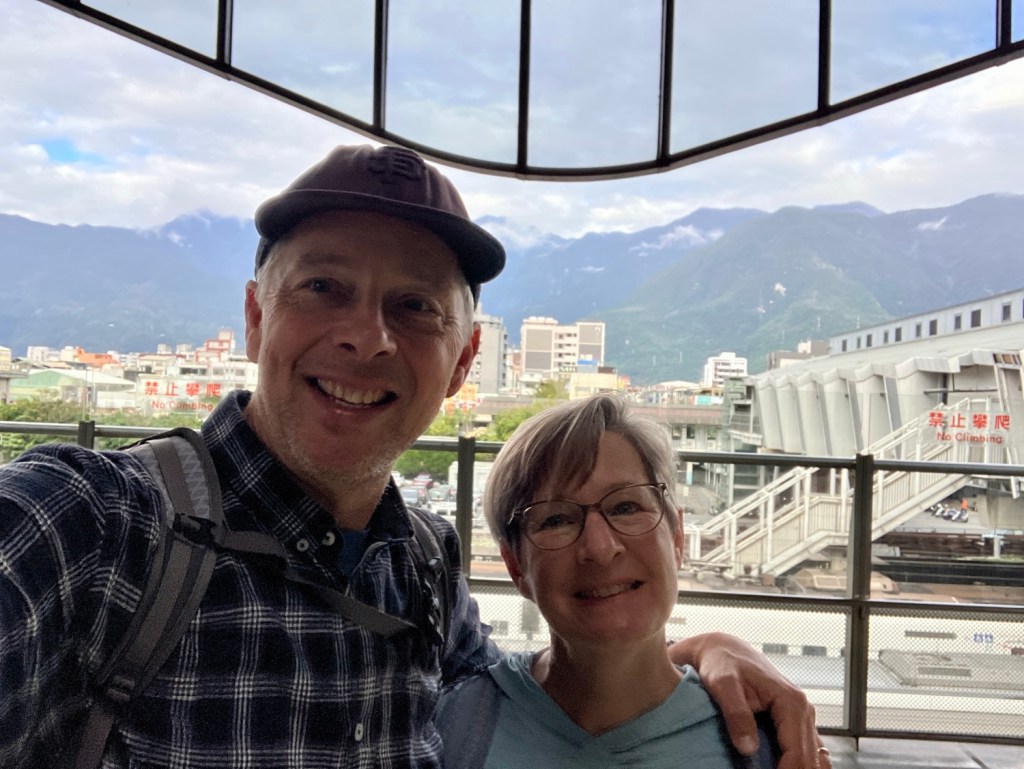
Ready to go to Taroko Gorge!

But we love buses and challenges, so decided that we would catch the earliest #302 bus from Xincheng Taroko station at 9am (the #310 bus is not currently running into the gorge) and ride it all the way to its end at Tianxiang. You can drive (or bike!) further than that and apparently it is much less visited beyond the reach of the buses.

Oops, our electric bus broke down half way to our destination in the park.

Our short train hop from Hualien arrived Xianming about 8:30 and there were about 30 tourists waiting for the bus, including some other Americans from Utah. After we boarded, the driver made a long speech in Mandarin that didn’t sound encouraging but somewhat surprisingly, our young pale Utah friend spoke Mandarin and translated for us. It turns out he was half Taiwanese! The driver was just preparing everyone for what we already knew, that there would be significant delays at the construction. So the half of us who were still on the bus at the construction were all patient for the 40 minute delay.
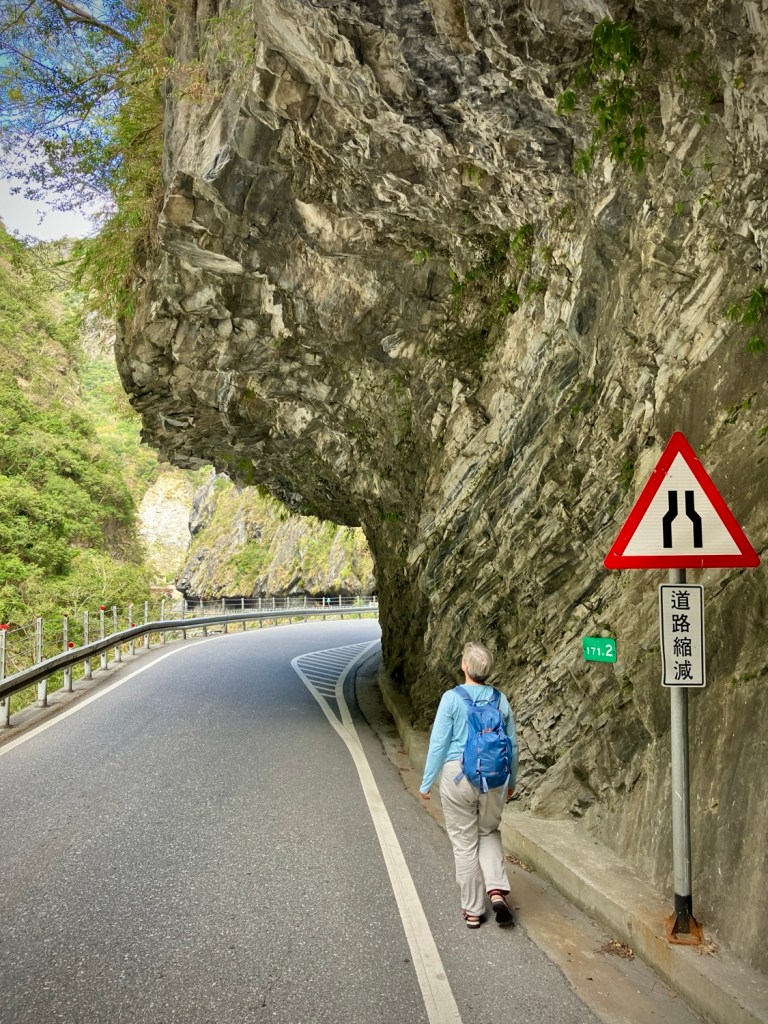
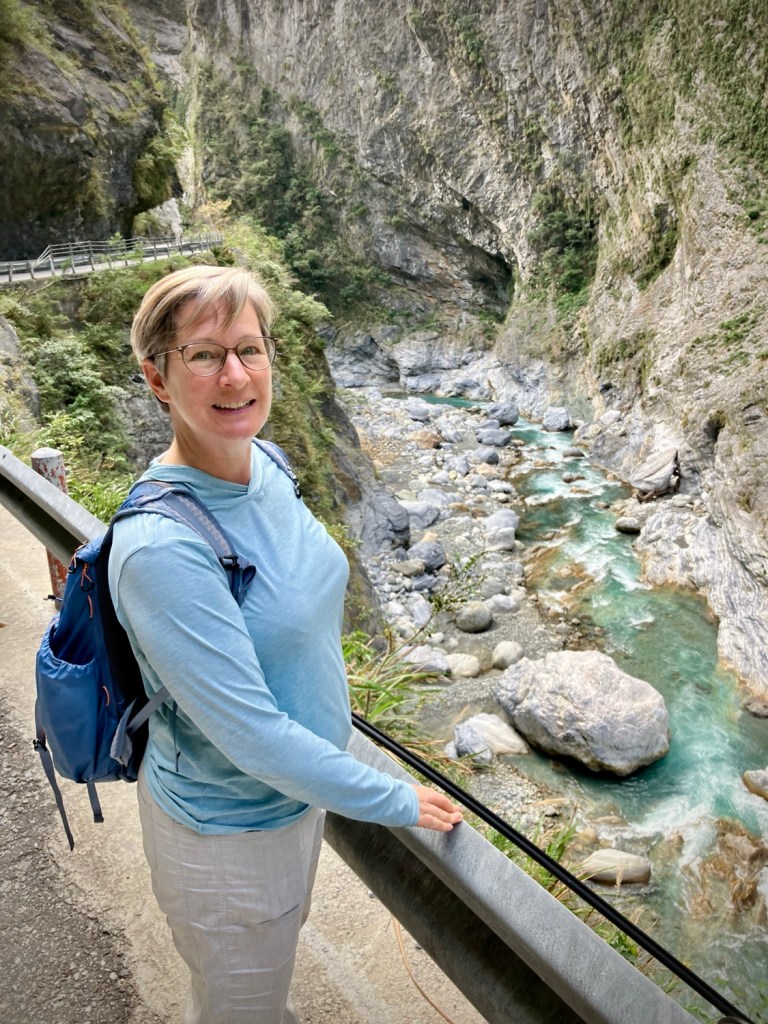
So we started walking
And enjoying the views
Light traffic due to the road closures

We were finally rolling again through the closure and spectacular gorge scenery, when suddenly the electric bus started to stall and sputter. The driver mumbled, stopped, and fixed (rebooted?) the batteries in the back, and we rolled on again slowly. But alas 500m onwards the bus finally died for good. So the remaining dozen or so of us got off and walked on the road. But we soon figured how nice it actually was walking the road, as the normal continuous two way traffic didn’t exist due to the long road closures all day. Roll with it and we’ll see what we see.
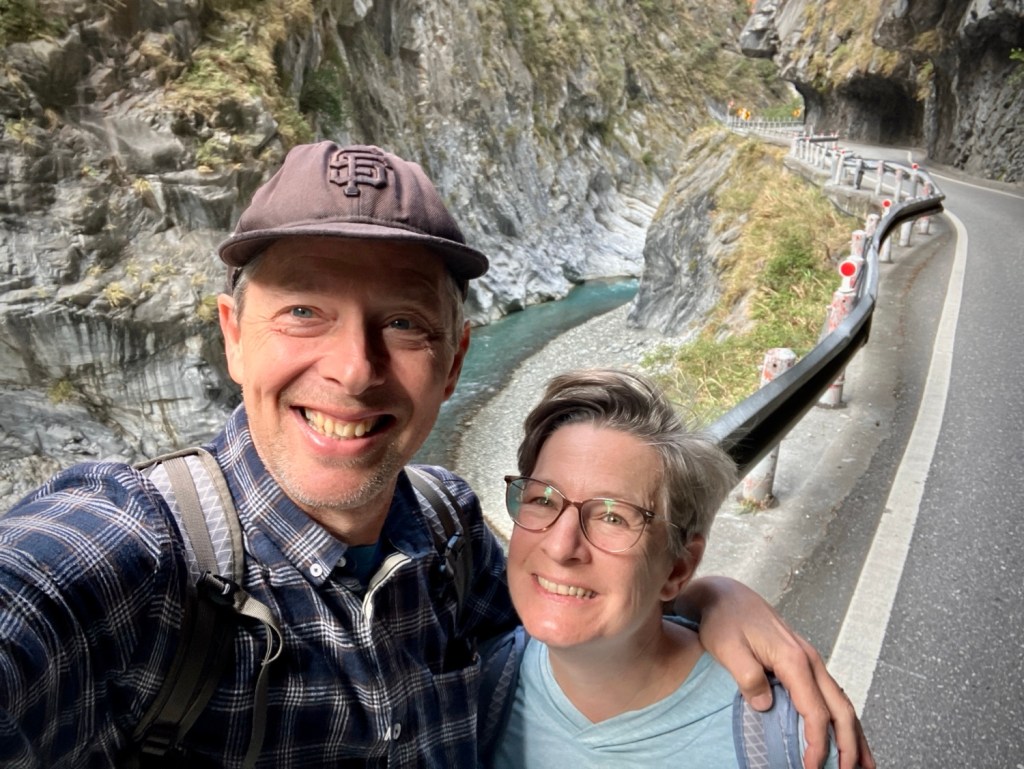
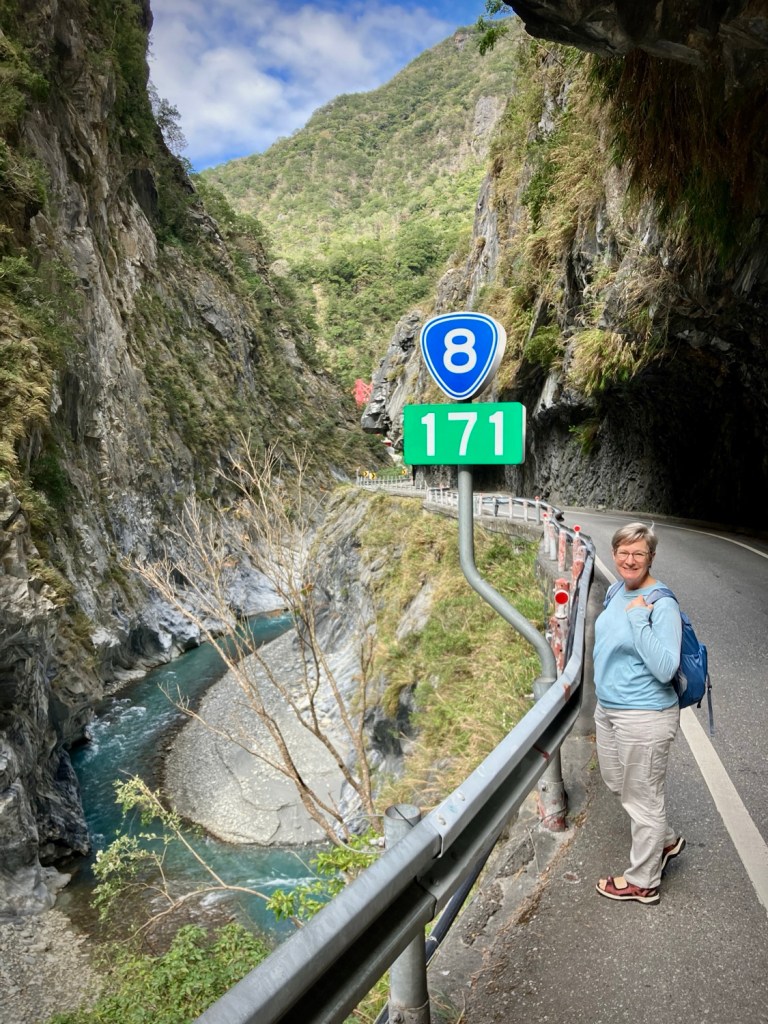
Happy travelers rolling with the bends in the road today
Plan B, walk the Lushui trail for a few kms
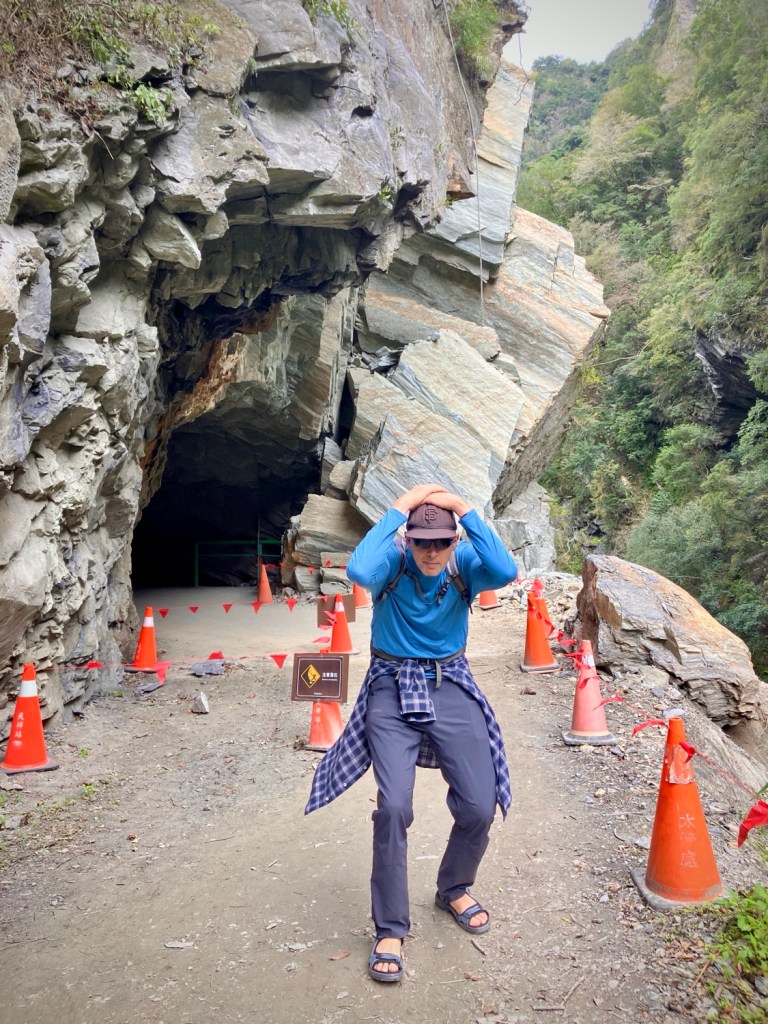
Oops; trail closed midway so back to the road
Cheryl resigned to wait for the next bus…at least she had some books on her phone…

It was peaceful and beautiful, and we walked to a campground area with bathrooms a few kilometers up the road. We then decided that we’d hike some of the Lushui trail which branched off the road above and then try to catch the next bus as it rolled by in about an hour. Well, the geologic gods had also closed that trail in its middle, so after a pleasant 30 minute out and back, we returned to the campground bus stop and resigned ourselves to wait up to an hour for the next bus. It was too far to walk (15km) and there were dark tunnels with no shoulders. But after about 10 minutes, a nice young Dutch couple in a little white car came by and offered us a ride to the end! Very nice and put our day back on track -:). They also were going to the Bayiang Trail, so we avoided another km+ of road walking.
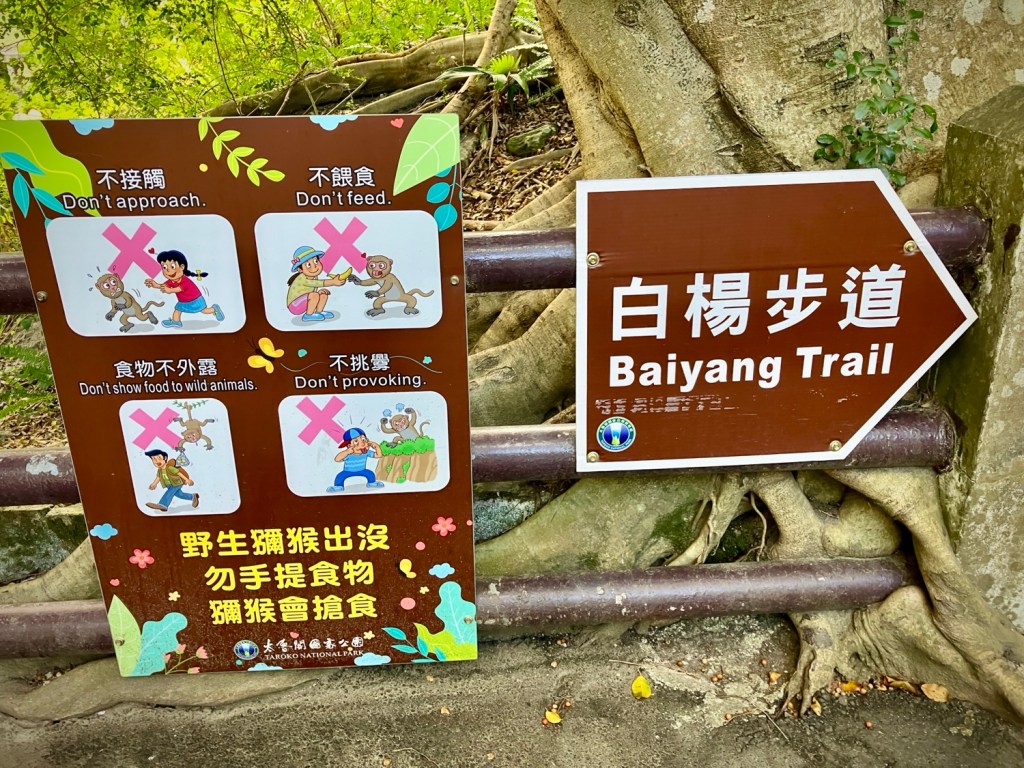
Made it to Baiyang Trail with time to review the rules of monkey engagement -;)
A mysterious start to the trail takes you through a mountain to another side gorge
We were lucky that the Baiyang trail had just reopened after its own landslide closures. We could see why.
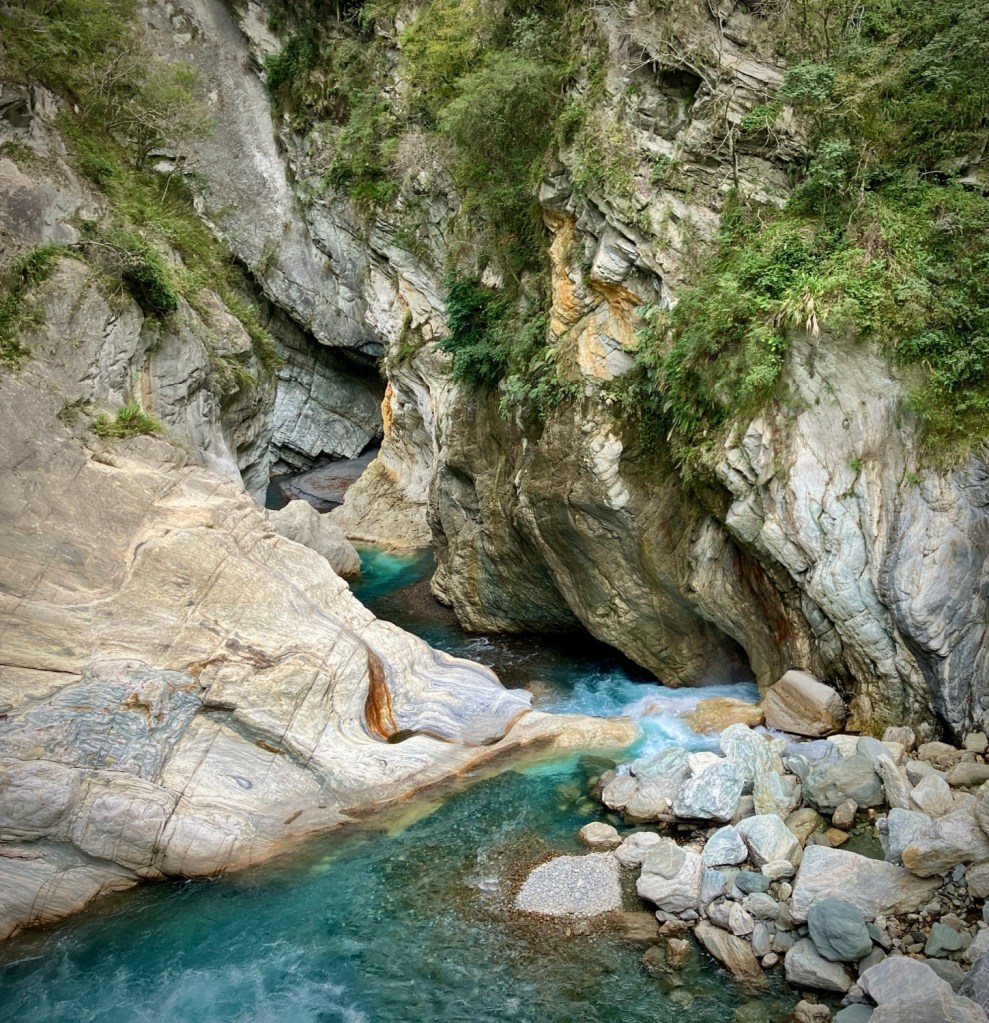
Beauty is everywhere in Taroko.
After walking back to Tianxiang, we got some tasty food at one of the small cafes there.
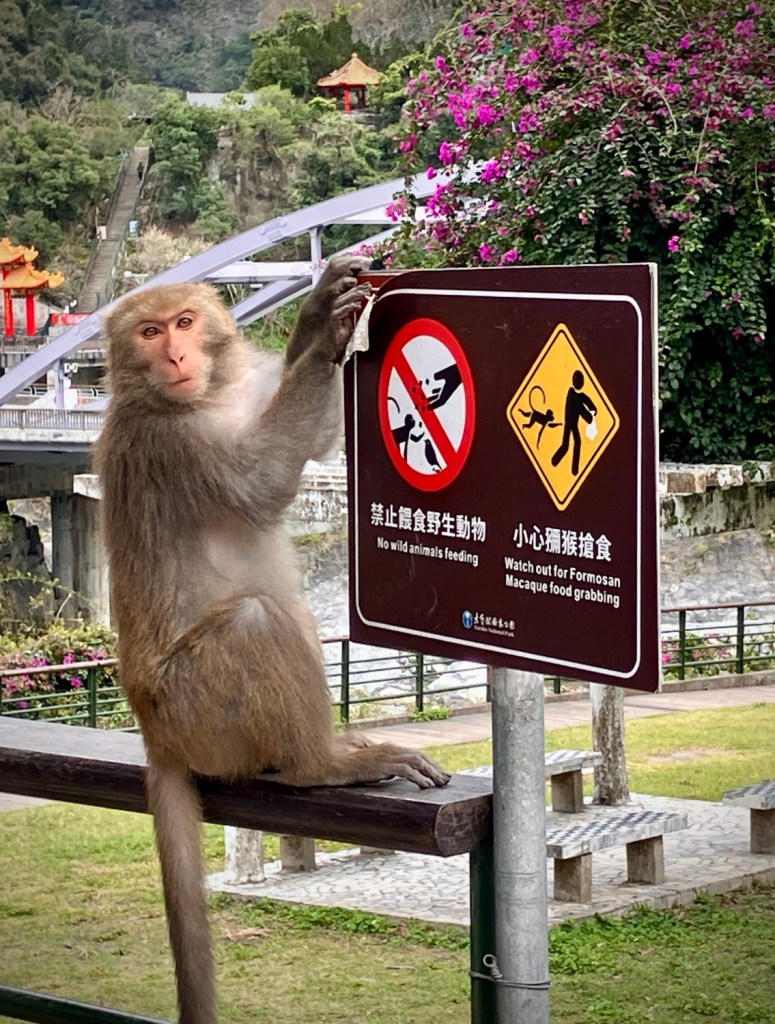
This crazy territorial macaque grabbed food from unsuspecting people coming out of the only 7-11 in the national park and was hilariously peeling off the warning signs!

Taroko is a special place and we’re glad we made the effort, but can imagine with normal traffic and tour buses it may be a bit much. We also noticed that cycling is possible, as the lower climb is spread out over 30km or so. You would be rewarded with continuous views but do need to mind the many narrow tunnels.

Exploring the East Rift valley on rental bikes (Giant of course).
A surprise stop at an old Japanese temple. There is a strong Japanese cultural legacy on Taiwan due to its 50 years of occupation.

Next up was a short train ride to Yuli, where we spent two nights in a small hotel. This allowed us a full day cycling up to and exploring YuShan National Park. Much less visited than Taroko and the jumping off point for the Walami trail.

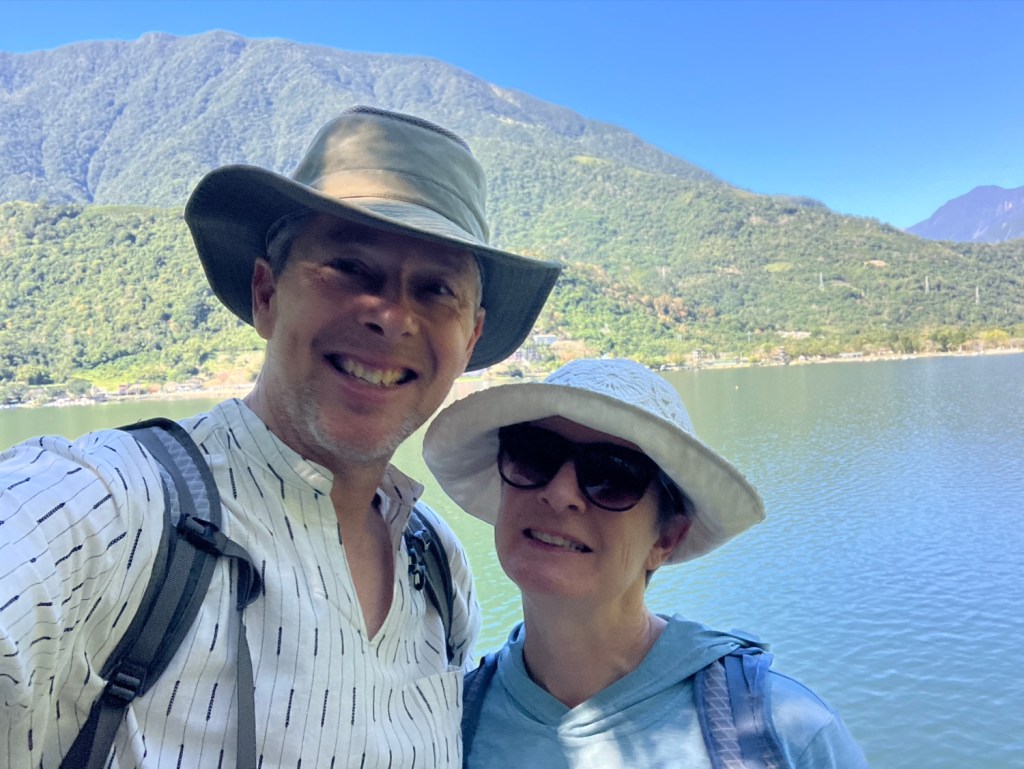
Oh how nice to be out of the cities.
Destination reached at the pleasant Liyu Lake.
A delicious indigenous influenced meal at the Liyutan Tree House near the lake. The preservation of indigenous culture is a priority on the East Coast where it survived longer due to its isolation.
Cycling in Hualien was fun since we were really the only foreign tourists about.

We’ve been eating well, but the food customs and timing can sometimes pose a problem. We have loaded up at some our breakfast buffets, which generally have many savory and healthy options. Lunch is a small restaurant/shophouse stand. Street and night markets are always an option but you need to be up for crowds and eating small things standing up at the edge of the road or against a building. We actually prefer food oriented streets to night markets. Oh, and good pizza is popular here, and a trusty traveler break from a lot of (excellent) Taiwanese food.

About our fifth beef noodle try, this one with the works of tripe and knuckle…mmmm!
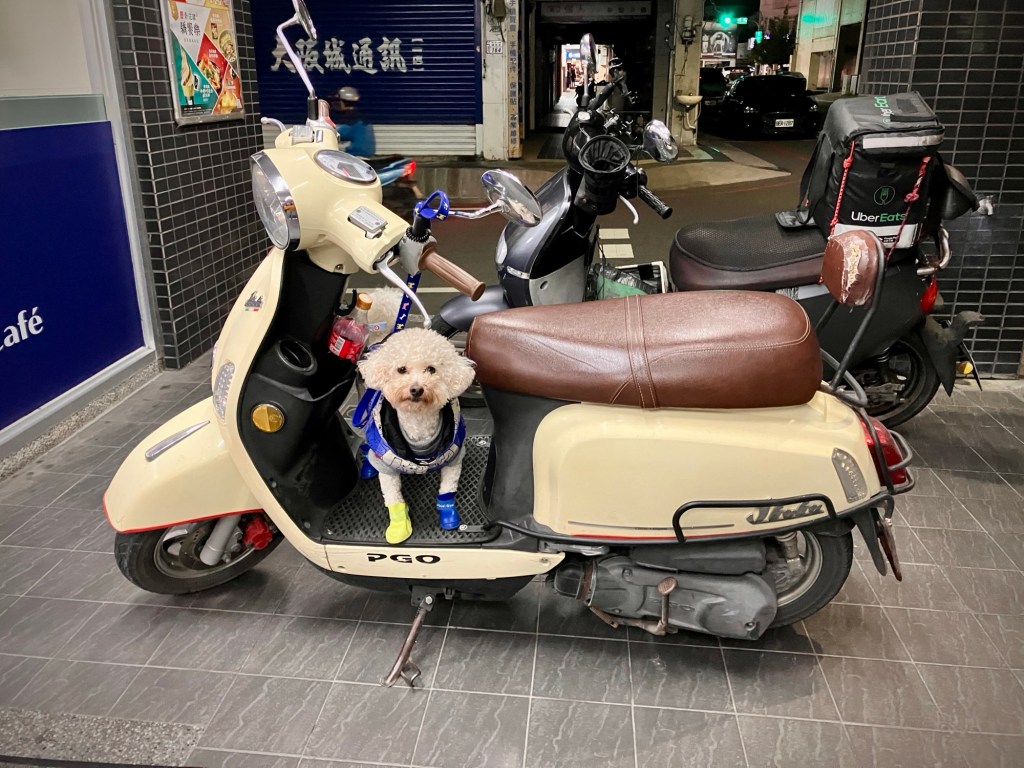
Even the dogs know that scooters are the way to go in Taiwan.
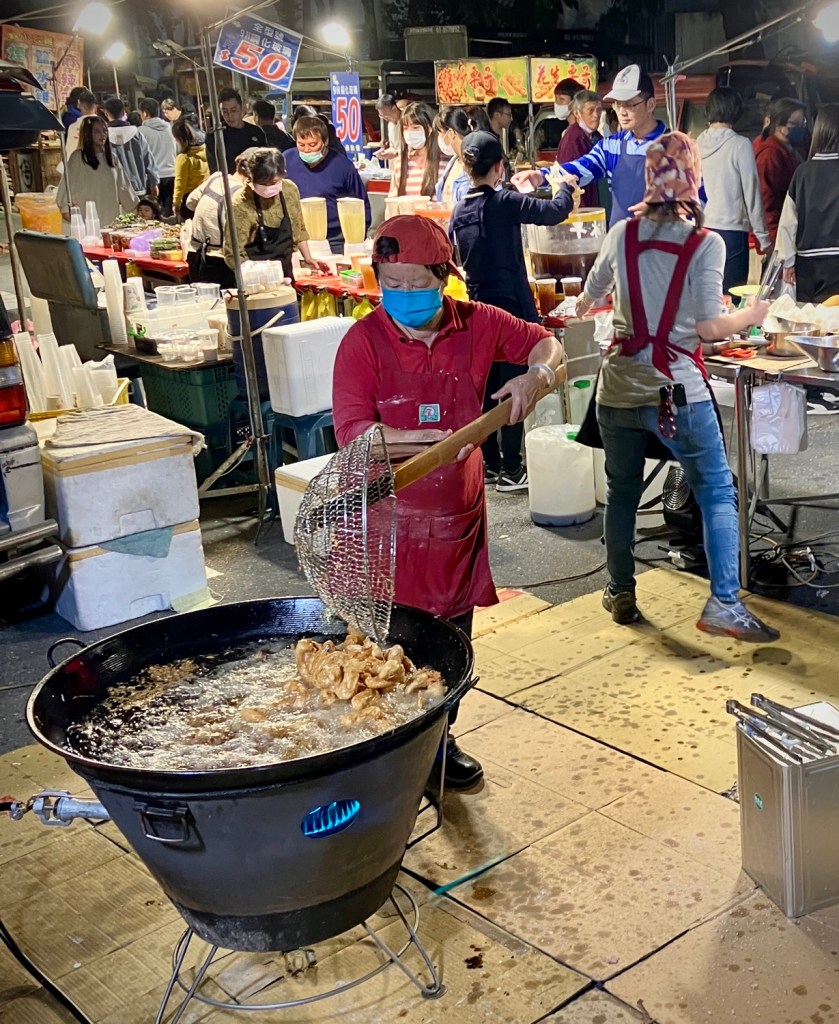
This giant fried chicken vat amazed us at the most popular stand at the Yuli Night Market (Fridays Only!) .

Yuli is a bit drab to be honest but the area around it is peaceful to cycle. Many of the Tawainese cities are spread out and walking not always the most pleasant as most locals use scooters to get from point A to B, they don’t consider long walking practical. We found it to be much better to bike from place to place and walk locally, especially when looking for restaurants. Small places on Google are often hard to locate, closed, or don’t seem to exist. But you’ll always find something and just need to stay flexible or pick a well established place with lots of reviews (including recent ones).
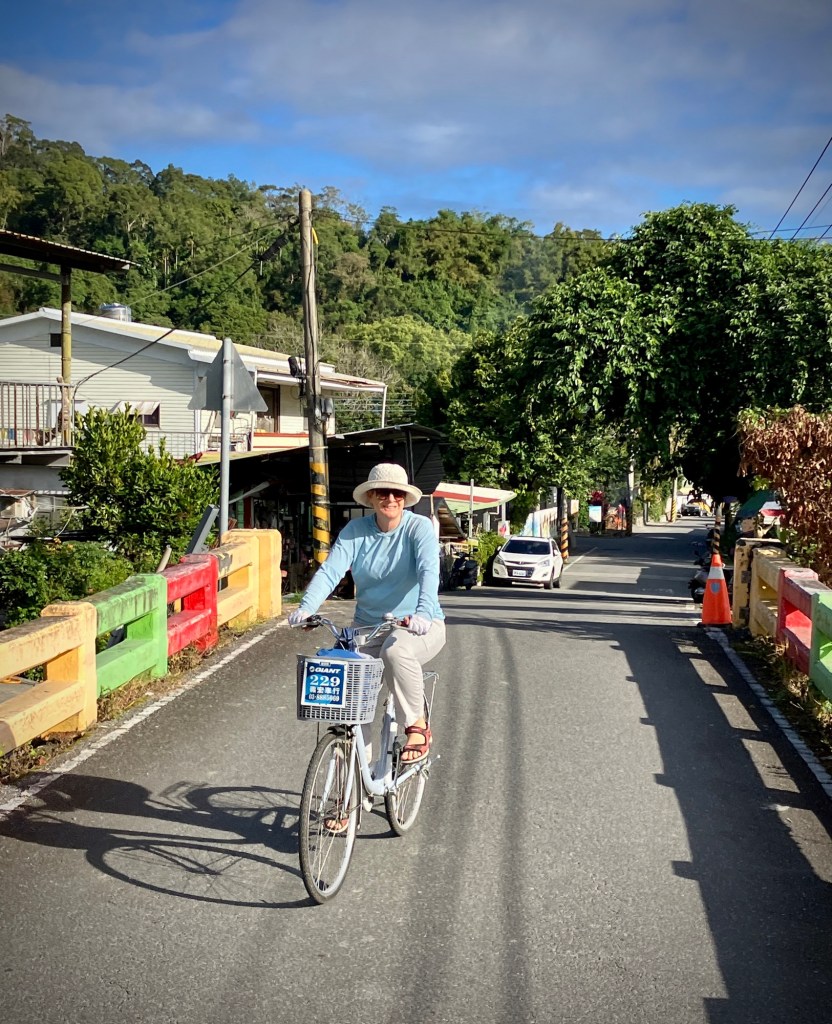
The area SW of Yuli is pleasant for cycling and a good way to get to YuShan.
Uphill, 5 speeds, AND falling rocks?’
Yea! we made it the official park boundary at El 1500 ft.
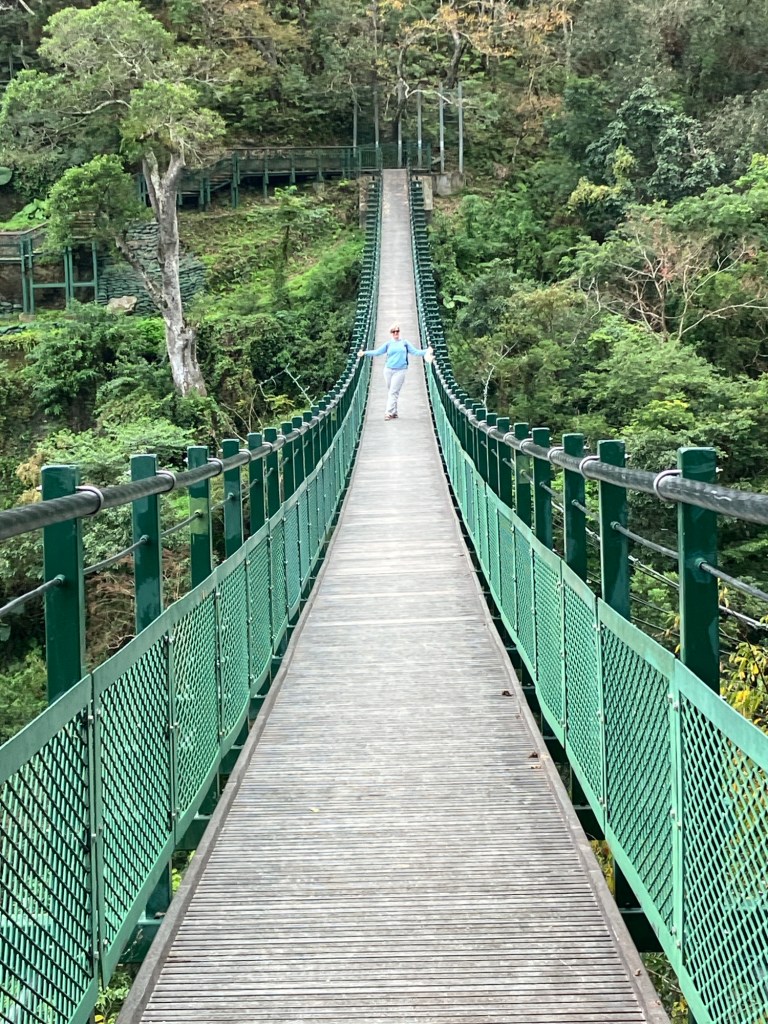
Suspension Bridge Number 1 and my number one travel companion -:).
Dizzying but stable.
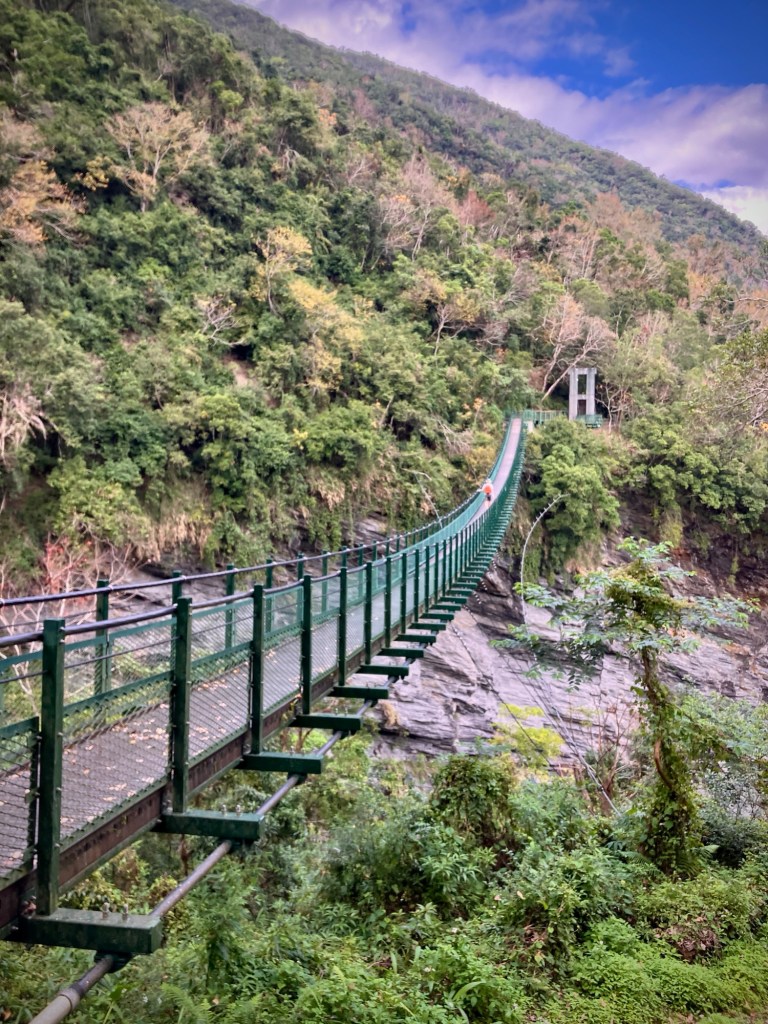
I hiked in to this beautiful waterfall complex and suspension bridge number two while Cheryl enjoyed promised reading time!
The dramatic sea near Taitung.

From Yuli, we had another short train ride to Taitung, where we spent another two nights. Taitung has a great museum of Prehistory on its outskirts that was worth a stop on its own. Although Taitung has a bit of an art scene by the old train station, if you are short of days, you might consider a stop at Taitung train station and storing your bags in the train station lockers to visit the museum (10-15 mins by taxi or bus, cafe or picnic on site) and then roll on to your next destination. Of course if you have your own wheels, then the areas north and south have lots of natural beauty and are certainly worth it exploring.
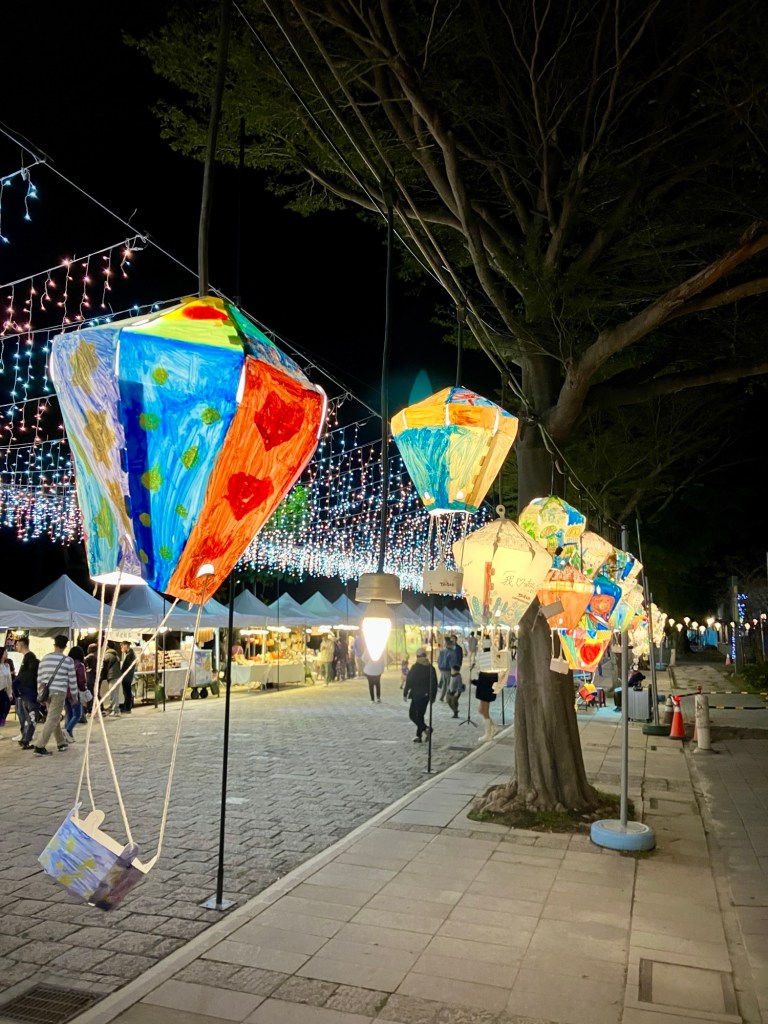
Taitung’s old railway station has been turned into a pleasant cultural area.

And alas that’s one of our limitations without a car or cycle touring here. We do miss a lot of the places in between, but we’ve balanced that by getting out of each region by bus or bike and seeing quite a bit. It really depends on what you like, and we do like cities. And we’re seeing enough, as experiences can be had anywhere.
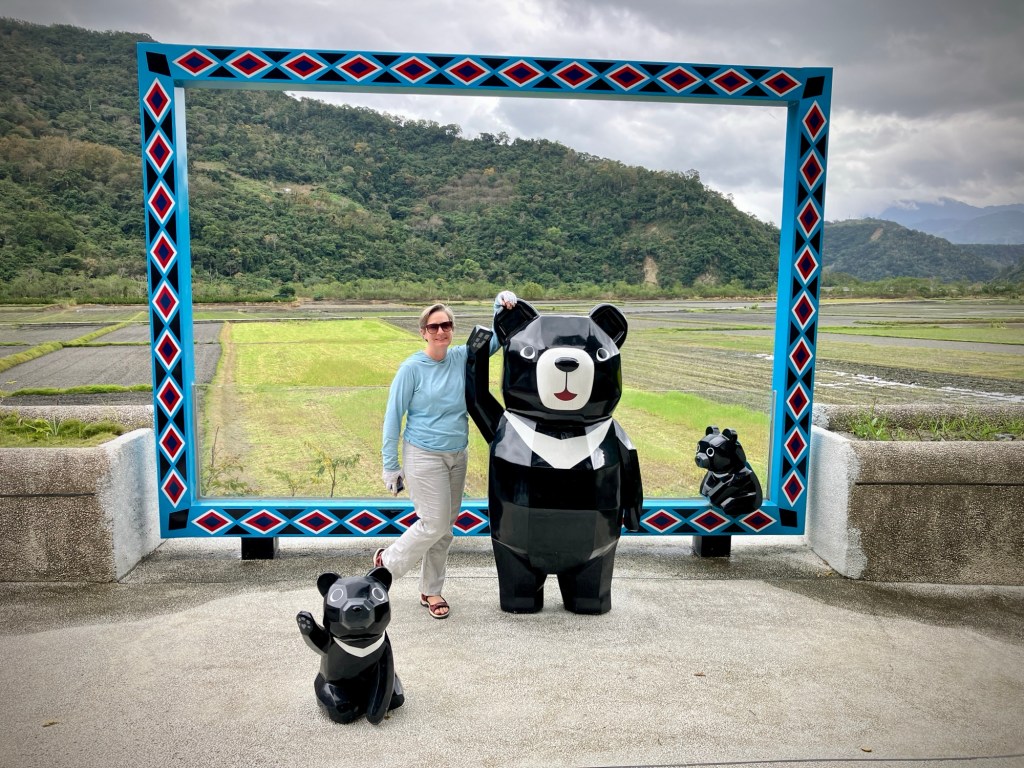
Bye for now from Taiwan.

So we’re now on the west coast and heading back towards Taipei. The lunar new year buzz has started and we look forward to sharing more about our experiences soon. Happy travels!
Taiwan. So fun we came back to see more.

In January of 2023 we came to Taiwan on our way to Bangkok. We were only in Taipei, and just for a week, but we loved it. When we were discussing where to start our 2024 travels Taiwan was top of the list. It’s a long flight from San Francisco to Taipei, but non stop. This time we’re here for three weeks and will circling the island via train.

Back at our local MRT stop, Jiantan on the Red Line.

What is it we love about Taipei? It’s a very easy city to visit. Great transit, amazing food options, such helpful locals. It seems to be an overlooked Asian City. Taiwan has close ties to the US, we know folks in SF who have Taiwanese roots, so it’s one of the many places in the world where locals happily tell us about their connections in the US. Since we landed on Election Day there were even more returned Taiwanese since they must come back to Taiwan to vote. No mail in ballots here.

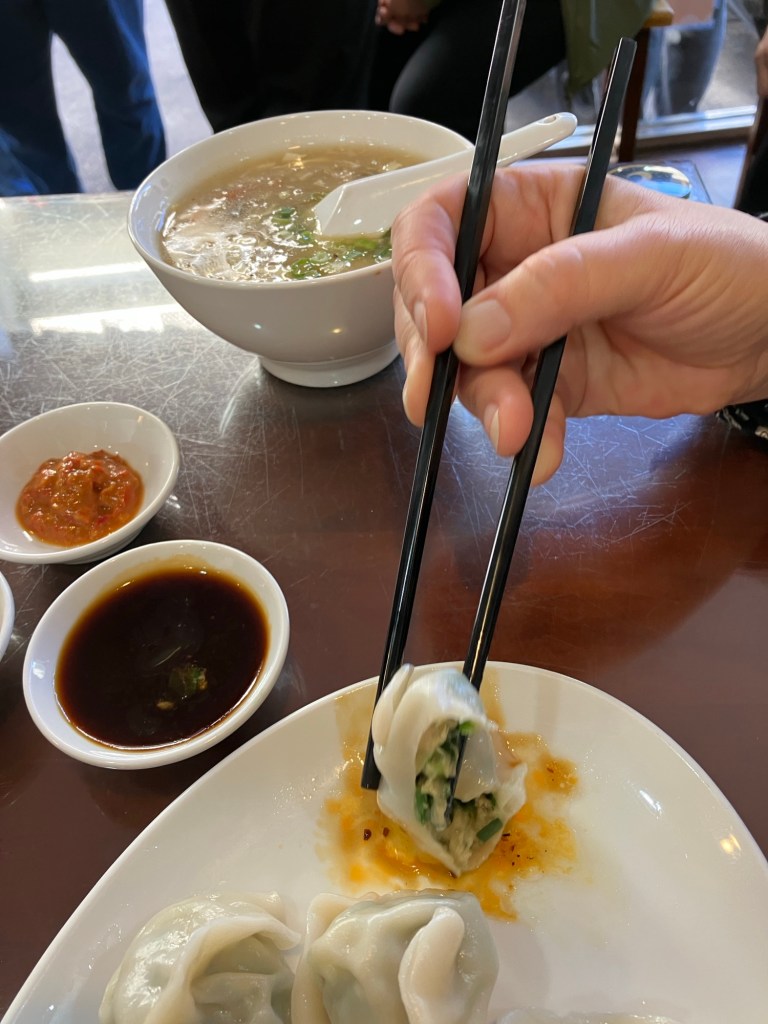
Joplin Fried Dumpling restaurant which Rich wanted to try. Yikes, looks a bit confusing, but fear not.
A young man in line in front of us explained that you take a clipboard to fill out your order, and a number from the push button machine.
Done and done. At this point a young woman behind us checked to make sure we had gotten a number. People want to make sure you’re all set, which is so appreciated. Google translate helped us through the menu in Chinese.
After paying at the register, where the cashier advised us to change our order to one set of pan fried and one set of boiled dumplings, she gestured us towards a table and I went to get our dipping sauces. She left her cash register to come over to explain the different sauces to me.
Cheryl demonstrating her chopstick skills with a boiled dumpling.
The pan fried dumplings. Crispy bottoms. Delicious.

I could fill an entire blog post with photos of amazing food in Taipei and how incredibly nice and helpful people are, but food isn’t the only thing that brought us back here. We are both big fans of cities, and getting to see and understand what makes a city a good place to live, or a bad place to live, intrigues us. And how a government helps or hinders its citizens. What steps have been taken to make a city more livable? To allow young and old to live safely and happily? What is the temperament of the locals? Do they seem happy or cranky?

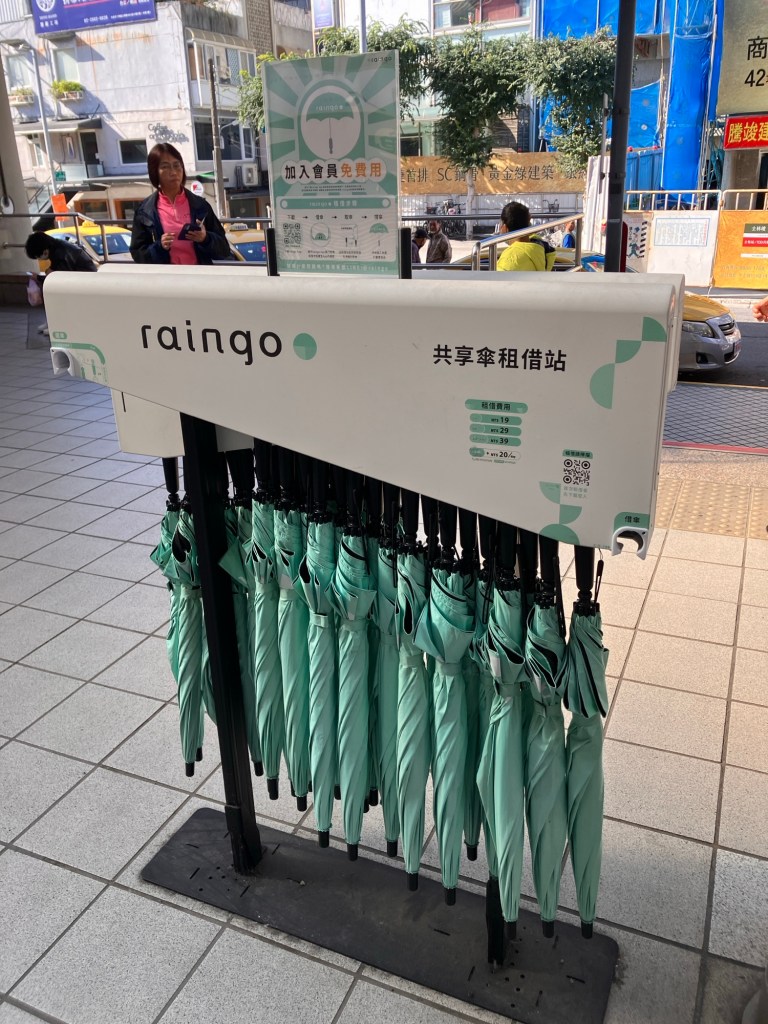
Raingo umbrella rental. When you get caught out by rain. Some MRT stations also have courtesy umbrella stands where you can borrow an umbrella for free.
This group of children were rain ready in their bright ponchos.
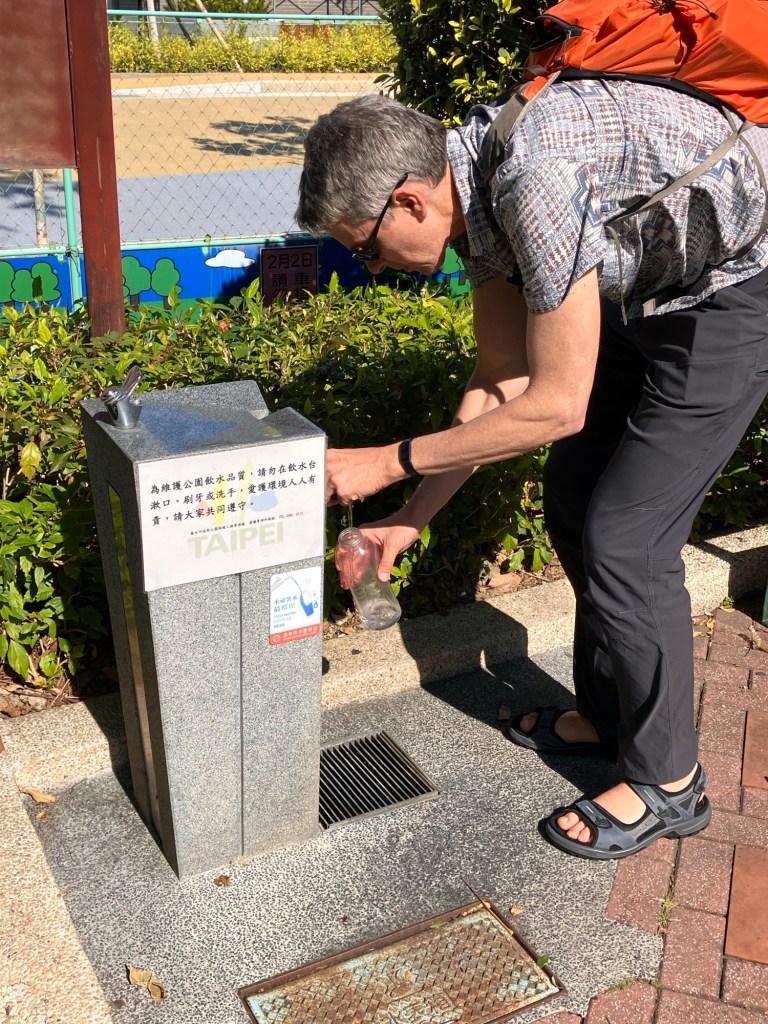
Plenty of water fountains and taps. In most playgrounds and parks, of which there are many.
The QR code shows you the water quality tests. And to answer your next question, yes! Loads of public toilets too.
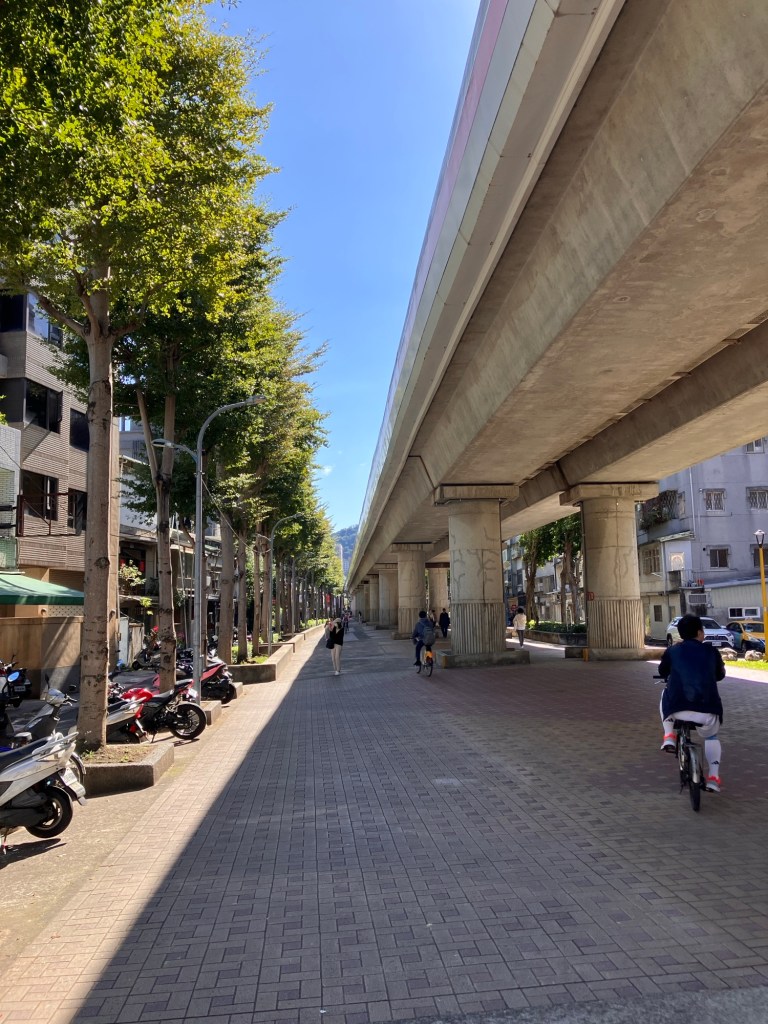
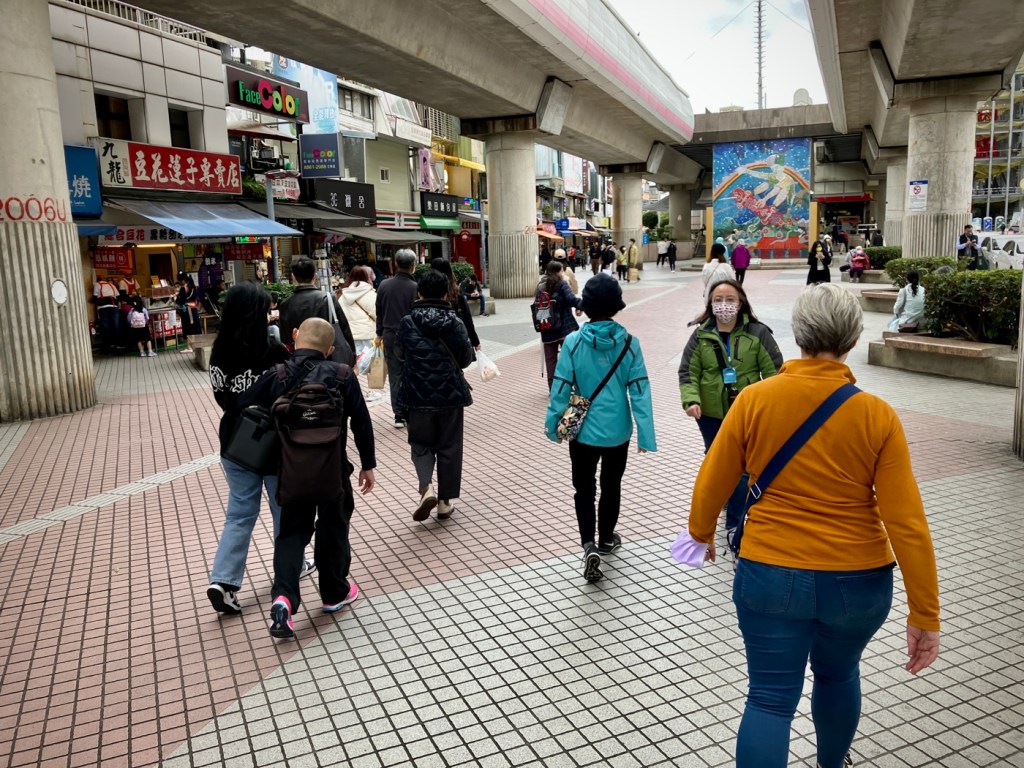
In the Shilin District the space under the metro tracks is for folks on foot and bikes.
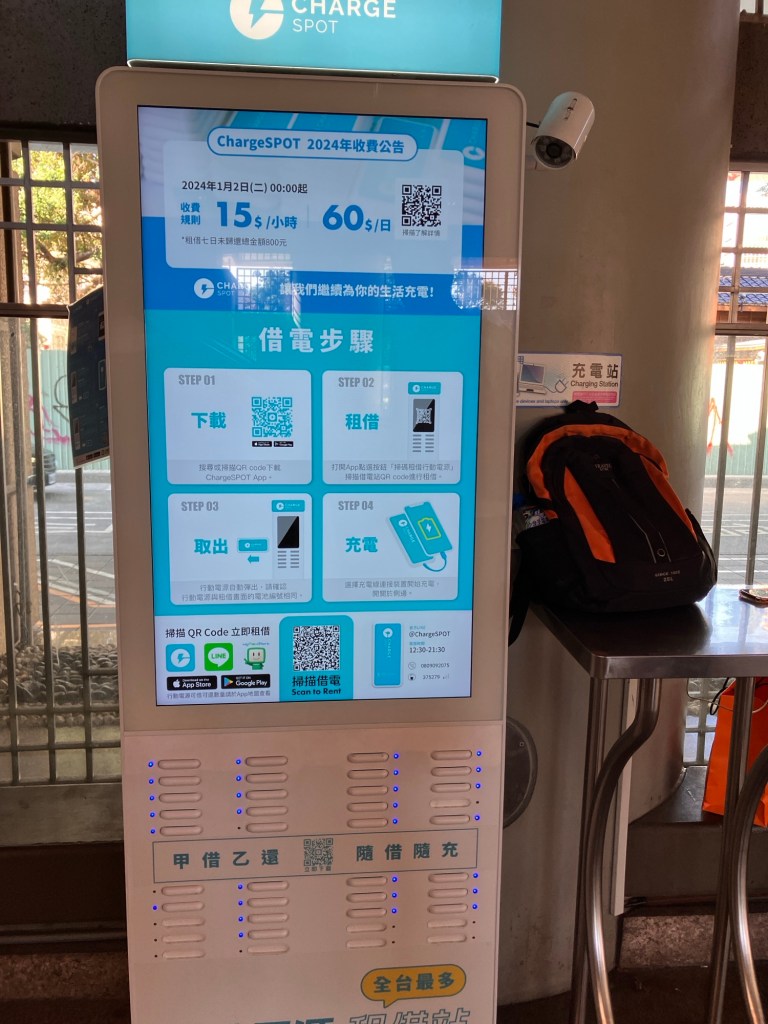
In a metro station, you can always find a way to charge your cell phone. A simple outlet, or a battery pack for rent.

We keep saying we want to bike tour in Taiwan, but haven’t gotten it together to get our bikes here. There are places that rent touring bikes, similar to what we did in Korea, but I have a hard time getting a bike that fits correctly and comfortably. Being uncomfortable and eventually in pain on a bike is no fun.

Getting around by bike is popular in Taipei.
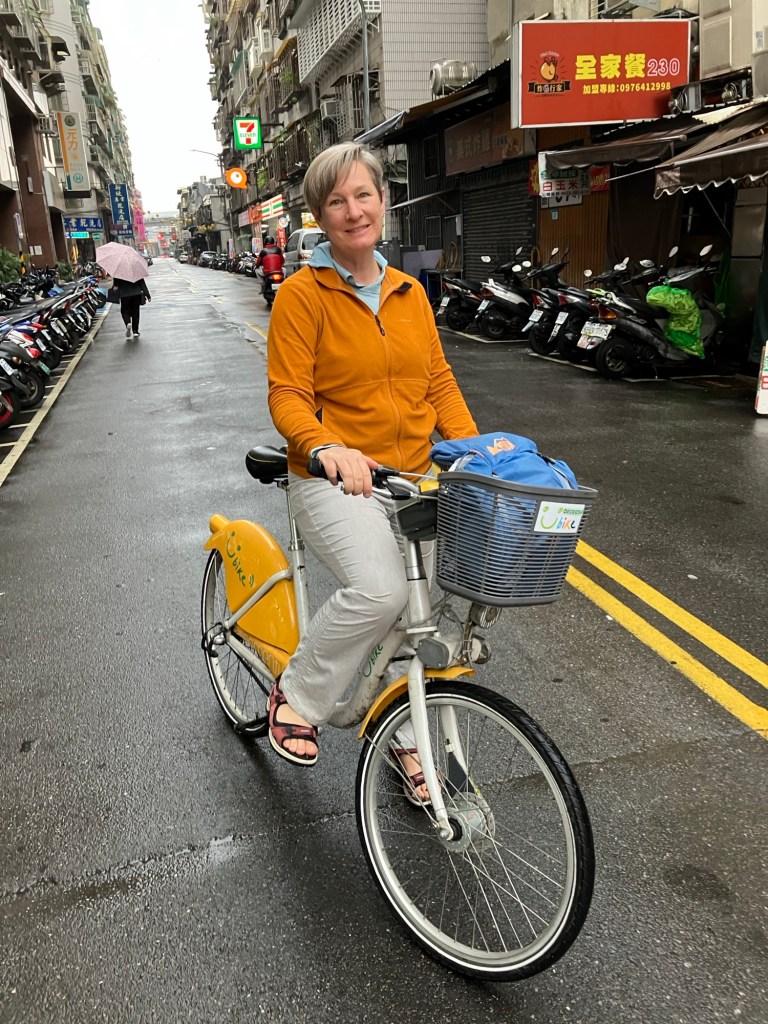
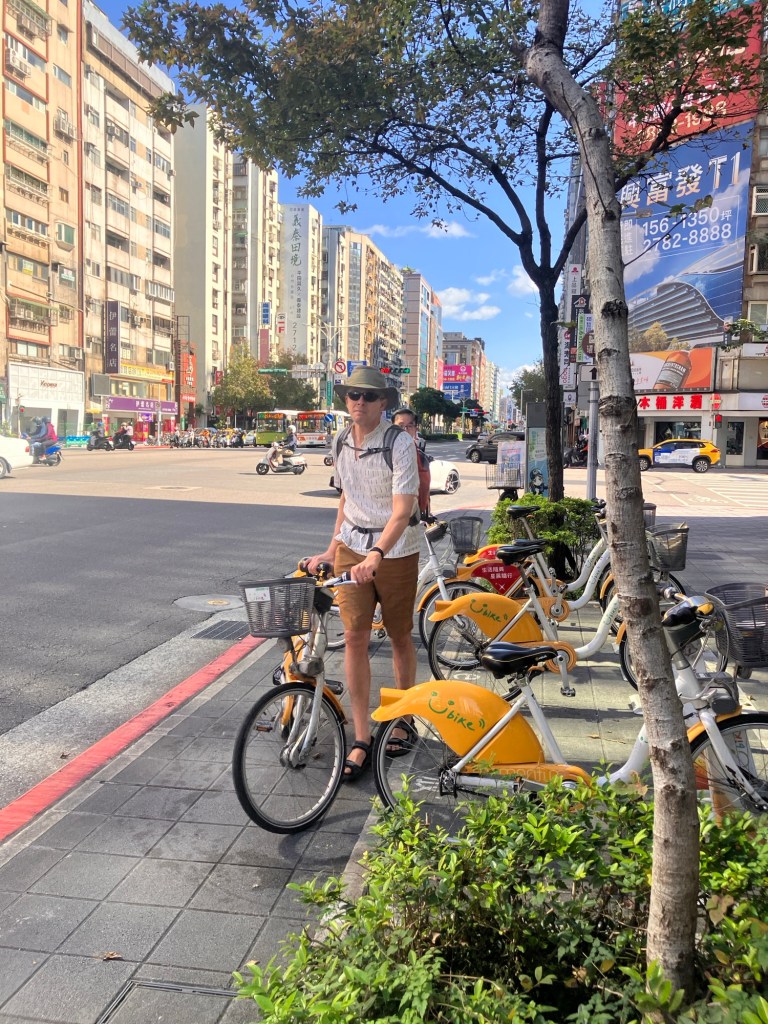
So we got bike share bikes. UBike.

In order to sign up for a UBike account we used the app, our Taiwan phone numbers which came with our SIM cards, and a transit card – which you tap for not only transit, but the UBikes, and to my delight, vending machines. (Hello Gummy candies.) You link your transit card to the app and that is how you pay for the UBikes; super easy.

A proper city bike with fenders and a basket.
Ok, a bit small for Rich, but fine for a few hours of riding.
Plenty of bike stations from which to check out and return the bikes.
Which makes it easier to get around the city and check out attractions such as the Taipei Expo Park.
And the Lin An Tai Historical House and Museum
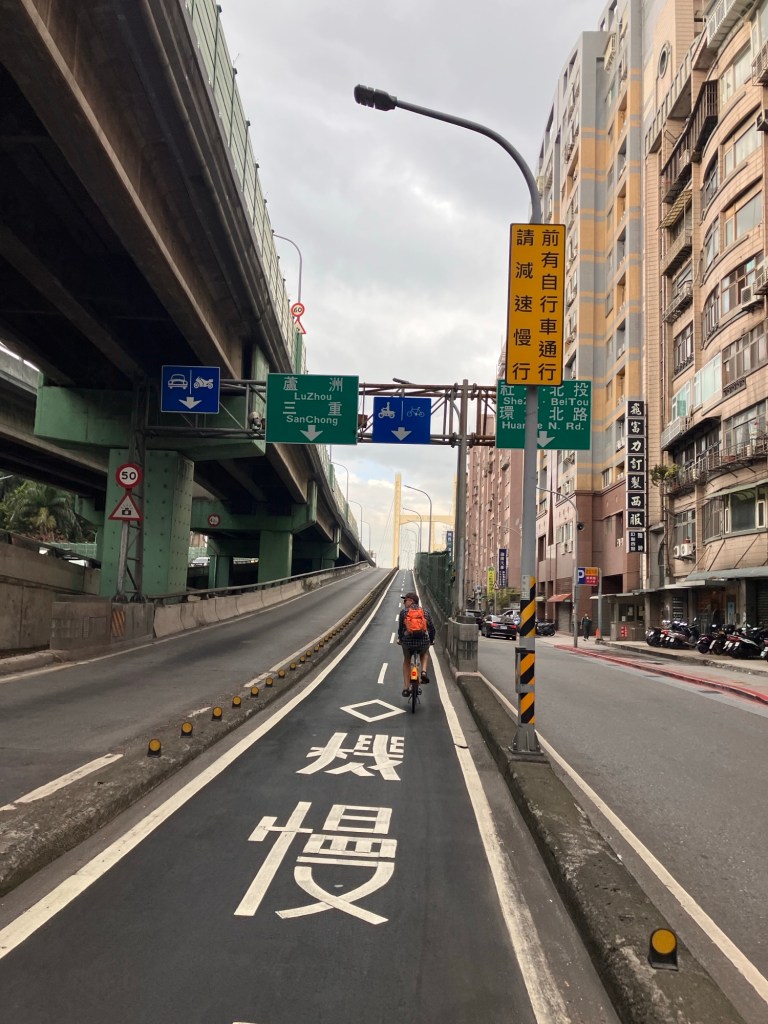
Scooter/bike lanes are everywhere and even take you across major bridges.
Riding to New Taipei City. We made it just before it started to dump rain.

So we ride the bike share, we walk a lot, and we use the Metro. That’s our Taipei experience. And yes, we go to night markets and stand in line to buy food, and sometimes eat food from one stall while we’re standing in line to buy food from another stall.

Cold spicy miso noodles at Shilin Night Market.
That spicy sauce catches up to you.
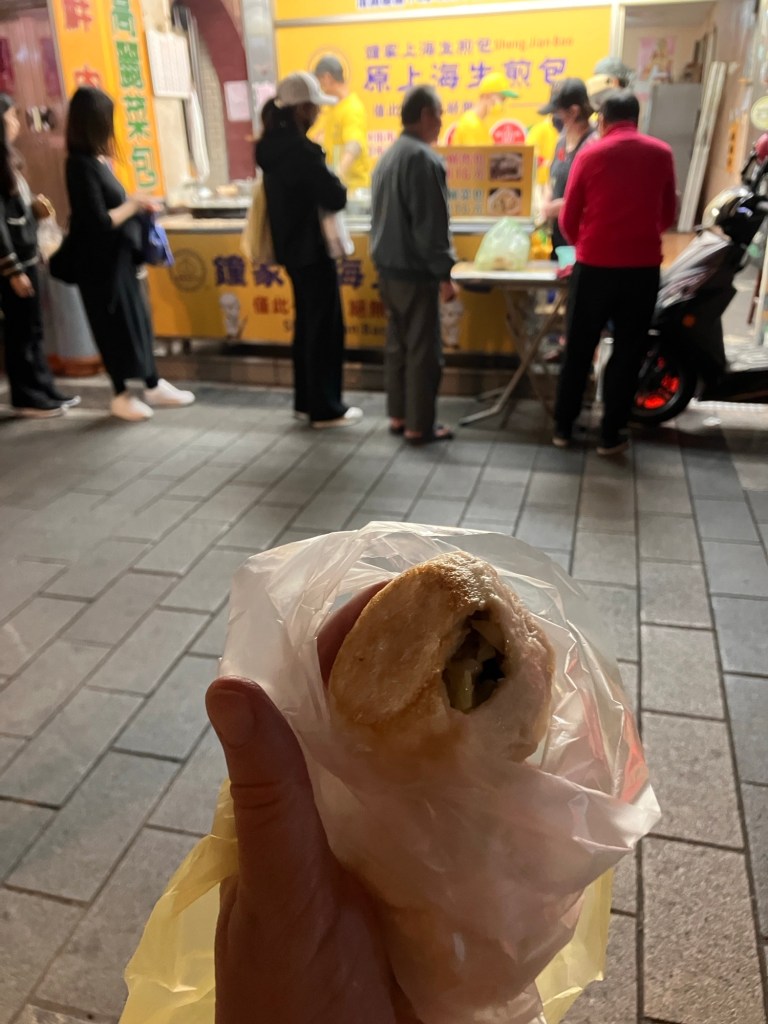
So it’s off to the Sheng Jian Bao stand.
Two kinds of bao, pork and cabbage. Neither are vegetarian, they let you know as you order.
Both are delicious. There are downsides to Taipei night markets – one of which is no place to sit and enjoy your food. We were standing in a closed up shop’s front steps.
Another downside? Taipei night markets get crowded. They are not for folks who dislike crowds.
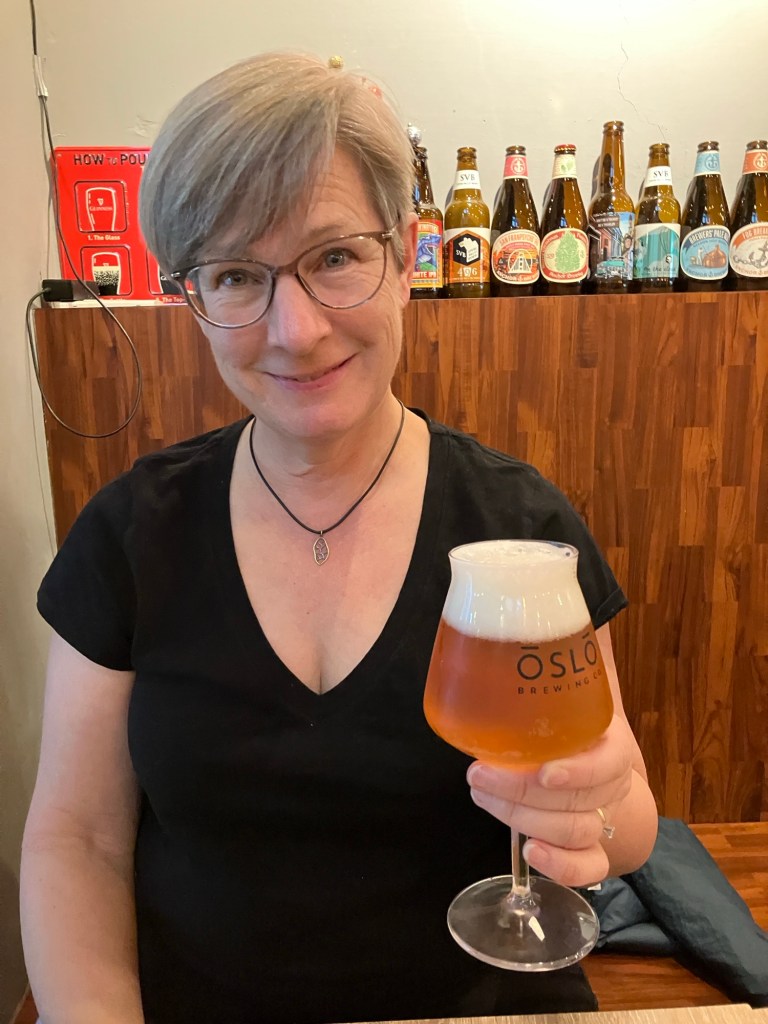
There are plenty of restaurants to enjoy as well for when you want to sit to eat. This was a burger restaurant with good craft beer.

With our fondness for Taipei definitely confirmed we’re headed out to explore some more of Taiwan. Where? Anywhere we can get to by train. In a clockwise direction. First stop, Hualien City. Just about two hours by train. More from the rest of Taiwan soon.

Ah, trains. Enjoying the view of the coast.
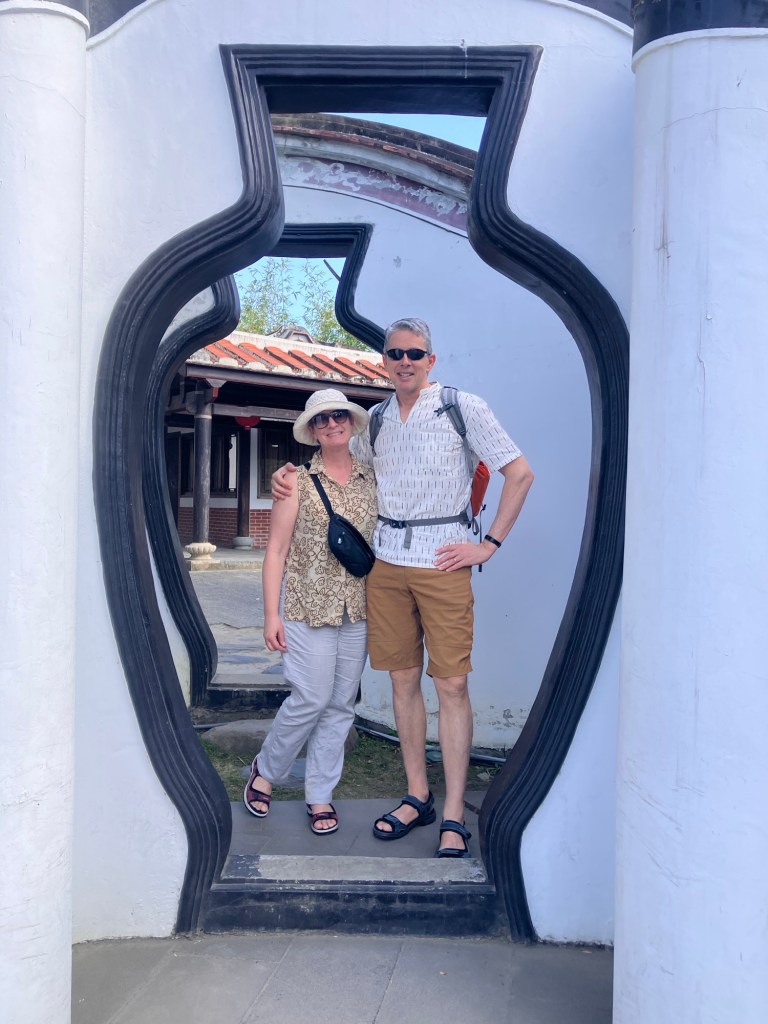
The happy travelers.

Why do Americans smile so much?

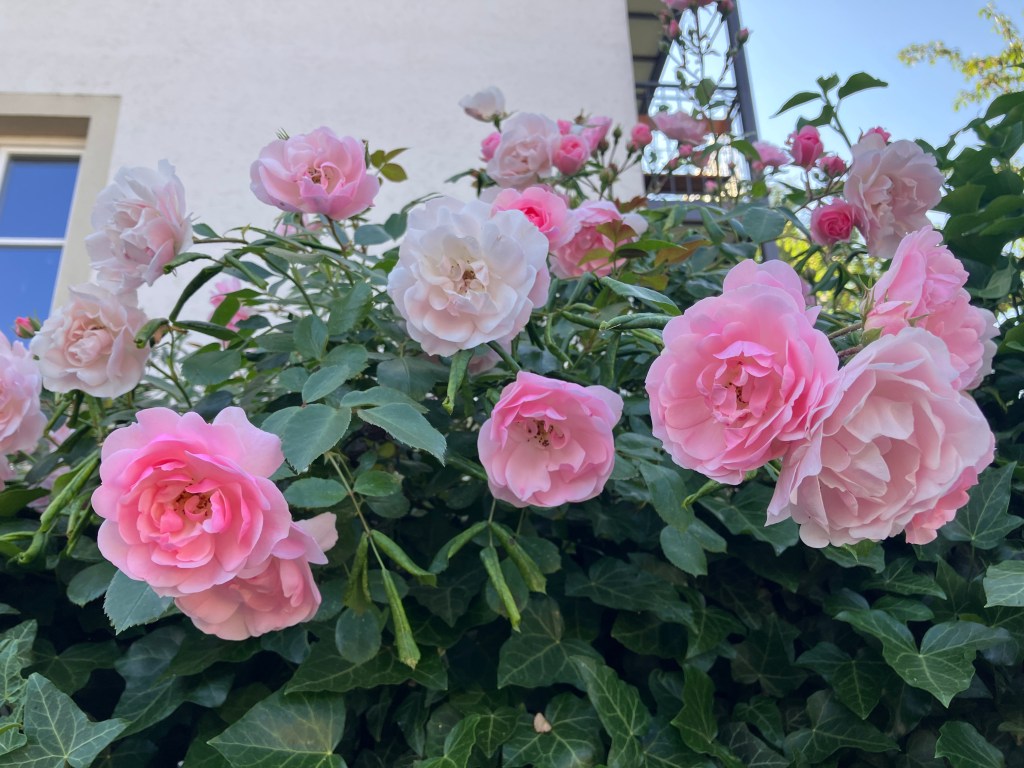
The warm weather in Germany has the roses out in full force.

I was going to ask, why don’t Germans smile more, but that’s assuming that the American level of smiling is normal, or correct, and that everyone else is smile deficient. Americans smile a lot. Really, we do. And Californians smile even more.

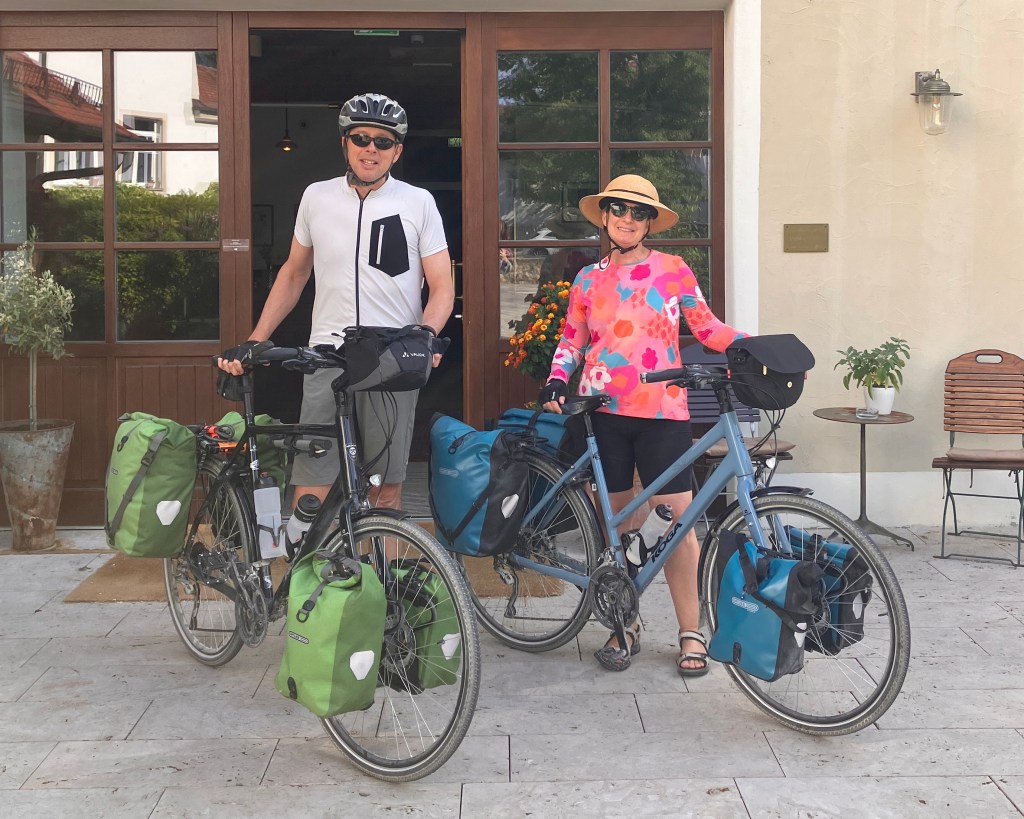
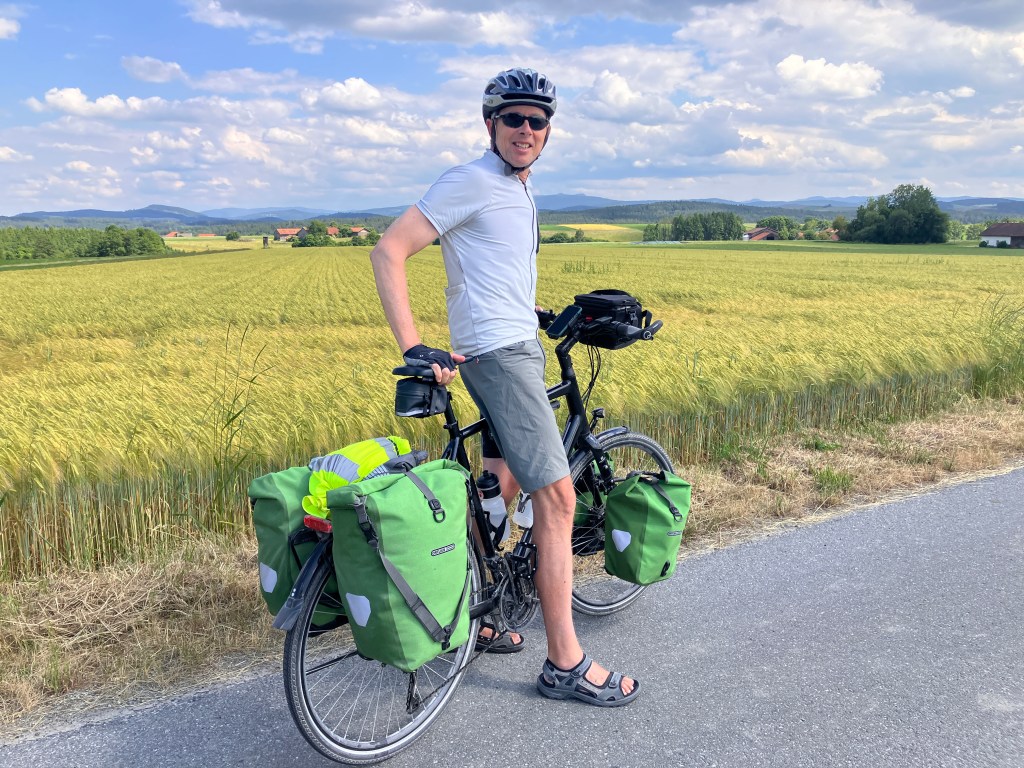
Smiling for the camera when leaving Regensburg.

Friends from other countries have told us that yes, everyone is aware of the American smile habit. You can see us coming, teeth showing, faces crinkling in delight.

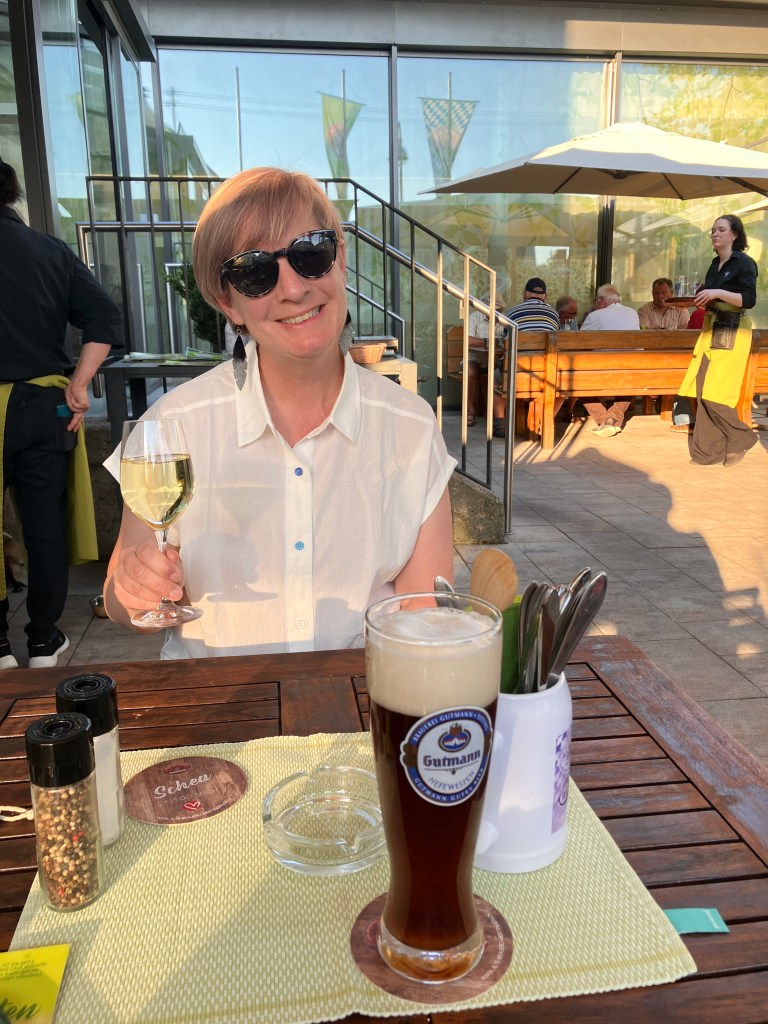
I know why I’m smiling here. A nice hotel, a good beer garden and a delicious glass of wine.
And who could resist smiling during a picnic on the banks of Neuburg an der Donau.
We smile while enjoying our German pastries.
And when Rich’s new bike had a loose bottom bracket issue we smiled when greeting the very nice bike shop owner who thankfully had opening hours on Saturday morning.

I had always assumed that the American smile habit was simply that we’re mostly a friendly country. And those Americans who travel are really friendly and happy to be out and about.

There were fewer smiles on a train hop day, when we ate lunch on the station platform hiding from the sun.
Both the departure station and arrival station only had stairs, which meant unloading all panniers and carrying everything down and up: very few smiles.
The train system in Germany is very good, but a lot of small local stations have only stairs.

But a conversation with a friend who has lived in France, the UK, the USA, and is now back in Germany, really hit home what we were feeling in Germany with fewer smiles per human – just because they don’t smile doesn’t mean they hate you. Ah ha!

Pretty typical bike touring picnic. Falafel, cheese, cucumber, red pepper, and brötchen (bread rolls) from the bakery. Oh, and a tube of mustard and a tube of harissa for Rich.
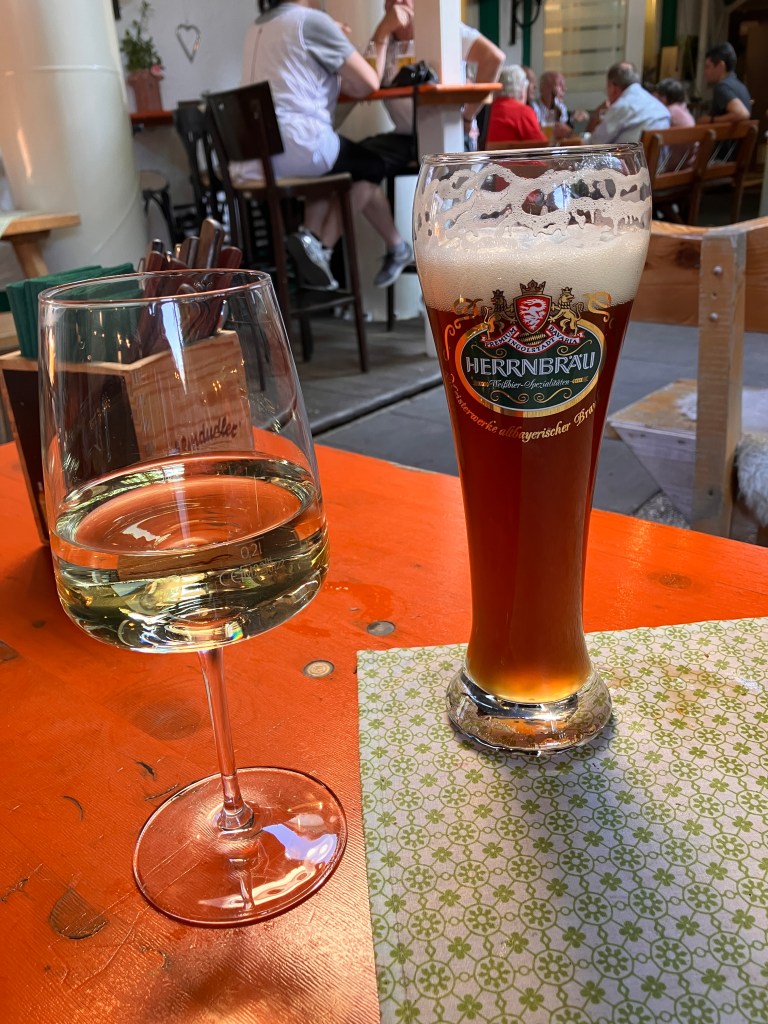
Very typical beer garden order, beer for him, wine for me. And smiles for the staff.

We love bike touring in Germany. There are so many things to enjoy and so many miles of fantastic bike paths and routes. Sure there are challenges, just like in any country. We’d happily import the Japanese convenience store culture to Germany. Germany is grocery store challenged, to our minds. All grocery stores are closed on Sunday. And there is no convenience store culture outside of Berlin. That means we have a mad rush on Saturday to stock up for Sunday cycling. Restaurants are open Sunday but we prefer to picnic for lunch.

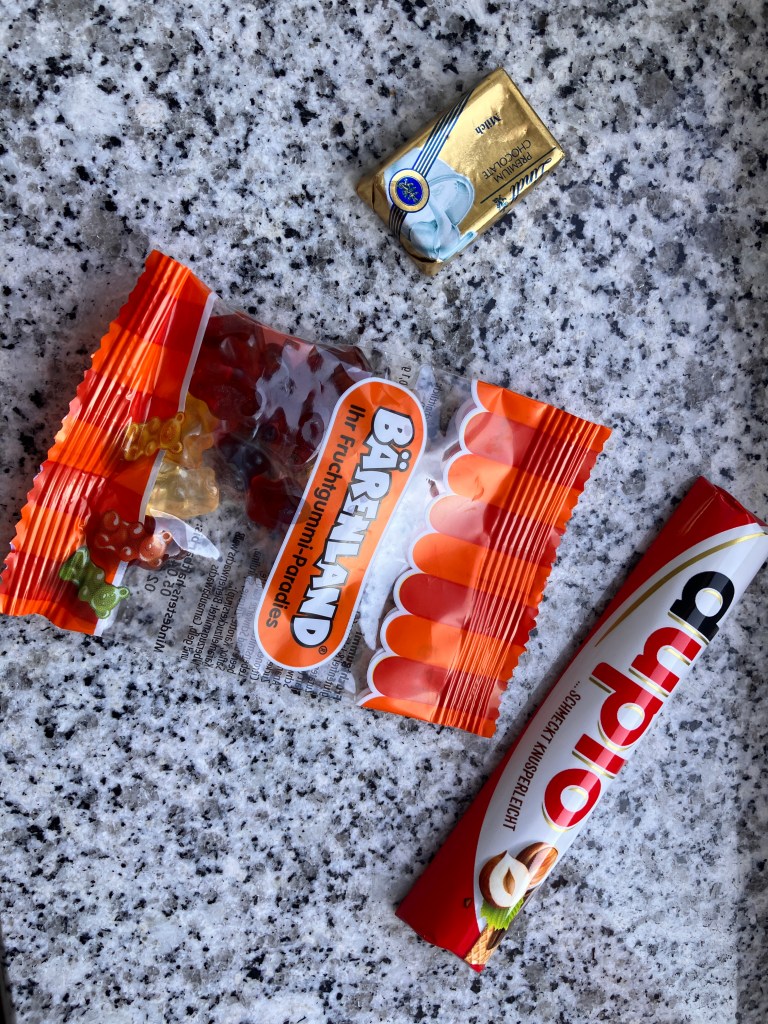
How can you not love a country that leaves lovely treats on your pillow in hotel rooms? I stash them in my handlebar bag for emergency sugar energy.
A museum dedicated to Bread and Art? These are my people. This museum in Ulm was fascinating.

And don’t forget, this country has 260 cycling routes crisscrossing the landscape. And the other cyclists are perhaps not the smiling type, not all of them, but when push comes to shove they are there for you. Railway crossing gate stuck and cyclists starting to slip under the gates? They will help you with your loaded touring bikes and keep a close watch for trains. Tight connection at a train station and having a tough time getting both bikes and 8 panniers down the train steps? The cyclist who greeted your smile with a stare and turned away is there to help you lift your bike down the stairs. Good people. Just not smiley.

Following the Donau river path.
The Donau River outside our hotel in Ingolstadt.
Fun fact, Ingolstadt is where Mary Shelly’s character Victor Frankenstein attended Medical School.
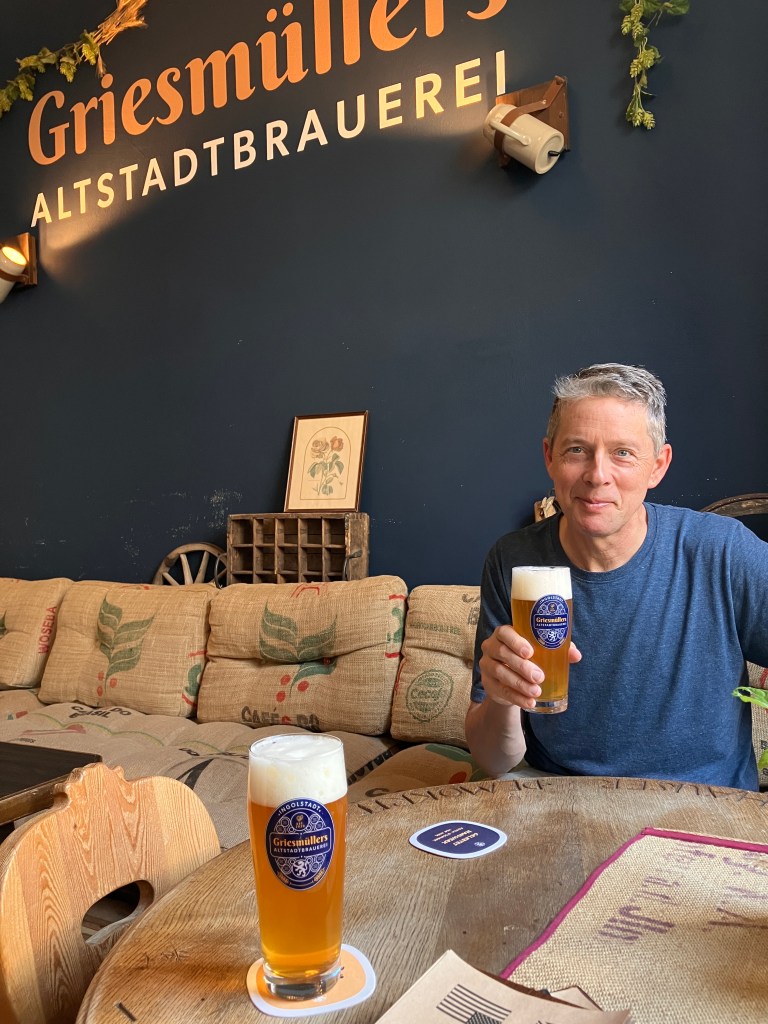
A brewery in town, making a great pale ale, not a typical German beer.
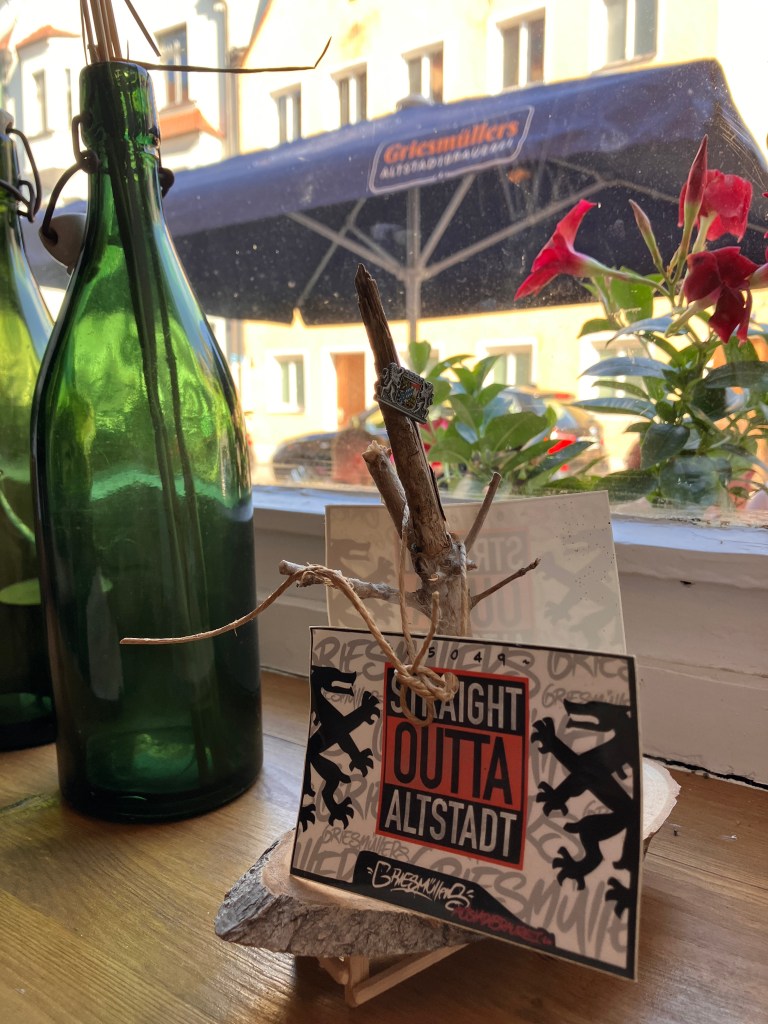
“Straight outta Altstadt”. This really made us smile.
Easy to remember the beer when the brewery name is right there on the glass.
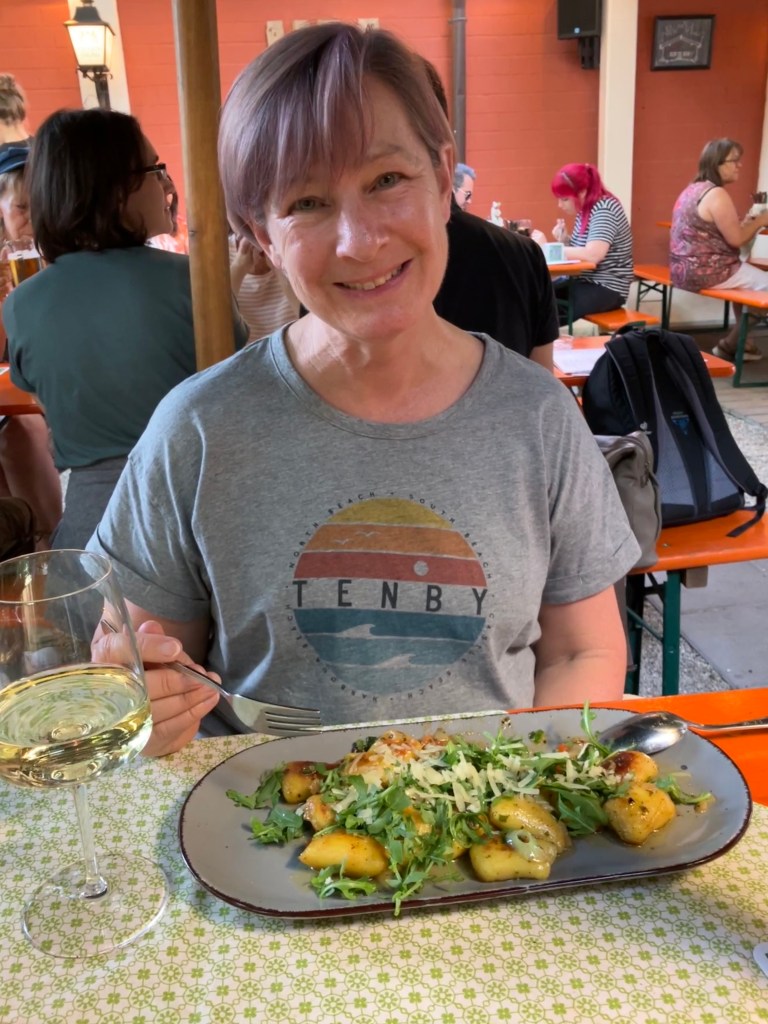
A delicious plate of gnocchi and a smile.

So what is it with this American habit? Are we all just simple and happy? Well, according to a fun article I read, it has to do with how many immigrant groups or source cultures a country has. And America is just that – immigrants. 60 source cultures. When you arrived in the USA and your neighboring farmers were Polish on one side and Swedish on the other- you smiled since it was the first and most welcoming communication you had. A non verbal way to say hello, let’s get along. Before you all learned a common language smiles were your signal of cooperation and neighborliness. And that habit stuck and permeated the culture. Canada is similar, but I don’t know if they have the same reputation for loads of smiles.

Loaded up and ready to roll out of Ingolstadt.
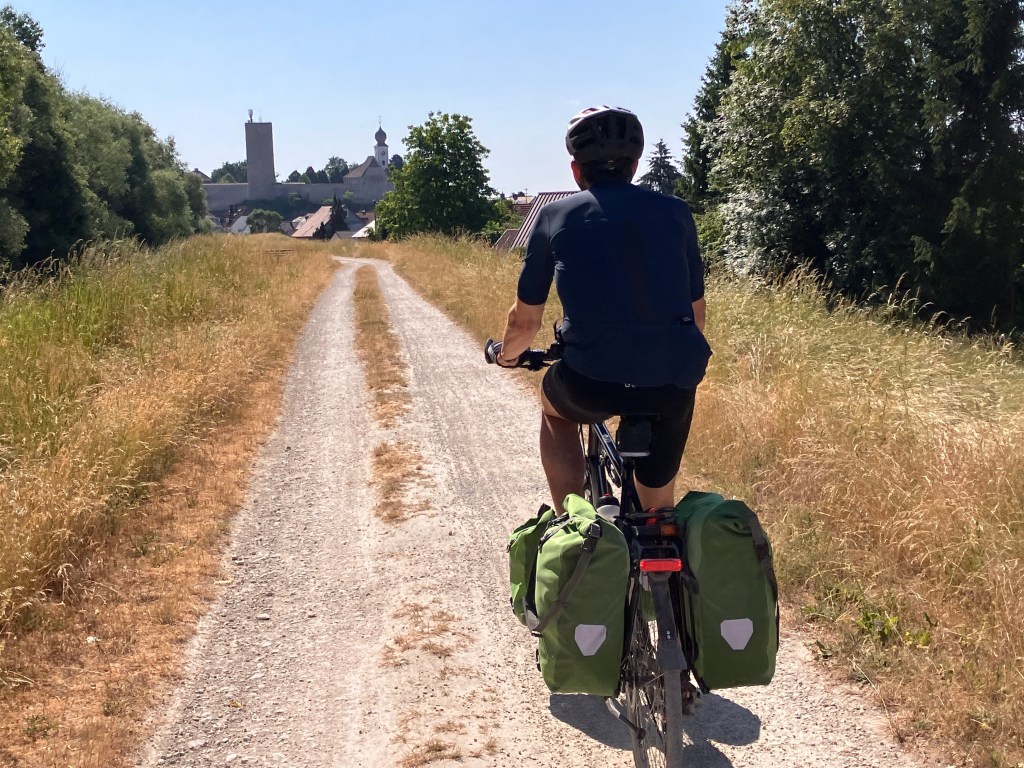
Sometimes we’re on asphalt.
Sometimes it’s dirt.
The smell of roses in the warm air will be an evocative memory of this trip in Germany.
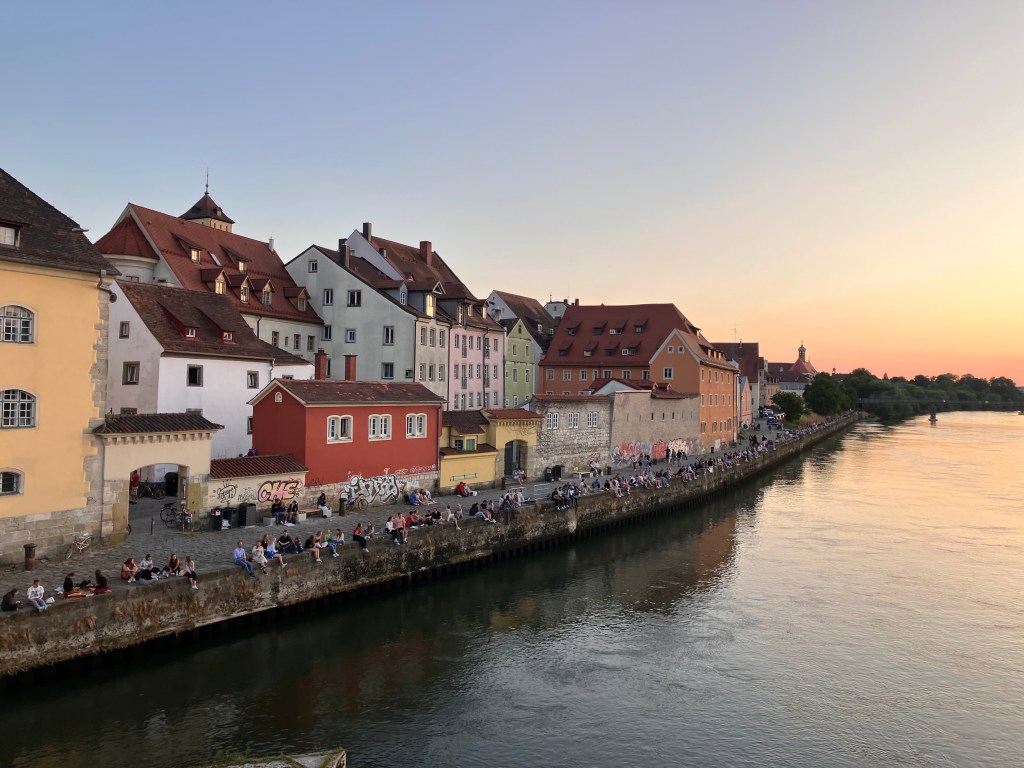
Enjoying a long warm evening in Regensburg, one of our favorite stops and the second time we’ve been here on bikes.
We both absolutely love a city that has so much gathering space for locals. Grab a beer and dangle your legs over the river.

If you think that Americans are not welcomed, or viewed with annoyance or contempt in Germany, you are very wrong. We’ve learned to say we’re American as soon as feasible in conversation. It not only explains our smiles and enthusiasm, but very often elicits an enthusiastic response, with an offering of which relative lives where in America- a son in Chicago, a daughter in Arizona, or, as the case with our young waiter from Moldova, a wistful statement that America is his favorite country, but no, he’s never been.

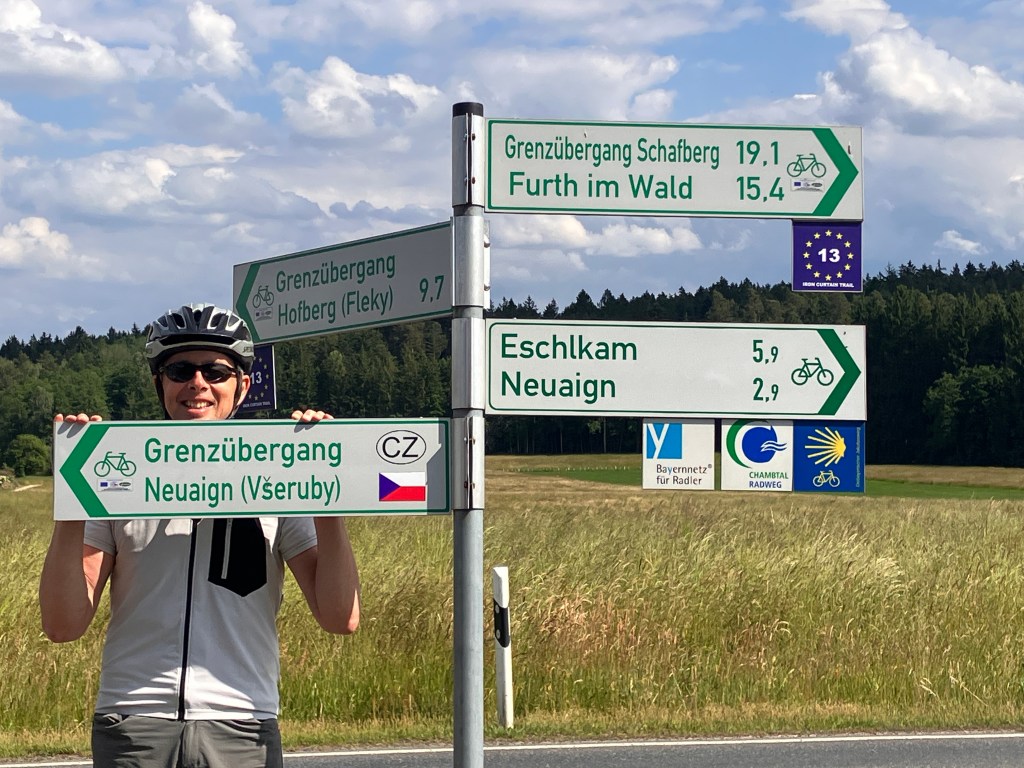
Riding out of Germany.
Eurovelo 13, The Iron Curtain Trail, taking us to Czechia.

As always, we are reminded that for all our faults, the US lives on as the land of opportunity for many. So we ride along, smiling at everyone. Probably viewed as a bit silly or simple by some, but for others a reminder what a country built by immigrants looks like, and acts like. And when after a little hesitation one of our broad smiles is returned by a German, we consider it a win. And if we can get a Hallo, a Guten Morgen, or a Groß Gott, that’s even better. Farewell for now Germany, we’ll see you on the return trip, and now let’s see how our American smiles are greeted in Czechia. Our first time back in 16 years and the first time with bikes.

The Happy Cyclists enjoying a Regensburg sunset.

We Love Japan, but….

We’ve been so thoroughly enjoying every day in Japan that we haven’t had much time or energy left to Blog. It’s a fantastic place to travel. But no place is perfect, and Japan has its weaknesses too, especially in the bike and pedestrian realm.

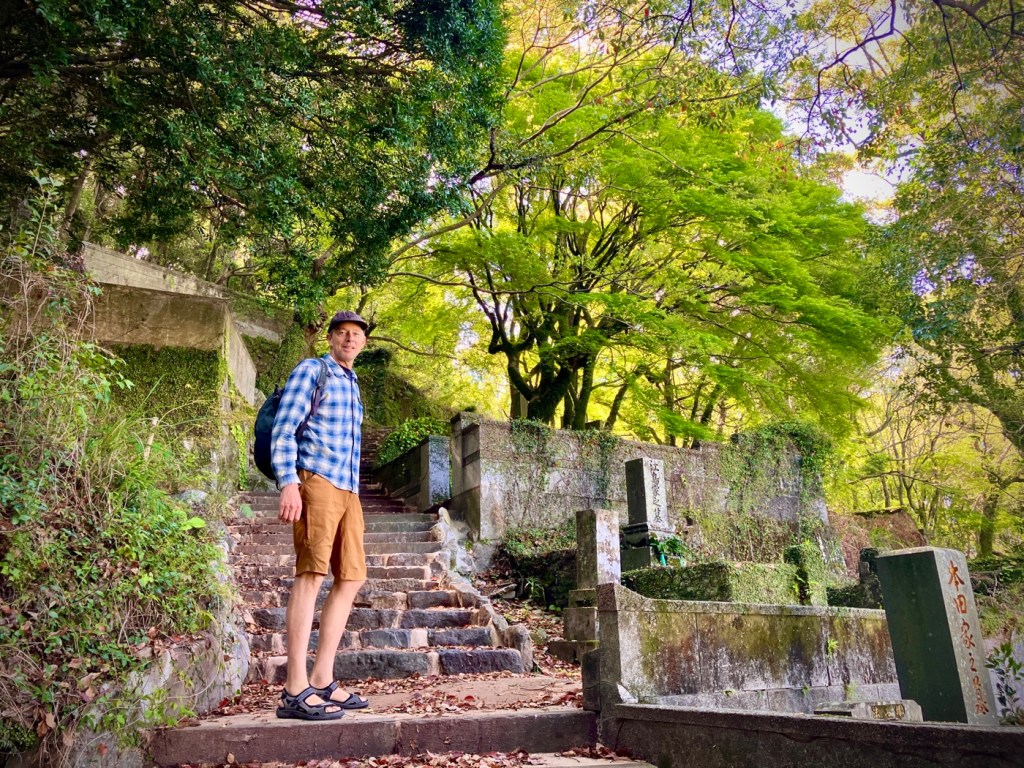
Exploring the hills and stairways of Nagasaki was a joy in the crisp spring weather.

We’ve been travelling our preferred way by train, bus, ferry, streetcar, subway, and bike. With a lot of walking to the beach to explore and get to our lodging. We’ve been luxuriating in the clean, punctual, and extensive intercity train system. And the local public transit is always clean and reliable, if not always fast.

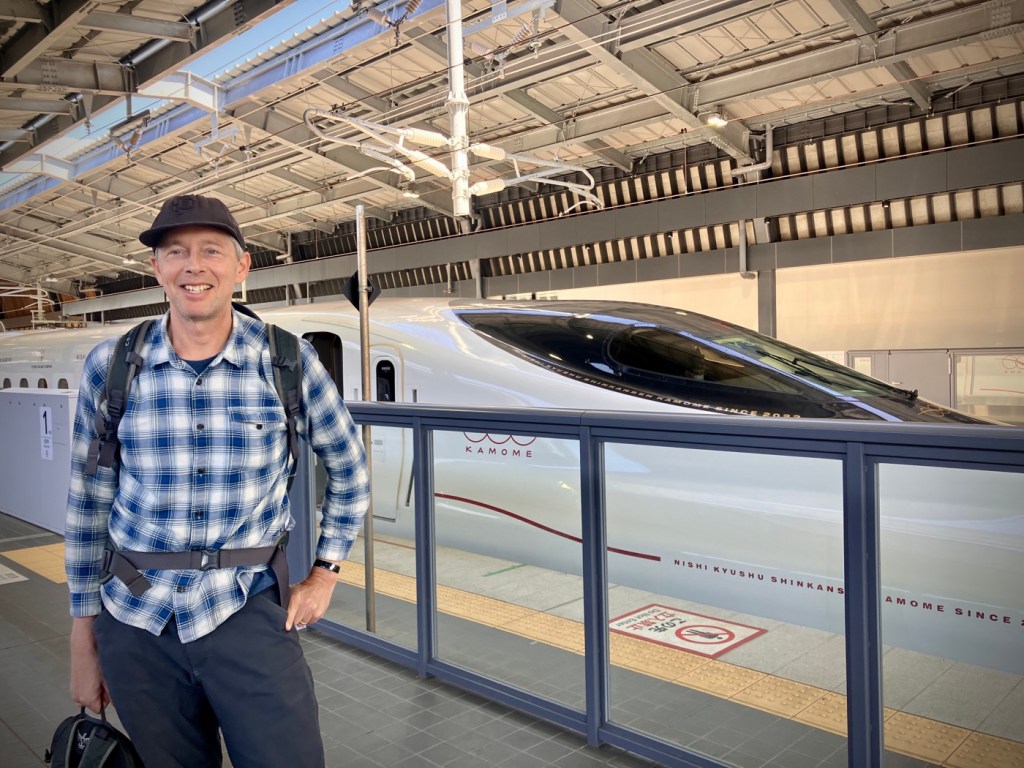
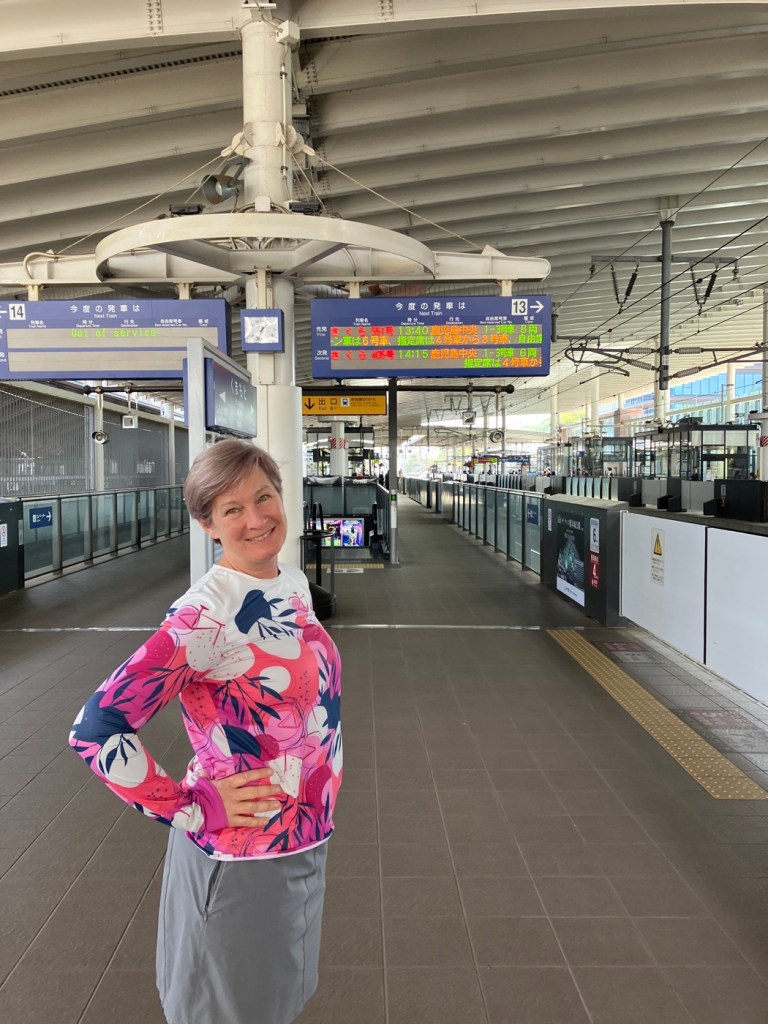
A shiny new Shinkansen on the recent extension to Kagoshima – marvelous and so fast
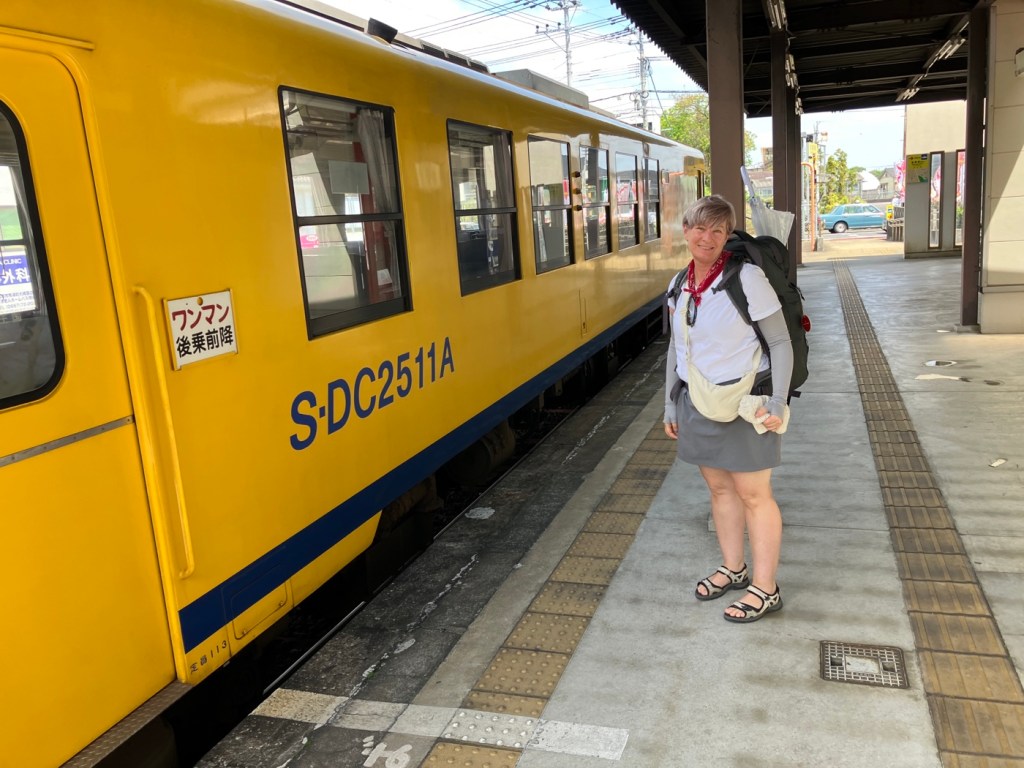
A single car train on the Shimabara railway, operated and conducted by one person! Many small lines in Japan have shut down, and how long can the last private lines survive?

So here are a few transport observations. For you transport wonks and mega walkers, they may give you the same joy and a maybe bit of frustration if you visit.

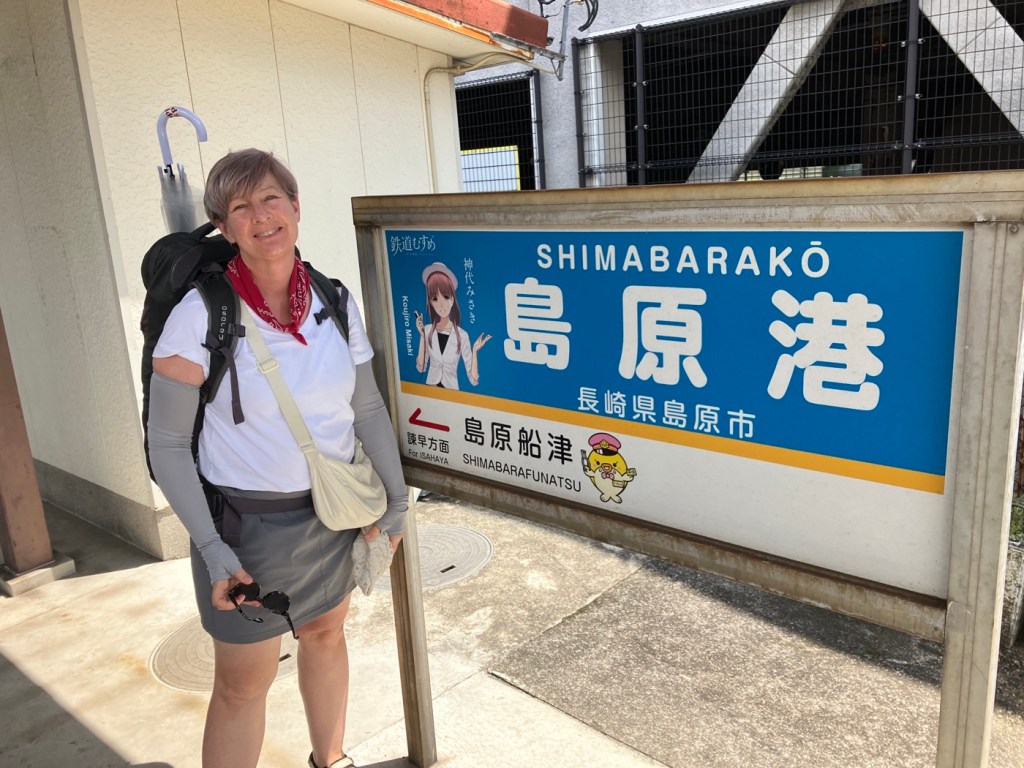
You can enjoy great connections in Japan, like the end of the line in Shimabara, with a ferry across the street that will take you to a bus and a Shinkansen line.

1. JR Rail Pass- Unless you are going to only visit a few cities or rent a car, then it’s a no brainer to get one of these passes subsidized for tourists. We bought two three-week passes and planned our trip to max its benefit to a 4 week visit by setting the activation for the day we left Tokyo and expiring when we get to Fukuoaka, where we are spending our last 3 days. This way we were able to exchange our vouchers at off peak time at Shinjuku station and avoid the mob we saw at Narita airport trying to exchange them to use immediately from the Airport. We instead bought $20 local rail tickets to central Tokyo. It was then easy and cheap to get IC (tap) Transit cards to get around for a few subway and loop rail trips in Tokyo until leaving Tokyo for Kanazawa.

JR Raíl stations are always clean, orderly, and the major ones have lots of food and shopping options and lots of vending machines

2. IC Card – Good for transit in most major cities. There are a dozen or so “brands” by region and they can mostly be used in other cities, although acceptance is a bit hit or miss outside the home zones. Don’t put too much on it initially, 5,000 yen ($40) is my recommendation, as you can always top it up but it’s hard to get a refund. You can also use them at many convenience stores.

Buses run EXACTLY on timetables, so real time predictions really aren’t needed. And you may have them to yourself in more rural areas

3. Train Seat reservations – With your JR Pass, you can make free seat reservations for most higher speed trains (and Shinkansens). I found that I could get our choice if I booked at least 2 days prior to our next trip. You can do it at green JR Ticket machines in almost all JR stations. So I’d often get our seats for our next leg when we arrived to a city. If you book too early and want to change your trains later, you won’t be able to do it at a machine if the new journey overlaps with the old one. You will have to go to a JR ticket office which could take some time at busier times and stations. But, you can alway board in the unreserved cars, so no serious worries other than maybe sitting apart or standing for a bit.

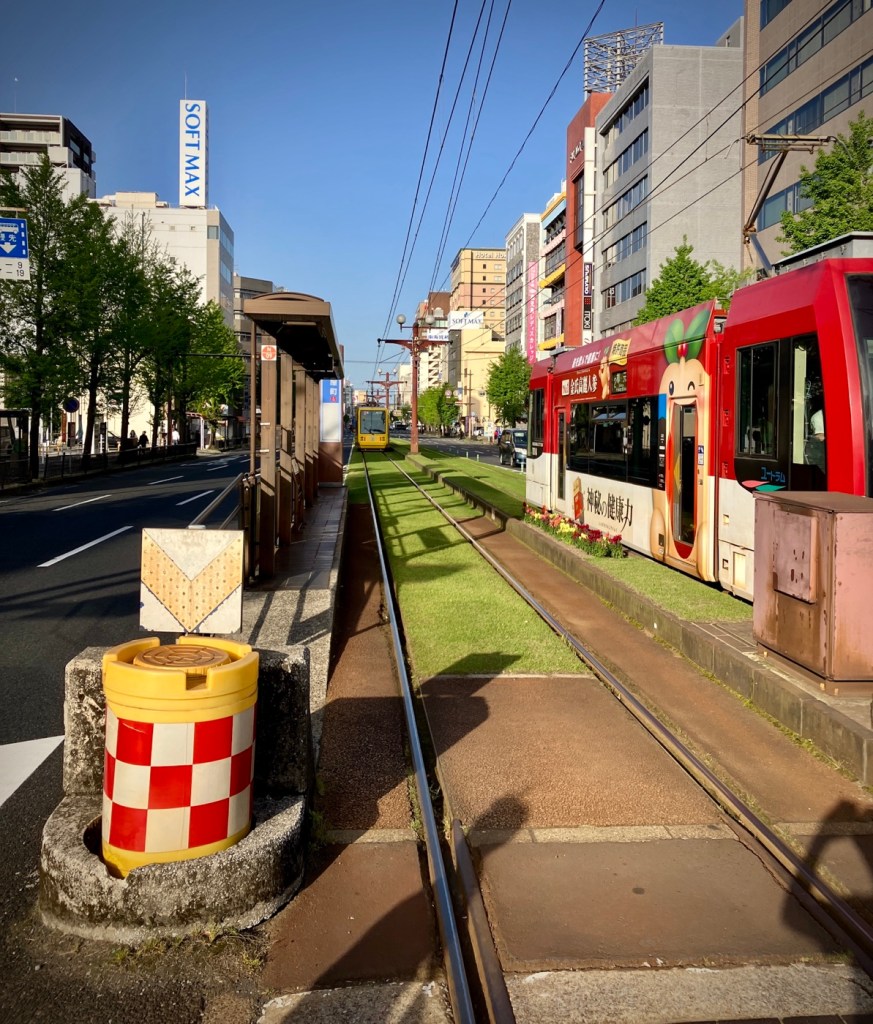
The worlds skinniest tram boarding platforms in Kagoshima next to 3 underutilized traffic lanes….hmmm
These poor tram passengers have lined up to wait for the lights to change, just to get off the narrow tram platform to the sidewalk.

4. Buses and Trams – they run on schedule (especially buses). You board at the back door and tap your IC card if available or if not, take a little paper ticket from a dispenser that indicates your boarding zone. You always pay at the front door as you leave, calculating your fare from the easy digital sign at the front. Put your stop ticket and fare in the box or machine. They can always make change. This also applies to some of the small independent (Non JR) local trains. Once you get the hang of it, it’s pretty straightforward (Especially with IC Card), but it seems pretty inefficient at crowded times as many people still pay cash fares. There is a flow from the back of the bus towards the front door, but it doesn’t match the ease and speed of a proof of payment system.

Navigating the local systems can be challenging
Google maps can really help as it has most timetables (but not all) available in navigation, but you still often need to id your bus in Kanji script or just be at the right place on time, because the bus will be.

5. Walking – You will do a lot of walking in Japan which is mostly great, and wandering the alleys, hidden temple stairways, and quiet back streets is one of the great joys of Japan. One downside though is that the arterial traffic signal timings are long, so get ready to wait for for 2-3 minutes at some crossings. It’s very annoying, and really delays walking trips across town. The only time you see Japanese run is for crossings, as they know it’s a long wait if you miss the light.

The cats and temples are always worth the long pedestrian lights
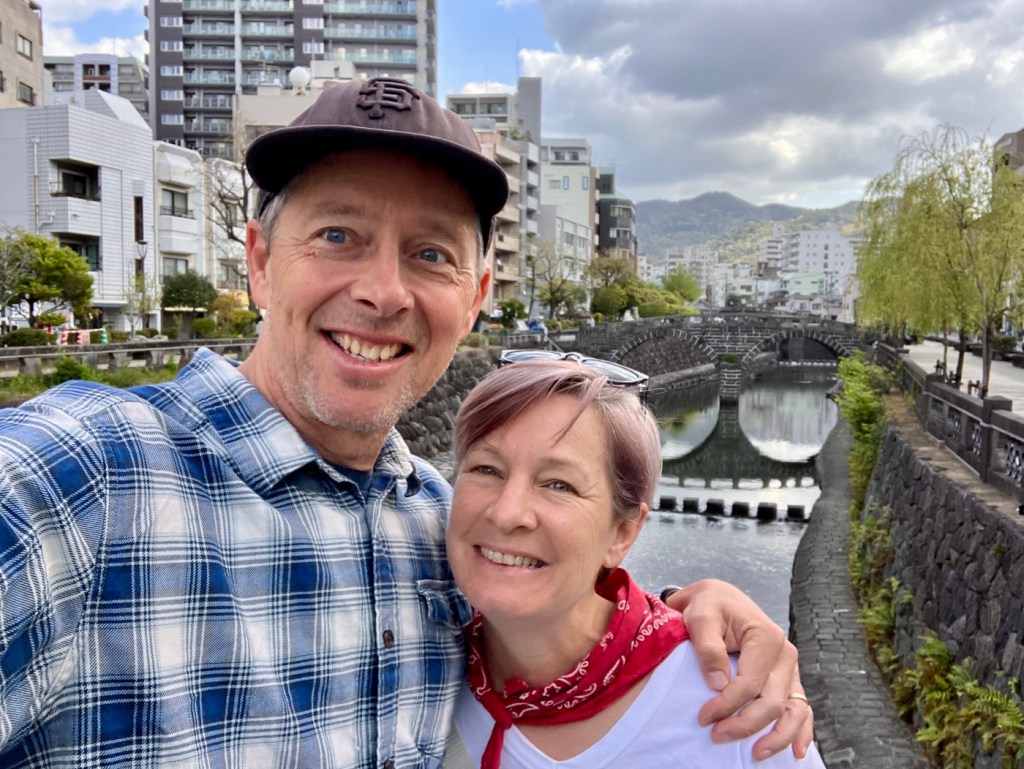
A series of historic stone bridges line the Nakashima River in Nagasaki.

Also, pedestrian crossings can be spread out on major arterials, with occasional overhead or underpass ped crossings in lieu of at grade crosswalks. It seems like a legacy of 1960s traffic engineering that continues in philosophy today, but stairwell underpasses are not good for an aging population.

State of the art ramen ordering machine. Automation and an aging population go hand in hand as labor is getting scarcer every year in Japan
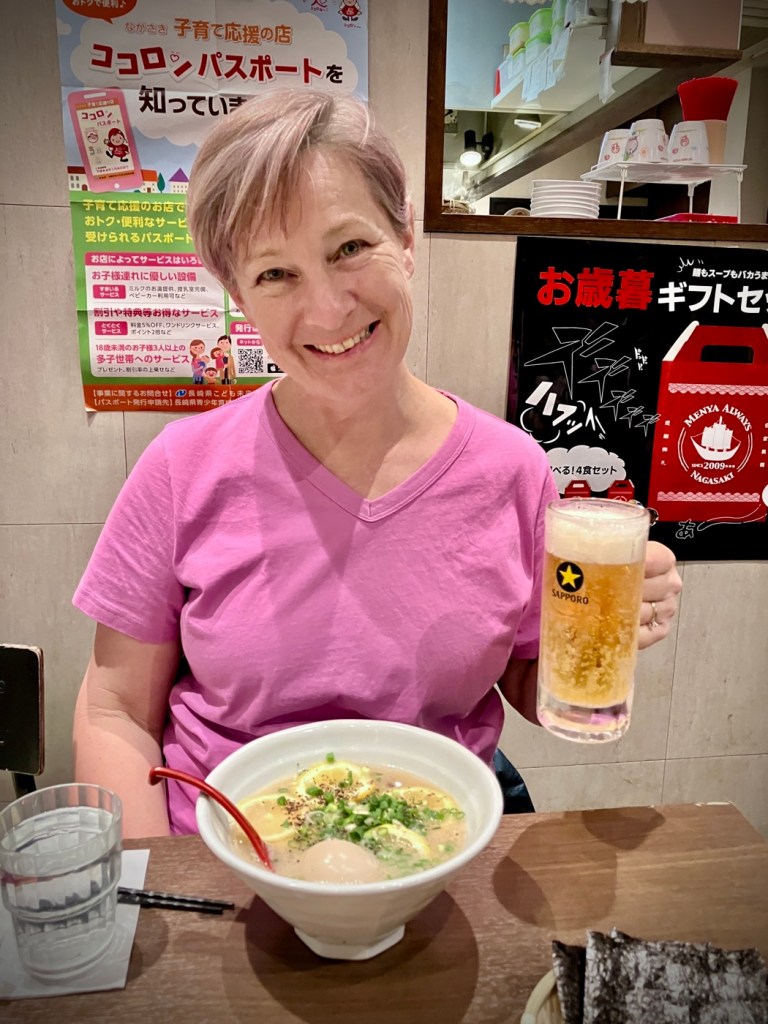
A unique pork and lemon broth at Menya Always ramen in Nagasaki

So what about Jaywalking? A few people, especially in larger cities will jump a signal or cross midway, but 98% of Japanese wait until the light is fully green. As time has gone on in our travels here, we are getting less and less patient, and will cross at will when it makes sense and traffic is clear. We are surely going to incite a pedestrian revolt here!

The main shopping arcade doubles as a cycleway in Takamatsu. It does provide weather protection to cyclists but is hectic in the evening rush hour when shoppers are out
Happy walking; riding bikes is not allowed in the busier hours or areas of the arcades

6. Bikes: There are many more than you think, especially in flatter cities. But the bikes share most sidewalks and it’s all a bit chaotic, which could be solved by more on street protected lanes. Cyclists routinely cut corners and swerve across intersections and are an outlier to order on the streets. (Yeah cyclists!)

Amazing underground automated bike storage in Takamatsu.
“Hello Cycling” bike shares were located in underground bike parking facilities in Takamatsu and the App was (mostly) English and foreign credit card friendly.

So my quick transport report card for Japan based on our scientific analysis:

Trains – A-….ok, amazing at a high level, but deductions for lack of App based e-tickets/seats please…and stringent bike policies keep it from A+

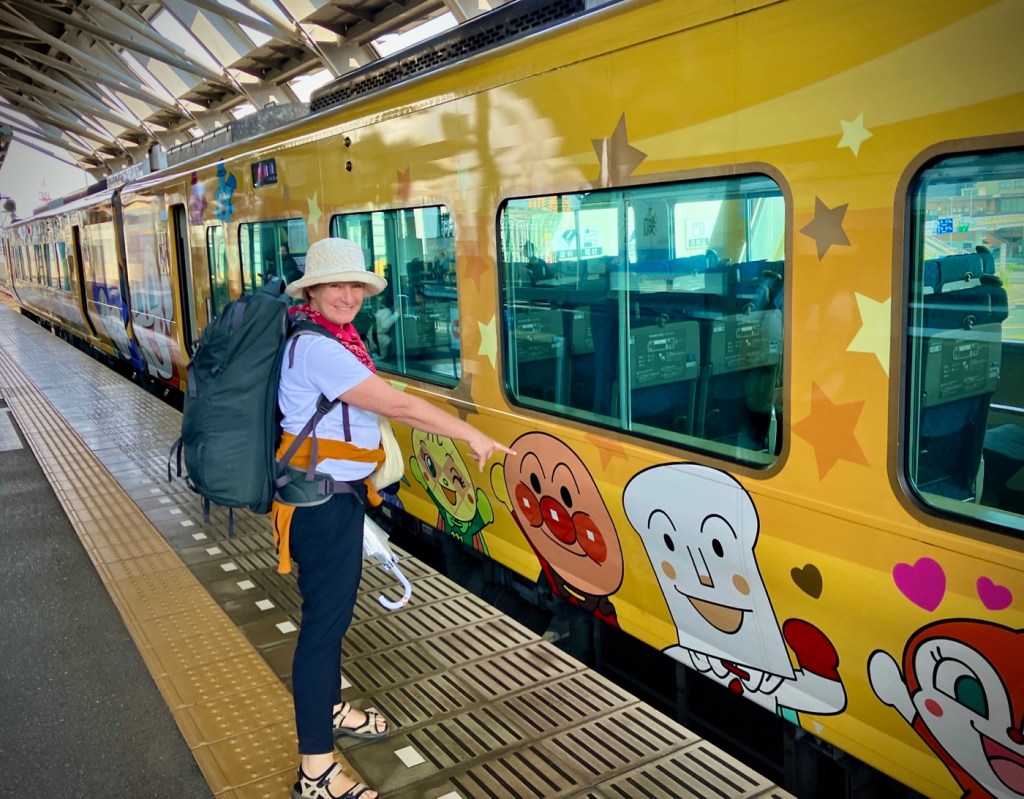
There are themed trains too, including a Hello Kitty Shinkansen (missed it) and our train to Takamatsu
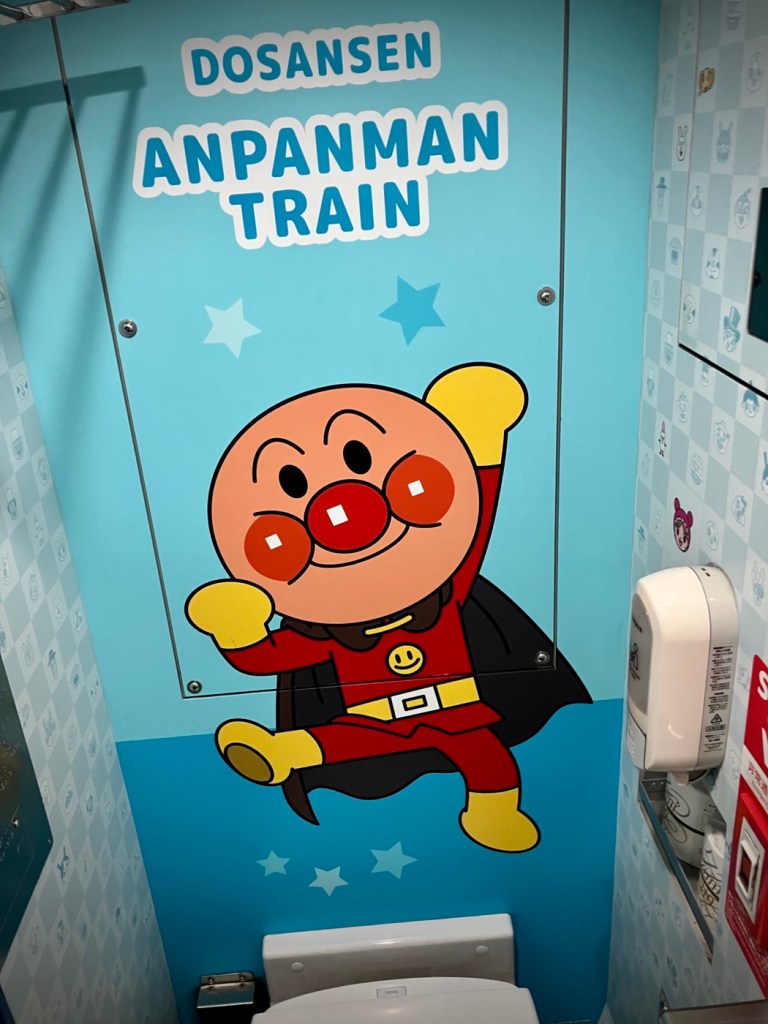
And the theme continues inside…Apanman is a beloved TV series based on Takashi Yanese’s picture books that he produced for over 40 years.
Even to the WC

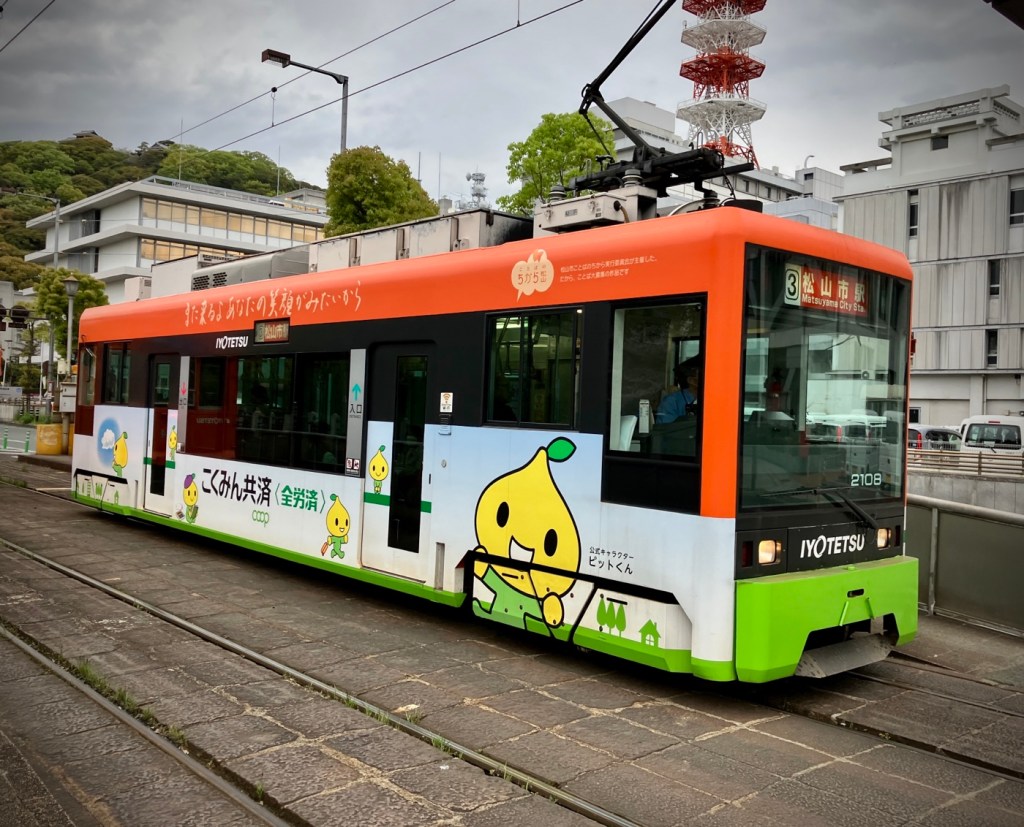
Trams – C+. Mostly old, narrow platforms, steps, clunky ticketing…. Few dedicated signals.

The trams are so cute, but less functional.

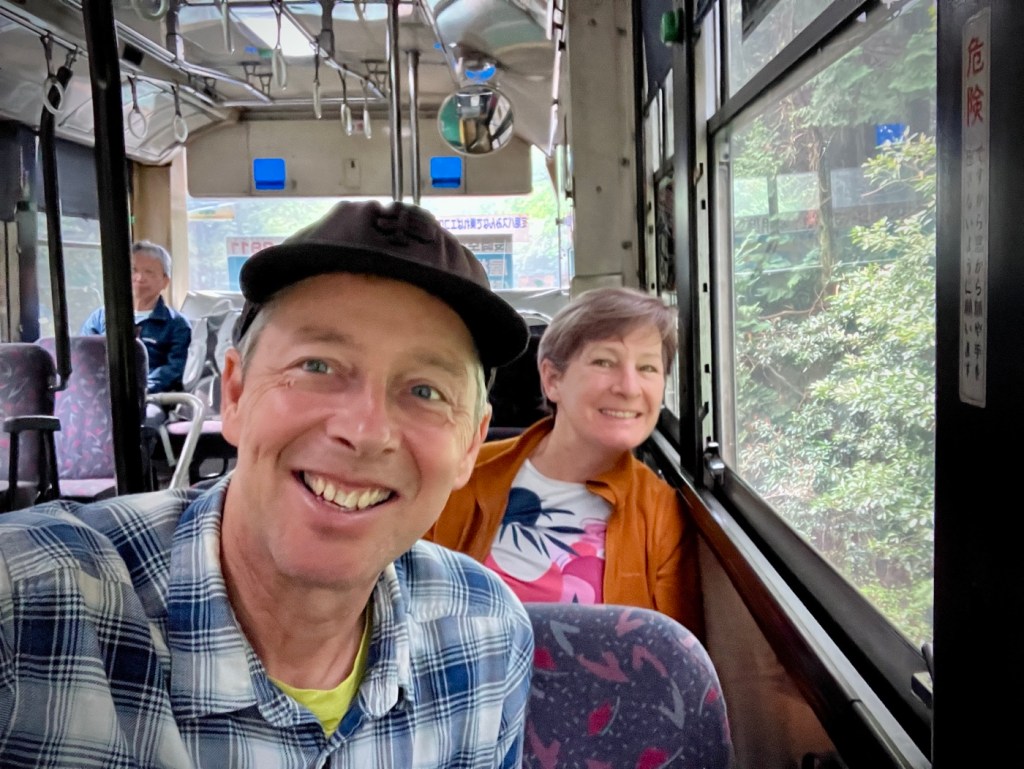
Buses: B+ Reliable; on schedule, and fair pricing but they get stuck at long traffic lights too, so can be slow in cities. And there are few express buses. BRT?

Buses in rural areas are reliable, but sometimes only run hourly or a few times a day

Walking: B- Wider sidewalks are needed in many places. Alleys and many quiet urban streets are very pleasant and low stress to walk, but many arterial sidewalks are a bit narrow or degraded by detectable rubber strips. I appreciate that these assist the vision impaired, but sidewalks are just not wide enough to accommodate them and side by side walking space. There seems to be a legacy of traffic lanes and road capacity. Giving more road cross section to peds, bikes and tram boarding is needed. Smart traffic signals could be used to mitigate lane reductions. Many heavy pedestrian neighborhoods in Tokyo and other larger cities have nice wide sidewalks in a new generation of streetscape designs, but many places still have a 1970s-1990s feel.

Rush hour on the sidewalks of Matsayuma. Wide here, but a slick rock surface makes cycling in the rain a bit dodgy.

Cycling: C+ Quiet back streets and sidewalk cycleways do the trick, but more on street protected bikeways are needed everywhere

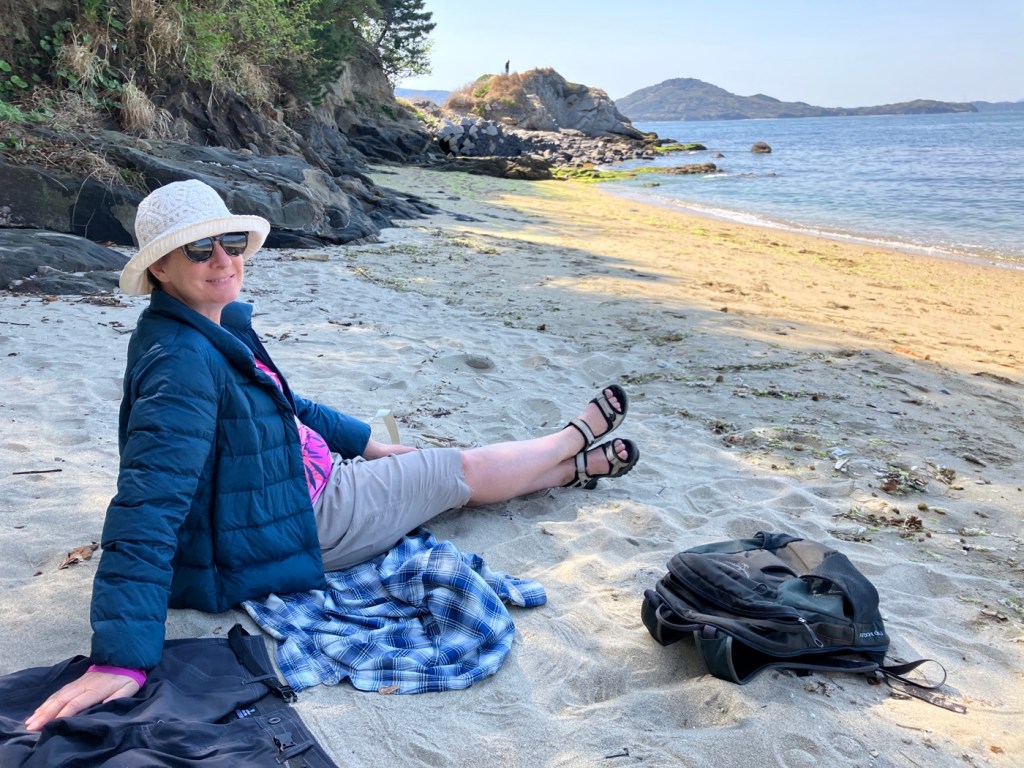
Yashima National Park – nice beaches on Shikoku but a little chilly to swim yet
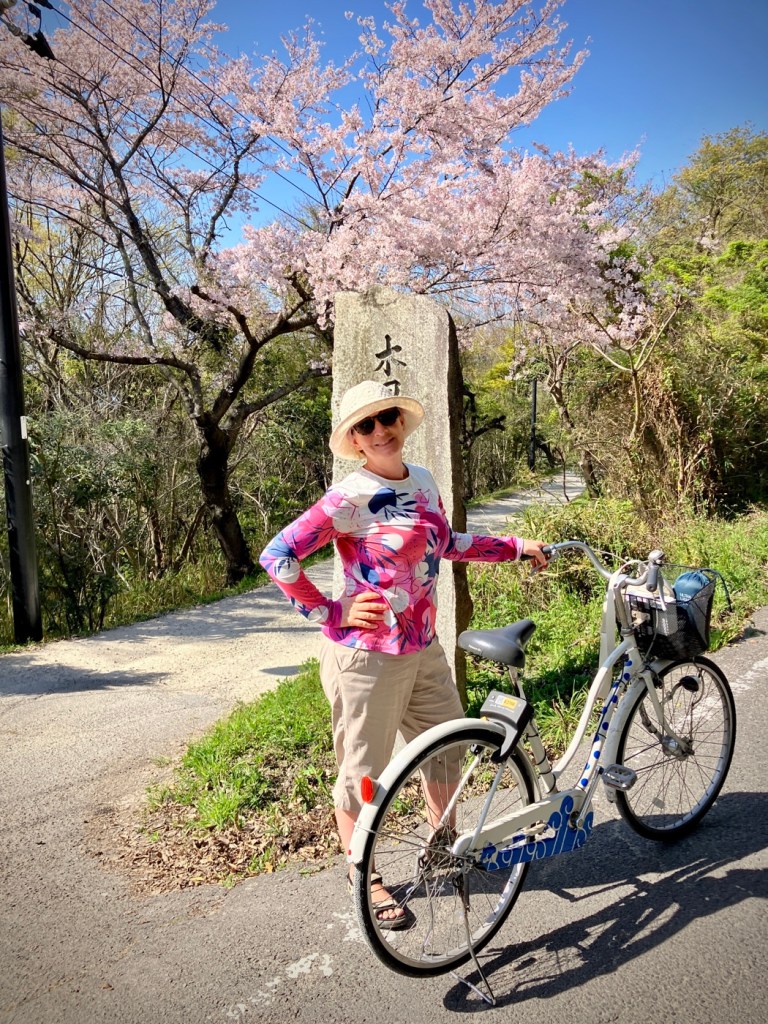
Cycling to Yashima NP from Takamatsu was pleasant on sidewalk paths and quiet roads

But enough nitpicking. As a traveler, the lack of personal safety concerns and good transport frees you up to focus on the unique culture, sights, and most of all, the food and friendly people. And oh man the food is SO good.

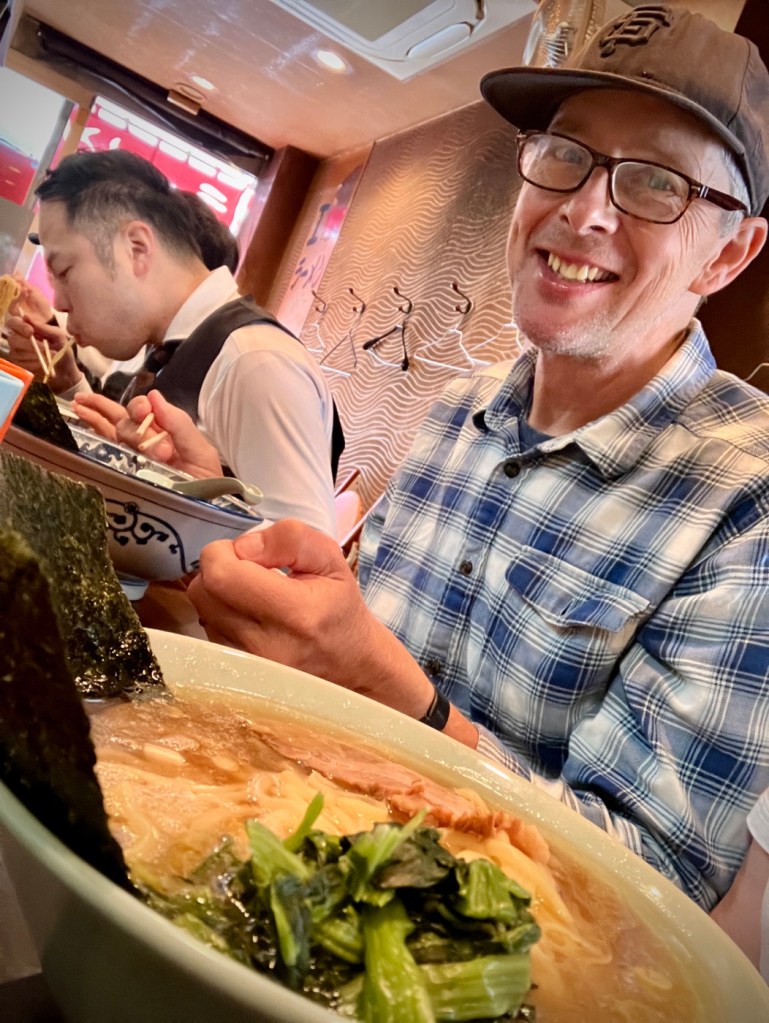
Smiles allowed, but ramen is serious lunchtime business at Ramenya Mass in Nagasaki
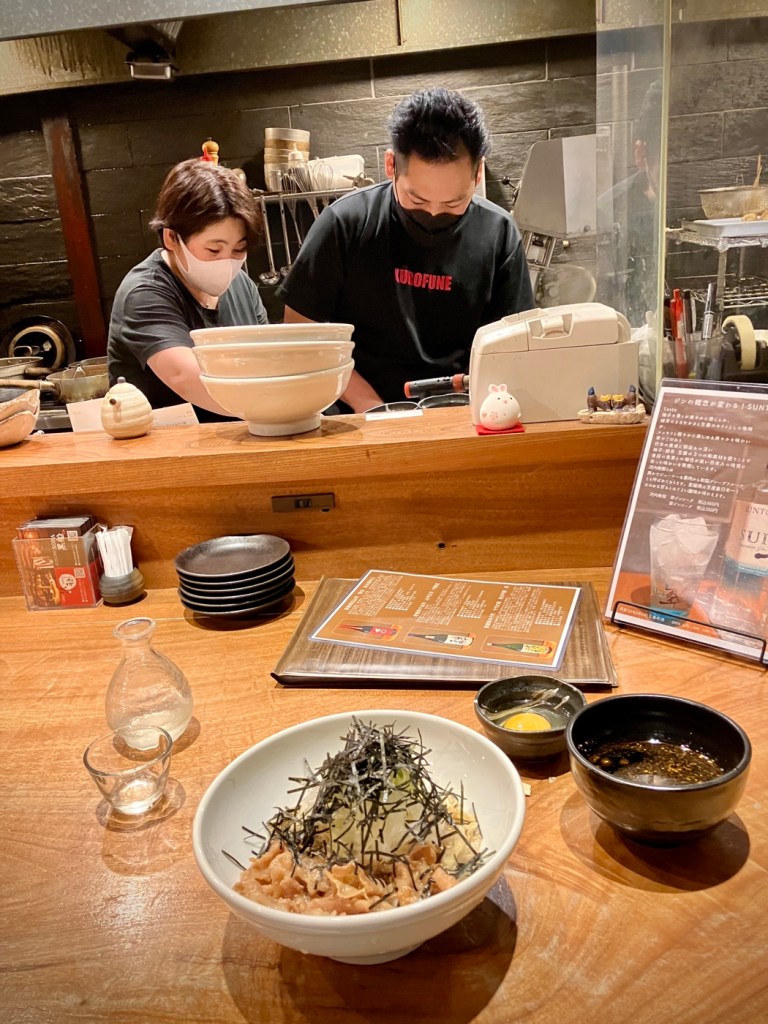
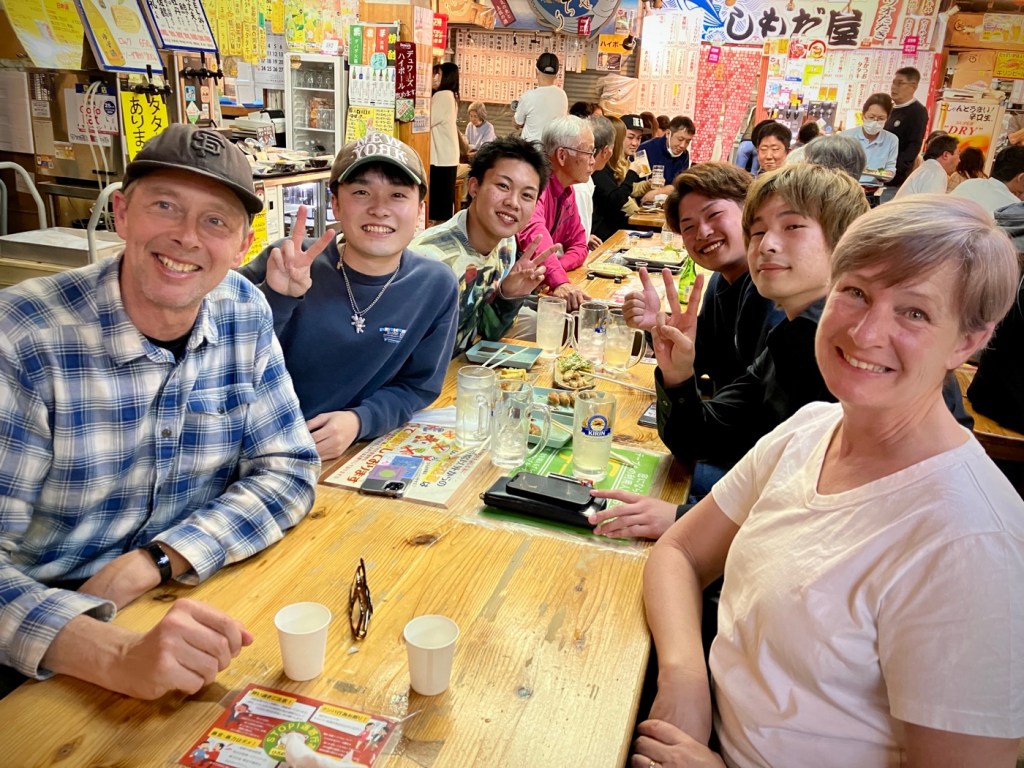
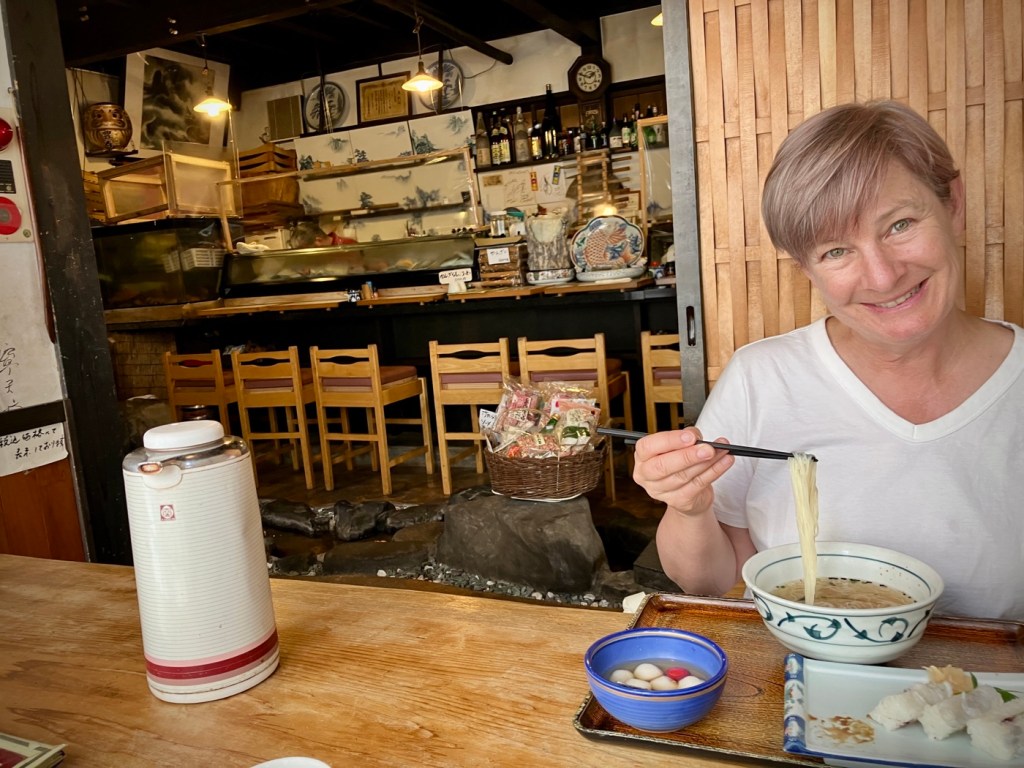
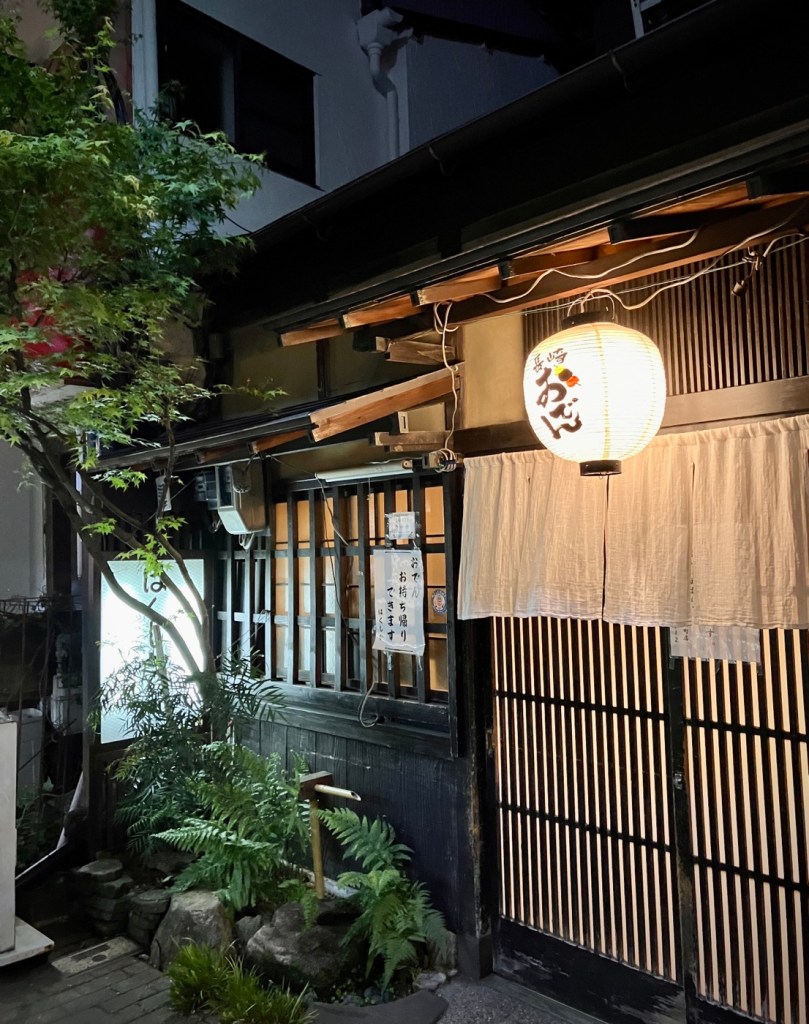
Small izakayas are the souls of Japan. Dedication to craft and coziness abound
Pure soba and dashi heaven

And it’s good value for most lodging and food, as long as you are willing to give up western norms and keep some distance from the tourist hot spots. The yen has weakened against most currencies over the past 5 years, so it’s a great time to travel here. Except in Tokyo, there are great 3 to 4 star Hotels in the $100-$125 range, and a bit more on the weekends, especially Saturday nights. And most include breakfast.

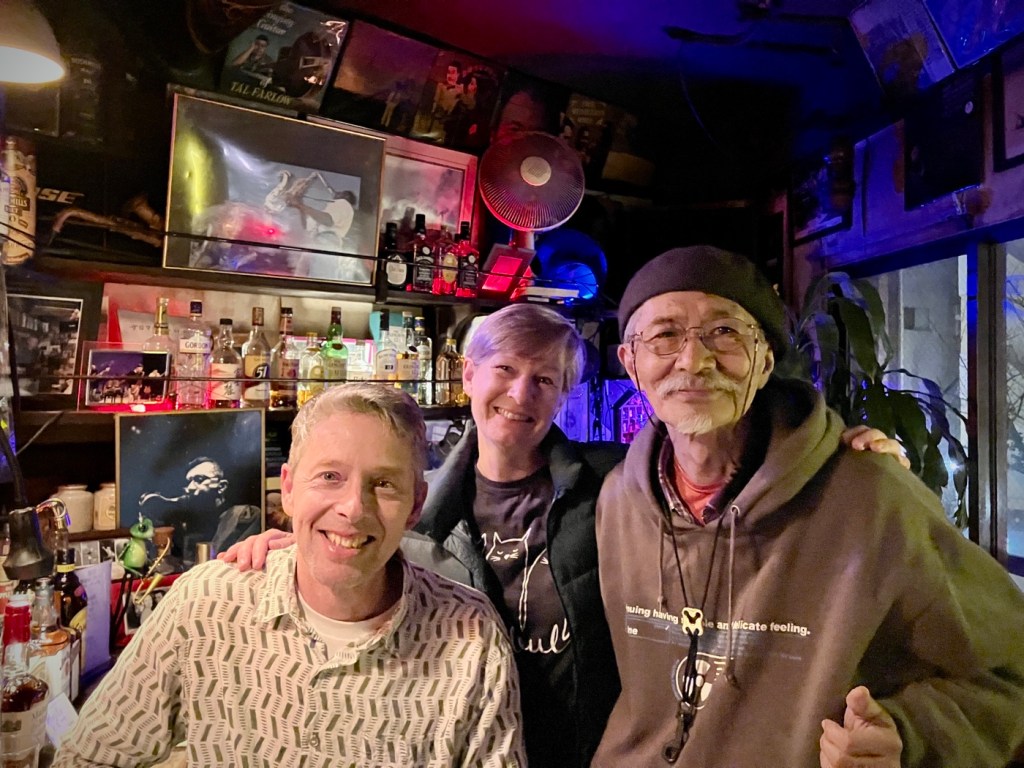
Wonderfully cozy 3rd floor jazz bar in Nagasaki . The owner played us his tenor sax music while we chatted. The Japanese love classic jazz. And so do I.
In addition to hot and cold drinks, vending machines in Japan are used for almost everything; even fresh soba noodles

If you go for more modest 1-2 star hotels, then you can find many in the $70-$90 range. Remote or resort area hotels (often with Onsen or Rotemburo baths) are definitely higher in the $150-$300+, so will be a splurge if on a budget. It’s definitely better value than most of the US, and similar to Europe, although I think a bit cheaper overall. A few other lodging tips. Book some nice Ryokan or Onsen properties well in advance as they are lovely, but don’t do anything but go up in price or sell out. Small or exclusive places are not into last minute bargains.

A Western-Japanese hybrid room in Shinabara. This hotel had lovely Onsen and Rotemburo (outside baths) and more spacious rooms than most urban hotels
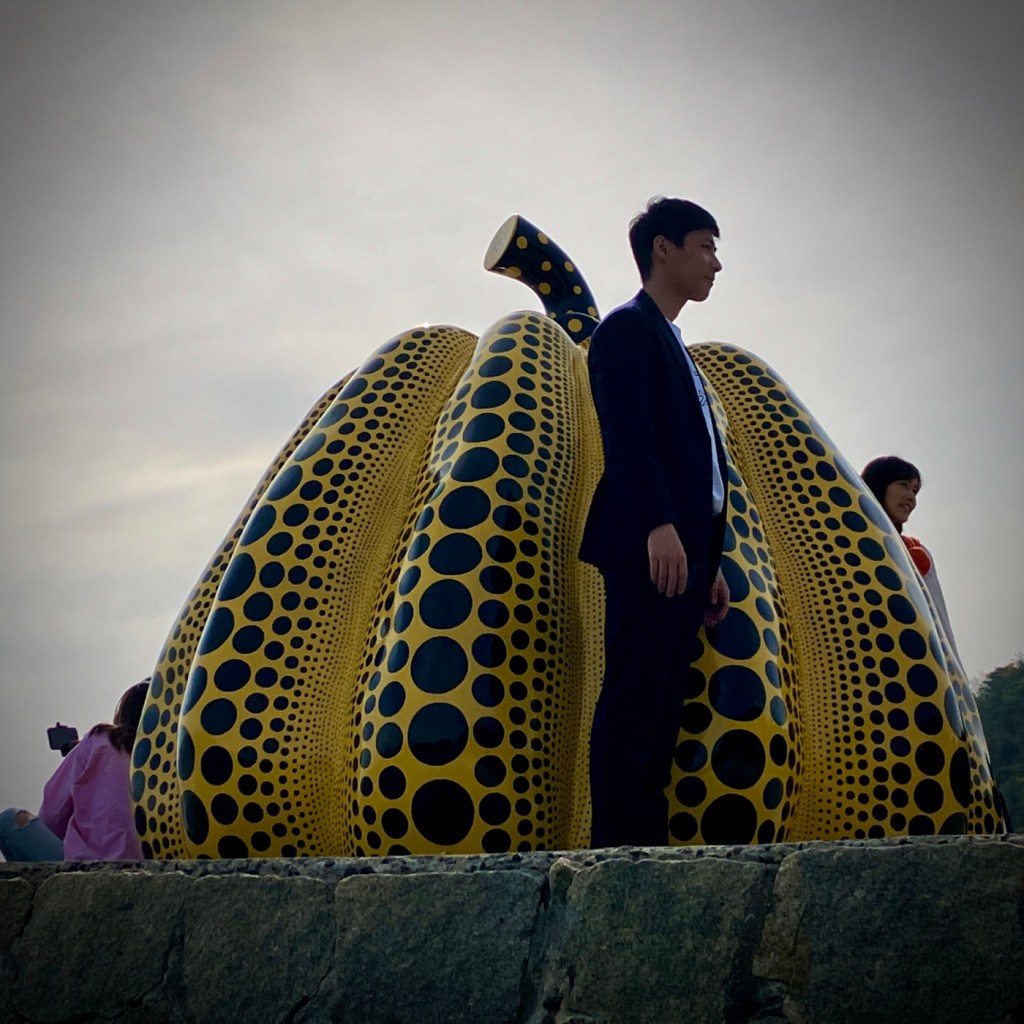
Naoshima Island
Instagram of Instagramers on Naoshima
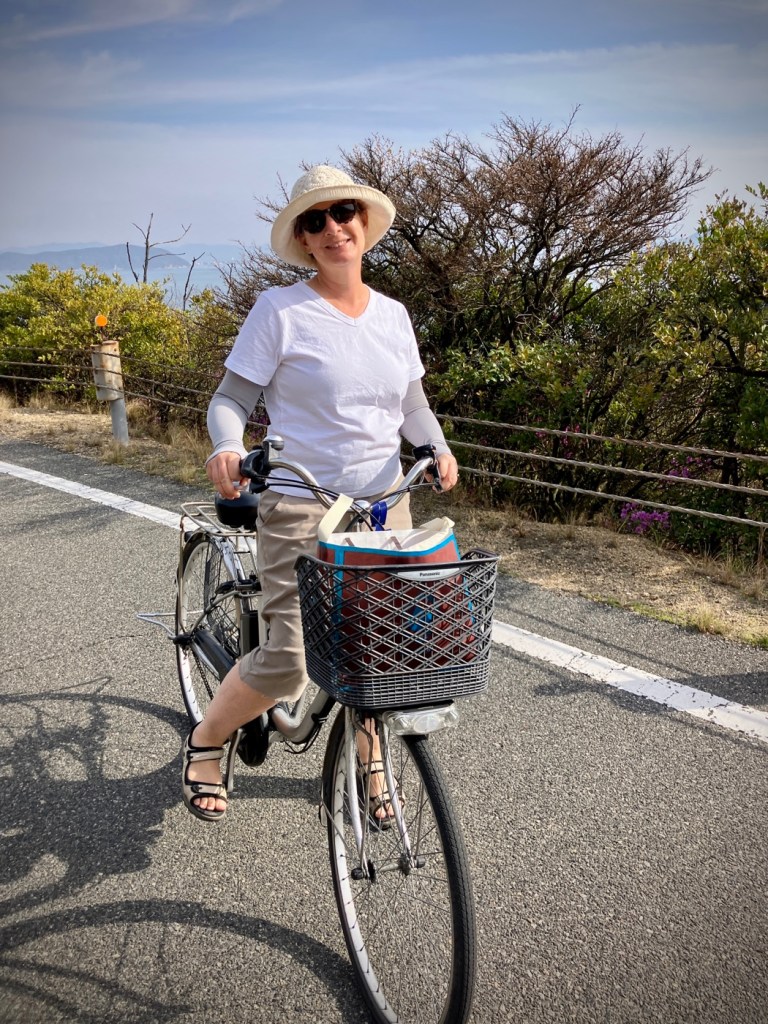
More bikes to explore Naoshima…these with a bit of eboost

And big western brand hotels in major cities here often 2-3x as expensive as local alternatives for a similar (or better) product. Avoid them, unless you only have a week and a surplus of loyalty points to burn. (For example, during the Sakura of late March, Marriott properties in Tokyo ranged from $600-$2000/night!). Big waste of money.

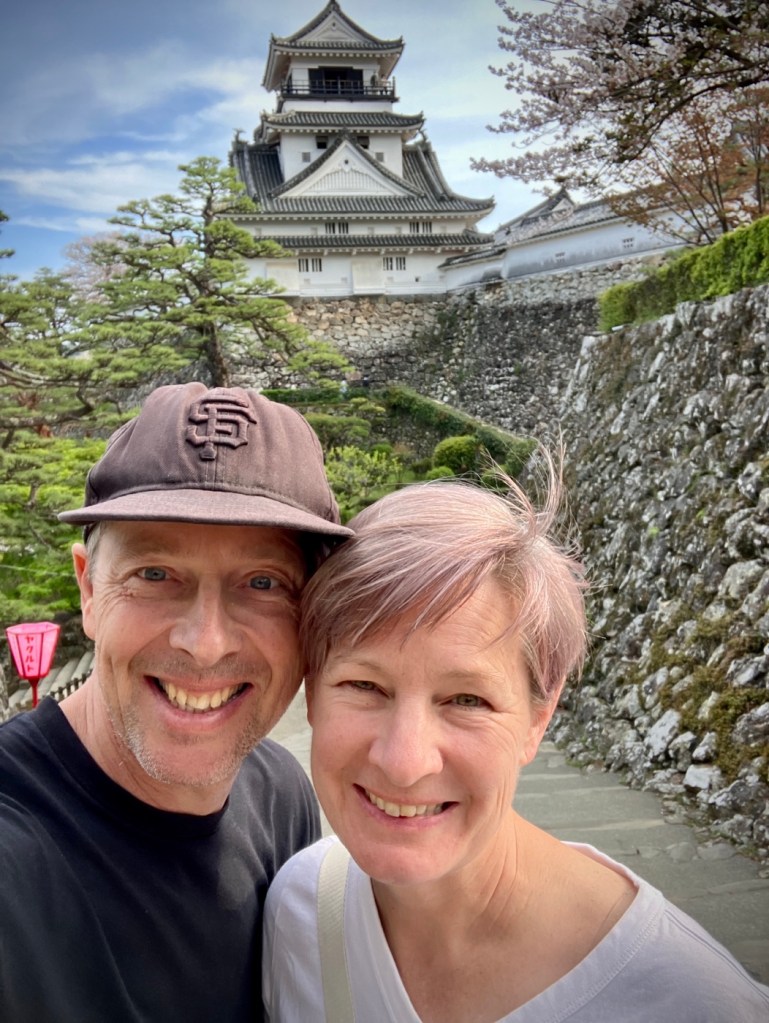
Kochi on Shikoku is a bit off the beaten track but worth the effort for its friendliness
Kochi’s famous seared Bonito (Katsuo) has ruined us for life for lesser fish. Delicious.

Another tip. Many western style rooms are cosy in Japan, at 120-180 sq ft, but if you book a twin instead of a “double”, the rooms are larger at 180-250 sq ft. They have two full or queen beds that can usually be pushed together. So you have a lot more space, often for just a bit more money. “Twins or Quads” seem to sell out first as locals know this too,

We found a small traditional house to rent on Naoshima Island. Wood and Tatami mats were a refreshing break from city hotels (and it had a washing machine!)
Even a basic meal is pleasant in Japan

But as great as it is to travel here, it’s not all easy, as travel in Japan has its own breed of travel stress due to constant language and cultural nuances. And the country faces a battery of challenges, including rural depopulation, economic stagnation, and a location in an increasingly volatile region, just to name a few.

You have to open the doors to know what awaits you in Japan
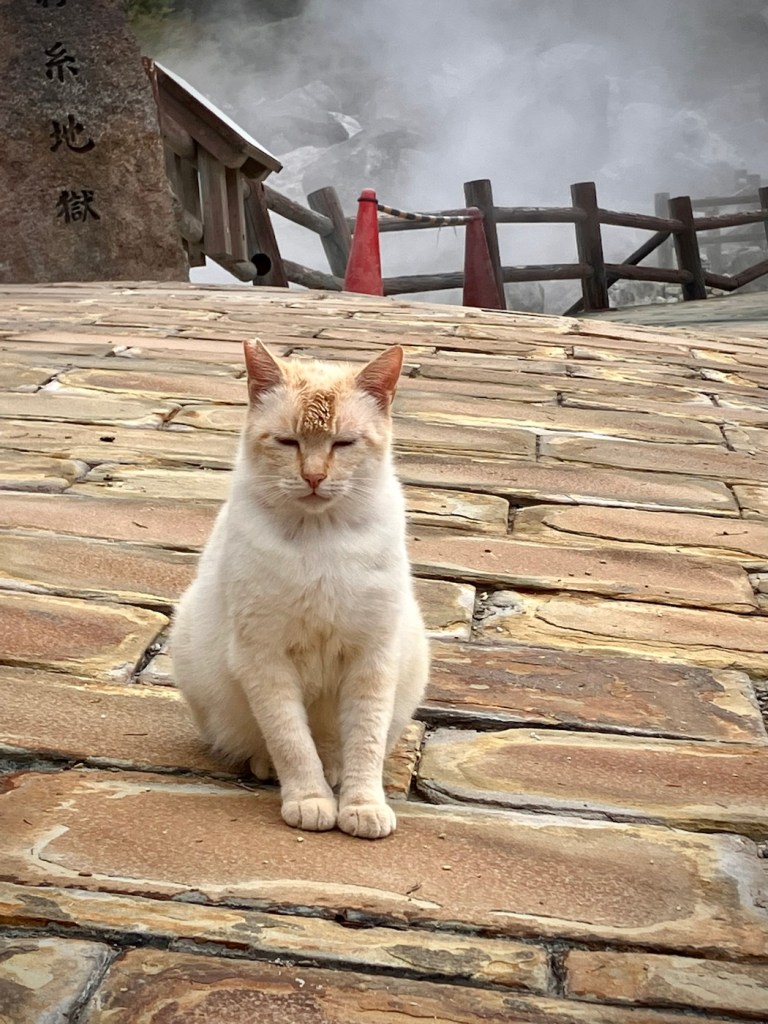
Cats seem to guard popular spots such as Unzen National Volcanic Park, and are looked after by the locals.

But we are judging against a high bar, as we are already talking about coming back to bike tour, renting an apartment for a month in Tokyo, or even a car tour to see more rural sights that are tough or impossible by public transit. If you do want to rent a car in Japan you will need an international driver’s license.

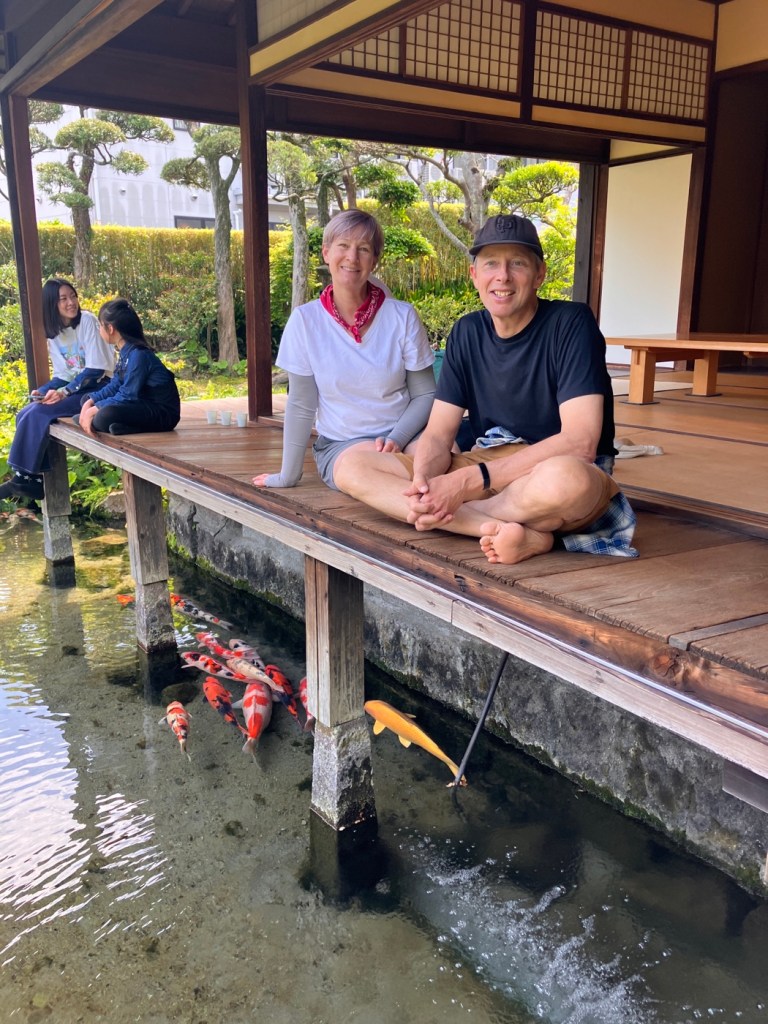
Zen, spring water, and Coi at a tea house in Shimabara
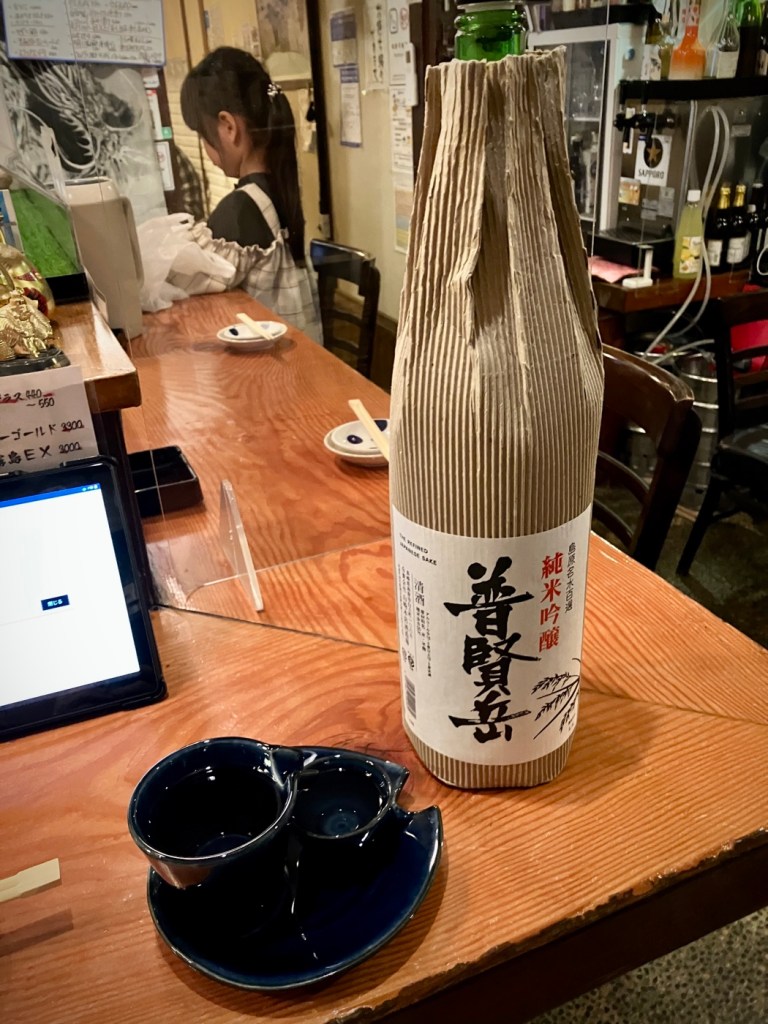
Always ask for the local Sake as we did at this family run Izakaya in Shimabara

We are excited to head to South Korea next week, but first we are going to eat as much amazing food as we can in quirky and cosy settings, served by some of the most dedicated and friendly people in the world.

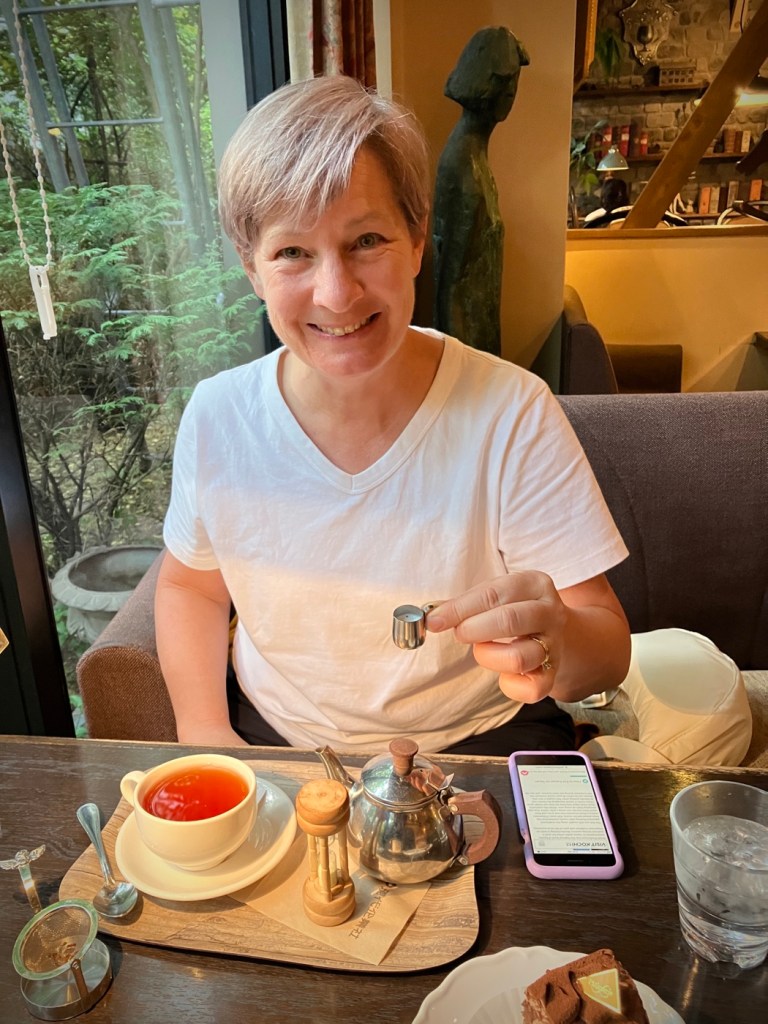
My favorite travel companion enjoying some cozy afternoon tea
Japan makes us smile

Happy travels!

Sayonara Sri Lanka

Often in travels, a few extra days someplace are a joy. You get to relax in more familiar digs, discover that cool new neighborhood, ride a bus to a local village, find the local restaurant you missed, or maybe meet more locals or travelers.

Happiness is a bike and a breeze. It was about 7km to the heart of modern Anuradhapura from our hotel along the banks of Nuwara Wewa
Macaques “guard” a lot of the popular sites in Sri Lanka….did they menace the bathing monks here in the 3rd century BC?
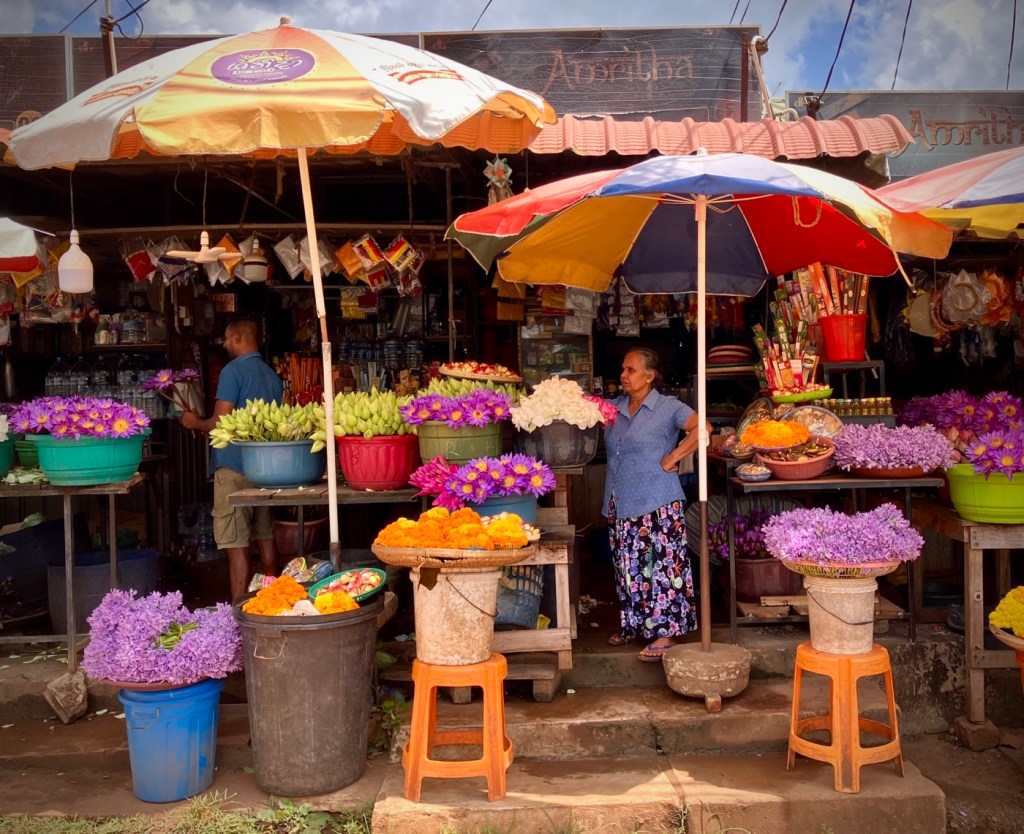
Beautiful lotus flowers and other offerings for Buddha were for sale all over the living temple complex that is part of the ancient City complex of Anuradhapura.

But sometimes you stay a bit too long or are just eager to move on. Sometimes it’s real discomfort, sometimes a bit of boredom, and sometimes just the way your travel brain is programmed…knowing exciting new places are on the horizon. We’ve got some pretty rewired travel brains after 19 months of vagabonding.

A much needed break from cycling around the vast temple and archeological sites of Anuradhapura
Cheryl has mastered cycling with a sun umbrella
We were never tired of the friendly smiles
Carved moonstones adorn the entrances to various sacred buildings.

We underestimated how homogenous Sri Lanka would be from a tourist perspective. Challenging governance, intermittent civil unrest, an ongoing economic crisis, limited imports, and an influx of Russian tourists(?!), all add up to an odd dynamic as visitor. There is huge demand for tourism money here, but still relatively few foreign tourists. It’s tough to see and you want to help everyone.

Very tan (dirty!?) sandal feet and a temporary sarong to pass temple dress code…it was too hot to cycle in trousers!

We loved Sri Lanka, had some amazing experiences, and are very glad we choose to visit now. But we did run out of steam the last week for many of these reasons. Heat, humidity, limited transport, and an excessive amount of interactions as tourists going about our business. It wears you down.

Cheryl happily sweating out the late day sun in Anuradhapura
Our bike parking at the Cargill Food City, the largest grocery chain in Sri Lanka

So please come to Sri Lanka. You will love it, but make sure to focus on what you love. The ancient civilizations are fascinating, but you need to dive in deep and do some background reading as the info at the sites leaves a little to be desired. If you really appreciate the natural world, then book safaris and bird watching tours to more remote areas. (There are many we missed) Maybe a long distance trek in the hills such as the nascent Pekoe Trail is your thing. (That may bring us back).

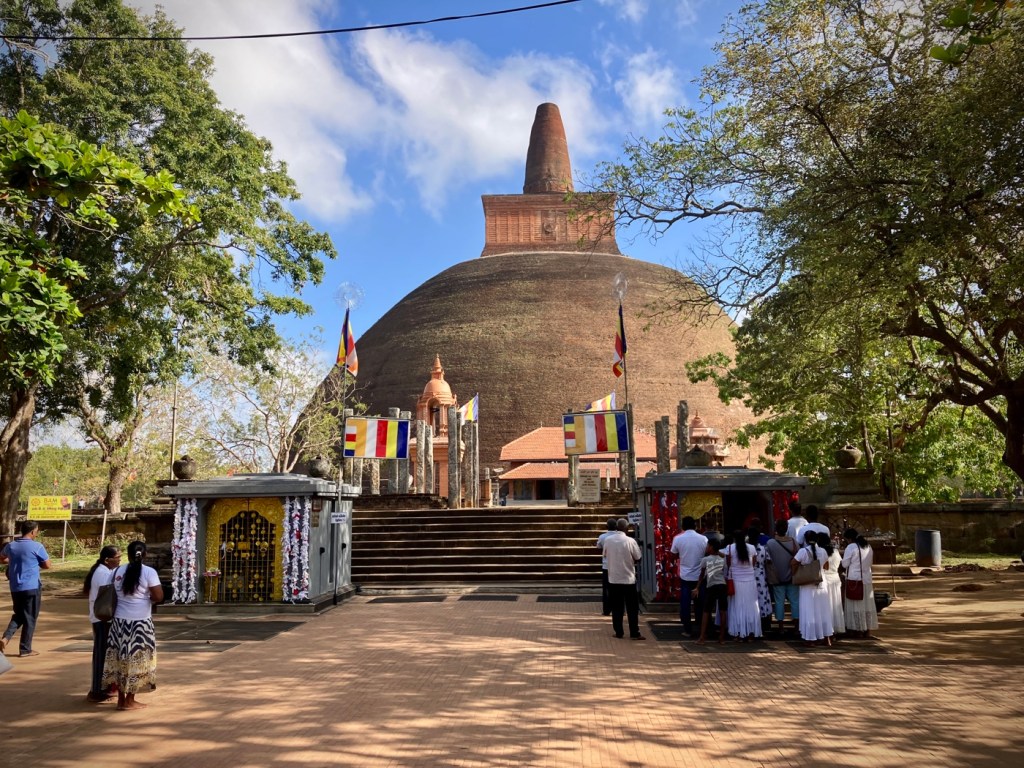
The main Dagoba (Stupa) is the heart of Abhayagiri Vihari; the ancient complex of monastic buildings and a fraternity of Buddhist monks. It’s still an important pilgrimage site.
The more benign Grey Langurs rule at the Abhayagiri Dagoba

Or maybe a few weeks surfing and chilling. Super nice along the lesser developed southeast and east coasts. If you are comfortable on a scooter, then that would give you more freedom….and even a car could get you off the tourist track easier. Just be ready for limited supplies and options if you self cater.

A “cool” sunset ride…it was magical with the Stupas in the distance

So we made the best of our last week. We soaked up a bit more sun, sweat out more toxins, and discovered more about the ancient cultures of Sri Lanka. But we did start to say no to seeing ALL the sights, as it was not bringing us joy.

Parts of Colombo still look a bit abandoned or incomplete, giving it a somewhat forlorn vibe.
Trains are slow and infrequent across Sri Lanka, so the tracks are mostly uncontrolled and easy to cross, even in Colombo.
Long queues for gas and diesel in Colombo is an ongoing sign of the economic struggles.
10 weeks of tropical heat and sunblock and destroyed this Taipei night market purchase…in the bin!!!
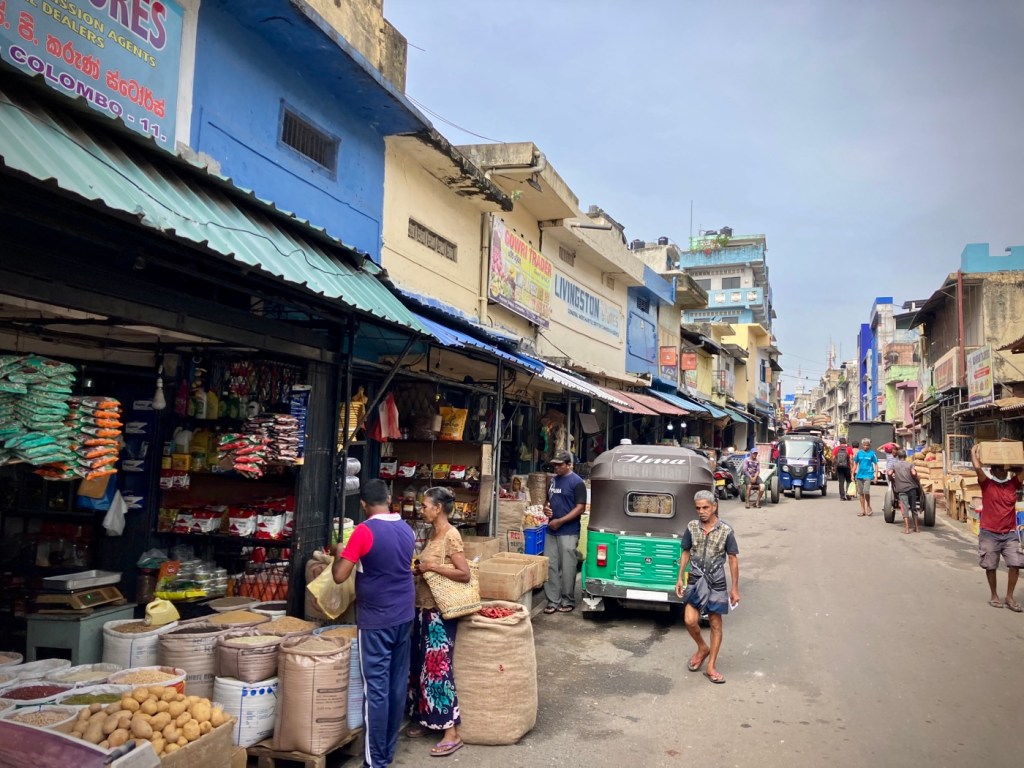
We set out our last morning to explore the Pettah district, which is a lively market and commercial area in the gritty heart of Colombo
Mostly men in the trading districts, but women do run a lot of small businesses
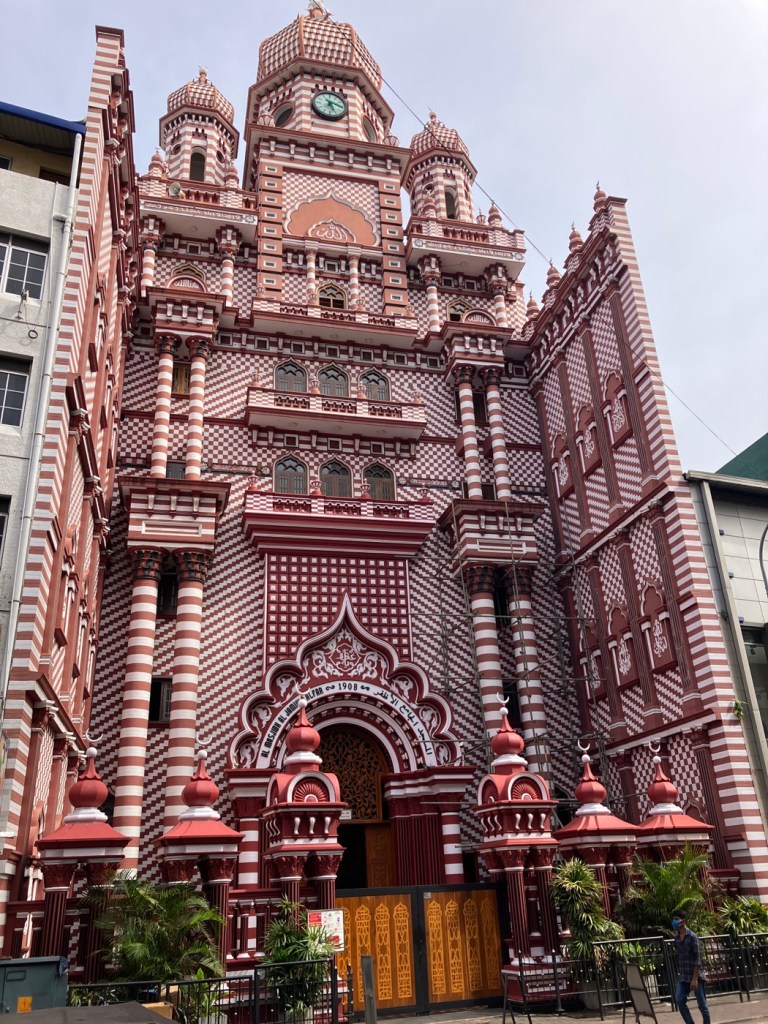
Jami Ul-Alfar Mosque in Pettah

So we take away a bit more understanding of the culture and plight of 22 million Sri Lankans. We sincerely hope for a brighter future, and are glad to see there was a recent agreement with the IMF for $3B in bridge loans. We also hope we left some American good will in our wake. Travel is still good, and important even in the Instagram world of 2023.

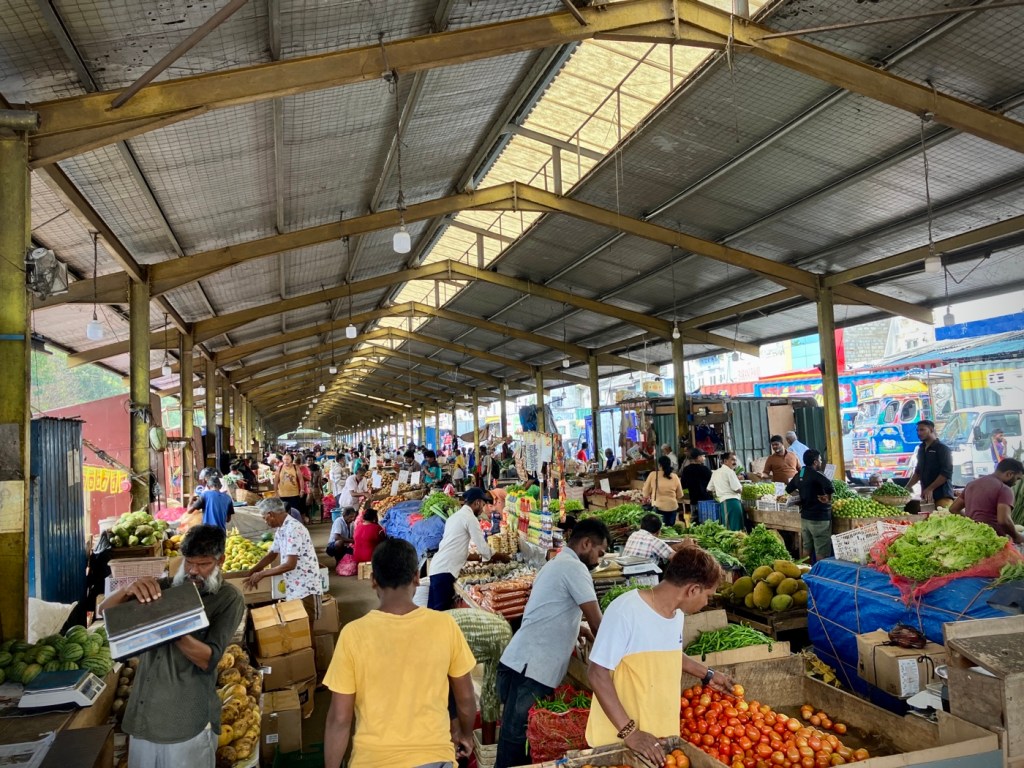
The Fruit and Vegetable Market Hall in Pettah

We did a bit of everything in our 3 1/2 weeks and it was fantastic but we were very ready to be back in on in a more developed economy…so nowhere better on the planet than Japan.

Looking out at the impressive Eth Pokuna or “Elephant Pond” near Lankaramaya. This huge man made water reservoir is part of tbe ancient and amazing water supply network.
We loved exploring Anuradhapura, but I was tired of the touts and “tour guides” badgering us…this guy wouldn’t stop talking to me at the Elephant Pond. We always stayed polite.
Amazing to be immersed in a living museum, not just an ancient civilization
A final rice and curry at our guest house in Anuradhapura…this WAS very tasty, but our taste buds are ready for something new!

After some long flights via Singapore, Japan has delivered us immense joy in the early peak of Cherry Blossom season. We feel like we have just come out of the wilderness after a long backpacking trip. Hungry, dirty, and ready to eat anything. Contrast and appreciation for the new is a wonderful gift of travel.

A few days to recoup and prep for Japan at a full service corporate hotel was just what we needed in Colombo. Gym workouts and a place to relax for a late night airport departure.
Joy of the Sakura season in Tokyo

More on truly amazing Japan soon. Happy travels!

Sigiriya, Sri Lanka – doing what we enjoy most.

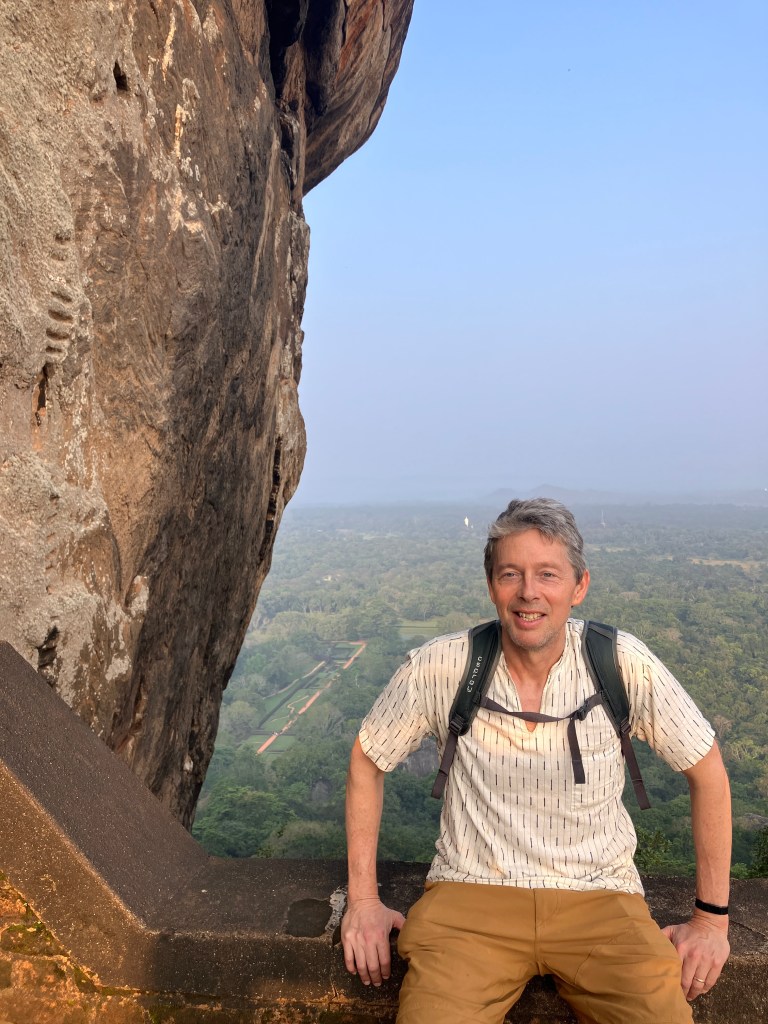
Sunset view of the 5th century ancient rock fortress of Sigiriya, the Lion Rock.

What is it that we love best when traveling? Walking and biking, of course. Sri Lanka has challenged us with the need to do taxi transfers and tuk tuk trips to avoid daytime heat or nighttime elephants, or to get from a hotel or guesthouse to a site.

A pond in the ornamental gardens leading to the Lion Rock. Tiny Rich added for scale.

Our first morning in Sigiriya, we had our guest house owner drop us at the west entrance and Museum to buy our tickets by 6:45 am, so we could explore and climb the rock before it got too hot.

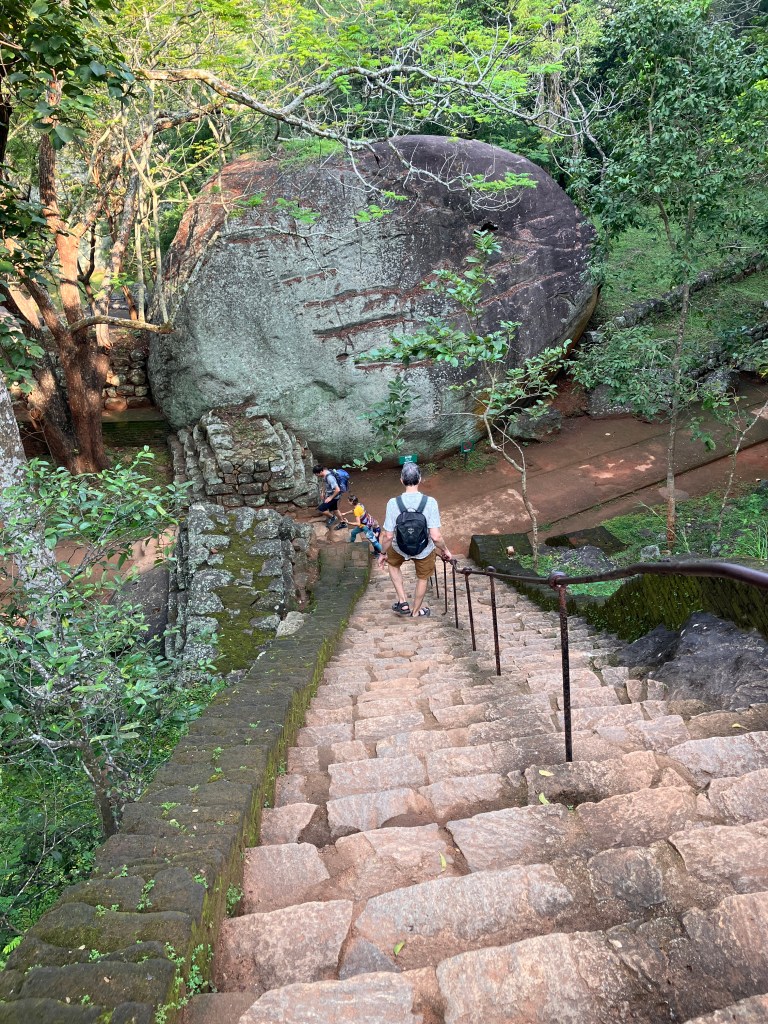
It took a lot of stair climbing to even get here, the two giant lion paws mark the entrance to the rock fortress. The lion head crumbled some time in the past.
Not for the faint of heart or weak of knees.
The views are amazing on your climb up and down.
Ponds and walls speak to the history of this place.
A pond and the cable trolly used to get conservation materials to the top of the rock.
It reminded us a bit of Machu Picchu, the ability to look down upon the site really gave you a good sense of place.

First a capital for King Kashyapa AD 477–495, and then a Buddhist monastery until the 14th century, it is now a UNESCO World Heritage Site and considered one of the best preserved examples of ancient urban planning.

Laughing as we realize we still have to go back down all those steps.
Down we go.
Yikes. That’s a catwalk with a view.
Almost out. Knees feeling wobbly.

We were staying close enough to be able to walk back to our guesthouse for a late breakfast, which made us happy. Any time you walk in Sri Lanka you do have to decline a lot of tuk tuk offers, especially at a popular tourist site like Sigiriya Rock. But we press on and enjoy the walk.

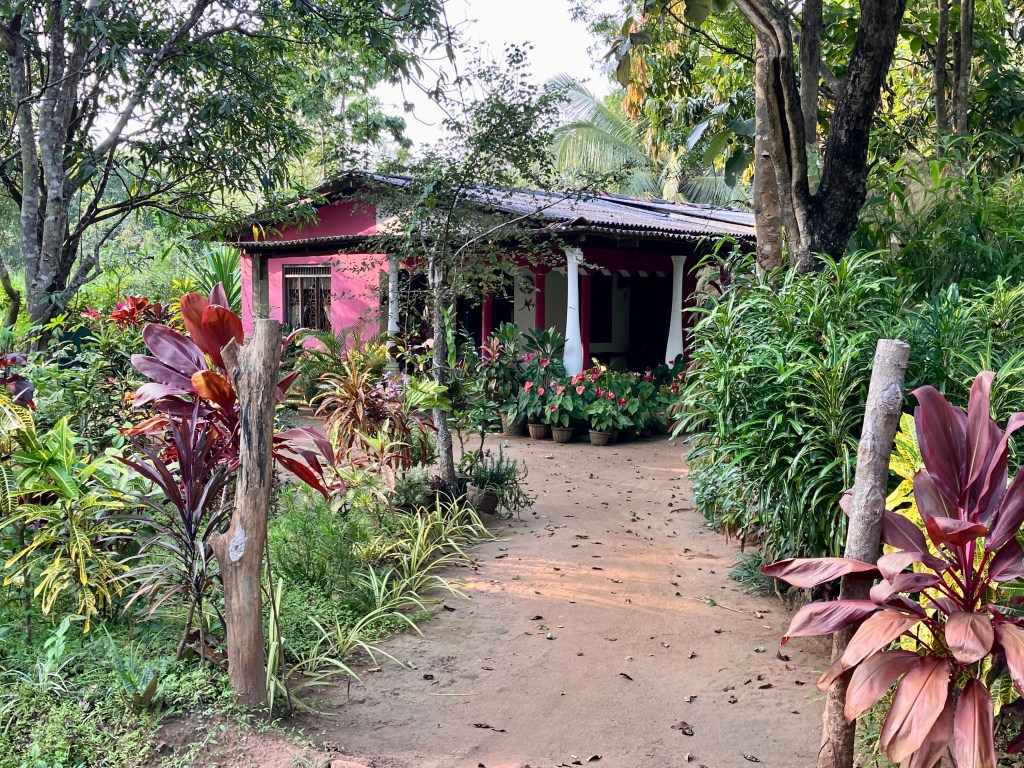
The small roads around town made for lovely walking. Sri Lankan people have an eye for design, so many lush gardens and pretty houses.
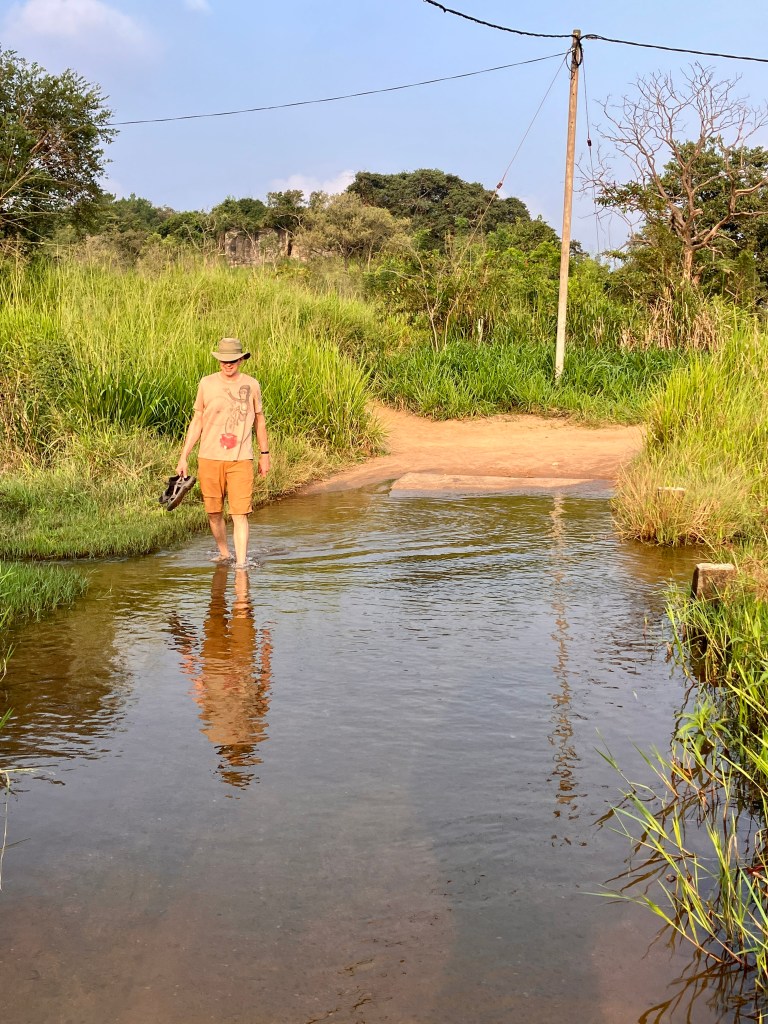
An afternoon walk to the nearby lake, Kayanwala Wewa. The road crosses an outflow which makes for a refreshing wade.
Relaxing by the lake.

Sri Lanka has no natural lakes. Starting in 300 BC the Kingdom began to construct reservoirs and tanks. The Sinhalese people were among the first to build artificial reservoirs to store water. These irrigation systems of the ancient world are still intact. Sri Lanka has ten thousand man made bodies of water, lakes, reservoirs, tanks, ponds, and stepwells.

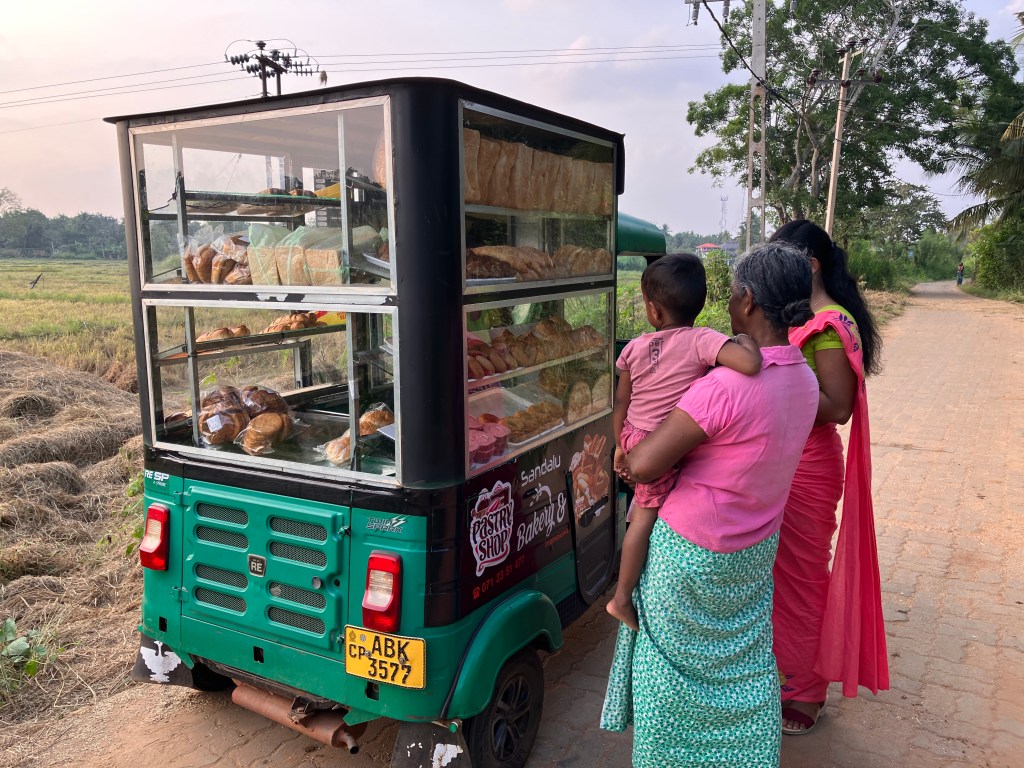
As you walk the small roads and greet locals you’ll hear an electronic version of Beethoven’s Für Elise. That signals the bread tuk tuk is near!
A pastry shop on wheels. The ice cream tuk tuks play ‘It’s a Small World’.

With temperatures reaching 90f/32c in the early afternoon, our walk opportunities were limited to mornings and after 4pm. Not only is the heat and humidity oppressive, but the UV levels will burn this pale human in 15 minutes. Sunblock, long sleeves, umbrellas, that’s the only way I can get out and about.

Yes, there is an app for that. My trusty UV Lens app.

Walking the small dirt roads is not without obstacles though. Sri Lanka has so many dogs, some wearing collars and belonging to a specific house, but many many more simply stray street dogs. Most ignore you after a hopeful glance for snacks, but some bark and come rushing towards you. Not fun. We accidentally solved the dog stress problem when I deployed my collapsible umbrella while walking by a dog and it recoiled in horror. Ah ha. Shade giver and dog deterrent – the humble collapsible umbrella.

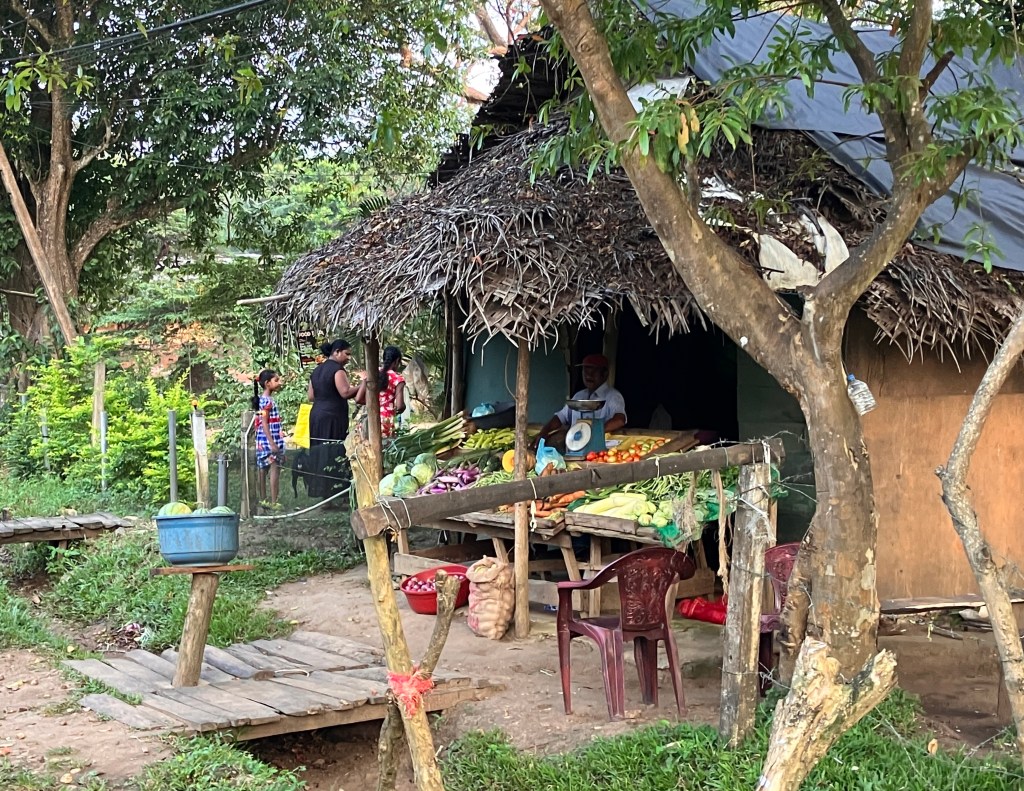
An artful fruit and veggie stand.
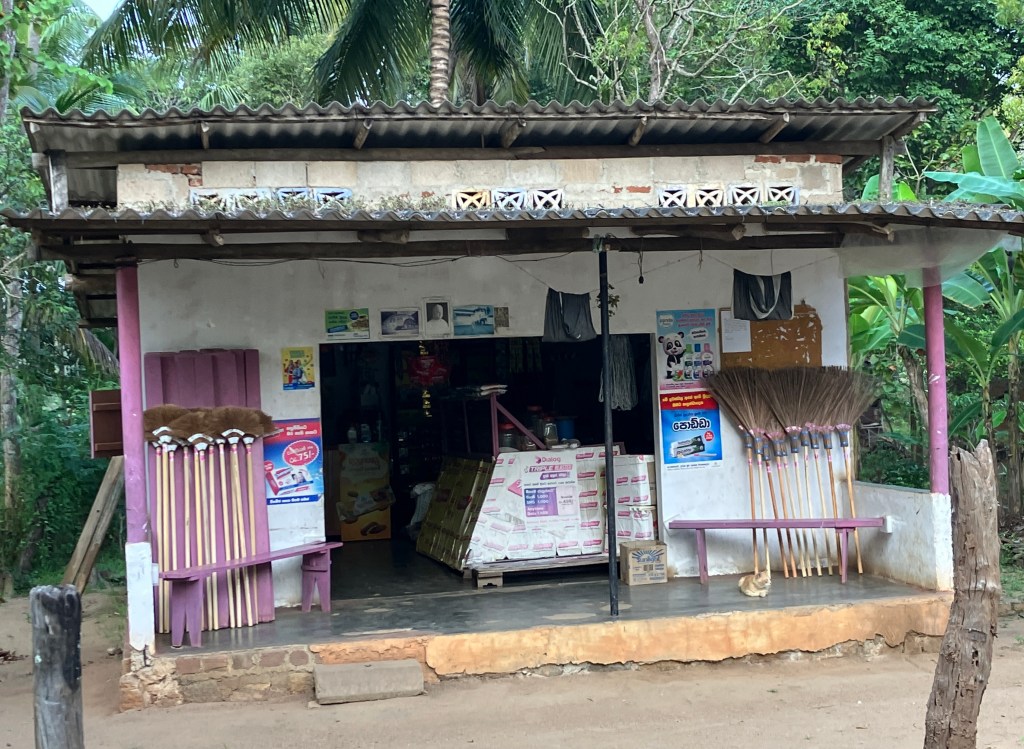
Brooms and more.
Another colorful roadside shop.

Our second full day in Sigiriya we spent visiting the ancient and Sacred City of Pollonnaruwa. We had a car and driver to take us the 45 minutes to the site, and once there we rented bicycles to explore the site and it’s many amazing artifacts. Polonnaruwa was the second capital of Sri Lanka for three centuries between the 11th to 13th century after the destruction of Anuradhapura Kingdom (which we’ll also visit) in 993.

Rich can rarely find a bike that fits him well. But he looks happy anyway.
The restoration of the buildings and statues is on going.
My first time on a bike since breast reduction surgery in January. I couldn’t stop smiling – cycling in hot weather is much easier than walking.
Our trusty bikes in front of an ancient stupa. Since tourism has not fully rebounded we had many of the sites to ourselves.
The jungle had covered many of the buildings until restoration and conservation. The before and after photos are dramatic.
Exploring Pollannawura by bike.
Ponds are an important part of the site. And beautiful.
Tempting on a hot day. But the signs clearly forbid swimming.
To enter the temple areas you must remove your hat and shoes, and put down your umbrella. As it gets later the sand gets hotter so visitors bring socks to wear.

Riding bikes around this ancient site was such a unique experience, but we did wish for better curation of the experience. Even the museum, which we visited at the end of our ride around, didn’t do a great job of giving you a sense of how people lived in Polonnaruwa. We didn’t hire a guide, which most of the visitors did, so perhaps that was a mistake on our part, but we so much prefer doing things at our own pace and we know we’re happier without a guide. From what we overheard from the guides I don’t think we missed out on much information beyond what we had from our guide book.

That photo bombing Sigiriya rock again, this time on a morning walk.
Unable to find bikes to rent we headed out on foot for what ended up being almost a 7 mile/11 km walk.
A local fishing at the lake, he had a bike. We were jealous.
The roads were getting smaller, the temperature was getting hotter.

The area around Sigiriya is not only an archeological sanctuary site, but also has elephants and rice farmers. We saw an elephant from the road when being driven back from Pollannaruwa. Our long walk took us alongside many rice fields. We were fascinated to see the methods the farmers use to either keep the elephants out of the fields, or to alert an overnight watcher of the presence of an elephant so an attempt could be made to deter the elephant using loud noises.

Rice fields.
Empty Lion beer cans hung on string at the edge of a rice field. Empty bags and branches- not much of a defense against an elephant.
A night time elephant lookout platform. That looks like a lonely and nerve wracking job.
This canal proved to be a great bird watching area. So many bright blue Kingfishers darting along it kept us distracted from the heat.
A little roadside shop with chairs in the shade was a welcome sight. Two cold lemon sodas perked us up for the last mile.
An umbrella is key for mid day walking, we bought this UV protection umbrella in Taipei.

You never know what you’ll see walking around small rural roads. Local folks were unfailingly friendly and helpful. We reminded ourselves that the small children had possibly never seen tourists, the three years of very little to no tourism meant that their wide eyed stares were not a comment on our hot sweaty state. It can be a bit daunting to wander the back roads, but so rewarding.

Evening bread tuk tuk, with two ever hopeful dogs.
The happy travelers.

Taipei 101 – An Introduction

I love the rush and excitement of flying into a new place. And since we transferred through Tokyo on ANA, we flew into the closer Songshan city airport (TSA) and had a window seat on a long double loop around the dramatic hills and skyscrapers of Taipei….a free aerial tour of the city where we would spend our next week!

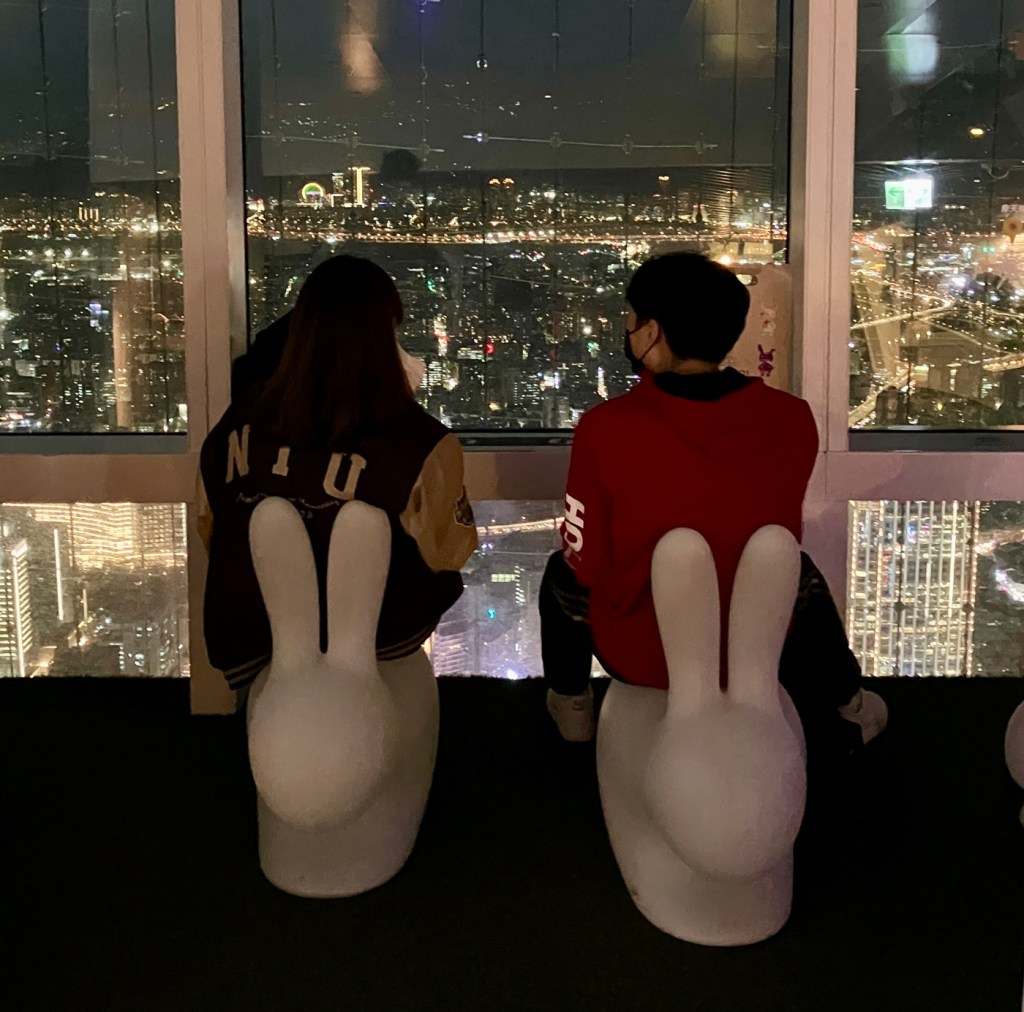
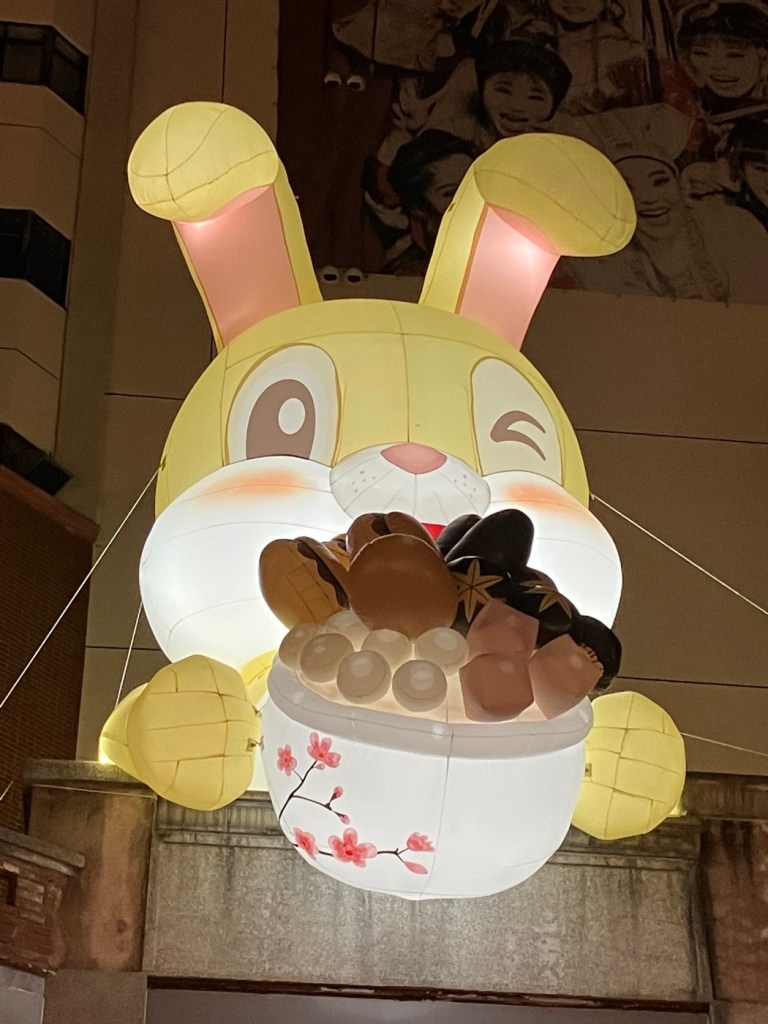
Lunar New Year Bunny Seats on the 89th Floor of Taipei 101
Lost? You can almost always spy Taipei 101 wherever you are.

Note that most longer flights go out of the much larger and more distant Taoyuan International Airport (TPE). But both have good rail connections right to the center, so no worries if you fly into or out of TPE.

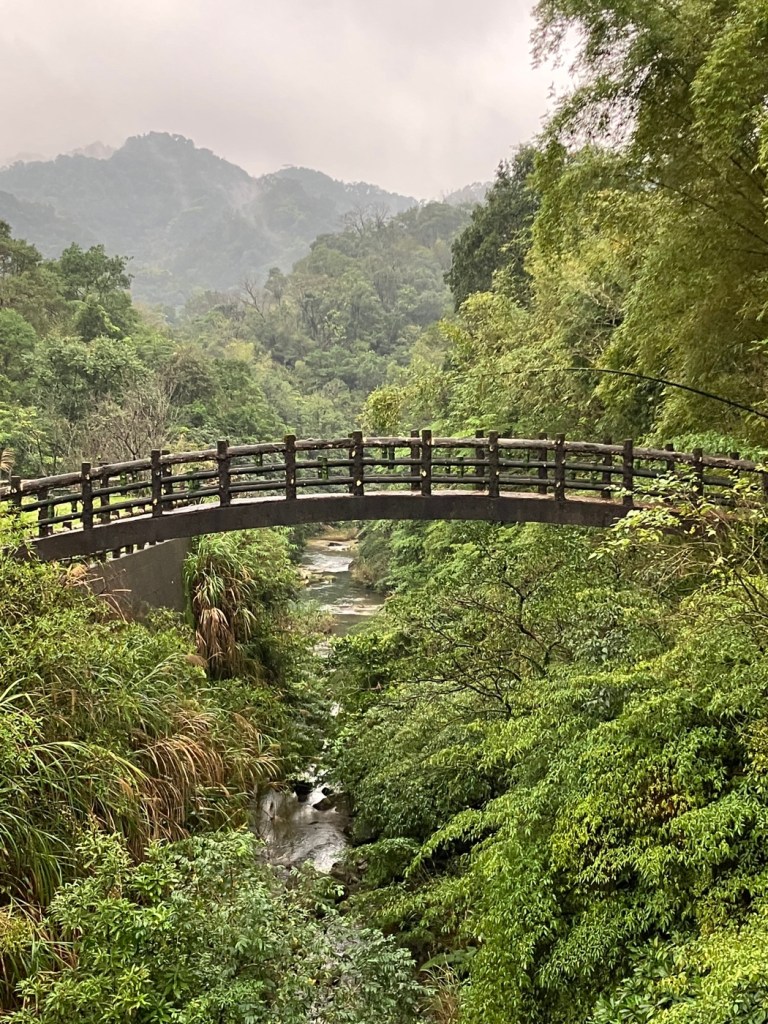
Waterfalls, mountains, and forest

Taipei is a world class city that just doesn’t rise to the top of most (western) tourists lists. But we think the Portuguese nailed it with the name “Formosa”, as it is a beautiful, prosperous, and free place.

Local Agriculture in the Pingxi District

It’s certainly a place that is receiving more attention in the global news due to the complex geo-politics associated with its status and ultra strategic location in the South China Sea. We enjoyed learning so much more about the history of Taiwan. It has left a unique legacy on the psyche of the country.

Ximen, The walkable downtown of Taipei

After the Qing Dynasty lost the Sino-Japanese War in 1895, they ceded Taiwan and the Japanese colonized and controlled Taiwan for over 50 years. When their occupation finally ended after World War II. a dictatorship initially led by Chiang Kai-Shek ruled for the next 40 years under the KMT party, with strict repression of free speech, detentions, and killings known as the “White Terror”.

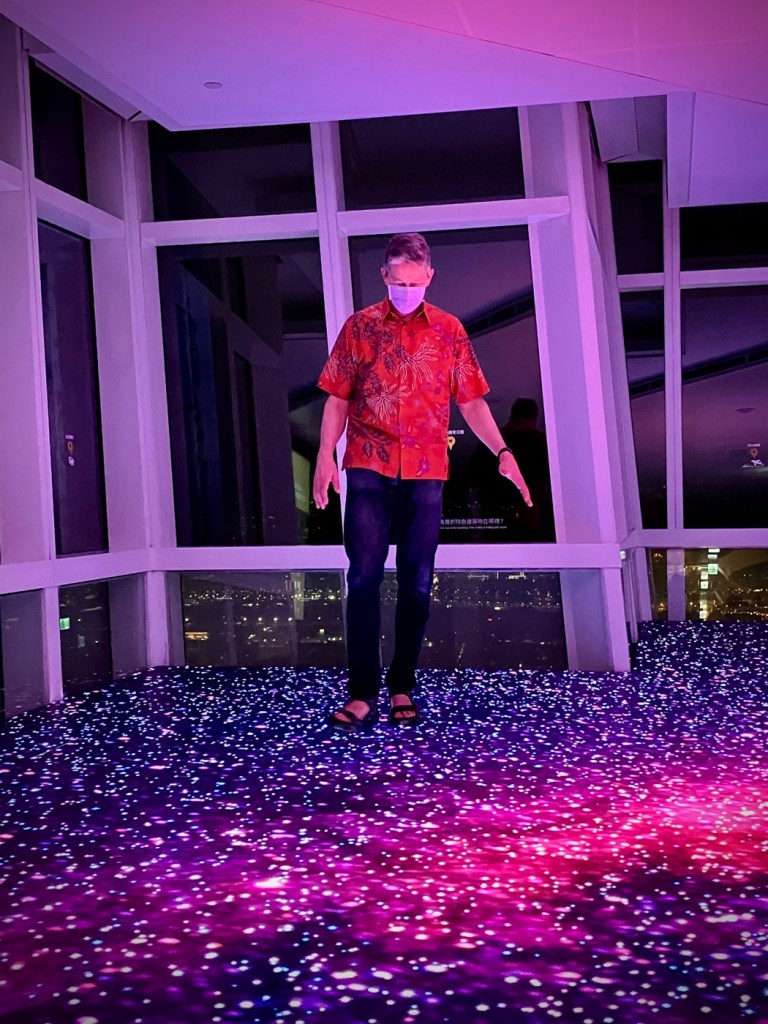
Getting dizzy in Taipei 101
The massive damper on the 88th floor of Taipei 101 has a series of cute damper babies…this one was my favorite. Way to make science cute.

By the late 80’s, a slow transition to a more open and democratic Taiwan started, and after the election of the Democratic Progressive Party (DPP) in 2016, it has solidified its place as a liberal and forward looking democracy.

The Pingxi train and Shifen suspension bridge

They were the first Asian state to legalize gay marriage in 2019 and have 42%+ representation of women in the parliament as well as a female president. The Scandinavia of Asia?! Almost, but there is still a huge gender wage gap and other legacy issues of a male dominated business world.

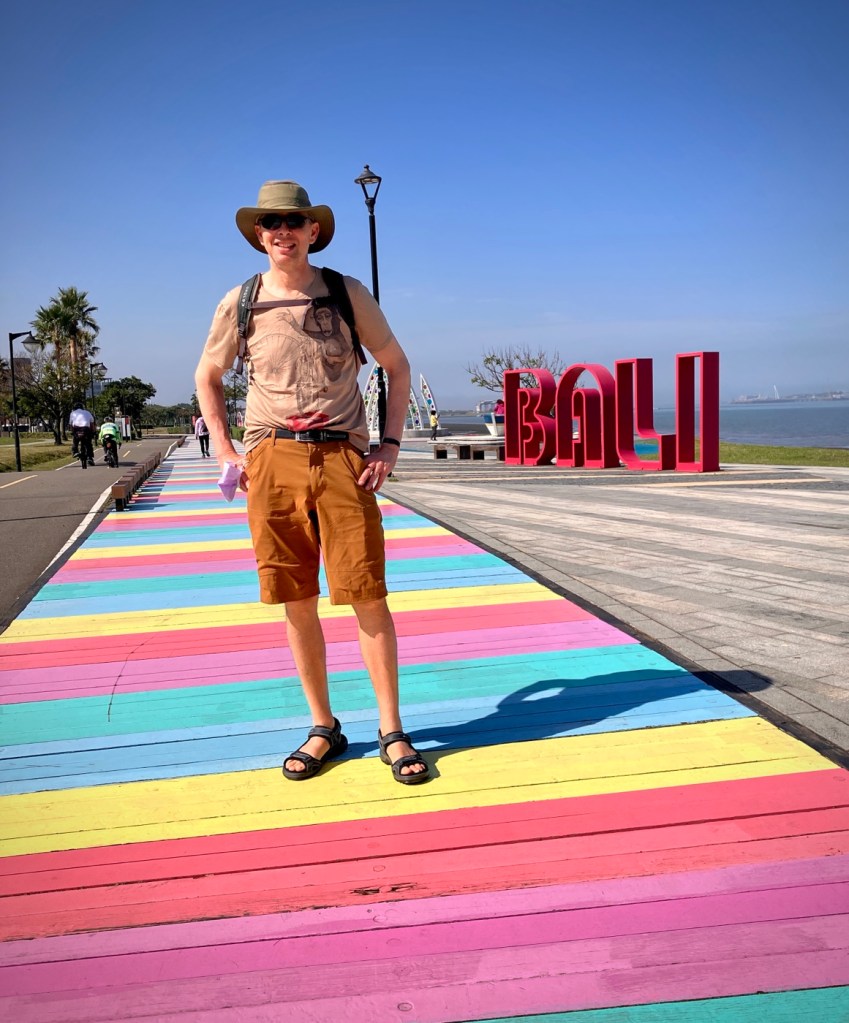
Bali and Tamsui are easily reachable by MRT and ferry for seaside strolling or cycling

However, we could feel the positive energy and openness in Taipei, although all within a society that still values social stability and conformity. It’s an interesting mix but definitely a positive one to experience, even as an outsider.

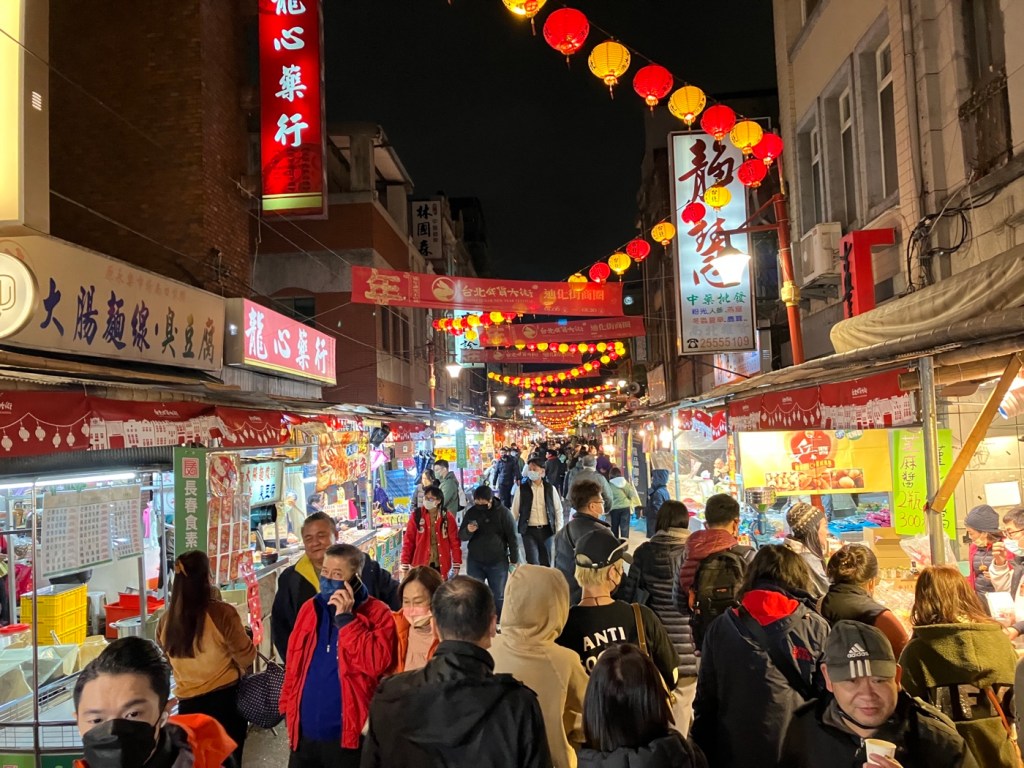
Run Up to the Lunar New Year on Dihua Street
Cutest local fire station ever, Tamsui

Here’s the Top 10 reasons we loved our week in Taipei and why you might too:

1. The Food – you can see Cheryl’s last two posts for lots of details on the food scene…great food everywhere, and the amazing and exciting night markets.

Ready for the year of the rabbit
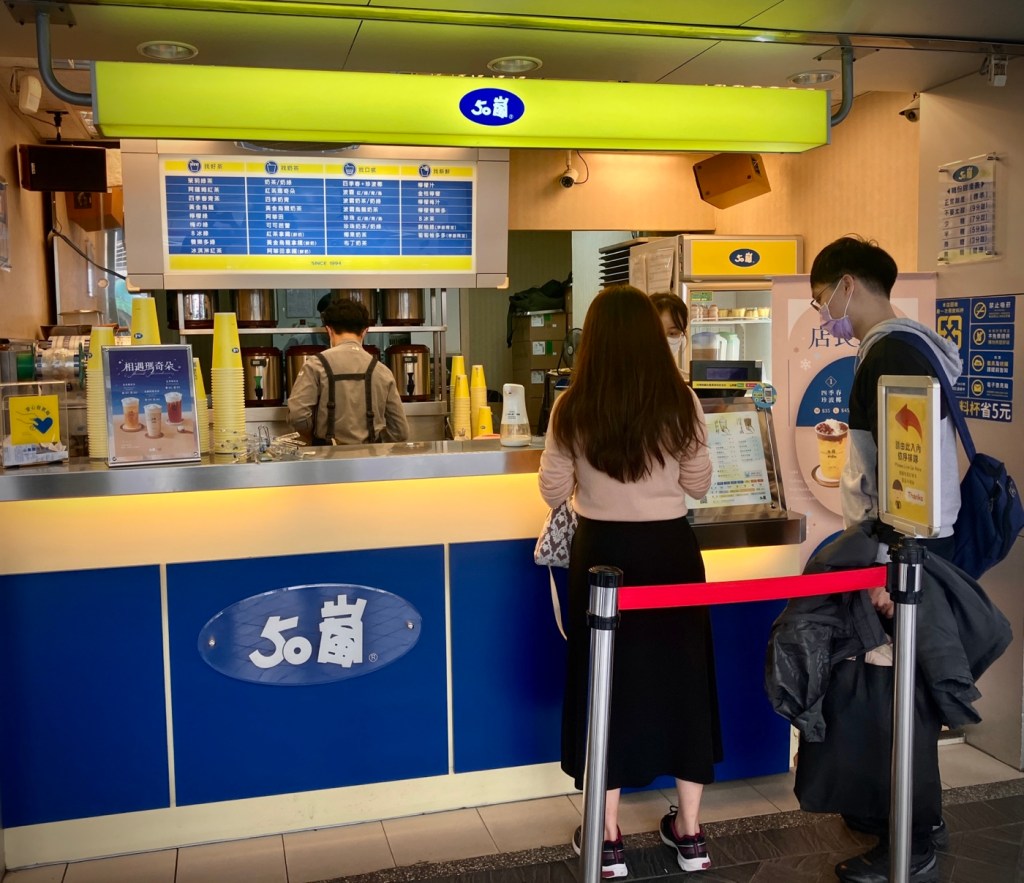
Food and SO many boba tea shops…Taiwan invented it and continues to reinvent it for the rest of the world.

2. Unique culture – fun and quirky with a rich history influenced by indigenous, Han Chinese, Japanese, and western culture. There is also a strong fascination with Korean pop culture and clothing. It’s not quite like anywhere else, it’s Taiwan.

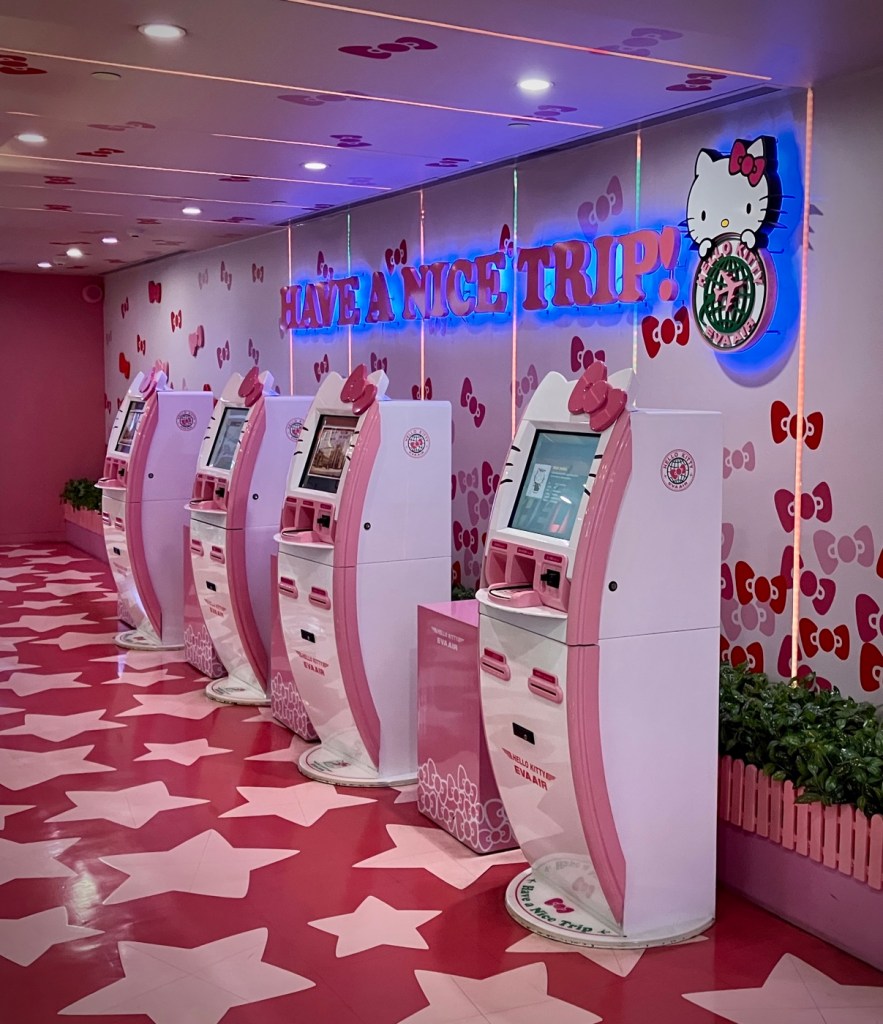
Cute = Taiwan
Check in option at Tinguan Airport…no takers?
Cat/bartender at the Tipsy Dragon in Songshan

3. Efficiency AND Kindness – This is a neat and orderly city…people follow the rules and you will enjoy yourself more if you do too. Or at least make an effort. It’s an easy, extremely collaborative society, and everyone has built in empathy and spacial radar systems. You’ll never bump into someone or have them cut or push too much, even in crowds…it’s infectious and relaxing once you embrace the system.

Graceful and spacious MRT stations, many outside the core are aerial with quiet platforms, views, and pleasant breezes. No center running freeway noise here.
Stand right, walk left…always!

4. The MRT! – a comprehensive and modern system that carries 2 Million passengers a day. Buy a EasyCard (IC Card) at either airport station for 100 NTD (New Taiwanese $, or about $3 US), load some fare and then tap in and out like the locals for 50c to $1 a trip. We had the airport station agent add 300 to each to start, so paid 800 NTD. If you get a funny beep or issue with your card, there is always a helpful staff person nearby.

The MRT is integrated with neighborhoods, creating nice station area plazas such as this one in Shilin
Neighborhood pride in Shilin

There are also real time predictions at all MRT and most bus stops, so don’t be intimidated to use buses as well. Big numbers on the front…tap on and off with your IC card when you ride at the front or back doors. So easy.

Keeping an eye on train operations in Jintong

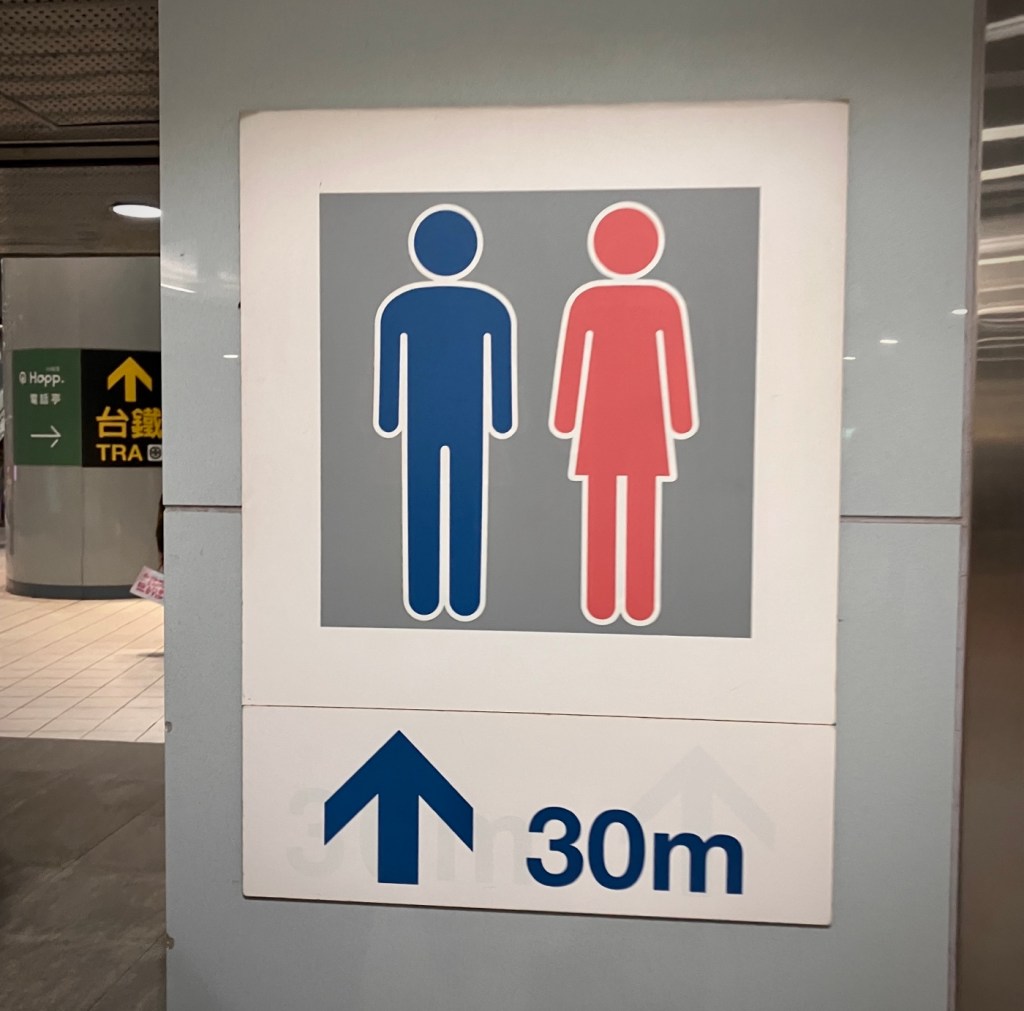
5. Bathrooms – Seriously, Taiwan is the most bathroomed place on the planet (interested to hear about others!?). Every station has one (or two), public parks, museums, attractions, malls, night markets, parking garages, busy neighborhoods….you get the idea. And all free and clean, which really does reduce travel stress and the need to go into “camel mode” walking about like in some counties.

Fun, inviting, and yes, bathrooms in Pinxi District
Always so close

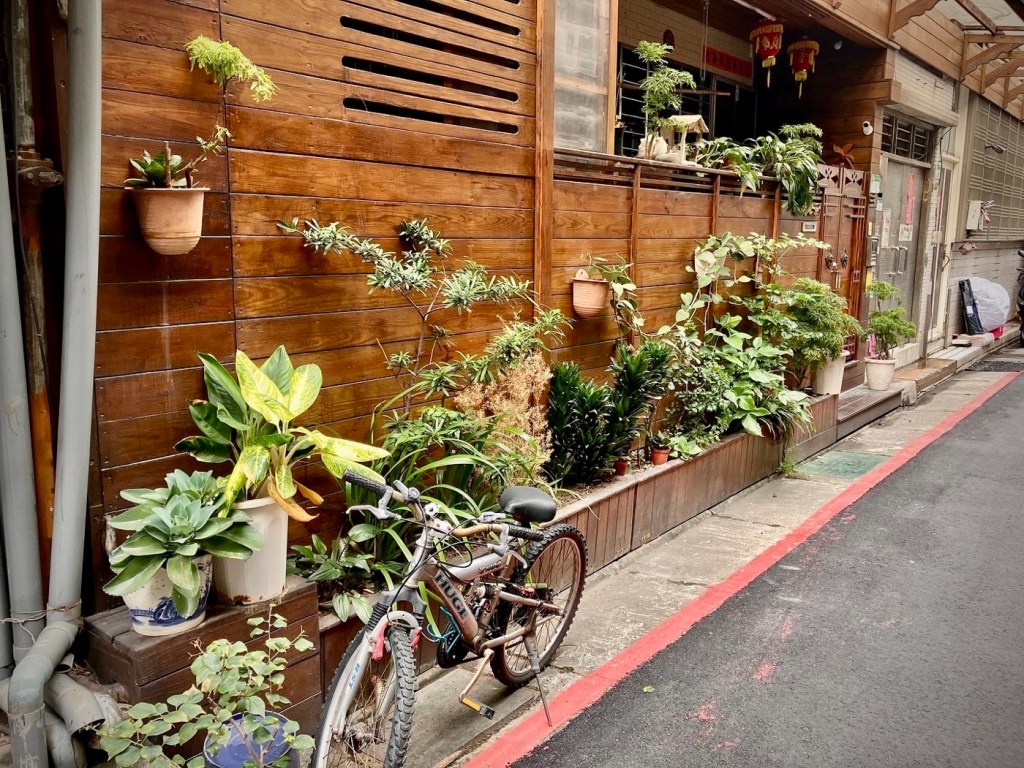
6. Greenery – Parks, long greenways (140km of bike paths!), and lush hills and mountains make for a pleasant backdrop, plus potted street plants liven up even the drabbest streets.

Street plants seem to be a craze in Taipei and make the vast downtown neighborhoods a bit more livable
Ahead of the curve…the cool interchangeable scooter batteries of the Gogoro energy system
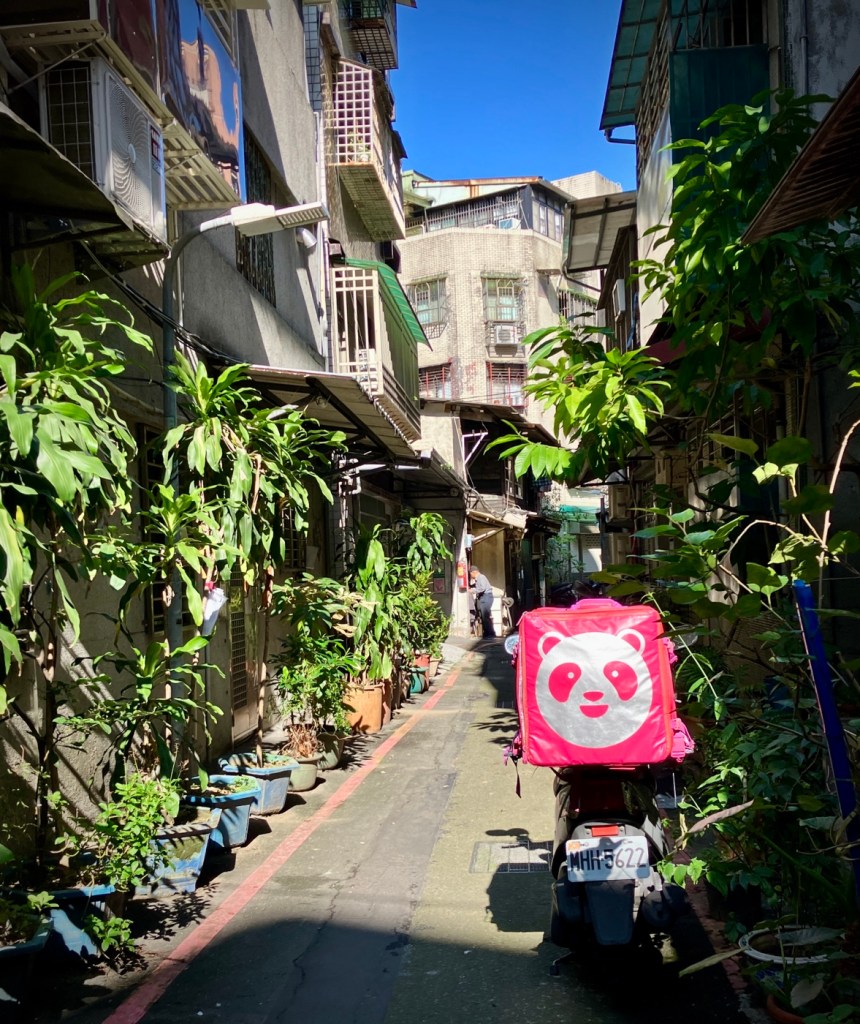
Alley greenery (and the ubiquitous Food Panda!)

7. Clean air – not perfect but good for such a large city due to great public transit, fairly clean vehicles, frequent coastal and island breezes, and the greenery noted above.

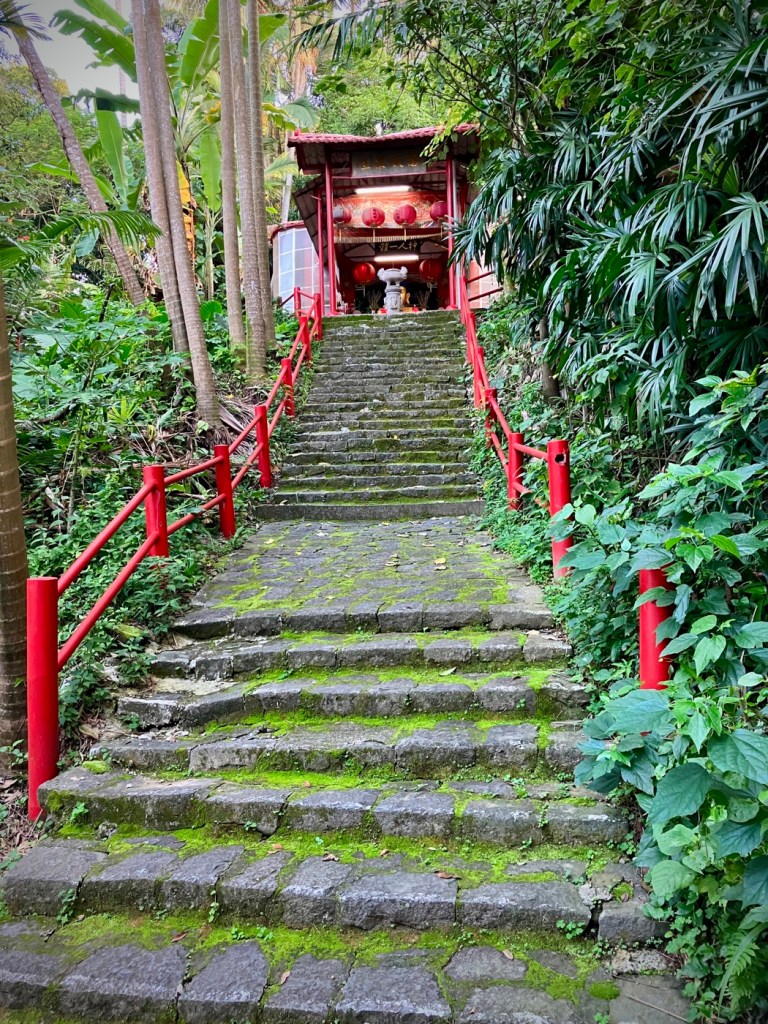
Spiritual moss on Jiantan Mountain
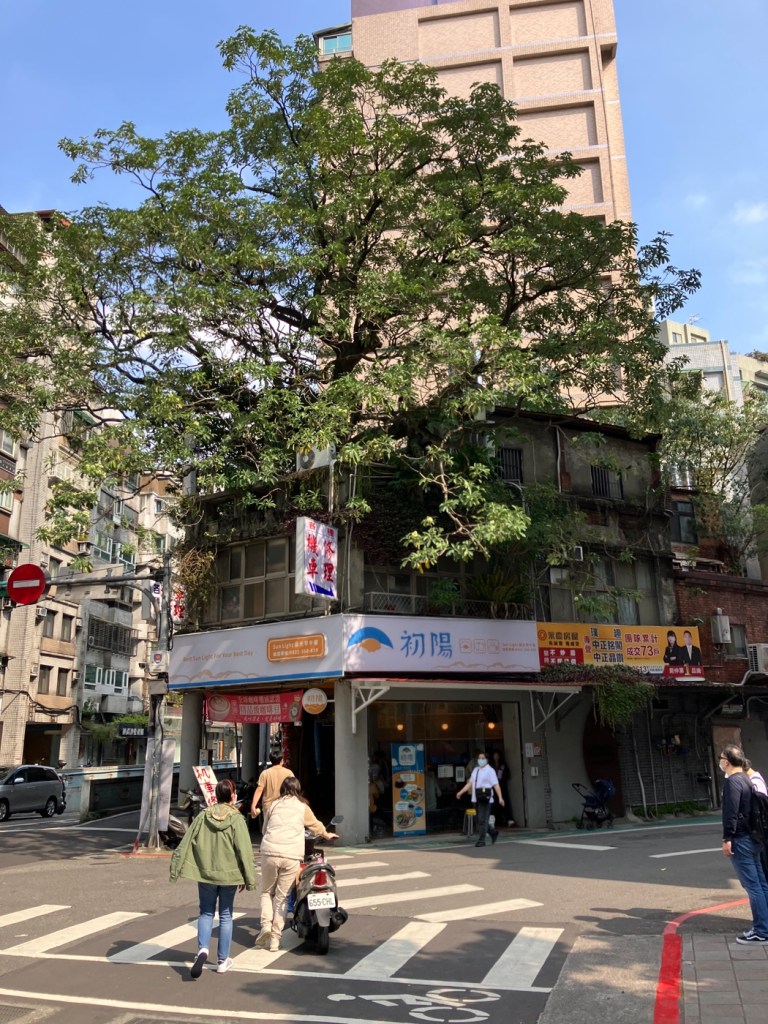
Building around tree or tree within building?

8. Safety – Traffic is pretty organized and street crime seems virtually non existent. One of our only social gaffs was inadvertently moving a women’s notepad/binder/IPad? from a back garden of a coffee shop…we thought it belonged to the shop, and she came out surprised to see us in her seat…we offered to move, but she refused and headed to another spot upstairs. Oops.

Pocket temple in Tamsui
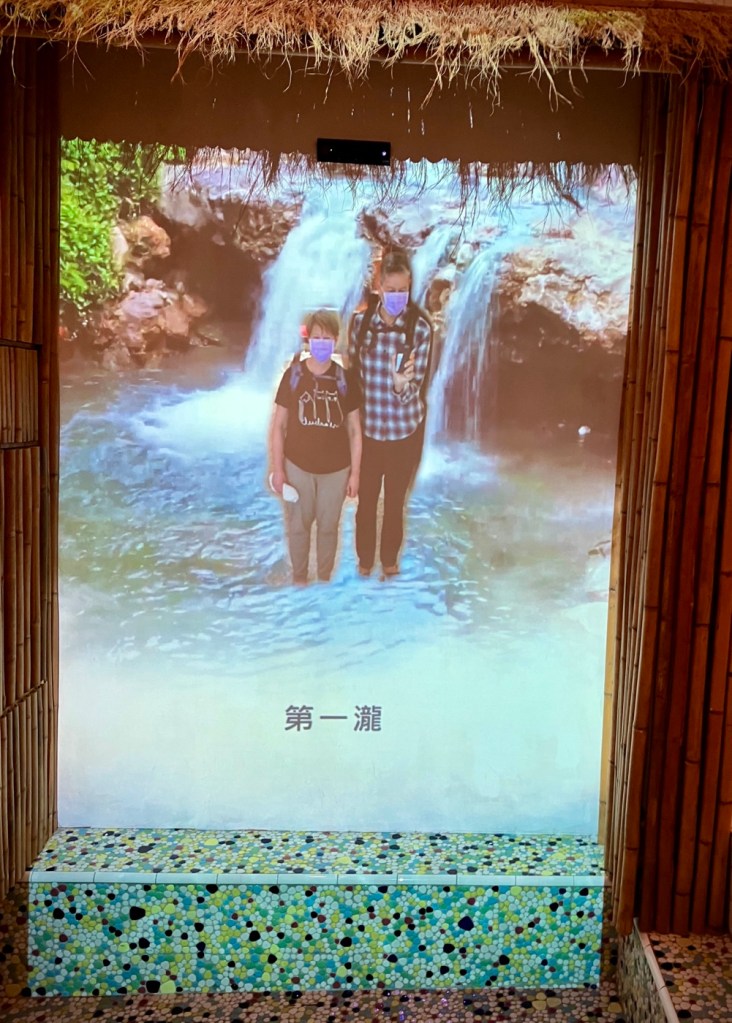
More fun at the Onsen Museum in the hot spring town of Beitou…via MRT of course.
The historic Pingxi Train line runs 13km from Sandiaoling to Jintong runs hourly, so you can hop off and on or walk between stations.

9. Hiking and cycling culture – a great proportion of the world’s quality bicycles are made here (not to mention 90% of the worlds fast semiconductors), and they actually push cycle touring as a key component of their tourist advertising. On this first “winter” visit, we only grazed the endless mountain and forest trails that crisscross the spine of Taiwan… with many accessible by public transit.

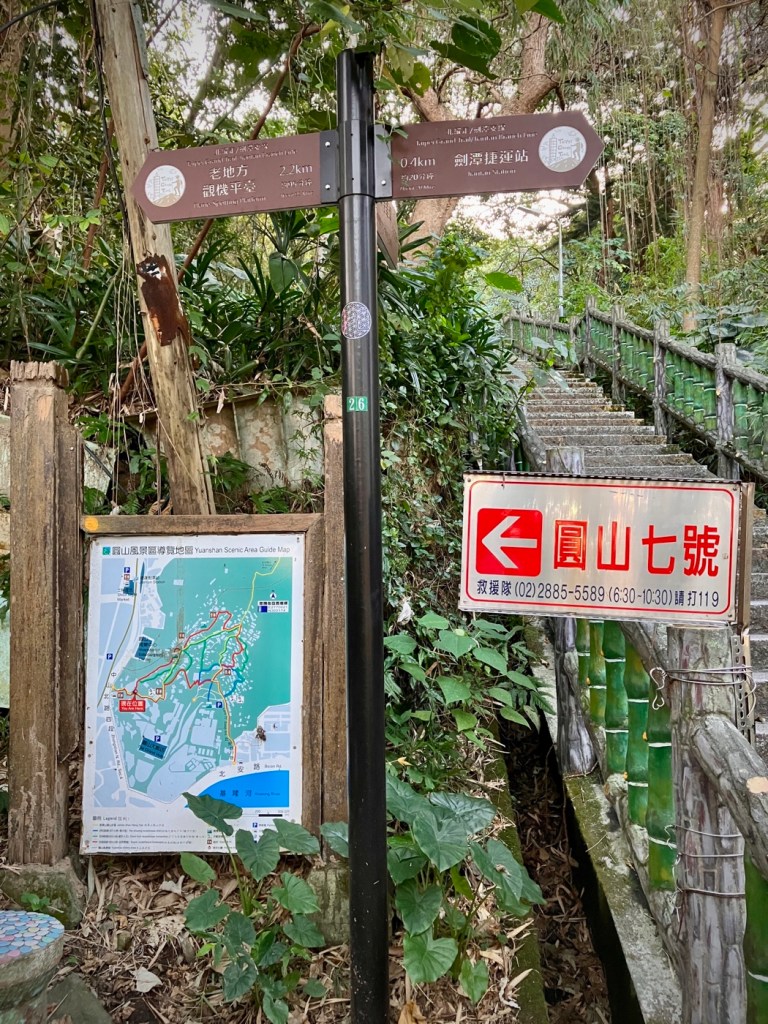
Morning walk up Jiantin Mountain
You can walk from the edges of the city far into the mountains and take a train or bus back.
E-bikes for Spaniels…so green

10. Mixing with the locals – not many western tourists makes for a more exotic feel. And at least some English in most places makes interactions more rewarding. We’ve discovered this cool Asian capital, right-:)

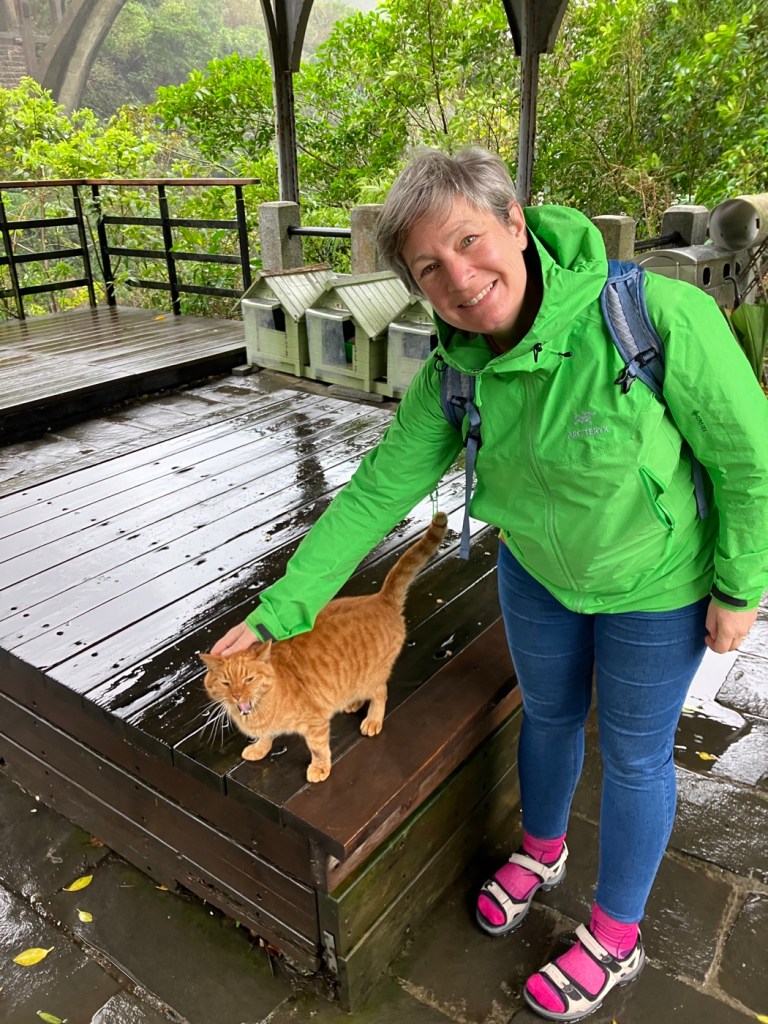
Cheryl drying out one of the many cats of Houtong Cat Village
Cats keeping an eye out on the purpose built cat bridge in Houtong
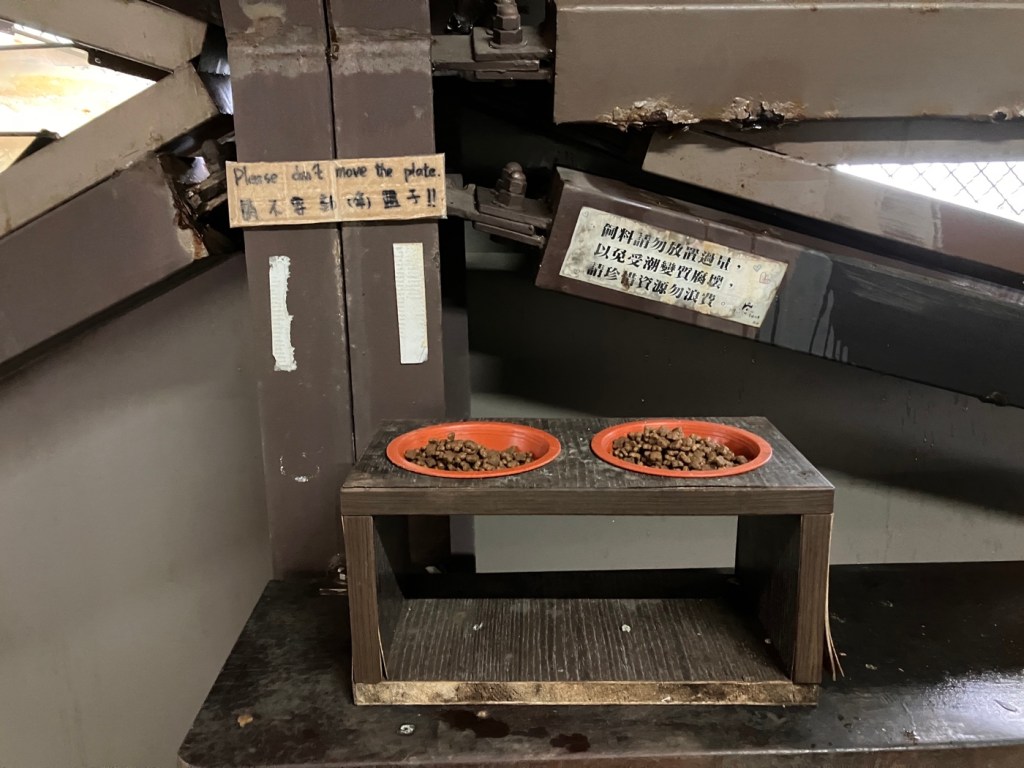
Cat food on the cat bridge

Maybe you’ve been here and are nodding along, but if not, consider at least a stopover in Taipei on your next travels to Asia, or better yet, spend a few weeks or a month traveling around the whole island. Rail circles the island and the more developed west coast has a high speed rail network that takes you all the way south in about 2 hours.

So much to explore outside of Taipei…Shifen village between trains.
We only dabbled on the local trains, but there is a whole island to explore!

The more you learn about the people, history and culture, the more you will understand the how complex the geo-political conundrum really is. Our hope is strong for a positive future for Taiwan and we definitely plan to come back soon to explore by bicycle.

🐇🎉Happy Year of the Rabbit! 🎉🐰

Peace to all and happy travels!
And One Month Later….

It’s hard to believe that we’ve been back in the US for almost two months, and apologies for the month gap in our blog, a record for sure.

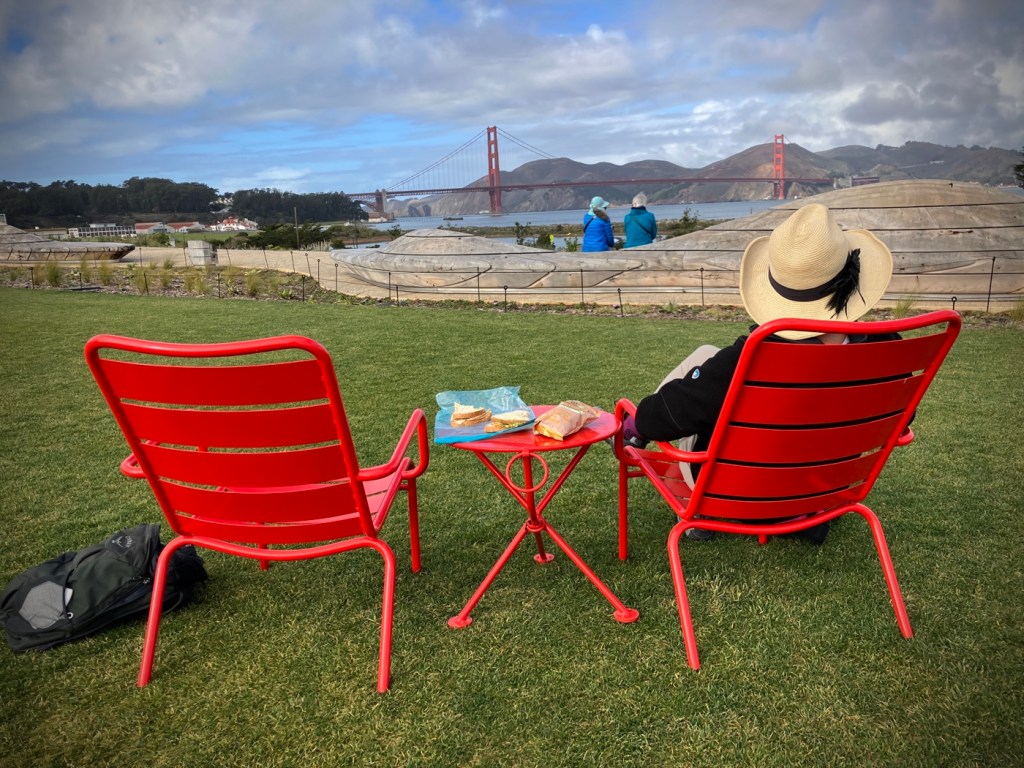
Back in San Francisco and enjoying the amazing new Tunnel Tops Park in the Presidio; love the movable furniture!

We’ve been having too much fun seeing friends and family in Palm Springs, Moorpark, and more recently, visiting our favorite SF haunts and enjoying the beautiful Northern California winter. Not to mention bingeing on all the World Cup. Felicitaciones Argentina!

View across Tunnel Tops. Always something new and wonderful in the Bay Area
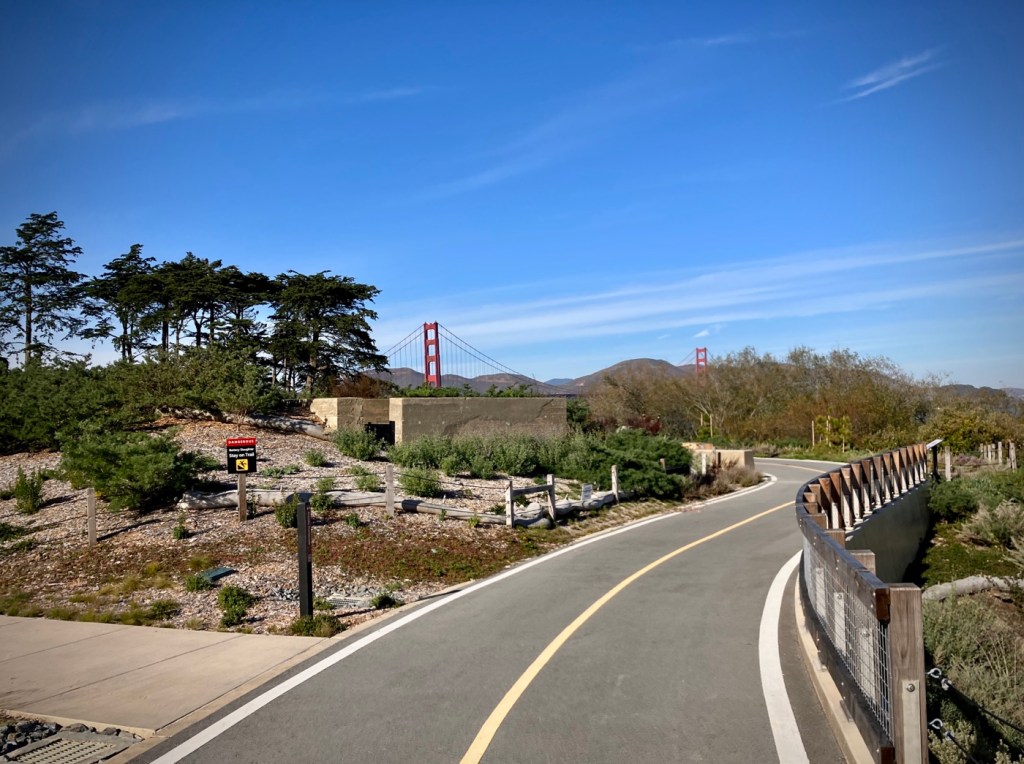
A new bike path extension to the Golden Gate
A short but always inspiring meet up with our fellow nomad DNT.

But as other nomads have related, retuning “home” is sometimes a bit tough, and strangely disorienting, especially when you know that you’re heading back out into the world again as nomads. It now feels more like a refueling stop, with the primary energy being friends (and tacos!) Nomadic life is endlessly stimulating, but without a base of friends and family to pivot off of, it might seem less invigorating. Contrast in life keeps it fresh.

San Francisco welcomed us with a beautiful sunset…you’re not making this easy SF.
Back riding with the boys on Twin Peaks…so missed this!
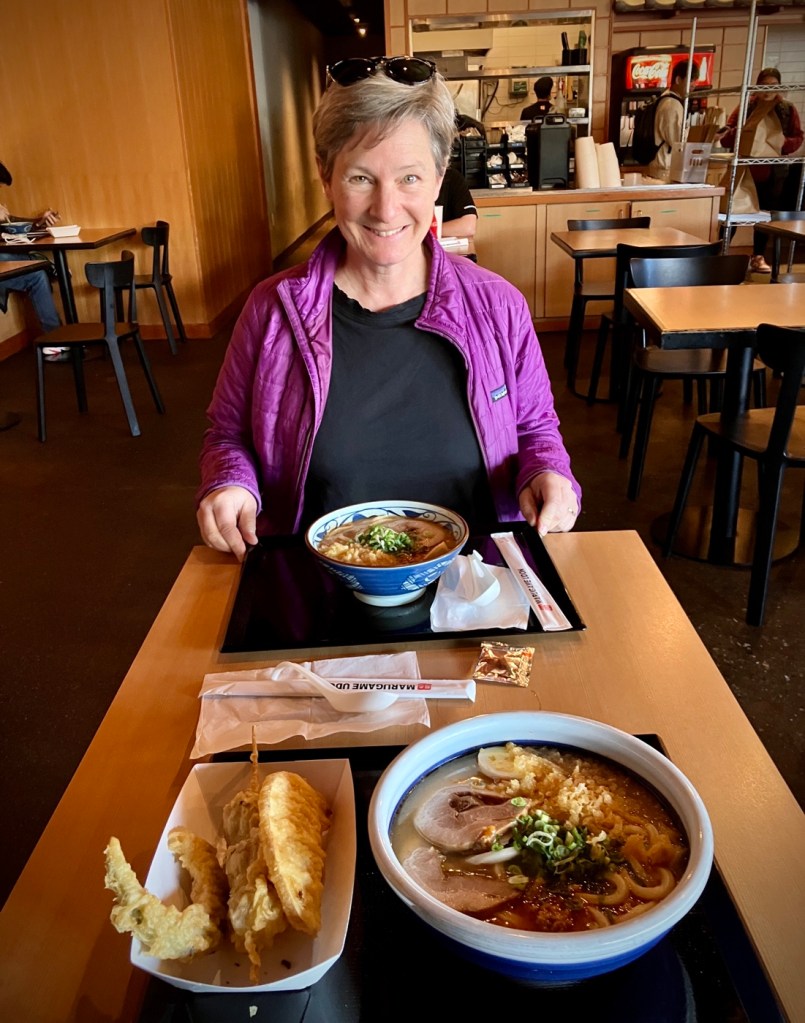
Ramen and Udon fix at Marugame in SF.

We’ve also been reunited with some of our “stuff” in a local storage unit. It’s always exciting to roll up the storage unit door and see what is there. Luckily, most clothes to swap out for our visit and onward travels are near the front. It does beg the question of saving so many things, but we know that when we settle down again somewhere, we’ll enjoy seeing so many familiar things again in a permanent setting. Right?

Champion and I excited about a walk!
Mission Creek Preserve in Desert Hot Springs
Walking the dogs in the vast landscape of the California mountain deserts
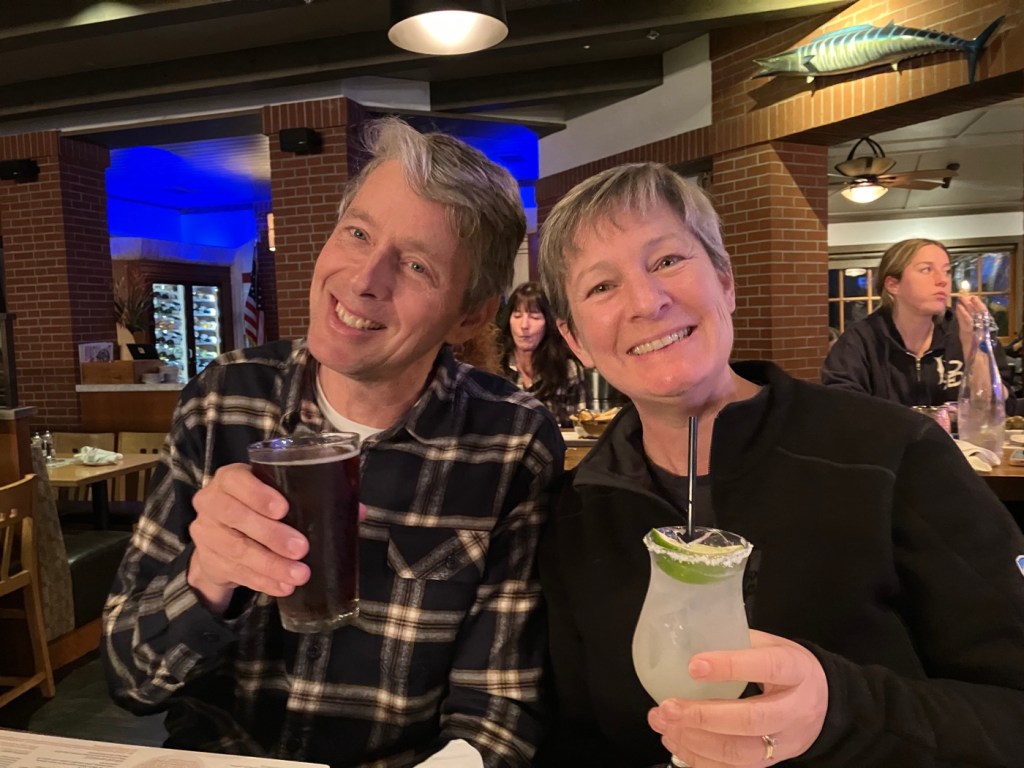
Happy hour smiles in Southern California
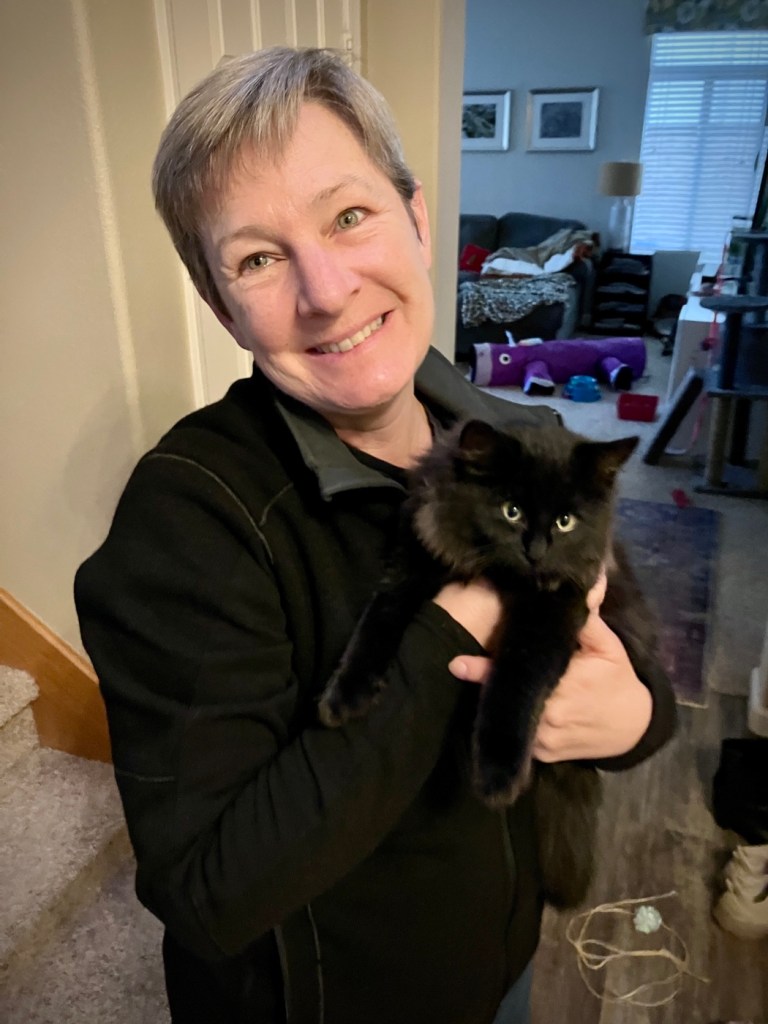
Cheryl and Boba “the cutest and friendliest kitten in the world!”.
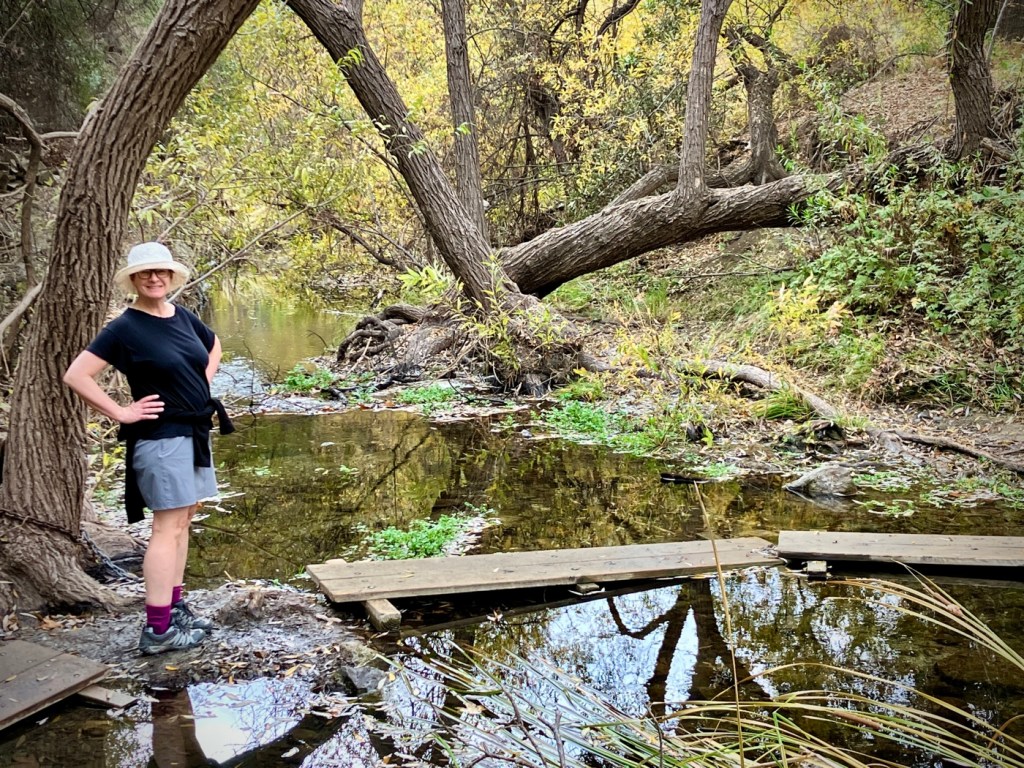
Thousand Oaks delivered peaceful scenery, oaks and even water during a late fall hike in Wildwood Park

But after 16 months of travel, we are now a bit awestruck by how streamlined our travel lives are compared to the complexities of typical American life. No home, no car, a few bills…a bag or two and sometimes bicycles. Life is a trade off, and many of our peers could choose to simplify and travel more, but for many, selling it all and going mobile may be just a bit too much.

Christmas and Victorians were made for each other! Hayes Street, SF
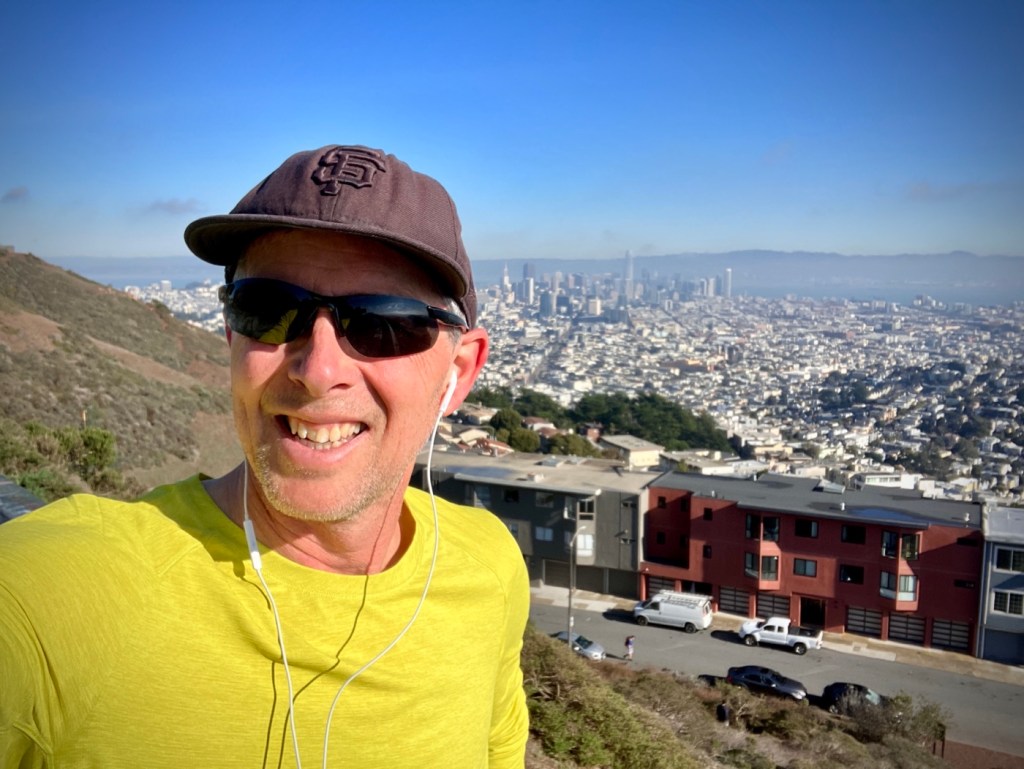
Selfie during a run up Twin Peaks…and yes, I’m that guy without Bluetooth earbuds…too easy to lose traveling!

It was not an easy decision for us either. And for many, simply renting your place out is an option, so you can return to your previous life with less of the uncertainties that selling creates. Of course, having no dependent kids or pets helps, and we recognize that this window in our lives to travel may be unique and precious.

Catching up over coffee with our friend, and our ace SF real estate agent Lisa from Polaris
Garlic noodles at Perilla in the Inner Sunset – Check!
San Francisco fire stations have an annual Christmas light competition…it was on in Portola/West Portal.
Being home means baking with friends in Oakland

Home is nice, and the longevity of friends and place gives you a unique perspective on the passage of time. So we especially appreciate the generosity of our friends sharing their homes (or dinner) with us as we return for these recharge sessions. Thank you to all for your generosity and please know we will try to repay someday when we again have some roots in the ground. (Especially Rich and Andi -:)

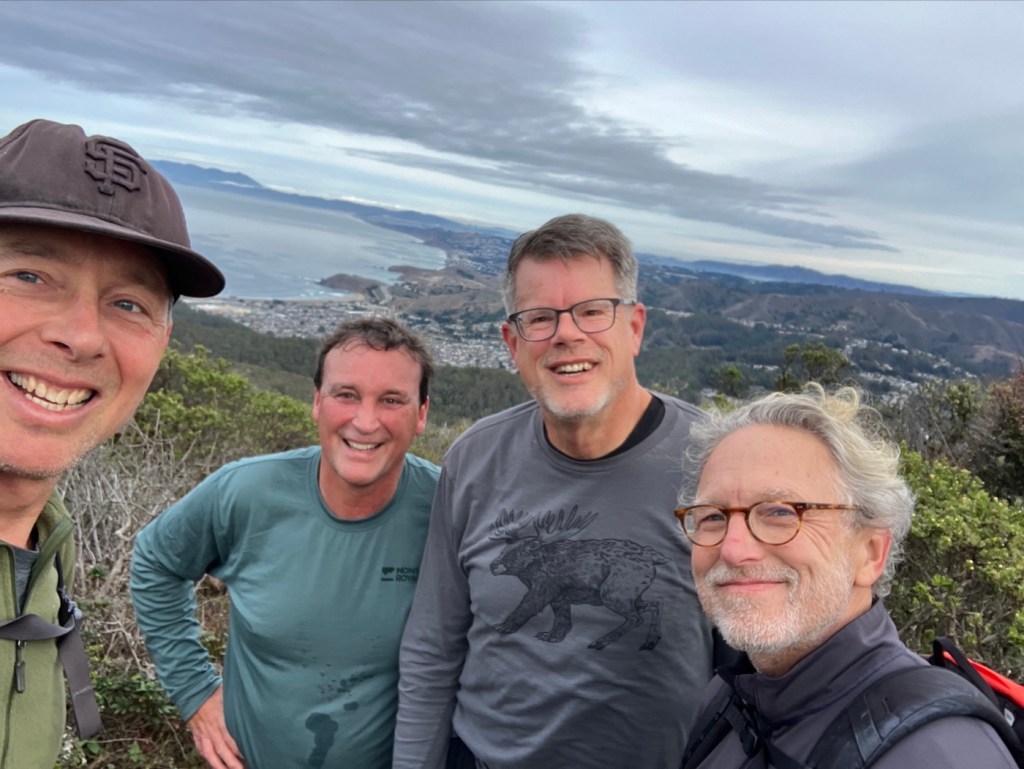
Hiking up Montara Mountain…the drama of the Bay Area landscape is striking after travels.
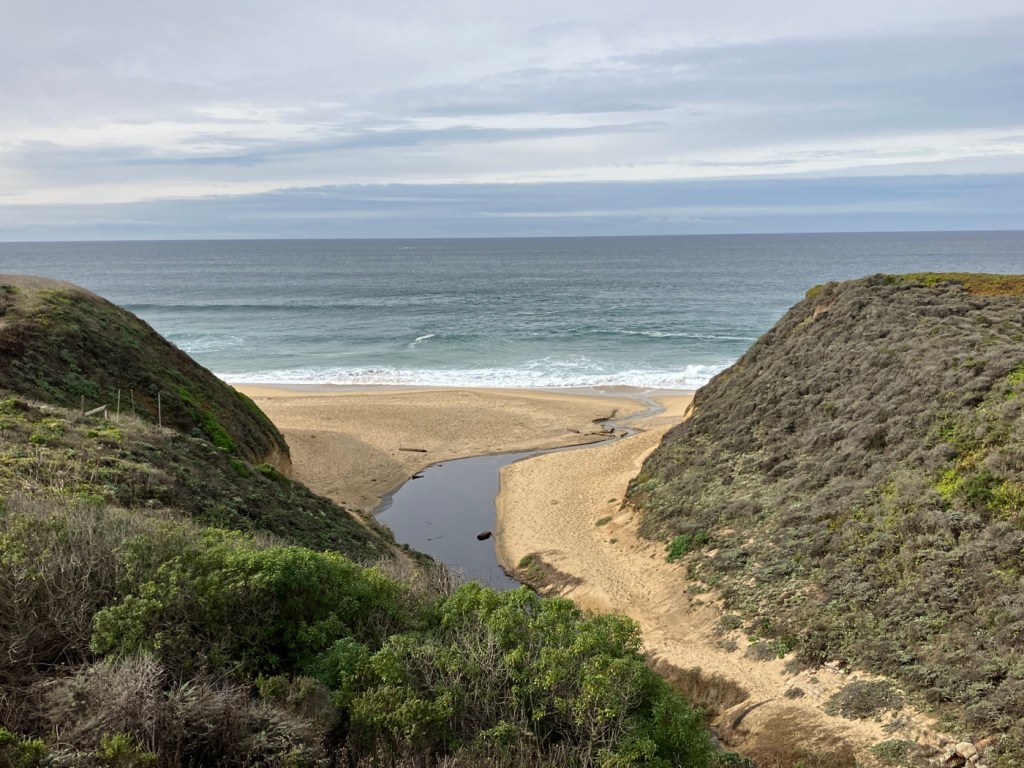
The San Mateo Coast south of San Francisco offers endless beauty and secret beaches.
More hiking with good friends in Redwood City

We’ve now just arrived to an usually cold and snowy Seattle after a somewhat leisurely 3 day drive from the Bay Area, catching up with good friends and family along the way. We have two house sits (x2 cats each). Hopefully now away from most of our friends and family I’ll be able to get back to the important tasks of global travel planing for 2023. But the Pacific Northwest is so intriguing….so many places to explore; hmmm?

Cats eye view in North Seattle

But today the streets are still coated in snow and ice, so we’ll wait for the forthcoming thaw and settle into the coziness of our temporary cats, and sip coffee and tea as we look out into the evergreen and snow landscape. More on our Pacific Northwest winter excursion soon, as well as our scenarios for 2023 travel. Still no “plans” -:)

Happy travelers back in Buena Vista Park

Happy Holidays and safe travels to all!

New York Is Not New England!

So after a relatively quick recovery from Covid in Lisbon, we finally made it back to the United States! We rejoined a revised and somewhat compressed itinerary and still arrived JFK via TAP Airways new fuel efficient A330. (Ok for airplanes at least…)

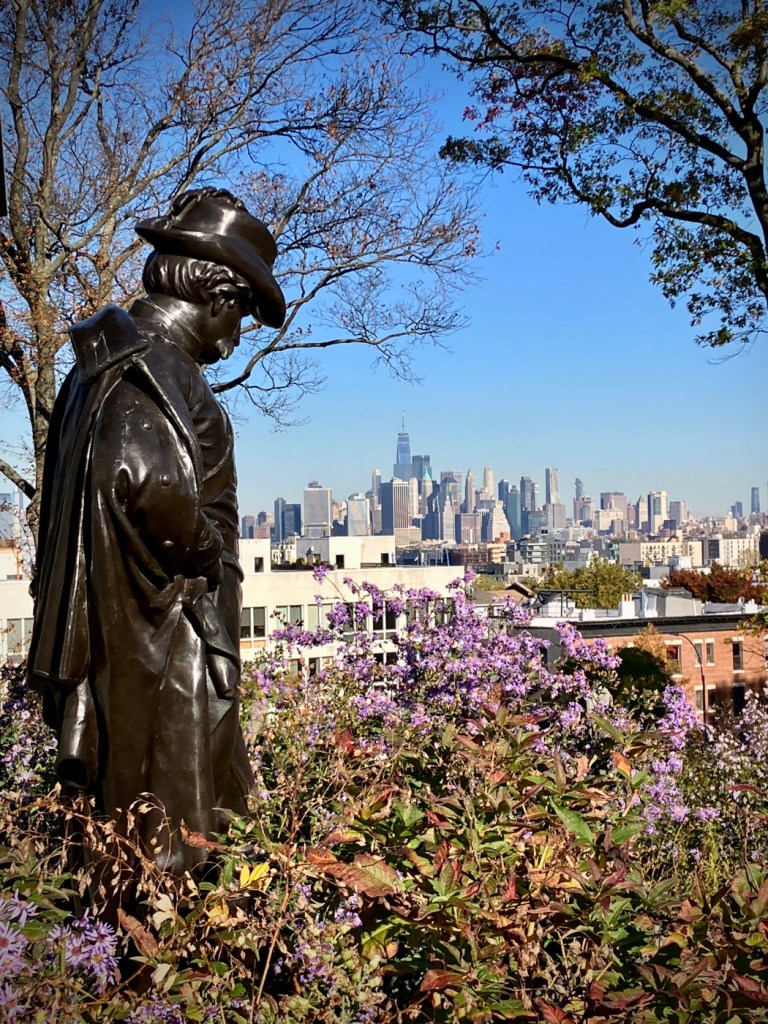
Easy to come back to fall in Prospect Park

When our house sit in Boston fell through due to the owners case of Covid (ironic yes), Cheryl worked her magic and found a last minute house sit in Brooklyn. So after a quick change of plans and one obligatory night in an overpriced chain hotel close to the airport in Queens, we were off to Brooklyn by Long Island Rail Road (LIRR).

Happy back on the NYC rails!

The house sit was a bit of a challenge with two old cats, lots of medications, and tight quarters, but certainly a memorable experience and in a part of Brooklyn we have never explored, Park Slope. It also was just a block from 4 subway lines!

The 478 acre Green-Wood Cemetery in Brooklyn is so nice that it inspired the development of Prospect and Central Parks

It was a magnificent fall weekend and the weather was perfect for strolling, not to mention all the Halloween decorations and costumes, although admittedly, it’s often hard to pick out costumes from just “Friday” in uber hip Brooklyn.

Battle Hill in GreenWood was part of the under appreciated Battle of Brooklyn in 1776. The British would occupy NYC for 7 years!

The walking in Brooklyn also felt invigorating after Lisbon’s lumpy limestones. We could once again stride briskly, with standard crosswalks, and short light cycles. The fall colors and crisp weather were so magnificent that Cheryl belted out in Prospect park that “New England is so beautiful this time of year”. Wait, we are NOT in New England!! This is New York!

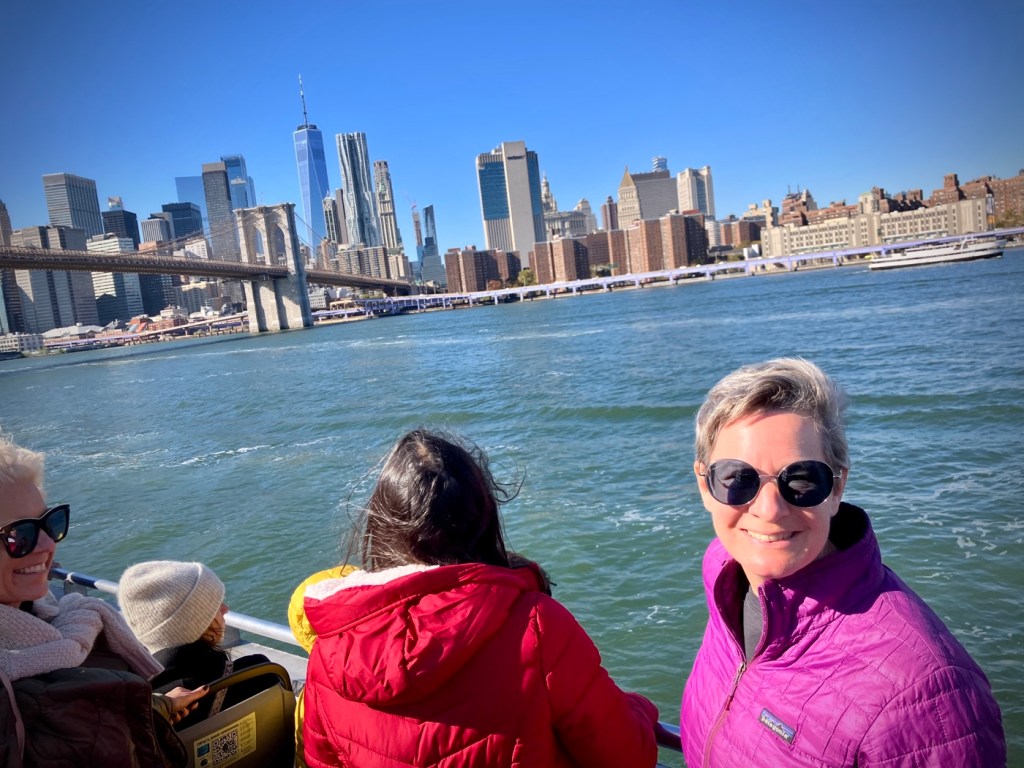
Ferry hopping on the East River

After some of her doubts were quickly settled by Google, we strolled on, but I was reminded that I was married to a true West Coast woman. I would be reminded again when she couldn’t believe we had passed through some states in an hour or less. Wait, seriously just 15 minutes in New Hampshire?! And how do so many Dunkin’ Donuts survive?

Kicking back at the Brooklyn Bridge Park

After three days loaded with good friends, perfect bagels and NY pizza, we were off via subway and Metro North train to New Haven, CT where we could pick up a rental car right at the station. The car was by far the best solution for our ambitious and compressed schedule we had to visit all our friends and family over the next 8 days.

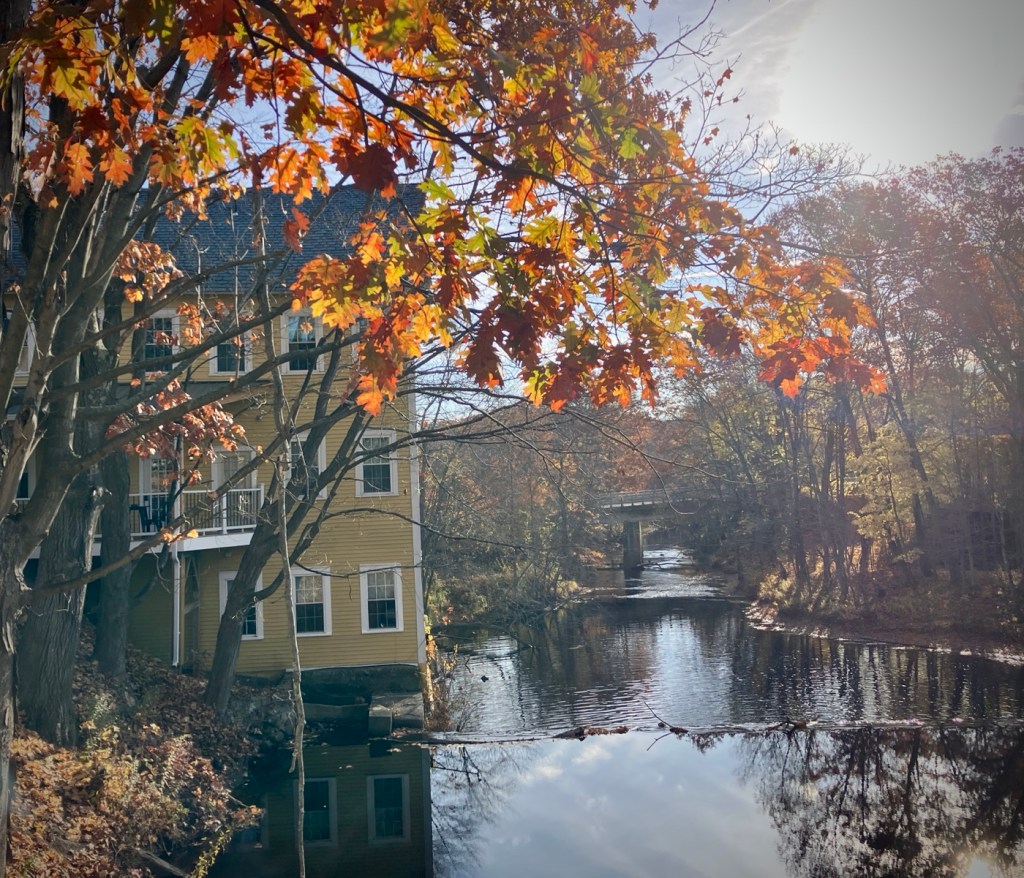
A taste of the rural Berkshires at the lovingly restored Old Mill Inn in Hatfield, MA
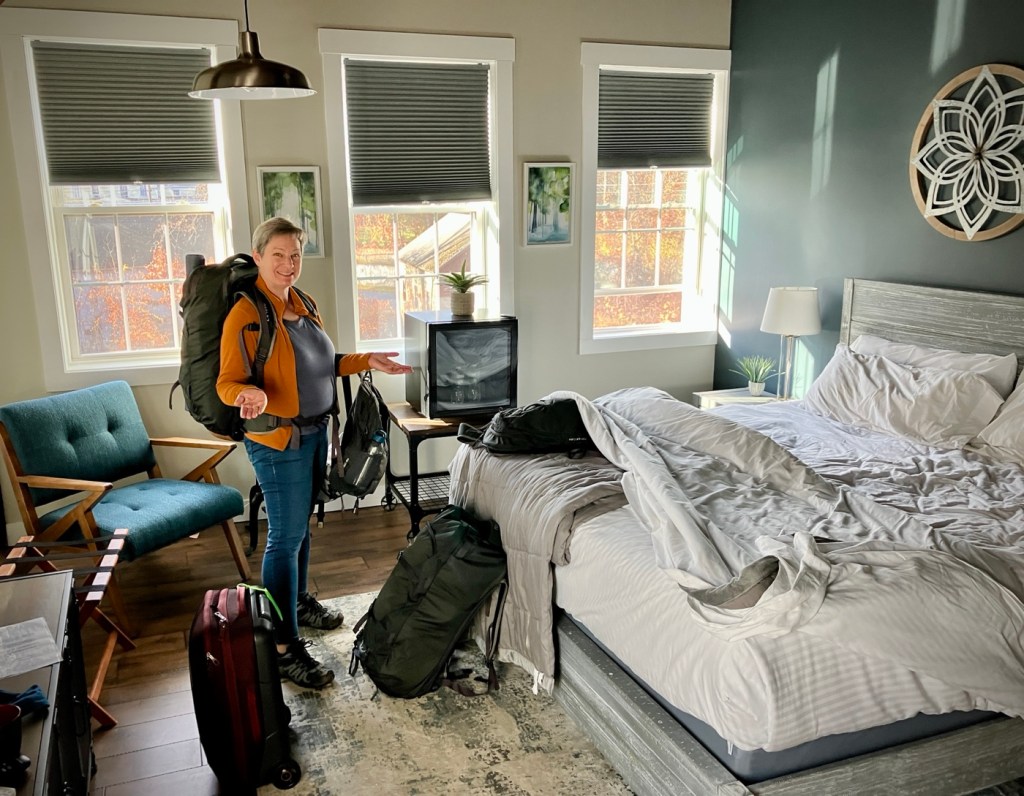
Leaving our spacious room at the Old Mill Inn, complete with weir and waterfall view (and soothing noise!) A treat after our cramped house sit in Brooklyn.

It was nice to be back in the U.S., as things felt familiar and interactions were clear. We sometimes forget that we are even in foreign countries anymore as foreignness is our new normal. And we immediately appreciated small things like ubiquitous ice (just try to find an ice machine in a European hotel.) faster paced restaurant service (tip please), and giant American salads (Yes, Elaine Benes you can have a really big salad)

Lake Champlain sunset from Burlington, Vermont. (New England…). The Adirondacks
of NY in the distance.
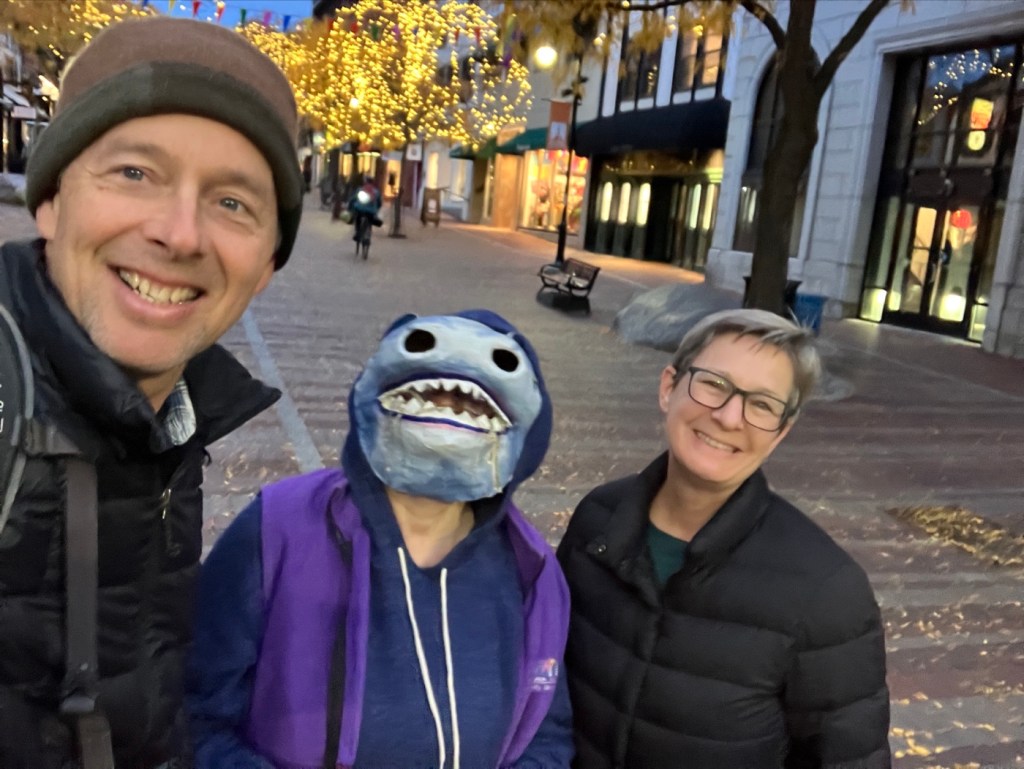
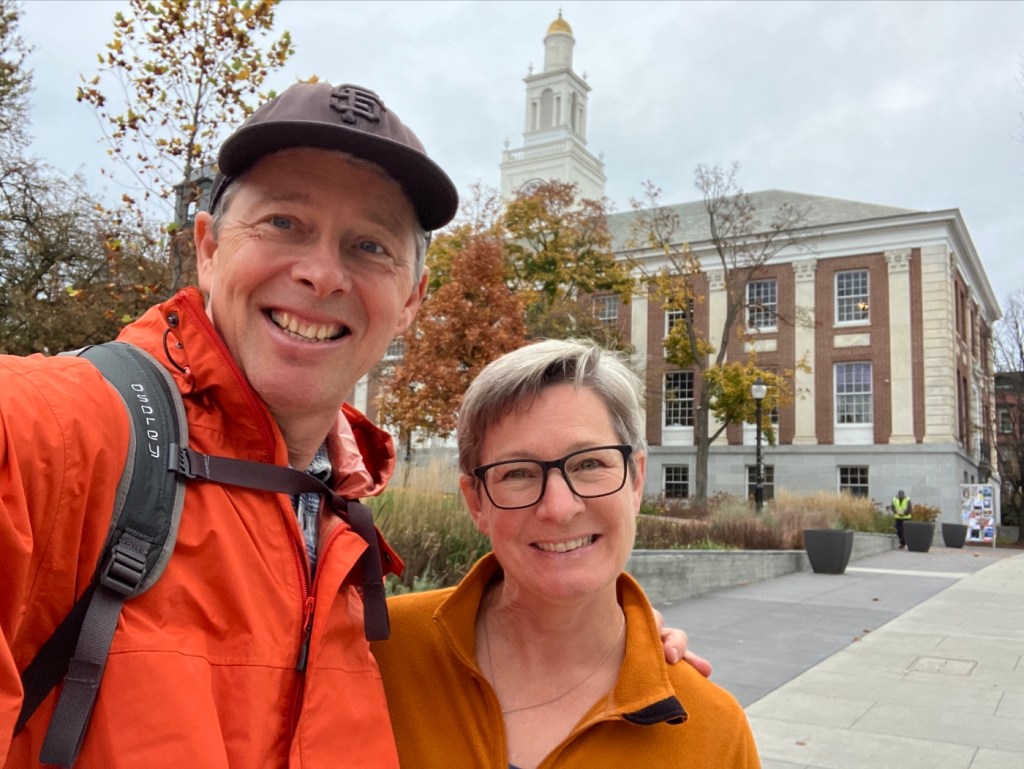
Visiting one of my mysterious cousins in Burlington on Halloween

As for the things we didn’t miss? Crazy political ads on the TV, giant tailgating pickup trucks, ignorance, and shockingly high prices compared to much of Europe. (Not necessarily in that order -;)

All Orange in Burlington

The cost of living surprises people when we mention it, as many generally assume that Europe must be more expensive than the US. First off, the strength of the US dollar is peaking, and second, many people take short trips to the most expensive (A-list) cities only in Europe, and so get a skewed view of costs in general.

Recommended road trip stops included Rein’s New York Deli in Connecticut. Home of delicious Reubens and Rachels.
Smiling at my delicious spicy noodles with tripe at Jibei Chuan in Boston’s Chinatown
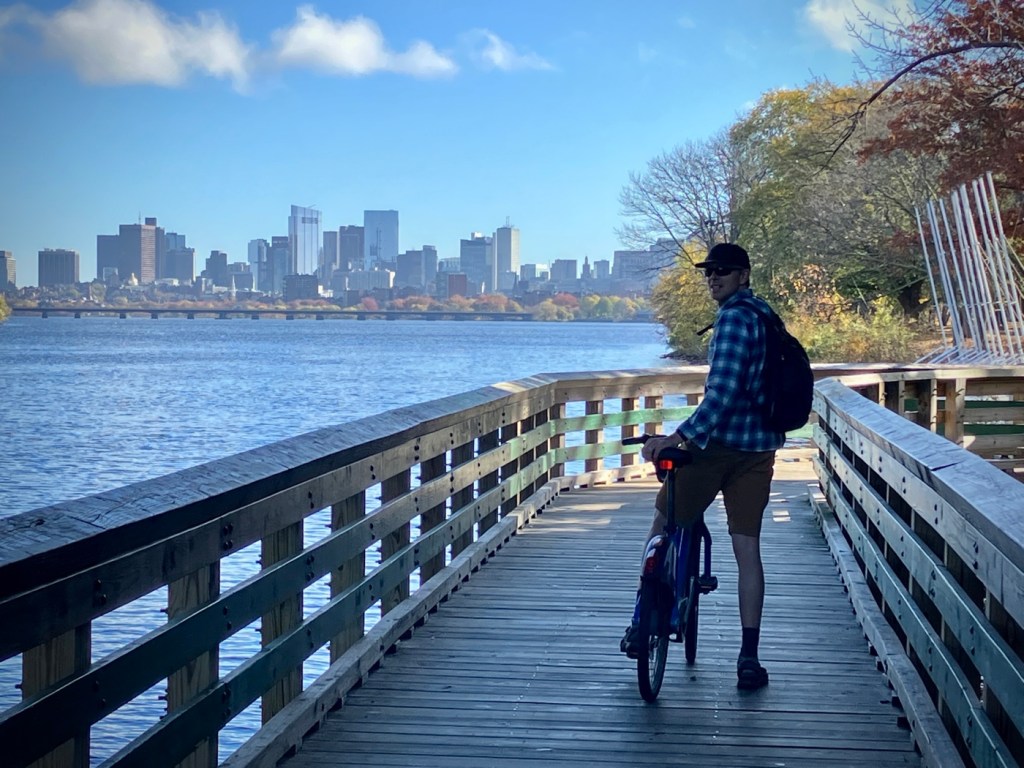
Cycling on Boston’s extensive Blue Bike system was great with the $10 day pass which allows unlimited trips up to 2- hours each.
Heading to Boston on the Charles River Greenway. Nice to park the rental car for the day and get back on two wheels.

There also seems to be fewer corporate entities taking profits in the food chain of capitalism in other countries. Groceries, lodging, eating out, and transportation (except gas and parking), are cheaper almost everywhere we have been in the past 15 months. We won’t even bring up health care as costs are incomparable and often an order of magnitude less in Europe. (i.e. podiatrist in Bilbao, Spain $40, US $400+). Whoops, I brought it up again. So perhaps the social safety net and low health costs trickles through businesses to keep costs a bit lower.

Boston is so academic that the books overflow into alleys at the famous Brattle Bookstore

But we had a wonderful time on our big New England driving loop, and still managed to work in some lovely walks, and a day of cycling into Boston. We really enjoyed reconnecting with folks and the mountains, rivers, ponds, streams, and trees that seem to fill 99% of New England.

Trying to catch a leaf for good luck along the Fresh Pond in Cambridge
Waking my childhood streets with an old friend from the neighborhood was a joy.

I vow to come back to New England (and maybe even New York) more frequently, as staying in touch with your roots is important, and the feeling I had walking the neighborhoods of my childhood was joy, satisfaction, and peace. They are forever etched in my mind. No matter where else we go in the world, and whatever we experience, these memories of place will not be replaced. Experiences build in layers and hopefully growth and perspective with them.

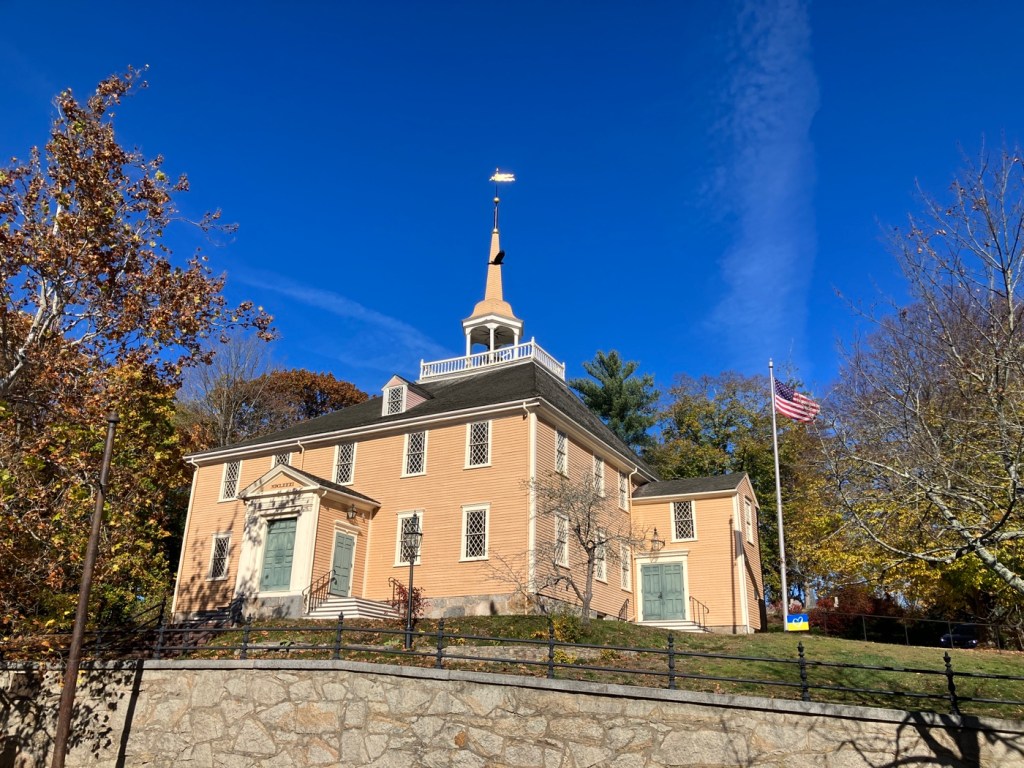
Old Ship Church in Hingham. The oldest continuously operating church in the U.S.
Yikes, a bit shocking to see my childhood house being gutted and expanded.

So today is Election Day and we are now headed to Chicago for more family and friends recharge. We have our fingers crossed that people don’t take for granted the 200+ years of work it took to create the civic institutions and foundations for prosperity that we have.

Reconnecting with old friends all over New England was a trip highlight
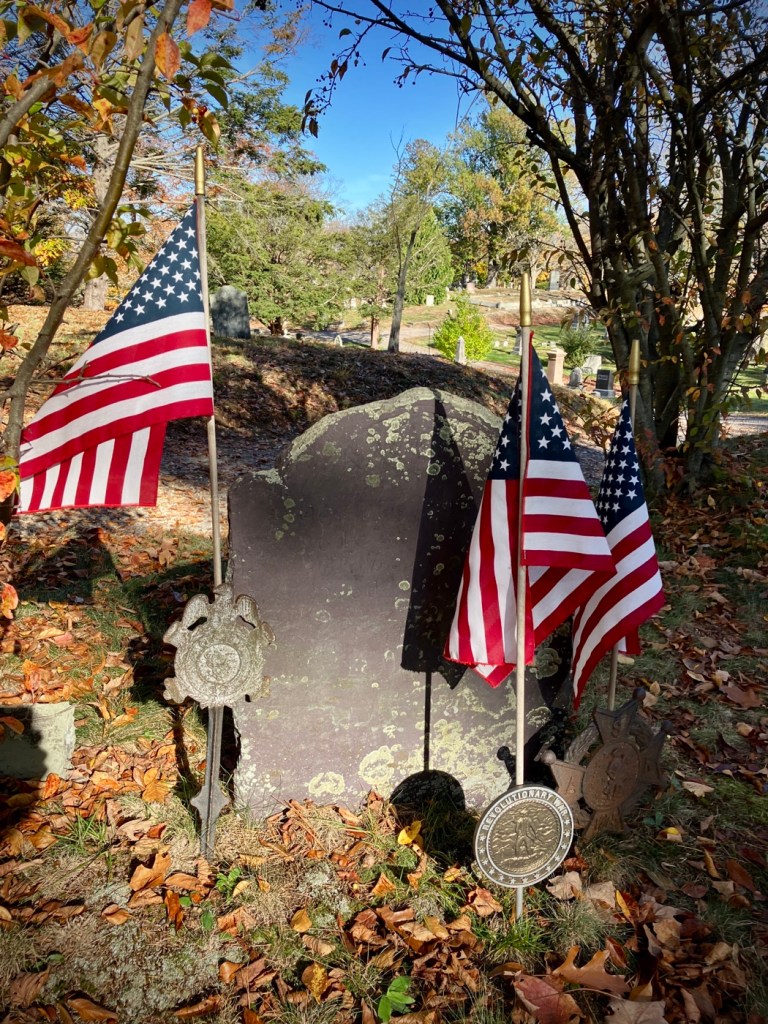
Revolutionary War Graves in Hingham. America is a wondrous experiment.

Our system is not perfect and always a work in progress. But the institutions of democracy are unique, precious, and tenuous. And despite participating in many conflicts from afar, we have been physically isolated from the worst impacts of them, just as we are again isolated from the Ukraine invasion. We don’t share a border with an invader, and haven’t been occupied. But this could change in a flash. And the enemy could come from within. We can feel the fear in Europe as the free world knows a stable United States is still key to world stability.

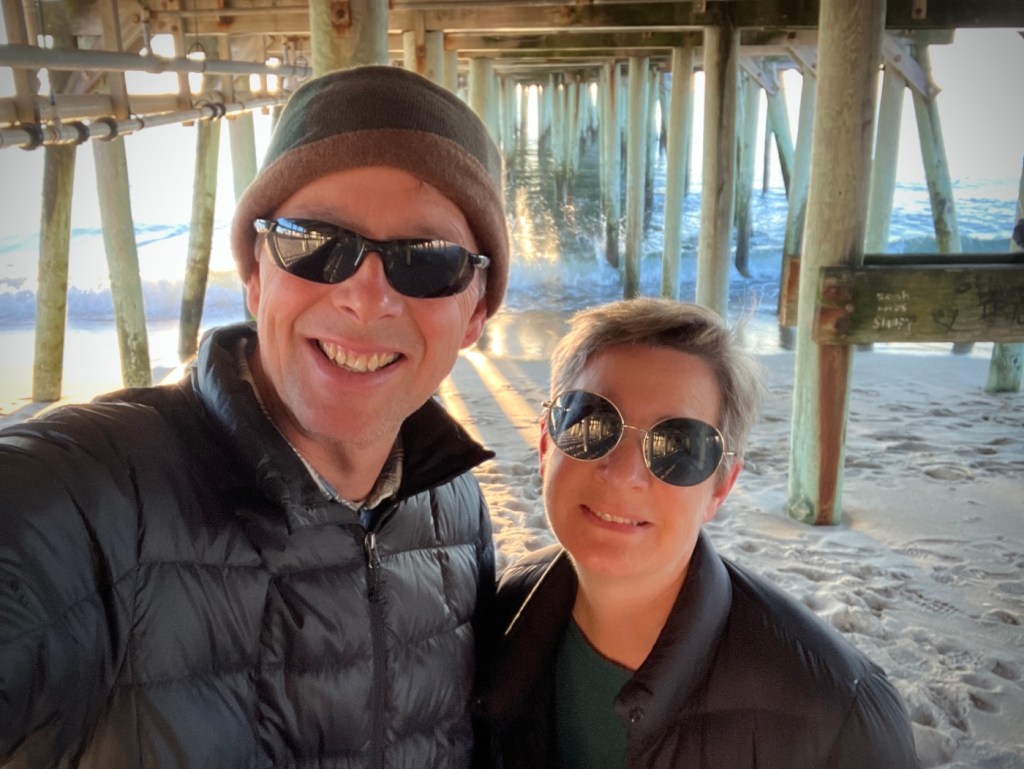
Under the pier at Old Orchard Beach with my favorite traveling companion -:)

Long live democracy and happy travels!

The Ups and Downs of Southwest Ireland

We had a wonderful two weeks house sitting in Mt. Temple, a hilly part of the Irish Midlands. It was a chance to really slow down our pace, listen to the sounds of rural Ireland, and best of all, cook all of our meals for two weeks!

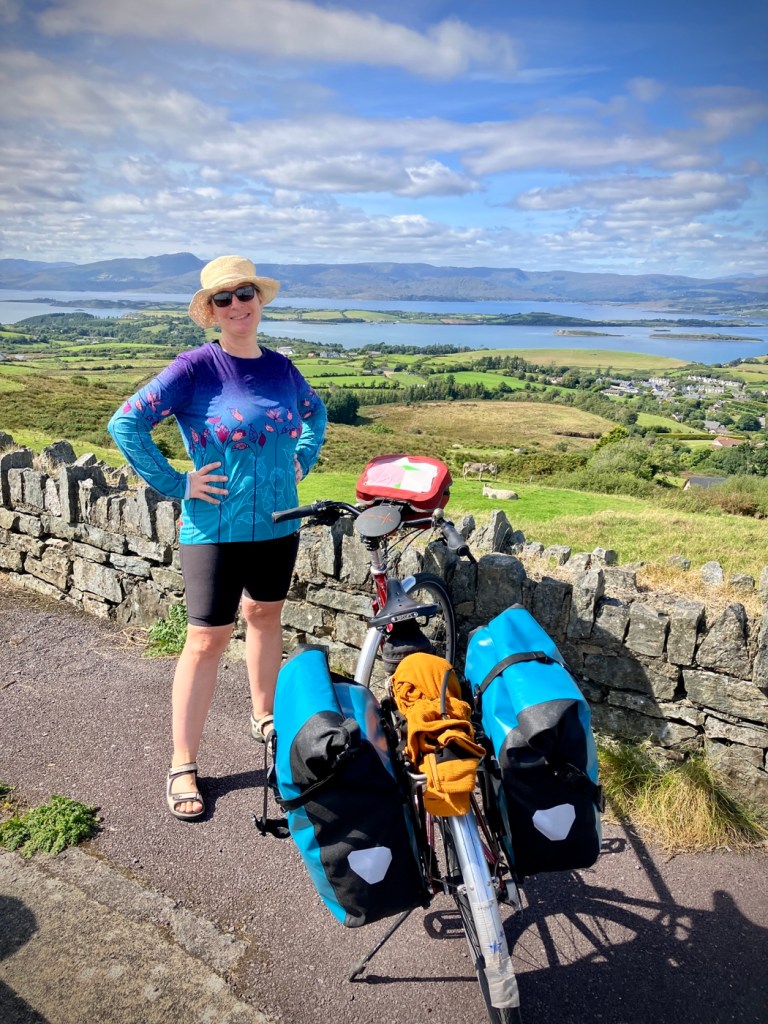
A long decent into Bantry with clear skies towards the Beara peninsula!

There was even a nice gas BBQ grill, so we took advantage of the excellent locally sourced meats and summer produce, and tried to replenish our diets from the challenges of constant eating out.

One of our two house sit cats in Mt. Temple, checking in on dinner status

We really wanted to minimize train transfers, so I planned two nice days of touring from Mt. temple by heading southeast towards the charming village of Birr and then onto a train connection that would take us directly on to the City of Cork.

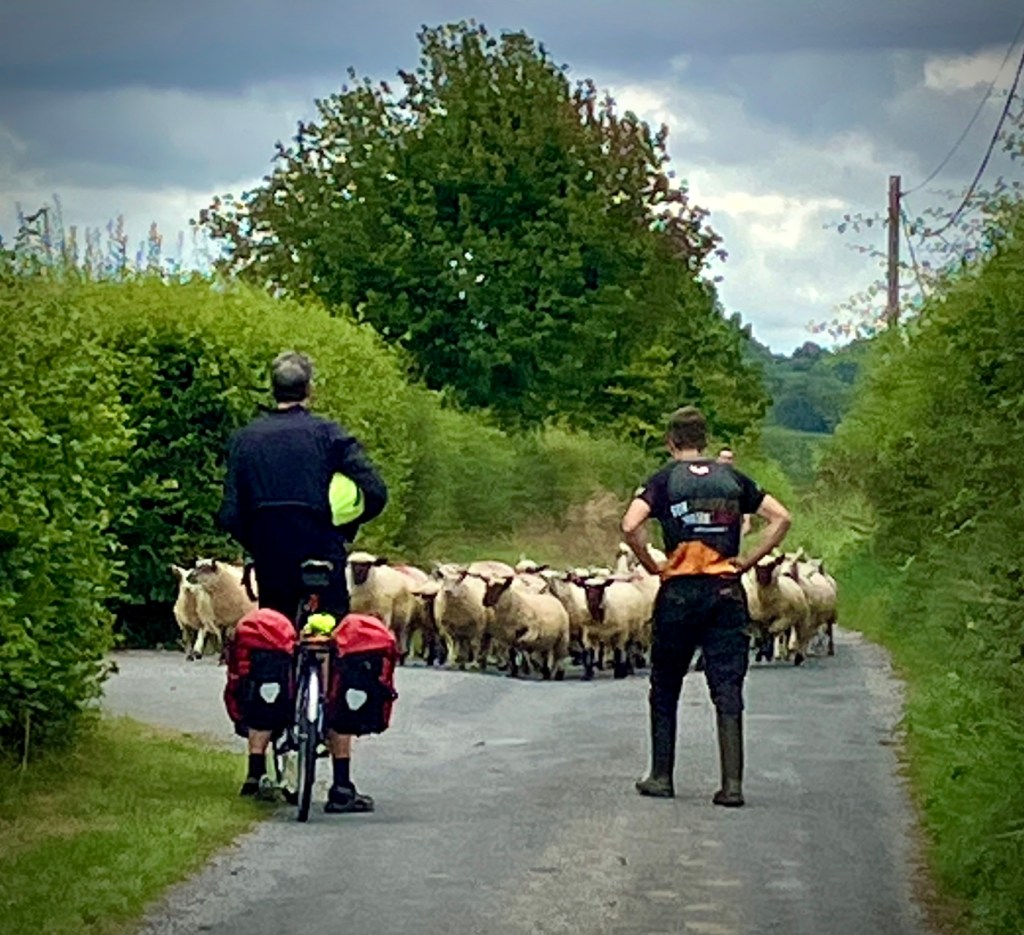
Excuse me sheep, but we have a train to catch!

It can be challenging to make an afternoon connection when touring, as the further you are cycling, the harder it is to time the arrival. Wind, hills, dirt, cobbles, or dogs can all slow your progress. So we generally allow plenty of time, especially when you have one of the few bike reservation spaces and the next train is in 3 hours!

Tea and a chocolate croissant help Cheryl to pass the waiting time at Ballybrophy Station
Local (L) roads can be nicely paved and two lanes, or overgrown double track with rocks and mud…no way to know from most maps!

We arrived in Cork in early evening and found Ireland’s second city to be a bit of a work in progress with respect to bike infrastructure. The city is a working port city and downtown doesn’t overwhelm with charm, but the lively restaurant and pub scenes compensate, as well as some interesting hilly nooks and valleys to explore on the north bank of the River Lee. But it’s a good jumping off point for exploring the Southwest of Ireland and we couldn’t wait to set out the next morning in the cool coastal air.

Loading up outside our hotel in Cork….nope, we’re not getting in that tour bus
We were pleasantly by some new bike lanes leaving Cork…as almost all the bike and path mapping is out of date, especially Google.

We took a longer scenic way to Kinsale, to take in two nice sections of rail-trail/greenway along the sinuous coast that opens up towards the Celtic Sea from Cork Harbor. Cruising along the salty coast separated from traffic on flat paths was a joy. However, we then turned to the SW, where headwinds and hills started to make their mark and let us know that traversing County Cork by loaded bike would be hard work, but also reward with sublime views and lush valleys.

The Carrigaline Greenway towards Crosshaven, so nice to enjoy the views without traffic
Our reward for the push across the hills and winds of the Cork Coast was the sublimely peaceful and picturesque Glandore

Since the prevailing winds are from the Southwest, we knew that we likely had two days of head wind ahead of us. And we did, but you are often buffered by vegetation along the small roads, so the winds are often mitigated (or unnoticeable when headed up a 10% grade!)

The Drombeg Stone Circle on the way to Glandore…worth the detour for a great chat with a French traveler originally from Mauritius (who took our picture)
Cruising inland across County Cork

Kinsale is a picturesque town set at the head of a beautiful harbor, so we decided to take an extra day there and relax as it was our 25th Wedding Anniversary. And to be honest, there really aren’t any places that I would have rather been than cycle touring with my amazing wife across the friendly and stunning landscape of Southwest Ireland.

We jumped on this lovely new stretch of separated path to get off a busy road only to have it dead end with no gap in the guardrail. Bike facilites, signs, and maps are all a work in progress here.

This is what we worked towards for many years, it does feel wonderful every day to realize that we are living our dream. And doing it while we still have some oomph in our legs. In the future, we won’t be shy about employing e-bikes to extend our years of cycle touring. It’s just such an amazing way to see the countryside and experience a place.

Yes Cheryl, we are headed OVER the mountains via Healy Pass.
But Cheryl was ready with secret emergency provisions.
Perfect pavement, reasonable grades, and a palette of colors made Healy Pass one of the highlights of the area.
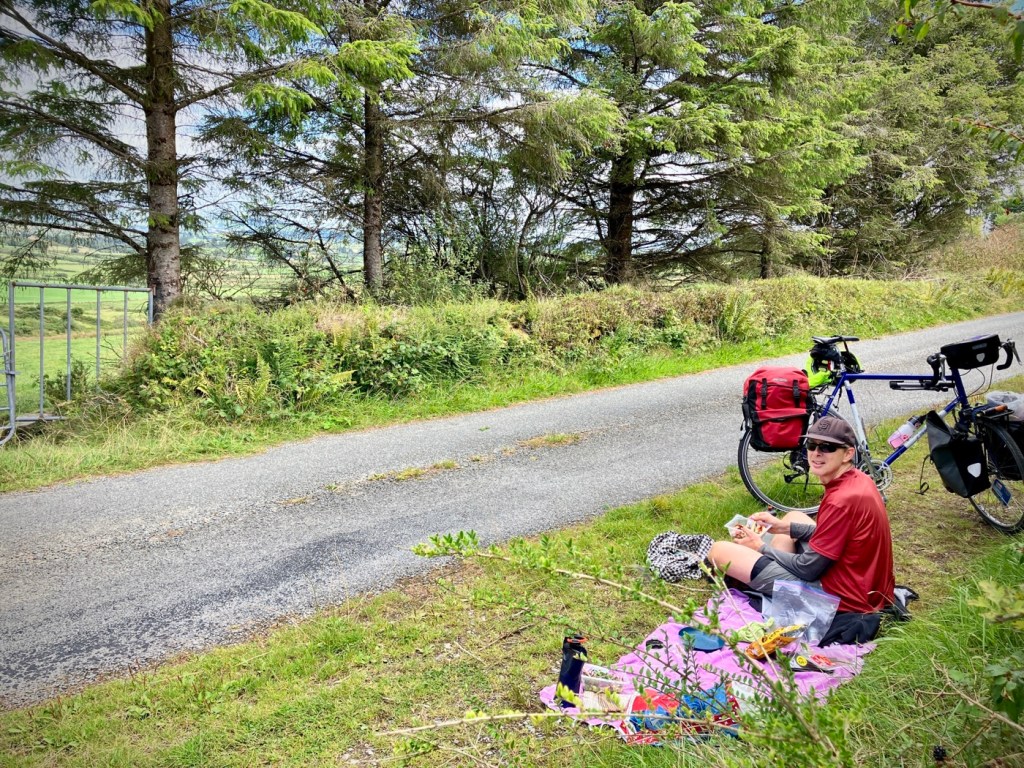
Enjoying some snacks on the far side of Healy Pass, and now looking toward County Kerry
Cheryl contemplating the descent. She cruised up the pass and I think may even now be enjoying the hills!

But like everything, cycle touring and Ireland has its ups, and downs. One of the downs for us has been cycling into a bit of car and truck mayhem in most Irish cities and villages, especially as traffic really peaks here in the mid afternoon.

Late summer carmageddon in Killarney…getting around towns by bike is not easy yet in most places…but they are working on it a bit, with some new bike lanes and paths.

Logically for original settlement needs, villages are almost always on a river or at the head of an inlet or protected harbor. Add hilly glacial geography to the mix, and you have every road generally meeting in one spot…across one bridge….just where the village and sights are as well. Kinsale especially suffers from this.

Cheryl in her Conqueror pose
Cheryl looking down toward Bantry and the Beara Peninsula after another climb from Kinsale.

It’s also true that 90% of the lodging is along main roads as this is where the commercial development has been, so a number of B&Bs and hotels we’ve stayed at have been impacted by traffic noise. A fact of life, but especially disappointing to deal with when you are traveling only by bike and train.

With views like this, the minor annoyances of Ireland are soon forgotten

We could opt for more country lodging, but then dinner is often an issue, since cycling miles into a town in the evening is not really fun (or safe feeling) after being out on the bikes all day. Not to mention we like to stroll about the towns and explore a bit each evening.

The local roads are quiet, but rarely flat!
Sometimes you have to improvise for a lunch spot…this was the edge of a farm road on a ridge, but with some views across the valley.

Of course, this phenomenon is not unique to Ireland, but it’s especially noticeable on bikes, and since there is generally not too much traffic elsewhere. But luckily, there just aren’t a lot of people in Ireland (6M), so the scale of the issues are small and manageable. This has been the biggest surprise in Ireland…despite a deep history, it’s modern, educated, and forward looking, and still living in a bit of a golden age of prosperity and development.

Pubs and Trad music sooth the soul at the end of a long day pedaling (or even a short day!)
The colors of Irish summer

So after a relaxing few days in Kinsale, we happily set out on our bikes and meandered north to Bantry, Glengariff, and finally over Healy pass to Killarney National Park. The weather was lovely and the views constantly stimulating, so the miles just click by, even when heading up the many long and steep hills.

The happy travelers enjoying a day off the bikes in Killarney National Park

Plus, we always looked forward to finding a new pub each night to enjoy a fresh pint in a friendly atmosphere. Ireland really is a nice place to tour, and we’re going to miss it when we get back on the ferry to the UK next week. Happy September and happy travels!