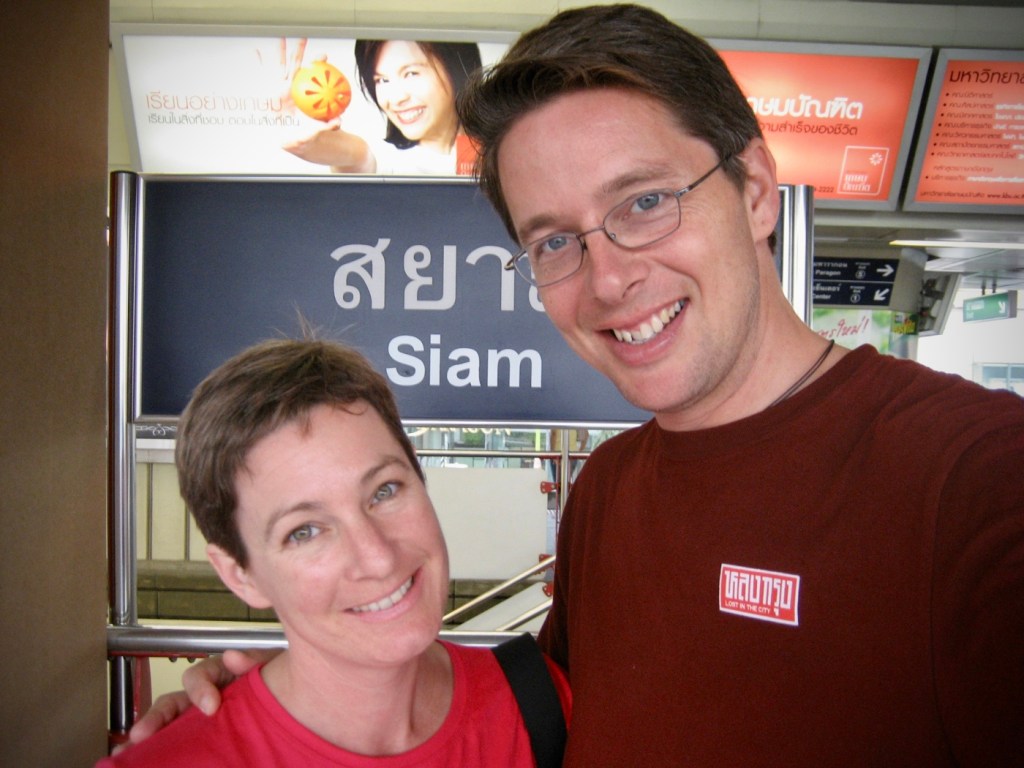
India again. After 16 years.

In Bengaluru. A good introduction to India landing city for this trip.

Rich and I last traveled in India over 16 years ago. He and my friends will attest that I did not have a great time that last trip. As interesting and unique as I found the country, there were things younger me couldn’t get past. The inequality, for women and for those less fortunate. The crowds. The traffic. Never being left alone to enjoy anything in peace. The poverty. It was a lot.

A street in the neighborhood of Indiranagar where our hotel was. I think the large trees are Rain Trees. The shade they cast makes for a lovely cozy feel to the area. That is the metro line overhead.

I think many travelers and tourists are overwhelmed on their first trip to India. Why, friends asked, are you going back? Well, I replied, we were only in the north in our last trip and people say that North and South in India are as different as in the US. Our first good chat with a local gentleman at our first dinner in Bengaluru confirmed that. He went to North India once, he said, from his native Bengaluru, and it was so different. Like a different country. And, I’m older now, more mature, lots of grey hair. Less likely to attract negative attention. Ok, so I did have my hair dyed purple before leaving Bangkok which means no grey is showing, and I have bright purple hair. Attention? Yes. But it’s my fault this time.

Seriously amazing trees in Cubben Park.
The sidewalks in Bengaluru were so welcome after Bangkok’s limited walking space. And all the trees provide lovely cool shade. Green bike lanes, though we saw very few bikes using them.

So, can my older wiser self settle in to enjoy India more than I did 16 years ago? I think so. It helps that Rich is an enthusiastic traveler in addition to being the best travel planner. We both love experiencing a place as independently as possible. Walking and taking transit as much as we can keeps us happy. Our only taxi in Bengaluru was from the airport to our hotel. All other trips were metro and walking.

The War Memorial garden, floral tributes near the obelisk.
Chai at The Srirangam Cafe.
More tree shaded streets in our neighborhood of Indiranagar.
Riding the metro towards downtown.

Our last four hotels have all been within a block of a metro or subway line. Taipei, Taiwan, two different hotels in Bangkok, one above the MRT and one by the SkyTrain, and now Bengaluru, a block from a purple line station of the Metro. Not an accident, just good planning from Rich. We share a pretty healthy dislike of having to rely on taxis. Every car trip added to a city is a bad thing. For the air, for people’s safety, and for noise pollution. In India the noise is mostly of beeping horns, the scooters are quieter here than the motor bikes in Bangkok – thankfully. But the beeping! Incessant.

At the train station, just a short walk from the metro station.

Since I’m still recovering from breast reduction surgery Rich is carrying both backpacks. Thankfully, the train station connects to a metro stop with a dedicated walkway so for our train ride to Mysore we again avoided a taxi trip. To enter the metro system you have to put your bags through a scanner, and then be wanded by a security guard, men to one side and ladies to the other in a small curtained booth. My first time I actually stopped for the wanding, but my second time I followed the lead of the local in front of me who didn’t even break stride as she passed through the curtains.

All smiles waiting to board our first train. The platforms are very long but the carriage letters were showing on electronic signs so we knew where to wait.
Masked up. Our carriage was less than half full so we did unmask.

Our destination, Mysore, is less friendly to walking trips. For starters it’s hotter here, up to 90f/32c in the afternoon, and sidewalks are not standard. We feel a bit like square pegs in round holes, but we persevere, heading out in the morning to walk to what we can, and taking auto rickshaws back in the heat of the day.

Our first stepwell.

A friend in SF sent us a link to a map of step wells in India (thank you Gisela!), and we took a taxi to this one a bit outside of town. This is a fairly simple stepwell, many are much more ornate. Built to capture water and as temples, construction of these stepwells hit its peak during Muslim rule from the 11th to 16th century – per Wikipedia.

Nanneshwar Devasthana Kalyani
ನನ್ನೇಶ್ವರ ದೇವಸ್ಥಾನ ಕಲ್ಯಾಣಿ

Built in the 8th century this Kalyani, or stepwell, was cleared of garbage and restored in the past few years.

Rich added for scale.

Stepwell visit complete, we had our taxi driver head back towards town and drop us off to wait for the train museum to open. Sitting on a wall in the shade and watching Sunday morning activities was actually quite nice. On our last trip to India I don’t remember being able to sit unmolested by curious or begging locals. Here in Mysore, although there aren’t many tourists back yet, most folks walk by us with only a curious look (Rich is quite tall and I have purple hair, so not unexpected.), a smile, or an offer of an auto rickshaw.

One of favorite things, a small, quirky, somewhat overlooked museum.
An Indian built carriage.
A British built locomotive.

It pains me to be reminded that so much of the history tourists are encouraged to see and celebrate in India is colonial history. The railway has its roots in British rule. From an article by The Wire.IN “Between 1850 and 1910, 94% of Indian broad gauge locomotives were built in Britain and only 2.5 in India. During the Second World War, preconditions for purchases from outside of Britain were relaxed but still the overall balance remained disproportionately tilted in favour of Britain. Thus, prior to independence in 1947, India imported 14,420 locomotives from Britain, built 707 itself and purchased 3,000 from other countries.” However, we were pleased to see what to us are very familiar planning presentations for the ongoing improvements and upgrades to Indian Rail.

Planning deck, anyone? As we well know with both our backgrounds in transportation- nothing happens without plans like these. We could both easily imagine the work that went into this, I’m showing you only 2 of probably 15 pages. Fellow bureaucrats unite. Let’s get it done.

Although Mysore requires more auto rickshaw trips we are managing to walk to some destinations in the morning. The zoo. The Mysore Palace – which is the second most visited attraction in India after the Taj Mahal, apparently.

The palace is lit up on Sunday evening, and it’s free to enter the grounds which means it’s a popular family attraction.
The moon was close to full, and I managed to add even more purple to myself with a new Kurta. Guess my current favorite color.

We went back to the palace on foot one morning. The neighborhood across the street from our hotel fascinates us. One thing I have found that I really enjoy when traveling is making eye contact with women, particularly women my age, and exchanging smiles. Sometimes the smile only come from me. Americans smile a lot, and if you ask other cultures we smile for no reason and it’s weird! I always make a special effort when I see women in a Niqab, the veil and face covering which leaves the eyes clear. Five years ago Rich and I were in Indonesia and both struck up independent conversations with a couple (bathroom at a train station), and she was wearing a Niqab. It made me wonder how often women in Niqab are overlooked, or even ignored, by folks who don’t feel comfortable with the idea of a women who veils or covers. In Indonesia we all laughed to see our partner walk out of the restroom chatting with their partner. When I make eye contact with a woman, of any age, and nod, and she nods and smiles back, I feel like I’ve made a connection, however small.

Navigating the cows in the neighborhood across the street from our hotel.
Don’t let the dirt streets make you think this is a poorer neighborhood. The houses were quite nice.
The pongol, harvest festival, occurs in mid January and many cows were still sporting their turmeric water paint jobs.

Our walk to the zoo took us through this neighborhood, and our walk to the palace. It was fun to see the children being packed into auto rickshaws for the trip to school. I counted nine children in one rickshaw. Ladies, I assume maids for the houses, were sweeping and watering down front stoops and steps, and drawing elaborate rangoli or korams in rice flour.

Rangoli with color.
Spotting the rangoli was like a treasure hunt.
Not every house had one, which made them even more special. Apparently the devotion to this mostly women’s art comes and goes as generations give it up or take it up.

You can understand how a simple 15 minute walk to the zoo turned into a tour of its own.

These rhesus macaque monkeys at the zoo, not in an exhibit, were the only ones we saw in Mysore. Escapees from the actual macaque exhibit we assume. This little guy was thrilled with the plastic bottle he got from a trash can.
We’ve seen zoo workers in with elephants in Indonesia as well. In the US most if not all zoos keep humans and elephants quite separate. At one point elephant keeper was the most dangerous job in the US.
Many Dosa were eaten.
The purple lady waiting to dig in to a Dosa.
In the Mysore Palace. Once we realized we were the only ones obeying a few old no photos signs, we started taking photos too.
The colors. Amazing.
Columns, chandeliers, stained glass skylight.

So am I better at travel in India this time? Yes and no. We are more experienced travelers, but India doesn’t really suit our travel style. It’s challenging to be independent travelers here, which is why we see so many tour groups at our hotel being loaded into an AC bus after breakfast. It’s hard to book trains, or figure out local buses, and it’s challenging to walk many places. Rich has been working out in the hotel gym, but since I’m still recovering I can only walk. No yoga or arm workouts yet, so I’m feeling antsy. But the highs of India are indeed high and I’m glad we’re here. I love seeing and learning about new things. Tomorrow we leave Mysore and head to a lodge stay near a nature reserve. It’s not great tiger viewing season, but we can always hope, and the bird watching is supposed to be amazing.

The happy travelers in an auto rickshaw that matched my color scheme.

Chaos and Calm in Bangkok

This is our fourth visit to Bangkok. Bangkok is unique, fluid, and always changing. And we always look forward to further exploration of this vast and fascinating city, built over the swamp and floodplains of the Chao Phrayo River.

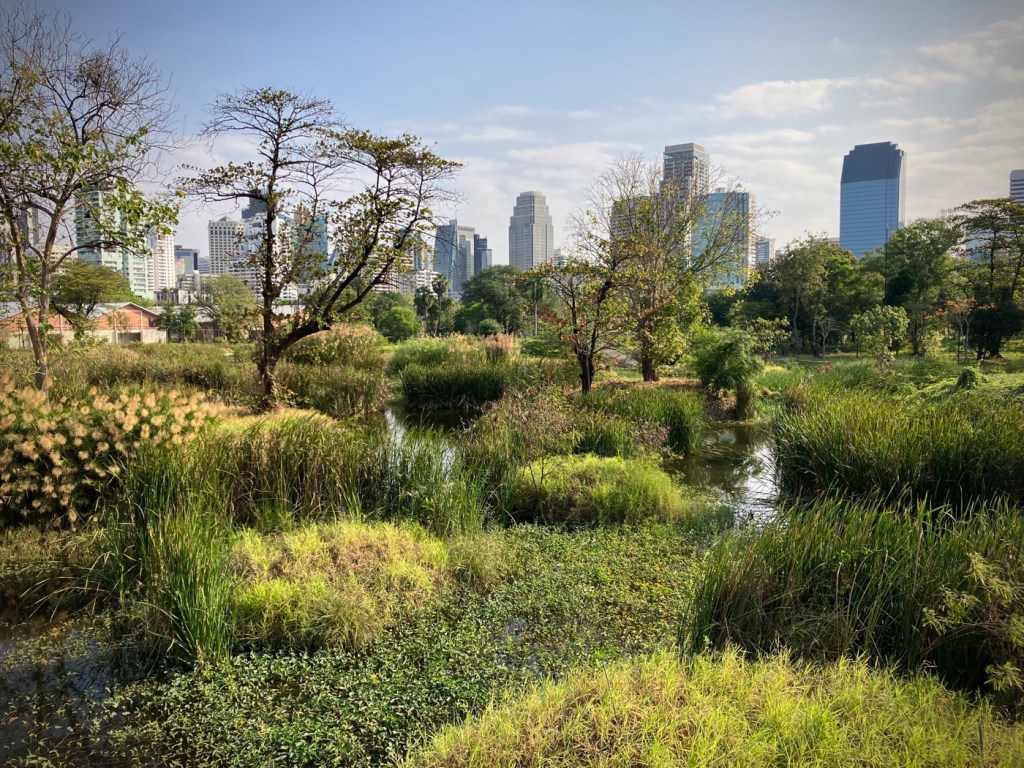
The Bangkok vision of a green city…from Benchakitti Forest Park

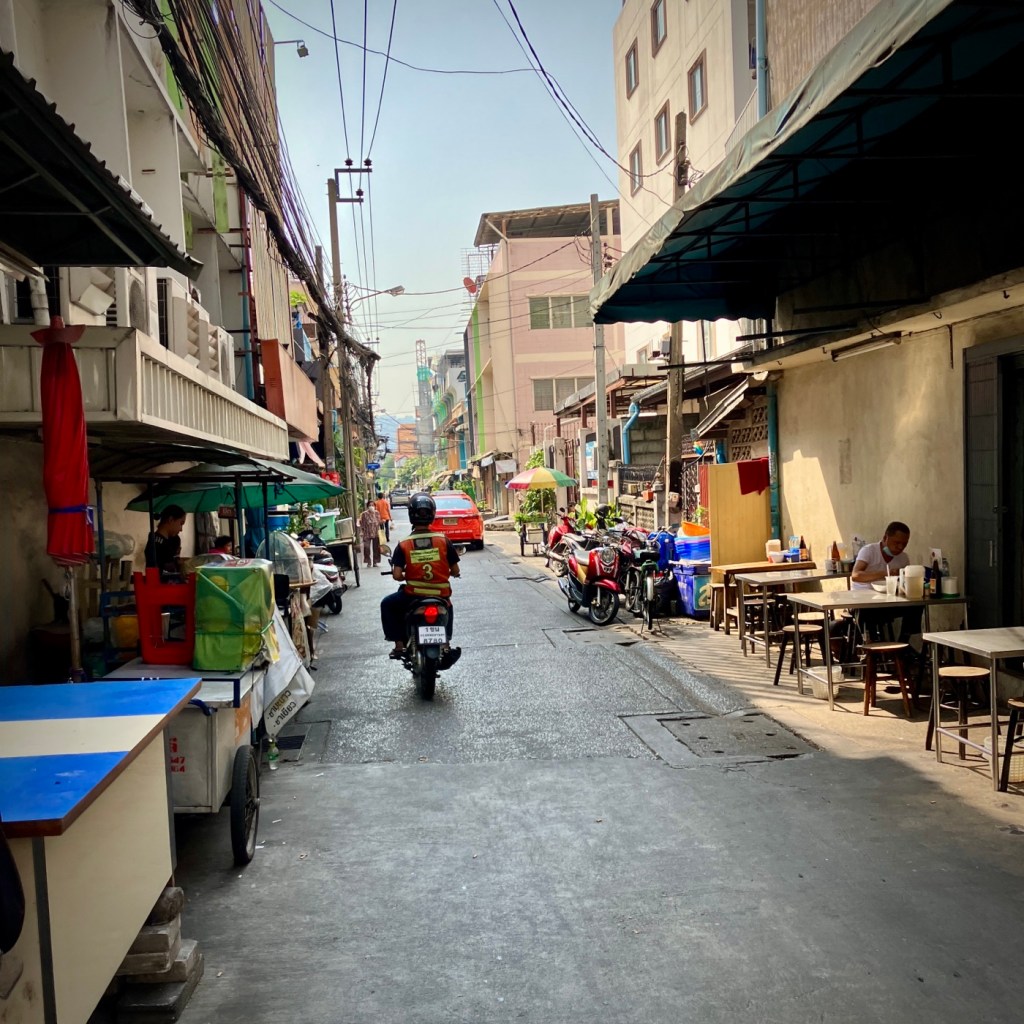
A lot has changed over 17 years since our first visit. There are new green spaces, MRT and SkyTrain extensions, and dozens (hundreds?!) of new malls and high rise buildings. But in many ways it hasn’t changed, including frenetic streetlife, food, and more traditional low rise and open living in most neighborhoods.

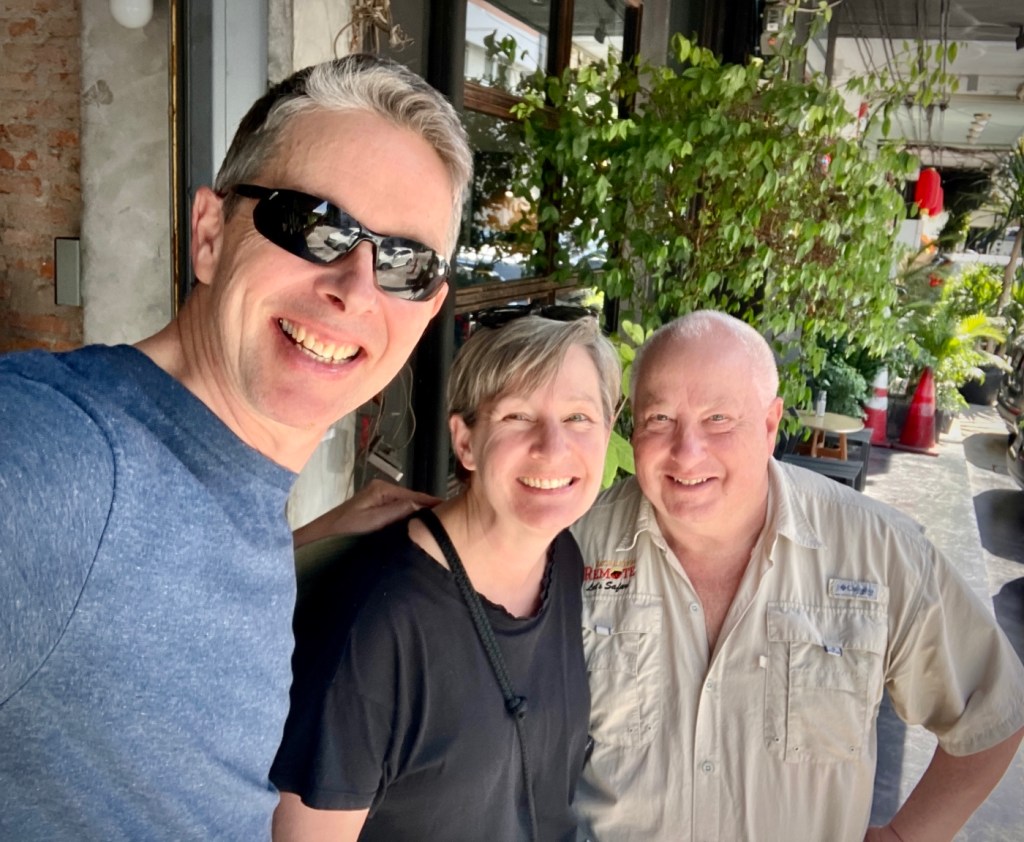
Bonus meet up with our friend Charlie, who used to live in Bangkok, and now leads and organizes amazing safaris in Africa and Asia with Remote Recreation

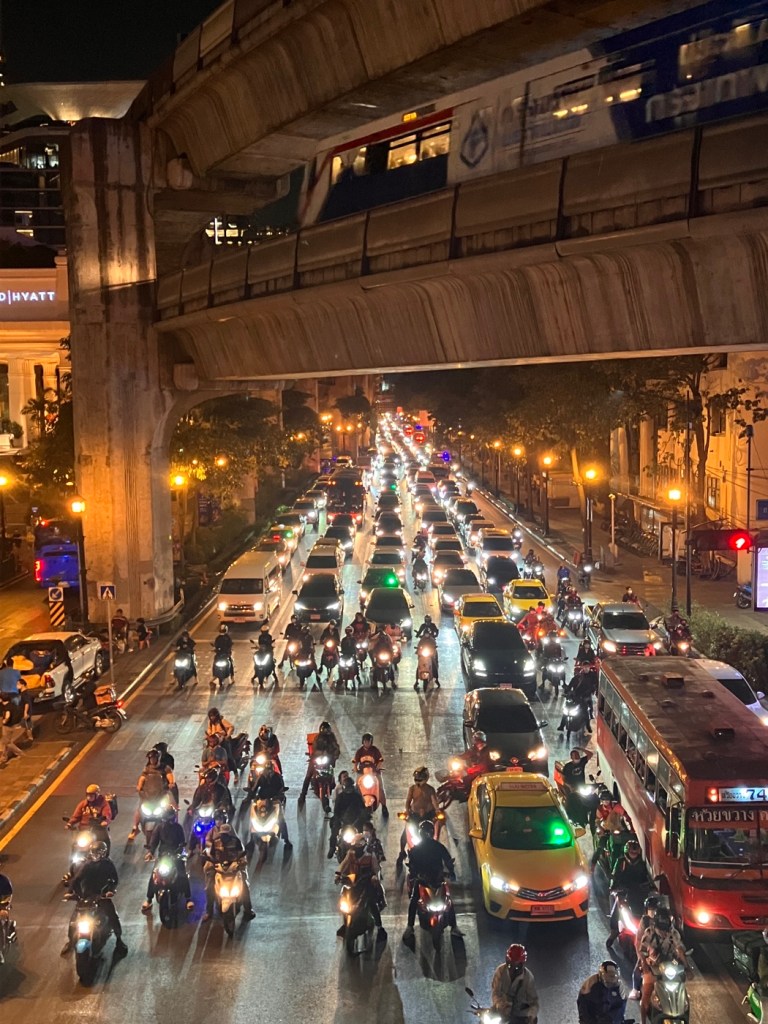
But the pace of change in urban mobility hasn’t happened as fast as you would expect, or in pace with other big Asian and global cities. And unhealthy air, noise, and traffic are still major drawbacks to daily life. Some of this is due to challenging and unstable governance, some due to a slowing of the economy and the pandemic, but at its core, Bangkok is fighting a legacy of car and scooter dependence that has been coddled, accommodated, and supported by street expansion and lots of (mostly free) parking at every destination.

A slightly more orderly but still congested Bangkok in 2023

Of course, the addition of more highways and toll roads has helped overall capacity, and apparently even the continuous congestion and traffic jams of 2023 pale in comparison to the true chaos of the 1980s and 90s before road expansion and rail transit began.

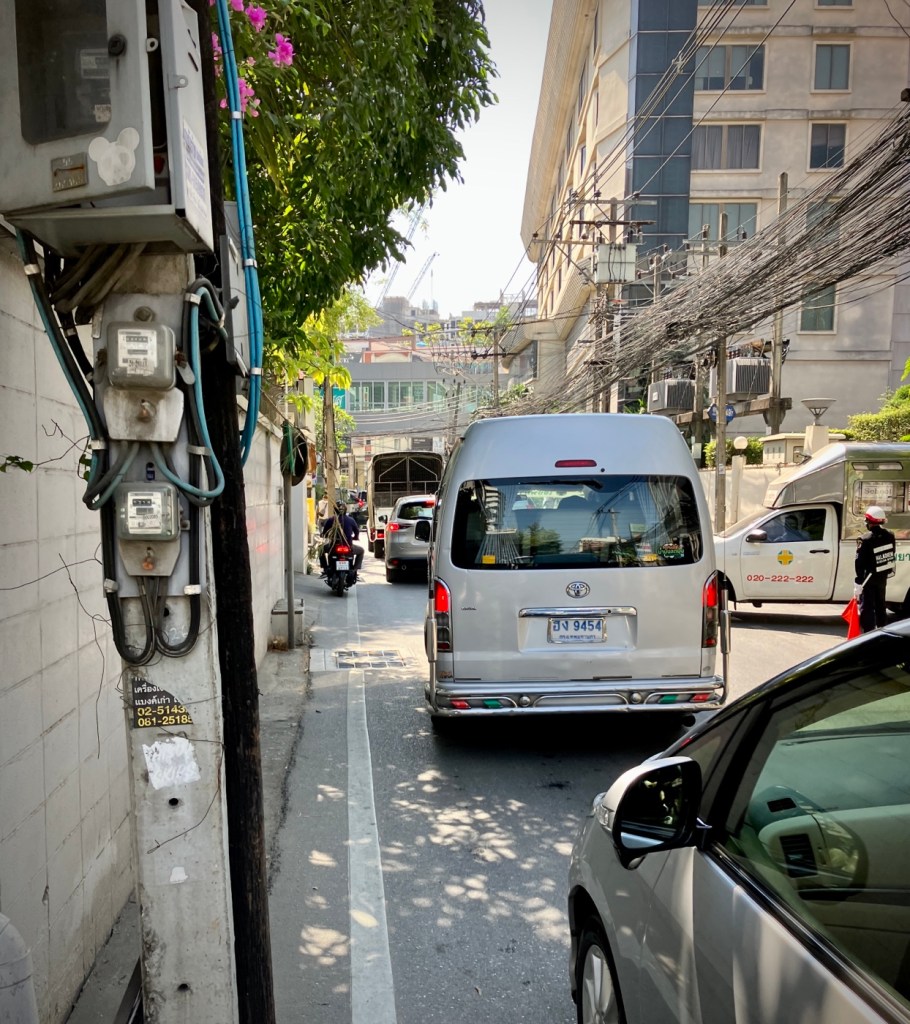
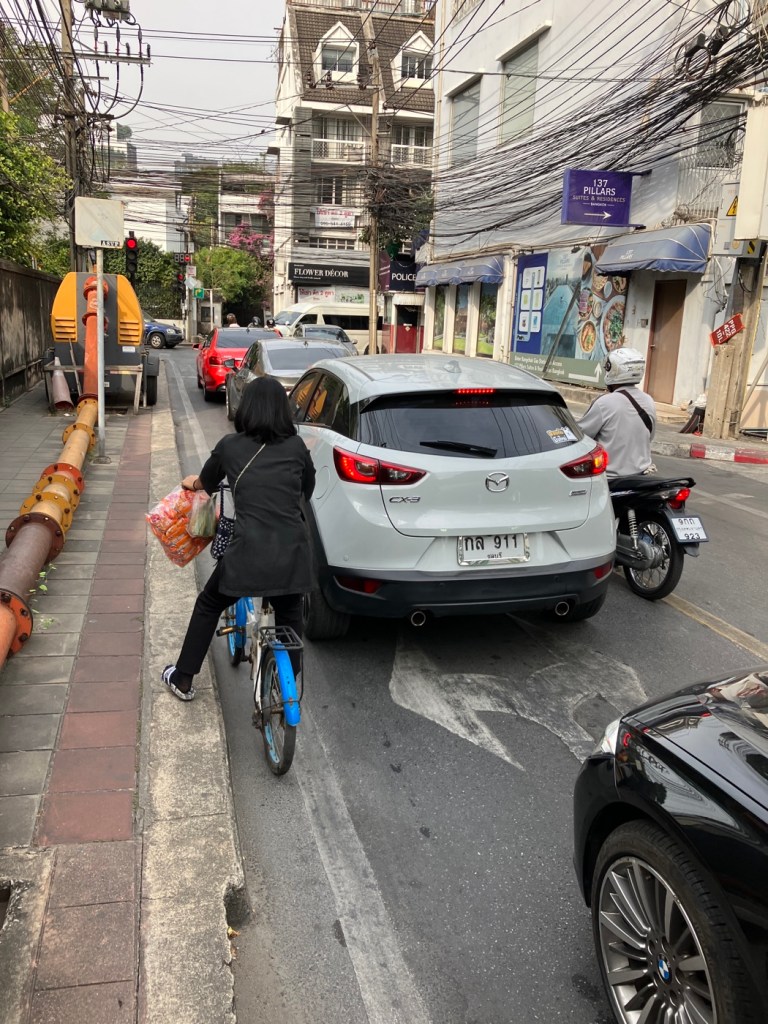
Yup, this is where you walk…also the scooter lane, and unlike the narrow lanes of Europe, cars, vans, and SUVs are big here.

But it’s a catch up game, as the first SkyTrain (metro) didn’t open until 1999. Luckily, major development has been concentrated along transit corridors. And there are now 3 BTS SkyTrain lines with 62 stations and 2 MRT lines with 46 Stations. The buses seem to be a missed opportunity as they have little or no dedicated space and suffer in the congestion. These old buses belch a scary amount of diesel along the roadways into air often in the 150-200 (very unhealthy) AQI levels.

Up on the skyway…choosing the right station exit can save you time and the stress of crossing mega intersections

There is also an elevated driverless train line to the somewhat distant Suvarnabhumi (BKK) Airport that opened in 2010. These have all helped to reduce car dependence and expanded the reach of transit. But overall, the system is not extremely user friendly as the BTS, MRT, and Airport Trains are operated by separate companies, so ticketing is still separate and connections a bit clunky and congested. But it all works and much of the service is good. We just carried two fare cards and swapped out for SkyTrain to MRT trips, and bought an electronic single-fare token for our trip from the Airport.

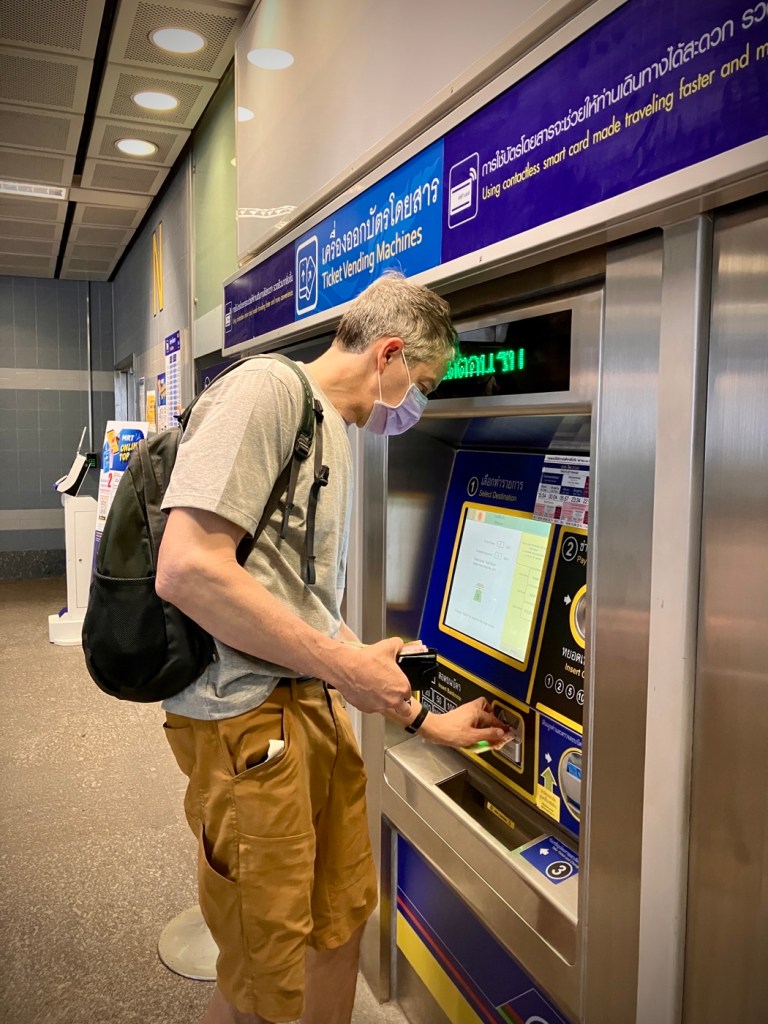
Adding fare to our MRT tap cards…once you get the hang of it, it sort of makes sense. Minimum add is 100baht, but machines only take one bill per top up transaction. Quirky.

We spent a week here in 2007 staying with two different expat friends. Outside of India, Bangkok was our first big Asian city experience. It was a globalization boom time. (And possibly peak?) We were mesmerized by the chaos and modernity of the city, then one of the fastest developing in the world outside of China.

The travelers loved the new SkyTrain in 2007…so young!
Varied street life on the side streets…explore and you never know what you will find

At that time, we explored the country for 6 weeks, so saw the northern mountain regions, northeast rural and Mekong, and the southern peninsulas and fabulous islands. Like most western travelers to Thailand, we loved it. We stopped over here for 3 days in 2014 and 2017 as part of travels onward in Asia. Both follow up visits were enjoyable as we stayed in two different neighborhoods, but always close to a MRT or Skytrain station.

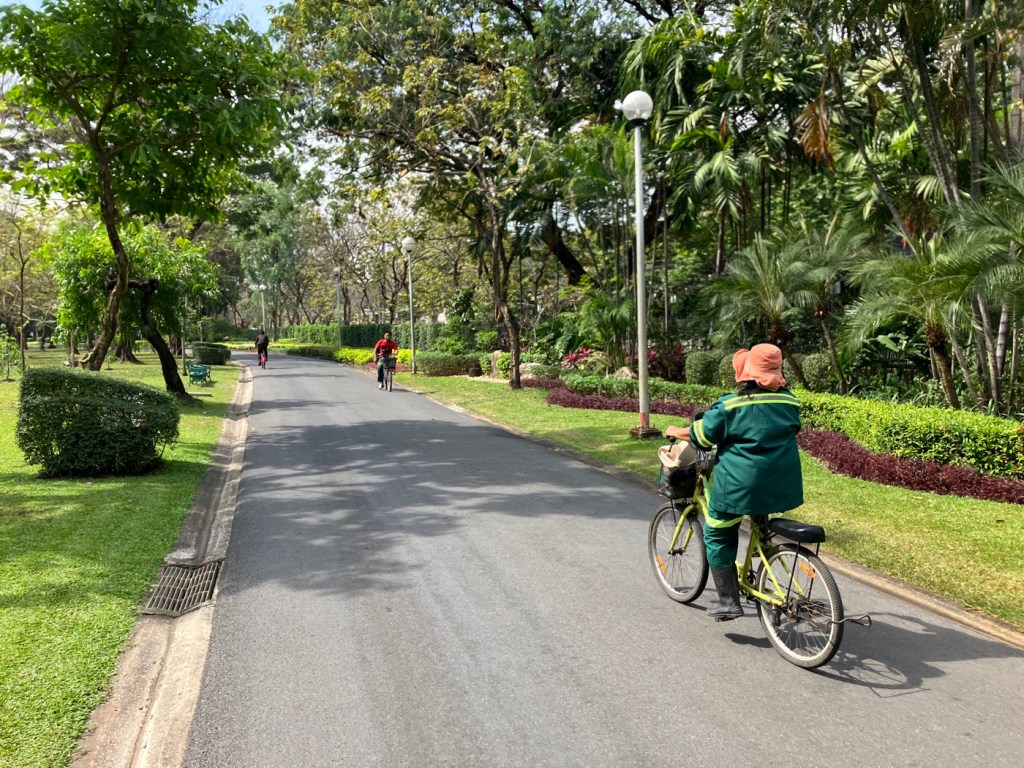
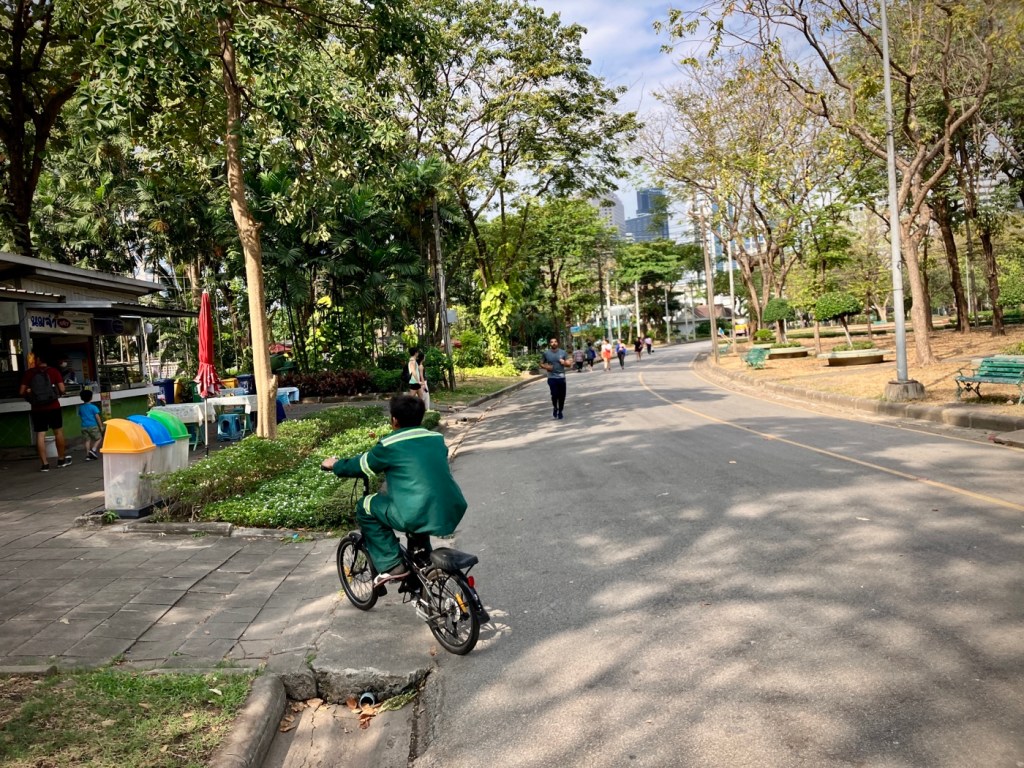
Chatuchak Park next to the mega weekend market of the same name has a great 3 km loop to walk and is very well kept with park staff on bikes. Yeah Bangkok!
Lumphini Park is the old main park of Bangkok…still a nice respite with trees, but nearby mega construction and a bit too much “stuff” in the park reduces its luster somewhat
Asian Water Lizards are all over the parks and canals of Bangkok, they can grow up to 10 feet!

So fast forward to January 2023….two coups, military leadership, a new King, global slowdown, and three years of a pandemic devastating the tourist economy which accounted for over 20% of the GDP in 2019. It’s still the second largest economy in Southeast Asia, but the stagnation is obvious and frustrating for the hard working and constantly striving lower and middle classes.

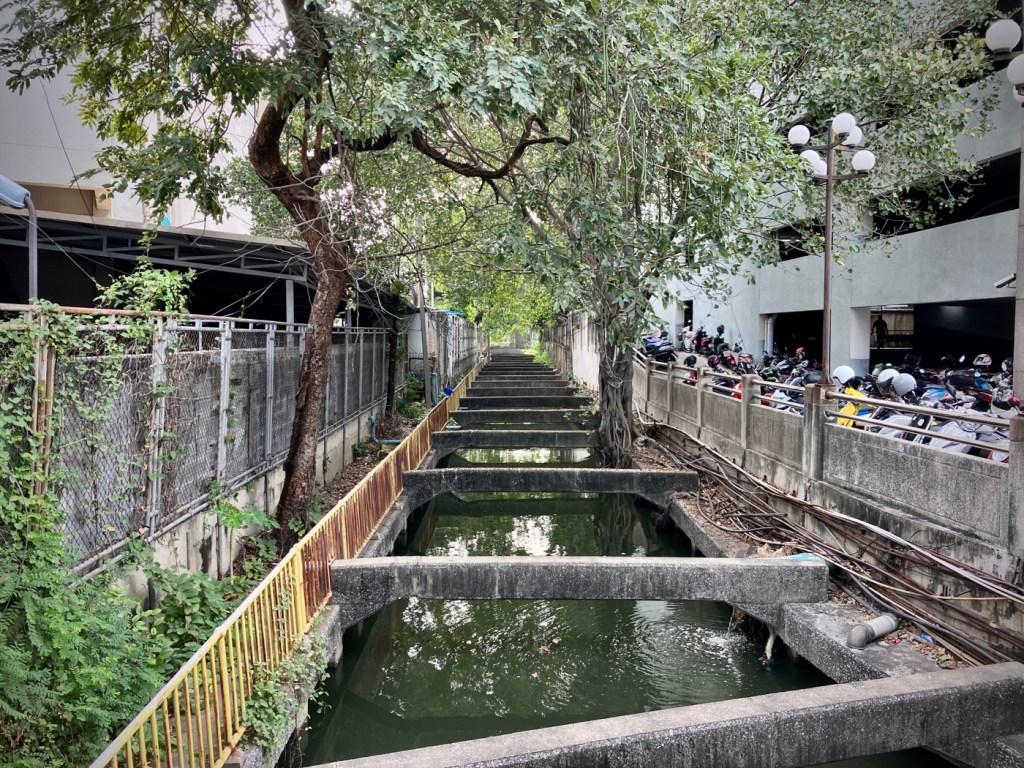
Canal paths are arteries of a calm and old style life in many neighborhoods
Some canals could link up neighborhoods, but most are neglected or cut off…definitely a future walking network opportunity

Its growth and development is still chugging along, but it does feel like it the benefits of mega projects, skyscrapers, and industry are not reaching the masses. The unfortunate decision in the late 80s to embark on a massive roadway expansion in the city instead of transit set the patterns that feel intractable in today’s Bangkok.

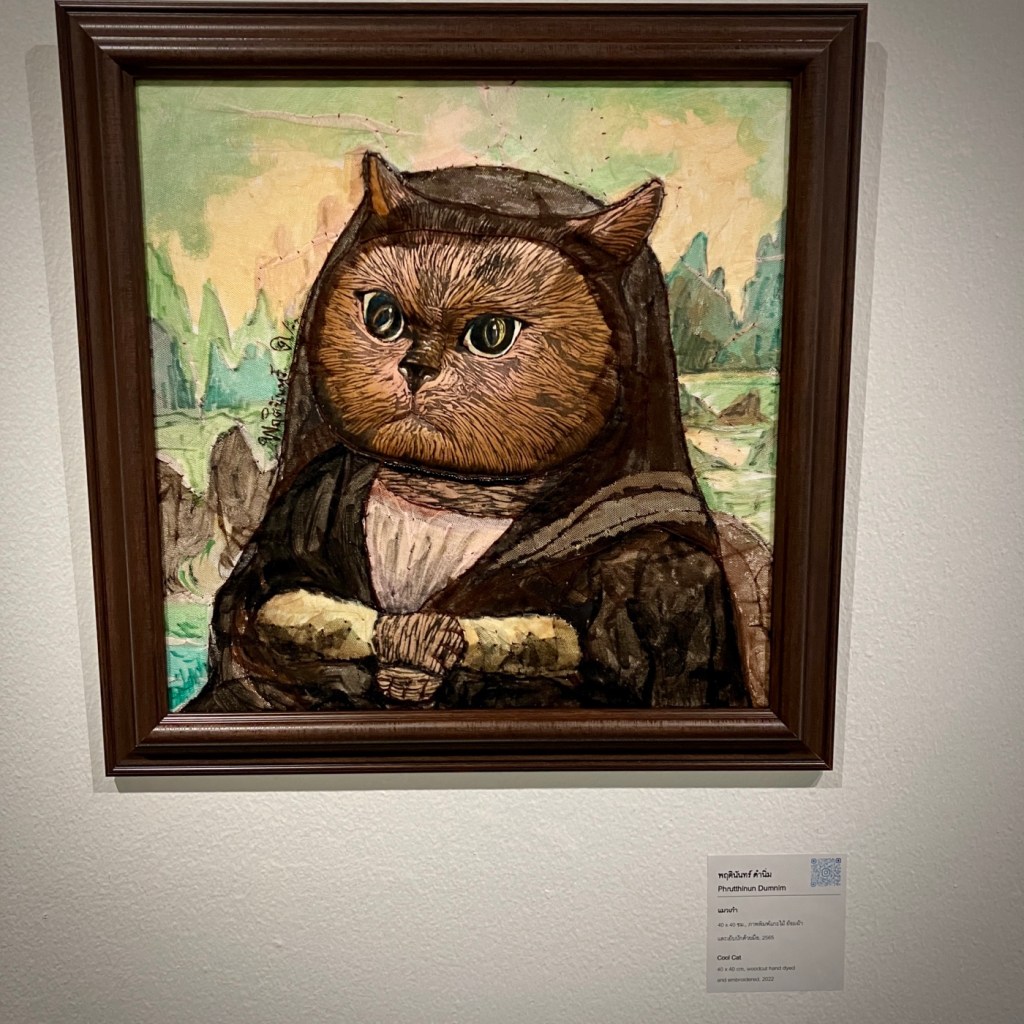
The Bangkok Art and Cultural Center is a fun and free space to explore in central Bangkok

On the bright side, a new central train station has been opened in northern Bangkok, that the government hopes to use as a hub of a vastly expanded rail network, with a specific goal for tourist service. Good plans if they can find the will and money to execute the plan.

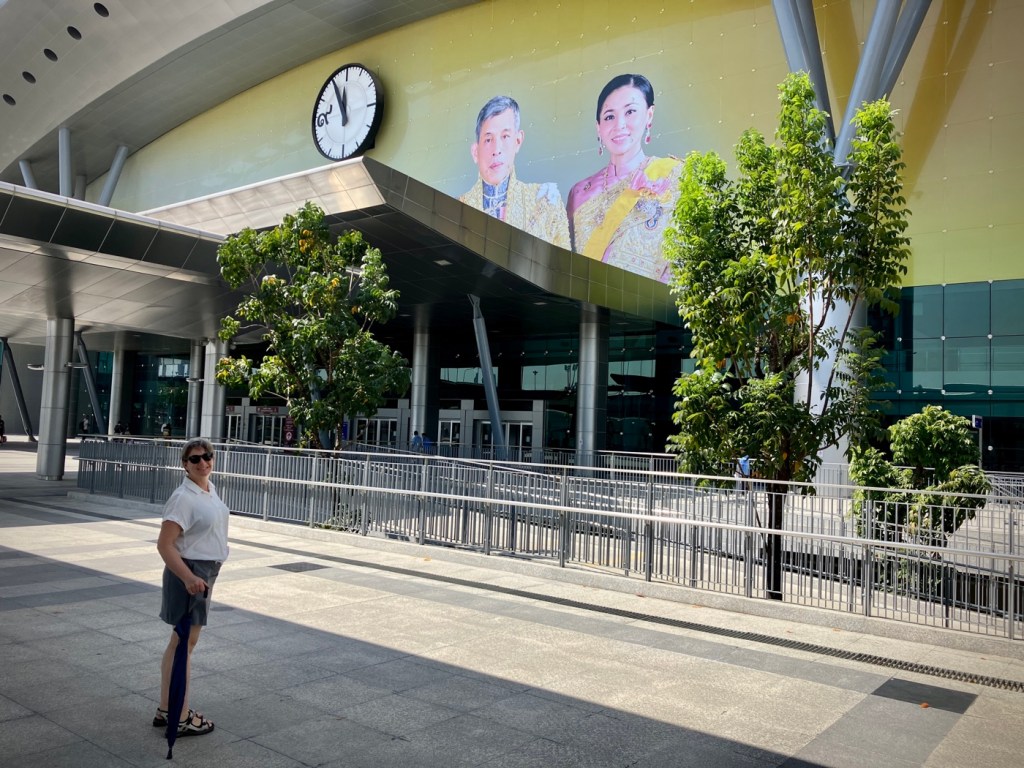
The massive new Krung Thep Aphiwat Central Terminal opened January 19th
Me and the Royal Family approving of the fantastic new station

Thailand still seems to need more tourist (and other?) taxes to pay for infrastructure. One of the highly touristed (and beautiful) islands Koh Tao has instituted an arrival tax for each tourist to help pay for much needed sanitation and environmental improvements, but it’s a modest fee (<$1), so progress will be slow. Thailand itself is also proposing an international arrivals tax of 300 Baht (about $10) starting in June, and monies are designated for accident services and development assistance. It still seems light based on the impact tourists have on the infrastructure. We all love Thailand, so we should help pay to make it more sustainable.

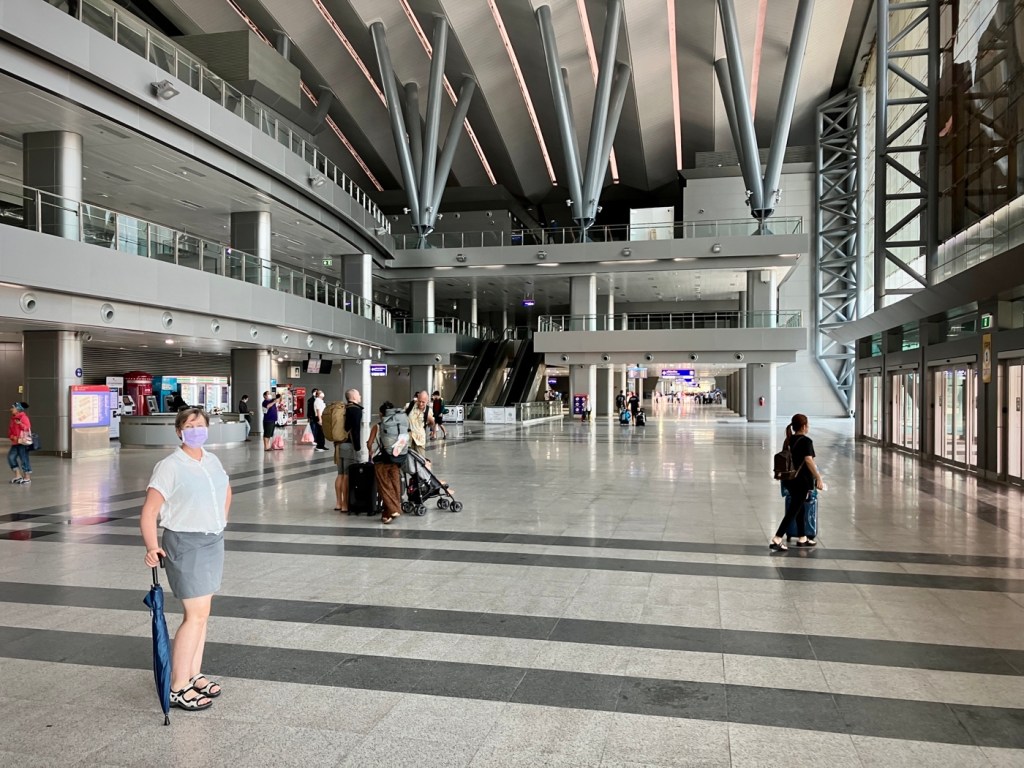
Platforms and multi level concourse are inside the grand hall, but no photos allowed…
Striking architecture
Recruitment for new taxi drivers….but the station is also connected to two metro lines
Beautiful, but a little vacant on opening as this was built for the future; including HSR

But the most obvious deficiency in Bangkok’s transport network is walking and cycling. It’s shockingly disconnected. The artery and capillary (Soi) network is disconnected by design and development legacy, as well as many routes being cut off by the remaining canals. But dead end streets are the nicest to live on and bring quiet from the chaos, so the challenge is to expand walking and cycling networks without inducing car and scooter traffic. It can work with some clever bollards, gates, or chicanes…and maybe some scooter traffic is acceptable as this would shorten trips for many from the arteries, as a grid is established.

This is the way!
Yup, Soi 14 does go through …just barely, but a fantastic calm link south of Sukamvit
There is literally no space for bikes on most roads in Bangkok…only for the brave and determined
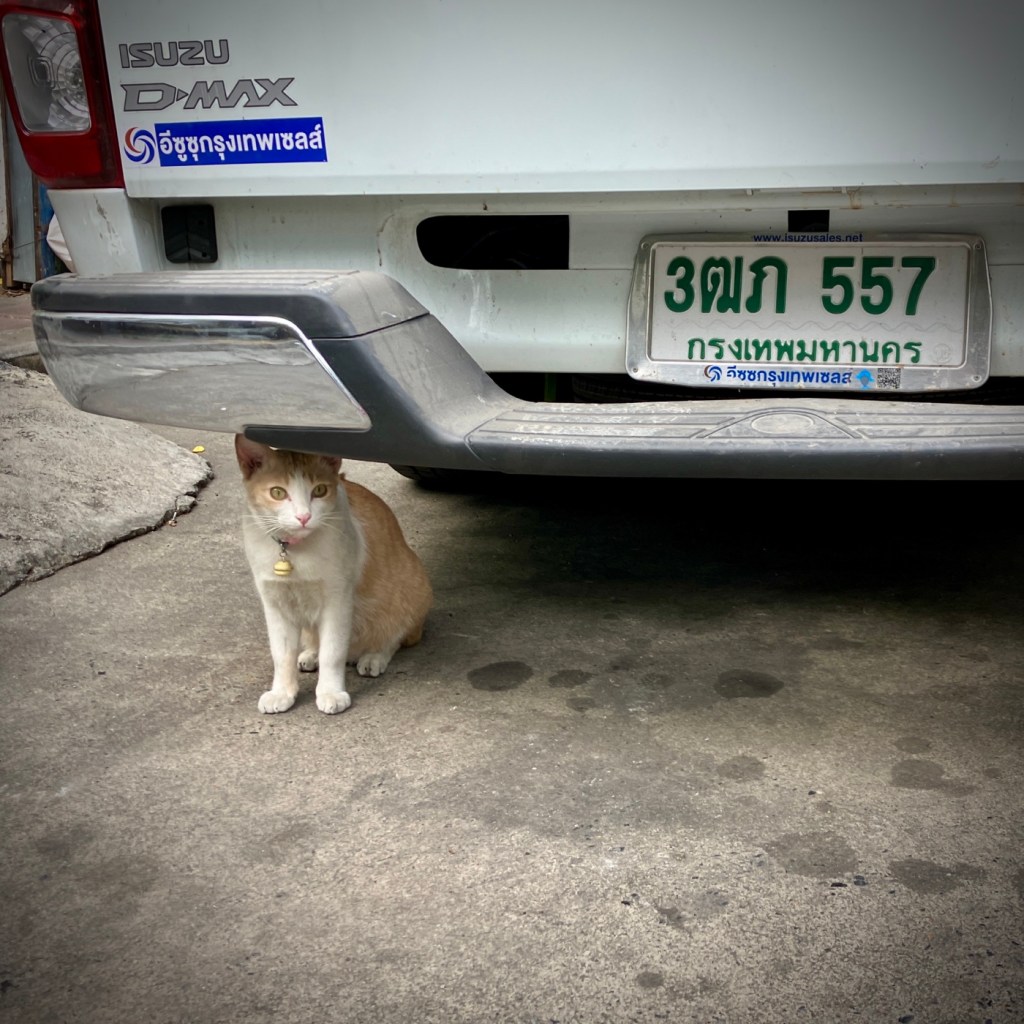
Kitty finds some calm under a pick up truck

So for us, this is a livability failure. The lack of connectivity has been recognized by some studies (See UDDC Goodwalk pilot plan) and a few small steps have been taken recently to improve pedestrian mobility, such as new ladder crosswalks and a corresponding law increasing fine for motorists violating ped ROW in them.

The calm of some of the alleys and sub alleys is a delight and an opportunity for connectivity at a human scale

It is a bit encouraging, but pedestrians are still mostly a sub-species clinging to gutters, dodging scooters, and navigating a pretty hostile, polluted, and unpleasant streetscape on the main arteries. On hot and polluted days, which are many, it makes even the most ardent walker retreat to an alternate means. Tree planting and protection does seem to be coming with new development, which helps everything, heat, air, and sun protection for walkers.

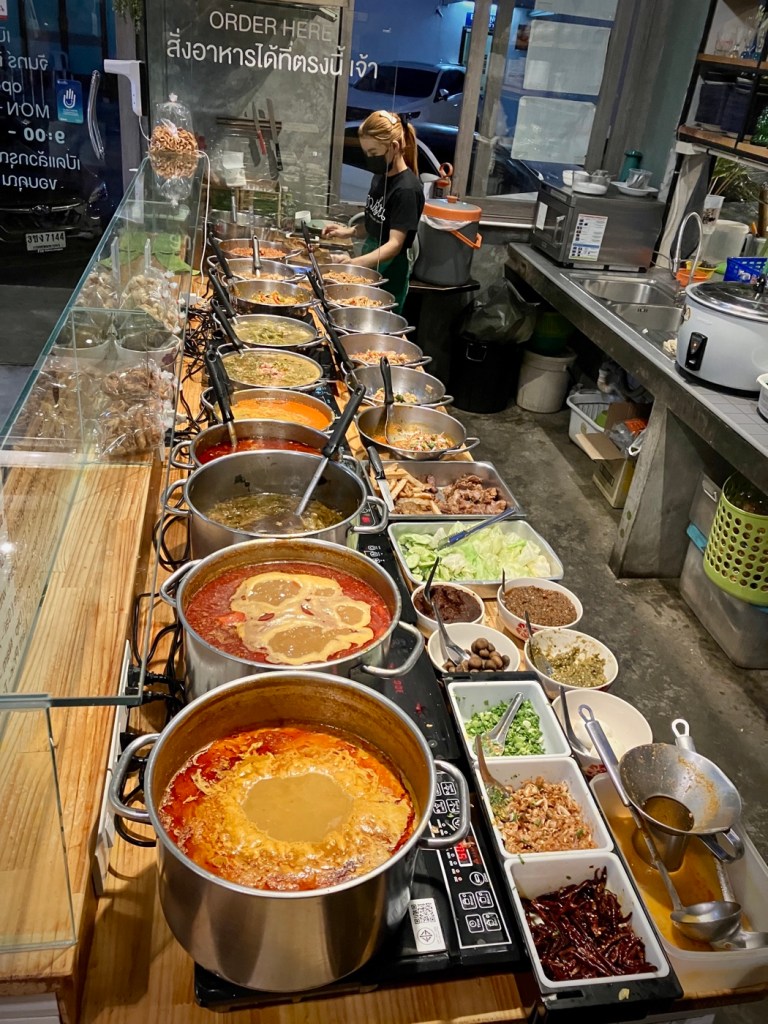
Oh, but the food is amazing and tasty and still and integral part of daily life in Bangkok. The Northern Thai casual restaurant Hom Doam.
Cheryl enjoying Khao Soi at the amazing Hom Doam in Thonglor
A Northern Thai food sampler at Hom Doam
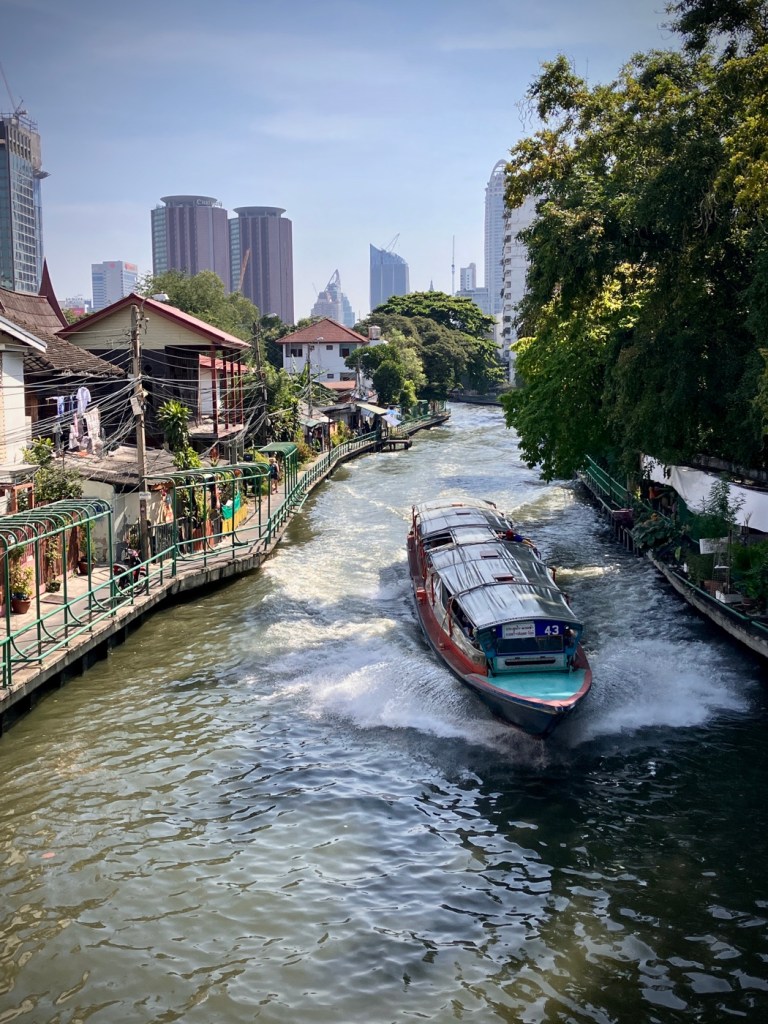
A main canal, just west of the Jim Thompson museum house, has fast ferry service and connects to the river.

But indeed this a just a drop of perspective from a non-resident Farang, and I don’t begin to pretend to understand the complexities of life and culture here. But the local officials and planners do. And many are working hard to make the long vision changes to lifestyle and infrastructure that will lead to a healthier environment and people.

Great meeting fellow travelers Heather and Volkan for a long chat at Chamlong’s vegetarian restaurant near Chatuchak
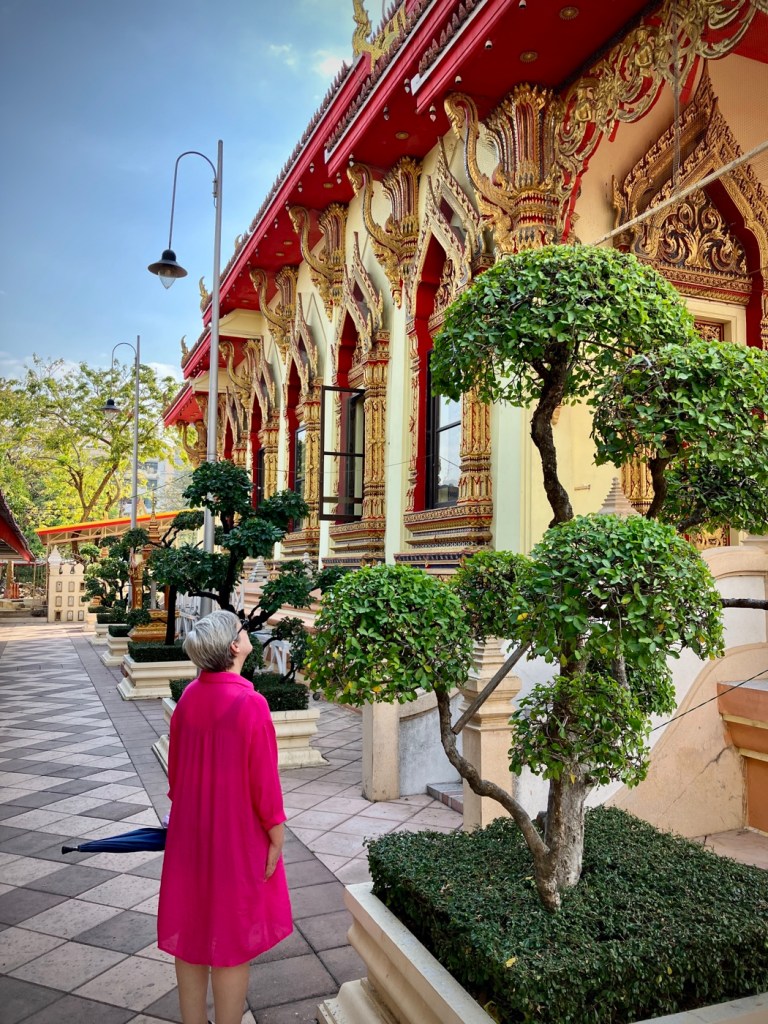
Buddhist Temples can be prominent or tucked away in hidden spots throughout Bangkok
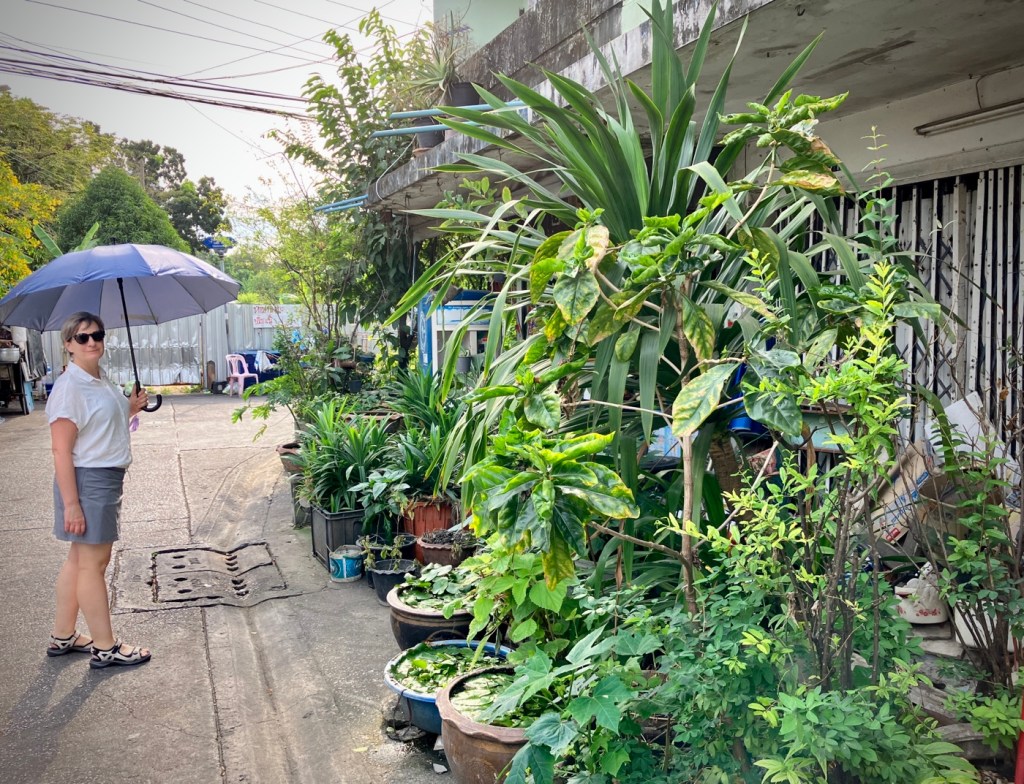
Green alleys to quiet living oases…if you could only keep walking

Bangkok is a complex ecosystem of 11 million people, and finding the balance of economic growth and opportunity versus health, pollution, and mental health is tough. But as Asia often looks forward, I’m hopeful that next time we visit bangkok we’ll see more positive changes. Already they are considering a congestion charge, expanding the MRT, and modifying laws to improve pedestrian life. Just don’t move too many of the food carts out of the way….we can walk around!

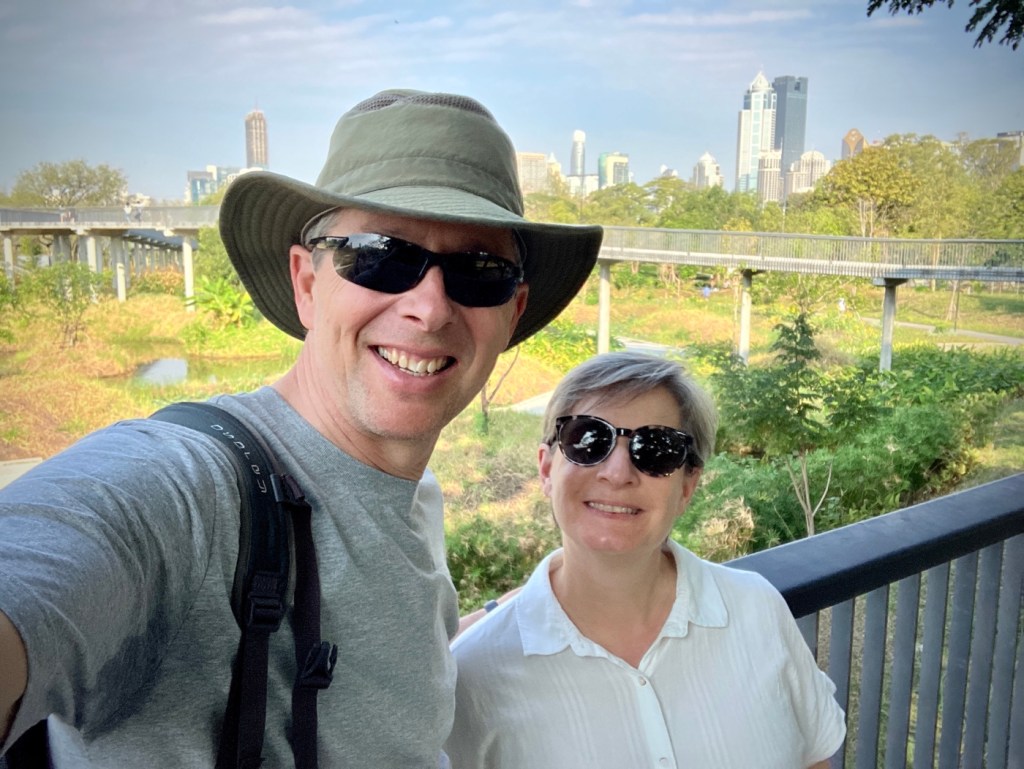
The happy travelers in Benchakitti Forest Park

Happy travels and on to Southern India!

Car Free in the Lake District in Winter?…Why Yes!

We moved on from lovely Liverpool late last week and arrived Keswick by train and bus (locally pronounced Kehz-ick) on a spectacularly snowy day in the Lake District.

Dramatic winter skies ascending near Grasmere

We were very glad that our professional bus driver was plying the slushy mountain roads, especially on the sheer edges of deep lakes; nevertheless, we did take note of the emergency window systems on the bus! (avoiding what I called a double decker bus watery grave…-;)

Can we do this without a car?

Our decision to base in Keswick was based on a number of factors, but primarily that we could get there by public transit, and numerous lines route from there to other parts of the National Park. It also has a few museums, nice shops, and many services in town, including a great regional supermarket, Booth’s.

Our row cottage in Keswick came with a friendly outdoor kitty neighbor no charge and a 5-10 minute walk to town or the bus
Cheryl trying to cajole an adorable Lake District sheep to follow her home

Oh, it also happens to be very quaint, with a lovely pedestrianized core and footpaths heading in every direction, including along the large Derwant Waters, what we in America might call a lake!

Morning light on Derwentwater in the Lake District NP

We actually wavered a bit about whether we “needed” to rent a car, but then read about many others visiting car-free and thriving with the great regional transit system. After 6 days here, we know it was 100% the right decision for us.

The 78 bus to the end of the line at Seatoller…schedules, a shelter, and multiple trailheads
Cheryl ready to hike…the other friendly passengers were day tripping photography buffs from Manchester

Our decision also considered the fact that this area is heavily impacted by car traffic, much like the National Parks in the US. Nevertheless, the car parks and road are still surprisingly busy here mid week in January, as driving is still seen as the easiest and best way for most to experience the park. Despite some pay parking in many of the towns and villages, the roads are still free and there is an abundance of free parking available.

Hey, there goes our bus!

But it’s not just about the carbon footprint of driving for us. We’ve seen the impacts automobile congestion, noise, and pollution have on communities. When practical, we don’t want to contribute unnecessarily to the problem. Although traffic is fairly light in the middle of winter now, it apparently is extremely congested most of the year, and a nightmare in holiday periods.

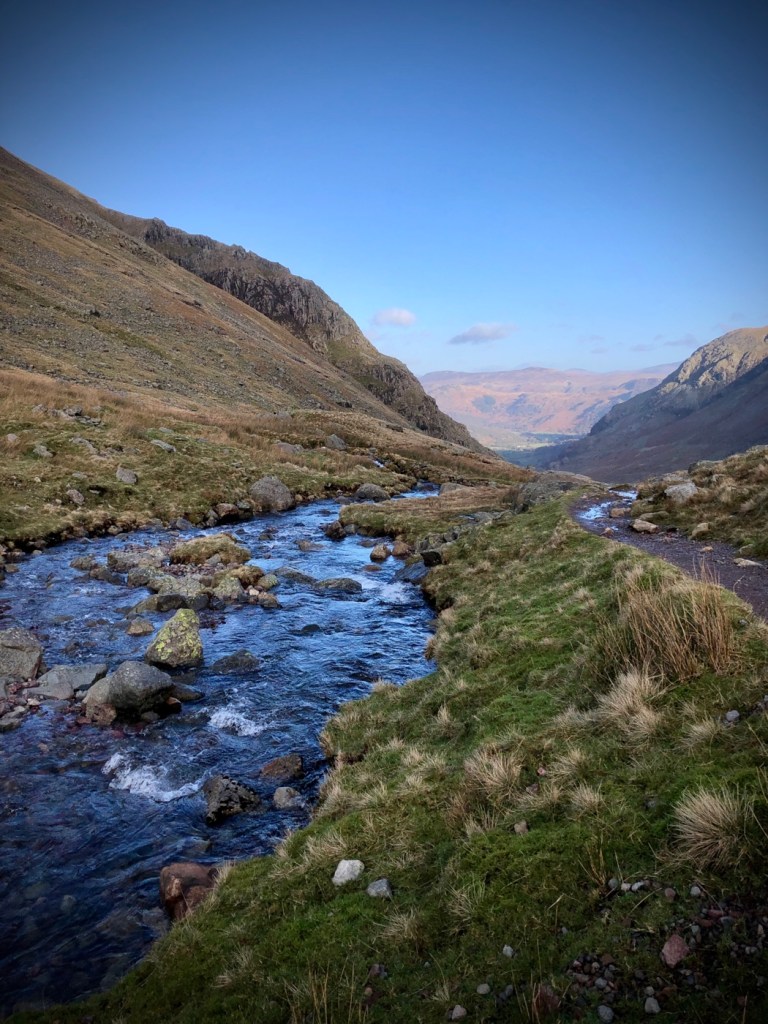
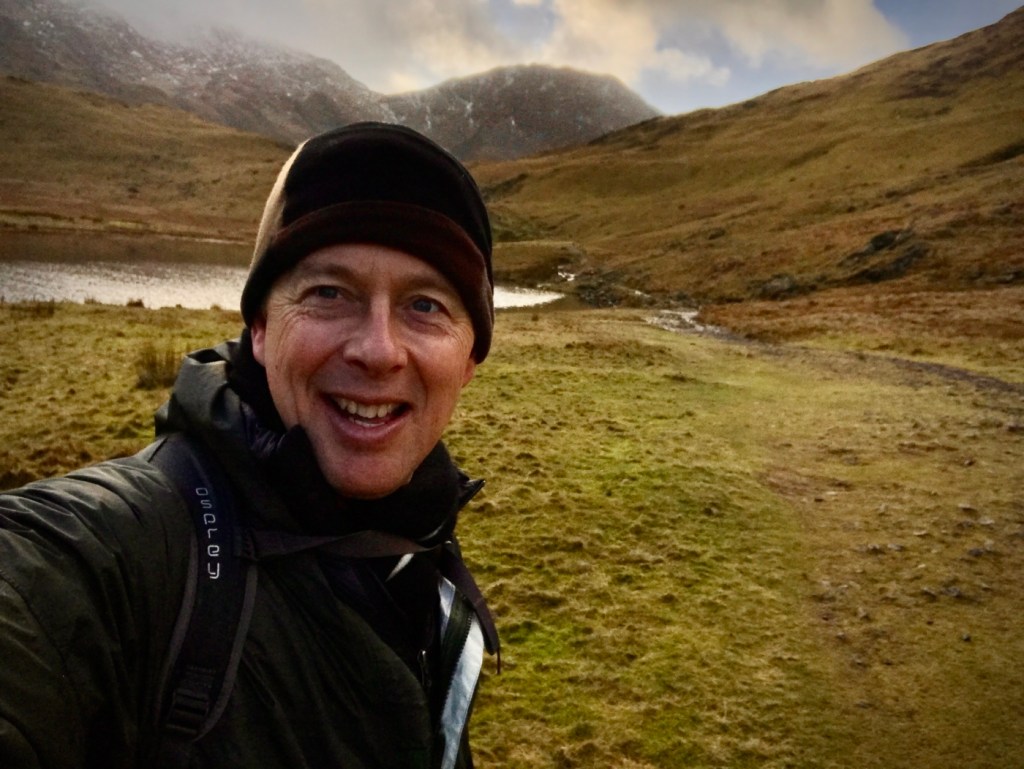
On the way to Styhead Tarn; did we mention there is water everywhere!

The typical scenic two lane roads barely fit two bus widths (they slow to pass) or even some large cars and trucks! Luckily most people in the UK still drive pretty small cars, but they still impact the safety and experience of the bikes and walkers that also use most roads. Many drivers here go too fast for conditions and it can be nerve wracking even on small unmarked country lanes.

Fragile sub-alpine tundra above 500m
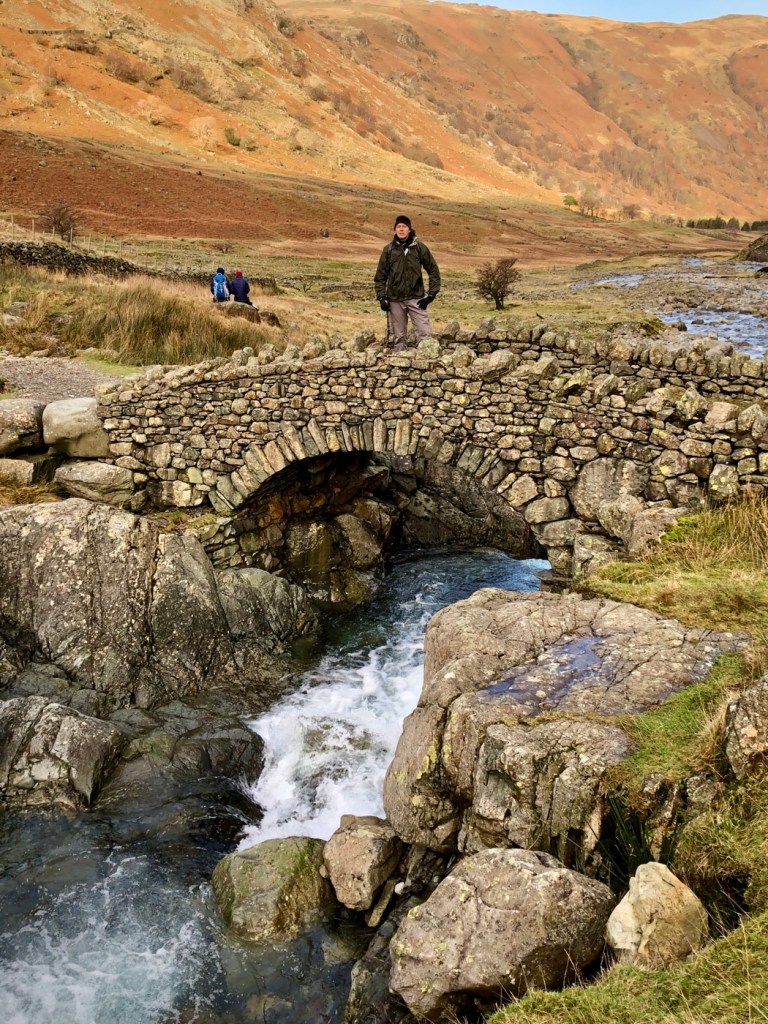
The surprising alpine world of northwest England…Styhead Tarn near the Great Gable

National Parks and holiday areas have specific problems, and many have now taken to managing traffic through various methods, such as fees, closures, parking management, and shuttles/transit. The Lake District National Parks is no different and really is trying to address the problem by providing a really good bus system at fairly reasonable (but not cheap) prices.

Returning on the upper deck just before the early winter sun set
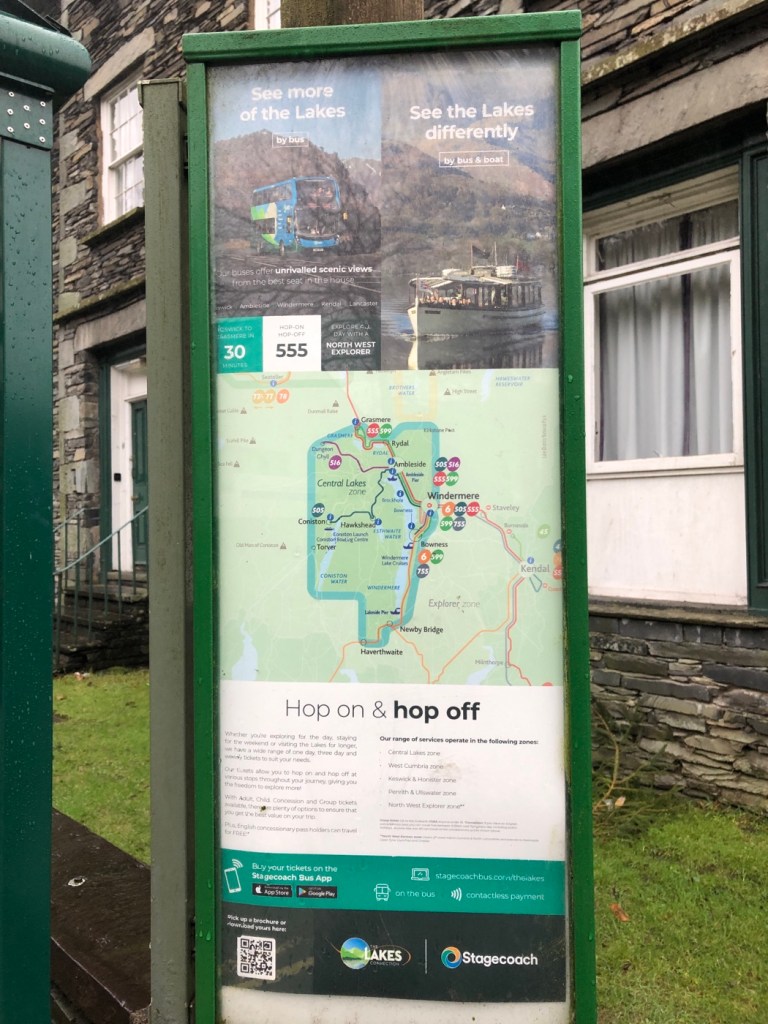
The backbone 555 bus runs throughout the core of the district and will connect you to the train in Windemere…closed double deck BTW

The buses are reliable, extensive, clean, and even a joy with double deck service on the some lines and 1/2 open top double deck service on two shorter lines through very scenic areas. So the buses really do double as sightseeing and transit for locals and visitors alike.

Yes, it WAS chilly on the open top bus, but the views will keep you warm

The other key is easy payment. The Stagecoach bus system offers payment by any tap cars/Apple Pay, etc for single/day trips or you can buy a loadable smart card right from the driver £1 fee for week or month passes.

Information is key! Most stops had schedules and route info.

We bought the 7 day gold pass form £29 each, which allows unlimited travel on the entire systems, which extends to the coast and all the gateway/border cities of the whole district.

Less sun, more dramatic colors
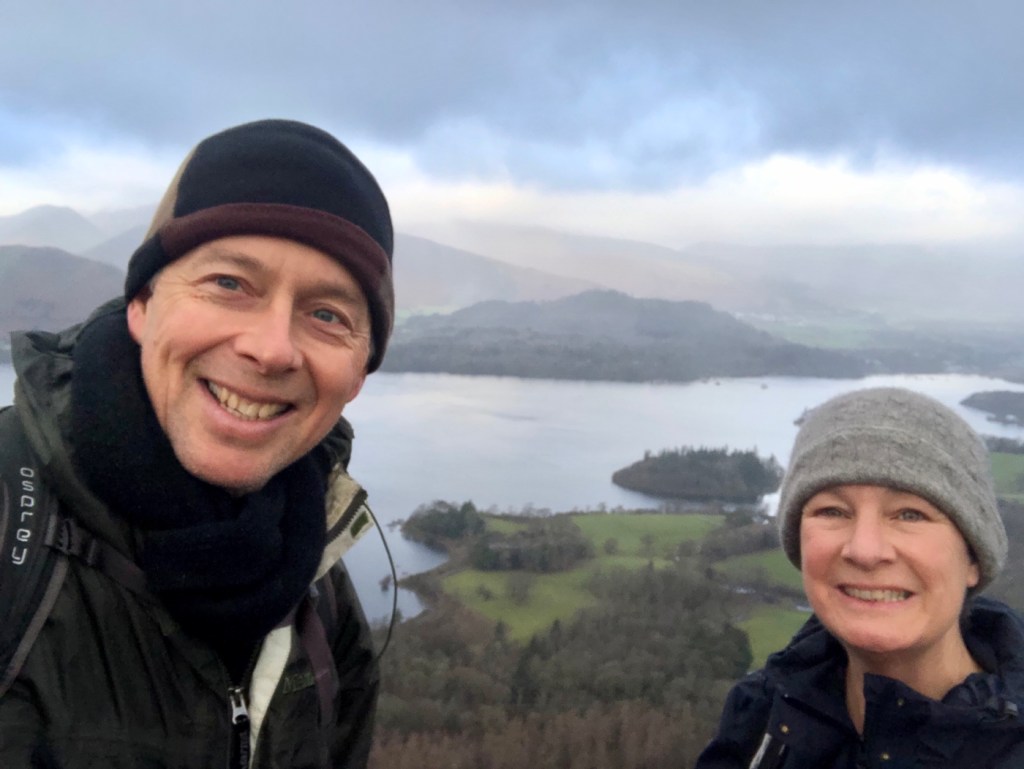
Walla Crag view on a misty winter day
But the sun was out today!

The only suggestion we would make to the Stagecoach bus system is to make the pass an 8-day or 7+1 trip pass, as many holiday rentals are 7-nights, so you generally have 8 days of travel. We are going to have to buy another day pass for our last day out of the park…. a minor annoyance. Let’s make this an even easier decision for people.

Gourmet Scotch Eggs from the Keswick farmers market are the ultimate winter hiking food

So we highly recommend coming to the Lake District in the winter. Although the transit system runs a little less frequently, and a few of the lines to very remote areas are peak season only, you will have a lot of the typically crowded places to yourself. Just make sure to always bring your waterproofs, and leave the car behind.

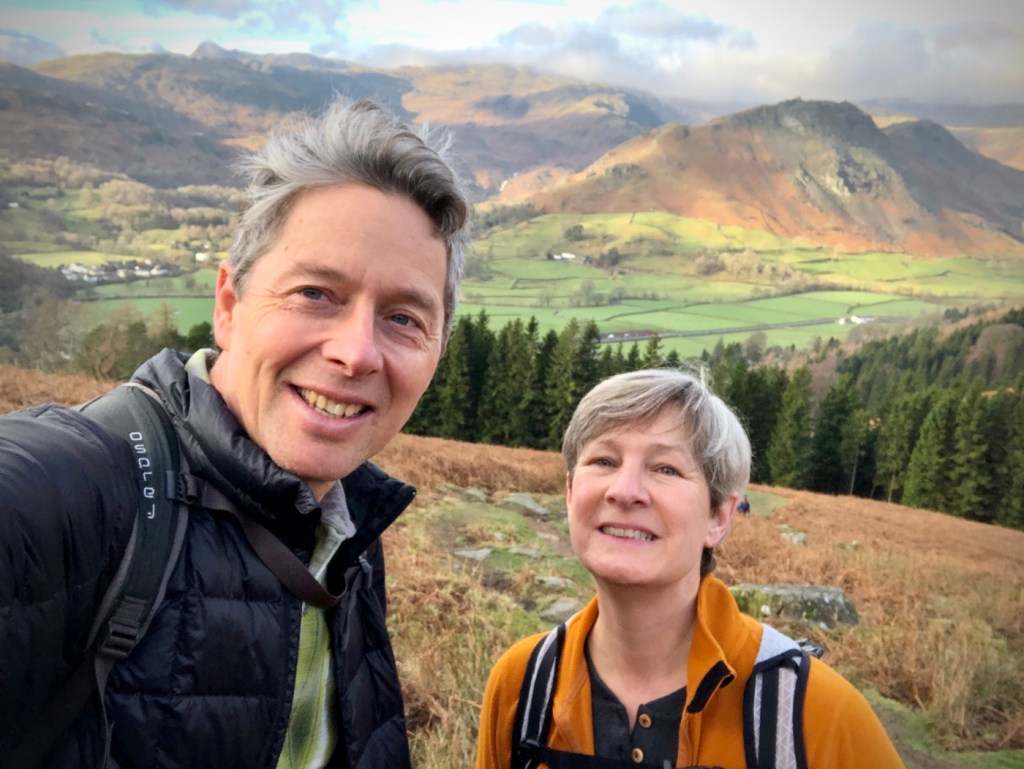
The intrepid travelers press on despite some serious hat head

The Engineer as Hero

Isambard Kingdom Brunel …a name hard to forget, especially in Bristol, England. As a professional Civil Engineer, it was so refreshing to see an engineer given their proper dues, as it’s usually the Architects that get (or take?!) all the credit for innovative projects. And boy did I K Brunel do it all: Paddington Station, the Great Western Railway, Thames Tunnel, SS Great Britain, and my personal favorite, the Clifton Suspension Bridge. His designs are credited with revolutionizing public transport and modern engineering.

Engineers are great, aren’t they….

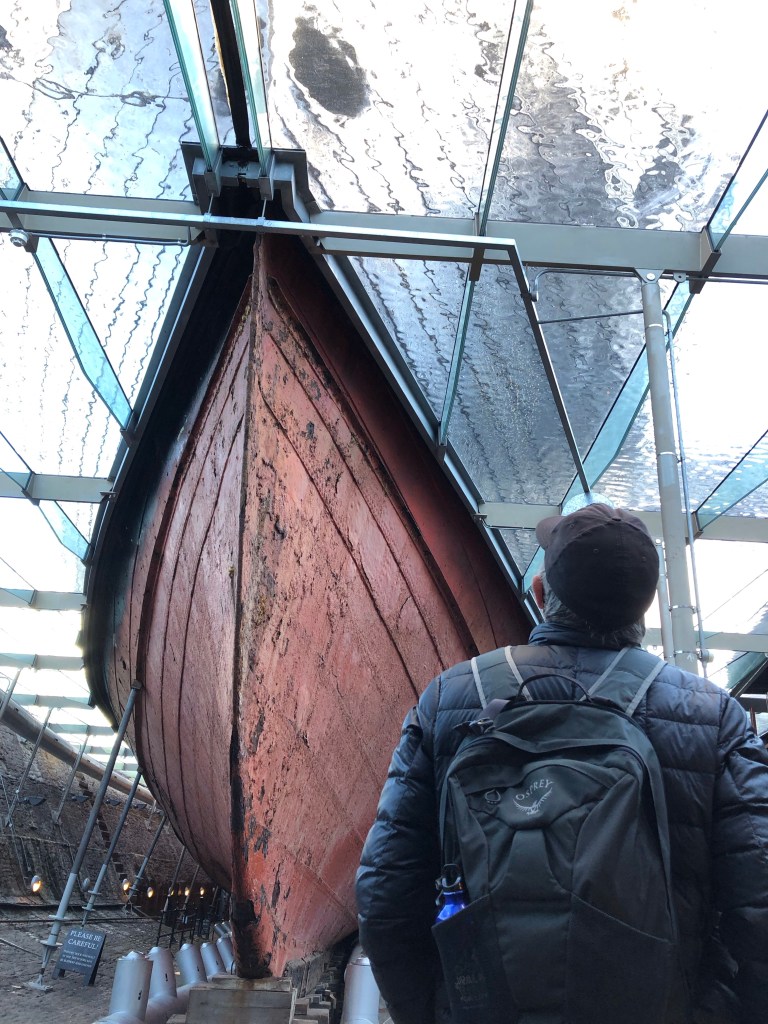
We started our Brunel tour at the fantastic SS Great Britain, which is a magnificently preserved and restored steamship that Brunel designed in the 1830s and was the largest steamship in the world when it launched in 1843.

In the Dry Dock – that’s water up there!

I think the best way to see the ship is to start below the water in the dry dock. It allows you to appreciate the scale of the ship, as well as understand how the unique hull was constructed and is being preserved. It takes a massive array of dehumidifiers running 24/7 to keep any further corrosion of the steel hull at bay. The array keeps at about 20% relative humidity, similar conditions to “the deserts of Arizona”, and paralleling the path of millions of other retirees being preserved in the Sunbelt.

Brunel chose to use a new and highly efficient propeller for the SS Great Britain, shaving weeks off a Transatlantic journey

You also can see how they moved the ship from its near demise in the Falkland Islands in 1970 and dragged it all the way back home to Bristol on a special barge. But the dedication to restoration didn’t stop at the exterior of the ship. The cabins have been fully restored with the sights, sounds, and yes, smells of the ship when it served as a passenger ship to the US and Australia.

The Kitchen…spooky realism abounds, as even rats can be seen moving about the cupboards.

The Steerage class quarters are strikingly small, but as a docent pointed out, still offered those crammed in 4 1/2 foot bunks a chance at better conditions and more opportunity in the New World. Life in the early industrial revolution days of Britain was hard. The crew barely had it better, as had to toil all hours shoveling coal into the furnace and keeping the ship going over grueling 3 week to 6 month journeys. Of course first class was quite grand and the Titanic-like dining hall is now available as a wedding venue, minus the swells and nausea of the open seas. (As it turns out, Brunel’s hull design was a little unstable…until a later wood extension was added to to the keel)

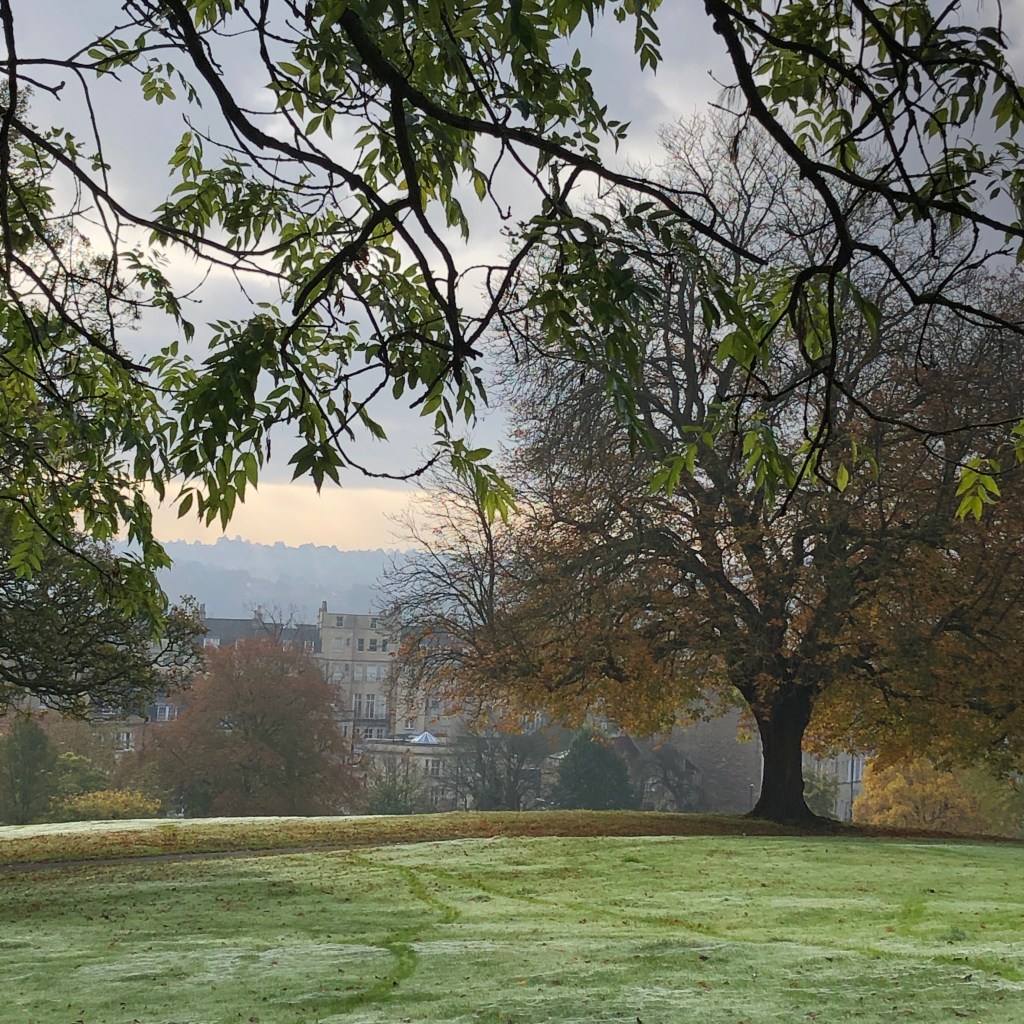
Morning dew on Brandon Hill, Bristol

Bristol and Bath were both a pleasant surprise. The crisp fall weather and foliage were perfect for exploring on foot and both cities offer fascinating sites, museums, culture, and vibrant food scenes.

Proper tea and a scone at the American Museum and Gardens in Bath

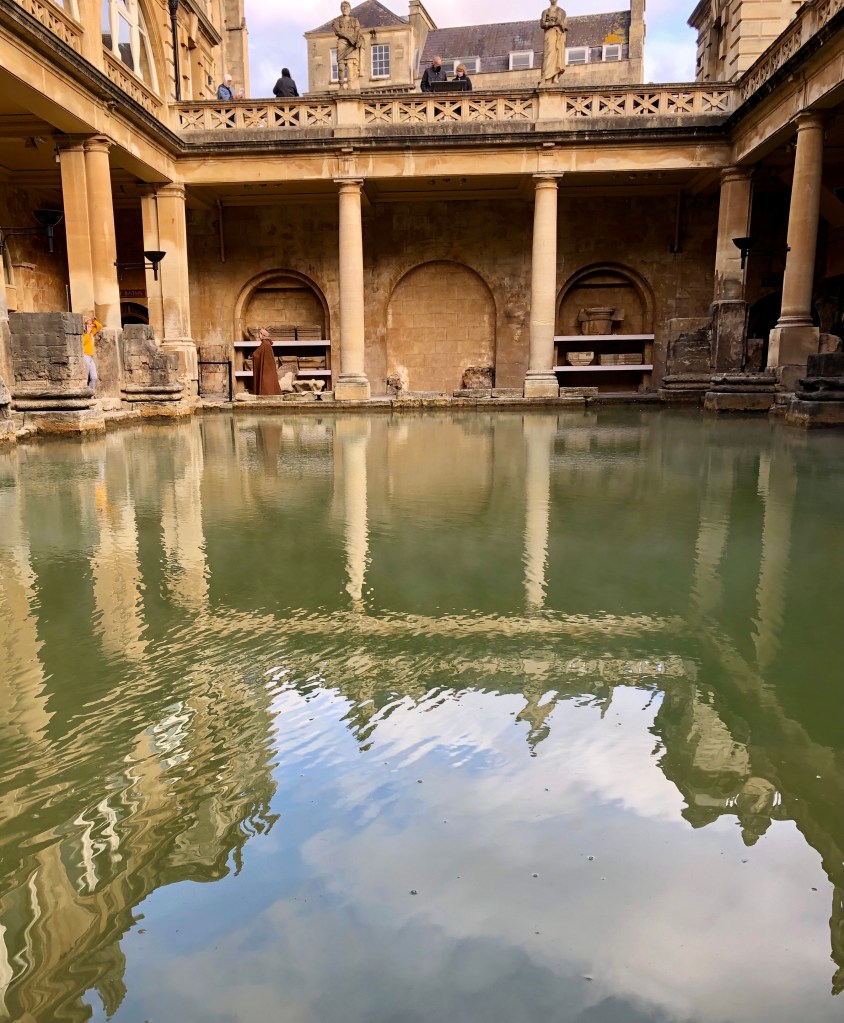
Bath is like a living Georgian museum, pleasantly frozen in the 1770’s, while Bristol offers a modern revitalized waterfront, lots of history, and more diversity, all supported by a large University population. The American Museum has beautiful views and a offers a unique British perspective on American history and culture. The Roman Baths are the big attraction and surprisingly engaging with brilliant holograms in each room and an audio tour featuring humor of Bill Bryson.

As much as you want to, you shouldn’t touch the water at the Roman Baths

After 3 nights up the hill in Bath near the Royal Crescent, we decided to stay just 7 minutes away from the Temple Meads station in Bristol. The Station itself is worth a look, and yes, I K Brunel provided the base design and inspiration for the main station as the terminus of his Great Western Railway from Paddington in London. How was he so many places? (4 hours of sleep helped apparently)

The Temple Gardens out the back door of our hotel

After a day on the waterfront and Brunel museum, we decided to explore more neighborhoods and walked out through the pleasant and upscale Clifton village. We walked back through the University and along Gloucester Road, which is full of an eclectic mix of shops, pubs, and restaurants. 8 miles overall and great walking up and down the undulating hills, with constant surprises and new views.

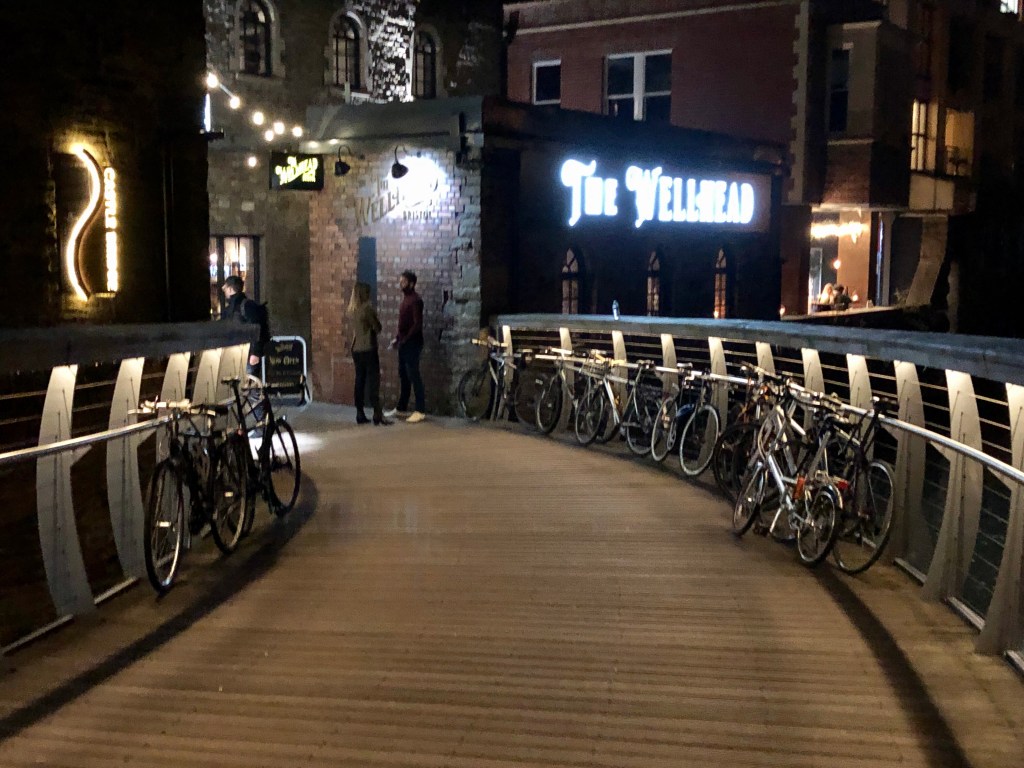
The Castle Bridge opened in 2017, offering an inspiring human powered crossing of the Bristol Harbour (but still not enough bike parking!)

But the hands-down thrill of the day was the Clifton Suspension Bridge. A structure that highlights the need for visionary technical leadership and perseverance. Brunel’s original design took over 35 years to be built. He succeeded in a design competition in 1830 with his proposed bold 700- foot steel chain suspension span. This span allowed a full span of the gorge, which was key to the intrinsic beauty of the structure in the unique context of the Avon River Gorge. But many, including his father, doubted that such a span could be built. Unfortunately, cost overruns and contractor financial trouble (sound familiar) put the half completed project on hold by 1843. Luckily, the bridge was finally completed in 1864 with the assistance of other designers, but sadly 5 years after Brunel died. And like many of his bold designs, the ultimate bridge required some design modifications to the deck to make it stiffer, as his original design would have likely failed in high winds. Engineering is a constant process of improvement and optimization.

The 1,300-foot long Clifton Suspension Bridge soars more than 300-feet above the Avon Gorge…so nice!

But his vision survives and his grand engineering projects are still serving millions of people today. So anytime someone doubts that a large infrastructure project can ever be finished or if a new design innovation can really work, just shout out the name of Isambard Kingdom Brunel. Or say it three times if you can!