We both had been looking forward to coming back to San Sebastián. We visited two years ago while walking the Camino with Christine and Cecily and did a fantastic food tour that helped us all learn to love Pinxos. Not that much help is needed, but the scene can be a bit intimidating. Here in San Sebastián they prefer that you pay as you go, order drinks and pinxos and tap your card to pay. In less busy towns and cities you could pay once you were ready leave. When the popular bars open there can be quite a rush of folks piling in.
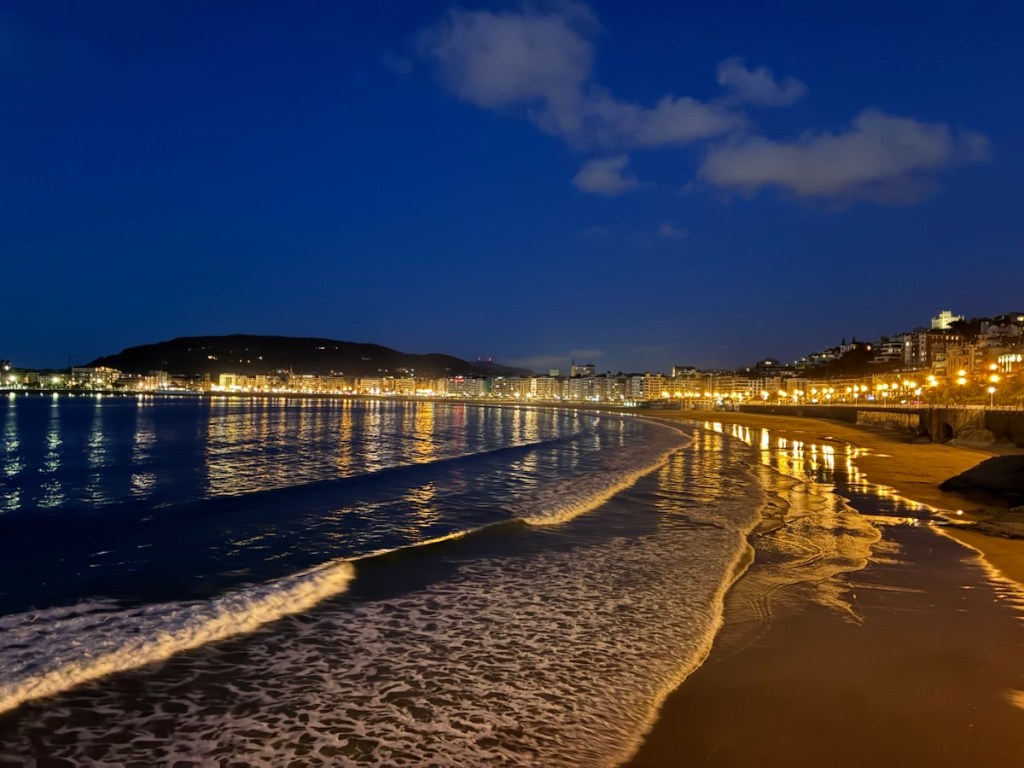
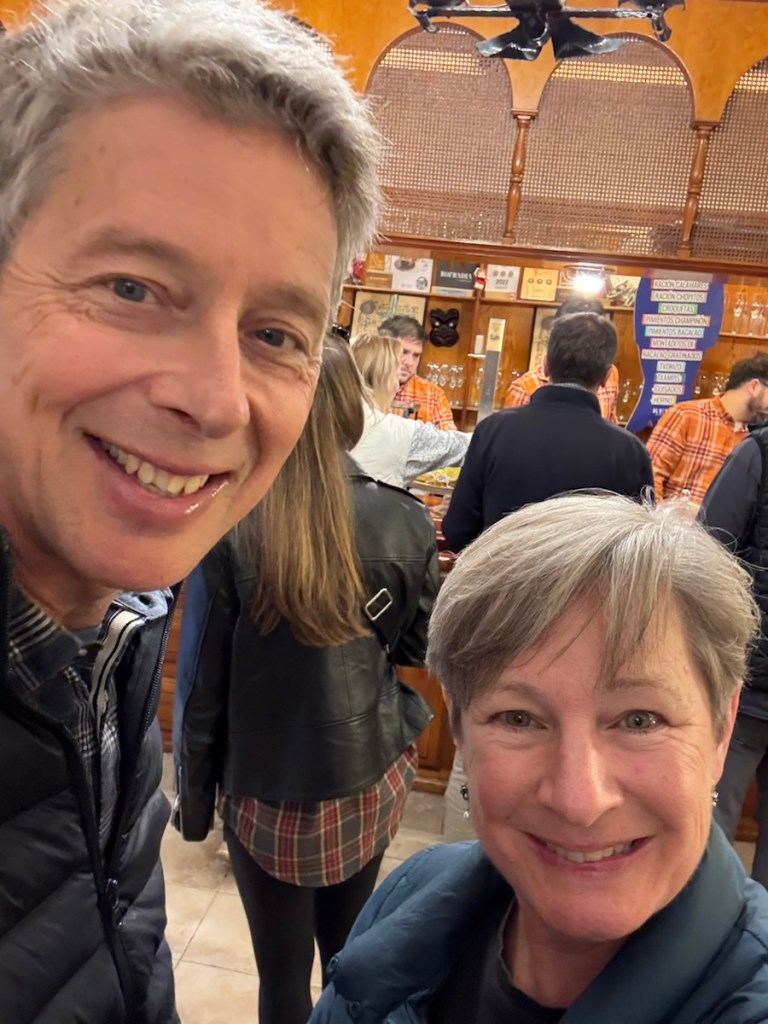
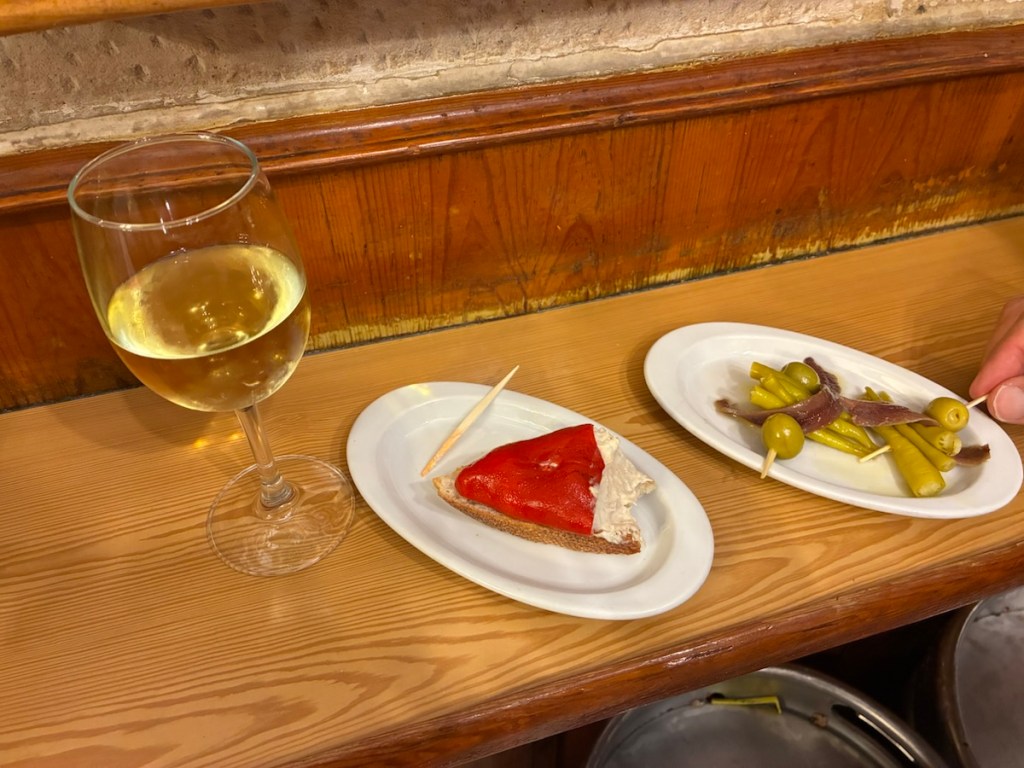
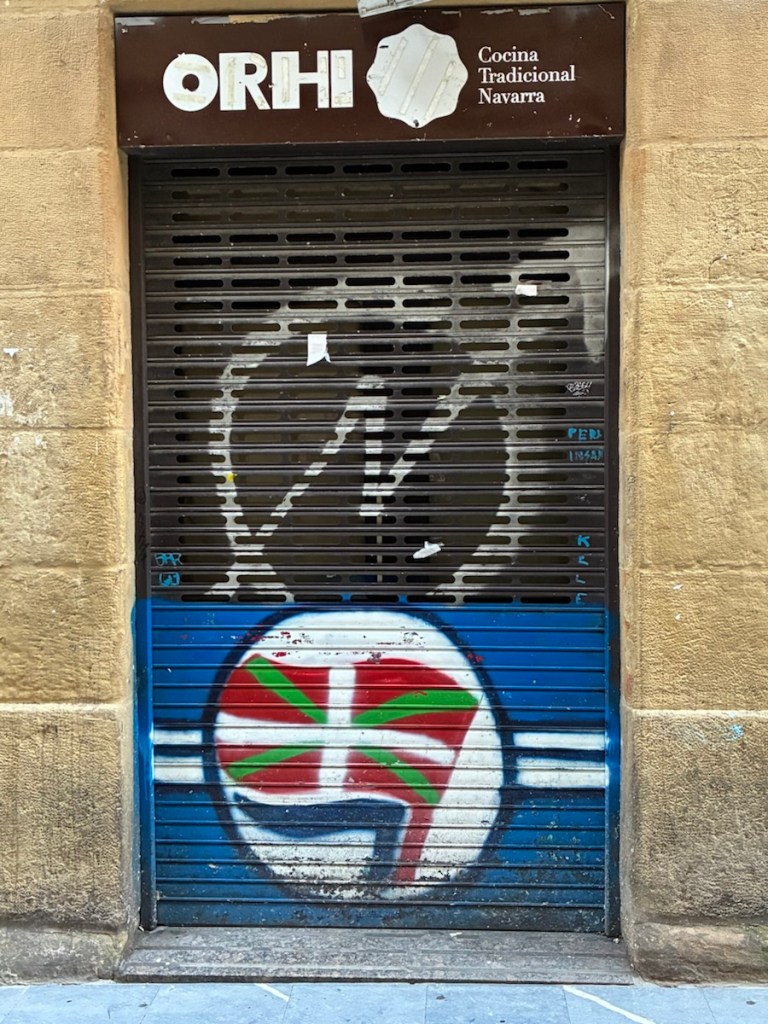
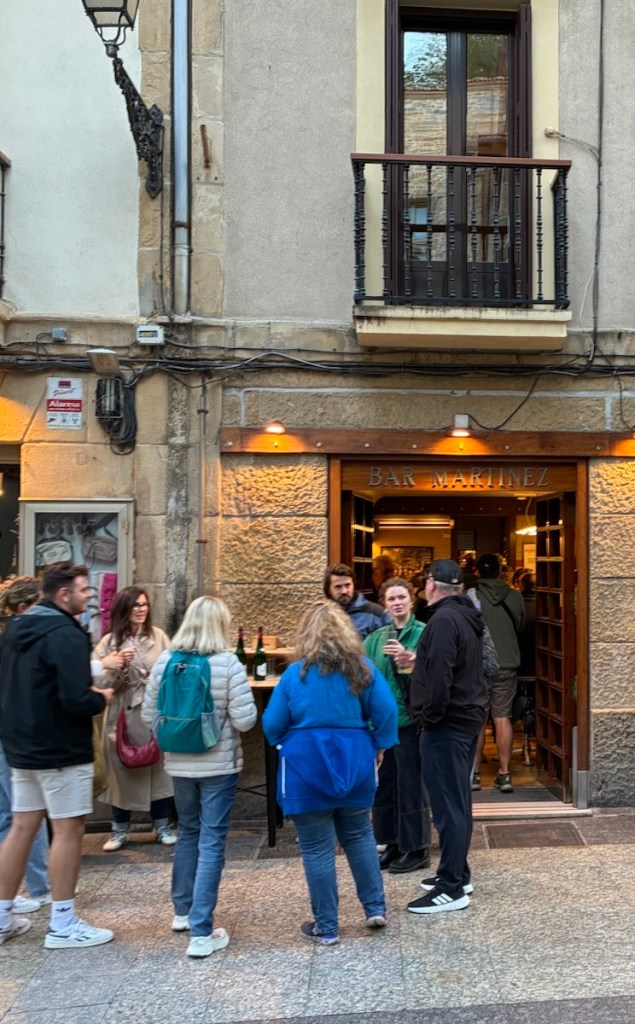
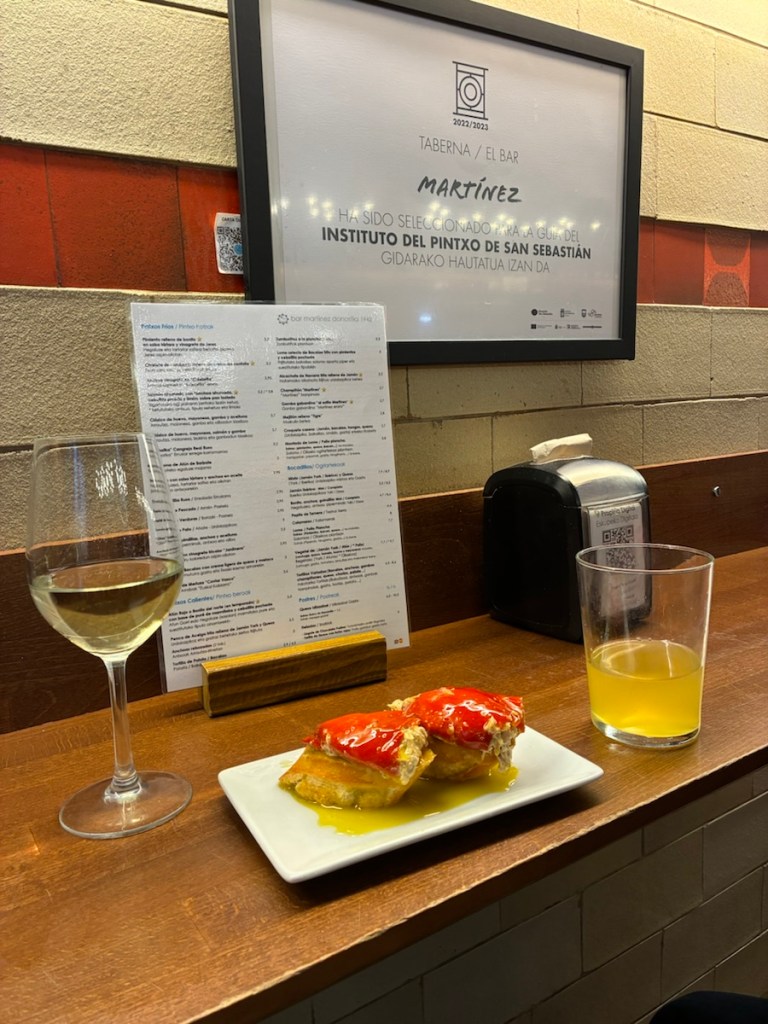
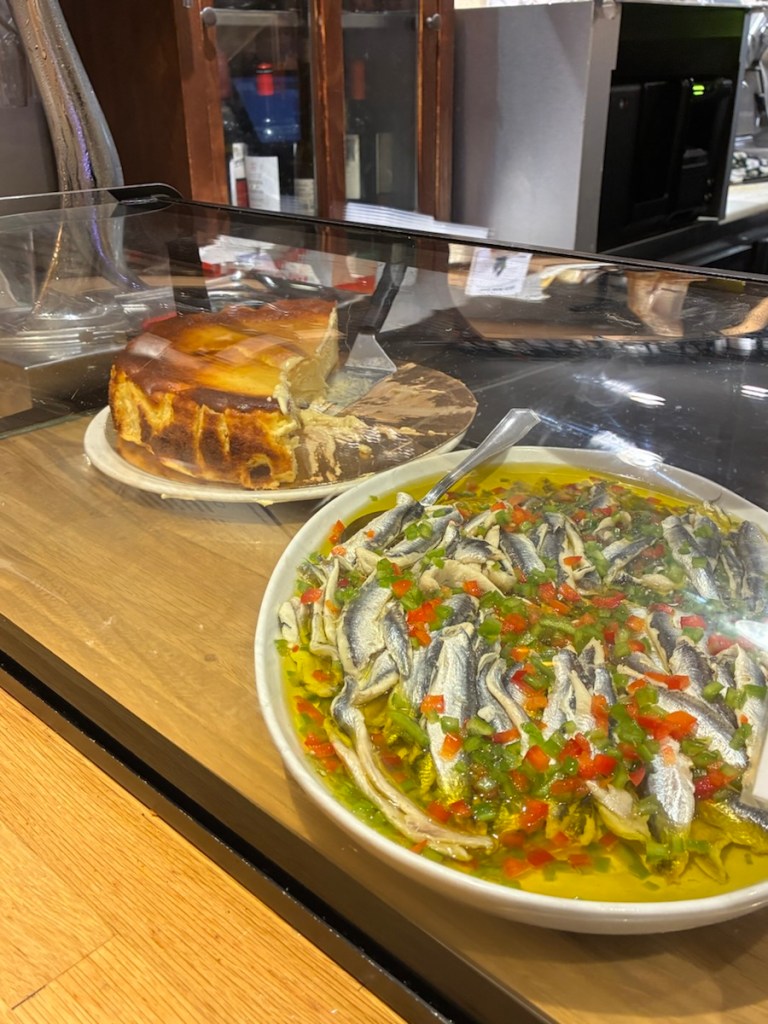
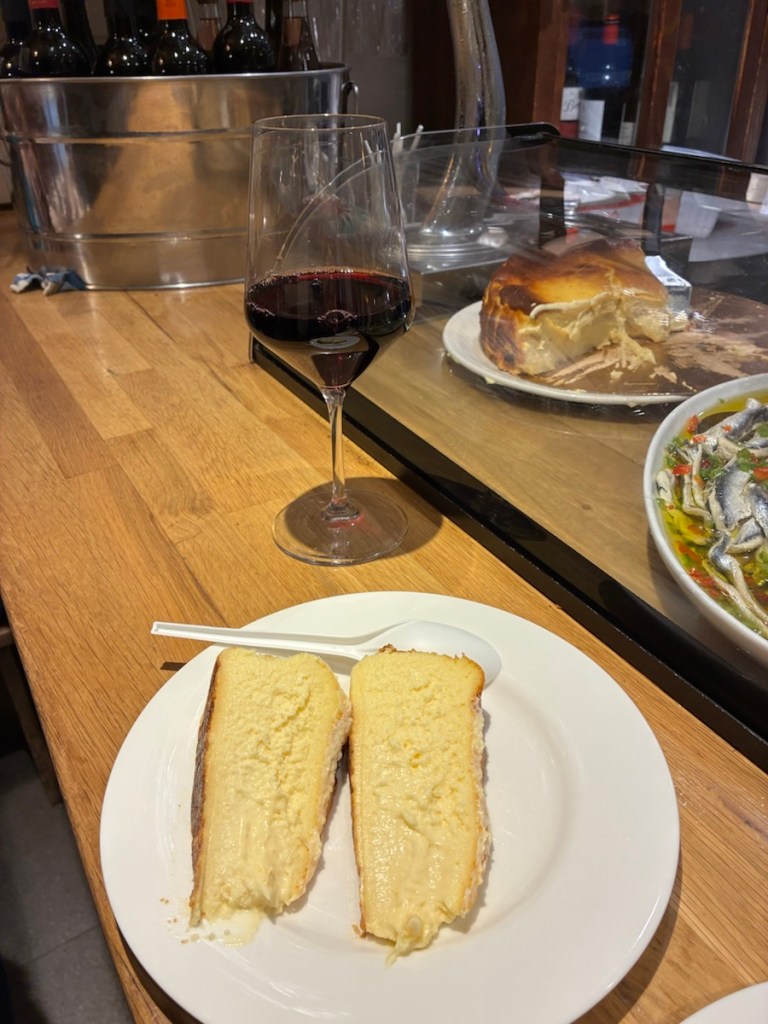
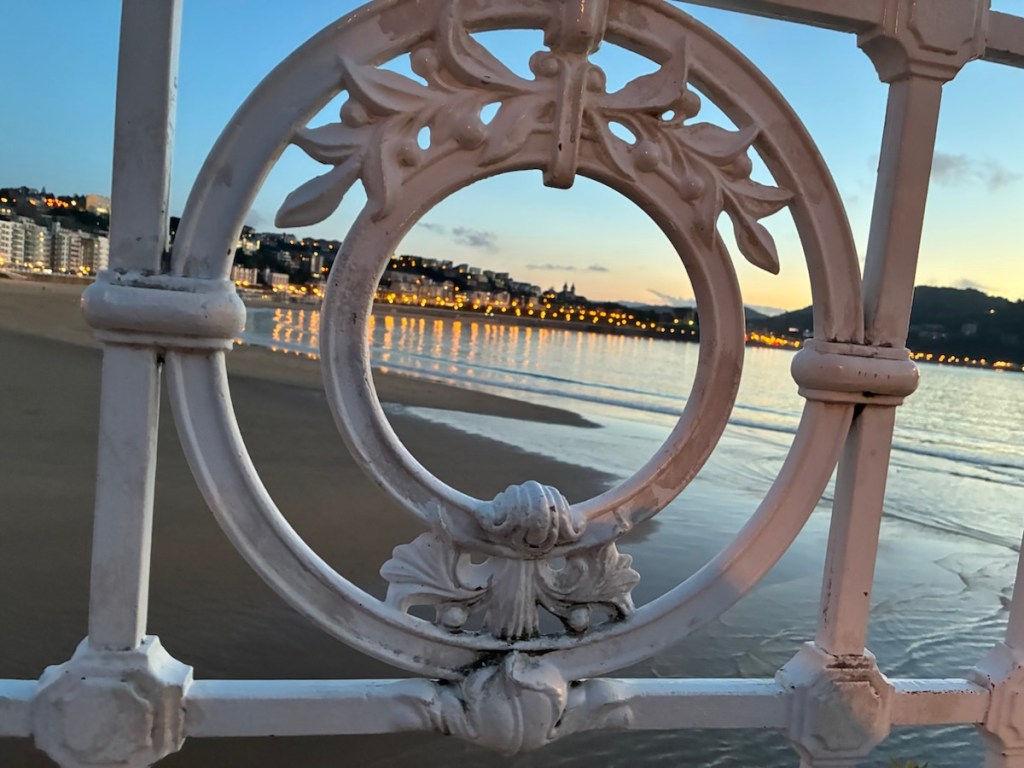
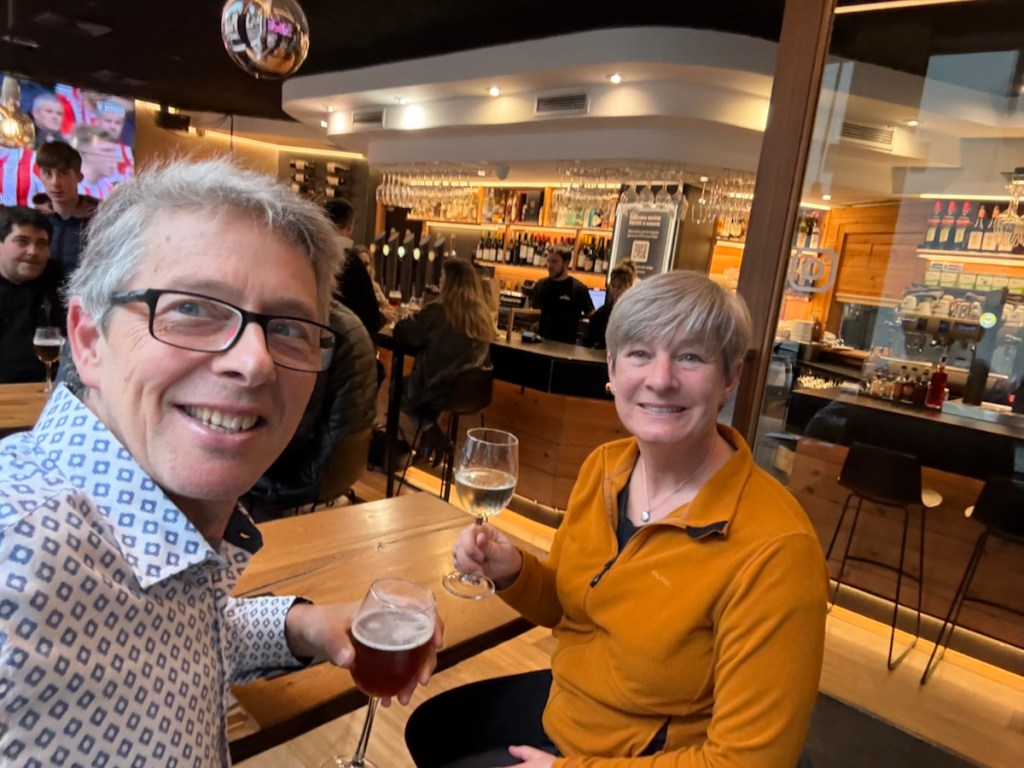
Stop one on our first night, Bar Txepetxa. A rather famous bar with photos of famous people on the walls.Antxoa con jardinera. Anchovies with jardinera sauce, peppers, and onions. Gildas: anchovy, olives, and guindilla peppers. Piquillo Peppers Stuffed with Tuna (Pimentos del Piquillo Rellenos de Atún).It was a bit crowded so we moved on. Hungry from the ride. Need more Pinxos. Loads of youngsters outside, let’s try this one!Belfast Irish Tavern! With Pinxos, of course.Two boccadillas and another round of drinks.A stroll around old town to keep our appetites up and admire the graffiti. “The fire you light lights the way.”Probably the same food tour we did two years ago, Mimo Bite The Experience. An excellent tour.Bar Martinez. We scored two bar stools at the side counter which meant we got table service. It was nice to have a menu to order off of. (We ate more than the stuffed peppers)La Viña. Our final stop of the night. We had a nice conversation with the Spanish couple to our right after Rich copied her red wine order – it was excellent and we thanked her.La Viña is famous for their Basque cheesecake, left. Anchovies on the right. Don’t get those two confused.Basque Cheesecake. Our final dish of the evening. We over ordered and had two plates with two slices per plate! Time to waddle back to our hotel.The street scene in old town is lovely and relaxed.Through the decorative railing along the promenade.This guy makes art in the sand. You throw coins onto the white sheet to show your appreciation.On our first rest day we walked a lot and visited the small maritime museum which had a decent history of Basque seafaring history and a cute exhibit about animals on board ships.
On our second rest day we had a bus failure trying to get to an outdoor sculpture park. On line info was not just confusing but incorrect. There are two bus providers in town and we walked around searching for the stop for the bus that would take us right to the sculpture park. Fail. Asked people. Fail. Finally found someone who helpfully pointed us towards the stop, on a totally different street! and we watched the bus roll by since we were a block away from the stop. Schedule wrong. Next bus probably in 45 minutes. When Rich can’t figure out a bus system you know it’s confusing. So we walked around town, took a small community hill bus and had a lovely conversation with a young woman who grew up in San Sebastián but now works as a nurse in Edinburgh, Scotland.
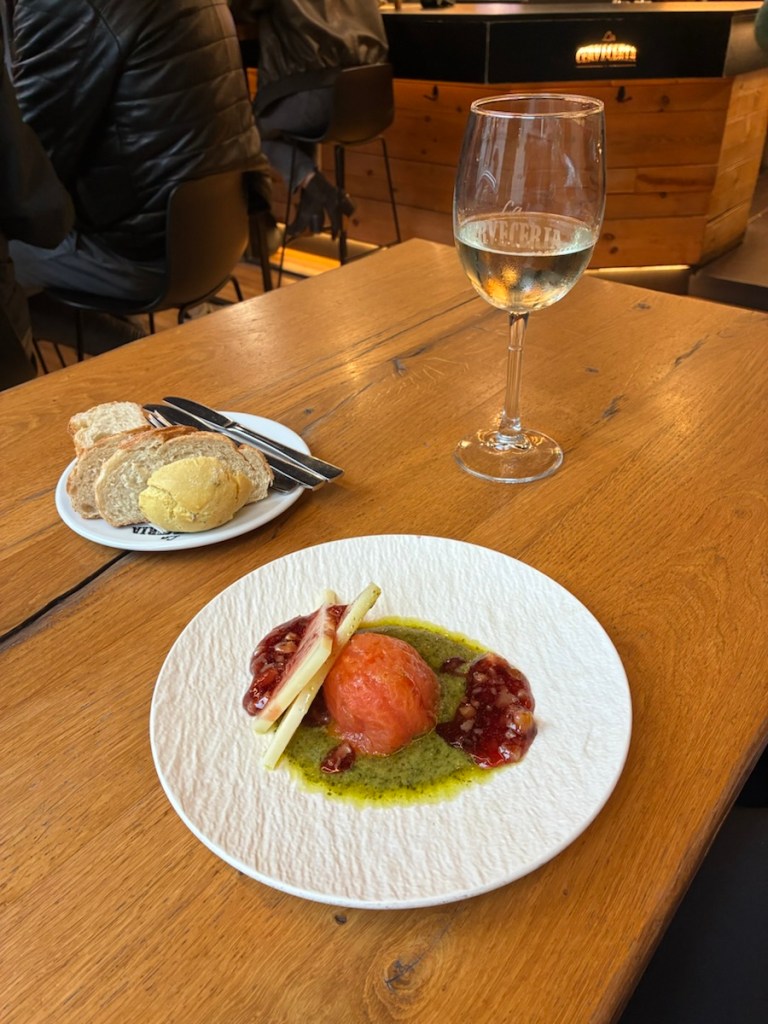
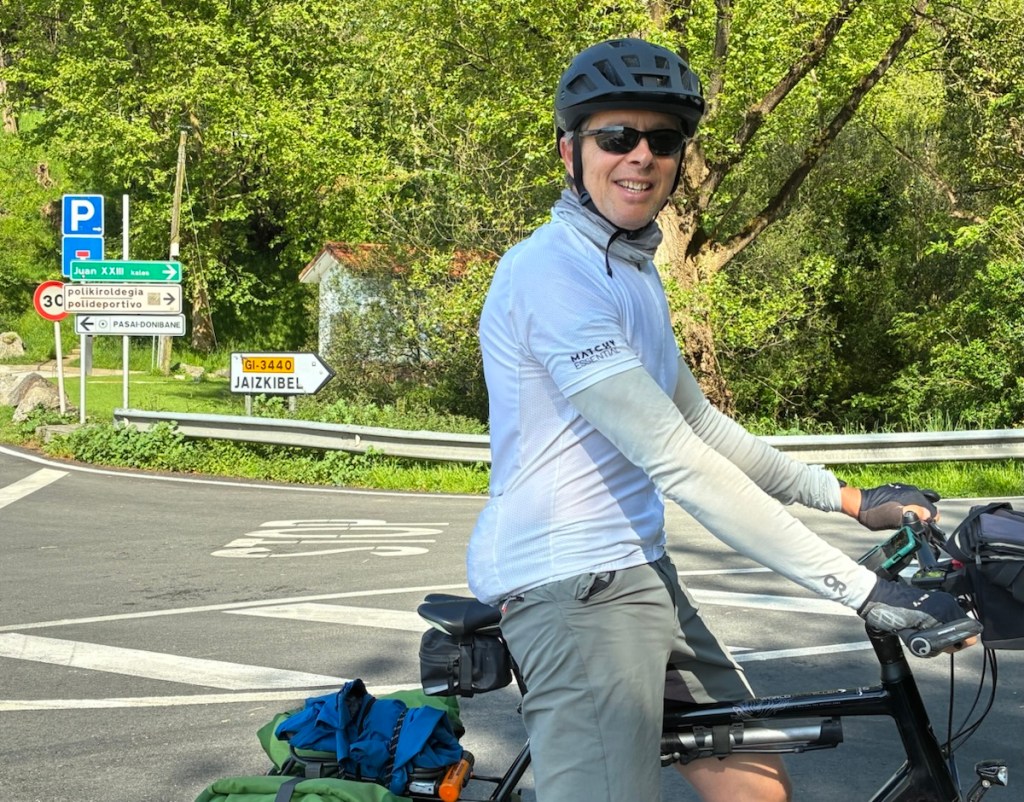
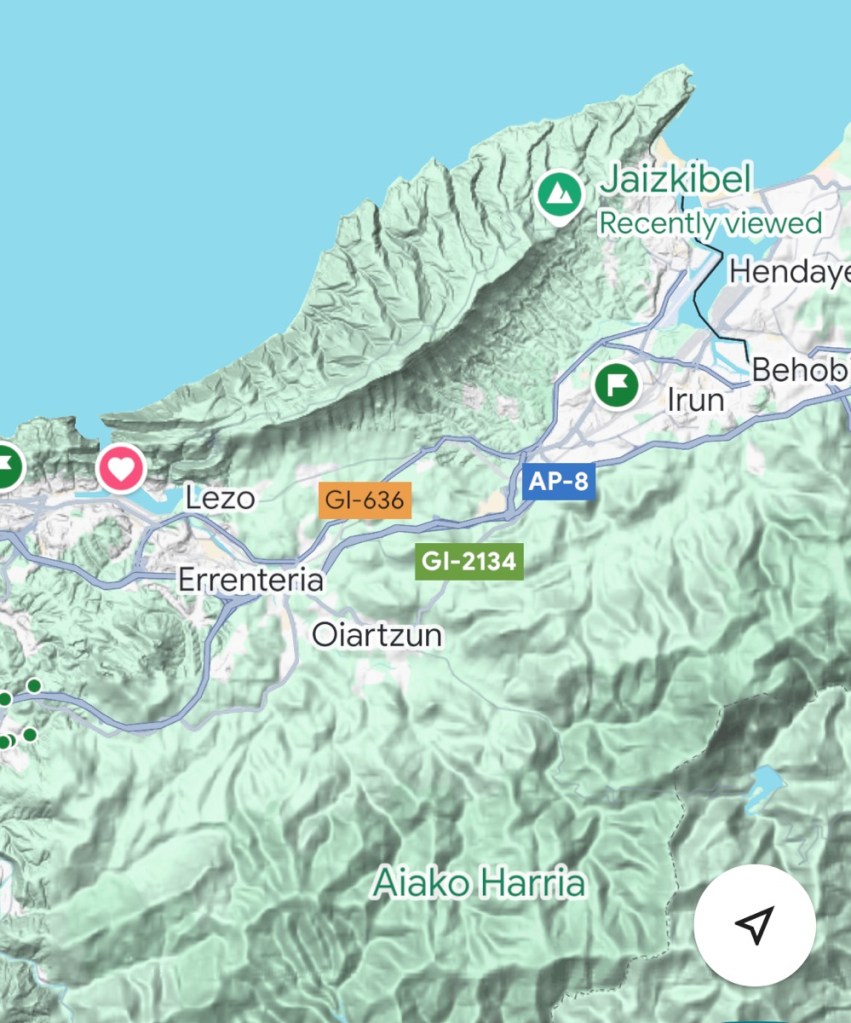
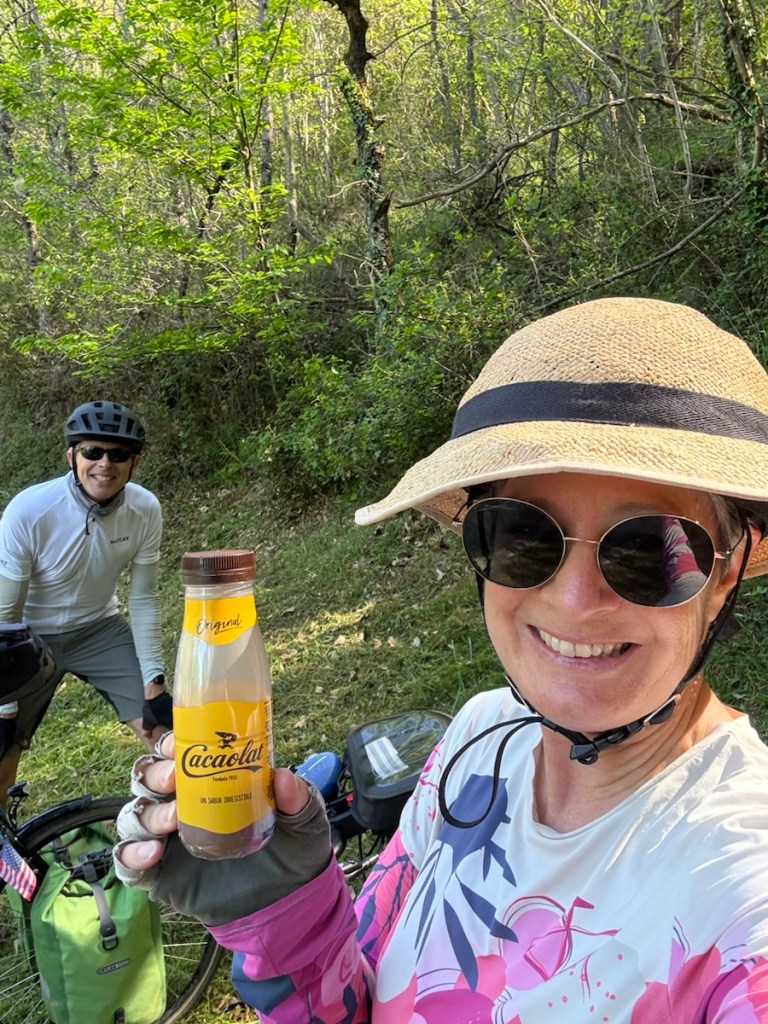
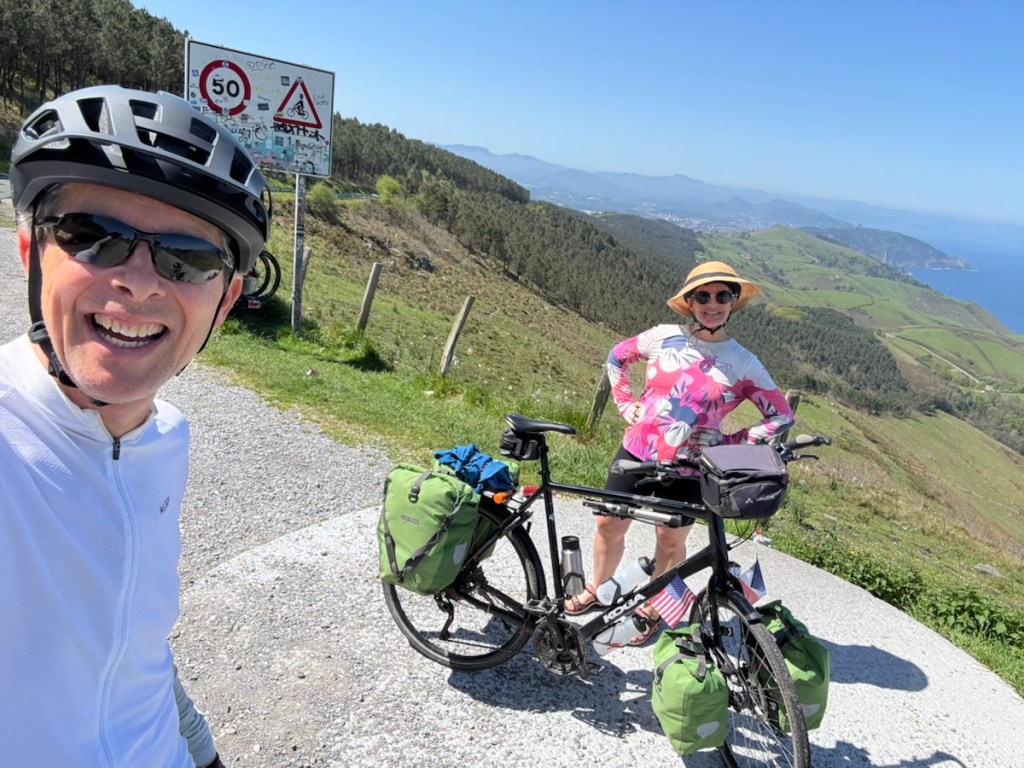
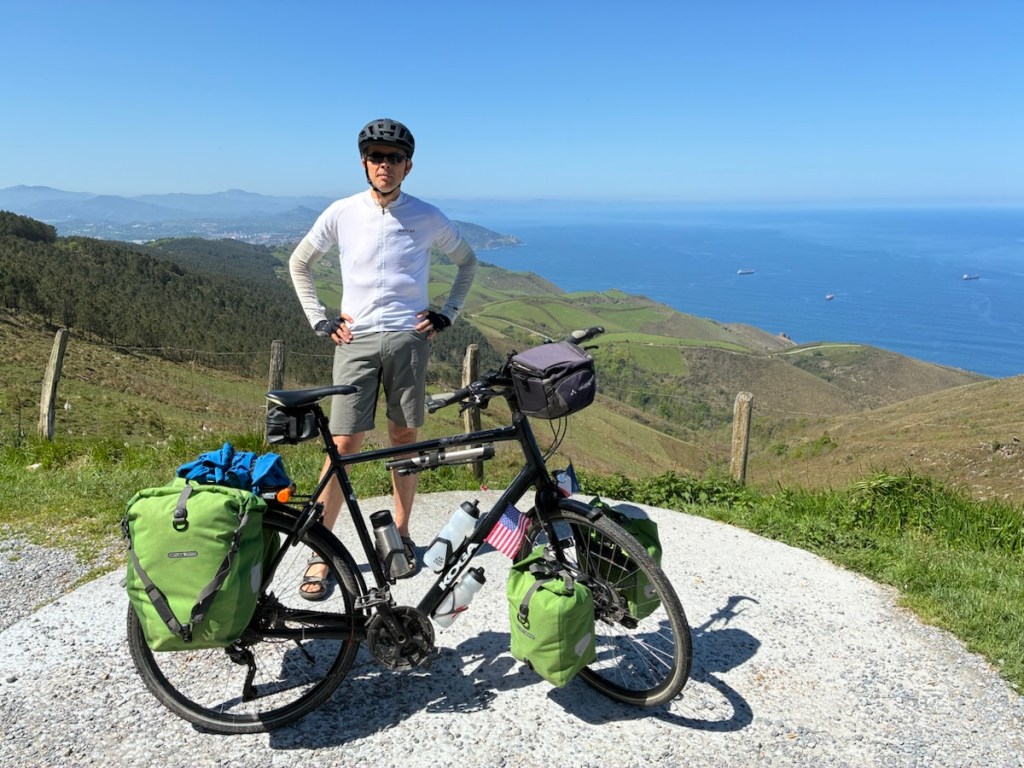
Dinner in our neighborhood at La Cervecería del Antiguo. It’s fun to try a neighborhood place and enjoy inventive Pinxos. Baked confit tomato with sheep cheese flakes and walnuts.Gamberro bluefin tuna tartare and pulpo.Heading out to ride to Saint-Jean-de-Luz, France. Only thing between us and France is another big climb.Not every mile is beautiful and picturesque. I try to remember to take photos of the less glamorous parts of a ride. Turning up the road to the Jaizkibel summit.The spine is the Jaizkibel mountain range. Our climb started in Lezo and had a gain in altitude of 455 m (1,493 ft) over 8.0 km (5.0 mi).Fueling for the climb with chocolate milk.
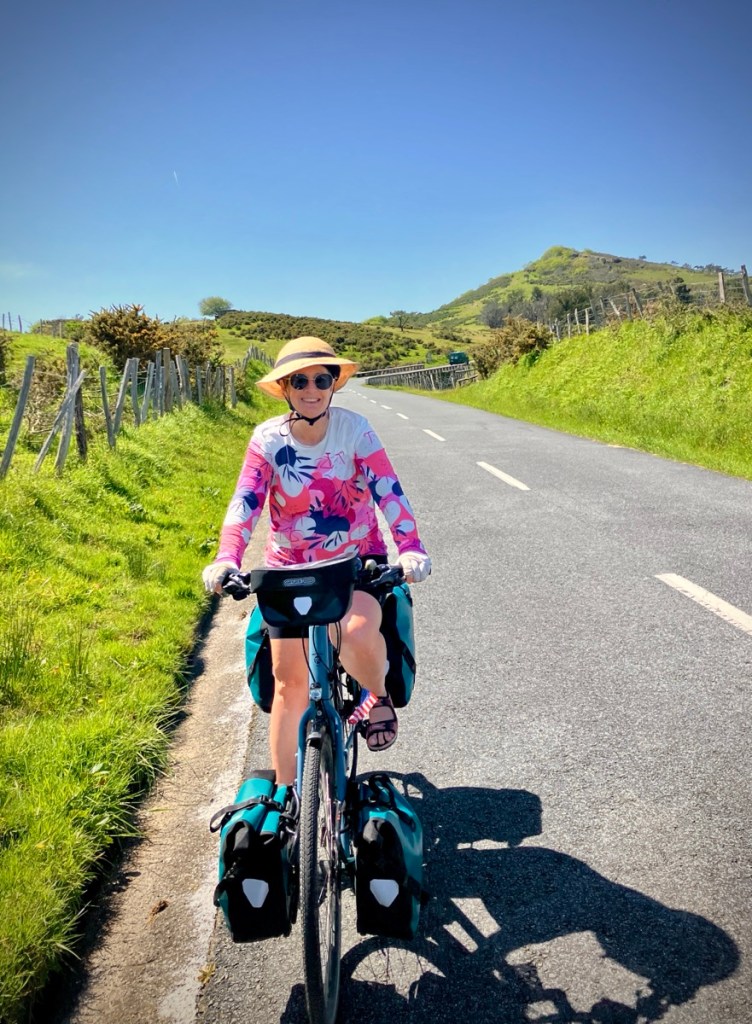
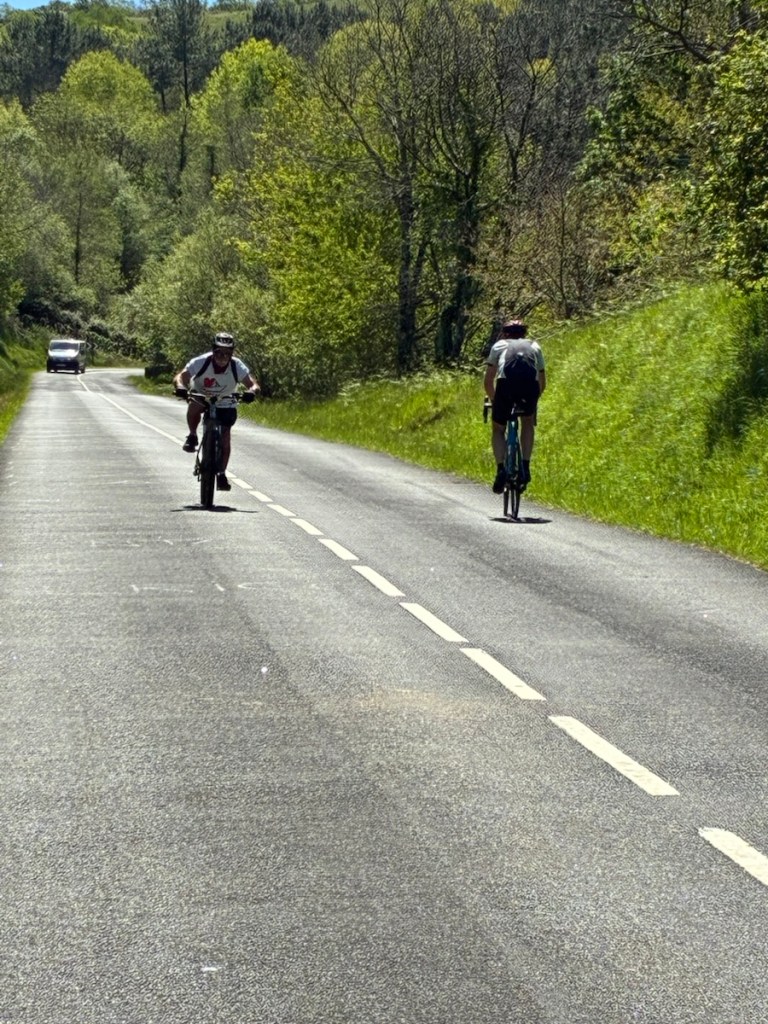
I never seek out climbs, but Rich loves them, and I’m never daunted by them. I say my spirit animal is a Shetland pony. I’m not setting any Strava records but I’ll get there eventually. Rich waits at the summit. So, big climbs are not a deal breaker. This one was again made fun by the Basque road cyclists. They are the nicest riders ever. I don’t think a single one went by me (me as if I was standing still and them in their sleek cycling kits) without a greeting. And the work crew chopping back vegetation for which traffic was held one way at a time? The guys in their fluorescent yellow with safety googles and gas powered weed trimmers and chainsaws? My personal cheering section as I ever so slowly rounded a hairpin turn.
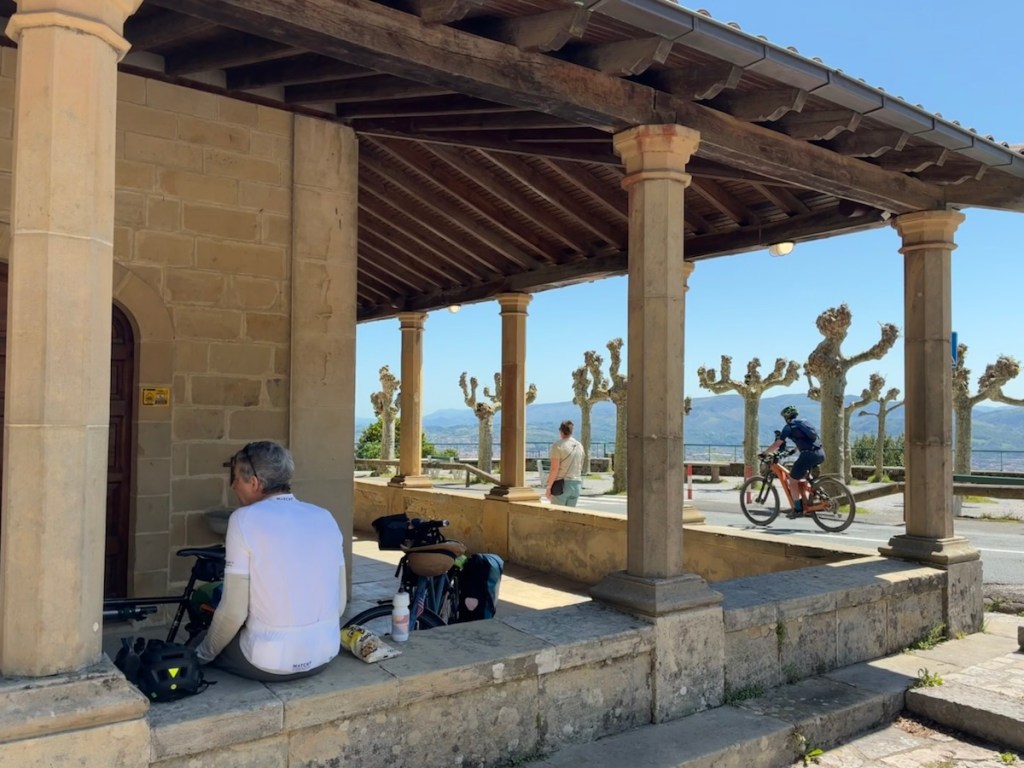
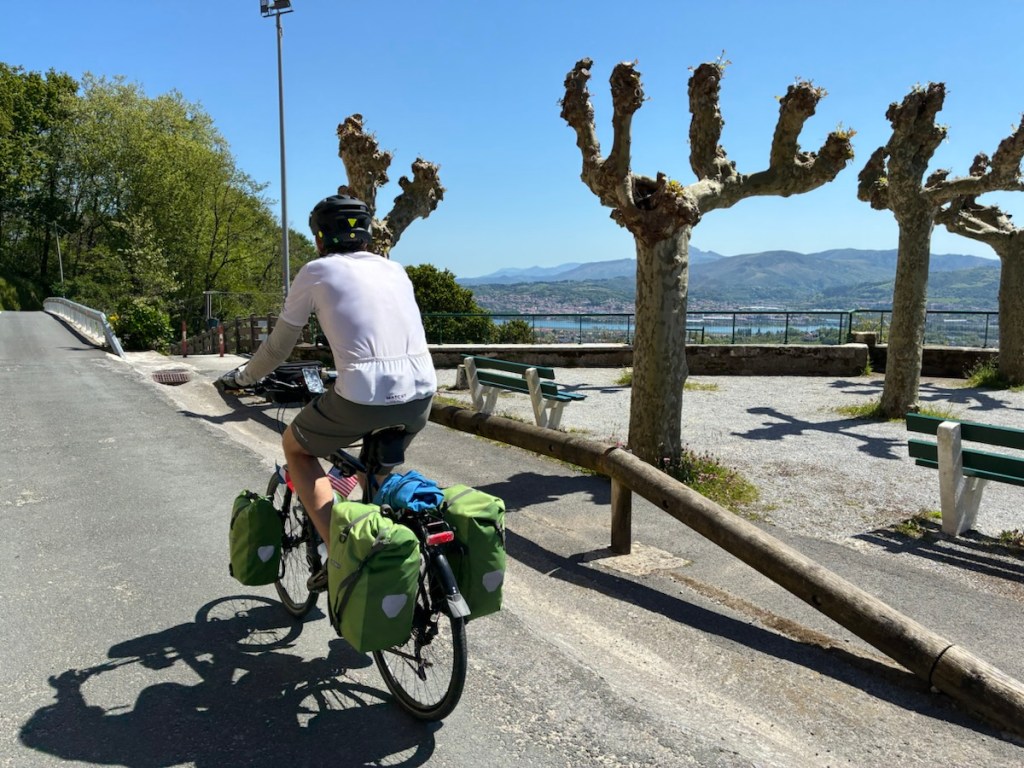
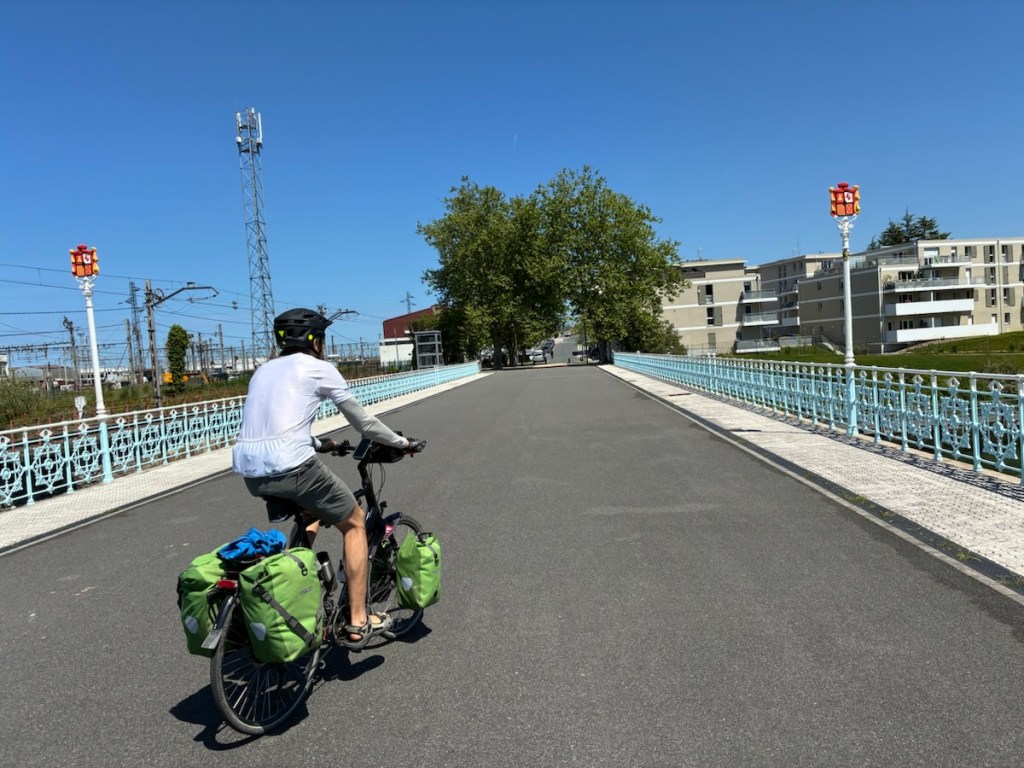
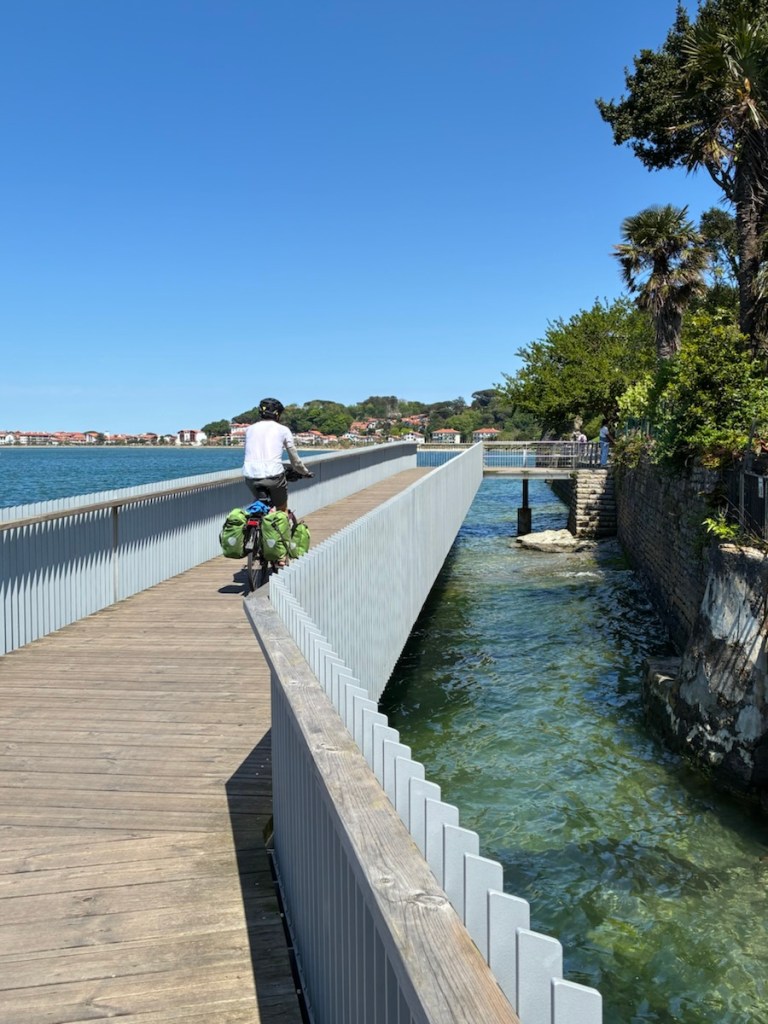
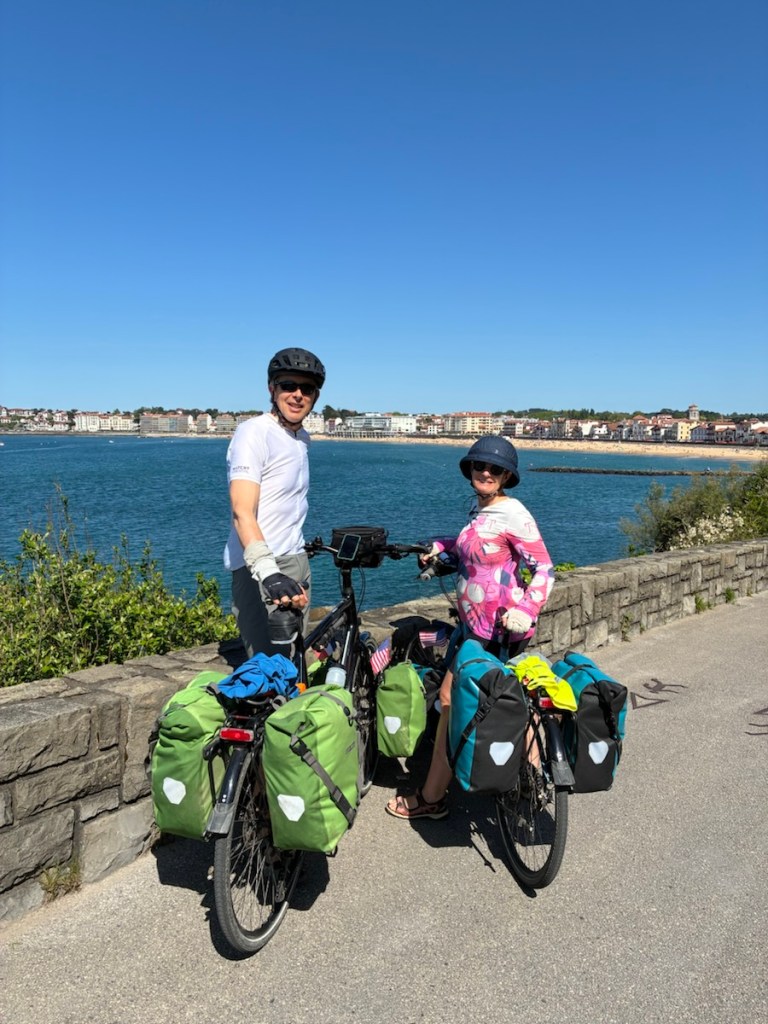
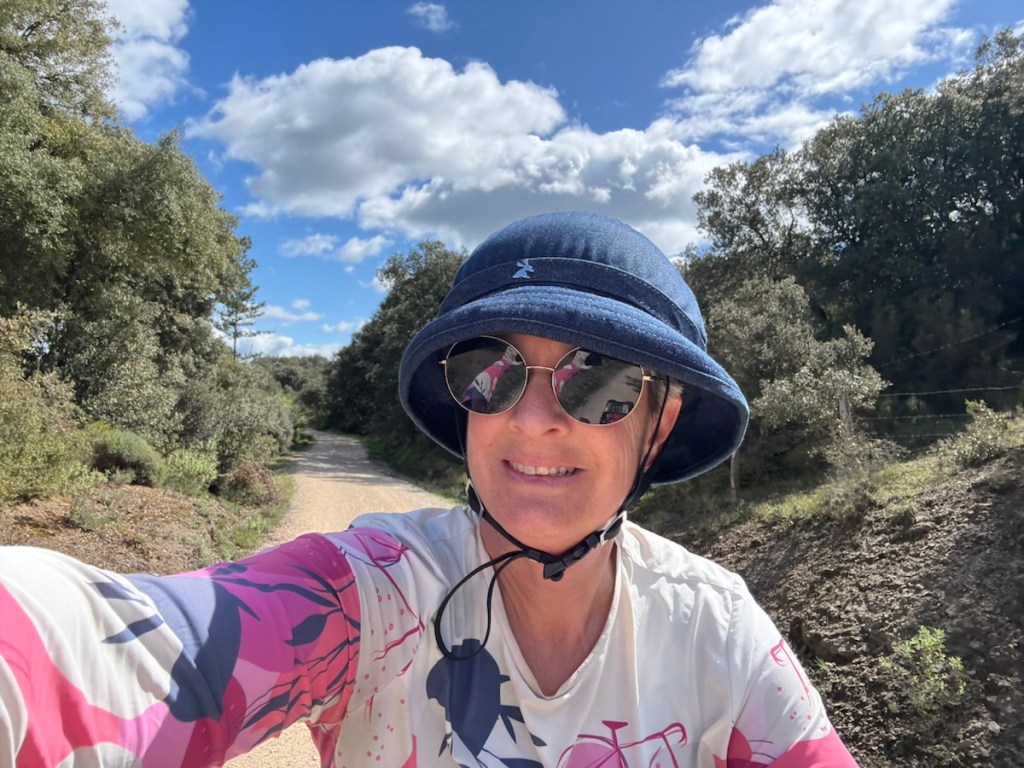
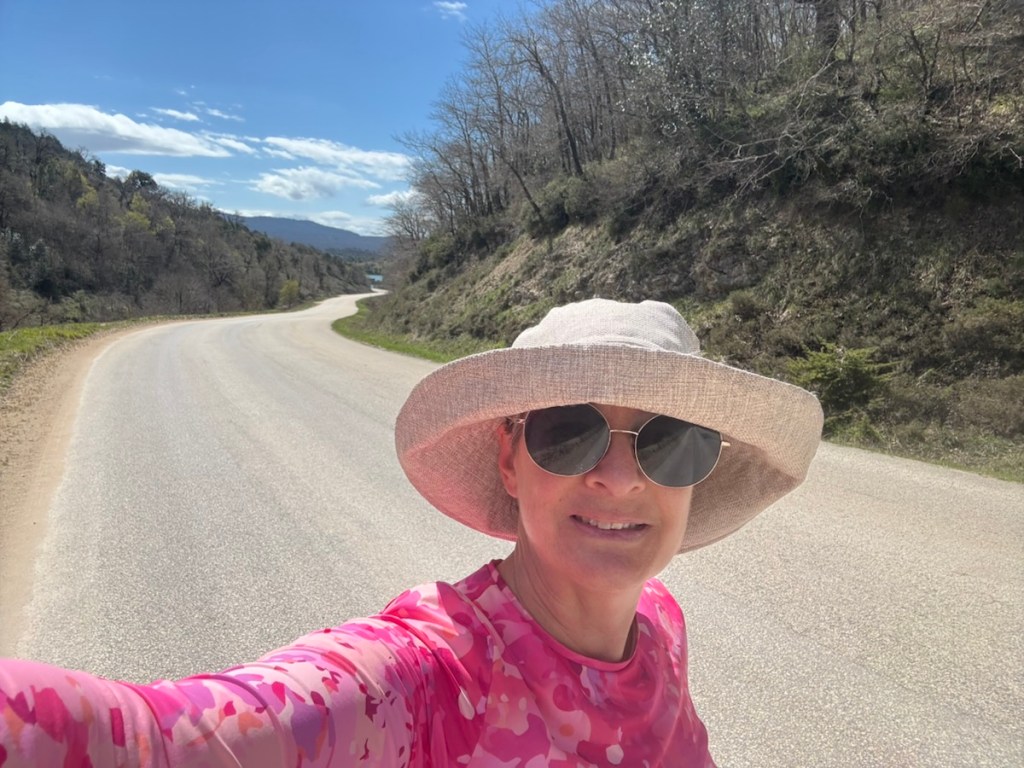
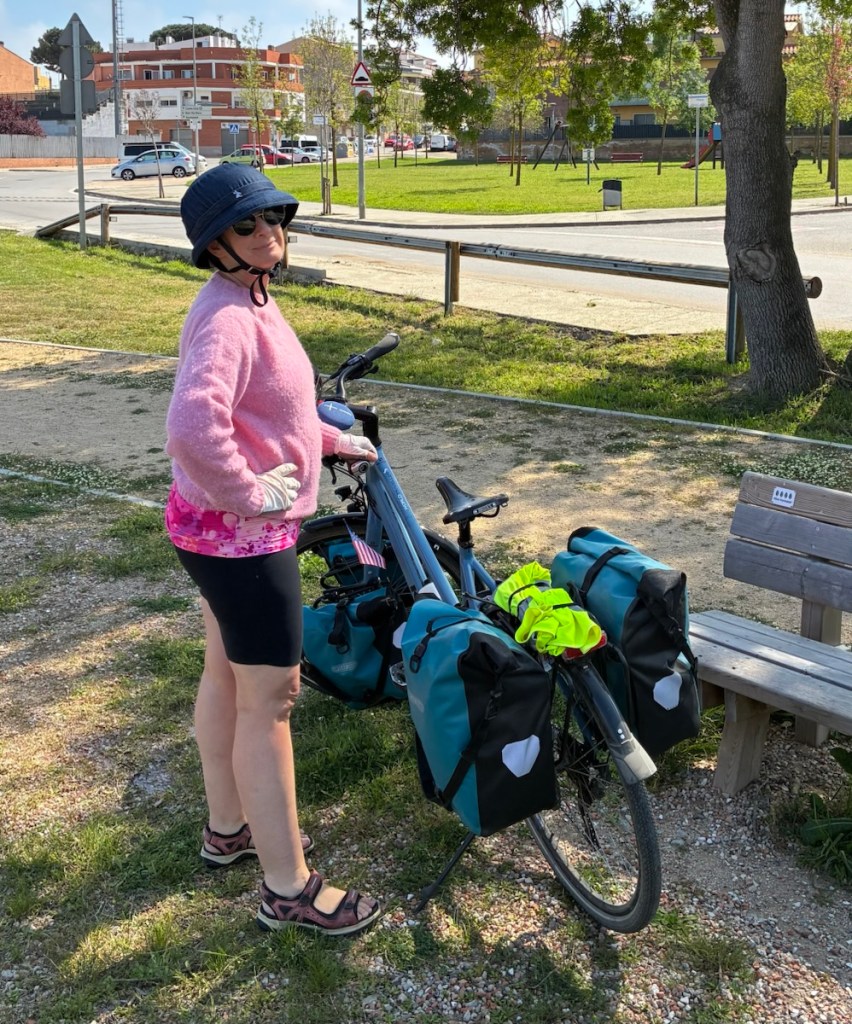
And this is what I was wearing. Pink flowery top and a straw hat helmet cover. Sandals. Sun gloves. Hilarious. Rich waiting, not at the summit yet, but up the worst of the climb.At the summit. The view back to San Sebastián. Saucy riders! What a beautiful day we got. Rich and the summit sign. King of the Mountain! That’s my downhill face. Big smile.I like the signs put up to inform cyclists how steep the road is. Motivational?Mountain bikers, road cyclist, and faint words on the asphalt from the Clásica San Sebastián road race.A shade break at the Hermitage of Guadalupe. Familiar to us from our Camino which started in Irun, just down the mountain.Down we go.Rich points to France!Across Etorbideko Zubia, the bridge over the Bidasoa River, the border with France.We give the nod to France over Spain for bike infrastructure. But Spain wins for super nice cyclists and considerate car drivers. Hendaye, a sunny day at the beach before the storm blowing in. Still fascinated by these sheep.And how cute is that lamb?Over another hill. Coming into Ciboure, the town before Saint-Jean-de-Luz where we’ll spend the night.More beach goers. It’s a Friday and this weather is not going to last much longer.The happy travelers overlooking the Grande Plage of Saint-Jean-de-Luz. Our Basque horseshoe. The blue dot is us in France again. We’re actually still in Basque territory, French Basque.Celebrating with pizza right before the wind blew in. All the other outdoor diners headed inside. The next day’s ride will be a bit wetter.
So did we enjoy our Spain bike tour? Yes! The Coast around Barcelona was not our favorite, as we’ve explained we both avoid hot weather and I’m about as sun phobic as they come. I think we just hit the right season for us, any hotter and there would have been epic meltdowns. And, as I’ve repeated, Basque cyclists are so welcoming and friendly. Spanish car drivers are among the best around cyclists, maybe the Swedish are just a bit better but that’s also due to better cycling infrastructure that gives bikes their own space. Spanish car drivers behave admirably well around bikes even without much infrastructure. Food – yum! Late dinner hours – eh, we adjusted and slept later than we usually do. There is no fighting local customs. All in all a lovely small dip into Spain. And now we are even bigger fans of the Basque Country.
One is amusing, two is a trend. Rich in front of the second Spanish town sign we found.
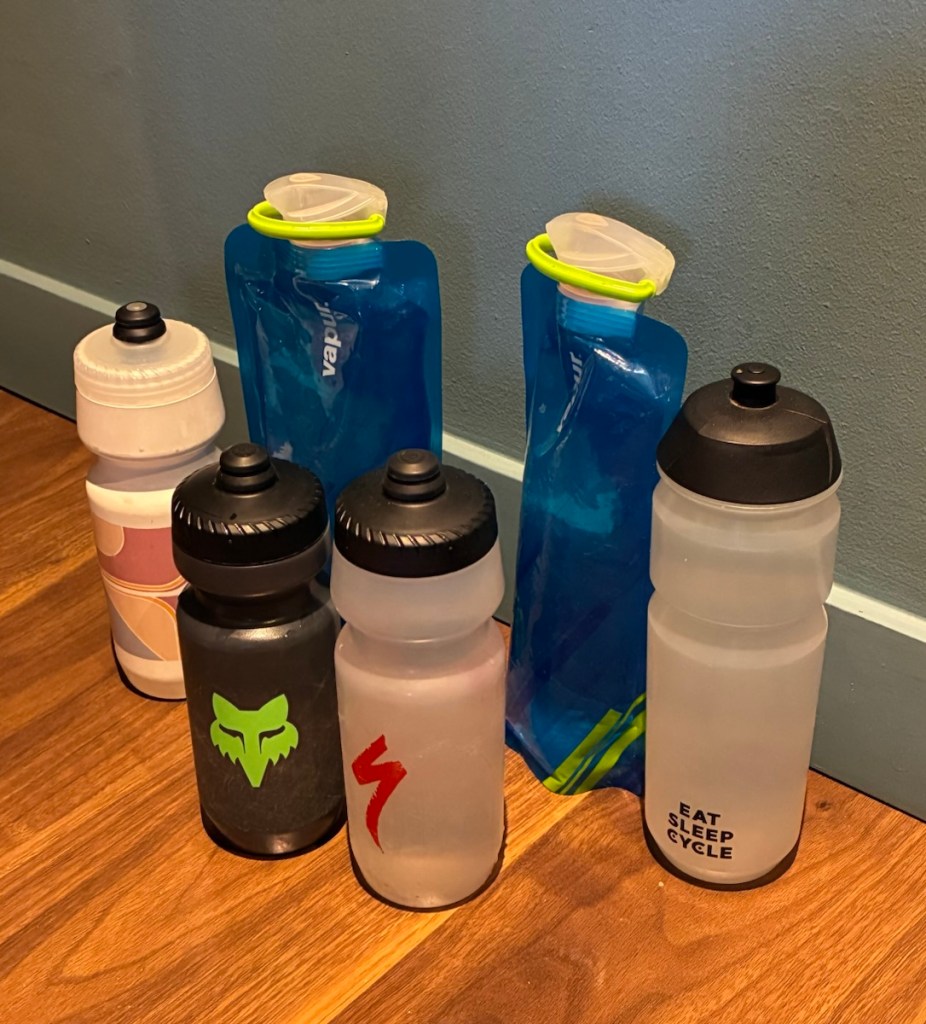
The drill when we arrive in a new town is as follows. Roll up to the hotel, Rich goes inside while I get the bikes ready to go stay wherever they will spend the night- garage, storage room, corner of the lobby, or occasionally our room. I empty the water bottles and stuff them all in one of my front panniers for easy carrying so we can rinse and refill for tomorrow. Rich checks us in, a new rule in Spain makes this longer than we think it should take. Not just scans or xerox of the passports but address, names, and signatures on either actual paper, or a tablet form. We haul all the bags to the room, frequently at the end of a loooong hallway, dump bags, shower, wash out the days’ cycling clothes and drape them all over the room to dry. If there is a heated towel rail we struggle to figure out how to turn it on to sped up the laundry drying. Chill for a bit then head out.
After a quick early (by Spanish standards) dinner we head to the procession route. It’s Good Friday. We stake out a spot right at a turn.Charmed by the children in the procession. Note the thorny crown with small Jesus on it.I guess due to the hill on which the Cathedral sits, these floats are on wheels. The other two processions we saw were not wheeled.As the darkness came on, the drama heightened.Even without understanding the full meaning, these processions are powerfull.I spend some time imagining everyone ironing their robes and fretting over which shoes to wear.We got a glimpse of snowy mountains as we headed to our Cathedral tour the next morning.The old cathedral tried its hardest to fall down and the tour of the restoration is just amazing. Thank you for the tip Hannah! Another city, another pretty chocolate shop. A sculpture by Juan Jose Eguizabal “El Caminante” The Walker.“The Bullfighter” by Casto Solano. A popular spot to sit and snap a photo.Dinner at a gem of a restaurant near our hotel, Restaurante asturiano “El Chigre ALI13”. This is a cachopo. An Asturian dish of pounded veal stuffed with ham and cheese.What and where is Asturia? Another autonomous region of Spain.
We had never really heard of the Asturian region of Spain. This is our favorite part of travel, finding out about all the things we don’t know. As we headed into the Basque countryside on our bikes we would come to see and understand how different the culture is. At one point we said this is foreign on top of foreign!
Leaving Vitoria-Gasteiz, Easter Sunday, on a colorful trail through an industrial area.Quickly it got rural.Rain and a junior pro bike race. Rich started chatting with Mikel, a local cyclist, and he filled us in on the race and rode us down the big hill for coffee.Our first taste of how friendly and welcoming the Basque cyclists would be. Thank you Mikel.
Even though it was Easter Sunday and we assumed most places would be closed the cafes were open until 2 pm, at which point everyone headed home for Easter lunch with family. We were glad to meet Mikel for many reasons, and I was so happy to have him explain to me that what the road cyclists were calling out to us was “Opa!” which loosely translates as “go up” in Basque. I’m not sure I have the spelling correct, but once I learned that did I call it out to almost every cyclist who passed me on the climbs? Yup.
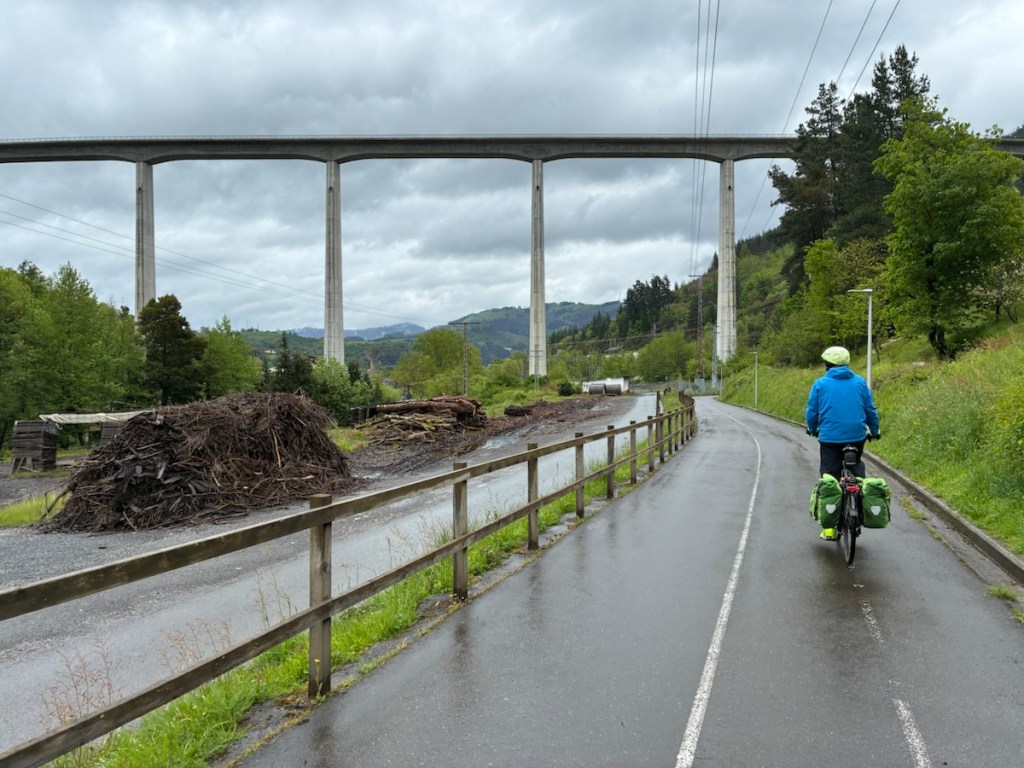
We said goodbye to Mikel and headed towards Bergara. More tunnels.And stunning new infrastructure too. This is a train trestle.Crossing the Deba River going into Bergara.One of the many beautiful buildings in Bergara.
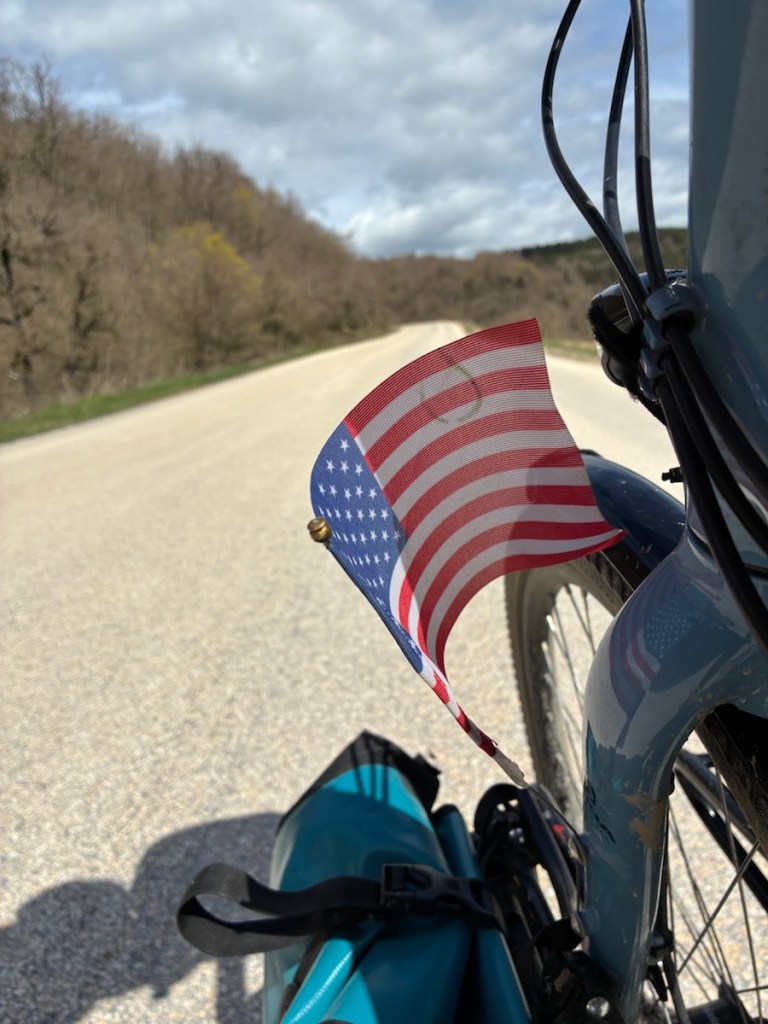
It is Easter Sunday and we were wondering if anything would be open at all. Would we be able to find a drink and dinner? Answer, yes! The bars and cafe were all open and restaurants were opening up for dinner at 8 or 8:30. We joked that Easter Sunday in Spain shares a tradition with Christmas Eve and Day in the UK – go get a drink. Or a few. On our ride to Bergara I passed a group of young men standing outside a bar smoking and drinking. Oh fun, I thought, my favorite- young dudes drinking. I was greeted with Opa! Fuerte! Hola! and then Hello! when they saw my American flag! Where are you from? A quick exchange and they waved me on my way still cheering. Not what I was expecting at all.
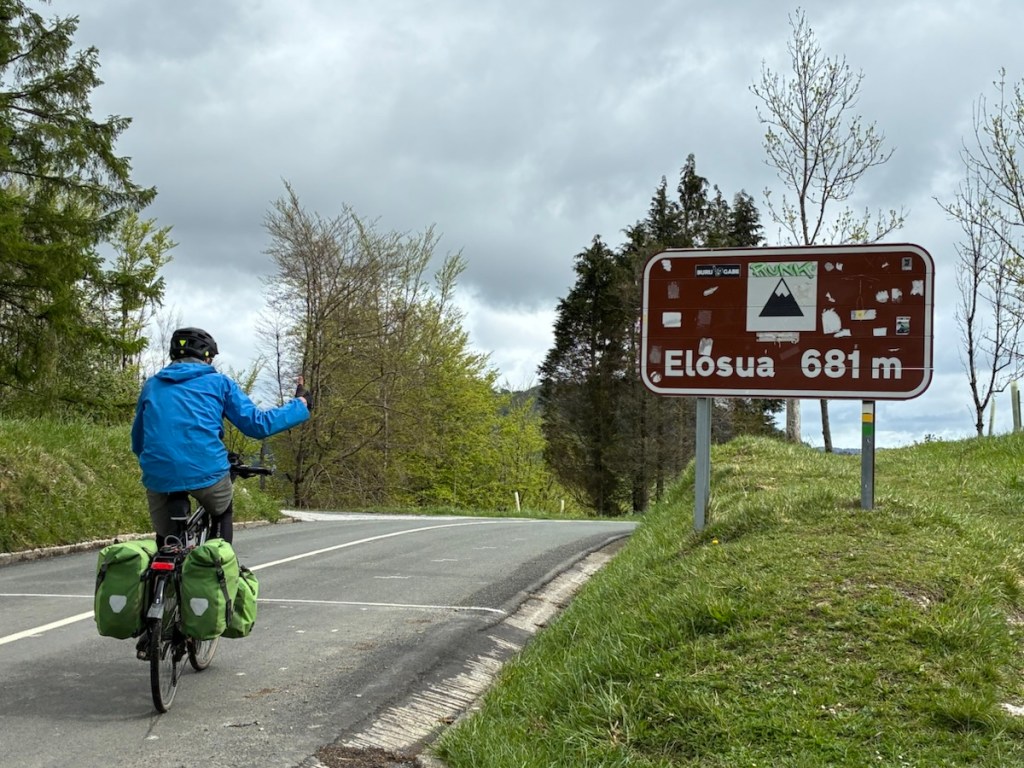
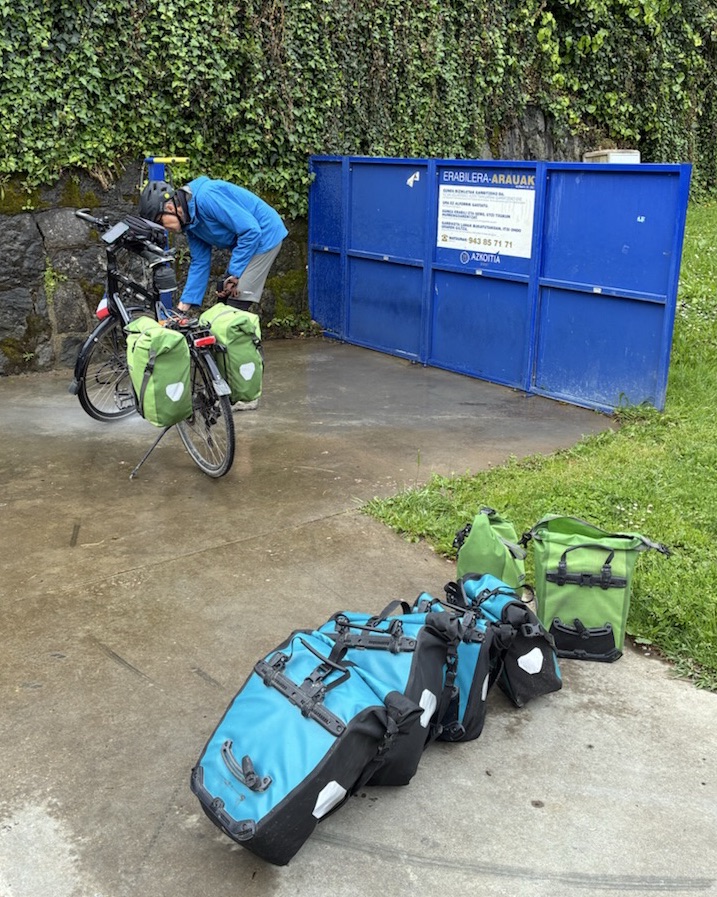
We’ve learned to adapt to Basque time. Pinxos and a drink at 6:30, after a 6:00 paseo (stroll) around town.Our 8:30pm reservation – the earliest we could get. We are the only ones in the restaurant for at least 30 minutes.We’re finishing up at 9:30 and folks are just arriving and ordering drinks.An after dinner walk around town. The lighting was so atmospheric and town so peaceful.The rain soaked cobbles made for an extra pretty evening.Ready to go the next am. We leave our hotel and immediately start our big climb of the day, up to the Elosua pass, 681 m/2,234 feet.Ready to climb? Starting at 160 meters for a 510 meter climb with loaded touring bikes.What a dramatic view.What a tough climb.There’s Bergara, 30 minutes into our climb.An hour into the climb and Rich finds a bench to wait for me.Now we’re seeing other cyclists. Not many bike tourists on this pass (none) so we get loads of hellos and opas!Photo opp or screaming legs break?Clouds are coming in and another view of town, to the far left you can see the train trestle from the day before.Rich had enough time at the top waiting for me that he set up a chair! He graciously gave it up for me once I arrived. My time was two hours up the climb. Not setting any Strava records, that’s for sure.The king of the mountain.Starting down on smooth asphalt. A hint of rain coming on.There is a little tiny Rich in blue. He’s off like a rocket sled on rails.A turn onto a smaller less smooth road to connect us to a rail trail.Another stunning church spire. And onto the Via Verde del Urola.Wildflowers against blazing greenery.Lunch stop in Azkoitia. Iglesia Santa María la Real de la Asuncion. The view down the Urola River. I love how folks hang laundry out the windows, but I would worry about wind taking my clothing and flinging it in the river. Good pegging skills I guess.The wisteria on this riverside building. Dramatic. It was so nice to know we’d find water taps.This was a first. A bike wash station. Just as we headed out of town.Our bikes needed it. They were still showing signs of our muddy Pyrenees crossing and gravel riding in the Navarre.So shiny and clean!
Our audience while at the bike cleaning station was a young mom and her tiny son on his scoot bike. He watched, fascinated, and his mom obliged him by spraying off his little bike when we were done. My Spanish is quite basic but enough to start a conversation, and the little US flags again did their jobs and she switched to excellent English for the rest of the chat.
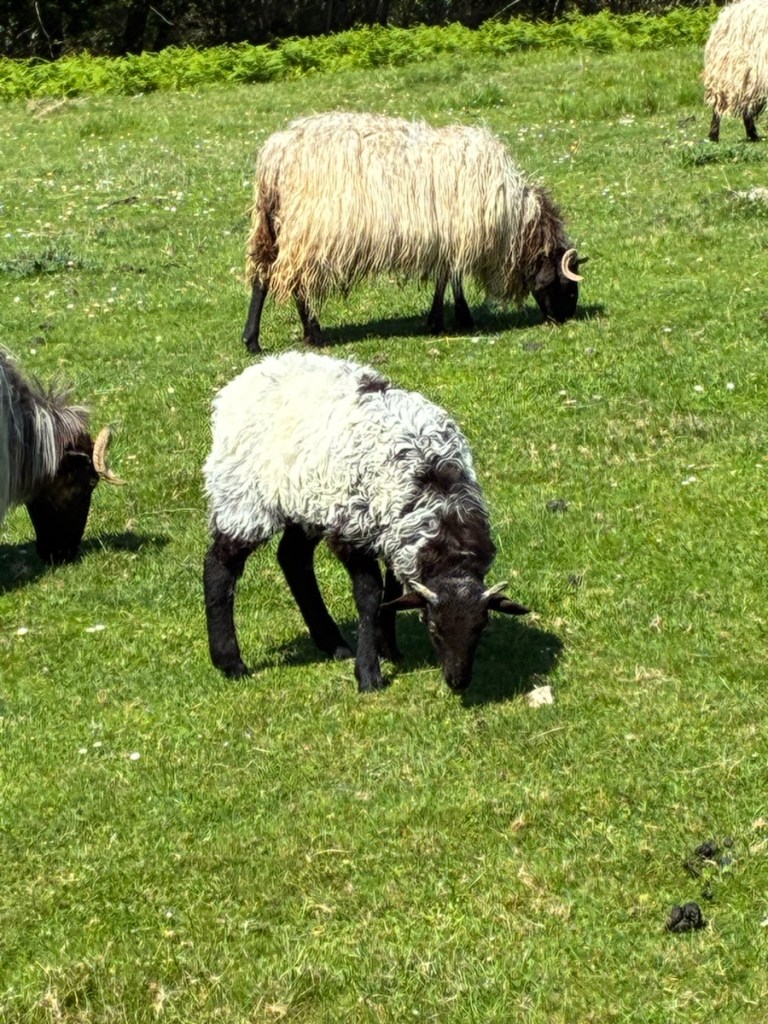
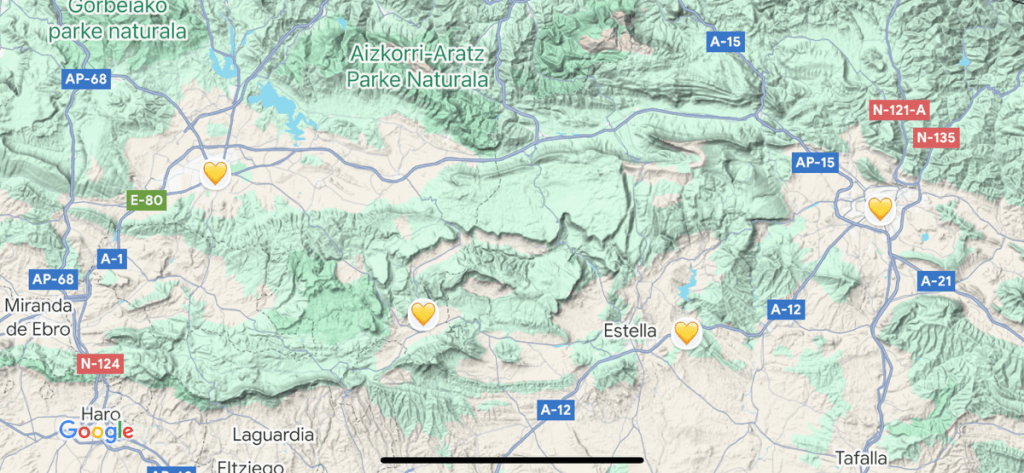
Hanging with the locals in Aizarnazabal.A day bike touring can feel so long. You really get to experience the changes in terrain and whiplash from city to town to countryside. No grocery stores in town but one bar sold some basics, so eggs it is for breakfast.These stunning sheep across from our casa rural in Aizarnazabal!Curly horns and long fleeces.Heading out in the morning after a scrambled egg feast.Barely two minutes from the hostel and I’m already pushing my bike.Headed through Zarautz to San Sebastián. But first, another hill.Pastry break in Zarautz, a famous surf town and on the Camino del Norte.We came through here two years ago, on foot, with our friends Christine and Cecily.We all sat on this bench two years ago.Camino Pilgrims headed to Zarautz and eventually Santiago de Compostela.Down the hill through the vineyards.Through Orio and a picnic lunch break.We leave the Camino (which we are riding reverse direction here) and head up a steep steep little path to avoid the busier road along the river.Steep enough that Rich comes back to push my bike up some stretches.Stunningly beautiful as we ride by farm land.A perfect weather day. Sunny at times, cloudy at others, no rain. Just us, the road, and the occasional farm vehicle.And there it is! San Sebastián. A three night stay awaits. And a lot of yummy food. But that’s for the next post. The lower heart is Zaragoza, the long gap is the train hop to Pamplona, and then our horseshoe route in the mountains.
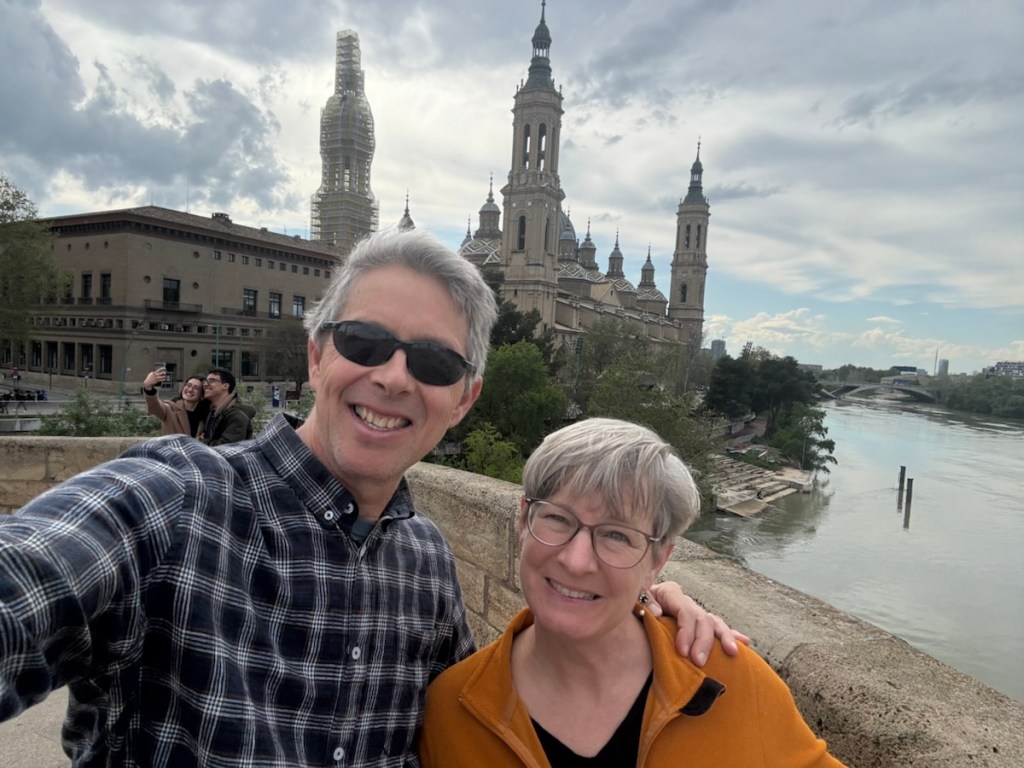
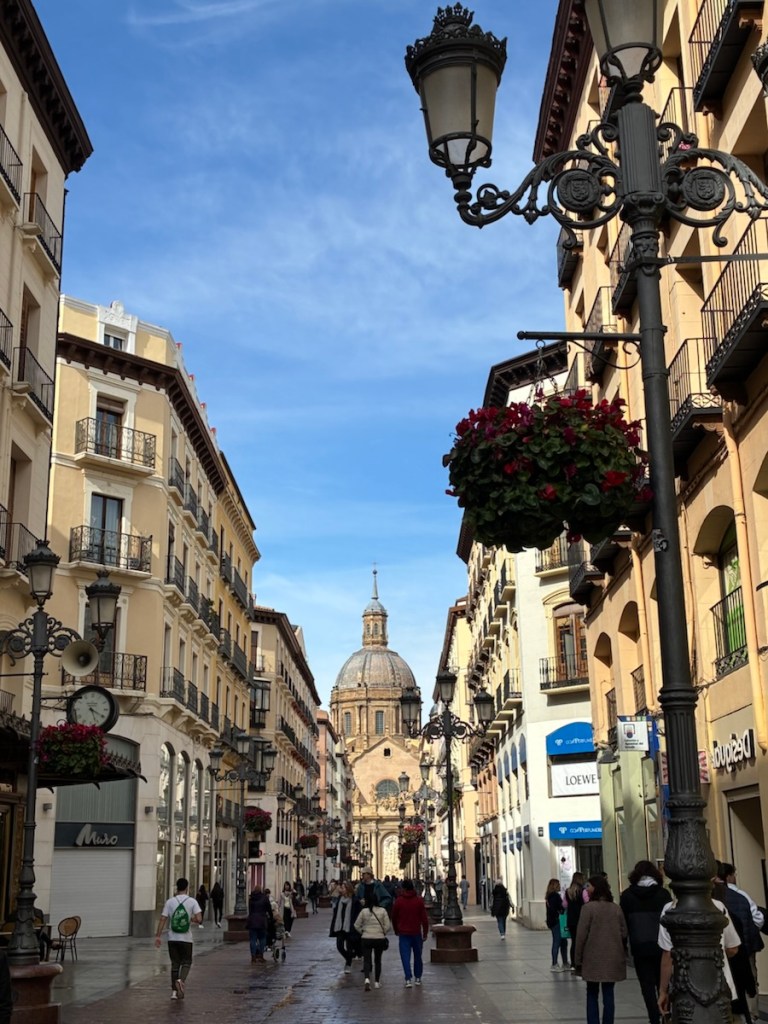
Zaragoza. Cathedral-Basilica of Our Lady of the Pillar behind us.
Our first train hop to get me out of the sunny Spanish coast was from Tarragona to Zaragoza. Rich could tell from the map landscape that it would not be a good idea, or fun, to pedal across the plains of Spain with a sun adverse travel companion like me. So trains it was. Mission: get Cheryl to greener northern climes. And it wasn’t even hot yet. So much for our Spanish bike touring, huh?
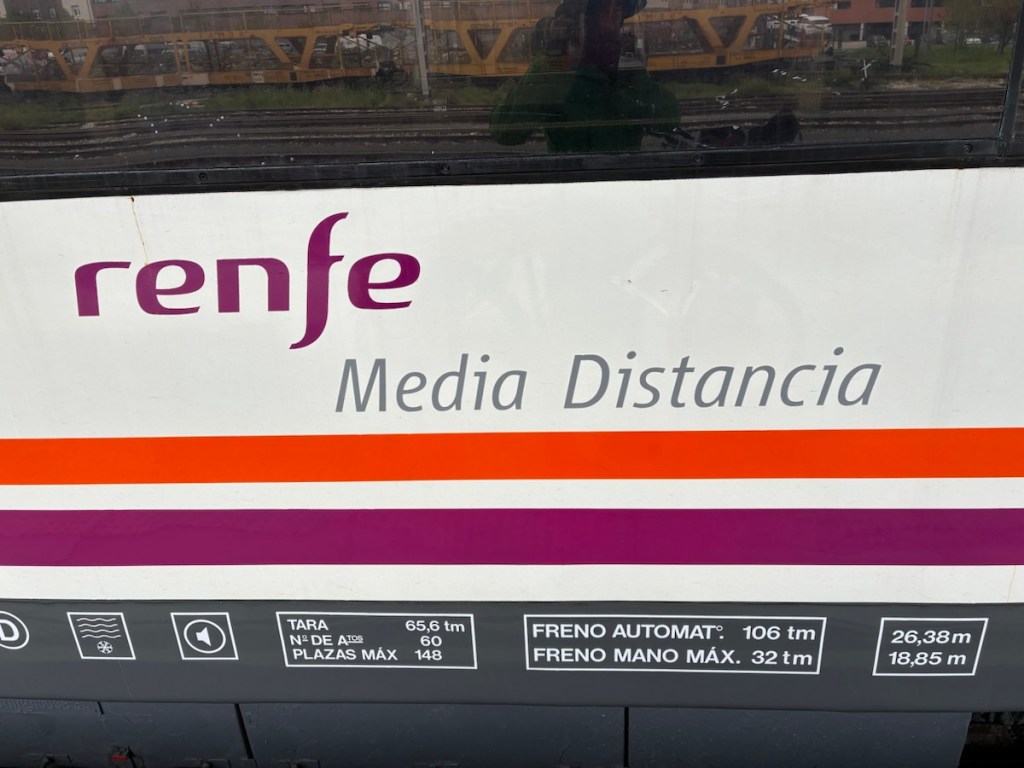
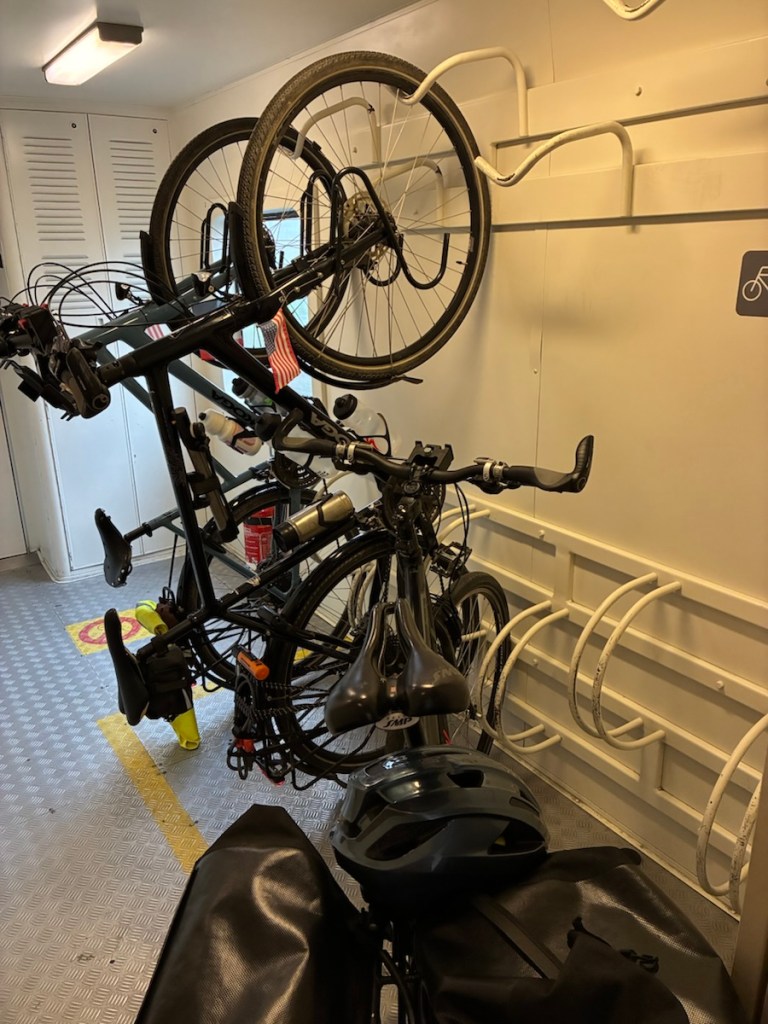
The Renfe media distances trains in Spain seem to have two distinct types of rolling stock.These older train sets with narrow doors and three steps. This was our first train to Zaragoza.With bike hooks – my nemesis. I can lift my bike up, but only if the train is not moving and I have loads of space. Rich is the bike lifter when it comes to trains.The other type are these lovely wide doored newer train sets. Second train to Pamplona.These newer cars have much easier access: one small step in and loads of leaning space. Of course, you have no idea which train you will get. The waiting is stressful.
Bikes with touring gear on trains are not always, almost never, easy. Our first train hop ended up being the older and less bike friendly train cars. A train station attendant told us the bike car would either be the first or last car, so we waited at the beginning of the platform so the train would go by us and we could see the bike car. First car. Of course. High boarding. Of course. As we ran up the platform to reach the bike car, dodging other passengers and their rolly bags, we knew it would be a fire drill train boarding. Yank the bags off the bikes since they would be too heavy to lift up into the train. Rich grabs the bags and chucks them on the train as I stay on the platform with the bikes. Rich gets through the narrow door with one bike and by now the conductor is blowing his whistle so I grab my bike and attempt to jam it up the stairs as the doors start to close and I search for the door open button with both feet still on the platform and half of my bike through the closing door. We are saved by a super nice Belgium cyclist who is already on the train which started in Barcelona where he lives. He helps Rich get both bikes on and through a second narrow door to the bike hooks. Phew.
A strong rain had just passed so we got a nice ride to our hotel in Zaragoza and got to see this Zaha Hadid designed bridge.
When possible Rich books trains where we get on at the beginning of the run, and get off at the end. Mid trip stops like our boarding in Tarragona can be super challenging, especially if there are bikes other than ours and we have to navigate a bike dance – handlebars tangling, pedals hooking on spokes. Zaragoza was the last stop for this train so we had a calm exit. It would be a one night stay and a second train the next day. And that one ended up being a lovely low floor wide door media distance.
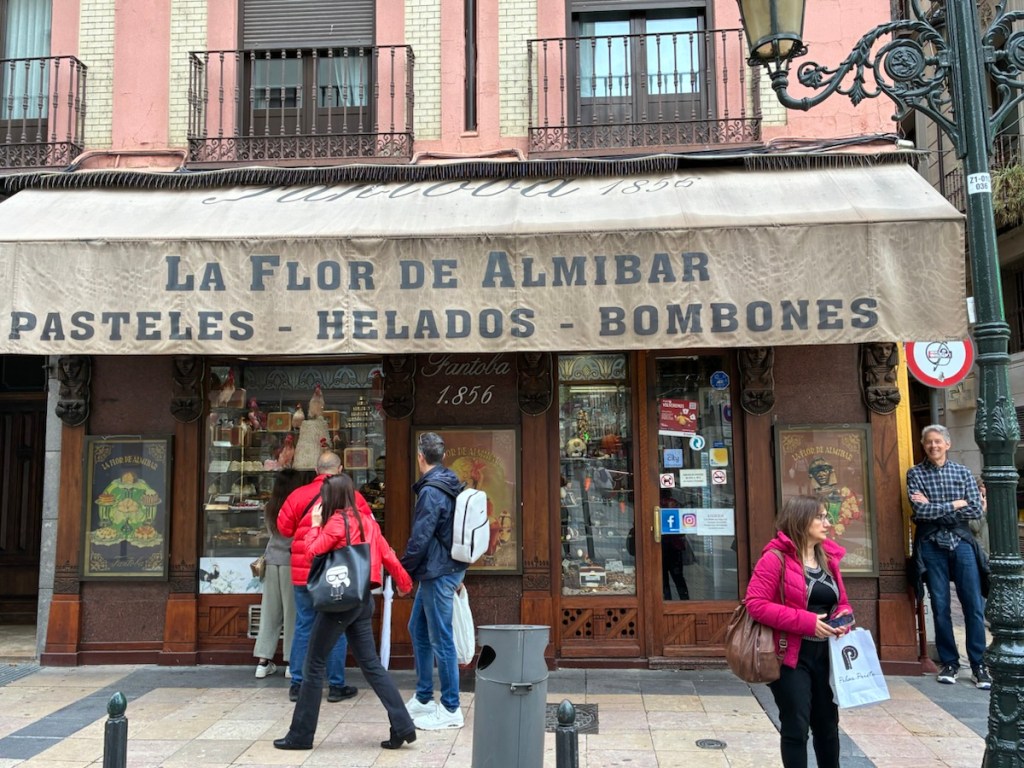
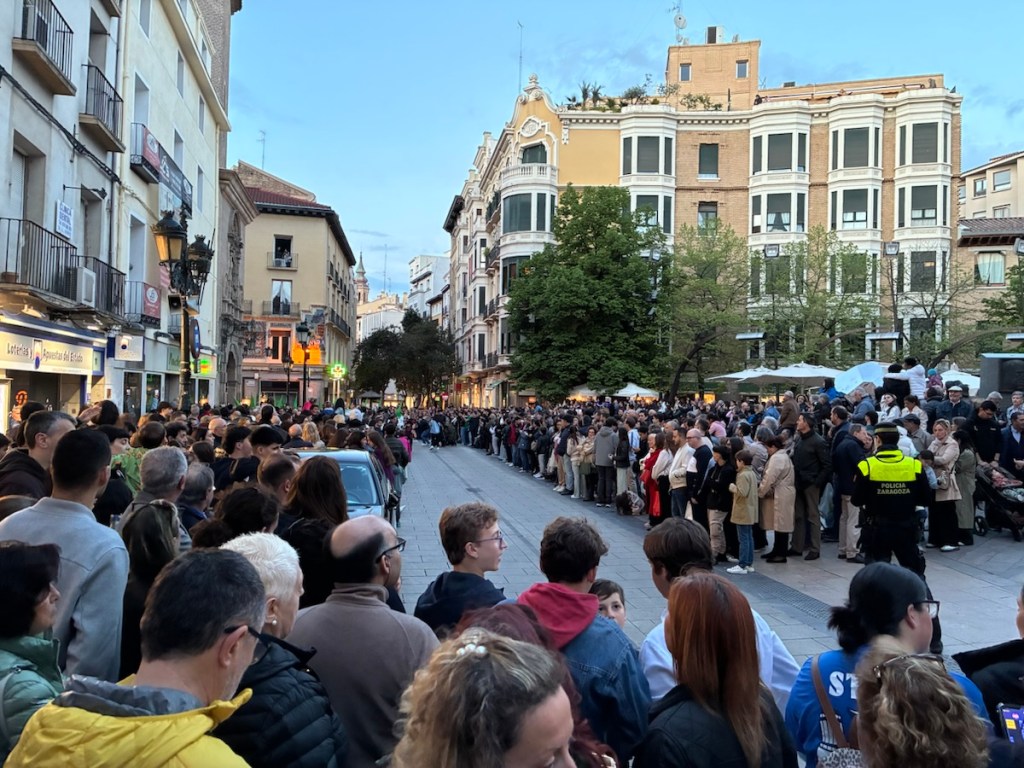
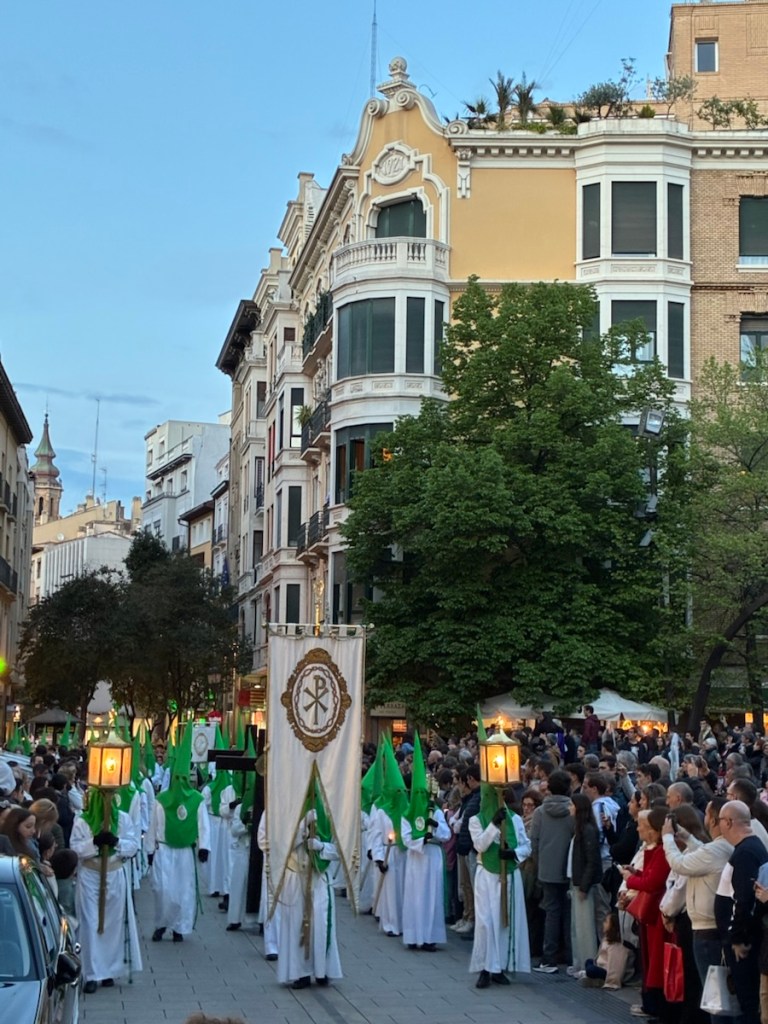
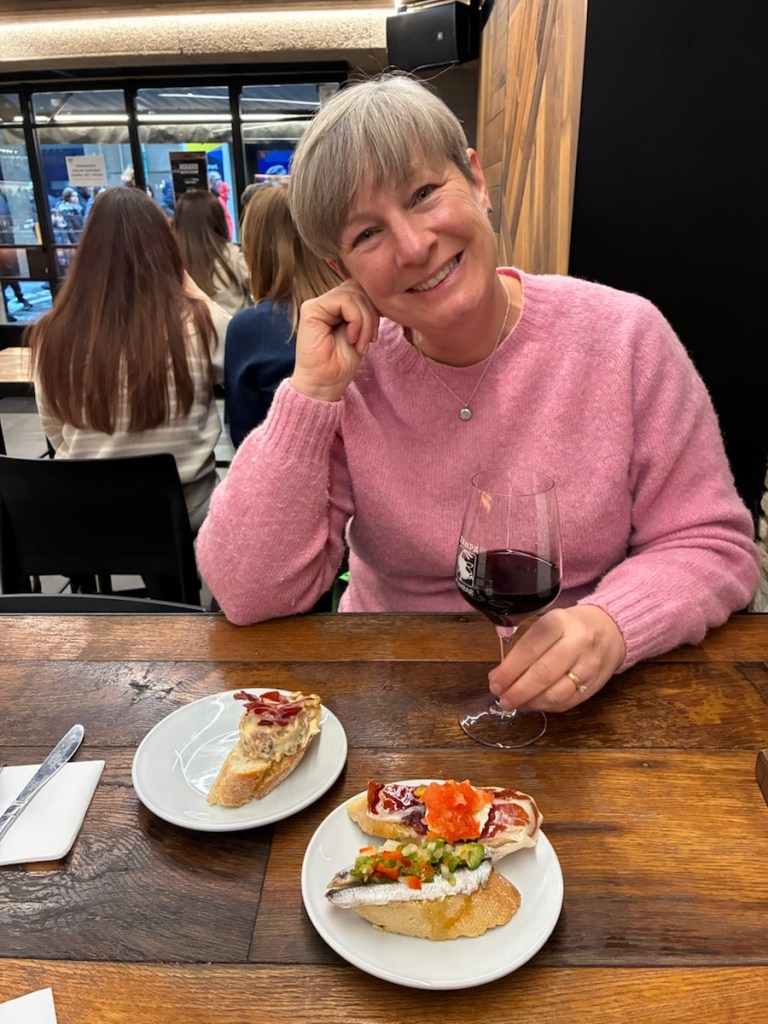
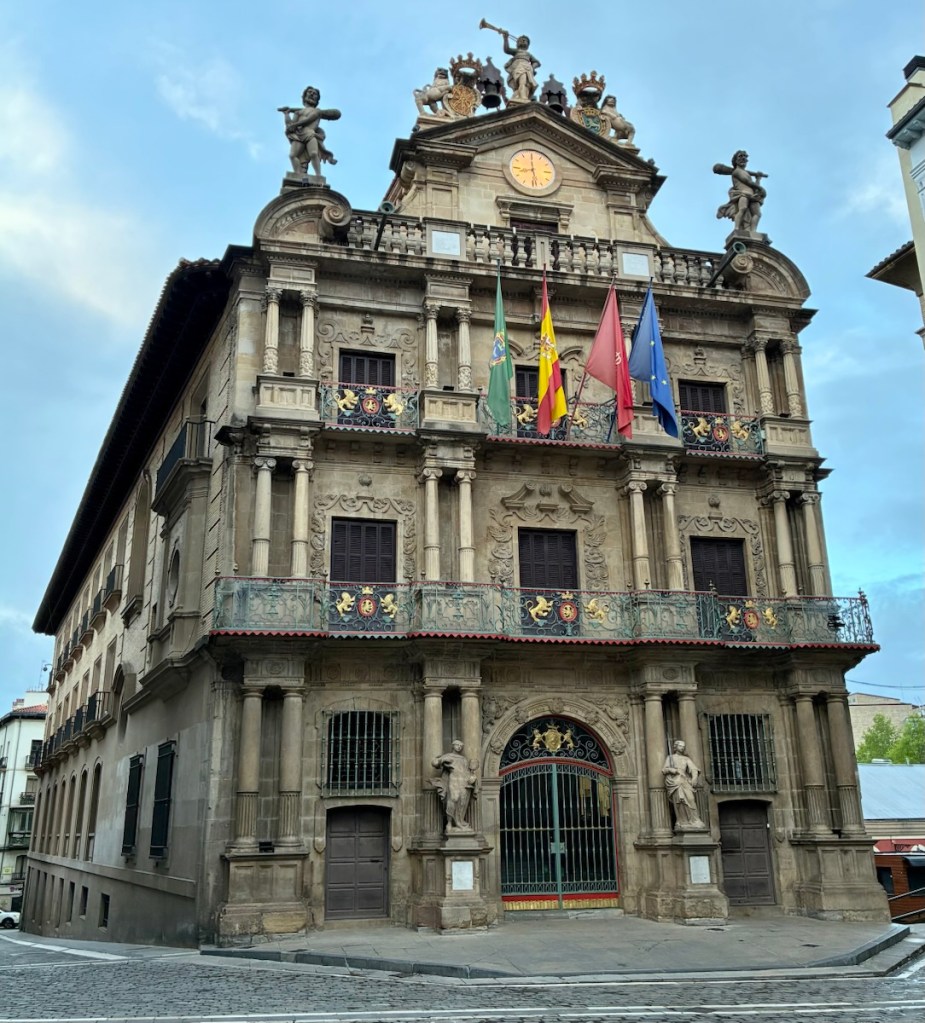
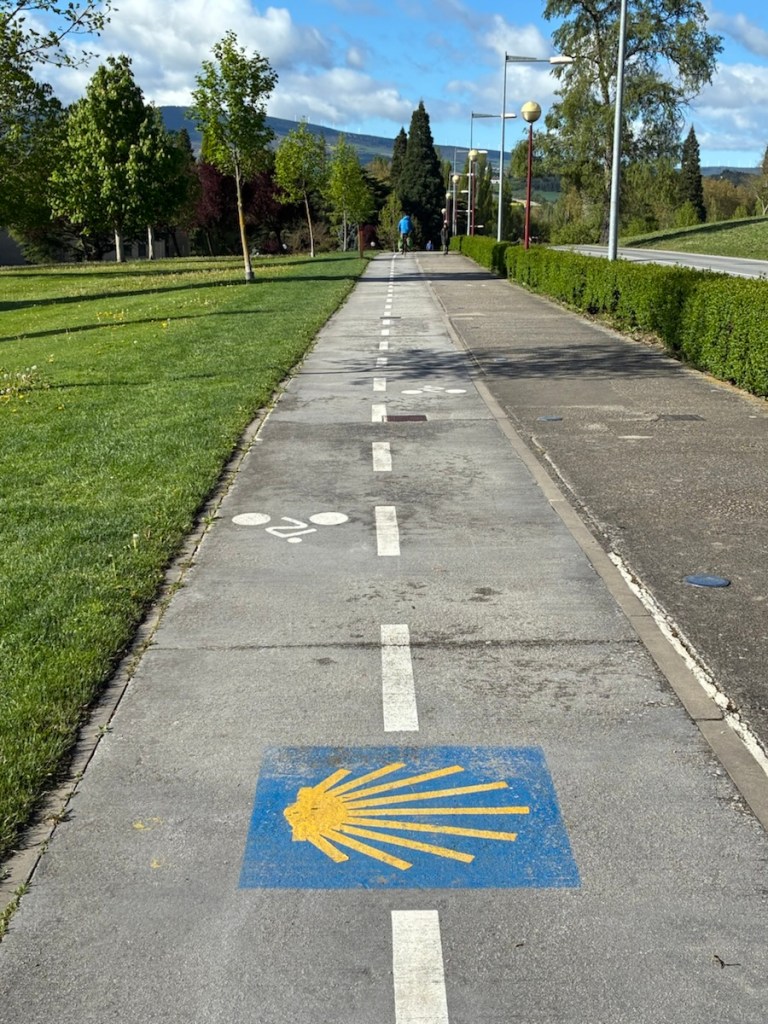
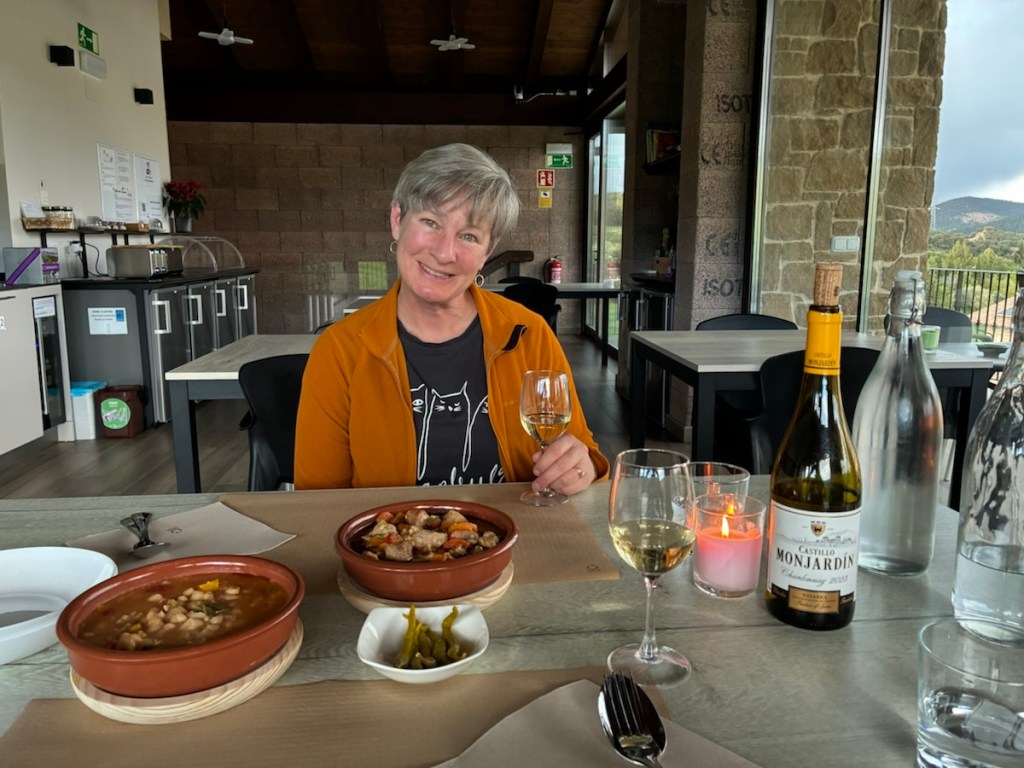
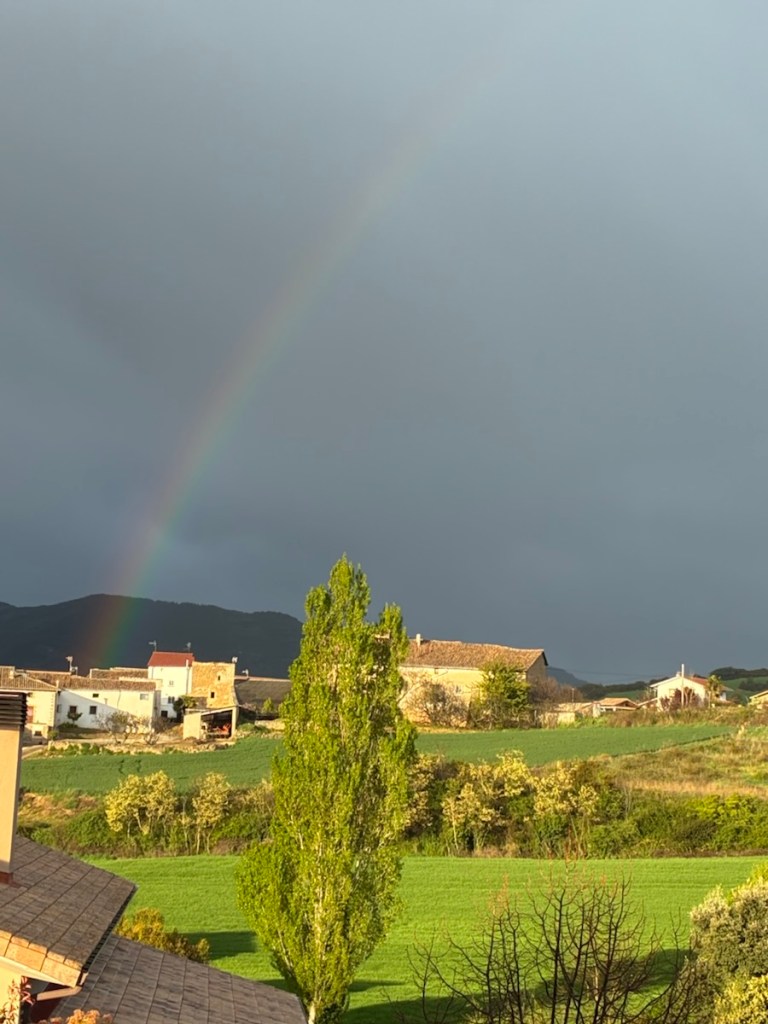
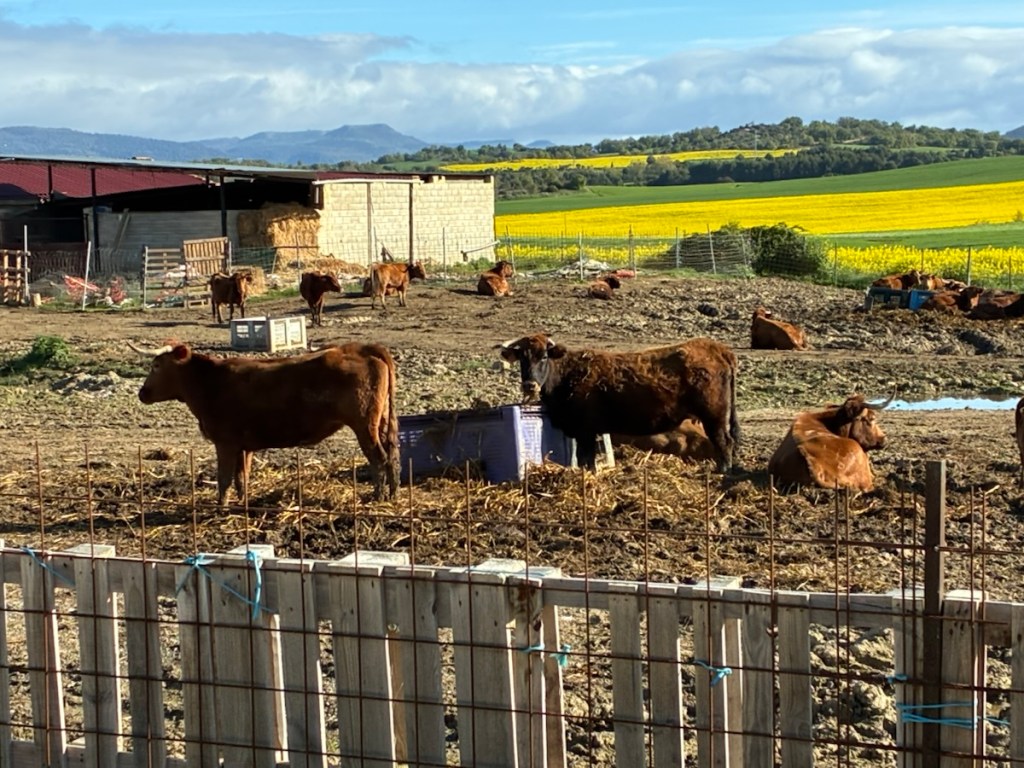
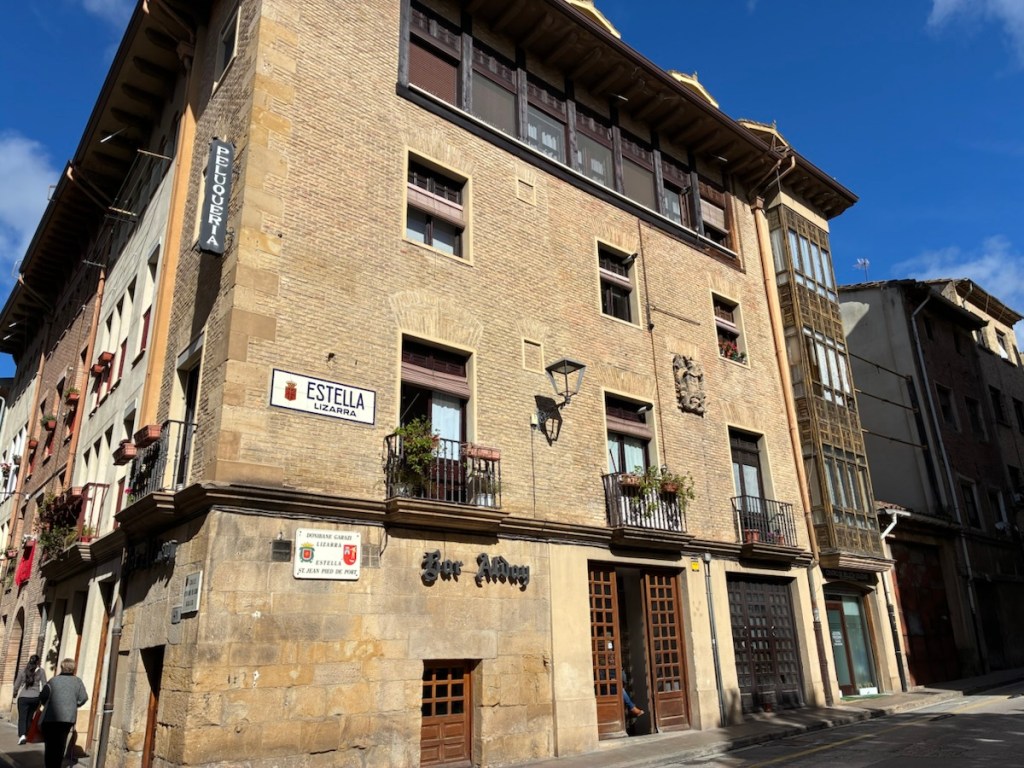
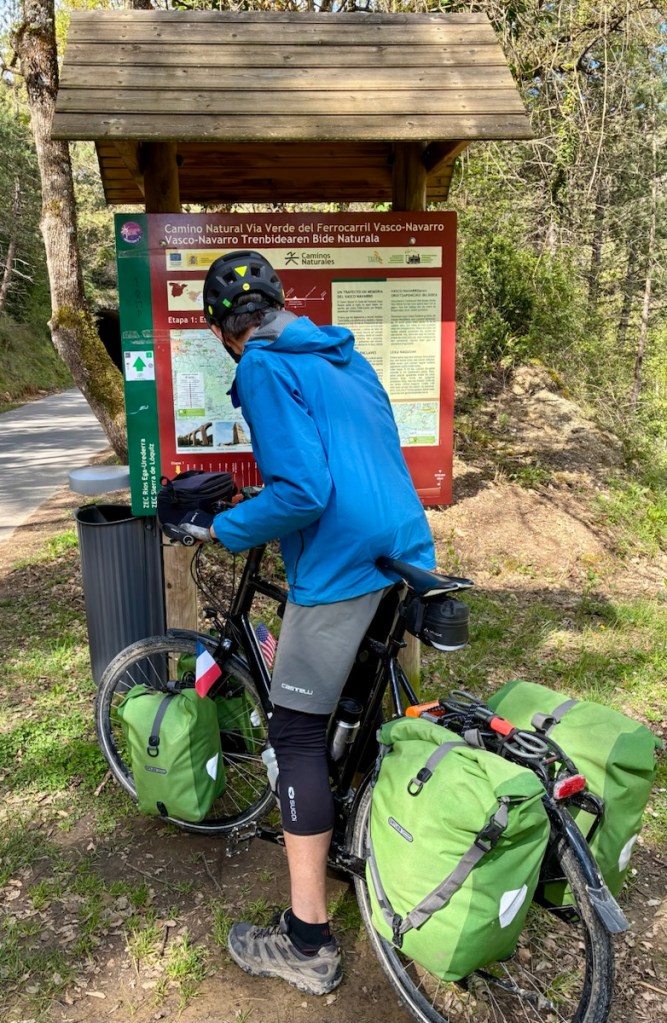
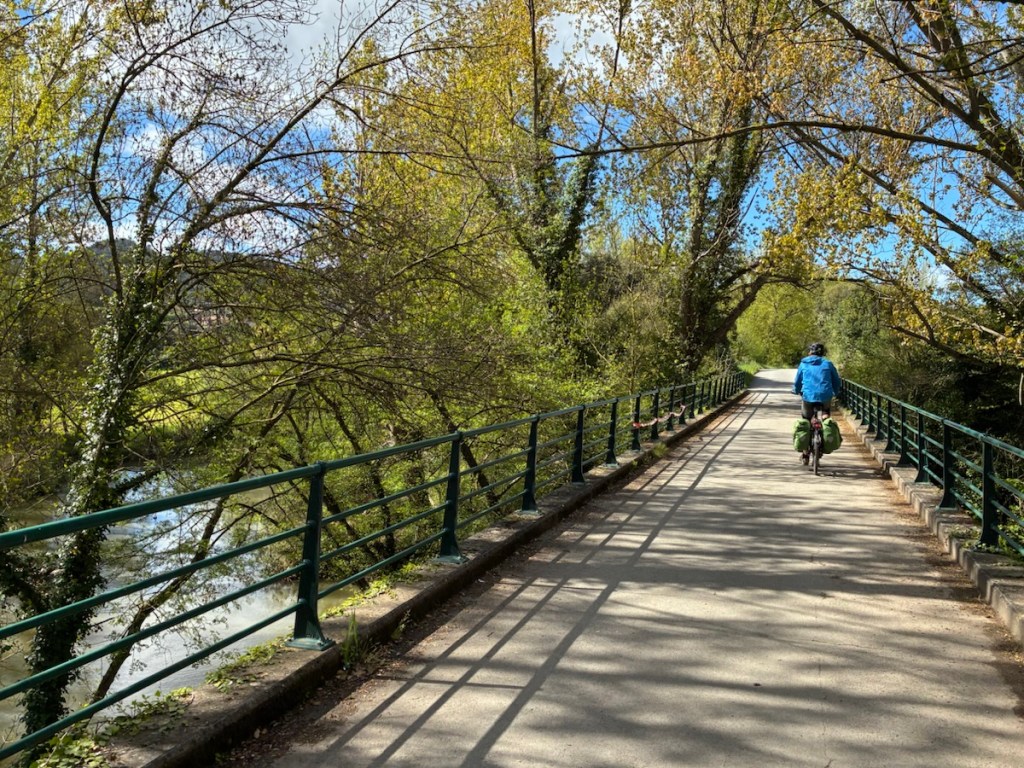
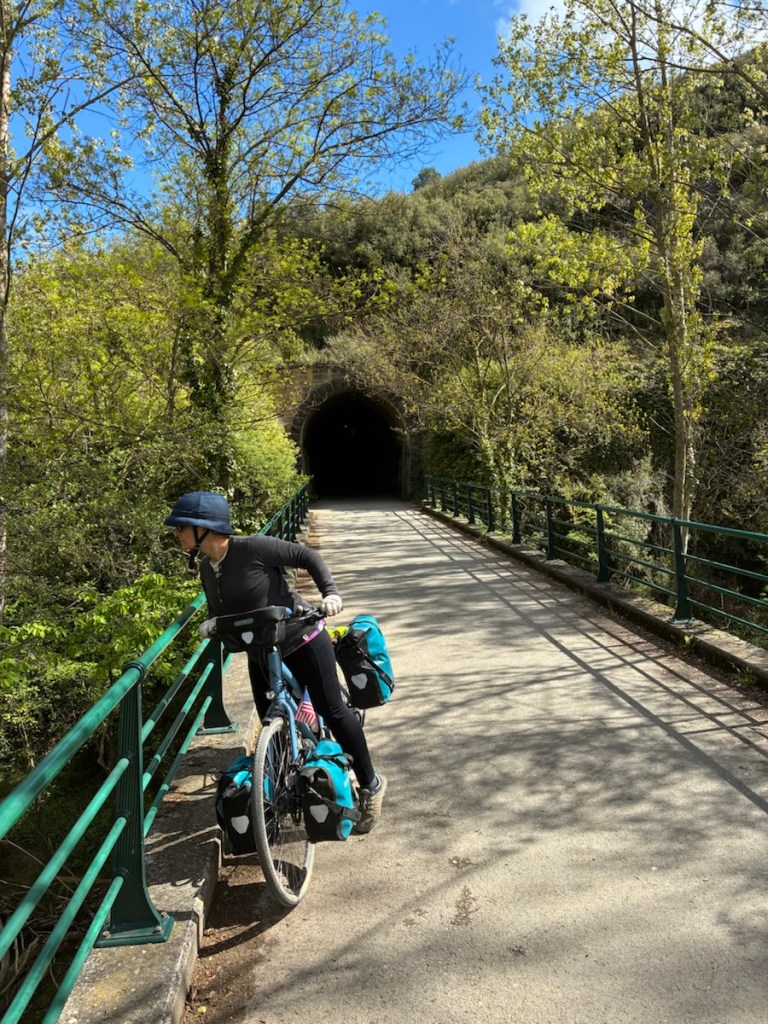
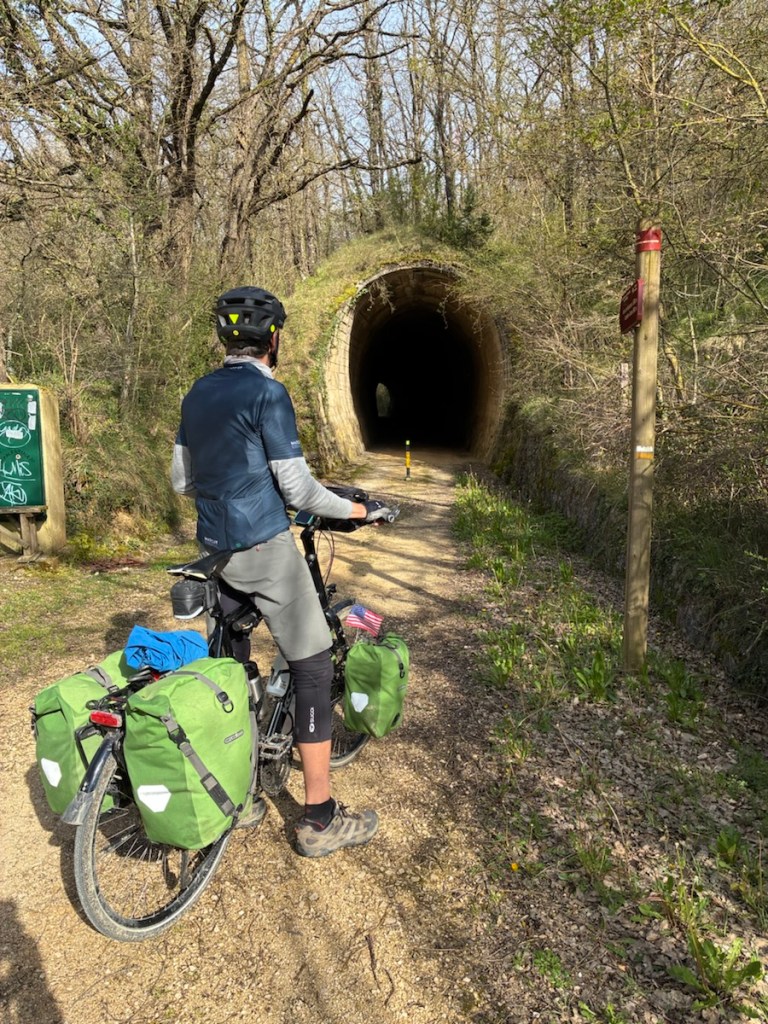
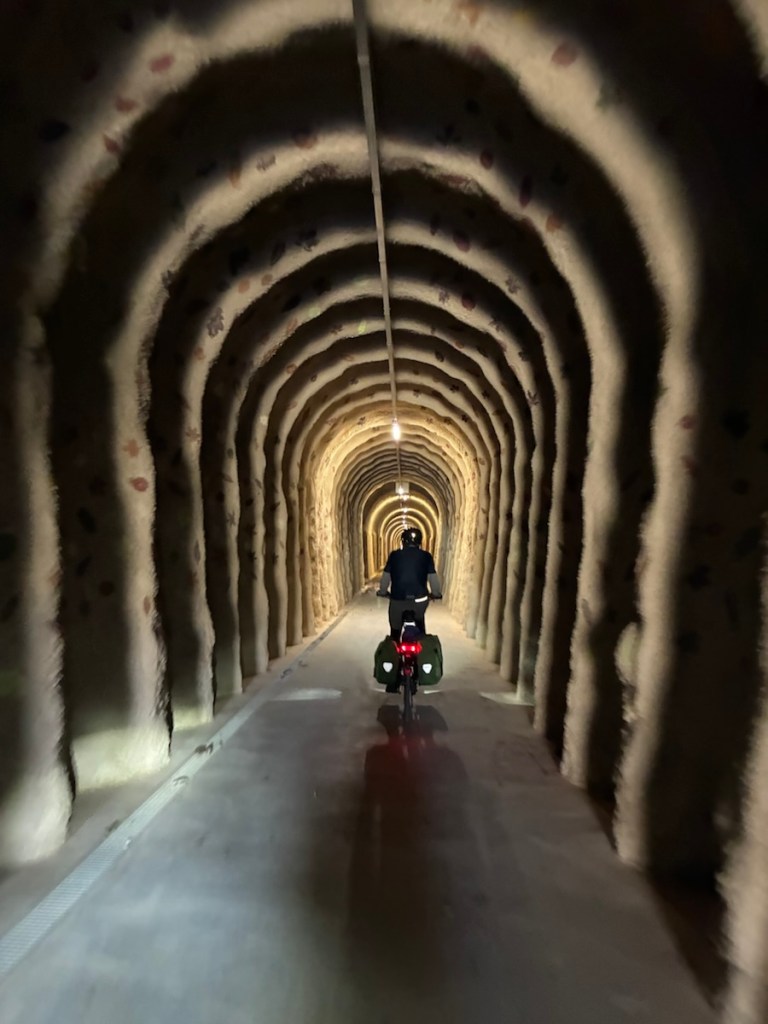
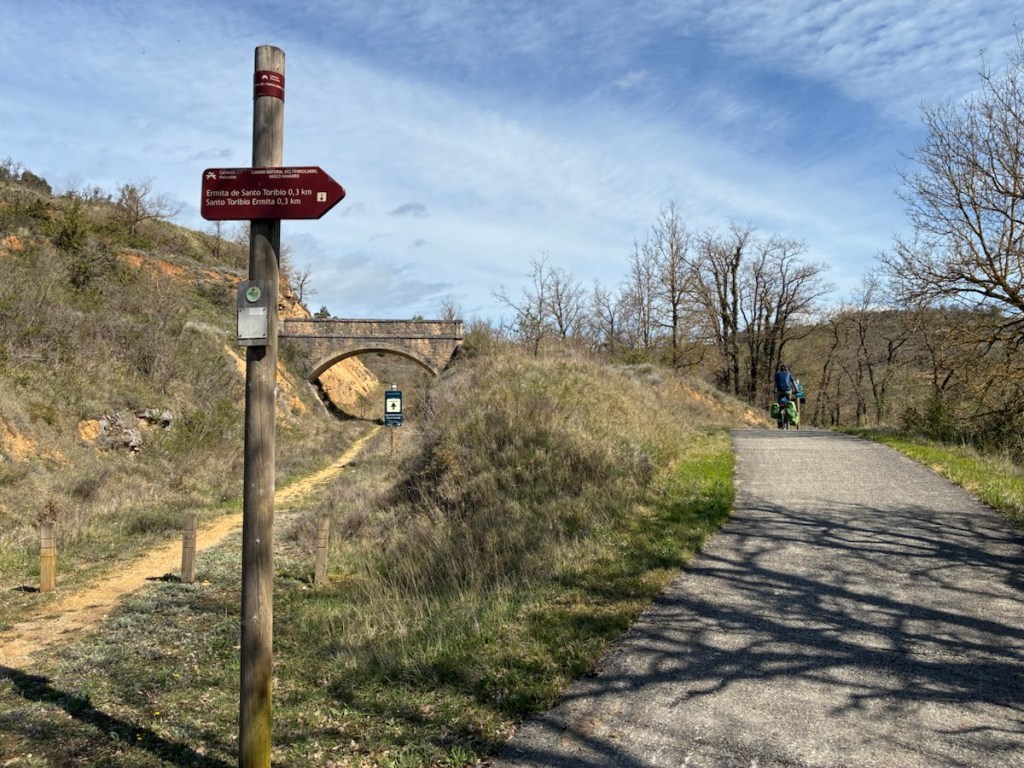
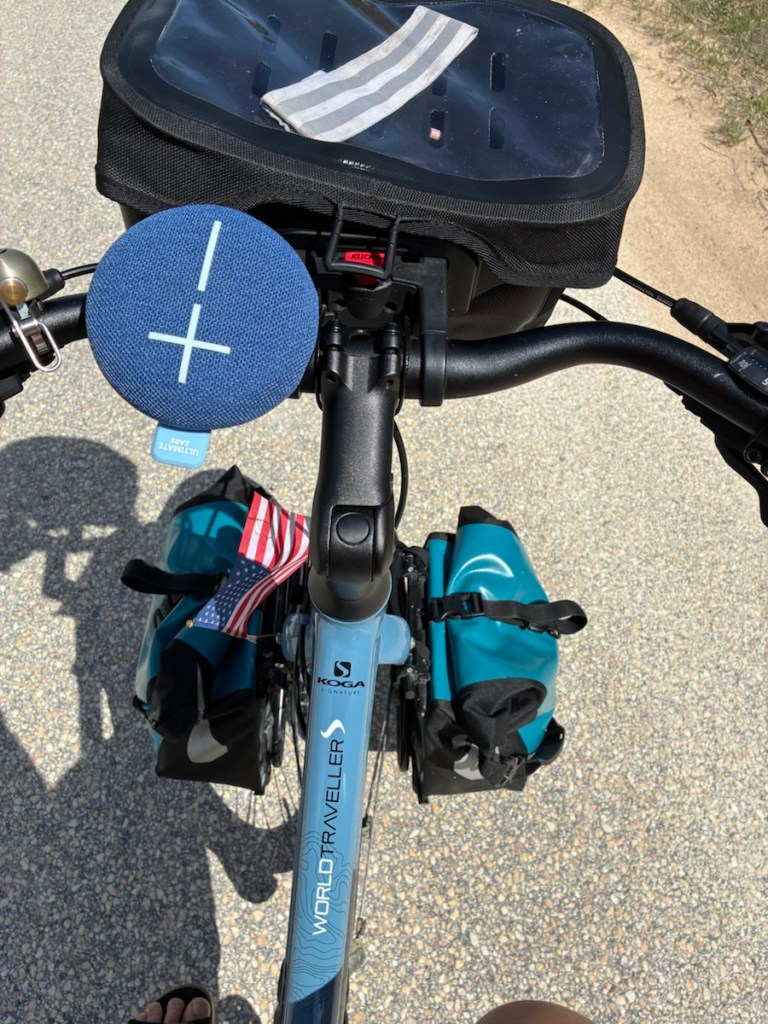
This was a fun first. The hotel brought out a ramp so we could wheel our bikes right into the lobby with panniers still attached.The sky cleared and all of Zaragoza came out for a walk. Zaragoza is in the Aragon Region Spain. Not Basque yet.First stop, the chocolate shop. Do I have room in my panniers for a cake? No.A beer, a glass of wine, and a little bag of chocolates, which I do have room for.After a quick ramen dinner we headed out to join the crowds waiting for a Semena Santa procession. Our second of the trip.Rich deployed his long arms for over the crowd shots.This was a somber and somewhat chilling procession. The drum beats were very loud and los penitentes in their capirotes (cone-shaped hats) were numerous.Our next train left after noon so we had time for a workout in the hotel gym, breakfast, and a walk to see the Roman bath ruins in town. These were discovered (uncovered) in 1972 when a neighbor noticed something in a construction site. Now it’s a museum and the ruins are protected by a canopy.Off and a slight backtracking to the Zaragoza Miraflores train station, so we’d have an end to end journey. Get on at the start, get off at the end in Pamplona. Pamplona is in the Navarre province of Spain. Still not Basque yet.Riding into Pamplona old town for a one night stay.Now the Pinxos feasting begins in earnest.How to choose?All delicious.Hello my darling Gildas. Olive, anchovy, and guindilla peppers. Spicy sweet little peppers pickled in wine vinegar.Pamplona el ayuntamiento, or town hall.Water prep. We each carry two bottles and an extra liter water bag. Once we realized how often we find taps of potable water in Basque towns we stopped filling the water bags and saved the weight.My favorite sign in Spanish and Basque. We would head out of Pamplona on a Camino route, such fun signage. From here we bike. No more train hops.One route for walkers and one for bikers.The Camino markers always make me happy. Fond memories.The still snowy Pyrenees mountains in the distance. Hello friends.The trail unwinds like a ribbon ahead of us.Between Pamplona and Lorca.It’s fun to follow a Camino route. This is the main Camino Frances. We got to greet pilgrims and be greeted with “Buen Camino”.The Way. Vineyards. Hillside town.A countryside stay at Casa Nahia Alojamiento Rural in Lorca. Home made dinner and a bottle of wine. Still in Navarre.Our dining companion was a rainbow.I love a good livestock sign. This cow’s legs look short to me.Wait for the photographer!Oh, actual cows. And yes, they do look a bit short legged. With those distinctive Spanish horns.A quick stop in the town of Estella to buy pastries and start on the Vía Verde del Ferrocarril Vasco-Navarro. We part ways with the Camino Frances here. (Still in Navarre.)Town was super busy with market day and pre Easter holiday shut down so we took our pastries up the trail a bit.The Via Verde is one of the area’s repurposed rail lines. Tunnels and bridges, oh my!Ah, trees. And shade. Tunnels and nice riding surfaces.Signage and sights to see.The surface was quite good for riding, such a treat to ride long car free stretches. The route has a few nice hilly diversions where tunnels have not been restored.Happily listening to a podcast on my Bluetooth speaker and pedaling along.A valley near Metauten reminded us of the Grand Valley in Colorado with stunning mesas. Maybe a little greener.You can see from the map that we were flirting with the foothills. Pamplona to the right, and far left is Vitoria Gastiez. There were good trails keeping us to the valleys, but inevitable climbs up those ridges. The Vasco Navarro Railway Nature Trail Greenway follows the route of the Trenico, which between 1927 and 1967 ran between Estella-Lizarra and Mekolalde (Gipuzkoa)Between Estella-Lizarra, Vitoria-Gazteiz and Bergara (Gipuzkoa) Length: 133,7 km; 27 km in NavarreAncín, in Navarre. A stunning backdrop of oilseed rape. We know it as canola oil but it also used for industrial applications and animal feed. Most Americans call it mustard seed, and both are members of the Brassicaceae family and are cultivated for their oil-rich seeds.Our destination for the night is not far away. The Easter holiday week has been challenging already and this night, Thursday the 17th of April is about to get even more logistically tough.The rail trail gets us through the edge of the Codés mountains. Rail trails will only ever have about a 3-5% max incline, which makes riding them up quite easy, and riding down super fun.More tunnels and bridges, oh my!This trail is loaded with benches and picnic tables, which is so nice. And some are even in the shade.
We arrived in Campezo/Kanpezu – finally in the Basque Country – and checked in to our hostel, Aterpe Kanpezu Hostel, showered, threw a load of laundry in, hung it to dry and then wandered into town. We knew that finding an open restaurant in this small town the night before Good Friday would be challenging- but we assumed one of the restaurants would be open. Open yes, for drinks. Food? Not so much. After asking at three places which all said the kitchen would not be open tonight we were directed to a restaurant down one the main road next to a gas station which had the worst reviews. A range of rude, bad food, slow service. Yippee! They lived down to their reviews and the kitchen didn’t open until 9pm, at which point two hungry cycle tourists would be desperate. Part of the challenge was that now in the Basque Country we encountered what may have been our first Basque only speakers. However, they did have the most delicious home made tortillas, the Spanish potato and egg omelette. So two of those and a drink later we decided we’d survive and headed back to old town.
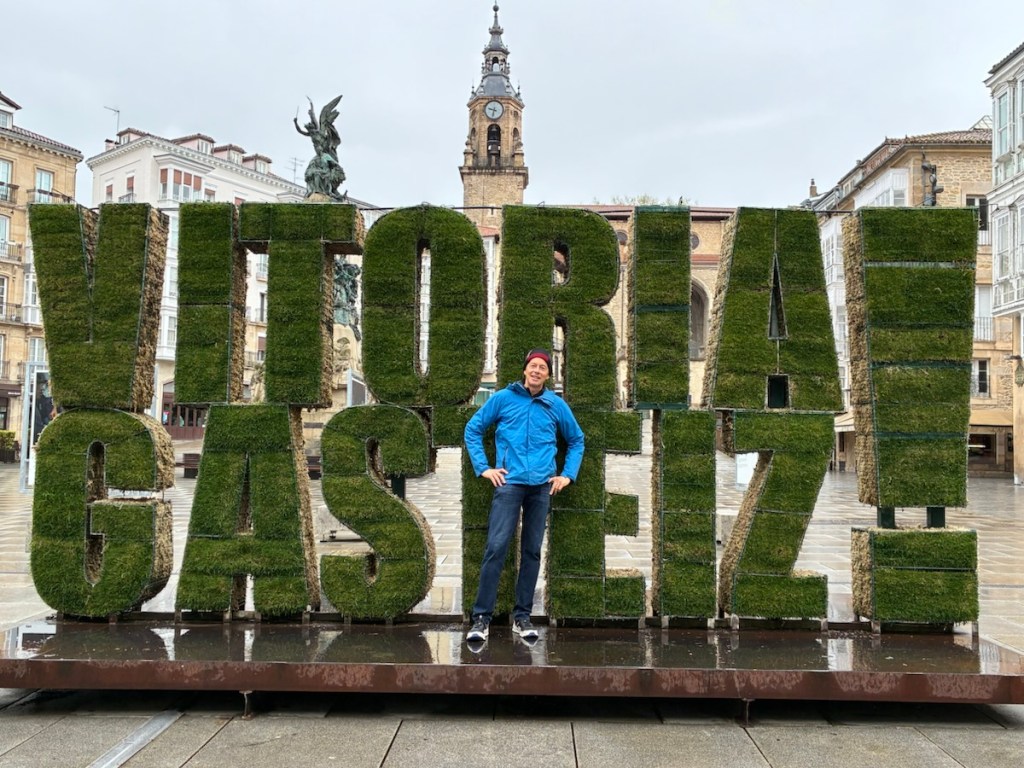
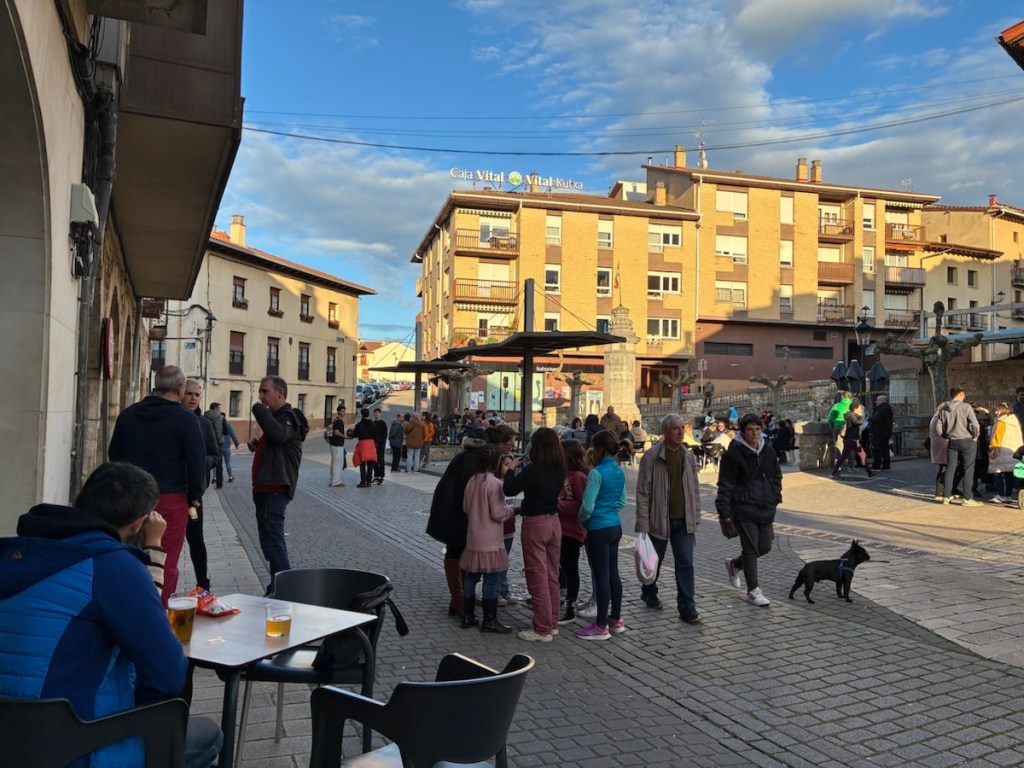
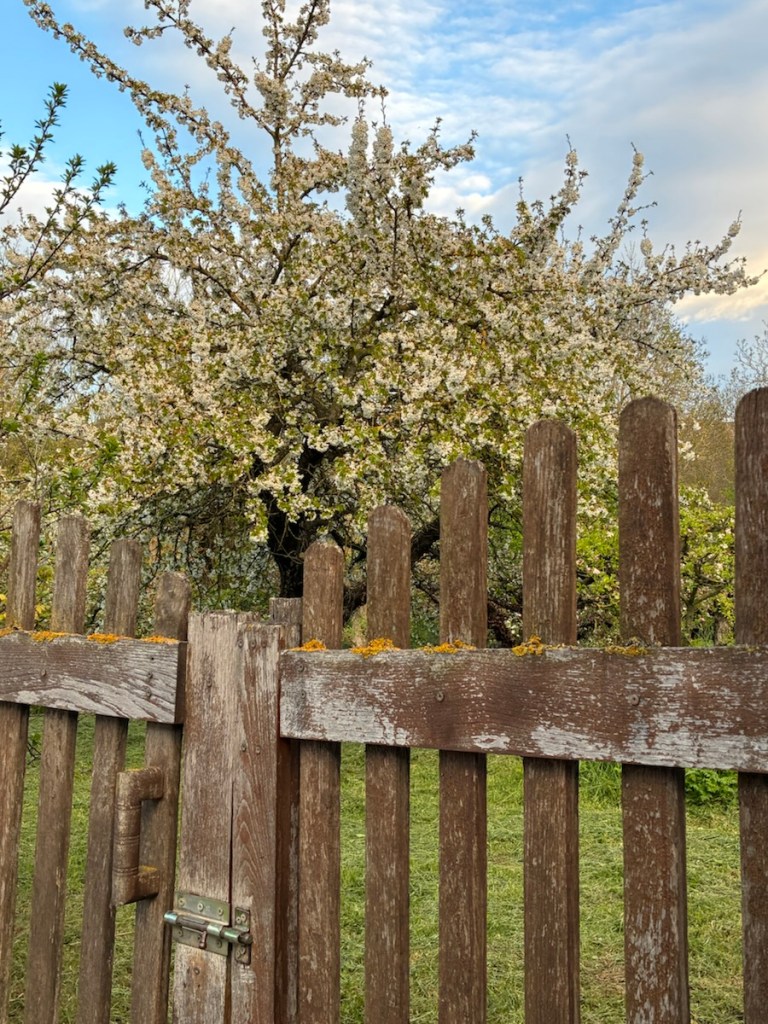
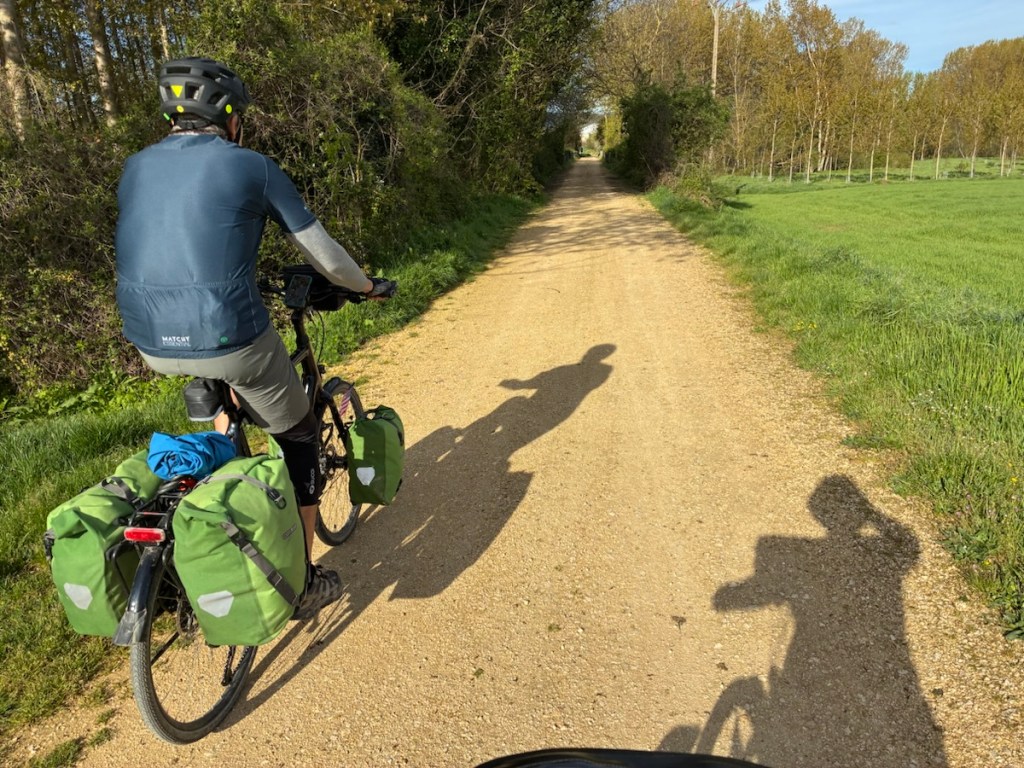
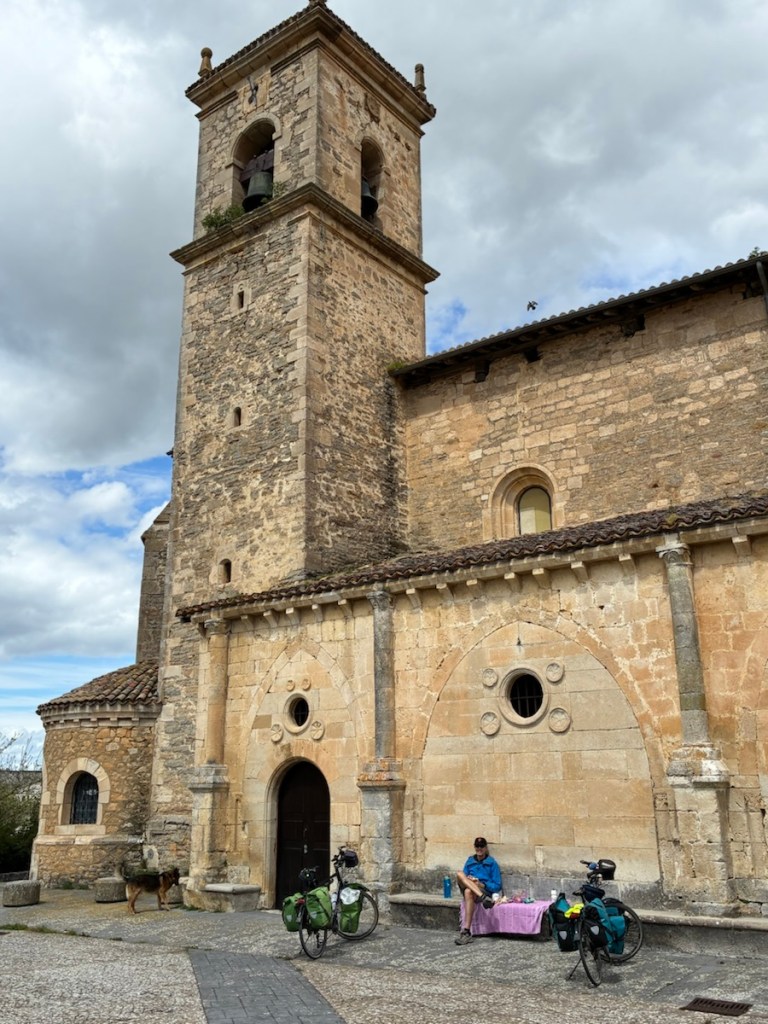
We found a small Bodega now open and got ice cream bars. Then a bar for drinks and Gildas (anchovies, olives, and peppers). It was an odd food progression but you do what you need to do on Good Friday Eve.We joined the rest of the town enjoying the car free main street and watching the children play while enjoying our drinks.The Spanish do public spaces so well. And everywhere we visited we enjoyed the Paseo, the traditional 6pm evening stroll.Spring blooms over a weathered fence in town.As we were getting on our bikes the morning of Good Friday we heard this van honking as it rolled through town. We realized it was the bread van so we hustled over to buy bread for our picnic lunch. Basque bread van. Shadow photographer.Headed to Vitoria Gasteiz for a two night stay. Only 38 kms, and all on rail trail, right? Not quite.I’m not the only one who finds the cows picturesque.The walled town of Antoñana and our fearless tour guide, Rich.A slightly spooky tunnel.And more bridges.Good Friday Holiday meant a lot of road cyclists out.Other cyclists meant we could follow them to a water source.Trail side cuties.A long dramatic tunnel. And then the sound of a sad trombone. There is a tunnel through the highest part of the mountain ridge that is not open, so the trail diverts up and over.Up up up.But wait. What’s this?My little flag is blowing forward! Tail wind to the rescue.Hat deployed for warm day climb.The summit. It must have been one long tunnel, it was quite a climb.We had a nice decent on asphalt before joining the rail trail again for our final stretch in Vitoria Gastiez.It’s nice to get off the trail and into towns. In Spain churches are our first try for benches for lunch. This one came with a friendly dog who would have happily shared our lunch. You know, to be helpful.I think I will always recognize the shape of a Basque church and spire. We made it to Vitoria-Gasteiz, which is the capital of the Basque Autonomous Community and where we will spend two nights.
Up next, our time in the Basque mountains and why I am now a huge fan of the Basque.
The Happy Travelers. Looking forward to a rest day in Vitoria-Gasteiz.
Spain has been on our bike touring list for years, but we hadn’t made it here yet. Lots of people ask us why not? First off, much of Spain is arid and sunny, two conditions Cheryl (and I) don’t really like in large doses. Second, bike touring routes and infrastructure are known to be better in Northern Europe, so it’s been hard to pass up easier trips (at least to plan) in Belgium, Switzerland, Austria, Chéchia, Italy; Germany, the Netherlands, and Scandinavia.
Last Spring we got so close to Spain, but some nice house sitting opportunities kept us on the French side of the Pyrenees. Finally, I’ve been working on redeveloping my high school French the past few years and didn’t have an interest in muddling my brain with my more recently learned Spanish again. Only one additional language Sim slot in this engineer’s brain!
Cheryl atop the Roman ruins at the Panissars Pass. Cheryl is ready for Spain!The beautiful spring bloom near the French-Spanish Border.
But this year we were determined to give Spain a try and had a plan to ride the coast via Eurovelo 8 more or less to Barcelona and beyond. And if it started to get too arid or sunny for us, then we’d head up towards the mountains and green Basque Country instead. That’s the turn right.
Giving Cheryl a break pushing up the steep and rocky road after crossing the border. Is this really Eurovelo 8?!At the bottom, someone appropriately added “MB-only!” Grafitti to the regional trail sign. A little too late for us, but luckily this hanging tube was not our fate.
Near the Spanish border, we opted for the quieter but hillier route into Spain over the Col de Panisares. Officially this seemed to be the Eurovelo 8 route on most maps and is also called the Pirinexus route, part of the Catalan greenway route network. The French side was paved, quiet, and delightful. But as always with bike touring, we were rewarded with some memorable views, and then punished on the Spanish side with more uphill kickers, steep rocky trails and unridable downhills. No cruising down into Spain.
Looking down to La Jonquera.Maybe we can sleep at this ranch?Our first Spanish cycling underpass/drainage culvert. Not our last.Cool culvert art.
So our entry into Spain was a bit bumpy and we found ourselves at the somewhat grungy and noisy frontier town of La Jonquera at 5pm after just 50 hard earned kilometers. We didn’t have a reservation anywhere as I suspected the day needed flexibility, but there were no good options around. We’ve been without lodging before at 5pm, as it goes with booking on the fly cycle touring.
National Route 2 had a decent shoulder near Figueres. Sometimes you just want to get there!Our hotel in Figueres old town. A bit of street construction meant no car traffic in front of our hotel and limited Saturday night bar noise -:)
So we decided to press onto Figueres on the main N-2 (II) road, as the official Pirinexus route had more dirt, hills, and would likely take us hours. We were both tired and a bit stressed, but knew this was just one of those days we just had to rally. To our pleasant surprise the N-II had a generous 6-foot shoulder the whole way to Figueres, and we made it there in less than an hour and a half, after a truck stop soda infusion. A shower and dinner at our atmospheric old town hotel and all was good.
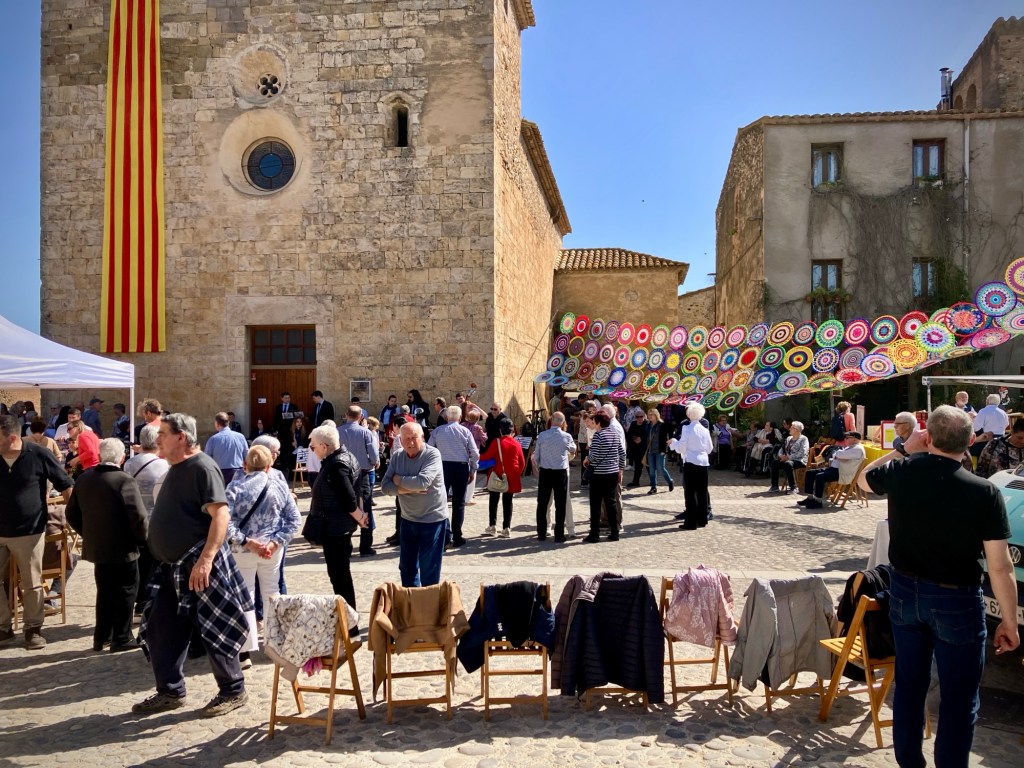
Hotel Duran in Figueres is family run and had a classic vibe, a fine restaurant and even side rooms that were part museum of local life.We set out the next morning after a brief stop outside the Dali museum. Salvador Dali was born in Figueres in 1904 and you can visit the large museum as well as the house where he was born.Always fun to ride through the cobbled little streets. Catalan felt different than France.Sunday bike touring days always surprise, such as this festival in Bàscara, complete with local Catalan dancing.
Although the dirt route was peaceful and had some nice natural beauty, I wished we had just taken the main road route up and over the pass. But again, I could find no info on the pass routes….not even a good blog. Maybe this blog will help people decide.
A random regional cycling route sign was appreciated, but better routes and signage everywhere would make this area more popular with people traveling by bicycle.Ok, this train bridge still baffles this engineer; why are the webs of these precast beams on the top. It’s upside down, but I guess it works.
We soon figured out this part of Spain does not have as developed a bike touring culture. People ride for sport; roadies, gravel, and mountain bikers, but it seems a small number of long distance tourers. We met a few bike tourists along the coast, but most were Dutch, Belgian, or Canadian. (The French were notably absent.)
Finally some signage, helped by the overlap with some of the Camino de Santiago routes.
The first things that struck me in Spain was the lack of useful signage in this area. No map of the border pass cycle routes, a few town directional signs, and just a few randomly placed EV8 route signs. And never distances. Also, no indication how rocky and unsuitable parts of the Spanish side of this route are for loaded touring bikes. If you are riding into Spain on this coastal route, be ready for a significant decline in signage and infrastructure from France. Routes just end and this is the land of random, short cycleways to nowhere.
Peaceful cycling into Girona along the Ter River.Wisteria blooming everywhere.
But Spain brought so much beauty and a completely different feel from France. Our trip has been perfectly timed for peak spring and the smell of blooming flowers, trees, and thick grasses abounded. The fresh Mediterranean Sea air filled our noses and coated us in a comfortable sheen of the promise of Spring and a new year. Forget the chaos of your home country.
The lively and beautiful arcades of Girona.Watching the bikes go by at “Bagels and Beers” in Girona, which also has delicious “Burgels”.We sort of happened upon the Medieval wall of Girona and couldn’t pass up following it along the city edge and University campus on our rest day.Looking back at the Pyrenees from Girona.Walking the wall offers a great overview of the city.No trip to Girona is complete without visiting some of the famous road cycling stores, including “Eat Sleep Cycle” store and cafe.The surprising Pont de les Peixateroes Velles, designed and built by Gutave Eiffel in 1876Girona’s old town core is actually an ancient and vibrant Jewish Quarter known as “El Cell” occupied from the 12th Century until 1492, when the purge happened.Girona is captivating to explore.Spring light in Girona on the Onyar River
The next day we headed to Girona, a long time dream of mine due to its famous road cycling culture. The ride into Girona was nice on self-selected routes, but loaded touring bikes are an anamoly there, and we soon felt a little out of place as we rode into the main square heaving with people drinking, chatting, strolling, and shopping on a beautiful Sunday spring afternoon. Various kitted out roadies wizzed by and seemed unimpressed that we carrying all our gear for 3 months on our heavy duty human-powered transport machines.
Heading out of Girona to the south, we encountered a group road ride tour of foreign cyclists. They were focused on staying on their bikes, so we didn’t want to bother them. For us, just another day.The roads outside Girona are popular with roadies for a reason.How many famous cyclists have ridden this decent?
We had a nice little apartment to enjoy for two nights in Girona and it’s a beautiful place to explore and hang out. Mixing with the road scene heading out of town was a bit strange, as we’re used to seeing more cycle tourists, and it’s really popular with Americans, so funny to here so much familiar English after so many less visited places.
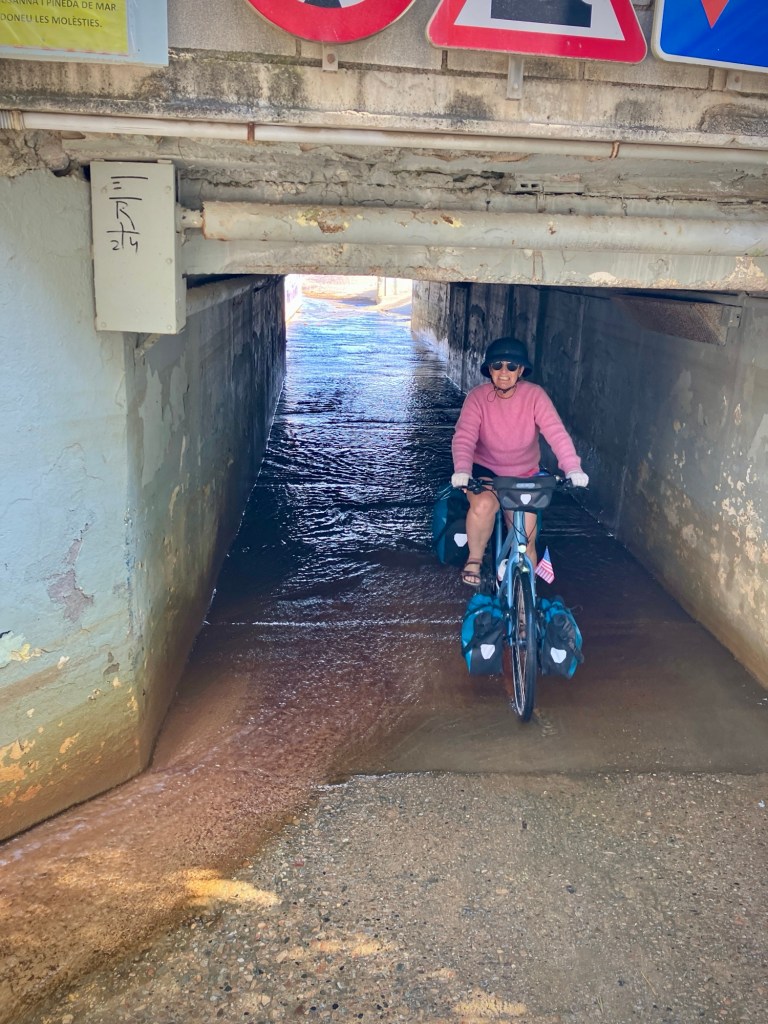
Spanish pastries.We were following the Via Marina for a while.Cheryl in her latest high tech cycling gear: fuzzy pink Shetland wool sweater. Soon we were at the Mediterranean coast via some more primitive rail underpasses/drainages. But the rare and heavy rains must go somewhere.We started to realize that the EV8 on this stretch of coast would not be bike heaven.Decent riding along some of the coast, but a little dull in places.We mostly picnic, but today cobbled a pre lunch snack at a cafe despite it being 12:30…a challenge cycle touring is Spanish lunch is from 1:30-4pm.The train line runs parallel to the sea along the coast north of Barcelona, making access between the sides challenging at times.Morning departure from our fun all-inclusive hotel in Pineda Del Mar. They had just opened for the season and it was very good value. Fun to mix with holiday makers and get a nice cool swim in the pool.Cheryl wondering if she was back in SoCal!The promenades were lovely, but we could only imagine how welcome shade would be in the hot summers. We were already missing it in early AprilThe sea is beautiful along the Costa Brava. But overall this stretch of EV8 is hit and miss.Catalan architecture charms in the few old towns still left on this part of the coast between the sprawlOur one night stay in Barcelona was pleasant at the Illunion Hotel in El Poblenou who kindly stored our bikes safely overnight.
We cycled towards the coast from Girona and spent two days meandering down to Barcelona. This stretch was not our favorite as the coastal sprawl felt a bit endless and the rail tracks make access between the coast and city sides challenging with loaded touring bikes as some access points are just stairs. But eventually we rolled into the northern neighborhood of Barcelona known as El Poblenou, which is also the core of the superblocks, which cleverly limit through traffic and prioritize pedestrian and bike movements. It was great and such a joy to cycle in most of Barcelona.
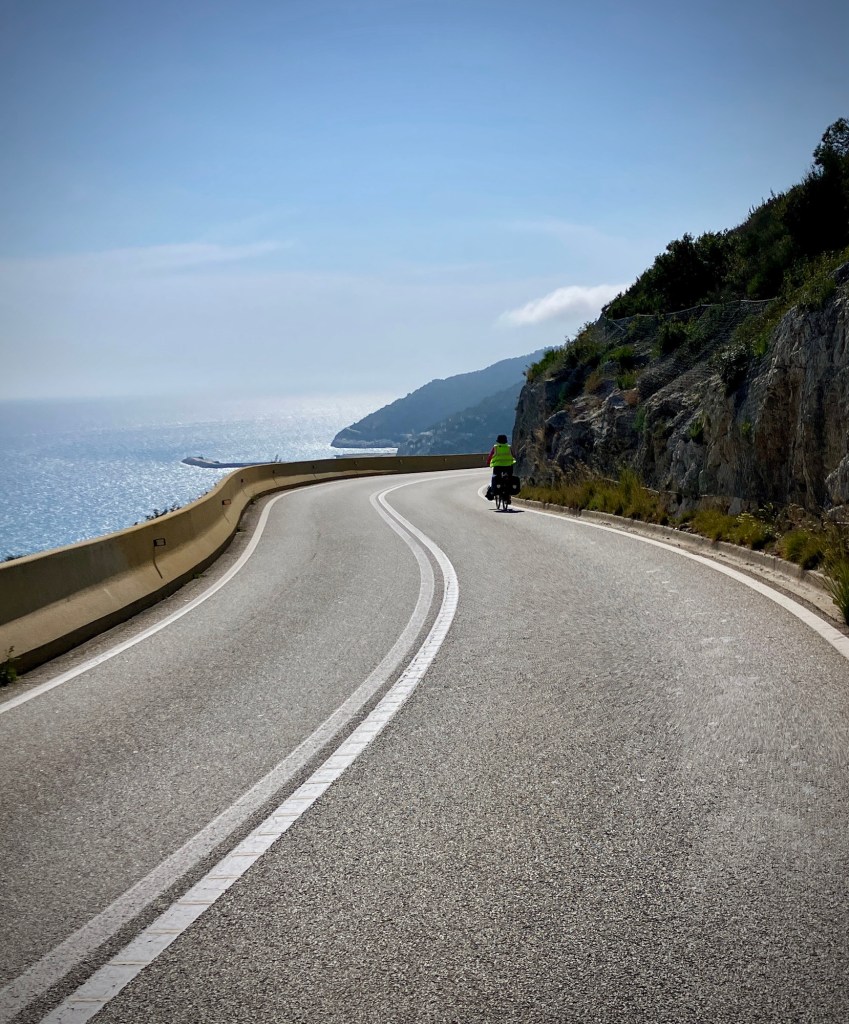
Morning school rush hour in El Poblenou meant an armada of kids, parents and bikes. Nice!On our way south by the famous Sagrada Familia.There are some beautiful bikeways in Barcelona, and very well used. Fixing a flat is never fun. Really not fun on a busy road. Thankfully we were at the quarry turnout so had some space.Cheryl ahead on a beautiful stretch of the C-31 from Garraf to Stiges. A rare shot without traffic as this road was almost constant cars and haul trucks to quarries. A shame.Early dinner and drinks in charming Sitges. We still haven’t solved the mystery of a charming coastal spot with outdoor dining and no Gulls. Why are there no gulls here? The April beach scene in Sitges. As we came into town folks were swimming.Costal glam couple.Komoot and and supposed EV8 Route?Ok, another underpass to a trail on the oceanside of the tracks….nope, dead end at rock slope and tiny beach! Cheryl was thoroughly unamused.Not the nicest stretch of Eurovelo and Cheryl not happy in a head wind and sunshine.
From Barcelona, we headed again out to the coast via the EV8, which is a nice route until past the airport, then forces you onto busier roads. It was a tough stretch as I had fixed a flat tire near the airport and then half way through the extremely busy coastal road from Garraf to Sitges, I felt my tire going soft again. Ugh! This time I really examined the tire and found the tiny glass shard culprit. This stretch would be ok on a fast road bike as the cars are very respectful, but on slow touring bikes, the constant traffic and haul trucks made it a somewhat teeth gritting experience. No pictures of the traffic as there are few places so stop and most is guardrailed.
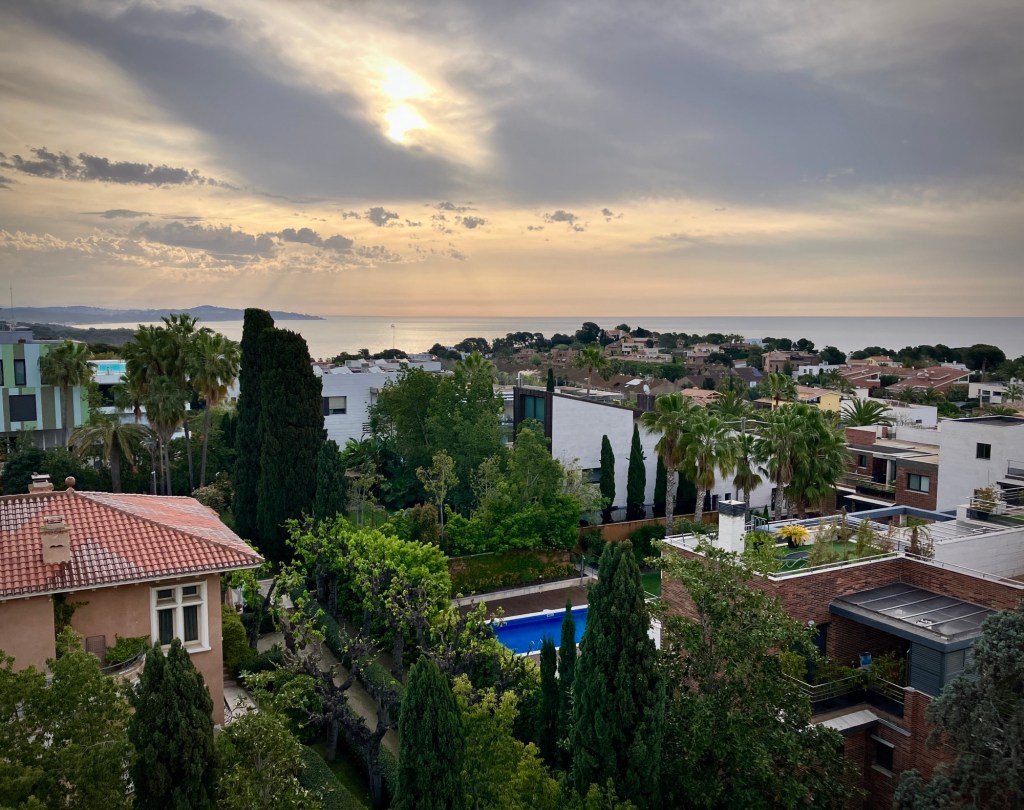
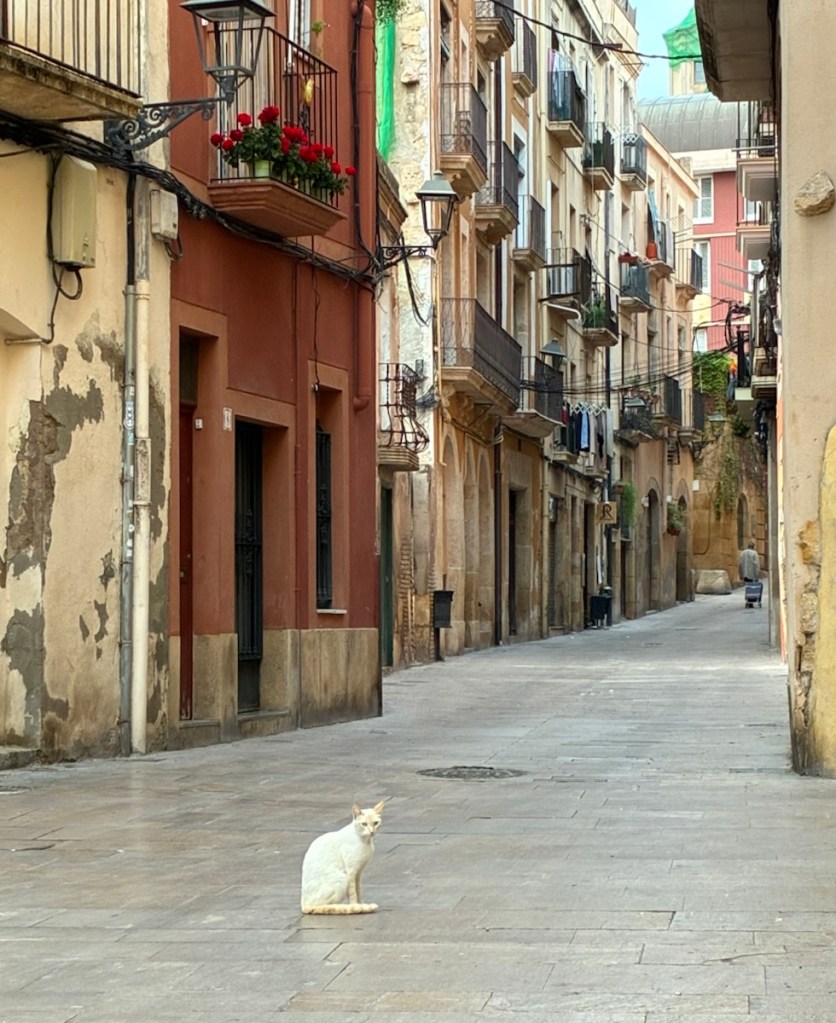
Cool to discover The Torre Del Escorpions or “Scorpio’s Tower”, a funerary monument built by the Romans outside Tarragona in the 2nd century. Our lovely view from our hotel in TarragonaTapas and Sangria in the main square of Tarragona. Set for Friday night people watching, Spanish style.We were excited to see and moved by the solemn Semana Santa processions in Tarragona. We didn’t know at first why everyone was headed towards the Cathedral. We quickly figured it out.The striking coastal Amphitheater of Roman Tarraco used to hold up to 12 thousand spectators until the decline of the empire 5th Century.A big port for Mega-Yachts in Tarragona. The cannon isn’t really aimed at them? Is it?Roman ruins = Feral Cats. This good looking kitty posed for us.Cats also liked the real and just slightly gritty feel of the Part Alta, the historic core of Tarragona.Colorful Tarragona Street Art. Cheryl snapped the pic before she actually read the words.Orange blossom scents filled the air of Tarragona. So many orange trees as street trees.Not a gentrified old town, Tarragona’s old city still is active with daily life.The processions weaved through the city. We were in Tarragona for three nights and watched processions on two nights.More crowds for the Semana Santa Procession. We felt lucky to witness this less touristy and more local version in Tarragona.Real flames added to the drama as night finally falls.The weight of the floats and human strength required to carry them was impressive. The folks carrying this heavy float marched in time and swayed in rhythm.
So after a really pleasant night in Sitges, we rolled onto Tarragona, where we spent three nice nights and rested prior to our turn inland. Tarragona is a small and ancient city with Roman ruins, a fascinating history, and great archeological museum by the old port. One of our favorite smaller museums with a great audio guide. It was also the start of the Semana Santa events, so we got to see two different nights of processions, each with a different vibe and purpose in the run up to Easter.
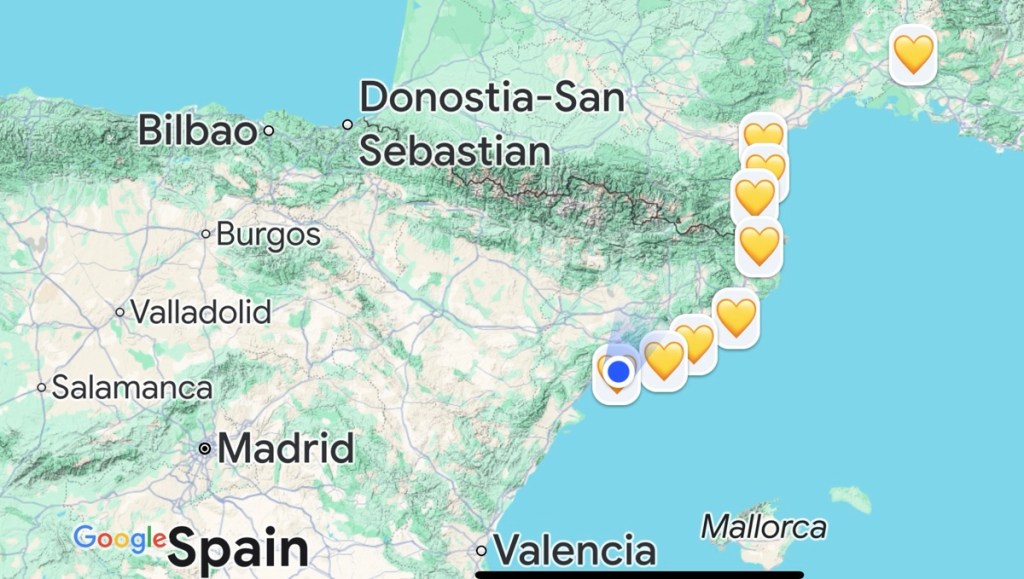
Finally leaving the pleasant and bike friendly Hotel Astari for the Tarragona train station. But where to next?Well, first some train pastries!Oh, and some buttery Jamin Iberico on rolls.We really liked exploring the layers of history in Tarragona for a few days. A bit of a hidden gem.Where we’ve been so far on this Spanish Sojourn. It’s a big country. Each heart is a place where we slept.Happy cycle tourists on the Spanish Mediterranean…at least for now.
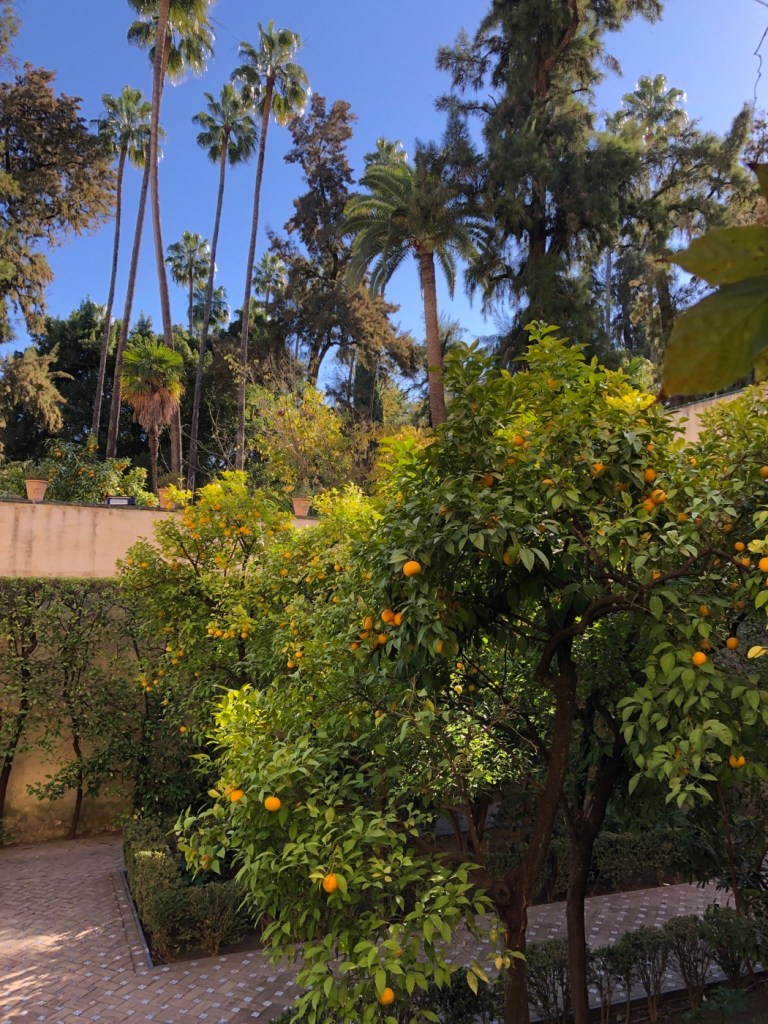
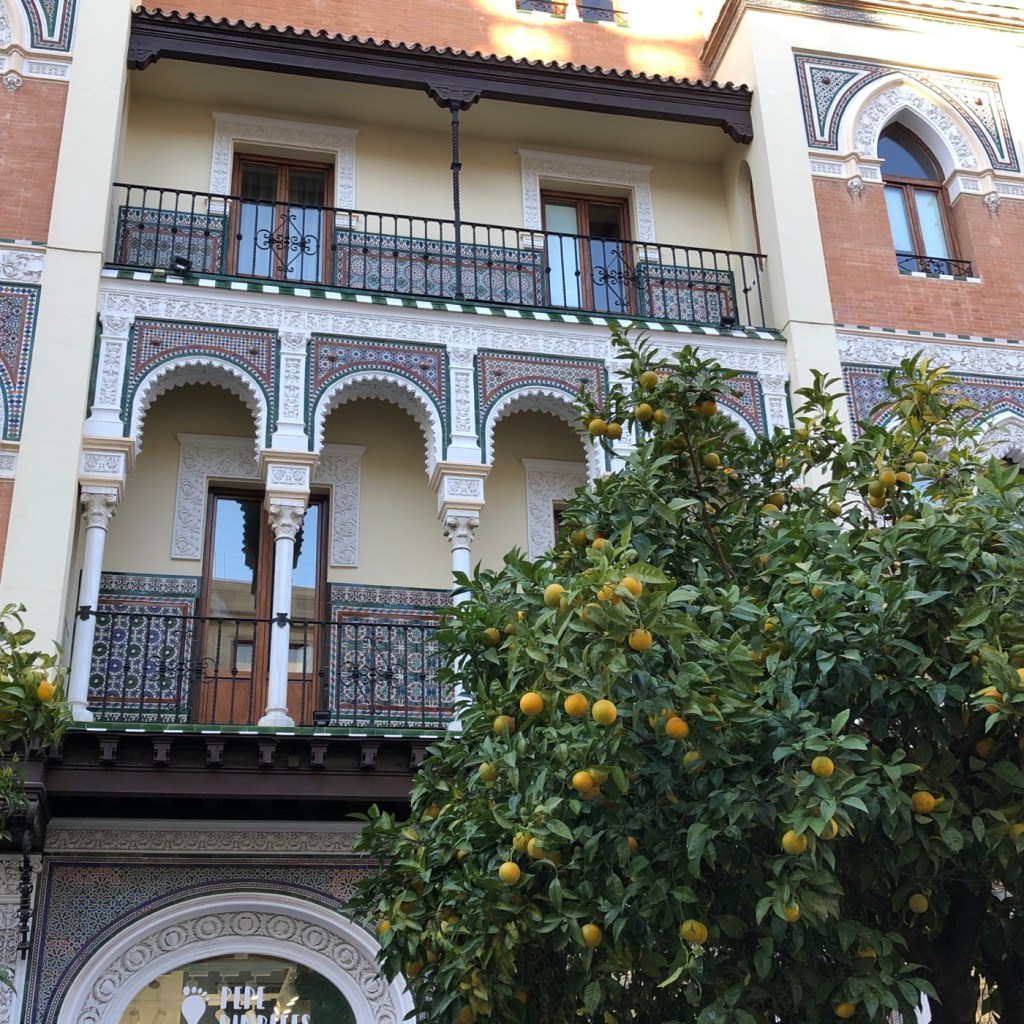
I had heard that the street trees in Seville are orange trees, Seville orange trees, the bitter oranges used to make marmalade, but I hadn’t expected quite so many orange trees.
Oranges and moorish architecture.
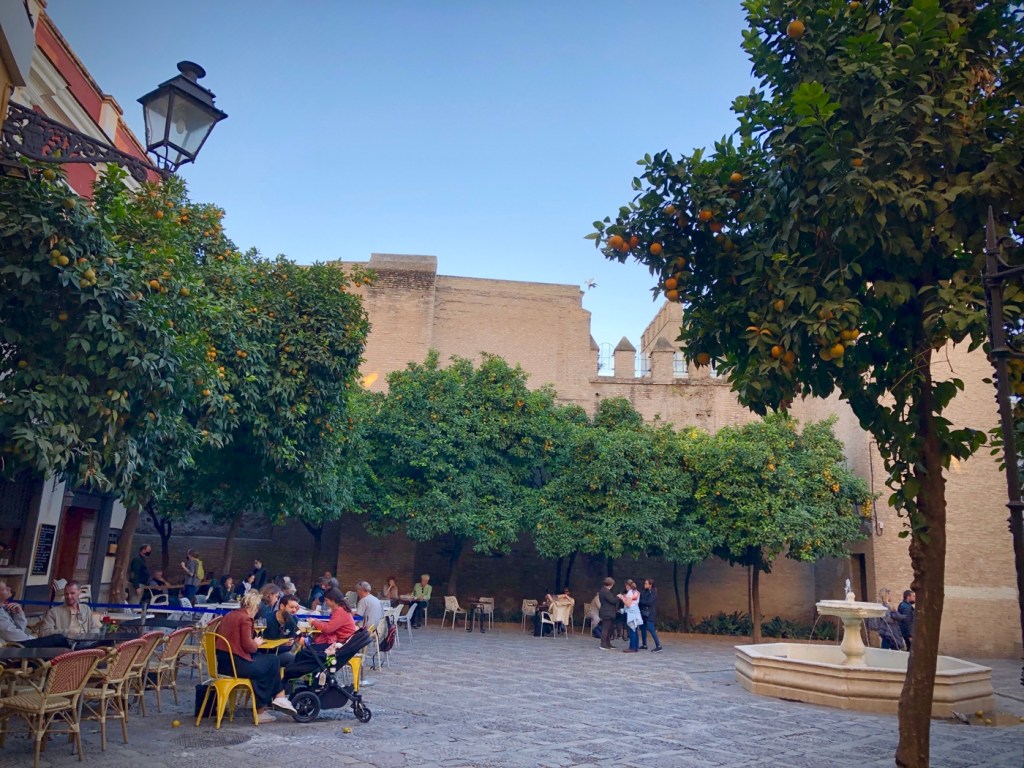
How many oranges trees? Reports vary, 14,000? 25,000? They do well in the climate and provide shade year round. Important in the hot summer months.
Orange trees surround a peaceful plaza.
The city employs people to gather the dropped oranges, and recently has started using the fruit to create electricity through fermentation. Most Seville oranges grown in the region are exported to Britain to make marmalade. But there are plenty on the streets here for youngsters to use as impromptu footballs. The scent of blossoms must be lovely in the spring.
I did my best to help out, having marmalade with breakfast and buying chocolate covered orange peels.
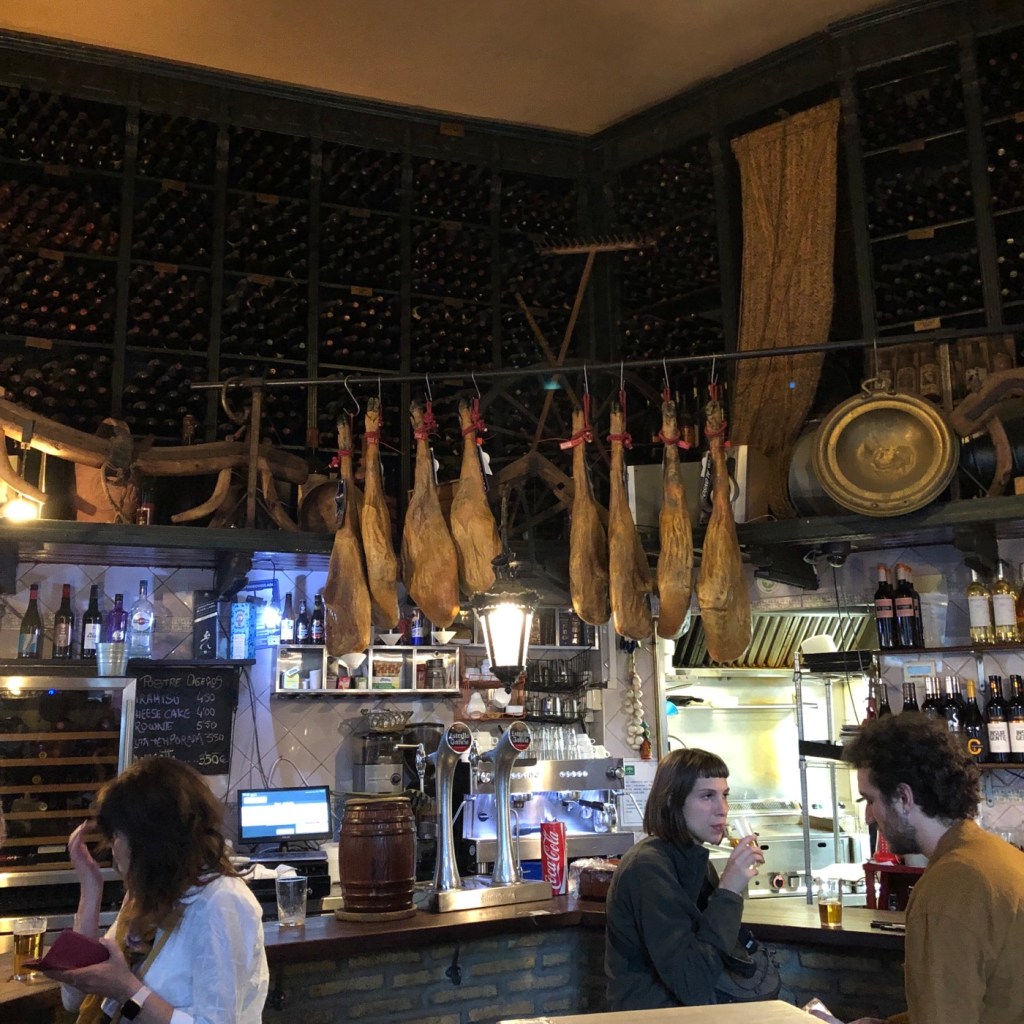
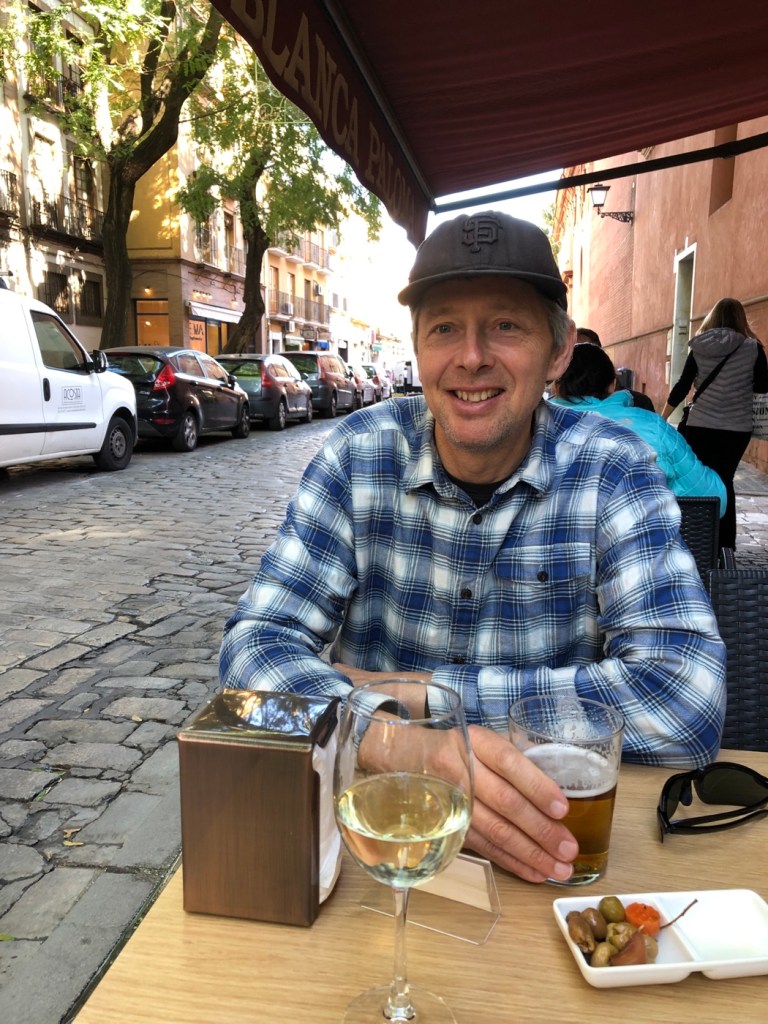
We also did our best on the tapas front. Vegetarians look away. Wandering the narrow streets we looked for small places where we could sit outside or in a window and watch the street life. One spot took us 3 evenings to get into, it was very small. The first evening we went at 8pm – ha! Good luck. The second evening we tried at 6:30, nope – already full. Finally we got there at 5:50 and scored a table in a window.
Note the jamón legs hanging above the bar. Jamónibérico. Now hanging out on our table.We did it, got into the tiny bar.
Mission accomplished and appetites calmed we headed out to a flamenco performance on International Flamenco Day. It was just an hour long and stunning.
They wisely forbade photos until the very end when they said photograph away. I imagine it would be super distracting to look out at the audience and see phones held aloft.
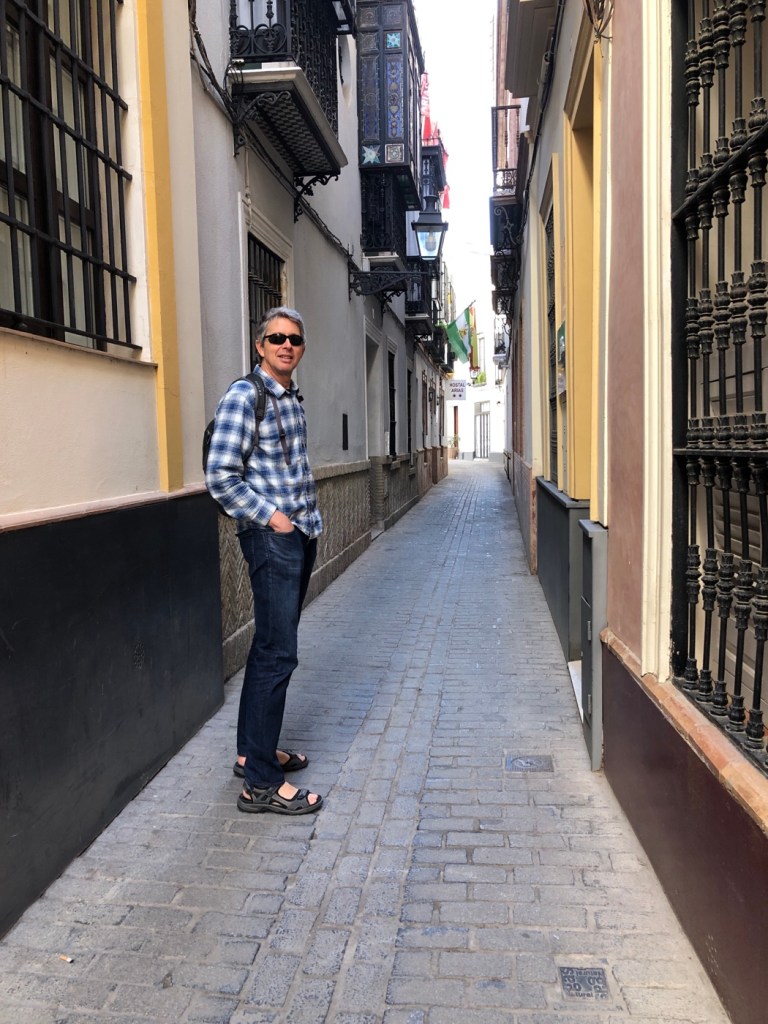
We walked. And walked. And walked the narrow streets. Some so small I could touch both walls, some wider with cars just squeezing through, tires squealing as they slowly hit the curbs.
No cars here.Rich added for scale. The narrow street leading to our hotel.I need to start asking for a different pose. Ah, there we go. Jumping for joy in a car free street.Lunch outside in the Triana district.Happy travelers. Off to Morocco next.











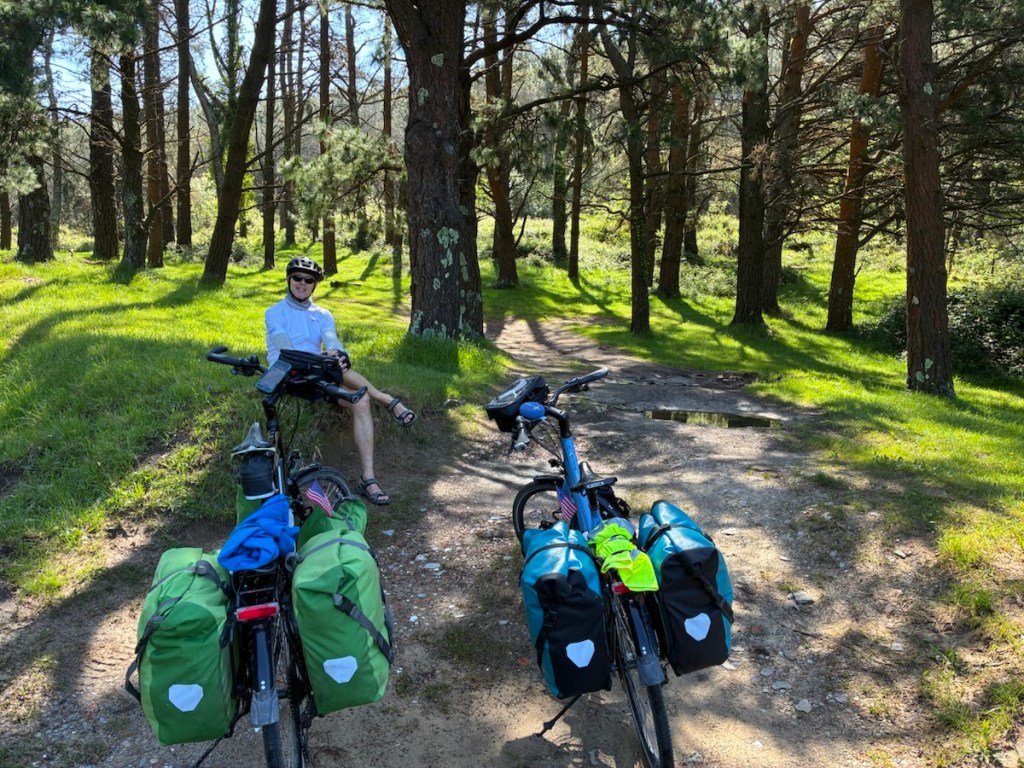








































































 Less Car, More Life