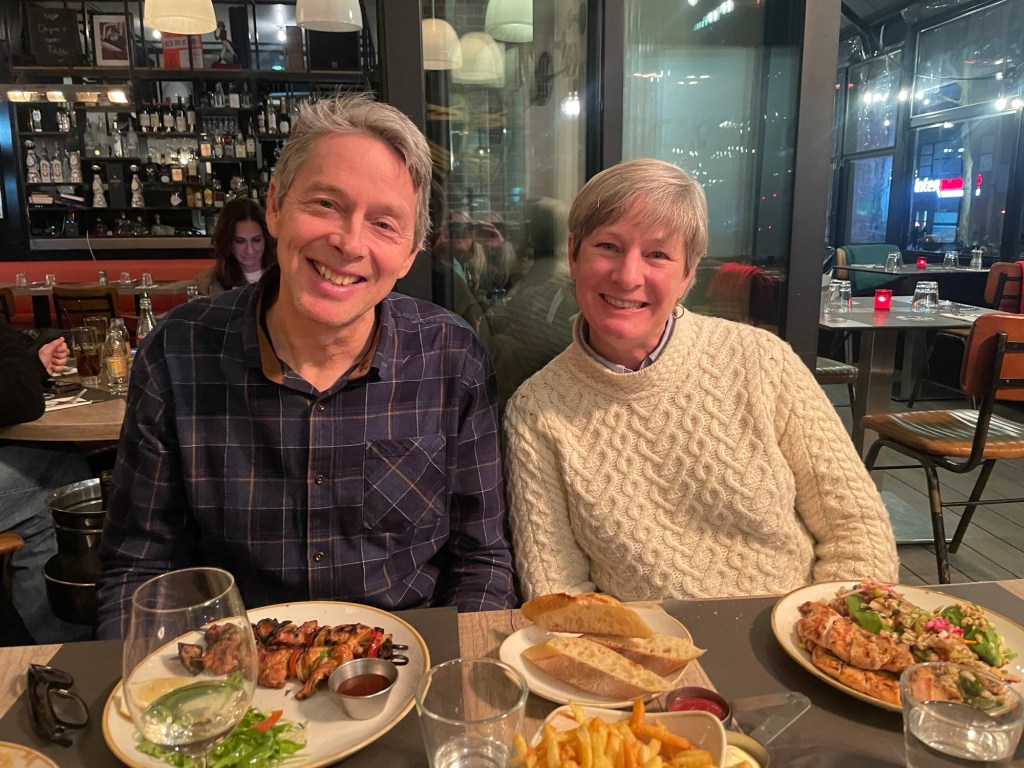
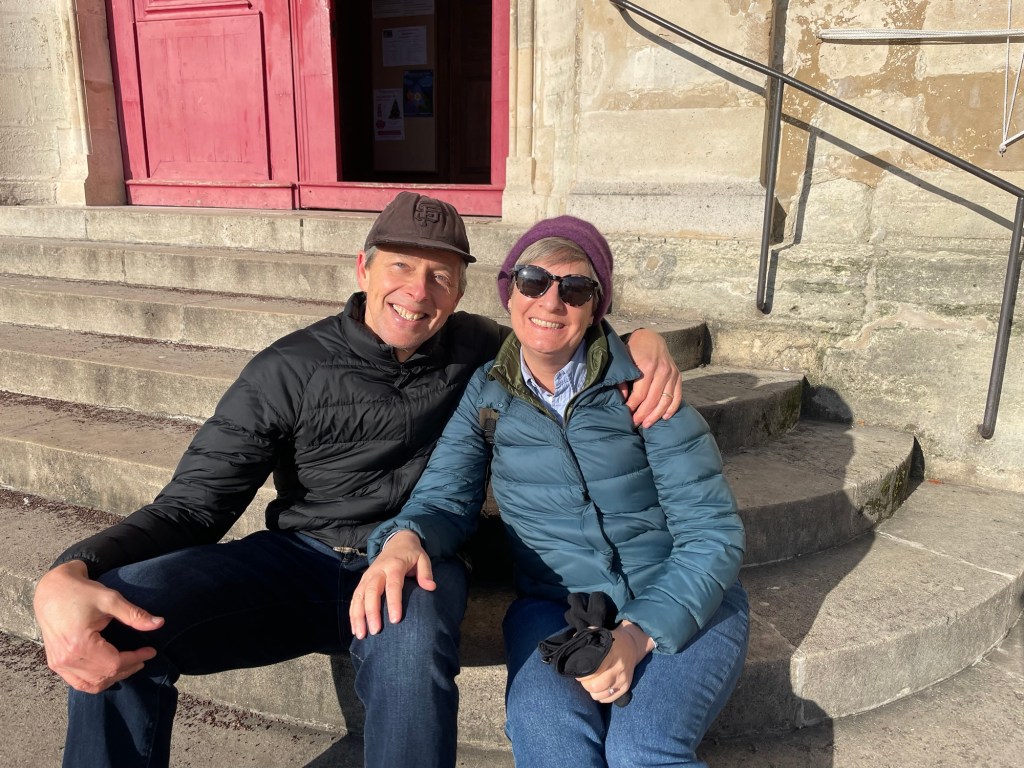
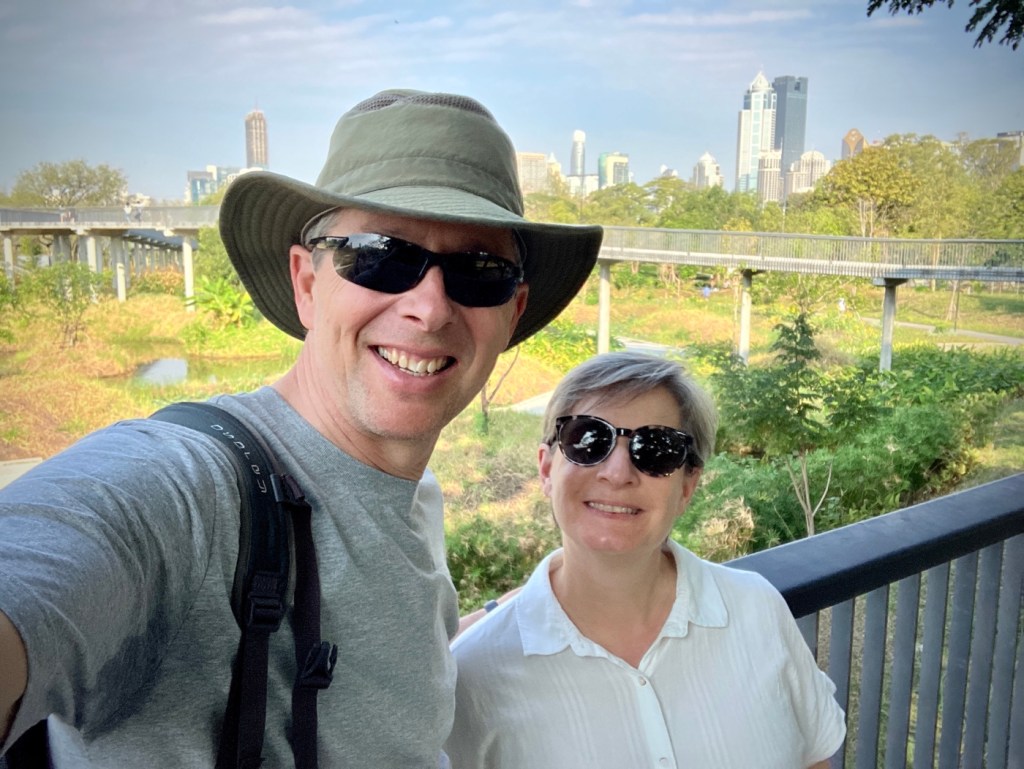
Au Revoir Paris – Hello UK Winter!

All good things must come to an end, so after a lovely month in Paris, we finally had to close the doors to our apartment in the 12th Arrondissement. We were headed into the darkness of the UK and the approaching winter solstice. A proper northern winter will build character, we kept saying to each other. (As to why were making this choice in lieu of an island in SE Asia!?)

Je suis prêt, on y va!
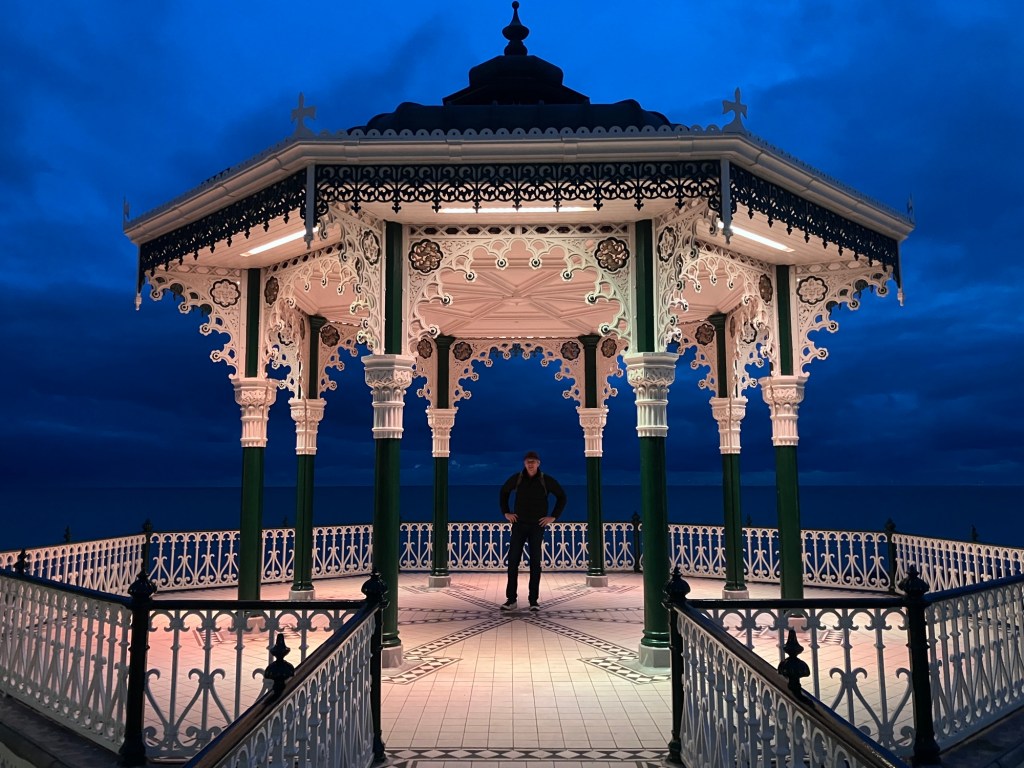
The Brighton Beach Bandstand

It’s not that we particularly wanted to leave France, but we had to get out of the Schengen zone as we were at Day 89 of our 90 day allowance, so cutting it a bit close. And there really is lot to love about the UK, even in winter. So we caught the post rush hour metro to Gare Du Nord for our 11am Eurostar to London. Yippee, a train not a plane to the UK! 

Our enthusiasm for our train trip was soon tamped down after we passed through Eurostar security and immigration to find the waiting area packed to the gills, with people lined against the walls, and sitting on the floor. This of course triggered my immediate moaning about the woeful under design of the waiting area. « Hey, I’ve sized waiting areas for HSR services, and this is a mess. « We didn’t get any photos of this fiasco, but trust us that it was very crowded.
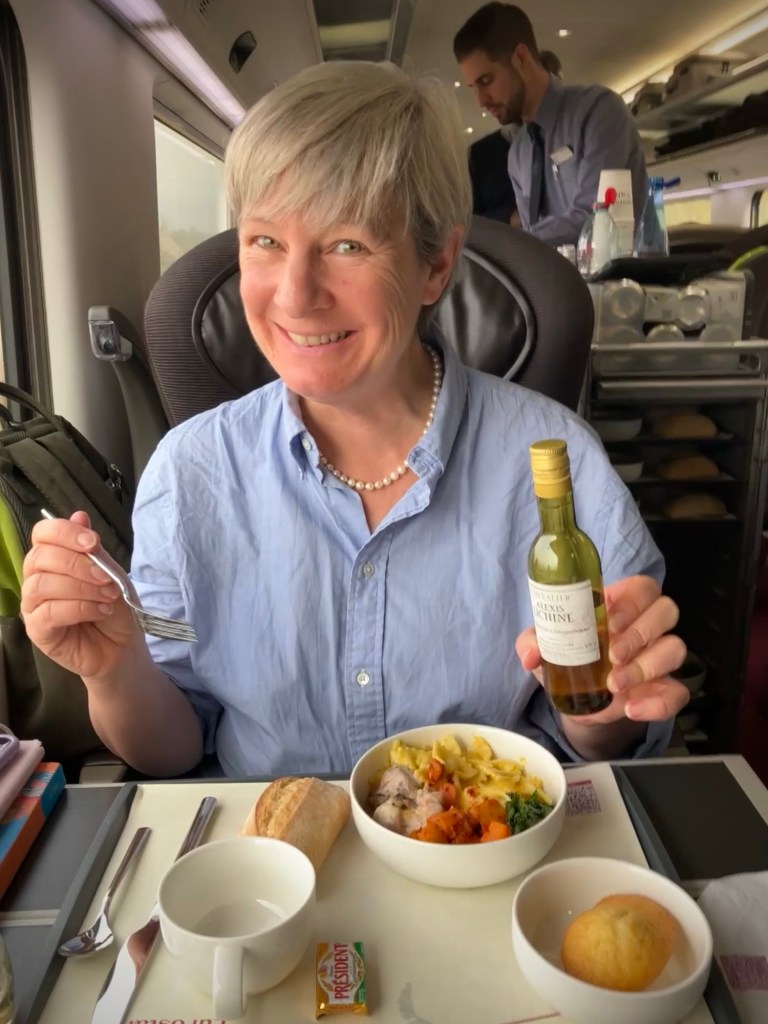
All minor travel woe is forgotten. Eurostar Plus class was nice with spacious seats and a light meal. Very civilized.

Well, as it turns out, the normal cramped  quarters on the mezzanine of Gare Du Nord were stressed by the load of 3 trains worth of passengers, as the 9 and 10 o’clock trains hadn’t boarded yet due to big delays. The E320 train sets carry nearly 900 passengers full, so 3 trains full is a challenge for any building design. But the situation was exacerbated by poor info signs and an inaudible P.A. system, so we didn’t figure this out until we saw the chaos for the boarding area and an attendant holding up a tiny paddle with “9:00” on it. They should have held us 11 o’clock folks outside security, but made no indications of delays to our service, and so we were still subject to the 1 hour advance check in cut off. Eurostar can definitely do better.
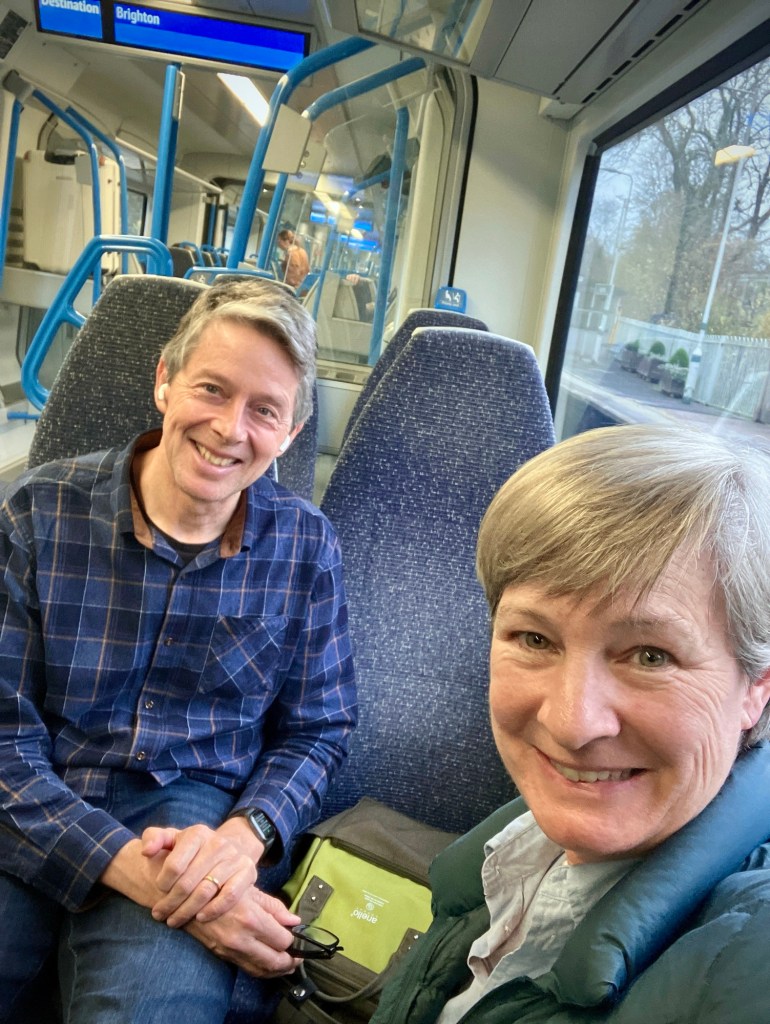
The Thameslink is fantastic. An hour to Brighton direct from St. Pancras International
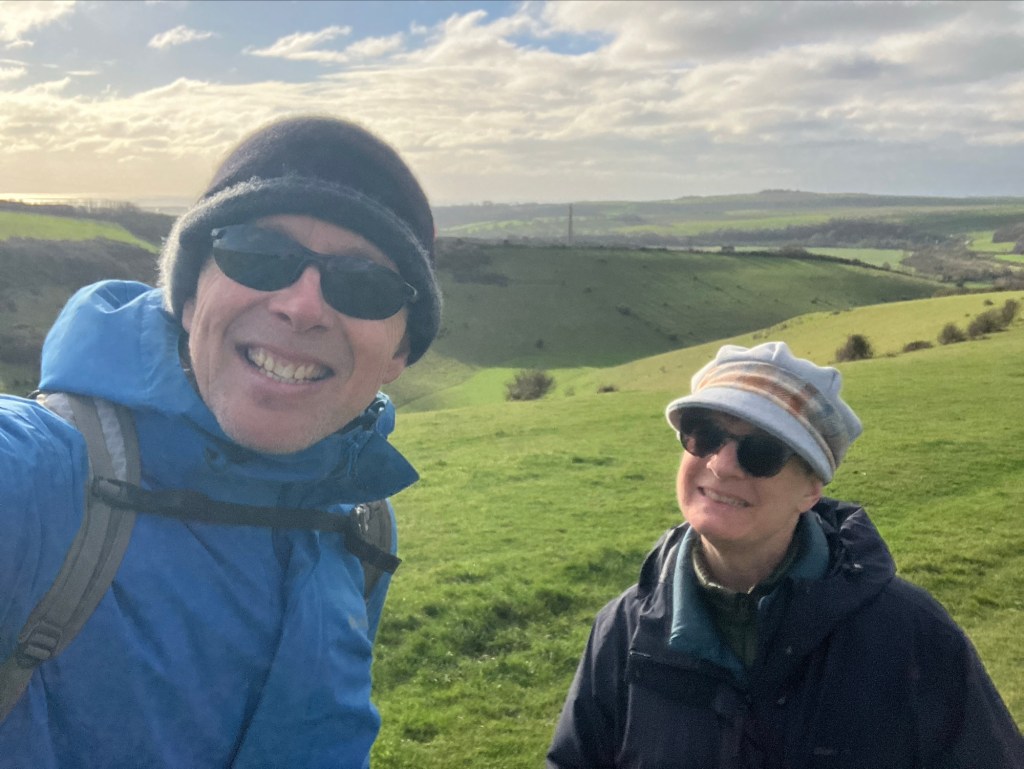
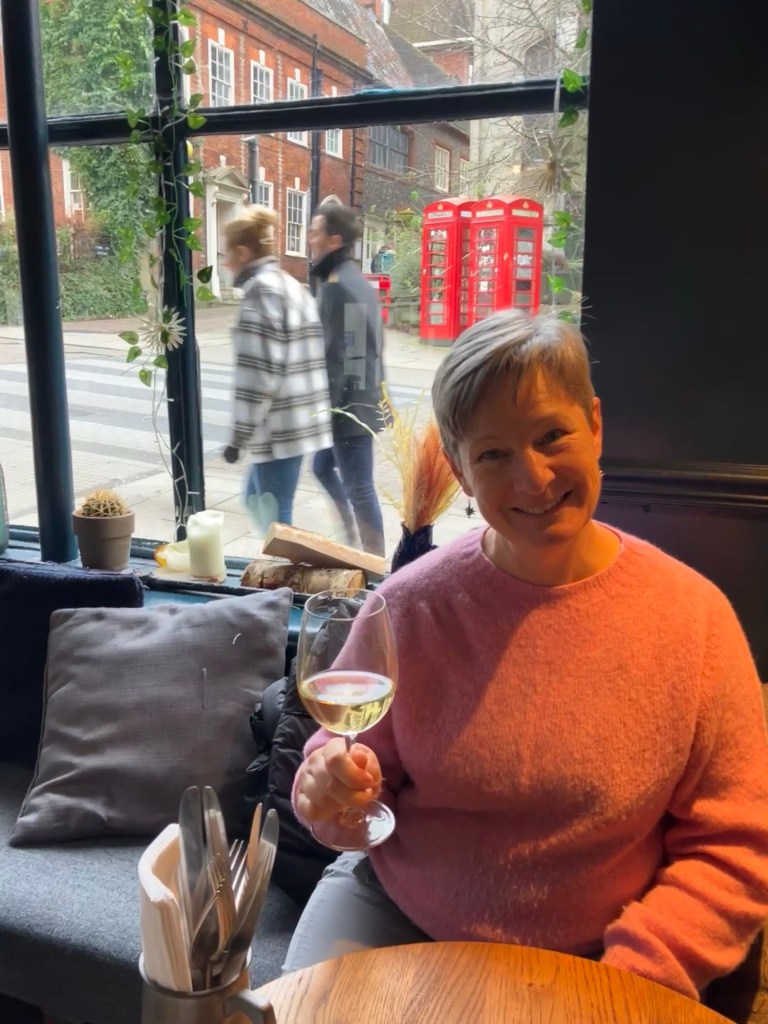
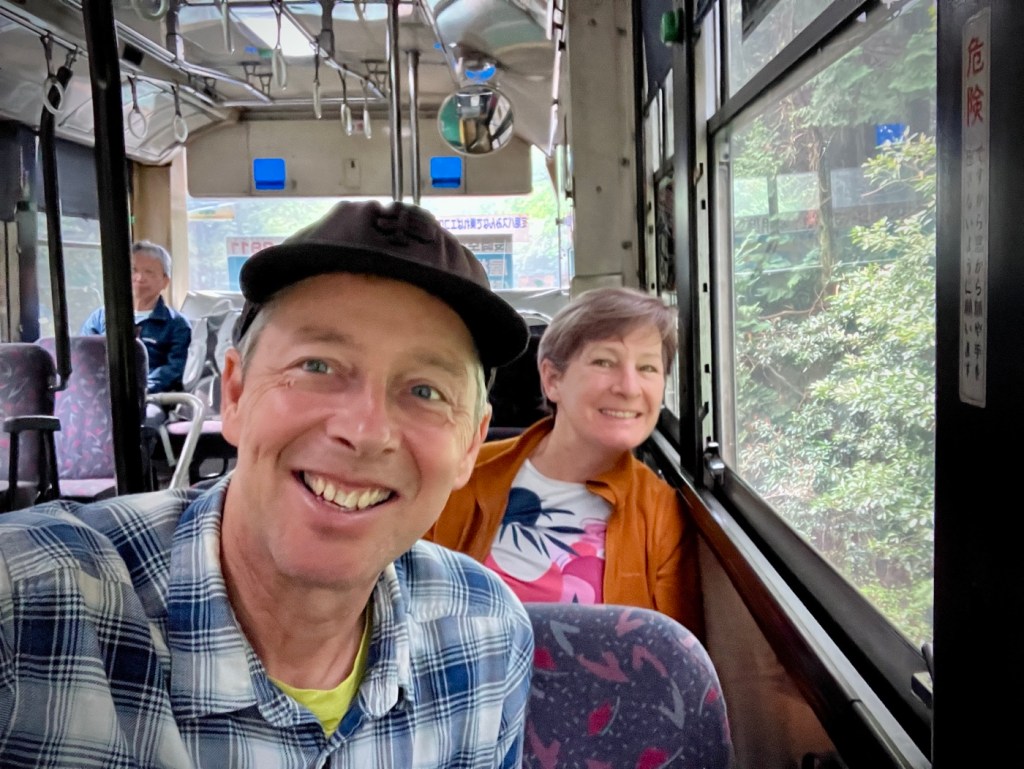
Smiling in Brighton at the 4pm sunset!
The colorful beach huts of Hove; some color through the gray.
Keeping warm with a beach walk and coffee with our friends Gary and Ruth
The expansive yet cosy Lion and Lobster pub in Brighton
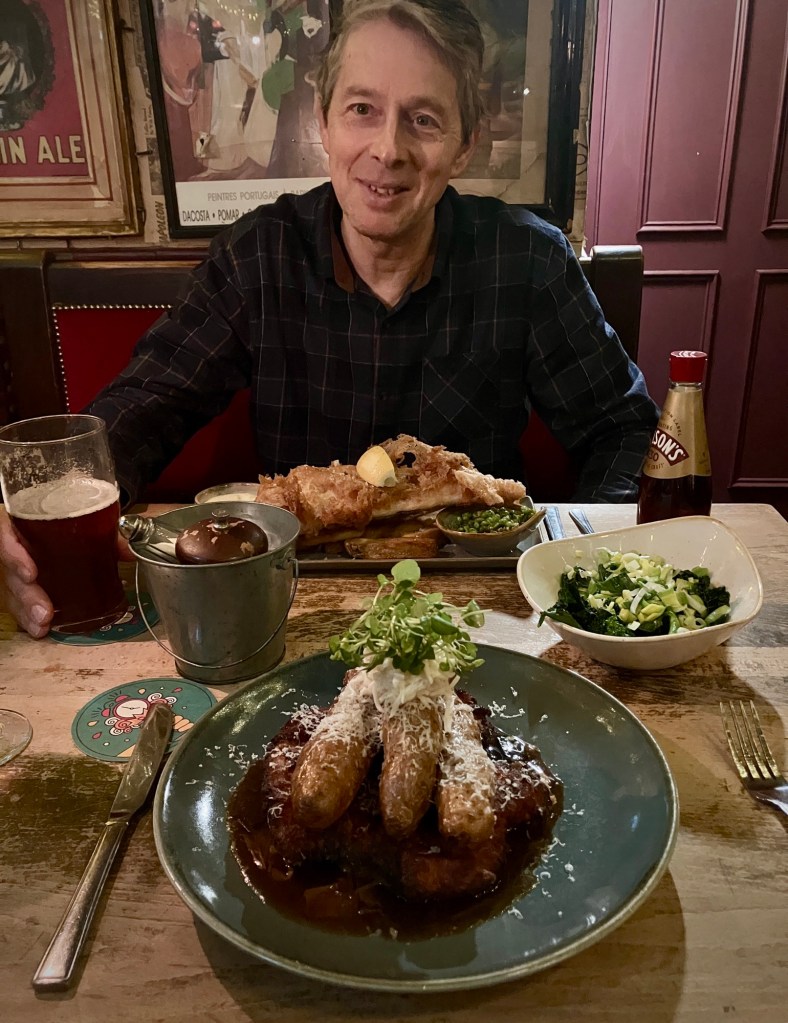
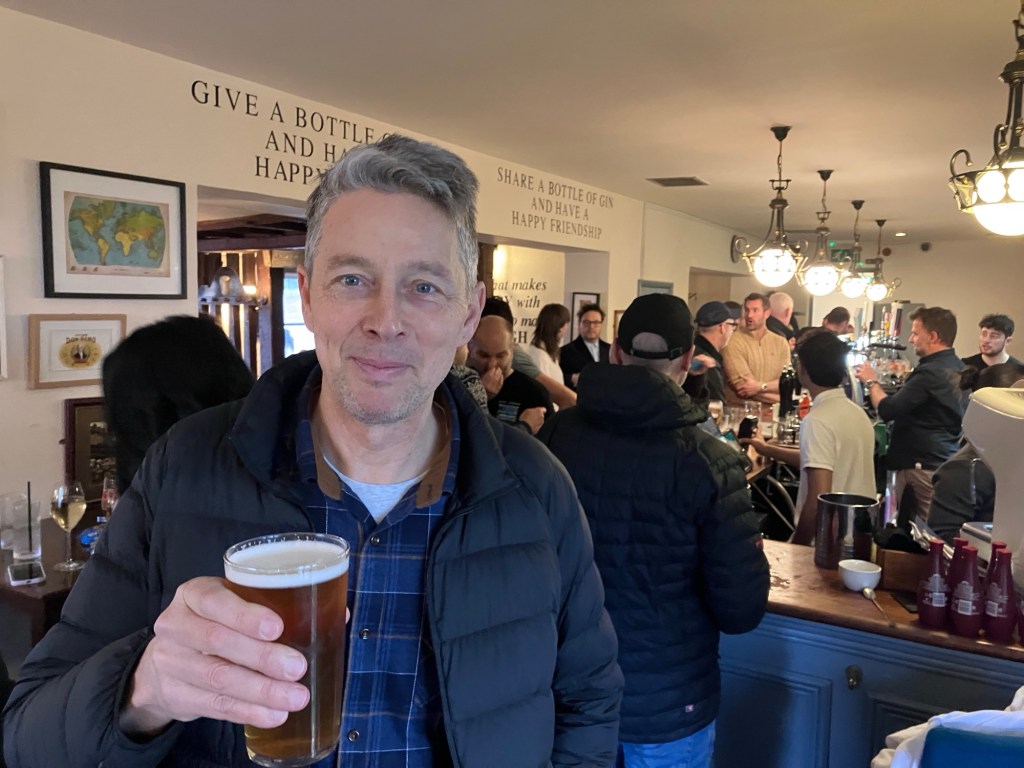
And my first hand pulled British craft bitter in awhile. Delicious!
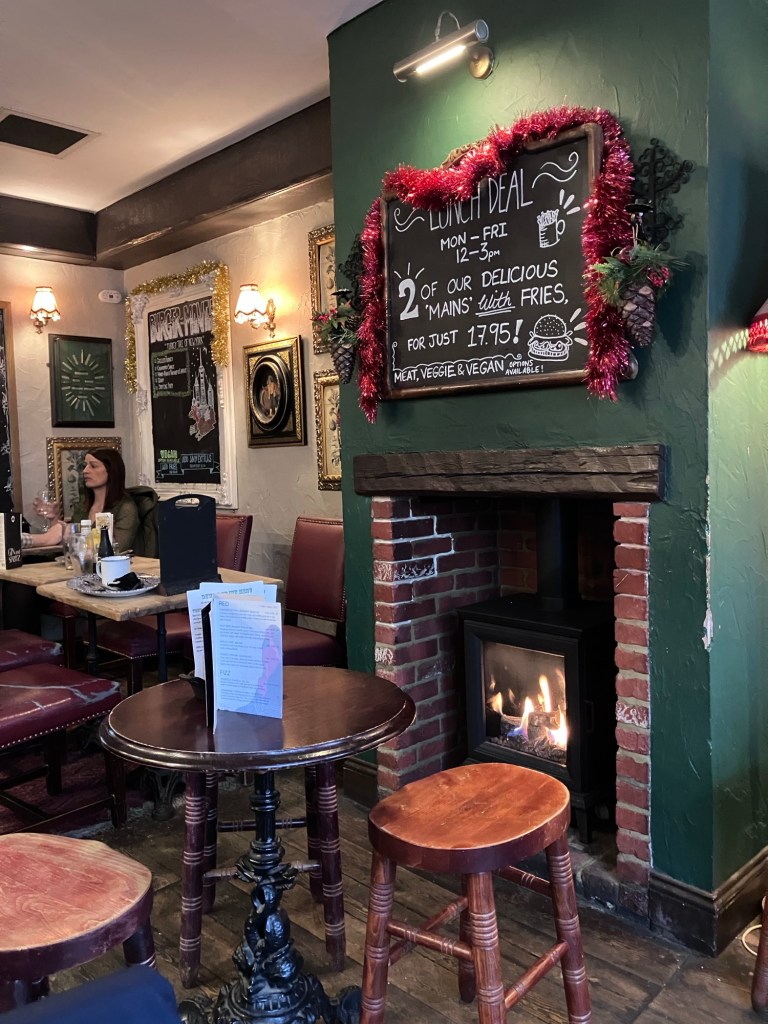
The cosy pubs of England are hard to beat in winter.
Have a seat by the fire.
Holiday cheer and lights abound.
Ok, maybe we were missing Paris a little.
Inside the Paris House (Le Pub) in Hove, the warmth and sounds of live Sunday night Jazz.

So our Eurostar train finally boarded after nearly two hours, and departed only 40 minutes late. But hey, at least we didn’t have our bikes -:) Our slightly agitated travel states soon calmed down as we took our Eurostar plus seats; which is a nice upgrade (but certainly not essential) from the standard service with the bigger business seat car layout and light meals delivered to your seat. And yes, white wine; which tasted pretty good after the misery of the waiting area and boardiing process. Note that the Plus class is a much cheaper upgrade than business/premier class, so often only €20-€40 more than standard. Eurostar business seems outrageously priced in comparison as same first class type train seats as the Plus service: just fancier food service; dedicated boarding, and a lounge….ok, the lounge might have been nice our day; but not worth €100 more each! And it would have been packed with 3 trains worth of people.

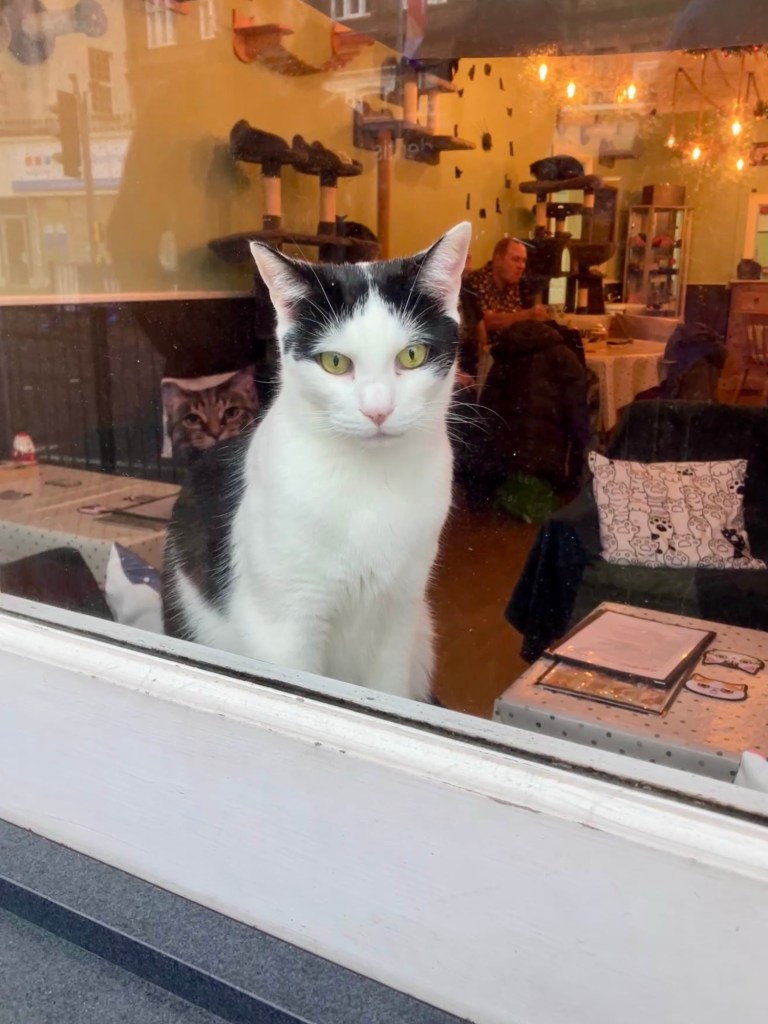
The windswept beaches of Brighton in early December
Cat subtlety mocking Cheryl out in the cold.
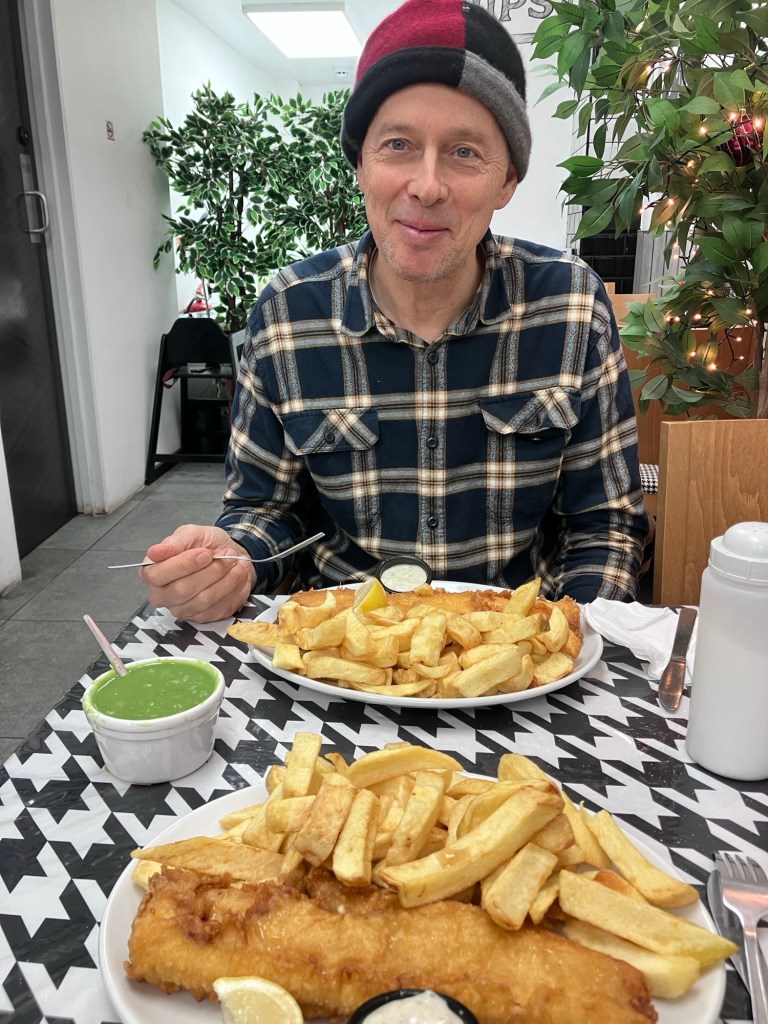
Serious winter fuel up at Sea Breeze Fish & Chips in Hove.
Ready to get out and put those fish & chips to use.
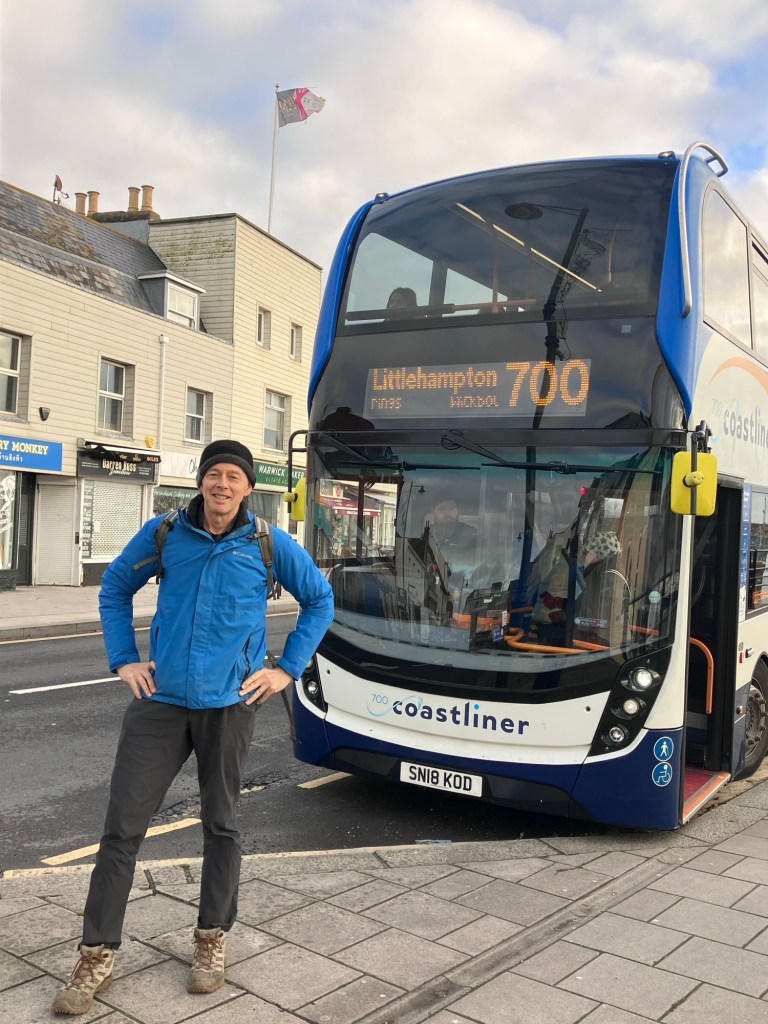
In addition to great trains, the Brighton/Hove area has great transit with real time info and frequent service, including up and down the south coast.
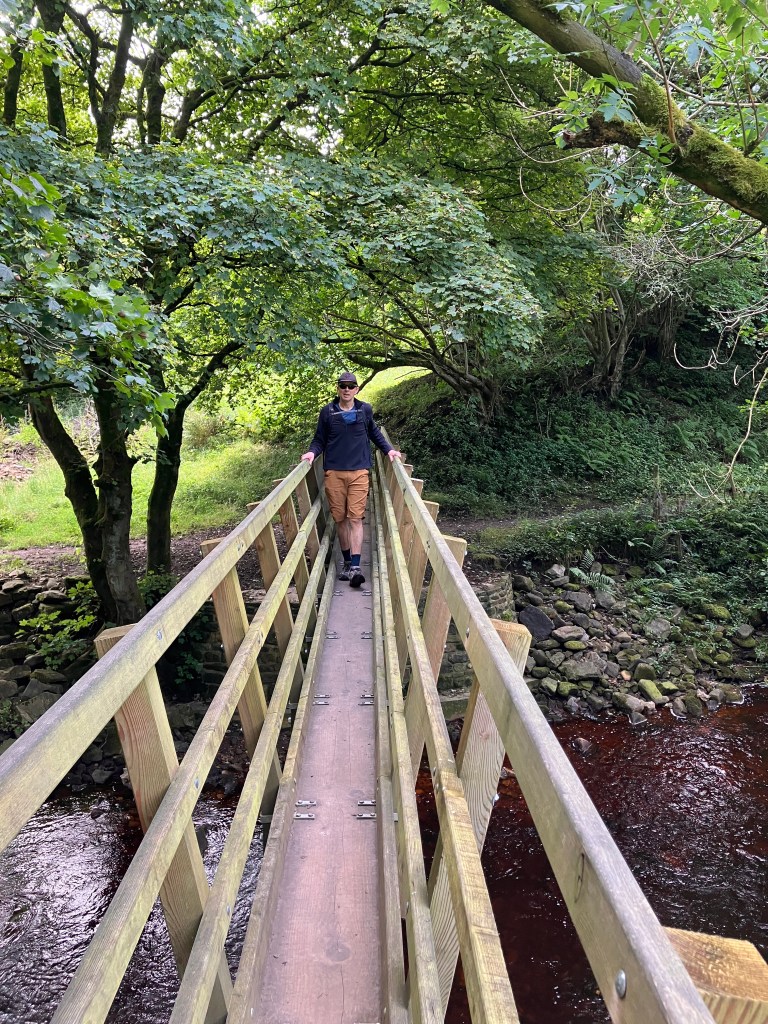
The wonderful footpath system of the UK.
Enjoying winter sun and views on Mill Hill above Shoreham by the Sea.
Sheep looking inquisitively at us for guidance (or maybe food?).

We love returning to places we like; and we have fond memories our 2 week stay in Brighton in 2022. Ok, it was Hove, actually. This time we stayed for a week on the Hove/Brighton border and closer to the water. A great choice as it was a walkable and lively area, but less touristy than the Lanes or areas around the train station. I even went back to the same place to get a haircut as 2 years ago. Brighton was also an easy shot back to London and our next destination, Norwich.

Cheryl relaxing again on the Thameslink, where we would transfer to a Greater Anglia train to Norwich.
Norwich is a small city in Norfolk County with a lively center, relaxed yet sophisticated vibe, and an engaging history.
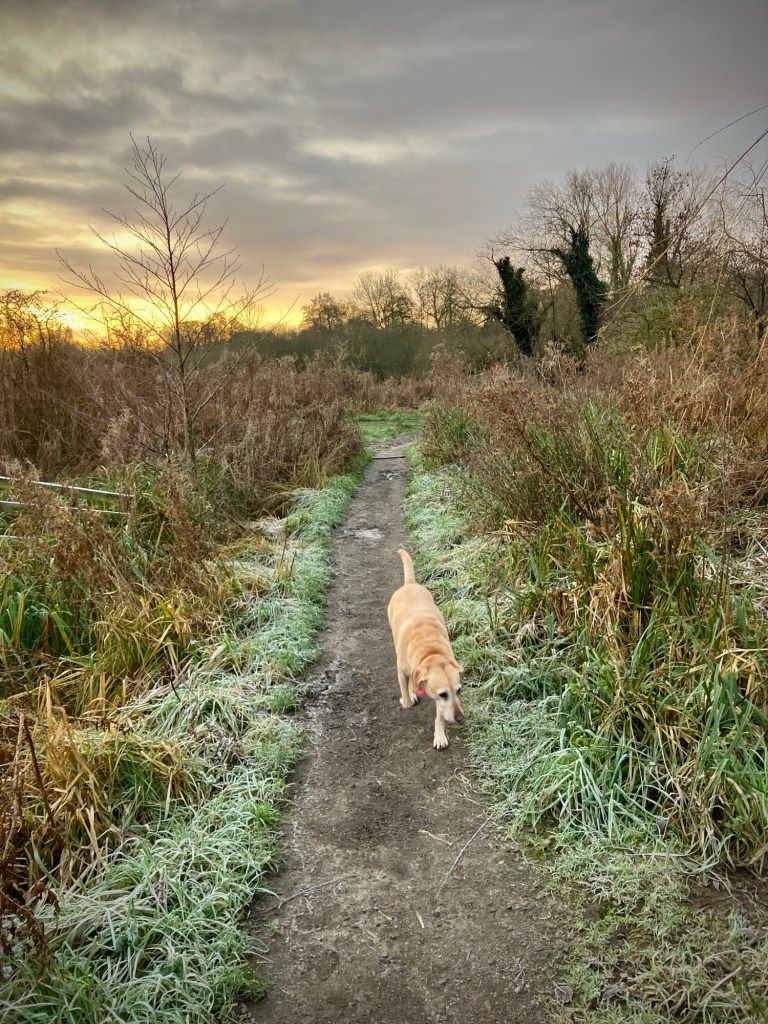
Our stay in Norwich included looking after a sweet dog, and walking the dog always got us out, even on frosty mornings
Pre Christmas buzz in the beautiful Art Nouveau Royal Arcade in Central Norwich.

So what was our strategy for the UK winter? A pub a day, lots of walking in the short « daylight » , and catching up with some friends as possible. The dark winter days were a bit tough for these Californians, but the countryside and old cities are beautiful; and there is nothing like a cosy English pub on a cold, rainy (or snowy) day in December. You often open the door to find a warm buzz of people, pints, and if lucky, a nice fire to sit by.  We often cite the footpath system and Pubs as what we would take from the UK to form our perfect Country.

Our Norwich stay was greatly enhanced by our local friends Jon and Jane; here on the grounds of the University of East Anglia (UEA)
The UEA buildings in the background are part of the Norfolk Terrace student housing, a Grade II listed architeturally significant example of 1960s modernist design by Denys Lasdun and Partners that is now in need of reconstruction.
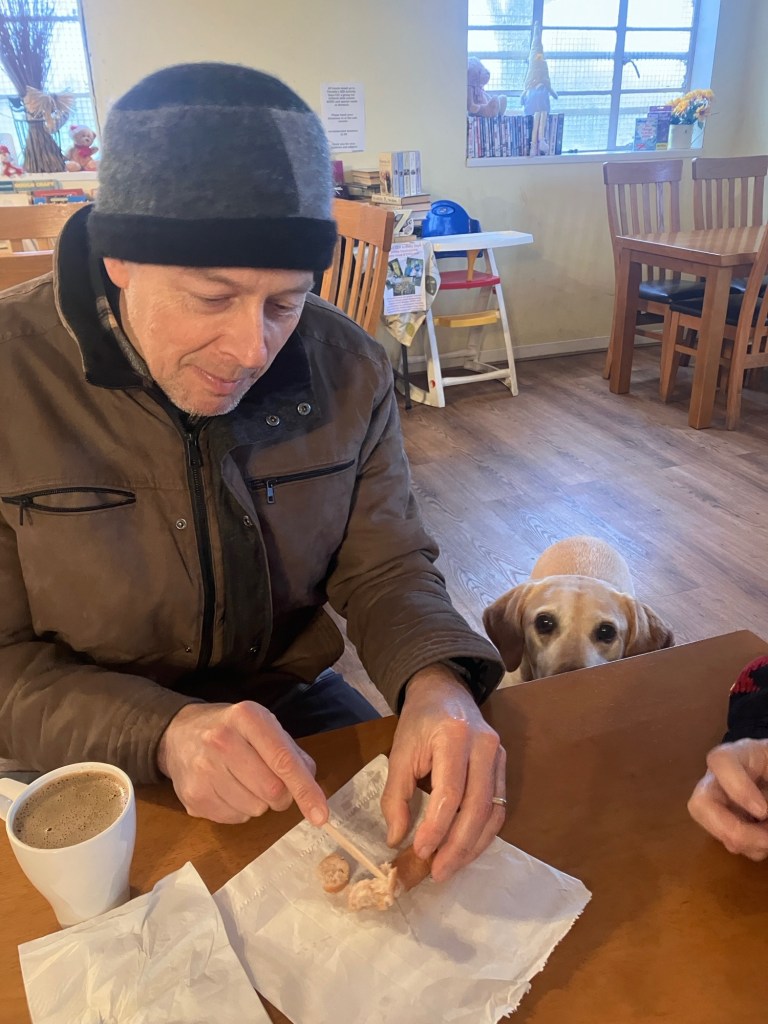
The old school Earlham Park Cafe was always a great destination on our daily dog walks, and Bindi loved their dog sausage for just £1.
Bindi knows the way to Sausage Cafe (sung to the tune of “Do you know the way to San Jose”).
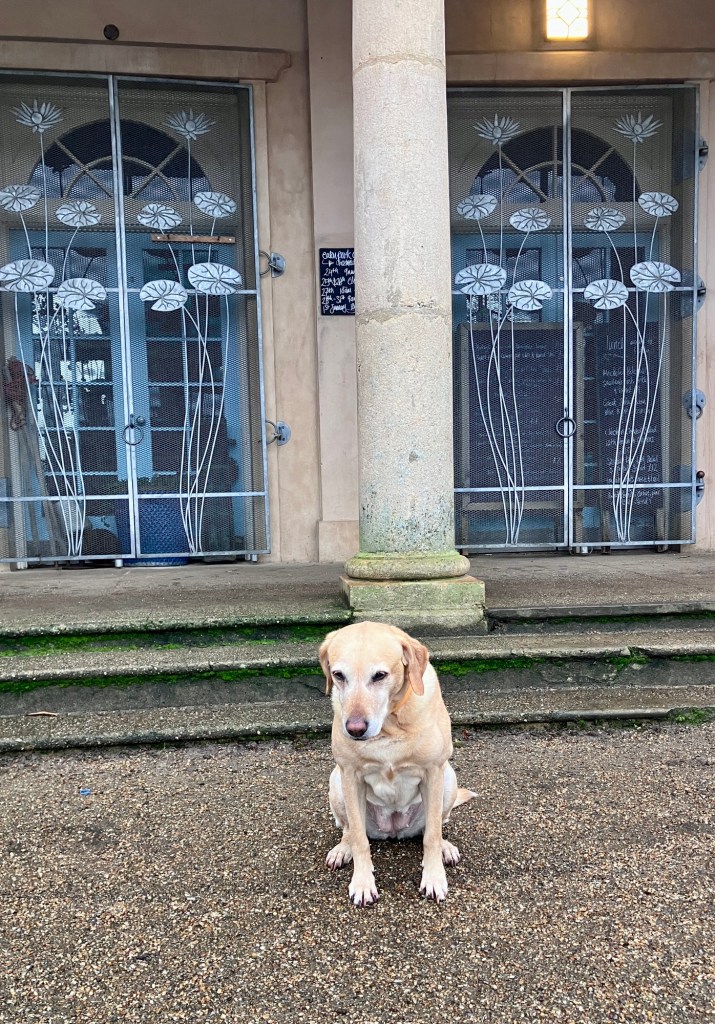
Sad dog during the Holiday closures of our other common destination, the Eaton Park cafe. Sorry, no dog sausage or Bap today Bindi.

After a nice recuperation in the familiar grounds of Brighton, we set off to the uncharted lands of East Anglia, and specifically Norwich. We had scheduled a long house sit to take us through the New Year and I admit, I had to look up where it was on the map, even after years of roaming about the UK. It’s the hub of Norfolk County and home to about 140,000 people.

The peaceful UEA campus grounds along the Yare River.

Norwich is less than 2 hours by train from London, but a world away, and thriving with its own unique history as a center of wealth and prosperity in England going back 1000 years. During the Middle Ages it was a close second to London in stature, but started to recede during the Industrial Revolution as it had no coal or swift water to power manufacturing.

Jane showed us a stunning view of the Broads National Park at the top of St. Helens Church in Ranworth.
The climb up comes with warnings.
And rightly so.
It was great to have Cheryl’s sister Kathy join us for a week in Norwich.
Even (well behaved!) big dogs are welcome at most pubs in Norfolk County.

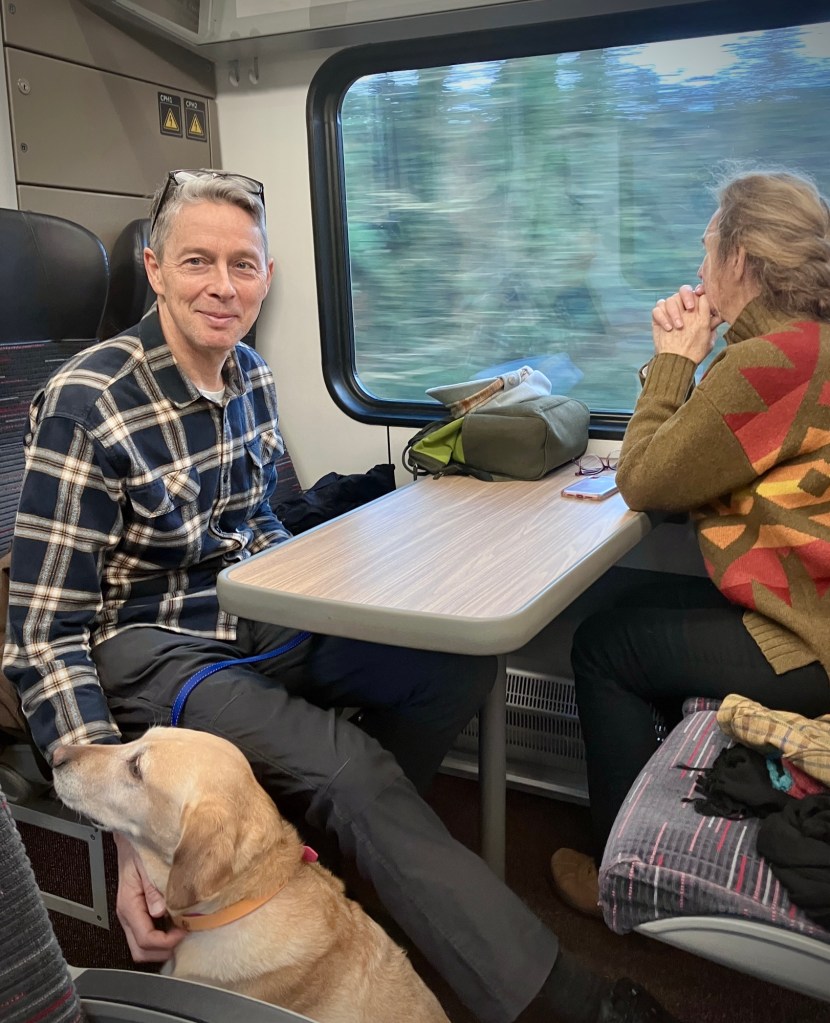
We had a nice warm cosy house and garden to call home for 3+ weeks, complete with the sweetest dog in the world. Our daily walks with her took us through the neighborhoods, parks, marshes, and rivers of the area, and certainly helped us feel at home over the holidays, especially in this dog crazy area, where dogs are welcome in almost all restaurants, pubs, and most stores. And our easy going golden lab was a popular addition to a few bus and train adventure as well, where she was welcomed and coddled by other passengers. 
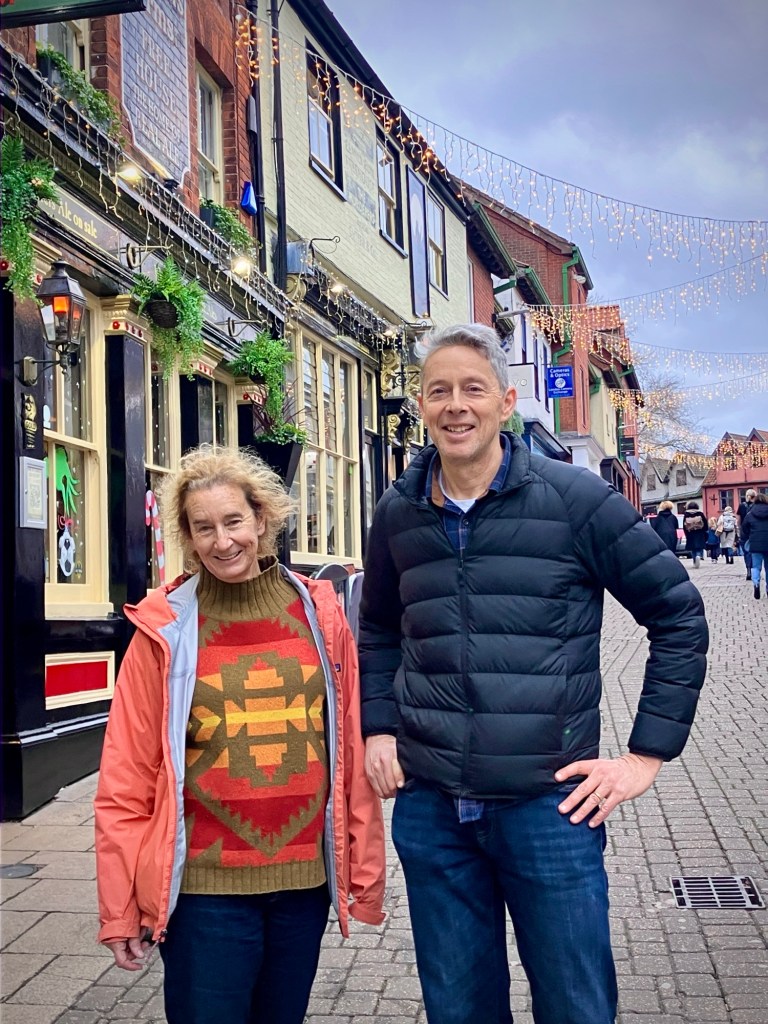
Kathy and I in busy central Norwich
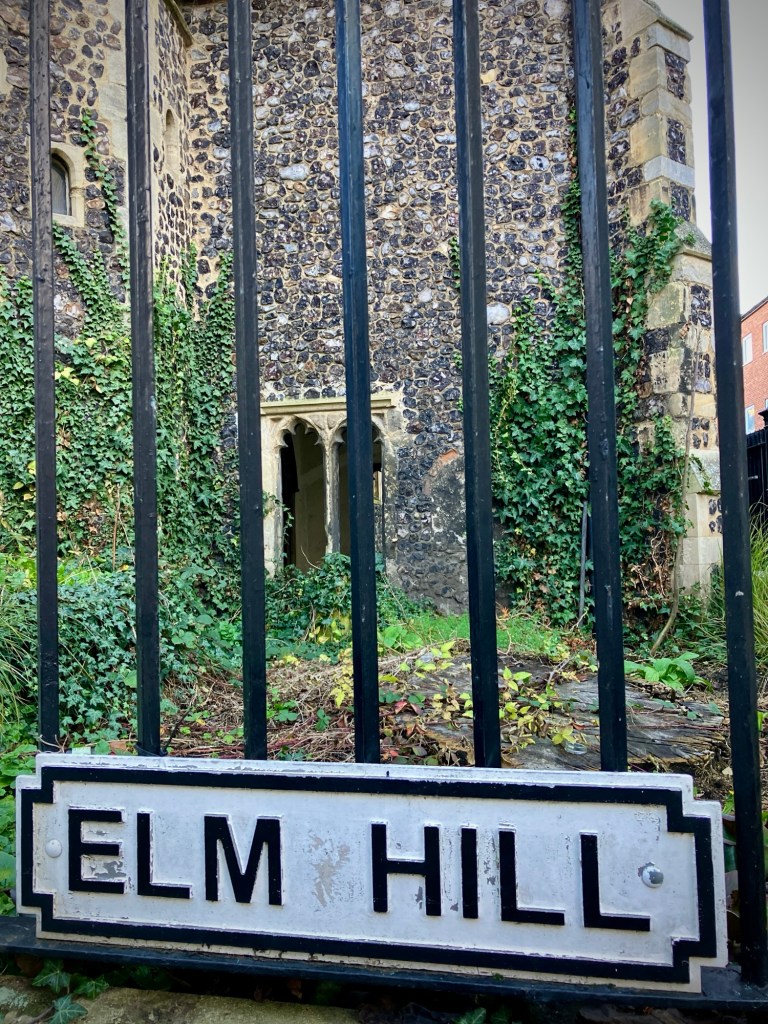
Elm Hill is a street in the oldest part of Old Norwich and has hundred of intact Tudor era buildings dating back to the 16th Century.
Lots of courtyards and alleys to explore in Norwich
Norwich has the highest concentration of Medieval churches in England, so many have been repurposed for other uses, including crafts, arts spaces, and this antiques and collectibles.
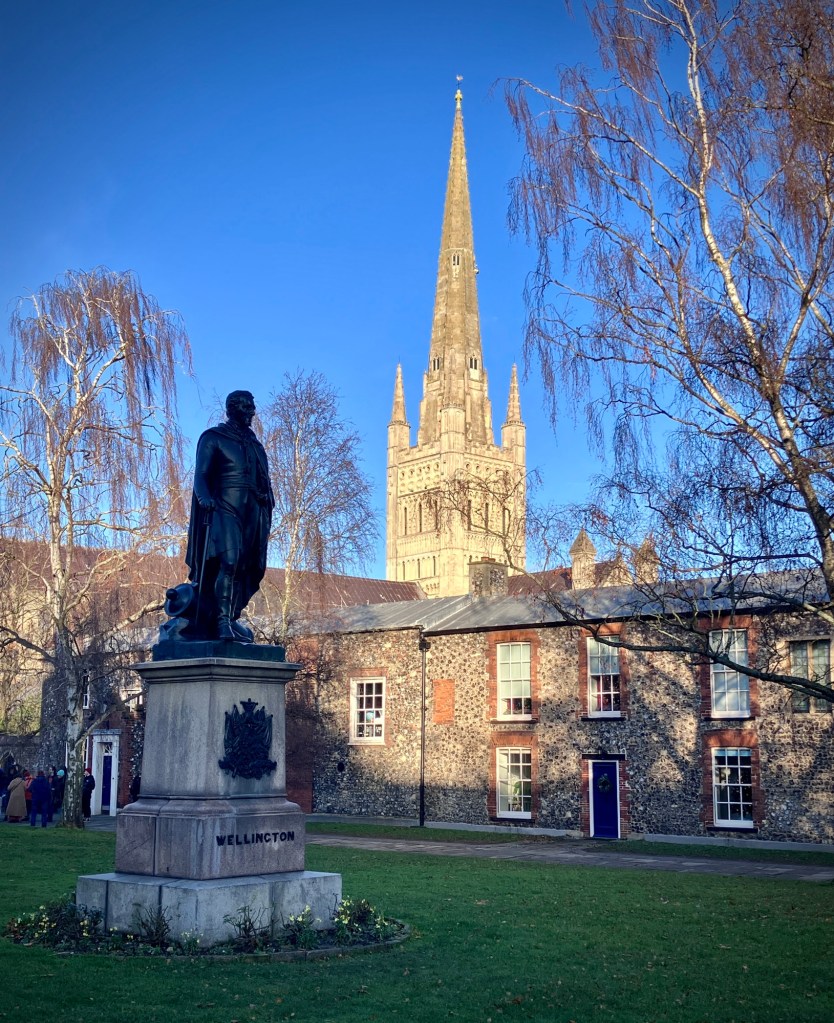
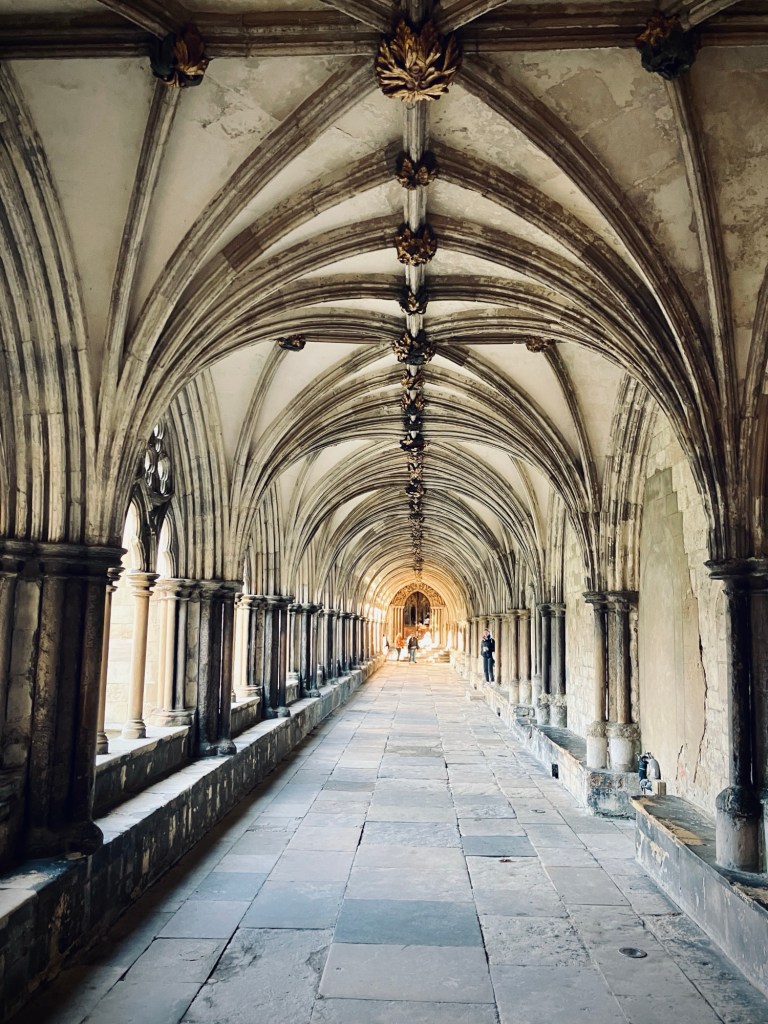
The spectacular Norwich Cathedral is over 900 years old at its core and sets the atmosphere in old Norwich.
The Cloisters attached to the cathedral are the largest monastic cloisters in England.
Bindi on the train to Comer.
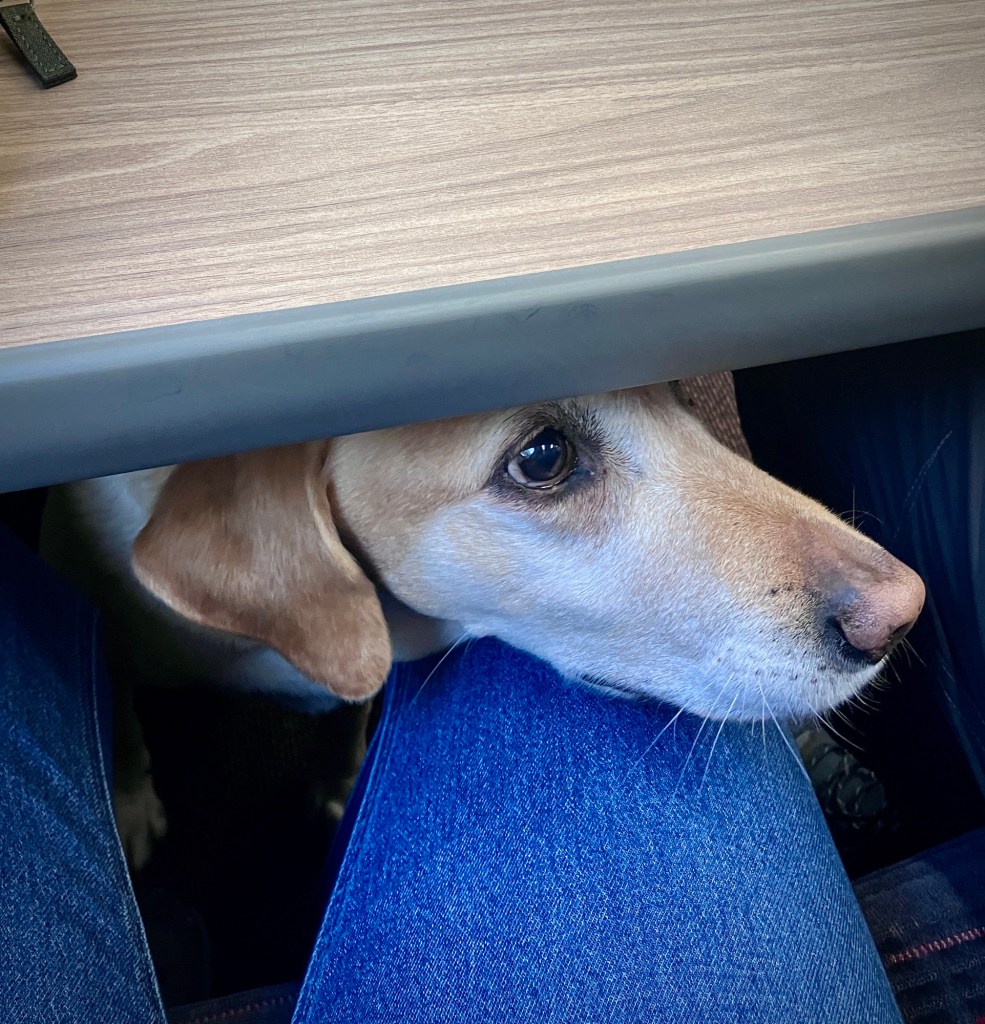
Bindi needed some reassurance on the train.
Cheryl loved having her sister here, and a day out at the Norfolk coast in Cromer.
Norwich is home to one of the best independent Department Stores in the UK , Jarrolds, which has three cafes, a massive gourmet food floor, and the more usual department store offerings.
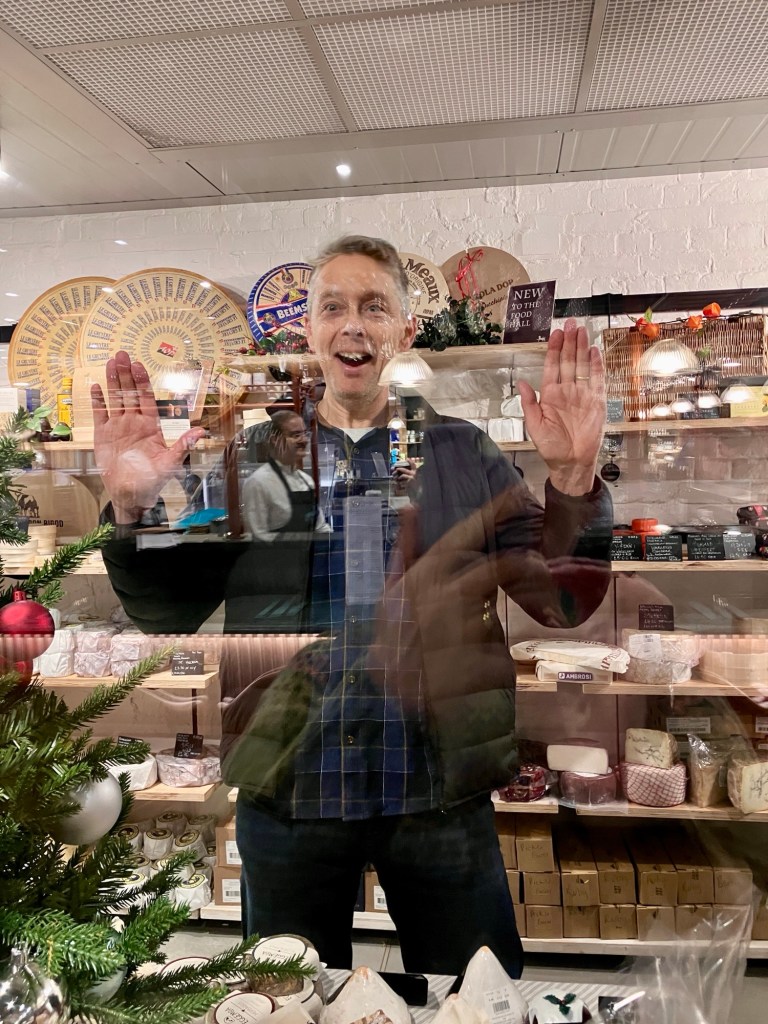
Trapped in the chilled cheese room at Jarrolds

We had a great time uncovering the layers of Norwich history and exploring the area. This is one of the joys of slow travel; diving deep into the history and culture of an area that most people from Abroad don’t even visit for a day. Norwich also has a few good small museums and we even took in a classic British holiday Pantomime performance at the impressive Art Deco Norwich Theater Royal, and almost felt like locals, as we met our friends there as well, and even understood some of the quirky local jokes and references. But not all.
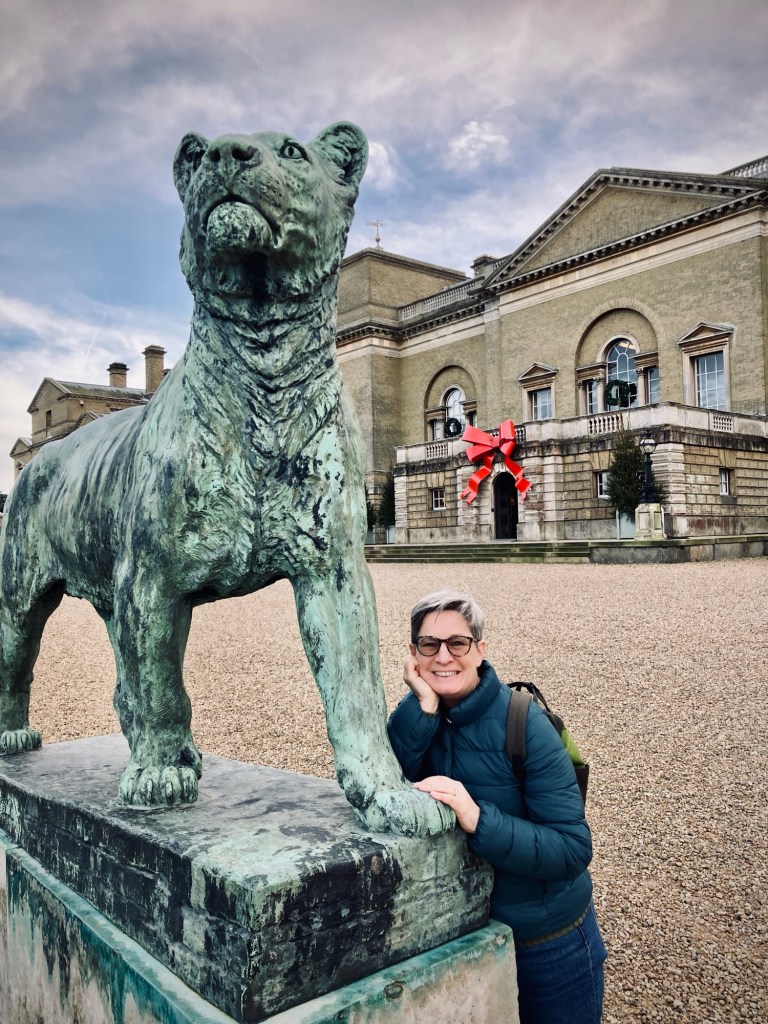
Outside Holkham Hall in Wells Next to Sea.
Cheryl and Kathy enjoying a mince pie and Prosecco at Holkham Hall, during our candlelight walkthrough of the historic 18th century country club state home.
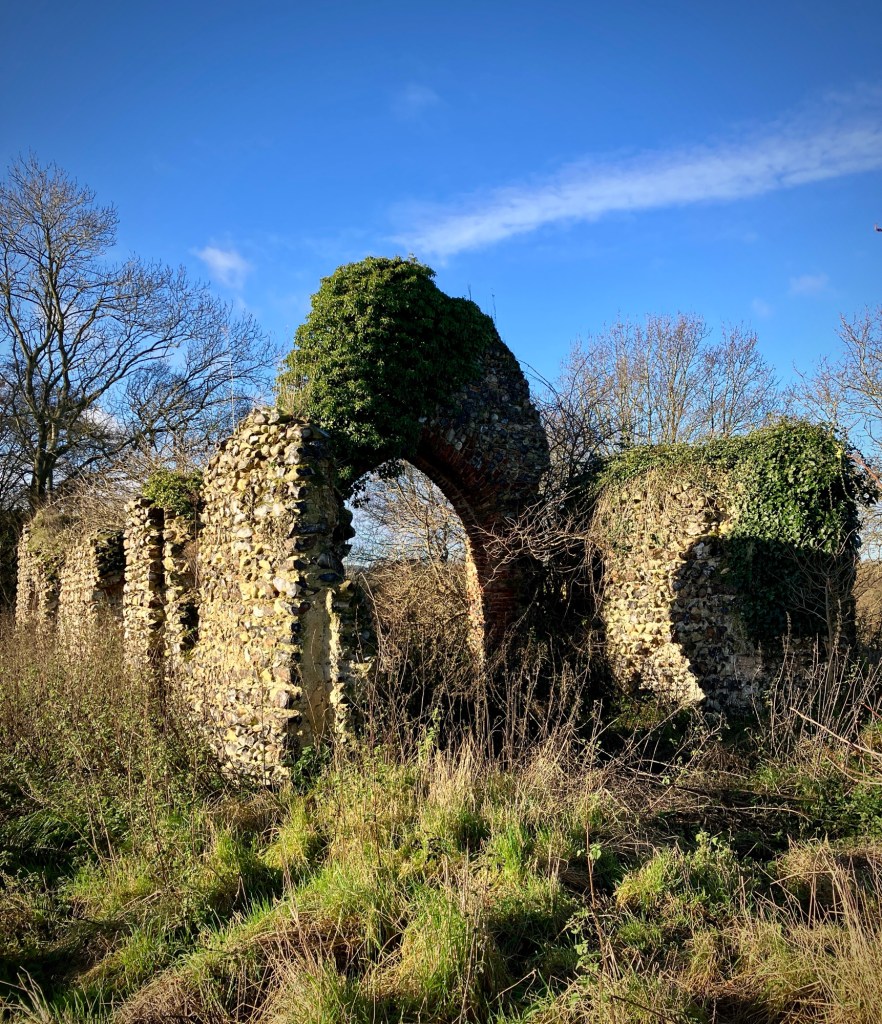
The ruins of St. Saviour’s Church in Surlingham date back to the 11th century, but many of the large flint stone materials were eventually pillaged for construction in the 17th century. Amazing any of it survives.
It seemed everyone in the village of Eaton (part of Norwich) headed to the pub on Christmas Day for a pint. Most pubs are open for a few hours in the afternoon just for this purpose.
Or a delicious gin&tonic.

With our dog, walking up a storm was easy; but our next goal of « a pub a day » took some dedication and admittedly we missed a few days. but fear not, we doubled up on other days to catch up. We also discovered that the pubs are popular throughout the Christmas period, when so much else is closed. So to the pubs we went. Do as the locals we say.
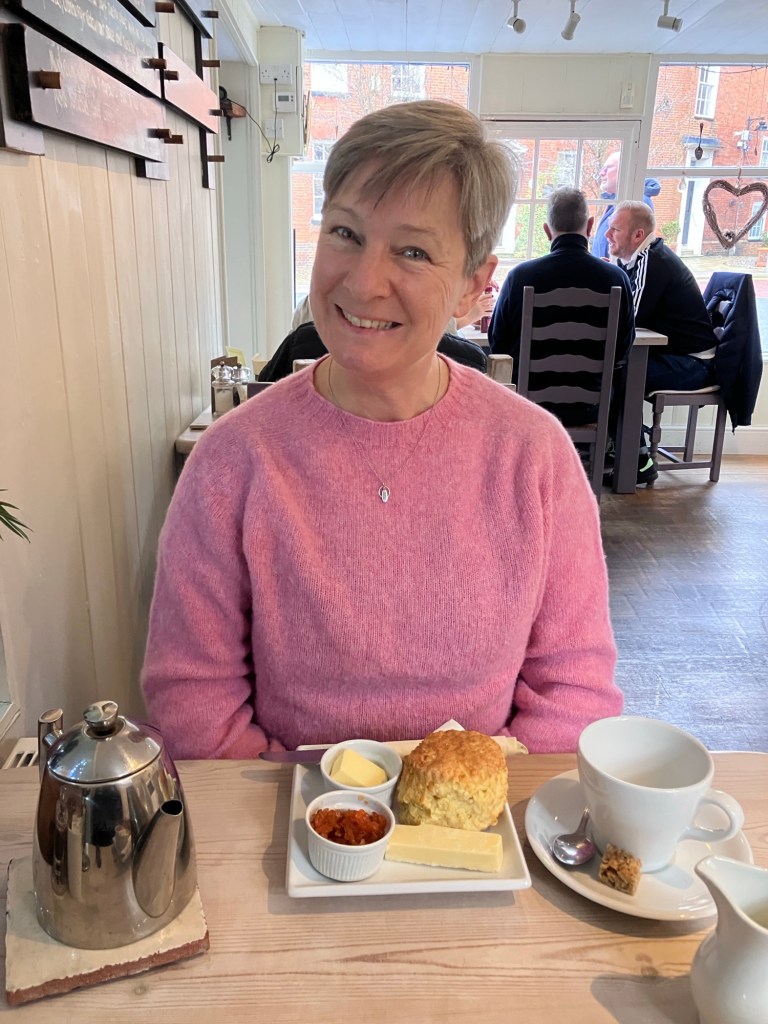
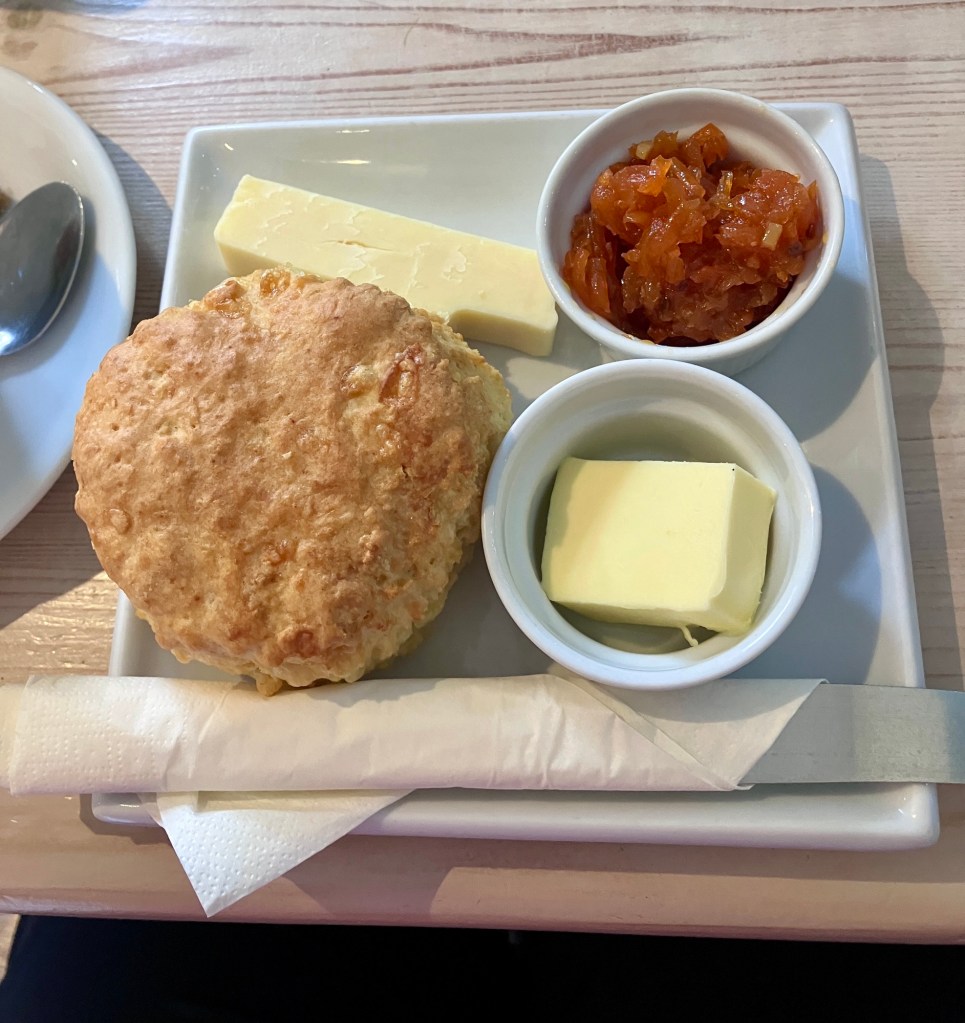
Happiness is proper tea and a scone, cheddar, and chutney plate at the Earsham Street Cafe in Bungay.
Delicious and worth a stop before or after a local walk.
Our 6 mile loop walk from Bungay.
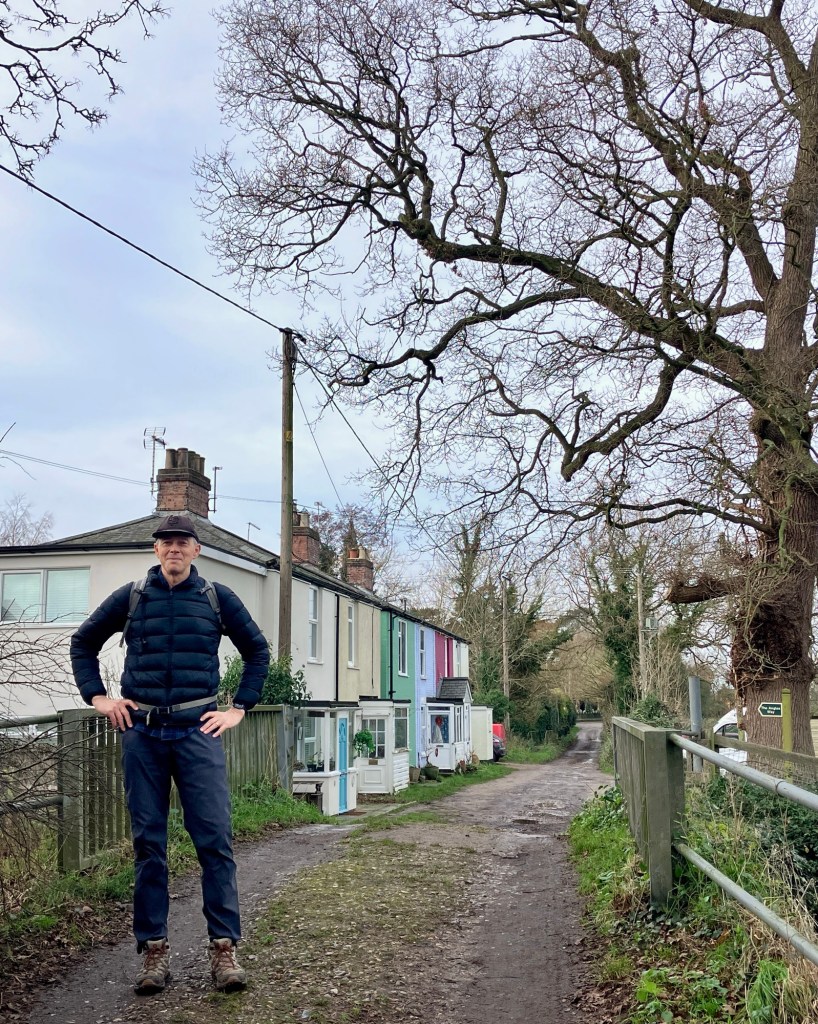
Part of our walk included Bighods Way, named after the local 12th century Norman family and their castle.
Beautiful winter light on Bighod’s Way near Bungay.
It seemed Bungay residents knew how to brighten up the winter with paint.
At one of our favorite local pubs, The Alexandria, in Norwich’s Golden Triangle neighborhood
The St. Andrew’s Pub in Central Norwich. We were really working at our “pub a day” goal.
Pinot Gris and a pie.

The weather was mixed during our stay, but blessedly dry for the most part. But there were many days of gray (the grisaille!) with heavy low clouds and a bit of cold mist. But the pubs did their trick, and were a great respite on the dark sunsets (at 3:30!!). Friendly locals and lots of conversation…not to mention my favorite real ale cask bitters. 

We’ll have fond memories of our time in Norfolk

We highly recommend you go a bit out of your way to see Norwich. We plan to return, but perhaps in spring or summer when we can sail on the Broads and see another side of the beautiful area. Happy New Year and new adventures!
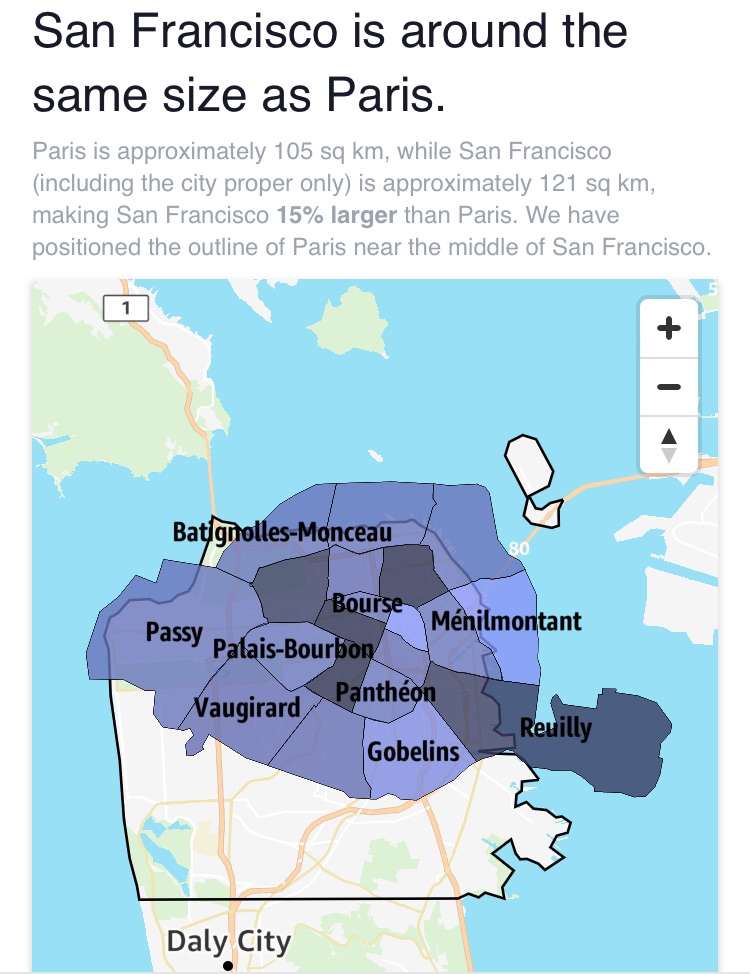
Spending our time in Paris. Take 2.

We have a running joke while we travel where we put things in a Bay Area context for each other. Guanajuato is the Mendocino of Mexico City. Parc Vincennes is the Golden Gate Park of Paris. When we discovered that Paris is actually smaller in size than San Francisco, but with over twice the population, we felt a bit more at home. We lived in SF for decades, most of those years without a car, so Paris felt like a super lively, more busy SF.

What? In my mind Paris was much bigger than SF.

Almost every Metro trip we mapped out on CityMapper was about 30 minutes or less from our Paris apartment. The Metro does move along and wastes very little time dwelling at stations – on the older lines you can actually open the doors while the train is still moving. And people do. But to walk across the city, or to your destination, really doesn’t take long. We started taking one Metro ride, and instead of transferring to a second line, just walked the rest of the way. Or, walked the whole way. We took buses as well, which is a great way to see the city and rest your feet.

Paris is so walkable. Nancy demonstrates that even the weather can’t stop her.
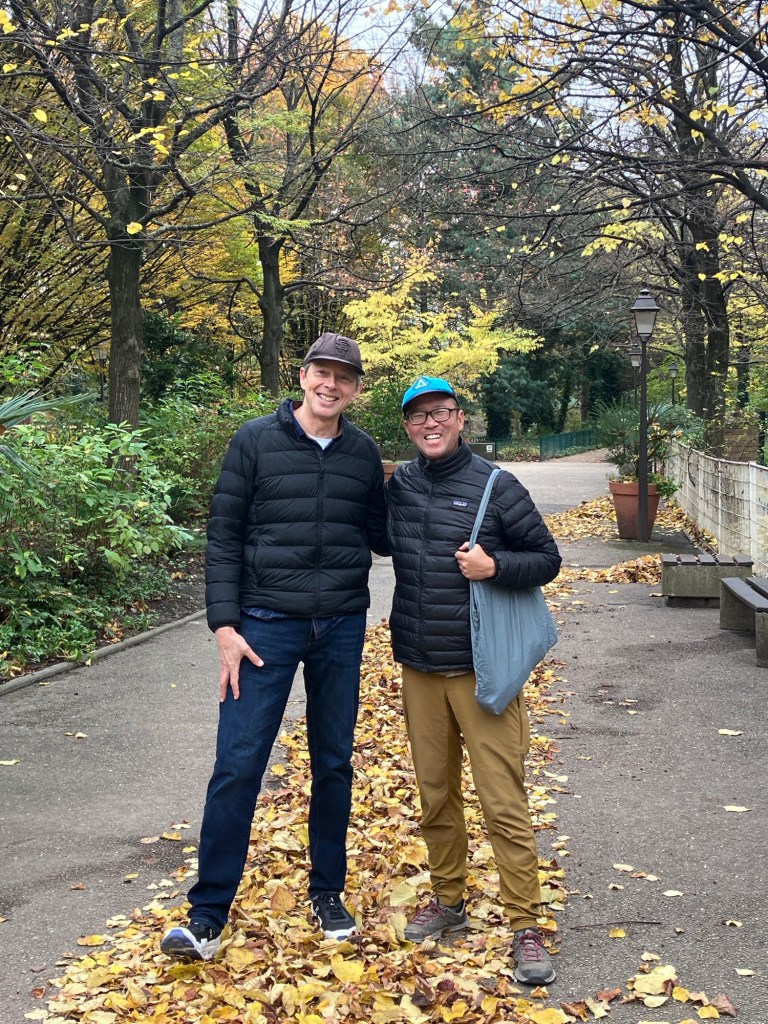
Rich and Dan on the Coulée verte René-Dumont.

The retail scene is so vibrant. Restaurants and shops abound. And bakeries- so many bakeries. Pharmacies everywhere. Laundromats – check. Chocolate shops – check. As you walk you never suffer from a lack of interesting things to see.

So many 6-8 story buildings. So much housing.

Although the population of Paris has shrunk since its high of 2.9 million in 1921, it now hovers around 2.1 to 2.2 million. As with many cities smaller family size and gentrification have had an impact. But the population certainly keeps the city humming! A street near our apartment simply teemed with parents and children at school drop off time. We quickly learned to try to avoid that street at morning drop off.

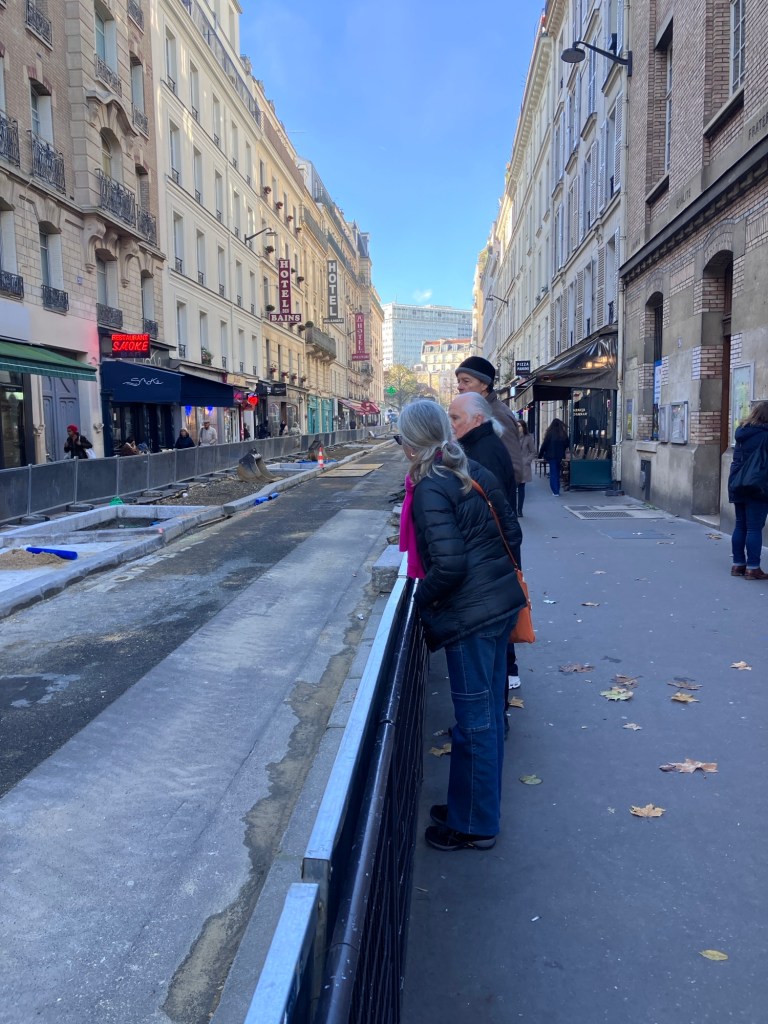
Paris is doing a lot of street re-imagining, making more space for people not using cars to get around. This is a street in the Montparnasse neighborhood getting an update. Wider sidewalks and planting areas.
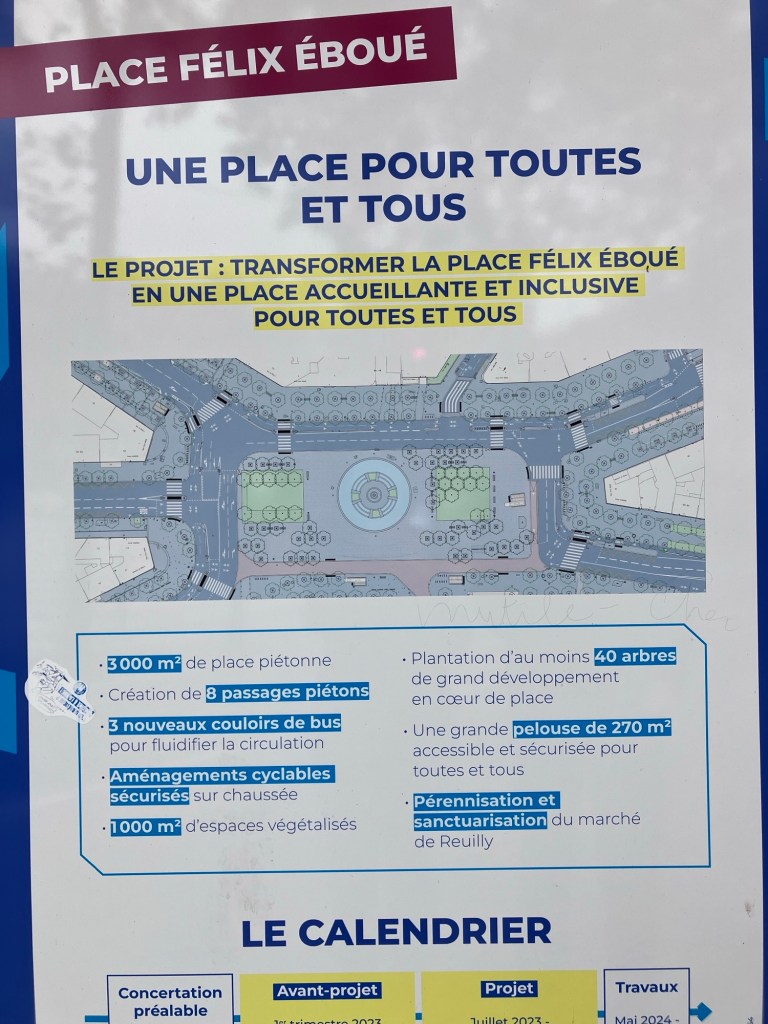
And in the 12th, a massive redesign of Place Félix Éboué, adding bike and pedestrian space, more trees and amenities, and removing car lanes.
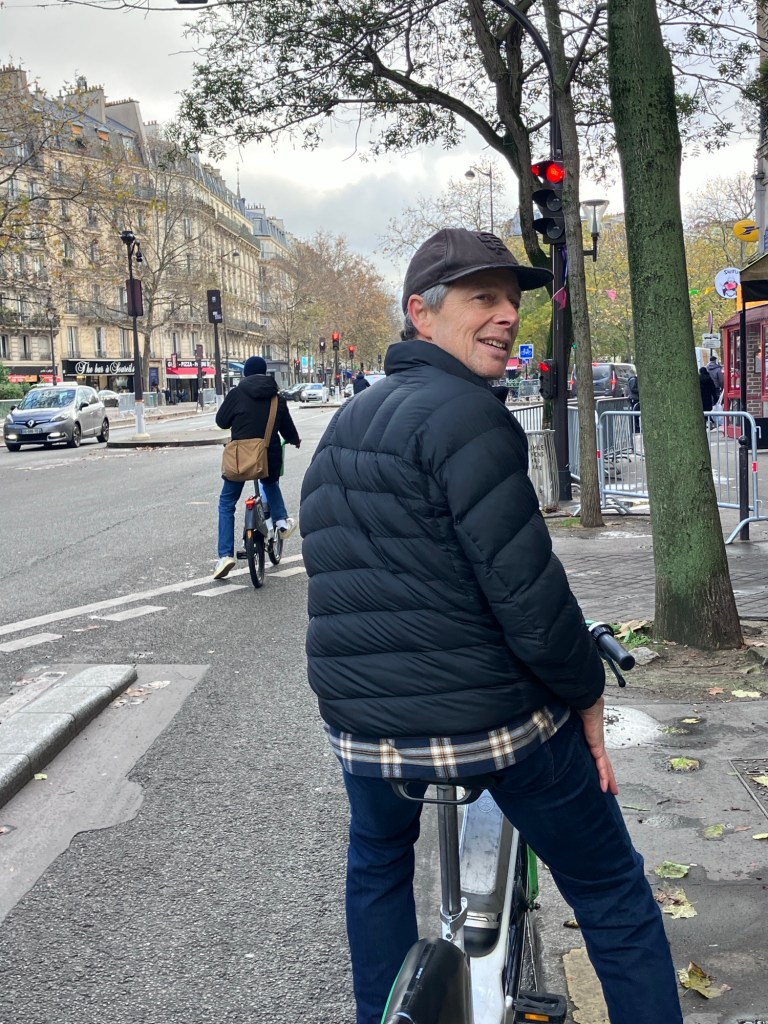
These changes seem to have brought out a lot of folks on bikes.
On my Paris bingo card this lady transporting her dog and baguettes would be quite a get.
Of course we got out on bikes! Despite the chilly weather.
We used Lime bikes while in Paris. Cycling in Paris is quite good, although with so many cyclists I would recommend skipping rush hour at first, until you get the hang of Parisian cycling it can be intimidating. It helps to be a calm and confident urban cyclist since you will be passed by faster Parisian cyclists with only inches to spare. And be careful stopping at red lights since not all cyclists do and you risk a rear end collision!

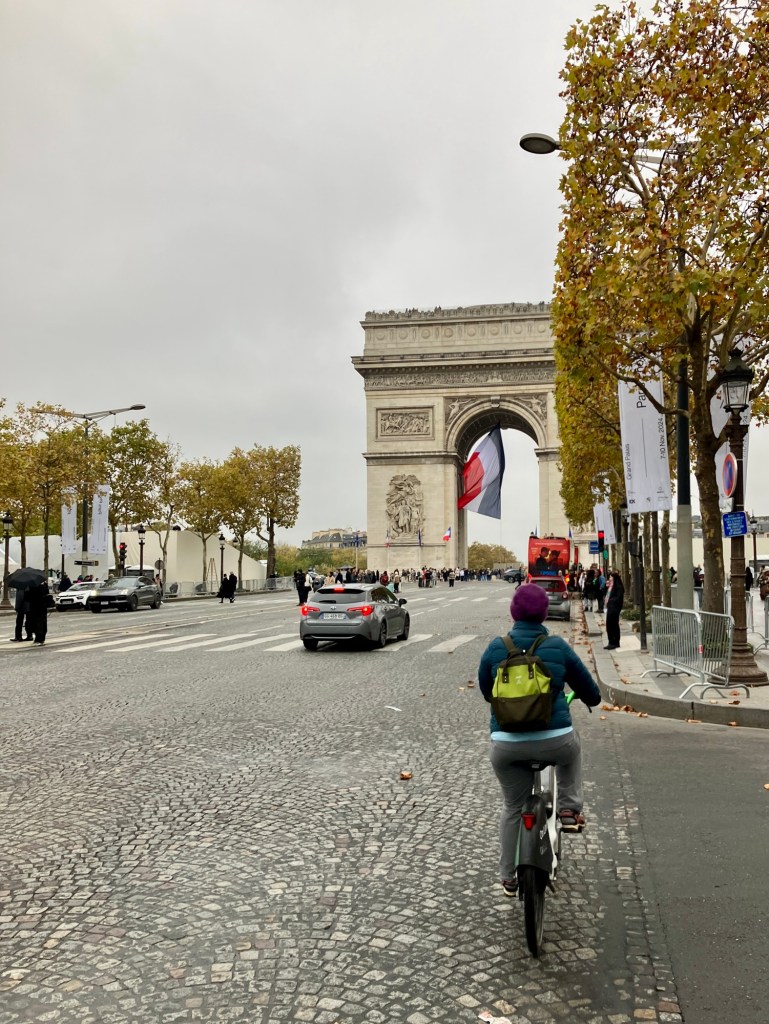
After all that cycling around France we did this year – finally! The
Champs-Élysées to the Arc de Triomphe.
Now we can fully appreciate the cobblestones the Tour de France cyclists face in the Paris circuits that typically feature in the last stage of the race.
Not our own comfortable bikes, but a great way to explore Paris.
The Tunnel des Tuileries. Once full of auto traffic, now graffiti, bikes, and pedestrians. Delightful.
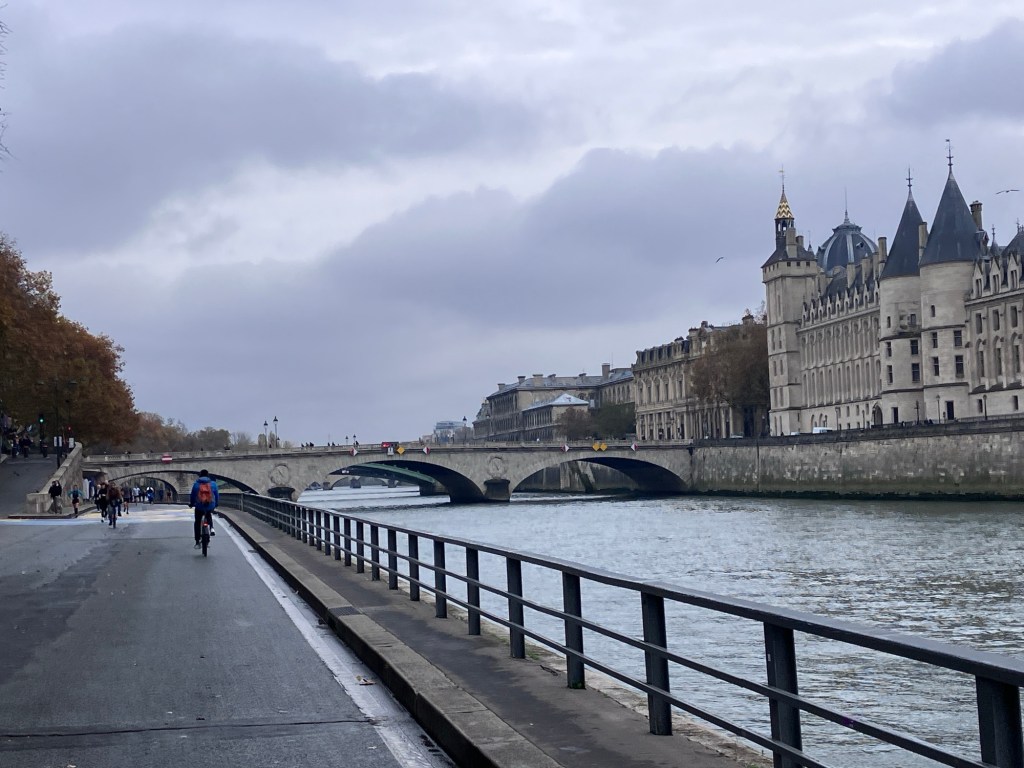
And along the Seine River on a road where cars used to be.
Notre Dame, just a few weeks from re-opening after the devastating fire. That’s Rich on the bike on the right.
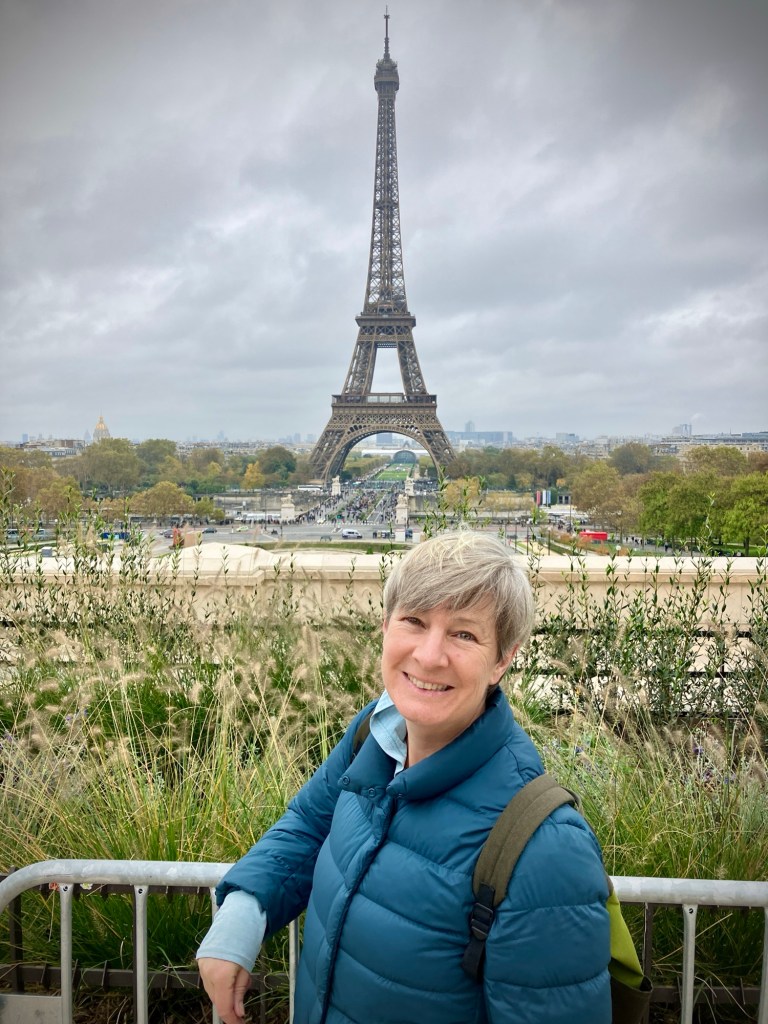
After parking the bikes we snapped the apparently obligatory Eiffel Tower photos.
Yup. We were here. Proof.

It’s fun to see, or bike by, the big attractions, but our joy really comes from simply wandering. Having an errand – find a good coffee roaster to buy beans – and then seeing what we see. Be a Flâneur. Wander the city. Stroll. Observe. Be delighted. It’s what we did for so long in San Francisco, and it was such a luxury to have the time to do the same thing in Paris. As we kept reminding each other, stop and look up, look around.

Enjoy coffee and chocolat chaud.
Coffee shop dog. The family who ran the shop had their two kids and dog keeping them company since it was a holiday and schools were closed.
Nancy joined us in Paris and shared our cafe stops and delightful times.
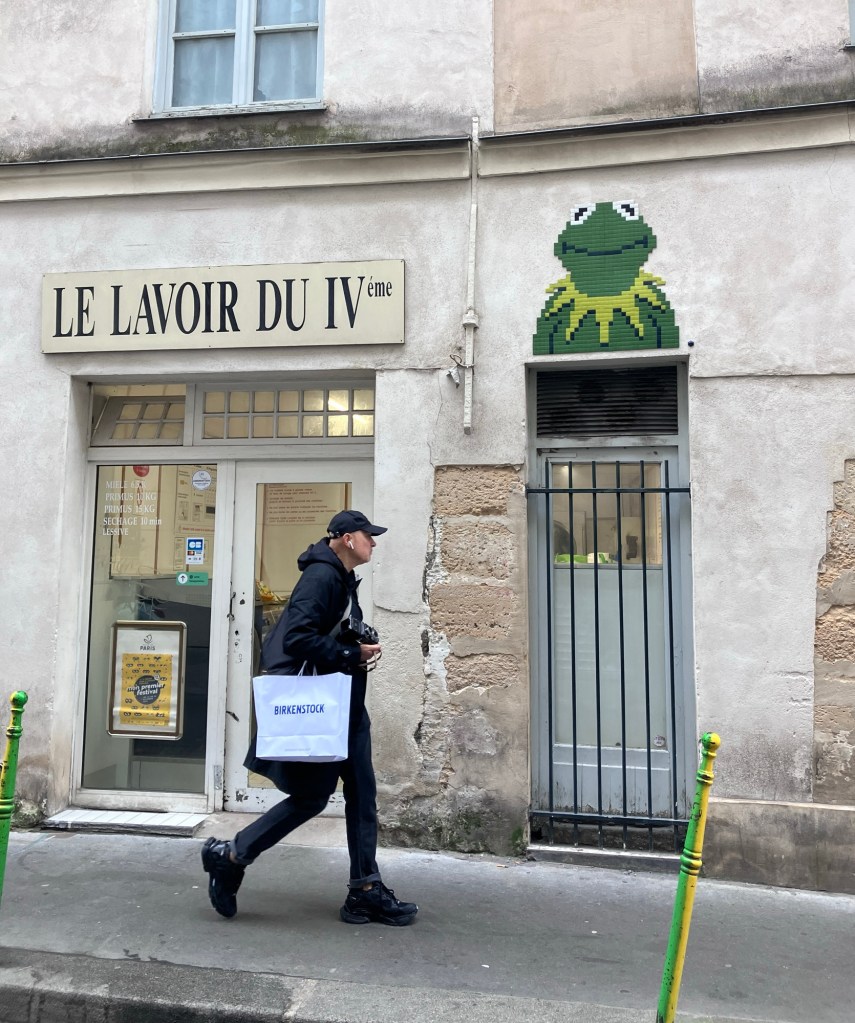
I particularly love Kermit and the painted poles echoing his color scheme.
Neighborhood markets and murals, Montparnasse.
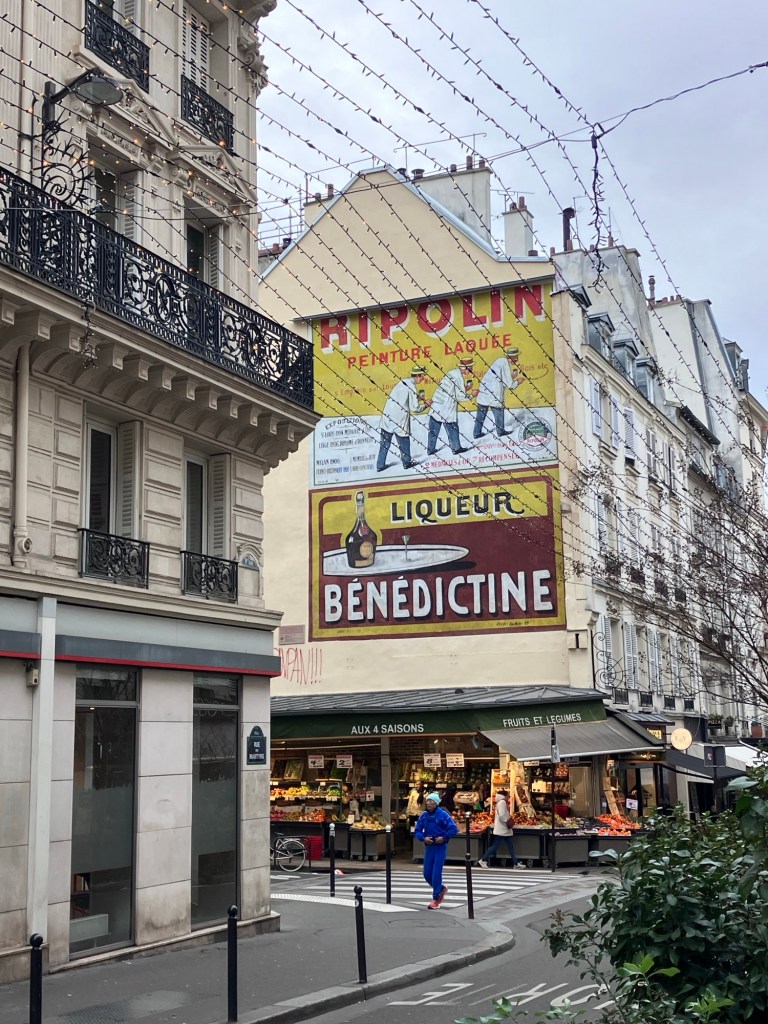
A wall of old advertising, uncovered and refreshed on Rue des Martyrs.
In the 9th. The society of mineral water building.
The bubbly water in the pipe!
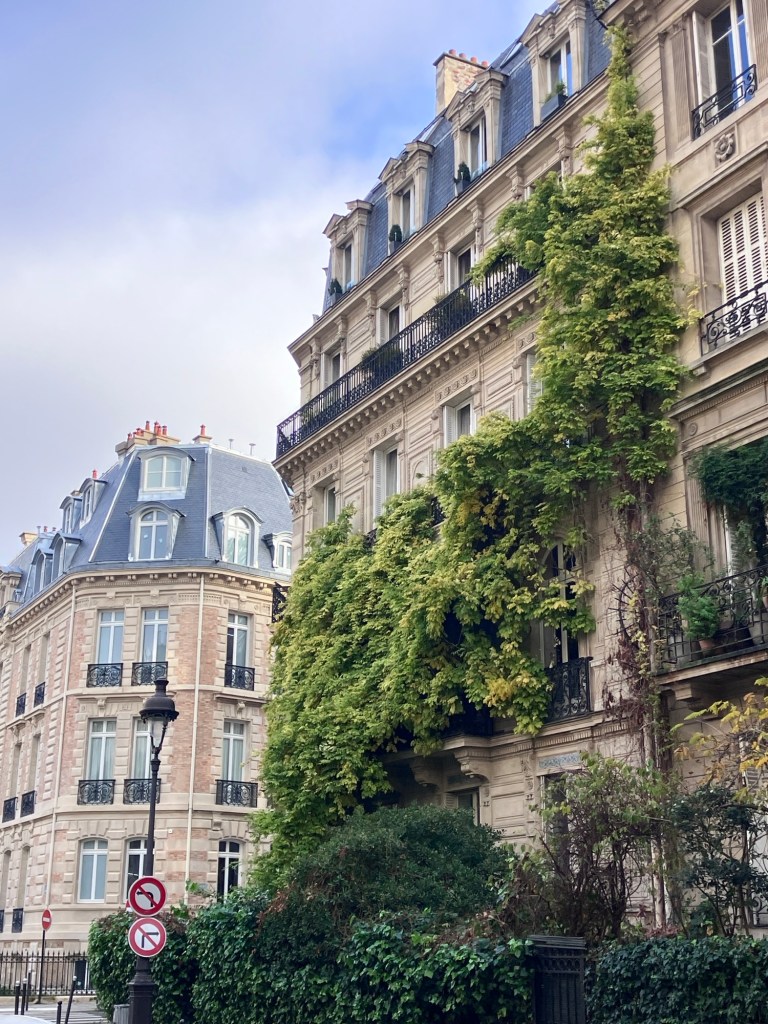
The beauty of Paris.
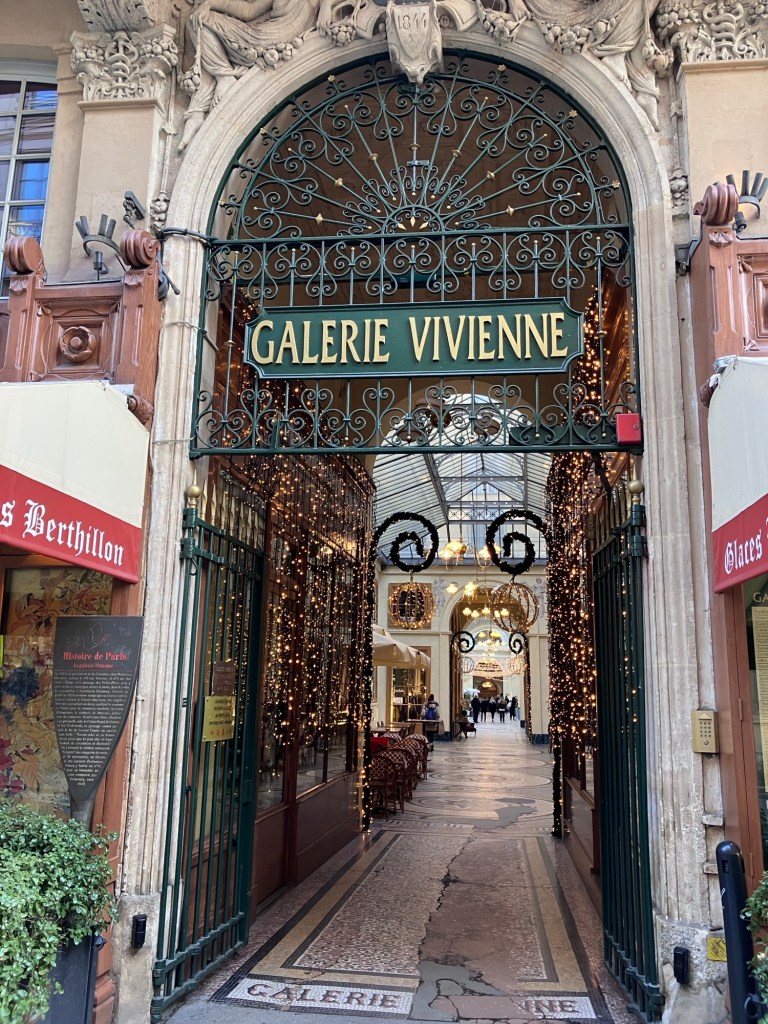
The passages.
The people in dark wool coats strolling the passages.
Basilique du Sacré-Cœur de Montmartre glimpsed from Bd Haussmann on our way somewhere one morning. And the real life of a city going on.
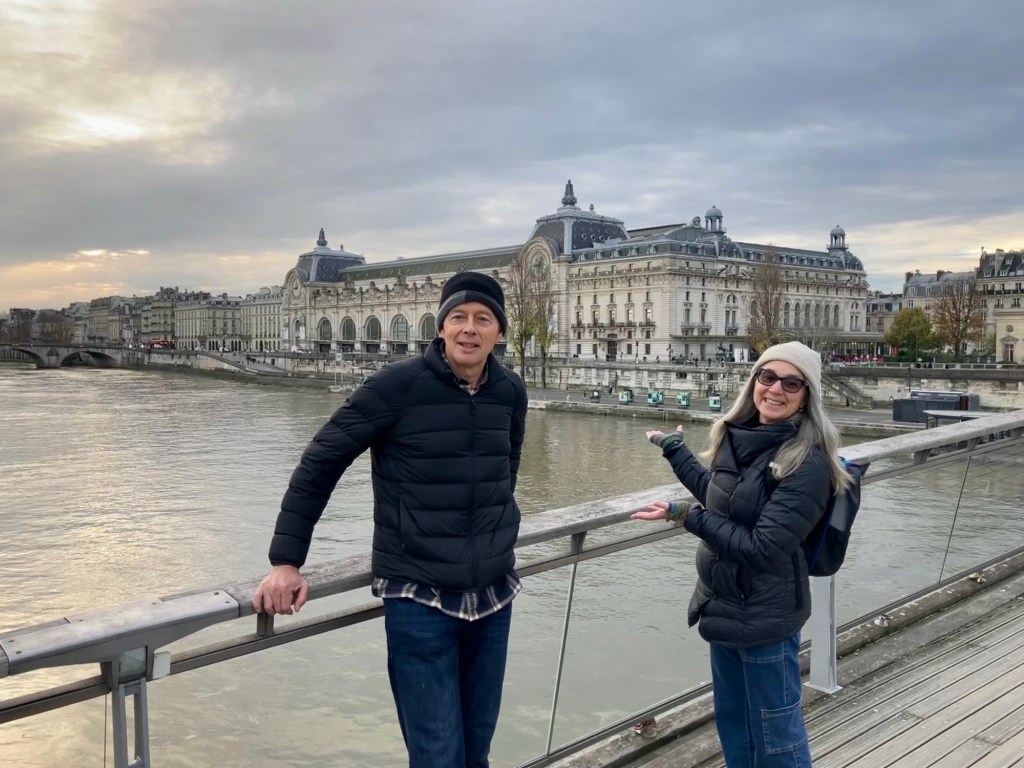
Sacré-Cœur from the Musée d’Orsay.
Enjoying a chocolat viennois at the Cafe at d’Orsay.
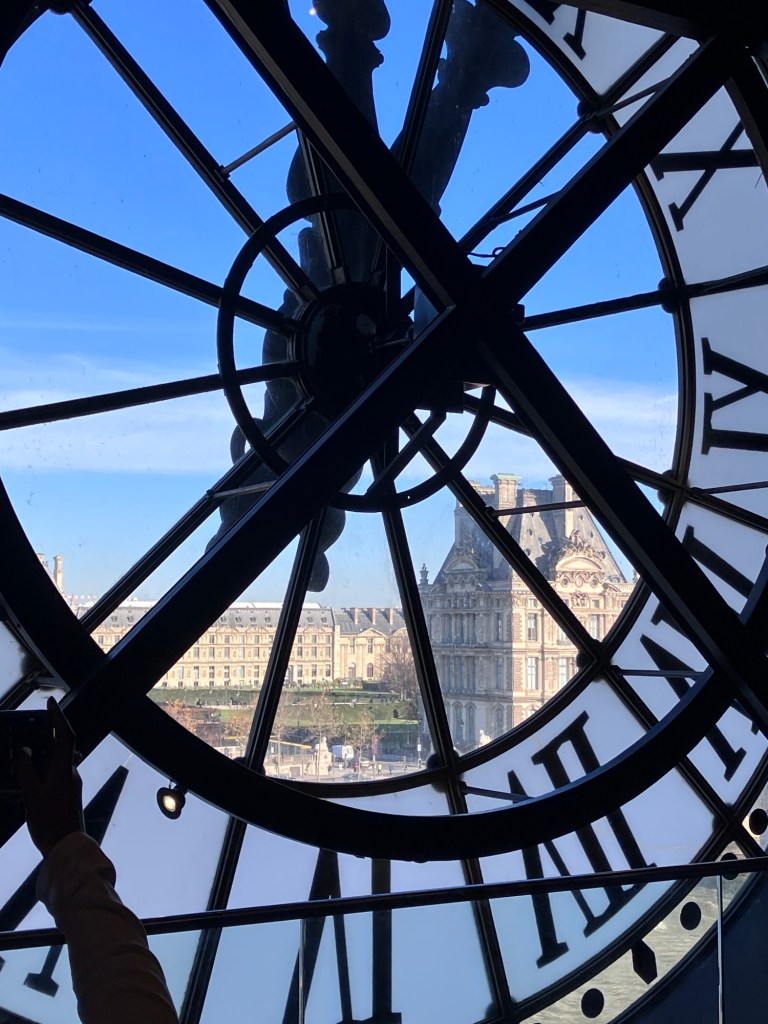
One of the famous and stunning clocks at the old train station turned museum.

Watching Paris put on her Christmas and holiday decor was wonderful. Although we didn’t see too many lights on private balconies, the commercial corridors and chocolate shops put on a show.

Chocolate Christmas tree. Buy a forest of them!
Baby Jesus meringues. Apparently a retro treat, it’s a soft candy, not a hard crunchy one. I think it’s more like a marshmallow or melt away candy.
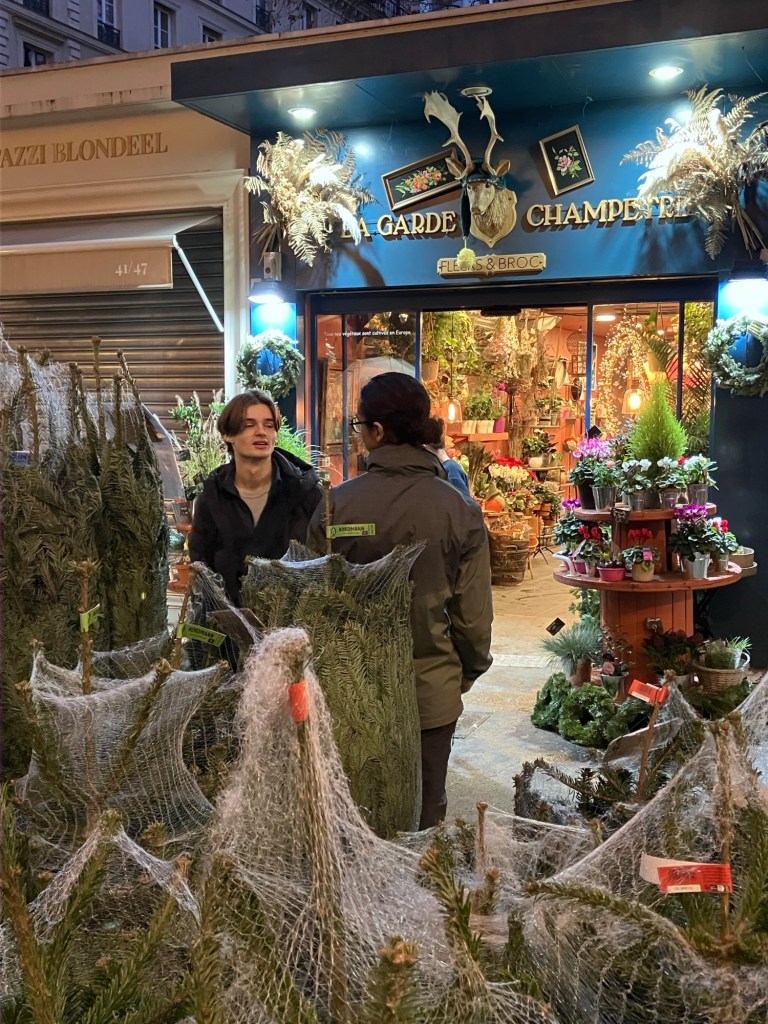
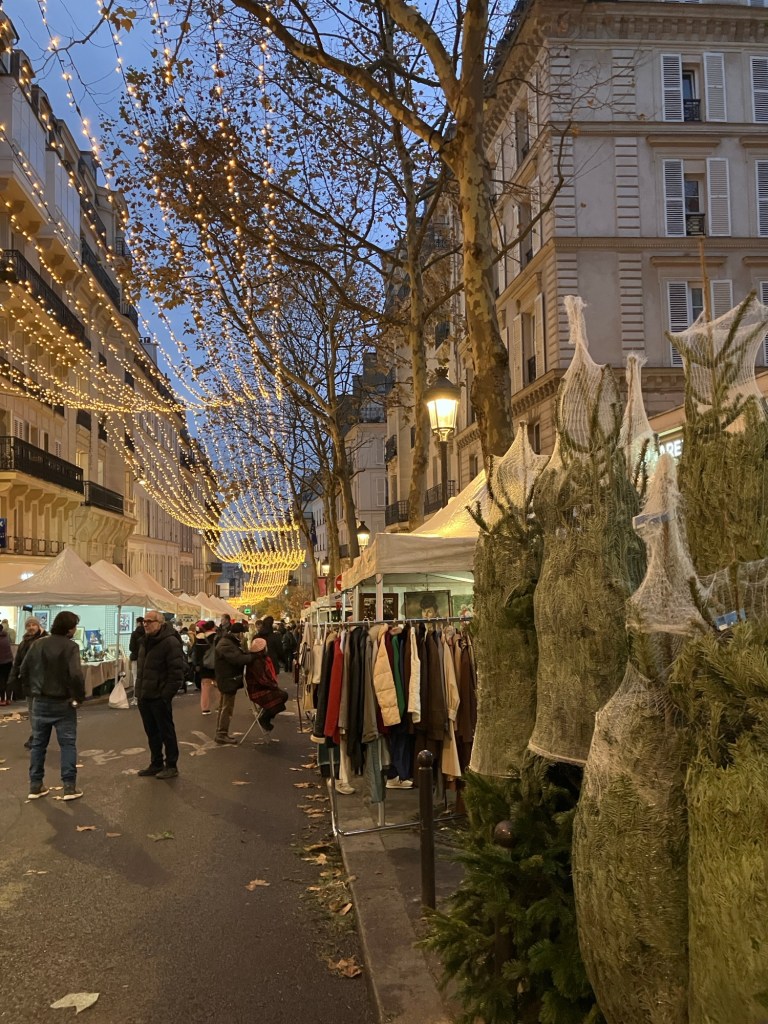
A forest of Christmas trees for sale in the 17th arrondissement.
The netting on the trees looks like spider webs.
Trees for sale on R. des Martyrs which is closed to car traffic on Sundays.
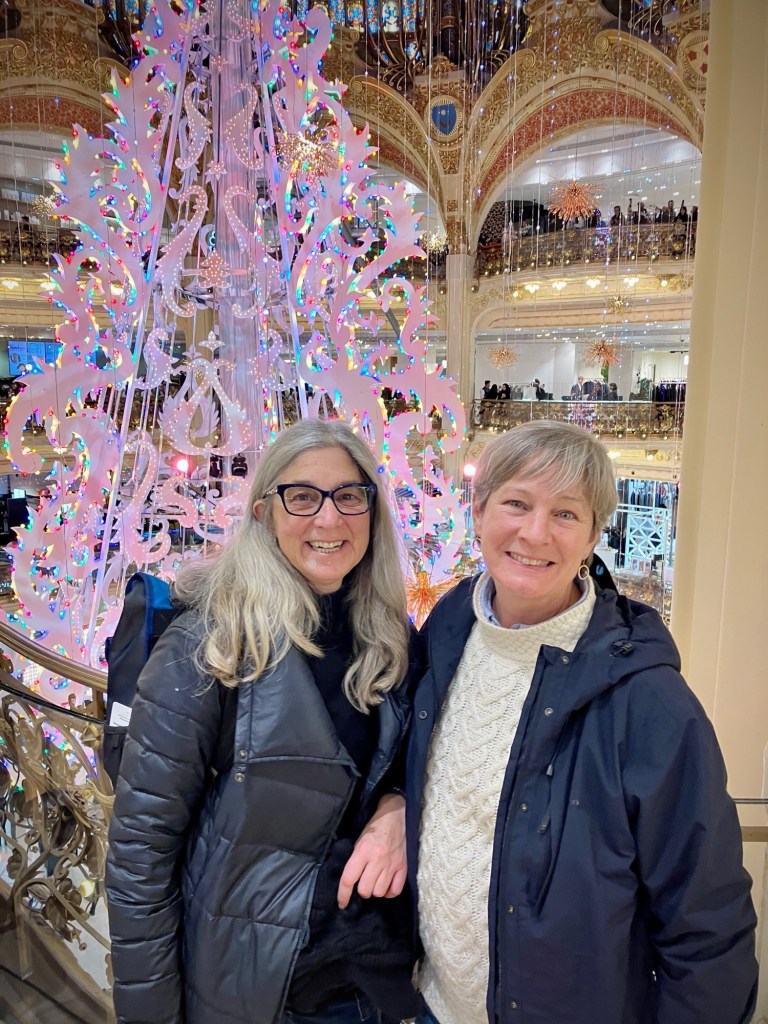
Nancy and I inside Galleries Lafayette admiring the massive Christmas tree.
Which put on quite a show as it changed colors.
We walked to museums.
We walked to go to specialty shops only open on Saturdays to buy artistic stamps.
We walked until the sun set (at 4 pm) to watch the lights come on.
We even walked in the snow.
All that walking meant we needed to keep up our strength.
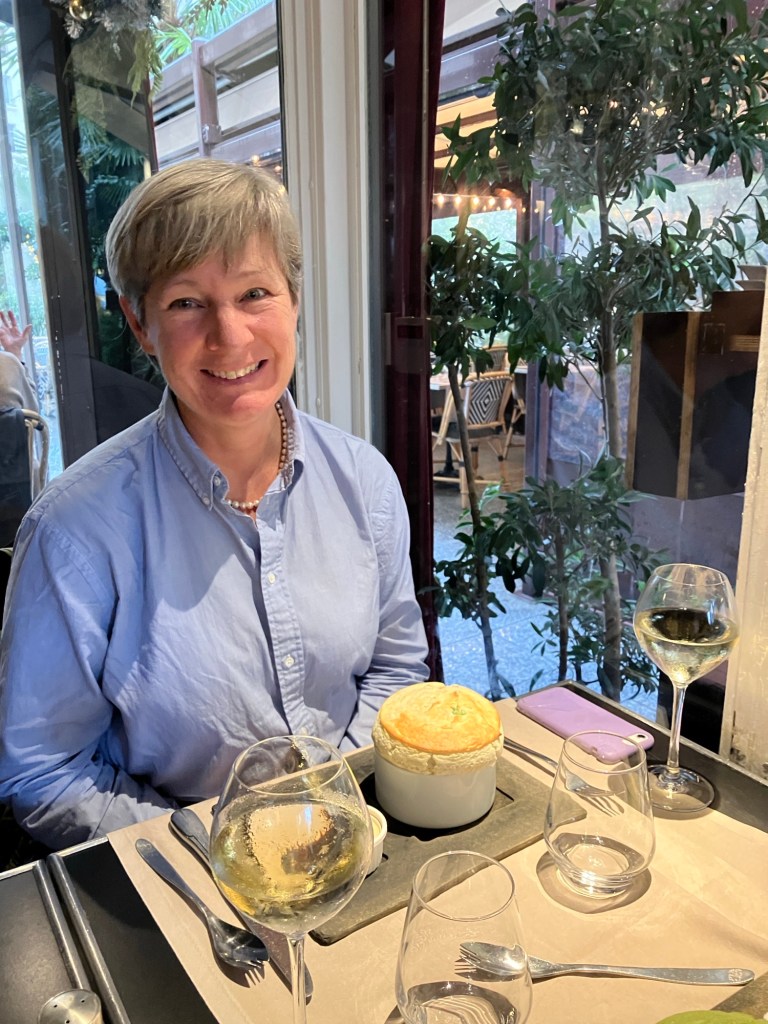
The soufflés at Le Récamier were just the thing.
We had a one meal out per day rule. So we made those meals count.
Sometimes we didn’t need to go far. This oyster stand set up one weekend for two evenings on our neighborhood market street.
12 shucked oysters from Brittany and white wine.
Thanks to Dan we visited Buns Land for some amazing Biangbiang noodles. Mostly take away with just three stools at a tiny counter.
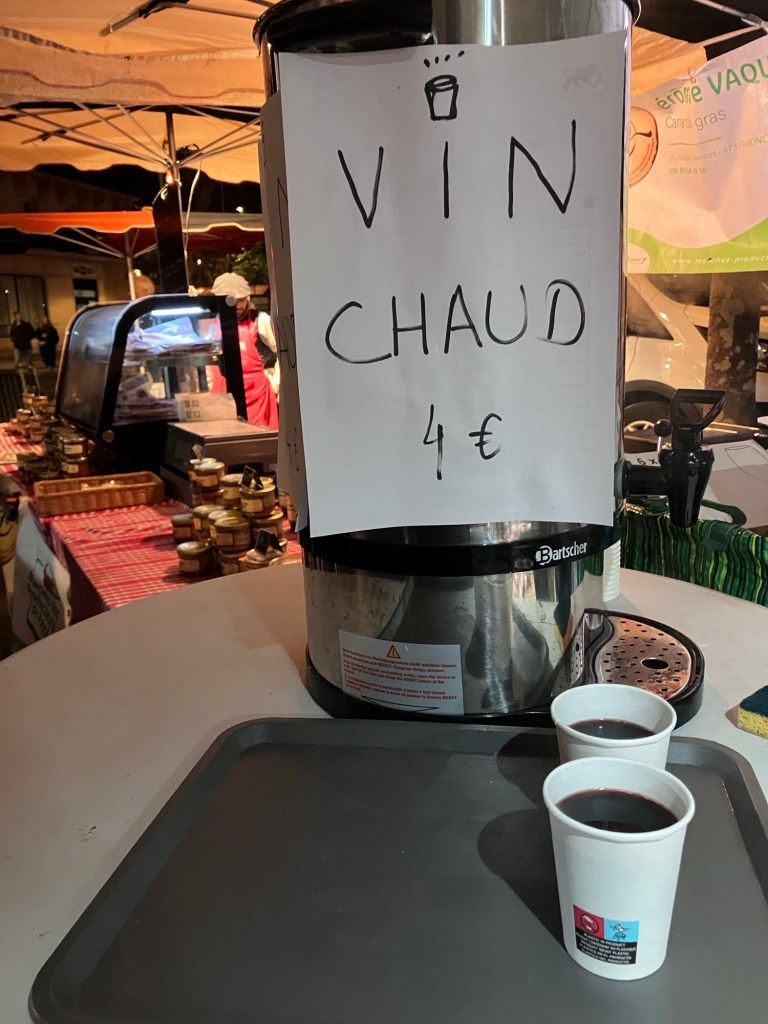
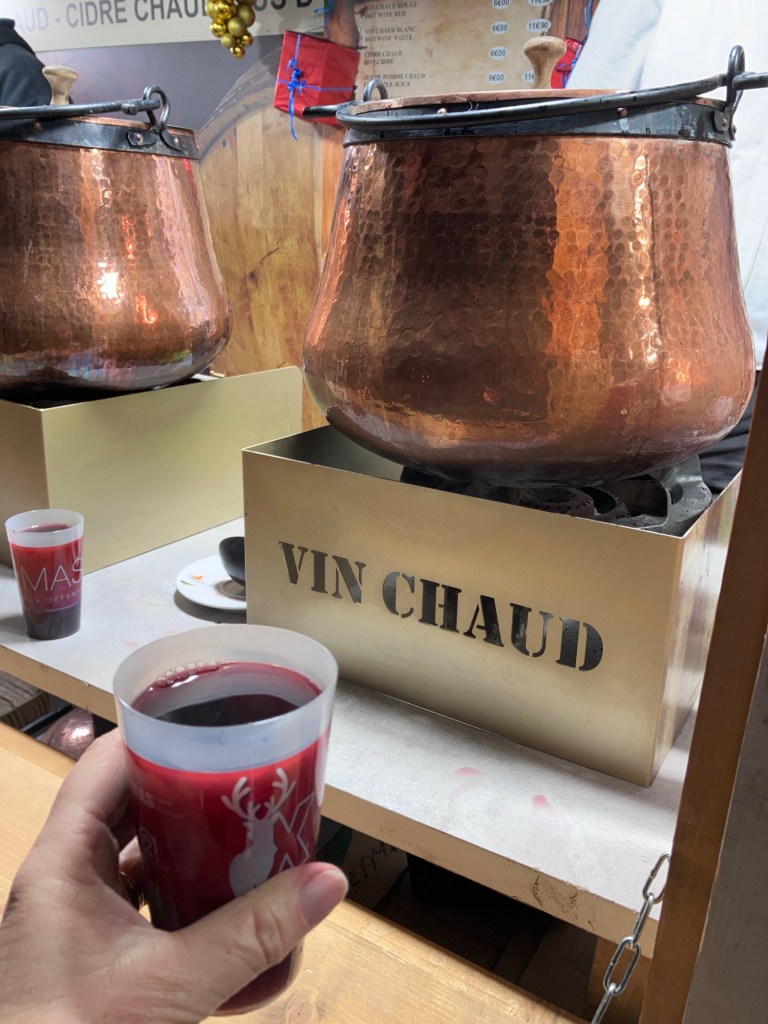
We also drank vin chaud when we could. Hot mulled wine. This was the best we tried, from the wine stand at the regional merchants evening market where we also had the oysters.
Rosy cheeked vin chaud drinkers.
Had to try it at La Défense Christmas market too! Complete with souvenir cup.
Nice and hot, but a bit sweet. But we kept our souvenir cups to savor sweet memories.
More vin chaud please! At a small Christmas market at Pl. des Abbesses.
A nice version, not too sweet. The quality of the wine was not as good as at the regional merchants evening.

Late November and early December seemed to be a great time to visit Paris. Holiday cheer was getting going, but Christmas crowds hadn’t fully arrived yet. The weather was mostly grey but the sunny days we got felt even more special. The one day of snow was scenic but melted quickly. And having friends visit, first Dan and then Nancy, was just wonderful. And we got more photos of the two us than we usually take. As Nancy joked, it’s proof Rich does have a right arm – that’s his selfie taking arm usually not seen in our photos together. A big thank you to Nancy for the great photos.

Look at that! We have legs and Rich has both arms!
We sit together!
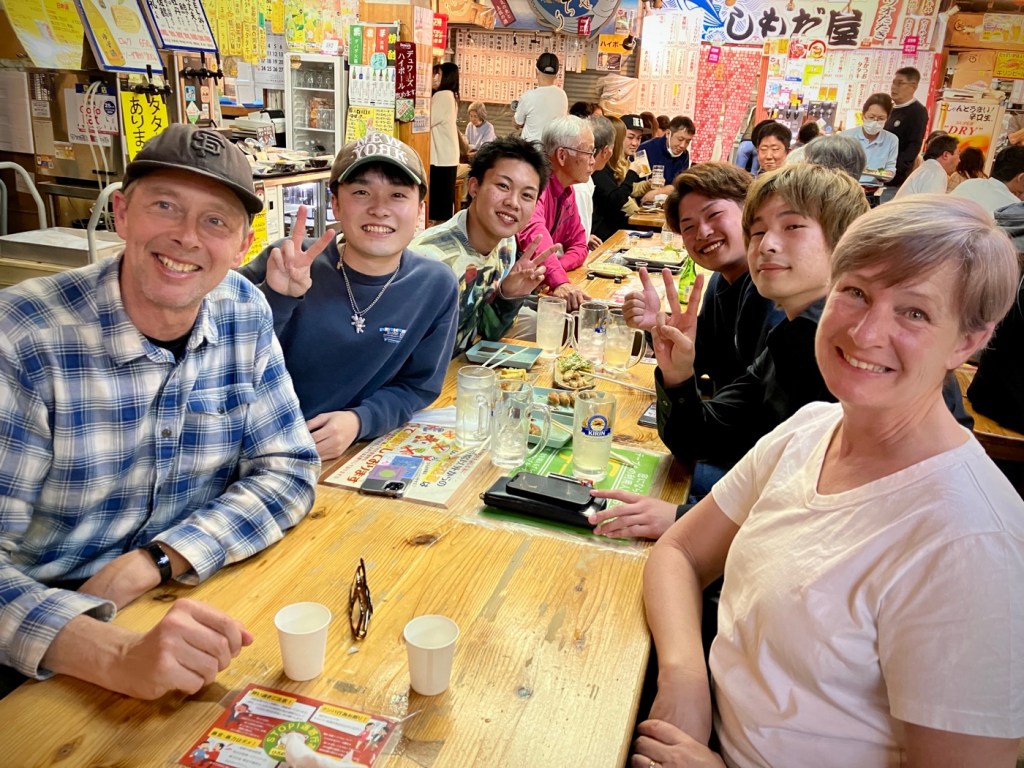
We stand together at our local bar!
We got to pose in front of a Christmas tree.
And we got to spend time with one of our favorite people in all the world! Nancy.
The flâneurs of Paris.
Apartment lobby mirror group photo of the happy travelers.

Housesitting side trips to fascinating museums.

I love a small specialized museum. A specific topic, a single person or industry, the narrower the focus the better.

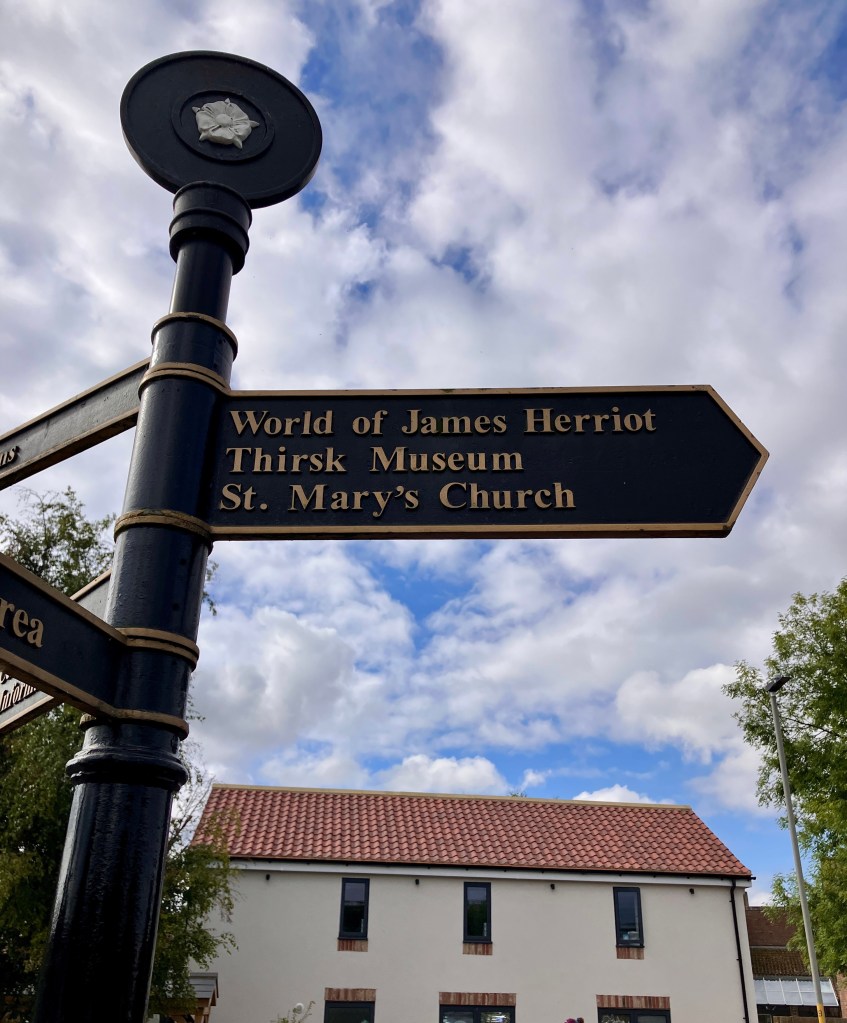
The World of James Herriot. A great museum in the town of Thirsk.
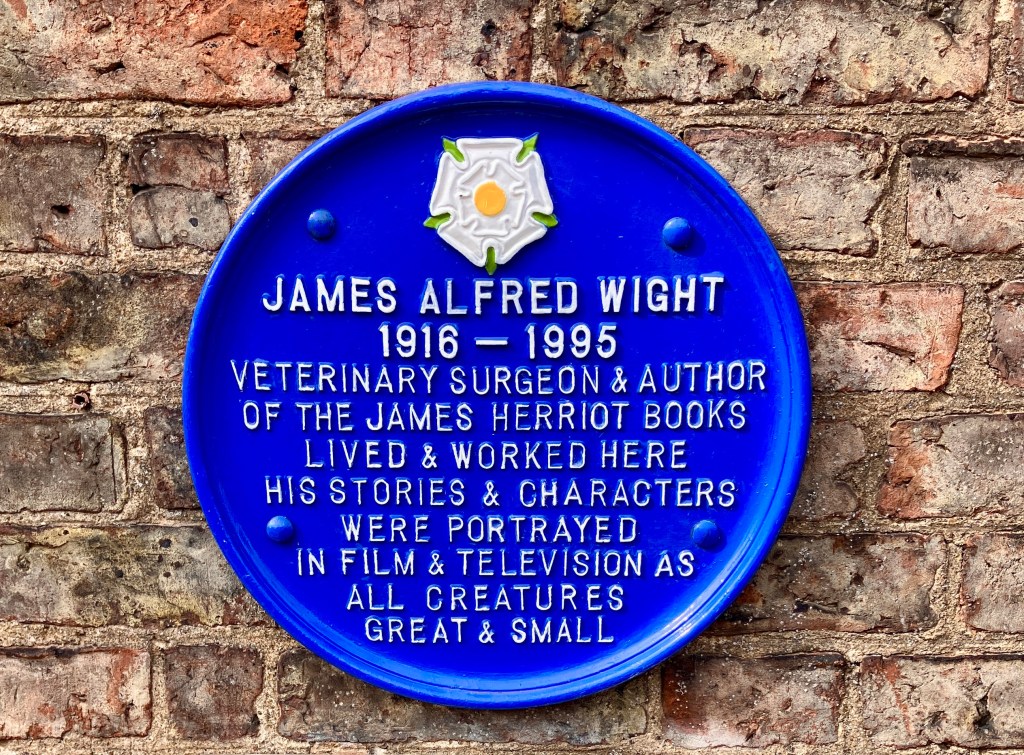
Did I know he used a pen name? Maybe I’d read that before, but what a thrill to see this historical marker.

Doing my research about the area where we booked a house sit, I searched on museums. I quickly extracted a promise from Rich that we would not miss this one. James Herriot’s books were a big hit with my sister and I when they were published in the US starting in 1975. She went on to become a veterinarian. Did the books have an influence on her? I asked her and she said “They probably did.” How could they not?

A peek into the dispensing closet.
If the equipment in the consulting room looks old and slightly off putting, the veterinary medicine museum on the next floor up will certainly give you the shivers.
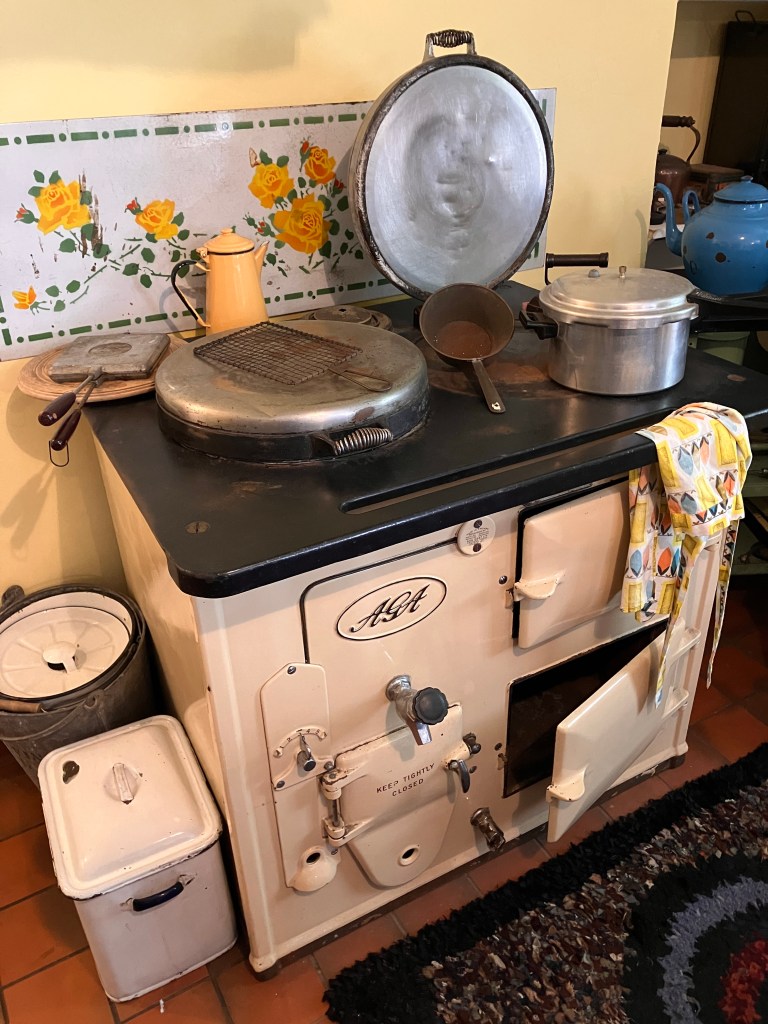
A lovely old Aga stove in the kitchen.

If you’re not watching the current adaptation of All Creatures Great and Small, or haven’t seen the older versions, you might be tempted to start watching after a visit to this museum. Even a long time fan like me learned a few fun tidbits. Since it was frowned upon for a Vet to advertise, Alfred James Wight choose a pen name, the surname of a favorite Scottish footballer, James Herriot.

Rich with a statue of the author in the garden.
Strong sales in the US helped propel sales around the world.
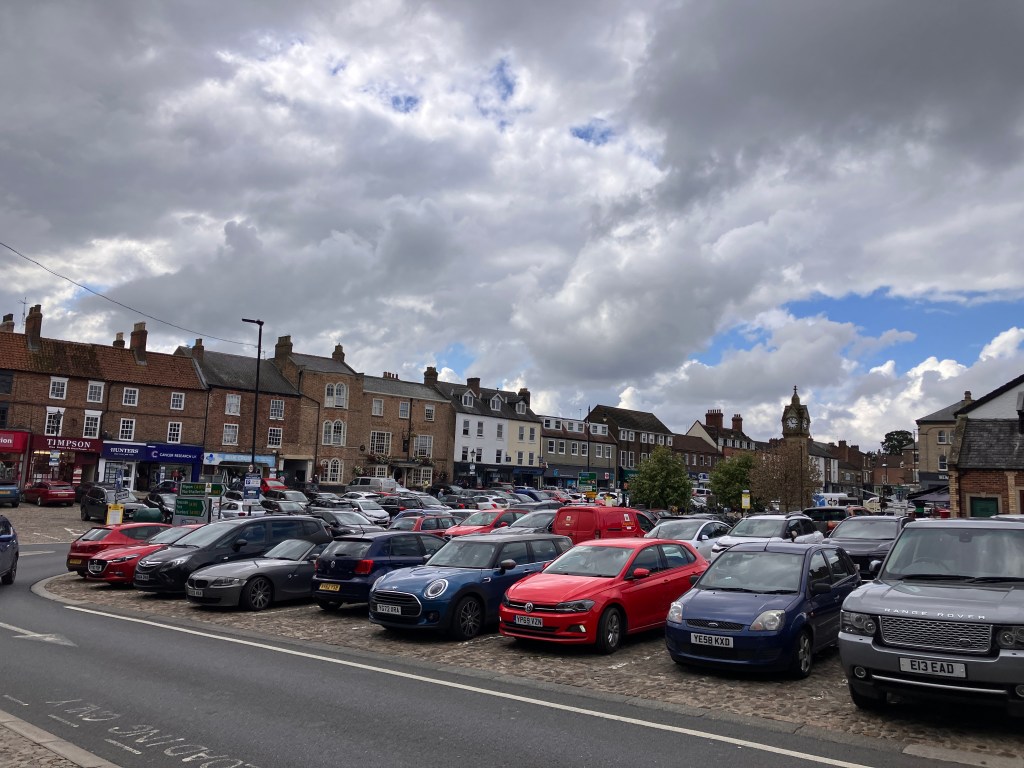
Thirsk is a charming town with gorgeous brick buildings.
Of course, we wouldn’t be us if we didn’t lament the scourge of parked cars in the center of town. It was beyond my photography skills to get a photo of the buildings without cars marring the scene.
World of James Herriot. Definitely worth a visit.

We had a rental car during this house sit, which was in a small town without bus service. Although the train station at Darlington was only about a 20 minute cycle away, there was nowhere safe to lock our touring bikes at the station. There were bikes locked there, but our bikes would have stood out like sore thumbs, or tempting morsels, among the commuter bikes. Could we have enjoyed a day out knowing our bikes were not really safe at the train station? No. So the rental car gave us the freedom to roam Yorkshire. And we took advantage of it.

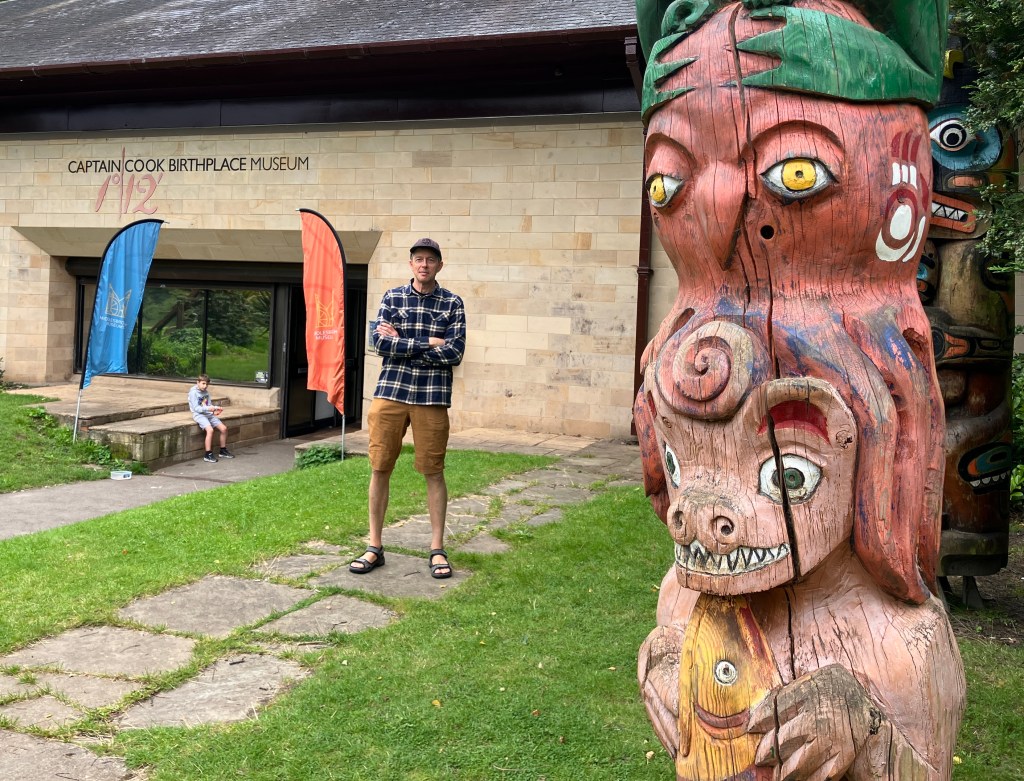
Captain Cook Birthplace Museum, in Marton-in-Cleveland.

While my bike was in the shop for a tune up we checked out the map and a museum caught my eye. Captain Cook’s birthplace! We’ve been to the big island of Hawaii a few times and kayaked to the white obelisk memorial at Kealakekua Bay where Captain Cook died. Or was killed, more correctly. The opportunity to bookend the life of the famous cartographer, explorer, and naval officer was not to be passed by. It was a good little museum, and gave us a new appreciation for how brave and talented Cook was. From the Hawaiian point of view, which is the one we’re familiar with, his arrival – the first documented European to visit the Hawaiian Islands – was the beginning of the end of the Hawaiian Kingdom. This museum gave us a more full picture of the man, rather than just the image of the man who began the destruction of native Hawaiian culture.

My brave explorer exploring the museum.
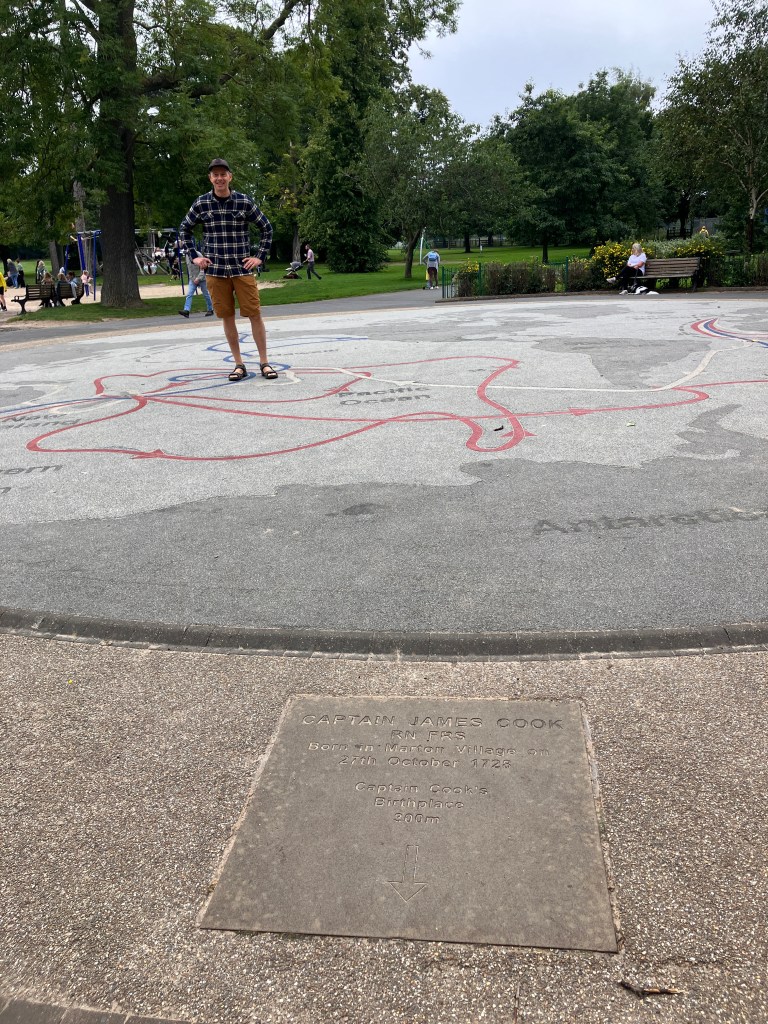
This urn marks the place where the Cook family cottage stood and where Cook was born in 1728. The cottage was leveled by a new landowner in 1790. The family had moved on in 1736.
A large scale map showing the three pacific voyages of Captain Cook.
The voyages started at Plymouth Harbor.
And the third voyage ended for Captain Cook on the island of Hawaii.

Cook’s first voyage was to Tahiti, where he and a team of astronomers observed the transit of Venus across the sun in 1769. The transit helped astronomers to calculate the distance between the sun and the earth. The HMS Endeavor then went on to explore the uncharted, by Europeans, southern oceans.

We left the museum with a new respect for Captain Cook and empathy for his end in the beautiful Hawaiian Islands. That is a successful museum.

The Yorkshire Dales.

Our next car enabled outing was not a museum, exactly, although the Yorkshire Dales could be viewed as a timeless experience. Not a living museum, but a living and evolving region.

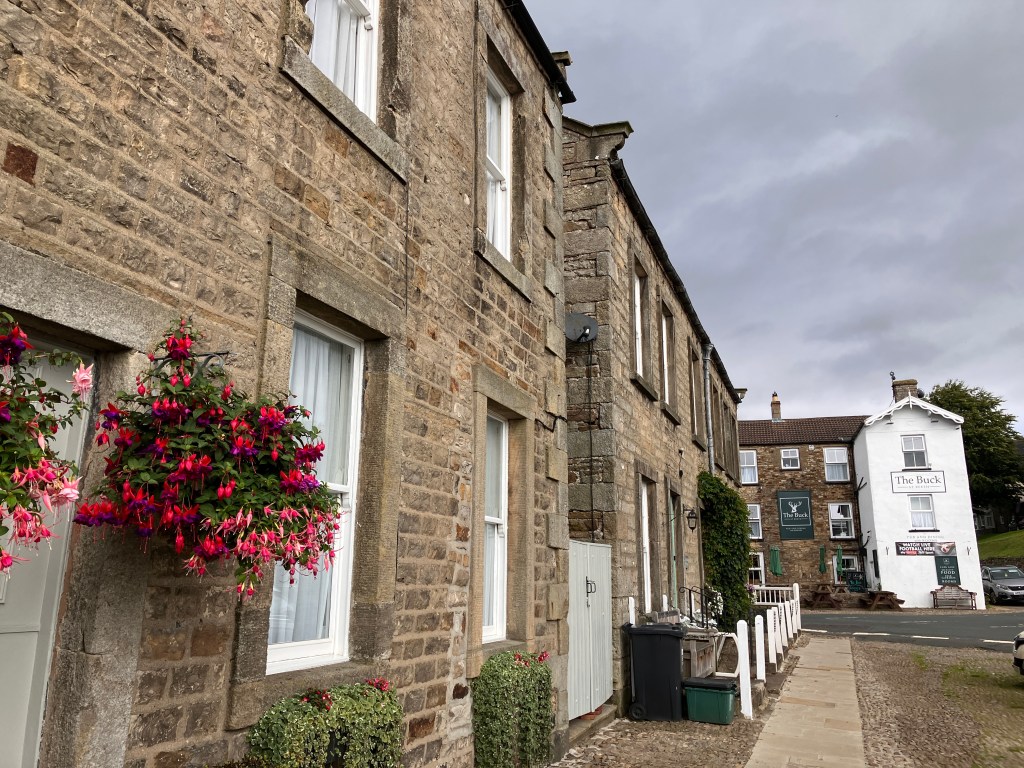
The village of Reeth, and a chat with a cyclist who was riding coast to coast across this part of Britain. If you check out a map, the narrow waist of Britain crosses this area.
The grey stone buildings are pleasantly uniform in color.
Public footpaths across gorgeous green countryside and along the River Swale.
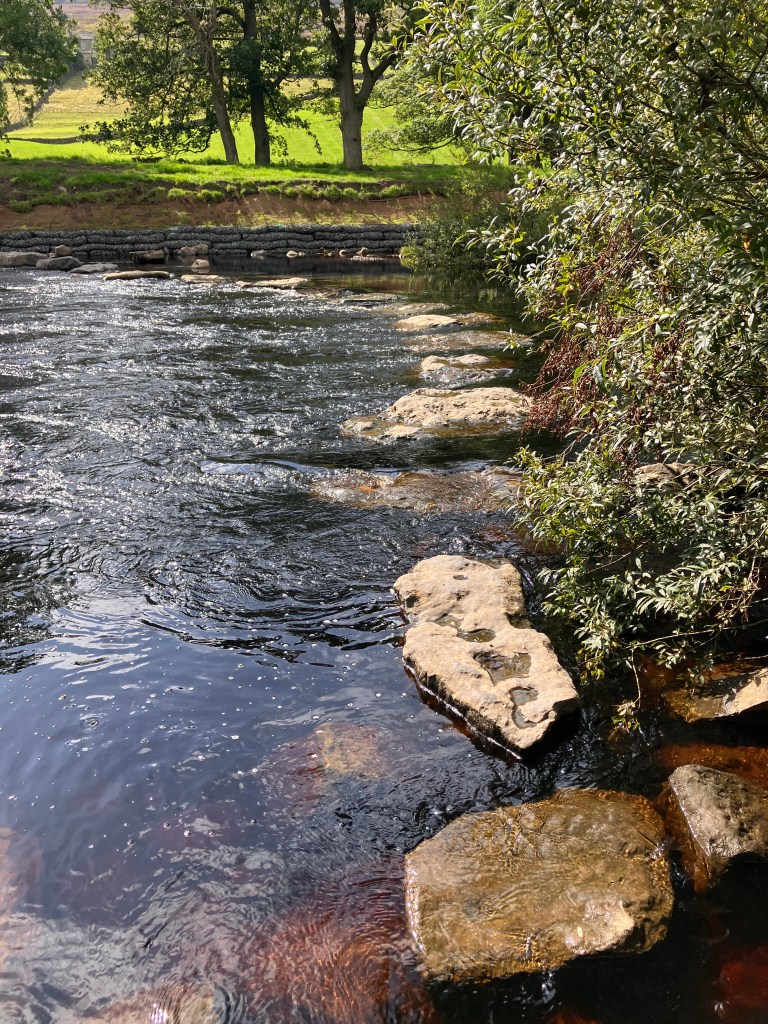
The River Swale was running higher than these stepping stones could handle. Divert.

Fueled with a picnic lunch we headed out for a loop hike that quickly got rerouted due to a high running river.

Any direction you ramble and anywhere you look, beauty.

We rambled from a sunny green valley to a windy and mizzly (misty drizzle) ridge. Always under the watchful eyes of sheep.

Is this building abandoned? No, says the resident sheep.
The heather was blooming.
The wind and mizzle was blowing.
The stones are put to good use.
So impressed with the dedication to keeping the foot paths passable.
The engineer appreciated this tunnel with livestock gate, or stile.
I am still in love with the greystone buildings and walls.

We rambled over bridges and through a tunnel, had a quick lunch sheltered from the wind and watched by sheep, and as we came to the last bit of our loop, we were confronted by a sign. Cattle free alternative route, with an arrow. Pointing to a sheep, of course.

Cattle free, but not sheep free.

I know there are folks who are frightened of cattle, it’s understandable, they are huge! But I’m not. I’m respectful of their size, but not scared of them. But the next sign gave us pause.

Oh. Bull…. I read Ferdinand the Bull enough as a child to recognize the universal nose ring and horns on the sign that means bull in the field.

Bull in field. We’ve encountered this sign before in our UK rambling, but never actually encountered a bull. So, through the stile we went. First field, empty. We continued to the second field, also empty. Then we had a choice, a divergence of paths worn in the grass. One to a marked stile, one going to the right across a tumbled rock wall. We kept on the marked path and when we reached the stile we could see the cattle at the bottom of the pasture, quite close to the stile leading out of the pasture. Any country side person would have laughed to hear us discuss the situation. “Is that a bull?” “No, I think that’s just a heifer.” We started to cross the stile and then, from behind a lovely stone out building sauntered the bull.

Photo taken from the safety of the other side of the stone wall.

Reverse course! Back to the other path, climb over the tumbled down stone wall and hope we don’t have to cross Mr. Big and Scary’s field. We did. We ended up behind the stone out building and had to cross about 30 yards of field and before we got to the end, when we had to cut left, towards the bull and heifers and calves, to exit the field. Quietly. Calmly. Discussing what to do if charged by a bull. Neither of us knew. Bear, mountain lion, those we have been taught to react to, but a charging bull? No. Well, we said, think of a bullfighter. They jump aside at the last moment and bulls can’t change direction quickly. So we’ll go with that. Thankfully the bull totally ignored us, and we exited the field with new respect for bull signs.

Hey bull.

So, for future reference, I did look it up, and if you are charged by a bull, step to the side and run in the direction from which the bull came and run in a zig zag pattern- the bulk of a bull makes it hard for them to quickly change direction. Throw your backpack or shirt to distract the bull. While running in a zig zag pattern. Or, just pay attention to the signs and avoid the bull. I’m going with that one in the future.

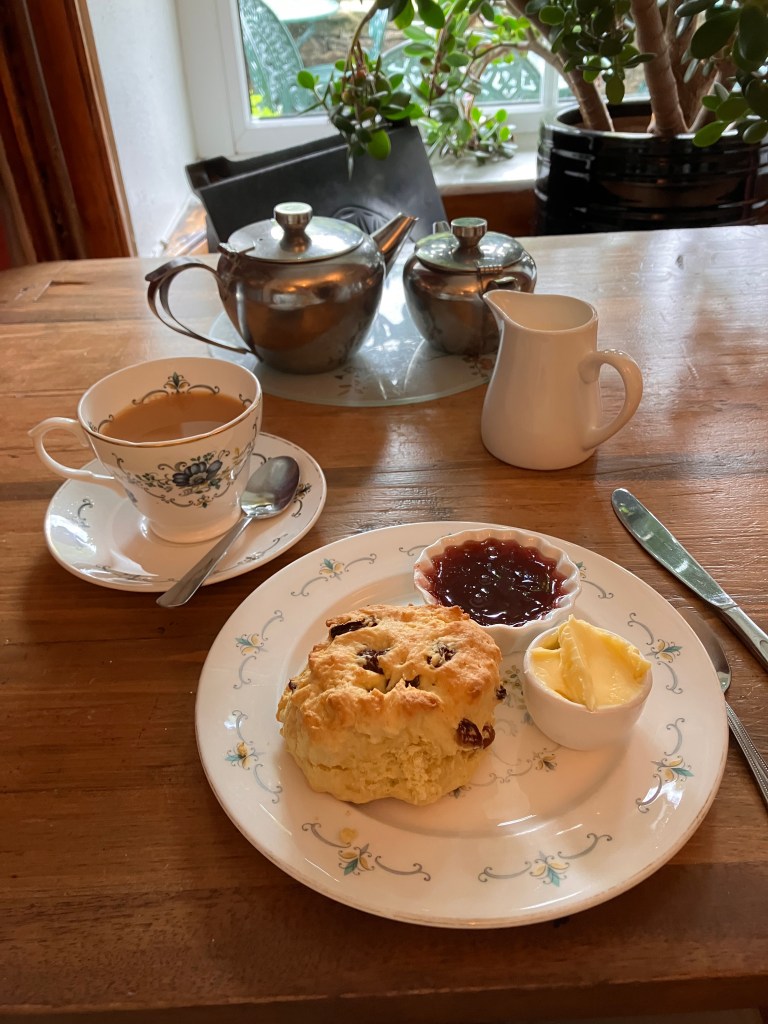
Restorative tea and scone in Swale.

Having safely negotiated the bull and his herd we went for tea, coffee, and scones. I totally give the tea award to Yorkshire. The Yorkshire Gold tea bags I love taste even better made with yummy Yorkshire water. Honestly some of the best tea I’ve ever had. And always an extra pot of hot water to make even more tea!

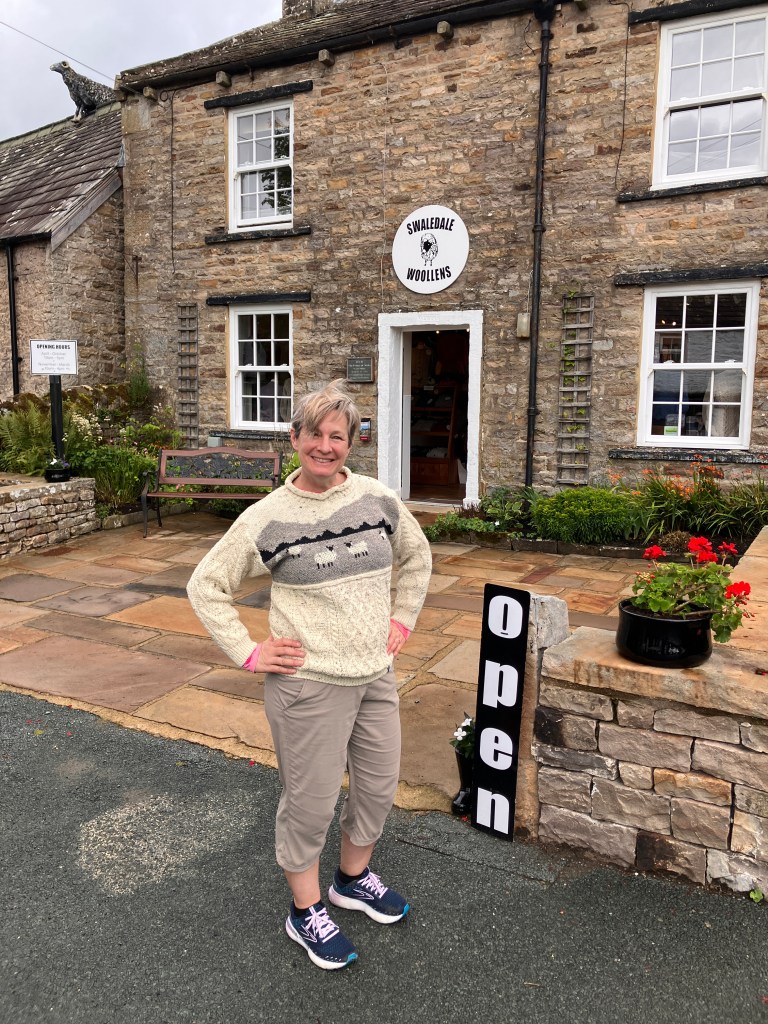
Sheep sweater. Like the San Francisco tourists caught out by cold wind and fog and forced to buy Alcatraz sweatshirts, I bought a wool sweater. With a sheep pattern!

With our Yorkshire/Durham County housesit wrapping up, we got ready to endure a two train day from Darlington to London, then on to Cardiff, Wales. UK trains with bikes can be stressful. But we made it. More fun museums and cats await us in Wales.

The Happy Travelers in Ripon.

Mega trail around a mega city. Seoul, Korea.

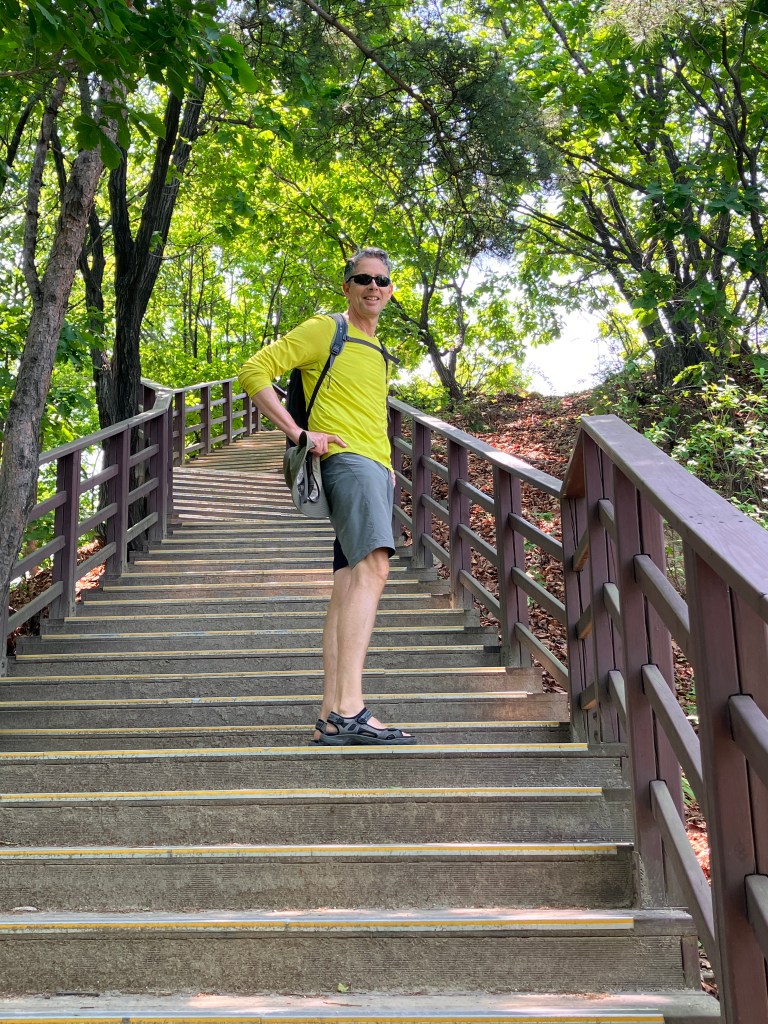
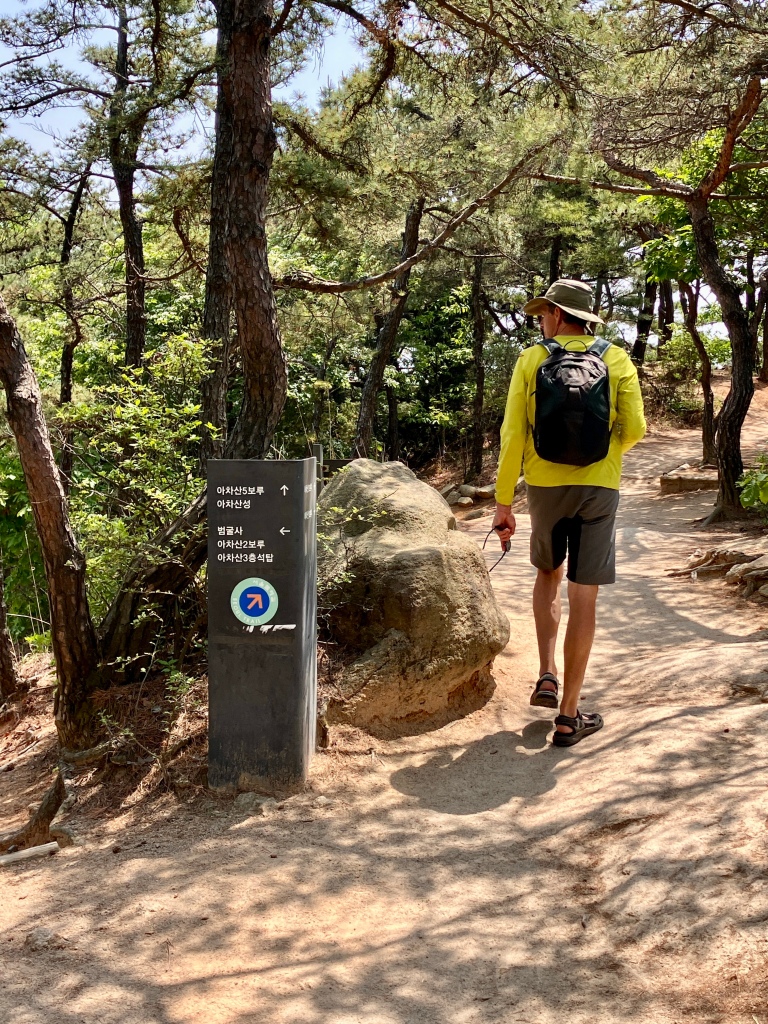
A view from our first mountain park hike.

We knew that Koreans love to hike. Even if we hadn’t known that before coming to Seoul the sheer quantity of hikers using the metro would have tipped us off. Boots, backpacks, hiking poles, sun hats, we felt right at home with these transit enabled hikers. We hadn’t planned on turning our time in Seoul into a multi day hiking expedition, but that’s the joy of travel. Sometimes you just never know what’s going to happen and what you’ll find in a new place.

A view from our second or third mountain hike.
A view from the Seoul Trail.

You may be realizing that what these views have in common is that we are looking down at the city. Down as in ‘we climbed a lot of darn steps to get up here’.

Looking at one mountain park we climbed, the little one to the right, while climbing another mountain park. Playing the game called find our high rise.
The air was quite clear on our first hiking day. Rain was coming in a few days so we hiked three days in a row.

Rich found the first hike for us by seeing the mountain park from our 12th floor window and navigating us there hoping there would be a trail. There was. And there was an amazing accessible boardwalk style trail all the way up to a temple and a cafe. Maps.me was helpful, showing some trails, and Alltrails had some as well, but lacking a great mapping site we relied on Rich’s wonderful navigation skills.

Once we were on the trails the signage was quite good.
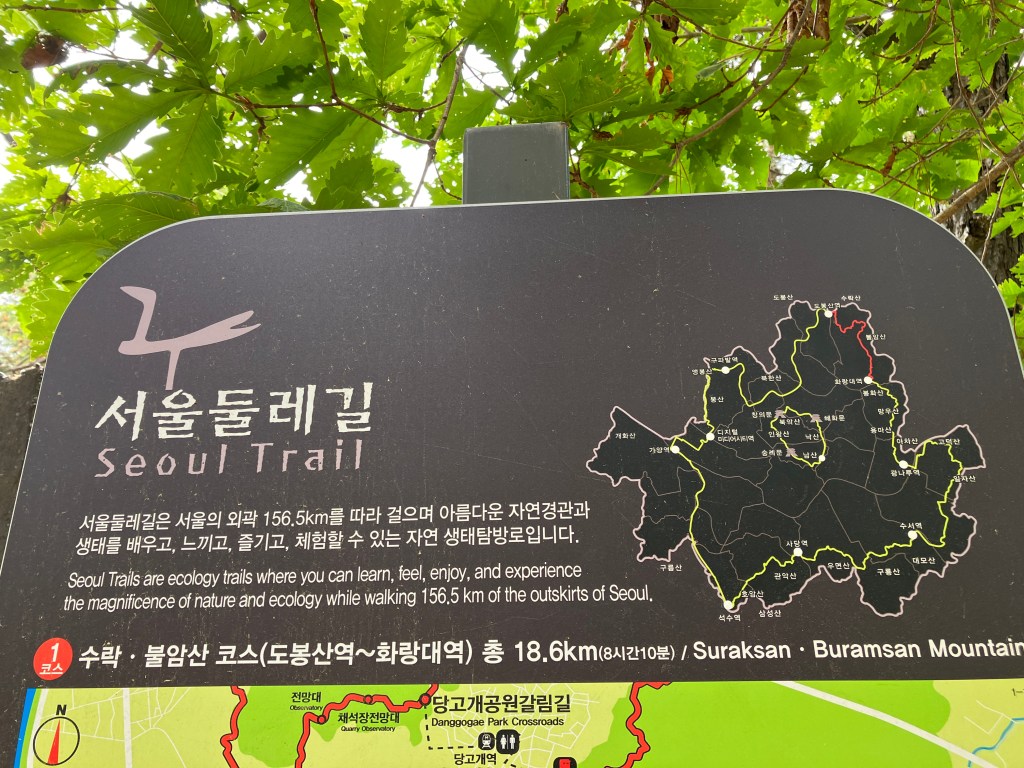
Very comprehensive signage on the Seoul trail.

Since hikers are getting to and from their hikes on the metro, there are also signs to get you to the trails from the neighborhoods.

Turn here to get to the Seoul trail.
A comprehensive hiker sign. I like they have a backpack and a pole. And a big version in case you fail to see the smaller sign.
Seoul wraps around and up to some impressive mountains, when you get off the metro you see this. Head that way.

The signage and maps varied in detail, and confusingly played fast and loose with having north be at the top, but on the whole you were well taken care of, signage wise.

A big view of mountains and the trail networks. Including metro stations.
A map showing the 156 kilometers of the Seoul trail.

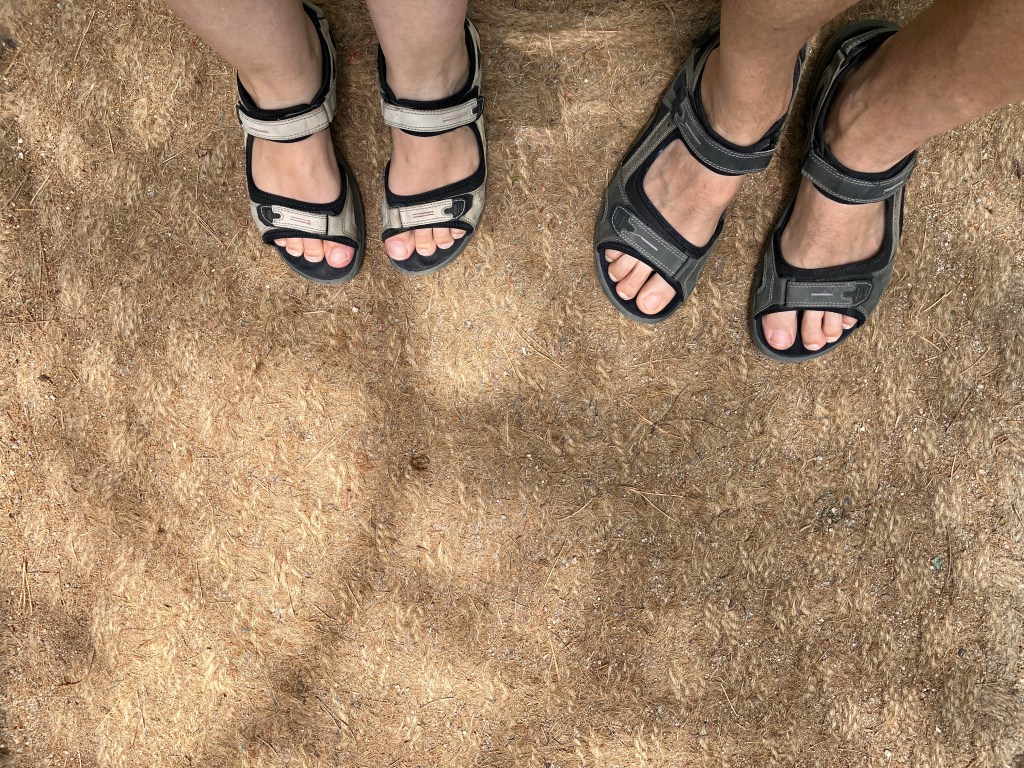
Not only was the number of trail opportunities great, the amenities along the trails, and the construction of the trails were impressive. Very nicely maintained steps, benches and picnic spots, restrooms, and my new favorite thing – carpeted trails. It looks like jute, or coir, and for stretches that are steep up or down, or could get quite muddy, it’s super helpful. It also stops the usual trail ruts from forming, or the footsteps turning into hardened mud. And dang, carpeted trails – what’s not to love about that?

This one was new. You can appreciate the weave.
A more worn in stretch of trail carpet. And our much worn Ecco sandals.
Restrooms, clean and with potable water unless otherwise noted.
A pine grove with plenty of picnic benches.
Seating and shade.
An accessible trail gently climbs towards the view spot.
Where there were stairs they were also well built and maintained. And usually wide enough to handle the crowds of enthusiastic hikers. This was a weekday so there was not as many people as we imagine show up on weekends.
Rich heading up.
And up.
And then down. This hike day, a section of the Seoul Trail, had about 2,000 steps.

It’s not unusual for us to come to a city and skip the A list sights. Doing things we love to do, like hiking or biking, or even just walking city streets, gives us more insight into what life is really like in a place like Seoul. Seeing the neighborhoods far from the tourist friendly zones. Going into restaurants with basically zero idea what kind of food they serve. And hiking trails like these, full of locals. I tell Rich he’s never happier then when there are zero other western tourists. I developed a rating scale for him of tourist bombs – a high of five is a lot of tourists and not going to result in a happy Rich, and a low of one is good, but zero is better. After the tourist bomb rating is the wide eyed locals rating – which shows how surprised the locals seem to be to spot two big foreigners on their trail or in their small neighborhood restaurant. Our best hike was zero tourist bombs, and five wide eyed locals, the highest rating possible in my new rating scale.

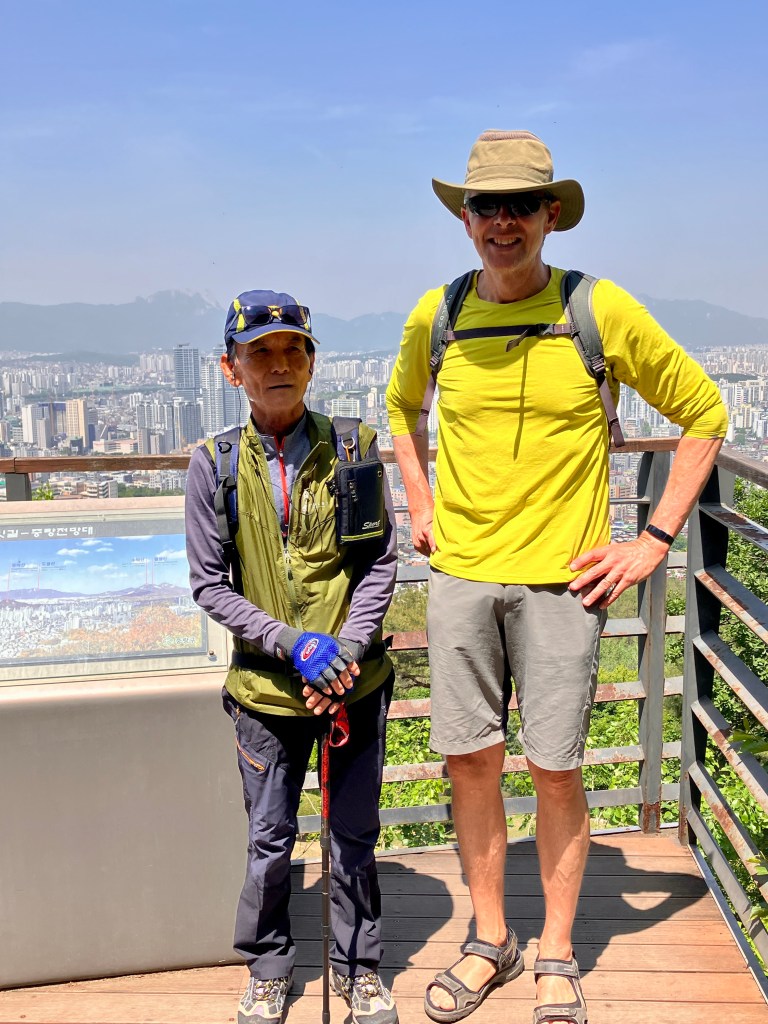
A friendly fellow hiker. Even with few common words he and Rich got along over pointing out buildings.
This is a typical hiking outfit for the locals. Rich’s is not! Our sandals were definitely unusual.

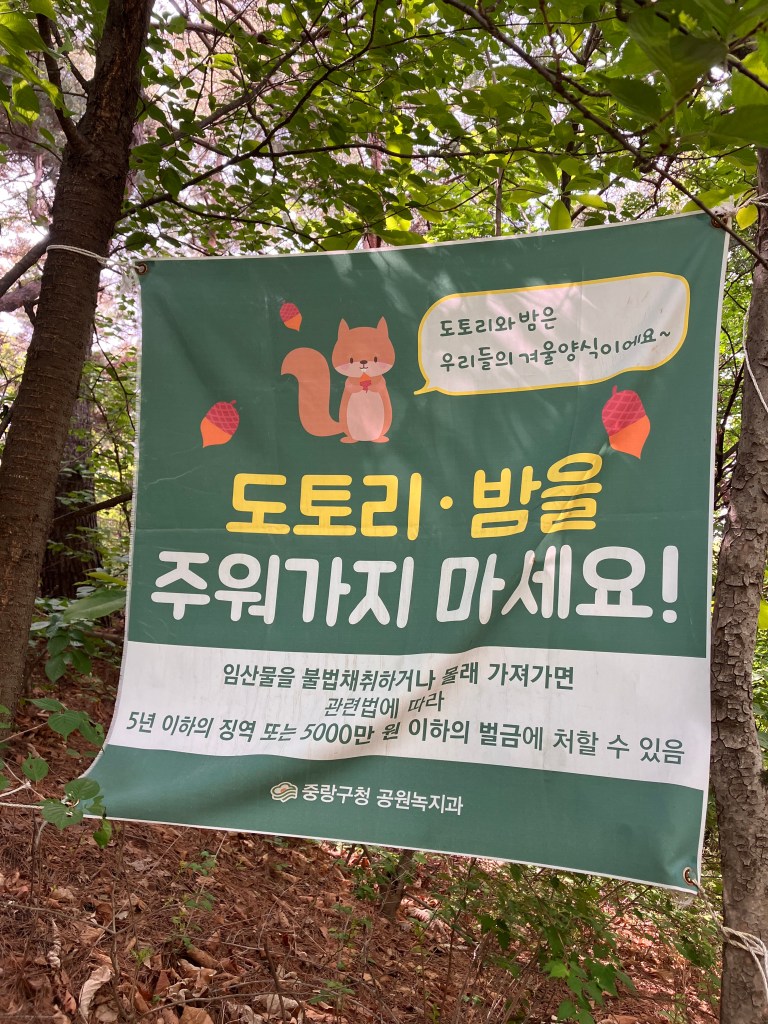
In addition to good trail signs, there are informational signs about archaeological sites, and signs asking folks to please not collect acorns and chestnuts as the wildlife depend on them.

Good informational signs with english translation.
This cute squirrel would like you to leave their food alone.
Another reminder to leave nuts on the ground for forage.

You might be thinking, ok, so that’s all impressive and interesting, but lots of places have trails, and signs, and views. Well hold on to your sun hats, there’s more.

Stamps! Like the stamps we didn’t collect along the Seoul to Busan bike route, and in Japanese train stations, there are also stamps we didn’t collect along the Seoul Trail.
So cute. Each station has a unique stamp.
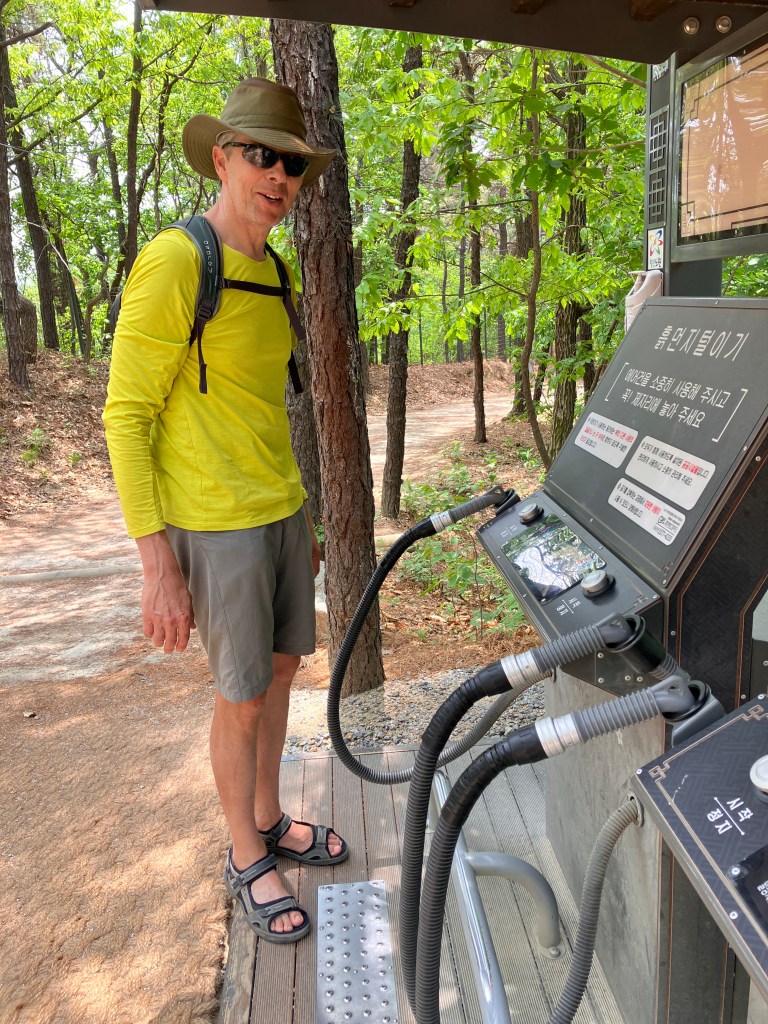
These. What are they, you ask?
Compressed air blowers. To remove the dust from your shoes and trousers before you head back into civilization.
The sight of these meant you were nearing the end of your hike. Or a connection out to a neighborhood or metro station.
Felt nice to dust off our sandals and legs.
Rock stacking. In California this is discouraged behavior, but here it has Buddhist origins, although some folks apparently just like the challenge, adding a rock as they walk by.
Ribbon blaze markings, so you can keep to the Seoul Trail at crossroads.
A group of adorable young hikers, an entire class went by us, greeting us in Korean. We were charmed.

The unexpected pleasure of hiking in Seoul was highlighted by all the amazing views. As you climbed up, wrapped around, or climbed down a mountain park, you got new views of a different part of this mega city.

A view across graves to a cityscape and another mountain.
This high stretch reminded us of Desolation Wilderness near Lake Tahoe.
But we never had views like this in Desolation.
Scrambling down towards the city and a metro station.
Getting closer to civilization and lunch, passing by a community garden site.
The reward? Tofu Bibimbap. It was delicious and I let it sizzle in its dolsot (Korean stone bowl) so the rice got nicely crisped on the bottom.

I want to include some tips for hiking in Seoul: Keep your metro card charged up, all the hikes we did are transit friendly. Bring snacks or lunch, the smaller neighborhood parks might have a cafe, but the longer trails that we hiked didn’t. Bring water, we were able to refill on all of our hikes eventually, but bring enough water to last for most of your hike just in case. Now, how to find hikes. You can assume that every mountain you see has trails, but finding a trailhead might be a little tricky. Rich used a combination of google maps, maps.me and All Trails. You can find information about the Seoul Trail at English.Seoul.go.kr and on our links page. If you find yourself confused, ask a local or follow someone in hiking gear.

The happy hikers on one of our Seoul hikes.

We’re at Incheon Airport now, slightly dreading the 12 hour fight to the US. I will definitely do a post about the food we ate while in Korea. The good, the not my favorite, and the mysterious that Google translate failed to help us understand. See you soon San Francisco.

We Love Japan, but….

We’ve been so thoroughly enjoying every day in Japan that we haven’t had much time or energy left to Blog. It’s a fantastic place to travel. But no place is perfect, and Japan has its weaknesses too, especially in the bike and pedestrian realm.

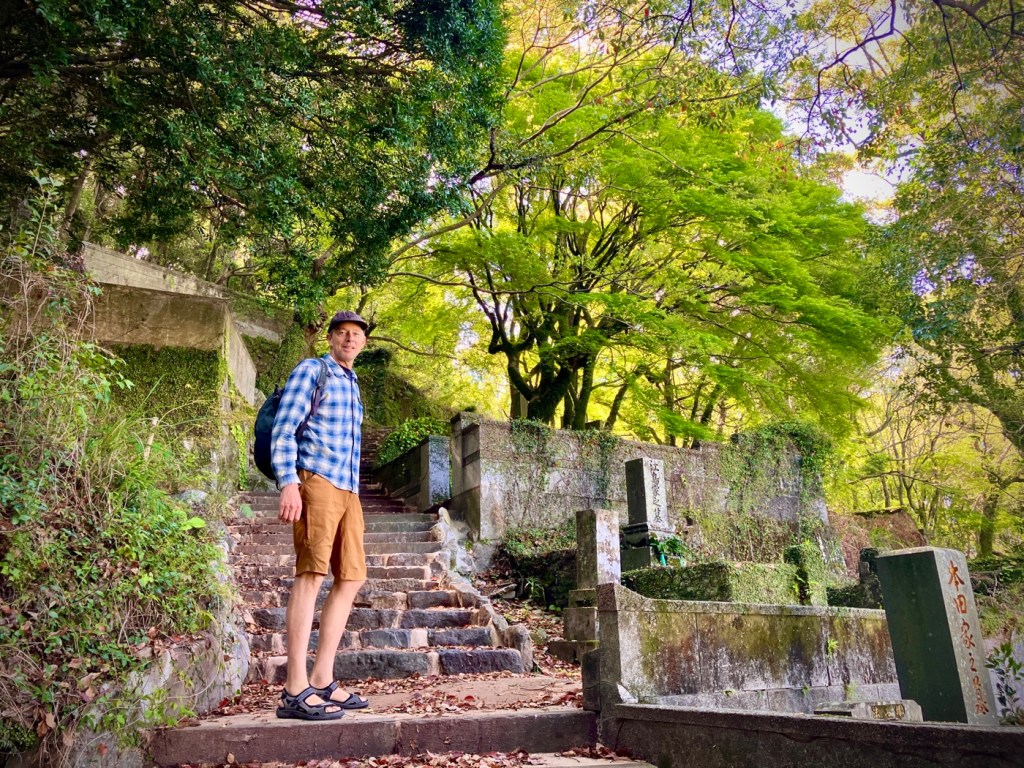
Exploring the hills and stairways of Nagasaki was a joy in the crisp spring weather.

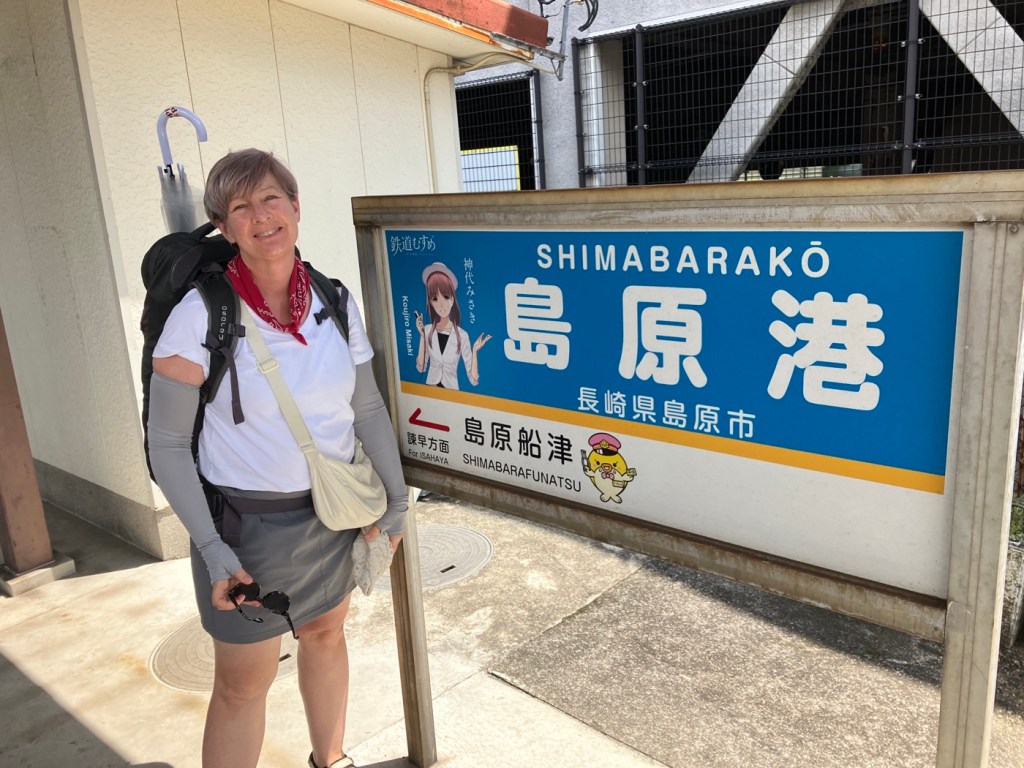
We’ve been travelling our preferred way by train, bus, ferry, streetcar, subway, and bike. With a lot of walking to the beach to explore and get to our lodging. We’ve been luxuriating in the clean, punctual, and extensive intercity train system. And the local public transit is always clean and reliable, if not always fast.

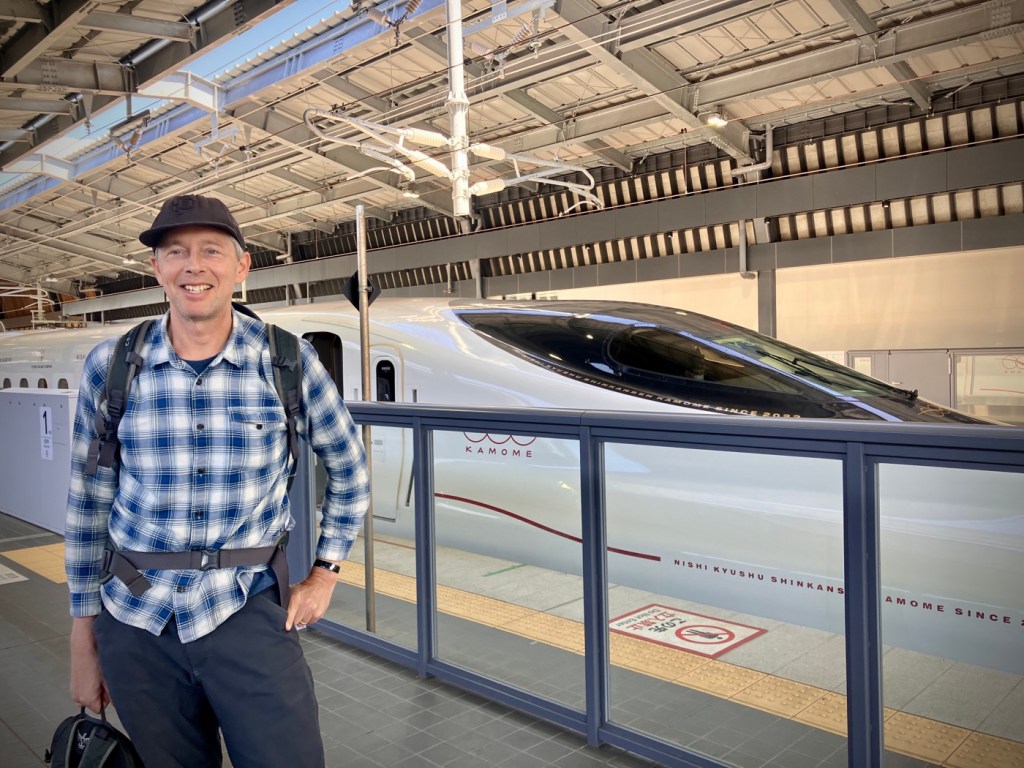
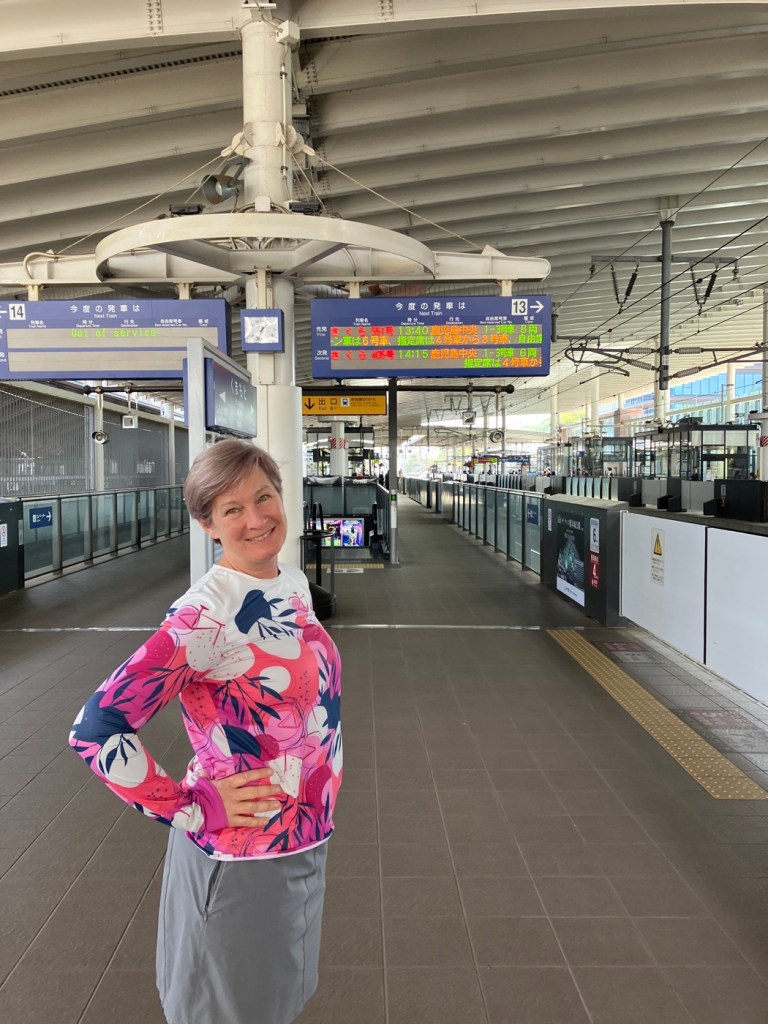
A shiny new Shinkansen on the recent extension to Kagoshima – marvelous and so fast
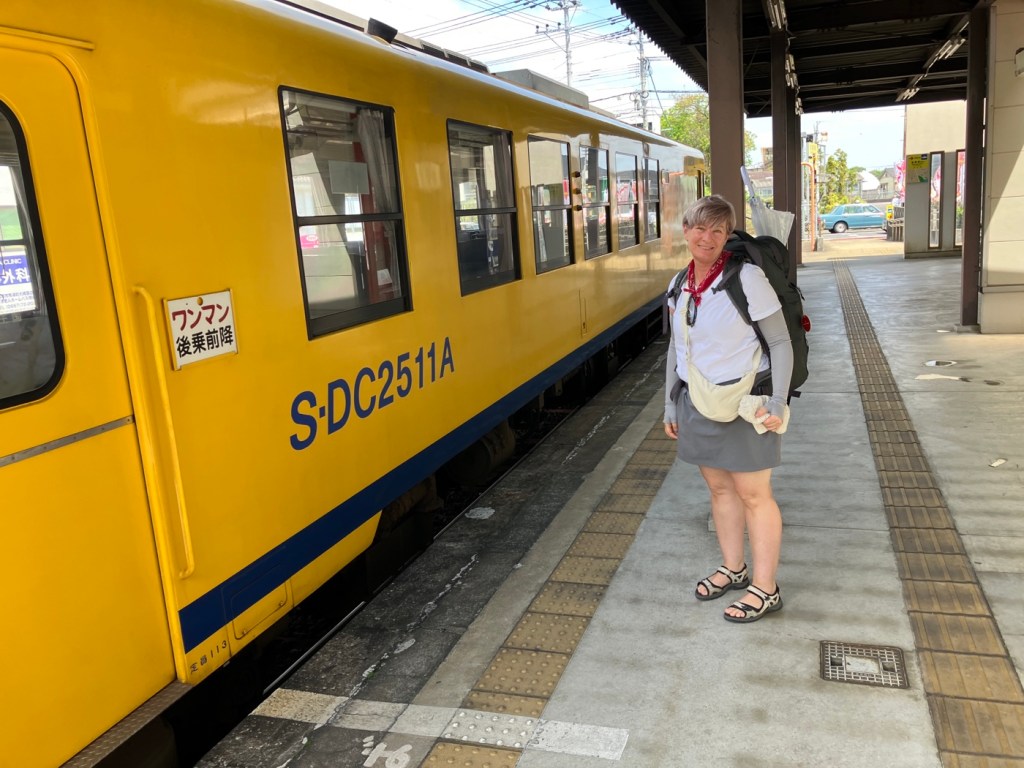
A single car train on the Shimabara railway, operated and conducted by one person! Many small lines in Japan have shut down, and how long can the last private lines survive?

So here are a few transport observations. For you transport wonks and mega walkers, they may give you the same joy and a maybe bit of frustration if you visit.

You can enjoy great connections in Japan, like the end of the line in Shimabara, with a ferry across the street that will take you to a bus and a Shinkansen line.

1. JR Rail Pass- Unless you are going to only visit a few cities or rent a car, then it’s a no brainer to get one of these passes subsidized for tourists. We bought two three-week passes and planned our trip to max its benefit to a 4 week visit by setting the activation for the day we left Tokyo and expiring when we get to Fukuoaka, where we are spending our last 3 days. This way we were able to exchange our vouchers at off peak time at Shinjuku station and avoid the mob we saw at Narita airport trying to exchange them to use immediately from the Airport. We instead bought $20 local rail tickets to central Tokyo. It was then easy and cheap to get IC (tap) Transit cards to get around for a few subway and loop rail trips in Tokyo until leaving Tokyo for Kanazawa.

JR Raíl stations are always clean, orderly, and the major ones have lots of food and shopping options and lots of vending machines

2. IC Card – Good for transit in most major cities. There are a dozen or so “brands” by region and they can mostly be used in other cities, although acceptance is a bit hit or miss outside the home zones. Don’t put too much on it initially, 5,000 yen ($40) is my recommendation, as you can always top it up but it’s hard to get a refund. You can also use them at many convenience stores.

Buses run EXACTLY on timetables, so real time predictions really aren’t needed. And you may have them to yourself in more rural areas

3. Train Seat reservations – With your JR Pass, you can make free seat reservations for most higher speed trains (and Shinkansens). I found that I could get our choice if I booked at least 2 days prior to our next trip. You can do it at green JR Ticket machines in almost all JR stations. So I’d often get our seats for our next leg when we arrived to a city. If you book too early and want to change your trains later, you won’t be able to do it at a machine if the new journey overlaps with the old one. You will have to go to a JR ticket office which could take some time at busier times and stations. But, you can alway board in the unreserved cars, so no serious worries other than maybe sitting apart or standing for a bit.

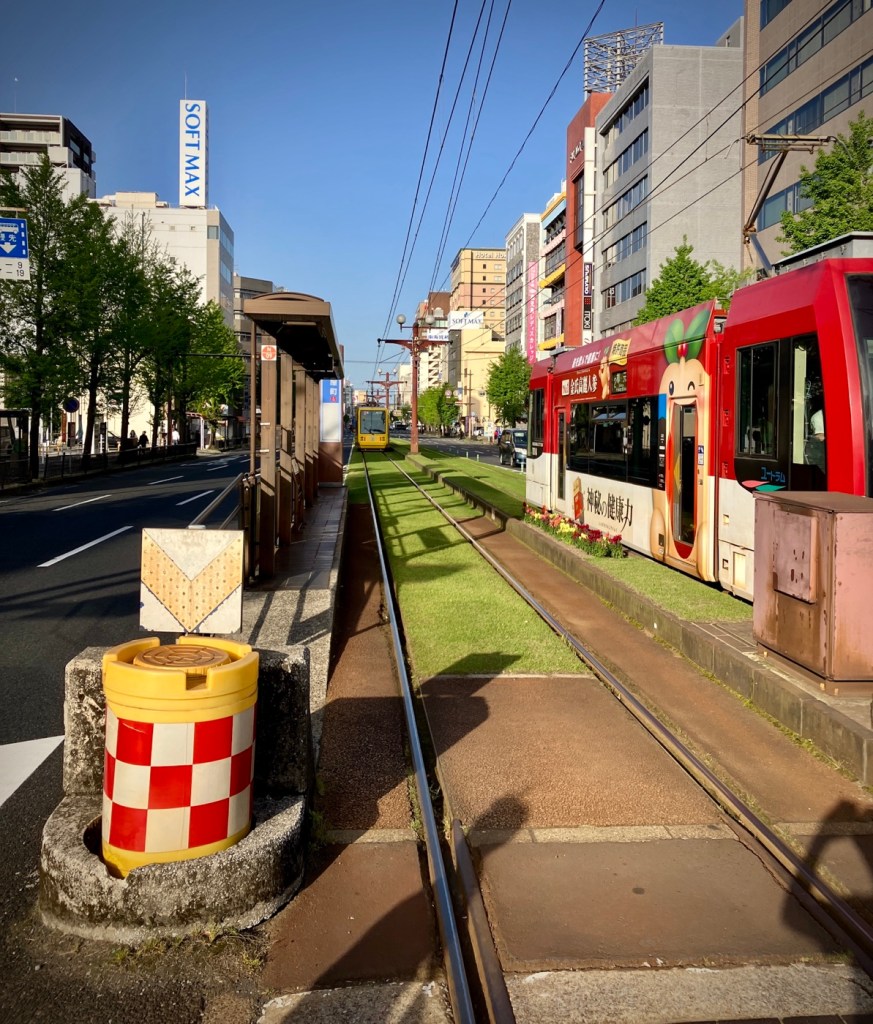
The worlds skinniest tram boarding platforms in Kagoshima next to 3 underutilized traffic lanes….hmmm
These poor tram passengers have lined up to wait for the lights to change, just to get off the narrow tram platform to the sidewalk.

4. Buses and Trams – they run on schedule (especially buses). You board at the back door and tap your IC card if available or if not, take a little paper ticket from a dispenser that indicates your boarding zone. You always pay at the front door as you leave, calculating your fare from the easy digital sign at the front. Put your stop ticket and fare in the box or machine. They can always make change. This also applies to some of the small independent (Non JR) local trains. Once you get the hang of it, it’s pretty straightforward (Especially with IC Card), but it seems pretty inefficient at crowded times as many people still pay cash fares. There is a flow from the back of the bus towards the front door, but it doesn’t match the ease and speed of a proof of payment system.

Navigating the local systems can be challenging
Google maps can really help as it has most timetables (but not all) available in navigation, but you still often need to id your bus in Kanji script or just be at the right place on time, because the bus will be.

5. Walking – You will do a lot of walking in Japan which is mostly great, and wandering the alleys, hidden temple stairways, and quiet back streets is one of the great joys of Japan. One downside though is that the arterial traffic signal timings are long, so get ready to wait for for 2-3 minutes at some crossings. It’s very annoying, and really delays walking trips across town. The only time you see Japanese run is for crossings, as they know it’s a long wait if you miss the light.

The cats and temples are always worth the long pedestrian lights
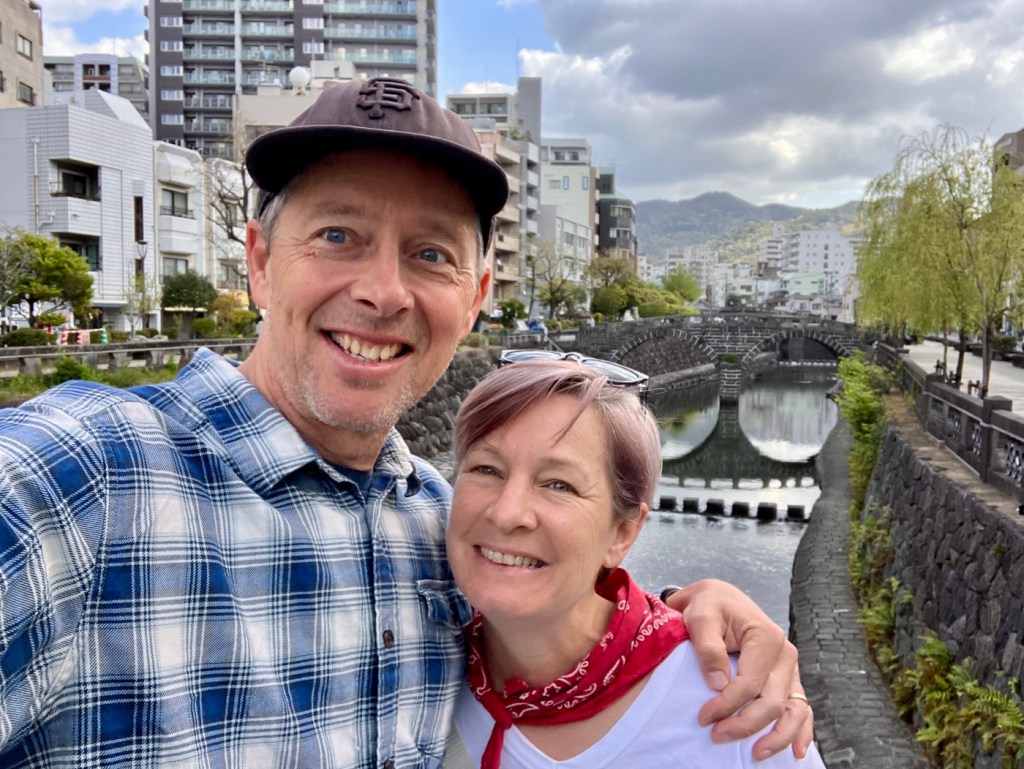
A series of historic stone bridges line the Nakashima River in Nagasaki.

Also, pedestrian crossings can be spread out on major arterials, with occasional overhead or underpass ped crossings in lieu of at grade crosswalks. It seems like a legacy of 1960s traffic engineering that continues in philosophy today, but stairwell underpasses are not good for an aging population.

State of the art ramen ordering machine. Automation and an aging population go hand in hand as labor is getting scarcer every year in Japan
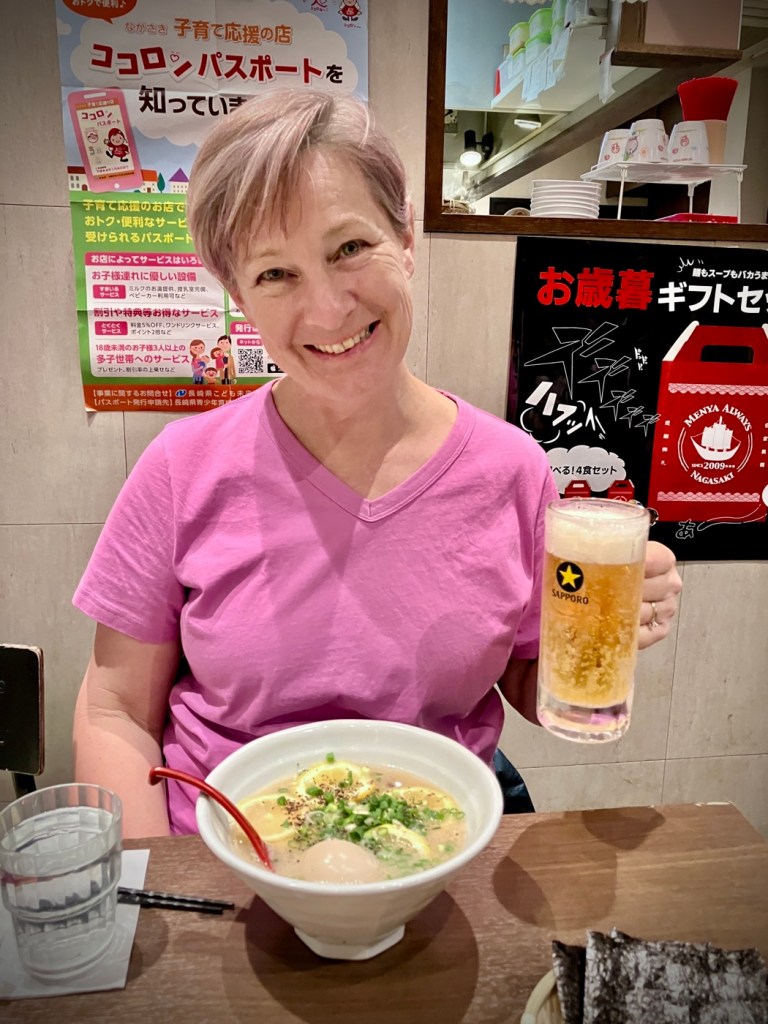
A unique pork and lemon broth at Menya Always ramen in Nagasaki

So what about Jaywalking? A few people, especially in larger cities will jump a signal or cross midway, but 98% of Japanese wait until the light is fully green. As time has gone on in our travels here, we are getting less and less patient, and will cross at will when it makes sense and traffic is clear. We are surely going to incite a pedestrian revolt here!

The main shopping arcade doubles as a cycleway in Takamatsu. It does provide weather protection to cyclists but is hectic in the evening rush hour when shoppers are out
Happy walking; riding bikes is not allowed in the busier hours or areas of the arcades

6. Bikes: There are many more than you think, especially in flatter cities. But the bikes share most sidewalks and it’s all a bit chaotic, which could be solved by more on street protected lanes. Cyclists routinely cut corners and swerve across intersections and are an outlier to order on the streets. (Yeah cyclists!)

Amazing underground automated bike storage in Takamatsu.
“Hello Cycling” bike shares were located in underground bike parking facilities in Takamatsu and the App was (mostly) English and foreign credit card friendly.

So my quick transport report card for Japan based on our scientific analysis:

Trains – A-….ok, amazing at a high level, but deductions for lack of App based e-tickets/seats please…and stringent bike policies keep it from A+

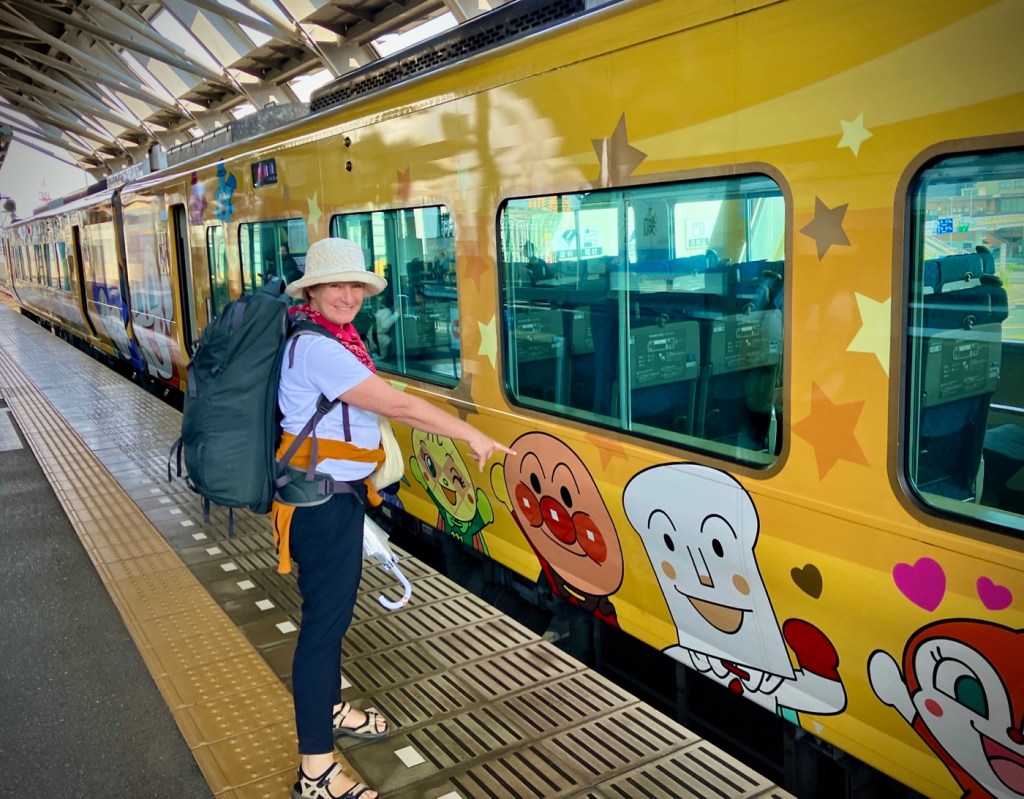
There are themed trains too, including a Hello Kitty Shinkansen (missed it) and our train to Takamatsu
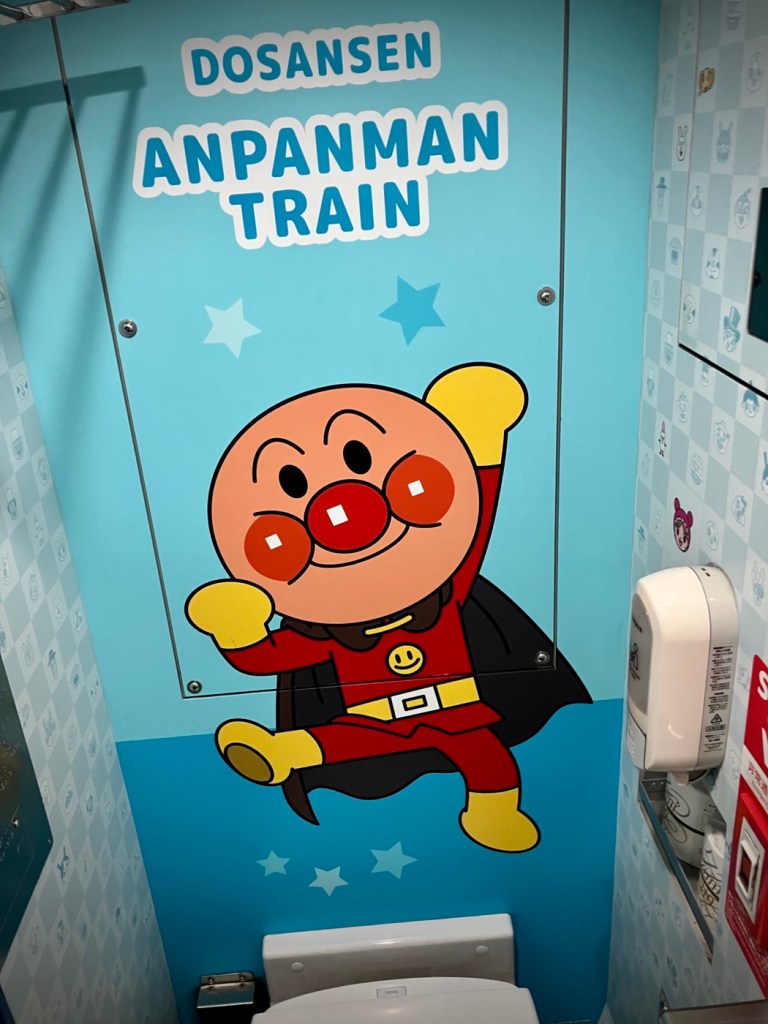
And the theme continues inside…Apanman is a beloved TV series based on Takashi Yanese’s picture books that he produced for over 40 years.
Even to the WC

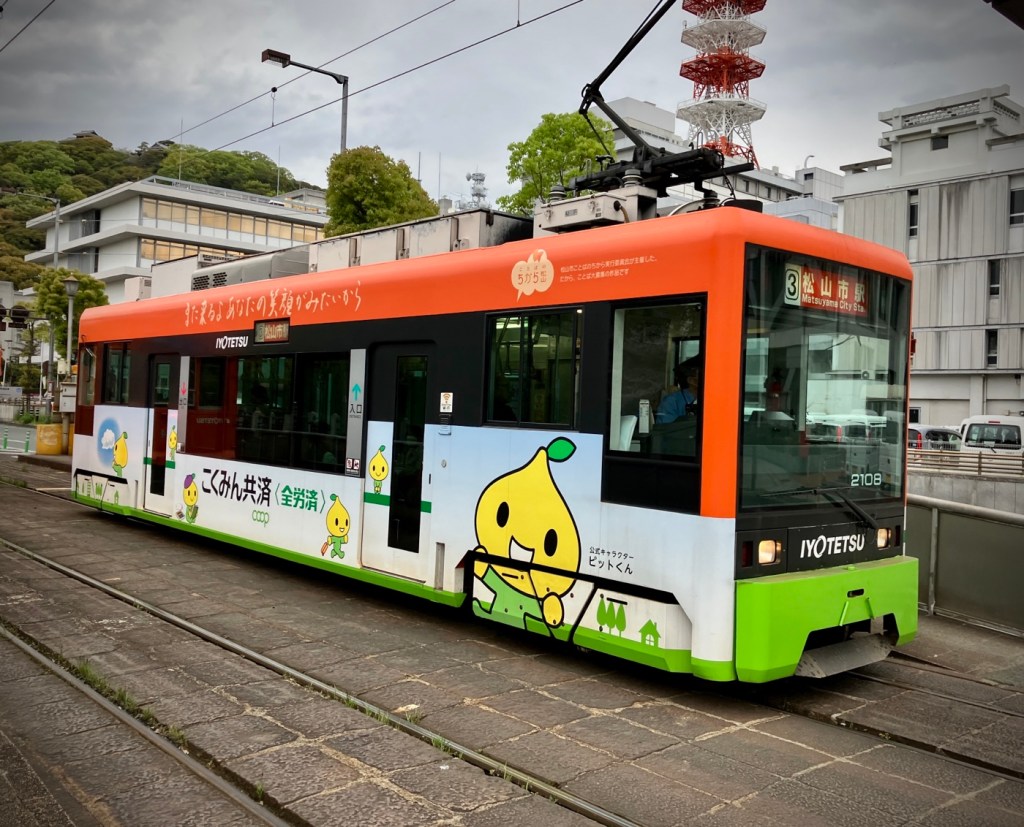
Trams – C+. Mostly old, narrow platforms, steps, clunky ticketing…. Few dedicated signals.

The trams are so cute, but less functional.

Buses: B+ Reliable; on schedule, and fair pricing but they get stuck at long traffic lights too, so can be slow in cities. And there are few express buses. BRT?

Buses in rural areas are reliable, but sometimes only run hourly or a few times a day

Walking: B- Wider sidewalks are needed in many places. Alleys and many quiet urban streets are very pleasant and low stress to walk, but many arterial sidewalks are a bit narrow or degraded by detectable rubber strips. I appreciate that these assist the vision impaired, but sidewalks are just not wide enough to accommodate them and side by side walking space. There seems to be a legacy of traffic lanes and road capacity. Giving more road cross section to peds, bikes and tram boarding is needed. Smart traffic signals could be used to mitigate lane reductions. Many heavy pedestrian neighborhoods in Tokyo and other larger cities have nice wide sidewalks in a new generation of streetscape designs, but many places still have a 1970s-1990s feel.

Rush hour on the sidewalks of Matsayuma. Wide here, but a slick rock surface makes cycling in the rain a bit dodgy.

Cycling: C+ Quiet back streets and sidewalk cycleways do the trick, but more on street protected bikeways are needed everywhere

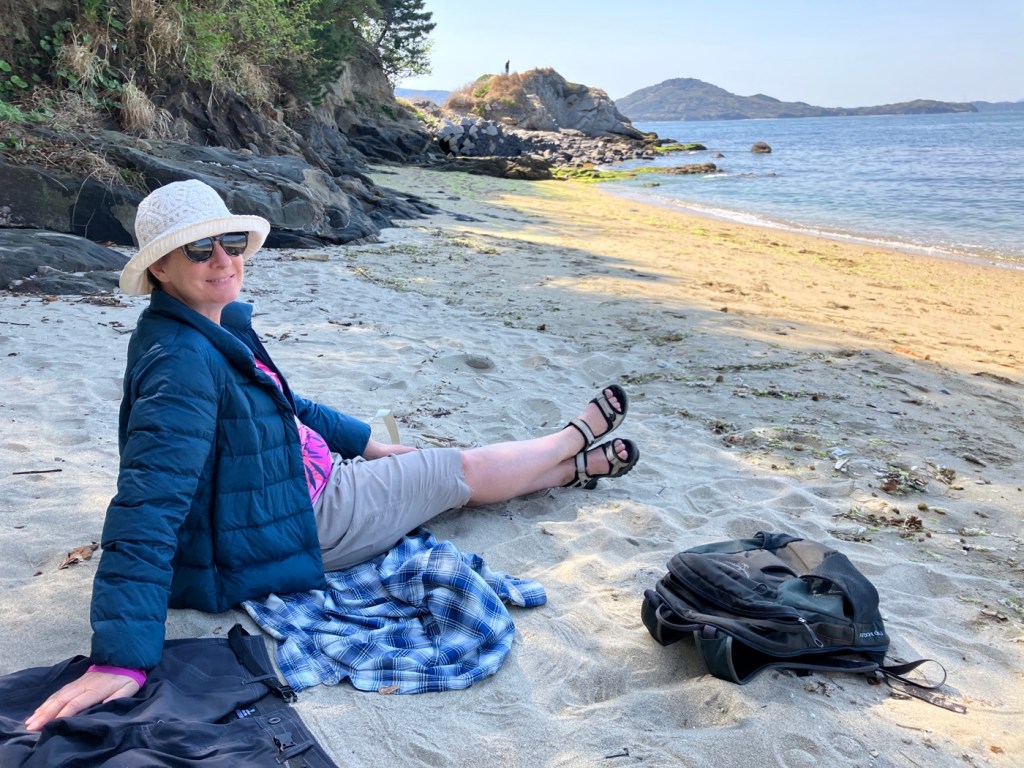
Yashima National Park – nice beaches on Shikoku but a little chilly to swim yet
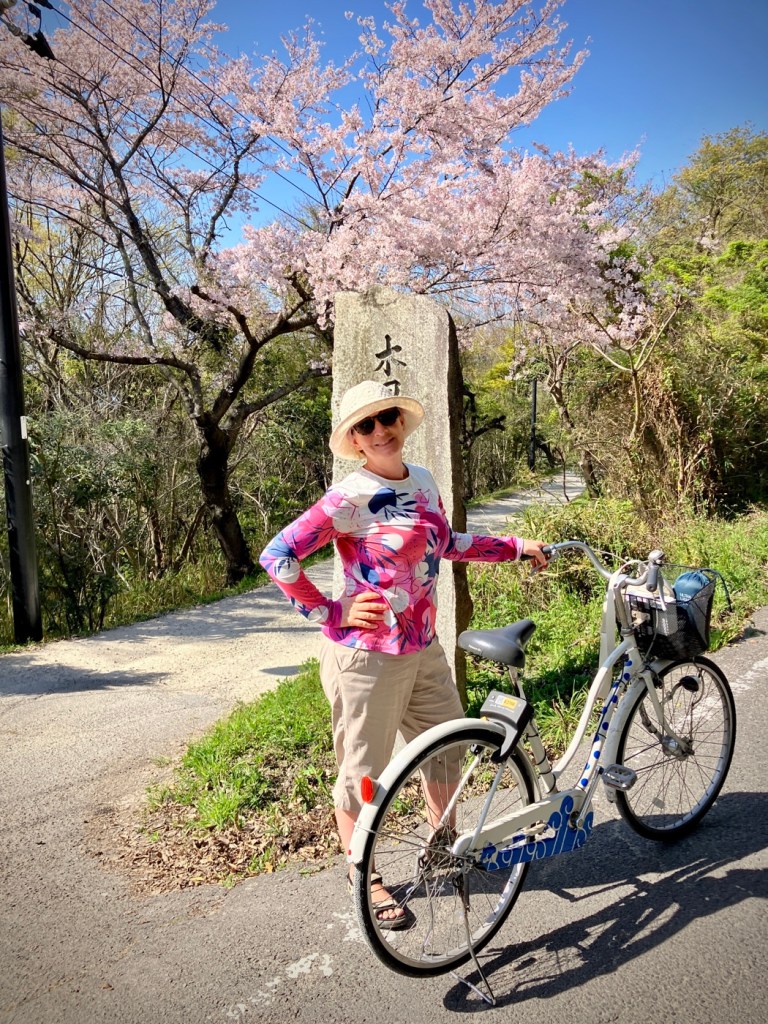
Cycling to Yashima NP from Takamatsu was pleasant on sidewalk paths and quiet roads

But enough nitpicking. As a traveler, the lack of personal safety concerns and good transport frees you up to focus on the unique culture, sights, and most of all, the food and friendly people. And oh man the food is SO good.

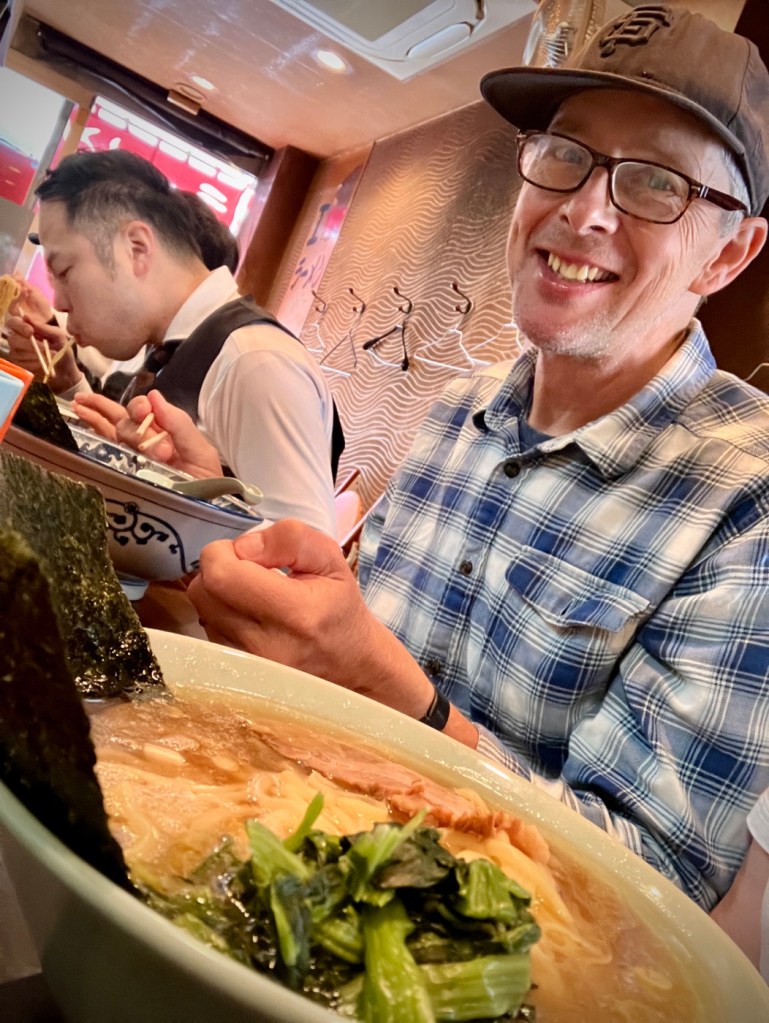
Smiles allowed, but ramen is serious lunchtime business at Ramenya Mass in Nagasaki
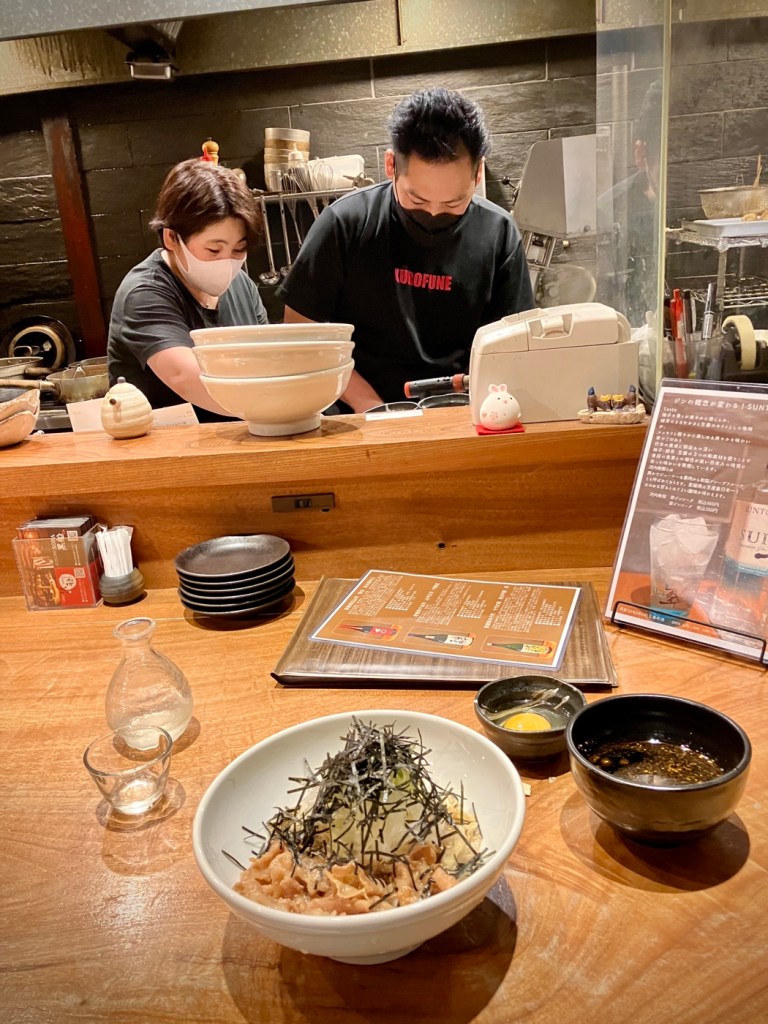
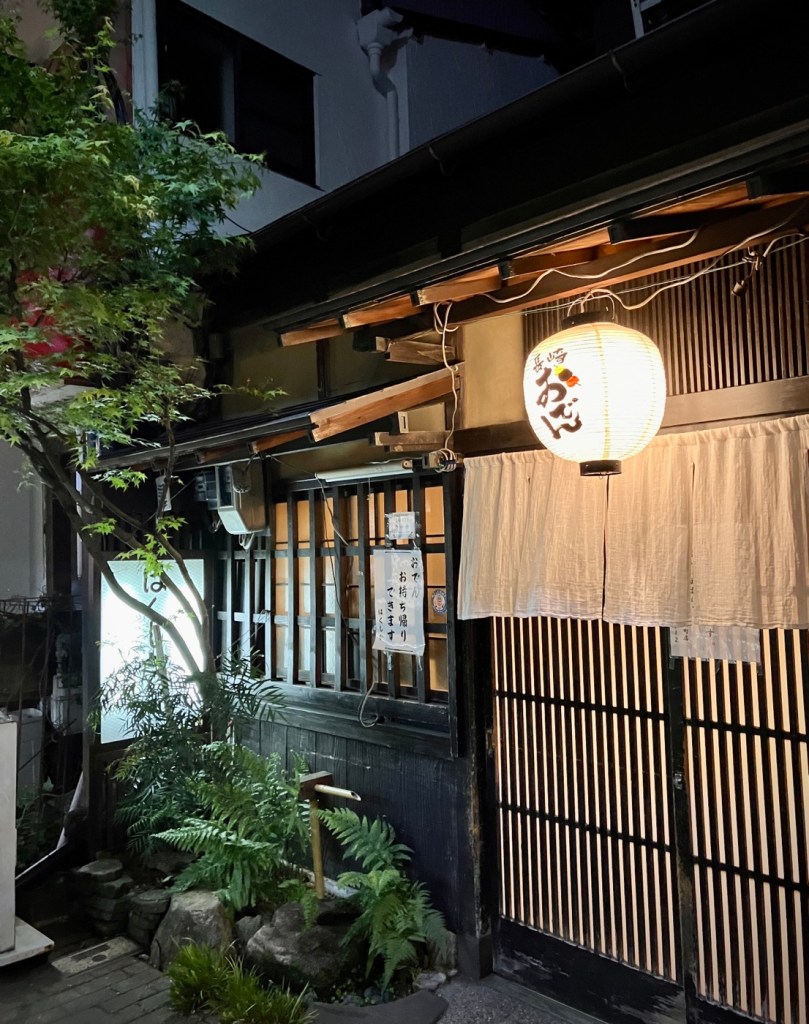
Small izakayas are the souls of Japan. Dedication to craft and coziness abound
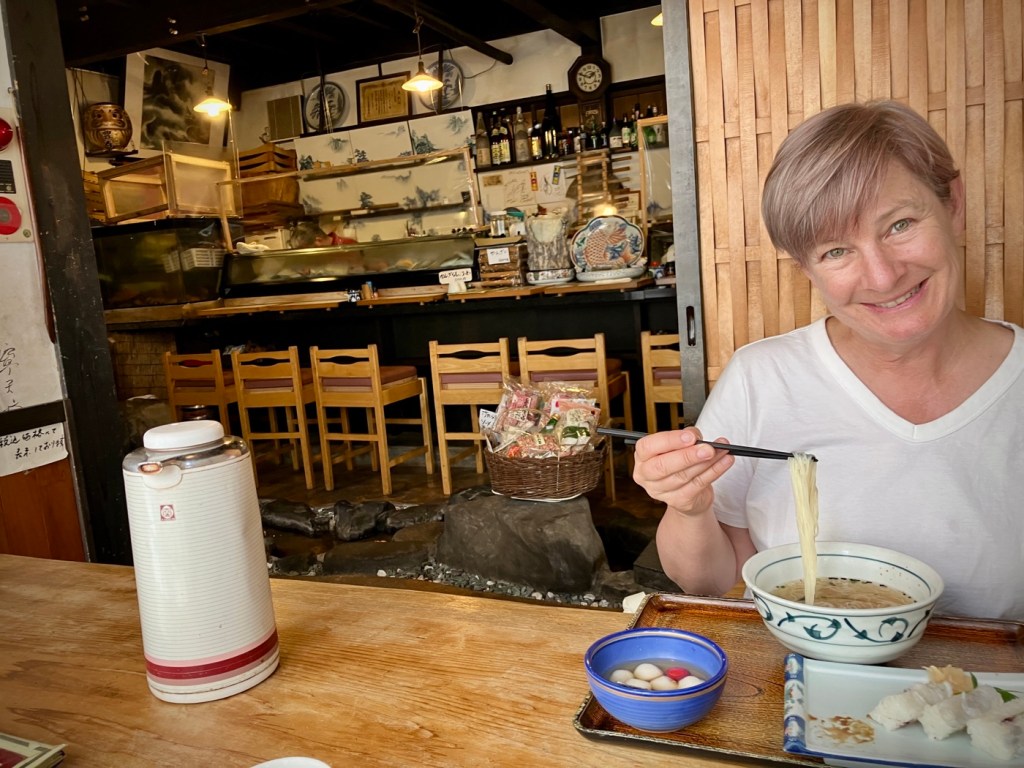
Pure soba and dashi heaven

And it’s good value for most lodging and food, as long as you are willing to give up western norms and keep some distance from the tourist hot spots. The yen has weakened against most currencies over the past 5 years, so it’s a great time to travel here. Except in Tokyo, there are great 3 to 4 star Hotels in the $100-$125 range, and a bit more on the weekends, especially Saturday nights. And most include breakfast.

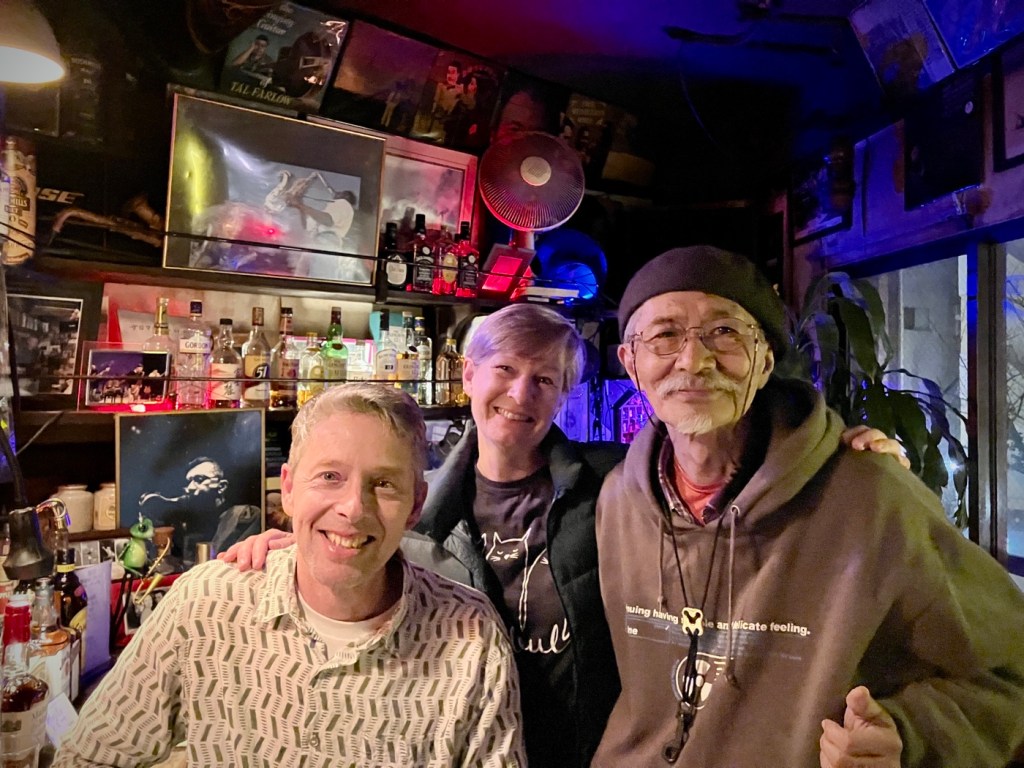
Wonderfully cozy 3rd floor jazz bar in Nagasaki . The owner played us his tenor sax music while we chatted. The Japanese love classic jazz. And so do I.
In addition to hot and cold drinks, vending machines in Japan are used for almost everything; even fresh soba noodles

If you go for more modest 1-2 star hotels, then you can find many in the $70-$90 range. Remote or resort area hotels (often with Onsen or Rotemburo baths) are definitely higher in the $150-$300+, so will be a splurge if on a budget. It’s definitely better value than most of the US, and similar to Europe, although I think a bit cheaper overall. A few other lodging tips. Book some nice Ryokan or Onsen properties well in advance as they are lovely, but don’t do anything but go up in price or sell out. Small or exclusive places are not into last minute bargains.

A Western-Japanese hybrid room in Shinabara. This hotel had lovely Onsen and Rotemburo (outside baths) and more spacious rooms than most urban hotels
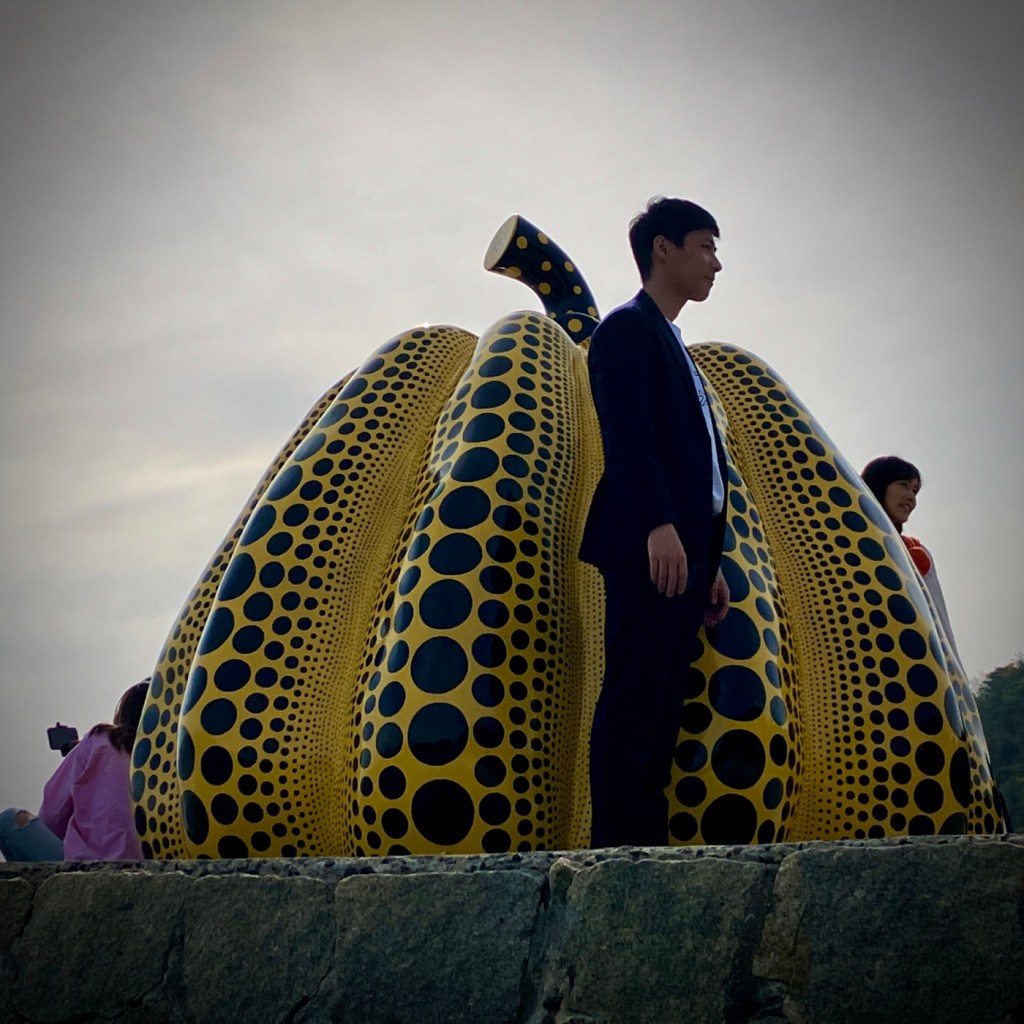
Naoshima Island
Instagram of Instagramers on Naoshima
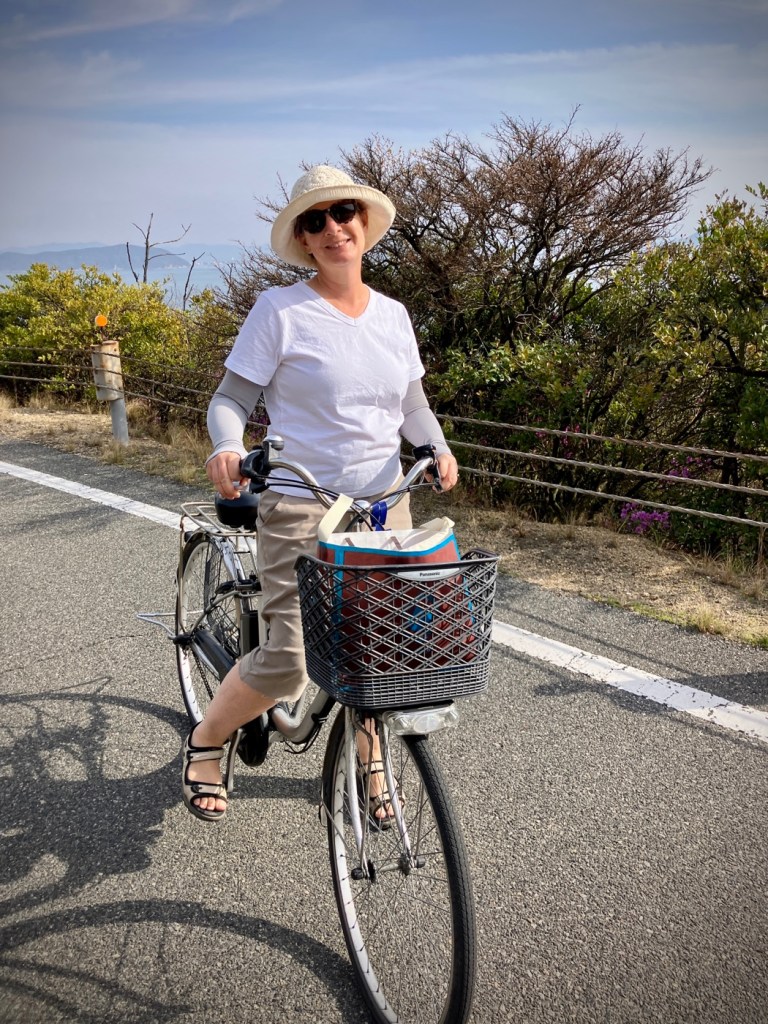
More bikes to explore Naoshima…these with a bit of eboost

And big western brand hotels in major cities here often 2-3x as expensive as local alternatives for a similar (or better) product. Avoid them, unless you only have a week and a surplus of loyalty points to burn. (For example, during the Sakura of late March, Marriott properties in Tokyo ranged from $600-$2000/night!). Big waste of money.

Kochi on Shikoku is a bit off the beaten track but worth the effort for its friendliness
Kochi’s famous seared Bonito (Katsuo) has ruined us for life for lesser fish. Delicious.

Another tip. Many western style rooms are cosy in Japan, at 120-180 sq ft, but if you book a twin instead of a “double”, the rooms are larger at 180-250 sq ft. They have two full or queen beds that can usually be pushed together. So you have a lot more space, often for just a bit more money. “Twins or Quads” seem to sell out first as locals know this too,

We found a small traditional house to rent on Naoshima Island. Wood and Tatami mats were a refreshing break from city hotels (and it had a washing machine!)
Even a basic meal is pleasant in Japan

But as great as it is to travel here, it’s not all easy, as travel in Japan has its own breed of travel stress due to constant language and cultural nuances. And the country faces a battery of challenges, including rural depopulation, economic stagnation, and a location in an increasingly volatile region, just to name a few.

You have to open the doors to know what awaits you in Japan
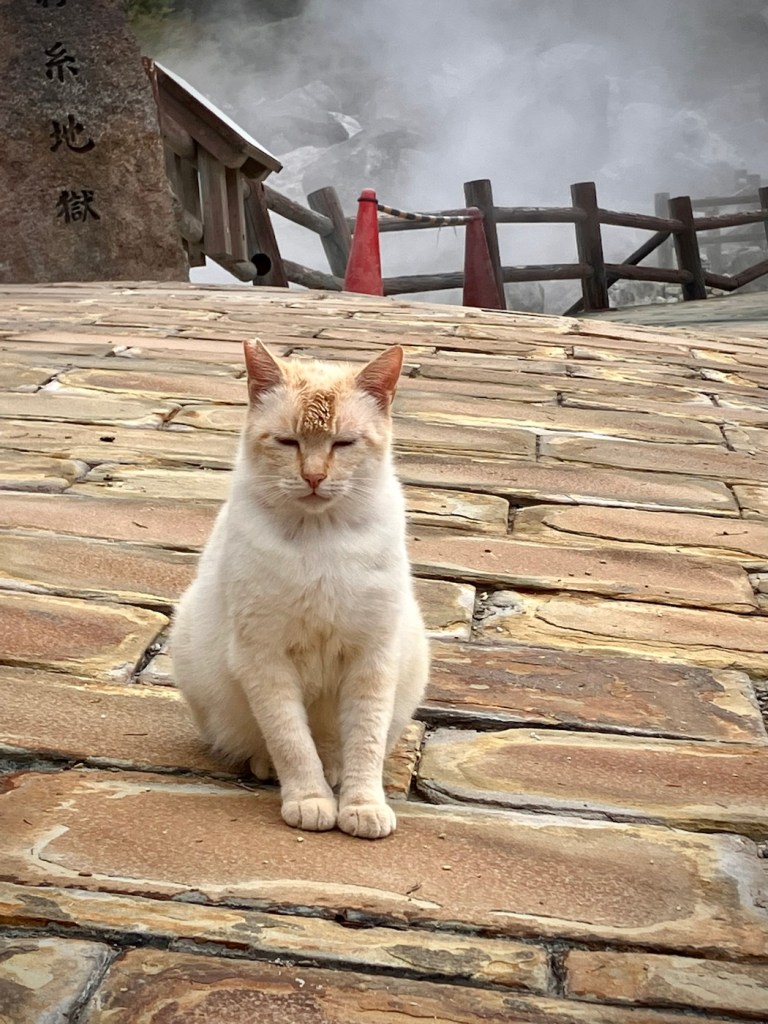
Cats seem to guard popular spots such as Unzen National Volcanic Park, and are looked after by the locals.

But we are judging against a high bar, as we are already talking about coming back to bike tour, renting an apartment for a month in Tokyo, or even a car tour to see more rural sights that are tough or impossible by public transit. If you do want to rent a car in Japan you will need an international driver’s license.

Zen, spring water, and Coi at a tea house in Shimabara
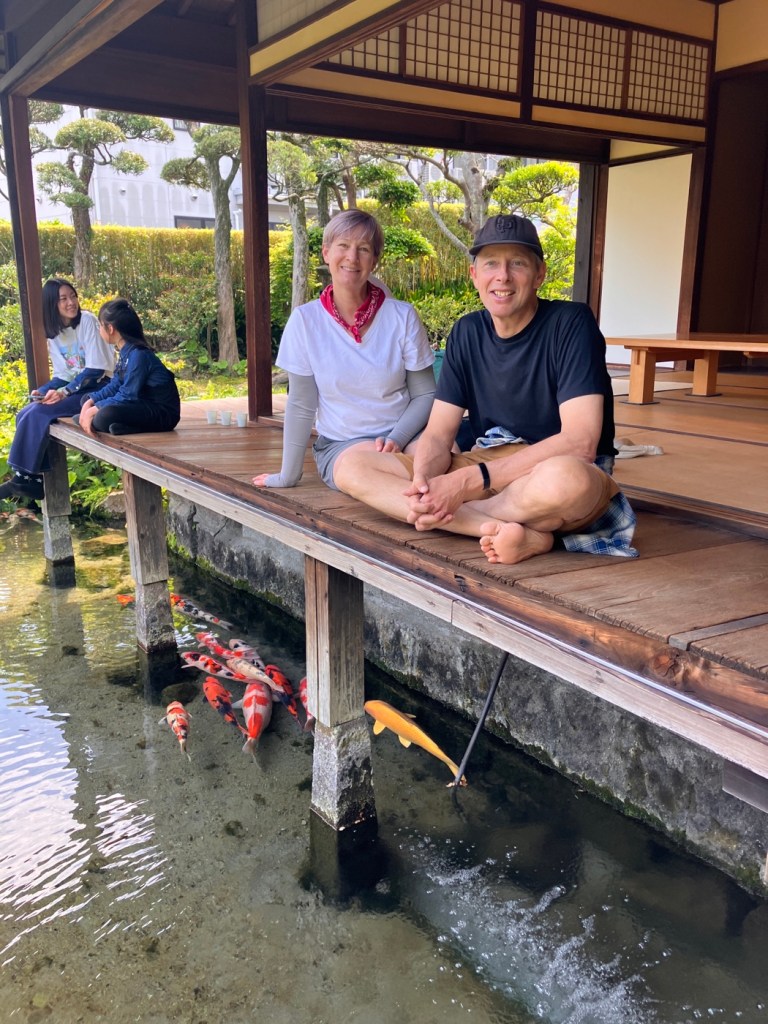
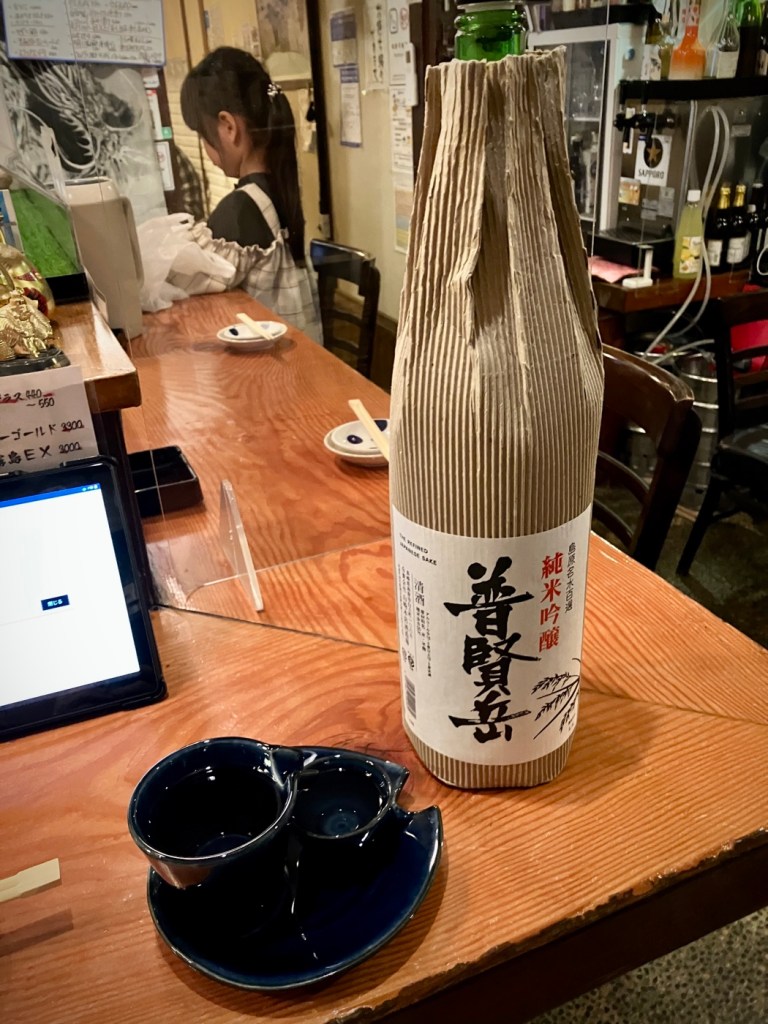
Always ask for the local Sake as we did at this family run Izakaya in Shimabara

We are excited to head to South Korea next week, but first we are going to eat as much amazing food as we can in quirky and cosy settings, served by some of the most dedicated and friendly people in the world.

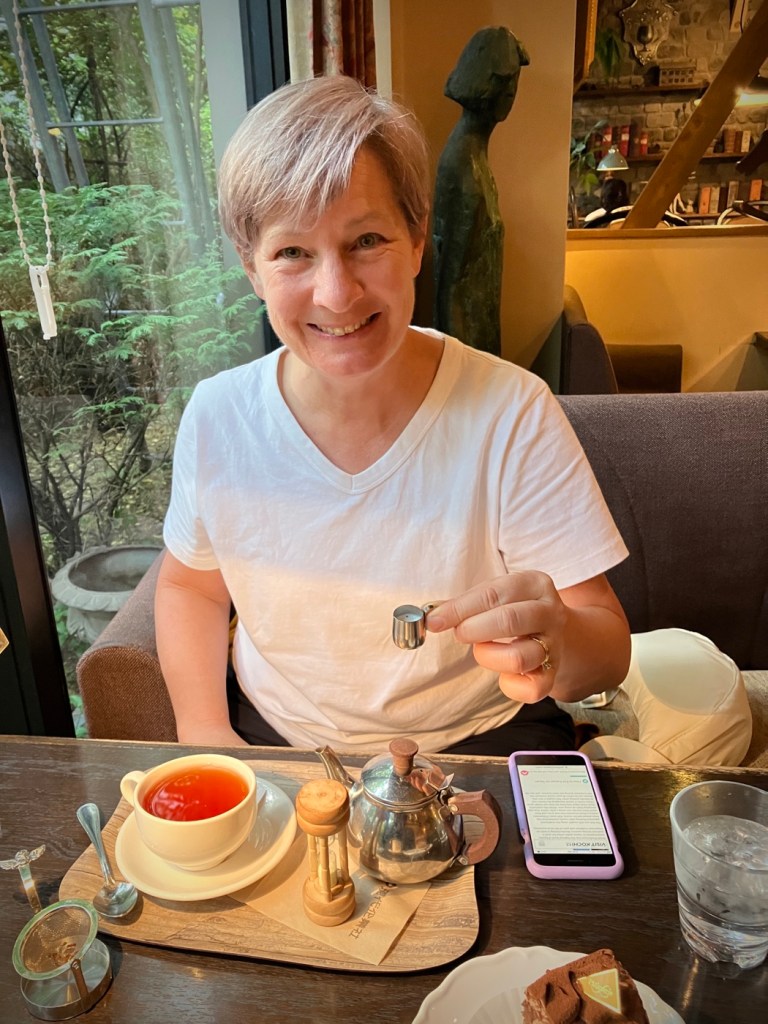
My favorite travel companion enjoying some cozy afternoon tea
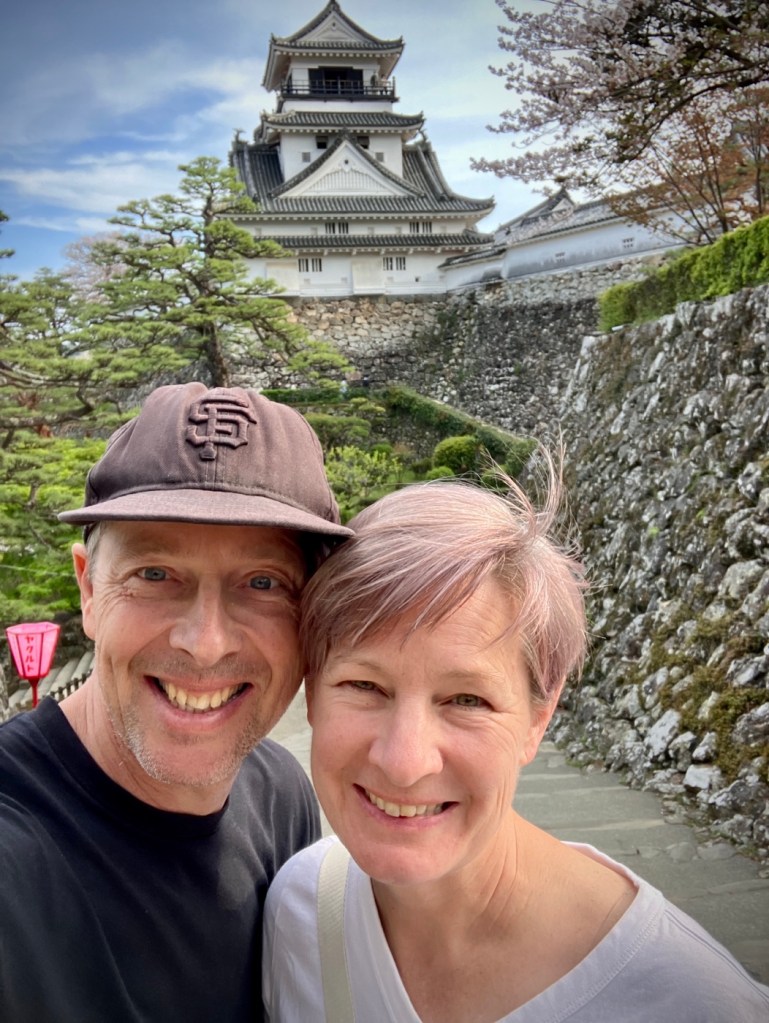
Japan makes us smile

Happy travels!

Sigiriya, Sri Lanka – doing what we enjoy most.

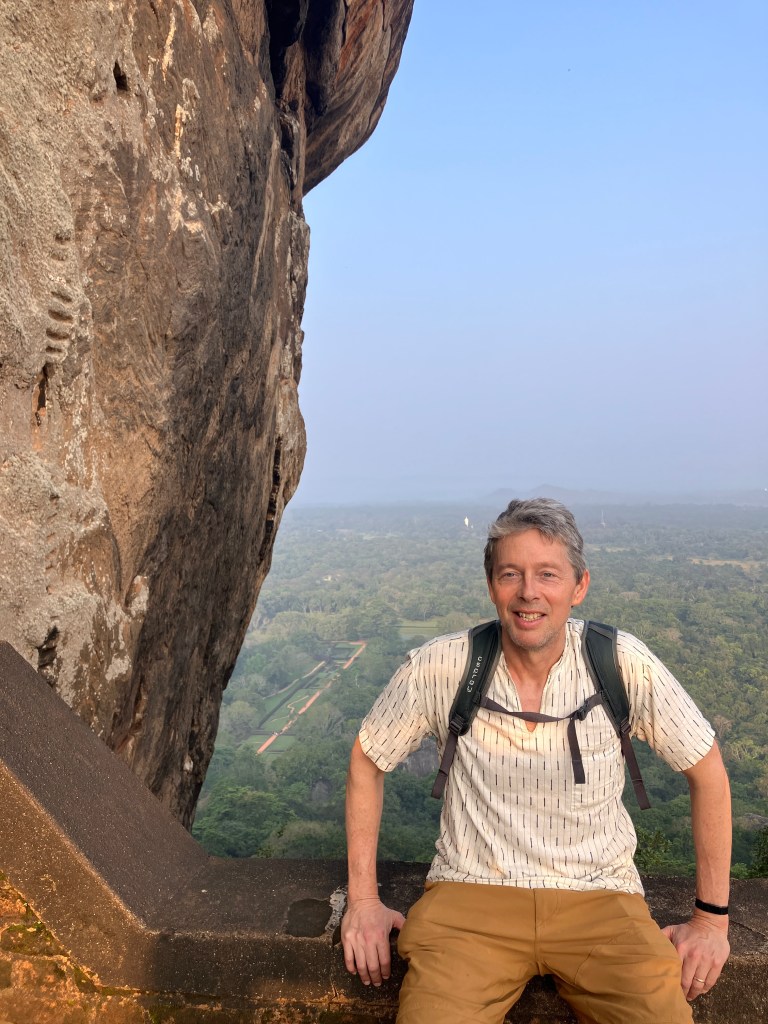
Sunset view of the 5th century ancient rock fortress of Sigiriya, the Lion Rock.

What is it that we love best when traveling? Walking and biking, of course. Sri Lanka has challenged us with the need to do taxi transfers and tuk tuk trips to avoid daytime heat or nighttime elephants, or to get from a hotel or guesthouse to a site.

A pond in the ornamental gardens leading to the Lion Rock. Tiny Rich added for scale.

Our first morning in Sigiriya, we had our guest house owner drop us at the west entrance and Museum to buy our tickets by 6:45 am, so we could explore and climb the rock before it got too hot.

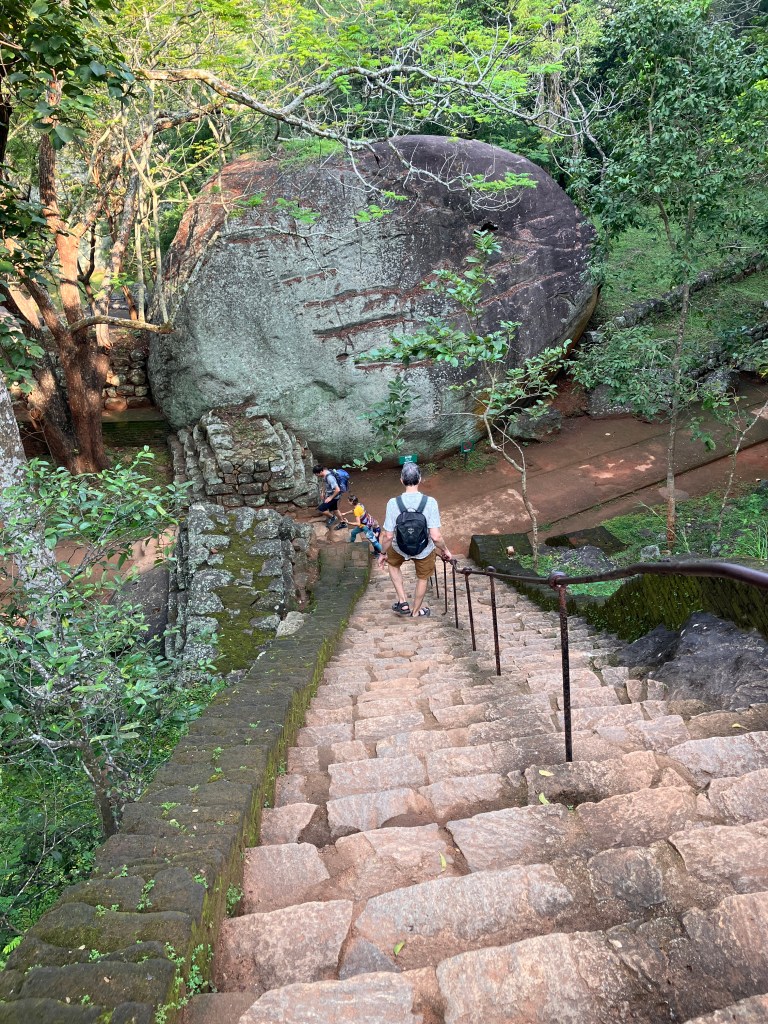
It took a lot of stair climbing to even get here, the two giant lion paws mark the entrance to the rock fortress. The lion head crumbled some time in the past.
Not for the faint of heart or weak of knees.
The views are amazing on your climb up and down.
Ponds and walls speak to the history of this place.
A pond and the cable trolly used to get conservation materials to the top of the rock.
It reminded us a bit of Machu Picchu, the ability to look down upon the site really gave you a good sense of place.

First a capital for King Kashyapa AD 477–495, and then a Buddhist monastery until the 14th century, it is now a UNESCO World Heritage Site and considered one of the best preserved examples of ancient urban planning.

Laughing as we realize we still have to go back down all those steps.
Down we go.
Yikes. That’s a catwalk with a view.
Almost out. Knees feeling wobbly.

We were staying close enough to be able to walk back to our guesthouse for a late breakfast, which made us happy. Any time you walk in Sri Lanka you do have to decline a lot of tuk tuk offers, especially at a popular tourist site like Sigiriya Rock. But we press on and enjoy the walk.

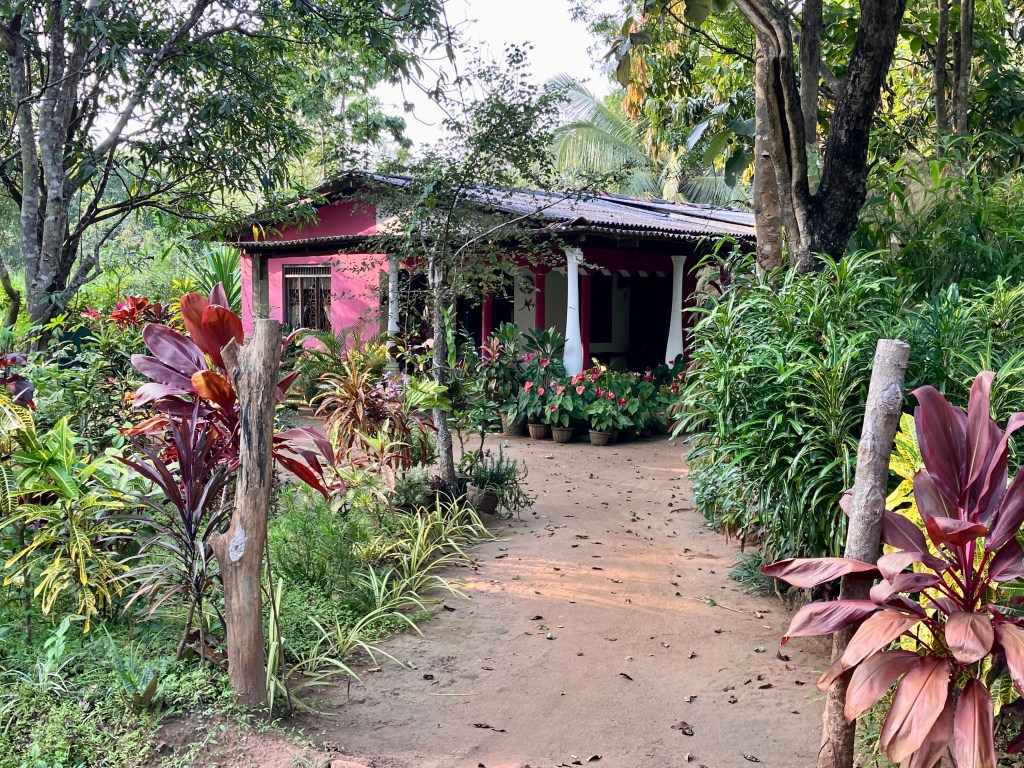
The small roads around town made for lovely walking. Sri Lankan people have an eye for design, so many lush gardens and pretty houses.
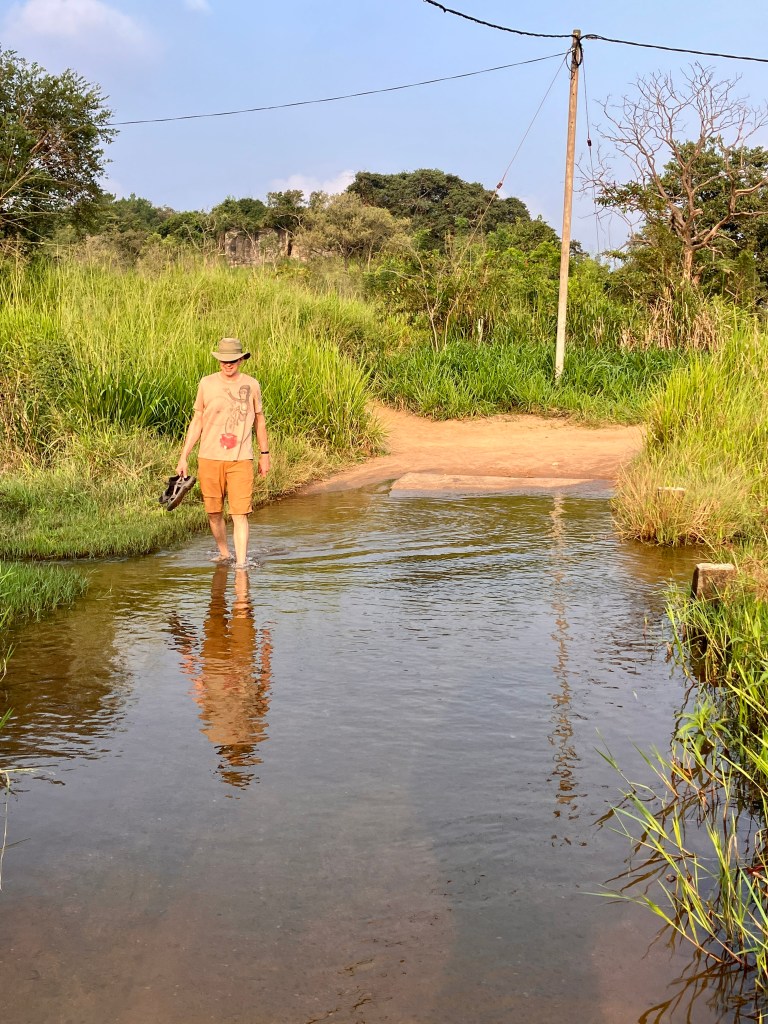
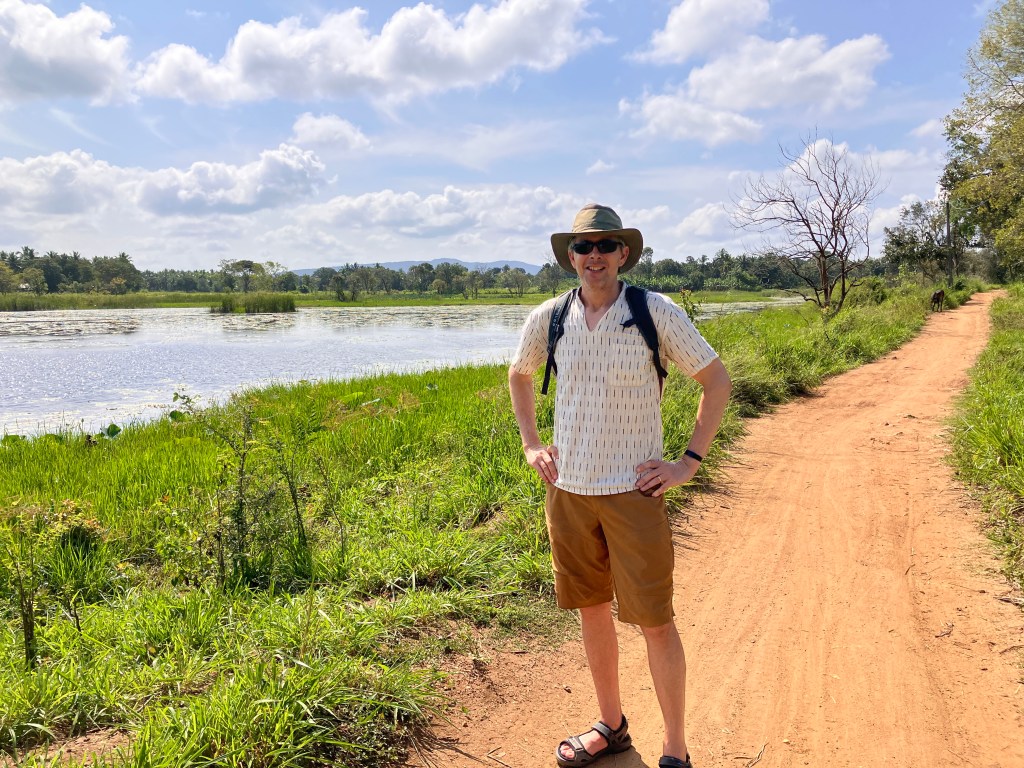
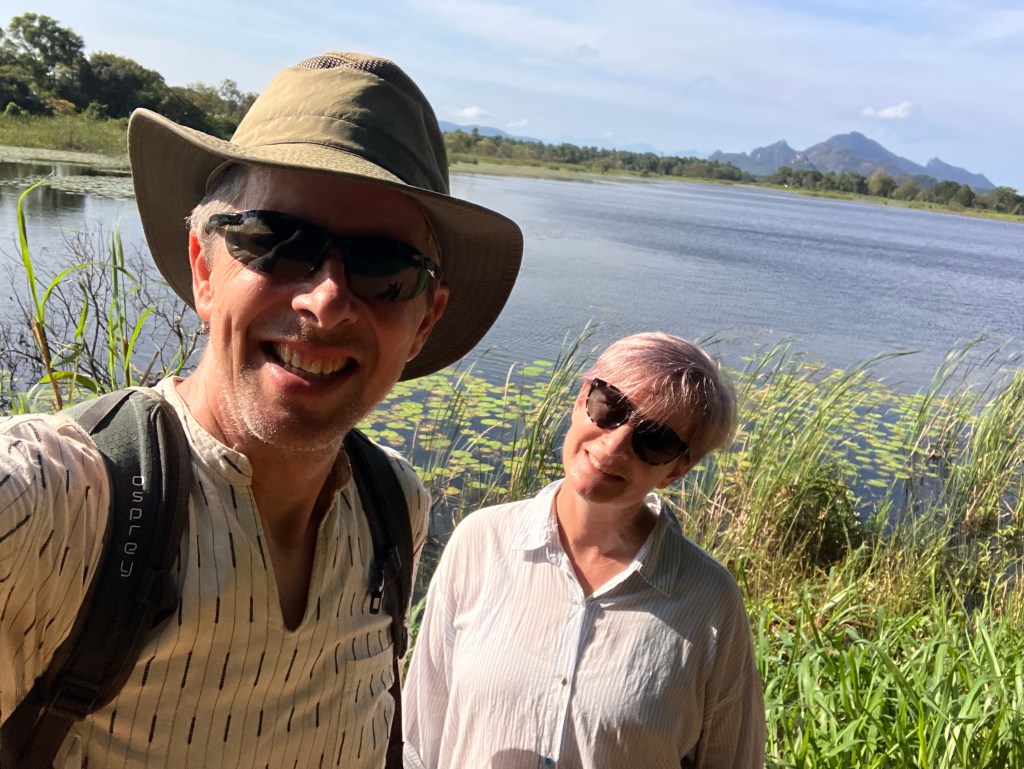
An afternoon walk to the nearby lake, Kayanwala Wewa. The road crosses an outflow which makes for a refreshing wade.
Relaxing by the lake.

Sri Lanka has no natural lakes. Starting in 300 BC the Kingdom began to construct reservoirs and tanks. The Sinhalese people were among the first to build artificial reservoirs to store water. These irrigation systems of the ancient world are still intact. Sri Lanka has ten thousand man made bodies of water, lakes, reservoirs, tanks, ponds, and stepwells.

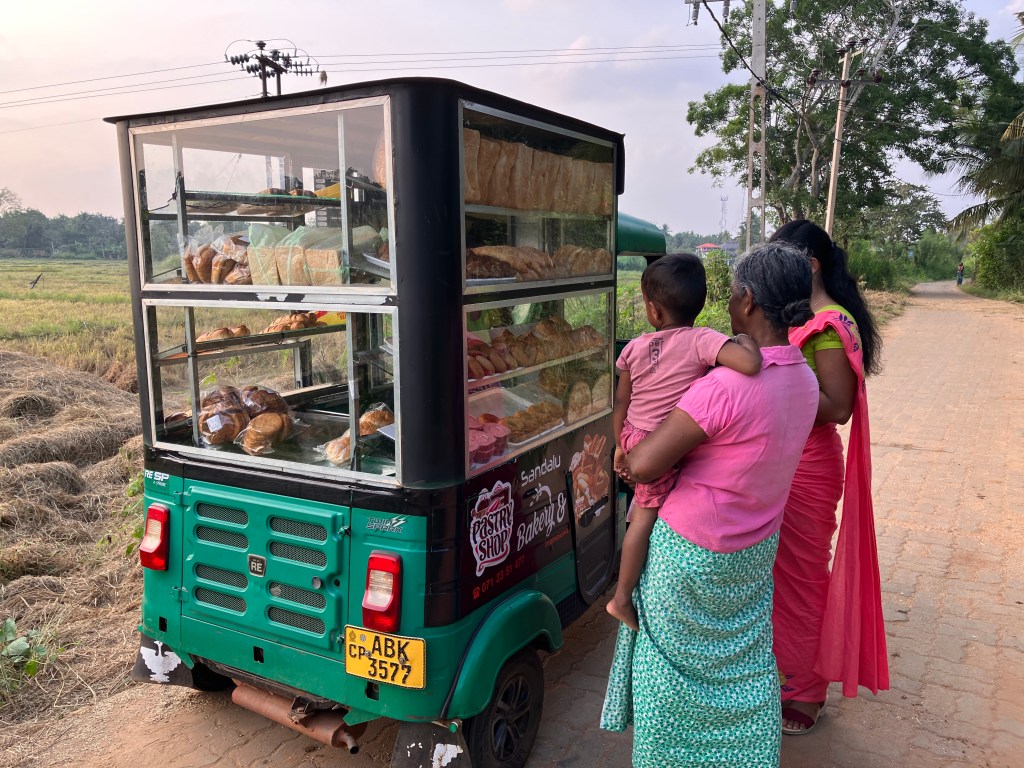
As you walk the small roads and greet locals you’ll hear an electronic version of Beethoven’s Für Elise. That signals the bread tuk tuk is near!
A pastry shop on wheels. The ice cream tuk tuks play ‘It’s a Small World’.

With temperatures reaching 90f/32c in the early afternoon, our walk opportunities were limited to mornings and after 4pm. Not only is the heat and humidity oppressive, but the UV levels will burn this pale human in 15 minutes. Sunblock, long sleeves, umbrellas, that’s the only way I can get out and about.

Yes, there is an app for that. My trusty UV Lens app.

Walking the small dirt roads is not without obstacles though. Sri Lanka has so many dogs, some wearing collars and belonging to a specific house, but many many more simply stray street dogs. Most ignore you after a hopeful glance for snacks, but some bark and come rushing towards you. Not fun. We accidentally solved the dog stress problem when I deployed my collapsible umbrella while walking by a dog and it recoiled in horror. Ah ha. Shade giver and dog deterrent – the humble collapsible umbrella.

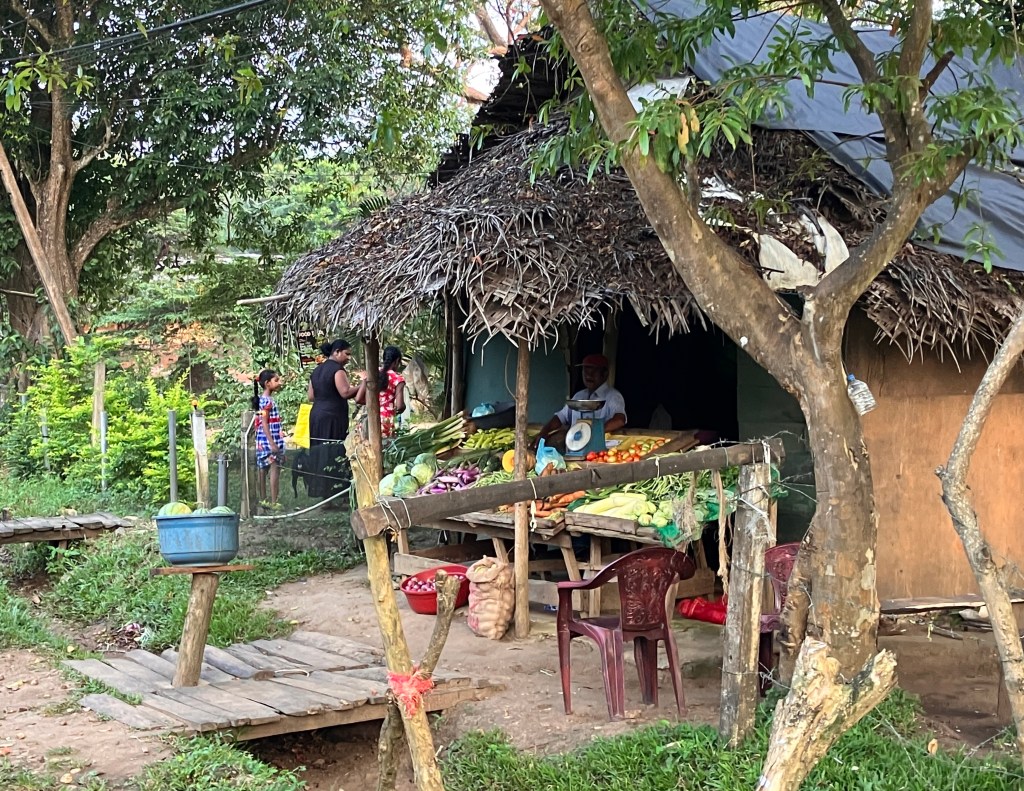
An artful fruit and veggie stand.
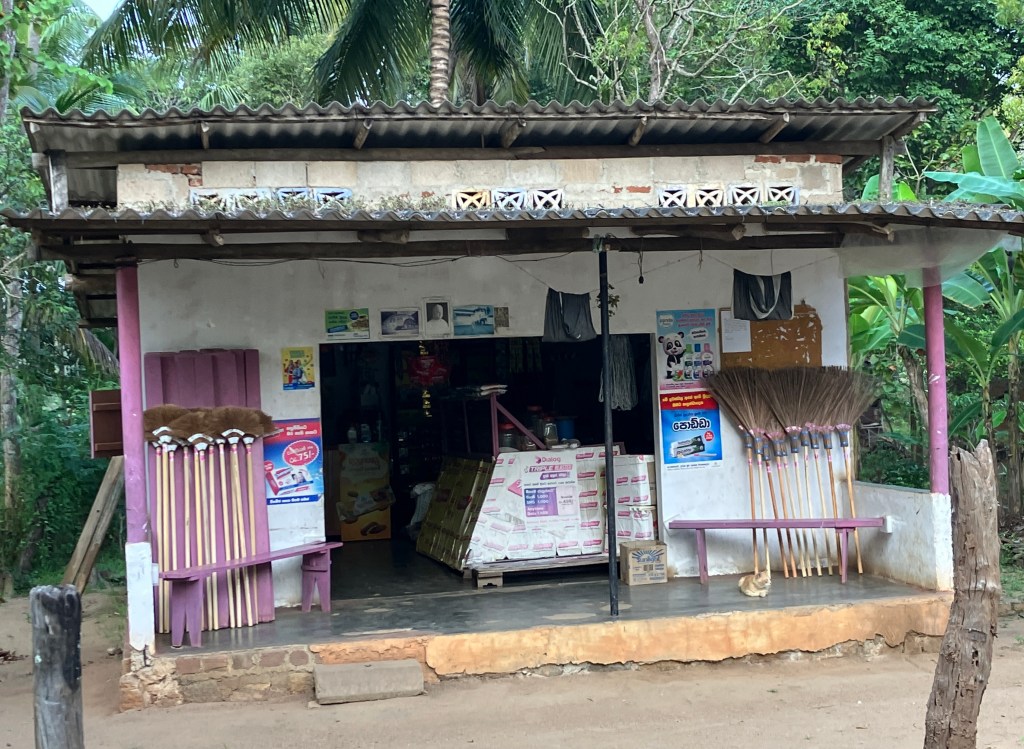
Brooms and more.
Another colorful roadside shop.

Our second full day in Sigiriya we spent visiting the ancient and Sacred City of Pollonnaruwa. We had a car and driver to take us the 45 minutes to the site, and once there we rented bicycles to explore the site and it’s many amazing artifacts. Polonnaruwa was the second capital of Sri Lanka for three centuries between the 11th to 13th century after the destruction of Anuradhapura Kingdom (which we’ll also visit) in 993.

Rich can rarely find a bike that fits him well. But he looks happy anyway.
The restoration of the buildings and statues is on going.
My first time on a bike since breast reduction surgery in January. I couldn’t stop smiling – cycling in hot weather is much easier than walking.
Our trusty bikes in front of an ancient stupa. Since tourism has not fully rebounded we had many of the sites to ourselves.
The jungle had covered many of the buildings until restoration and conservation. The before and after photos are dramatic.
Exploring Pollannawura by bike.
Ponds are an important part of the site. And beautiful.
Tempting on a hot day. But the signs clearly forbid swimming.
To enter the temple areas you must remove your hat and shoes, and put down your umbrella. As it gets later the sand gets hotter so visitors bring socks to wear.

Riding bikes around this ancient site was such a unique experience, but we did wish for better curation of the experience. Even the museum, which we visited at the end of our ride around, didn’t do a great job of giving you a sense of how people lived in Polonnaruwa. We didn’t hire a guide, which most of the visitors did, so perhaps that was a mistake on our part, but we so much prefer doing things at our own pace and we know we’re happier without a guide. From what we overheard from the guides I don’t think we missed out on much information beyond what we had from our guide book.

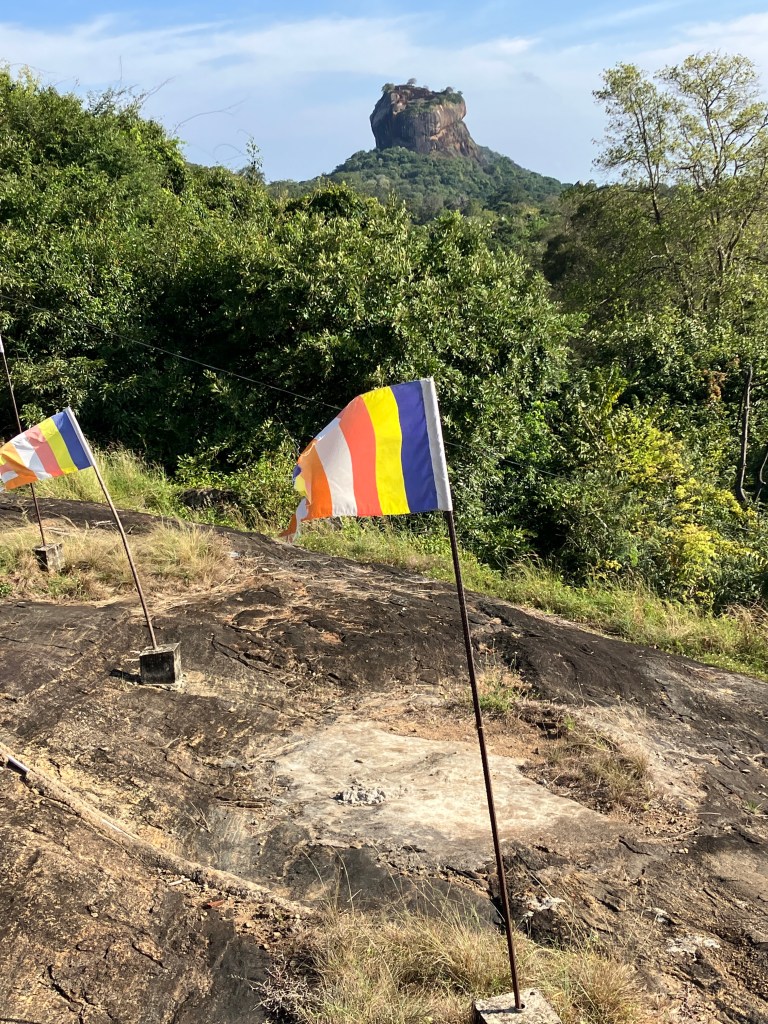
That photo bombing Sigiriya rock again, this time on a morning walk.
Unable to find bikes to rent we headed out on foot for what ended up being almost a 7 mile/11 km walk.
A local fishing at the lake, he had a bike. We were jealous.
The roads were getting smaller, the temperature was getting hotter.

The area around Sigiriya is not only an archeological sanctuary site, but also has elephants and rice farmers. We saw an elephant from the road when being driven back from Pollannaruwa. Our long walk took us alongside many rice fields. We were fascinated to see the methods the farmers use to either keep the elephants out of the fields, or to alert an overnight watcher of the presence of an elephant so an attempt could be made to deter the elephant using loud noises.

Rice fields.
Empty Lion beer cans hung on string at the edge of a rice field. Empty bags and branches- not much of a defense against an elephant.
A night time elephant lookout platform. That looks like a lonely and nerve wracking job.
This canal proved to be a great bird watching area. So many bright blue Kingfishers darting along it kept us distracted from the heat.
A little roadside shop with chairs in the shade was a welcome sight. Two cold lemon sodas perked us up for the last mile.
An umbrella is key for mid day walking, we bought this UV protection umbrella in Taipei.

You never know what you’ll see walking around small rural roads. Local folks were unfailingly friendly and helpful. We reminded ourselves that the small children had possibly never seen tourists, the three years of very little to no tourism meant that their wide eyed stares were not a comment on our hot sweaty state. It can be a bit daunting to wander the back roads, but so rewarding.

Evening bread tuk tuk, with two ever hopeful dogs.
The happy travelers.

Riding trains in Sri Lanka.

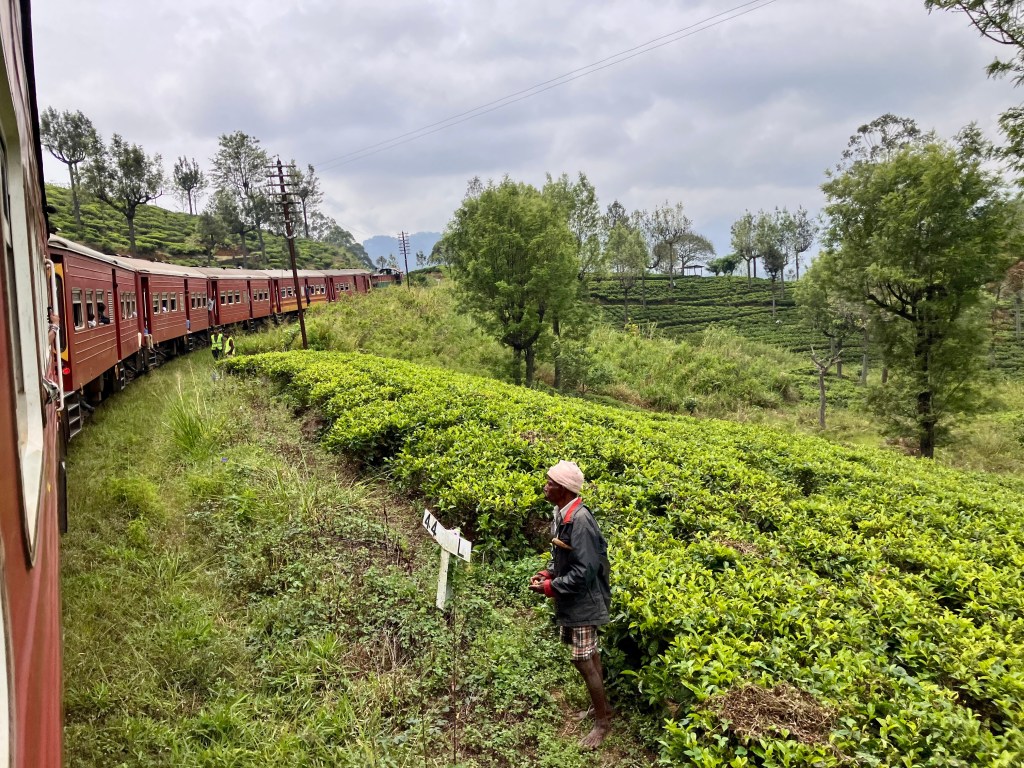
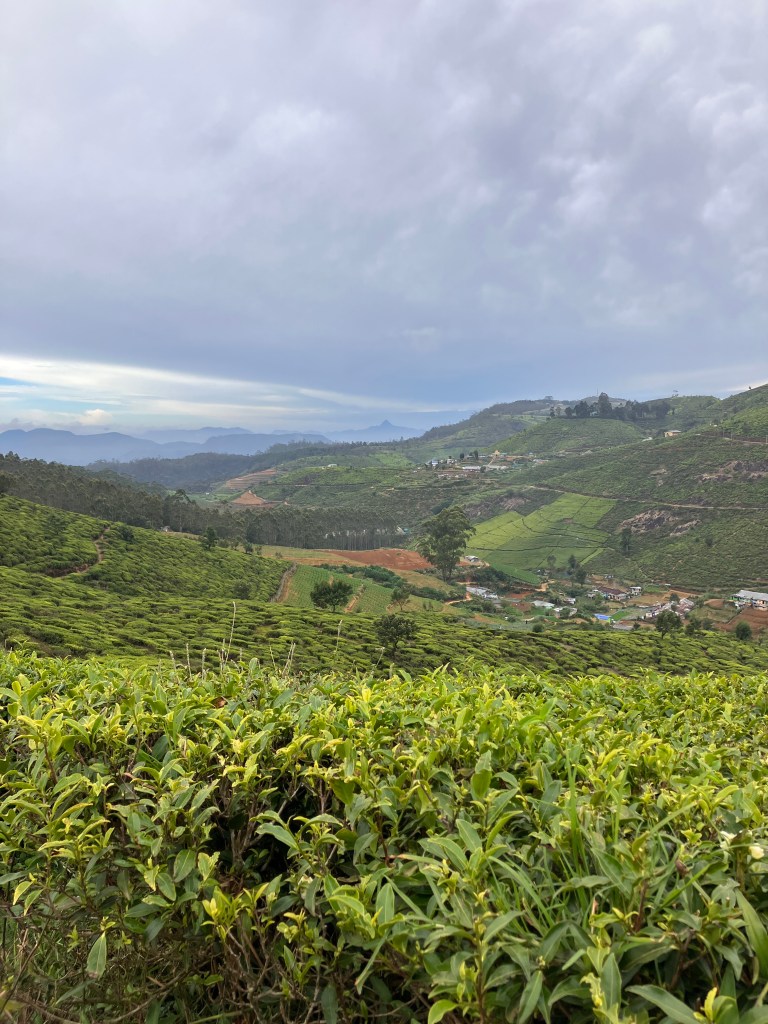
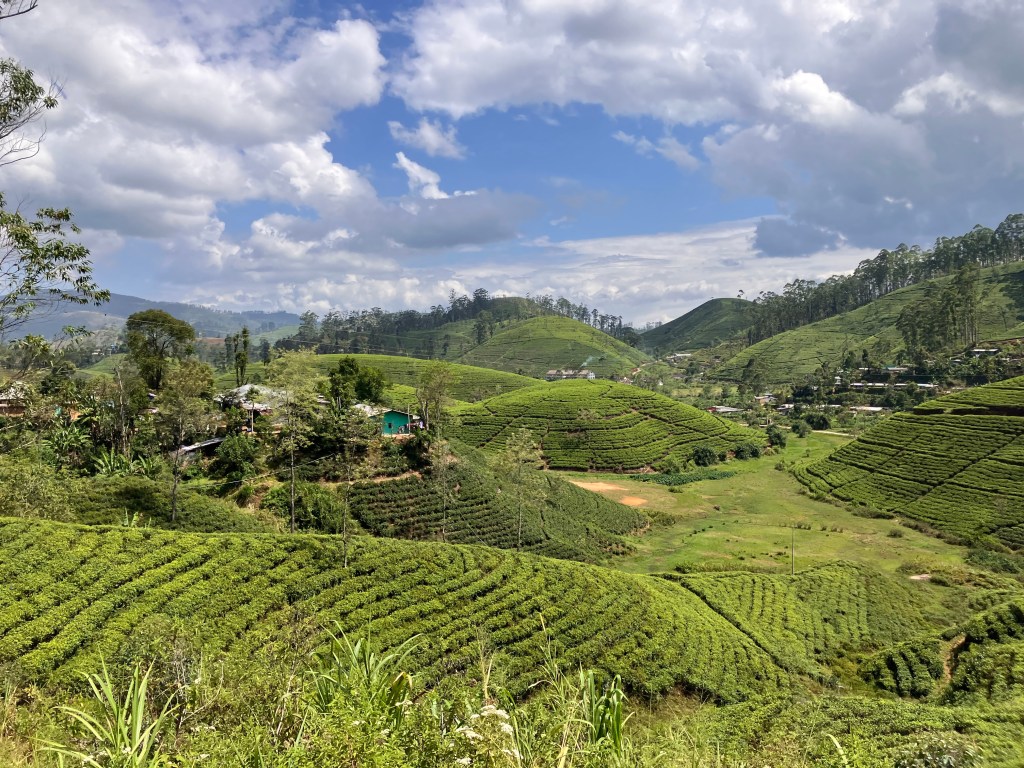
Passing through tea fields on the way from Ella to Nanuoya.

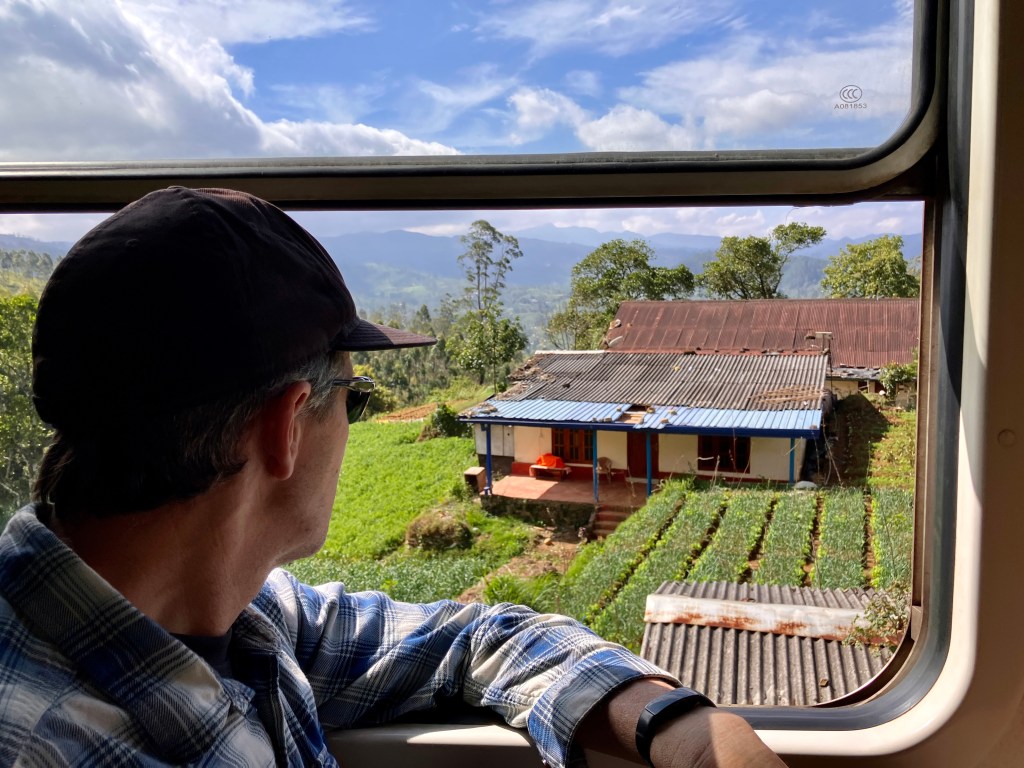
Taking trains is a big part of our travel joy. Riding trains with open windows and doors, winding through tropical jungles and tea growing areas, feeling the soft warm air on your face, seeing life as the train winds along – that is magnificent.

The hand off of the token, the loop held by the man in the white shirt. Since much of the line is a single track the token is a safety measure to assure that only one train is traveling a given section of track at any time.
Rich enjoying the open window of the observation car (OBV), at the end of the train.

Our go to train advice site, The Man in Seat 61, recommends sitting in the non AC carriages to take advantage of the open windows.

Dramatic skies made the landscape even more beautiful.
Buying train snacks from a vendor who walks the train, samosas and other goodies.
Train snacks! Yum.
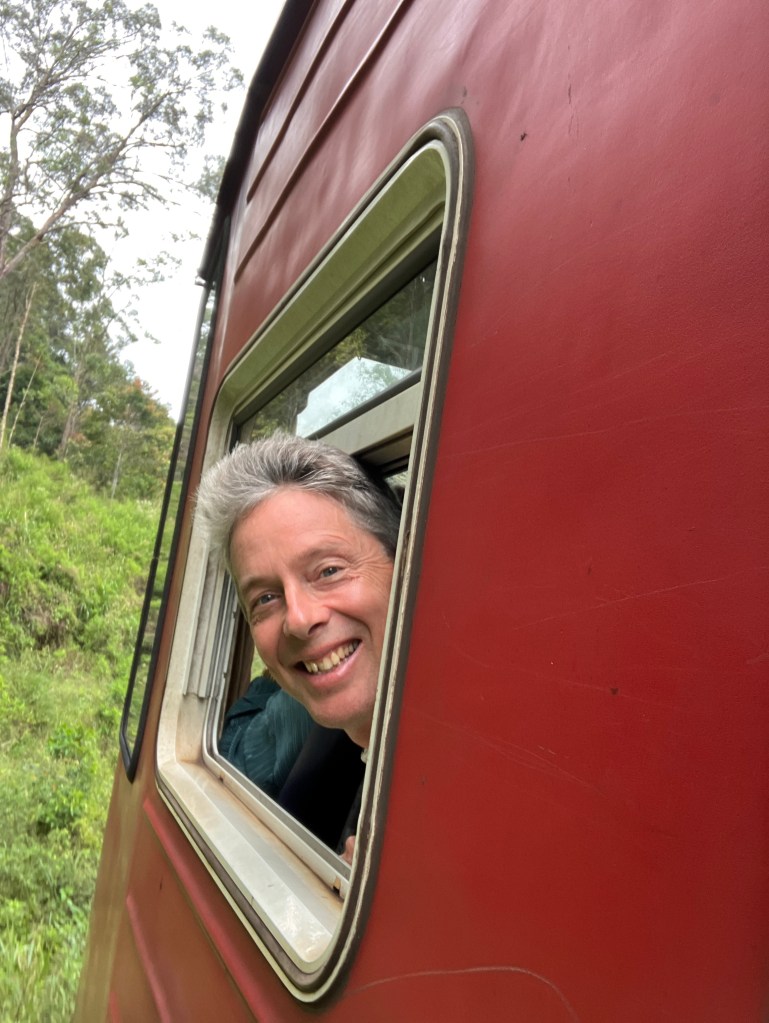
Over a trestle. Obligatory head out the window shot.
The observation car never filled up, but the unreserved carriages were standing room only with locals.

From what we’ve read the trains got much more crowded starting June 2022, when the rising cost of gasoline and bus tickets increased train ridership by 50%. As tourists we are able to buy our way into the comfort of the reserved carriages, but we do wonder why ticket prices for foreigners aren’t higher, as one encounters at museums and archeological sites. There is much need for upgrades to the rail system and new trains and higher tourist prices could help fund that.

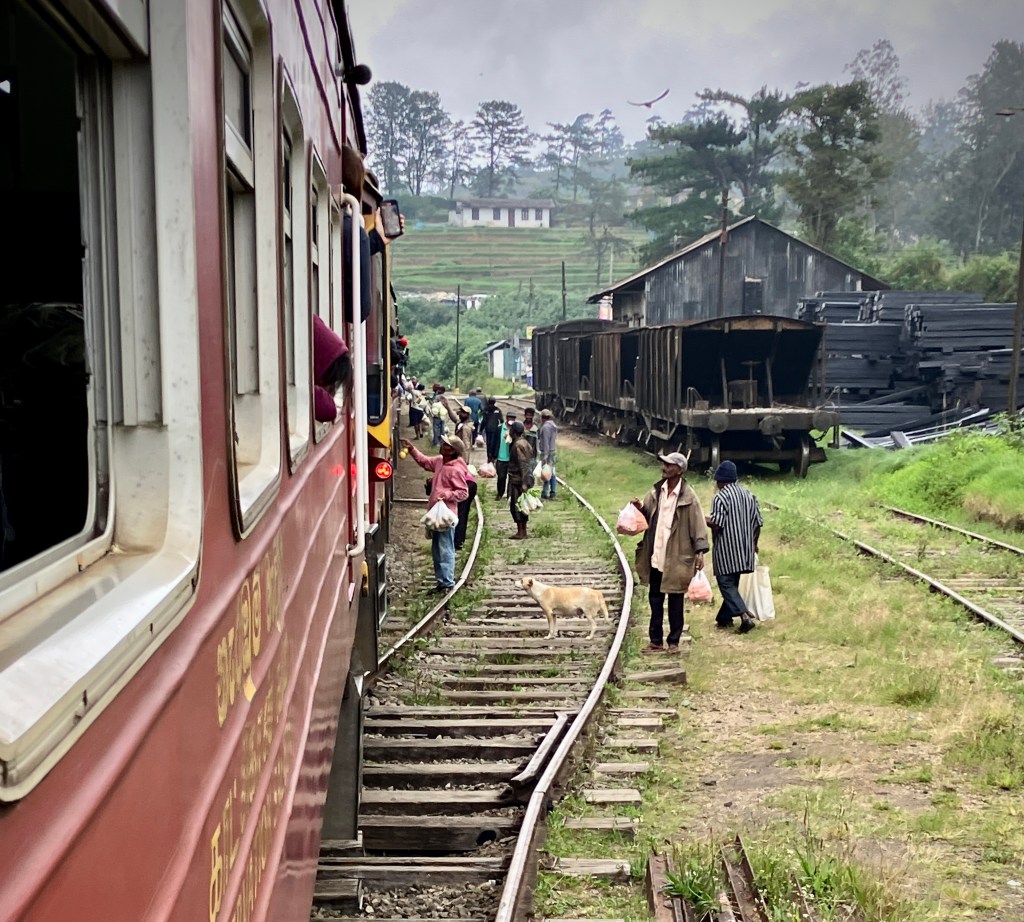
As our train waited at a passing track for another train to go by, the local farmers came out to sell vegetables to the passengers. Another reason to ride in a car with windows that open. We bought lettuce.
Following our taxi driver at Nanu-oya for the 17 minute drive to Nuwara Eliya, where we had an apartment for two nights.
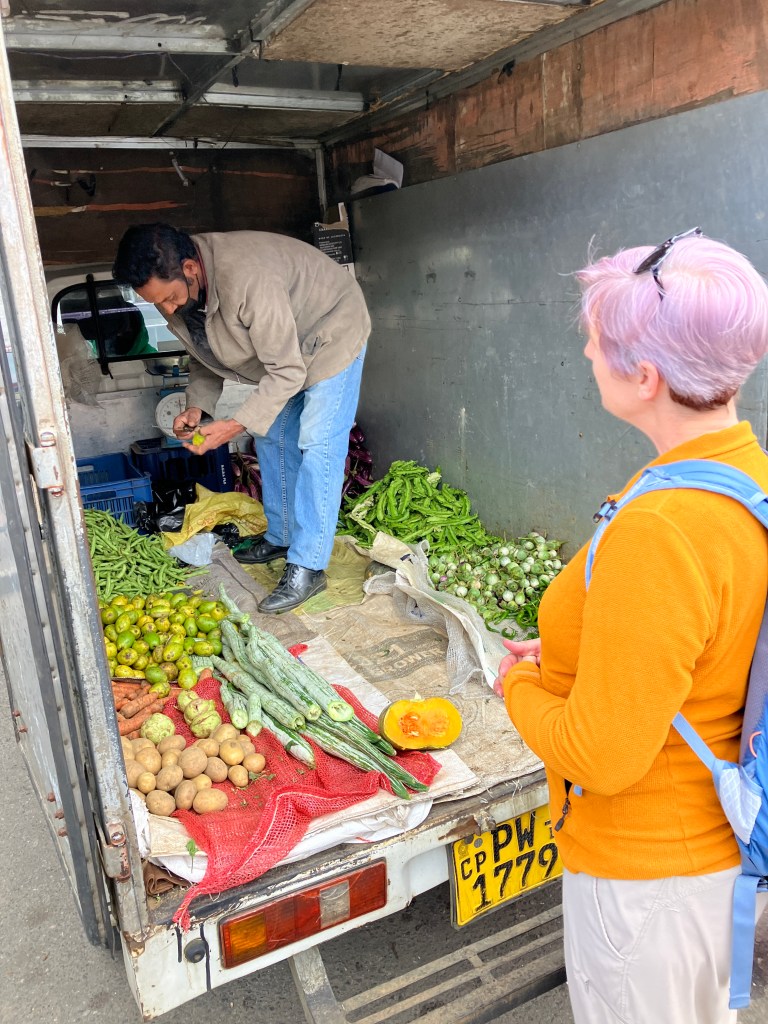
Buying vegetables for dinner.
Buying an adapter. Sockets in older buildings are different than those in new buildings so our adapter was incompatible at our next place.
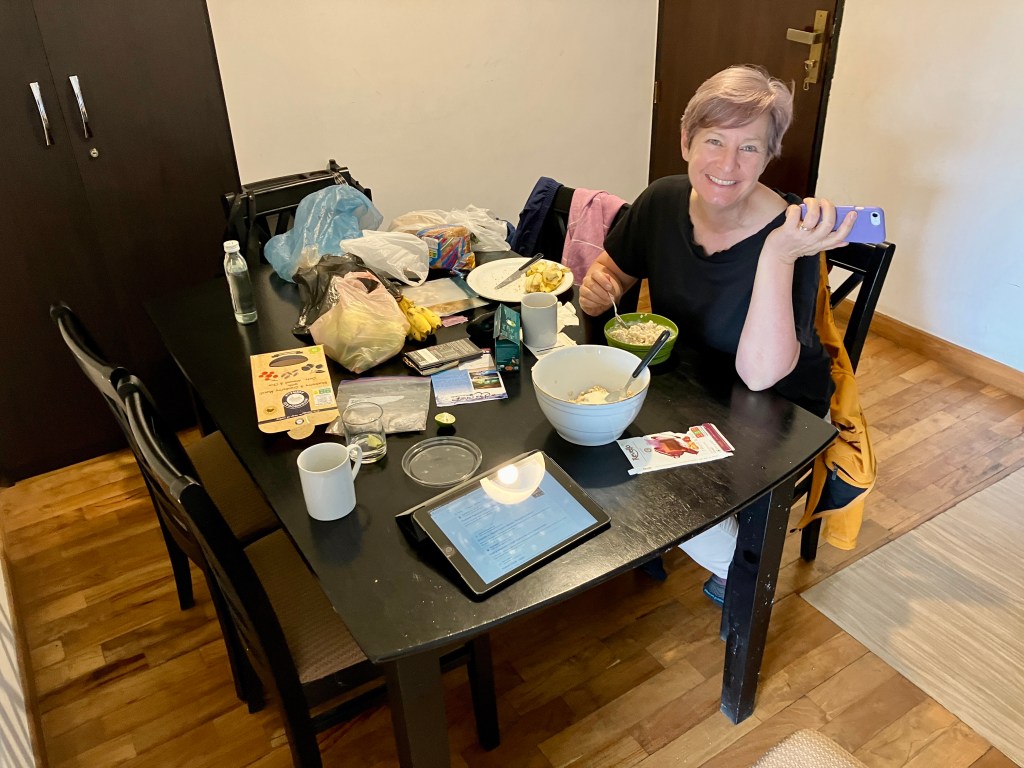
After more than six weeks without an apartment stay it was nice to cook dinner and to have breakfast at our own pace. Typical messy table.
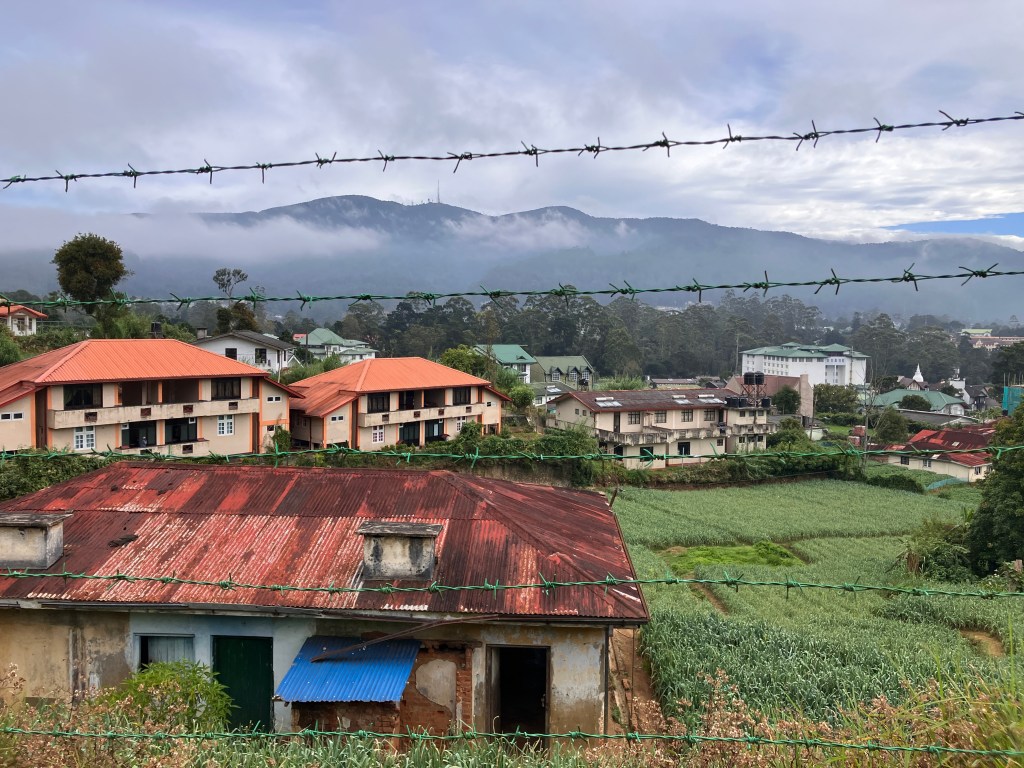
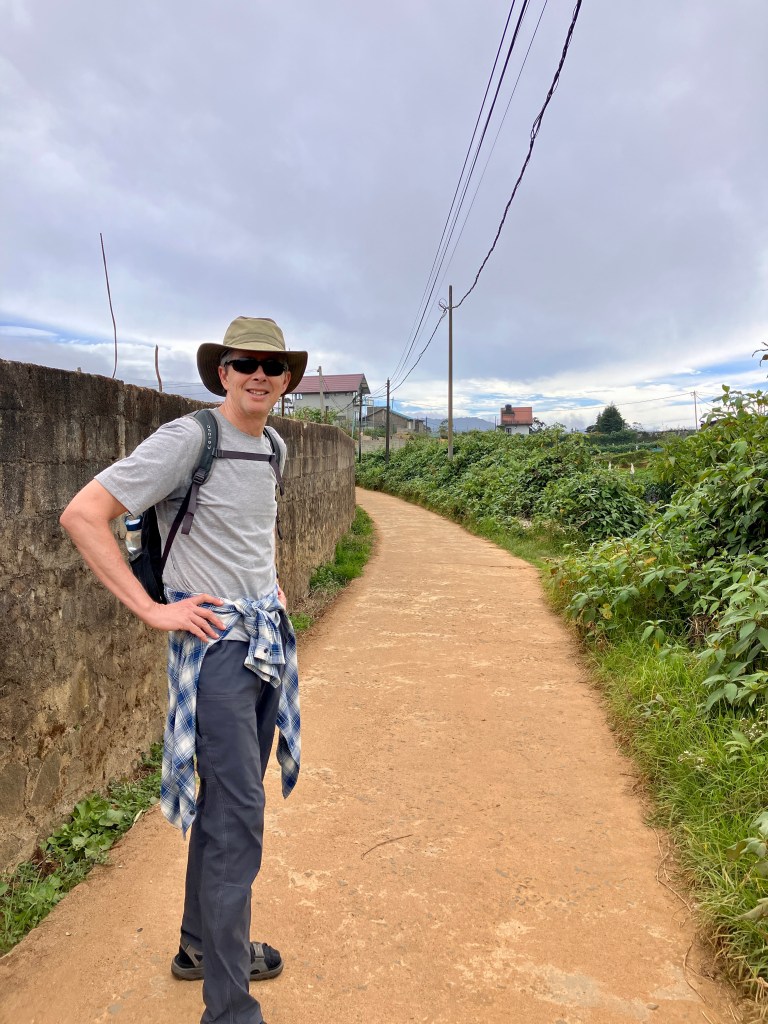
Headed out for a walk in the hills around Nuwara Eliya.
Although there are no marked trails, using Maps Me gets us going, and friendly locals steer us to the correct path when we get confused by the many social trails.
Walking the small roads and pathways is one of our favorite things to do. It can feel awkward to be so off the tourist track, but Sri Lankans have been only friendly and welcoming.
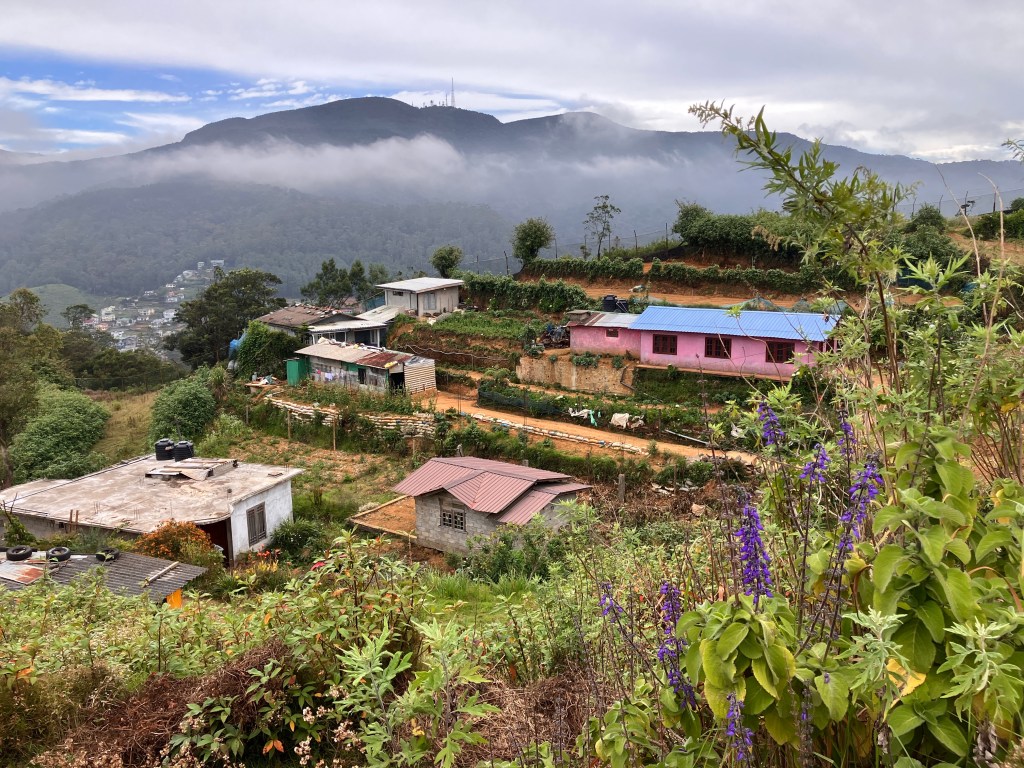
Tidy houses and streets and lovely gardens make the walking so pleasant.
A view across tea fields towards Sri Pada, or Adam’s Peak. 2,243 m/7,359 ft.
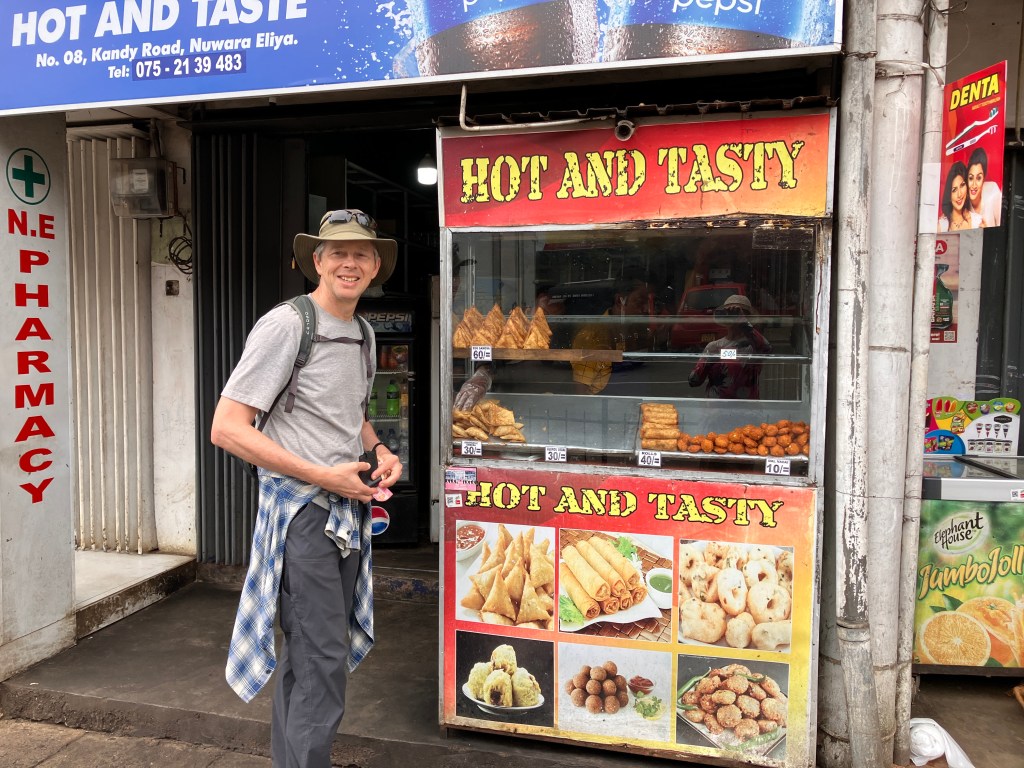
Buying samosas and vade to have for lunch with the rest of our vegetables.

We don’t want to sweep the problems Sri Lanka is going through under the rug, and post only fun photos without acknowledging the challenges the country is facing, but in many areas you don’t see the difficulties as a tourist. You can live your tourist life blissfully unaware of the undercurrent of struggle many are still facing. If you pay attention to little things, while in line at the grocery store for example, you recognize the stress on parent’s faces as they watch the register add up, and you hear from men who worked in Dubai but came home during the pandemic and are now working towards getting employment in Japan or Korea.

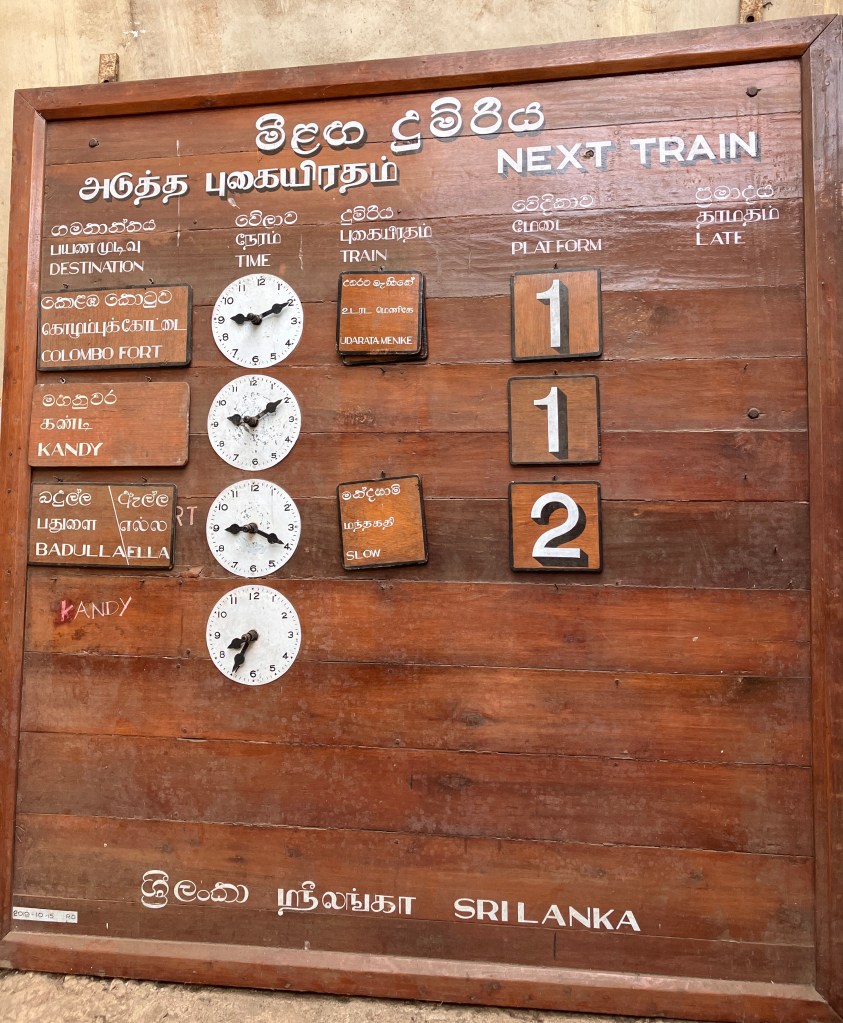
The big board at Nanu-oye station. We’re on the 9:10 to Kandy from platform 1.
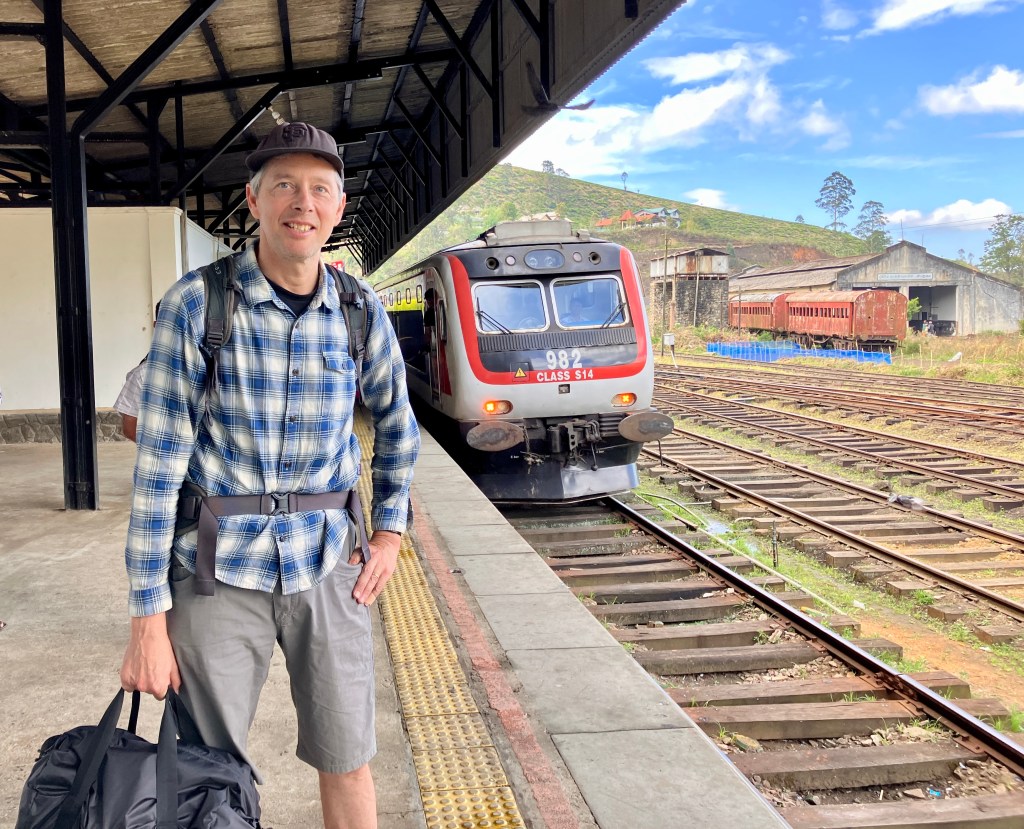
Rich in his element. Traveling by train.
Catching glimpses of life.
Still admiring the tea fields.

One of our drivers was taking Japanese classes. He had calculated that five years of work in Japan would be enough for him to come home and start a solid life for himself, his wife, and their two young daughters. As Americans who admire the bravery of immigrants, who come from a country of immigrants, we understand the determination and hope that the hard working people we meet find a way through and forward.

Me in my element, reading on a train.
Still not tired of sticking our heads out the window to watch the train go through a curve.
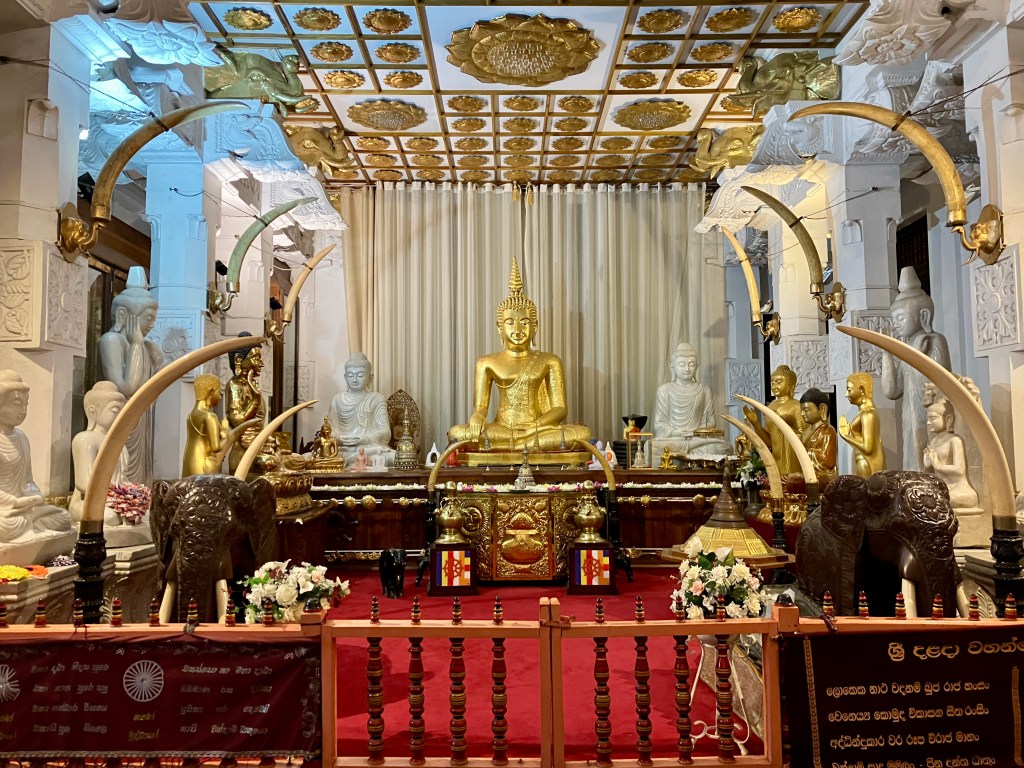
Our one night in Kandy gave us enough time to visit the Sri Dalada Maligawa, the Temple of the Sacred Tooth Relic, which houses the canine tooth of Buddha.
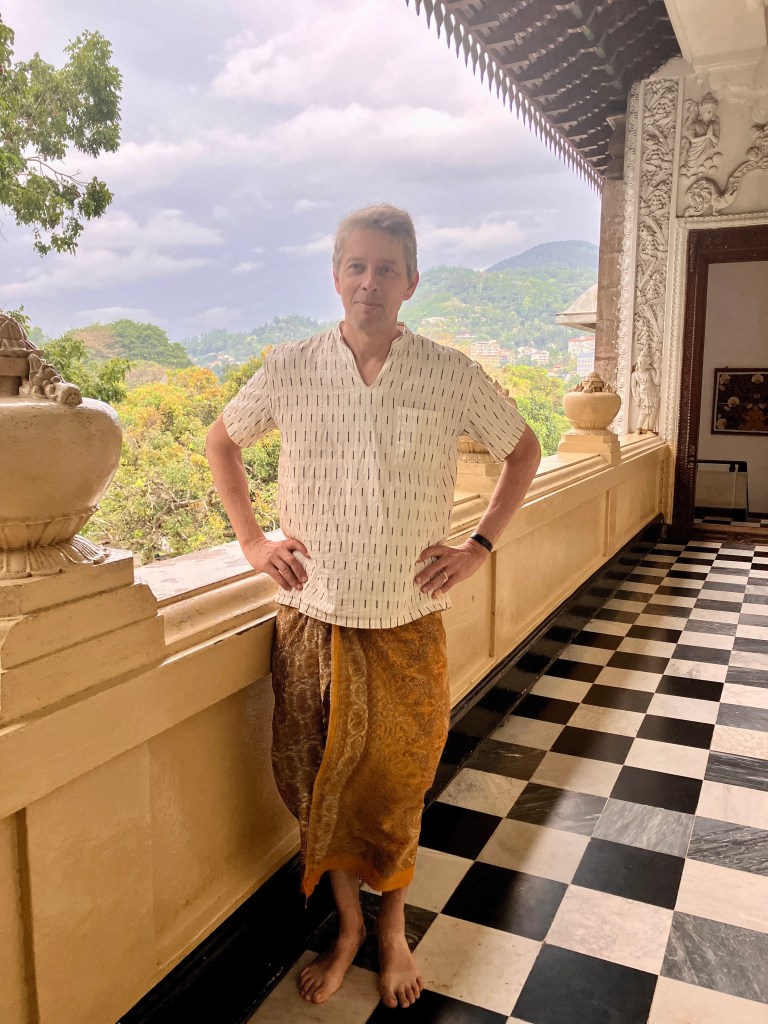
My long Indian dress met the dress code, knees and shoulders covered.
Rich was loaned a sarong at the security checkpoint to cover his knees.
And back to the train station.
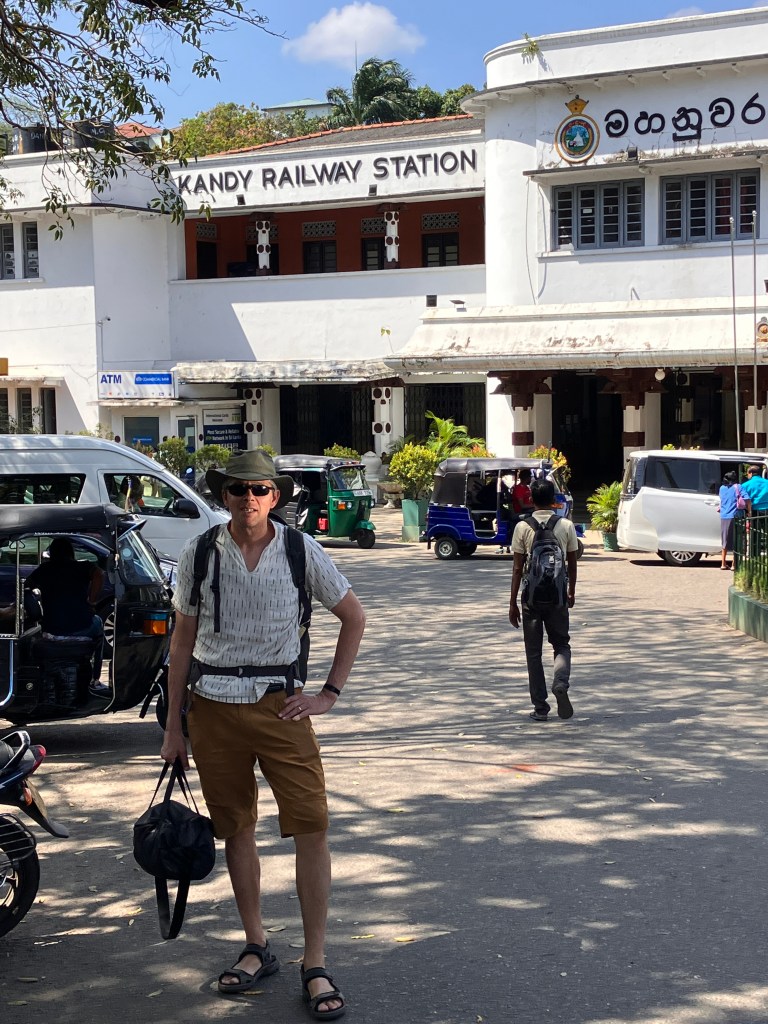
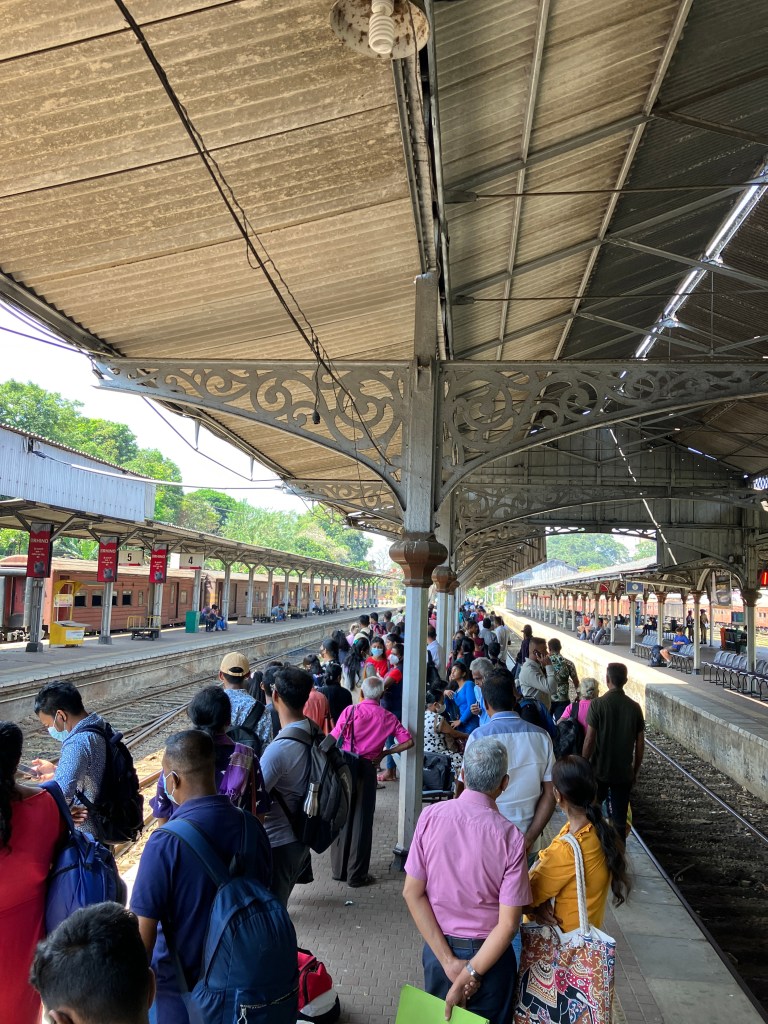
The Monday morning crowd at the Kandy train station. This train goes to the capital, Colombo.
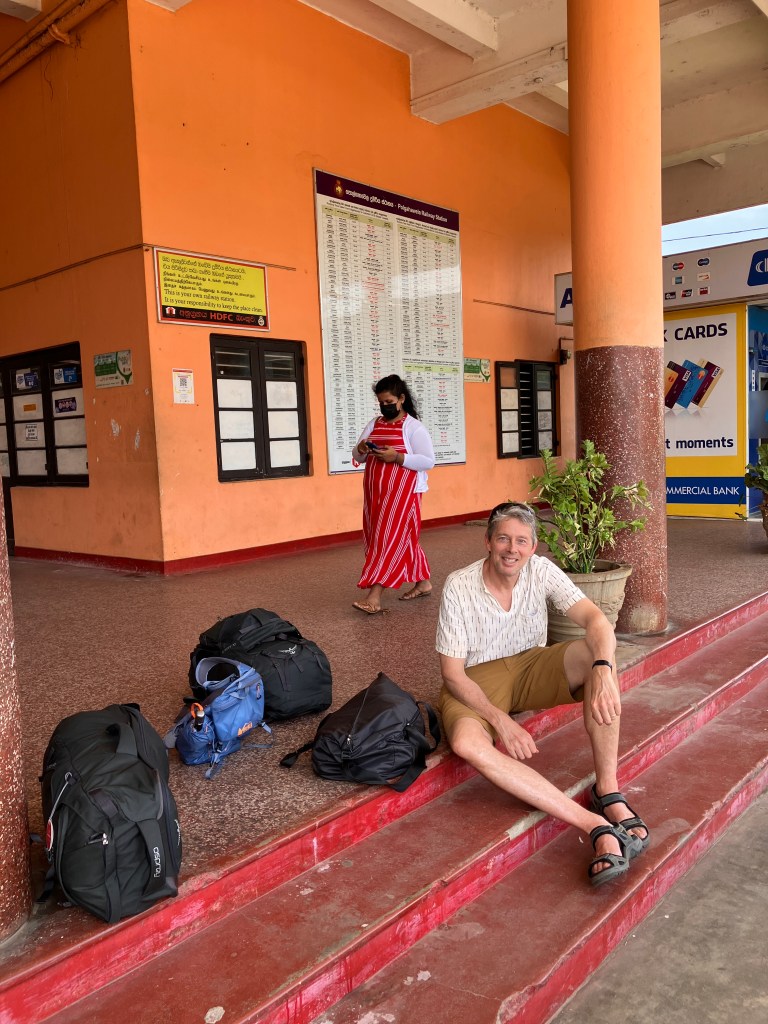
Arrived at the Polgahawela Station to wait for our connection.
Faced with a 3 hour wait in 90f/32f temperature, the travel planner wisely called for a Pick Me car to take us to our destination, Sigiriya, a 2 hour drive. Love of trains only goes so far.
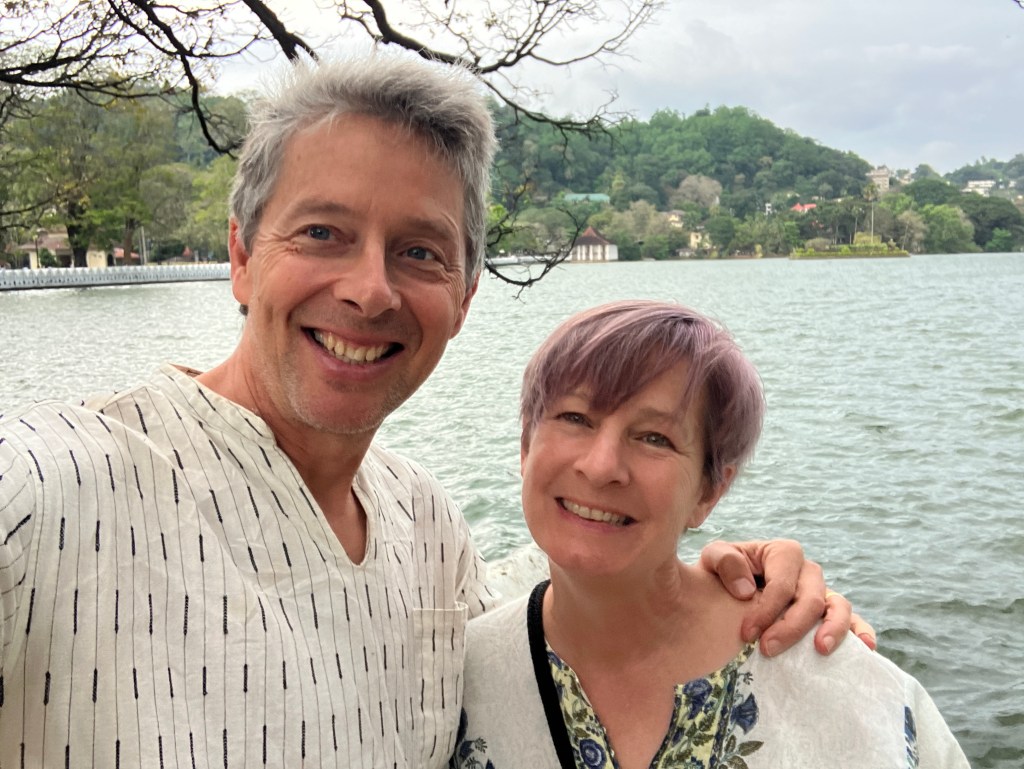
The happy travelers at Kandy Lake.

We have a few more places to visit in Sri Lanka, and I’m sure a few more rice and curry meals to eat. We wish we could support every single small business we come across, buy every trinket, and eat at every restaurant, but failing that we will tell you all that Sri Lanka is an amazing place to visit. We’re in Sigiriya now, more on that to come. Happy travels.

Do Elephants Have a Sense of Humor? And what is the Pekoe Trail?

The diversity of Sri Lanka blew us away in our second week, as we headed further east and up to the highlands.

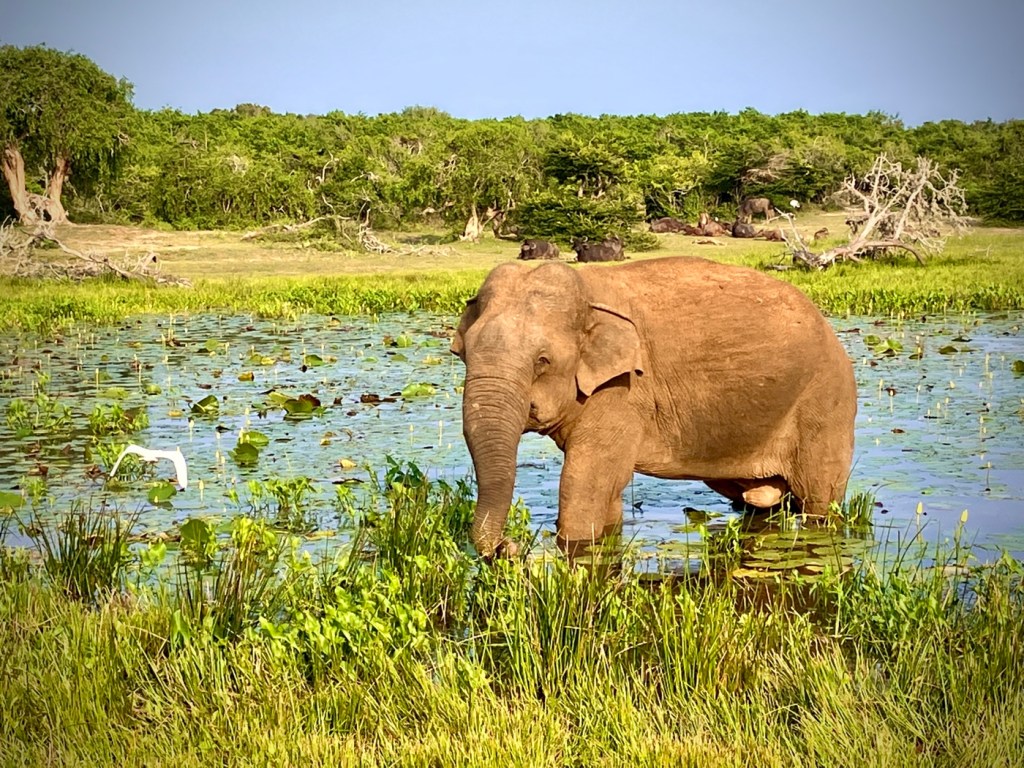
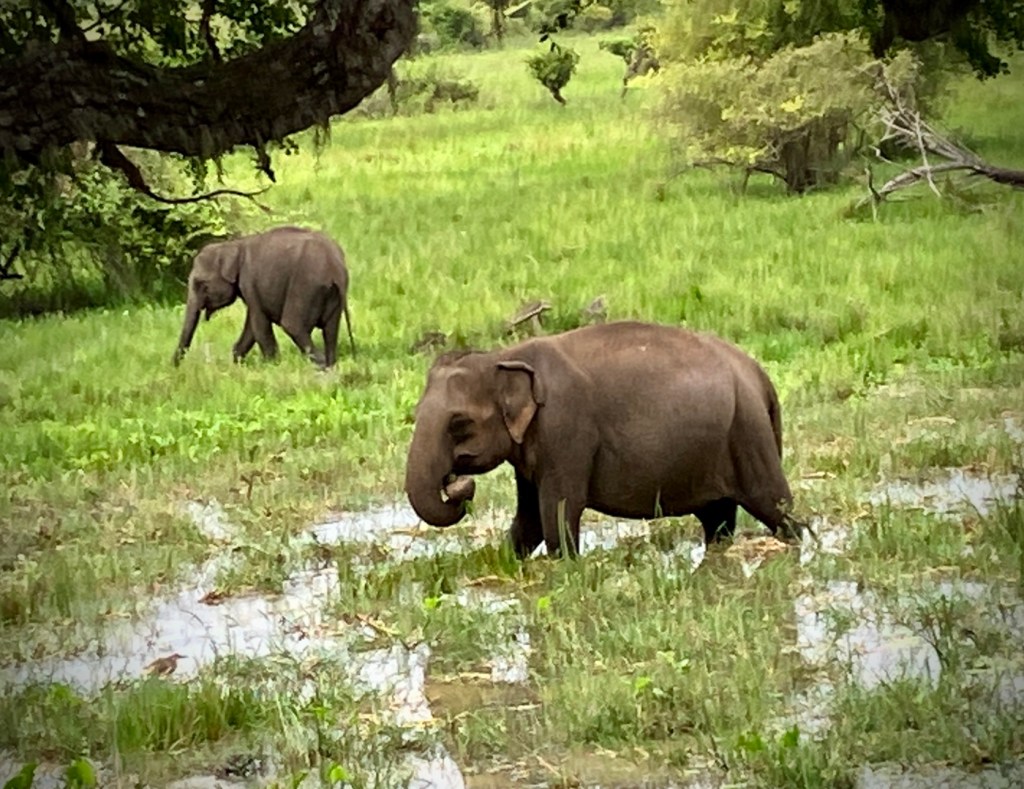
A peaceful solitary male elephant in Bundala National Park. He clearly was smiling.

Based in the small town of Tissamahama , we choose to do two separate safaris to Yala and Bundala National Parks. And although the parks are relatively close to each other, our experiences were vastly different.

Waiting at dawn for Yala to open meant a chance to chat with fellow travelers.
Yala National Park’s dramatic contrast of rock, water and coastal forest
Dawn breaks in Yala

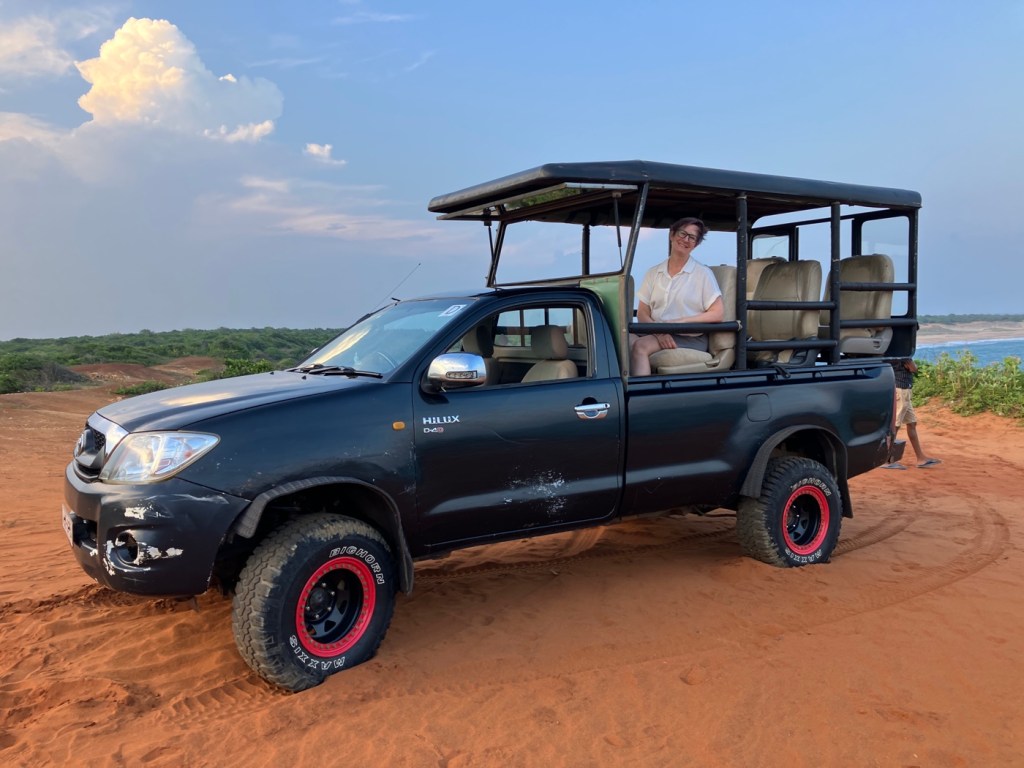
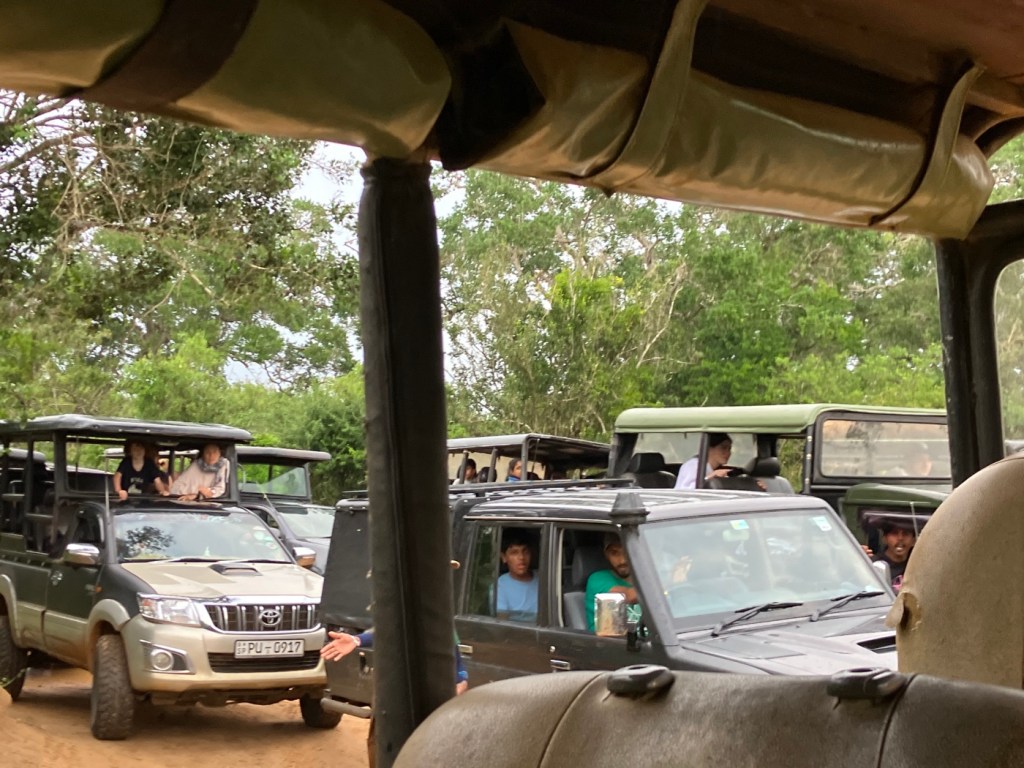
Yala is the most popular park and the one nearly every one visits. We chose the “half day” morning safari which leaves at 5 am and ends by noon. The drive in the open sided safari truck in the dark at dawn was refreshing and we saw an elephant and a jungle cat (rare to spot!) before we even got to the park entrance. After admission fees are paid, the Jeeps then queue up outside the gate until the opening bell at 6:15am. Then a somewhat crazy race ensues as 50-100 jeeps head into the park and pan out in Sector 1, one of the areas of Yala that allows visitation and borders the beautiful coast.

Cheryl not on a bike
Safari breakfast safely on the beach
The first leopard sighting traffic jam as we entered the park made us both wonder if we made a big mistake signing up for this on a Sri Lankan holiday weekend! But it got better.

The scenery is arguably more dramatic in Yala with massive rock outcrops and a large river. And Yala has Leopards and sloth bears, which are not usually found in Bundala. But everybody wants to see a Leopard. After seeing a leopard in India, we weren’t as crazed to see one here, but did catch a glimpse over a somewhat comical scrum of gridlocked jeeps on a small side road (all roads are dirt and rough). As the morning pressed on, our guide was as able to find a bit more solitude as we viewed elephants and a vast array of bird life.

Ready to see some wildlife

On our second day we opted for an afternoon tour of the smaller Bundala NP. It’s also along the coast but characterized by large brackish lagoons and coastal forest and scrub.

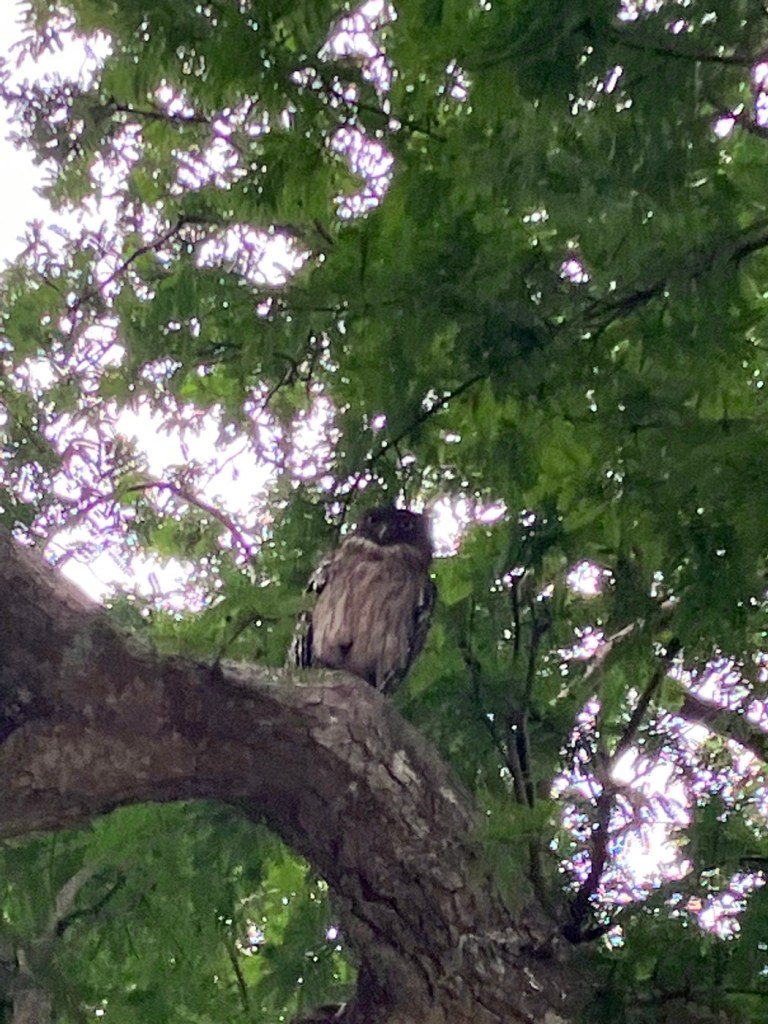
Brown Fish Owl
Asian land monitor lizard
Mama and child in Yala. Smiling of course.

We actually enjoyed the intimacy of Bundala and we had a much better focus on amazing bird species from a fantastic park guide who has worked there for 20 years. And to answer the title question about elephants, “maybe, unless they are in Musth (male heat) when they can be aggressive and grumpy”

Crocodiles were everywhere in the wetland marshes of Yala and Bundala.
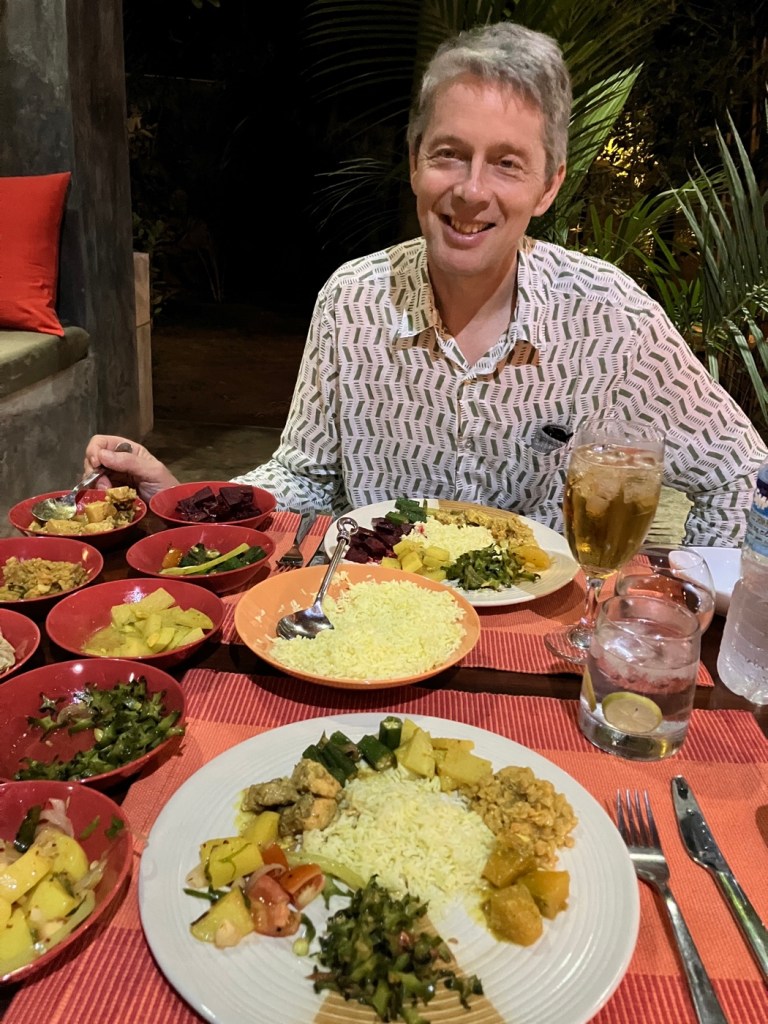
Recovering from hot safari days with a rice and curry feast, a staple of Sri Lankan diets and dishes come in many forms and ingredients; but always some spice -:)

So here’s the other revelation of our time in India and Sri Lanka….I think I’m becoming a birder. It started with the enthusiasm of the birders we met in the Western Ghats, but has been building as I read and learn more, as well as using the fantastic apps by the Cornell Lab of Orinthology, Merlin and EBird

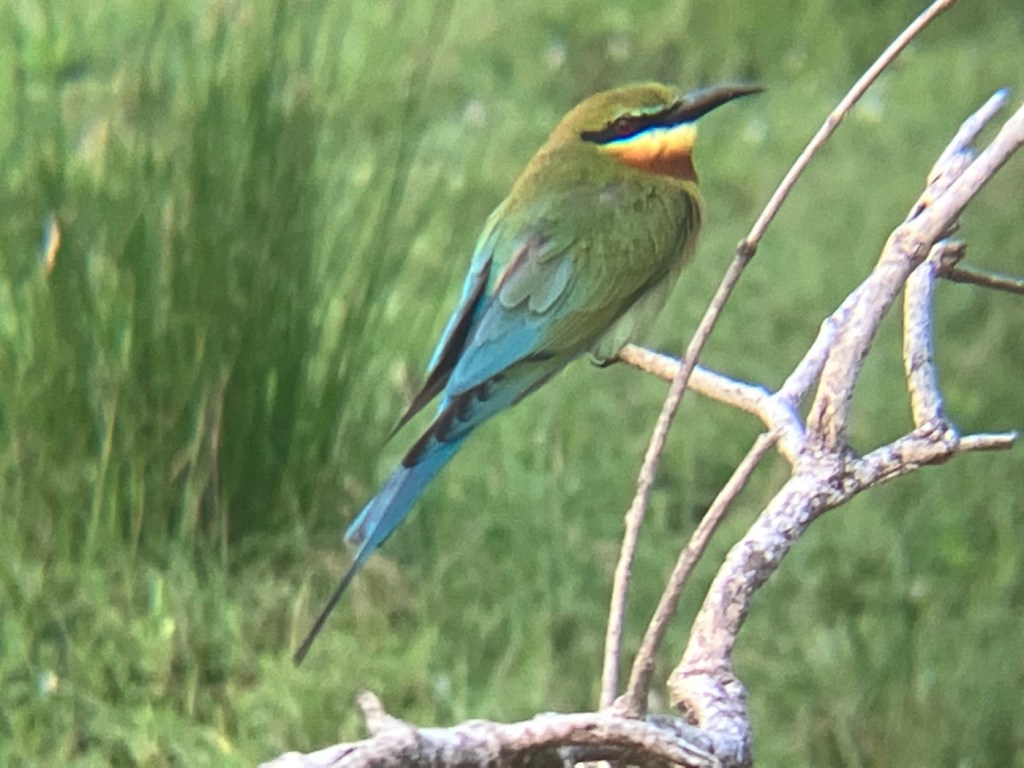
Blue-tailed Bee Eater
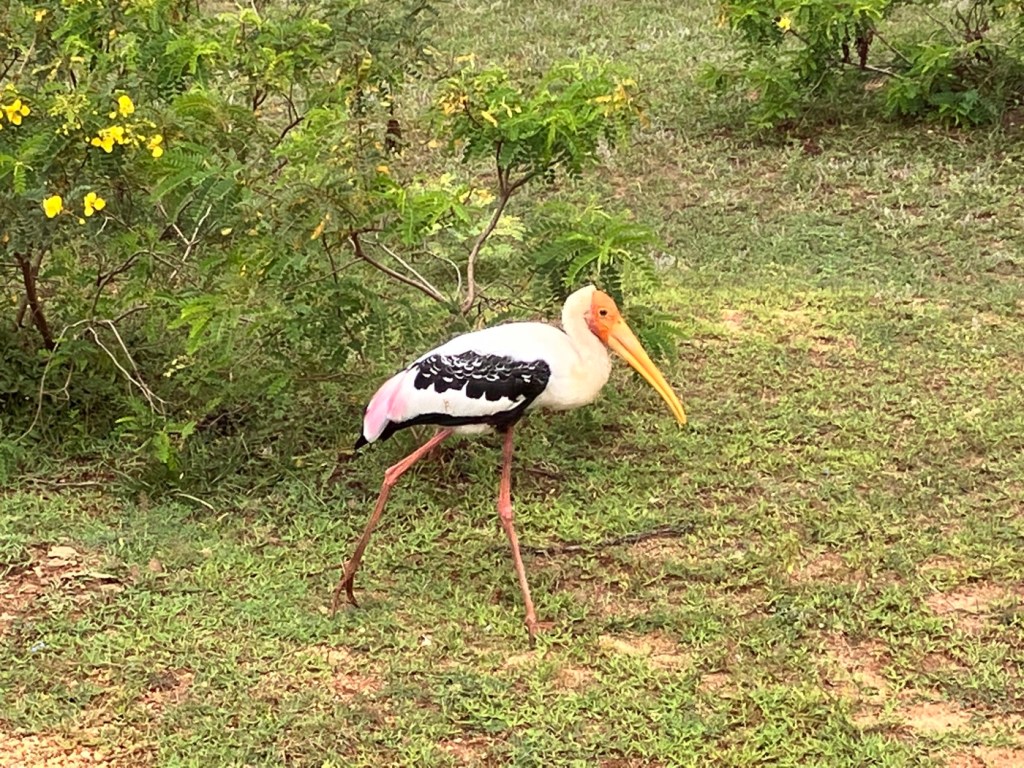
The magical Painted Stork
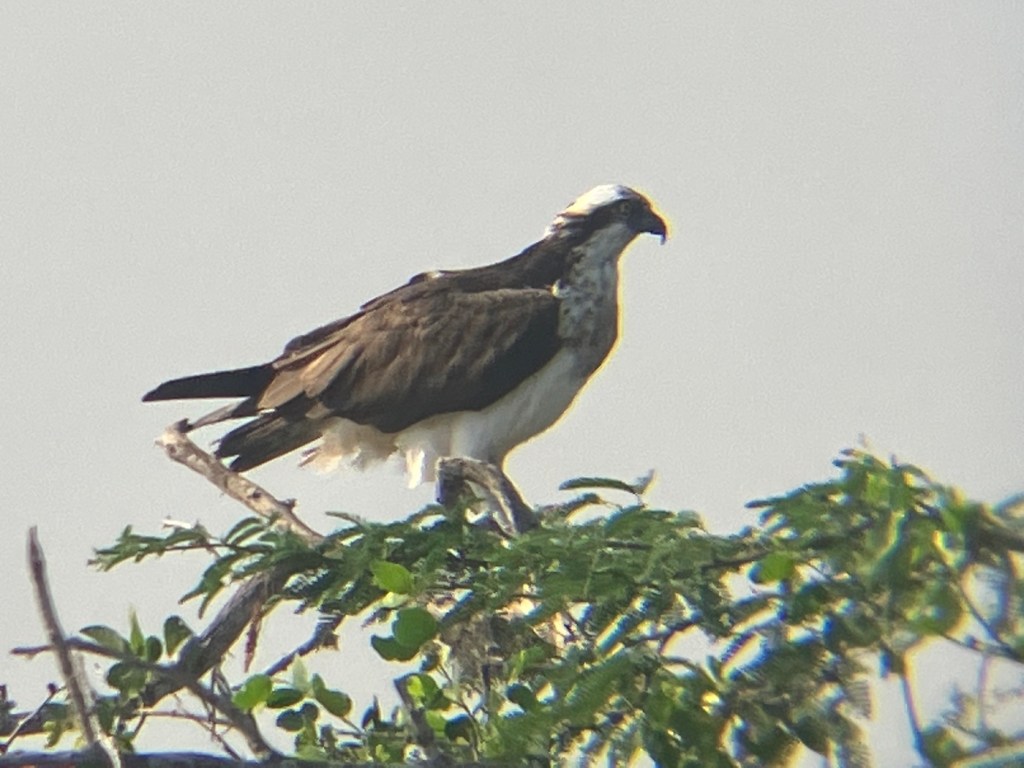
A majestic Osprey

We will certainly be picking up binoculars or a monocular in Japan for sure. And birding and bike touring are a natural combination. This can now be added to the list of “things I never had time or patience for while working”….though most people had me pegged for the model train basement type-;)

This guy was in Musth (male heat with 50x testosterone!) and did NOT have a sense of humor. After a few calm viewing moments, he came at our truck fairly quickly, but luckily our guide and driver were faster….
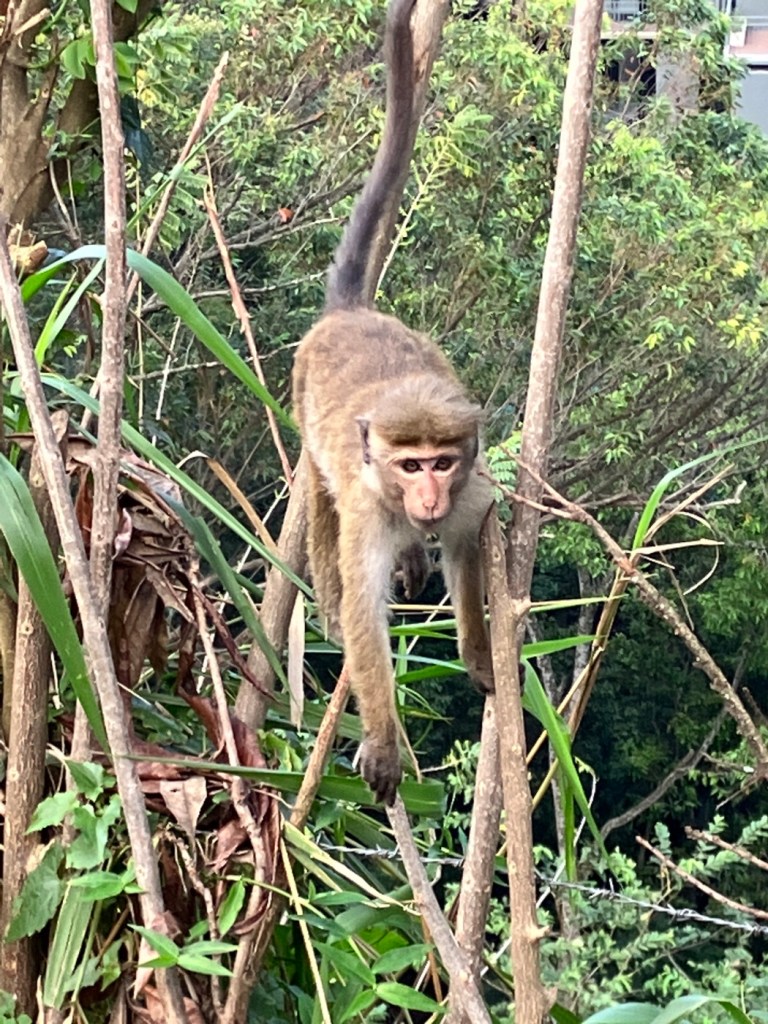
You don’t need to go to a national park to see macaques or langurs, just look up!

We then took a car transfer up to Ella and the southern hill country of Sri Lanka, And although we were only at about 3,500 feet, we immediately appreciated the slightly cooler temps.

Beautiful train signage
The somewhat depressing and loud tourist section of Ella. You just need to get away a bit to enjoy beauty and peace.
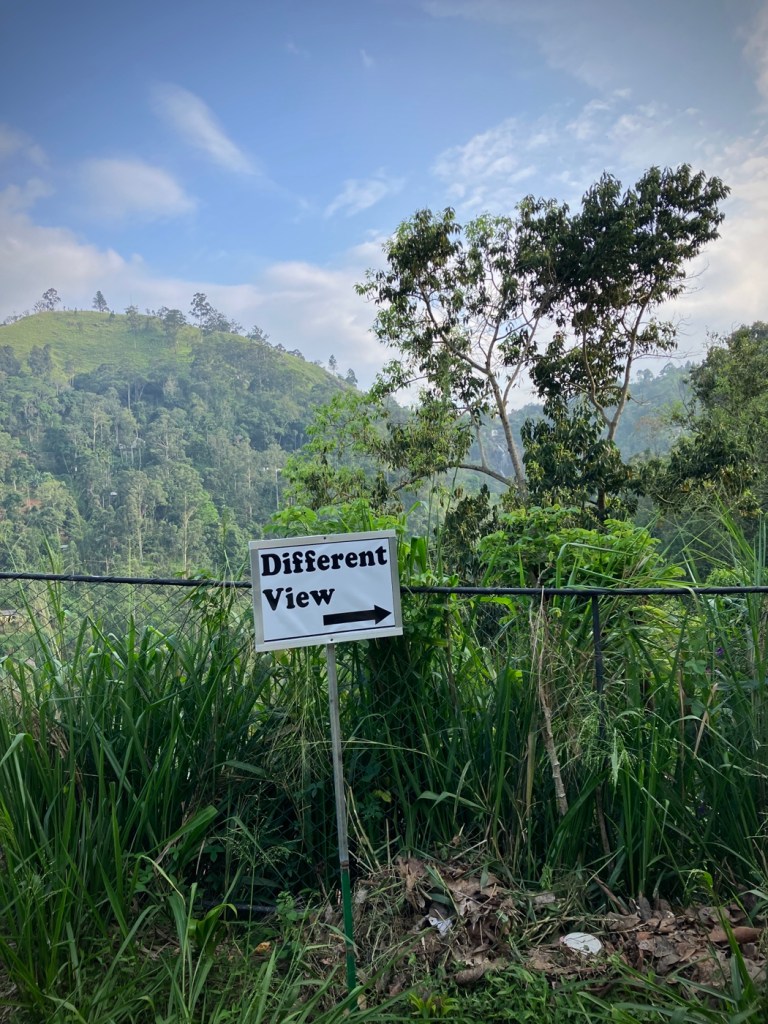
Yes, we want a different view!
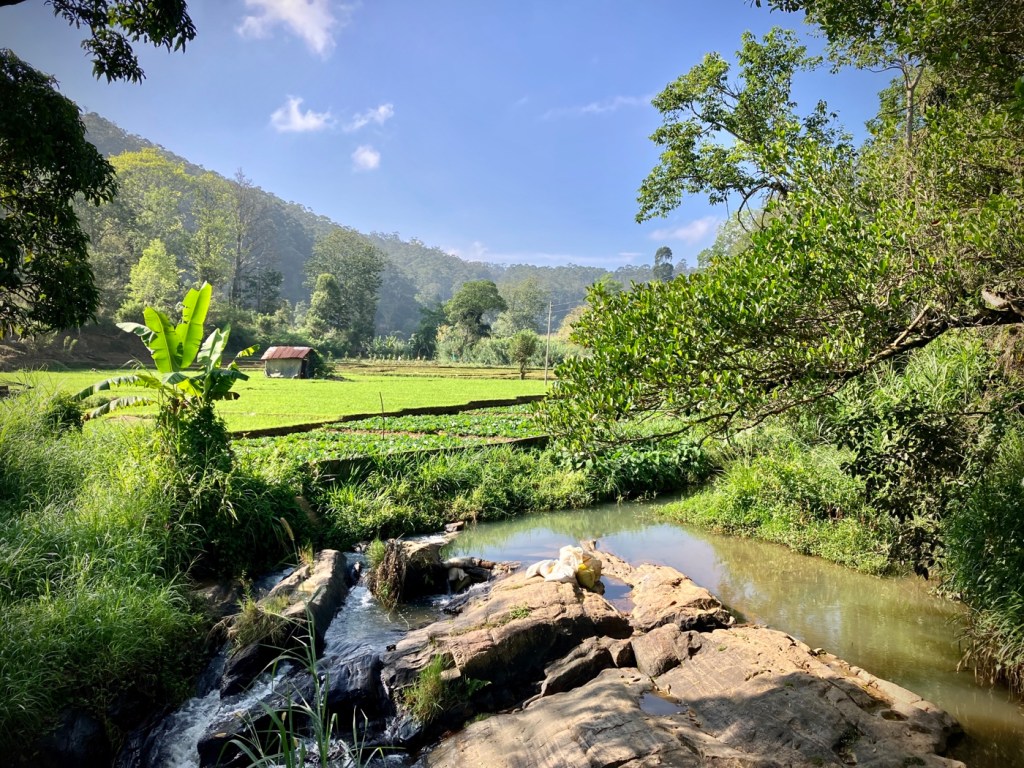
We loved the tranquility and discoveries along the Pekoe trail. It’s part of the Serendipity Trails Project.

One of our challenges of independent travel and a focus on the trains is the need to be based in more touristed towns with services and connections. Some people choose to rent a car here and that does give you a lot more flexibility, but as we know, it also ties you down in other ways and makes working in the epic train opportunities here difficult. So our strategy is to be based in a convenient place with tourist services, but then try to do different things than the norm, usually via walks and treks.

Starting Stage 16, turn left by GPS into the woods and everyone disappears!

Luckily there is a nascent long distance hiking trail in development across the hill country and mountains. The 300km, 22 stage “Pekoe Trail” has been initially mapped and stages are now available on many trail apps, including AllTrails and Wikiloc.

Picking tea by hand on the Pekoe Trail. It’s tough work, but they are unionized
The way up to Ella Rock, part of Stage 15 of the Pekoe Trail (we did the Stage in reverse)
I thought this little girl was never going to let Cheryl go, off the beaten track near Makulella.

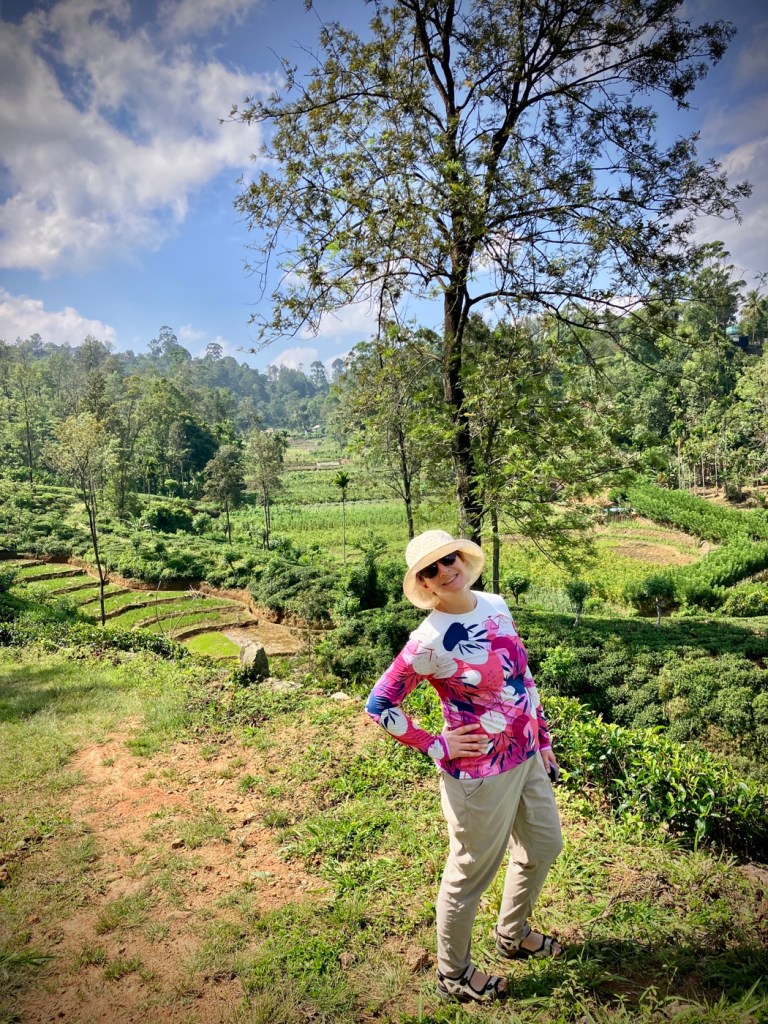
So in Ella, instead of being driven around in a van or tuktuk all day to see 10 random things, we walked two stages of the Pekoe Trail from Ella. They were both great and although touch a few very popular tourist sites in places (by design) we mostly had the trail 100% to ourselves.

Blissful countryside rambling, with proper sun protection of course. UV can often rate “Extreme” midday in Sri Lanka
Sri Lanka is the overall fourth leading tea producer in the world and number one for “Orthodox” or hand picked, dried and processed tea.
Did I mention the Ceylon Tea?

The trail will be a brilliant addition to tourism options in Sri Lanka, and spread the positive tourist impacts out along many more communities and people than the current concentration on tourist hot spots. Interestingly it’s sponsored partially by a grant from the EU, which has certainly seen the success of long distance trails in Europe, such as all the Camino routes in Spain and Portugal.

Dragonfly (not a bird!) on the Pekoe Trail
Cooling off after the Pekoe Trail
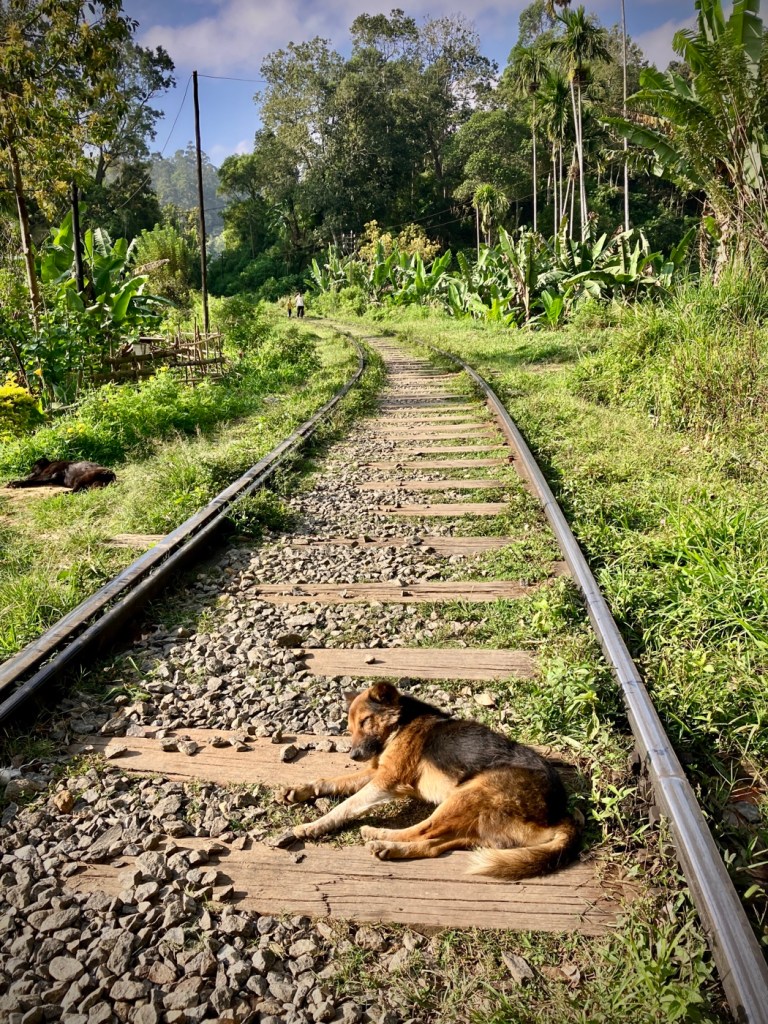
The single rail track is the most direct and level way to walk in the highlands, locals and tourist alike, it also was the best route to town and train station from our guest lodge.

We look forward to tracking the progress of the trail as dedication and signage is scheduled to be installed later this year. The lodge we stayed in Ella didn’t seem to know about it, or diminished it a bit as I think it’s seen as a bit of an existential threat to the tourism status quo, which is tour vans and tuktuks taking people around to the same sights and based in one of ten inland tourist hotspots. The coast is a separate beast and has hundreds of kilometers of beaches and towns, but mostly people focused on a tropical beach holiday.

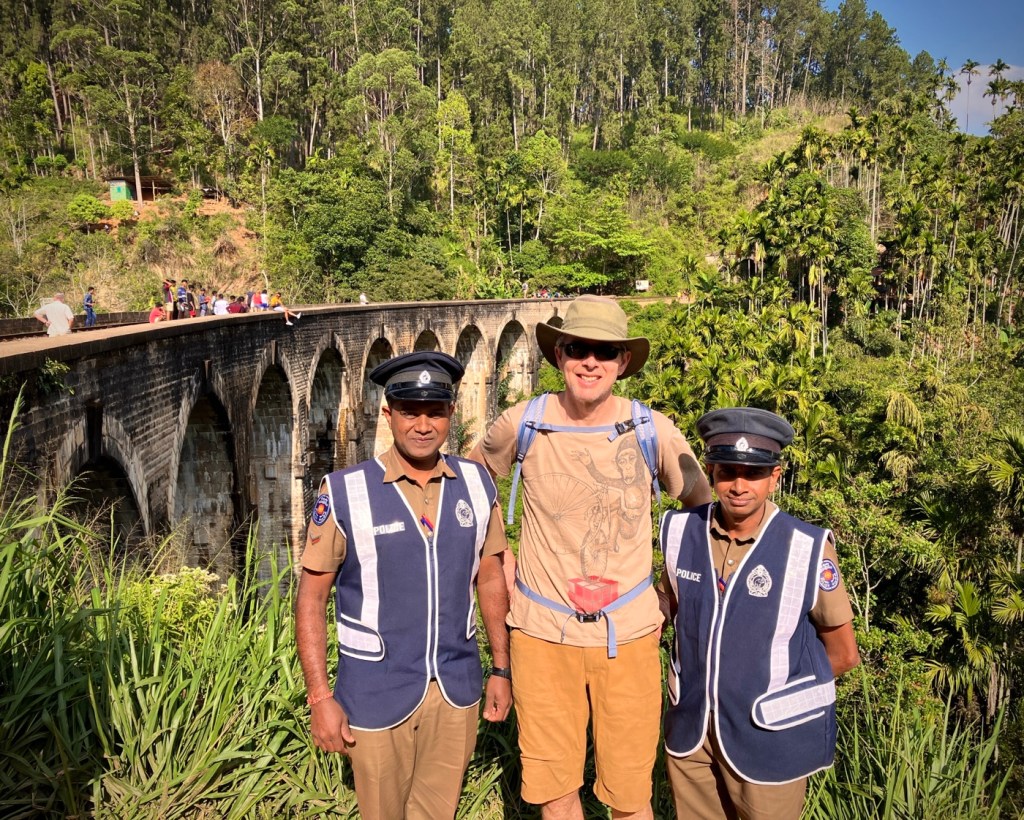
These patient tourist police are charged with saving people from their own Instagram stupidity on the Nine Arches Bridge in Ella….look it up, you’ll see.
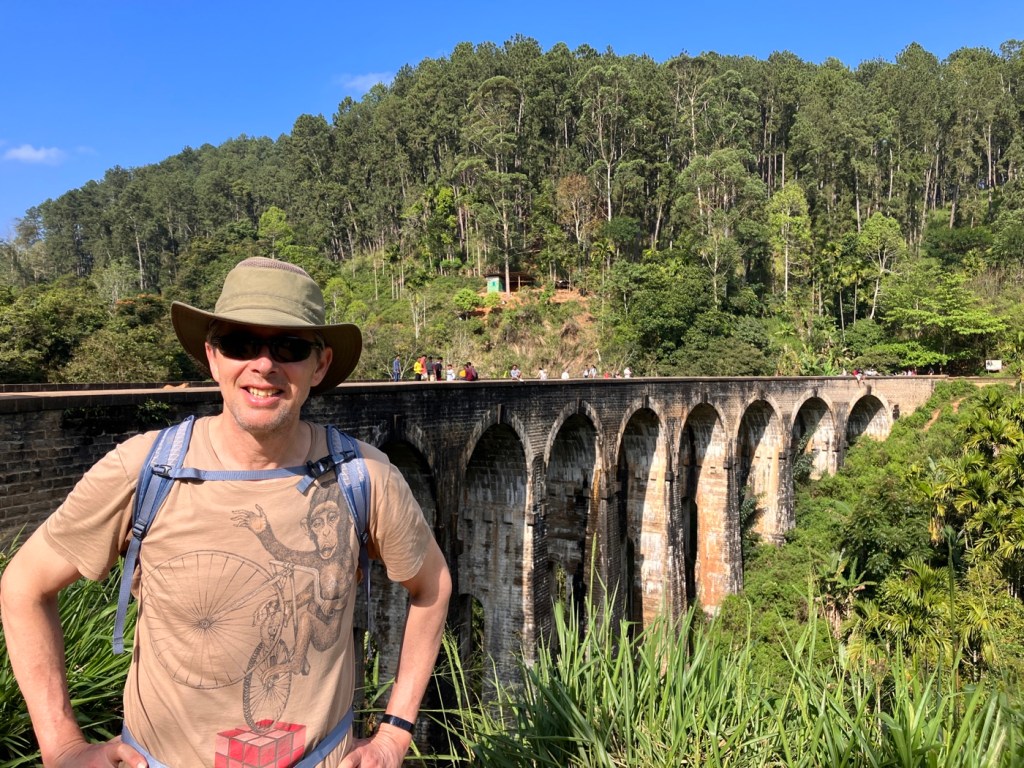
No, not a Brunel work. The construction of the bridge is generally attributed to a local Ceylonese builder, P. K. Appuhami, in consultation with British engineers.

We are continuing our journey in Sri Lanka, and are still awed by the universal friendliness of the people. We’ve had wonderful encounters with locals and some interesting conversations about the current challenges here. And there are still major economic hardships. Not enough jobs and opportunities for talented and motivated people. Not enough food for many who have slipped back into poverty.

Ahh…warm train ballast.

And it’s been hard not to support EVERYONE we meet as they all have needs and a family to feed (and will often mention this), but we do what we can to be generous on our way. The boom times of tourism here from 2009-2019 were clearly different, but there is a bit of new optimism that things are finally getting better.

Tea worker huts dot the Pekoe Trail. The industry directly employs over 200,000 workers.
No tourists on the Pekoe trail yet, so everyone was a bit surprised to see us, and very agreeable to a photo.

We sure hope so, but will also be voting for politicians back in the US that support more generous and compassionate immigration policies. We have an excess of space and opportunities to share still.

Heading onto our next adventure

Happy travels and keep exploring.

India again. After 16 years.

In Bengaluru. A good introduction to India landing city for this trip.

Rich and I last traveled in India over 16 years ago. He and my friends will attest that I did not have a great time that last trip. As interesting and unique as I found the country, there were things younger me couldn’t get past. The inequality, for women and for those less fortunate. The crowds. The traffic. Never being left alone to enjoy anything in peace. The poverty. It was a lot.

A street in the neighborhood of Indiranagar where our hotel was. I think the large trees are Rain Trees. The shade they cast makes for a lovely cozy feel to the area. That is the metro line overhead.

I think many travelers and tourists are overwhelmed on their first trip to India. Why, friends asked, are you going back? Well, I replied, we were only in the north in our last trip and people say that North and South in India are as different as in the US. Our first good chat with a local gentleman at our first dinner in Bengaluru confirmed that. He went to North India once, he said, from his native Bengaluru, and it was so different. Like a different country. And, I’m older now, more mature, lots of grey hair. Less likely to attract negative attention. Ok, so I did have my hair dyed purple before leaving Bangkok which means no grey is showing, and I have bright purple hair. Attention? Yes. But it’s my fault this time.

Seriously amazing trees in Cubben Park.
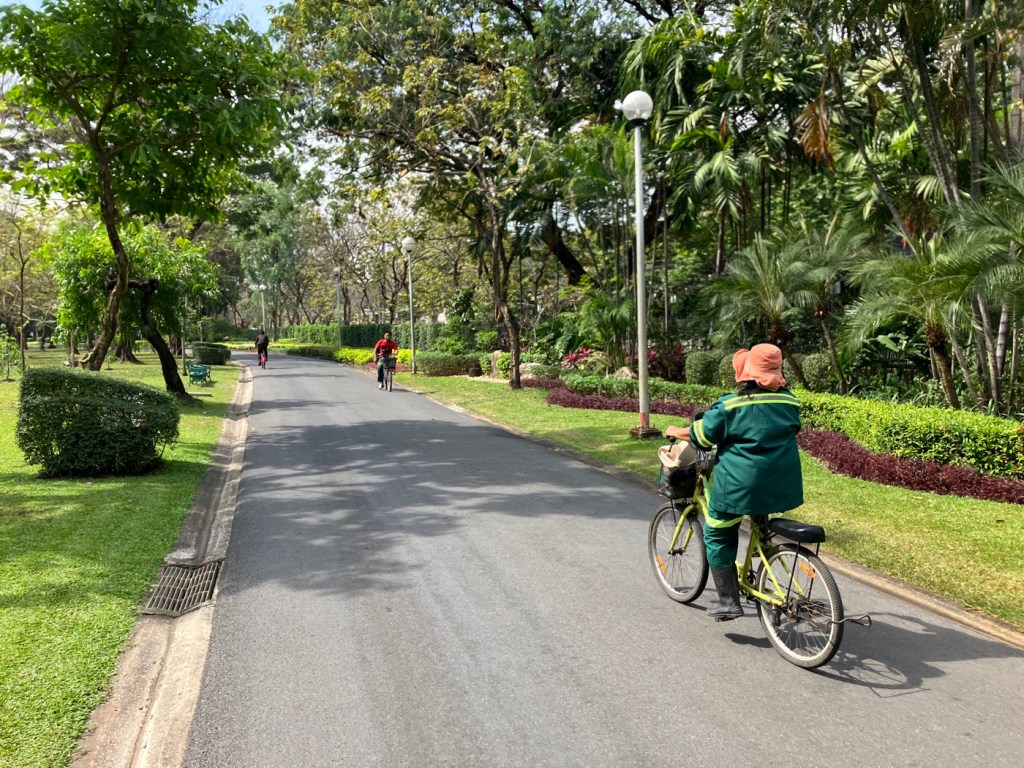
The sidewalks in Bengaluru were so welcome after Bangkok’s limited walking space. And all the trees provide lovely cool shade. Green bike lanes, though we saw very few bikes using them.

So, can my older wiser self settle in to enjoy India more than I did 16 years ago? I think so. It helps that Rich is an enthusiastic traveler in addition to being the best travel planner. We both love experiencing a place as independently as possible. Walking and taking transit as much as we can keeps us happy. Our only taxi in Bengaluru was from the airport to our hotel. All other trips were metro and walking.

The War Memorial garden, floral tributes near the obelisk.
Chai at The Srirangam Cafe.
More tree shaded streets in our neighborhood of Indiranagar.
Riding the metro towards downtown.

Our last four hotels have all been within a block of a metro or subway line. Taipei, Taiwan, two different hotels in Bangkok, one above the MRT and one by the SkyTrain, and now Bengaluru, a block from a purple line station of the Metro. Not an accident, just good planning from Rich. We share a pretty healthy dislike of having to rely on taxis. Every car trip added to a city is a bad thing. For the air, for people’s safety, and for noise pollution. In India the noise is mostly of beeping horns, the scooters are quieter here than the motor bikes in Bangkok – thankfully. But the beeping! Incessant.

At the train station, just a short walk from the metro station.

Since I’m still recovering from breast reduction surgery Rich is carrying both backpacks. Thankfully, the train station connects to a metro stop with a dedicated walkway so for our train ride to Mysore we again avoided a taxi trip. To enter the metro system you have to put your bags through a scanner, and then be wanded by a security guard, men to one side and ladies to the other in a small curtained booth. My first time I actually stopped for the wanding, but my second time I followed the lead of the local in front of me who didn’t even break stride as she passed through the curtains.

All smiles waiting to board our first train. The platforms are very long but the carriage letters were showing on electronic signs so we knew where to wait.
Masked up. Our carriage was less than half full so we did unmask.

Our destination, Mysore, is less friendly to walking trips. For starters it’s hotter here, up to 90f/32c in the afternoon, and sidewalks are not standard. We feel a bit like square pegs in round holes, but we persevere, heading out in the morning to walk to what we can, and taking auto rickshaws back in the heat of the day.

Our first stepwell.

A friend in SF sent us a link to a map of step wells in India (thank you Gisela!), and we took a taxi to this one a bit outside of town. This is a fairly simple stepwell, many are much more ornate. Built to capture water and as temples, construction of these stepwells hit its peak during Muslim rule from the 11th to 16th century – per Wikipedia.

Nanneshwar Devasthana Kalyani
ನನ್ನೇಶ್ವರ ದೇವಸ್ಥಾನ ಕಲ್ಯಾಣಿ

Built in the 8th century this Kalyani, or stepwell, was cleared of garbage and restored in the past few years.

Rich added for scale.

Stepwell visit complete, we had our taxi driver head back towards town and drop us off to wait for the train museum to open. Sitting on a wall in the shade and watching Sunday morning activities was actually quite nice. On our last trip to India I don’t remember being able to sit unmolested by curious or begging locals. Here in Mysore, although there aren’t many tourists back yet, most folks walk by us with only a curious look (Rich is quite tall and I have purple hair, so not unexpected.), a smile, or an offer of an auto rickshaw.

One of favorite things, a small, quirky, somewhat overlooked museum.
An Indian built carriage.
A British built locomotive.

It pains me to be reminded that so much of the history tourists are encouraged to see and celebrate in India is colonial history. The railway has its roots in British rule. From an article by The Wire.IN “Between 1850 and 1910, 94% of Indian broad gauge locomotives were built in Britain and only 2.5 in India. During the Second World War, preconditions for purchases from outside of Britain were relaxed but still the overall balance remained disproportionately tilted in favour of Britain. Thus, prior to independence in 1947, India imported 14,420 locomotives from Britain, built 707 itself and purchased 3,000 from other countries.” However, we were pleased to see what to us are very familiar planning presentations for the ongoing improvements and upgrades to Indian Rail.

Planning deck, anyone? As we well know with both our backgrounds in transportation- nothing happens without plans like these. We could both easily imagine the work that went into this, I’m showing you only 2 of probably 15 pages. Fellow bureaucrats unite. Let’s get it done.

Although Mysore requires more auto rickshaw trips we are managing to walk to some destinations in the morning. The zoo. The Mysore Palace – which is the second most visited attraction in India after the Taj Mahal, apparently.

The palace is lit up on Sunday evening, and it’s free to enter the grounds which means it’s a popular family attraction.
The moon was close to full, and I managed to add even more purple to myself with a new Kurta. Guess my current favorite color.

We went back to the palace on foot one morning. The neighborhood across the street from our hotel fascinates us. One thing I have found that I really enjoy when traveling is making eye contact with women, particularly women my age, and exchanging smiles. Sometimes the smile only come from me. Americans smile a lot, and if you ask other cultures we smile for no reason and it’s weird! I always make a special effort when I see women in a Niqab, the veil and face covering which leaves the eyes clear. Five years ago Rich and I were in Indonesia and both struck up independent conversations with a couple (bathroom at a train station), and she was wearing a Niqab. It made me wonder how often women in Niqab are overlooked, or even ignored, by folks who don’t feel comfortable with the idea of a women who veils or covers. In Indonesia we all laughed to see our partner walk out of the restroom chatting with their partner. When I make eye contact with a woman, of any age, and nod, and she nods and smiles back, I feel like I’ve made a connection, however small.

Navigating the cows in the neighborhood across the street from our hotel.
Don’t let the dirt streets make you think this is a poorer neighborhood. The houses were quite nice.
The pongol, harvest festival, occurs in mid January and many cows were still sporting their turmeric water paint jobs.

Our walk to the zoo took us through this neighborhood, and our walk to the palace. It was fun to see the children being packed into auto rickshaws for the trip to school. I counted nine children in one rickshaw. Ladies, I assume maids for the houses, were sweeping and watering down front stoops and steps, and drawing elaborate rangoli or korams in rice flour.

Rangoli with color.
Spotting the rangoli was like a treasure hunt.
Not every house had one, which made them even more special. Apparently the devotion to this mostly women’s art comes and goes as generations give it up or take it up.

You can understand how a simple 15 minute walk to the zoo turned into a tour of its own.

These rhesus macaque monkeys at the zoo, not in an exhibit, were the only ones we saw in Mysore. Escapees from the actual macaque exhibit we assume. This little guy was thrilled with the plastic bottle he got from a trash can.
We’ve seen zoo workers in with elephants in Indonesia as well. In the US most if not all zoos keep humans and elephants quite separate. At one point elephant keeper was the most dangerous job in the US.
Many Dosa were eaten.
The purple lady waiting to dig in to a Dosa.
In the Mysore Palace. Once we realized we were the only ones obeying a few old no photos signs, we started taking photos too.
The colors. Amazing.
Columns, chandeliers, stained glass skylight.

So am I better at travel in India this time? Yes and no. We are more experienced travelers, but India doesn’t really suit our travel style. It’s challenging to be independent travelers here, which is why we see so many tour groups at our hotel being loaded into an AC bus after breakfast. It’s hard to book trains, or figure out local buses, and it’s challenging to walk many places. Rich has been working out in the hotel gym, but since I’m still recovering I can only walk. No yoga or arm workouts yet, so I’m feeling antsy. But the highs of India are indeed high and I’m glad we’re here. I love seeing and learning about new things. Tomorrow we leave Mysore and head to a lodge stay near a nature reserve. It’s not great tiger viewing season, but we can always hope, and the bird watching is supposed to be amazing.

The happy travelers in an auto rickshaw that matched my color scheme.

Chaos and Calm in Bangkok

This is our fourth visit to Bangkok. Bangkok is unique, fluid, and always changing. And we always look forward to further exploration of this vast and fascinating city, built over the swamp and floodplains of the Chao Phrayo River.

The Bangkok vision of a green city…from Benchakitti Forest Park

A lot has changed over 17 years since our first visit. There are new green spaces, MRT and SkyTrain extensions, and dozens (hundreds?!) of new malls and high rise buildings. But in many ways it hasn’t changed, including frenetic streetlife, food, and more traditional low rise and open living in most neighborhoods.

Bonus meet up with our friend Charlie, who used to live in Bangkok, and now leads and organizes amazing safaris in Africa and Asia with Remote Recreation

But the pace of change in urban mobility hasn’t happened as fast as you would expect, or in pace with other big Asian and global cities. And unhealthy air, noise, and traffic are still major drawbacks to daily life. Some of this is due to challenging and unstable governance, some due to a slowing of the economy and the pandemic, but at its core, Bangkok is fighting a legacy of car and scooter dependence that has been coddled, accommodated, and supported by street expansion and lots of (mostly free) parking at every destination.

A slightly more orderly but still congested Bangkok in 2023

Of course, the addition of more highways and toll roads has helped overall capacity, and apparently even the continuous congestion and traffic jams of 2023 pale in comparison to the true chaos of the 1980s and 90s before road expansion and rail transit began.

Yup, this is where you walk…also the scooter lane, and unlike the narrow lanes of Europe, cars, vans, and SUVs are big here.

But it’s a catch up game, as the first SkyTrain (metro) didn’t open until 1999. Luckily, major development has been concentrated along transit corridors. And there are now 3 BTS SkyTrain lines with 62 stations and 2 MRT lines with 46 Stations. The buses seem to be a missed opportunity as they have little or no dedicated space and suffer in the congestion. These old buses belch a scary amount of diesel along the roadways into air often in the 150-200 (very unhealthy) AQI levels.

Up on the skyway…choosing the right station exit can save you time and the stress of crossing mega intersections

There is also an elevated driverless train line to the somewhat distant Suvarnabhumi (BKK) Airport that opened in 2010. These have all helped to reduce car dependence and expanded the reach of transit. But overall, the system is not extremely user friendly as the BTS, MRT, and Airport Trains are operated by separate companies, so ticketing is still separate and connections a bit clunky and congested. But it all works and much of the service is good. We just carried two fare cards and swapped out for SkyTrain to MRT trips, and bought an electronic single-fare token for our trip from the Airport.

Adding fare to our MRT tap cards…once you get the hang of it, it sort of makes sense. Minimum add is 100baht, but machines only take one bill per top up transaction. Quirky.

We spent a week here in 2007 staying with two different expat friends. Outside of India, Bangkok was our first big Asian city experience. It was a globalization boom time. (And possibly peak?) We were mesmerized by the chaos and modernity of the city, then one of the fastest developing in the world outside of China.

The travelers loved the new SkyTrain in 2007…so young!
Varied street life on the side streets…explore and you never know what you will find

At that time, we explored the country for 6 weeks, so saw the northern mountain regions, northeast rural and Mekong, and the southern peninsulas and fabulous islands. Like most western travelers to Thailand, we loved it. We stopped over here for 3 days in 2014 and 2017 as part of travels onward in Asia. Both follow up visits were enjoyable as we stayed in two different neighborhoods, but always close to a MRT or Skytrain station.

Chatuchak Park next to the mega weekend market of the same name has a great 3 km loop to walk and is very well kept with park staff on bikes. Yeah Bangkok!
Lumphini Park is the old main park of Bangkok…still a nice respite with trees, but nearby mega construction and a bit too much “stuff” in the park reduces its luster somewhat
Asian Water Lizards are all over the parks and canals of Bangkok, they can grow up to 10 feet!

So fast forward to January 2023….two coups, military leadership, a new King, global slowdown, and three years of a pandemic devastating the tourist economy which accounted for over 20% of the GDP in 2019. It’s still the second largest economy in Southeast Asia, but the stagnation is obvious and frustrating for the hard working and constantly striving lower and middle classes.

Canal paths are arteries of a calm and old style life in many neighborhoods
Some canals could link up neighborhoods, but most are neglected or cut off…definitely a future walking network opportunity

Its growth and development is still chugging along, but it does feel like it the benefits of mega projects, skyscrapers, and industry are not reaching the masses. The unfortunate decision in the late 80s to embark on a massive roadway expansion in the city instead of transit set the patterns that feel intractable in today’s Bangkok.

The Bangkok Art and Cultural Center is a fun and free space to explore in central Bangkok

On the bright side, a new central train station has been opened in northern Bangkok, that the government hopes to use as a hub of a vastly expanded rail network, with a specific goal for tourist service. Good plans if they can find the will and money to execute the plan.

The massive new Krung Thep Aphiwat Central Terminal opened January 19th
Me and the Royal Family approving of the fantastic new station

Thailand still seems to need more tourist (and other?) taxes to pay for infrastructure. One of the highly touristed (and beautiful) islands Koh Tao has instituted an arrival tax for each tourist to help pay for much needed sanitation and environmental improvements, but it’s a modest fee (<$1), so progress will be slow. Thailand itself is also proposing an international arrivals tax of 300 Baht (about $10) starting in June, and monies are designated for accident services and development assistance. It still seems light based on the impact tourists have on the infrastructure. We all love Thailand, so we should help pay to make it more sustainable.

Platforms and multi level concourse are inside the grand hall, but no photos allowed…
Striking architecture
Recruitment for new taxi drivers….but the station is also connected to two metro lines
Beautiful, but a little vacant on opening as this was built for the future; including HSR

But the most obvious deficiency in Bangkok’s transport network is walking and cycling. It’s shockingly disconnected. The artery and capillary (Soi) network is disconnected by design and development legacy, as well as many routes being cut off by the remaining canals. But dead end streets are the nicest to live on and bring quiet from the chaos, so the challenge is to expand walking and cycling networks without inducing car and scooter traffic. It can work with some clever bollards, gates, or chicanes…and maybe some scooter traffic is acceptable as this would shorten trips for many from the arteries, as a grid is established.

This is the way!
Yup, Soi 14 does go through …just barely, but a fantastic calm link south of Sukamvit
There is literally no space for bikes on most roads in Bangkok…only for the brave and determined
Kitty finds some calm under a pick up truck

So for us, this is a livability failure. The lack of connectivity has been recognized by some studies (See UDDC Goodwalk pilot plan) and a few small steps have been taken recently to improve pedestrian mobility, such as new ladder crosswalks and a corresponding law increasing fine for motorists violating ped ROW in them.

The calm of some of the alleys and sub alleys is a delight and an opportunity for connectivity at a human scale

It is a bit encouraging, but pedestrians are still mostly a sub-species clinging to gutters, dodging scooters, and navigating a pretty hostile, polluted, and unpleasant streetscape on the main arteries. On hot and polluted days, which are many, it makes even the most ardent walker retreat to an alternate means. Tree planting and protection does seem to be coming with new development, which helps everything, heat, air, and sun protection for walkers.

Oh, but the food is amazing and tasty and still and integral part of daily life in Bangkok. The Northern Thai casual restaurant Hom Doam.
Cheryl enjoying Khao Soi at the amazing Hom Doam in Thonglor
A Northern Thai food sampler at Hom Doam
A main canal, just west of the Jim Thompson museum house, has fast ferry service and connects to the river.

But indeed this a just a drop of perspective from a non-resident Farang, and I don’t begin to pretend to understand the complexities of life and culture here. But the local officials and planners do. And many are working hard to make the long vision changes to lifestyle and infrastructure that will lead to a healthier environment and people.

Great meeting fellow travelers Heather and Volkan for a long chat at Chamlong’s vegetarian restaurant near Chatuchak
Buddhist Temples can be prominent or tucked away in hidden spots throughout Bangkok
Green alleys to quiet living oases…if you could only keep walking

Bangkok is a complex ecosystem of 11 million people, and finding the balance of economic growth and opportunity versus health, pollution, and mental health is tough. But as Asia often looks forward, I’m hopeful that next time we visit bangkok we’ll see more positive changes. Already they are considering a congestion charge, expanding the MRT, and modifying laws to improve pedestrian life. Just don’t move too many of the food carts out of the way….we can walk around!

The happy travelers in Benchakitti Forest Park

Happy travels and on to Southern India!