Bikes and trains. Pizza and rain.

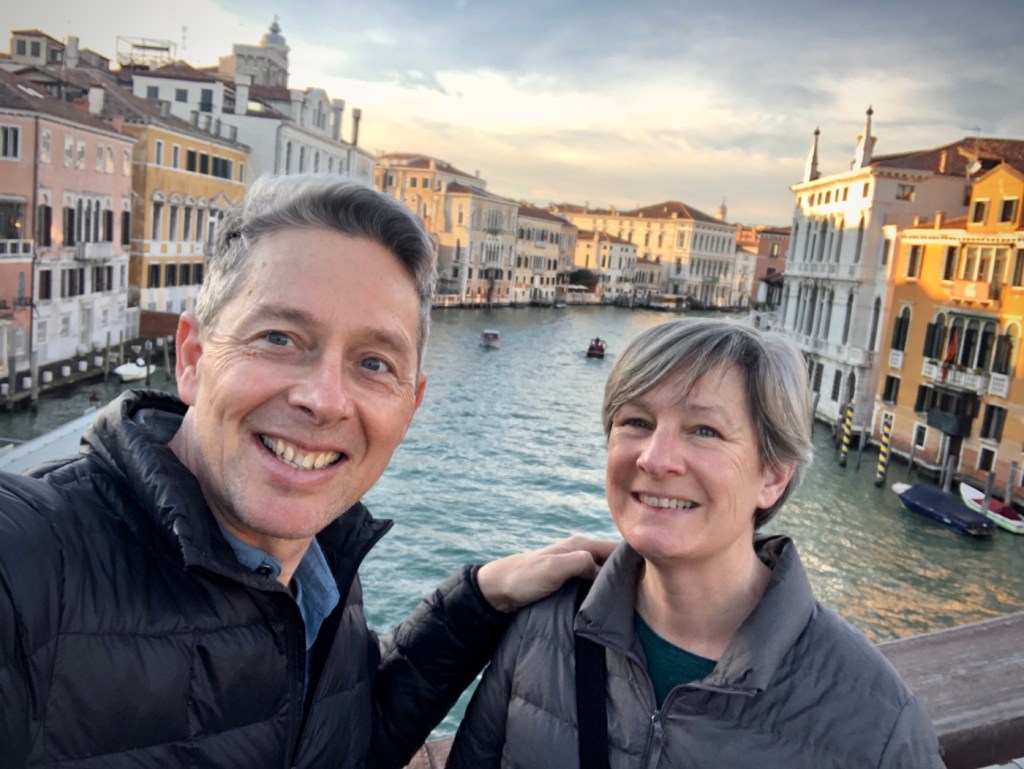
Enjoying a view over Udine, Italy, on our one night in town.

Sometimes we get a very quick sense of how cycling in a region will be. We’ve cycled in Italy before, years and years ago, and were impressed with the smooth pavement and respectful drivers in Tuscany, but this part of northern Italy has not caught up with Germany, Austria, or France in welcoming cyclists. But that’s the roads, the cities are super walkable and beautiful. Udine was a lovely surprise with a pretty and walkable center.

A gorgeous example of Italian marble.
Rich has his loaner umbrella ready, but the rain held off.
The warm glow of buildings in the twilight.
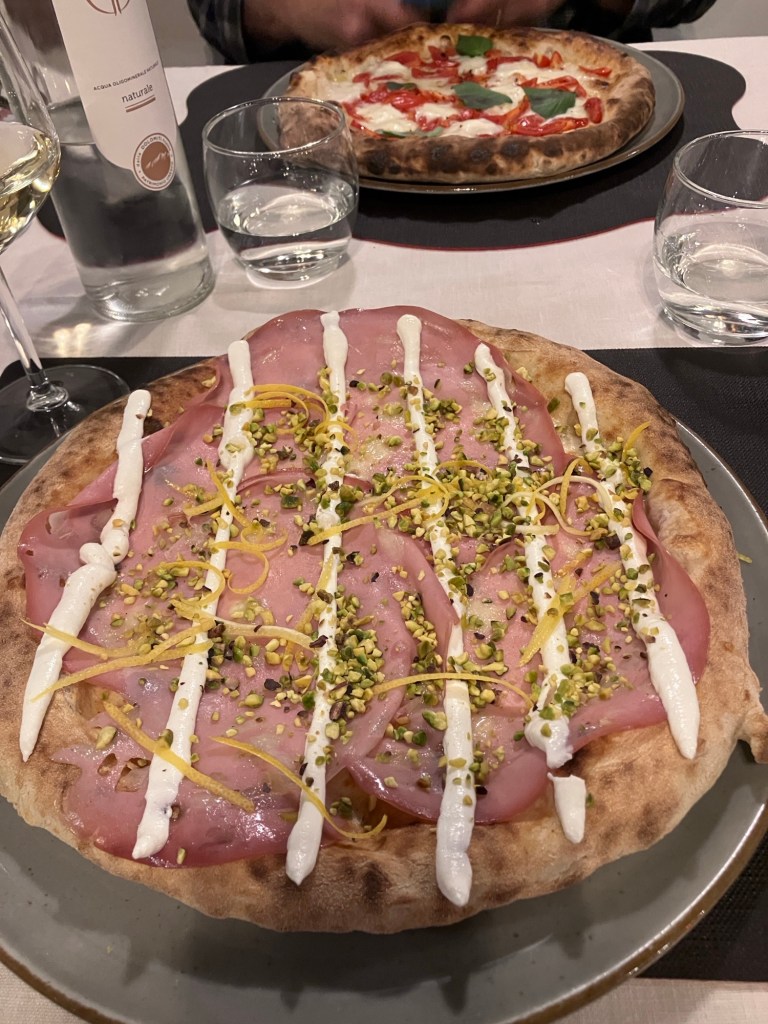
Pizza with mortadella, pistachios, lemon zest, and fiore de latte. Amazing.
In Italy the limoncello will find you.

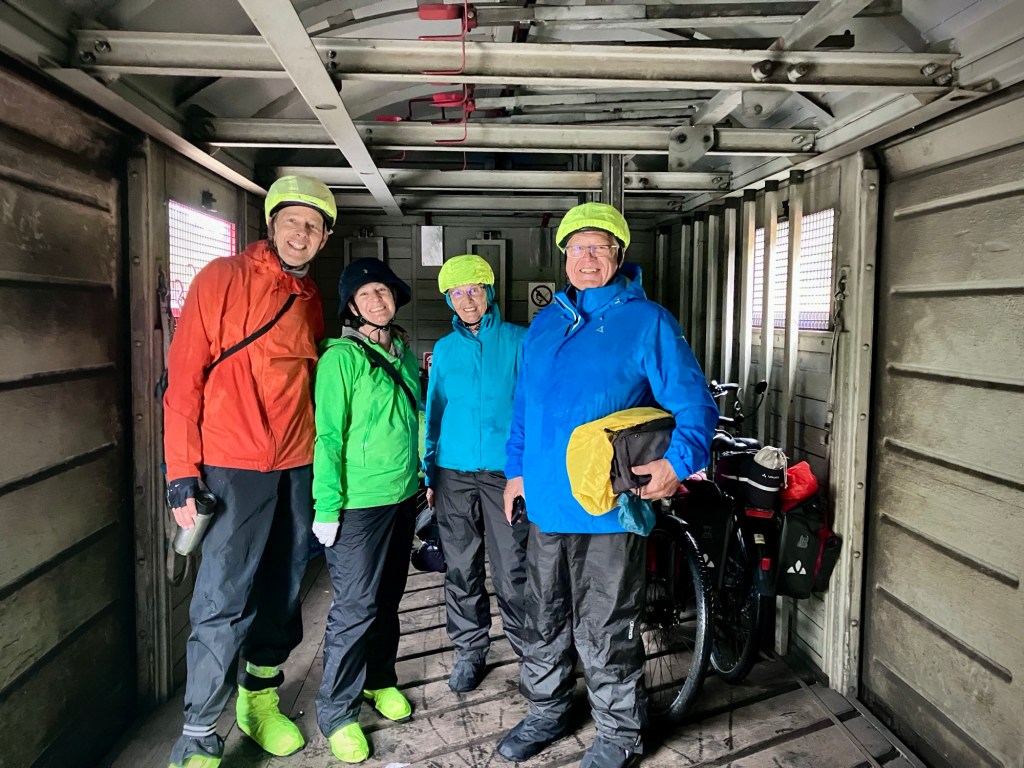
With our deadline of a train from Milan we decided to make a train hop from Udine to Conegliano so we could make it to Treviso that day and spend less time riding in the rain.
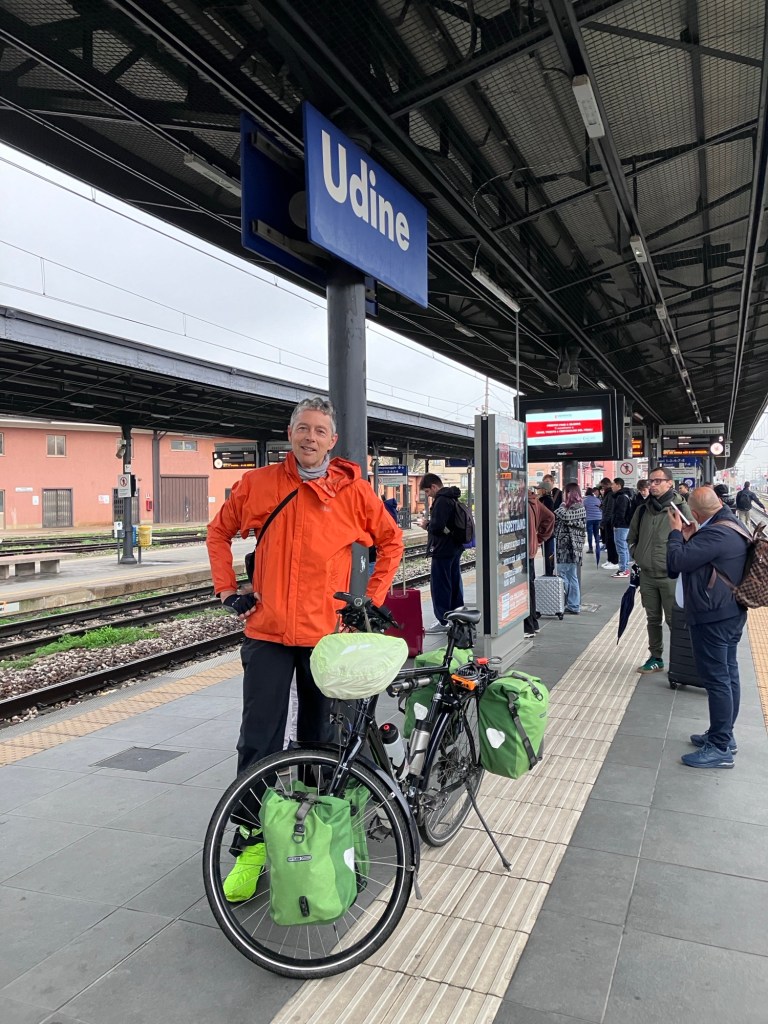
Trains in Italy come with some predictable challenges: track changes. With loaded touring bikes a track change can be beyond hectic. Thankfully there were elevators at the Udine station so the track change at least didn’t involve stairs.
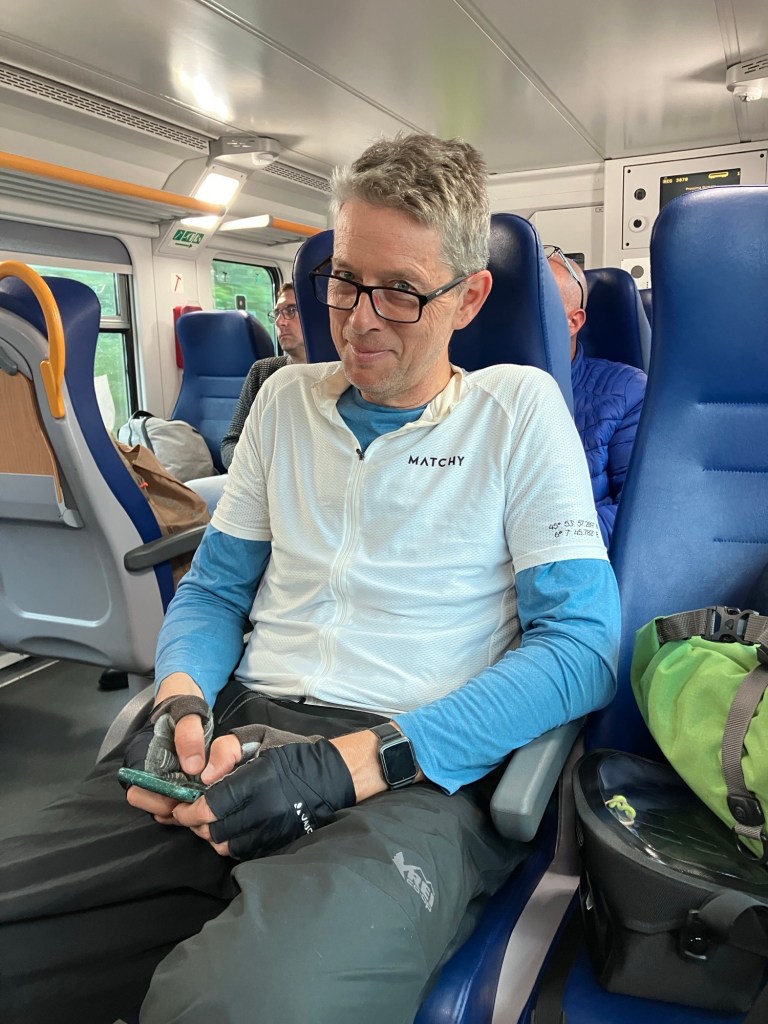
The look of a man whose patience with loaded touring bikes and trains is starting to wear thin. And is looking at 32k/20miles of rainy riding.
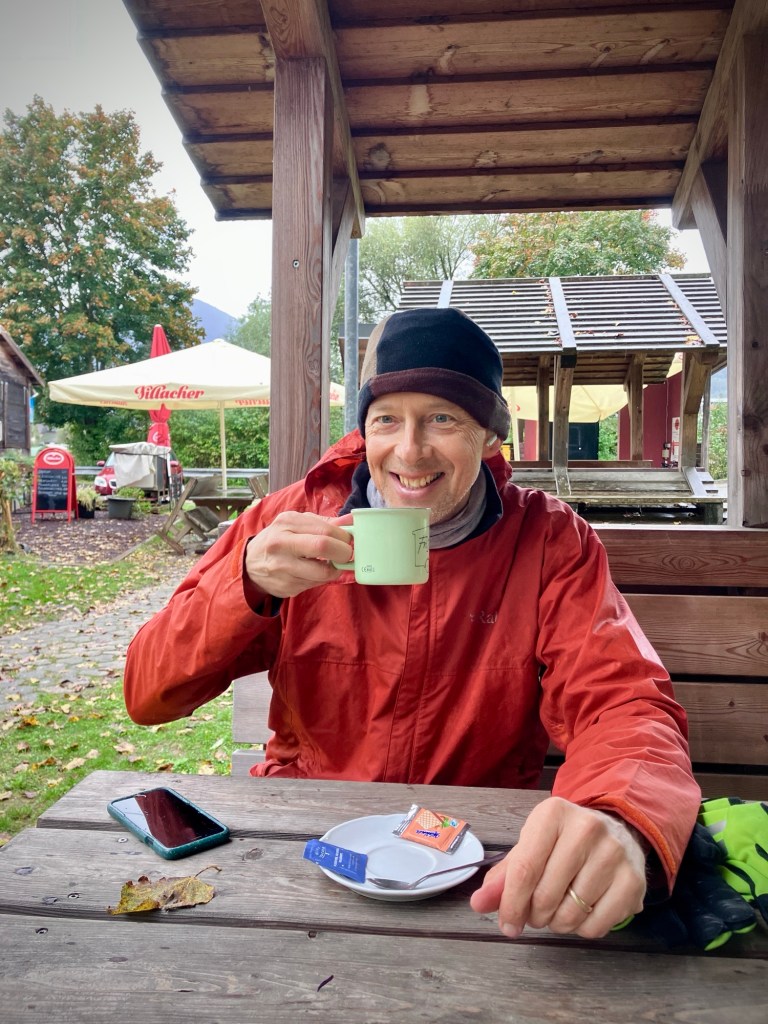
One of our less glamorous but very welcome lunch stops. Between the rain and the roads this pavilion looked like heaven to us.
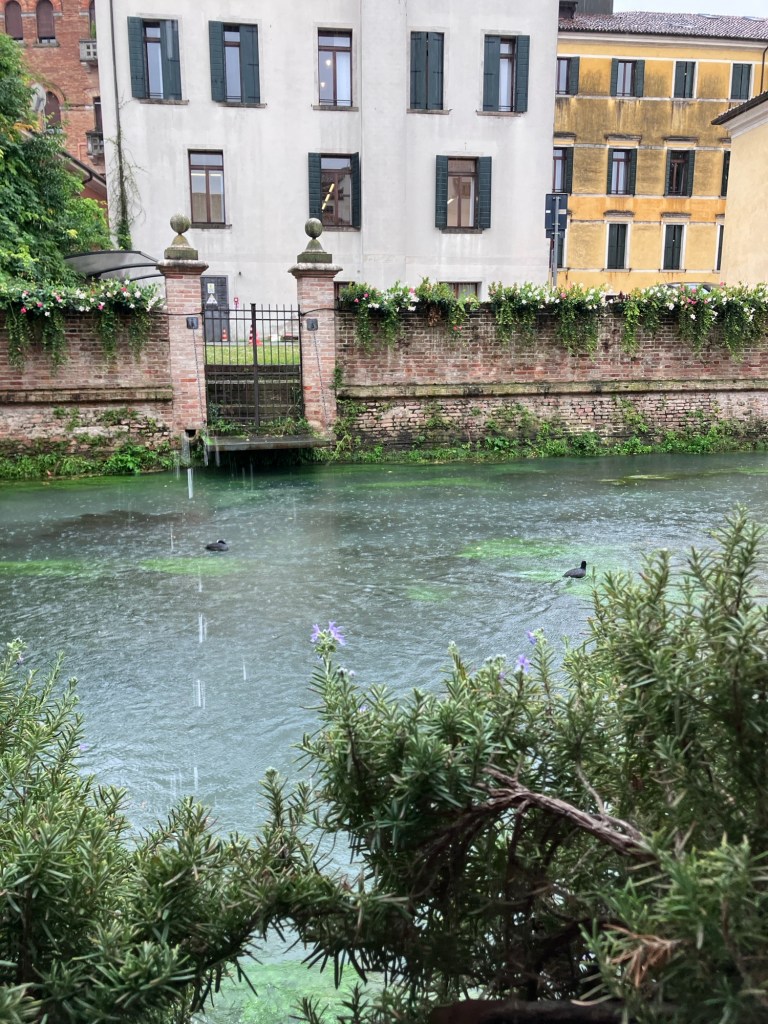
Weather fit for ducks as we get to Treviso.
Outside our hotel in Treviso, trying to drip dry a bit before going inside.

We both had Treviso marked on our Google maps as an interesting place to visit – sort of a little Venice. An alternative to the magical city, with its own canals and own culture.
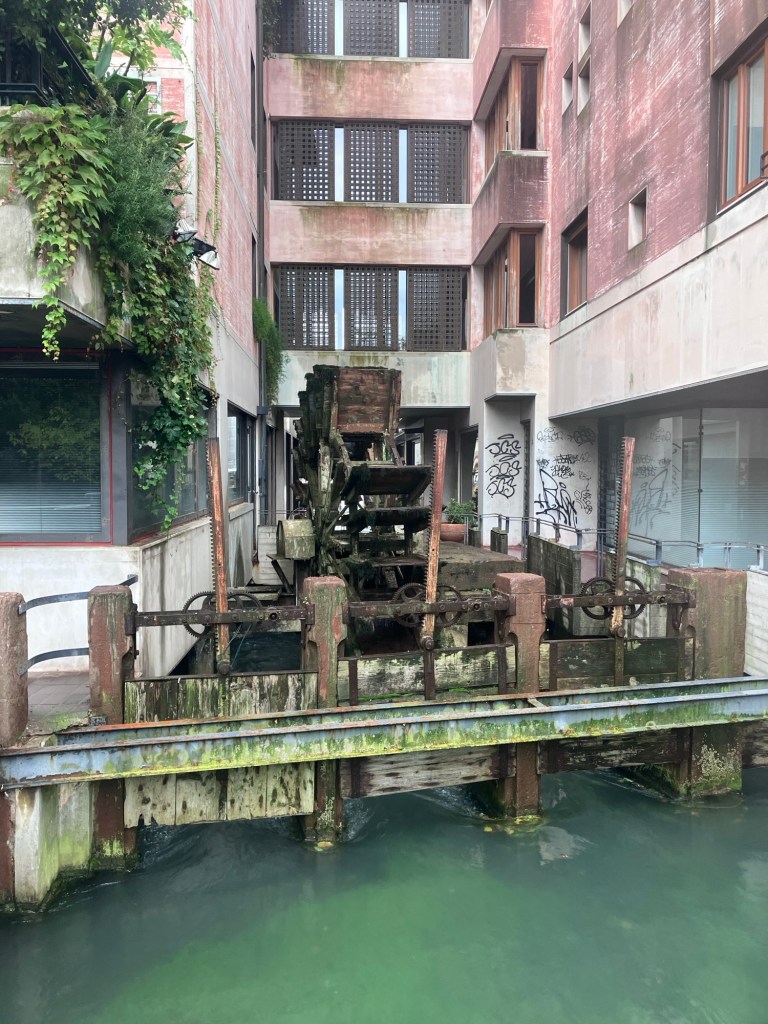
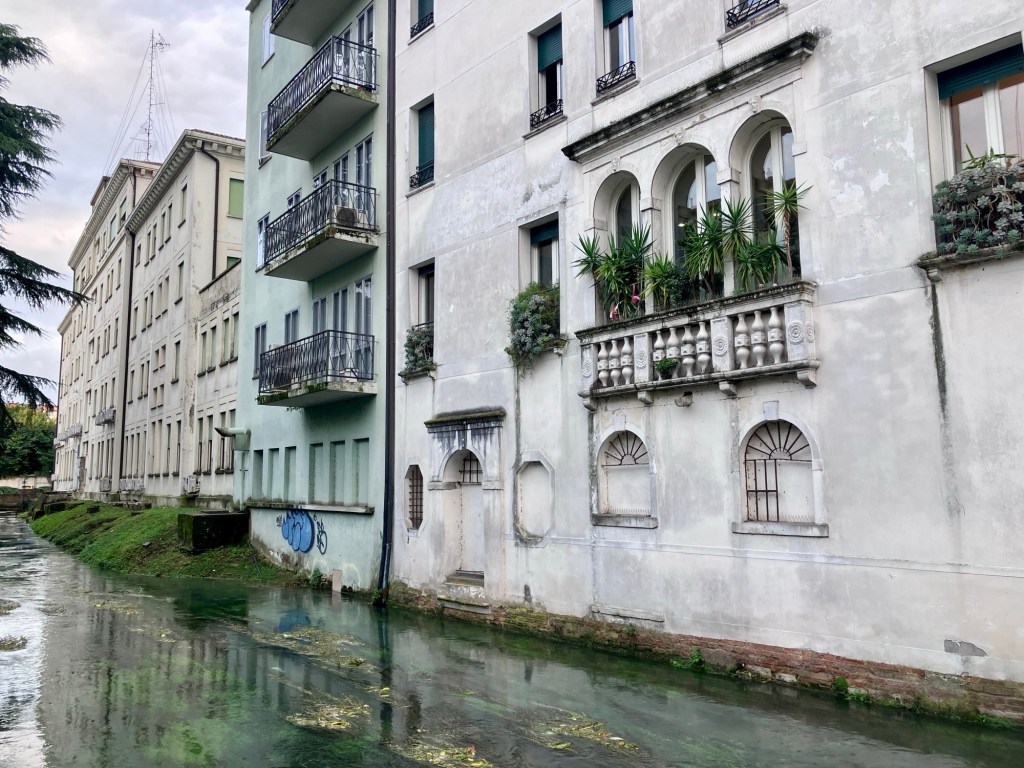
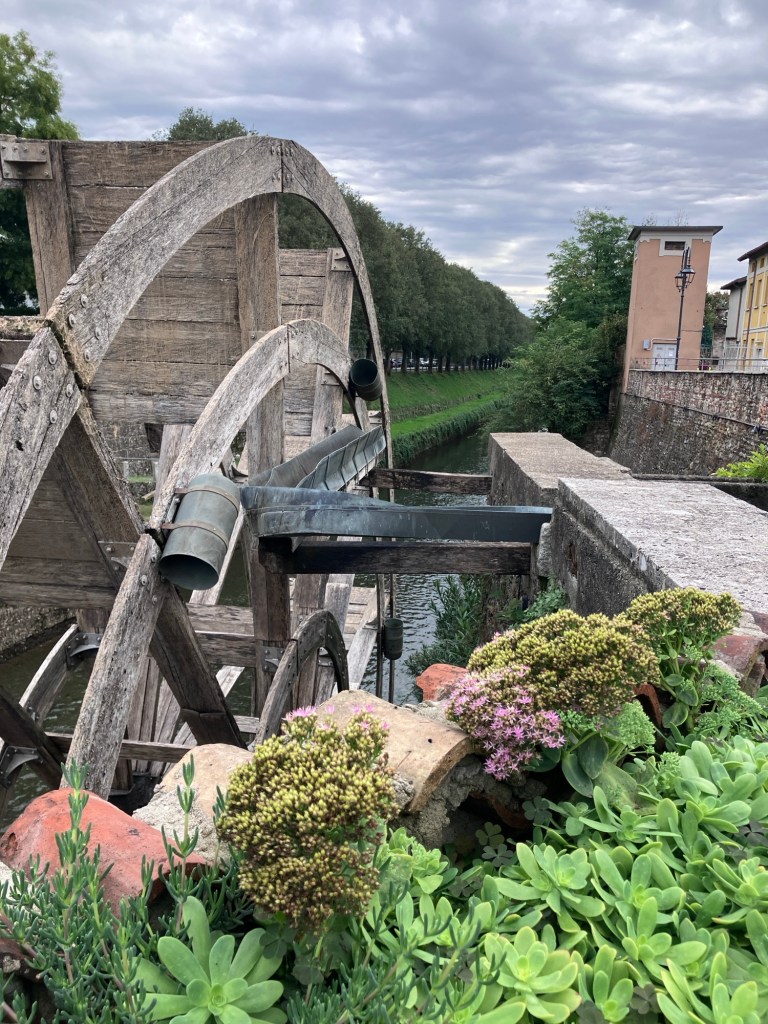
An old waterwheel in one of the canals.
Canal side buildings absolutely bring to mind Venice.
A mural which echoes the past.
Yes, a lovely view even in the near constant rain.
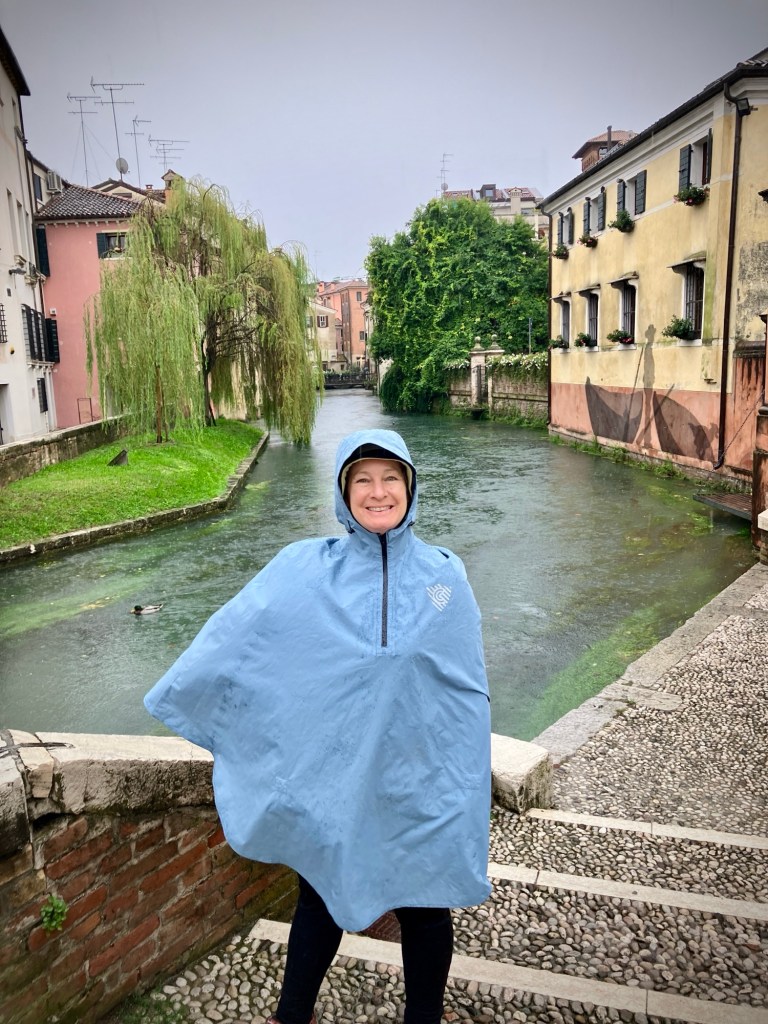
My Cleverhood Rain Cape had its time as I got really tired of wearing rain trousers and switched to tights and the rain cape.
The fish market (Isola della Pescheria) on an island in the Cagnan River.
Who wouldn’t be charmed by views like this?
You can see from this photo what Treviso has which Venice doesn’t: cars.
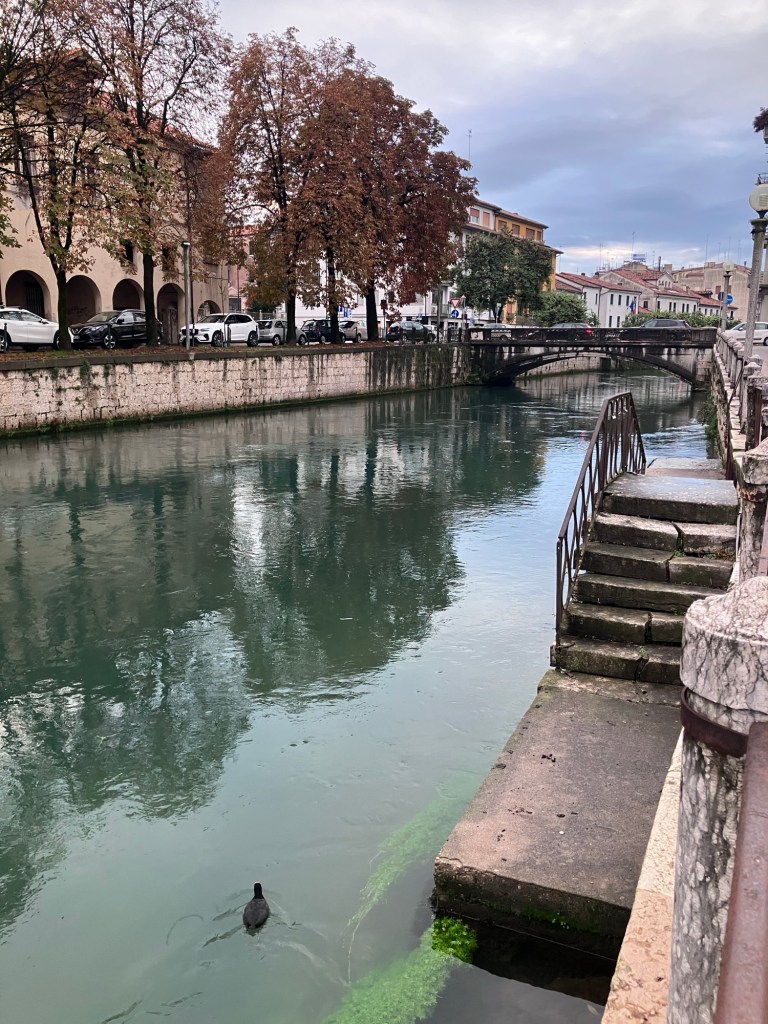
Sunset on the Sile River.

Our two nights in Treviso were fantastic. Even with a lot of rain. But the feeling we get in Venice, with no cars, not a whisper of car noise, is very different from Treviso. Definitely visit Treviso, but don’t be expecting the same scope of magic as one finds in Venice. It is much less crowded though, and a fairly short train ride from Venice for making a day trip one way or the other.

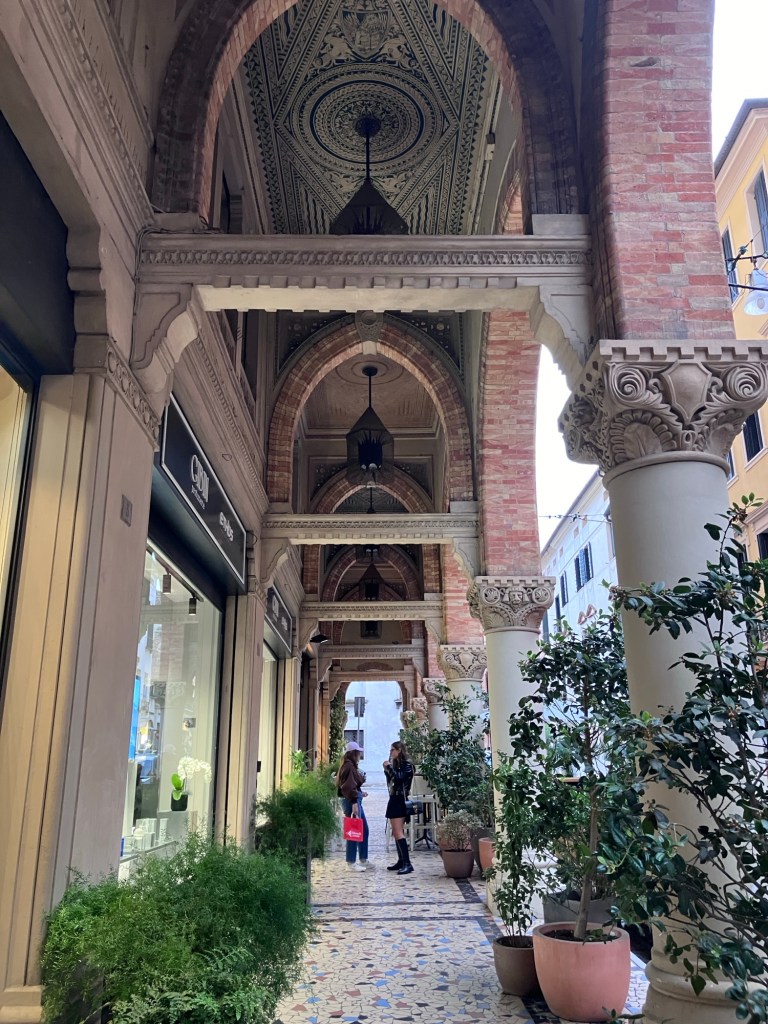
The arcades of Treviso made the rain less impactful.
They were a place to walk, to stop and chat.
And for restaurants to set up a charming scene.

What else did we find delightful in Treviso, the birthplace of tiramisu? Cicchetti, which are small bar snacks like tapas or pinxos, served alongside a beer or wine. A quick aside about bike storage in old towns. It’s not easy to find a hotel with easy and convenient storage for our bikes. The hotel Rich found in Treviso, Palazzina 300, were super accommodating and we were able to store our bikes in one of the owners’ fire wood room about a five minute ride from the hotel. Behind a locked gate and in a room stacked with wood for the winter. The owner pointed out the video camera watching the courtyard and assured us they would be safe.
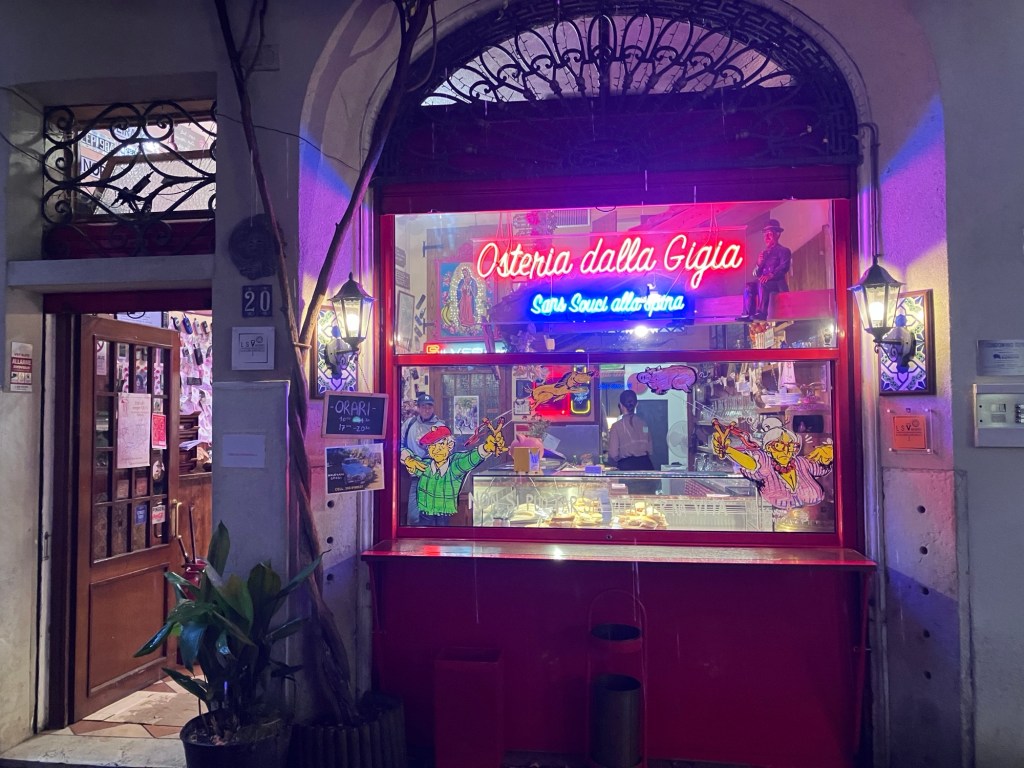
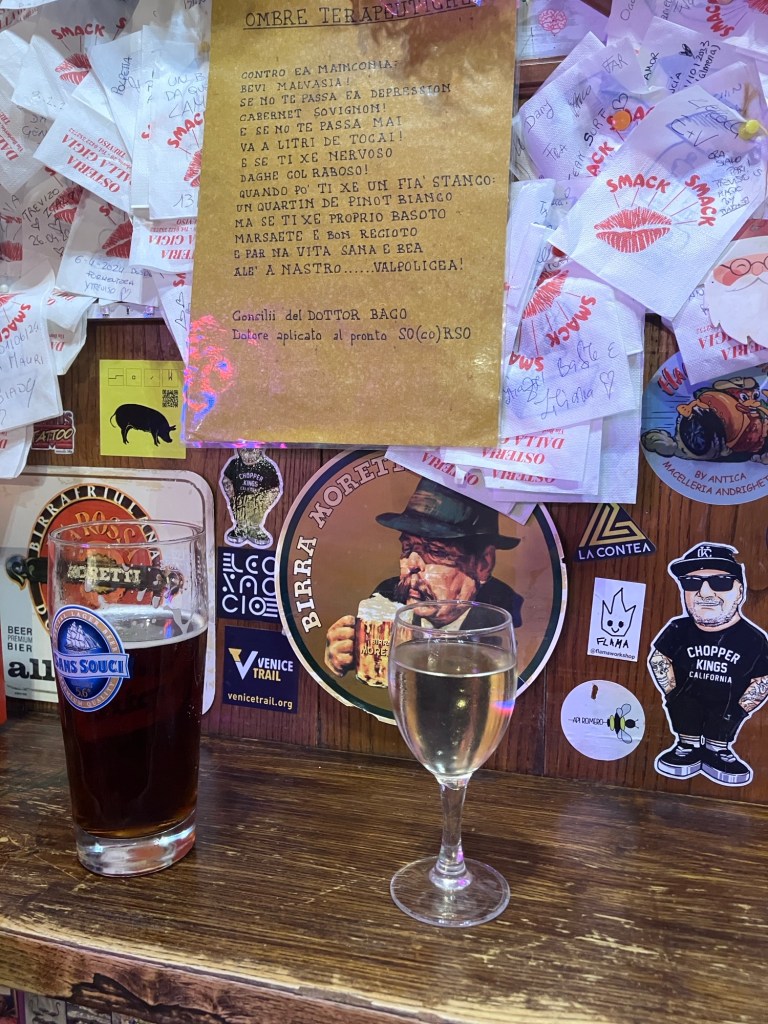
The outside of a little osteria, cicchette on display in the window.
What? I can wander from place to place drinking and snacking? Sign me up please.
The charming and handsome waitstaff who help you choose your cicchetti from a glass case. Our second stop of the night.
So many options.
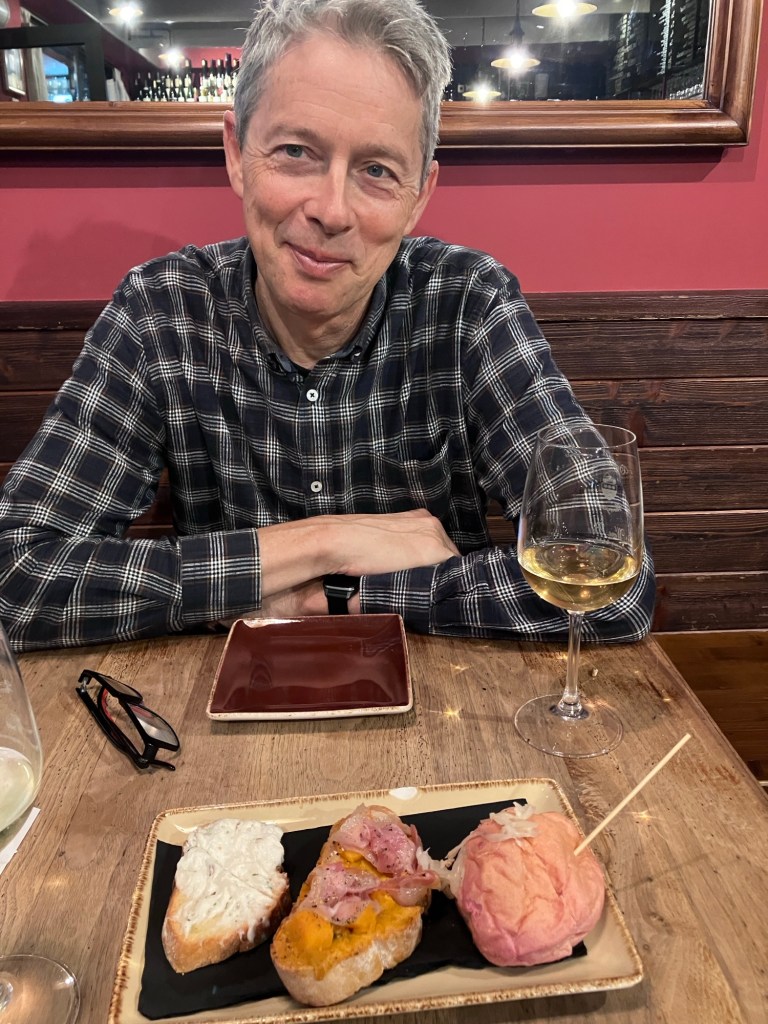
Rich did a good job picking our first round. From the left, cod, zucca, and Gorgonzola and nuts.
My favorite was the zucca (pumpkin) and prosciutto.

Well fueled from our snack dinner (not really, Rich was super hungry the next morning.), we headed to the train station for a hop from Treviso to Vicenza, and then a 44k/27m ride to Soave.
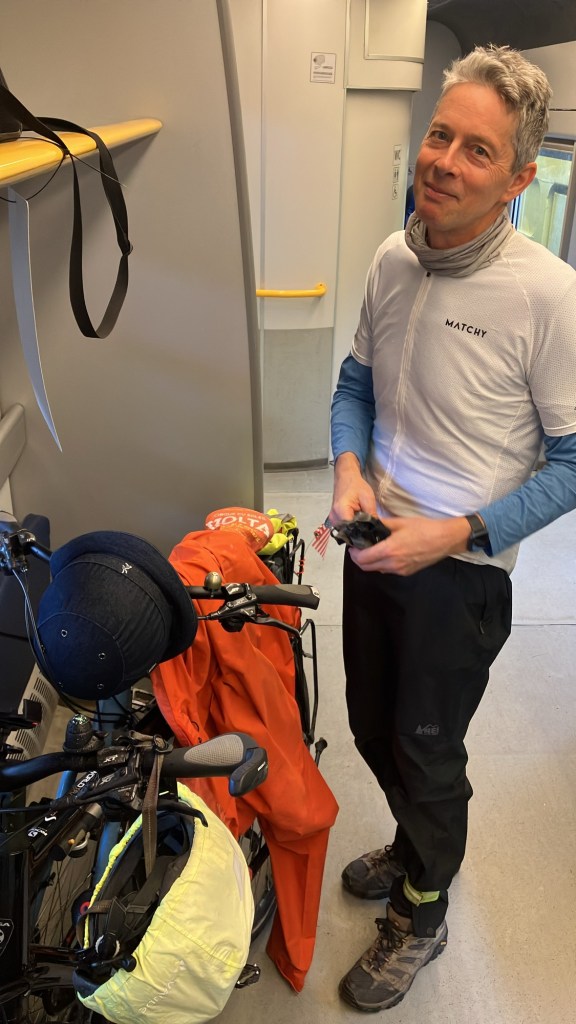
Another train another track change.
But this train had nice bike space.
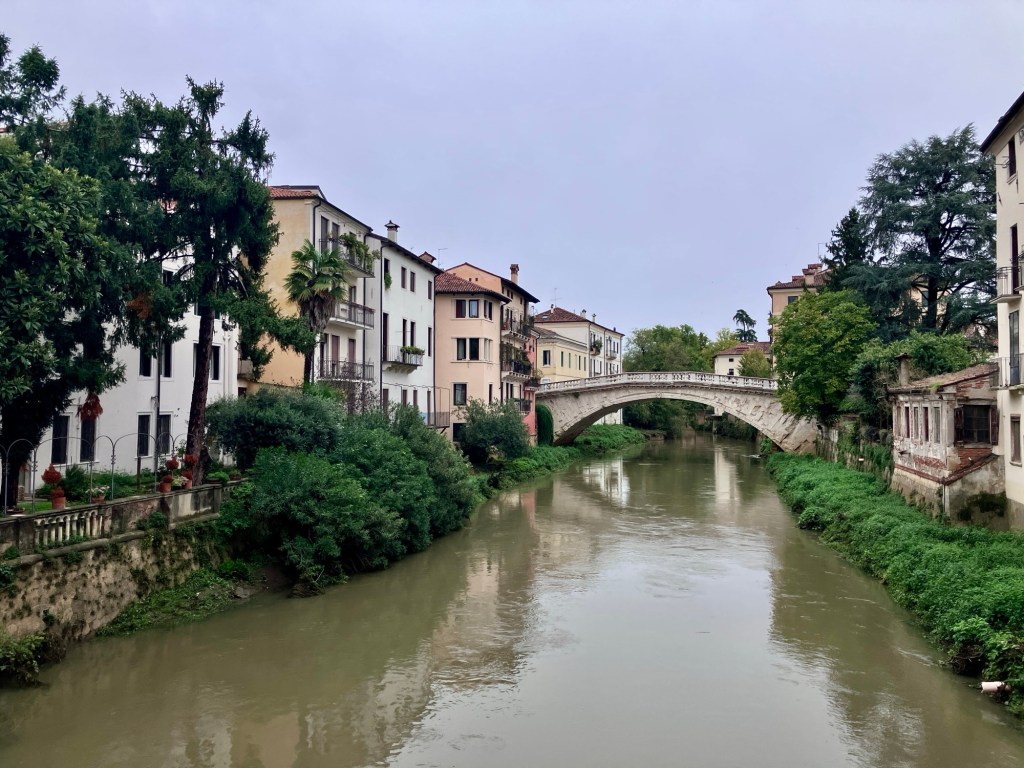
We had a nice little ride through Vicenza.
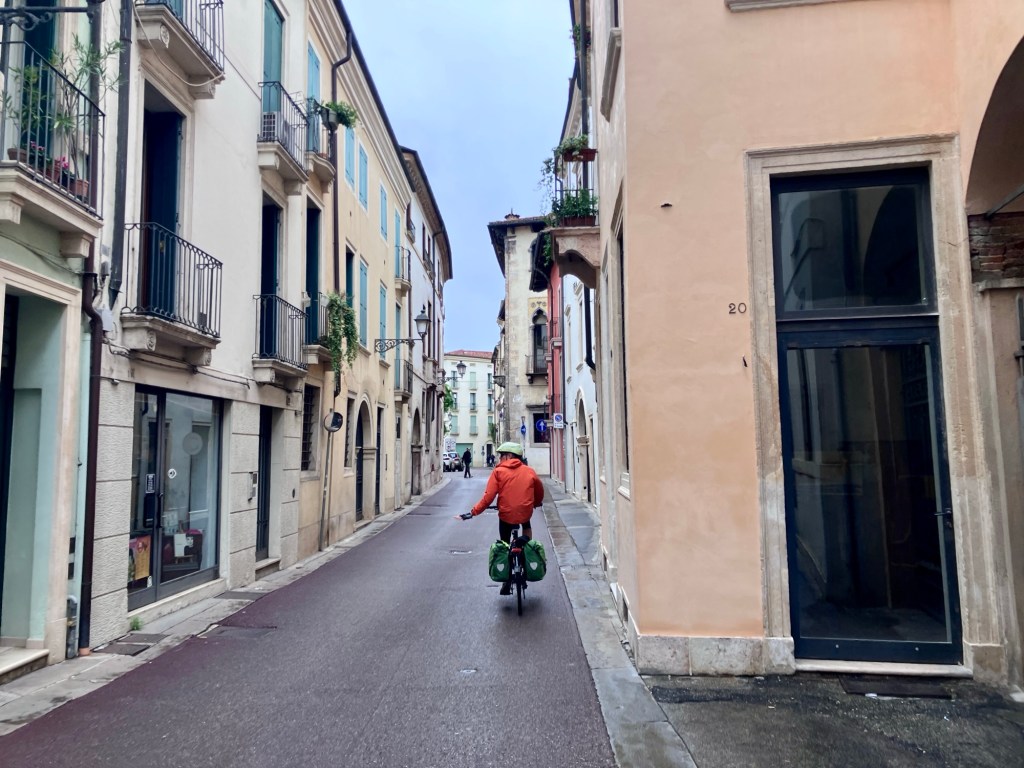
Rich way finding through the narrow streets.
Piazza dei Signore. Italian cities and towns excel at big piazzas, plazas, and car lite or car free spaces.
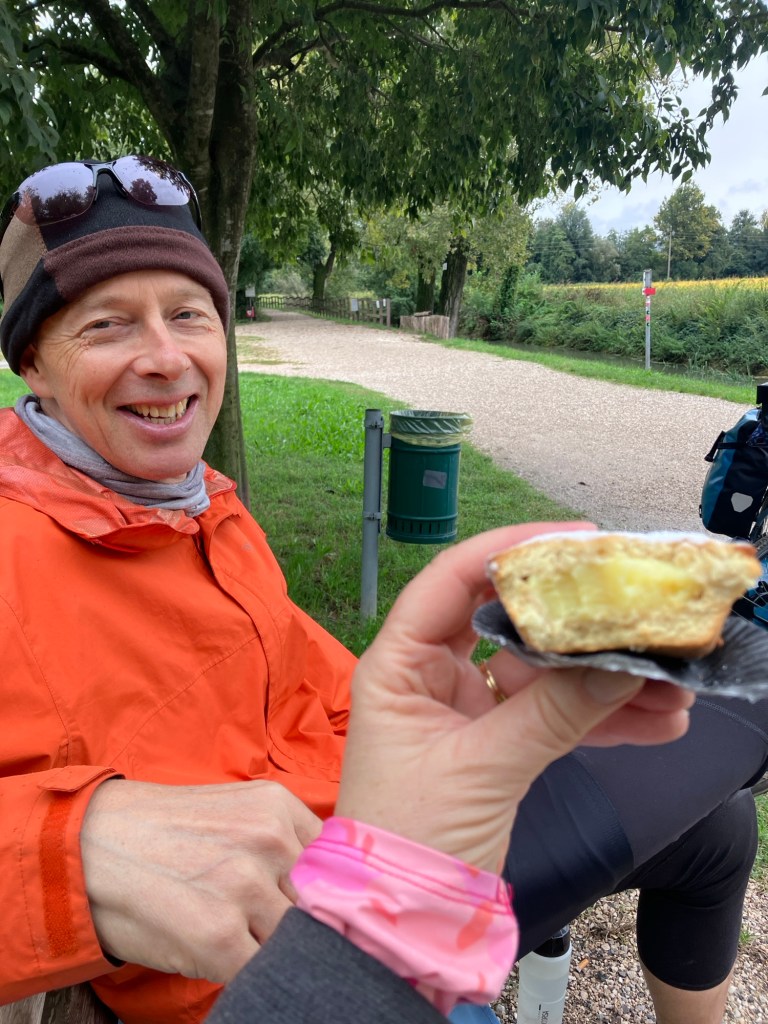
Is that a bench? Then it must be time for a pastry break. That is a Pasticciotto, filled with ricotta based lemony filling. It got powdered sugar all over our clothing, which the mist then turned to sugar paste.
We were quickly out into the vineyards of the Veneto region.
Vineyards are always scenic.

Americans will likely remember the Soave Bolla commercials from the 70s and 80s, which probably gave most people a somewhat bad opinion of Soave wine. The ads were super cheesy and apparently, the wine not very good. But happily wine now made from the garganega grape is delicious, and in 2002 Soave received DCOG status and joined the ranks of well respected wine in Italy.
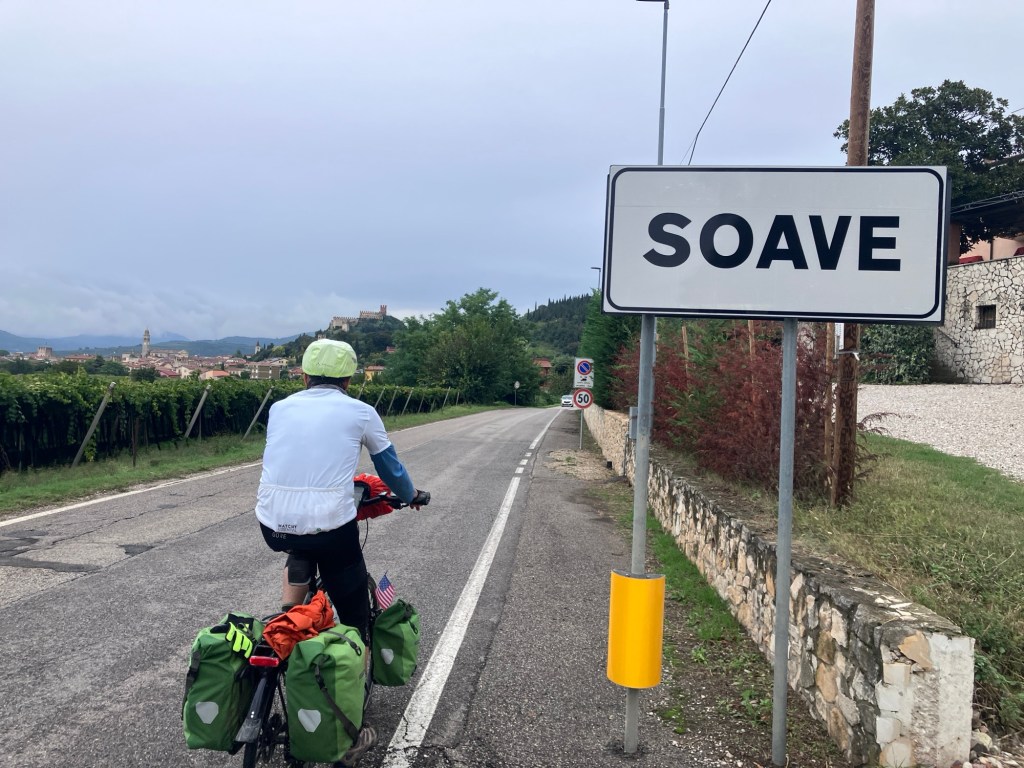
Say it with me: “Soave. Soave Bolla.”
Soave Classico paired perfectly with the delicious pumpkin lasagna at Locanda ai Capitelli where we had a lovely stay and dinner.
The view from the breakfast room.
A view of Soave over the vineyards as we headed out in the morning to ride to Verona to catch a train to Brescia to shorten our day to 58k/36 miles.
The harvest was in full swing. This nice workman smiled and waved when I stopped to take photos.
Garganega grapes waiting to be harvested. Such a lovely color. What would this paint color be named? Wine blush? Whisper?
We also rode by olive trees.
Pomegranates.
And climbed a hill with a classic Italian view.

The riding was lovely at times, but again, not an area of Italy with very welcoming bike infrastructure. We saw plenty of Italian road cyclists, but not many other bike tourists, and precious few bike lanes or decent shoulders to ride on the busy roads. And no transportation cyclists. No one headed to the shops or to and from school. And the terrain can’t be totally to blame as much of our ride was gently rolling, staying on the edge of the foothills.
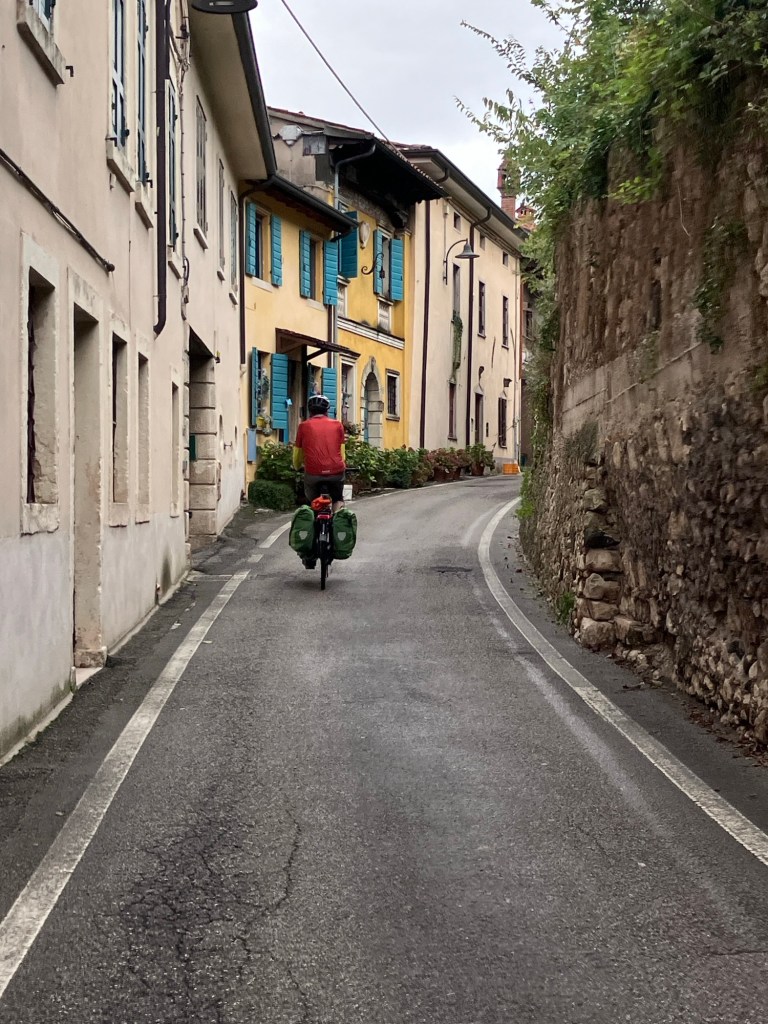
Traveling by bikes gives us such a range of experiences. We go from sweet little lanes,
To a coffee and chocolate break at a gas station cafe.
Verona! The Verona Arena is a Roman amphitheatre in Piazza Bra in Verona, Italy, built in 30 AD. And popular to visit on a Saturday in October.
But we can’t spend too long sightseeing, we have a train to catch.
Yay! Elevators at the Verona train station.
Laughing because… platform change! Second to last train of the trip.
Riding out of Brescia after our train hop, some nice new bike and pedestrian lanes.
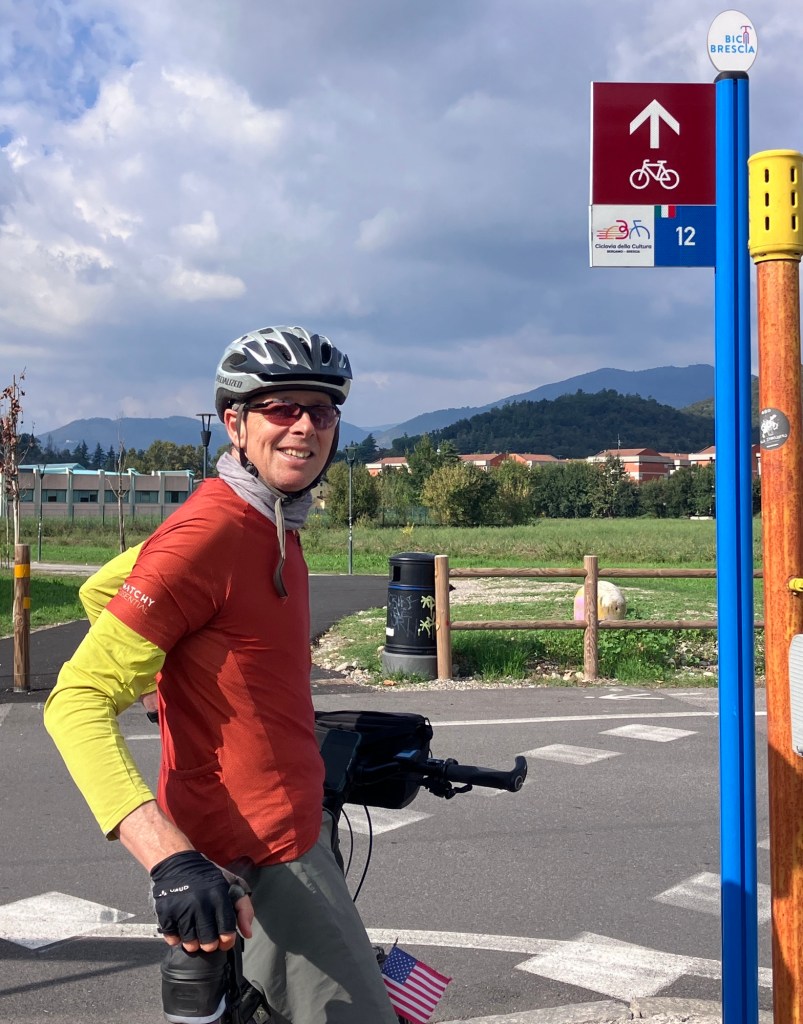
Signage and sunshine.
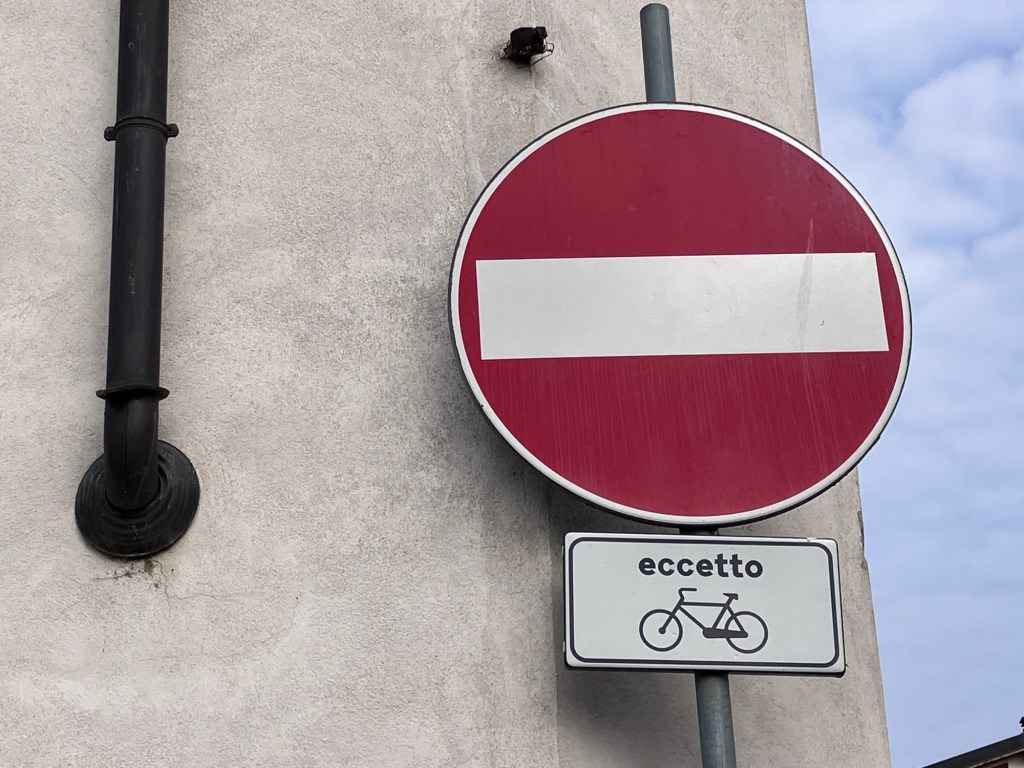
My favorite sign in any language: Except bikes.
Me me me! I’m on a bike! Except me!

We had quite a bit of rain on this section of the trip. I don’t have a lot of photos of rain riding since it’s so hard to take pictures in the wet. And, since we were not quite into the colder part of the year we had a run of hotel rooms where the electric towel racks hadn’t yet been turned on for the season. No heated towel rack and wet weather makes it very difficult to dry our bike gear and other laundry. We had two days of riding still so when we got a working towel rail we sprang into action and did laundry.

A working towel rail – finally! At Hotel Touring in Cocaglio.
How many pizza dinners is too many pizza dinners in Italy?

We set out the next morning to ride to a town outside of Milan, Gorgonzola, 61k/44miles. As we approached Milan there were better bike paths and more folks out on bikes. We stayed outside Milan because the hotels in the city were quite full and expensive due to a pharmaceutical conference. Our hotel for our last night was close to the canal path that led right into Milan for our ride to town the next day.
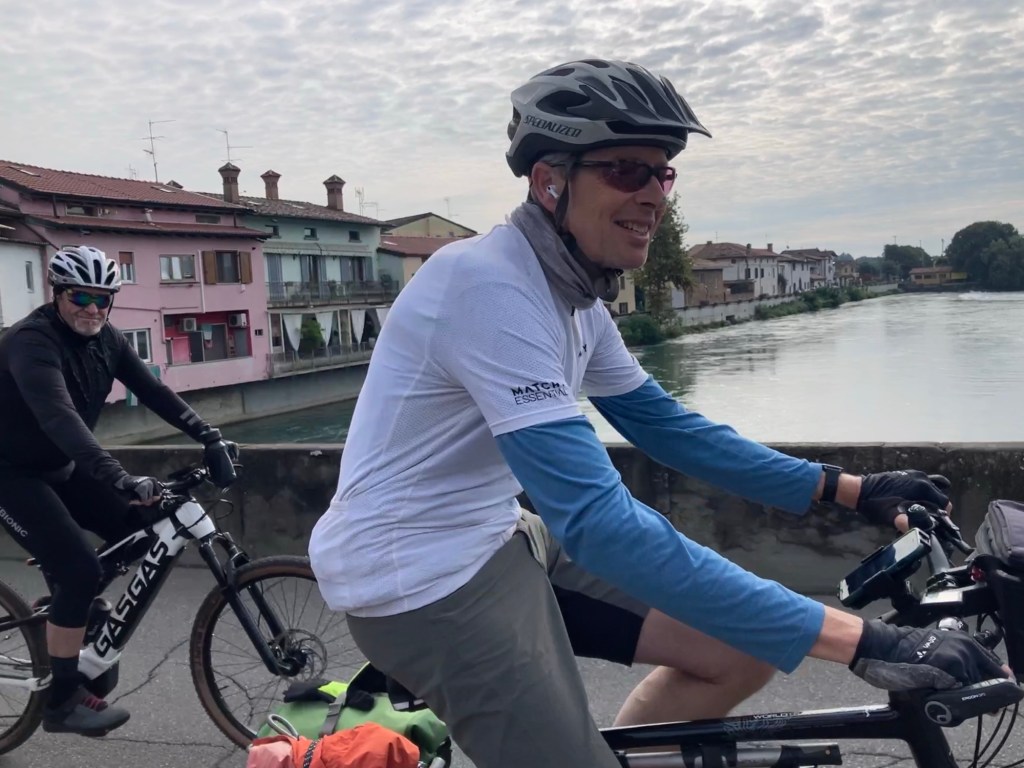
Crossing the Oglio River and a photo bomb by a friendly local cyclist.
Espresso and gelato break in Caravaggio. With our days in Italy drawing down we knew we needed to eat gelato whenever possible.
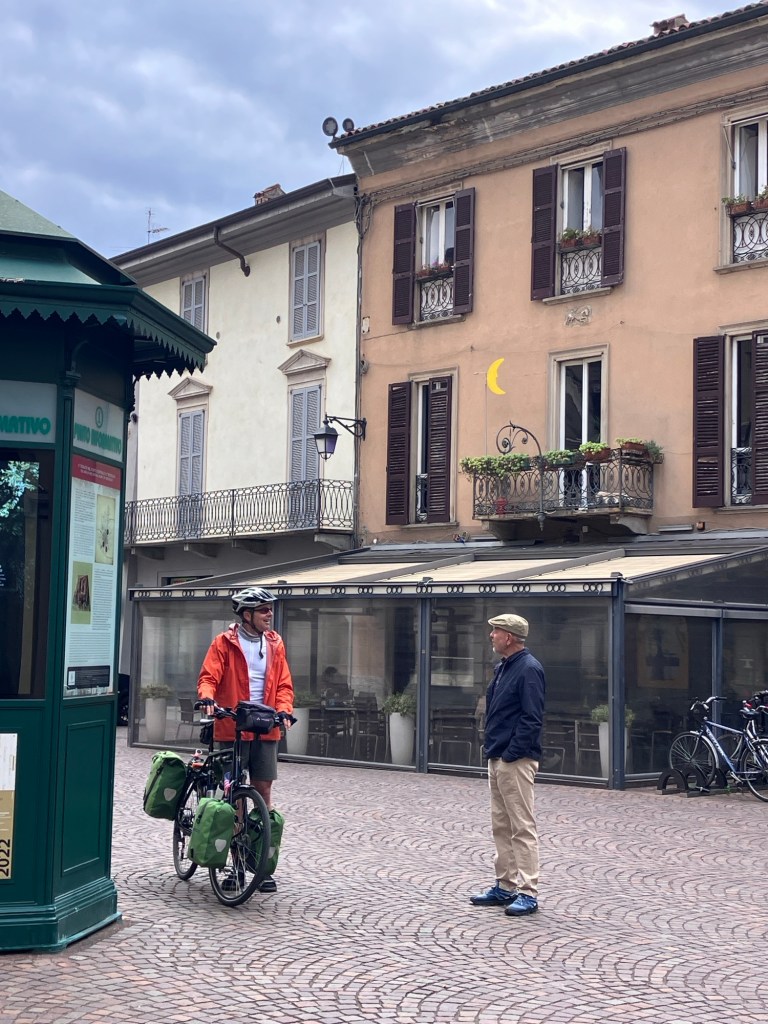
Rich chatting with a local in Treviglio. This gentleman was a bike activist in town, pushing for the local routes to be improved and was happy to see bike tourists.
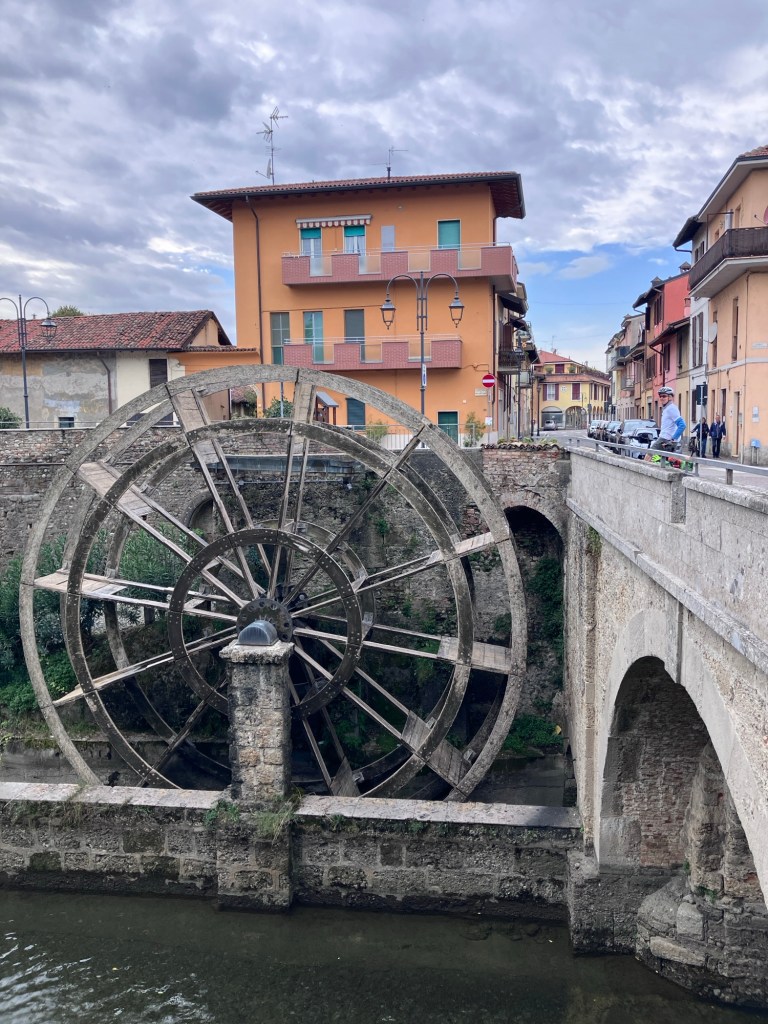
A restored water wheel that used to lift water from the canal to irrigate local noblefolks’ orchards.
You can see the buckets and channel that moved the water to street level.
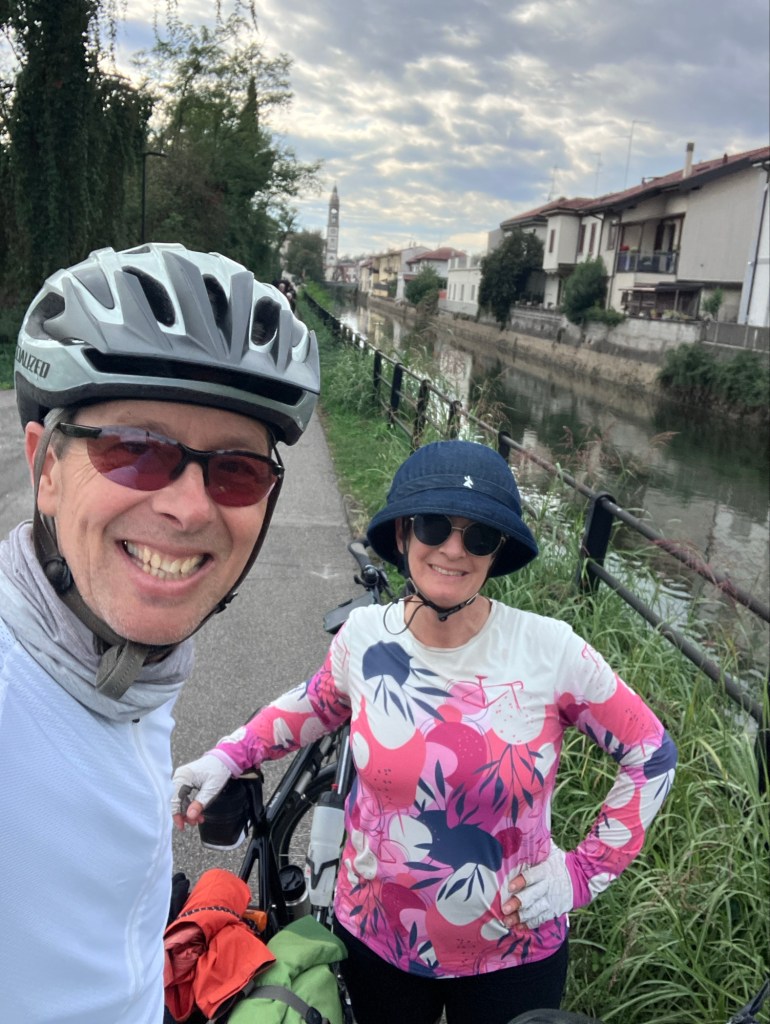
Ciclovia della Martesana, a relaxing and popular canal path.
On the outskirts of Gorgonzola. Yes, where the cheese was first produced. We had it on (what else?) pizza that evening.
Yup. Still eating pizza.
Our last evening in Italy. Tomorrow the ride to Milan and a train to Geneva.
Back on the canal path.
Rich chatting with Massimo who saw our American flags and greeted us. The flags on our bikes are the best conversation starters.
We were in no hurry as we had several hours before our train left Milan Central. So we bumbled along the canal.
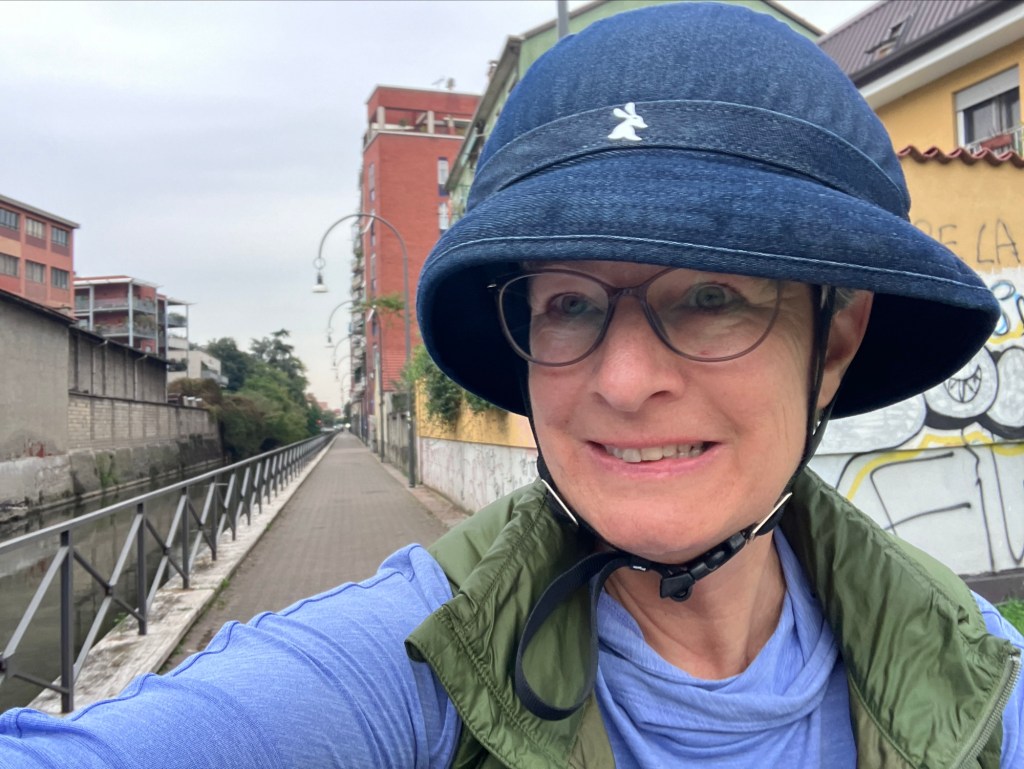
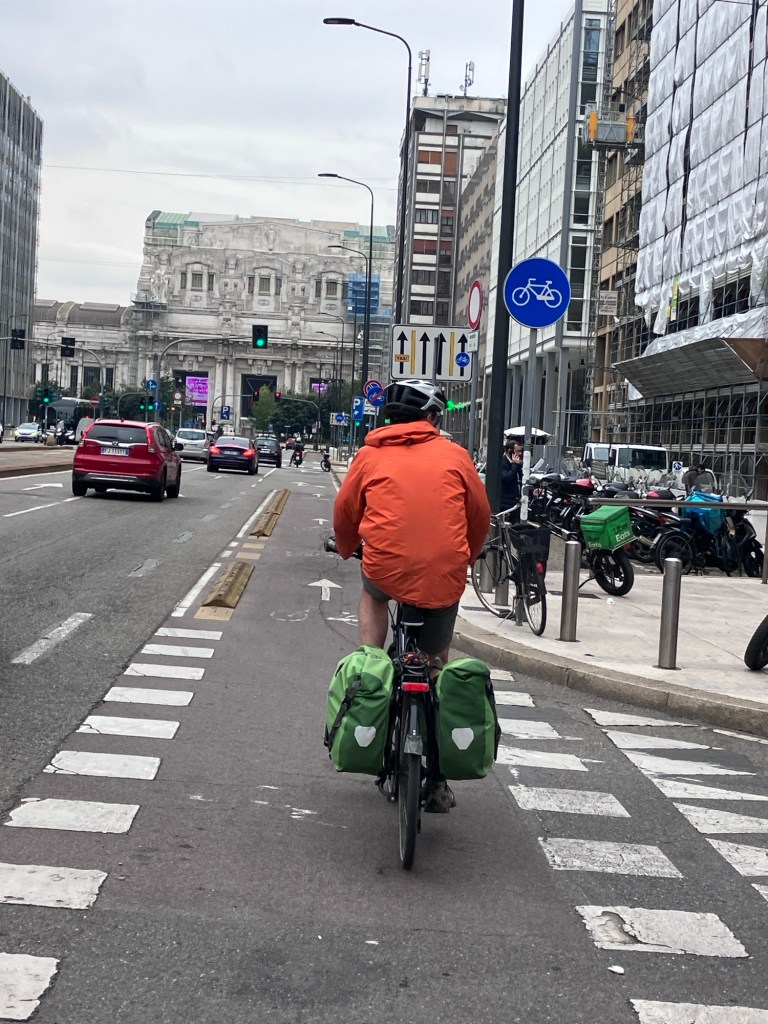
Into Milan, admiring the new bike lanes.
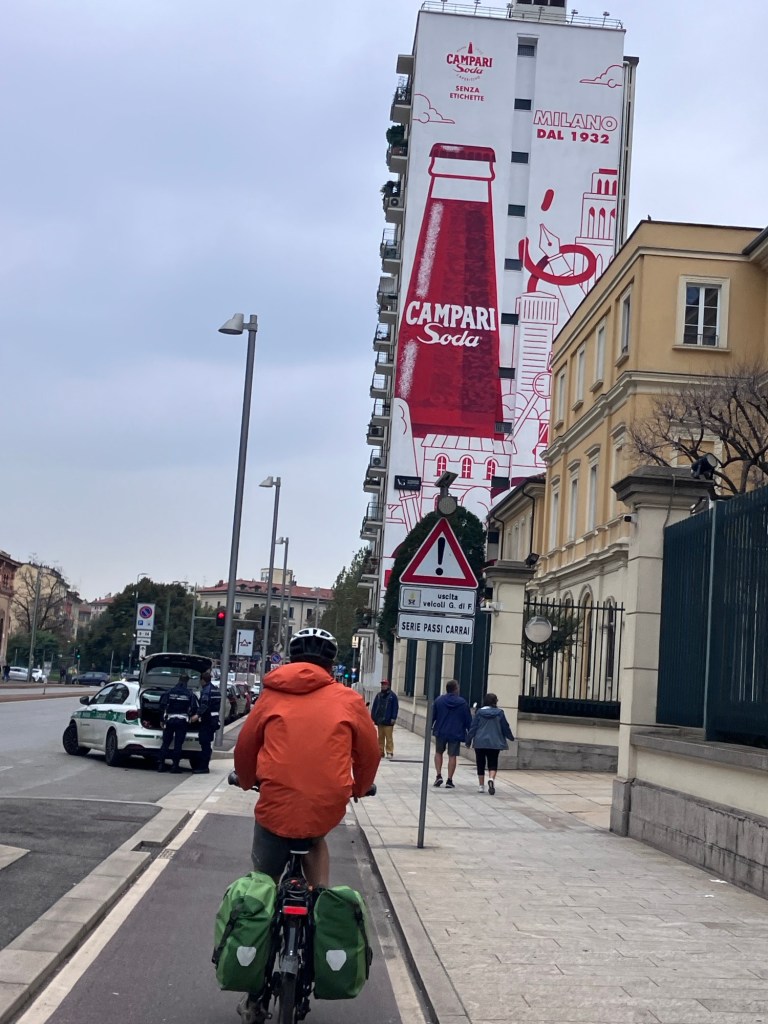
Riding by a Campari ad. How Italian.
Hey! We have some of these Milan street cars in San Francisco.
Arco della Pace.
Somewhere else in Milan.
Doobie doobie doo, somewhere else in Milan.
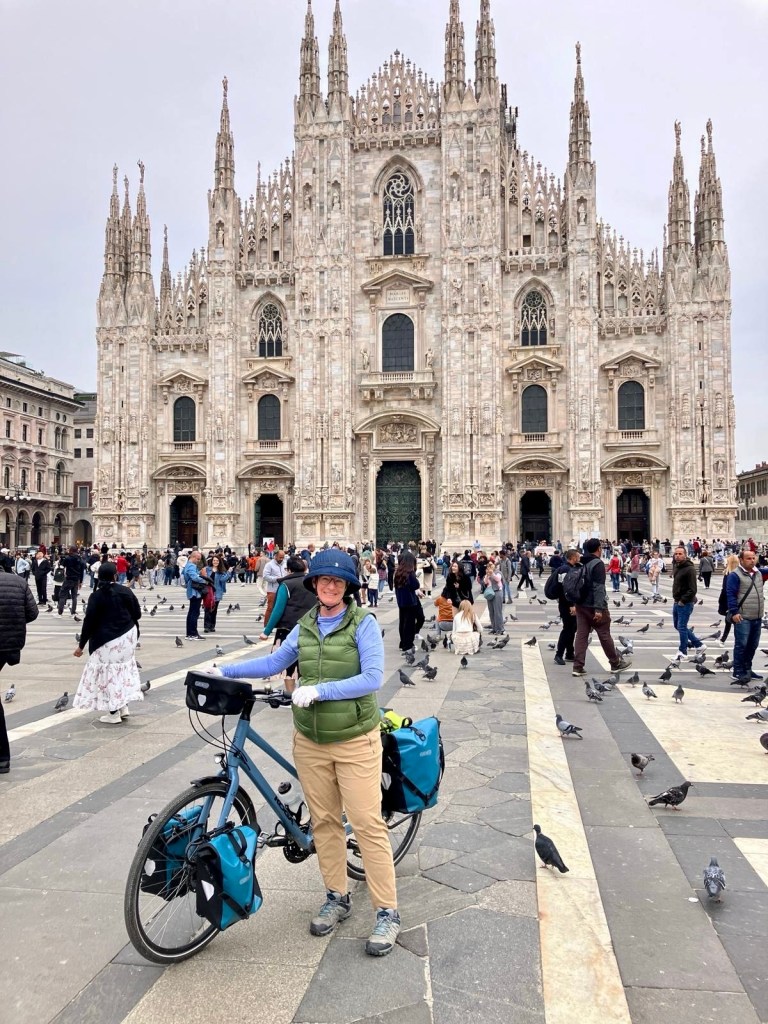
Cathedral de Milano. We had been expecting it to be rainy while we whiled away our hours in Milan so we were happy to ride around sightseeing and eating our lunch sandwiches in the Parco Sempione. But finally we headed to the train station.
That’s the train station at the end of the street.
Final train of the trip!

We had a few things going for us with this final long train hop. First positive is that Milan Central is an end station, you reach all the platforms from the same level, so no elevators or stairs in case of track change. Our train started at this station so we should have a decent chunk of time to get our bikes into their reserved spots on one car, and ourselves into our reserved seats in the next car.

Up we go to the platform level on an inclinator. Still looking good and feeling positive.
Now we’ll just wait around until our platform is announced and we will proceed calmly to our train.

Ha! What really happened is that our train was late arriving and came in about 20 minutes late which put it cross platform from a Turin train arrival. The electronic tickets for just about everyone on our train did not work at the gates so the station agents had to check and let folks through one at a time – but with bikes we need the wide gates and for those we had to wait and wait and wait until we were just about the last folks to get through. With loaded bikes. Two trains unloading, and two trains worth of folks trying to load, equals one big mess.
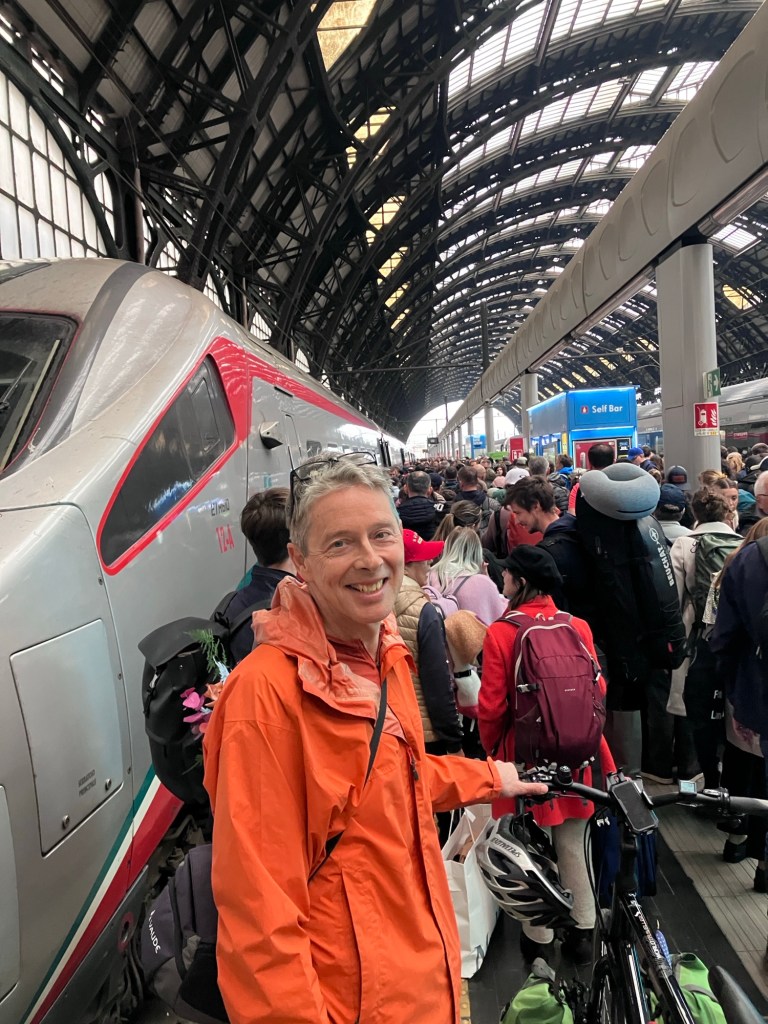
At this point we just gave up. We figured the train wouldn’t be able to leave any time soon, so we just patiently shambled along the platform with everyone else.

Folks who were not convinced the train would wait for them started boarding many cars before their seats which meant the aisles of every car were impassable as people tried to walk along four, five, or even six cars to get to their seats. Our “reserved” bike spaces? Completely filled with giant wheeled suitcases by the time we got to our car. The palaver it took to get our bikes and panniers and us sorted was monumental. We were moving suitcases, bargaining with other riders, helped by a lovely young and patient passenger, and at first greeted with shrugs from the train attendants. They finally had us move to another car where the bike space had a few fewer suitcases in it, and we eventually got to our seats, hot, exhausted, and giddy with joy that we were on our final train ride of the trip.

Along with dinner Rich wisely bought us train wine during our station wait. We needed it.

Our final destination was a hotel in Annemasse where we would spend the night before tackling the climb up the Vallée. (We ended up getting a ride up the Vallée due to heavy rain and cold and exhaustion.) We told ourselves that if it was raining when we arrived in Geneva, or if we were too exhausted we’d just take the train to Annemasse. Another ha! The train tracks were being worked on and no trains running after 8 pm. We arrived at 9:30 and headed out to ride to Annemasse. Thankfully there is a first rate bikeway all the way so even in the rain it wasn’t awful. Just very wet.

Ah, Geneva Cornavin station. Now just a 9 km/ 5.5 miles to our hotel in Annemasse. In the rain. We made it.
Our loop in nights spent. Each green heart is a place we stayed. The far left heart is our good friends’ place in the Haute Savoie.

A few observations about our different experiences along the way. The Swiss are very no nonsense and straightforward. The bike infrastructure is good. Germany has really good infrastructure but it’s starting to be dated, and, with so many folks on e-bikes, crowded. Germans are gruff. They do not waste time being gentle. As I was pushing my loaded touring bike up a steep climb a man on an e-bike came down the hill. He took the time to stop and say to me “There are many steep hills ahead.”, with a rueful shake of his head at my blithe disregard of tough climbs. We could hear his internal question of why these silly Americans did not have e-bikes. A second German man cycling with his family, all on e-bikes, rode by and motioned to me with a wave of his hand and said “Come on, hurry. Keep up.” I snapped that my bike had no motor and when we encountered he and his family again they tried very hard to be nice. Was I holding a grudge? Why yes, I was.

The happy travelers in Treviso.

By contrast the Austrians we encountered were more friendly, and the Italians! We were cheered up climbs with calls of Brava- Bravo! Almost every cyclist called out ciao ciao and smiled and waved. When I was caught in the bike race on a climb the spectators clapped and called out as if I was part of the race when I finally got on my bike to finish the climb.

Although the infrastructure for our northern Italy route was not yet in place it is underway. Alta Alia D’Attraversare is the website for the formal route we partially followed and which is mostly in place and being improved all the time. Worth checking out if you plan to cycle this part of Italy.

We’re in France until December 4th, the 12th arrondissement of Paris and then off to the UK for Christmas and New Year.

Cycling Bliss on the Alpe Adria

Apologies for the long gap in posts, but we’re now back in France and finally catching up on our past month of adventures. So how’d we get back to France from Salzburg? Cycling through the Alps and some trains of course!

Descending on the Alpe-Adria Route into Italy.

We really enjoyed our few days off the bikes in Salzburg, but as always, were eager to get back exploring. We find that more than two days off the bikes can put us off our game (like the Tour de France, eh?), so it felt good to roll out and head up the beautiful Salzach River towards the towering spires and massifs of the Alpes. Ok, maybe a little intimidating too.

Starting up the Alpe-Adria on the Salzach River.
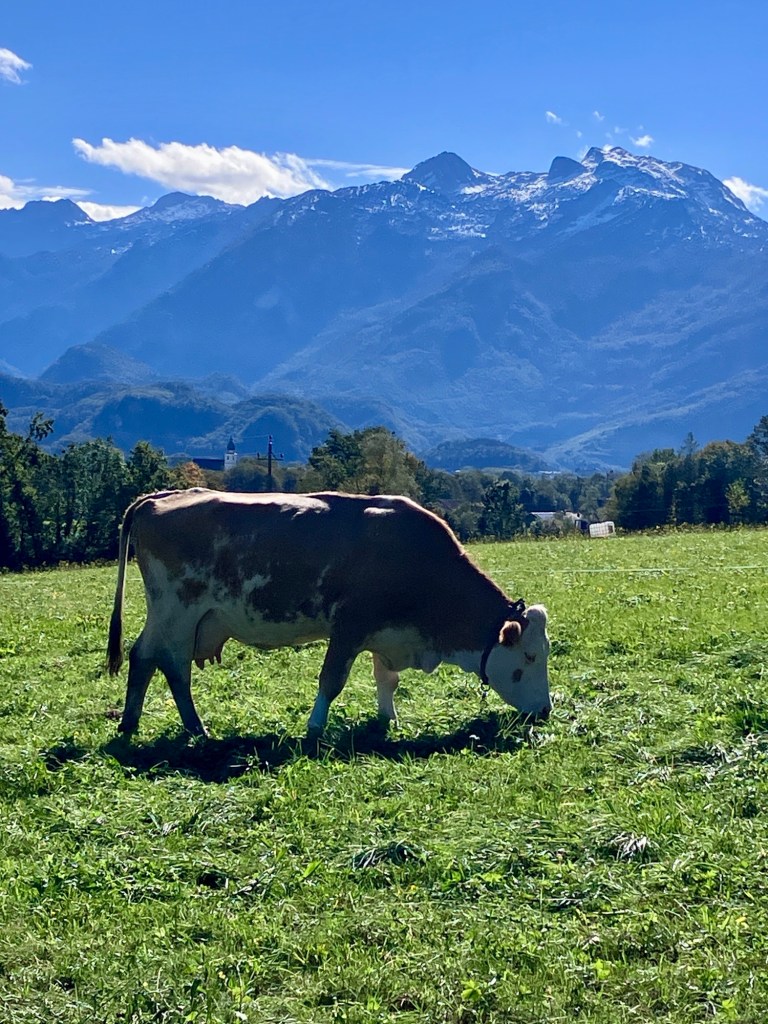
Cows and sunshine!

The Alpe-Adria is a long distance cycling route that starts in Salzburg and covers 415 km over the Alps, all the way down to the Adriatic Sea at Grado, Italy. This spectacular route was (mostly) completed between 2006 and 2009.

I’m ready, let’s do this!
The beautiful Salzach river valley.
Leaving the river and approaching Route 159 and the gorge; all looks innocent.
It was too hectic to take photos, so a bit of the narrow section from Google street view. Somehow looks calmer and no 18-wheelers in their views! And there is the train if you’d like.
This look after the gorge sums up my feelings. « That kinda sucked! »

The first day was about 65km to the pleasant and somewhat upscale town of Sankt Johann im Pomgau. It was a tougher day than expected for a number of reasons. It was all upstream and uphill, although there were not many big climbs. Second, we had a good headwind, which made even the flat river sections tiring. Finally, there is a gap in the route that requires you to ride on a narrow two lane road through a gorge.

The route continues on route 159 to Bischofshofen, but there was now a shoulder.

The worst section is from Salzachlamm to Werfen, which has about 5km without any shoulder, lots of trucks, and a barrier hemming you in on both sides. Yes, it was a bit sketchy and we had to grit our teeth a few times as large trucks approached at good speed from both directions. But it was daytime and we were fairly confident that the regional truck and car drivers would be looking for cyclists on this stretch. 

Burg Honenwerfen loomed over us as we crested a small pass along the river. These valleys have been strategic trading routes for centuries.

So although we made it just fine, we asked ourselves, “would we ride it again?” No! So we have to recommend skipping it with a quick train train hop on the S3 (S-Bahn) from Golling to Werfen. It was the only traffic impacted gap in the otherwise enjoyable Alpe-Adria route, so we hope they figure out a solution in the gorge to make it a bit less stressful. It seemed that many cyclists rode to the restaurant near Pass Lueg and either turned around or perhaps got a shuttle as we saw no cyclists on the narrow and truck filled stretch. We now know why.  It would be better if you’re on fast road or bike packing setup, as you’d be narrower and faster. For now, we can add it to the many stretches of road around the world we will only ride once!

But all good in Sankt Johann with a nice meal and white wine.
Day 2 of the route brought peaceful and rolling climbs away from the main roads. Our favorite kind of touring.
Turning up the valley towards Bad Gastein, there a few long tunnels with protected bikeways. Noise cancelling earbuds are awesome for loud tunnel stretches!
Ah, this is more like it, a new and separate bike/ped tunnel! Overall, we were impressed with Austrian cycle infrastructure as it seemed to have more recent investment than Germany.
Bad Gastein.

Our next day to Bad Gastein was dramatic and all along quiet roads and paths. The profile was again mostly uphill as we continued towards the main spine of the Alps. But the long profile hid some of the up and down rolling terrain along the edge of the valley.  It was fun (roller coaster!) but the last stretch up to Bad Gastein was very steep so required some pushing and patience.

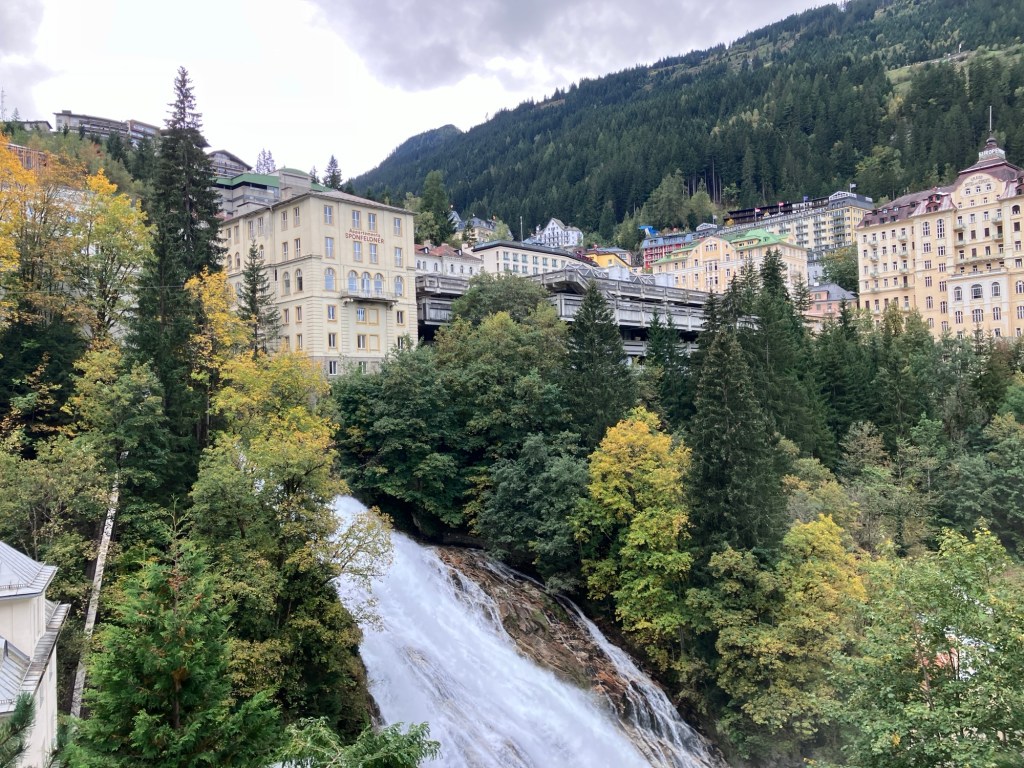
The mighty falls in Bad Gastein are a constant sight and sound in the lower part of the city.
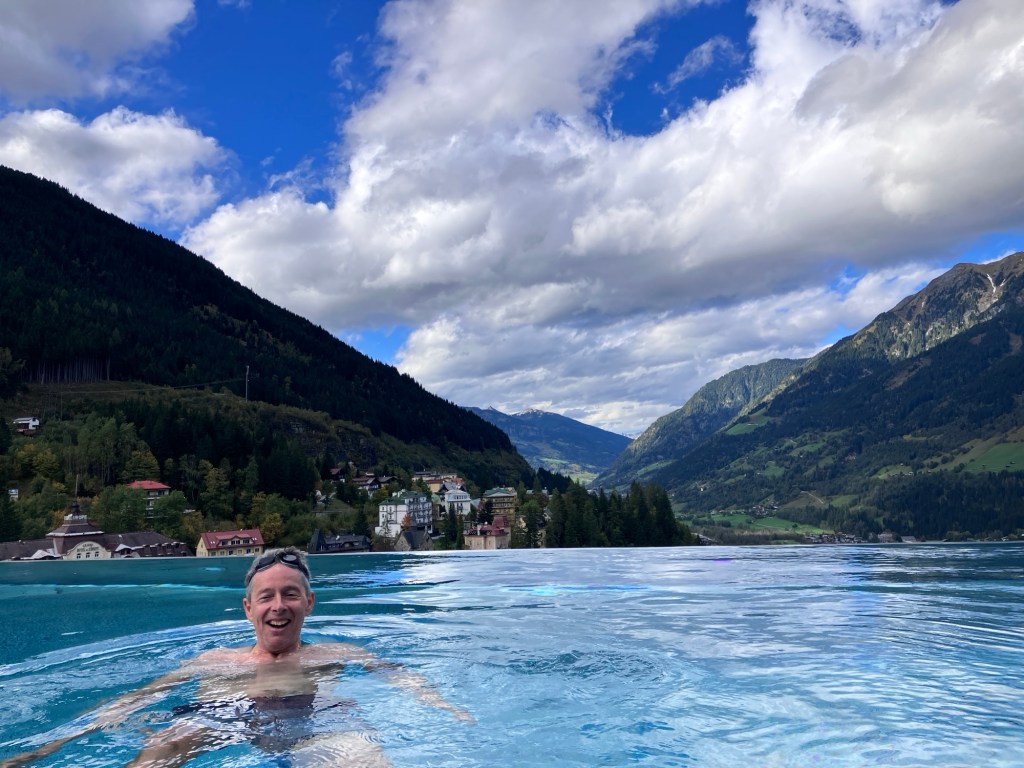
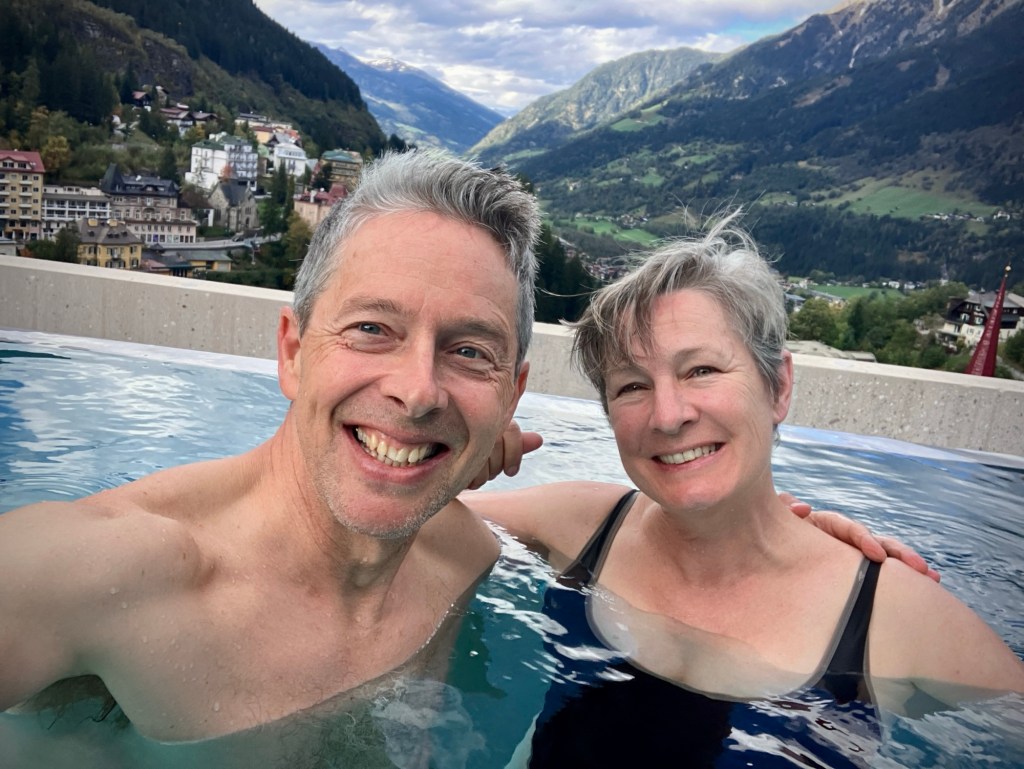
The heated rooftop infinity pool at Bade Schloss felt so good. There’s a sauna too.
And great pizza refuel at Pizza Napoli, which seems to be run by one passionate chef/owner.
The rewards of swing season cycle touring.
The terrace at Bade Schloss looking across at their sister hotel, the Straubinger Grand. It was chilly but atmospheric.

The reward was the « discovery » of Bad Gastein, as we hadn’t ever heard of it prior to this journey. We highly recommend a stop here and staying at the Bade Schloss hotel if possible. (It was a bargain in late September) It just reopened in 2023 with a dramatic remodel to three historic buildings, as well as a new 14 story concrete tower. Ok, the tower is a bit of a sight from afar, but the rooms and rooftop pool are wonderful. And the setting next to the roaring falls incredible. It’s a faded spa town with belle epoque buildings and a bit of a Wes Anderson vibe. 

And an impressive breakfast.
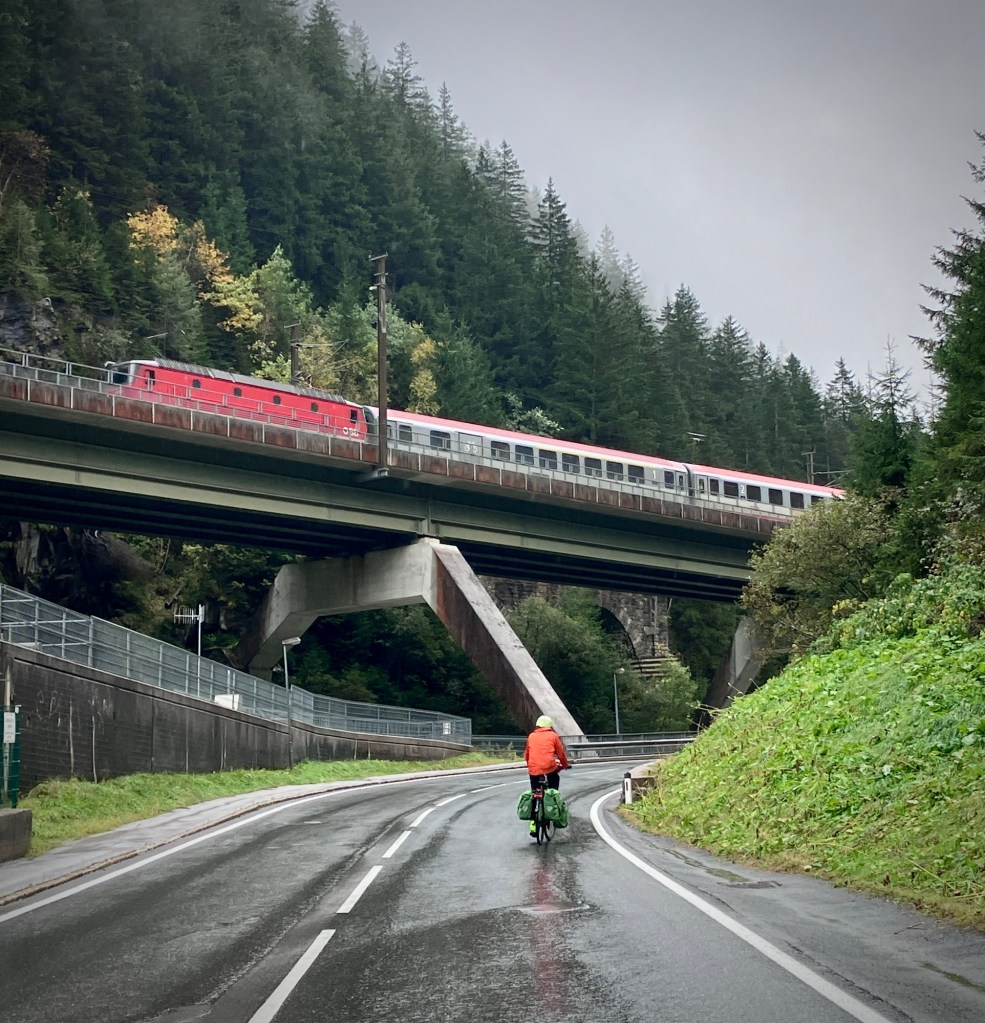
Fueled up for the short ride to the pass in our well used rain gear.
Constant cascades to please the senses, a slight reward for all the rain.
Getting close, but don’t panic, that’s not OUR train!
Buying tickets for the Tauerbahn in Böckstein. Only 4 bikes on this rainy late September Day. It’s about €10 each, a bargain to avoid a 1000m climb (and snow.).
No question where the bikes go.

The nice thing about stopping in Bad Gastein for the night was that it was just a relatively easy 7km climb to the train portal. Yup, the official Alpe Adria does not go up and over the highest passes, but utilizes the hourly Tauernbahn shuttle between the Austrian States of Salzburg and Carinthia. The 10 minute train ride takes cars and bikes through the mountain and is a fun way to feel both the accomplishment of a pass without the reality of a high pass, including weather challenges in late September. (Note that the tunnel will be closed until July 2025 for engineering works.)

A chance to chat with some friendly Germans from Düsseldorf. Apparently in summer, there can be over 100 bikes jammed in this train car
We emerged on the Carinthian side of the tunnel to even heavier rain, so decided to try to wait it out a bit before heading down the next valley. But fun to watch the cars load on the next train.

Contrary to our hope for sunshine on the southern side of the train pass; the rain just got heavier as we headed down the fairly steep and relentless switchbacks on the other side. My disc brake pads even started to crystallize a bit trying to control my loaded tanks’ speed. But eventually the rain ended and the terrain flattened out and we made our way to Spittal am der Drau for the night. Another relatively short but memorable day.

The amazing works of vertical infrastructure in the Austrian Alps.
And nice rest stops.
Yup, this works…if it was only sunny!
And unlike most of Germany, plenty of public Trinkwasser
Rare spot to duck out of the rain on another mizzle-y day to Villach.
A welcome coffee stand for this coffee achiever.
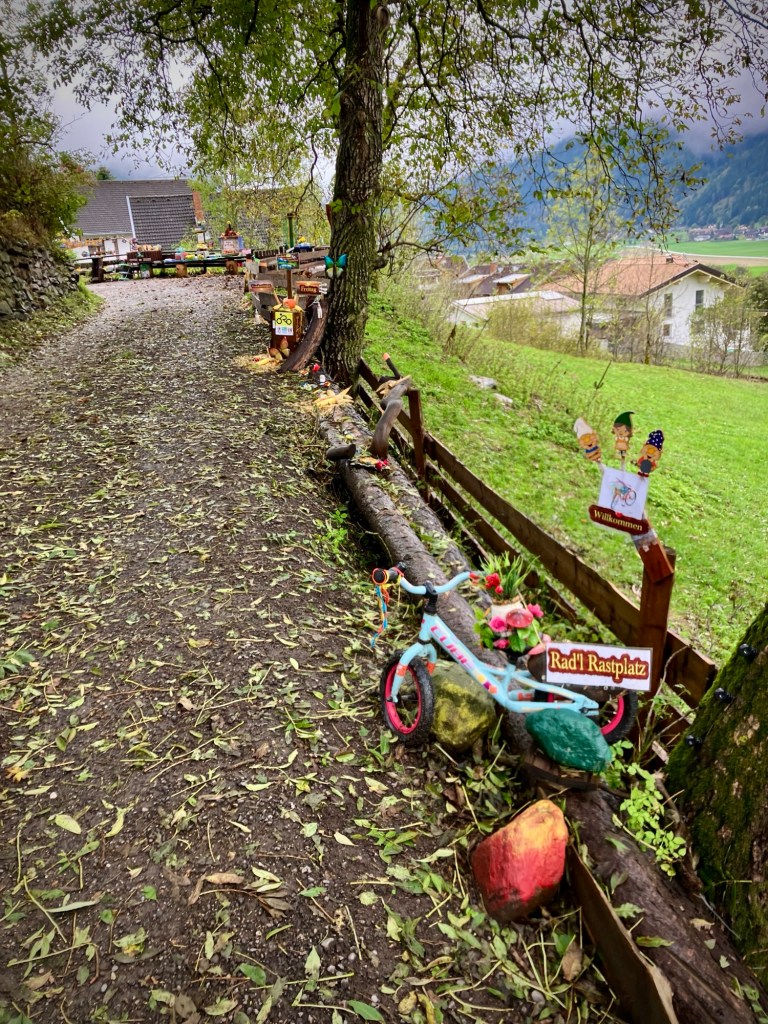
The locals provided their own rest stops for cyclists on the Alpe-Adria. This sprawling one had lots of food, bike repair supplies and a guest book. All free with donation box -:).
The friendly but somewhat incongruous Hacienda Mexicana hotel and restaurant in Spittal am der Brau. The room was good, and I’d love to say we found good Mexican Food in the middle of Austria, but …

The next day was another relentlessly rainy day with few places to stop and escape the weather. This is definitely a challenge on many long distance cycle routes; there may be lots of nice benches and even tables, but there are rarely covered rest areas, so bridge underpasses or farmers barn overhangs become your best bets.

Lots of cool bridge and tunnel engineeing in Austria.
Overnight in Villach, an enjoyable stop at the recommended Palais 26 Hotel.
Typical picnic lunch near the Italian border. Focaccia with various toppings are the new go to quick snack at small stores and groceries Note my mini bottle of Serrano Hot Sauce -:).
Near the Italian border at the pass.

As we rode over the second pass into Italy, we could notice the terrain and vegetation changing somewhat from the north side of the Alps. The most popular and scenic part of the route is the downhill decent from Tarvisio to Venzone along the former Pontebba rail route. It’s a spectacular route of viaducts, tunnels, and waterfalls. 

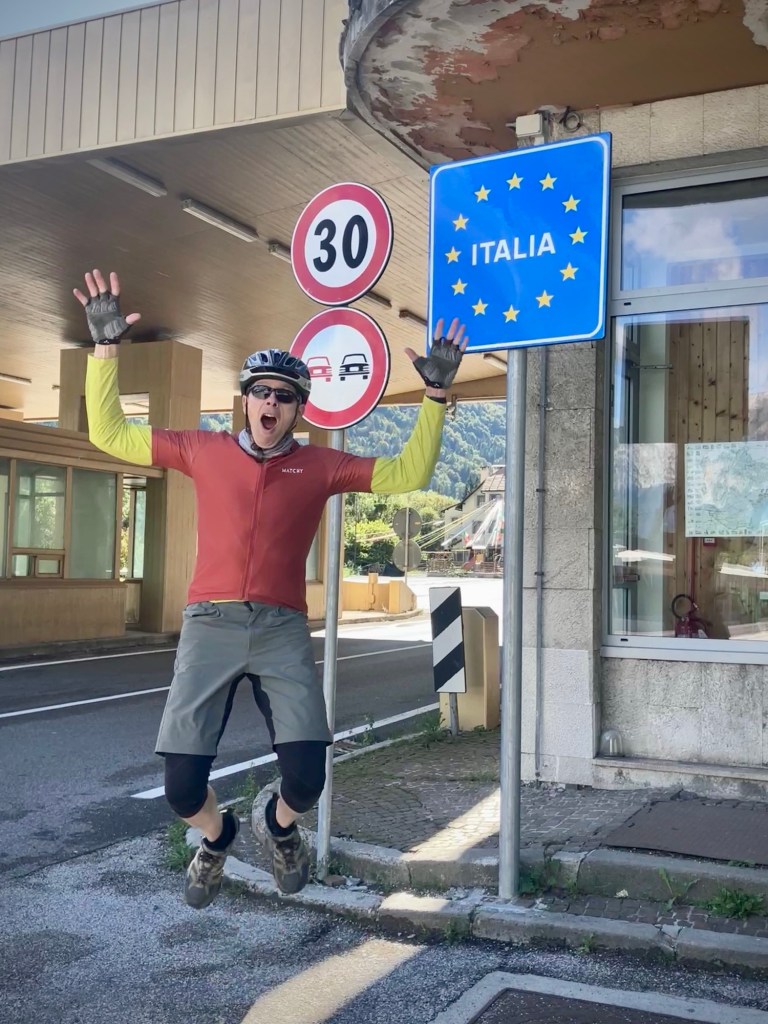
The Italian Border…we think.
I was excited to be in Italy again.
Cruisin’ over the crest.
Also so close to Slovenia here…it was tempting!
Heading out for an all downhill day from the lovely AlBuondi B&B in Camparosso.
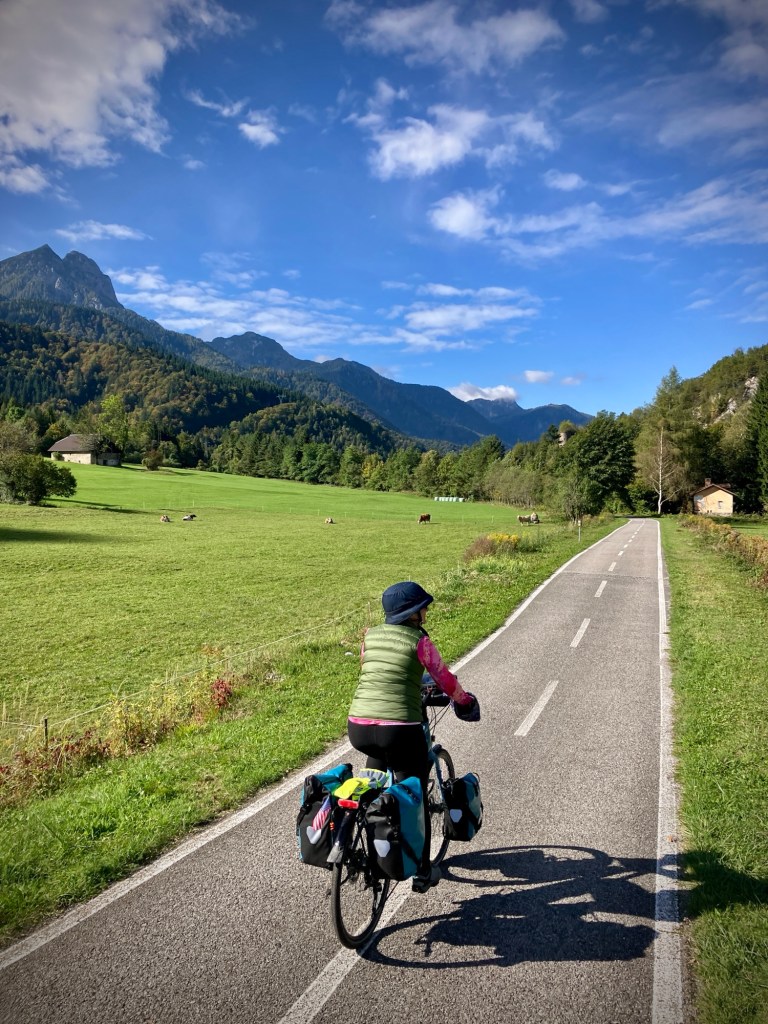
The stretch of former railway starts here and is perfect cycling bliss.
The Pontebba Railway was converted into this segment of the route in the 2000s. There is a newer (and straighter) rail line that now traverses the pass and valley.
And too many tunnels to count…
(ok there are 22)
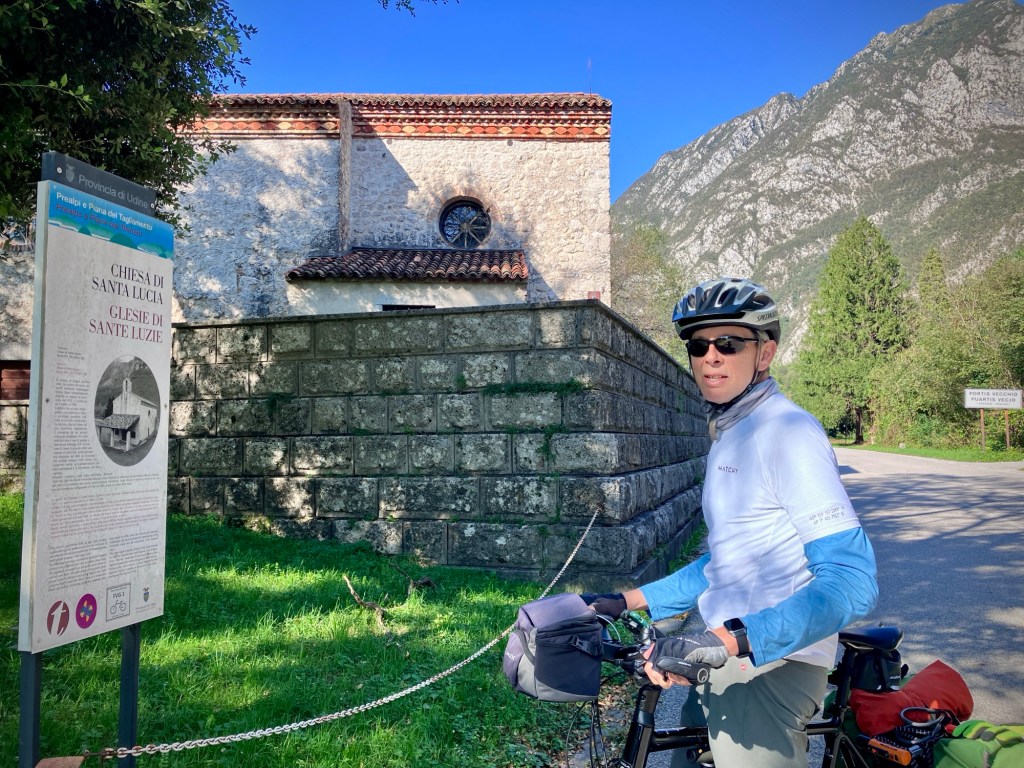
17th c. Church = shady lunch spot
My intrepid tour client.
Did we mention the perfect pavement?
Always great to see a Critical Mass sticker elsewhere in the world. Not to mention an arty Woodstock -:)
This 40km descent was a treat!
Most of the original rail bridges were retrofitted for trail use.
And constant views of the Dolomites.

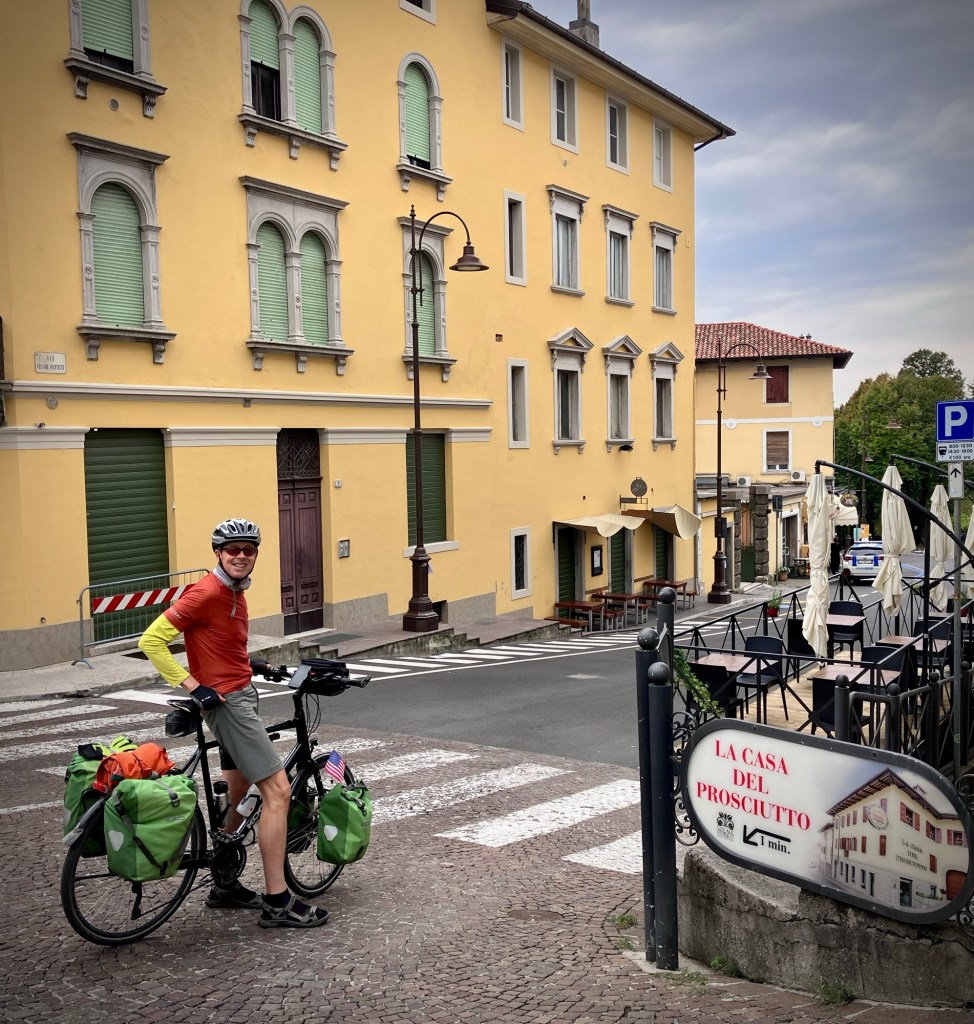
After a relaxing night at an apartment in the old town of Venzone, we took the recommendation of our cyclist host and rode an alternate route to Udine via the west side of the river valley and eventually back through San Gabriele del Fruili to Udine. The route was very nice and had some steep hills, a surprise pro bike race, and a chance to sample its famous prosciutto.

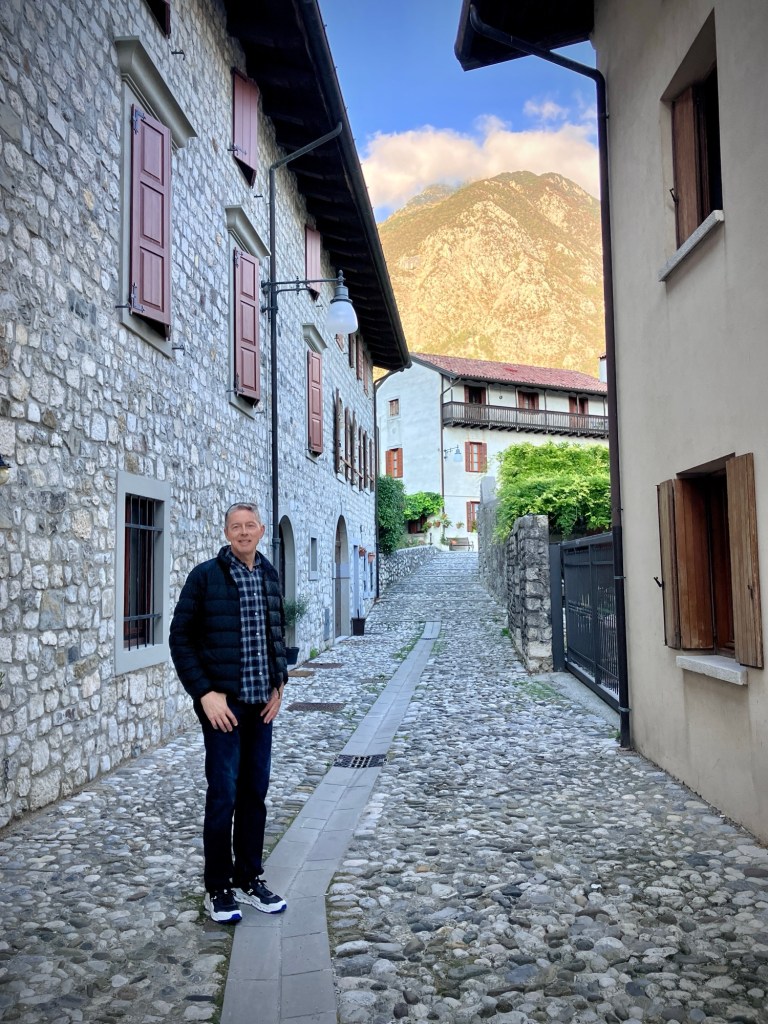
Vemzone is a tiny walled town that you can explore in a few hours.
Venzone suffered two devastating earthquakes in 1976, but showed amazing resiliency by rebuilding most historic buildings block by (numbered) block.
This rubble in the center of Venzone is a reminder that not everything got rebuilt from the quakes.
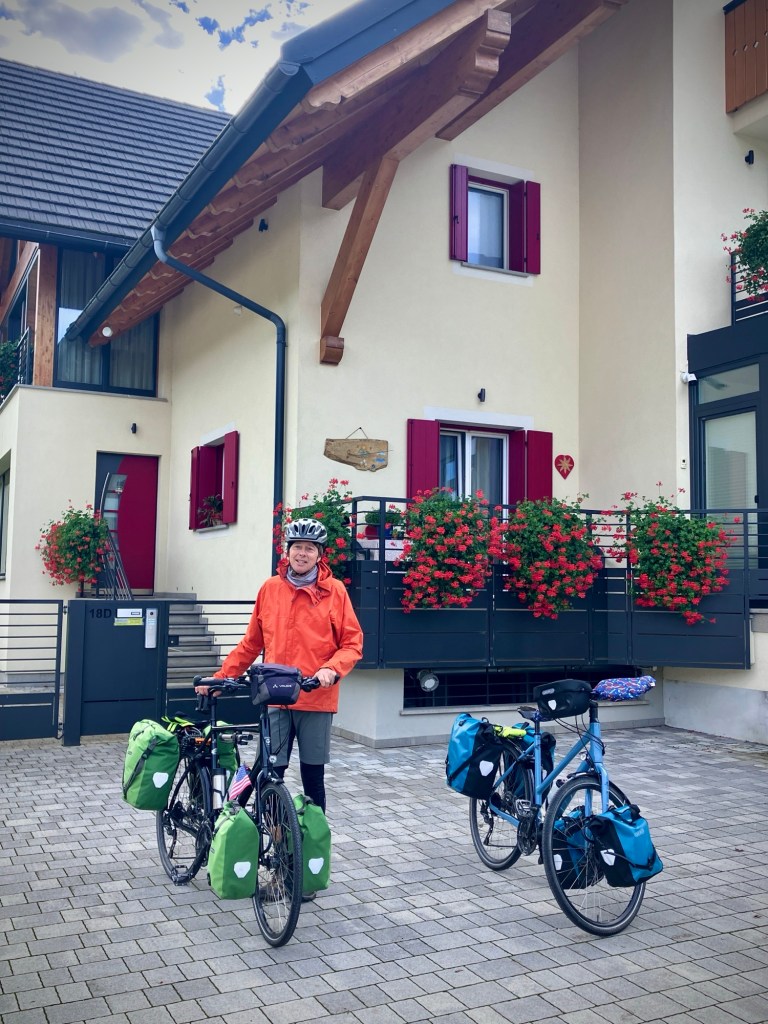
Renato, our friendly and helpful apartment host in Venzone.
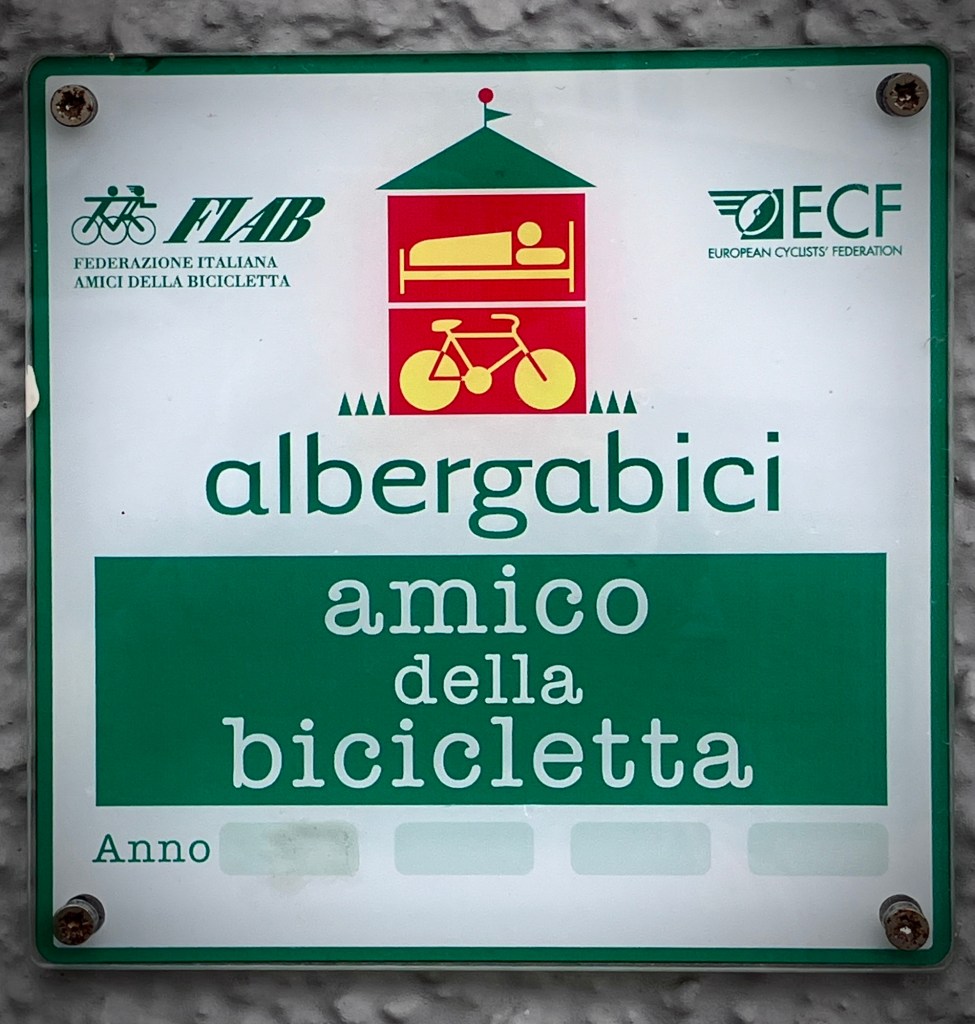
The sign for bicycle friendly lodging in Italy.
A chance to do proper laundry!
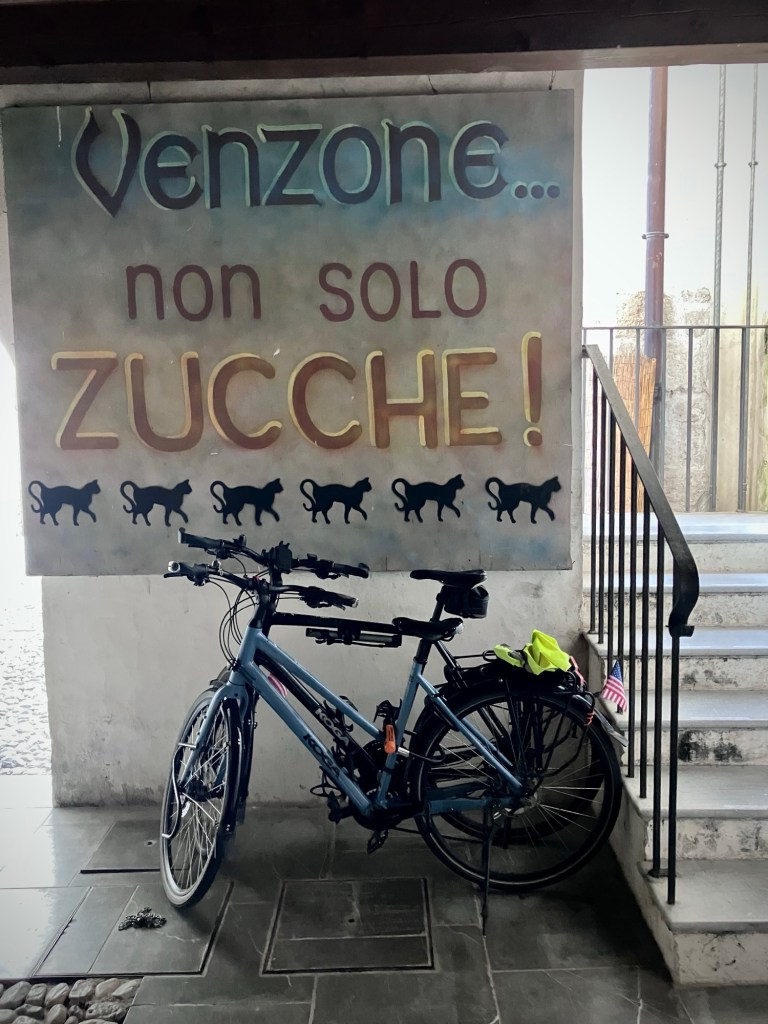
Bike storage for the night protected by cats.
The area around Venzone is now a seismic and building engineering research center, with various reinforcement and repair designs being tested in real time on historic structures.
Chilly for October 1st but not raining!
The beautiful and broad Tagliamento River.
Off the Alpe Adria, but still nice regional routes.
On the Tagliamento regional routes.
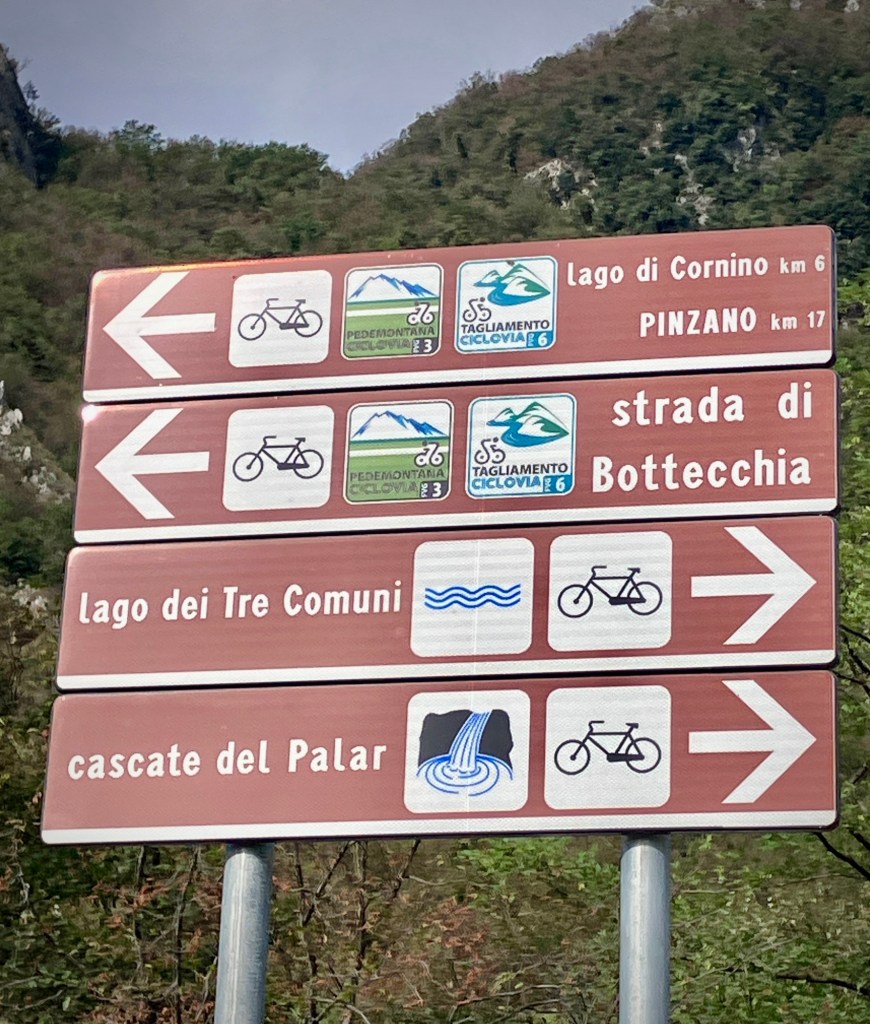
The story of Ottavio Bottechia, the first Italian winner of the Tour De France was more intriguing than we imagined.
This giant roadside bicycle memorial in Girona del Fruili celebrated 100 years since his historic 1924 Tour win. His body was found injured and unconscious here in 1927 and he died shortly thereafter after. Was he murdered? Too liberal for Mussolini? The mystery remains.
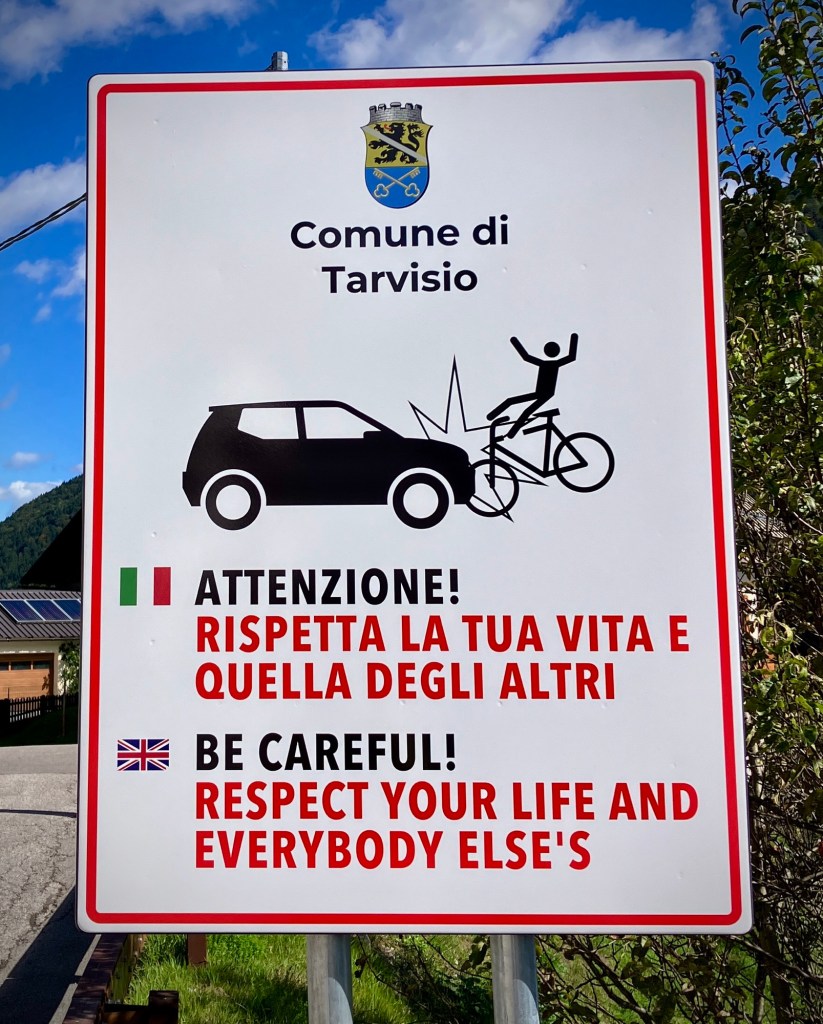
It’s a nice reminder but we did notice that the Italian drivers were more agressive and less considerate than their Austrian counterparts.
Watching for the Eurasian Gryphons at the Riserva Naturale Regionale del Lago di Cornino
The gryphons have been successfully reintroduced and protected across southern Europe. We spotted a bunch with impressive wingspans up to 8 feet.
San Gabriele del Friuli is famous for its buttery and luscious prosciutto.
There was a bike race starting in the center of San Gabriele, so we got our prosciutto supplies and headed out of town a quiet way down into a steep river valley. Quiet, so we thought!
Suddenly not so quiet as the motorbikes cleared the way for the race.
Cheryl caught on a steep climb by the field. She was not amused but the spectators were.
Cheryl literally got overtaken by the peloton on her touring bike and we were still laughing about it.
Finally done with our Alpe-Adria adventure; the happy cyclists in Udine, Italy

So we almost did the entire Alpe-Adria route except the last flat stretch to Prado. We diverted west at Udine towards Milan as we had a hard deadline with our long distance train back to Geneva and hoped to find some more rolling hills. But more on that soon in our next post. Ciao!

Not skipping stones.

Happy feet in sandals in Venice. Carnival meant confetti everywhere on the large paving stones.

Most folks don’t think much about the asphalt of the streets and concrete of the sidewalks until it’s not asphalt and concrete, but huge blocks or small chunks of stone. When you look down and see the streets and sidewalks paved with stone, large or small pieces, you picture the process of putting the stones down in the streets. In Italy I was fascinated with the choice of paving materials. Who wouldn’t be? My fascination started in Venice and didn’t stop.

Confetti canal side in Venice.

It wasn’t until we left Venice that I read about the use of lighter colored stones on the edge of the canals and bottoms of steps to alert pedestrians that they are about to step into a canal or tumble off stairs. When I went back to look through my photos, sure enough, there they were. Safety stones.

The edge of the lagoon is obvious in broad daylight, but imagine a dark cloudy night before electric lights. You’d be glad for that strip of white stones.
The black paving stones of Naples. And some well worn hiking boots.

Dark Vesuvian lava blocks pave the older streets of Naples. I assumed the surface was natural, but apparently on some stretches, especially the stairways, the dings and impressions come from hammers and chisels to create a less slippery surface when wet.

Naples paving stones in the rain. They look slick, but the dangerous surfaces were the metal utility/manhole covers.

How could anyone fail to notice the cobblestoned streets of Pompeii and Herculaneum? However, it would be easy to miss the small white stones placed in the joints as cats eyes, or reflectors.

Small, not so noticeable white stones, but helpful on a dark Herculaneum night.
A giant stone jigsaw puzzle leading out of the amphitheater in Pompeii.

After the dark paving stones of Naples the streets of Bari old town were a surprise. Of course people used the local stone, the ‘chianche’ (the big paving stones) in Bari are mostly white or cream, with black pavers used, apparently, to help merchants unfamiliar with the old town find their way out.

Bari ‘chianche’. And a wet boot.
The light color of the stones in Bari makes a wet night time stroll quite atmospheric.
The stones are a lovely backdrop for the green plants of a resident gardener in Bari. I always appreciate intrepid urban gardeners.
The warm glow of decorative lighting makes Bari magical at night.
The town of Conversano pavers were light colored as well, and a bit slippery when wet. This night time photo was taken as I carefully picked my way along on boots that had the tread worn off from miles and miles of use.
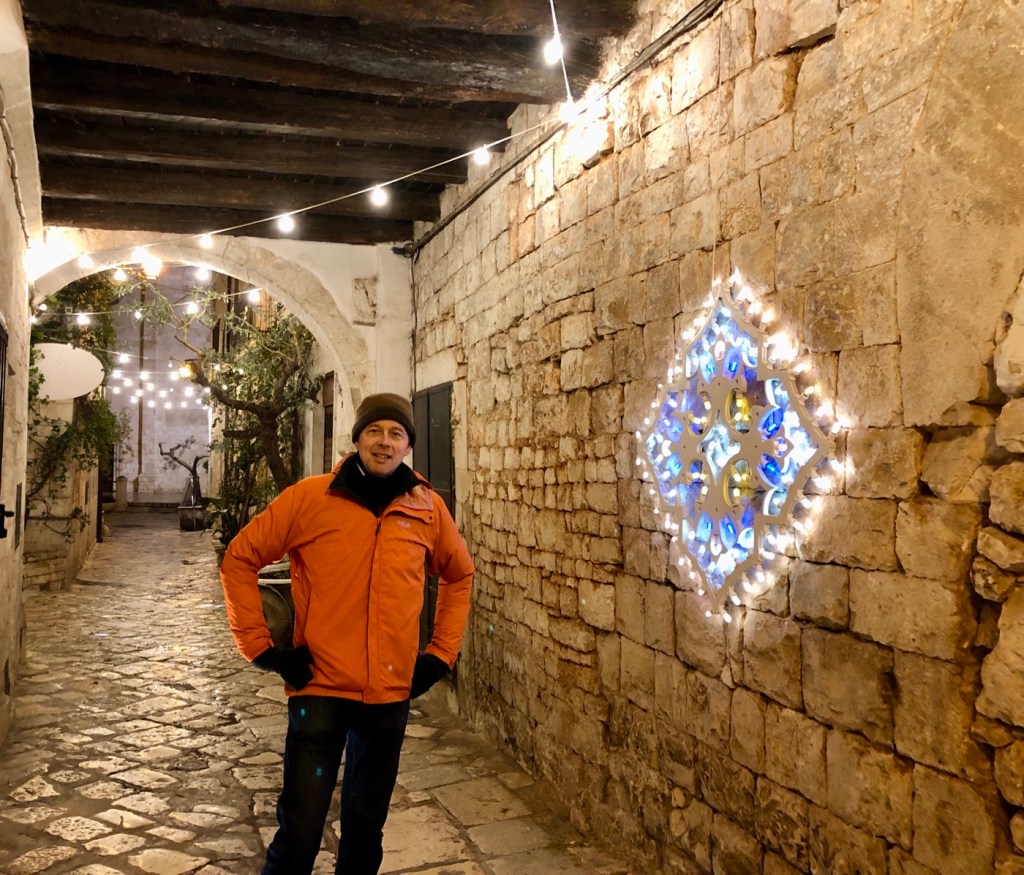
Luminaria, which we saw being created in town, look beautiful against the creamy stone of Conversano.
This kitty knows the stones are very flattering to their coloring, and that Rich is always good for a scritch.

We knew that metal utility covers were slippery, but I hadn’t appreciated how tricky they might be to integrate into paving stones until the town of Alberobello. While most visitors look up at the Trulli, make sure to also look down and admire the paving stones.

The metal utility cover on the left must have taken some time. The stone faced cover, upper right, blends quite well.
Another utility cover, this one set cross wise against the flow of pavers. Oh, and some lovely Trulli.

Rome. Rome. Rome. Where the stones you tread were trodden by Julius Caesar, and marched upon by Roman warriors and enslaved people who were the capital of the empire. Our time traveling in the UK, Morocco, and Italy gave us a good look at the extent of the Roman Empire, but I hadn’t visited Rome before.

The road from the forum to the Colosseum. We arrived early to admire the mostly empty paving stones.
In the Forum. Rich added for scale. Huge pavers.

Apparently, the small cobblestones of Rome’s roads, “sampietrini”, which means “little St. Peters,” are being replaced with asphalt on the main, busy roads. It will make for a quieter and smoother surface for bikes, scooters and trucks. But, the promise from at least one mayor is to move the paving stones to smaller more pedestrian scale streets. It would be fascinating to see the cost benefit analysis of stone versus asphalt. Wear and tear. Re-paving costs. Environmental considerations. Is my inner bureaucrat showing?

A lovely small street in Trastavere. Cobbles intact. They certainly win the charm competition.
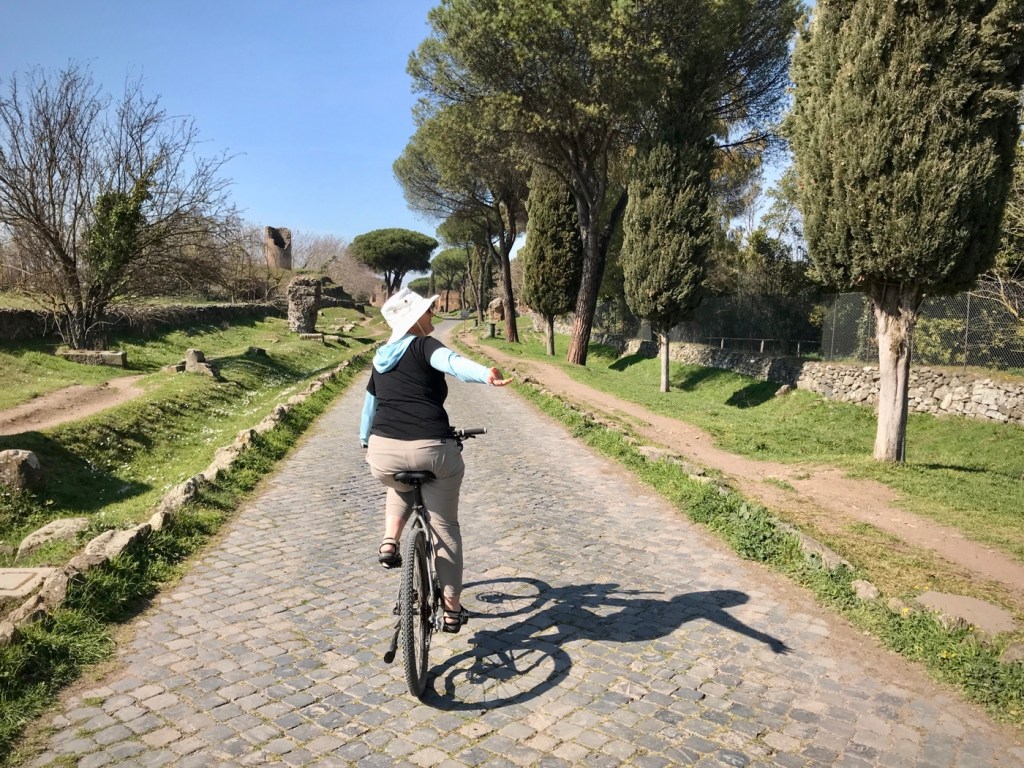
The Appian Way. A road built to march armies and supply wagons. Those large stones were the surface, they were laid atop an under layer of gravel, smaller stones and mortar. The surface was smooth, but now it’s a better idea to go around these bits on your bike.
We’re in San Francisco now, catching up with friends and sharing our travel tales. Traveling the world is amazing, but being somewhere familiar, and where we have wonderful friends is rejuvenating.

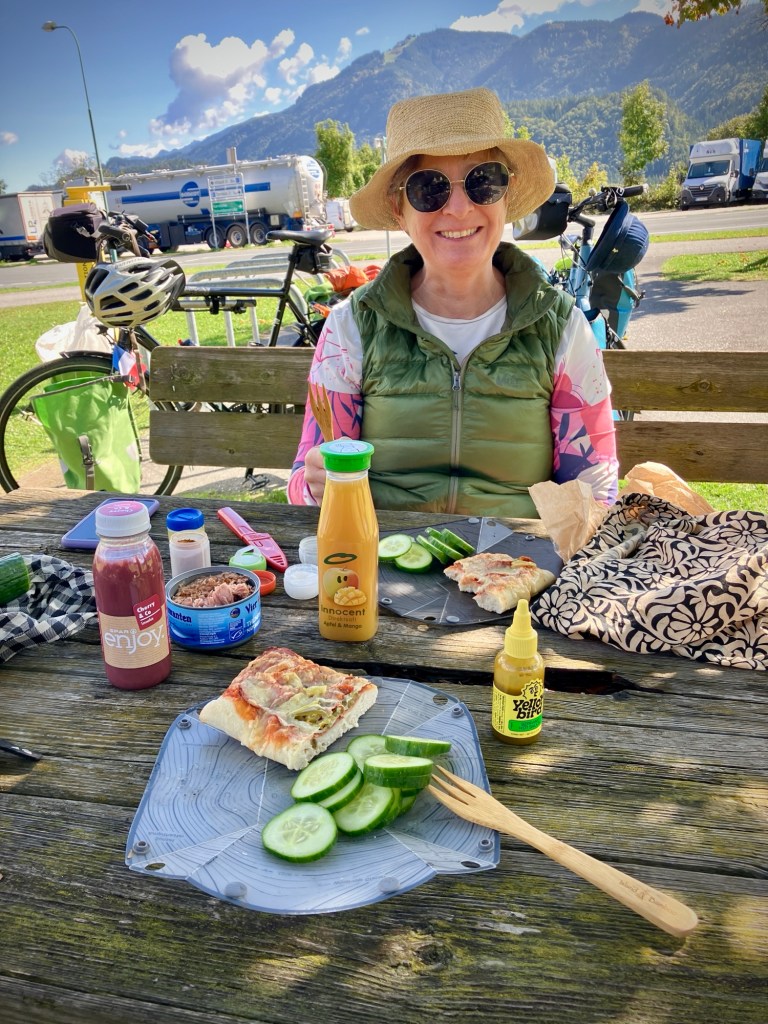
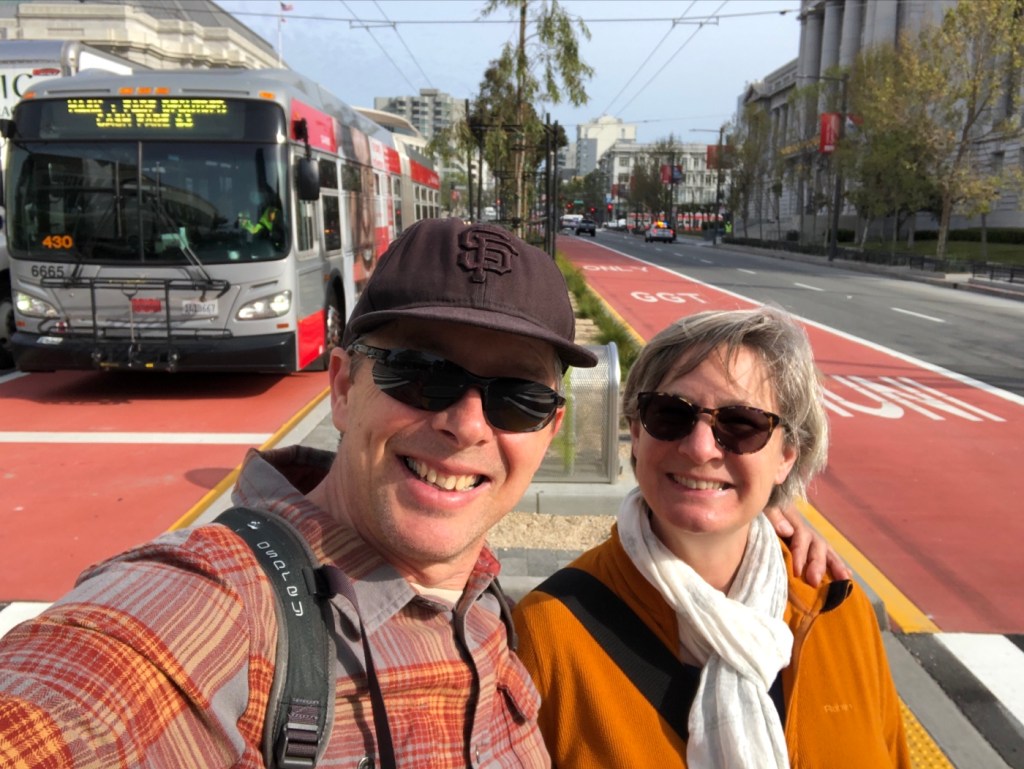
The Happy Travelers admiring a modern road surface, red bus only lanes on Van Ness Ave in San Francisco.

From Bari to the Bay…

We get a lot of questions about long-term travel and what is it like when you return after 7 months abroad. First off, it’s wonderful to see friends and family again. Nothing beats it.

When will the Coliseum be so empty again? A unique time to travel.

But now that we’ve been back in the US a little over a week, I can tell you that it IS a bit of culture shock. We have experienced so much together, and adjusted to a life where people and places are constantly unfamiliar. Our first reaction when landing in Chicago was how clean everything looked. As much as we loved Rome and live in awe in the layers of history, there is little arguing that it is a pretty untidy city. Dirty, some might say. It’s hard to get 2,500 years of urban stains off things, right? America is actually pretty tidy, or at least we hide our trash well.

Gritty and organic Rome, some wouldn’t want it any other way.

The second thing we noticed immediately is the change in scale and space. Ah yes, precious elbow room, as almost everything in the U.S. is upsized. It felt nice to stroll the endless connected Chicago sidewalks, with plenty of room to pass, and streets wide enough to turn a stagecoach.

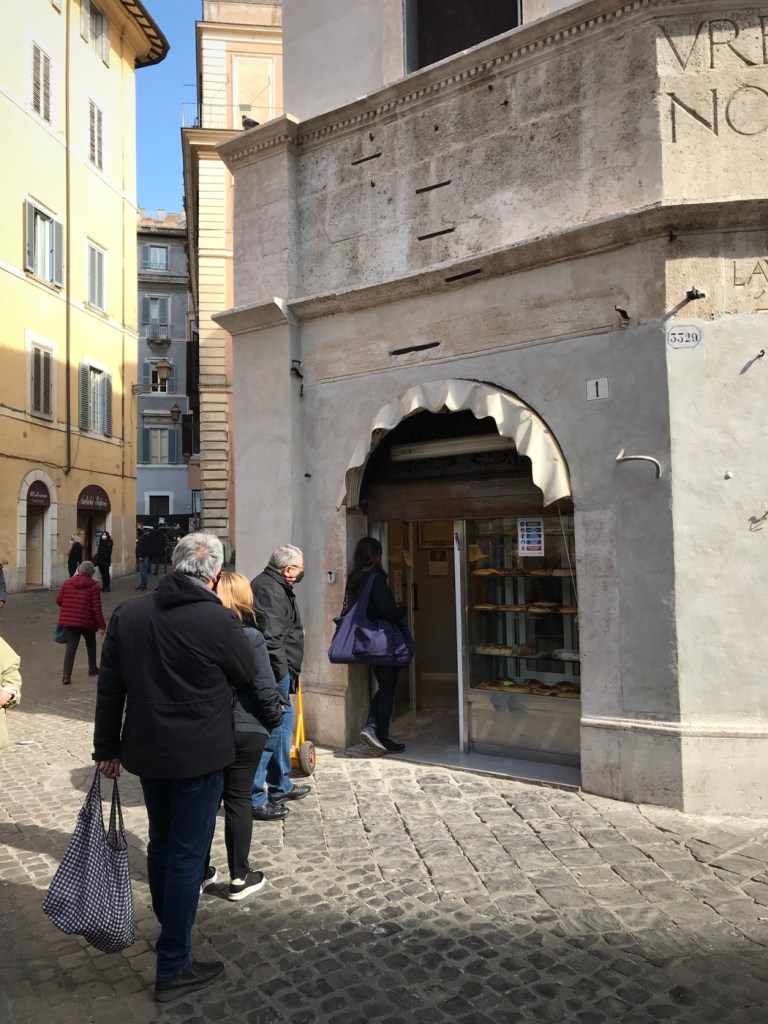
The venerable Pasticceria Boccione in Rome, which features 300-yr old recipes for wood-fired Pizza Ebraica and other Kosher treats. Luckily, Cheryl was already inside!

And after arriving in Colorado this week, we can’t help but be awestruck by the vastness in which many of us live, especially in the American West. There is really nothing in Europe that even comes close, and I think this is why Europeans (and Americans of course) especially love to travel to this area, and always insist on going to Vegas. They are unique, vast, and truly American. And they do define who we are, as most Americans are more comfortable in a Costco than a compact urban Bodega.

Yup, lots of space here in Western Colorado.

Finally, I realized that the past 7 months has changed us and our outlook. Cliches about travel aside, we absorbed more European (and Moroccan) culture and, as with all good travels, take the positive aspects with us. For me, I have learned to truly enjoy slow coffee and the plaza cafe culture. The impact on your psyche from the wet and dark Northern European winter. (Gimme sun!)

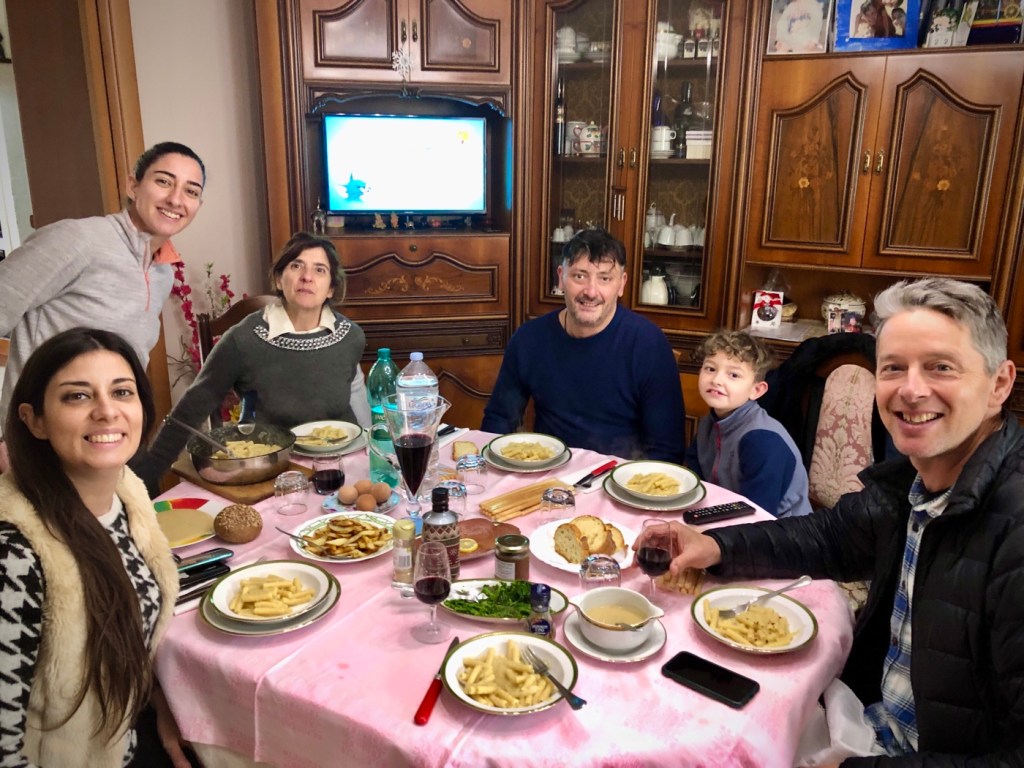
Our wonderful Italian hosts in Conversano: embracing the joy of a long family lunch

And the pure and simple pleasure of a 3-hour Italian dinner with new friends. You need to have a general humility when you approach foreign cultures as an outsider. Embrace the new, and adjust your expectations. And maybe now I’m a bit more patient….maybe.
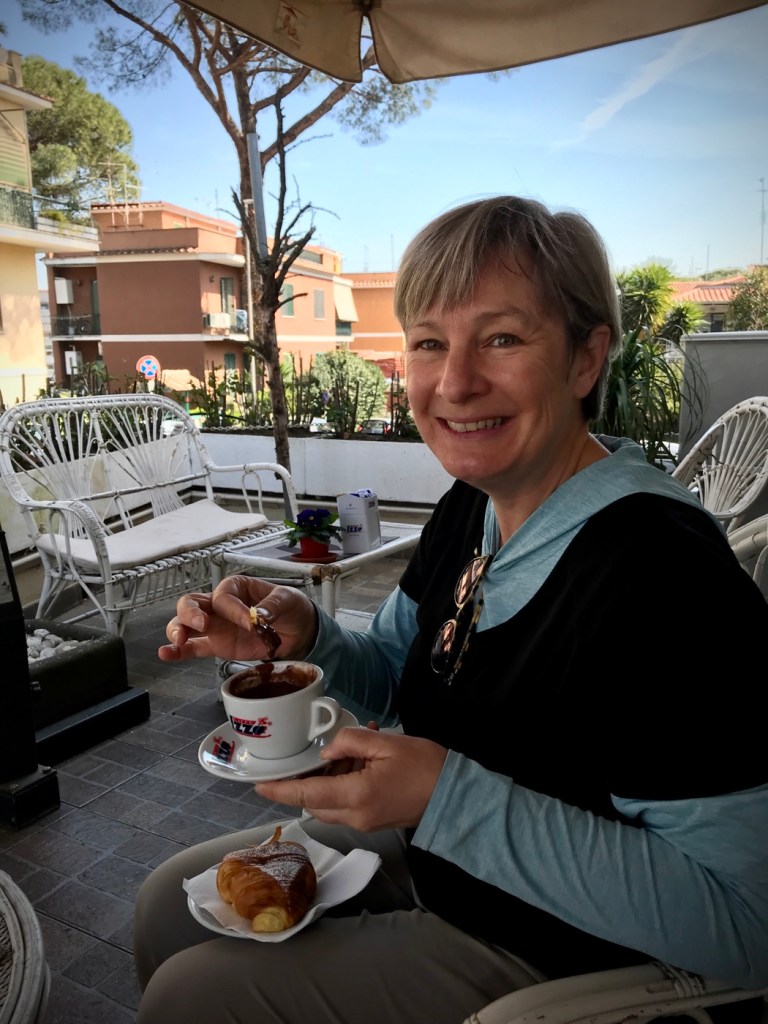
New family friends in Italy after a typical Italian breakfast of a Cornetto and caffe.

Travel is also always unique because it happens in the context of the time. We experienced the end of one COVID wave and rode out the first surge of Omicron. The pandemic has mostly been a shared global experience that immediately connects you. The recent drama and tragic unfolding of the Russian invasion of Ukraine is of global concern, but also a way to immediately connect with other travelers or locals.

City hall rally in support of Ukraine, Bari, Italy

So first a few logistics updates on how we got here? From Bari in Puglia, we caught one of two daily intercity trains to Rome. (They actually start further south in Lecce). We opted for the morning train, as the late afternoon train arrived Rome at 9pm, and we always find arriving a foreign city is especially disorienting after dark. We stayed in the Travestere neighborhood of Rome, which is an excellent alternative to the more touristed and hectic side of the Tiber river.

Elevenses in the UK or just a late breakfast cycling break off the Appian Way – Ciccolado caldo and a Sfogliatella

It was also easy to catch the bus or tram to the airport trains at the Roma Travesterre train station. The train connection to Rome Fucinolo airport is excellent and nice new trains leave every 15-20 minutes.

Catching the airport train….still traveling light after all the pizza and pasta!

For our air travel, we again flew TAP Airways from Rome To Chicago via Lisbon. TAP is a member of Star Alliance, and has nice new A330s on most of their long haul services. Very comfortable seats in a 2-4-2 layout in economy. I also highly recommend getting the Plus fare, as for just a bit more money, you get seats in the ExtraEconomy section, two checked bags, and priority check-in. Worth it if you’re tall, and as we noted, our section was less crowded that standard economy. The other big upside of TAP is that they sell one-way fares à la carte, so no penalty versus outrageous one-way fares still charged by the bigger legacy airlines such as Lufthansa and United.

Sparkling new airport trains to Roma Fiumicino. Luggage racks, digital displays, and USB power sockets….check!

The downside of TAP is the Lisbon airport itself….it can get very crowded, and the gate/plane connections are often via shuttle buses from the tarmac, as were both our arrival and departures this trip. But they do pass the savings on to you! They also allow free stopovers in Lisbon or Porto, which is great, and a way to break up the LIS airport experience.

Sticking to our preferred travel modes to O’Hare – CTA bus to the Blue Line El…a bargain in Airport transfers at $2.50, and easy with contactless payment

We arrived to Chicago pretty late, so stayed at a convenient Airpot hotel before visiting family near the Airport, and then two Metra trains to connect with other great friends, who generously hosted us for 4 nights. As a bonus, it was St Patrick’s Day and the Chicago river had a visible green tinge. Americans love to celebrate our immigrant culture, which is still a huge differentiator from many countries in the world. The brave and bold immigrants who continually arrive in the United States are a strength that should not be underestimated.

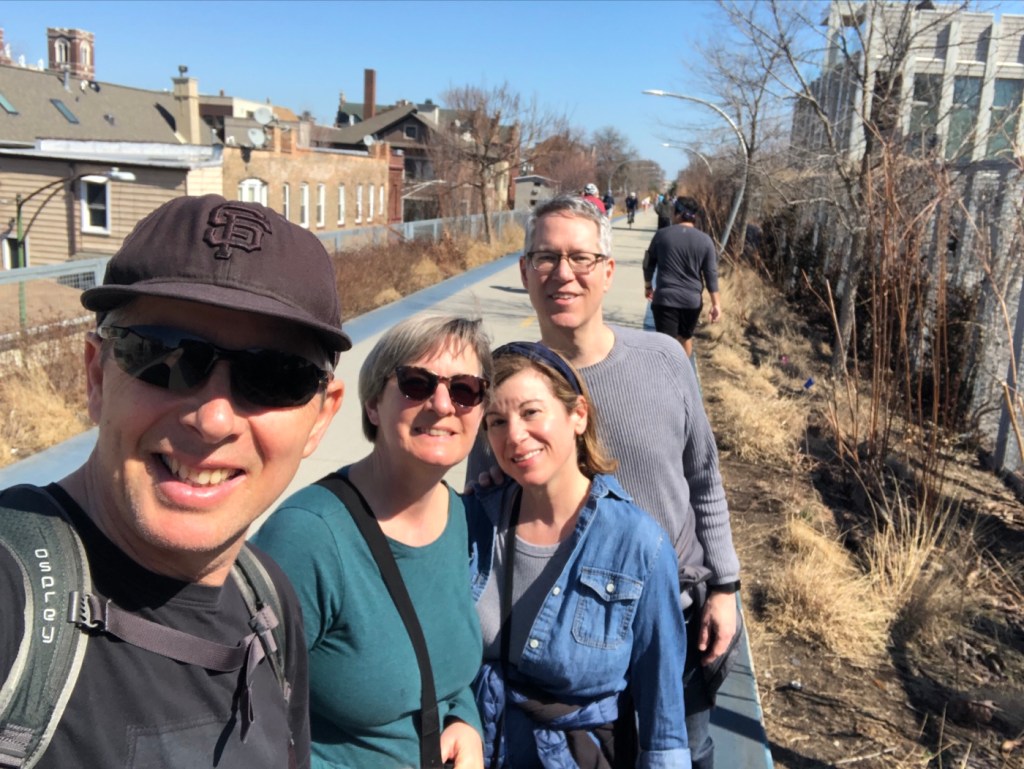
Exploring the fantastic elevated 606 trail in North Chicago is even better with good friends!

Another wonder of America is the food, as we quickly checked off 3 major food cravings; a great Mexican platter, Thai/Lao delight, and a heaping bowl of ramen. Oh, soooo good! The food in Italy is amazing, but these American taste buds miss the foods of the world.

A Classic Roman lunch in Travestere: Tonnarelli Cace e Pepe, Trippa alla Romana, and Cicoria Strascinata in Padella.

So as we head back to California this week, we are filled with the anticipation of the familiar world of the San Francisco Bay Area, but also both feel a bit of apprehension. We are different people than the working, locally engaged homeowners of a year ago. We have embraced the vagabond life, worked hard to get to this place of freedom, and both know know that we still have a lot of the world and new passions to explore.

Getting our America on in Devil’s Canyon, CO

We will settle down again some day, and when we do, will invite everyone we have met to join us…but not quite yet.

Where to next Cheryl?

Happy Traveling!

Nasoni di Roma

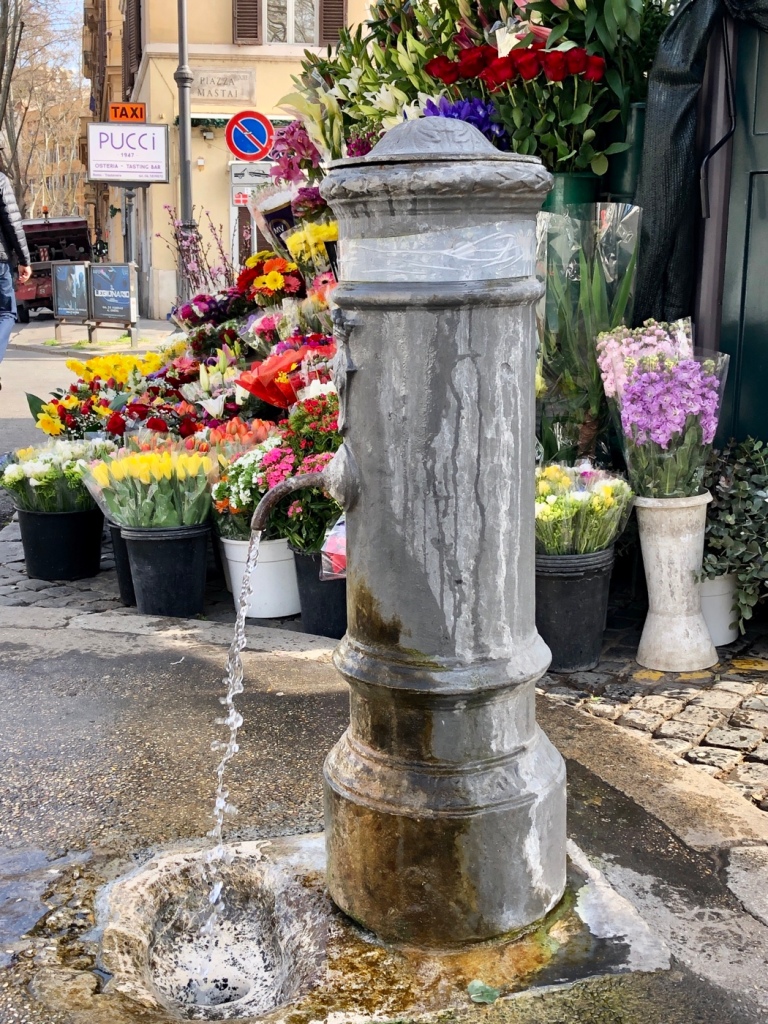
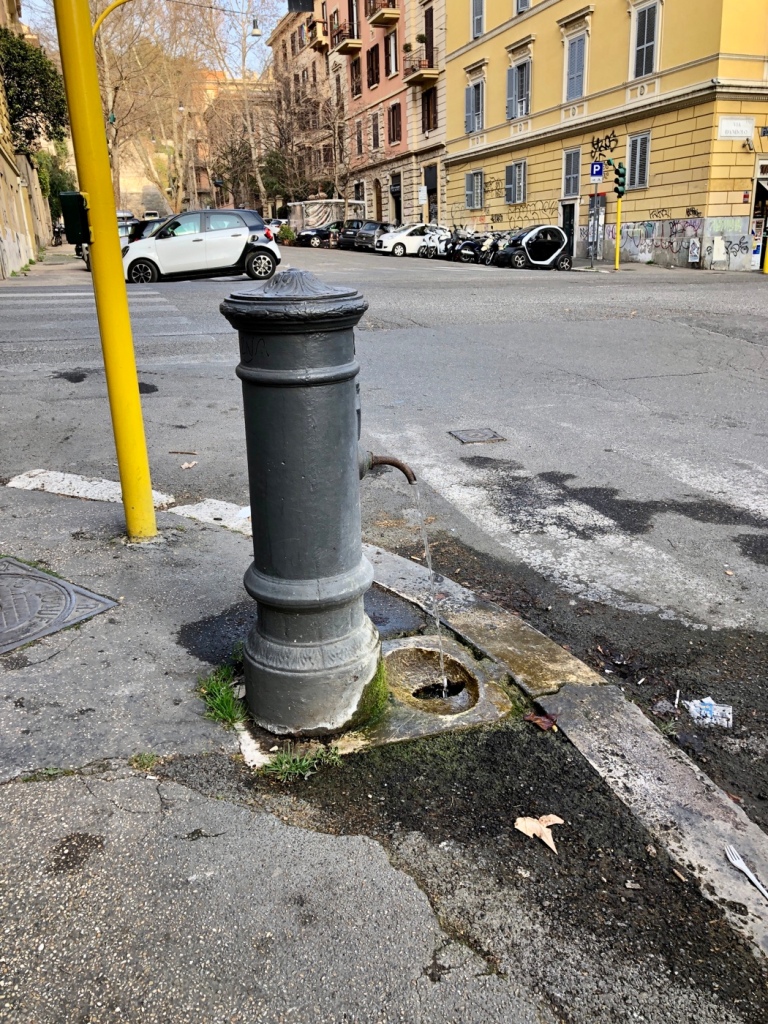
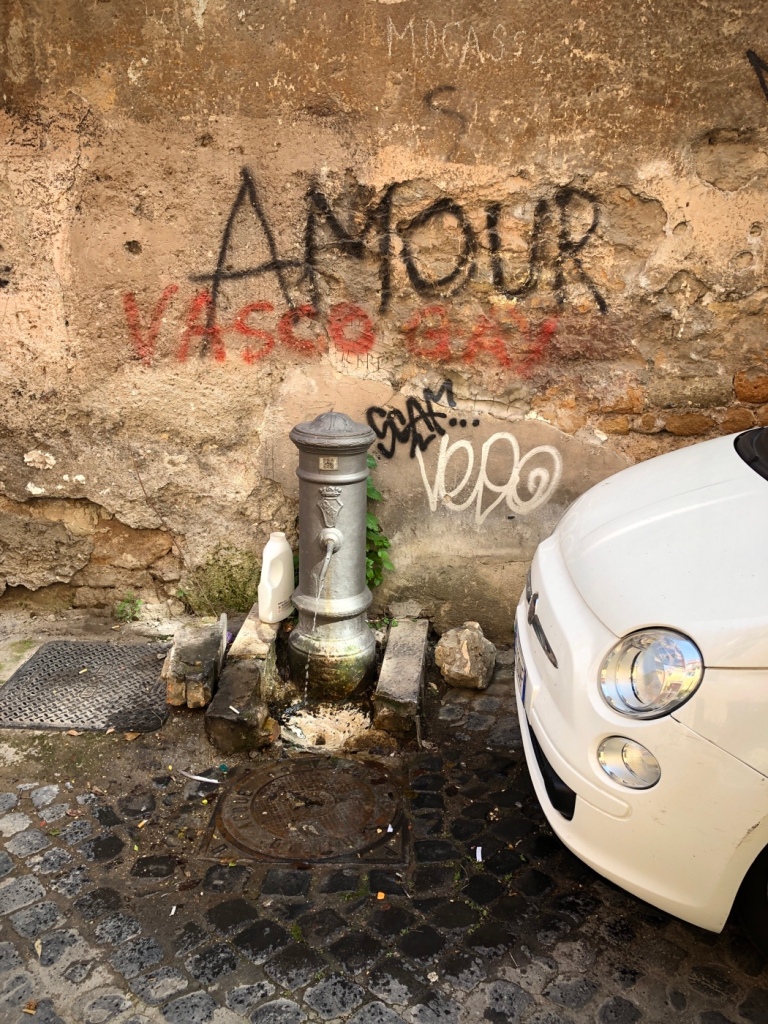
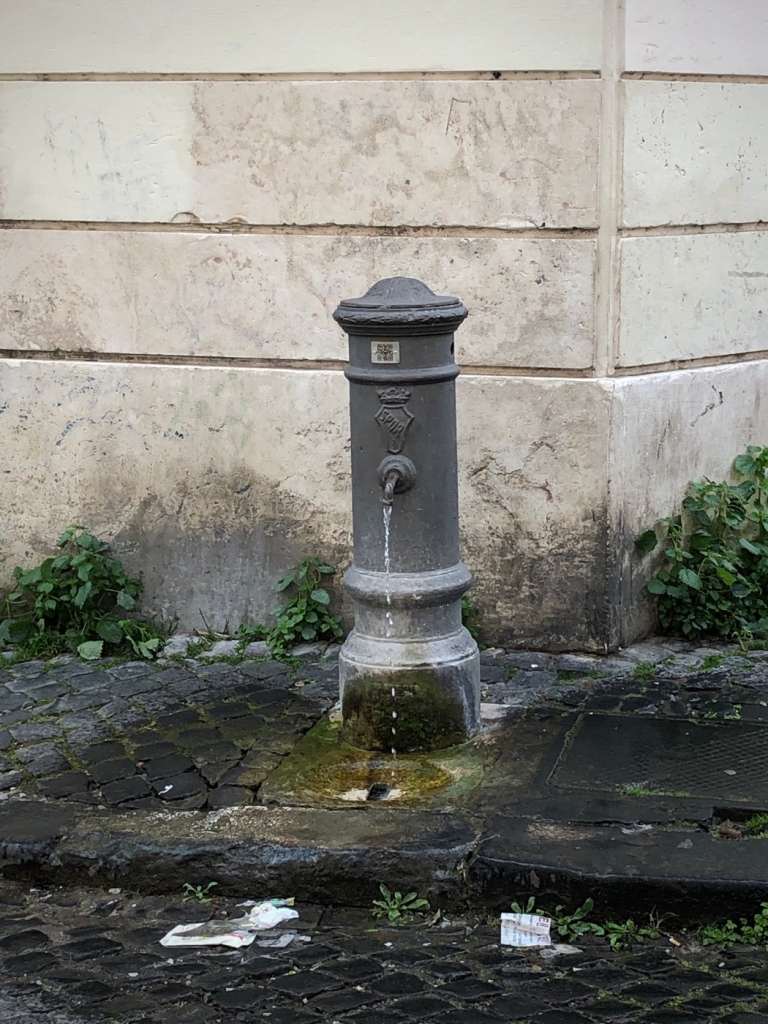
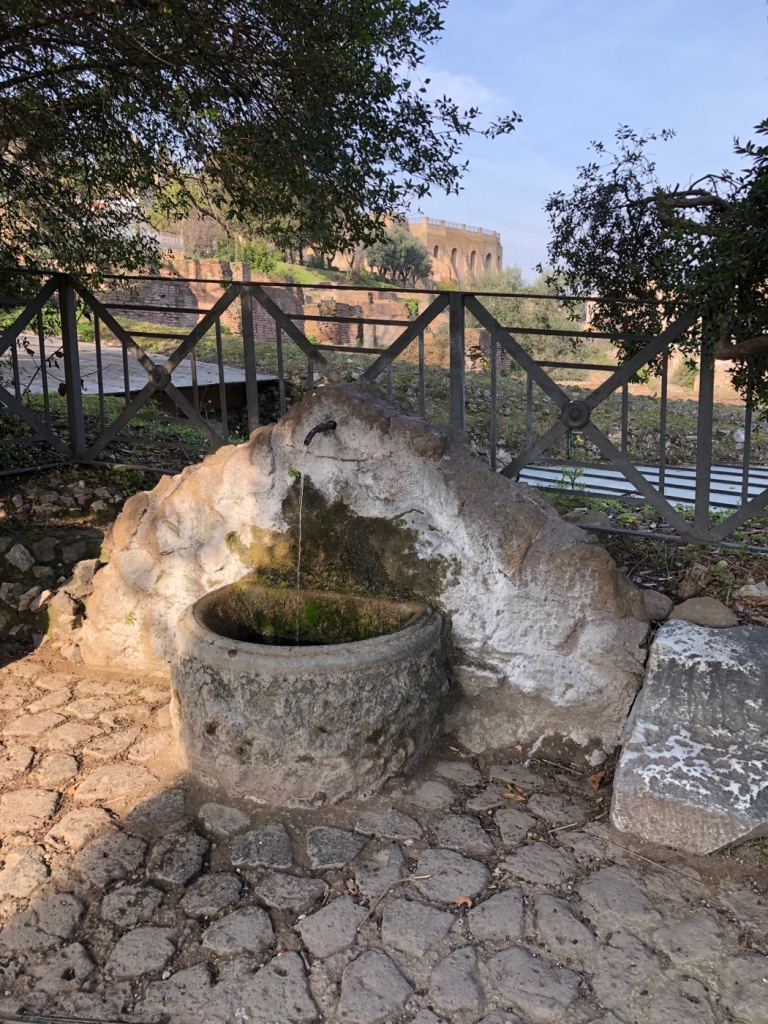
The noses of Rome? They are everywhere. Approximately 2,500 -2,800 big noses. Water fountains to you and me. The nose refers to the metal spout, which sticks off the fountain like a … nose. In place since the 1870s they are a little Easter egg hunt as you walk the city.

Nasone (plural nasoni) in front of a flower vendor.

If you come from California, a state usually struggling with and talking about drought, the sight of constantly running water fountains is a bit shocking.

The nasone down the street from where we stayed.

It may seem wasteful to us, but the company in charge of supplying water to Rome says the constantly running fountains only account for a small percentage of water loss, 1% or so, compared to the loss from old and leaky pipes. It is the same tasty drinking water as that supplied to homes.

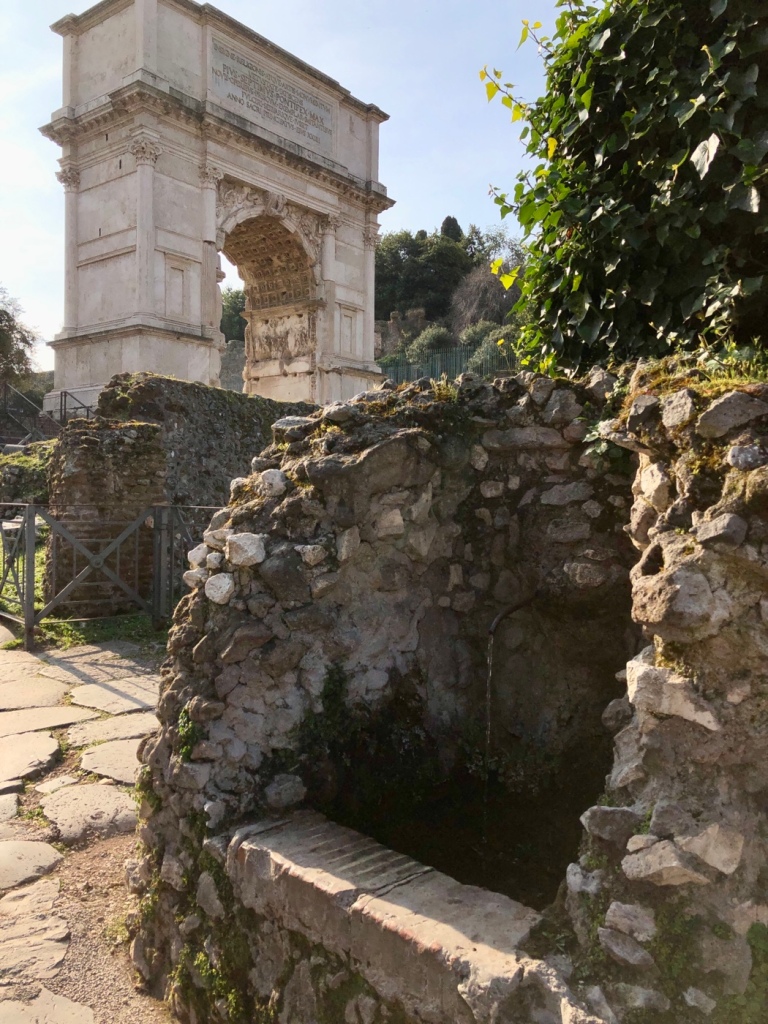
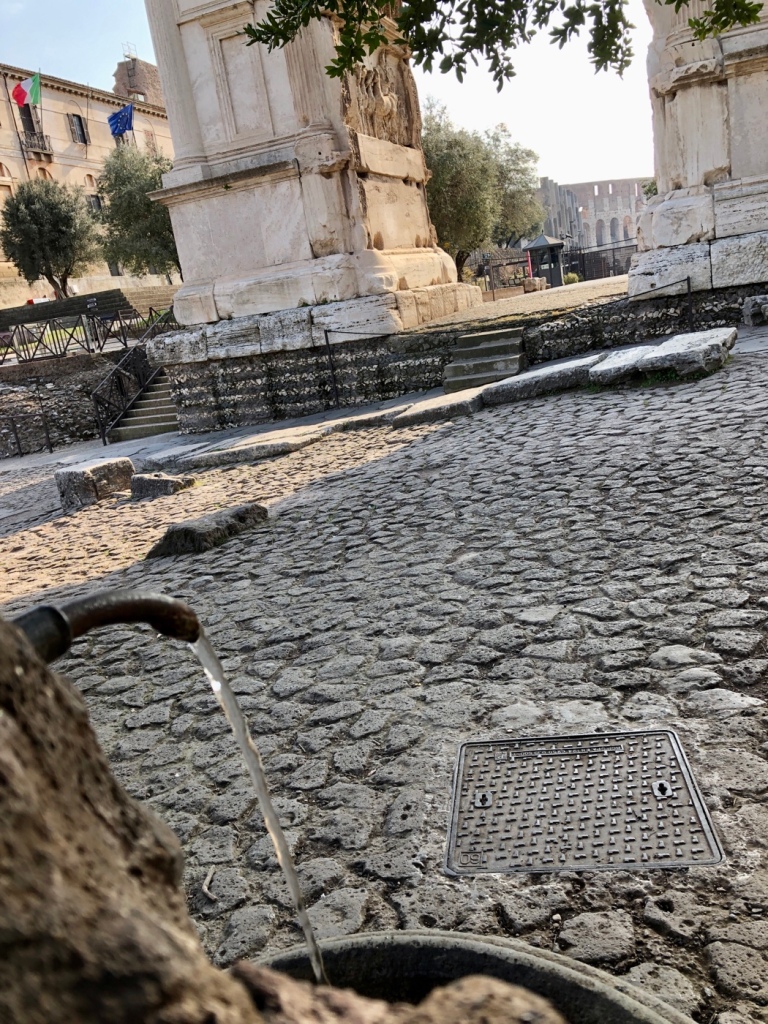
A nasone in the forum with Arch of Titus in the background.

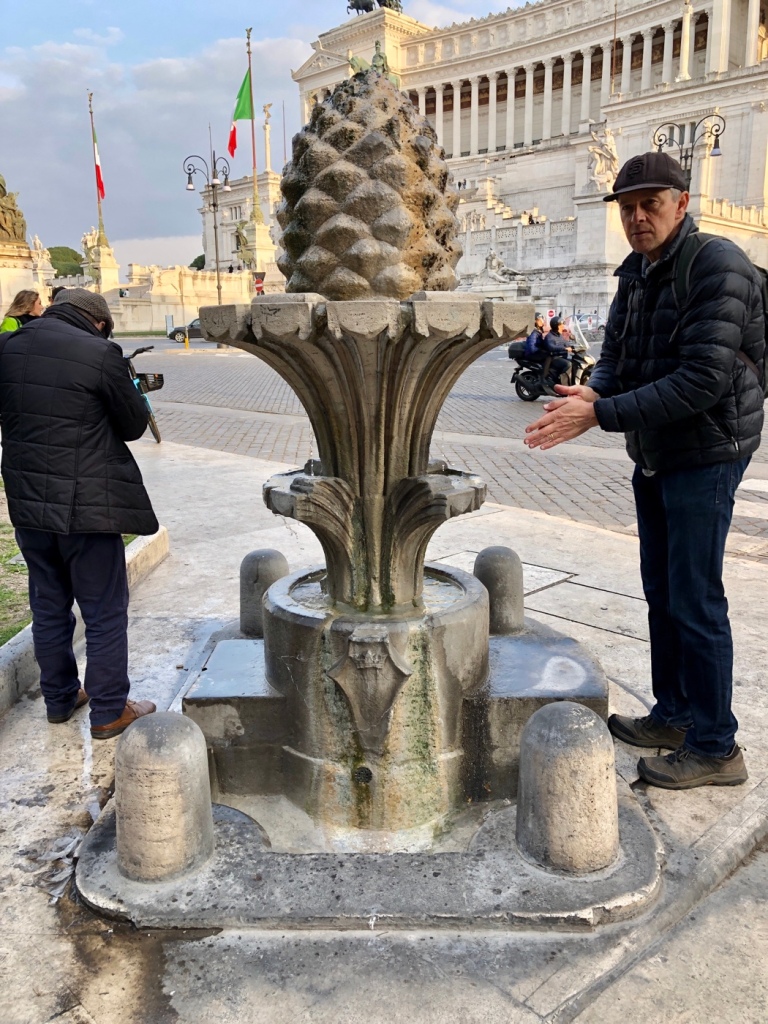
Some fountains have glamorous backgrounds.

Beautiful fountain across the street from the Alter of the Fatherland.
Another nasone near the Arch of Titus in the forum.

Other nasoni have more utilitarian surroundings.

Representative of a typical street scene.

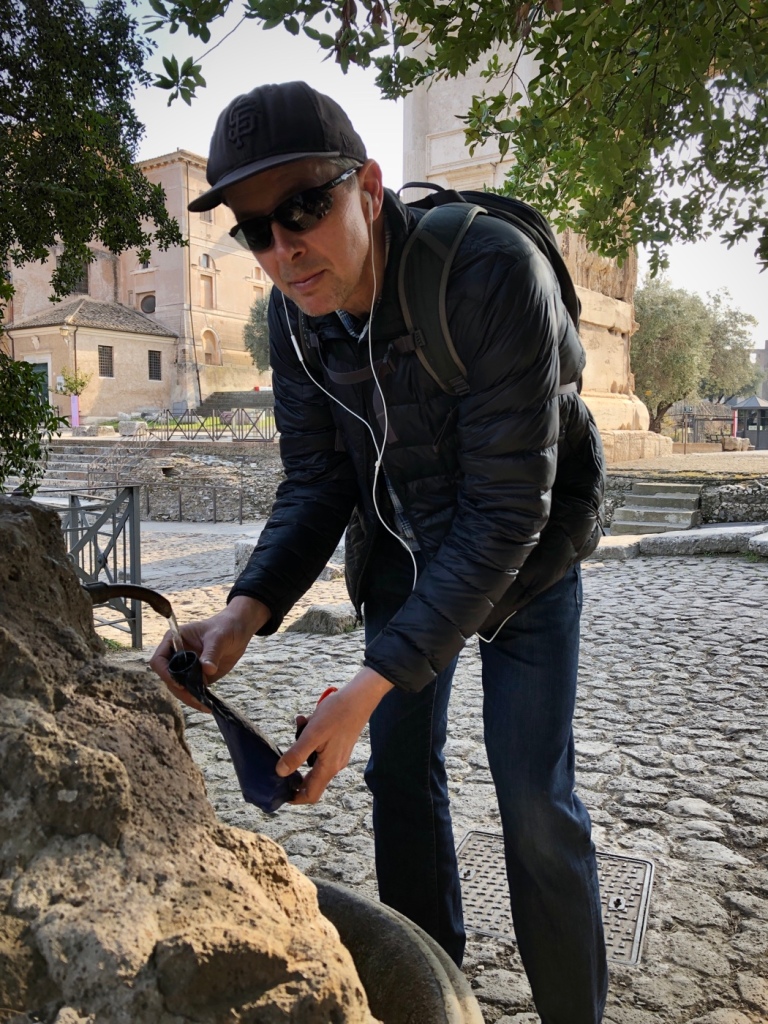
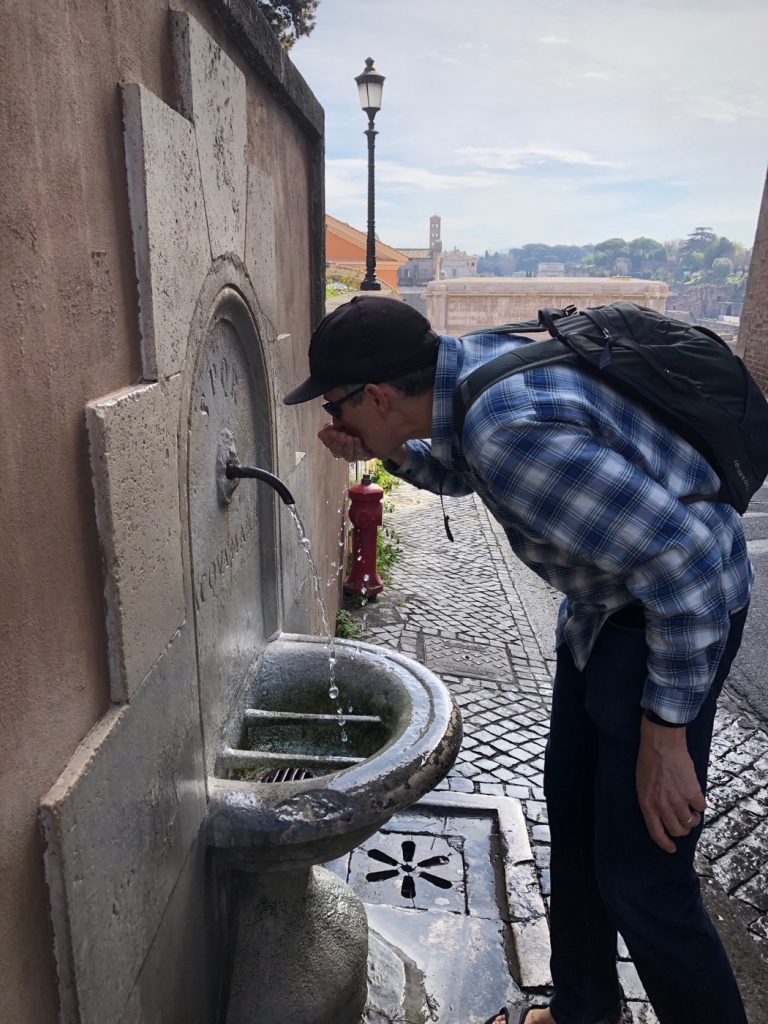
The metal spout has a small hole at the top of the arch. If you put your finger over the bottom spout water will arc up from the hole to create an easier to drink from fountain. We didn’t know this until later, so we either filled our water bag or slurped the old fashioned way.

Rich filling our water bag while listening to an audio tour of the forum.
Slurping. Again with a dramatic background.
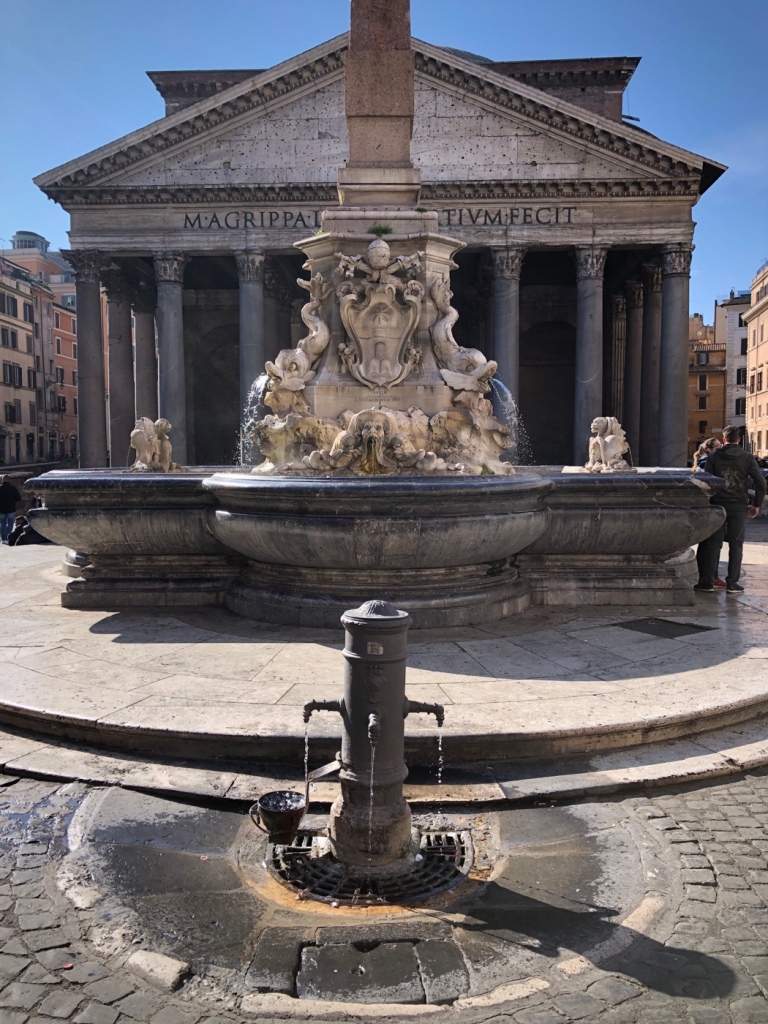
Piazza della Rotunda nasone, that’s the Pantheon in the background.

It wasn’t hot while we were in Rome, but I imagine these fountains are even more appreciated in the heat of summer. It’s nice as a tourist not to have to worry about finding water. And, no need to carry a full water bottle, which keeps your day pack lighter.

Unassuming but so useful.
Is my back to an amazing Roman ruin while I snap pics of a fountain? Yes.
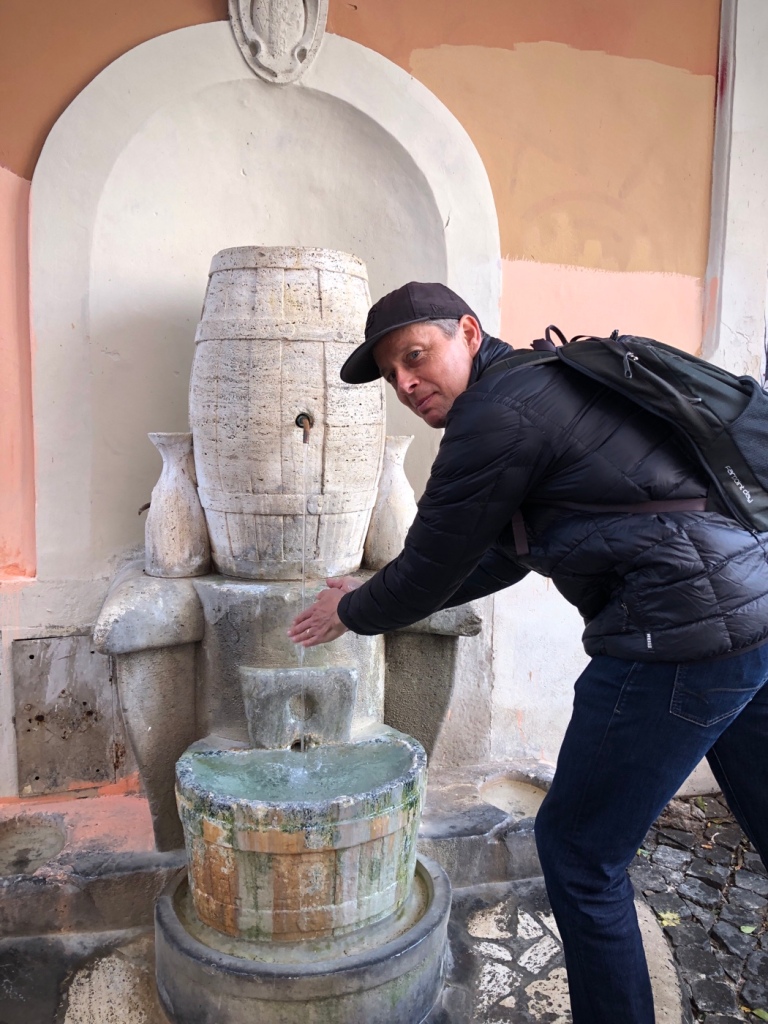
My favorite fountain. With my favorite travel guy.
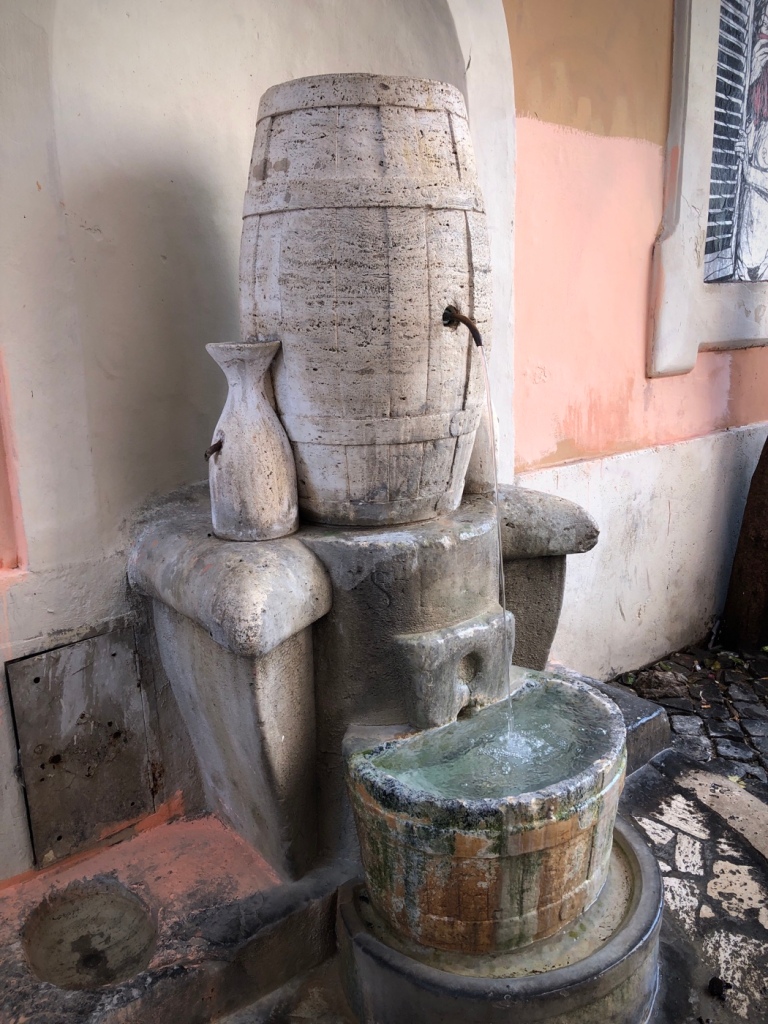
This stunner is in the Travestere neighborhood. The two side spouts weren’t running, but the theme is fantastic.

We’re back in the US now for a visit to friends and family. Our five days in Rome were not enough to see all the sights, but we did visit many of them, in between fountain spotting.

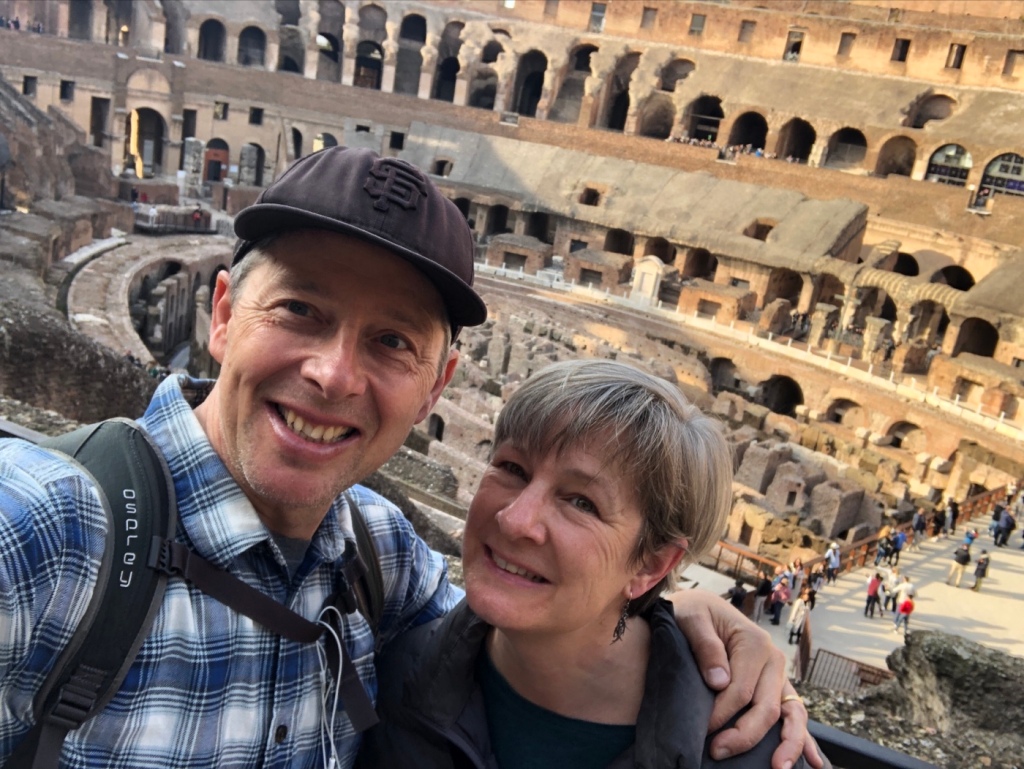
The happy travelers in the colosseum.

Truly charming Alberobello. Trulli.

The Bella Vista of the trulli. Trulli is the plural of trullo. Helpful?

This fantastic UNESCO world heritage site is firmly on the tourist track of the Puglia region, for good reason. The stone buildings are amazing and adorable. Even more adorable with a dusting of snow.

One of the narrow streets of town.
Close up of a dry stacked roof.

Why, you ask, are these squat little buildings called trullo built this way? Two main reasons, per Wikipedia – abundant building material in the form of limestone boulders collected from fields, originally. And, the Count of Conversano who gave permission for the first “town” here, was avoiding taxes which would have been due to the Spanish viceroy of the Kingdom of Naples. Apparently, no mortar – no taxes.

There are many trulli you can stay in. Maybe not ideally suited to tall modern men, but fascinating.

Like many UNESCO sites Alberobello was both saved and destroyed by its designation in 1996. The buildings, saved. The probably once characterful town, now firmly on the tourist track, another tick on the travel itinerary – gone. Destroyed is a strong word, but we do find the friendliness of locals is an inverse curve to the number of tourists. Other than the charming little streets of trulli walking in town is not so charming, with impatient drivers and narrow if any sidewalks. So what does the savvy visitor do? Head out of town on a country side walk.

Just chilling with a trullo. And a massive old olive tree.
The 50th trullo is just as fascinating as the 1st.
The olive trees will also stop you in your tracks for a closer look.
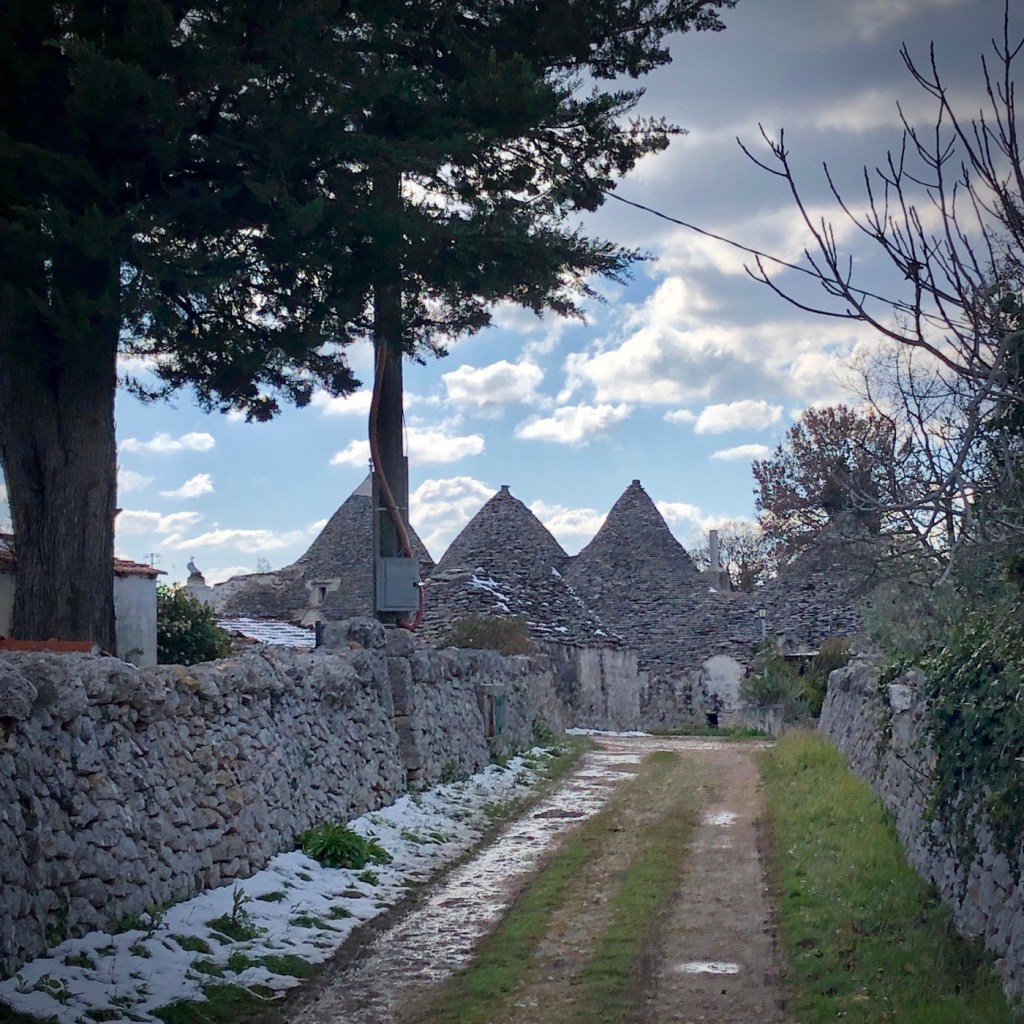
Trulli lane. There are enough stones around here to build houses and walls.

We quickly left town behind and the countryside felt very rural. It sounded rural too. The barking dogs had us both grab a couple of small stones for our pockets as dog bite deterrents, but we didn’t need them. All dogs were safely contained. And once we left the outskirts of town there were few people and fewer dogs. Off season this area was quiet, in season the vacation dwellings probably have a lot of life. Vaccination note: since we love to ramble on back roads on foot and on bike, we got vaccinated for rabies – which means if we get bitten by a dog we need only one fairly available shot instead of the full and less available course of shots. On our hike out of Sorrento Rich did indeed get nipped by a little terror of a terrier, but it didn’t break the skin. We’re glad we got those vaccinations.

A garden trullo, maybe a storage shed, with Rich added for scale.
There were trullo in need of attention.
There were trulli which were truly scrumptious.
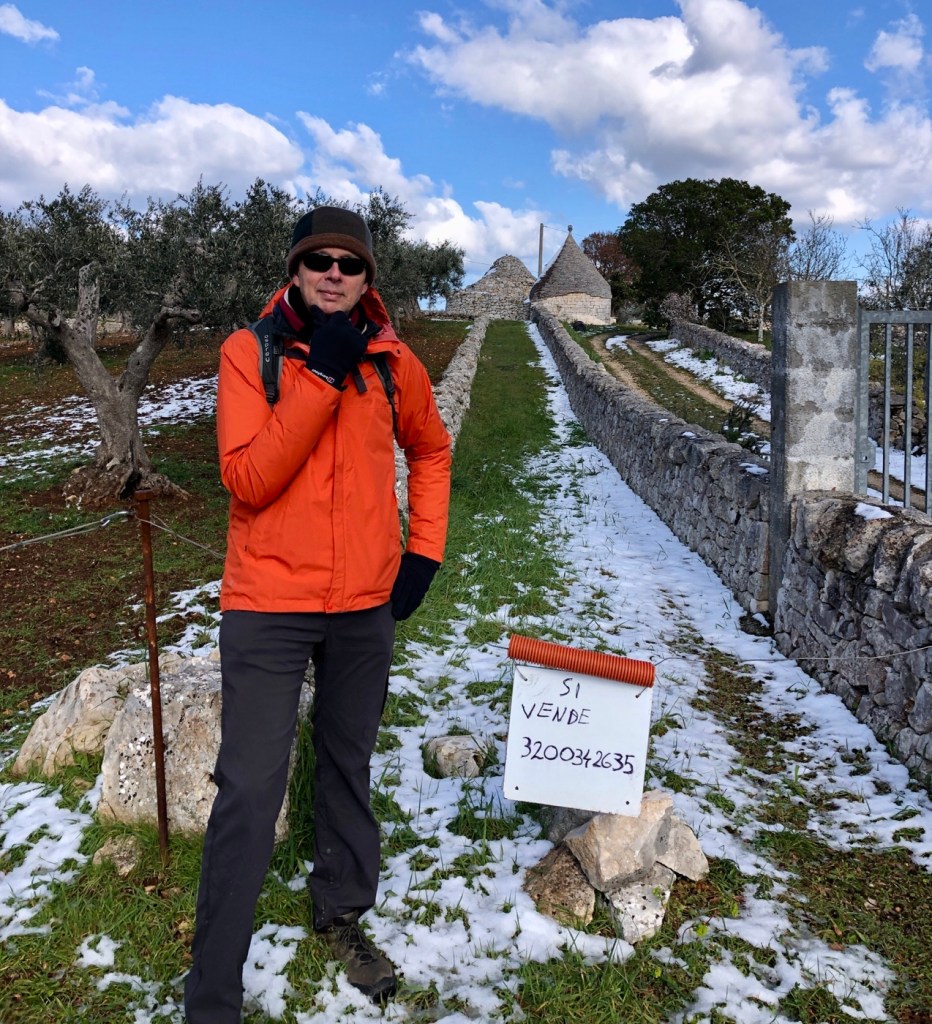
And there were trulli looking for new owners. Anyone?
This became a perfect walk. Sunshine, snow on the ground, and eye catching scenery
Muddy lanes and olive groves.
Giving the Swiss firewood stackers a run for their money, firewood in the shape of a trullo.
Getting to Alberobello is a lovely train ride, the train is going the perfect speed for sightseeing.
Puglia regional train and a happy traveler.
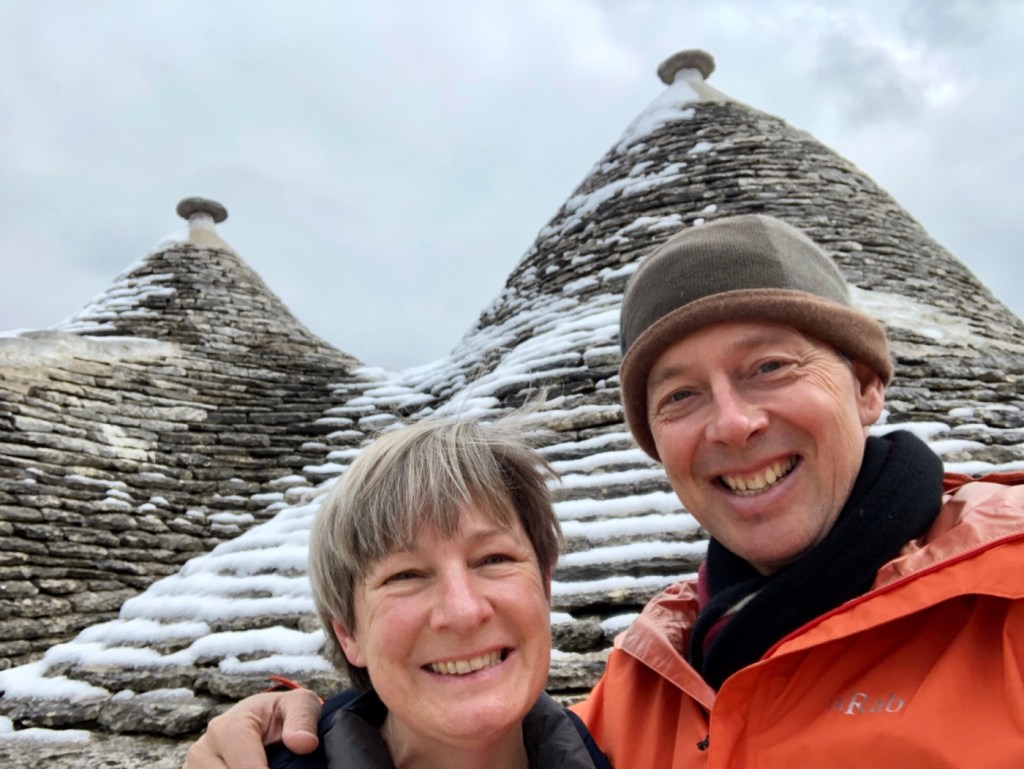
Two happy travelers. We spent one night in Alberobello, then back to Bari for a night, and on to Rome.

As our trip back to the US gets closer we’re both getting very excited to see family and friends. See you all soon.

Ciao Italia!

This is the country where we are most likely to overeat, over indulge, and find ourselves over padded as a result.

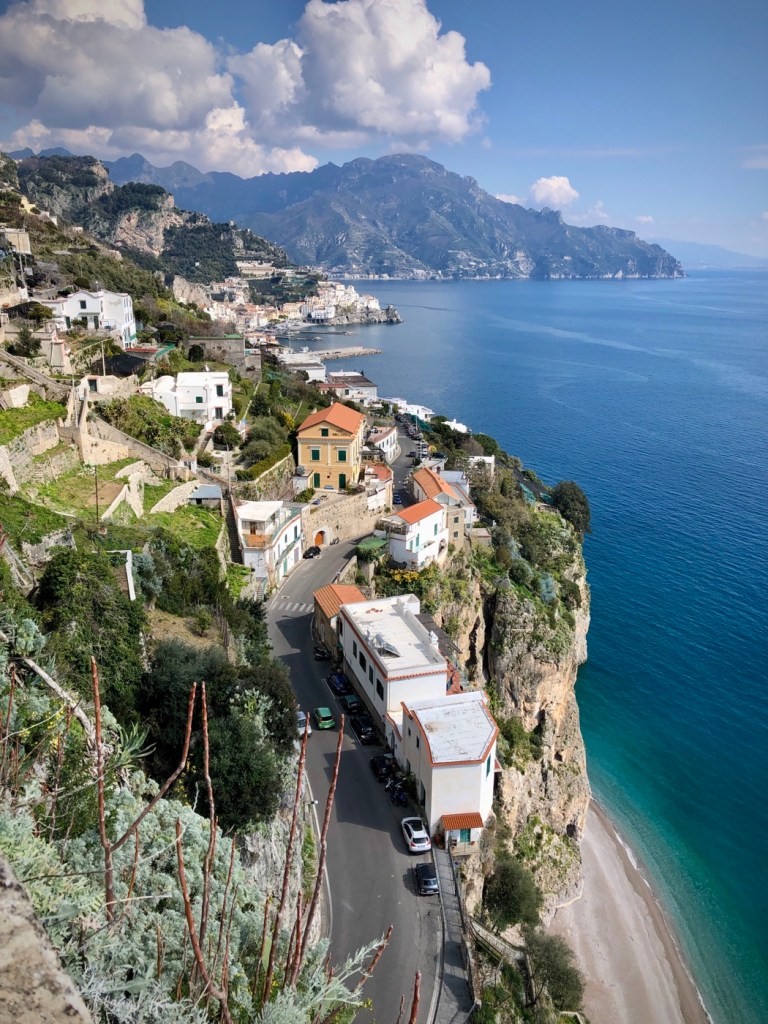
Overlooking the town of Amalfi. We got to this height via an elevator.

How to avoid this? Move. Just keep moving. Take the stairs instead of the elevator. Have a hiking day. Walk the long way home after dinner out. Walking and biking are second nature to us, so that’s what we do when we get somewhere.

The hike from Sorrento to Massa Lubrense involved loads of up and down and stunning views.
It was fairly well signed, and took us through beautiful rural areas.
The green netting is enclosing lemon groves.
Chestnut poles hold up the netting and provide freeze and sunburn protection. So many lemons.
This view was well earned. Looking towards Sorrento.

If we have a train day, we make sure to have an active day next. Of course, some train days involve loads of walking too. We rarely take taxis, we walk to and from train stations or take a local bus. Being sensitive to the impact of car traffic on cities encourages us not to add to it. Walking gives you more time to notice things and grounds you geographically. I’m slightly directionally challenged, landmarks are how I navigate. That shop, this fountain, a row of green flower pots, all help me find my way though new places.

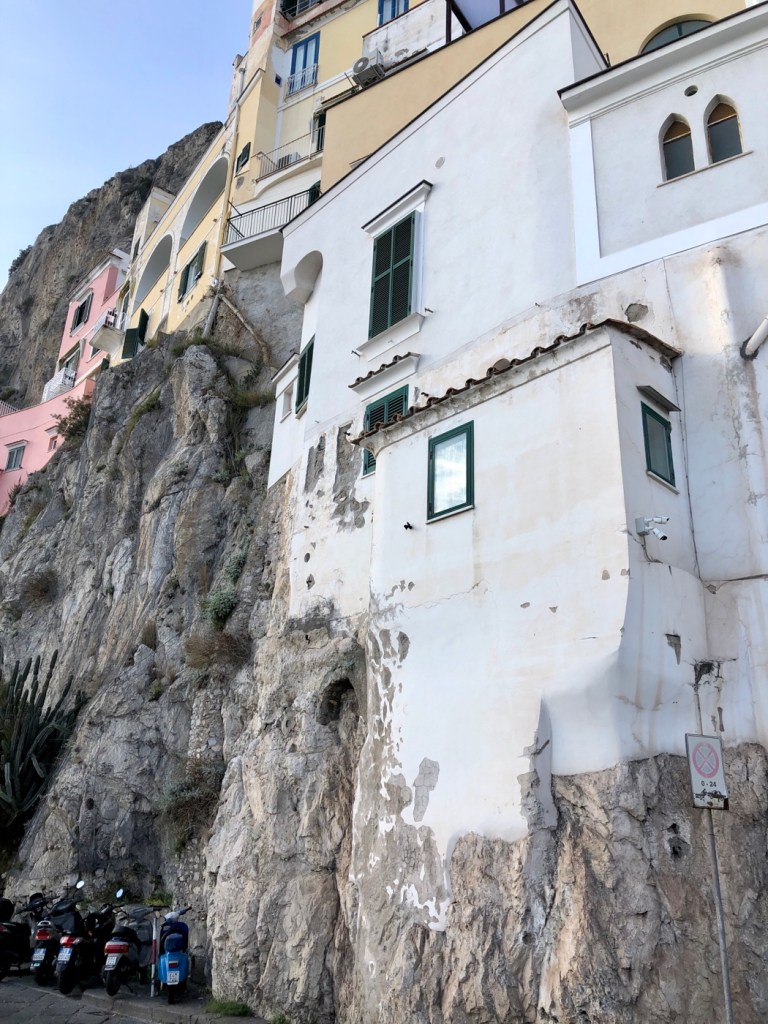
Above Amalfi, the town of Lone where some buildings rise out of rock.
Beautiful picnic spots of the world.

The Amalfi coast has so many trails, walkways and tiny roads to explore. And stairways. So many stairways. Our day hiking above Amalfi was one of the most memorable hikes we’ve done. The coast road is more famous, but the paths and small roads are what we love.

Donkey power in action.
Trail markers and water fountains. It was not at all hot when we were there, but in summer the water taps would be a very welcome sight.
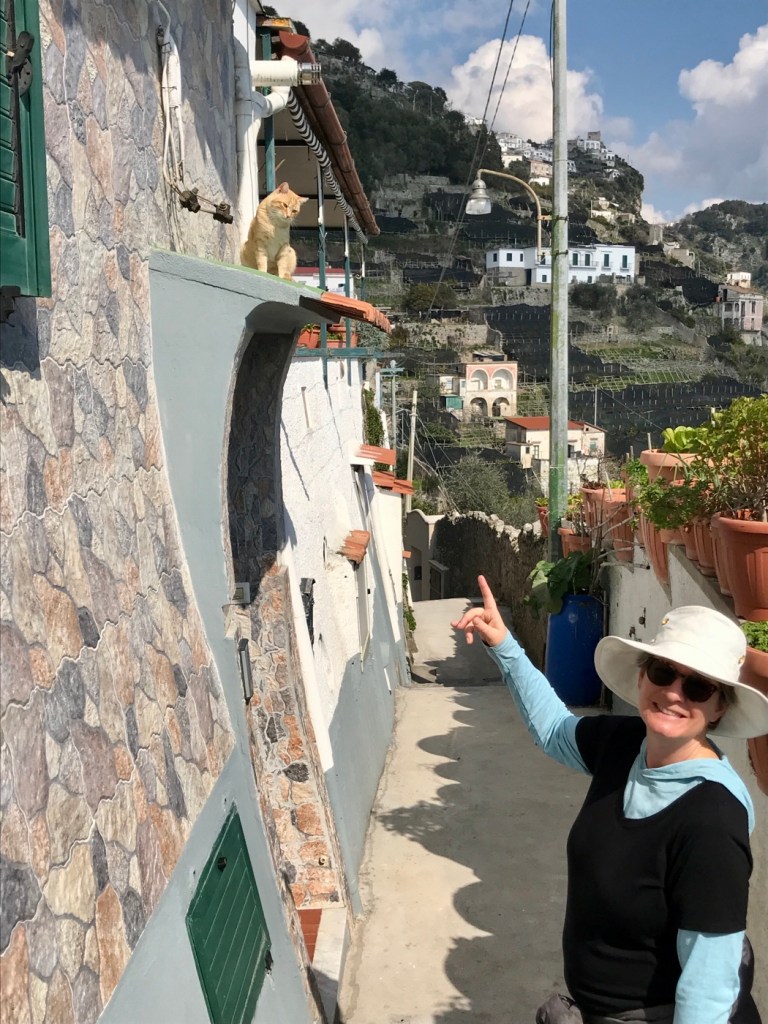
Cat spotting!

Are all of our hikes blissful and conflict free? No. We have very different paces and one of us, the tall one, hikes much faster than the other shorter one. In an attempt to get more of a work out Rich came bounding back down the first big staircase climb out of Amalfi as I was struggling up. Morale killer? Yes. Squabble? Yes. I demanded that he turn around and then after I passed him I insisted he go back down as far as he wanted as I hiked on – in the lead for once! Temporarily, but happily.

The stunning water color and a view of the famous coastal road.
Starting a travel day with an early bus from Amalfi. Not much view on a rainy day with the windows steaming up.
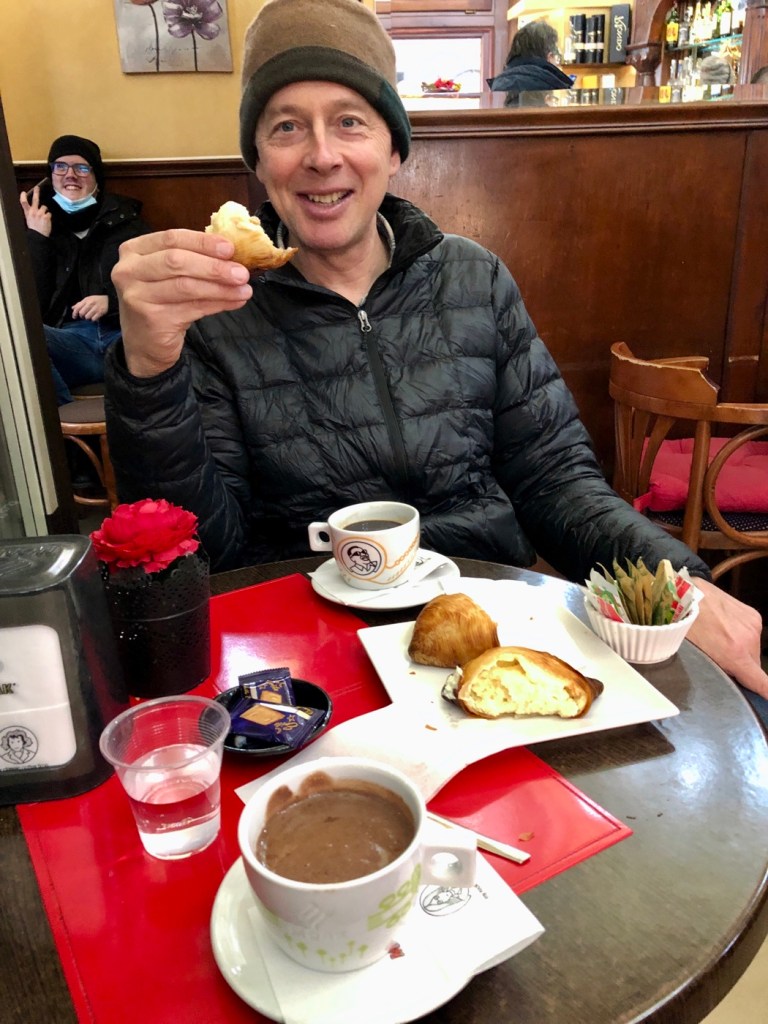
Second breakfast before catching a train to Bari.
The travel planner taking a break to enjoy the view. And mentally plot the next hike.
Trains are the best! Crossing from the west coast to the east took us through the Apennine Mountains. And snow.

The weather cooperated for our first full day in Bari so we rented bikes and headed down the coast, knowing there was a train to take back and enjoying the tailwind.

Heading out of Bari in the sun with a smile.
Passing a field of abandoned Trullo, the stone buildings of the Puglia region.
We had to go check them out. So off the road we went.
A bit muddier than expected.
Lunchtime in Polignano a Mare. Go right to the place with a line for take out panzerotti. Like a hot pocket sandwich, a cousin to calzone.
Lunch with a view.
And back to Bari on the train. While I’m always grateful for bike cars on trains, I hate bike hooks. I’m never confident that I can lift my bike up, and I certainly couldn’t lift the heavy rental bike up. If you ever wonder what the term “ableism” means – this is it.

So this is how we stay healthy and happy. But, six months in we have learned that Rich absolutely needs more exercise than me. He’ll be upgrading to a slightly larger travel backpack so he can add running shoes to his kit. And I’ll be better at not getting mad when he bounds back down a hill I’m still climbing so he can turn around and go up again. (Seriously, who does this?)

The happy travelers. Up next, Rome and the USA.

The Rise and Fall of Civilizations…

One of the joys of extended travels is discovering the connections and overlapping layers of history, from the Neolithic to this shocking few weeks in Post Cold War Europe. You see snippets of history, in both the context of the ancient society, and the modern context of how it is presented.

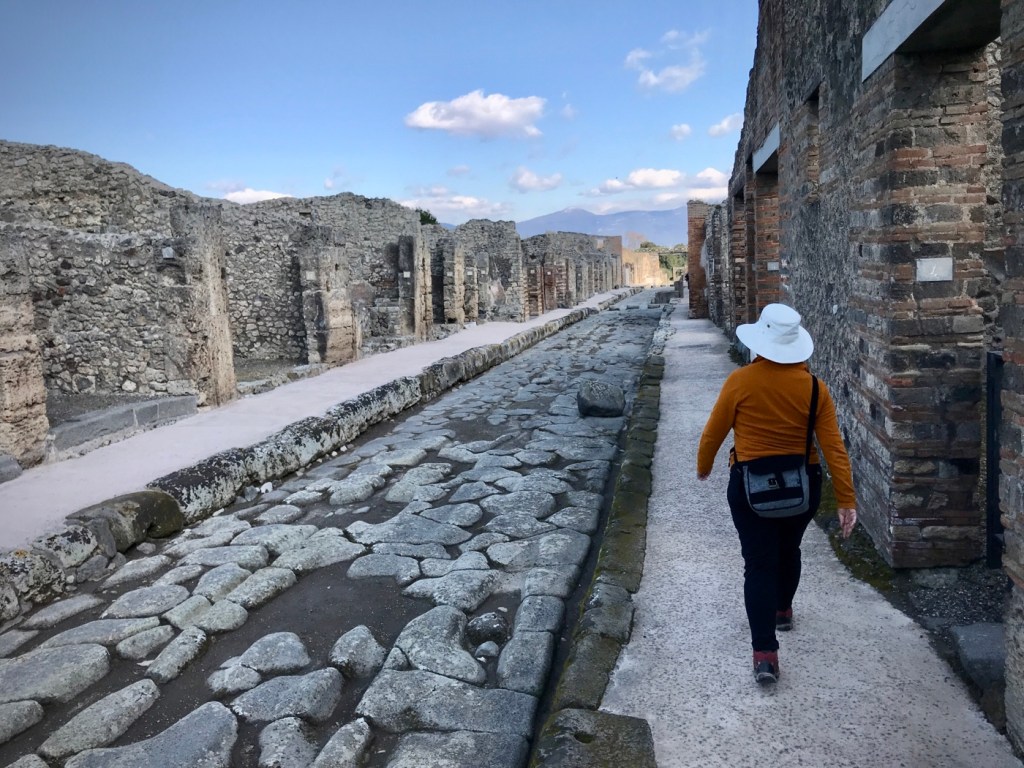
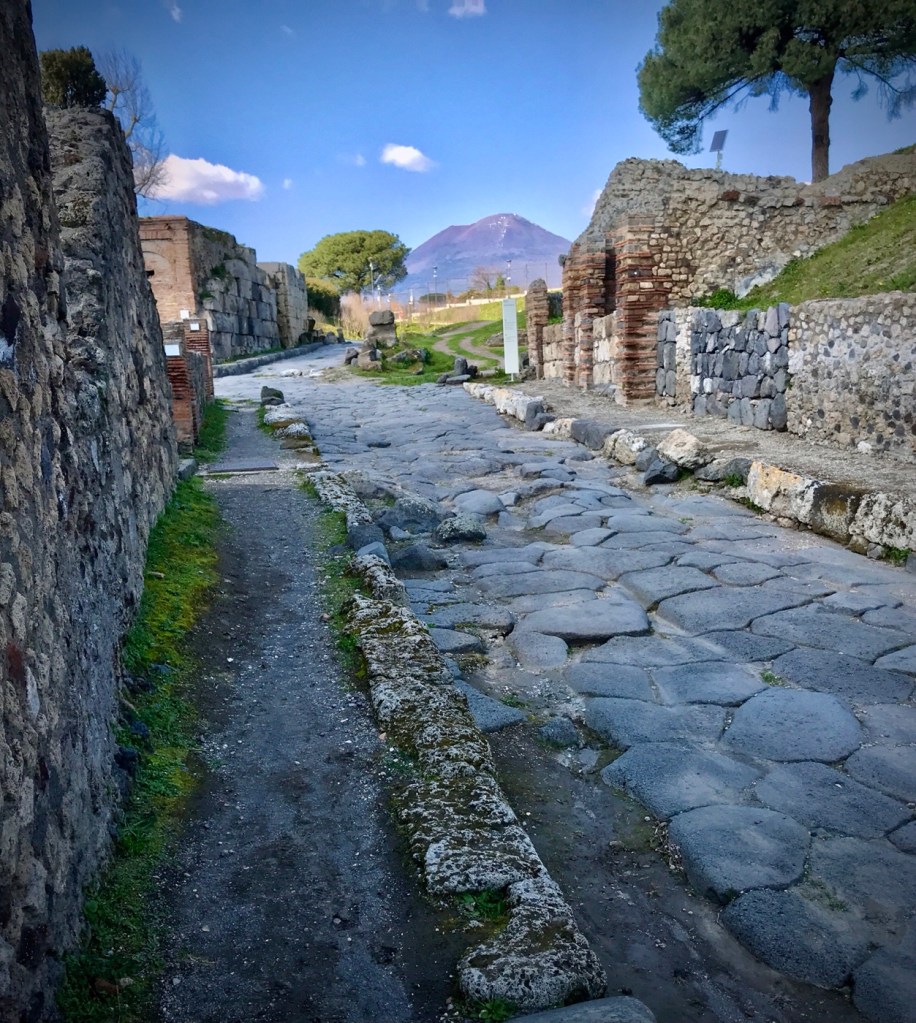
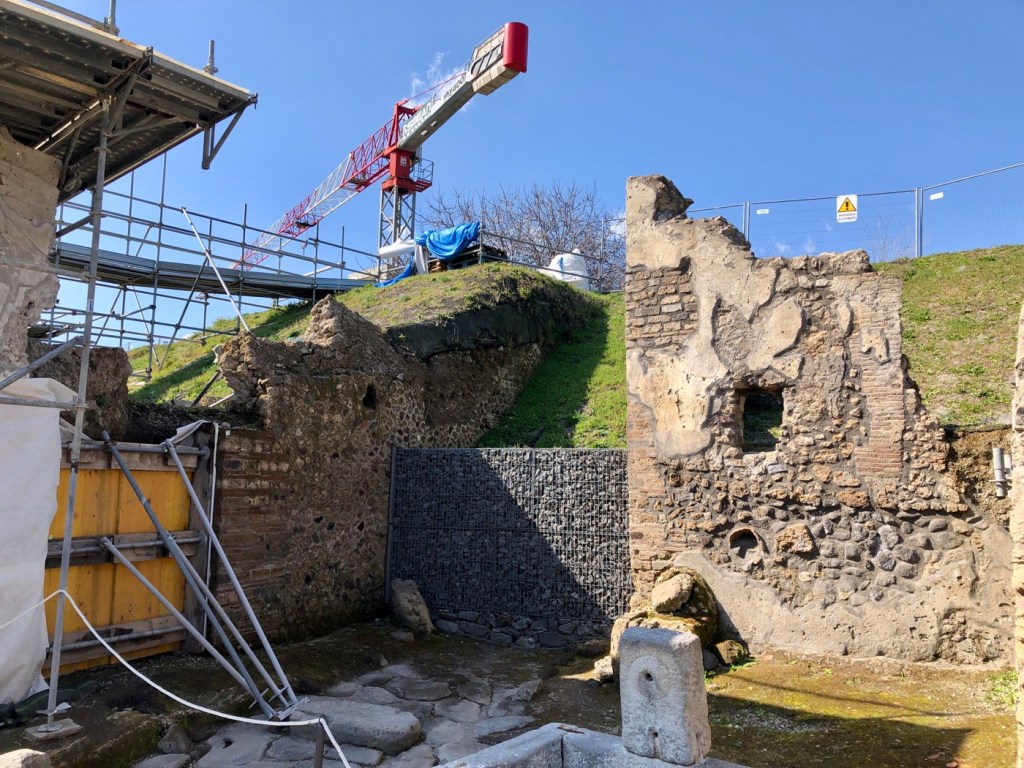
Chariot ruts in Pompei show just how much traffic plied these streets, and that there are always infrastructure maintenance backlogs!

In this part of the world, it is still stunning to discover the vastness and complexities of the Roman empire from Morocco to England, and of course, in modern Italy.

Literally layers of history at Herculaneum, right up to the old shoreline.

The past week’s events in Ukraine overlapping with visits to two of the world’s greatest archeological sites, Herculaneum and Pompéi has been sobering. Most of us understand the risks of Putins end game, but it’s especially painful for Europeans who bore the brunt of two world wars and protracted Cold War. History does feel like it is doomed to repeat itself.

The empty Herculaneum on a Monday morning; a joy to explore!

There is a lot to take in at both UNESCO sites, so we decided it was best to separate our visits by a few days. We had planned on trying to get to Herculaneum early on Sunday morning from Naples, and set out from our hotel at 8am sharp only to be stymied by misinformation on the metro and train schedules….(BTW the Moovit app is best in Naples).

I wonder what was for lunch?

So as we sat on a crowded platform, with the prospect of getting to Herculaneum 1 1/2 hours after opening on by far the busiest day of the week, we decided eating €5 train tickets was a small price to pay for a better experience and left the station for another day. Another blessing of long term travels.

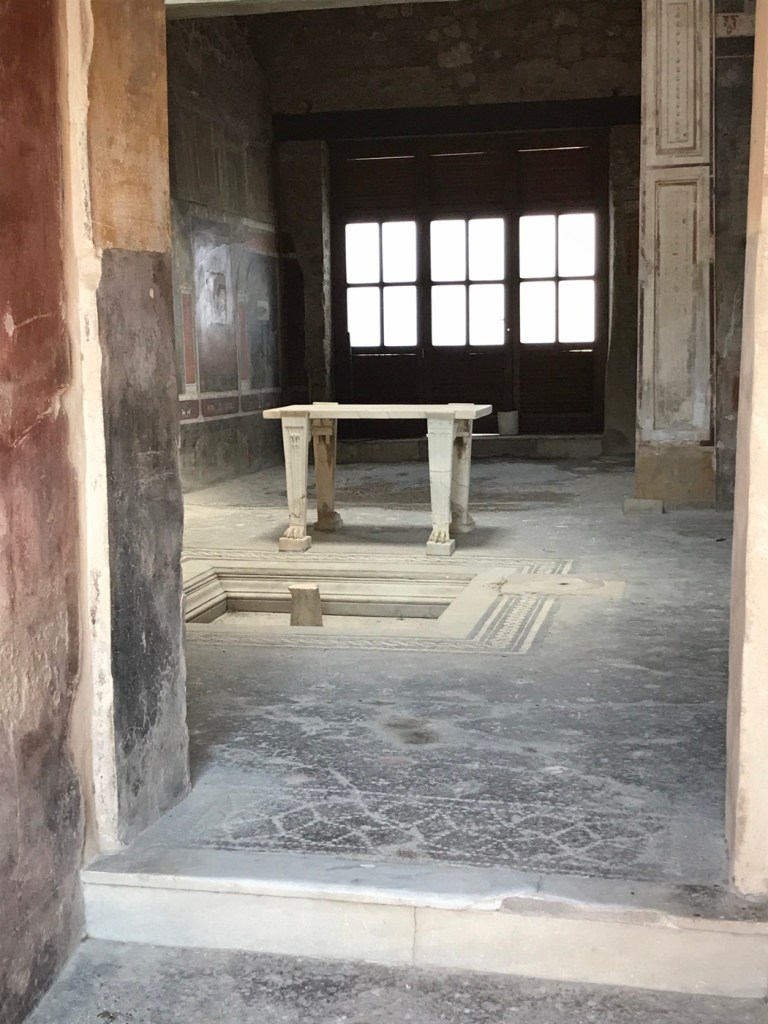
Looking towards the impluvium…Roman Villas are so impressive for their thought in design and layout; not much to improve in 2000 years of architectural development.

It was a great decision as we were able to stop at Herculaneum on the way to Sorrento on Monday, and had the place practically to ourselves….oh, and the sky was bluer on Monday too -:). This also gave us the opportunity to watch the excellent BBC documentary on Herculaneum which really did enhance our experience the next day.

Endless Pompei….20,000 lived here at its peak and 18,000 did get out on August 24, AD 79

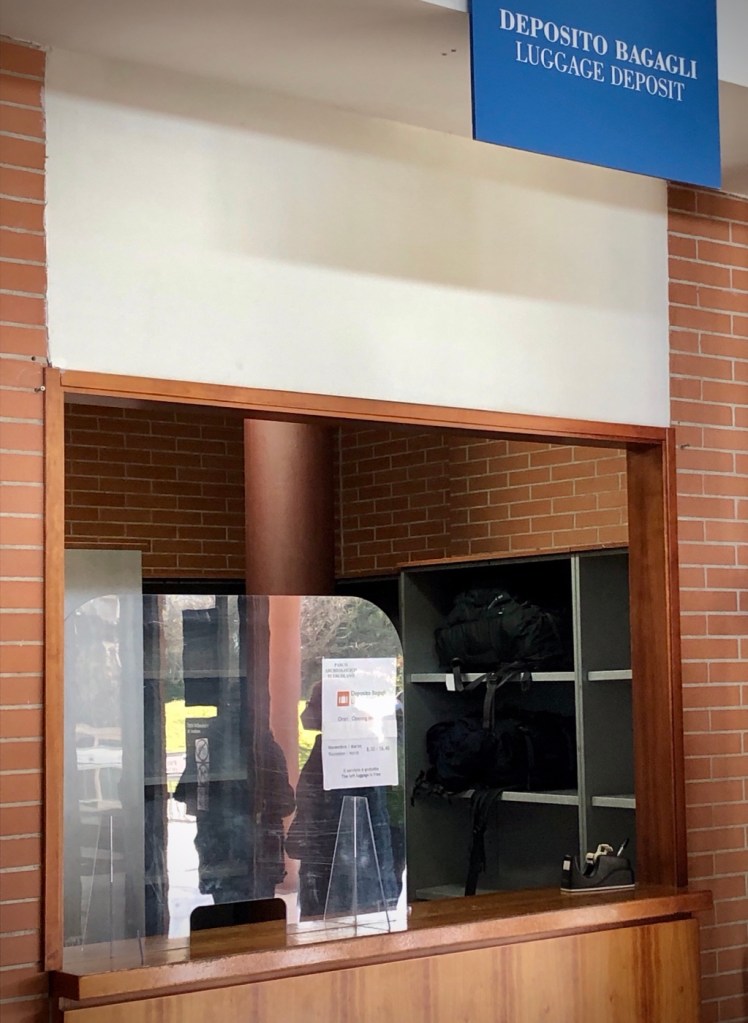
Both Herculaneum and Pompéi are on the CircumVesuvia regional train line that runs from Naples to Sorrento, so an “on the way” visit is a great option, especially as both sites have left luggage facilities. The Pompéi entrance is very close to the train station, but Herculaneum is almost a kilometer away downhill, so best if you are traveling light with backpack luggage, but it is certainly doable with a roller bag (if you can stand the sound on the sidewalks!)

Left luggage at Herculaneum…simple services like this can make a travel day possible.

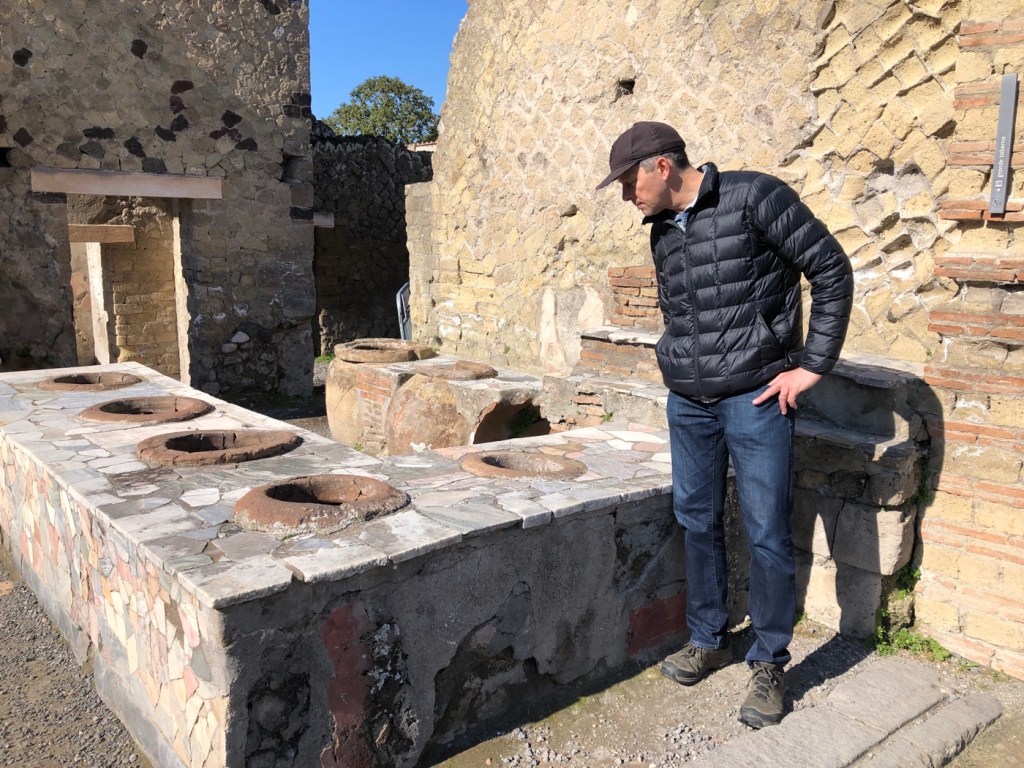
Herculaneum was a prosperous and smaller city than Pompéi; kind of a posh suburb. When it was hit by the huge earthquake of AD 62, many of its wealthier residents took the damage as an opportunity to remodel…of course, only to be buried by 50 feet of the pyroclastic flows of Mt. Vesuvius just years later in AD 79. The site is compact and surprising in its somewhat dense surroundings of a more modern town.

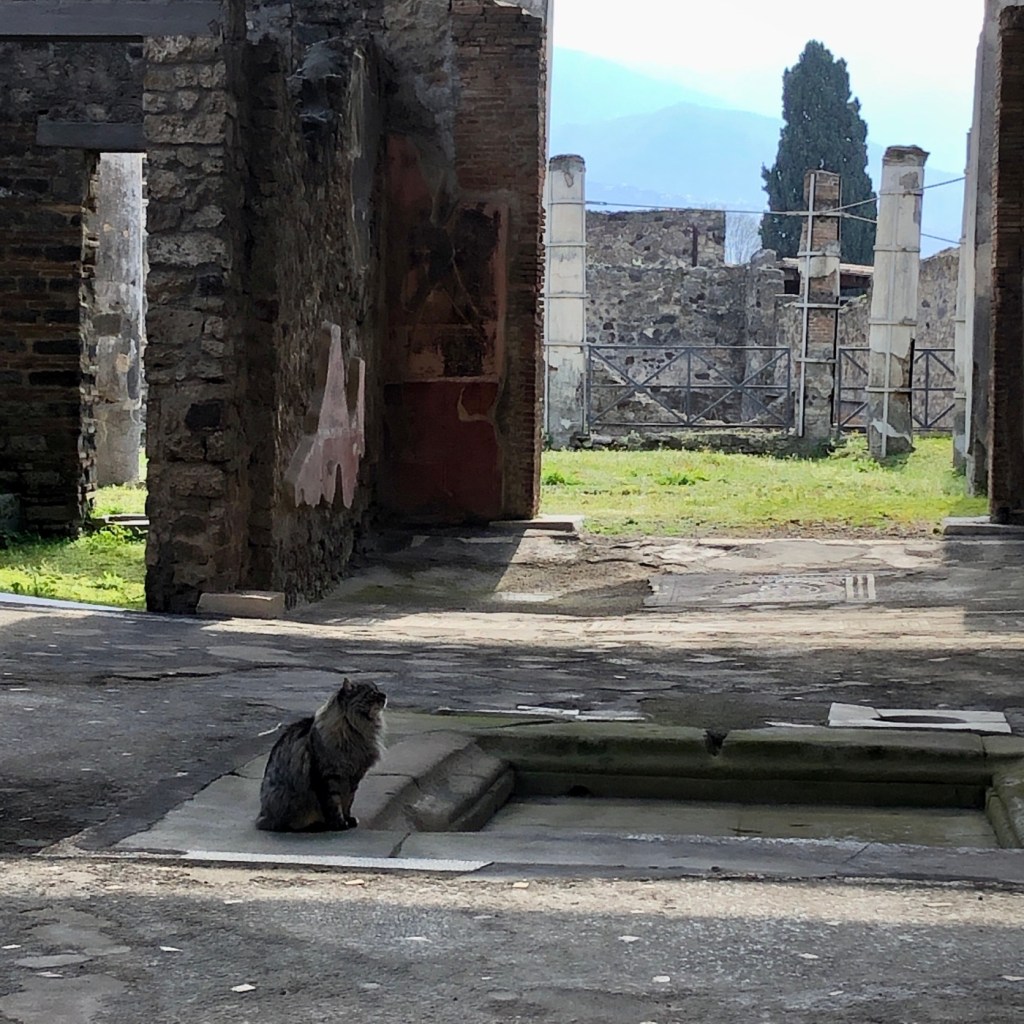
Yes, there were cats in Pompei

What was also surprising to us, was all the people that still live in the shadow of the mountain, taking a calculated risk that it won’t erupt soon, or with such force. They say there will be some warning from the vulcanologists and seismologists next time. And of course, we lived in San Francisco for 30 years, so can understand taking a risk living somewhere you love or is your home. Or both.

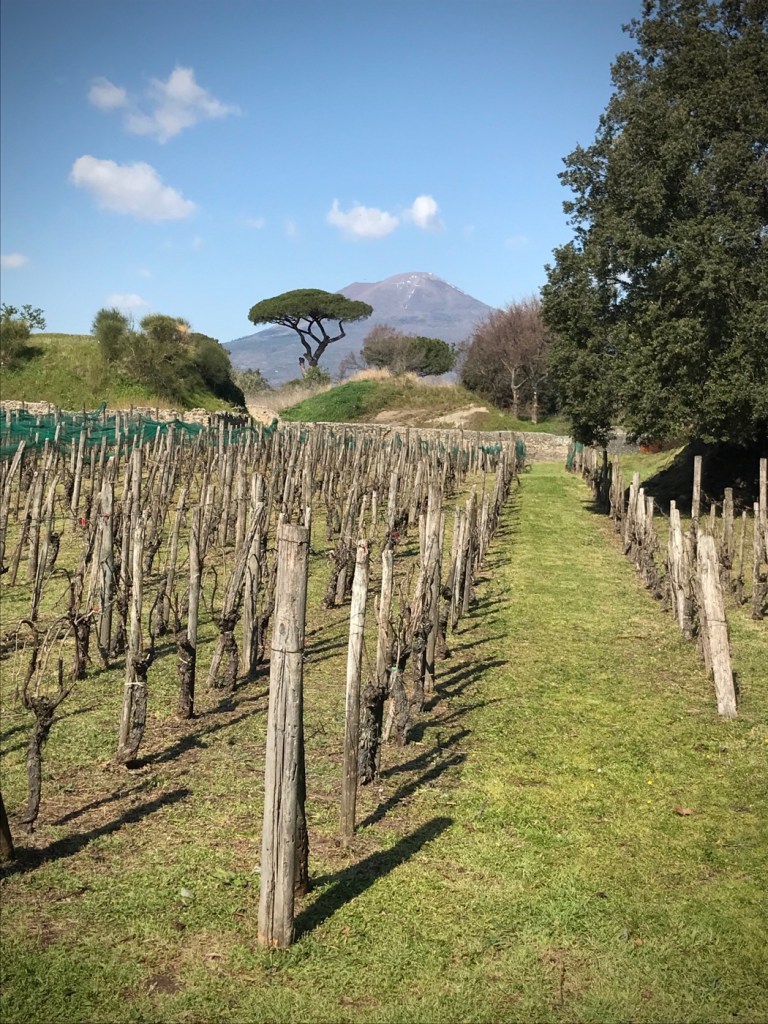
The restored vineyards of Pompei with Vesuvius in waiting.

After a nice day off in Sorrento walking in the local hills of lemon groves, we visited Pompéi by taking the train back from Sorrento on Wednesday, and again enjoyed light crowds.

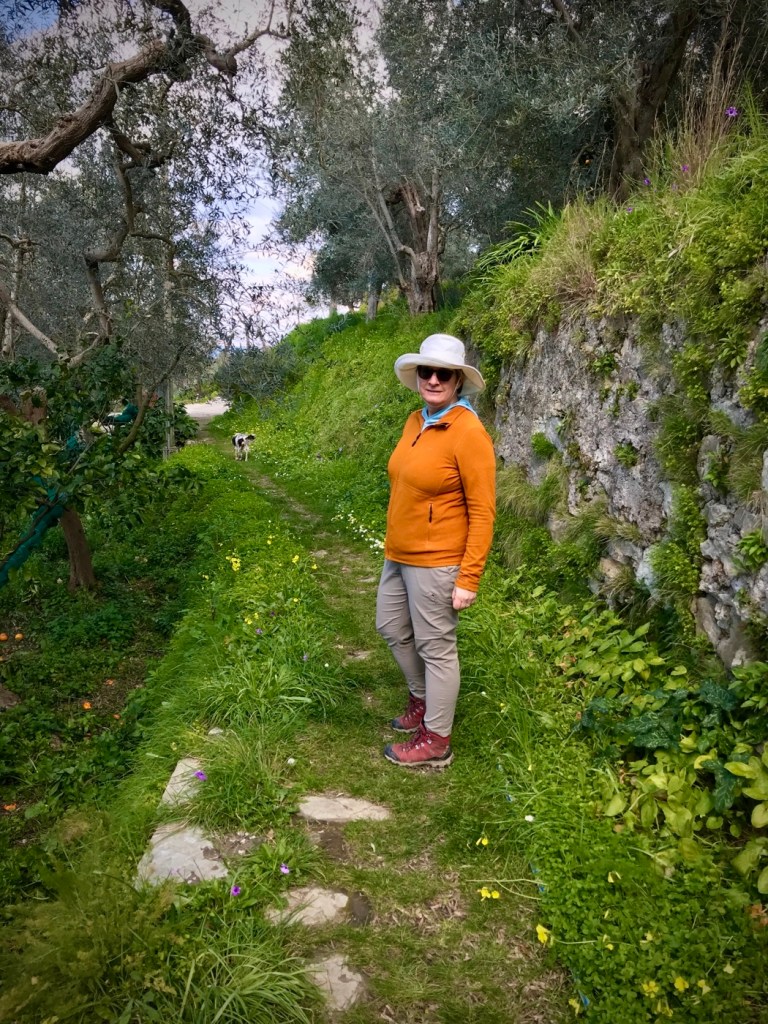
Taking a Roman break walking in the hills of Sorrento, with spring finally showing it’s serious in Southern Europe

In fact we walked up to the ticket window at 9:30 am with no line. It did get a bit busier as the day went on, but still an apparent trickle compared to pre-COVID times, as the tour buses have not returned yet. Somewhat a golden time for travel if you can get here.

The tranquil footpaths to Marina Lobra, near Sorrento

Pompéi is vast and sprawling, and it stuns you with the scale of the city’s ancient streets, sidewalks, and lunch cafes. Romans ate lunch out routinely, apparently to feed their appetites building vast baths, forums, and an amphitheater.

The slight curves and meanders of Pompeii’s roads was insightful urban planning

It was so easy to visualize the vibrant community, with its rolling and meandering streets, variety of villas, and the detailed understanding that has been miraculously deduced about the residents of almost every significant building. Artists, traders, cooks, politicians, and more recently nearby, slave quarters that give insight into the reality of the indentured servitude that supported much of the Roman’s impressive legacy.

The work never stops at Pompei, as new discoveries await daily. Amazing.

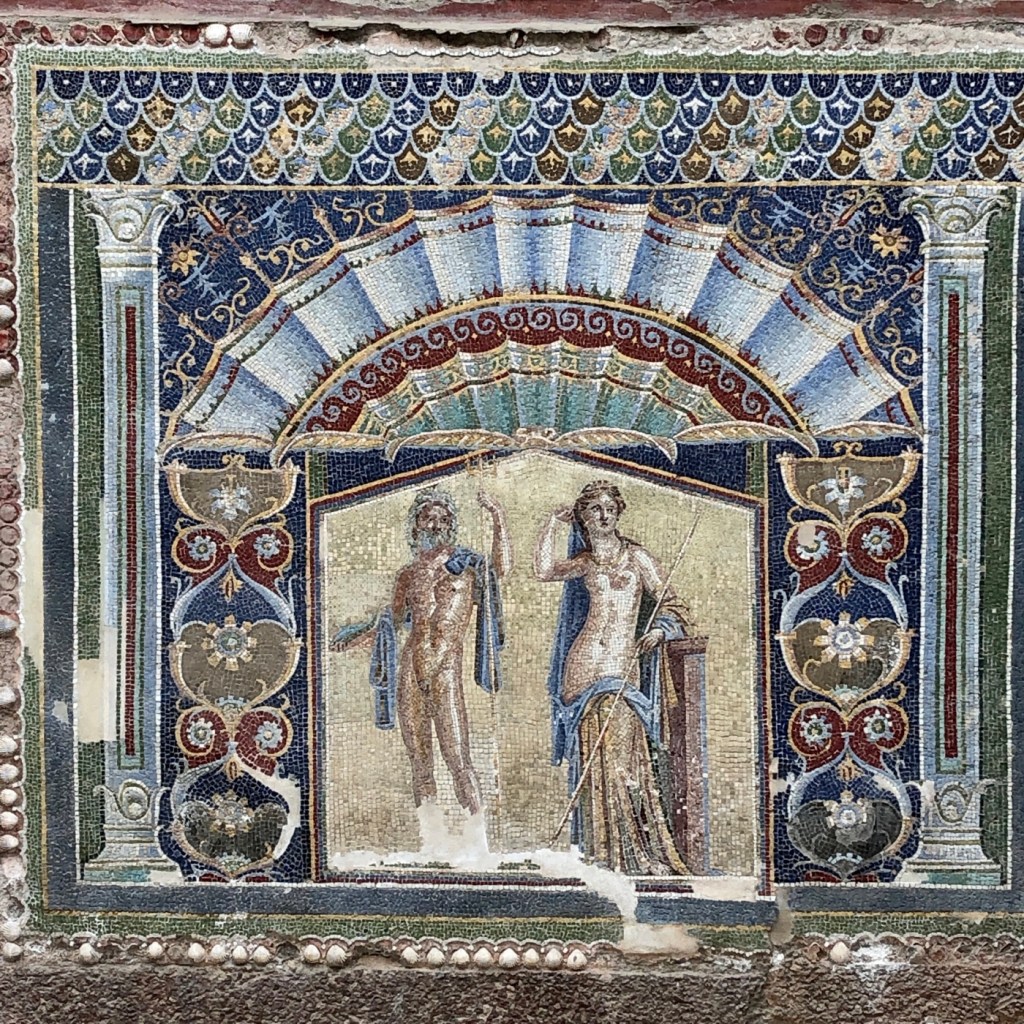
It also helps to visit the fantastic Archaeology museum in Naples first as we did, so you can see many of the original artifacts, frescos, sculptures, and mosaics first, and the drop them into Pompéi and Herculaneum, like objects in SimCity AD79. There are a lot of in situ items still remaining at both sites, and many buildings at Pompéi are under restoration or access is limited to protect the fragile elements from so many visitors.

Art and story telling enriched every aspect of Roman life….it all feels so modern.

So as we headed out of Pompéi to continue along the Amalfi coast, we both relished this unique time to travel, our freedom, and the fact that our civilization is generally still thriving. But also more cognizant than ever that it can fall apart in an instant….or at least an archeological instant. We have to learn from history and react.

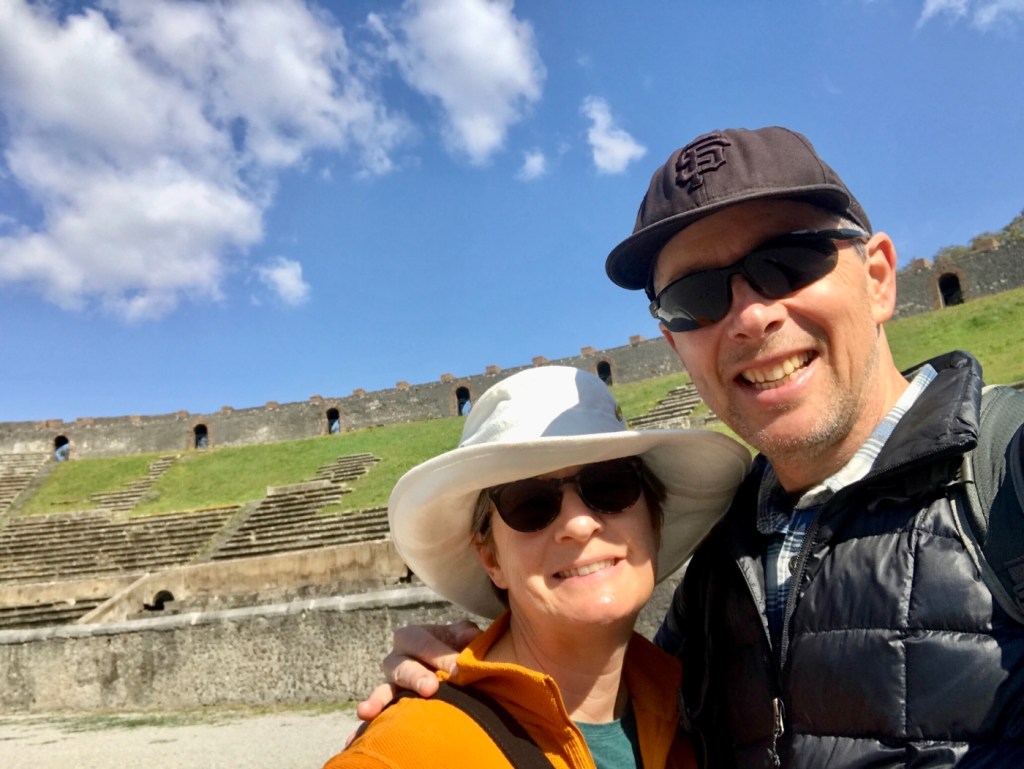
The happy travelers looking for their seats in the Amphitheater

Peace and love to all, especially to those who have recently fled their homes from an impending calamity.

Naples. Who knew?

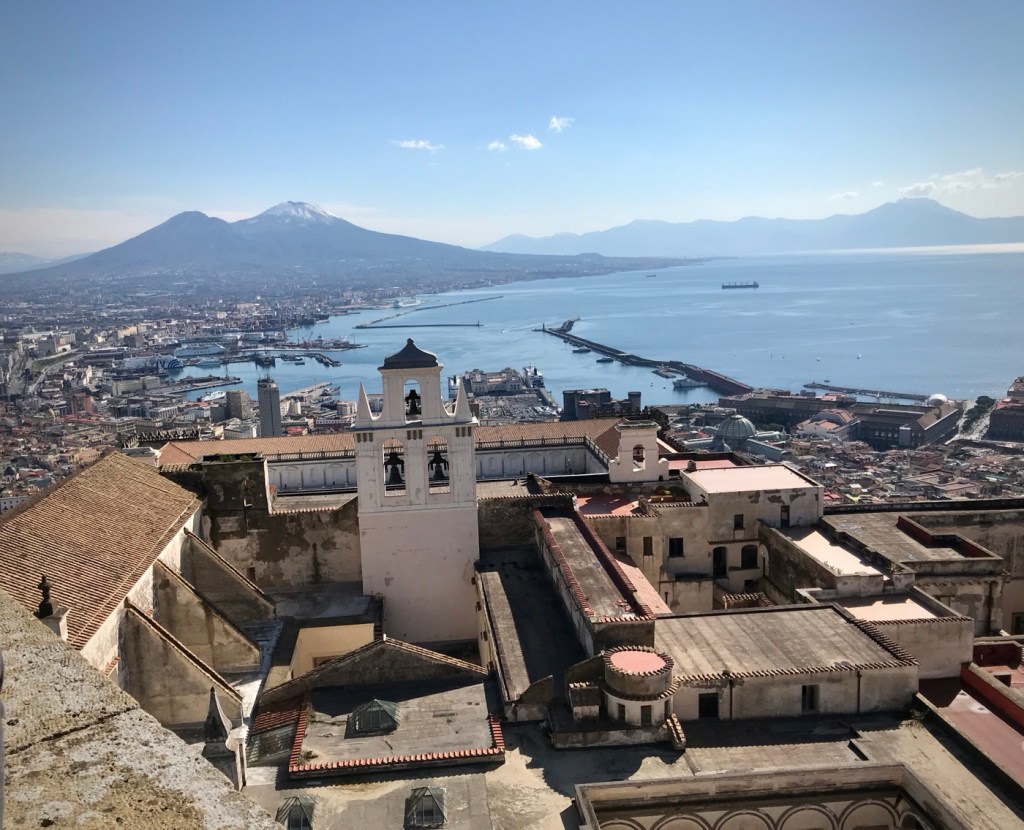
Naples, and Mt. Vesuvius topped with snow.

Some say it’s too gritty and sketchy. A couple we met thought it felt unsafe. It’s far too easy to be put off a place by reading negative on line comments. But, we also heard from people that Naples is all about great food, and that the people are quite nice. Thankfully we decided to make up our own minds and visit. We had a wonderful three days. What a great food city. Friendly people. Train and metro system could use a bit of love and money, but yeah, so could a lot of cities’ transit systems.

Some of the metro trains were seriously tagged. New Yorkers of a certain age will feel nostalgic.

It was a busy weekend in Naples, with loads of Italian families in town for Carnivale festivities, and to enjoy the lifting of some Covid restrictions. The hotel front desk said it was their first really busy weekend since the start of Covid. The city was hopping, and many of the restaurants we had researched were booked solid every evening. But we used our long honed traveler restaurant radar and did quite well.

Our secret power? Eat early by Italian standards. 7:30 pm.
Another good trick is to find a lovely tiny little bar and ask the very nice owner to take your photo and recommend a restaurant.
Got the last free table, had a wonderful meal, and provided free entertainment to the room full of locals.

Naples really earns its food reputation. The restaurants and pastry shops, although daunting with their fast moving busy customers and workers, were very worth the occasional “dorky tourist” feeling. Usually we watch how things work for a bit before plunging in, but when it’s really busy that can be hard. So, make mistakes, do it wrong, but get to that pastry!

Clams and snails for sale. Also fish and eels.
Sausage and pork on display.
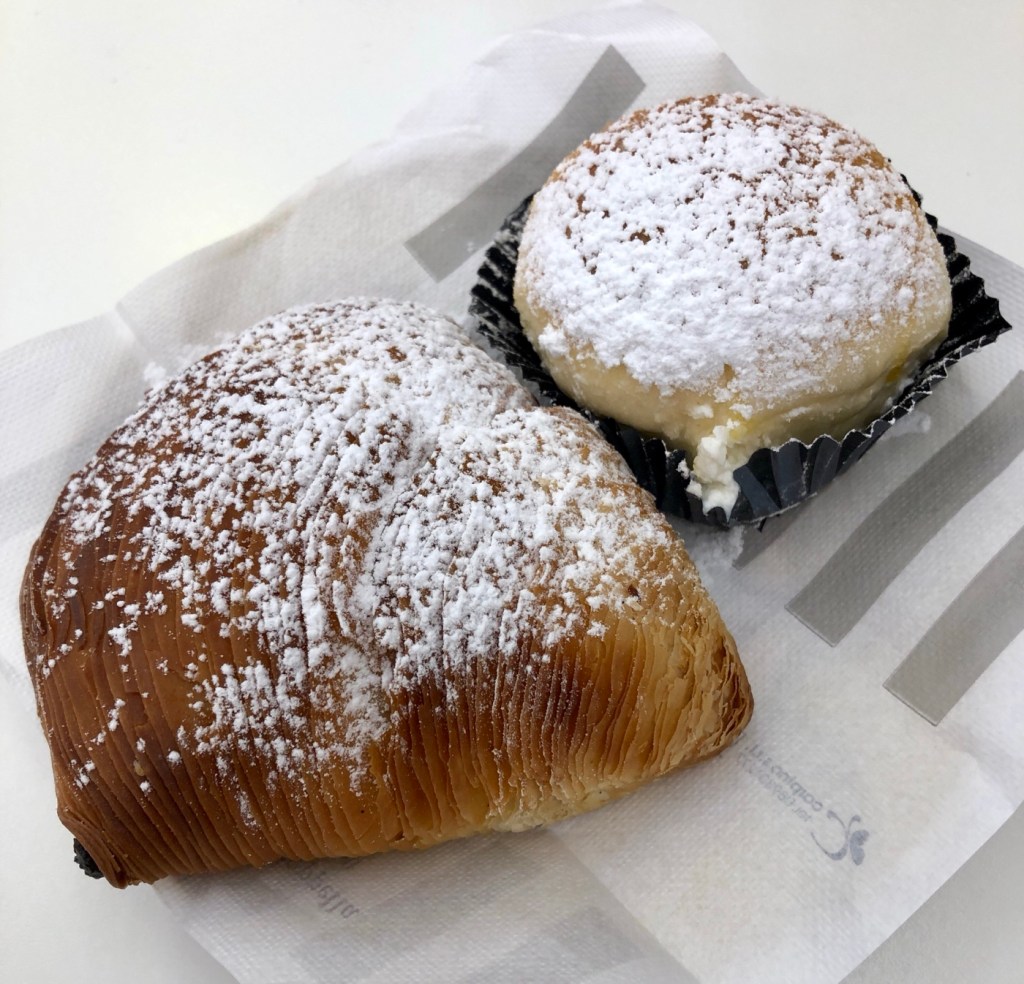
Sfogliatella and Fiocco di Neve. This was a bakery where we did do everything wrong in ordering, but still managed to eat wonderful pastries. Thank you kind workers.
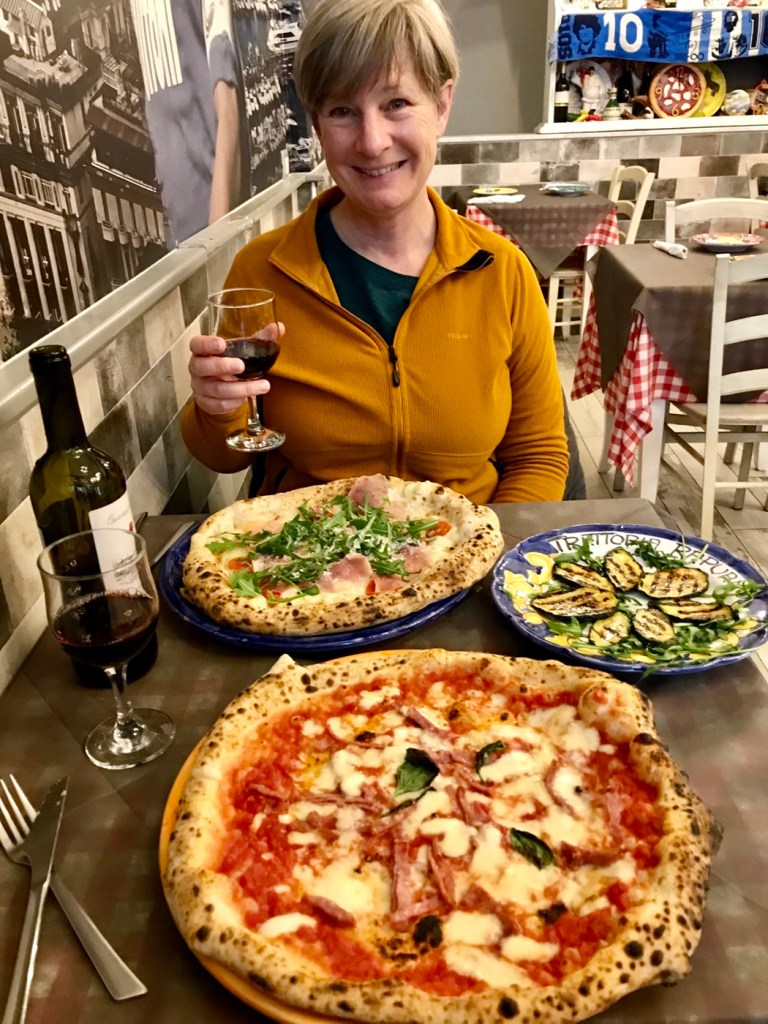
We thought we knew good pizza. Naples pizza is next level delicious.
And yet, still room for gelato. Many of the narrow streets of the historic center are car free. Sometimes you think they are simply too narrow for a car, and along comes one squeezing by restaurant tables and threading through pedestrians.
The Toledo metro station. A work of art.
The happy travelers at Castel Sant’Elmo overlooking the Bay of Naples.

Up next, more of southern Italy, including two ancient Roman cities destroyed by Vesuvius.

Venice exhales with Carnivale spirit.

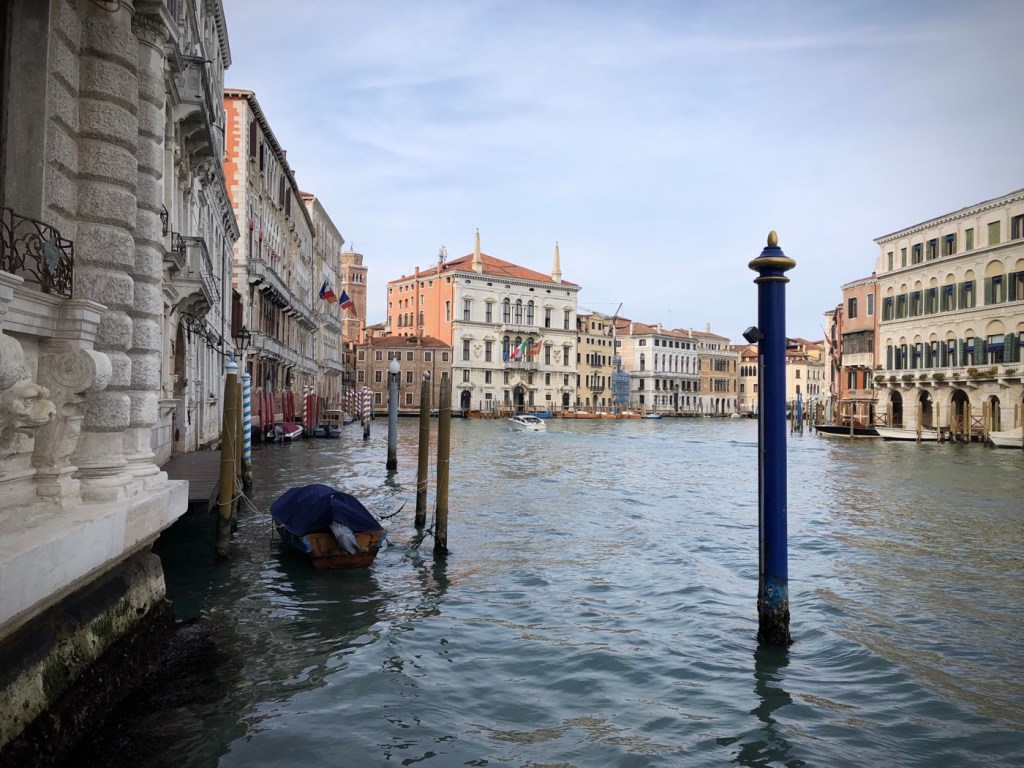
The Grand Canal view from Ca’ Rezzonico Museum.

What to do as tourist numbers are still down in the (hopefully) waning months of the pandemic? Head to places usually much too crowded to consider. We always say the B and C destinations are our thing, we prefer the less visited sites. But the idea of Venice with fewer tourists? Yes please. We didn’t even realize it was the start of Carnivale. With Italy just lifting the outdoor mask requirements a few weeks ago, we were surprised and happy to learn that Carnivale was on – in a more limited way than usual.

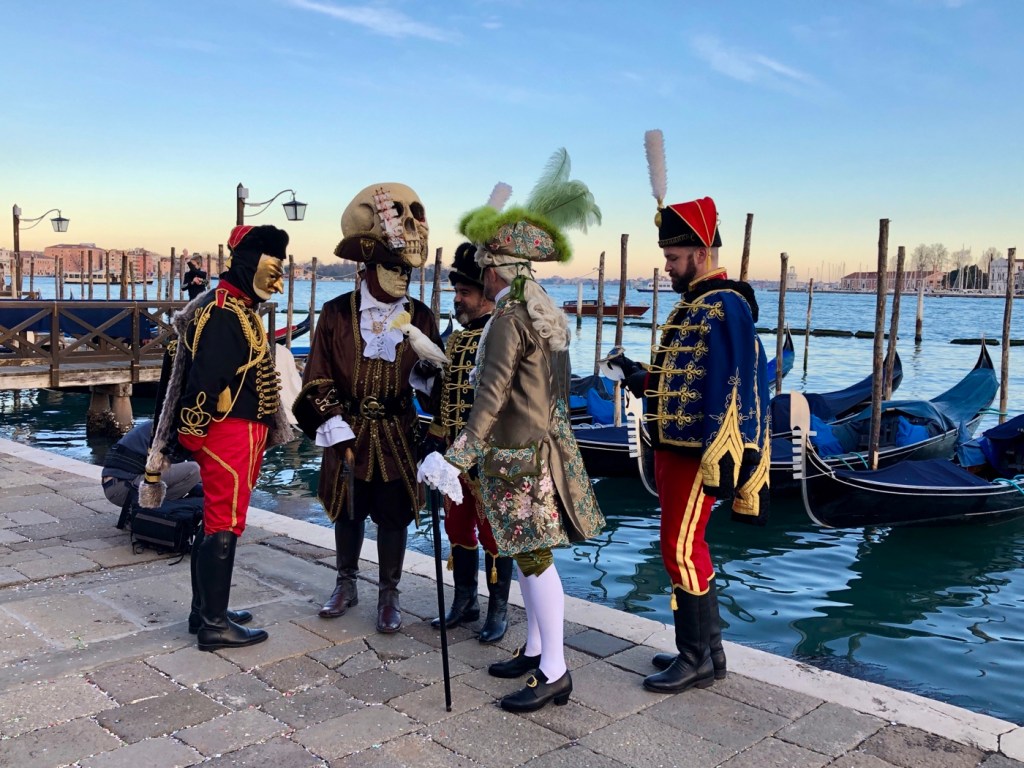
Our first sighting of a costumed reveler.
The edge of Piazza San Marco.

At first I was a bit timid about taking photos. But the revelers were posing for everyone. It reminded me of a Halloween/Beach Blanket Babylon mash up.

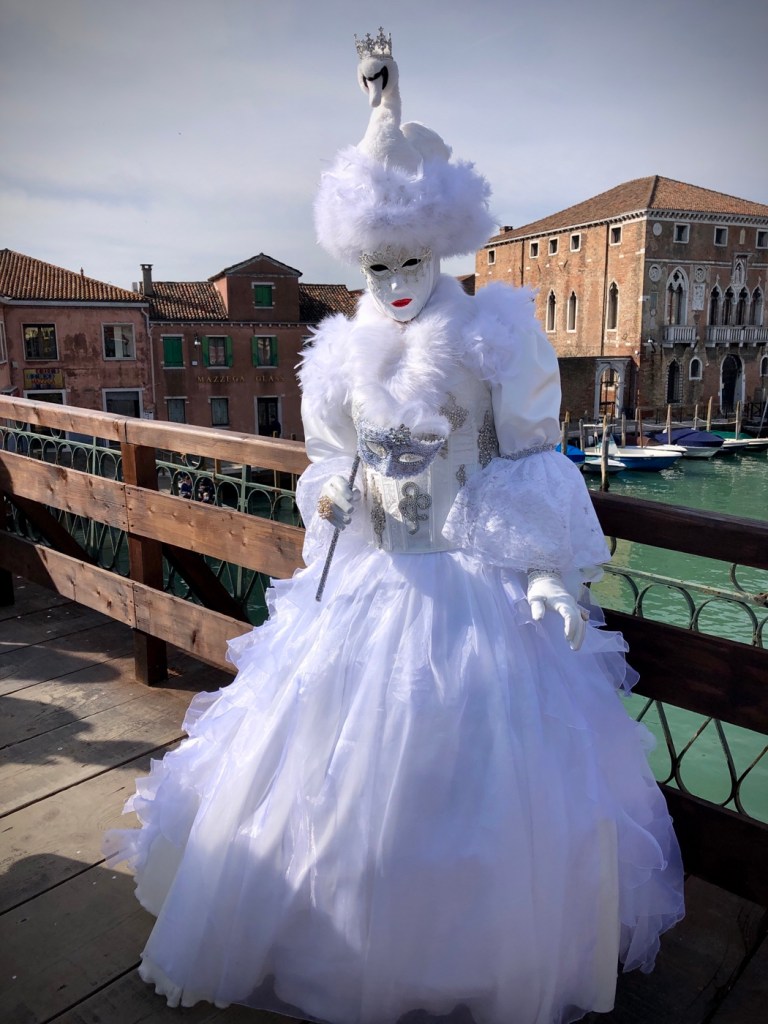
The masks have eyeholes, but with black mesh over them. The wearers are able to see but not well. They are super careful going up and down the bridge steps.
Looking so regal and poised.
Having a chat with friends.

It was Piazza San Marco and the lack of crowds there that really made us appreciate what a unique time this was to visit Venice. Like much of the world we watched with horror the terrible effects of the pandemic in Italy, and wondered what it would feel like to be tourists in the after times. Since we don’t speak much Italian, it’s difficult to know what the locals are feeling about the return of tourists. Yes, it’s a big part of the economy, but for all of us who spent the lockdown days in places with usually high tourism levels, it was nice to get a breather from over-tourism. How to navigate the return of what can be an onslaught? What we do is try to be good tourists, respectful visitors, and keep our impact as low as possible.

On a bridge on the island of Murano. I nod my thanks and say bellissima.
Who doesn’t love costumes?
The view from the other side. Piazza San Marco.

We spent a wonderful three nights walking, taking Vaporetto (the public transit boats), eating, and enjoying being in a city that seems unbelievable.

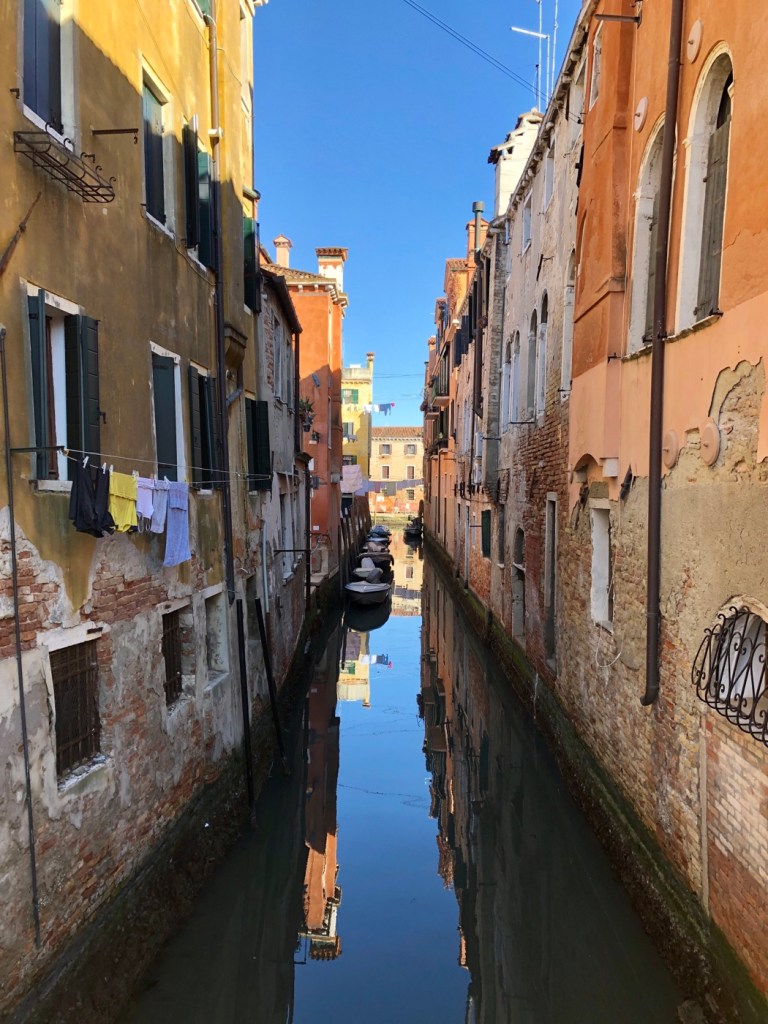
The view from a bridge. Somewhere on a day of many miles of walking.
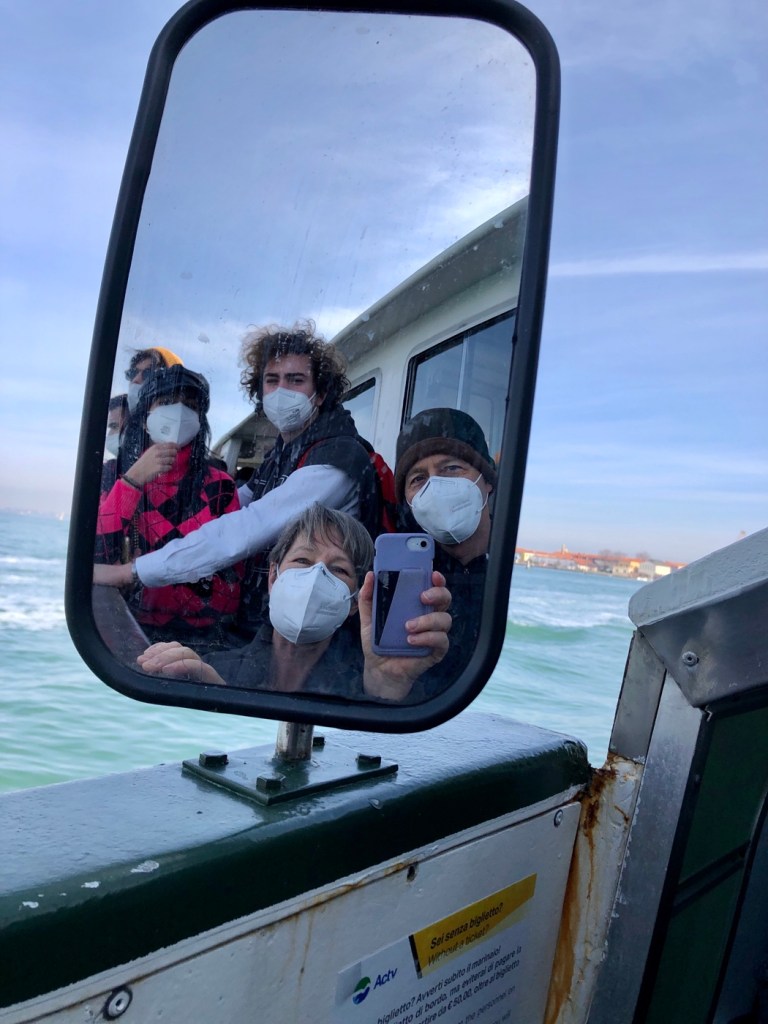
Stylish Italians photobomb our vaporetto usie.
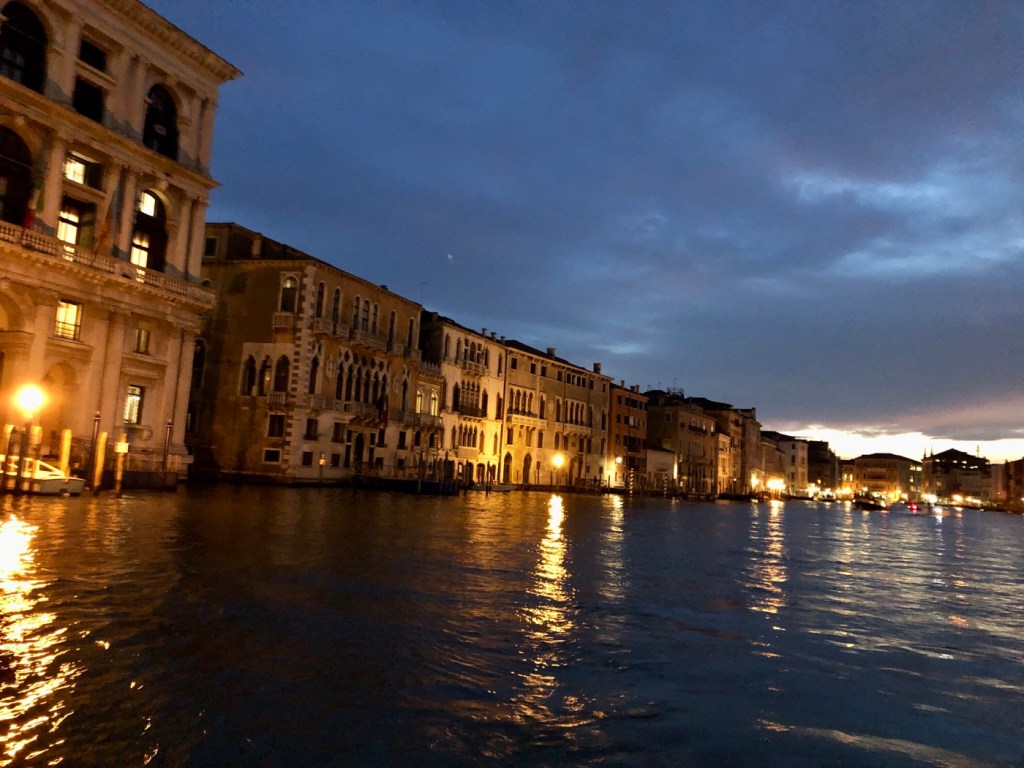
Evening on the Grand Canal.
Sun setting behind gondolas.
The happy travelers catching the setting sun.

And now we’re on a train to Naples, where we anticipate more Carnivale activities all weekend long.