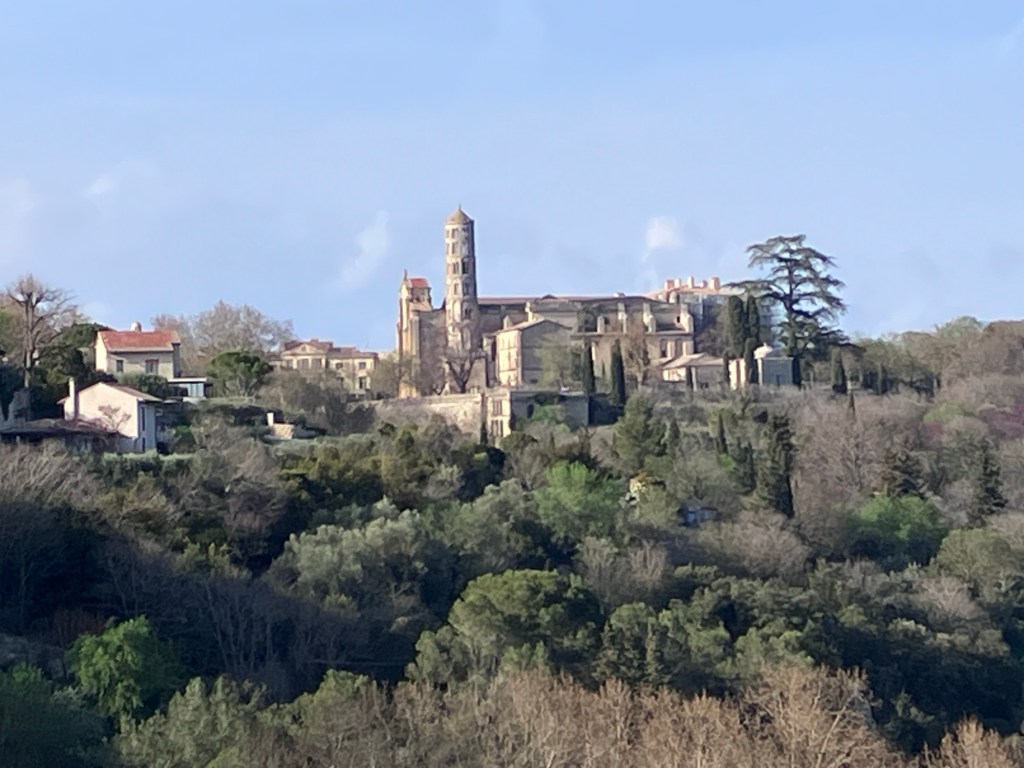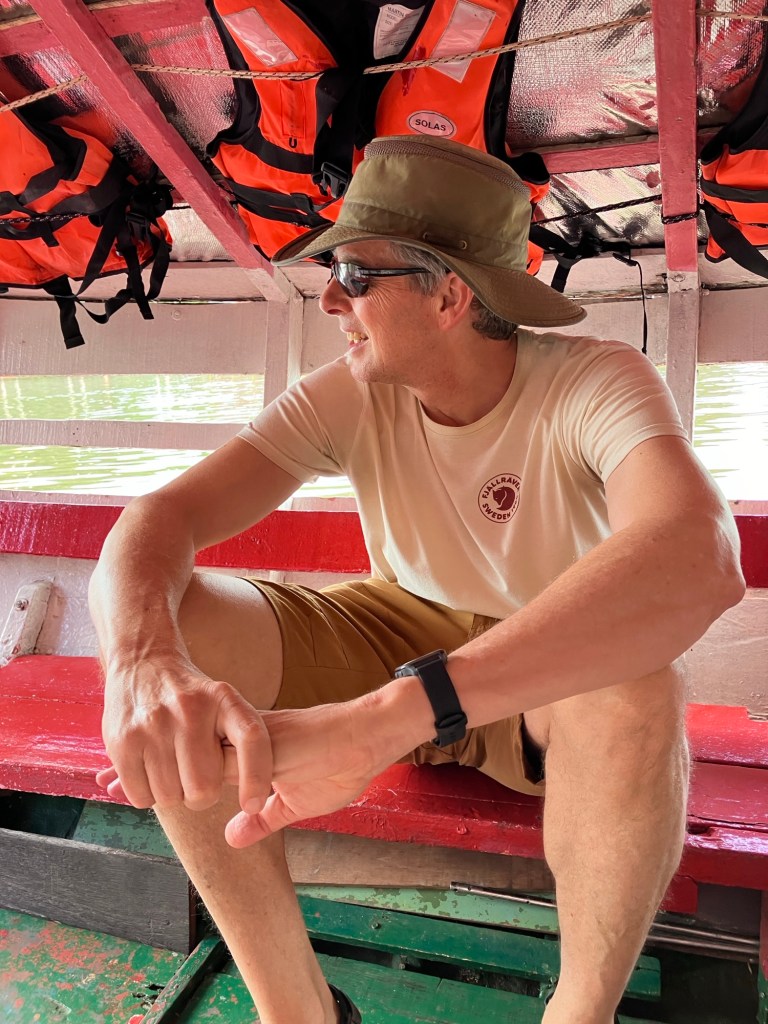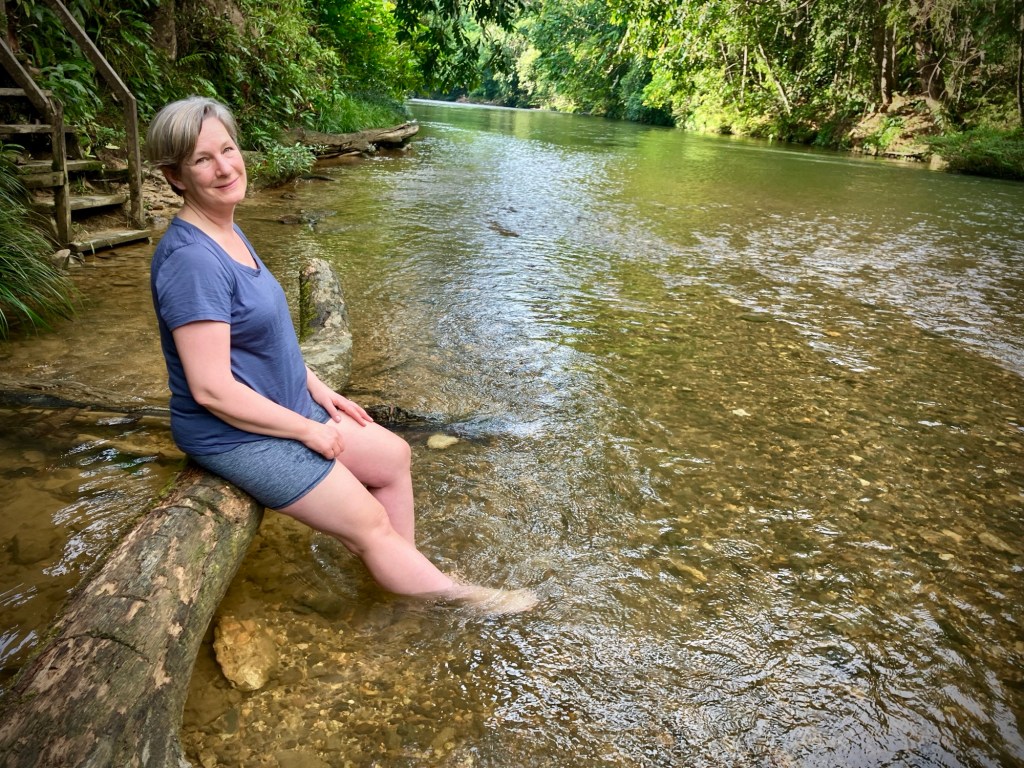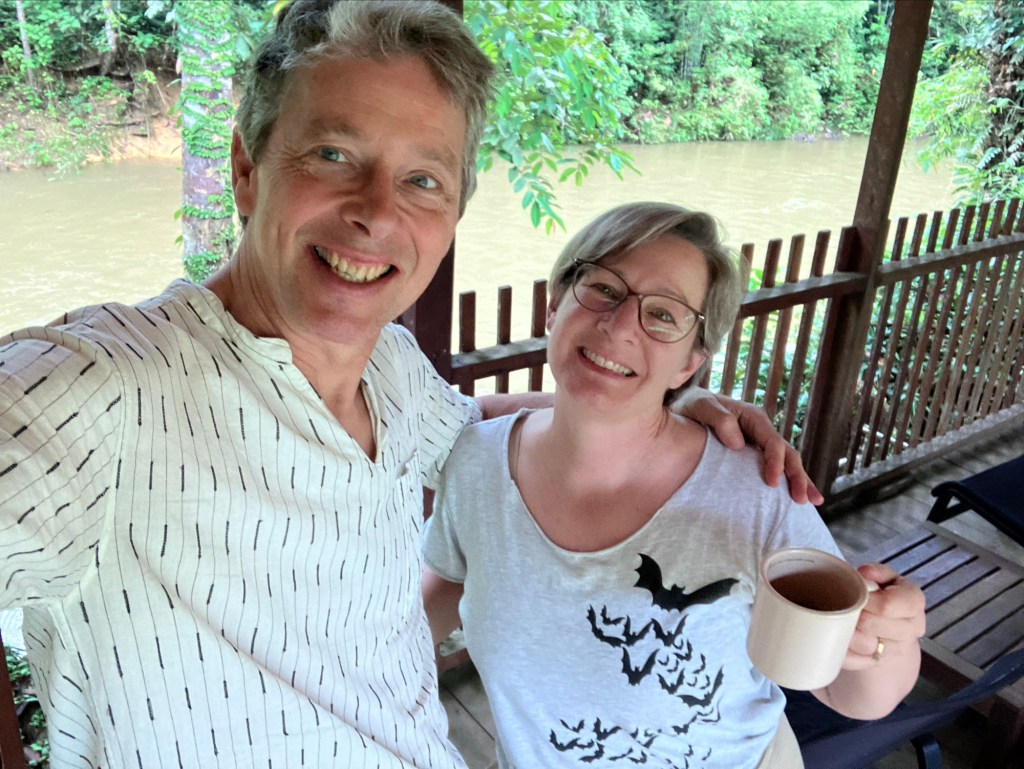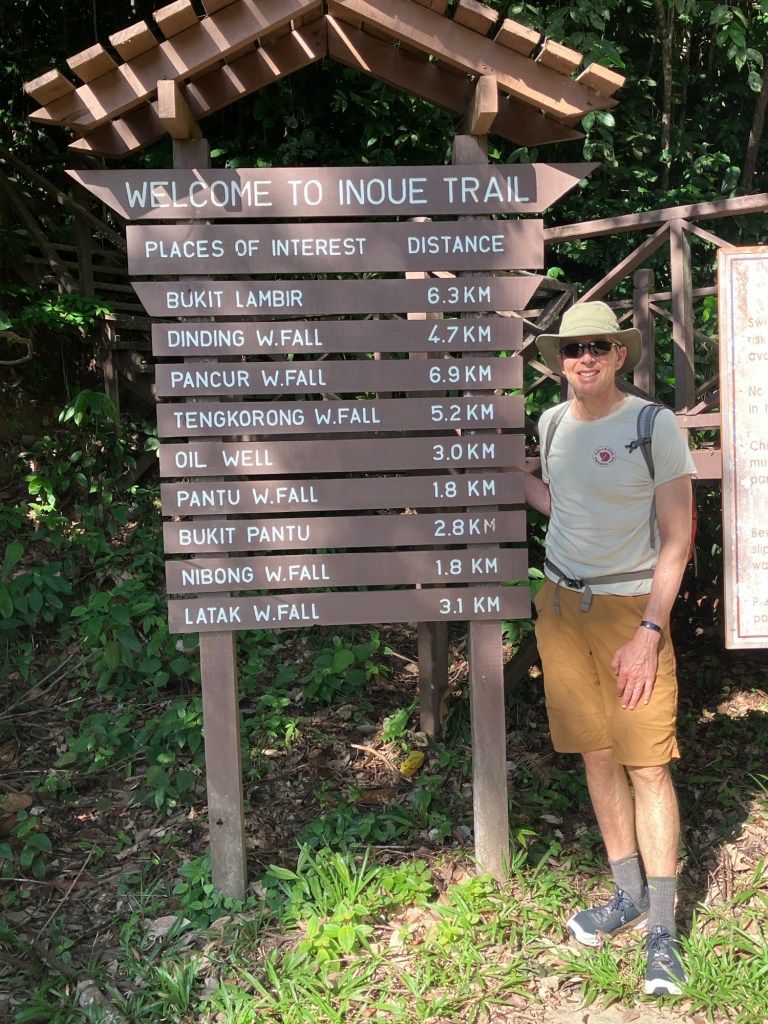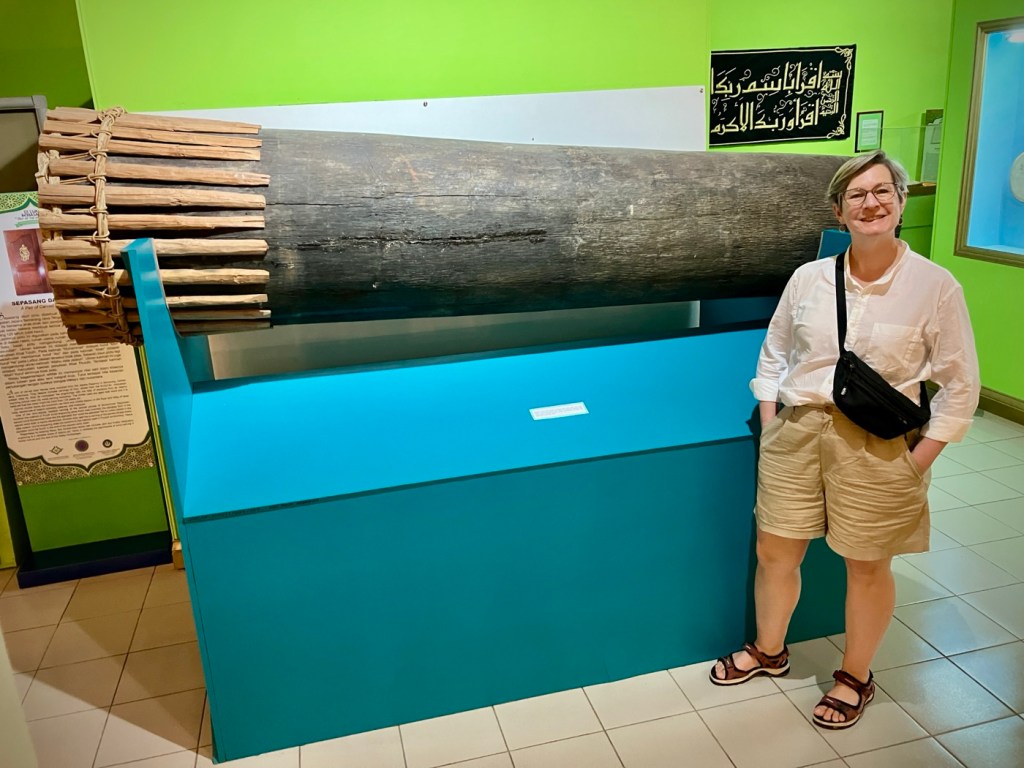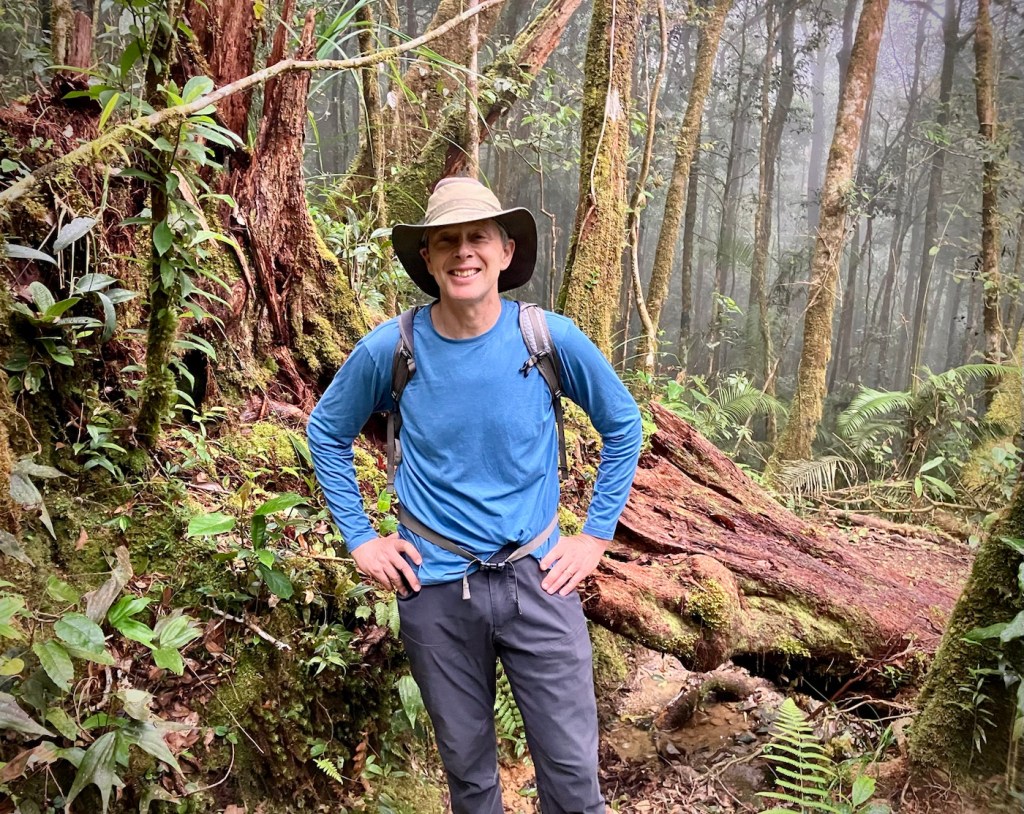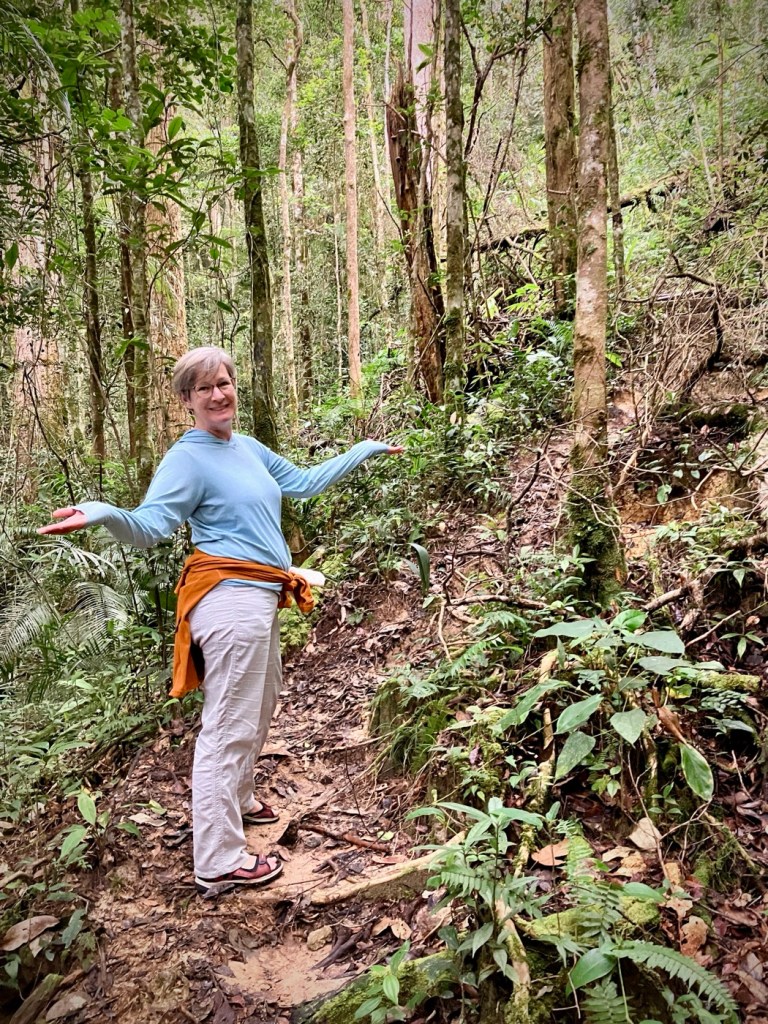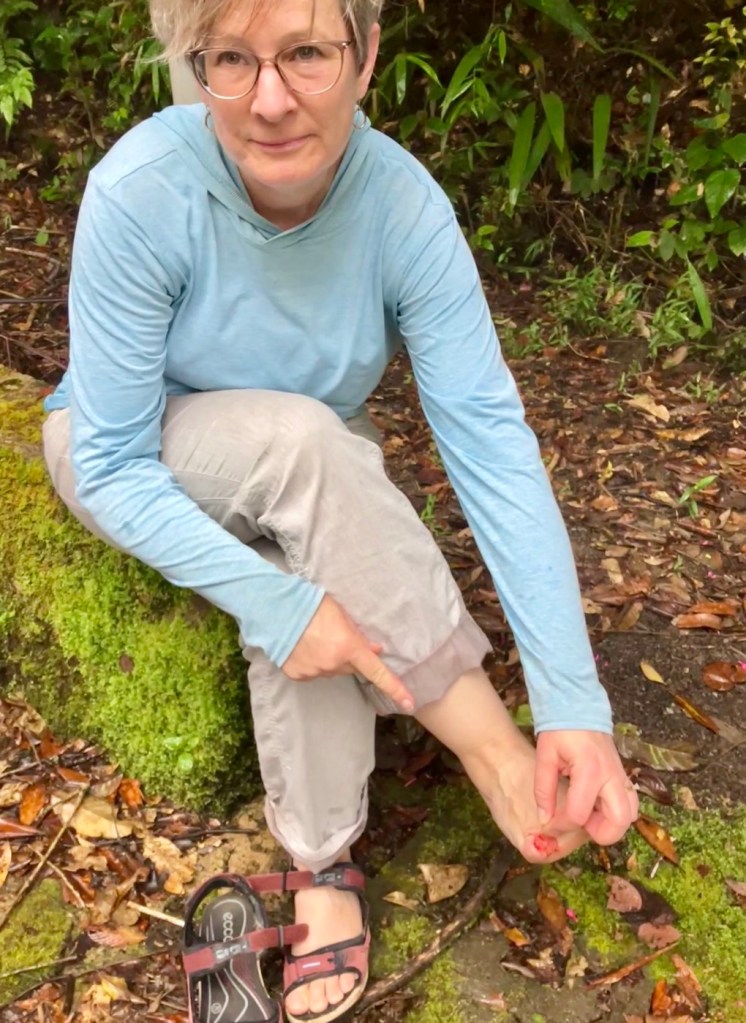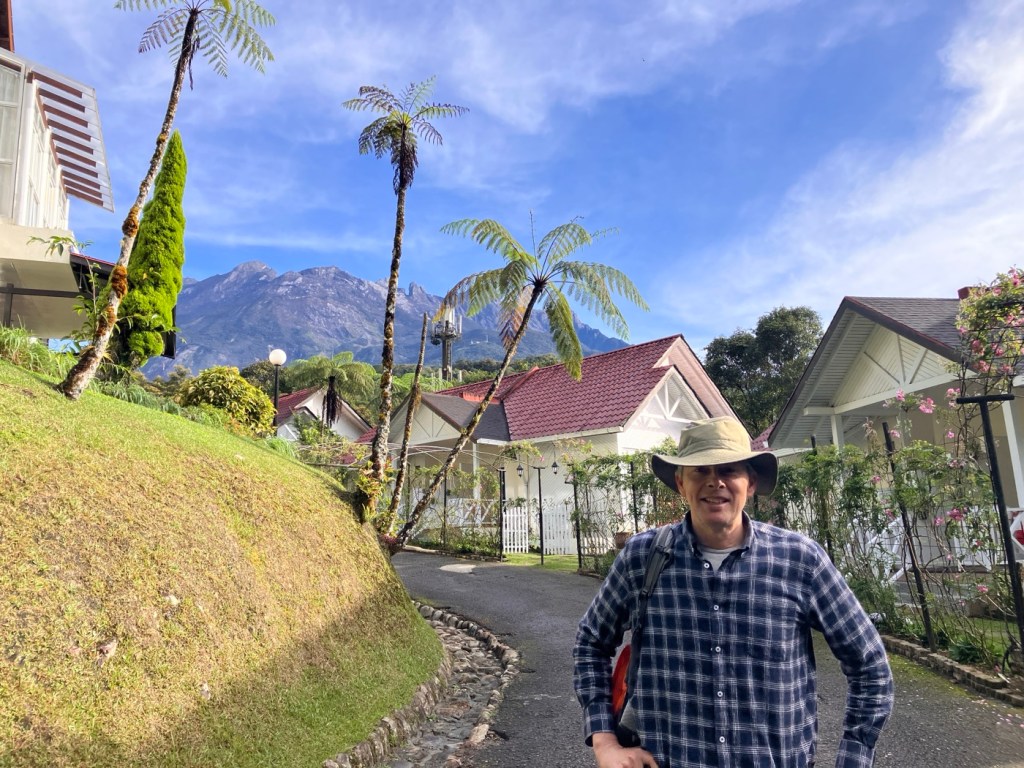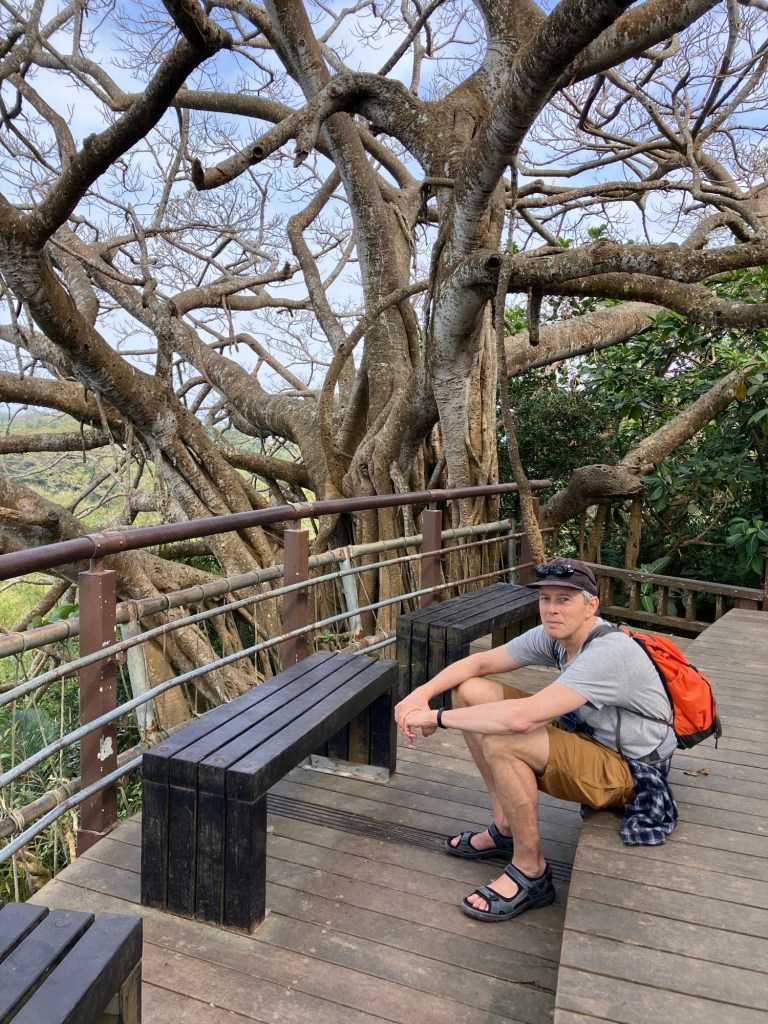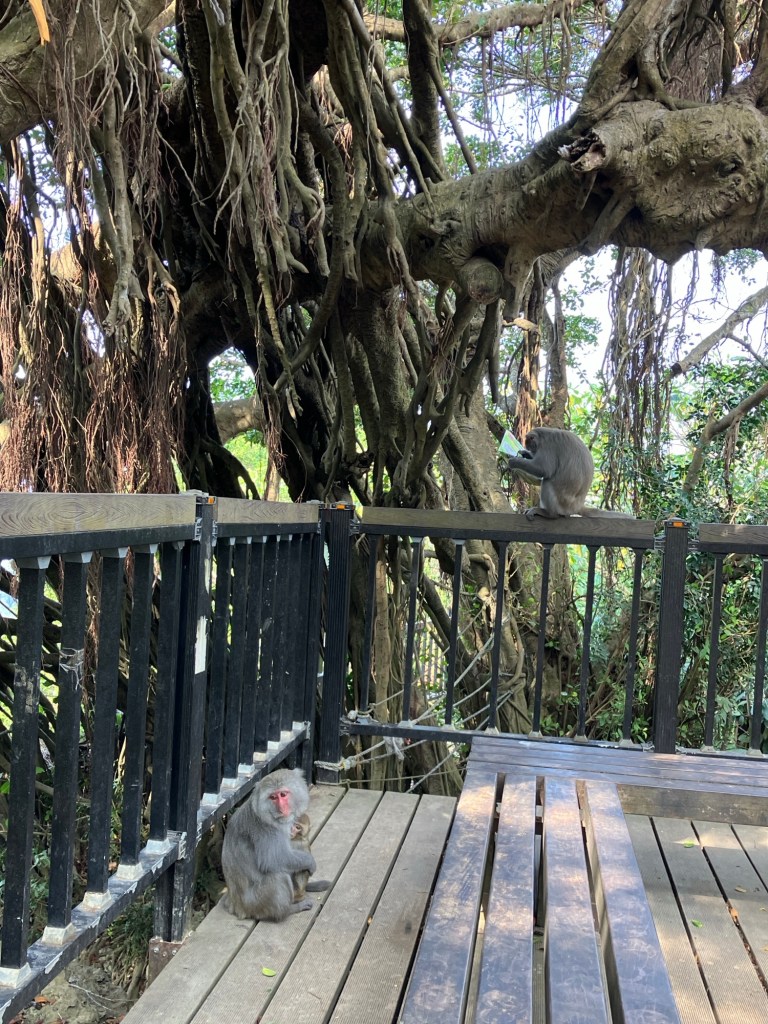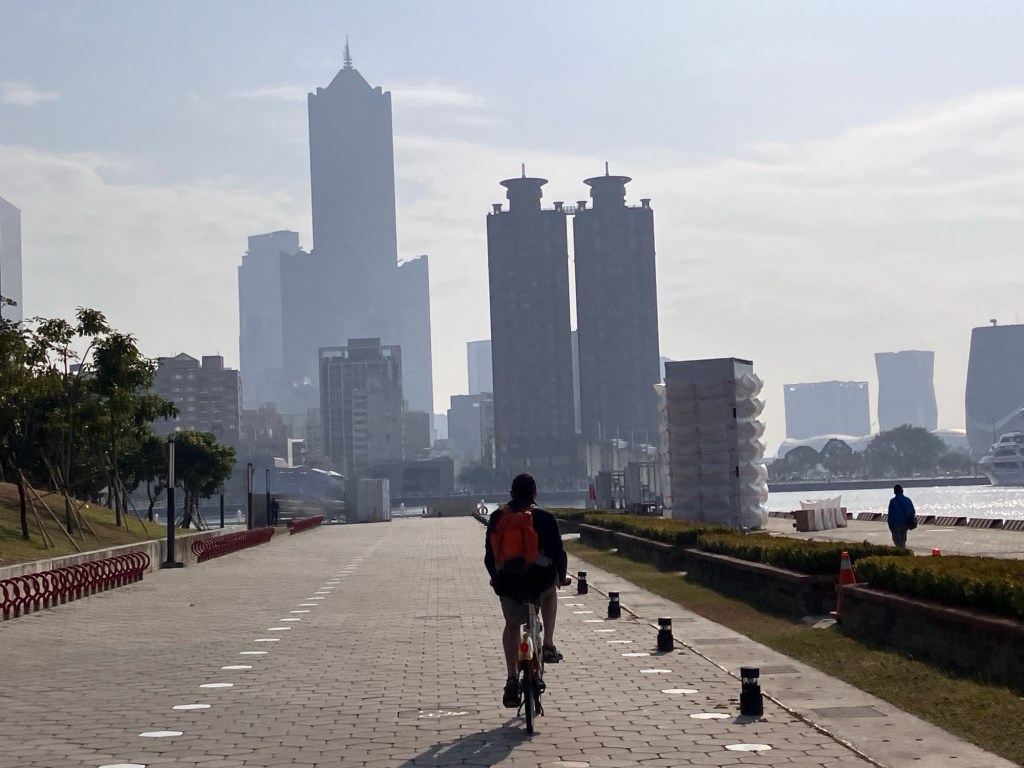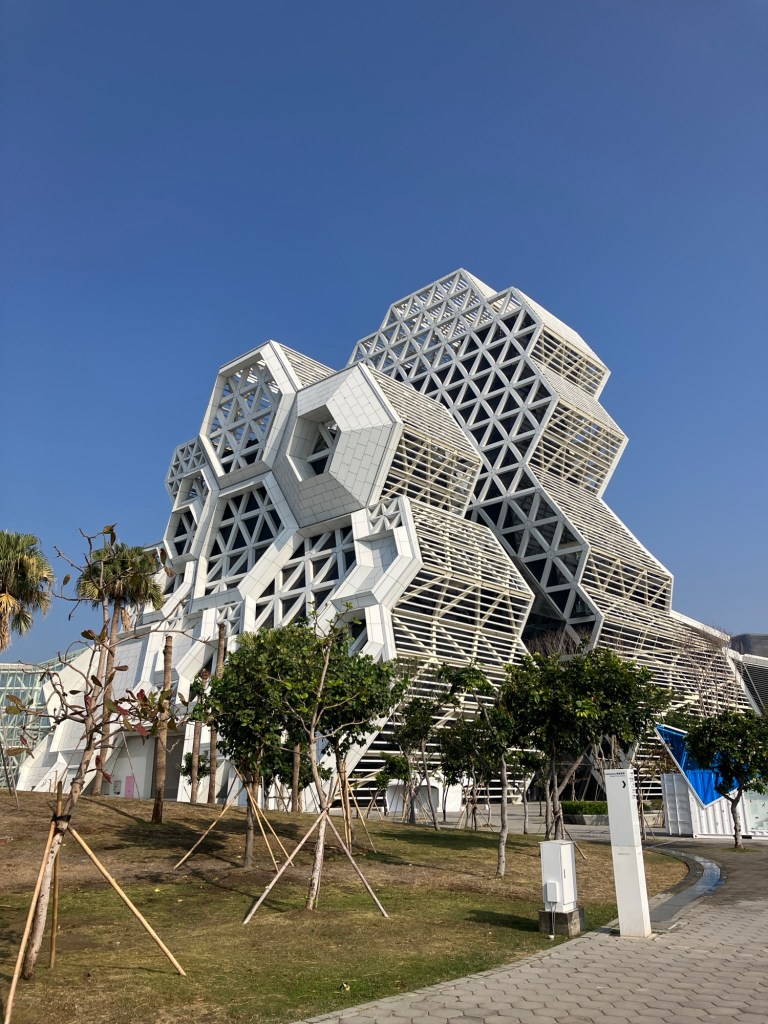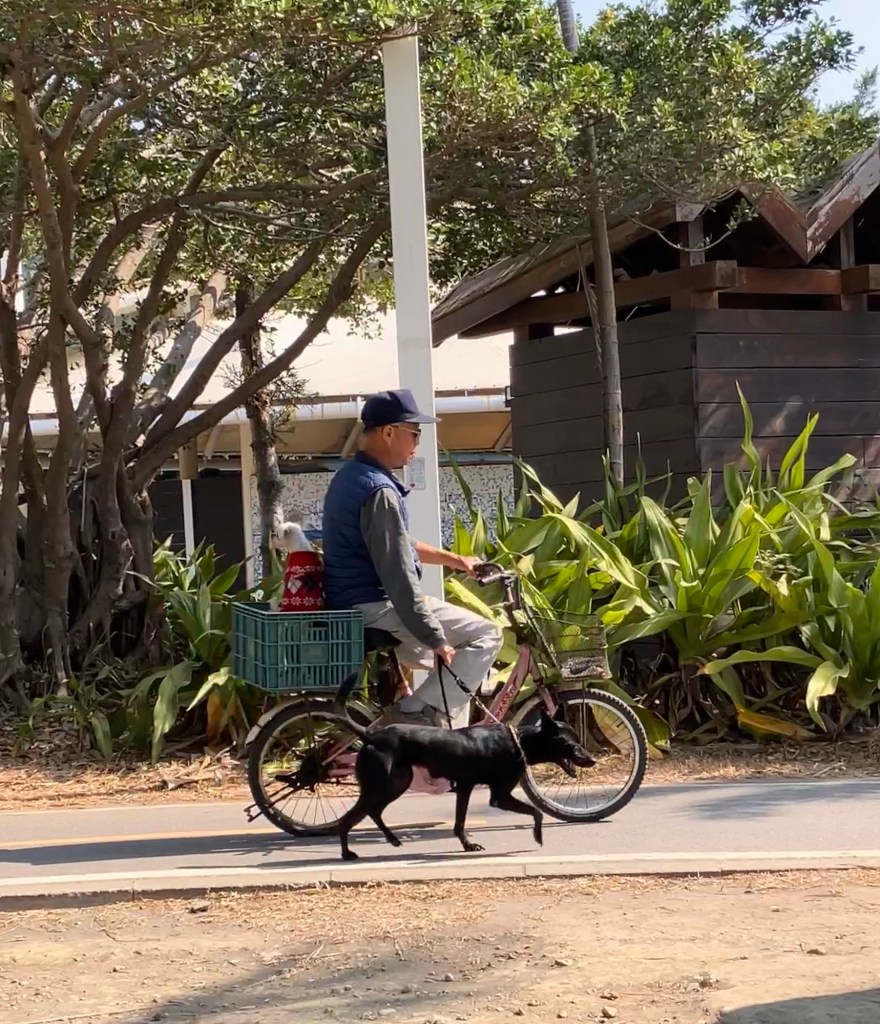
Kuching Sarawak. Nine days in the City of Cats.

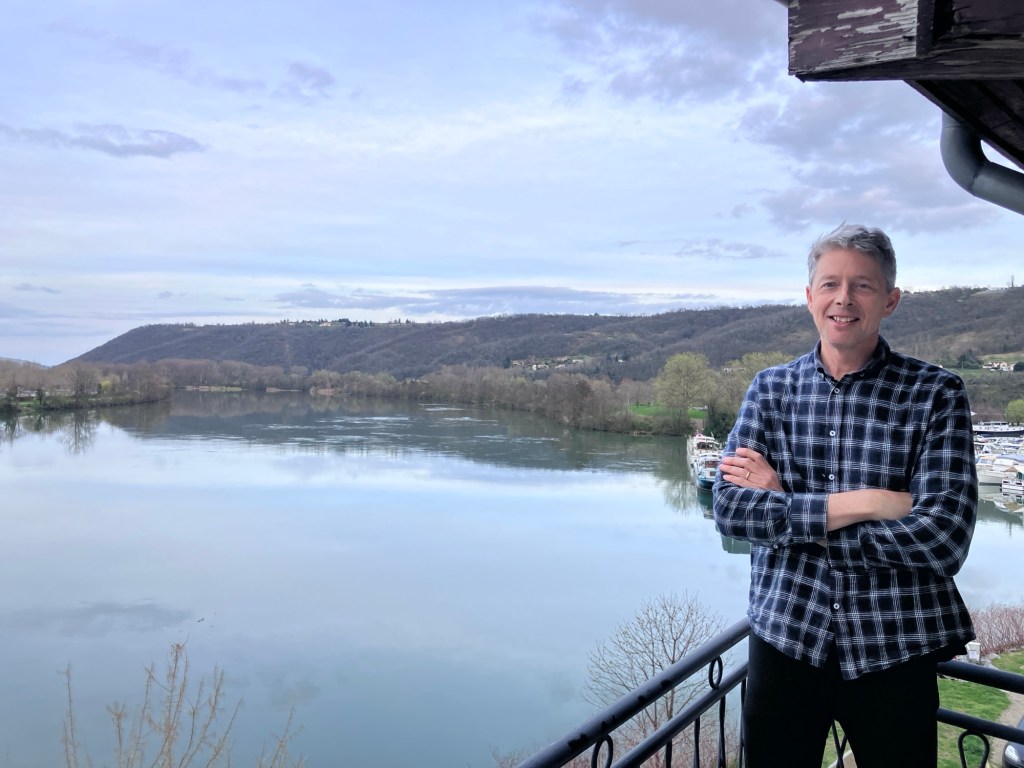
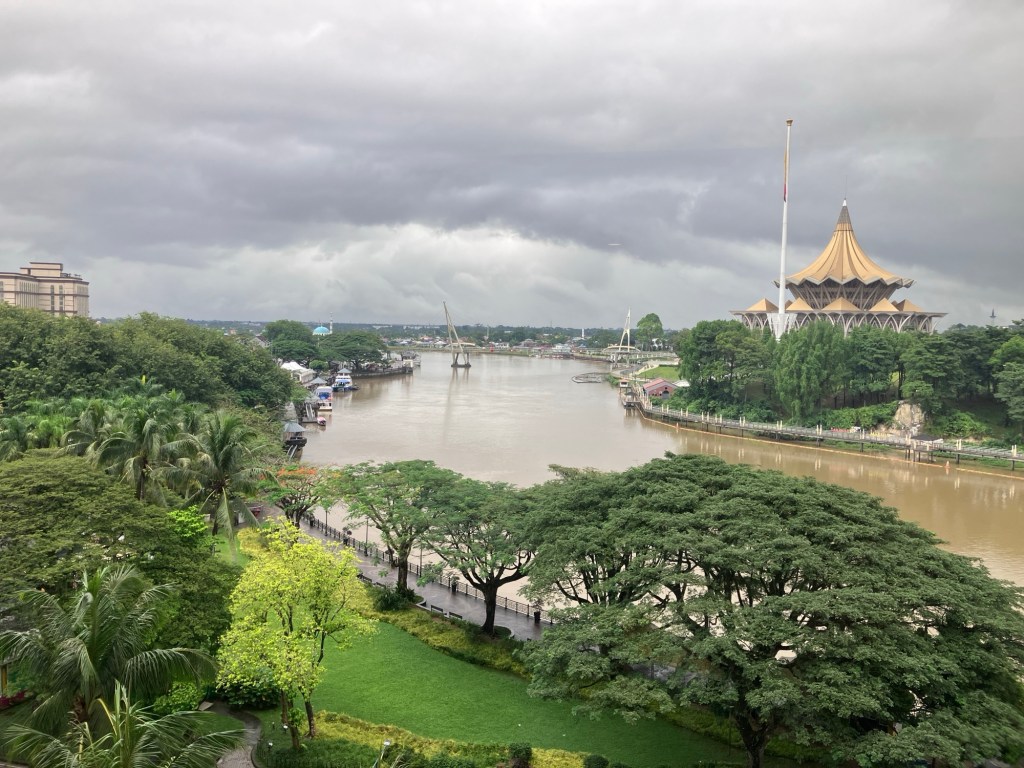
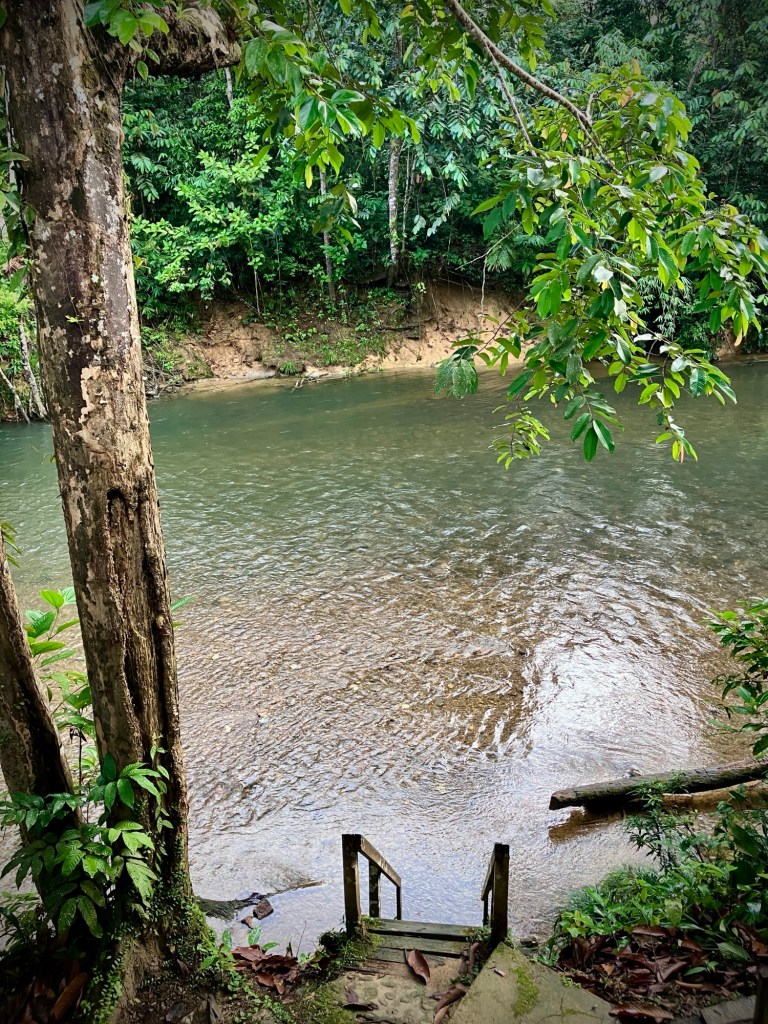
The view from our hotel room of the Sarawak River.

Kuching, the city of cats, was the jumping off place for our Batang Ai rainforest adventure in the previous post. Friends who know Borneo well (hi Ruth and Gary!) had said it was a nice relaxing city, and so it was. Rich booked us a newly renovated river view room at the Hilton and we settled in for nine nights, with two nights off in the rain forest in the middle. Kuching means cat in Malay, and that was enough for me. Cats, here we come.

Let’s go find those cats! This cat themed trash can looked like a good place to start.
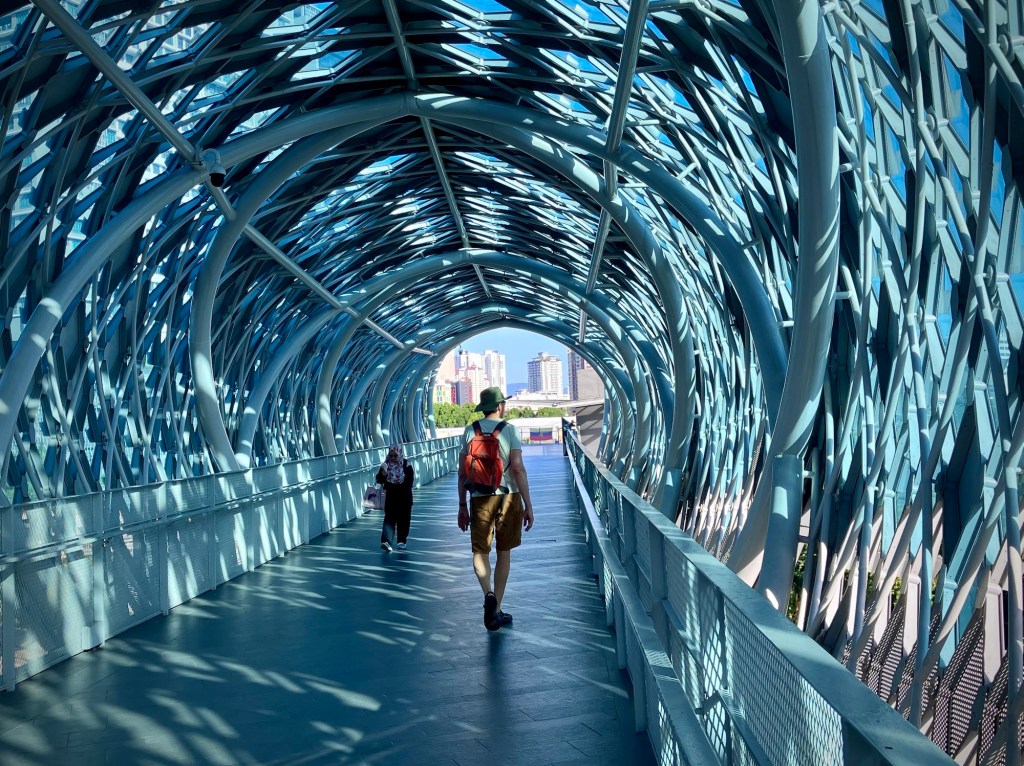
Kitty? You in here? The pedestrian bridge across the river made for nice walking, although it didn’t really connect through to the promenade on the other side of the river.

The big trees along the river shade a lovely promenade leading to the dramatic pedestrian bridge, and it’s a popular destination day and night. Lunar New Year celebrations were still going on so there were loads of visitors, and the city had a fun and busy vibe.

Certainly the Cat Museum was a good place to find cats, right?
Here we come!
Is this where the cats are?
A bemused Rich as we realized the cat museum looked like the house of a cat fanatic. Minus actual cats.
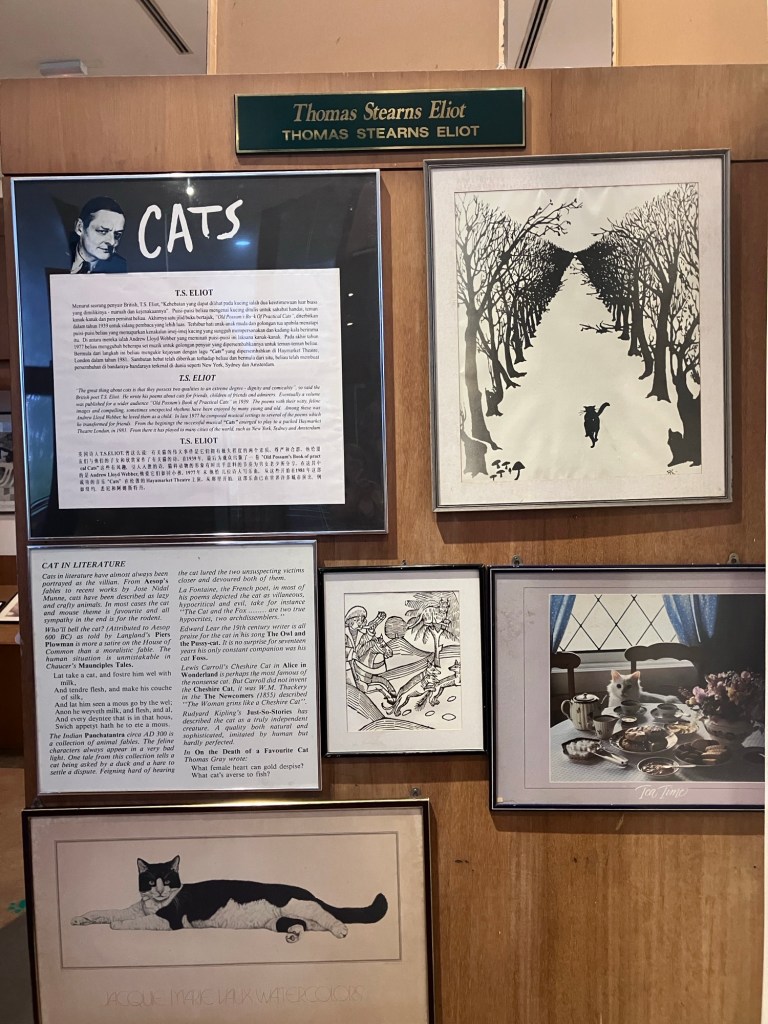
Cats in literature.
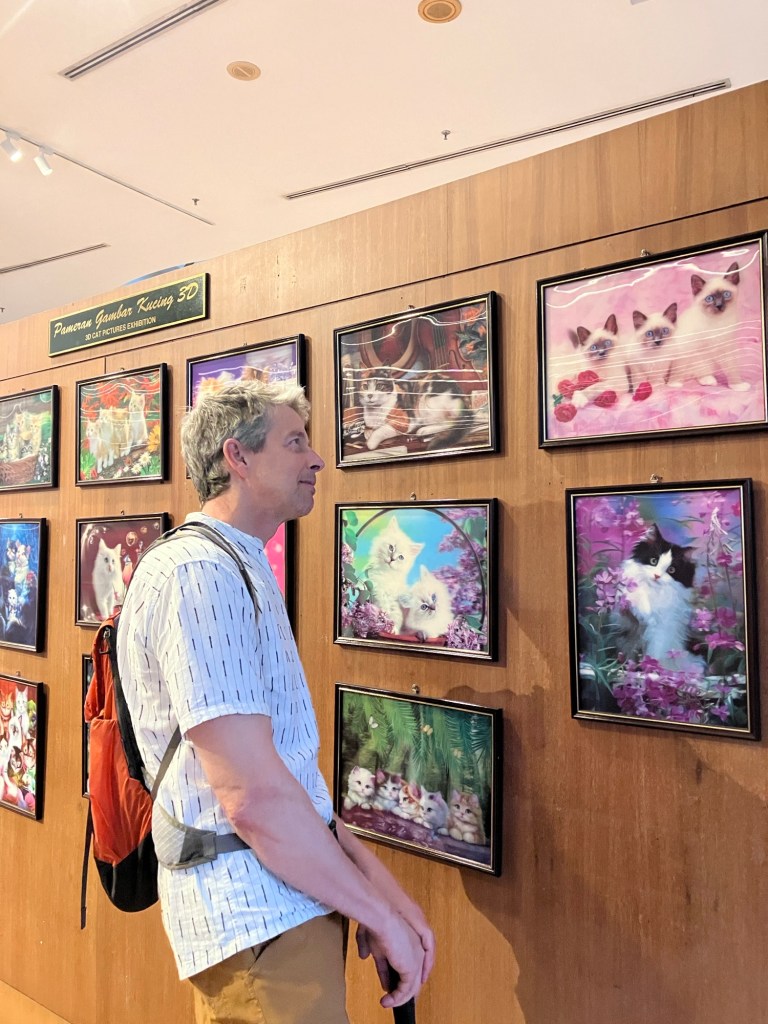
3D cat posters.
Cat art.

The Cat Museum had cat everything, but no actual cats. This is a museum that would be a waste of time for travelers with fewer days to spend in Kuching. But Rich and I had a good laugh at the silly and kitschy collection, wondered how the “museum” ended up in the City Council building, and how it kept going. Our ticket price of about 60 cents was well spent, we figured, and on we went to explore more of this City of Cats.

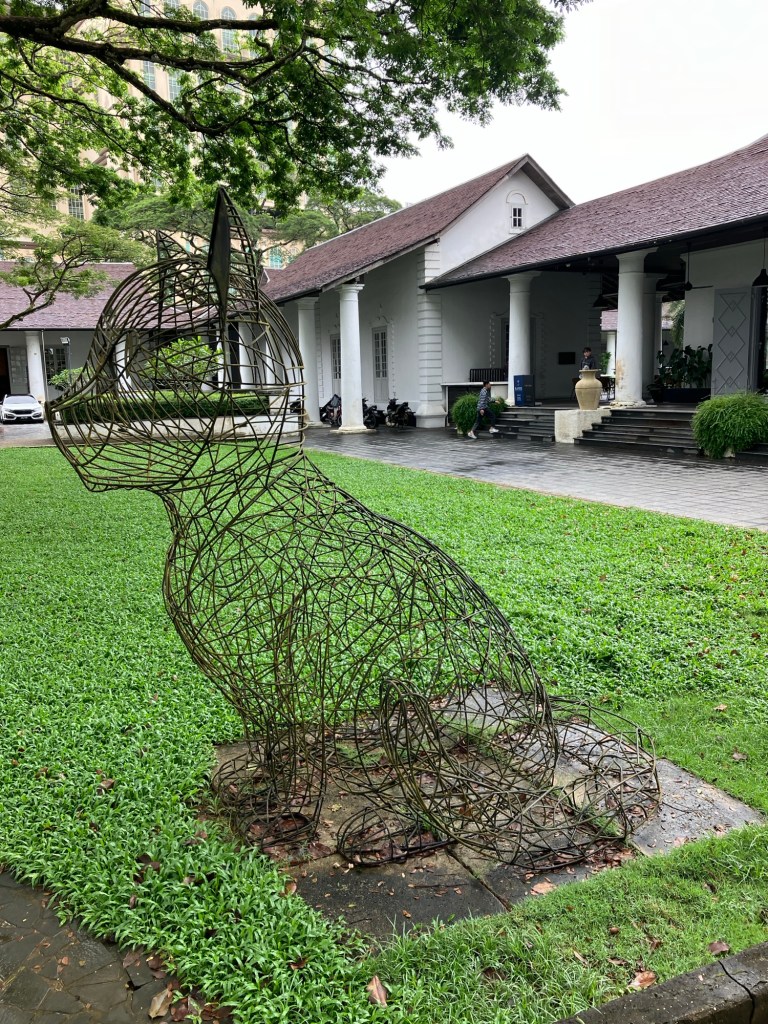
There were plenty of cats represented in art and decor around town. Wire sculpture of a cat.
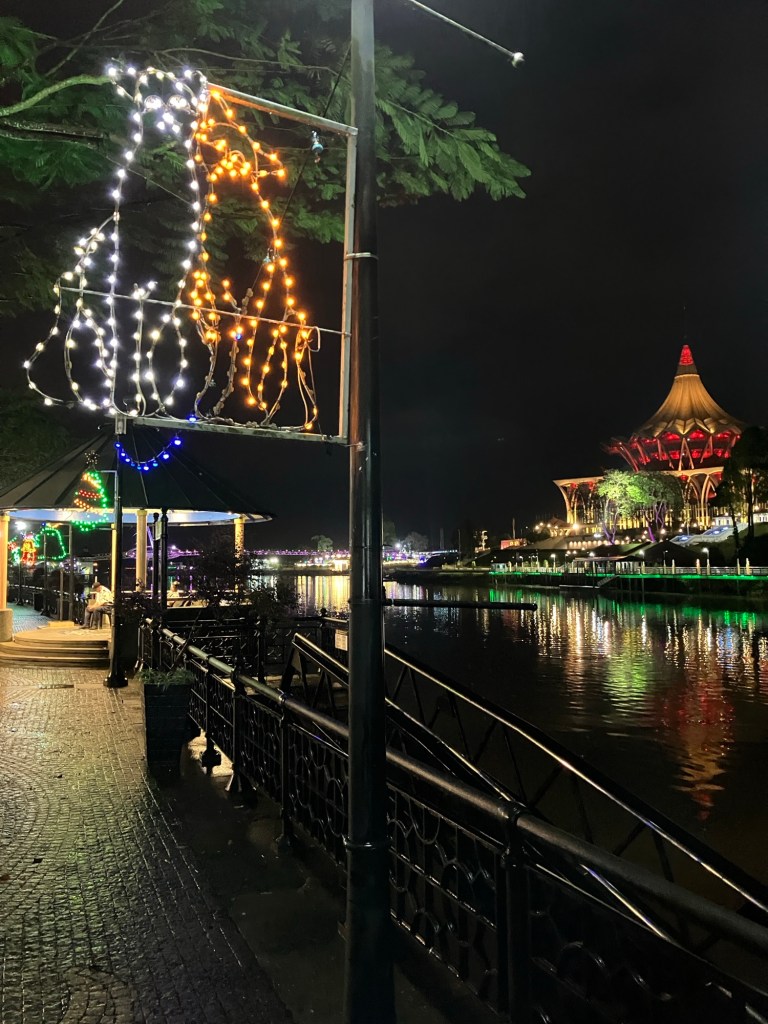
Even cat lights along the river. I appreciate a city that leans in to its shtick.
Found a very pregnant cat to pet.
Of course this one went right to Rich.
The chefs at a restaurant on the promenade not only fed this cat, but also gave it shelter from the rain with a cat and dog themed umbrella.

Searching for cats was fun, but couldn’t occupy all of our time in Kuching. It was still the rainy season in Borneo so we had some cloudy and wet days which was fine with us, the rain keeps the heat down. We try to walk as many places as possible, heat be damned, and walk we did. The Spring shopping mall was only 3 kilometers from our hotel, so we got out early one morning and headed off. We knew we would be facing some not wonderful walking conditions, we’d seen that much from our trip in from the airport. Kuching lacks public transport, with one bus line that makes a big loop around the city with arrival times every two hours, and lacks good pedestrian infrastructure. Things like cross walks and pedestrian lights are far and few between.

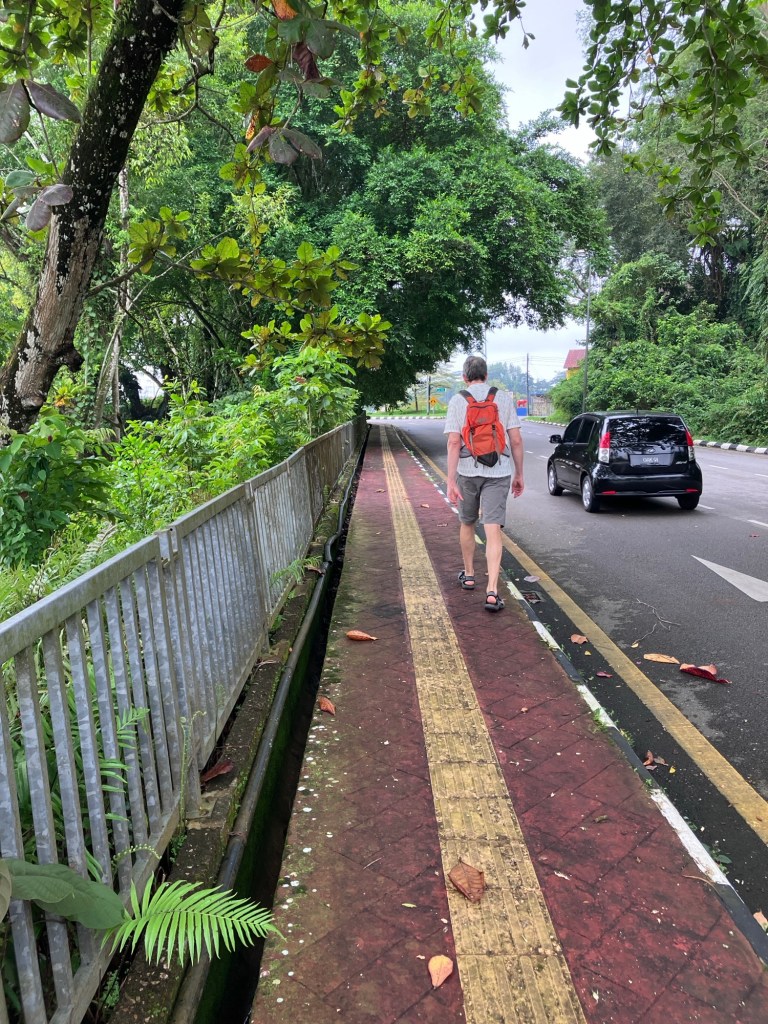
Sidewalks mostly exist, complete with raised tactile paving for those with vision problems.
Kuching is a very green city. The walking on this overcast morning was pleasant.
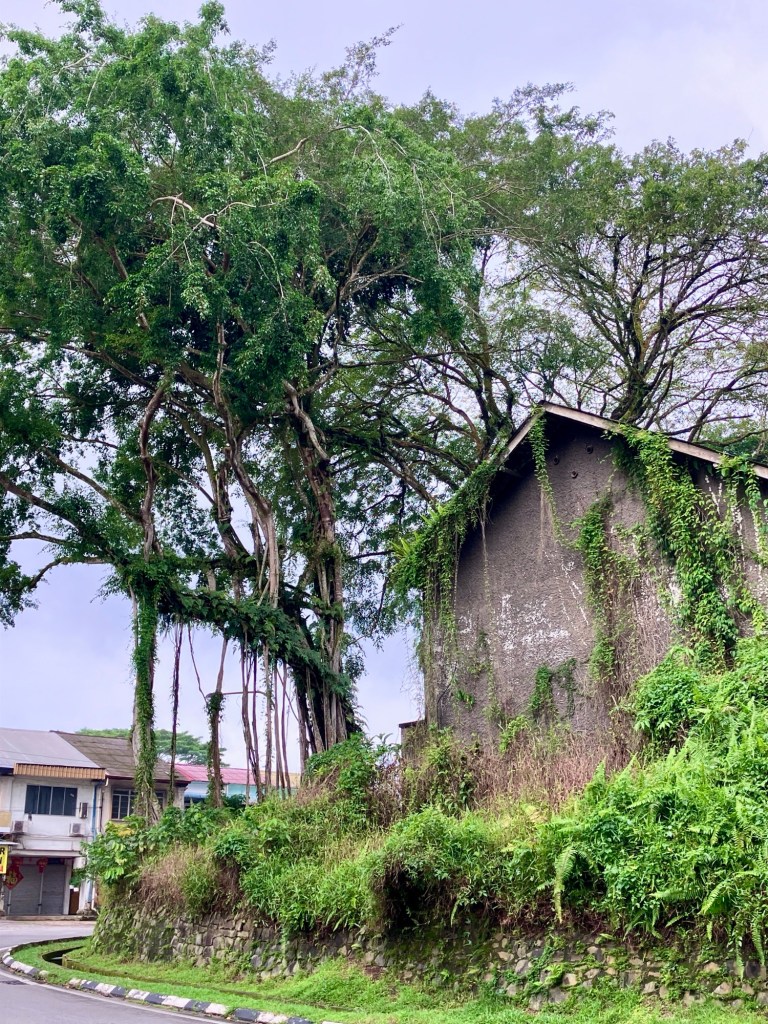
You see interesting things when you go on foot.
And then you get to an intersection with no ped crossing. It was Sunday morning so not a lot of car traffic, fairly easy to dash across.
And the sidewalk vanishes just short of the mall.

We don’t set out to find flaws in cities, but when we try to live our usual lives, walking, biking and taking transit, we realize where the weak links are. That makes us think about what it’s like for people who live in Kuching. Without frequent public transportation from the outer areas to the riverfront and commercial areas, people need to own cars, or use Grab rides to get around. Owning a car is a big financial commitment no matter where you live, and much of the money spent on automobiles is money that is not spent at local businesses – a point transit activists make everywhere. As for walking for transportation, we saw barely any other folks on foot once we left the riverfront commercial area. Like no one.

Walking to the nearby Borneo Cultures Museum, the building at the left, was fine.

As tourists we can stay near attractions we can walk to. But we see the car dependency, such as the big parking lots near attractions like the Borneo Cultures Museum- which is a fantastic and well curated museum. We joke that if you don’t see the entrance you can assume it’s closest to the parking lot.

The Borneo Cultures Museum was newly built and opened in 2022 – great museum.
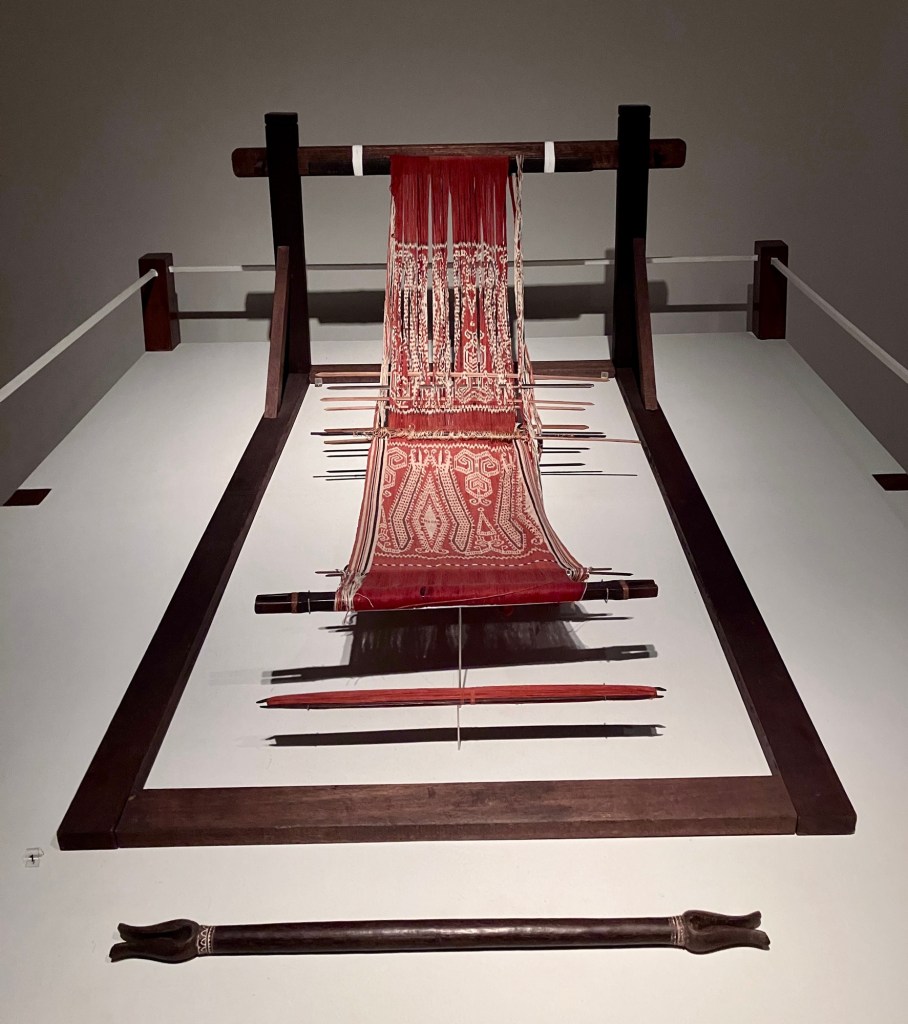
A display about the traditional Iban weaving known as Pua Kumbu.

It was good to go to the museum before our trip to the rainforest stay at the Nanga Sumpa Lodge. The introduction we got to Iban traditions at the museum was a good first step, we had questions to ask our guide, and were introduced to the Chief whose photo appears in the museum.

My chai at the museum cafe, the gift shop was also well curated.
Since we didn’t see orangutans at Nanga Sumpa Lodge, it was off to Semenggoh after we came back to Kuching

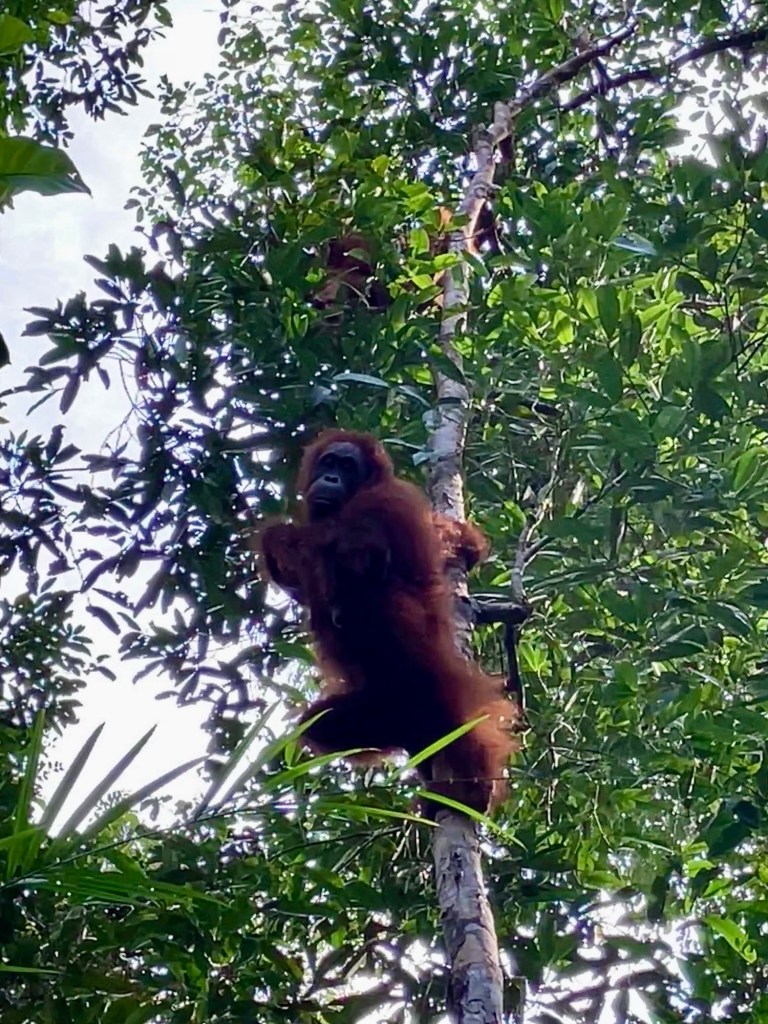
Semenggoh Wildlife Center is a 1,600 acre/653 hectares forest with a population of semi wild orangutans who are fed to supplement their wild diet. The acreage is not enough to support the animals with wild naturally occurring food. Founded as a sanctuary for rescued orangutans, the center has an established population with babies regularly joining the group. Visitors are let in morning and afternoon for the feedings of sweet potatoes, bananas, coconut, papayas, oranges, sugar canes, pineapples and hard boiled eggs. There is no guarantee that the orangutans will show up, they may just stay in the forest eating naturally growing fruit, especially during g fruiting season which it was. Thankfully the draw of food was enough to tempt out four the morning we went.

Food?
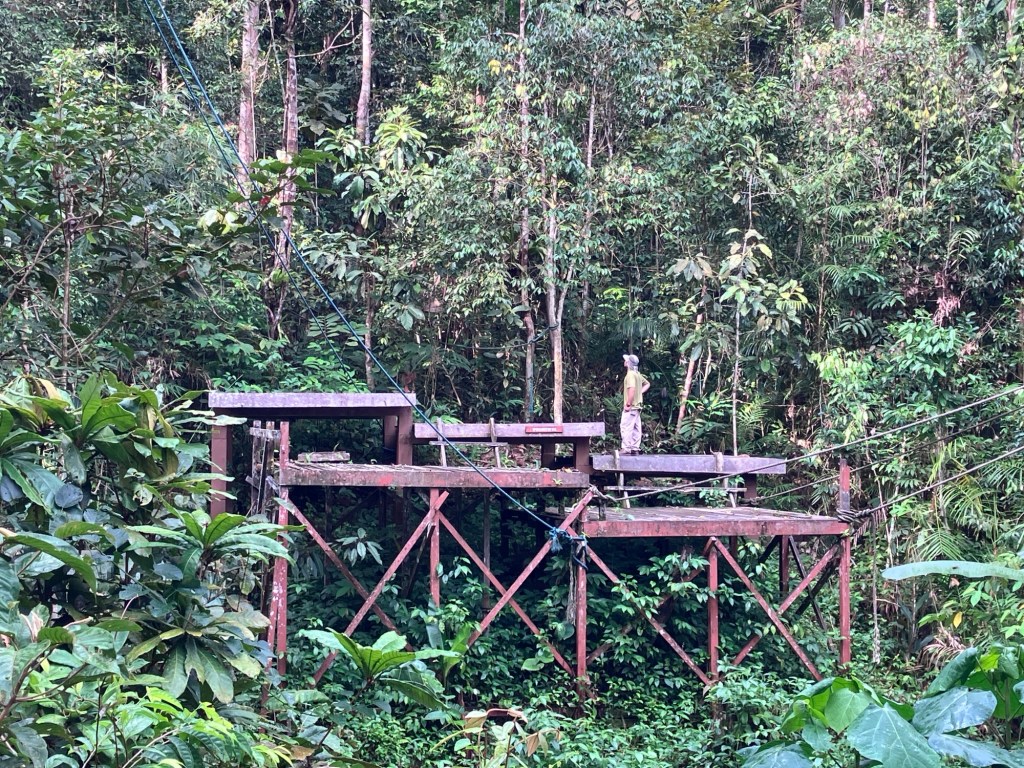
A reserve worker headed out to the feeding platform with a basket of food.
Staff on the platform watching for orangutans. The workers make whooping noises to let the apes know food is available.
Humans waiting patiently for the orangutans.
Here comes a momma and baby, and her toddler aged offspring.
There are no blasé visitors when the apes swing into view in the forest.

Semenggoh is about 20 minutes south of Kuching by car, 30 minutes north will get you to the jetty at Kampung Bako to take a boat to Bako National Park, which is on a peninsula reachable only when the tide is high enough for the boats to get through. For both of our trips we hired a driver we met on our rain forest adventure and he dropped us off and picked us up from both visits.

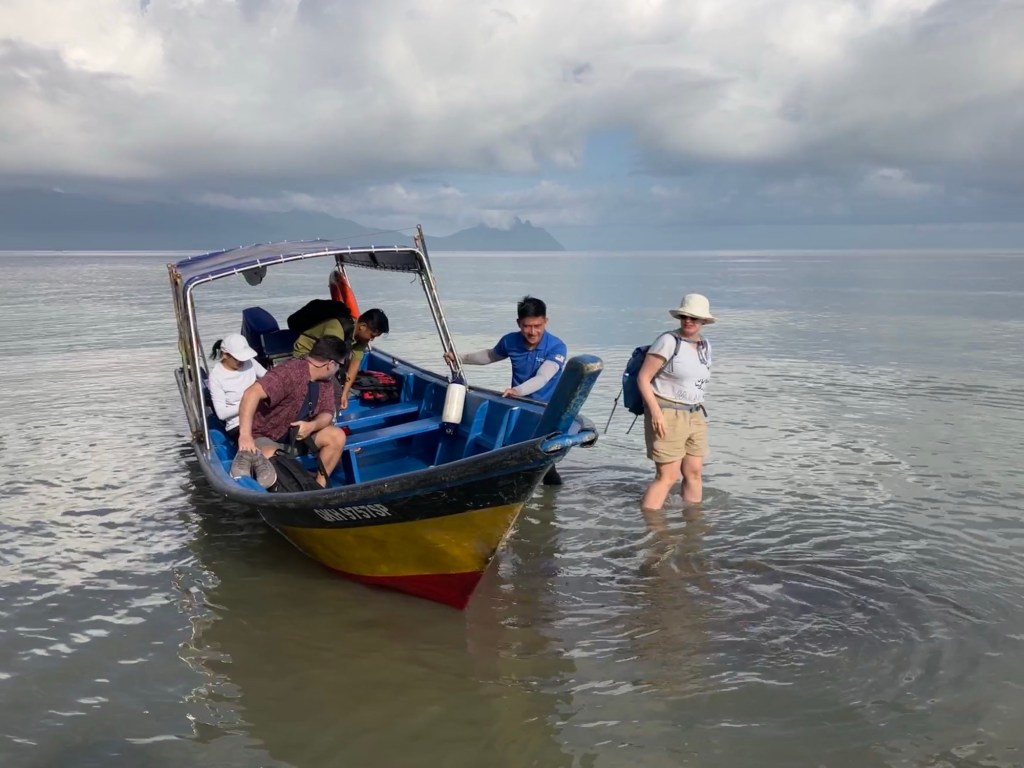
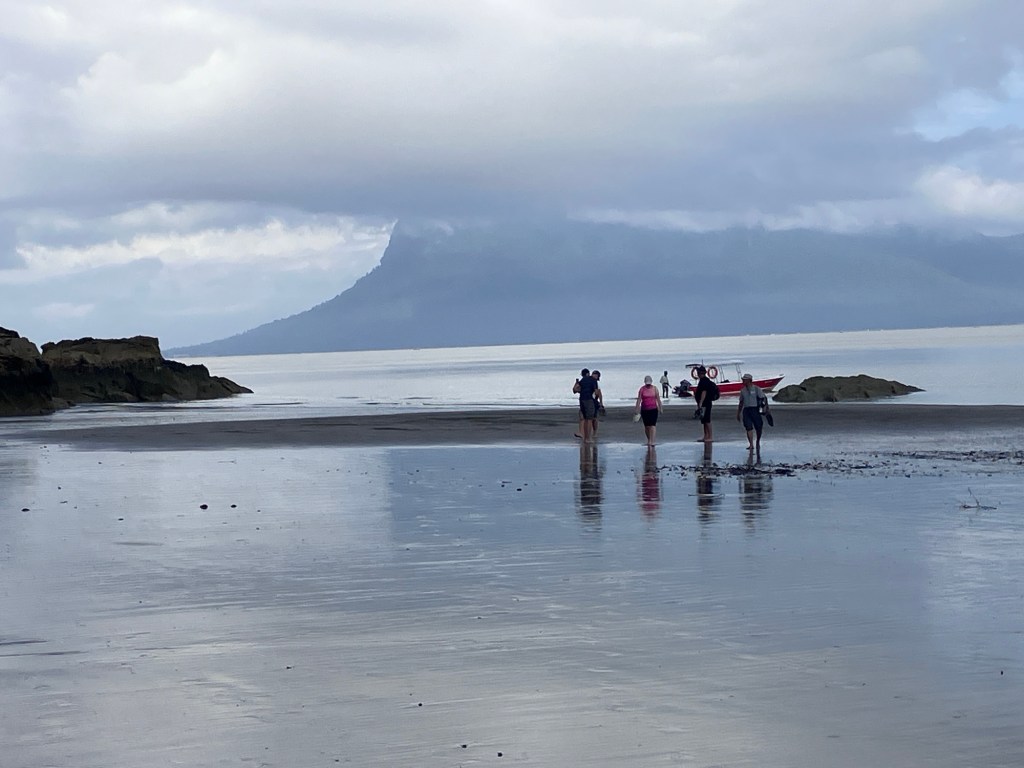
Disembarking at Telok Assam beach.
It’s a fun way to start the day – feels a bit survivor-ish.

We were super lucky to share a boat with Katherine and Chris (hello you two!) from Seattle, and we all hit it off so well we spent the day together hiking and marveling at the wildlife.

Our first look at the park.
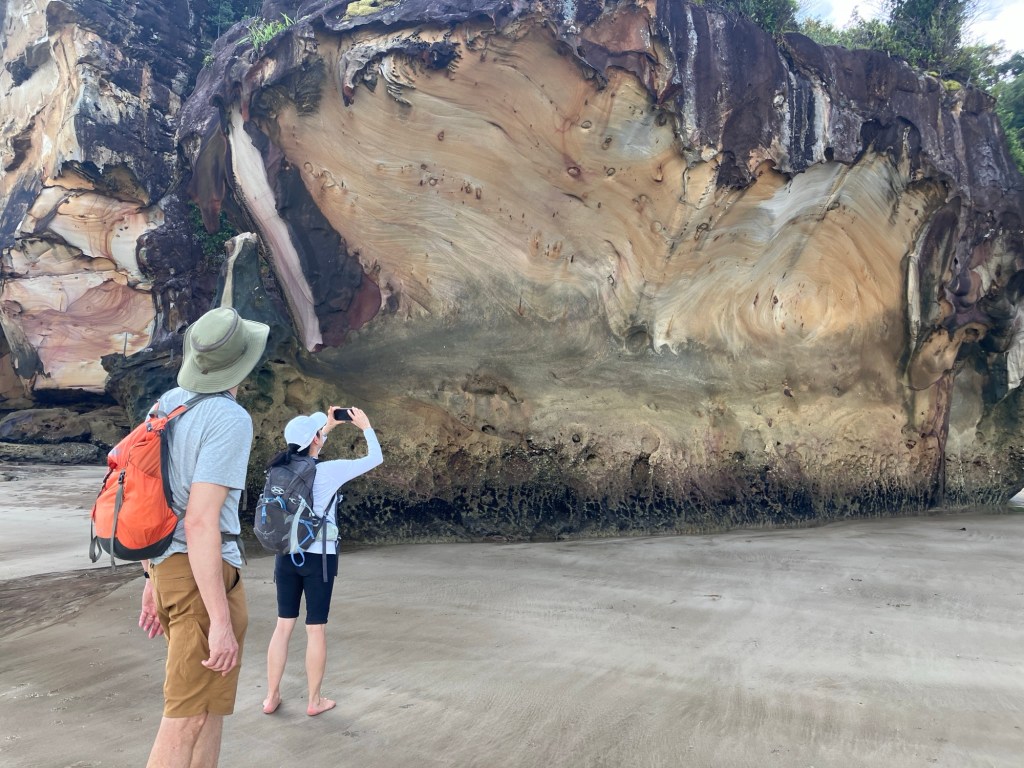
The rock formations are the result of erosion stripping away sedimentary rock to leave the thick, resistant sandstone behind.
A dramatic chunk of sandstone.
A forest on top, highlighting the blue sky.

The park is very well run, with check in at the registration desk, overnight accommodations with reservations required, and well marked trails and maps. And the animal viewing! Really amazing. As our driver Ali said, Bako is for animals. Proboscis monkeys, silver leaf monkeys, and macaques. We also saw a flying lemur sleeping the day away in a tree, and a pit viper. And adorable bearded pigs.

Mama and youngsters having breakfast.
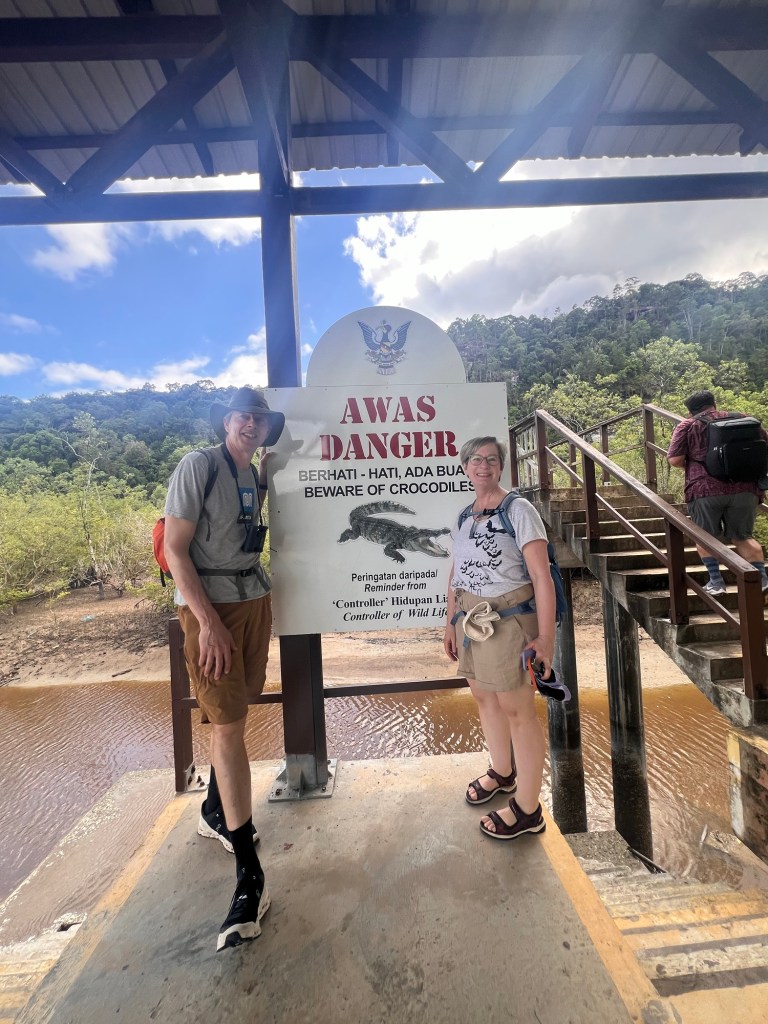
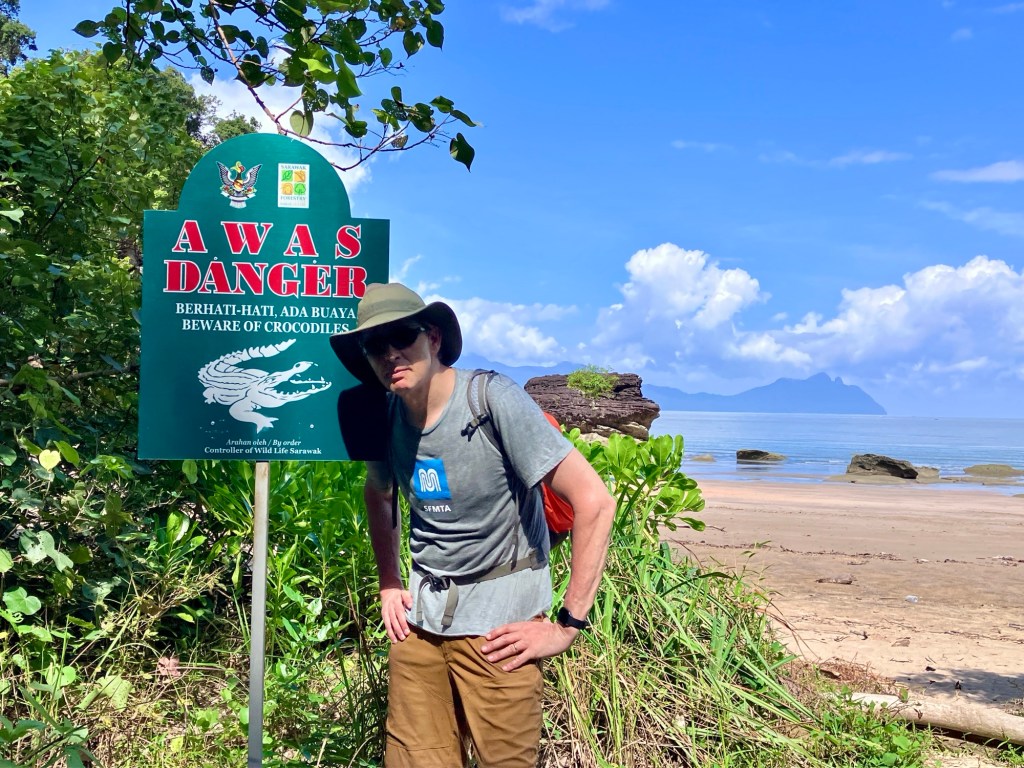
Oh yes, no swimming at Bako due to saltwater crocodiles. Photo by Katherine.
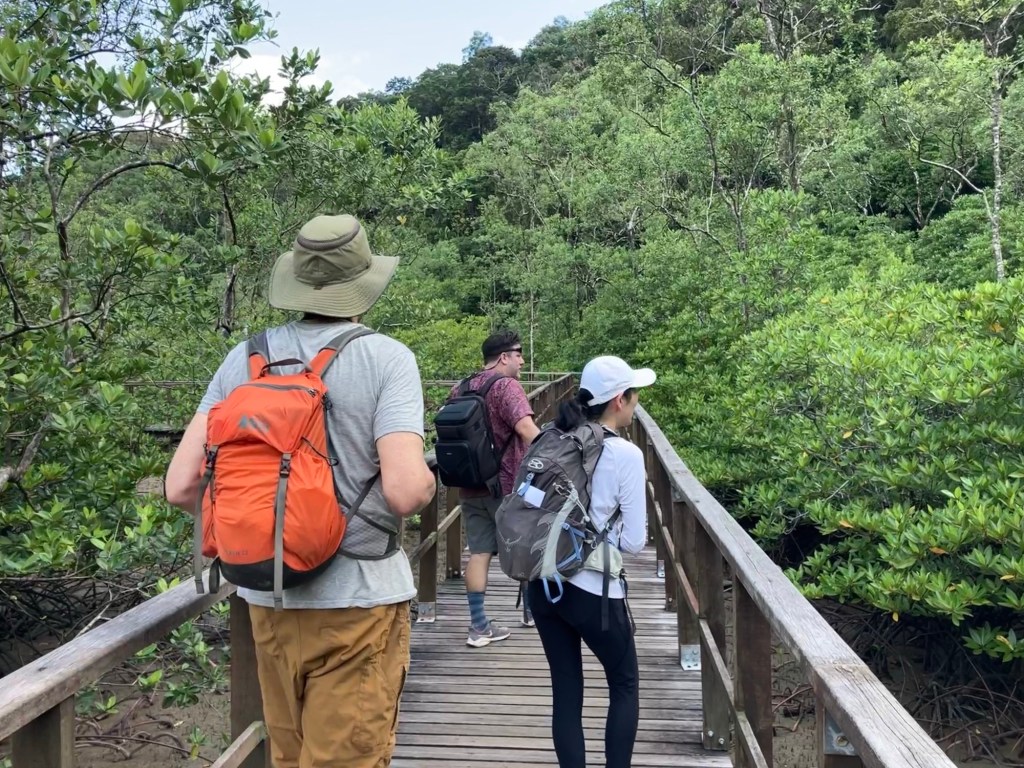
Headed out for hike number one.
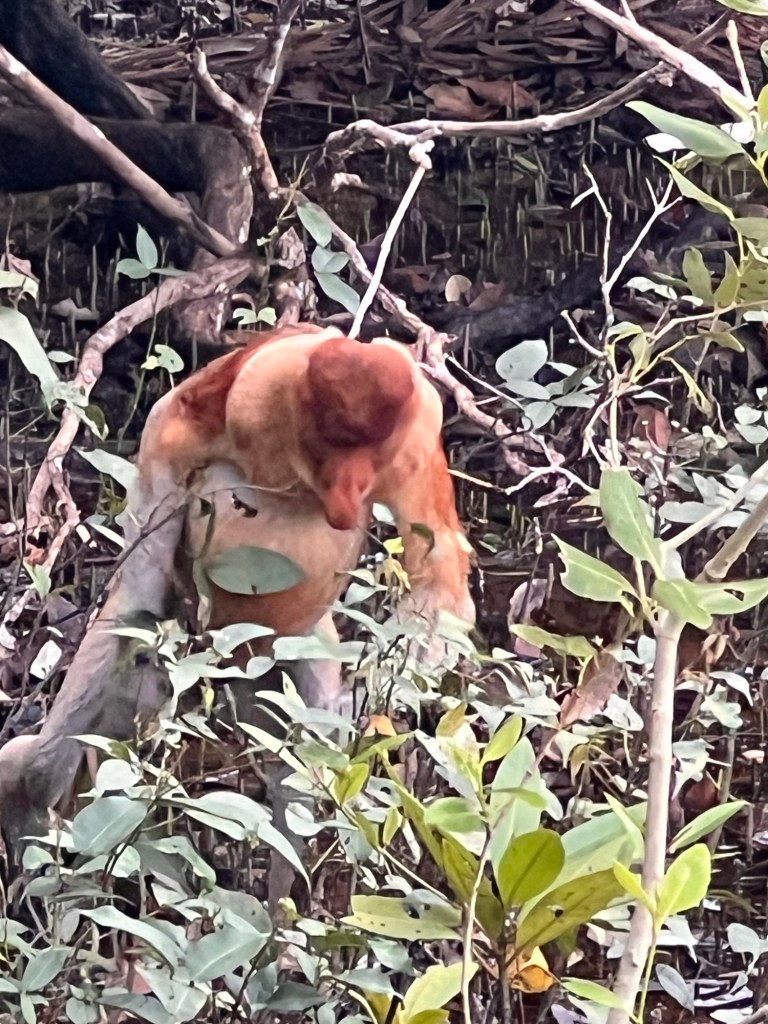
We first saw a proboscis monkey spotted by Rich. Katherine’s photo- much better than mine.
No shortage of trails. You would have plenty to do with a two night stay.
The trails are well marked but tiring with the up and down and heat and humidity.
Our first beach. There should have been a monkey warning sign. We were quickly joined by a macaque who was certain he could bully us into feeding him.
The monkey took this for an invitation. Oh! Backpacks. Must mean food.
I am patient. I am persistent. I am monkey.
Katherine looking at shells. Monkey waiting.
It was so nice to have people to share the hike with – so glad we met!

After lunch Rich, Katherine, and Chris headed out for a second hike and I stayed behind to read and mind the extra gear, and watch macaques marauding the cafe.

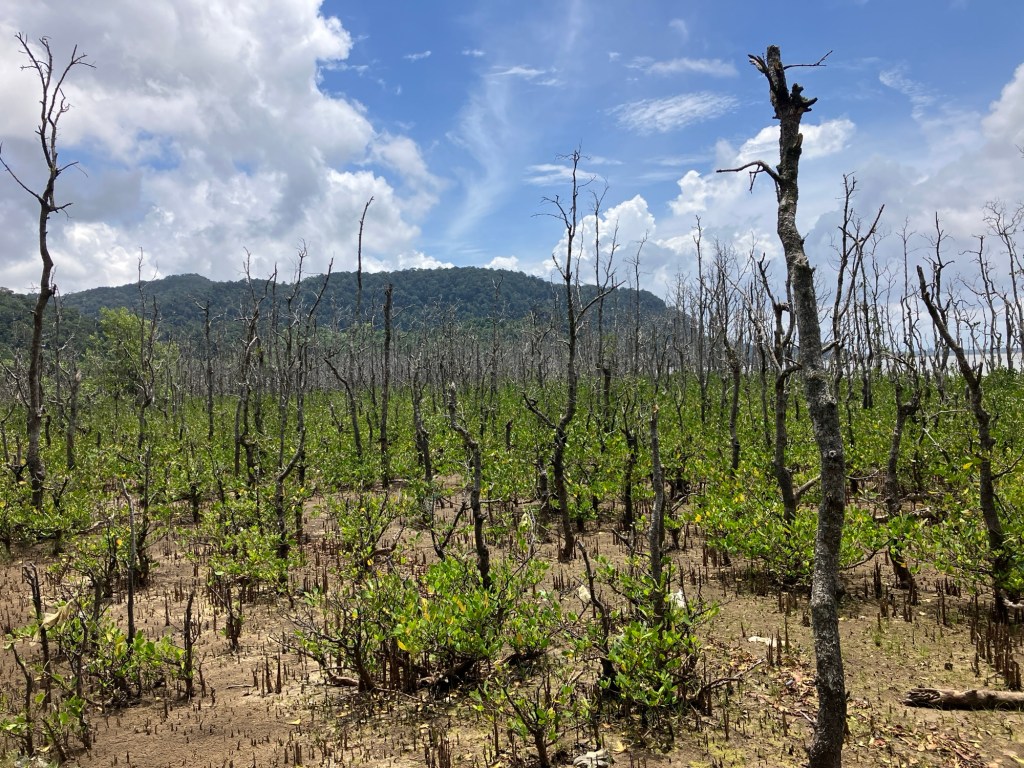
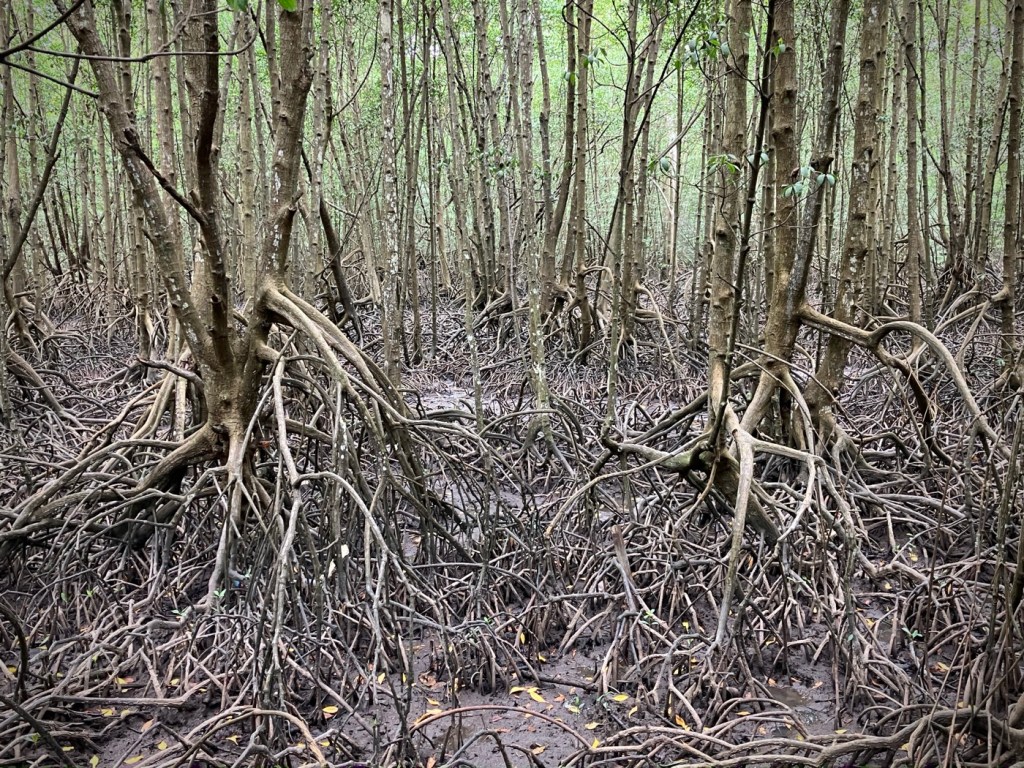
Stunted mangrove forest.
The view from Bako to Santubong Peninsula.
Gorgeous rock formations.
A pit viper.
Back on the boat after a successful and happy day.

Spending a week plus in one place means you get to do the little things that might not be on the top of your must do list. From our first day in Kuching we saw the little boats plying the river. Although the lovely pedestrian bridge crosses the river, you cannot go directly right from that bridge to the waterfront promenade. So, we took a little boat. A tambang (motorised water taxi).

A fishing boat.
A tambang at night.
Heading to a boat to cross the river.
Settled in for the 1 minute ride.
Our captain.
Paying the captain.

The short boat ride took us across the river to Kampung Boyang, which was a fun glimpse of what most of Kuching probably looked like a few decades ago. A botanical garden and The Brooke Gallery at Fort Margherita, which told more of the history of the English dynasty of White Rajahs who governed Sarawak for 100 years. It’s a fascinating bit of history with colonization overtones, but one which is remembered with what seems to genuine respect for the Brooke family. Of course, both museums dedicated to the history of the Brookes are funded by the Brooke Foundation, so there’s that.

Kampung Boyan.
Signage for the sights- I love the hornbill mascot.

We certainly found enough to do, and enough good places to eat, to make our time in Kuching very enjoyable. It was a bonus that our hotel had a newly renovated gym and a big swimming pool(about to be renovated). Mornings were spent exploring, Lunch out, afternoons were at the gym and pool. Then it was back out for a walk and dinner.

Delicious thosai lunch at Ceylonese Restaurant Sdn Bhd. We also had dinner here twice, once with Katherine and Chris which was great as we ordered a lot of different items.
The Granary Kitchen + Bar, one lunch and one dinner. Lunch was a local menu and dinner was western.
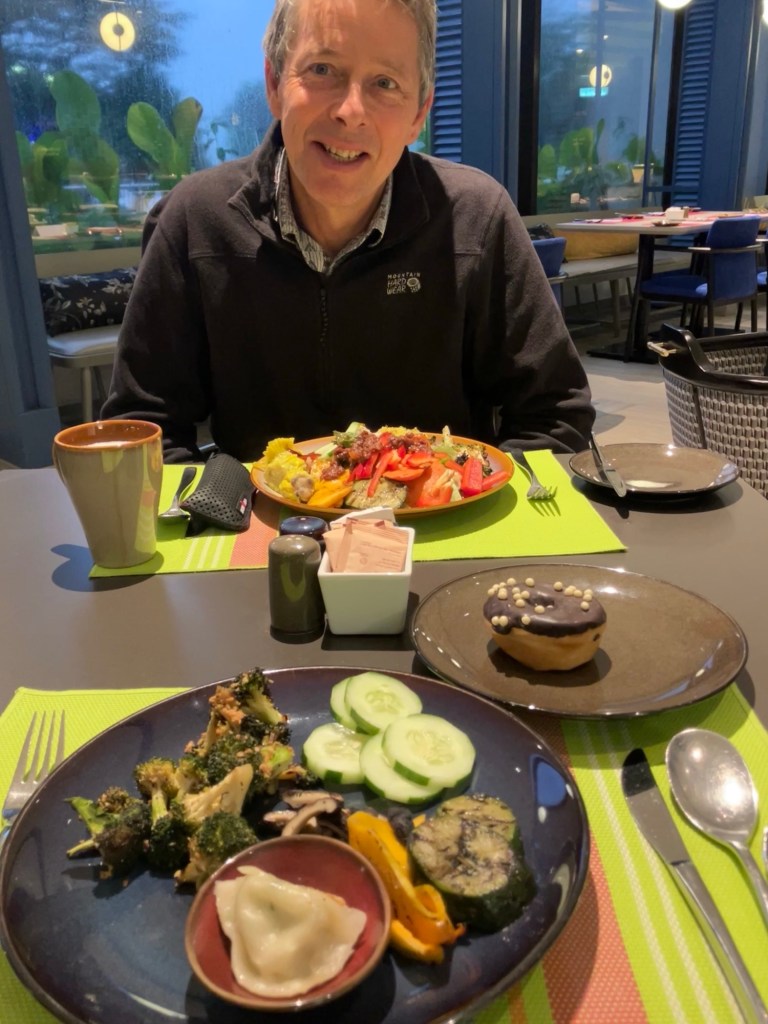
And every day started with the fantastic breakfast buffet at the Hilton.
Rich buying our lunch, steamed buns, from Kuching’s youngest business man.
I’m still stunned by the green landscape, even in the city. Any land gives rise to a dense green.
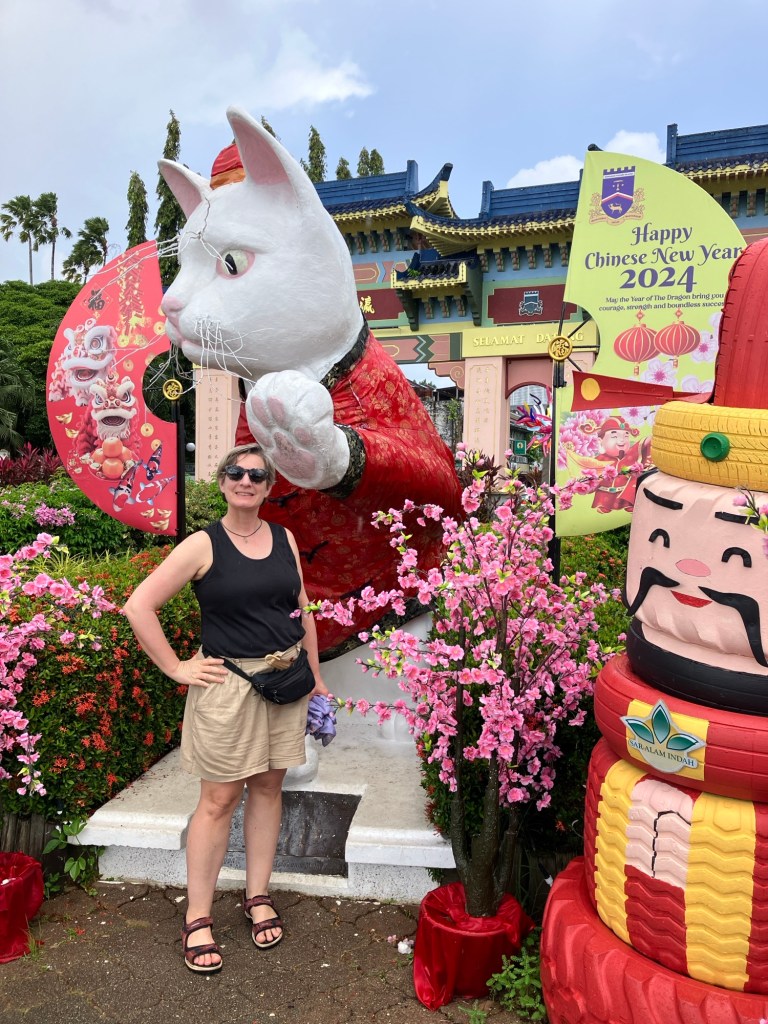
One last cat themed photo.

We’re in Kuala Lumpur now, so glad we had such a good long stay in Borneo. Even with over three weeks there is still a lot more fun to be had. Did we adjust to the heat and humidity? Not really. It’s hotter here now in KL and it’s quite draining, even three weeks on. We’re just not hot weather folks. Mild San Francisco weather for 30 years will do that.

Borneo. Our places stayed: Koto Kinabalu, Mt. Kinabalu Park, Mulu National Park, Miri, Kuching, Batang Ai National Park, Kuching again.
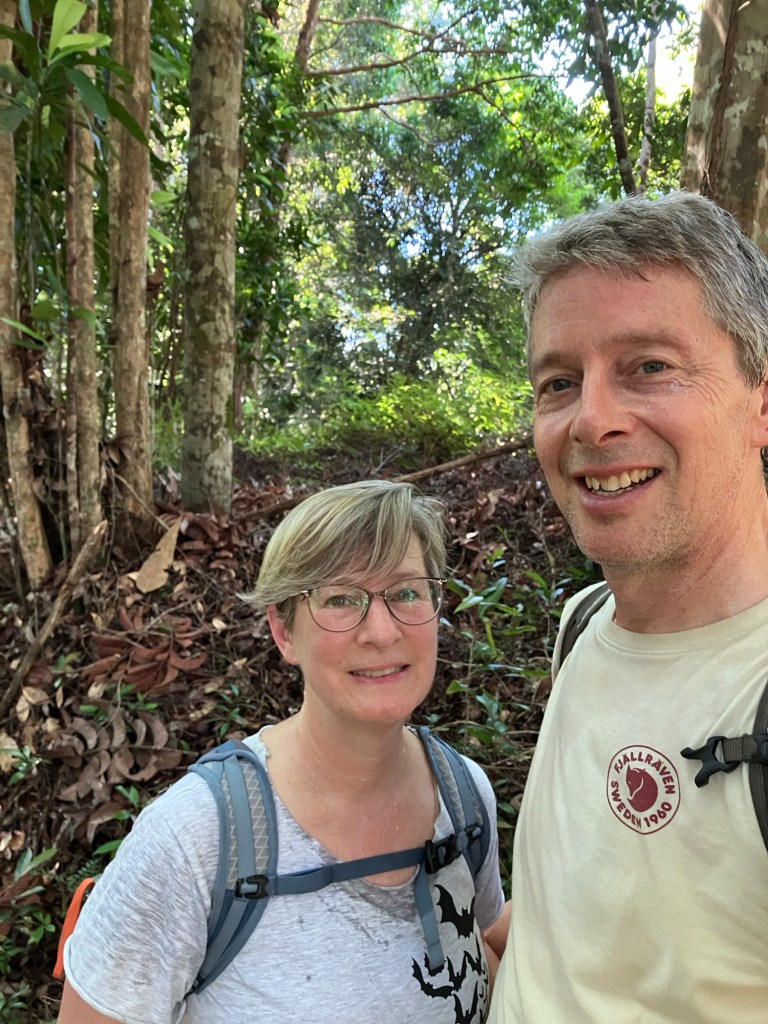
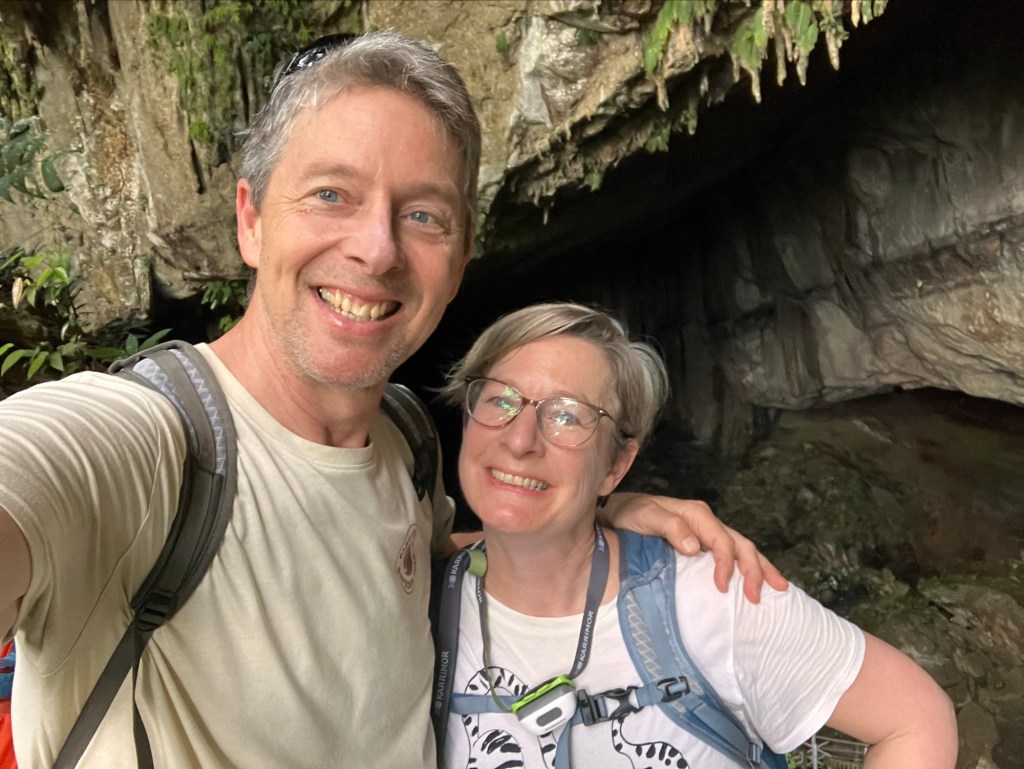
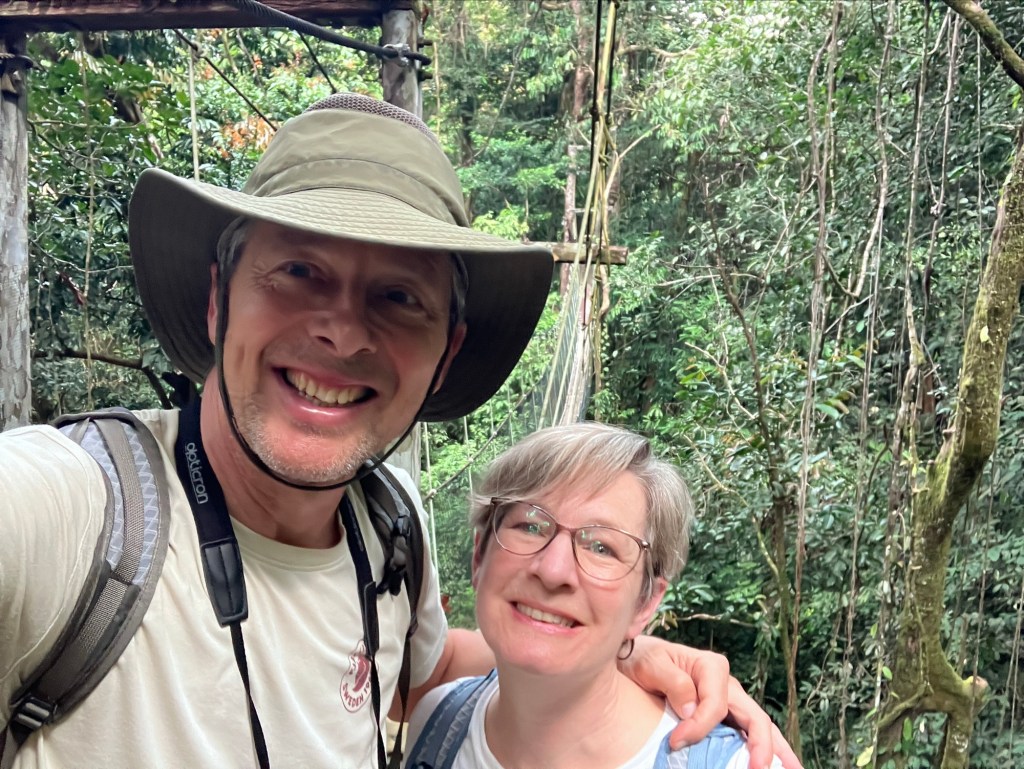
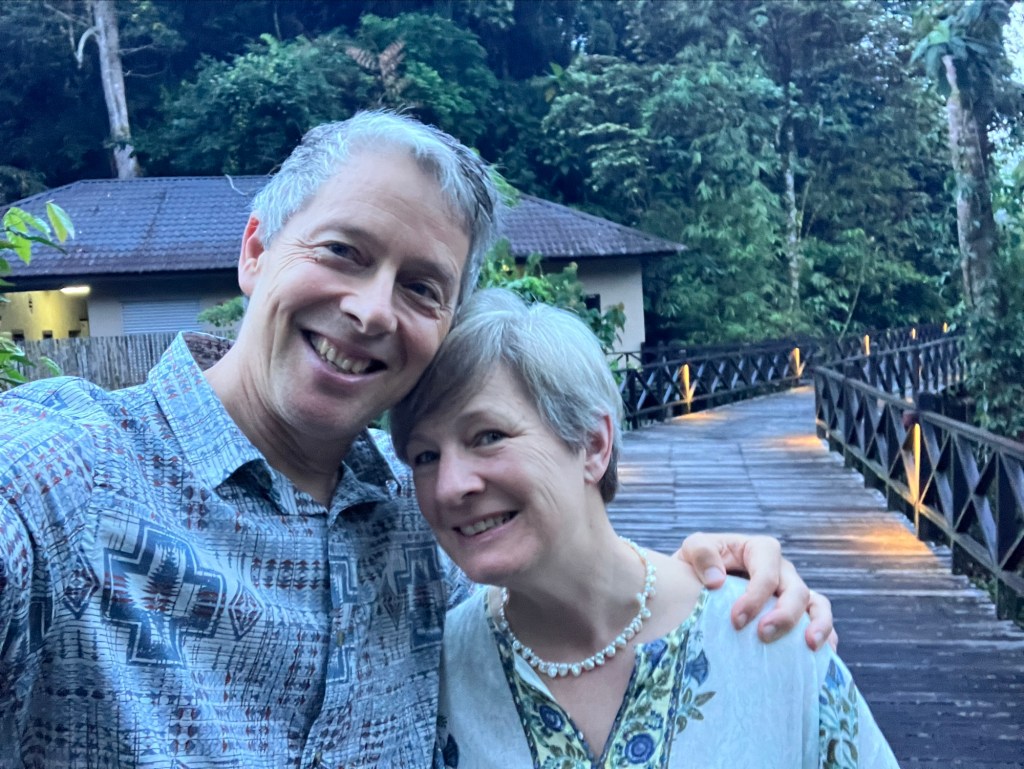
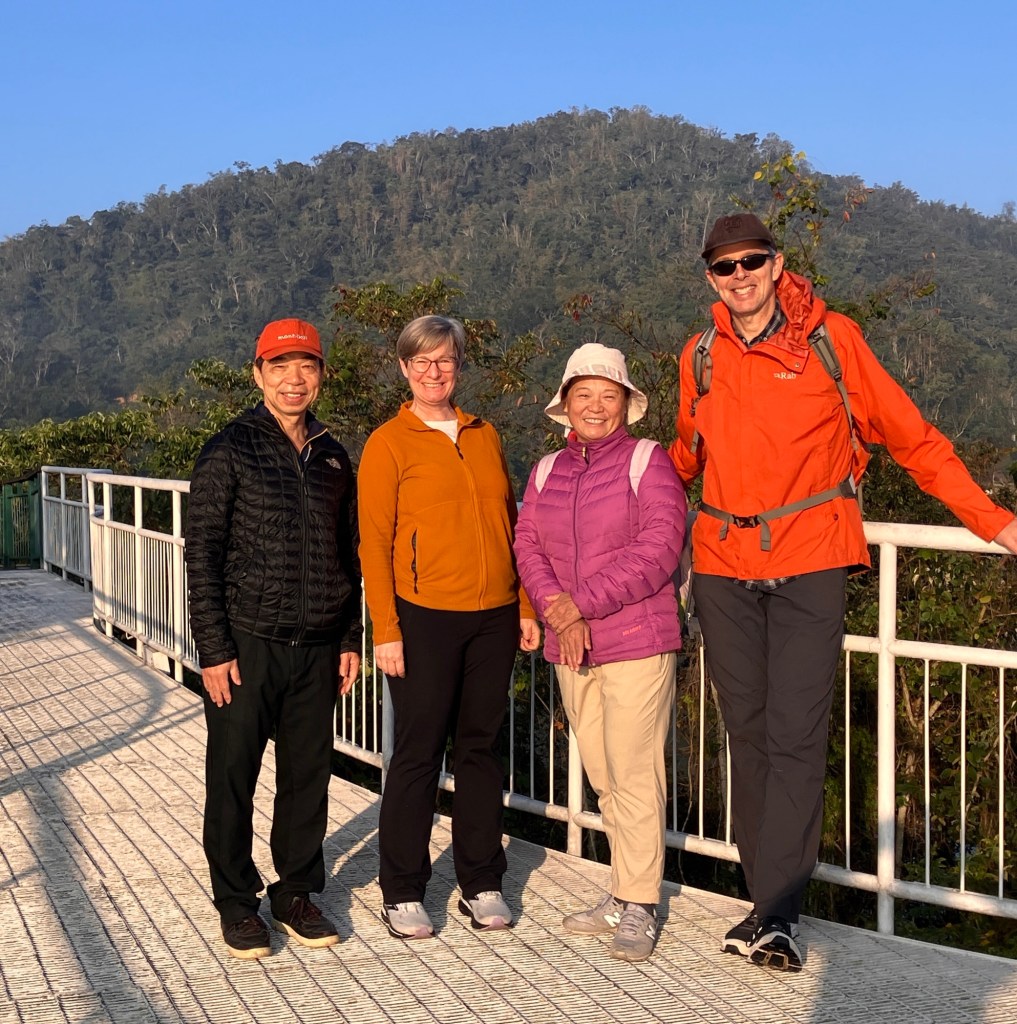
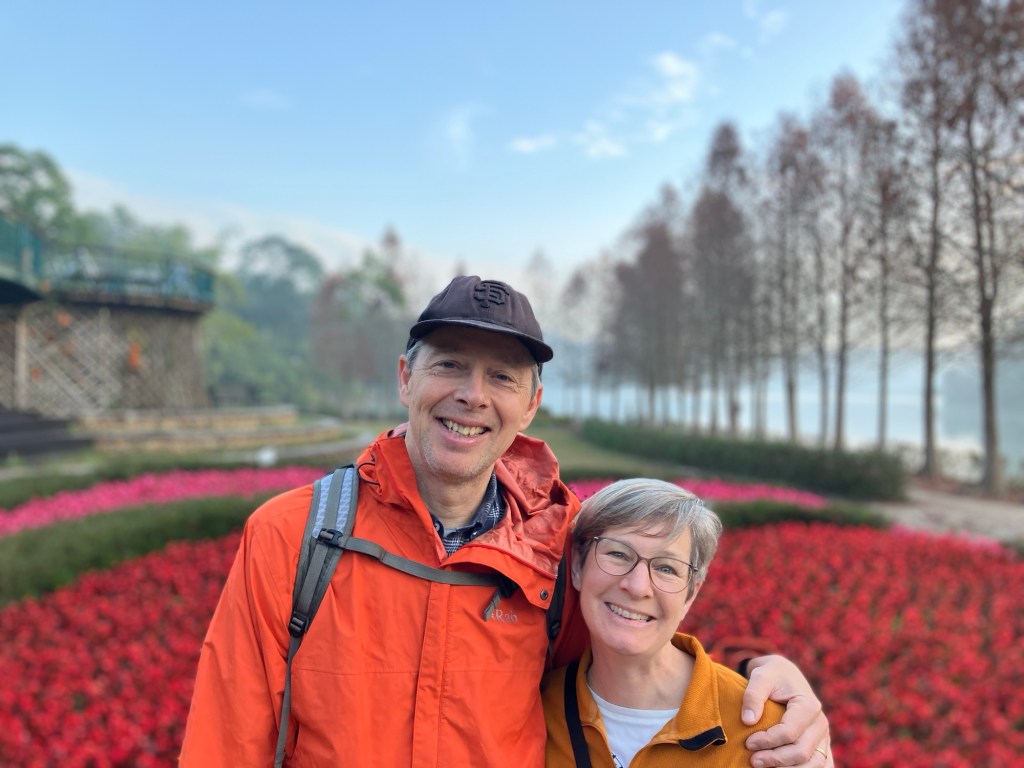
The happy travelers.

Three Days of Discovery in the Rainforest of Ulu Ai

Although we are fiercely independent travelers, there are times and opportunities that can be missed without an organized tour. And we really wanted to learn a bit more about the indigenous cultures of Borneo and get deeper into the jungle.

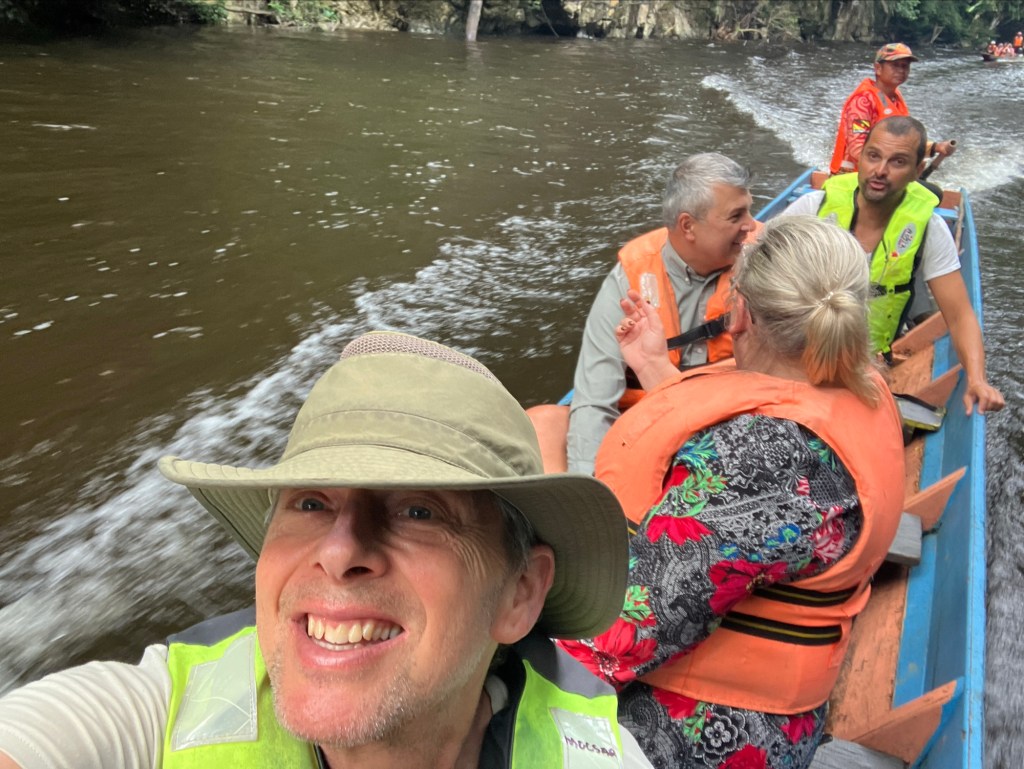
Cruising the Delok River about 5 miles from the Indonesian Border
It was about a 4 hour drive from Kuching to the Batang Ai Lake Boat Dock

Cheryl and I both have degrees in Anthropology (+my engineering and her creative writing) which fuels an endless desire to dissect and understand what we can about local cultures and customs in a rapidly changing world. So we picked the Batang Ai 3 Day Experience led by the award winning agency out of Kuching, Borneo Adventure. It was a great choice.

A chance for coffee and tea while our guide bought much of the supplies for our trip at the large Serian Daily Market

We awoke early on our departure day with a sense of excitement as we really didn’t know what to expect of this tour, and it required some thoughtful repacking, drybags, and consolidation of our gear, with the excess being left at our hotel in Kuching. It was also still the rainy season here, so rain was likely, and tons of rain a possibility. The drive was nicely broken up by a market stop and early lunches, but we were definitely ready to board the longboat for the nearly 2 hour trip to the community and lodge. Despite some steady rain as we drove, the boat trip was mostly dry.

Across the massive 24sq km Batang Ai Lake
After an hour crossing the Resevoir in some light rain we hit this massive log jam! It seemed impassible to us?!
The front boatman was impressively strong moving logs aside as the driver in the back worked magic with the outboard motor to get us through. This logjam is almost always here and a result of currents and erosion around the reservoir basin.
Arriving at Nanga Sumpa Lodge, which had recently been renovated and reopened.
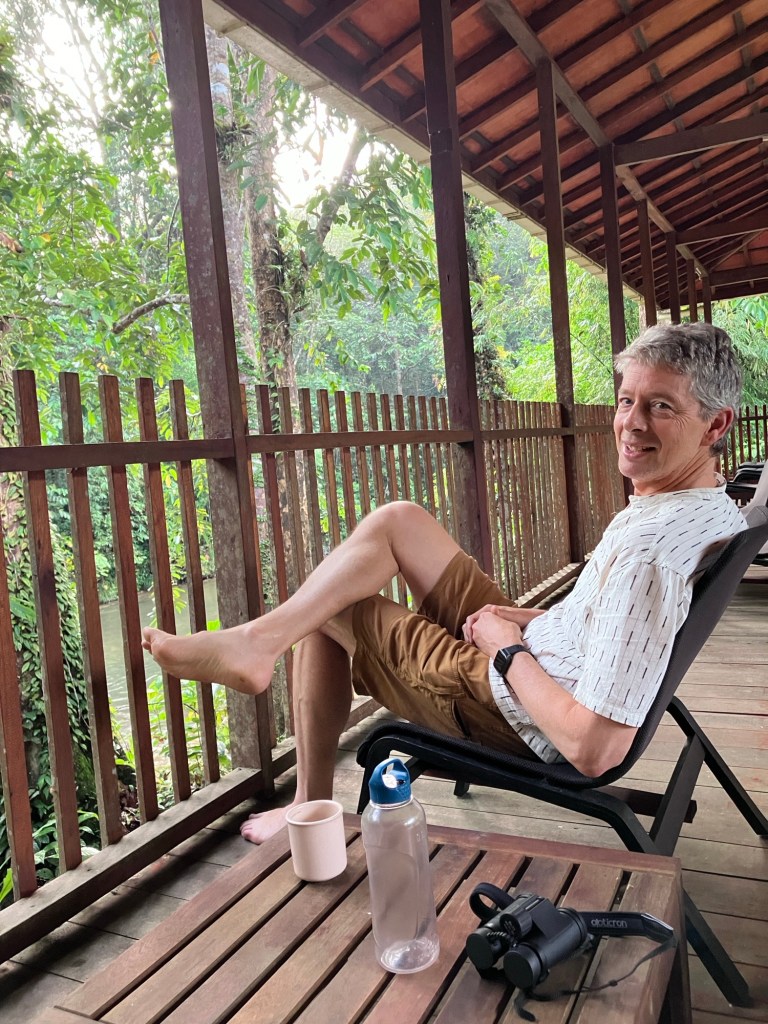
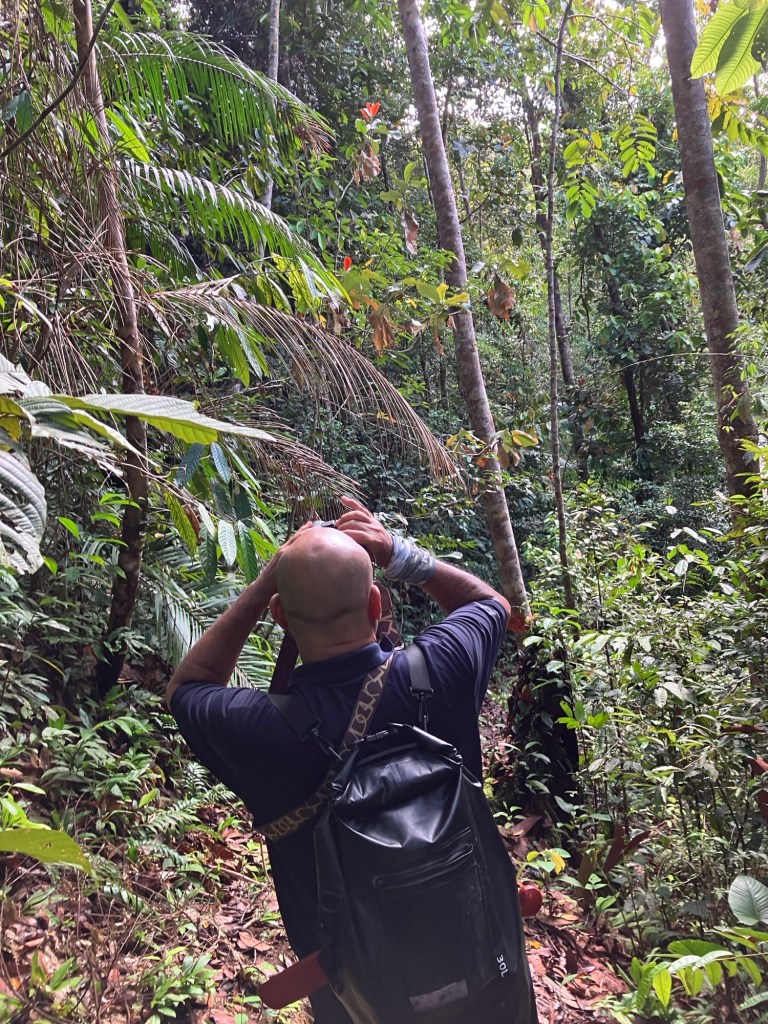
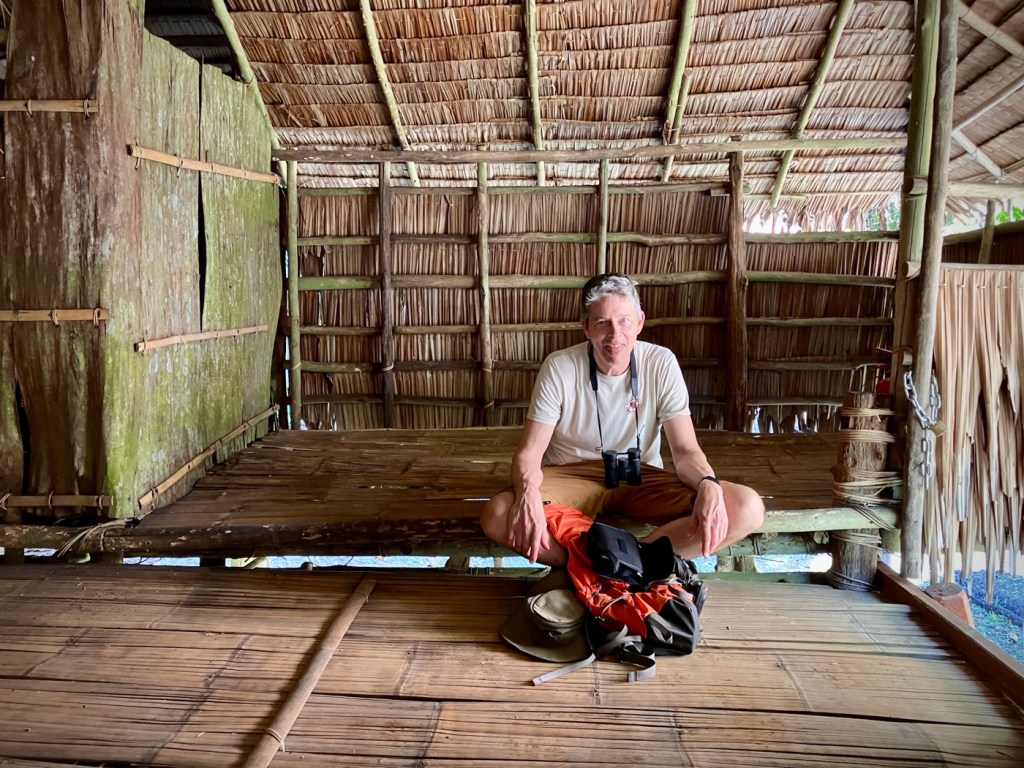
Settling in on the great open veranda above the river, always ready with my binoculars.
The river was raging and mud colored the first day up but had magically cleared up and dropped enough to swim by the next morning.

The arms of the massive Batang Ai lake seemed to stretch forever and it was a dramatic shift in terrain and ambiance as we transitioned to the original Delok River. Although the lake/reservoir was pleasant and scenic in its own right, I couldn’t escape the artificial feel and haunting thoughts of the wild rivers that used to flow below. Thousands of Iban people were displaced by the construction of the dams and inundation of the valleys in the 1980s. On the upside, the reservoir provides a good amount of local clean hydropower. But it is what it is and we were here to support and get a glimpse of modern Iban life that still exists in the rivers above the lake. And it’s still a fascinating and unique community.

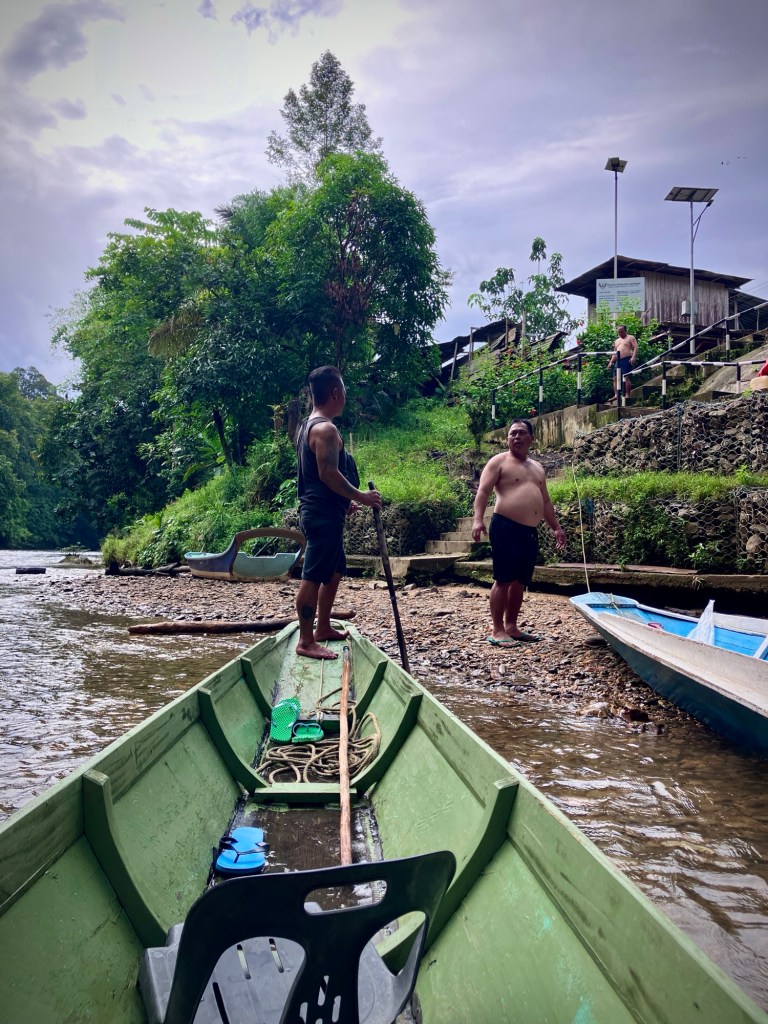
Life is only on the river here, our boatmen dropped a local downstream.
Our room was pleasant, airy and did cool down at night. There is electricity only from 6:30pm to about 10:30p to charge devices. Headlamps and charging blocks really help.
The “Ruai” or common area of the long house at Ulu Ai at a very quiet time. It was often full of families and kids socializing and playing games, and we later joined the kind chief and his wife for some rice wine and conversation.
Many handmade items are for sale outside each families personal space. We bought a few beautifully woven baskets and decorations. It’s appreciated but not required. The lodge and tours also provide many local jobs.
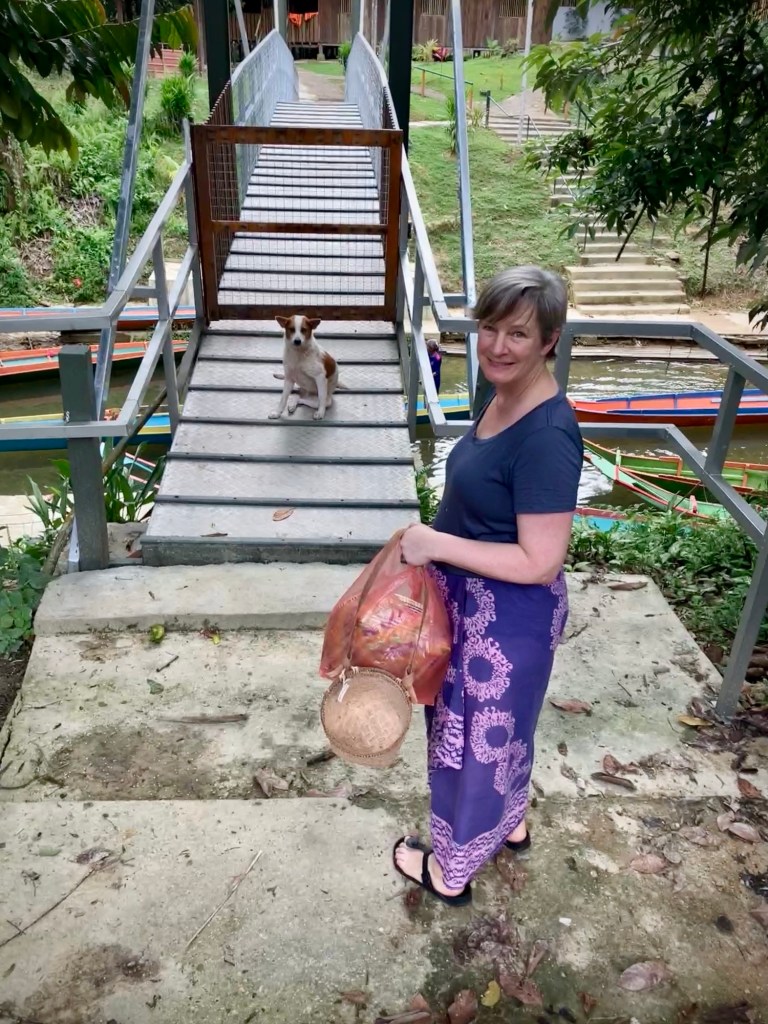
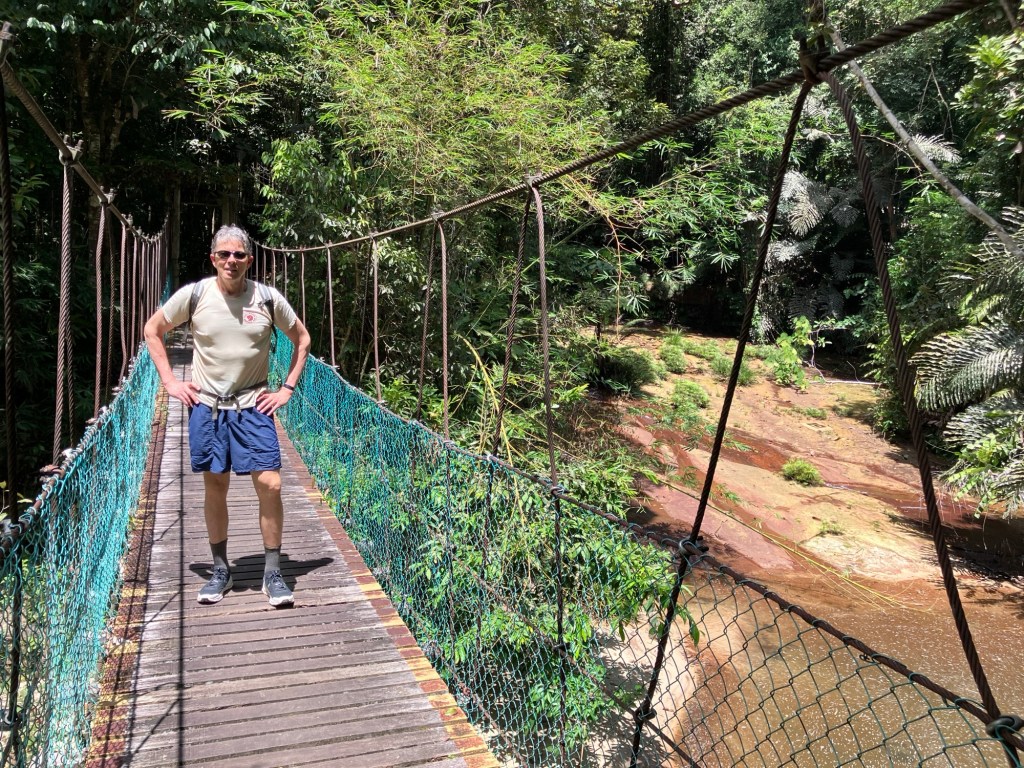
This bridge over the Sumpa confluence connected the lodge to the local community. This little guy wanted to come over and visit.
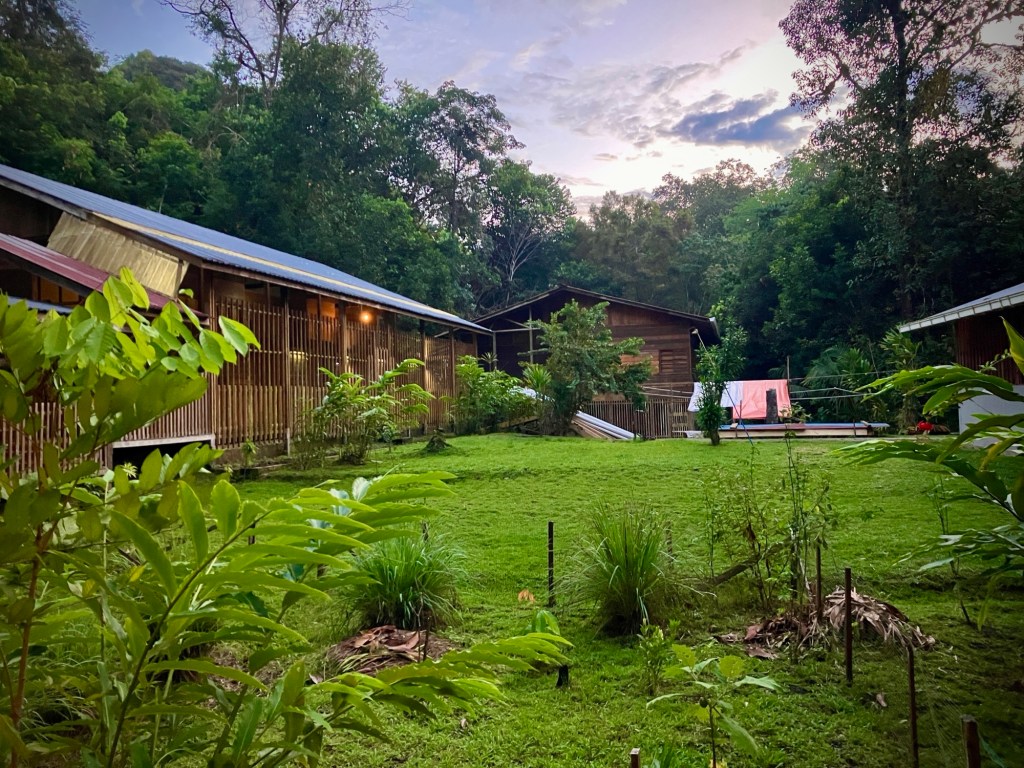
Nanga Sumpa Lodge.

The lodge is located at a small confluence, of the larger Delok, with a calm side creek, the Sumpa, which can be used to safely store longboats in time of high water or floods. All the remaining dozen or so longhouse communities in the remote Ulu Ai are located similarly. The lodge itself is rustic with three forest rooms with bathrooms, and a few more rooms sharing a bath. It was nice to be barefoot in the lodge for three days, and felt natural. Meals are simple but tasty communal affairs, although Cheryl and I had the lodge to ourselves the second night, after four young Germans had departed.

Many longboats are still paddled/pushed for local trips and fishing, but motors are key for longer trips, especially to the primary school and health clinic downstream.
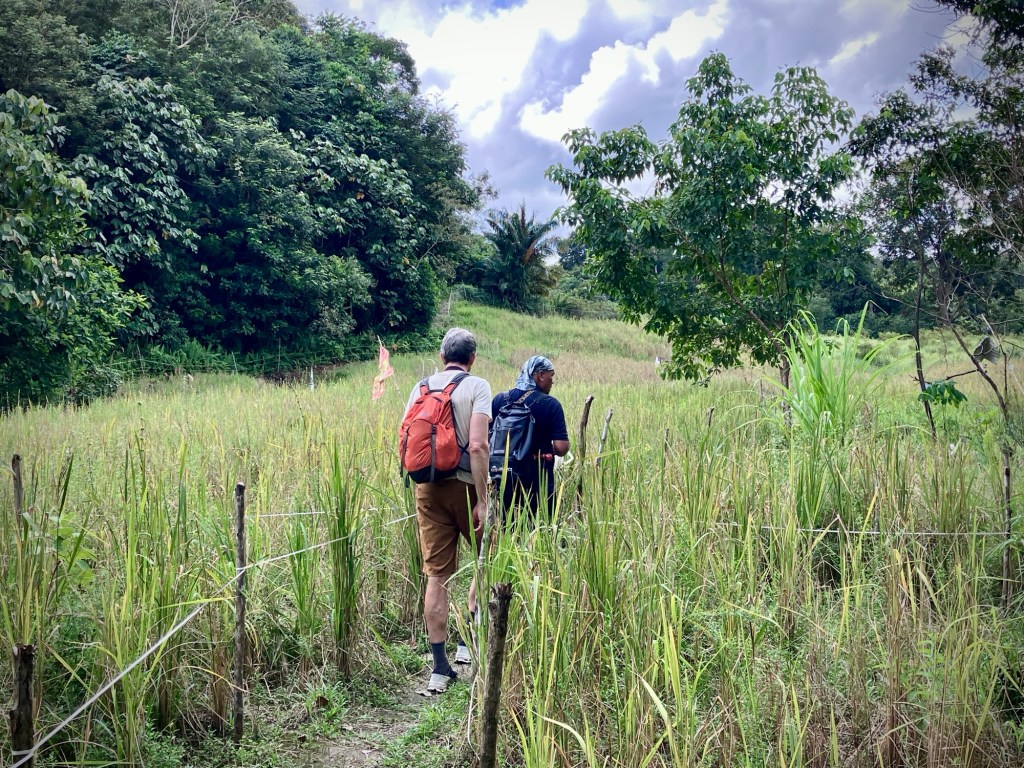
Our first short trek introduced us to the long house community as well as the layout of the village above the river. Good birding too along the way despite a local teenager cranking some afternoon music -:).
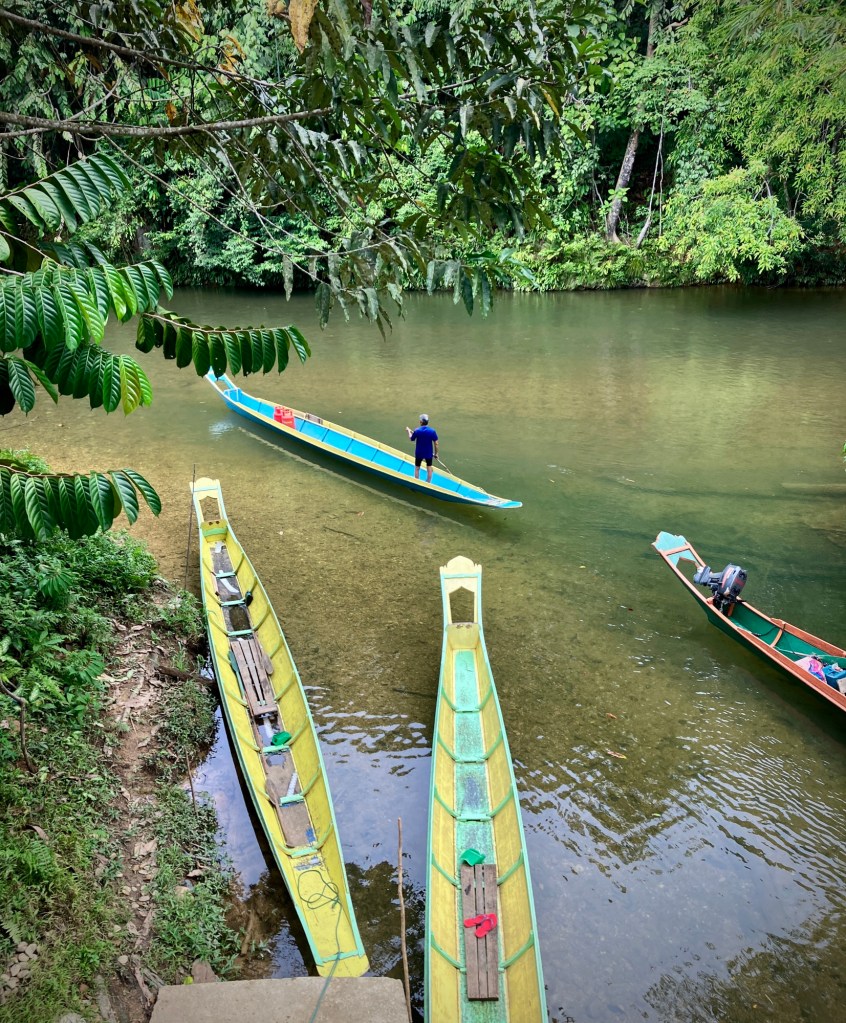
Wooden long boats have flat bottoms to handle very shallow water sections on the river. It’s magical to cruise through the jungle.
This larger solar array had been installed just a few years ago for more constant electricity to the community. The pandemic accelerated the solar installation and arrival of satellite internet for remote learning for the kids.

After a nice trek around the community and then dinner, we headed back over to the bridge to the longhouse and meet the chief and his wife. This was a genuinely enjoyable experience and the chief was very down to earth and friendly, understanding a bit of English and facilitated by our guides native Iban and local dialect.

Our jungle trek was remarkably dry despite lots of rain the days prior. These forests are made to handle rain.
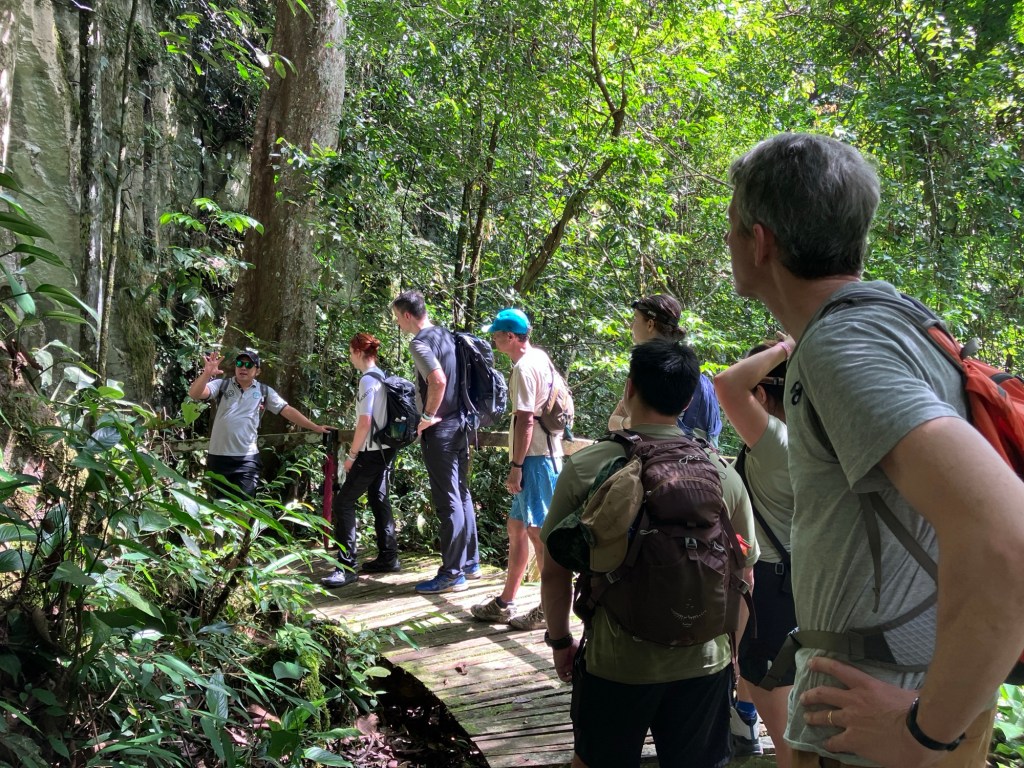
Paul, our fantastic guide for three days. His community relationships and understanding of the flora and fauna were impressive.
Each family has a local farming plot to grow rice and other crops, as the government and conservation efforts have mandated the transition from the traditional swidden (or slash and burn) agriculture to protect critical habitat.

We are very conscious of the voyeuristic aspects of this type of tourism, but felt Borneo Adventure’s unique and 35+ year relationship at Nanga Sumpa is positive and synergistic for all involved. It’s also very small scale. Their jungle tours are not for the faint of heart, but perfectly blend adventure with enough comfort for most travelers looking for a unique experience. So we didn’t take any photos of our interactions or the community as we walked around. Google the Nanga Sumpa longhouse if you want to see more photos to get an idea. And read this excellent article (thank you Gisela!) on the reconstruction of the long house after the 2014 fire: article here.

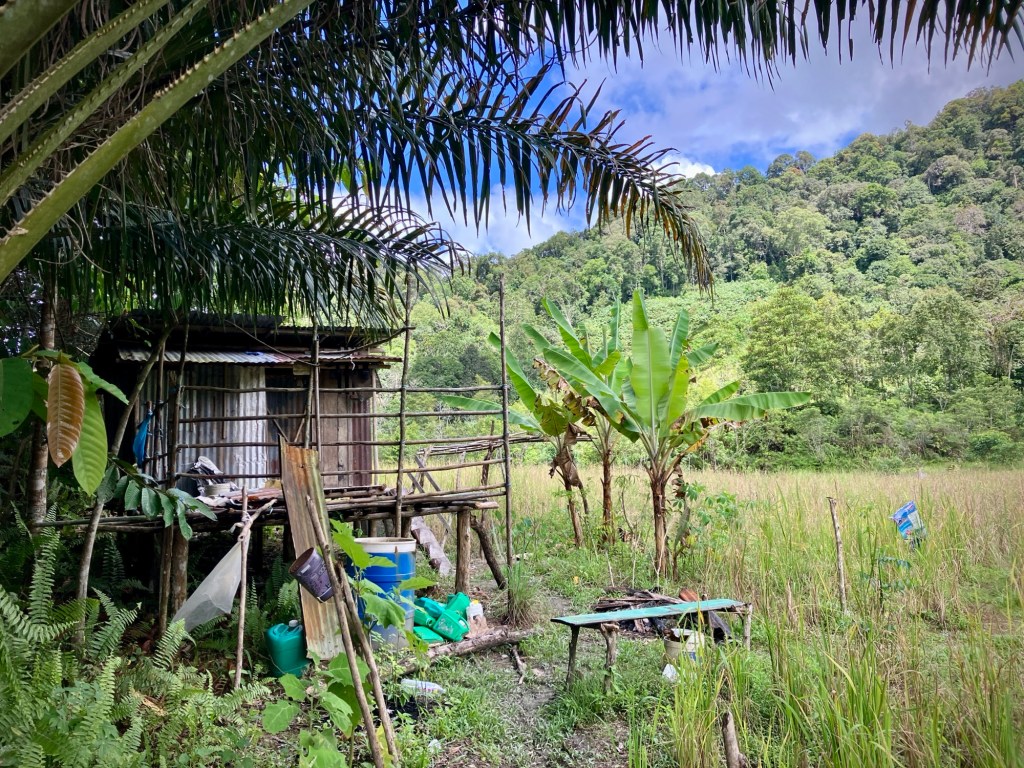
A farm shed in a jungle clearing
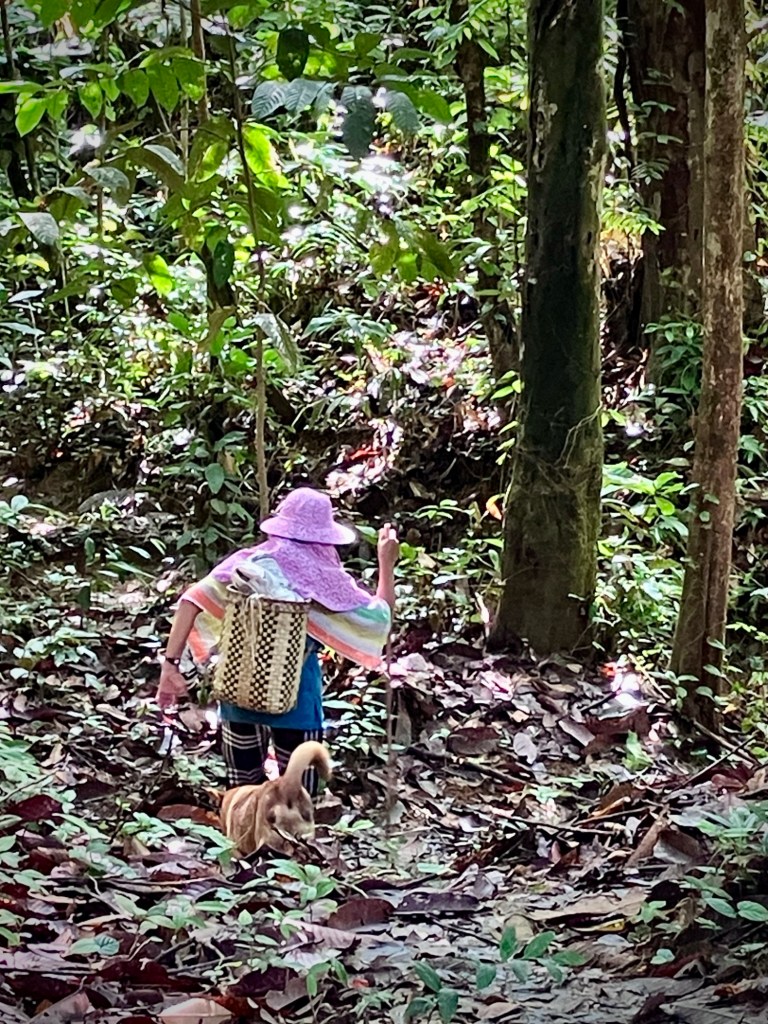
A Nanga Sumpa resident heading to her farm plot. Farming here is not easy.
Beautiful young bamboo shoots.
Rainforest fungi.
A bit of rubber is still extracted by the locals for use.
A local chief’s burial jar in the jungle with tributes of coins and cigarette butts. The grave is a way to protect and retain the land.

The second day began with a river crossing to trek for a few hours through the jungle and the hope to spot an Orangutan. There are over a thousand Orangutans in the Batang Ai National Park and adjacent preserves, but this buffer area of living Iban communities is outside the parks. However, a census/review done by WWF and other agencies in 2016 estimated about 250 Apes call this area home. This resulted in increased conservation efforts and even more desire to have the local communities coexist with this population. We were pleased to see some of our significant regular donations to WWF at work and having an impact on policy and life on the ground. It has seemed to push back the logging and palm plantation encroachment as well. At least for now.

And everything is flowing.
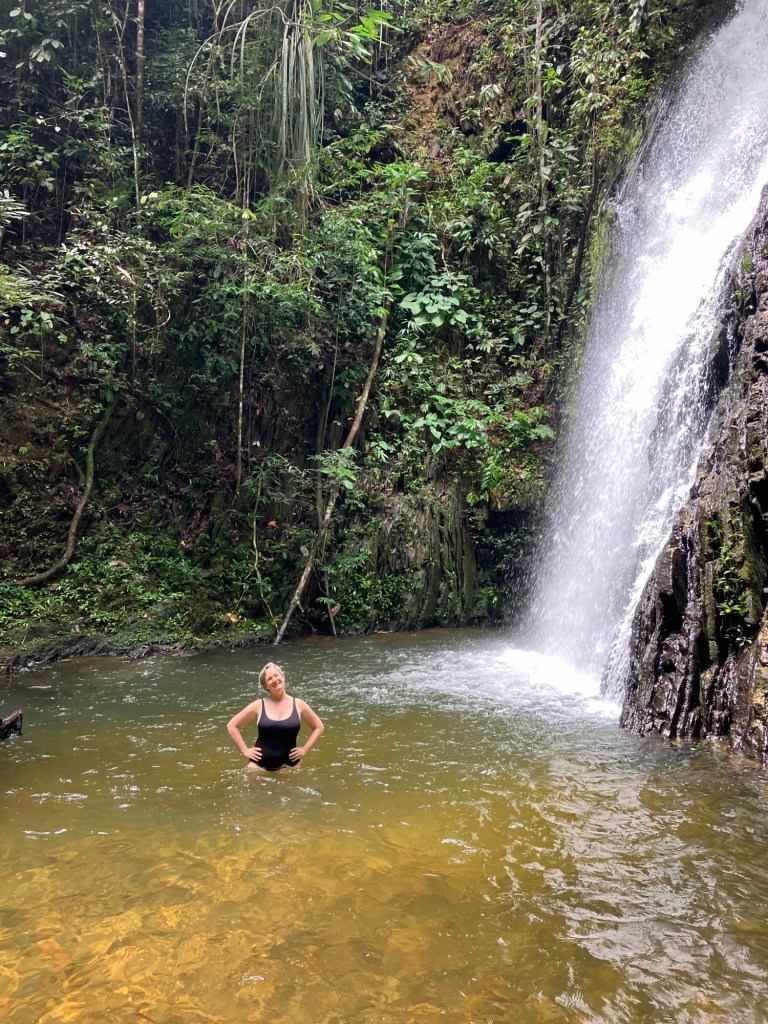
The waterfall swimming spot deep in the jungle was a place of exotic travel dreams.
Cheryl enjoying the cool waters.
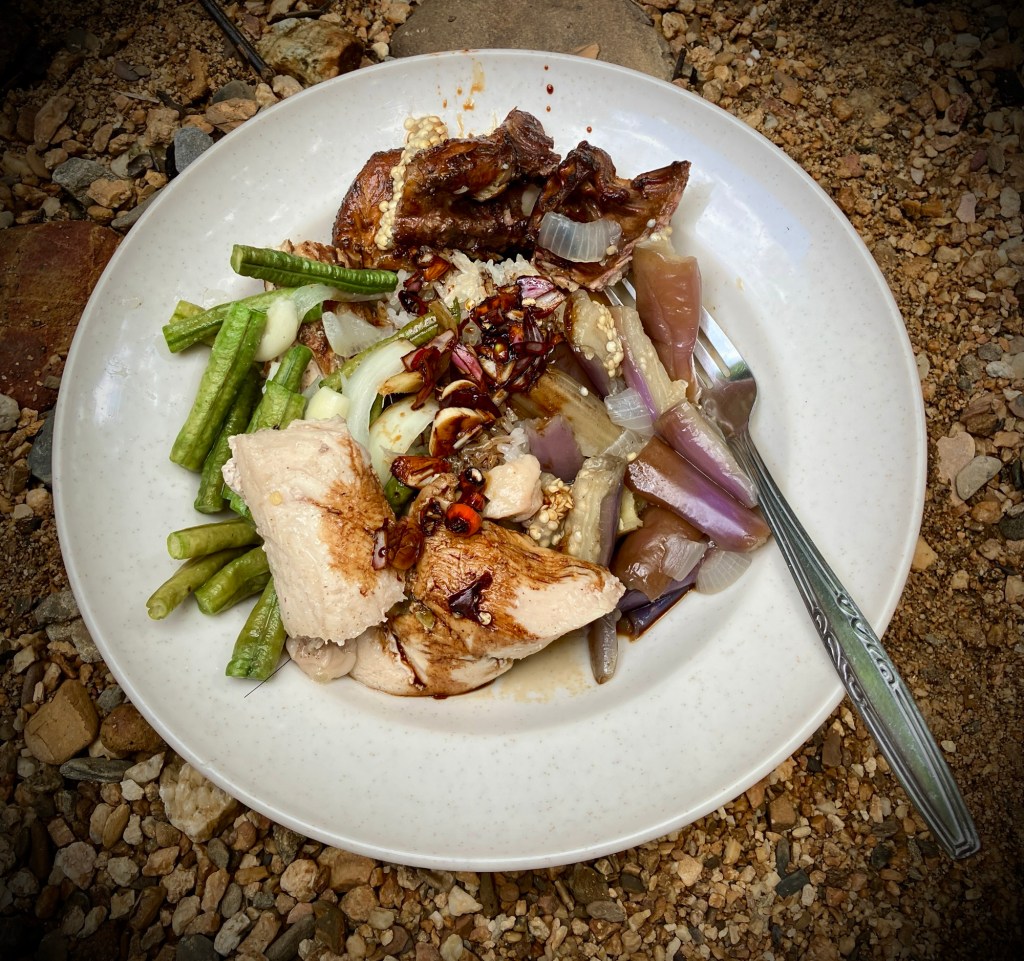
The friendly boatmen double as talented jungle chefs and prepared a delicious local meal over a wood fire for us to enjoy.
Chicken, bamboo sticky rice and assorted veggies hit the spot with a giant kettle of tea.
I couldn’t believe we were here.
Cut plastic chairs serve double duty in the longboats and on the beach -:).
Heading back down the river: cool, full, and refreshed. Everything is on the river.

Many tourists want to see ancient cultures as they imagine them to be and seem to expect wildlife steaming out of the forest in all directions. Our brief experience brought to life the fact that life in the modern Borneo jungle is a delicate balance between preserving wild habitat, traditional cultures, and providing adequate economic and educational opportunities to thrive. It’s not an easy life. But the communal ways and semi-subsistence living was real, as were the dozen of kids joyously playing in their river paradise every afternoon (it was a school holiday week). But there is a constant mix between residents and the « outside world » After primary school, kids now go off to secondary school in cities and villages hours away (And board there). And others go off to work opportunities for years, some retuning later and some not.

A final search for Orangutans yielded some fresh nests, but alas, no viewings. We saw dozens of nests in our treks as Orangutans move constantly and build a new tree nest daily. An amazing adaptation that requires a lot of intact habitat.
Cooling off back at Nanga Sumpa.

If you want to have the opportunity to see more wildlife, including deeper into Orangutan habitat, Borneo Adventures offers 4 and 6 day trips. The four young Germans we met our first night had done the extended 4 day trip and did see an Orangutan and a Civet. Wildlife viewing is a crapshoot. But no worries, we did see Orangutans a few days later outside Kuching at the Semenggoh wildlife Reserve, a 1600 acre rainforest with about 28 orangutans. It was amazing to piece together the wild jungle experience with actual viewings.

Three of the four semi-wild orangutans we saw at the Semenggoh Wildlife Reserve. There is a small baby clinging to momma.
Posing next to Ritchie, the massive 145kg dominate male in the Semenggoh community.

Nanga Sumpa in 2024 was fascinating. But travel is a snapshot in time. It was undoubtably very different in 2014, before the old longhouse burned down and internet. And what about 2034? Will cell service reach here? Will the young come back and continue to support the community and longhouse way of life? Will wildlife be thriving or will there be more encroachment by logging companies?

Morning life on the River as two women head upstream.
Great memories (and great coffee and tea).

This was an amazing and memorable experience for us and we will cherish the glimpse we got into a completely foreign way of life. We only hope we left some positive vibrations in return. And although we didn’t see any orangutans in the wild, we saw lots of other unique flora and fauna, including some beautiful birds. And just knowing these amazing human-like cousins are still thriving in these jungles will bring a smile to my face for a long time to come.

Hikes of the world: Lambir Hills edition.

Almost everywhere we go in the world, we hike. Urban hikes. High desert hike. Hot and sweaty jungle hikes. Gorgeous countryside hikes. Dodgy alongside busy road hikes. Amazing coastal hikes. British pub hikes.

Wait, what?

Rich is very good at finding hikes for us to do. And he’s a fast and strong hiker. The more uphill there is, the happier he is. I’m not fast and frequently get grumpy going uphill.

Lambir Hills, outside of Miri, Borneo.

Hiking in the jungles and rain forests of Borneo is a challenge. Heat and humidity punish you, and the frequent heavy rains punish the trails, making them more like creek beds than trails.

These could be easy day hike distances in a different climate and with different trail conditions.
Hiking with a fan. Every little bit of breeze helps.
Our Lambir Hills hike started off nicely. Uphill on a decent trail. Huge trees.
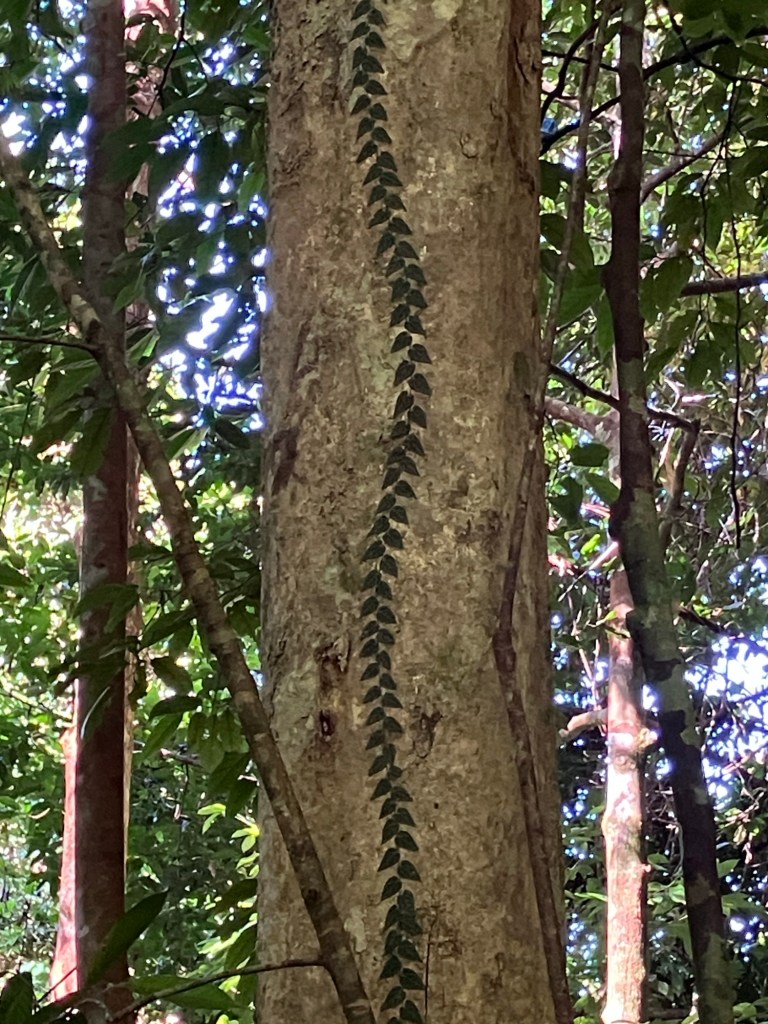
Unknown to us vegetation. This climbing vine is so perfectly symmetrical. Looks like a tree zipper.
A nice shaded rest stop.

There seemed to be a period in Malaysian Borneo when trails were built and park buildings were constructed. Maybe 20 years ago, maybe 15? But maintenance is tough to keep ahead of. Or it’s not funded. It was sad to see the state of not just the trails, but some the other park infrastructure as well. After we crested the top of our climb the trail started to deteriorate. As it dipped up and down into drainage after drainage, ropes appeared to help you haul yourself up or steady yourself down the very rutted trail.

Up we go.
And down we go.
And up we go. Trail maintenance must be almost impossible on these trails.
We saw one other group of hikers, they were better equipped, with trekking poles and matching hiking shirts. They were just getting to the tough part.
My “we are not amused” look.

So what do I do when I’m not loving the hike I’m on? First, I remind myself why we hike. We hike because we like to see places only reachable on foot, and so we can keep on hiking. During a long bicycle tour two years ago we forgot to stop riding and take rest/hike days so we could work our hiking muscles. We found ourselves in fantastic biking shape and hurting on long walks and hikes.

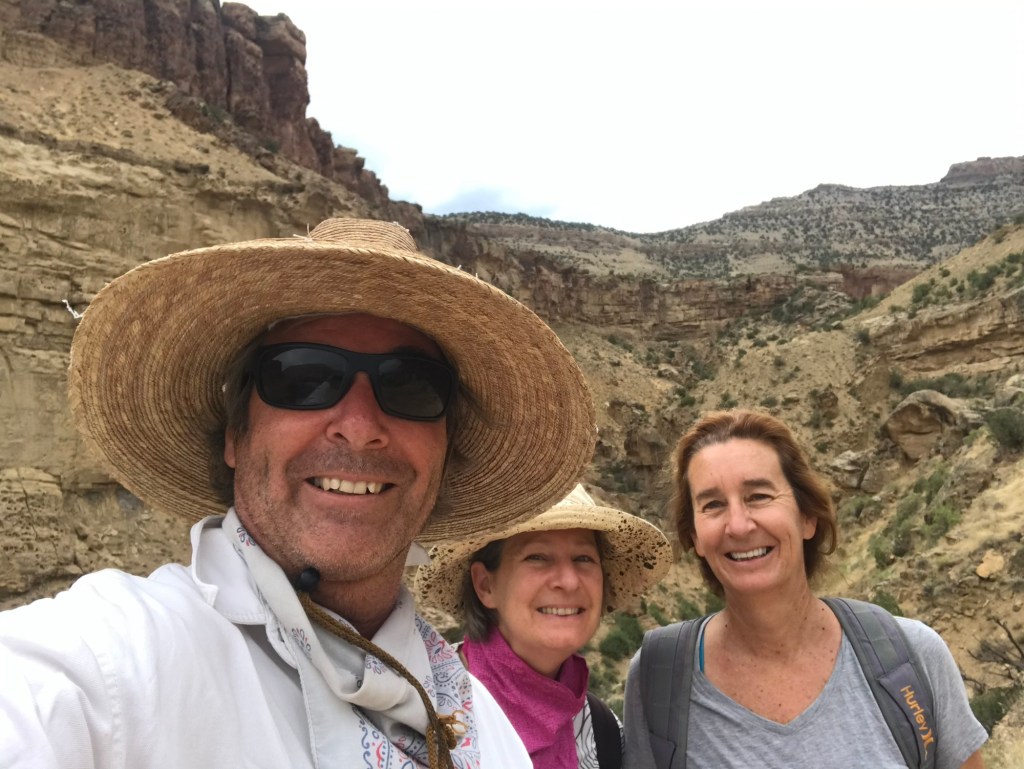
That’s not Malaysia! With our dear friends Cecily and Christine in Seattle, December 2023.
More dear friends in Wales, Hannah, Erik, and Thea. 2023.

Second on my list of hiking distractions is to remember hikes with people we love.

Christine, Annie, and Erika. Seattle December 2023.
My brother Steve and sister-in-law Claire, Pismo Beach California, 2017.
My brother Steve and my sister Kathy, Colorado 2020.
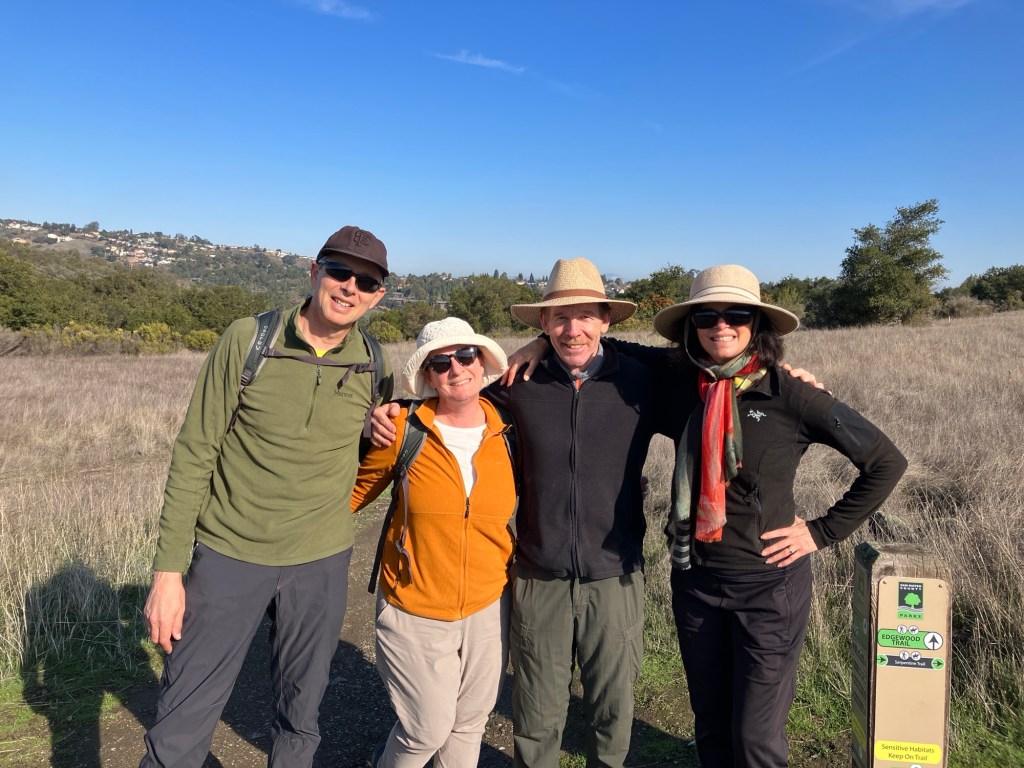
Rich, Mike, and Milo. California, 2021.
Mike and Kathy, California 2022.

We’ve had some of our best discussions, and come to some of our most life directing decisions while hiking. What have we decided while hiking? Whether or not to have children. Should we sell our place and travel. Do we need to actually own a car. Answers, no, yes, and no.

Above Tetouan, Morocco, 2021.
UK, the Lake District, January 2022.
On the Camino del Norte with Cecily and Christine, Spain, October 2022.
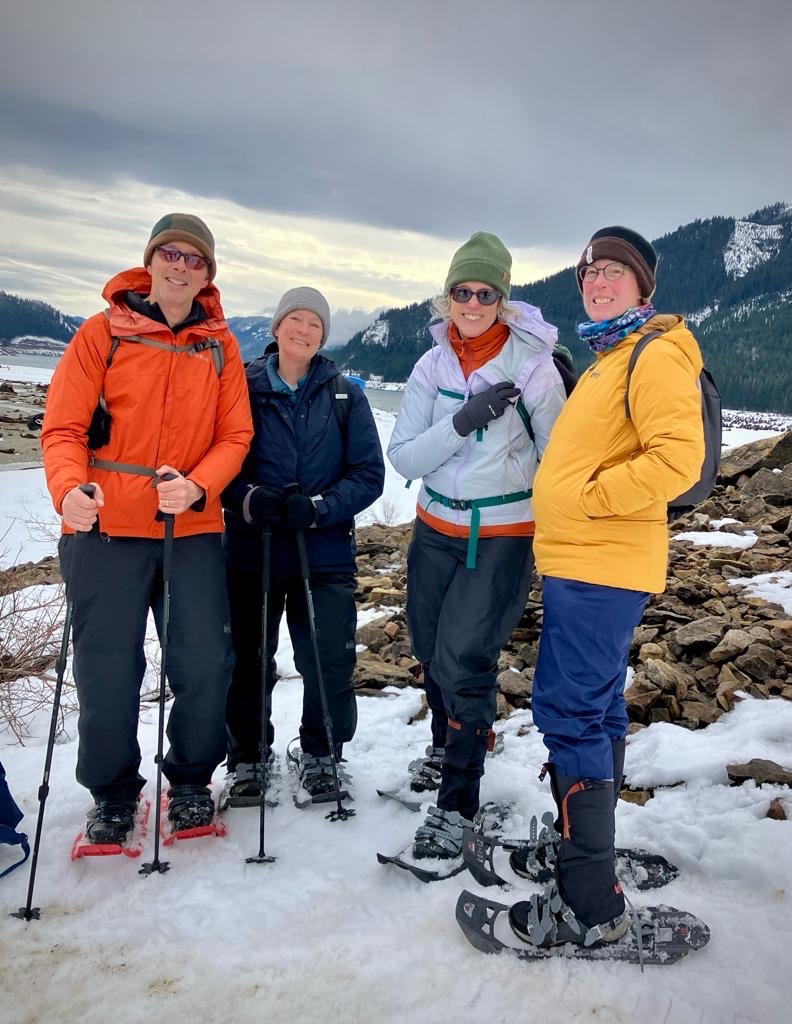
Snowshoeing with Cecily and Christine, Snoqualmie WA, 2023. Oh, that cold weather. Hard to remember what cold is like when you’re in Borneo.

Every hike has its tough elements. The moments when you wonder why you hike. But then nature reveals itself and you remember again why you hike.

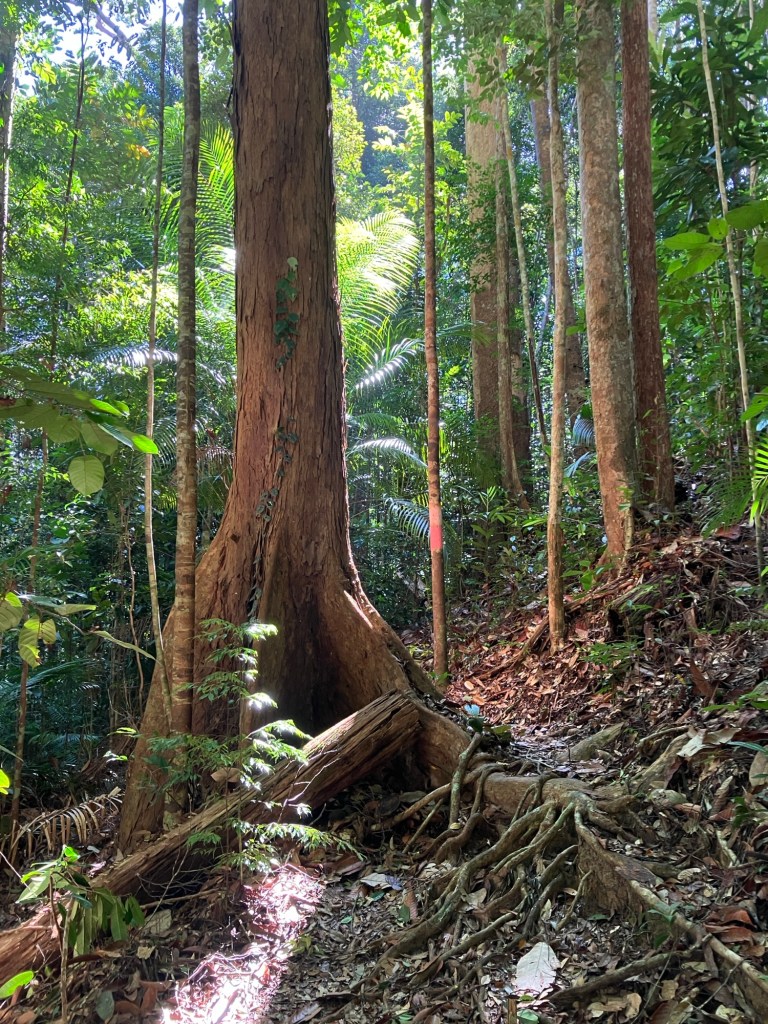
Huge tree reaching for the light.
These trees did not let you forget you were in a rainforest.
The canopy is far overhead.
No surprise there is a lot of water.
Including a waterfall at mile 5. From the waterfall it was only a kilometer back to the park office where our Grab car would pick us up.
A very refreshing swim.

The rainforest is stunning, but I was happy the hike was over and our air conditioned hotel beckoned.

Oh you thought this jungle was done with you?
Thankfully Rich did a quick step back and did not tread on this snake. Not a pit viper but we still gave him respectful space.
From the park office to the waterfall is a popular trail, and in better shape than the rest of the park.
A view of Miri from our hotel room.
The hot, sweaty, pink, but happy travelers.

We’re in Kuching now, the city of cats, and heading out for a jungle lodge experience at Batang Ai, at the Nanga Sumpa Lodge, early tomorrow.

Gunung Mulu National Park. A gentle jungle.

Sungai Melinau Paku River, with the mountains of Mulu peak in the background.

I suspect I’m not the only one who assumes that the jungle of Borneo will be so full of bugs waiting to feast on me that I’ll be slapping and scratching from the moment we arrive in Mulu.

Arrival at Mulu Airport.

Was that my biggest worry about our four nights in Mulu? Well, after our experience at Mt. Kinabalu I was also worried about leeches. And, for our first guided tour at Mulu both Rich and I wore sneakers, long sleeves and trousers to keep the bugs away. Our wonderful guide, Nim, was wearing shorts and hiking sandals. For every tour after that we wore shorts and sandals as well. So much more comfortable in the hot and humid weather. And so few biting bugs. We have the millions of bats and swifts to thank for that.

Sheltering from a downpour in the bat pavilion.
Our first very rainy afternoon. All the rain meant no bat exodus the first night.
A frequent site during the rain, yellow poncho clad visitors.
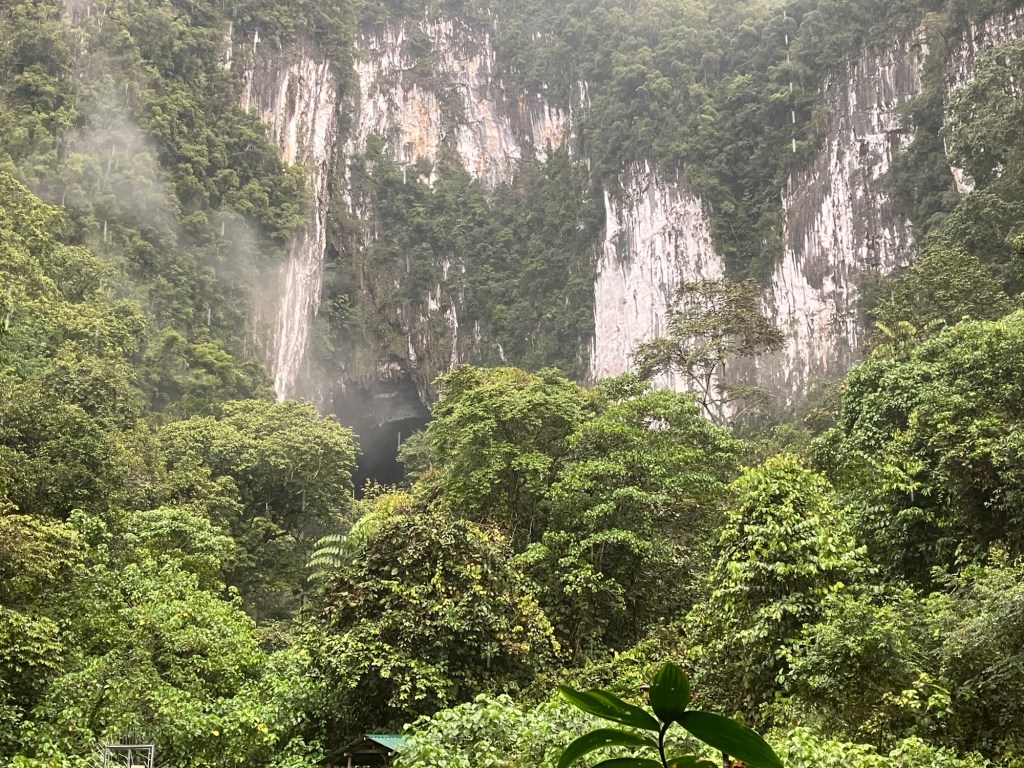
Fog at the mouth of the Deer Cave, where millions of bats shelter during the day.
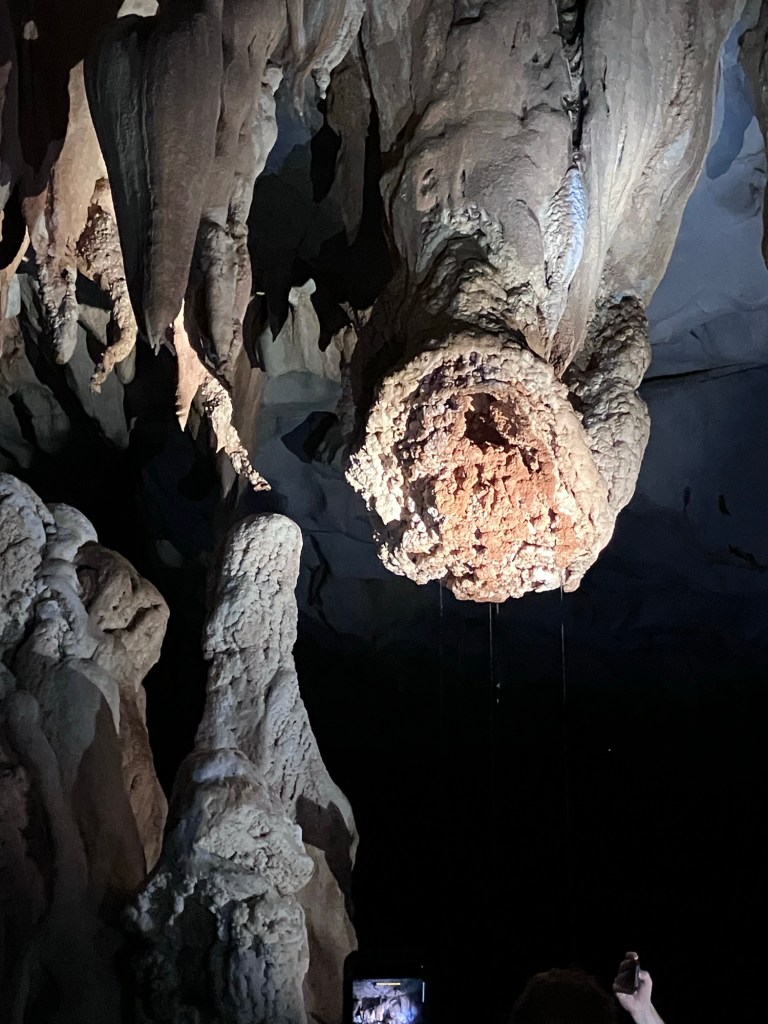
Rainwater drips through the limestone to create amazing sights in the Deer and Lang Caves.
From the boardwalk you get to see stately trees.
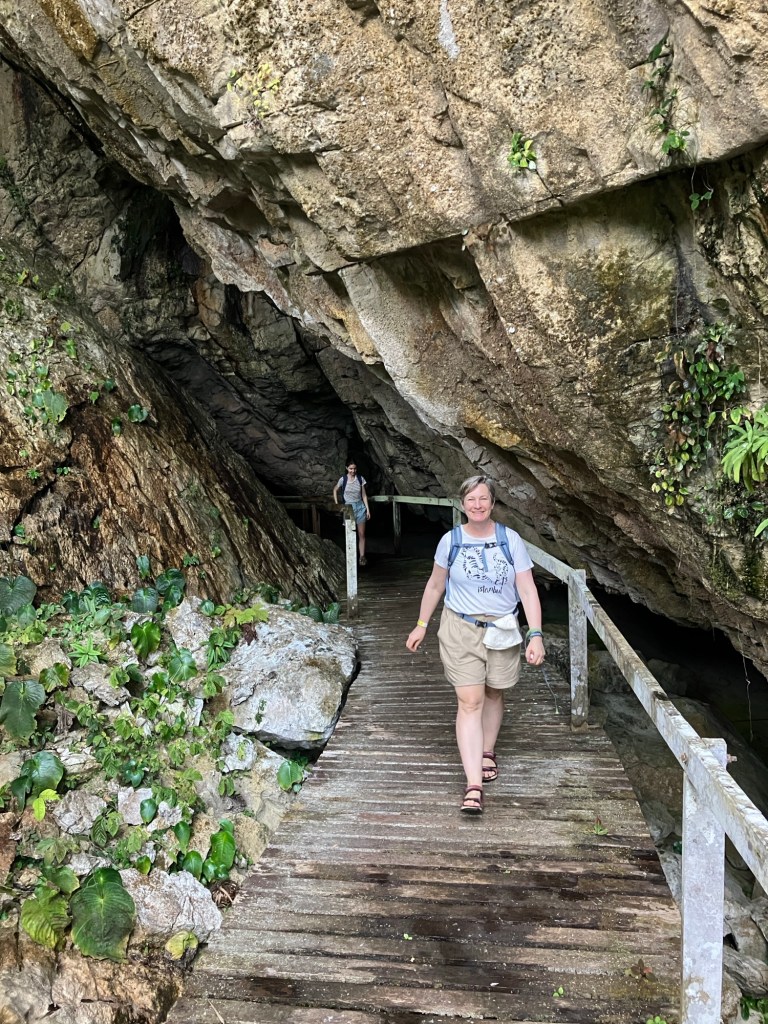
Rich added for scale. This is a day or two after arrival when we had learned that shorts, t-shirts, and sandals were the way to go.

The two biggest attractions at Mulu are the caves and the bats. We jumped right in to cave tours, ultimately getting to walk in five caves, for a total of about 5 or 6 kilometers of cave walking. Wow, impressive right? Well, Gunang Mulu National Park has about 295 kilometers of explored caves. Every cave we visited was different, the giant chambers, amazing drip structures, or no drip structures due to wind blowing through a cave and inhibiting the fantastical structures.

Boats waiting to load visitors for a cave tour.
The boat rides were a fun way to start a tour.
A young helper, his Dad is handling the motor, he helps out at the dock and on debris watch, so the visitors don’t end up in the river.
At the entrance of the Cave of the Winds. A boat ride and 200 stairs up.
The mouth of the cave.
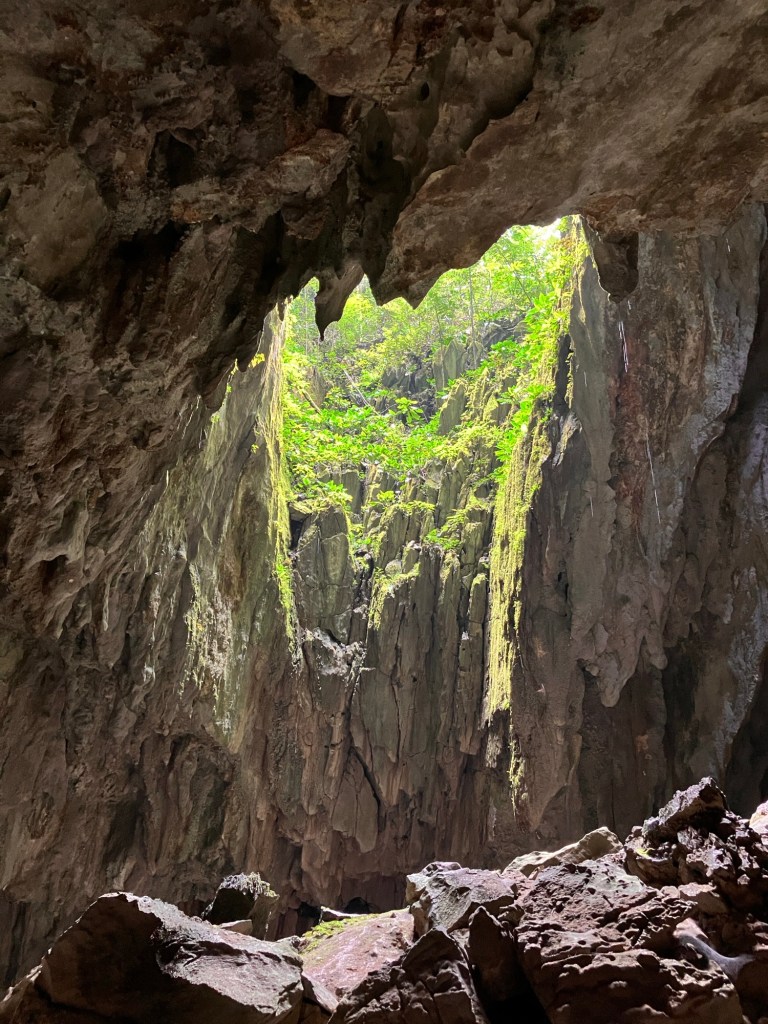
A sky hole in the cave. With light comes life.
After visiting Clearwater Cave you get to swim in the river that flows out of the cave. Incredibly refreshing.

Each cave is unique. And some have only been open to visitors for the last few decades or so, which means that they are pristine. Fastlane cave has had the lightest human touch, with no lights installed and a through route – in one mouth and out another – and the most dramatic formations.

On the way to Fastlane Cave.
The entrance. Flashlights are really needed in this cave.
Photography is a little challenging, you have to borrow torchlight.
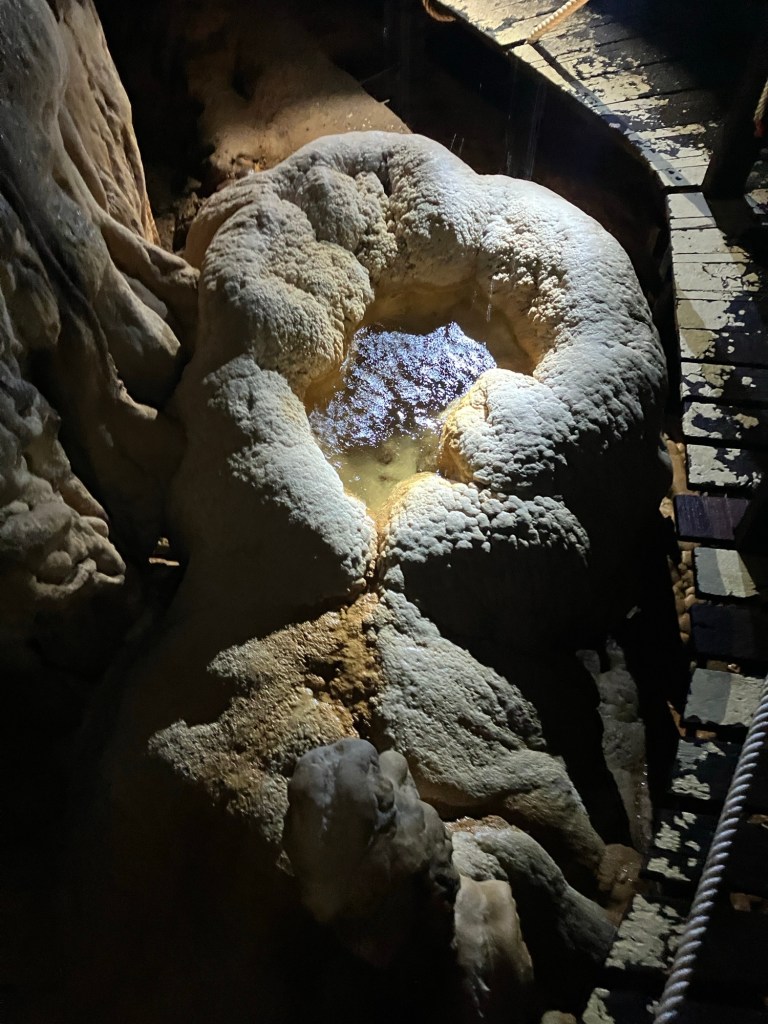
A “showerhead” formation. Water drips through the limestone deposits, which were perhaps created by tree roots up above.
Over hundreds of years the shower head has created its own basin, or bathtub. The water is incredibly pure, but of course reaching in to it is strictly prohibited.
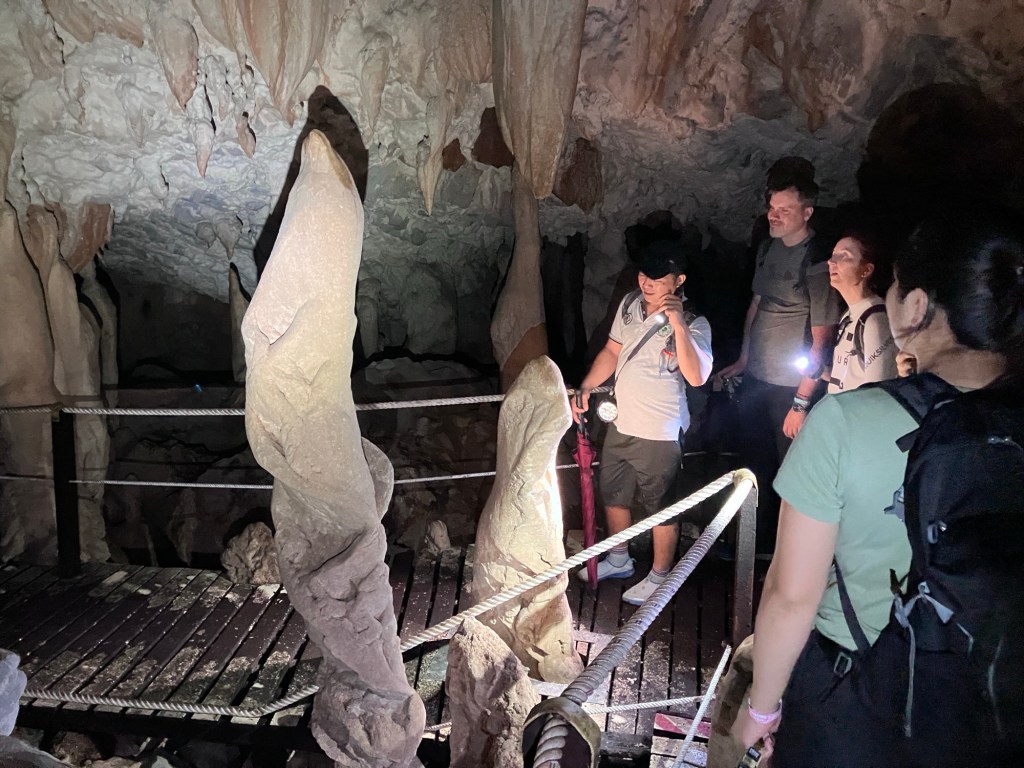
The size of the group is limited to 8 on the Fastlane Tour and our guide, Jonah, was super knowledgeable. He also had us all turn off our lights for a few minutes to really experience the cave as its inhabitants do.
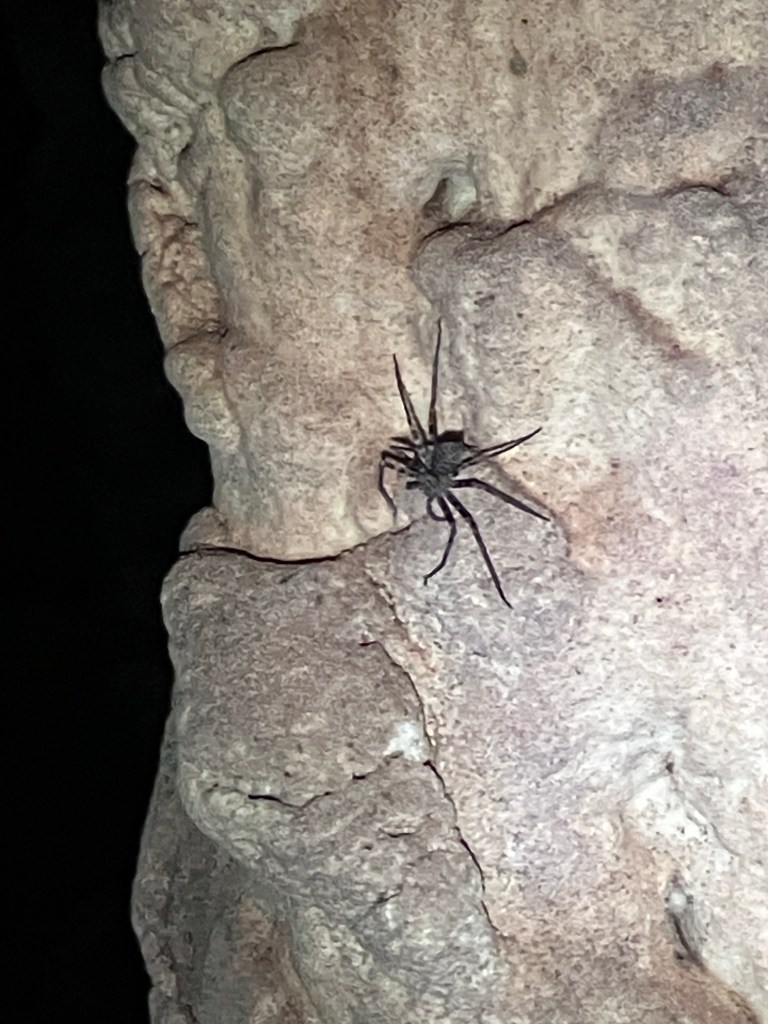
Like these huge Huntsmen spiders who live in the cave and eat crickets. We also saw blind white cave crabs, blind cave crickets, swifts flying and navigating by clicking, and of course bats.
The exit of the Fastlane cave.
There are trails for self guided hikes, but to enter the caves you must be with a guide.
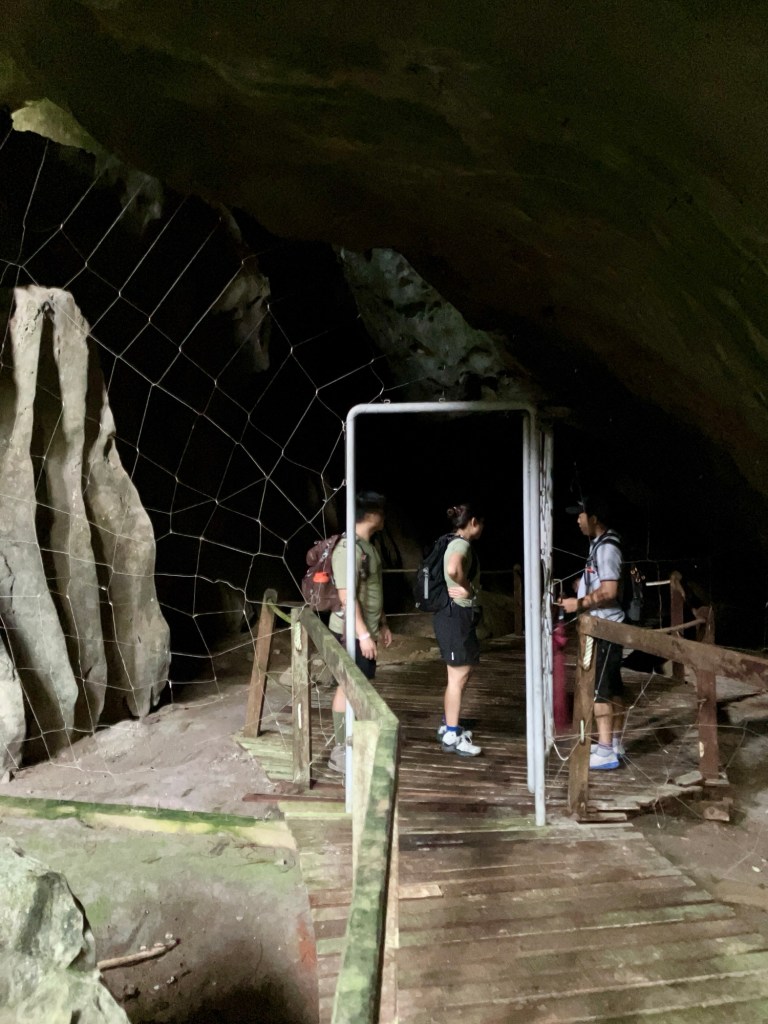
Gate at the cave exit. I was very amused by the spider web motif.
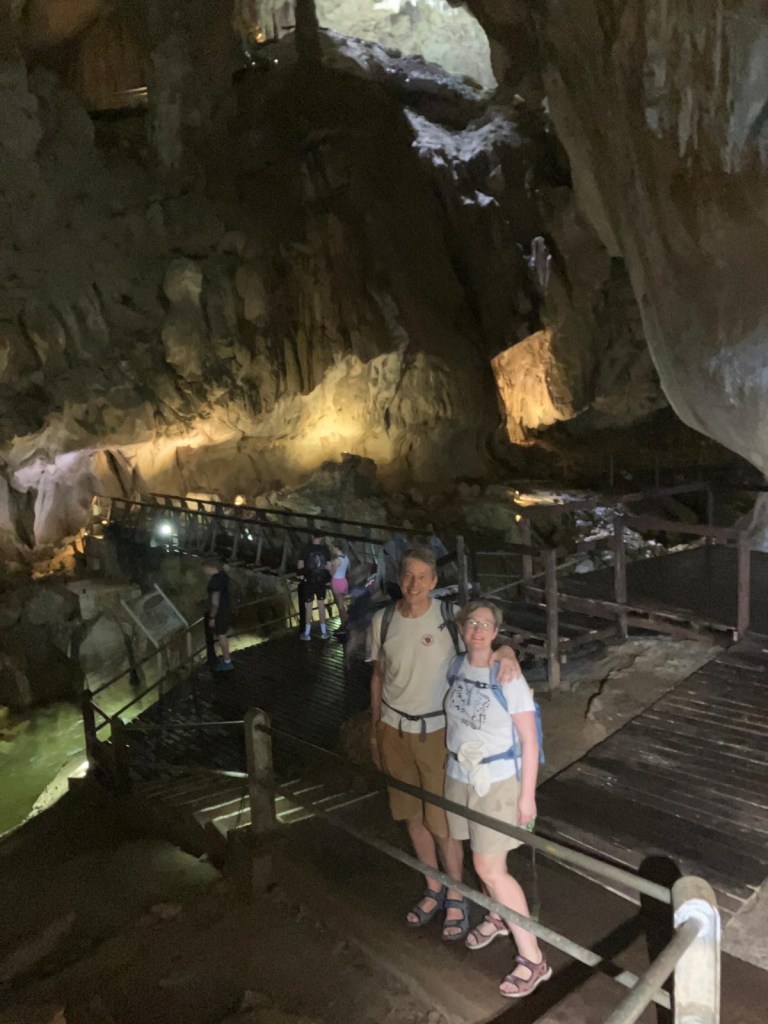
Inside the Cave of the Winds, in this photo you can see the boardwalk and lights.

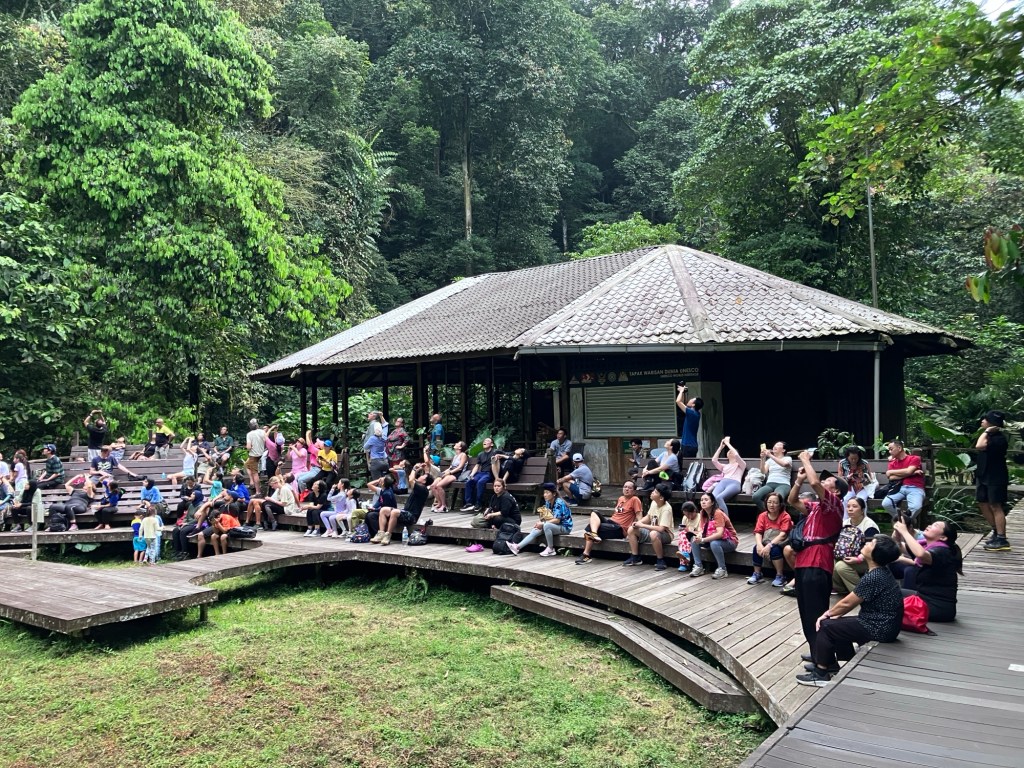
The bats disappointed us our first evening, but on our second evening, we hustled out the 40 minute walk from the Park Office to the bat pavilion and settled down hoping for no rain and many bats.

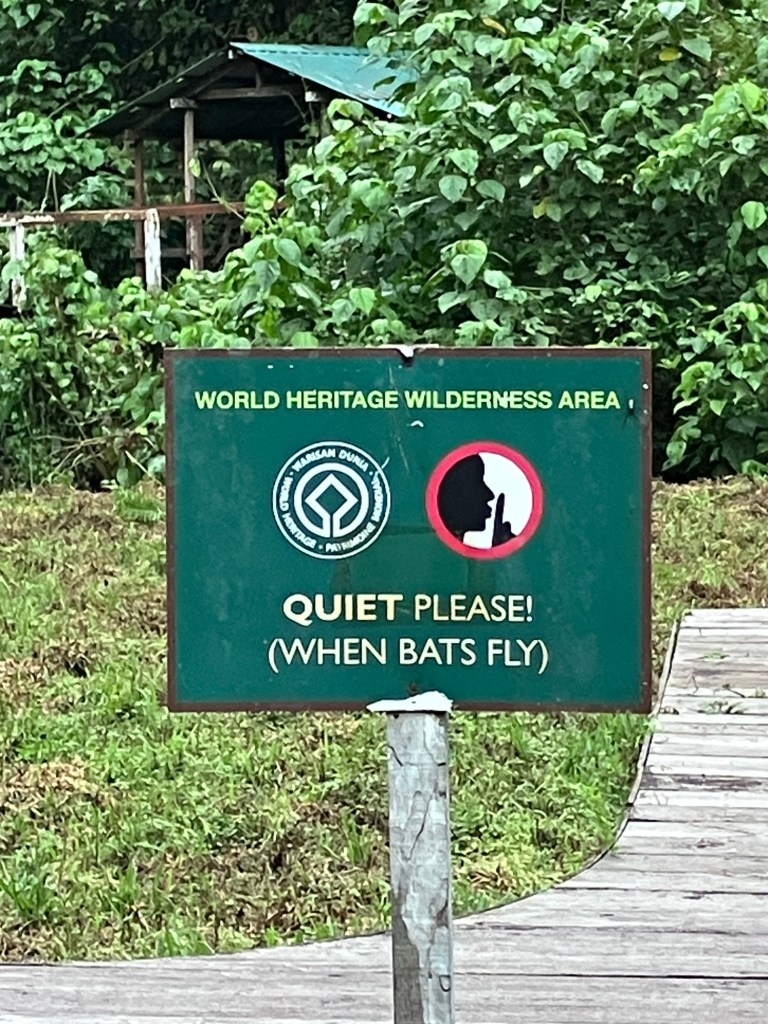
We all did a pretty good job of being quiet.
The bat pavilion was the place to be, a lively global crowd on the Lunar New Year
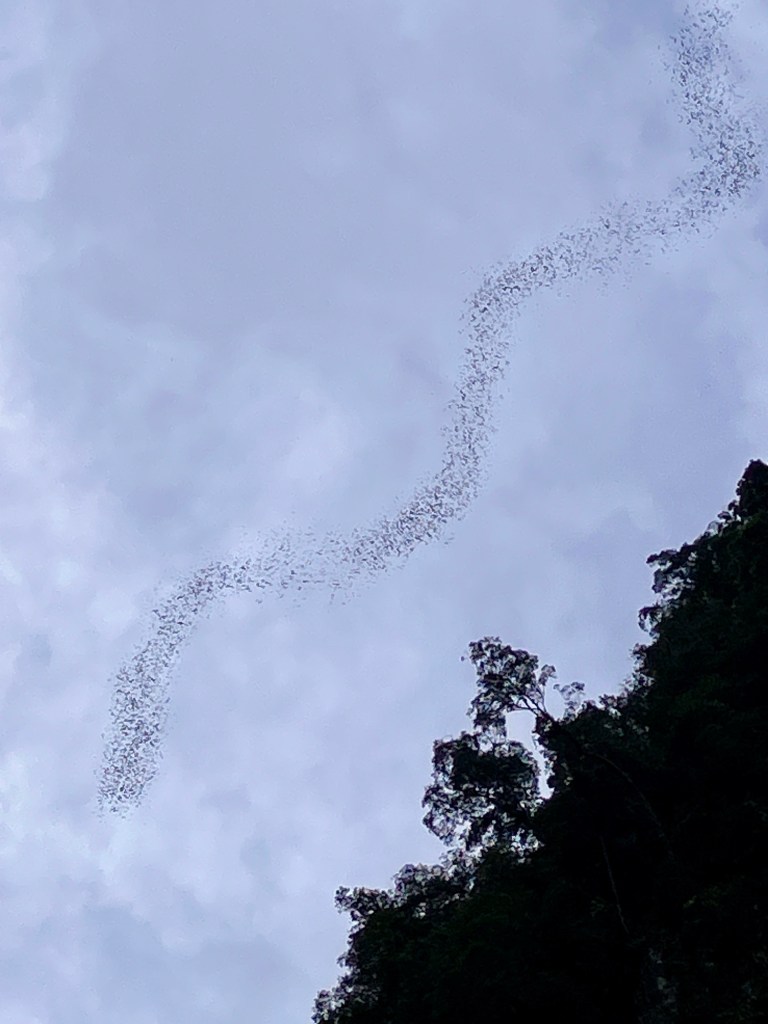
And the bats came out. And out. And out. Millions of bats. In waves and waves. They flew overhead and circled back. You could hear their masses of wings beating.

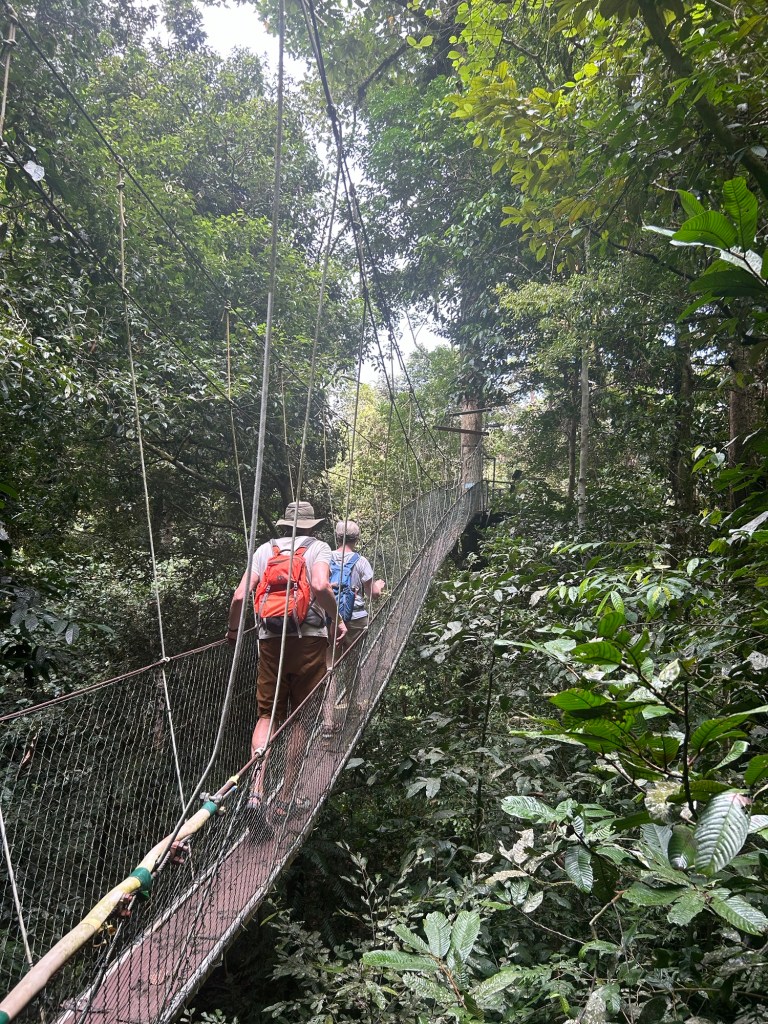
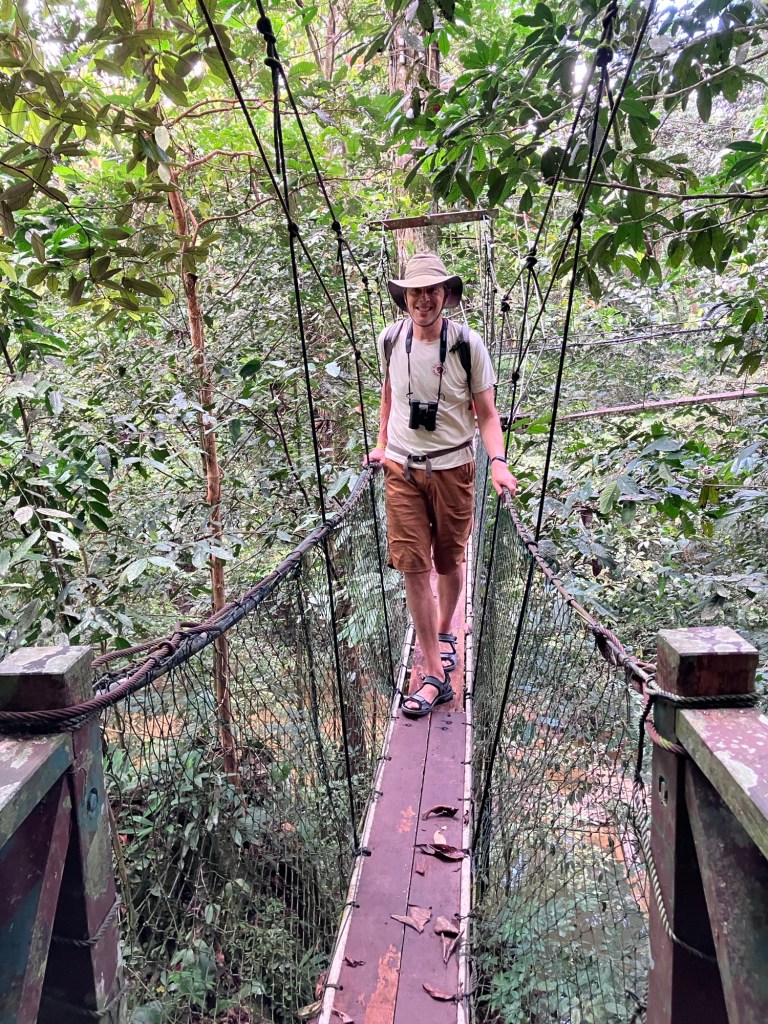
We also did the canopy walk. 25 meters up, 425 meters long, and apparently the longest tree based canopy walk in the world. The guide warned us it was not for those with a fear of heights. Or a fear of swinging swaying narrow walkways. The guide also warned us not to drop our phones as the locals would retrieve them for us, but would also charge for retrieval. A river retrieval would of course cost more than a jungle floor retrieval.

Heading out, two by two, per instructions. A fellow tourist took this photo for us. We all took photos of each other and shared via Airdrop.
Rich treading the boards.
Cheryl hanging on for a photo.
The Canopy Walk was a success.No cell phones were dropped.

Mulu Park is quite well run. We had no problem signing up via email for tours in advance (recommended!). There was plenty of staff on hand to check you in for tours. The tour guides all came from local communities, and knew traditional customs and ways of life since their families lived them. Facilities were well kept up, the park cafe was open 7:30 to at least 8:30 and the food was pretty good.

Lunch at the cafe in Mulu Park.
And another lunch at Mulu cafe, overlooking the river.

Where were we when not walking through caves in Mulu? At the Mulu Marriott. The hotel was only about a six minute drive from the park, by frequent on-call shuttle van or open air truck. There are also options available inside the park, hostels or lodges, and home stays just outside the park and right across the river from the Marriott. Something for any budget, really.

Loading up the human cattle car. It was actually quite nice. A breeze. A view. Your fellow hotel guests.
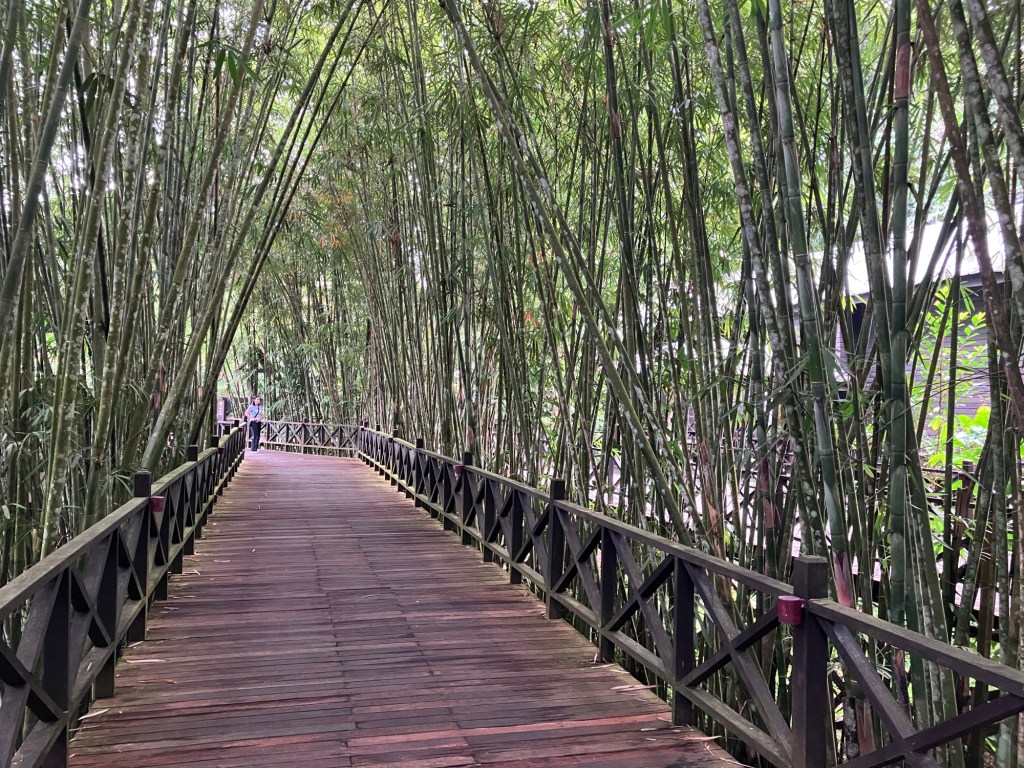
Bamboo shaded walkway at the Marriott. The entire hotel is built up from the jungle floor on boardwalks and stilts.
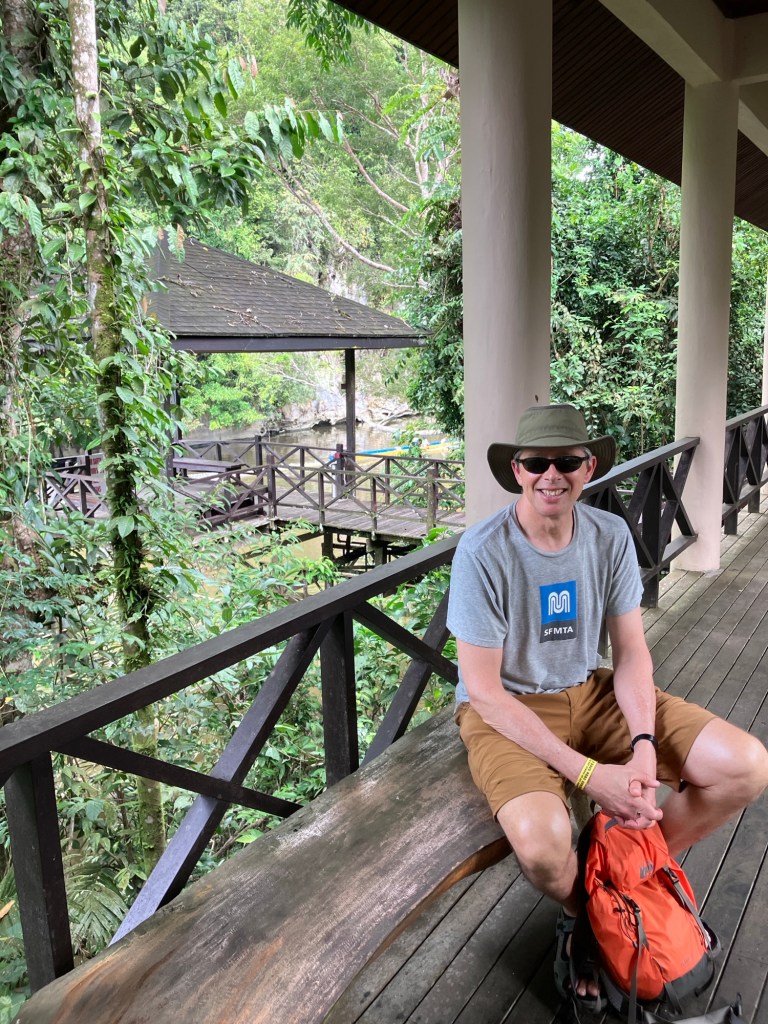
Rich chilling waiting for the shuttle to the park.
Enjoying a glass of wine in the River Bar. Not only was this a great place to bird watch, but it was also the only place to get connected to WiFi.
The Travel Planner hard at work, binoculars at the ready for bird spotting.
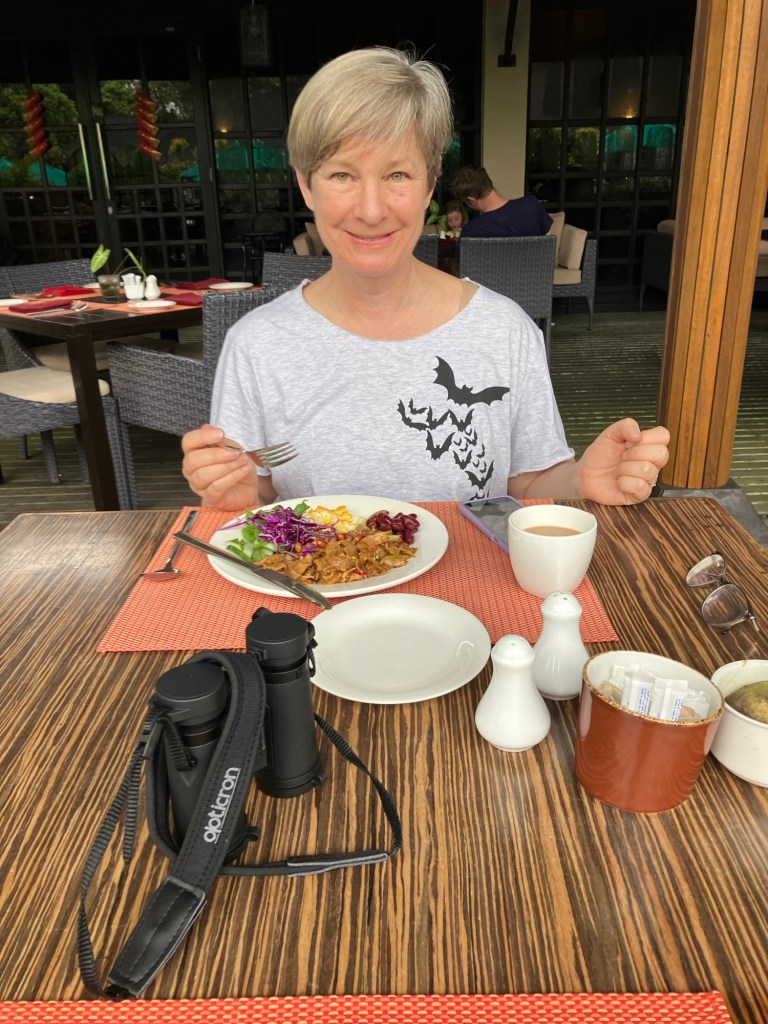
Breakfast outside at the Marriott, binoculars still ready for bird peeping.
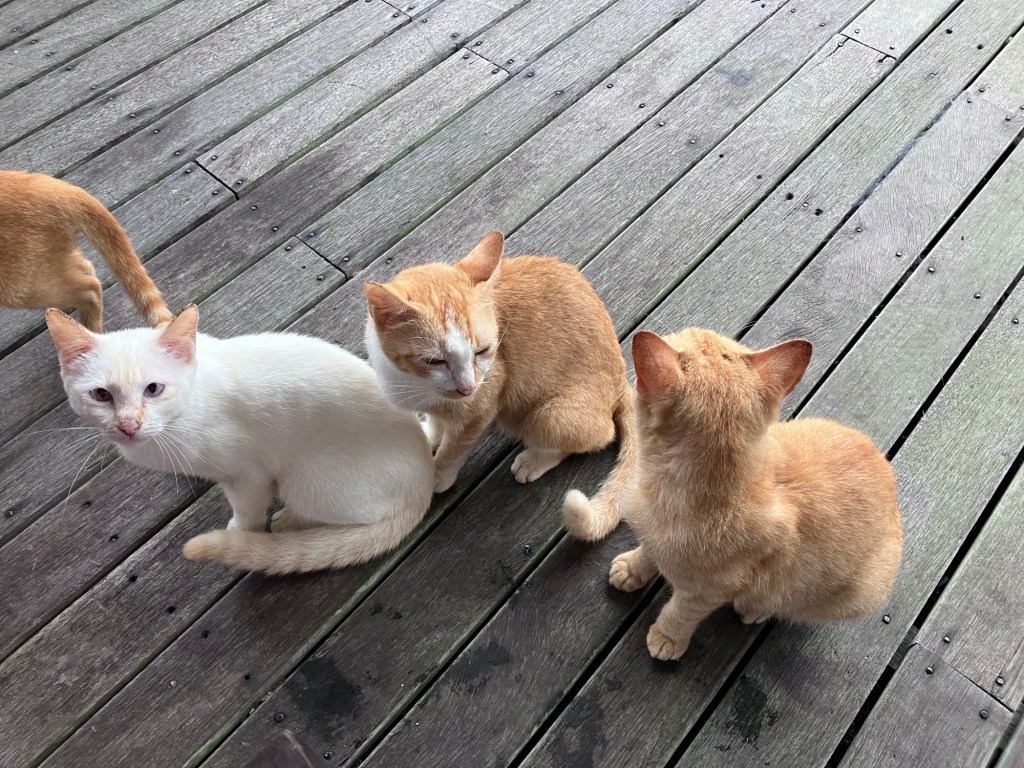
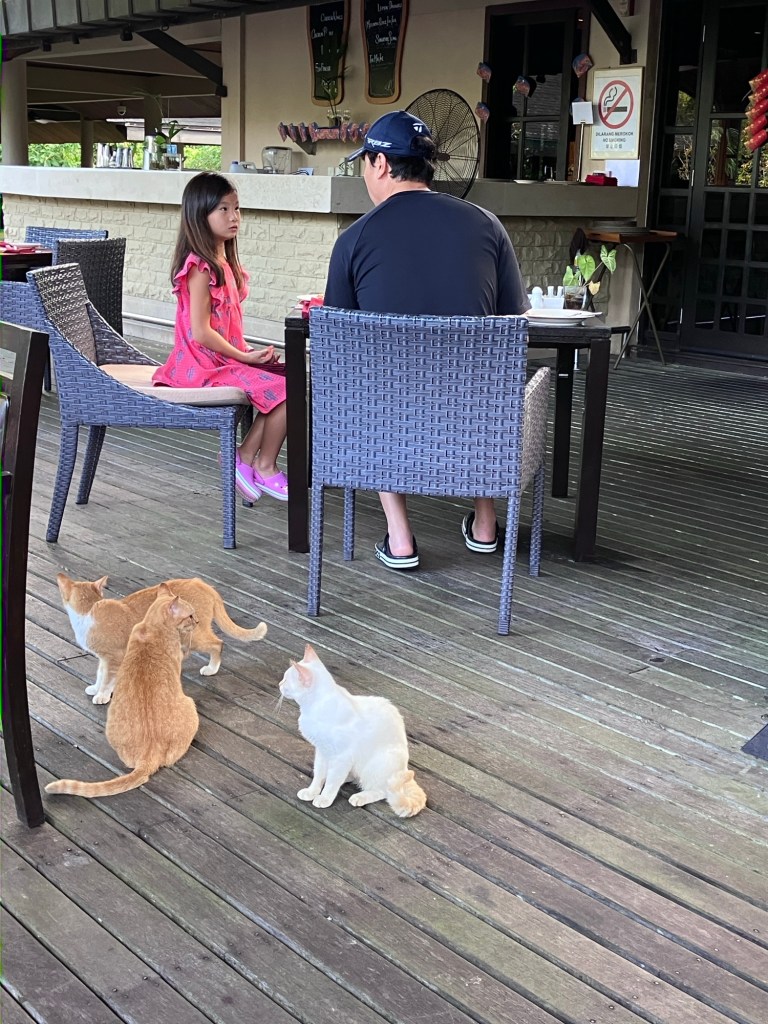
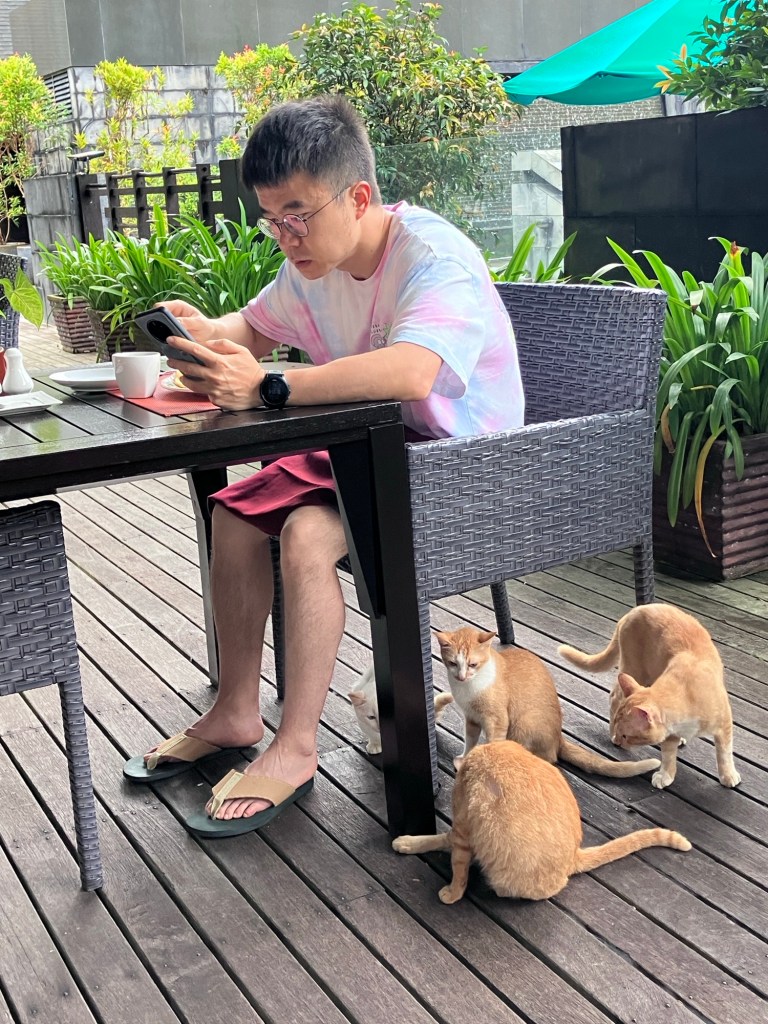
The resident cat family. Ever hopeful for food.
Little girls are always a good bet for tidbits to the cats.
And nice young men, apparently. The cats migrated from table to table.

We settled on Mulu National Park as a place to be over Lunar New Year, it seemed a good way to escape the crowds and noise of the cities and festivities. It was a great decision, peaceful, busy but not super crowded, and we had the pleasure of meeting a lot of other visitors. When you’re all staying at the same hotel, and doing the park tours, you get to know the other folks. Quite a few families who were living and working in Brunei had come to the park. It was nice to have opportunities to chat, exchange notes on the tours, and just socialize in general. That is something we can miss out on doing constant travel, the social part of life. All the ex-pat families were so friendly. I suppose it’s a necessity when you relocate for work, get out and make friends wherever you are. We appreciated it very much and loved chatting with folks.

Two sweet girls from Egypt, Dad is an anesthesiologist in Brunei. We got to know this family over a few tours and in the hotel.
Dave and Eileen (hi you two!) from Aberdeen. We shared beers and bat watching.
And a few tours.

Four nights was a nice length of time. We could have filled a few more days, there were more walks to do, and for those who crave more adventure there were adventure cave tours, which involved crawling and squeezing and sometimes swimming through caves. Squeezing not for us but two nice American guys we met had a fantastic time on a cave adventure. They were exhausted and filthy but had signed up for another one so obviously enjoyed it.

Cleaned up and ready for dinner.
The happy travelers ready to leave Mulu.

Next up: Miri and Kuching. Kuching is known as the city of cats, so you know what to expect from me!

Borneo, It’s a Jungle Out There!

Ah Borneo, the name for me summons visions of exotic jungles, wildlife, beaches or mountains. And who knew Borneo was the third largest island in the world, somewhat bizarrely split between Indonesia, Malaysia, and the tiny sultanate of Brunei. We have decided to focus on the Malaysian side of Borneo as it’s a bit more tourist friendly and jumping between both sides actually involves a lot more travel and flights. Seeing more of less is still our favorite way.

The 13,500 foot Mount Kinabalu shows itself only briefly most mornings
Our first sunset view in Kota Kinabalu or KK as the the locals refer to it.

We also vividly recall our great three week trip to peninsular Malaysia about 10 years ago. So as we touched down in Kota Kinabalu, the capital of the state of Sabah, we were both very excited. Not quite a new country for us, but a very new place. And there is so much to see and experience here.

Kota Kinabalu greeted us with multiple street celebrations and night markets; including the excellent Api Api food market Friday and Saturday Nights on Gaya Street.

The multi cultural melting pot is striking here with an intoxicating mix of customs, manners, religion, and of course, food. Malay (Muslim), Chinese, Indian, and a mix of indigenous and intermixed cultures means that you’ll always be guessing where someone is from.

So many choices and I was very tempted by whatever this spicy beef rib meat was going into, possibly a version of beef Rendang?
But we soon saw a modest line at this stall. This was the man responsible for some magic Mee Goring…we called him grandpa, as he made each batch one (or two) at a time at a very mesmerizing pace. Luckily we got in line early as it grew to near an hour behind us!
And finally perfect Penang Style Mee Goring

To add to the excitement and challenges, our travels have coincided with the lunar new year celebrations in Asia. A month long celebration of the year of the (Wooden) Dragon, with the actual lunar new year on February 10th. So my challenge as the travel planner was to figure out how to work around the potential high lodging costs and travel bottlenecks of the peak of the holiday from about the 9th to 14th. More on the success of our strategy in our next post.

Visiting Asia during the Lunar New Year period means surprise festivals and celebrations pop up everywhere
Very friendly locals in KK. Cheryl was thrilled to see these young ladies lion dancing.
Do not miss lunch at the Sri Latha Curry House in KK. The veggie and chicken curry sets were both colorful and flavorful.
The KK Wetland Ramsar Site is close on the edge of the city and has about 2km of boardwalk walkways and viewing platforms. We visited during low tide so mudskipper and crab viewing was prime. More birds at high tide.
Mud boots available if you want to wade through a short muddy section off boardwalk. We passed as nothing my size (US 14!) anyway, and the walkways were sufficient.
So, since India last year, I’m now a nacent birder and Borneo has an dizzying array of species. I only spotted a few of the 80 species reported just at this wetland center.
Cheryl slightly bemused at my intensity on spotting the White-Collared Kingfisher from a bird blind at the wetlands center.

We like Malaysia, but it it’s always tough for us to have to rely on cars so much to get around as there is no real public transit in Sabah. Grab is the dominant ride hail App here and it works pretty well and is cheap. So we have been using it and make sure we tip well as all ride hail and delivery drivers of the world often seem to be underpaid and under appreciated.

The Sabah museum complex has two separate museums and a dozen or so outdoor buildings from various cultures of Sabah.
The outdoor cultural building area of the Sabah grounds was quite nice, and we had it to ourselves. It could use a little more curation and text on each building.
The Sabah Museum Complex in KK.
It is hot in Borneo. So hot and so humid, but this raised indigenous house was surprisingly cool late morning…so we sat still and appreciated the wisdom of pre a/c design.
There were only a few people at the small and mildly engaging Islamic Civilization Museum, but there was a sweet cat.
Athée Islamic Cultural Museum, a beduk drum from Indonesia made with palm wood, cowhide, and tied with rattan …. (SF note: this would be SO cool on Hippie Hill!).
Even I couldn’t resist this sweet kitty while waiting for our return Grab ride. Grab is a ride hail App that is essential in Malaysia if you are not on a tour or renting a car.

Mount Kinabalu dominates this corner of Sabah and occasionally in clear weather, mostly the mornings, you can even see it from KK. It’s also a popular summit climb and epic if it’s clear; but we decided for a number of reasons to skip it. First off; February is still the rainy season here and climbs can be rained out or miserable. I also opted to travel light for 2+ months of travel with just my trusty Ecco sandals and very light running shoes/trainers. An additional pair of size 14 hiking boots takes half my Osprey pack. Oh, and it’s a slog up and down 8,000 feet in 36 hours with a 2am wake up.

At 4,095 meters (13,500 feet) Mount Kinabalu is impressive from a sea level sunrise in KK

There are lodging options outside the park if you have a car but keeping to our blog mantra, we just used a Grab to get to the Park HQ and stayed for 2 nights at the lodging run by Santera. It’s all a bit pricy for what you get; but you are paying for a great location next to the trails, forest and park utilty road. As well as spectacular views of the mountain when clear.

We did a loop our first afternoon up the Pandanus to the Kiau View trail…probably best in the morning when you are likely to get more views.
Happy on the trail in Borneo.
Fungi and spores everywhere in the slightly more temperate rain forest at 1,600m.
One of the many beautiful orchids in the botanical gardens.

The hiking trails were interesting, but except for the main Silau Silau Trail, not too well maintained. The small botanical gardens boardwalk loop walk is worth doing with a guide (free at 9am or 3pm) as otherwise you’ll miss a lot.

Ok; it’s a bit muddy, steep, but all is ok on our first foray into the NP forest…then it started to rain, and with rain comes leeches.
We made it to the end of the trail but Cheryl was not thrilled with her two leach discoveries… we’ll spare you photo of the welt on the bottom of her foot.
And then Cheryl had to remove this from between my toes…a credit card comes in handy , but this guy had his fill of my blood.

It dumped rain for hours the second afternoon and evening, making the forest and creeks rage with water. We felt bad for the climbers that had set out that morning, but perhaps they missed the worst of it by getting to the first shelter by late afternoon.

This mini Raffesia flower startled us when pointed out by some fellow hikers.
The rainforest around Mount Kinabalu is stunning in some sunlight.
The Medinila were one of the delightful things blooming in February
A fungus city just above the forest floor.
All this mushroom needs is a gnome.
No leeches on Day 2 with pants tucked into socks and no rain in the morning.
We were surprised to learn of the tragic death of 18 climbers on the mountain in the large 2015 earthquake. A huge rock pinnacle let go and also trapped some 100+ climbers.
The lodging in the park ranges from hostel to suites, and there is a decent and pleasant restaurant open for all meals.
Pitcher plants awaiting lunch.

Getting back to KK 2 days later was a bit more challenging as no Grab drivers would respond out on the remote location (not surprisingly) and we ended up booking a car back through the park HQ. It all worked out fine; but was about double the Grab rate; even with our generous App tipping.

Back in KK for two nights, we took an early boat to Mamutik Island and were able to snag the end of a picnic table in the shade and have some time to swim with some fish in peace.
Our early boat out to the island. Lots of families travelling during the peak Lunar New Year holiday. Fun to let go and be part of the celebrations.
Our boat captain was definitely racing the adjacent competition to the island. We won as he kicked in large twin engines…ha!

We opted for an apartment near Jettleson Quay in a giant new high rise complex as hotels had already doubled in cost with the run up to the New Year. It was conveniently just a few minutes walk to the boat docks to the islands, but was loud with concrete block echoes, and music and road noise about due to pre-holiday festivities.

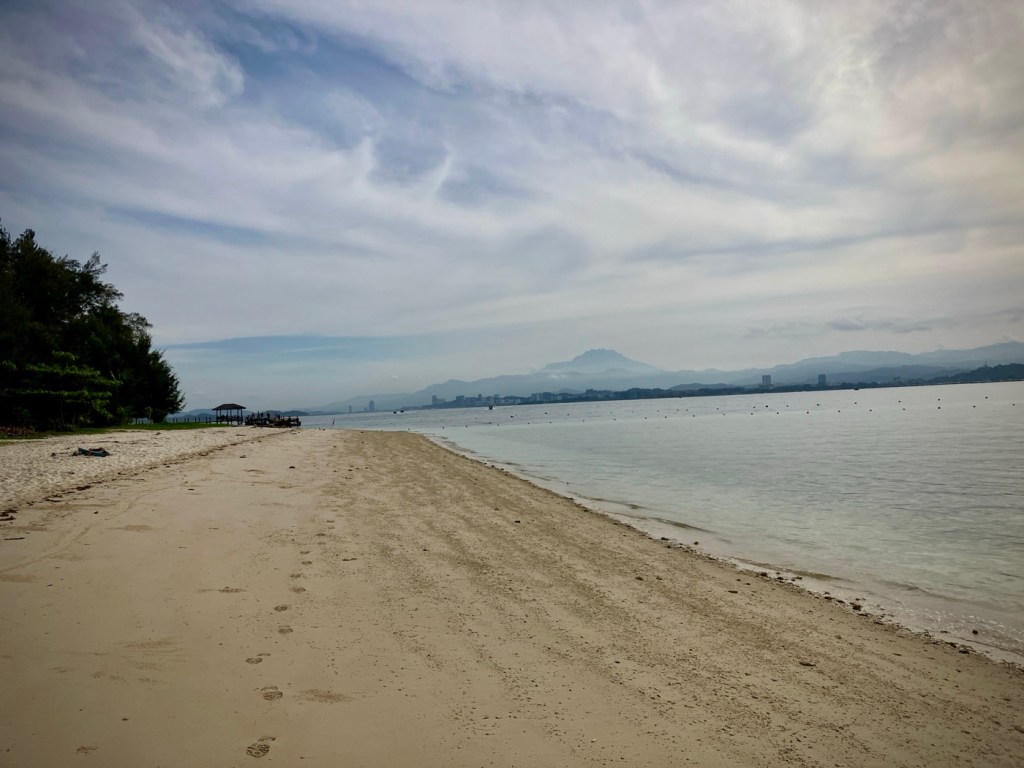
Mamutik Island and Mount Kinabalu before the rest of the daytrippers arrived. Those sole footprints are mine.
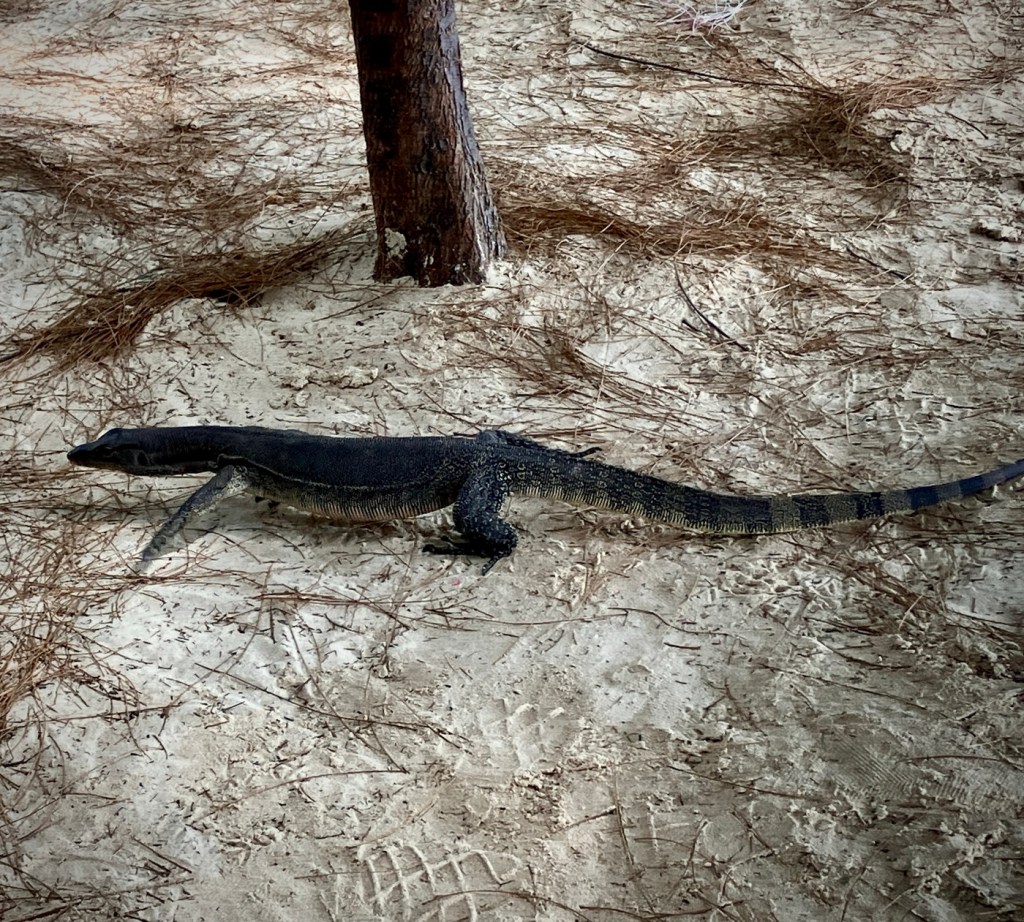
Monitor Lizards roam all the islands of Tunku Abdul Rahman National Park.

I had hesitations in visiting one or more of the Islands off the coast of KK after reading about overcrowding and trash issues. We didn’t want to add to the problem, but it did seem that trash issue were more discussed pre-pandemic. We also opted for just one island, as you can visit one, two, or three islands in semi scheduled service from one of many boat/tour operators. The crowds did show up later morning but it was not bad, as trash disposal was good and the water seemed clean. Kudos to the park management for this, but they still should revamp and consolidate the many competing boat services, and work on the supply side of plastic, which is everywhere and in everything in Malaysia.

We were pleasantly surprised to see good garbage control on the island and almost no trash on the beach or in the water.
Lunar New Year Instagramming was part of the attraction at these busy islands.
Lots of shade as the midday sun is fierce here. Only the Westerners sat on the beach in full sun, and swim costumes are modest both for cultural norms and sun protection.
Very pleasant in the shade with a breeze.
Happy Travellers enjoying the Lunar New Year vibe in Borneo.
At Kota Kinabalu Airport heading to our next adventure in Sarawak.

Our first week in Borneo was intense. And all peak travel has its ups and downs, but the blessing of having time is to be able to smooth out the bumps and go with the flow a bit more. Sure, Lunar New Year partying meant getting less sleep a few nights in KK, but the festivals, food, and people make up for it. We’re here now and savoring every moment. Happy New Year!

Sun Moon Lake, and Taipei again. Briefly.

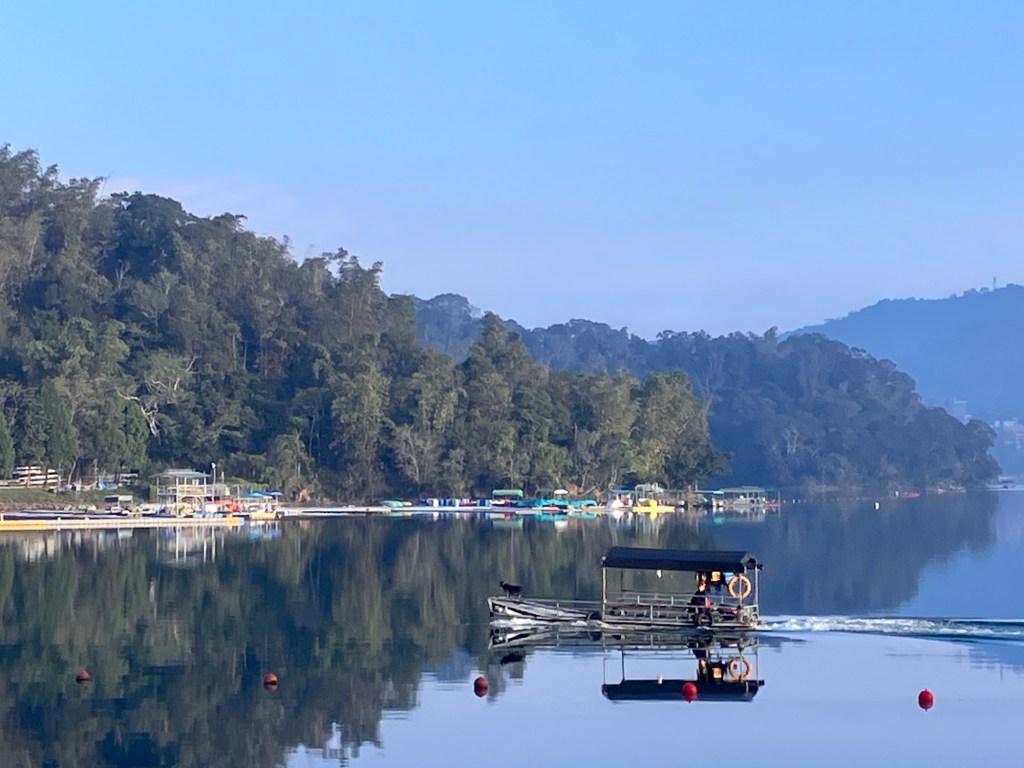
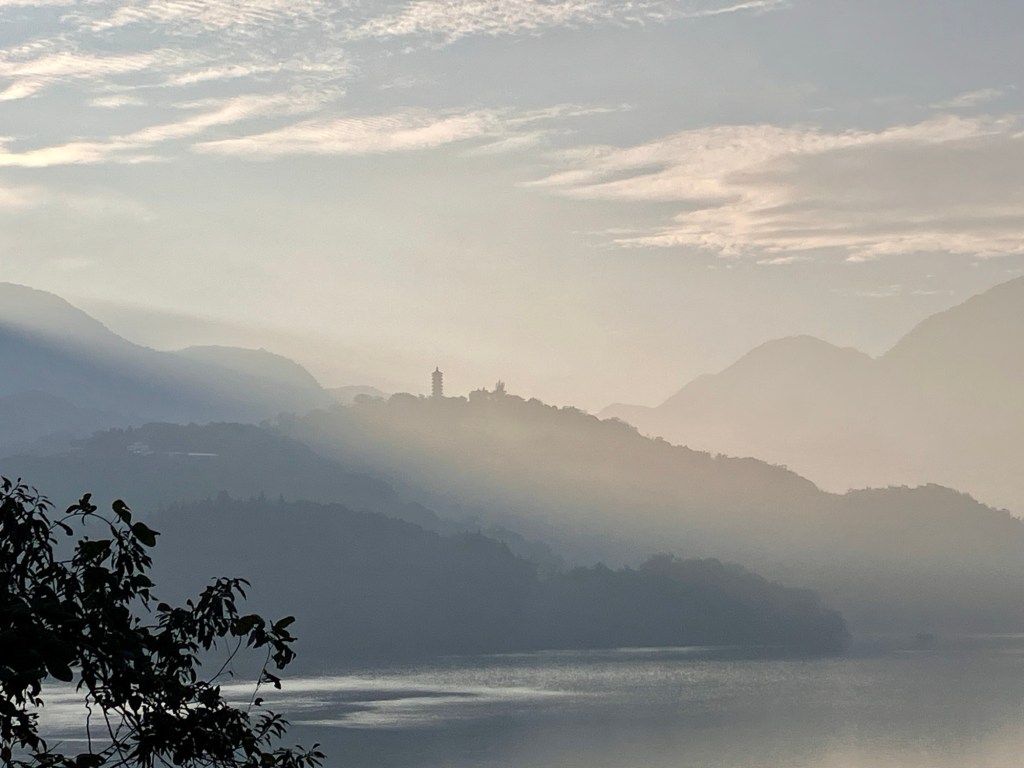
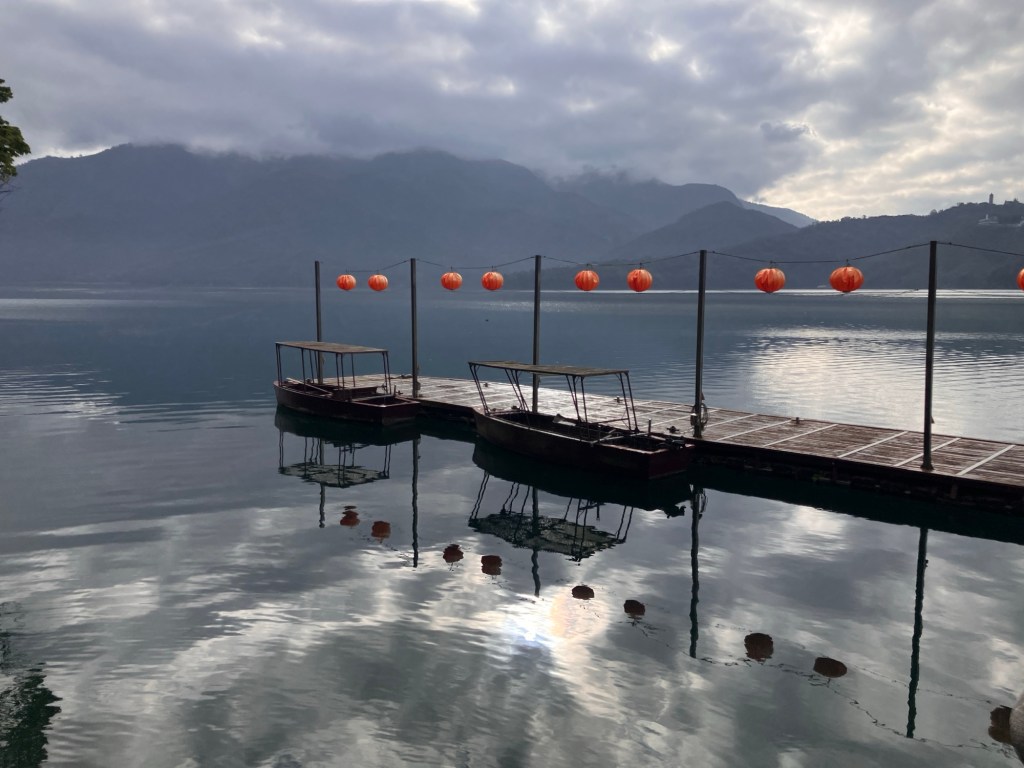
Fishing boat on a mirror lake in the morning.

We love cities. Love visiting them, love exploring and speculating. Adore watching the citizens go about their days and testing out the public transit, biking, and walking. And the food choices! So many choices in the Taiwanese cities we visited. But sometimes you just burn out.

The bad air quality definitely contributed to our burn out.

We’d gone back and forth about visiting Sun Moon Lake, and while in Tainan we decided on yes. It would be nice, we thought, to have a break from cities before returning to Taipei, and hopefully the air quality would be better in the mountains. Yes, we’ve lived through much worse air quality for longer in San Francisco during California wildfires, maybe that’s why we’re a bit sensitive to it. It was interesting to hear locals blame bad air quality on pollution blowing over from China, but from what we read a lot is home grown, due to industry, diesel trucks, cars and motorcycles (which I assume includes scooters), and other usual suspects. So, off to the mountains it was. And, our first trip on Taiwan’s very impressive High Speed Rail.

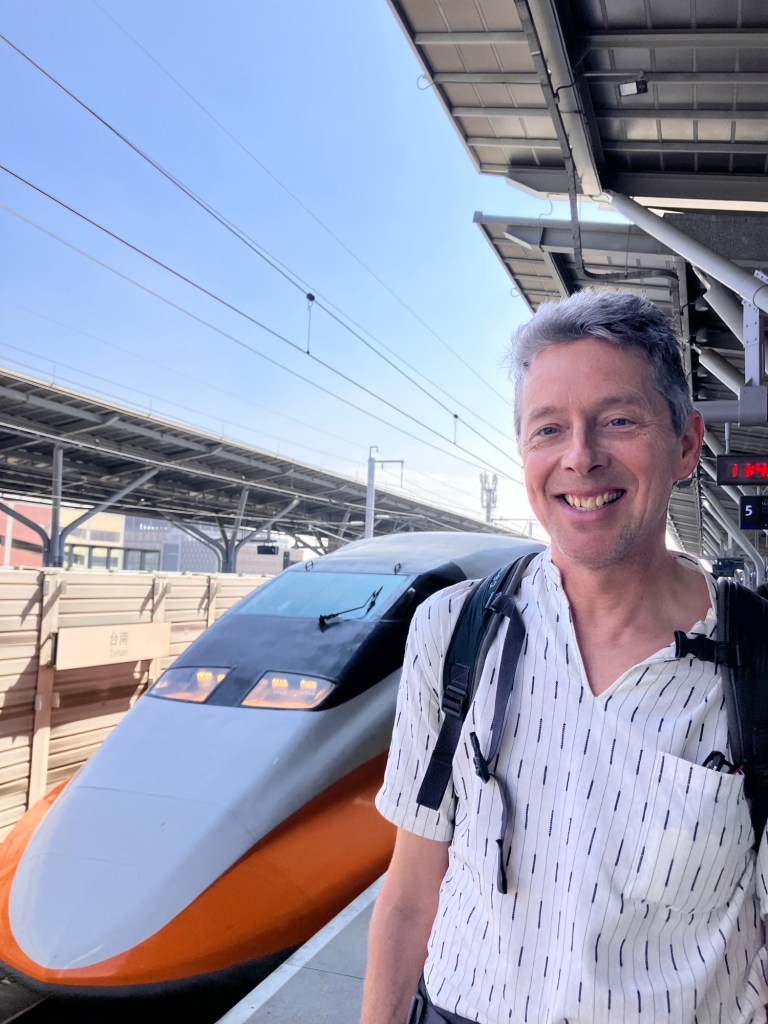
That’s a happy face.

That photo of Rich in front of the HSR train reminds me to tell you the story of his shirt. Probably only we remember his first version of that shirt, it was purchased last January 2023. He bought it in Taipei at the clothing market, a warren of small streets and clothing stalls, wore it in Thailand, India, and Sri Lanka, and finally threw it out our last day in Sri Lanka. Sunblock and sweat had done it in. He missed it. One year later, he found the same stall in the clothing market (more amazing than you can imagine), and bought the exact same shirt!

Tainan to Taitung. In The Shirt.
Train lunch! One chicken and one pork. Bought in the station for about $3.00 each.

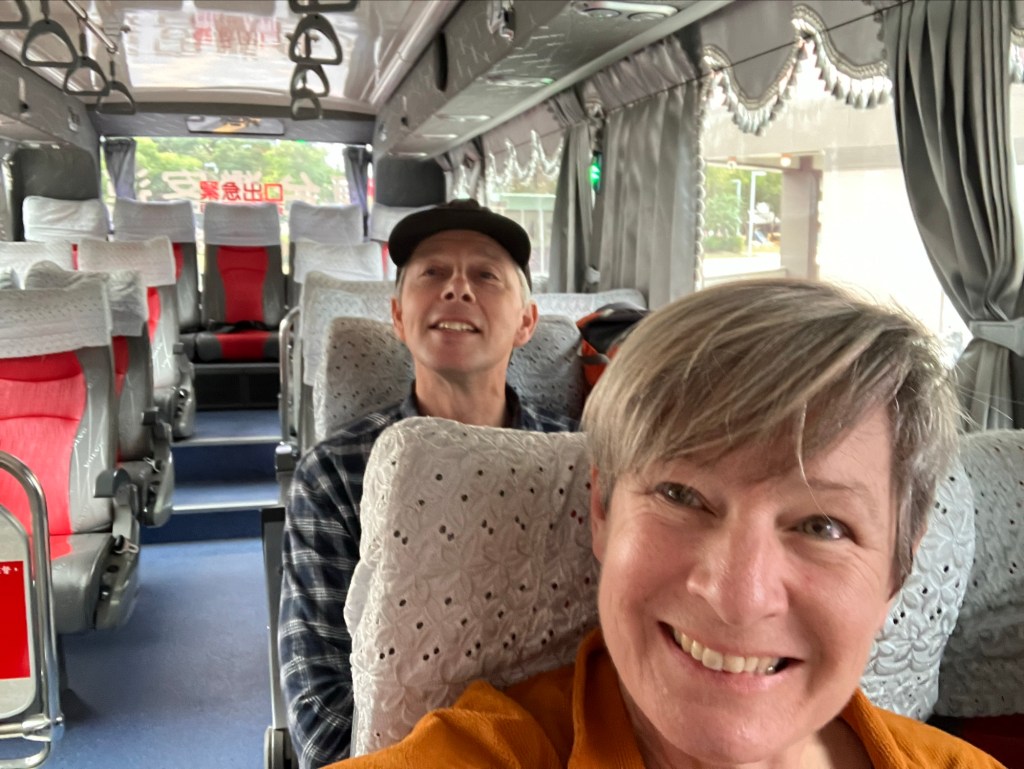
Honestly, you just have time to eat your lunch on this trip. The train leaves Tainan at 11:48 and arrives Taichung at 12:30. our only complaint with Taiwan High Speed Rail is it’s too quick a ride! Oh what a problem to have, huh California? So, bus to train, the HSR station is a bit out of town, reachable by rail but the bus was easier for us, and train to Taichung, and then a hour and 15 minute bus ride to Sun Moon Lake.

With our rental bikes, ready for the next day’s sunrise bike ride.

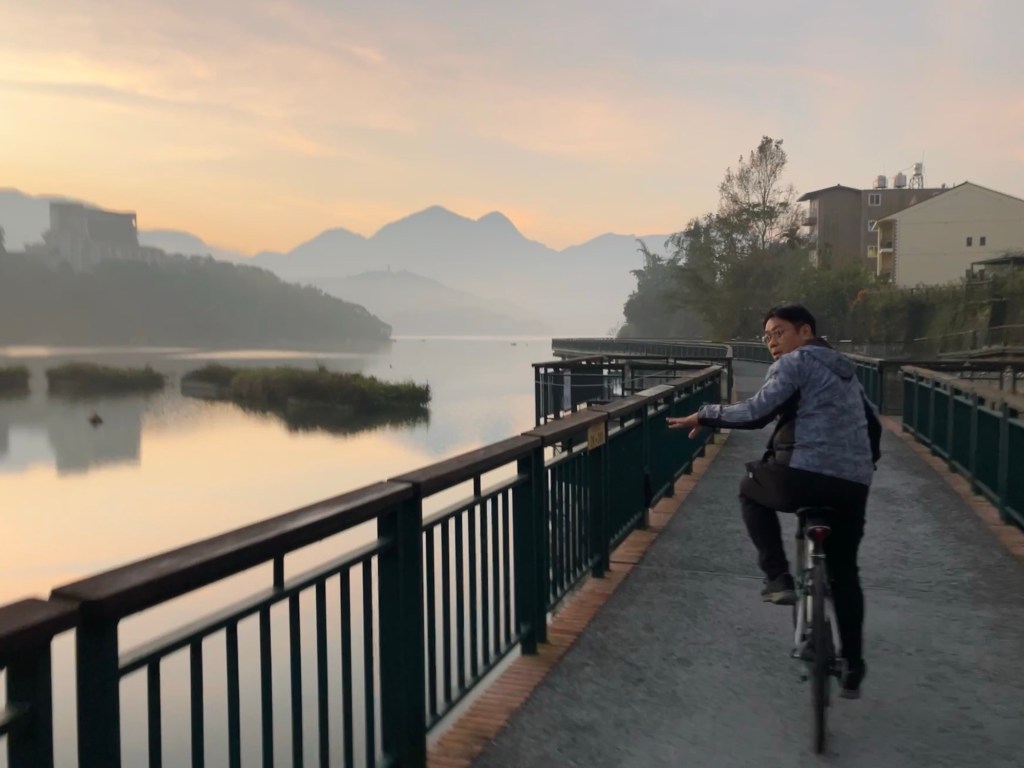
Our hotel, The Laurel Villa, offered a sunrise bike ride, led by one of the family members who owned and operated the hotel. You go pick up a bike from one of the many rental places after 4:00 pm, park it in front of the hotel, and at 6:05 am the next day you ride with Wei, who was born and raised in town, left for university, and came back. He knows his lake.

The lake before the sun peeks over the mountains.
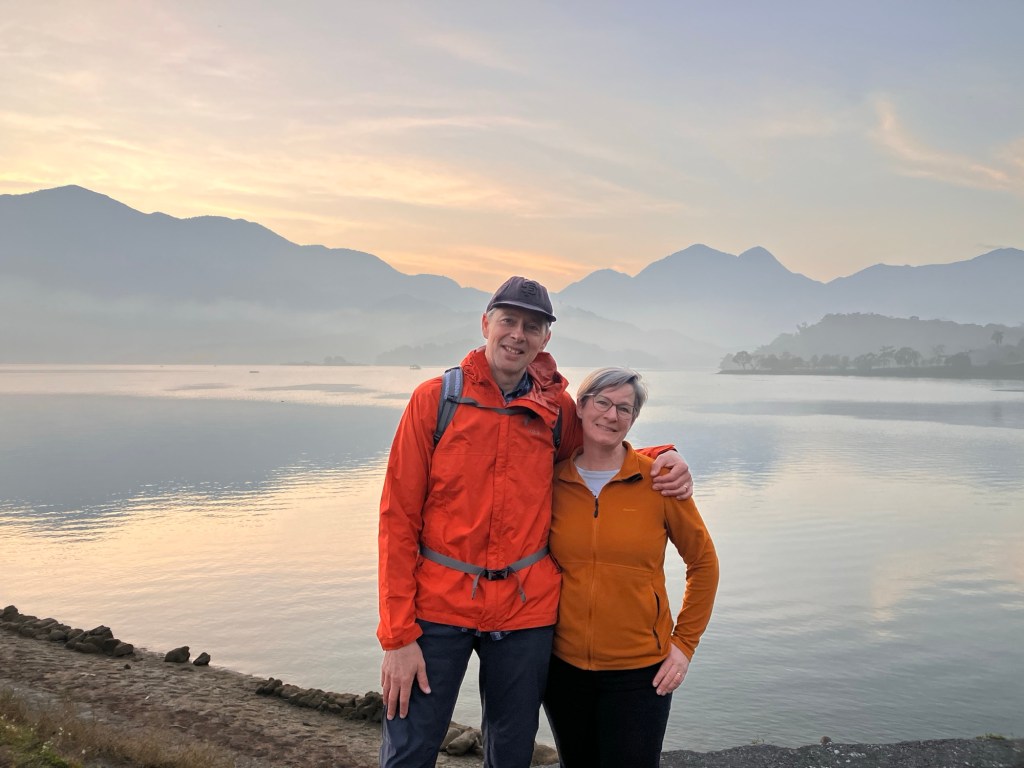
Oh, a rare non selfie. Our lovely guide took the photo for us. As the sun comes up the moisture in the air makes it hazy.

For anyone who does go to Sun Moon Lake, the number one recommendation we have is to get up early and go for a bike ride. Later in the day there are many many many people out on bikes. Many of those many bikes are e-bikes, throttle bikes actually, which don’t require pedaling. Folks are calm and patient, and all the scooter riding gives them good bike skills, but we always prefer no crowds.

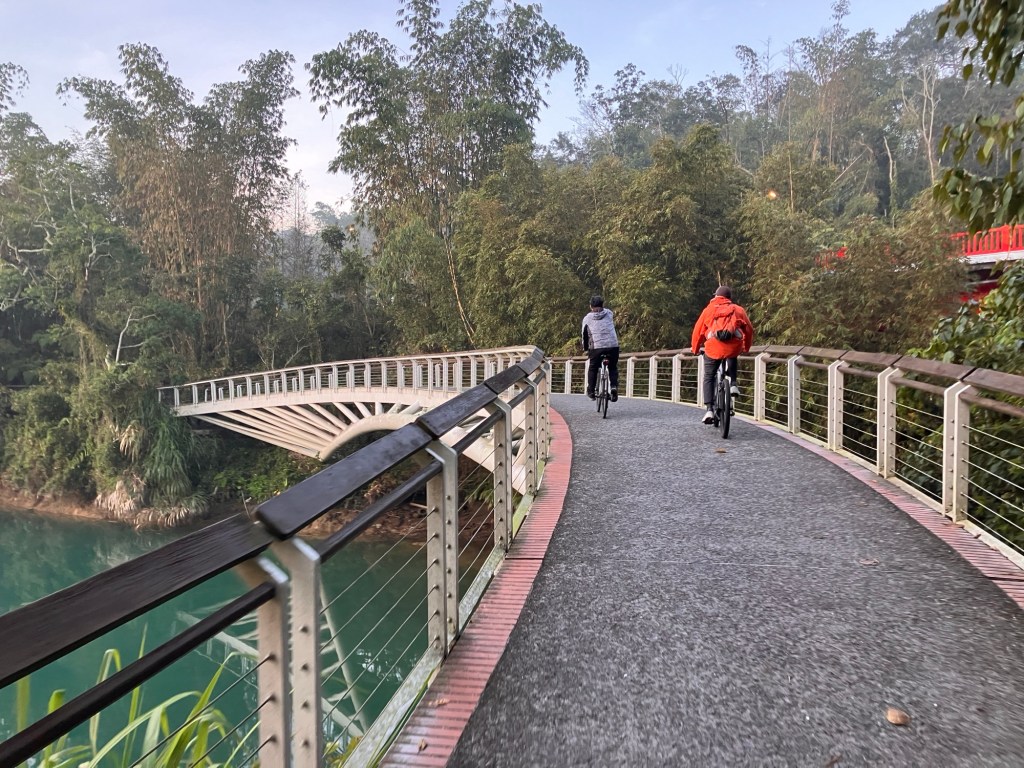
Across a picturesque bridge.

Sun Moon Lake’s present size was created with a hydroelectric project built by the Japanese in the 1930s, which joined two smaller lakes together, making the lakes resemble a sun, and a crescent moon. Or, two dragons fighting over a pearl – an island in the lake. The path around most of the lake (joins the road for a few stretches) is beautifully constructed, and the sun and moon motifs along the way show a dedication to the theme.

Had a lovely chat with a couple from Taipei who also got out early.
The sun coming over the mountains.

Our choice to go up to the mountains was rewarded with clear air and nice weather. After our dawn bike ride we returned the bikes, had breakfast in the hotel, a rest, and headed out to hike up to the weather station for a view of the lake from above.

A picture of view on the way up.
A picture of the picture taker.

I’m so impressed with the care put into pathways and seating areas around the lake. There are tea growing fields around the lake and the tea leaf motif is picked up in some of the seating areas. It’s a steep climb so the benches are very welcome.

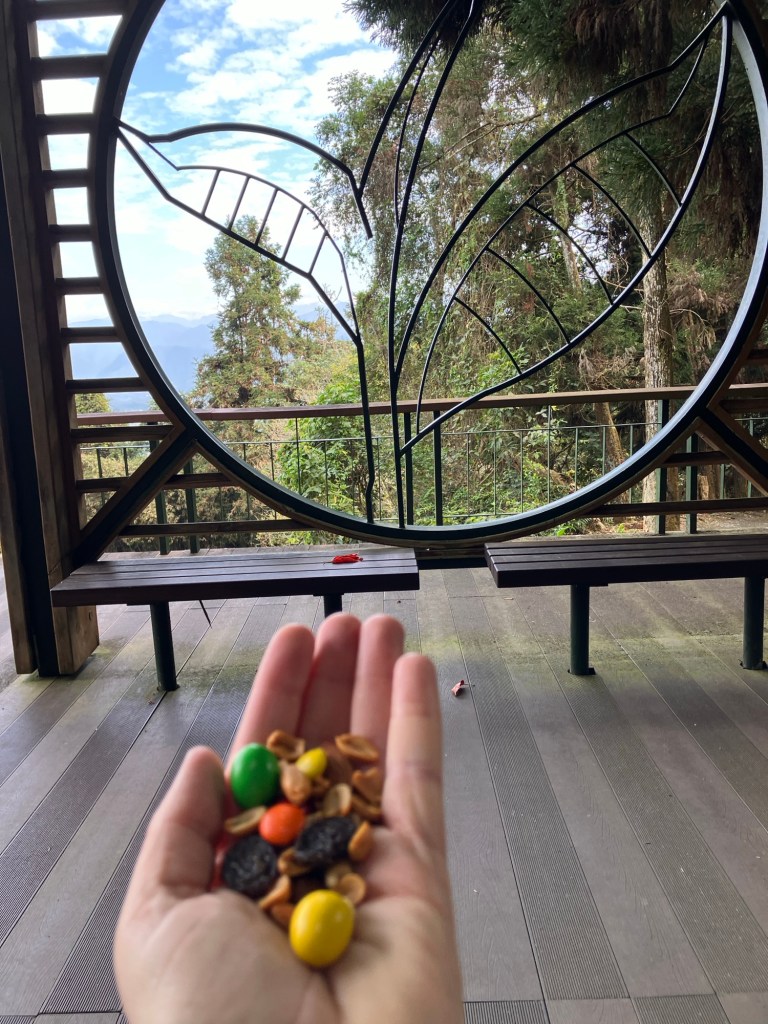
A tea leaf motif and my GORP (good old raisins and peanuts – translation for those of you who didn’t backpack in the 70s). Assembled from 7-11 purchased products.
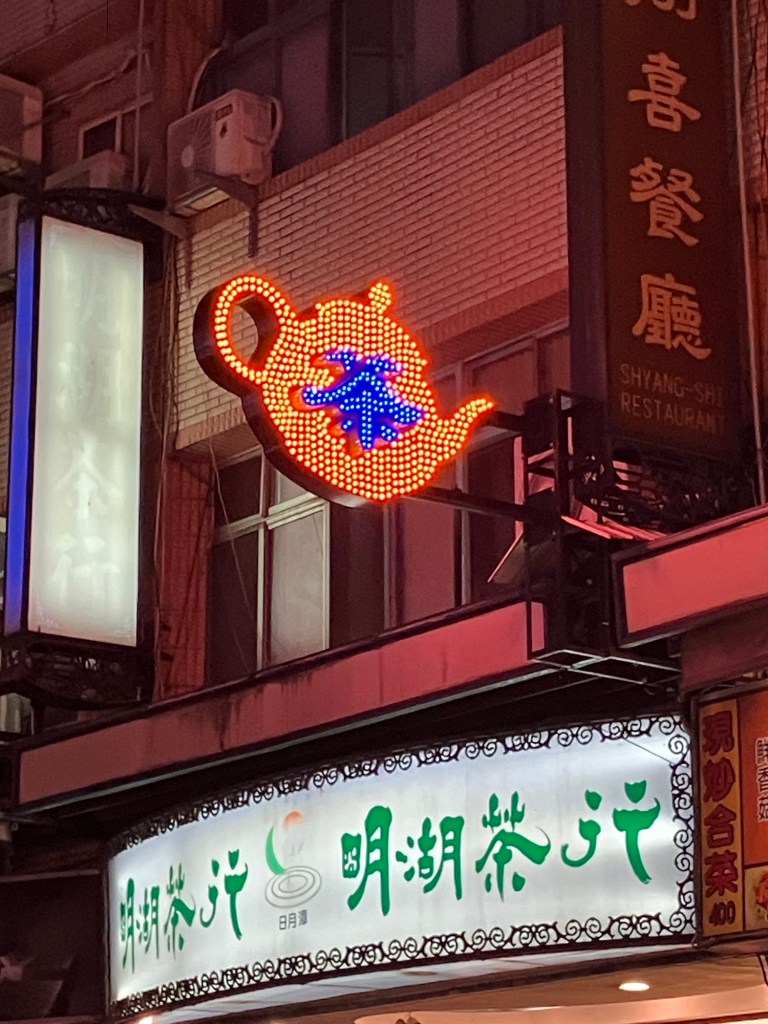
A fun tea sign on the main street of Shuishe, where our hotel was located.
Our last day was a bit cloudy, but our morning walk before catching the bus back to Taichung was still lovely.

High Speed Rail back to Taipei – only 50 minutes long, eat your lunch quickly – Rich booked a hotel close to the main station so our airport trip two days later would be easy, and we had a short little Taipei stay of two nights. We hit some of our favorites (it thrills me to have Taipei favorites!), black pepper buns at Rahoe Night Market, boba tea, a drink at The Tipsy Dragon Bar, and a new find from Rich – Beercat. Just what it sounds like.

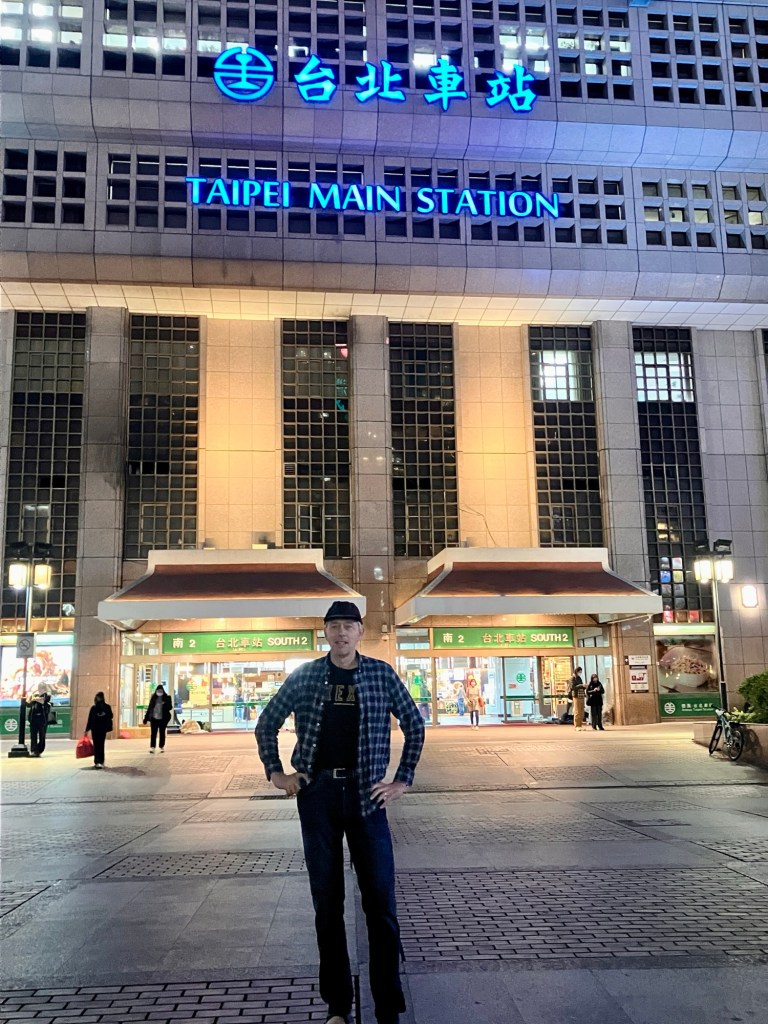
Rich in front of the Main Station.
BeerCat ! A bar with cats. Two cats. And the best logo.
One of which of course loved Rich.
Is there anything better than a cat on the bar?
Delicious coffee and tea, mine was the tea, lemon and winter melon.
At the Rahoe night market. I love these little rolling cubes. Put your stuff inside and your kids on top. And I love that the parents didn’t mind me taking a photo.
One final beef noodle lunch.
And the happy travelers are off to Borneo.

Three weeks in Taiwan by train, bus, bike, and only two taxi rides.

Taking the city bus in Taitung to get to the train station.

Yes, we keep track of our travel modes. As long term travelers we have the luxury of time and room for errors, or spending extra time that other travelers might prefer not to “waste” taking buses instead of taxis. We also like to try to experience life the way locals do, as much as we can. Of course Rich always has a back up plan – if this bus hadn’t shown up in ten more minutes we’d walk over to the taxi stand. But show up it did, and we were off to the train station to go to Kaohsiung, a city of 2.7 million.

Last minute mochi snack purchase at the train station.
The business class seating.

Rich, in his quest to really understand Taiwan trains, got us business class seats which weren’t really necessary since standard class is comfortable, but you know, for research sake. He also managed to book us in the single seats on the coastal side of the train, so fantastic views out a window each. Interestingly enough, a mother daughter duo from the bus were also in the business class train car with us.

Tea at the Kaohsiung Museum of History.

Something that is necessary is a plan for what to do when you arrive at your destination before your hotel lets you check in. Check in times in Taiwan are quite strict, usually 3 or 4 pm, so if your train arrives before that, you need to have an idea of where to go after you drop your bags at your hotel. We were glad our hotel in Kaohsiung, Hotel dua, let us check in when we arrived at about 1:30. We think that was due to the fact that we were staying for four nights. But we were ready with our plan. YouBikes to the Museum of History.

Our trusty Easy Card works for any city bus, and all YouBikes everywhere in Taiwan. Awesome!
The Easy Cards, purchased in Taipei when we landed, reloadable in any convenience store – and also works in vending machines and some shops.

For us, riding bikes in an urban environment isn’t daunting. And with so many scooters in Kaohsiung we felt in good company. The cycling is certainly not the best in the world, but with the long distances and flat terrain, riding bikes is such a good way to get around. We met up with a fellow traveler, Martin (Hi Martin!), from Sweden, for pizza at a place that seemed not too far away from both our hotels. Ha! We all exclaimed at how much further it was than it first appeared on the map, us bicycling and Martin walking. It’s always so great to meet other travelers and swap stories and travel tips and learn about each other’s lives. Always say hello to fellow travelers, even if it feels awkward at first. I’ve had to get over my uncomfortableness about asking people where they are from, I’ve learned to phrase it “Where are you visiting from?”. That helps avoid awkward moments when you might have assumed incorrectly about a person’s home country. Taiwan doesn’t have that many western tourists so seeing other travelers is not common, which makes it even more fun to find out where folks are from and what their deal is.

Our YouBikes outside a 7-11 on our way to hike Monkey Mountain, also known as Shoushan Mountain. We stopped for snacks.
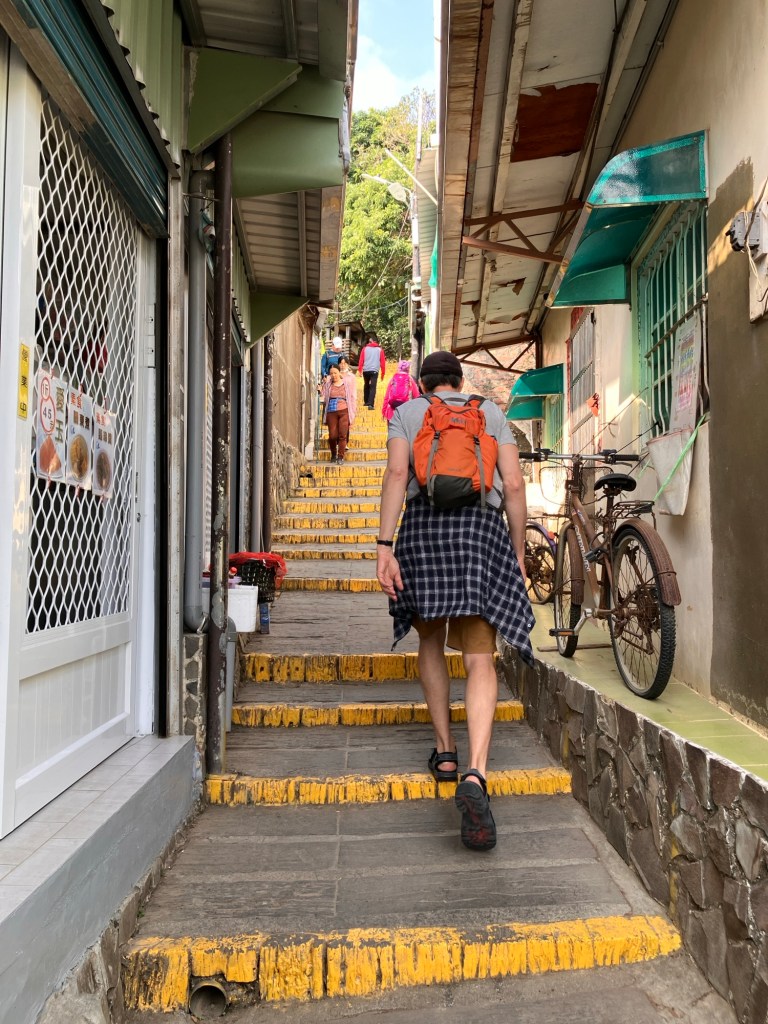
Starting up the many many stairs of Monkey Mountain.
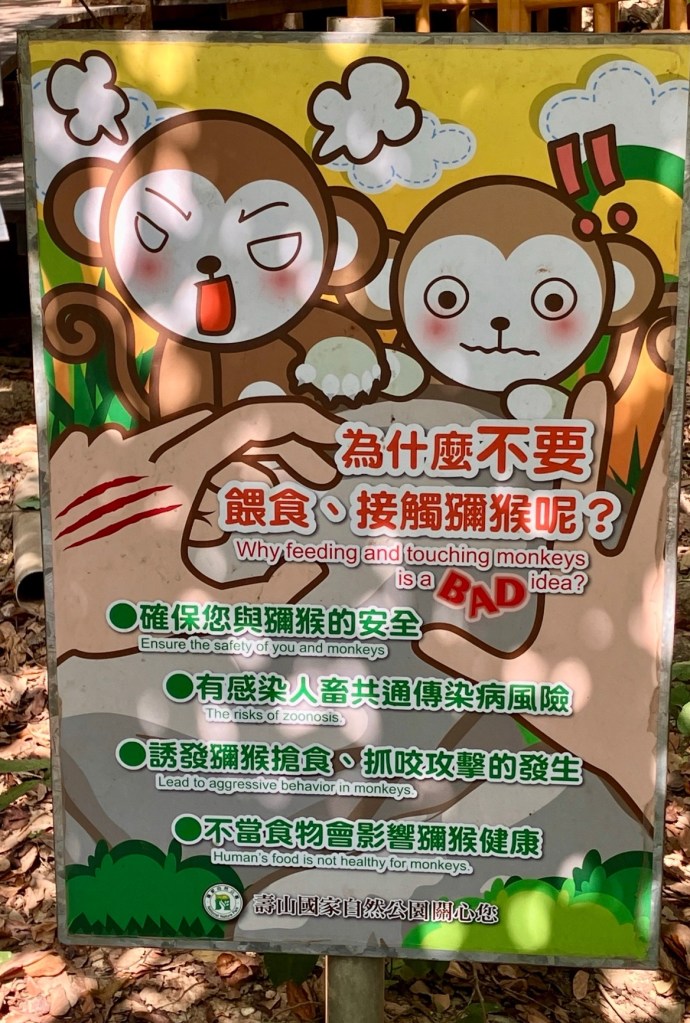
After seeing this sign we stopped eat all of our snacks before encountering any ravenous monkeys.
The second sign warning not to feed the monkeys. Ok ok, we thought.
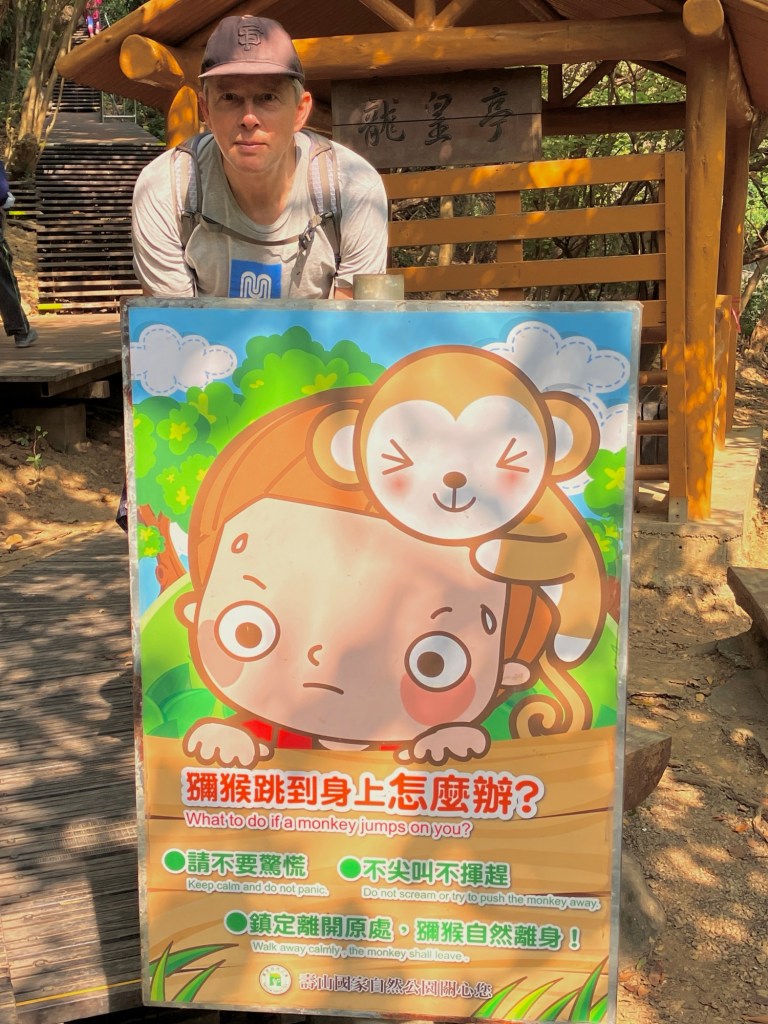
Wait? We also have to worry about monkeys jumping on our backs? Keep calm. Don’t panic. Don’t try to push the monkey away? Walk away calmly?

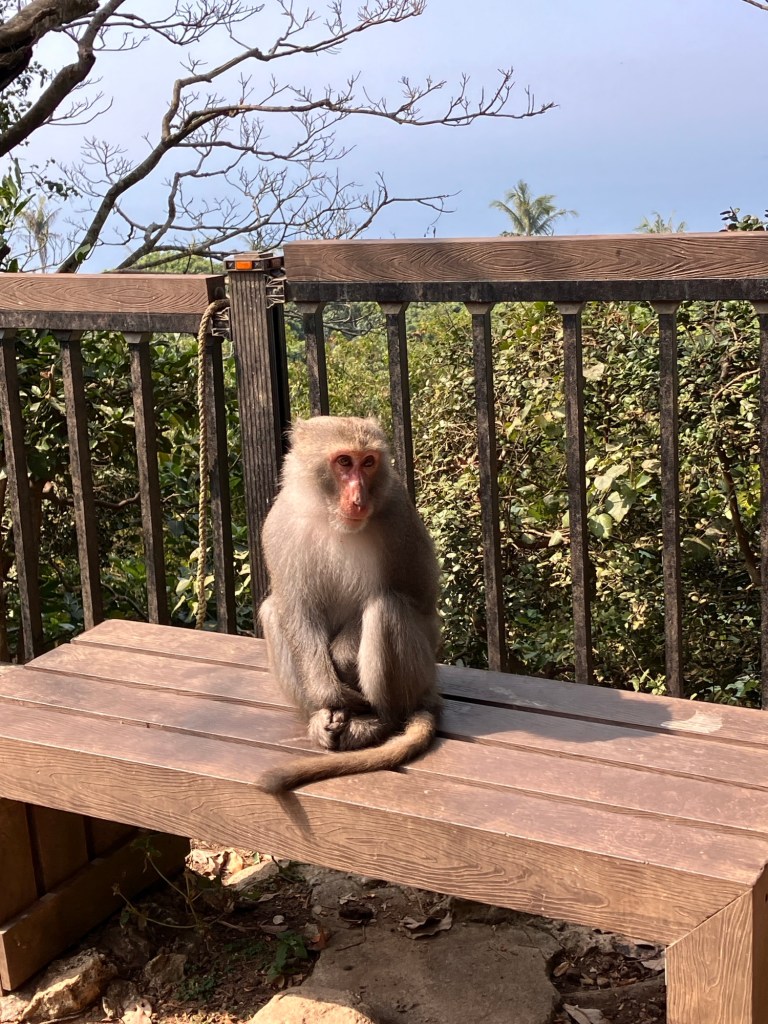
We did spend some time pretending to screech and swat monkeys off our backs, and then when we did encounter some Formosan rock macaques we walked by gingerly, saying hey buddy, no food in our packs, it’s all in our bellies now.

I will sit innocently on this bench. Just a cute monkey.
I will sit fifteen feet from that monkey watching it like a hawk.

Just as we were thinking the monkey problem was maybe overblown, someone took an empty crisp bag out of their backpack and chaos erupted when one monkey grabbed it and took off and ten other monkeys gave chase! Round and round the seating and view area the monkeys went until they gave up and the ringleader discovered his prize was an empty bag.

Count the disappointed monkeys in this photo. Three. Adorable tiny baby learning to be a menace at mama’s knees.

Monkeys aside, the trail up and around the mountain is very nice, well worth hiking. We were there on a weekday and were surprised at how many folks were hiking. I suspect it would be very crowded on a weekend.

When the trail is not going up or down loads of stairs it winds through old coral reefs pushed up out of the sea eons ago.
The views of both the city and the Taiwan Strait/Pacific Ocean, on a clear day would be amazing. However, the air quality was not brilliant the day we hiked.
Coming down from the hike you can again spot the dominant mode of transport: scooters. Spot the monkey. Locals put sticks across their scooter seats to prevent Mr. Monkey from making himself comfortable.
A nighttime ride to dinner.

All this hiking and biking makes for hungry travelers. We joke that we are rarely so happy as when at a good hotel breakfast buffet, and Hotel dua fit that requirement well. Breakfasts in Taiwan are veggie heavy which is wonderful. We’re not strict vegetarians but certainly prefer to eat healthy, and the vegetables and tofu options available at a Taiwanese hotel buffet are fantastic.

That is a good start to the day.
Energy to ride along the Love River in Kaohsiung.
And to admire the Kaohsiung Music Center.
And just enough energy to wait for and board the ferry to Cijin Island, a quick five minute ride.
And refuel with a boba tea before checking out another YouBike to explore the small barrier island.
We brought our swim suits along, but it was a bit too chilly and windy to swim.
So we people and dog watched for a while.

Cijin was first settled as a fishing village and has morphed into to a shipping hub, and a tourist attraction. It’s a pleasant place to ride bikes along the beach, and in warm weather, to swim. The main street is a typical tourist drag of kinda tacky shops and restaurants. We returned to the main city to eat lunch but if you like crab, there are loads of places to chow down on crab.

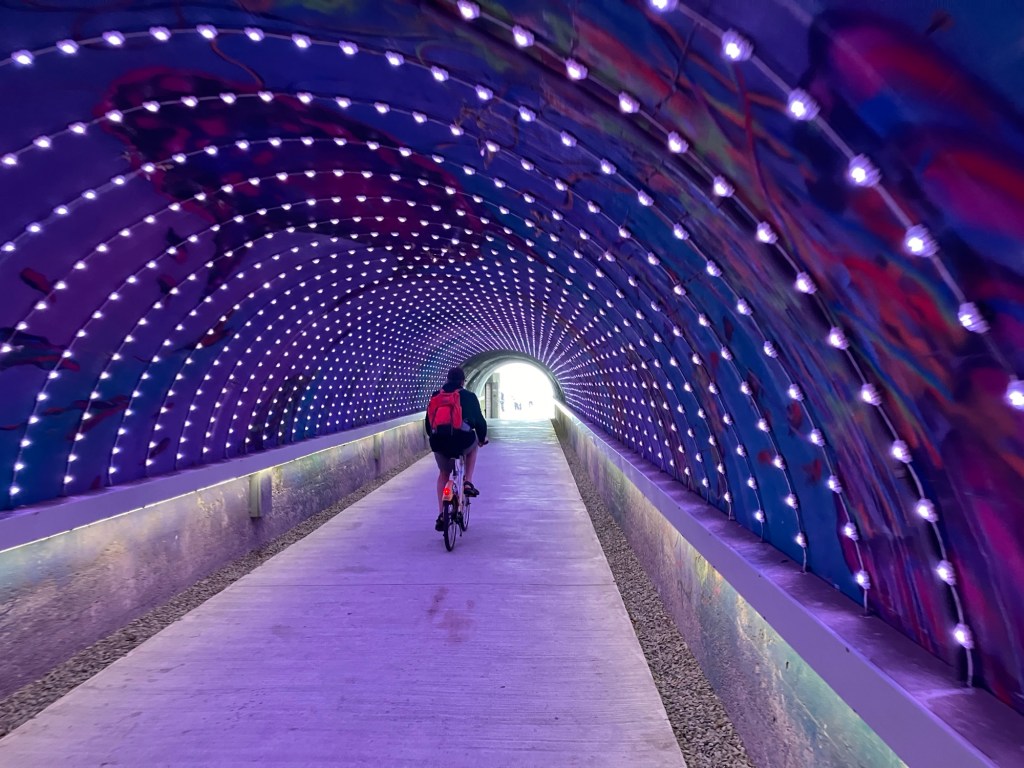
Cijin Tunnel, complete with fun light display. Spits you out on the windy north end of the island.
Strait of Taiwan. Next landmass, China.

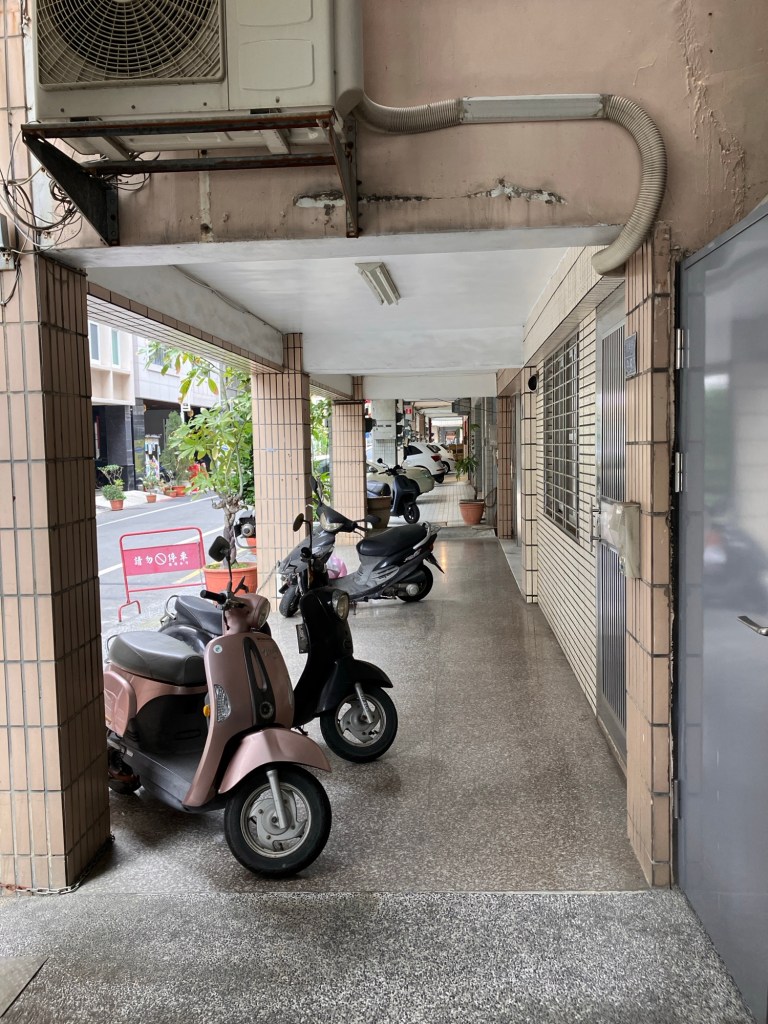
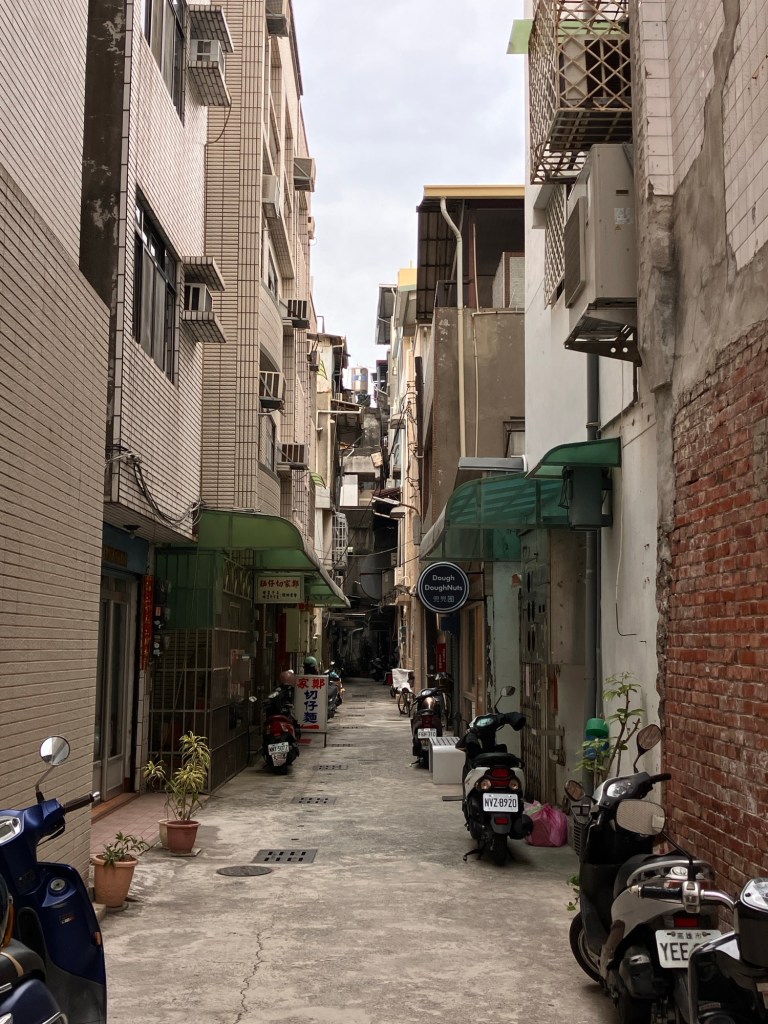
Other than Taipei, walking in the larger cities we visited, Kaohsiung and Tainan for example, is not fantastic. There are main streets with nice wide sidewalks but loud traffic, and smaller back streets with loads of scooters, which keeps you looking over your shoulder and ducking into doorways to get out of the way. The traditional shop house streetscape (business shop downstairs and living quarters upstairs) used to mean that you had a connected and sheltered arcade to walk through. In the world of scooters and cars that space is frequently occupied by, yes, cars and scooters.

This arcade is passable, many are even more parked in.
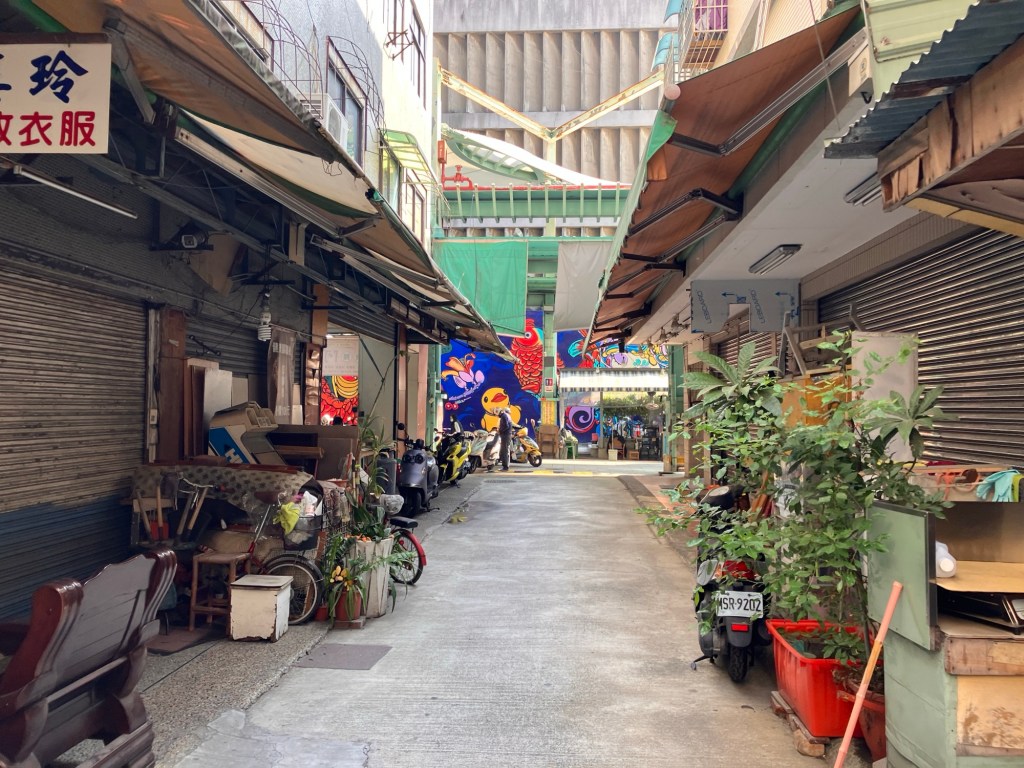
The smaller alleyways offer shade but you do need to listen for scooters and make way.
Typical mid sized street. Not much space for pedestrians. The arcades are not contiguous at all.

There are many charming things to see as you walk though. And since the weather was mild, not hot and no rain, we did a lot of walking. You can’t let the first impression of cities focusing for cars and scooter access put you off, if you walk and look more closely you can see the life of these of cities playing out at street level.

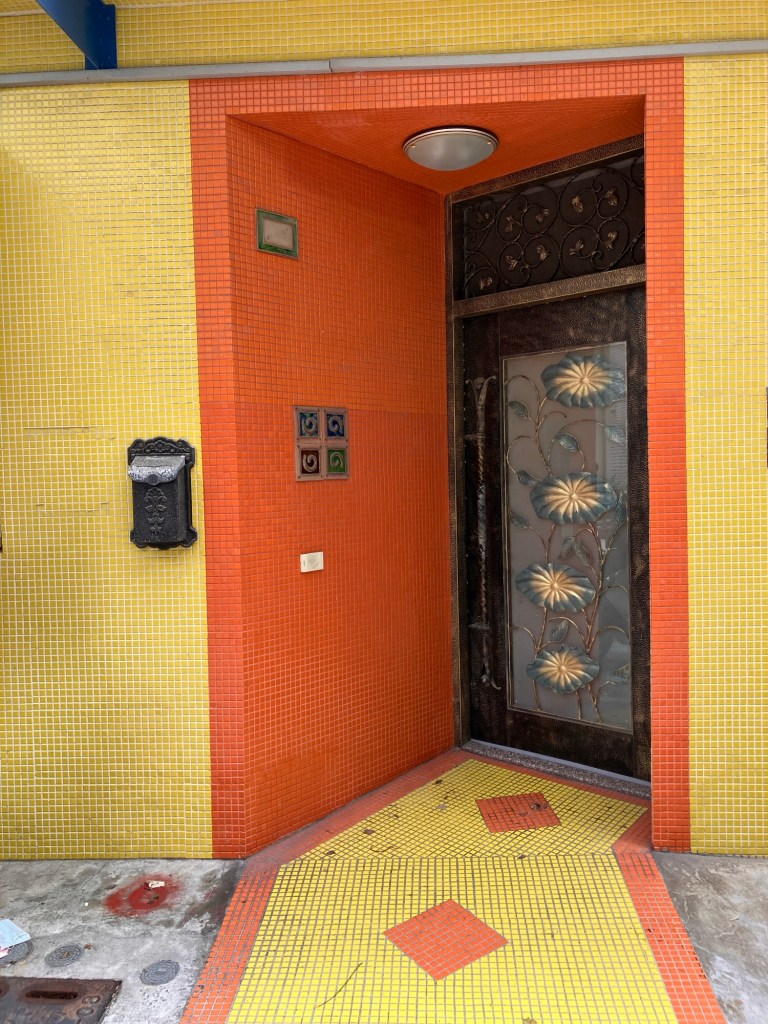
A beautifully tiled and colored doorway, Tainan.
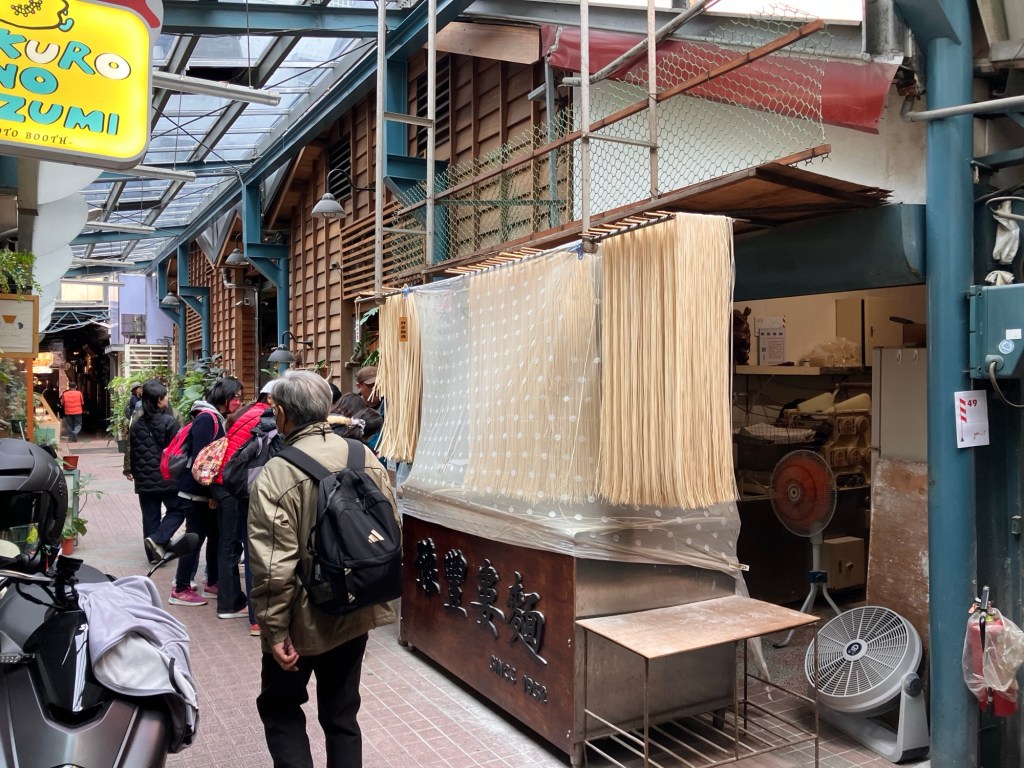
Noodles hanging in the old market streets in Tainan.
The noodles have fans blowing on them.
Minding the tea shop and waiting for customers.
Did I mention how clean everything is?
A covered street, this must be welcome relief from the sun and rain. Kaohsiung.
Not far from these small streets are wide main boulevards with huge wide sidewalks and long lights to wait at before you cross. Kaohsiung.

Everywhere we went in Taiwan, cities, farmland, trails, we saw almost zero trash. And you also see almost no trash cans. If you purchase food or drink you have three choices: give the empty packaging back to the vender, carry it with you until you see a convenience store and go inside to throw it away, or carry it with you for a long time until you see a public trash can. They do exist but not a lot of them. Taiwan mounted a successful campaign against waste, one which is a model for other countries. In a nutshell, you pay as you throw away, by buying the garbage bags you must use, and producers have more responsibility for the products they create and the waste that generates. Per this article “Taiwan’s household recycling rate in 2017 was over 50%, making it second in the world to Germany.” And yes, the garbage trucks play “Für Elise” or “Maiden’s Prayer” as they ply the streets. After three weeks here both Rich and I are humming along with the trash truck tunes when we hear them.

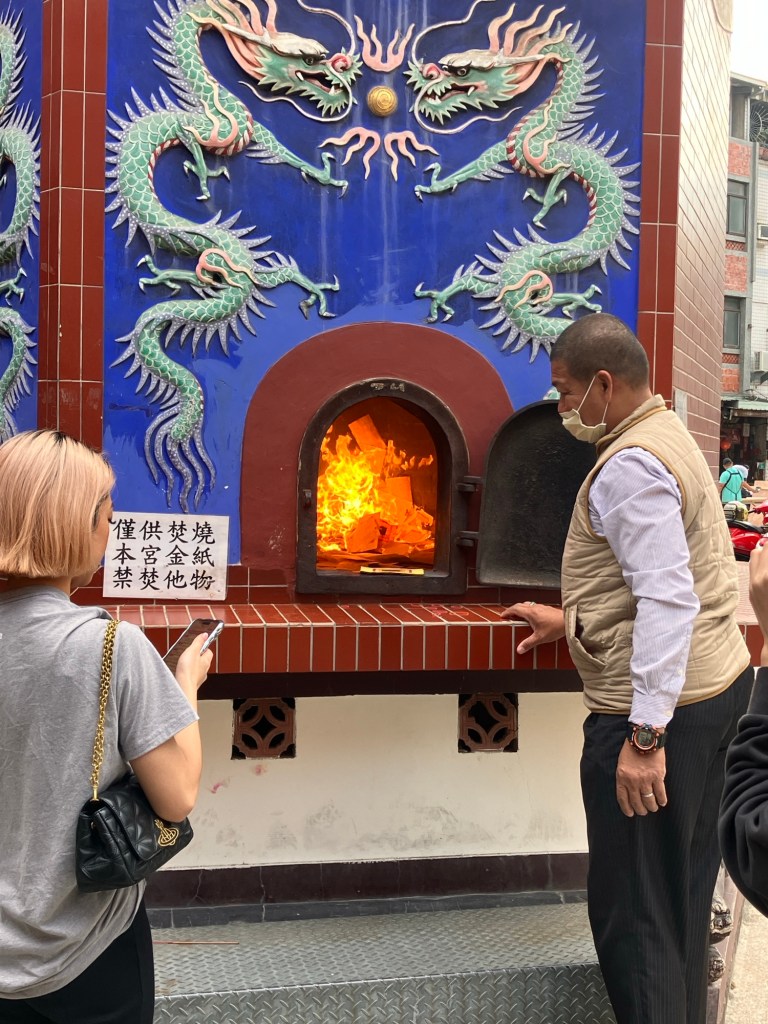
Ok, enough with city garbage logistics! Lunar New Year is coming. The year of the wooden dragon. Temples have piles of spirit money for people to purchase and burn to honor their ancestors.
Outside a temple folks line up to burn the joss paper, or spirit money.
The spirit money is to make sure your ancestors are well provided for in the afterlife.
A street turned over for a banquet.
Happening on a New Year Parade in Tainan.

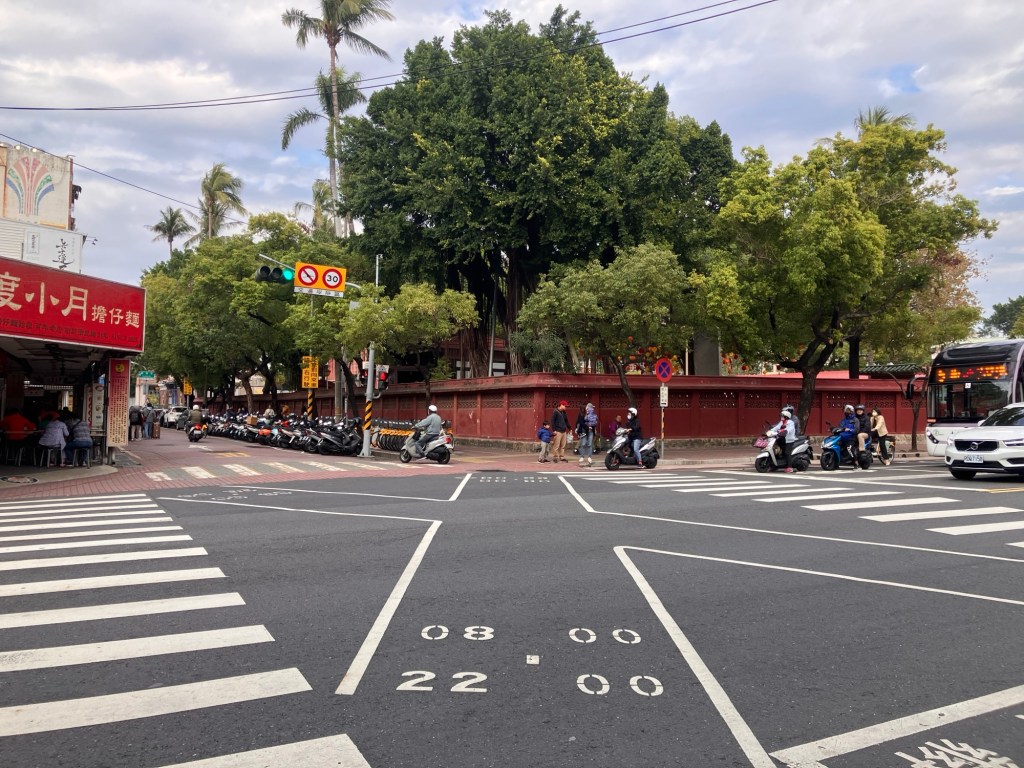
I don’t want to leave the impression that Taiwan has forsaken pedestrians and bicyclists, the bike share program YouBike is very robust. And there are pedestrian scrambles (where the lights turn red in all directions and pedestrians can cross kitty corner) at busy intersections.

A big bike share pod.
Scrambles are marked with hours they are in effect.
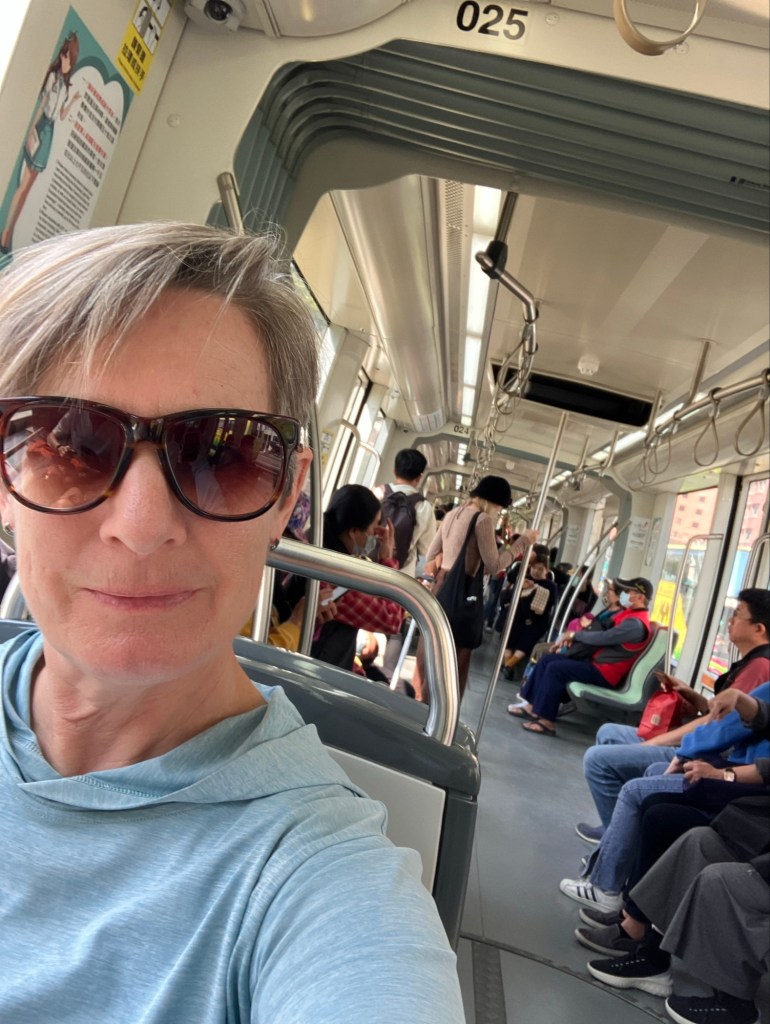
In Kaohsiung a new light rail loops the city. Folks were sightseeing from it, including us.
I’m always happy to see new public transit systems.

However, it’s not as easy to be a bicyclist as say, a scooterist. And outside of a big city like Taipei where you would use a bike as a last kilometer solution after taking the MRT, in Kaohsiung and Tainan a scooter is the clear choice. It gets hot much of the year, we’re here in January for a reason – cool enough for us to walk and bike. So we’re viewing this transportation scape through tourist eyes, and seeing what’s missing for us. Honestly, the scooter life seems to work very well for folks. You go right where you want and easily park. If Taiwan could accelerate the switch to electric scooters it would be amazing. The noise and pollution would be decreased and streets would be much more pleasant and livable.

Heading out to Anping in Tainan. A decent bike path along the Anping Canal.
But as in many cities, it’s the intersections where things fall apart. This one took us some long awkward time to get through, if it had been hot it would have been intolerable.

I’m going to write a separate post about our escape from cities to countryside, but first, a few more photos of the fun we had.

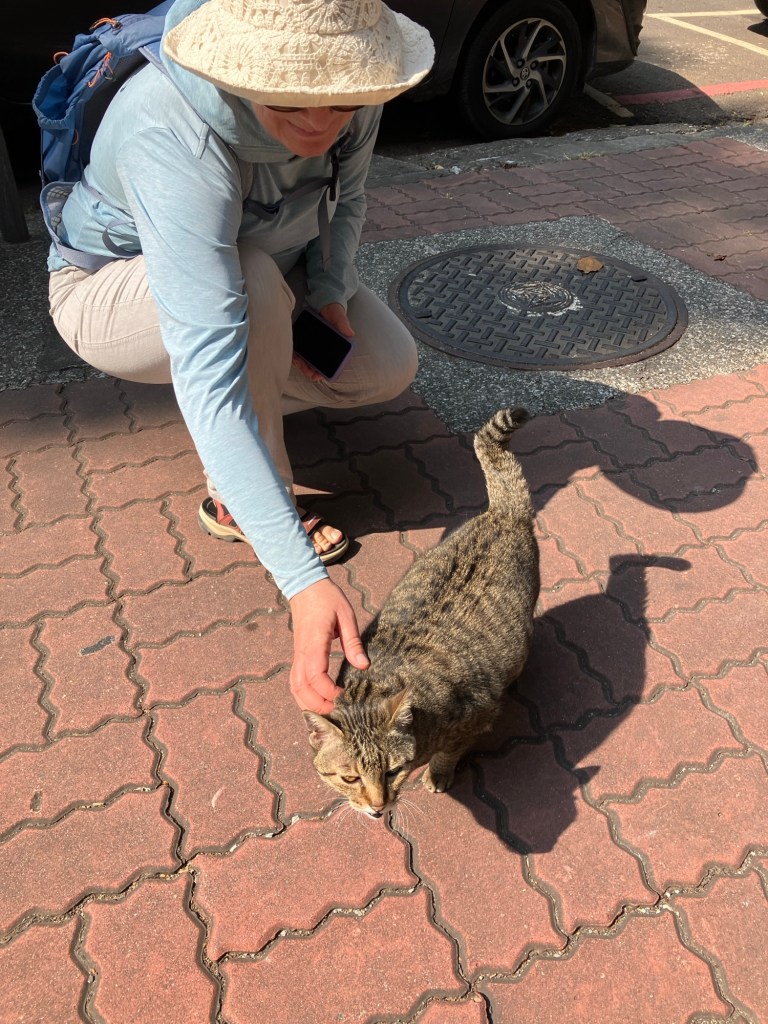
There were cats we pet.
Many dumplings to eat.
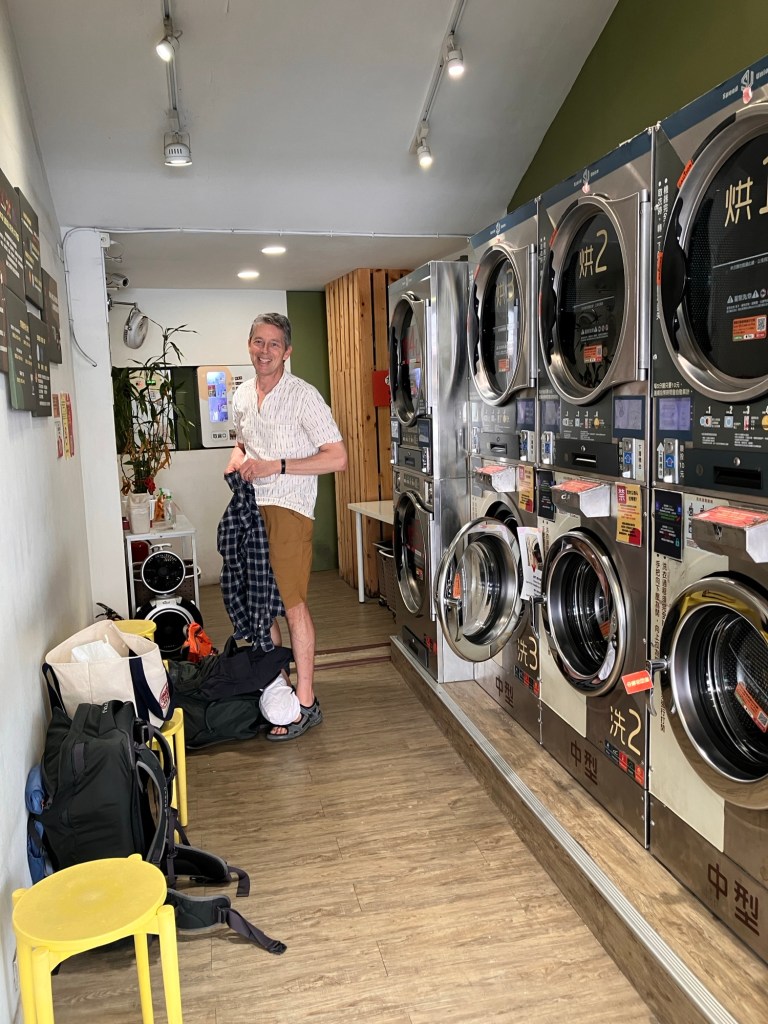
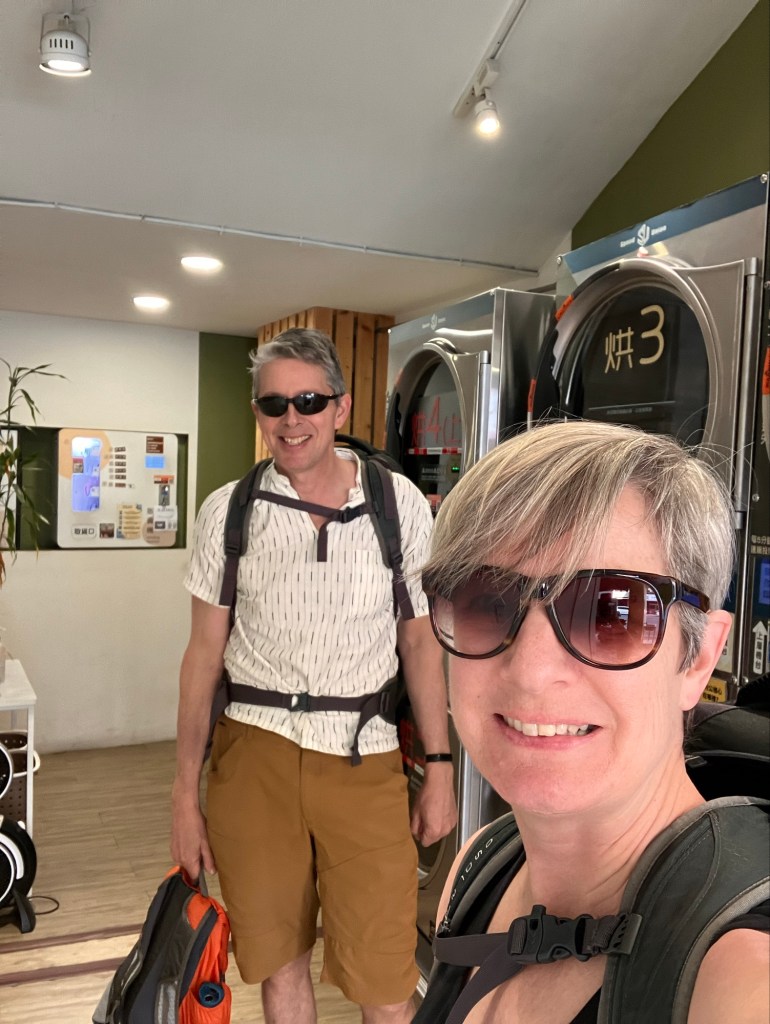
Laundry to get done.
Boba to drink while waiting for laundry to get done.
Laundry success!
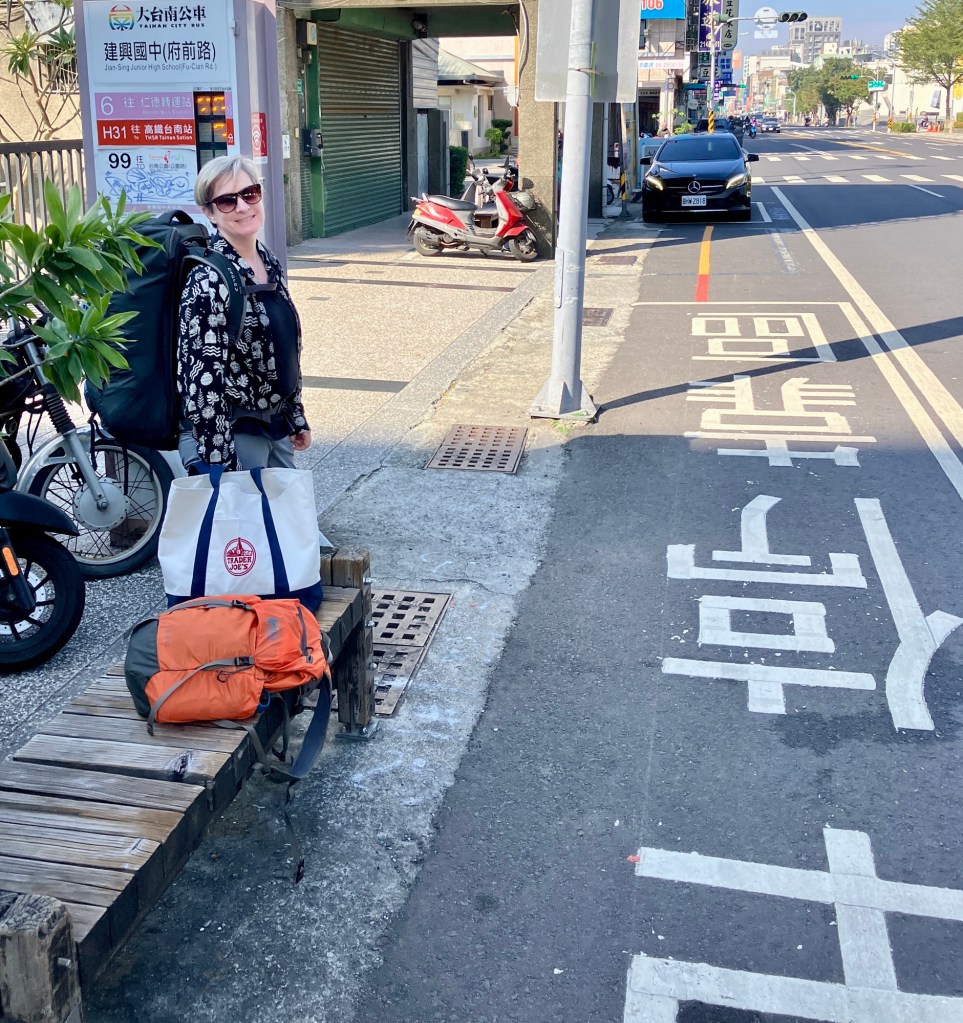
And finally, a bus to catch to the high speed rail station.
The Happy Travelers at Chikan Tower, Tainan.
The map! Hearts are where we stayed, the blue dot is us in Taipei when I snapped this photo. Thanks google maps.

A Rift in Our Travels

After three days of romping around Taipei and getting over our jet lag, we set off from the city on a big clockwise loop of Taiwan.

Rail is in my heart at the Hualien Railway Culture Park

We were excited to head out of Taipei Central to Hualien City, at the north end of the East Rift Valley. Hualien is a city reinventing itself with culture and art, and is now more than a gateway to the immensely popular Taroko Gorge.

A bit too early on the platform at Taipei Central; Cheryl’s trendy TJs bag at my side
Ocean view from the TzeChiang Express train. Plenty of room in the standard seats

But first, a few train tips for the wonky planners out there. In addition to local and high speed rail on the west coast, the east is served by modern Tze Chiang limited express trains travelling up to 125mph. They are spotless, spacious, and punctual. And although we tried the business class on one segment, regular cars and seats are plenty roomy. If anything, we found the new trains a bit too clean and sterile, but certainly a pleasant and very low stress way to go.

You can pre-order a train bento on the TRA App for less than $3 and it’s delivered to your seat

Taipei Central’s local platforms are not wide or particularly pleasant and there are not really any services beyond the pay gates, so I’d recommend getting to the platform no more than 10 minutes prior to departure as it’s easy to find the platforms and coach number sign. Hang out or get food in the adjacent shopping mezzanine. At some stations; they don’t let you onto the platforms until 10 minutes prior.

The regular meat bento was pretty good considering, although maybe not up to the hype of its somewhat cult following. Cheryl got the veggie version -:).
Happy arrival at Hualien Station.

You can buy tickets on the TRA App or at the stations, but I found the app pretty convenient for booking tickets once you get the hang of it. One person can buy tickets using their passport number for up to 5 people and pay by Credit card or Apple Pay. You then collect your ticket on your mobile and have the other passenger (s) download their ticket on their phone (in the App) as you provide the reservation # and a 3 digit collection code.

Back at the railway park
The charms of many smaller Taiwanese cities take awhile to reveal themselves in back alleys, converted old buildings and lots of plants.
Red lanterns ready to be deployed in Hualien for the month+ long Lunar New Year celebrations.

Note that as soon as you click on a specific train after searching time and destination, a reservation and seats will be made immediately. You have a reservation and specific deadline shown to pay via credit card or Apple Pay (very convenient) or at the station. You can delay paying for tickets for a day or two (it gives you the deadline). This gives you an easy option to change or cancel tickets, but a word of warning, I did this a few too many times as I was learning the system and it locked my passport number for a month! I’m guessing the limit was about 4-5 incomplete/unpaid reservations. I could have called customer service and perhaps begged for tourist mercy, but we got around this by reversing our process and buying the tickets on Cheryl’s TRA app (and her passport number) and then I downloaded second ticket to my phone. You only need one ID to buy tickets via the App.

The hipster guide to Hualien

It also is smart to wait to collect the tickets on the App (or at the station) until you are sure that you want to take that specific train, as this allows you to change a ticket on the App, not just at the station. Apparently locals don’t “collect” tickets until the last minute for this reason.

Funky and green charm in Hualien.
Hip coffee shops abound and are generally only open after 11am or even later as the coffee cafe culture is an afternoon thing in Taiwan.

By the way, there are also local trains that you can see on the App timetables but you can’t buy reserved tickets. For those, you just show up and use your IC tap card to enter and exit the station and take any seat on those trains. They are also the easiest option with bikes.
Ready to scan my QR ticket at the turnstiles.
Taiwan is really promoting cycle tourism and these helpful signs are everywhere around cities, transfer areas, and stations.

Besides trains, I love to study the geography and geology of the very place we visit. It always shapes the history; culture, and economy. The geography of Taiwan is dominated by a central ridge of mountains, the remnants of the formation of the island from magma rising up between the junction of the Eurasian’s and Philippine tectonic plates. The central range reaches heights of over 3000m (10,000ft) and it does snow sometimes in the higher elevations in winter. So only 30% of the country is flat, and much of that is highly developed.

The coast north of Hualien.

A second smaller coastal mountain range hugs the east coast. These ranges are both actually rising as the Philippine plate continues to push against and under the Eurasian plate. The valley where the plates meet, the East Rift, is one of the only flat areas on the east side of the country. It’s also fertile for growing things year round and attractive for cycling. Most of the industry and population of Taiwan is concentrated on the north (Taipei valley) and west sides, so the east has always been considered a more wild and remote place.

We loaded up on veggies at the Azure Hotel’s amazing vegetarian breakfast buffet for three days and used it as an excuse for street food, night markets and other less healthy options the rest of the day -:).

Ok, so onto our travels. We spent three days in Hualien and used it as a base to visit the famous Taroroko gorge and Taroko National Park for a full day by train, bus, and foot. The geography of the mountains is dramatic and consequently there are a lot of issues with rockfall, slides and road/trail closures. There are very limited bus services up and down the gorge now due to construction around a massive landslide that occurred in October 2023. There is single lane traffic controls and you can wait for up to an hour to get through each way, even if you hire a scooter or taxi for the day.

Ready to go to Taroko Gorge!

But we love buses and challenges, so decided that we would catch the earliest #302 bus from Xincheng Taroko station at 9am (the #310 bus is not currently running into the gorge) and ride it all the way to its end at Tianxiang. You can drive (or bike!) further than that and apparently it is much less visited beyond the reach of the buses.

Oops, our electric bus broke down half way to our destination in the park.

Our short train hop from Hualien arrived Xianming about 8:30 and there were about 30 tourists waiting for the bus, including some other Americans from Utah. After we boarded, the driver made a long speech in Mandarin that didn’t sound encouraging but somewhat surprisingly, our young pale Utah friend spoke Mandarin and translated for us. It turns out he was half Taiwanese! The driver was just preparing everyone for what we already knew, that there would be significant delays at the construction. So the half of us who were still on the bus at the construction were all patient for the 40 minute delay.

So we started walking
And enjoying the views
Light traffic due to the road closures

We were finally rolling again through the closure and spectacular gorge scenery, when suddenly the electric bus started to stall and sputter. The driver mumbled, stopped, and fixed (rebooted?) the batteries in the back, and we rolled on again slowly. But alas 500m onwards the bus finally died for good. So the remaining dozen or so of us got off and walked on the road. But we soon figured how nice it actually was walking the road, as the normal continuous two way traffic didn’t exist due to the long road closures all day. Roll with it and we’ll see what we see.

Happy travelers rolling with the bends in the road today
Plan B, walk the Lushui trail for a few kms
Oops; trail closed midway so back to the road
Cheryl resigned to wait for the next bus…at least she had some books on her phone…

It was peaceful and beautiful, and we walked to a campground area with bathrooms a few kilometers up the road. We then decided that we’d hike some of the Lushui trail which branched off the road above and then try to catch the next bus as it rolled by in about an hour. Well, the geologic gods had also closed that trail in its middle, so after a pleasant 30 minute out and back, we returned to the campground bus stop and resigned ourselves to wait up to an hour for the next bus. It was too far to walk (15km) and there were dark tunnels with no shoulders. But after about 10 minutes, a nice young Dutch couple in a little white car came by and offered us a ride to the end! Very nice and put our day back on track -:). They also were going to the Bayiang Trail, so we avoided another km+ of road walking.

Made it to Baiyang Trail with time to review the rules of monkey engagement -;)
A mysterious start to the trail takes you through a mountain to another side gorge
We were lucky that the Baiyang trail had just reopened after its own landslide closures. We could see why.
Beauty is everywhere in Taroko.
After walking back to Tianxiang, we got some tasty food at one of the small cafes there.
This crazy territorial macaque grabbed food from unsuspecting people coming out of the only 7-11 in the national park and was hilariously peeling off the warning signs!

Taroko is a special place and we’re glad we made the effort, but can imagine with normal traffic and tour buses it may be a bit much. We also noticed that cycling is possible, as the lower climb is spread out over 30km or so. You would be rewarded with continuous views but do need to mind the many narrow tunnels.

Exploring the East Rift valley on rental bikes (Giant of course).
A surprise stop at an old Japanese temple. There is a strong Japanese cultural legacy on Taiwan due to its 50 years of occupation.

Next up was a short train ride to Yuli, where we spent two nights in a small hotel. This allowed us a full day cycling up to and exploring YuShan National Park. Much less visited than Taroko and the jumping off point for the Walami trail.

Oh how nice to be out of the cities.
Destination reached at the pleasant Liyu Lake.
A delicious indigenous influenced meal at the Liyutan Tree House near the lake. The preservation of indigenous culture is a priority on the East Coast where it survived longer due to its isolation.
Cycling in Hualien was fun since we were really the only foreign tourists about.

We’ve been eating well, but the food customs and timing can sometimes pose a problem. We have loaded up at some our breakfast buffets, which generally have many savory and healthy options. Lunch is a small restaurant/shophouse stand. Street and night markets are always an option but you need to be up for crowds and eating small things standing up at the edge of the road or against a building. We actually prefer food oriented streets to night markets. Oh, and good pizza is popular here, and a trusty traveler break from a lot of (excellent) Taiwanese food.

About our fifth beef noodle try, this one with the works of tripe and knuckle…mmmm!
Even the dogs know that scooters are the way to go in Taiwan.
This giant fried chicken vat amazed us at the most popular stand at the Yuli Night Market (Fridays Only!) .

Yuli is a bit drab to be honest but the area around it is peaceful to cycle. Many of the Tawainese cities are spread out and walking not always the most pleasant as most locals use scooters to get from point A to B, they don’t consider long walking practical. We found it to be much better to bike from place to place and walk locally, especially when looking for restaurants. Small places on Google are often hard to locate, closed, or don’t seem to exist. But you’ll always find something and just need to stay flexible or pick a well established place with lots of reviews (including recent ones).

The area SW of Yuli is pleasant for cycling and a good way to get to YuShan.
Uphill, 5 speeds, AND falling rocks?’
Yea! we made it the official park boundary at El 1500 ft.
Suspension Bridge Number 1 and my number one travel companion -:).
Dizzying but stable.
I hiked in to this beautiful waterfall complex and suspension bridge number two while Cheryl enjoyed promised reading time!
The dramatic sea near Taitung.

From Yuli, we had another short train ride to Taitung, where we spent another two nights. Taitung has a great museum of Prehistory on its outskirts that was worth a stop on its own. Although Taitung has a bit of an art scene by the old train station, if you are short of days, you might consider a stop at Taitung train station and storing your bags in the train station lockers to visit the museum (10-15 mins by taxi or bus, cafe or picnic on site) and then roll on to your next destination. Of course if you have your own wheels, then the areas north and south have lots of natural beauty and are certainly worth it exploring.

Taitung’s old railway station has been turned into a pleasant cultural area.

And alas that’s one of our limitations without a car or cycle touring here. We do miss a lot of the places in between, but we’ve balanced that by getting out of each region by bus or bike and seeing quite a bit. It really depends on what you like, and we do like cities. And we’re seeing enough, as experiences can be had anywhere.

Bye for now from Taiwan.

So we’re now on the west coast and heading back towards Taipei. The lunar new year buzz has started and we look forward to sharing more about our experiences soon. Happy travels!

Taiwan. So fun we came back to see more.

In January of 2023 we came to Taiwan on our way to Bangkok. We were only in Taipei, and just for a week, but we loved it. When we were discussing where to start our 2024 travels Taiwan was top of the list. It’s a long flight from San Francisco to Taipei, but non stop. This time we’re here for three weeks and will circling the island via train.

Back at our local MRT stop, Jiantan on the Red Line.

What is it we love about Taipei? It’s a very easy city to visit. Great transit, amazing food options, such helpful locals. It seems to be an overlooked Asian City. Taiwan has close ties to the US, we know folks in SF who have Taiwanese roots, so it’s one of the many places in the world where locals happily tell us about their connections in the US. Since we landed on Election Day there were even more returned Taiwanese since they must come back to Taiwan to vote. No mail in ballots here.

Joplin Fried Dumpling restaurant which Rich wanted to try. Yikes, looks a bit confusing, but fear not.
A young man in line in front of us explained that you take a clipboard to fill out your order, and a number from the push button machine.
Done and done. At this point a young woman behind us checked to make sure we had gotten a number. People want to make sure you’re all set, which is so appreciated. Google translate helped us through the menu in Chinese.
After paying at the register, where the cashier advised us to change our order to one set of pan fried and one set of boiled dumplings, she gestured us towards a table and I went to get our dipping sauces. She left her cash register to come over to explain the different sauces to me.
Cheryl demonstrating her chopstick skills with a boiled dumpling.
The pan fried dumplings. Crispy bottoms. Delicious.

I could fill an entire blog post with photos of amazing food in Taipei and how incredibly nice and helpful people are, but food isn’t the only thing that brought us back here. We are both big fans of cities, and getting to see and understand what makes a city a good place to live, or a bad place to live, intrigues us. And how a government helps or hinders its citizens. What steps have been taken to make a city more livable? To allow young and old to live safely and happily? What is the temperament of the locals? Do they seem happy or cranky?

Raingo umbrella rental. When you get caught out by rain. Some MRT stations also have courtesy umbrella stands where you can borrow an umbrella for free.
This group of children were rain ready in their bright ponchos.
Plenty of water fountains and taps. In most playgrounds and parks, of which there are many.
The QR code shows you the water quality tests. And to answer your next question, yes! Loads of public toilets too.
In the Shilin District the space under the metro tracks is for folks on foot and bikes.
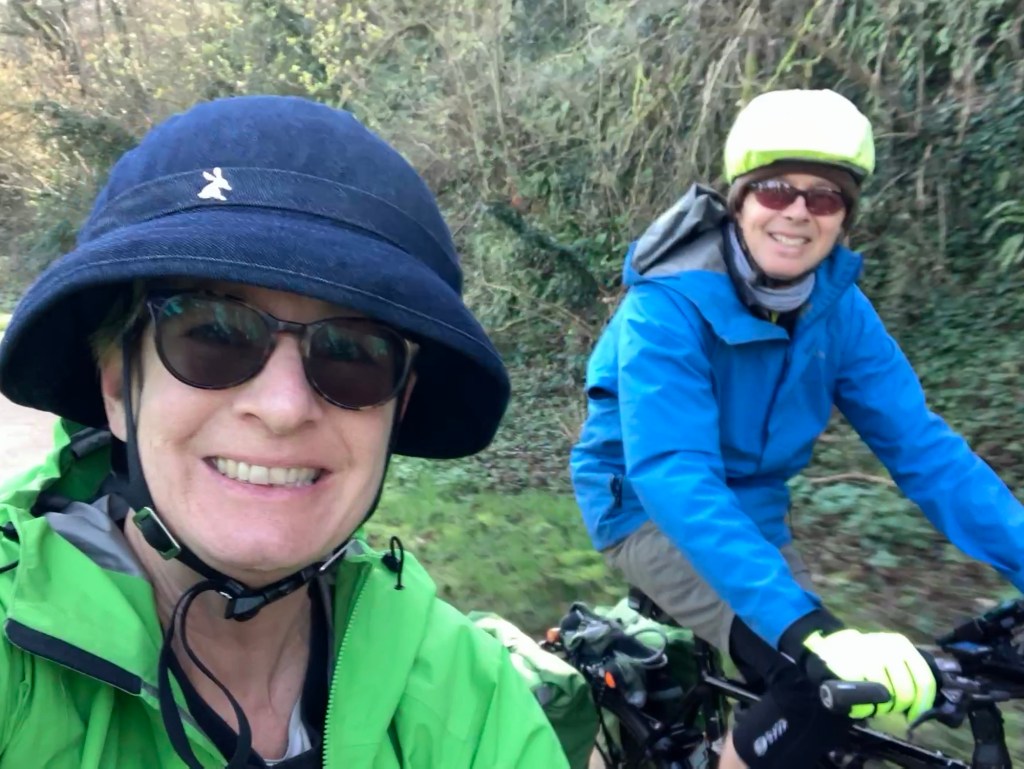
In a metro station, you can always find a way to charge your cell phone. A simple outlet, or a battery pack for rent.

We keep saying we want to bike tour in Taiwan, but haven’t gotten it together to get our bikes here. There are places that rent touring bikes, similar to what we did in Korea, but I have a hard time getting a bike that fits correctly and comfortably. Being uncomfortable and eventually in pain on a bike is no fun.

Getting around by bike is popular in Taipei.
So we got bike share bikes. UBike.

In order to sign up for a UBike account we used the app, our Taiwan phone numbers which came with our SIM cards, and a transit card – which you tap for not only transit, but the UBikes, and to my delight, vending machines. (Hello Gummy candies.) You link your transit card to the app and that is how you pay for the UBikes; super easy.

A proper city bike with fenders and a basket.
Ok, a bit small for Rich, but fine for a few hours of riding.
Plenty of bike stations from which to check out and return the bikes.
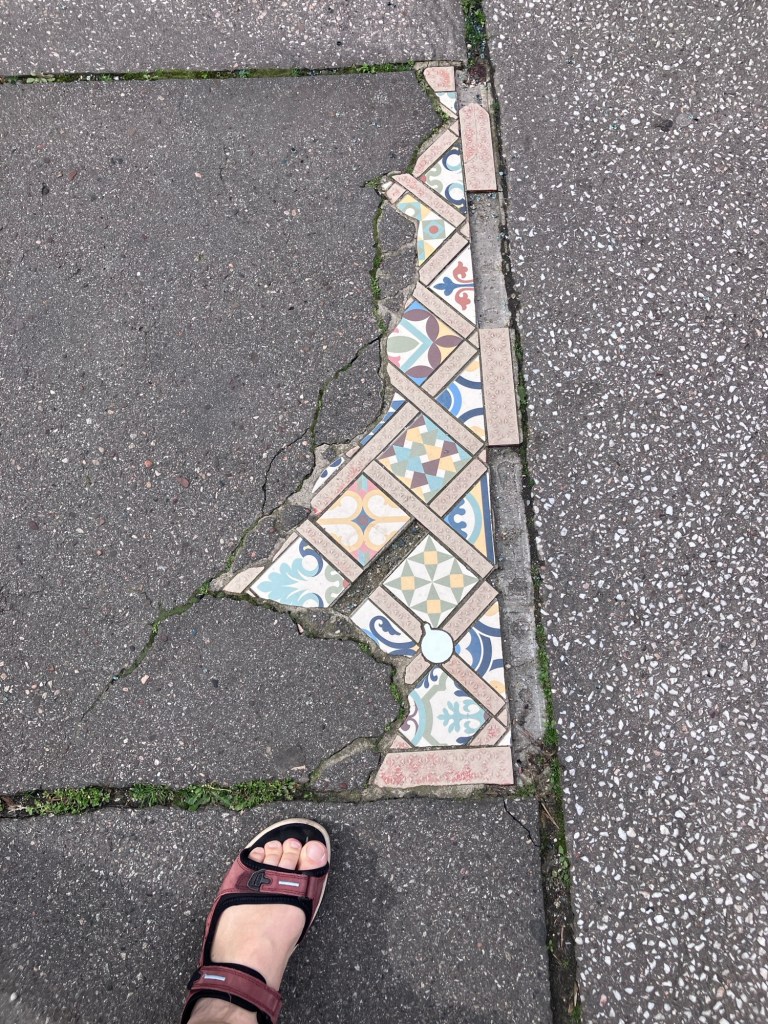
Which makes it easier to get around the city and check out attractions such as the Taipei Expo Park.
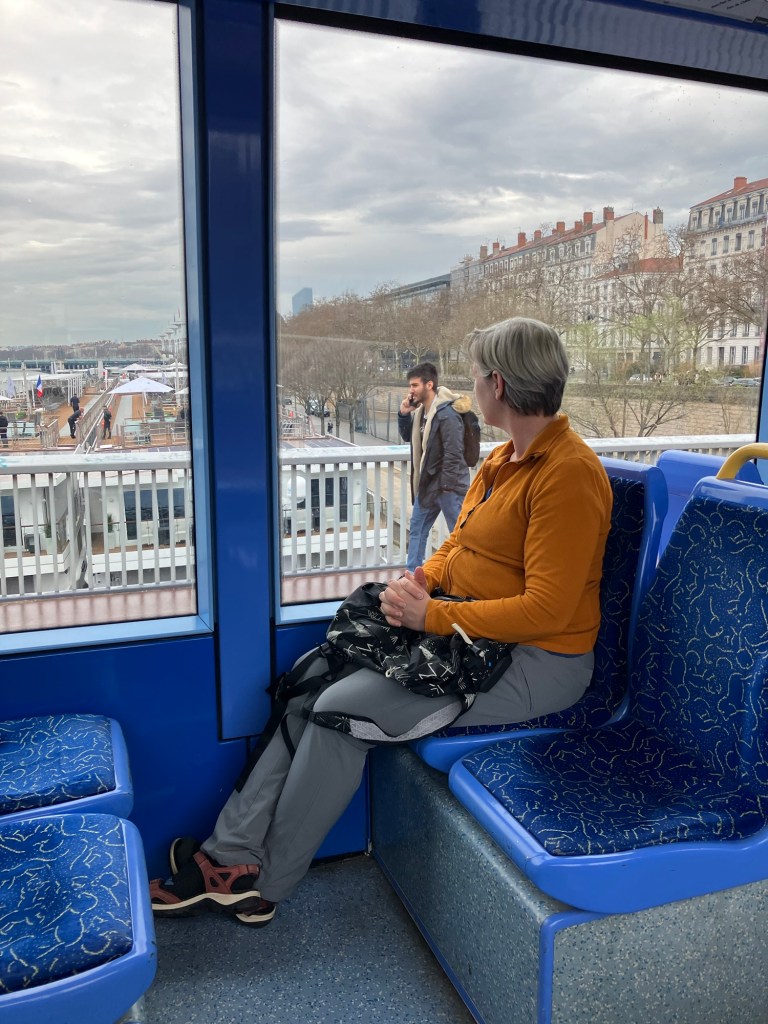
And the Lin An Tai Historical House and Museum
Scooter/bike lanes are everywhere and even take you across major bridges.
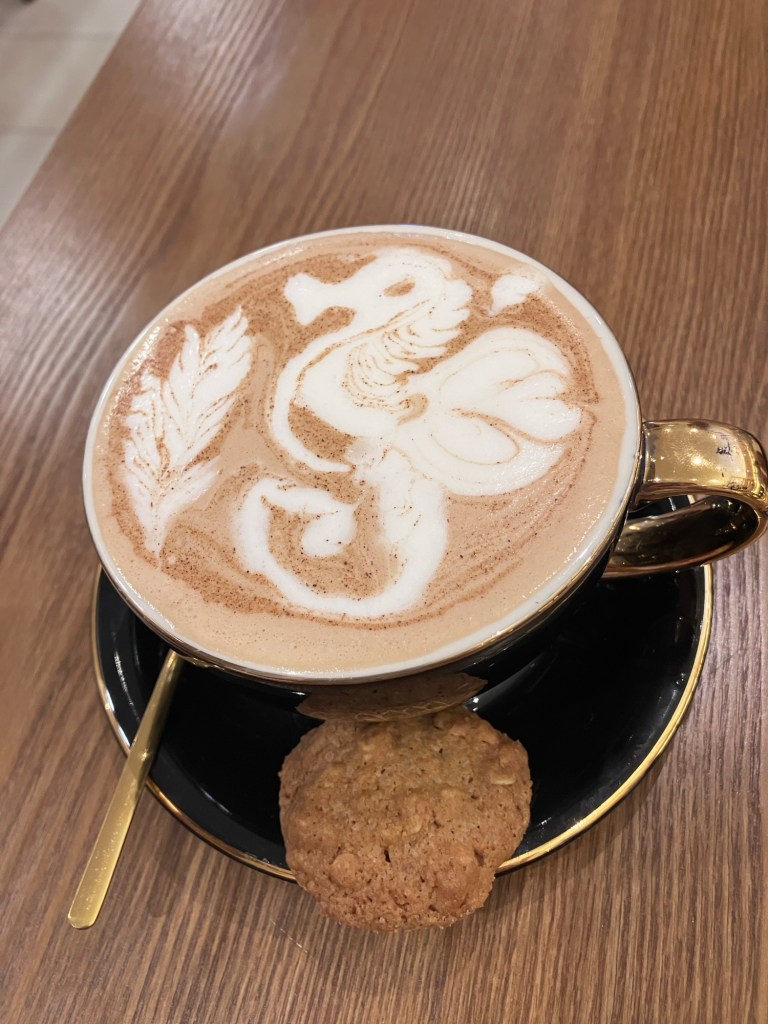
Riding to New Taipei City. We made it just before it started to dump rain.

So we ride the bike share, we walk a lot, and we use the Metro. That’s our Taipei experience. And yes, we go to night markets and stand in line to buy food, and sometimes eat food from one stall while we’re standing in line to buy food from another stall.

Cold spicy miso noodles at Shilin Night Market.
That spicy sauce catches up to you.
So it’s off to the Sheng Jian Bao stand.
Two kinds of bao, pork and cabbage. Neither are vegetarian, they let you know as you order.
Both are delicious. There are downsides to Taipei night markets – one of which is no place to sit and enjoy your food. We were standing in a closed up shop’s front steps.
Another downside? Taipei night markets get crowded. They are not for folks who dislike crowds.
There are plenty of restaurants to enjoy as well for when you want to sit to eat. This was a burger restaurant with good craft beer.

With our fondness for Taipei definitely confirmed we’re headed out to explore some more of Taiwan. Where? Anywhere we can get to by train. In a clockwise direction. First stop, Hualien City. Just about two hours by train. More from the rest of Taiwan soon.

Ah, trains. Enjoying the view of the coast.
The happy travelers.

The holiday whirlwind and nomadic musings.

In San Francisco posing in front of someone else’s house. It must have been some party! Real snow and trees.

I’m writing on Christmas Eve day, looking back on six weeks of time in the US so far. Chicago, Colorado, California, and now Washington. Thanksgiving and Christmas this year are times to get together with friends and family, to try to renew the bonds which constant travel can fray, and catch up on small and large life events which feel like the very important glue holding relationships together.

Family Thanksgiving photo, Colorado.
Gorgeous White Park cow waiting for their water trough to fill.
They look like panda cows.

To dip in and out of folks’ lives like we do can be challenging. To us the traveling, the changing locations and adapting to a new place is just life, it’s what we’ve been doing for almost two and a half years. But what’s it like for our friends and family to have us plop down in their houses and let out a big sigh and say repeatedly how lovely it is to be somewhere familiar?

Uh. You coming out to throw my ball? Soon?
The Getty Center in Los Angeles. The week after Thanksgiving can be a great time to visit attractions – not crowded at all.
Rich and our niece pondering life and the view.
Mercedes Dorame’s installation Woshaa’axre Yaang’aro (Tongva for “looking back”).

How tired are they of our travel tales? Are we getting insufferable? When, we hear from some friends, are we going to settle down? Get jobs again? Do some volunteer work? Something other than this constant travel and adventure and fun.

Wildwood Regional Park, Thousand Oaks California.
The creek is an oasis for wildlife. And us.

Short answer- not right now. Two plus years in and we’re still very content with our lives. We visit our storage unit when we’re back in SF (it’s actually in Walnut Creek), roll up the door and say “So much stuff!”. It’s not really that much stuff, the unit is only 10×15 feet, and we carefully considered what was worth storing and liberated the rest. We swap out some clothing and shoes, exclaim over the things we can see, oh look at that chair, my favorite. And then we roll the door back down, lock it, and leave.

San Francisco City Hall in festive red and green.
An SF Victorian decked out for the holidays.

We do miss nesting, especially around the holidays. Having a place set up to your own specifications, the things you want close to hand, comfortable furniture to enjoy. This is where house sitting, through Trusted Housesitters, becomes such a joy. With careful planning we can find sits in places we want to be for the holidays, Christmas in Seattle this year, near good friends with whom we will stay before and between two house sits. Right now, for Christmas, we have a lovely kitty to cuddle, and a comfortable house to enjoy and look after for the homeowners.

SF leans in to Christmas lights. And the buildings wear them well.

And what’s next? As we were boarding a flight from Denver to Burbank a few weeks ago Rich was trying to book flights for us from Singapore to Geneva in March. The website was not cooperating and he was frantically trying to get the payment through before we got to the gate agent. His boarding pass is on the phone. The tickets to Geneva are almost on his phone. I teased him, you know you have a travel problem when you’re booking tickets for a flight while boarding a flight. It’s not a problem, he corrected me. I did it.

Snowflake pine decorations! Super cute.

Rich is working on our onward travels. SF to Taiwan. Borneo, Malaysia. Somewhere somewhere, and Singapore to Geneva via Istanbul in March. To be reunited with our touring bicycles. We look forward to bike touring so much.

Our sweet elder kitty at sit number one. The heating vent is Maggie’s favorite spot.
Sunny with a view.
The Happy Travelers in Seattle.

Our end of year list of countries as traveled: USA, Taiwan, Thailand, India, Sri Lanka, Japan, South Korea, USA, Switzerland, France, Germany, Chezia, Germany, Belgium, Netherlands, UK, France, Albania, North Macedonia, USA. Happy Holidays wherever you may be.