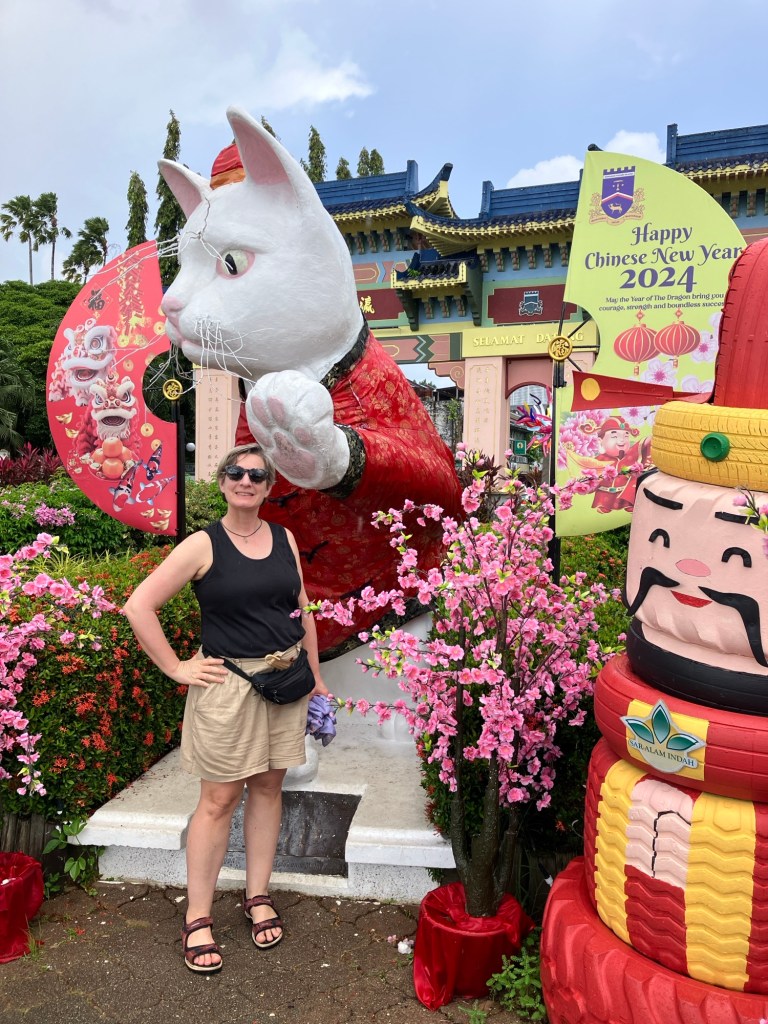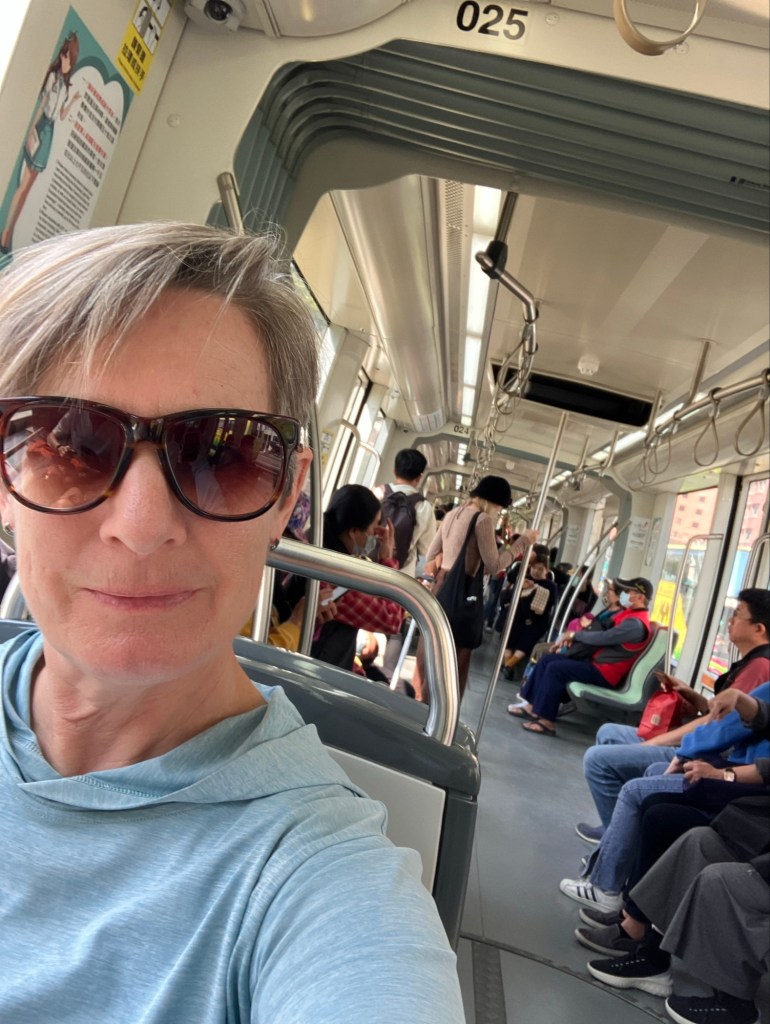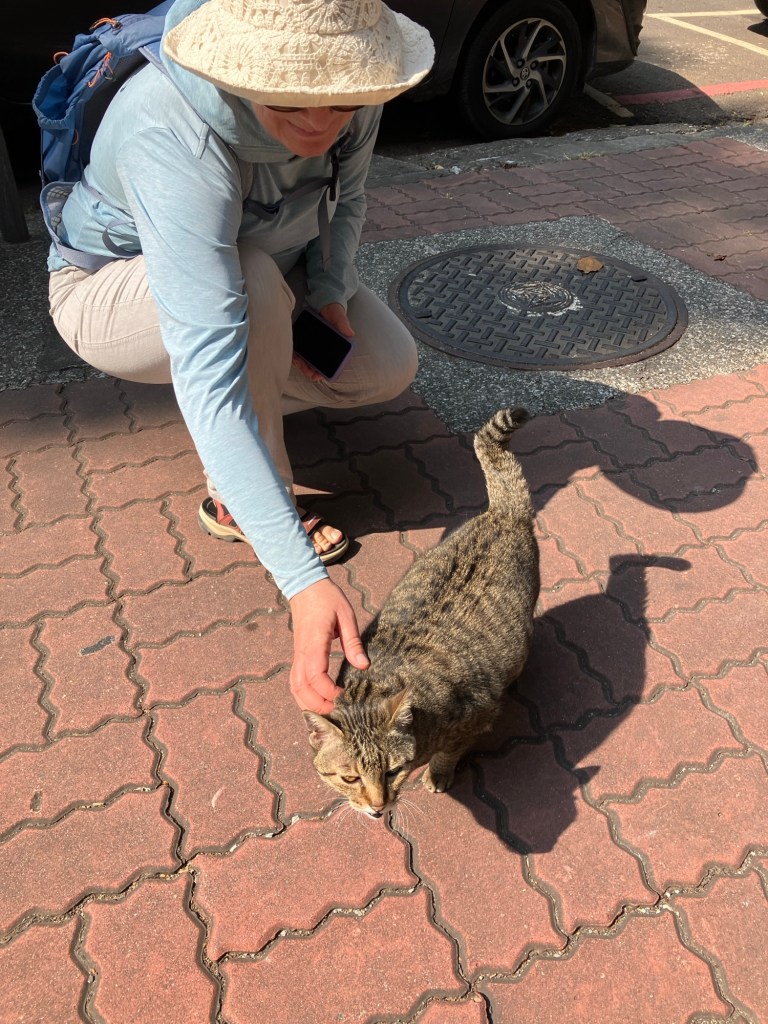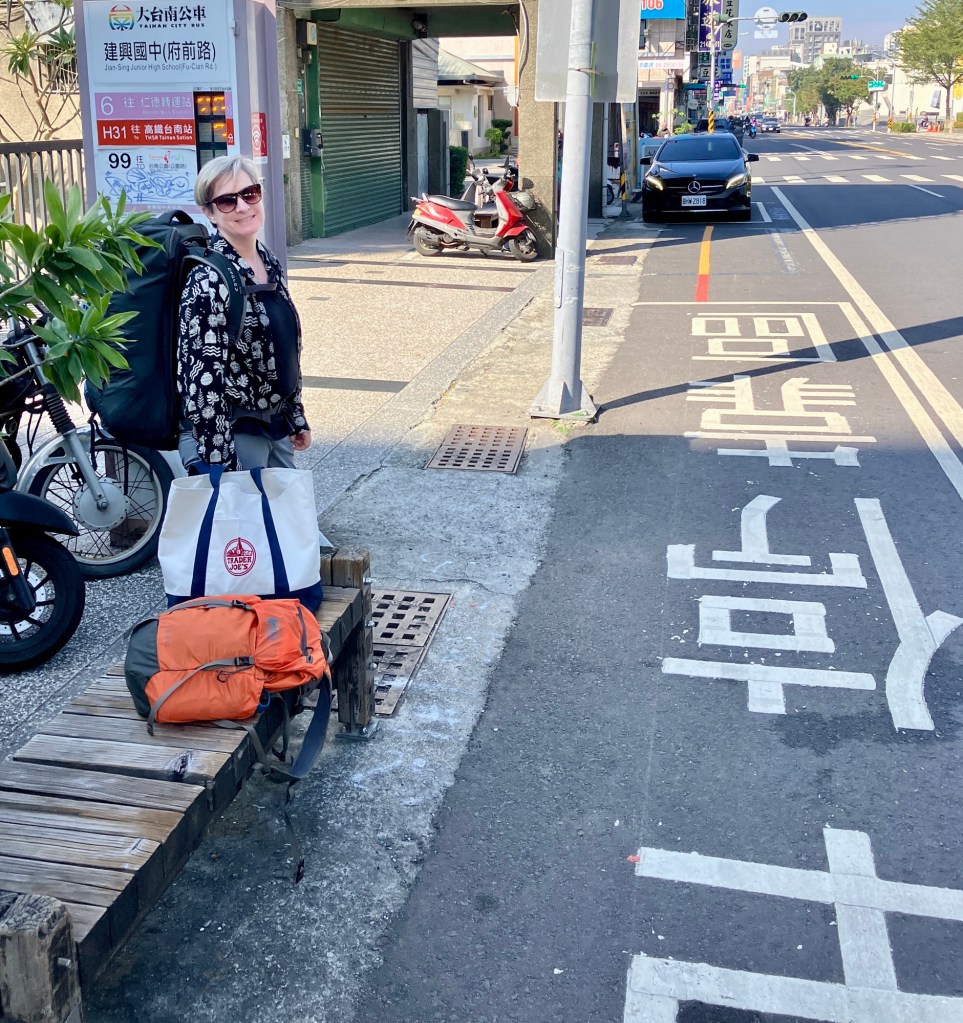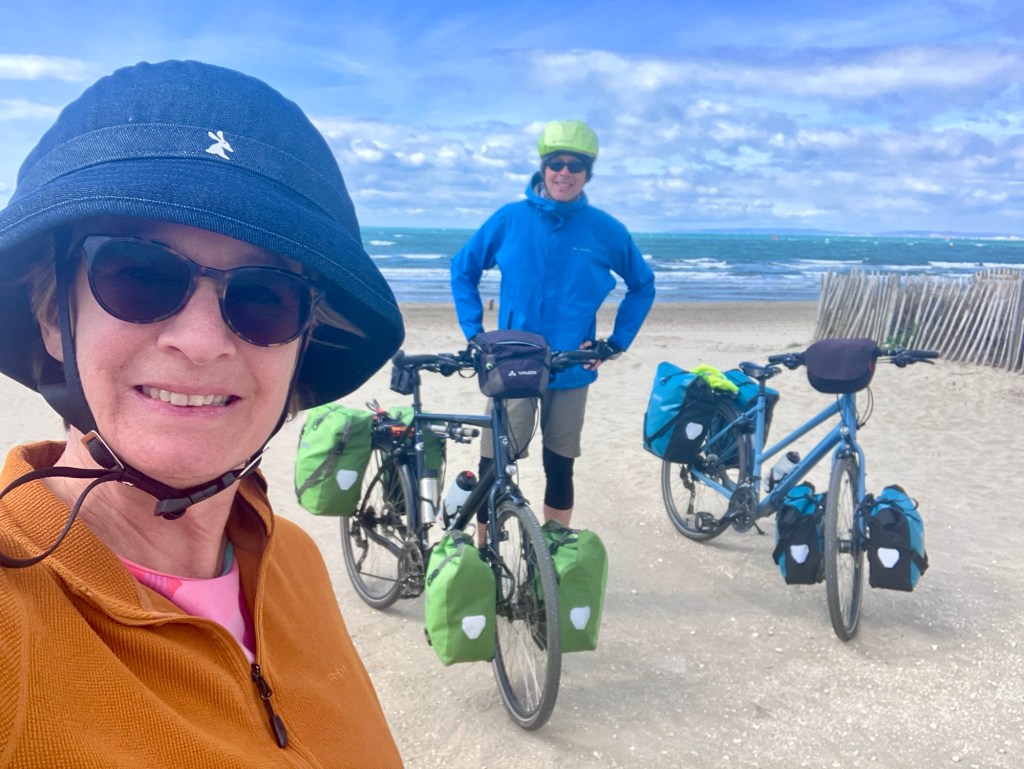
Into the Pyrenees (and out of Carcasonne!).

People frequently ask Cheryl and I how we plan our travel filled trips and lives and it’s sometimes hard to explain. But let me try. Basically we start with a rough 6 month plan defined by our major goals and travel legs to and from continents (i.e SFO-Asia, Europe-America) We adjust these plans as needed for any Visa issues and always work around a desire to see family and friends for holidays or special occasions like weddings.

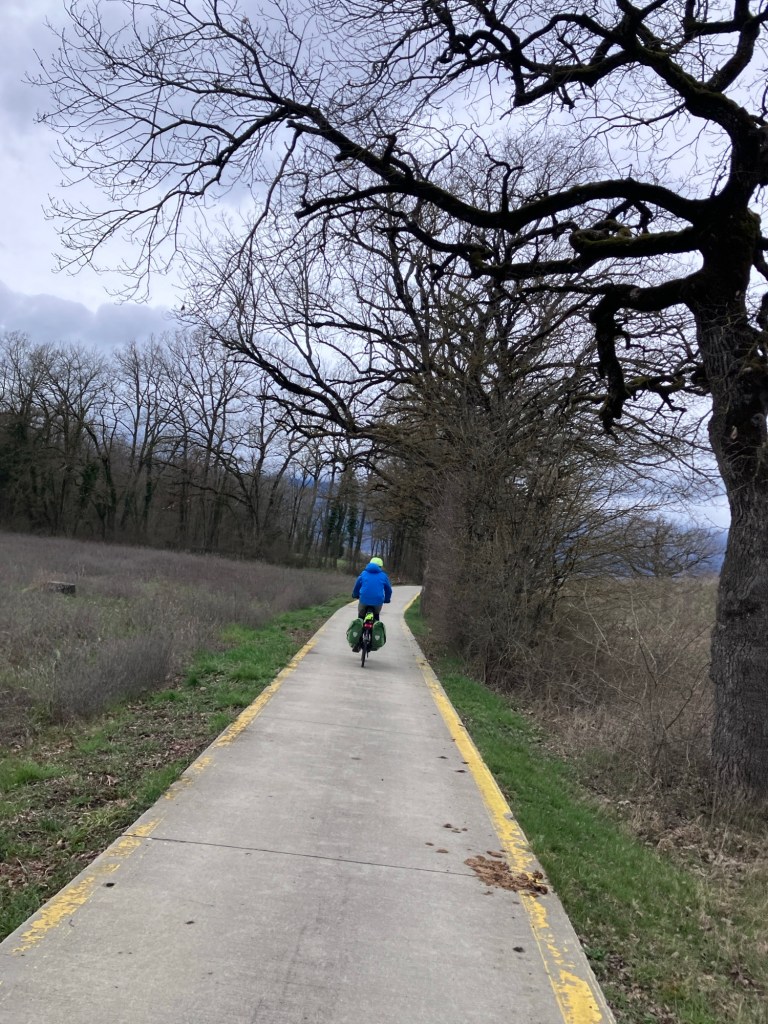
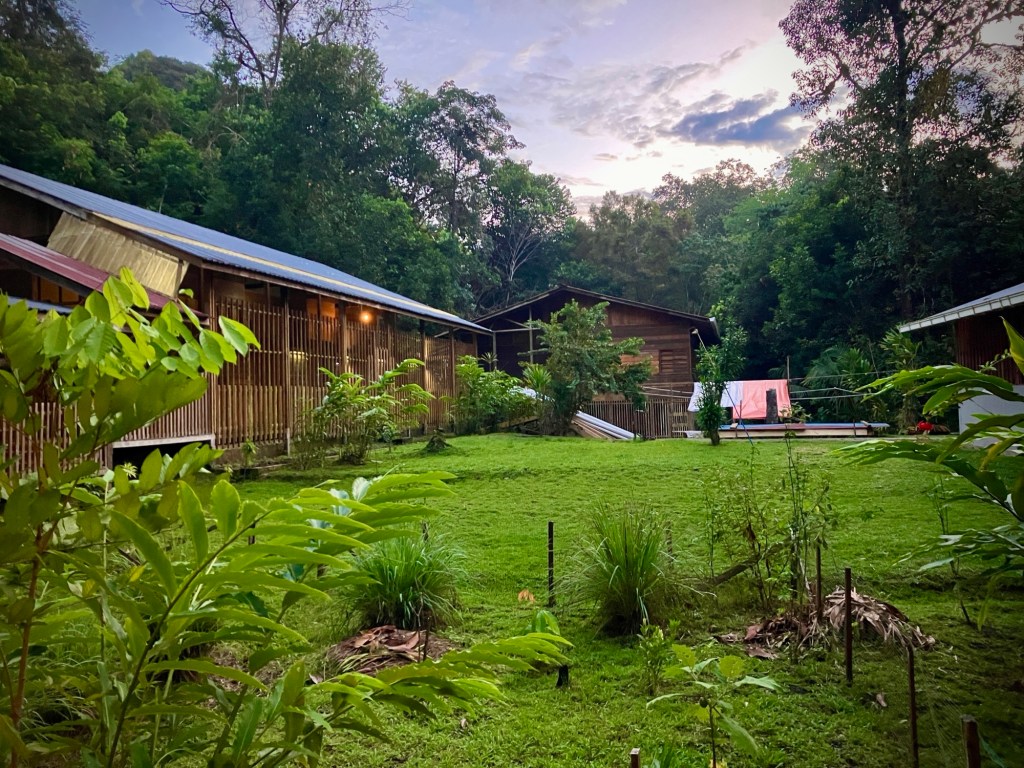
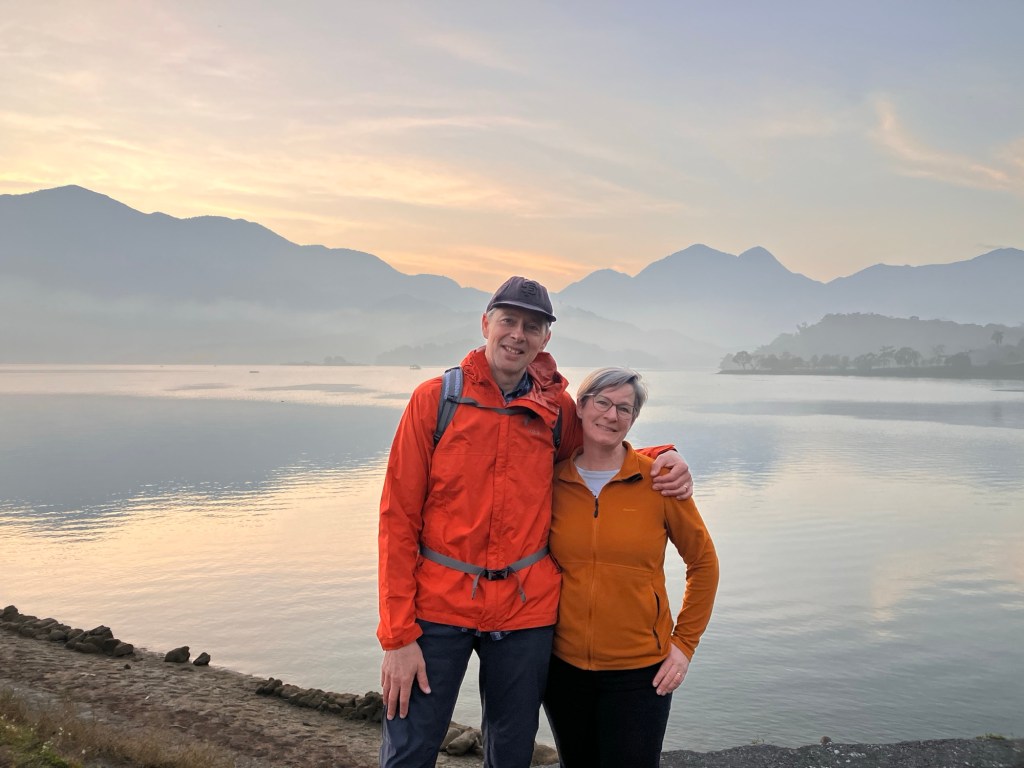
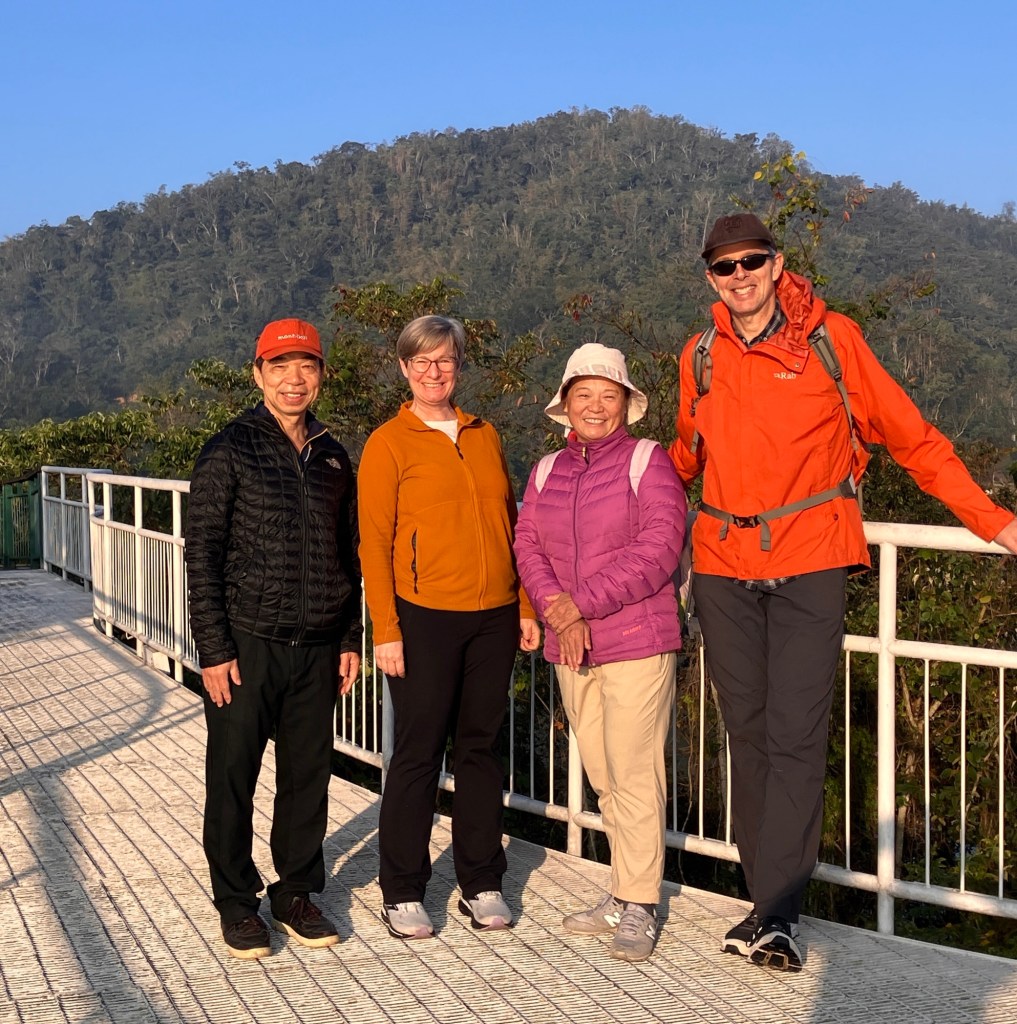
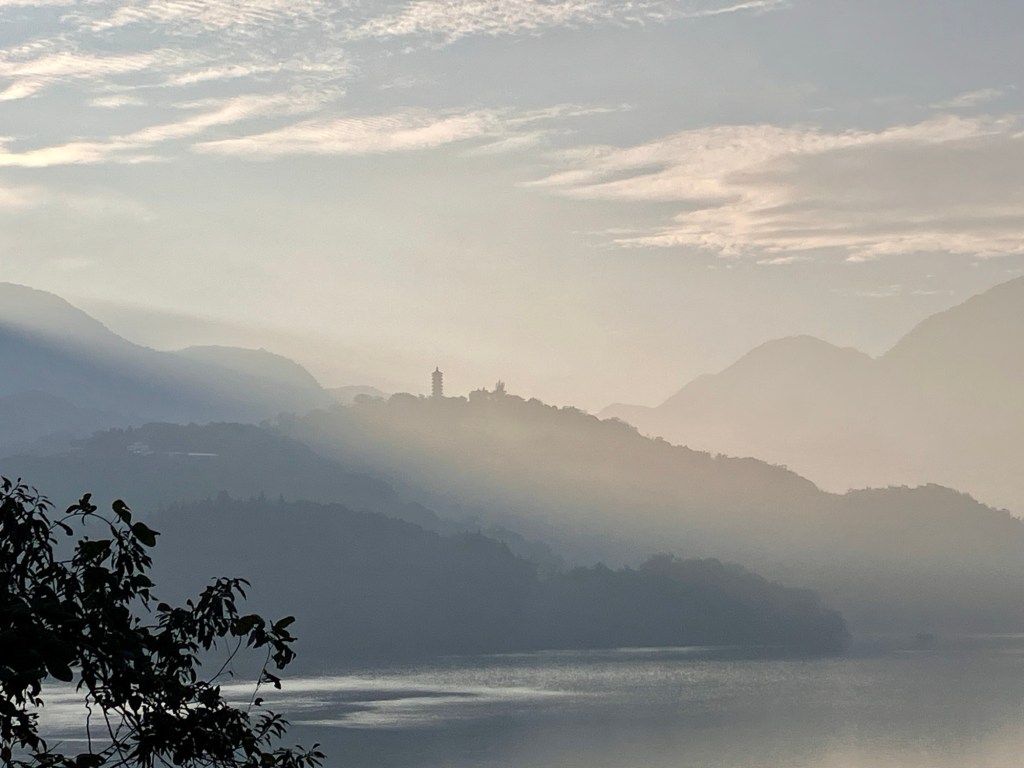
The broad and jagged Pyrenees are a stunning sight in early Spring.

For example, last fall, we blocked out a 3 month spring window in Europe that would be dedicated to bike touring before returning to the US again for a wedding in June. We also wanted to spend more time in Asia. We had no visa issues for Malaysia or Taiwan, but on the European continent, we are subject to the visa-free rules limiting us to no more than than 90 days in the Schengen zone. (Most of the EU – Ireland + Norway and Switzerland)

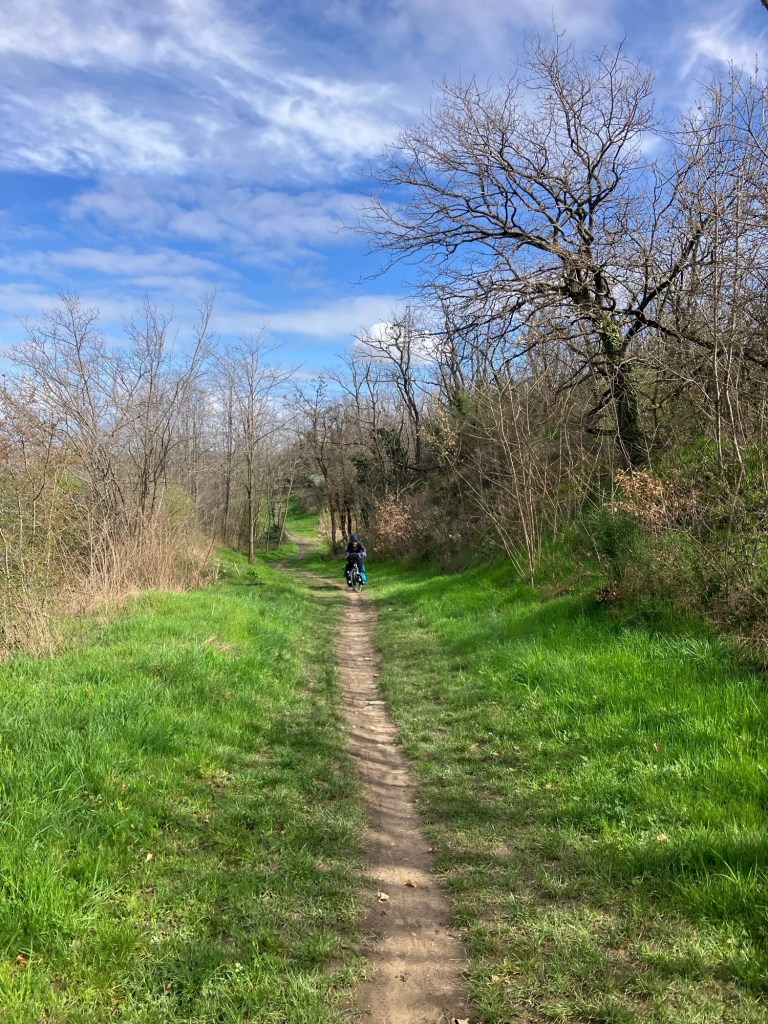
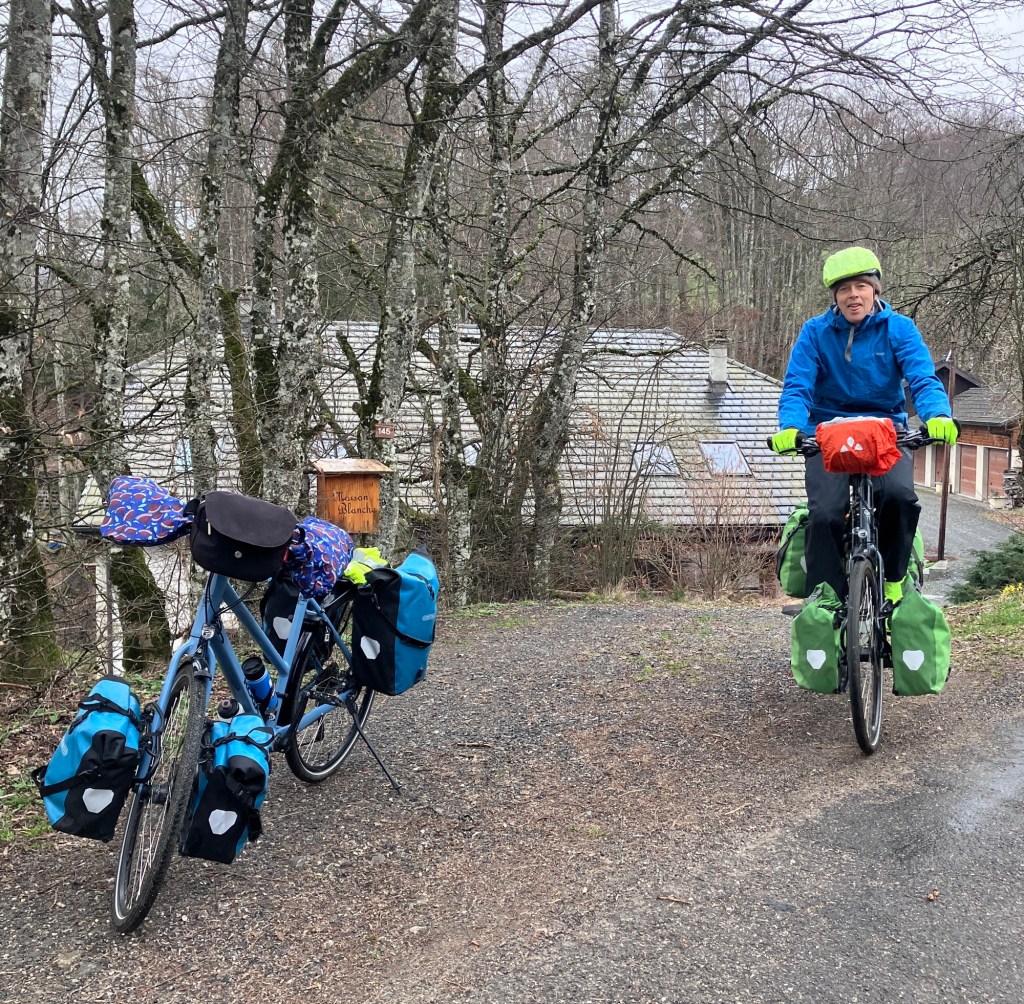
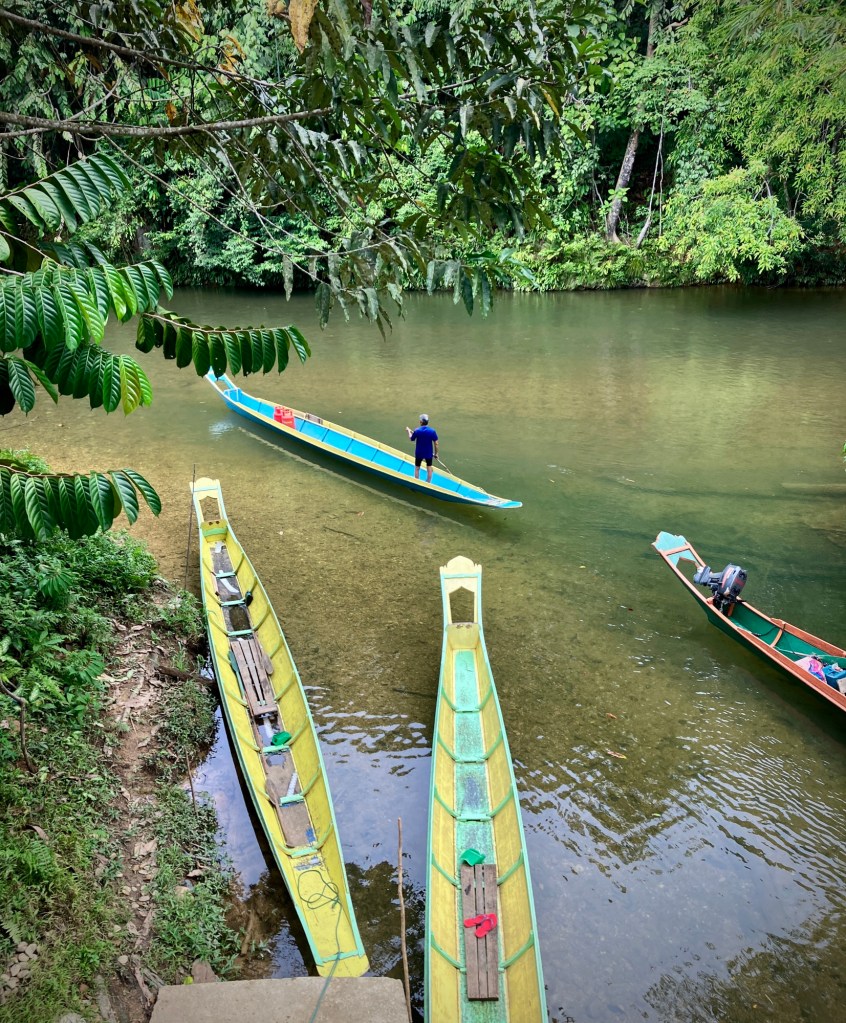
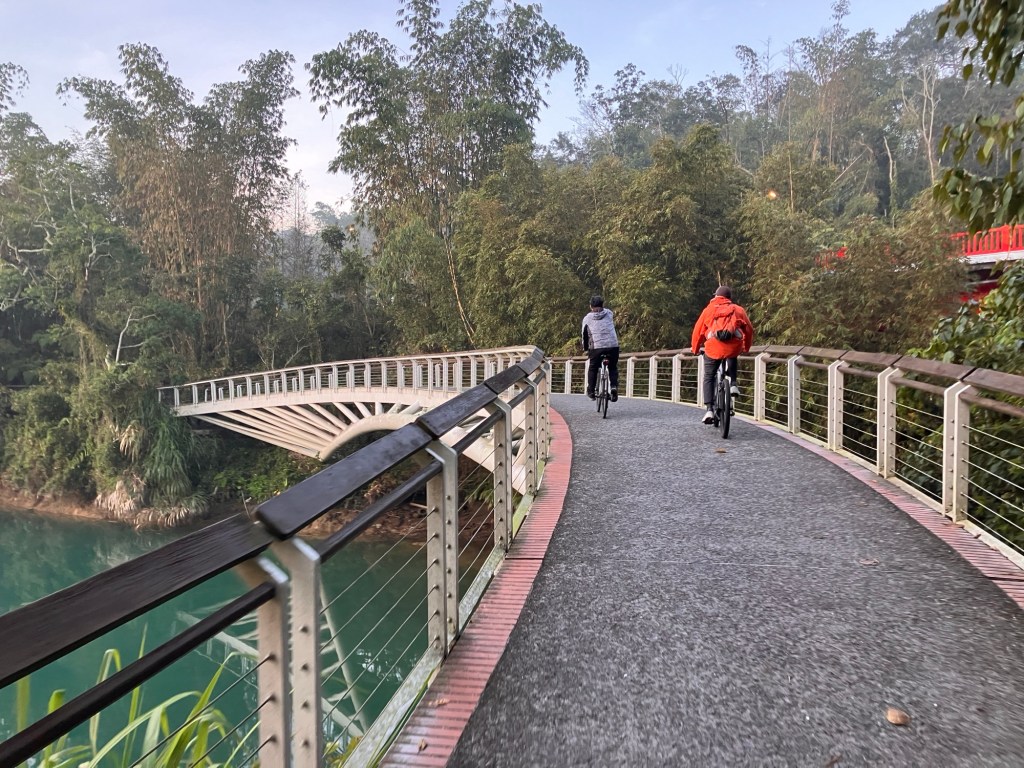
Cheryl descending one of the many climbs in the foothills of the French Pyrenees.

Then we factor the weather. So for a bit more warmth, we headed south first from Geneva to chase the European Spring. And winter in Asia is generally a bit cooler, as it was in the rainier season of Borneo. Add to that my desire to work on my French and we further refined our cycle touring itinerary. France, and lots of it!

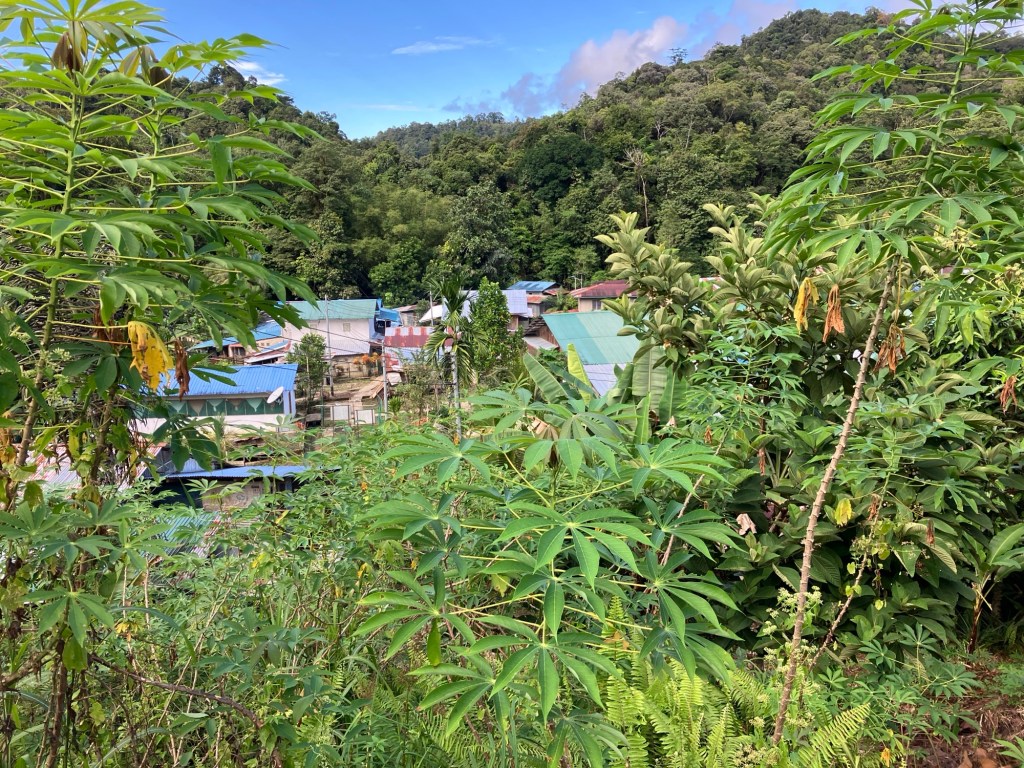
The citadel of Carcassonne is stunning and constantly appears wherever you at in town.

The next ingredient in the travel planning mix is some house sits. We love house sitting and wanted to work a few breaks in during our spring bike tour. Cheryl had been dilligently looking for sits while we were still in Asia but we didn’t find good matches until we had already set off down the Rhône. But due to Cheryl’s excellent filtering and immediate responsiveness to opportunities, we finally found good matches, and now have two one-week house sits in April. These sits formed the basis of our plans in Southwestern France.

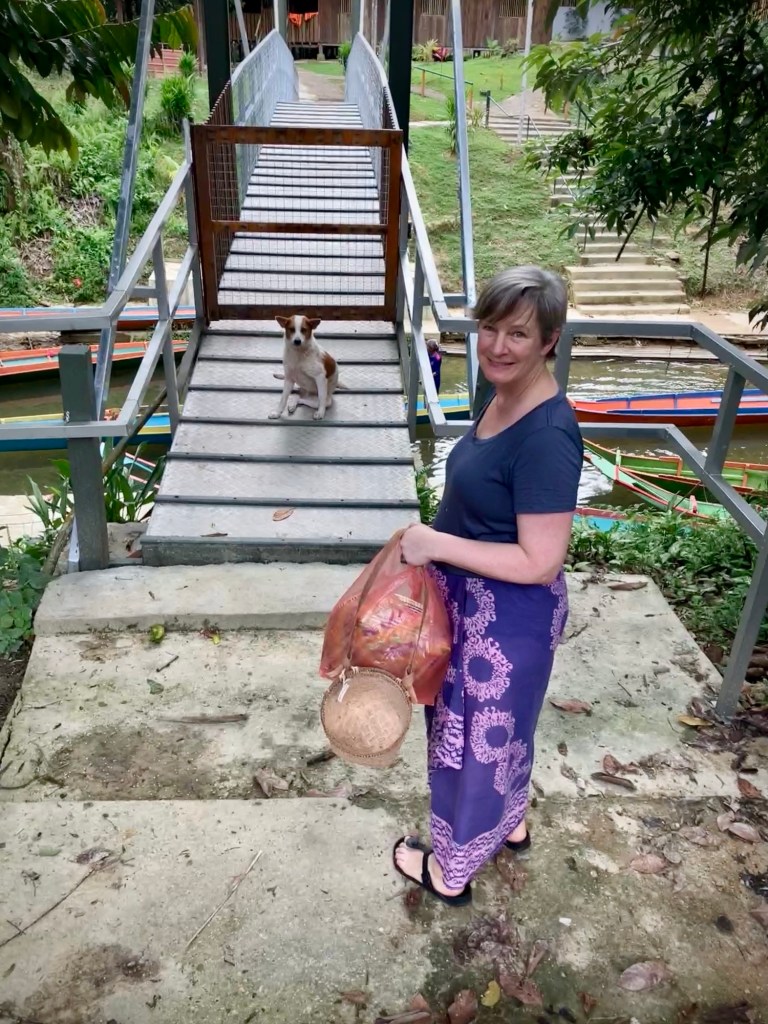
Our beautiful house sitting companion.
The magnificent view of La Cité in Carcassonne from our house sit veranda
Château Comtal, a 12th-century castle within La Cité.
Cheryl inside the Citadel
La Cité has some charming streets and cafes, but is pretty touristy with the requisite splash of tackiness.

The first sit was in Carcassonne; famous for its massive UNESCO world heritage medieval city and citadel that overlays a site dating back to Greco-Roman times. It’s one of the most picturesque scenes in France. We were both excited as neither of us had been there before. We were also very glad to be over our pesky colds by the time we rolled in to meet our American Ex-pat hosts.

The sit was in a large house ca. 1930 with a beautiful indoor/outdoor cat and we had a nice dinner out with our hosts at the base of the nearby La Cité. We almost always meet our hosts and often spend the evening prior to learn the ropes of the house, pets, and area. It’s one of our favorite parts of housesitting.

Cute draft horses, complete with adorable fly guards, can take you around the Citadel.
Sizing up the fortress in La Cité.

They had mentioned in our video chat that the area was not very bike friendly, but to be honest, we often hear that from folks, but then find it later to be ok. But as we departed the pleasant Canal Du Midi path from Castelnaudary for local roads outside the city, it became apparent that they were right. Where were the nice bikeways and lanes popping up all over other French cities in the past 10 years?!

This rather sad buffered bike lane ran exactly one block near the train station.
Not an inspiring walking environment on many of the newer roads around Carcassonne.
Cars on the sidewalks always tells us a lot about the priorities of a place. This was typical of many neighborhoods in Carcasonne.

As we made our way around the “new” city (La Bastide), our Komoot bike directions had us on a 3 lane traffic filled perimeter road.”“Seriously Komoot, this is the best route!!?“ Not a bike lane or facility in sight. We did eventually find a few sad and neglected stretches of bikeways on side roads, but indeed, Carcasonne is not a bike town. Not at all. It amazed us how the vibe of transportation varies in cities by the priorities set by planners, culture, and of course, the infrastructure. We’ve especially noticed stark differences in SW France, as some places seem stuck back in the 1970’s. It especially struck us on our day trip into Toulouse. Toulouse has controlled access to the city core, wide sidewalks, abundant transit, and lots of bikes. We liked it so much that we are going to spend a few nights there as we head back north.

Toulouse had a car problem too in the 1950s, but now Place du Capitole is a vibrant pedestrian space. (With a garage underneath.)
We expected to see some of the nicer streetscapes of France in Carcasonne, like this Dutch style intersection in Toulouse.
The Pont Neuf in Toulouse only one has one lane for car traffic, wide bikeways and pedestrian space, and a dedicated bus lane.

Perhaps the city administrators in Carcasonne didn’t apply for federal or regional money. But most likely here, the overwhelming presence and management of 3 to 4 million annual visitors to the star attraction dominated the transportation planning. Get the traffic and tour buses through. It’s also very windy, including the week we were there. It was not pleasant and to be honest, didn’t make you want to be outdoors at all. Perhaps the allure of the automobile is explained a bit.

Lovely outdoor spaces in charming Toulouse where cars are kept at bay. It was also windy in Toulouse, but more protected by its sinuous old grid.

Again, for some, Carcasonne could be magical, and it does have some nice areas along the Canal du Midi and river. But as car-free walkers and bikers, it was not as enjoyable as so many other places we’ve been in France. It didn’t have a village feel, and cars seemed to be everywhere, and the core of the “new city”, Bastide Saint Louis had almost all roads open to fast moving and aggressive cars with narrow sidewalks. Certainly, we enjoyed our time relaxing in the spacious house with the cute cat, but the City itself did not make our top travel lists.

Carcasonne train station is undergoing a much needed renovation to add accessibly between platforms, but it’s not always easy to squeeze in elevator shafts in old stations. We planned for extra time when we left to transfer our bikes and bags up and down the stairs to access the platforms.

You should come to Carcassone, but probably just to visit the ancient La Cité. And since it gets millions of visitors, perhaps an early morning or late afternoon/evening would be best. (Rick Stevees concurs -:) As I noted, our visit to was also influenced by the near constant presence of winds, often blowing 20-30mph+; so cafes and outdoor dining options were less while we were there. We were starting to hypothesize that the La Cité fortress was not really built for defense from marauders, but for the incessant winds! It was nice inside the walls -:)

The first TER train from Carcassonne to Toulouse made about 10 stops and had 6 bike hooks. Crowds varied but we just held onto our bikes and leaned or used door jump seats.
Changing trains in Toulouse was easy with low boarding TER trains and elevators to platforms
The IC train (14143) to Lourdes had reservable spaces under a luggage rack. Perfect to store our bikes without panniers. Our assigned seats were automatically in same car with view of bikes. Nice work SNCF!
Millions visit and make pilgrimages to Lourdes every year and the city has streets lined with places to buy religious goods and dozens (and dozens!) of big hotels. It felt a little like Catholic Disneyland to us.
As soon as we left the station in Lourdes, we were struck by the sight of the immense basilica, Our Lady of the Rosary.
But soon we were rewarded with our first views of the high Pyrenees and the endless backroads in the foothills.
But the first climb reminded us both that the Pyrenees are quite rugged and the roads steep in places, like this 12-15% grade outside Lourdes. These are not the Alps.

Based on our second sit, I looked for a good route from Carcassonne in the central Pyrenees. I started from the intriguing V81 regional route which shows up on Komoot when you select bicycle touring mode. Since we only had a week, I had TER train plans to Perpignan and daily cycling routes mapped from the Mediterranean side on the East. But a few days prior, I noted massive headwinds were predicted in that area (like 20-50 mph) which make the thousands of feet of climbing and valleys even more miserable. So I revised last minute and we headed west by train to Lourdes, where more favorable (and less) wind would likely greet us for the week. And that it did. We are blessed with our freedom right now and do appreciate it every day, but you need to be flexible in plans and comfortable that it will all work out. We always learn as we go.

Dramatic skies in Tarbes, just minutes before an epic lighting and hail storm! We had made it to our hotel for the evening just in time -:).
Typical small church in the Haute Pyrénées.
We always love to see nice signage reminding drivers to give cyclists at least 1.5m when passing. And French drivers are pretty good at honoring the law. Mostly.
A break in the weather at Lac de la Arrêt Darré

So wet set off by train from Carcassonne with a good transfer in Toulouse. We had to squeeze a bit on the first TER train and leaned with our loaded bikes near the door as the bike hooks were virtually full and impossible to use with our gear and the modest crowds. But the French are pretty easy going and helpful, so it was fine. Our second train from Toulouse to Lourdes was an Intercity and we actually had reservations for two of the three bike spaces. It was a modern train set with low boarding and leaning space for bikes and straps to secure them. Heavenly! We actually got to sit in our seats and enjoy our lunch and coffee/tea -:).

Mesmerizing layers of stone and mortar walls.
Further up into the forest.
Route 81 from Tarbes did indeed take us up on a huge plateau with very dramatic views and weather.
Before a cold rain descended on us at the end of Day 2 to Galan.
Few services out here, but wait, what’s this?! An automated boulangerie!
Success, tapped my credit card and et voila, a Pain Au Chocolat, even in a tiny Pyrenean village. Vive La France!
Full rain gear drying out a bit as we rode onto our Chambre D’Hote.
A nice warm homemade dinner at the friendly Le Clos de la Bastide in Galan.

Lourdes is a huge pilgrimage site for Catholics and Our Lady of Lourdes is a title of the Blessed Virgin Mary recalling her apparitions in 1858 in the grotto to Saint Bernadette Soubirous, a fourteen-year-old peasant girl. The spring at the grotto is said to have healing powers, so millions come every year to seek its healing properties, often near the end of their lives. Although we didn’t go inside or see anything up close due to all our gear, the scene around the Basilica is quite unique and you can’t help but be touched by people’s faith.

Galan was a sweet little village in which to spend the night.
Exploring little Galan at sunset.
And a touring cyclists constant risk!

The cycling from Lourdes was immediately spectacular and sensually rewarding on a balmy spring day. And unlike some of the busier Eurovelos, the regional routes tend to have fewer cycle tourists, especially this early in the season. I like to compare the Eurovelos to National parks and local routes to State parks; Often just as spectacular with way fewer crowds. A big front came through late in the first day and it went from 77f/25c to 40f/4c in about two hours with hail the size of marbles. It coated the ground and changed the mood dramatically as we set out the next day back in a late winter feel. The storm continued a bit the next day and we battled a bit of cold rain, but it also cleared enough to see freshly coated mountains across the horizon. A memorable day of cycle touring, as so many are.

Our third day in greeted us with sunshine and spectacular views of the Haute Pyrenees. The V81 bobs and weaves in and out of valleys and over smaller ridges toward the bigger peaks across the entire French side of the range. It’s a great route.
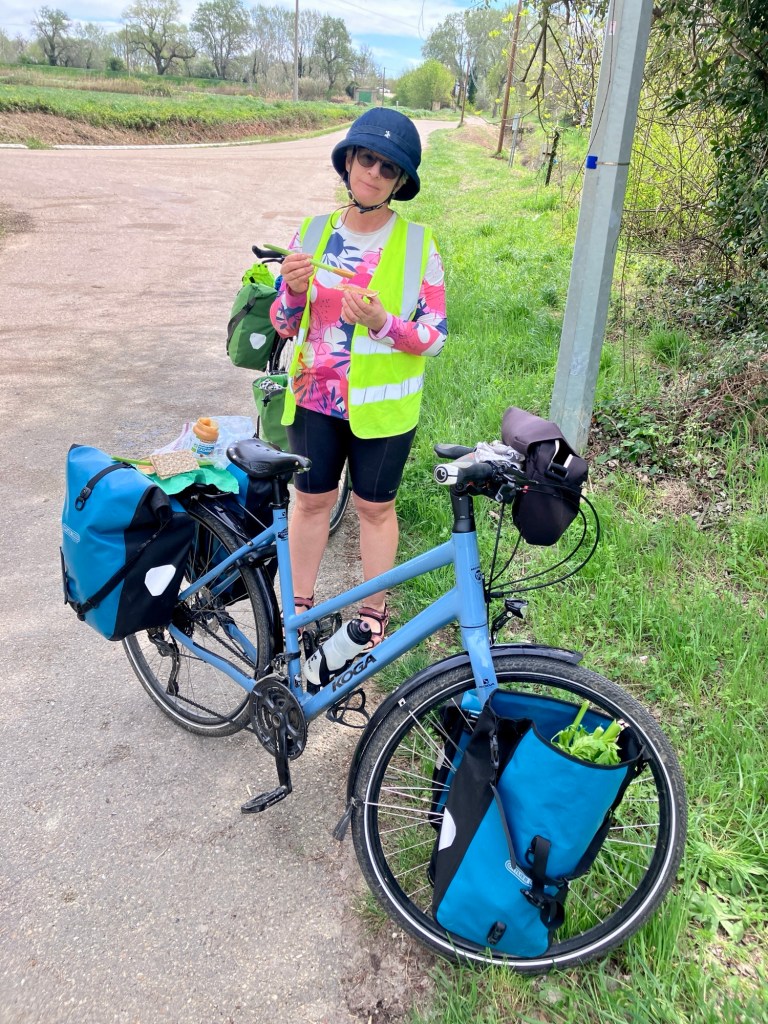
Although the V81 route was well signed and Komoot kept us on track (mostly), we’re constantly looking for a good picnic lunch spot in the next village.
Abandoned chateau? Nope, no benches.
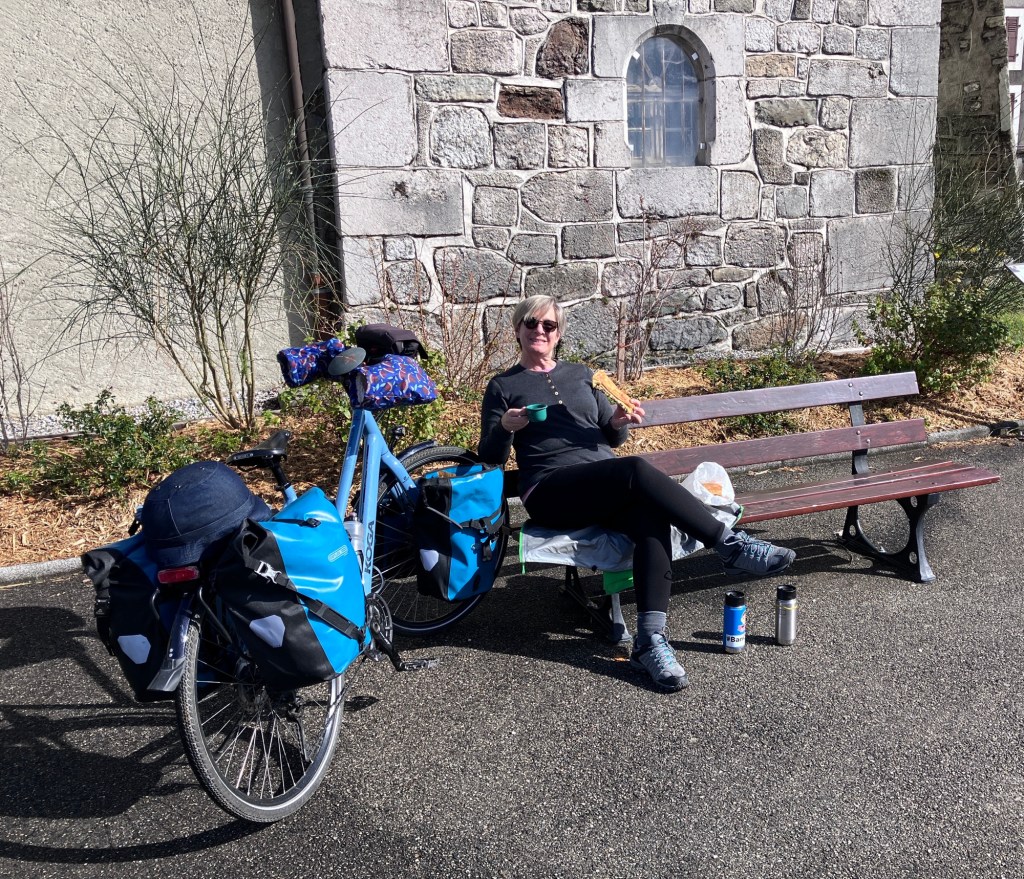
We settled on this bench behind a church and a bit out of the wind. ok in a pinch.
Endless rural valleys, and a lot of up and down. Almost no one in sight.
Quirkyness abounds in the Pyrenees.
An homage to the squirrel?!

After Tarbes, lodging along this route is pretty sparse as you only go through a few major towns/villages, but this is where Chambre D’hôtes come to the rescue as you can find lodging, dinner, and breakfast along with a great local experience and family hosts. Many of the apartment rentals in this region are more seasonal for summer or larger places with 2 or more bedrooms, which make them unpractical and poor value for an overnight stay. Another option is to duck off the route a bit to find lodging as we did near Montrejeau. In summer, more people certainly camp as well.

Lodging on this stretch of the V81 is limited this time of year, but we found a great little apartment (€55) for the night in Montréjeau. Laundry, cooking in, and bike storage!
The impressive Saint-Bertrand-de-Comminges Cathedral. A site with layers of history dating back to a Roman Colony of 30,000 people. It later became a pilgrimage stop on the way to Santiago de Compostela.
Up the hill and through one of the three old city gates. Car access is limited and most people park down in the valley.
The ornate organ inside the basilica is considered onw of the best classical organs in Europe.
Sun and coffee break outside the Basilica. We fill our stainless steel thermoses every day with coffee (me) and tea (Cheryl) as cafes and stops are few and far between in this rural region.
A lending library and artistic bench. Even the smallest villages have charm and peacefulness.
We lucked out when it was lunch break on this bridge construction project over the Garonne as the resting workers were fine with us passing and saved us 10km of extra peddling!
After successfully charming the construction workers, we continued on in warming temperatures that gave us a taste of summer here.
Cheryl thrilled to sample more artisan chocolates at 9 am from Aztek at the recently opened Halle Gourmande in Saint Gaudens.
My new favorite from the same food hall, a “Jésuite” pastry.

But our six days of cycling was magical, especially as we are stronger now and the climbing is a bit more rewarding, not just painful. We both feel great after being sick for a bit. And Cheryl is now back to her champion climber status, although one or both of us still have to hike-a bike a few relentlessly steep sections. No shame in pushing a 30 kilo bike load. We are indeed carrying a lot of weight for three months of activities, and three seasons. (often all in one day). We keep discussing what winter gear we can mail back to the Haute Savoie, but then winter rears its head again and we’re glad for all the gear.

The Pyrenees have a good craft beer scene and I was thrilled to chat and taste at the friendly Brasserie Artisanale D’Ariege-Pyrénées in Saint Girons. Opened since 2005, it’s still fairly small, but excellent.
More rolling hills and mountain vistas to explore.
Saint-Girons was our final stop before our next house sit and is a lively and friendly market town on the Salat River.
The old town of Saint Girons.
The weekly Saturday market in Saint Girons is not to be missed. A huge sprawling market of fresh foods, music, crafts, and anything else you might need.
Up the valley to our house sit during another unusually warm spring day in the mountains.
Another day, another UNESCO world heritage site!
Getting excited to reach our next adventure in Massat, but more on that next post!

So we are now at our second house sit near the small village of Massat, where we are experiencing the magic of spring in the Pyrenees and plotting our further adventure on our bikes. More on that from Cheryl soon. Happy Spring!

Fleeing the storm, from Montpellier to Béziers and up the Orb River.

In Montpellier. Rich feeling better, Cheryl coming down with the Spring French Cough.

The wind we battled down the end of the ViaRhôna bike route and the edges of the Carmargue and salt marshes of the sea did not let up as we approached Montpellier. As we turned inland the wind blowing across the bridge over the estuaries almost knocked me over.

Ha! Not this time wind. Still upright.

Being San Francisco cyclists, we know crosswinds. The Golden Gate Bridge crosswind has knocked over many an unsuspecting cyclist, so I was ready for this exposed bridge. It’s quite a feeling on a loaded touring bike to be hit with a crosswind so hard you feel as if you can just lean on it, tilt at a motorbike in a curve angle, and still stay upright.

L’Arbre Blanc (White Tree) housing tower on the Lez River in Montpellier.
It seriously looks like a rendering, we stopped to marvel at the design. So unique.

Coming into Montpellier we felt the city buffer the wind and saw this completely unique building. Sou Fujimoto led the team on this stunning design, as our architect friend Gisela clued us in. She’s our go to with building questions. It also clued us in that we were close to arriving at our hotel for a two night stay.

Dusk in the city.
Calm plazas and beautifully lit up buildings.
Glowing light looks so cozy.

Why, I wondered, looking at my photos, were so many of Montpellier at night? Oh yes, we had holed up in our hotel room for almost an entire rainy day. We had breakfast at the hotel and ate the lunch food we’d bought and not eaten the day before. A kettle and mini-fridge kept us happy. We finally emerged in the evening to find dinner and admire the city. For years we’d been referring to Montpellier as “the city of tomorrow, today”, from a trip in 2018 when we marveled at the new tram system. Now we got to marvel at how bicycle and pedestrian friendly the city is as well.

A stylish tram under a full moon.
Running errands on a tram.
Unicorn on a monument. Haven’t seen that before.
Headed out on one Montpellier’s fantastic bike lanes before the rain started.

Something that made it so nice to bike and walk around Montpellier were the concrete curbs protecting bikes lanes and also keeping cars from changing lanes approaching intersections. You knew if a car was turning right by which lane they were in, no possibility of swerving at the last moment. That’s a nice feeling for those of us not encased in tons of steel. We were off to the train station to spend the worst part of the storm on a train. If the train was running. The wind and waves along the coast where the tracks run were causing delays but our train did leave, only 30 mines late. Seeing so many other folks with bikes was worrying, since the train technically only takes six bikes. But as you can see from the photos with a collaborative attitude extra cyclists can squeeze into almost any space. Thank you SNCF for not be sticklers for rules.

It’s dumping with rain, but we’re cozy on a train busy with other cyclists.
A big group of Irish cyclists riding a pilgrimage to Lourdes were also on the train. The wind was so strong it was unsafe to ride, especially on lightweight road bikes.

Rich spends a lot of time planning our routes, booking accommodation, and figuring out train rescue hops, like this one. We took this train to Béziers. Where? That was our question too. We didn’t have high expectations and knew nothing about Béziers but it turned out to be a lovely place to spend one night. France is loaded with small cities like this (population 80k), that are firmly off the foreign tourist track. There is an August bull fighting festival here that attracts one million visitors over five days, but we wondered where they all stay as hotels are not abundant.

Beautifully redone plaza area.
Way too much mayonnaise in the sandwich!
Rich in front of the Pont Ferroviaire de l’Orb. His third favorite aqueduct in France. Favorite, Pont du Gard, second favorite Pont-Canal du Briare across the Loire River.
Cheryl on the Pont Ferroviaire de l’Orb which carries the Canal du Midi over the Orb River. 
Another picturesque bridge, Pont Vieux. The city has done a great job restoring the bridge and linking it to the Cathedral via new plazas, walkways, and elevators.
View of Cathédrale Saint-Nazaire from the bridge.
And the bridge from the cathedral.
Dinner at Les Bons Amis. We might have both felt a bit under the weather, but not that bad as the local wine still tasted so nice!
Ready to ride the canal du Midi. Off we go.
Made it all of 2 kilometers before our first stop, at Les 9 Écluses de Fonseranes. Yes, a flight of 9 locks on the Canal du Midi.
A view back to the cathedral. At another stop where we added to our bikes the little flags we bought in Montpellier.
Hello, we are Americans with an affinity for France.

The little flags were Rich’s idea. What is the first thing you wonder about tourists? Where are they from? Sometimes you can tell, sometimes not. So, in order to answer that question for all the folks we cross paths with – little flags. Do we wish we’d gotten them earlier? Yes! Have we noticed folks noticing them? Absolutely. It might be confirmation bias on our part, but we do think they make folks friendlier and car drivers nicer. Rich has his on the front of his bike, and mine are on my back. We inform folks coming and going.

A glimpse of the Pyrenees, snow capped.
Lunch near the Abbaye de Fontcaude, which was closed. Saved us from having to decide if it was worth stopping to go inside.
Cazedarnes. Vineyards everywhere you look. This is the Languedoc region.
And this is why it can take me so long to catch up with Rich. I’m constantly stopping to snap pics.

After a fairly short day riding, and a night in Cessenon-sur-Orb at a Chambre d’hote where Rich put his French skills to the test, and where we failed to convince the other couple at dinner, from the Vichy region, that Paris is actually quite bike friendly, we headed out to a gem of cycling – La Voie Verte Passa Païs (the Passa Païs greenway) which stretches a total of 237 kilometers and first follows the Orb River.

Yup, stopped again. Not tired of vineyards yet.
Rich admiring the view and waiting for me.
We saw a few other cyclists on their road bikes, this must be such a popular local road, it’s beautiful.
Such smooth asphalt.
Very few cars on a Thursday morning.
My French road sign language learning program is going well.
Another picturesque stone building and another stop to take a photo.
Roquebrun, another gorgeous town we get to see. It’s so easy to pull over for a photo when traveling by bike.
600 folks call this town in the Occitanie region home.
In summer there are kayakers and canoeists, but wine production is the main economy.
After Roquebrun the roads starts to climb. Rich amuses himself by taking photos of his newly flag adorned bike as he waits for me.
Vieussan. The next adorable town.
The geology along the Orb is eye catching.
Little Black Greeter Kitty of Vieussan. We pulled over up the road and they came running up for cuddles.
Happy cyclist and happy kitty.
A serious embarrassment of views along this route.
I like the simplicity of the signs telling you which river you are crossing.
A yellow bridge over the river Orb and toothy mountains.

A frequent problem we have is the lack of benches along cycling routes. And benches in the shade are even rarer. We’ve learned to head into towns where you can usually find a bench by the church, or in a shady old town street.

Old town narrow streets in Olargues. Must be a bench here somewhere.
And there was. Of course as soon as rode out of town there was a lovely park with picnic tables as well, but our old town perch had atmosphere.
The park with tables looking back at Olargues. We’re now following Le Jaur River to the west.

This section of the Passa Païs is on an old railroad right of way. There is ongoing work to the route so not every bridge is bike ready yet, but enough are that you avoid most descents to and climbs out of river or creek valleys.

Railtrail smiles.
A nice gentle climb leaving Olargues.
Oh yeah. Look at that dip we got to avoid. Bridges go over.
And the route goes under footpaths.

As I mentioned, the route is still being worked on. At some points you are routed off the rail trail. Obviously the planners are doing their best to keep us off busy roads, but occasionally that means very quiet, very steep roads. Lumpy, as Rich calls it.

This road was car free, which was good, since I was grumpy. A 10% grade will do that.
Distract myself with the sweeping views.
Rich found a bench with a view of one of the bridges our climb probably avoided.
Wild lavender growing out of the hillside.
Ah. Back to the rail trail.

The day from Cessenon-sur-Orb to Labastide-Rouairoux was beautiful and varied. We had lovely smooth roads, newly constructed rail trail, quiet small roads, and stunning views and villages. It was a tougher day than we anticipated since it was a long climb, gentle most of the way but still up for 20-30k. It’s more tiring to ride long flattish days since you are in the same position on the bike, using the same muscles, hour after hour. We were thrilled to crest the pass of the route and through a long tunnel – avoiding the very highest ridge – and coast into Labastide-Rouairoux, which is a former textile town. The rail route we were riding had brought wool to the town and taken fabric away.

The long tunnel which delivered us to the valley of the Thoré River.
The tunnel meant a change of valleys, and a dramatic change of climate as it was now exposed to the moisture from the Atlantic. Suddenly it was green and lush.
After a fantastic night at Chambres d’hôtes Residence Le Petit Paradis, with great dinner time conversation and a delicious breakfast, it was back on the trail.
I was sad that we didn’t get to town in time to visit the textile museum.
An old mill on the River Thoré. This mill valley started to remind us of the coal valleys of Wales.
As Rich had been promising me the day before, our start was 100% downhill.
Looking back towards Labastide-Rouairoux. Our friends who know Wales will understand our comparison.
Ah, nothing like coasting downhill on a rail trail. Me in the rear screaming “I love bike touring!”.
So green again. But spring had not come to this area.
We went from vineyards to dairy cows. It felt like a different country.
Artists had been hired to create works along the trail.
Which meant more stopping for me!
Rich didn’t even have to wonder where I was – squirrel!
Artistic underpass – Droit dans le mur? Straight into the wall?
Lunch in Caucalières. A table by the river.
And a few Easter chocolates to keep us going.
Next stop, Castres. We both love that Véloccitanie branding.
Dramatic geology on Le Thoré River.
The outskirts of Castres. I do love a French gate leading to a chateau. This huge chateau was in the midst of office parks, an interesting juxtaposition.
Castres! Where we would spend two nights, still trying to get over our chesty coughing colds and hoping for the wind to calm down. That’s l’Agout River. So many rivers.
We had a great rest day in Castres. A visit to the Goya Museum, a small but mighty and well curated place.
French burgers. A tried and tested rest day cure. For whatever ails you.
Best photo to capture the day of riding between Castres and Castelnaudry. It was a lovely ride, much along the canal du Midi but I just wanted a nap. Yay for the nap loungers.

We spent two nights in Castres and two nights in Castelnaudry. We have a house and cat sit in Carcassone so we had some time to bumble along and take it easy, which was great since neither of us were yet up to full speed.

After a good night’s sleep, out for a walk. Écluses de Saint-Roch, a four flight lock on the canal du Midi.
The basin, carved out of the canal to make a port and regulate the water supply to the locks. It’s also a popular spot for folks to rent boats to cruise the canal.
A French canal boat.
Castelnaudry is the home of Cassoulet. Delicious. Super filling and very rich.
Leaving our AirBnB which is in an old convent turned language school.
Back on the canal and by more locks.
Each old lock keeper’s house had these distance signs.
Still impressed with the views of the Pyrenees.
More good bike route signage and branding.
A shady part of the canal.
And a sign explaining all the work to re-shade stretches. So many new young trees were being planted, it was great to see.
It’s good to know that future generations will have rows of trees like this.
Bench! In the shade! On the canal du Midi. We’re getting close to Carcassone.

Phew! That was a lot of photos. Rich is way too busy travel planning to find time to write, he proofs and adds and corrects details. It’s not easy to move so much in an area that’s not ramped up for travel season yet. It can take him a long time to find a place for us to stay where we can also find dinner, and has a bed big enough to fit a big tall American. But we made it to Carcassone alive and well and ready for our house sit. And mostly but not fully recovered from the French Spring Cough.

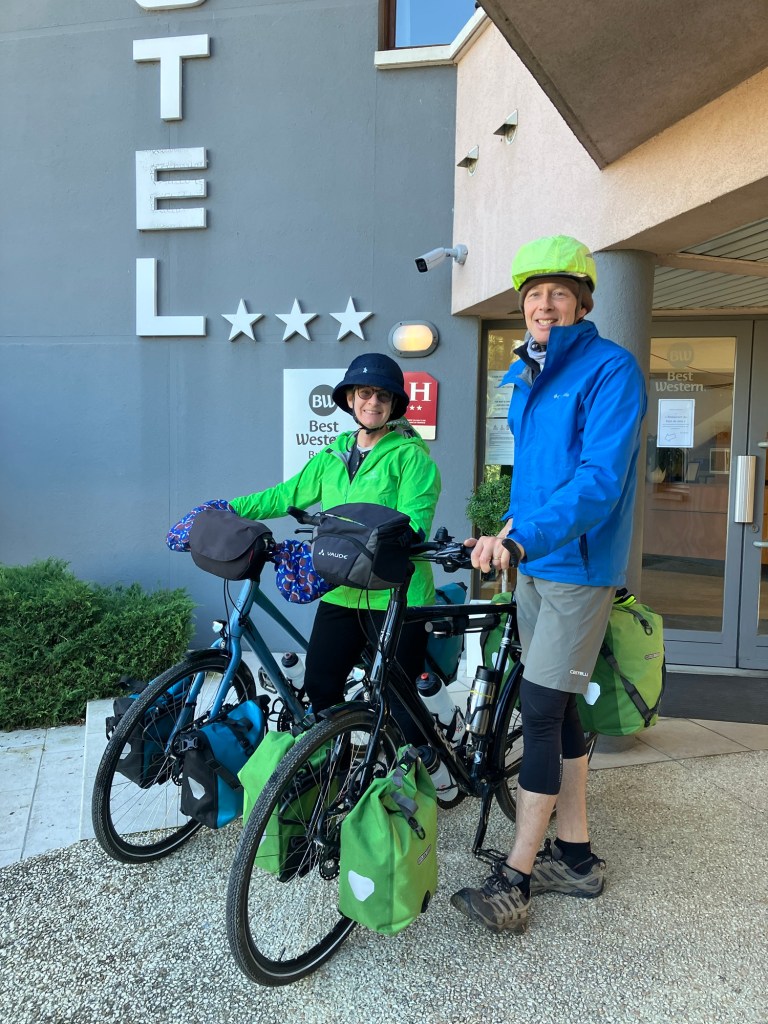
The happy travelers in Carcassone.

The Via Rhôna. From the Alps to the Mediterranean Sea by bicycle.

Le Grau-du-Roi, our first real sight of the Mediterranean after two days of salt marshes around the Carmague.

The Via Rhôna. We started with snow, rain, and hail, and ended about 800k later in sunshine and wind.

Each heart is a place we stayed on our ride down through Southeastern France.

When we start a specific EuroVelo route, or any other point to point cycle tour, we always assure each other that we can absolutely take a train boost if needed. I’m happy to report we didn’t take a train, bus, or taxi for the ViaRhôna. We rode the entire way. The blue dot is us in Montpellier, our 15th night since leaving our friends’ house in the Alps. We spent two nights in Lyon seeing friends, and two nights Uzés to have a needed rest day.
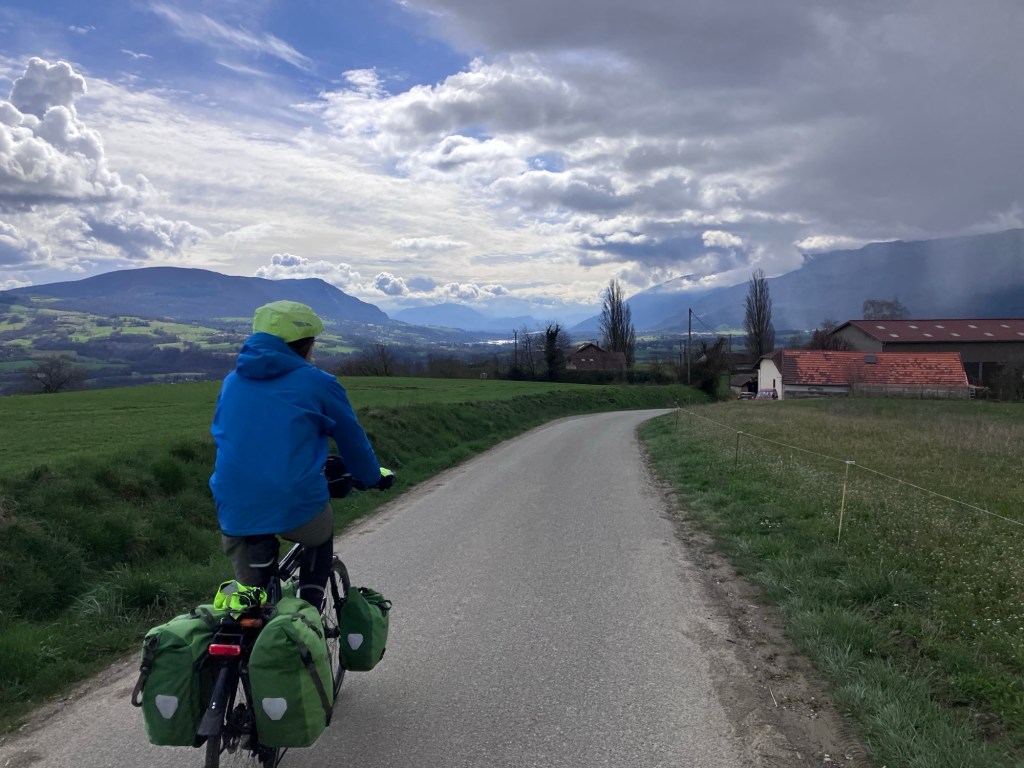
Day two of riding. All rain gear was used. We were glad the rain was never sustained, but just occasional showers or hail.
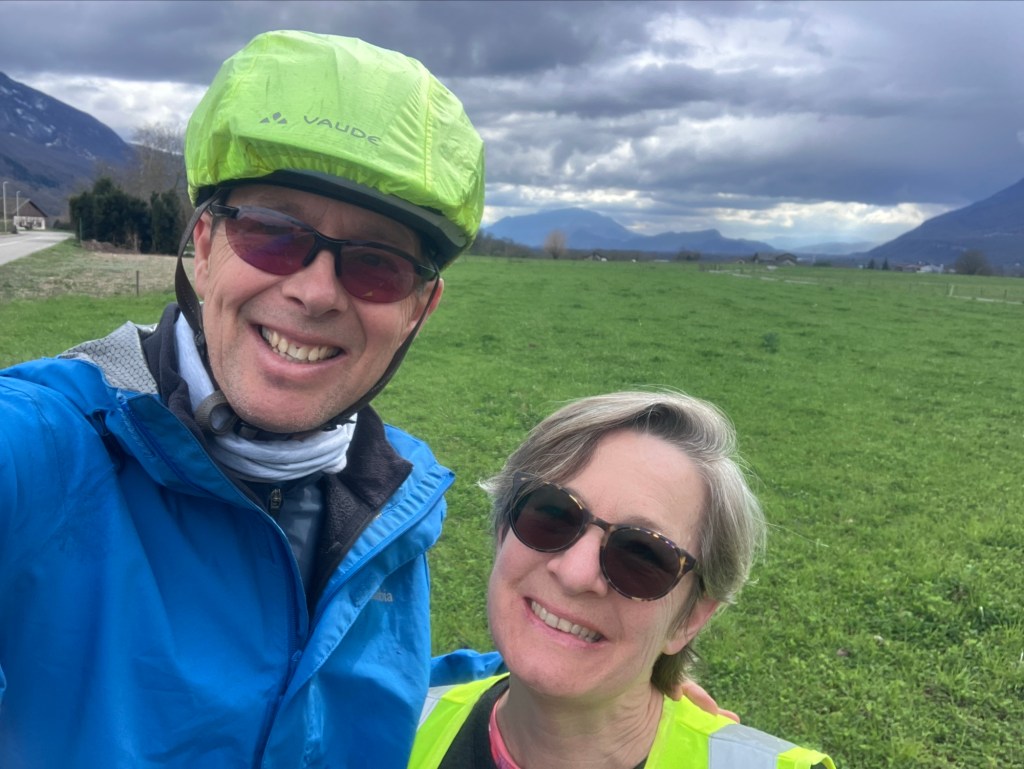
Still smiling in the face of dicey weather.
South of Lyon the route is still undergoing some work and much is labelled “Itinéraire Provisoire”
In some spots even Rich needed to push his bike. Or as the kids call it – hike a bike.

The one stretch we might recommend skipping is between Lyon and Vienne. You can take a local TER train for 30 minutes out of Lyon. The cycle route was mostly on street, with some narrow bike lanes, poor pavement, and quite a bit of diverting around industrial sites, mixed with off street trail riding. We’re not purists who insist on riding every kilometer, and more realistic about having a good (and safe) time, while not suffering TOO much. There will always be enough accidental or incidental suffering on a bike tour, so, if you can skip some known unpleasantness- go for it. That said, it was rideable and ok if you want to do every km of the route.

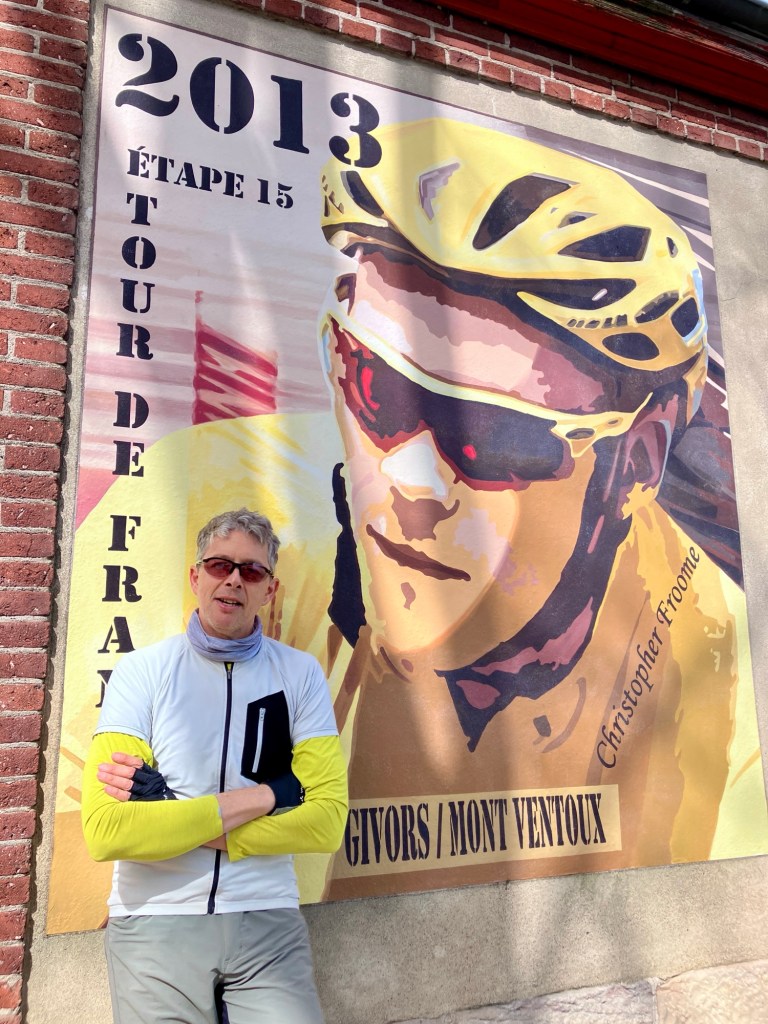
But, this historic bridge across the river at Givors was beautiful. We would have missed that via train.
And missed this! As a long time and avid Tour de France watcher Rich appreciates riding through the historic stages of le Tour.
Chris Fromme from the 2013 Tour.

Our first night after Lyon was in Les Roches-de-Condrieu, at a small hotel called Hotel-Restaurant Le Bellevue. A decent hotel above a fantastic restaurant, as are many in the Logis network of locally owned lodging.

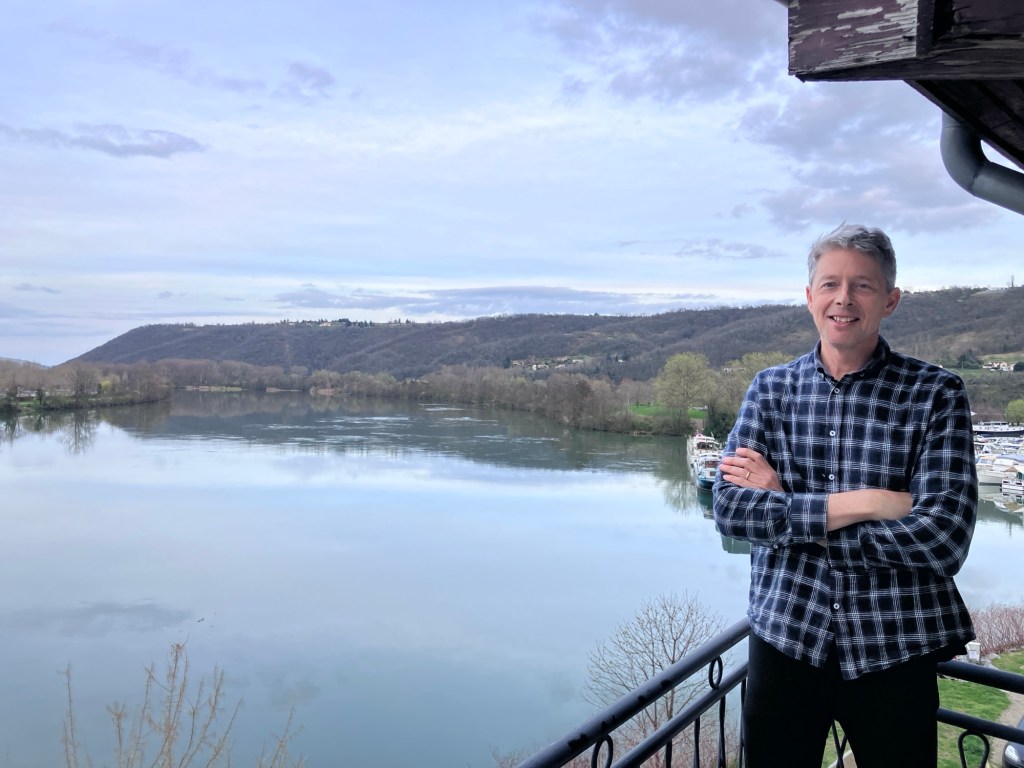
Bare vineyards. We’ve never toured this early in the year.
Another view of the Rhône River from our little balcony (good for drying laundry) at the Bellevue.
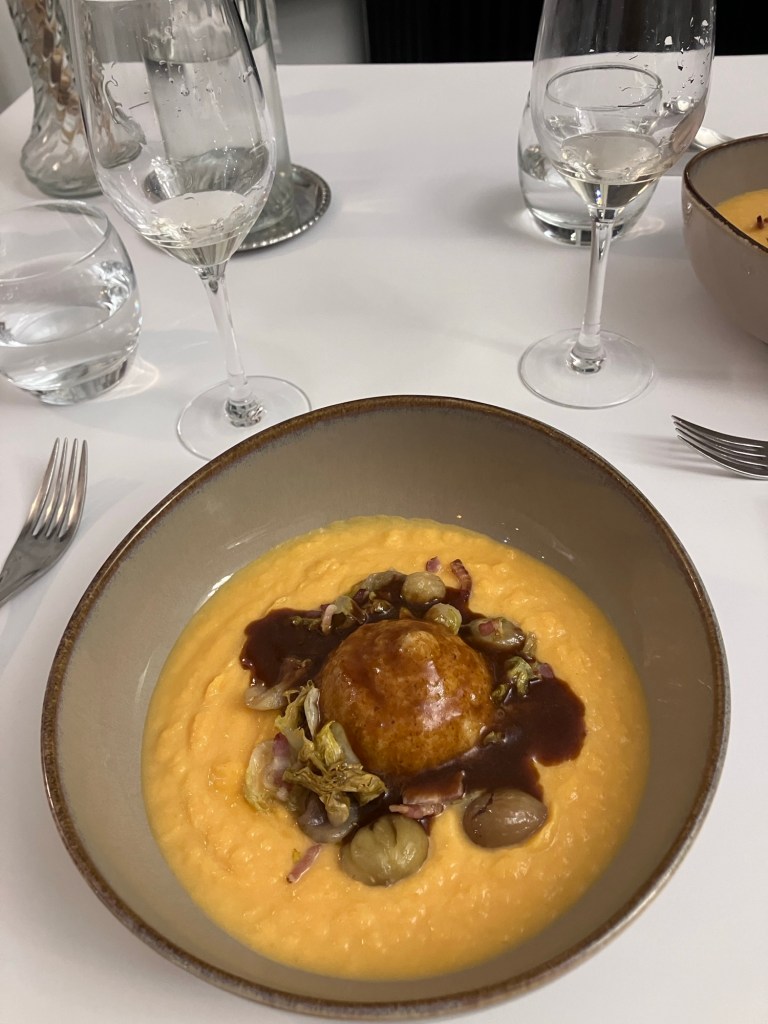
Yup, being those folks who snap photos of their food. Fantastic pumpkin soup.
Didn’t snap a photo of the main, but here’s dessert. My Black Forest inspired cake and Rich’s artistic layered confection avec use crème glace

Usually we seek out something casual and simple for dinner, after a hotel breakfast buffet and a picnic lunch. But, when in a small town with not many close by options we sometimes choose the hotel restaurant; especially in France. I am always impressed and grateful with the way the French approach food. Even in a restaurant like this, which I would consider fancy and upscale, the service is lovely and straightforward. No attitude, no showy or flashy flourishes, just good service and delicious food.

Well fed and riding along the river, day two past Lyon.
Rest stop in Chevany. Still chilly.
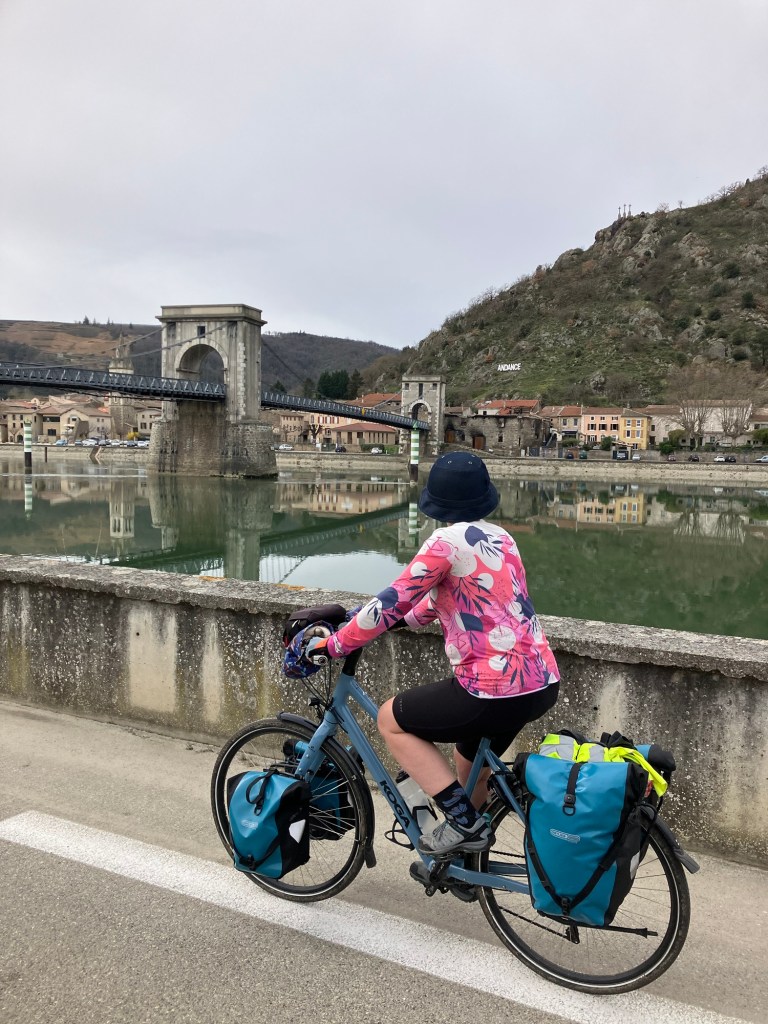
Andancette. We’re riding along the borders of the Drôme and the Ardèche regions. It’s warming up. Jackets off.
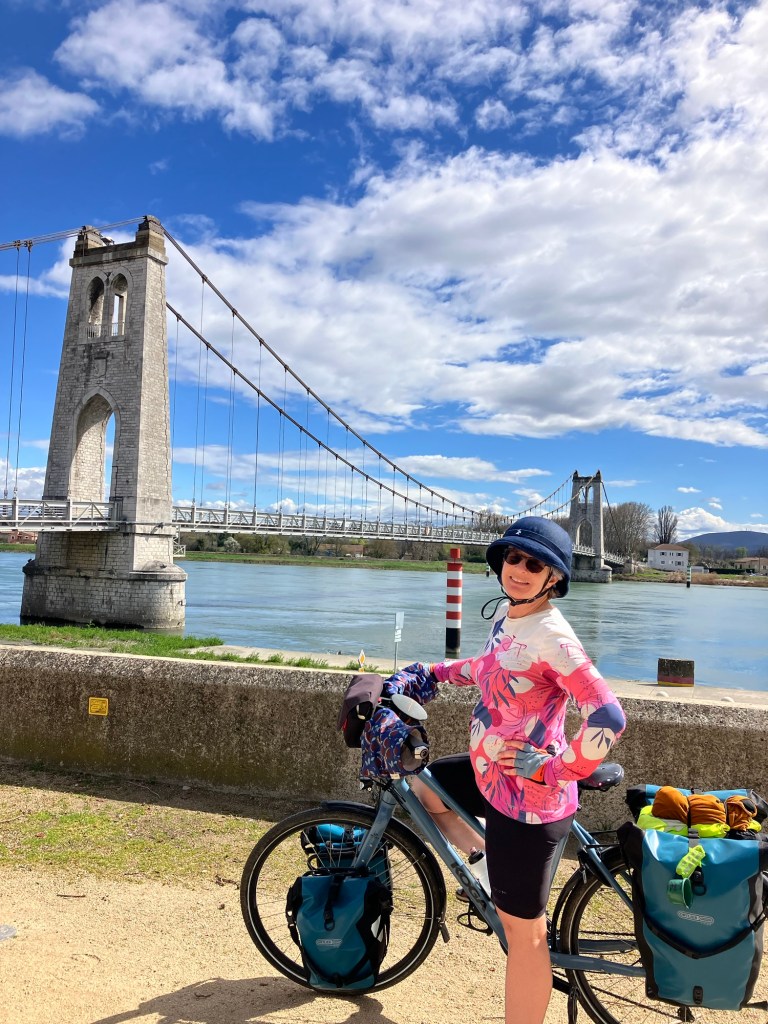
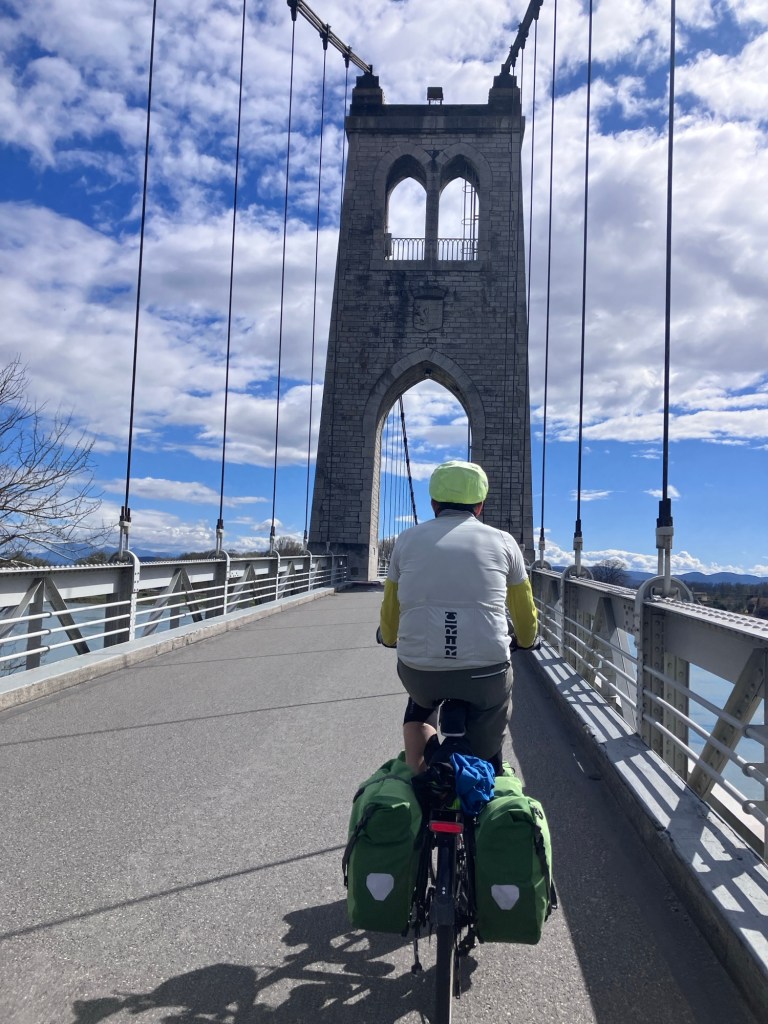
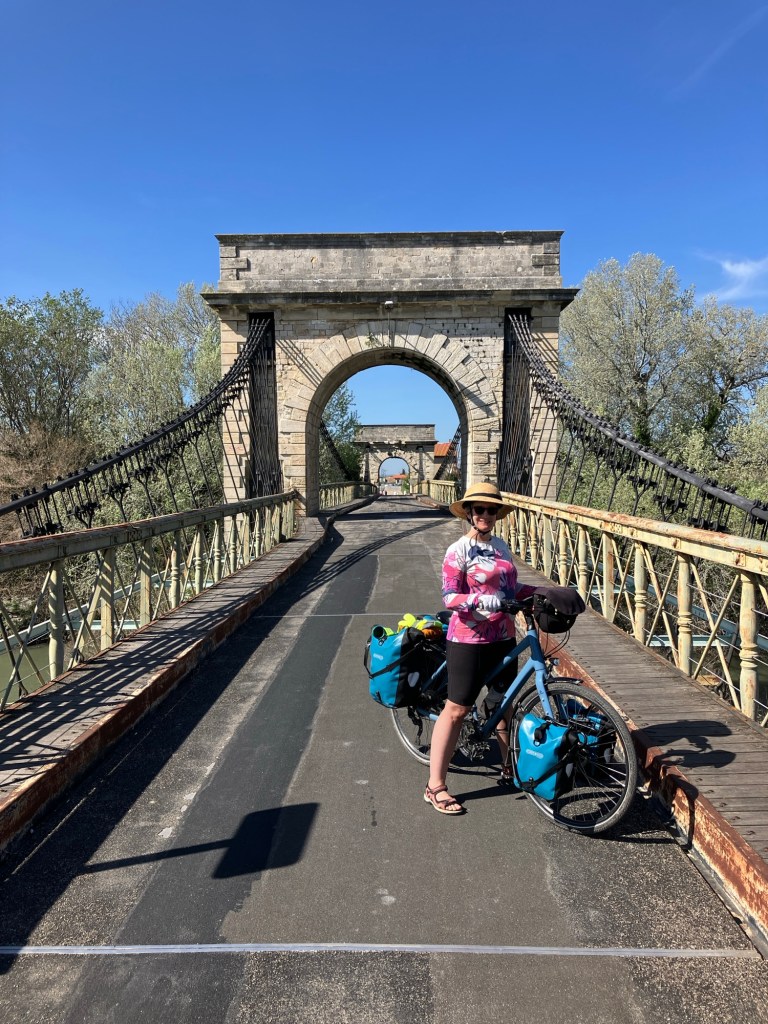
If cool old bridges are your thing, the Rhône is a great river to ride. Many of the suspension bridges date back to the 1880s
Tournon-sur-Rhône where the Passerelle Marc-Seguin is a pedestrian and bike only bridge.
Even when exhausted it’s great to go for a walk after dinner.
Leaving our bike friendly Gite Le Pied Du Géant in Tournon sur Rhône. And a strong tailwind is finally blowing!
Monday morning on the bikes on the Rhône. Such an amazing experience and much more fun than Monday morning staff meetings.
Dramatic view from Valence of the Ardeche mountains. We went into town to get lunch supplies.
The route crosses the river quite often.
Which means you get to ride across these stunning bridges.
Stopping on a bridge for a photo is not always an option, but we got one.

Montélimar was night 3 past Lyon, and as we headed there we had peek a boo views with Mont Ventoux all day. Mont Ventoux is the stuff of Tour legends, and its white top can be mistaken for snow when it’s only its bare limestone 1,910 m (6,266 ft) elevation.

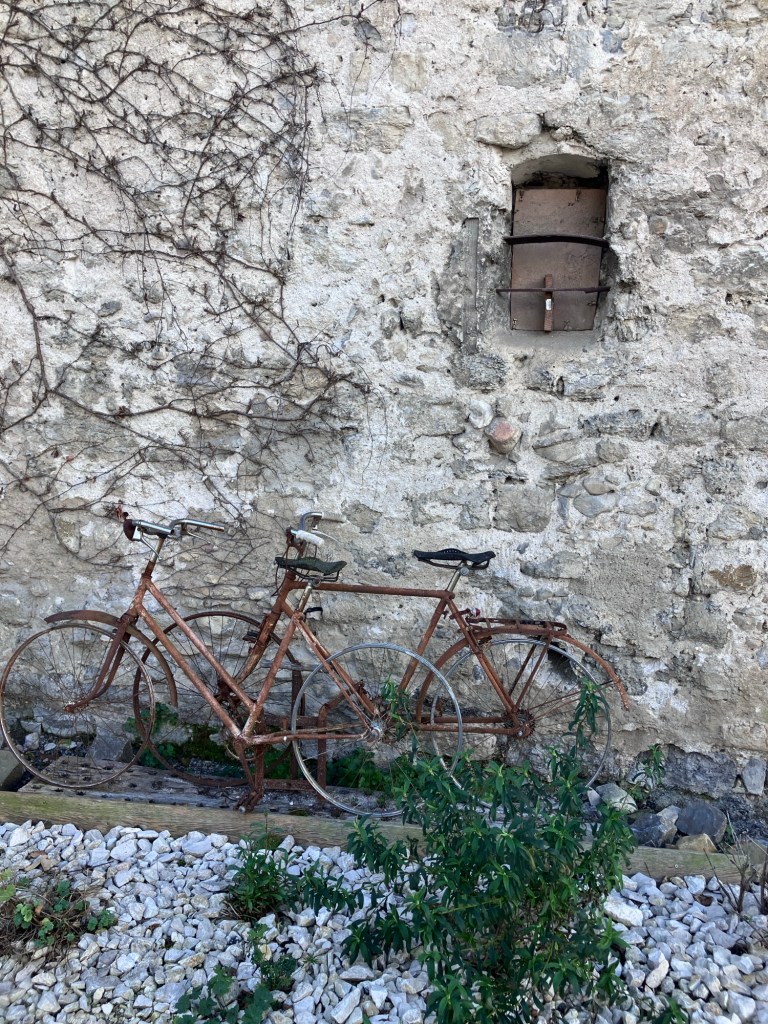
Mount Ventoux.
Bicycle themed decor along the route is always appreciated.
Lavender fields not yet blooming and blue shutters. Still beautiful.
Riding by Avignon. We crossed the river and went right by.
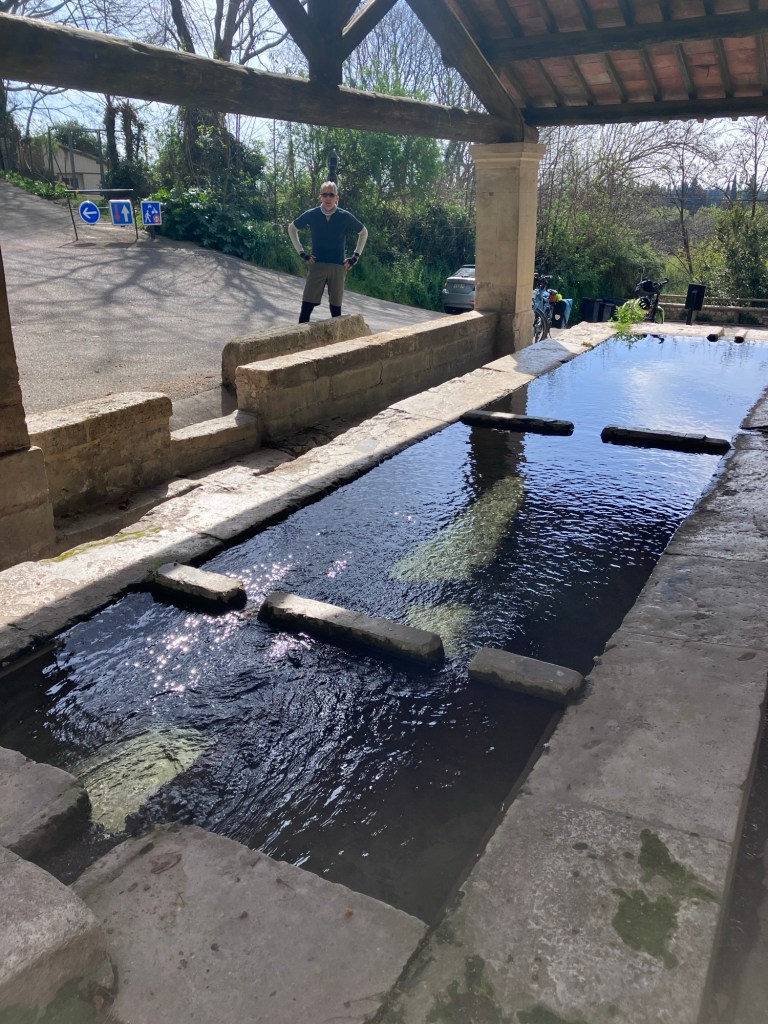
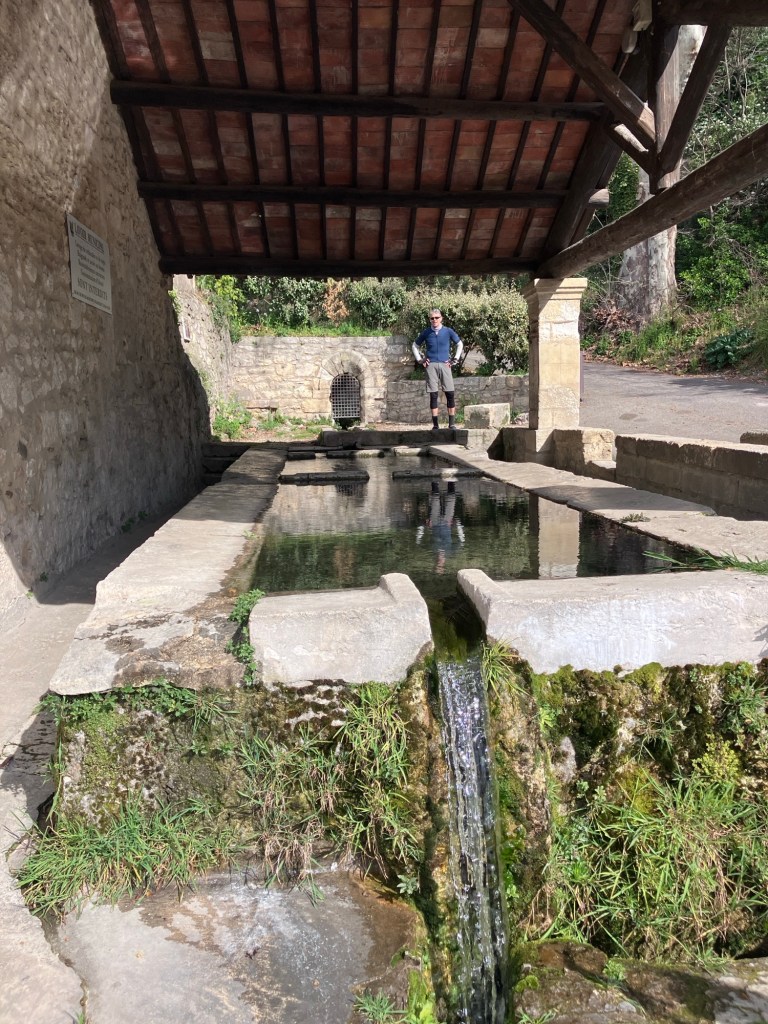
We did stop to admire this ancient communal laundry. I’m always fascinated by these.
The spring coming out of the hill.
A constant source of water.
Riding towards Théziers, we’re in the Occitanie region. It feels very Mediterranean.
Riding by Montfrin. We ride by a lot of beautiful villages. If we stopped at all of them we’d never get anywhere.

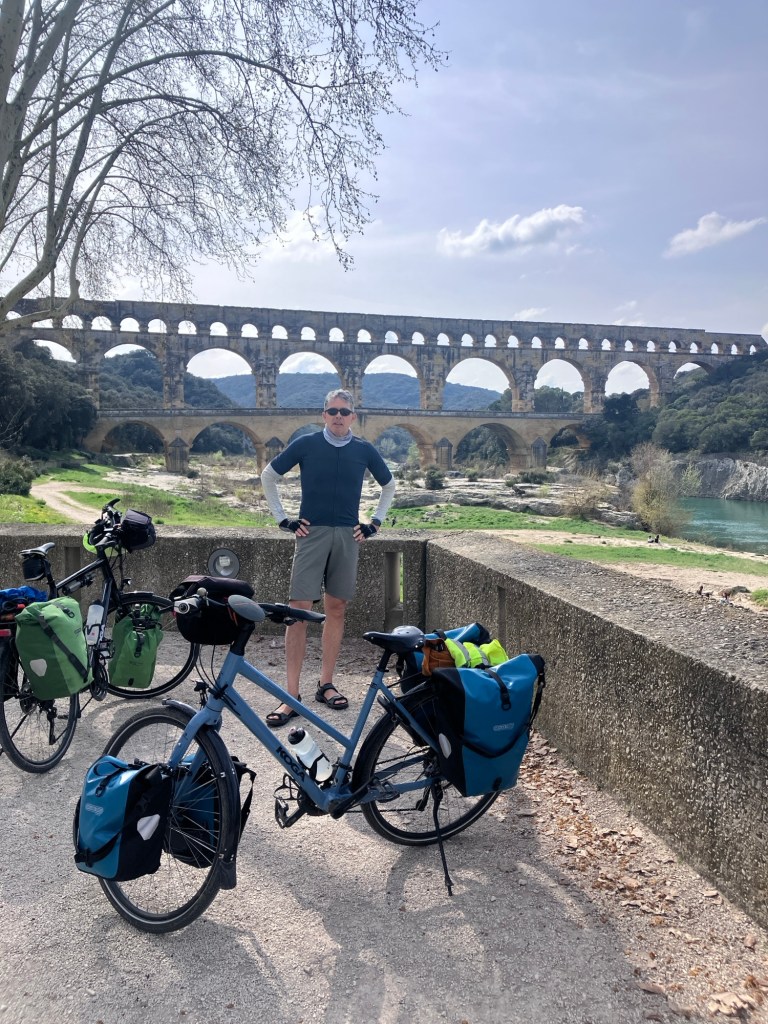
At this point we veered off the Rhone and EuroVelo 17 to visit a famous Roman aqueduct, the Pont du Gard, and spend two nights in Uzés for a rest. Regional routes V66 and V60 take you to the Pont du Gard and Uzes mostly on a beautiful route and rail-trail.
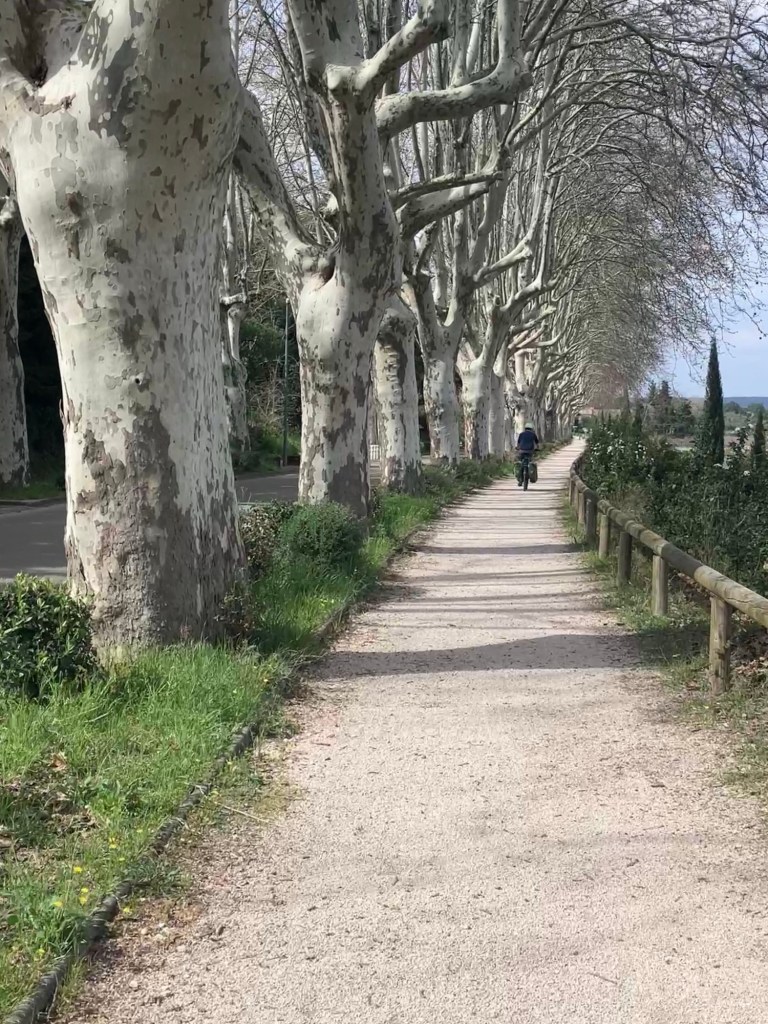
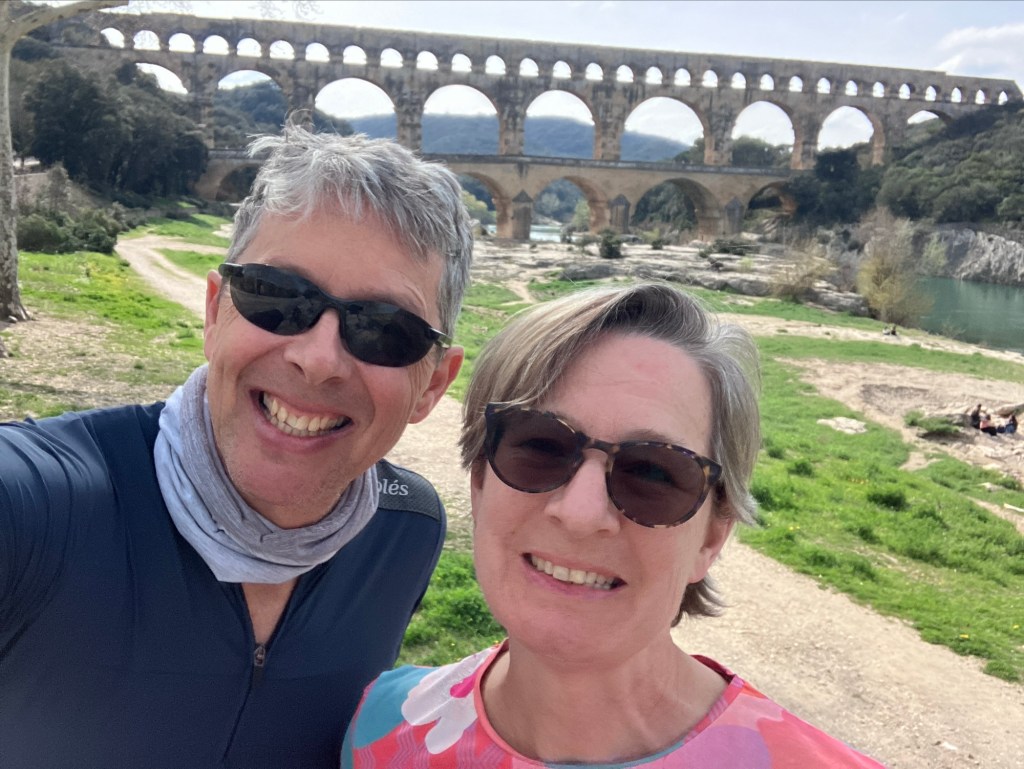
Remoulins, and an Allée of Plane trees. Getting close to the Pont du Gard.
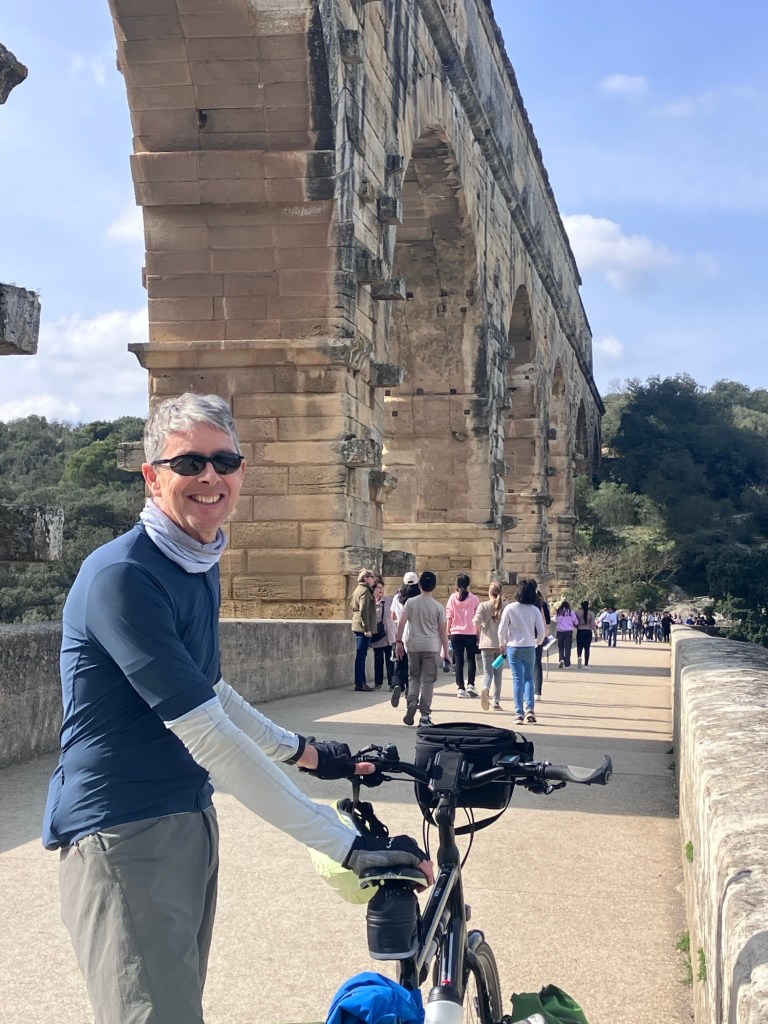
No self respecting civil engineer could pass up the opportunity to visit this marvel built in the first century AD.
In the summer folks canoe under the aqueduct in the Gardon River.
We followed the rules and walked our bikes across.

Our two night stay in Uzés was very relaxing. We cooked in one night, walked the small and fancy old town by daylight and night, visited the cathedral, and walked by the Gardon River below town.

My street at night, this black cat seems to think.
It’s a beautiful old town, very fixed up.
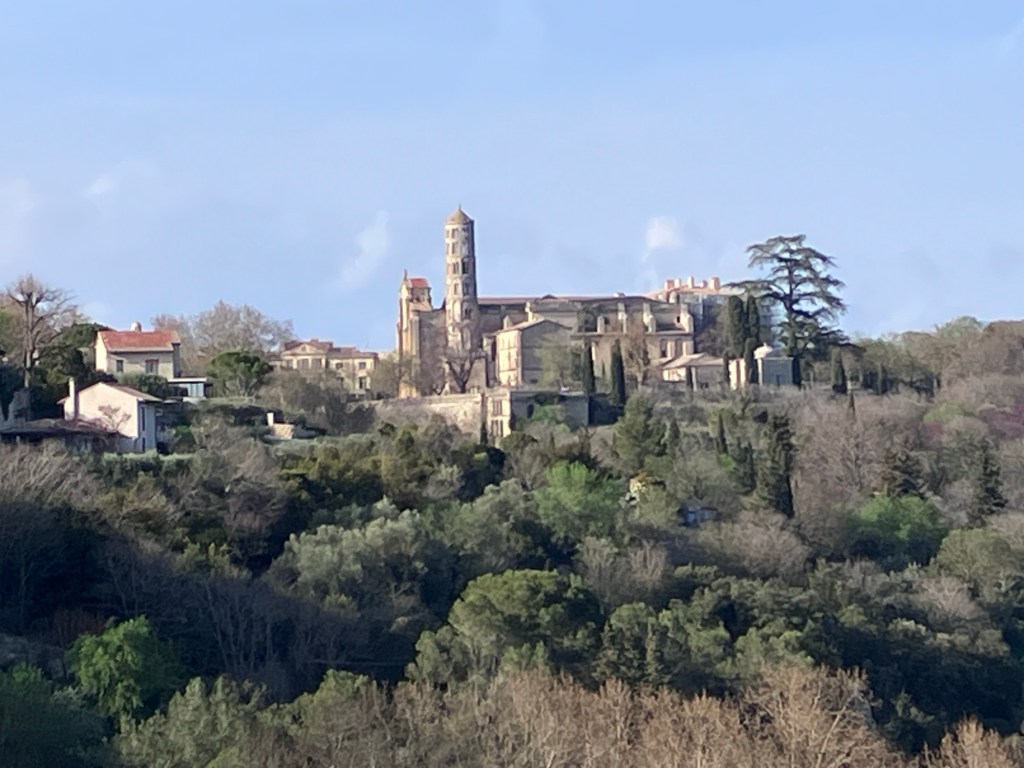
At the cathedral, a campanile, the Tour Fenestrelle.
A view from our walk out of town. Gotta keep the legs used to hiking.
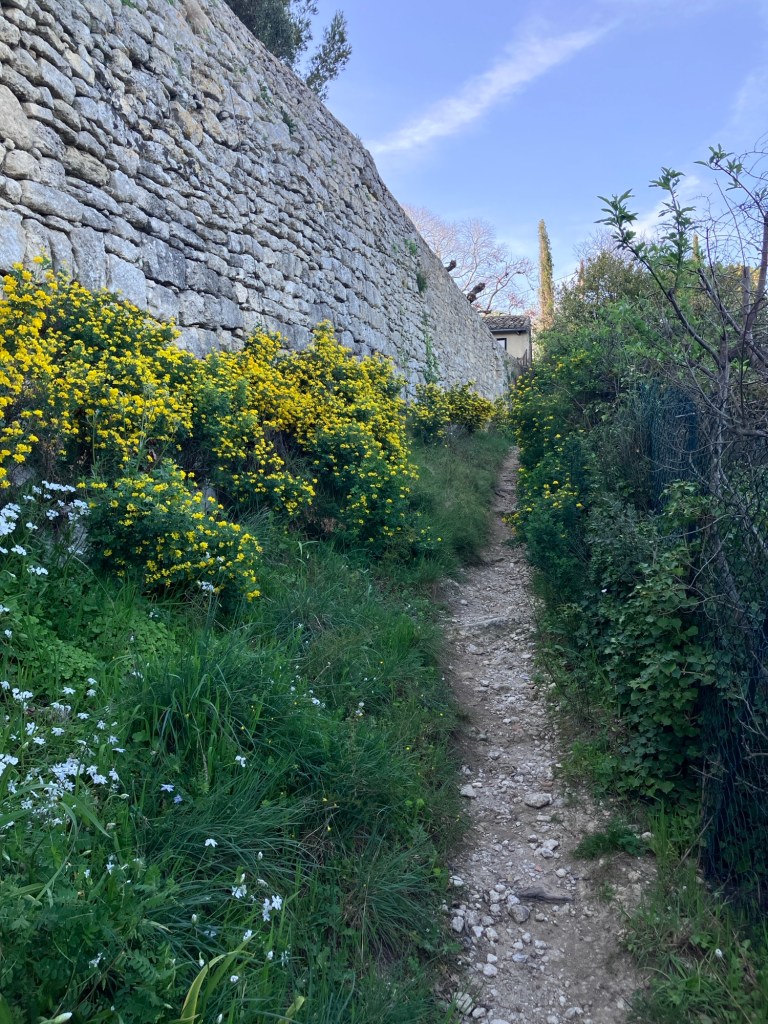
Pathways wind around outside the city walls.
Loaded up in the courtyard of our apartment.
Sometimes staying in old town with touring bikes is a pain. But this ground floor flat worked out perfectly and was beautifully restored.

We rode back down to the Rhône and rejoined EV17 through the Tunnel voie verte Beaucaire. It really felt like a change of climate and zones, as if once through that fairly short tunnel we were in a drier much more Mediterranean climate.
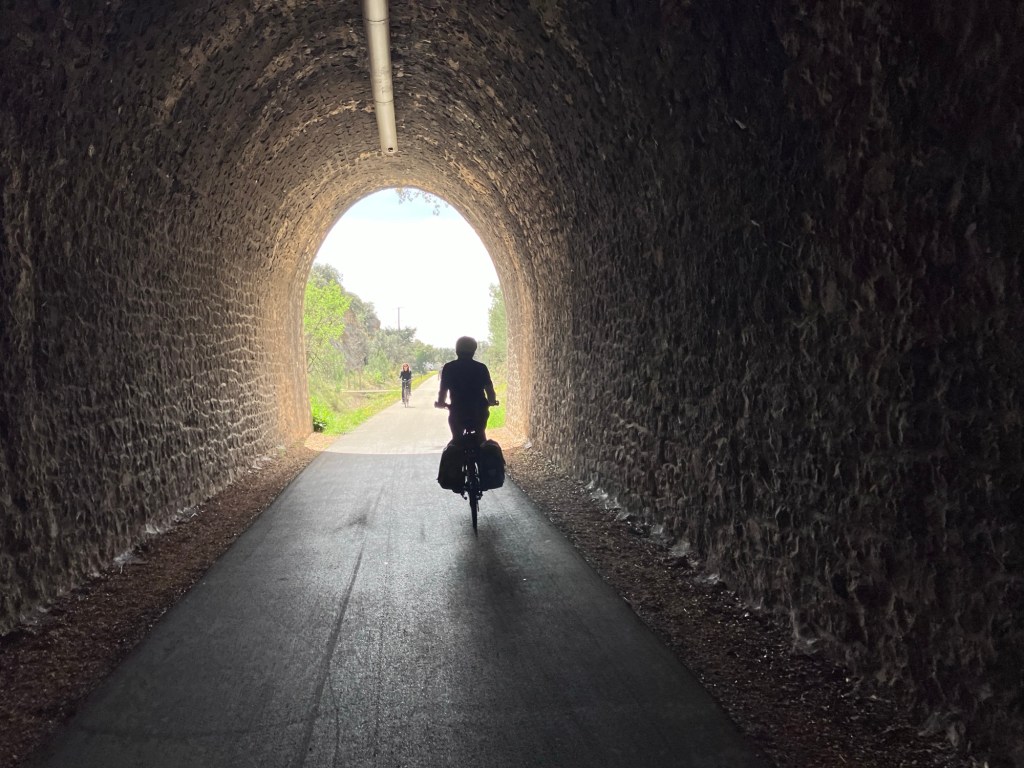
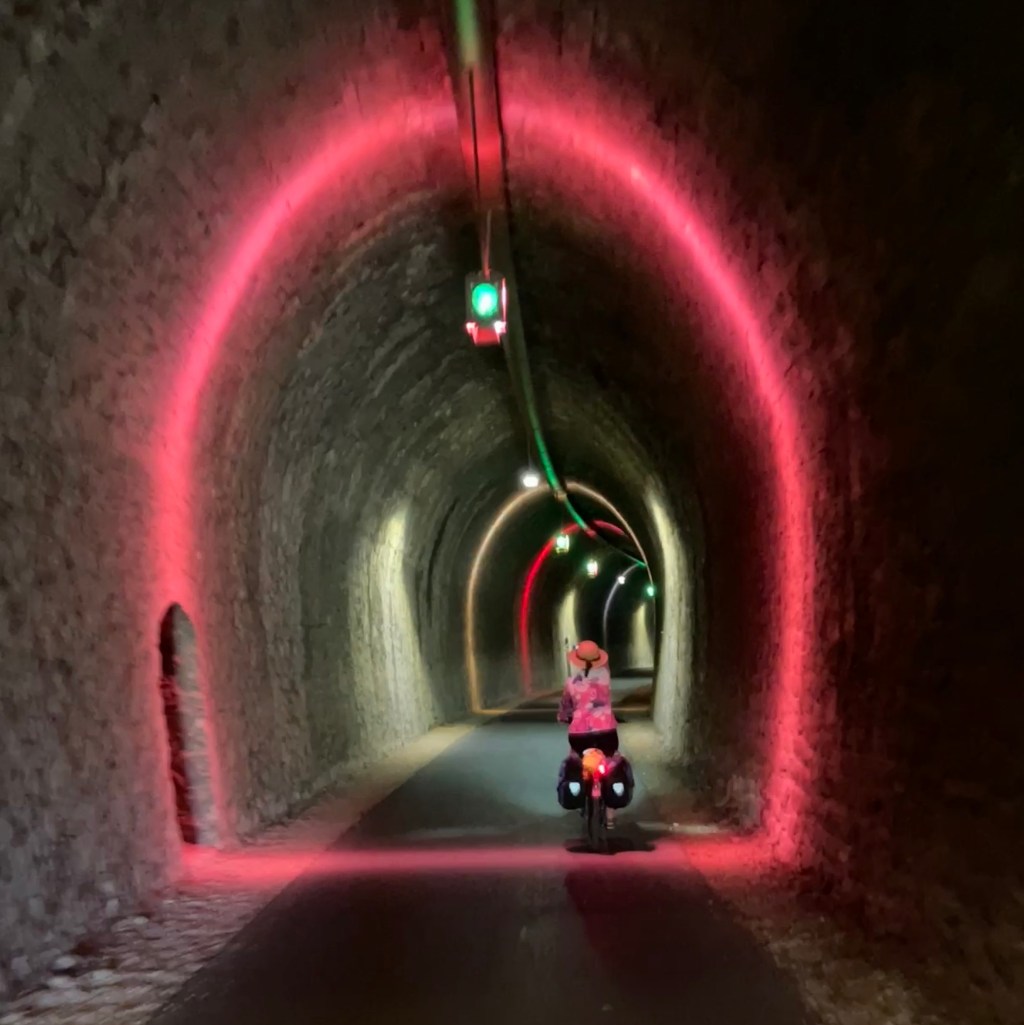
Tunnel voie verte Beaucaire.
Dramatic lighting inside the tunnel.
Sunshine? Time for my wide brimmed helmet hat!
Cactus as landscaping.
Another fun and car-free bridge.

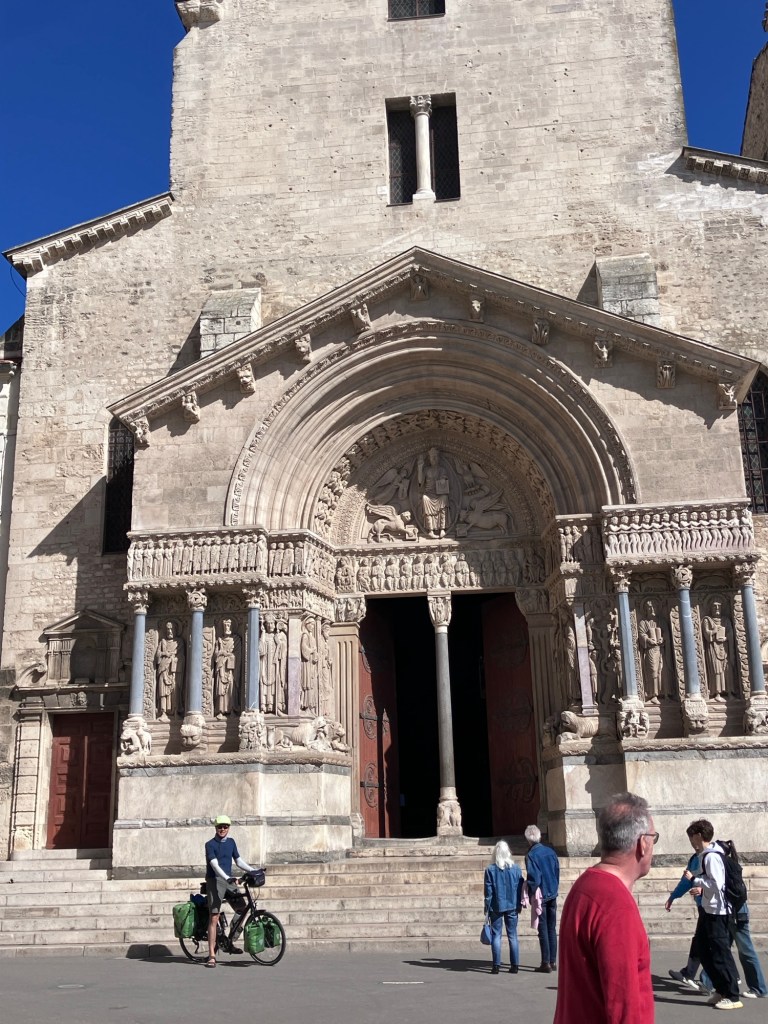
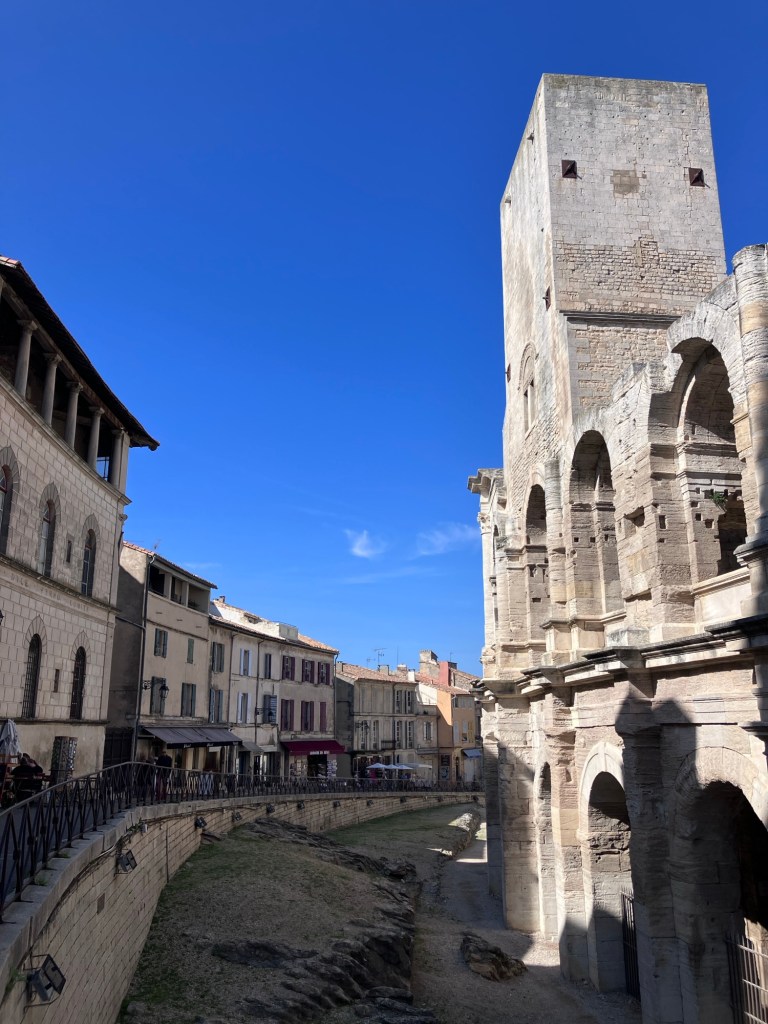
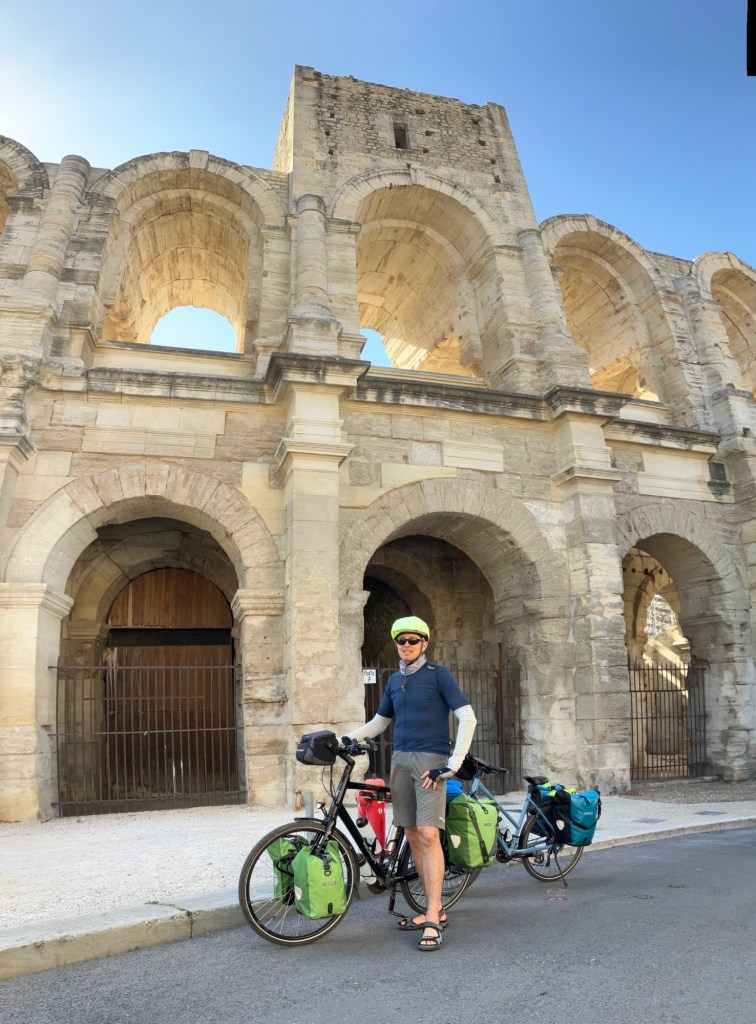
Our next stopover was Arles. Famous for its association with Van Gogh and a stunning Roman amphitheater and coliseum, and visited by many tourists every year. Rich had booked us a hotel out of old town – much easier with loaded touring bikes – and since we assumed that once at our hotel we might not have the energy and enthusiasm to walk back into old town, we did a bike through visit. During a busier season I would not recommend visiting old towns with big loaded bikes but Arles was pretty quiet on this Friday afternoon in late March. So we biked around and admired town and the sights for a few hours before heading to our hotel.

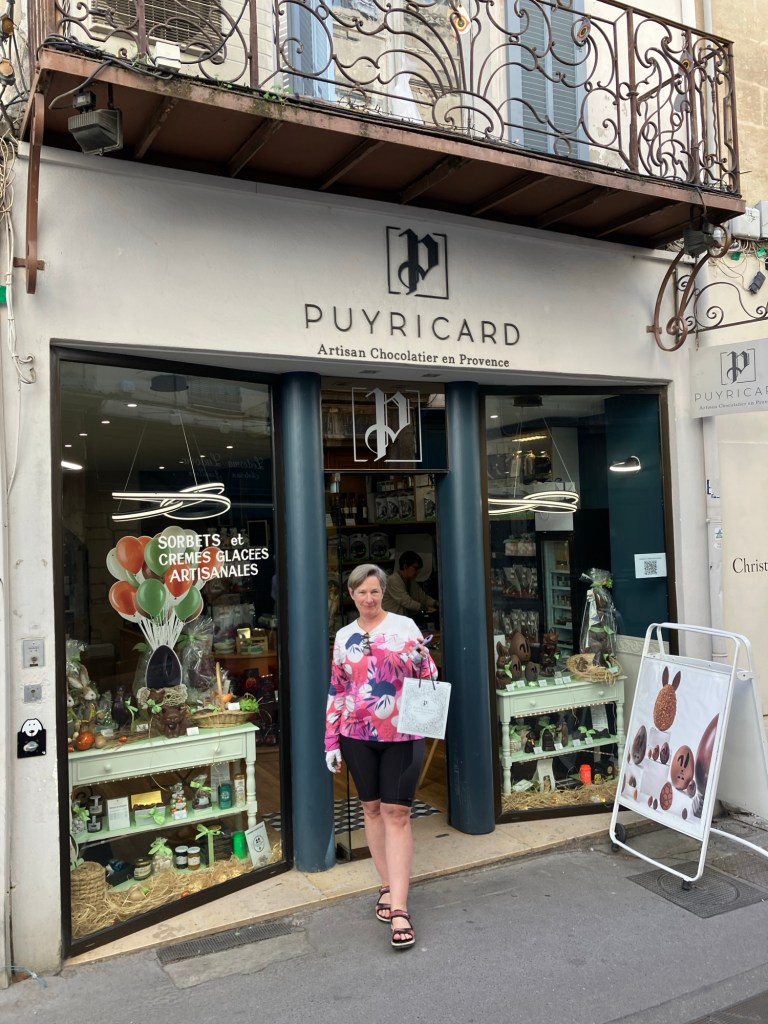
What? This is a sight.
Easter chocolate acquired. On to the famous sights.
Arles Hotel del Ville.
I love how the coliseum is right in the center of town. And, how folks had built homes inside the walls at one point.
“The clearing and restoration of the Roman monuments started in August 1822. This major decision taken by the city council was to remain a main objective for 100 years. This meant the compulsory purchase of the houses built, both inside the building and onto the façade, then their demolition.”
Our bikes take us everywhere.
It’s easy to explore by bike. Dead end? No problem.

After Arles we had one more night before reaching the Mediterranean, in Aigues-Mortes. Unfortunately, Rich was developing a nasty cold, complete with a hacking cough and burning sinuses. And, to make the final part of the ViaRhôna even more painful – the headwind gods decided to pay us a sustained visit.
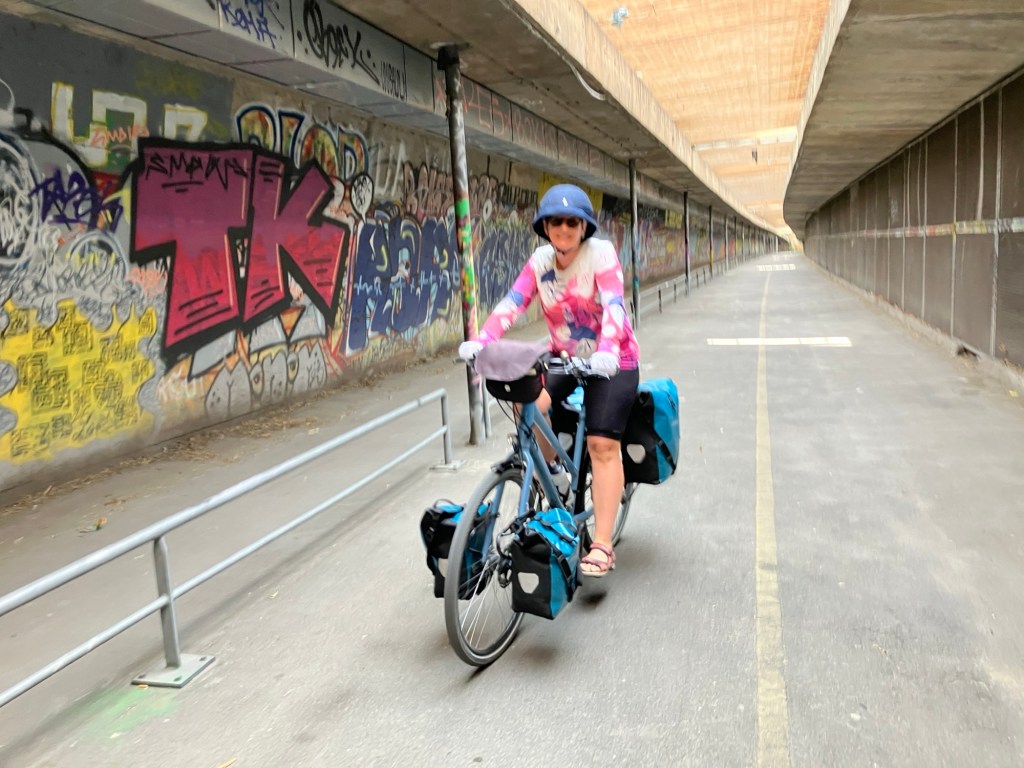
The most unusual bridge over the Rhône. It was bike and pedestrian only and obviously a favorite of local taggers.
Homage to the black bulls of Carmague.

So, filing this under you never know what you don’t know: France still has bullfighting. The arena in Arles hosts bullfights in the summer. I shouldn’t be surprised that this activity traditionally exists in France as well as Spain, what’s a border, really. France has a law protecting bullfighting as a long standing cultural tradition. From what I can find online it seems that the bulls are no longer killed. So there’s that.
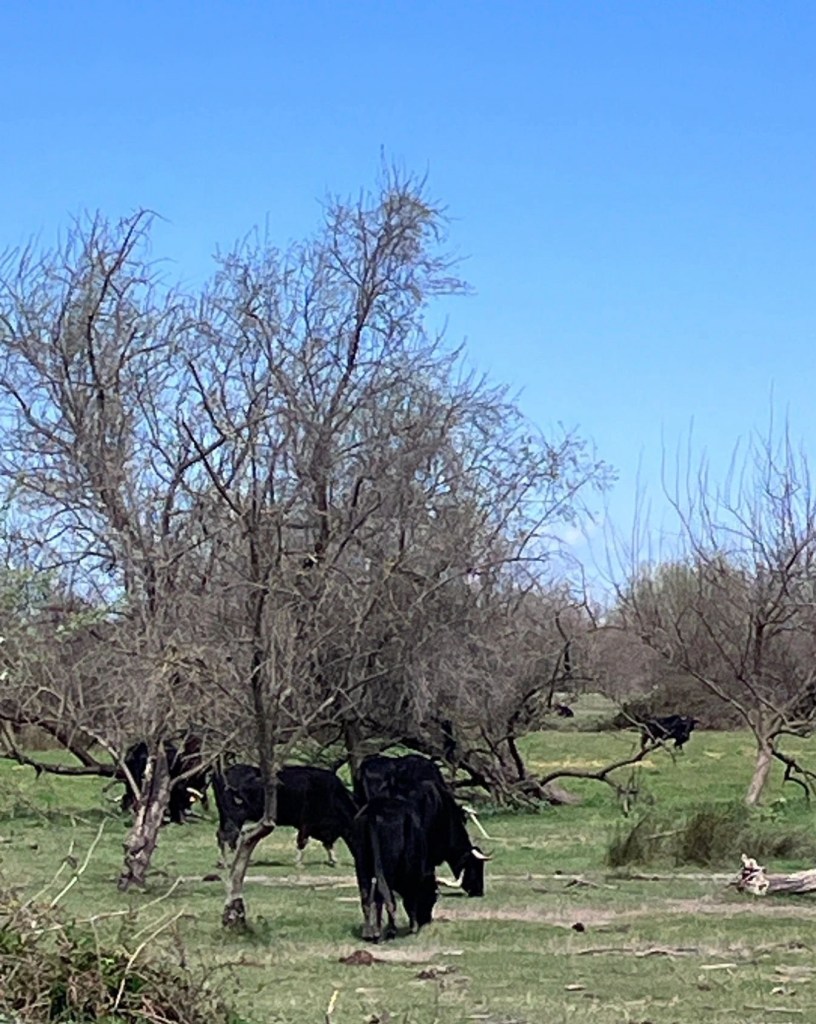
Black Carmague cows, or steer, or maybe young bulls?
The white horses of the Carmague are semi feral and we did see some roaming ones. This one is behind fences.
This stretch of the route is very poorly benched and exposed. Nowhere for tired bike tourists to sit and have lunch. So, a rather unsatisfying stand up snack.
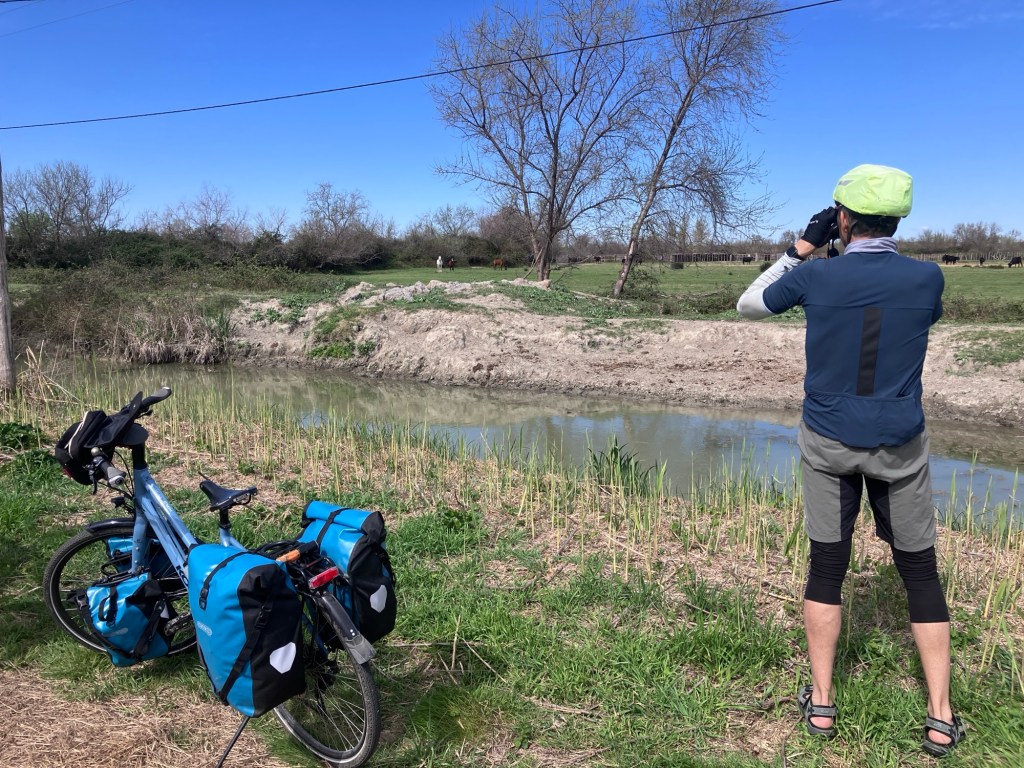
A stop for birdwatching.
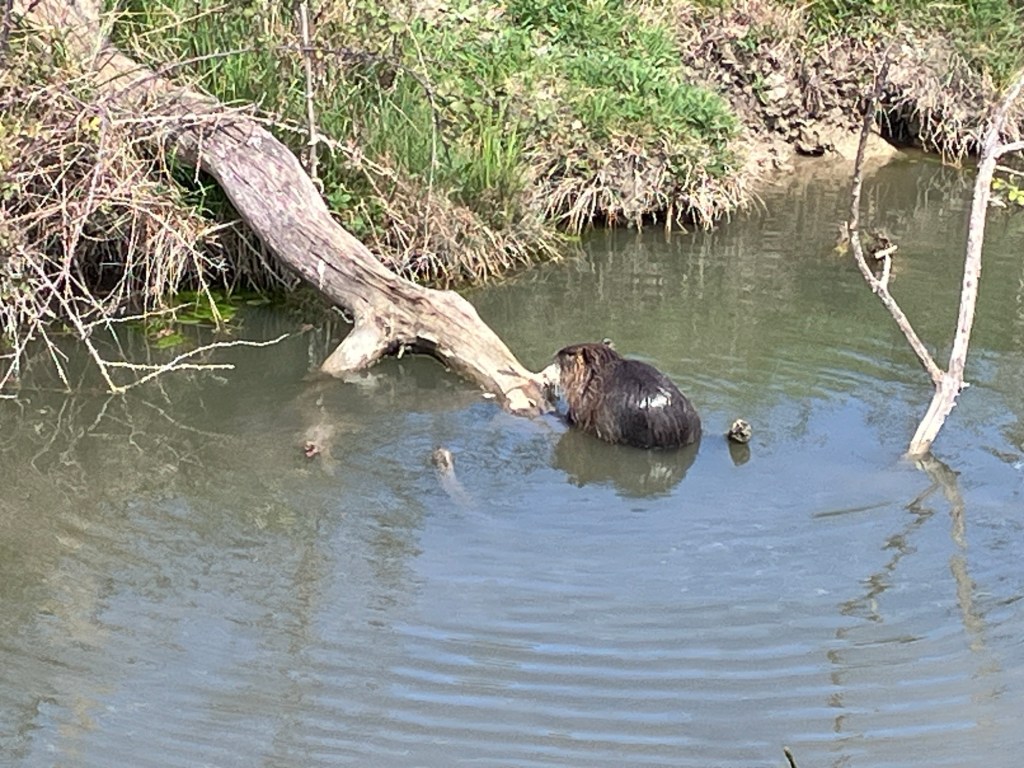
Muskrat being quite adorable.
Flat. Marshy. Very windy. Water on both sides. Beautiful but not a super fun ride on this windy day.
Heading into Aigues-Mortes for dinner. It’s a fascinating old city, but we were tired, Rich was sick, so we only did a quick walk around before and after dinner.
Aigues-Mortes is an old walled city with fortifications dating to the 13th century.

Rich didn’t get much to time to rest up, as we could have stayed two nights at Aigues-Mortes but the hotel was a bit overpriced and we knew that after the headwind a rainstorm was coming so we wanted to press on to Montpellier and spend two nights there. So, out into the wind it was. Oh, and the train spur to Nimes from here was not running due to work.
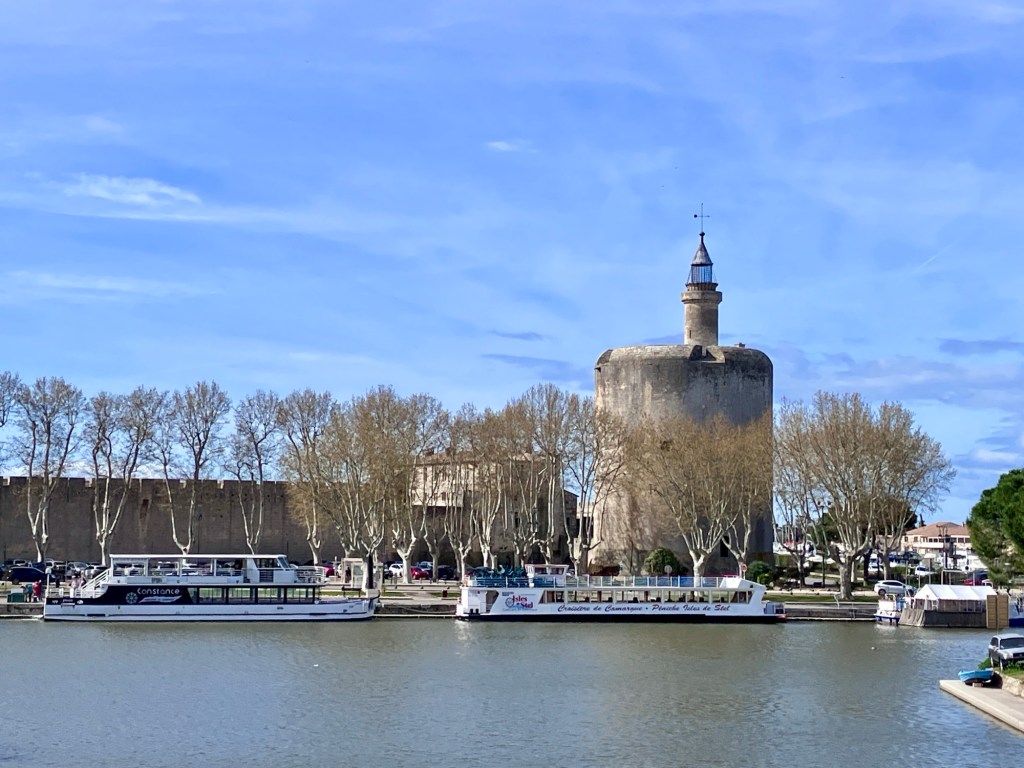
Aigues-Mortes by day. It’s on the Canal du Rhône à Sête.
La Baleine sea salt production. Those are salt piles behind Rich.
Greater Flamingos. We didn’t think we’d see them on this trip as they mostly stay further east in the Carmague. Head down into the wind I’m pedaling along and glance right…hit the brakes! Flamingos!
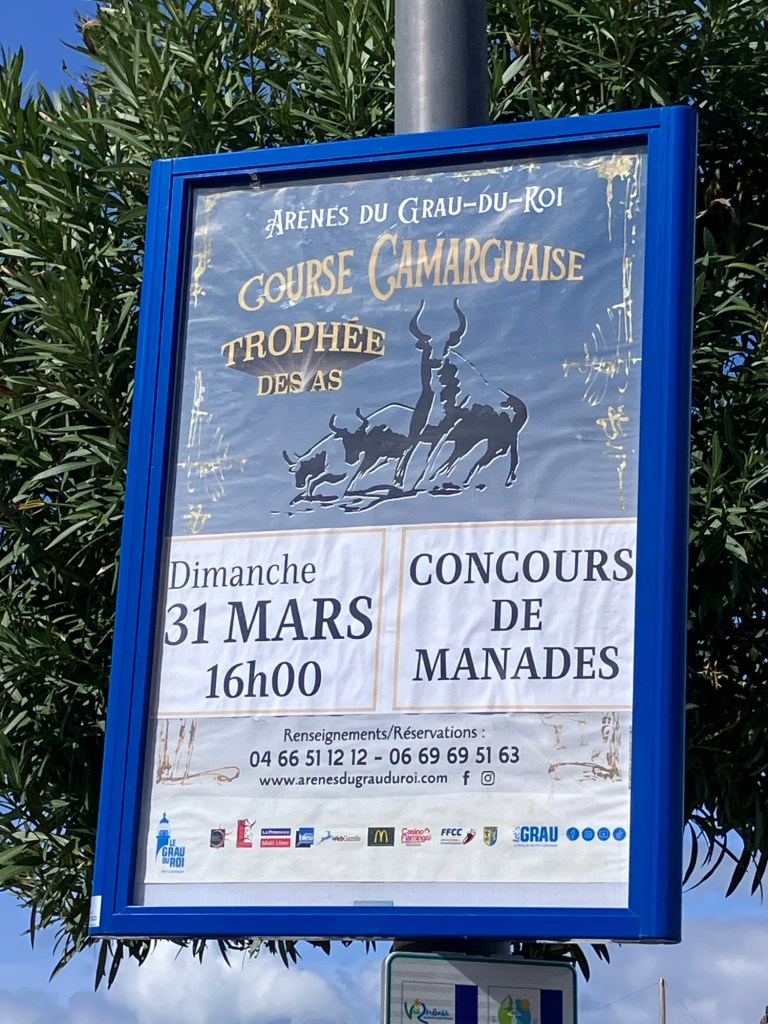
Bull fight poster at Grau-Du-Roi.
The arena where the bull fight will be.
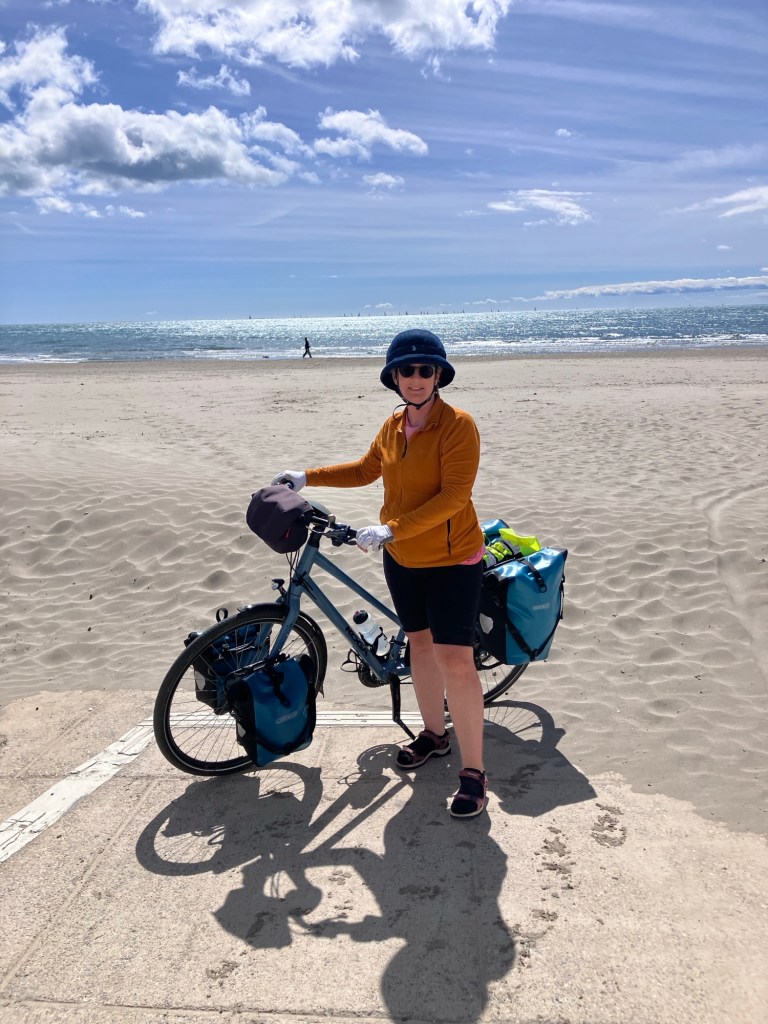
And finally, the Mediterranean Sea. It’s hard to capture how windy it was this day. The sand was blowing and we had to be careful to not let our bikes get knocked over when we parked them.
Hold on tight to that bike and smile! Ignore the head cold that is coming for you too.
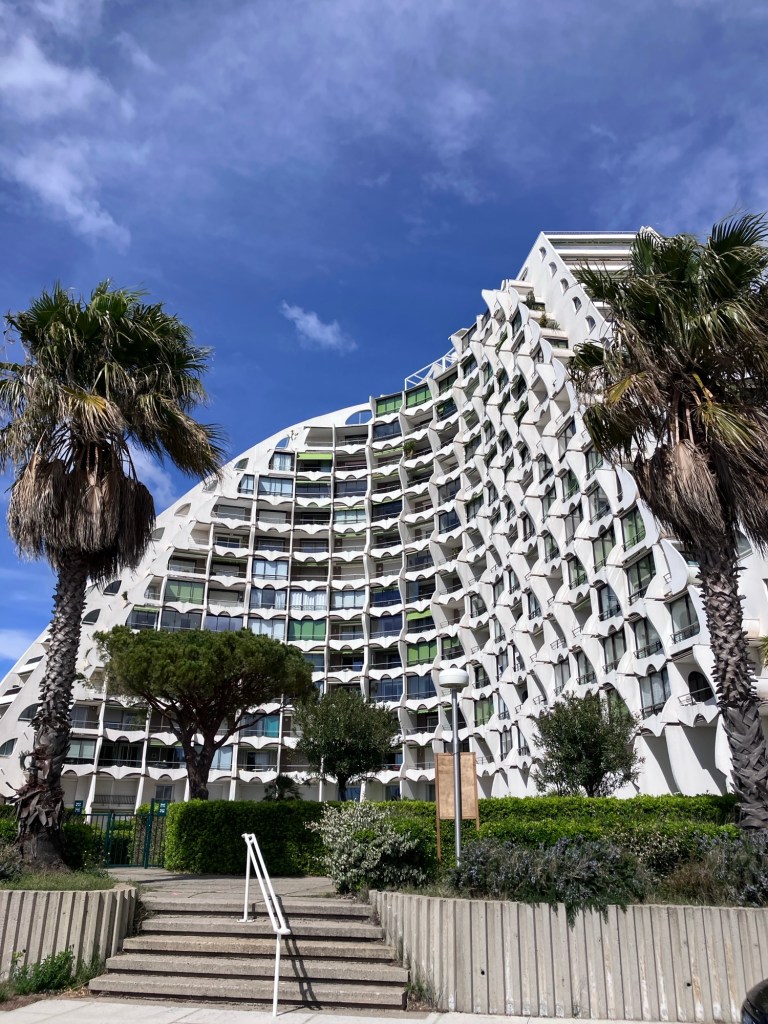
Across the sand dunes is La Grande-Motte, a seaside resort and port built in the 1960s and 70s with a unique pyramid architecture style.
La Grande-Motte.
Happy that we will soon turn inland towards Montpellier for a rest day.

With the Via Rhôna complete, and two more months of bicycle touring ahead of us – what do we think of the Via Rhôna? I enjoyed it, the river isn’t as wild or beautifully stunning as parts of the Loire, nor is the route as complete. Parts are definitely still under development. But, with a route passing through so many municipalities there must be so much negotiating and planning behind it. Certain areas were so well marked with fantastic new protected lanes and intersections, loads of benches and rest areas for weary cyclists, and other stretches had almost nothing beyond an occasional sign.
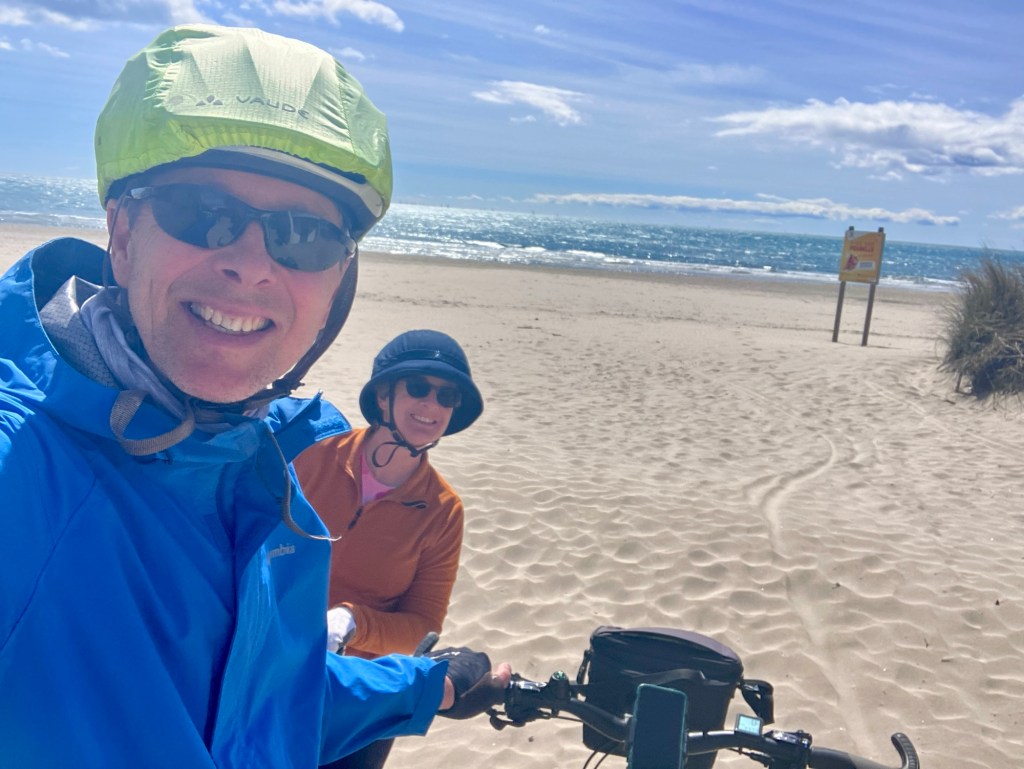
The happy travelers ready to pedal inland, get over our colds, and out of the wind.

I think the Carmague is a place I’d like to return to with a car. Apparently the mosquitos get thick during the summer and then you wish for wind, but the bird watching is fantastic. As we were pushing along into the wind I did slightly envy the visitors in cars, but I know, that as always, we have a more up close experience from the seats of our bikes.
Well that was a transition. From Malaysia to bicycle touring in France.

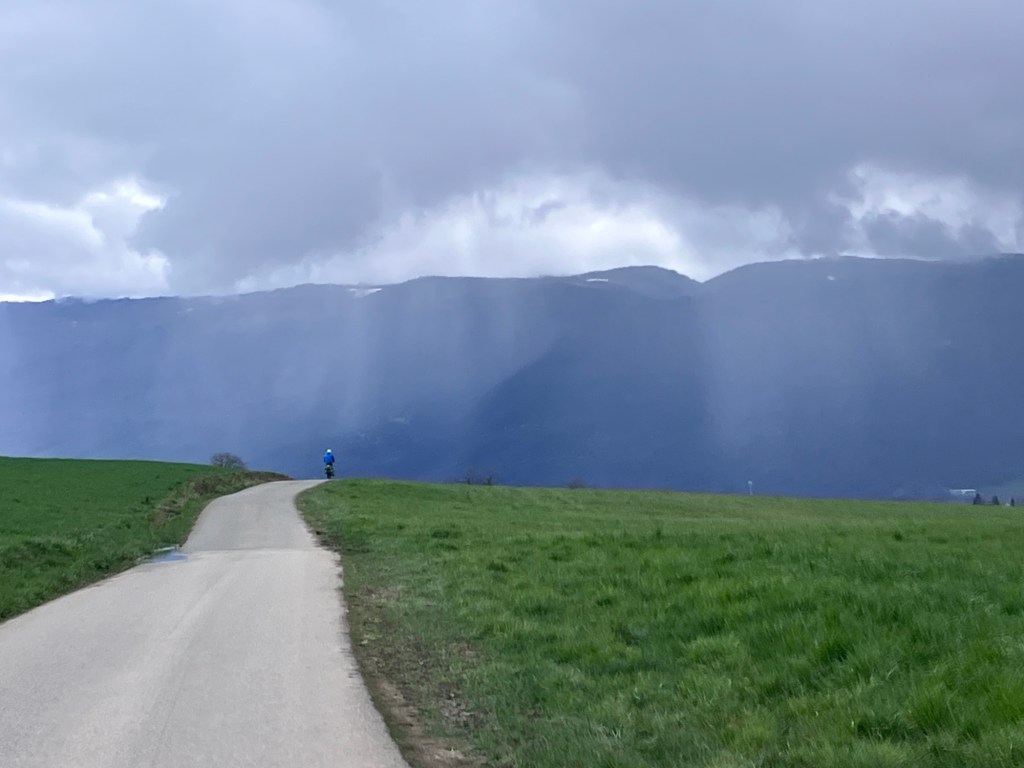
That’s a little tiny Rich, headed into a rain and hail storm along the Via Rhôna.

Be careful what you wish for. How many times in Borneo and Kuala Lumpur did I wish for cooler weather? We swore to each other we wouldn’t complain about any cold weather when we reached France and were reunited with our touring bicycles.

What does the transition look like? It looks like this at first.
And like this. The sorting and decision making.
But we get to this. Loaded and ready to ride downhill in the cold. Wearing all our cold weather gear day one.
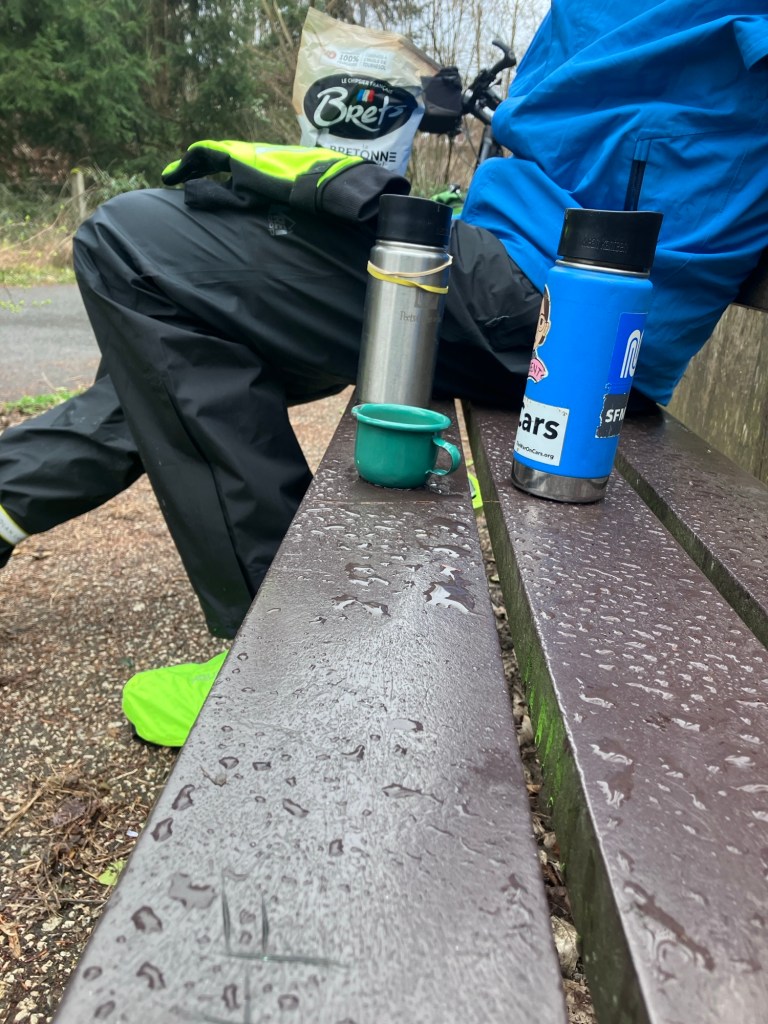
Rain trousers not only keep you dry, but make sitting down anywhere super easy. Wet bench? Who cares.
Follow the Via Rhôna signs for 815 kilometers.

I would love to report that we kept to that promise to not complain about the cold, but we did not. I would also love to say it was easy once we rolled out on two bikes with four panniers each. It was fantastic but not easy. It took some getting used to.

The bare trees and grey skies make dramatic landscapes.
Tabac stop for chocolate milk. A good riding snack and the only place open Sunday afternoon!
Sheltering from hail in a farmer’s yard.
The Via Rhôna is well signed.
The most adorable trail signage ever?
After a morning ride through Switzerland, back to France. Borders still resonate with us, especially when crossed by bike.
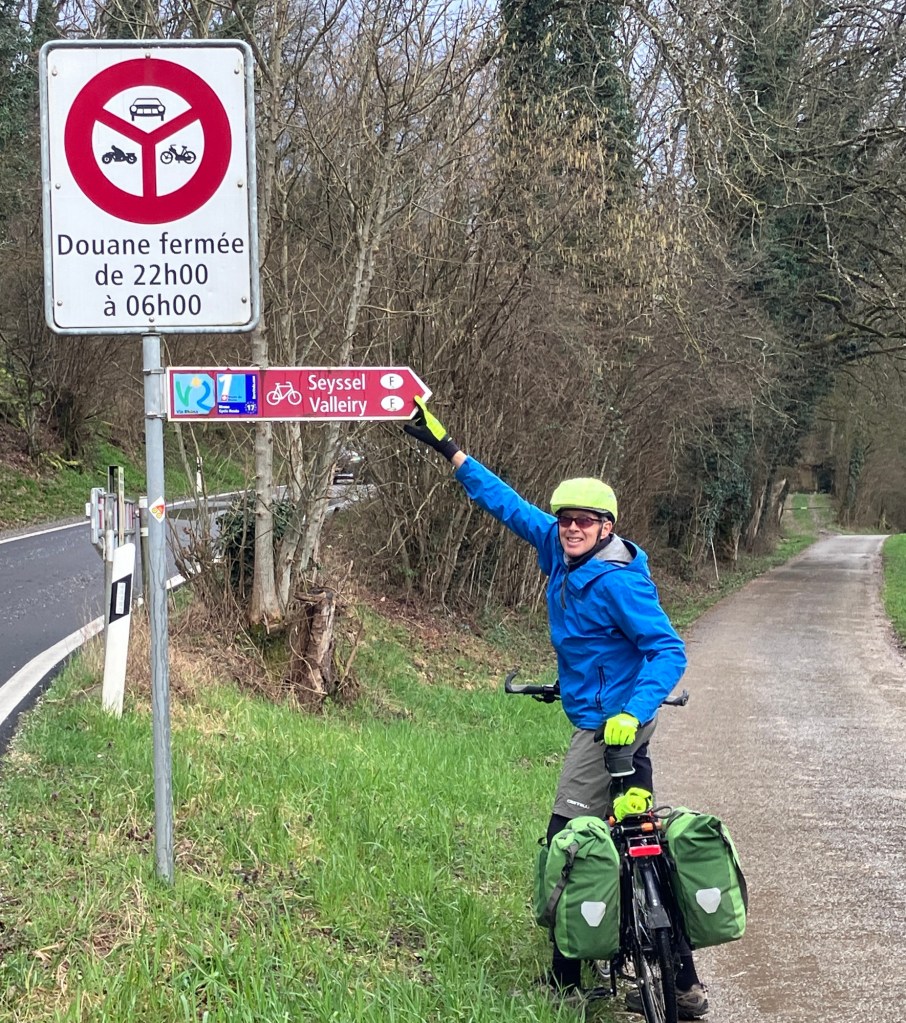
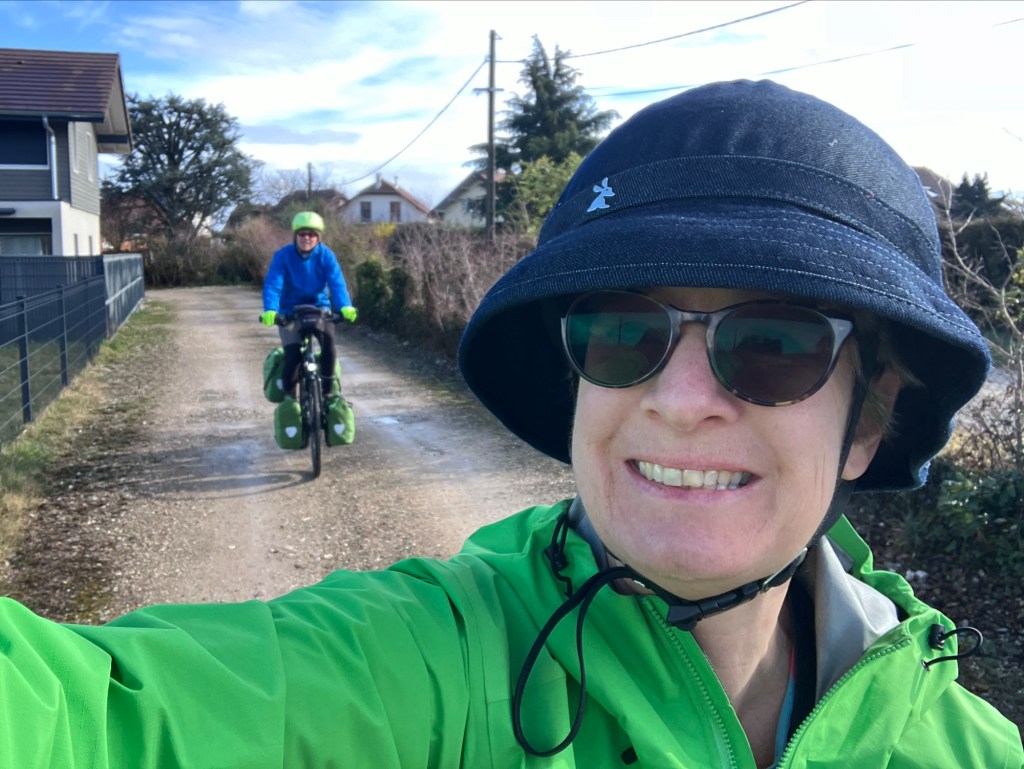
Yes, I’m on this ride too! Wet weather and thick gloves make pictures hard to take. Riding away from our first night stay in Valleiry.
The route has lovely pavement in stretches.
Pasty and tea break. We can usually count on churches to have benches.
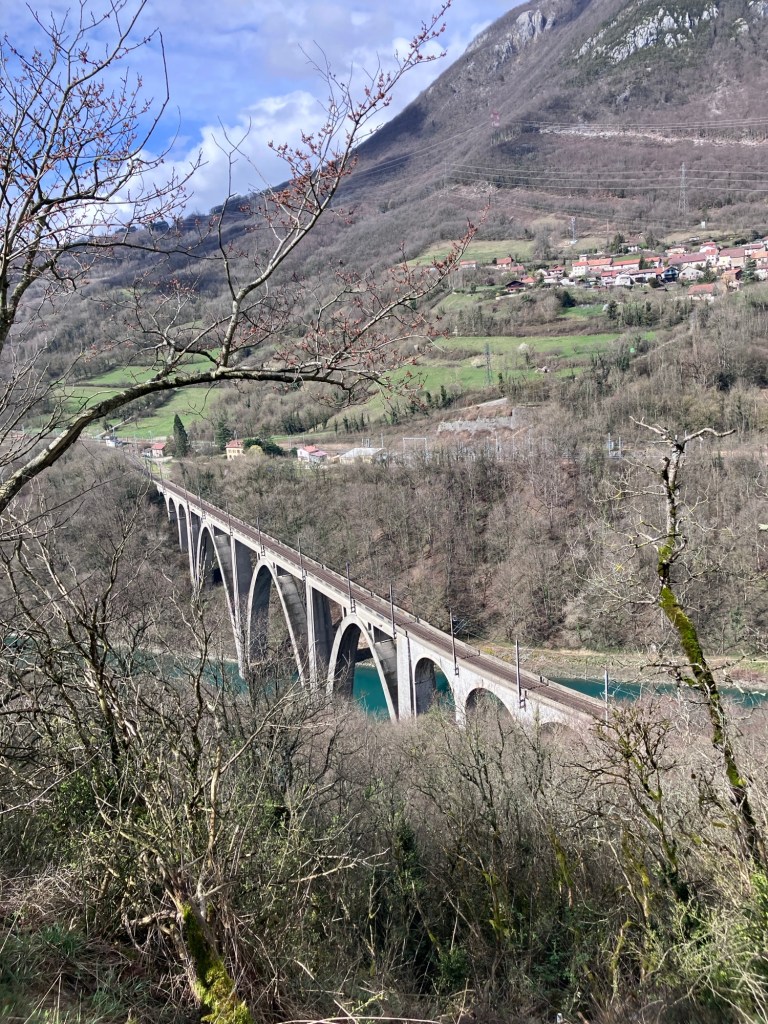
With bare trees you get a better view, like of this rail bridge over the shockingly blue Rhône River.
Sometimes the chateaus hide behind corners and you don’t see them unless you look back.
The Rhône River and a backdrop of snowy mountains.
Another chilly morning in Chanaz. Day 3 back on the bikes. Those oven mitt looking things are my new bike sleeves, to keep my hands warm. Made in France.

It’s not easy to get back in the groove of bike touring. After months off the bikes it’s a bit painful to ride day after day. But, the best way to get into bike touring shape is to bike tour. So, on we go.

I like the signage. It makes you feel welcome.
Getting to closer to Lyon where we were meeting up with friends. (Hi Justina and Joe!)
Route side bike decor.
I’m a bit far behind Rich at this point. So, just taking photos of the scenery.
The cliffs are dramatic, and the stone buildings echo the colors of the mountains of the Rhône-Alpes region.
A community oven in an old stone building.
Across the street, a water tap which was much appreciated as most are still turned off for the season.
Proof that spring is near. Daffodils.
The bridges across the river are majestic.
And the river itself is no slouch.
More pastries, best raisin swirl we’ve had, and the weather is warming up.
Blooms and blue sky.
Well placed picnic table. View of the river and a chateau.
Small bottles of delicious white wine. I love this country!
Rolling out of Jons. I just noticed how my rain jacket complements Rich’s panniers. And his mine.
Riding into Lyon. Looking forward to seeing friends, and happy the weather is warming up.
One last break along the river before getting into Lyon proper.
Lyon, more proof spring is coming.
Someone in the Jean-Macé neighborhood is filling in cracked sidewalks with mosaic tile. Gorgeous.
I got to sit and tour Lyon via streetcar. Very relaxing.
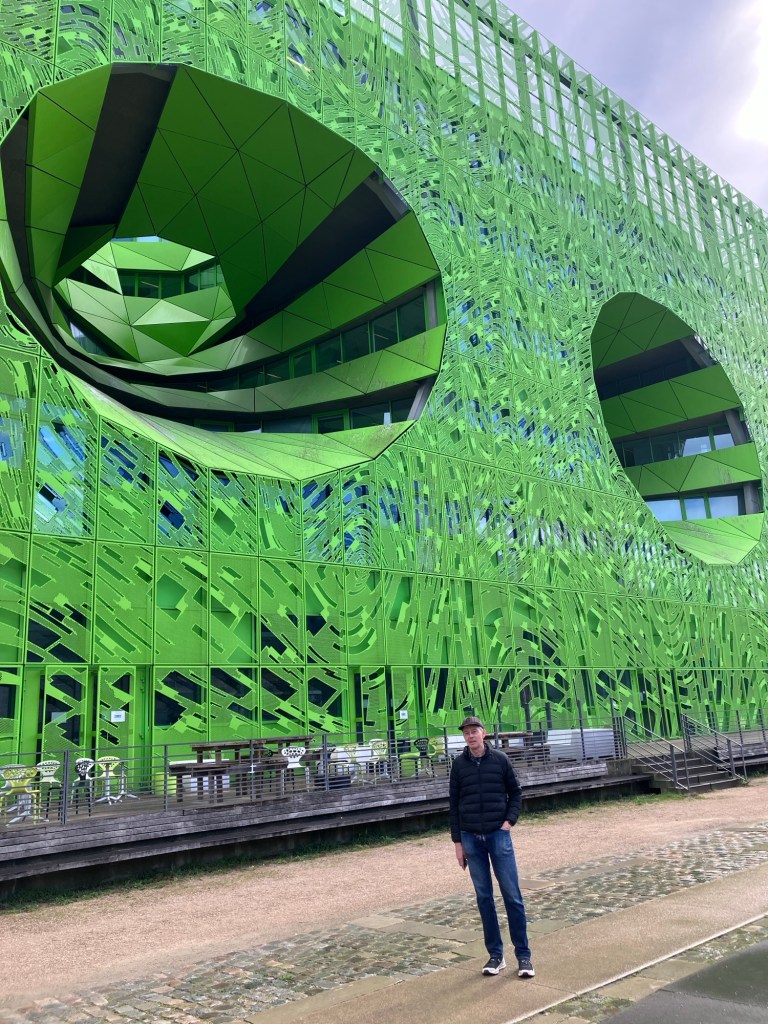
Rich creating an accidental face at the EuroNews building near the Confluence in the 2nd Arrondissement in Lyon.
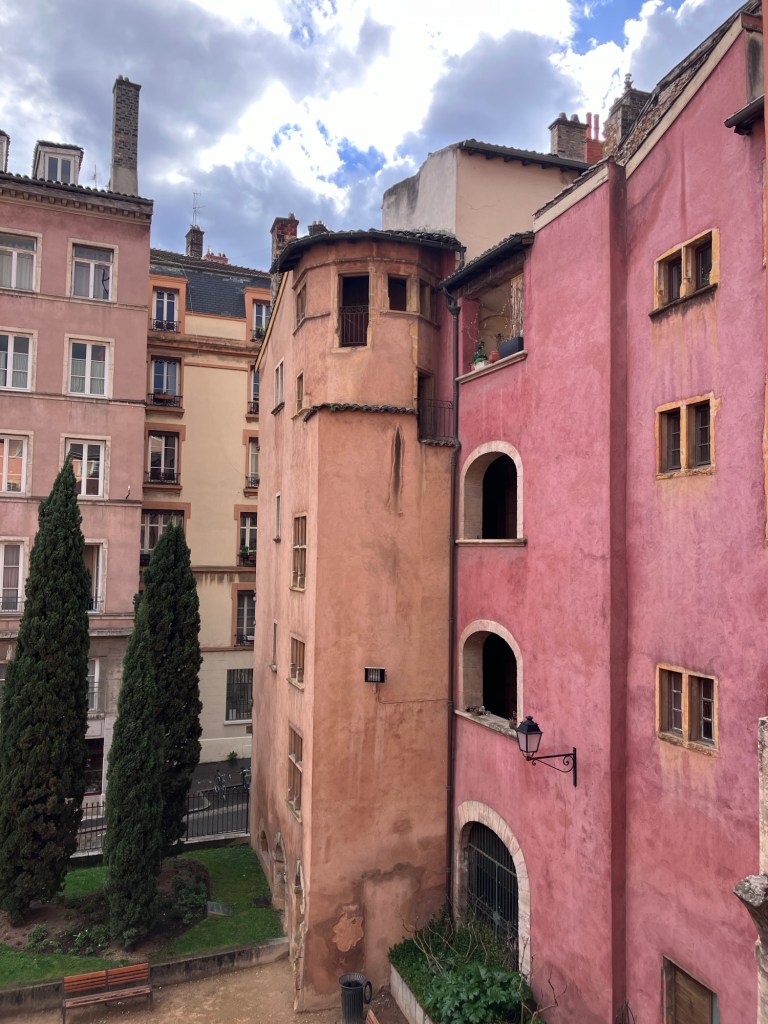
Colorful view of the Vieux neighborhood from the Musée Cinéma et Miniature. Well worth a visit of several hours.
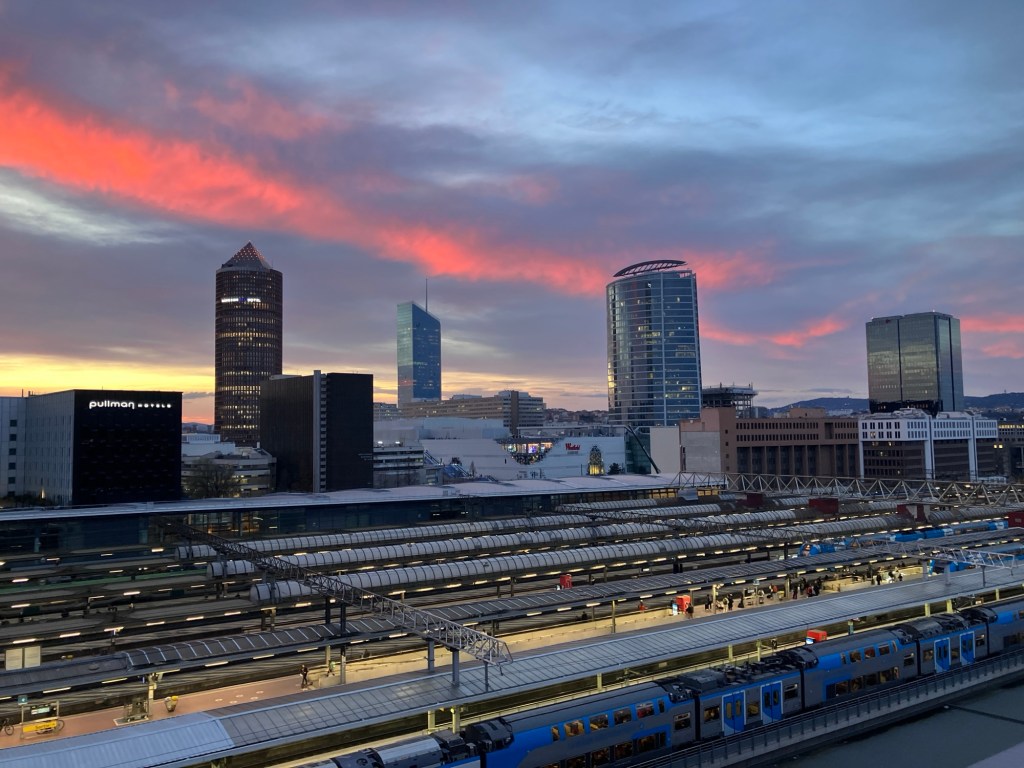
Sunset over the Gare de part Dieu. From our Ibis hotel room if we opened the double paned windows we could hear the platform announcements.
The happy travelers even happier with friends. Thank you J&J!

The biggest impact of starting a bike tour is how pleasantly tired we are at the end of the day. Oh the sleeping is fantastic. Such deep sleep. Hiking in Wales last summer we met a guy who was powering up a hill with a loaded backpack on. Are you training for something, I asked him? No, just tiring myself out so I’ll sleep, he said. That’s us this week. So tired I can’t find many words for this post. More later from the Via Rhôna south of Lyon.

Is Kuala Lumpur Walkable?

Although we’ve spent a lot more time in the peaceful countryside over the past three years, we still love cities. We know the potential benefits of proximity and convenience. We love efficient transit and the embedded health gains offered by traveling on foot to a myriad of urban destinations.

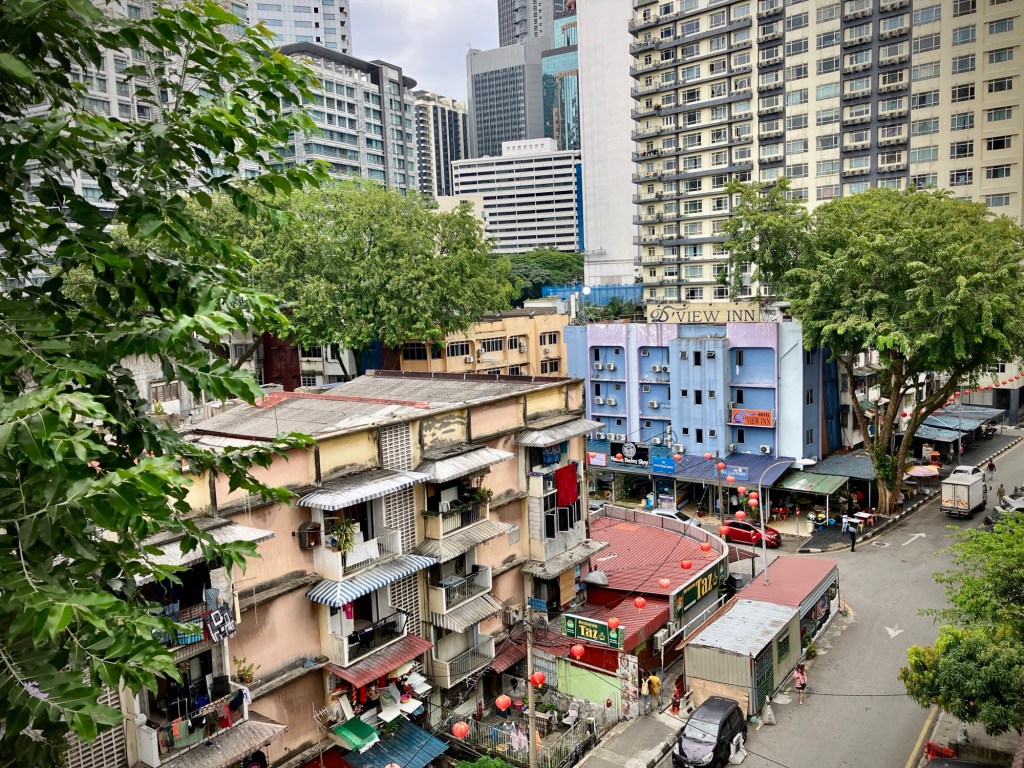
Petronas towers in KLCC. Where can we walk from here?

So after our Borneo adventure, we decided to return to Kuala Lumpur (KL) after 10 years and spend a week soaking up its multiethnic mix, food, and smattering of sights. It’s changed and grown a lot, and mostly for the better on the transit and walking front.

Indeed, KL has developed rapidly

So this post is about our brief experience getting around only by foot and metro for a week. First. we choose to stay in a centrally located high rise apartment complex in the KLCC (city center) that had pools, gym and was close to two major transit lines. The amenities at KL apartments and hotels are nice, and relatively affordable. And pools and a gym can be an effective way to avoid the heat of the day.

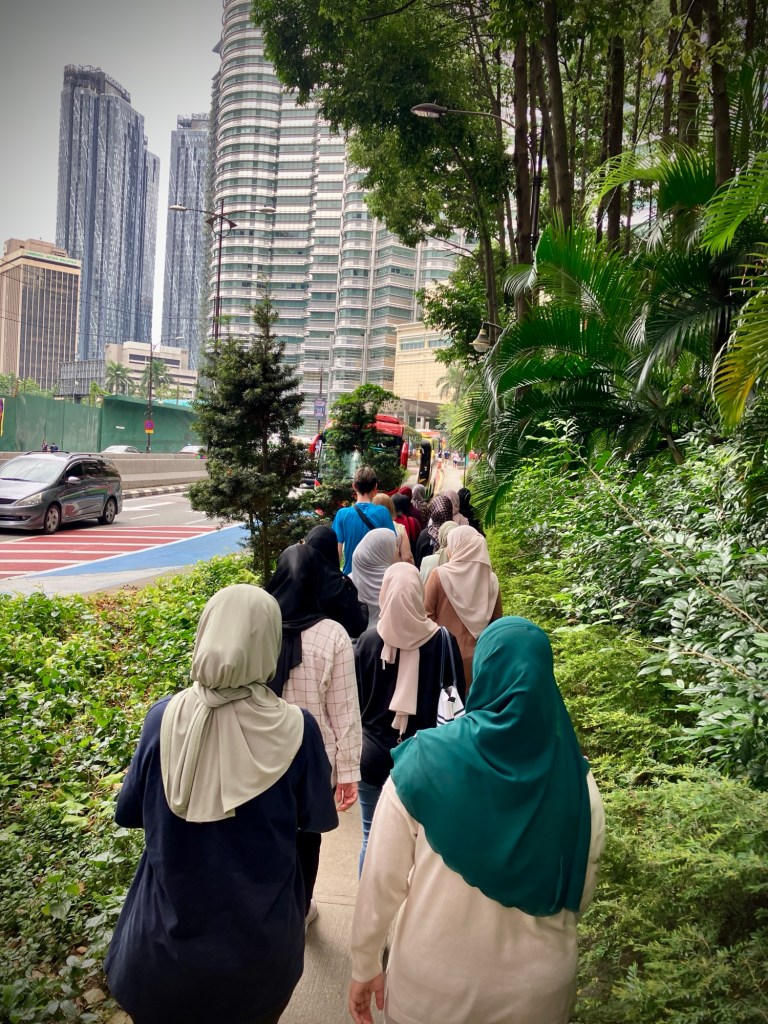
Fenced and hemmed in on a major street. It’s often single file and one way jockeying. The newer sidewalks are better.
Sidewalks are often used for other uses than walking.
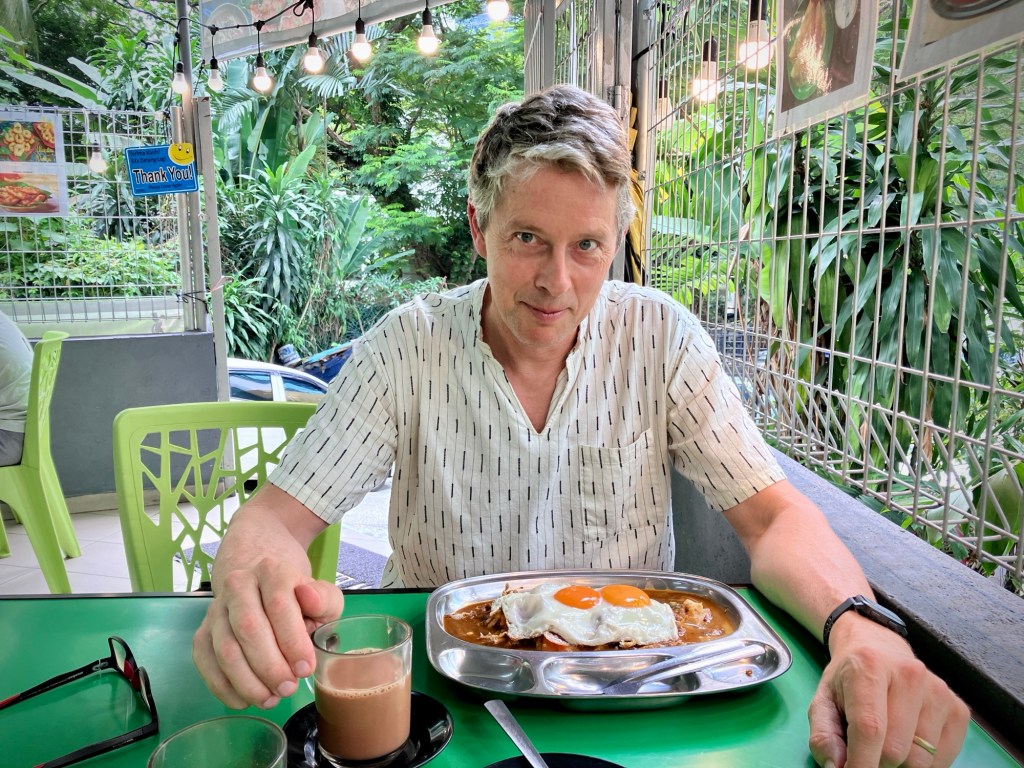
But the food in KL is awesome, such as this curry laksa, and great food courts hidden away in shopping centers and office buildings

It’s key to note that as KL has proudly developed from a swampy tin mining village over the past 100 years into a city of over 2 million, in a region known as the the Klang valley that has over 7 million people. Its human scaled grid of walkable Kampungs has mostly been replaced and overlain by a network of developments, asphalt and slip ramps and arterials designed to move people around (almost) solely by automobile. This is a very different trajectory than some other Asian cities such as Hong Kong or Tokyo that have had layers of transit systems functioning for over a hundred years and never lost their core walkability. It’s much smaller than Bangkok and has developed much later when the automobile has been king.

The 57th floor sky pool at the Ascott Star was an experience and great way to beat the heat. We were not suffering this week.
Buildings are often wrapped in one or two additional asphalt lanes for “local circulation”
Masses of people fighting for measly sidewalk space near the Petronas Towers.
Did I mention the food? Old school KL open air Indian Food at the Sai Hills Corner
Pedestrian pain by design. A ridiculous 15 second crossing at the major intersection of Jin Sultan Ismail and Jalan P Ranlee in KLCC.

This continued mega development has been masterminded by leaders, designers, and developers that see a vision of auto-only travel. But there are changes afoot as the realization that moving EVERYONE in a car is not possible with the sort of real density being built in much of KL, and especially the KLCC. We noted at least a dozen new high rise buildings under construction in the core. And they are big and tall, and often have a mall or retail.

As somewhat overwhelming and dystopian it feels at times, I think it’s really an amazing city center as the lack of a grid makes a random, somewhat circular pattern of buildings swirling around the hub of the city at KLCC Park and the beautiful Petronas twin towers. And you can walk on most streets and get between sites via transit and foot. But it’s not always easy. Cars are always first priority.

But to be fair about walking, we have to talk about the heat. My god the heat! It’s hot most of the time and only mildly dips in the evenings and early mornings. The lowest temperature EVER recorded in KL is 64F (18C), a temperature our native San Francisco barely exceeds on average day! March starts to get hotter in KL and it topped out at 95 (35C)for much for our stay. It did cool off the last few days and some rain and cloud cover kept it to 32C/89F which makes waking more bearable from midday onwards. With full sun, the vast stretches of asphalt and concrete heat up and limit the cooling possible at street level, even into late evening. But anywhere with trees is pleasant and notably cooler.

Cars blocking both ends of a bus stop in KLCC.
Crossing the Saloma Link pedestrian bridge, a beautiful and critical link between KLCC and Kampung Baru that opened in 2018.
Crossing the highways and Klang River to Kampung Baru.
Walking through Kampung Baru makes you appreciate the immense urbanization that has occurred in the rest of KL.
Old school Malaysian life in Kampung Baru.
More people walking and biking in this human scaled and gridded neighborhood.

And other issues wear you down. The ubiquitous forecourts, now even more essential for ride hailing trips, dominate the streetscape. You must cross or share the space with moving cars, And slip, frontage, and garage access ways define the pedestrian environment. As a lifelong advocate (and sometimes designer) for better walking environments, KL offers a huge opportunity. Sidewalks come and go, curb heights are massive (perhaps for storm drainage?) and pedestrian crossings few and far between.

But from what we’ve experienced in our brief week, you CAN walk in a lot of KL, especially in the city center (KLCC) and adjacent dense neighborhoods.

What else do you do in KL for a week? Get a haircut at the mall!

Mass rail transit started late here, but is now starting to change the center of gravity of movement. We especially loved the new Yellow line which opened in 2022, and has excellent design standards for comfort and station access. The older lines (such as red and blue) are have lower capacity and get packed at rush hour; even requiring guards to monitor and control platform crowding from the mezzanine or concourse levels. Clearly, people want to take transit or are choosing it over the congestion and cost of car ownership. But capacity and design have not matched road building to date; but with two more metro lines being built and set to open in the next 10 years, things may get even better.

There is some tropical randomness and greenery at street level which keeps things interesting and cooler. This is Ficus racemosa, the cluster fig. Edible. Macaques eat this and humans make it into chutneys.

The City leaders are now recognizing that walking trips are essential in the core and in station areas. But outside the center neighborhood, most areas are still designed as disconnected nodes of business or residential developments with masses of parking.

Bikes are decorations only in most of KL.
Bukit Bintang is another refreshingly human scaled neighborhood.
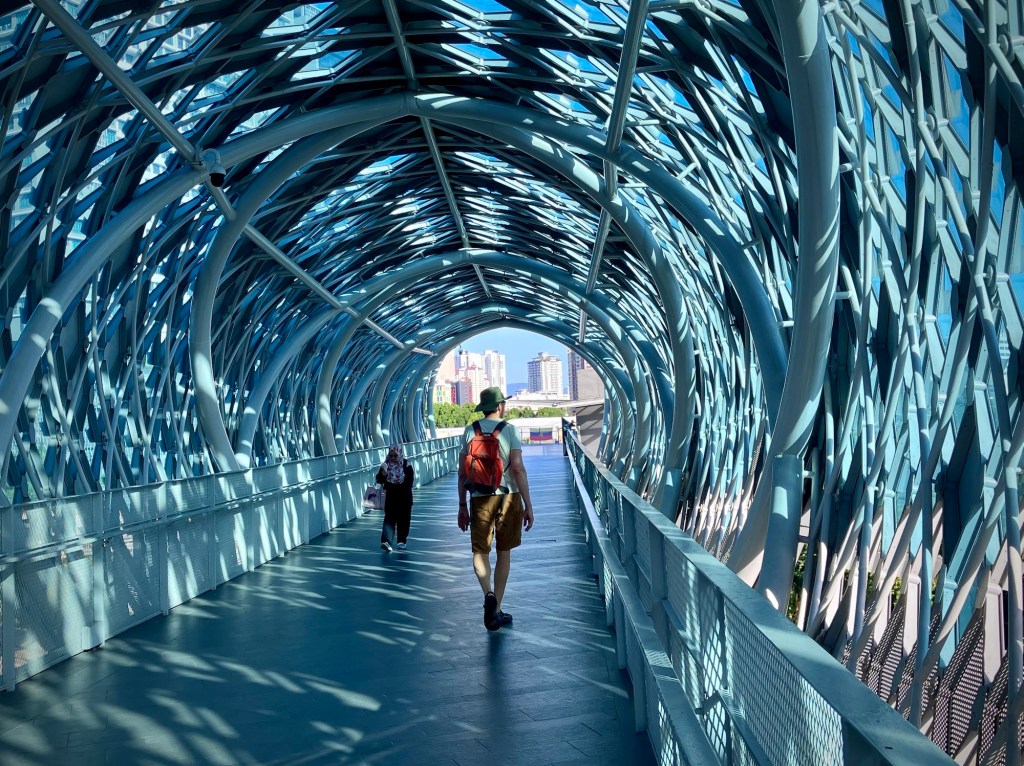
The 1km pedestrian skyway links a few malls and buildings south of Petronas Towers. It’s nice to have a somewhat cooler walkway, but not a great overall solution to lousy streets.

The inefficiency adds cost to everything and may be an extra reason why KL is such the labor draw. It’s one of the few places in Malaysia where you can live and work without a car. Car ownership is a huge burden on a striving lower and middle class. All of the Borneo cities we spent time in had virtually no public transit and were fairly spread out. With modest wages; car transport and maintenance is a huge part of the monthly budget.

Some riverside amenities- like the mist cloud- make taking a walk more appealing.
The boardwalk was fun to explore.

Interestingly enough, scooter culture is small in Malaysia. It’s hot, distances are far, and there is a long rainy season. It’s also further along the development scale than its neighbors like Thailand and Indonesia, where scooters are still huge. But an average car costs 5-10x more than a scooter.

This is a disease all over the developing and developed world. Many cities and suburbs in the United States lack a good walking environment and culture, so I’m not singling out KL or Malaysia, for a unique deficiency, just noting that it could be so much better with some real focus on pedestrian access, comfort, and connectivity. Wider sidewalks, more crosswalks, and more trees and canopies. New buildings need proper pedestrian access. Pedestrian signage and more dignity for pedestrians. It won’t be easy as most of the built environment of KL was really (and sometimes comically) built 100% for cars.

The colorful steps to Batu Caves – part natural wonder, part Hindu temple
Sure, it’s really touristy, but at least we could take the metro here!

But we enjoyed our time in KL and managed to do everything we wanted by walking and metro, except our airport Grab trips (you can take a train from KL Central to the airport!). You need to be patient, plan your walking as early in the morning as possible, and navigate on the shady sides of major streets. KL is not going to crack any top ten walkable cities list soon, but we hope when we return again in 10 years that it has realized even more of the promise we saw on this trip.

Perhaps a Taylor Swift Fan on the MRT in Singapore?
This super friendly superfan from Bangkok was ready with smiles and friendship bracelets!

After leaving KL, we got to spend part of a day in Singapore as we connected late back to Europe out of Changi Airport. We had originally planned to spend a few days in Singapore, but the Taylor Swift effect was strong and hotel prices crazy surrounding her 6 sold out shows. The only shows in SE Asia.

The beautiful Park Royal Hotel in Singapore doubles the green growing potential of its site with vertical gardens.

Singapore is a testament to dense, but livable urbanism. It’s eminently walkable and pedestrian friendly, with very little traffic. It’s achieved this by famous green design and a transit first policy. KL should strive for some of the success of its tiny neighbor.

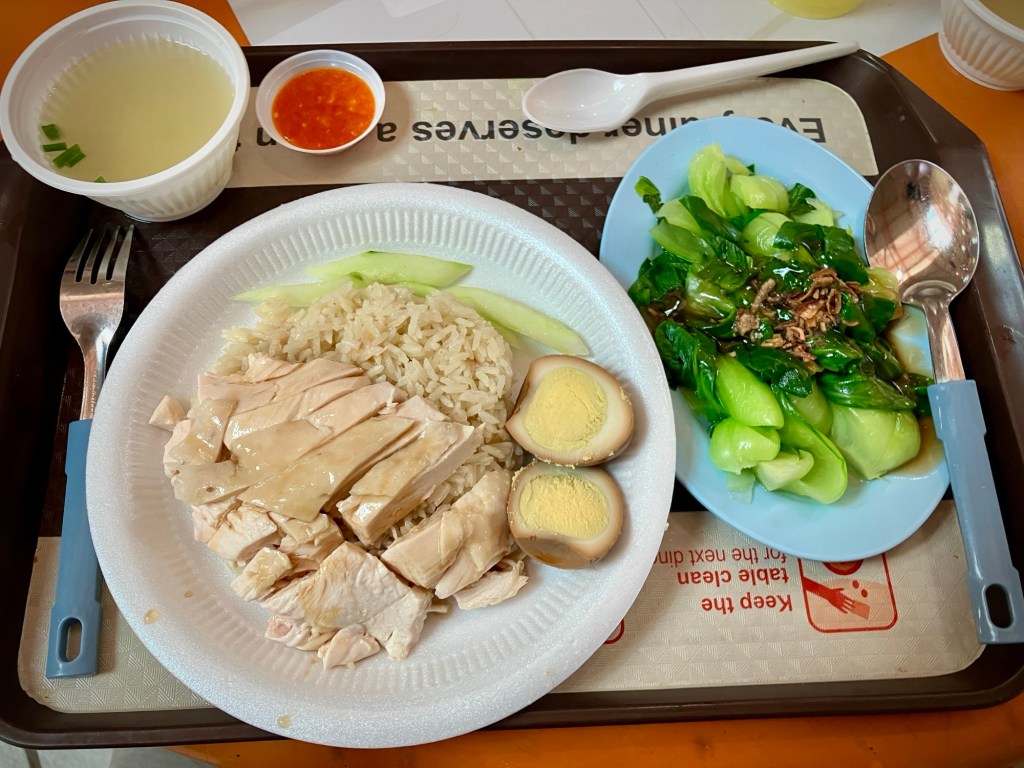
Enough tine for a fix of delicious Chicken Rice at the Maxwell Street Hawker Center.
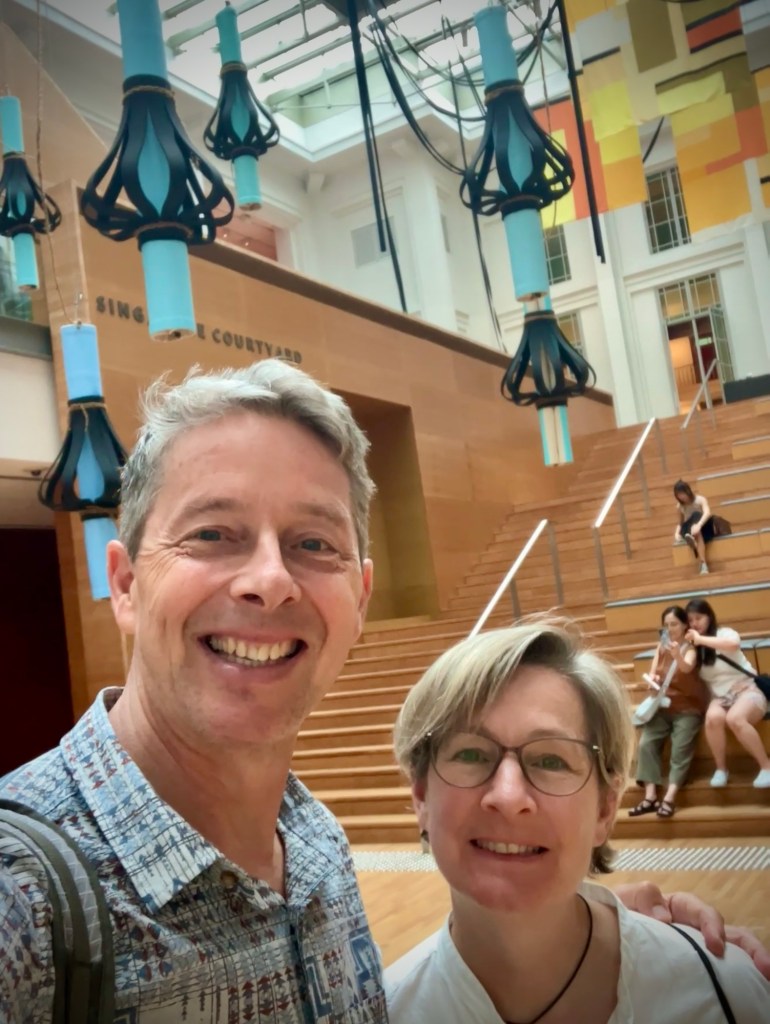
The Singapore National Gallery is worthy of a half day exploration and made these layover travelers very happy -:)

So it’s goodbye to Asia for now. We’re now back in Europe and have started our late winter bicycle adventure…more on that soon…

Kuching Sarawak. Nine days in the City of Cats.

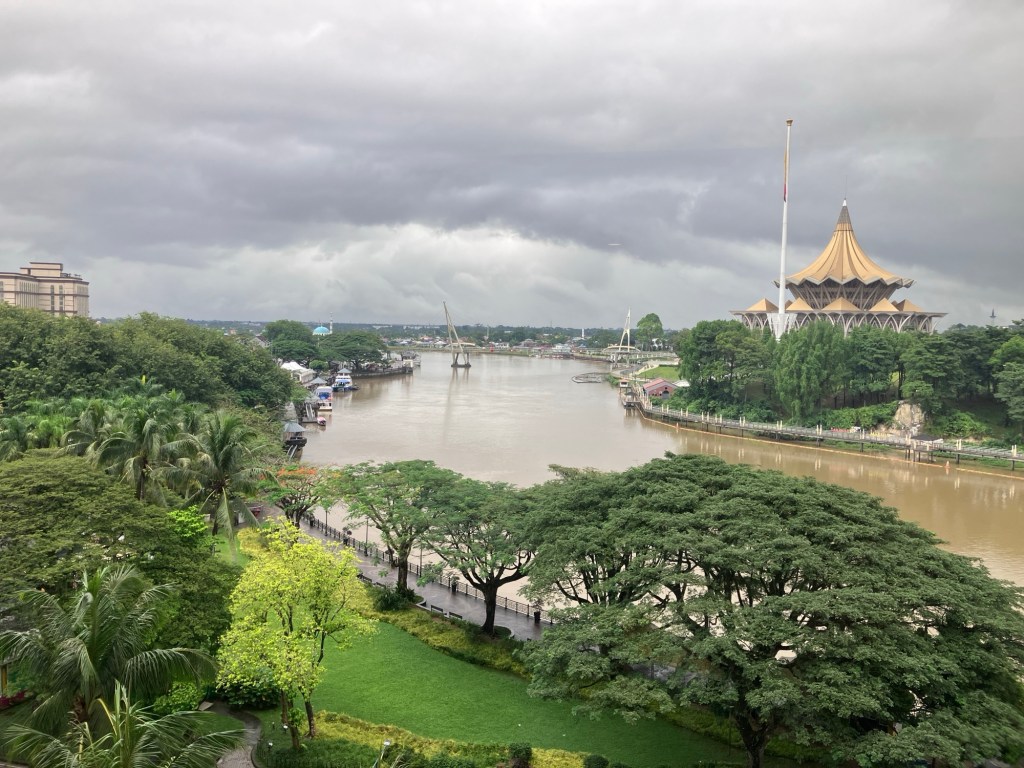
The view from our hotel room of the Sarawak River.

Kuching, the city of cats, was the jumping off place for our Batang Ai rainforest adventure in the previous post. Friends who know Borneo well (hi Ruth and Gary!) had said it was a nice relaxing city, and so it was. Rich booked us a newly renovated river view room at the Hilton and we settled in for nine nights, with two nights off in the rain forest in the middle. Kuching means cat in Malay, and that was enough for me. Cats, here we come.

Let’s go find those cats! This cat themed trash can looked like a good place to start.
Kitty? You in here? The pedestrian bridge across the river made for nice walking, although it didn’t really connect through to the promenade on the other side of the river.

The big trees along the river shade a lovely promenade leading to the dramatic pedestrian bridge, and it’s a popular destination day and night. Lunar New Year celebrations were still going on so there were loads of visitors, and the city had a fun and busy vibe.

Certainly the Cat Museum was a good place to find cats, right?
Here we come!
Is this where the cats are?
A bemused Rich as we realized the cat museum looked like the house of a cat fanatic. Minus actual cats.
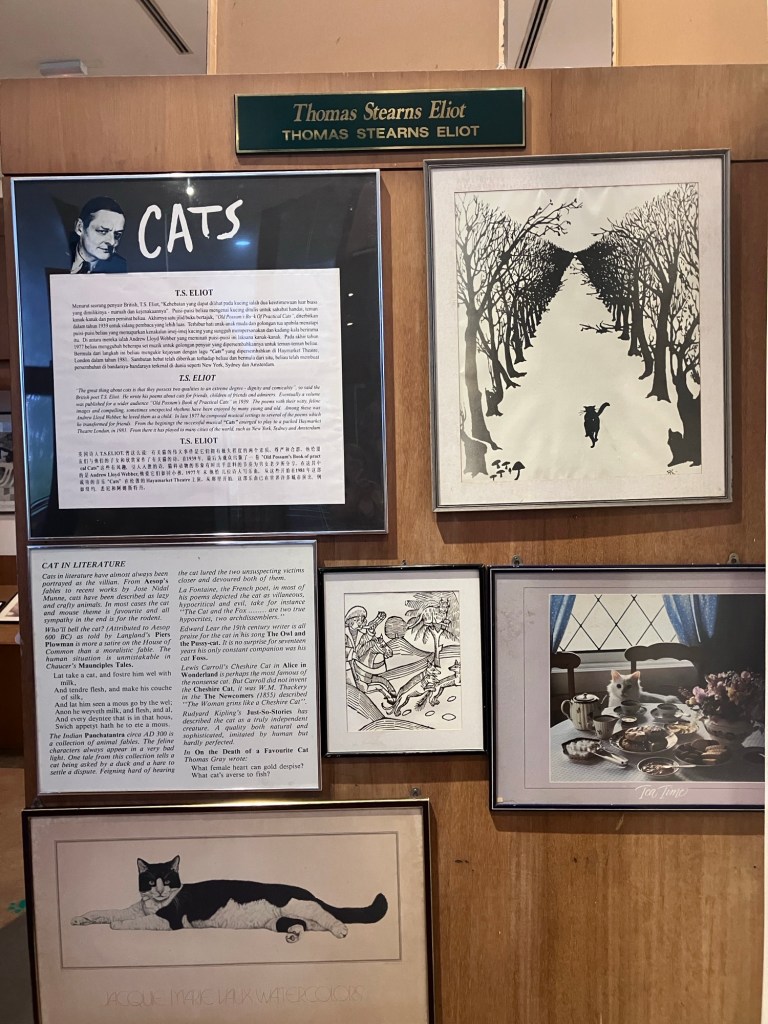
Cats in literature.
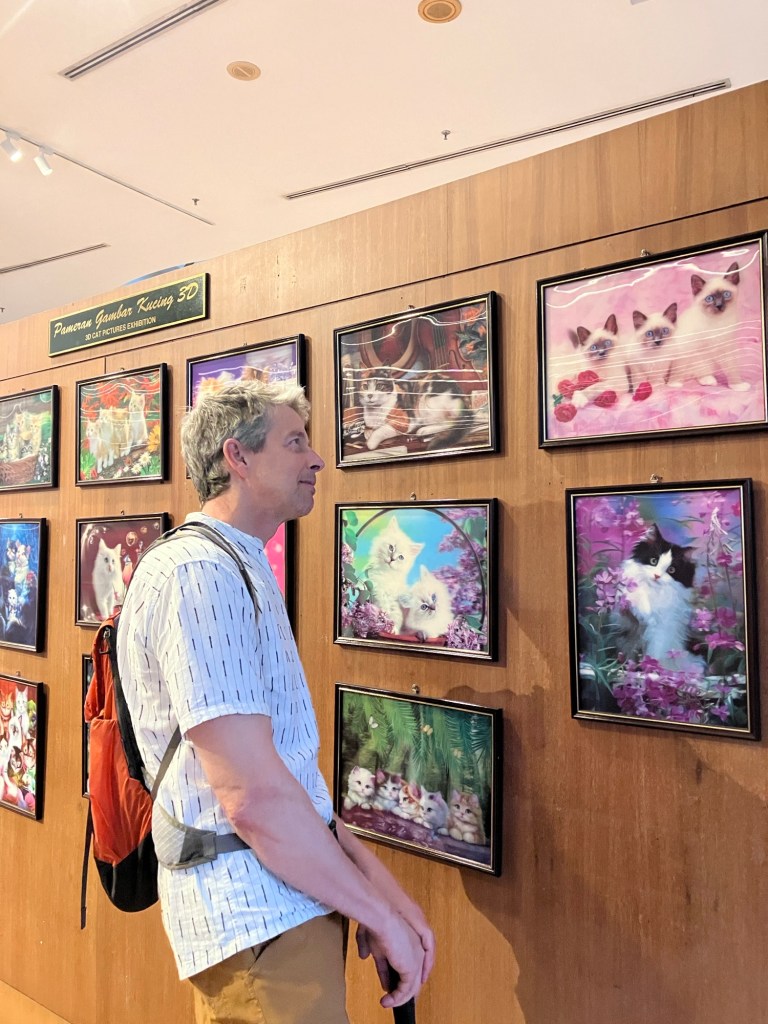
3D cat posters.
Cat art.

The Cat Museum had cat everything, but no actual cats. This is a museum that would be a waste of time for travelers with fewer days to spend in Kuching. But Rich and I had a good laugh at the silly and kitschy collection, wondered how the “museum” ended up in the City Council building, and how it kept going. Our ticket price of about 60 cents was well spent, we figured, and on we went to explore more of this City of Cats.

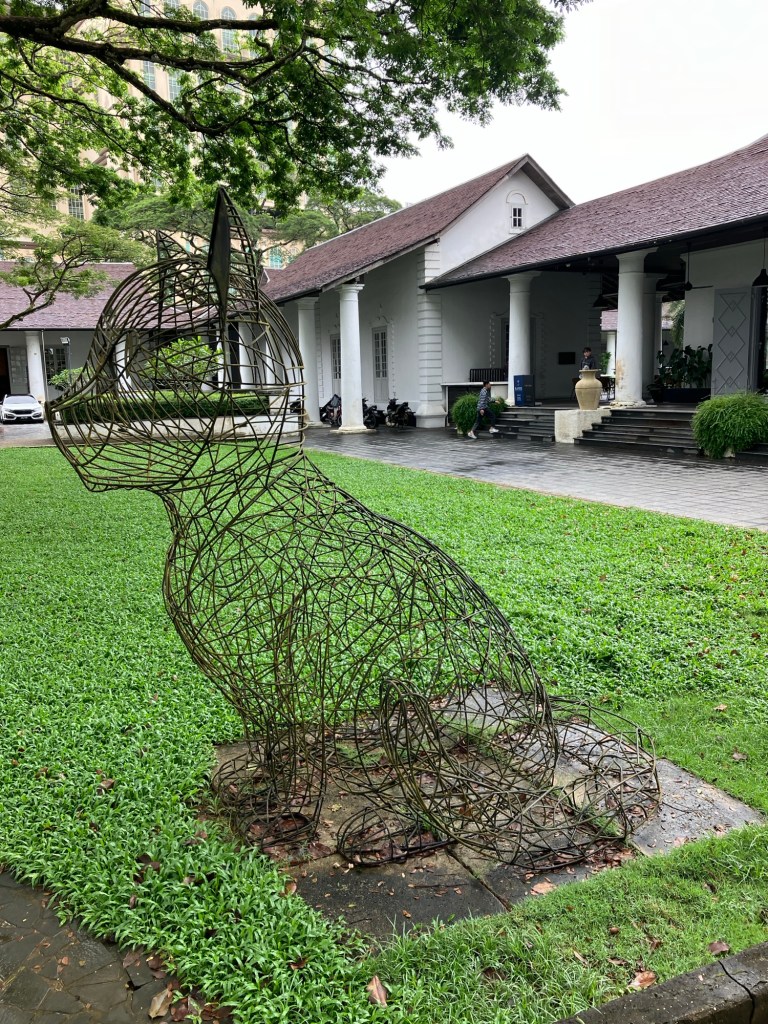
There were plenty of cats represented in art and decor around town. Wire sculpture of a cat.
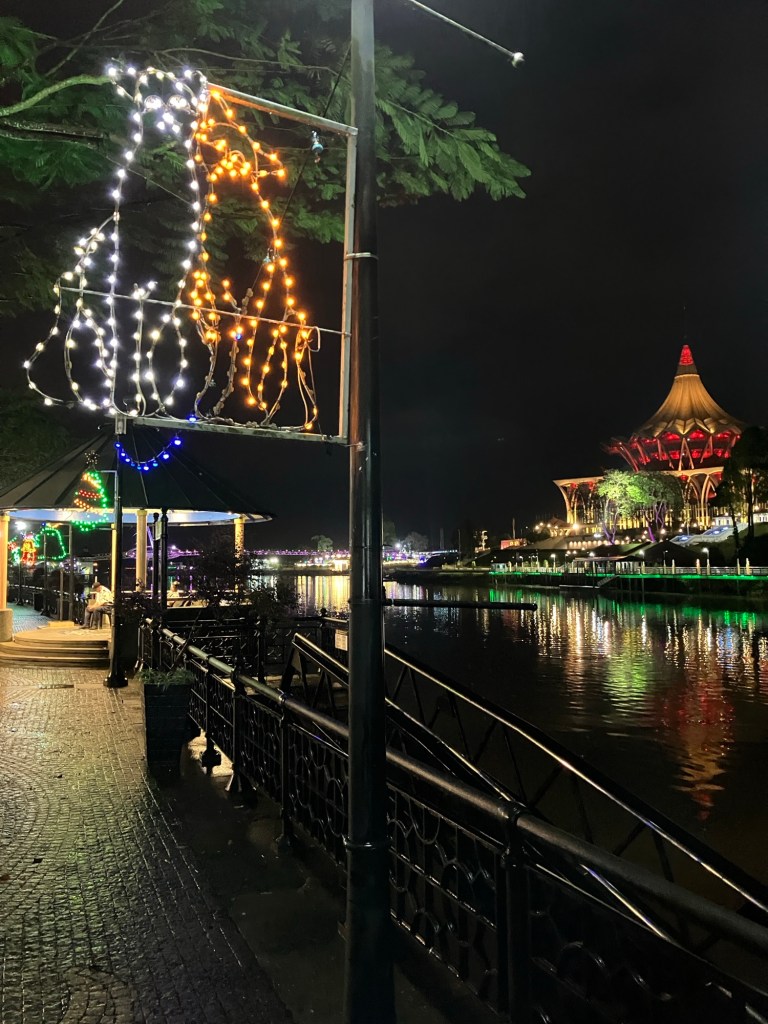
Even cat lights along the river. I appreciate a city that leans in to its shtick.
Found a very pregnant cat to pet.
Of course this one went right to Rich.
The chefs at a restaurant on the promenade not only fed this cat, but also gave it shelter from the rain with a cat and dog themed umbrella.

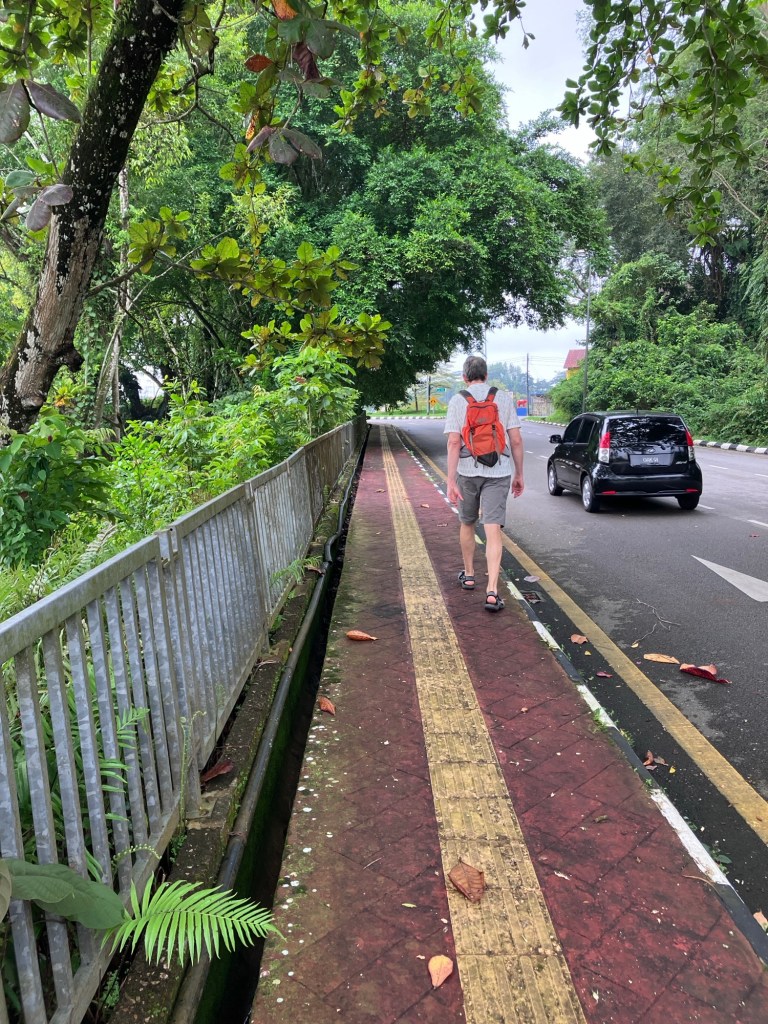
Searching for cats was fun, but couldn’t occupy all of our time in Kuching. It was still the rainy season in Borneo so we had some cloudy and wet days which was fine with us, the rain keeps the heat down. We try to walk as many places as possible, heat be damned, and walk we did. The Spring shopping mall was only 3 kilometers from our hotel, so we got out early one morning and headed off. We knew we would be facing some not wonderful walking conditions, we’d seen that much from our trip in from the airport. Kuching lacks public transport, with one bus line that makes a big loop around the city with arrival times every two hours, and lacks good pedestrian infrastructure. Things like cross walks and pedestrian lights are far and few between.

Sidewalks mostly exist, complete with raised tactile paving for those with vision problems.
Kuching is a very green city. The walking on this overcast morning was pleasant.
You see interesting things when you go on foot.
And then you get to an intersection with no ped crossing. It was Sunday morning so not a lot of car traffic, fairly easy to dash across.
And the sidewalk vanishes just short of the mall.

We don’t set out to find flaws in cities, but when we try to live our usual lives, walking, biking and taking transit, we realize where the weak links are. That makes us think about what it’s like for people who live in Kuching. Without frequent public transportation from the outer areas to the riverfront and commercial areas, people need to own cars, or use Grab rides to get around. Owning a car is a big financial commitment no matter where you live, and much of the money spent on automobiles is money that is not spent at local businesses – a point transit activists make everywhere. As for walking for transportation, we saw barely any other folks on foot once we left the riverfront commercial area. Like no one.

Walking to the nearby Borneo Cultures Museum, the building at the left, was fine.

As tourists we can stay near attractions we can walk to. But we see the car dependency, such as the big parking lots near attractions like the Borneo Cultures Museum- which is a fantastic and well curated museum. We joke that if you don’t see the entrance you can assume it’s closest to the parking lot.

The Borneo Cultures Museum was newly built and opened in 2022 – great museum.
A display about the traditional Iban weaving known as Pua Kumbu.

It was good to go to the museum before our trip to the rainforest stay at the Nanga Sumpa Lodge. The introduction we got to Iban traditions at the museum was a good first step, we had questions to ask our guide, and were introduced to the Chief whose photo appears in the museum.

My chai at the museum cafe, the gift shop was also well curated.
Since we didn’t see orangutans at Nanga Sumpa Lodge, it was off to Semenggoh after we came back to Kuching

Semenggoh Wildlife Center is a 1,600 acre/653 hectares forest with a population of semi wild orangutans who are fed to supplement their wild diet. The acreage is not enough to support the animals with wild naturally occurring food. Founded as a sanctuary for rescued orangutans, the center has an established population with babies regularly joining the group. Visitors are let in morning and afternoon for the feedings of sweet potatoes, bananas, coconut, papayas, oranges, sugar canes, pineapples and hard boiled eggs. There is no guarantee that the orangutans will show up, they may just stay in the forest eating naturally growing fruit, especially during g fruiting season which it was. Thankfully the draw of food was enough to tempt out four the morning we went.

Food?
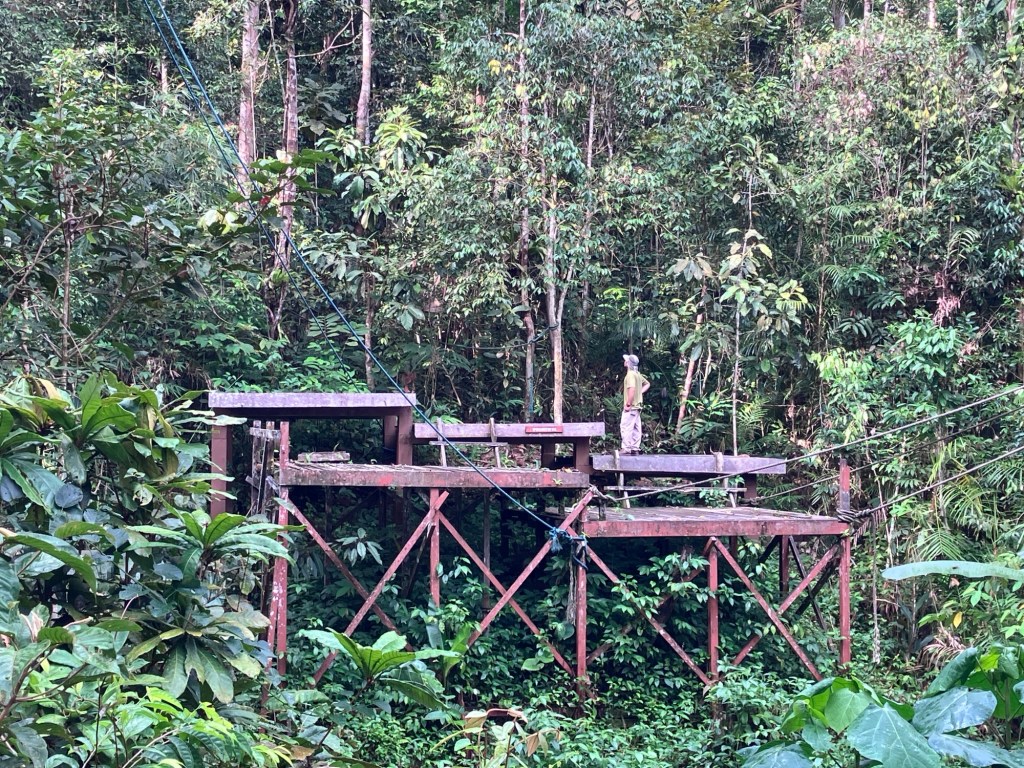
A reserve worker headed out to the feeding platform with a basket of food.
Staff on the platform watching for orangutans. The workers make whooping noises to let the apes know food is available.
Humans waiting patiently for the orangutans.
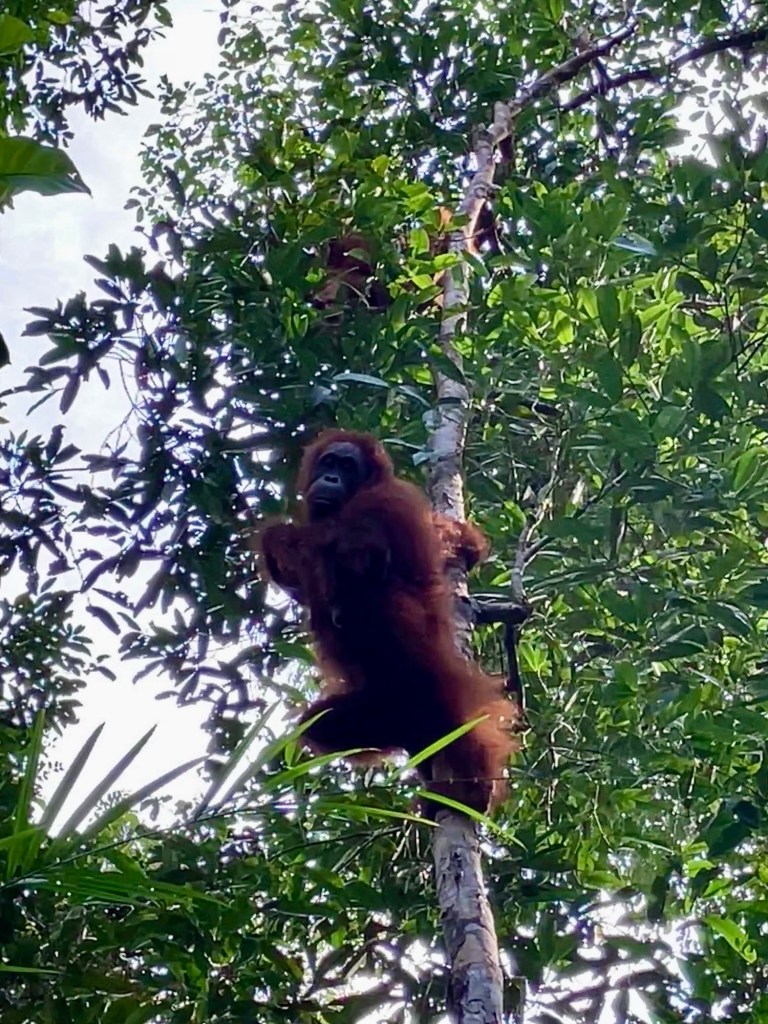
Here comes a momma and baby, and her toddler aged offspring.
There are no blasé visitors when the apes swing into view in the forest.

Semenggoh is about 20 minutes south of Kuching by car, 30 minutes north will get you to the jetty at Kampung Bako to take a boat to Bako National Park, which is on a peninsula reachable only when the tide is high enough for the boats to get through. For both of our trips we hired a driver we met on our rain forest adventure and he dropped us off and picked us up from both visits.

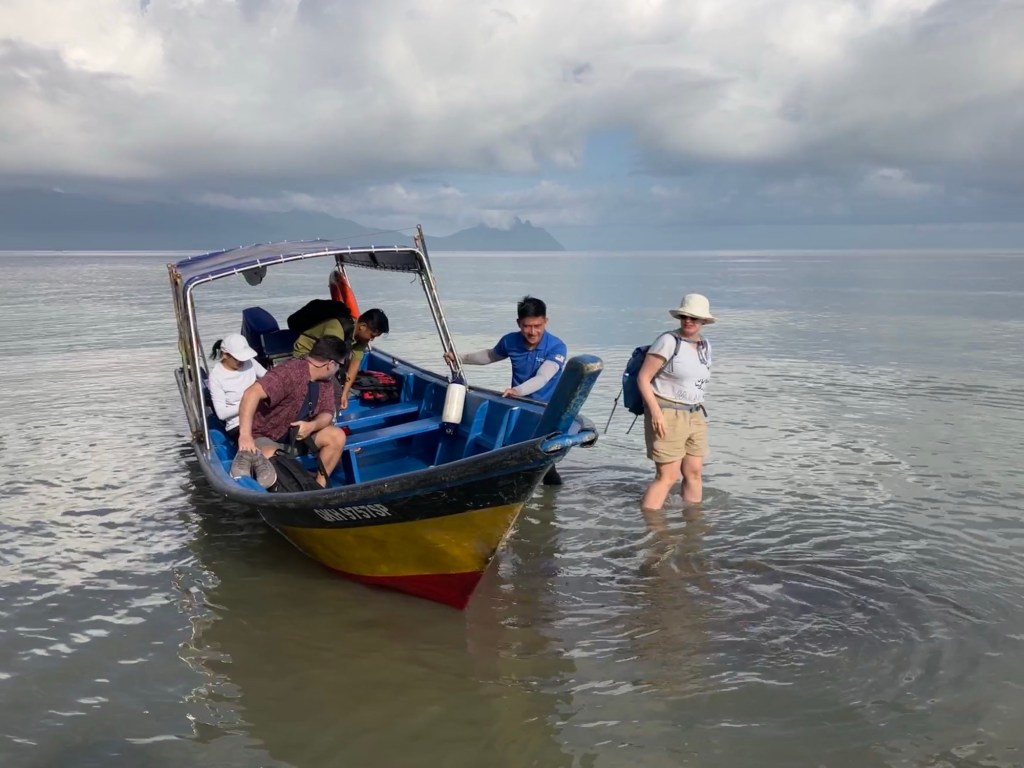
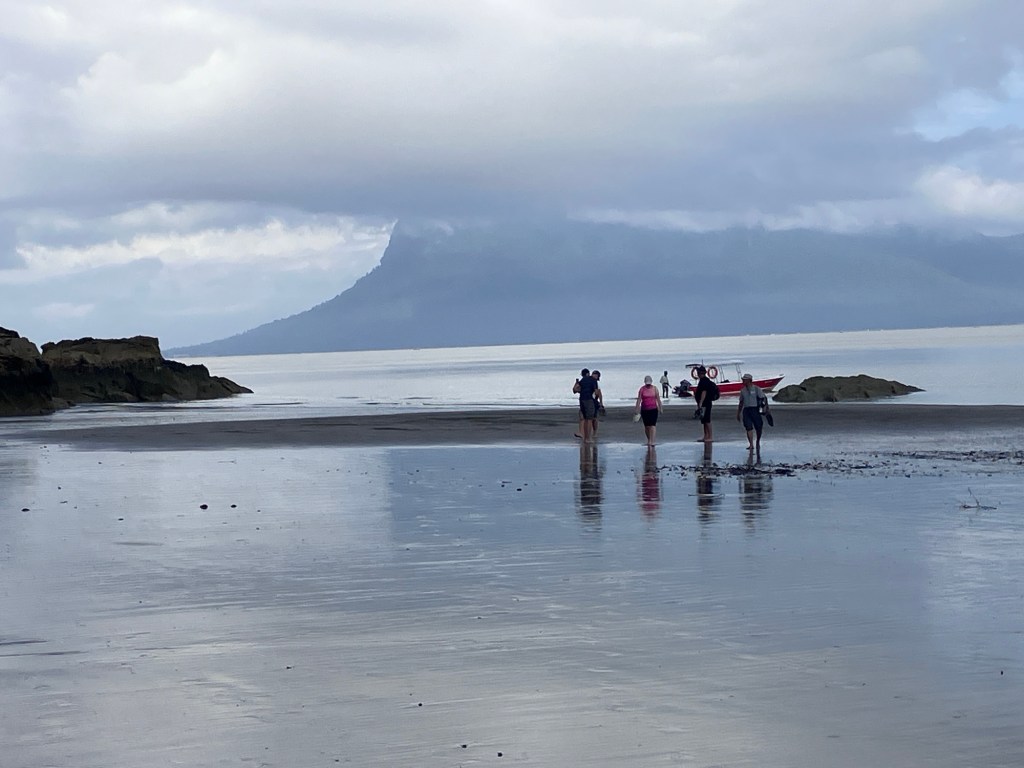
Disembarking at Telok Assam beach.
It’s a fun way to start the day – feels a bit survivor-ish.

We were super lucky to share a boat with Katherine and Chris (hello you two!) from Seattle, and we all hit it off so well we spent the day together hiking and marveling at the wildlife.

Our first look at the park.
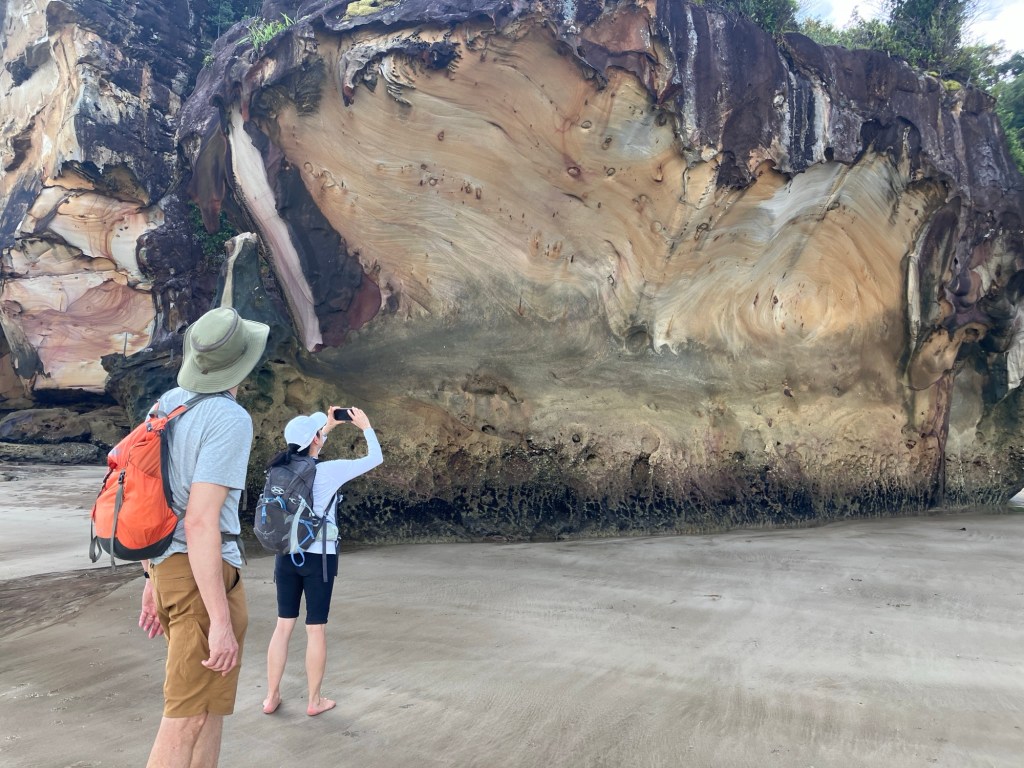
The rock formations are the result of erosion stripping away sedimentary rock to leave the thick, resistant sandstone behind.
A dramatic chunk of sandstone.
A forest on top, highlighting the blue sky.

The park is very well run, with check in at the registration desk, overnight accommodations with reservations required, and well marked trails and maps. And the animal viewing! Really amazing. As our driver Ali said, Bako is for animals. Proboscis monkeys, silver leaf monkeys, and macaques. We also saw a flying lemur sleeping the day away in a tree, and a pit viper. And adorable bearded pigs.

Mama and youngsters having breakfast.
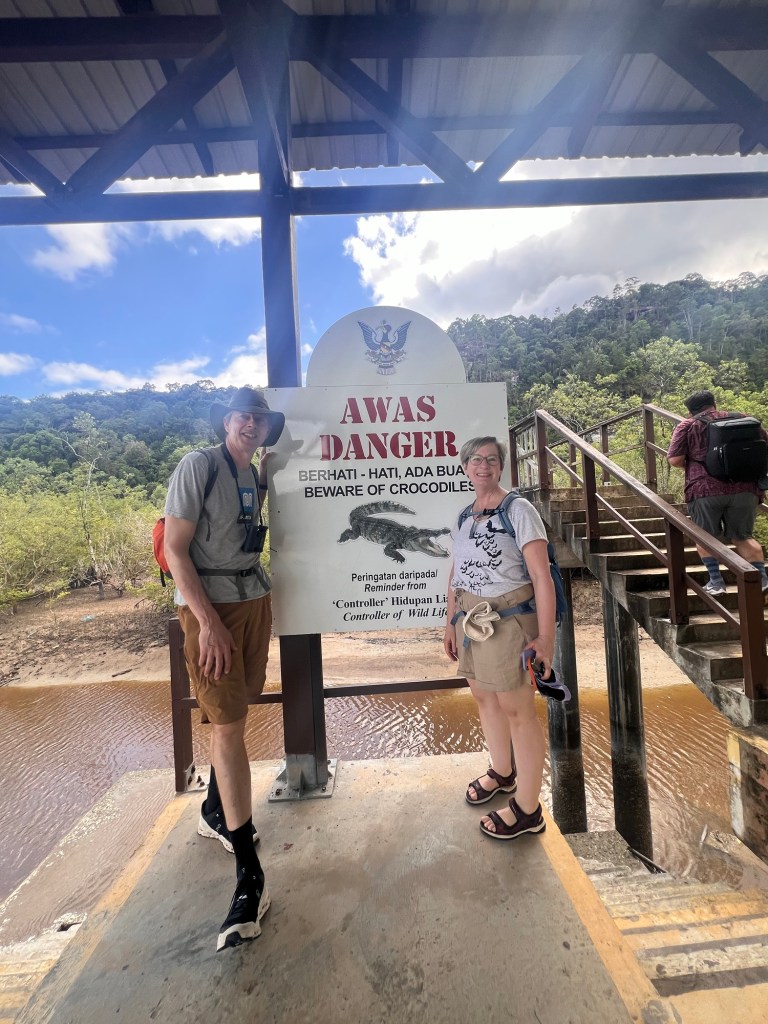
Oh yes, no swimming at Bako due to saltwater crocodiles. Photo by Katherine.
Headed out for hike number one.
We first saw a proboscis monkey spotted by Rich. Katherine’s photo- much better than mine.
No shortage of trails. You would have plenty to do with a two night stay.
The trails are well marked but tiring with the up and down and heat and humidity.
Our first beach. There should have been a monkey warning sign. We were quickly joined by a macaque who was certain he could bully us into feeding him.
The monkey took this for an invitation. Oh! Backpacks. Must mean food.
I am patient. I am persistent. I am monkey.
Katherine looking at shells. Monkey waiting.
It was so nice to have people to share the hike with – so glad we met!

After lunch Rich, Katherine, and Chris headed out for a second hike and I stayed behind to read and mind the extra gear, and watch macaques marauding the cafe.

Stunted mangrove forest.
The view from Bako to Santubong Peninsula.
Gorgeous rock formations.
A pit viper.
Back on the boat after a successful and happy day.

Spending a week plus in one place means you get to do the little things that might not be on the top of your must do list. From our first day in Kuching we saw the little boats plying the river. Although the lovely pedestrian bridge crosses the river, you cannot go directly right from that bridge to the waterfront promenade. So, we took a little boat. A tambang (motorised water taxi).

A fishing boat.
A tambang at night.
Heading to a boat to cross the river.
Settled in for the 1 minute ride.
Our captain.
Paying the captain.

The short boat ride took us across the river to Kampung Boyang, which was a fun glimpse of what most of Kuching probably looked like a few decades ago. A botanical garden and The Brooke Gallery at Fort Margherita, which told more of the history of the English dynasty of White Rajahs who governed Sarawak for 100 years. It’s a fascinating bit of history with colonization overtones, but one which is remembered with what seems to genuine respect for the Brooke family. Of course, both museums dedicated to the history of the Brookes are funded by the Brooke Foundation, so there’s that.

Kampung Boyan.
Signage for the sights- I love the hornbill mascot.

We certainly found enough to do, and enough good places to eat, to make our time in Kuching very enjoyable. It was a bonus that our hotel had a newly renovated gym and a big swimming pool(about to be renovated). Mornings were spent exploring, Lunch out, afternoons were at the gym and pool. Then it was back out for a walk and dinner.

Delicious thosai lunch at Ceylonese Restaurant Sdn Bhd. We also had dinner here twice, once with Katherine and Chris which was great as we ordered a lot of different items.
The Granary Kitchen + Bar, one lunch and one dinner. Lunch was a local menu and dinner was western.
And every day started with the fantastic breakfast buffet at the Hilton.
Rich buying our lunch, steamed buns, from Kuching’s youngest business man.
I’m still stunned by the green landscape, even in the city. Any land gives rise to a dense green.
One last cat themed photo.

We’re in Kuala Lumpur now, so glad we had such a good long stay in Borneo. Even with over three weeks there is still a lot more fun to be had. Did we adjust to the heat and humidity? Not really. It’s hotter here now in KL and it’s quite draining, even three weeks on. We’re just not hot weather folks. Mild San Francisco weather for 30 years will do that.

Borneo. Our places stayed: Koto Kinabalu, Mt. Kinabalu Park, Mulu National Park, Miri, Kuching, Batang Ai National Park, Kuching again.
The happy travelers.

Three Days of Discovery in the Rainforest of Ulu Ai

Although we are fiercely independent travelers, there are times and opportunities that can be missed without an organized tour. And we really wanted to learn a bit more about the indigenous cultures of Borneo and get deeper into the jungle.

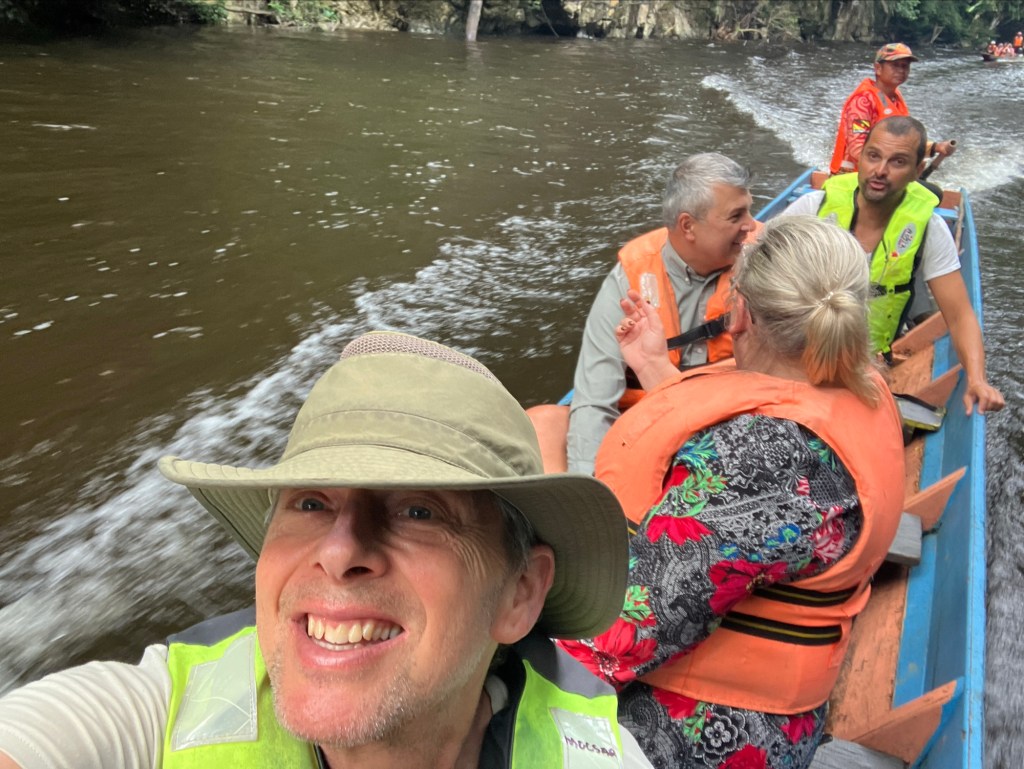
Cruising the Delok River about 5 miles from the Indonesian Border
It was about a 4 hour drive from Kuching to the Batang Ai Lake Boat Dock

Cheryl and I both have degrees in Anthropology (+my engineering and her creative writing) which fuels an endless desire to dissect and understand what we can about local cultures and customs in a rapidly changing world. So we picked the Batang Ai 3 Day Experience led by the award winning agency out of Kuching, Borneo Adventure. It was a great choice.

A chance for coffee and tea while our guide bought much of the supplies for our trip at the large Serian Daily Market

We awoke early on our departure day with a sense of excitement as we really didn’t know what to expect of this tour, and it required some thoughtful repacking, drybags, and consolidation of our gear, with the excess being left at our hotel in Kuching. It was also still the rainy season here, so rain was likely, and tons of rain a possibility. The drive was nicely broken up by a market stop and early lunches, but we were definitely ready to board the longboat for the nearly 2 hour trip to the community and lodge. Despite some steady rain as we drove, the boat trip was mostly dry.

Across the massive 24sq km Batang Ai Lake
After an hour crossing the Resevoir in some light rain we hit this massive log jam! It seemed impassible to us?!
The front boatman was impressively strong moving logs aside as the driver in the back worked magic with the outboard motor to get us through. This logjam is almost always here and a result of currents and erosion around the reservoir basin.
Arriving at Nanga Sumpa Lodge, which had recently been renovated and reopened.
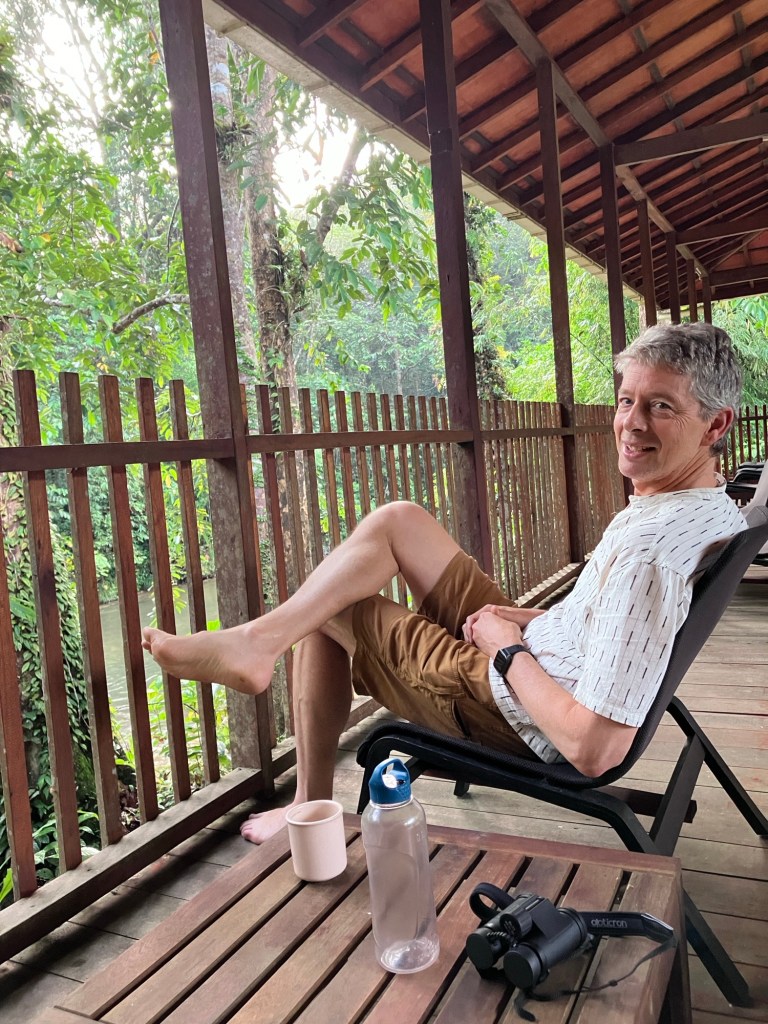
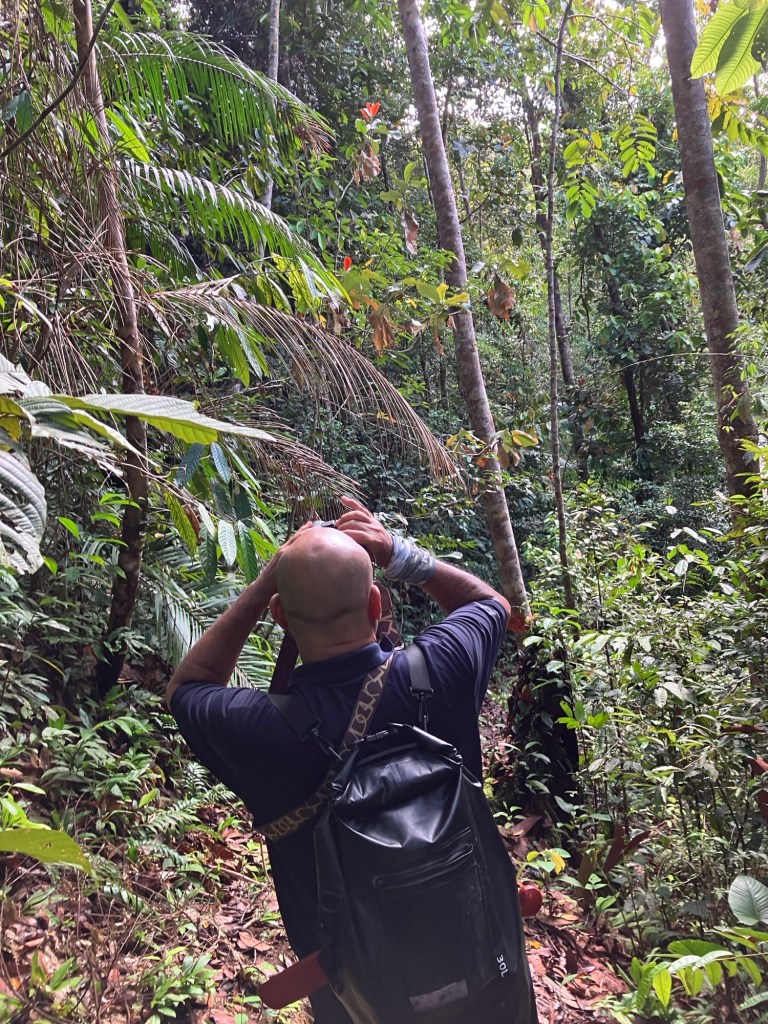
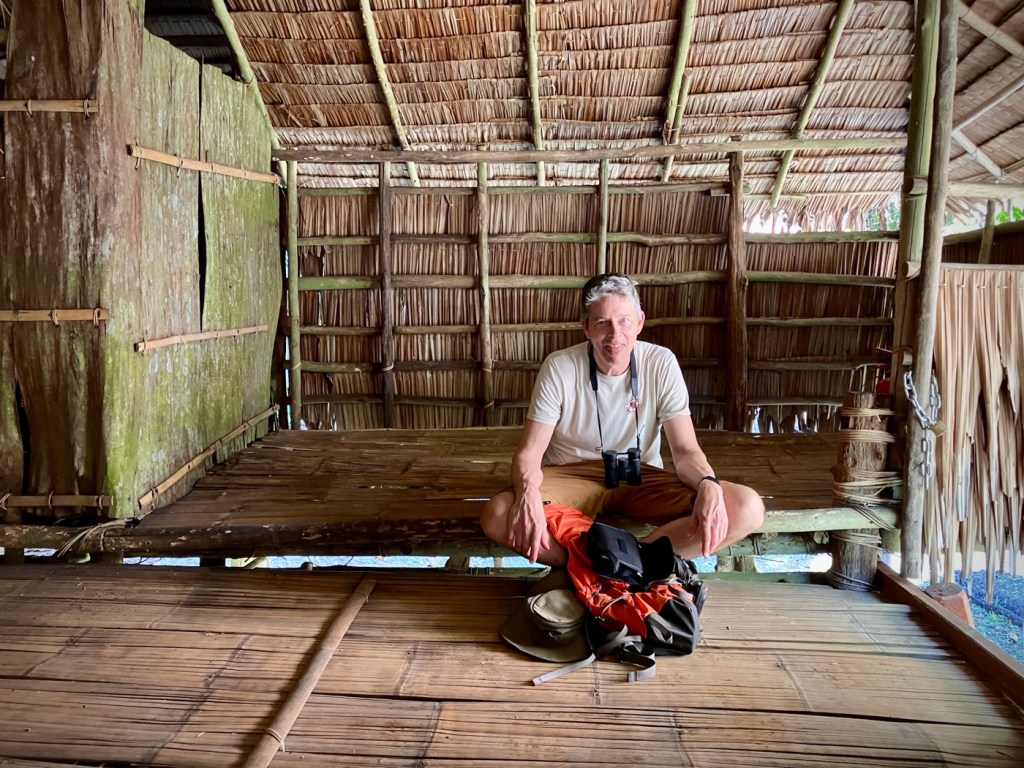
Settling in on the great open veranda above the river, always ready with my binoculars.
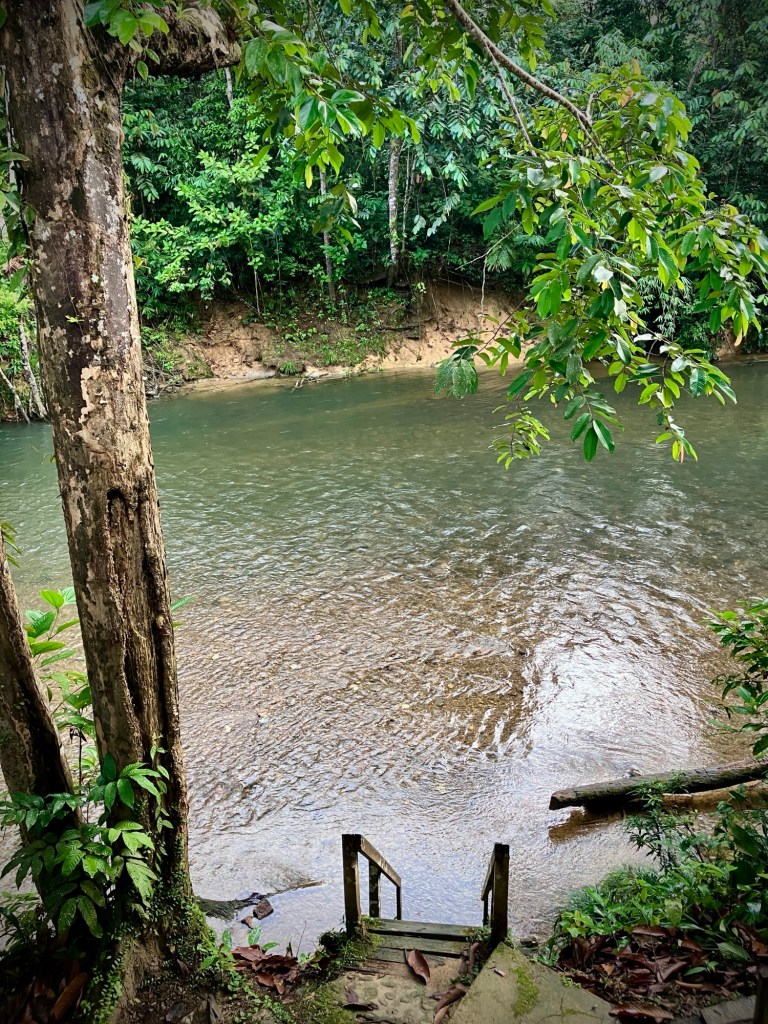
The river was raging and mud colored the first day up but had magically cleared up and dropped enough to swim by the next morning.

The arms of the massive Batang Ai lake seemed to stretch forever and it was a dramatic shift in terrain and ambiance as we transitioned to the original Delok River. Although the lake/reservoir was pleasant and scenic in its own right, I couldn’t escape the artificial feel and haunting thoughts of the wild rivers that used to flow below. Thousands of Iban people were displaced by the construction of the dams and inundation of the valleys in the 1980s. On the upside, the reservoir provides a good amount of local clean hydropower. But it is what it is and we were here to support and get a glimpse of modern Iban life that still exists in the rivers above the lake. And it’s still a fascinating and unique community.

Life is only on the river here, our boatmen dropped a local downstream.
Our room was pleasant, airy and did cool down at night. There is electricity only from 6:30pm to about 10:30p to charge devices. Headlamps and charging blocks really help.
The “Ruai” or common area of the long house at Ulu Ai at a very quiet time. It was often full of families and kids socializing and playing games, and we later joined the kind chief and his wife for some rice wine and conversation.
Many handmade items are for sale outside each families personal space. We bought a few beautifully woven baskets and decorations. It’s appreciated but not required. The lodge and tours also provide many local jobs.
This bridge over the Sumpa confluence connected the lodge to the local community. This little guy wanted to come over and visit.
Nanga Sumpa Lodge.

The lodge is located at a small confluence, of the larger Delok, with a calm side creek, the Sumpa, which can be used to safely store longboats in time of high water or floods. All the remaining dozen or so longhouse communities in the remote Ulu Ai are located similarly. The lodge itself is rustic with three forest rooms with bathrooms, and a few more rooms sharing a bath. It was nice to be barefoot in the lodge for three days, and felt natural. Meals are simple but tasty communal affairs, although Cheryl and I had the lodge to ourselves the second night, after four young Germans had departed.

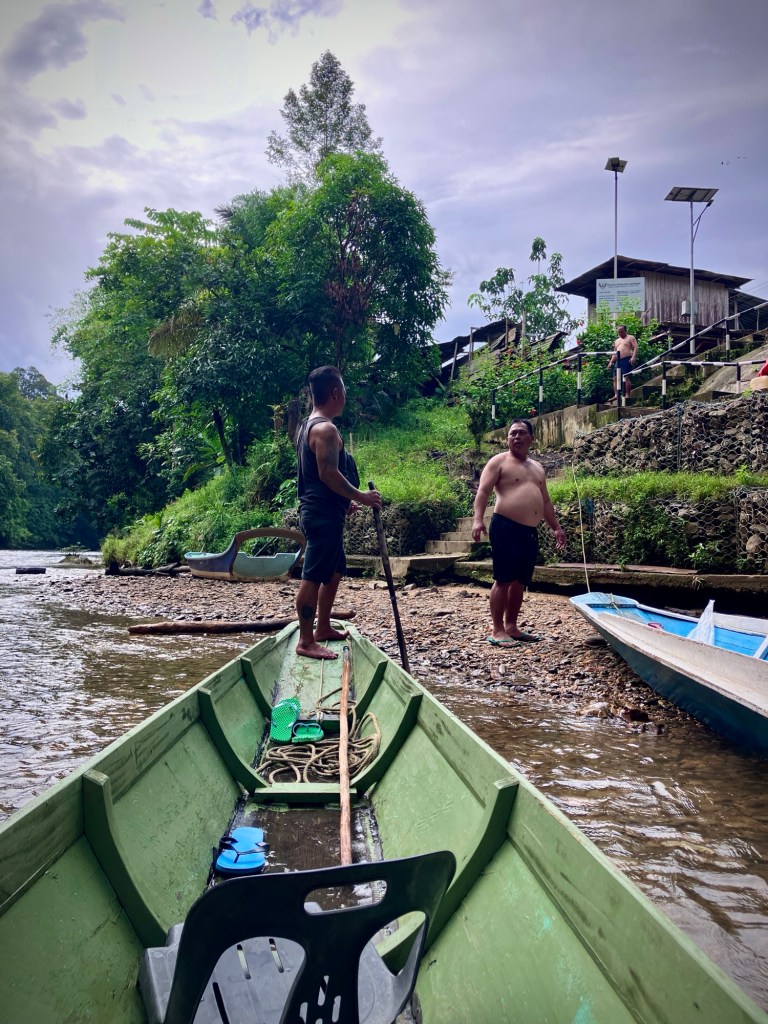
Many longboats are still paddled/pushed for local trips and fishing, but motors are key for longer trips, especially to the primary school and health clinic downstream.
Our first short trek introduced us to the long house community as well as the layout of the village above the river. Good birding too along the way despite a local teenager cranking some afternoon music -:).
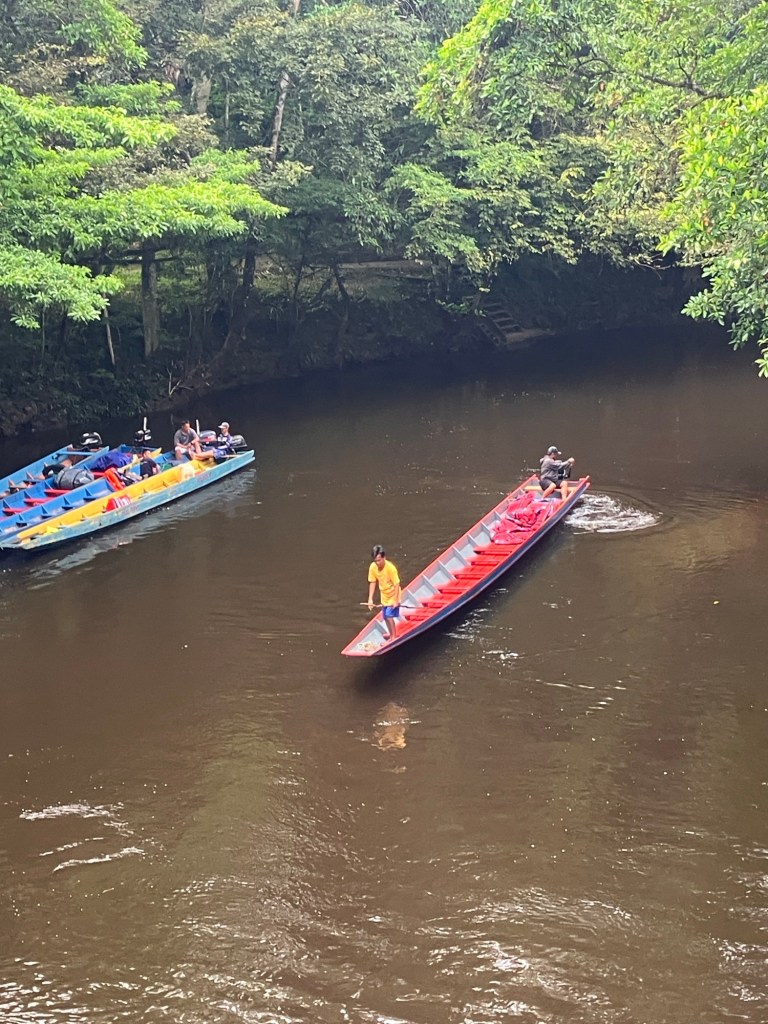
Wooden long boats have flat bottoms to handle very shallow water sections on the river. It’s magical to cruise through the jungle.
This larger solar array had been installed just a few years ago for more constant electricity to the community. The pandemic accelerated the solar installation and arrival of satellite internet for remote learning for the kids.

After a nice trek around the community and then dinner, we headed back over to the bridge to the longhouse and meet the chief and his wife. This was a genuinely enjoyable experience and the chief was very down to earth and friendly, understanding a bit of English and facilitated by our guides native Iban and local dialect.

Our jungle trek was remarkably dry despite lots of rain the days prior. These forests are made to handle rain.
Paul, our fantastic guide for three days. His community relationships and understanding of the flora and fauna were impressive.
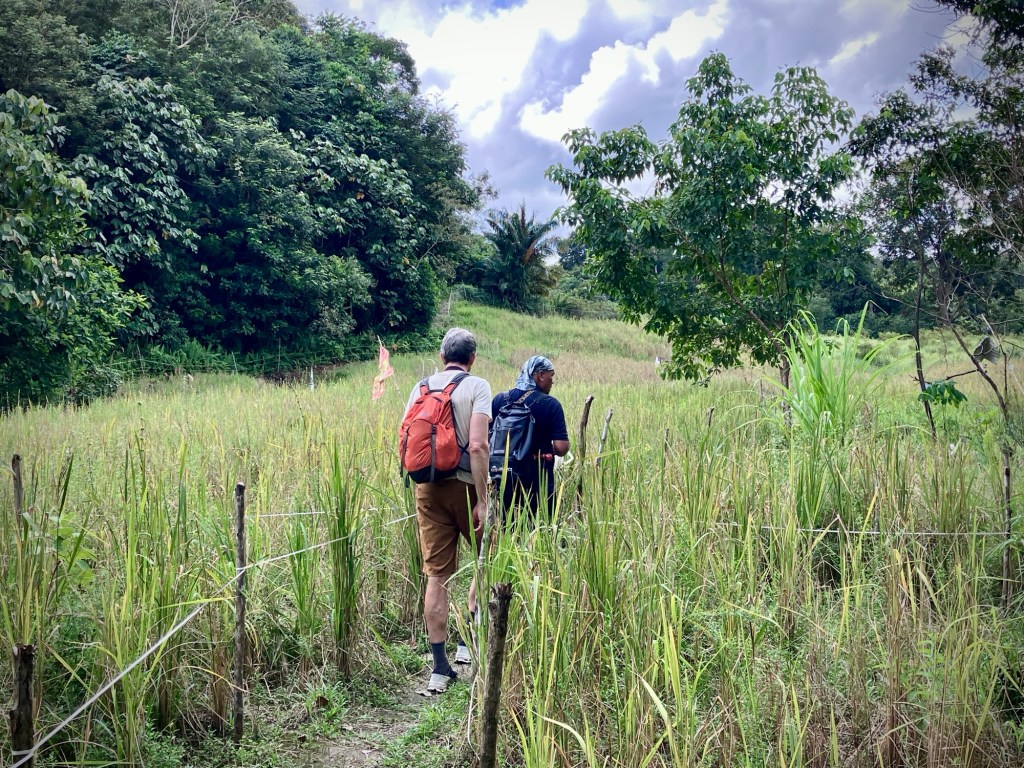
Each family has a local farming plot to grow rice and other crops, as the government and conservation efforts have mandated the transition from the traditional swidden (or slash and burn) agriculture to protect critical habitat.

We are very conscious of the voyeuristic aspects of this type of tourism, but felt Borneo Adventure’s unique and 35+ year relationship at Nanga Sumpa is positive and synergistic for all involved. It’s also very small scale. Their jungle tours are not for the faint of heart, but perfectly blend adventure with enough comfort for most travelers looking for a unique experience. So we didn’t take any photos of our interactions or the community as we walked around. Google the Nanga Sumpa longhouse if you want to see more photos to get an idea. And read this excellent article (thank you Gisela!) on the reconstruction of the long house after the 2014 fire: article here.

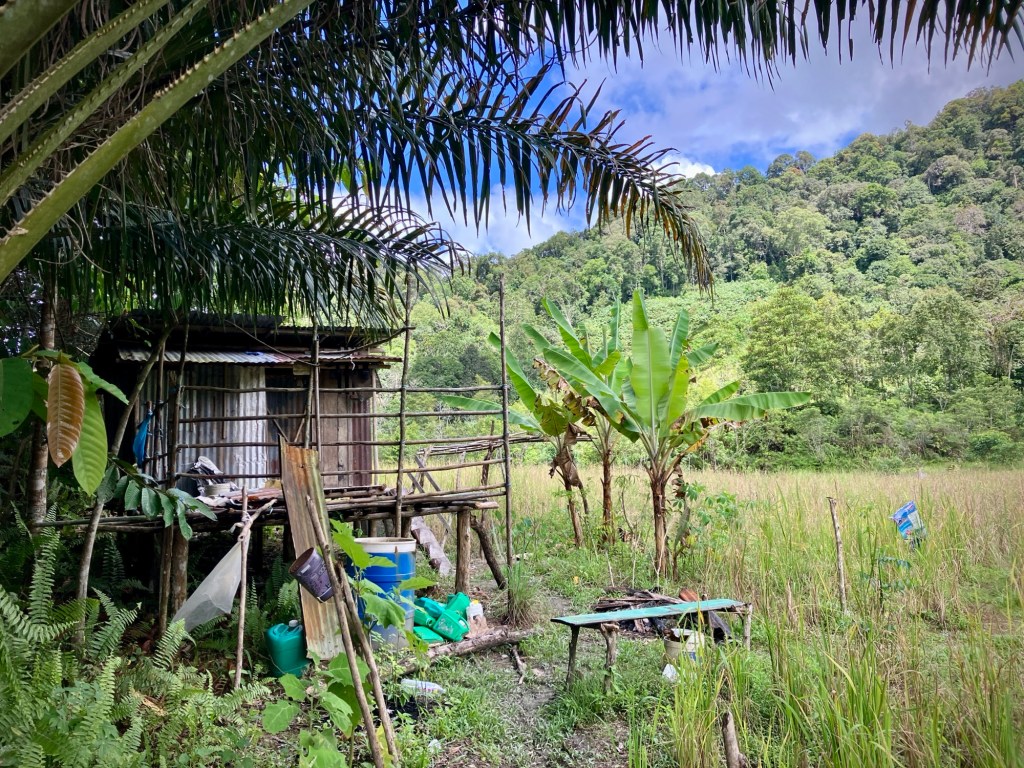
A farm shed in a jungle clearing
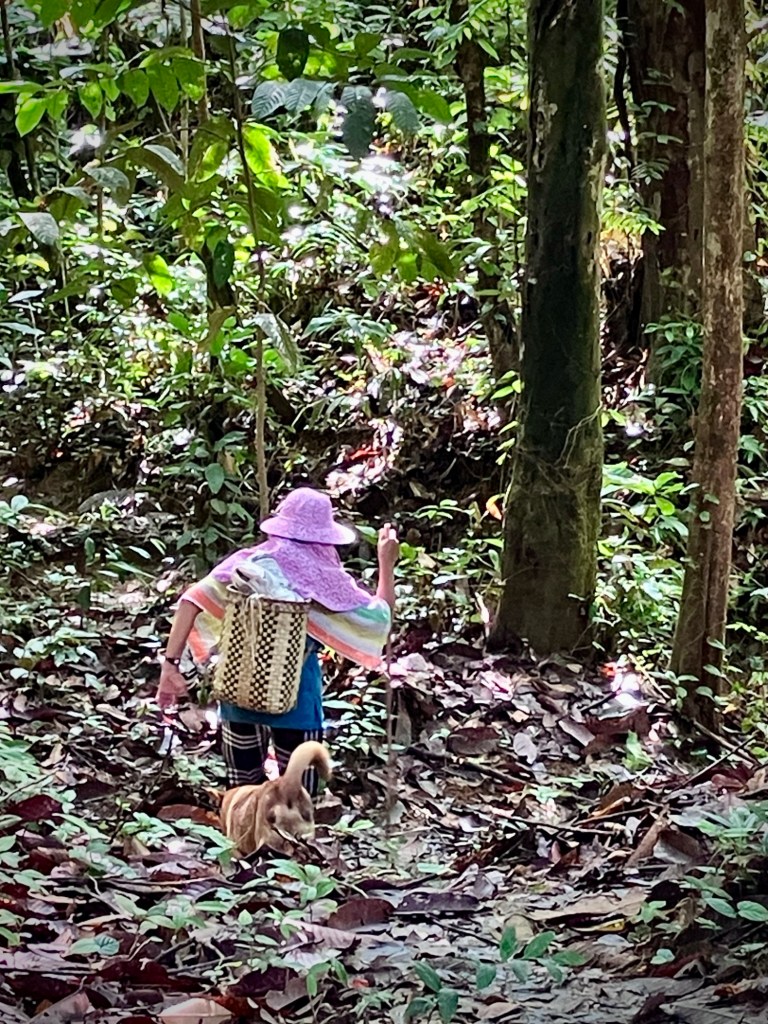
A Nanga Sumpa resident heading to her farm plot. Farming here is not easy.
Beautiful young bamboo shoots.
Rainforest fungi.
A bit of rubber is still extracted by the locals for use.
A local chief’s burial jar in the jungle with tributes of coins and cigarette butts. The grave is a way to protect and retain the land.

The second day began with a river crossing to trek for a few hours through the jungle and the hope to spot an Orangutan. There are over a thousand Orangutans in the Batang Ai National Park and adjacent preserves, but this buffer area of living Iban communities is outside the parks. However, a census/review done by WWF and other agencies in 2016 estimated about 250 Apes call this area home. This resulted in increased conservation efforts and even more desire to have the local communities coexist with this population. We were pleased to see some of our significant regular donations to WWF at work and having an impact on policy and life on the ground. It has seemed to push back the logging and palm plantation encroachment as well. At least for now.

And everything is flowing.
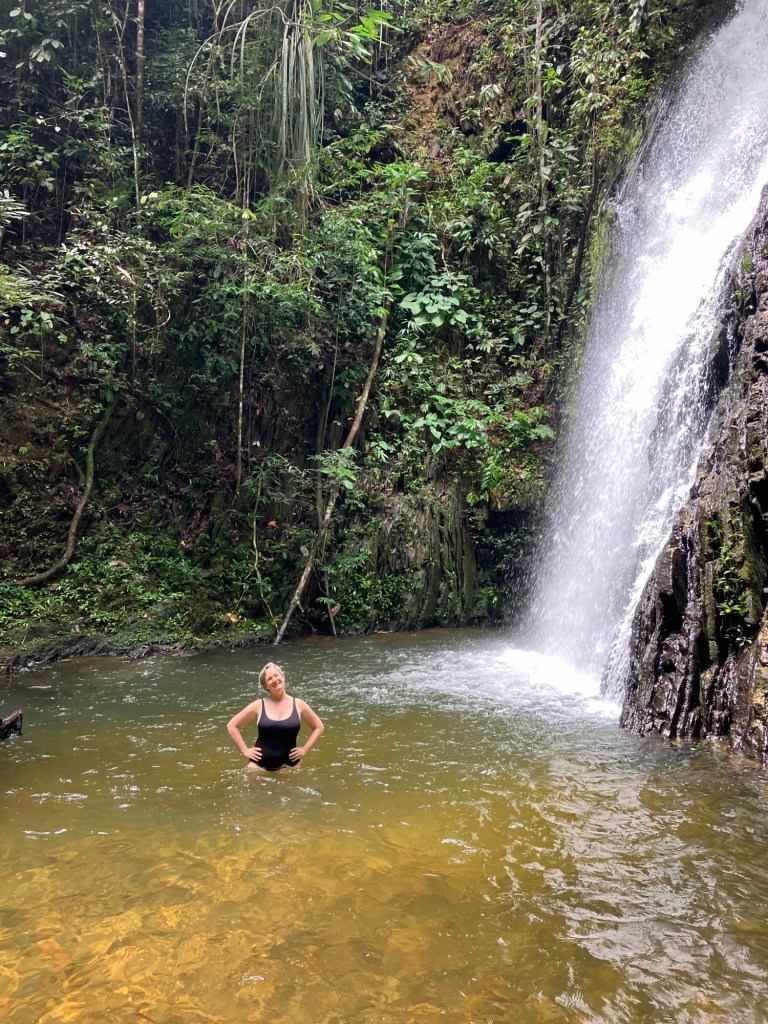
The waterfall swimming spot deep in the jungle was a place of exotic travel dreams.
Cheryl enjoying the cool waters.
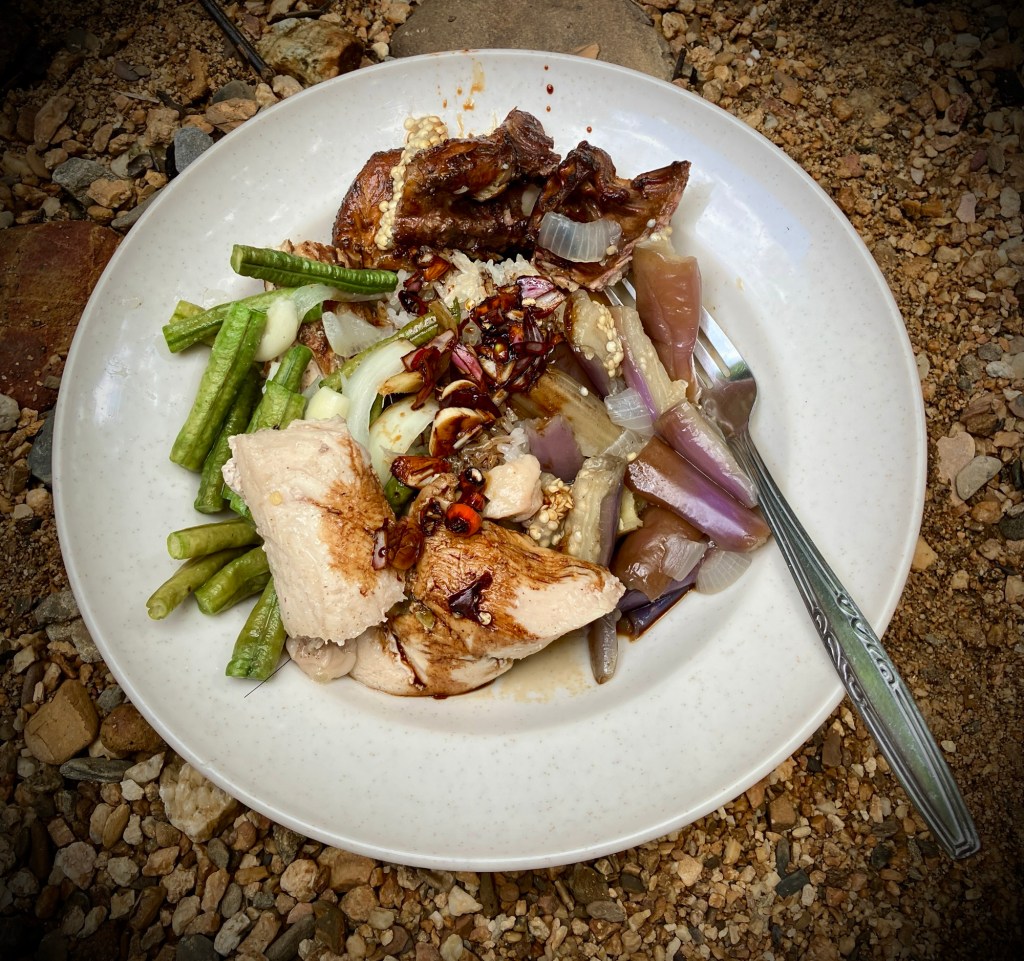
The friendly boatmen double as talented jungle chefs and prepared a delicious local meal over a wood fire for us to enjoy.
Chicken, bamboo sticky rice and assorted veggies hit the spot with a giant kettle of tea.
I couldn’t believe we were here.
Cut plastic chairs serve double duty in the longboats and on the beach -:).
Heading back down the river: cool, full, and refreshed. Everything is on the river.

Many tourists want to see ancient cultures as they imagine them to be and seem to expect wildlife steaming out of the forest in all directions. Our brief experience brought to life the fact that life in the modern Borneo jungle is a delicate balance between preserving wild habitat, traditional cultures, and providing adequate economic and educational opportunities to thrive. It’s not an easy life. But the communal ways and semi-subsistence living was real, as were the dozen of kids joyously playing in their river paradise every afternoon (it was a school holiday week). But there is a constant mix between residents and the « outside world » After primary school, kids now go off to secondary school in cities and villages hours away (And board there). And others go off to work opportunities for years, some retuning later and some not.

A final search for Orangutans yielded some fresh nests, but alas, no viewings. We saw dozens of nests in our treks as Orangutans move constantly and build a new tree nest daily. An amazing adaptation that requires a lot of intact habitat.
Cooling off back at Nanga Sumpa.

If you want to have the opportunity to see more wildlife, including deeper into Orangutan habitat, Borneo Adventures offers 4 and 6 day trips. The four young Germans we met our first night had done the extended 4 day trip and did see an Orangutan and a Civet. Wildlife viewing is a crapshoot. But no worries, we did see Orangutans a few days later outside Kuching at the Semenggoh wildlife Reserve, a 1600 acre rainforest with about 28 orangutans. It was amazing to piece together the wild jungle experience with actual viewings.

Three of the four semi-wild orangutans we saw at the Semenggoh Wildlife Reserve. There is a small baby clinging to momma.
Posing next to Ritchie, the massive 145kg dominate male in the Semenggoh community.

Nanga Sumpa in 2024 was fascinating. But travel is a snapshot in time. It was undoubtably very different in 2014, before the old longhouse burned down and internet. And what about 2034? Will cell service reach here? Will the young come back and continue to support the community and longhouse way of life? Will wildlife be thriving or will there be more encroachment by logging companies?

Morning life on the River as two women head upstream.
Great memories (and great coffee and tea).

This was an amazing and memorable experience for us and we will cherish the glimpse we got into a completely foreign way of life. We only hope we left some positive vibrations in return. And although we didn’t see any orangutans in the wild, we saw lots of other unique flora and fauna, including some beautiful birds. And just knowing these amazing human-like cousins are still thriving in these jungles will bring a smile to my face for a long time to come.

Hikes of the world: Lambir Hills edition.

Almost everywhere we go in the world, we hike. Urban hikes. High desert hike. Hot and sweaty jungle hikes. Gorgeous countryside hikes. Dodgy alongside busy road hikes. Amazing coastal hikes. British pub hikes.
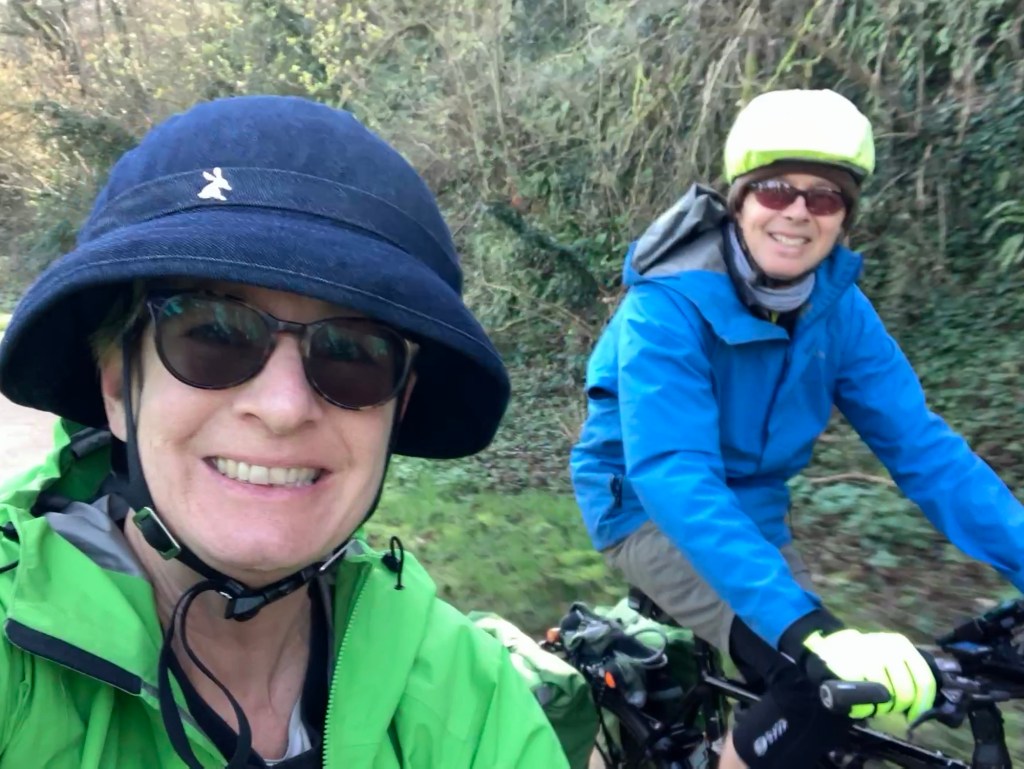
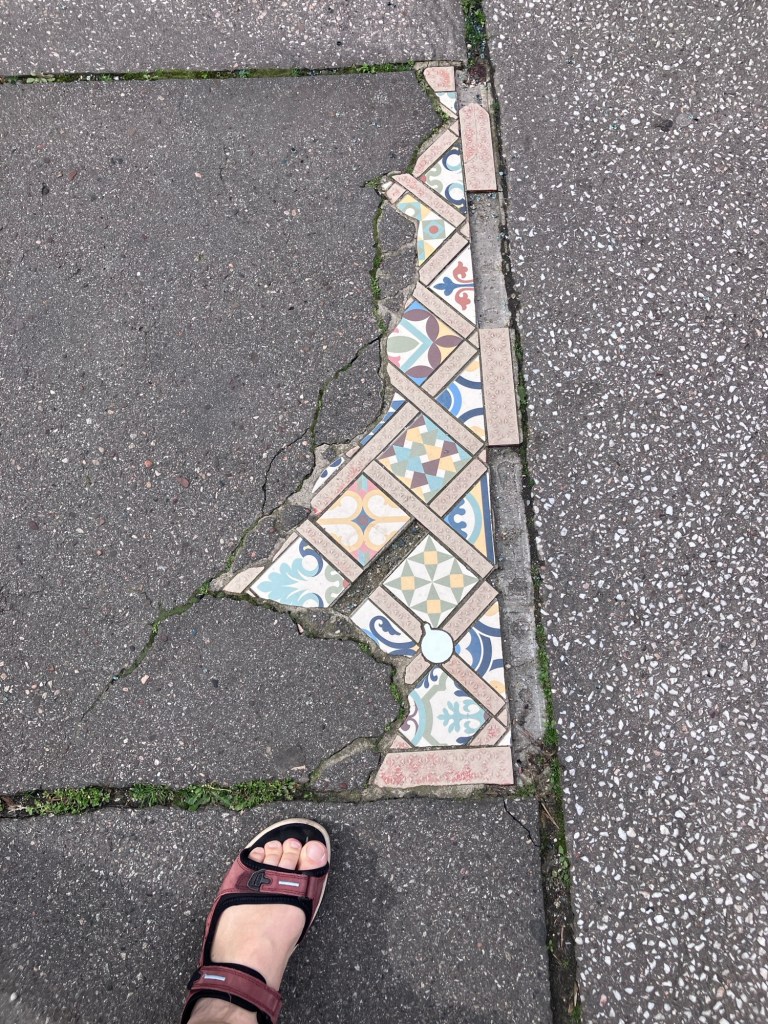
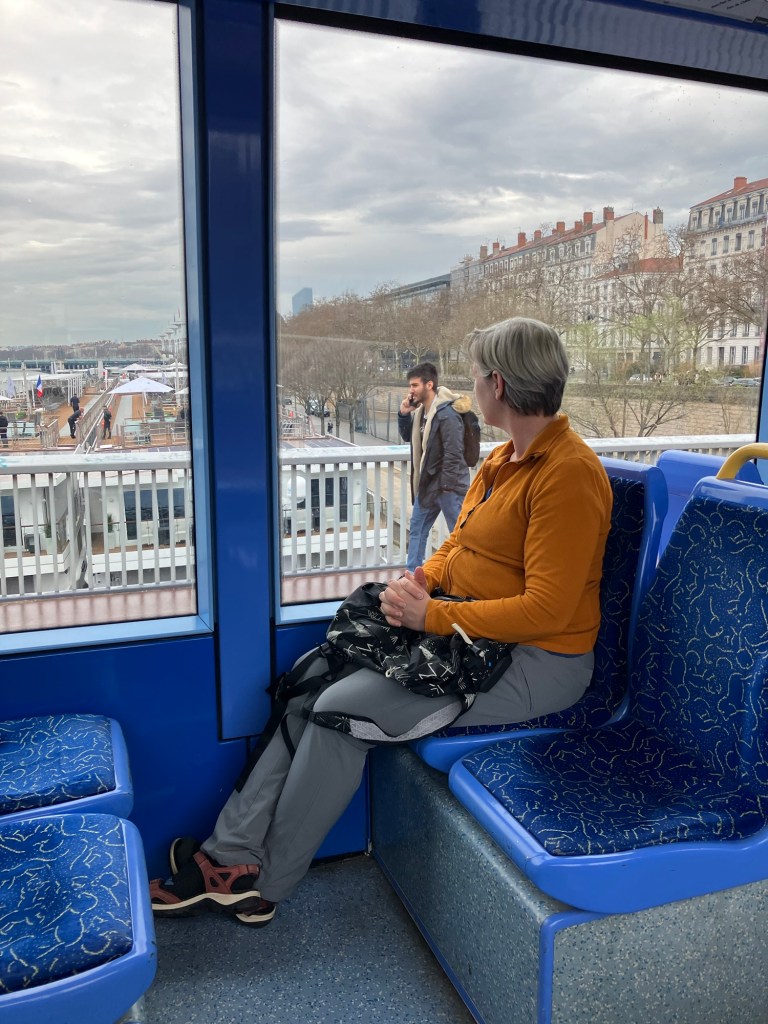
Wait, what?

Rich is very good at finding hikes for us to do. And he’s a fast and strong hiker. The more uphill there is, the happier he is. I’m not fast and frequently get grumpy going uphill.

Lambir Hills, outside of Miri, Borneo.

Hiking in the jungles and rain forests of Borneo is a challenge. Heat and humidity punish you, and the frequent heavy rains punish the trails, making them more like creek beds than trails.

These could be easy day hike distances in a different climate and with different trail conditions.
Hiking with a fan. Every little bit of breeze helps.
Our Lambir Hills hike started off nicely. Uphill on a decent trail. Huge trees.
Unknown to us vegetation. This climbing vine is so perfectly symmetrical. Looks like a tree zipper.
A nice shaded rest stop.

There seemed to be a period in Malaysian Borneo when trails were built and park buildings were constructed. Maybe 20 years ago, maybe 15? But maintenance is tough to keep ahead of. Or it’s not funded. It was sad to see the state of not just the trails, but some the other park infrastructure as well. After we crested the top of our climb the trail started to deteriorate. As it dipped up and down into drainage after drainage, ropes appeared to help you haul yourself up or steady yourself down the very rutted trail.

Up we go.
And down we go.
And up we go. Trail maintenance must be almost impossible on these trails.
We saw one other group of hikers, they were better equipped, with trekking poles and matching hiking shirts. They were just getting to the tough part.
My “we are not amused” look.

So what do I do when I’m not loving the hike I’m on? First, I remind myself why we hike. We hike because we like to see places only reachable on foot, and so we can keep on hiking. During a long bicycle tour two years ago we forgot to stop riding and take rest/hike days so we could work our hiking muscles. We found ourselves in fantastic biking shape and hurting on long walks and hikes.
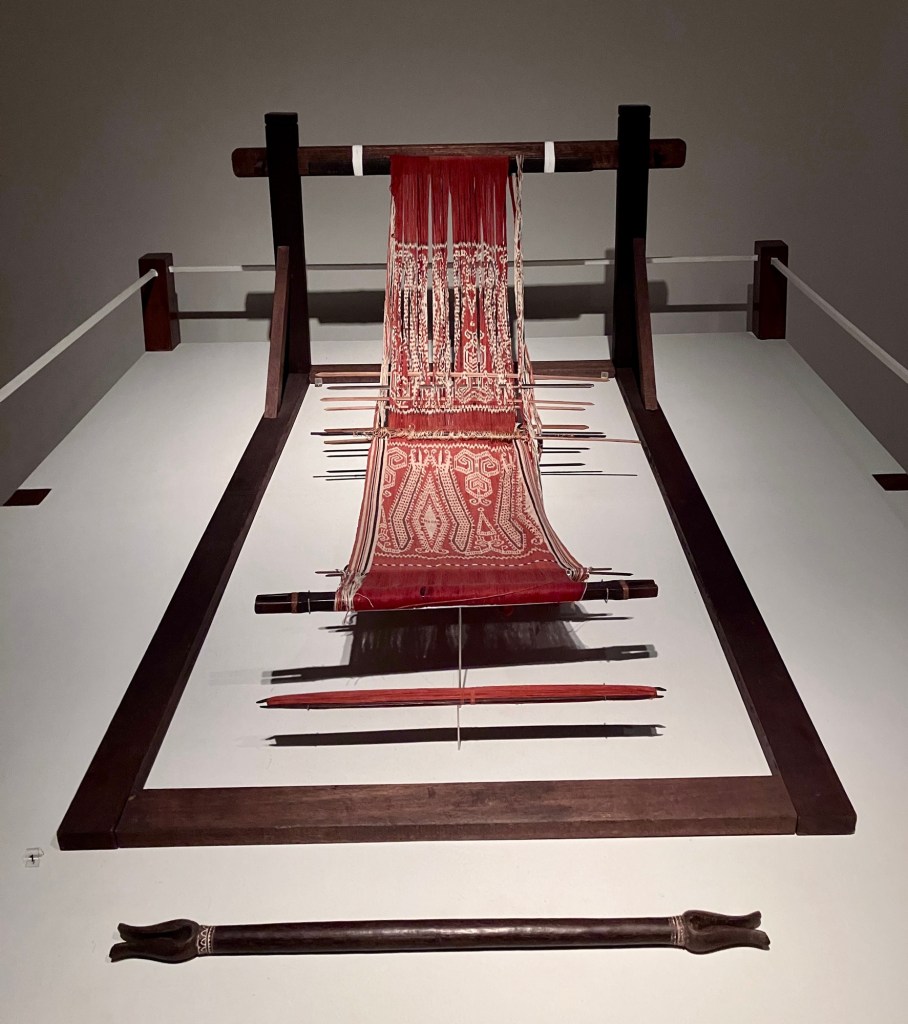
That’s not Malaysia! With our dear friends Cecily and Christine in Seattle, December 2023.
More dear friends in Wales, Hannah, Erik, and Thea. 2023.

Second on my list of hiking distractions is to remember hikes with people we love.

Christine, Annie, and Erika. Seattle December 2023.
My brother Steve and sister-in-law Claire, Pismo Beach California, 2017.
My brother Steve and my sister Kathy, Colorado 2020.
Rich, Mike, and Milo. California, 2021.
Mike and Kathy, California 2022.

We’ve had some of our best discussions, and come to some of our most life directing decisions while hiking. What have we decided while hiking? Whether or not to have children. Should we sell our place and travel. Do we need to actually own a car. Answers, no, yes, and no.

Above Tetouan, Morocco, 2021.
UK, the Lake District, January 2022.
On the Camino del Norte with Cecily and Christine, Spain, October 2022.
Snowshoeing with Cecily and Christine, Snoqualmie WA, 2023. Oh, that cold weather. Hard to remember what cold is like when you’re in Borneo.

Every hike has its tough elements. The moments when you wonder why you hike. But then nature reveals itself and you remember again why you hike.

Huge tree reaching for the light.
These trees did not let you forget you were in a rainforest.
The canopy is far overhead.
No surprise there is a lot of water.
Including a waterfall at mile 5. From the waterfall it was only a kilometer back to the park office where our Grab car would pick us up.
A very refreshing swim.

The rainforest is stunning, but I was happy the hike was over and our air conditioned hotel beckoned.

Oh you thought this jungle was done with you?
Thankfully Rich did a quick step back and did not tread on this snake. Not a pit viper but we still gave him respectful space.
From the park office to the waterfall is a popular trail, and in better shape than the rest of the park.
A view of Miri from our hotel room.
The hot, sweaty, pink, but happy travelers.

We’re in Kuching now, the city of cats, and heading out for a jungle lodge experience at Batang Ai, at the Nanga Sumpa Lodge, early tomorrow.

Gunung Mulu National Park. A gentle jungle.

Sungai Melinau Paku River, with the mountains of Mulu peak in the background.

I suspect I’m not the only one who assumes that the jungle of Borneo will be so full of bugs waiting to feast on me that I’ll be slapping and scratching from the moment we arrive in Mulu.

Arrival at Mulu Airport.

Was that my biggest worry about our four nights in Mulu? Well, after our experience at Mt. Kinabalu I was also worried about leeches. And, for our first guided tour at Mulu both Rich and I wore sneakers, long sleeves and trousers to keep the bugs away. Our wonderful guide, Nim, was wearing shorts and hiking sandals. For every tour after that we wore shorts and sandals as well. So much more comfortable in the hot and humid weather. And so few biting bugs. We have the millions of bats and swifts to thank for that.
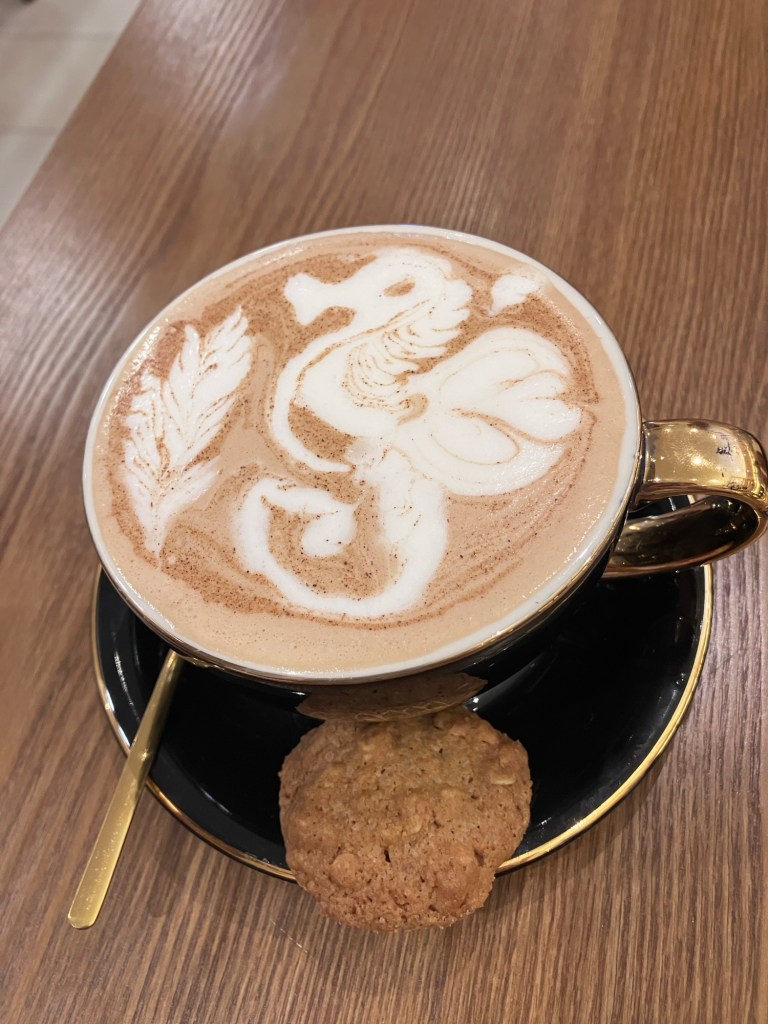
Sheltering from a downpour in the bat pavilion.
Our first very rainy afternoon. All the rain meant no bat exodus the first night.
A frequent site during the rain, yellow poncho clad visitors.
Fog at the mouth of the Deer Cave, where millions of bats shelter during the day.
Rainwater drips through the limestone to create amazing sights in the Deer and Lang Caves.
From the boardwalk you get to see stately trees.
Rich added for scale. This is a day or two after arrival when we had learned that shorts, t-shirts, and sandals were the way to go.

The two biggest attractions at Mulu are the caves and the bats. We jumped right in to cave tours, ultimately getting to walk in five caves, for a total of about 5 or 6 kilometers of cave walking. Wow, impressive right? Well, Gunang Mulu National Park has about 295 kilometers of explored caves. Every cave we visited was different, the giant chambers, amazing drip structures, or no drip structures due to wind blowing through a cave and inhibiting the fantastical structures.

Boats waiting to load visitors for a cave tour.
The boat rides were a fun way to start a tour.
A young helper, his Dad is handling the motor, he helps out at the dock and on debris watch, so the visitors don’t end up in the river.
At the entrance of the Cave of the Winds. A boat ride and 200 stairs up.
The mouth of the cave.
A sky hole in the cave. With light comes life.
After visiting Clearwater Cave you get to swim in the river that flows out of the cave. Incredibly refreshing.

Each cave is unique. And some have only been open to visitors for the last few decades or so, which means that they are pristine. Fastlane cave has had the lightest human touch, with no lights installed and a through route – in one mouth and out another – and the most dramatic formations.

On the way to Fastlane Cave.
The entrance. Flashlights are really needed in this cave.
Photography is a little challenging, you have to borrow torchlight.
A “showerhead” formation. Water drips through the limestone deposits, which were perhaps created by tree roots up above.
Over hundreds of years the shower head has created its own basin, or bathtub. The water is incredibly pure, but of course reaching in to it is strictly prohibited.
The size of the group is limited to 8 on the Fastlane Tour and our guide, Jonah, was super knowledgeable. He also had us all turn off our lights for a few minutes to really experience the cave as its inhabitants do.
Like these huge Huntsmen spiders who live in the cave and eat crickets. We also saw blind white cave crabs, blind cave crickets, swifts flying and navigating by clicking, and of course bats.
The exit of the Fastlane cave.
There are trails for self guided hikes, but to enter the caves you must be with a guide.
Gate at the cave exit. I was very amused by the spider web motif.
Inside the Cave of the Winds, in this photo you can see the boardwalk and lights.

The bats disappointed us our first evening, but on our second evening, we hustled out the 40 minute walk from the Park Office to the bat pavilion and settled down hoping for no rain and many bats.

We all did a pretty good job of being quiet.
The bat pavilion was the place to be, a lively global crowd on the Lunar New Year
And the bats came out. And out. And out. Millions of bats. In waves and waves. They flew overhead and circled back. You could hear their masses of wings beating.

We also did the canopy walk. 25 meters up, 425 meters long, and apparently the longest tree based canopy walk in the world. The guide warned us it was not for those with a fear of heights. Or a fear of swinging swaying narrow walkways. The guide also warned us not to drop our phones as the locals would retrieve them for us, but would also charge for retrieval. A river retrieval would of course cost more than a jungle floor retrieval.

Heading out, two by two, per instructions. A fellow tourist took this photo for us. We all took photos of each other and shared via Airdrop.
Rich treading the boards.
Cheryl hanging on for a photo.
The Canopy Walk was a success.No cell phones were dropped.

Mulu Park is quite well run. We had no problem signing up via email for tours in advance (recommended!). There was plenty of staff on hand to check you in for tours. The tour guides all came from local communities, and knew traditional customs and ways of life since their families lived them. Facilities were well kept up, the park cafe was open 7:30 to at least 8:30 and the food was pretty good.

Lunch at the cafe in Mulu Park.
And another lunch at Mulu cafe, overlooking the river.

Where were we when not walking through caves in Mulu? At the Mulu Marriott. The hotel was only about a six minute drive from the park, by frequent on-call shuttle van or open air truck. There are also options available inside the park, hostels or lodges, and home stays just outside the park and right across the river from the Marriott. Something for any budget, really.

Loading up the human cattle car. It was actually quite nice. A breeze. A view. Your fellow hotel guests.
Bamboo shaded walkway at the Marriott. The entire hotel is built up from the jungle floor on boardwalks and stilts.
Rich chilling waiting for the shuttle to the park.
Enjoying a glass of wine in the River Bar. Not only was this a great place to bird watch, but it was also the only place to get connected to WiFi.
The Travel Planner hard at work, binoculars at the ready for bird spotting.
Breakfast outside at the Marriott, binoculars still ready for bird peeping.
The resident cat family. Ever hopeful for food.
Little girls are always a good bet for tidbits to the cats.
And nice young men, apparently. The cats migrated from table to table.

We settled on Mulu National Park as a place to be over Lunar New Year, it seemed a good way to escape the crowds and noise of the cities and festivities. It was a great decision, peaceful, busy but not super crowded, and we had the pleasure of meeting a lot of other visitors. When you’re all staying at the same hotel, and doing the park tours, you get to know the other folks. Quite a few families who were living and working in Brunei had come to the park. It was nice to have opportunities to chat, exchange notes on the tours, and just socialize in general. That is something we can miss out on doing constant travel, the social part of life. All the ex-pat families were so friendly. I suppose it’s a necessity when you relocate for work, get out and make friends wherever you are. We appreciated it very much and loved chatting with folks.

Two sweet girls from Egypt, Dad is an anesthesiologist in Brunei. We got to know this family over a few tours and in the hotel.
Dave and Eileen (hi you two!) from Aberdeen. We shared beers and bat watching.
And a few tours.

Four nights was a nice length of time. We could have filled a few more days, there were more walks to do, and for those who crave more adventure there were adventure cave tours, which involved crawling and squeezing and sometimes swimming through caves. Squeezing not for us but two nice American guys we met had a fantastic time on a cave adventure. They were exhausted and filthy but had signed up for another one so obviously enjoyed it.

Cleaned up and ready for dinner.
The happy travelers ready to leave Mulu.

Next up: Miri and Kuching. Kuching is known as the city of cats, so you know what to expect from me!

Borneo, It’s a Jungle Out There!

Ah Borneo, the name for me summons visions of exotic jungles, wildlife, beaches or mountains. And who knew Borneo was the third largest island in the world, somewhat bizarrely split between Indonesia, Malaysia, and the tiny sultanate of Brunei. We have decided to focus on the Malaysian side of Borneo as it’s a bit more tourist friendly and jumping between both sides actually involves a lot more travel and flights. Seeing more of less is still our favorite way.

The 13,500 foot Mount Kinabalu shows itself only briefly most mornings
Our first sunset view in Kota Kinabalu or KK as the the locals refer to it.

We also vividly recall our great three week trip to peninsular Malaysia about 10 years ago. So as we touched down in Kota Kinabalu, the capital of the state of Sabah, we were both very excited. Not quite a new country for us, but a very new place. And there is so much to see and experience here.

Kota Kinabalu greeted us with multiple street celebrations and night markets; including the excellent Api Api food market Friday and Saturday Nights on Gaya Street.

The multi cultural melting pot is striking here with an intoxicating mix of customs, manners, religion, and of course, food. Malay (Muslim), Chinese, Indian, and a mix of indigenous and intermixed cultures means that you’ll always be guessing where someone is from.

So many choices and I was very tempted by whatever this spicy beef rib meat was going into, possibly a version of beef Rendang?
But we soon saw a modest line at this stall. This was the man responsible for some magic Mee Goring…we called him grandpa, as he made each batch one (or two) at a time at a very mesmerizing pace. Luckily we got in line early as it grew to near an hour behind us!
And finally perfect Penang Style Mee Goring

To add to the excitement and challenges, our travels have coincided with the lunar new year celebrations in Asia. A month long celebration of the year of the (Wooden) Dragon, with the actual lunar new year on February 10th. So my challenge as the travel planner was to figure out how to work around the potential high lodging costs and travel bottlenecks of the peak of the holiday from about the 9th to 14th. More on the success of our strategy in our next post.

Visiting Asia during the Lunar New Year period means surprise festivals and celebrations pop up everywhere
Very friendly locals in KK. Cheryl was thrilled to see these young ladies lion dancing.
Do not miss lunch at the Sri Latha Curry House in KK. The veggie and chicken curry sets were both colorful and flavorful.
The KK Wetland Ramsar Site is close on the edge of the city and has about 2km of boardwalk walkways and viewing platforms. We visited during low tide so mudskipper and crab viewing was prime. More birds at high tide.
Mud boots available if you want to wade through a short muddy section off boardwalk. We passed as nothing my size (US 14!) anyway, and the walkways were sufficient.
So, since India last year, I’m now a nacent birder and Borneo has an dizzying array of species. I only spotted a few of the 80 species reported just at this wetland center.
Cheryl slightly bemused at my intensity on spotting the White-Collared Kingfisher from a bird blind at the wetlands center.

We like Malaysia, but it it’s always tough for us to have to rely on cars so much to get around as there is no real public transit in Sabah. Grab is the dominant ride hail App here and it works pretty well and is cheap. So we have been using it and make sure we tip well as all ride hail and delivery drivers of the world often seem to be underpaid and under appreciated.

The Sabah museum complex has two separate museums and a dozen or so outdoor buildings from various cultures of Sabah.
The outdoor cultural building area of the Sabah grounds was quite nice, and we had it to ourselves. It could use a little more curation and text on each building.
The Sabah Museum Complex in KK.
It is hot in Borneo. So hot and so humid, but this raised indigenous house was surprisingly cool late morning…so we sat still and appreciated the wisdom of pre a/c design.
There were only a few people at the small and mildly engaging Islamic Civilization Museum, but there was a sweet cat.
Athée Islamic Cultural Museum, a beduk drum from Indonesia made with palm wood, cowhide, and tied with rattan …. (SF note: this would be SO cool on Hippie Hill!).
Even I couldn’t resist this sweet kitty while waiting for our return Grab ride. Grab is a ride hail App that is essential in Malaysia if you are not on a tour or renting a car.

Mount Kinabalu dominates this corner of Sabah and occasionally in clear weather, mostly the mornings, you can even see it from KK. It’s also a popular summit climb and epic if it’s clear; but we decided for a number of reasons to skip it. First off; February is still the rainy season here and climbs can be rained out or miserable. I also opted to travel light for 2+ months of travel with just my trusty Ecco sandals and very light running shoes/trainers. An additional pair of size 14 hiking boots takes half my Osprey pack. Oh, and it’s a slog up and down 8,000 feet in 36 hours with a 2am wake up.

At 4,095 meters (13,500 feet) Mount Kinabalu is impressive from a sea level sunrise in KK

There are lodging options outside the park if you have a car but keeping to our blog mantra, we just used a Grab to get to the Park HQ and stayed for 2 nights at the lodging run by Santera. It’s all a bit pricy for what you get; but you are paying for a great location next to the trails, forest and park utilty road. As well as spectacular views of the mountain when clear.

We did a loop our first afternoon up the Pandanus to the Kiau View trail…probably best in the morning when you are likely to get more views.
Happy on the trail in Borneo.
Fungi and spores everywhere in the slightly more temperate rain forest at 1,600m.
One of the many beautiful orchids in the botanical gardens.

The hiking trails were interesting, but except for the main Silau Silau Trail, not too well maintained. The small botanical gardens boardwalk loop walk is worth doing with a guide (free at 9am or 3pm) as otherwise you’ll miss a lot.

Ok; it’s a bit muddy, steep, but all is ok on our first foray into the NP forest…then it started to rain, and with rain comes leeches.
We made it to the end of the trail but Cheryl was not thrilled with her two leach discoveries… we’ll spare you photo of the welt on the bottom of her foot.
And then Cheryl had to remove this from between my toes…a credit card comes in handy , but this guy had his fill of my blood.

It dumped rain for hours the second afternoon and evening, making the forest and creeks rage with water. We felt bad for the climbers that had set out that morning, but perhaps they missed the worst of it by getting to the first shelter by late afternoon.

This mini Raffesia flower startled us when pointed out by some fellow hikers.
The rainforest around Mount Kinabalu is stunning in some sunlight.
The Medinila were one of the delightful things blooming in February
A fungus city just above the forest floor.
All this mushroom needs is a gnome.
No leeches on Day 2 with pants tucked into socks and no rain in the morning.
We were surprised to learn of the tragic death of 18 climbers on the mountain in the large 2015 earthquake. A huge rock pinnacle let go and also trapped some 100+ climbers.
The lodging in the park ranges from hostel to suites, and there is a decent and pleasant restaurant open for all meals.
Pitcher plants awaiting lunch.

Getting back to KK 2 days later was a bit more challenging as no Grab drivers would respond out on the remote location (not surprisingly) and we ended up booking a car back through the park HQ. It all worked out fine; but was about double the Grab rate; even with our generous App tipping.

Back in KK for two nights, we took an early boat to Mamutik Island and were able to snag the end of a picnic table in the shade and have some time to swim with some fish in peace.
Our early boat out to the island. Lots of families travelling during the peak Lunar New Year holiday. Fun to let go and be part of the celebrations.
Our boat captain was definitely racing the adjacent competition to the island. We won as he kicked in large twin engines…ha!

We opted for an apartment near Jettleson Quay in a giant new high rise complex as hotels had already doubled in cost with the run up to the New Year. It was conveniently just a few minutes walk to the boat docks to the islands, but was loud with concrete block echoes, and music and road noise about due to pre-holiday festivities.

Mamutik Island and Mount Kinabalu before the rest of the daytrippers arrived. Those sole footprints are mine.
Monitor Lizards roam all the islands of Tunku Abdul Rahman National Park.

I had hesitations in visiting one or more of the Islands off the coast of KK after reading about overcrowding and trash issues. We didn’t want to add to the problem, but it did seem that trash issue were more discussed pre-pandemic. We also opted for just one island, as you can visit one, two, or three islands in semi scheduled service from one of many boat/tour operators. The crowds did show up later morning but it was not bad, as trash disposal was good and the water seemed clean. Kudos to the park management for this, but they still should revamp and consolidate the many competing boat services, and work on the supply side of plastic, which is everywhere and in everything in Malaysia.

We were pleasantly surprised to see good garbage control on the island and almost no trash on the beach or in the water.
Lunar New Year Instagramming was part of the attraction at these busy islands.
Lots of shade as the midday sun is fierce here. Only the Westerners sat on the beach in full sun, and swim costumes are modest both for cultural norms and sun protection.
Very pleasant in the shade with a breeze.
Happy Travellers enjoying the Lunar New Year vibe in Borneo.
At Kota Kinabalu Airport heading to our next adventure in Sarawak.

Our first week in Borneo was intense. And all peak travel has its ups and downs, but the blessing of having time is to be able to smooth out the bumps and go with the flow a bit more. Sure, Lunar New Year partying meant getting less sleep a few nights in KK, but the festivals, food, and people make up for it. We’re here now and savoring every moment. Happy New Year!