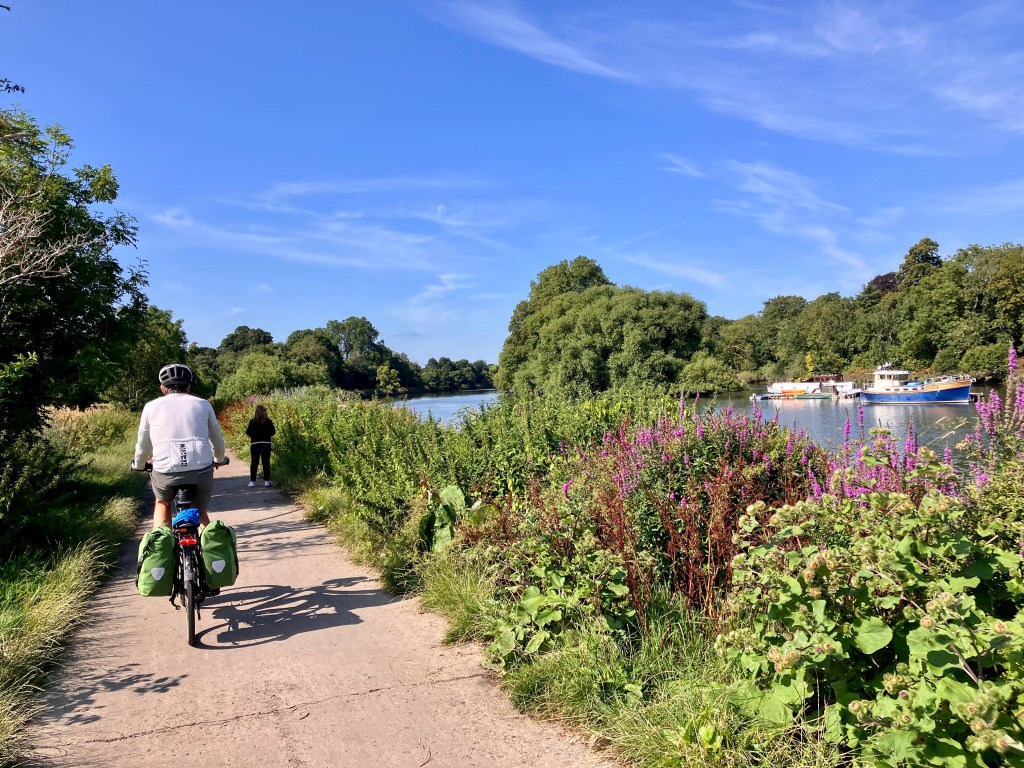
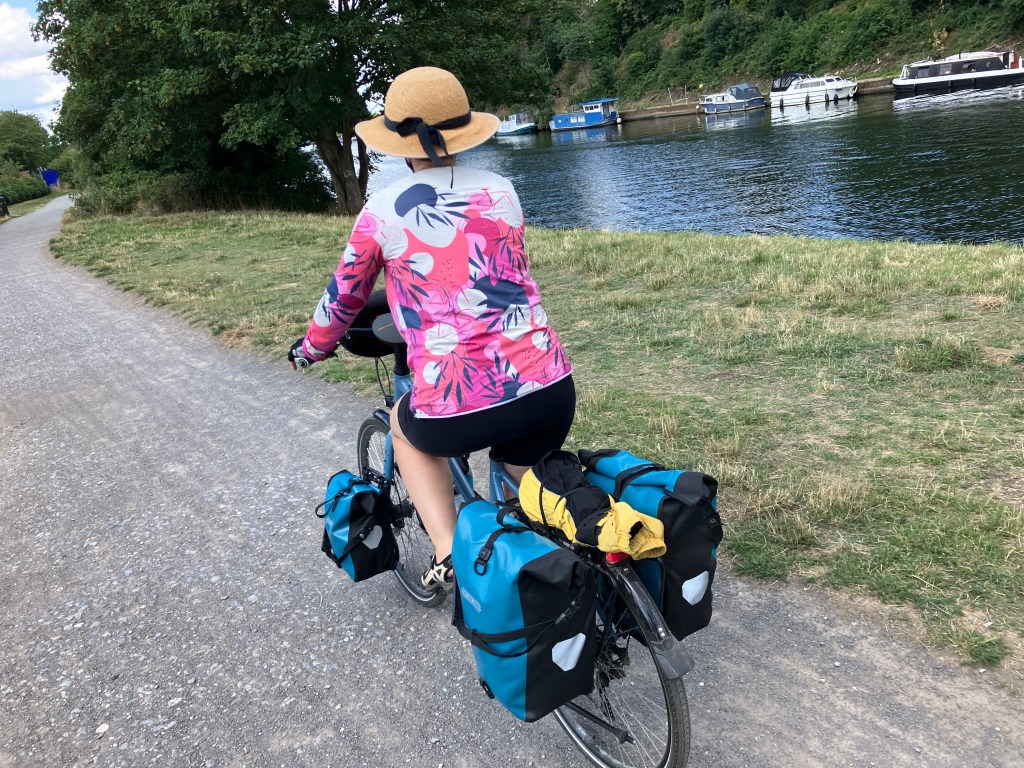
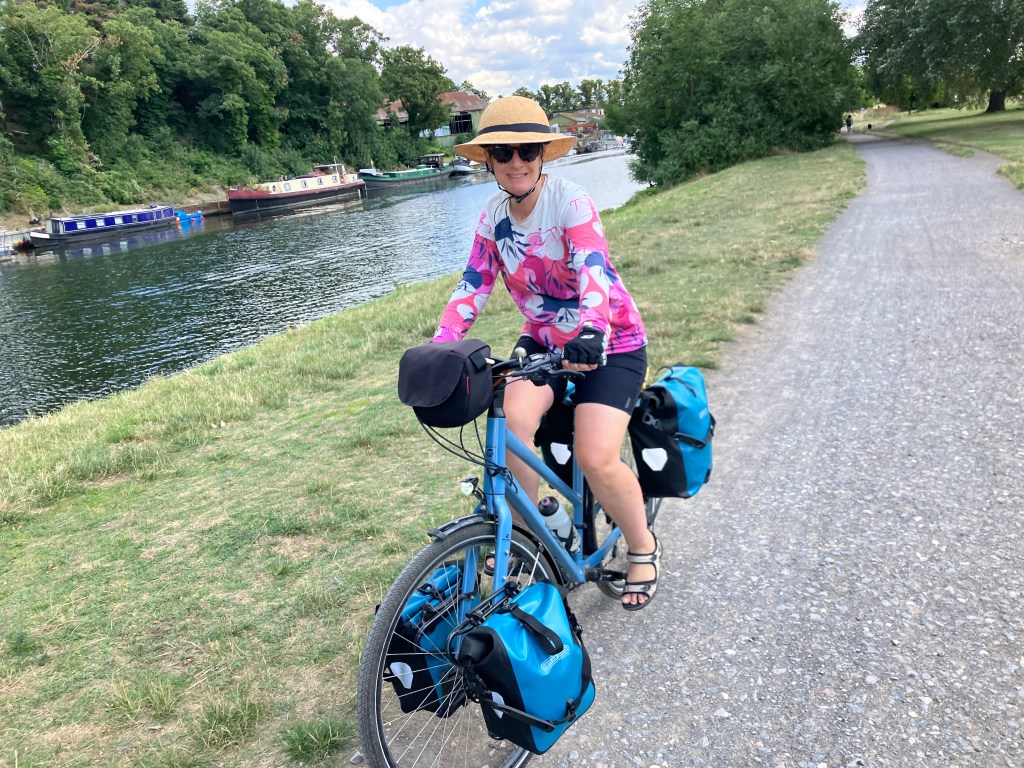
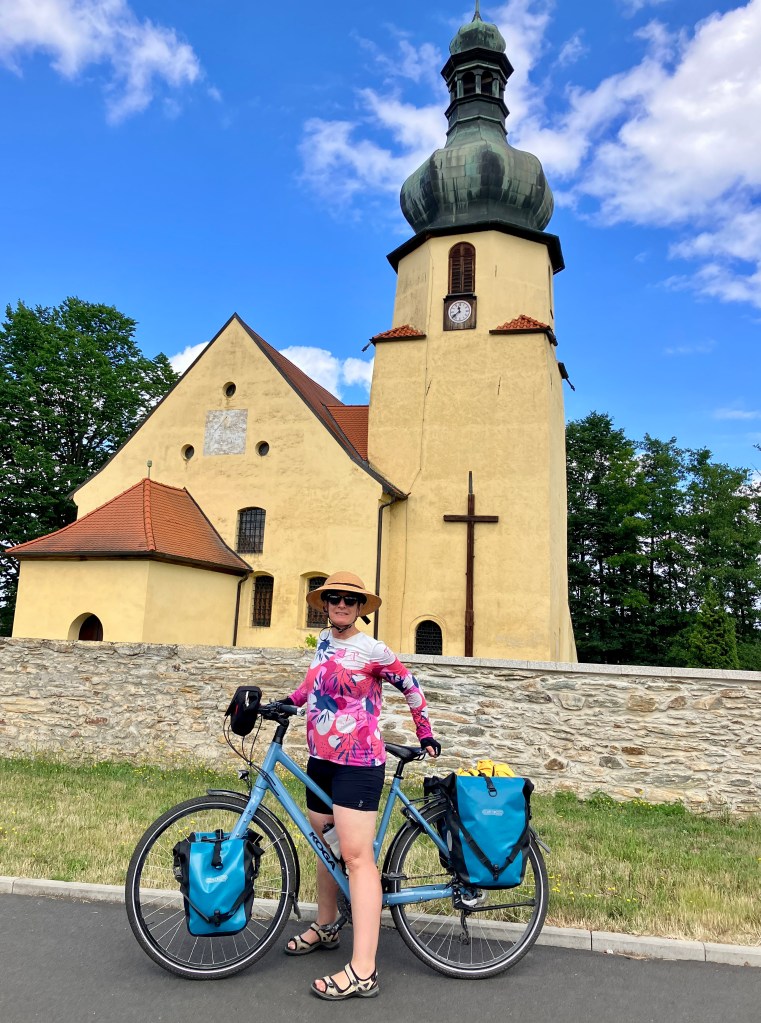
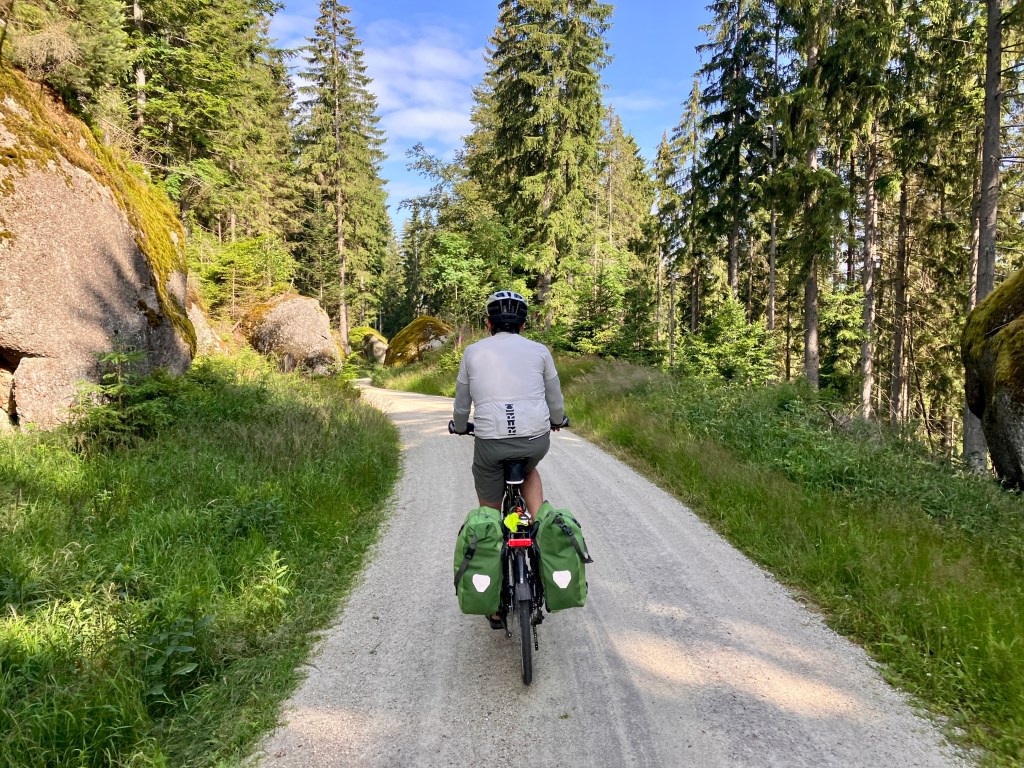
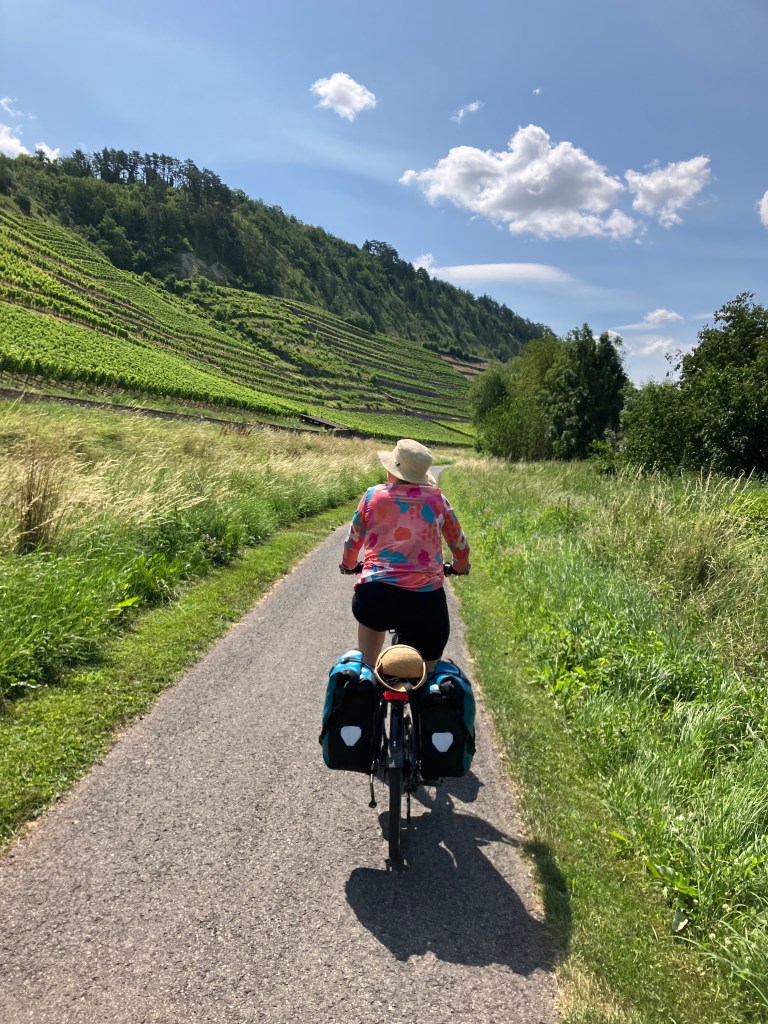
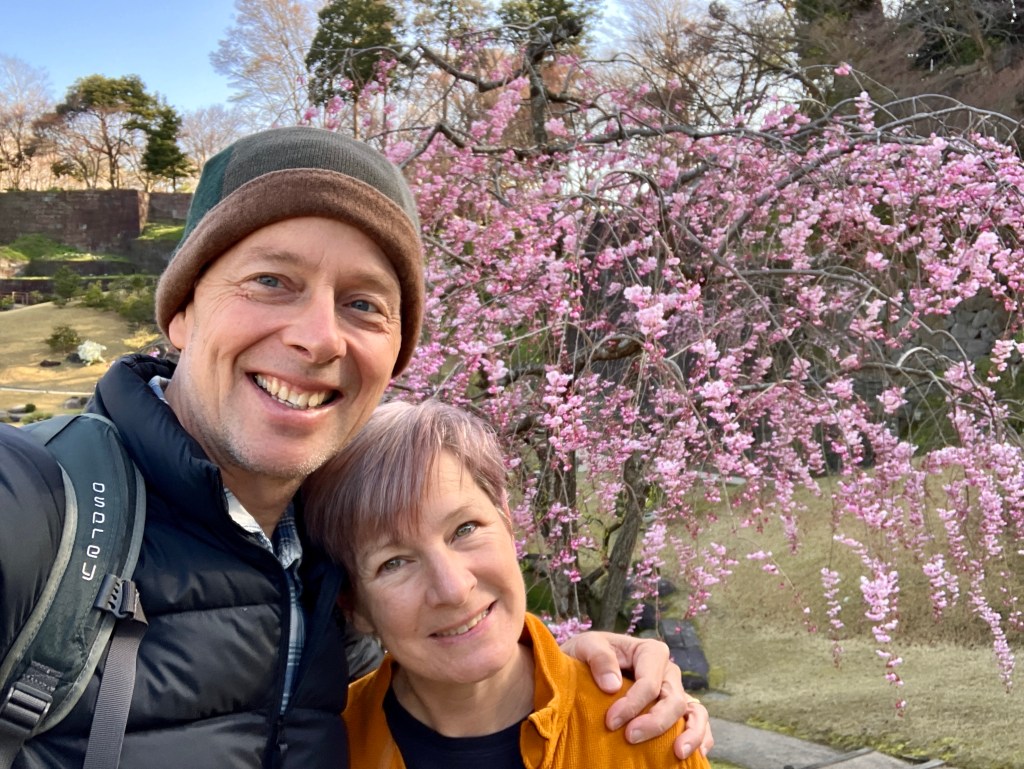
Twisting along the Thames – from London to Windsor by bike.

Headed out from Syon Park on a bright and mild morning.

Arriving in the UK after seven weeks bike touring in Germany, Czechia, Belgium and the Netherlands is a mixture of delight- we can talk to people and have in-depth conversations and understand all the signs and announcements!, and disappointment – the cycling infrastructure in this area of the UK is like most of the US, pretty sad. Not well connected, and nothing that is going to move people away from car trips to bicycle trips. Except, just like in some US cities, in some UK cities where cycling has become a preferred mode, like London, the cycling can be great.

Riding from the Harwich ferry to the Manningtree train station was fine. Quiet morning roads, considerate drivers, but no real bike infrastructure.
Adjusting to staying left is always a challenge at first.
Staying out of the way at a crowded Liverpool Station in London. The next day was to be a scheduled train strike so the trains seemed extra busy.
That is not just a bike lane, that’s a cycle superhighway.
Finding a gap in the tourist flow to snap an usie. Us and Big Ben.

London is a great example of what good infrastructure can do for cycling in a city. This is the second time we’ve come from Holland on a ferry to Harwich, and then a train to London. The first time we were a bit nervous about crossing London on loaded touring bikes, but it was a snap, so this time we were looking forward to it. And London on a busy mid July morning, loaded with tourists, did not disappoint.

St. James’s Park. Blending in with the other cyclists.
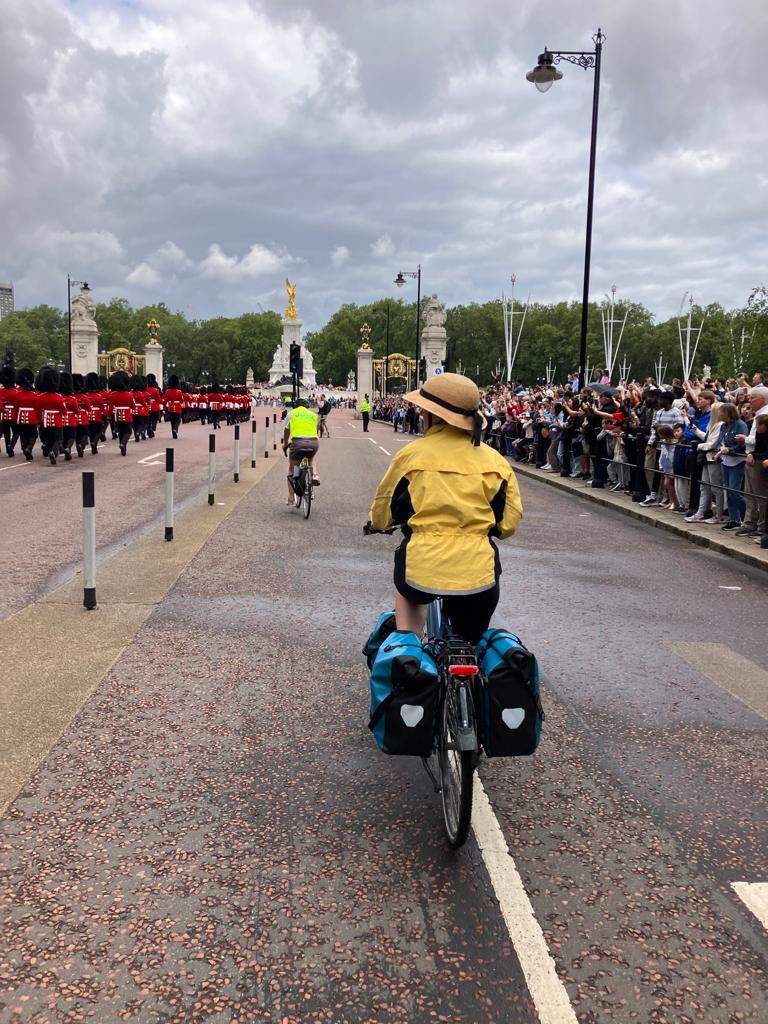
Want to feel like part of the attraction of the changing of the Guard?
Hop on your bike and follow them up Birdcage Walk and Spur Road. As long as you stay behind them the busy Constables will not yell at you.

Our route took us past Buckingham Palace, which always gives me a thrill to see, and on to Hyde Park. From Hyde park we rode towards Hammersmith and joined the Thames River. First stop: pub lunch at the Blue Anchor. When we have our loaded touring bikes we make sure to sit outside somewhere we can keep on eye on the bikes. Our new bikes have spoke locks which are super easy to simply click into place, and we joke that it would take an unusual thief to be able to jump on Rich’s huge loaded bike and ride away without immediately crashing, but we are happier when we have the bikes in sight.

Ah, the first British pint in about ten months.
Lunch along the river.
This set up is a bike touring dream. The Blue Anchor on the Thames River.
Always read the info plaque. I appreciate that someone went to the effort to give me a little historical context with my half pint of cider.

We decided to ride along the Thames to our hotel for the night, the Hilton at Syon Park. It would be a perfectly timed bumble to get us there at check in time. Is it the easiest or most efficient way to ride? No. But winding along the Thames Path takes you through some very scenic areas.

So many cute pubs, but we must be moving on.

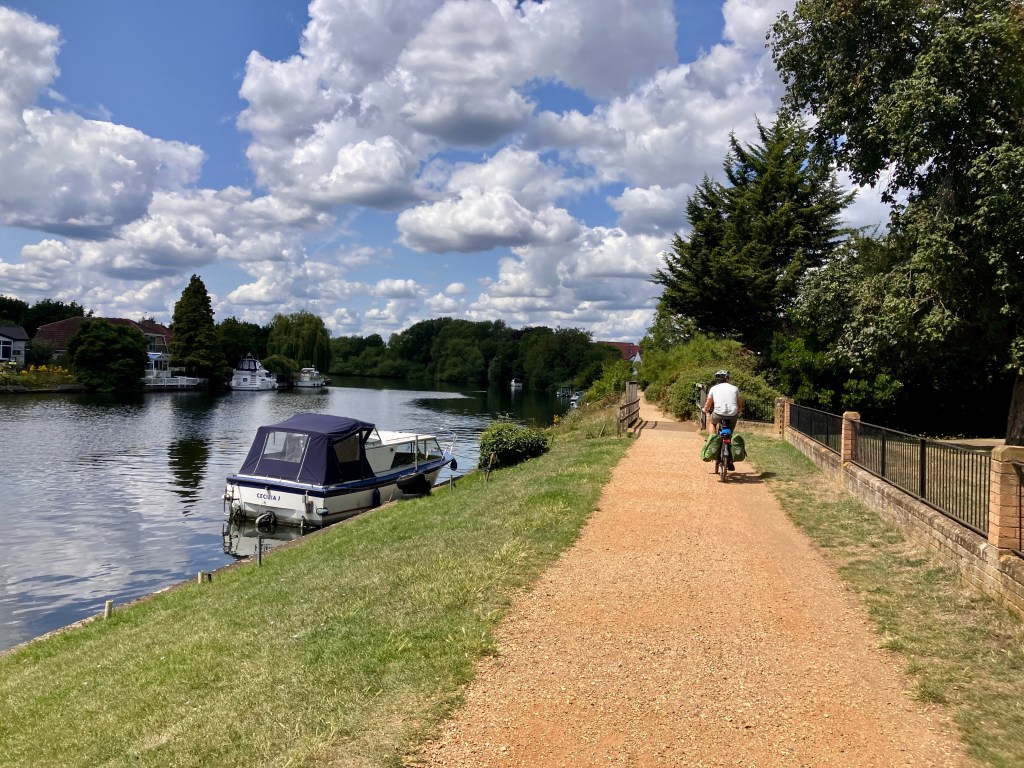
After our night in Syon Park, which would be worth exploring on a future visit, we decided to ride the Thames Path all the way to our destination just outside Windsor. Again, not a direct route, but certainly a scenic ride. It’s fun to have no idea what to expect from a route. The surprises around bends in the river, the views across the river, the varying surfaces of the Thames Path – everything was new to us.

Isleworth, still in the tidal reach section of the Thames.
Richmond Bridge. Still in the tidal reaches of the Thames. Teddington, just a bit along the river from Richmond, is known as the end of the tidal Thames.
It was surprising to us to find such stretches of nature so close to London.
A view of Marble Hill across the river.
Signage along the path is quite good in places.
Rich in front of Ham House. The challenge of loaded bikes is actually going inside attractions. We did not.
Crossing the river again at Kingston upon Thames. The Kingston Bridge.
And another attraction, Hampton Court Palace, viewed from the outside.
East Mosley. So many boats!
The river and path really stitches together life. Walkers, folks painting, so many families, it’s a huge attraction, but dispersed crowds.
West Molesy, and me being nosy about boat life. I love seeing the occupied boats and imagining life afloat.
The surface of the Thames Path varies a lot. This stretch was quite wide and fairly smooth. Some parts were choppy old asphalt or quite lumpy with tree roots.
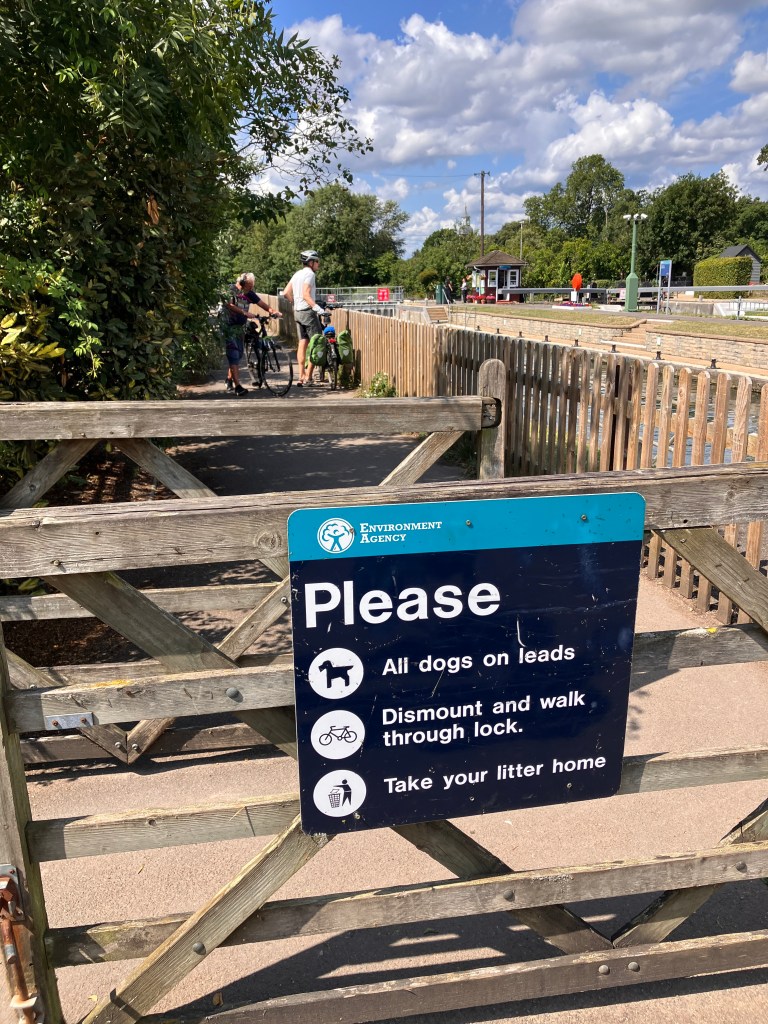
Dismount and walk through the lock area. Stop and watch the lock filling or draining as long as your patient husband can stand.
Did we need to take a little foot and bike ferry across the river?
No, we could have skipped the Shepperton Ferry, but how cute is this little ferry dock?
A one minute ferry ride! Well worth the 6£ for two folks and two bikes. Was it?, says Rich’s expression.
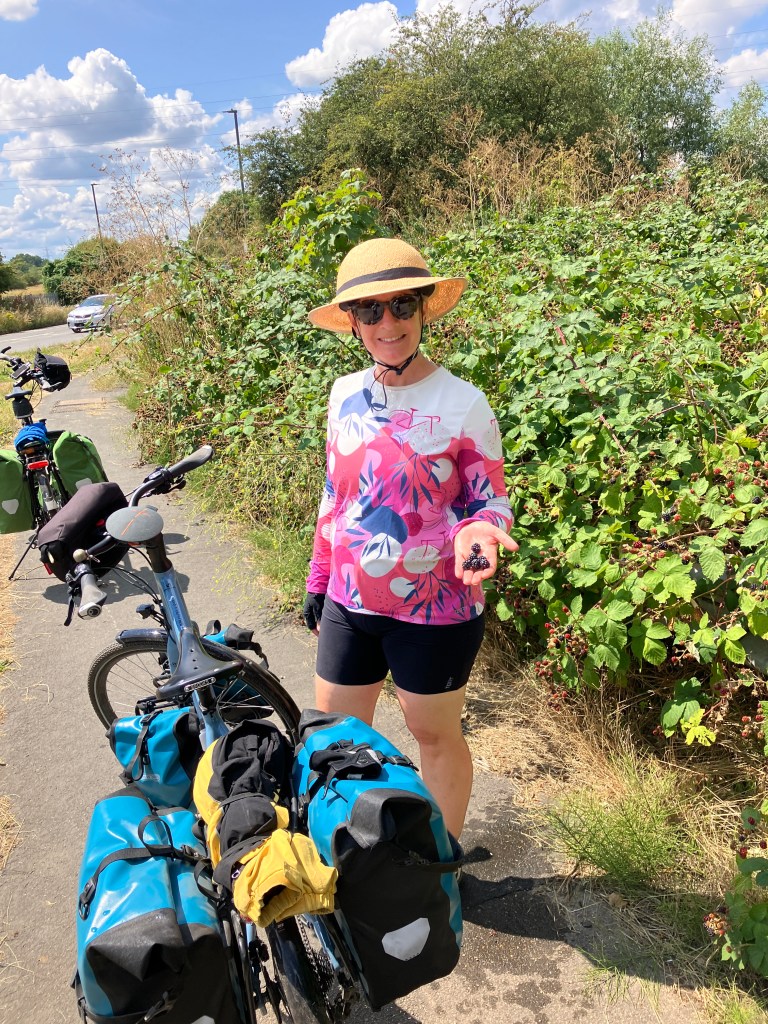
The ferry ride did get us blackberry adjacent though!
Speed picks up as we approach our lunchtime pub stop. Heading into Staines-Upon-Thames.
Another day, another riverside pub. Last Hop in Staines. Beer and cider, waiting for our pizza.
Obligatory pint of cider and river photo.
After lunch we left the flat river route and went through Runnymede.
Up a rather overgrown path.

Our first experience cycling along the Thames River Path left us wanting more river experiences. Thankfully our temporary home for three weeks is allowing us to spend quite a bit of time appreciating the river path by bike and on foot. I would highly recommend exploring the Thames River Path to anyone spending time in or around London. After the crowds of central London it was a peaceful and eye opening experience. Why was I so surprised to see how busy the river was with small boats, narrow boats and stand up paddle boarders? The look and feel of the Thames as it runs though London, with such strong tidal flows, doesn’t prepare you for how bucolic the river quickly becomes.

Windsor Castle. Our temporary neighbor.
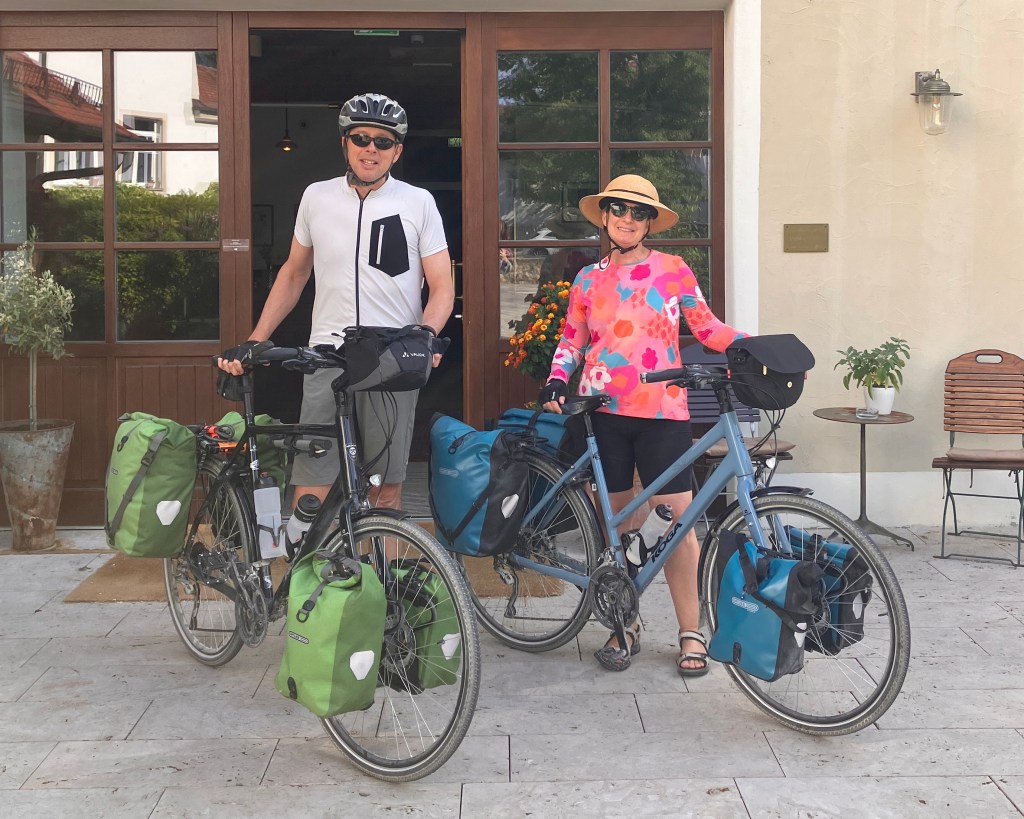
The Happy Travelers.

We’re enjoying being in one place for a while, and have been walking and biking and appreciating our temporary home and kitty cat. Happy summer all, and more on our summer of the Thames River soon.

More about our new Koga World Traveler S bikes, and the logistics of bike touring.

We’d been touring on our old bikes for about 18 years. And, like the frog which allegedly doesn’t feel the water heating up, we didn’t really realize how different bike touring could feel. I was finding my old bike to be more and more uncomfortable, with my hands hurting and going numb on long days, or my knees being quite unhappy. Each change to new handlebars or pedals helped a bit, but after test riding a Koga touring bike in Groningen last year I knew it was time.

My old touring bike. A Gunnar Crosshairs, the frame is a cyclocross steel frame. Photo from 2022.
Rich’s old bike, a Paul Taylor frame with drop handlebars. Also a steel frame. Photo from 2022.

We had toured and bike camped on our old bikes all over the place. Canada, Italy, France, Germany, the US, Denmark, Holland, Belgium, and the UK and Ireland. The upsides were that the frames were pretty lightweight and they were unique looking in Europe. It was always fun to have the bikes worked on at a bike shop on the continent and have the mechanic share how much they loved working on old steel frame bikes. Or to have another steel frame aficionado approach us outside a grocery store or bakery to admire the bikes.

In England, riding from London to Hove. 2022.

After I test rode that Koga in 2022 however, I put my foot down. That’s it, I said. I’m getting a new touring bike. Something more upright, something more comfortable. A bike built for touring. And oh wow, was that a good idea. And Rich’s Paul Taylor was already rebuilt once as he cracked the original frame from heavy touring loads on a bike designed for cyclocross.

New bikes, new panniers, same wonderful travel companion.

We decided that the new touring bikes would be our 25th wedding anniversary present to each other. If you’ve ever looked at the that funny old list of “traditional” gifts for wedding anniversaries, 25 is silver. What do we need with silver? So, to mark 25 years, which was last year, and to keep us rolling for as many more years as we have, new touring bikes it was. Sitting in a guest house room in Sri Lanka we ordered two new Koga World Traveler S bikes. Koga estimated 12 weeks to deliver our bikes to the shop we had chosen in Freiburg, Germany.

Super comfortable grips from Ergon. The wide part supports your hand during a long touring day.
Rich’s grips, iPhone mount, and cycle computer.
My well broken in Brooks B17S. This saddle has been on three of my bikes, my city bike, moved to my old touring bike, and now my new touring bike.

When we took trains to Freiburg to pick up the bikes, we also took with us my saddle, bike bell, and pedals from my old touring bike, and Rich took his pump. The saddle that came with his new Koga was not working for him so he bought a new saddle before we left Freiburg. A comfortable saddle is key. Of course, our first week bike touring, about day three and hour 6 of the day – neither of us could find a comfortable position on our saddles. It takes a while for your rear end to adjust to hours and hours on the bike.

The racks which came with the bikes are from Tubis, not a brand we were familiar with, and these models are custom to Koga
The front rack. Very different from what we were used to.

Although we both were a bit surprised by the front racks from Tubis, with a very low profile for your bags which keeps your center of gravity low, and no rack over the front tire at all – which is where Rich would usually have his rain jacket, we are very pleased with how sturdy they are. I like the rear set up which has two levels of tubing. The very top allows you put things under a bungie cord, and the slightly lower level is for your pannier.

My front panniers, loaded and ready to roll.

These bikes have features we didn’t have on our old bikes, such as the built in Shimano dynamo hub front and rear lights. So far we’ve only been touring in the summer so we haven’t needed the lights to actually illuminate our way, but they are excellent for being seen. The steering column has an internal steering limiter which prevents the wheel from flopping sharply to one side or the other. The frame is stout and designed for over 140kg (310 lbs) total load. It all makes for a very stable ride. We chose the Deore XT 30-speed(3×10) drivetrain over the 14 speed Rolf internal hub belt drive for ease of repairs and replacement parts globally. It’s a classic set up that we’re familiar with, and so are most/all bike mechanics you will encounter.

The front wheel of Rich’s bike. Disc brake, front light, low profile rack.
Dynamo hub, and Schwable tires.
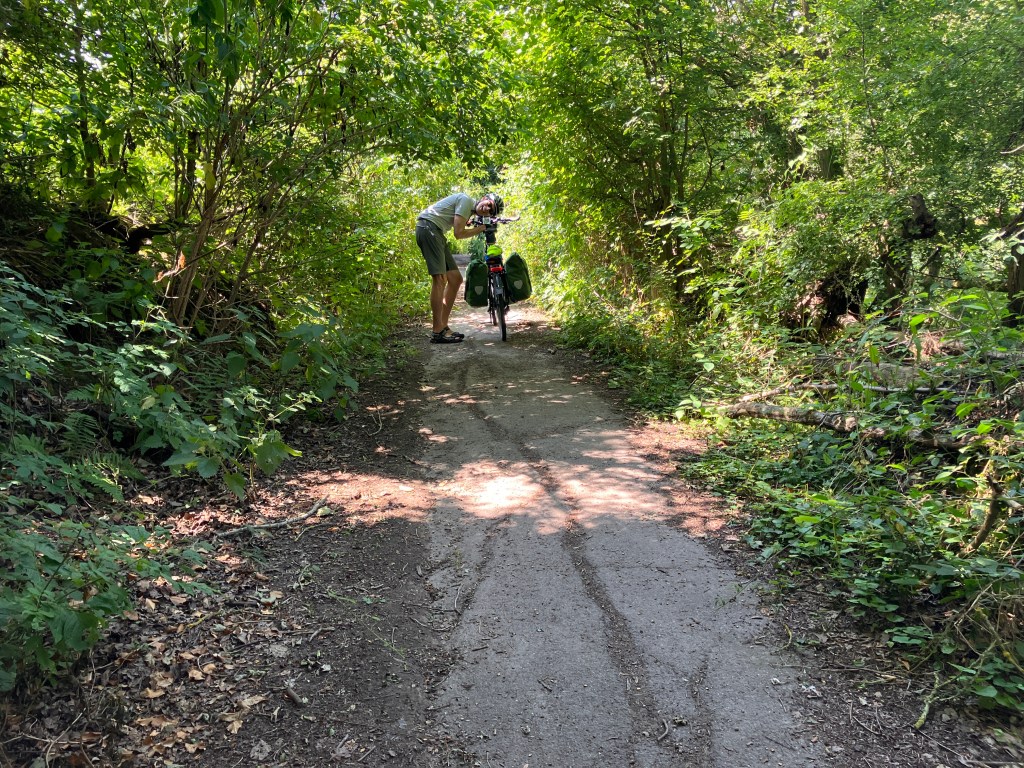
On our previous bikes I only had rear panniers, while Rich had front and rear. We traveled around to Freiburg from France, where our old touring bikes live, with all our panniers and a couple of extra bags. I bought new front panniers, and Rich was convinced, by me, to get a full set of new panniers. His old rear panniers had certainly seen better days and the style was not as easy to load and go. We were a little sad to let go of our mis-matched old school style look, but it felt nice to be fully kitted out in new gear on our new bikes. Rich left the old panniers for re-use at the bike shop.

Farm cat helping Rich on day one with a pannier adjustment.

It takes a bit of work to adjust the panniers and set the clips – which hold the panniers on the rack – and the hooks – which keep the panniers from bouncing out from the racks and thereby reduces stress on the clips – correctly. Each pannier must also be adjusted as a right or left pannier. And then you have to be able to tell them apart.

My solution is to mark the right panniers. The rear with a series of dots in permanent ink.
And the front with a small evil eye charm from Türkiye.

Rich just eyeballs his clips and hooks and knows which is left and which is right. It makes loading the panniers onto the bikes faster if you can easily recognize your left versus right. For starting out in the morning, for train rides, and for adorable little foot passenger ferry rides where you might have to lift your bike down into the boat, which is easier with the bags removed, and then try to quickly reload the bags at the other side.

Crossing the Thames River.

Your panniers are identified and loaded, now what’s in those things? We got that question quite a bit in Germany and Holland, where most cyclists were day trippers with just one pannier, or out for a weekend or week with two panniers. No, we’re not camping, but we are out cycle touring for four months, we’d explain. So, rain gear and colder weather gear, which takes up space. Comfort items like my travel yoga mat and our little down pillows, and our two camping chairs. Picnic gear, lunch food and snacks. Boxes of contact lenses, tools, etc…

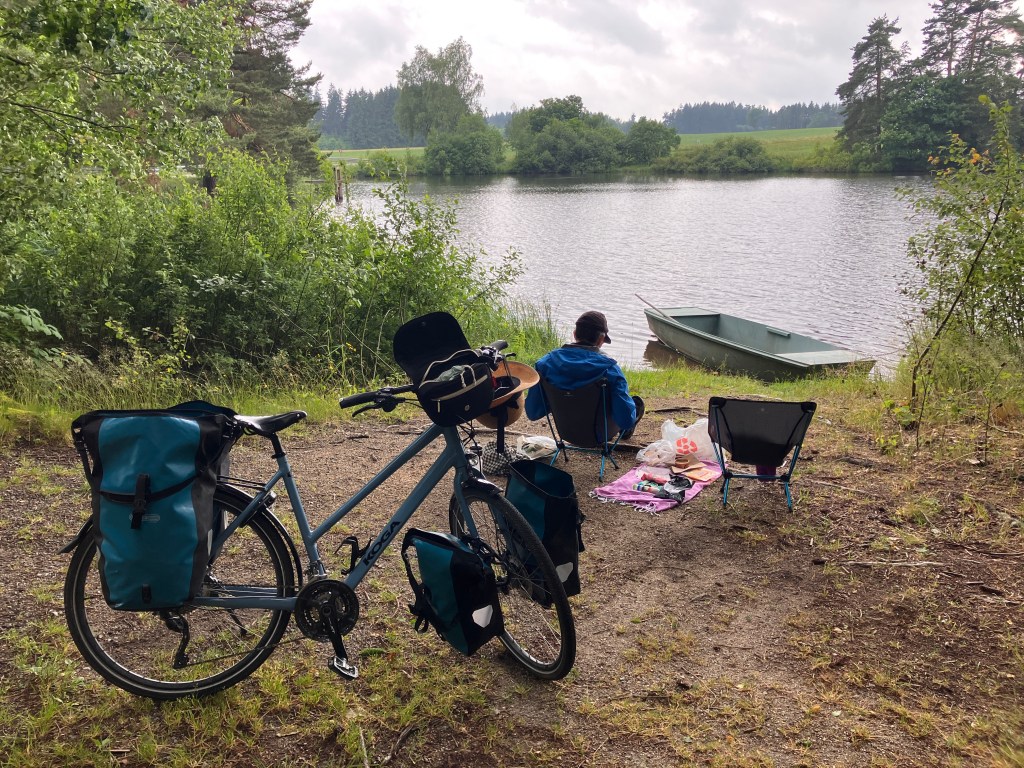
Two Chair Zeros from Helonix expand our lunchtime stop options.

Do we try and keep everything organized? Yes. We have reminders for ourselves of where items are. Rain gear right. Leisure left (chairs). Picnic supplies port. Does it work? Sort of. We know what’s in front instead of back, but the rule of bike touring seems to be that the item you’re looking for is in the other pannier. Hat? Oh left, definitely. Not. Open up right pannier too. It’s somewhere.

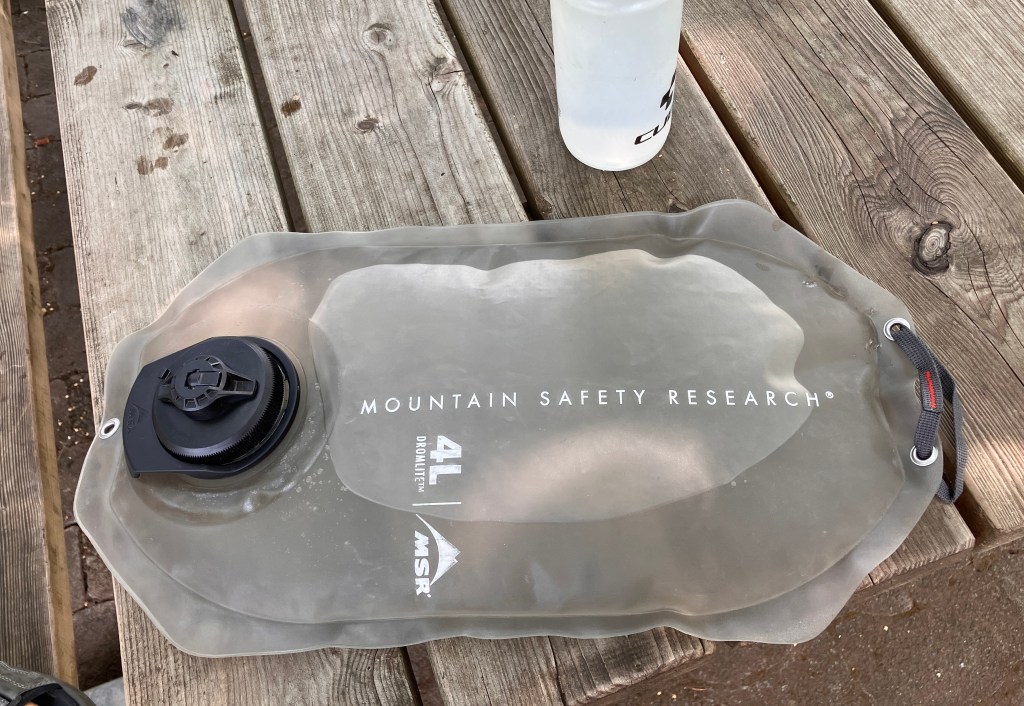
Extra water. Rich has anywhere from 1 to 4 liters of water in one of his front panniers.
It’s easier to have water and avoid searching for a source. This Mountain Safety Research bag is just the trick.

We’ve learned over the years that it’s not as easy to fill water bottles during the day as you would think. Especially if you’re off the popular routes and not stopping at restaurants for lunch. Coming from California we are a bit spoiled when it comes to parks and playgrounds having a water tap. We expected more taps to be available but they are not. Water is heavy to carry, but being well hydrated is important. We always pre-game in the morning by drinking water, it’s easy to get a bit dehydrated if you’re not careful. My bike currently has only one bottle cage, and I carry an extra water bag with one more bottle worth of water. Rich has two bike bottle cages and the larger water bag. Both our frames have additional mounts that would allow an additional water bottle below the down tube. We may use this in the future.

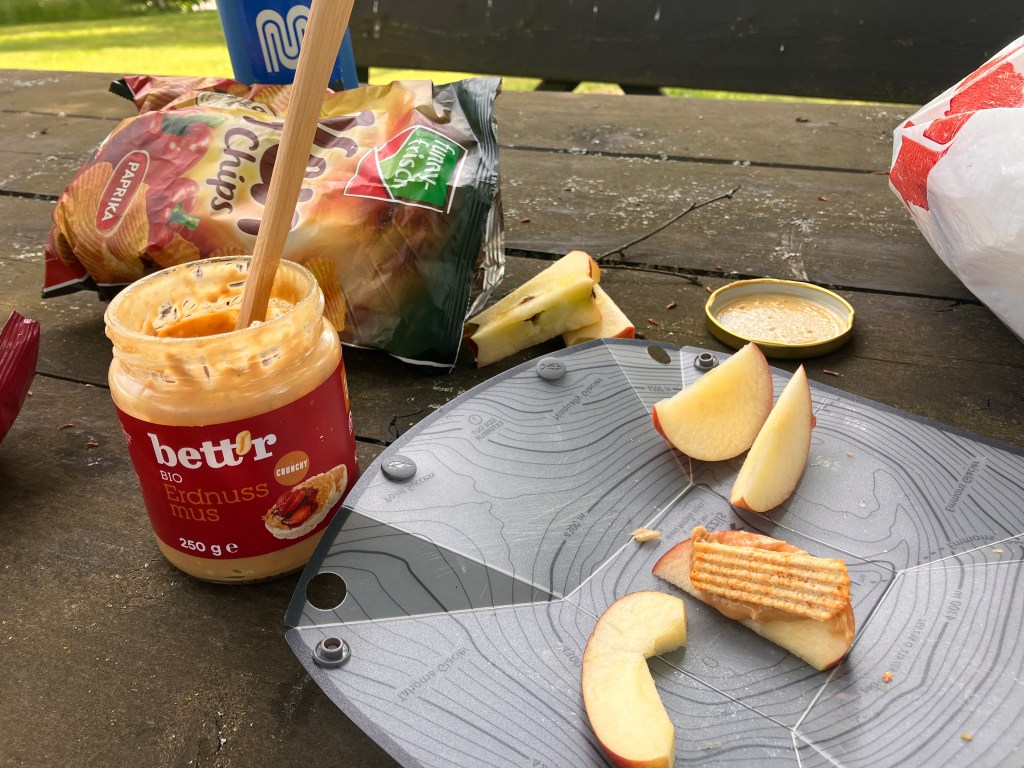
New to us this trip, two Fozzil Snap Fold bowl/plates. Love these.
They work as a plate to help serve up pastries for elevensies.
And they snap up to form bowls. Here they are part of a slightly messy picnic table. Two tea towels/napkins, bamboo cutlery, and one sharp Opinel knife.
And opened they store nice and flat. Apple slice, peanut butter and spicy crisp? Why, yes please.
Another new comfort item. Tiered spice containers by Humangear. From the top: salt, cracked black pepper, olive oil, and Mexican seasoning mix.

If we’re staying in an apartment with cooking facilities that little bit of olive oil comes in handy. It’s enough to get you through one or two dinners. And when we have the opportunity to boil eggs to take them with us for lunch or snacks, the salt and pepper are key.

A very happy bike tourist in Antwerp.

When we first starting riding our new bikes, loaded up with panniers and front bags, we both felt as if we were on e-bikes. The feel of the strong aluminum frames and the way your pedal strokes are converted to power, not lost in the flexing of the frame, was pretty stunning. On our old bikes I could climb out of the saddle only very carefully, the sway would get out of control easily. Rich couldn’t climb out of the saddle with his full front and back pannier load. Now, we can both stand up and dance on those pedals up the hills.

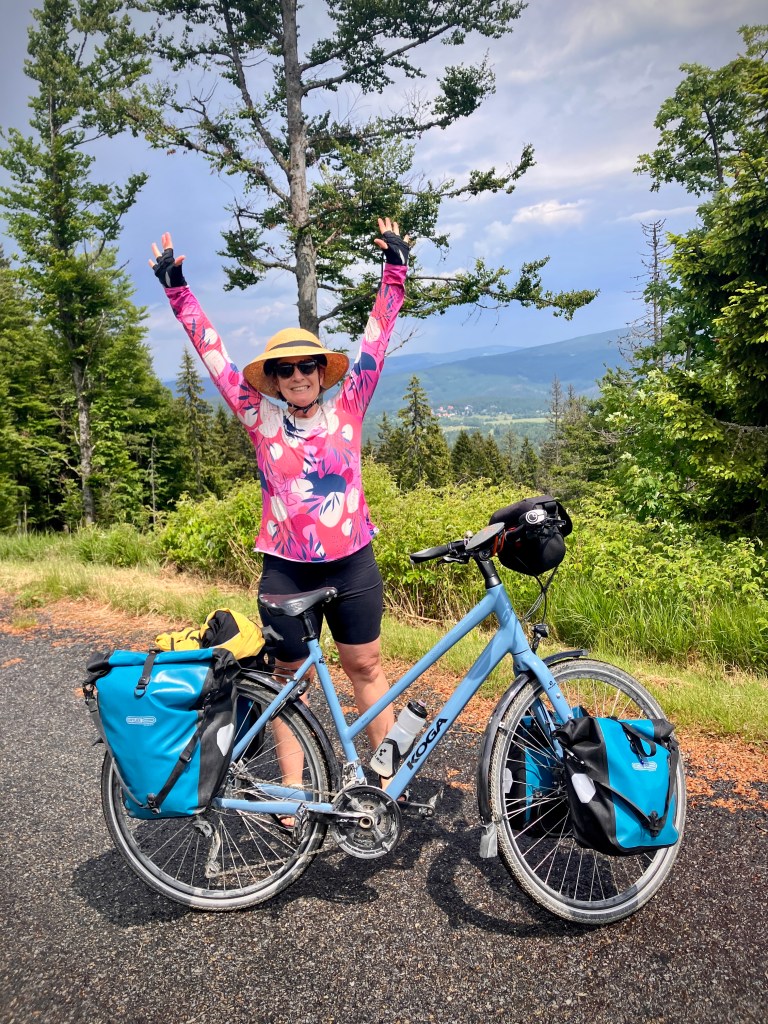
Another happy bike tourist at a high point of EuroVelo 13 in Czechia.
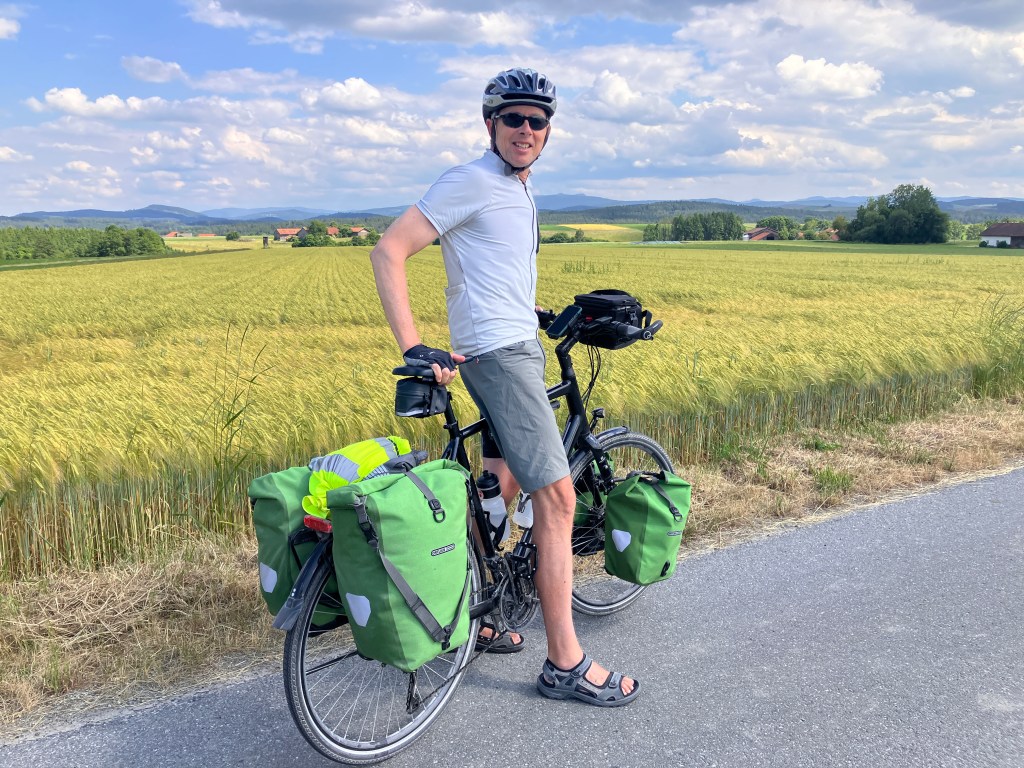
Koga World Traveler S frame size 63 centimeters. Rich is six foot five, the upper limit for this frame size. Koga’s adjustable stem allows for perfect handlebar settings.
Koga World Traveler S, step through frame, 53 centimeter. Cheryl is five foot six.

So after more than 2000km of bumpy, hilly, and cobbled roads and trails, both our bikes have delivered touring joy. Just a bit of expected regular maintenance and adjustments to the disc breaks and derailleurs. All our wheels are still perfectly true, thanks to stout rims and a 36-spoke configuration. The 700c x 39mm Schwable Evolution tires are perfect for our riding style, and handle well both on-road and on rocks, roots, and mud.

The wide frame clearance allows for much wider tires (50mm+) for more off-road performance or serious terrain. And given our confidence and love of these bikes, we might just put on some serious fat tires and take them on the first trip to Mars.

The happy travelers. Now with bikes that make us even happier.

Leaving Czechia for Germany.

Sunflowers starting to bloom in the Moravian region of Czechia. They are raised as an oil crop. And are lovely to look at.

Bicycle touring is tiring. Our rest breaks in Český Krumlov and Znojmo were so lovely we decided, after a few more days riding, to take another break in Brno. As with Česky Krumlov we were just amazed at how beautiful these towns are. Although the country has a tumultuous history, most Czechia towns and cities were relatively unscathed from bombing during WW2.

Rich riding by Vranov nad Dyjí Chateau. So many stunning historical buildings.
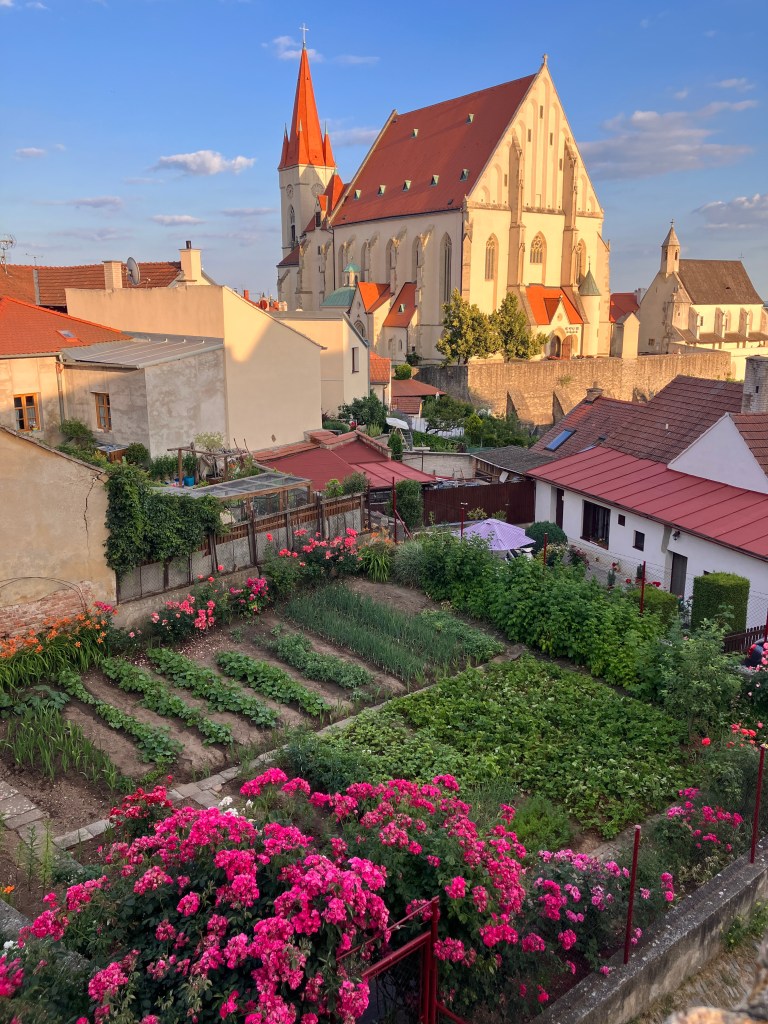
Znojmo in the evening sun.
Rich relieved to have found a gap in the fence and hedge to complete our detour away from a busy road. We were too busy trying to avoid the farmer and his haying machine to get photos of us crawling and pushing the bikes through the hedge.

Hmm…sounds like a lot of rest days, you may be thinking. Well, once we left the relatively quiet and empty region of Bohemia the roads started to get busier, and the car drivers faster and less careful around cyclists. Our day into Brno was pretty awful, a busy rural road with many trucks and no shoulder, long stretches with no towns or trees, but thankfully no head wind.

I usually have this Bluetooth speaker on my handlebars to listen to music or podcasts, the flowers I gather to amuse myself.
A tiny bee appreciating my tiny bouquet.

Once we got to the true outskirts of Brno we were on a cycle path again. Czechia has a lot of recreational bike riders, a lot of folks in road riding gear (mostly men), who ride fast. As we know from our bike activism in the US, women on bikes are an indicator of how safe and accessible places’ bike infrastructure is. And families. Parents with children in a cargo bike or on their own little bikes is a good sign too. We saw a few families coming into Brno along the Svratka River, but our hopes of a cycle friendly city center were not to be.

“Common path Be careful” Well, it’s something.
Another lovely Czech old town square in Brno. The deck chairs were a nice touch, folks were enjoying the evening.
So we did too.

We both know firsthand from years of activism and professional work the many challenges that face a city trying to become more bike and pedestrian friendly. Our own city, San Francisco, has come a long way but still struggles to make changes to the streets, fighting against the conventional beliefs that cars must have unfettered access. So we understand how hard it can be to create safe welcoming spaces for people on foot and on bikes. In many cities we joke that we should stick around create a bike and pedestrian advocacy group, Walk Bike Brno (Procházka Kolo Brno) has a nice ring to it. But there is the language challenge, and the irony of two Americans lecturing any place about sustainable transportation.

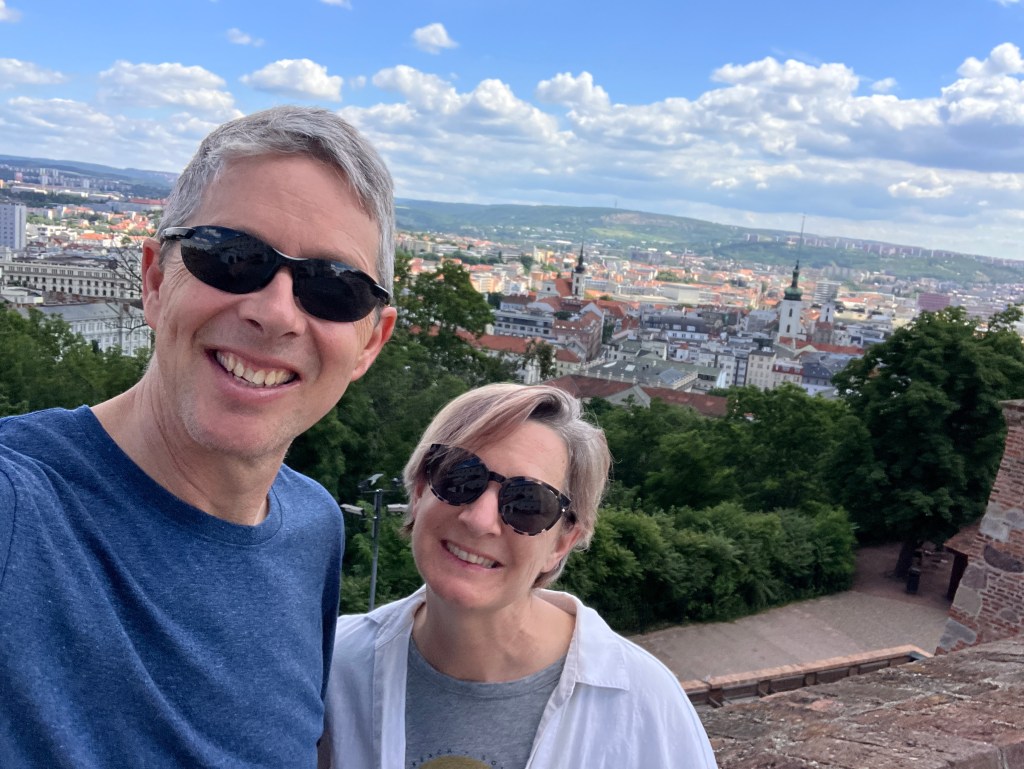
Špilberk Castle, a lovely view spot and a good cross challenge for our leg muscles that are too focused on cycling.
Ouch. We’ve learned the hard way to make sure we hike on our days off the bikes. Špilberk Castle was a good hill climb.

Brno is a perfect candidate for a Copenhagen style makeover, or even a San Francisco style makeover. It’s pretty flat in the core of the city, loads of Universities, trams and buses, not a great pedestrian environment due to long traffic signals and missing connections, and really no bike infrastructure. But despite that there is a bike culture. And lots of folks walking. They could harness what they have and create a more walkable and bikeable city. Sure, the first thought is about the cost, but as Copenhagen has proved, cities get a better return on their investment from bike and pedestrian projects than car projects.

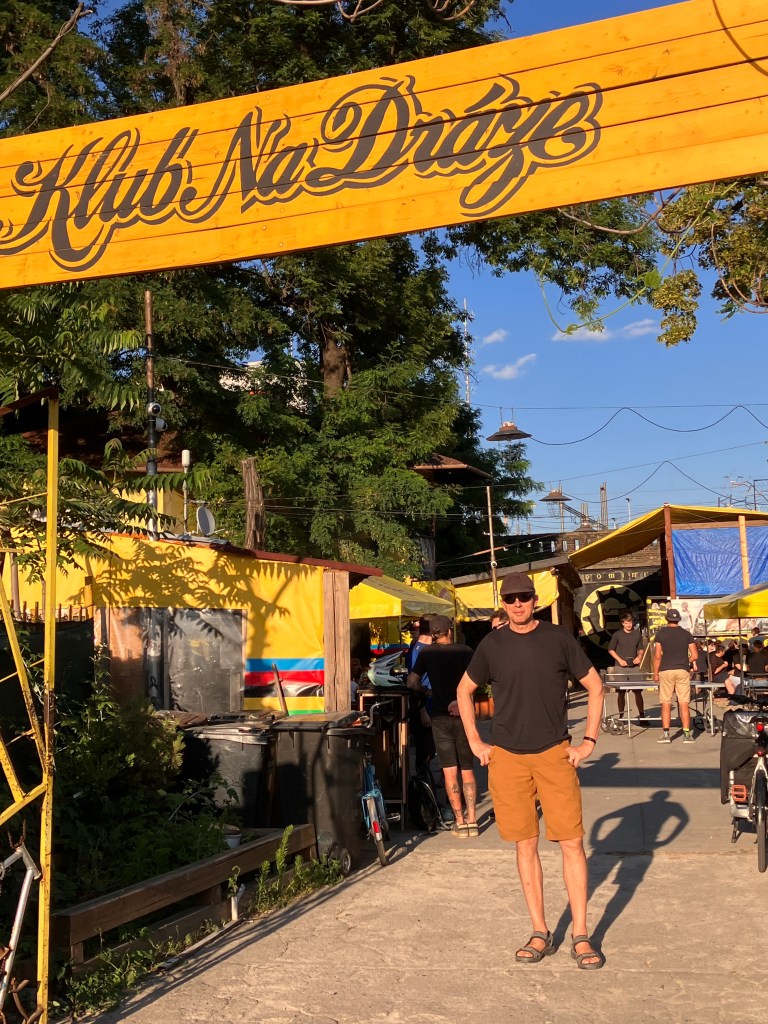
Our new favorite bicycle focused bar.
FBB Klub Na Dráze (Club On The Track) proof that bicycle culture is alive and well, and very cool, in Brno.

When we get to small cities like Brno, population 380k, we appreciate how quirky culture and experimental businesses can survive in a place which has not suffered the homogenization of wealth. We look back to San Francisco, which we love dearly, but which has changed due to loads of monied folks. And the subsequent pushing out of less monied folks. Many of our favorite places and favorite people have been priced out of SF, or they left to have a more complete life elsewhere. Sometimes while traveling and enjoying a bar or restaurant we say to each other: this business could never exist in SF (or name another A list city with space and money constraints). Or if it did, it would be so expensive we wouldn’t go to it.

After the bicycle bar it was off to Bar, který neexistuje (A Bar That Doesn’t Exist).
The cocktail menu was lovely. My rum based drink.
And Rich’s whiskey based drink. To save you from having to do the math, $23.70 for two cocktails.
A bartender using a rolling ladder to get to the top shelf liquor.
Not our usual kind of evening, but the joy of travel is sampling different things.

With the sad realization that we didn’t feel very safe cycling in the south Moravian region of Czechia, we bid a fond farewell to Brno and headed to the train station.

Goodbye Klub Na Dráze – keep it real.
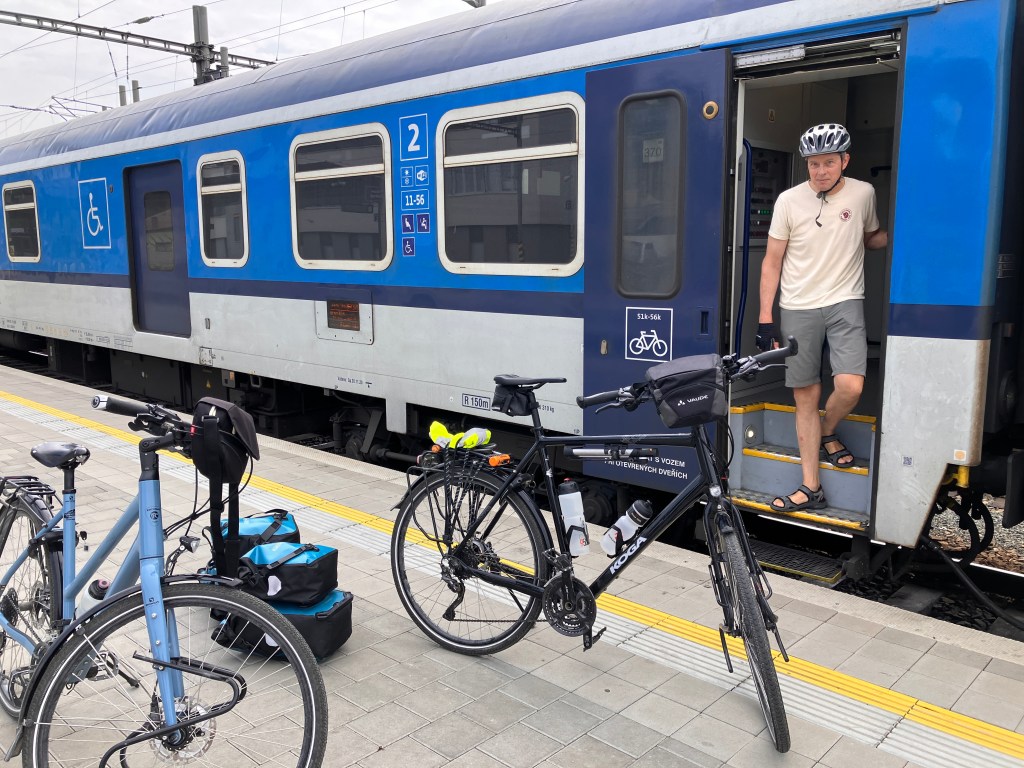
Hello train dance with loaded touring bikes! High boarding trains means removing the bike panniers. Those steps are not easy with a bike.

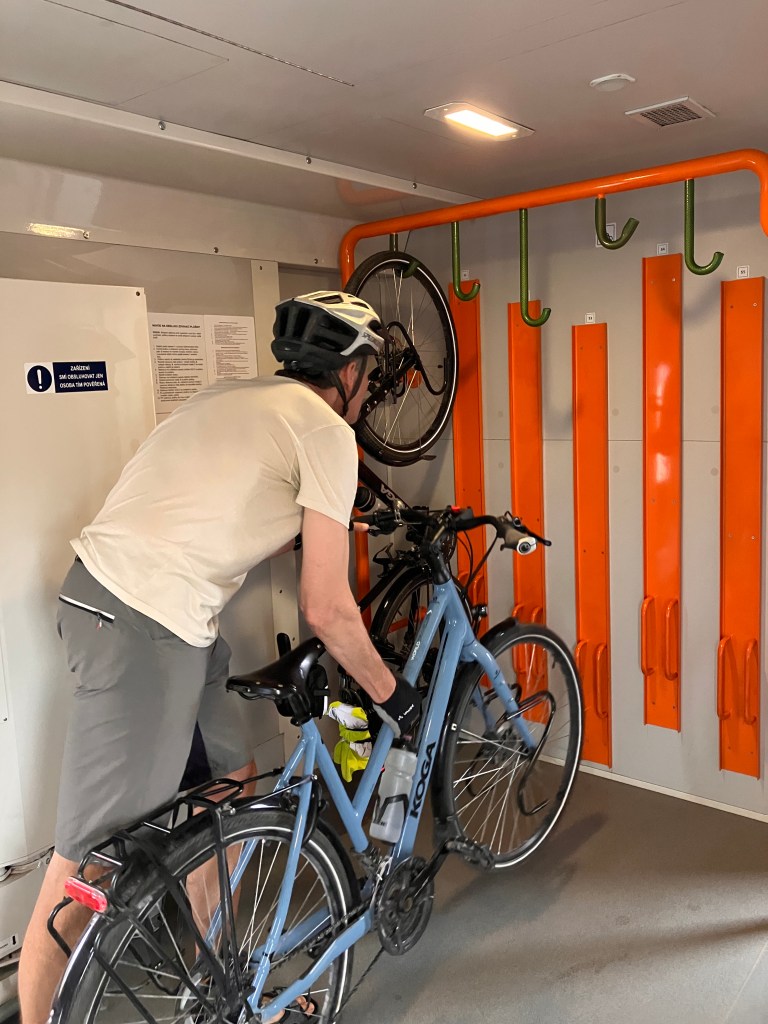
Rich does so much good work figuring out our cycling routes and train hops. If we can we get on a train at the start of its route, that allows us to get to the station early and load the bikes on the train before most folks show up. This is especially important if there is limited bike space. The Czech train did have on line booking of bike spaces and seats right near the bike space. Rich also booked the two bike slots far left, closest to the train wall, less chance of our bikes getting banged around by other bikes and train movements. These are the details that make our train travel days a bit better.

Rich getting the bikes onto the hanging hooks. Could I get my bike up there myself? Maybe.
Settling in with a fully charged Kindle for our six hour train day. Oh yes, I got a haircut in Brno too. My first since Bangkok in January.

A must have for train days is food, charging cables, and an extra power source in case the outlets don’t work – which these didn’t for several hours – which also meant the AC didn’t work, and the windows don’t open. Made for a slightly clammy journey. And I don’t think we or the other three cyclists were at our freshest to start with. The one empty unreserved seat in our bay of six seats was eyed by a few people, but something kept folks from choosing it… It was all of us! We were stinky cyclists.

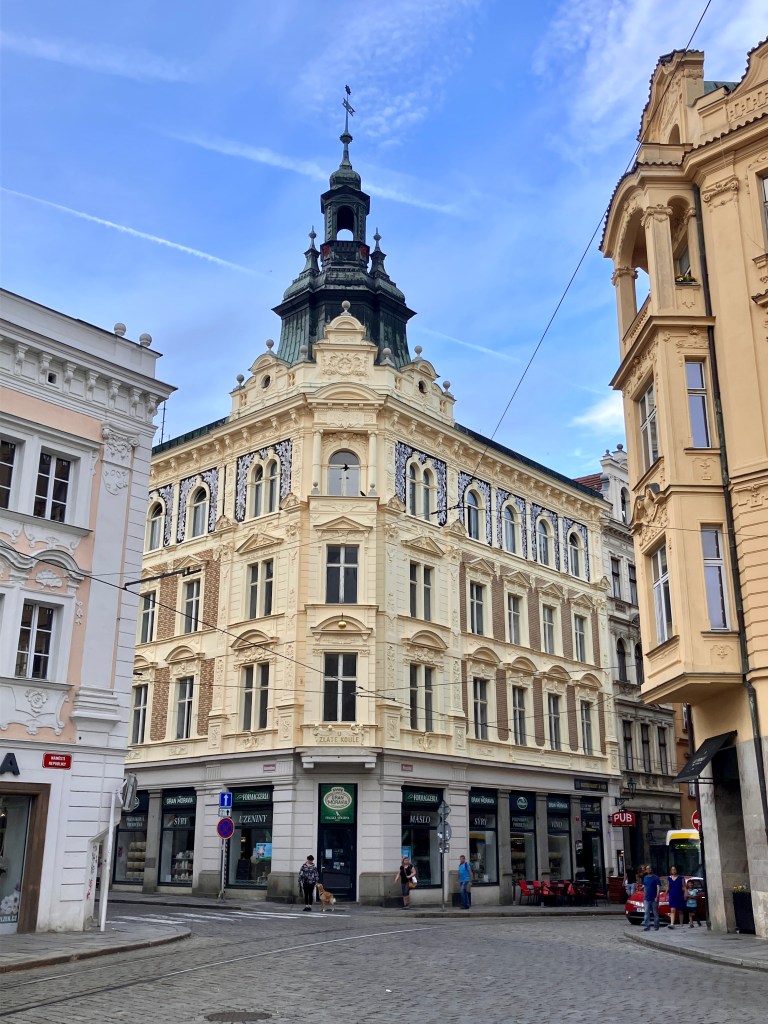
One night in Plzeň. Enough time to walk around, admire another beautiful historic square, and have dinner.
Plzeň is the home of the famous Pilsner Urquell Brewery, but we were happy just walking around and skipped the brewery tour.
It’s a tough time for a Tour de France fan to be traveling. Rich isn’t always able to stream le Tour, but if he can’t, we watch the wrap up show.

Our next hard date is July 18th on a ferry from Hook of Holland to Harwich, so another train hop was necessary to get us closer to the German border. So enough musing about bike infrastructure and affordability, let’s get off that train and ride.

Off the train at Cheb, Chezchia, and back on the bikes. One more lovely Chezchian church and off we go.
And look at that. New bike paths. And newly planted trees. Yay Chezia! I joked to Rich – maybe they’re starting at the German border and working in.
Look at that signage. So many bike routes. A sign like this makes us both very happy.

We’ve been amusing ourselves by noticing the license plate country registration as drivers pass us, and we can reliably predict when a driver is German vs. Chezch. The German laws have been updated to mandate a 1.5 meter passing of cyclists, and bless those German drivers, they do leave that passing distance even when driving in Czechia. So, we were happy to cross to Germany and feel safer on the roads. Love you so much Czechia, but you’re not a fully realized cycling destination yet.

Back in Germany. After a long climb up to Fichtelsee we were so happy to have a lovely dinner at the hotel, Hotel am Fichtelsee. It’s a relief after a tough ride to have dinner right at your hotel.
Such a tranquil alpine lake. The ducks were cruising over hopefully. Sorry guys, no treats for you.
It stays light quite late, so we always have enough daylight and energy for an after dinner stroll.

Even though the distances we cycle in a day seem quite short compared to driving a car, we feel so immersed in nature, thanks to the good bike path network in Germany. The routes keep you away from major roads as much as possible, and when you do need to spend time on a road the speed limit is frequently lowered and drivers do exercise caution. A hill or ridge that you might not notice while driving a car, we feel with every pedal stroke up, and every gleeful down hill coasting moment.

A perfect morning start, coasting downhill in the Neubauer Forst-Nord.
We both love the green forest scenery. So different from Coastal California.
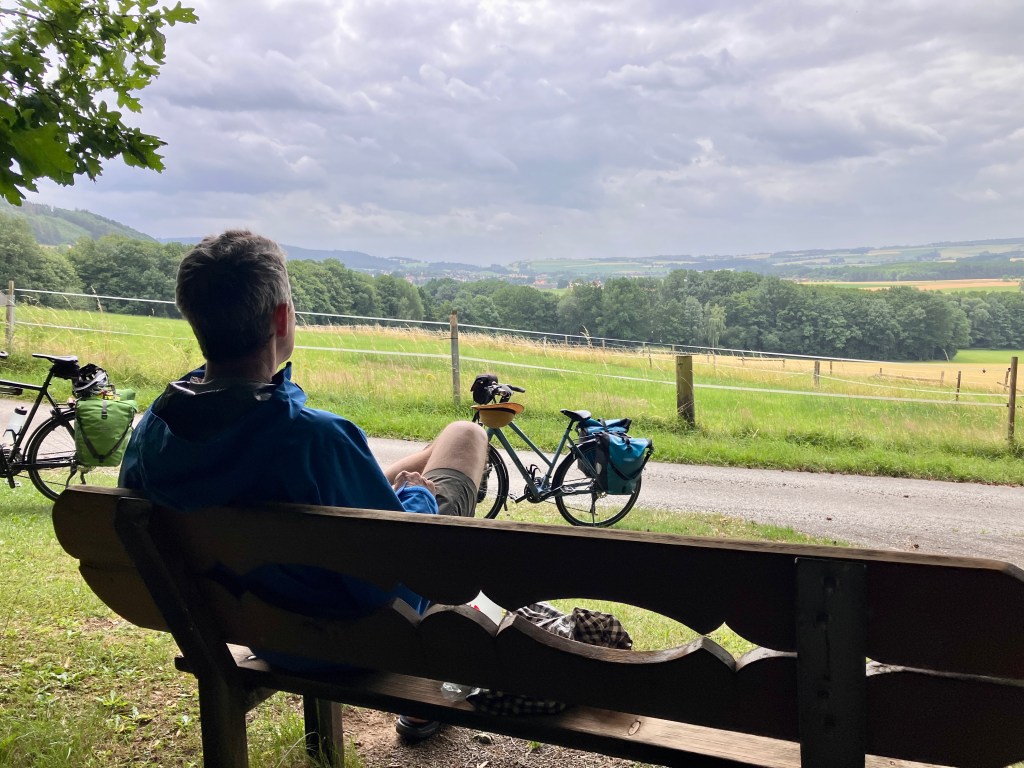
A nice bench for a break near Bad Berneck im Fichtelgebirge.
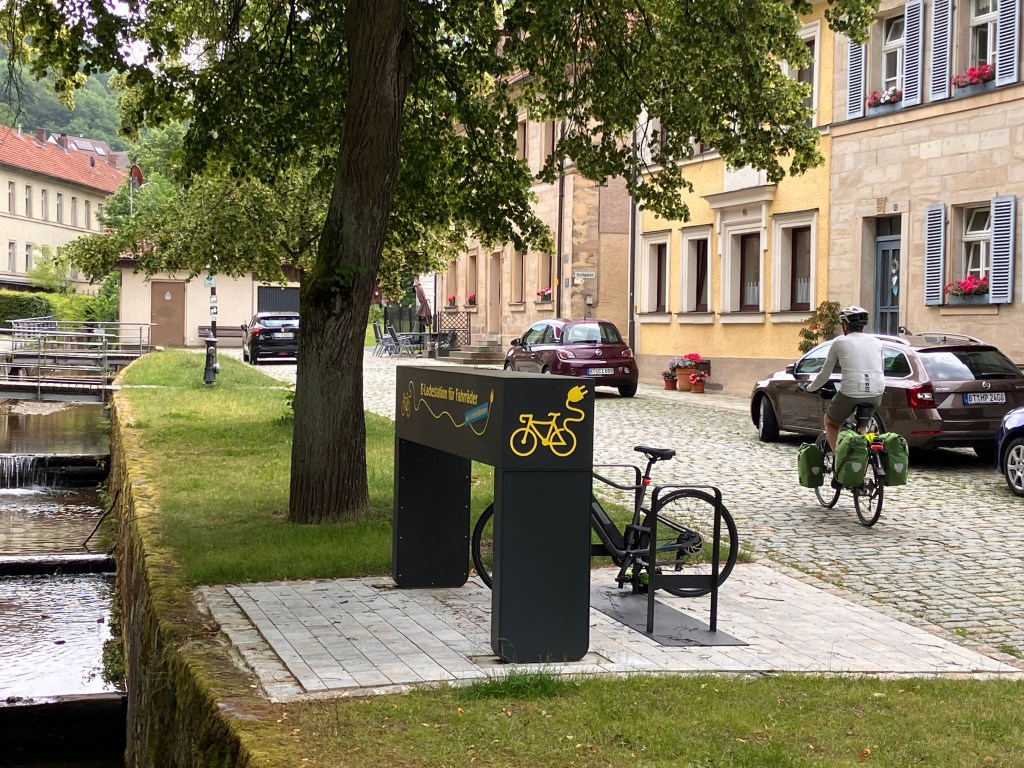
Our bikes are powered by muscles (and pastries) but I do appreciate the thought that goes in to providing charging stations for the many e-assist bikes in Germany. In Goldkronach.
Ripening fields of grain.
Back on the train! Taking full advantage of our German 49€ monthly ticket.
Bike Lodge Spessart, outside Lohr am Main, had everything we needed after a long day of trains and pedaling into a headwind.
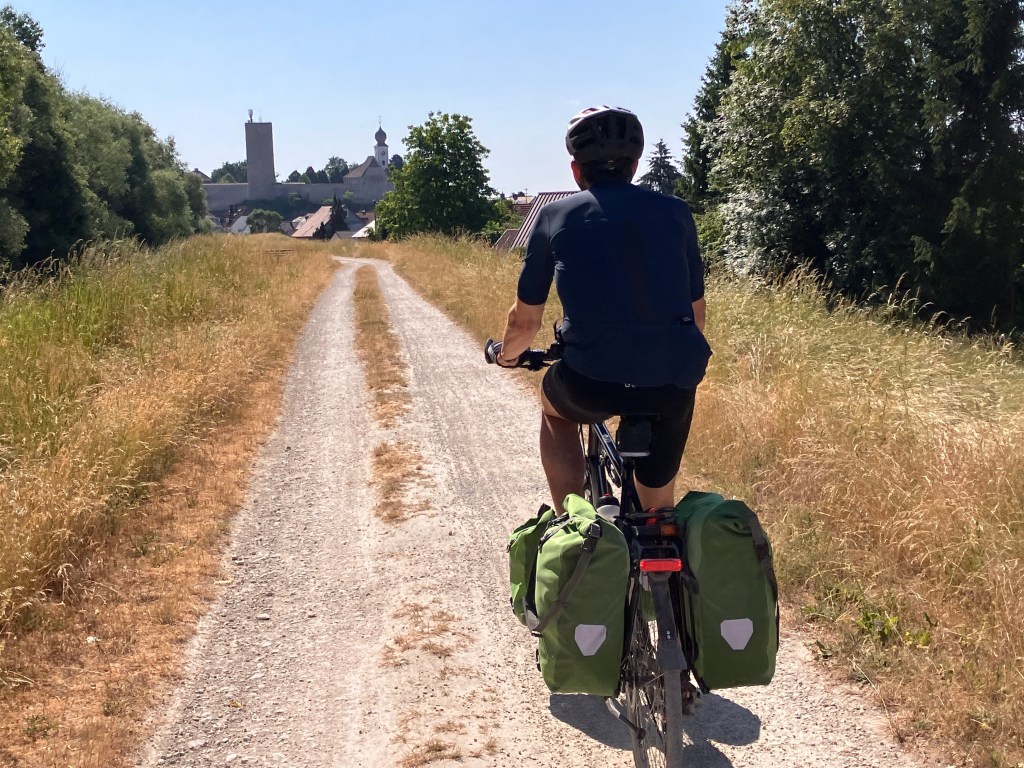
Ready to roll. 80 km day coming. Quite flat along the Main River but that headwind would not leave us alone.
Riding down the river you get glimpses of history, and it’s easy to pull over and enjoy the scene.

Bicycle touring strips you down to basics. You need food and lodging. Unless we have a rest day we don’t really do any cultural activities. But we see so much. The hours on the bikes looking at the river, or winding along vineyards, or searching for a place to stop and have a picnic lunch, are very elemental. Once we get to our destination we want a shower, some food and drinks, maybe watch a Netflix show on the iPad, and then we sleep as if we’ve been dropped to bed from a high height.

Riding down the Main River towards Miltenberg.
We’re entering a wine region where one of my favorite German white wines is grown, Silvaner.
Our goal in getting to Miltenberg was to get close enough to meet up with Beatte and Alex. Mission accomplished- thank you both very much for a much welcomed social break.

We have just a few more nights in Germany before we reach Belgium, and then the Netherlands. We need to get our new touring bikes to a Koga dealer for a tuneup. We’ve already ridden about 1,100 kms/800 miles on these bikes, and that’s tuneup territory. So off we go! More from the road later.

The happy and tired travelers, enjoying an after dinner walk after a long climb up to Fichtelsee.

Why do Americans smile so much?

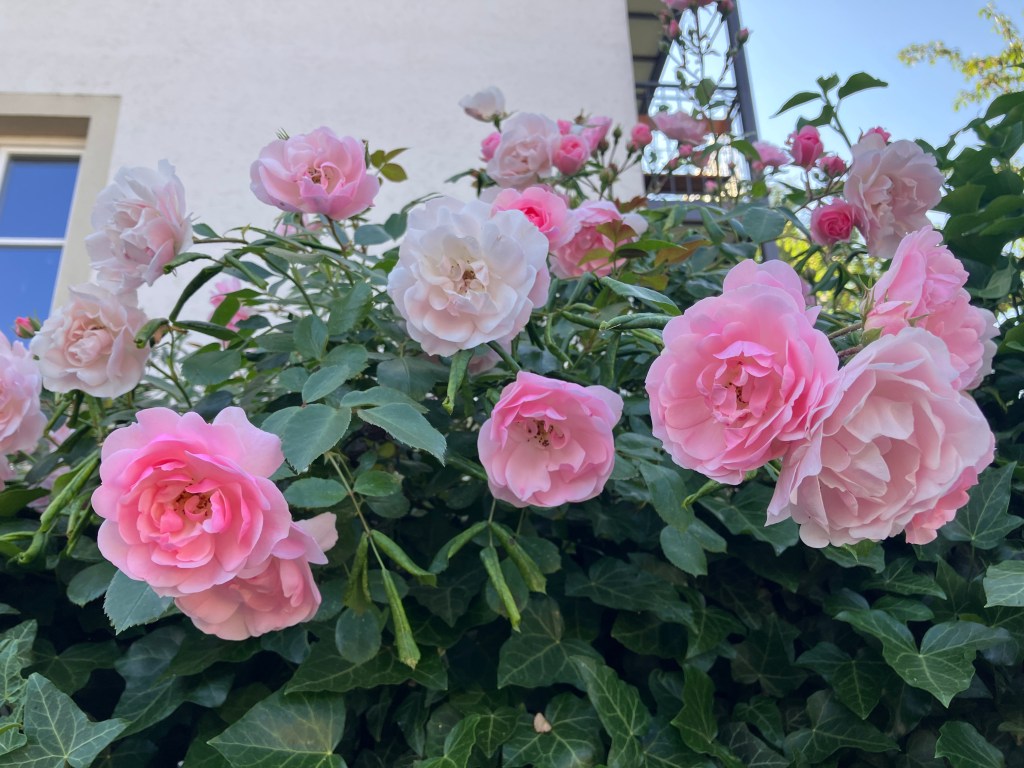
The warm weather in Germany has the roses out in full force.

I was going to ask, why don’t Germans smile more, but that’s assuming that the American level of smiling is normal, or correct, and that everyone else is smile deficient. Americans smile a lot. Really, we do. And Californians smile even more.

Smiling for the camera when leaving Regensburg.

Friends from other countries have told us that yes, everyone is aware of the American smile habit. You can see us coming, teeth showing, faces crinkling in delight.

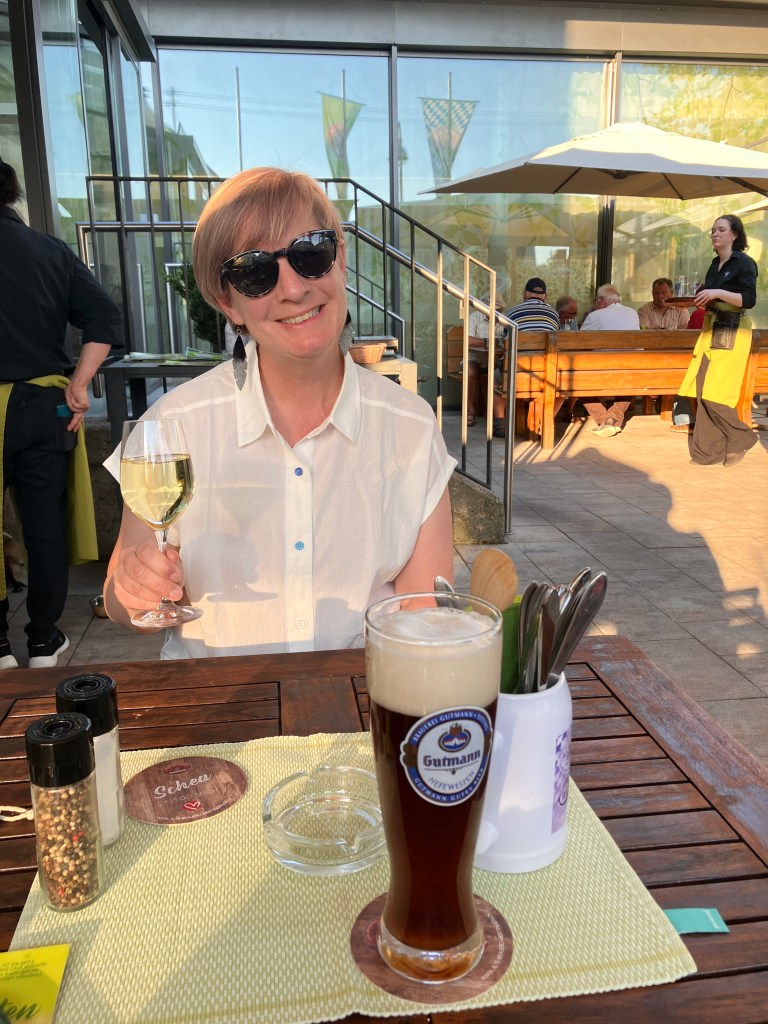
I know why I’m smiling here. A nice hotel, a good beer garden and a delicious glass of wine.
And who could resist smiling during a picnic on the banks of Neuburg an der Donau.
We smile while enjoying our German pastries.
And when Rich’s new bike had a loose bottom bracket issue we smiled when greeting the very nice bike shop owner who thankfully had opening hours on Saturday morning.

I had always assumed that the American smile habit was simply that we’re mostly a friendly country. And those Americans who travel are really friendly and happy to be out and about.

There were fewer smiles on a train hop day, when we ate lunch on the station platform hiding from the sun.
Both the departure station and arrival station only had stairs, which meant unloading all panniers and carrying everything down and up: very few smiles.
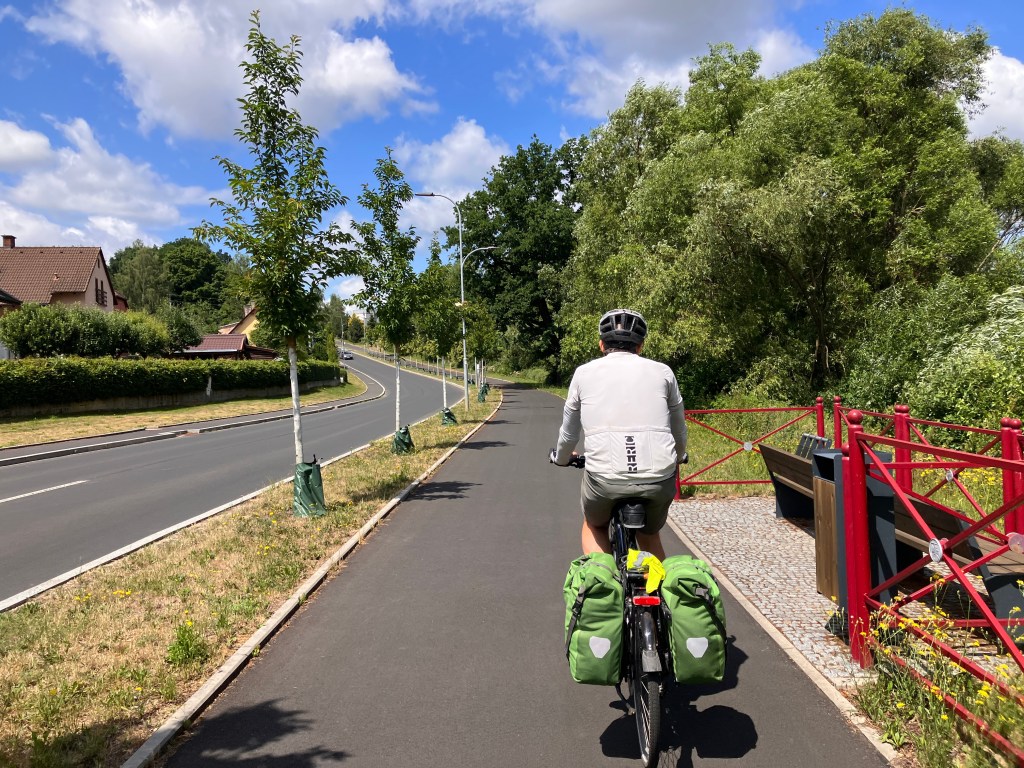
The train system in Germany is very good, but a lot of small local stations have only stairs.

But a conversation with a friend who has lived in France, the UK, the USA, and is now back in Germany, really hit home what we were feeling in Germany with fewer smiles per human – just because they don’t smile doesn’t mean they hate you. Ah ha!

Pretty typical bike touring picnic. Falafel, cheese, cucumber, red pepper, and brötchen (bread rolls) from the bakery. Oh, and a tube of mustard and a tube of harissa for Rich.
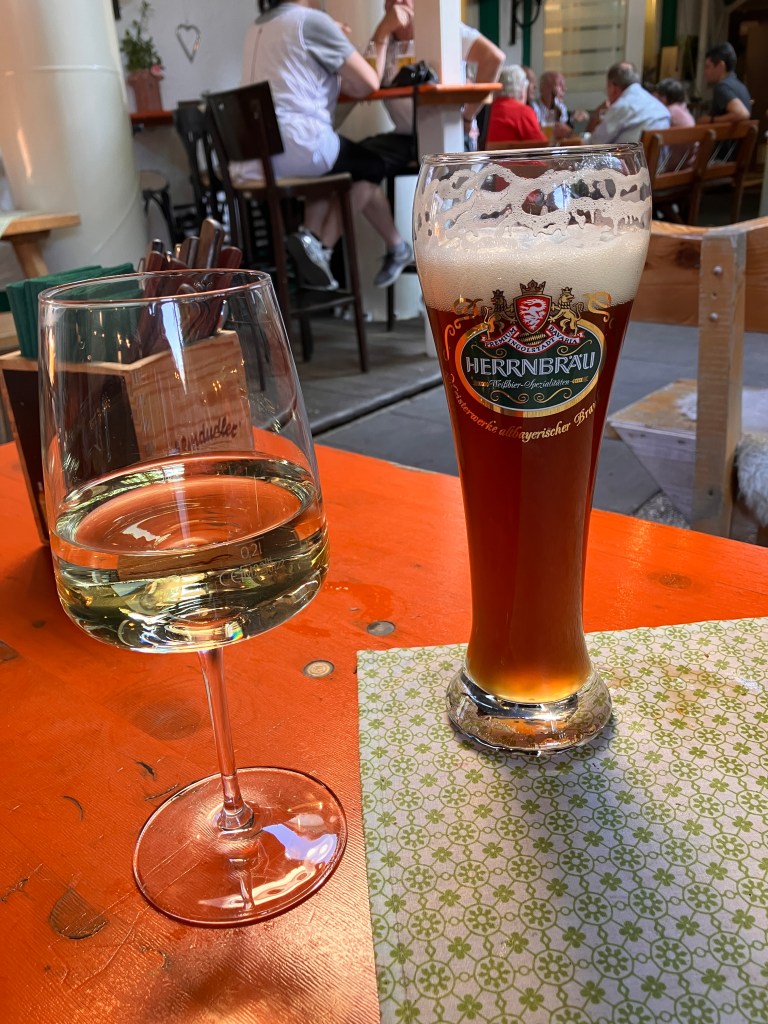
Very typical beer garden order, beer for him, wine for me. And smiles for the staff.

We love bike touring in Germany. There are so many things to enjoy and so many miles of fantastic bike paths and routes. Sure there are challenges, just like in any country. We’d happily import the Japanese convenience store culture to Germany. Germany is grocery store challenged, to our minds. All grocery stores are closed on Sunday. And there is no convenience store culture outside of Berlin. That means we have a mad rush on Saturday to stock up for Sunday cycling. Restaurants are open Sunday but we prefer to picnic for lunch.

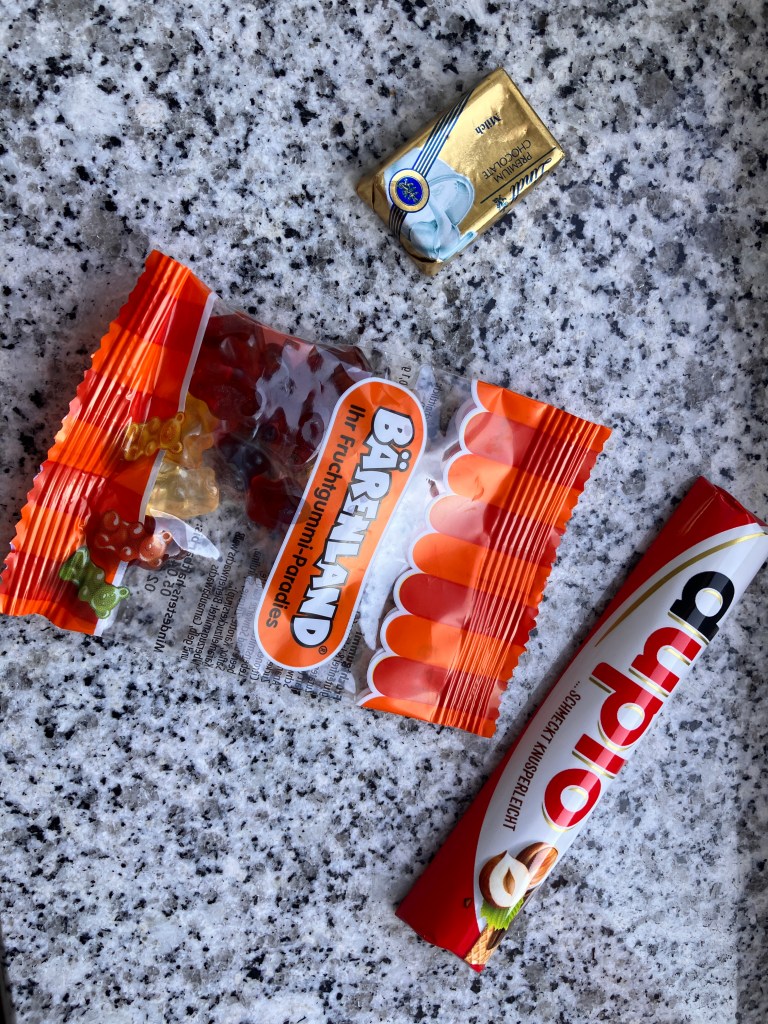
How can you not love a country that leaves lovely treats on your pillow in hotel rooms? I stash them in my handlebar bag for emergency sugar energy.
A museum dedicated to Bread and Art? These are my people. This museum in Ulm was fascinating.

And don’t forget, this country has 260 cycling routes crisscrossing the landscape. And the other cyclists are perhaps not the smiling type, not all of them, but when push comes to shove they are there for you. Railway crossing gate stuck and cyclists starting to slip under the gates? They will help you with your loaded touring bikes and keep a close watch for trains. Tight connection at a train station and having a tough time getting both bikes and 8 panniers down the train steps? The cyclist who greeted your smile with a stare and turned away is there to help you lift your bike down the stairs. Good people. Just not smiley.

Following the Donau river path.
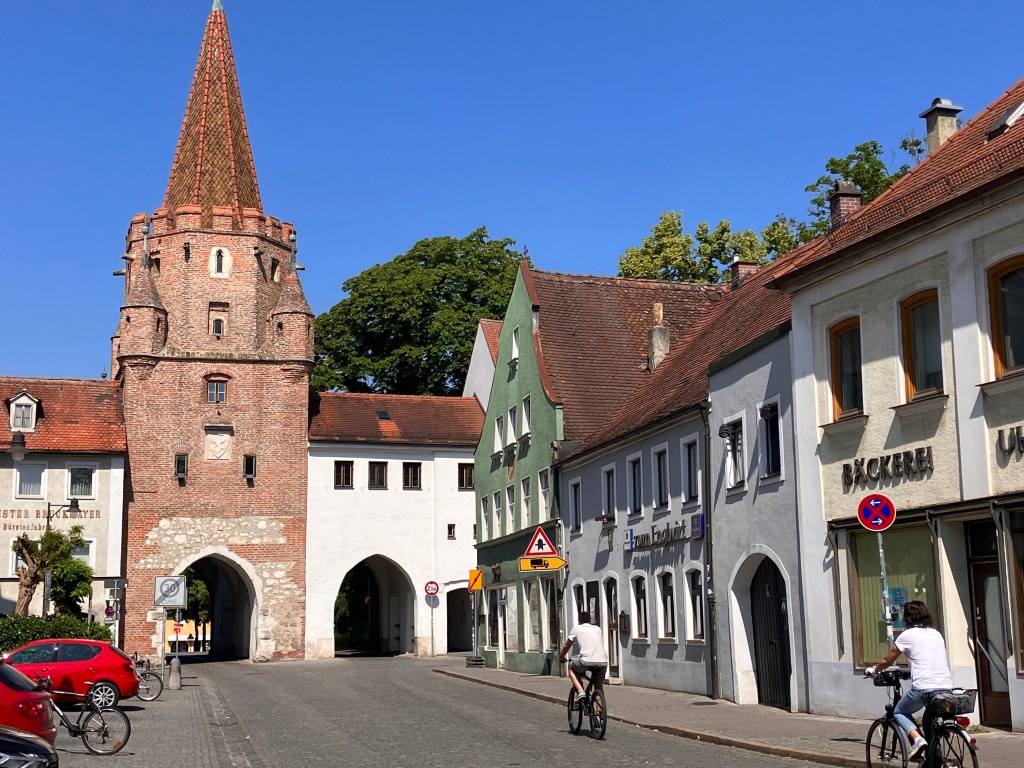
The Donau River outside our hotel in Ingolstadt.
Fun fact, Ingolstadt is where Mary Shelly’s character Victor Frankenstein attended Medical School.
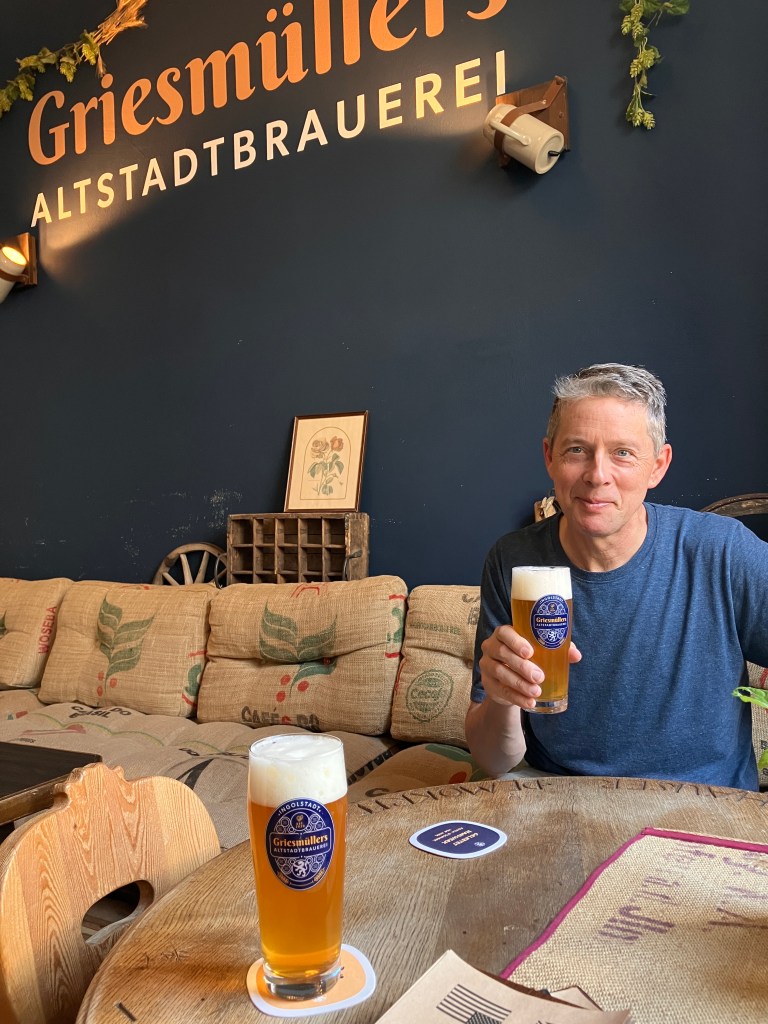
A brewery in town, making a great pale ale, not a typical German beer.
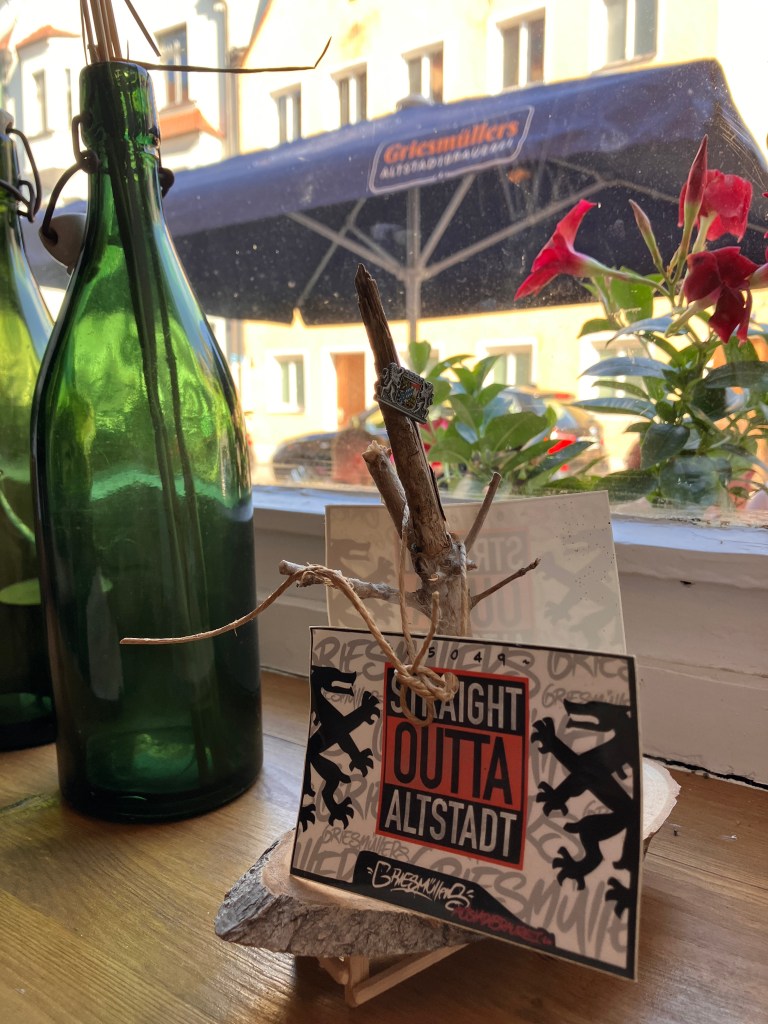
“Straight outta Altstadt”. This really made us smile.
Easy to remember the beer when the brewery name is right there on the glass.
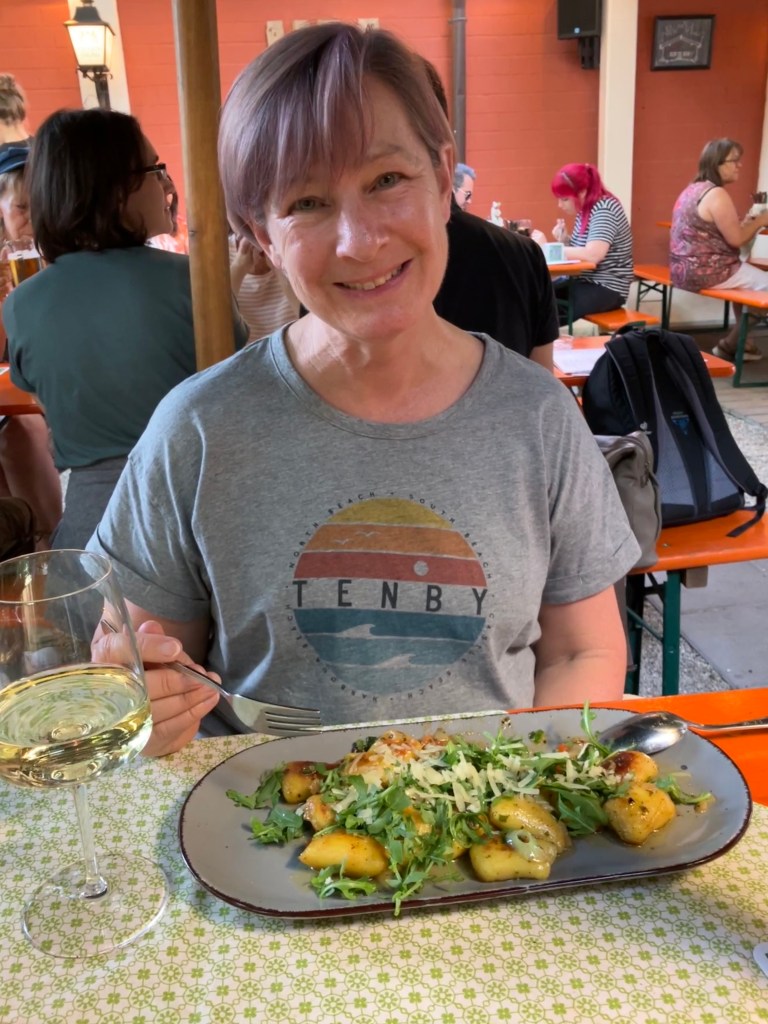
A delicious plate of gnocchi and a smile.

So what is it with this American habit? Are we all just simple and happy? Well, according to a fun article I read, it has to do with how many immigrant groups or source cultures a country has. And America is just that – immigrants. 60 source cultures. When you arrived in the USA and your neighboring farmers were Polish on one side and Swedish on the other- you smiled since it was the first and most welcoming communication you had. A non verbal way to say hello, let’s get along. Before you all learned a common language smiles were your signal of cooperation and neighborliness. And that habit stuck and permeated the culture. Canada is similar, but I don’t know if they have the same reputation for loads of smiles.

Loaded up and ready to roll out of Ingolstadt.
Sometimes we’re on asphalt.
Sometimes it’s dirt.
The smell of roses in the warm air will be an evocative memory of this trip in Germany.
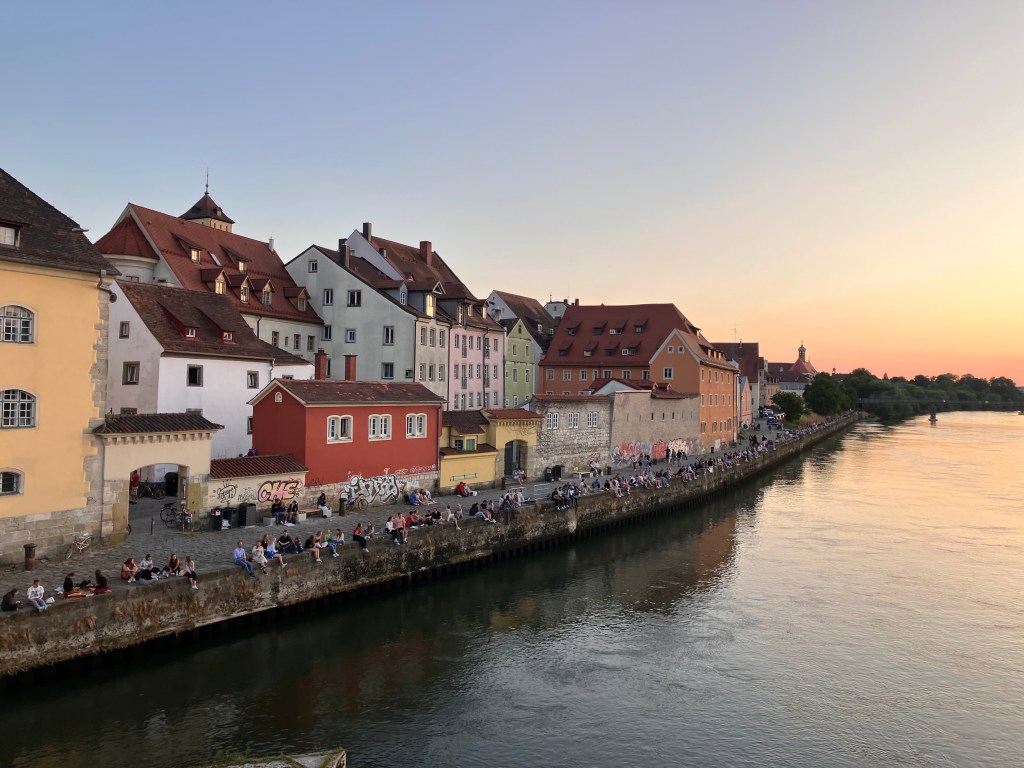
Enjoying a long warm evening in Regensburg, one of our favorite stops and the second time we’ve been here on bikes.
We both absolutely love a city that has so much gathering space for locals. Grab a beer and dangle your legs over the river.

If you think that Americans are not welcomed, or viewed with annoyance or contempt in Germany, you are very wrong. We’ve learned to say we’re American as soon as feasible in conversation. It not only explains our smiles and enthusiasm, but very often elicits an enthusiastic response, with an offering of which relative lives where in America- a son in Chicago, a daughter in Arizona, or, as the case with our young waiter from Moldova, a wistful statement that America is his favorite country, but no, he’s never been.

Riding out of Germany.
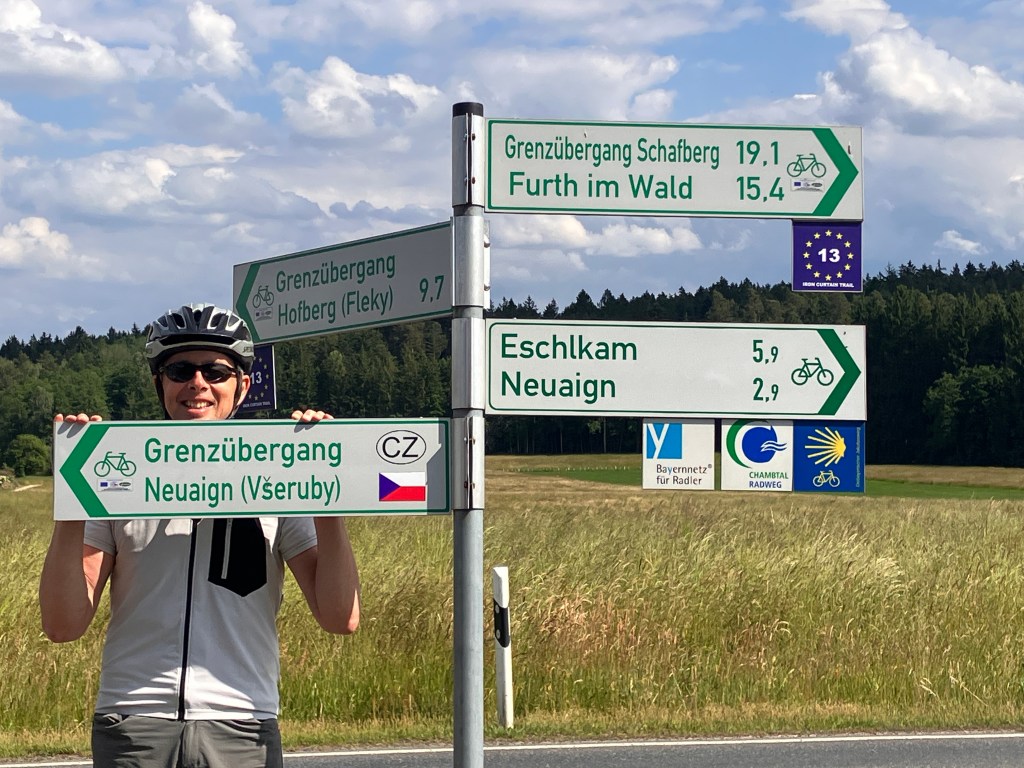
Eurovelo 13, The Iron Curtain Trail, taking us to Czechia.

As always, we are reminded that for all our faults, the US lives on as the land of opportunity for many. So we ride along, smiling at everyone. Probably viewed as a bit silly or simple by some, but for others a reminder what a country built by immigrants looks like, and acts like. And when after a little hesitation one of our broad smiles is returned by a German, we consider it a win. And if we can get a Hallo, a Guten Morgen, or a Groß Gott, that’s even better. Farewell for now Germany, we’ll see you on the return trip, and now let’s see how our American smiles are greeted in Czechia. Our first time back in 16 years and the first time with bikes.

The Happy Cyclists enjoying a Regensburg sunset.

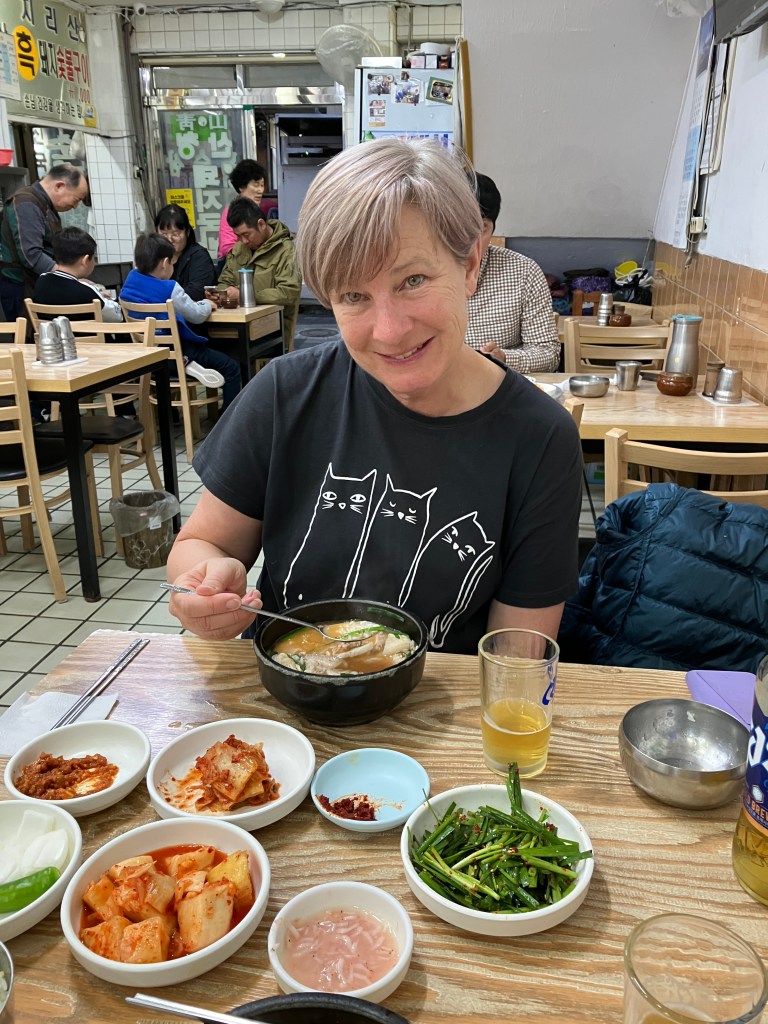
Korean eating. Lots of little plates of pickled things, and more.

Dinner with fellow travelers. So many little plates. (Banchan) Three of us chose octopus, and one had beef.

We are not foodies. We don’t seek out the ‘of the moment’ restaurants or cooking trends. But we do love to eat, and to find small mom and pop places to spend our money. When we’re in travel mode, or bicycle touring, we eat out just about every night. And afternoon. Mornings too, if the hotel doesn’t have breakfast available. So that’s a lot of searching for and sitting down to meals.

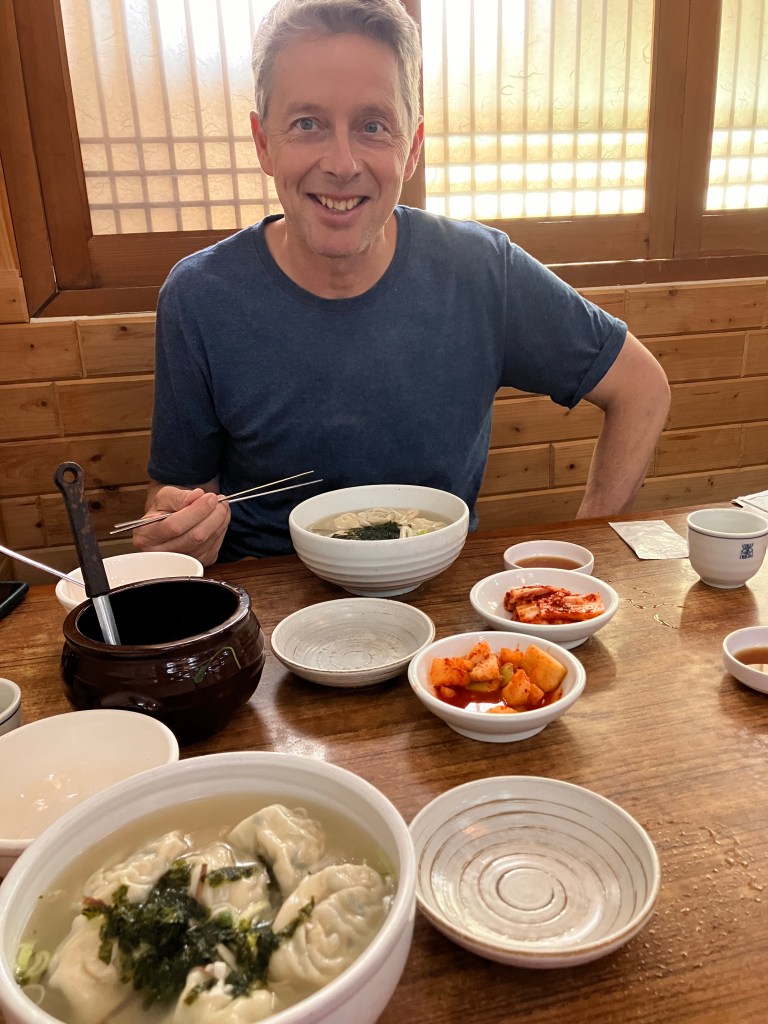
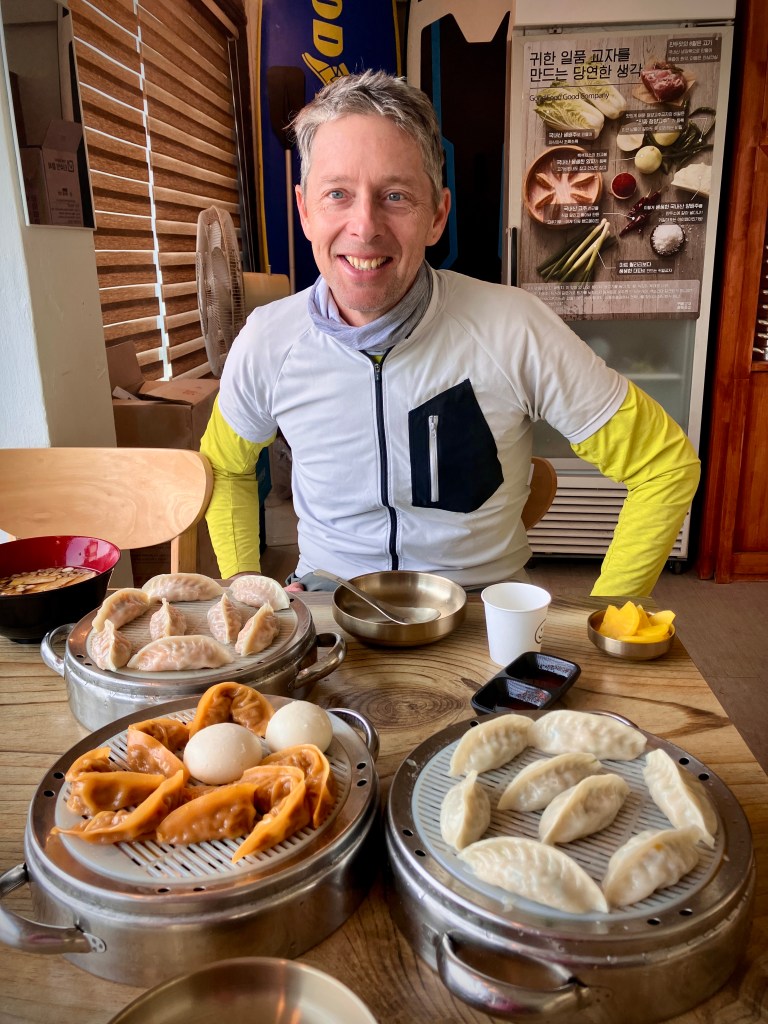
Our very first lunch in Korea. A dumpling place in the Insadong neighborhood of Seoul. Rich had eaten here on a business trip layover exactly ten years before.
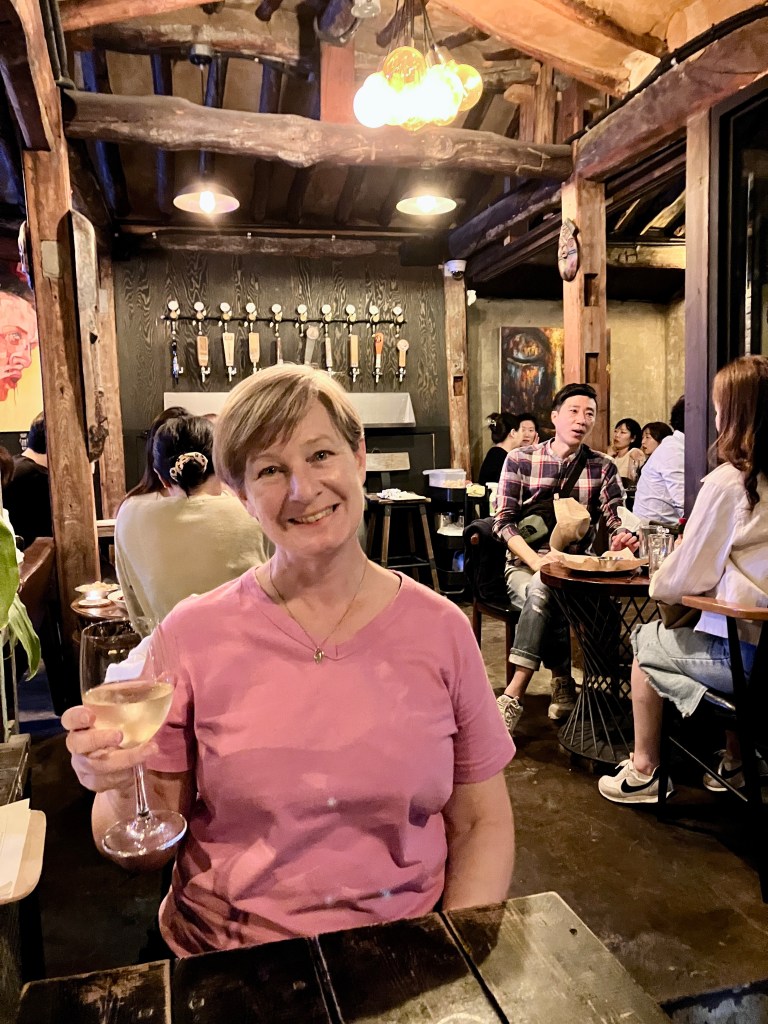
Cheryl very happy to be enjoying her first glass of white wine in the Ikseon-dong neighborhood of Seoul.
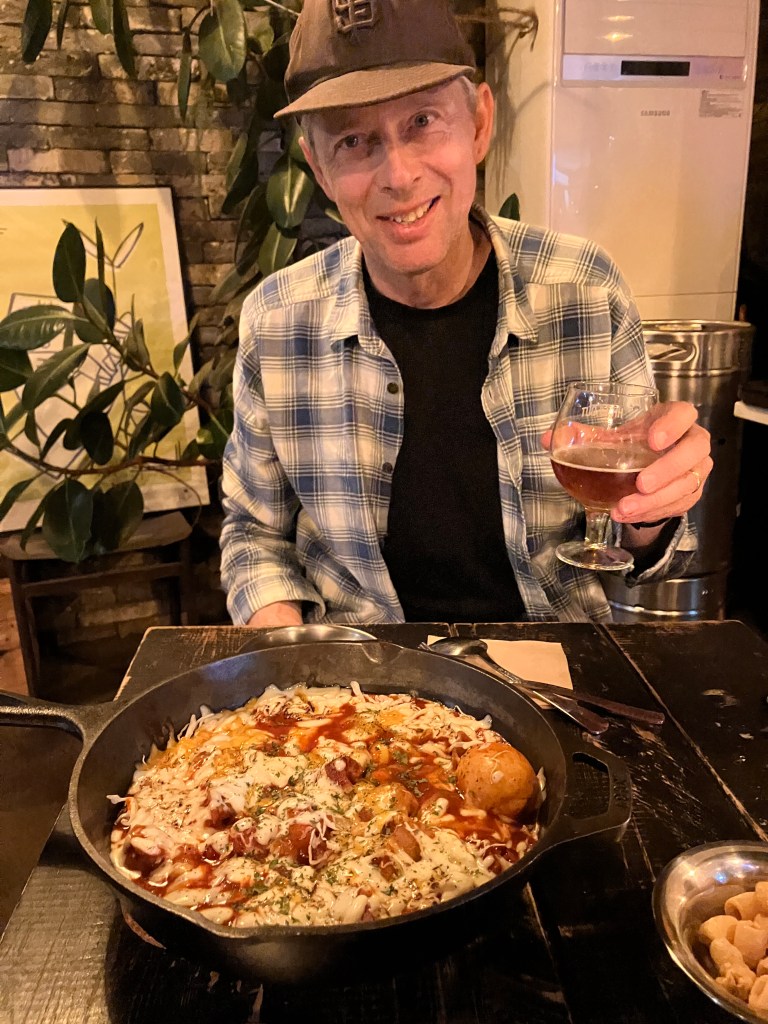
Rich enjoying a craft beer and a skillet of Oven Cheese Tteokbokki (오븐치즈떡볶이).

Tteokbokki is chewy rice cakes cooked in a red, spicy broth. This version at a place called Hang Out in the charming Ikeseon-dong area, a maze of little streets with so many different shops and restaurants, was more of a beer snack meal than the smaller street vendor versions we saw later on. This version had Sundae sausage and cheese as well as the rice cakes.

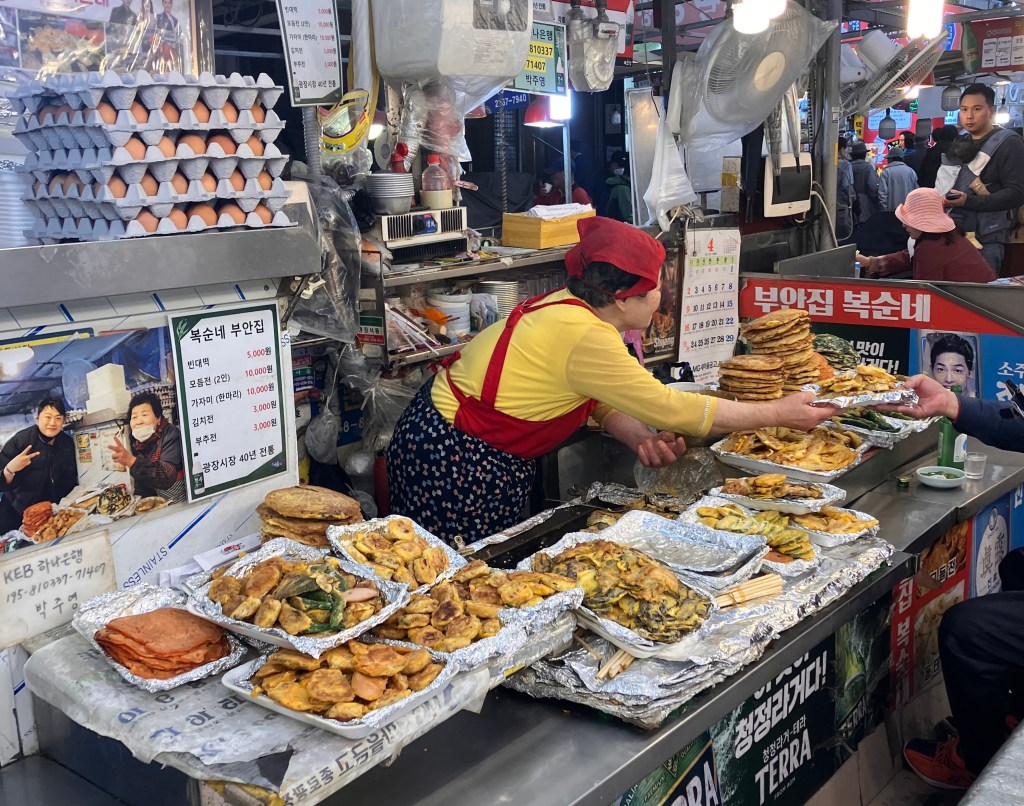
A stroll through the Gwangjang market to try Mung Bean Bindaetteok (녹두빈대떡).
This snack turned out to be a big serving. The small dish is pickled celery, we think. And kimchi came out after Rich, a kimchi fan, asked for it.

After a visit to Dongdaemun Design Plaza, the amazing museum complex designed by architect Zaha Hadid, which is well worth a visit, we went over to the Gwangjang Market to walk around and ogle the food on offer.

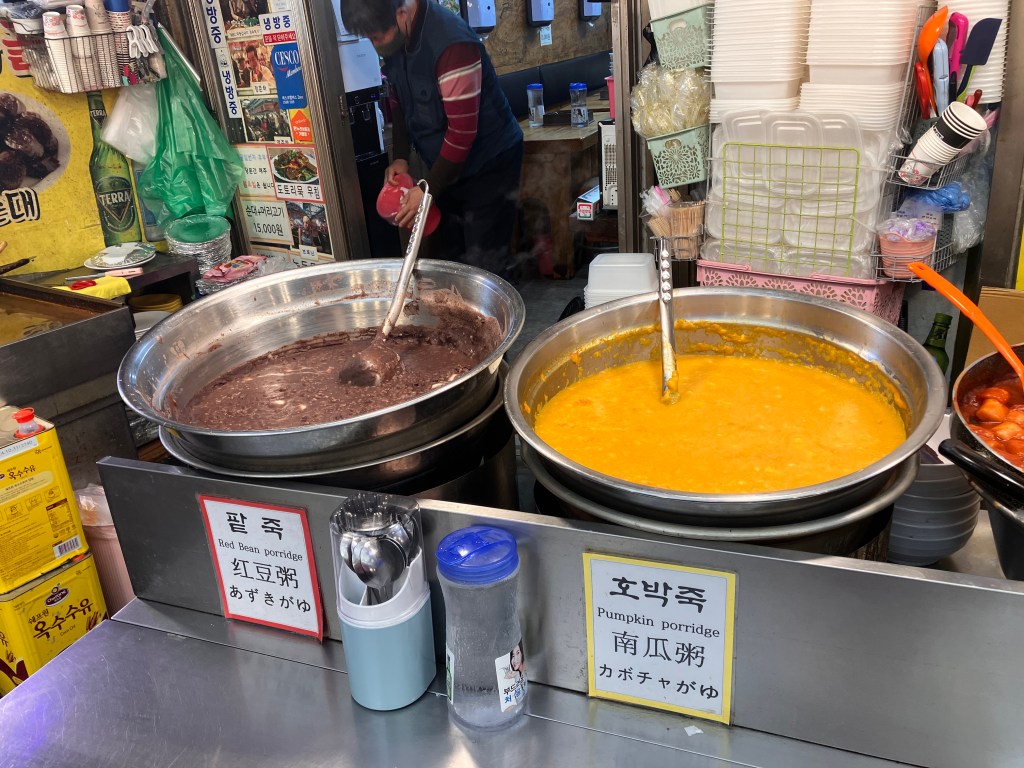
Had we not been full of mung bean pancakes I would have loved to try this pumpkin soup.
We quickly got a bit overwhelmed in the market.
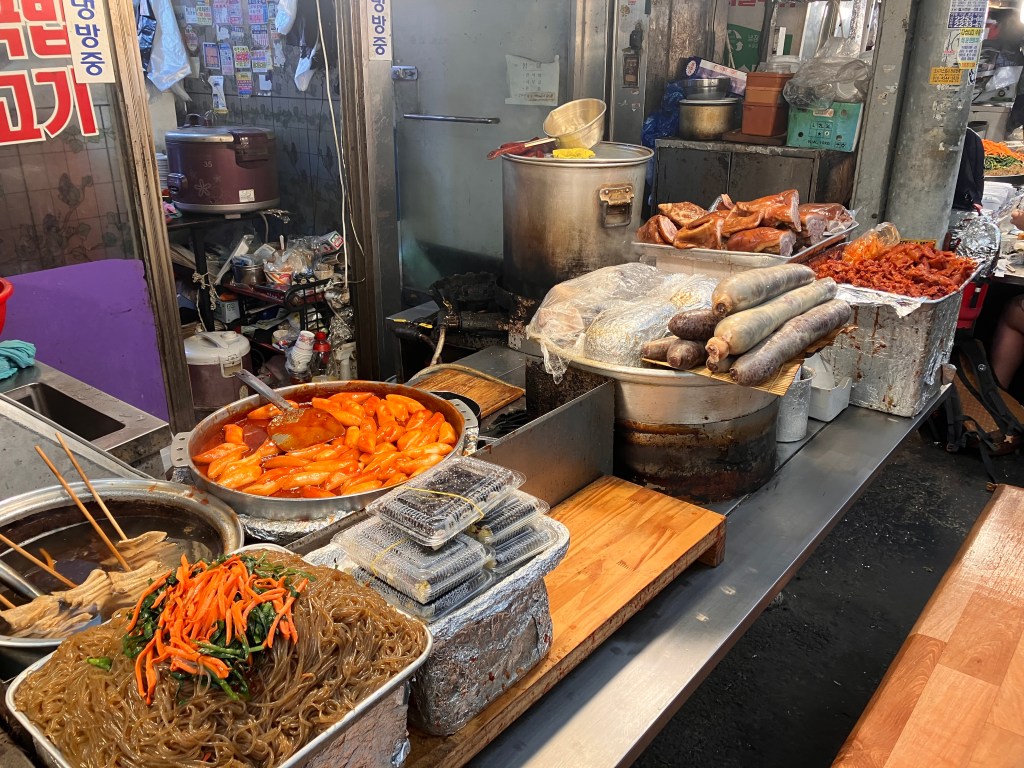
Fish cakes, Korean glass noodles – Japchae is the dish of stir fried noodles – Tteokbokki, the spicy rice cakes, and the long sausages are Sundae: made with pork intestines stuffed with glass noodles, coagulated pig blood and vegetables, all steamed together.

You know how people like to talk about getting out of your comfort zone? Food is a fast and easy way to do that. I don’t consider myself an adventurous eater, Rich is willing to try anything but I’m a lot more picky, or cautious. And, I don’t like seafood all that much. I’ll happily have sushi or sashimi, but most cooked seafood gets a pass when I’m choosing my meal. However, once we got bicycling on our trip from Seoul to Busan, I really did have to eat what we could get. Whether it be from the ubiquitous convenience stores, or at a restaurant.

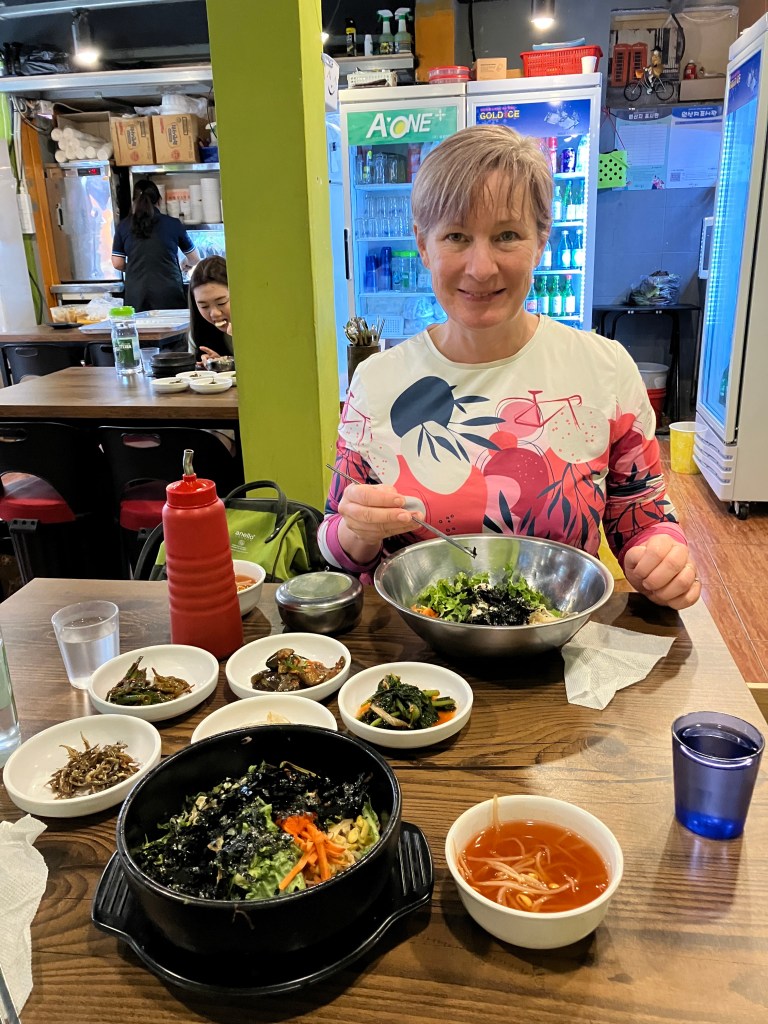
Bibimbap, or mixed rice dish. Sometimes in a hot stone bowl (dolsot), or mine in a tin bowl, vegetables and an egg. We quickly learned that not everyone finishes the little dishes of pickled vegetables and fish.
This little street is known as a Pocha, short for Pojang-macha, a restaurant or street that serves Korean comfort food. It’s where we had the bibimbap in the previous photo.
Our first night on our bike tour we had sushi and noodles. And yes, that stain on my placemat is the splash from when I dropped a piece of sushi in the soy sauce.
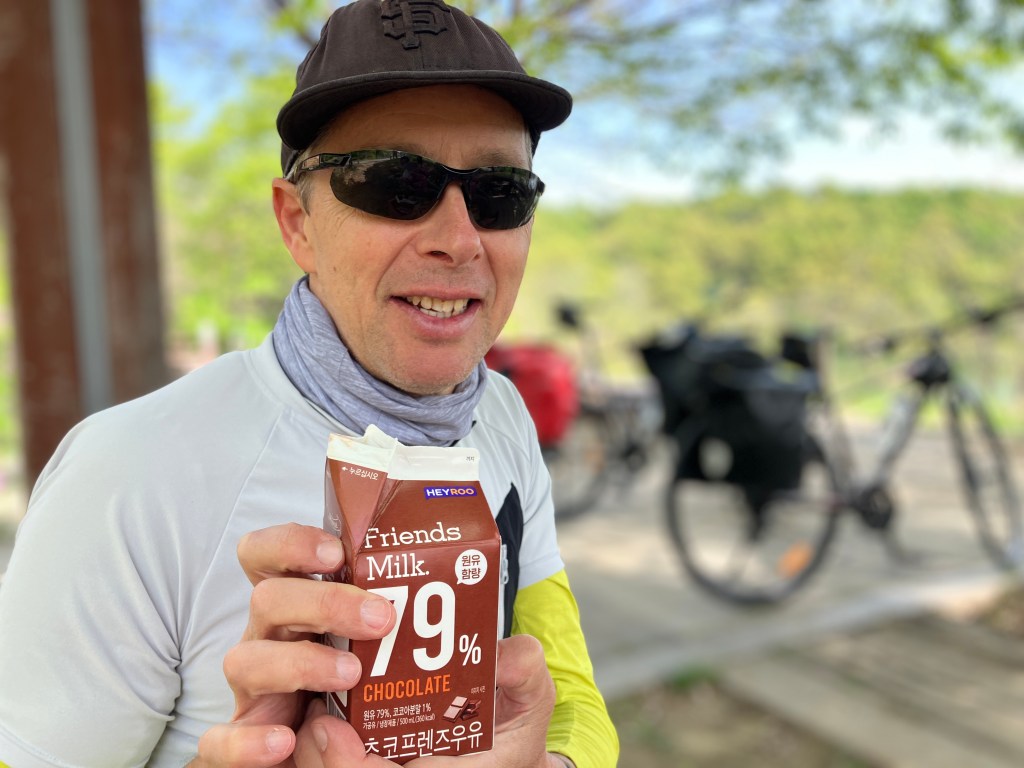
Chocolate milk. A great energy drink while cycling.
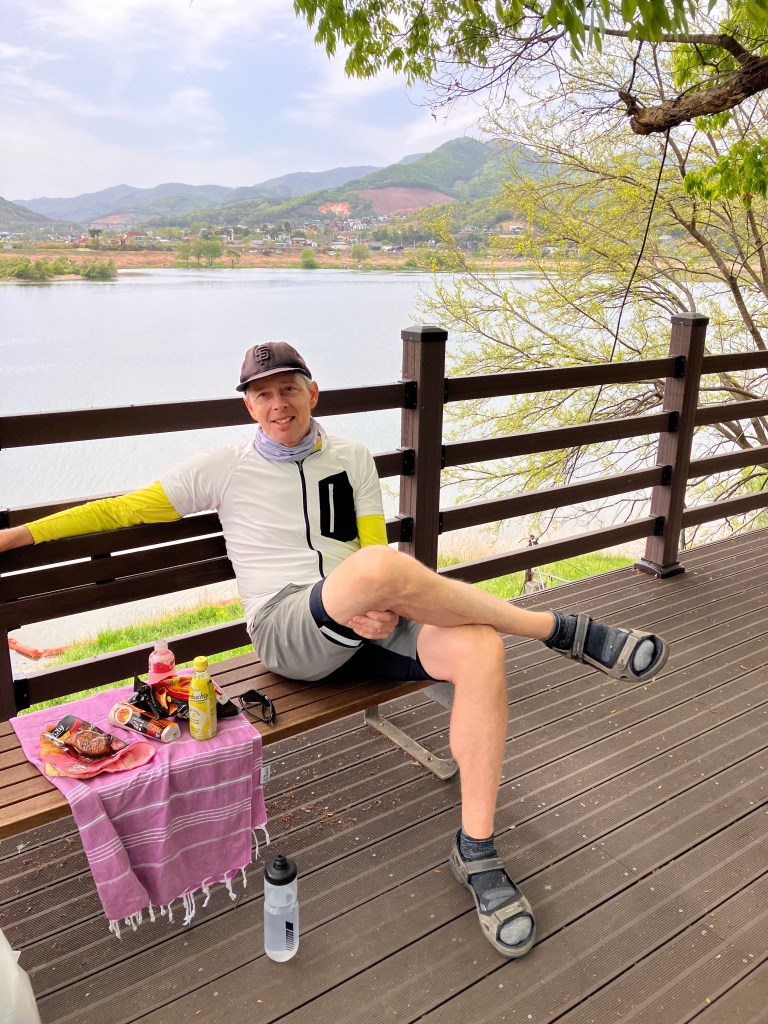
My favorite bike touring lunch, a picnic. This was taken right before we realized we were sharing our bench with spiders.
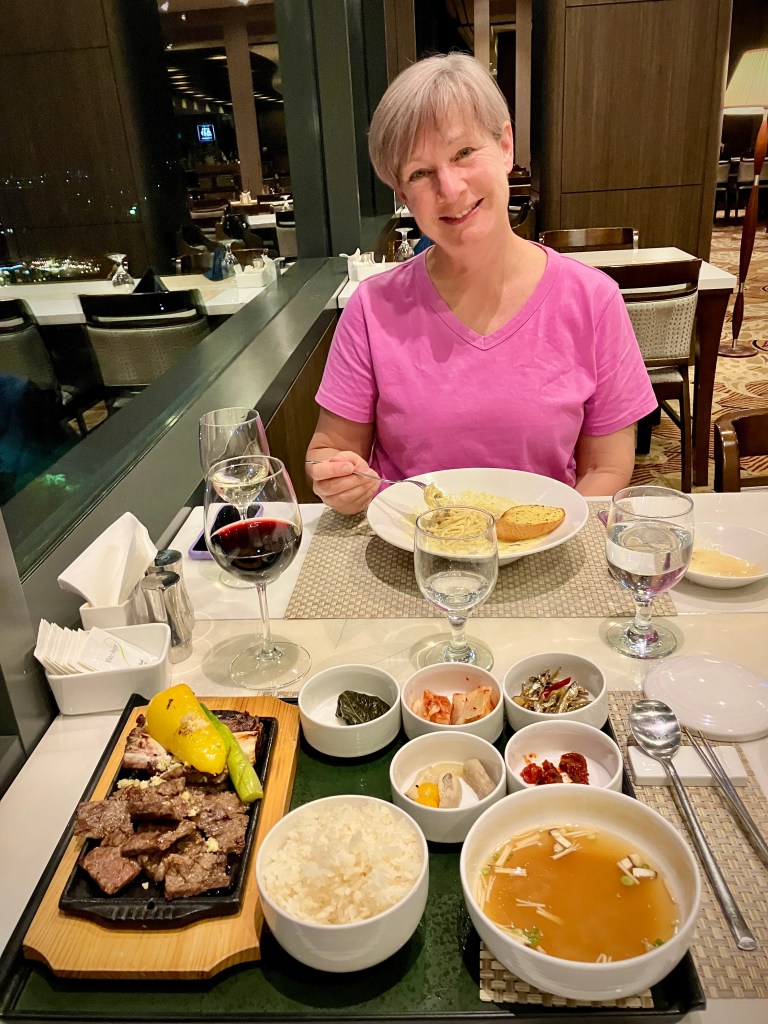
This is not a typical dinner scene on our bike ride, Rich got the beef bulgogi set meal, I got pasta carbonara. Our hotel offered Korean and Western food. Usually it’s all Korean food.

Bike touring lets us see a country in detail, and forces us to figure out how to feed ourselves. Korean convenience stores are easy to find, and although I prefer Japanese convenience stores, we did well finding things that appealed to us.

A well placed picnic gazebo for elevenses. Packaged pastries and drinks from a convenience store.
Caffeine choices.
Dumpling lunch. A happy stop. Kimchi, spicy bbq, and meat dumplings. For the record the spicy bbq and kimchi were great, meat ones were a bit boring and bland.

So, how about when the food finding is not so easy. Or not so successful? Or you get to town kind of late and not much is open? Then it’s chicken and beer places. We had to resort to chicken and beer places twice, on long days. They are known as Chimaek. From chikin ‘fried chicken’, and maekju ‘beer’.

This was actually quite good after a day cycling. Chicken nuggets, noodles, rice cakes, a spicy sweet sauce, and leeks on top. The dish to the right was pickled jicama, we think. Or maybe radishes.
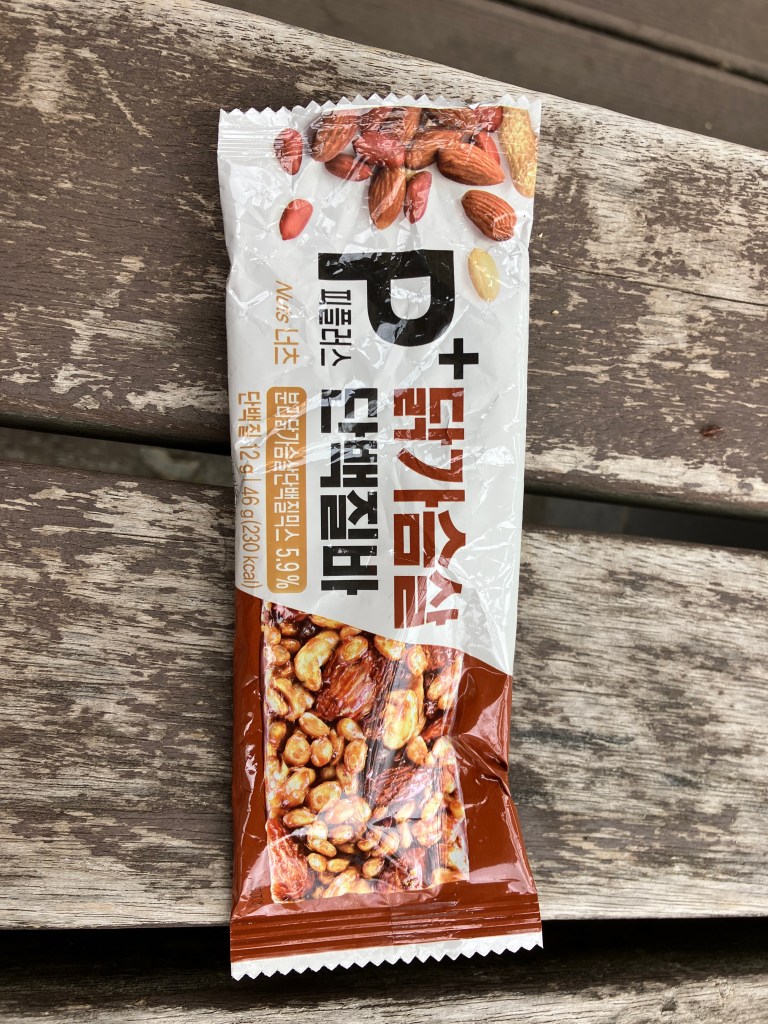
It’s a good day when you discover that this energy bar from 7-11 is really tasty. And they had a buy 2 get 3 special. The clerks in the 7-11s were very good at making sure you didn’t miss a special offer.
At our second Chimaek restaurant, we failed to snap a picture of the Cheeto orange chicken, but this salad with ice cream on top was not as bad as you would think. Yes, that’s corn and tomatoes, iceberg lettuce and red onions. Under the ice cream.

There was an evening when we pulled into town on our bikes, in Gumi, and planned on eating at the food court of a large grocery store chain, E-Mart. Food courts in Korea are good. We were looking forward to it. We checked in to our nice hotel, unpacked, showered, and strolled over with plenty of time for dinner. It was closed. There was a mysterious local holiday that no one but the management of the E-Mart seemed to know about, or care about. So, grumbling and hangry, we headed back to our hotel, and then spotted the sports team from the hotel lobby at a small place down the block and went in.

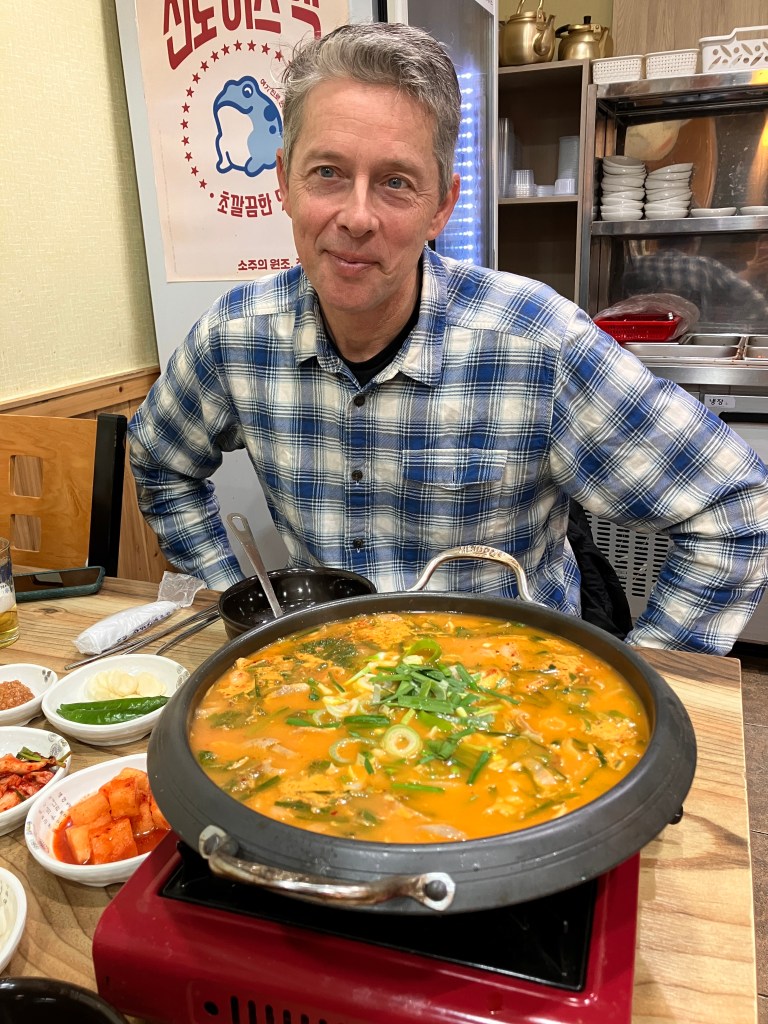
A small restaurant run by one lady, who does one thing. We ordered the one thing for two. Out came the small dishes of pickled things. Out came a burner.
And out came the bubbling Sundae Jungol hot pot. Remember, Sundae are the sausages, the hot pot also has pork intestines and vegetables in a spicy broth. It was quite good.

Once we reached Busan and were off the bikes and in a city it was easier to search out restaurants and plan ahead. While cycle touring you are often at the mercy of how far you were able to ride, and what time you get to town, and how much energy you have to find and walk to a restaurant. But with a few days to explore you can find what you actually want. Rich was happy to find that Korea has had a renaissance of craft beer brewing in the past decade or so.

Wildcat Brewing in Busan.
Galmegi Brewing in Busan.
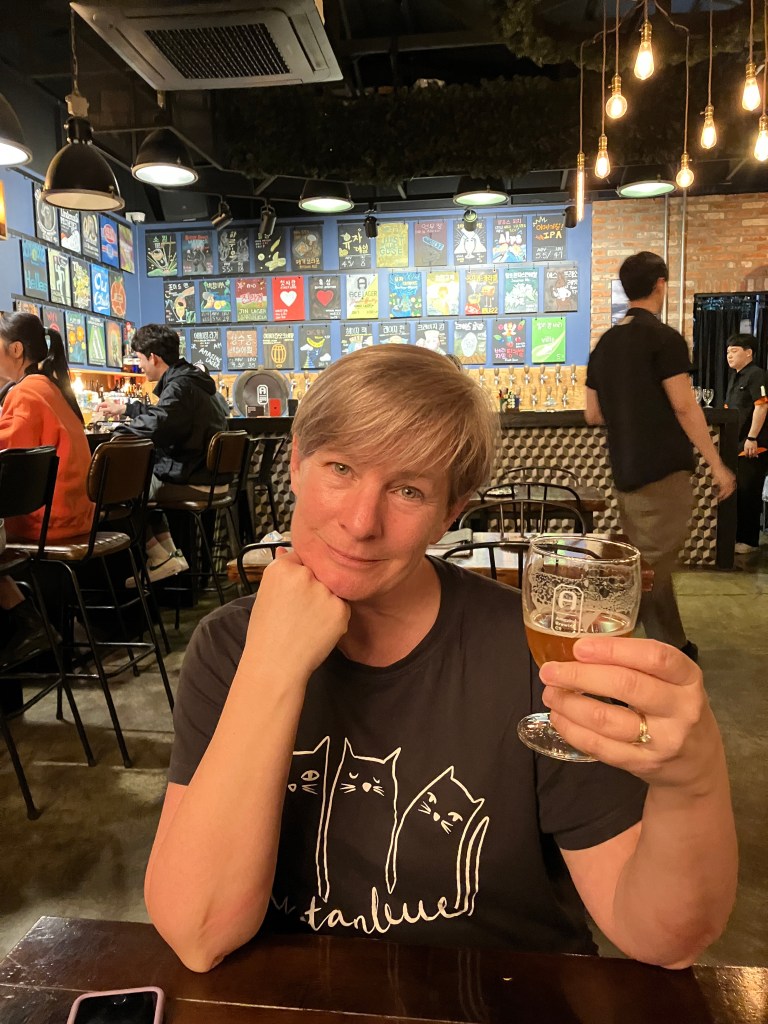
Amazing Brewing Company in Seoul. Don’t let the same shirt fool you into thinking this was one night, it was three different nights with a limited wardrobe.
That face says “It’s not wine”. But it was good.

Korean food is quite varied. Most people know Korean BBQ and bibimbap, but there is a lot more to discover.

A Mexican restaurant in Busan. Grilled shrimp tacos.
Not bad. A bit too sweet, but a nice diversion.
I like a lunch that comes with scissors to cut your noodles. I did this all wrong. One of the little bottles was something for declumping the glass noodles. Oh well, press on. At the Busan train station.
Seomyeon Market food street, Busan. Tempura.
And right across the street, dumplings.
Beef bulgogi dolsot bibimbap. Quick, break that egg yolk, but don’t disturb the rice while it crackles against the hot stone pot and gets crispy and brown.

We took the train from Busan to Seoul and stayed for a week in an apartment which meant we could cook our own meals. As much as we enjoy eating new foods, it gets stressful and tiring to find restaurants, translate menus, and constantly try to figure out what goes with what – does this go in here or do you dump this into there? Our first lunch in our apartment after a visit to the big E-Mart grocery store was grilled cheese sandwiches.

Last dinner in Busan. Rice and pork soup. Made in huge vats, long boiled in the little street in front of the restaurant. The little bowl of pink is tiny salted shrimp, which you add to the soup, along with garlic chives and minced sauce.

Our apartment in Seoul for our last week in Korea was out in a neighborhood. While at first glance during the walk from the Jungnang metro station it appeared to be a lot of tire shops, new apartment buildings, and little clothing stores, the small back streets proved to be full of restaurants and places to buy groceries. It was easy to wander around and pick a place a for dinner.

We translated the sign to read Ssambap, This means things, rice, meat, vegetables, and sauce wrapped in a variety of leaves.
The plate of leaves at the left include lettuce, Korean perilla leaves, squash, bok choy, Napa cabbage, and cabbage leaves. The small round black dish is a freshwater snail and soybean paste stew.
My attempt at ssambap. That’s bulgogi beef on top, from the second round black dish in the table. Nice and spicy. I think a local would have a neater and tighter wrap. Think Korean burrito.

Seoul was fantastic for hiking, as we covered in the previous post, and it was also fantastic for simply walking into a restaurant and getting a delicious meal with very low stress or awkwardness. The owners were always nice and welcoming. They would help us out when we were obviously confused about how to proceed with our meal, and payment was always easy – just get up and walk to the cash register and tap your credit card. No tipping, and taxes already included. Another nice thing about walking up to pay is that you don’t feel guilty having left some of the little plates of pickled things. Our clean your plate mentality is hard to break.

Hiked off a mountain and into a tofu restaurant. The table of gentlemen behind Rich were having fun and that enticed us in.
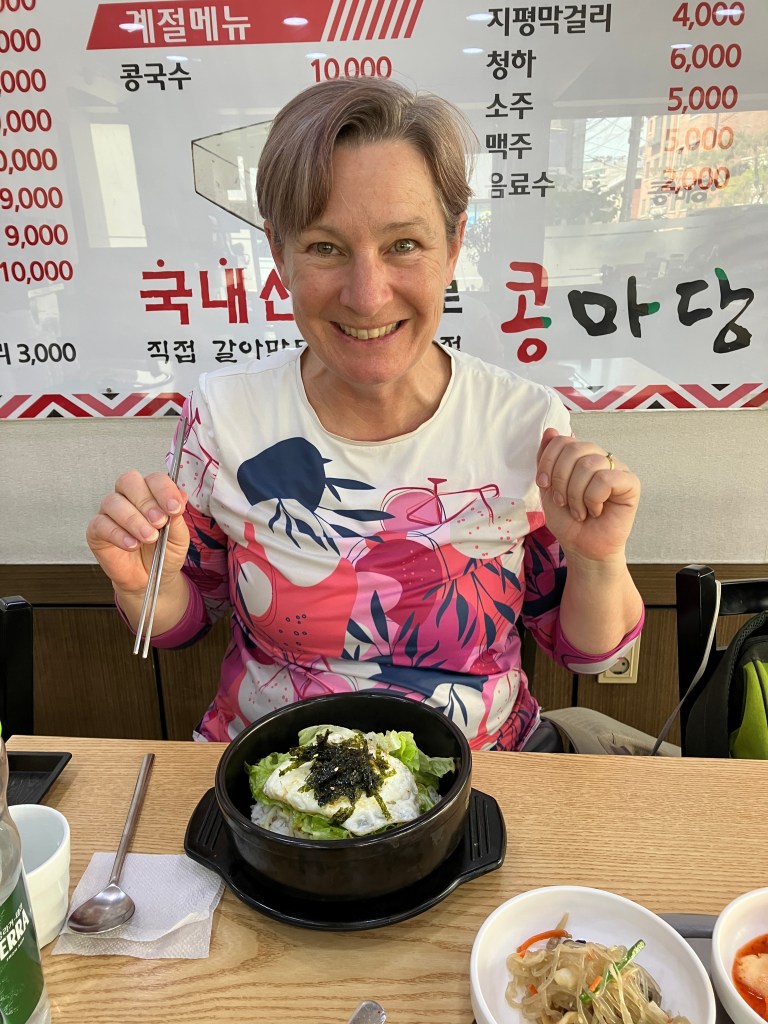
Who’s excited by her tofu bibimbap with an egg on top?
The meal sets are another fun easy way to order. I got beef bulgogi (again), and Rich had ginger chicken soup.
The soup arrived bubbling away in its dolsot.

Korea is famous for its barbecue. That’s the one thing most travelers might know about Korean food – barbecue. And the many barbecue restaurants are super popular with locals. It’s a fun thing to do with a group of family or friends. The ubiquitous restaurants are easy to spot with the ventilation hoods over the table grill. We decided on our last night eating out in Seoul to finally try a barbecue place. We’re not really big meat eaters, but thankfully as with any meal in Korea there’s no worry about getting plenty of veggies.

Was it the cute pig on the sign that drew us in?
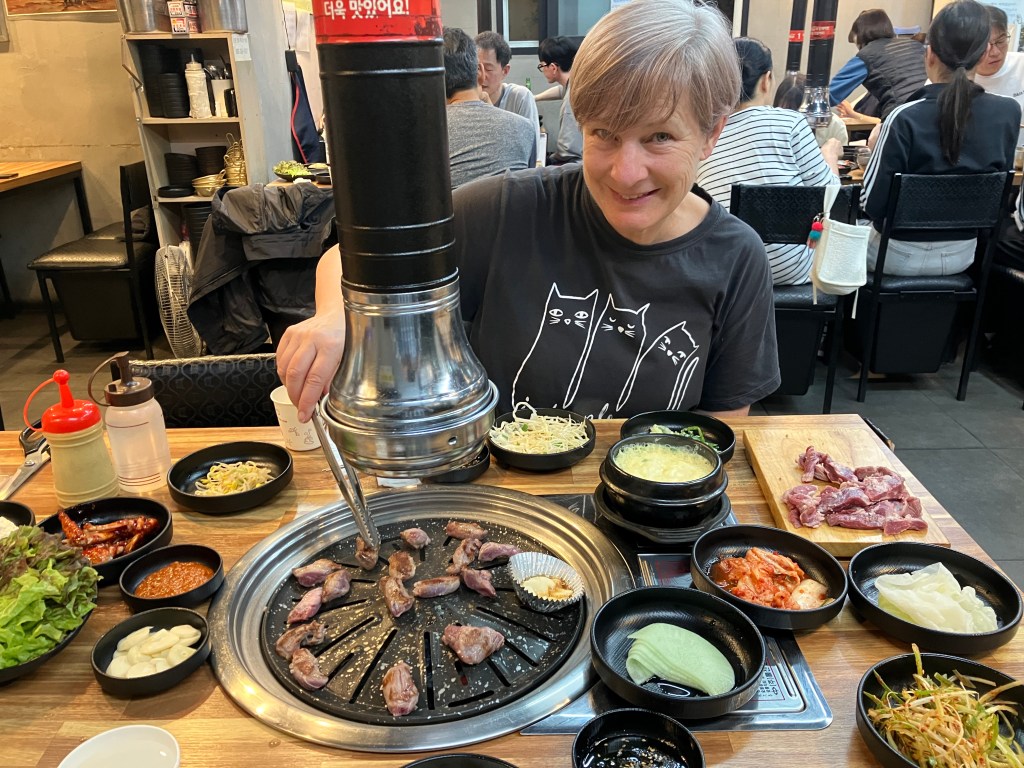
It was the perfect mix of some tables full, but not too crowded. That way we can watch how other diners proceed but not feel too overwhelmed. That’s a little dish of garlic in oil on our charcoal grill.
I was doing my best to be grill master of the meat we got. (We’re still not sure what it was, our translation app was a bit vague on this one.) The other dishes contain an egg soufflé/omelet, pickled daikon, Kimchi, leaves to wrap your bbq in, and loads of other veggies and seaweed.
The friendly waitress came over to give me a hand. I was being too careful, she dove in and tossed that meat around!
Belly full, happy to have a 15 minute walk to the subway station through little back streets.
We did willfully break some food norms. Koreans don’t walk and eat like we Americans do. Everyone else who got ice cream sat at the shop and ate it. We strolled.
One final river path walk in the morning before heading by train to the airport.

We had a great time in Korea. The people, the food, the biking, all of it exceeded our expectations. We are in San Francisco now, after a lovely family visit in Colorado, and we head back to France soon to pick up new touring bikes in Germany and then out for cycle touring!

The happy but jet lagged travelers in Colorado.

Mega trail around a mega city. Seoul, Korea.

A view from our first mountain park hike.

We knew that Koreans love to hike. Even if we hadn’t known that before coming to Seoul the sheer quantity of hikers using the metro would have tipped us off. Boots, backpacks, hiking poles, sun hats, we felt right at home with these transit enabled hikers. We hadn’t planned on turning our time in Seoul into a multi day hiking expedition, but that’s the joy of travel. Sometimes you just never know what’s going to happen and what you’ll find in a new place.

A view from our second or third mountain hike.
A view from the Seoul Trail.

You may be realizing that what these views have in common is that we are looking down at the city. Down as in ‘we climbed a lot of darn steps to get up here’.

Looking at one mountain park we climbed, the little one to the right, while climbing another mountain park. Playing the game called find our high rise.
The air was quite clear on our first hiking day. Rain was coming in a few days so we hiked three days in a row.

Rich found the first hike for us by seeing the mountain park from our 12th floor window and navigating us there hoping there would be a trail. There was. And there was an amazing accessible boardwalk style trail all the way up to a temple and a cafe. Maps.me was helpful, showing some trails, and Alltrails had some as well, but lacking a great mapping site we relied on Rich’s wonderful navigation skills.

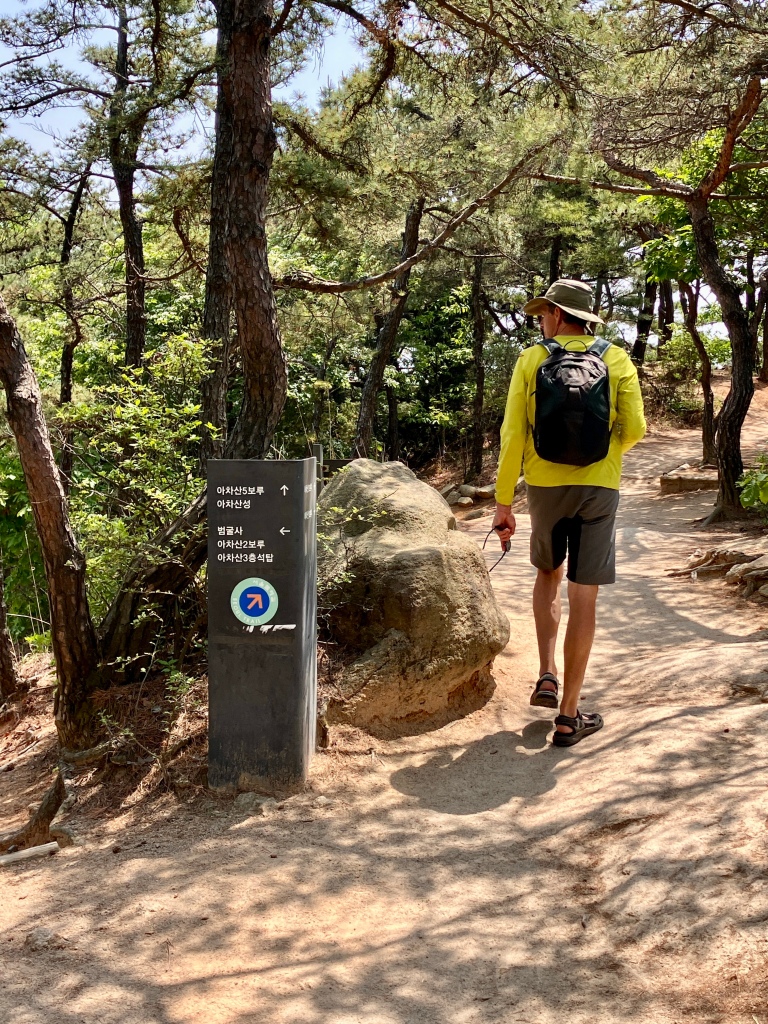
Once we were on the trails the signage was quite good.
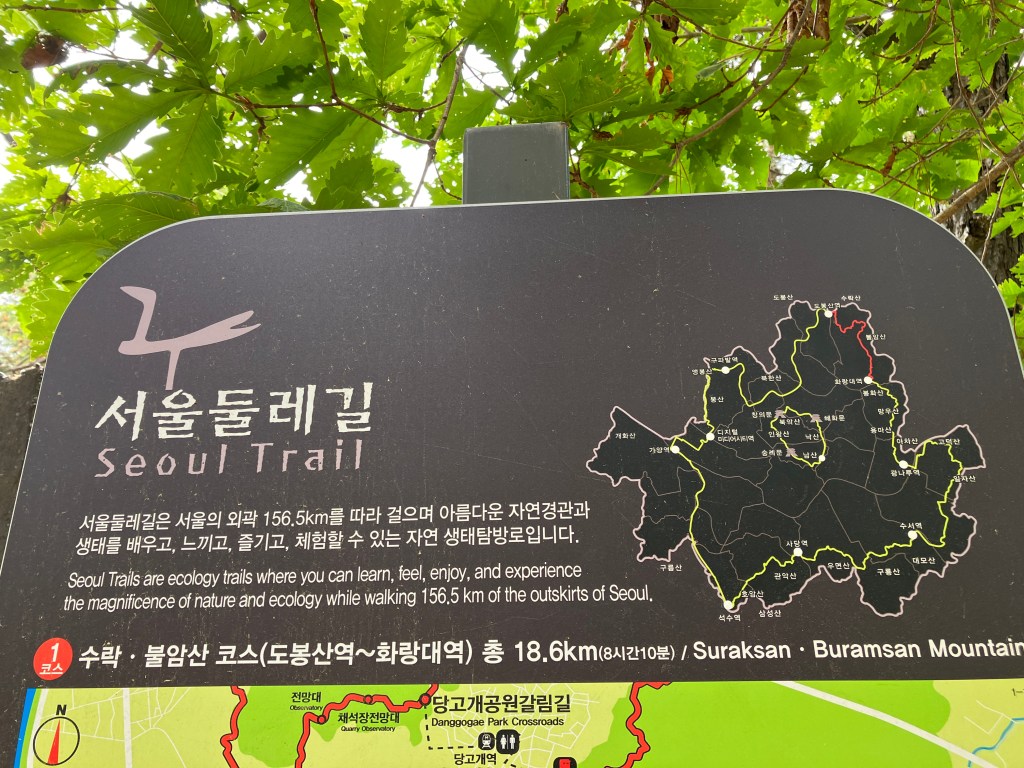
Very comprehensive signage on the Seoul trail.

Since hikers are getting to and from their hikes on the metro, there are also signs to get you to the trails from the neighborhoods.

Turn here to get to the Seoul trail.
A comprehensive hiker sign. I like they have a backpack and a pole. And a big version in case you fail to see the smaller sign.
Seoul wraps around and up to some impressive mountains, when you get off the metro you see this. Head that way.

The signage and maps varied in detail, and confusingly played fast and loose with having north be at the top, but on the whole you were well taken care of, signage wise.

A big view of mountains and the trail networks. Including metro stations.
A map showing the 156 kilometers of the Seoul trail.

Not only was the number of trail opportunities great, the amenities along the trails, and the construction of the trails were impressive. Very nicely maintained steps, benches and picnic spots, restrooms, and my new favorite thing – carpeted trails. It looks like jute, or coir, and for stretches that are steep up or down, or could get quite muddy, it’s super helpful. It also stops the usual trail ruts from forming, or the footsteps turning into hardened mud. And dang, carpeted trails – what’s not to love about that?

This one was new. You can appreciate the weave.
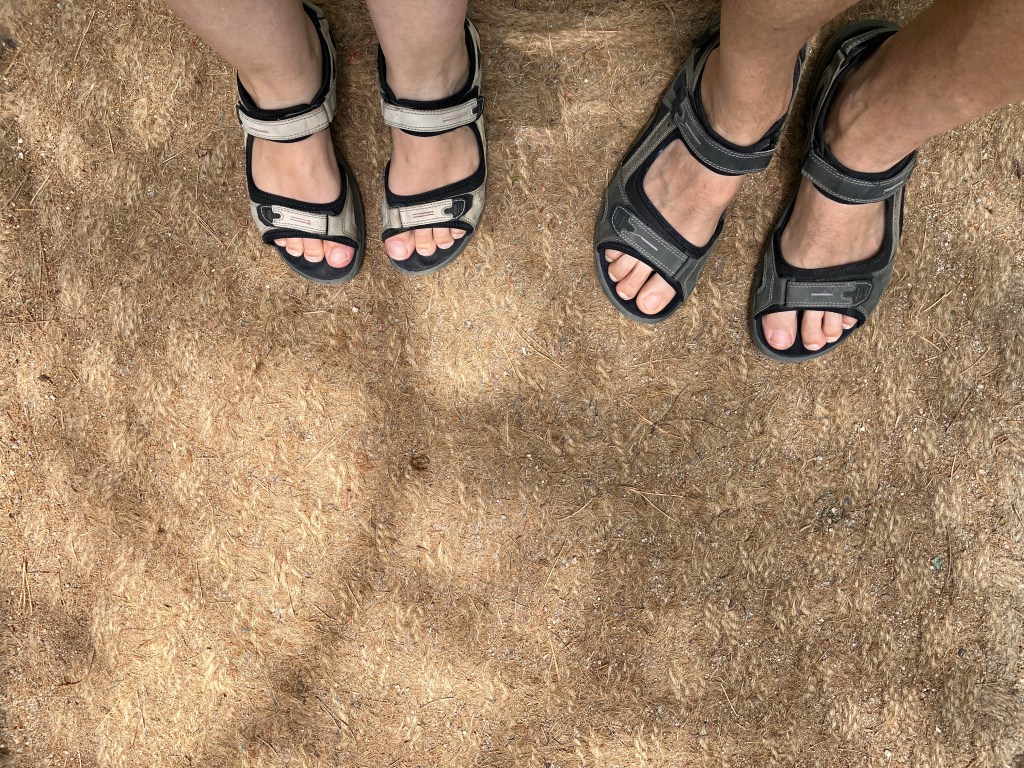
A more worn in stretch of trail carpet. And our much worn Ecco sandals.
Restrooms, clean and with potable water unless otherwise noted.
A pine grove with plenty of picnic benches.
Seating and shade.
An accessible trail gently climbs towards the view spot.
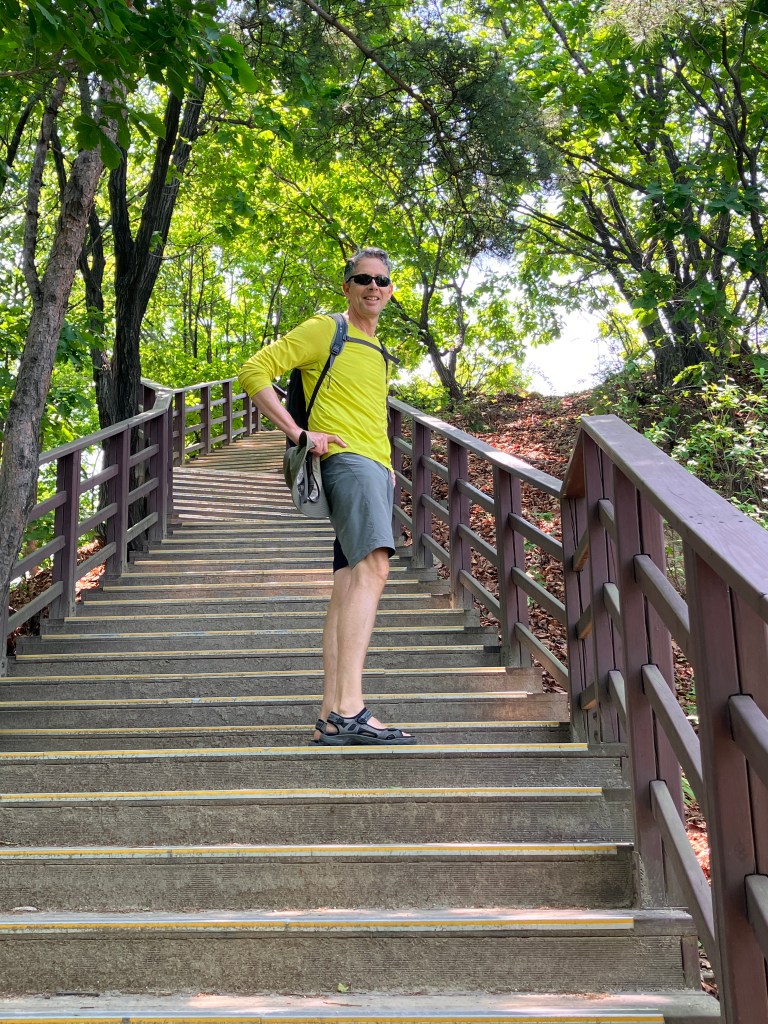
Where there were stairs they were also well built and maintained. And usually wide enough to handle the crowds of enthusiastic hikers. This was a weekday so there was not as many people as we imagine show up on weekends.
Rich heading up.
And up.
And then down. This hike day, a section of the Seoul Trail, had about 2,000 steps.

It’s not unusual for us to come to a city and skip the A list sights. Doing things we love to do, like hiking or biking, or even just walking city streets, gives us more insight into what life is really like in a place like Seoul. Seeing the neighborhoods far from the tourist friendly zones. Going into restaurants with basically zero idea what kind of food they serve. And hiking trails like these, full of locals. I tell Rich he’s never happier then when there are zero other western tourists. I developed a rating scale for him of tourist bombs – a high of five is a lot of tourists and not going to result in a happy Rich, and a low of one is good, but zero is better. After the tourist bomb rating is the wide eyed locals rating – which shows how surprised the locals seem to be to spot two big foreigners on their trail or in their small neighborhood restaurant. Our best hike was zero tourist bombs, and five wide eyed locals, the highest rating possible in my new rating scale.

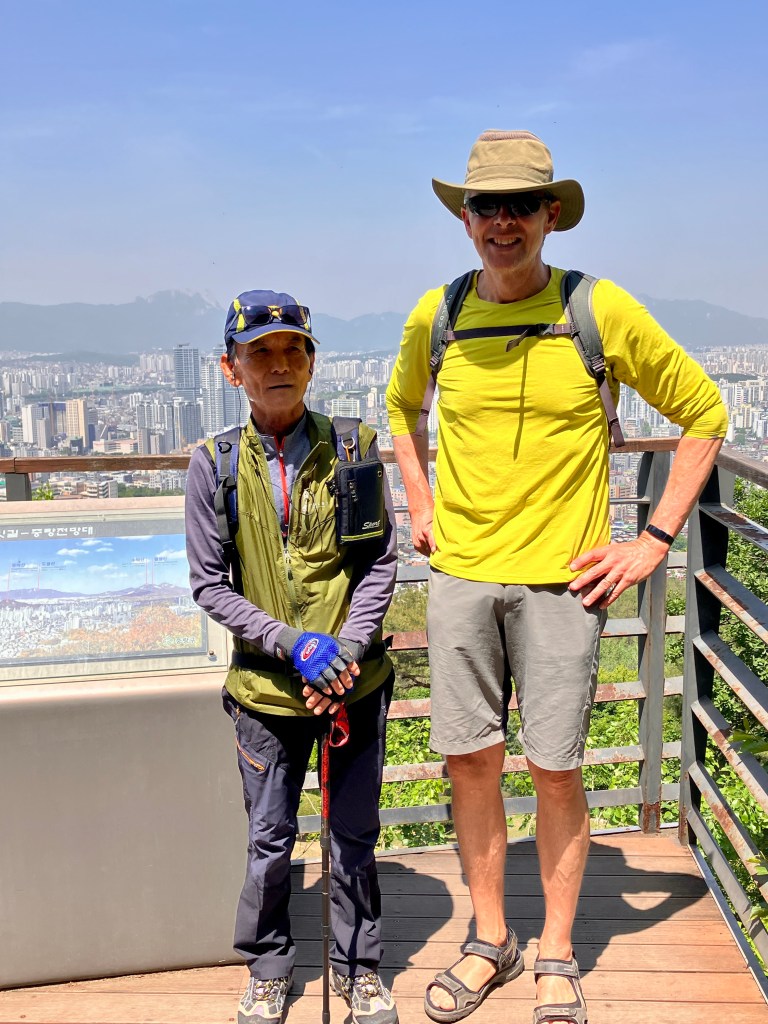
A friendly fellow hiker. Even with few common words he and Rich got along over pointing out buildings.
This is a typical hiking outfit for the locals. Rich’s is not! Our sandals were definitely unusual.

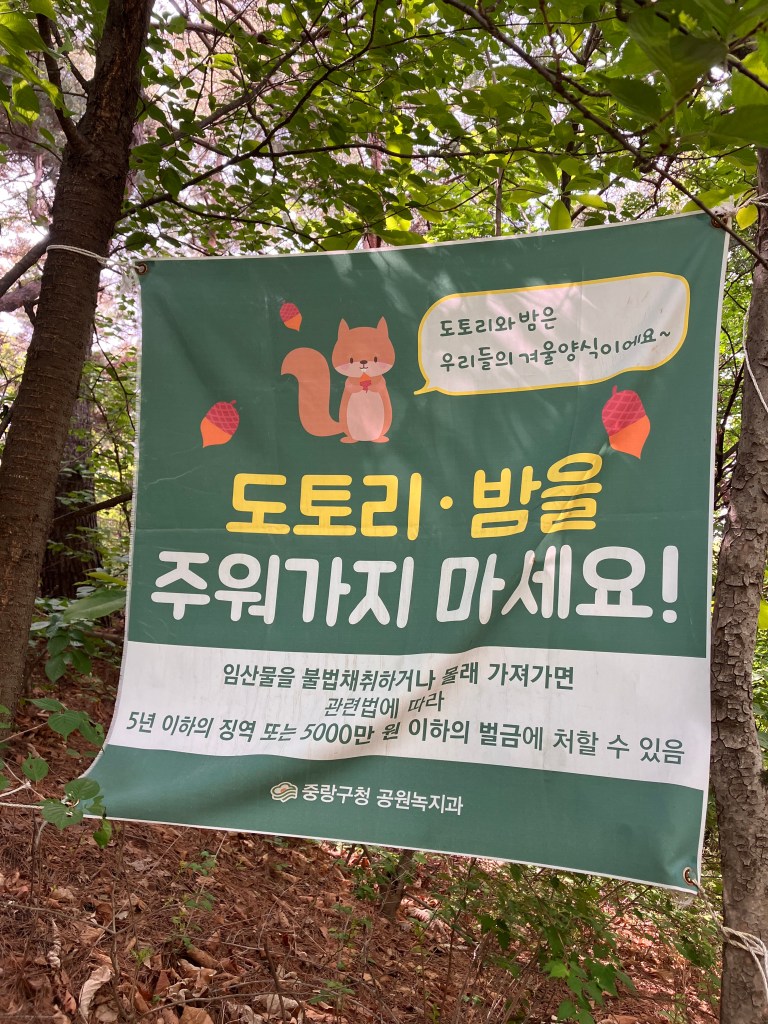
In addition to good trail signs, there are informational signs about archaeological sites, and signs asking folks to please not collect acorns and chestnuts as the wildlife depend on them.

Good informational signs with english translation.
This cute squirrel would like you to leave their food alone.
Another reminder to leave nuts on the ground for forage.

You might be thinking, ok, so that’s all impressive and interesting, but lots of places have trails, and signs, and views. Well hold on to your sun hats, there’s more.

Stamps! Like the stamps we didn’t collect along the Seoul to Busan bike route, and in Japanese train stations, there are also stamps we didn’t collect along the Seoul Trail.
So cute. Each station has a unique stamp.
These. What are they, you ask?
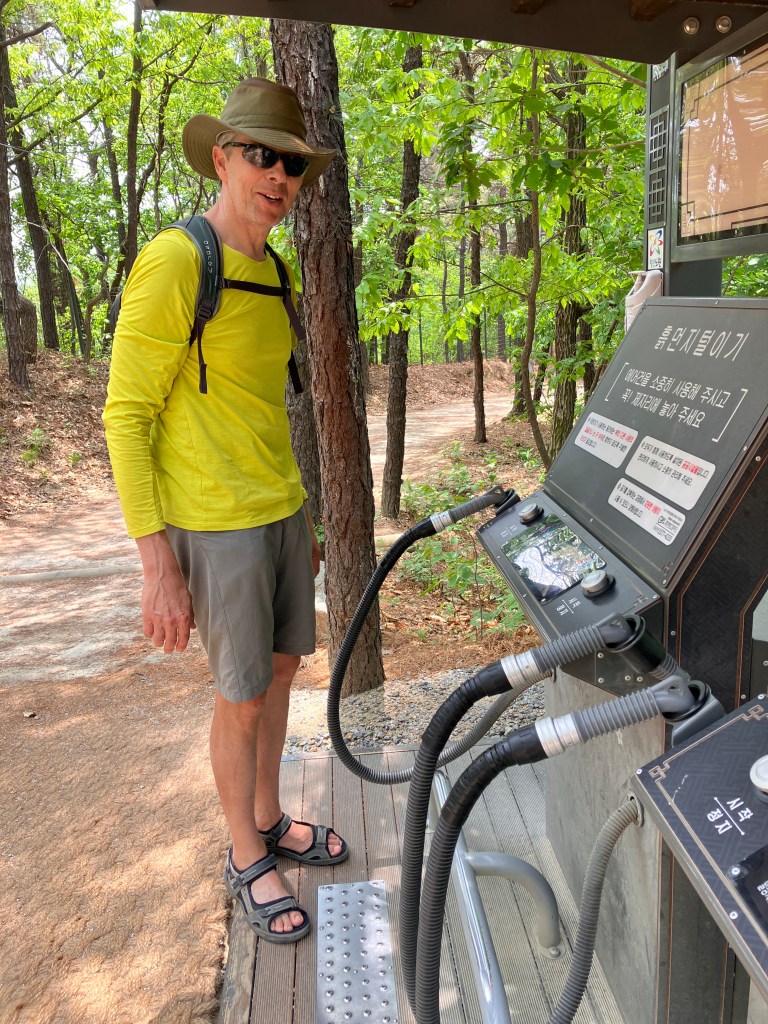
Compressed air blowers. To remove the dust from your shoes and trousers before you head back into civilization.
The sight of these meant you were nearing the end of your hike. Or a connection out to a neighborhood or metro station.
Felt nice to dust off our sandals and legs.
Rock stacking. In California this is discouraged behavior, but here it has Buddhist origins, although some folks apparently just like the challenge, adding a rock as they walk by.
Ribbon blaze markings, so you can keep to the Seoul Trail at crossroads.
A group of adorable young hikers, an entire class went by us, greeting us in Korean. We were charmed.

The unexpected pleasure of hiking in Seoul was highlighted by all the amazing views. As you climbed up, wrapped around, or climbed down a mountain park, you got new views of a different part of this mega city.

A view across graves to a cityscape and another mountain.
This high stretch reminded us of Desolation Wilderness near Lake Tahoe.
But we never had views like this in Desolation.
Scrambling down towards the city and a metro station.
Getting closer to civilization and lunch, passing by a community garden site.
The reward? Tofu Bibimbap. It was delicious and I let it sizzle in its dolsot (Korean stone bowl) so the rice got nicely crisped on the bottom.

I want to include some tips for hiking in Seoul: Keep your metro card charged up, all the hikes we did are transit friendly. Bring snacks or lunch, the smaller neighborhood parks might have a cafe, but the longer trails that we hiked didn’t. Bring water, we were able to refill on all of our hikes eventually, but bring enough water to last for most of your hike just in case. Now, how to find hikes. You can assume that every mountain you see has trails, but finding a trailhead might be a little tricky. Rich used a combination of google maps, maps.me and All Trails. You can find information about the Seoul Trail at English.Seoul.go.kr and on our links page. If you find yourself confused, ask a local or follow someone in hiking gear.

The happy hikers on one of our Seoul hikes.

We’re at Incheon Airport now, slightly dreading the 12 hour fight to the US. I will definitely do a post about the food we ate while in Korea. The good, the not my favorite, and the mysterious that Google translate failed to help us understand. See you soon San Francisco.

What we’ll miss about Japan. And what I missed!

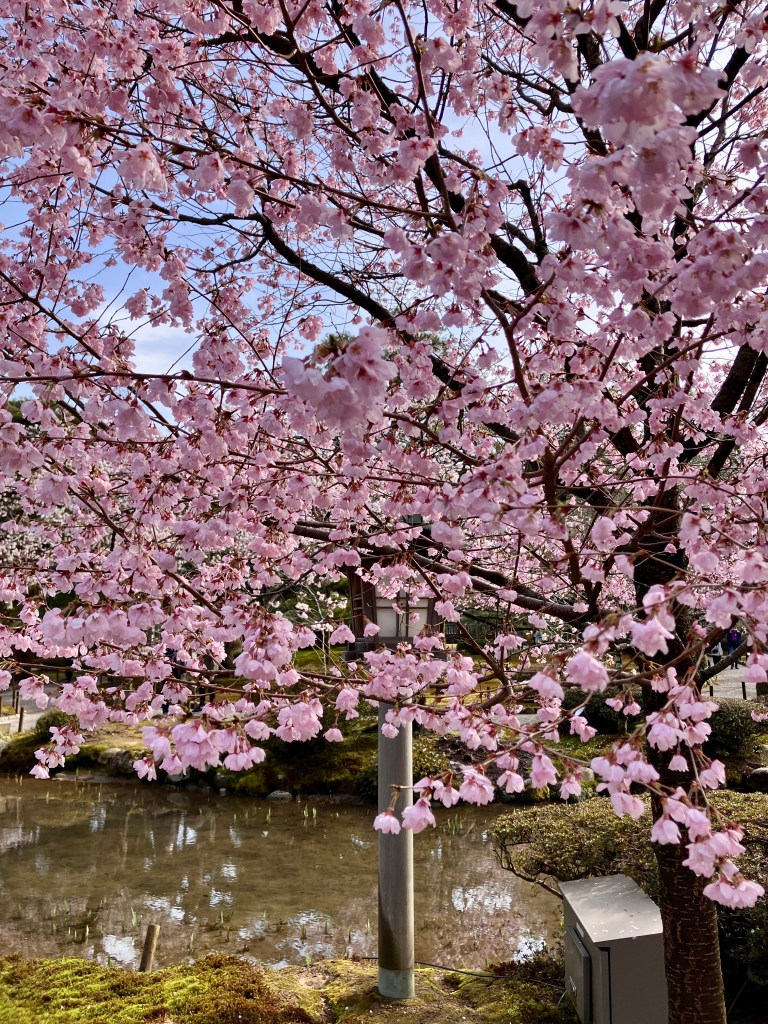
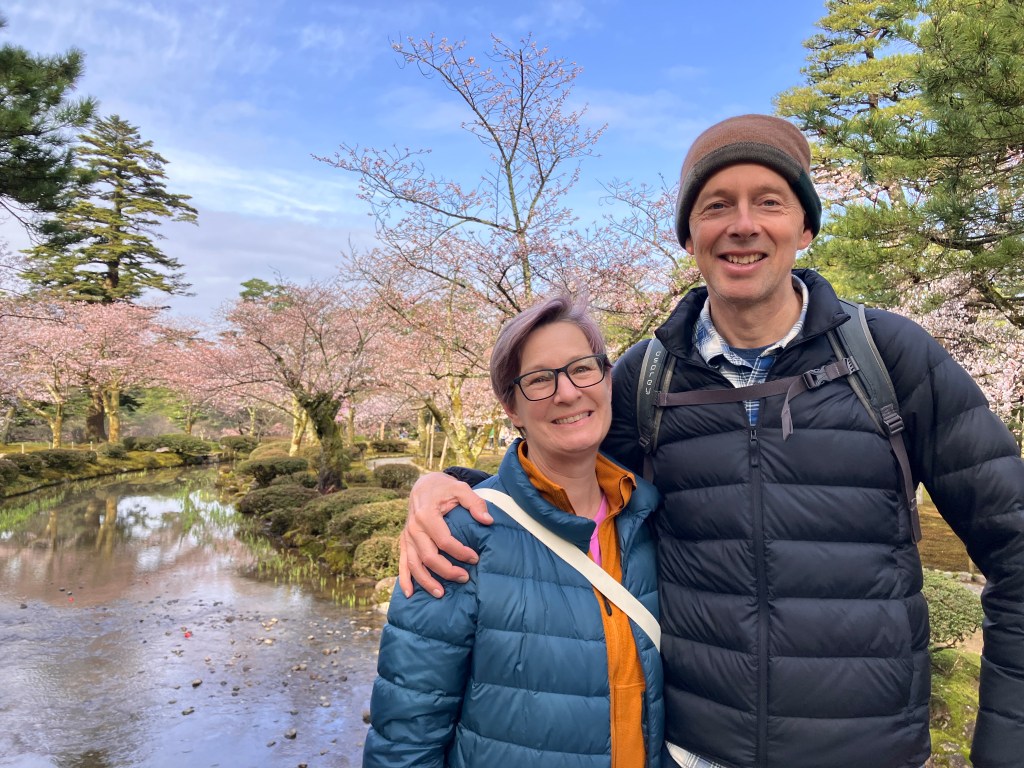
A well propped up tree in Kenroku-en gardens, Kanazawa, Ishikawa Prefecture.

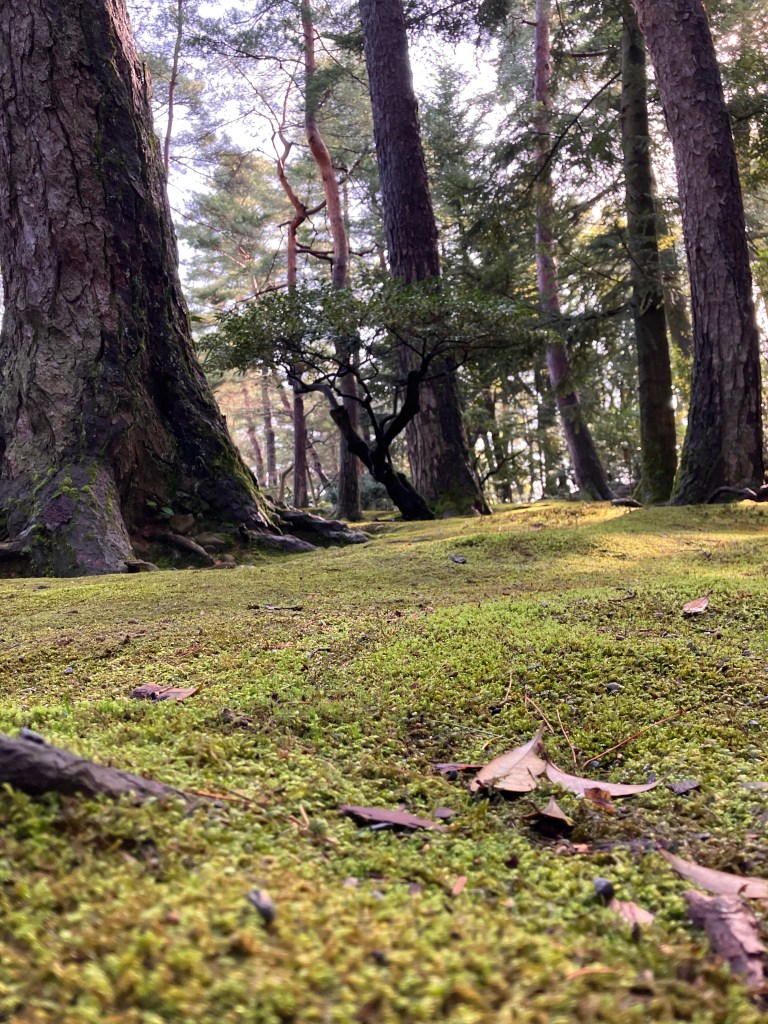
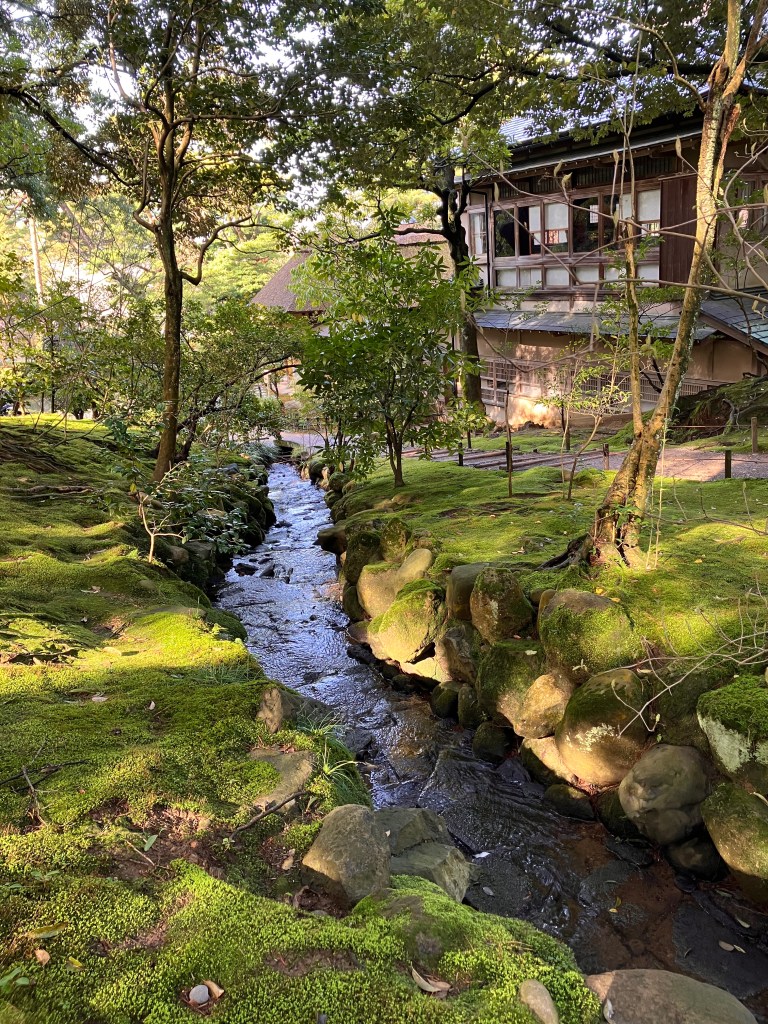
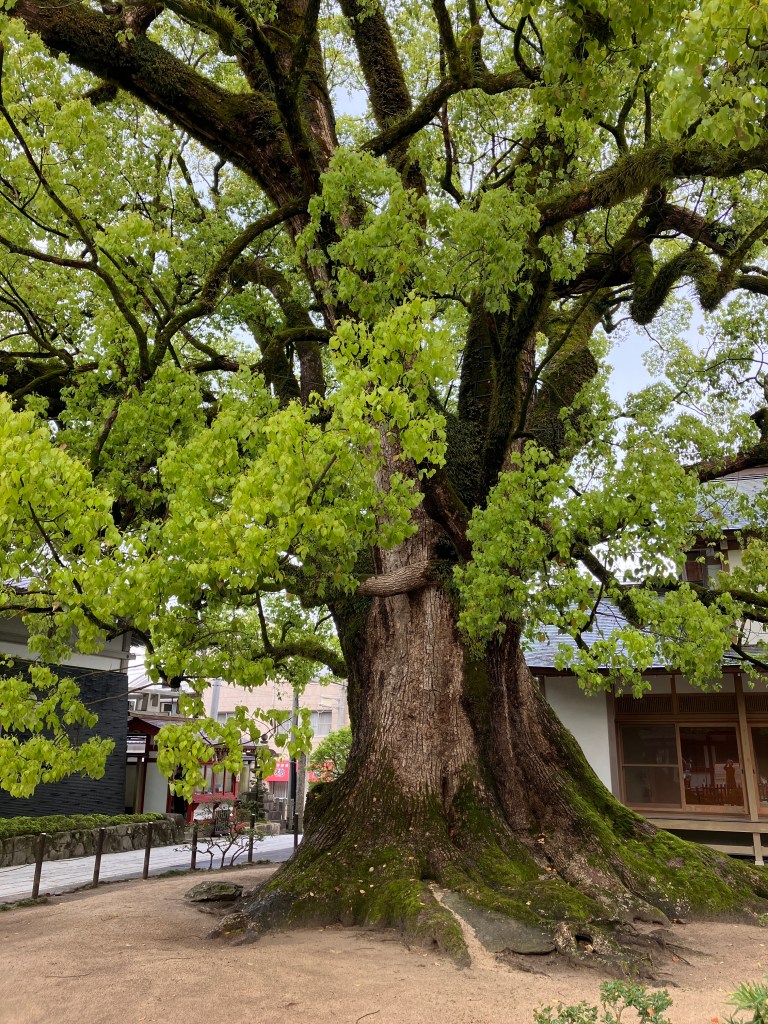
I will miss the trees. We visited a lot of gardens and parks to see cherry blossoms, but the blooms aren’t the only attractions. The trees, the green moss, the water features. Although Japanese cities were not all blessed with a lot of parks or green space, those that exist are so well taken care of.

A verdant carpet of moss.
The green. The water. The old tea house. Kenroku-en gardens.
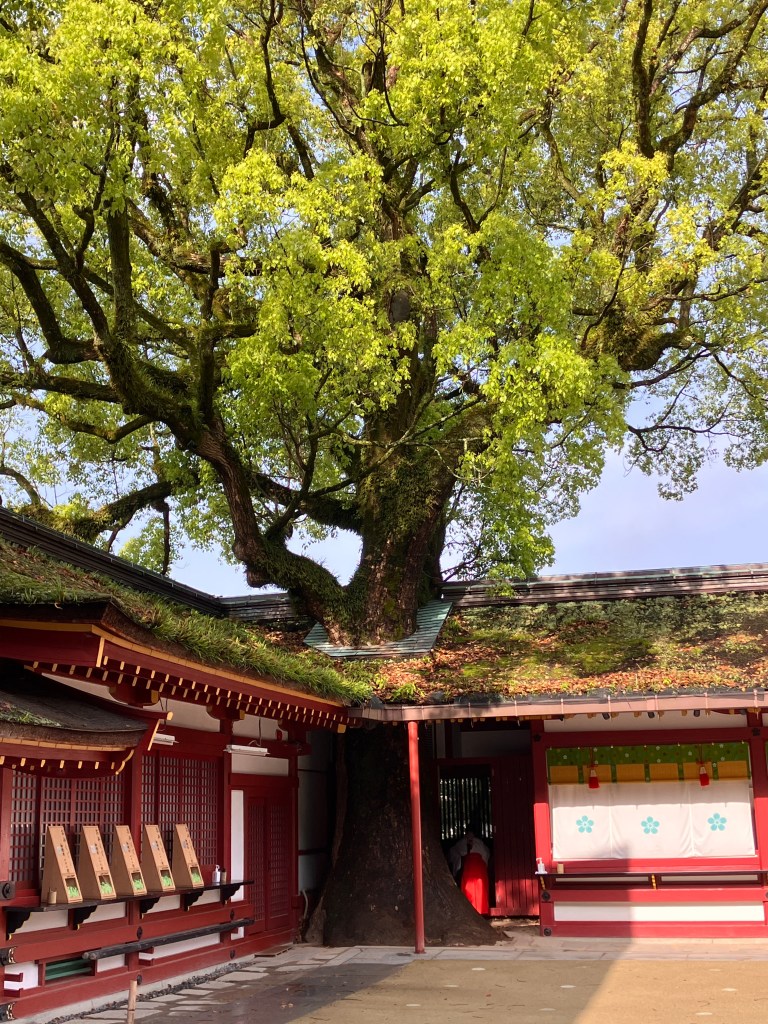
This giant camphor tree in Dazaifu Tenmangu Shrine is estimated to be as old as 1,500 years. Feel insignificant yet?
What was the progression here? Tree first than building? Small tree and a miscalculation of tree potential?
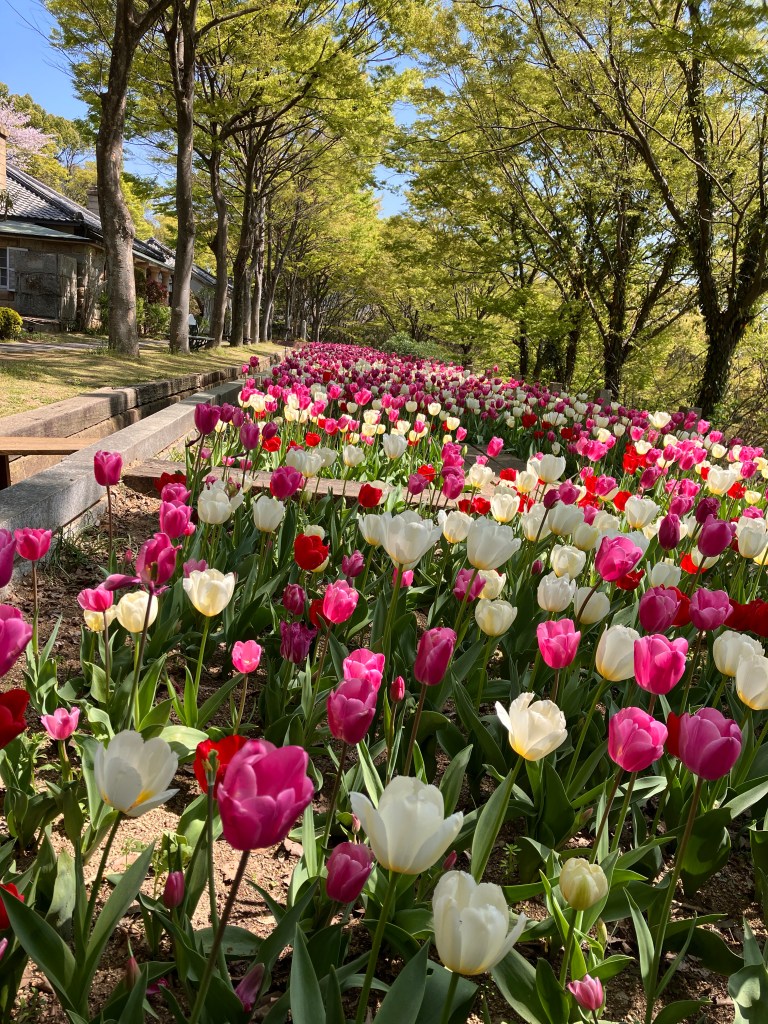
Spring is not all about cherry blossoms, this tulip display in Shikoku Mura open-air architectural park in Takamatsu, Kagawa Prefecture holds its own.

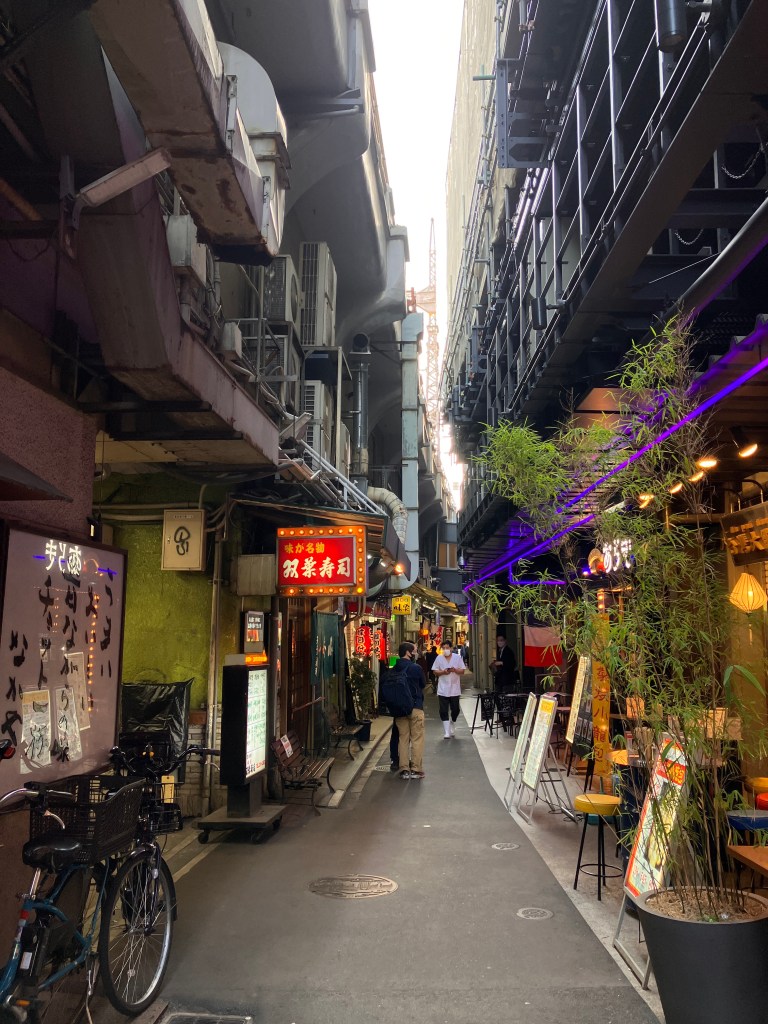
I’m going to miss the small streets, with restaurants and shops that cluster together, usually near a train station. Each city has its share of large arterial roads, with plenty of car traffic and sometimes intolerably long signal phases, leaving you standing for minutes waiting for a pedestrian walk signal. But, when you find the area of small streets the entire nature of that city changes. Narrow and mostly car free or very car light, the small streets give you an opportunity to feel you’ve stepped back in time.

Chuo district, Kobe, this an alley between the railway tracks of Sannomiya Station. It’s packed with businesses.
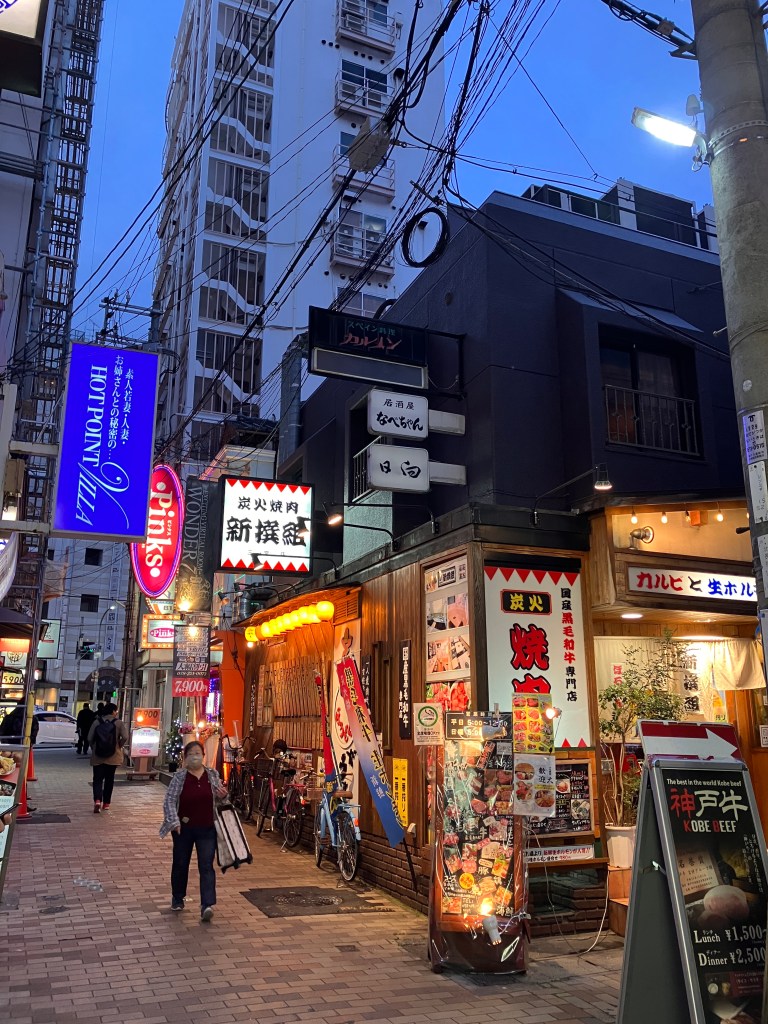
Same district, Chuo, Kobe, Hyōgo Prefecture. The night time scenes are so bright and colorful.
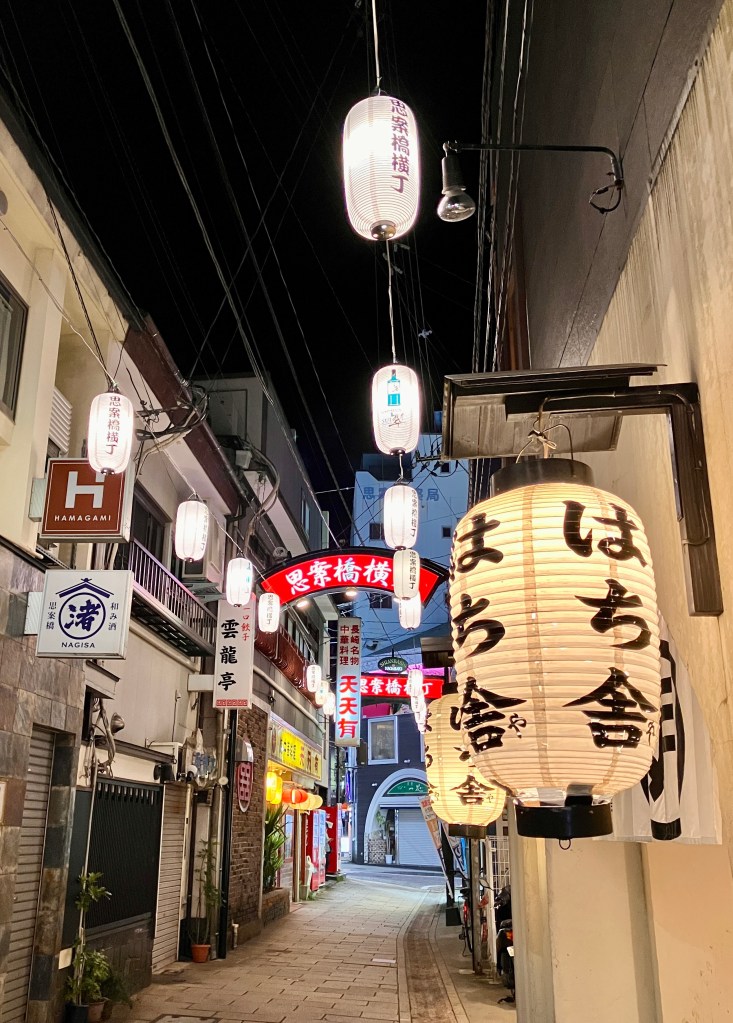
The neighborhood of Motoshikkuimachi, Nagasaki. On the hunt for a ramen shop, we wandered around for ages after dinner, entranced by this warren of small streets.
An urban planner could explain how the geometry of the streets, the lights, and the heights of the buildings all work together just so, all I know is I love it!
Still Nagasaki, one of our favorite places. Even the vending machines add to the charm of the nightlife.

Within these fine grained streets, with corners hiding the next view, are the amazing small restaurants. I’ve mentioned the awkwardness of sliding open doors and facing a tiny space perhaps already packed with customers. It can be cringe inducing, but so rewarding to be able to eat at a restaurant that is run by people who focus on one thing. This type of food – we do this and we do it well. You will wait the required amount of time, you will likely be served on hand thrown ceramic plates, and the food will be exquisitely displayed.

A chef waiting to cook our Kobe beef. Yes, he knows this cut and presentation deserves a photo.
Tuna three ways said the menu at the sushi bar. Delicious, delicious, and delicious. Even a conveyor belt sushi restaurant has style.
A burger place in Takamatsu. The chef/owner does burgers and cocktails. That’s it. And they are fantastic. Did I mention the restaurant seats maybe 9 customers?
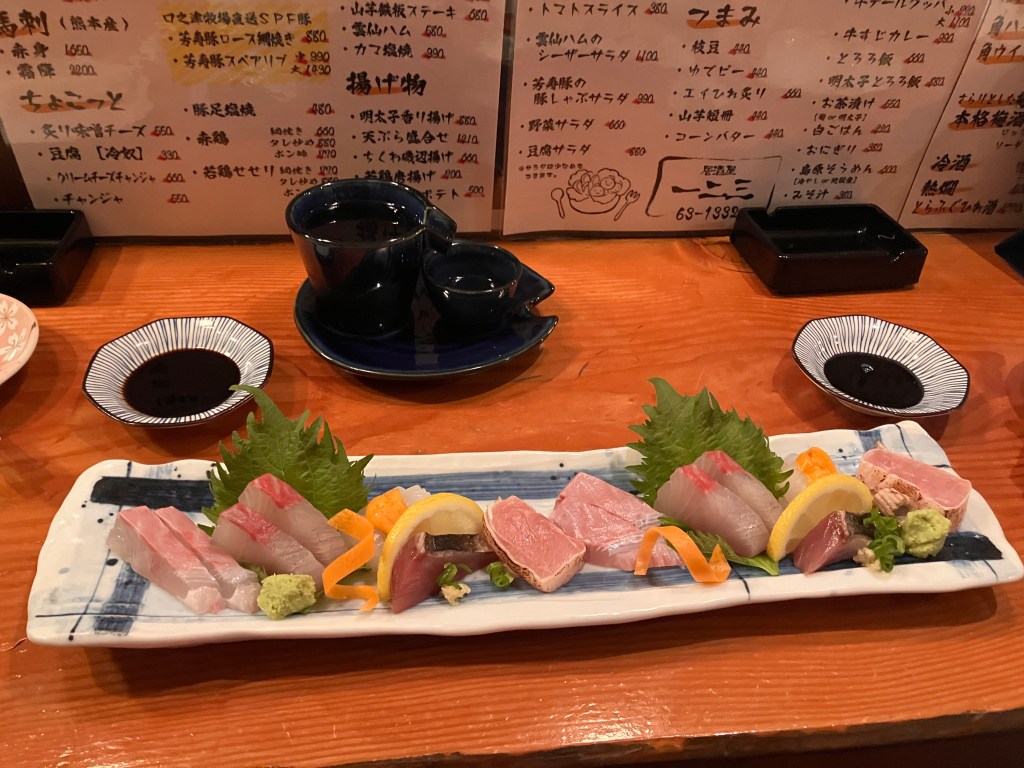
Shashimi at a small Izakaya in Shimabara. Mom and Dad cooking, their young daughter who started primary school that day sitting at the counter playing. The plate, which you can barely see under this load of fresh fish, was gorgeous.
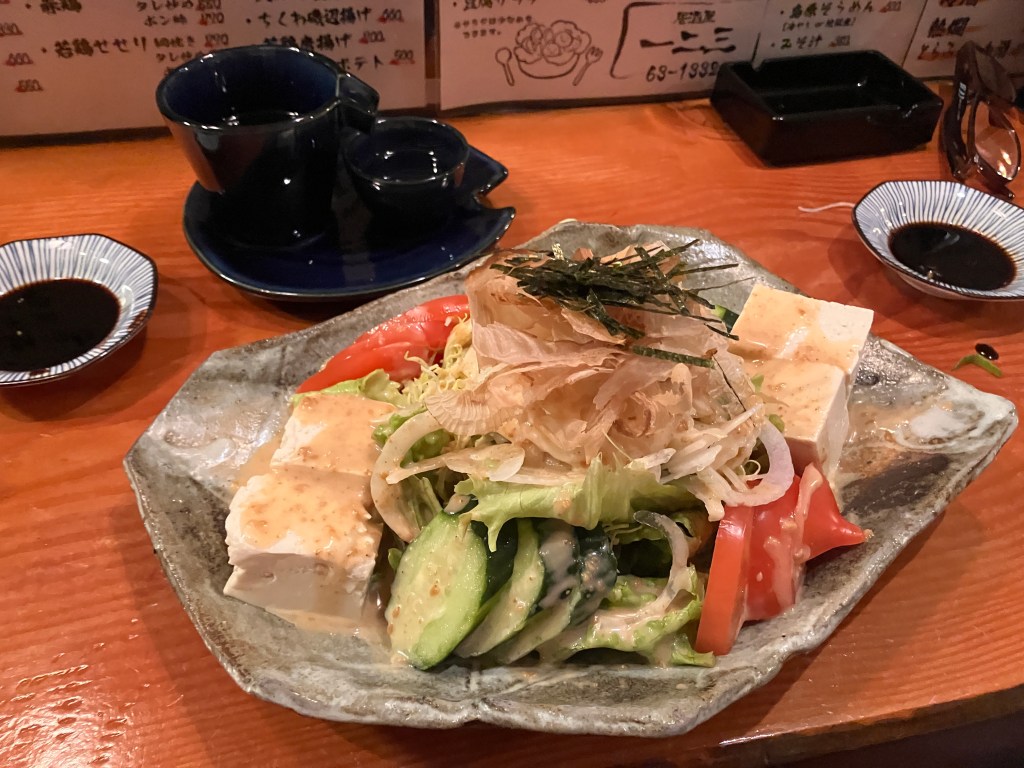
The same Izakaya. After this tofu salad course I typed into Google translate that their ceramic plates were stunningly beautiful. She turned to him with a look we all recognize: it said, see? I told you so!
Another beautiful presentation at a Shabu Shabu restaurant in Kagoshima, famous for its black pork which was delicious. This sashimi course came with our set menu.

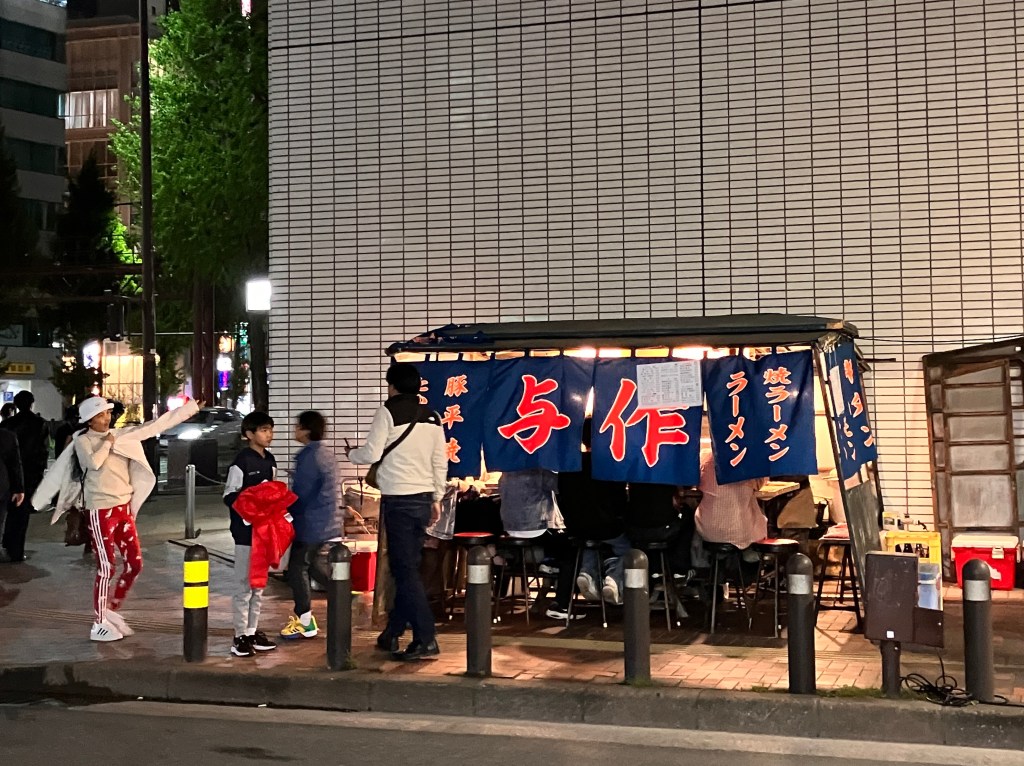
If it’s possible to desperately miss something you only got to do twice then we will desperately miss the Yatai of Fukuoka. The Tenjin neighborhood has small food stands, Yatai, which set up each night to serve up food in a space half the size of the storage unit holding all of our possessions back in the US.

That is a Yatai.
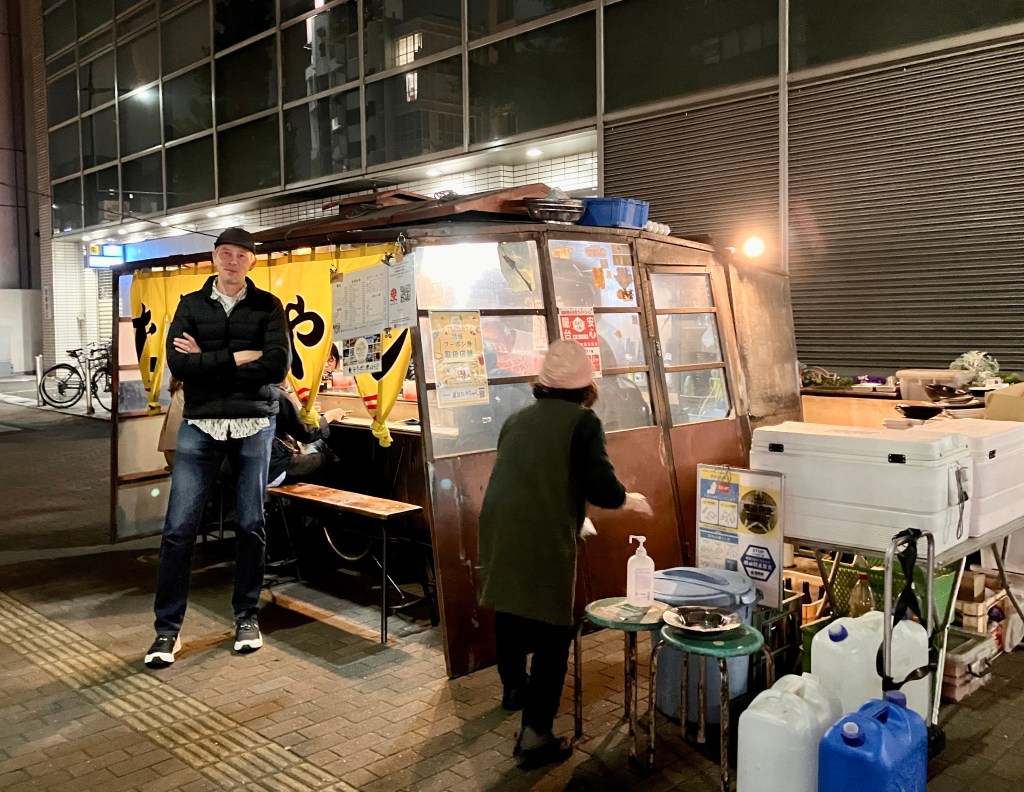
And this is a Yatai. You look below curtain level to see if any seats are available, or you look for a line of patient customers waiting.
Rich added for scale. We had dinner at this one.
Not much room inside to take photos. And you don’t linger after dinner. For one, it’s not the most comfortable seating ever. And the owners need to turn the seats when there are only six or seven of them.
Not much room to cook either, but the chefs were making it work. It’s warm and cozy once you’re behind the curtains.

The number of Yatai was shrinking, but in the last few years they’ve enjoyed a new renaissance and there are about 150 now. In addition to dinner at one we spent a hilariously fun evening drinking at a Yatai bar. Everyone is friends at a Yatai bar which measures 10×8 feet.

Fairly unassuming from the outside, this Yatai bar.
But inside is magic.
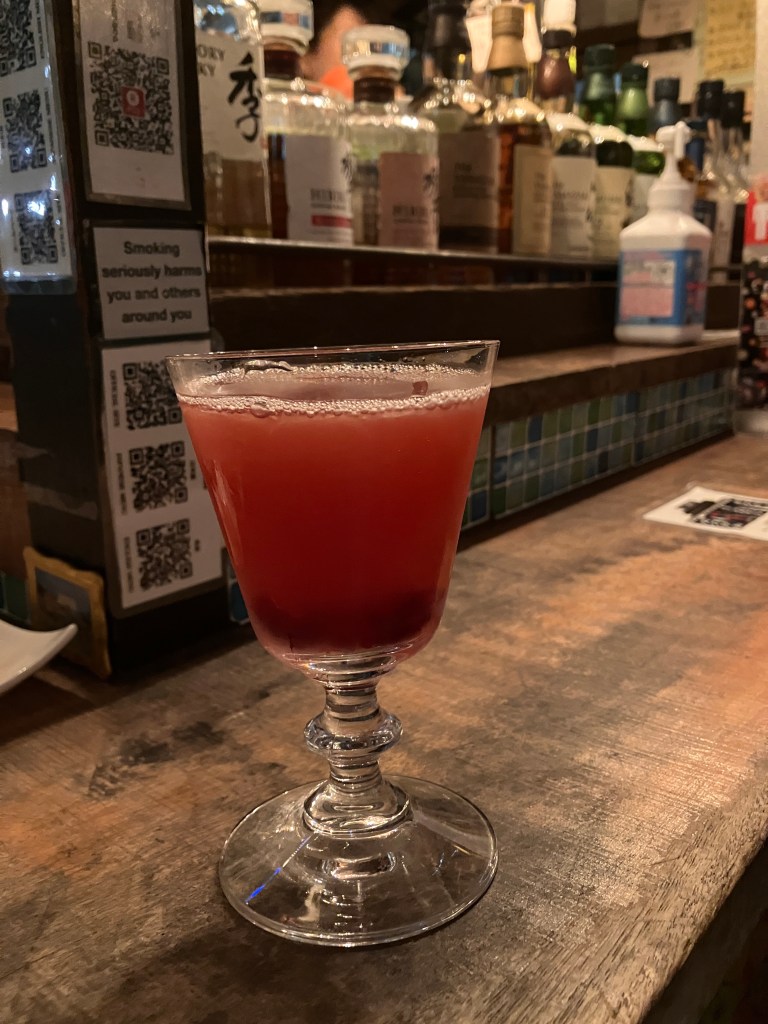
My pomegranate daiquiri.
Rich with a martini. Round one.
The tools of the trade. Apparently it takes 3 hours to set up this Yatai each day. And 3 to take down.
My daiquiri and Rich’s mojito. Round two.
A super fun young recently engaged couple from Osaka. We were communicating with English and google translate.
And on Rich’s left two young women, engineers who had studied in Canada.
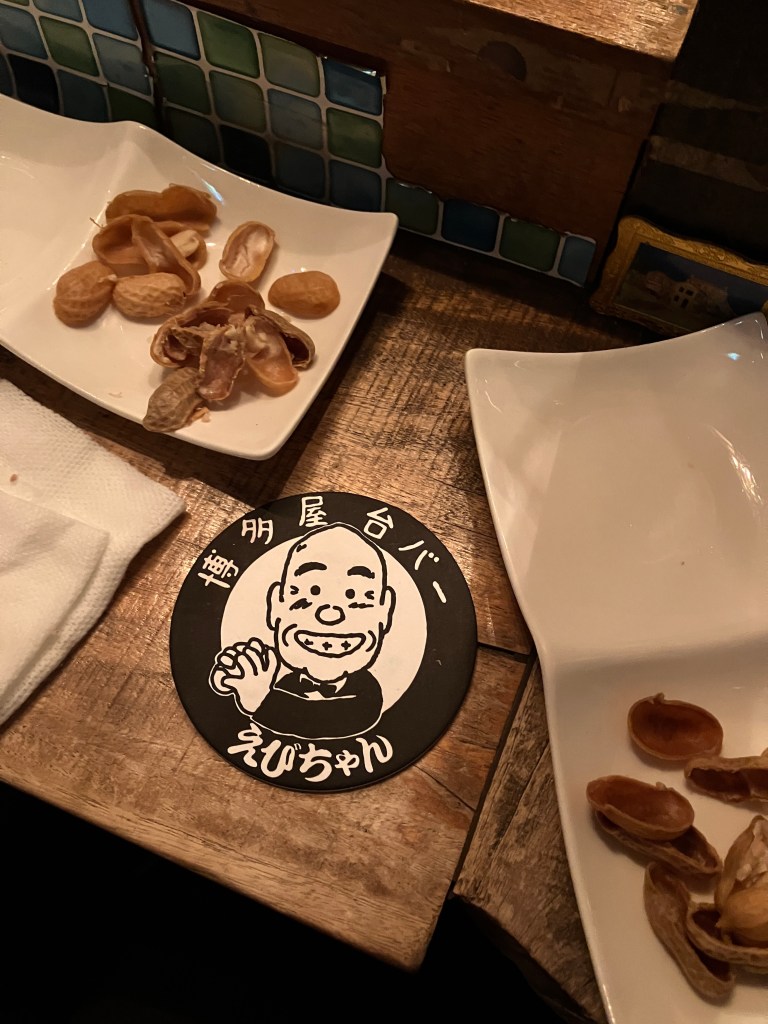
Boiled peanuts and potato chips (gone already) were the bar snacks which the cover charge supplied. Yes, we have that beer mat.
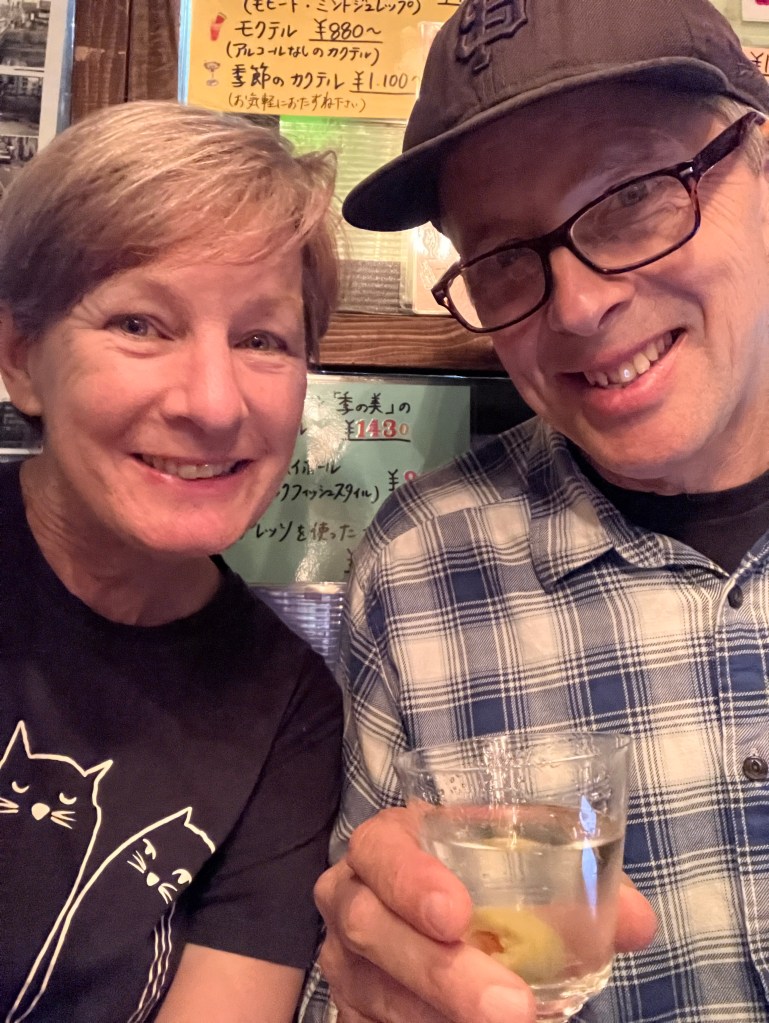
Again, it’s a seriously cozy space. You sit closer to strangers then you would anywhere else.

What else will I miss about Japan? The safety. The ability for Japan to have nice things that people respect and take care of. Public restrooms which are clean and stocked with rolls of TP which are not stolen. And the quirky things. Things you see and go, oh yeah, that makes sense to have.

Ritsurin Garden in Takamatsu. You use these to remove dust from your shoes after strolling in the gardens.
Hot tea from a vending machine. A can of Royal Milk Tea, black tea with milk and sugar. Hot. This is on the ferry coming back to Kagoshima from Mt. Sakurajima volcano.
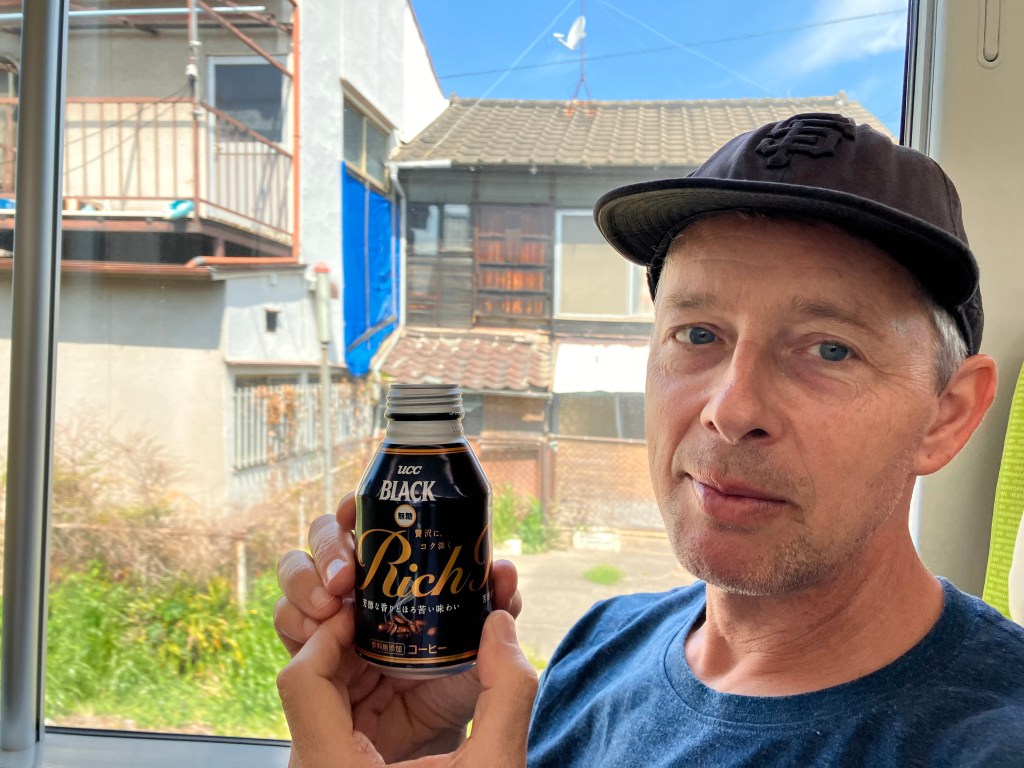
Hot cans of coffee too!
The little cartoon mascots everywhere. Such a cute deadly volcano!
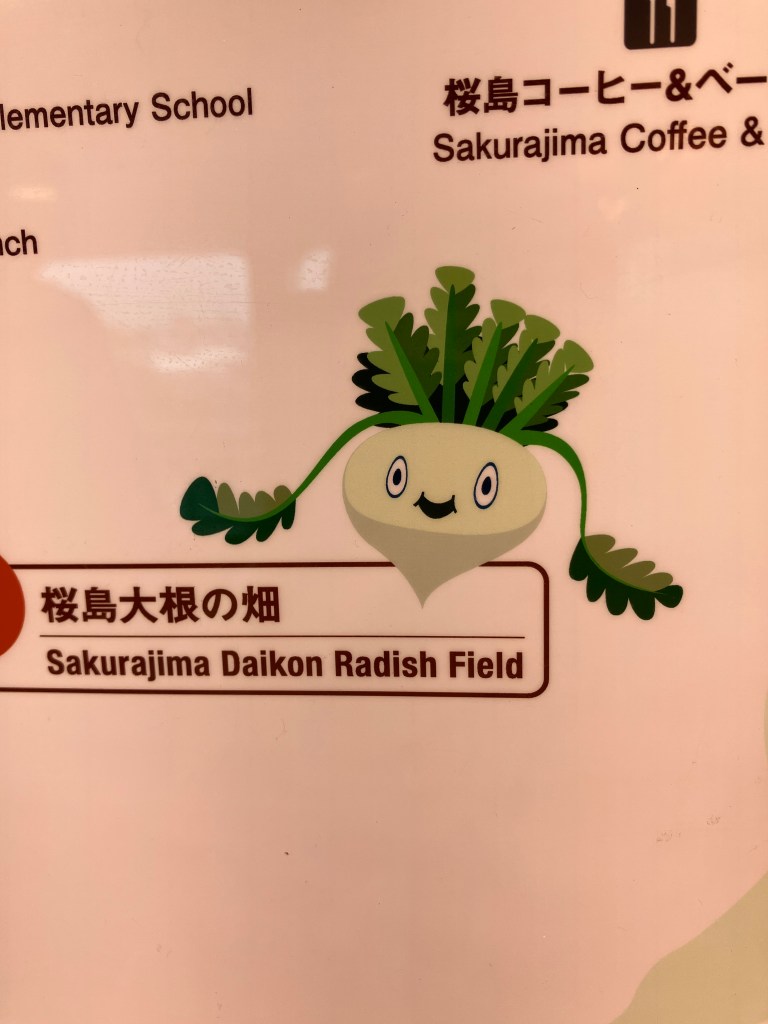
A radish gets the cartoon treatment.
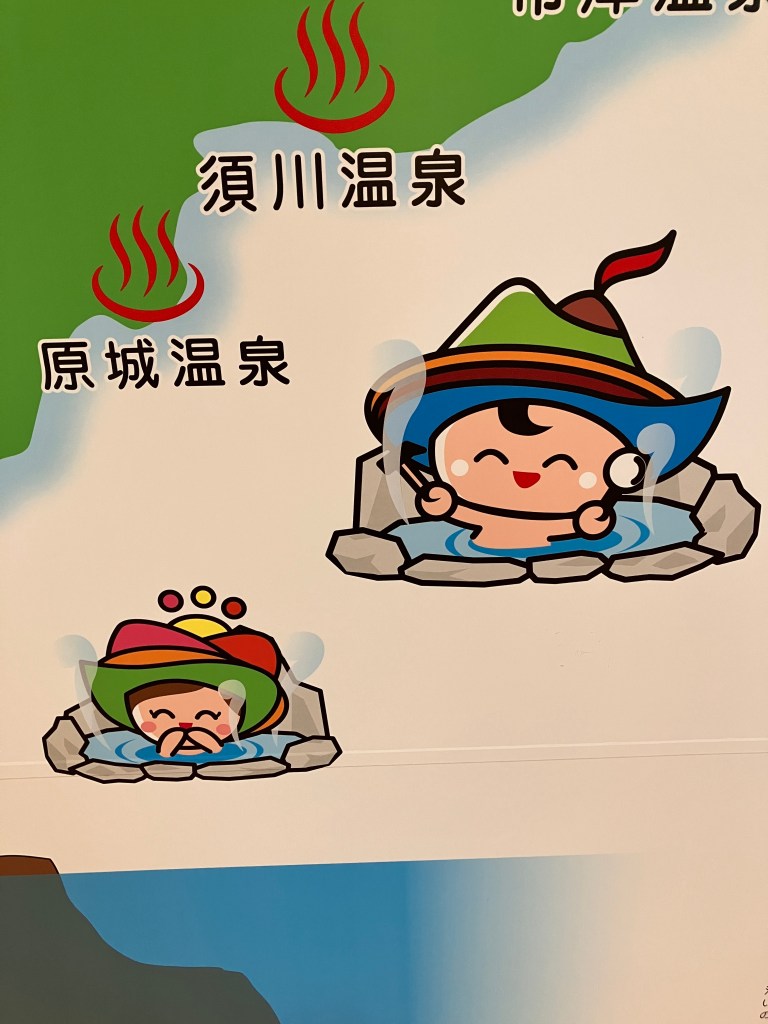
Volcanic hot springs get a cartoon.
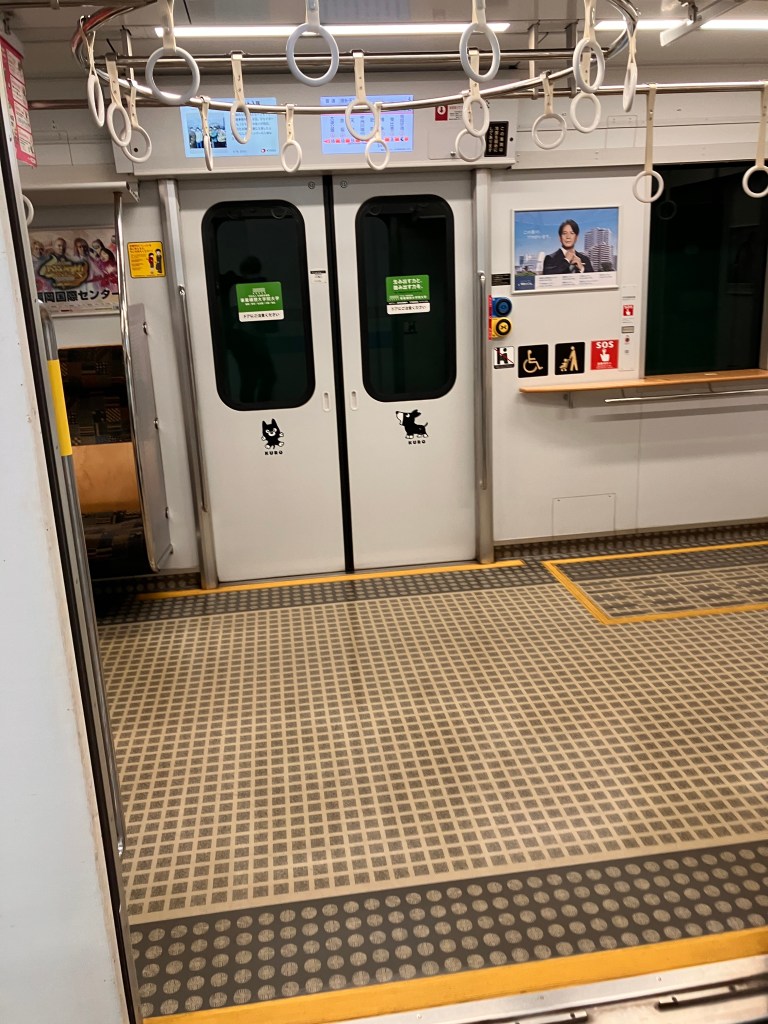
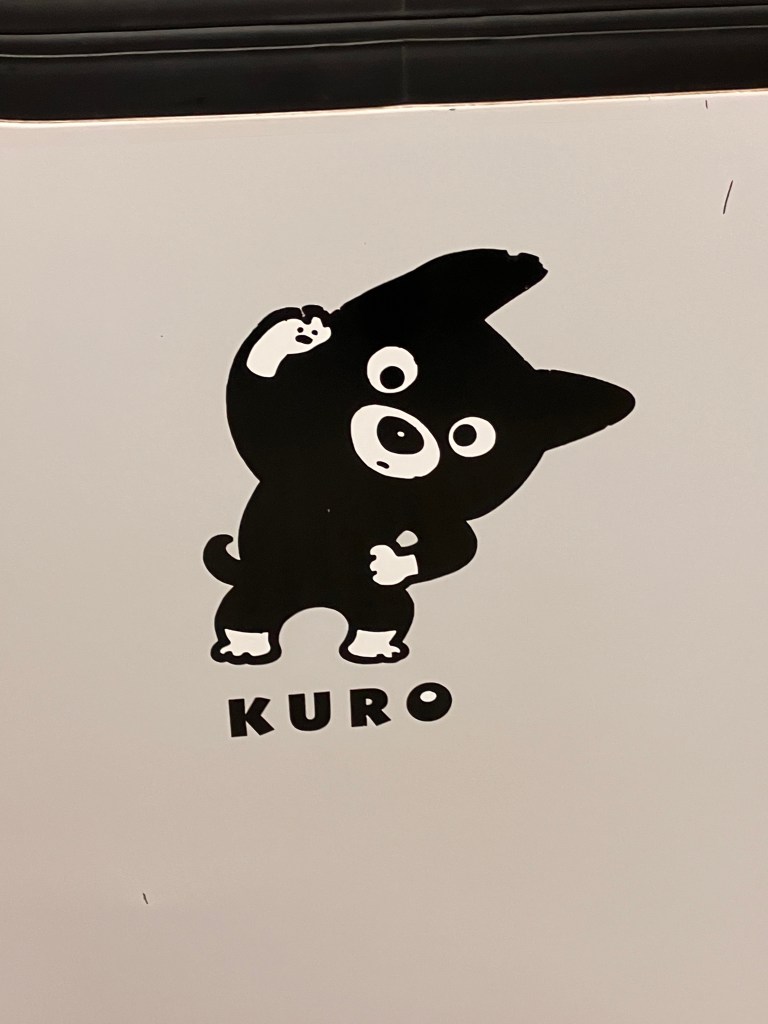
The train to the Fukuoka airport has a cartoon dog keeping you safe.
Who’s a good dog? Kuro is.

You will always feel you missed out on experiences and places when traveling. We immediately have a list for “next time”. It says a lot about a place that you want to come back, soon. Regret is a rear view mirror. So what do I regret about our time in Japan now that we’ve moved on?

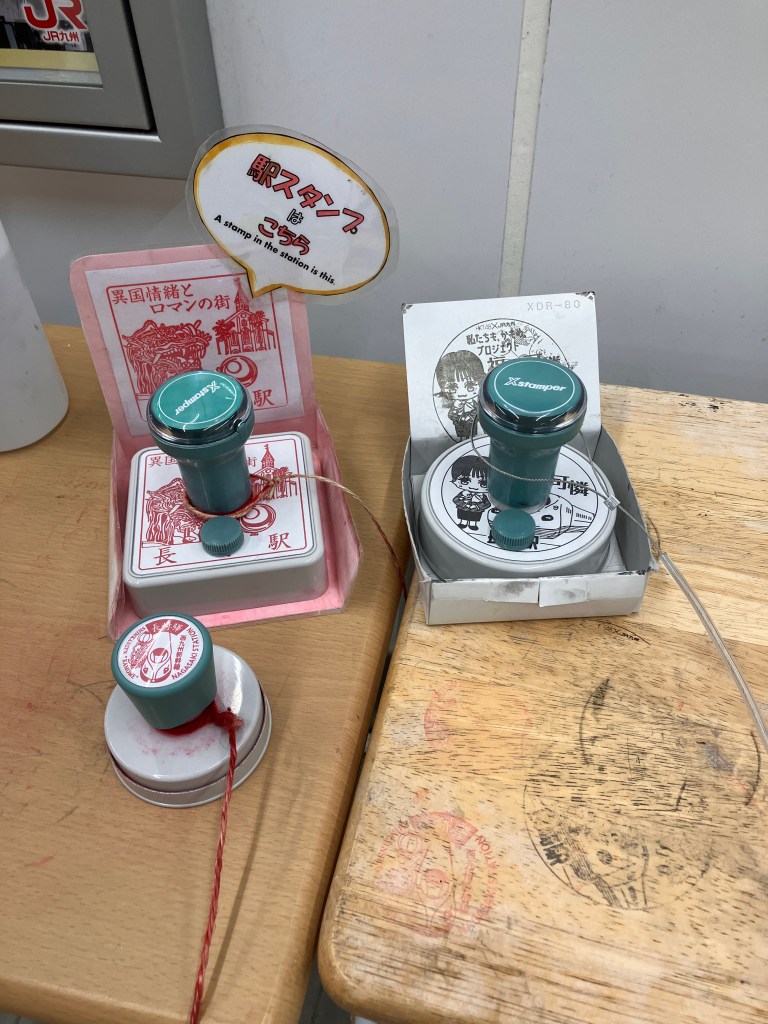
There are themed stamps at every train station! I failed to realize this until we had already been through so many stations. And I had no cute notebook in which to stamp these unique stamps.
Then I found one at a volcano park and was even more annoyed at myself. I could have had a whole book of stamps.

This is when Rich and I say to each other “I used to do important things.” Recalling our previous professional lives where we earned money, and made multiple decisions a day that impacted people and projects. And we laugh at ourselves. Another regret? Hotels in Japan supply you with pajamas. Really. Instead of a robe you get pajamas or a button up nightgown contraption or a yakuta, a light cotton kimono. Somehow the pajama tops and bottoms fit both me and Rich, sometimes with pretty funny differences. Do I have a single photo, let alone a collection of photos? No. If you go to Japan learn from my mistake and take photos of yourself in the pajamas in your hotel rooms. And take a notebook to collect the stamps.

A very apt warning sign.
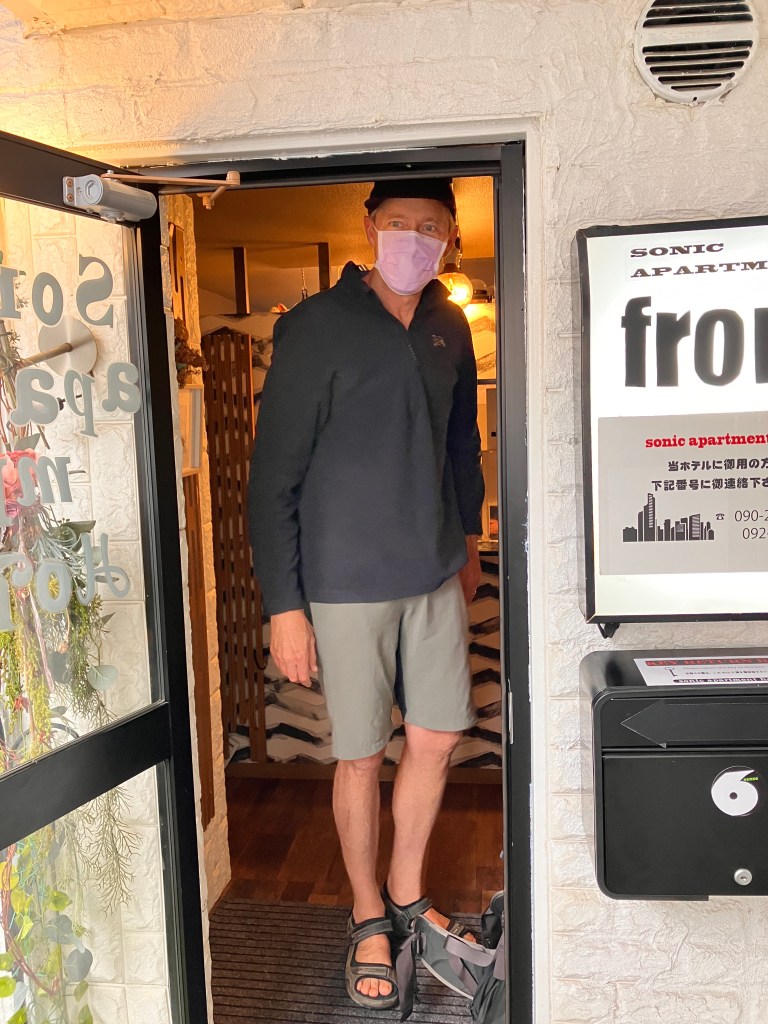
I will not miss hearing Rich’s head connect with room doorways, low hanging light fixtures, and train doors. We hang things from the doors in our rooms as mitigation.
Sunset light on the happy travelers in Nagasaki.

No regrets that we visited Japan. Such a lovely place with wonderful people. Goodbye Japan. Hello Korea.

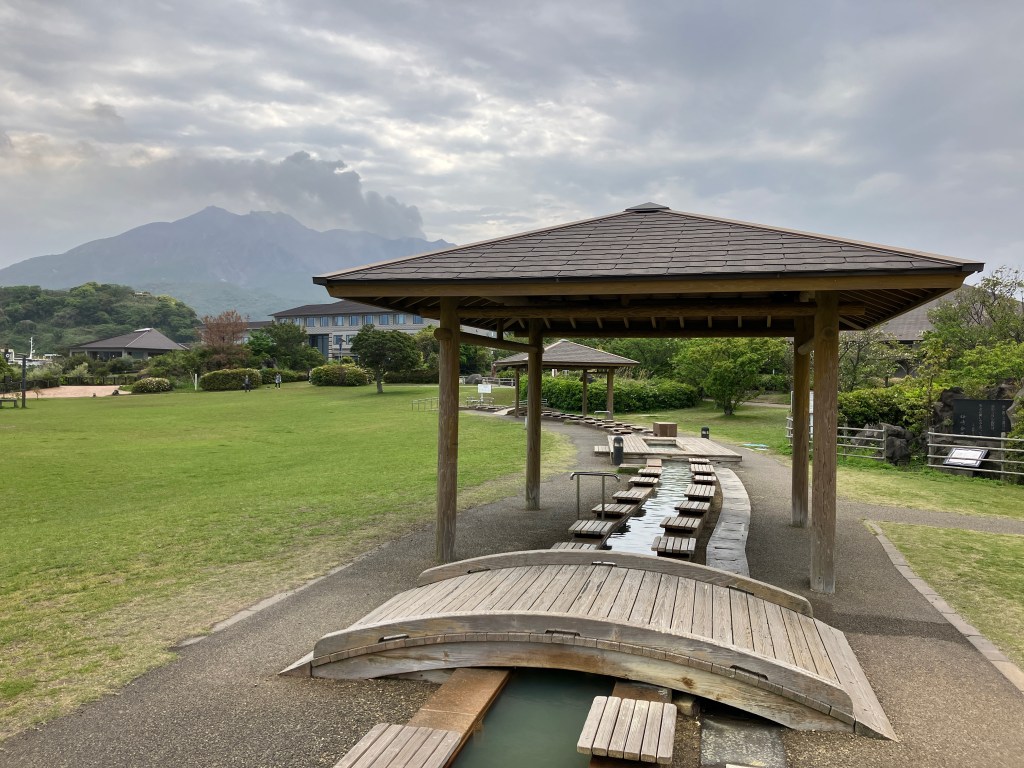
The blessings of volcanic activity: hot springs and public footbaths.

One of the longest public foot baths in Japan, the Sakurajima Volcanic Shore Park and Footbath, with Sakurajima, an active volcano and the source of the hot water, steaming away in the background. Kagoshima Prefecture.

There are things you know about a country before you arrive and are looking forward to – food, specific sights, cultural norms that are different from your own and therefore fascinating – but the things that catch you by surprise are the gifts of travel.

Shimabara, Nagasaki Prefecture, is known as the city where Koi swim in the canals, full of plentiful spring water.

Plentiful water. Still a mind bending notion to someone raised in Southern California. The city of Shimabara has a castle, a lovely neighborhood of samurai houses, and so much free flowing water. Water under tea houses where koi appear to float in midair, a visual trick of the crystal clear water. Water running between houses in fern lined canals. Water fountains with ladles handy so you know the water is drinkable. So much water. And yes, some of it hot thanks to Mount Unzen, an active volcano which rises and steams and bubbles a short bus ride away.

The sight and sound of running water is calming. No koi in this canal, they are only in specific controlled areas.
Just a street. With a canal. Folks walk by. Locals garden. The postal workers do their jobs. Me: OMG! Water! So much water!
A tea house with floating koi.
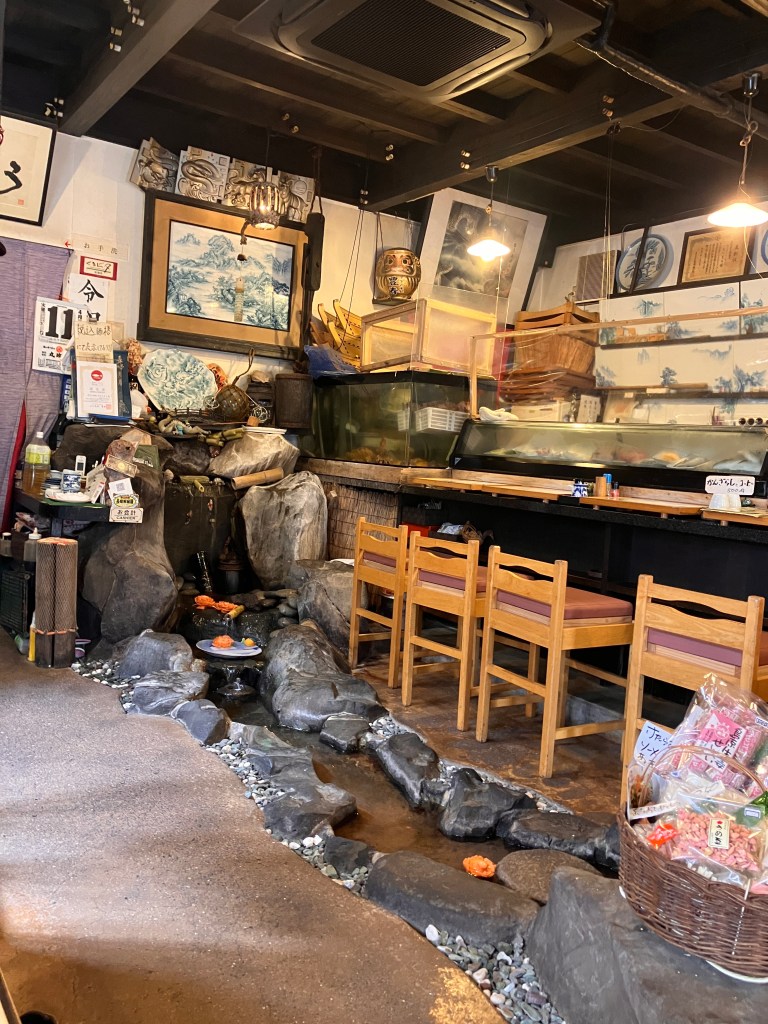
How much water is there in town? So much that even your lunch spot will have a tiny stream running through the restaurant.

After admiring the water in one neighborhood, we had lunch, a lovely set menu which is a wonderfully easy thing to order. Then we headed to a spot on the map marked as public foot bath. So far all the water had been cold and clear. Foot bath? That sounds interesting.

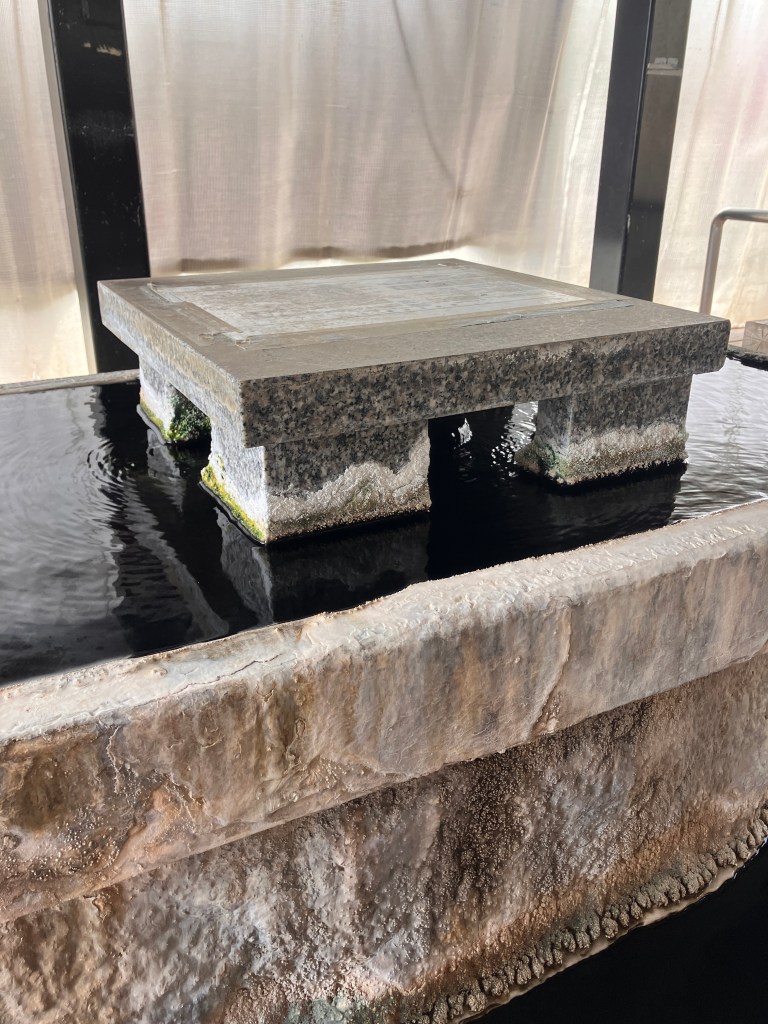
Yutorogi Foot Bath. This water is hot. Maybe 36c/99 f. It comes out of this stone trough.
The hot water fills the basin.
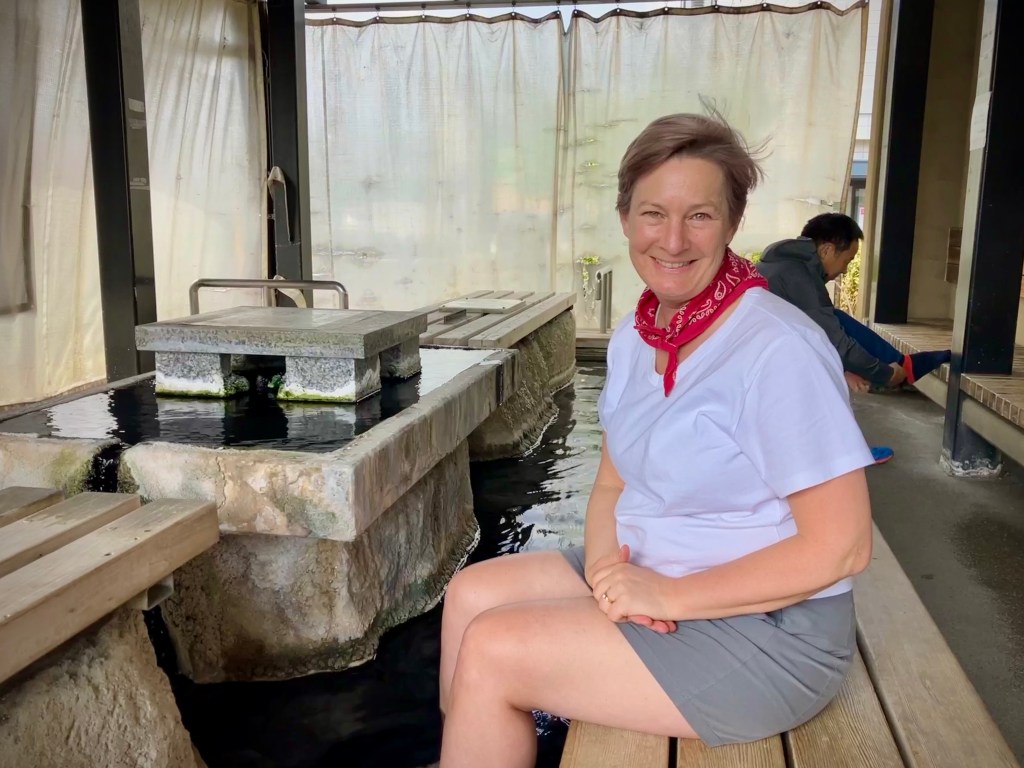
The people sit and soak their barking dogs
Aaahhh. It’s not a fancy place. Just a nice spot next to a parking lot where anyone can sit, relax, and put your feet in water warmed by a volcano.
Right next to the foot bath is this public fountain. The sign tells you the mineral content and that it’s safe to drink.
So I did. It’s hot, look at how pink my hand is. You can see the mineral deposits here and in the foot bath.

Feet refreshed and ready for more walking we headed off to see the neighborhood of samurai homes. The canal which runs through the neighborhood was a perk for these high ranking, hereditary, military nobility.

But first, we must drink from every fountain we pass. No ladle, some were removed during Covid.
Ladle! Drink on.
Replace ladle when quenched.
And walk on to the samurai street. Note the walls of volcanic stones.
The houses are occupied, but several have opened the front historical parts to curious visitors.

We headed back to our hotel, craving a proper onsen soak, but first we had to pass another fountain, and stop for another drink. How could we pass up this lovely landscaped fountain, which seemed to be part of the neighboring house’s garden.

Ladle and sign- all good. Drink!
How can we drink so much water, you ask? Plenty of restrooms in Japan, we reply.

One easy bus ride from our waterfront hotel took us winding up the mountain. The bubbling mud and steam clouds of Obamachounzen quickly let you know this volcano is not playing around. “An eruption in 1991 generated a pyroclastic flow that killed 43 people, including three volcanologists. “ The slopes of the mountain down to the sea will look familiar to anyone who has visited the big island of Hawaii. Lava field slopes.

An awesome sound, bubbling and steaming.
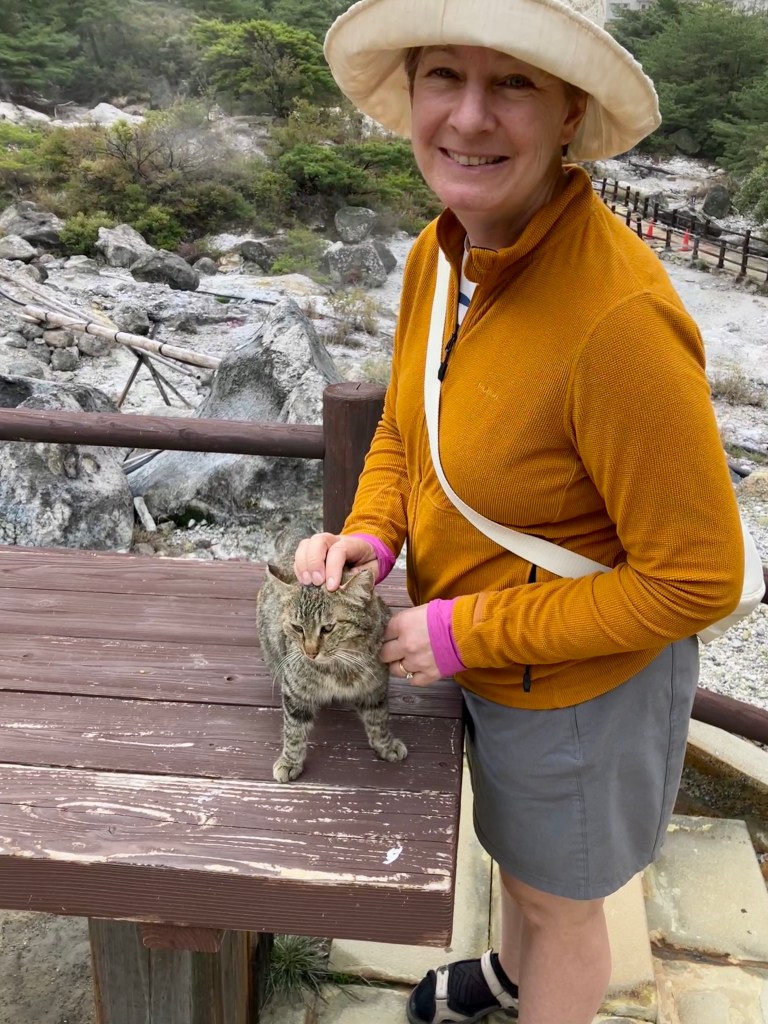
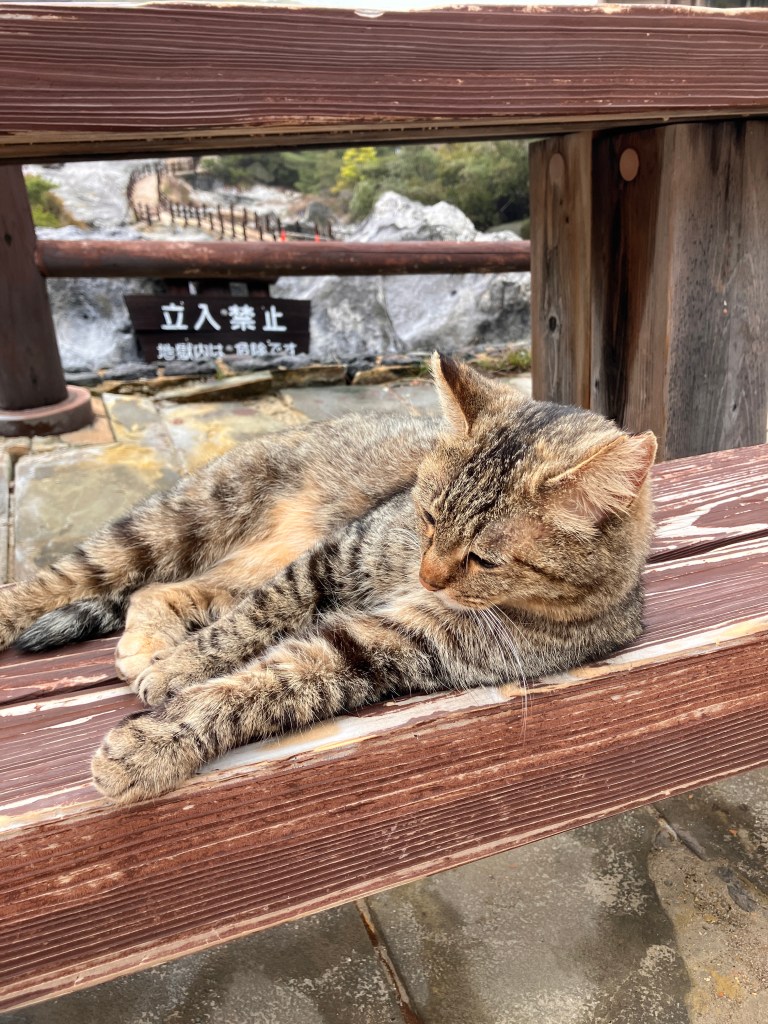
Oh! Kitty!
Popular sights in Japan frequently have cute cats to distract you from the sight.

Even though we hadn’t done much walking yet, just a few kilometers around the steamy and bubbly area of Obamacho Unzen, we headed right to the public foot bath.

A pleasant setting.
Some very pink feet. This one was hot. Probably 110f/43c. Hot enough that you took your feet out to cool quite quickly.
Rich enjoying his foot bath.

We did a lovely hike after the foot bath and enjoyed the views of the volcano while having a picnic on an observation platform – keeping a wary eye on the plumes of steam. Then it was a bus back to the hotel, a lovely relaxing onsen and outdoor rotenburo soak at our hotel, and dinner at a local Izakaya. It was time to move on to Kagoshima, which was a ferry ride and train ride away. But first – foot bath by the ferry terminal!

We walked from our hotel to the ferry terminal, got our tickets, and headed over to the footbath.
This water was warm, not hot, and quite clear compared to others. We guess it was 90f/32c.
You can see the ladle behind Rich. If you so choose you could drink this warm water – before it enters the foot bath.
Again next to a parking lot. But quite a bit of seating space. The bath is emptied and cleaned each morning, it opens at 9 am. It was just refilling when we arrived.
That face says no, I don’t want to leave the foot bath.
But our ferry awaited, and we got a fantastic view of Mount Unzen as we headed out.

The blessings of volcanos. Hot springs. There are more than 27,000 hot springs in Japan. The volume of water that flows from them is 2.6 million liters per minute. I was a volcano fan before this trip to Japan, now I’m a volcano fanatic. And we weren’t done yet! Next up, a ferry from Kagoshima to see the slopes of Mount Sakurajima and yes, another foot bath.

Cute mascot, but this active volcano erupted in 2022 and triggered evacuation orders. Rocks fell as far as 3 kilometers/1.8 miles away.
The city of Kagoshima behind Rich and his happy feet. This foot bath was hotter near the source, and cooled down as you moved further away from the spigot.
Looking the other way, towards the active volcano. The visitors center showed the helmets school children have to wear on eruption risk days as they walk to school.
This water was not as clear, maybe more mineral content? But it felt wonderful on this cool cloudy day. Quite warm but not hot.
The happy travelers, we took a bus to the observatory to have a closer view of the volcano.

We’re in Korea as of today, but still catching up on all the fun we had in Japan. I was struck by the relationship the Japanese have with their volcanos. The idea of the blessings of volcanoes, and the use of the hot spring water, gives the volcanoes a different feel. Yes, potentially deadly, but also useful and part of life. Japan has the potential to harness this geothermal energy, mostly unrealized so far, but what an additional blessing that could be. But our feet were happy to take advantage of the blessings of the volcanoes.

We’re in Japan for Sakura – cherry blossom season.

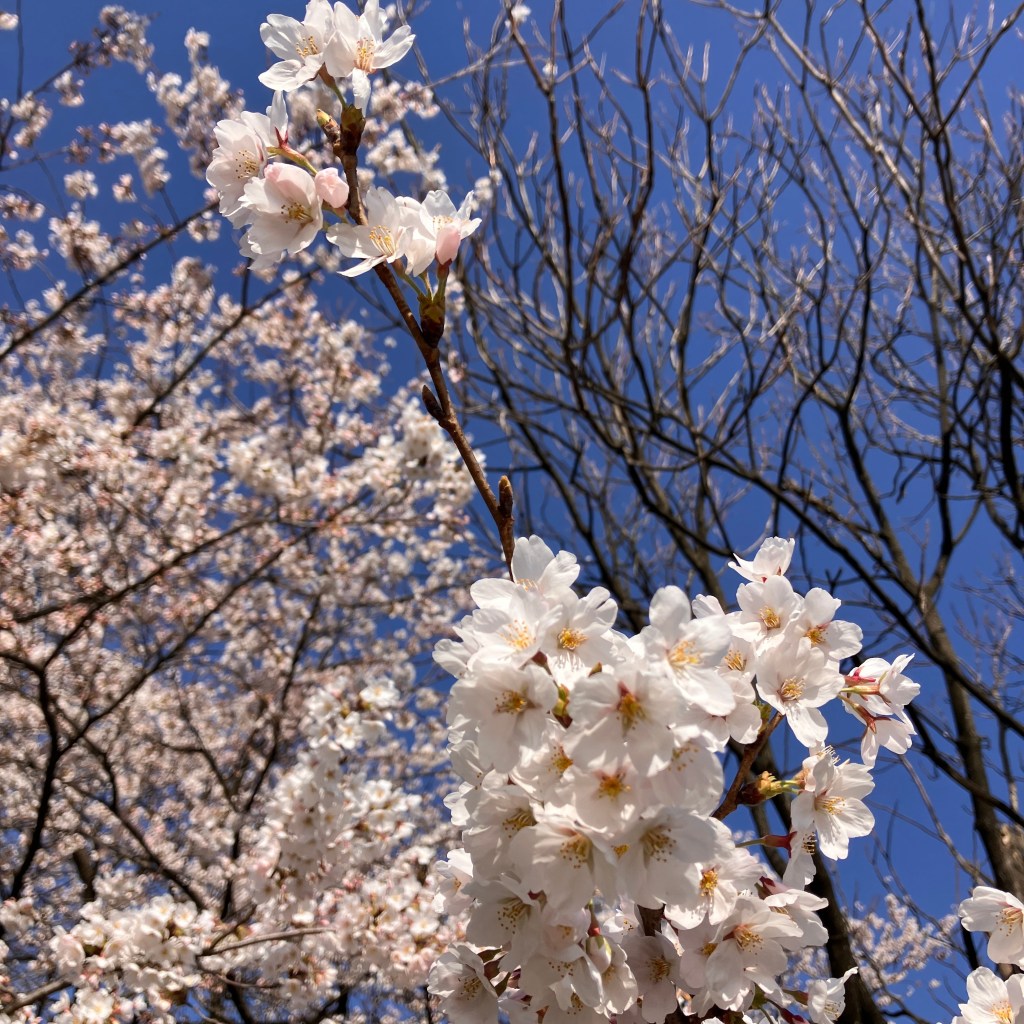
Probably the most photographed trees in the world. Japanese cherry trees.

Our arrival in Tokyo happened to coincide with an early cherry blossom season. We had already made our flight and room reservations when a representative from Japan Meteorological Agency stood beneath a signal tree at Tokyo’s Yasukuni Shrine and announced the season to be underway.

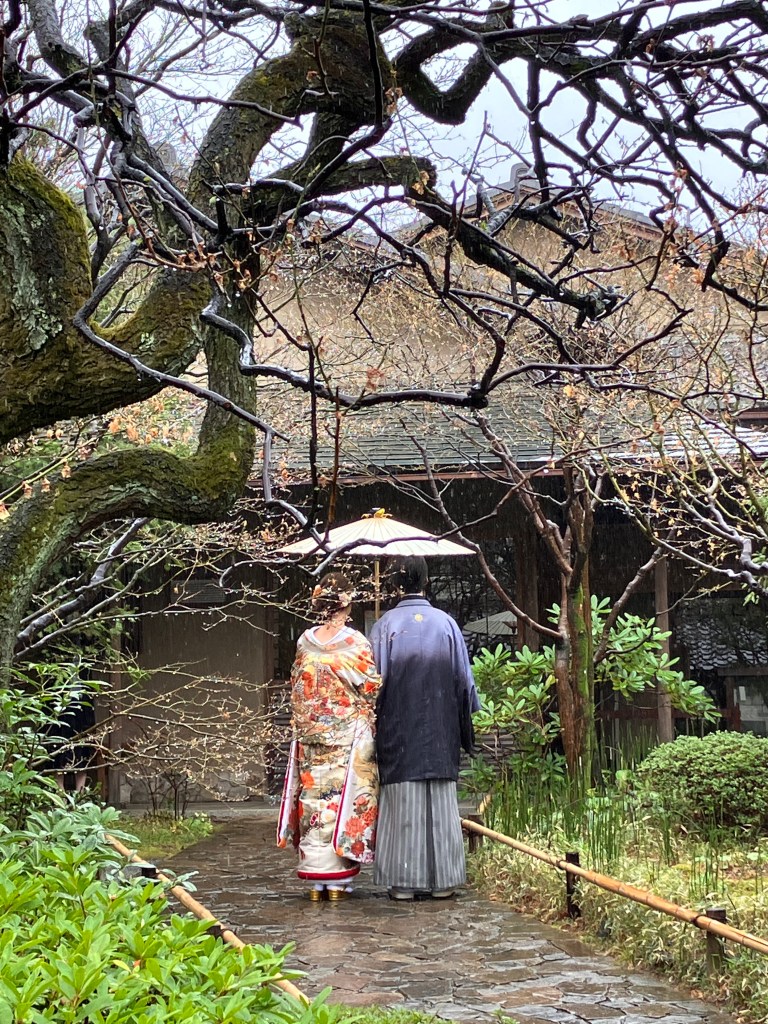
Our first small park in Tokyo and our first sight of folks in traditional clothing having photos taken.

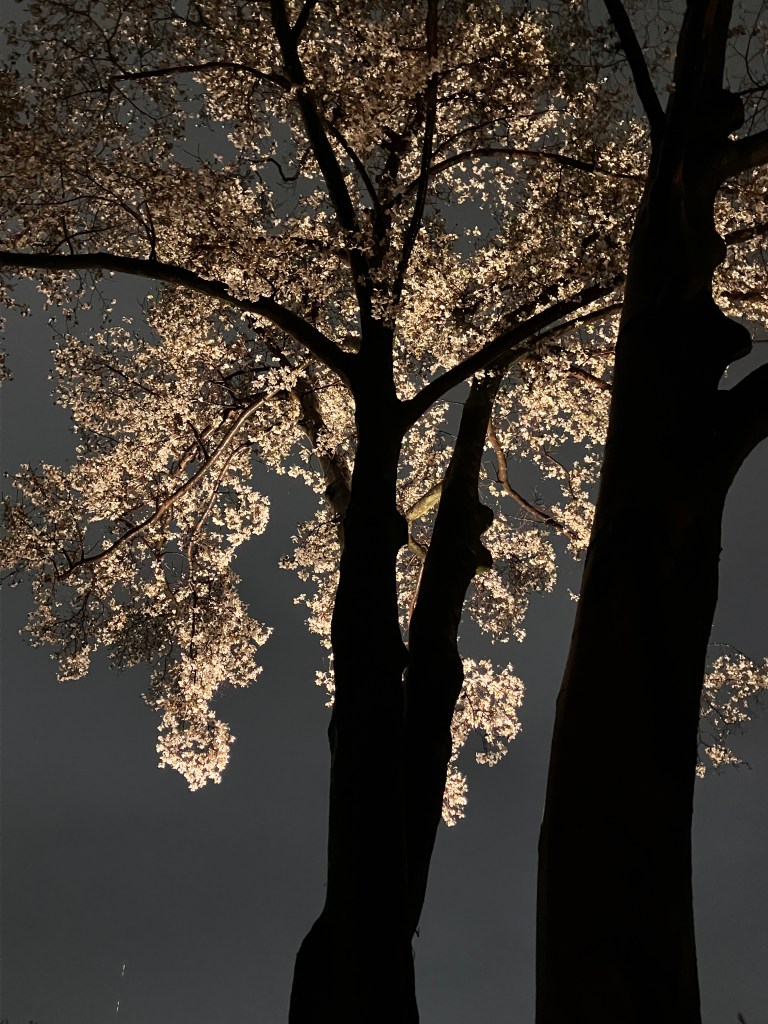
Unfortunately, it was a rainy stretch in Tokyo as the fun got underway. Fortunately, we don’t melt. Parks and gardens are prime blossom viewing spots of course. So off we went. First was a night time cherry blossom event where the trees were lit up. It was beautiful, and wet. Very wet. But picking through the mud puddles was worth it to see huge trees and bamboo lit up with dramatic intensity.

Dramatic lighting made the blossoms pop.
A stunning arrangement of trees and lighting.

On a dry Friday as we wandered parks filled with blooming trees we overheard other blossom peepers talking about what variety of cherry trees we were seeing. There are over 100 varieties of cherry trees in Japan, a few are wild and native to the forests, but most are cultivated. These trees don’t produce edible fruit, but flowers are pickled and used as tea and in other confections. We love seeing a forest mountain dotted with blooming trees mixed in with conifers and maples.

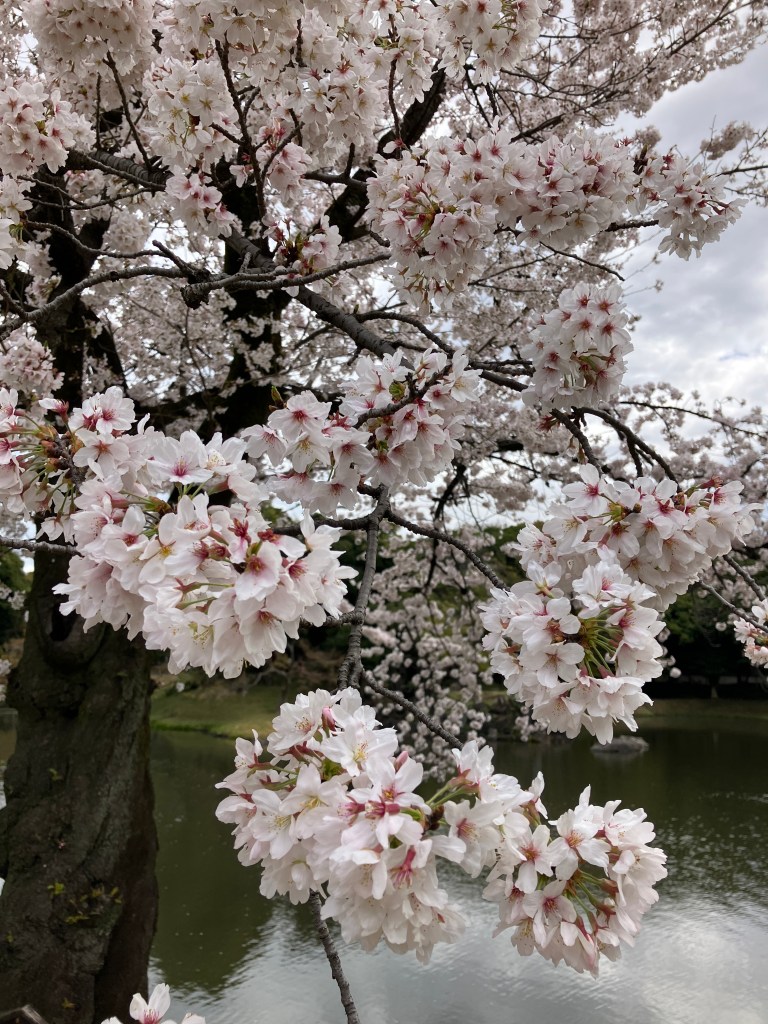
Up close you can see the differences in the blossoms.
I’m sure many folks know the trees by blossom sight- we don’t!
You simply can’t stop yourself from taking photos. Every tree offers a unique moment you want to capture.
This might be the only time I see this, you think as you snap away. Blue sky makes a dramatic background.

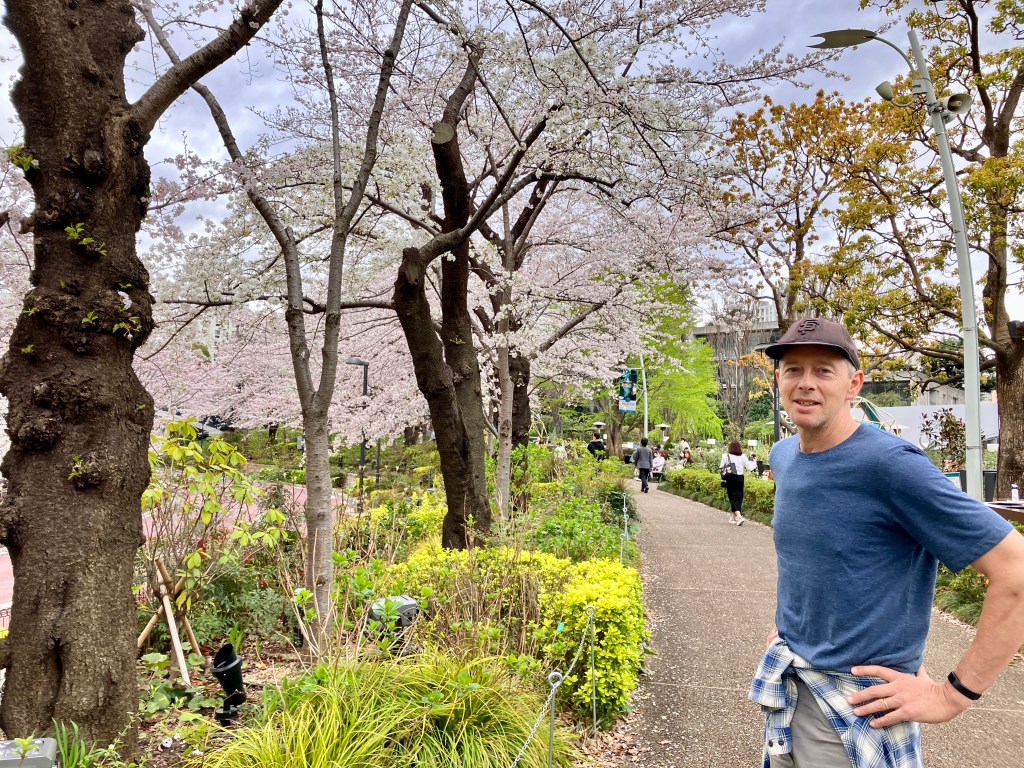
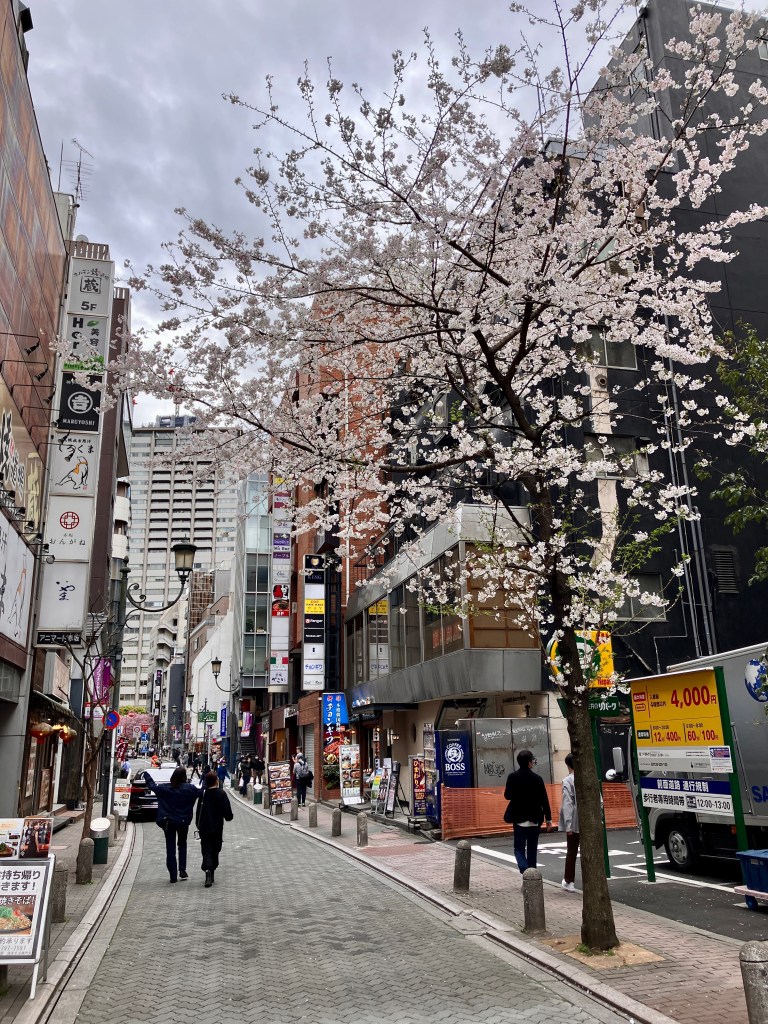
Blooming trees are not confined to parks. As we walked around Tokyo we found allées of blooming trees, or simply single trees, putting on a show worthy of admiration.

The bright green of spring makes a perfect foil for the blooms at Tokyo Midtown.
A temporary lounge set up among the trees of midtown.
A single tree changes the feel of a street.

We left Tokyo for Kanazawa where we had a new batch of parks and gardens to explore. And a lovely castle. And more cherry blossoms to photograph.

Kenroku-en garden in Kanazawa. Normally a paid entry, the garden is free during Sakura.
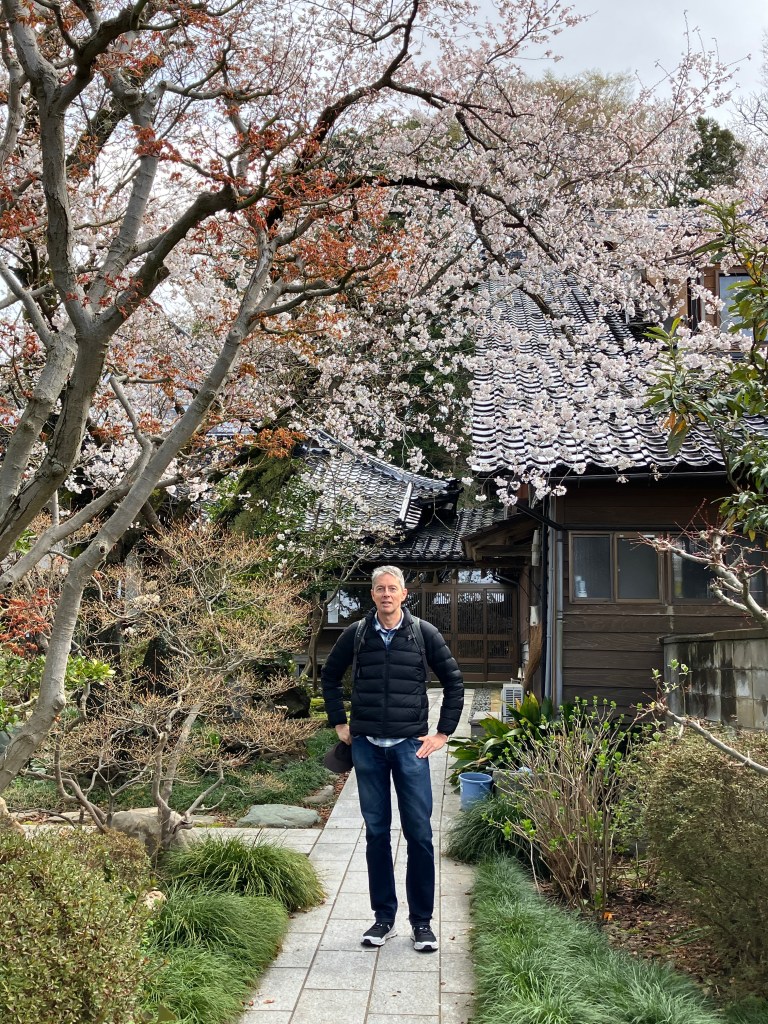
A temple garden on a morning walk around Kanazawa.
Another random burst of blossoms on a bike ride outside of Kanazawa.

You find new ways to view the blossoms, hyper aware that the blossom season is fleeting. People are super friendly and nice about snapping photos of each other. Cherry blossoms bring you all together in one place, for the purpose of admiring the beauty, and recording this fleeting moment.

Photo taken on the grounds of Kanazawa castle by a friendly local woman.
Pose your husband in yet another stunning tree.
Trees reflected in the moat of Kanazawa castle.
A view from above of the trees in Kenroku-en garden.

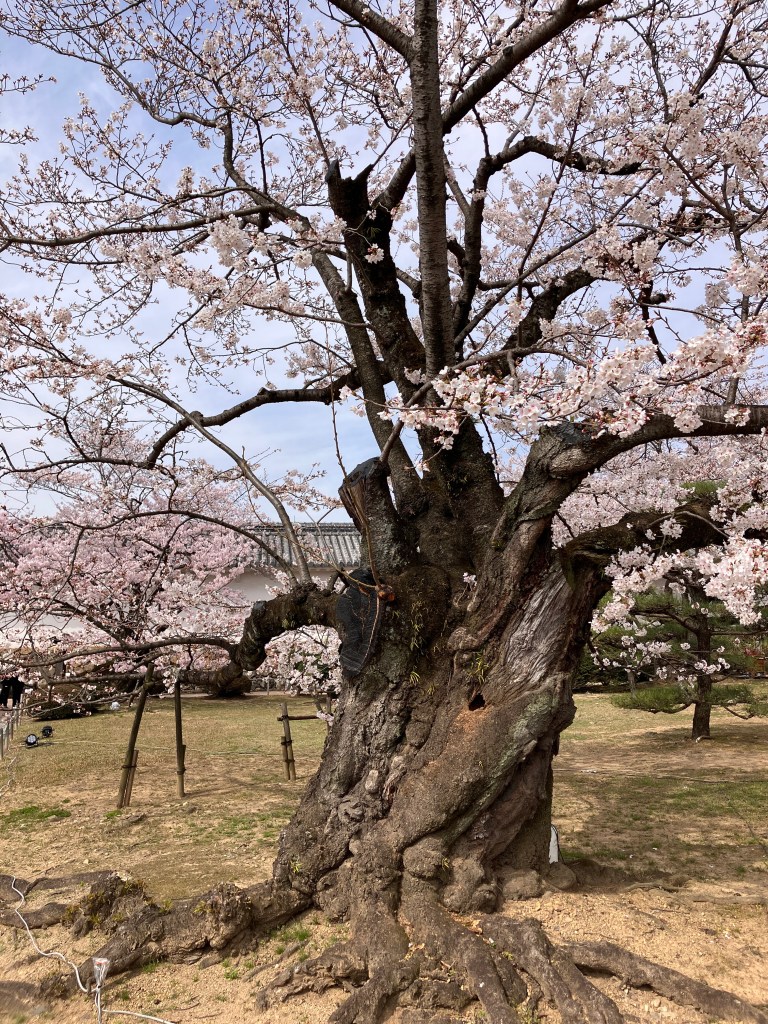
Hemeji, which was a day trip from Kobe for us, has one of Japan’s most stunning castles. And with the blooms it was a crowded site. Rich got us there as early as we could, and it was worth braving the crowds. I’m particularly taken with the old trees – gnarled trunks, branches propped up with bamboo poles.

Himeji Castle.
Alongside a canal in Himeji is a line of perfectly blooming trees.
A tree this size is likely about one hundred years old.
A venerable tree on Naoshima Island, getting some help with wooden struts.

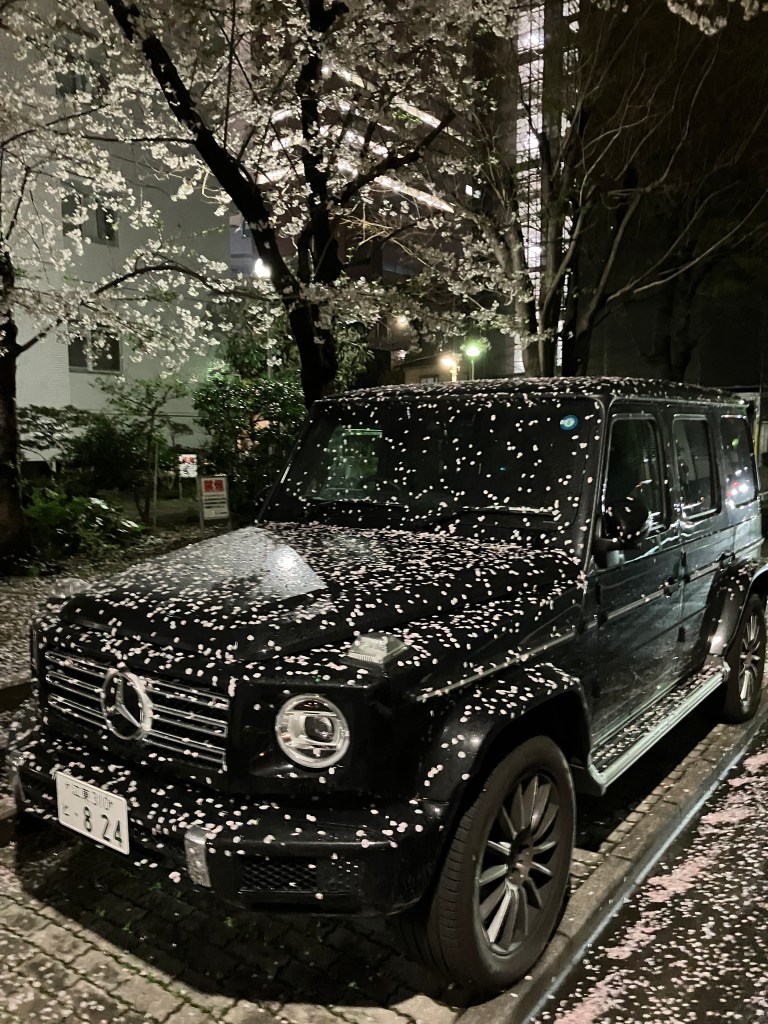
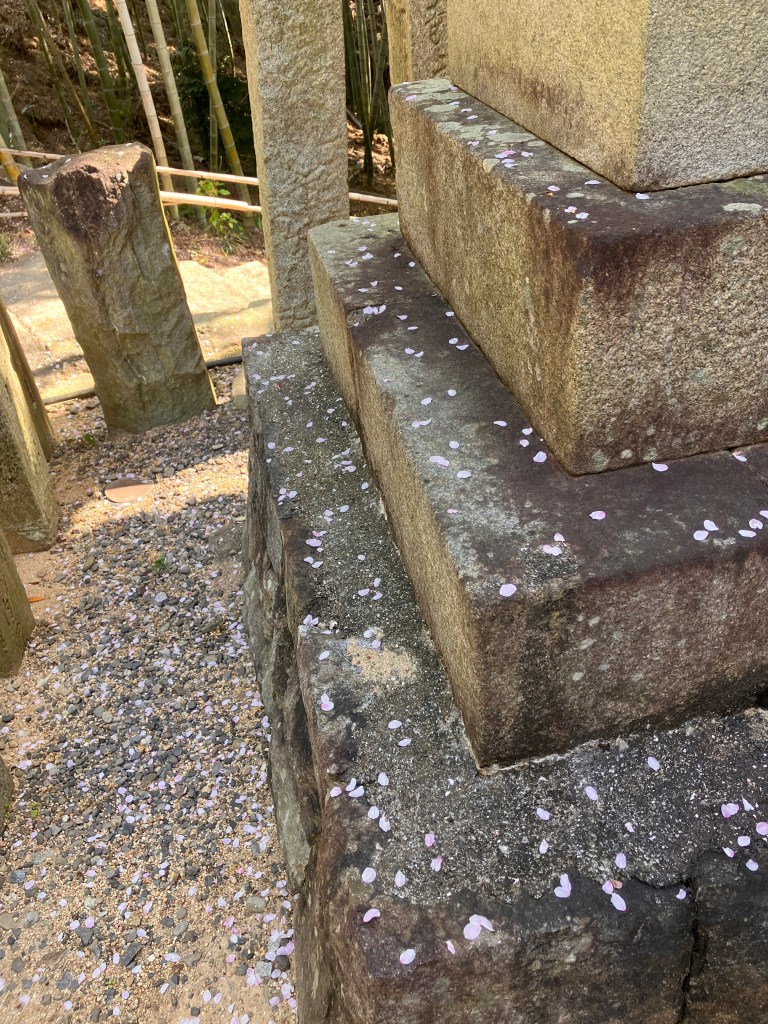
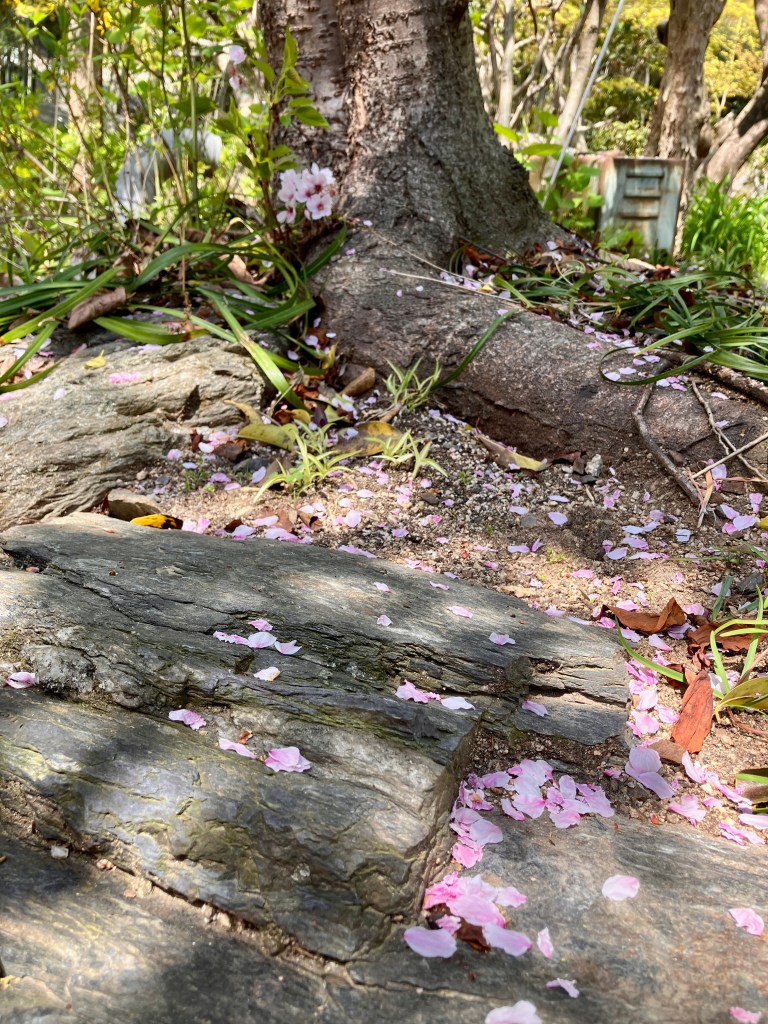
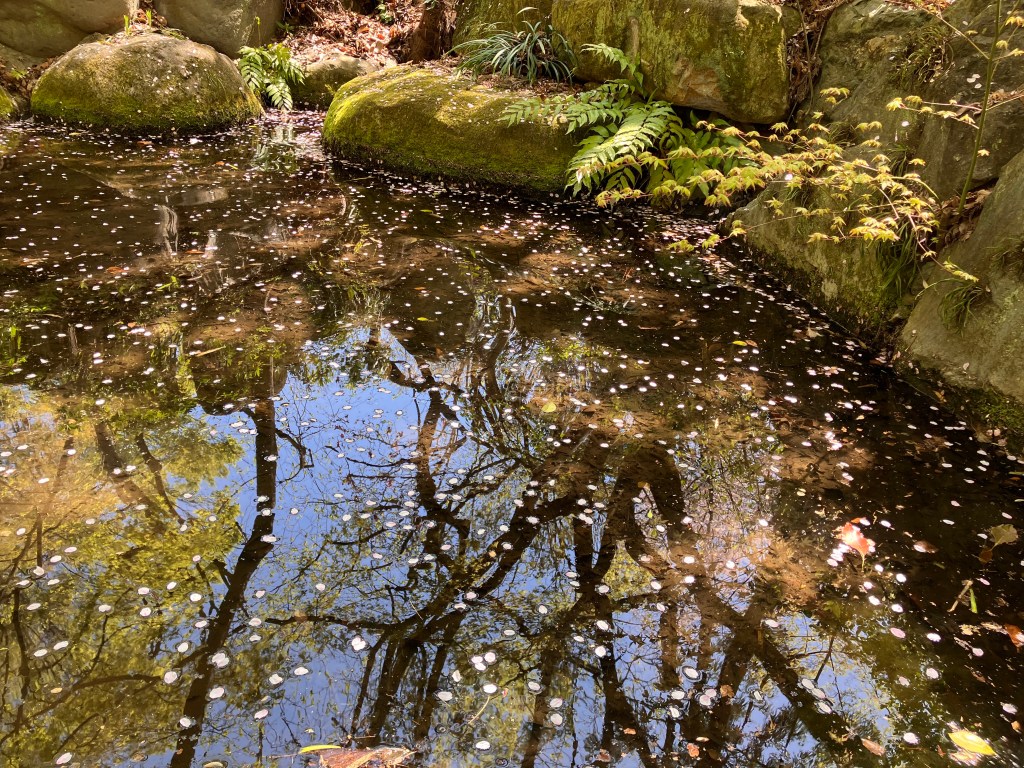
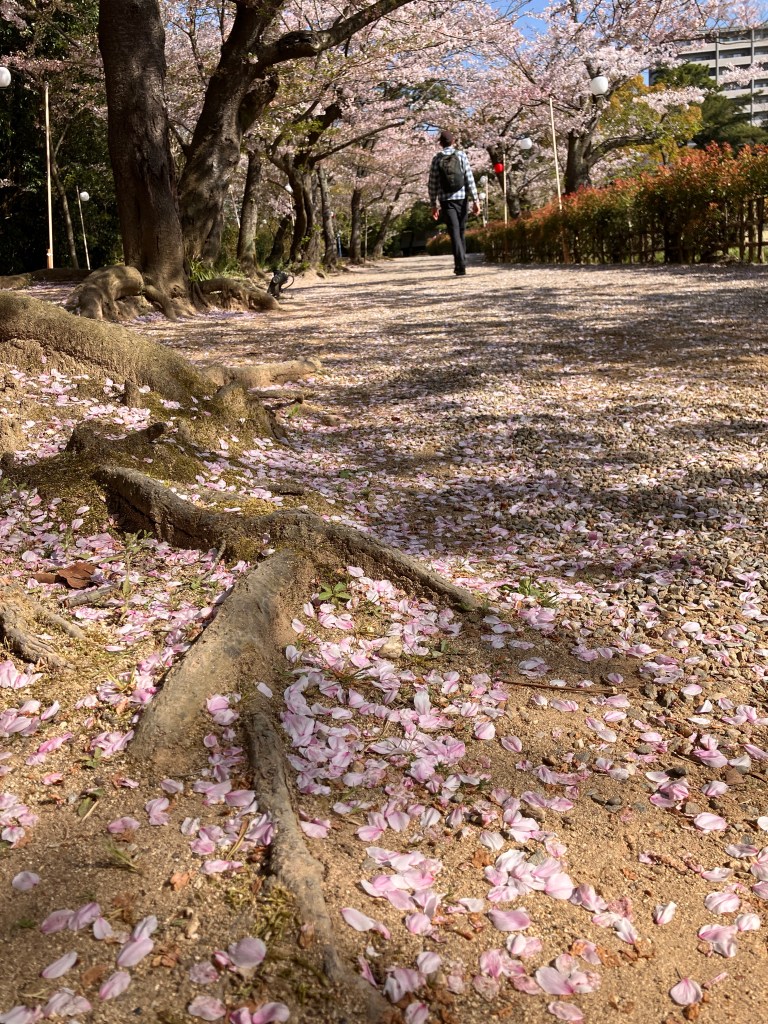
After the bloom comes the time of Sakura snow. The petals blowing off and drifting, or, if it’s raining, sticking.

This would be a wonderful permanent paint job for this Tokyo car.
Petal confetti on a stone lantern base at Shikoku Mura (Village), Yashima
The fallen petals call your attention to the landscape.
Hana Ikada, or flower rafts. This is a sparse but beautiful version with just a few petals floating.
Drifts of petals on a footpath in Takamatsu, at Ritsurin Garden.

Being here in Japan for Sakura was a happy accident. We assumed we would be too early to see the bloom in Tokyo, but Sakura has been earlier than usual the past few years. If you do come to Japan for Sakura, be aware that hotel prices go way up. Rich booked our place in Tokyo before the season was announced, post announcement he looked to extend our four night stay and a single night extra would have cost as much as the four nights together.

The happy travelers at Kanazawa Castle.

We’re in Japan for two more weeks before moving on to Korea. We feel so lucky to have seen Sakura in a variety of cities and landscapes. Cherry blossoms and a Japan Rail Pass, what more could we want?

Konnichiwa Japan. Itadakimasu!

And hello to you too, Ramen bar condiments and Sapporo beer.

Somewhere around week two in Sri Lanka I announced that I missed abundance. It’s ironic since part of our decision to pack up our lives and travel was the desire to experience a less cluttered life. To have the freedom to shoulder our backpacks and go wherever we want. Well welcome to Japan, where abundance is always an option.

After a two hour immigration wait at the airport we made it to our apartment and headed out for some late food.

We made our first trip to Japan in 2007, before smart phones with translation apps. This time, we were ready for all Japanese menus. Our index fingers and thumbs were all warmed up for google camera translate. Uh huh. We bought SIM cards from a vending machine at Narita Airport but had not installed mine correctly yet, and Rich was using our US cell phone data sparingly until he got his new SIM installed. Well, long story short- the first restaurant we walked into we failed to navigate the confusing situation and quickly abandoned ship! Thankfully we found a small place with on screen ordering and settled in for our first meal.

Ramen Nagi in Shinjuku. You make your choices at the machine, pay, and hand the order tickets over to one of the waitstaff/chefs.
A delicious bowl of ramen.
Rich in his happy place. A tiny ramen bar with about 8 seats
Some of the tiny but popular ramen spots have created problems with their lines of customers, so this one instructs you to line up in the alley, there is a small camera so they can see the line of customers, and a speaker to tell you when to come upstairs.
Rich paying the bill at a small sushi restaurant- too small and cozy for any indoor photos!

The automation is fascinating to see. As with many countries Covid accelerated cashless payments and waitstaff free ordering, but in Japan you get a fun mix of traditional and modern.

The modern, a chain called Cafe Gusto. You place your order at an on table screen.
And a rather cute robot brings your meal.
Karaage chicken. Different from what we know as fried chicken, the meat is marinated first, then coated in a potato starch batter and fried. Delicious.
Stand off, Cheryl v. Robot. We worked it out.
A helpful staff member explains the payment machine for us.

A Sakura (cherry blossom) post will follow with many photos, but this is all about food. We were craving Japanese food for the past few weeks so we’re thrilled to walk and sightsee and eat. Our walking mileage has gone up sharply which helps with the eating. We took a train out from Tokyo to Koganei Park to visit the Edo-Tokyo Open Air Architectural Museum. There was a festival going on despite the rain so we snacked our way through that.

Grilled squid.
Rich enjoying Takoyaki balls (octopus and batter) under the cherry trees.

With four nights in Tokyo we had a chance to try to get into a small neighborhood izakaya restaurant on Friday, and when it was full up, make a reservation for the next night. Another good travel hack, especially in places where you either have no local phone number or where calling is beyond challenging due to language barriers. Two folks working the small restaurant, no fancy automation here. We were grateful for our young server/owner’s help. We always find the further out from the heart of a tourist district the more patient and helpful the locals are.

The traditional. Happy customers enjoying amazing food in a small izakaya in Otsuka
The softest most silken tofu. Our charming and helpful owner/waitstaff guy told us not to use soy, or the grated ginger or scallions since it would overwhelm the delicate taste of the tofu. We obeyed.
Tempura white asparagus and a tempura seasoned soft boiled egg.
Tuna and seabream. Rich had saved some photos from on line reviews, and our guy suggested others since this small restaurant has a daily menu and limited quantities.
Sake.
The shallow sake bowl tests your pouring skills- and perhaps your sobriety.

After four nights in Tokyo, and a longer stay running into Sakura prohibitive pricing, we hopped on the trains to head to Kanazawa. Our JR Rail passes will be getting a work out this trip as the Japanese train system is beyond amazing.

Rich buying our first ekiben, short for eki bento, train meals. I was tickled to learn that these lunch boxes are called ekiben if you’re on a train, soraben (sky lunchboxes) for a plane, and bento you eat anywhere.
Our first of what will be many ekiben.

Our first night in Kanazawa we struck out three times, a conveyor belt sushi restaurant with a closed waiting list, an unagi (eel) restaurant which was closed despite the hours listed showing it should be open, and another full up sushi restaurant all by 8 pm. We figured out it was spring break week for schools so things were quite crowded. We finally saw a small tempura stand restaurant and got two seats at the bar. Another kind and helpful waiter sat us, got us an English menu, and took care of us the entire meal. We had a great view of the chef working his tempura fryer with chopsticks and tongs.

The tempura chef.
I’m going to collect photos of the mise en place of our counter seats. And how cute is that jar of white wine?
Tempura fresh from the fryer.
That is a pickled ginger tempura. Never encountered by me before. I’m a pickled ginger fanatic and this was delicious.

So far no breakfast photos, you might be thinking to yourself. Well, we’ve been having hotel room or apartment breakfasts of Musilix and fruit and yogurt, but we did get out early for cherry blossom viewing and then had a second breakfast our first morning in Kanazawa. Cafe Tamon is a small easy to miss but for the help of a passerby who saw us looking in confusion at our phones, pancake specialty cafe.

We walked right by it the first time. Very low key signage.
Butter melting on the fluffy organic rice flour pancakes, whipped cream sporting a sprinkle of gold dust, vanilla ice cream, and a small jug of maple syrup for me and honey for my honey.
Rich waiting patiently for me to stop taking photos.
If there is a word which conveys more fluffiness than fluffy, that’s what these pancakes were.

Remember that conveyor belt sushi place with a closed waiting list at 7:40pm? We went back the next night at 6:40 and put our name on the list. About an hour later we were in! The nice thing about being the only tourists willing to figure out the drill, was that the host knew who we were – not one of many tourists: the only slightly confused looking non locals.

We’re in baby!
Screen ordering and the chef hands you your dish.

Conveyor belt sushi has had a hard time recently, apparently from a social media trend that has attention starved youngsters misbehaving and filming themselves. Insert eye roll here. I’m not sure if the screen ordering is a result of that stupid trend, but it worked out just fine for us.

Tuna three ways.
Squid on natto (fermented soybeans), firefly squid, and roe. The different colored plates mean specific prices, your plates are counted up at the end of your meal and tallied.

Our third and final night in Kanazawa we were determined to try the unagi (eel) restaurant again. The Japanese name came through Google translate as eel welfare. We marched over at 6 this time and the lights were on! Yay! We went in and congratulated ourselves on being some of the first customers of the evening. One gentleman was just leaving, and another man came in and placed a to-go order. The sole proprietor sat us at the counter, gave us a menu and bustled about behind the counter. We got two draft beers and settled in.

Another counter scene.

Our eel man turned away a group of five Japanese, and then two western tourists. What is going on, we wondered? This is a frequent state for non Japanese speakers here. Confused but pressing on! When it came time to order all became clear – he only had two pieces of eel left. Ah ha! That’s why he had been closed two nights before- he closes when he sells out of eel. Two pieces of your best (only) eel, sir, and some tempura. So many times as a tourist a mystery remains a mystery, so we were happy to have this one solved.

We would have happily ordered five pieces, but two was quite filling.
That smile says it all. We love being in small restaurants run by a sole proprietor. One guy doing what he does best. On his own terms. Eel. And some tempura. Once take-out guy left we were the only customers.
By the time we left he had turned off his lantern, the universal sign of “I’m out of eel for tonight!”?

It’s been a good start to our four weeks in Japan. We’ve honed our perception and empathy skills since our last visit here, and we know how quickly the world can change under your feet. (Poor conveyor belt sushi restaurants. ) We feel empowered by google translate, but a few key phrases in Japanese learned on line (link in our link page) quickly telegraph both our helplessness and our desire to be polite and thankful. There is so much more to experience and share, but for now itadakimasu! Let’s eat!

The happy travelers. Looking forward to
more of Japan to enjoy.