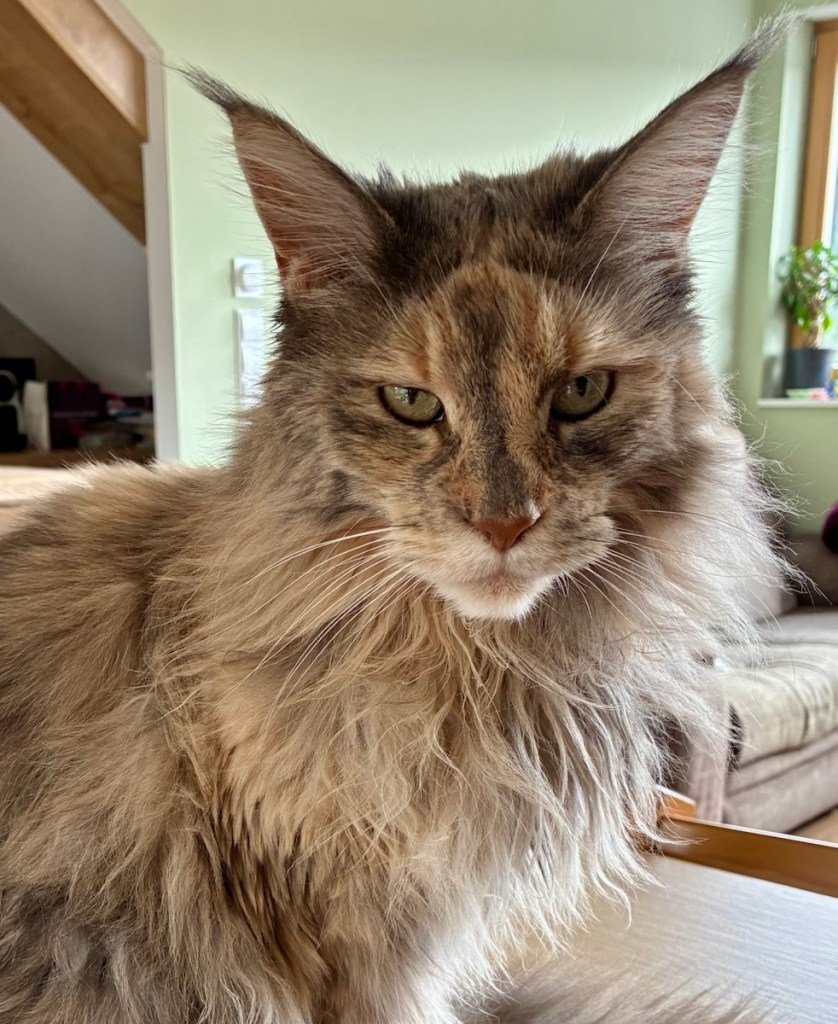
Our cat sit in Luxembourg was great for getting to explore the area, and with the free transit we keep raving about, we did explore. But, our big fluffy charge, the Maine Coon Cat, kept us on our toes.
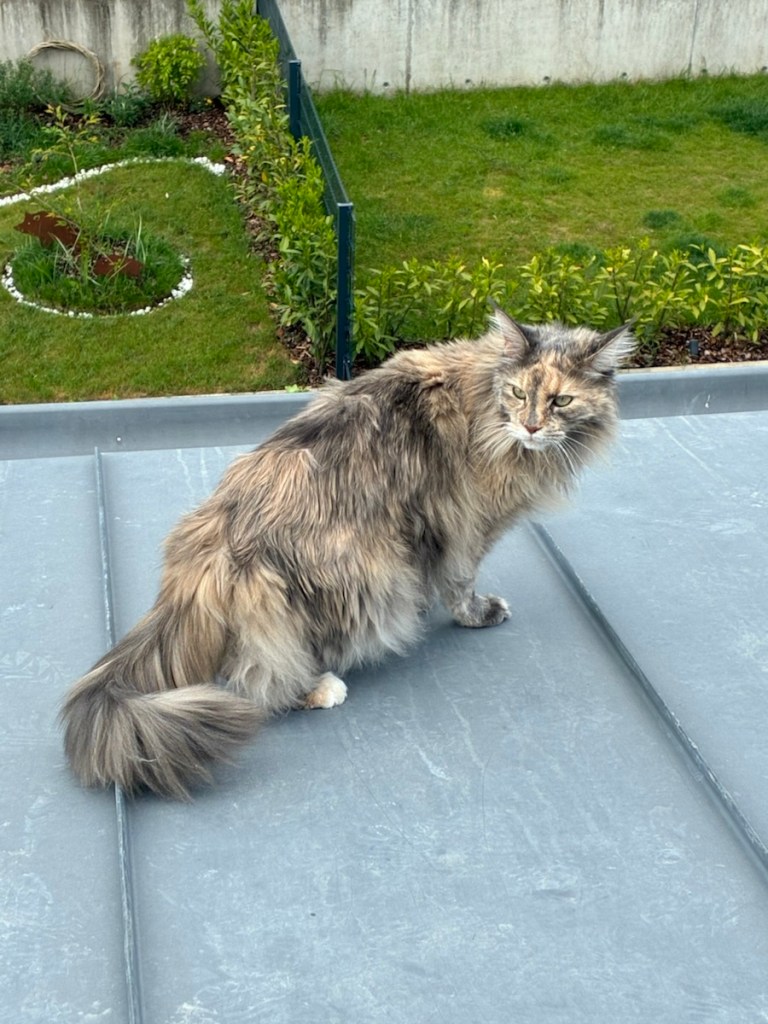
She was allowed out on the balcony and roofline.She would do a circuit and return by the window on the other side.With scaffolding around the building however, she figured out how to get down to the ground.
Our hosts got messages from the neighbors alerting them to her escape via the scaffolding. After we tempted her back with treats and carried her in, we kept the doors and windows closed or cracked. There was a bit of hot spell so the house was stuffy and warm as a result. And yes, she managed to get out again, and yes, it was a kerfuffle, but we had some great hikes, fun side trips into Luxembourg City, and enjoyed cooking and watching a big screen tv.
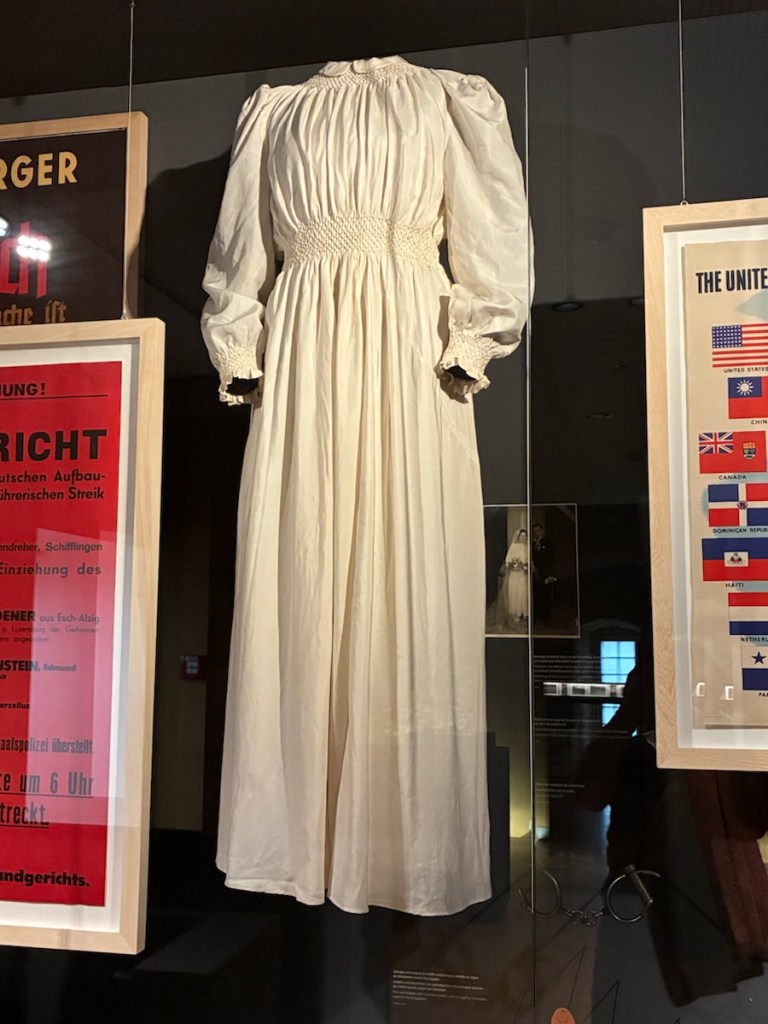
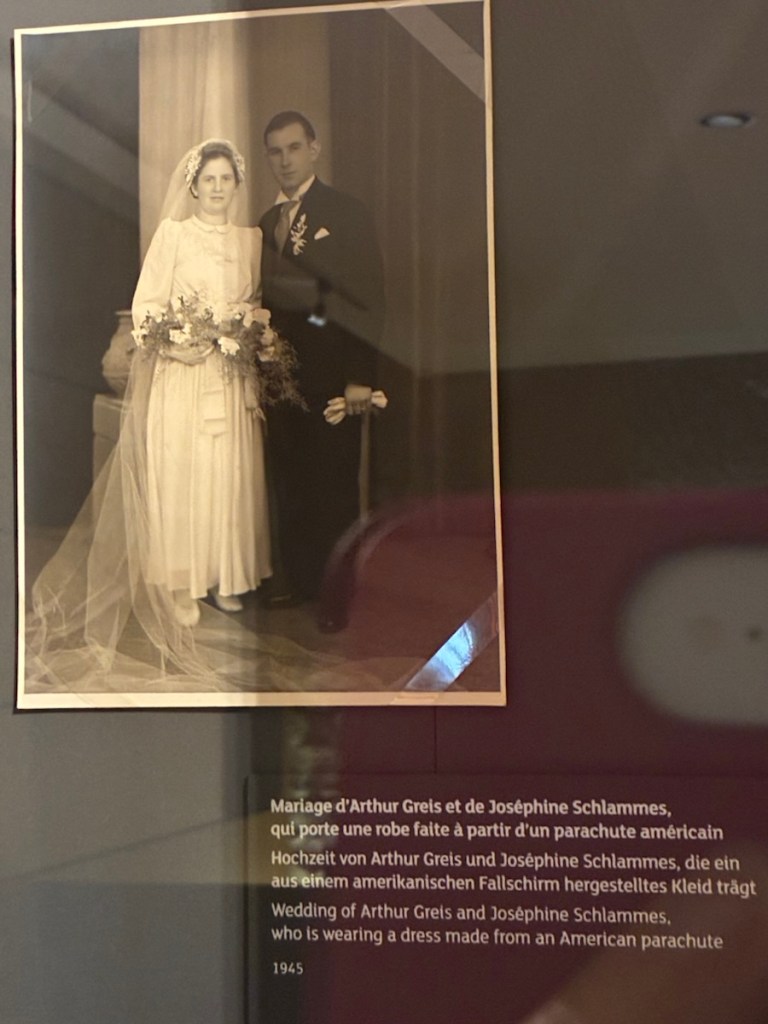
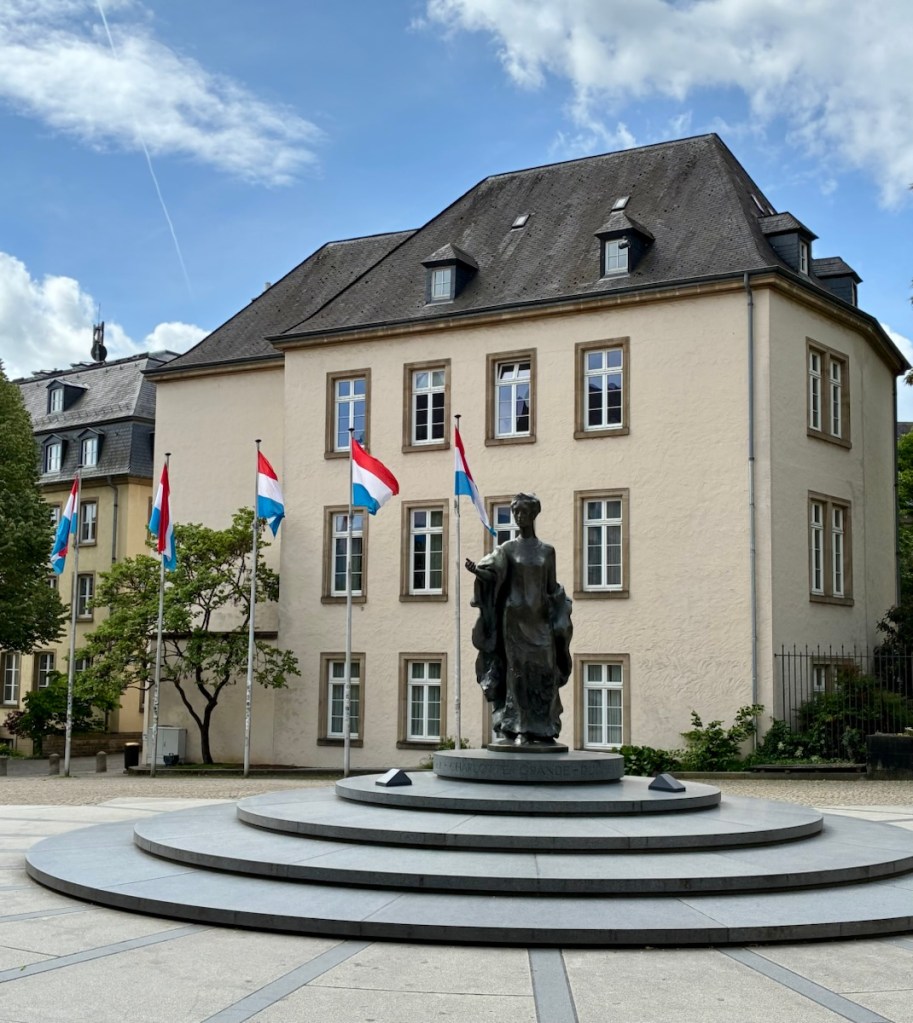
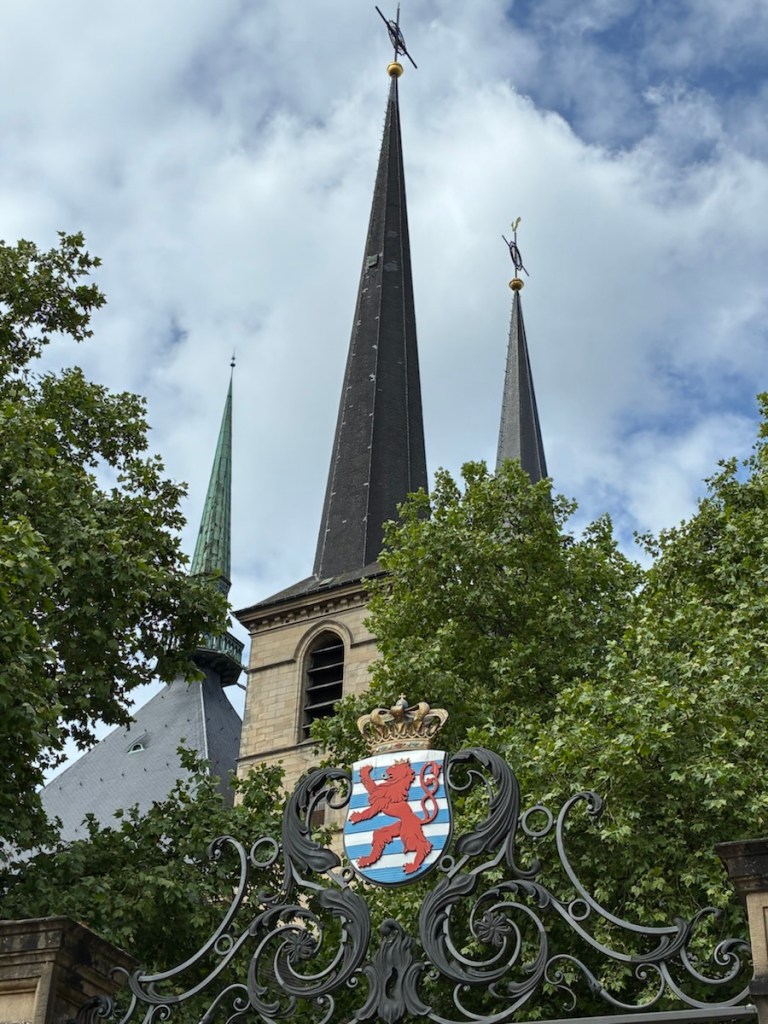
The view from the Luxembourg City History Museum.A wedding dress made from the silk of an American parachute.Their 1945 wedding portrait. The human spirit endures. Imagine what trying times those were to embrace the future and go forward. Bravely.Statue of Charlotte, Grand Duchess of Luxembourg from 1919 to 1964.Luxembourg coat of arms.
Luxembourg City is an interesting place. The country and city are very wealthy, with the highest per capita GDP in the world. Its population of 681k people makes it the least populated country in Europe, and half of its population is foreign born. It reminded us both of Geneva, another capital of wealth and finance, with a similar feel to us of tidy, and calm, but not much in the way of organic city life with messiness and bustle. Pleasant, beautiful in places, easy to get around with free transit, but missing a sense of culture. Or, with a culture that is difficult for the visitor to find and appreciate.
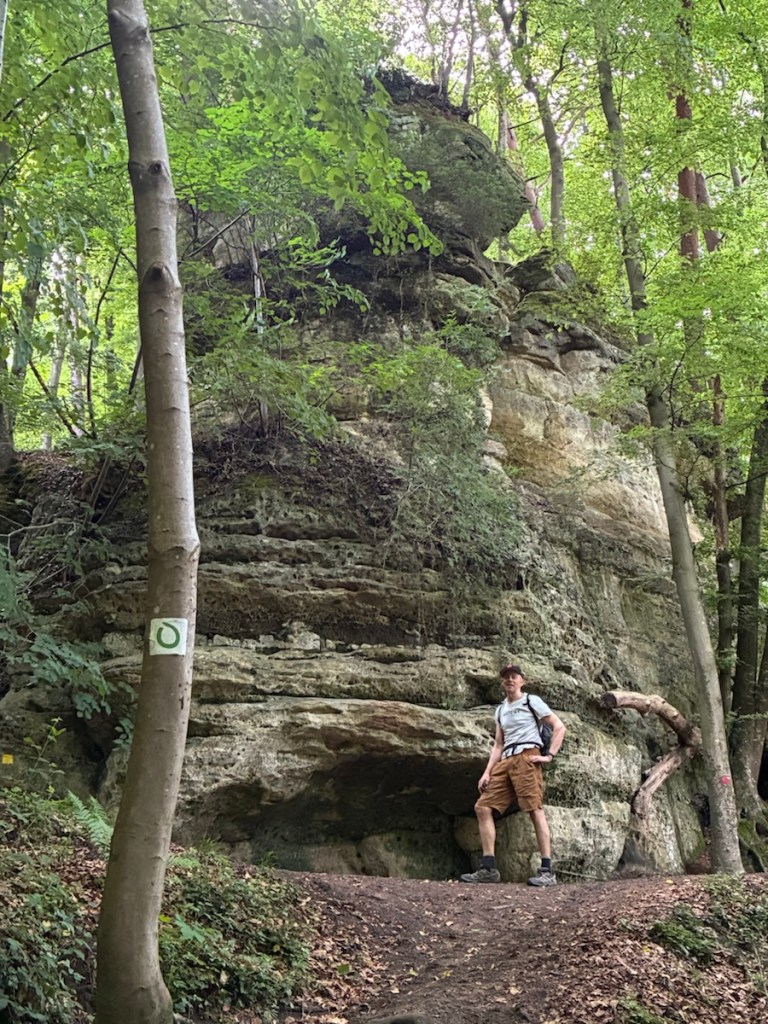
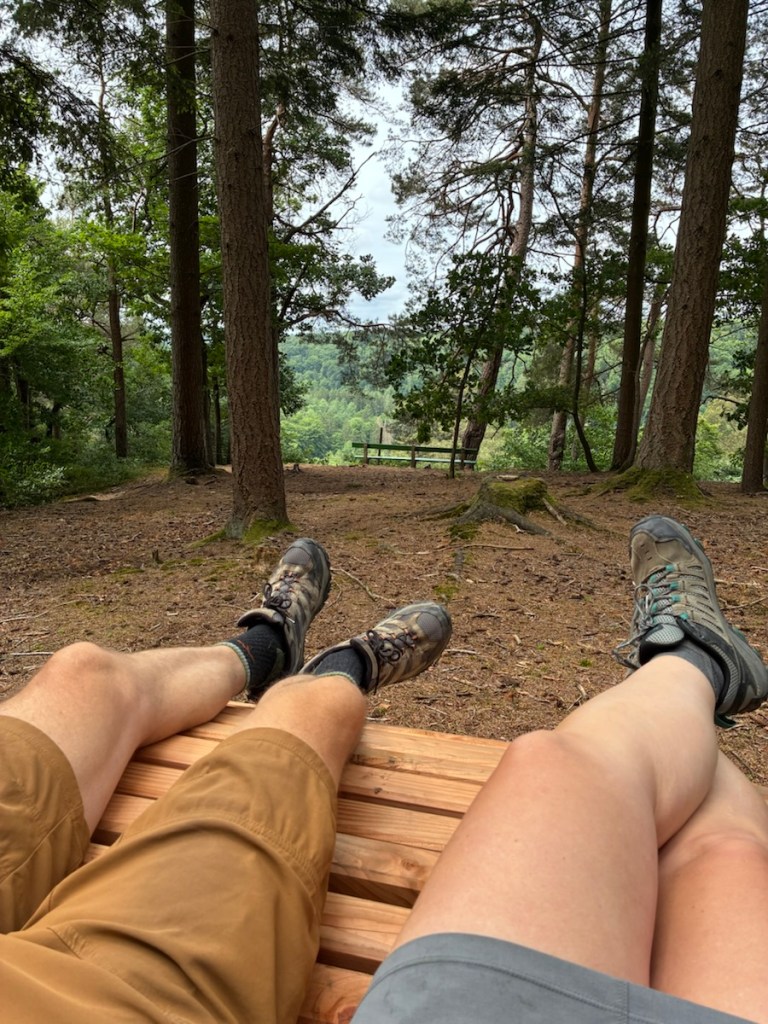
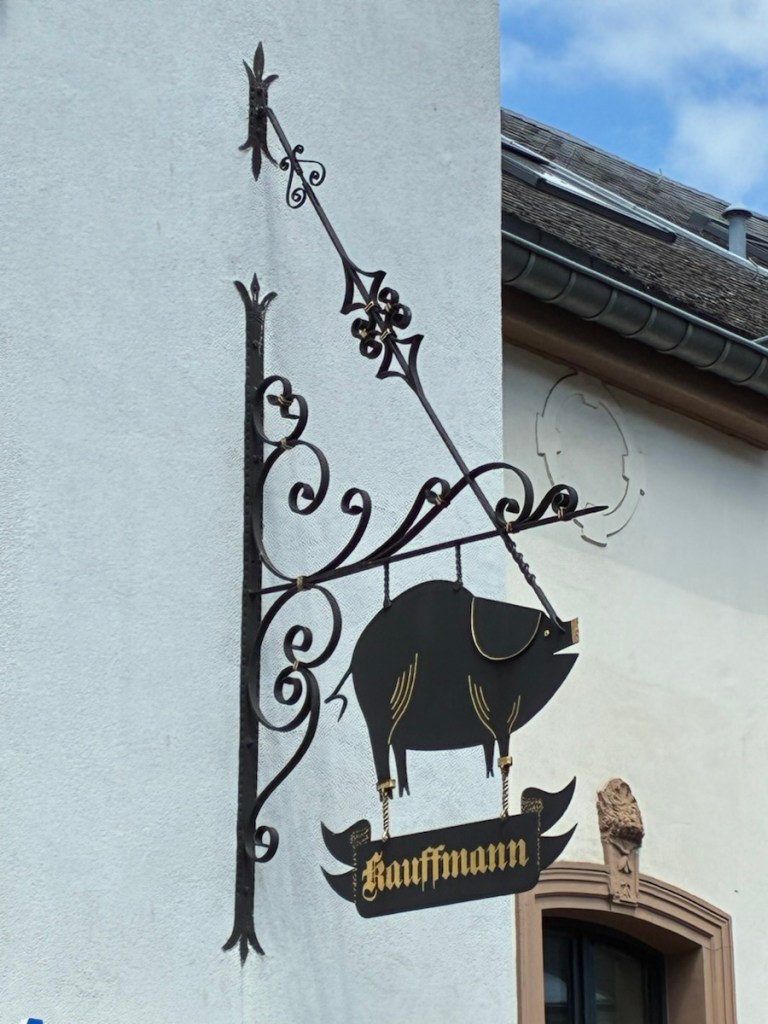
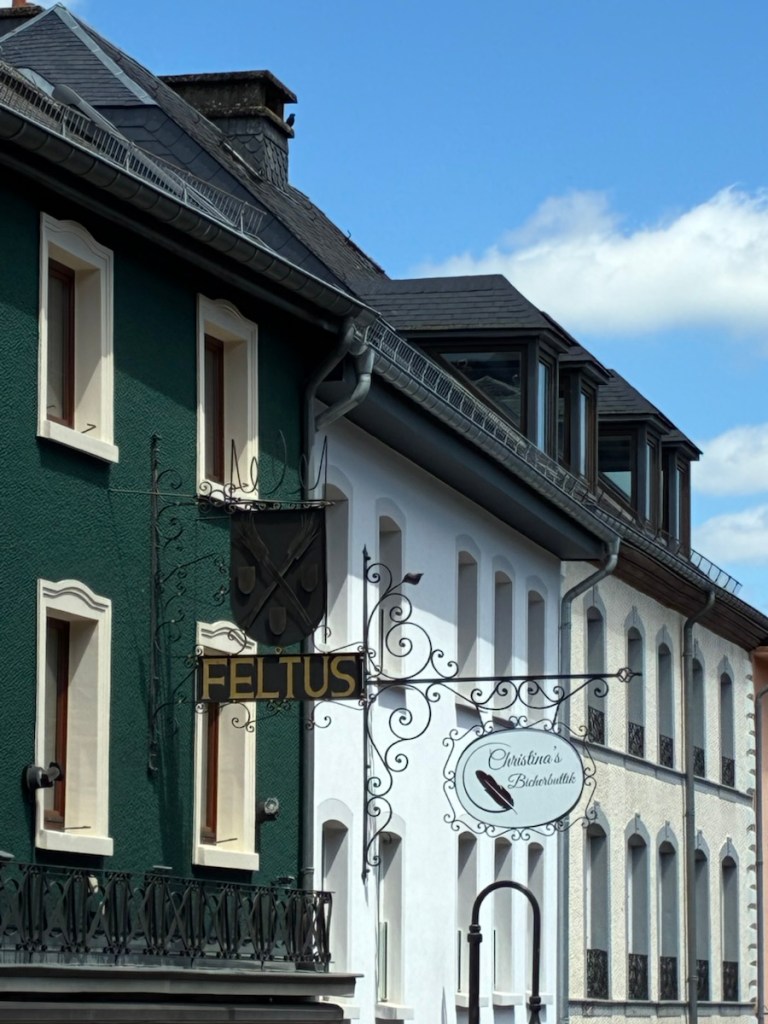
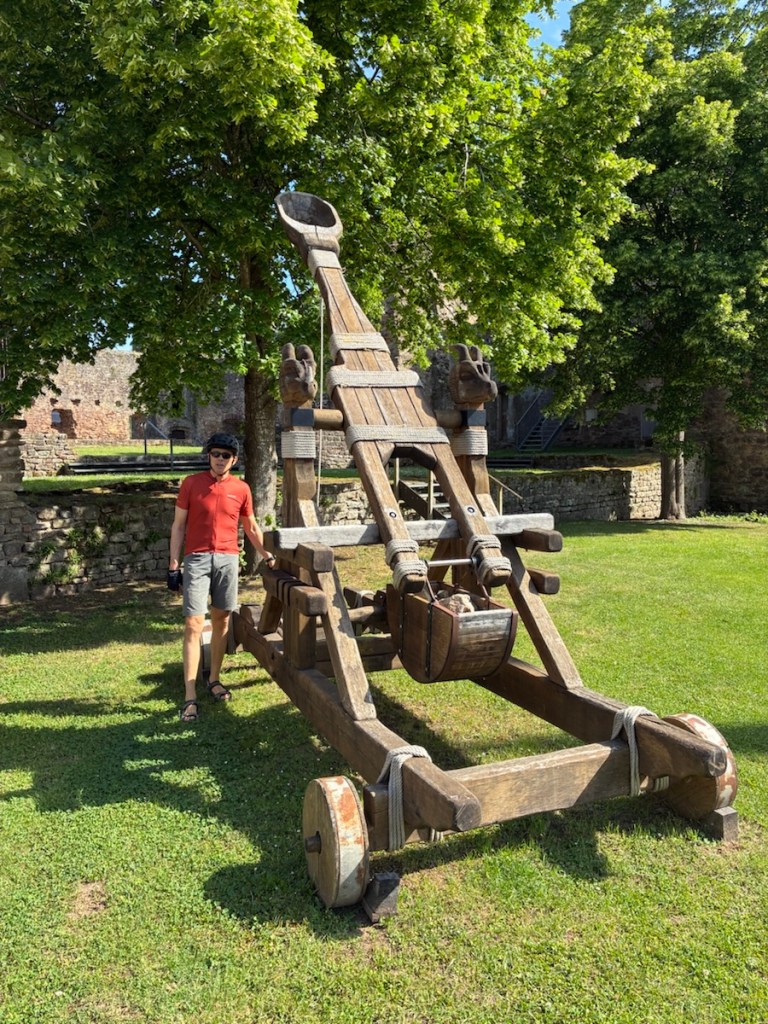
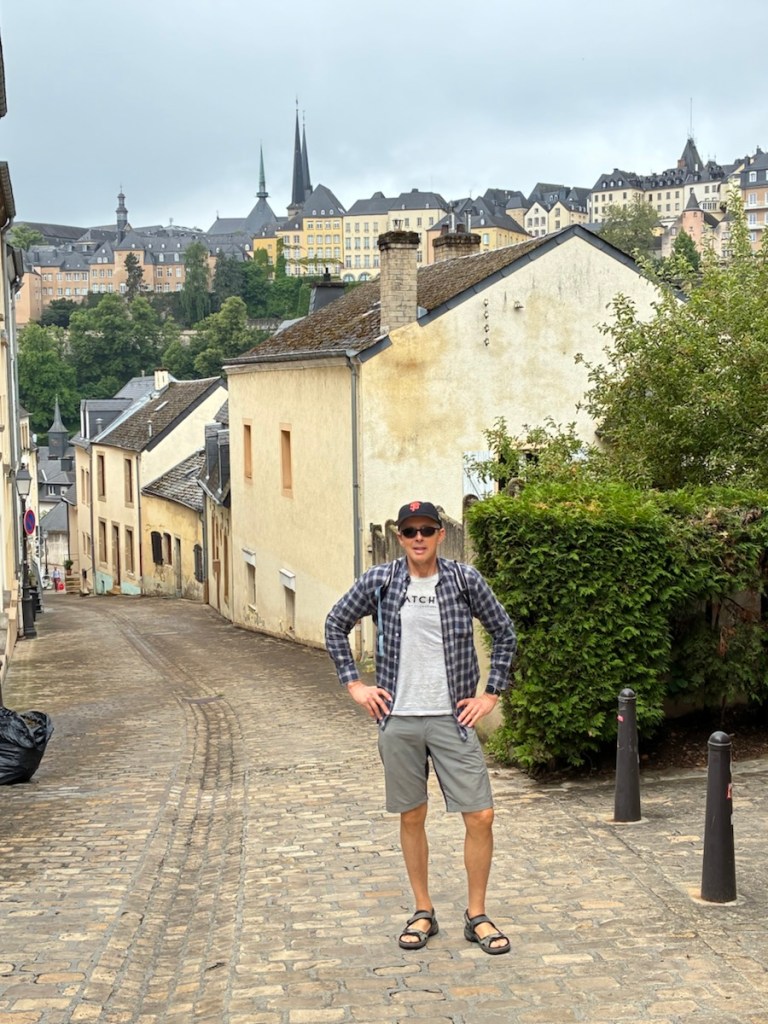
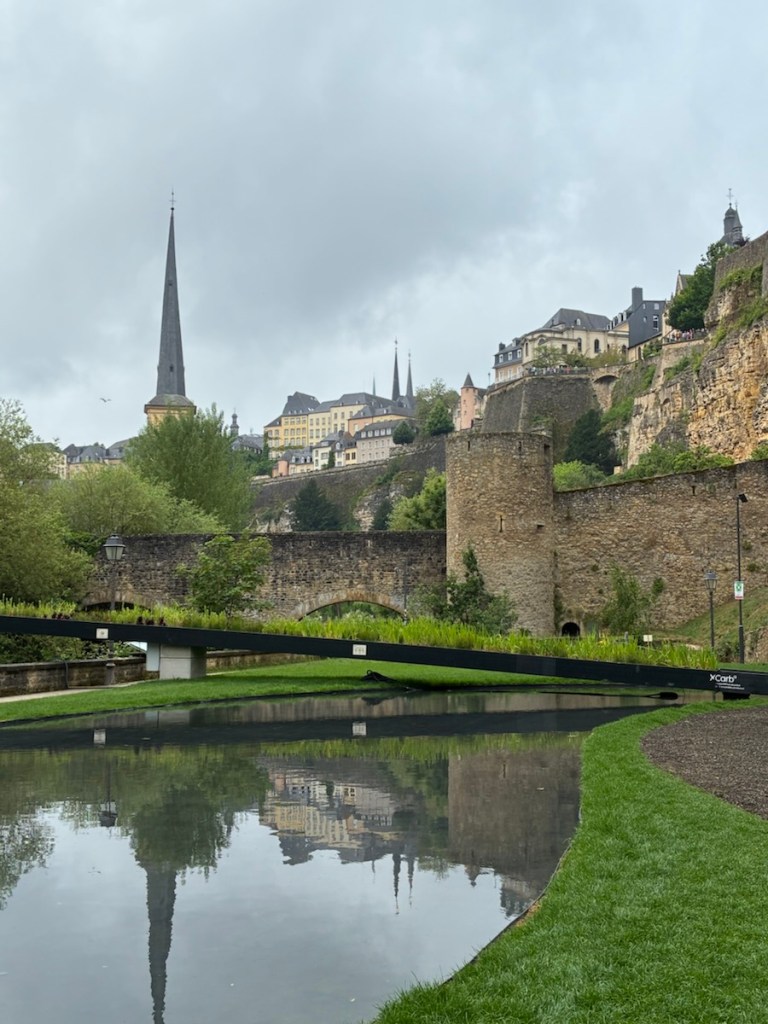
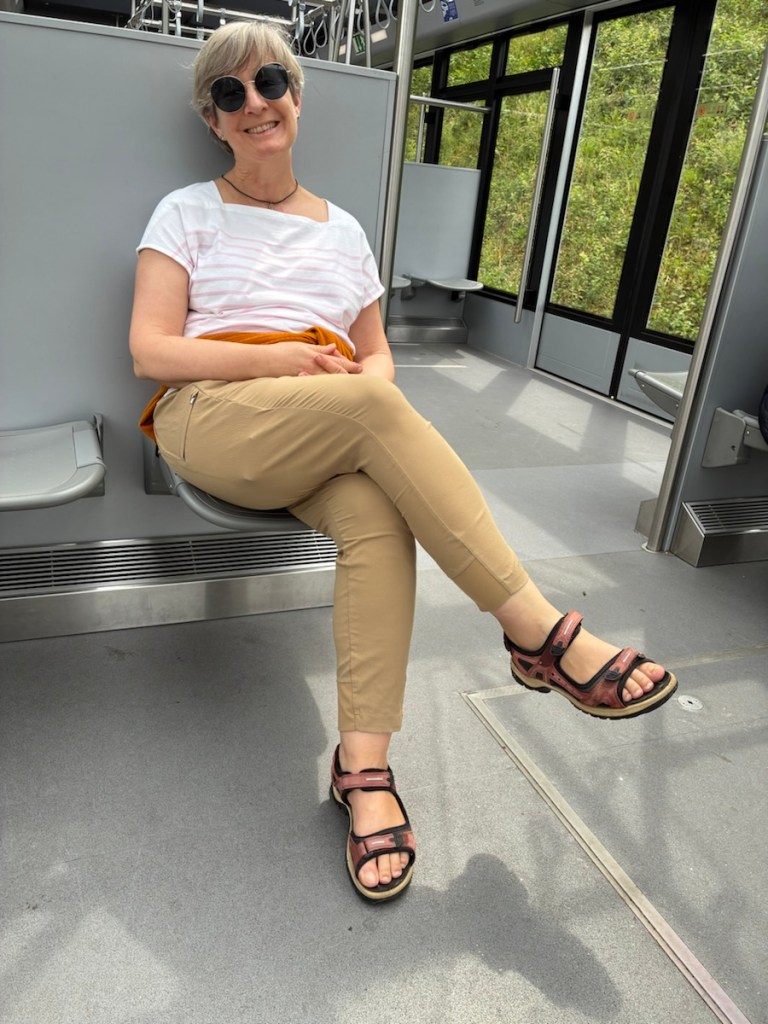
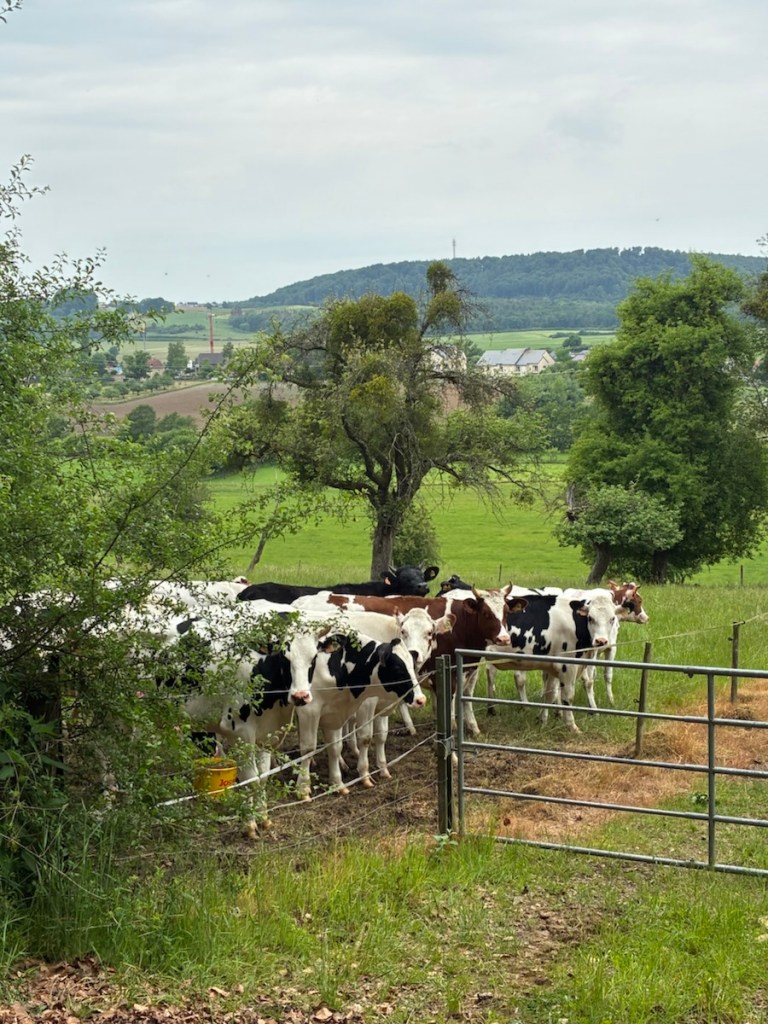
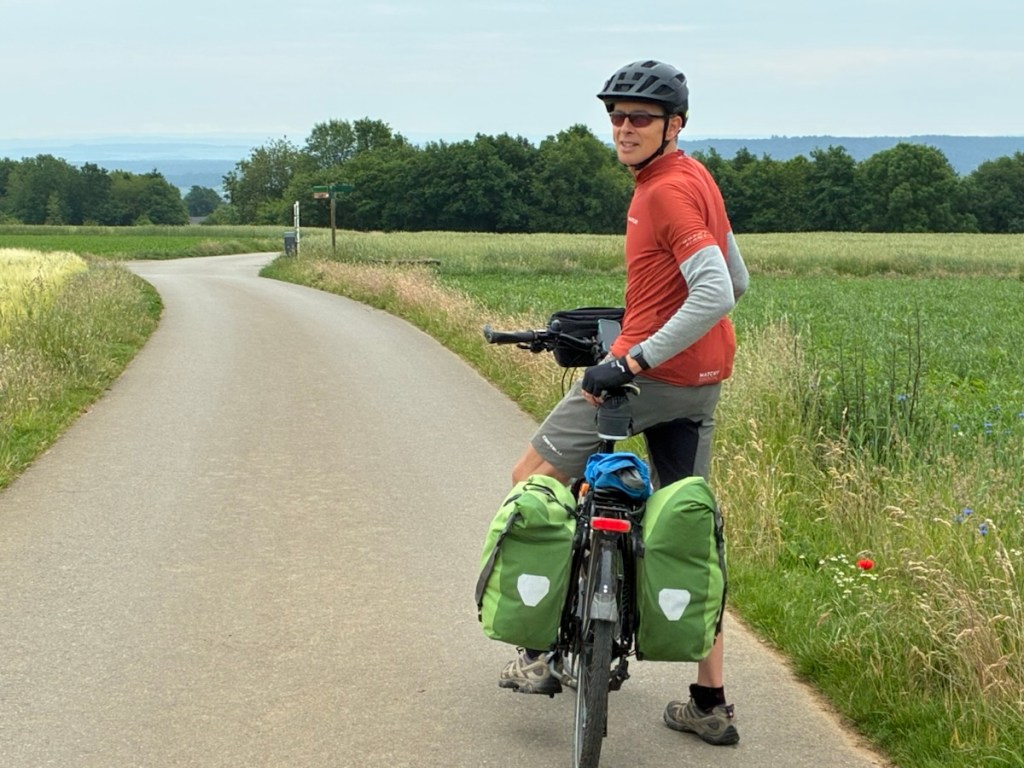
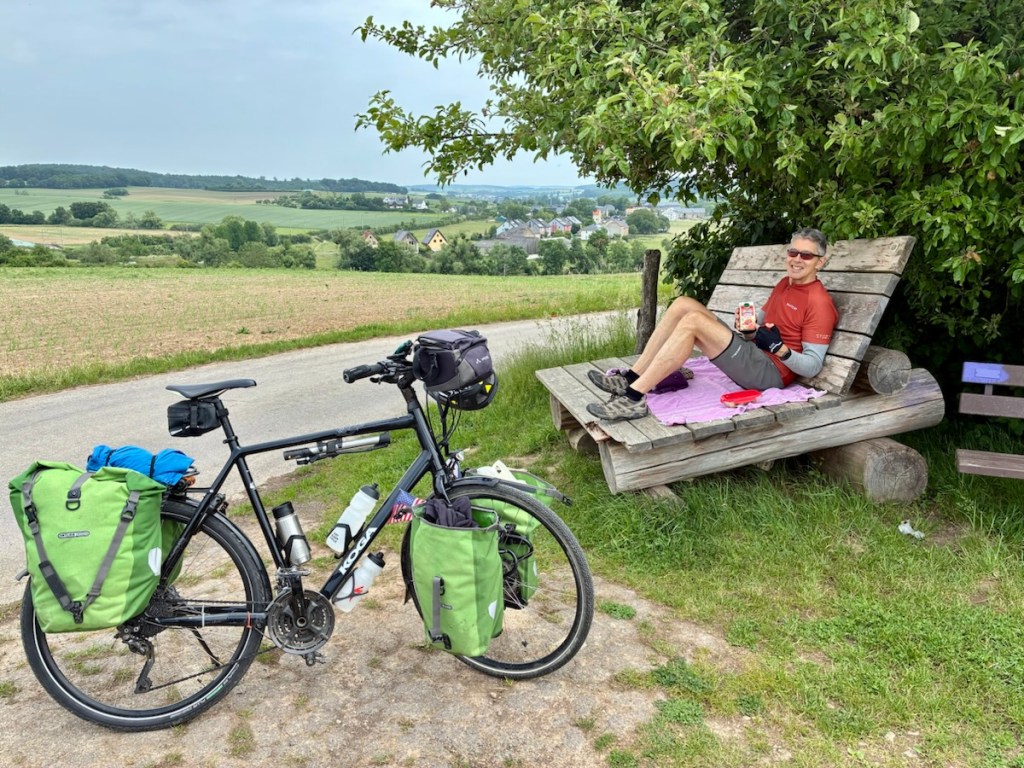
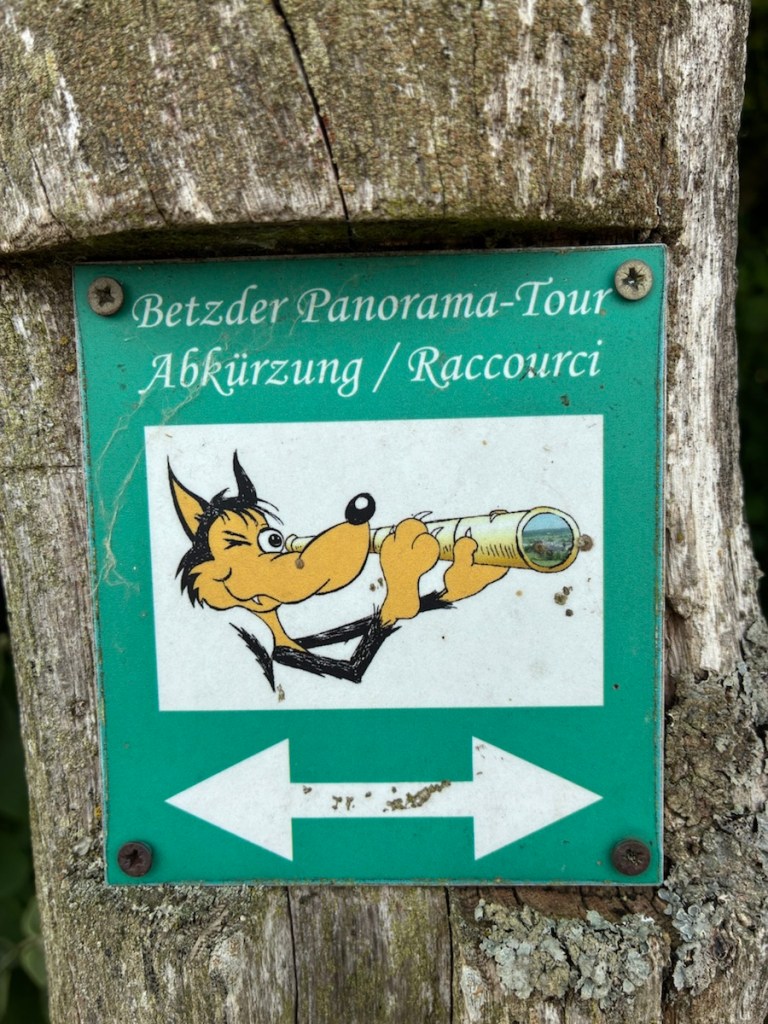
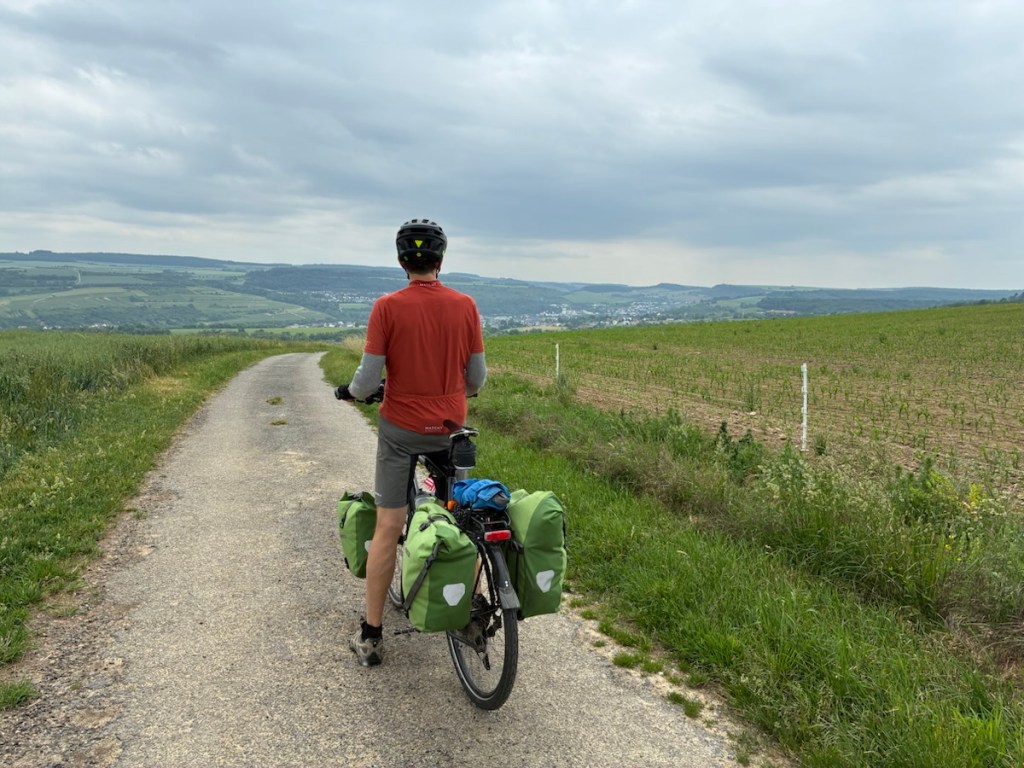
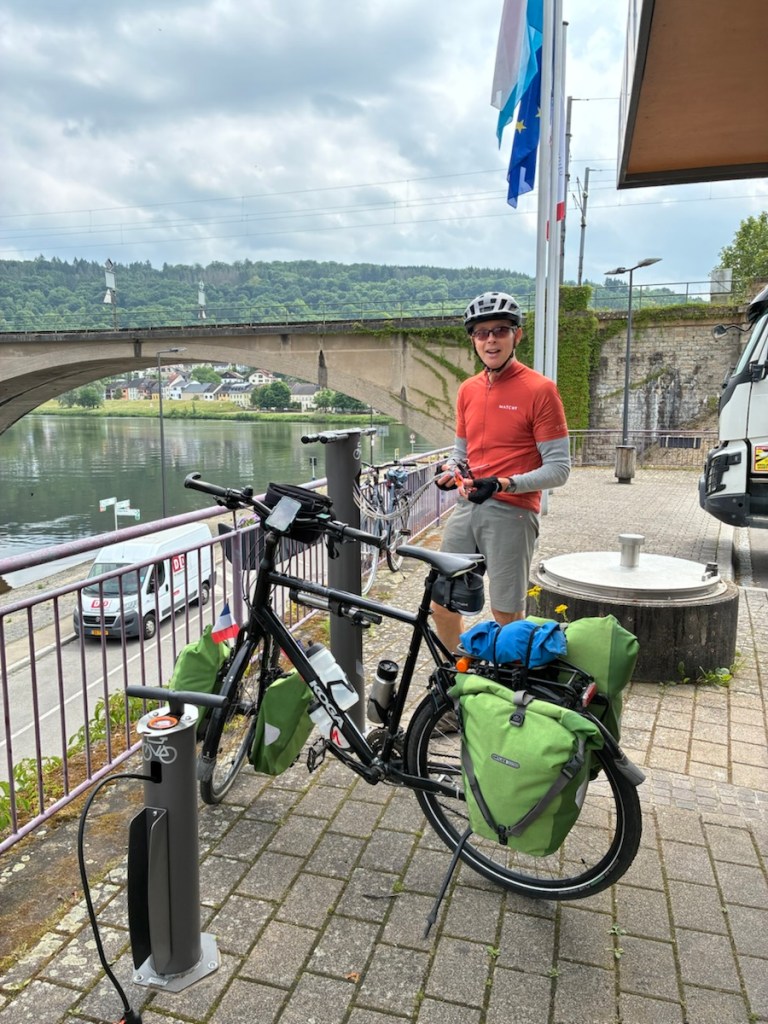
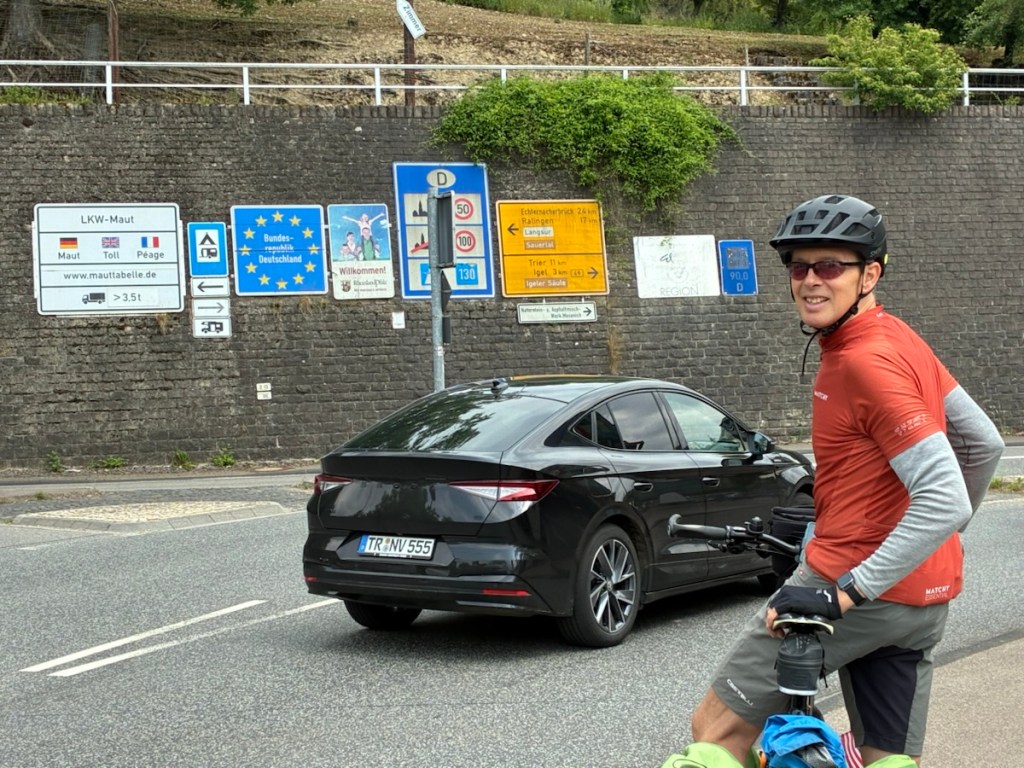
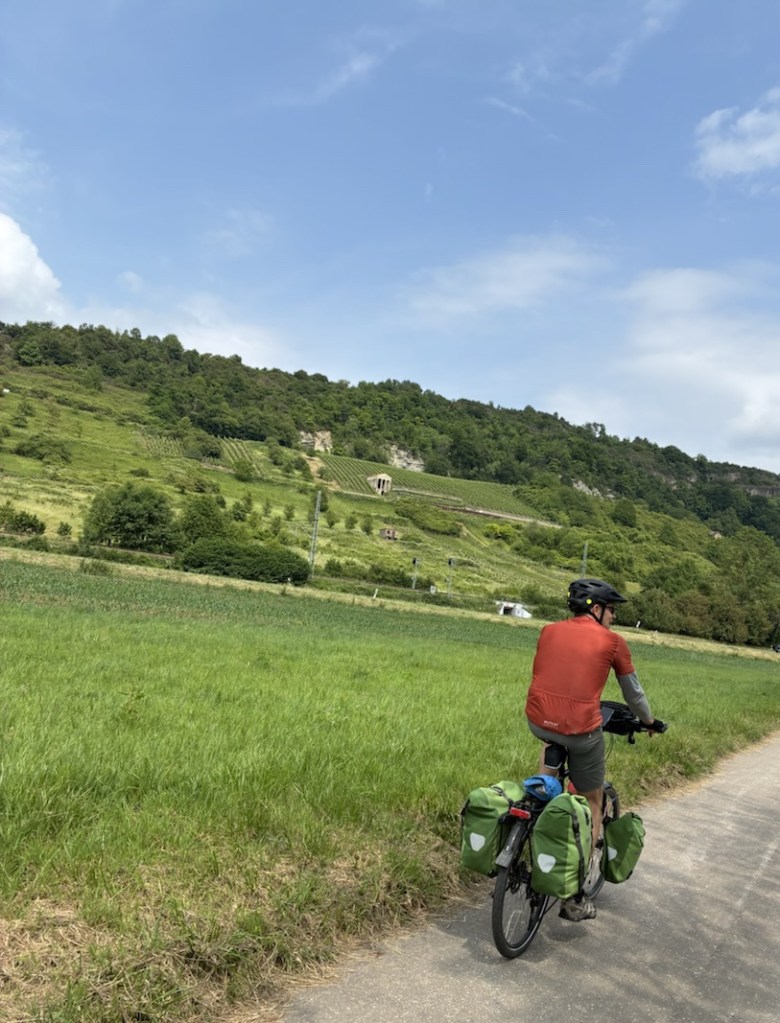
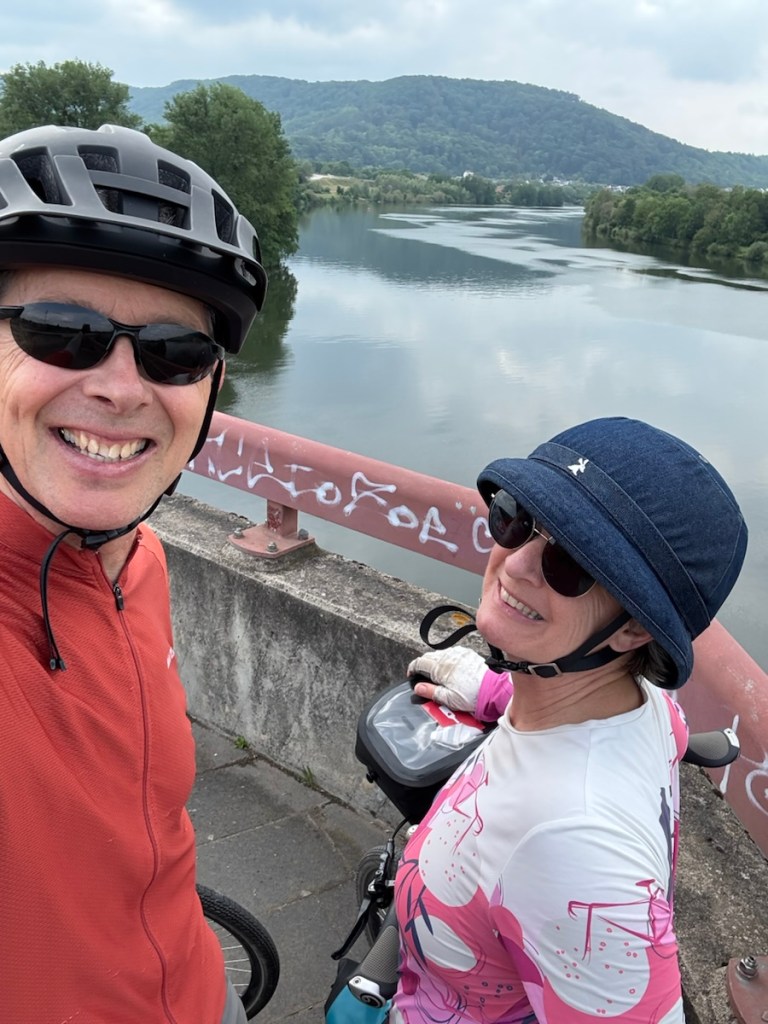
Hike day! A short bus ride to Mersch and a quick stop to admire the dragon fountain, emblem of the town. And up into the hills on the well marked hiking and mountain biking trails.The sandstone rock formations were fantastic.Confused legs, what’s with the hiking – we usually just bike.OK legs, have a rest.The next day it was a train trip to the town of Wiltz.We had lunch and a wander around town.I love the old hanging signs. And a beautiful clock.Old and new hanging sign.The history museum had a big section on beer and breweries.And then back to our kitty cat on the (all together now) Free Train!Our bikes were feeling left out so we went out for a spin and a grocery store run.And to admire the catapult, or trebuchet, at Pettingen Castle.Carved detail of a dragon.The climbs in Luxembourg are not huge, but long sustained climbs with rewarding views. Oh, and sometimes very steep too.On our last day we took the bus back into Luxembourg City to have another look around.It was a quiet Sunday morning.It’s a beautiful old town.The Alzette River makes a horseshoe bend through the city.Is that a funicular? Is it free?Yes and yes. The Pfaffenthal-Kirchberg Funicular.Our cat sit was over and it was back on the bikes to ride out of Luxembourg and on to Germany which would be our fifth country of this bike tour.The cows of Luxembourg will miss us, I’m sure.This was the field where we stopped to watch and listen to skylarks. And we got a fantastic lunch spot. We call these BarcaLoungers.The signposts with so many routes!The Betzder Panorama Tour Shortcut!That’s Germany over there.We’re about to drop down to the Mosel (or Moselle) River, I have my downhill smile on!The Moselle River is the border between Luxembourg and Germany here.Right before we leave Luxembourg there is a bike repair station. Is it to prove to arriving Germans that Luxembourg is welcoming to cyclists? Or to wish you good luck on your time in Germany? Whatever the intent, very nice.A sad border shot. There was a constant flow of cars so no car free photo. Vineyards along the Moselle.The happy Travelers at the confluence of the Mosell and the Saar Rivers. Not the most dramatic confluence.
As it always goes on these long bike tours, we were both getting a bit burnt out. The cat sit was not as comfortable as we had hoped, but we did get to rest and recharge. But I was happy to bid farewell to that huge mess of fluff and attitude. We hoped a change of county would help, Germany and beer gardens? Will that put a pep back in our pedals?
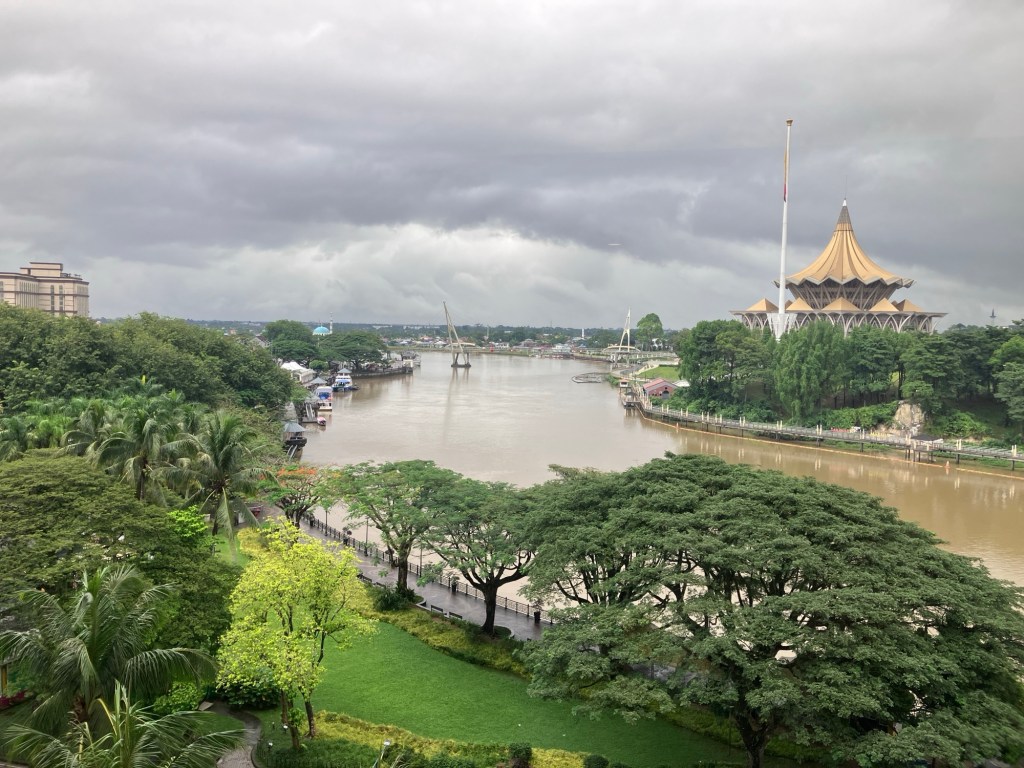
The view from our hotel room of the Sarawak River.
Kuching, the city of cats, was the jumping off place for our Batang Ai rainforest adventure in the previous post. Friends who know Borneo well (hi Ruth and Gary!) had said it was a nice relaxing city, and so it was. Rich booked us a newly renovated river view room at the Hilton and we settled in for nine nights, with two nights off in the rain forest in the middle. Kuching means cat in Malay, and that was enough for me. Cats, here we come.
Let’s go find those cats! This cat themed trash can looked like a good place to start.Kitty? You in here? The pedestrian bridge across the river made for nice walking, although it didn’t really connect through to the promenade on the other side of the river.
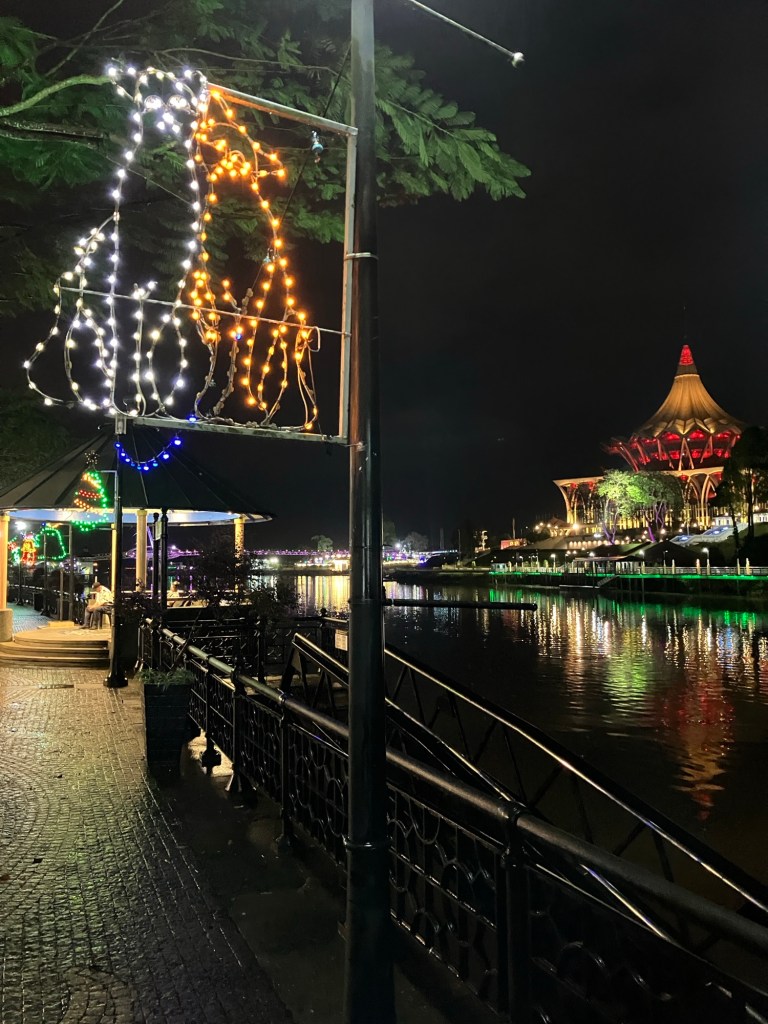
The big trees along the river shade a lovely promenade leading to the dramatic pedestrian bridge, and it’s a popular destination day and night. Lunar New Year celebrations were still going on so there were loads of visitors, and the city had a fun and busy vibe.
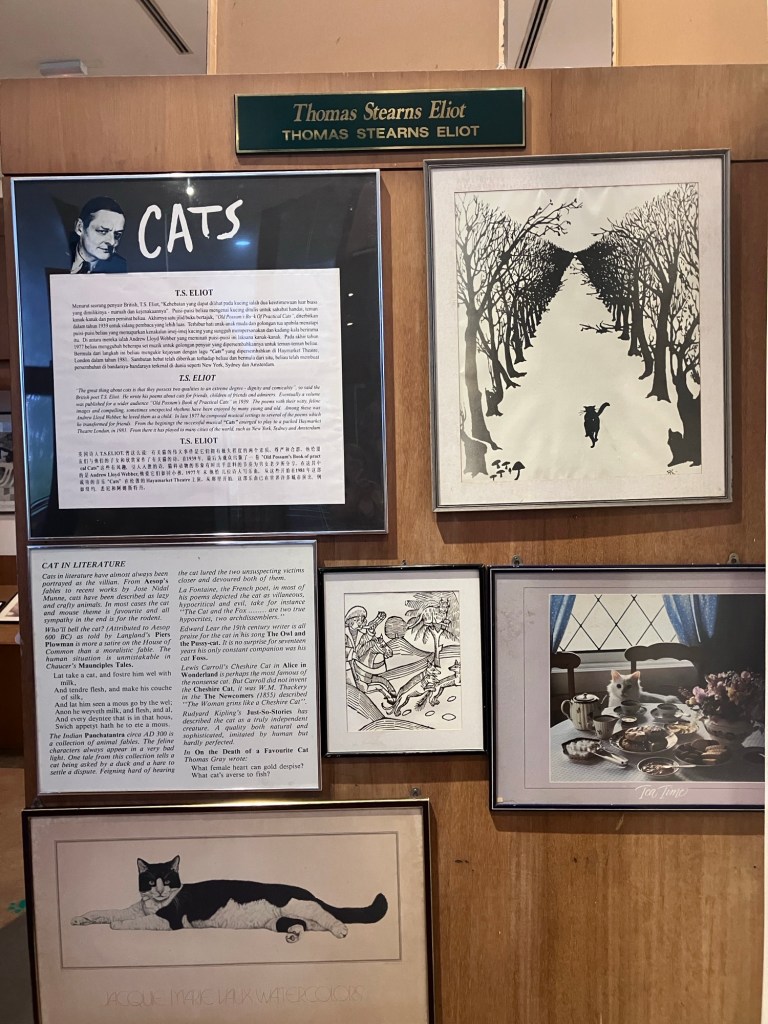
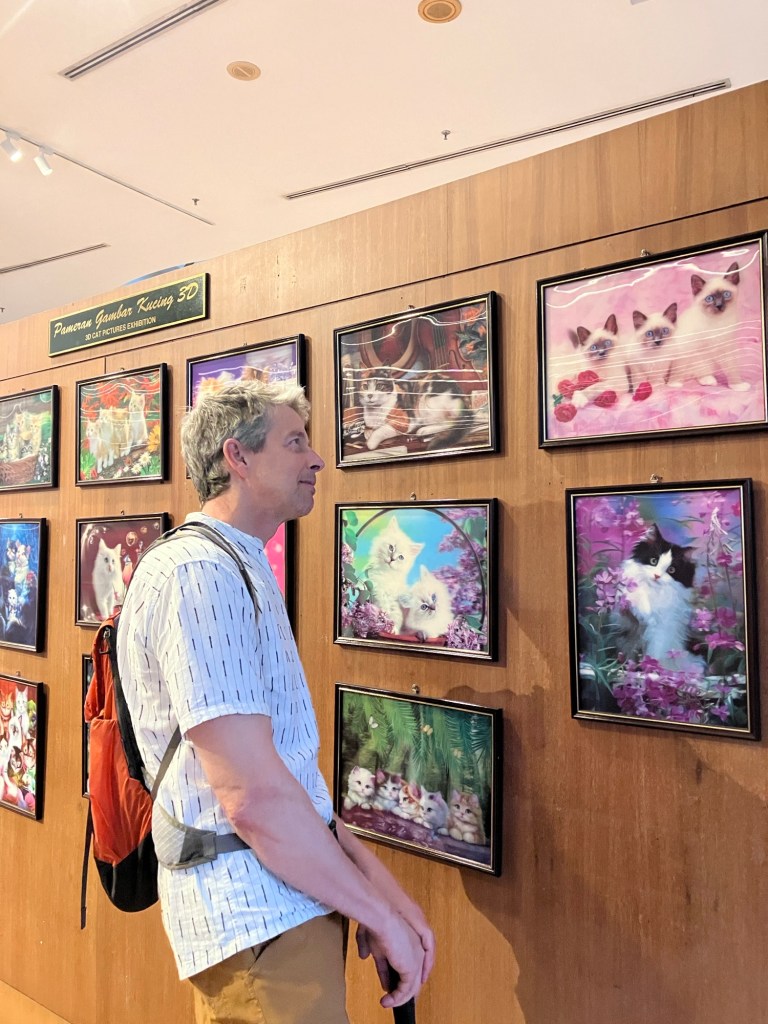
Certainly the Cat Museum was a good place to find cats, right?Here we come!Is this where the cats are?A bemused Rich as we realized the cat museum looked like the house of a cat fanatic. Minus actual cats.Cats in literature. 3D cat posters. Cat art.
The Cat Museum had cat everything, but no actual cats. This is a museum that would be a waste of time for travelers with fewer days to spend in Kuching. But Rich and I had a good laugh at the silly and kitschy collection, wondered how the “museum” ended up in the City Council building, and how it kept going. Our ticket price of about 60 cents was well spent, we figured, and on we went to explore more of this City of Cats.
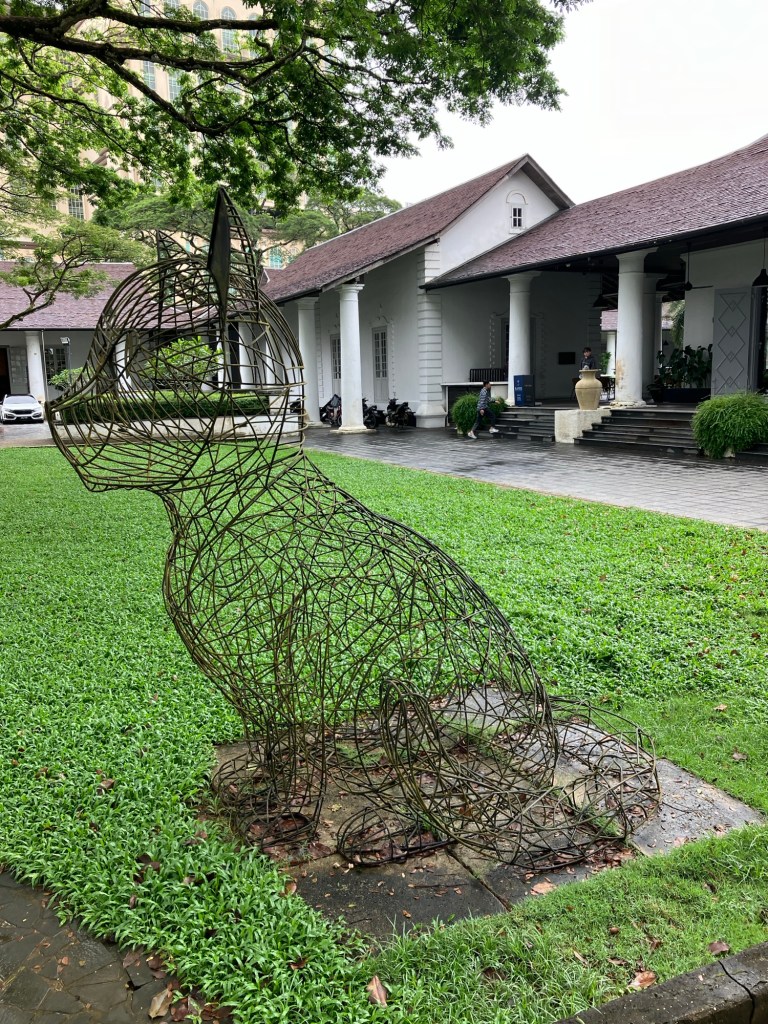
There were plenty of cats represented in art and decor around town. Wire sculpture of a cat.Even cat lights along the river. I appreciate a city that leans in to its shtick.Found a very pregnant cat to pet. Of course this one went right to Rich.The chefs at a restaurant on the promenade not only fed this cat, but also gave it shelter from the rain with a cat and dog themed umbrella.
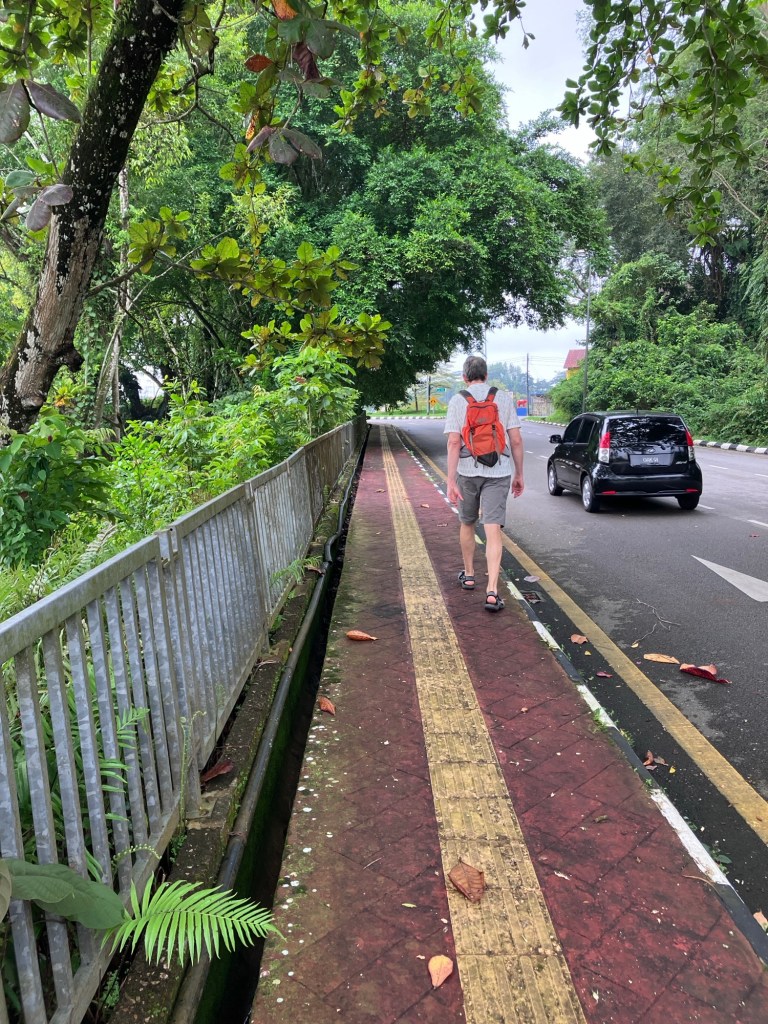
Searching for cats was fun, but couldn’t occupy all of our time in Kuching. It was still the rainy season in Borneo so we had some cloudy and wet days which was fine with us, the rain keeps the heat down. We try to walk as many places as possible, heat be damned, and walk we did. The Spring shopping mall was only 3 kilometers from our hotel, so we got out early one morning and headed off. We knew we would be facing some not wonderful walking conditions, we’d seen that much from our trip in from the airport. Kuching lacks public transport, with one bus line that makes a big loop around the city with arrival times every two hours, and lacks good pedestrian infrastructure. Things like cross walks and pedestrian lights are far and few between.
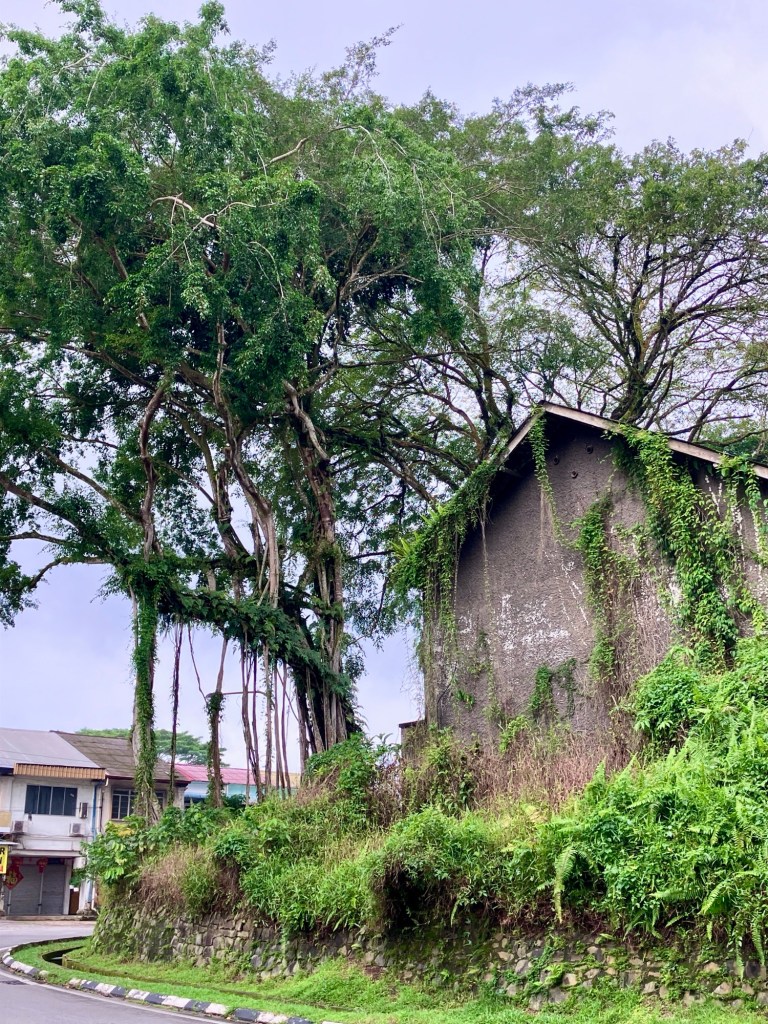
Sidewalks mostly exist, complete with raised tactile paving for those with vision problems.Kuching is a very green city. The walking on this overcast morning was pleasant.You see interesting things when you go on foot.And then you get to an intersection with no ped crossing. It was Sunday morning so not a lot of car traffic, fairly easy to dash across.And the sidewalk vanishes just short of the mall.
We don’t set out to find flaws in cities, but when we try to live our usual lives, walking, biking and taking transit, we realize where the weak links are. That makes us think about what it’s like for people who live in Kuching. Without frequent public transportation from the outer areas to the riverfront and commercial areas, people need to own cars, or use Grab rides to get around. Owning a car is a big financial commitment no matter where you live, and much of the money spent on automobiles is money that is not spent at local businesses – a point transit activists make everywhere. As for walking for transportation, we saw barely any other folks on foot once we left the riverfront commercial area. Like no one.
Walking to the nearby Borneo Cultures Museum, the building at the left, was fine.
As tourists we can stay near attractions we can walk to. But we see the car dependency, such as the big parking lots near attractions like the Borneo Cultures Museum- which is a fantastic and well curated museum. We joke that if you don’t see the entrance you can assume it’s closest to the parking lot.
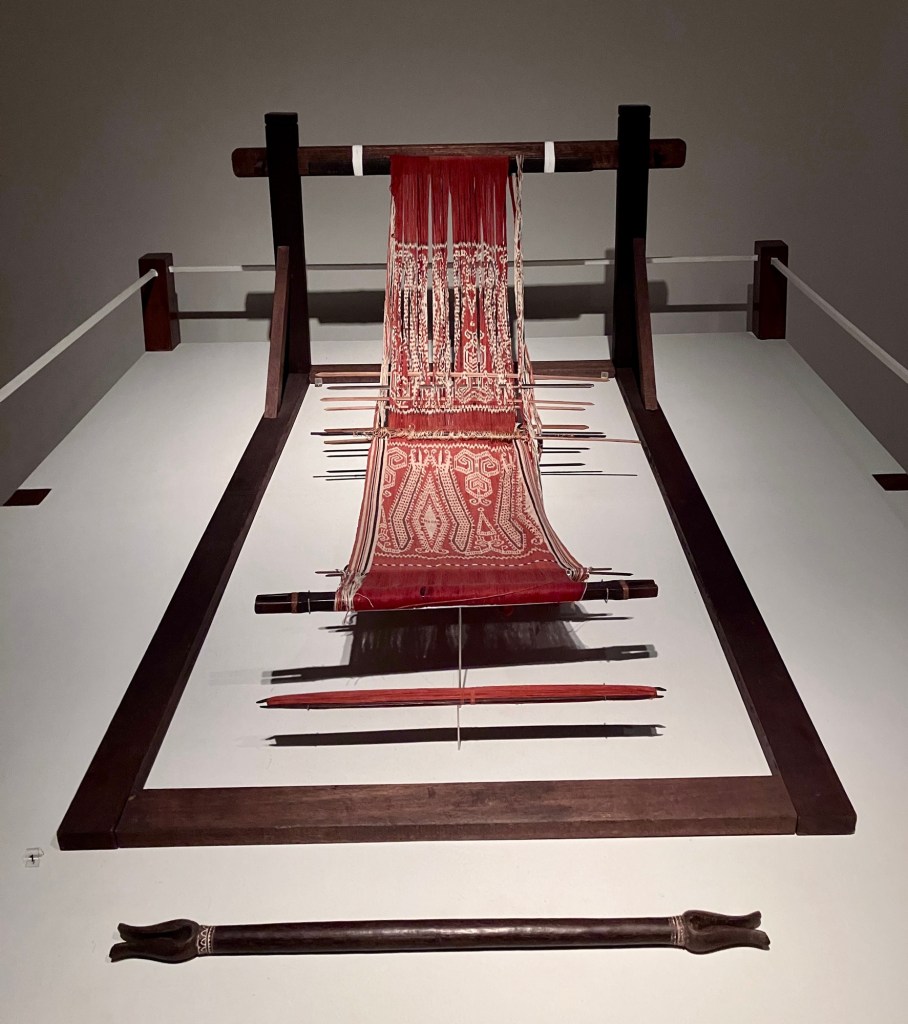
The Borneo Cultures Museum was newly built and opened in 2022 – great museum.A display about the traditional Iban weaving known as Pua Kumbu.
It was good to go to the museum before our trip to the rainforest stay at the Nanga Sumpa Lodge. The introduction we got to Iban traditions at the museum was a good first step, we had questions to ask our guide, and were introduced to the Chief whose photo appears in the museum.
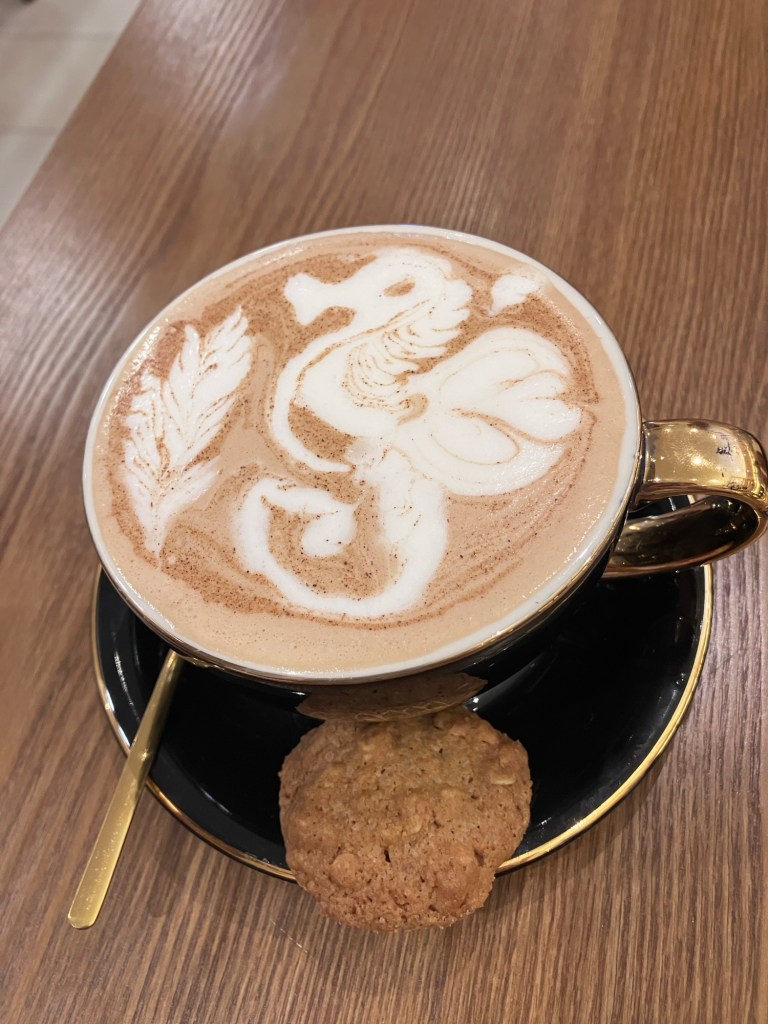
My chai at the museum cafe, the gift shop was also well curated.Since we didn’t see orangutans at Nanga Sumpa Lodge, it was off to Semenggoh after we came back to Kuching
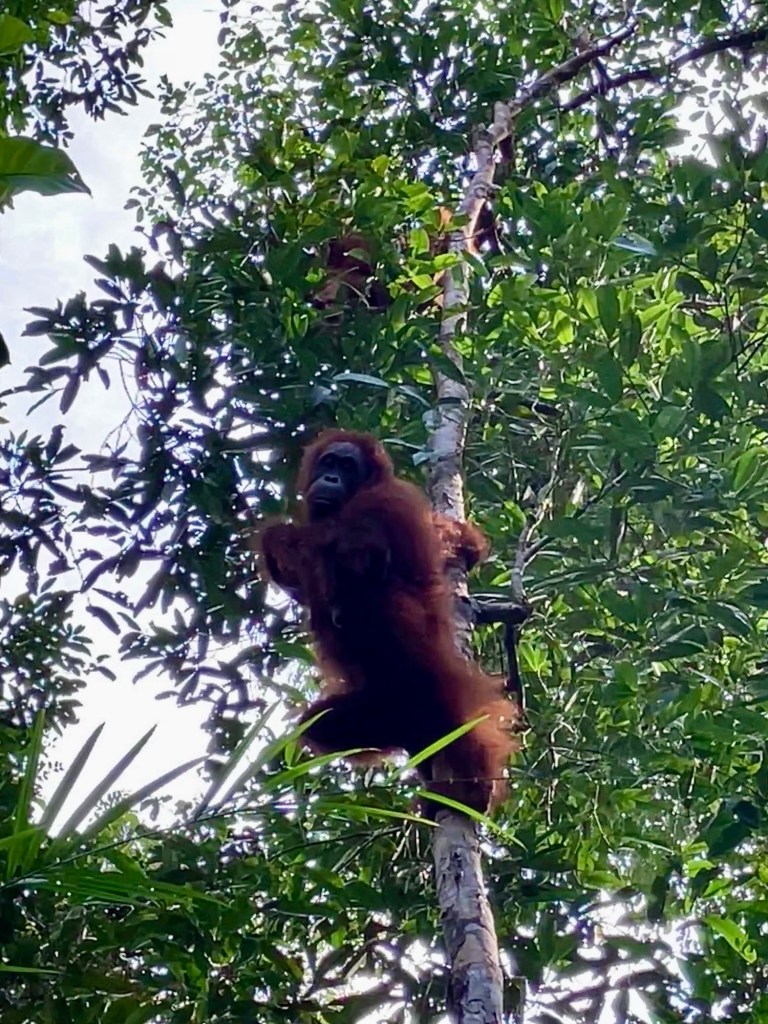
Semenggoh Wildlife Center is a 1,600 acre/653 hectares forest with a population of semi wild orangutans who are fed to supplement their wild diet. The acreage is not enough to support the animals with wild naturally occurring food. Founded as a sanctuary for rescued orangutans, the center has an established population with babies regularly joining the group. Visitors are let in morning and afternoon for the feedings of sweet potatoes, bananas, coconut, papayas, oranges, sugar canes, pineapples and hard boiled eggs. There is no guarantee that the orangutans will show up, they may just stay in the forest eating naturally growing fruit, especially during g fruiting season which it was. Thankfully the draw of food was enough to tempt out four the morning we went.
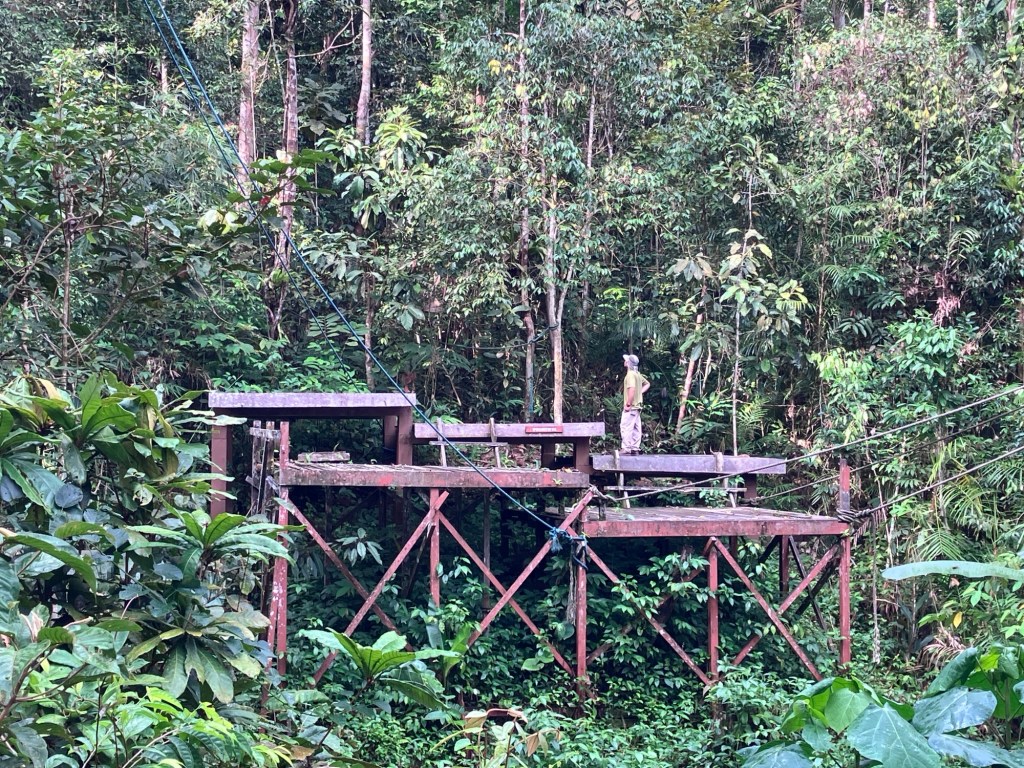
Food?A reserve worker headed out to the feeding platform with a basket of food.Staff on the platform watching for orangutans. The workers make whooping noises to let the apes know food is available.Humans waiting patiently for the orangutans. Here comes a momma and baby, and her toddler aged offspring.There are no blasé visitors when the apes swing into view in the forest.
Semenggoh is about 20 minutes south of Kuching by car, 30 minutes north will get you to the jetty at Kampung Bako to take a boat to Bako National Park, which is on a peninsula reachable only when the tide is high enough for the boats to get through. For both of our trips we hired a driver we met on our rain forest adventure and he dropped us off and picked us up from both visits.
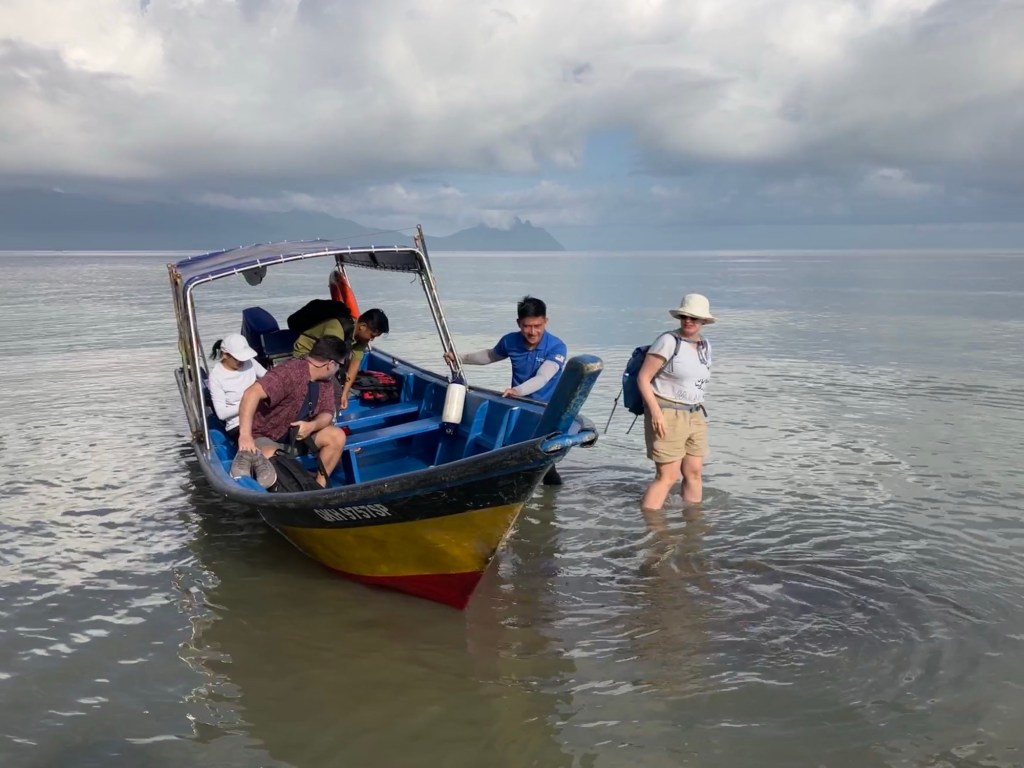
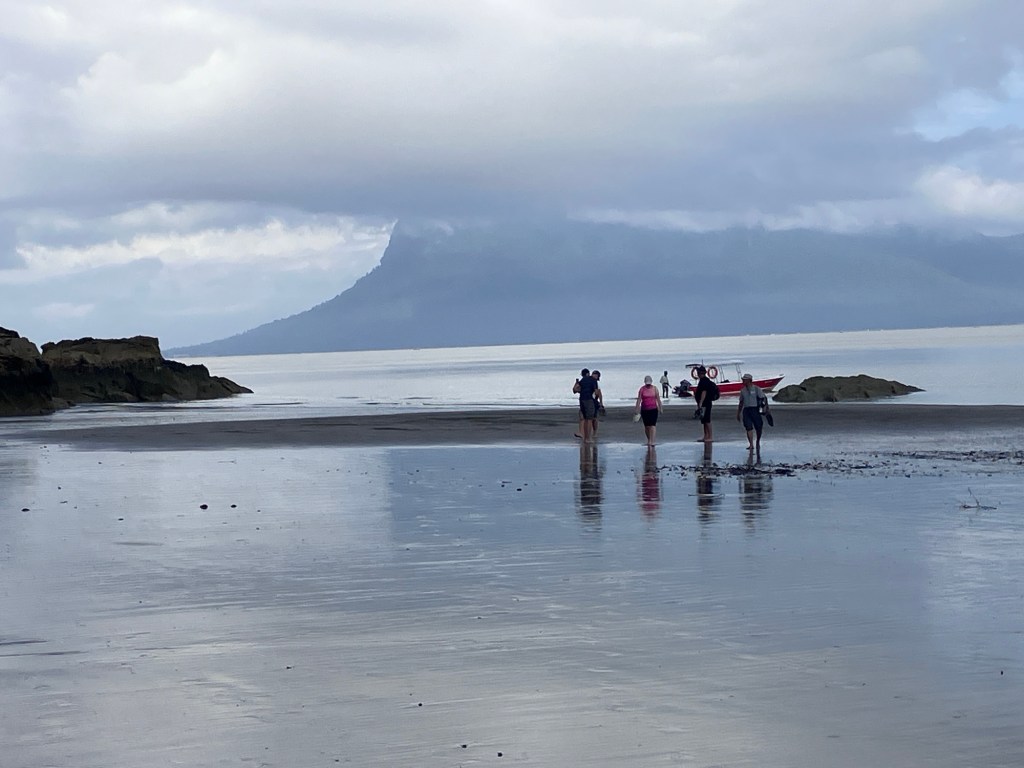
Disembarking at Telok Assam beach.It’s a fun way to start the day – feels a bit survivor-ish.
We were super lucky to share a boat with Katherine and Chris (hello you two!) from Seattle, and we all hit it off so well we spent the day together hiking and marveling at the wildlife.
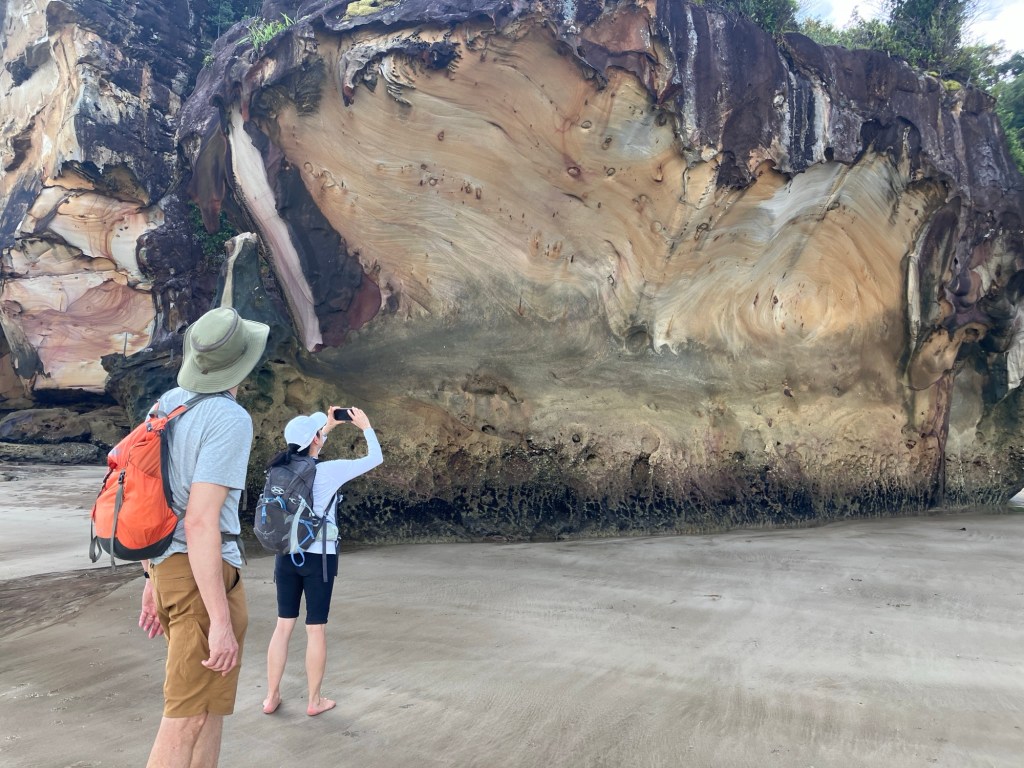
Our first look at the park.The rock formations are the result of erosion stripping away sedimentary rock to leave the thick, resistant sandstone behind.A dramatic chunk of sandstone.A forest on top, highlighting the blue sky.
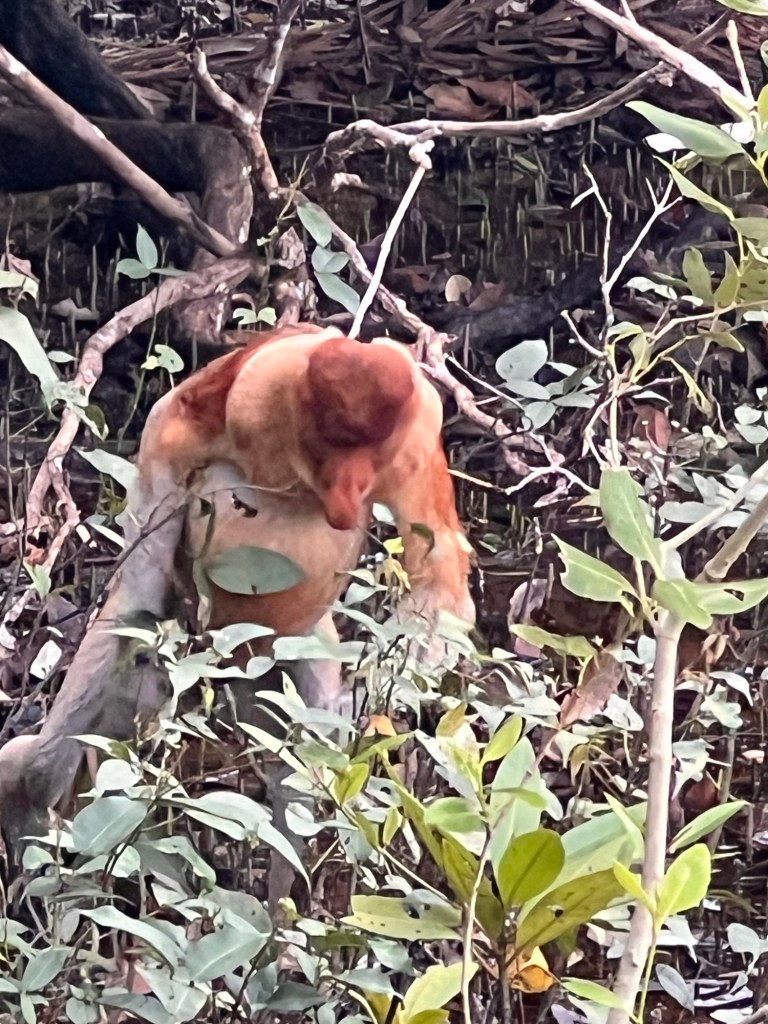
The park is very well run, with check in at the registration desk, overnight accommodations with reservations required, and well marked trails and maps. And the animal viewing! Really amazing. As our driver Ali said, Bako is for animals. Proboscis monkeys, silver leaf monkeys, and macaques. We also saw a flying lemur sleeping the day away in a tree, and a pit viper. And adorable bearded pigs.
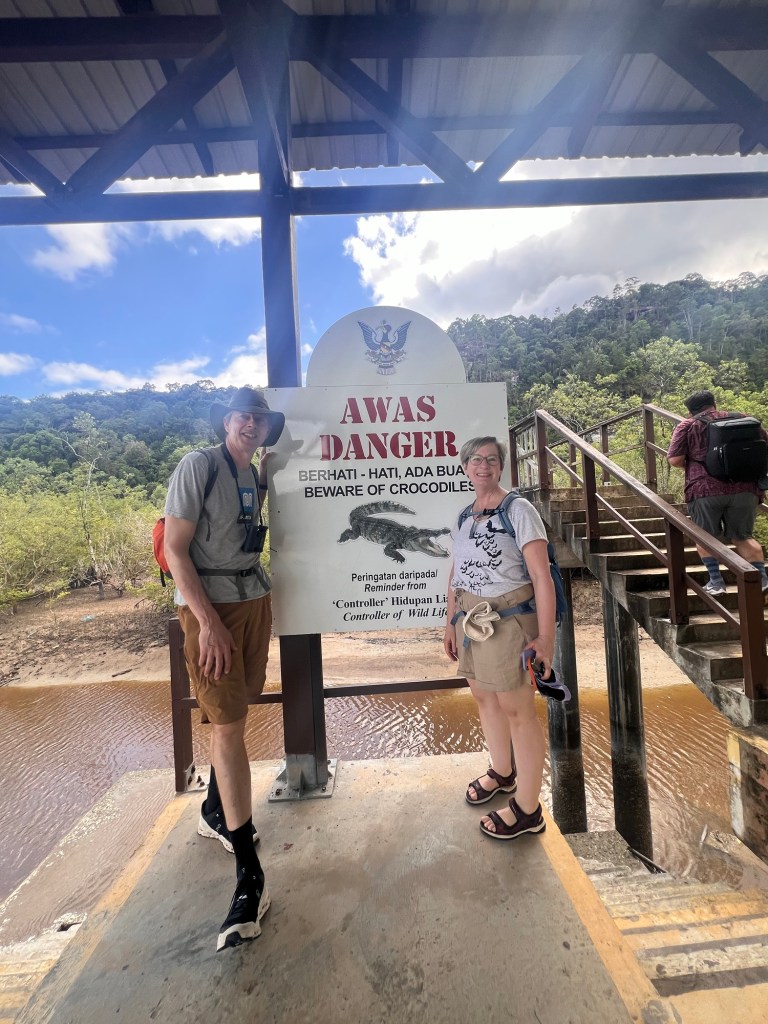
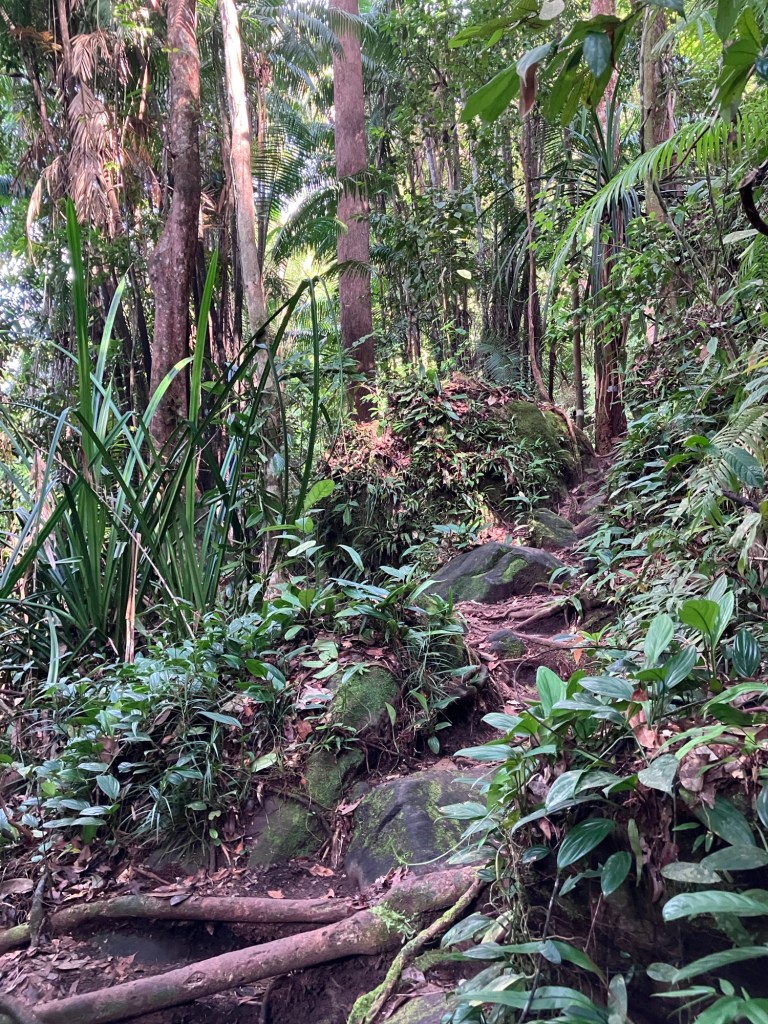
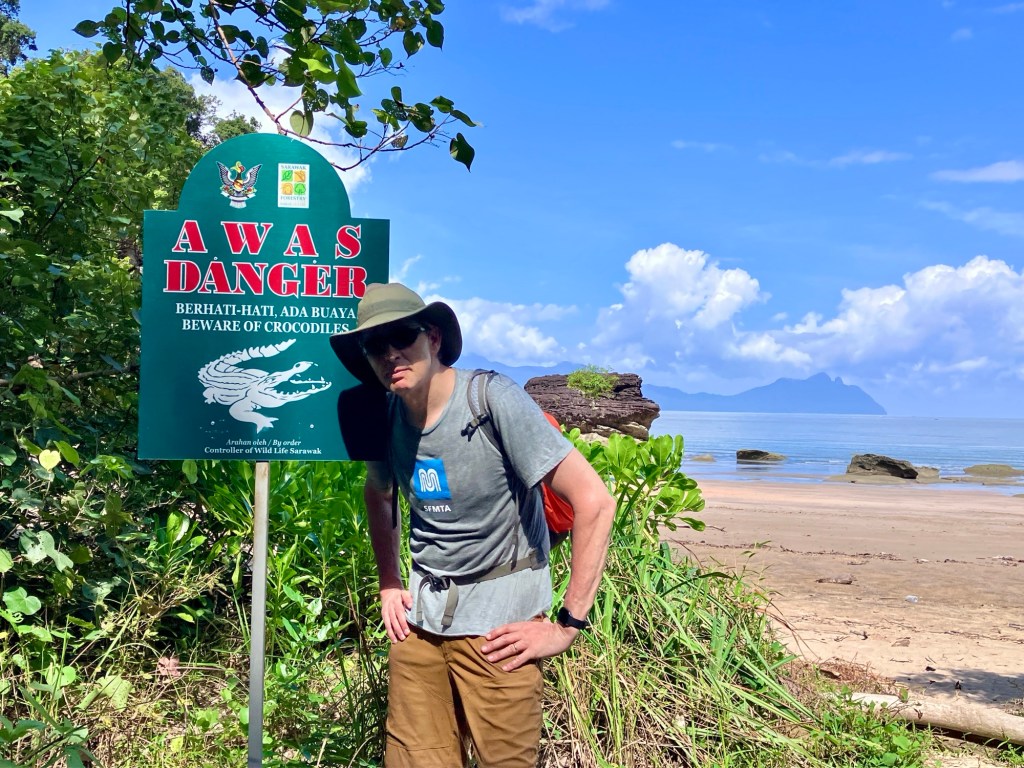
Mama and youngsters having breakfast.Oh yes, no swimming at Bako due to saltwater crocodiles. Photo by Katherine.Headed out for hike number one.We first saw a proboscis monkey spotted by Rich. Katherine’s photo- much better than mine.No shortage of trails. You would have plenty to do with a two night stay.The trails are well marked but tiring with the up and down and heat and humidity. Our first beach. There should have been a monkey warning sign. We were quickly joined by a macaque who was certain he could bully us into feeding him.The monkey took this for an invitation. Oh! Backpacks. Must mean food.I am patient. I am persistent. I am monkey.Katherine looking at shells. Monkey waiting.It was so nice to have people to share the hike with – so glad we met!
After lunch Rich, Katherine, and Chris headed out for a second hike and I stayed behind to read and mind the extra gear, and watch macaques marauding the cafe.
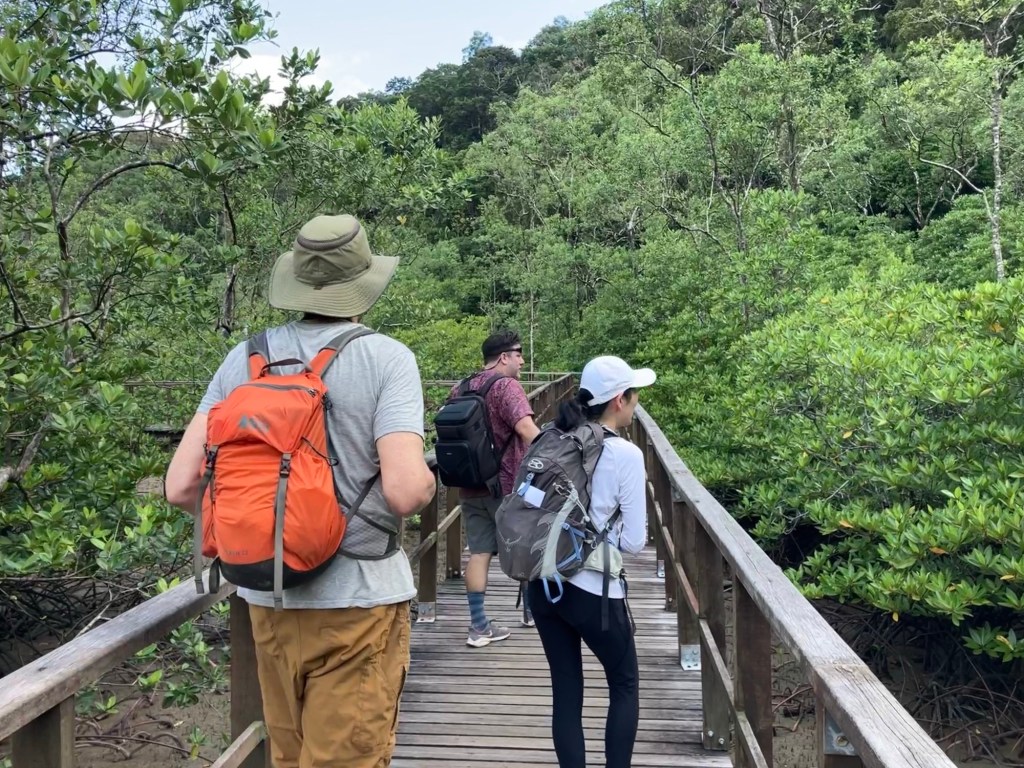
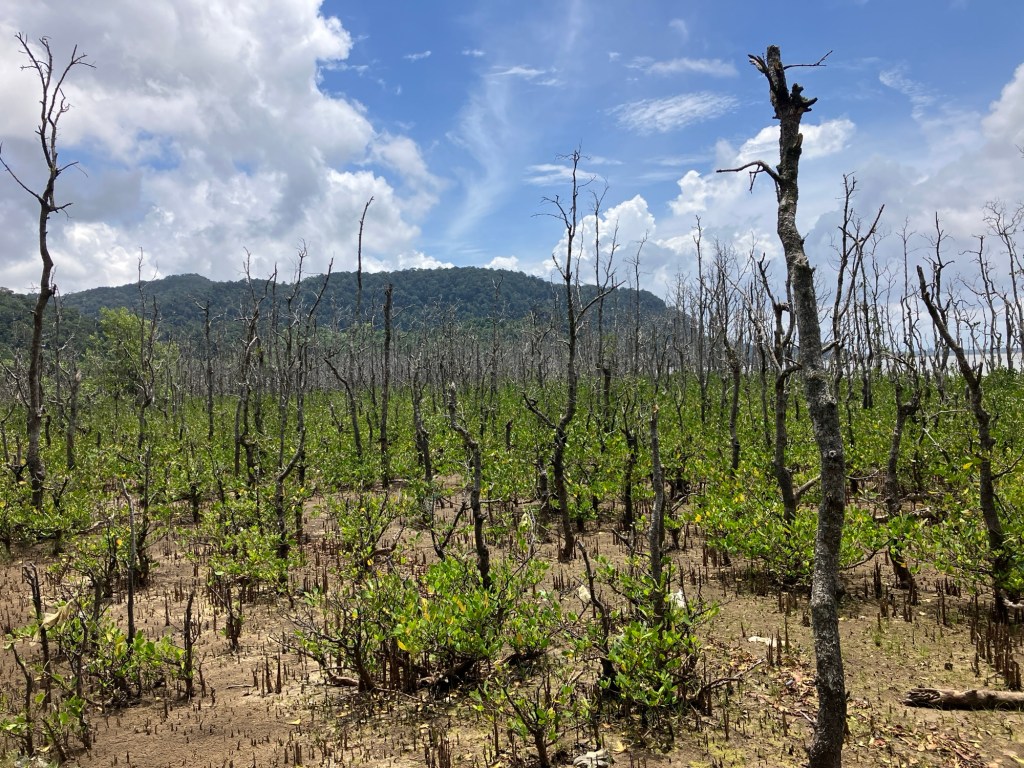
Stunted mangrove forest.The view from Bako to Santubong Peninsula.Gorgeous rock formations.A pit viper.Back on the boat after a successful and happy day.
Spending a week plus in one place means you get to do the little things that might not be on the top of your must do list. From our first day in Kuching we saw the little boats plying the river. Although the lovely pedestrian bridge crosses the river, you cannot go directly right from that bridge to the waterfront promenade. So, we took a little boat. A tambang (motorised water taxi).
A fishing boat.A tambang at night.Heading to a boat to cross the river.Settled in for the 1 minute ride.Our captain. Paying the captain.
The short boat ride took us across the river to Kampung Boyang, which was a fun glimpse of what most of Kuching probably looked like a few decades ago. A botanical garden and The Brooke Gallery at Fort Margherita, which told more of the history of the English dynasty of White Rajahs who governed Sarawak for 100 years. It’s a fascinating bit of history with colonization overtones, but one which is remembered with what seems to genuine respect for the Brooke family. Of course, both museums dedicated to the history of the Brookes are funded by the Brooke Foundation, so there’s that.
Kampung Boyan.Signage for the sights- I love the hornbill mascot.
We certainly found enough to do, and enough good places to eat, to make our time in Kuching very enjoyable. It was a bonus that our hotel had a newly renovated gym and a big swimming pool(about to be renovated). Mornings were spent exploring, Lunch out, afternoons were at the gym and pool. Then it was back out for a walk and dinner.
Delicious thosai lunch at Ceylonese Restaurant Sdn Bhd. We also had dinner here twice, once with Katherine and Chris which was great as we ordered a lot of different items.The Granary Kitchen + Bar, one lunch and one dinner. Lunch was a local menu and dinner was western.And every day started with the fantastic breakfast buffet at the Hilton.Rich buying our lunch, steamed buns, from Kuching’s youngest business man.I’m still stunned by the green landscape, even in the city. Any land gives rise to a dense green.One last cat themed photo.
We’re in Kuala Lumpur now, so glad we had such a good long stay in Borneo. Even with over three weeks there is still a lot more fun to be had. Did we adjust to the heat and humidity? Not really. It’s hotter here now in KL and it’s quite draining, even three weeks on. We’re just not hot weather folks. Mild San Francisco weather for 30 years will do that.
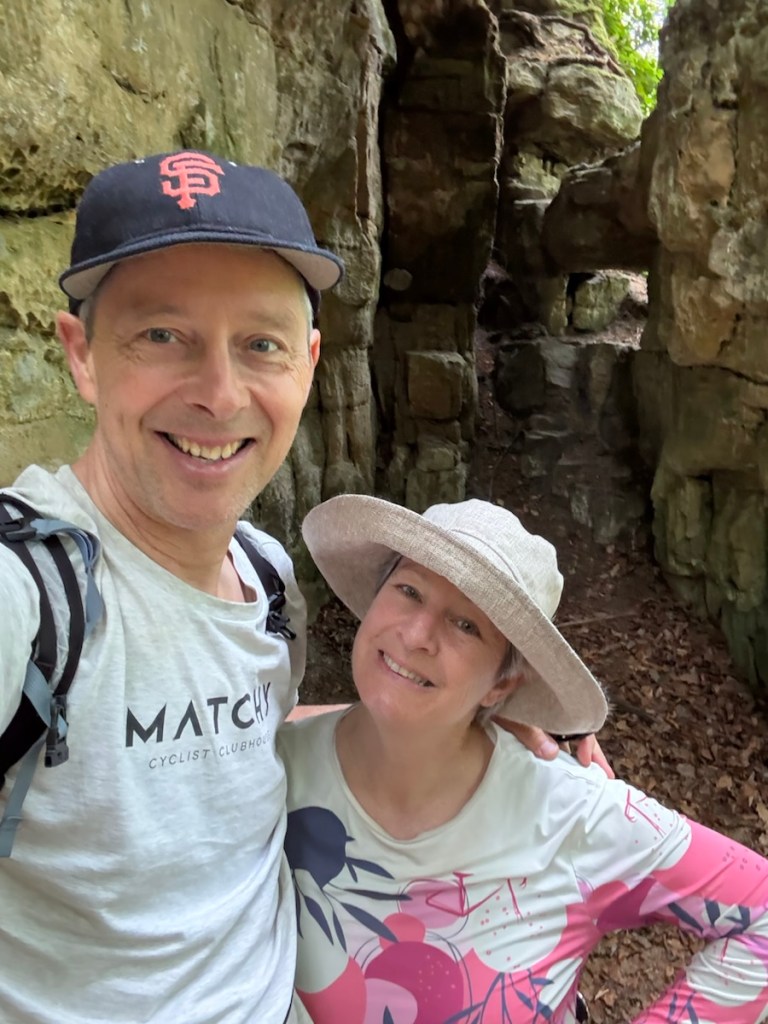
Borneo. Our places stayed: Koto Kinabalu, Mt. Kinabalu Park, Mulu National Park, Miri, Kuching, Batang Ai National Park, Kuching again.The happy travelers.
Walking across the border from Albania to North Macedonia, on Lake Ohrid.
When we decided to do all our Albanian travel by bus and an occasional taxi, we knew it wasn’t going to be the easiest way to travel, but as we say to each other “We may see fewer places, but we will experience more”. The trip to Lake Ohrid was a great example of more experiences.
See more of less. Ooooh, travel motto t-shirt? Have I loved every bus trip? No. They have their ups and downs. Occasional motion sickness, drivers who smoke. But the pay off is that we both get to sightsee, we get to experience the same transportation the locals use, and you never know what your day will be like. Seamless? Almost seamless? Complete mess? Who knows? So off we go.
Pogradec Albania, the bus station where we arrived from Korçë. Step one.Loading our bags into a taxi. Or just a car. Not really sure. Step two.
We walked to the bus station in Korçë, and quickly caught our bus to Pogradec. A town at the foot of Lake Ohrid. When we got off the bus in Pogradec, Albania, and walked towards the street, the driver of another bus asked us “Tirana?” No, Ohrid, we replied. He hooked his thumb towards another guy, “Ask him, he’s the boss.” The Boss agreed to drive us to the border for 1,000 Lek, or $10.00. Albania is a fascinating contradiction of confusing yet surprisingly hassle free. Tourism is still pretty new here, so bus schedules are not set in stone or well documented, but there seems to be very little scamming or property crime directed at tourists. This was a good example, we didn’t even leave the bus parking lot and the first person we interacted with sorted us out. A bit gruff, but helpful.
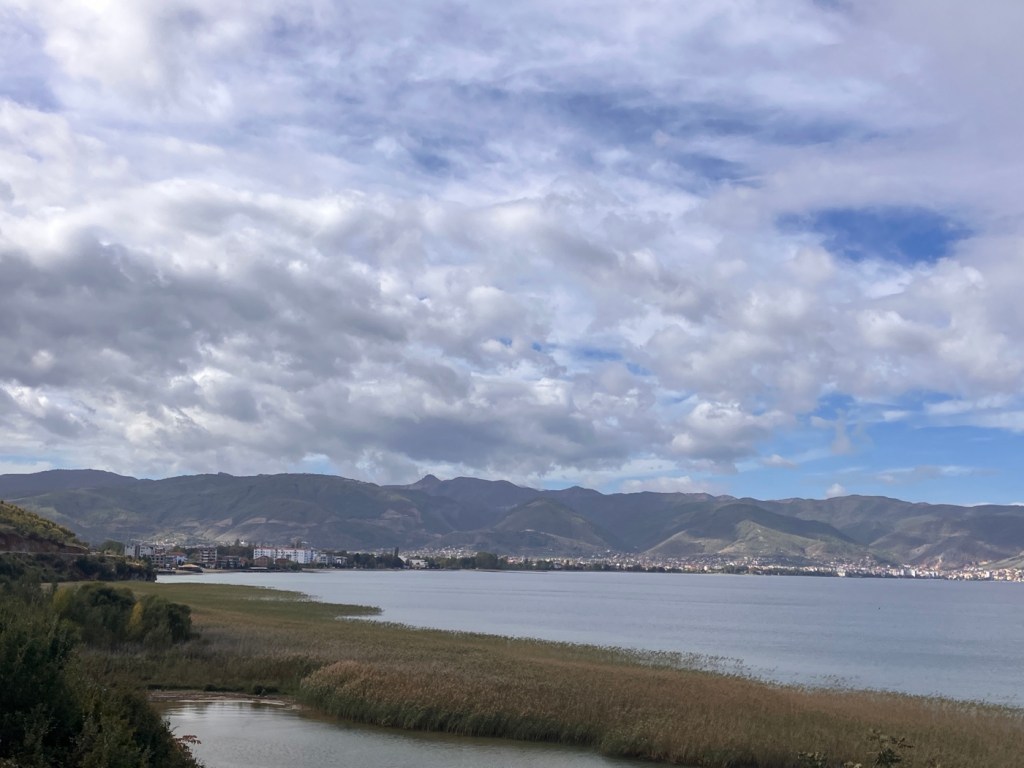
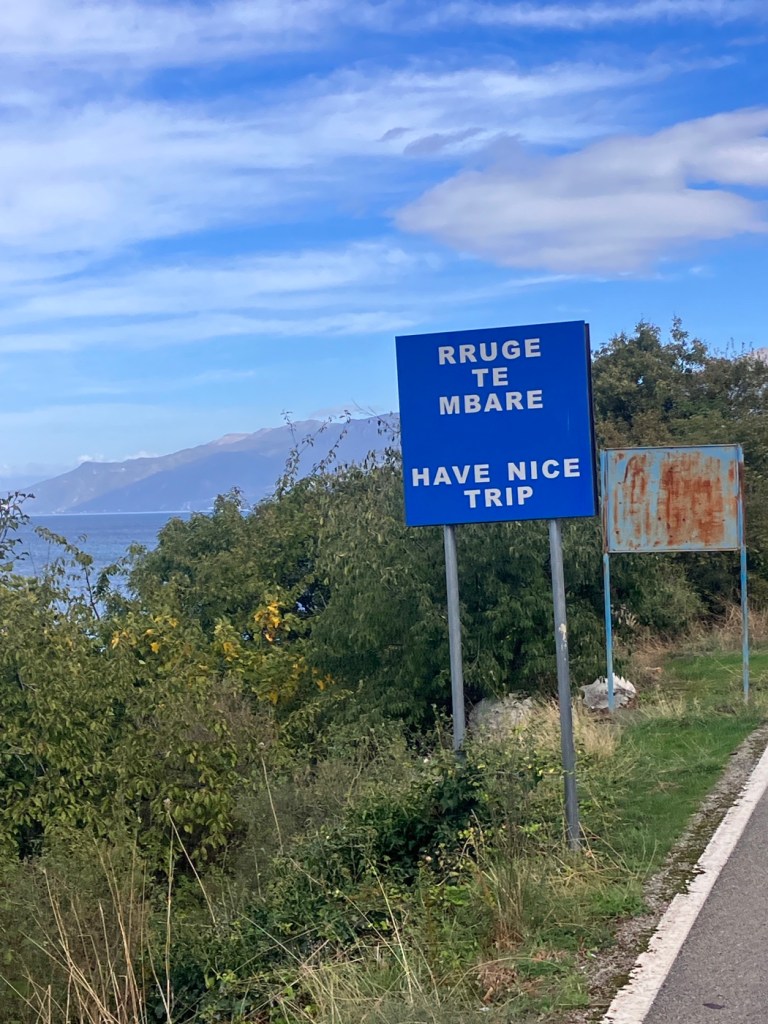
Lake Ohrid, first glimpse.A welcome sign at the North Macedonia border.
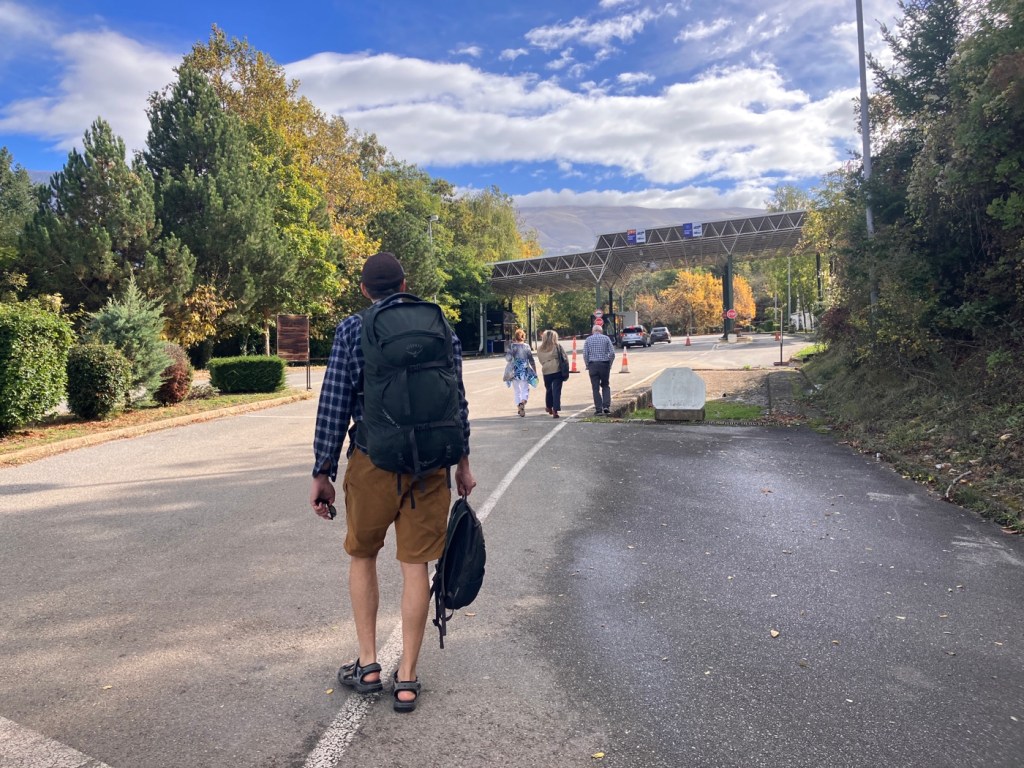
The Boss dropped us right at the border and we put on our backpacks and lined up behind a car and three day tripping Italian tourists (no luggage), and had our passports stamped. Then it was about a kilometer long walk to the North Macedonia border control.
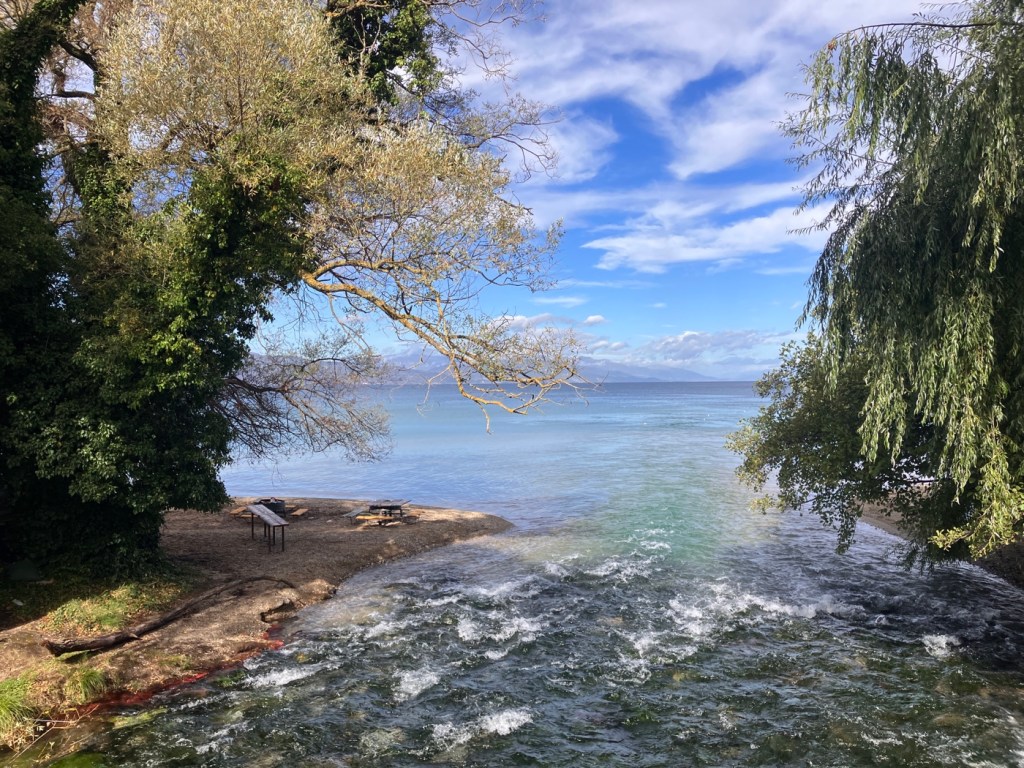
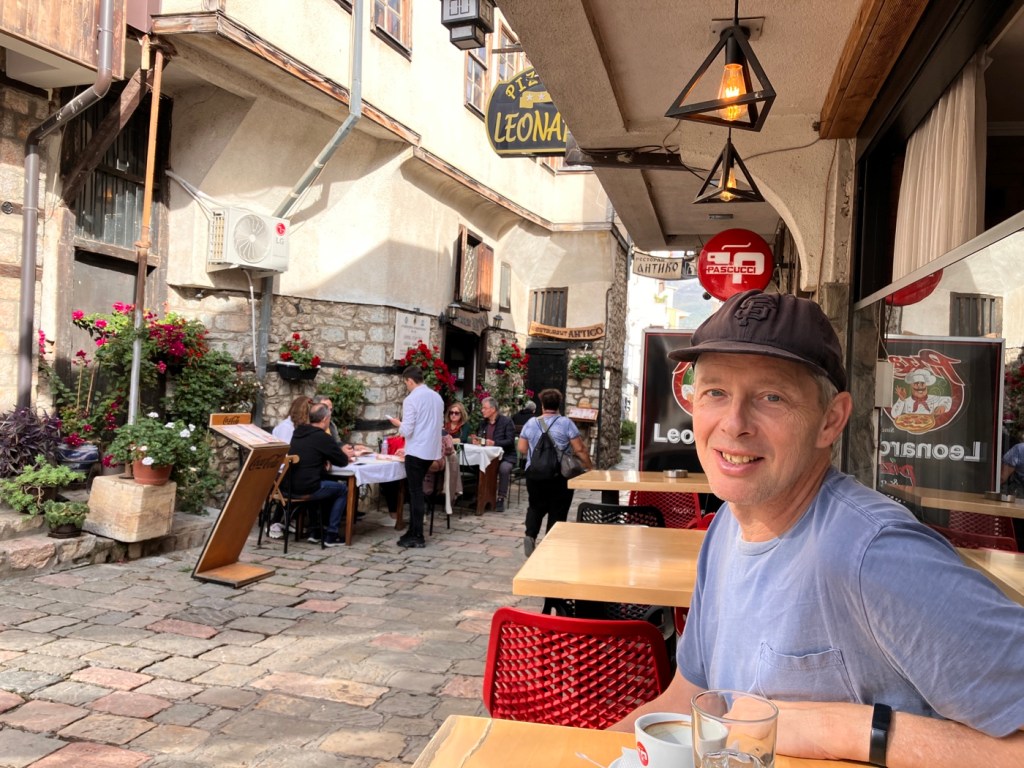
Approaching the North Macedonia border control on foot, step three.Taking a trail down off the road to Monastery Saint Naum, where we think we can catch a bus to Ohrid.Crossing the springs which feed into the lake and are a destination and popular sight.The minibus was easy to find. Second and final bus of the day! Step four.Step 4.5, try to get in to apartment. We didn’t have cell coverage in Ohrid so Rich had to buy a coffee and use a cafe WiFi to reach the apartment manager. And walk down and back up the hill again.And a cup of tea on our balcony overlooking the lake. Successful transition. We were excited to get out and walk the streets, first stop was the Church of Holy Mother, Kamensko. Devotional candles.No photos inside, but the outside was beautiful.With a sweeping view across the town to the mountains.The main street is a lovely pedestrian promenade. And the evening walk, xjiro in Albanian, is popular.Hanging out by the ferry dock as the sun sets.Still buying wine for the label.Dusk from our balcony.
We had originally planned on 3 nights in Ohrid but switched to 4 nights for two main reasons, we liked our little apartment, which had a kitchen shared with two other units, and we were meeting up with other travelers from a Facebook group I belong to, Go With Less. We’ve done meet ups a few times and it’s always been really fun. You automatically have so much in common with other constant travelers, you get to trade tips, and share stories without having to explain what it is you’re doing.
The traditional old buildings in Ohrid have increasing floor space on each level, leading to this fun streetscape where the top floors of buildings across the street from each other are almost touching.I like the streetlights which mimic the building silhouette. Some people thought they were a bit cheesy, but not me.
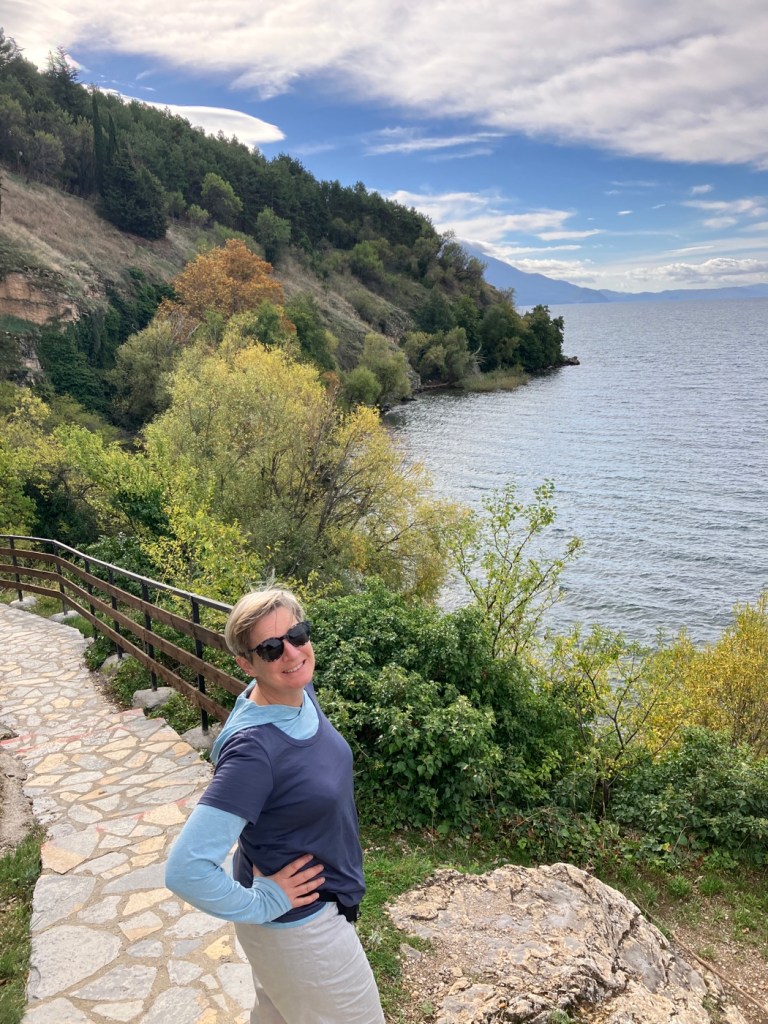
Ohrid is an UNESCO Cultural World Heritage site and has enough fascinating places to keep a visitor busy for several days, more if you enjoy walking the hills and coastal path, as we did. And if you like friendly cats, this is your town.
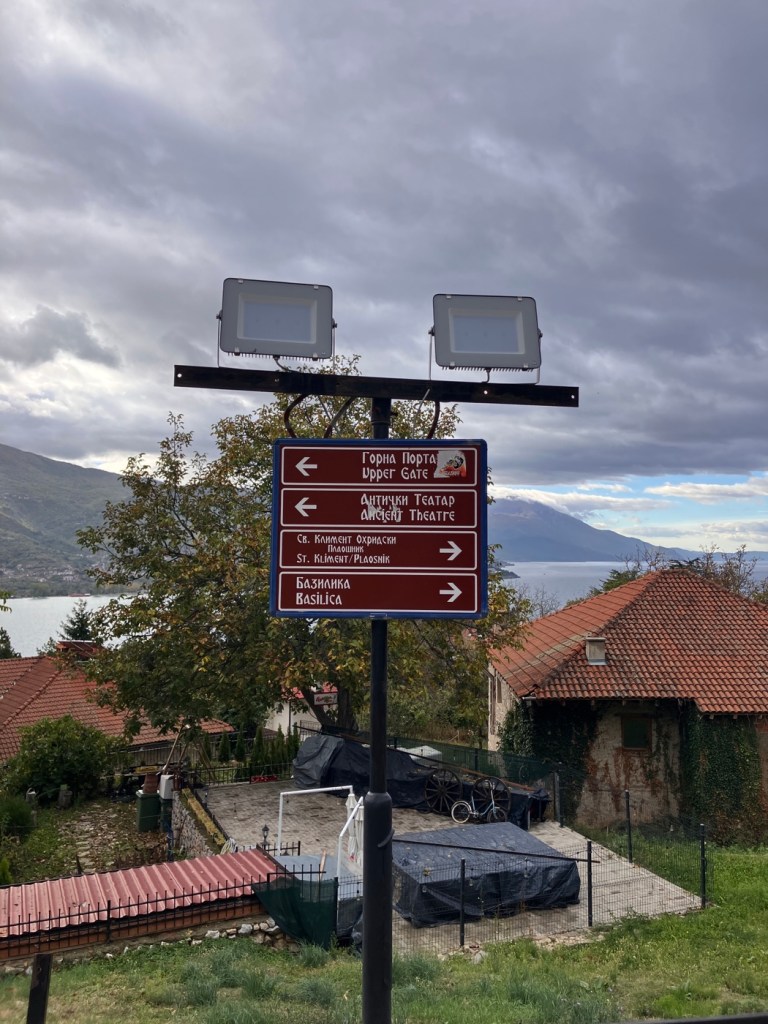
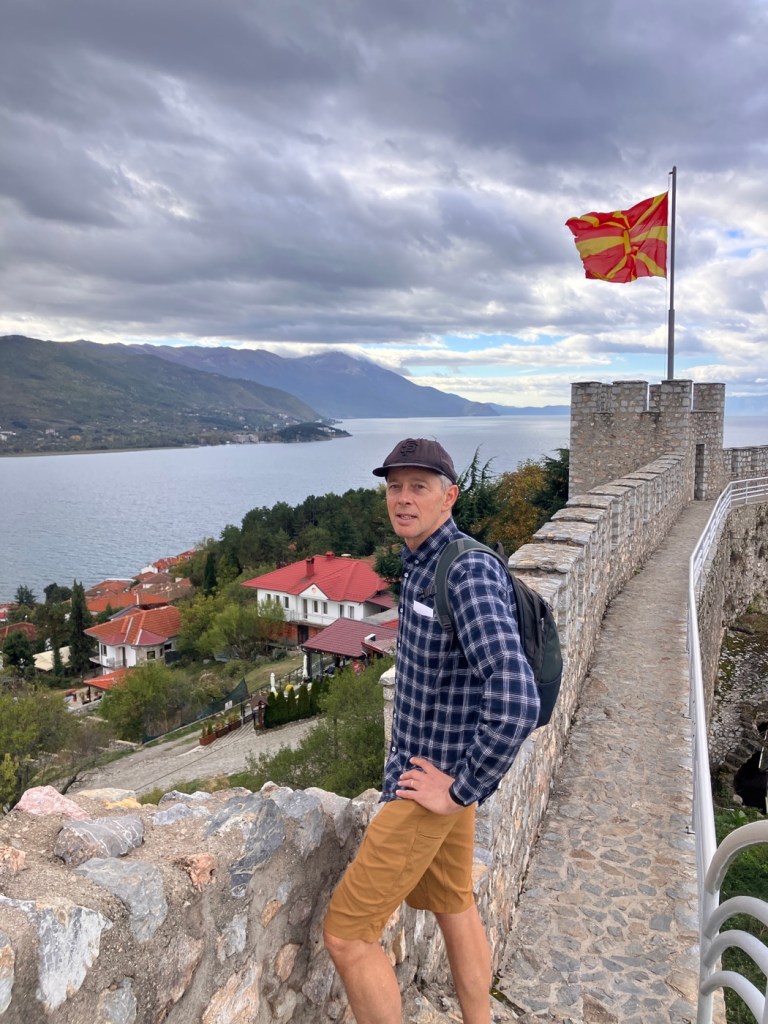
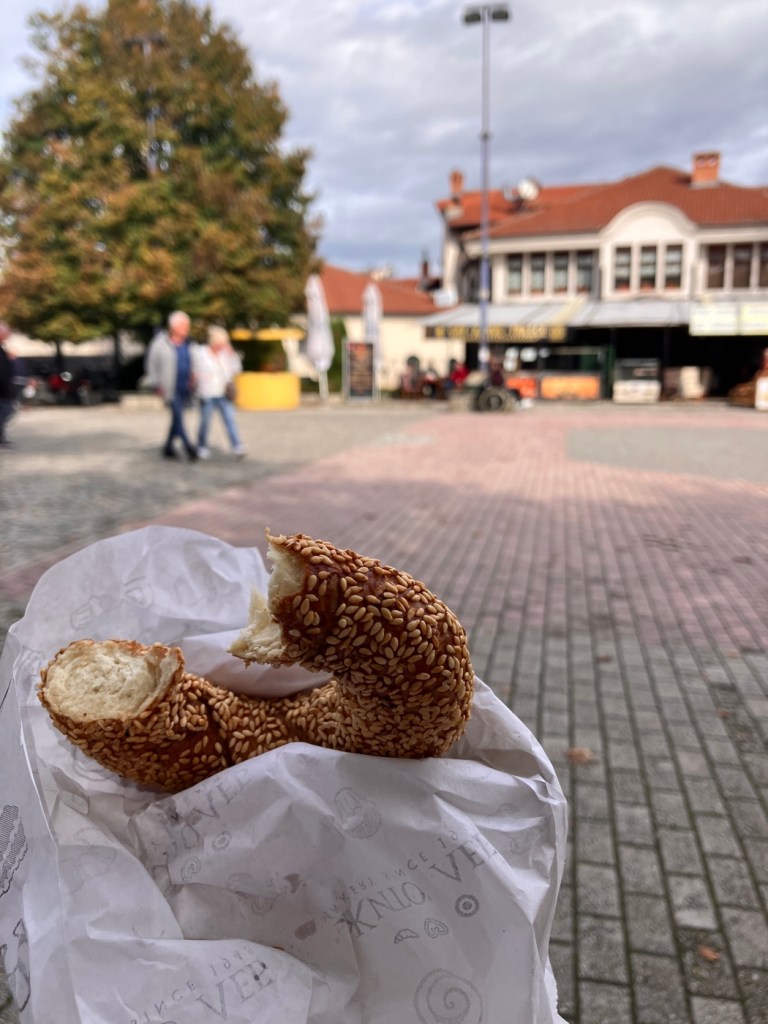
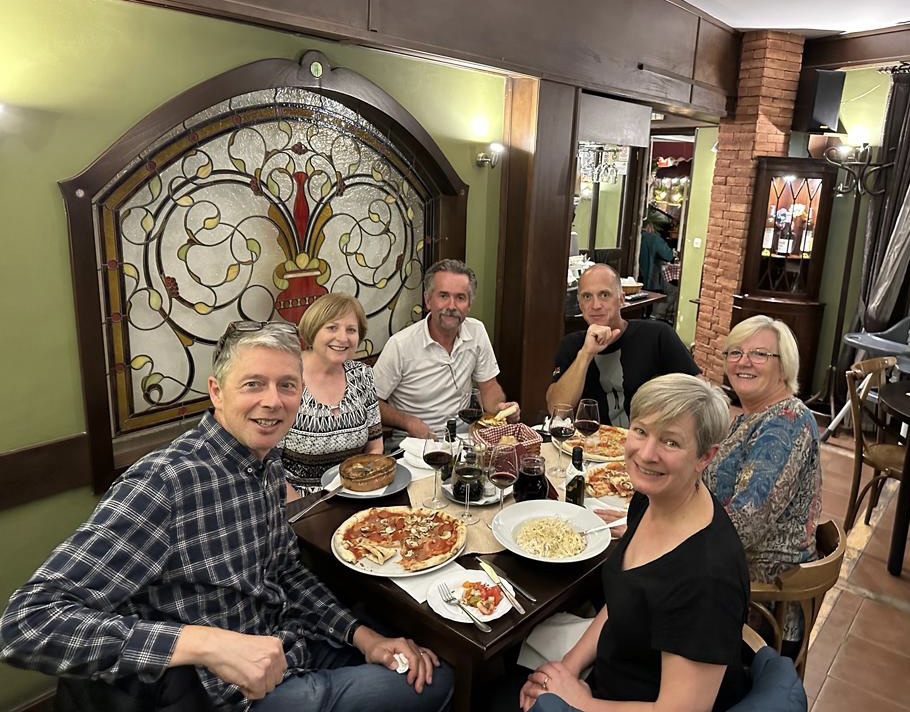
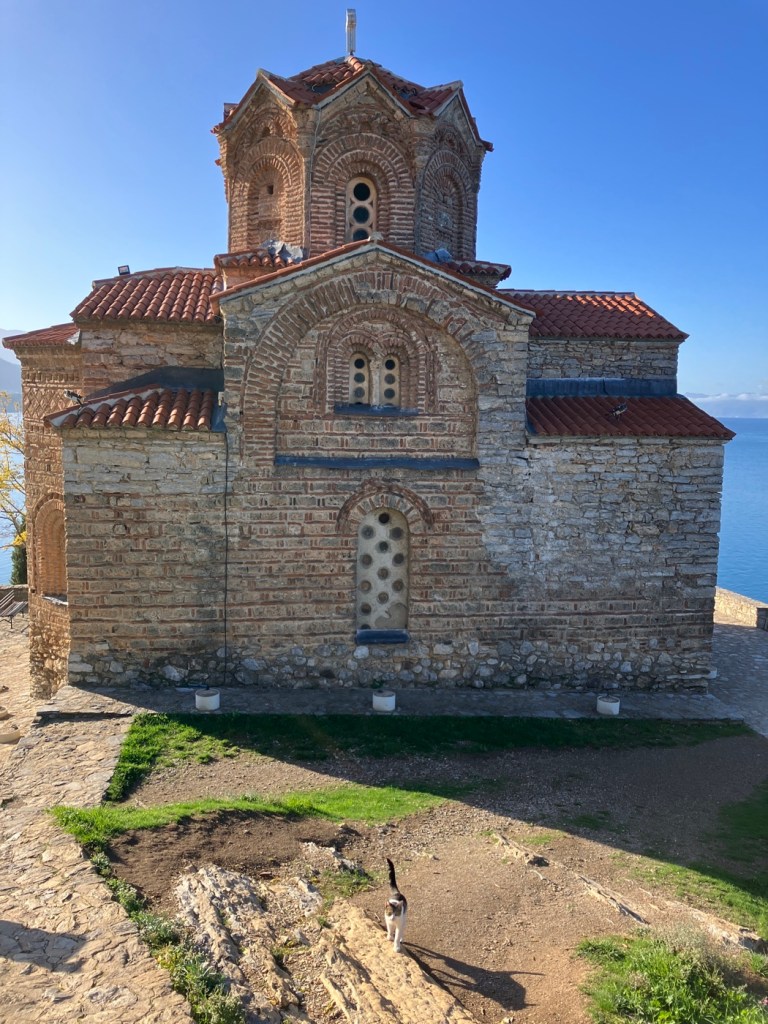
Oh, hello. Where to start?How about the ancient theater. Quite a view from the seats.Up to Samuel’s Fortress (Самоилова тврдина) for a view over the city.Rich surveys the town. N. Macedonia wins the big flag award. They fly impressively huge flags, very eye catching.Down a trail and we pass by the Church of Saints Clement and Panteleimon (Православна црква „Свети Климент и Пантелејмон“). And the Church of Saint John the Theologian (Црква „Свети Јован Богослов“). Are you starting to understand how many churches there are in Ohrid? Apparently at one time there were 365 churches, one for each day of the year. The stone paved coast path is a lovely walk.Back to the main street for a snack. Our old friend from Turkey – a Simit! Called a gjevrek here. Checking out the promenade south of town, also a great space.And a break for tea and coffee at the cafe where we used the wifi. And discovered how friendly some of the cats are.That night we had dinner with fellow travelers Doris, Ron, Peter, and Karen – all super nice Canadians. We met up again the next evening as well.
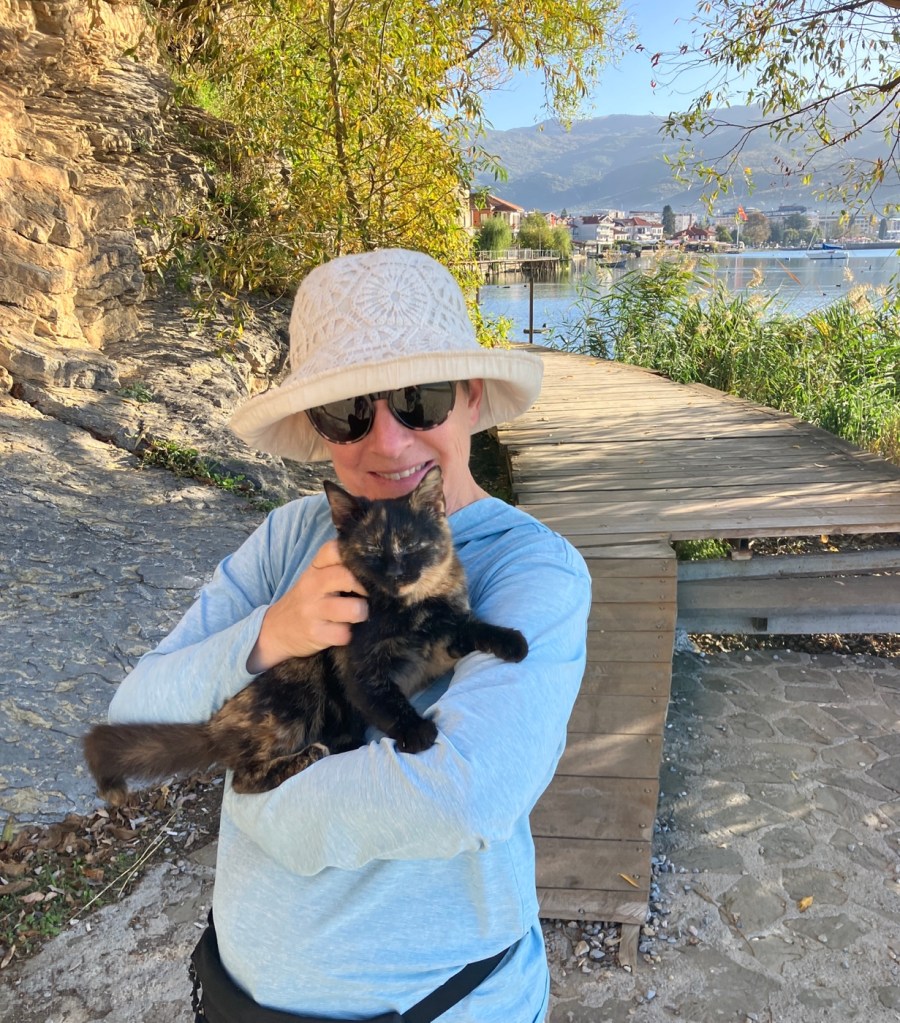
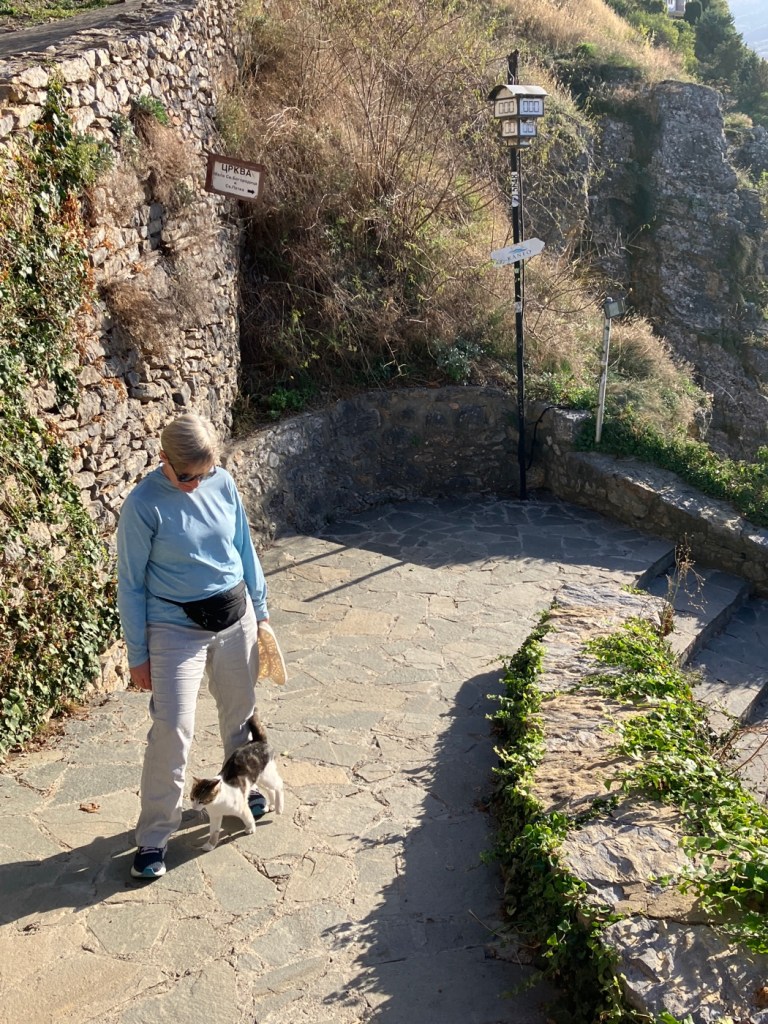
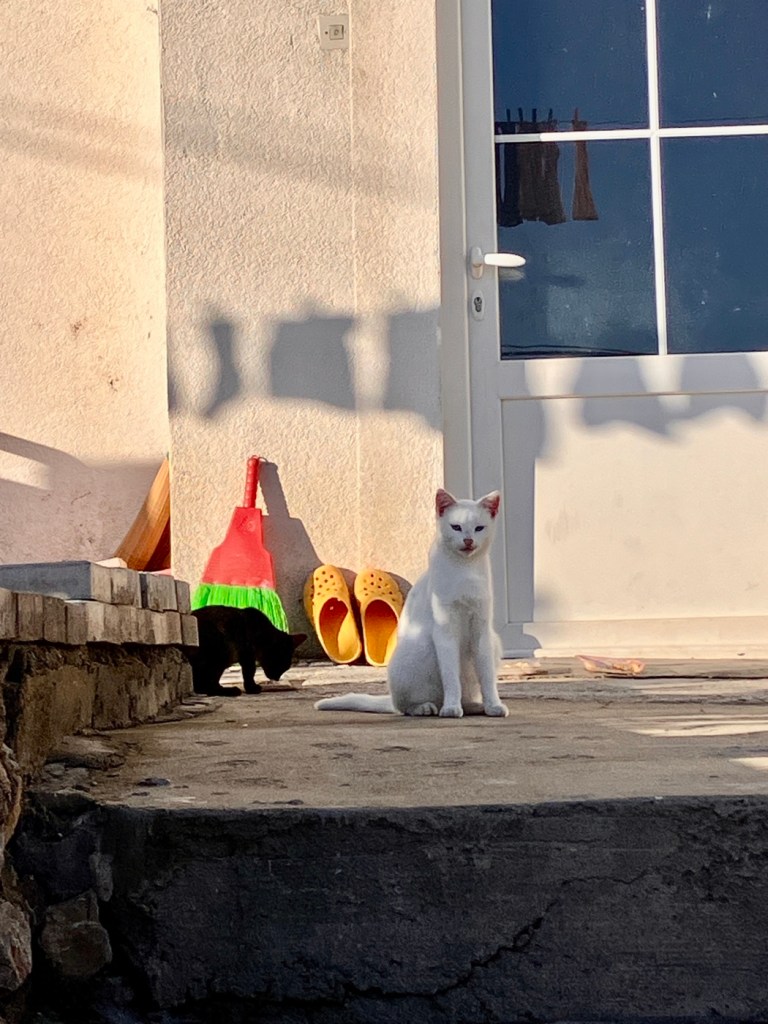
Get ready for a lot of cat photos. Our final day’s walk involved so many cats who were happy to be pet, to be picked up (unusual for free roaming cats), and would purr in my arms.
Heading out along the boardwalk. First victim! Hello beautiful.I didn’t make it very far before this one needed a cuddle too.Then we were handed off to the cat who hangs out at the Chuch of St. John the Theologian. I shall lounge here and look aloof. No you won’t! Come here kitty!Rich is now saying “Put the cat down. Let’s keep walking.”Kitty says “Me too?” They stopped at the edge of their territory. Lunch break in town. The pot of beans is called Tavche Gravche. A traditional Macedonian dish made with beans, onions, peppers, and tomatoes. Delicious. After a post lunch nap and shower it was back out to find more cats to pet. And visit Church of Holy Mary Peryvleptos Црква „Богородица Перивлепта“ which had amazing frescoes but didn’t allow photos inside.The view from the church plaza, more of the traditional houses.One last kitty to wish us farewell, and we were off back to Albania. The Happy Travelers at Samuel’s Fort.
We’re just headed back to Tirana now, but the next post will cover Elbasan, a decidedly non- touristy city, and Berat, the City of Windows.
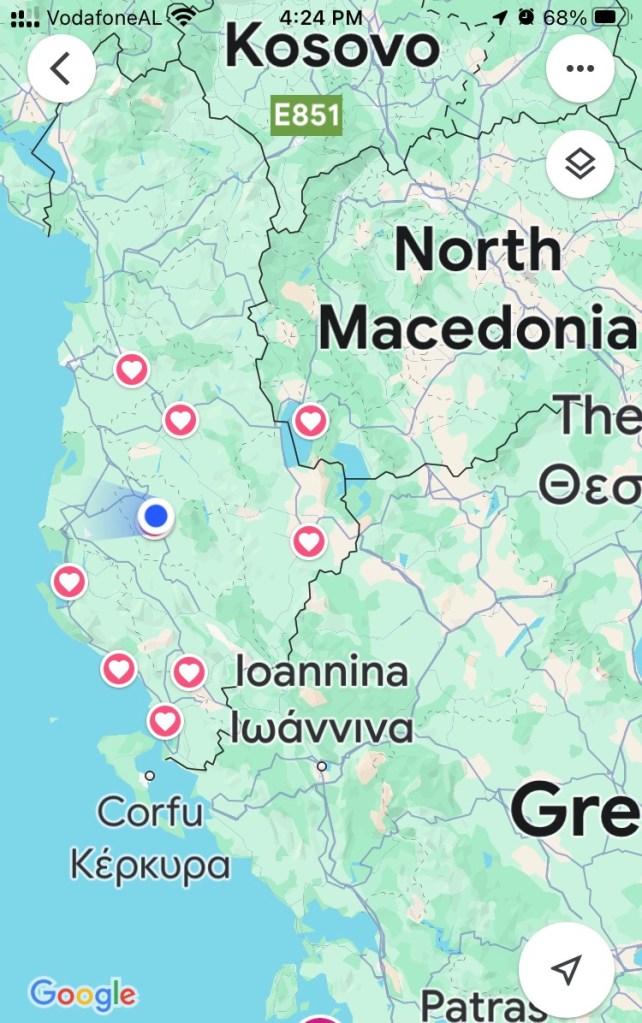
Rich did a great job plotting our stops around Albania and North Macedonia. Tirana the northernmost heart, on the coast heading south – Vlorë, Himarë, Sarandë, then inland to Gjirokastër, Korçë, Ohrid, Elbasan, Rebat and back to Triana. Phew!
We had a wonderful 12 days in Treorchy, not only visiting the two national museums Cheryl detailed in the last post, but hiking around the Rhondda Valley and the Brecon Beacons. But alas, it was time to move on to a new adventure from our cozy house sit and lap cat.
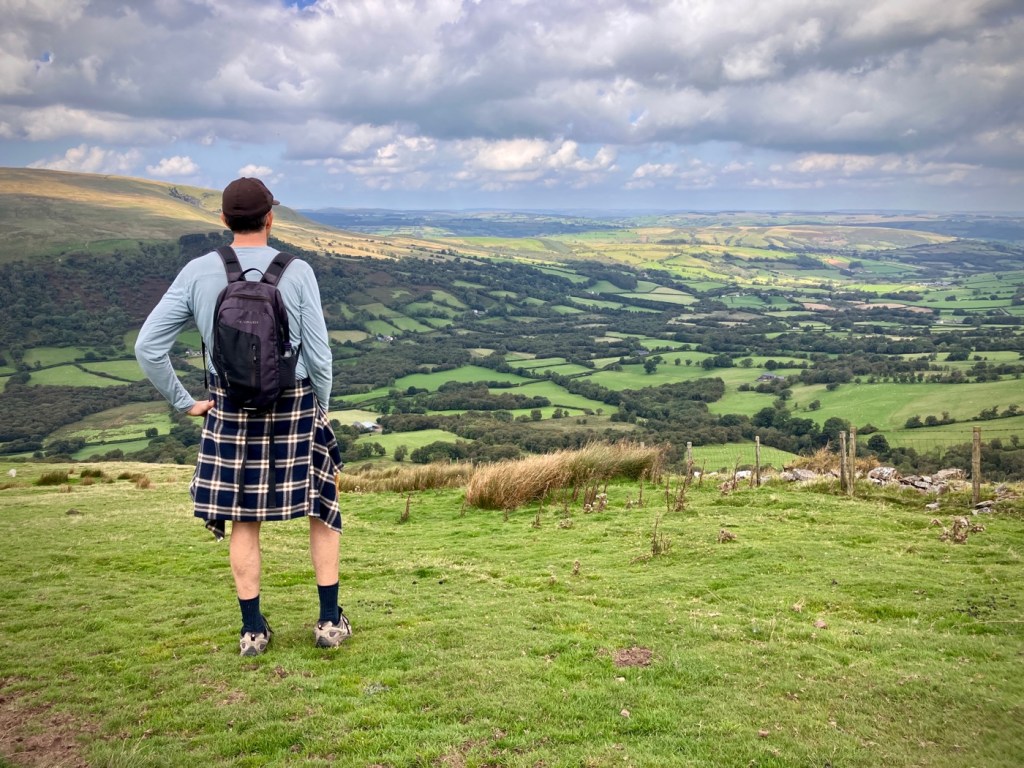
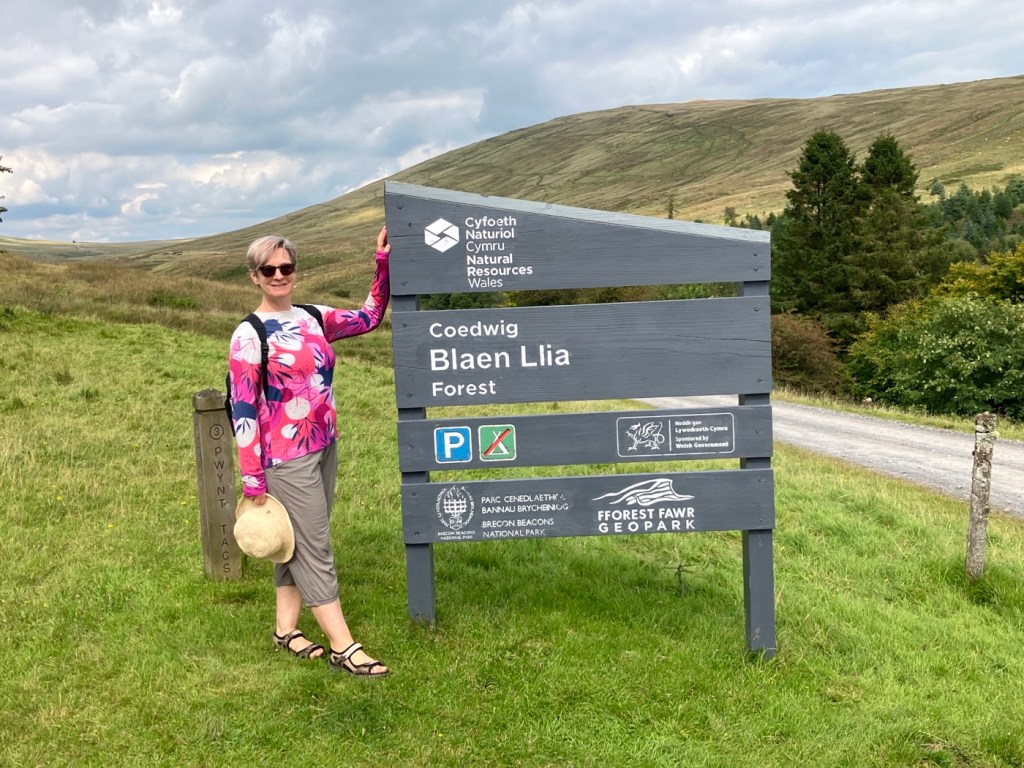
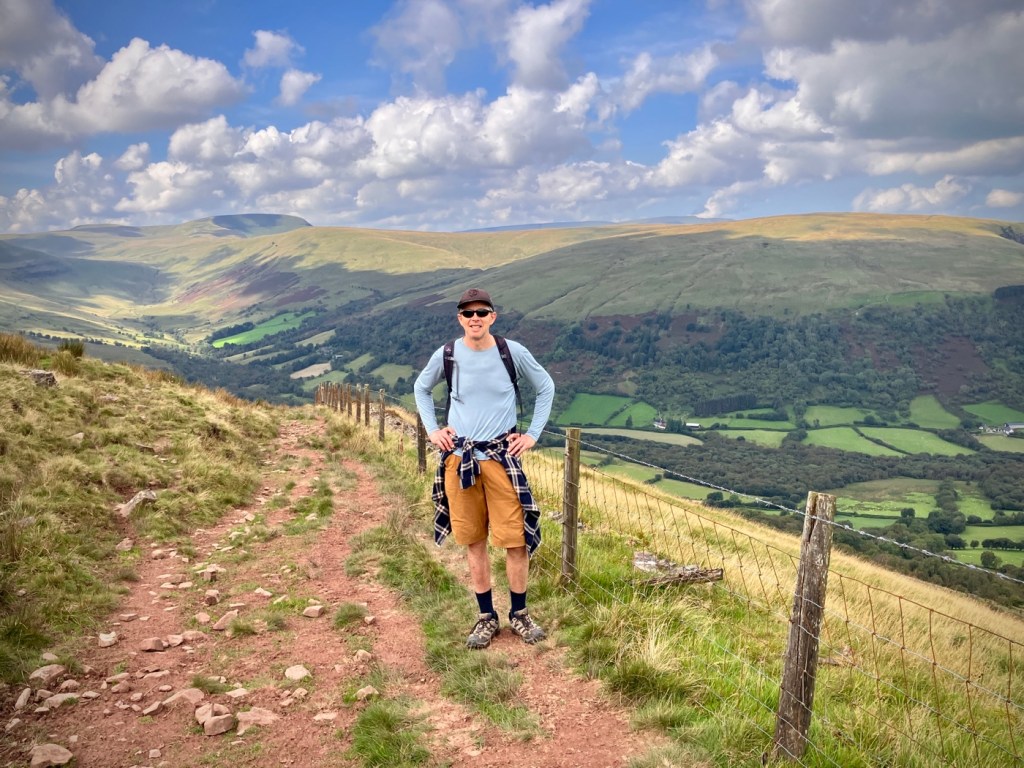
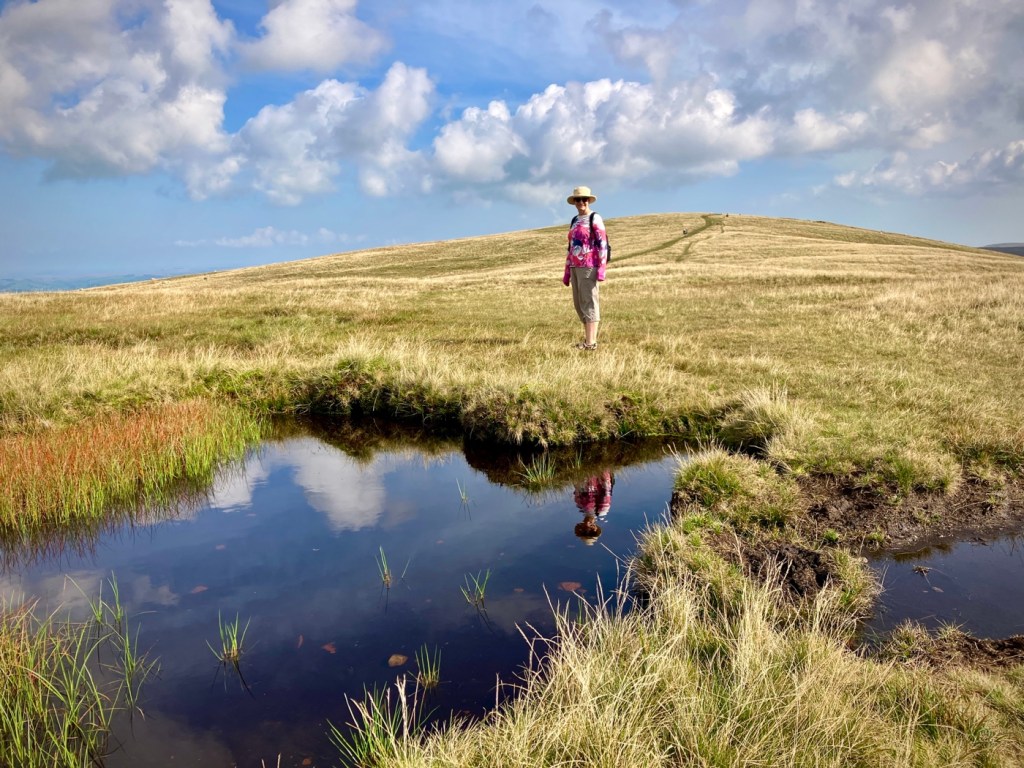
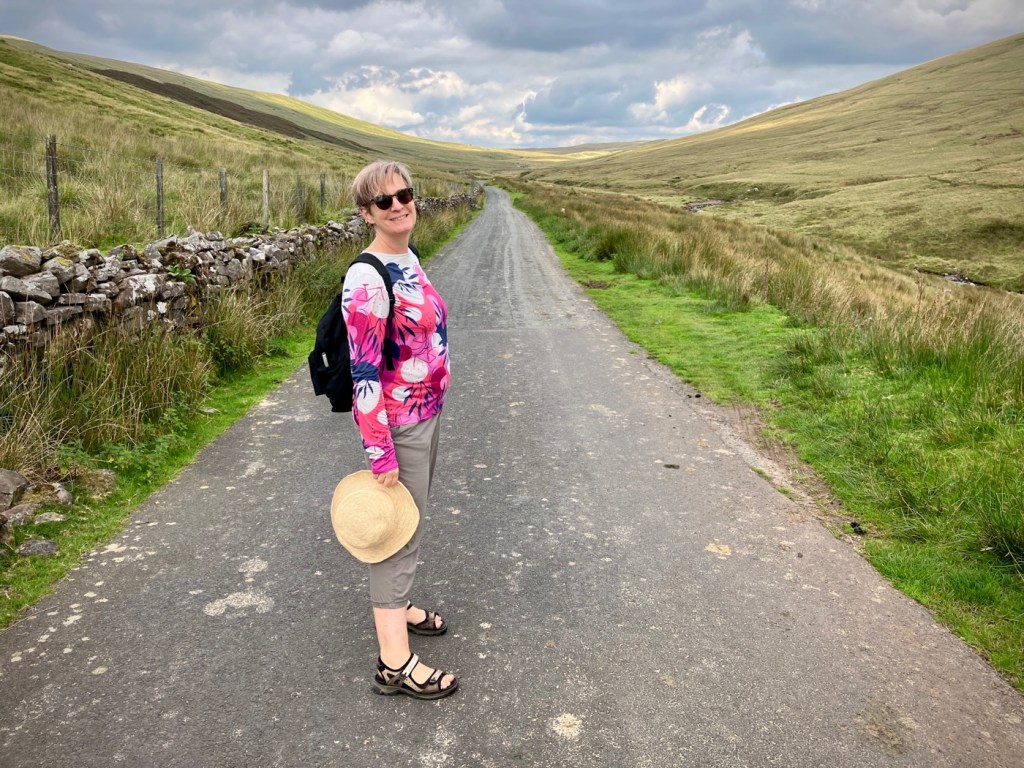
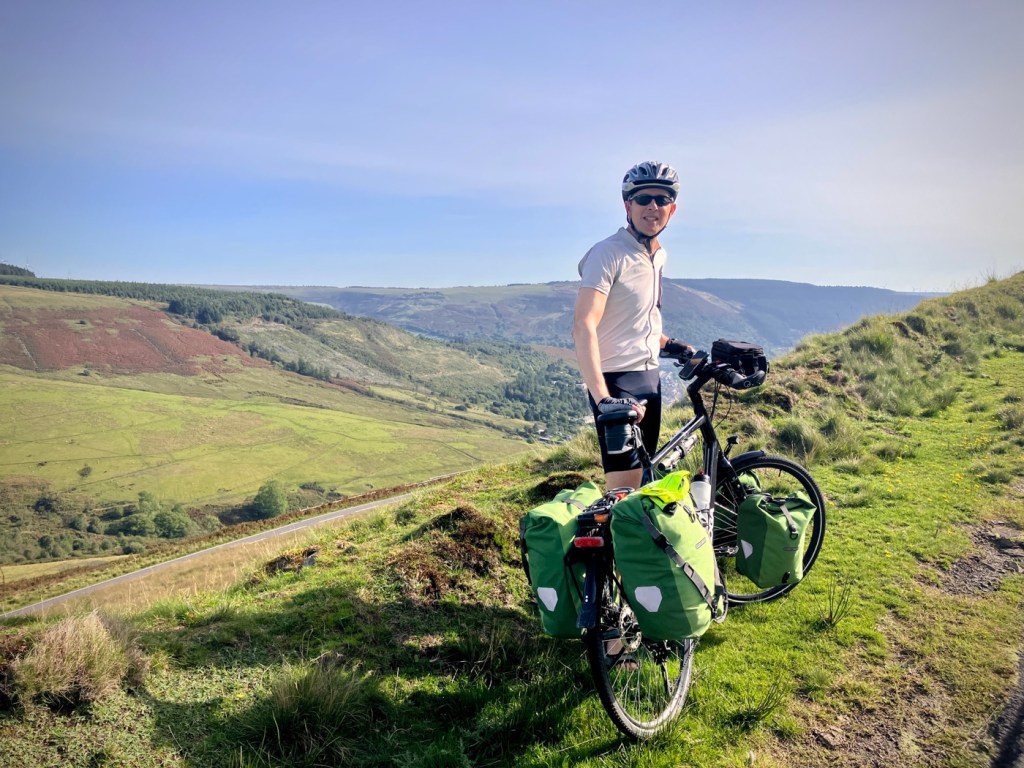
We loved hiking in Wales. Looking towards the verdant hills of Mid Wales from Bannau Brycheiniog, also known by their English name, the Brecon Beacons.We picked this less crowded part of the park for a Sunday hike and it was perfect.Coming down the backside of Fan Dringarth.A subtle beauty to these boggy highlands.The nine mile loop varied, had great views and kept us away from the hoards climbing Pen y Fan, the highest point in the park.
When we planned our various house sits this summer, we had to consider how we would get between then with loaded bikes. Most connections were a day or two, so we had to take two long trips on LNER and Great Western Railway trains. Both were stressful with our touring bikes due to the (ridiculous) storage closet bike hooks in a space too tight for my bike. (And many other bikes larger than average.) Anytime you take 50 pounds in 4 bags off the bikes, it becomes awkward. Add a 1-minute crowded station platform, bike closets, and a mid line stop and it becomes a frantic fire drill.
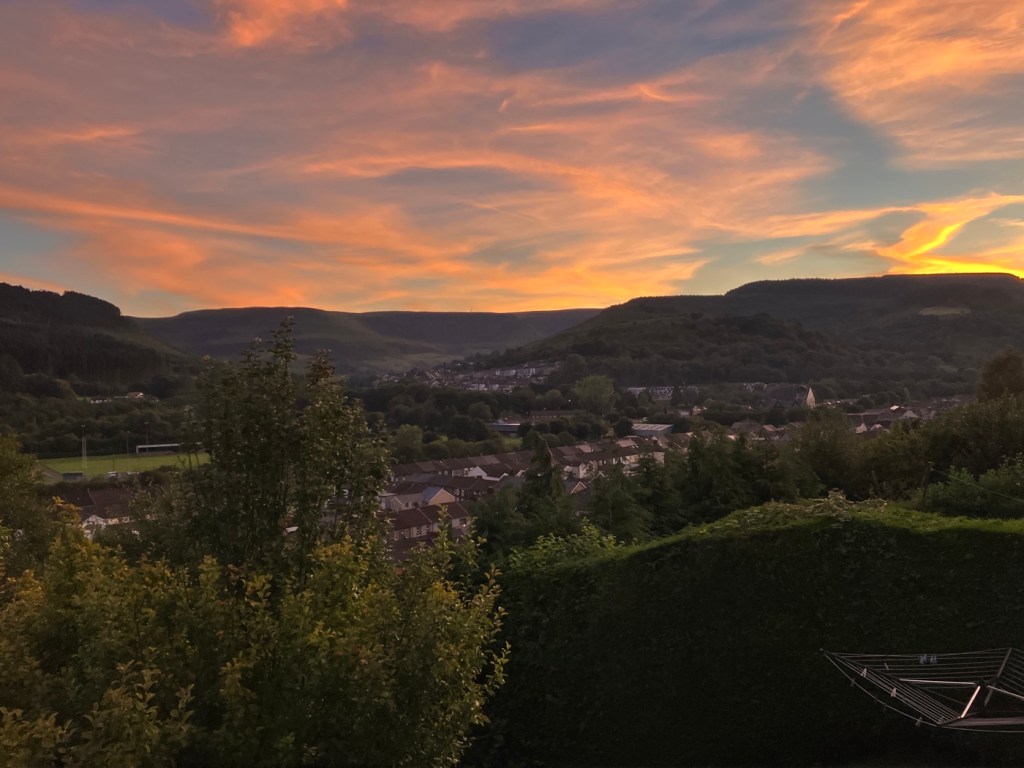
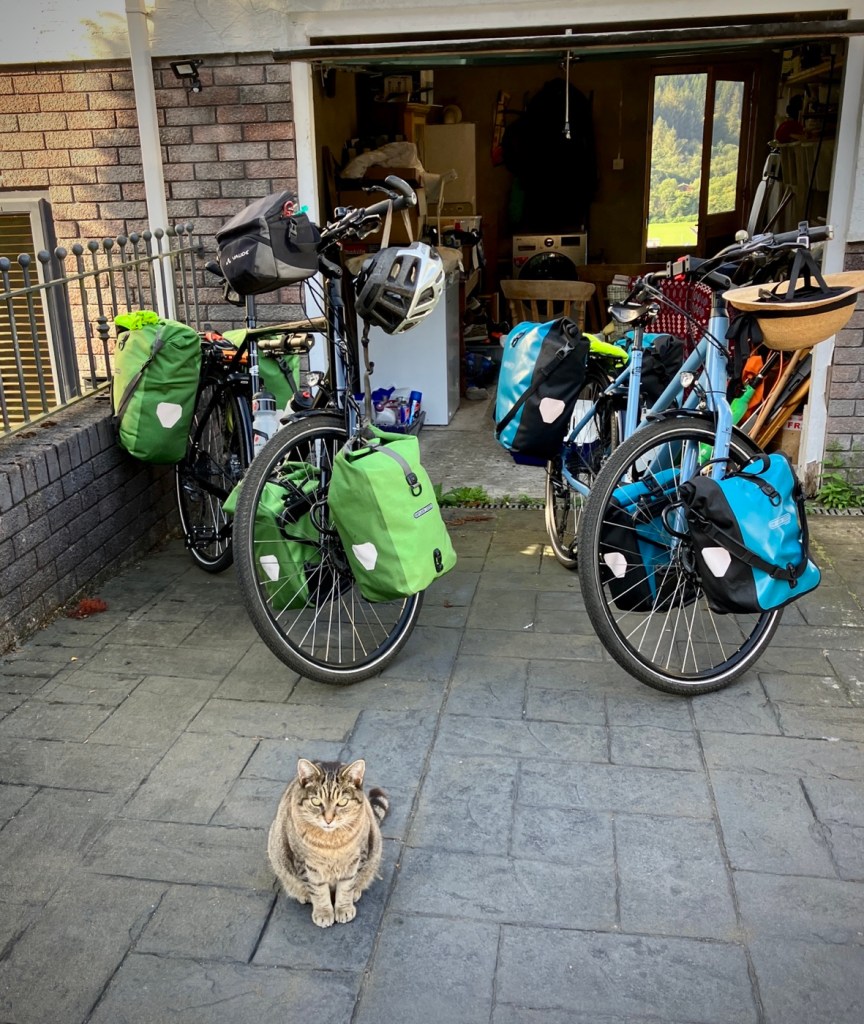
Last night sunset from our terrace in the Rhondda Fawr Valley.Our sweet cat Tibbs was determined to block our exit from Treorchy.
So we decided that if the weather looked better than a monsoon, we’d cycle our next leg, so I started planning a route considering the following;
1. How do we get out of the Rhondda Valley? Its a 1000+ foot climb straight up out of Treorchy to the North or West, both on A Roads, unless we wanted to go back down the Rhondda towards Cardiff, which would break our cycle touring motto of “never go backwards” (even when we make a wrong turn).
Heading up the switchbacks of the A4061 west of Treorchy Headed over the top of Bwlch Mountain.Free roaming sheep kept the car speeds under control and they sure were friendly.Couldn’t resist an Ussie with our new pal.
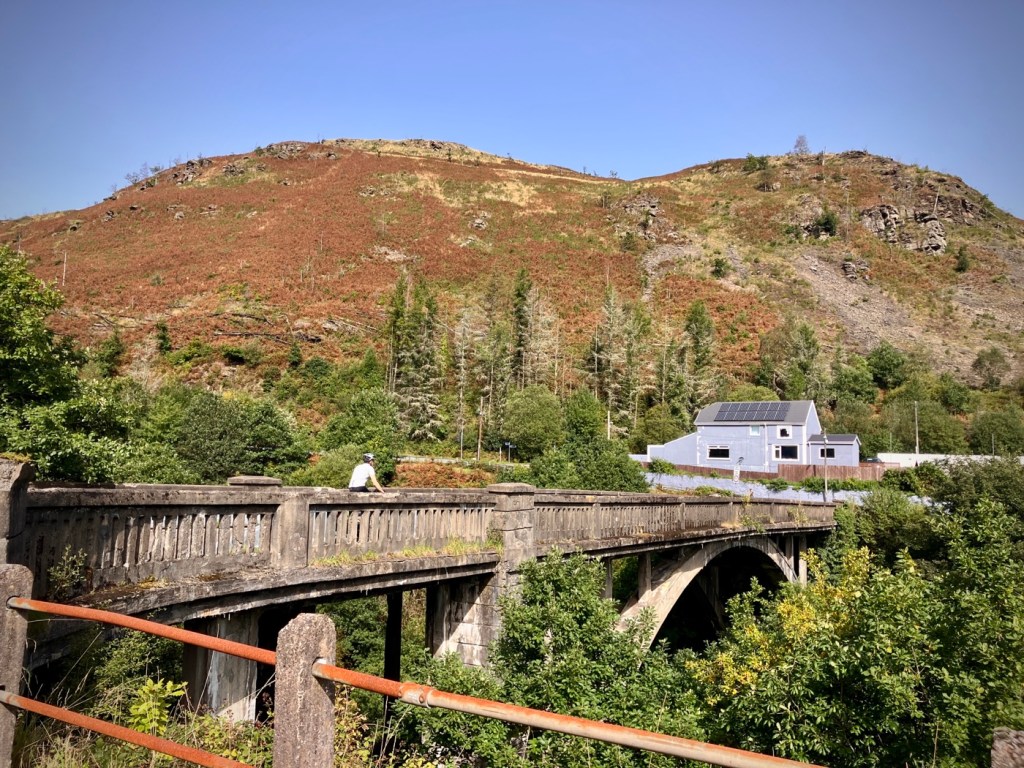
2. What is the nicest route.? Heading to a UK national route or Eurovelo was a logical choice and the western route out of Treorchy landed us in the Afan valley, which looked to have a beautiful rail trail along the Afan river. It was also the pass we looked at for 12 days from the deck of our house sit, so it beckoned.
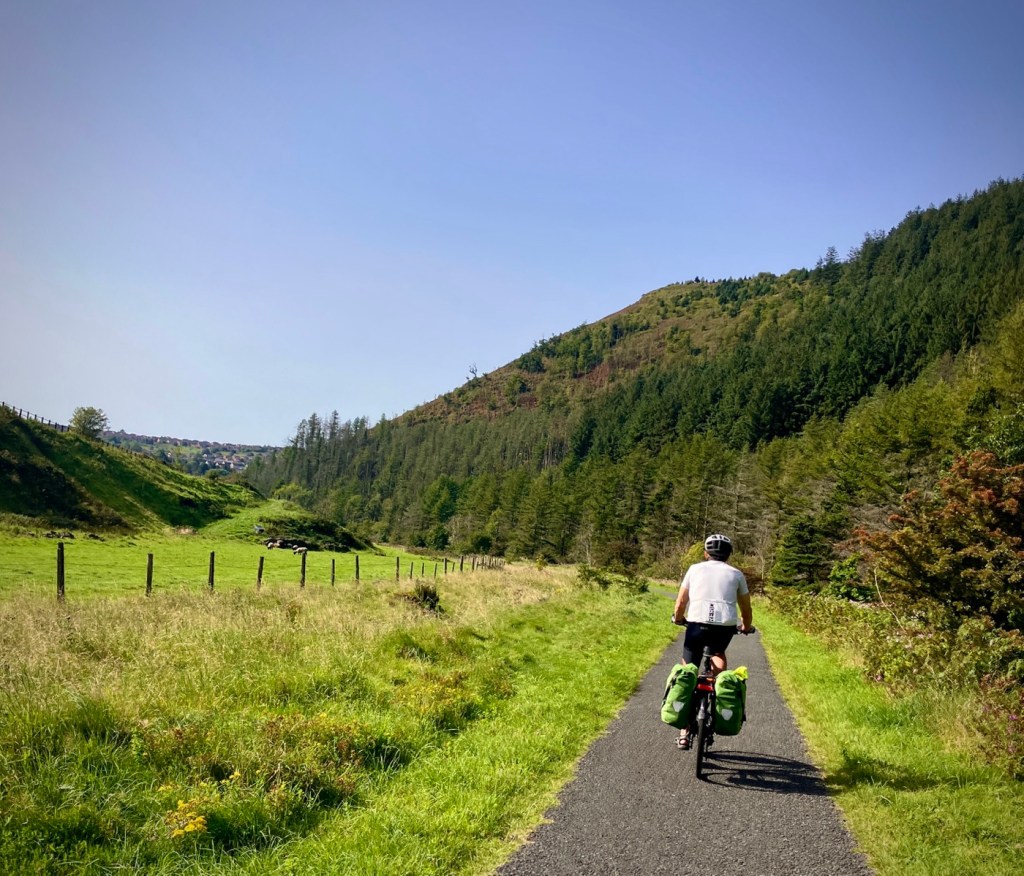
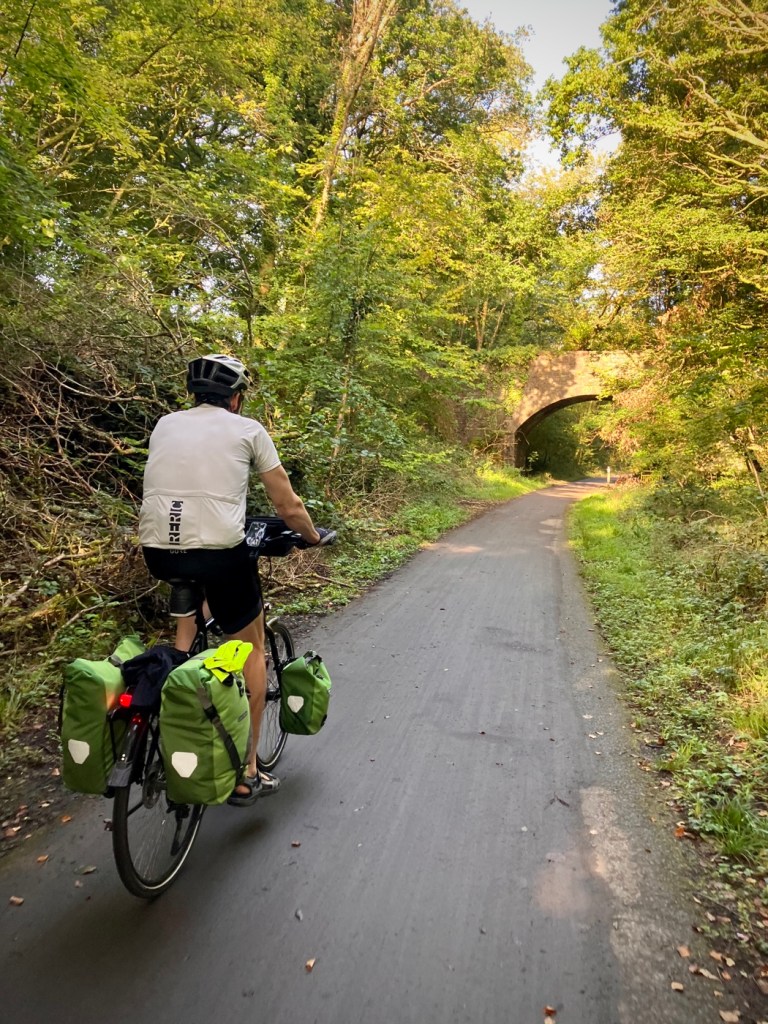
After a descent with some nice sweeping switchbacks on the A4061, you reach the start of National Cycle Route 887 and the Afan Valley Trail.This Afan Valley had its heyday at the turn of the last Century but has reinvented itself as a recreational hub, especially mountain biking.The historic Bethel Chapel in Pontrhydfen.More legacies of the coal and steel days in the valley.
3. Where can we stay and break up the trip comfortably? As our bikes are fully loaded beasts, we wanted to keep mileage in the 50-75k daily range, especially as there are a number of challenges in this region of Wales, primarily steep hills, strong winds, and frequent rains. We also were in no rush and wanted to enjoy the ride.
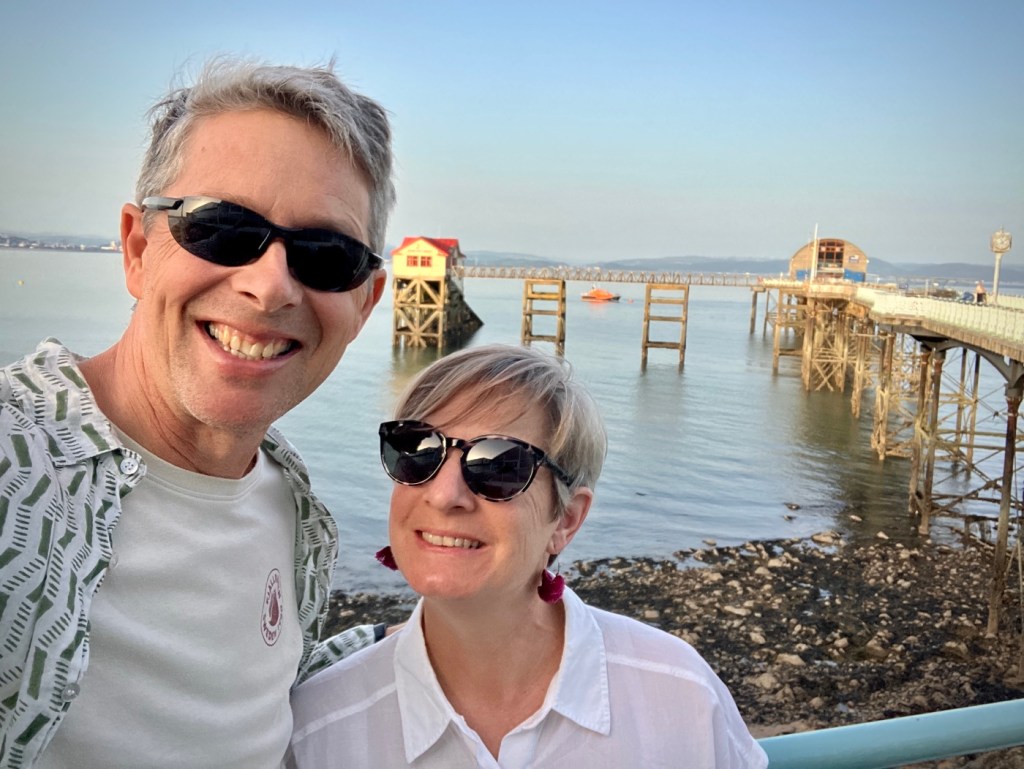
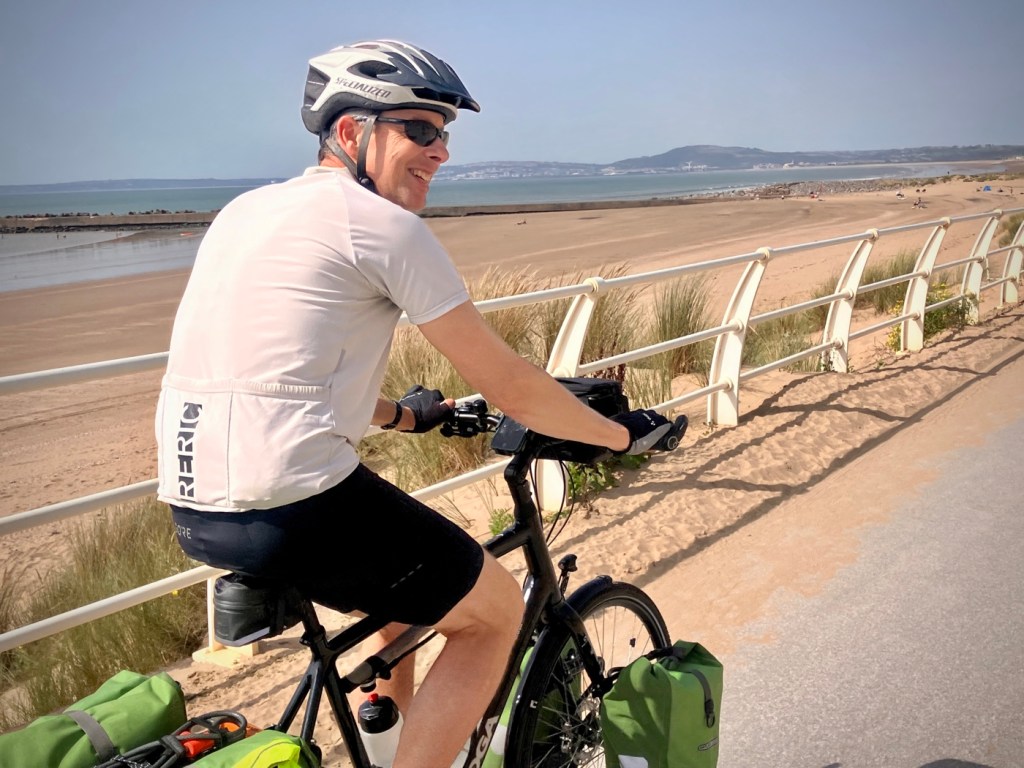
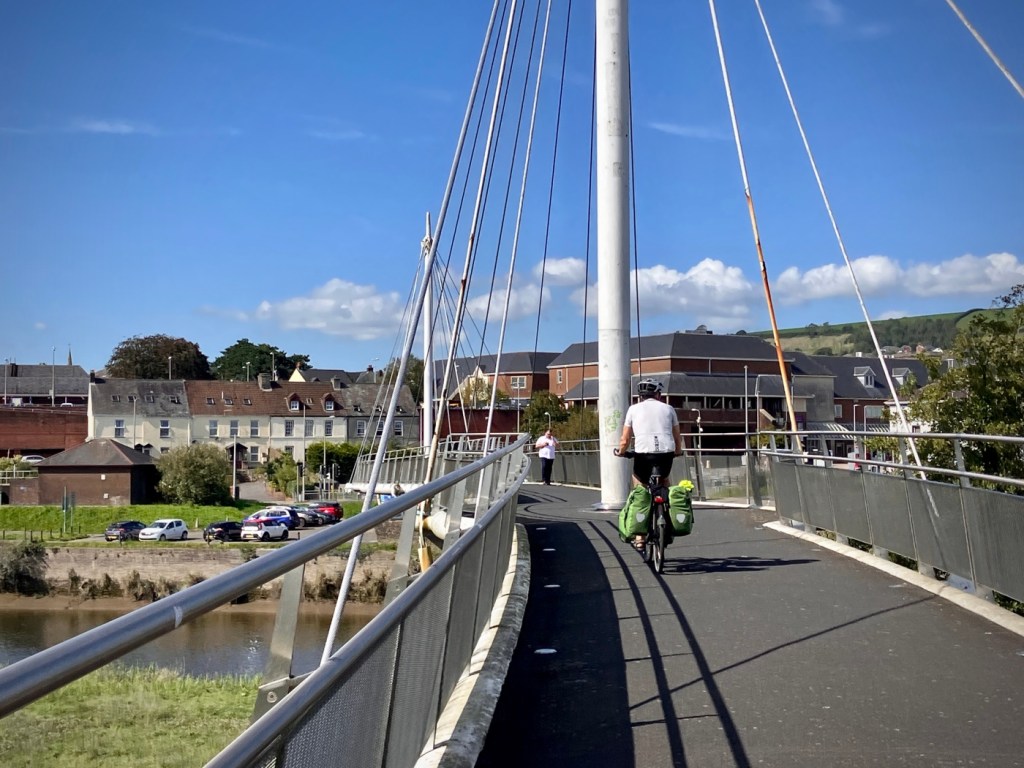
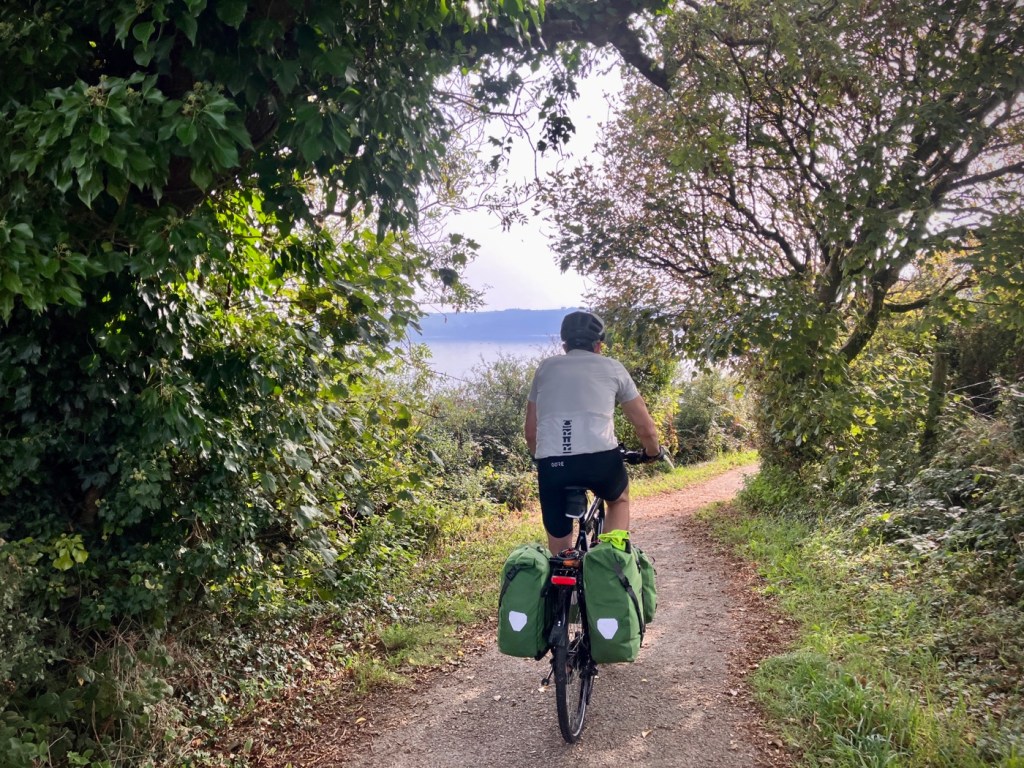
A relatively short 62k from Treorchy to Mumbles meant we had energy for some exploring.Hanging with the locals at The Pilot in Mumbles. And the heatwave meant magical evenings along Swansea Bay.Loaded up and ready to leave Mumbles.Day 2 on National Cycle Route 4 was nice, despite this warning for motorbikes.
Well, the steep hills were there, and we lucked out with virtually no wind. However, instead of rain, we had the unexpected challenge of a mild heat wave. It was shocking to us how hot you can feel and get in 82F humidity, but some of the afternoon climbs in full sun felt brutal.
The route from Mumbles to Gowerton follows an old rail corridor that last ran in the 1960s. The Swansea to Mumbles seaside railway was dismantled in 1960 but was the first horse driven passenger tramway in the world.
So we set out from Treorchy and headed up the beautiful pass. Perfect pavement, mild 7-8% grades, and great views. The descent down the back side was great and we finally hit the bottom of the steep portion and found our way down to the head of National route 887, the Afan Valley to Port Talbot.
Cheryl cooling down AND picking up trash from the Afan River.
We were excited to cycle this region as we had traversed it many times by car and train, but never cycled.
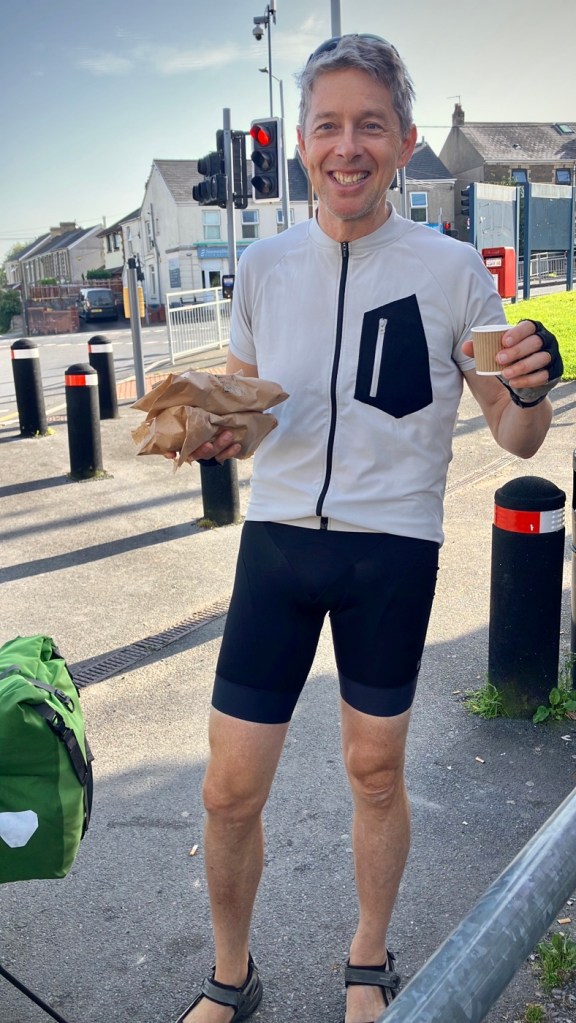
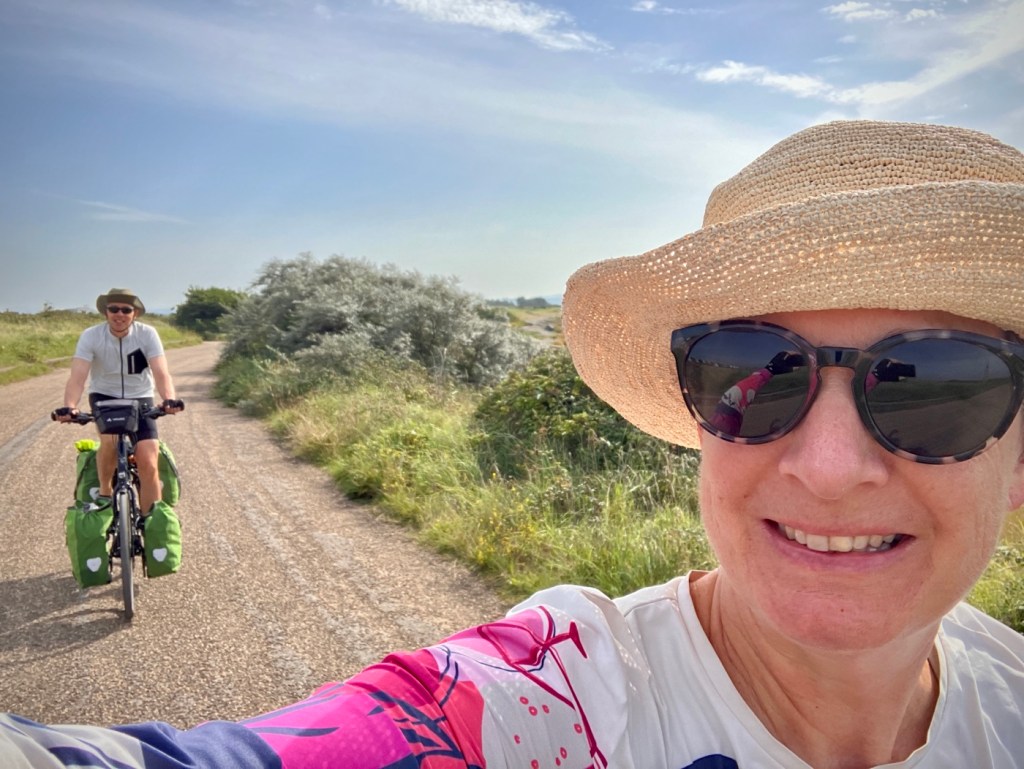
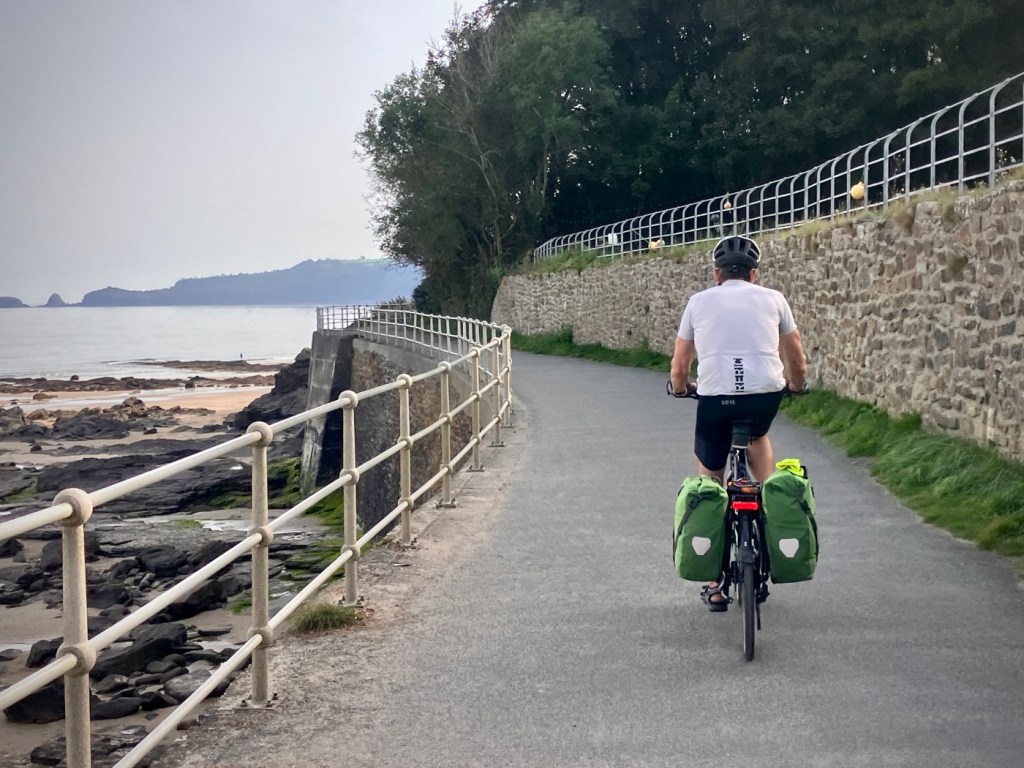
Homemade savory pies and a double espresso. aka “Brunch”.Finally reaching the Aberavon beach promenade in Port Talbot.Along Carmarthen Bay. Cheryl took most of the photos these days (I was on a heat strike), so she needed a selfie to prove she was there.My Tilley for shelter on the hot backroads as we turned inland again along Carmarthen Bay.
Cars were very considerate for the most part. In fact, so many waited for us along small lanes at pull outs, even when we were climbing up hills at a snails pace, we often felt we needed to tell them in was fine to pass us slowly. The slower pace is a refreshing differentiator between lower density Wales and much of high density England.
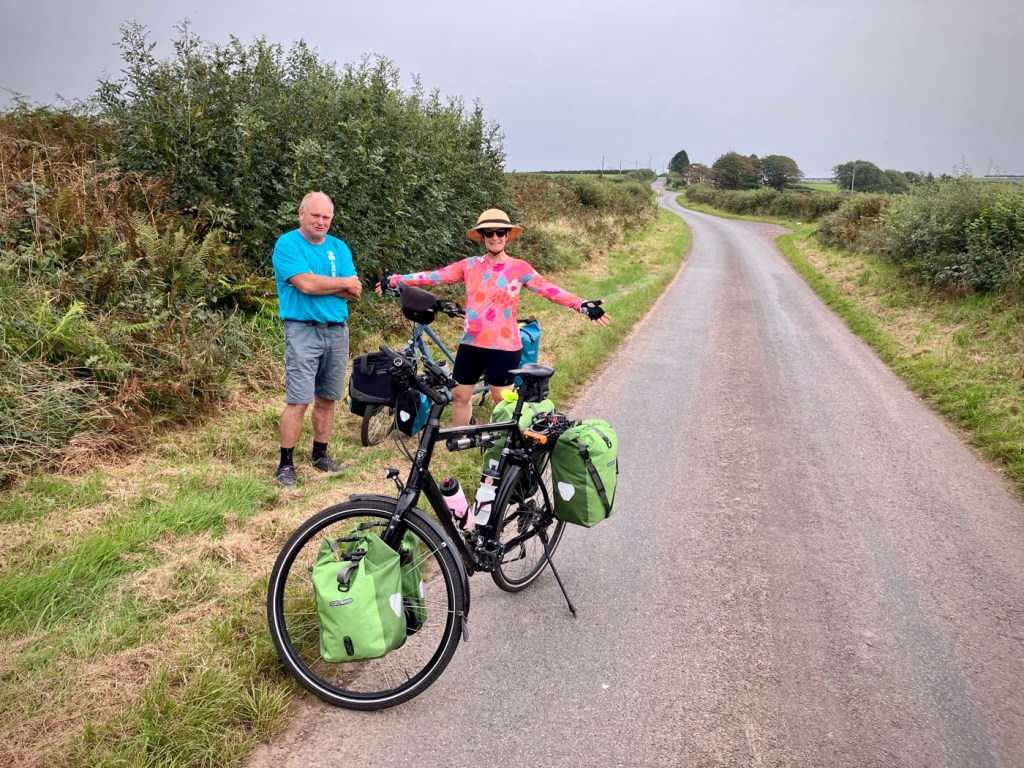
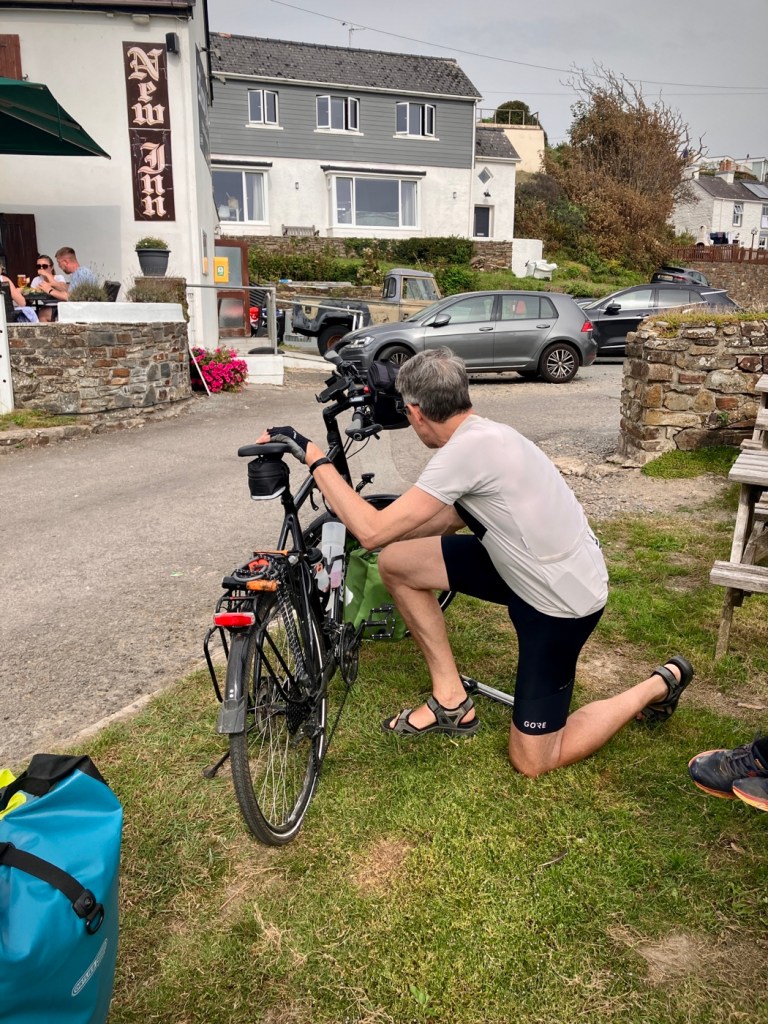
What are the odds of meeting up with a local we know in Wales? Pretty good apararently, as our friend Alex drove by us on this county road. So we all met down the road for a pub lunch in the lovely and rare warmth.Bragging about our 3 1/2 months without a flat finally caught up with me after our pub lunch in Amroth. (Still love our Schwable Evolution /Almotion tires though.)There is some nice new bike infrastructure along NR4 in Wales and it was definitely better than the segments west of London.
We did have some poor youngsters in the Swansea area try spook us by yelling out their car windows and screaming as they passed us, but to no avail, as one skill we have learned in 30+ years of urban cycling is the art of road zen and “zero response”. We both equally ignored them (we were riding apart) so perhaps they won’t even bother next time they see two lone cycle tourists on the cross country cycle path.
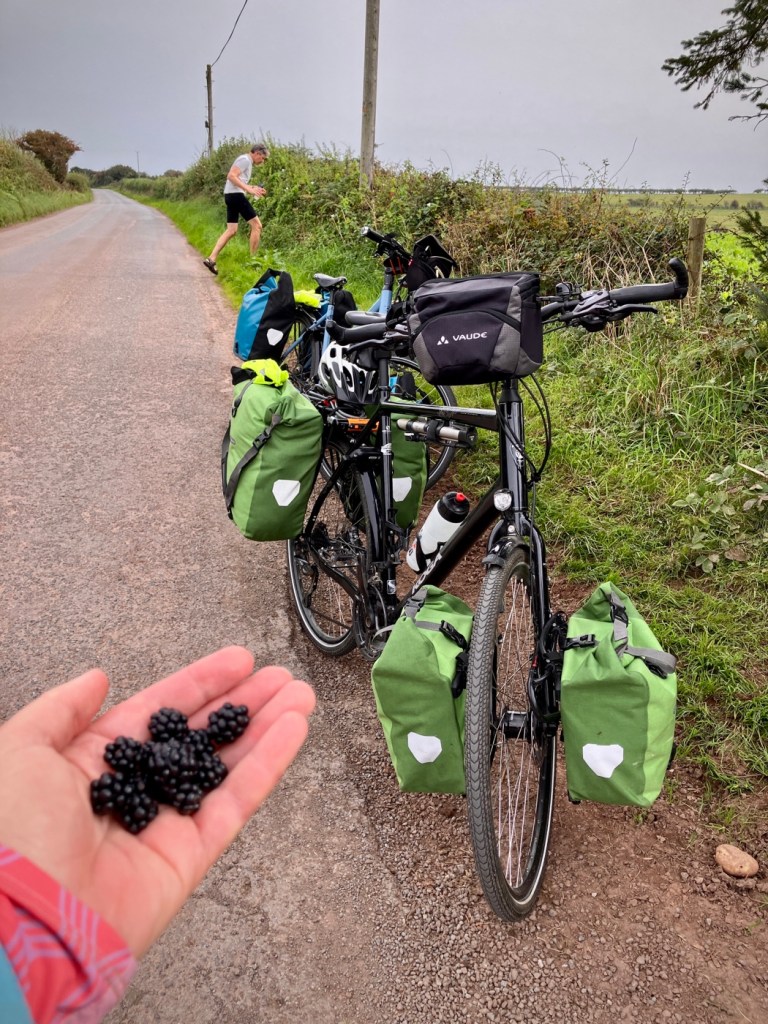
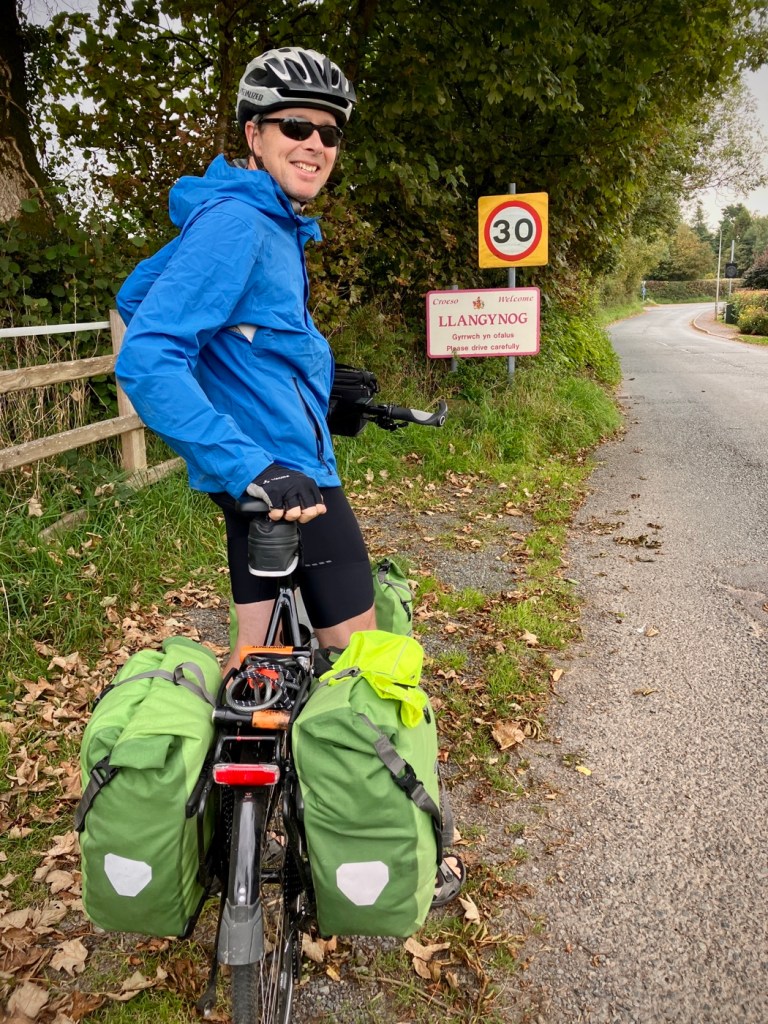
Getting close, the path from Amroth to Saundersfoot escapes a few climbs by passing through three short tunnels.So hot, but time for a refreshing blackberry break.Heading out of Day 2 B&B in Llangynog. A little steamy morning rain-mist set in on the hill, but the jacket still came off in 5 minutes.
A physical threat with a vehicle is another matter, but this was just cheeky youths yelling to try to impress their mates. Cheryl even takes a more positive spin by saying that she was sure they were yelling positive words of encouragement! (Not an indecipherable Welsh-English slur.) And that’s why she is such an amazing travel companion; always keeping on the sunny side and assuming the best in people -:).
The final ridge before Tenby. Pembrokeshire coast cycling is not for the leisurely as the ups and down are constant!
Overall, it was a wonderful three days minus the hot afternoons. Cycling in Wales and on much of the National Cycle Network feels adventurous as the conditions can vary so wildly, and you encounter few others on the way, except around some city areas and popular stretches of rail-trail, river, or coastal paths.
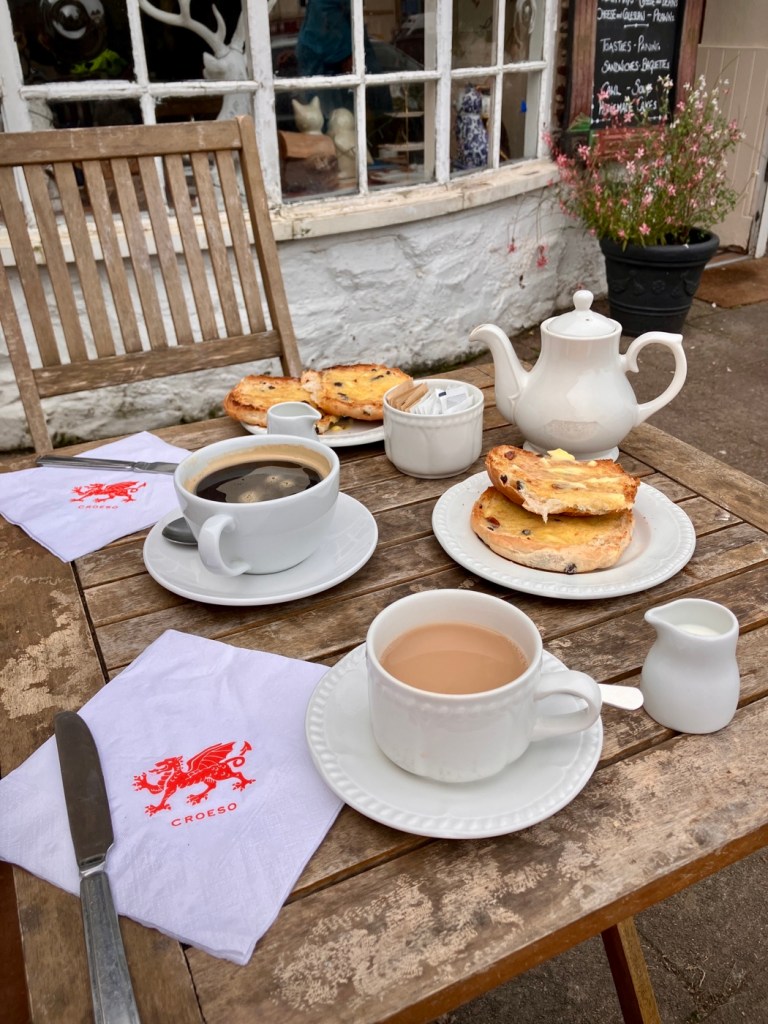
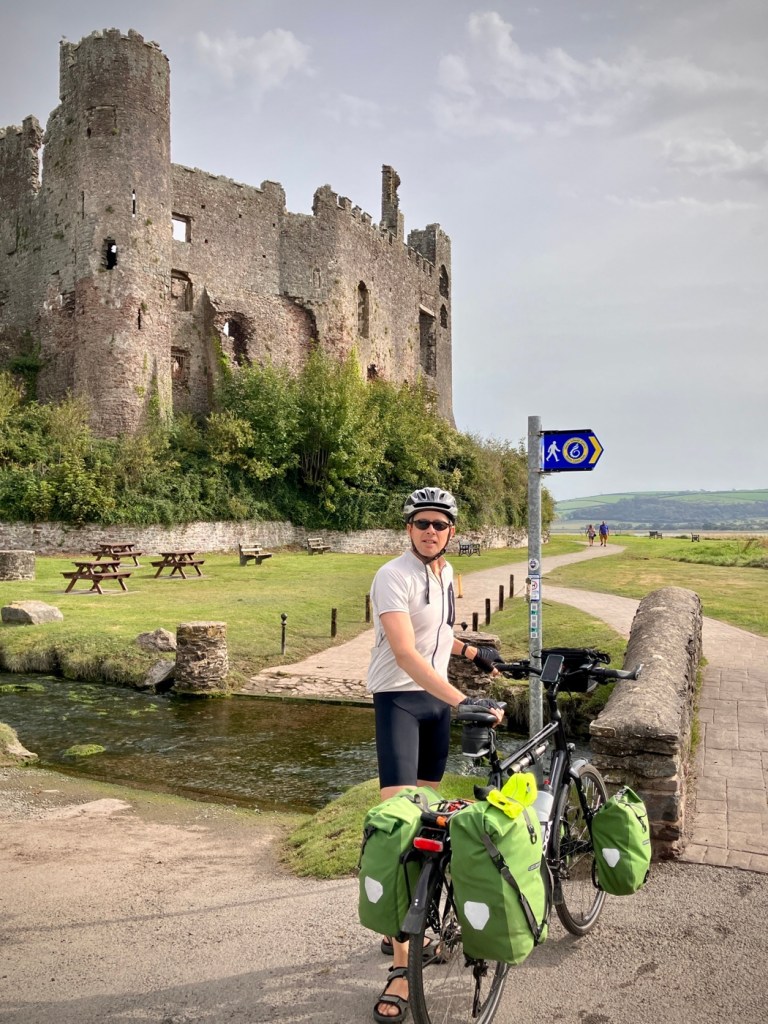
Our new favorite snack, Welsh Tea Cakes smothered in local butter.The medieval and stunning Laugharne Castle.The reward was six great days with our most generous and dear friends in Tenby.Our friends took us out for a great afternoon on the water and swimming at a secluded beach.
So we decided that we definitely want to come back and cycle more in central Wales, where smaller green hills, and small lanes are coupled with the Welsh friendliness. Apparently a new route is being developed there, so we look forward to exploring it…maybe in 2024.
Hello empty restaurant, we will be your only lunch customers.
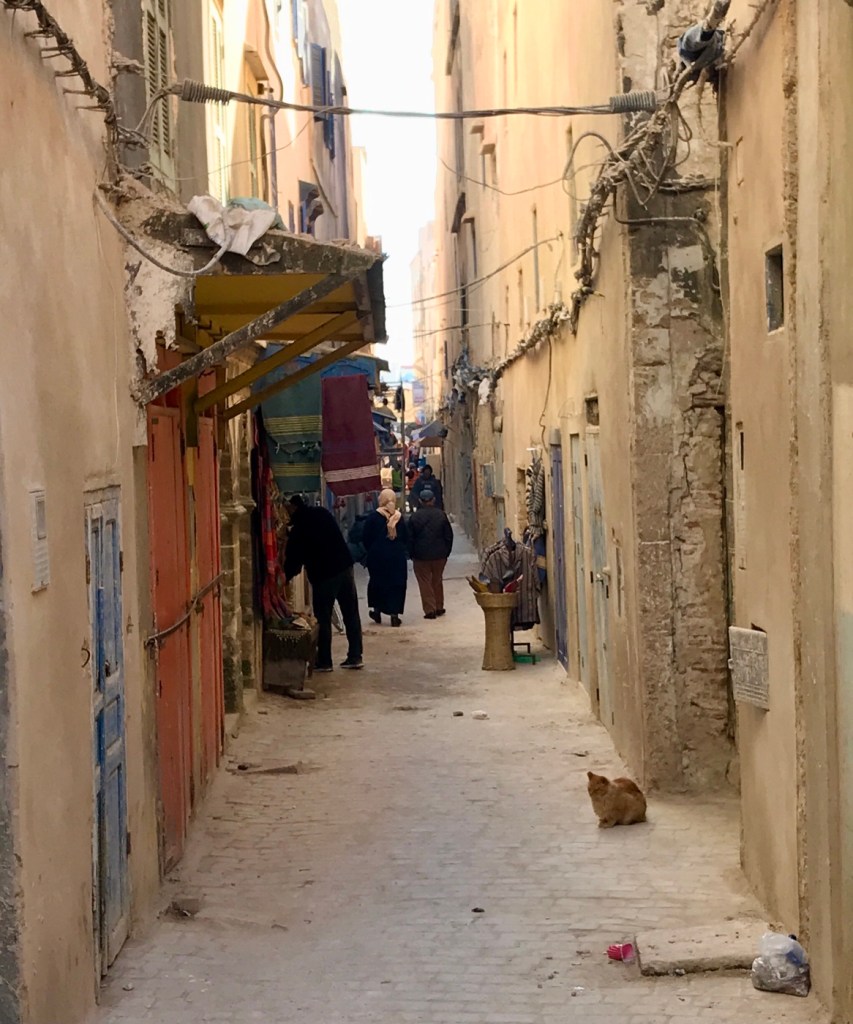
Morocco welcomes about 6 million tourists a year, per 2019 numbers. That’s an average of 17,000 per day. When we arrived in November to Tangier we could tell that numbers were low, tourism was just picking up, but there were other tourists. Other folks at our Riad, other slightly stunned faces getting lost in the Medina, other tables at restaurants occupied by non locals.
Rich enjoying a lovely meal in Essaouira. One other group showed up at what is, according to reviews, a very popular and busy farm to table restaurant.
When the travel ban to Morocco was announced and the borders closed to incoming flights on November 30th, the numbers of other tourists started going down, and of course was not replenished. We were in Meknes when that news came, and we could tell the mood soured at the Riads and restaurants which had made themselves tourist friendly, only to be told once again they would be without tourists, without a livelihood.
The proprietor was very gracious and explained the limited menu being served. We were the only ones again.
Moroccans are some of the most welcoming and friendly people you will meet. It hurts us to see the numbers of travelers going down and down as folks find flights out, like a lovely Canadian brother and sister we met, or the nice guy from the UK who was on a 10 day trip. It’s more noticeable in a town like Essaouira, which is a very popular town with travelers and tourists.
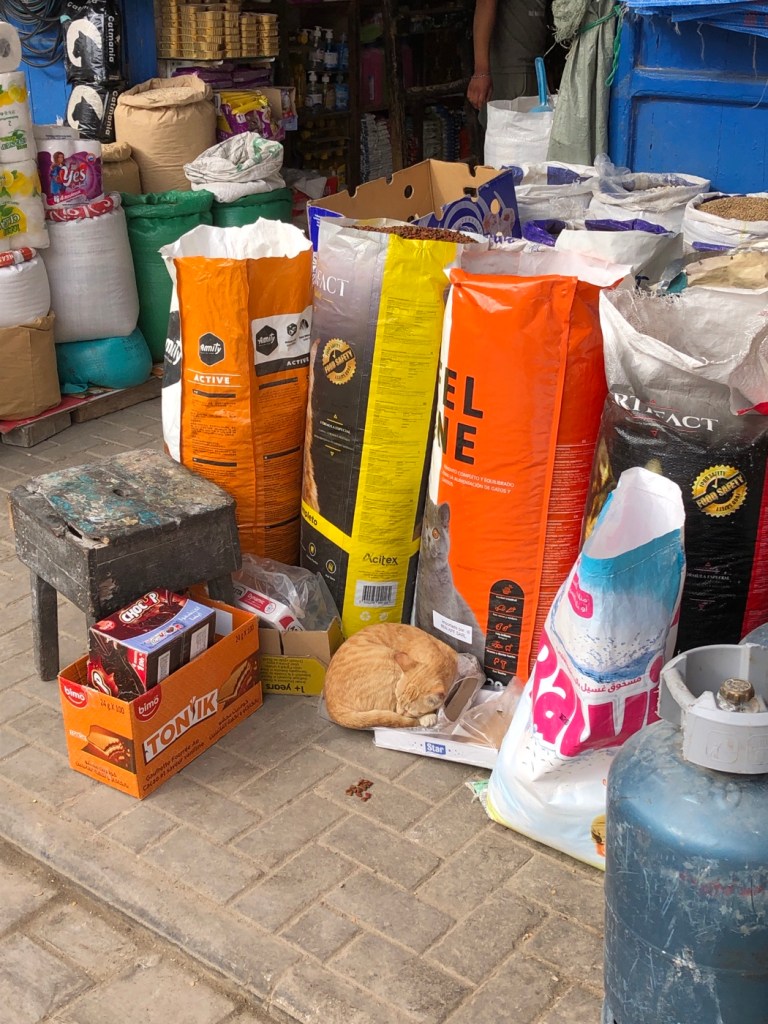
The Medina is always interesting, and people were only kind and helpful.The smart Medina cat sleeps by the large bags of cat food.
There is a sweet spot of travel which we seek out and love – not too crowded, off peak or shoulder season, places are open but not busy, locals aren’t overwhelmed with visitors – this is not that time. This is too empty. Restaurants not opening because why bother? Vendors with no tourist customers and no tourist money coming in. It feels awkward to be the only customers in a restaurant, the only non locals strolling the shop lined Medina streets. We feel so bad for the economic hit being taken and wish we could somehow make up for the missing thousands of tourists, but of course we can’t. So we are extra nice, we tip extra large, and inside we cringe.
This one looks like they take no nonsense from anyone, cat or human.After six days in Essaouira Rich had committed the “grid” to memory. I just followed him.
We feel totally safe here, COVID numbers are low, vaccination rates are high, but we do hope that our planned December 14th flight out will happen, and Morocco will be down two more tourists. We’ve already decided that if for some reason we don’t get out, we’ll go to Rabat again, which is a city that doesn’t depend on tourists and where we could just live life without feeling so awkward.
Awkwardly happy travelers.
It’s an interesting and challenging time to be traveling. We knew that COVID wasn’t done with the world yet, and we had discussed a scenario such as this. Stay safe all, we’ve left the coast and are heading for the Atlas Mountains.
Easy but not completely stress free. Although we have no jobs or children to get back to, and our friends and family will understand if we miss Christmas in the UK, it’s an odd feeling, not knowing if things will ease up or tighten down. Will we go or will we stay.
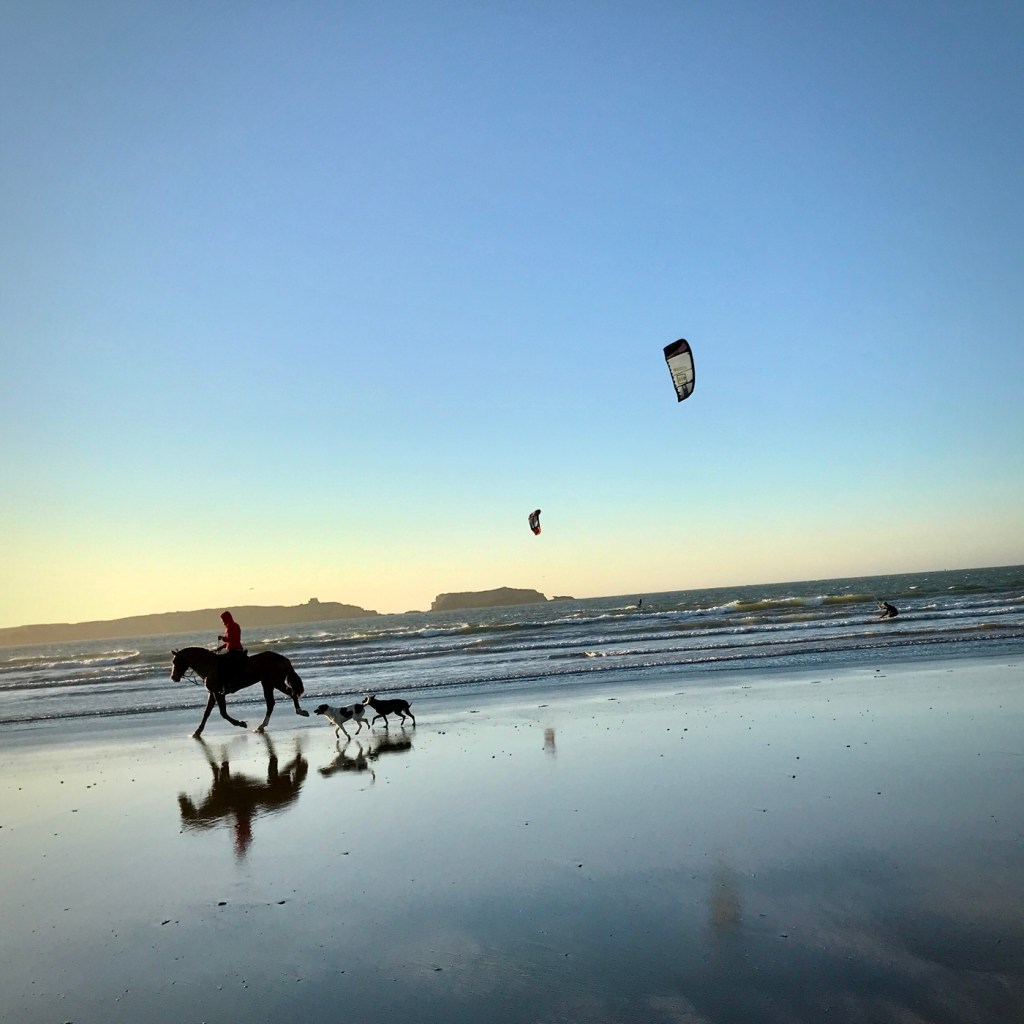
Horse and hounds and kite surfing.
We’re in an apartment in the Medina with a gorgeous view and a treacherous staircase. We go up and down saying big step, little step, medium, big, medium, medium, small – oh, big! It’s almost but not quite spiral to add to the fun. We look out to the ocean and the ramparts which were used in Game of Thrones. The rooftop terrace offers another stunning view, but the wind which makes Essaouira a windsurfing hot spot also makes terrace life a bit tricky. My glasses almost got swept off the table and out to sea.
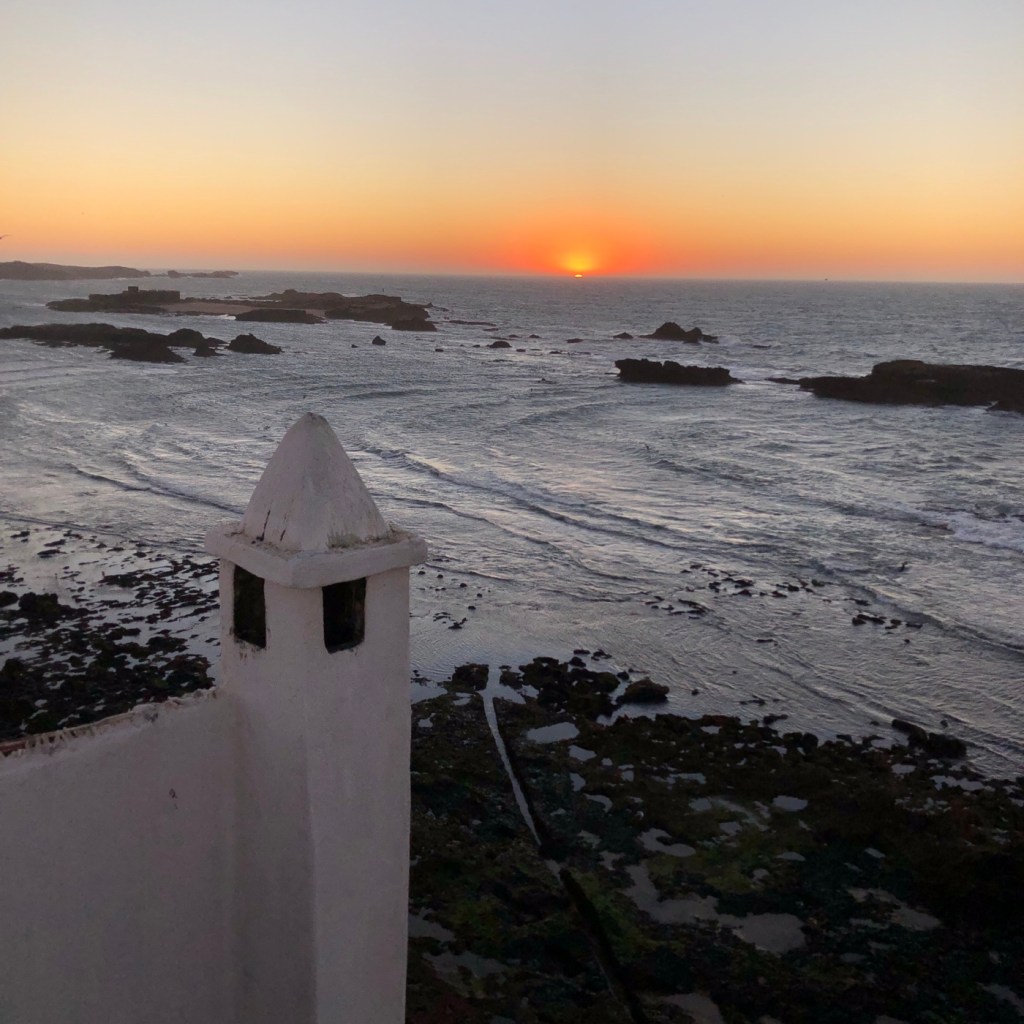
Wine glass holding firm against the wind on the rooftop terrace of the second apartment.Somewhere along these ramparts the Mother of Dragons did her thing.Sunday morning at low tide there were so many Football games going on. The wide beach at low tide is a great games field.Another beautiful sunset.We spend some time watching the tides. We spend time on the beach.We spend time greeting kitties in the Kasbah.The view from our living room where we sit and read. Rich’s feet added for scale.Essaouira. Sure is easy on the eyes, say these happy travelers.
We head to Marrakech in a few days, and maybe on a flight on to the UK a few days after that. Rich is busy figuring out what the current requirements are, and where and when to get our COVID tests. But for now we are happy here in Essaouira, eating good food, going on beach walks, and enjoying our little apartment.
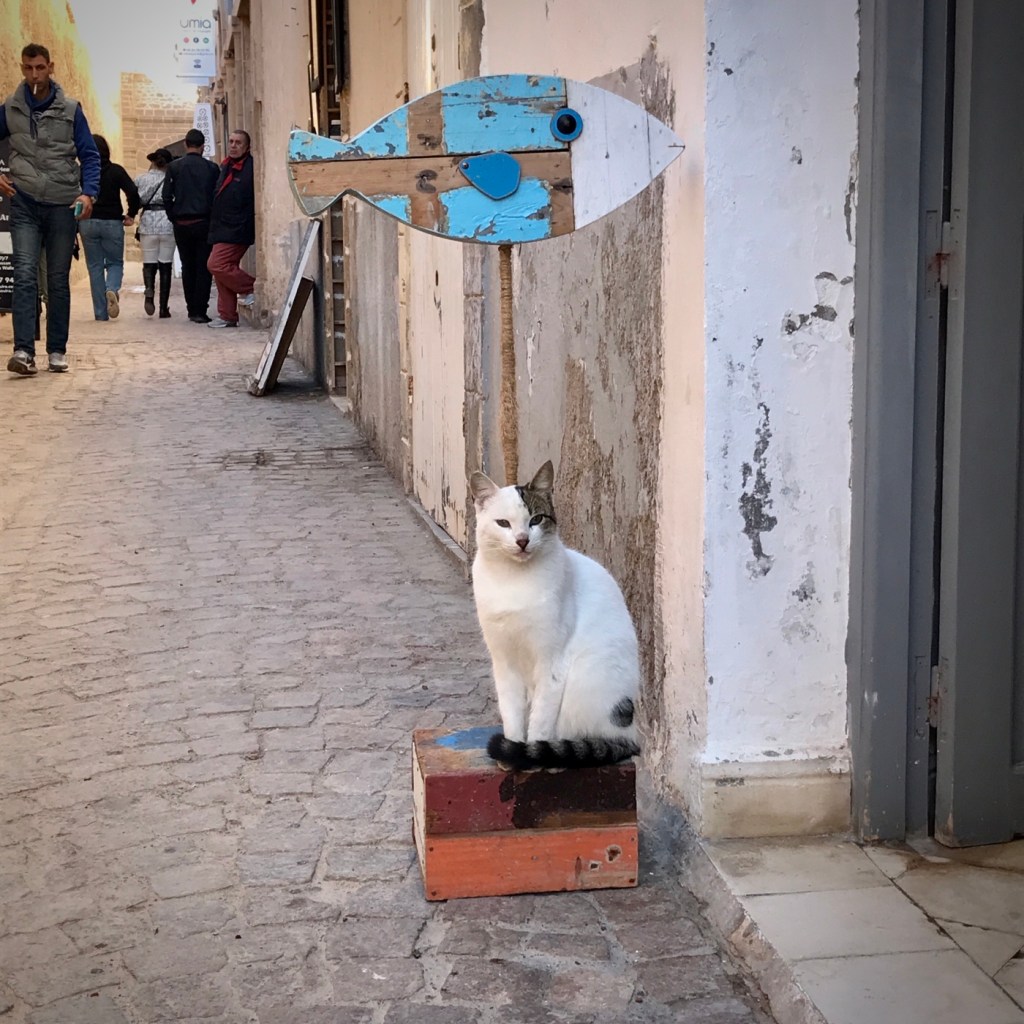
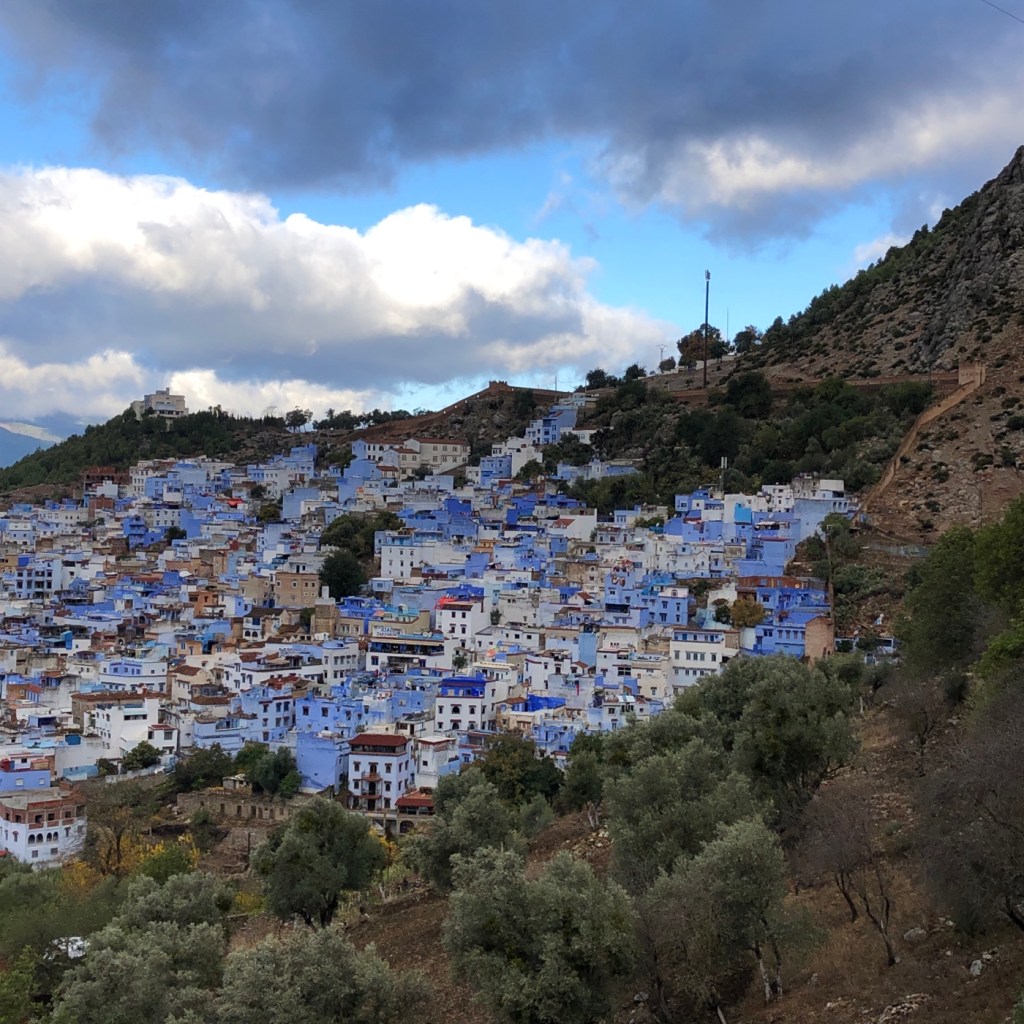
When you get to Chefchaouen you will hear and read various reasons for the blue walls, blue walkways, and blue fences. The color was brought with the Jewish refugees from Spain, the color keeps the mosquitoes away, it was discovered in the 70s to be a tourist draw – but I know the real reason. It’s a fantastic backdrop for photographing cats.
Grey and white tabby stripes look good against periwinkle blue.Vibrant blue makes this little black kitten stand out.White is dramatic.A calico, a blue door, and colorful hardware.Cats colonized every comfortable spot.Blue blue blue – cat!Who is fascinated with who?Some are petable.They sit on boxes.They sit on trash cans.They relax and enjoy life.Happy travelers above the blue city.
Our first stop in Morocco was Tangier for two nights. Our friend Dan (Hi Dan!) provided great advice – don’t book your first night in the Medina – so hard to find and if you arrive from the airport via taxi they can’t drop you at the door of your place. Finding your way to a location in the Medina can be hard/impossible/frustrating/overwhelming.
On the edge of the Medina in Tangier. The 15th century Portuguese fort wall looking nice in the sunset. This was the view the from our guesthouse terrace.
Moroccan people are super friendly and feel a particular bond with Americans, the diplomatic history goes back to the 1786 Moroccan–American Treaty of Friendship.
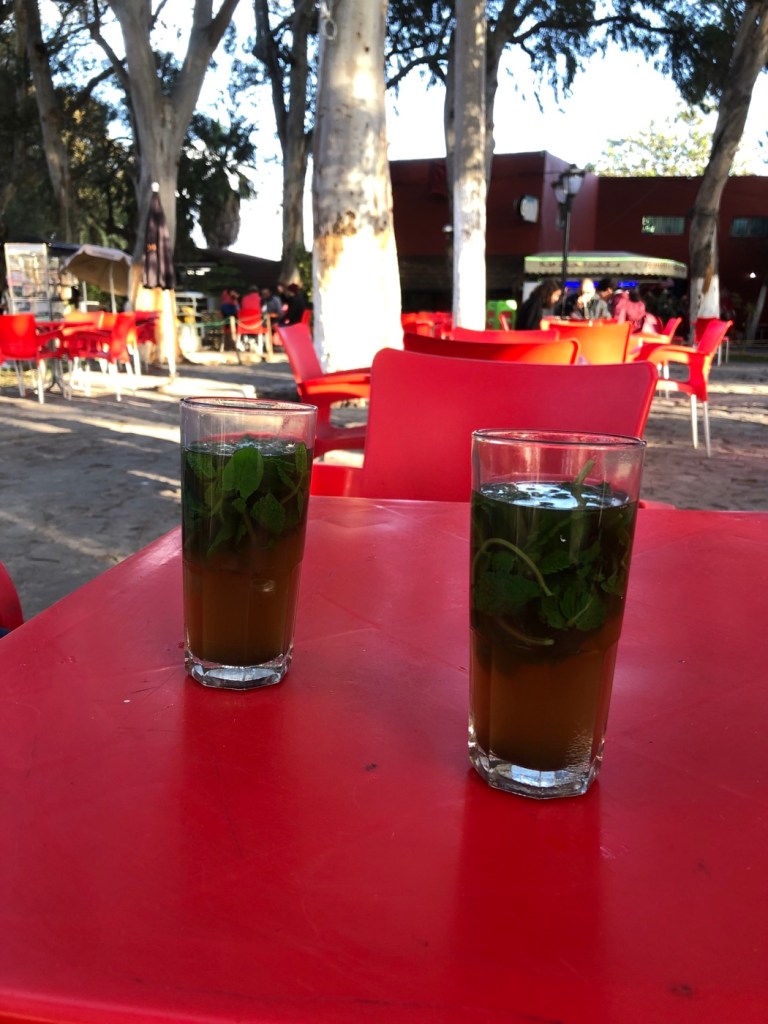
Tombeaux Phéniciens, Tangier. On a bright, windy Sunday.One day in and I already felt that I was 10% mint tea. And I was happy about that.A sweet shop. Where to start? Upper left corner and work our way along. All delicious.Oh yes, there are many cats in the Medina.Lunch time and juice time. Mint citron on the left, orange on the right.
After two nights in Tangier we hopped a bus to Tetouan, about an hour away. We had to take a taxi to the bus station and we were reminded of a valuable travel tip in Muslim countries – Friday is the holy day when the afternoon prayers are a huge draw, emptying the streets of men and therefore taxi drivers. We left a lot of time to get to the bus station via taxi, and with some unsolicited help from a local (small monetary tip, why not, he did help) we got a taxi and made our bus with plenty of time to spare.
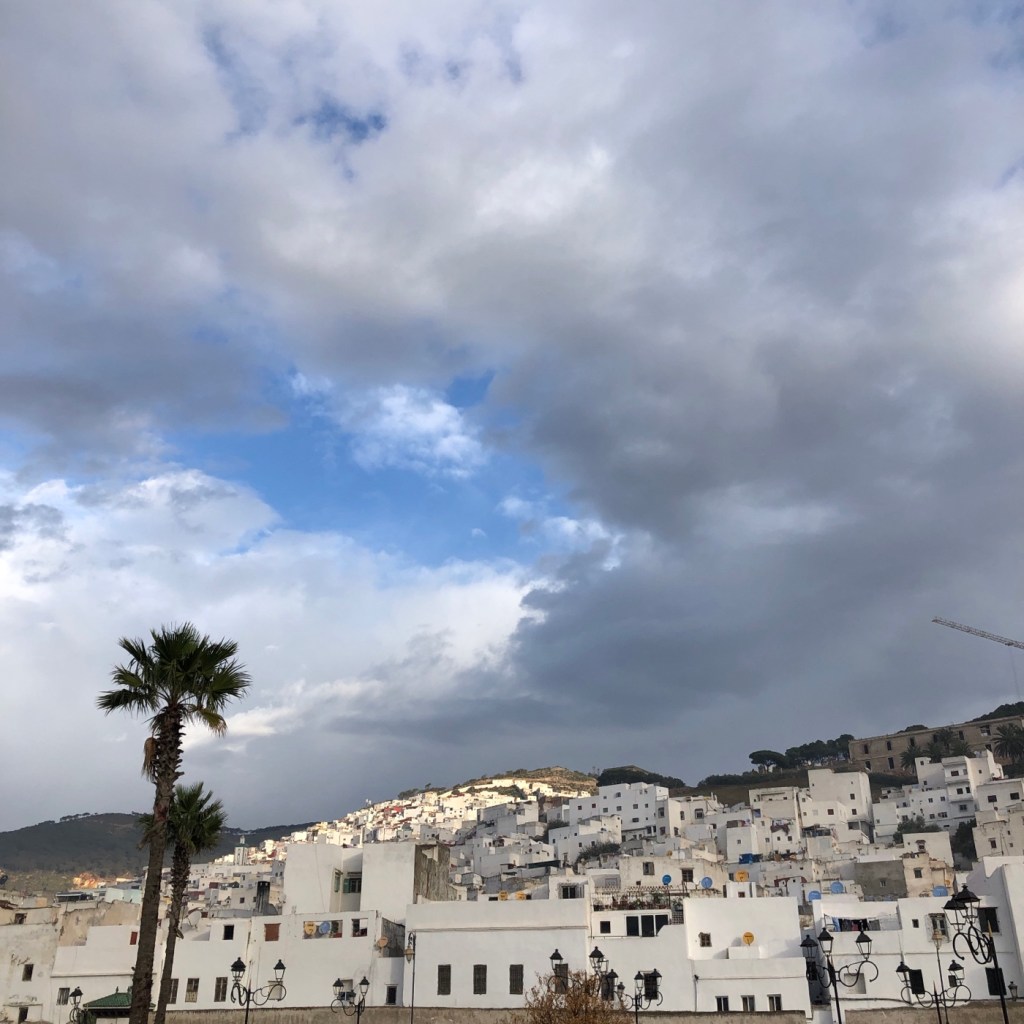
Tetouan on a dramatic cloudy day.
Tetouan is not a big tourist town, and the locals, for the most part, seem to take pride in not making a big deal about tourists. You can stroll the ancient Medina with only the occasional accidental tour guide, and get genuinely helpful directions. The best tip we were given was to look for the center stones in the narrow alleys for some guidance: 3 stones is a main street leading to a gate where you can exit the Medina, 2 stones means a lesser street leading to a main street, 1 stone – dead end residential street. I say street, but they are small alleys, no cars here.
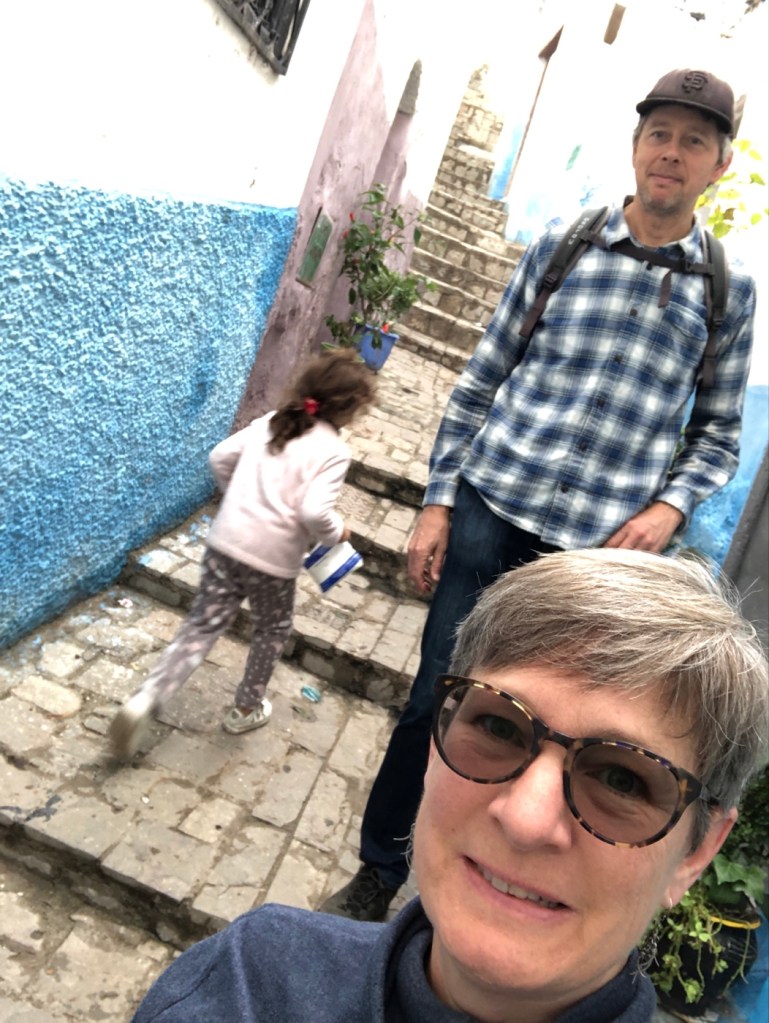
Children run free in the Medina streets. Note the 2 stones in the center. Small street which will lead to a main street.
And those accidental tour guides? They sometimes are focused on getting you to a shop, sometimes really just helping. But you do end up seeing some interesting things when you pick up your accidental tour guide. Being firmly polite and friendly works just fine when you’ve had enough and want to leave. It may take a few tries to lose your new friend but they will ultimately say goodbye after you thank them.
Men working a loom. No hard sell from anyone, just a slice of life thanks to our accidental tour guide.The product for sale.Guided through the ancient tannery by our ATG.Tannery cat! A pharmacy in a lovely old building. Thank you ATG.
Even if you come to Morocco with zero intentions to buy a beautiful Moroccan rug you will end up in a rug shop at some point. We did, thanks to our ATG. Since we have no home right now and all our worldly possessions are in a storage unit we did not succumb to the temptation. But I can understand why people buy rugs here: they are gorgeous. I’m partial to the flat weave rugs, and who knows – a small rug may end up in our luggage.
.
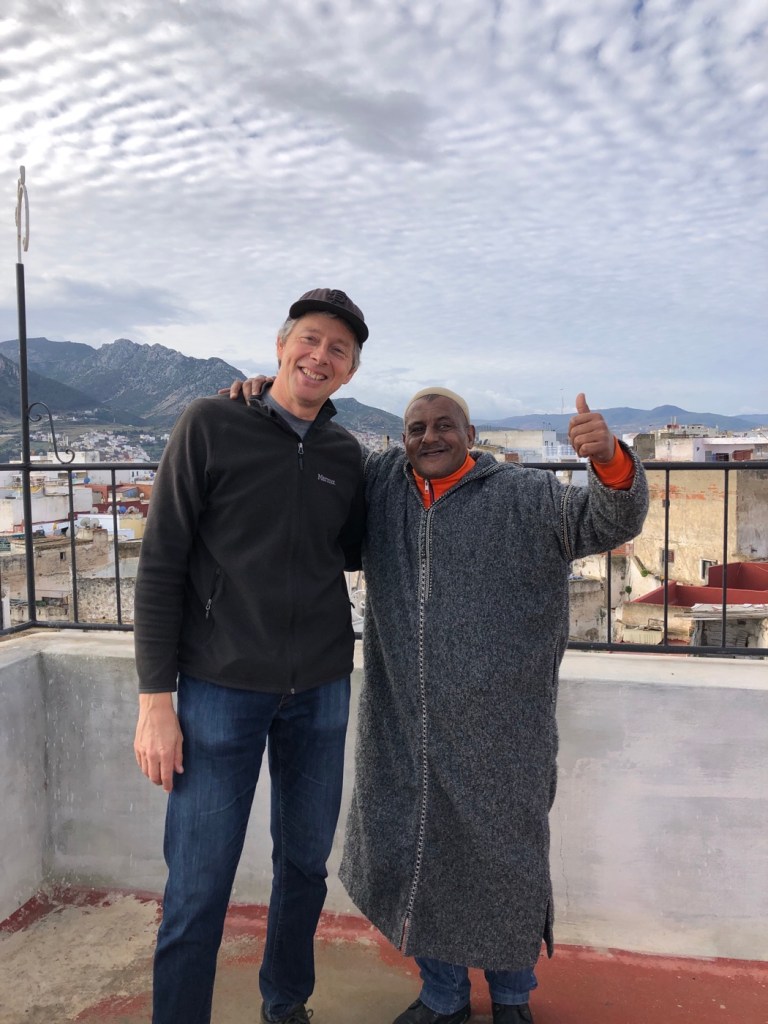
Rich and our friendly accidental tour guide. He took us to a great view spot, tried to get us into a closed museum by knocking repeatedly on the door, and we finally said goodbye, happy to have met.
We think we hit a sweet spot here in Morocco when locals are happy to have tourists back, there are not many of us yet, and not yet tired of the problems that tourists can bring. We are happy to be here and the locals seem happy to have us here.
Happy travelers looking forward to more time in Morocco.
Owning the room. Lounging on top of the mini fridge.
We found my favorite pub in the entire world. Yes, we’ve been to cat cafes around the world – oh, we’ve seen some things.
Cats gotta box sit.
A cat cafe in Thailand with color matched cats. A resort in Malaysia with dozens of well behaved rescued cats who happily lounged at the pool, in your room, and under the tables at the restaurant. A San Francisco cat cafe where you could adopt the cats. We’ve discussed the absence of cat bars and what you could call one. Suds and Siamese. Pints and Pussies. Ale and Alley Cats.
A pint of milk please.
But here in Bristol we visited The Bag of Nails. Going forward always referred to as Kitty Heaven. Cats for me, beers for him. Kitties on the bar, kitties on your lap, at one point eight cats were visible in this not large pub. Oh, did I not mention that my wonderful travel guy is allergic to cats?
So of course the cats love him. First lap sitter goes right to Rich.
Cat cafes tend to be very controlled environments. More so in California due to health regulations. Here at Kitty Heaven the list of amusing but serious rules includes one definitely aimed at me “no squealing.”.
A Siamese scans the room.
We only stayed for one pint, but what a happy pint it was.
Sit at the bar for more cat access. Besides the cats being adorable, you can be fairly confident that you have at least one thing in common with the other patrons: you all like cats.The rules.
Vinyl on the sound system. Beer in hand. Cat on lap. Heaven.
The boxes are labeled. Little black kitty on the move.Oh yeah, no idiot pub crawls!
If you’re a cat lover and in Bristol, it’s a great place to visit. Review the rules first and do not squeal.
Step 1. Bike tour. You end up staying places that are not A list, ones with no big attractions but lovely people and normal settings where you might be only tourists, and folks in the bakery will be interested in what the heck these two Americans with not great German language skills are doing here.
I should have started my series of amusing fountains in town squares earlier, but here we go.
Step 2. TrustedHousesitters.com Check it out. You meet wonderful people and pets and spend time living a bit like a local.
The goose herder?
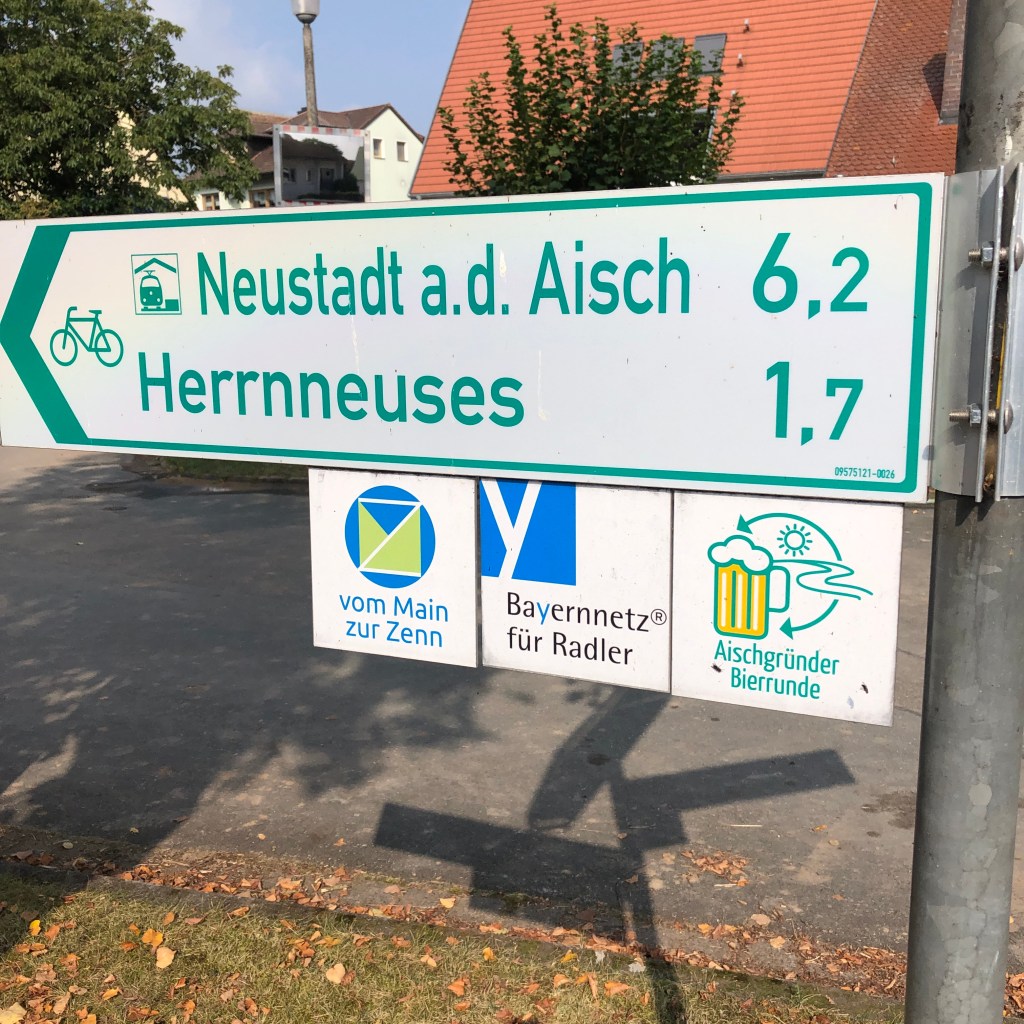
You get to go for walks on well signed local trails to beer gardens.
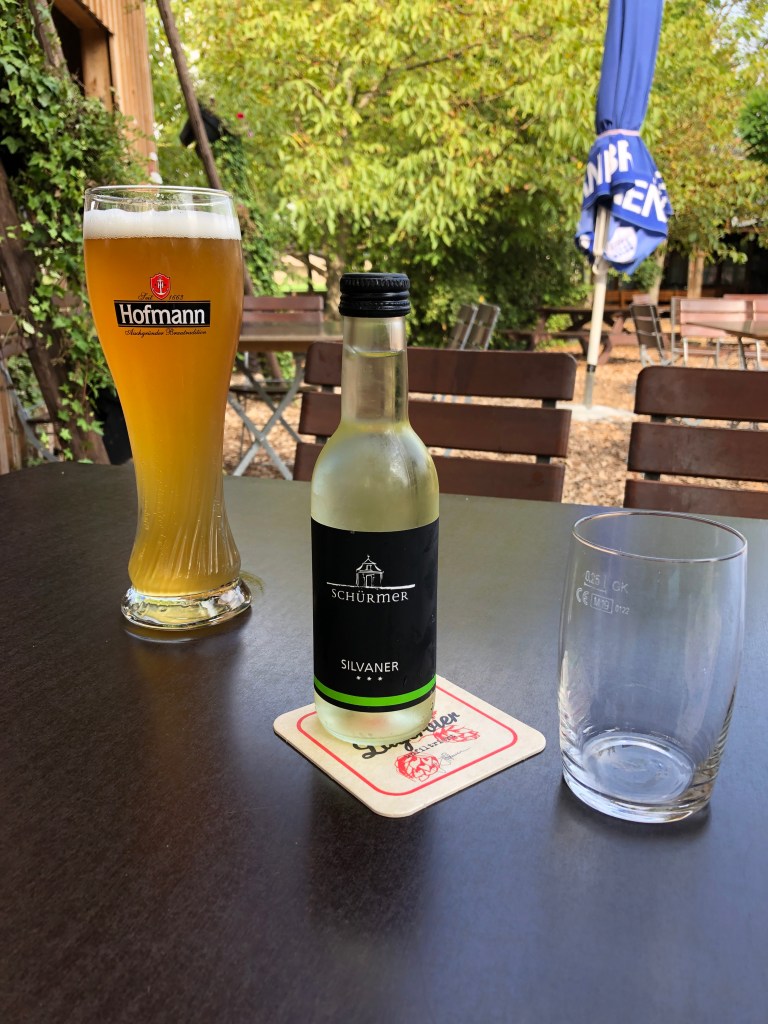
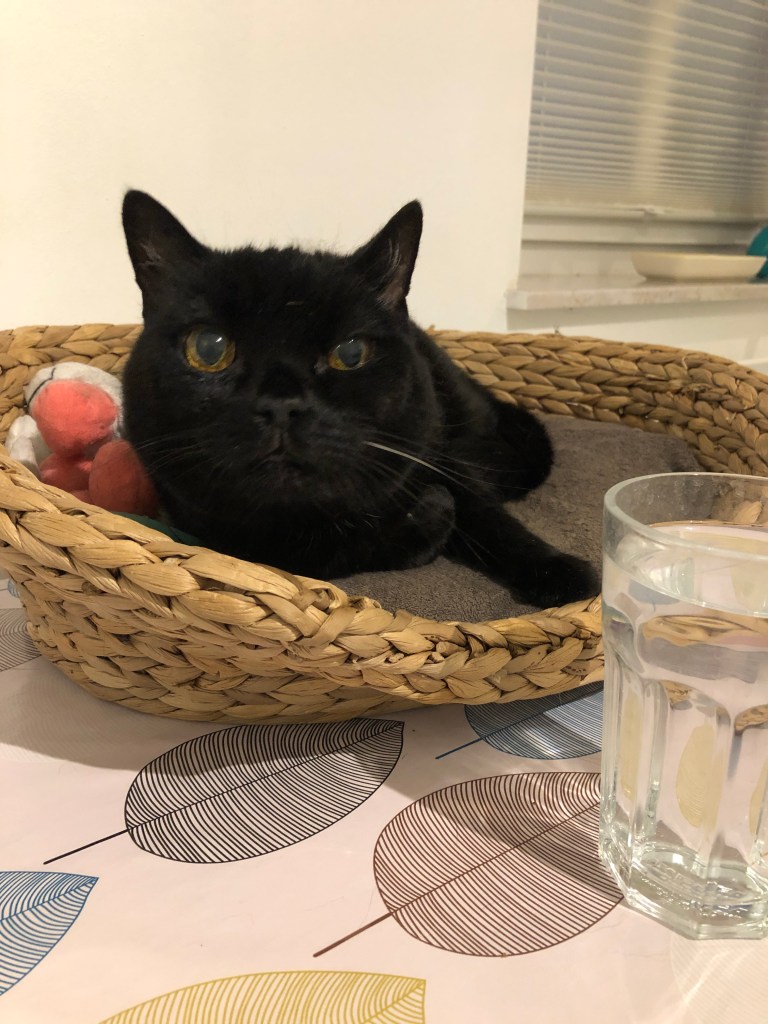
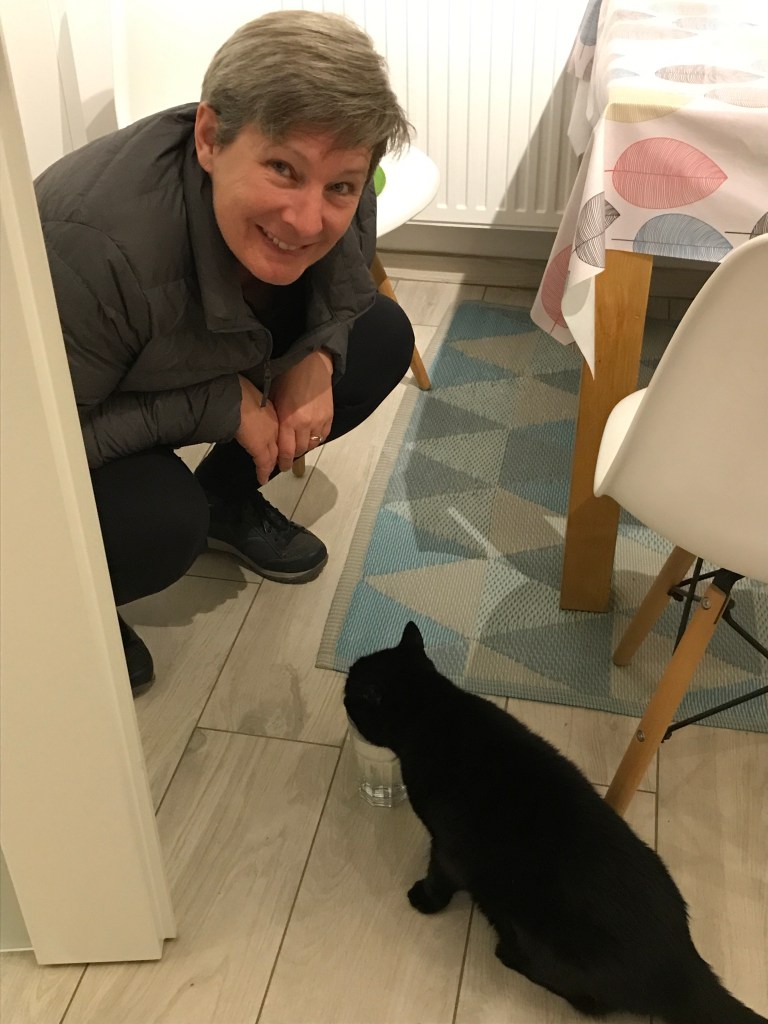
Squirrel trail? Sign me up!That lower right sign is the beer tour route.My own little bottle of wine with lunch. Rich and a yummy Keller beer, at yet another beer garden. They are the perfect pandemic place to go and we seek them out.Our sweet little charge, thank you to her for being the best little cat and to her human companions for choosing us to keep her company.She loves to drink out of a proper glass. I love to watch. Cat tongues are fascinating.
Two days off the bikes and we head off today to Bad Windsheim, a pretty short ride, where there is both a thermal bath, one of Rich’s favorite things, and an open air history museum- one of my favorite things.
Happy pedaling!
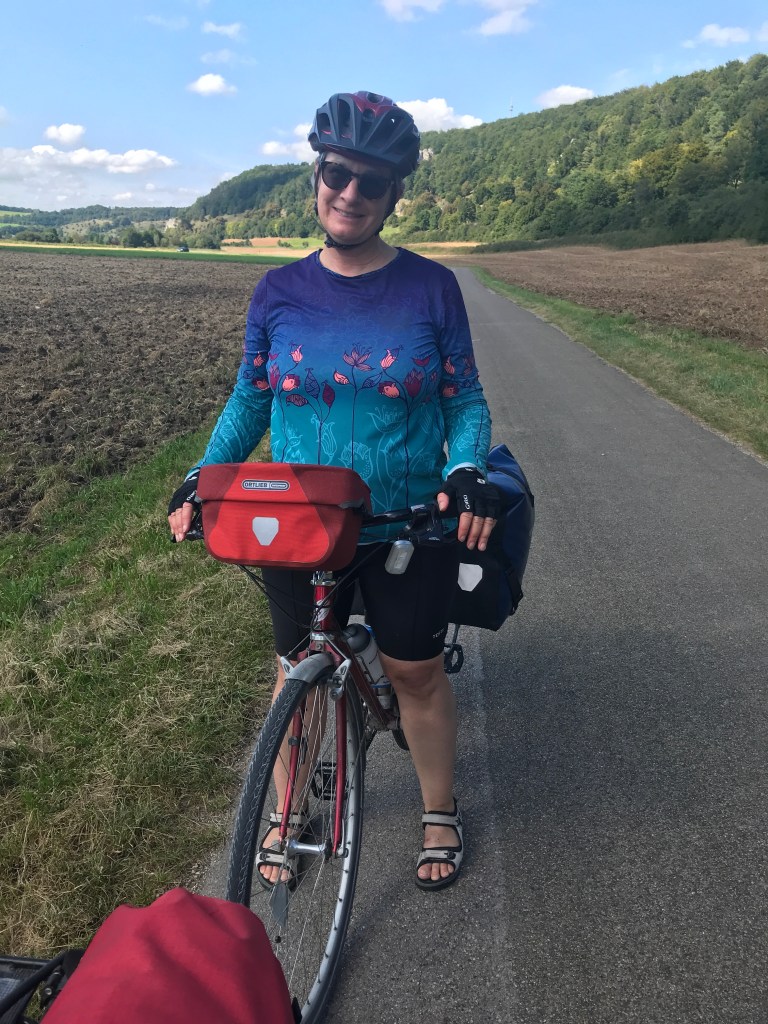
From a few days ago, fall is in the air and beware- you may see socks being worn with these sandals very soon.





















































































 Less Car, More Life