To go or not to go? As we planned our trip to Flores, Indonesia, we quickly figured out that we had to fly via Jakarta or Denpensar, Bali to get to Labuan Bajo. Bali made more sense as it is shorter flying from Taipei.
Balangan Beach at low tide
But after spending a week or so on Bali during our 2017-2018 « Java by train, ferry to Bali adventure » we vowed to stay away until the plastic problem was improving and development seemed a bit more sustainable. Bali is a tourism juggernaut, but is often cited as a global example of overdevelopment.
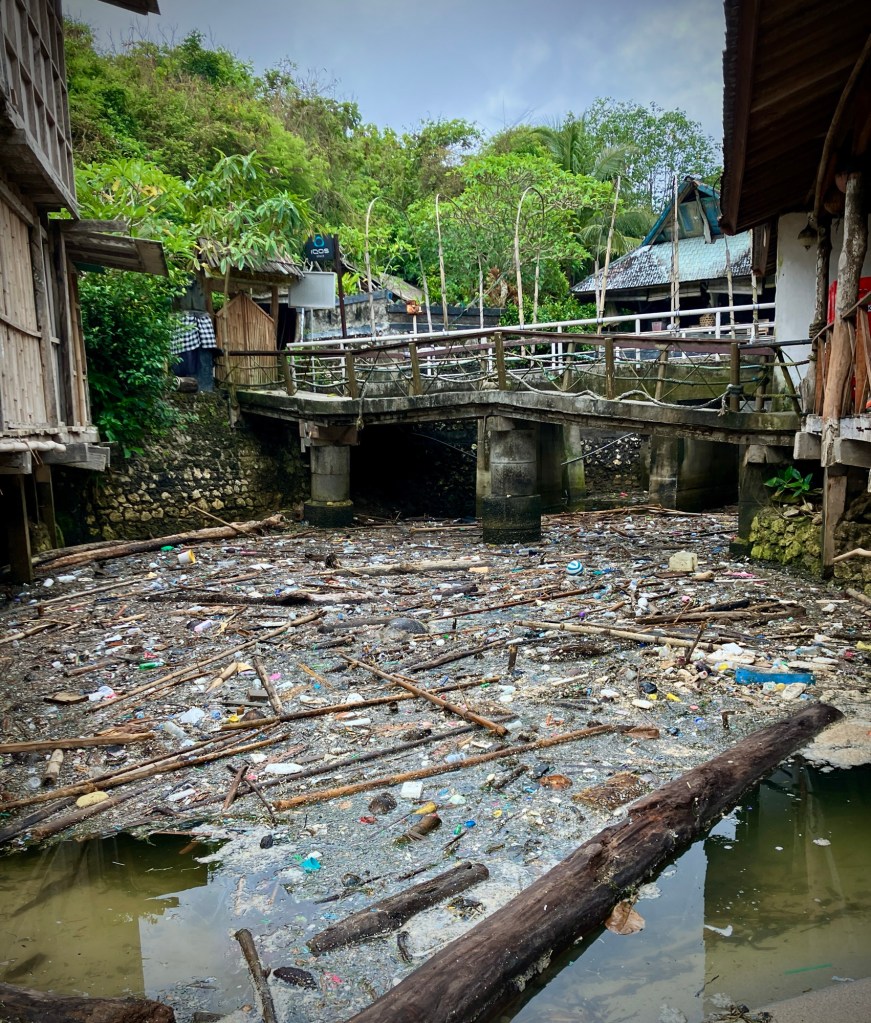
Balangan beach is a popular surfing beach, but pretty quiet landside this time of year. Bali tourism is still recovering from the pandemic, which devastated the islands’ economy as the airport was completely closed for an entire year! 6,000,000 tourists suddenly gone.Rotating left from that photo, here is the backwater area. It’s hard to identify the area and exact source of the plastic pollution, but the problem is clear around the island.
During that trip, we spent time in Pemuteran (NW Coast), Ubud, and Padangbai. The ocean plastic problem here is somewhat seasonal as the rainy season (Nov-Mar) washes much more plastic into the sea from creeks, channels, and other areas. It swirls around the islands and is carried to sea and redeposited into coves and beaches. In 2018, along with some well intentioned Canadians and Aussies, we would spend some time picking up plastic after each high tide left a deep line of plastic debris. But we soon realized the futility of this exercise. And I still have nightmares of my arms stuck in a giant plastic bag and debris flotsam mess in Padangbai, while trying to snorkel at the Blue Lagoon Beach. If you’ve travelled across SE Asia, then you have certainly seen the same challenges in other countries.
Heading down to explore the beach, hoping for the best. Did we cause this and are we adding to this by being here?
So Bali, and much of the developing world, has a massive sanitation, disposal, and plastic problem. If you have been here and not noticed it, then you probably isolated yourself in 5-star resort grounds or have been lucky to be in a clean area during the dry season. And much of Bali is still charming and peaceful. We also generate a huge amount of waste in the US (we’re #1 baby!) but it is generally disposed of properly.
Surf beach funkiness and faded glory feel at BalanganThe infrastructure of Bali varies, but is certainly still developing. More economic development may lead to more opportunities and spending on the environment and sanitation.
So we decided to spend 3 nights here and assimilate a bit into the tropics after a lot of cold weather and moving about the US and UK. We found a lovely, locally run, small resort on a bluff above Balangan Beach. We know the traffic here is a nightmare, so we planned to just get here and relax with one trip from and to the airport. We walked to a few local restaurants as we could, but basically stayed put for a few days, which is rare for us. The walking is not great on the busy back roads and the maze of historical alleys and streets is generally disconnected and cutoff by development or geography, so taking a scooter or car even to go short distances is the norm in most areas.
The view of Balangan Beach from above Sunset Point. A reliable swell hits the reef and creates beautiful surfing conditions.
We did not want to add to the traffic as much as possible and also strived to minimize our single use plastic use. We almost never use plastic bottles in areas with safe drinking water. And if the tap water passes the sniff and flotsam test, we boil or use our UV SteriPen. The tap water may not always taste the best, but this treatment ensures we won’t get sick from any microbes. The water may still have some undesirable elements, but those generally won’t harm you in limited doses. And as Cheryl likes to say, it may make us stronger!
There are over 10,000 hotels, guest houses, and other lodging on Bali, and dozens just in the small Balangan area. Light traffic here as it’s at the end of the road.
But regardless of what little steps we take, just traveling here inevitably generates a lot plastic waste that may not be disposed of properly. And of course, so many broader impacts from flying and local transport. Sustainable development is so hard to get right, and even more challenging when the economic disparity between the locals and tourists is so great.
Dragon fruit muesli bowl and a banana pancake, a classic Bali visitors breakfast. Cows grazing peacefully in the distance. Plastic straws at our guest house not appreciated. Jimmy Beach cafe is the place to go on Balangan, and we really appreciated the paper straws!Very well-presented and delicious Avocado toast at the Jimmy Beach Cafe. Is Avocado toast the new travelers’ Banana Pancake?
Now I realize that the carbon generation of our travels are not helping the planet and that’s a bigger ethical question for all who get around by jet. But the plastic embedded everywhere here along roads, ditches, coasts, beaches, and forests is visible. And it’s terribly depressing, and we find it nearly impossible to enjoy ourselves in the midst of it. But it’s also symbolic of the overdevelopment and a government that maybe isn’t always looking out for the locals. Not as much free and happy local space left here.
Collected plastic bottles, we assume for reuse or disposal?
And coupled with the low standard of living and income disparity, we find the whole scene tough to swallow. It’s not that we don’t accept the income disparity, but here it feels like the locals have been pushed to the margins and lost a lot of what makes the area livable, all in the name of even more touristic development.
Every residence seems to double as a surf shop and travel agent, but very little business here in February.
Maybe Hawaii got it a bit more right by limiting new resort and tourist development expansion the past 30 years. That has made Hawaii an expensive place to travel, but most of the islands are pristine and many areas are protected. There is still the local/tourist tension there for sure, not to mention a legacy of cultural appropriation and displacement. OK, maybe Bhutan is getting it right.
The local Bali cattle are smaller, very tame, and resemble deer, especially when they are young. They are very effective at clearing local vegetation.Cheryl above Balangan Beach. The grass is kept short by grazing cows.
But Bali is a large and complex island with over 4 million people, and 6 million annual visitors, with a huge variety of experiences and places. Indonesia is still a developing country of over 200 million people and tourism brings huge income and opportunities when applied correctly. It’s a lifeline and draws people from other islands to work. Indonesia is also embarking on its goal to spread the love and have higher end tourism in their “10 Balis » initiative. (More on that in our next post)
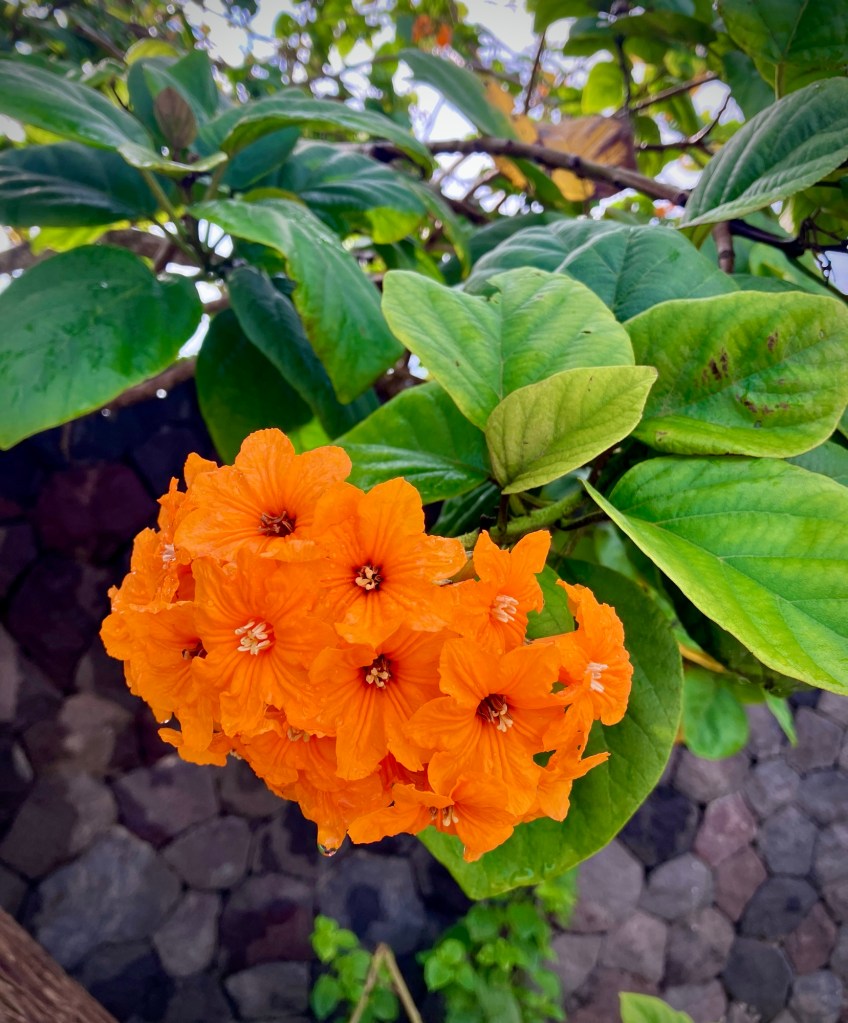
Dramatic sunsets and clouds from our balcony.Beautiful flowers on BaliIt’s beautiful here and charming, but we feel a bit out of place without our bicycles and a transit card in our hands.
So we are now off to East Nusa Tenggara or Flores Island as it’s better known for a few weeks of exploration. It’s certainly less developed than Bali and also one of the poorer regions of Indonesia with a vast array of cultures and religions. What will it feel like compared to Bali? Each Indonesian island is so different. Stay tuned.
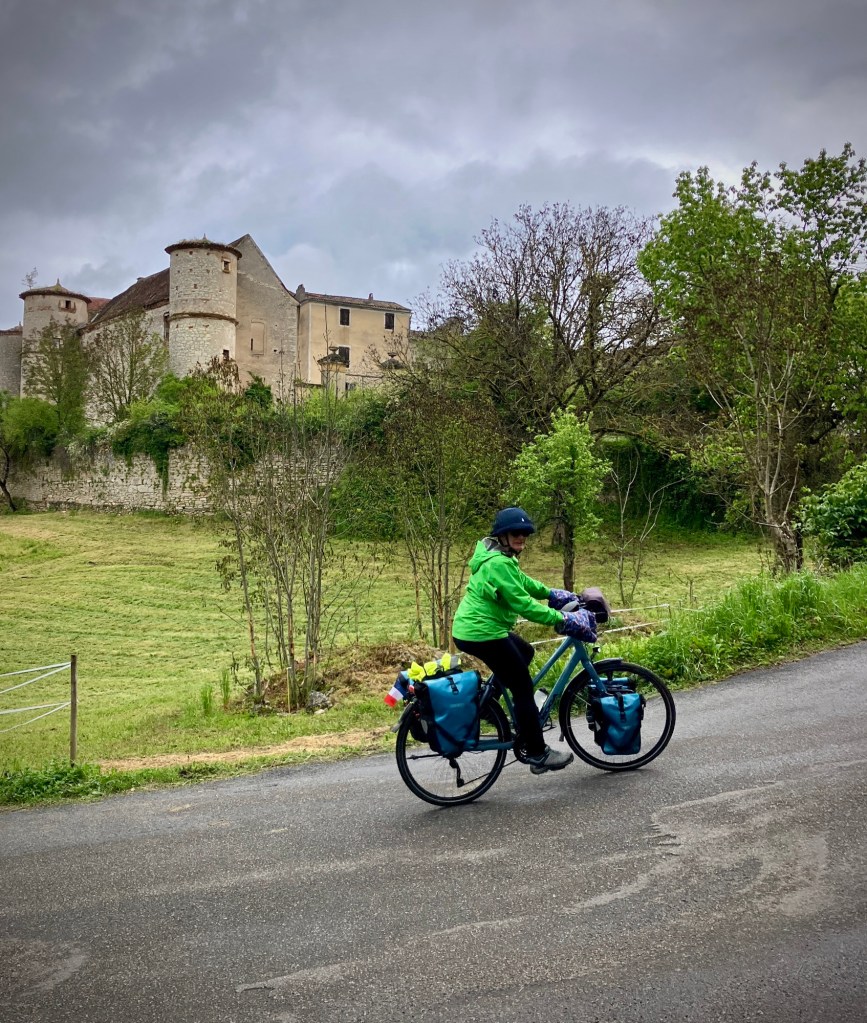
After a nice rest day exploring Cahors, Cheryl and I continued our spring tour further up the valley of the Lot River. The middle Lot is a magical place of endless meandering and pretty villages with a variety of terrain to match.
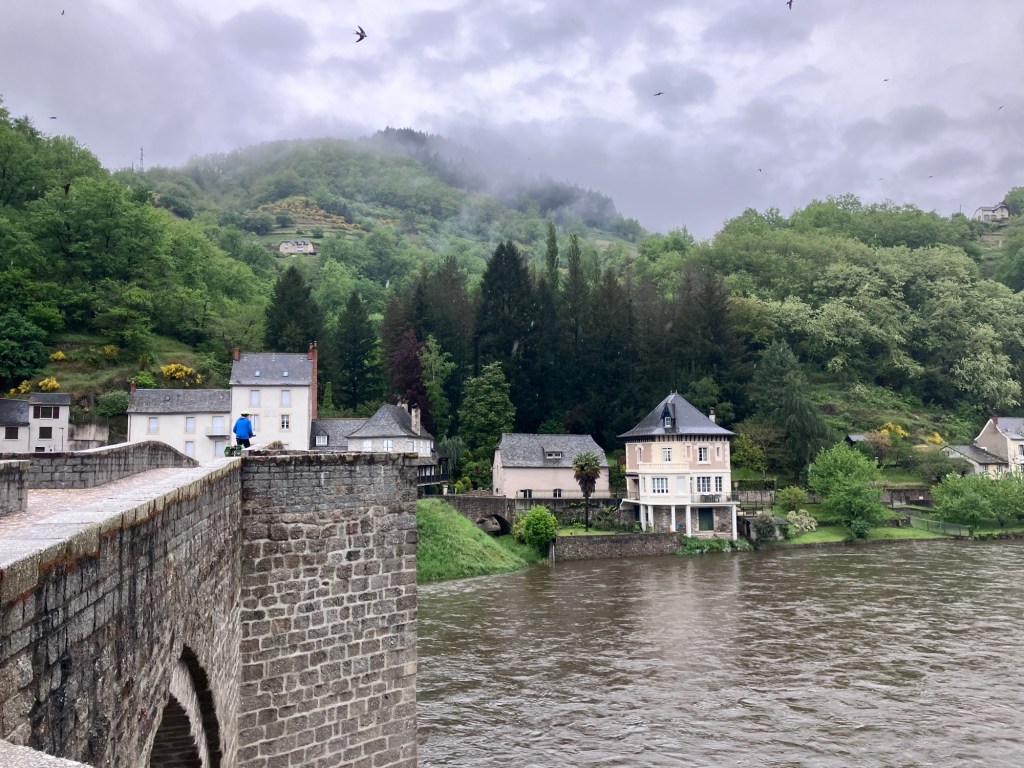
Riding out of Cahors over the Devil’s Bridge The Middle Lot is still navigable with occasional weirs and locks
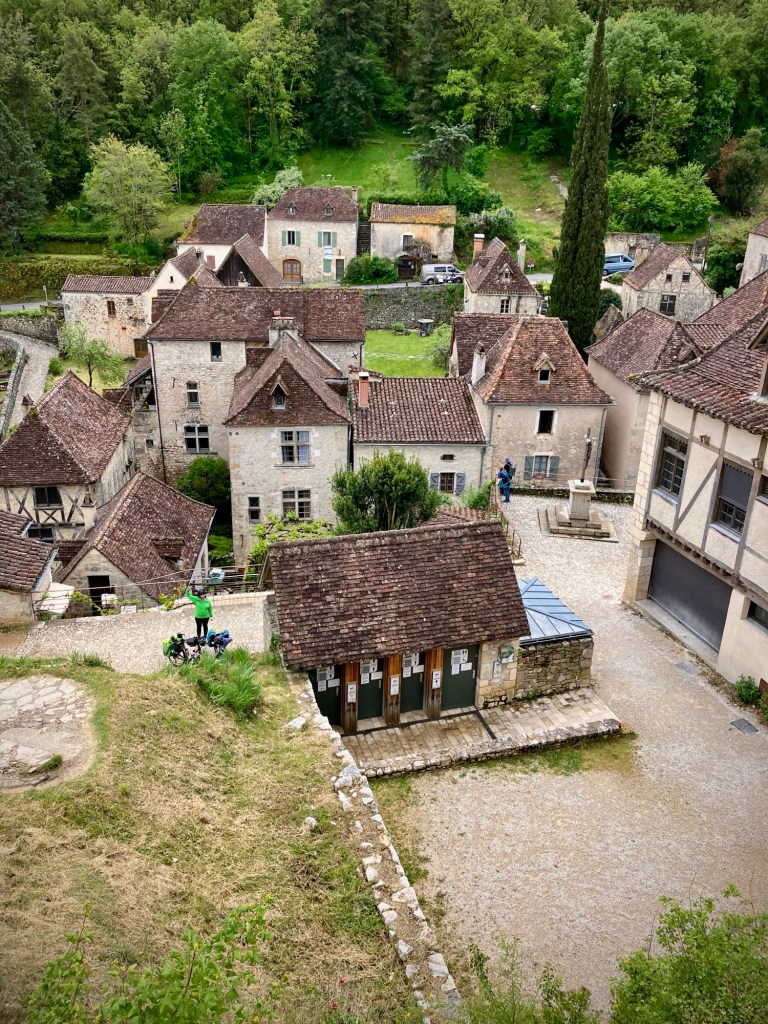
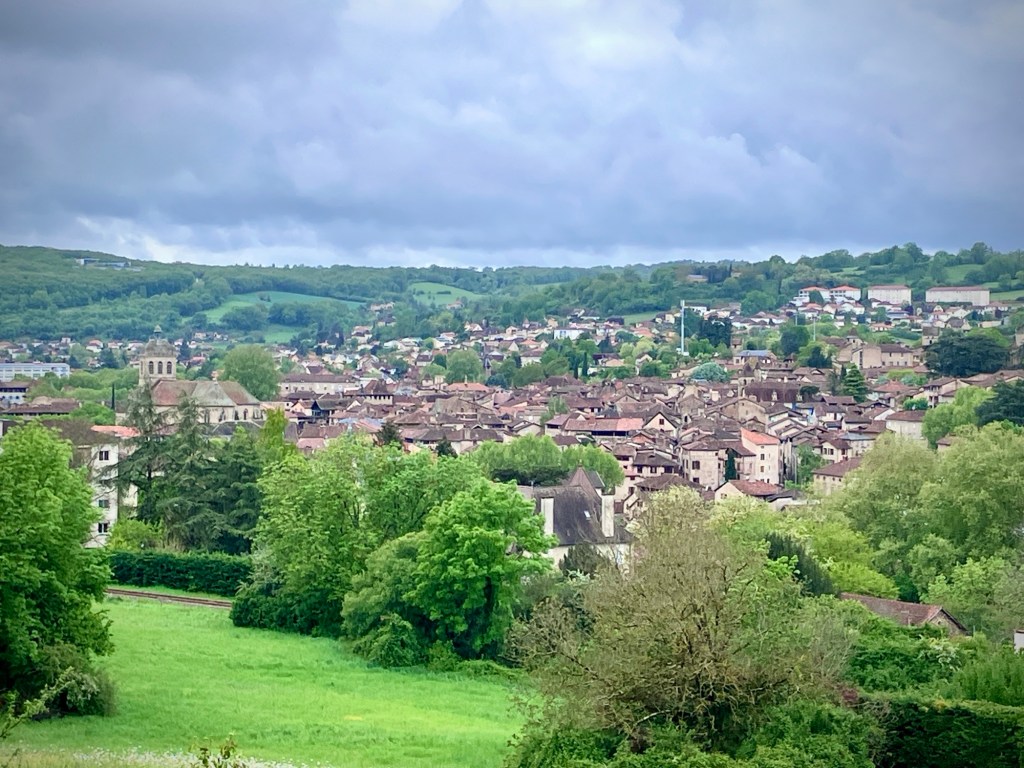
The route out of Cahors immediately took us up a hearty 300m climb over a ridge, but the reward was a descent down to the beautiful Saint Cirq de Papopie. It’s a storybook medieval village perched on a rocky edge above the Lot. Our friend Dan had mentioned his time in this area and we thank him for the tip.
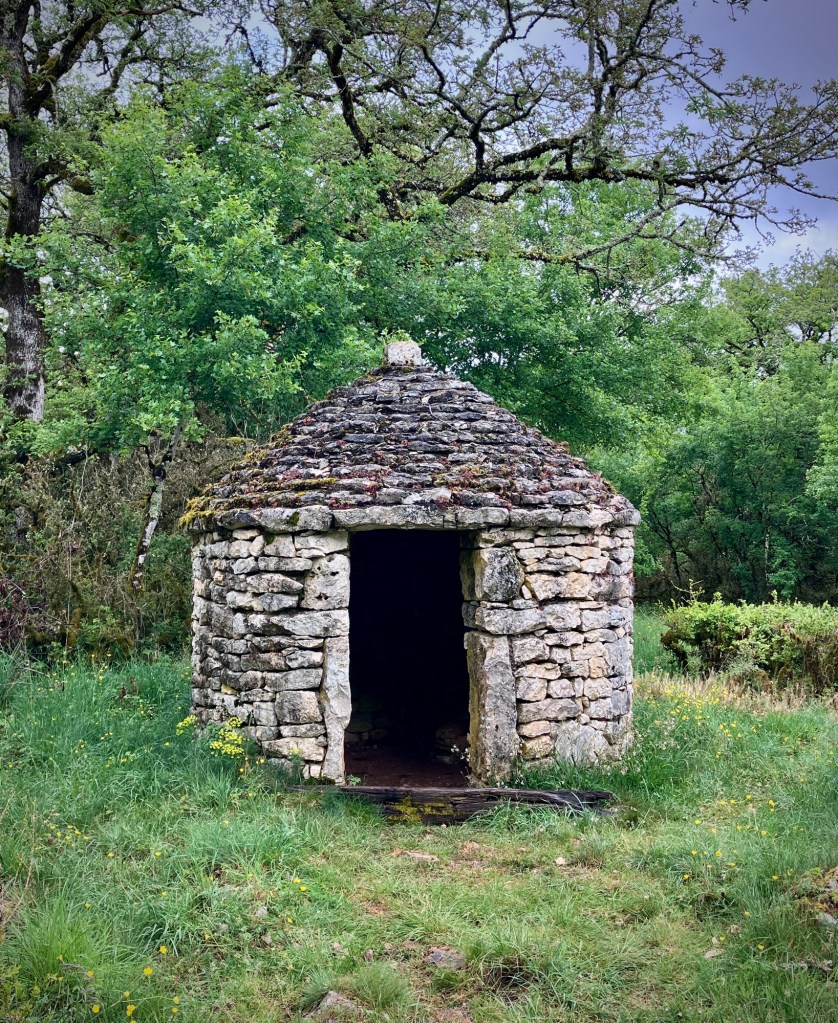
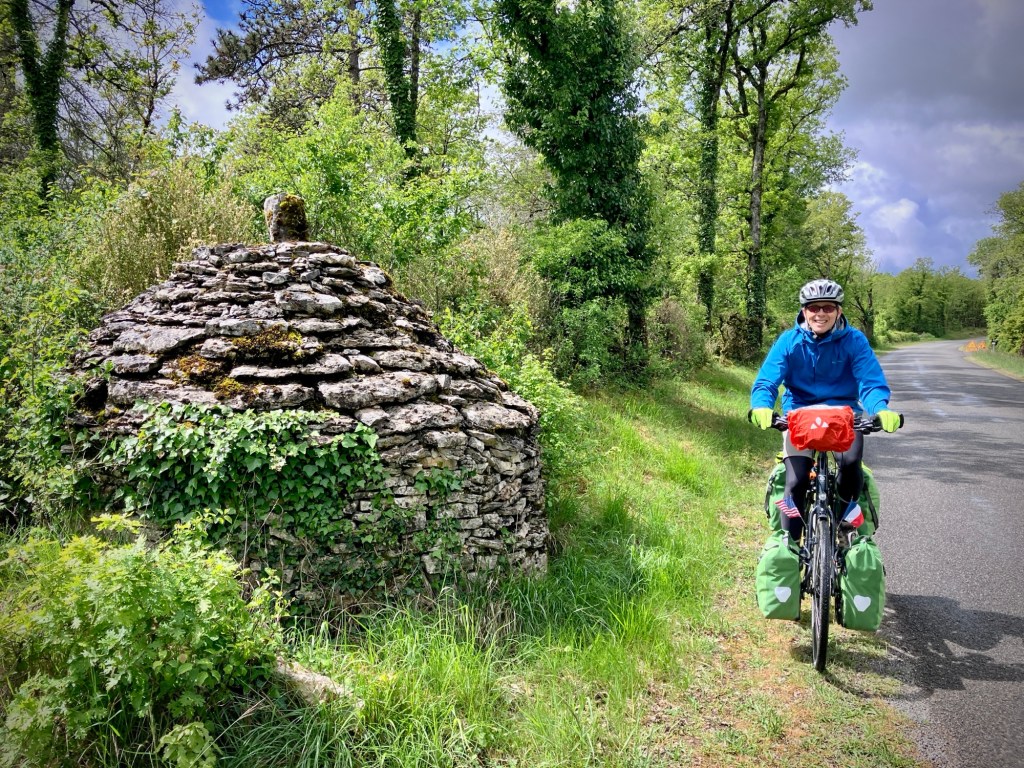
The route does not always hug the river and has some pretty decent climbs to connect the rugged and remote parts of the riverApparently we were also on the Vagabond route…very appropriate.Cheryl was fascinated with these mortarless stone buildings known as capitelles or cazelles, which are endemic to the regionAnd another oneAnd a wiff of wild mint for the descent
Apparently tourism exploded in the town after a popular French television shown voted it the most scenic place in France in 2012. We can’t disagree with that call. It was sparsely visited the weekday we passed through and is really a beautiful spot.
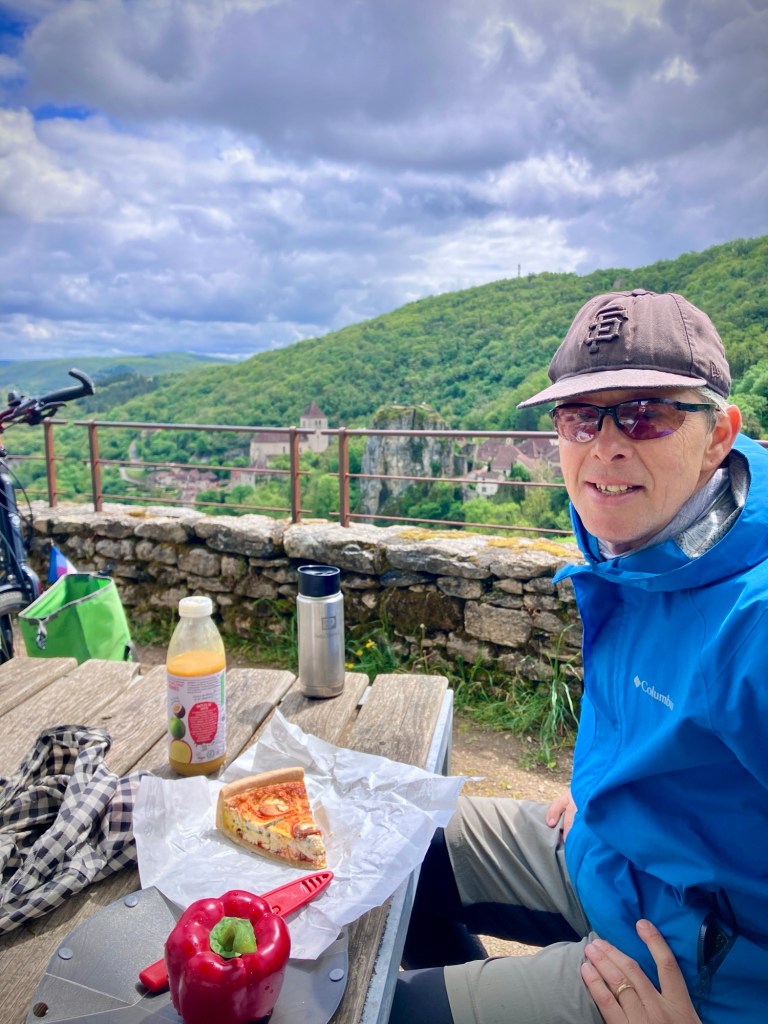
Our first view of Saint Cirq Lapopie We couldn’t pass up this prime view spot to picnic on some yummy quiche and veggiesAfter lunch ussie Sometimes I do some further exploration while Cheryl minds the bikes and maybe reads a bit. « Oh no, you go ahead »
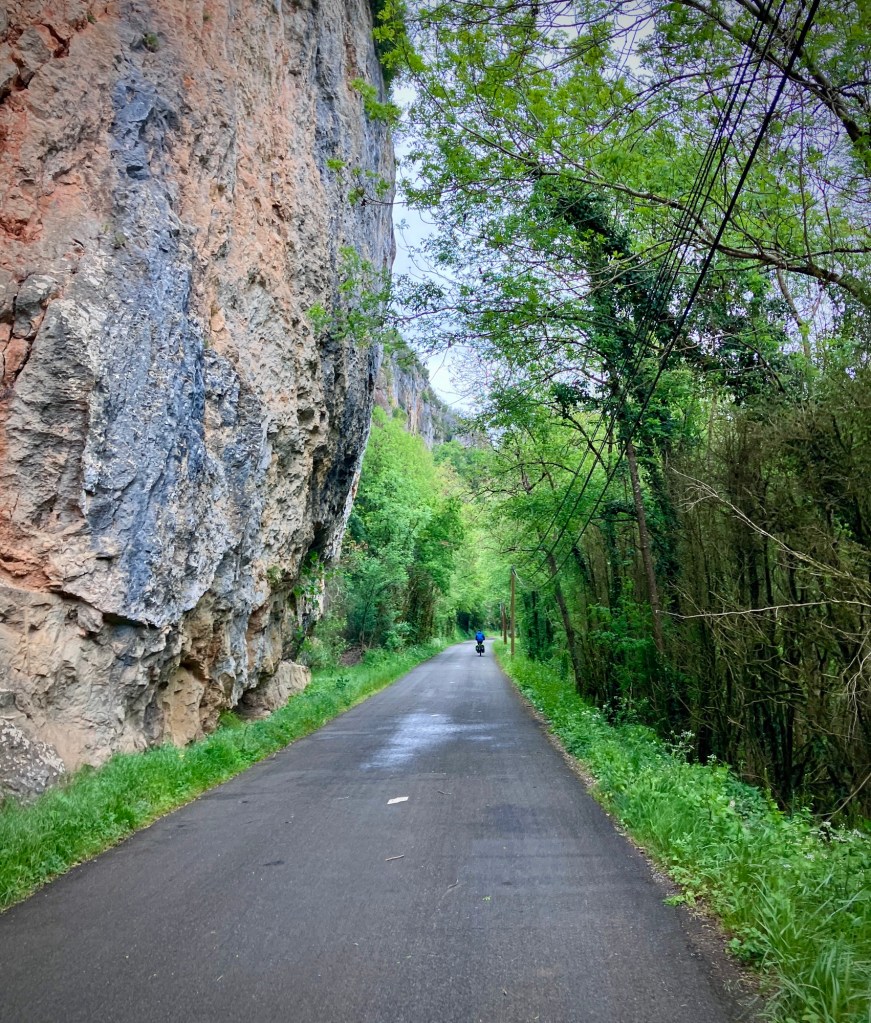
The ride from Cahors to Cajarc spans the Parc Naturel des Causses du Quercy from west to east. The villages are extremely tidy, with some restored houses, cottages, and farm buildings. There are also nice sections along the cliff walls, and the roads are not busy. We made it to the scenic village of Cajarc and our Logis inn (with dinner!) after a rewarding day of cycling, and I began to plan our next day.
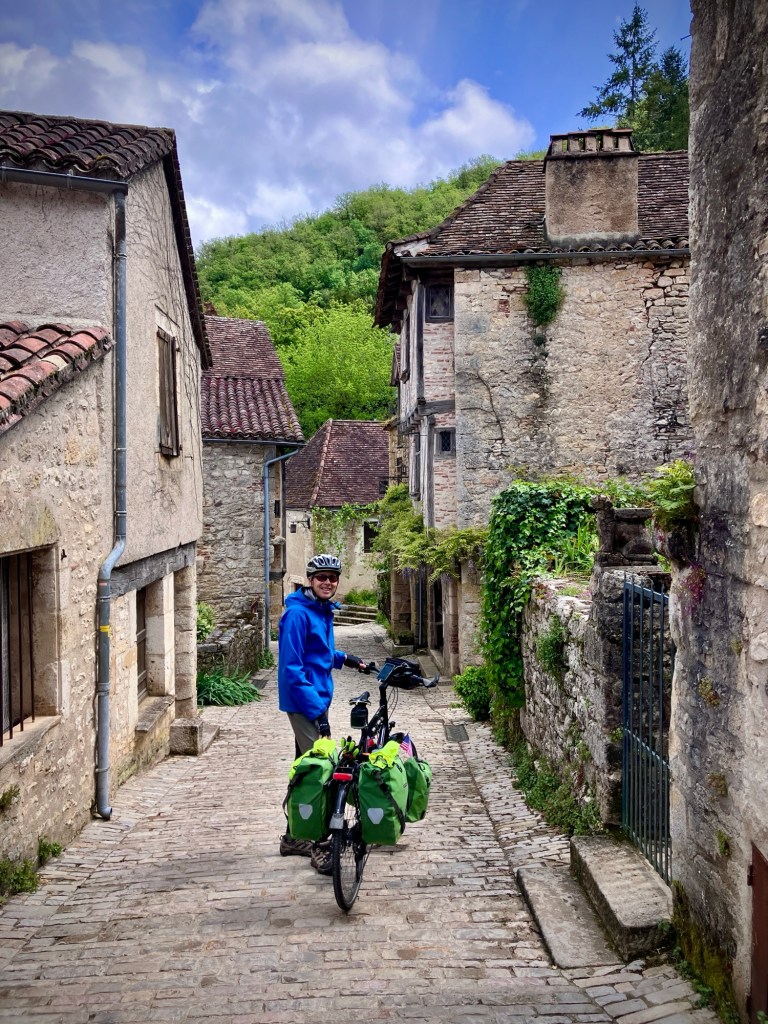
Saint Cirq feels like a movie set. Picture perfect and so tidy What’s this? Fossils on the canyon walls?We love interpretive fossil trails. This was a nautilus from the old sea bed.Many piped water taps have still been off for the « season », but we found most of the hand pump and twist wells delivered.
But the weather was starting to get tough. The next day a front was coming through with winds of 25mph and gusts to 50, and if we headed up the Lot route it would be right into the headwind. Yuck. We could shorten the day to account for the wind, but instead decided to head over the big limestone ridge to the next valley of the river Célé and the small city of Figeac.
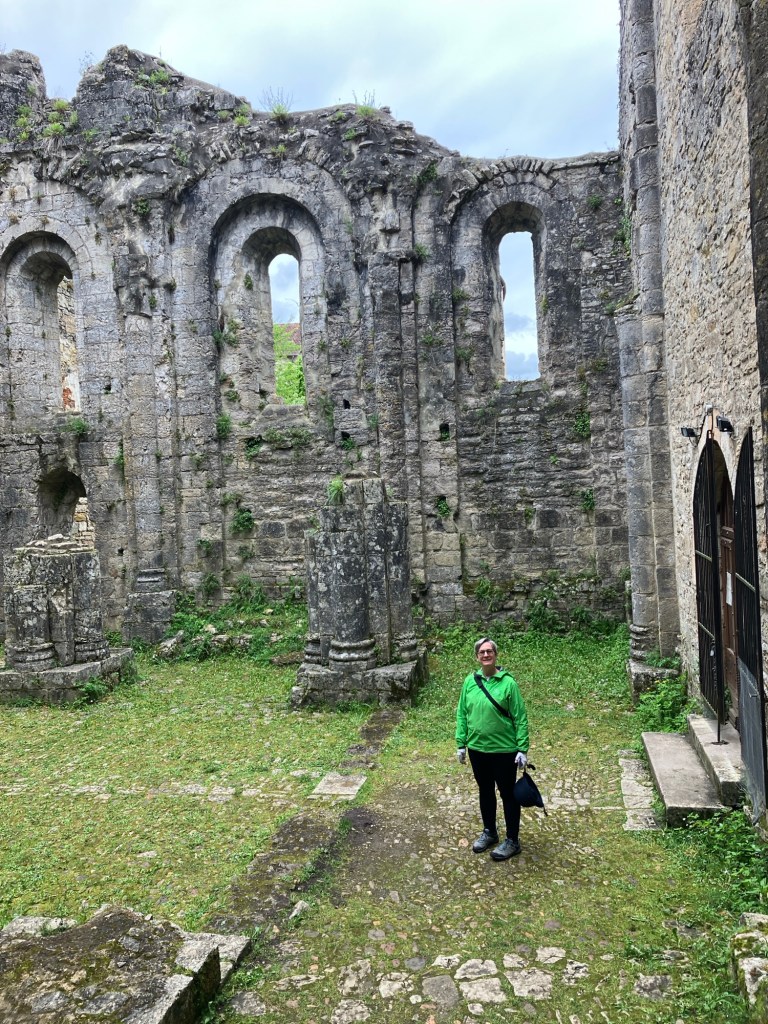
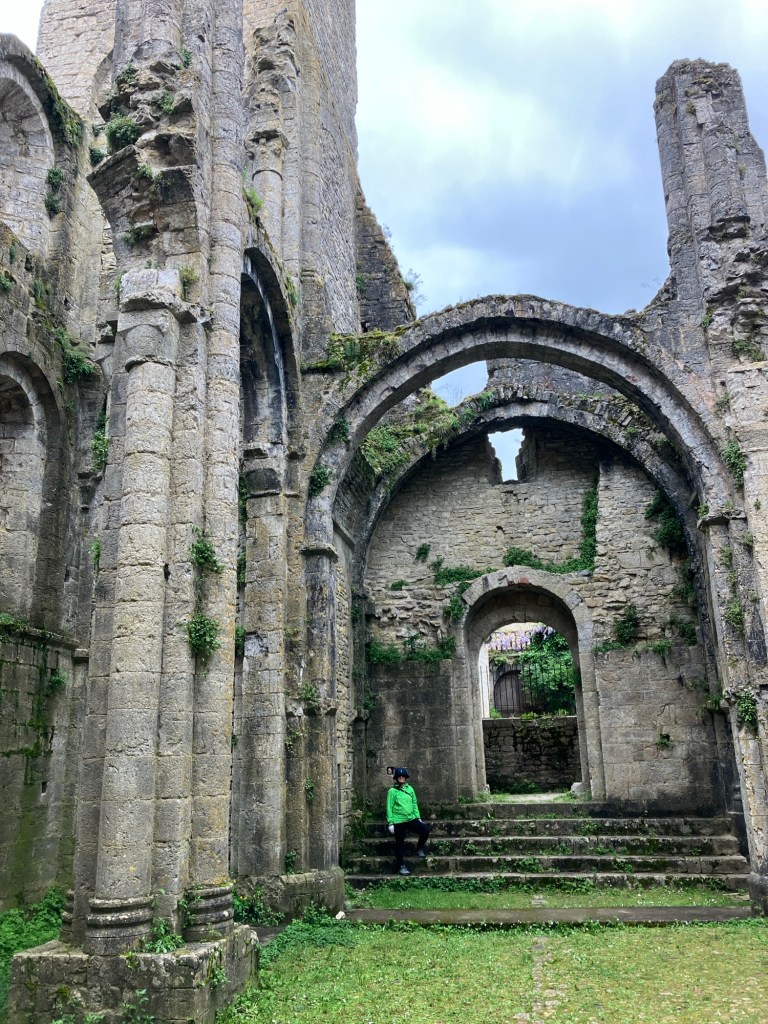
Another interesting Komoot trail choice from our grocery diversion out of Carjac. But one of our mottos is “never go backwards!”. It usually works out.Le Célé River.Inside the ruins of the Abbey Saint Pierre, parts of which date back to the 9th-11th centuries.The ruins are atmospheric and the adjoining church has been restored and is still active.Carved stonework of the abbey.
I had picked a fairly direct route using my goto navigation App Komoot, and mentioned this to the friendly hotel host as I checked out. Good thing as he suggested an alternate route that turned out to be a gem. More climbing and longer, but it would take us deep into the scenic Célé river valley and keep us in the park longer.
The climb was quiet and the aspect of the huge limestone gorge that defines the Cele valley protected us from a lot of the wind, or at least made the ride alternate between headwind and freakish tailwinds off the canyon walls. But you can’t escape gale winds and the last 10k into Figeac were exposed and a bit hellacious, with grit blowing in our eyes and branches falling from trees. But we made it to town before the rain started to dump and salvaged a memorable day from a potentially mundane slog.
A power picnic lunch in Marchihac-sur-Célé. PB and banana on Wassa crispsCheryl demonstrating how to spread the peanut butter with the back of the wooden spoon, so it’s easier to clean -:)We are always impressed with the French dedication to a proper and social lunch. Despite the increasing cold and winds, we watched behind us as they set up tables and laid out a spread of food.
Figeac is a pleasant river town with enough of a buzz on Saturday night for us to get rejected at our first Creperie restaurant pick, so we settled on a fast and casual burger place and a beer before we had a meltdown. We were very hungry and a worn out from the wind.
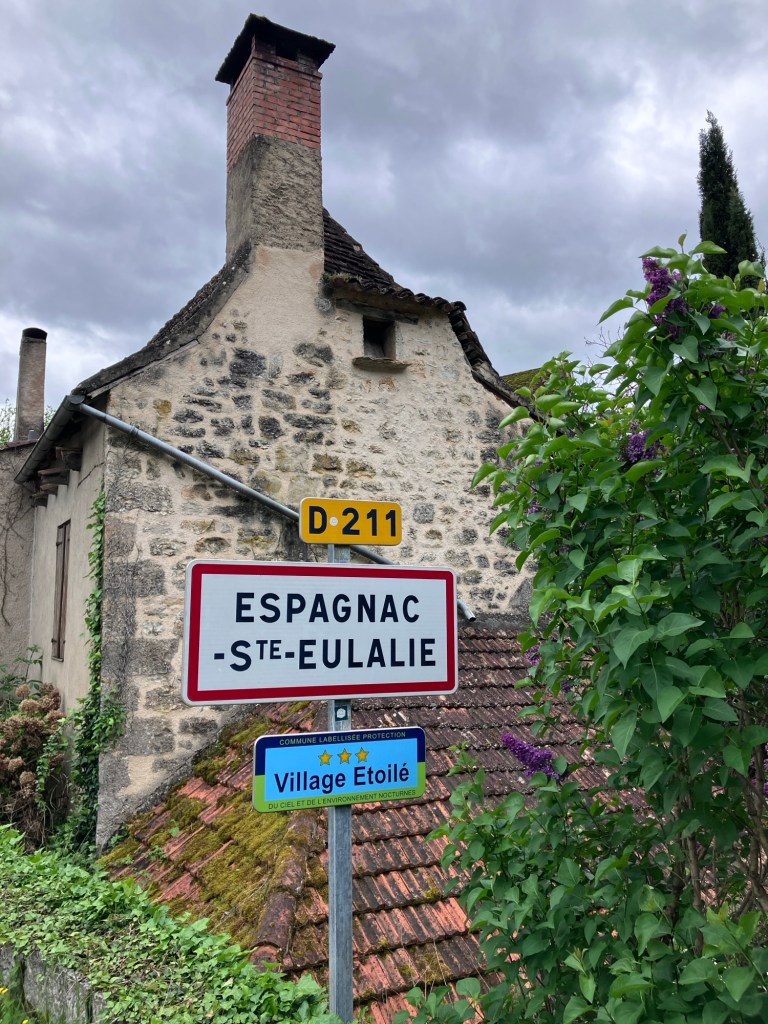
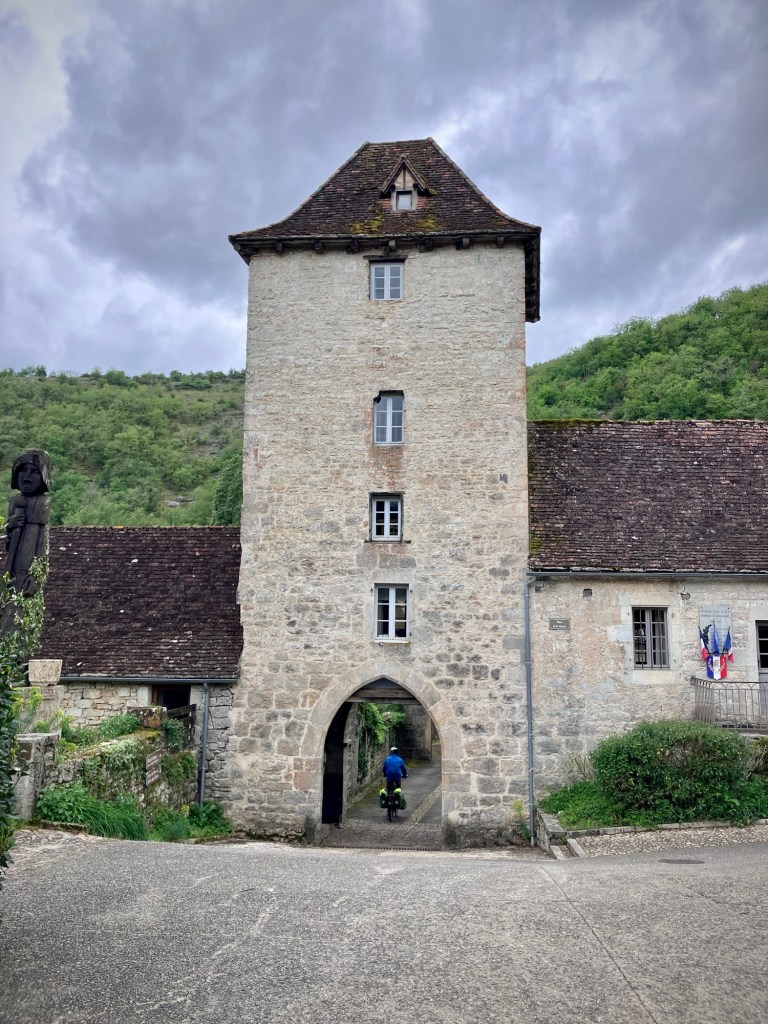
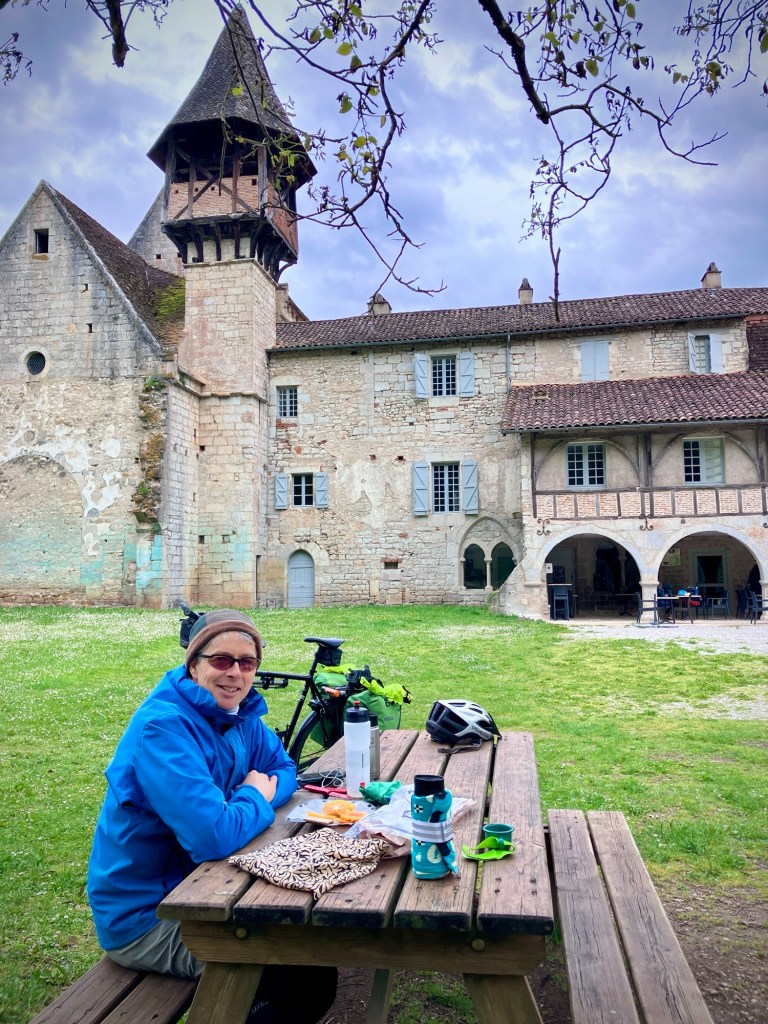
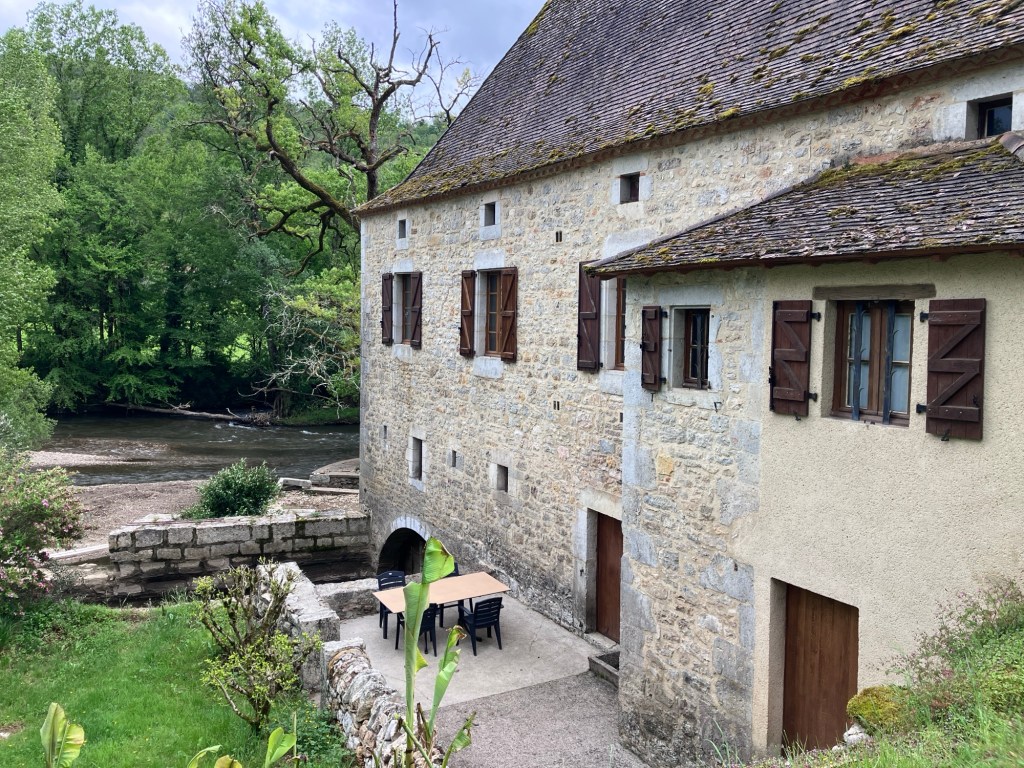
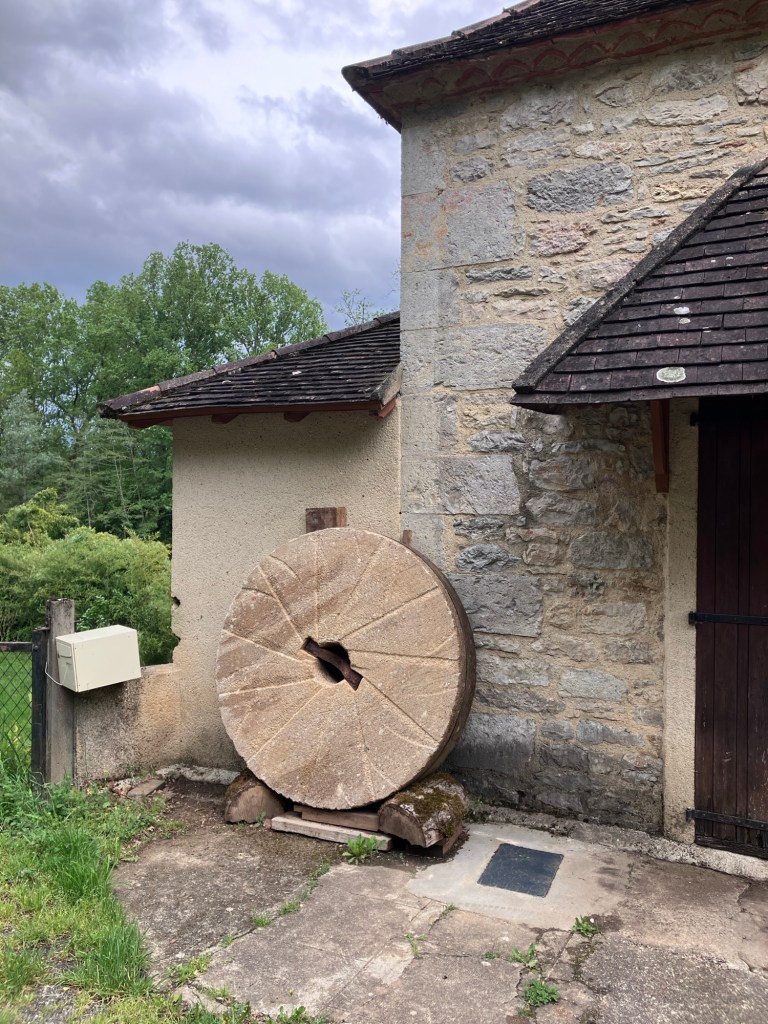
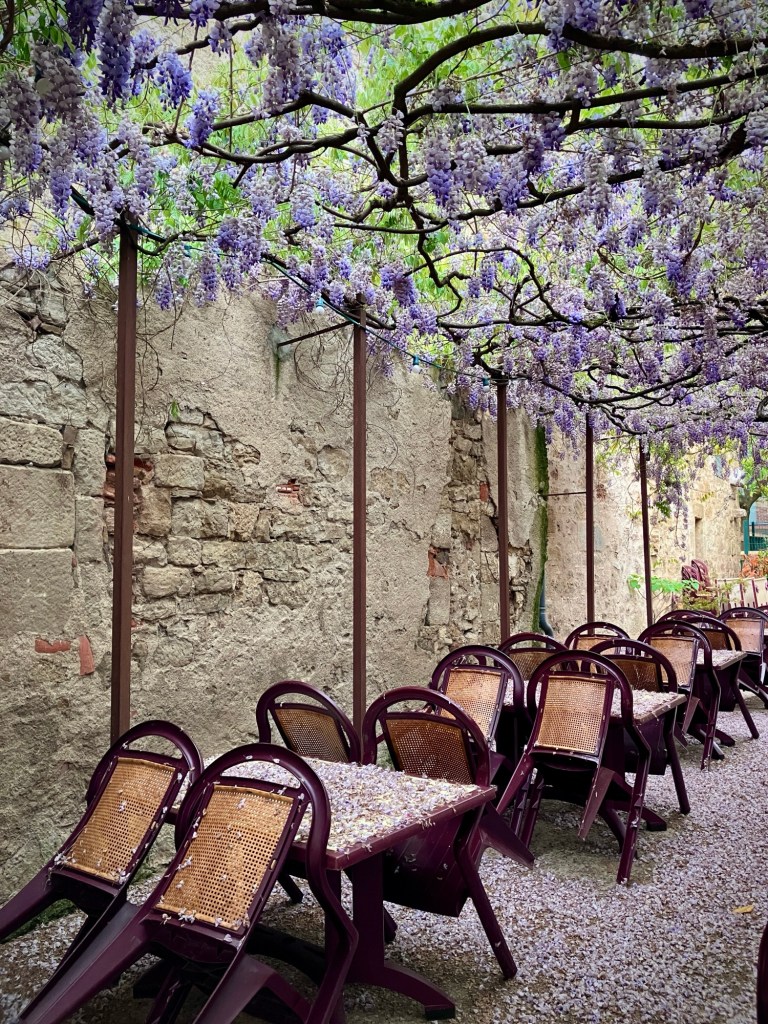
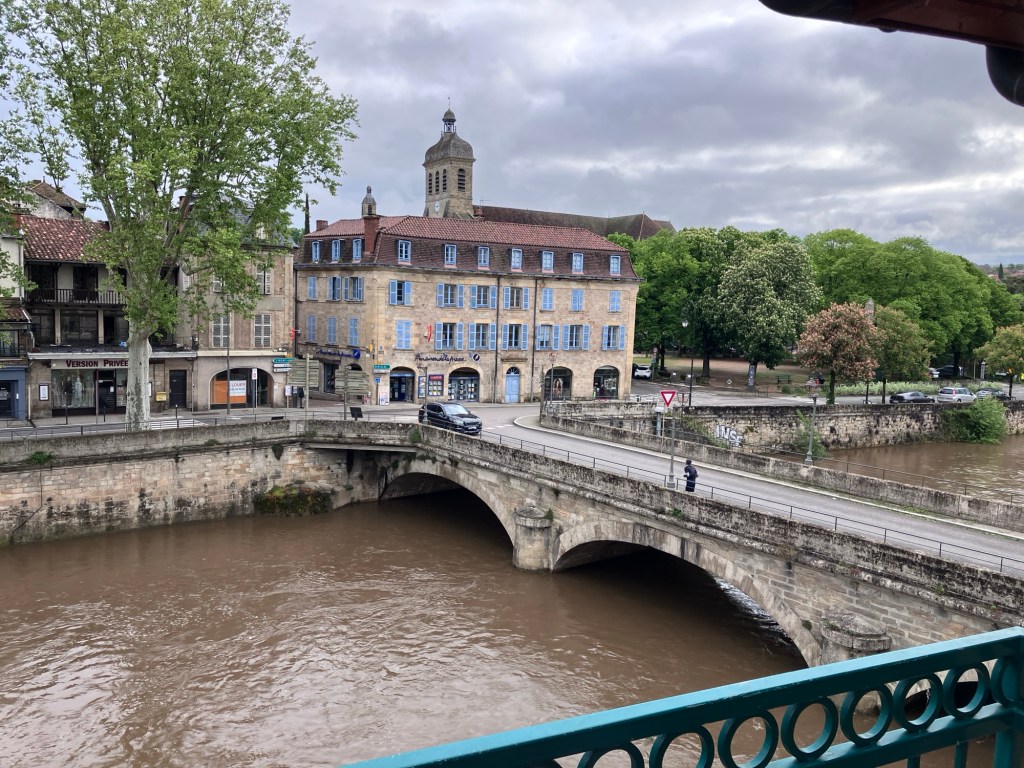
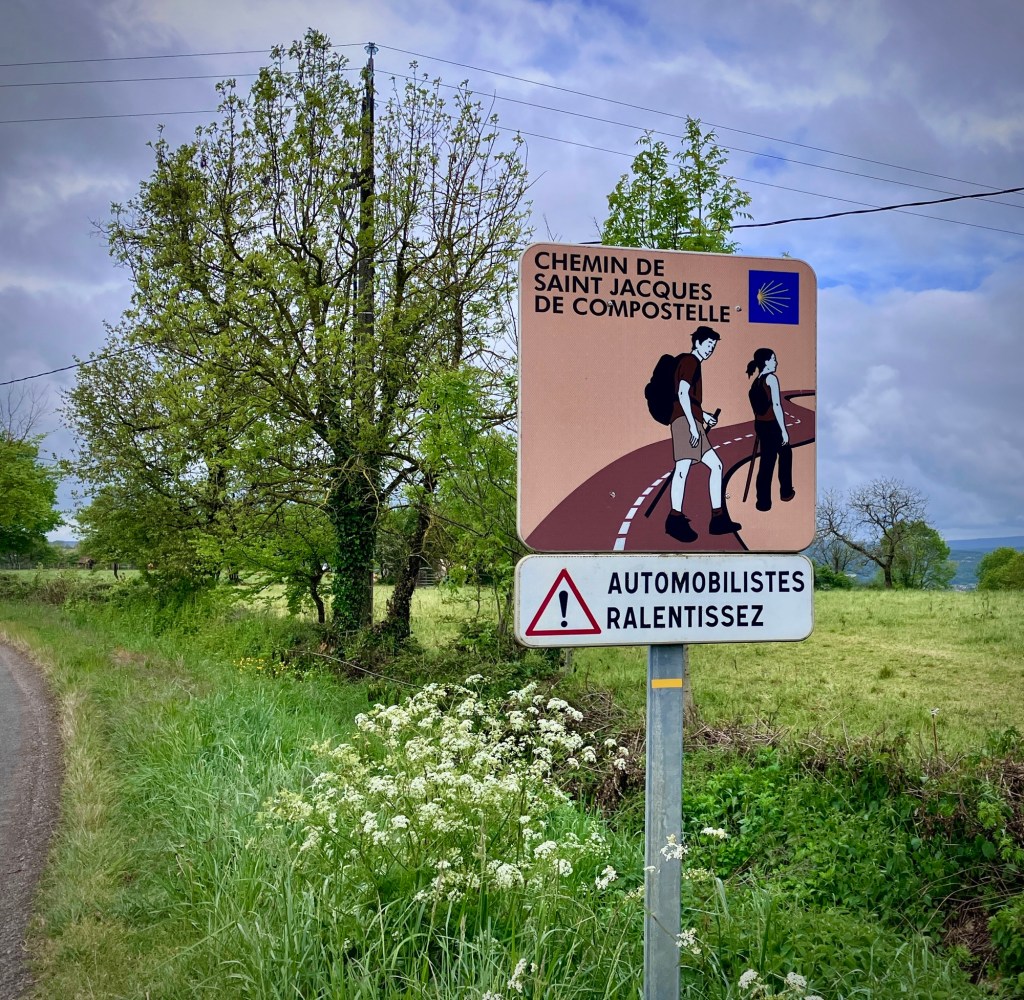
Canyon walls for wind protection, yeah!House built into canyon walls.Onwards along the Célé.A 3 star village is always worth a stop.Riding through the old town gate to find our second break stop.Et voilà, a sheltered picnic spot.This route is along one of the French Camino routes and we were surprised by the number of pilgrims/walkers we saw in this region. Almost no other cycle tourists.Another restored mill house.And accompanying millstone. Our friend Nancy says you can tell what kind of grain was processed by the groove pattern.Getting closer to Figeac, and the wind picking up.Wind filtered Wisteria pedals in old town Figeac.Hotel view of the Célé in Figeac.
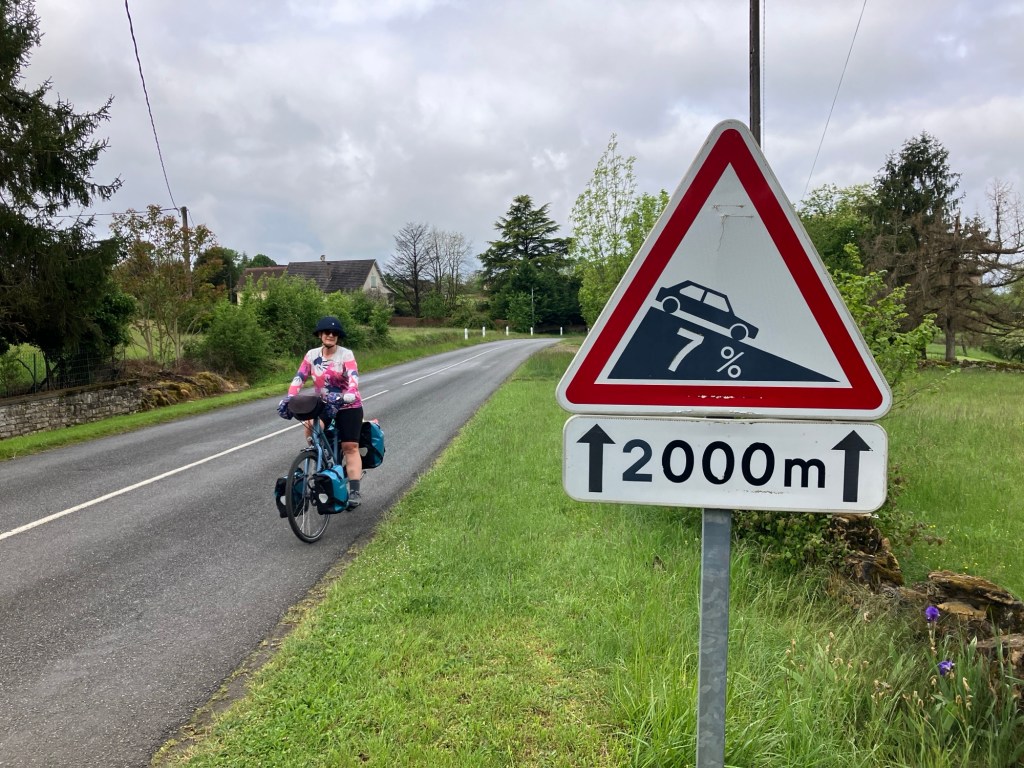
We wanted to get back to the Lot valley, so that meant going back up over the plateau of the river canyons on Sunday morning. But we are pretty strong now and Cheryl powered up over the two fairly steep climbs. Here’s the thing with loaded touring bikes, they are actually surprising easy on flats a gentle grades, even carrying 20 kilos or more. A 4 or 5% grade is pretty sustainable for longer climbs, but each percentage increase after that really makes a difference. Physics, gravity, and vectors. Over 8-10% and you may need to start serpentine S tracks across the road to keep on the saddle for a longer climb. You can even stay in the bike for short bursts of 12-15% grade, but it’s tough to sustain.
Heading out of Figeac along the Célé.This climb indicates an average grade of 7%, fairly manageable.
Touring bikes are so much more sensitive to headwind and grade than a lightweight road or mountain bike. They fly downhills with the extra weight and often act as sails with a hefty tailwind. As we continued to push up some of the steeper hills, you can’t help but think about the extra junk in your bags; the two kryptonite locks, cable, tools, 4 spare tubes (really?), ground coffee, binoculars, a small backpack, a yoga mat…extra socks and shirts, and my biggest luxury, 3 pairs of footwear. The thing is we are living on our bikes for three months and really appreciate the extra gear at times and when we are off the bikes for house sits or city stays. So we press on with twice as much weight as we could manage for a short tour.
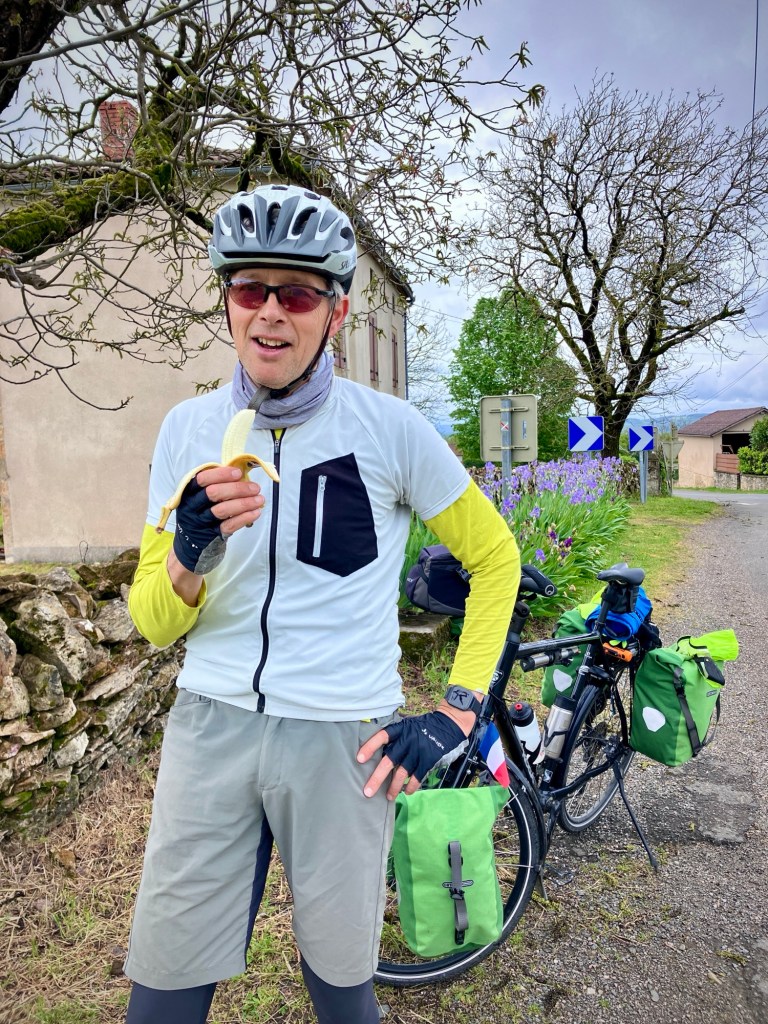
Goodbye Figeac. Very green and lush in this wet European spring.Banana recharge, a reliable favorite.A horse intrigued by the two bright things on wheels.This is a popular hiking area with its limestone cliffs and jagged valleys.And pilgrims are sometimes sharing the road with us.Initial hazards of our descent back to the Lot.
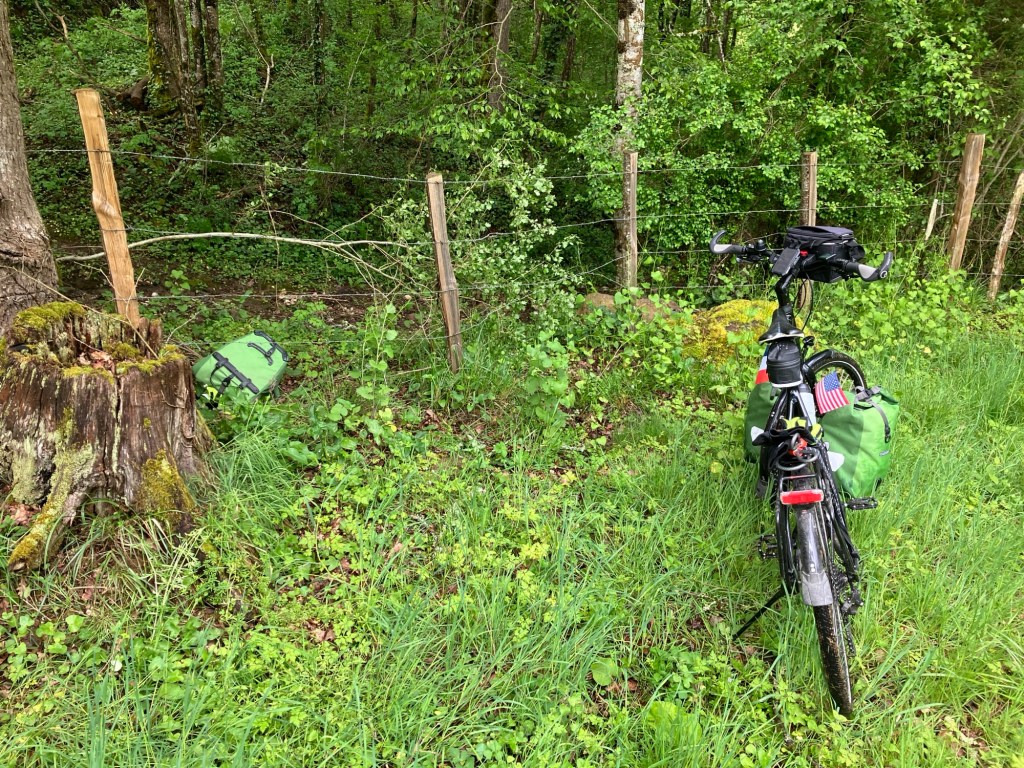
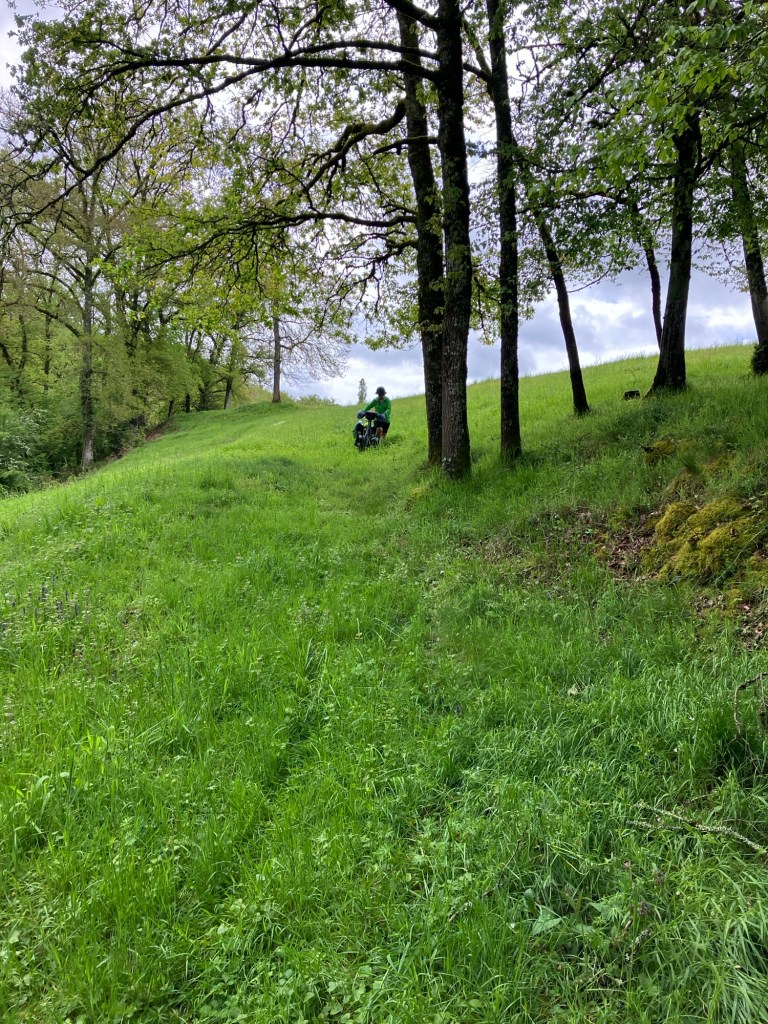
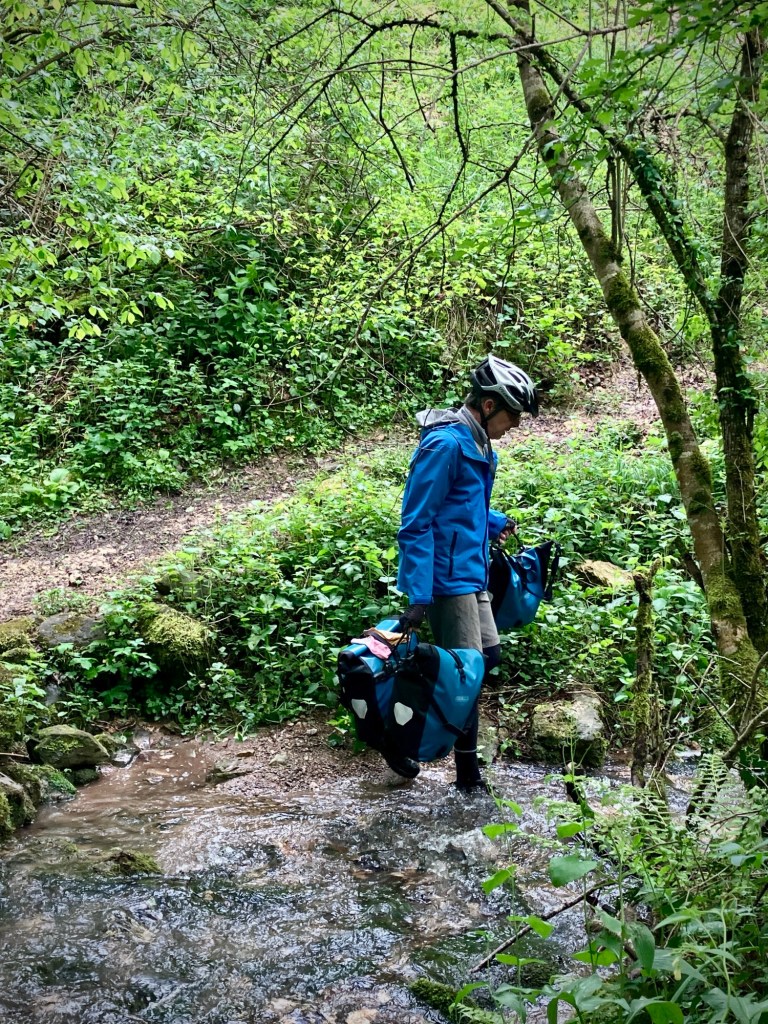
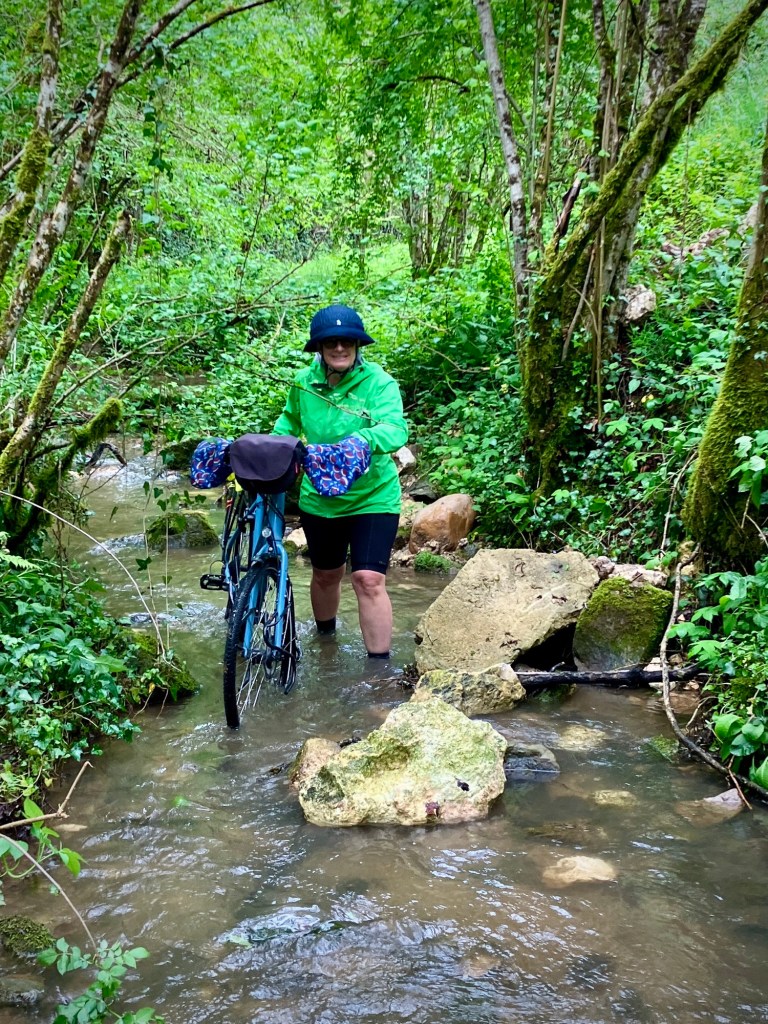
Once over the climb we followed a Komoot route that took us down the side of a mountain on a rutted farm track that turned into a rocky debris blocked ravine and creek bed with steep edges. It turned a “10 minutes flying down to the river for our coffee/tea break” into an epic reconnaissance and stream forge that ranks up as our most memorable.
Hmm, Komoot is routing us down this muddy farm track. Better have some tea now as we discuss options. It looks like only a kilometer or so down to the valley bottom and a paved road, and the alternative was way back and up, so we decide to go for it.Hmm, the gps trail drops left down a rutted gorge blocked by tree so we decide to try to the farm field.After a reconnaissance mission to the creek gorge on foot, we found a spot where we could maneuver the barb wire and get the bikes and gear underneath. Cheryl followed determined not to turn back!A muddy mess.Resigned to walking the gear down the creek to a spot we could get up the embankment. That trail you see was blocked by a large tree fall and landslide.Yup, the water is cold.Worst Komoot routing ever!Out of this pickle. A sense of accomplishment and amazingly no torn gear or flat tires as the area was littered with thorns and briars.
So we wiped off our bags and bikes, changed into our sandals, and put our soaked shoes and socks on our racks. Luckily, we were cheered up quickly as the remaining 35km up the Lot to Entraygues-sur-Truyère was peaceful and scenic. Our room for the night in Entraygues was up a big steep hill from town, which meant a bit of pushing. But the kind host was waiting for us at the door and offered to dry our shoes by the fireplace and gave us some fresh juice and cake. We would survive. And better yet, one proper restaurant in town was indeed open Sunday night, so that meant a bit of wine to warm us up.
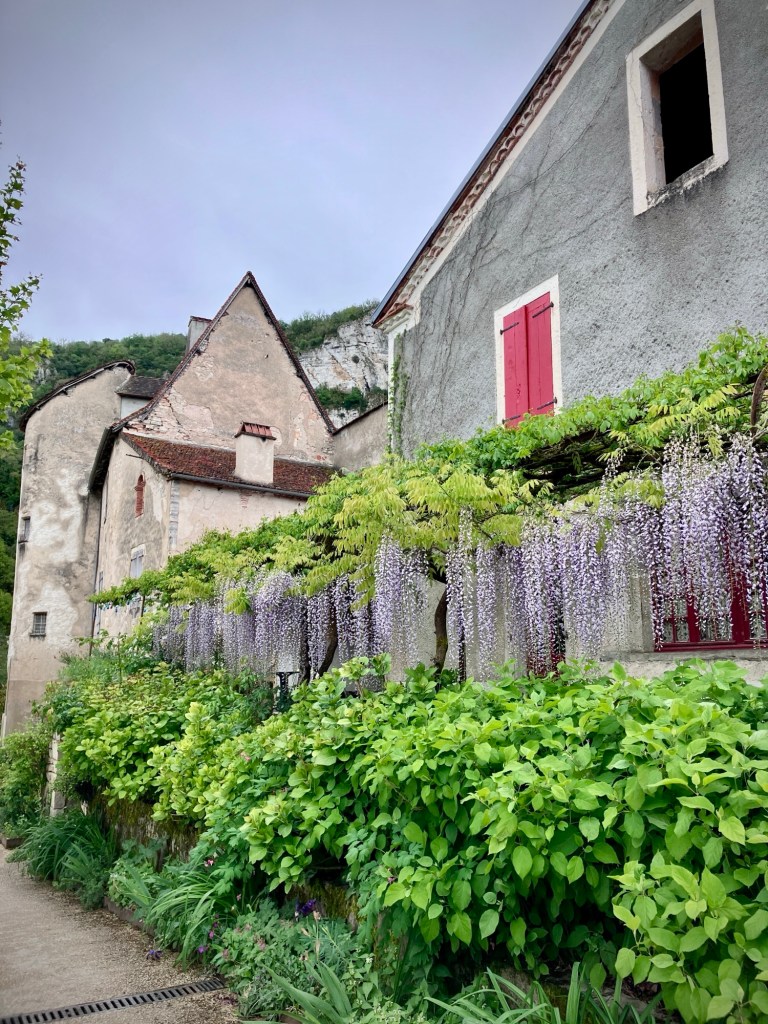
Back on the Lot!Riding up the Upper Lot, wet shoes getting some air on the rackSant Partèm is the Occitan name for Saint Parthem. Occitan is still spoken in southern France, and bits of Spain and Italy Saint Parthem had a bit of a hippy (baba cool!) vibe, including 60s and 70s music on a dozen mounted speakers from village end to end. We assumed it didn’t play all night?!We entered another national park briefly.We noticed the houses getting even fancier and were very well kept.And more wisteria.
But that night set me (the travel planner) into a bit of a panic. I had planned that we would continue East on the V86 Lot route another 100k through the hilly Parc Naturel de L’Aubrac and then catch a local train north to get us closer to our booked train link to Paris. But I discovered part of that local train line was shut with replacement buses that don’t take bikes.
And the weather forecast was grim. Rain and lots of it the next day. No trains and no alternate routes out of this immensely rugged junction of mountains and river valleys. I explained this to Cheryl and she said, “Yup, we’re in a bit of a pickle.”
Le Lot route V86 continues and a somewhat mysterious sign about communities with burlesque names? Anyone?Entraygues is dramatically located at the confluence of the Lot and the Truyère rivers. The Truyère is the muddy one.
Instead I decided that heading north to Aurillac was our best option, as from there we could catch a train over the highest parts of the Massif Central. But the routes would be tough, especially in a cold rain. We could try to wait the rain out a day, but that put our train travel on May 1st, a French holiday and the trains were very limited out of Aurillac. And there were flood warnings.
So we decided to ride.
Leaving the lovely and cozy Le Clos St. George. Its verandas and views would be even more stunning in better weather.The rain was light as we started up the Truyère The first tiny shelter for a yogurt and pastry. The cold rain had already soaked us.
How do I manage difficult days for my favorite (and only) client. First off, I try to note some of the difficulties of the day, especially climbing. But the key is to not overdo it. Don’t talk about too much. I knew this day was going to be extremely challenging, both mentally and physically. Our route climbed up and down short steep climbs up the Truyere and Goal rivers, up a steep ridge climb and finally up to the huge rolling plateau that separated us from Aurilliac. We are now better at eating something every hour and staying hydrated, but it’s hard in a constant and cool rain. And there were no real towns or villages for the entire route.
It was remote and a bit creepy as we headed further off the main routes and up the Gaul River. The hills and walls were flooded with oozing water and we didn’t see a car or person for quite awhile.This tiny hamlet had a welcome little shelter and even a person who I was able to ask about our route onwards, gunshy from our Komoot mud and river adventure the day before.Not a soul outside all day, even to hike the GR65 route. Hmm, maybe it was the relentless rain, cold, or flood warnings?Finally up on the plateau after 3,000 feet of climbing, and the cows are in awe. Or dumbfounded.The rain lightened up a bit, but never stopped.
Perhaps the worst part of the route was the main road we had to join for our plateau and descent. There was an option on quieter roads, but that added another 15k and 300m of climbing, and we decided that was even worse as we were cold and a bit shattered. So we decided to grit out our teeth for the direct route. It had speeds of 80-100km and was fairly busy with fast traffic and some big trucks, with no real shoulder. But sometimes you need to take some chances and we had some pretty bright clothes and lights. Thankfully the drivers were all pretty good, and the pavement was very smooth, so it was manageable but certainly not a segment we’d relish.
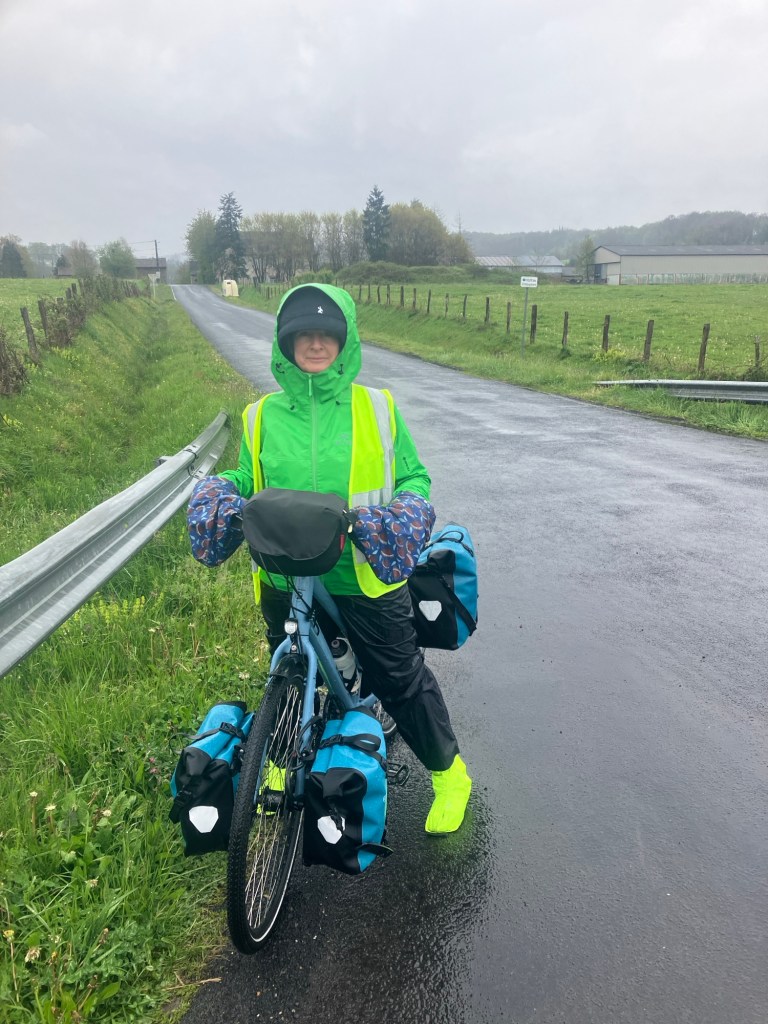
At the end of 30km of wet cold and steep climbs. Cheryl was a trooper but not loving this day. This is where we got on the busy D920 main road to Aurillac. No photos.Boarding the train to Issoire the following day
But when we did finally roll into town and dripped our way through the lobby of hotel, there was not just relief, but a sense of accomplishment. We did it. It was over 1000m of relentless and occasionally steep climbing. And we could catch the train the next morning over the Massif Central to continue our tour. We were out of our little pickle. Happy travels!
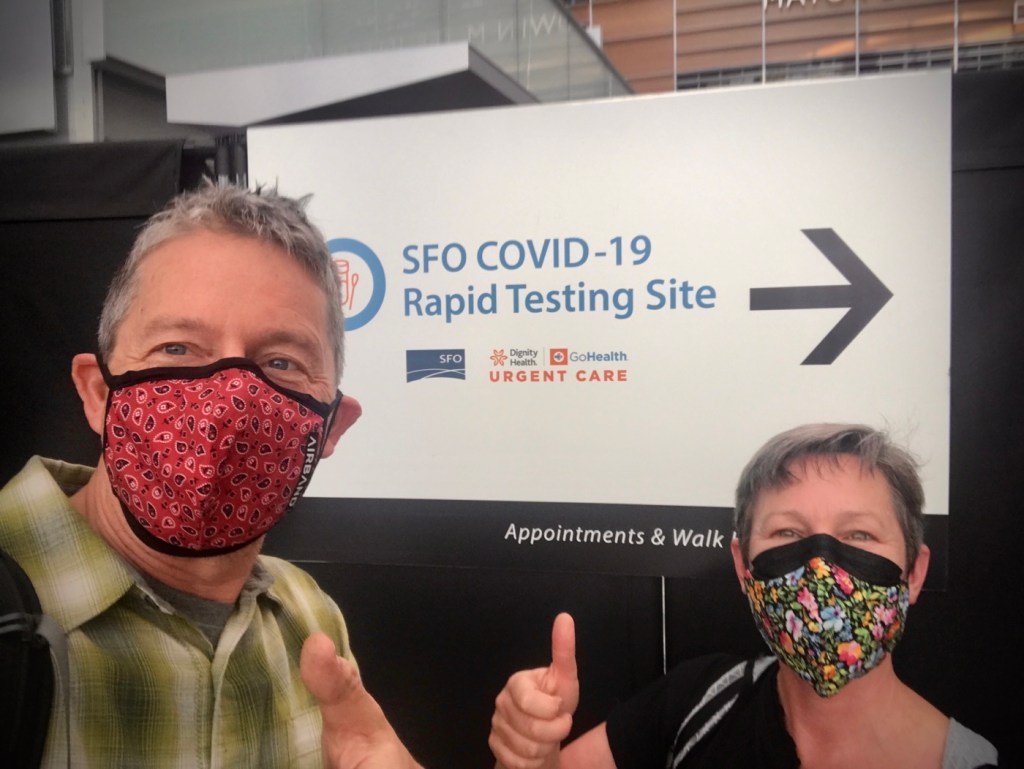
Pre flight testing at San Francisco airport the day before our flight in August, 2021.
Six months of travel so far. I should add the word only to remind myself it’s ONLY been six months. It feels much longer. To have so many new experiences after 18 months of home body living skews your sense of time. We talk about something we did three months ago and it feels as if it were a year or more in the past. I want to tell you what we’ve learned, and what have been our successes, but first – what do I miss?
Baking. Like many, I leaned into cooking and baking during the height of the pandemic. I miss my sour cream coffee cake.
Friends and family are of course on top of the list of what I miss. And I miss baking. But, for everything I miss (except friends and family), there is a consolation activity or option.
Danish bakery in London. Bakeries are a lovely consolation for not being able to bake.
I miss knowing our way around a place. Living for so many years in SF meant I could bike, walk, or take transit almost anywhere without consulting a map. Now, maps are our constant friends.
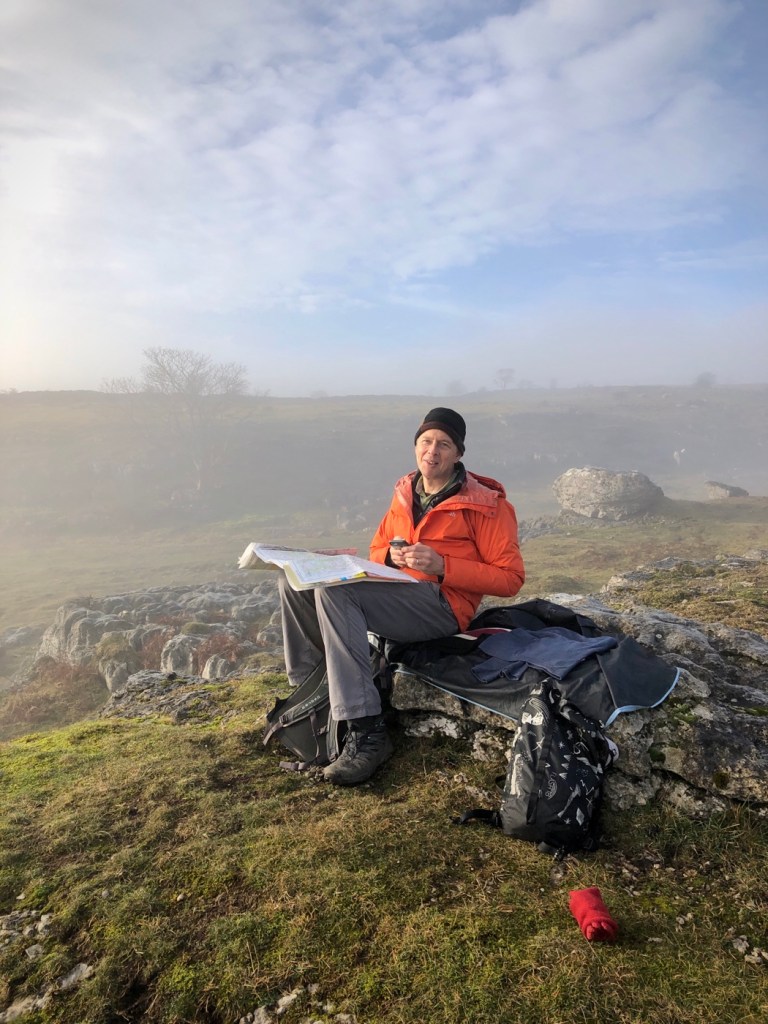
Rich working the smartphone and paper map on a foggy hike near Grange-Over-Sands.
The upside of not knowing your way around is the constant discovery of new things. Every place, every turn of a corner, every walk to a museum, restaurant, or train station might have an unexpected gem just waiting for us to notice it.
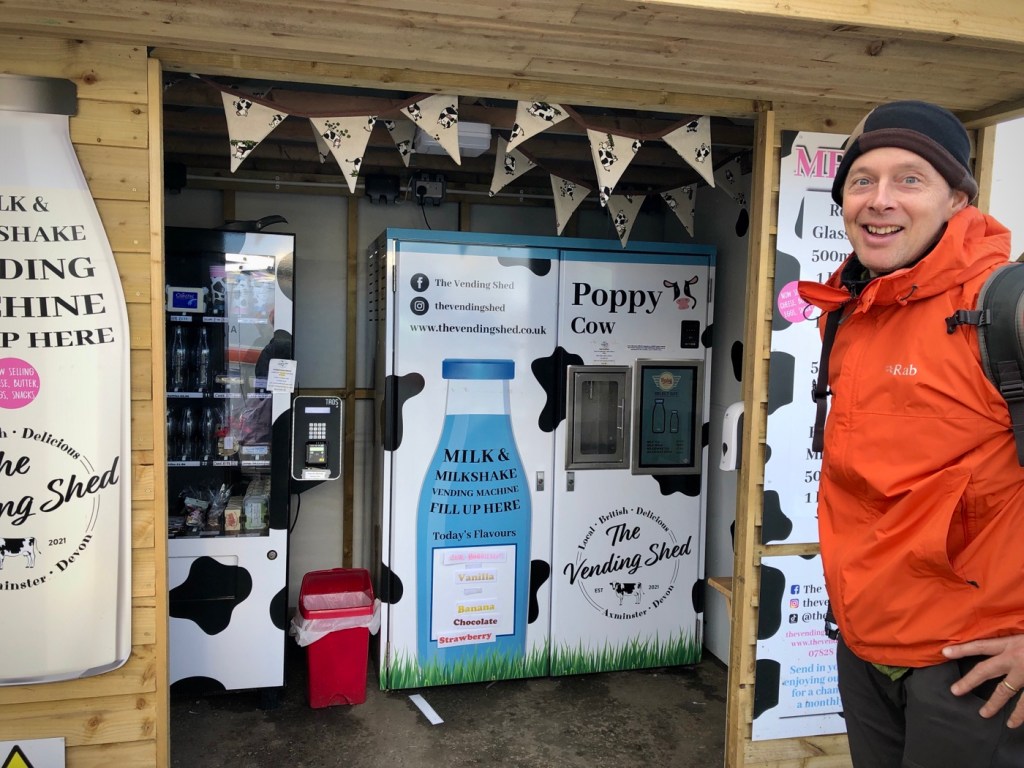
Arrived by bus to Axminster train station in need of a snack. A sign pointed us 50 yards away to a milk vending machine.Chocolate milk? Yes please.
Every fun discovery gives us a chance to chat with locals, like the gent who was coming to refill his milk bottles at the milk vending machine and walked us through the process. And then a man returning to his work truck from a hardware store nearby stopped to congratulate us on finally figuring out the vending machine, and we chatted for 20 minutes, hearing about his trips to Scotland and France and sharing our own travel stories. It’s not the same as seeing old friends while walking or biking in SF, and we’ll never see those two men again, but I will claim them as momentary friends.
Typical room while bike touring. Rothenburg ob der Tauber.
Comfortable furniture. That we miss! If a hotel room has two chairs we consider ourselves lucky. If even one of them is actually comfortable we’re thrilled.
Two chairs. And fairly comfortable. Heated floors, good for drying laundry. Disentis, Switzerland.
The uncomfortable furniture is a small price to pay for the privilege of travel like this. Our time in the UK helped us appreciate slow travel. And I’ve learned to fluff, flip, and rearrange the couch seat cushions in our rental apartments to try and eke out a bit more comfort .
Dinner ready to be cooked in an apartment in Colmar, France.
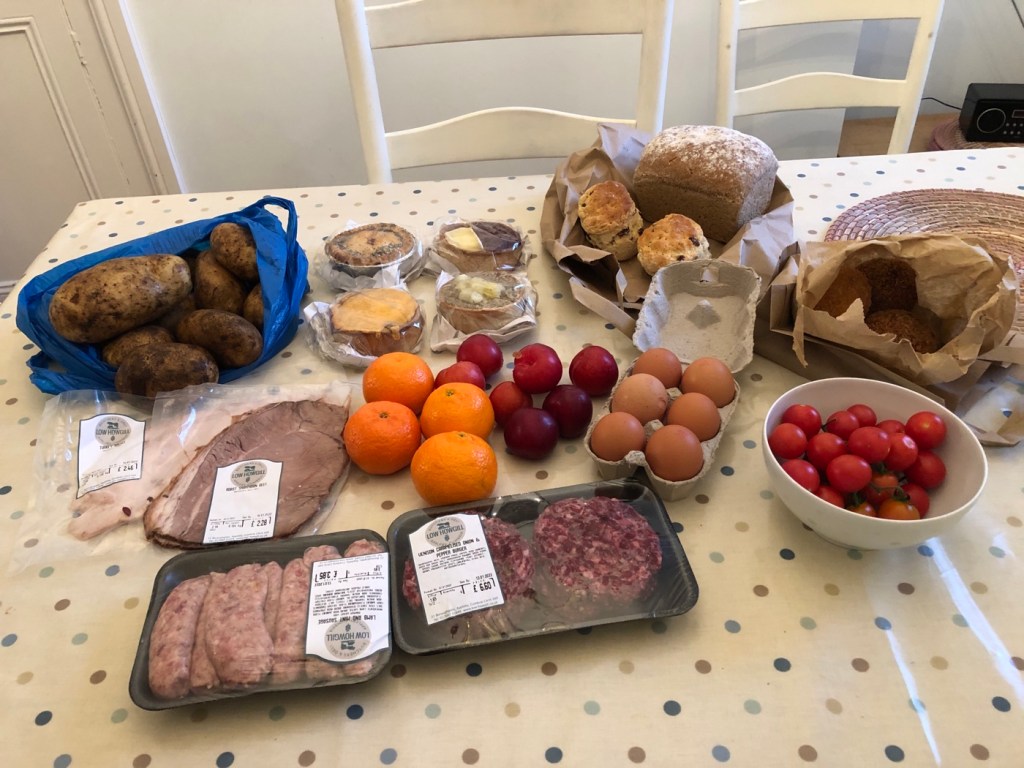
So what have we learned to make ourselves happy and healthy while traveling long term? Cook for ourselves as much as possible which means apartments with kitchens. We amass a roving pantry when we’re staying in places with kitchens. And we check for a local farmers market first thing.
Farmers Market haul from Keswick, in the Lake District. Yoga mat folded up for travel. It’s thin and natural rubber so quite sticky.
Exercise is key. Easy when bike touring and when getting a lot of walking in, but we both have specific stretches and strength building exercises we need to do. Enter travel yoga mat. It’s nice to have and even more, it’s a good reminder to actually do the stretches and work outs. After trying to buy it in person I caved and ordered from Amazon to be delivered to an Amazon locker in London. I also ended up ordering laundry detergent sheets from Amazon to be delivered to a locker in Liverpool. Again after failing to find them at local shops. As much as I don’t love Amazon, the ability to get deliveries while traveling is very helpful. Laundry sheets are a fantastic travel item. Light to carry and useful for sink laundry as well as for confusing all in one washer/dryer combo machines.
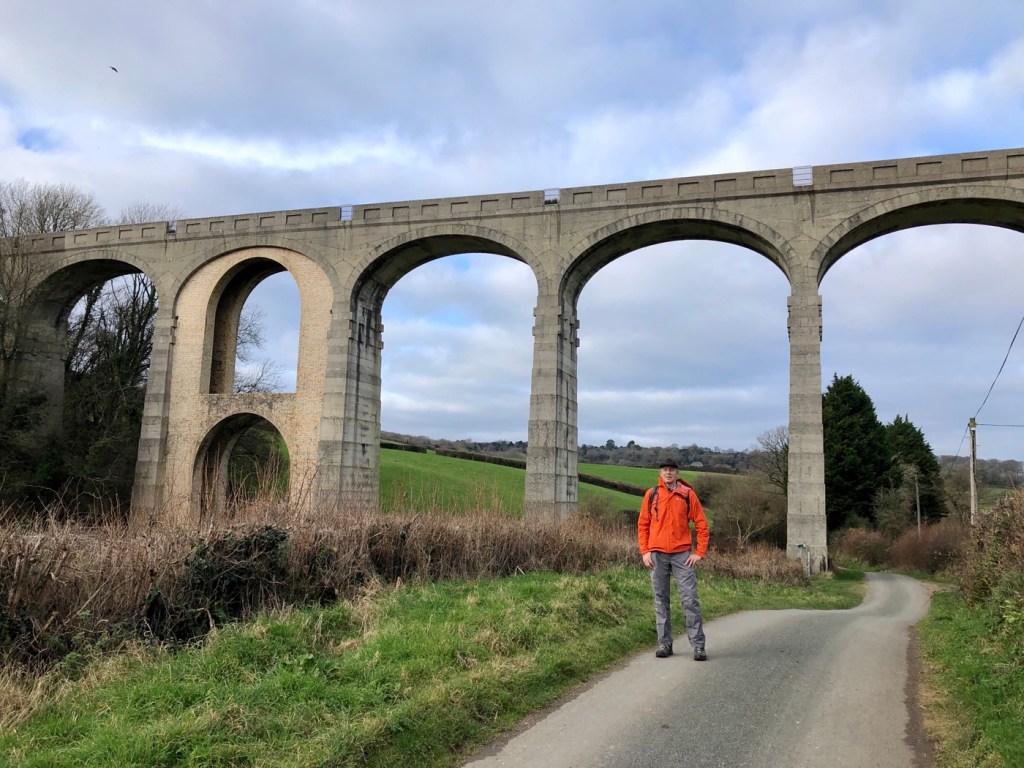
Defunct train viaduct near Lyme Regis. Rich added for scale. Walking keeps us happy. The happy, clean, well exercised travelers in France.
We are currently in France, swapping out some gear for our next adventures. Where to next? Italy.
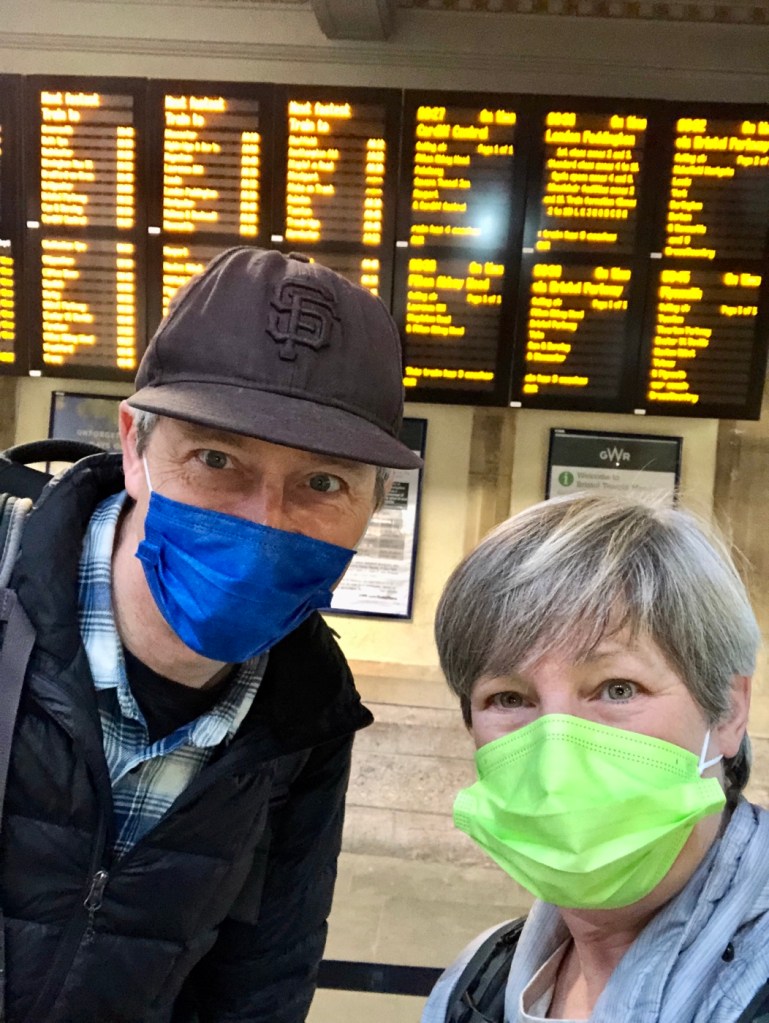
In front of the big board at Bristol Temple Mead Station.
As we wait to sort out our booster records we’ve really started to take delight in our snap travel decisions. Our last booked evening in Bristol Rich asked, where should we go next? My reply was “How easy to get to the Jurassic Coast? Looks fairly close.”
Stop for salads from the M&S fine foods. We try to never board a train without snacks or lunch. Waiting for our train.
And the travel planner makes it happen. I’ve wanted to visit Lyme Regis since reading the novel Remarkable Creatures, about Mary Anning, the renowned fossilist.
At Axminster station, about to catch the bus to Lyme Regis.Wheeling and walking from the bus to our guest house.
Lyme Regis is the heart of the Jurassic Coast. We had a lovely day and a half of hiking, which I now realize we could have spent fossil hunting. Oh yes, I caught the fossil bug. I caught it bad.
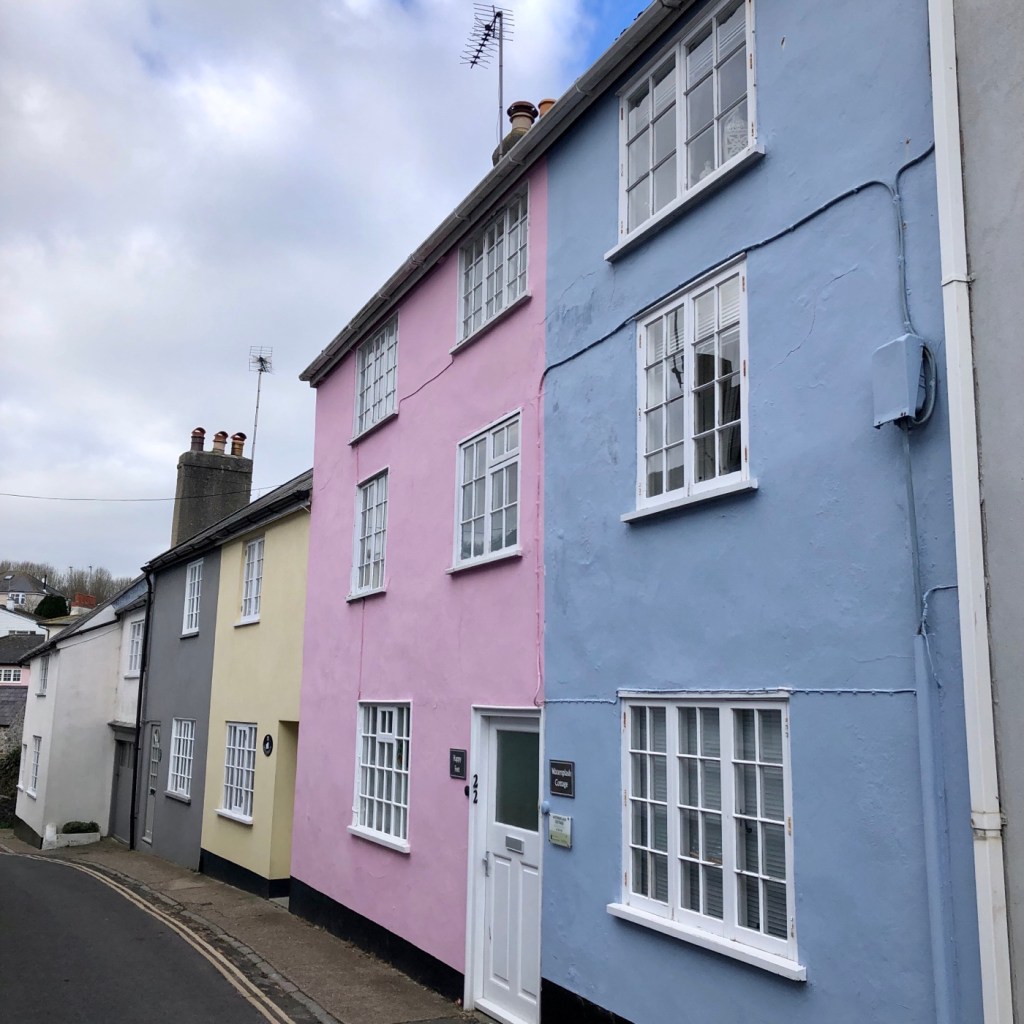
The old train viaduct at Uplyme. A lovely afternoon hike. Could have been hunting fossils.Beautiful houses in Lyme Regis on a street that slopes down to the fossil beach.Goofing around on the Cobb, of French Lieutenant’s Woman and Jane Austin’s Persuasion fame – just up from the fossil beach.
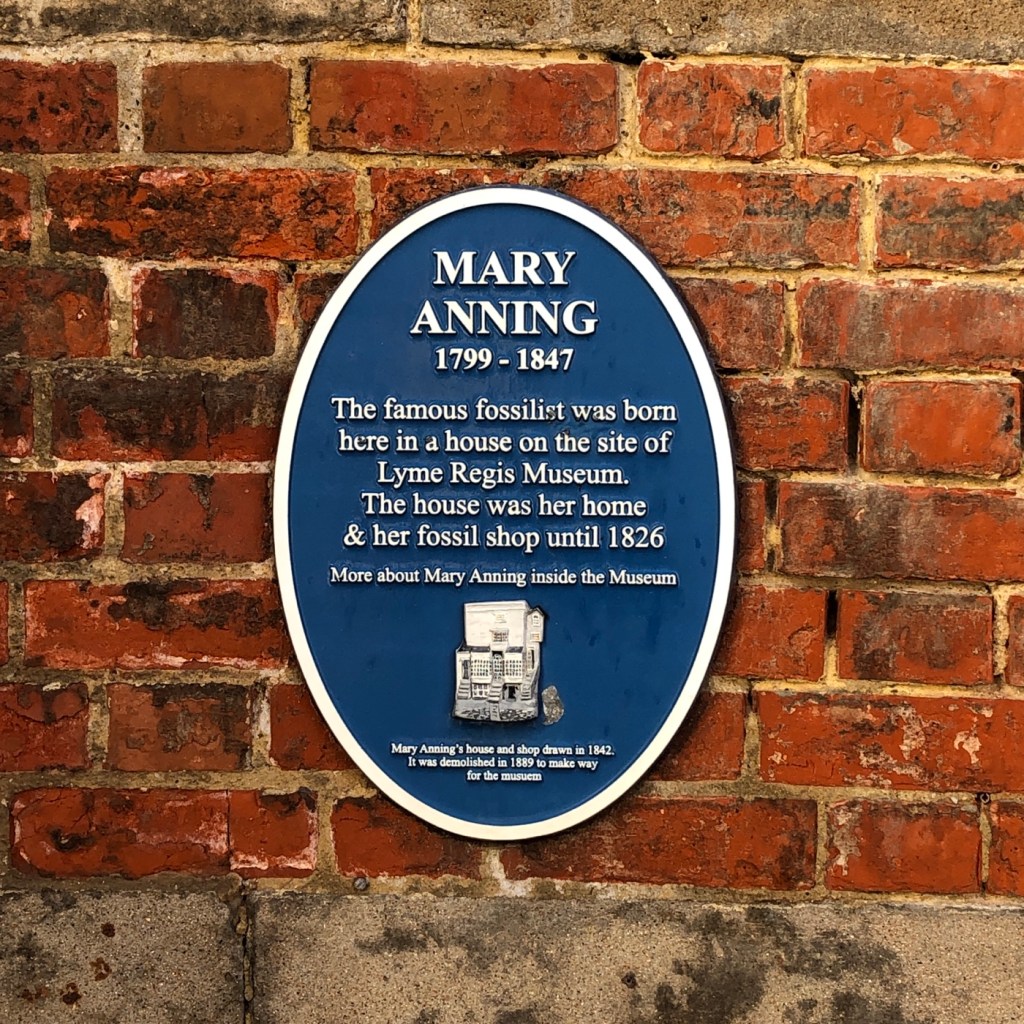
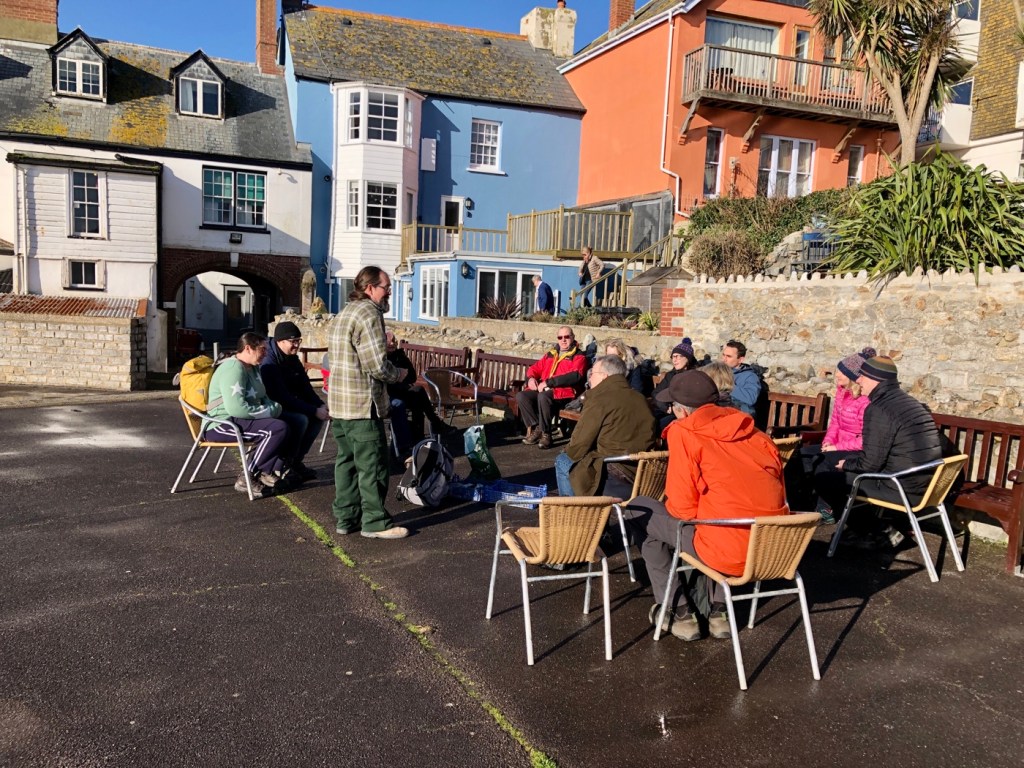
The Lyme Regis museum, built on the site of Mary Anning’s house, offers a fossil talk and walk. We bought tickets for Friday, our last day in town, thinking we had plenty of time to do that and catch our bus to the train station.
Apparently her house flooded with high tides and storms. A new sea wall changed that allowing the museum to be built.
The fossil talk was amazing, we learned so much. I learned we didn’t leave enough time for actual fossil hunting.
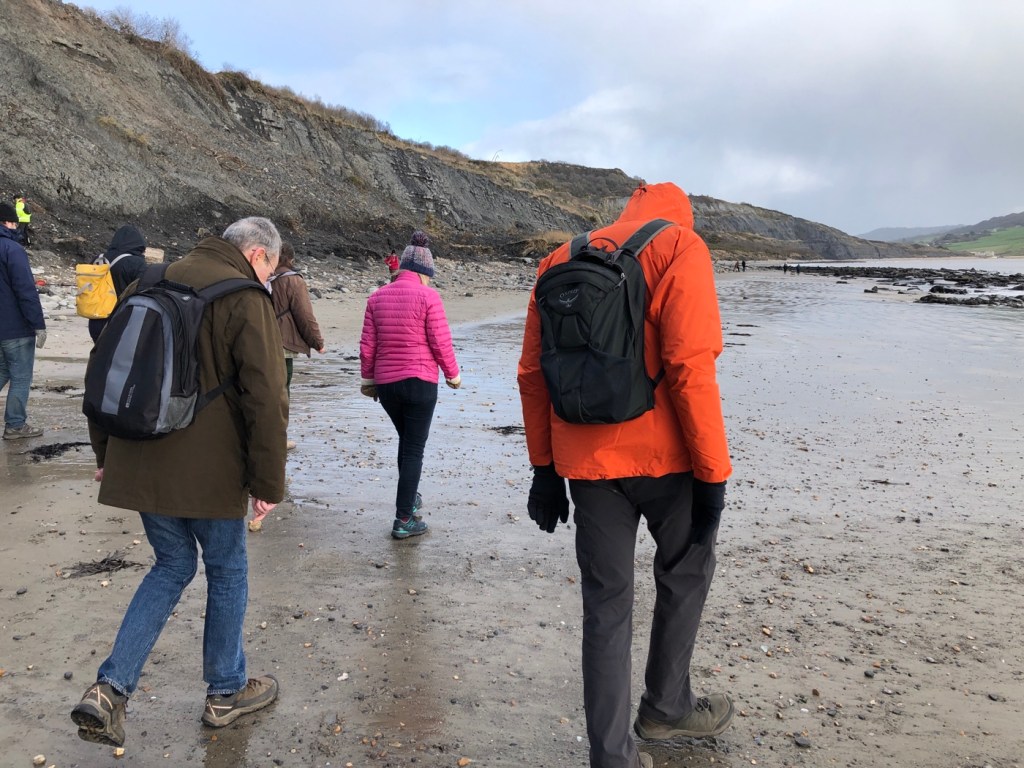
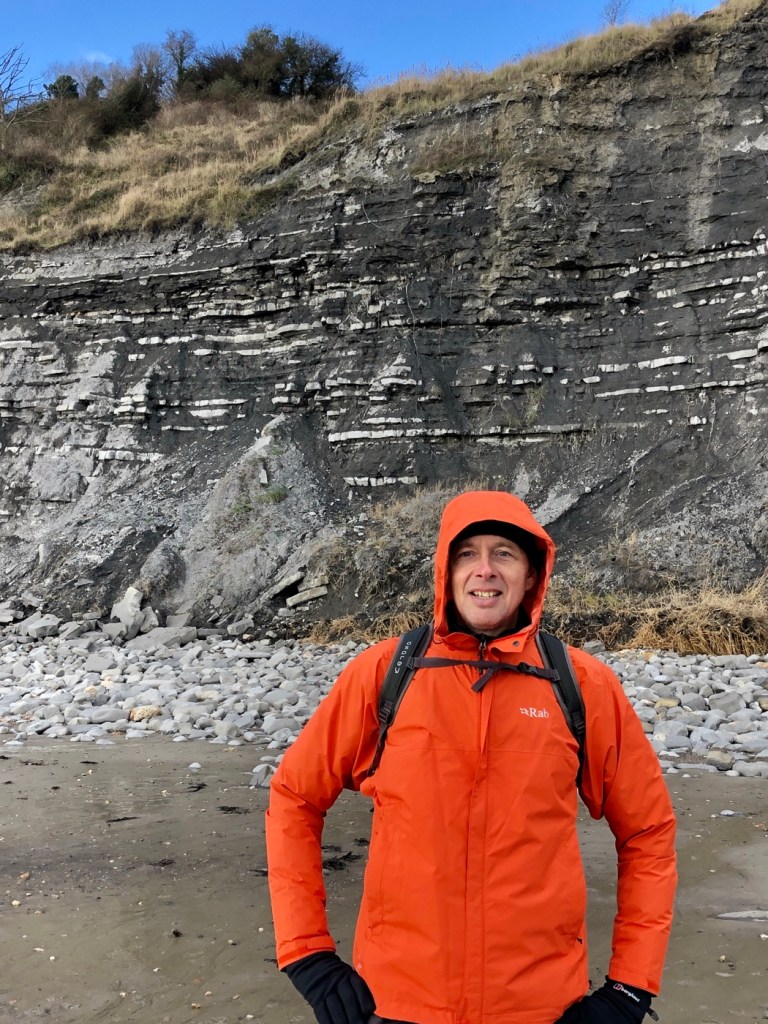
The wonderful geologist who talked us through what to expect and look for. And answered all the whys of this area. Fossil hunting. Everyone has their gaze turned towards the sand. There really are fossils just laying on the sand.The limestone cliffs where the fossils are before they landslide onto the beach. And my intrepid fossil hunter.
The best time to fossil hunt is after a big storm has caused land slips and churned up the beach. We were on the beach after days of mild weather, so not prime fossil time. And it was still amazing. Apparently after a storm the professionals are at the beach before dawn with headlamps and hammers. There are no prohibitions about hunting, just warnings. As our geologist told us, if you don’t get the fossils the ocean will. But don’t let the cliffs get you. They let loose on a regular basis. He kept us away from the cliff bases and focused on the tidal zone.
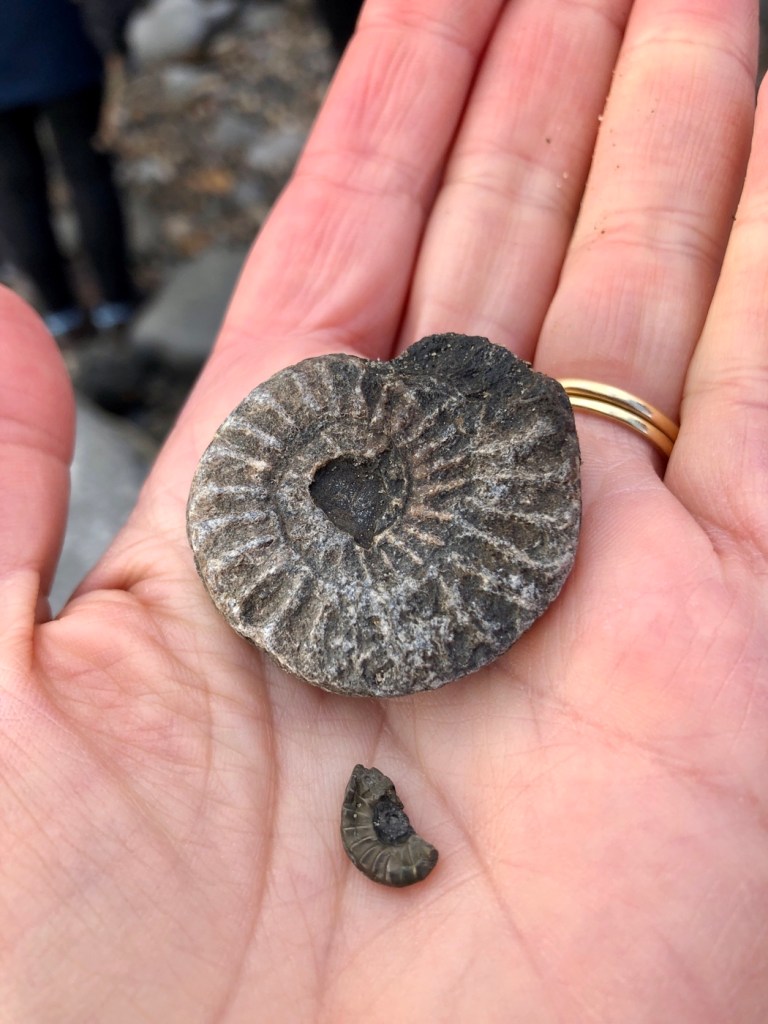
Looking earthward for fossils.Two different versions of fossilized ammenonites. The small partial one is iron pyritized.
I’ll let wiki explain how these jewel like fossils happen: Organisms may become pyritized when they are in marine sediments saturated with iron sulfides. (Pyrite is iron sulfide.) As organic matter decays it releases sulfide which reacts with dissolved iron in the surrounding waters. … Some pyritized fossils include Precambrian microfossils, marine arthropods and plants.
A tribute to Mary Anning on the coast path. Her dog Tray and a Plesiosaurus skeleton in metal on a section of fence.
Sadly, we only had a short time on the beach before we had to leave to catch our bus to the train. But we will definitely be back to fossil hunt again.
The happy travelers take a sunset usie. Should have been fossil hunting.
Our next snap travel decision was to go on to Plymouth by train. Since we were so far down SW England, why not go farther? so we did. We’re in an apartment in Plymouth for a while. Where will we go next? And how will we get there? Stay tuned.
We left the beautiful and empty lake district via an easy one connection train trip to western Wales, and have been enjoying a lovely week in Tenby, courtesy again of our endlessly generous friends.
The moist and green footpaths around Tenby
The weather has been favorable as well, with little rain, and temperatures pushing 50 most days, as this is often one of the warmest locations in the UK.
Daffodils reminding us that spring is on the way! The nicely renovated Manchester Piccadilly Station – our only transfer from Kendal to Carmarthen, Wales
We even had the opportunity to part ways for a few days, as Cheryl went to Cheltenham in the Cotswolds with our host, and another old friend for a ladies getaway, while the guys stayed behind in Tenby.
Cream Tea at the Ivy in Cheltenham
Although we almost always enjoy each other’s company, It was good for both of us to have some independent time for a change, and a bit of an odd sensation after so much intense time together the past 6 months.
The boys on a beautiful day on the Pembrokeshire Coast
Long term travel with a partner definitely requires a special relationship, and a lot of give and take. Luckily this comes naturally to Cheryl and I, but we still have to both respect each other’s personal space, independent desires, and known quirks (Just mine of course, Cheryl is perfect -;)
Watchful eyes in Cheltenham
Meanwhile the world continues to spin and adjust to Omicron, although we are happily past the early January peak in the UK. We certainly hope that the world gets to some endemic normalcy in 2022, but there are a lot of challenges, including proper global vaccination supply. As for us, we know we are lucky to be traveling at all and are still so thankful to the NHS for providing us a booster shot in December, as this allowed us to continue our travels with more protection and in a responsible manner.
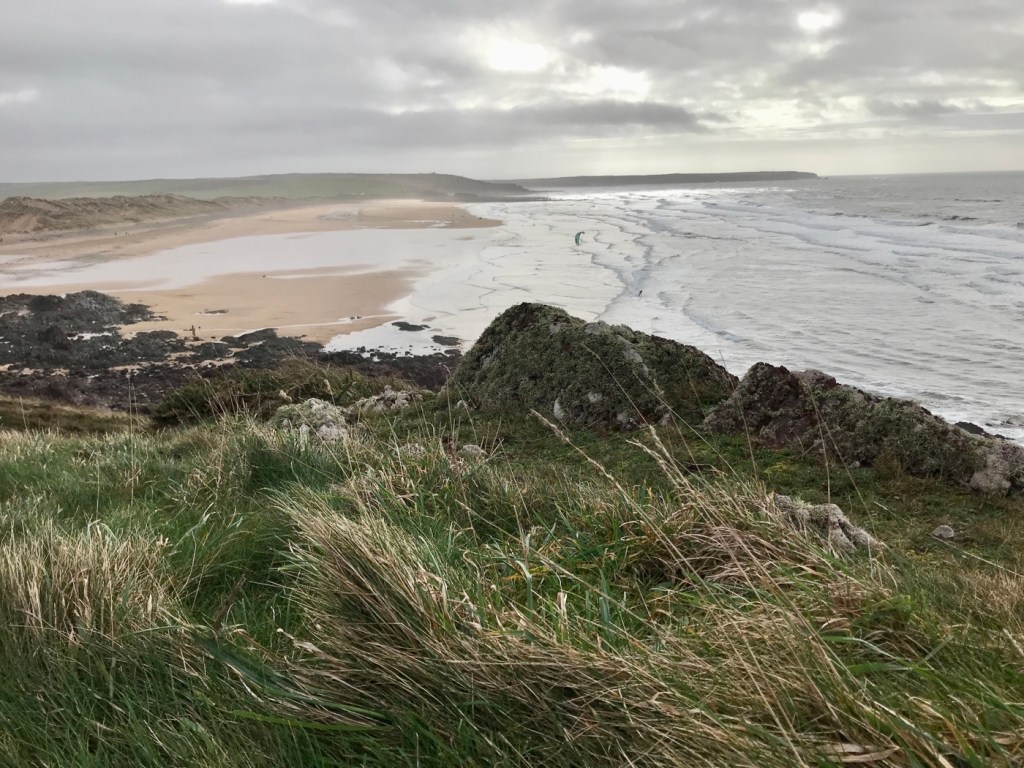
Freshwater West Beach – a favorite of surfers and kite surfers (yes, it’s often breezy)
However, since we weren’t registered in the NHS system, we only have small hand written vaccine cards recording our booster. We were given a heads up that this could be an issue going forward, especially for travel documentation, and indeed this month, we have found that our electronic (EU) COVID passports have now expired in most countries, as there has been a new standardization around a 270 day (9 month) validity from original vaccines without a booster.
Walking alone along the cliffs near Tenby reminded me not to get too lost in that podcast
So we need to get our booster vaccines we received in December into a more usable electronic format. We think we have found a solution as you can actually register with a local GP surgery in England as a non-resident, and access the record after being assigned an NHS number. We could have registered in Wales in theory, but the health systems are actually quite separate and we were warned that the transfer of the record from England could be fairly quick or take months…something that wouldn’t work for our desired onward travels to France and Italy.
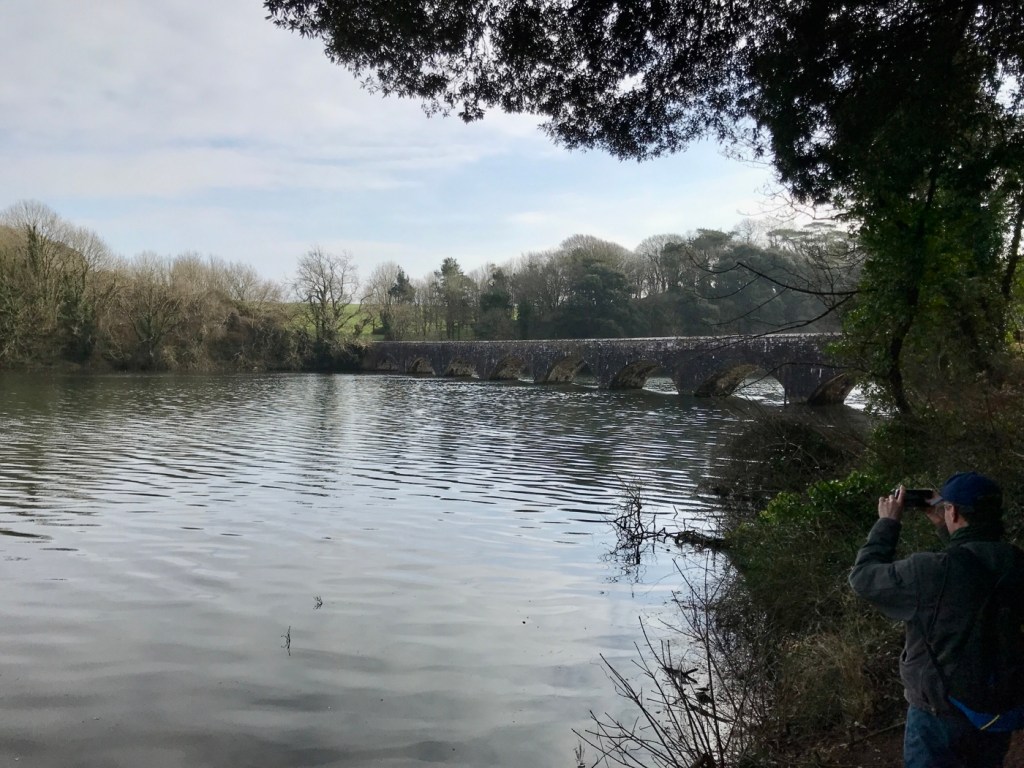
The Fresh Ponds of the Stackpole Estate. Back when you just made ponds for your amusement, but now a perfect habitat for migratory bids
So we set off to Bristol, England yesterday to try to get registered in the area after some initial success online and with some phone calls to various practices that are still accepting new patients. Many are full or shut off due to COVID and/or ongoing GP shortage issues in the UK. Health systems are strained everywhere.
Up and down the coast path to Saundersfoot
As a bonus, we had a bit of an adventurous day getting to Bristol, England yesterday due to signaling issues disrupting a west wales Main line. When our first train leg was cancelled (and next train in 4 hours!) we quickly booked a taxi to the next transfer station, where our onward journey was still shown on time; however, then found out that the problem was still down the line. Doh!
Oh Oh, no trains going from Carmarthen!
Luckily, after some confusion, Transport for Wales did manage to rustle up a few small mini buses to get us past the issue. And in fact, the friendly driver offered to drive the 20 or so of us to a more convenient station for quicker connections and we ultimately got to Bristol an hour earlier than scheduled, by catching a connecting train with two minutes to spare. Small travel win!
Two full hands in Cardiff; happy transfer after making our trains to Bristol
But we are in a sort of limbo while we try to sort out our booster record, but we will try to make the best of it. And it’s interesting to return to the Bristol-Bath, an area that we really enjoyed in our first visit last fall. You so often say in travel life, “we should come back here some time to see more, etc….” But you rarely do. This is one revelation we discuss as we travel new places now; do you think we’ll come back here someday? Yes, no, maybe….but always realizing that regardless, travel to a place is always a snapshot in time, and a unique experience.
The Hanoi we fell in love with in 2007 was not the same Hanoi in our 2017 return. Of course, the UK does have many places that haven’t changed much 500 (or 5000) years, but the country is still a very different place than 5 years ago, as it has a whole different vibe post-Brexit, and mid-pandemic. The travel experience is a complex blend of a place’s physical infrastructure, social, political, and environmental influences, all filtered though the lens of your personal attitude and biases.
Back in cool Bristol, cool brew pubs and bike bridges included
So what next? Excellent question. On our 7 hour train ride last week from the Lake District, we had some time to think about 2022 and develop some broad scenarios. The challenge is to parse out our 90 allowed Schengen days in the prime spring/summer/fall. Some of the goals include more bike touring in Northern Europe, Scandinavia, and the Baltics….tied to the Grand Depart of the 2022 Tour de France in Denmark on July 1st. (Hotel reserved a year ago -:).
Our friend Gary’s dog Misty on the way to the pub lunch at the Stackpole Inn
In the nearer term, we are looking to do some more exploring in Italy, perhaps walking some of the beaten tourist routes more off-season, such as the Cinque Terre, or Venice. Then “home” to the US of a for a month to see as many friends and families as we can ( and consume as many burritos as humanly possible!)…..then back across the pond to explore Turkey for a month, a place we have long wanted to visit, before swapping out for our bikes again. Central and Southern Africa are also on the short list for later in the year, as well as the Camino Del Norte in the fall. Of course, these are all subject to quick pivot as needed based on the state of the world.
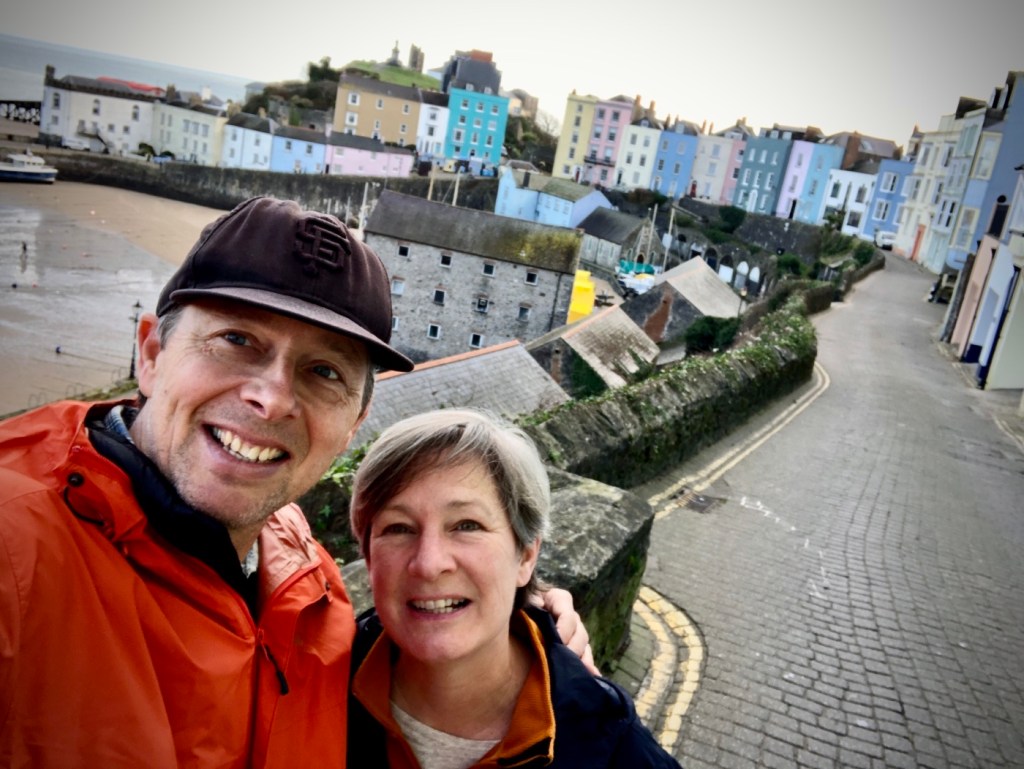
Colorful Tenby Harbour
So hopefully the blizzards are clearing and the sun is starting to shine a bit more wherever you are, as we emerge from a long dark winter, and the burdens of a pandemic. For now we move on in the UK with the uncertainty that has become a way of life.
Nine days of hiking. And we haven’t even scratched the surface of the available trails. We’ve moved a bit south to the very lovely market town of Kendal, known as the gateway to the Lakes District. The terrain here is less craggy and peaky, more rolling hills and sweeping vistas, but just as beautiful as the Lake District proper and with just as much amazing hiking.
Stone circle of Castlerigg.
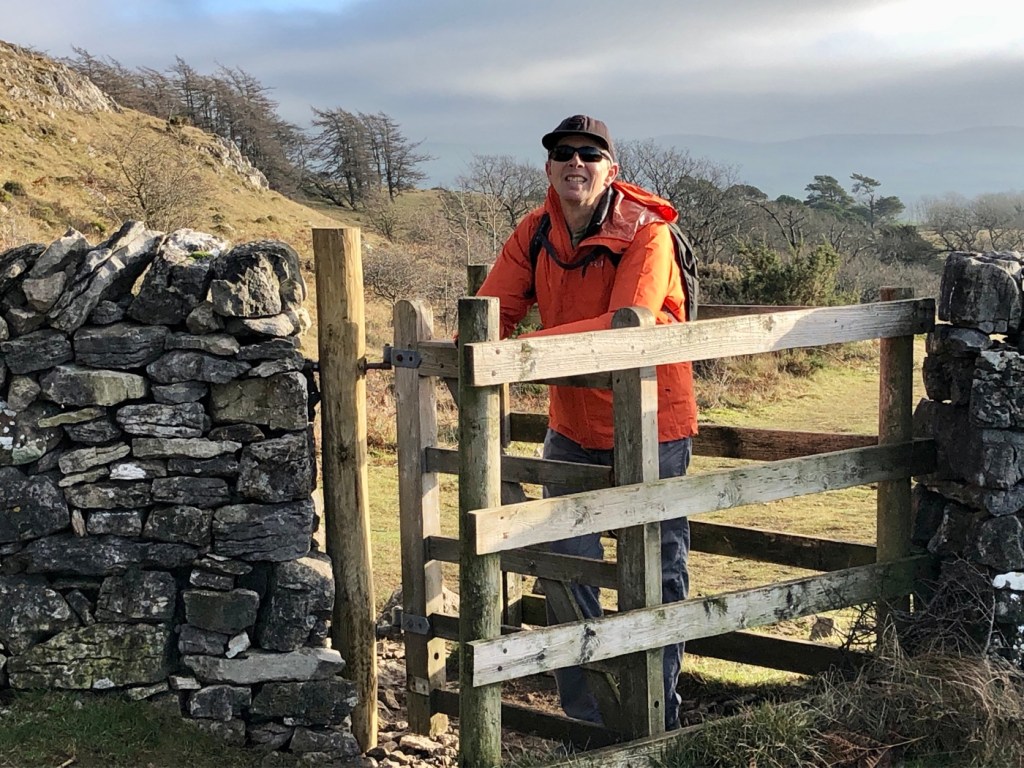
The stone walls, the farm animals, our interactions with friendly hikers, and of course the pints at the pub garden at the end of our hikes have been keeping us well entertained. I’m fascinated with the many different types of stiles that get us over fences and walls while keeping the sheep and cattle contained.
Ladder stile over a wall.Classic wooden stile over a fence.A narrow gap with a tiny gate.A very narrow gap, requires even Rich to squeeze through. This is actually called a squeeze stile.One of my favorites, stone steps up a stone wall.More robust steps, usually there is a small gap at the top, and here, a metal bar across the gap.A rather fancy ladder and platform stile, outside Cartmel.
Along with clamoring over stiles we’ve opened, and correctly closed and secured, many gates. Many many gates. So many gates we joke that we now have masters degrees in gate-ology.
The farmers depend on hikers properly closing gates. We make sure we do.A kissing gate, it simply swings and requires no securing.I appreciate these signs educating hikers about the animals in the fields.
We’ve had some lovely chats with other hikers. The fell runners and the one tarn (lake) swimmer we saw have impressed us with their hardiness. And, we’ve stopped to talk to hikers who are well into their 70s and 80s. We say to each other after those interactions, with luck that will be us, years from now, still happily hiking together.
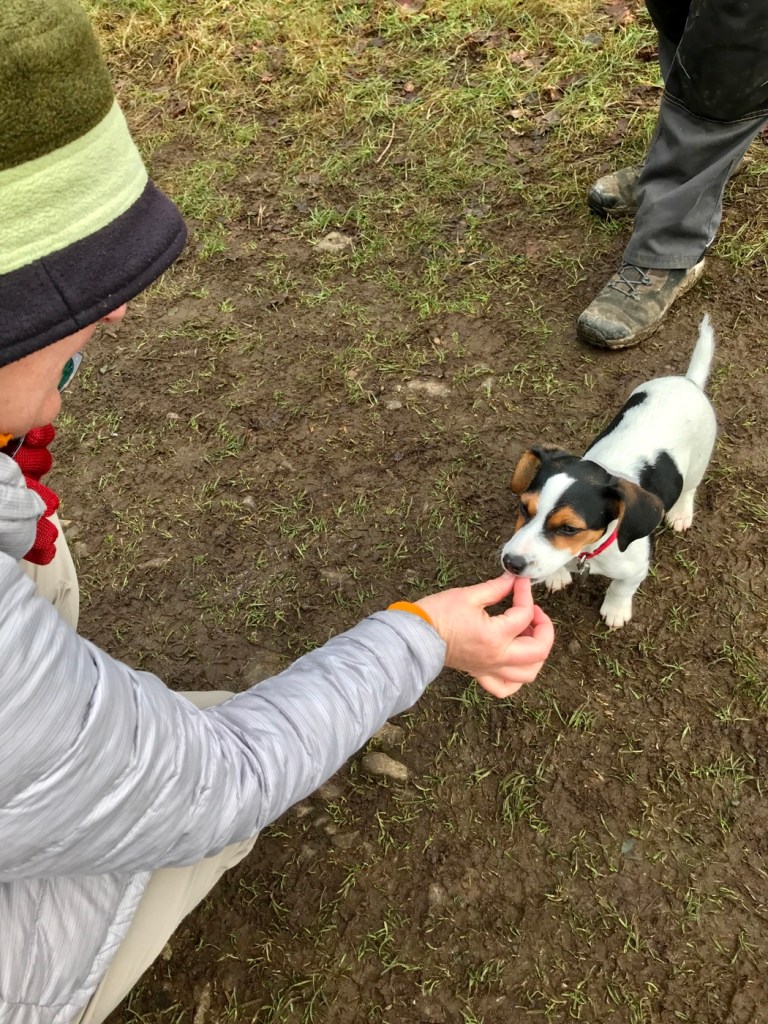
Zoe, a 4 month old Jack Russel terrier, accepting a treat supplied by her human.
As we’d hoped, the Covid curve seems to have peaked here in the UK. We’re glad we’ve stayed in apartments and kept out of crowded places as long as we have. Yes we’ve had some very chilly pints and cups of tea outside, but it’s been the right thing for us to do.
A foggy view on the River Eea.
We’ve seen so much stunning countryside. This time in the Lake District in winter was not something we planned on, but we’re enjoying it so much. Travel in the time of Covid is stressful, we think we’re doing a good job keeping ourselves relatively calm and certainly well exercised.
Muddy boots and the green green hills of Cumbria.Sunrise over the River Kent with Kendal Castle ruins on the hill. This is the view from our apartment.
What’s next? Back to our good friends in Wales. After that, uncertain at this point. We need to get our COVID booster shots entered into the EU tracking system so we have the ability to abide by vaccination rules in France, as our current Pass Sanitaires are now invalid without the booster info being updated. It’s probably easiest to do this while in France. So, maybe France is next.
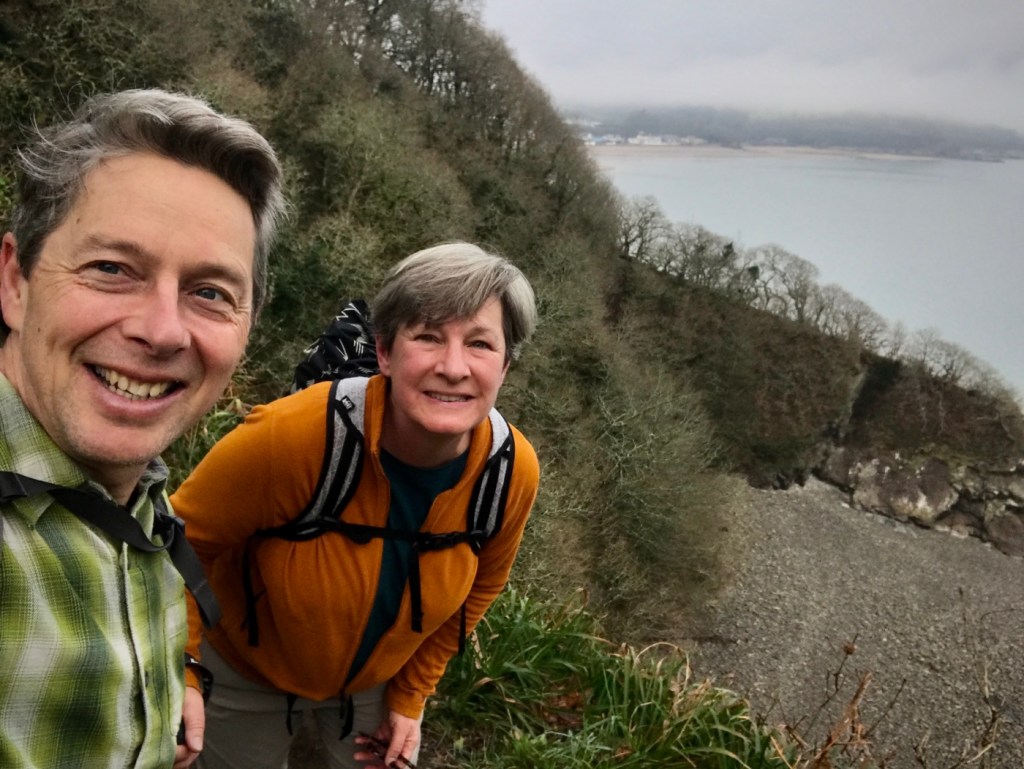
The happy travelers on the road to who knows where.
We moved on from lovely Liverpool late last week and arrived Keswick by train and bus (locally pronounced Kehz-ick) on a spectacularly snowy day in the Lake District.
Dramatic winter skies ascending near Grasmere
We were very glad that our professional bus driver was plying the slushy mountain roads, especially on the sheer edges of deep lakes; nevertheless, we did take note of the emergency window systems on the bus! (avoiding what I called a double decker bus watery grave…-;)
Can we do this without a car?
Our decision to base in Keswick was based on a number of factors, but primarily that we could get there by public transit, and numerous lines route from there to other parts of the National Park. It also has a few museums, nice shops, and many services in town, including a great regional supermarket, Booth’s.
Our row cottage in Keswick came with a friendly outdoor kitty neighbor no charge and a 5-10 minute walk to town or the busCheryl trying to cajole an adorable Lake District sheep to follow her home
Oh, it also happens to be very quaint, with a lovely pedestrianized core and footpaths heading in every direction, including along the large Derwant Waters, what we in America might call a lake!
Morning light on Derwentwater in the Lake District NP
We actually wavered a bit about whether we “needed” to rent a car, but then read about many others visiting car-free and thriving with the great regional transit system. After 6 days here, we know it was 100% the right decision for us.
The 78 bus to the end of the line at Seatoller…schedules, a shelter, and multiple trailheadsCheryl ready to hike…the other friendly passengers were day tripping photography buffs from Manchester
Our decision also considered the fact that this area is heavily impacted by car traffic, much like the National Parks in the US. Nevertheless, the car parks and road are still surprisingly busy here mid week in January, as driving is still seen as the easiest and best way for most to experience the park. Despite some pay parking in many of the towns and villages, the roads are still free and there is an abundance of free parking available.
Hey, there goes our bus!
But it’s not just about the carbon footprint of driving for us. We’ve seen the impacts automobile congestion, noise, and pollution have on communities. When practical, we don’t want to contribute unnecessarily to the problem. Although traffic is fairly light in the middle of winter now, it apparently is extremely congested most of the year, and a nightmare in holiday periods.
On the way to Styhead Tarn; did we mention there is water everywhere!
The typical scenic two lane roads barely fit two bus widths (they slow to pass) or even some large cars and trucks! Luckily most people in the UK still drive pretty small cars, but they still impact the safety and experience of the bikes and walkers that also use most roads. Many drivers here go too fast for conditions and it can be nerve wracking even on small unmarked country lanes.
Fragile sub-alpine tundra above 500mThe surprising alpine world of northwest England…Styhead Tarn near the Great Gable
National Parks and holiday areas have specific problems, and many have now taken to managing traffic through various methods, such as fees, closures, parking management, and shuttles/transit. The Lake District National Parks is no different and really is trying to address the problem by providing a really good bus system at fairly reasonable (but not cheap) prices.
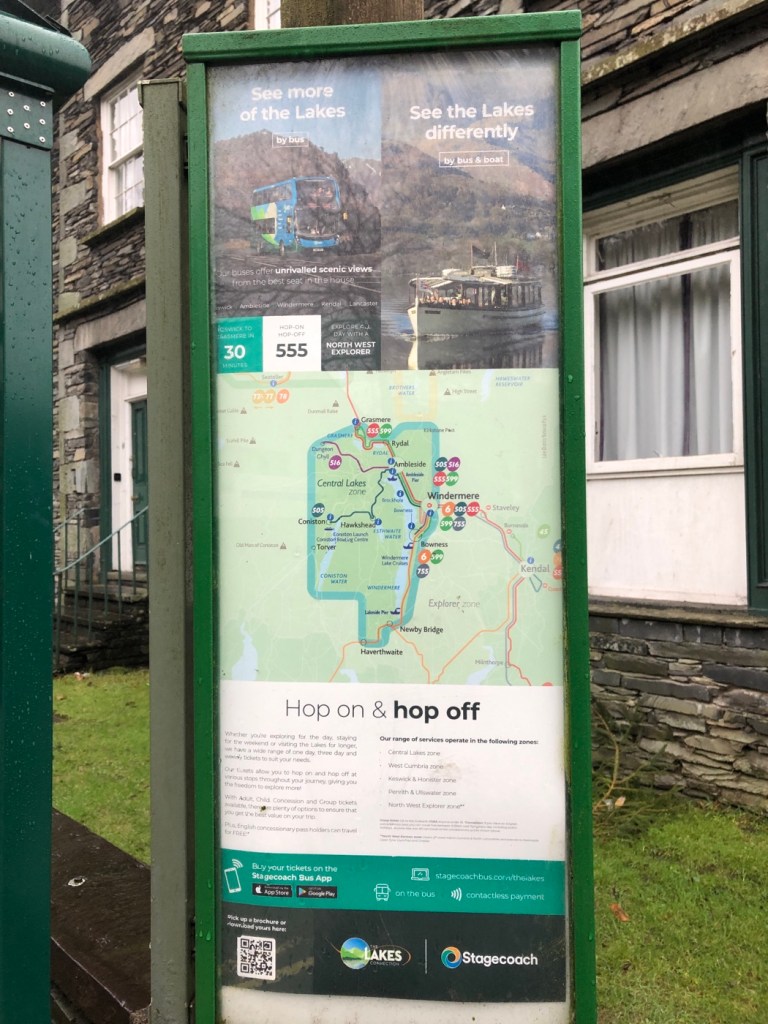
Returning on the upper deck just before the early winter sun setThe backbone 555 bus runs throughout the core of the district and will connect you to the train in Windemere…closed double deck BTW
The buses are reliable, extensive, clean, and even a joy with double deck service on the some lines and 1/2 open top double deck service on two shorter lines through very scenic areas. So the buses really do double as sightseeing and transit for locals and visitors alike.
Yes, it WAS chilly on the open top bus, but the views will keep you warm
The other key is easy payment. The Stagecoach bus system offers payment by any tap cars/Apple Pay, etc for single/day trips or you can buy a loadable smart card right from the driver £1 fee for week or month passes.
Information is key! Most stops had schedules and route info.
We bought the 7 day gold pass form £29 each, which allows unlimited travel on the entire systems, which extends to the coast and all the gateway/border cities of the whole district.
Less sun, more dramatic colorsWalla Crag view on a misty winter day But the sun was out today!
The only suggestion we would make to the Stagecoach bus system is to make the pass an 8-day or 7+1 trip pass, as many holiday rentals are 7-nights, so you generally have 8 days of travel. We are going to have to buy another day pass for our last day out of the park…. a minor annoyance. Let’s make this an even easier decision for people.
Gourmet Scotch Eggs from the Keswick farmers market are the ultimate winter hiking food
So we highly recommend coming to the Lake District in the winter. Although the transit system runs a little less frequently, and a few of the lines to very remote areas are peak season only, you will have a lot of the typically crowded places to yourself. Just make sure to always bring your waterproofs, and leave the car behind.
The intrepid travelers press on despite some serious hat head
Leaving London for Liverpool on an early tube to train.
We joke. Sort of. This is an island, and the COVID rates are quite high. The prevalence of Omicron has changed how we’re traveling and what we’re doing. Travel from the UK to France is still not allowed, but Germany is again allowing travel from the UK. We had planned to go back to France but that was impossible. The testing requirements and test costs to go to Ireland put us off going there. So, hello Liverpool!
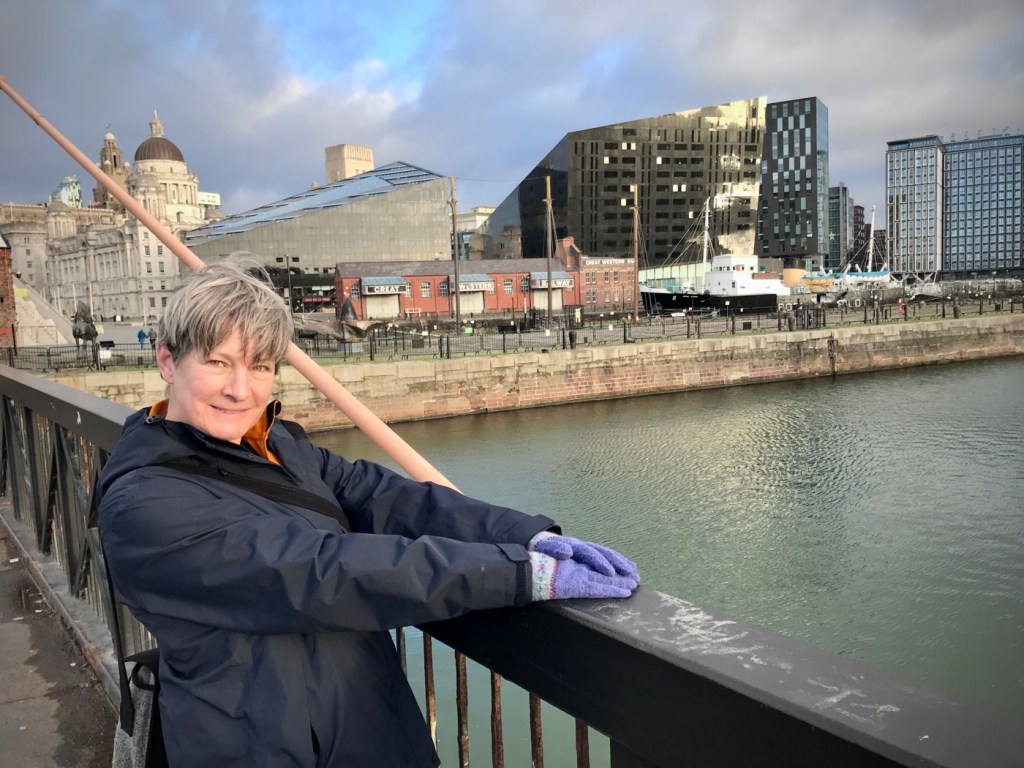
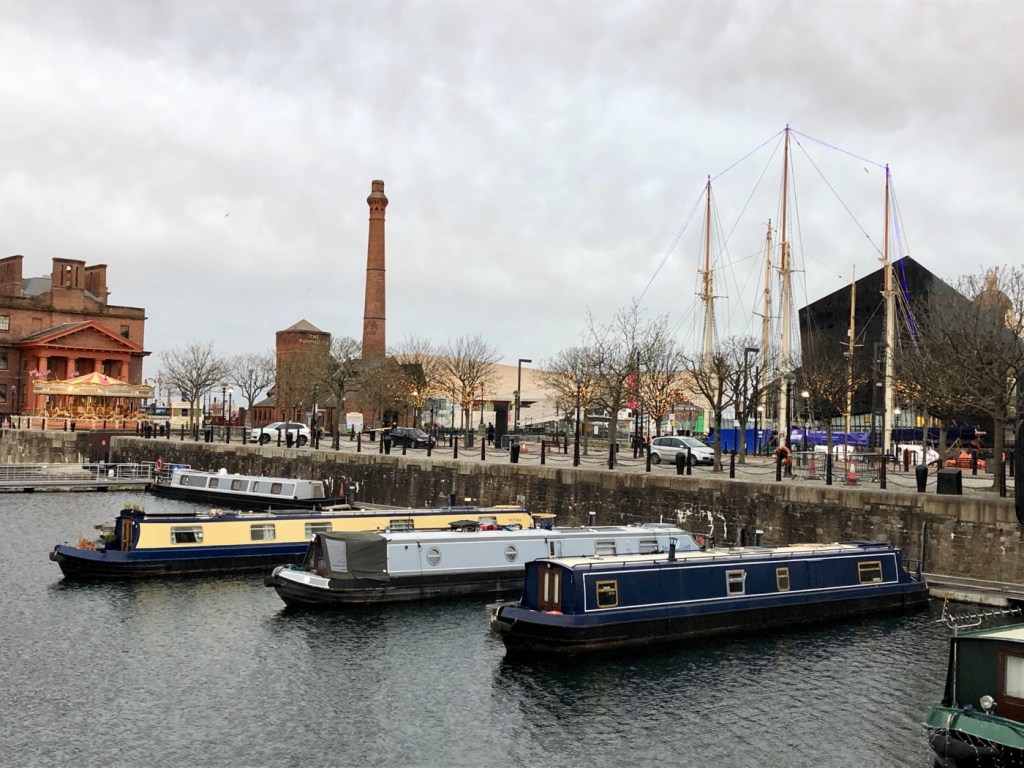
Hello Liverpool. By the Albert Docks, Museum of Liverpool in the background.The River Mersey and a large ferry.The historic wet docks of Liverpool.
Liverpool was recommended to us for its museums, and it has absolutely lived up to the recommendation. So far we’ve visited the Museum of Liverpool, The Tate Liverpool, The Walker Gallery, the Maritime Museum, which includes the International Museum of Slavery – so much to see that we went twice – and today the British Music Experience.
Old lock miter gates, not in use at this location but impressive to see.
Why so many museum visits? Well, they are quite good, and it’s dang cold out. We’re still walking a lot, so many interesting things to see here, but when you don’t have many options to warm up inside, it’s back to a museum. It helps that most of the museums are free. We always donate at the donation points but it means that popping in for an hour and to use the bathroom is easy.
Liverpool Cathedral is the largest cathedral and religious building in Britain. Seriously huge. One of the many fascinating brick buildings around town.
We’re hoping the COVID rates will calm down in the next few weeks, but until then we keep on being safe and staying out of crowded pubs and restaurants. We’ve had lunch inside at empty restaurants, and cooked our own dinner in our hotel room kitchen, but mostly we bundle up and look for sheltered pub gardens and heat lamps.
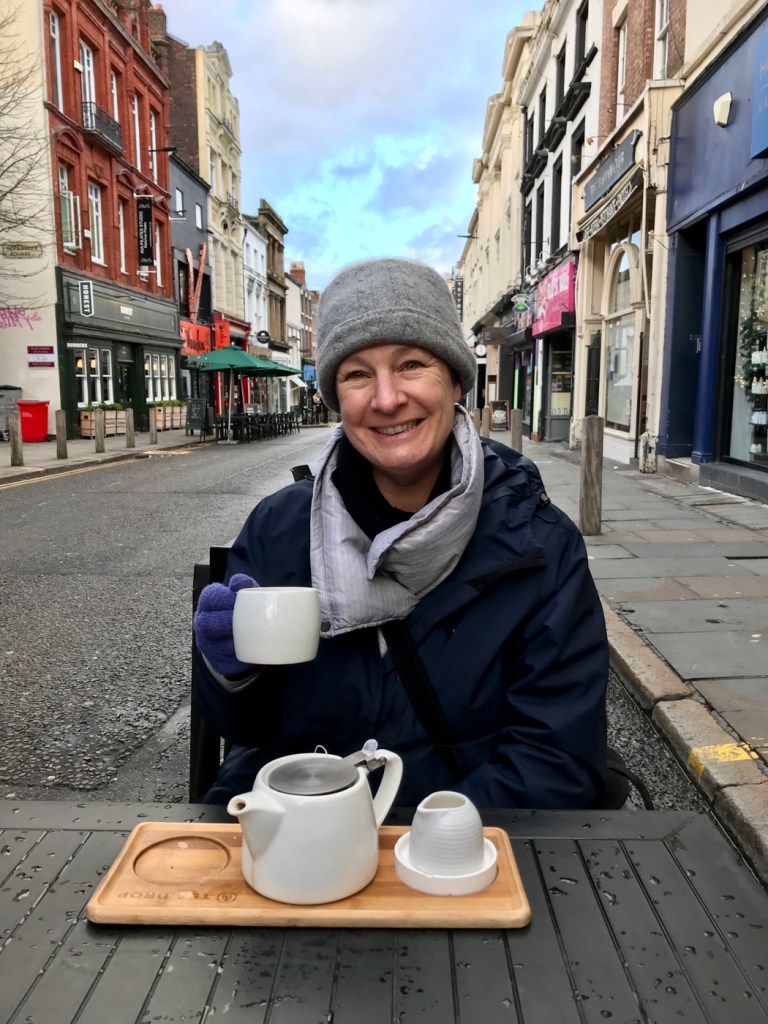
Albert Dock – heat lamp and sheltered.Rope Walks neighborhood for tea. No shelter, no heat lamp. Pub garden, shelter and blankets, no heat lamps.COVID cold weather unicorn: pub garden with shelter, heat lamps, and next door pizza take away. The lovely bartender even brings out utensils and a pizza cutter for our calzones.
We knew that travel during the time of COVID would be challenging and changeable, so we roll with it. Would we recommend a winter trip to Liverpool? It’s not the easiest time to be a tourist, but there is plenty to do here and the locals are very friendly. We’re so glad we got the opportunity to spend time here. I do miss sitting inside cozy pubs though.
The chilly but happy travelers.
We move on to the Lake District tomorrow to do some hiking. We’ll take the train and plan to rely on the reportedly very good bus system to get to and from hikes. As COVID testing and travel rules change frequently, we continue to make no firm plans, only scenarios.
Happy New Year everyone! I think 2022 is going to be great. Why? We woke this New Year’s morning to the rarest of sights- sunlight and shadows; the first real sunshine since we stepped out of a taxi at the Marrakech Airport….20 days ago. (Wait, why did we leave Morocco?)
Some early morning sun in Regent’s Park
Apparently December set some sort of record for gloom in the UK; which is saying something. We’ve been leaning into the dark winter, but have a new appreciation for the Northern European lust for sunshine by January…we even started taking Vitamin D last week, and the tanning bed salons looked a little less repulsive to us. A little less.
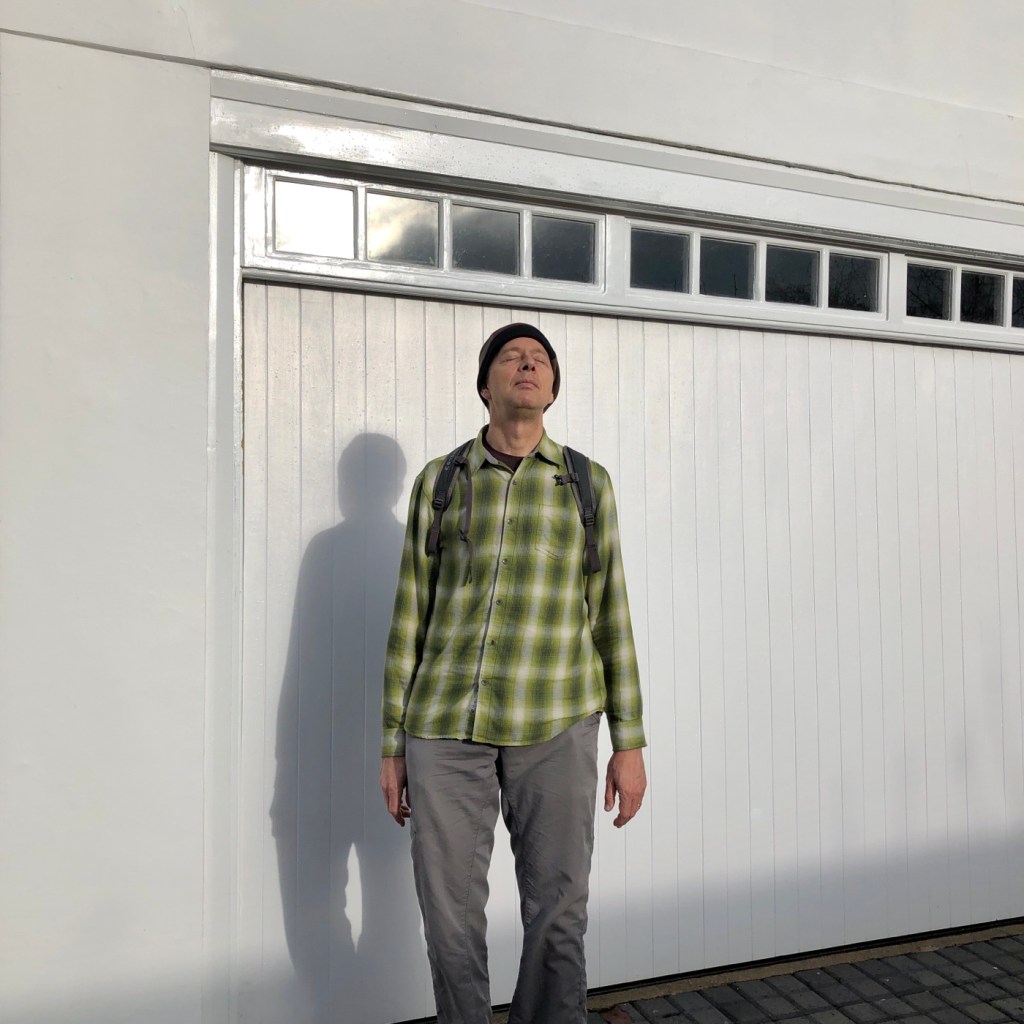
Soaking up the five minutes of sun in late December!More New Year’s Day shadows in Regents Park
But New Year’s morning was indeed a glorious London Day and we took full advantage of it by immediately heading up Primrose Hill to take in the beautiful view and then exploring on foot Marylebone down to the heart of the royal parks of St. James, Green, and Hyde Park. And we were just enough ahead of the masses to experience a very peaceful central London.
Cheryl loving the newly improved sidewalks and pedestrian zones of central London. New Year’s Day Horse Guard preparations. Beautiful horses, but unfortunately no joustingEasy to get bike shares anywhere in London with a contactless credit card £2/day for unlimited 30 minute trips
We also had some fun conversations with some local youngsters who had been up all night and just about ready to sleep after taking in the sunrise on Primrose Hill. Oh yeah, we’re hip too kids, we just left out the part of going to bed at 10:30!
Warm winter weather means outdoor dining has still been in play.
So thanks to the kindness of some very generous friends, we have spent the past week living a bit like locals in the beautiful North London neighborhood of Primrose Hill.
Great pubs everywhere…this one above Hamstead Heath
It’s been great to explore in all directions by foot, tube, and bike share, as we continue to discover more of the London magic, and the layers of overlapping neighborhoods, pathways, alleys, and mews
Near the highest point in London at Whitestone Pond…easy views through the mostly bare trees.The atmospheric Hill Garden and Pergola in Golder’s Hill Park
So we had originally planned (and actually had tickets) to go back to France on the train tomorrow, but that’s been postponed at least a few weeks due to non-essential travel border ban from UK imposed due to Omicron.
Modern Hall Park…the southern end of the Northern Line..more typical weather
It’s all quite political as both sides of the channel have massive case loads and spread, so (tested!) travelers are a blip on the trajectory of the pandemic.
These beautiful Egyptian geese were a little too friendly!
We have learned that it’s very important to look at how countries have responded to different phases of the pandemic to understand how new restrictions may be imposed again. (i.e. Morocco!).
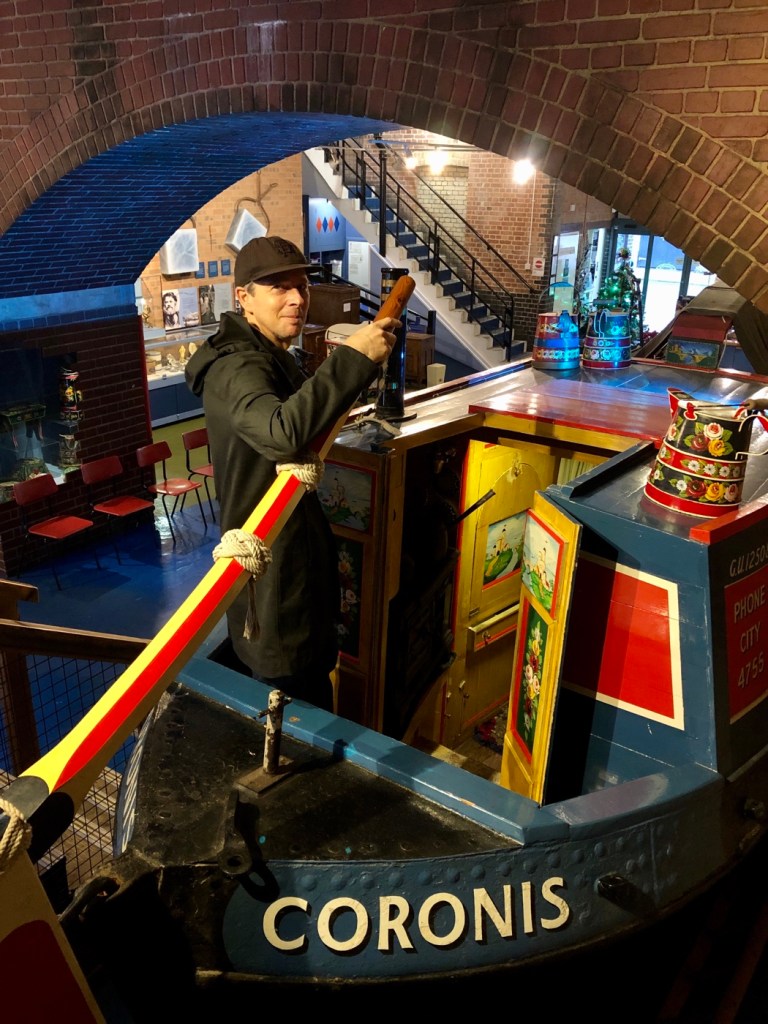
Our favorite pastime…canal walkingI will be Cap’n of a canal boat someday…dreaming at the London Canal MuseumMost of the glorious London Area canals used to be off limits until the 1970s…so hope for all the private canal right of ways in the USA.
So instead we have decided to head to the Lake District for a week to do some nice winter hiking, and exploring…but first with a stopover in Liverpool, which has been reborn and is loaded with great museums and sites, in addition to some famous band apparently being from there.
New Year’s Eve takeout noodles in an Islington Pub beer garden.Riding on in the New Year!
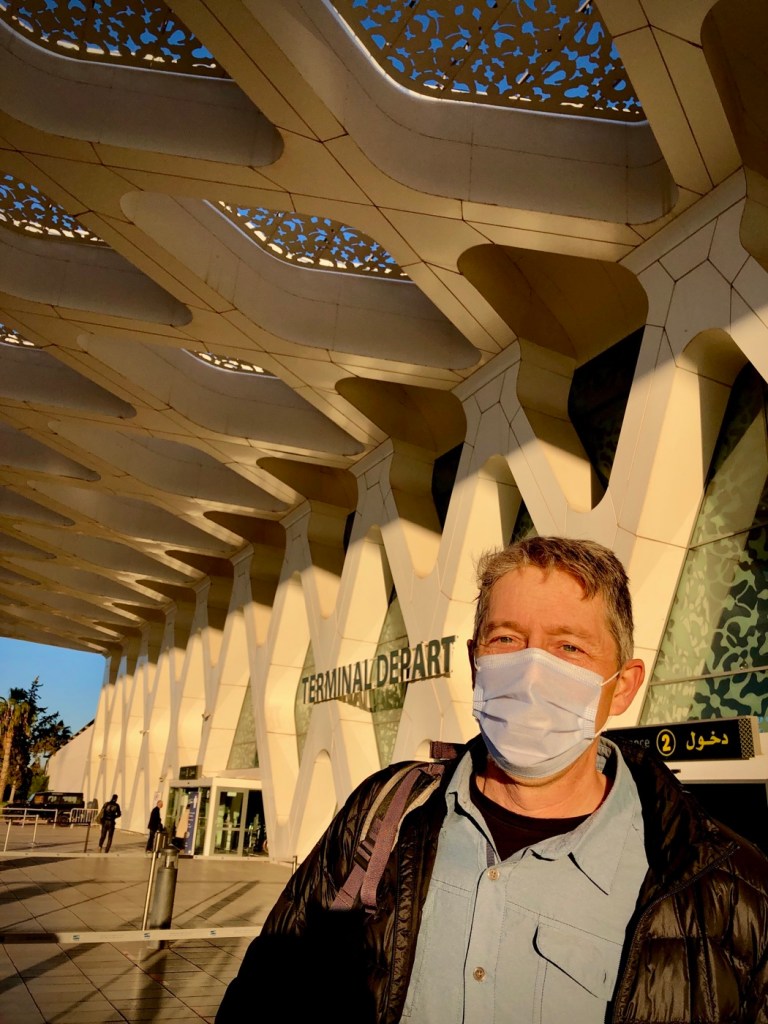
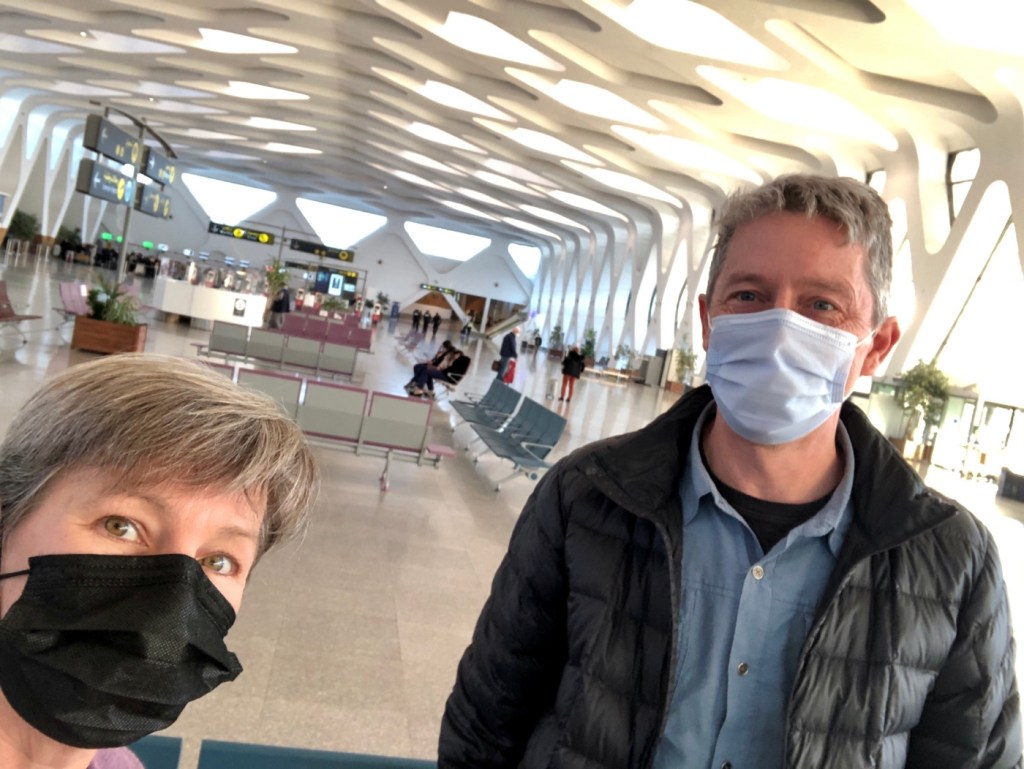
A very empty Marrakech airport. It is a beautiful airport.
How quiet was the Marrakech airport on December 12th, 2021? Birds. We could hear the chirping of little birds who had snuck into the terminal. We heard and saw them in the uncrowded check in hall, in the line-less security area, and out at the empty gates. They were flying around, perching on ductwork and light fixtures, and scouring the area for crumbs. With so few travelers they weren’t having much luck finding food. Flights had been curtailed for two weeks already, and the Kingdom had just announced an additional travel ban through the end of December.
Two days before, up in the Atlas Mountains. Still thinking our Dec. 14th flight would be flying.
A few days earlier we had rented a car in Marrakech after arriving via bus from Essaouira to spend two nights up in Inmil. We wanted to see the splendor of the Atlas Mountains. While out hiking on our first chilly morning in the mountains we got an e-mail from the US State Department telling Americans still in Morocco to leave or risk being stuck. Almost immediately on the heels of that email came one canceling our December 14th flight. Uh oh.
The travel planner springs into action. Out of the photo is the cell phone tower which made this quick action possible.
Rich got a flight booked after a tense bit of time with all operating airlines websites failing to work, and flights already booking up. Relieved, but not completely comfortable, we quickly hightailed it back to our Riad to pack and get back on the road. We needed to get a COVID test that day or early the next morning in order to be able to fly to Paris.
One last fun interaction with these young girls coming home from school who were thrilled to practice their French with us.
Our division of driving labor is Rich driving and me navigating. We made it down from the mountains and through Marrakech to the COVID test center with only one bobble. A slightly tricky trip down a crowded market street to get back on the main road on the correct side of the lab to park the car. That doesn’t sound as stressful as it was, with Rich having to thread the rental car between scooters, vendor carts, and pedestrians. We returned the rental car and Rich booked us in to the thankfully nearby Raddison Hotel. If ever there was a time to check into a comfort hotel this was it.
Waiting for our room while relaxing by the pool.
Oh yes, I failed to mention I was on the rocky road of food poisoning, with the worst yet to come. The distraction of scrambling to divert plans kept me propped up until the next day when I succumbed and took to bed.
Jardin Majorelle-Yves Saint Laurent Mansion. My only outing in Marrakech.After this photo Rich put me in a taxi back to the hotel and headed out solo. Jemaa el-Fnaa square. Normally packed with visitors, very quiet as viewed by Rich during his second breakfast.Bahia Palace also eerily empty.
Once again we could feel the sense of despair from all the hospitality workers, knowing that no more visitors were able to come to Morocco. The taxi driver to the airport failed to turn the meter on and we didn’t even bother to protest or haggle, just paid, tipped, and wished him well. We were likely his last tourists for some time.
A few days short of our planned four weeks, but thanks to Rich’s amazing planning skills we saw a lot of Morocco.
While waiting in line at the airport to check in and check bags we struck up a conversation with a lovely mother son traveling duo who had come to Marrakech to spend three months and were also heading out early due to the shut down. We had managed to complete almost our entire hoped for itinerary, so we left with no regrets – except my food poisoning. They were headed to Bangkok via Paris and Amsterdam and had a 14 day quarantine to look forward to in Bangkok.
On the way to security screening. No crowd. Me keeping it together for travel day. Just.Marrakesh Menara Airport’s gorgeous ceiling. In 2019 it handled over 6.3 million visitors.
And here we are in Paris. Another one of those culture shock travel days completed. Doing COVID testing and entry paperwork for each leg of our trip back to the UK adds another level of frustration to travel in the age of COVID. Rich keeps track of the ever changing regulations and makes sure we have printed copies for airport days. I’m sure the challenge of the paperwork and the cost of the testing is putting a lot folks off travel. We took a deep breath in Paris and enjoyed the Christmas feel I was missing in Morocco, before we dove back into on-line forms and registration of tests to get to the UK. Next stop, London and then Edinburgh.
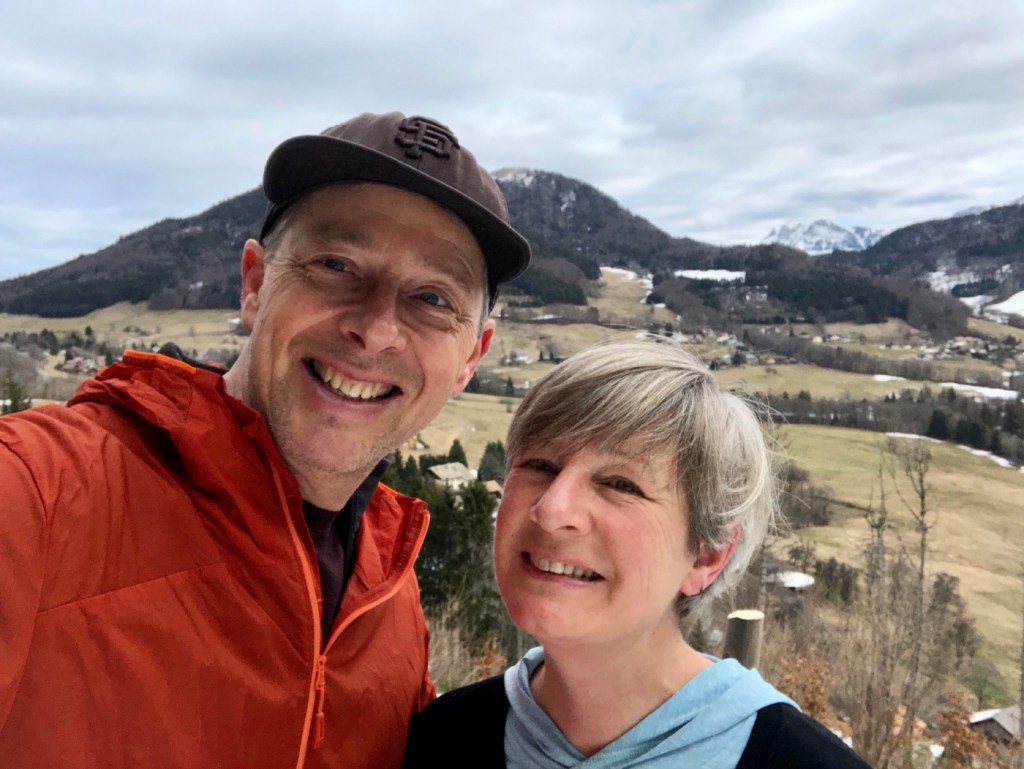
The happy travelers in Paris, on to the next chocolate shop!









































































 Less Car, More Life