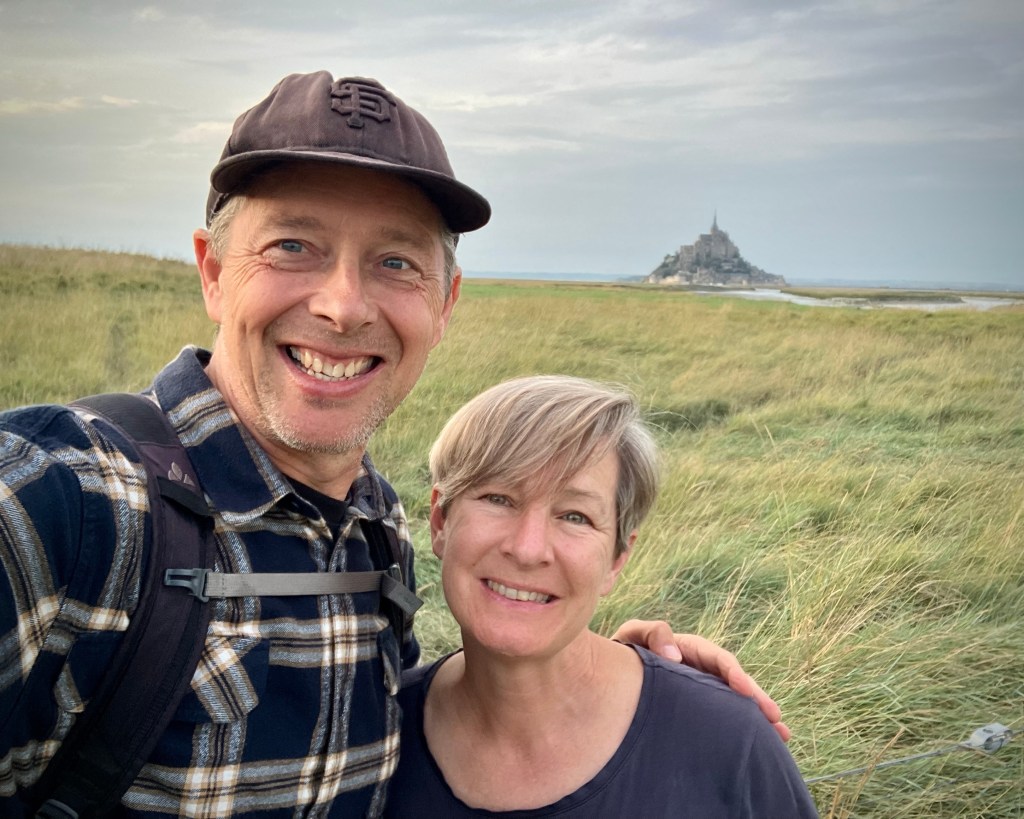
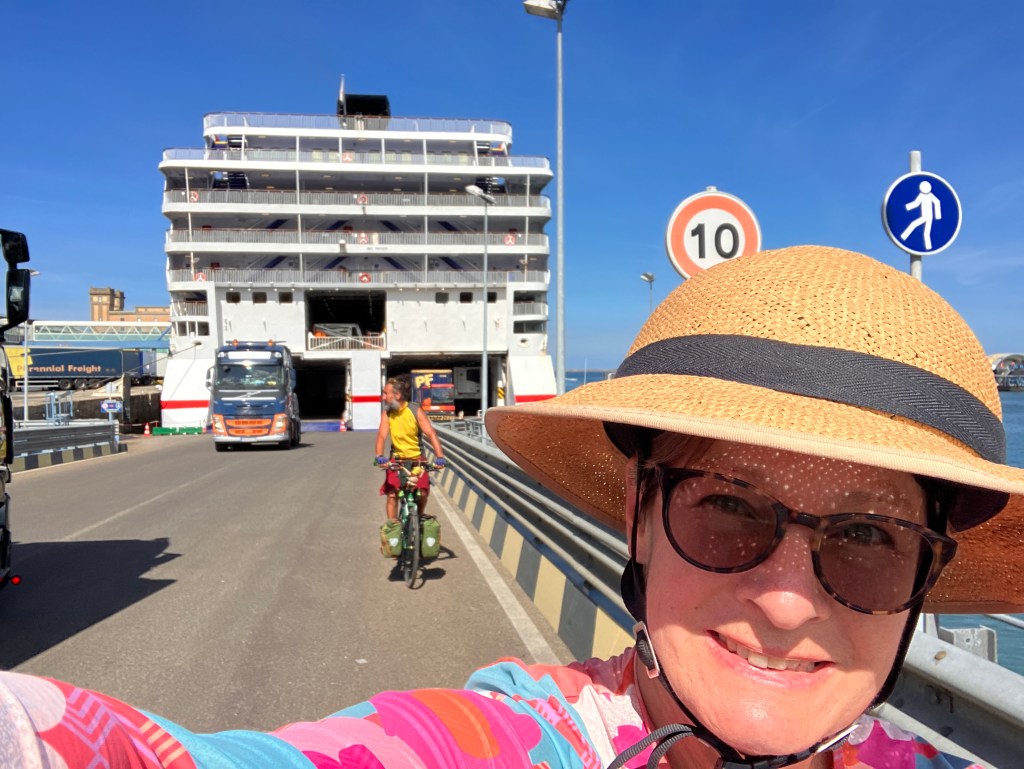
Albania-America

Cheryl and I are finally back in America now experiencing a bit of culture shock after 5 1/2 months in Europe. But after a jarring first few days where I felt both dizzy from the jet lag and the immersion into abundance, everything is feeling familiar again. There is a nice sense of relief that comes from being in a culture we understand. Well, mostly understand.

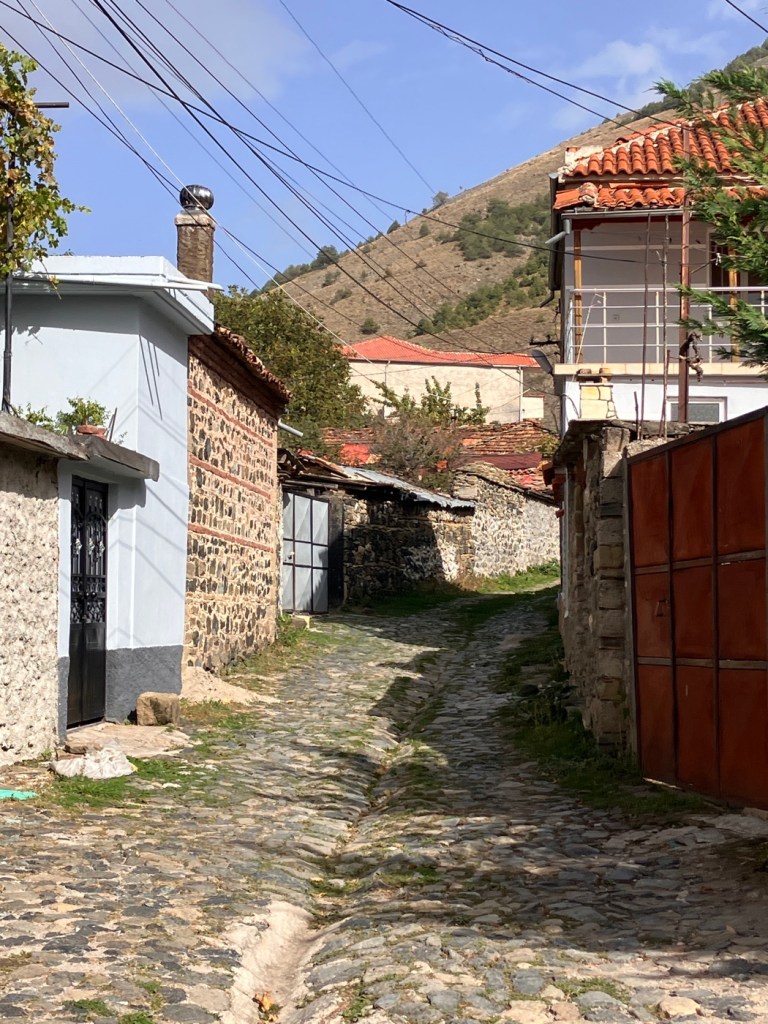
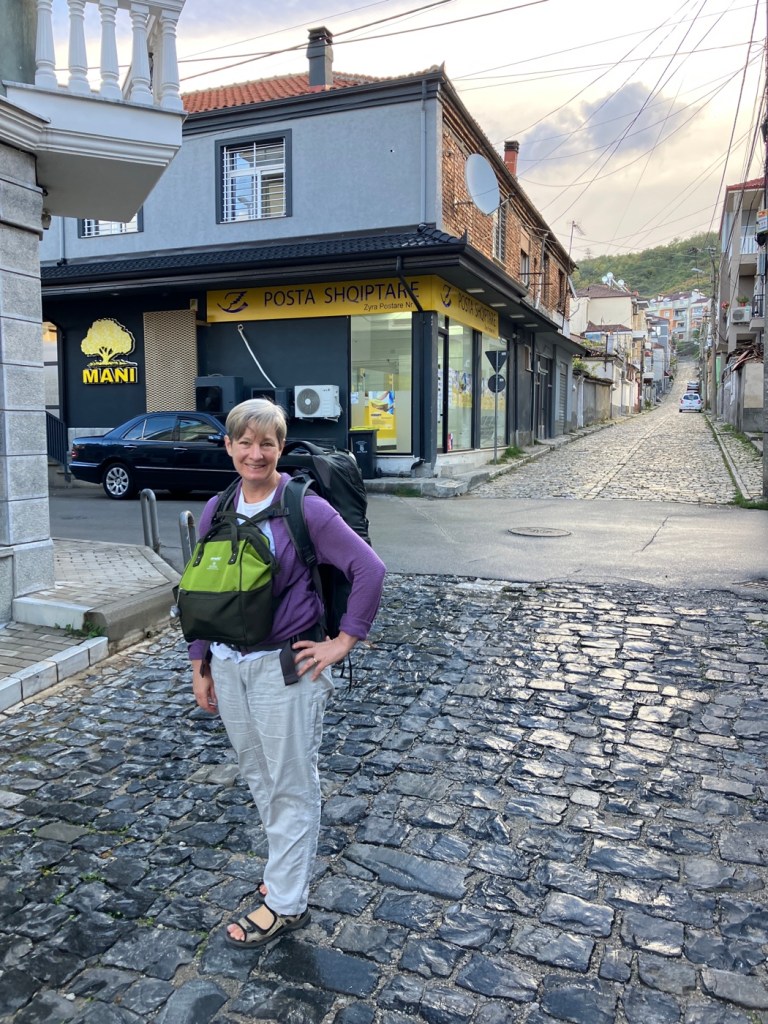
Off the tourist track in Elbasan, Albania.
Walking up Rhuga Thoma Kalefi, the busy market street of Elbasan.

And coming to America directly after a month in Albania has given us a real sense of contrast and the imbalance of opportunity. The GDP per capita of America is over 10x Albania’s. After 45 years of a repressive and closed dictatorship, no one takes their opportunity for granted in Albania. Young Albanians are globally aware with media and the internet, and emigration is still seen as the primary path to success, whether it be legal emigration to the US, UK, France, or Germany or a more desperate journey to Italy across the Adriatic. 10% of Albania’s GDP is in the form or remittances from abroad, a very high number for what now is technically considered a middle income country.

Ohrid, North Macedonia had a proper bus station which already differentiated it from our experiences in Albania.

But as always, I digress and obsess about geo and socio-economic issues. It’s one of the main reasons I love to travel…a fuller understanding of the world. A chance to talk to people at the source. Read, learn, and experience at the same time.

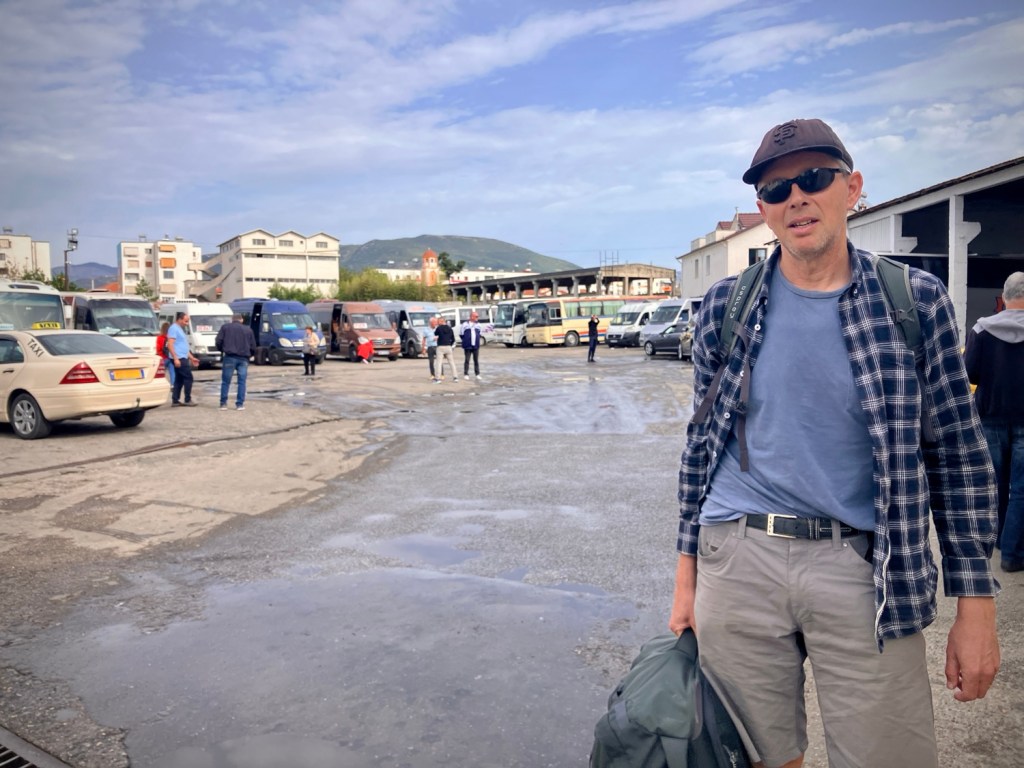
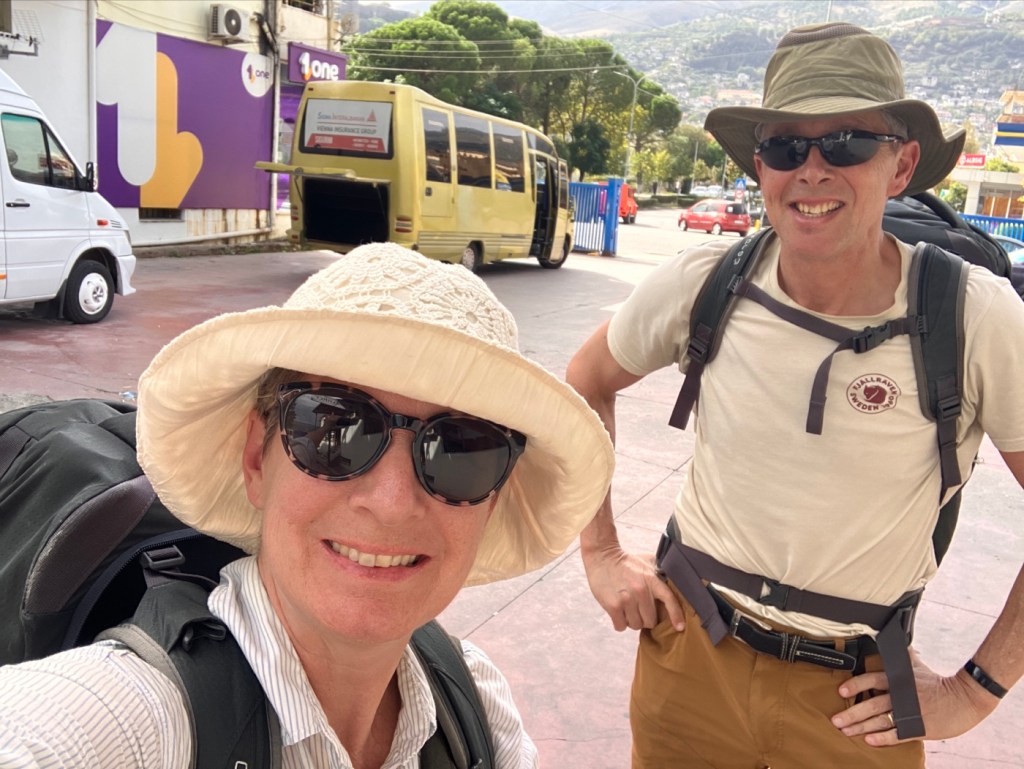
Trying to remember that we were still in Europe at the Elbasan Bus “Station”.

So when we have an opportunity to stop at a small city off the tourist track, especially if it’s on the way to another destination, we almost always say yes. Sometimes these hidden gems are some of your favorite places. Untouristed cities offer the opportunity to get off the guidebook and instagram track. Elbasan, Albania is the fourth largest city in Albania and only about 45 minutes south of Tirana. A few people had mentioned Elbasan, but I didn’t really have a “recommendation”. I figured out that the one international bus from Lake Ohrid to Tirana went right through Elbasan on the way. The challenge was that Elbasan wasn’t an official stop and this was a large coach bus run by the international Bus company, Eurobus. It would also save us going back into busy Tirana to transfer to Berat later.

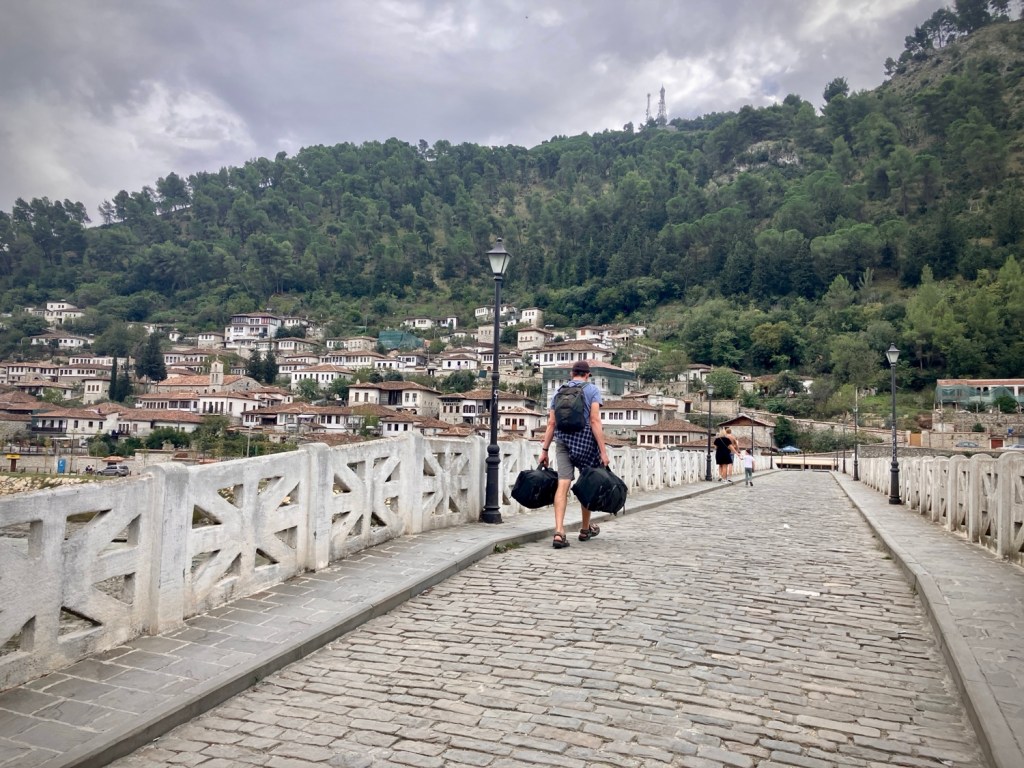
Crossing the Gorica Bridge in Berat. The hostel was close enough to just carry our (~10kg) bags and not go to backpack mode.
14th-16th century frescoes in the Kisha e Shën Kollit, one of the many churches inside the sprawling Berat Castle.

So we decided we’d buy bus tickets online to Tirana (as this was the only option) and then hope the bus could drop us on the way. I held off booking any accommodation until we confirmed on the bus. We asked the driver as we boarded and they put our luggage in a separate compartment underneath. Cool, we’re doing this. As it turned out, we were the only two getting off anywhere else on this run. Hmm, why isn’t anyone else getting off in Elbasan?

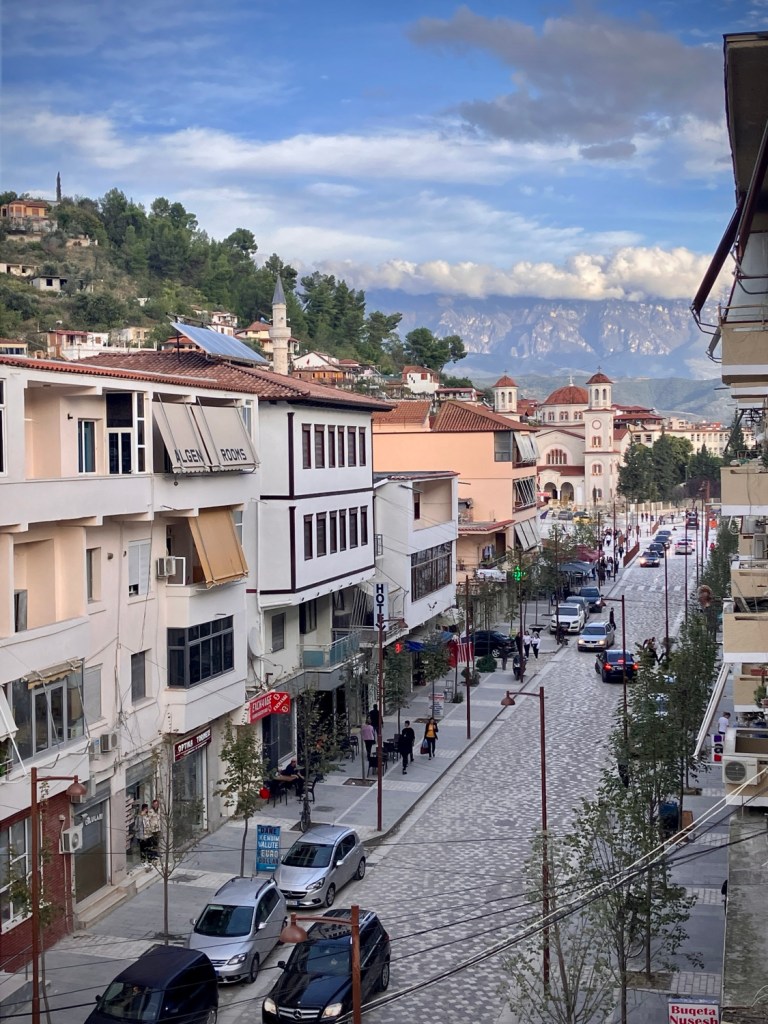
The pleasant streetscape view from our apartment in Berat with the nearly 8,000 foot Mt. Tomorri in the clouds.
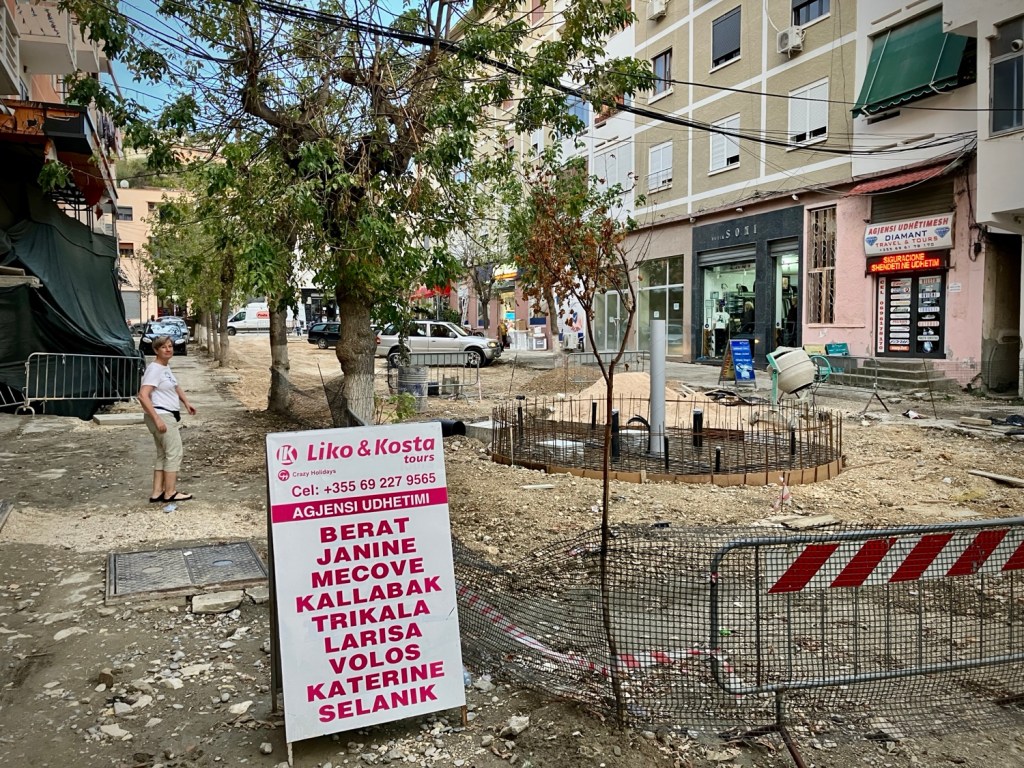
Our apartment in Berat was accessed off this side street under construction. A bit noisy for us, but happy they were creating more pedestrian space and plazas.

The bus was a complete mix of passengers from other Balkan countries and further afield, so the border crossing between North Macedonia and Albania was slow. We all handed our passports to a young (unmarked) guy who walked down the aisle of the bus and then disappeared. He finally returned 45 minutes later and then tried to make his way down the aisle with 50 passports. He tried to call out many challenging names as the bus swerved and swayed in sweeping corners descending over a thousand feet from the pass that separates North Macedonia from Albania. As he balanced all the passports in two hands, a particularly sharp corner sent dozens of them scattered across the floor of the bus. Oh great. And then it happened again a few minutes later. It was simultaneously comical and concerning (our passports!), but we mostly felt for the guy as we figured it must be his first day on passport duty.

Traditional clay tile roofs are constantly being patched and repaired.

As it turns out, he was just a random college student sitting up front who was selected/volunteered. I chatted with him at the rest break 20 minutes east of Elbasan. He was ethnic Albanian, but living just over the border in North Macedonia, and attending medical school in Tirana. He said the region near Lake Ohrid was mostly ethnic Albanian. He was likely headed abroad after training as Germany and other countries with staffing shortages are recruiting educated Albanians aggressively.

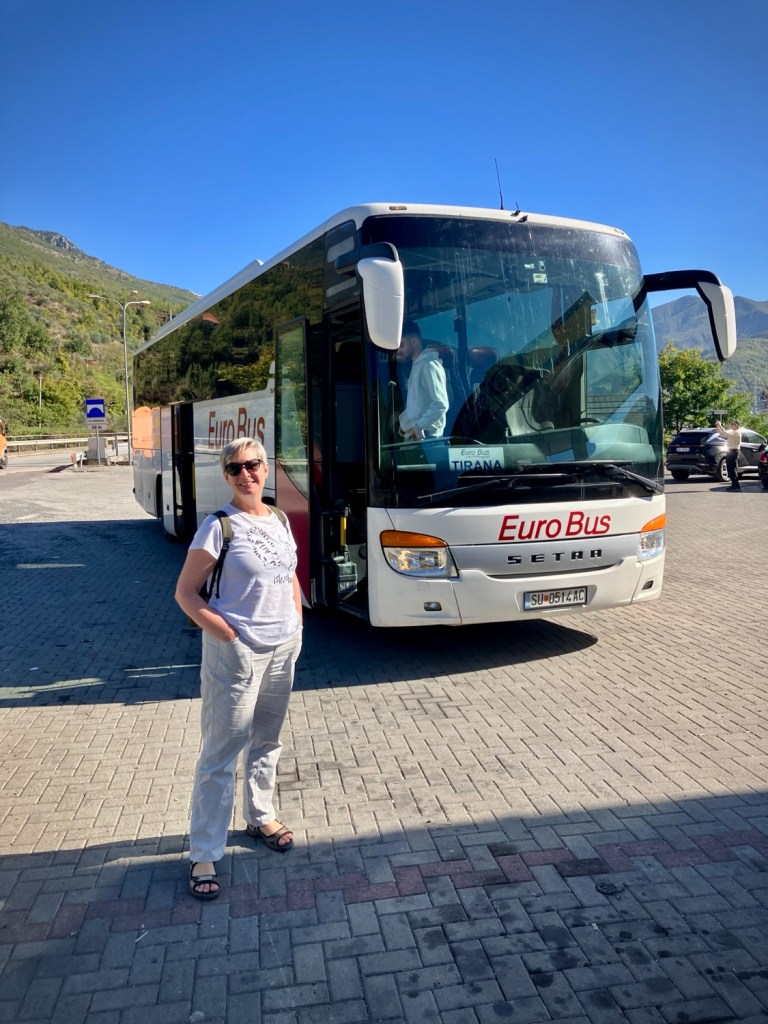
Cheryl posing with our only full size coach ride Ohrid to Tirana (Elbasan). Just hang on to your passport!

I hope he got a free bus fare or something for his effort. By the way, we did all get our passports back eventually as the travel gods made it all work out just fine.

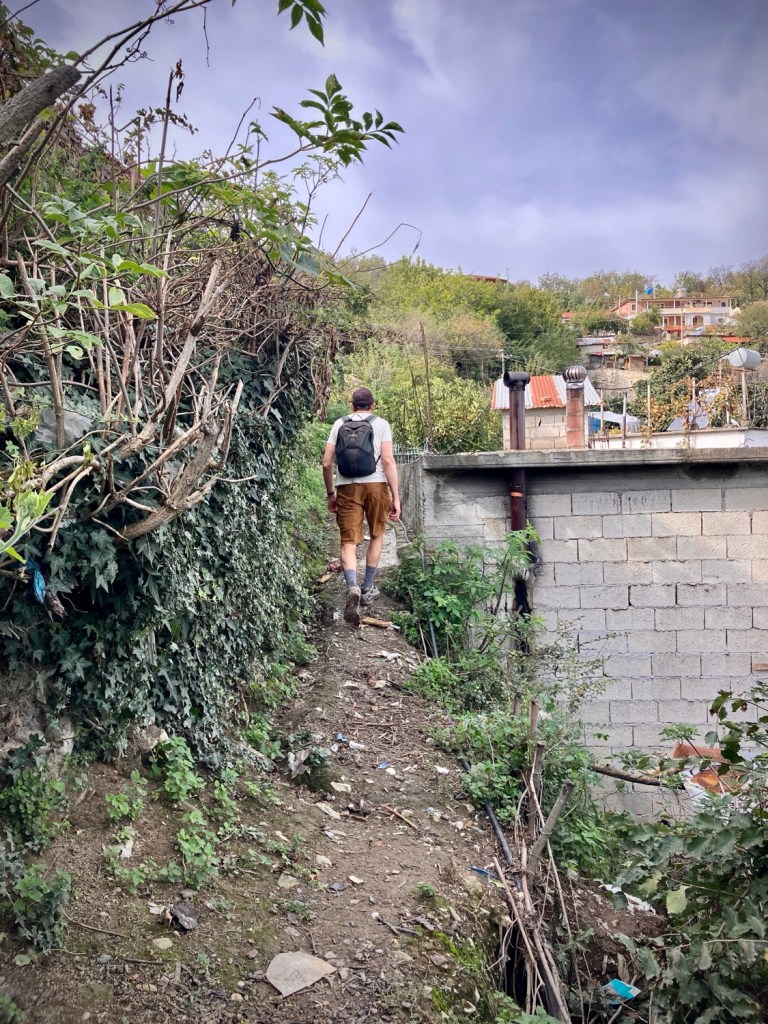
Climbing to the high ridge towards the village of Drobonik above Berat. Look for the trail that heads SW out of Gorica.
Our 6 mile loop took us past grapes ready for harvest, possibly Pulës for white wine or Raki.
Old school still rules in much of Albania.
A hayrick (haystack).
Trying to get back on course after a lively conversation with school kids in Drobonik.
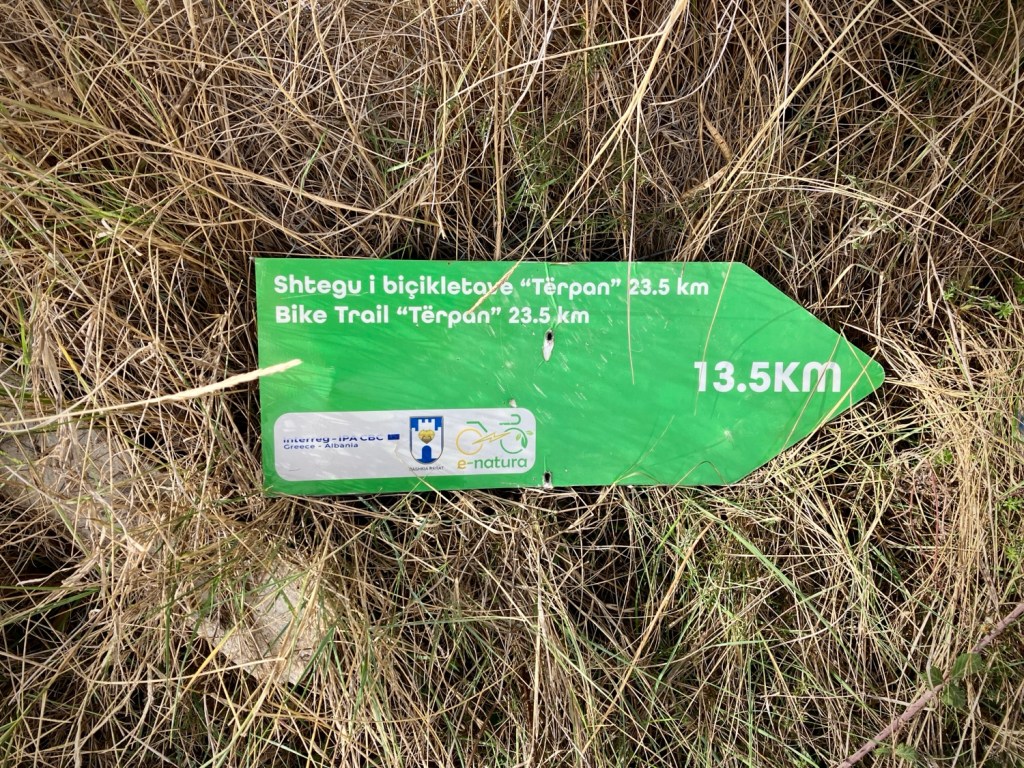
A mountain/rural cycle route program above Berat was slightly aspirational here, but there are real opportunities for robust outdoor and green tourism in the future.

Elbasan itself has a nice Main Street lined with buzzy cafes, wide sidewalks, and ending at a large car free promenade space in front of its historic castle walls. It’s a busy market city too and has lots of young people and a university. The castle is unique as it’s on the flats of a valley, and is integrated into the fabric of the city with a few cafes and lodging options, mixed with regular city residents. It’s not the most picturesque castle or old town, and there are not really any other major sities of interest in Elbasan, but it does have a pleasant park, and we enjoyed our 24 hours there. People were friendly and genuinely pleased to see us tourists, and we were happy to see them. We did spot a cycle tourist from Germany at a cafe, but it turns out he was going to camp in the nice river valley west of town, so it did seem to be just Cheryl and I as far as tourists in this small city of 140,000. Our reward was really friendly locals at lunch and dinner, with a clear excitement to have Americans visiting. Albanians really are nice once you get through their guarded facade. The old adage that the fewer tourists a place gets, the more friendly and genuine the engagements resonated here.

How old is this olive tree? Older than me?
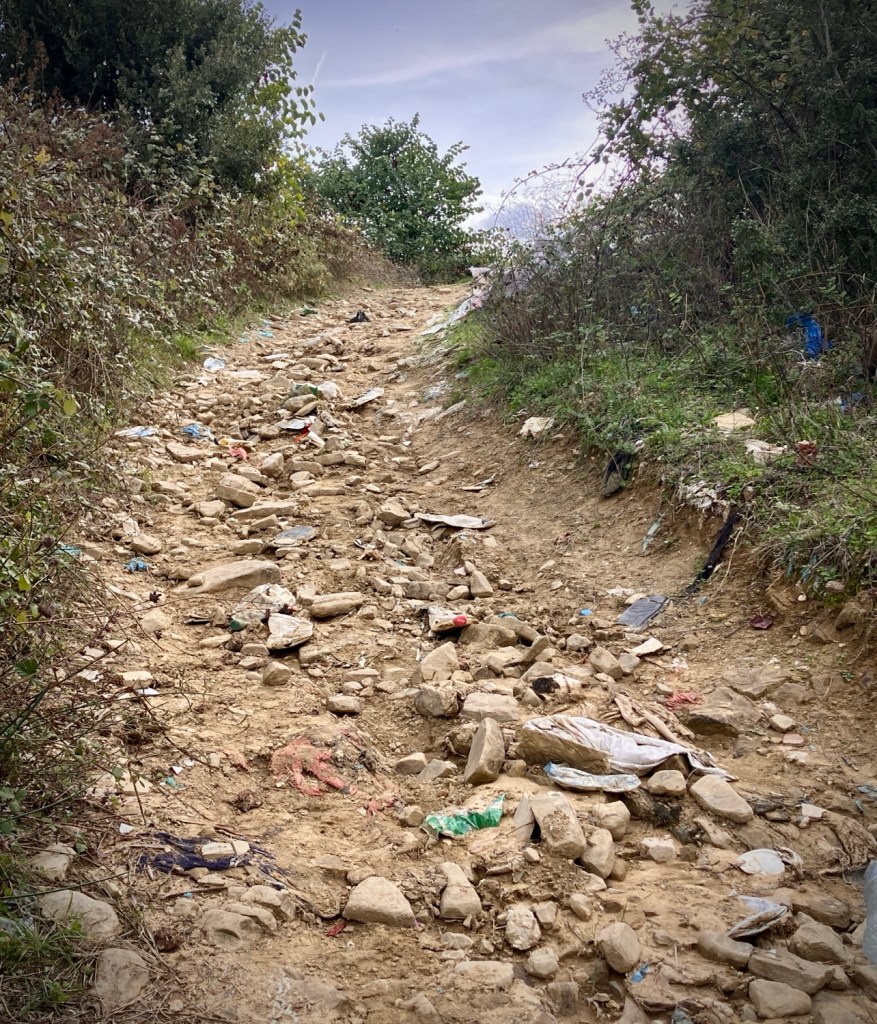
A sad reality of Albania is ubiquitous garbage and a lack of proper sanitation, especially at the edges of towns and villages
Slightly off course hiking but we now had a visual on Berat so just had to let gravity do its thing.

But our real goal after Ohrid was the historic city of Berat, so we took another stab at minibus roulette and had a hotel taxi take us to the bus station of Elbasan. It was both a lively and grungy spot, and once again, we were the ONLY obvious foreign tourists hanging out there. And thanks to the random minibus schedules, we were there for almost two hours. There is a decent cafe with a rustic bathroom (squat loos) on its edge, so it was ok. And as always, people were super friendly and leave you be as desired. Albania is chill.

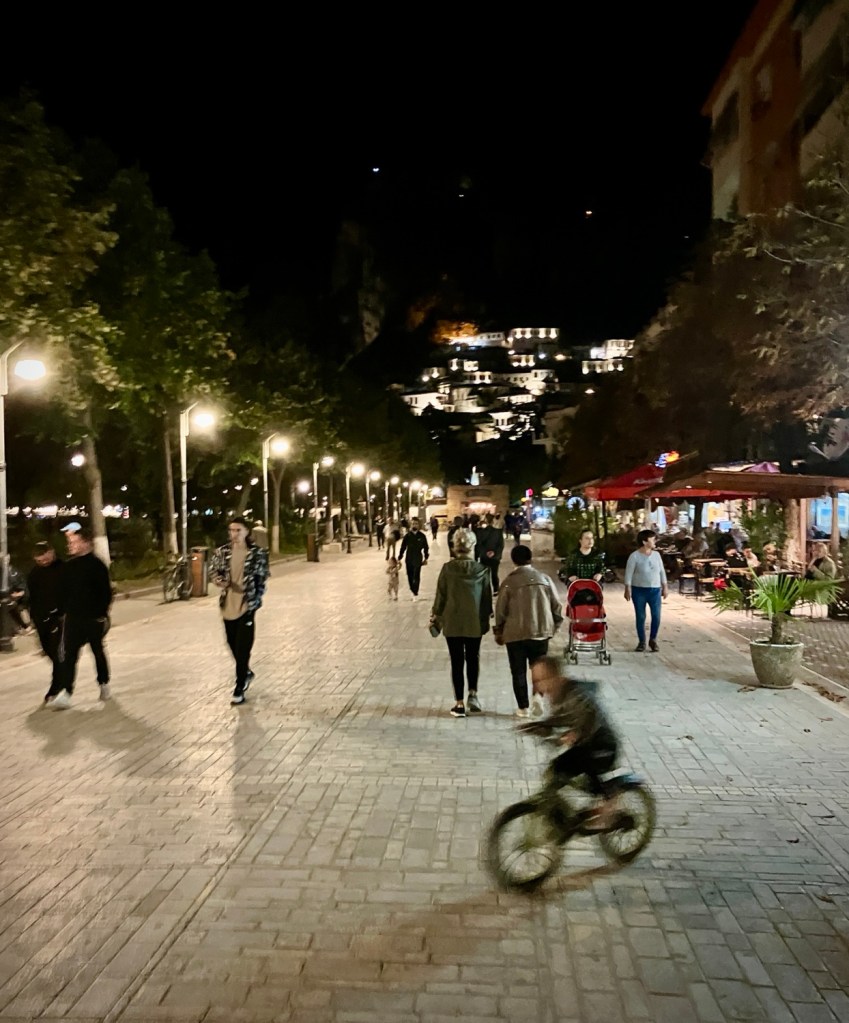
The lively main promenade of Berat was a delight to stroll in early evening

The nice thing about our minibus from Elbasan to Berat (besides the cool music) was that it dropped us near the center of Berat and we could walk to our first nights’ lodging at a popular hostel in Gorica. (Double room, no bunks for these 50 somethings -:) The buses from Tirana to Berat generally only stop at the bus station outside of town, so you need to taxi or take the public bus.

The classic Ottoman style wood and stone architecture of Berat, a UNESCO world heritage site since 2008
Berat has a few different historic subvillages to explore on both sides of the river.

Berat is in located in an atmospheric location the Osum River valley and is a fascinating place to explore with rapidly developing tourism. It’s been a tourist star for a long time, but civic improvements and more restorations of crumbling buildings and ancient sites is making it even more appealing. After our night in the friendly (but young) Maya Hostel, we found a nice apartment in the center of town to settle into for three days. A number of apartments in older (non historic) buildings have surprisingly nice interiors in a rough shell and exterior. I had to block my inner civil engineer concerns as lightly reinforced concrete buildings with clay blocks are the standard construction style. Most would probably ok in a smaller earthquakes but would be no match for a big one. A moderate earthquake in Northern Albania in 2019 did kill and injure a lot of people, so hopefully more investment will bring more modern buildings and retrofits.

Back to a more standard minibus in Berat…departure TBD.
Legroom varied on the minibuses, but I usually straddled two seats or an aisle no problem.

We then caught our final minibus back to Tirana, with half hourly departures posted everywhere online…. but our (small bus/large minibus) still left randomly off of any schedule. We were excited to head back to Tirana for our final 5 nights, as we found it so surprisingly pleasant and green in our first touch down.

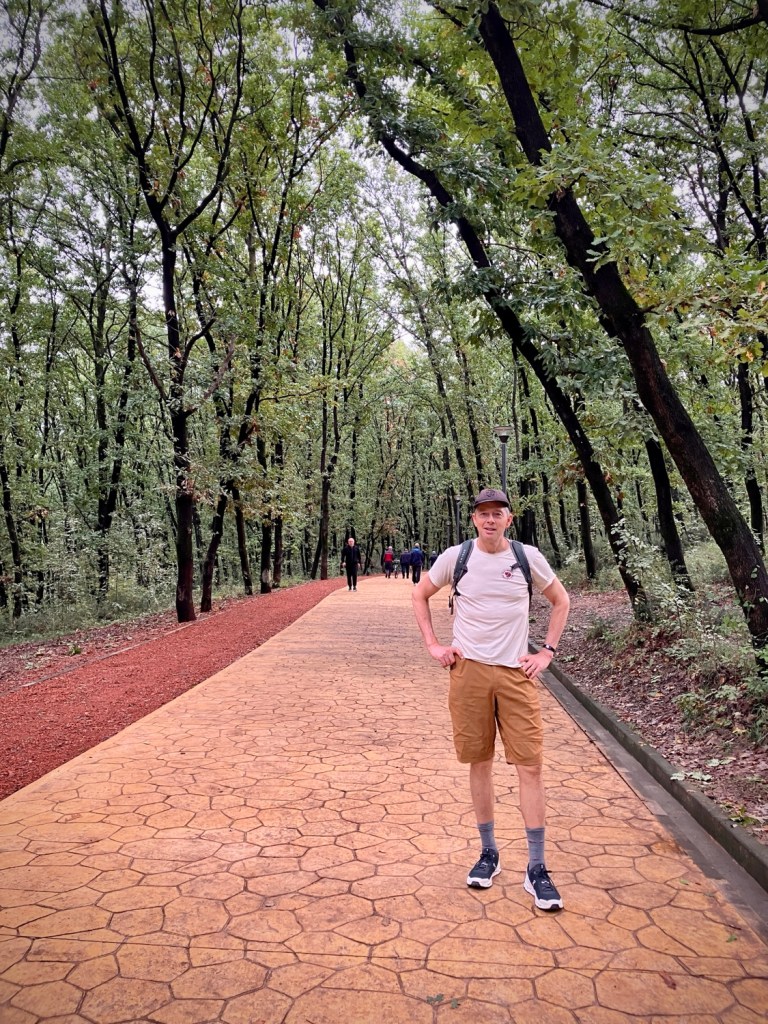
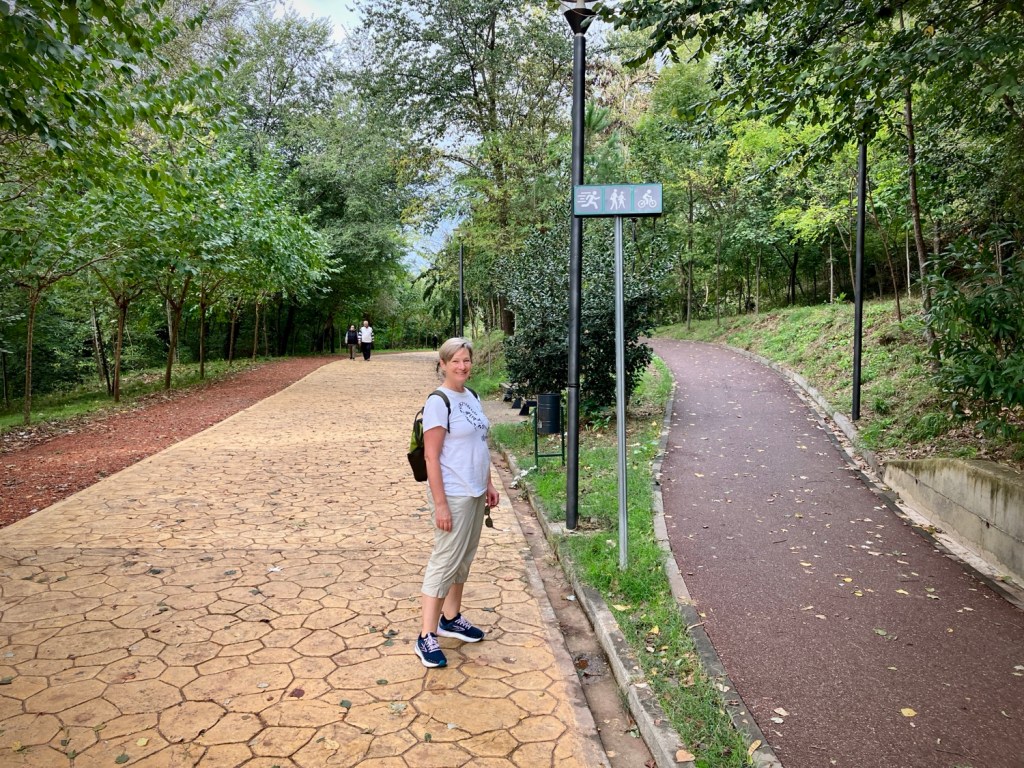
The Grand Park of Tirana was busy on a Sunday morning with walking, cycling, exercise areas, and a few cafes to enjoy.
Choices are nice.
Tirana’s Skanderberg Square shines at night.
Gyro style lunch is a “fast food” staple in Albania. I opted for the plate.

Plus, we knew we could now explore Tirana knowing a lot more about Albania after going full circle for nearly a month. Wow, a month in Albania. It was not even on our travel radar until this summer. It’s geographically diverse, but has less than three million people. But our slower tour of the country rewarded us with perspective. Pieces of history and cultural knowledge layered in our minds and gave us a clear understanding of how the complex and recent past has deeply influenced the character of the people. Oh, and the swimming on the coast was divine.

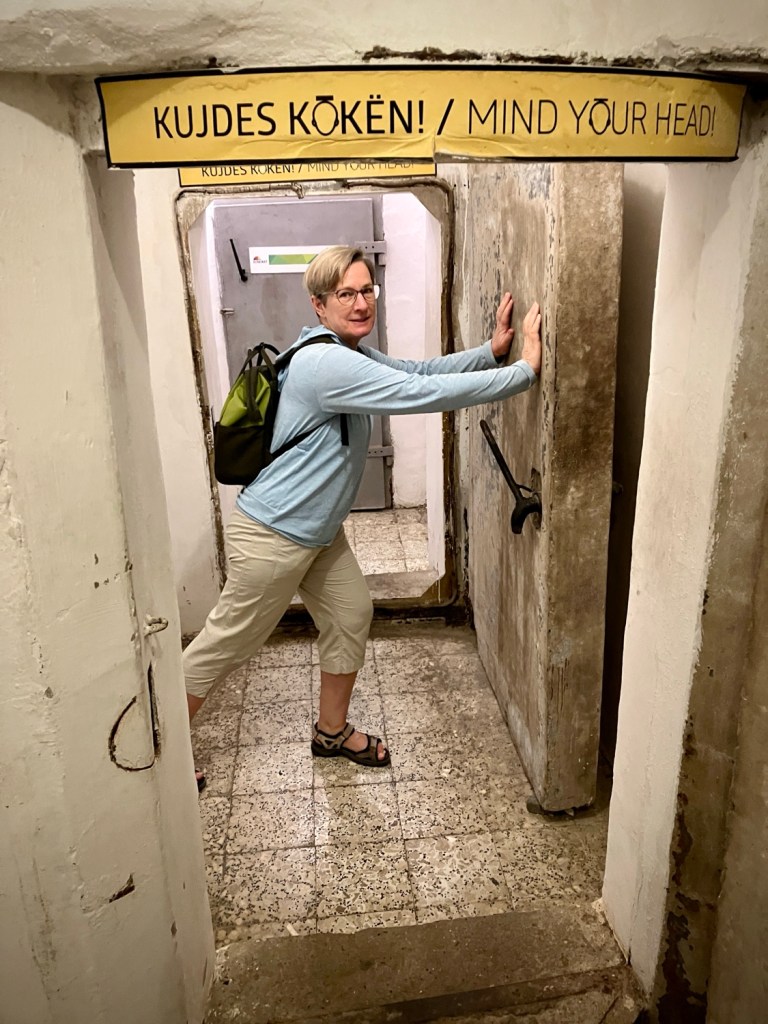
The access tunnel to the BunkArt 1 complex at the edge of Tirana sets the mood.
No person, chemical, or radioactive material was going to get in this massive bunker complex designed to protect Enver Hoxha and his government.
Living quarters for the leaders and basic operational services in the event of an attack from the imperialist forces. Hoxha created an isolated world based on fear most similar today to North Korea.
BunkArt uses many of the unique underground spaces to house art installations.
Lots of new construction on the fringes of Tirana, this with both city and mountain views.

Most Albanians in the world now live outside of Albania. They live all over Europe and the energetic youth clearly have their sights on opportunities abroad, especially Germany, France, and America. But it felt like we were experiencing a tipping point in the fall of 2023. More new and exciting things were happening in Tirana and that energy and prosperity seems to be starting to radiate out. But the reality is much more complex than our optimistic lens from two enthusiastic visitors.

This memorial across the street from the German Embassy commemorates the storming of the embassies by youth seeking asylum in June 1990.
An ad at the French Embassy. Countries are competing for the best and brightest Albanians.

The brain drain is continuing as the youth don’t have the time to wait around for their country to to triple their GDP. (Such as fellow Balkan Croatia) or an order of magnitude of economic opportunity as in Germany. But time and time again, our conversations with locals brought out their pride for their country, but a much more negative view of many aspects of daily life (drivers, corruption, pollution, etc).

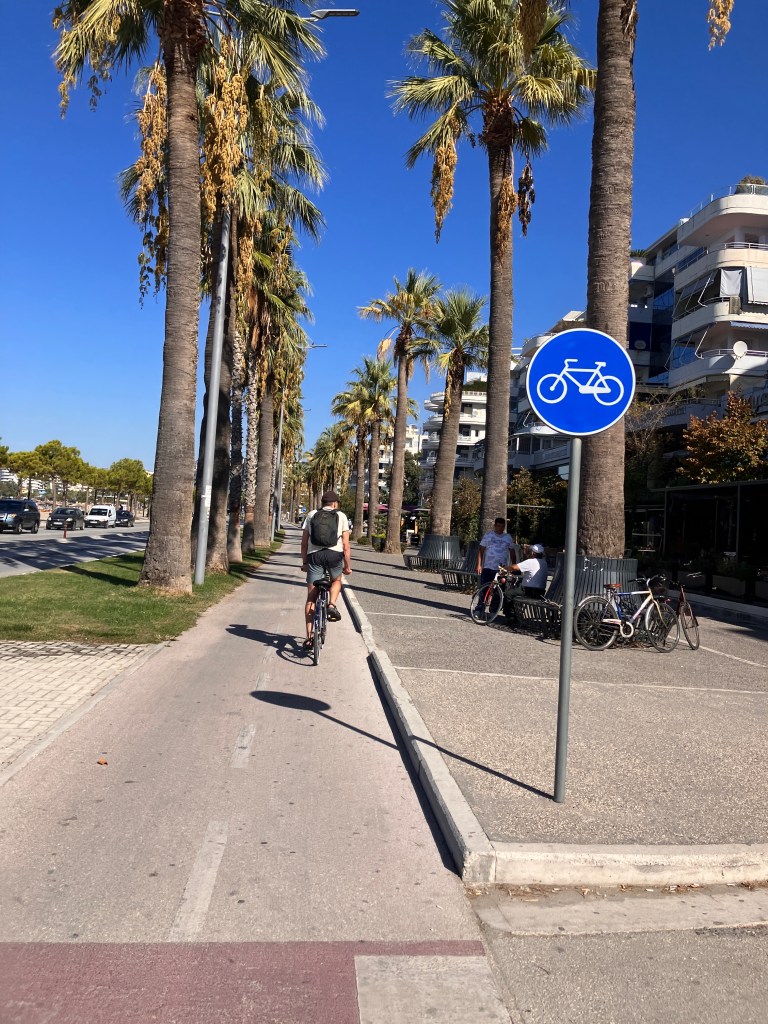
A beautiful center running bikeway on Kavaja Street in Tirana. The mayor is progressive and dedicated to greening the City.
Fleets of all-electric taxis were a common sight.
Livable side streets and pedestrian space abounds in central Tirana.
Historic buildings and architecture are now being preserved in Tirana, even if there is not yet money to renovate.
Tirana is green on the inside now, but there is still work to do around the edges.

But this was one of my favorite places to experience now, because of the innocence of the people, and complex and overwhelming history. This innocence will (and is) changing as Albania integrates into the world fully, but for now, you can still experience a bit of the past overlaid by hope for a brighter future.

Ready to go “home” at Tirana International Airport.
Atop the newly renovated and reopened Pyramid of Tirana in a city that will surely be popping up in more travel sections in the coming years.

Happy Thanksgiving to all our American friends and peace to all!

A side trip out of Albania to Ohrid, North Macedonia.

Walking across the border from Albania to North Macedonia, on Lake Ohrid.

When we decided to do all our Albanian travel by bus and an occasional taxi, we knew it wasn’t going to be the easiest way to travel, but as we say to each other “We may see fewer places, but we will experience more”. The trip to Lake Ohrid was a great example of more experiences.

See more of less. Ooooh, travel motto t-shirt? Have I loved every bus trip? No. They have their ups and downs. Occasional motion sickness, drivers who smoke. But the pay off is that we both get to sightsee, we get to experience the same transportation the locals use, and you never know what your day will be like. Seamless? Almost seamless? Complete mess? Who knows? So off we go.

Pogradec Albania, the bus station where we arrived from Korçë. Step one.
Loading our bags into a taxi. Or just a car. Not really sure. Step two.

We walked to the bus station in Korçë, and quickly caught our bus to Pogradec. A town at the foot of Lake Ohrid. When we got off the bus in Pogradec, Albania, and walked towards the street, the driver of another bus asked us “Tirana?” No, Ohrid, we replied. He hooked his thumb towards another guy, “Ask him, he’s the boss.” The Boss agreed to drive us to the border for 1,000 Lek, or $10.00. Albania is a fascinating contradiction of confusing yet surprisingly hassle free. Tourism is still pretty new here, so bus schedules are not set in stone or well documented, but there seems to be very little scamming or property crime directed at tourists. This was a good example, we didn’t even leave the bus parking lot and the first person we interacted with sorted us out. A bit gruff, but helpful.

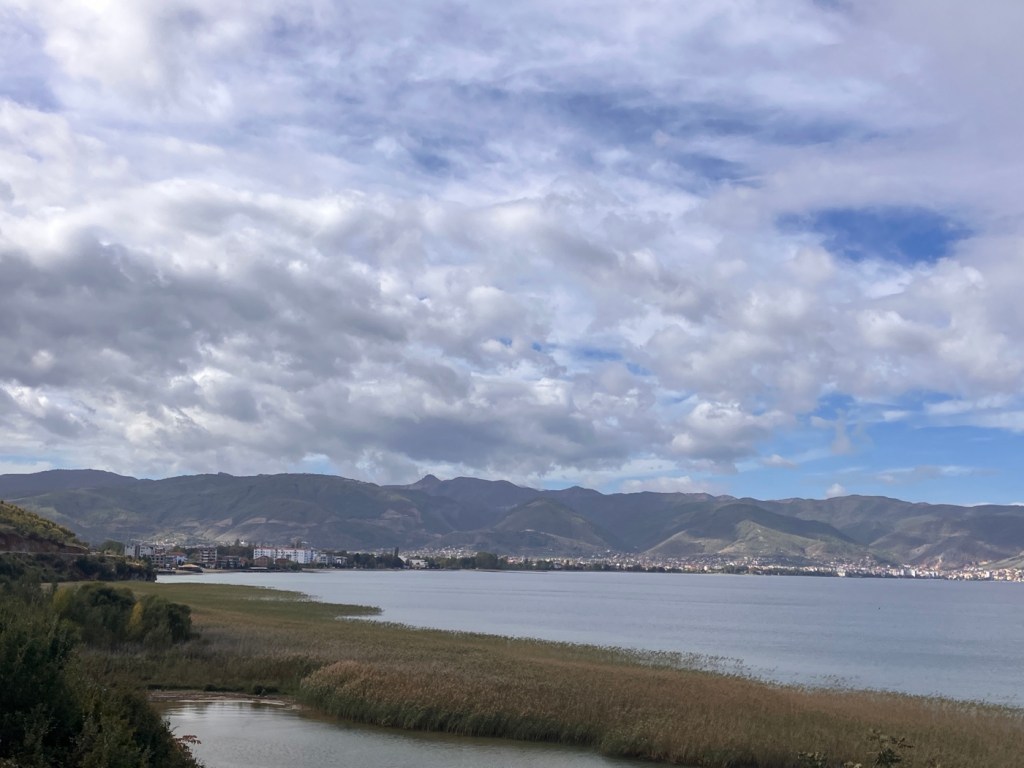
Lake Ohrid, first glimpse.
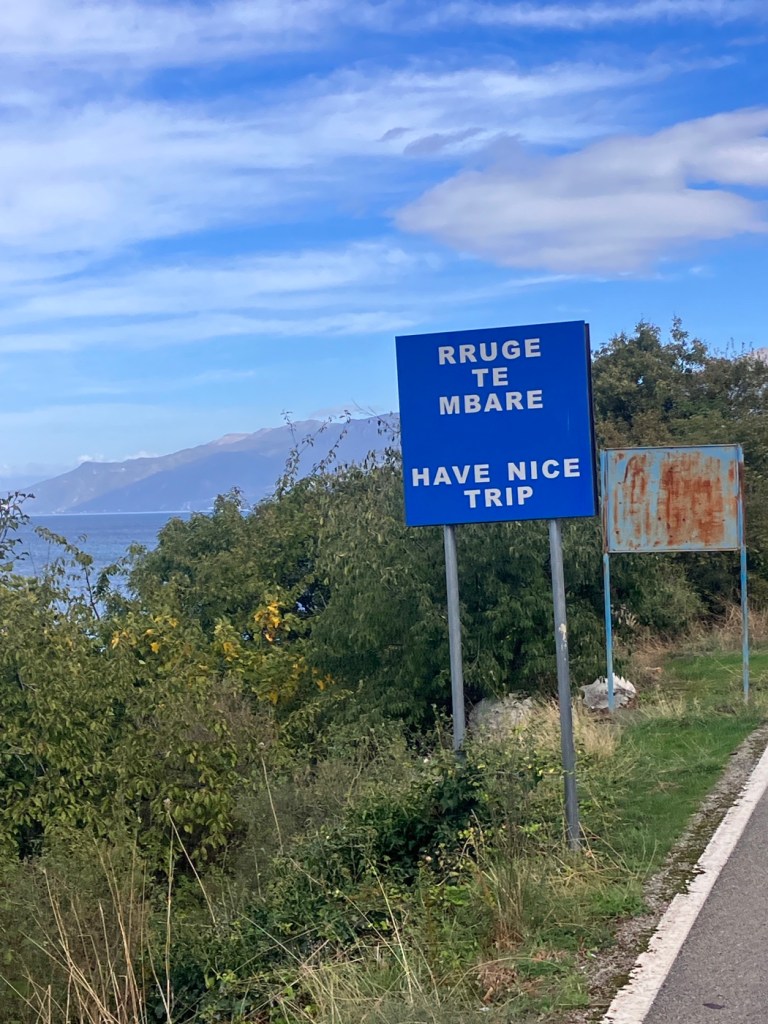
A welcome sign at the North Macedonia border.

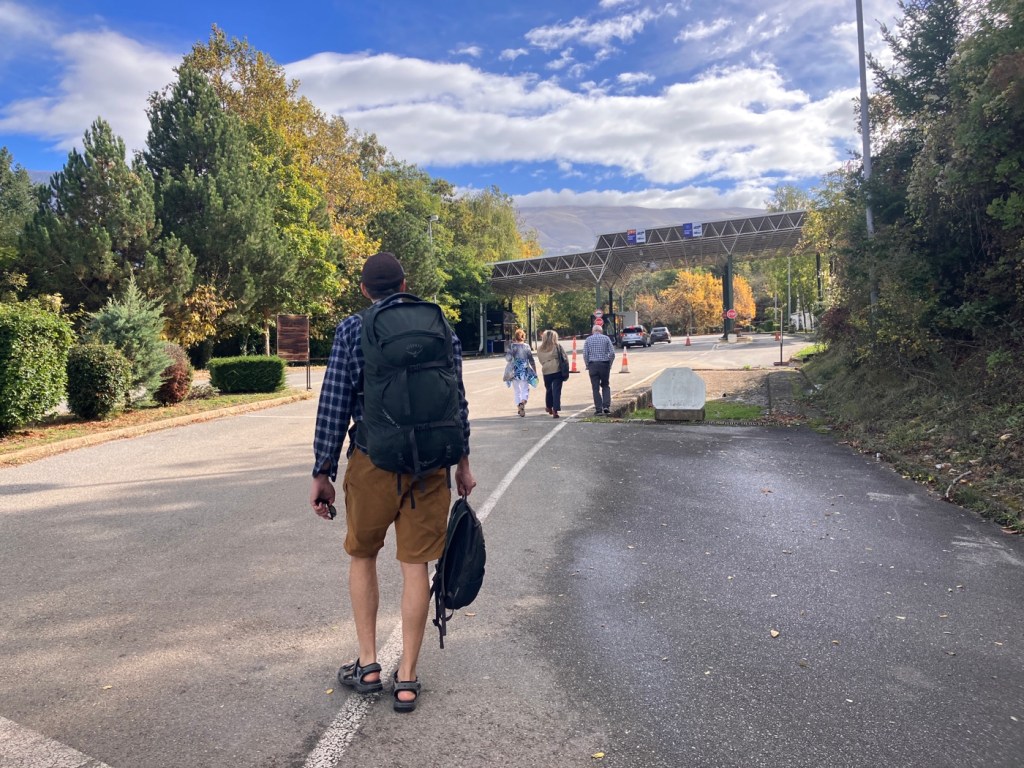
The Boss dropped us right at the border and we put on our backpacks and lined up behind a car and three day tripping Italian tourists (no luggage), and had our passports stamped. Then it was about a kilometer long walk to the North Macedonia border control.

Approaching the North Macedonia border control on foot, step three.
Taking a trail down off the road to Monastery Saint Naum, where we think we can catch a bus to Ohrid.
Crossing the springs which feed into the lake and are a destination and popular sight.
The minibus was easy to find. Second and final bus of the day! Step four.
Step 4.5, try to get in to apartment. We didn’t have cell coverage in Ohrid so Rich had to buy a coffee and use a cafe WiFi to reach the apartment manager. And walk down and back up the hill again.
And a cup of tea on our balcony overlooking the lake. Successful transition.
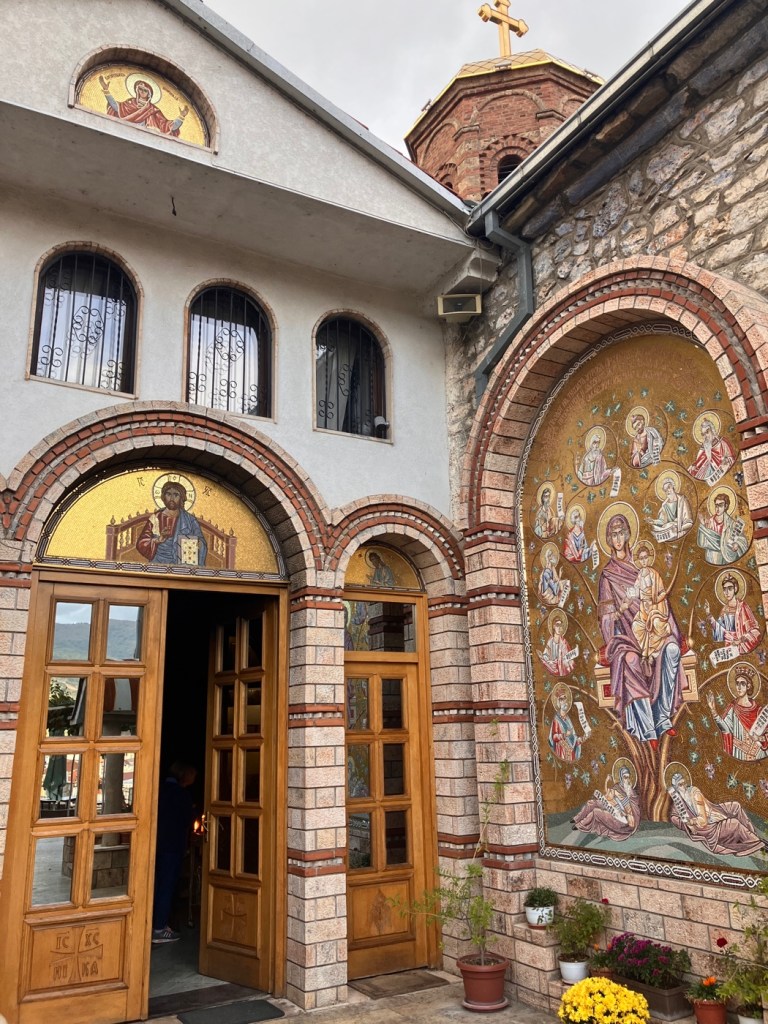
We were excited to get out and walk the streets, first stop was the Church of Holy Mother, Kamensko.
Devotional candles.
No photos inside, but the outside was beautiful.
With a sweeping view across the town to the mountains.
The main street is a lovely pedestrian promenade. And the evening walk, xjiro in Albanian, is popular.
Hanging out by the ferry dock as the sun sets.
Still buying wine for the label.
Dusk from our balcony.

We had originally planned on 3 nights in Ohrid but switched to 4 nights for two main reasons, we liked our little apartment, which had a kitchen shared with two other units, and we were meeting up with other travelers from a Facebook group I belong to, Go With Less. We’ve done meet ups a few times and it’s always been really fun. You automatically have so much in common with other constant travelers, you get to trade tips, and share stories without having to explain what it is you’re doing.

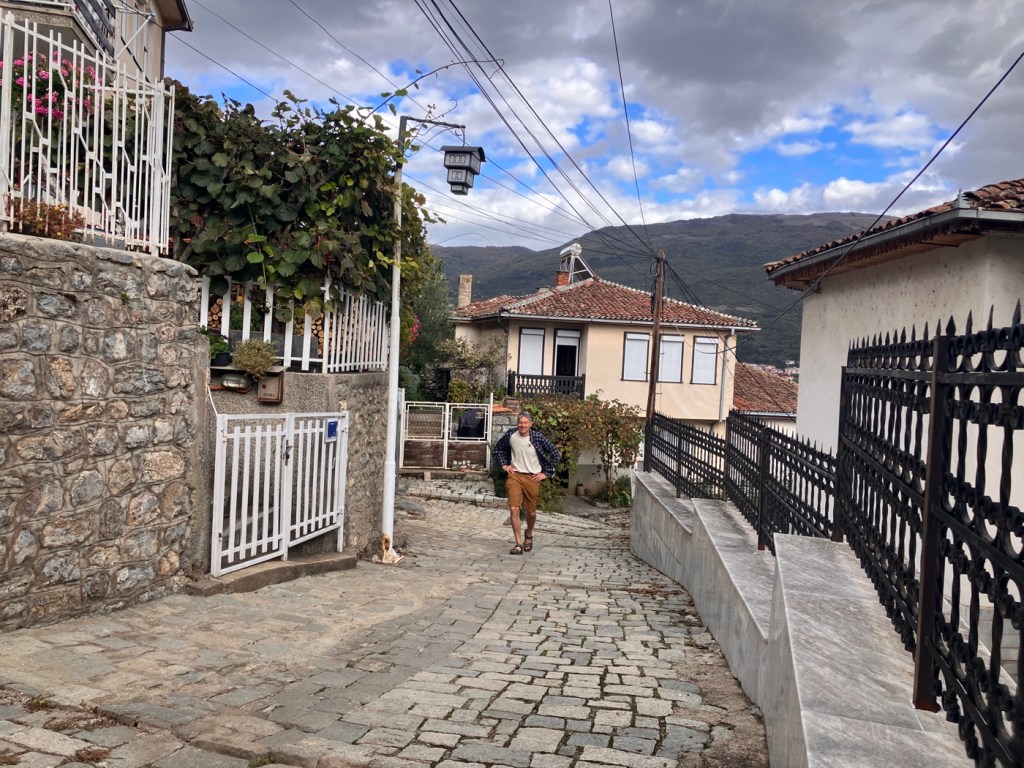
The traditional old buildings in Ohrid have increasing floor space on each level, leading to this fun streetscape where the top floors of buildings across the street from each other are almost touching.
I like the streetlights which mimic the building silhouette. Some people thought they were a bit cheesy, but not me.

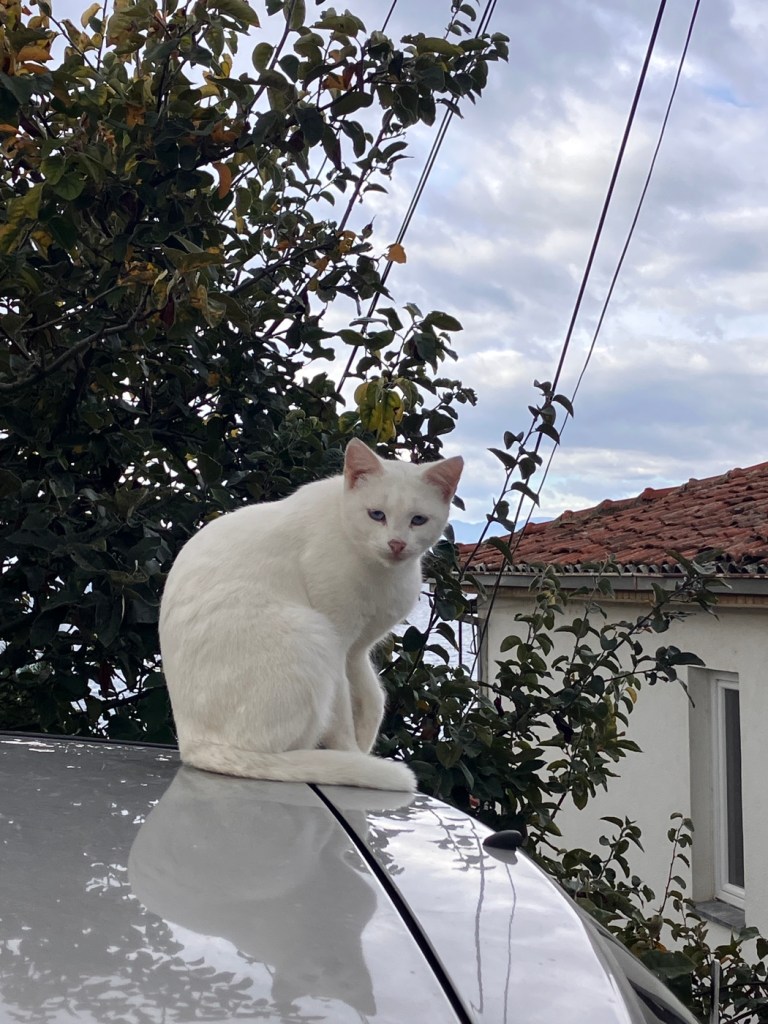
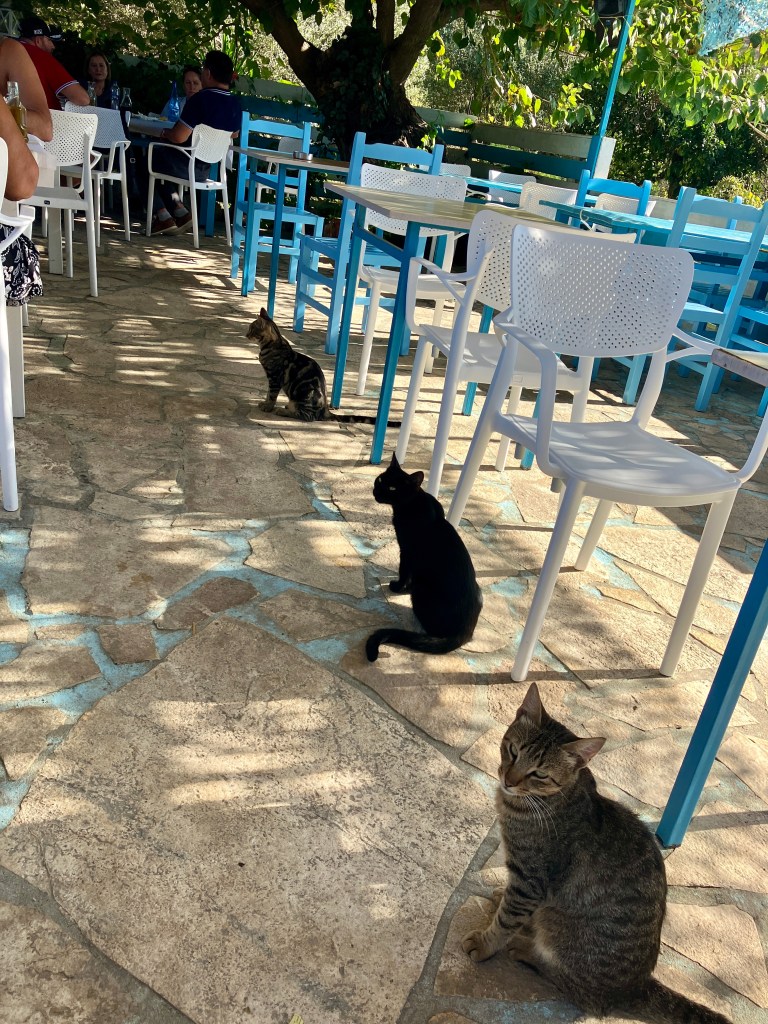
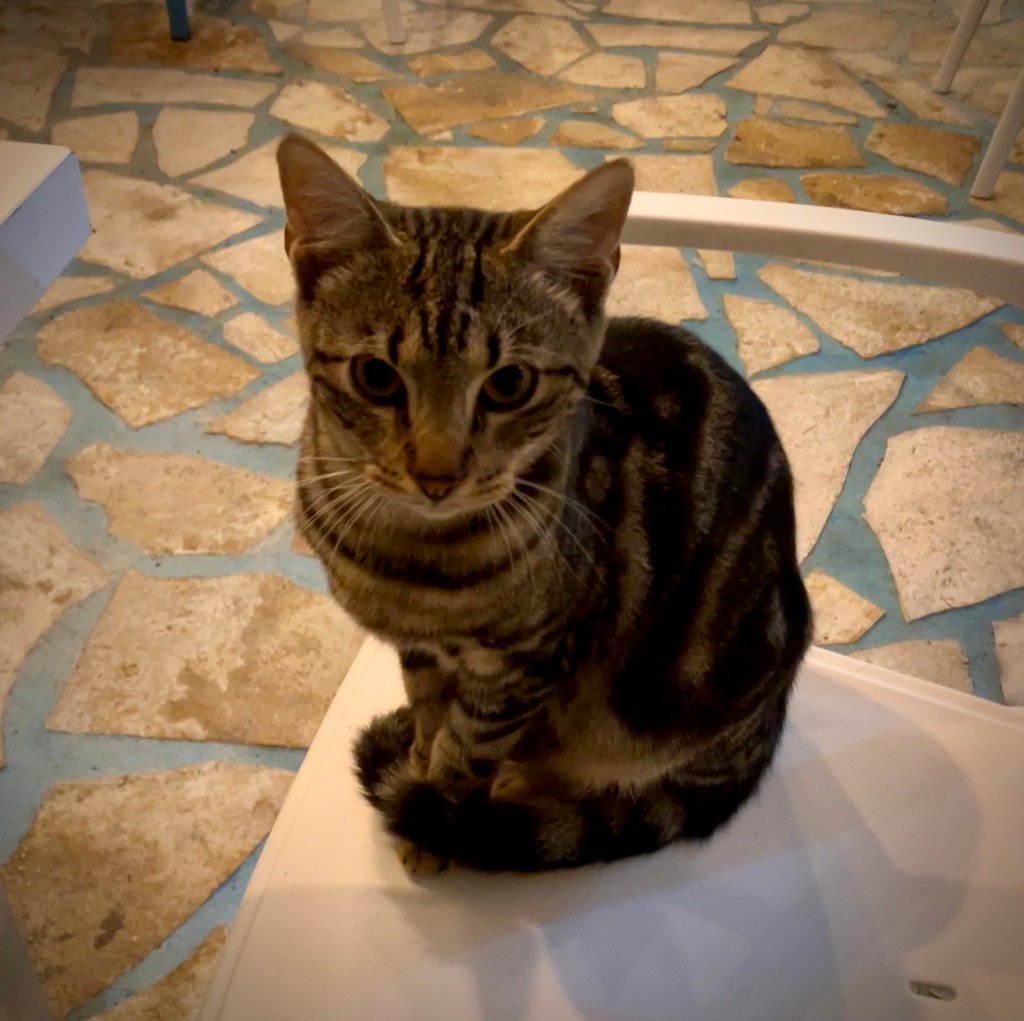
Ohrid is an UNESCO Cultural World Heritage site and has enough fascinating places to keep a visitor busy for several days, more if you enjoy walking the hills and coastal path, as we did. And if you like friendly cats, this is your town.

Oh, hello.
Where to start?
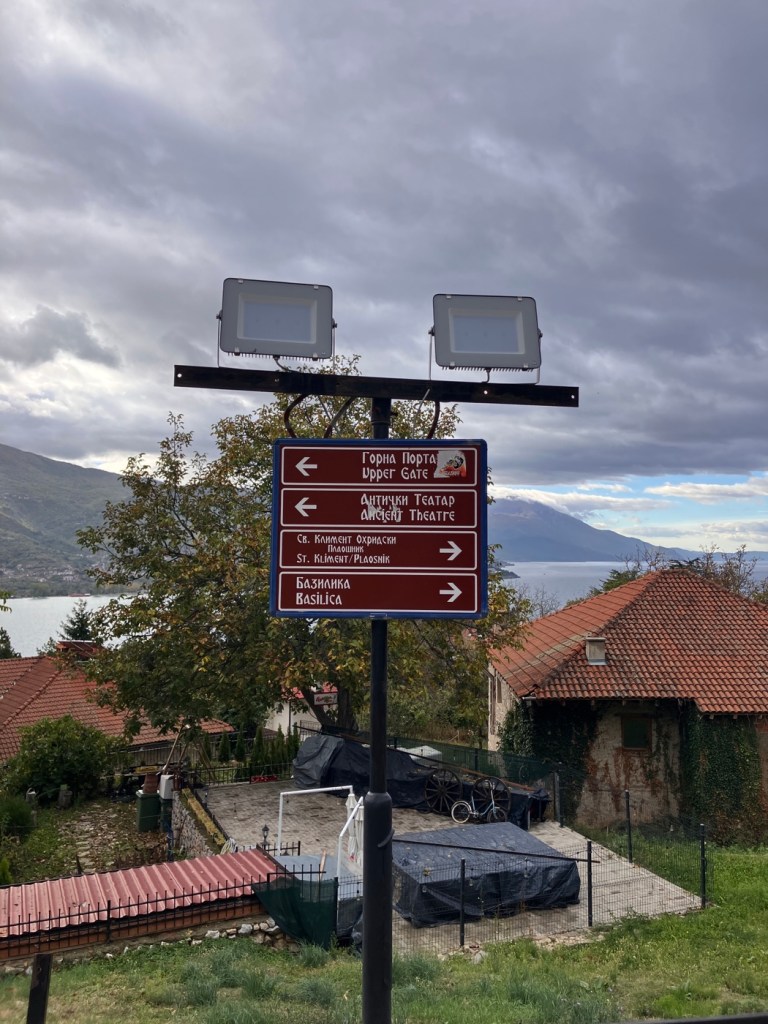
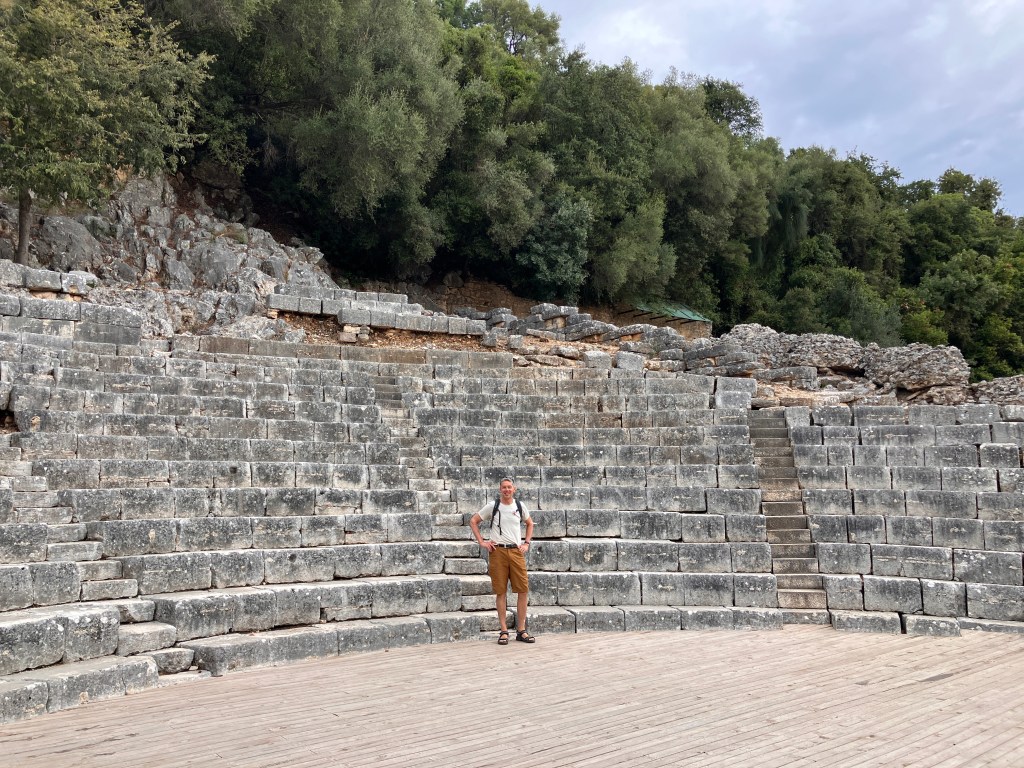
How about the ancient theater.
Quite a view from the seats.
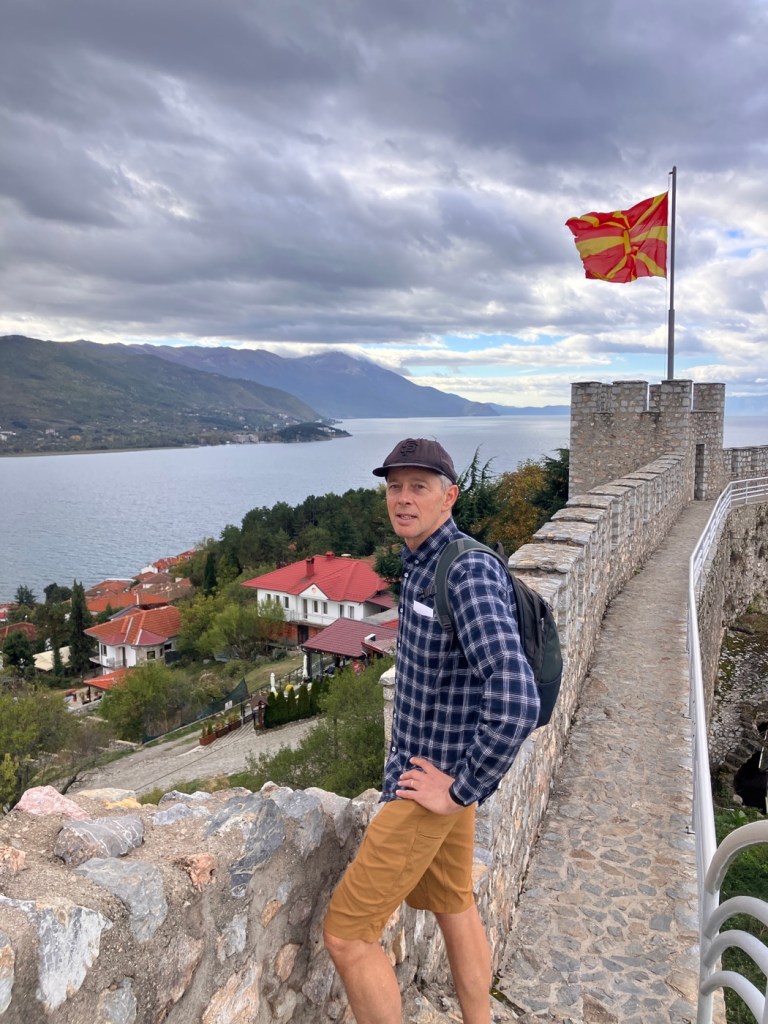
Up to Samuel’s Fortress (Самоилова тврдина) for a view over the city.
Rich surveys the town. N. Macedonia wins the big flag award. They fly impressively huge flags, very eye catching.
Down a trail and we pass by the Church of Saints Clement and Panteleimon (Православна црква „Свети Климент и Пантелејмон“).
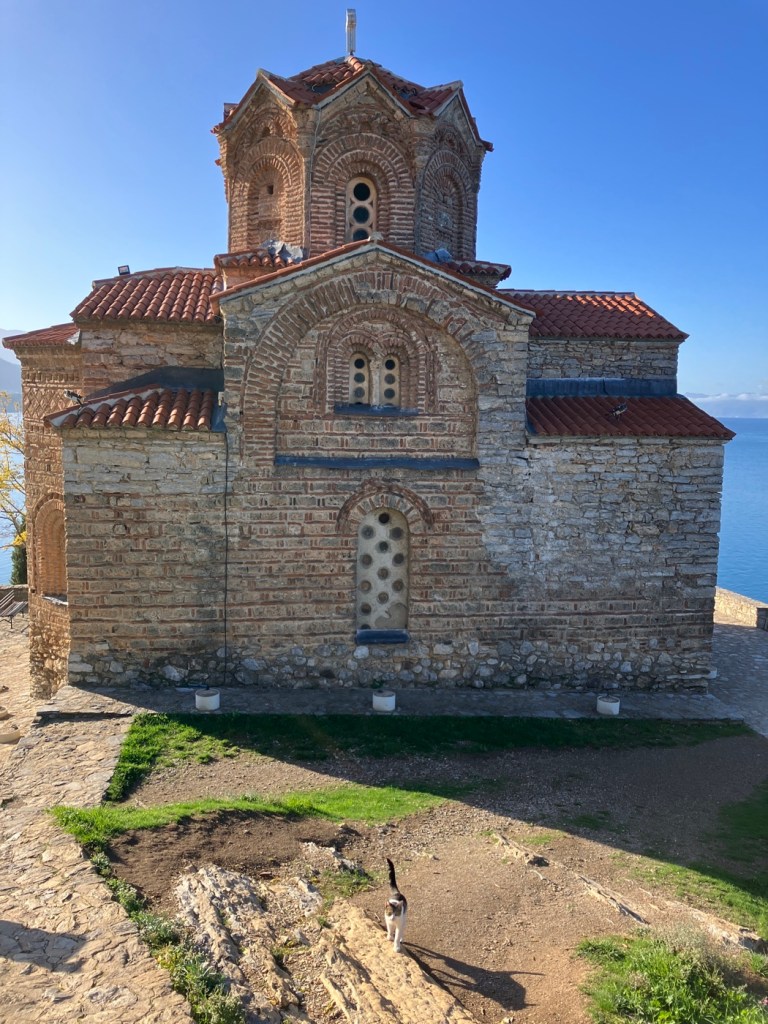
And the Church of Saint John the Theologian (Црква „Свети Јован Богослов“). Are you starting to understand how many churches there are in Ohrid? Apparently at one time there were 365 churches, one for each day of the year.
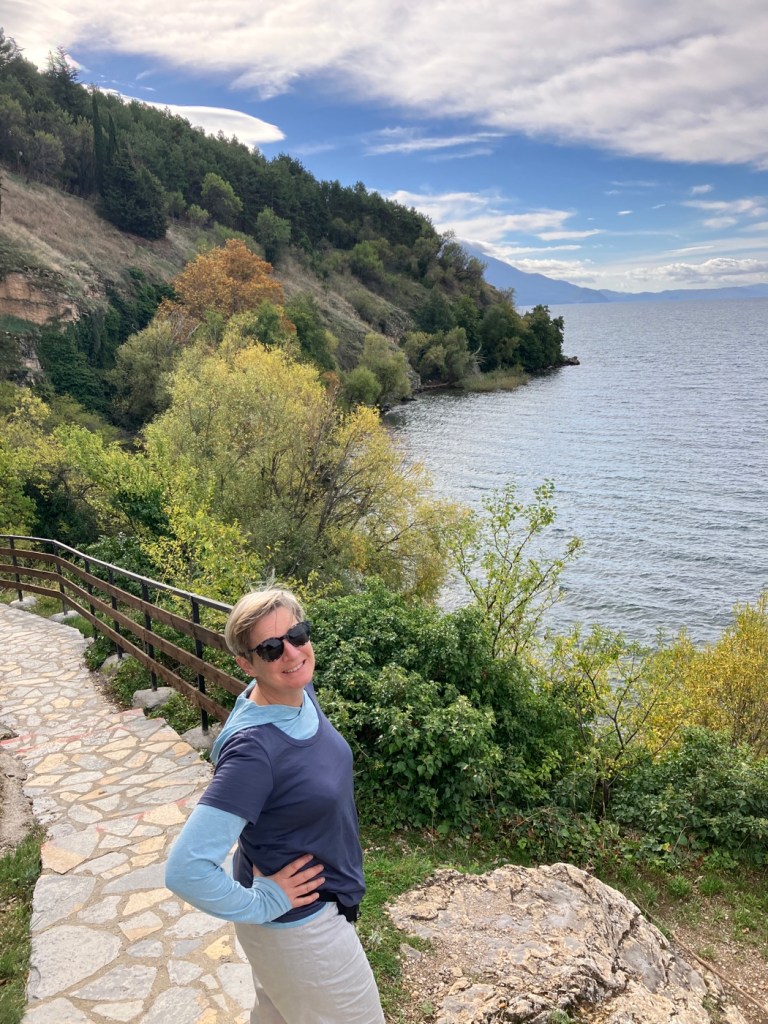
The stone paved coast path is a lovely walk.
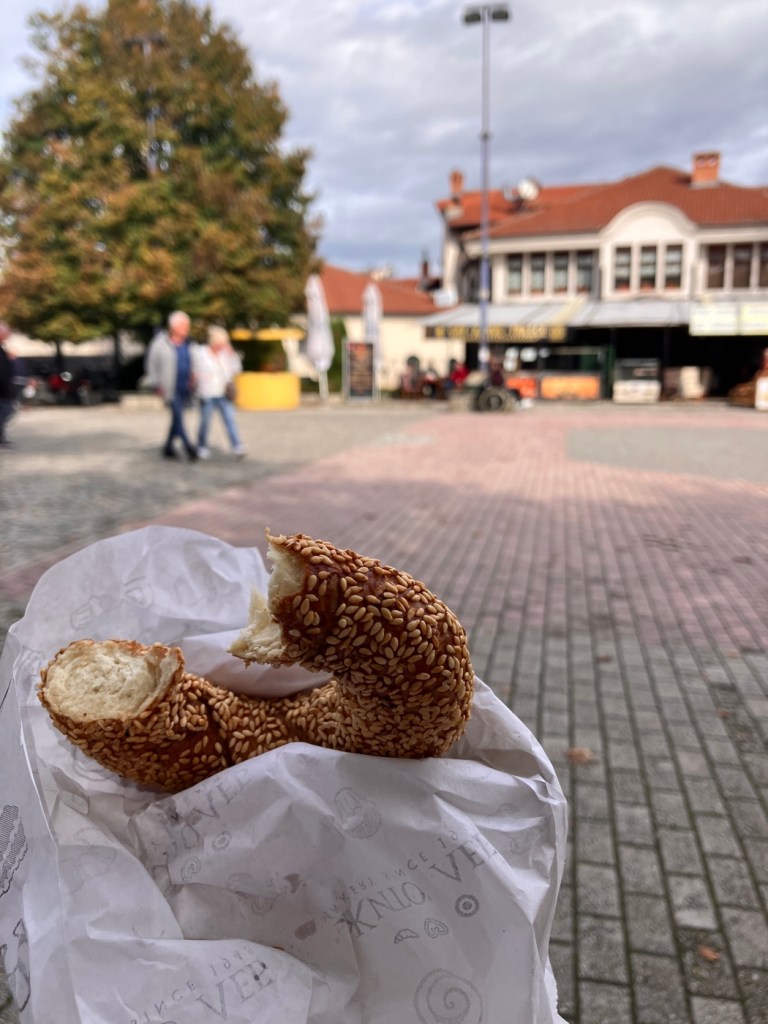
Back to the main street for a snack. Our old friend from Turkey – a Simit! Called a gjevrek here.
Checking out the promenade south of town, also a great space.
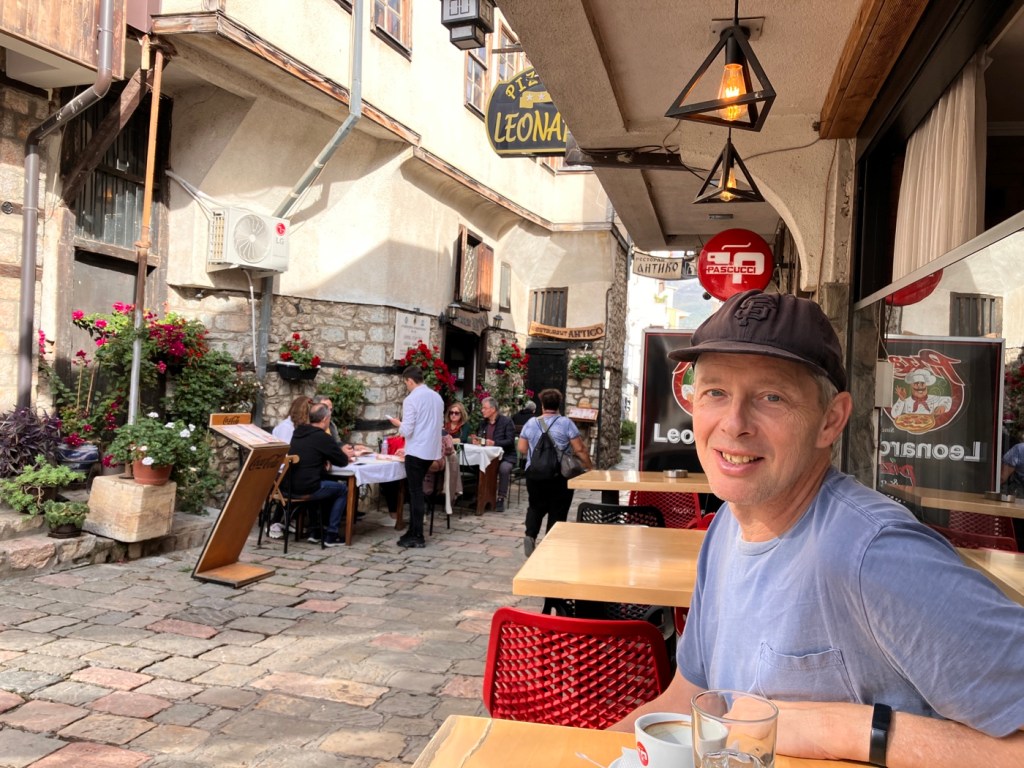
And a break for tea and coffee at the cafe where we used the wifi.
And discovered how friendly some of the cats are.
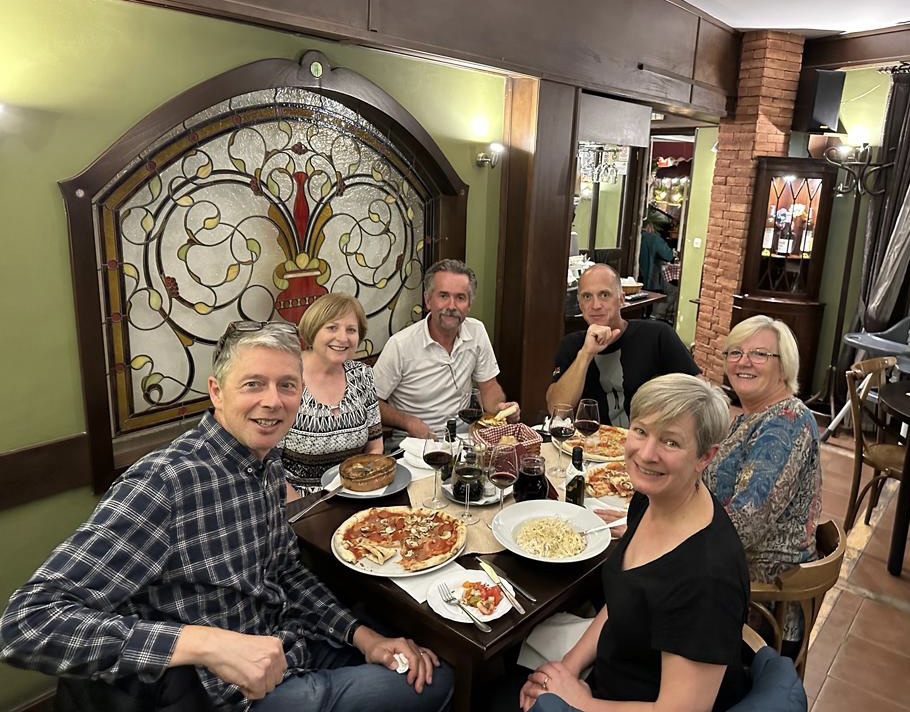
That night we had dinner with fellow travelers Doris, Ron, Peter, and Karen – all super nice Canadians. We met up again the next evening as well.

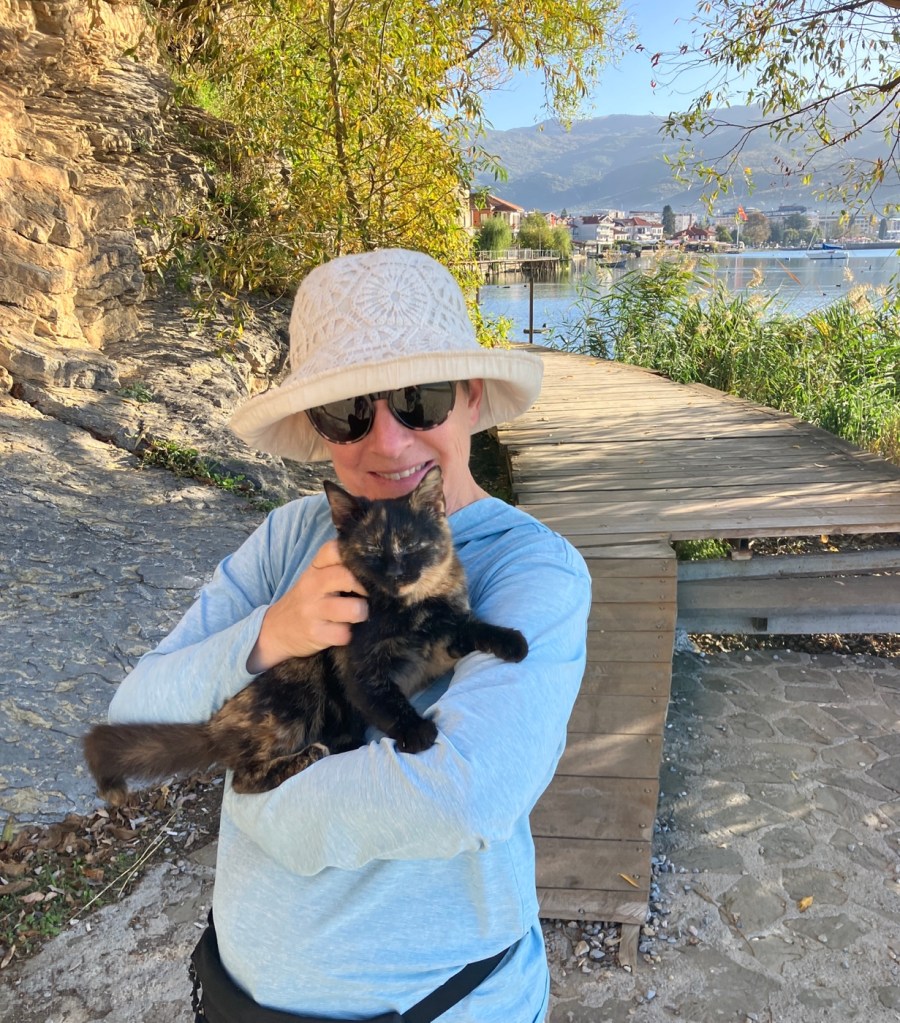
Get ready for a lot of cat photos. Our final day’s walk involved so many cats who were happy to be pet, to be picked up (unusual for free roaming cats), and would purr in my arms.

Heading out along the boardwalk.
First victim! Hello beautiful.
I didn’t make it very far before this one needed a cuddle too.
Then we were handed off to the cat who hangs out at the Chuch of St. John the Theologian.
I shall lounge here and look aloof.
No you won’t! Come here kitty!
Rich is now saying “Put the cat down. Let’s keep walking.”
Kitty says “Me too?” They stopped at the edge of their territory.
Lunch break in town. The pot of beans is called Tavche Gravche. A traditional Macedonian dish made with beans, onions, peppers, and tomatoes. Delicious.
After a post lunch nap and shower it was back out to find more cats to pet. And visit Church of Holy Mary Peryvleptos Црква „Богородица Перивлепта“ which had amazing frescoes but didn’t allow photos inside.
The view from the church plaza, more of the traditional houses.
One last kitty to wish us farewell, and we were off back to Albania.
The Happy Travelers at Samuel’s Fort.

We’re just headed back to Tirana now, but the next post will cover Elbasan, a decidedly non- touristy city, and Berat, the City of Windows.

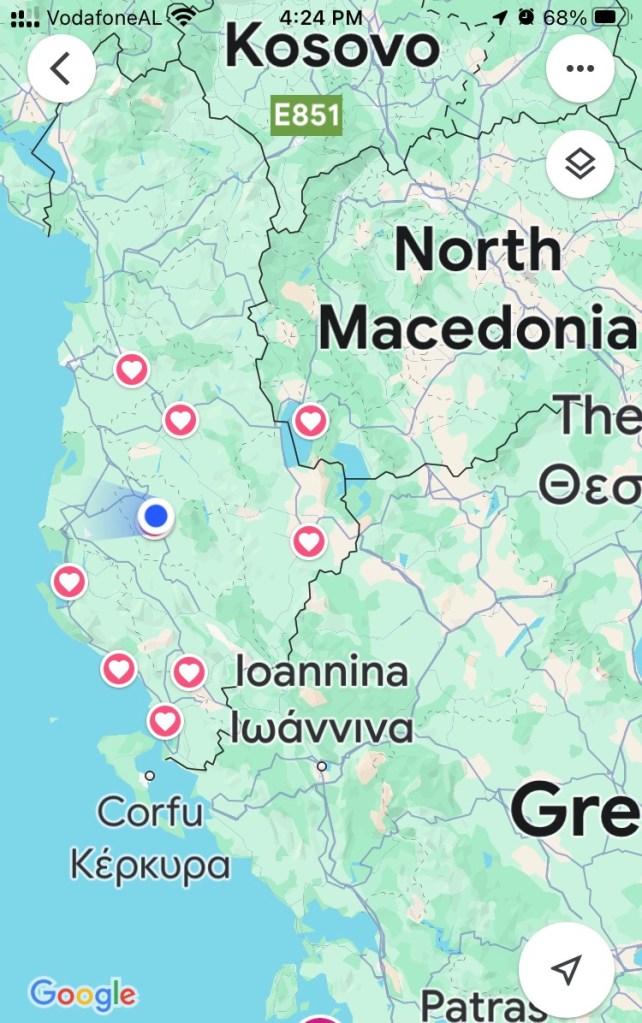
Rich did a great job plotting our stops around Albania and North Macedonia. Tirana the northernmost heart, on the coast heading south – Vlorë, Himarë, Sarandë, then inland to Gjirokastër, Korçë, Ohrid, Elbasan, Rebat and back to Triana. Phew!

Our best waiter in Gjirokaster, Albania, was 13 years old.

Always happy to be off the bus and in a new place.

As Rich wrote about in the previous post, Albania is changing a lot. Part of that change is how many people are emigrating. When the Albanian borders opened in 1990, following the collapse of the Communist government, a multi decade long period of closed borders, people could finally leave. They could and did. Articles we have read state that up to 40% of the country’s population has left since 1991.

A view from the bus at Finiq, on the way from Sarande to Gjirokaster.

This hollowing out of towns isn’t apparent from the places we’ve visited so far, which are gaining more attention from tourists who bring money in. We see new hotels and guesthouses, restaurants that are seasonal for the tourist demand, and a younger generation who speak English well. Like our 13 year old waiter. When I asked how he learned English, he said he learned in school and had a tutor. Don’t think from my saying he was the best waiter we had so far that service in Albania is rude or non-existent, it’s neither. We find people working in restaurants and hotels to be straightforward and honest. Sure paying your bill can take a while, but that has to do with not rushing customers. You see that at any of the many cafes, it’s acceptable to sit for hours over a cup of coffee. No one will make you feel rushed.

We walked up from the bus, and I do mean up.
Rich in front of Hotel Argyropolis, a newly renovated and delightful place we enjoyed very much.
From our room we overlooked the sweep of town down to the Drino River Valley and the mountains.

What made this young waiter stand out was the way he interacted with customers, I think the restaurant was his aunt’s, during breaks he was playing with a young child he said was his cousin. When a better table opened up he asked a newly seated couple if they would like to move to the other table. He was snappy, took orders on his phone, recommended dishes and let us know when we were ordering too much food. He impressed us and the table near us, Canadian and British guys also on their first visit to Albania.

Gjirokaster is tourist gold. So picturesque.
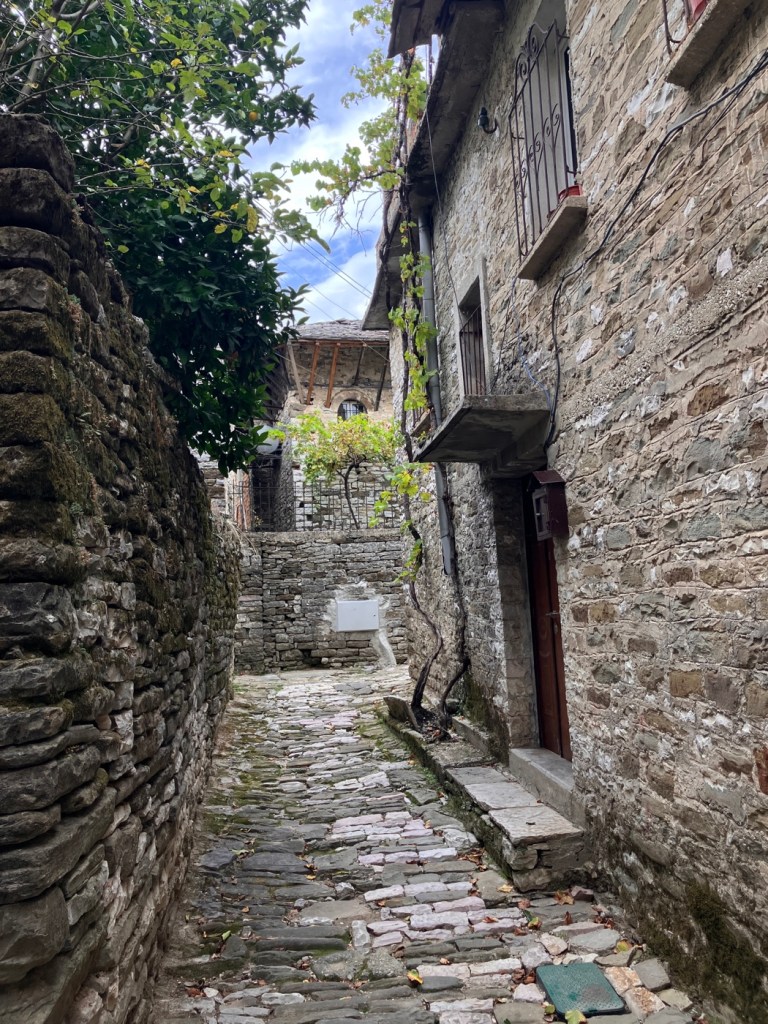
Steep narrow lanes with cobblestones all done in the 1960s.

Apparently one route out of Albania and into a job in another country is the hospitality industry in Germany and other EU countries. And healthcare. The youth brain drain is serious, as is the amount of remittance money coming back to Albania from those employed abroad. https://theconversation.com/albanias-brain-drain-why-so-many-young-people-are-leaving-and-how-to-get-them-to-stay-207455

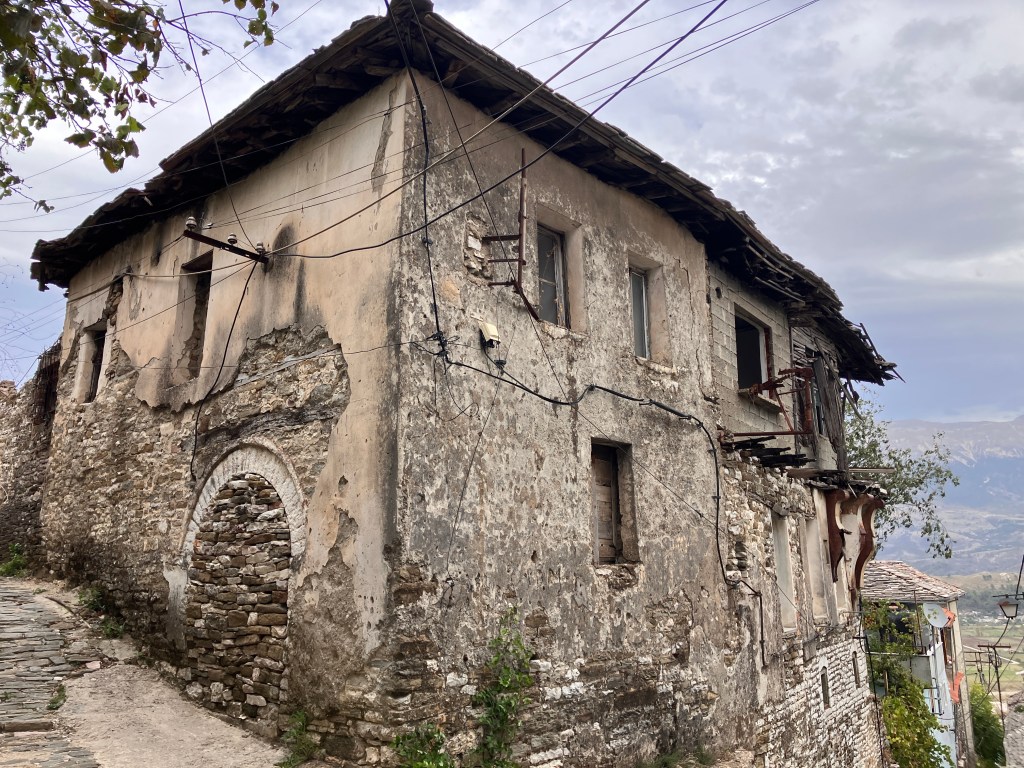
There are a lot of buildings still in need of repair. Some might see derelict buildings, we saw opportunities. This is a wonderfully unique city.
We were happy to walk up and down the hills and admire the buildings.
What a vista. Traditional buildings and a minaret.
I joke that walking with Rich is like a PacMan game. You walk until you hit a dead end or roadblock, then turn and walk some more.
How many photos of buildings in need of updating are too many? Look at that view!

We only had two nights in Gjirokaster, but we certainly made the most of our day and a half in terms of miles walked. The castle has a good history museum. Well worth a visit.

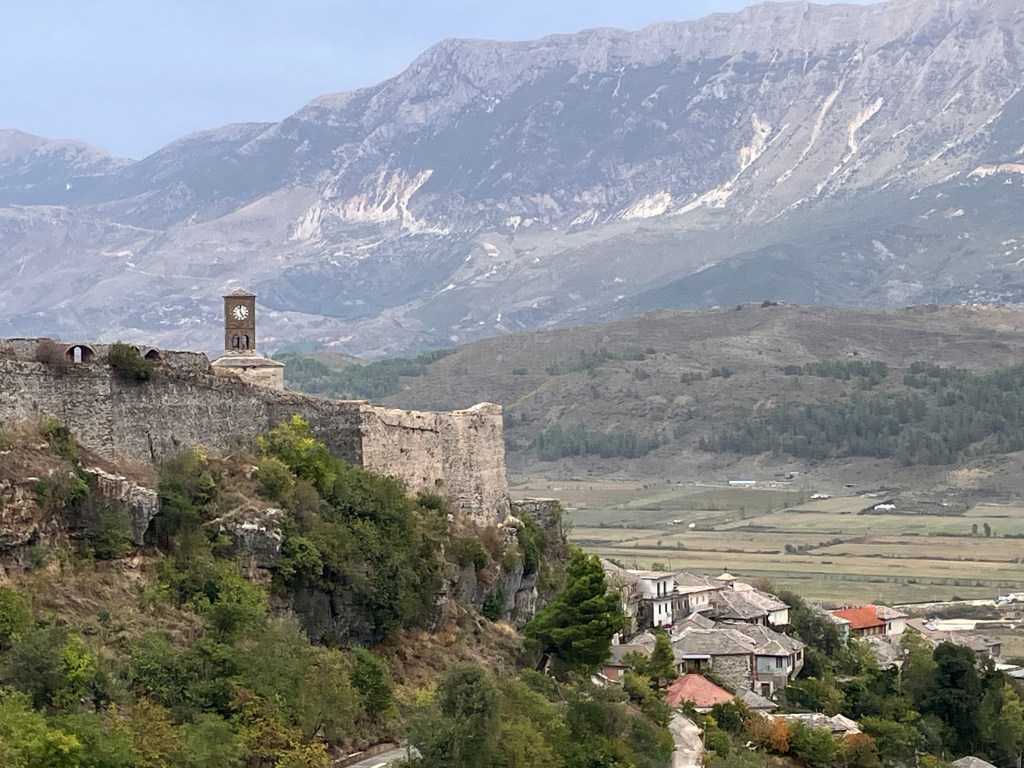
A view of the castle, and the view from the castle shows how strategic the location is.
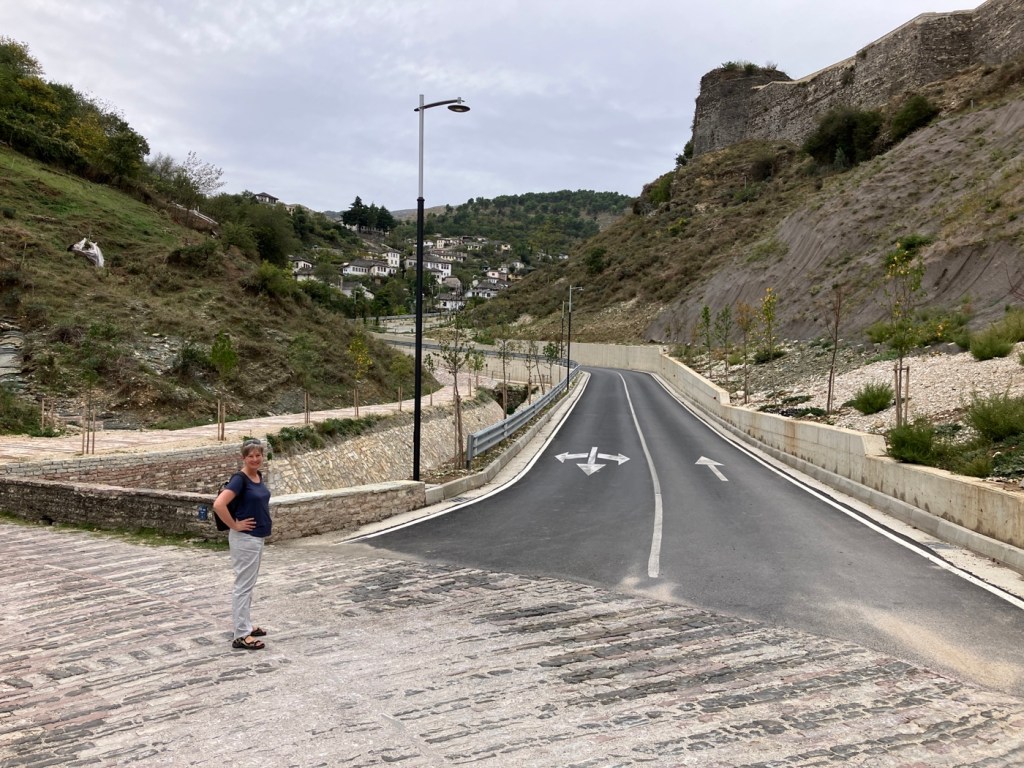
A new road project connecting the upper part of town to the valley. We continue to be impressed with the attention paid to wide sidewalks here in Albania. You can see the walkway to the left of the road.
Changes are happening, but you can still park your camper van below the castle and enjoy the town.
Walkers are well rewarded with views like this.
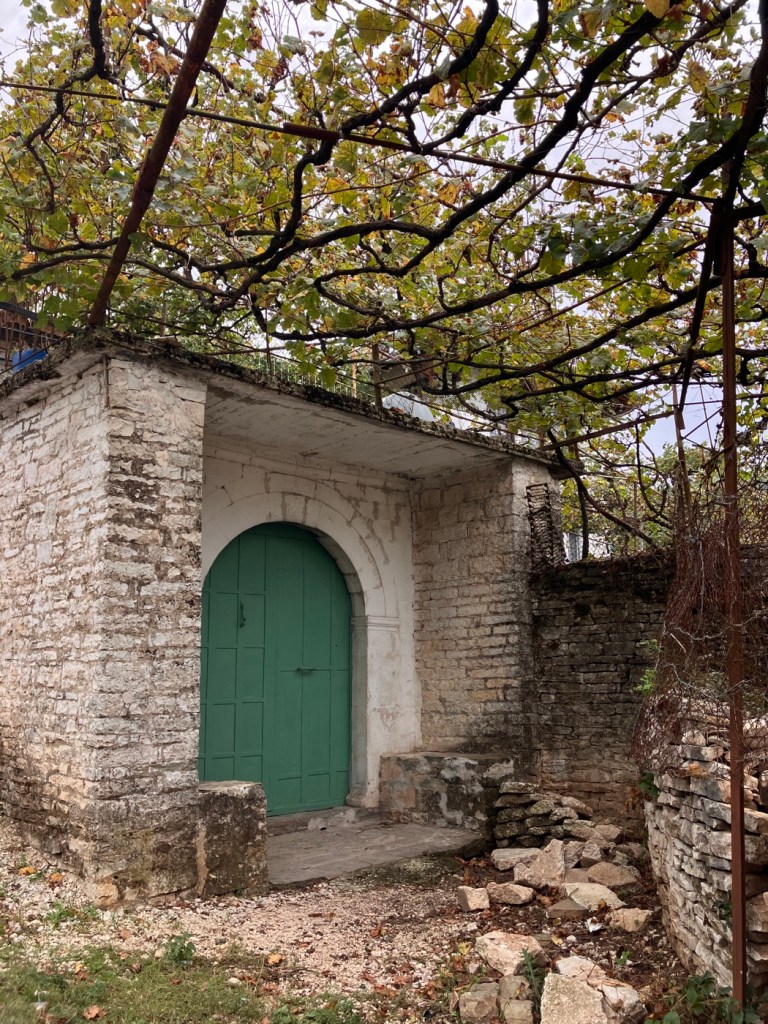
And finding a lovely entryway with grape vine arbors overhead is another reward for climbing the hills.
The weathered green paint, the well kept stone roof, the view of the castle – a photographer’s dream. Sorry, just me with my little iPhone.
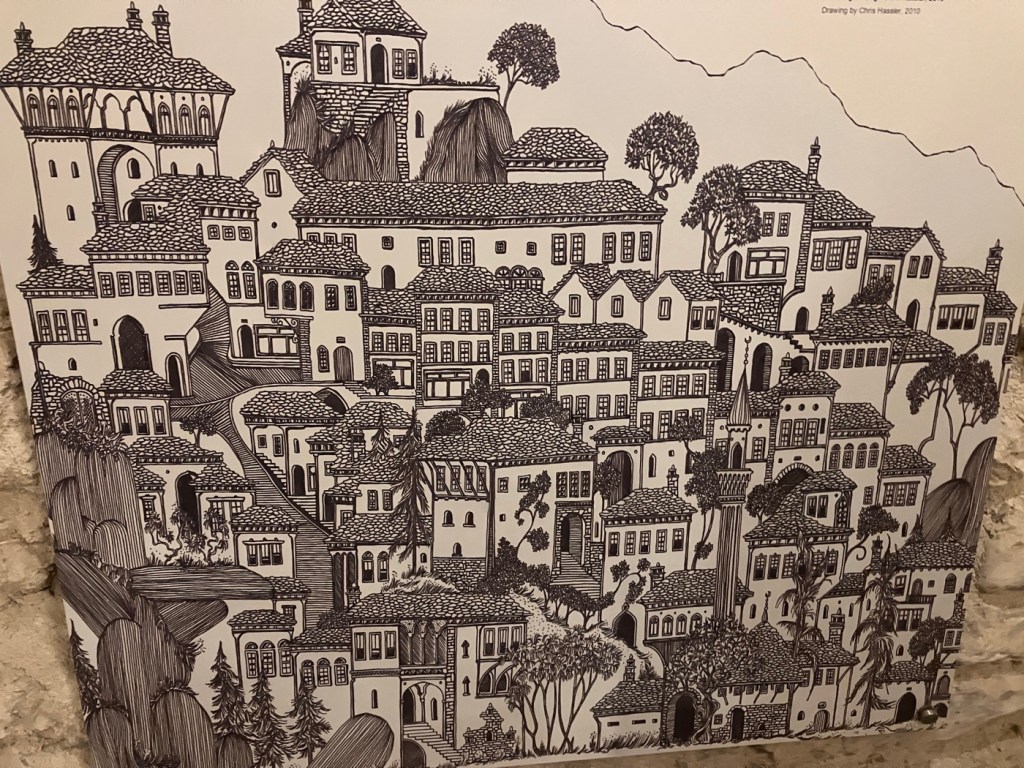
I love this drawing of Gjirokaster by the artist Chris Hassler. You can find him on instagram @kristogjiro . I want this on a t-shirt, a tea towel, as a print for a wall, or as wallpaper. I’m seriously fascinated with this artwork.
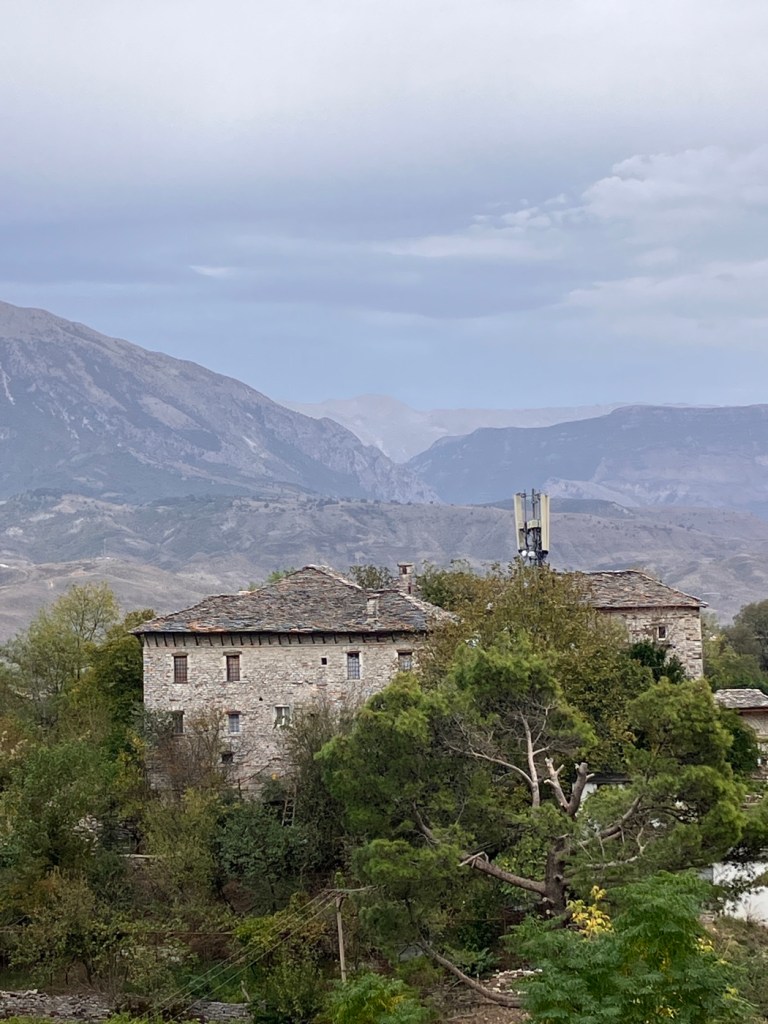
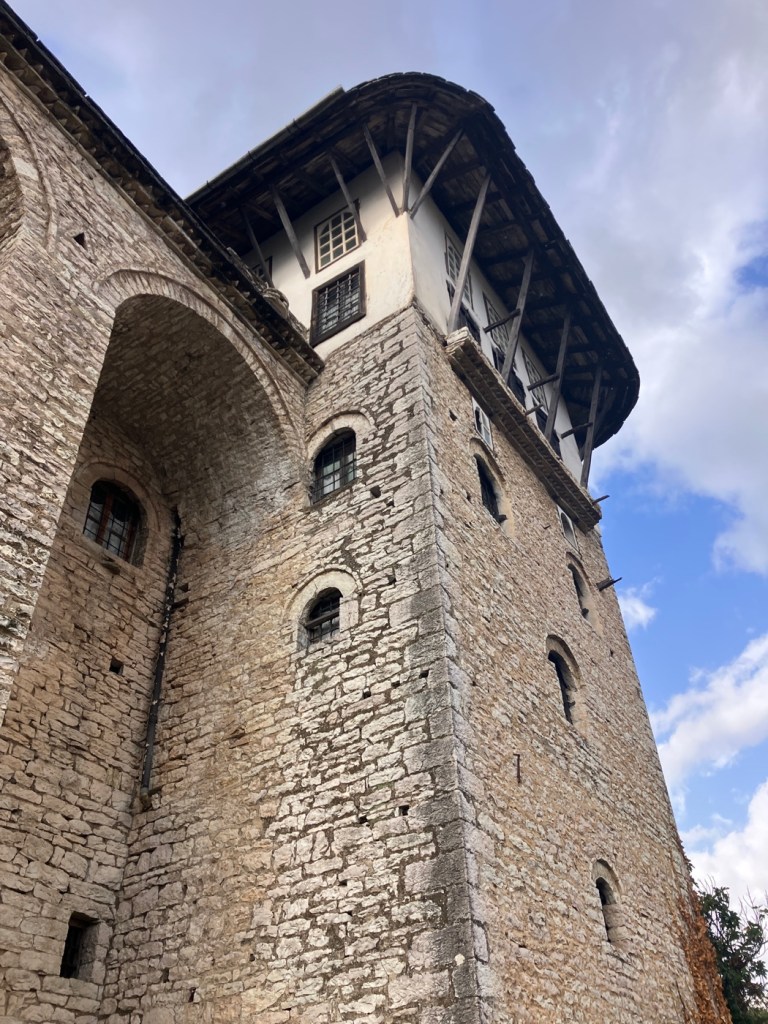
And the real slopes and buildings. The tower house buildings are very unique. The windowless bottom floor was to keep warring clans at bay, and the roof drains to cisterns in the bottom floor.
Zekate House (Shtëpia e Zekatëve), a tower house building which is a museum.
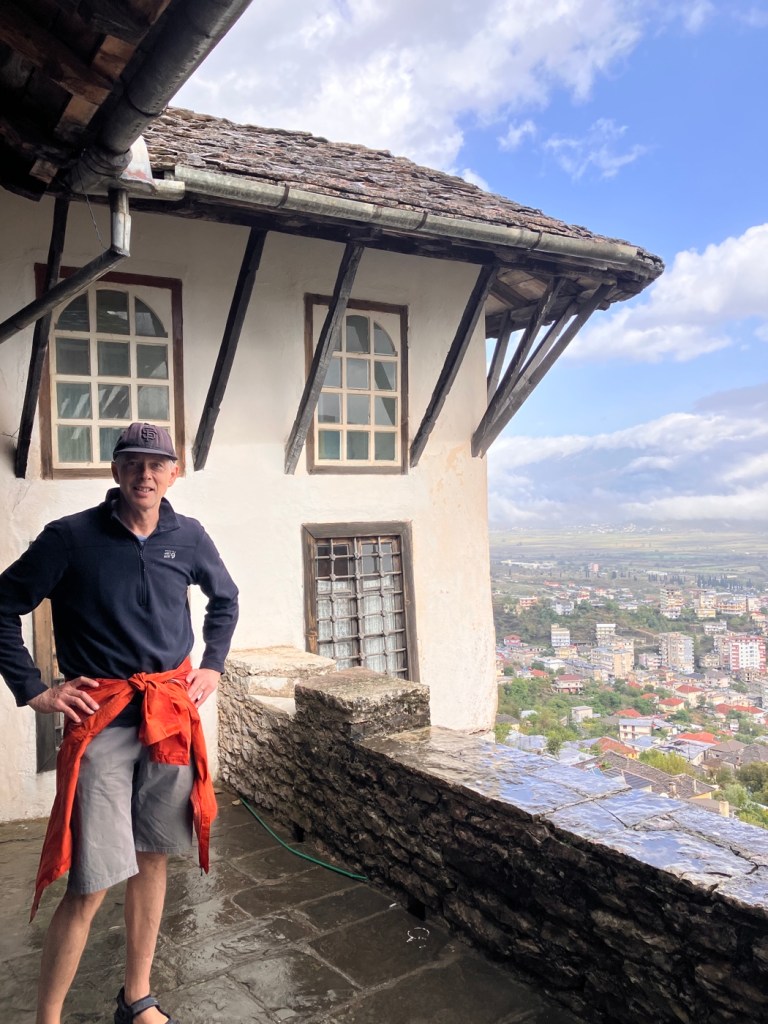
The view from the top floor clarifies the commanding position of this tower house.
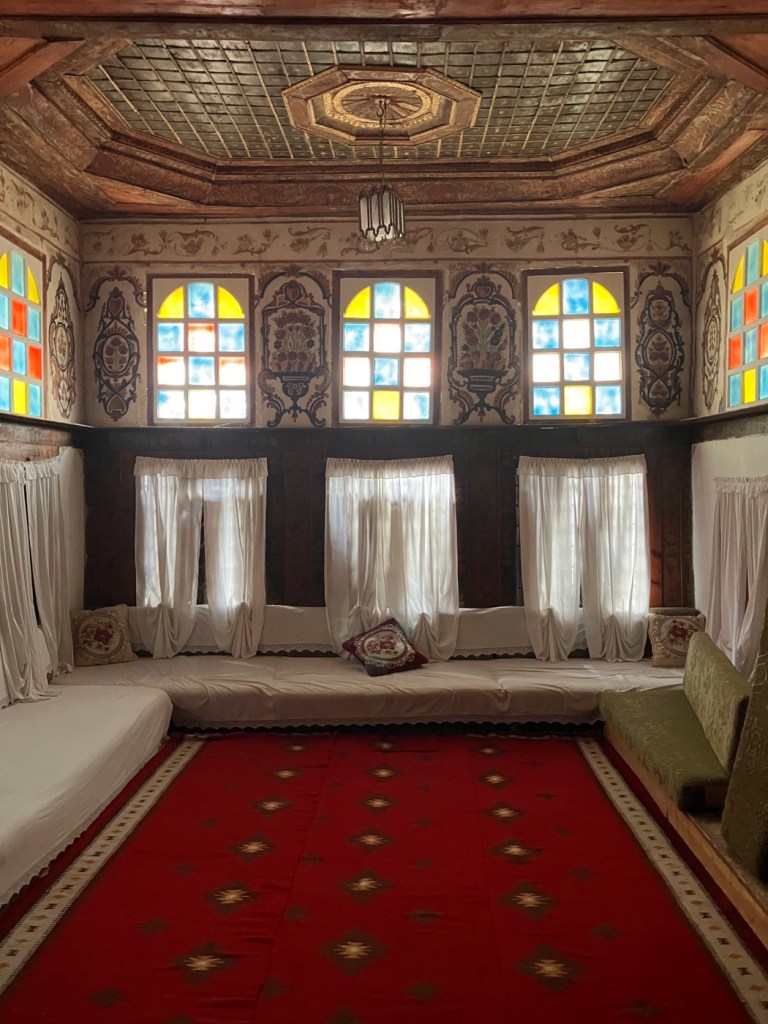
A grand reception room on the top floor.

I love a museum loaded with tidbits of information. The castle museum did not disappoint. Not only did we get a good overview of Albanian history, which is fraught and loaded with emotion and perseverance, but also nuggets of local culture and realities.

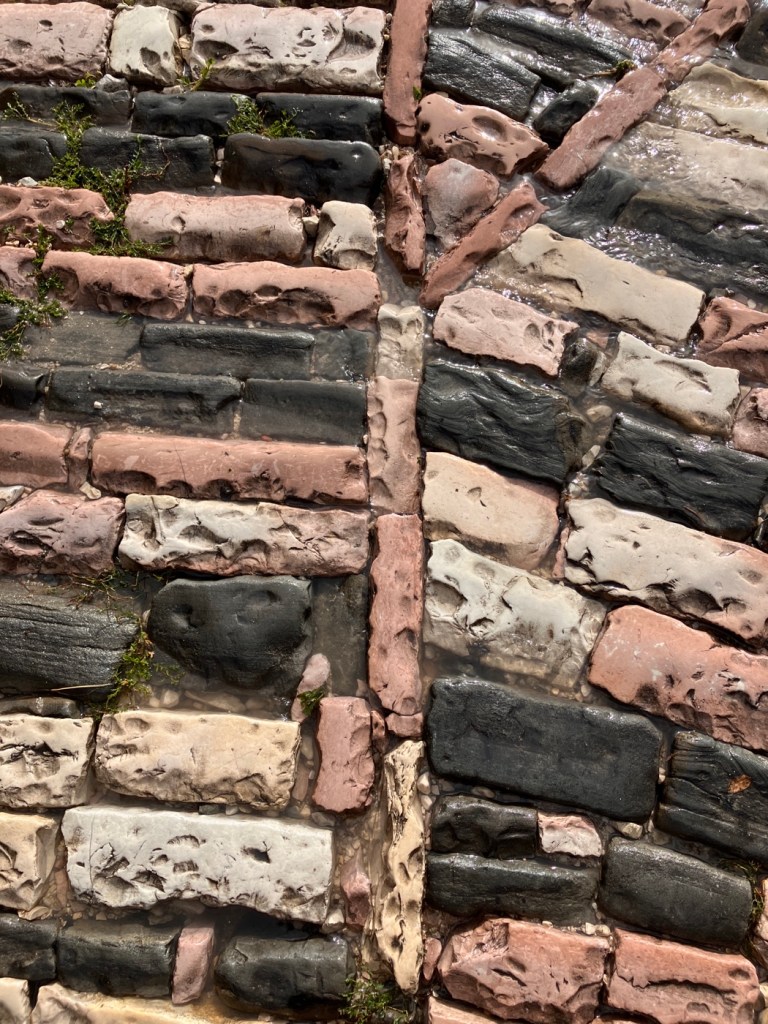
A rainy morning, but we were armed with knowledge that locals recommend stepping on the black stones when it’s raining. They are not slippery like the pink and white stones.
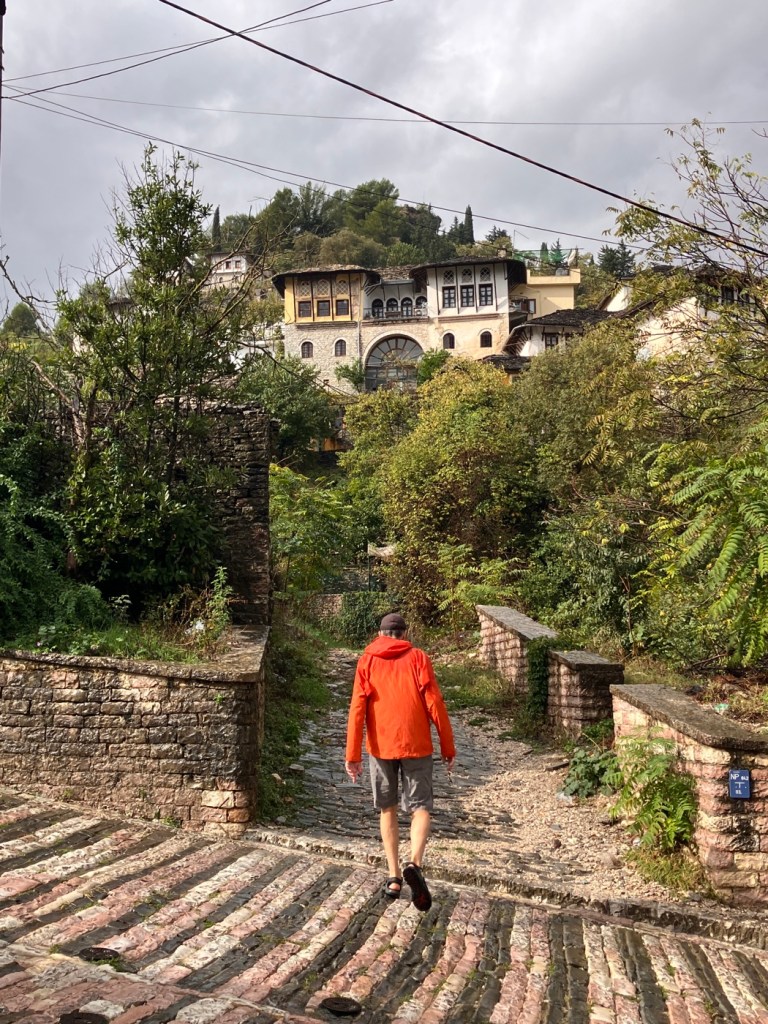
Rich keeping to the black stones to check out a tower building closer up.
Cafe kitty also keeping to the black stones.
Yes, still taking pictures of the stone buildings. Everywhere you turn they catch your eye.
Eye level with garden chickens.
The museum alerted us to this use of tin sheets left over from cutlery production at the tin factory. An extra layer of garden fence. The tin factory closed at some point after the fall of communism.

The closing of communist government supported factories, like the tin factory, is another reason for the stagnation of Albania’s economy. Who can blame folks for wanting more opportunity and a better chance for success in another country? But we meet a young man like our waiter in a beautiful city like Gjirokaster and see a future for him running his own hospitality business here in Albania. A future that doesn’t involve leaving his country. It’s a bigger problem than mere tourist spending can fix, but once we’ve visited a place we will always be pulling for the success of the people there. And always be reminded of how quickly things can change.

Mid bus journey rest break in Leskovik, on our way from Gjirokaster to Korçë.
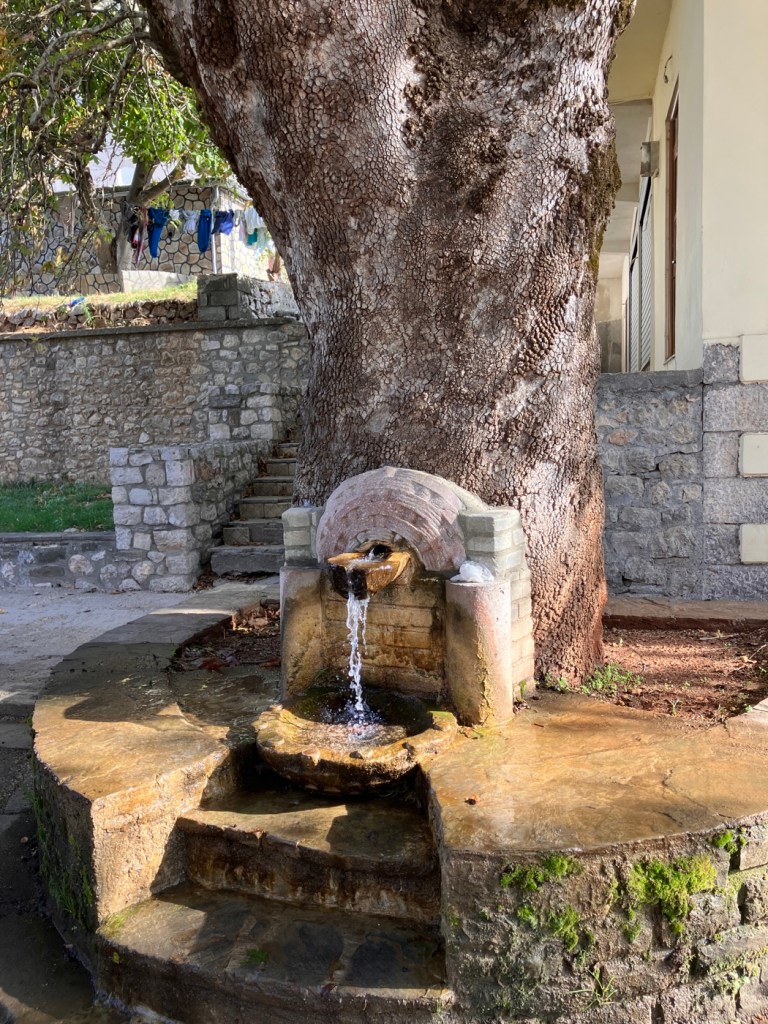
Lovely tree fountain in Leskovik.
The bus, hood up once again, but still we rolled along.

Getting from Gjirokaster to Korçë was a scenic trip on a bus that was threatening to break down the entire four hour journey. The driver popped the hood 15 minutes before departure time and he another man had a loud discussion. Our first stop was a service station for more oil to pour under the hood. The engine only stopped once on the trip, and our worries of being stranded on a mountain pass did not come to be. Cracking the bus nut in Albania is hard, and Rich has been struggling, frustrated, successful, and confused each time we need to transit. So many people depend on these small buses, car ownership is very low, but for visitors it’s challenging to make sense of timetables and locations. We long for the regional bus stations of Mexico.

Hey look!
A regional bus station! Go Korçë.

Korçe is not a big tourist destination but it’s a vibrant city with an extensive old town with recently re-cobbled streets. It’s at an altitude of 850 m (2,790 ft), and surrounded by the Morava Mountains.

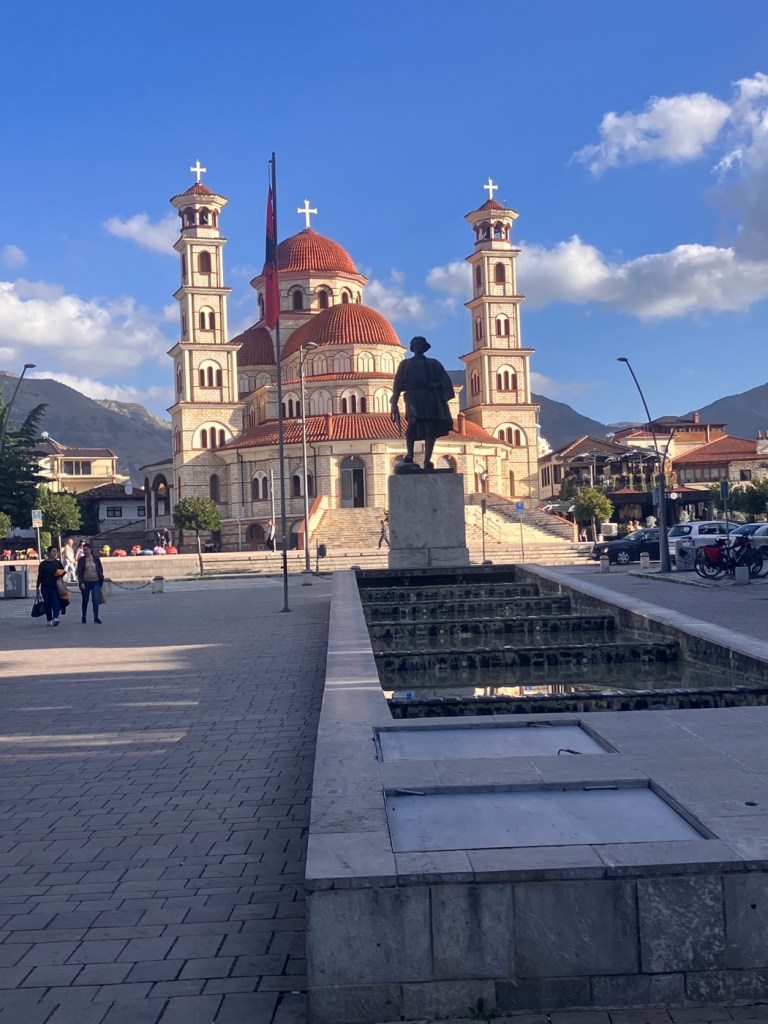
Katedralja Ortodokse “Ringjallja e Krishtit”, the main Albanian Orthodox Church in Korçë. A lovely pedestrian street leads up to the Church.
The cobblestone streets were charming, if a bit tough to walk on.
Also home to the famous beer brewery, Birra Korca. As you can see, the spelling of place names varies.
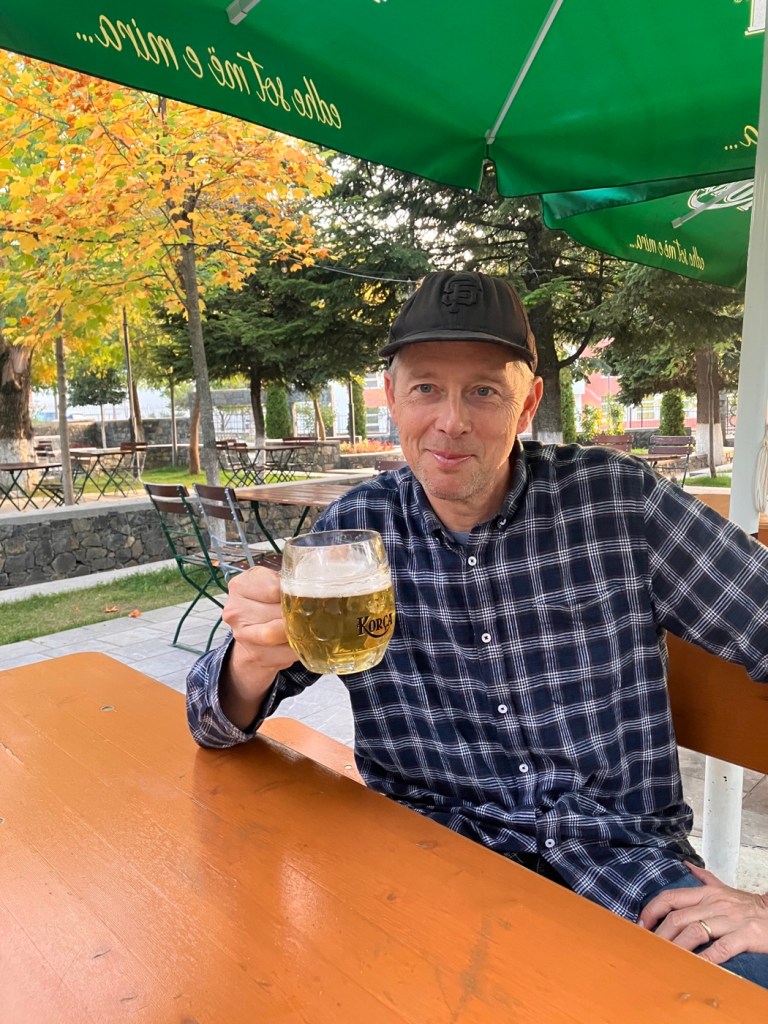
Celebrating Rich’s birthday at the Birra Korçë beer garden. The draft pale.
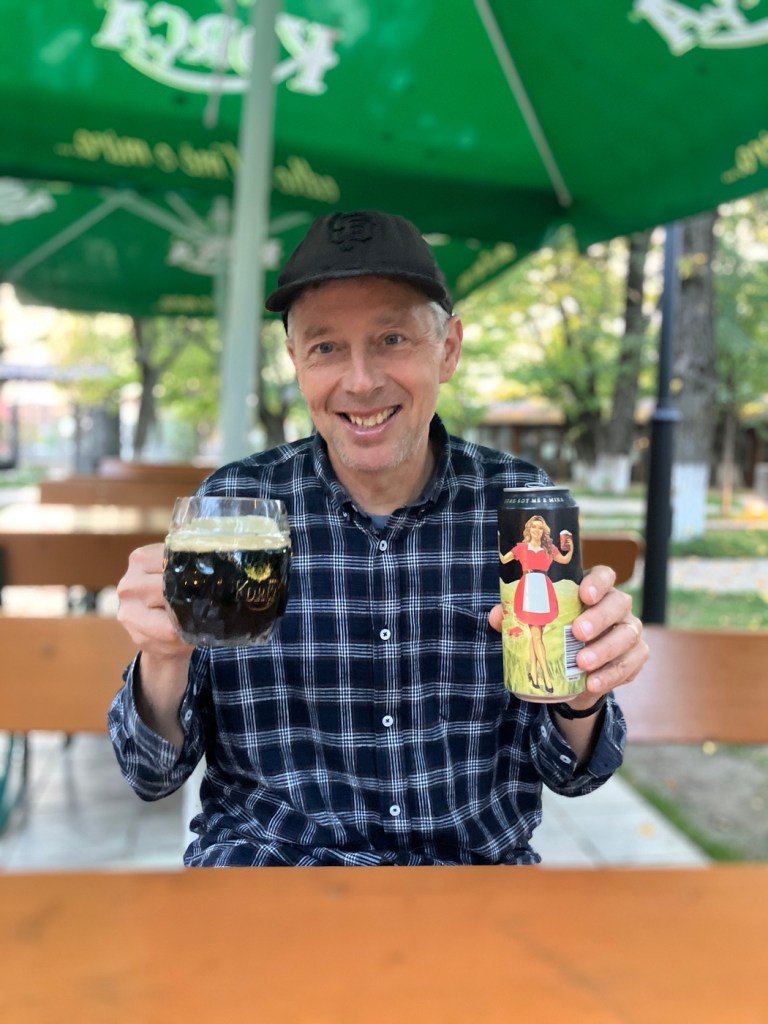
And the dark, only available in cans this season.

We headed up out of town for a hike, although the weather was fine the air was hazy from agricultural burning in advance of predicted rain.

Good luck, says Korçë cat.
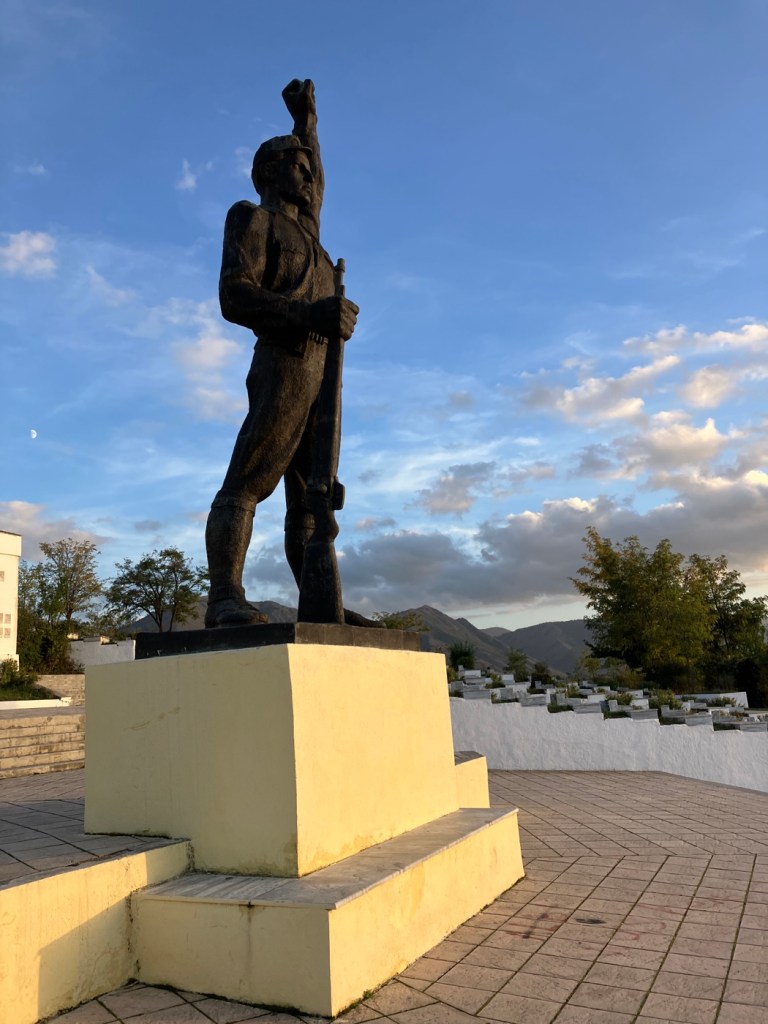
A graveyard above town with a freedom fighter statue.
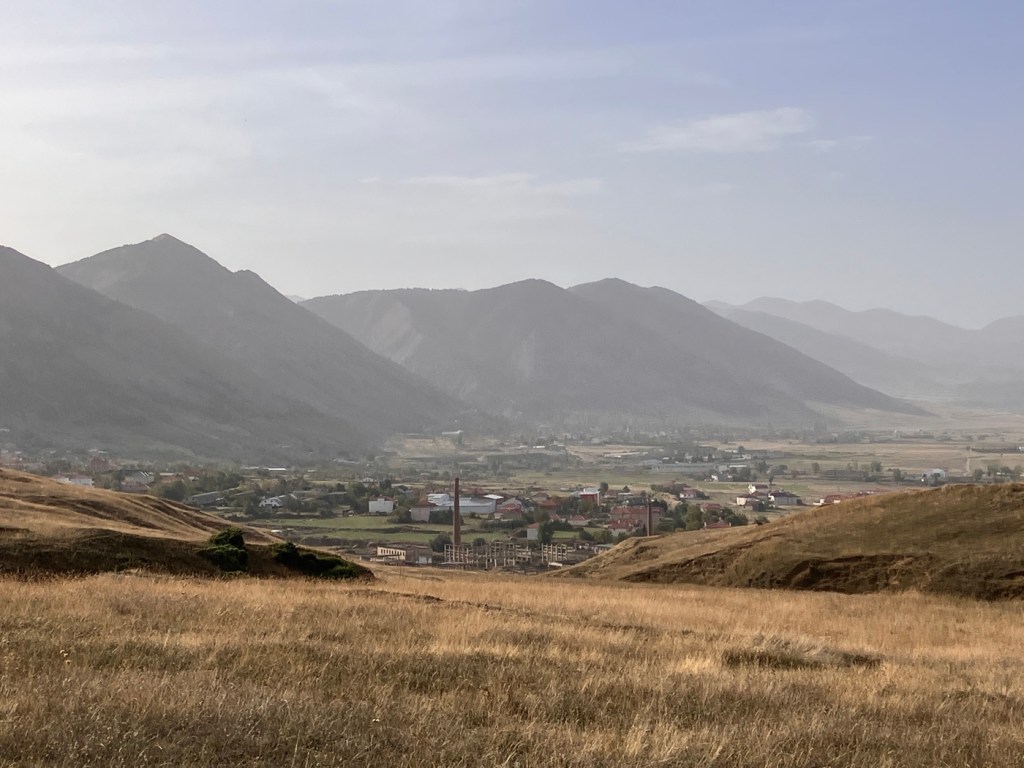
The terrain reminded us both of Southern California.
Golden hills and dry looking mountains.
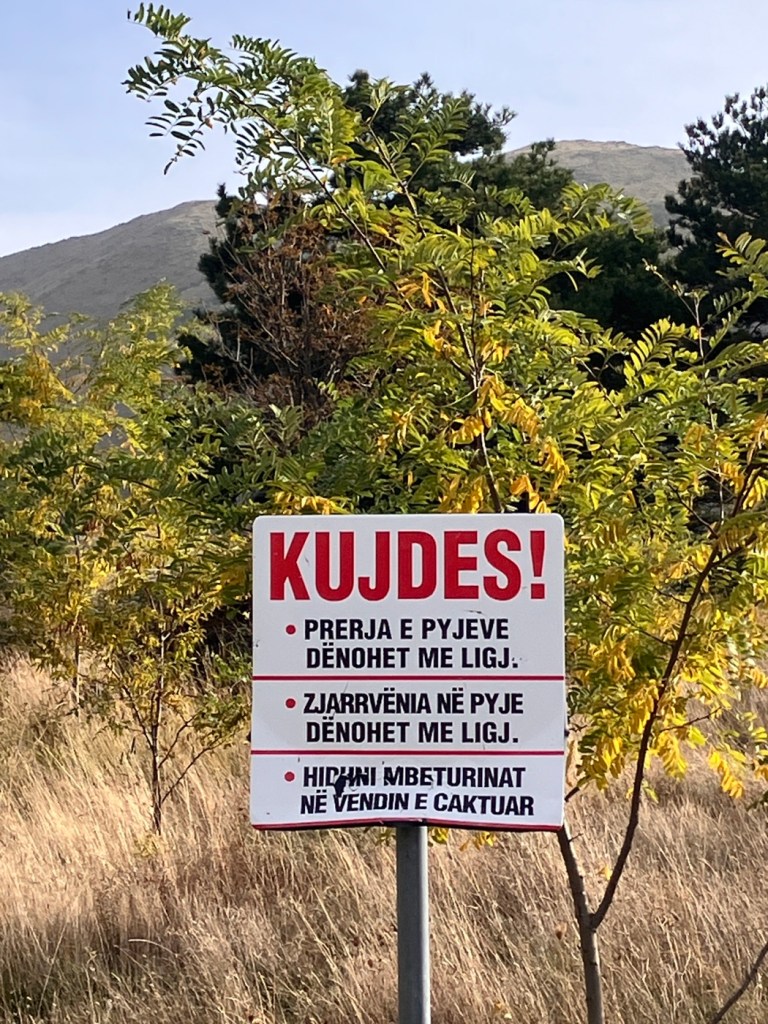
A warning to keep nature clean.
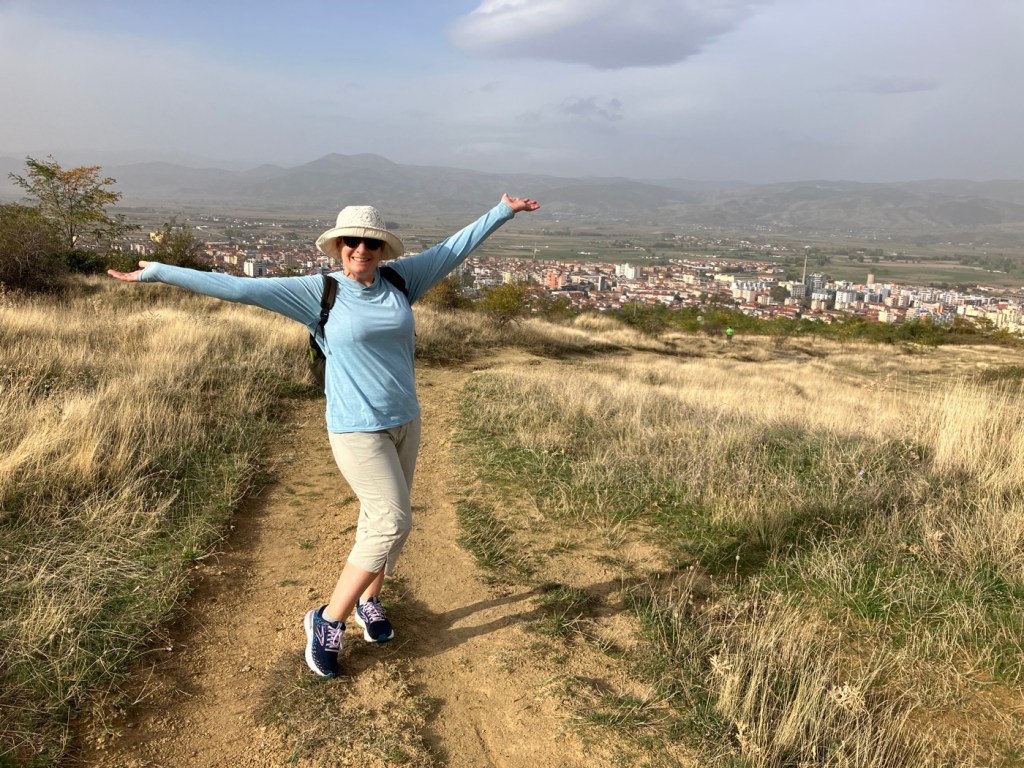
Am I happy on this hike or faking joy? (It was steep and warm.)
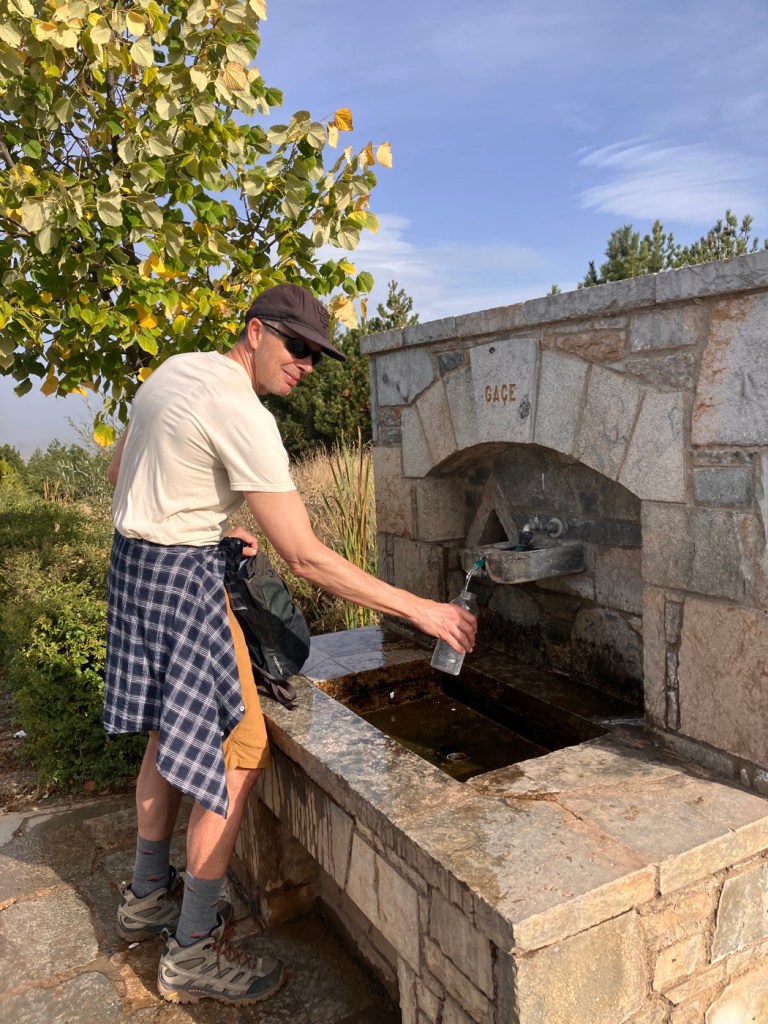
Thankfully there was an opportunity to fill up our bottles.
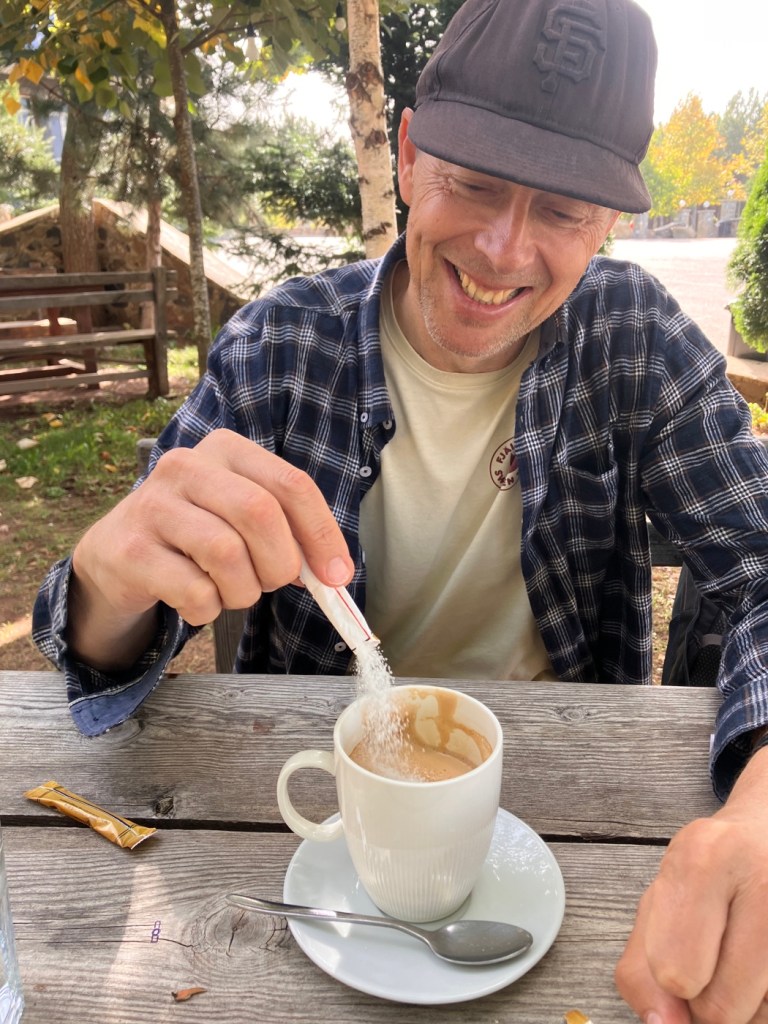
And a café at the Mountain Lodge where Rich went local by dumping sugar into his coffee.

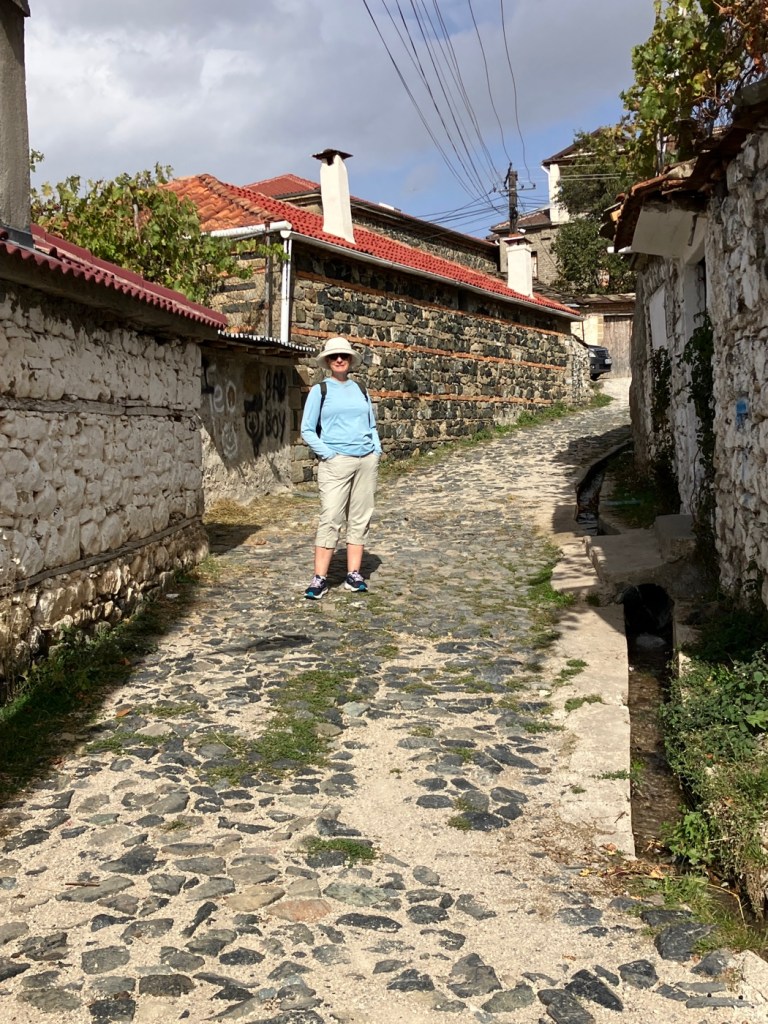
Although the hike up the mountain wasn’t my favorite (sunny, dry, on a road), on the hike back down to town we detoured through Drenovë, a town which looked as if it hadn’t changed in decades.

The reluctant hiker happy again.
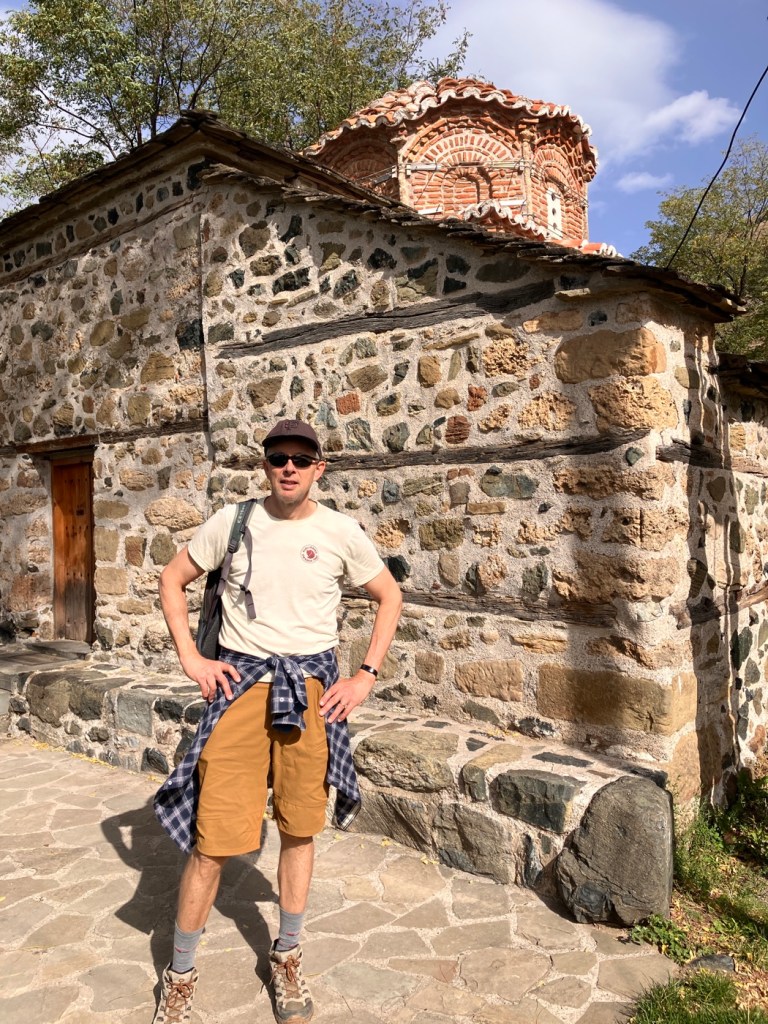
Drenovë had an old church which had escaped destruction during the communist era.
Our fearless tour guide, Rich.
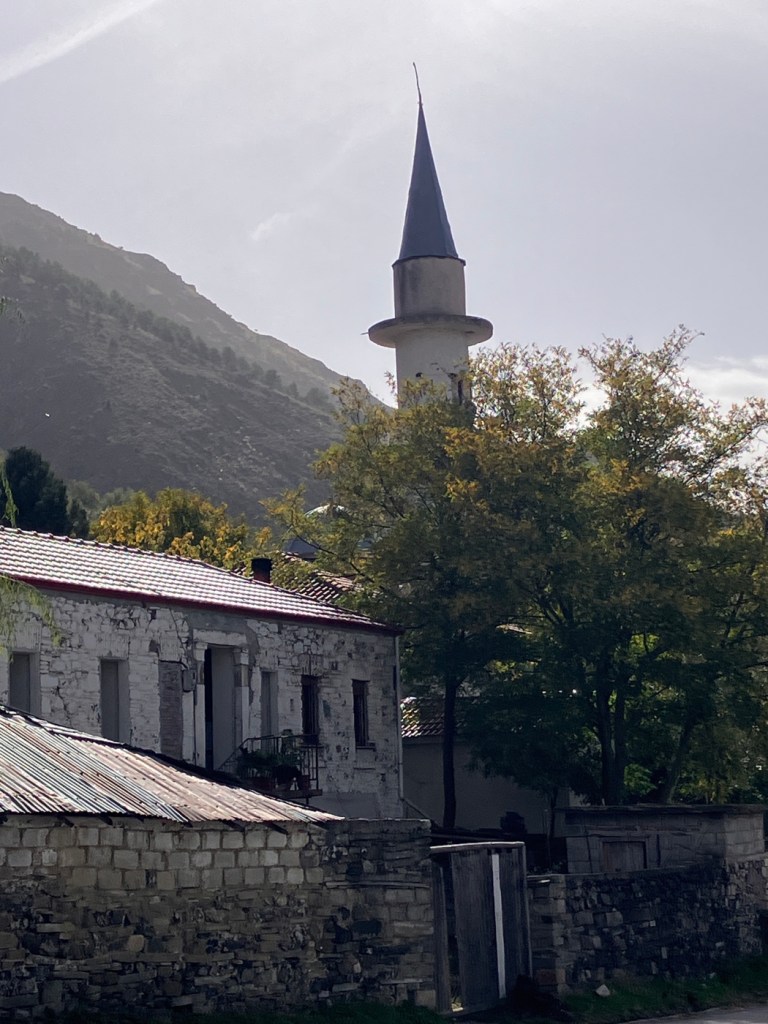
And just down the street, a Mosque.
Such a variety of stone work.
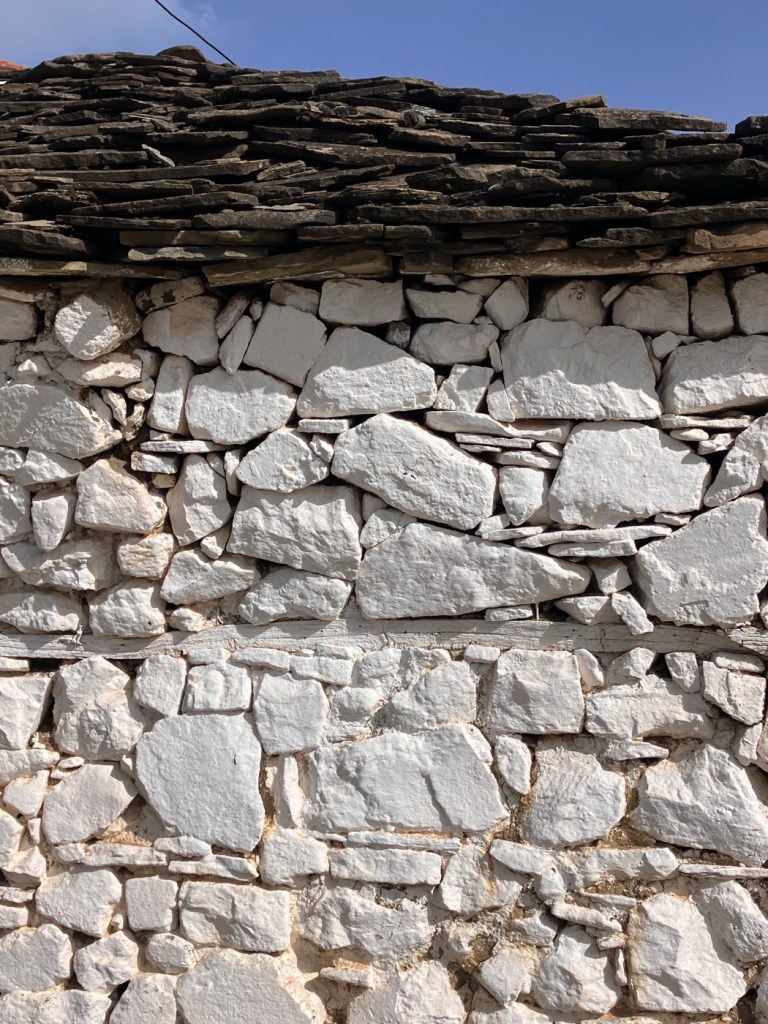
A stone wall topped by a stone roof. The traditional stone roofs are not anchored down, the stones hold each other in place. If you have a leak, you climb up and rearrange the stones.
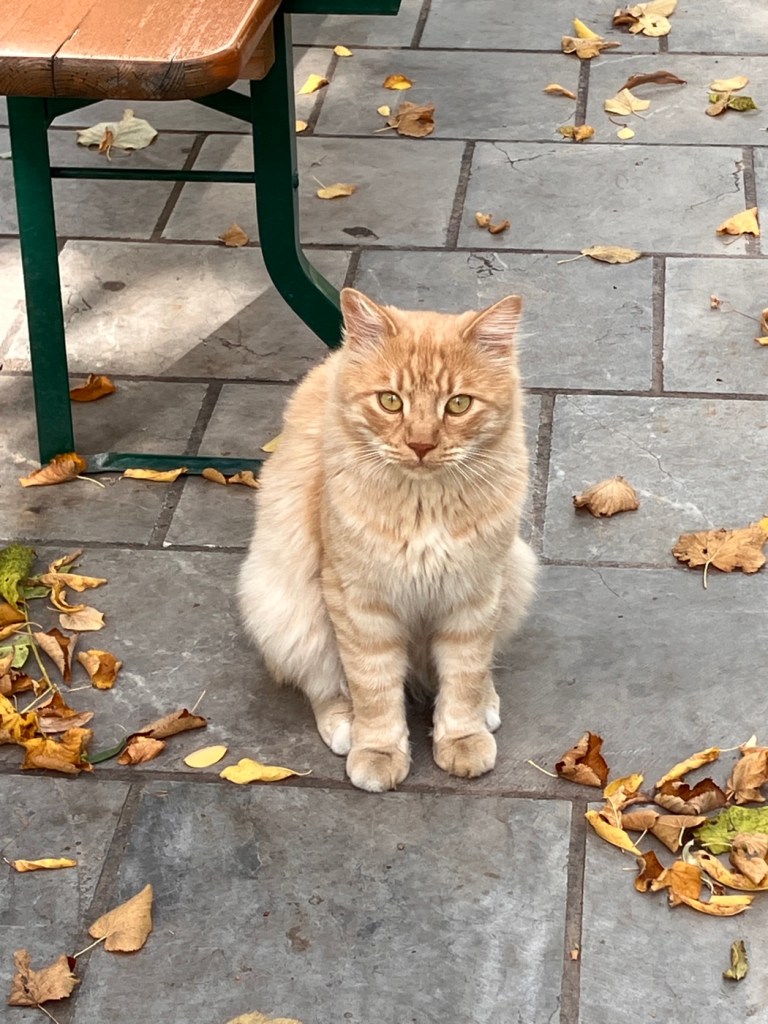
An autumnal themed cat hoping you share your meal.
A last walk around town during the evening Xhiro, when folks take to the streets to walk and greet each other.
And off to the bus station for a journey across the border to North Macedonia.

We’ll be back to Albania after our trip to North Macedonia. I can’t help but wonder if Albania could have a trajectory like Ireland. The hard decades when all the youth were leaving could transform to a thriving economy and people returning with skills, ideas, and money to invest. We shall see, but for now, off to another bus! And a taxi. And a hike. And a bus. More on that day in the next blogpost.

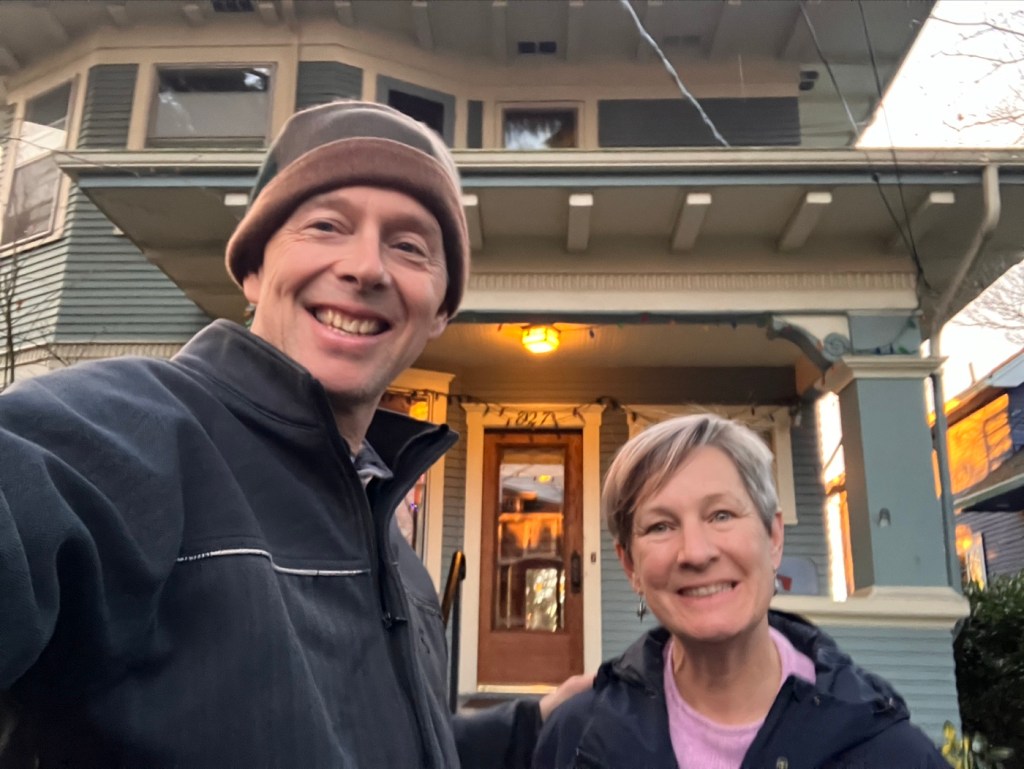
The Happy Travelers in Gjirokaster, Albania.

Albania – A Snapshot in Time

It’s a travel cliche; you can read all you like, but until you touch the ground and meet the people, you’ll never get a true sense of a place. And some places feel particularly dynamic with extreme drama in their recent history or a promising future dawning. Albania is smack dab in the middle of a multi generational transformation. And we are here now.

A greener future for Albania and new opportunities to join the EU.
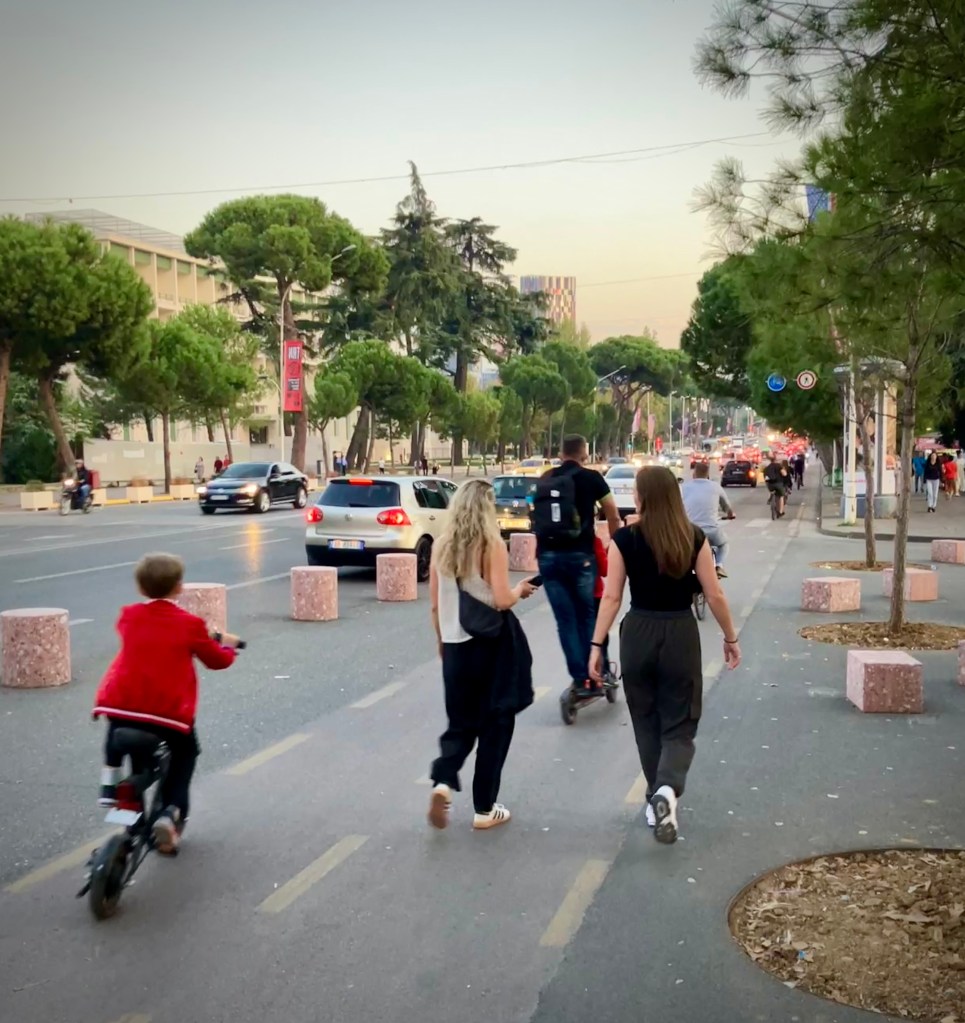
This was NOT how I pictured “chaotic and congested” Tirana.
Bikeways now connect a lot of central Tirana. Some double as walkways…
We were lucky to enjoy the recent renovation of the Pyramid of Tirana by MVRDV Architects and Arup. You can now climb the stairs on all sides and enjoy a variety of public spaces and views of central Tirana. It’s cool.
It’s become quite a hang out space. Took some waiting to get a photo without young people climbing the stairs.
The stunning renovation of the Pyramid includes TUMO, an educational organization focused on teaching youth innovation skills such as software, robotics, and animation.

Albania’s history gives it a very unique character. It came out of the gates slowly from the years of a repressive and isolationist government with continued troubles in the 90’s and modest economic growth until recently. But now it’s now on a faster rise and you can sense the optimism here. But it still has a GDP per capita about 1/3 that of Croatia and Greece, and challenges remain.

A delicious first dinner at Era restaurant in Tirana, which does creative takes of Albanian classics like this meatballs with pistachio
Of course I had to try one of the signature micro brews of Albania, Birra e Gjyshit, in the name of global research. It’s good.

But why are people so chill? Why is car ownership so low and why are the drivers surprisingly considerate of pedestrians and bikes? We started observing the character of the people in line for our flight from Geneva. Pretty chill. The Tirana customs and immigration was chill. Getting a SIM card? Chill. Taxi? Fixed fare and you guessed it, chill! In fact, adapting to just how chill people can be here takes some adjustment. (Especially my Type A personality!) It’s clearly a legacy of the past, but defines the present here. The young people do have a more energetic and engaged vibe.

Many things are a work in progress, especially in the coastal areas; the view from a cafe where we stopped briefly for lunch and a swim after Buntrint.
Tirana’s underground BunkArt2 Museum was a good overview of Albania’s communist era.
Bike culture had been here a lot longer than the recent car culture, and Albania still has one of the lowest car ownership rates in Europe.

One thing travellers often refer to when describing a country is the “hassle factor”. How difficult is it to get around, complete transactions, order food, get money, etc? Albania scores well on this front as interactions tend to be straightforward and prices are generally clear. (Exception: some taxis…which really is a global problem!) It can also be little things like making change for large bills spit out by ATMs. No problem in Albania. Credit cards are also taken at some places, especially in bigger cities and everywhere in trendy neighborhoods of Tirana (like Blokku).

Heading to the “North-South Bus Station” in Tirana. Cracking the code for the bus and minibus system is one of the bigger challenges for travelers in Albania.
That look says; ok, where the heck is the bus to Vlorë?! But no worries as we just walked around a bit and were quickly pointed to the right bus. Take a seat and pay on board. Generally.

I would recommend bringing a healthy supply of Euros as this can make it easier and cheaper to pay at places priced in Euros (most lodging). And note that all ATMs charge $5-$8 per withdrawal, so withdraw as many Lek as you can per transaction to minimize fees.

The minibuses or “Furgón” also transport packages such as these giant boxes taking 6 seats on our run. We were worried for the guys in front of the boxes in case of a sudden stop 😬.
Vlorë comes alive in the evening with pleasant sidewalk dining and great people watching. We had a good chat with the nice guys at the next table who were from the UAE.

Our strategy for a mid October visit was to head to the coast first as many places do start to shut down, and by early November only the bigger coastal destinations (such as Sarandë) still have a lot of life. We’d then explore the inland cities and villages in the mountains and high interior.

Our hotel had a fleet of free bikes which was great for getting around cycle friendly Vlorë and to our favorite swimming spot.
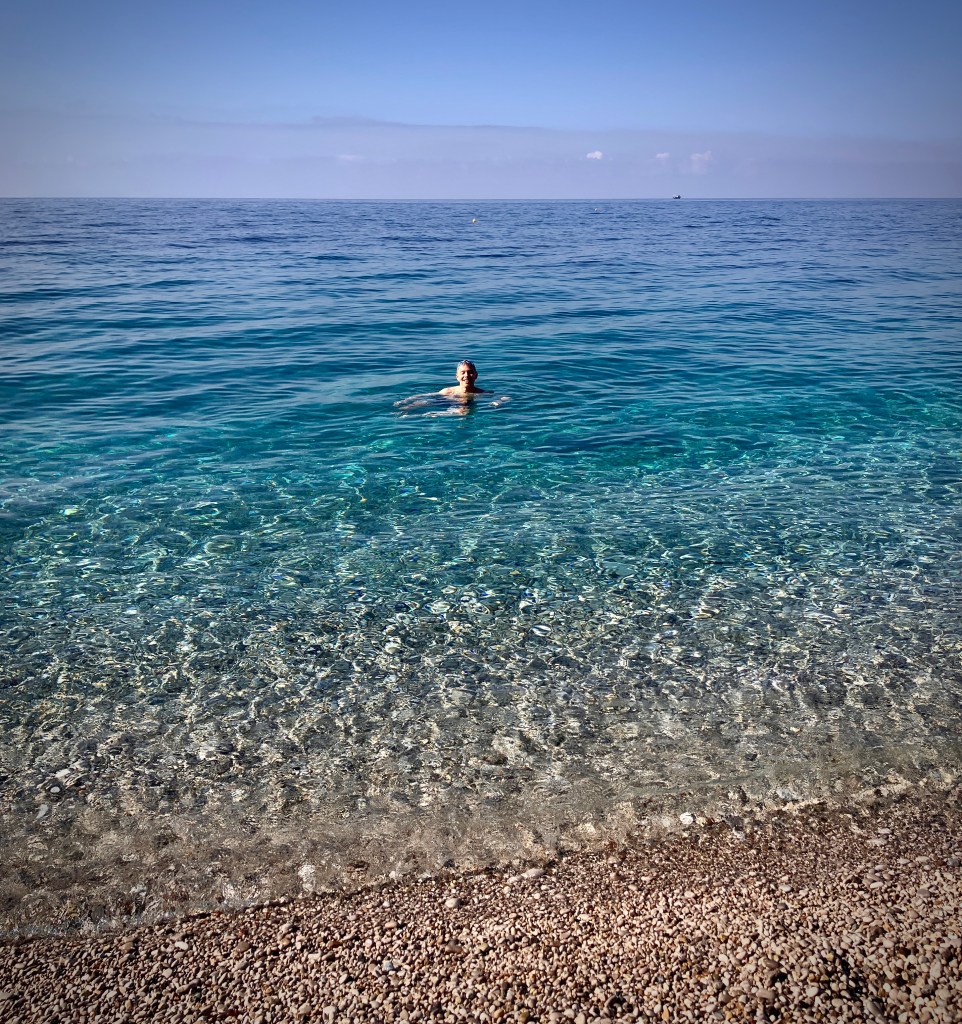
The promenade and small Azar Beach about 4 km south of central Vlorë offered turquoise water and better swimming than the main stretches of Lungomare.
Swimming near a Barrel Jellyfish (?) which just look beautiful and don’t have nasty stings (right?).

The strategy paid off as we still had nice weather, the beaches were still swimable, and enough was open to have a rewarding experience. We loved the chilled vibe of late season, and still met some nice fellow travelers, but if you want more of a scene, come earlier. If you want a full on party, packed nightclubs, and crazy beach scene, come in late July and August!

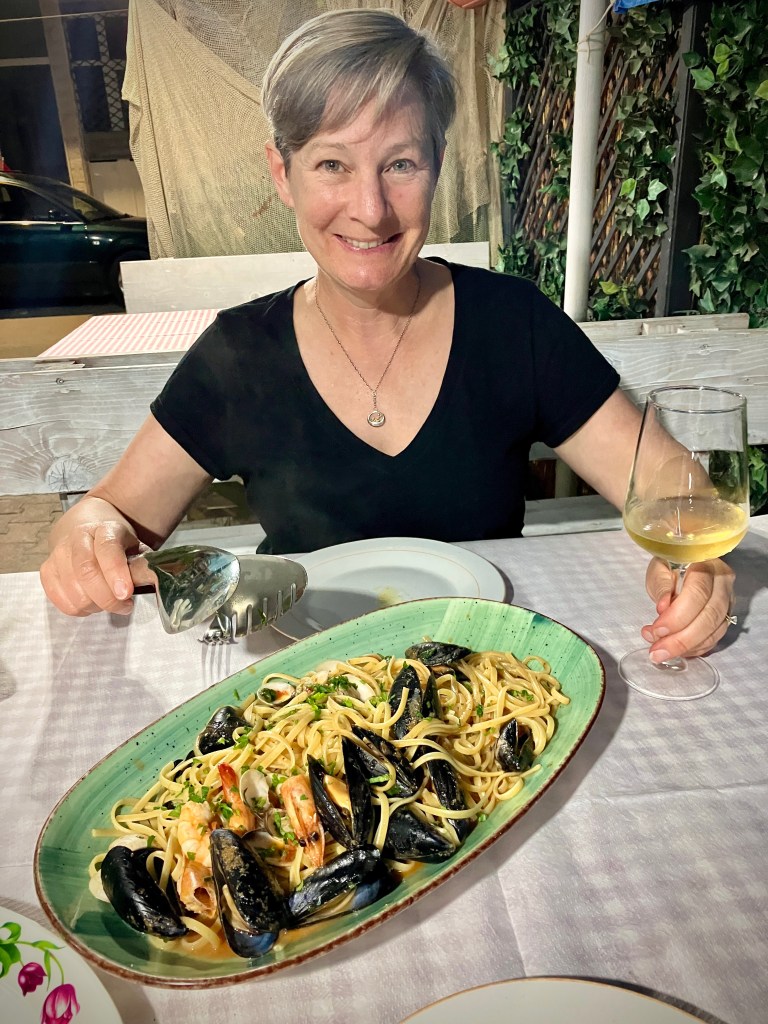
First course of seafood and perfect linguini at the wonderful little Skerdi Restaurant in Vlorë. The friendly owner/chef cooks amazing seafood and pastas.
Nothing but bones. A clean removal.
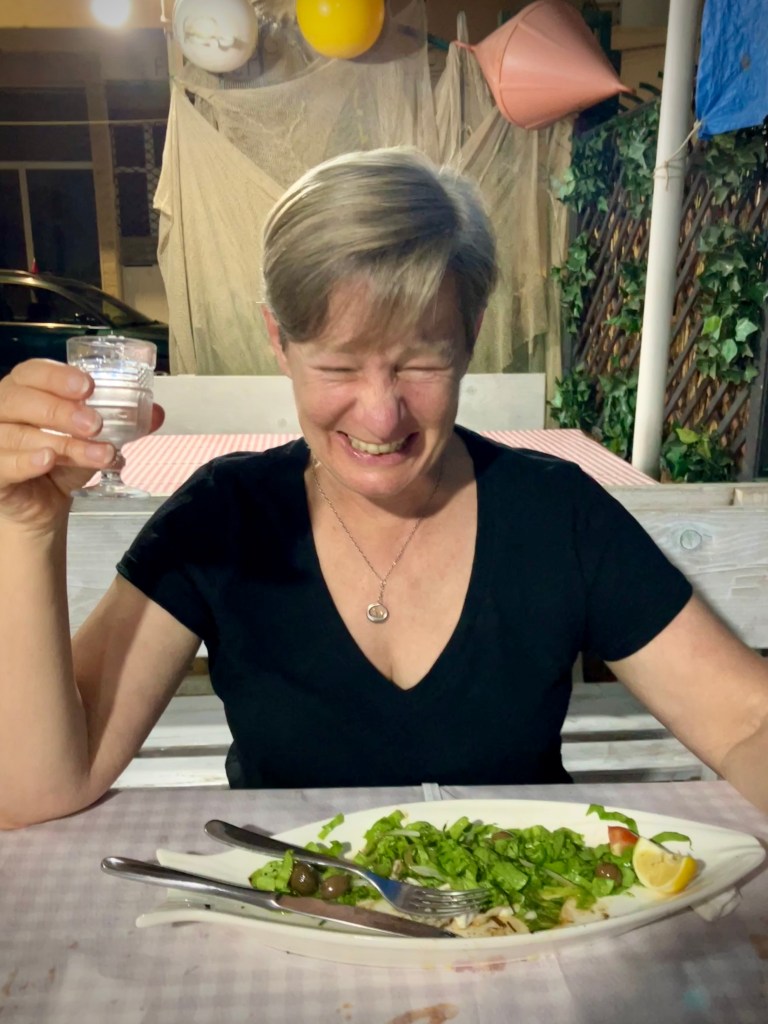
And this is what we call “Raki face”. We don’t seek out Raki in Albania, but with so many friendly restauranteurs, the Raki finds us.

We decided to stop in the small coastal city of Vlorë on the way to the more popular parts of the coast and were really glad we did. Vlorë is extremely pleasant and has a wonderful primary shopping and restaurant street as well as a long beach promenade, all with heavily used bikeways.

The public buses in Vlorë are easy and clean. You can board any door and just pay the fare collector who comes around, and makes change. (40 lek)
Vlorë’s bus station is a long curb lined with shady cafes. Waiting for our 10am minibus to Himarë…until we were told it actually leaves at 11:30. Another coffee, please.
The minibus station…finding out schedules can be tough. Ask around or stop by the day before about the time you want to leave. Hotels and guest houses can also help a lot.
Our Transbus to Hiramë left Vlorë at 11:30 and arrived at 2:20 with one 20 minute bathroom and cafe stop. The trip is spectacular/slightly scary over the coastal mountains.
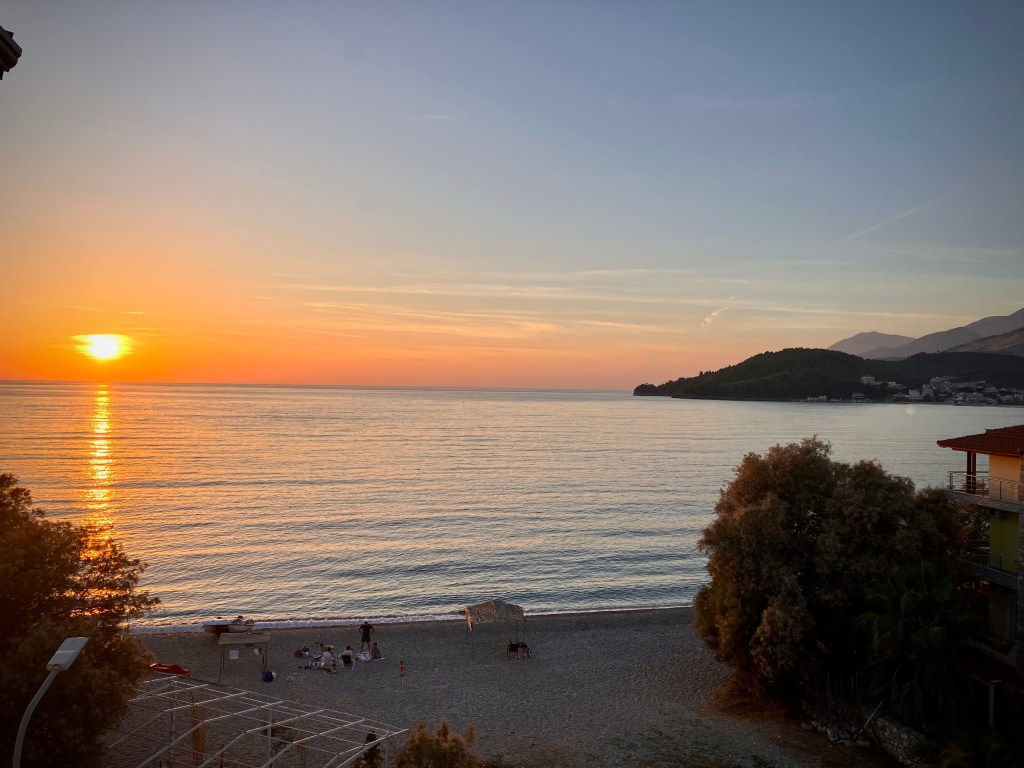
Sunset view from our apartment along Potami Beach in Himarë

The trip south from Vlorë heads over the Llogora Pass, with a stunning 3,000 foot decent towards the ocean. Traffic is still remarkably light and little towns dot the coast; some a bit charming and others more scruffy and modern. Himarë (or Himara) was very pleasant but it’s vibe was much more beach town than the real city scene of Vlorë. But it’s a spectacular setting and the 3 beaches around the bay of the City are pretty nice.

Sheep herder on the beachfront of Himarë.
Local markets abound with the ubiquitous cucumbers, peppers, tomatoes, onions, eggplant, and spices which make up most dishes.
Some longer trails such as the Albanian coastal trail have been established recently but in general, hiking is an adventure using partially mapped roads, fire roads, and foot paths.
Grapes and vines adorn many house; on the way to Livadi beach from Himarë
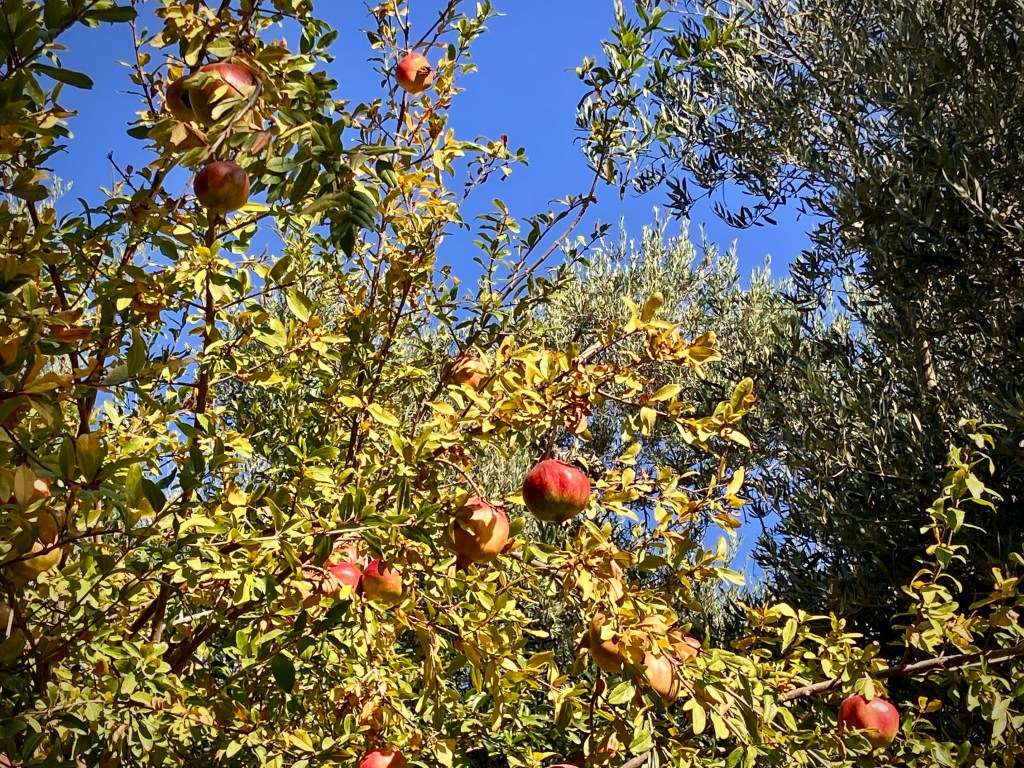
Pomegranates and citrus.
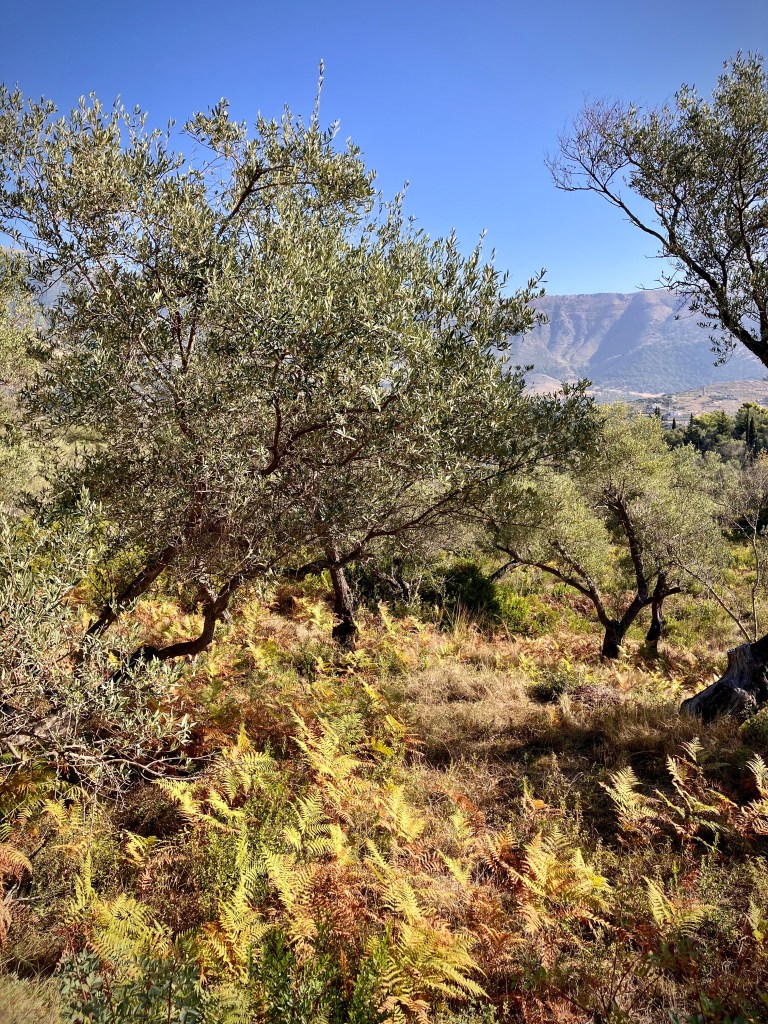
Olive trees were often mixed with ferns, which felt a bit out of place in the arid environment.
Olives and olive oil are a base of life in the region. And delicious.
Livadhi Beach…our favorite and a short hike from Himarë with some nice shade (at the undeveloped southern end).
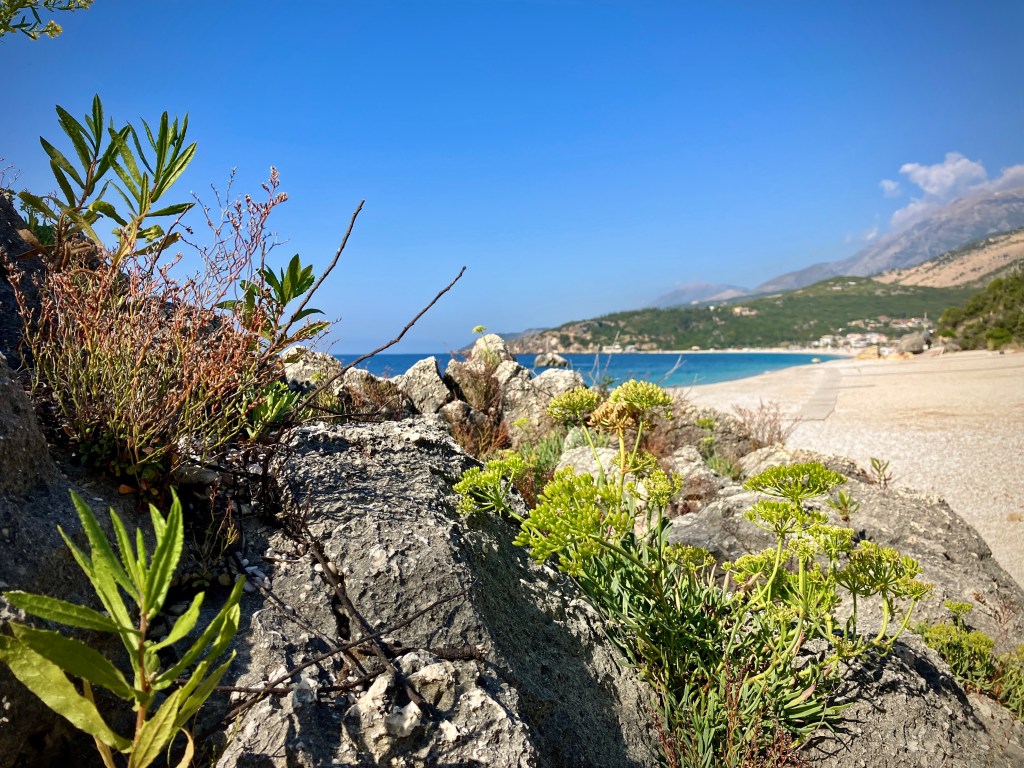
Ionian Sea paradise at Livadhi.
By mid October many of the beach restaurants in our neighborhood had closed, so we made this friendly Taverna PiroΣia our home in Himarë as we preferred its vibe (and the walk) to main town.
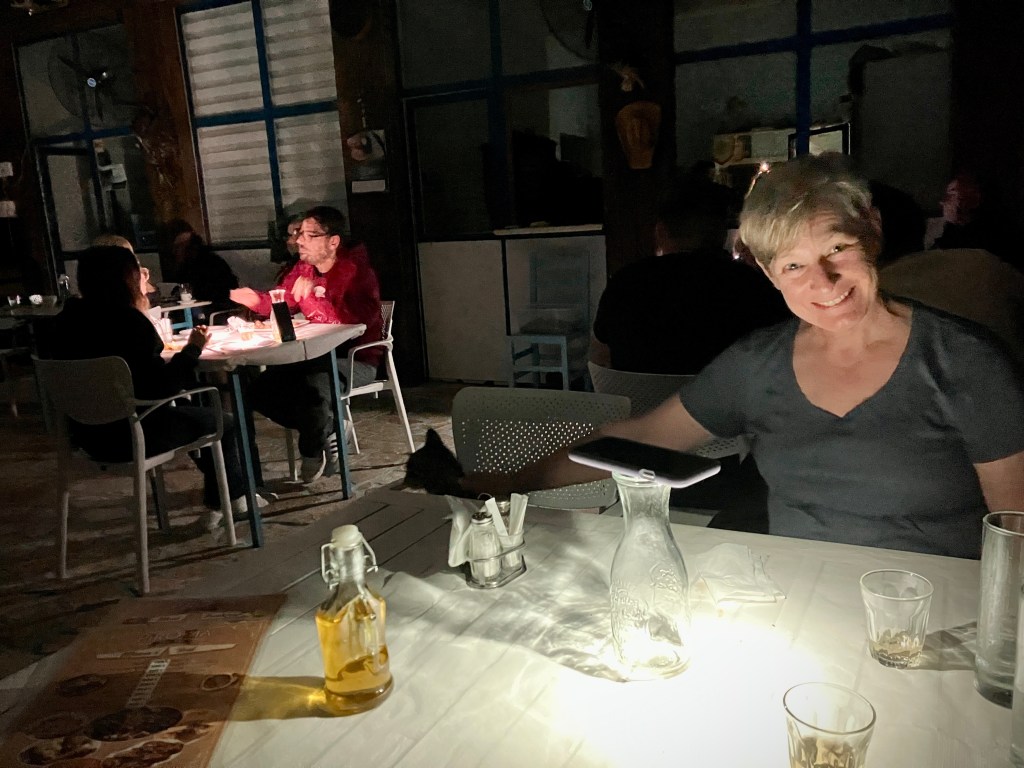
And then the power went out during a rain storm, making for a romantic IPhone candlelight setting. Power can still be a bit spotty in Albania.
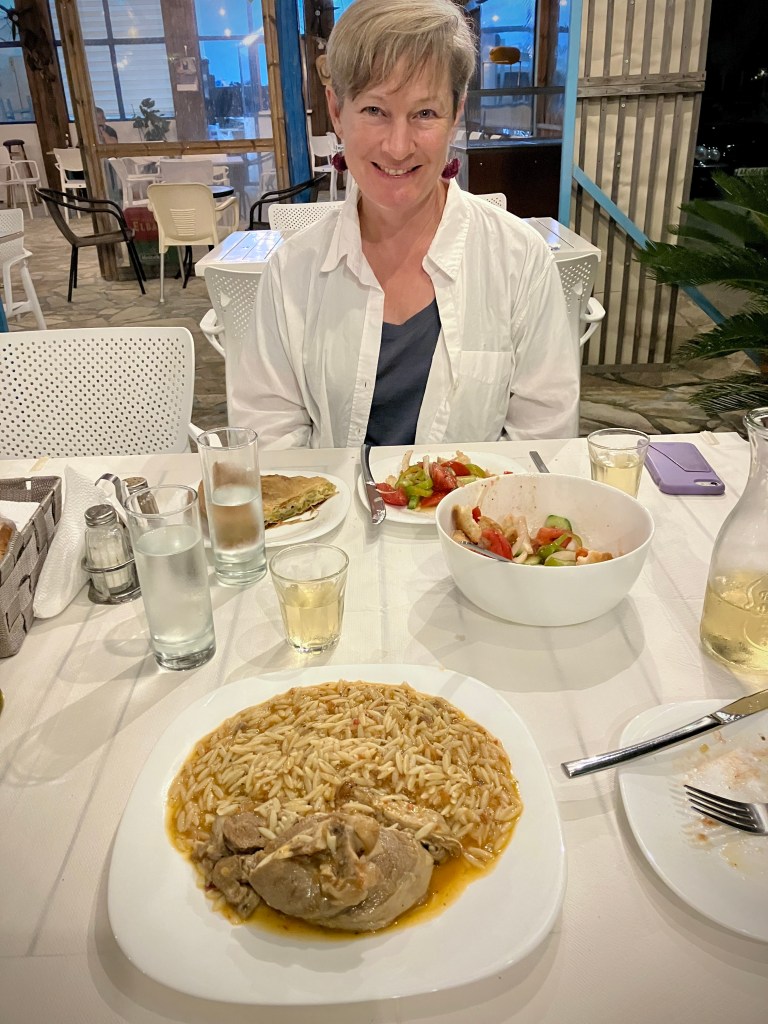
Zucchini pie, a Greek village salad, and Lamb “Juvetsi”. There are many Greek or Albanian-Greek restaurants in this coastal region.
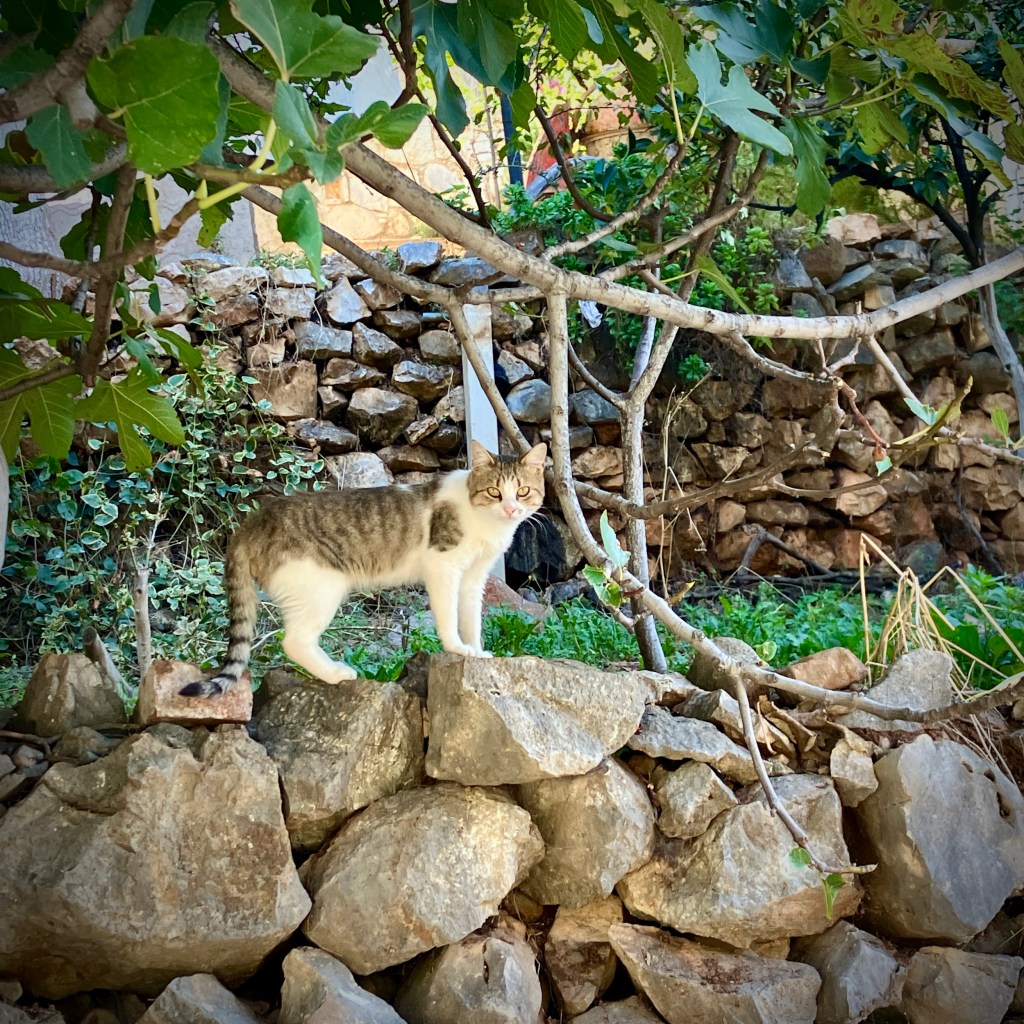
Did I mention the restaurant cats?
How can you say no?

Our next bus leg to Sarandë went well as the nice host of our apartment confirmed the minibus time and walked us to board (south of the main stop in Himara) where we found the driver had reserved two upfront seats for us based on her call to him. So nice. The Albanians we have met have been kind to a fault; but sometimes it takes a bit to draw them out from their extremely low-key nature. But it is really nice to travel here.

Central produce market in Sarandë
Café culture is strong here. Chilling in Sarandë

Since we were out of the main part of town in Himare, we decided to go for a centrally located family hotel in Sarandë. It was nice to enjoy the main pedestrian beachfront promenade in low season, and have access to more of the city’s less touristy restaurants. Yet we still could swim in the main beach with just a 5-10 minute walk. Just a few people still “beaching” at this time, but the water was still nice, with just a slight chill. (~20-22 deg C)

My dog buddy followed us to the bus stop in Sarandë and was determined to go to Butrint with us.
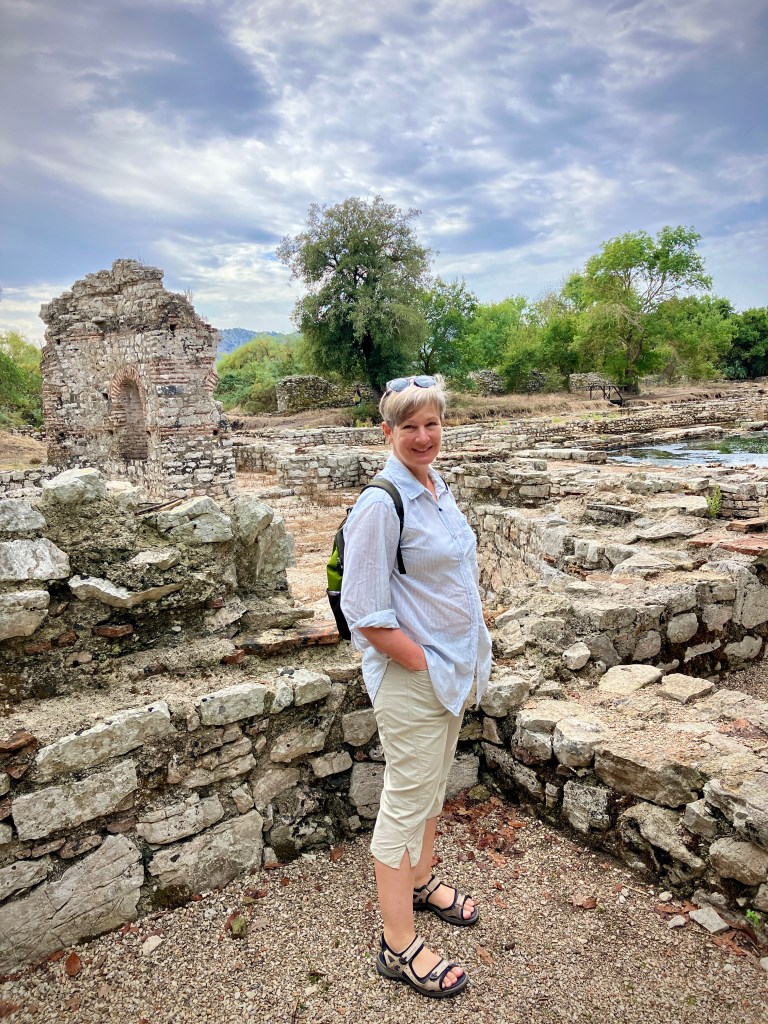
The forum at Butrint. Although not as intact as Pompei, Herculaneum, or Ephesus, we were able to fill in the structural and decorative gaps from our experiences there.
Exploring Butrint Archeological Park just before the big crowds. Sea level rise is a problem for the site.
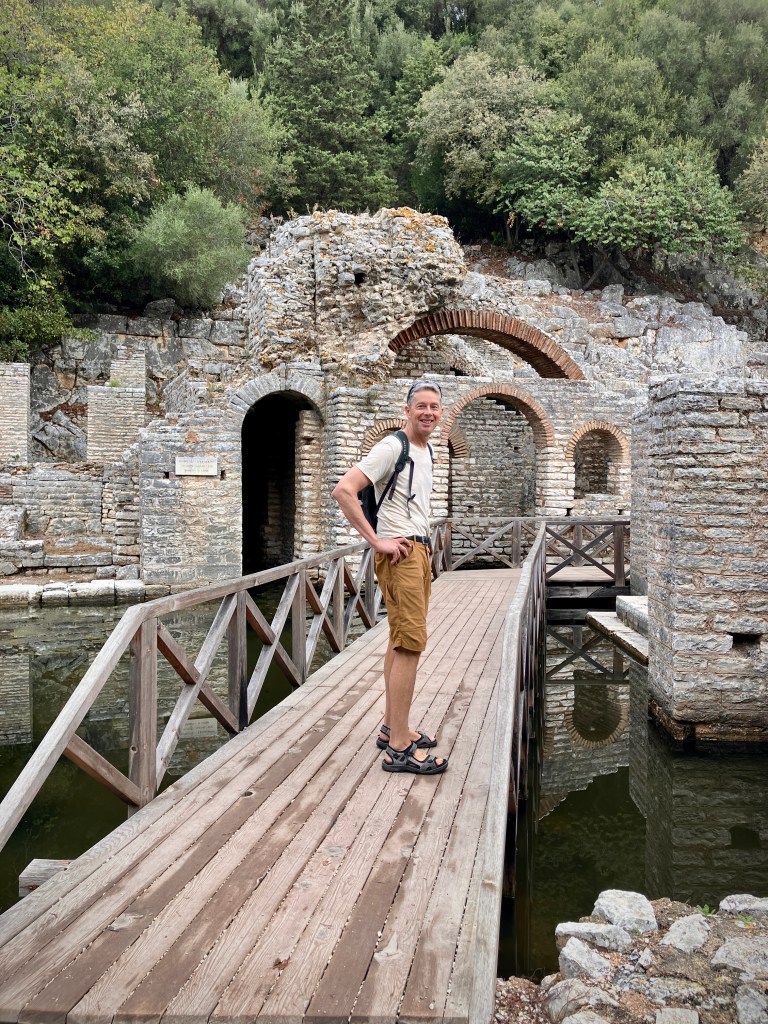
Layers of history at Butrint include the Greeks, Romans, and Byzantine empires.
Much of the original city defensive walls are intact.
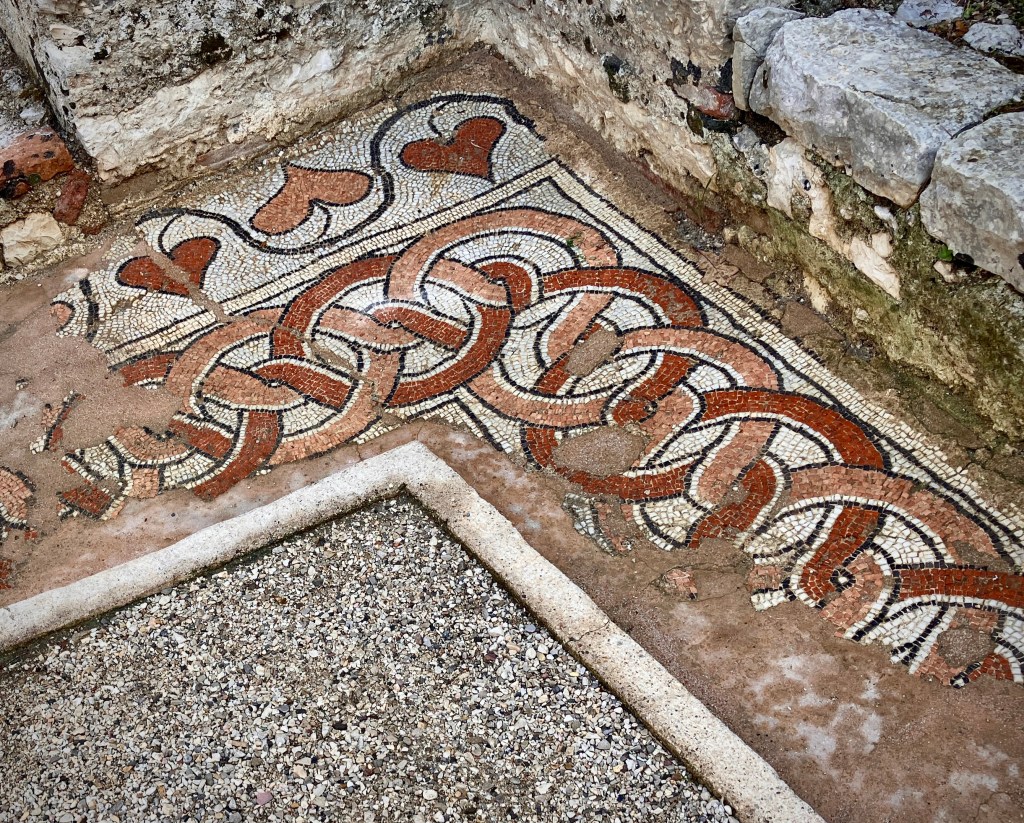
This is one of the few mosaics visible in Butrint as most are kept covered by sand to protect them from the elements.

Our central location in Sarandë also meant easy access to the municipal buses that run every 30 to 60 minutes right to Butrint National Park. (200 lek) However, the bus stops at 3 or 4 places along the main road out of Sarandë, so you can still catch the city bus a few km or more south of the city center, which is now an endless line of new boutique hotels, apartment buildings, and mostly seasonal businesses.

The springs and wells of Butrint were a reason for its early success.
The Butrint museum has some interesting artifacts and info but could use a refresh. Apparently a vastly expanded visitors center is in the works as visitation has grown quickly.
We loved the natural setting of Butrint.
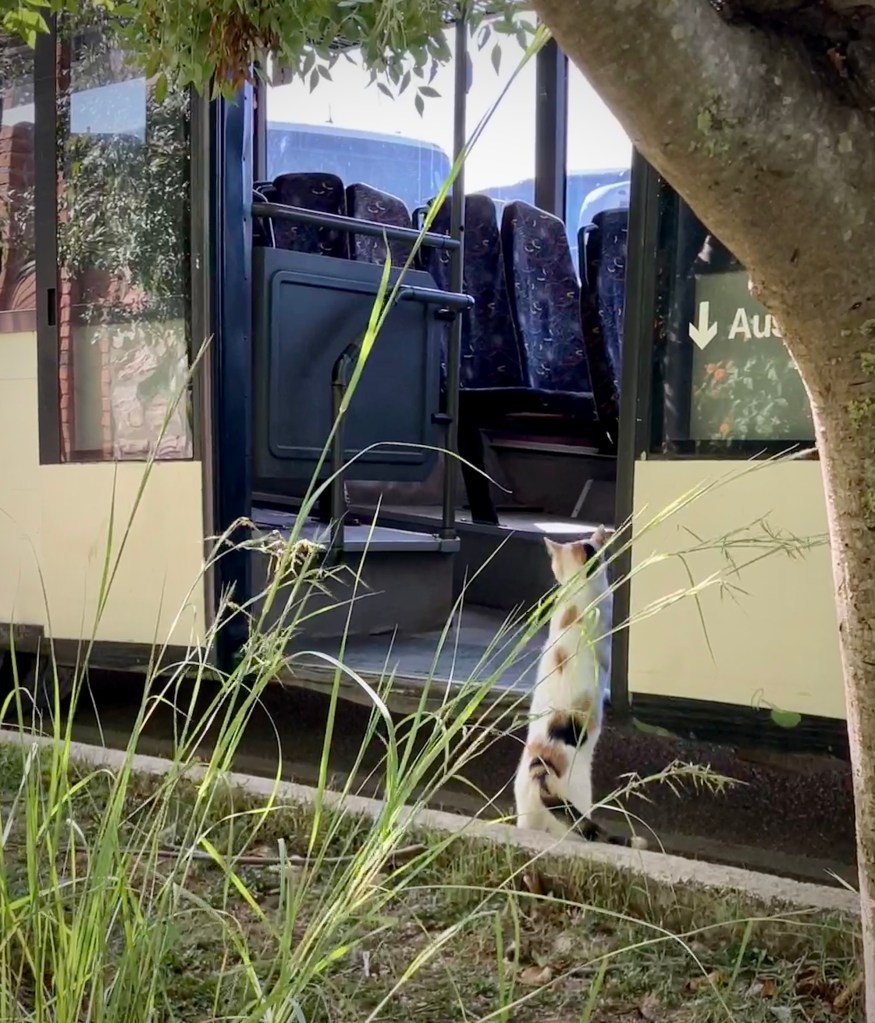
This cat was opting for back door boarding on the bus back to Sarandë.
But then changed their mind.
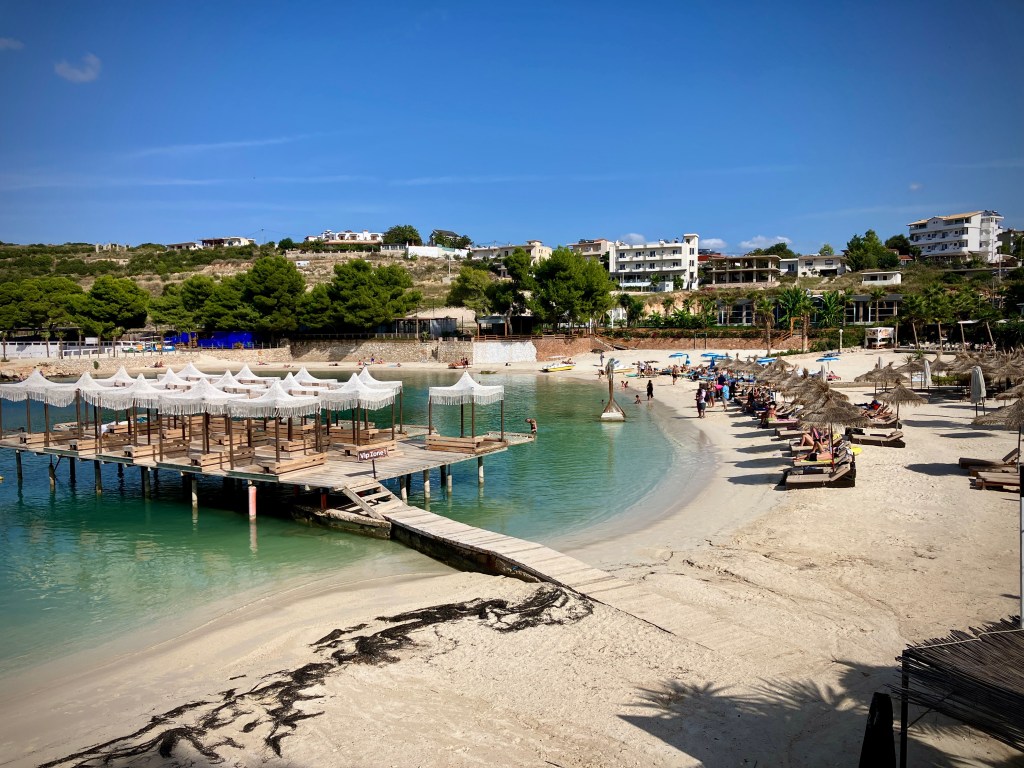
We stopped briefly for a swim at the main beach in Ksamil (pronounced “Sam-ill”) but it was not our scene. In summer, no part of the beach is free and you have to pay for a sunbed.
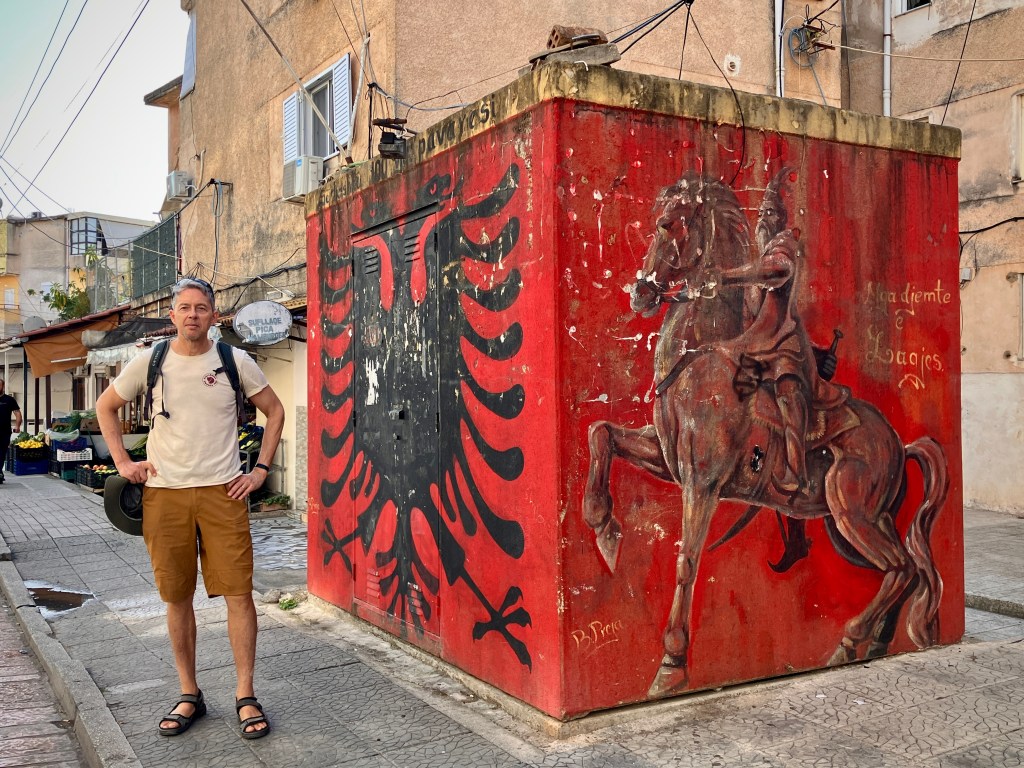
Nicely painted utility substation.
There are many unfinished/abandoned buildings on the fringes of Sarandë, and unfortunately a pretty serious garbage and sanitation problem.

It’s been an enlightening time so far in Albania, and we have been charmed by the pace of life here and optimism we are seeing for the future. We will be rooting for a positive trajectory in this complex world and region, and hopeful that more of their talented and educated youth stay to build a stronger future. But for now, we all get to enjoy this snapshot in time.

Cat curious why these tourists are wandering in his hill neighborhood above Sarandë.
A memorable visit to the Albanian Riviera, but ready to explore inland.

Happy travels!

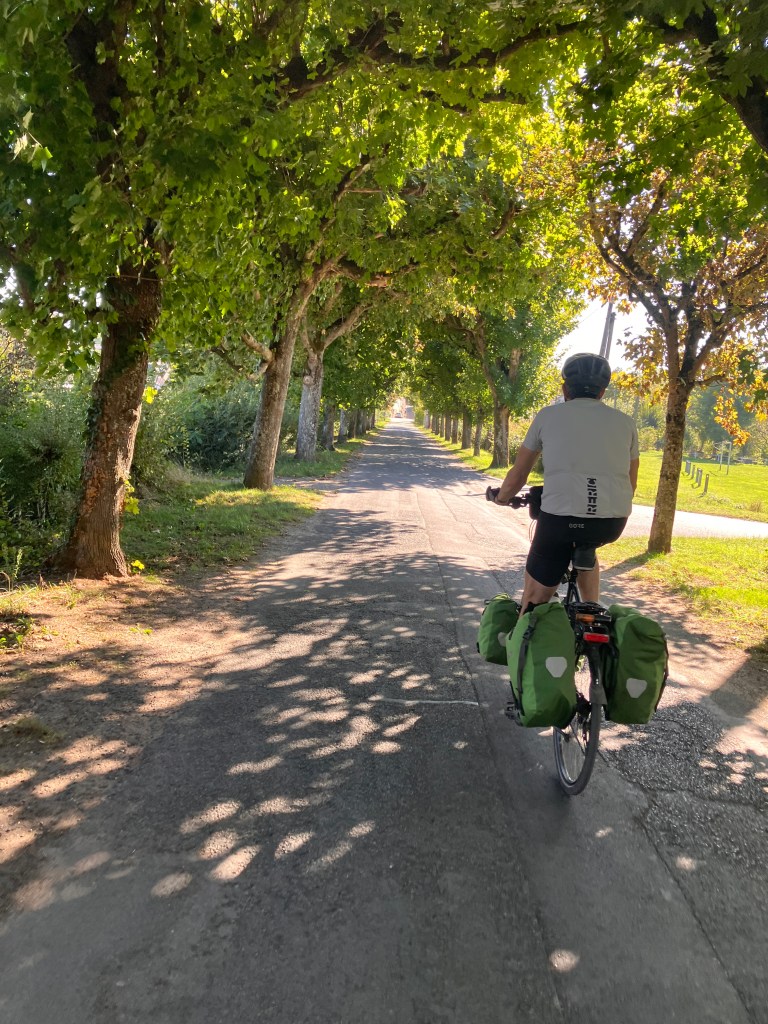
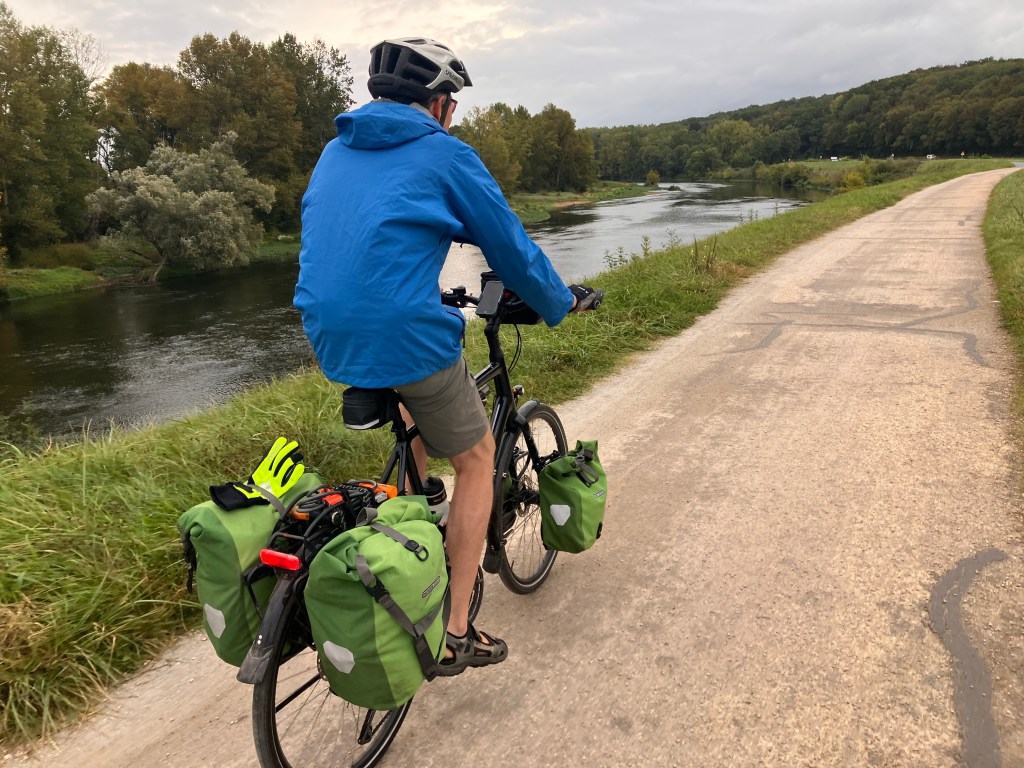
Linking up sections of La Loire á Vélo.

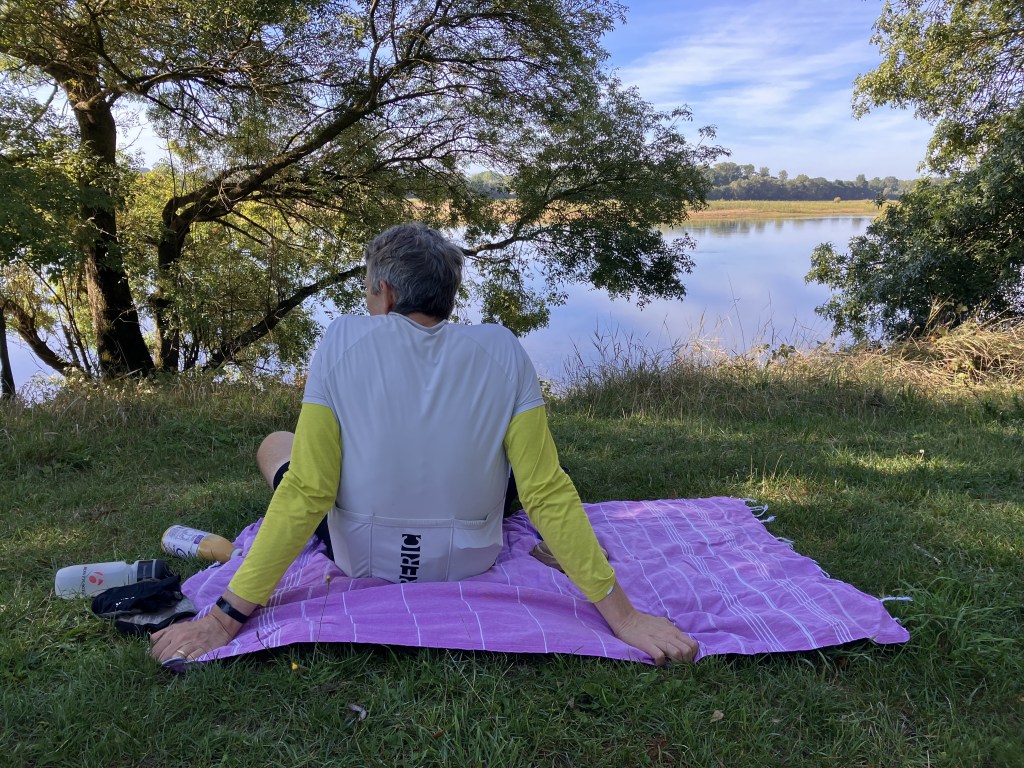
Picnic spots of the world. Relaxing along the Loire River.

We got a bit spoiled with the bike infrastructure riding out of La Boule – Escoublac, Brittany. As we continue to happily notice, France is really stepping up their bicycle and pedestrian game. It’s so nice to feel welcomed and cared for while bike touring. And it sure looks as if it’s having an impact on local trips made by bicycle in towns we went through.

The newly redone section of La Boule – Escoublac promenade. Even more bike and ped space.
A new section of off street cycle path in Pornichet.
Saint-Nazaire continues the bicycle love. The port in the distance.

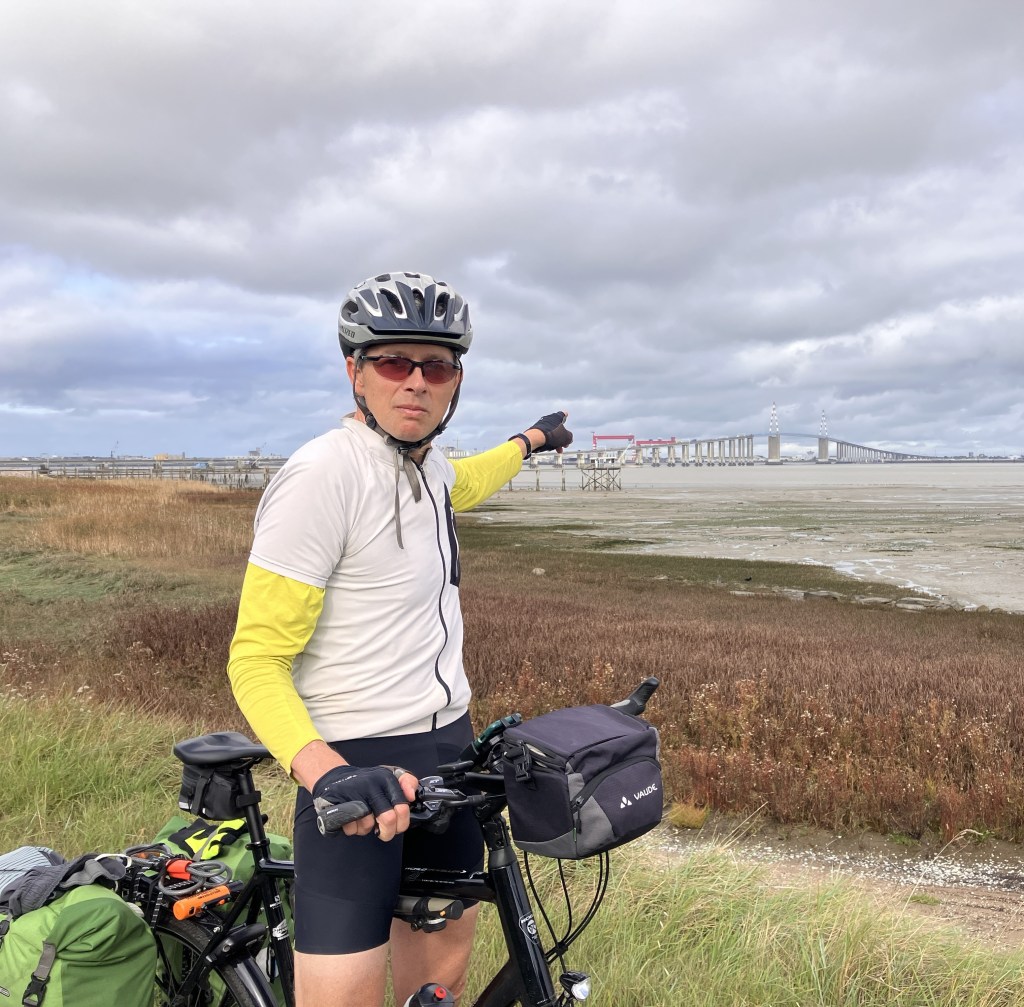
We were headed to Saint-Nazaire to cross the bridge over the mouth of the Loire River and hang a left up the river path. We’ve ridden other sections of the Loire in years past, and had been impressed with how wild and wide sections of the river are. Our last ride on the Loire was downriver towards the Bay of Biscay and the North Atlantic Sea, but we ran out of time before we could reach the end. This time we would start at the mouth, or delta, and head up river. But first, we had to get to and cross the Pont de Saint-Nazaire. A big bridge accessible through the working port.

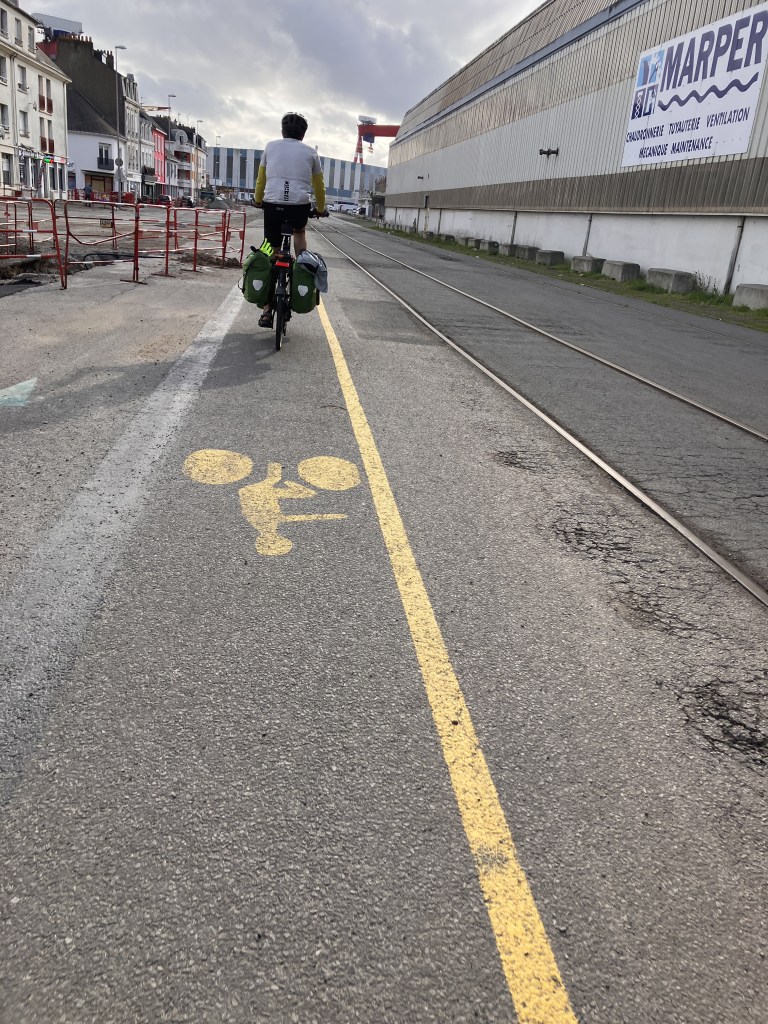
Into the port area, bike lanes still apparent.
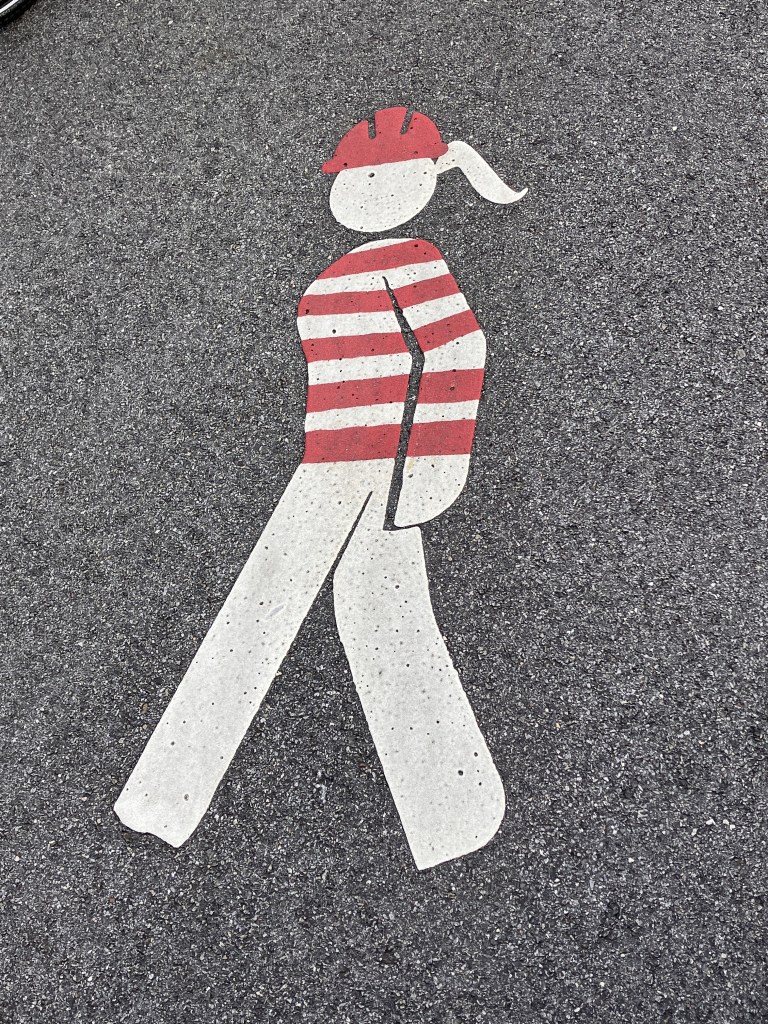
Oh. New signage. Watch out for workers walking.
Love this.

Let’s talk about how difficult it can be to get info on cycling conditions. We’ve faced challenging bridges before, and even been shuttled over bridges. We knew this one would be tough, but Rich couldn’t find many photos or info online about the actual lanes or shoulders, other than to see it was not great, and we hadn’t seen any other bike tourists for a while so no asking for first hand experiences. As we got to the approach of the bridge there was a bus stop with information on the shuttle bus with bike trailer that ran from May through September 24, all week, and then on weekends only. It was Friday, September 29. Yup. We’d have to ride. I have no photos of our ride across the bridge. As I was concentrating on staying as far right in the 2 foot shoulder as I could, without bashing my panniers into the guardrail, I briefly considered snapping a photo but decided I would rather live. It was pretty nasty. French drivers are good, but the lane configuration was one lane in our direction, two lanes in the other, and a closed lane on the far side.

That face says “F***k. We made it.”
Yikes! That was not fun.

If we had been riding the other direction we would have had an empty lane next to us, but in our direction we were next to a lane of car and truck traffic. I could see that the drivers were passing Rich as carefully as they could, and pulling into the oncoming lane when they could, but Rich, ahead of me, couldn’t see how I was getting along.

Once we got across and looked back I had two thoughts: damn, that sucked, and oh, that’s why the red stripes on the cute worker emblems on the path. It’s the paint job of the bridge.

We met two French cycle tourists heading towards the bridge later that day who said they had booked a shuttle, with a taxi company, we finally figured out. So that would be my recommendation to anyone interested in crossing the Saint-Nazaire Bridge by bike when the shuttle bus is off season, especially if is windy (which thankfully it was not on our crossing).

That bridge is on our list: Do not ride.
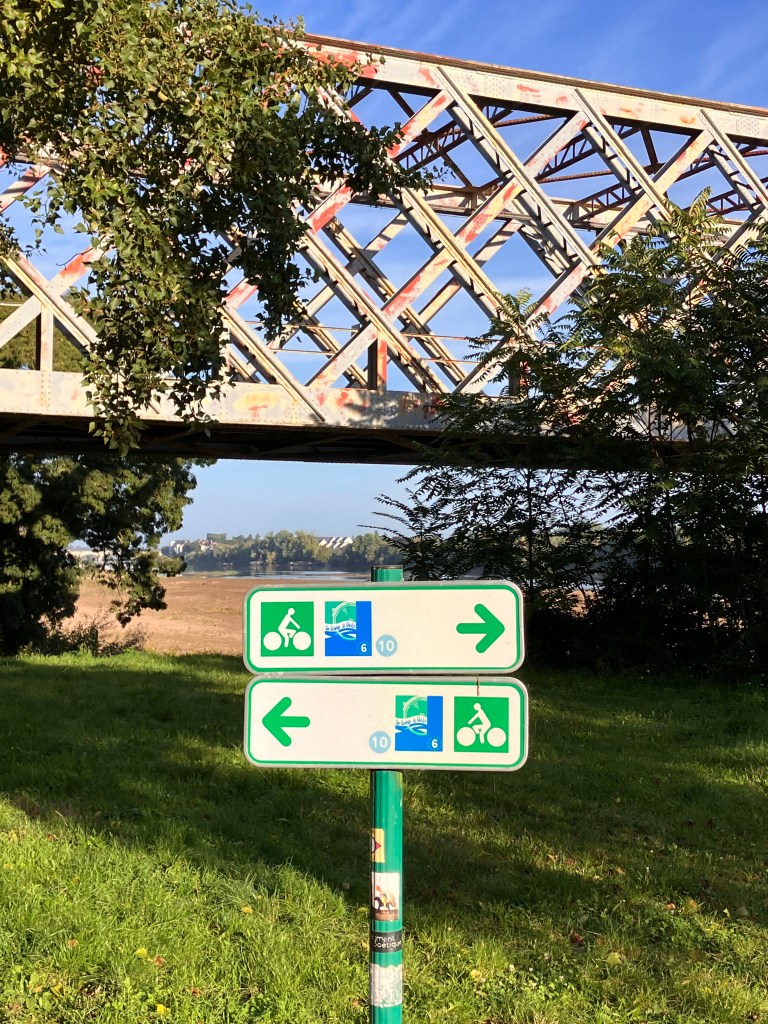
Ah…La Loire à Vélo.
Recovering with a pastry and juice break.
Historic and still active fishing shacks, with crane nets, in the delta of the river.
Modern port activities across the river, historic shacks on our side.

With the bridge behind us we headed up the Loire, enjoying the wide open grassy marshlands and plenty of bird life. Our destination for that night was Nantes.

Good signage. Nantes here we come.

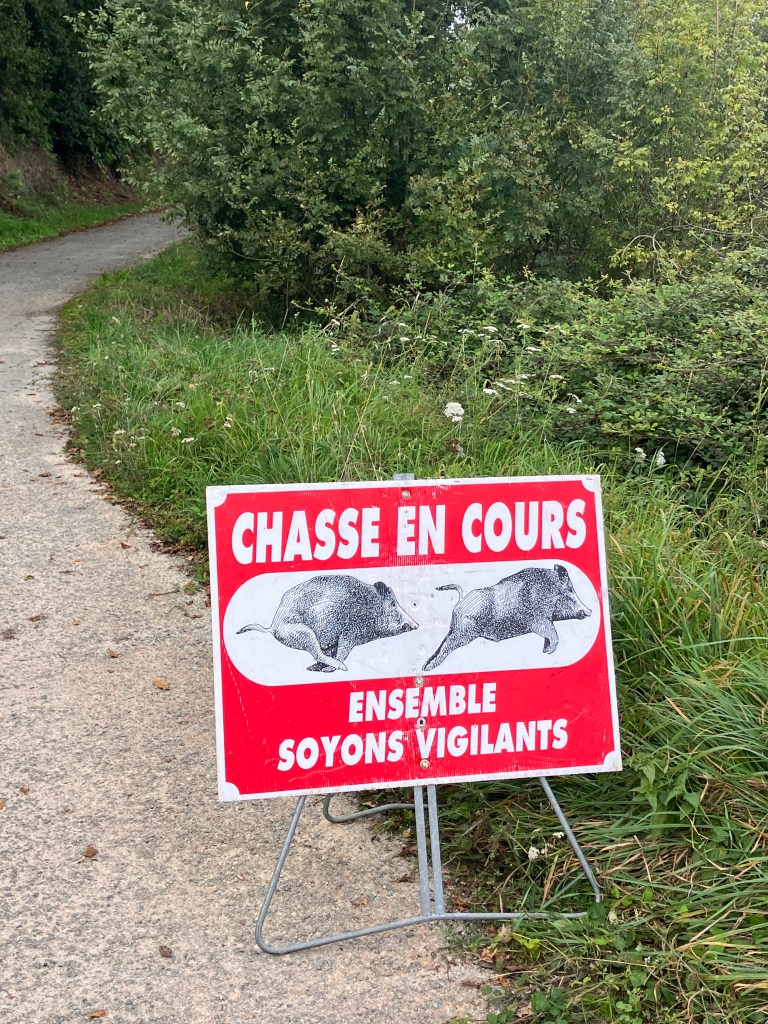
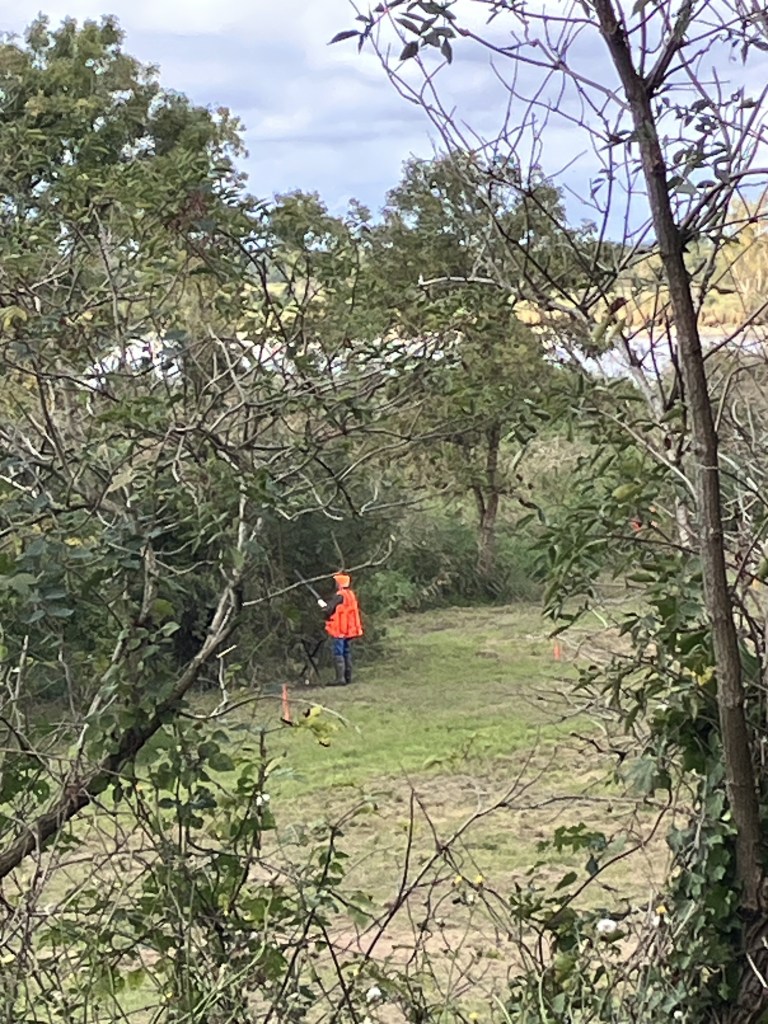
Hunting season starts in France in September, which is when we are usually bike touring. We had seen boar hunts in the past and got out of the area as quickly as we could. This trip we saw even more hunting going on since we were right at the beginning of the season opening.

Look out for cyclists, tractors, and hunters.
High visibility vest does double duty.

It was a bit nerve wracking to ride a stretch between Mt. St. Michel and St. Malo and have hunters shooting in the fields on either side of us. That’s when we got out our fluorescent accessories, which are always a good thing to have with you when cycling.

Along the Loire it was boar hunting. Complete with baying hound dogs and signs along the road.
Some recent hunting tragedies mean the rules have tightened up a bit, this boar hunt looked to be very organized.
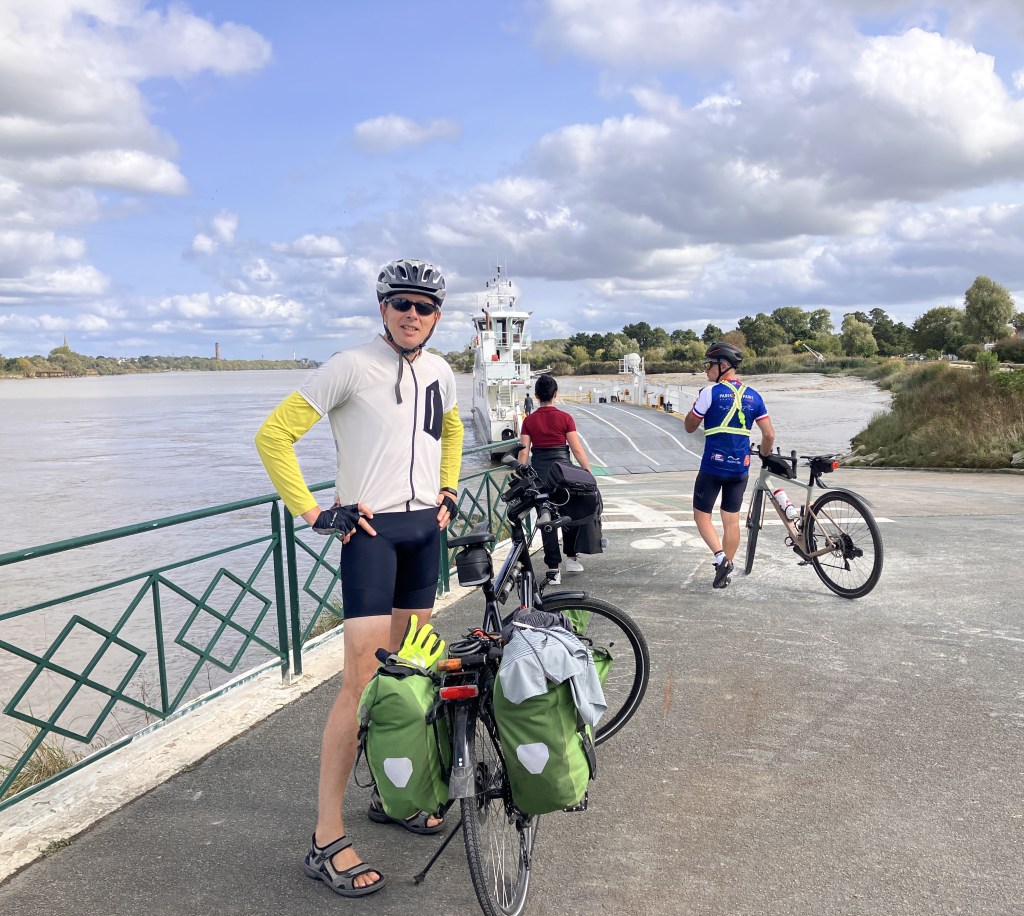
Free ferry across the river at Le Pellerin to get to Nantes.
Drat. Too short a ferry ride to even get my book out.
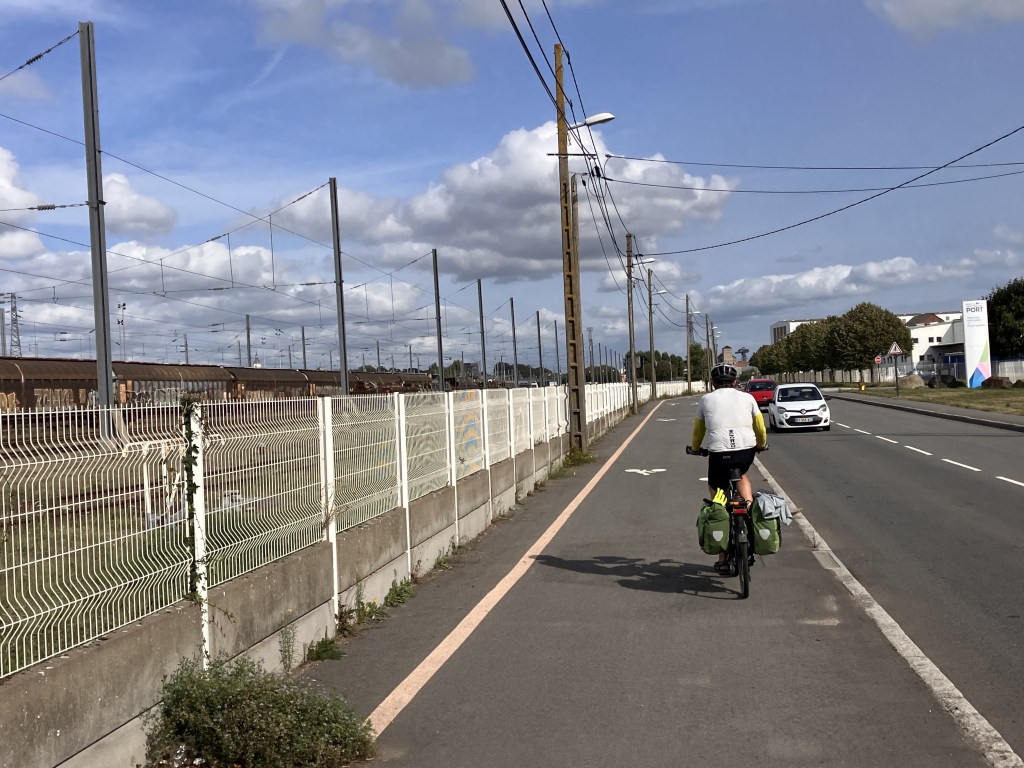
Not every stretch of road is picturesque. Coming in to Nantes along the train tracks, still a nice bike lane though.

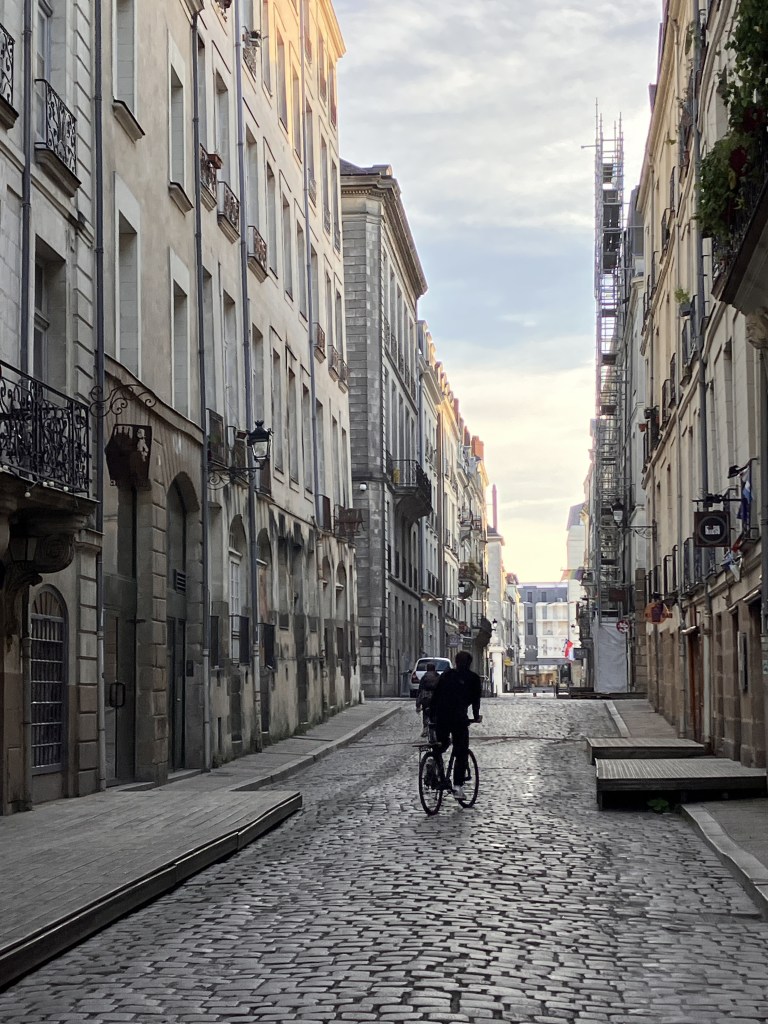
If you are ever looking for a lovely city in France that is less crowded, and a bit more off the tourist radar, we highly recommend Nantes. We spent two nights there and were very impressed with work that’s been done in the past few decades to make the city greener and give it a really pleasant ambiance. I think it’s another of those places to visit that the French are well aware of but maybe no one tells the tourists? Well, we’re telling you – it’s lovely. So many beautiful streets in the old town and lovely plazas where people gather, bike lanes, trams, and even with a World Cup Rugby match on it was super enjoyable.

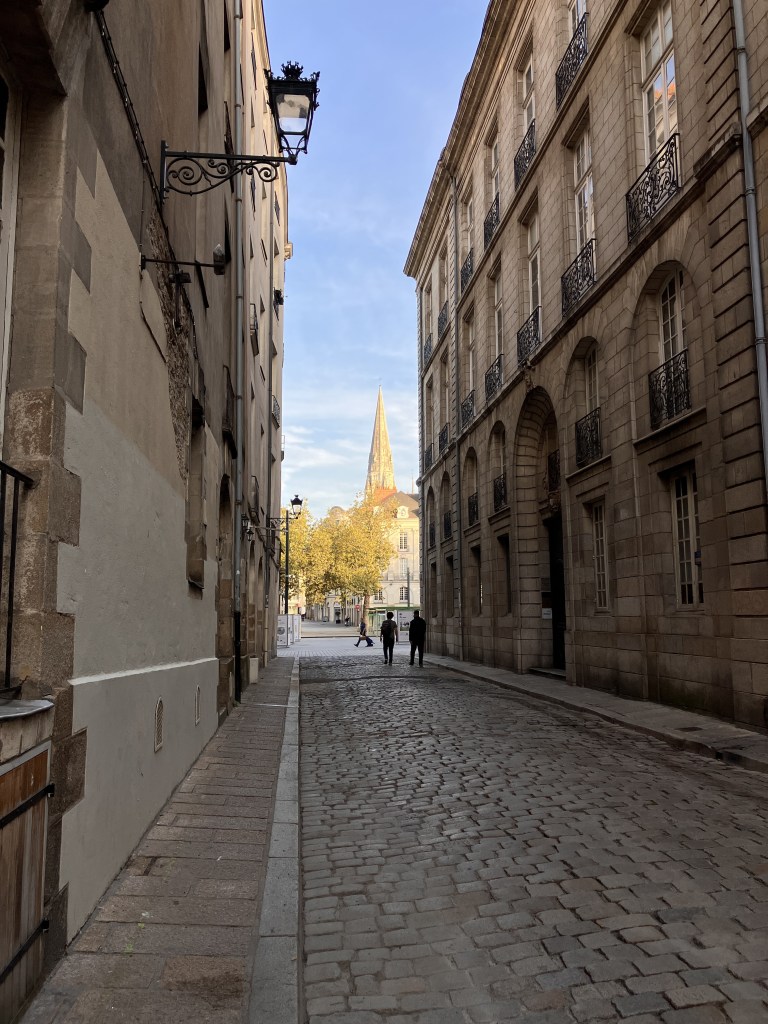
One of the streets of Feydeau, previously an island in the river until the arms of the river around it were filled in between 1926 and 1946.
Another street in Feydeau, looking north towards Centre-Ville.
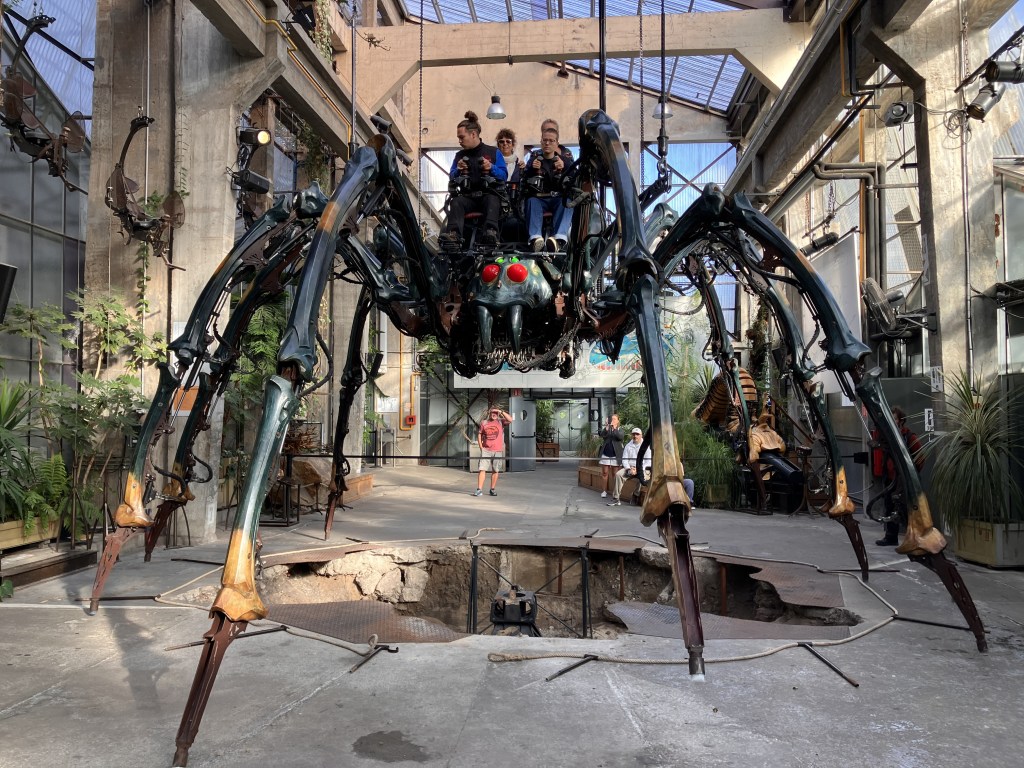
A rest day means we get to visit sights, like Les Machines de l’Île , on an actual river in the Loire. A steampunks dream. Here, a spider to give you nightmares.
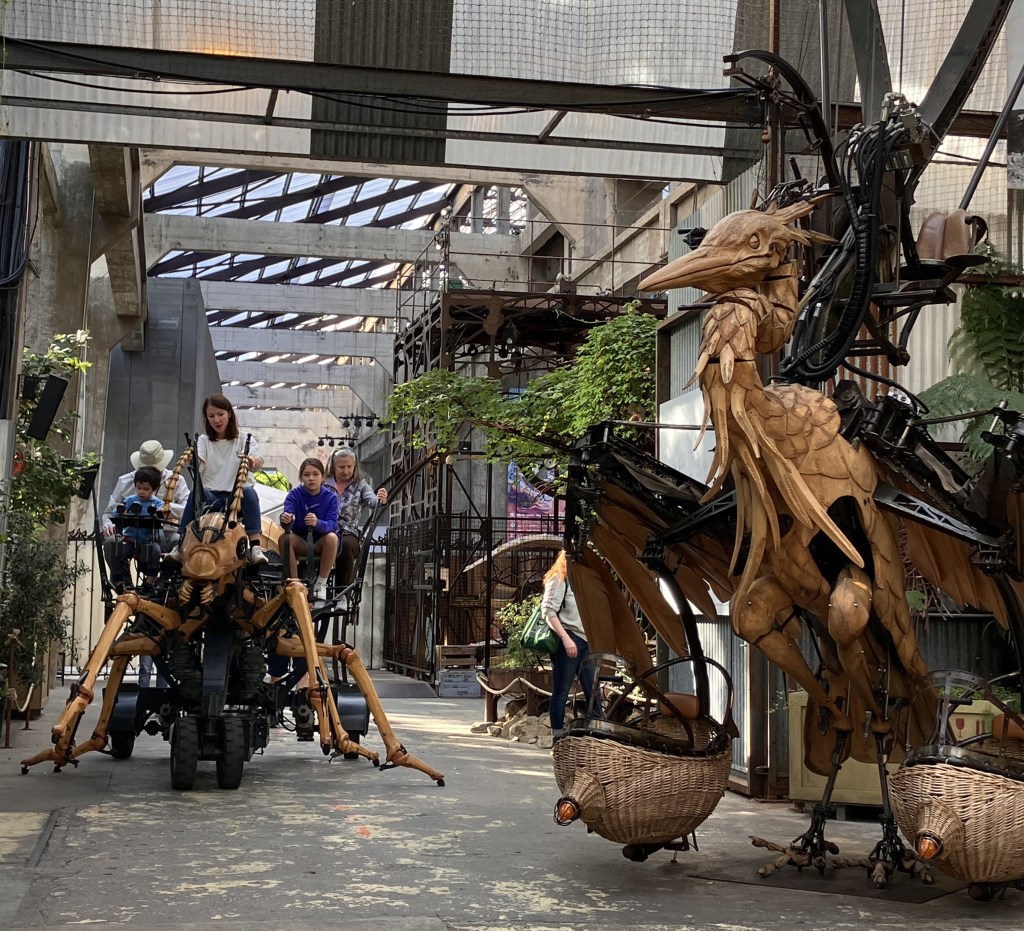
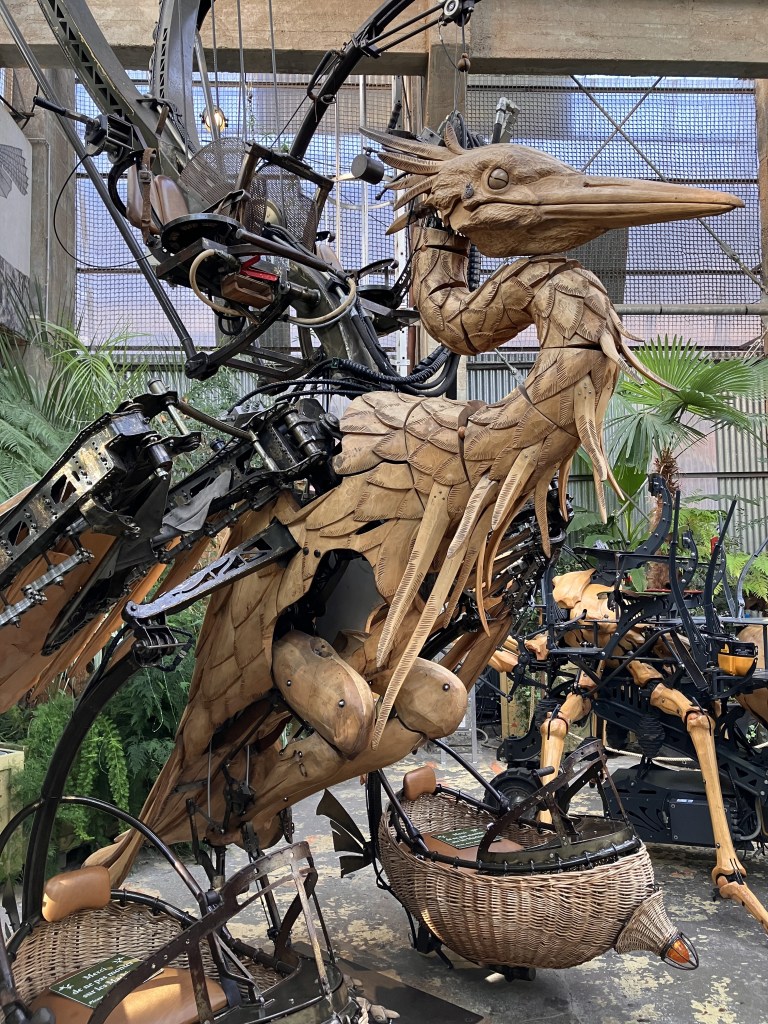
An old industrial site houses loads of mechanized wood and metal animals, which the workers load up with visitors and operate. Ever wanted to ride a giant ant?
This heron raised up on a gantry crane and “flew” with passengers on the back and in the two baskets.
Beautiful old buildings.
Tree shaded plazas with streetcars.
Château des ducs de Bretagne. I do love a moat.
Off to the train station. We need a boost to get us back to our home base near Geneva. Enough lallygagging.
Bikes loaded on the hooks (our least favorite train set up – notice how far Rich’s handlebars stick out into the aisle.).
On the train and still travel planning.
90 kms later and off at Angers. Three cheers for a ramp off the platform. So much easier then elevators.
The high water mark from an 1856 flood. We stopped for the water tap but I appreciate a good flood information board.
“It was after the big flood of the Loire in 1150 that Henri II Plantagenêt, Count of Anjou and King of England, ordered the construction of a dyke all along the Northern part of the riverside.” Riding on the levee was fascinating.
We were headed to Saumur for the night.

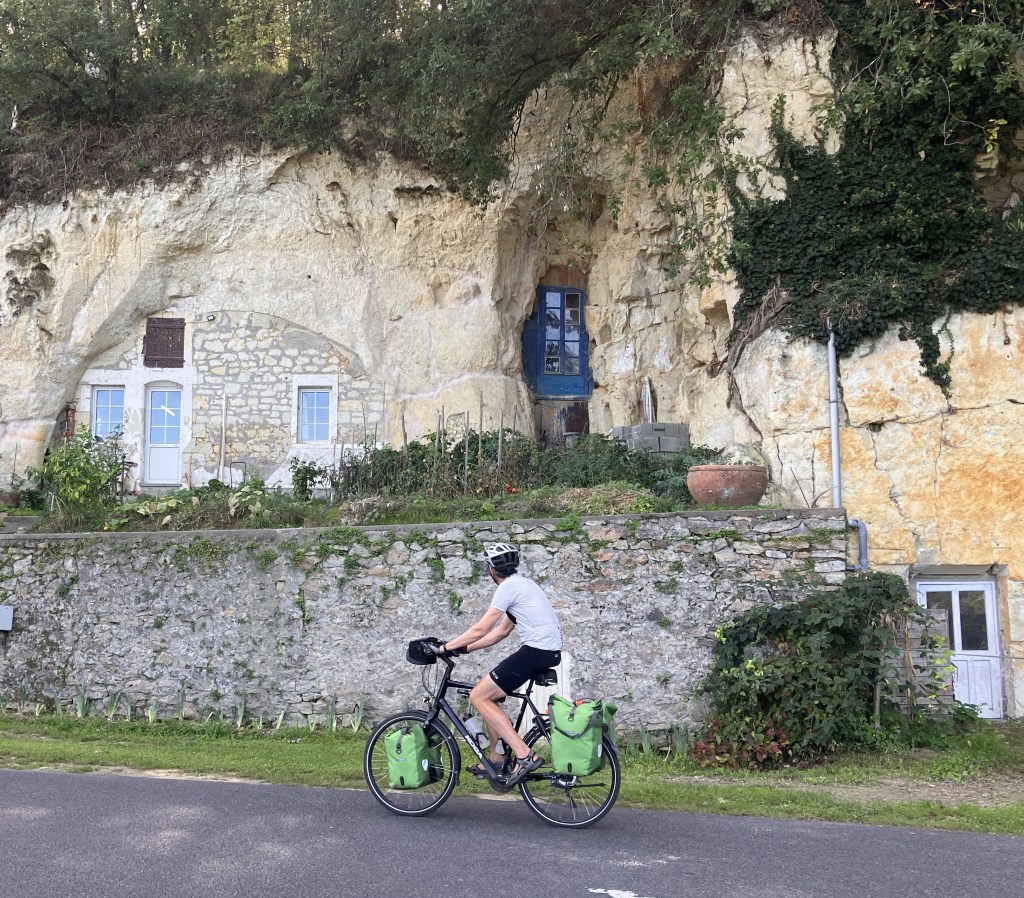
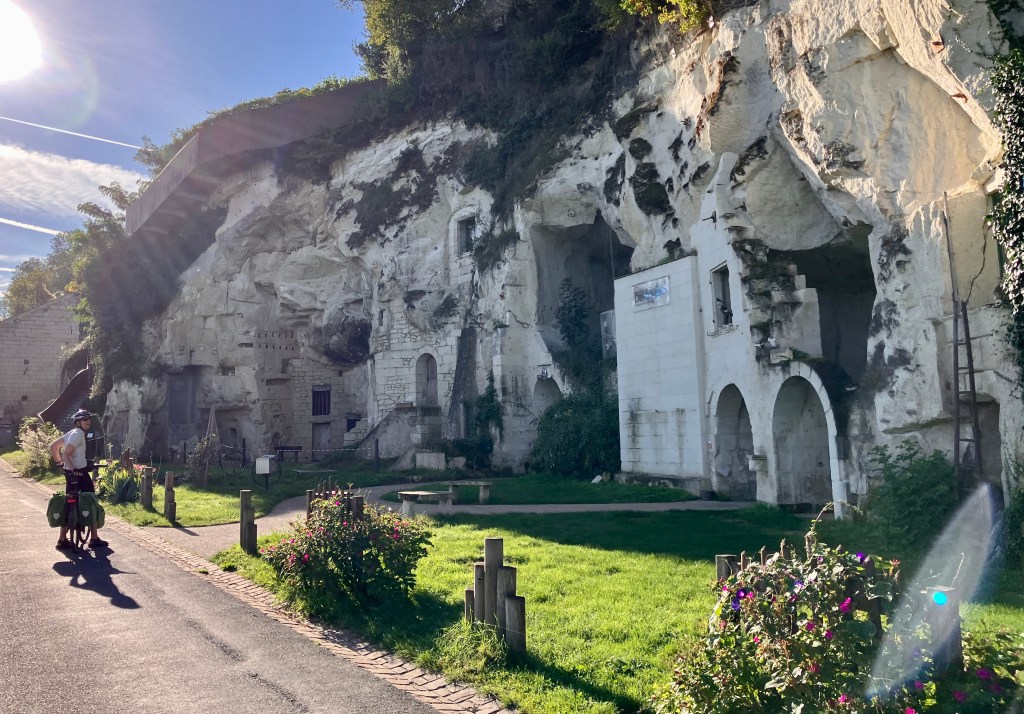
Once a delicate San Franciscan always a delicate San Franciscan. The weather was lovely, if a bit warm for us. 82f/26c as we rode along, and a bit hotter in the afternoon. Thankfully as we rode up river we entered the Tuffeau stone region: https://en.wikipedia.org/wiki/Tuffeau_stone Where there is tuffeau there are caves created by the mining of tuffeau stones. Where there are caves there are streams of cold air coming out of the caves to cool hot cyclists.

Ahhh. Natural air conditioning.
People have been living in the caves since quarrying or mining of the stone began in the 11th century.

Riding along and getting a blast of cold air, sometimes from a cave you couldn’t even see through the undergrowth, or from one set up as storage for nearby cave house dwellers, called les troglodytes, was very refreshing. We didn’t swim in the Loire, but we did stop and wade into the refreshing water and tried to convince the small fish to nibble our toes – no luck.

The school of fish were curious but cautious.
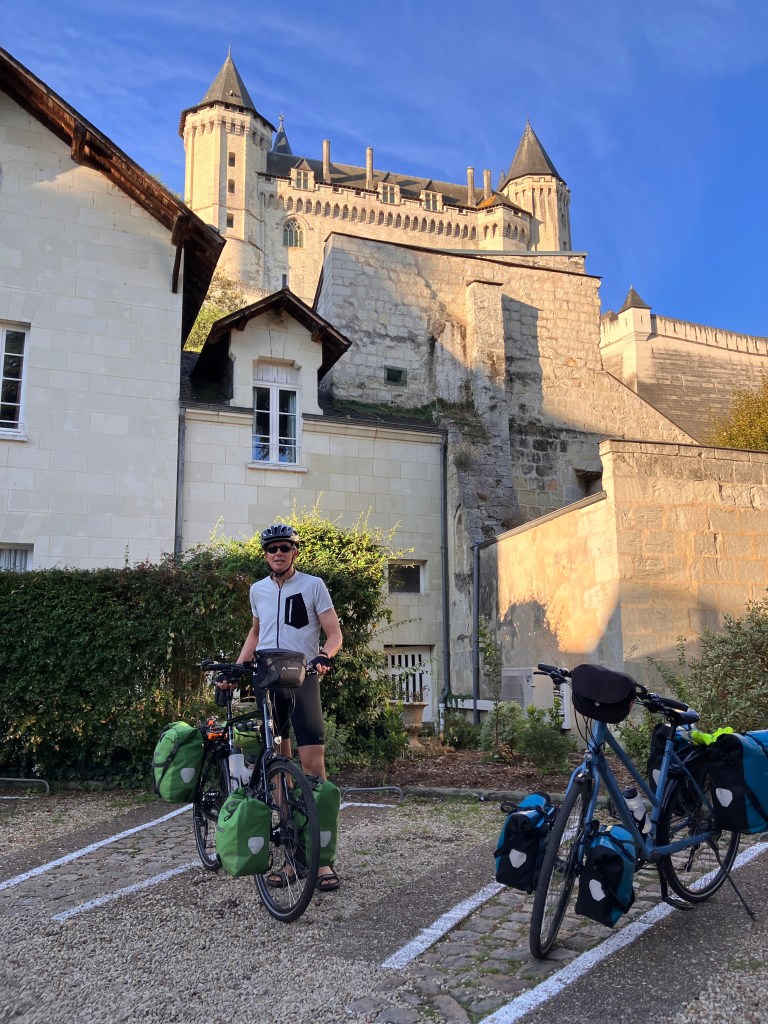
It’s nice to arrive at your hotel in time to shower and relax. Rich is in the swimming pool. Château De Saumur in the background.

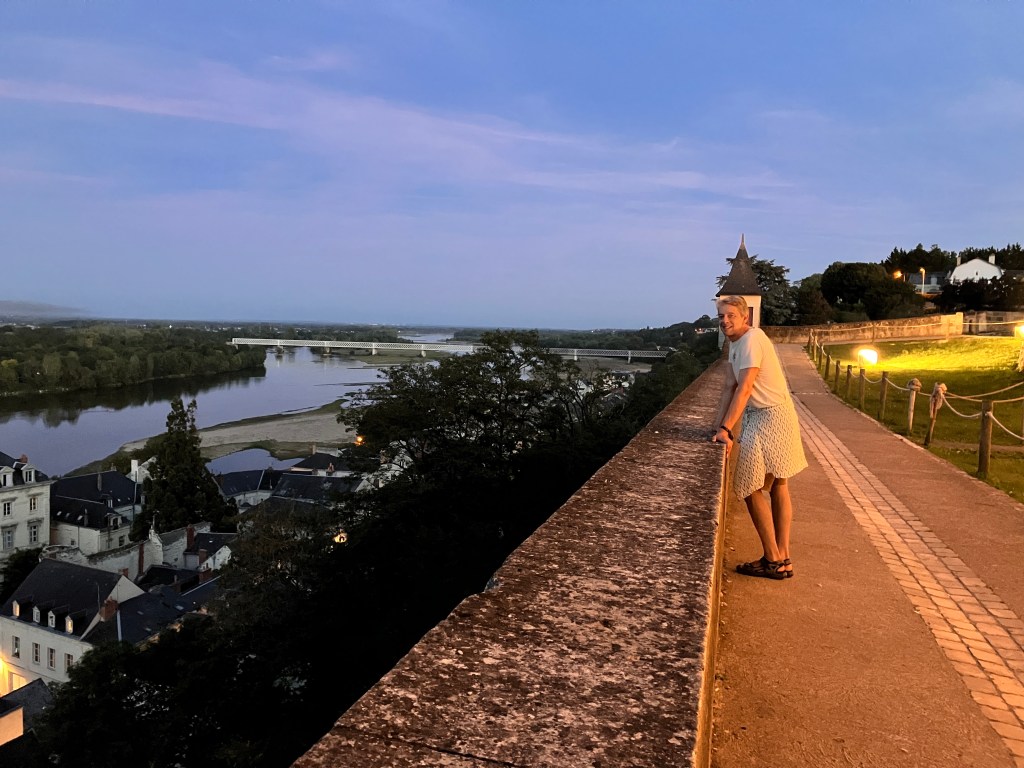
The lovely light color of the tuffeau stone is luminous in the evening light. After a nice galette dinner we walked up to the Château to admire the view and watch bats swirl around the walls.

Another advantage of a post dinner visit is having the Château to ourselves.
Rich admiring the view of the Loiré.
You’d think we’d be tired, but no, plenty of energy to take flattering evening light photos.
I’m distracted by the bats.
Loaded up and ready to go.

We were starting our last full day of cycle touring, from Saumur to Villandry, about 55 kms. It was going to be another pretty hot day so we wanted to get going and try to beat the afternoon heat. From Villandry it would be a short ride to Tours to catch a train to Lyon, one night in Lyon, and catch a train to Geneva.

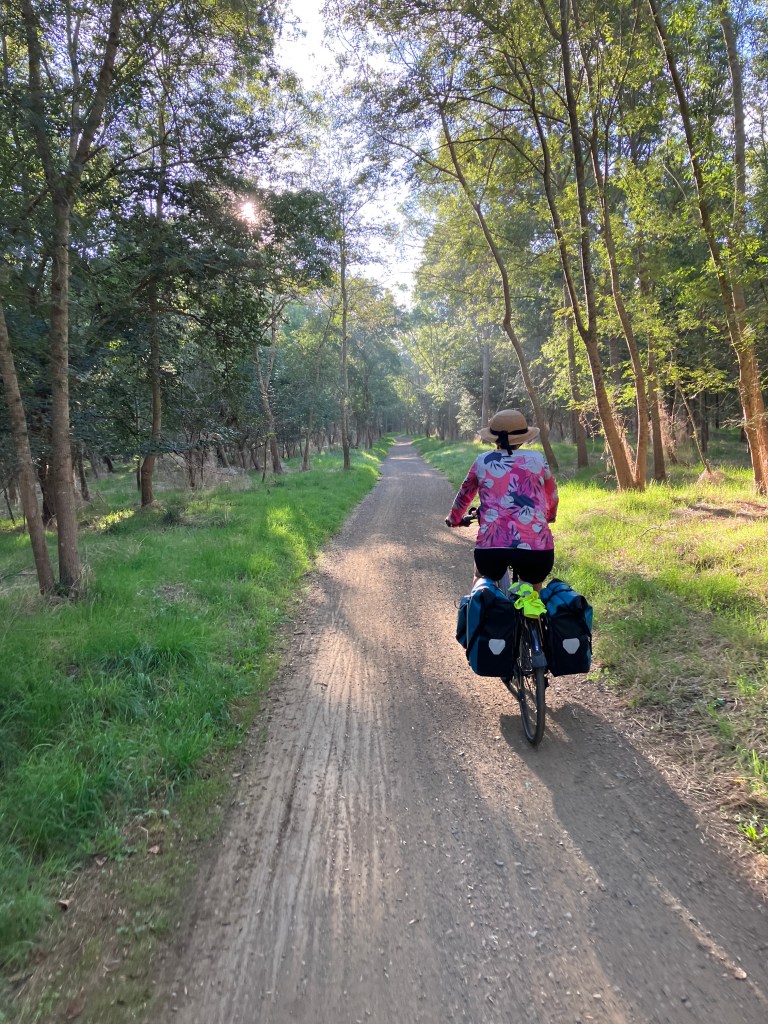
Back to our river path.
Making some good time through the shady trees.
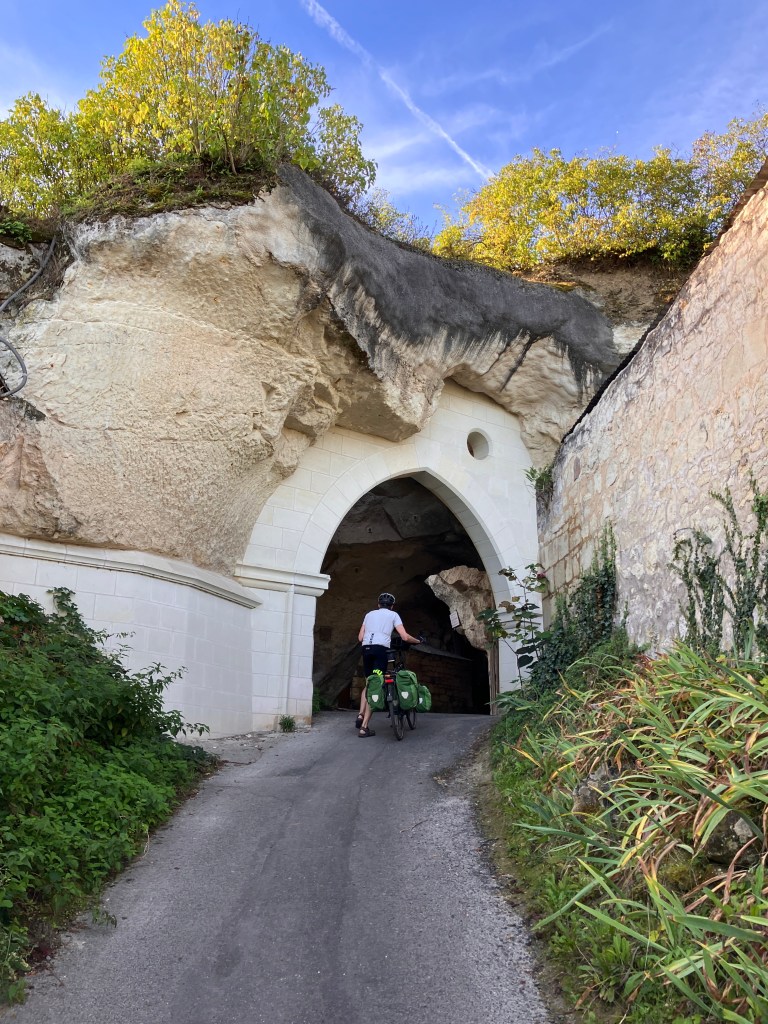
Wait! What’s this? Troglodyte Route?
No way! The bike route goes into the cave.
Well there goes any idea of a fast day.
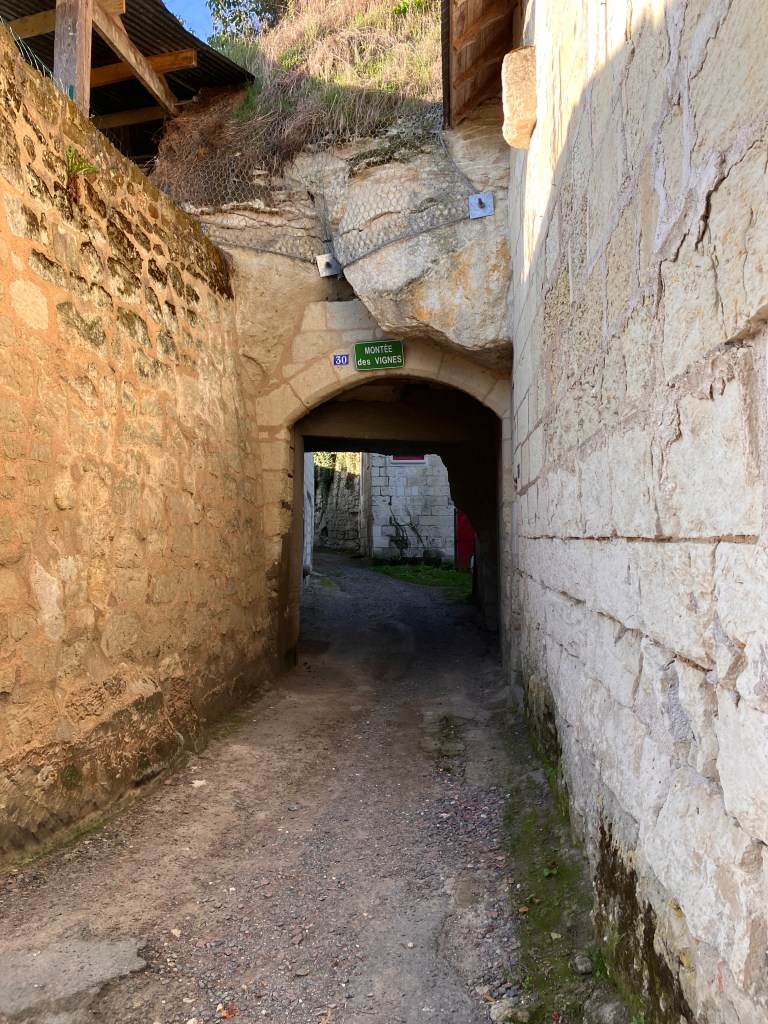
It was an old road for commerce winding into the mountain. Where rock had been mined people set up houses and food storage.
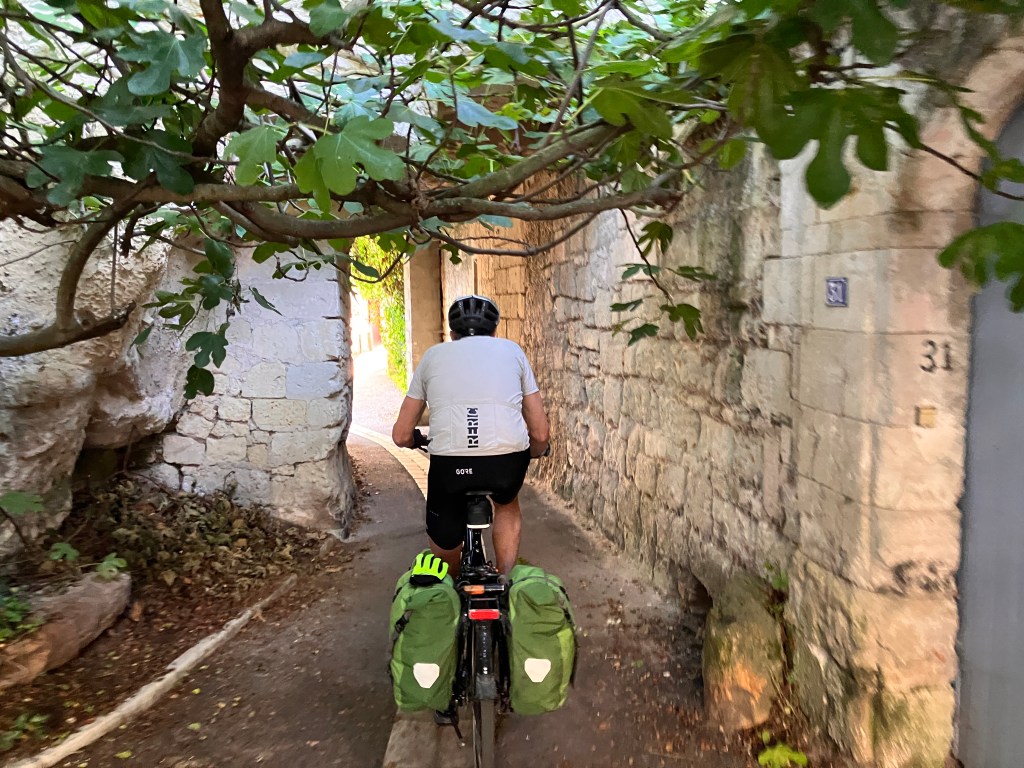
Rich ducking under an impressive fig tree. Notice the door and house number to the right.
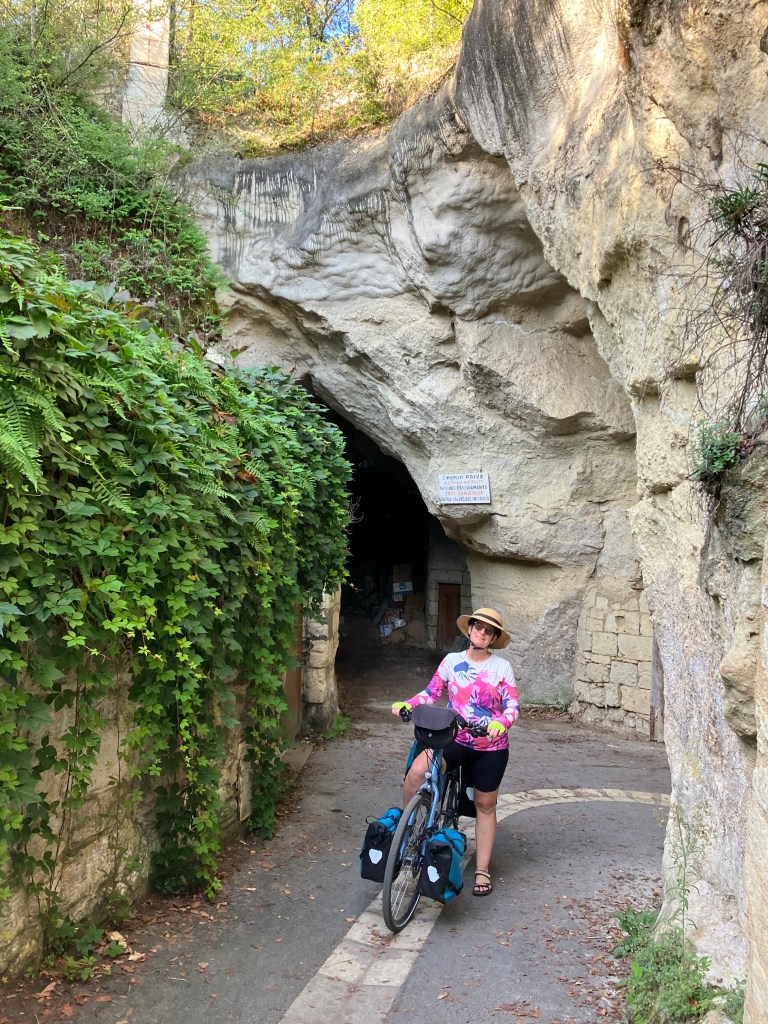
Out to the sunshine again.
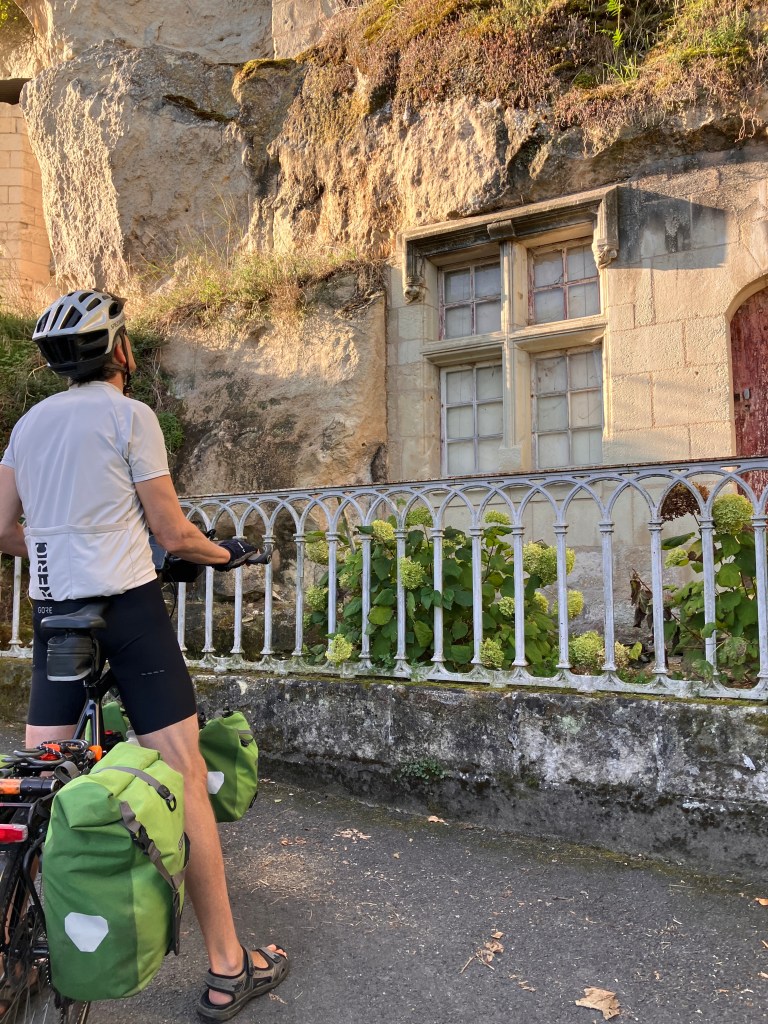
The little driveways leading to cave houses are so intriguing.
The cave houses stay the same temperature year round. Nice on a hot day like this one.

The former quarries or mines have been turned into houses, restaurants, wine cellars, and mushroom growing caves.

Really good info plaques. Of course I don’t speak French so I have to stop and Google translate each one.
We’ve made it less than 7km so far.
So unique. So shaded. So cool.
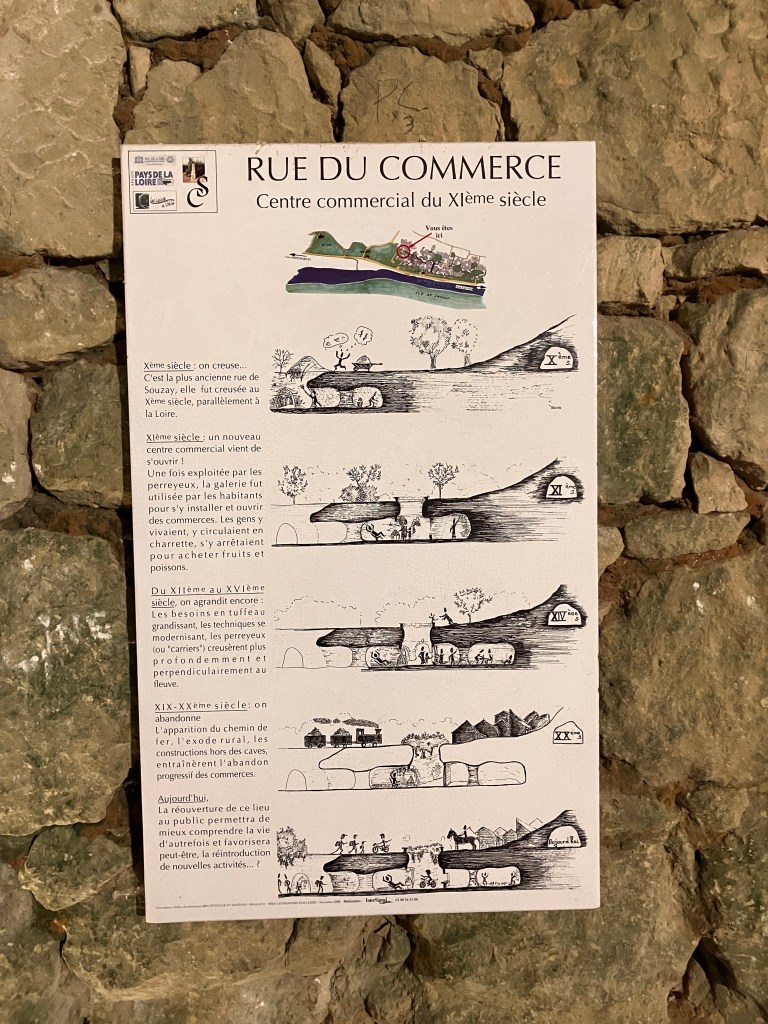
A good pictorial of the history of the caves. Of course I still had to translate it. Not getting far this morning.
They had little stone buildings in the vineyards connected to a shaft down which they tossed the grapes to the press.
We emerged from the cave streets of Souzay and were in the vineyards. It was harvest and crush season and trucks were trundling to and fro.
Grapes ready to harvest.

We both noticed that our tires were making funny noises and both thought we’d gotten flats. That slightly velcro noise a bike tire makes as it’s losing air. Worrying. But we realized that the trucks carrying grapes, and carrying stems post crush, had left a sticky residue on the streets which was now stuck to our tires making them sticky. We’ll take sticky grape juice over a flat tire any day.

Nice pavement. A bit sticky though.
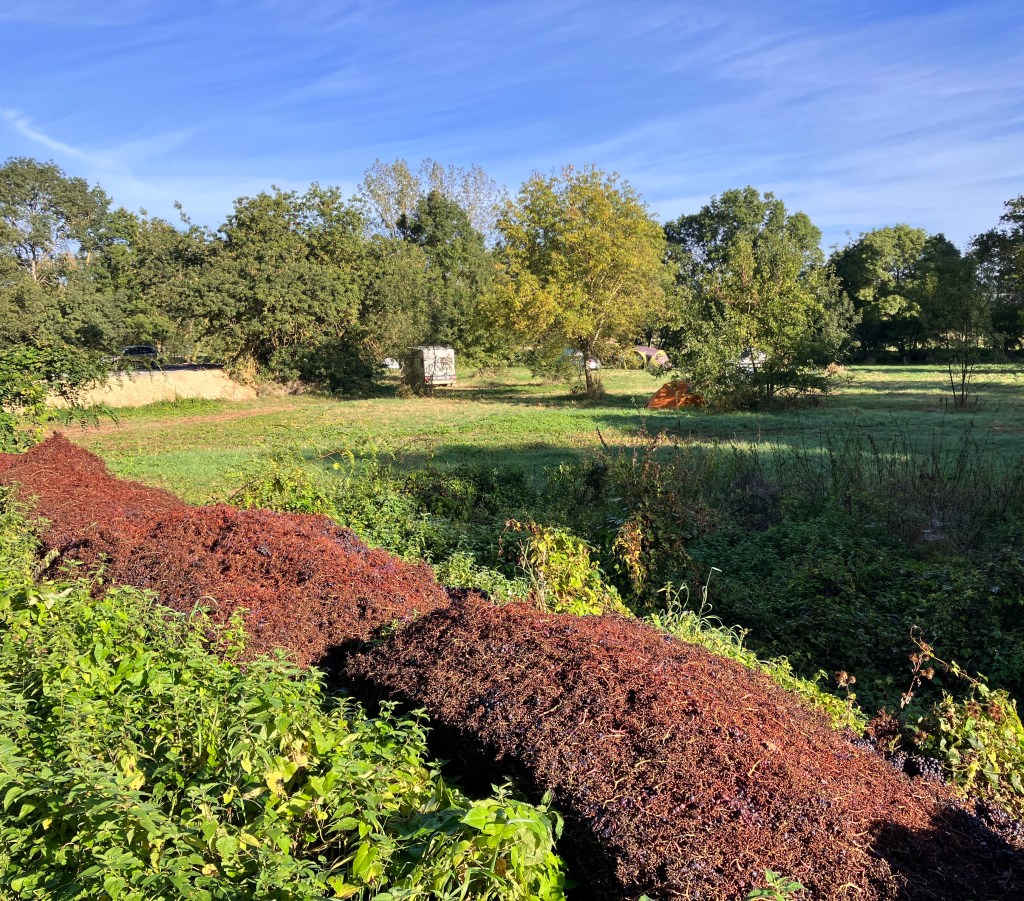
Stems dumped on the edge of a field. You could smell the crush everywhere. That wonderful ‘making wine’ smell.
Art galleries and restaurants. All in caves. We will definitely come back to this area again.
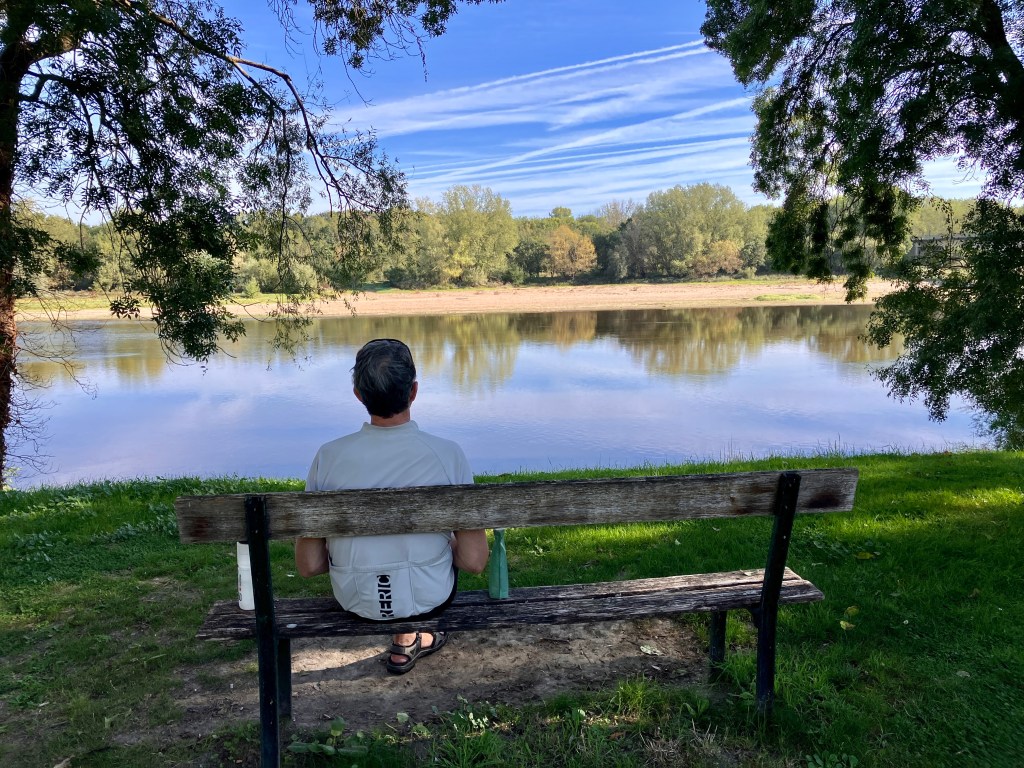
Back to the river. A shady bench to take a break.
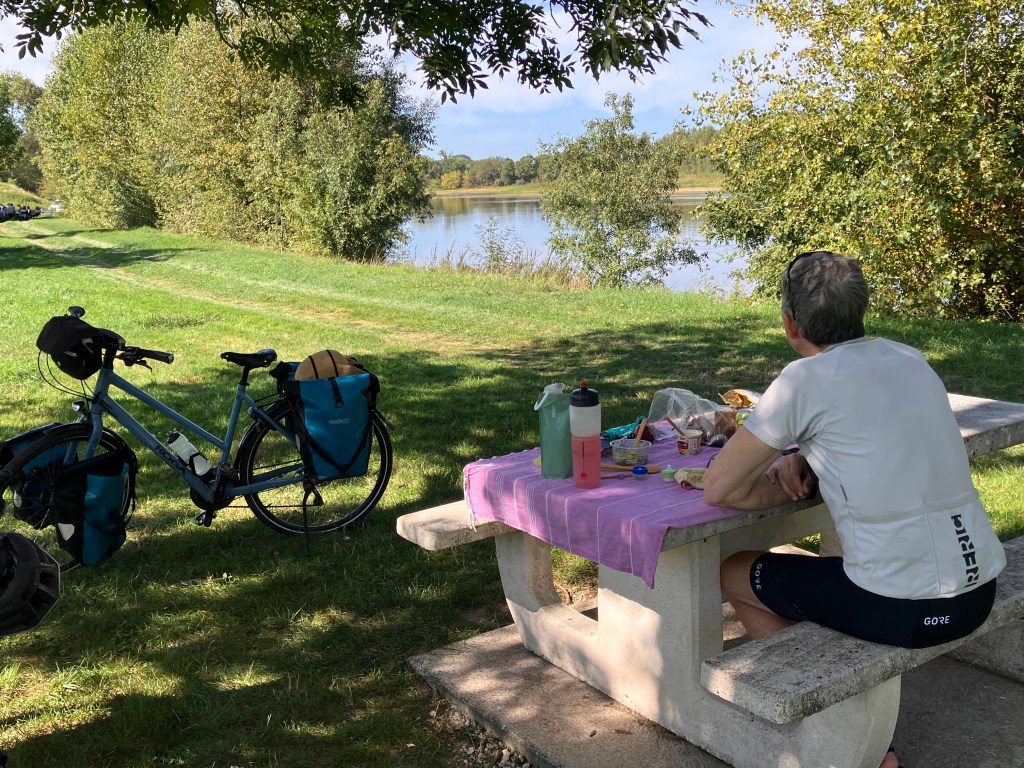
A well timed picnic table for our lunch stop. We are now riding along the sunny levee road and the temperature is climbing.
The river to the left, I’m on the levee road, and the houses to the right of the levee. You ride along at the level of their upper floor windows. And sunny.
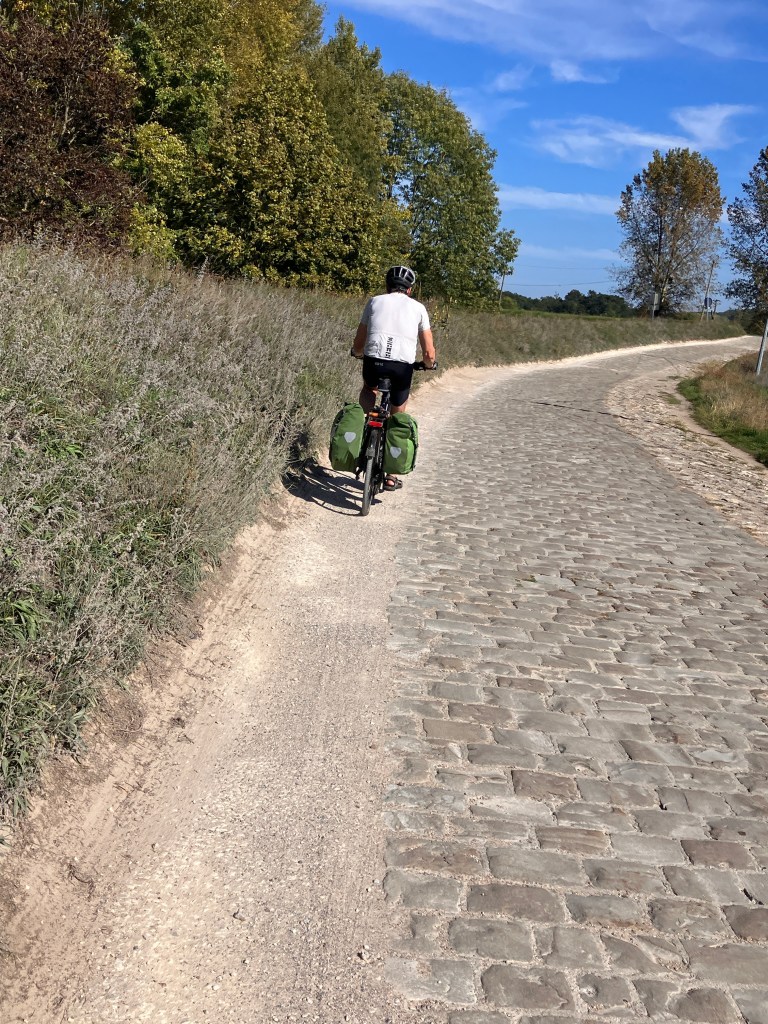
Rich avoiding the pavé by riding in the narrow dirt shoulder. We know this trick from many years of watching Paris-Roubaix.
Ah, a tree shaded lane to Villandry, where our hotel is …at the top of the hill!
Good mood soon recovered.

The only upside to a hotel at the top of the hill is the ride back down in the morning. And the view. We headed out to catch a long local train to Lyon. Most train routing would involve a trip up to Paris and back down to Lyon by TGV, but the slower local train is worth the extra time since we wouldn’t have to change trains with our bikes. I appreciate the opportunity to read on a nice long train ride.

Now we’re on the Cher River, and it’s cooler.
Autumn colors coming along.
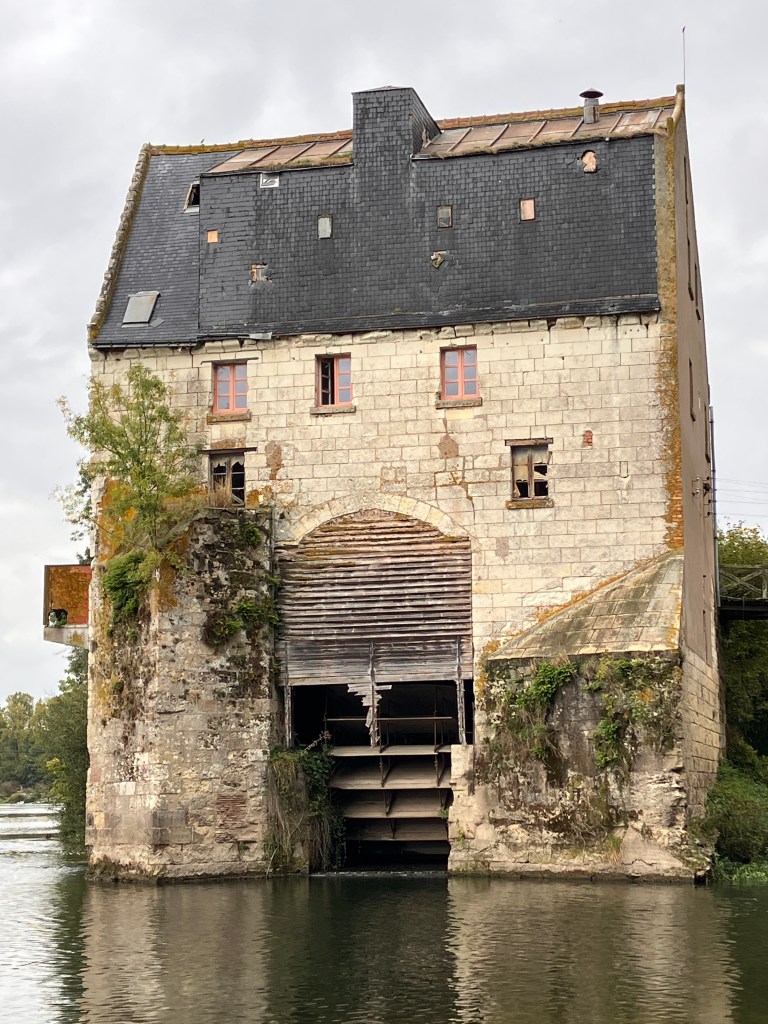
Grand Moulin

“Built on the river Cher by Jacques de Beaune, François I’s Superintendent of Finances in the first quarter of the 16th century, The Great Mill is noteworthy for its sliding mechanism suspended above the water. This ingenious mechanism, which is usually used between the arches of bridges, enabled the mill to work all year round, regardless of the water level.” This mill remained active until 1973, when a new mill was built just inland.

Fields of brown sunflowers say it’s time to head in for the season. And we’re almost out of Schengen days.
Tours train station. That’s our train arriving behind Rich, one platform away.
Bikes secured. Ready for the six hour trip to Lyon.

We had a nice night in Lyon, another very bike friendly city. After a little discussion with the bike friendly hotel which initially wanted to charge us to park the bikes in their garage, the manager saw our point about being bike friendly and relented. We had a nice Thai meal, went to a craft beer bar, and to bed. Big city advantages.

Enjoying the river path in the morning before we ride to the train station.
A direct ride to the train station on a protected path.

The train from Lyon to Geneva is about 2 hours, then we were going to ride all the way to our home away from home, our good friends’ house in the Vallée Verte. It was our first time riding all the way up the valley, a very scenic 33kms/22 miles, but with almost 914m/ 3,000 feet of climbing. But scenic! Well stocked with snacks and having eaten lunch we headed off. It wasn’t easy, but it wasn’t as difficult as I thought it would be. I had visions of sending Rich ahead to get a car to rescue me, or flagging down a passerby to take my bags and lighten the load – as if my French were up to the challenge! – but I made it.

Up we go.
Hello alps.
Still going up. There was some significant downhill since we choose a quiet route that went over a higher pass instead of direct.
Made it! A nice sense of accomplishment to have arrived under our own power.

Even though we both had tired legs the next day it was wonderful to ride all the way up to our familiar and much loved French home. Four+ months of bike touring was a new record for us. The new bikes really made it fantastic. If you’ve backpacked it’s the same feeling of self sufficiency and being ready to go anywhere. Now, we are in Albania. We took our first flight in almost five months from Geneva to Tirana, Albania. More from Albania soon.

The Happy Travelers with our new haircuts in Triana, Albania.

Winging it through Brittany (and Normandy) by bicycle.

The fearless leader of our tour of Brittany. In Normandy.

Rich and I joke that he is a tour leader with one client: me. He plans routes and navigates, books hotels, fixes mechanical issues on the bikes, and here in France, is also our translator. I provide restaurant and museum research, maintain a positive attitude in the group, and look for cats.

Off the ferry and on the bikes. Parc du Château des Ravalet. Hello France.
The long stone farm buildings are so captivating.

Our tour started later than we normally get riding, the ferry docked at 2pm at Cherbourg, Normandy, and we had a hotel reservation in Port-Bail-sur-Mer, about 42km/26m south. That was our only reservation and destination. The first day riding in a new area means getting used to the traffic and temperament of the drivers, shifting to riding on the right hand side of the road, being charmed by the buildings and gardens, and bonjour-ing everyone I see.

The restaurant across the street from our hotel.
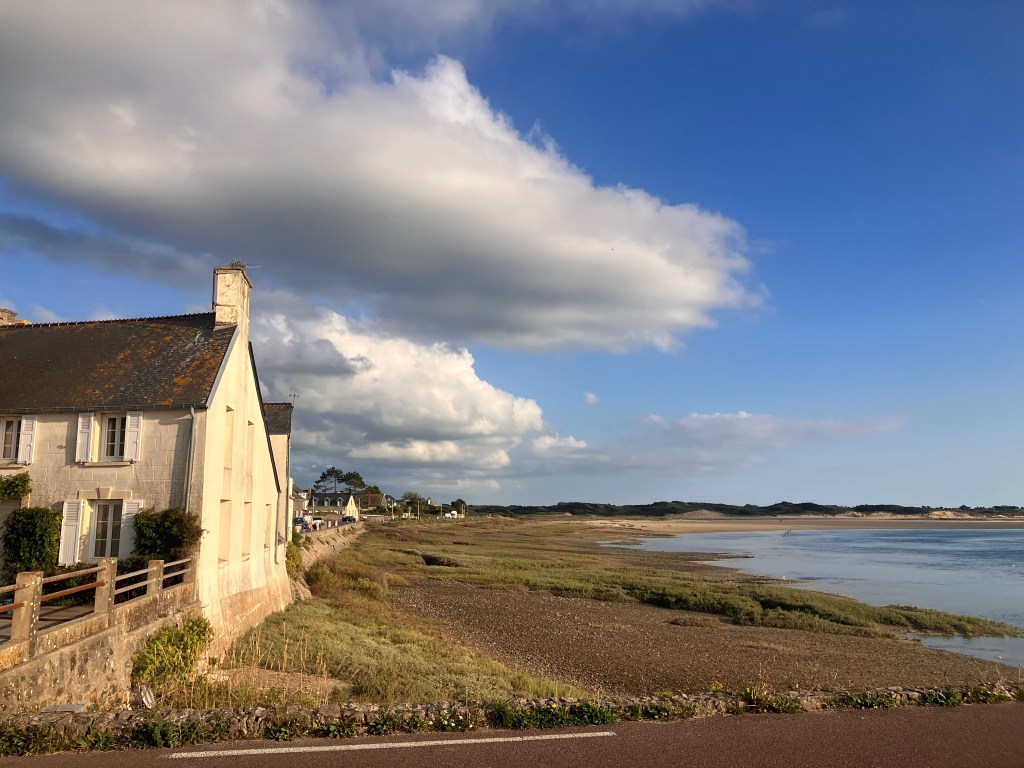
Our first look at the tidal flats of Normandy.
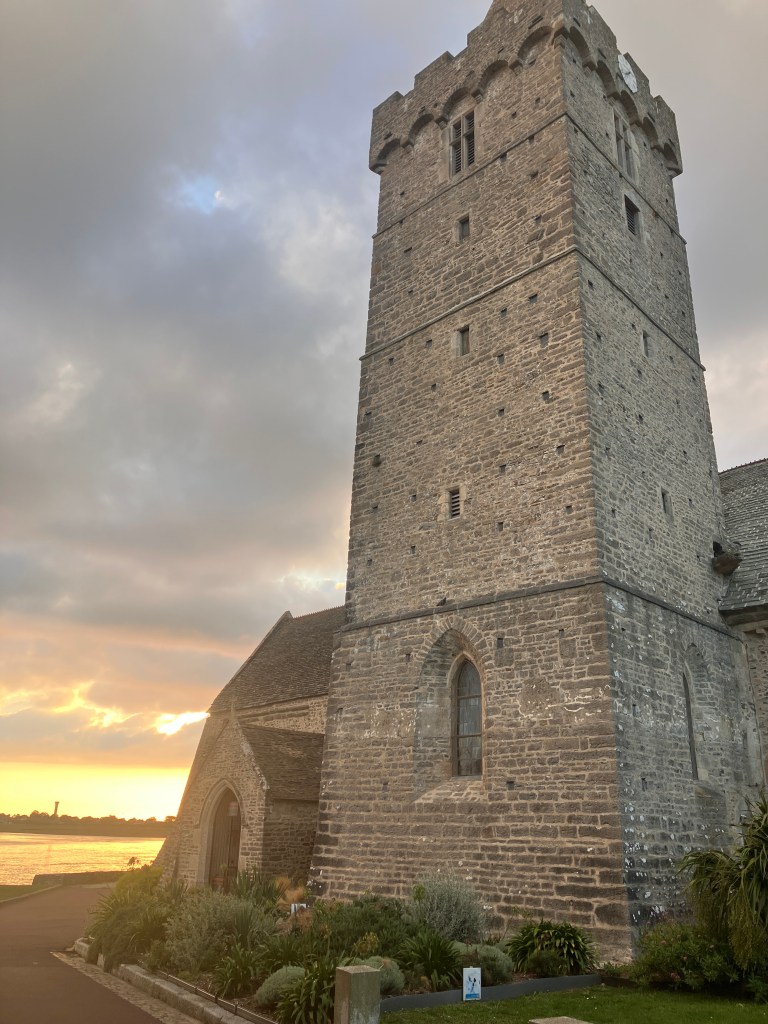
Sunset casts a golden light on the Church of Our Lady.

I get a bit stressed by eating out in France at first. My French is minimal at best, and I can find the handwritten chalk board menus difficult to read.

Oh yes, I’m reminded that I have entered the land of chalk board menus and delicious food.
Moules marinières with frites. An easy choice in the land of seafood.
The tide rushes in so quickly, and the water is so clear.

Switching to bike touring mode again after a lovely summer of long stays at house sits and with friends is a little tough. We tend to stay only one night in places until we need a rest day, but after a long day riding, the checking in, lugging bags, unpacking, doing shower or sink laundry, have dinner, sleep, breakfast and repeat, seems overwhelming the first few days. “Did we get bad at this?” I asked Rich. He was wondering the same thing, but, it only took a few days for what felt like too much, to become normal again.

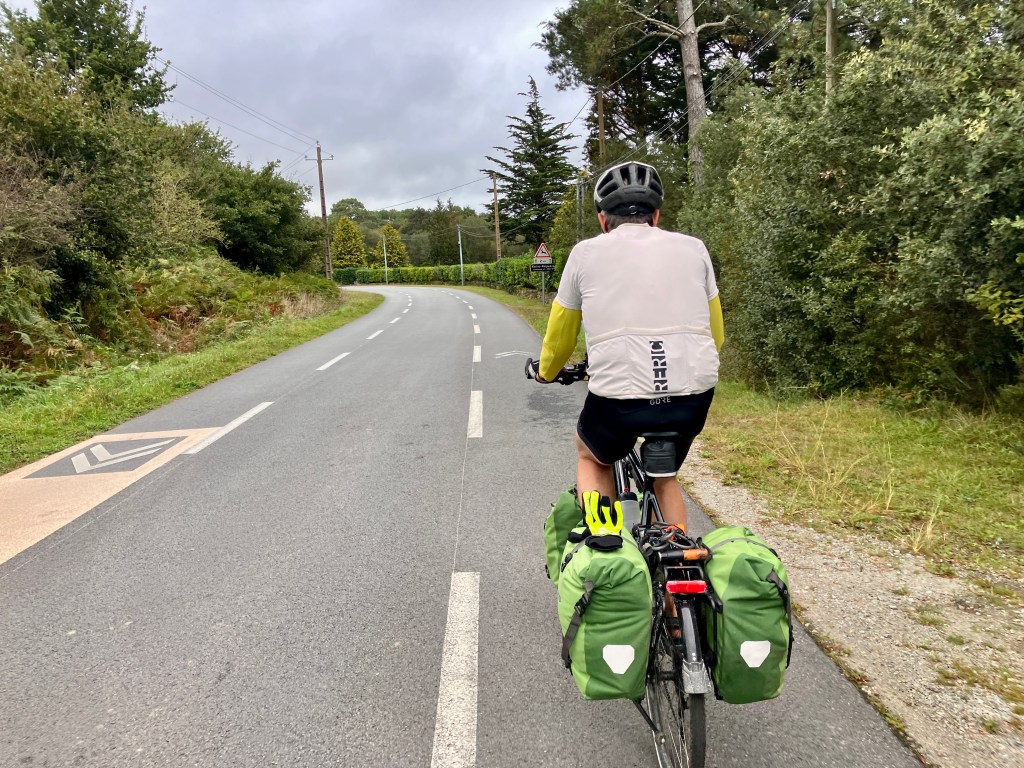
Ready to roll from Port-Bail-sur-Mer. Panniers are perfect on the bike, but awkward off the bike.
On to a multi use trail. Very relaxing riding.
You know you’re in France when…
…you have baked goods strapped to your rack.
The almost daily bakery stop, today in Lessay.
Which is followed by the daily search for a bench in the shade upon which to enjoy the pastries at about the 20k mark. This one was in a cemetery.
And an hour or two later, the search for a lunch spot. A picnic table is a welcome sight.

It’s not all about food, although food is important and delicious here, we also have a lot of stops to read history markers. Our first few days followed the path of General Patton’s Third Army as they broke through Normandy. We had a lot of history to ride though. Towns have streets named 28 of July, and further on 29 of July, to mark the day General Patton and the troops marched through, and bridges have plaques commemorating the march. It’s always spine tingling to read of what the French went through, and how much destruction was caused.

Pont de la Roque, bombed by the Allies to try to prevent the German troops from escaping.
Welcome bike and pedestrian improvements in towns and villages. This road into Granville looked very new.

Over the last few years we’ve noticed France becoming more and more bicycle friendly. Towns have more car free space, speed limits have been lowered nationwide in town limits and signs put up showing that people on foot and bike have priority. Wider sidewalks with bollards, separated bike lanes, and rules for car drivers to give 1.5 meter passing space to bicyclists (1 m in town) have all made quite a difference. We love pedaling into a town and seeing the completed work, or the work underway, as France has pledged a billion euro more to make streets safer for bikes and pedestrians.

We had previously only seen this street treatment in Denmark. Bike lanes and a car lane shared by both directions of car traffic.
In Denmark the bike lanes are red, here in France just marked by a dashed white line.
Outdoor dining in Granville. That’s a bottle of cider.
An extension of summer. Outdoor space still up and running.
Sunrise, Port de Hérel. The view is from our room at the Ibis hotel.
Heading out of Granville, another nice wide bike lane.
How many times will I call a town charming? Bacilly was charming.

Our third night would be spent near Mont Saint-Michel, and it would be our final night in Normandy. We would cross into Brittany just west of Mont Saint-Michel.

Riding the coast of Normandy means skirting a lot of river estuaries, at Le Val-Saint-Père.
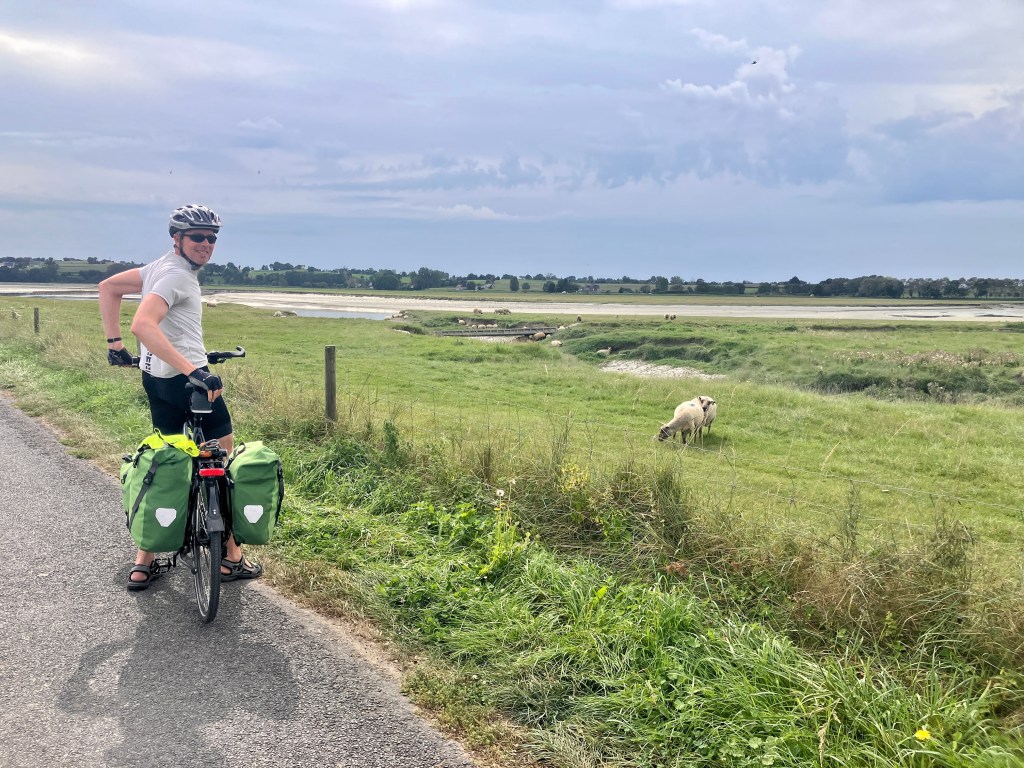
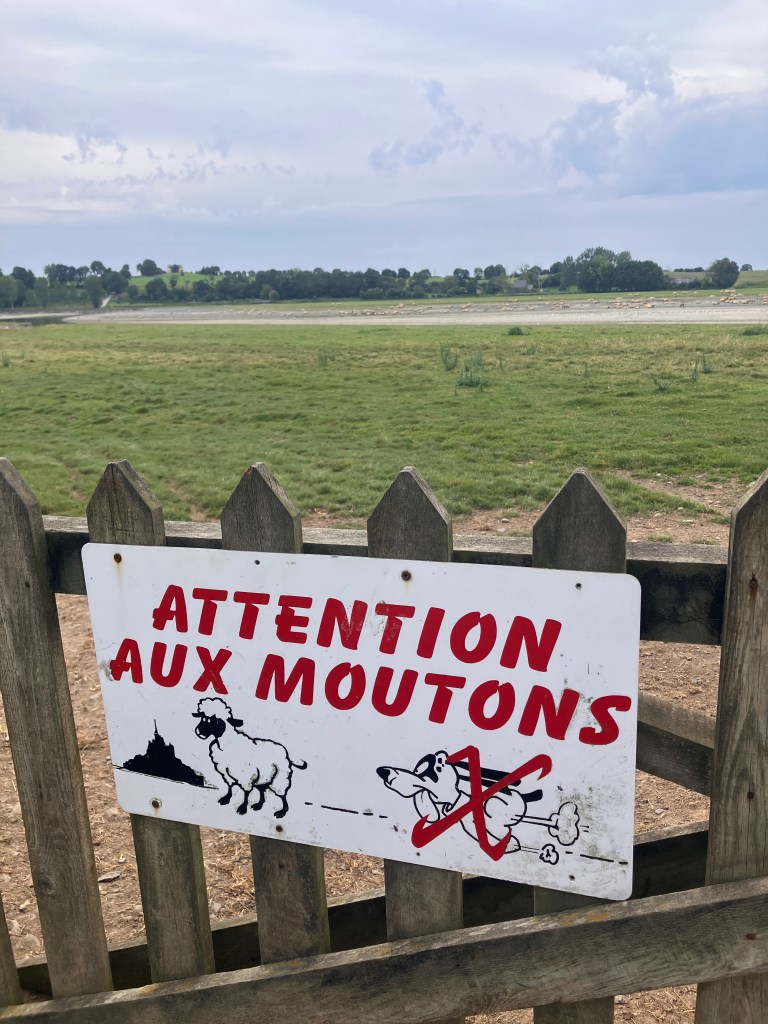
Do not let your dog chase the Agneau de pré-salé (salt marsh lamb). A specialty of the area.
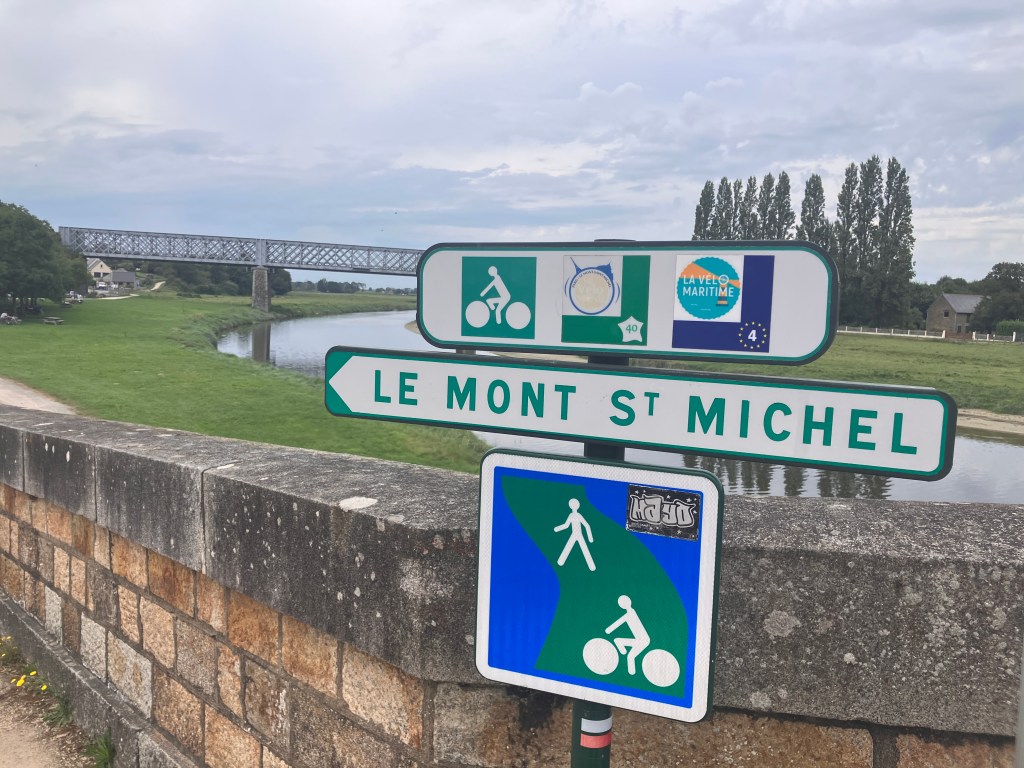
This way to Le Mont.
Now this way. The coast route is squiggly.
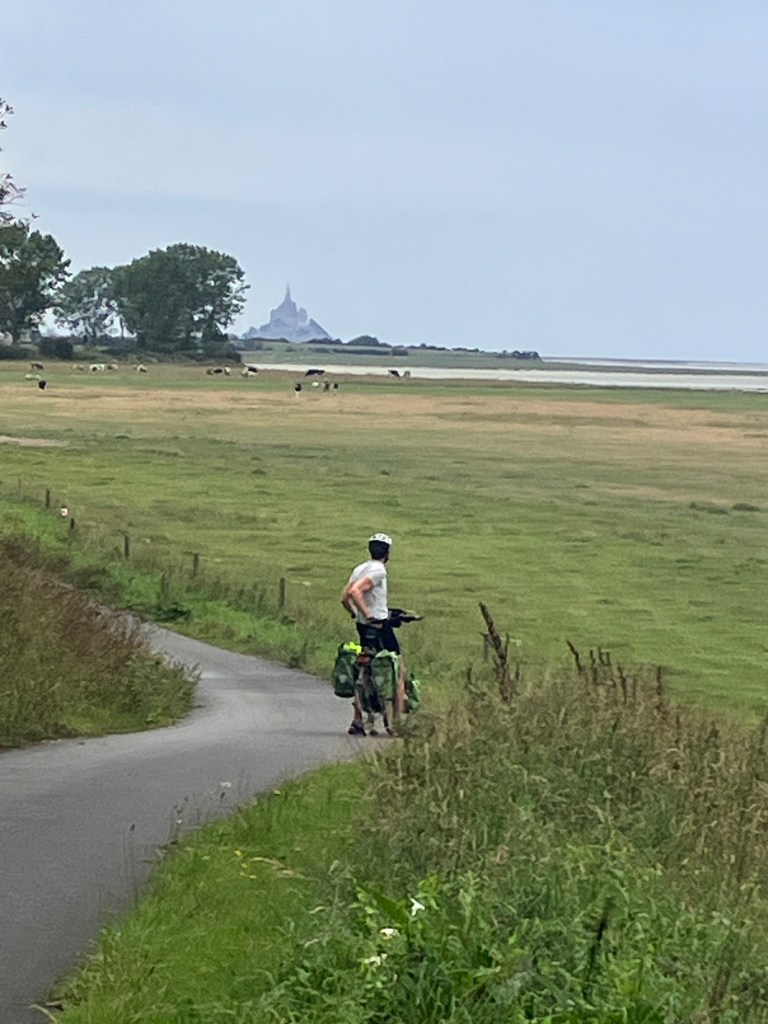
There it is. We’d been catching glimpses of it all day as we rode, but this view – it’s otherworldly.

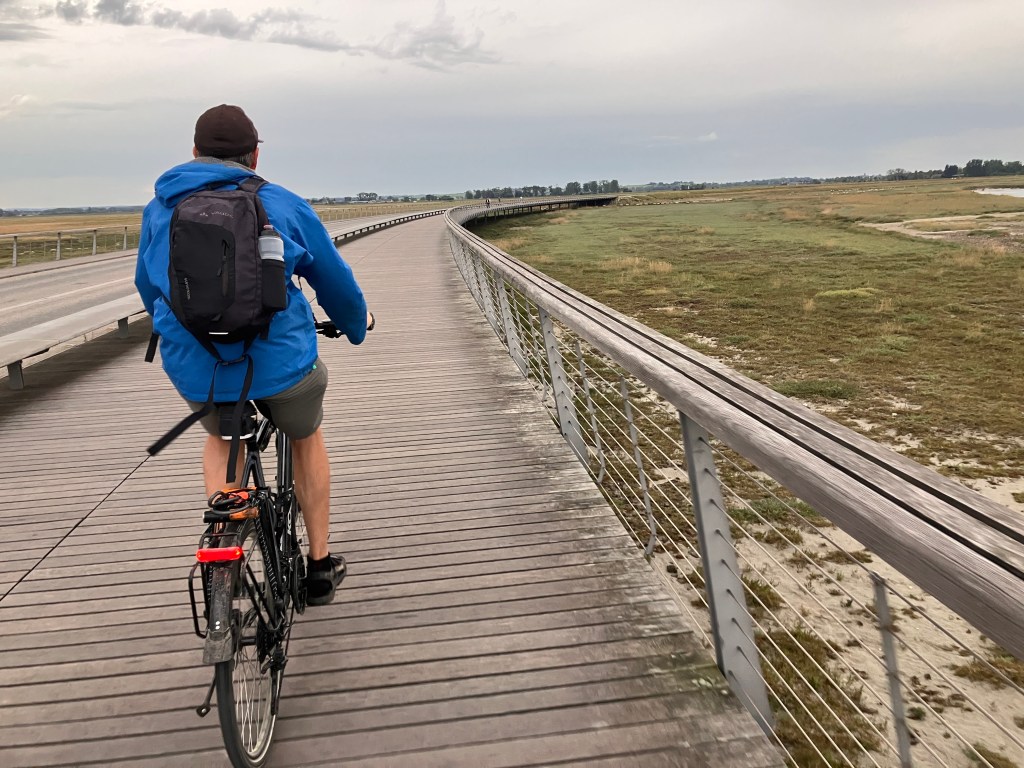
Rich booked the hotel near Le Mont just the day before. Off season means much more availability, even on a Saturday night. We debated riding right out to Le Mont before checking in at our hotel but we decided to check in, shower, leave the bags and ride back out the 5 kilometers so we could lock our bikes and walk around. The causeway leading out to Le Mont is only open to shuttle buses, bikes, and pedestrians.

Hotel Rose. Such character.
But even better, we had a cabin with resident friendly cat whom we promptly named Deuce, for our cabin, number 12.
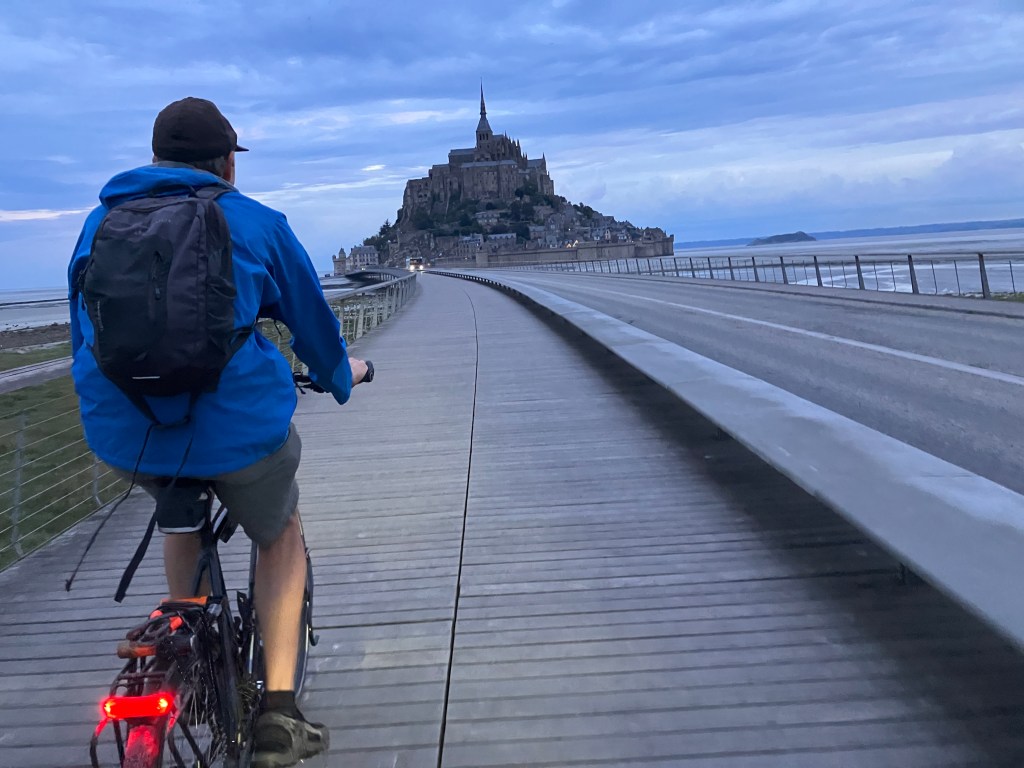
Here we come, Mt. St. Michel!
Denied! The causeway was closed to bikes for a light show extravaganza that evening.
We retreated to the dam which was built to settle the sand from the incoming tide and avoid the river silting up.
We got a nice photo with Le Mont.
Did a little pouting.
Watched some adorable tourists all get their Instagram shots.
And back to our hotel for a bottle of wine and an Afgani dinner from the food truck run by the hotel owner’s sister and her husband.

Do not think we gave up. Even though the mosquitoes were feasting on us as we watched the wave from the incoming tide travel up the river to the dam, no staying for the extravaganza for us, we decided to get up with the sunrise and ride back out to Le Mont.

The next morning, rain was headed our way but we were not deterred. This is pre caffeine.
Success. At the island with a dramatic sky.
We were ready for the rain.
Yikes! Let’s get this island viewing under way!
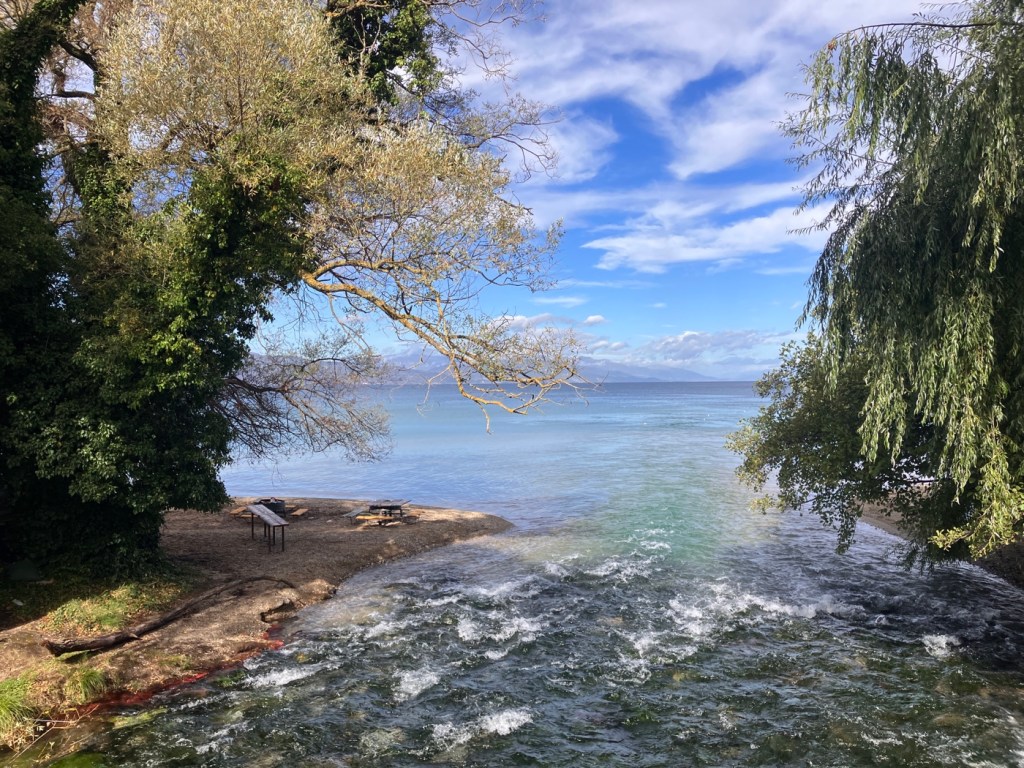
Early Sunday morning and rain rolling in means very few other tourists.
The Abby has a 1,300 year history.
One other small group was walking around when we first arrived but we only saw them once.
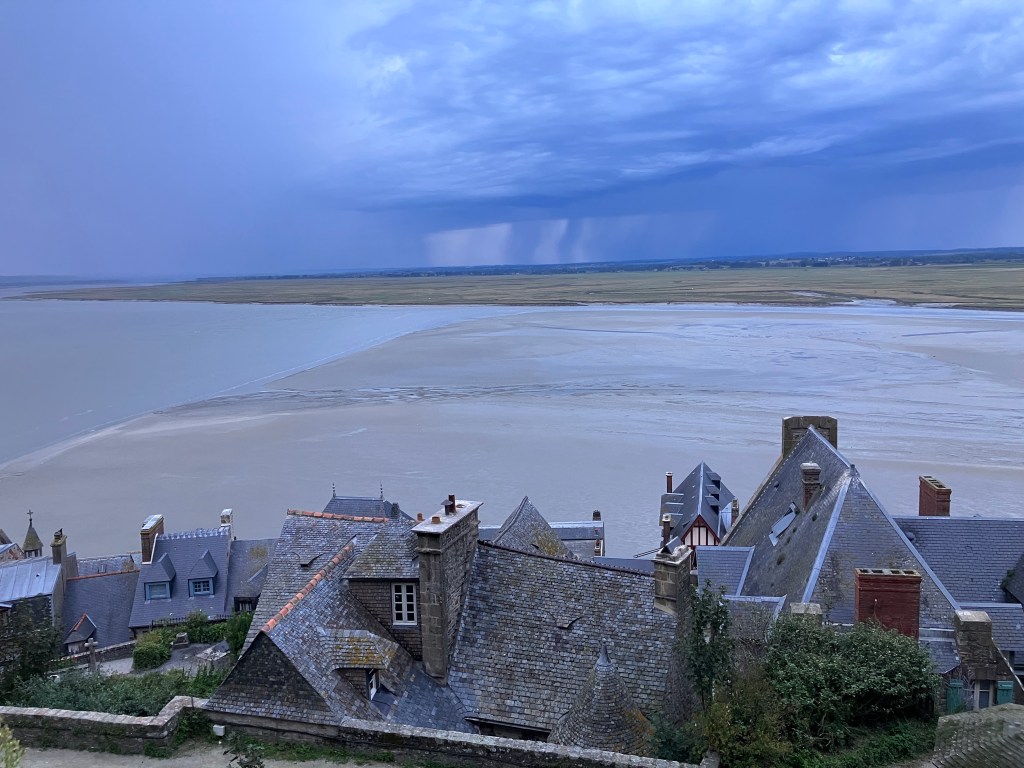
The rain and the tide rolling in.
The medieval streets below the abbey.
Although the shops cater to the tourists, the bones of the town remain visible.
It was well worth getting up early and braving the threat of rain to see the Mont with so few other tourists.
And back to our hotel for breakfast and much needed coffee and tea.

With the history of WW2 still so close, and much documented by historical markers and plaques, I had to look up what happened to Le Mont during that time. As you can guess it was held and occupied for four years and two months and – to our delight – we read it was liberated by one American, Private Freeman Brougher. You read that correctly, one Private in a jeep with two British reporters. Read the entire story here for a jolt of emotion and a few fantastic photos: https://warfarehistorynetwork.com/article/freeing-mont-saint-michel/

Photo from the article. More photos in the link to the website.

Although the rain held off for our visit to the island we were eventually caught after checking out of the hotel and heading out. We had to shelter to let the hardest rain pass by.

Barely on the road and already stopping to put our rain gear.
The weather cleared as we continued along the coast, past windmills.
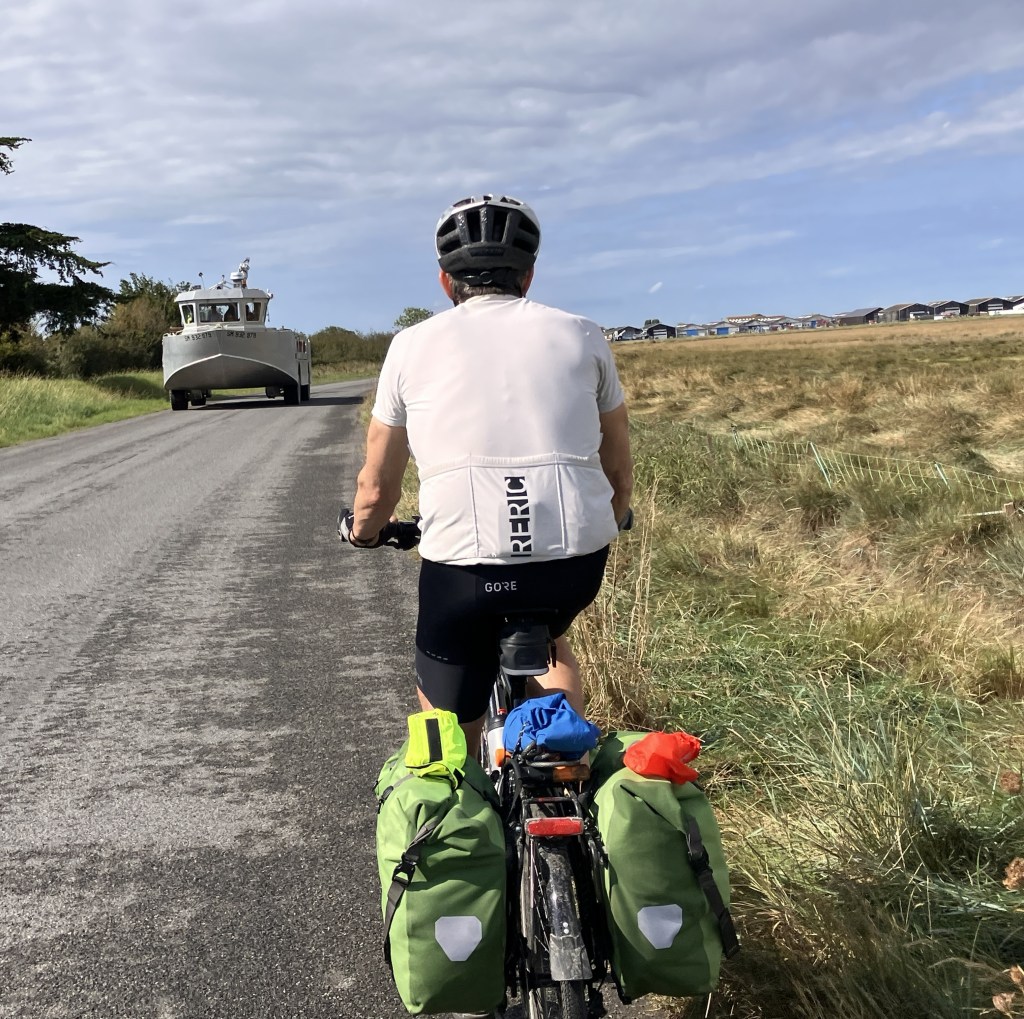
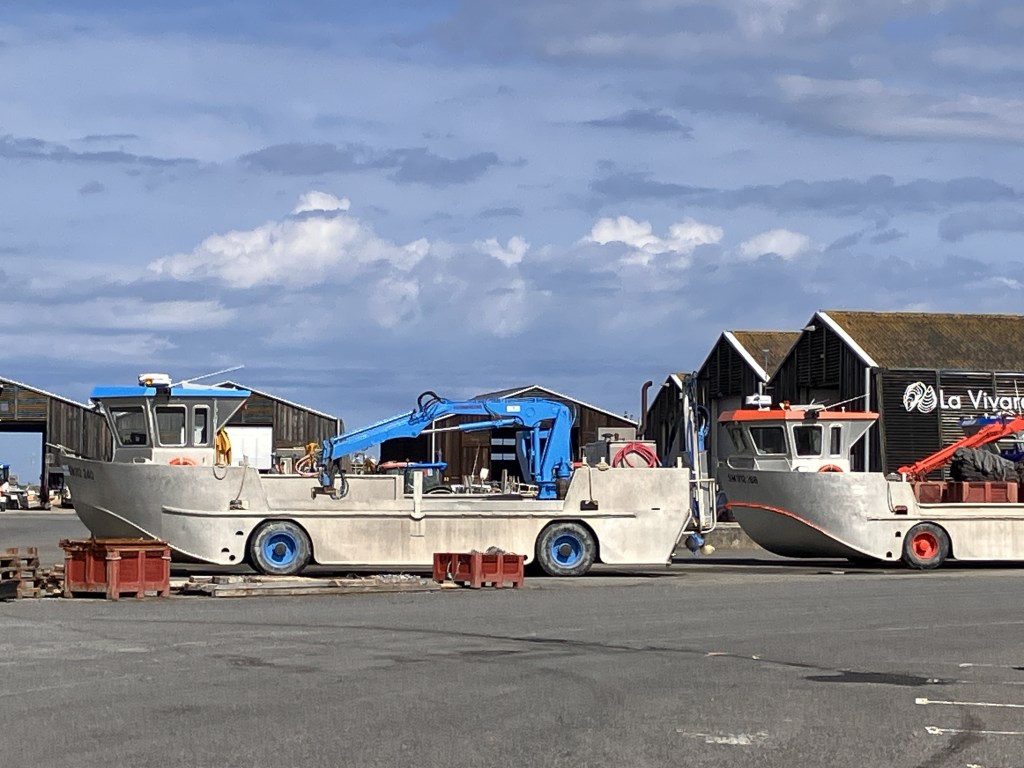
And past these funny amphibious boats.
They are used to harvest mussels. They can drive along the road, across the beach, and into the sea where the mussels are growing on pilings.
Picnic spots of the world. We had managed to get to a small shop just before it closed for Sunday afternoon

There is a lovely feeling of familiarity, going from Wales to Brittany. Both are Celtic lands and we find similarities that catch us by surprise. The style of the old buildings, the way the doors and windows are framed by brick, certain words, and, arriving in Saint Malo, reading that Saint Malo arrived in Brittany from Wales. He was one of the seven founding saints of Brittany.

We had to look up this city emblem, it’s a dog.

Saint Malo is the setting for the book All the Light We Cannot See, which we both read, and we were reminded of that fact by our friend Bob (Hi Bob! Thanks!).

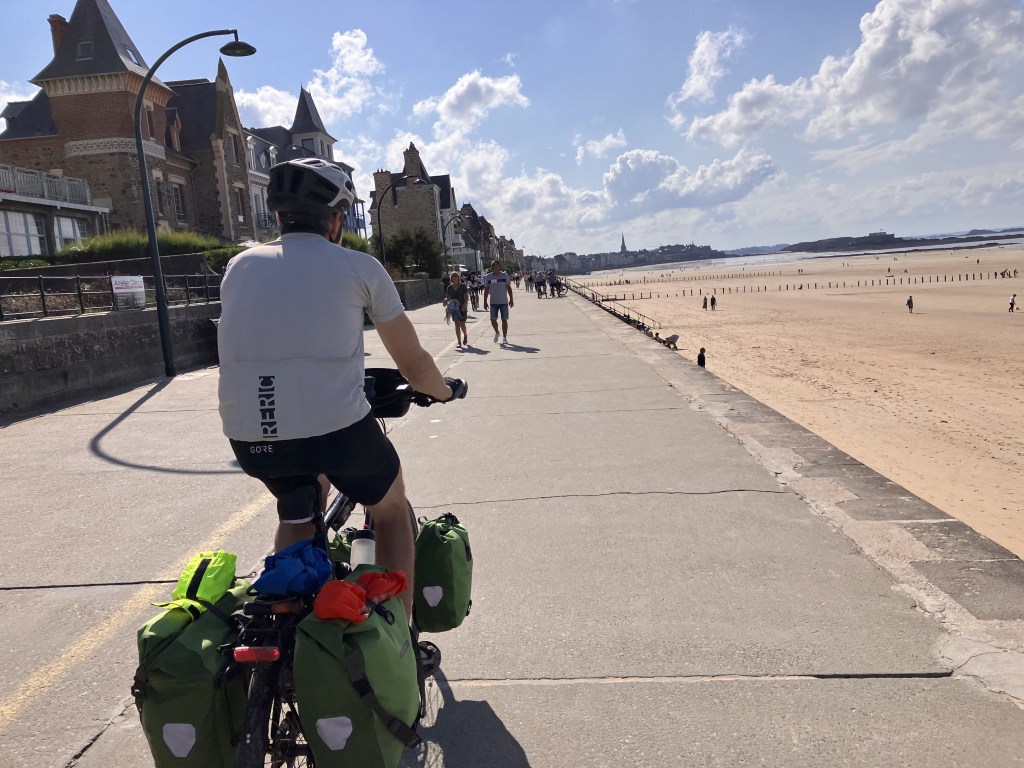
Another super bike friendly French city.
With loads of beaches.
Walking along the old ramparts. The city has a history of pirates!
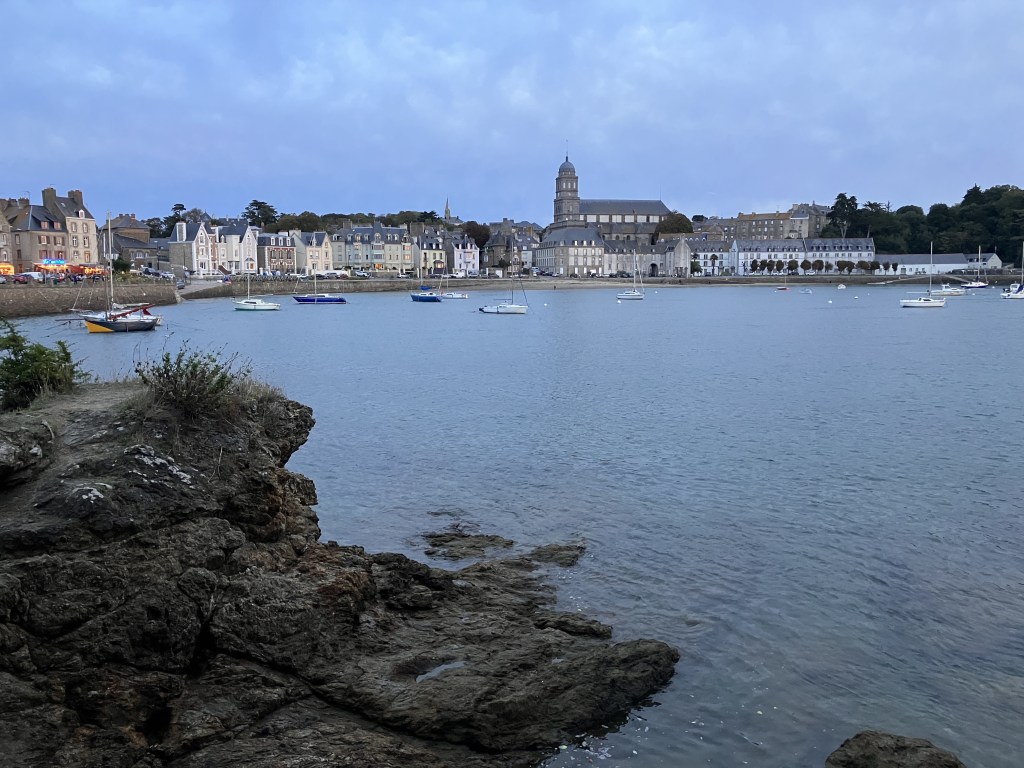
We stayed out in a neighborhood called Saint-Servan-sur-Mer.
We rode our bikes down to a lovely harbor for high tide swims both mornings.
You can see how the tide and ramp makes for a great swimming spot.
Lovely sunsets.
Rich added for scale.
The happy travelers, just before a swim.

So far, some pretty fierce headwinds aside, we’re really enjoying Britanny. The history, the food (the butter and the salted caramel made from the butter!), and friendly people. Especially once we’ve pedaled away from the tourist areas – then we really enjoy the opportunities to chat with locals who don’t often get Americans pedaling through town. On we go!

The star is where we landed, the hearts are where we slept. The blue dot was me when I snapped this pic from google maps. (For you Ruth!)

Wales to Brittany by bike. With a Stena Lines ferry boost.

The approach to the Fishguard Ferry terminal.

One of the only riddles I can always remember is “How do you get two whales in a Mini?” Answer: Over the Severn Bridge. Doesn’t work written down (to Wales in a Mini), and rarely works for an American audience- the Severn Bridge? Wales? What?

Our riddle was how to get us and two bikes quickly and efficiently from Wales to France. Big touring bikes that do not fit easily in the bike closets provided on many UK trains. We could have ridden all the way to Portsmouth or another southern England port, but to be honest bike touring in a lot of the UK is not fantastic. And we wanted to get back to France to tour while the weather was still good, not spend more time crossing Britain. The answer to our riddle? Stena Lines Ferry.

There’s our ferry.

For the first leg of our trip our friends in Tenby generously drove us and our bikes to Fishguard, Wales, for our 24 hour fun journey to France.

Rich waiting with our ferry behind him. This ferry will take us to Ireland.
Let’s get this show on the road! Lunch and snacks in the bag.
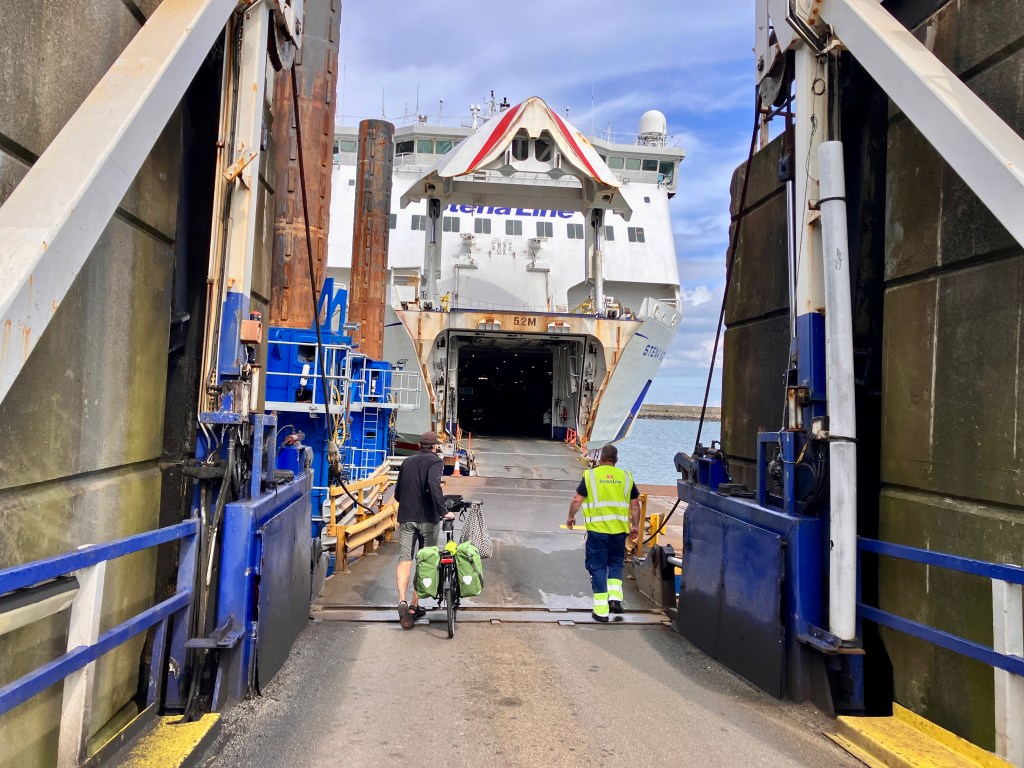
Being escorted onto the ferry by staff.

I love traveling by ferry. It’s a fantastic way to get between the continent and the UK or Ireland without flying. Flying not only has a bigger carbon footprint than the ferry, but it’s also a pain with bicycles. Ferries and bikes are quite easy. At Fishguard the bikes wait with foot passengers, who are driven onto the ferry by a bus, but we bikes get to wheel on with our own escort.

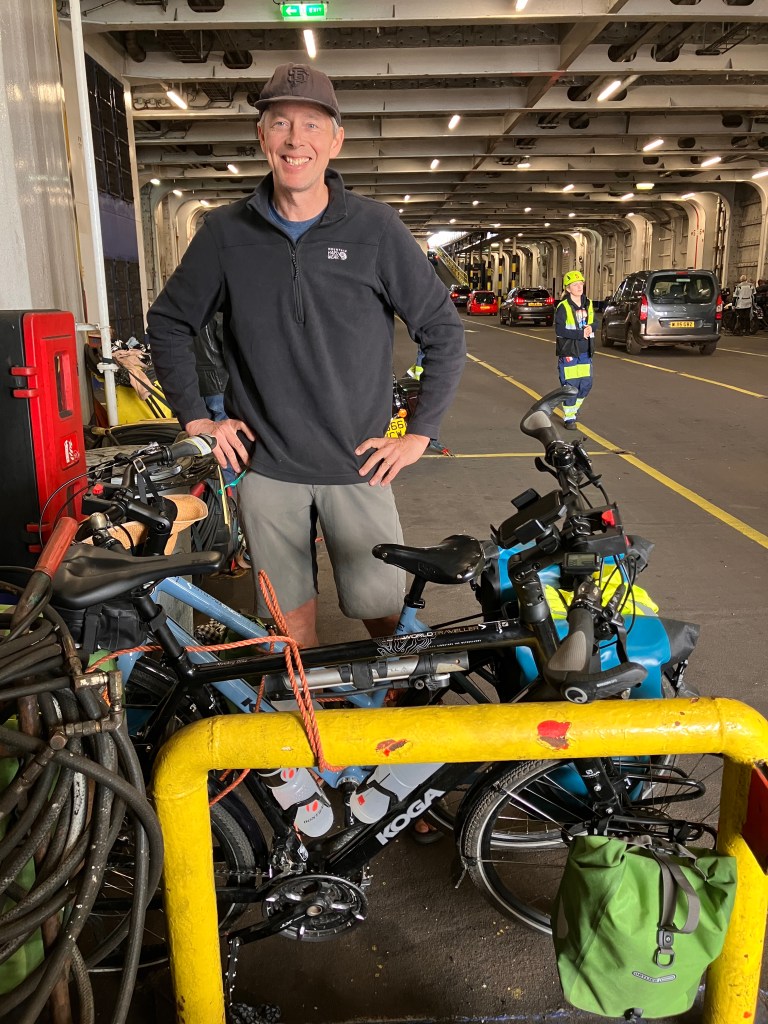
Rich in the bike nook, cars loading on behind him.
The bikes are secured with a rope, provided by the helpful staff person you see securing a motorcycle behind Rich. The motos are strapped down to recessed hooks in the floor.
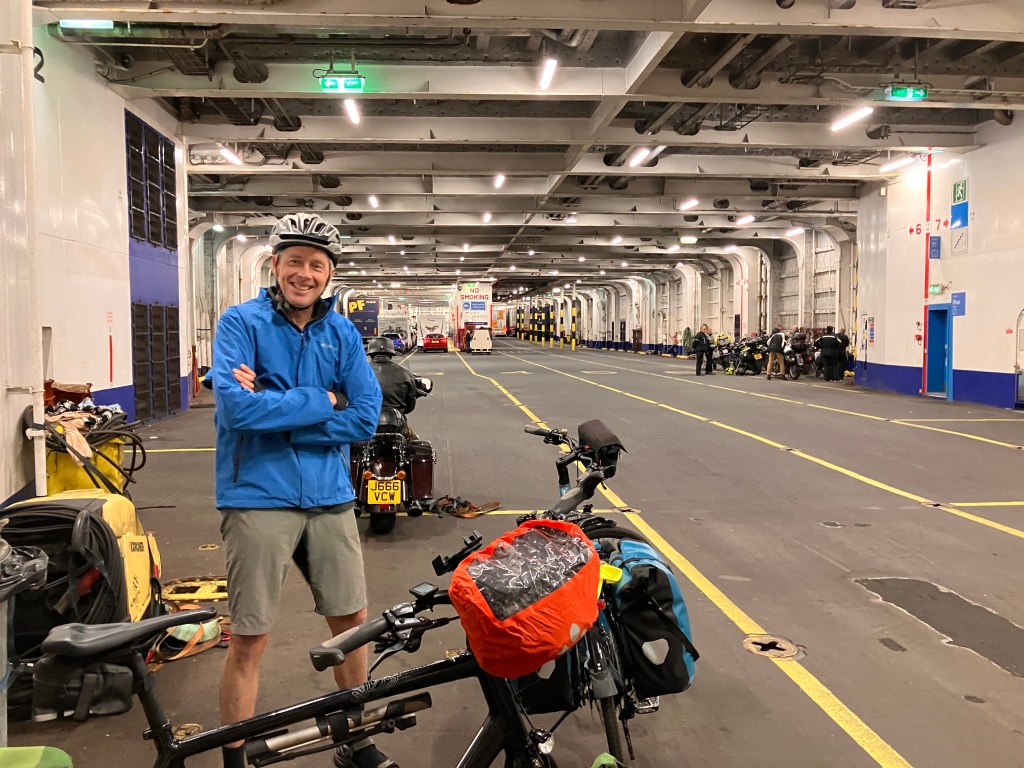
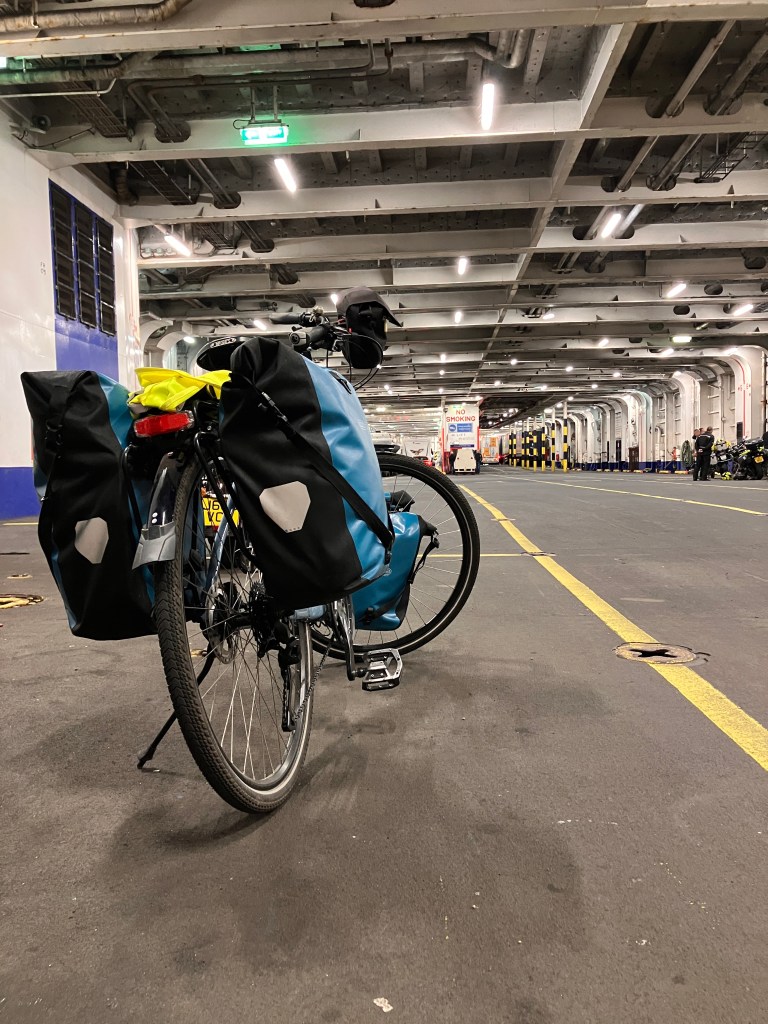
Secure and ready to go. For this 3 hour journey we leave the bags on the bikes.
I always snap a photo of our deck number and stairwell color. Just in case we both forget.
Then it’s a cup of tea, a coconut macaroon from Loafly Bakery in Tenby, and a sheltered spot on the sun deck.

We were the only two people with bikes on this ferry trip, but there were quite a few motorcycles. We all wait to unload together.

Ready to go as soon as we get the word.
I’m still fascinated by the huge car and truck decks on these ferries. It’s a bit intimidating to be a little cyclist surrounded by trucks and cars as you exit.

I don’t take pictures while disembarking, I’m too busy trying to keep up with the flow and not skid on the steel plates of the ramp. It looks more dodgy than it is, but I prefer both hands on my handlebars for this part of the trip.

Off one ferry and in line for the next.

Our next ferry, from Rosslare Harbour, County Wexford, would take us to Cherbourg, France. This was a long ferry ride, 16 hours. You have to purchase a cabin, no sleeping in the chairs. While in line for this ferry we chatted with a nice Irish cyclist named David, headed to France for a Rugby World Cup game and to meet up with his brother. Also traveling by bike.

Motorcycles and bikes loading from lane 12.
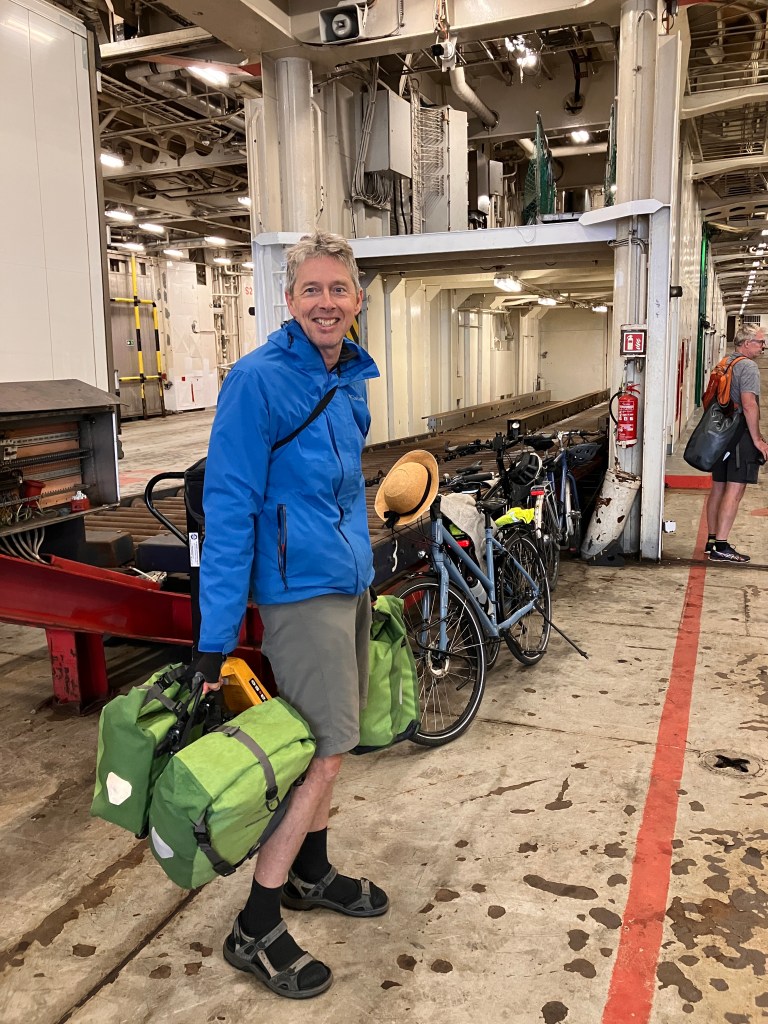
The bikes on this ferry were stashed next to a conveyor belt, and lashed to it by a staff person.

We were a bit mystified and annoyed by the fact that this ferry seemed to allow only four bikes on. When Rich was making reservations the website told him at first that there was only 1 bike space left. He was able to get both bikes on the next day, it seems that when his initial attempt to reserve and pay hung up in the payment phase, it locked down the 2 bike spots and they needed some time to reset and release. David agreed with us that it was ridiculous to allow only four bikes on a massive ferry loaded with cars and trucks, he said he would probably just show up and talk his way on, if he had been denied a bike reservation. We’re not that confident in our gift of gab, not being Irish, but we all agreed to send sternly worded emails to the Stena Line Ferry company. (We otherwise really like this ferry company.)

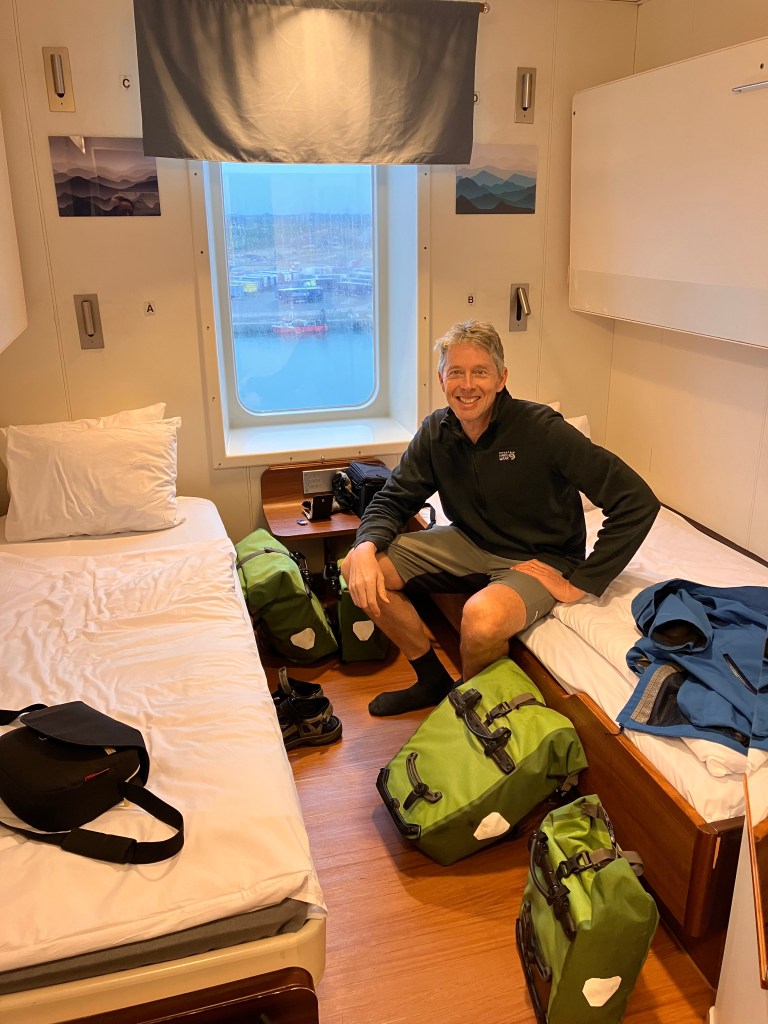
Behind this door, Premium Class Cabins. That was us! We went Premium Class.
A very comfortable cabin. You can see one of the upper bunks above Rich, this cabin could sleep four.
Bathroom with shower to the left.

The cabin had a kettle, tea and coffee, some snacks, outlets with continental plugs – two pin – and a very decent sized bathroom. More later on morning amenities. First, off to the bar!

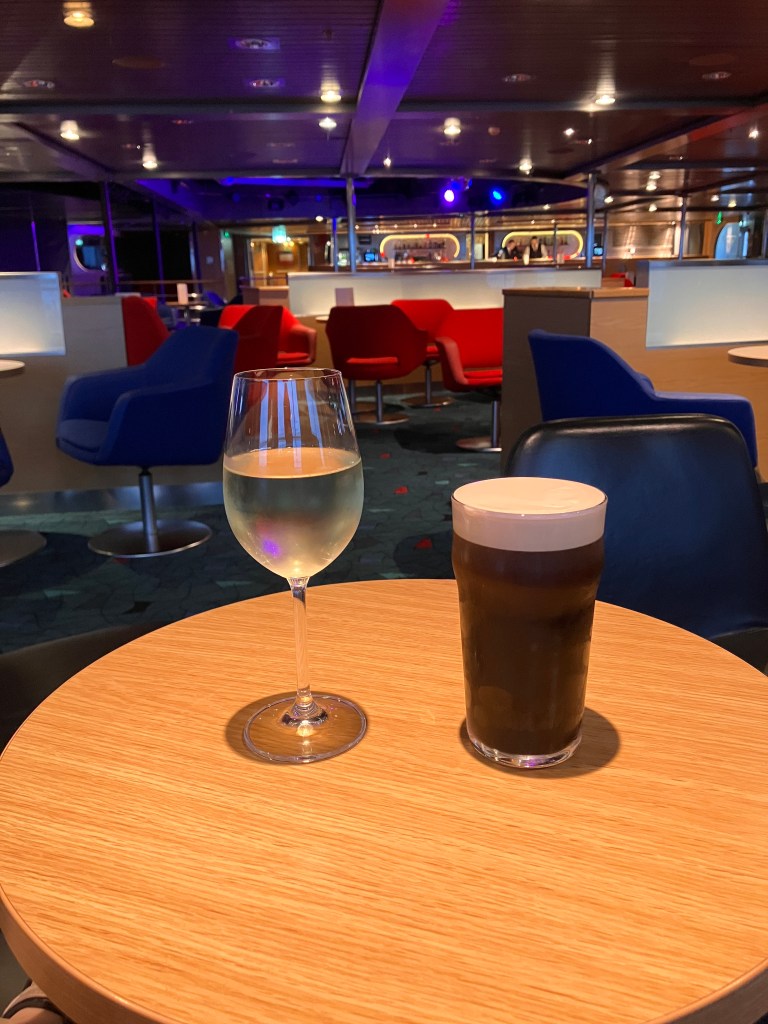
White wine and Guinness. Rich couldn’t be in Ireland, however briefly, without having a Guinness. Dance floor available, pop music blaring from the sound system.
The view from the Metropolitan Bar. We imagine that during busy summer holidays the dance floor gets some use.
Night time falls and we’re out to sea.

We decided on this trip to just eat from the restaurant instead of bringing on our own dinner or breakfast. You could certainly save money by taking on your own picnic meals, but the food got pretty good reviews so we made our lives easier and went to the buffet restaurant for dinner and breakfast.

The buffet and a guy who gets his money’s worth from a buffet.
My first plate, noodle salad, Greek salad, and veggies. All quite good.
Dinner at the buffet was a success. There was a bar in the restaurant, drinks not included except water and tea/coffee, we opted for water.
We went for an after dinner walk on deck and then it was off to bed in our comfortable cabin.

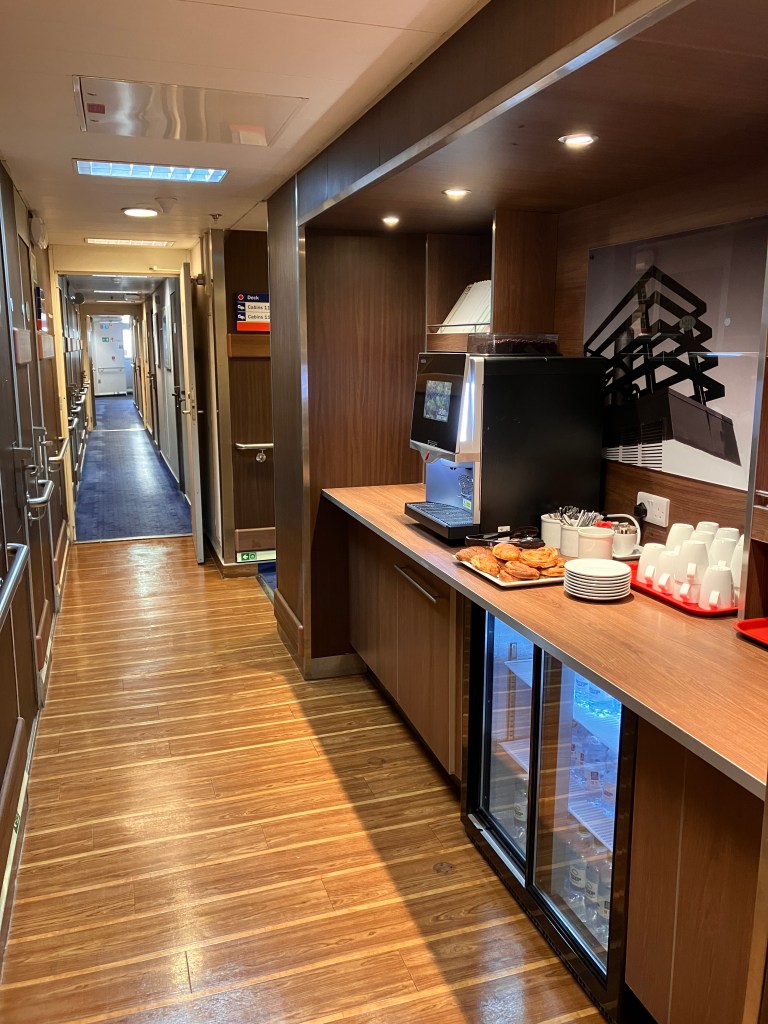
Another benefit of Premium Class was the morning coffee and milk from the coffee machine in the hallway, and croissants and raisin rolls, and oddly, magazines. Good Housekeeping and Men’s Health, and the duty free magazine.

Coffee, pastries, and water in the fridge.
Yes, I was out in the hallway in my jammies, this was just outside our door.
And then I was tucked up back in bed with tea made with the room kettle, with fresh
milk from the machine, a croissant, and a magazine.

Since we had a ride planned from when the ferry docked at 2pm to our first night in Normandy at Port-Bail-sur-Mer, we went and enjoyed the breakfast buffet to make sure we were fueled for our 46 km hilly ride.

Breakfast buffet was served from 8 to 10 am.
Another walk on the deck, watching for land.
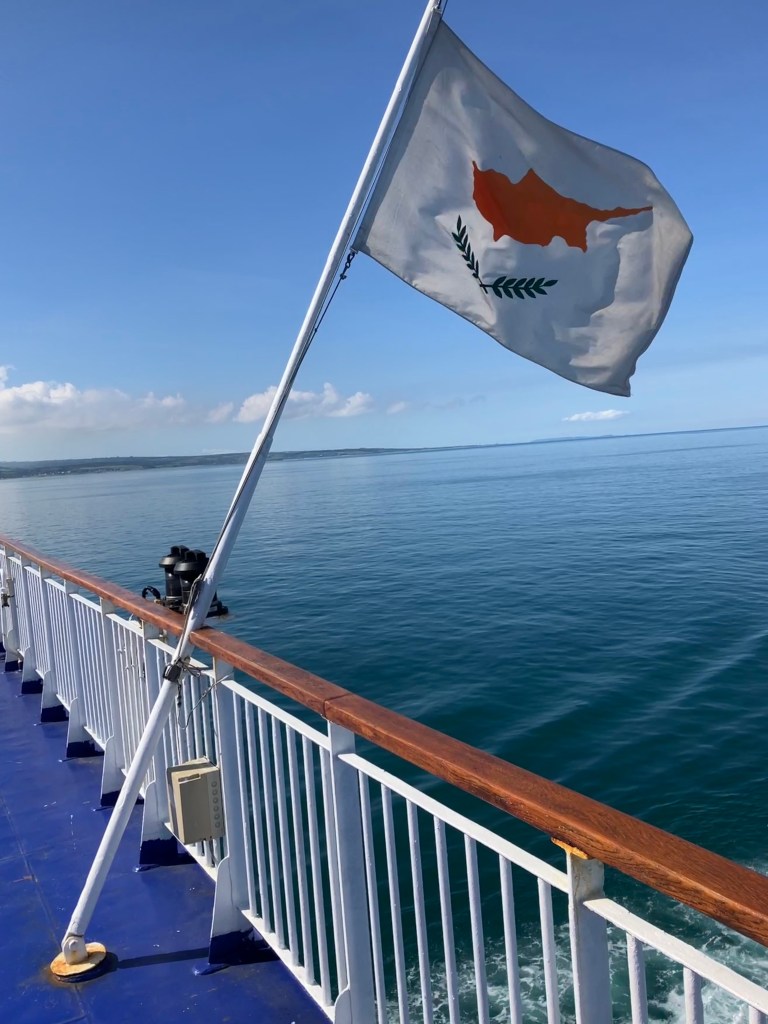
The flag has the silhouette of Cyprus, where this boat is registered.
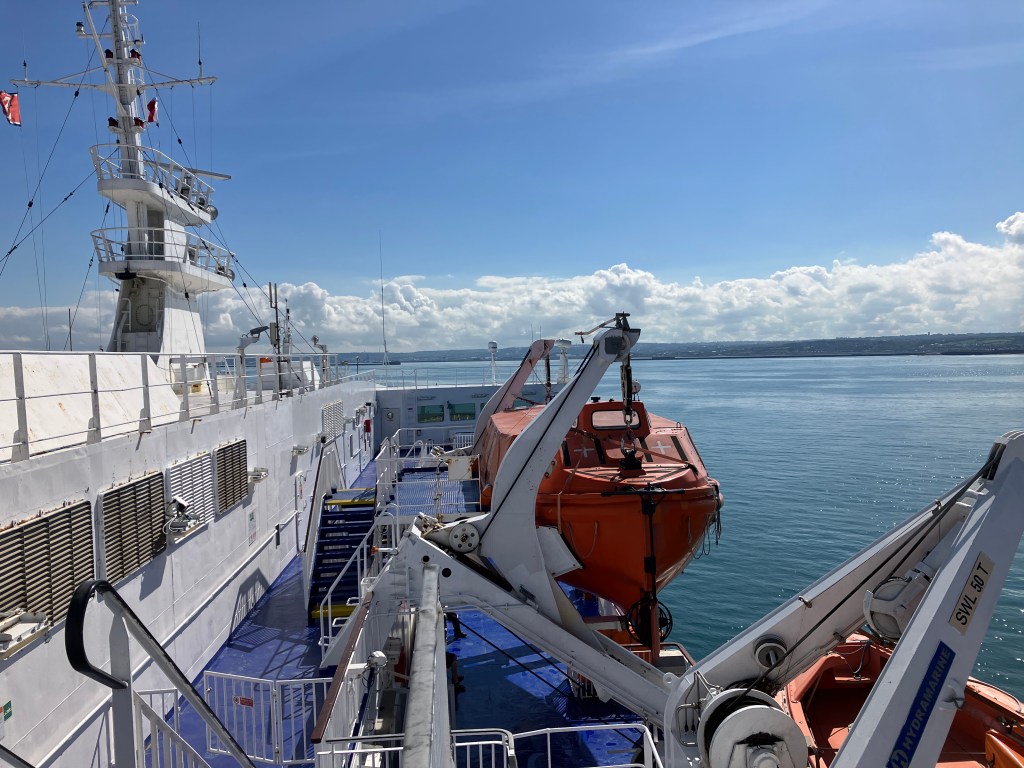
Lifeboats. Which you hope no one ever has to use. They hold 114 people each.
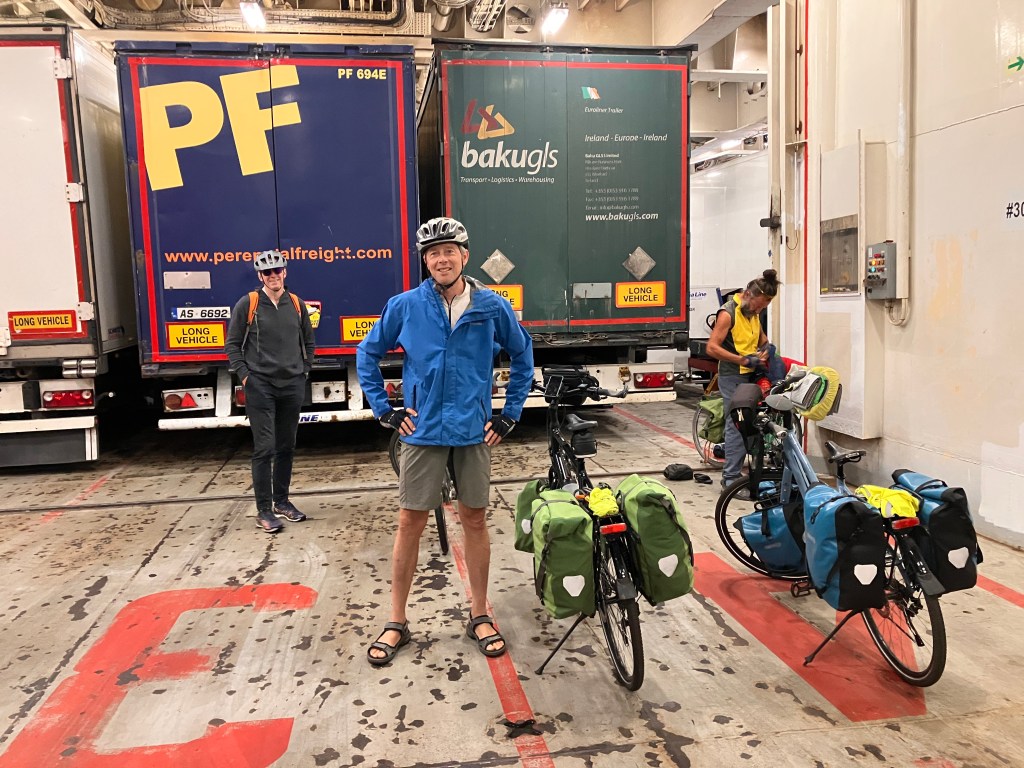
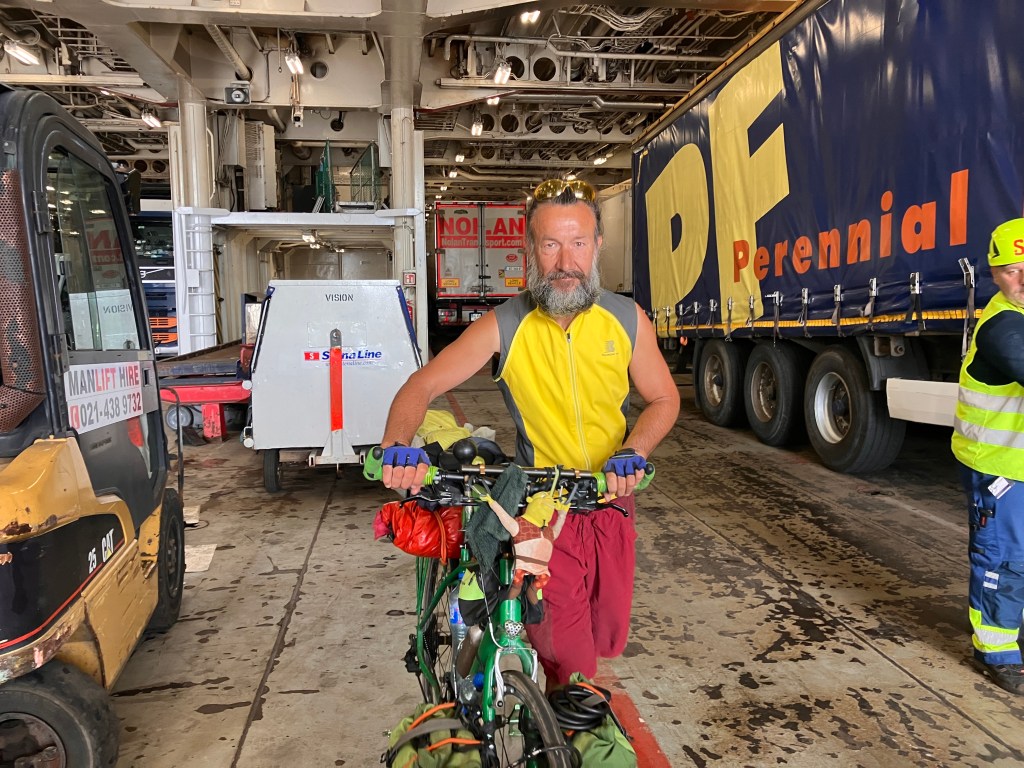
Finally allowed back to our bikes, we found the trucks were parked right next to our bikes and the floor had puddles of sea water. David, Rich, and a nice nomadic French cyclist whose name I didn’t get. Chatting with other cyclists is a fun bonus of ferry travel.
Ten years nomadic cycling. He said he’s off to the US next. Nice guy.
And away we go.

Traveling with bikes on the Stena Line or Brittany Ferries is becoming our regular way of getting to and from the UK from the continent or Ireland. This was our 12th ferry trip, seventh with bikes, since going nomadic just over two years ago. Eight have been long crossings, and four were shorter hops, Germany to Sweden, Denmark, etc. On this trip our Stena lines reward number got a work out as we bought so many meals – not inexpensive – but now we have points for future discounts. As I mentioned above, you could certainly make this journey less expensive by getting a standard cabin, and either bringing your own picnic meals or opting for a non buffet dinner and breakfast. The premium cabins vary ship to ship, on one from Hook of Holland to Harwich we had a full sized bed in the cabin and no upper bunks. Both were very comfortable and we slept well.

The happy travelers headed from Wales to Ireland.

We’re now in France, cycle touring in Normandy and Brittany. And guess what? That heat wave in Wales may have been our last summer heat, the weather has taken a decidedly autumnal turn.

Treorchy to Tenby – Steaming in the Welsh Sunshine

We had a wonderful 12 days in Treorchy, not only visiting the two national museums Cheryl detailed in the last post, but hiking around the Rhondda Valley and the Brecon Beacons. But alas, it was time to move on to a new adventure from our cozy house sit and lap cat.

We loved hiking in Wales. Looking towards the verdant hills of Mid Wales from Bannau Brycheiniog, also known by their English name, the Brecon Beacons.
We picked this less crowded part of the park for a Sunday hike and it was perfect.
Coming down the backside of Fan Dringarth.
A subtle beauty to these boggy highlands.
The nine mile loop varied, had great views and kept us away from the hoards climbing Pen y Fan, the highest point in the park.

When we planned our various house sits this summer, we had to consider how we would get between then with loaded bikes. Most connections were a day or two, so we had to take two long trips on LNER and Great Western Railway trains. Both were stressful with our touring bikes due to the (ridiculous) storage closet bike hooks in a space too tight for my bike. (And many other bikes larger than average.) Anytime you take 50 pounds in 4 bags off the bikes, it becomes awkward. Add a 1-minute crowded station platform, bike closets, and a mid line stop and it becomes a frantic fire drill.

Last night sunset from our terrace in the Rhondda Fawr Valley.
Our sweet cat Tibbs was determined to block our exit from Treorchy.

So we decided that if the weather looked better than a monsoon, we’d cycle our next leg, so I started planning a route considering the following;

1. How do we get out of the Rhondda Valley? Its a 1000+ foot climb straight up out of Treorchy to the North or West, both on A Roads, unless we wanted to go back down the Rhondda towards Cardiff, which would break our cycle touring motto of “never go backwards” (even when we make a wrong turn).

Heading up the switchbacks of the A4061 west of Treorchy
Headed over the top of Bwlch Mountain.
Free roaming sheep kept the car speeds under control and they sure were friendly.
Couldn’t resist an Ussie with our new pal.

2. What is the nicest route.? Heading to a UK national route or Eurovelo was a logical choice and the western route out of Treorchy landed us in the Afan valley, which looked to have a beautiful rail trail along the Afan river. It was also the pass we looked at for 12 days from the deck of our house sit, so it beckoned.

After a descent with some nice sweeping switchbacks on the A4061, you reach the start of National Cycle Route 887 and the Afan Valley Trail.
This Afan Valley had its heyday at the turn of the last Century but has reinvented itself as a recreational hub, especially mountain biking.
The historic Bethel Chapel in Pontrhydfen.
More legacies of the coal and steel days in the valley.

3. Where can we stay and break up the trip comfortably? As our bikes are fully loaded beasts, we wanted to keep mileage in the 50-75k daily range, especially as there are a number of challenges in this region of Wales, primarily steep hills, strong winds, and frequent rains. We also were in no rush and wanted to enjoy the ride.

A relatively short 62k from Treorchy to Mumbles meant we had energy for some exploring.
Hanging with the locals at The Pilot in Mumbles.
And the heatwave meant magical evenings along Swansea Bay.
Loaded up and ready to leave Mumbles.
Day 2 on National Cycle Route 4 was nice, despite this warning for motorbikes.

Well, the steep hills were there, and we lucked out with virtually no wind. However, instead of rain, we had the unexpected challenge of a mild heat wave. It was shocking to us how hot you can feel and get in 82F humidity, but some of the afternoon climbs in full sun felt brutal.

The route from Mumbles to Gowerton follows an old rail corridor that last ran in the 1960s. The Swansea to Mumbles seaside railway was dismantled in 1960 but was the first horse driven passenger tramway in the world.

So we set out from Treorchy and headed up the beautiful pass. Perfect pavement, mild 7-8% grades, and great views. The descent down the back side was great and we finally hit the bottom of the steep portion and found our way down to the head of National route 887, the Afan Valley to Port Talbot.

Cheryl cooling down AND picking up trash from the Afan River.

We were excited to cycle this region as we had traversed it many times by car and train, but never cycled.

Homemade savory pies and a double espresso. aka “Brunch”.
Finally reaching the Aberavon beach promenade in Port Talbot.
Along Carmarthen Bay. Cheryl took most of the photos these days (I was on a heat strike), so she needed a selfie to prove she was there.
My Tilley for shelter on the hot backroads as we turned inland again along Carmarthen Bay.

Cars were very considerate for the most part. In fact, so many waited for us along small lanes at pull outs, even when we were climbing up hills at a snails pace, we often felt we needed to tell them in was fine to pass us slowly. The slower pace is a refreshing differentiator between lower density Wales and much of high density England.

What are the odds of meeting up with a local we know in Wales? Pretty good apararently, as our friend Alex drove by us on this county road. So we all met down the road for a pub lunch in the lovely and rare warmth.
Bragging about our 3 1/2 months without a flat finally caught up with me after our pub lunch in Amroth. (Still love our Schwable Evolution /Almotion tires though.)
There is some nice new bike infrastructure along NR4 in Wales and it was definitely better than the segments west of London.

We did have some poor youngsters in the Swansea area try spook us by yelling out their car windows and screaming as they passed us, but to no avail, as one skill we have learned in 30+ years of urban cycling is the art of road zen and “zero response”. We both equally ignored them (we were riding apart) so perhaps they won’t even bother next time they see two lone cycle tourists on the cross country cycle path.

Getting close, the path from Amroth to Saundersfoot escapes a few climbs by passing through three short tunnels.
So hot, but time for a refreshing blackberry break.
Heading out of Day 2 B&B in Llangynog. A little steamy morning rain-mist set in on the hill, but the jacket still came off in 5 minutes.

A physical threat with a vehicle is another matter, but this was just cheeky youths yelling to try to impress their mates. Cheryl even takes a more positive spin by saying that she was sure they were yelling positive words of encouragement! (Not an indecipherable Welsh-English slur.) And that’s why she is such an amazing travel companion; always keeping on the sunny side and assuming the best in people -:).

The final ridge before Tenby. Pembrokeshire coast cycling is not for the leisurely as the ups and down are constant!

Overall, it was a wonderful three days minus the hot afternoons. Cycling in Wales and on much of the National Cycle Network feels adventurous as the conditions can vary so wildly, and you encounter few others on the way, except around some city areas and popular stretches of rail-trail, river, or coastal paths.

Our new favorite snack, Welsh Tea Cakes smothered in local butter.
The medieval and stunning Laugharne Castle.
The reward was six great days with our most generous and dear friends in Tenby.
Our friends took us out for a great afternoon on the water and swimming at a secluded beach.

So we decided that we definitely want to come back and cycle more in central Wales, where smaller green hills, and small lanes are coupled with the Welsh friendliness. Apparently a new route is being developed there, so we look forward to exploring it…maybe in 2024.

Happy Autumn!

What makes you happy when traveling? Wales edition.

Rich at the Big Pit Coal Museum in Pontypool, Wales.

What makes us happy? Returning a rental car! Although we were so grateful to have the opportunity to explore the valleys of South Wales, driving is never our favorite form of transportation. Really I should clarify that Rich drives and I try to be helpful and supportive. As he noted today after we returned the car in Cardiff, we’re not the first couple to get into a fight in a rental car. But, for the moments of stress and breathless passing of other cars on narrow streets (knowing that a damaged wing mirror was £200 per the rental agency, and we saw plenty of cars with damaged mirrors.), there was so much excitement and happiness as we got to visit places that would have been impossible on public transit or as day trips by bike from our house sit.

Ready to descend into the pit by cage.

Wales is beautiful. The coal valleys of south Wales have such a rich and heart wrenching history. The Big Pit Coal Museum is so packed with history and details and artifacts and machinery it’s overwhelming. But, the history of Wales is everywhere in this region. Our introduction to Welsh coal mining history started with our bike ride from Cardiff to Treorchy, where we had a lovely house sit for 12 days.

Rolling out of central Cardiff to the Taff River trail.
A very quick transition from city streets to the river trail.
Helmets off to all the agencies who coordinated the trail and history information boards.
Eurovello 1 bike route.
I wonder how many rail-trails we’ve ridden?
Lunch in Pontypridd. A lovely surprise of a town.

Riding into a town where you hope to have lunch and finding not a high street cowering in the face of car traffic, but instead a pedestrianized charming core really made us happy. We usually have to search for a spot where we can keep an eye on our bikes while we eat, maybe through a window or from an outside table hopefully with some shade and not to close to car traffic, but Pontypridd made our day with its car free and wonderfully lively shopping streets.

Not one little pedestrian section, but an actual network.
Window shopping by bike while rolling slowly through town.
Barry Sidings Countryside Park.

Pontypridd is the beginning of the Rhondda Fawr Valley, named for the Rhondda River. As we would learn, coal mining changed the valley from a sparsely populated rural area to a teeming coal based economy.

Always stop for the information boards. Those in the Rhondda Valley and along the Taff Trail are particularly compelling.

The transition to coal came with a very high price. As the above photo states “ In Britain between 1868 and 1914 a miner was killed on average every six hours and seriously injured every two.”

The Rhondda River. The geology makes for such a dramatic river course.
A colliery looming over the river.
Rich riding into Porth, and one of our first views of the terrace houses that were built to house the colliers and their families.
At the high point of our climb from the Rhondda Fach valley before we dropped down into Rhondda Fawr.

We settled in to our lovely house sit with the wonderful cat Tibbs, for whom we quickly came up with a variety of nicknames, as we charmed and fed our way into her heart, and she into ours.

A snoozer and a champion lap sitter.

We had arranged a get together with another nomad couple who were in their campervan not far from us. We met up for a walk and a pub lunch and hours of chatting. When you live a nomad lifestyle like ours it’s nice to chat with others with the same kind of life. We always learn so much from other nomads and come away with great recommendations for places to visit and how to overcome challenges.

Hi Steve and Linda! Hope to meet up again somewhere in the world.
The cage. Don’t call it a lift or an elevator!

The first question you get about your visit to the Big Pit National Coal Museum is “Did you go down?” Down into the mine in the cage. At 300 feet below ground this isn’t one of the deepest mines in Wales, but the hour long tour, led by a miner, is so unique and educational. No phones or cameras are allowed down since although this isn’t a working mine, it is still considered an active site and anything that could possibly trigger a spark or has a battery is not allowed. It’s a good thing to be forced to leave your phone behind occasionally, you do focus more, and images are etched into your memory instead of saved in your camera. As we stood in the stall area where the pit ponies had been stabled, our guide, Peter, had us all switch off our headlamps to experience the complete darkness of the mine.

Big Pit, big Rich, and the moors of Blaenafon.
An 1850s water powered winding wheel.
We were told by locals how they remember riding buses with men just off shift at mines, and how dirty and dusty they were. The baths helped change that.
Lockers in the miners bath house.
Utilitarian and much welcome shower facilities.

We learned so much about the life of the miners, and although the grit, strength,and pride of the miners is clear, it was a grueling job done under some inhumane conditions.

Biographical information on some of the lockers was intense. Yes, miners started as young as 12, even younger before the 1842 regulations passed.
Happily examining all the mining items – so much information.
The horses of the coal mines.

Our tour guide called them pit ponies, and the stalls where they lived when not working were 300 feet underground. Although that was awful, and hard to imagine, it was pointed out that the ponies were assets for which the company had spent money, and so they had a vested interest in keeping the ponies healthy. The same couldn’t be said for the miners.

Big Pit Coal Museum.

We went away with a much fuller understanding of what coal meant to Wales, and why the coal mined in South Wales was so valuable. As with many extraction based economies, the profits went to the owners and investors, and when the mines were nationalized and ultimately shut down, entire areas were plunged into poverty. I felt the Big Pit did a good job of telling the story of coal, and its impacts on Wales, negative and positive. The museum hasn’t been updated to include the impacts of fossil fuels on our planet, that would be a good challenge for new curation. I can imagine a team of museum scientists adding a fascinating section on climate change and the impact of coal. Although the story of the mines is about the folks working and living in Wales, the reach is global.

Our next visit was to St. Fagans National Museum of History.

Visiting museums can add up for families, taking the kids for a day out and paying per person can get expensive. I really like that the National Museums in Wales charge for parking, but entry is free. There are ample opportunities to donate either in cash or with tap cards, and we always do. This was my second visit to St. Fagans, I visited decades ago with my friend Hannah who grew up in Wales. We couldn’t remember exactly when it was that we visited, but we think about 30 years ago.

Do you see the smoke from the cottage beyond the sheep field?

If you are imagining a large building full of glass cases with artifacts, stop right now! This is an open air museum, with buildings relocated from all across Wales, rebuilt on site and furnished according to the time period being featured. That noise you just heard was me squealing with delight- this is my favorite kind of museum. You get to walk around lovely grounds and go into buildings that look as if the inhabitants have just stepped out. Since it was a chilly rainy day most of the buildings had fires burning which upped the level of atmosphere.

A pigsty. Why is it round? Because pigs dig, and the lack of corners helped prevent them from digging out.
I love water wheels as much as I love open air museums.
A tannery. We visited an active tannery in Morocco and it looked so similar. This one smells a bit better, and is now occupied by newts, which we sadly did not see.
After a stop for tea and Bara Brith, a traditional Welsh tea bread, it was off to the Stone Age huts! Rich is trying to look cranky but he was as excited as me. Ok, maybe not quite.
Why is the thatched roof steaming?
It’s smoke. From the fire built on the floor. No chimney meant the smoke just seeped out.
In case you are wondering, yes, it was very smoky inside. The very knowledgeable staff member inside was wisely seated on a log, staying low and mostly out of the smoke.
Information signs in Welsh and English gave good background and showed where the building originated.

A museum guide told me that since I had last visited, approximately ten buildings had been added to the site. The decision to include a building depends on quite a few factors, including a compelling back story or history about the structure.

1544 farmhouse.
Just walking around the 100 acre parkland was pleasant.

Possibly my favorite buildings at St. Fagans are the terrace row houses. The six are displayed as they would have been in 1805, 1855, 1895, 1925 1955 and 1985. Originally there would have been a community oven at the end of the row in which the women would bake bread. Terrace houses are all over Welsh coal country, so ubiquitous you can almost stop noticing them.

From the Big Pit Coal Mining Museum.
A street in Treorchy. We were told by a local there were 16 mines near town. I was pleased to get a photo with not many cars blocking the view of the houses.
Looking down on Cwm-parc terrace houses as we climbed the hill out of Treorchy. There once was a colliery in the valley to the left of the photo.
Looking towards the terrace houses from the gardens. When you entered the houses you started to see the modernization through the decades.
The outhouse.
Rich warming up in front of the fire, while managing to not hit his head on the decor.
A cock fighting pit inside a purpose built building.
Stryd Lydan Barn. From the museum description: A cruck and timber-framed barn, the walls are wattled using flat chestnut laths woven vertically through horizontal staves. The building is thatched with wheat straw.

The grounds at St. Fagans are absolutely worth a visit even if you don’t care about old buildings and history. Which would be impossible, I think, once you start walking and reading the signs and imagining how life was for folks who lived in these houses. Happy to have gotten to visit both these National Museums, we returned the rental car and got ready to pedal out of Treorchy and on to visit good friends in Tenby over a few days of Welsh heat wave.

The happy travelers in Pontypridd (The name Pontypridd is from “Pont-y-tŷ-pridd” the Welsh for “bridge by the earthen house”) Thank you Wikipedia.

Housesitting side trips to fascinating museums.

I love a small specialized museum. A specific topic, a single person or industry, the narrower the focus the better.

The World of James Herriot. A great museum in the town of Thirsk.
Did I know he used a pen name? Maybe I’d read that before, but what a thrill to see this historical marker.

Doing my research about the area where we booked a house sit, I searched on museums. I quickly extracted a promise from Rich that we would not miss this one. James Herriot’s books were a big hit with my sister and I when they were published in the US starting in 1975. She went on to become a veterinarian. Did the books have an influence on her? I asked her and she said “They probably did.” How could they not?

A peek into the dispensing closet.
If the equipment in the consulting room looks old and slightly off putting, the veterinary medicine museum on the next floor up will certainly give you the shivers.
A lovely old Aga stove in the kitchen.

If you’re not watching the current adaptation of All Creatures Great and Small, or haven’t seen the older versions, you might be tempted to start watching after a visit to this museum. Even a long time fan like me learned a few fun tidbits. Since it was frowned upon for a Vet to advertise, Alfred James Wight choose a pen name, the surname of a favorite Scottish footballer, James Herriot.

Rich with a statue of the author in the garden.
Strong sales in the US helped propel sales around the world.
Thirsk is a charming town with gorgeous brick buildings.
Of course, we wouldn’t be us if we didn’t lament the scourge of parked cars in the center of town. It was beyond my photography skills to get a photo of the buildings without cars marring the scene.
World of James Herriot. Definitely worth a visit.

We had a rental car during this house sit, which was in a small town without bus service. Although the train station at Darlington was only about a 20 minute cycle away, there was nowhere safe to lock our touring bikes at the station. There were bikes locked there, but our bikes would have stood out like sore thumbs, or tempting morsels, among the commuter bikes. Could we have enjoyed a day out knowing our bikes were not really safe at the train station? No. So the rental car gave us the freedom to roam Yorkshire. And we took advantage of it.

Captain Cook Birthplace Museum, in Marton-in-Cleveland.

While my bike was in the shop for a tune up we checked out the map and a museum caught my eye. Captain Cook’s birthplace! We’ve been to the big island of Hawaii a few times and kayaked to the white obelisk memorial at Kealakekua Bay where Captain Cook died. Or was killed, more correctly. The opportunity to bookend the life of the famous cartographer, explorer, and naval officer was not to be passed by. It was a good little museum, and gave us a new appreciation for how brave and talented Cook was. From the Hawaiian point of view, which is the one we’re familiar with, his arrival – the first documented European to visit the Hawaiian Islands – was the beginning of the end of the Hawaiian Kingdom. This museum gave us a more full picture of the man, rather than just the image of the man who began the destruction of native Hawaiian culture.

My brave explorer exploring the museum.
This urn marks the place where the Cook family cottage stood and where Cook was born in 1728. The cottage was leveled by a new landowner in 1790. The family had moved on in 1736.
A large scale map showing the three pacific voyages of Captain Cook.
The voyages started at Plymouth Harbor.
And the third voyage ended for Captain Cook on the island of Hawaii.

Cook’s first voyage was to Tahiti, where he and a team of astronomers observed the transit of Venus across the sun in 1769. The transit helped astronomers to calculate the distance between the sun and the earth. The HMS Endeavor then went on to explore the uncharted, by Europeans, southern oceans.

We left the museum with a new respect for Captain Cook and empathy for his end in the beautiful Hawaiian Islands. That is a successful museum.

The Yorkshire Dales.

Our next car enabled outing was not a museum, exactly, although the Yorkshire Dales could be viewed as a timeless experience. Not a living museum, but a living and evolving region.

The village of Reeth, and a chat with a cyclist who was riding coast to coast across this part of Britain. If you check out a map, the narrow waist of Britain crosses this area.
The grey stone buildings are pleasantly uniform in color.
Public footpaths across gorgeous green countryside and along the River Swale.
The River Swale was running higher than these stepping stones could handle. Divert.

Fueled with a picnic lunch we headed out for a loop hike that quickly got rerouted due to a high running river.

Any direction you ramble and anywhere you look, beauty.

We rambled from a sunny green valley to a windy and mizzly (misty drizzle) ridge. Always under the watchful eyes of sheep.

Is this building abandoned? No, says the resident sheep.
The heather was blooming.
The wind and mizzle was blowing.
The stones are put to good use.
So impressed with the dedication to keeping the foot paths passable.
The engineer appreciated this tunnel with livestock gate, or stile.
I am still in love with the greystone buildings and walls.

We rambled over bridges and through a tunnel, had a quick lunch sheltered from the wind and watched by sheep, and as we came to the last bit of our loop, we were confronted by a sign. Cattle free alternative route, with an arrow. Pointing to a sheep, of course.

Cattle free, but not sheep free.

I know there are folks who are frightened of cattle, it’s understandable, they are huge! But I’m not. I’m respectful of their size, but not scared of them. But the next sign gave us pause.

Oh. Bull…. I read Ferdinand the Bull enough as a child to recognize the universal nose ring and horns on the sign that means bull in the field.

Bull in field. We’ve encountered this sign before in our UK rambling, but never actually encountered a bull. So, through the stile we went. First field, empty. We continued to the second field, also empty. Then we had a choice, a divergence of paths worn in the grass. One to a marked stile, one going to the right across a tumbled rock wall. We kept on the marked path and when we reached the stile we could see the cattle at the bottom of the pasture, quite close to the stile leading out of the pasture. Any country side person would have laughed to hear us discuss the situation. “Is that a bull?” “No, I think that’s just a heifer.” We started to cross the stile and then, from behind a lovely stone out building sauntered the bull.

Photo taken from the safety of the other side of the stone wall.

Reverse course! Back to the other path, climb over the tumbled down stone wall and hope we don’t have to cross Mr. Big and Scary’s field. We did. We ended up behind the stone out building and had to cross about 30 yards of field and before we got to the end, when we had to cut left, towards the bull and heifers and calves, to exit the field. Quietly. Calmly. Discussing what to do if charged by a bull. Neither of us knew. Bear, mountain lion, those we have been taught to react to, but a charging bull? No. Well, we said, think of a bullfighter. They jump aside at the last moment and bulls can’t change direction quickly. So we’ll go with that. Thankfully the bull totally ignored us, and we exited the field with new respect for bull signs.

Hey bull.

So, for future reference, I did look it up, and if you are charged by a bull, step to the side and run in the direction from which the bull came and run in a zig zag pattern- the bulk of a bull makes it hard for them to quickly change direction. Throw your backpack or shirt to distract the bull. While running in a zig zag pattern. Or, just pay attention to the signs and avoid the bull. I’m going with that one in the future.

Restorative tea and scone in Swale.

Having safely negotiated the bull and his herd we went for tea, coffee, and scones. I totally give the tea award to Yorkshire. The Yorkshire Gold tea bags I love taste even better made with yummy Yorkshire water. Honestly some of the best tea I’ve ever had. And always an extra pot of hot water to make even more tea!

Sheep sweater. Like the San Francisco tourists caught out by cold wind and fog and forced to buy Alcatraz sweatshirts, I bought a wool sweater. With a sheep pattern!

With our Yorkshire/Durham County housesit wrapping up, we got ready to endure a two train day from Darlington to London, then on to Cardiff, Wales. UK trains with bikes can be stressful. But we made it. More fun museums and cats await us in Wales.

The Happy Travelers in Ripon.