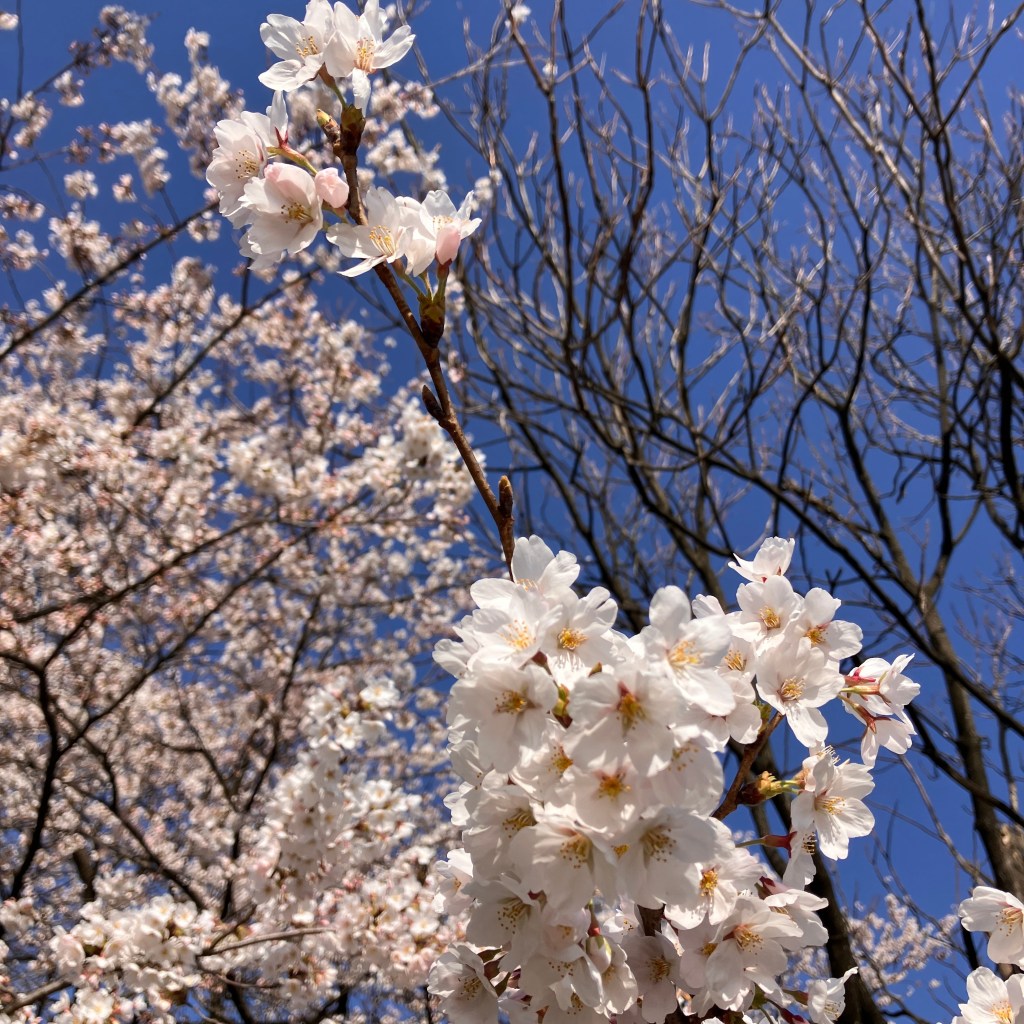
Probably the most photographed trees in the world. Japanese cherry trees.
Our arrival in Tokyo happened to coincide with an early cherry blossom season. We had already made our flight and room reservations when a representative from Japan Meteorological Agency stood beneath a signal tree at Tokyo’s Yasukuni Shrine and announced the season to be underway.
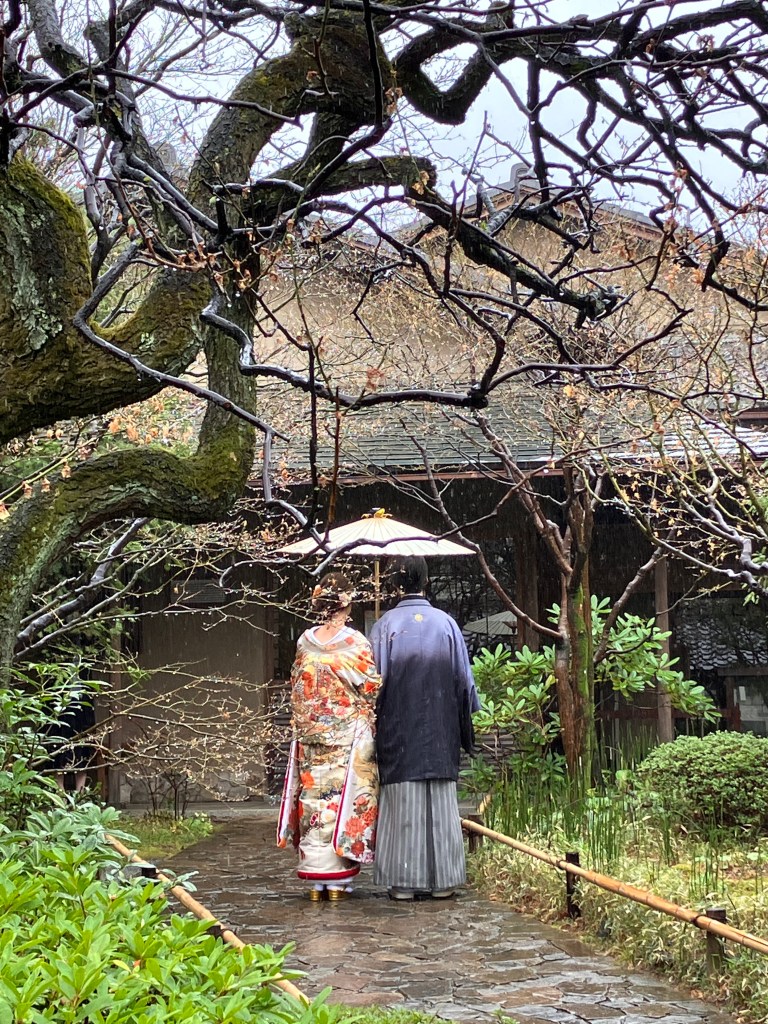
Our first small park in Tokyo and our first sight of folks in traditional clothing having photos taken.
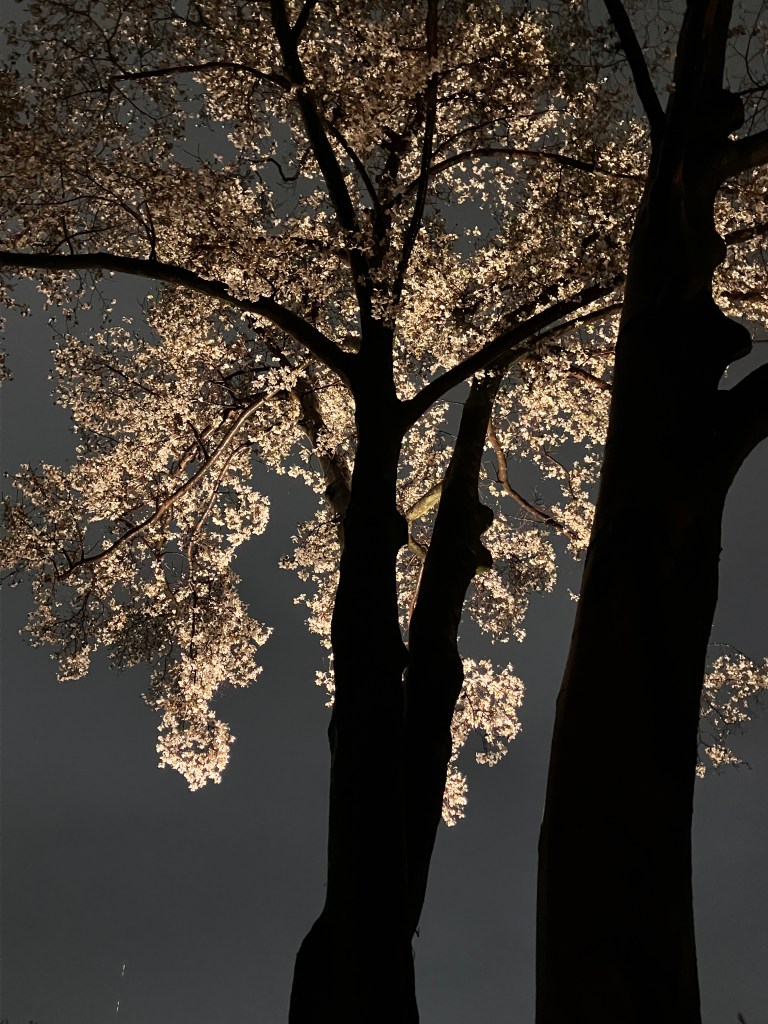
Unfortunately, it was a rainy stretch in Tokyo as the fun got underway. Fortunately, we don’t melt. Parks and gardens are prime blossom viewing spots of course. So off we went. First was a night time cherry blossom event where the trees were lit up. It was beautiful, and wet. Very wet. But picking through the mud puddles was worth it to see huge trees and bamboo lit up with dramatic intensity.
Dramatic lighting made the blossoms pop.A stunning arrangement of trees and lighting.
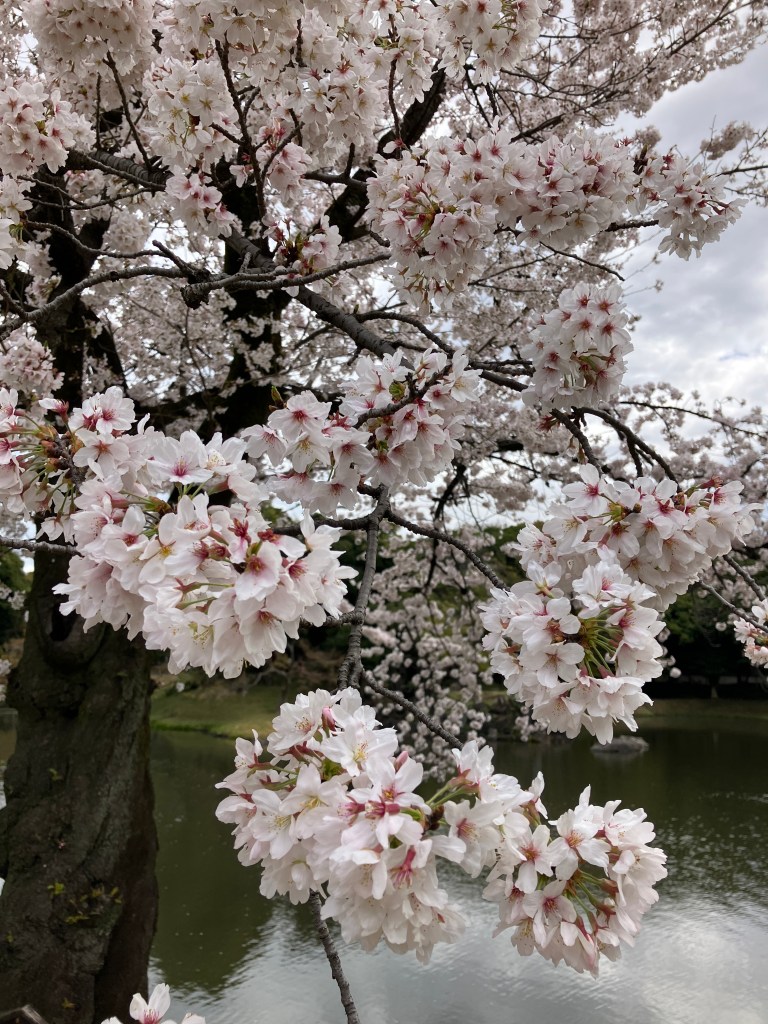
On a dry Friday as we wandered parks filled with blooming trees we overheard other blossom peepers talking about what variety of cherry trees we were seeing. There are over 100 varieties of cherry trees in Japan, a few are wild and native to the forests, but most are cultivated. These trees don’t produce edible fruit, but flowers are pickled and used as tea and in other confections. We love seeing a forest mountain dotted with blooming trees mixed in with conifers and maples.
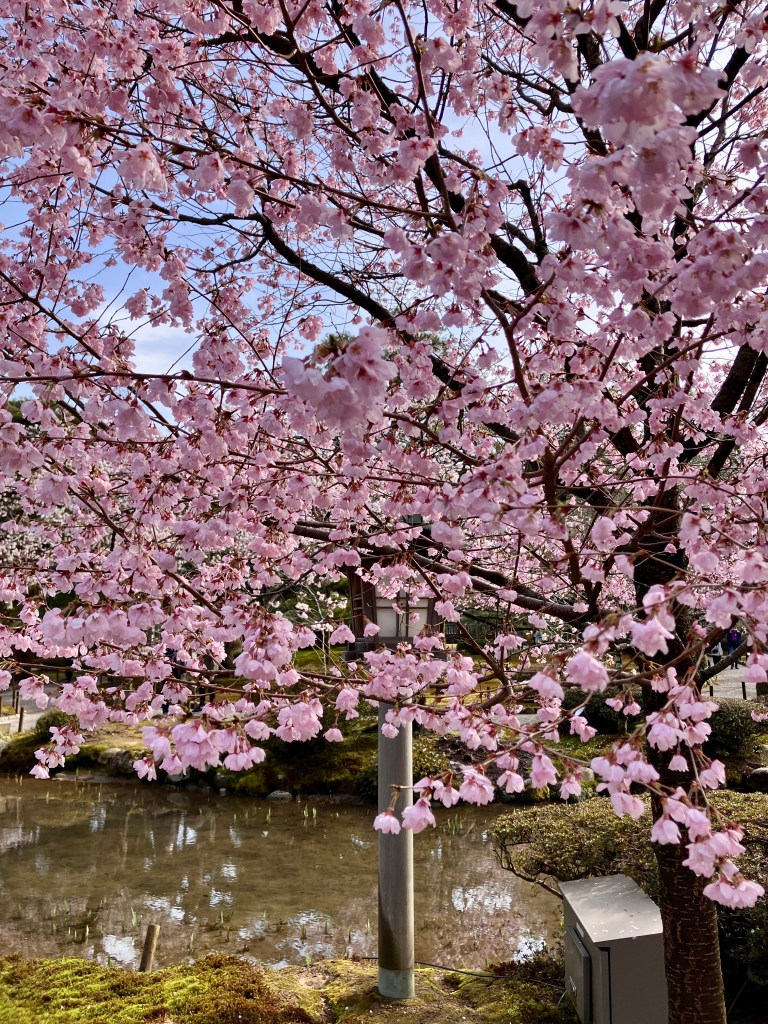
Up close you can see the differences in the blossoms.I’m sure many folks know the trees by blossom sight- we don’t!You simply can’t stop yourself from taking photos. Every tree offers a unique moment you want to capture.This might be the only time I see this, you think as you snap away. Blue sky makes a dramatic background.
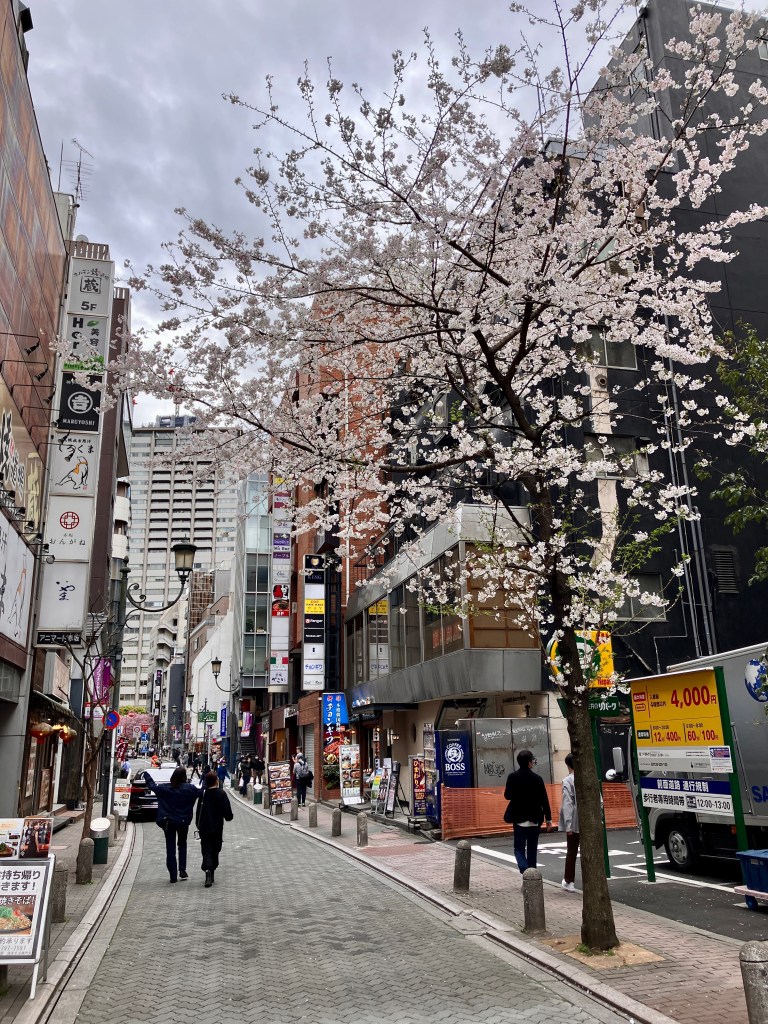
Blooming trees are not confined to parks. As we walked around Tokyo we found allées of blooming trees, or simply single trees, putting on a show worthy of admiration.
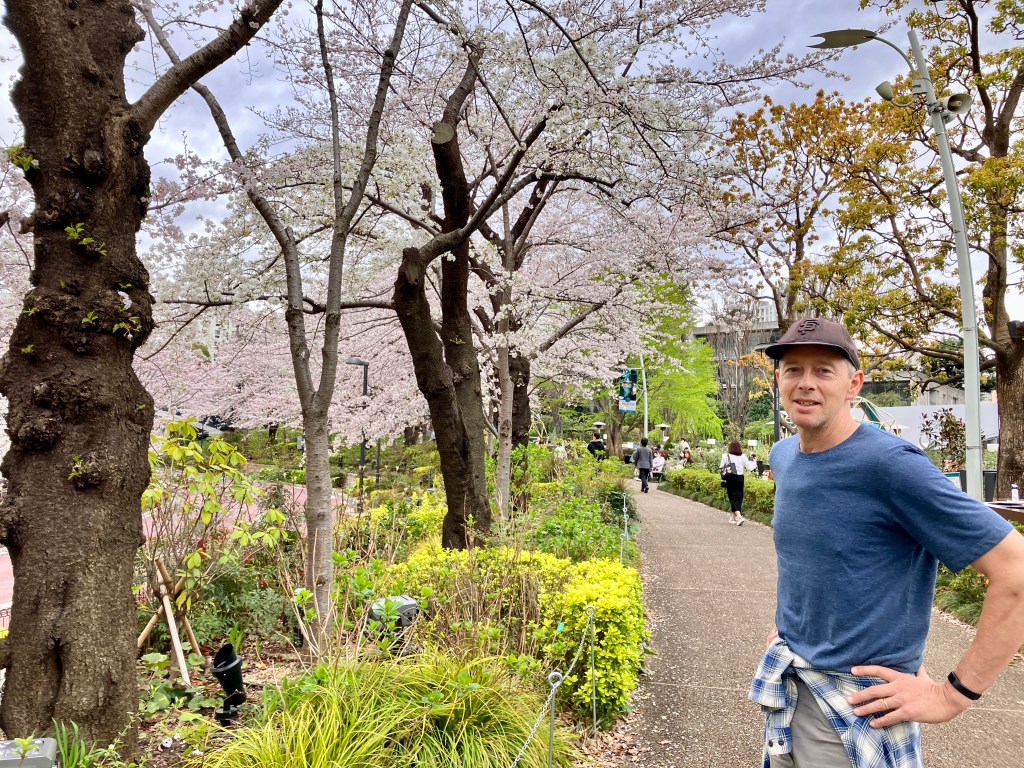
The bright green of spring makes a perfect foil for the blooms at Tokyo Midtown.A temporary lounge set up among the trees of midtown. A single tree changes the feel of a street.
We left Tokyo for Kanazawa where we had a new batch of parks and gardens to explore. And a lovely castle. And more cherry blossoms to photograph.
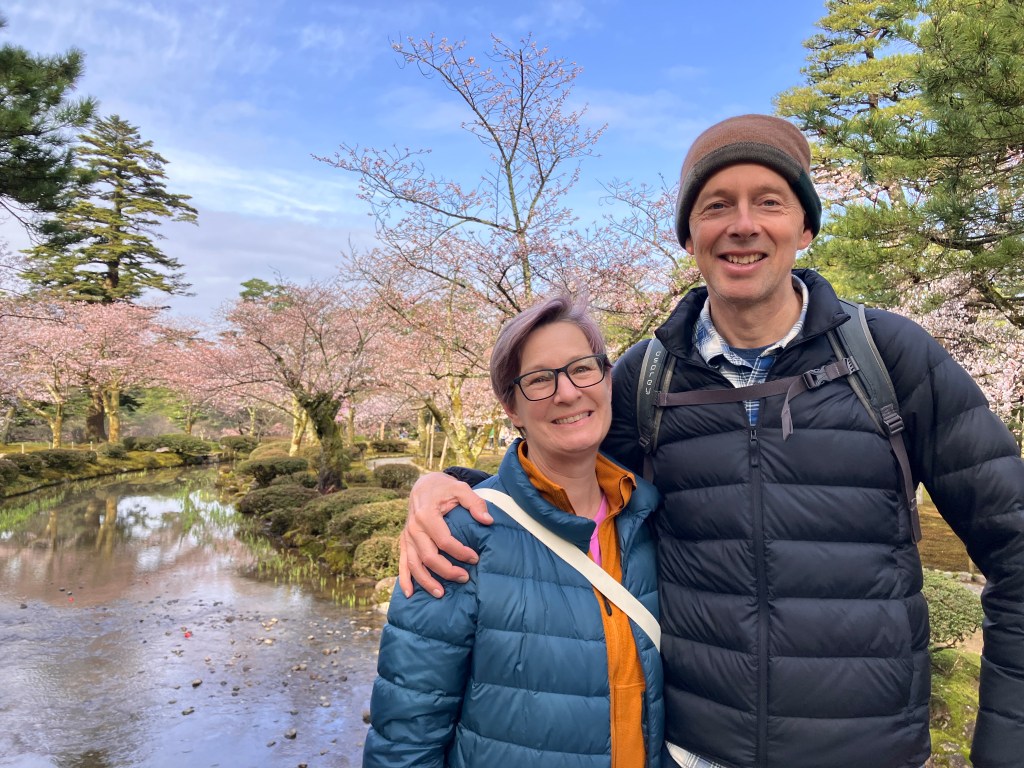
Kenroku-en garden in Kanazawa. Normally a paid entry, the garden is free during Sakura. A temple garden on a morning walk around Kanazawa. Another random burst of blossoms on a bike ride outside of Kanazawa.
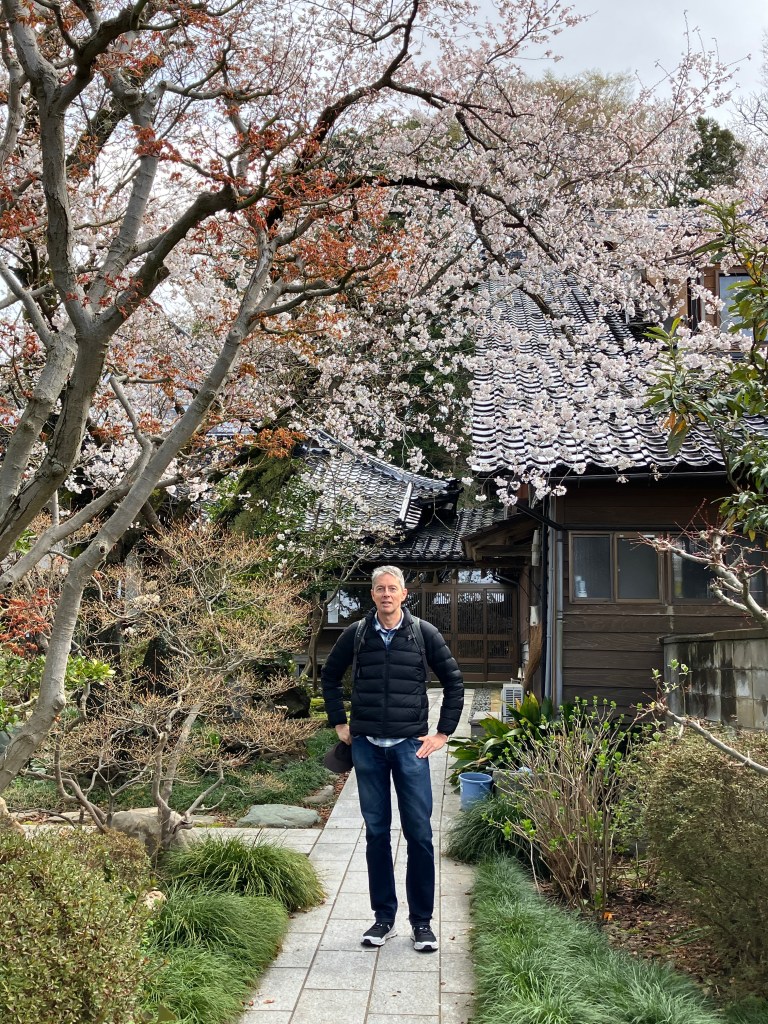
You find new ways to view the blossoms, hyper aware that the blossom season is fleeting. People are super friendly and nice about snapping photos of each other. Cherry blossoms bring you all together in one place, for the purpose of admiring the beauty, and recording this fleeting moment.
Photo taken on the grounds of Kanazawa castle by a friendly local woman.Pose your husband in yet another stunning tree. Trees reflected in the moat of Kanazawa castle.A view from above of the trees in Kenroku-en garden.
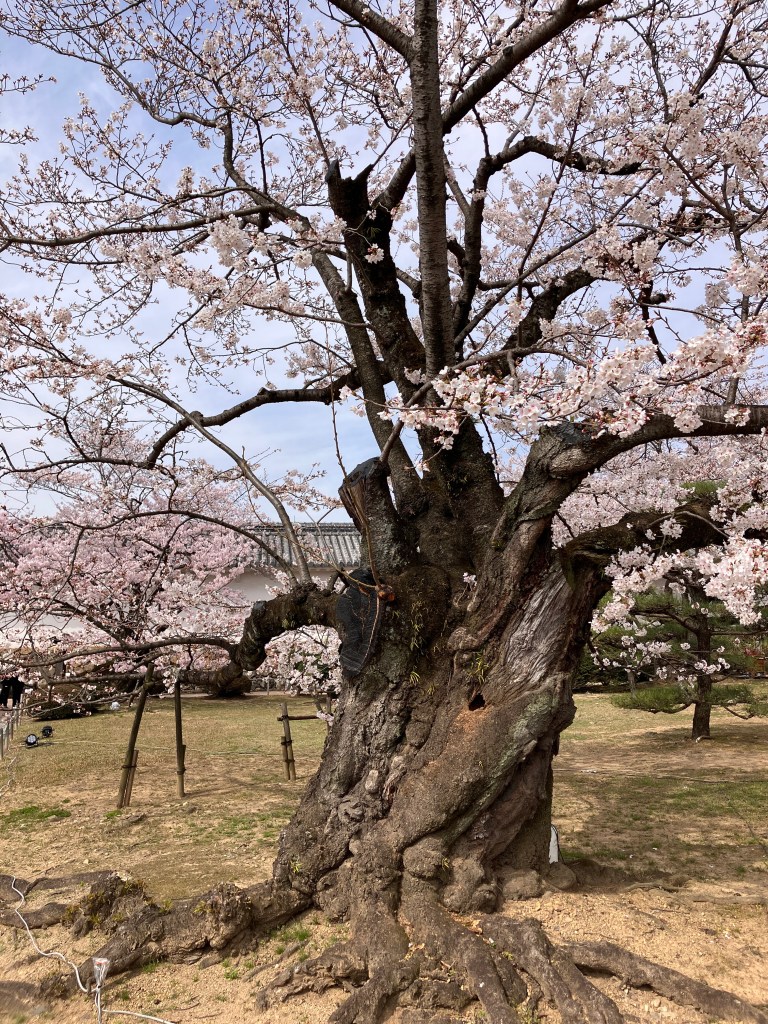
Hemeji, which was a day trip from Kobe for us, has one of Japan’s most stunning castles. And with the blooms it was a crowded site. Rich got us there as early as we could, and it was worth braving the crowds. I’m particularly taken with the old trees – gnarled trunks, branches propped up with bamboo poles.
Himeji Castle. Alongside a canal in Himeji is a line of perfectly blooming trees.A tree this size is likely about one hundred years old.A venerable tree on Naoshima Island, getting some help with wooden struts.
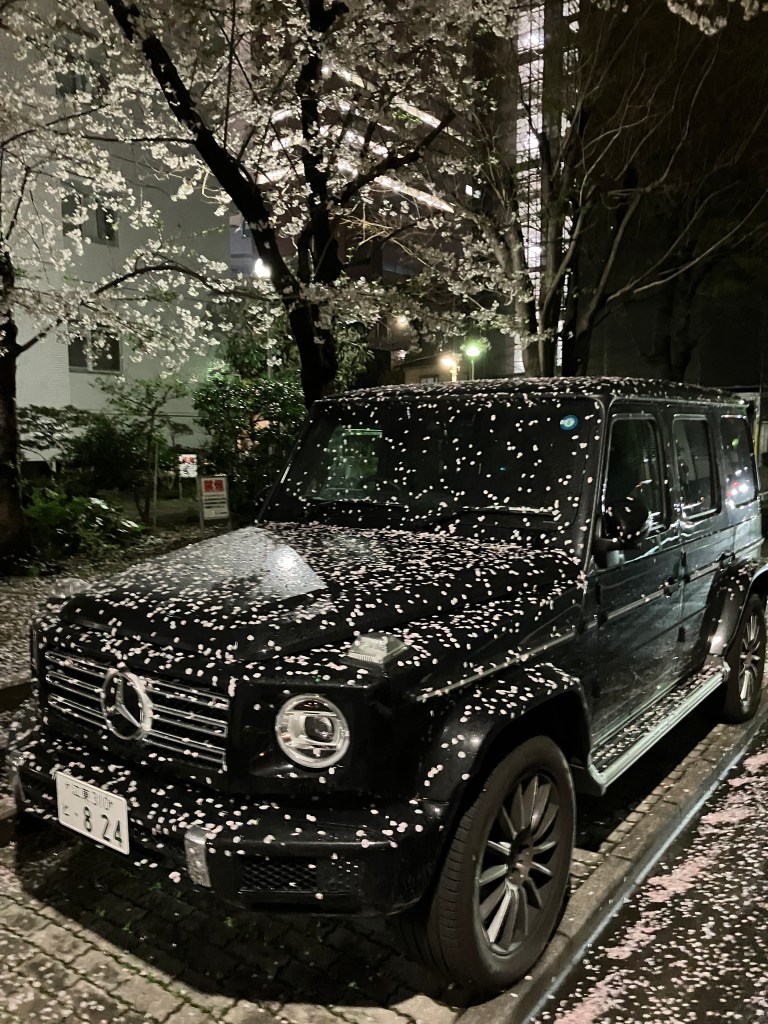
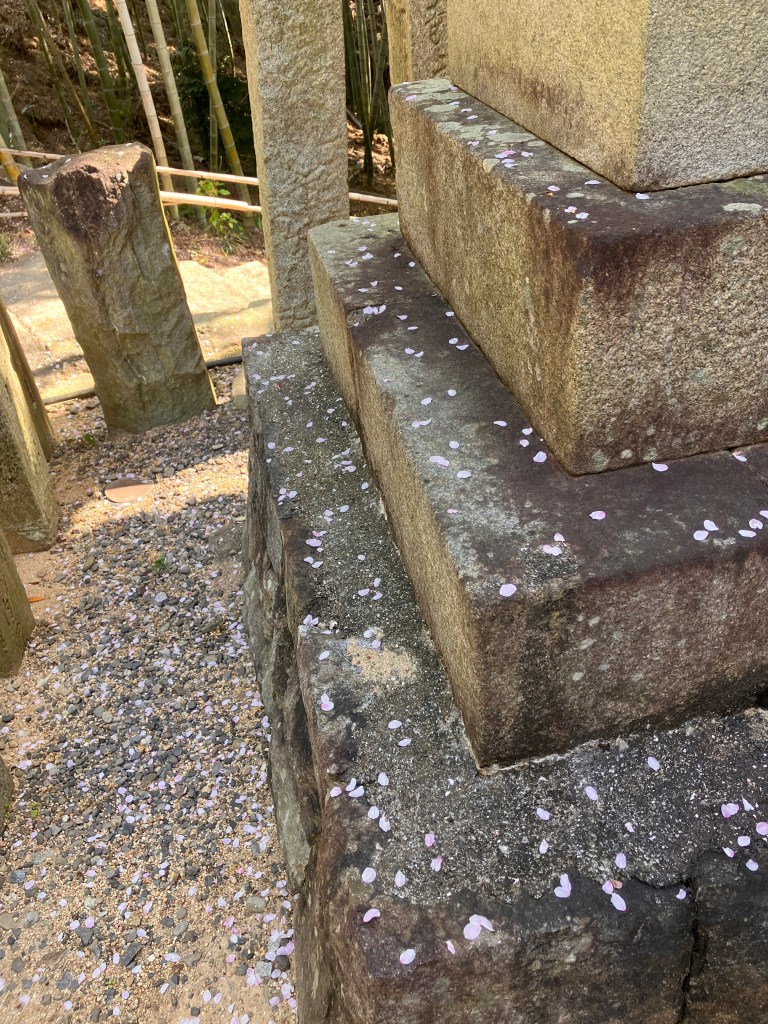
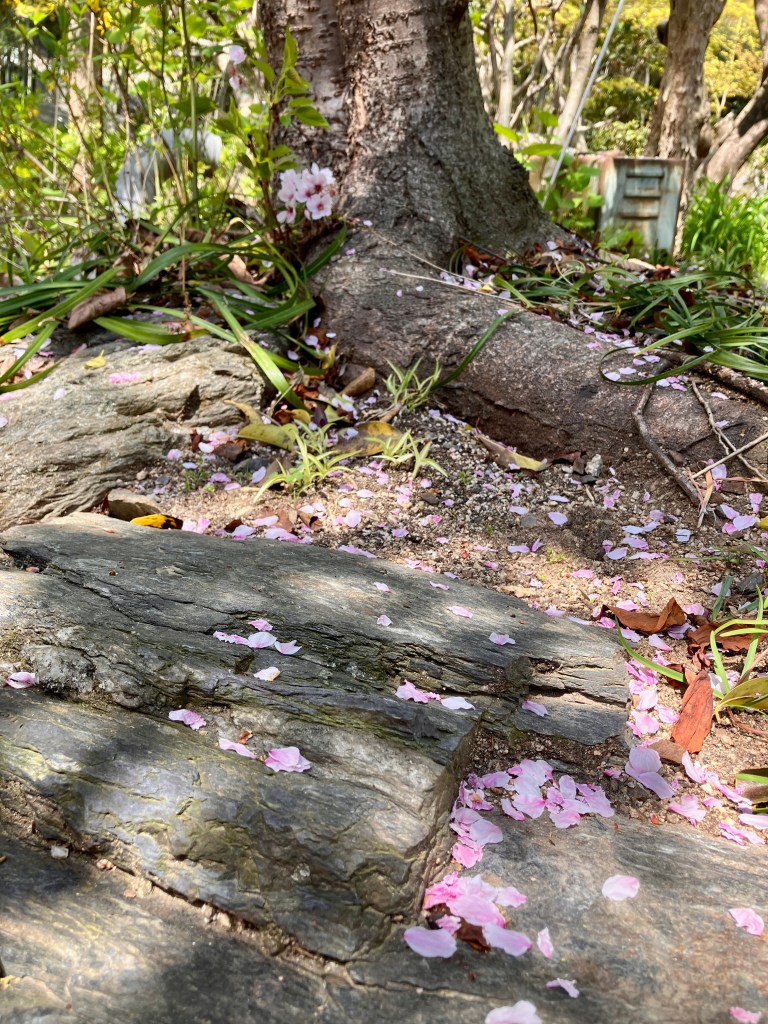
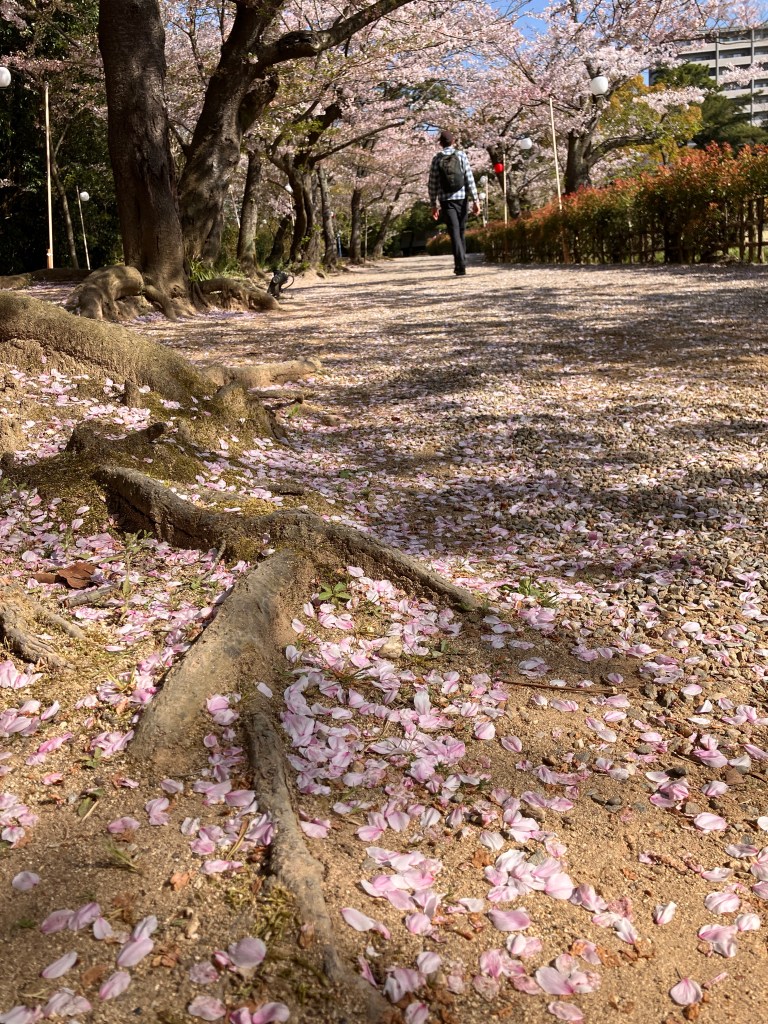
After the bloom comes the time of Sakura snow. The petals blowing off and drifting, or, if it’s raining, sticking.
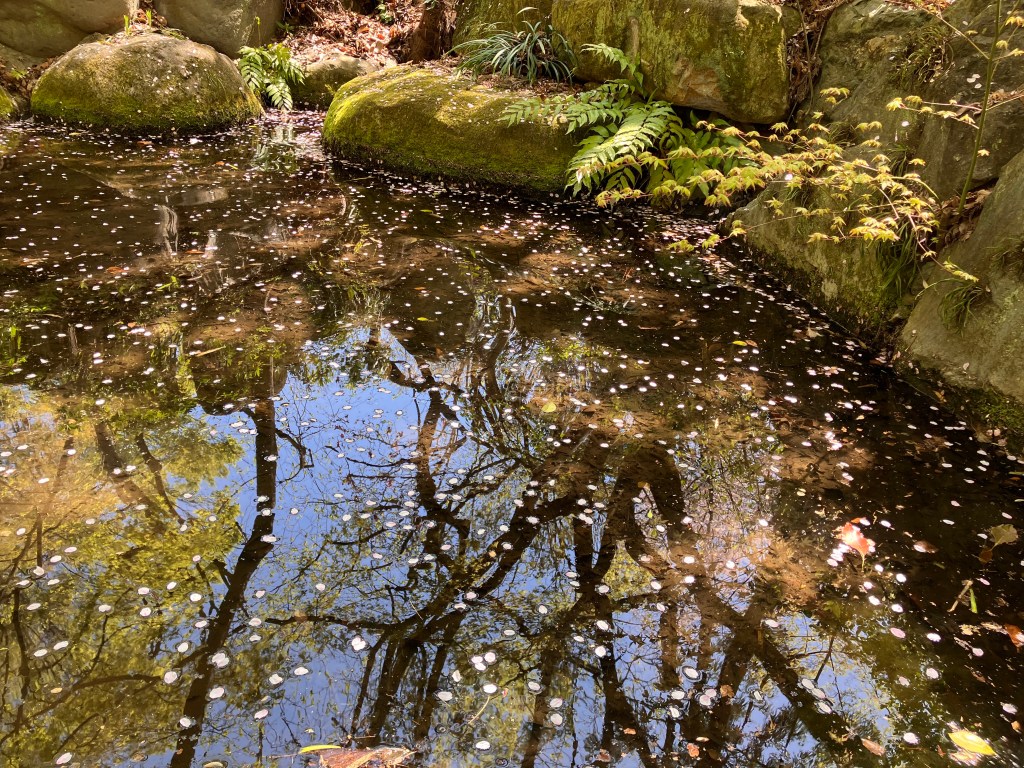
This would be a wonderful permanent paint job for this Tokyo car.Petal confetti on a stone lantern base at Shikoku Mura (Village), YashimaThe fallen petals call your attention to the landscape.Hana Ikada, or flower rafts. This is a sparse but beautiful version with just a few petals floating.Drifts of petals on a footpath in Takamatsu, at Ritsurin Garden.
Being here in Japan for Sakura was a happy accident. We assumed we would be too early to see the bloom in Tokyo, but Sakura has been earlier than usual the past few years. If you do come to Japan for Sakura, be aware that hotel prices go way up. Rich booked our place in Tokyo before the season was announced, post announcement he looked to extend our four night stay and a single night extra would have cost as much as the four nights together.
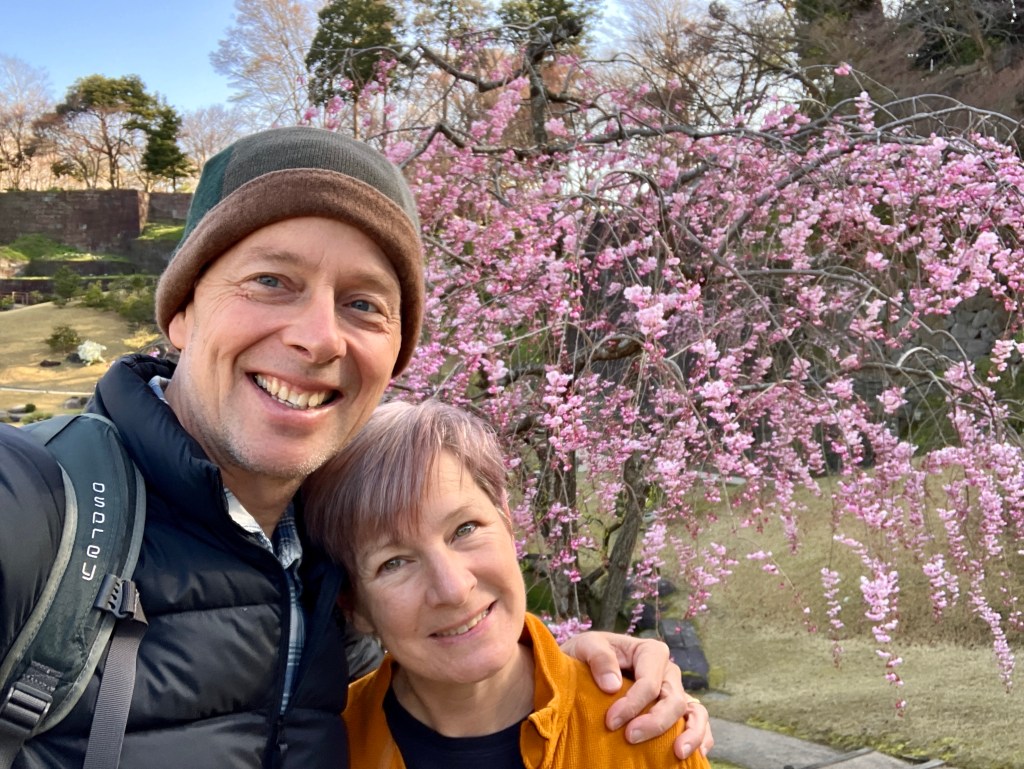
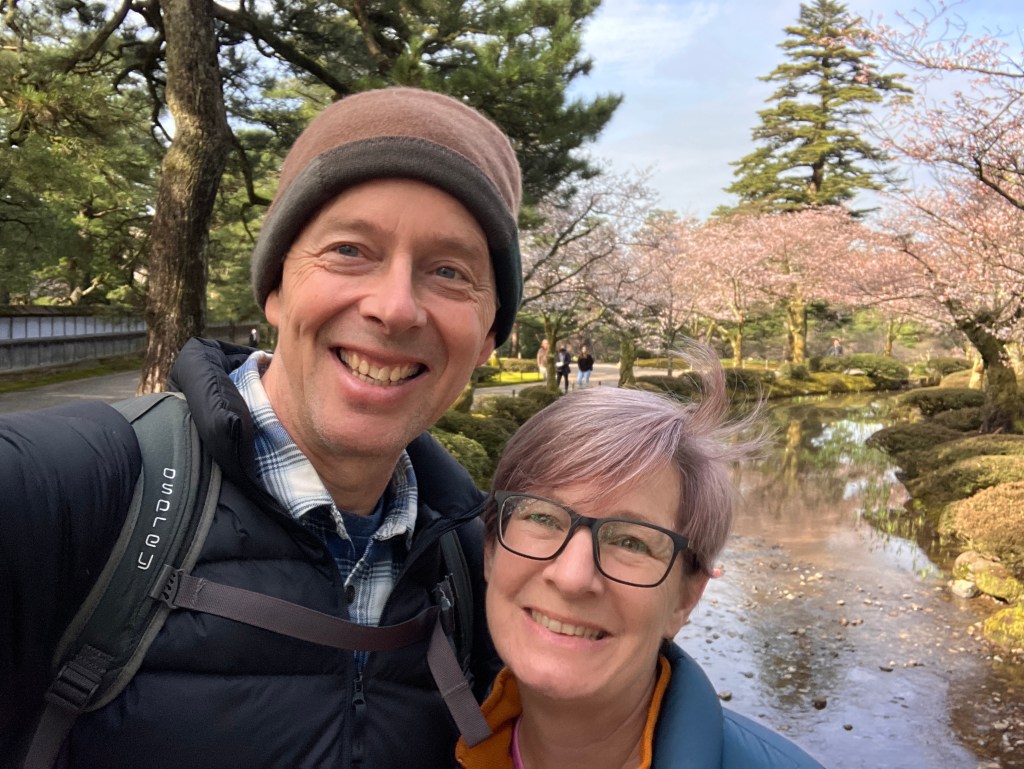
The happy travelers at Kanazawa Castle.
We’re in Japan for two more weeks before moving on to Korea. We feel so lucky to have seen Sakura in a variety of cities and landscapes. Cherry blossoms and a Japan Rail Pass, what more could we want?
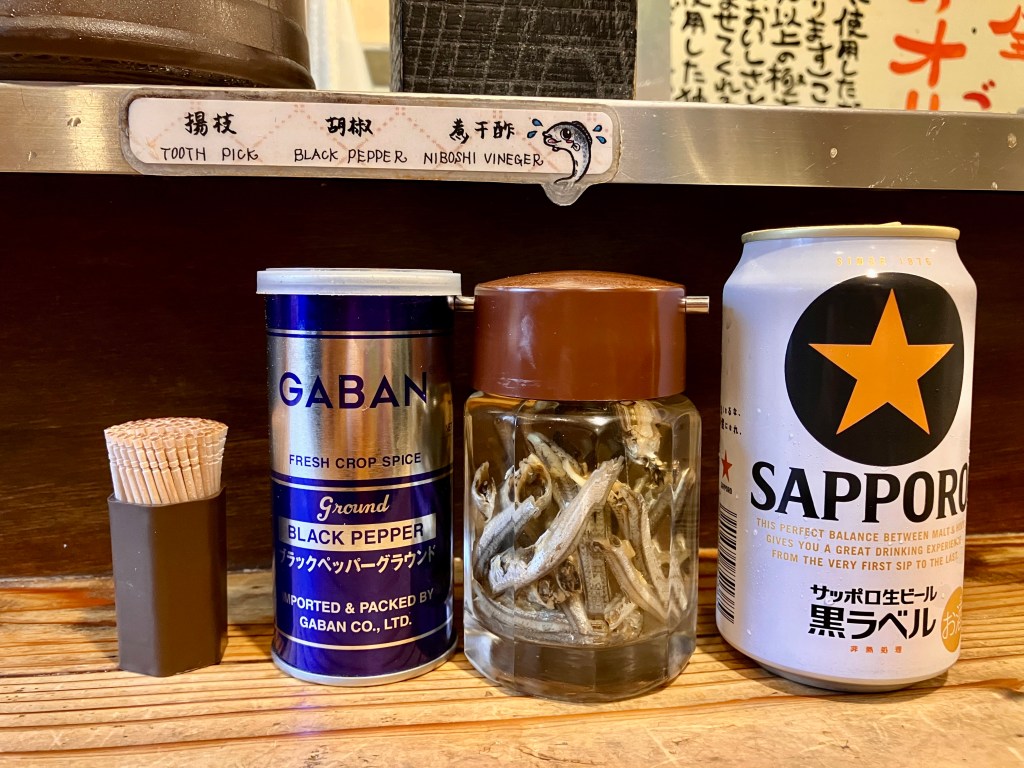
And hello to you too, Ramen bar condiments and Sapporo beer.
Somewhere around week two in Sri Lanka I announced that I missed abundance. It’s ironic since part of our decision to pack up our lives and travel was the desire to experience a less cluttered life. To have the freedom to shoulder our backpacks and go wherever we want. Well welcome to Japan, where abundance is always an option.
After a two hour immigration wait at the airport we made it to our apartment and headed out for some late food.
We made our first trip to Japan in 2007, before smart phones with translation apps. This time, we were ready for all Japanese menus. Our index fingers and thumbs were all warmed up for google camera translate. Uh huh. We bought SIM cards from a vending machine at Narita Airport but had not installed mine correctly yet, and Rich was using our US cell phone data sparingly until he got his new SIM installed. Well, long story short- the first restaurant we walked into we failed to navigate the confusing situation and quickly abandoned ship! Thankfully we found a small place with on screen ordering and settled in for our first meal.
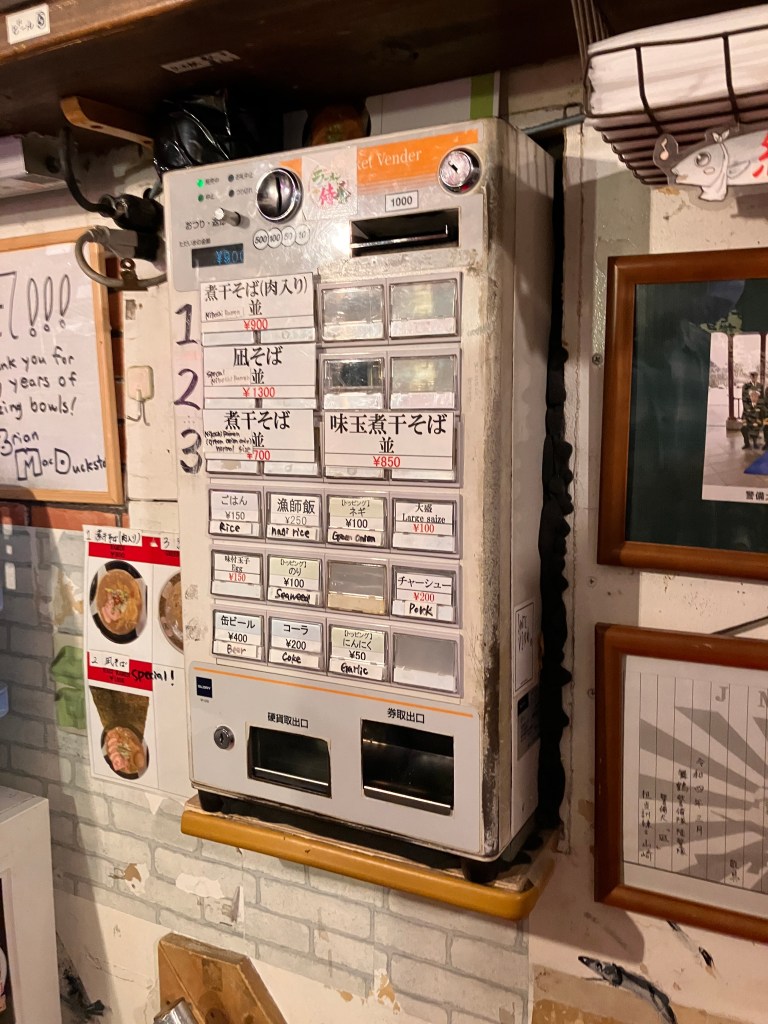
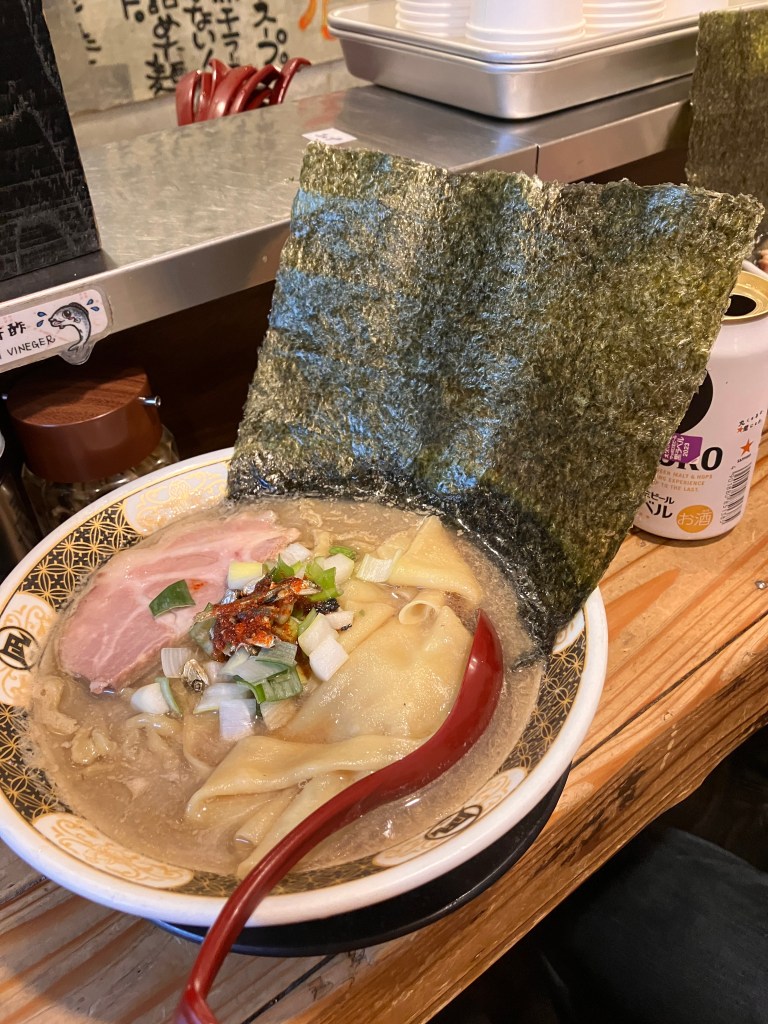
Ramen Nagi in Shinjuku. You make your choices at the machine, pay, and hand the order tickets over to one of the waitstaff/chefs.A delicious bowl of ramen.Rich in his happy place. A tiny ramen bar with about 8 seatsSome of the tiny but popular ramen spots have created problems with their lines of customers, so this one instructs you to line up in the alley, there is a small camera so they can see the line of customers, and a speaker to tell you when to come upstairs. Rich paying the bill at a small sushi restaurant- too small and cozy for any indoor photos!
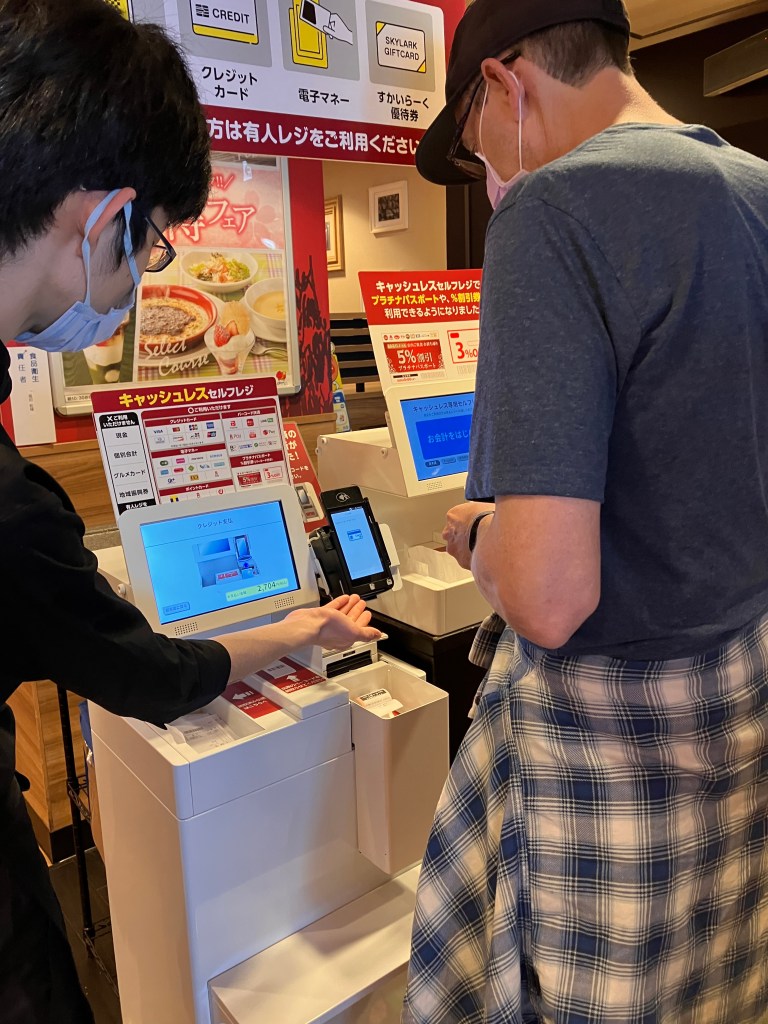
The automation is fascinating to see. As with many countries Covid accelerated cashless payments and waitstaff free ordering, but in Japan you get a fun mix of traditional and modern.
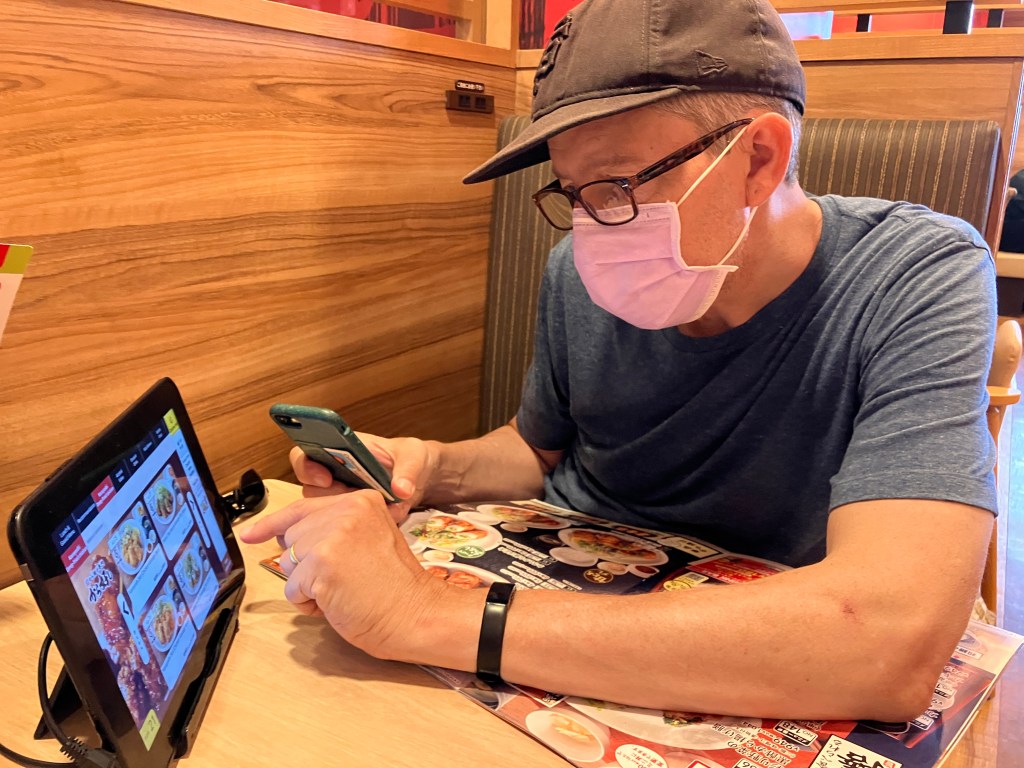
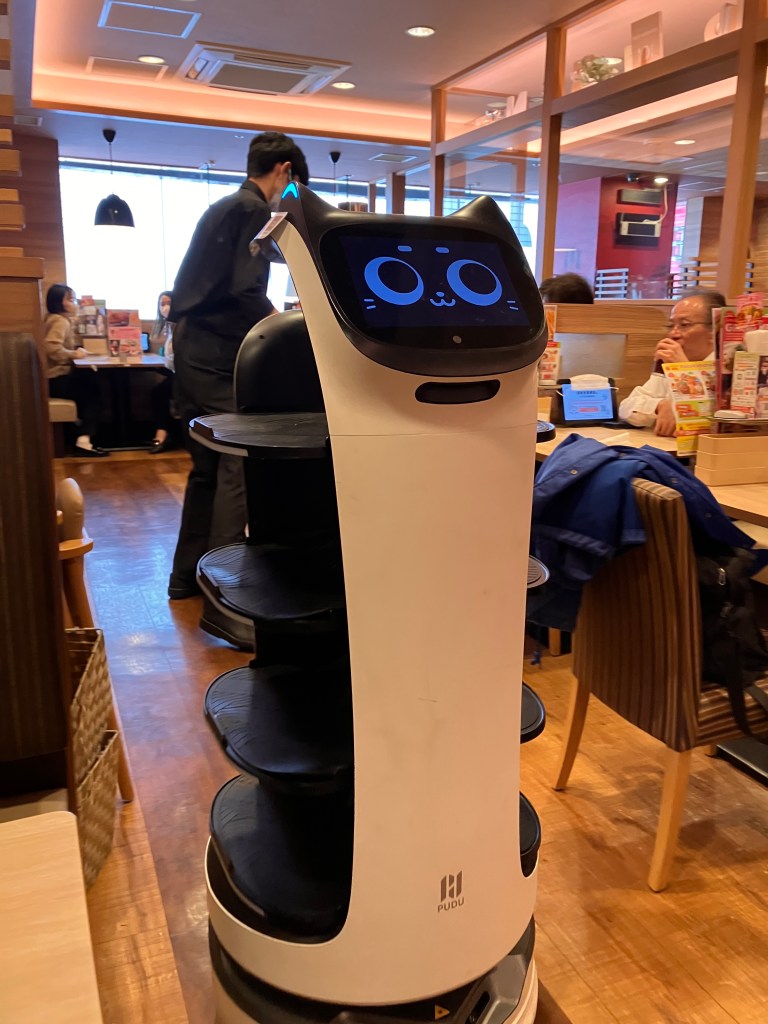
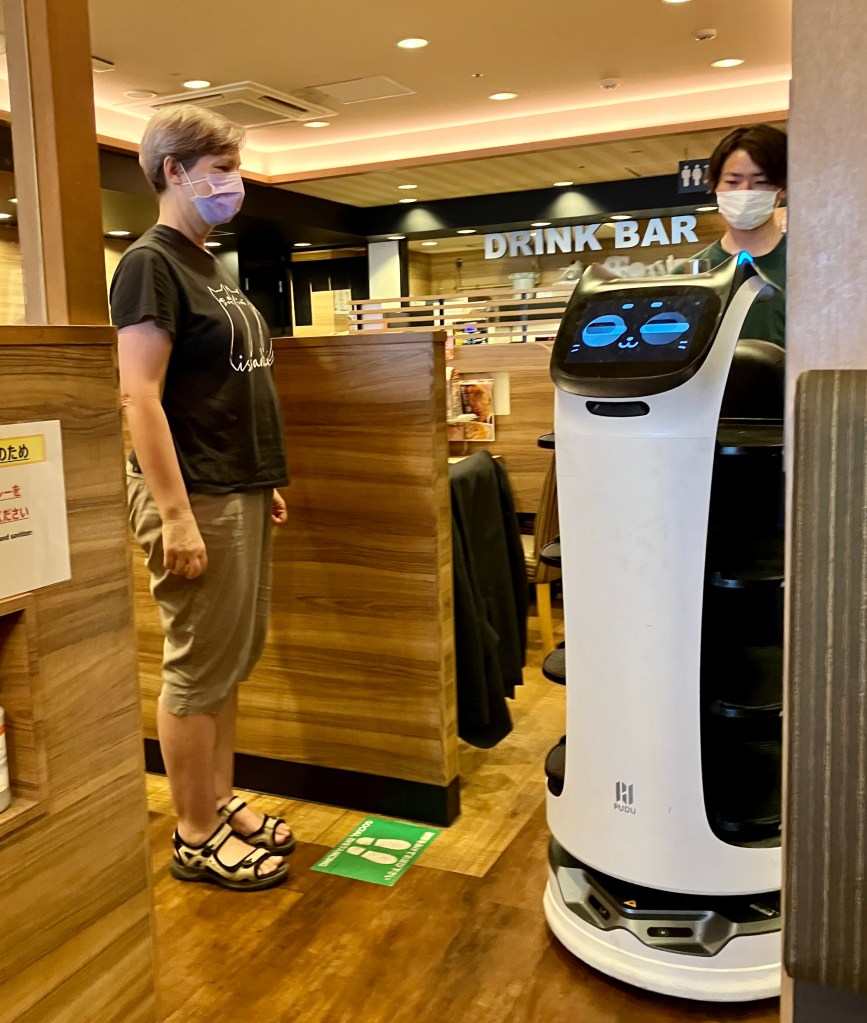
The modern, a chain called Cafe Gusto. You place your order at an on table screen. And a rather cute robot brings your meal.Karaage chicken. Different from what we know as fried chicken, the meat is marinated first, then coated in a potato starch batter and fried. Delicious.Stand off, Cheryl v. Robot. We worked it out.A helpful staff member explains the payment machine for us.
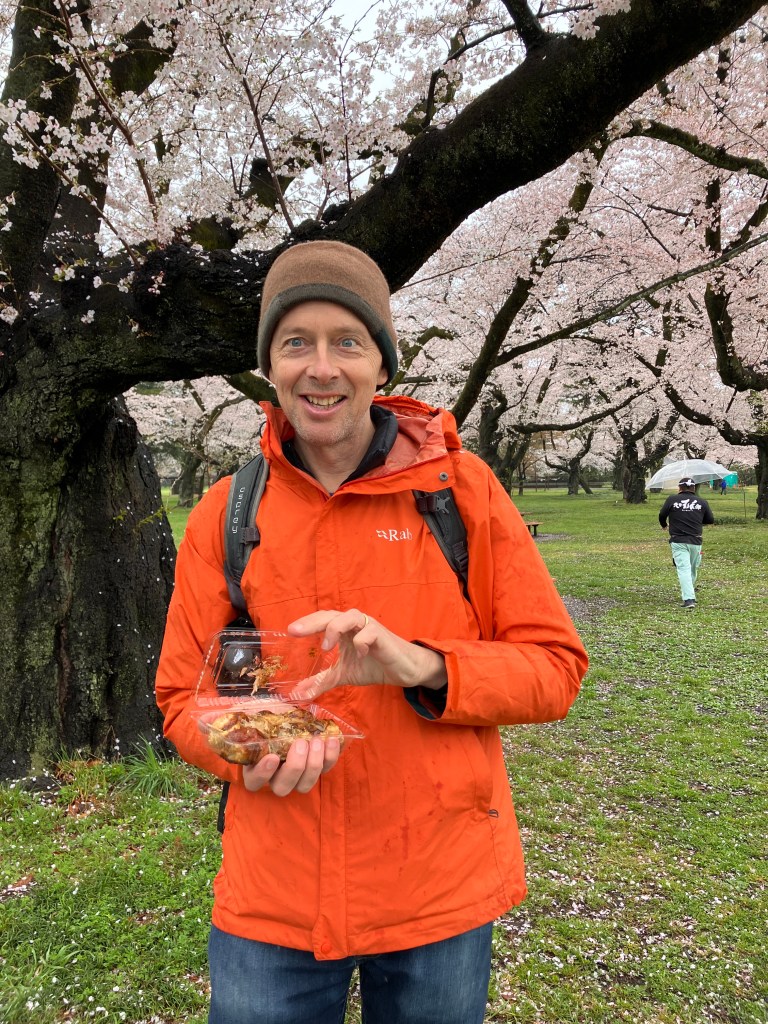
A Sakura (cherry blossom) post will follow with many photos, but this is all about food. We were craving Japanese food for the past few weeks so we’re thrilled to walk and sightsee and eat. Our walking mileage has gone up sharply which helps with the eating. We took a train out from Tokyo to Koganei Park to visit the Edo-Tokyo Open Air Architectural Museum. There was a festival going on despite the rain so we snacked our way through that.
Grilled squid. Rich enjoying Takoyaki balls (octopus and batter) under the cherry trees.
With four nights in Tokyo we had a chance to try to get into a small neighborhood izakaya restaurant on Friday, and when it was full up, make a reservation for the next night. Another good travel hack, especially in places where you either have no local phone number or where calling is beyond challenging due to language barriers. Two folks working the small restaurant, no fancy automation here. We were grateful for our young server/owner’s help. We always find the further out from the heart of a tourist district the more patient and helpful the locals are.
The traditional. Happy customers enjoying amazing food in a small izakaya in OtsukaThe softest most silken tofu. Our charming and helpful owner/waitstaff guy told us not to use soy, or the grated ginger or scallions since it would overwhelm the delicate taste of the tofu. We obeyed. Tempura white asparagus and a tempura seasoned soft boiled egg. Tuna and seabream. Rich had saved some photos from on line reviews, and our guy suggested others since this small restaurant has a daily menu and limited quantities. Sake. The shallow sake bowl tests your pouring skills- and perhaps your sobriety.
After four nights in Tokyo, and a longer stay running into Sakura prohibitive pricing, we hopped on the trains to head to Kanazawa. Our JR Rail passes will be getting a work out this trip as the Japanese train system is beyond amazing.
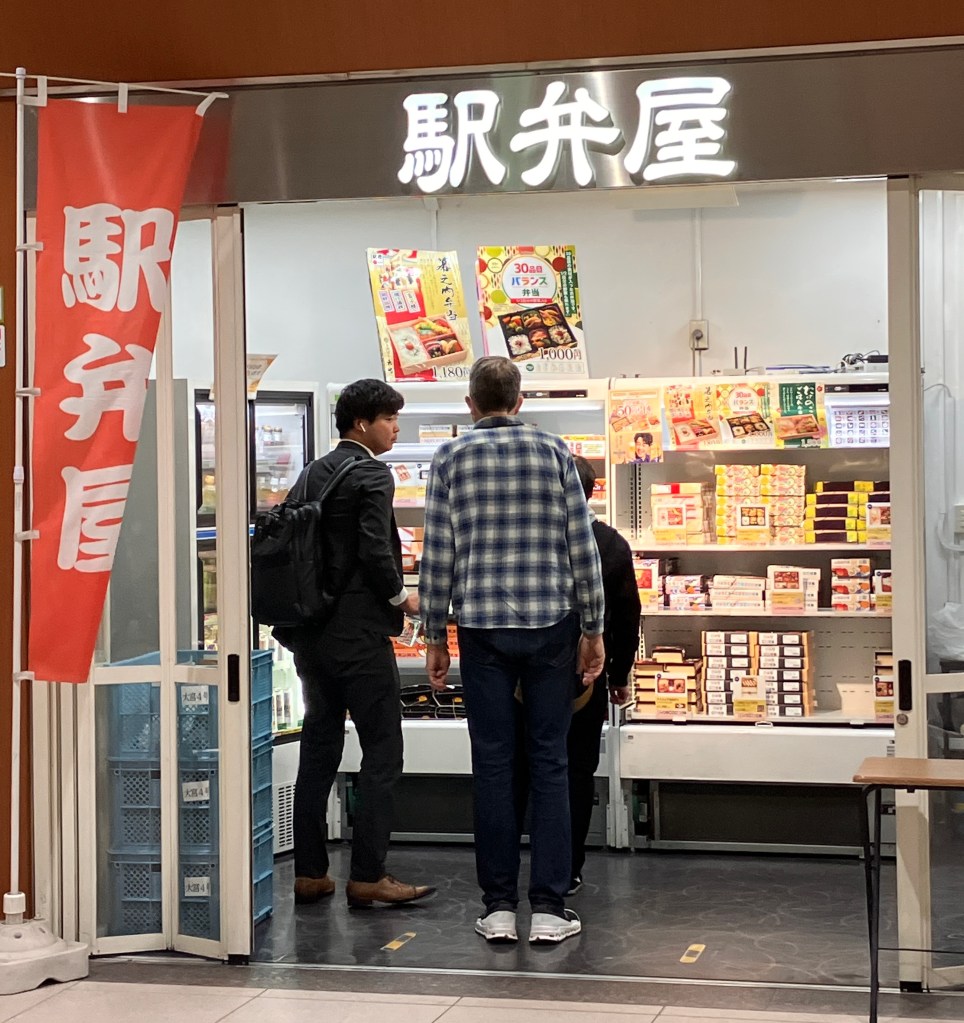
Rich buying our first ekiben, short for eki bento, train meals. I was tickled to learn that these lunch boxes are called ekiben if you’re on a train, soraben (sky lunchboxes) for a plane, and bento you eat anywhere. Our first of what will be many ekiben.
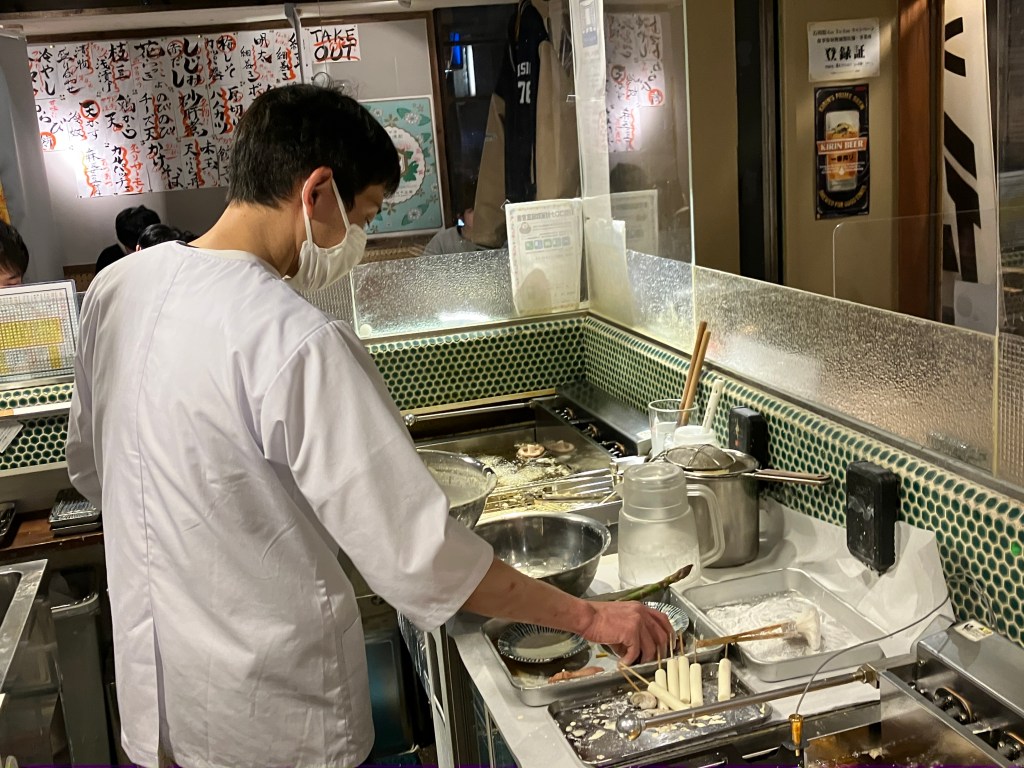
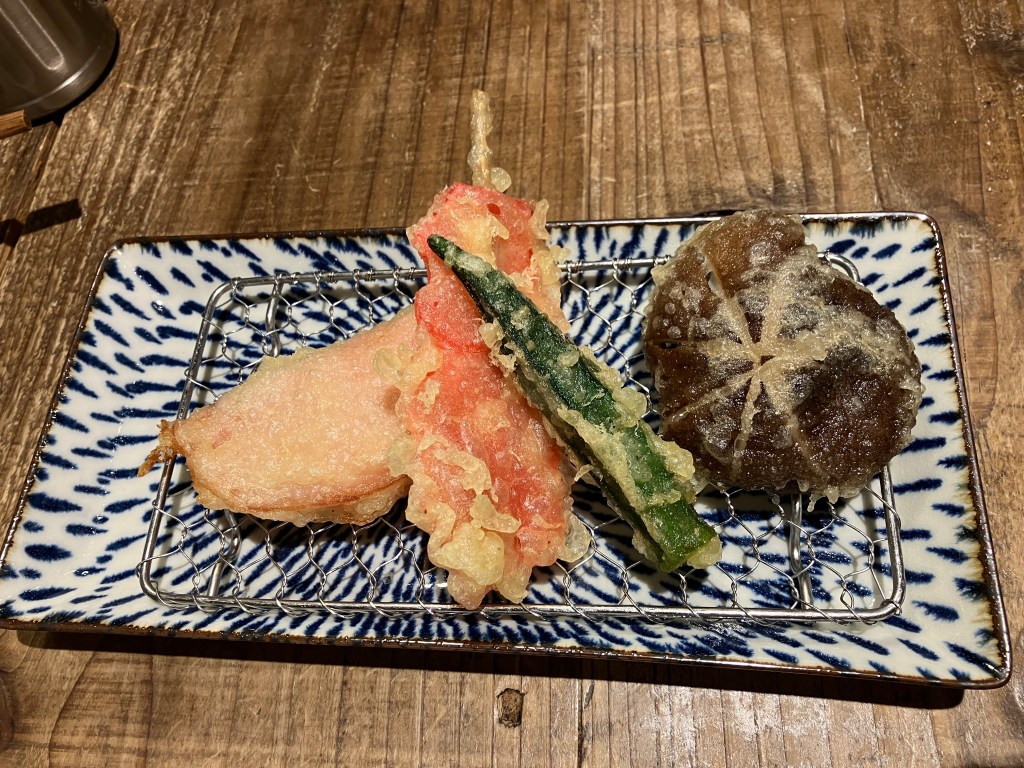
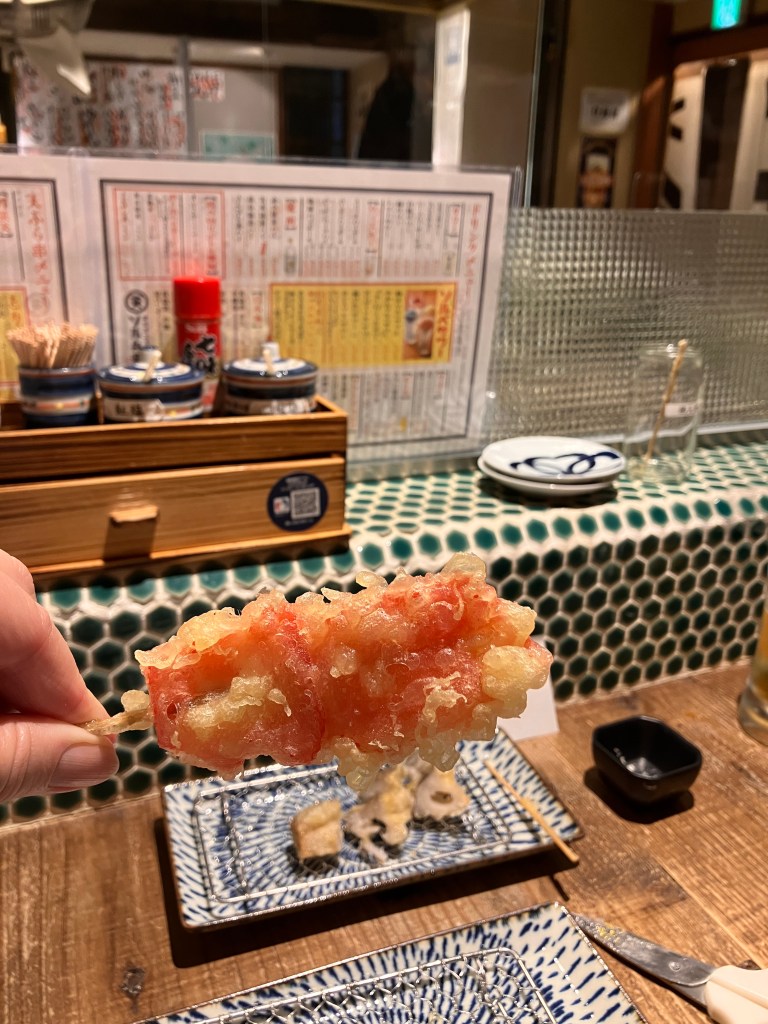
Our first night in Kanazawa we struck out three times, a conveyor belt sushi restaurant with a closed waiting list, an unagi (eel) restaurant which was closed despite the hours listed showing it should be open, and another full up sushi restaurant all by 8 pm. We figured out it was spring break week for schools so things were quite crowded. We finally saw a small tempura stand restaurant and got two seats at the bar. Another kind and helpful waiter sat us, got us an English menu, and took care of us the entire meal. We had a great view of the chef working his tempura fryer with chopsticks and tongs.
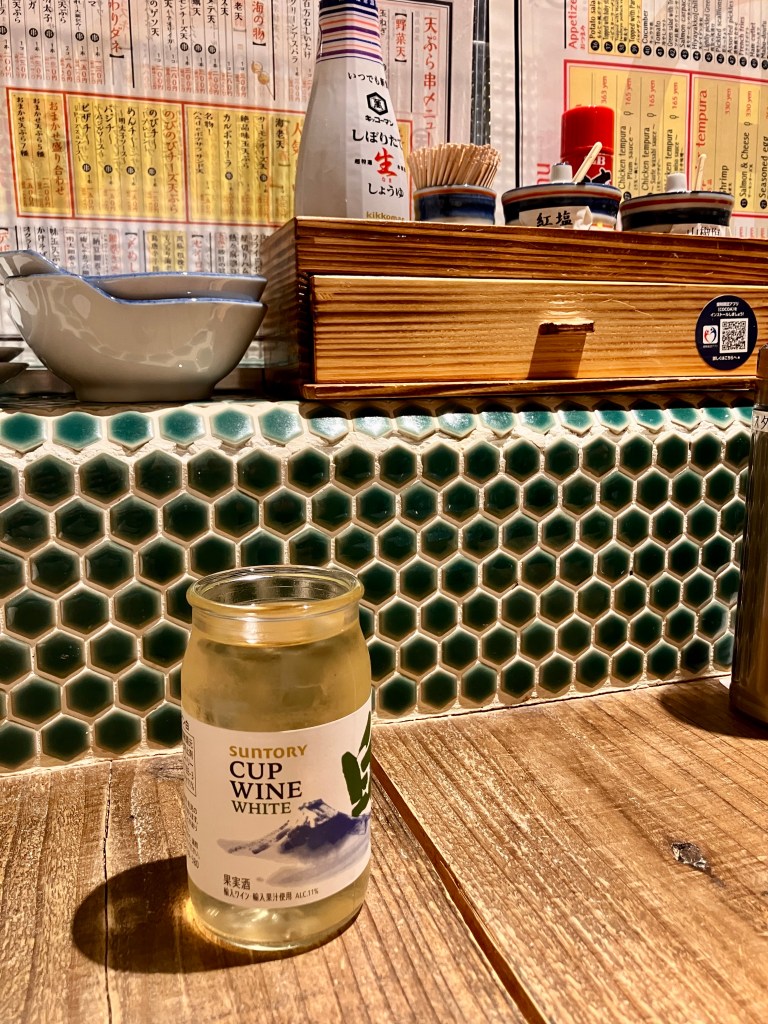
The tempura chef.I’m going to collect photos of the mise en place of our counter seats. And how cute is that jar of white wine?Tempura fresh from the fryer.That is a pickled ginger tempura. Never encountered by me before. I’m a pickled ginger fanatic and this was delicious.
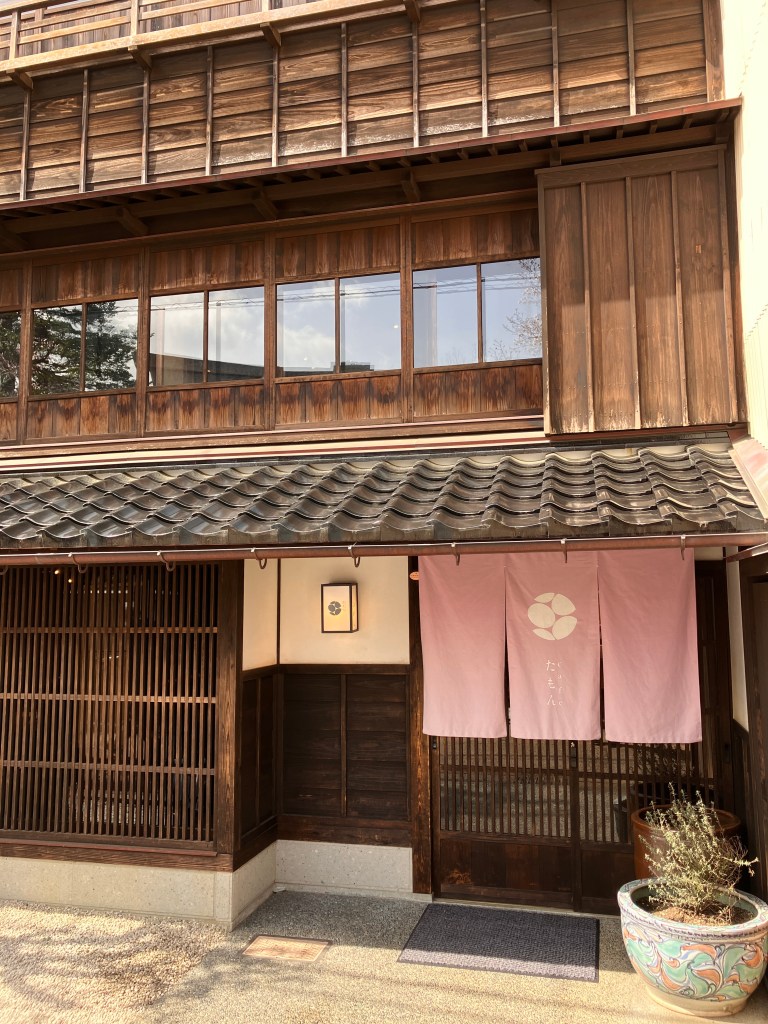
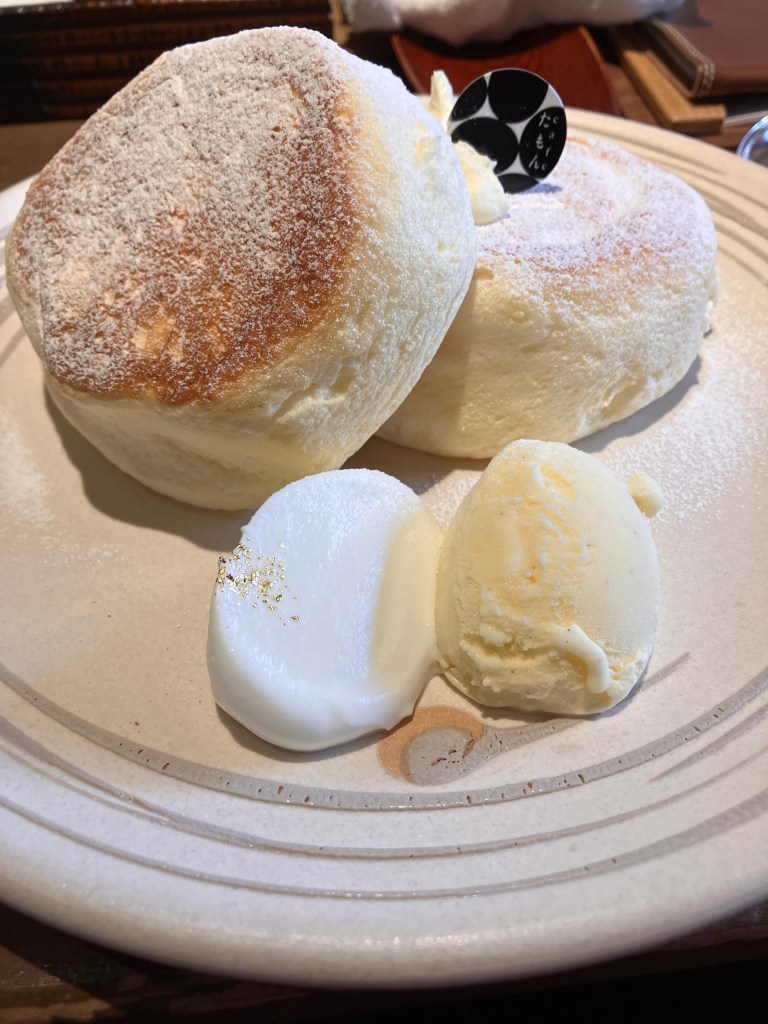
So far no breakfast photos, you might be thinking to yourself. Well, we’ve been having hotel room or apartment breakfasts of Musilix and fruit and yogurt, but we did get out early for cherry blossom viewing and then had a second breakfast our first morning in Kanazawa. Cafe Tamon is a small easy to miss but for the help of a passerby who saw us looking in confusion at our phones, pancake specialty cafe.
We walked right by it the first time. Very low key signage. Butter melting on the fluffy organic rice flour pancakes, whipped cream sporting a sprinkle of gold dust, vanilla ice cream, and a small jug of maple syrup for me and honey for my honey.Rich waiting patiently for me to stop taking photos. If there is a word which conveys more fluffiness than fluffy, that’s what these pancakes were.
Remember that conveyor belt sushi place with a closed waiting list at 7:40pm? We went back the next night at 6:40 and put our name on the list. About an hour later we were in! The nice thing about being the only tourists willing to figure out the drill, was that the host knew who we were – not one of many tourists: the only slightly confused looking non locals.
We’re in baby! Screen ordering and the chef hands you your dish.
Conveyor belt sushi has had a hard time recently, apparently from a social media trend that has attention starved youngsters misbehaving and filming themselves. Insert eye roll here. I’m not sure if the screen ordering is a result of that stupid trend, but it worked out just fine for us.
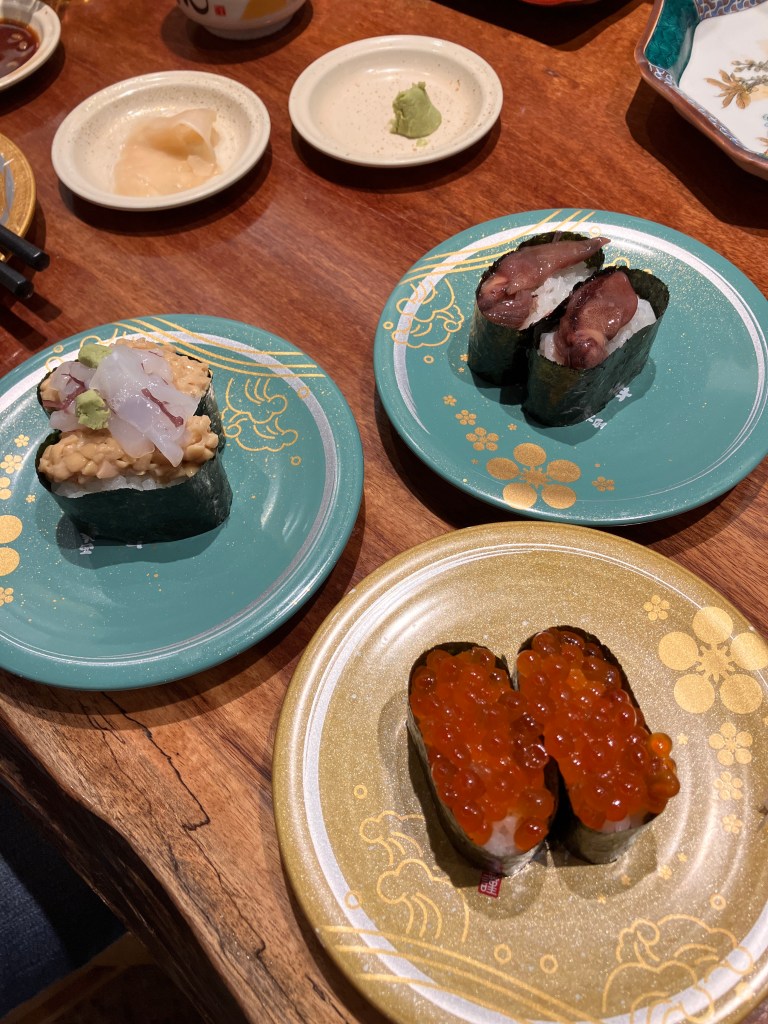
Tuna three ways.Squid on natto (fermented soybeans), firefly squid, and roe. The different colored plates mean specific prices, your plates are counted up at the end of your meal and tallied.
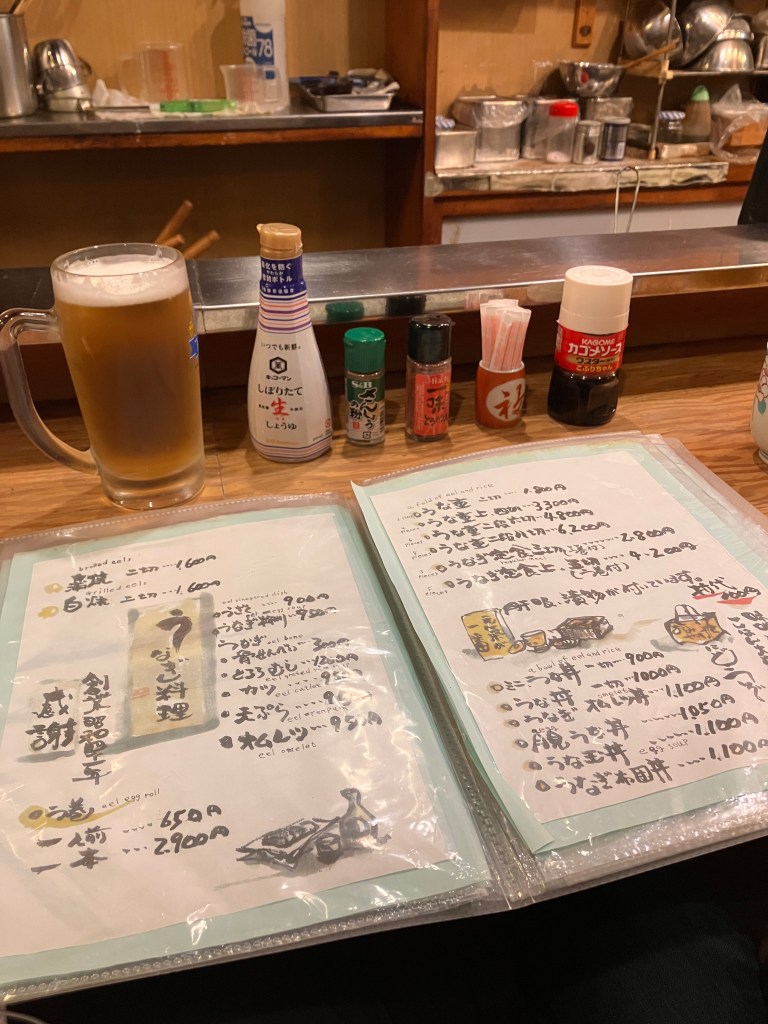
Our third and final night in Kanazawa we were determined to try the unagi (eel) restaurant again. The Japanese name came through Google translate as eel welfare. We marched over at 6 this time and the lights were on! Yay! We went in and congratulated ourselves on being some of the first customers of the evening. One gentleman was just leaving, and another man came in and placed a to-go order. The sole proprietor sat us at the counter, gave us a menu and bustled about behind the counter. We got two draft beers and settled in.
Another counter scene.
Our eel man turned away a group of five Japanese, and then two western tourists. What is going on, we wondered? This is a frequent state for non Japanese speakers here. Confused but pressing on! When it came time to order all became clear – he only had two pieces of eel left. Ah ha! That’s why he had been closed two nights before- he closes when he sells out of eel. Two pieces of your best (only) eel, sir, and some tempura. So many times as a tourist a mystery remains a mystery, so we were happy to have this one solved.
We would have happily ordered five pieces, but two was quite filling.That smile says it all. We love being in small restaurants run by a sole proprietor. One guy doing what he does best. On his own terms. Eel. And some tempura. Once take-out guy left we were the only customers. By the time we left he had turned off his lantern, the universal sign of “I’m out of eel for tonight!”?
It’s been a good start to our four weeks in Japan. We’ve honed our perception and empathy skills since our last visit here, and we know how quickly the world can change under your feet. (Poor conveyor belt sushi restaurants. ) We feel empowered by google translate, but a few key phrases in Japanese learned on line (link in our link page) quickly telegraph both our helplessness and our desire to be polite and thankful. There is so much more to experience and share, but for now itadakimasu! Let’s eat!
The happy travelers. Looking forward to more of Japan to enjoy.
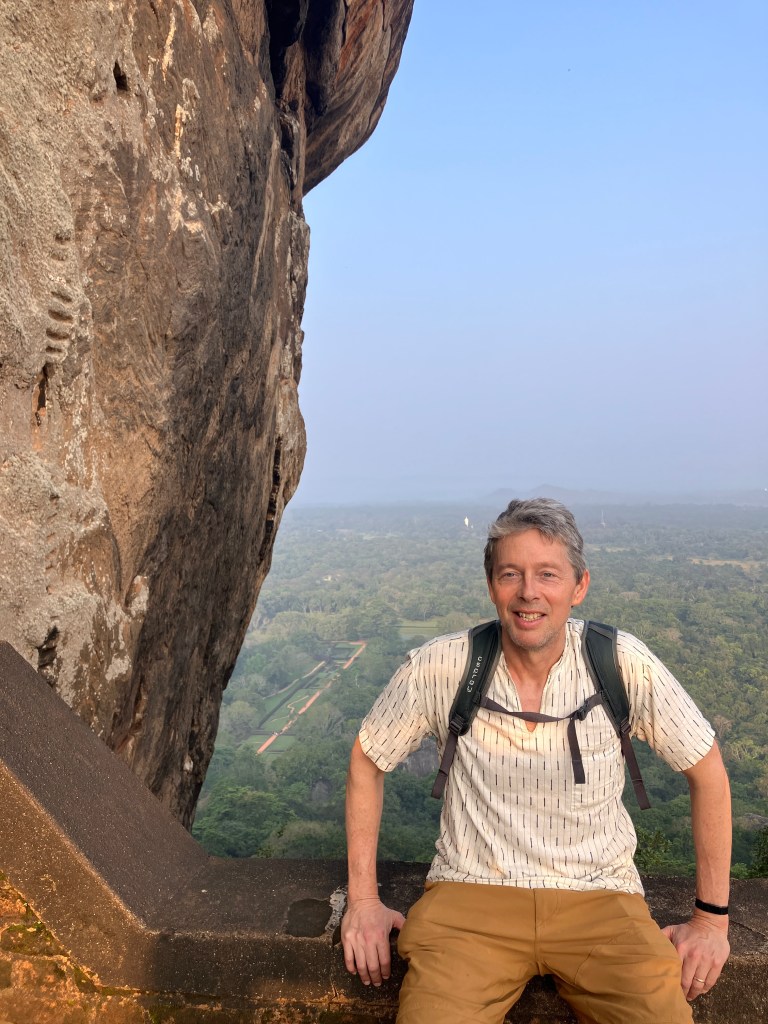
Sunset view of the 5th century ancient rock fortress of Sigiriya, the Lion Rock.
What is it that we love best when traveling? Walking and biking, of course. Sri Lanka has challenged us with the need to do taxi transfers and tuk tuk trips to avoid daytime heat or nighttime elephants, or to get from a hotel or guesthouse to a site.
A pond in the ornamental gardens leading to the Lion Rock. Tiny Rich added for scale.
Our first morning in Sigiriya, we had our guest house owner drop us at the west entrance and Museum to buy our tickets by 6:45 am, so we could explore and climb the rock before it got too hot.
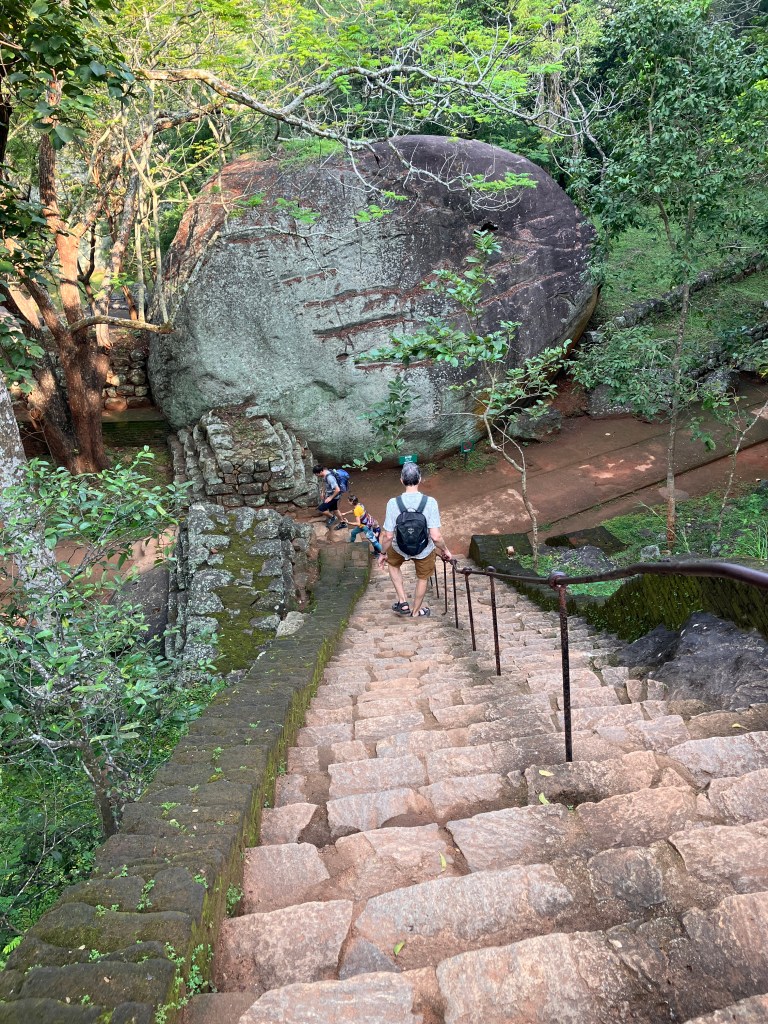
It took a lot of stair climbing to even get here, the two giant lion paws mark the entrance to the rock fortress. The lion head crumbled some time in the past.Not for the faint of heart or weak of knees.The views are amazing on your climb up and down.Ponds and walls speak to the history of this place.A pond and the cable trolly used to get conservation materials to the top of the rock.It reminded us a bit of Machu Picchu, the ability to look down upon the site really gave you a good sense of place.
First a capital for King Kashyapa AD 477–495, and then a Buddhist monastery until the 14th century, it is now a UNESCO World Heritage Site and considered one of the best preserved examples of ancient urban planning.
Laughing as we realize we still have to go back down all those steps.Down we go.Yikes. That’s a catwalk with a view.Almost out. Knees feeling wobbly.
We were staying close enough to be able to walk back to our guesthouse for a late breakfast, which made us happy. Any time you walk in Sri Lanka you do have to decline a lot of tuk tuk offers, especially at a popular tourist site like Sigiriya Rock. But we press on and enjoy the walk.
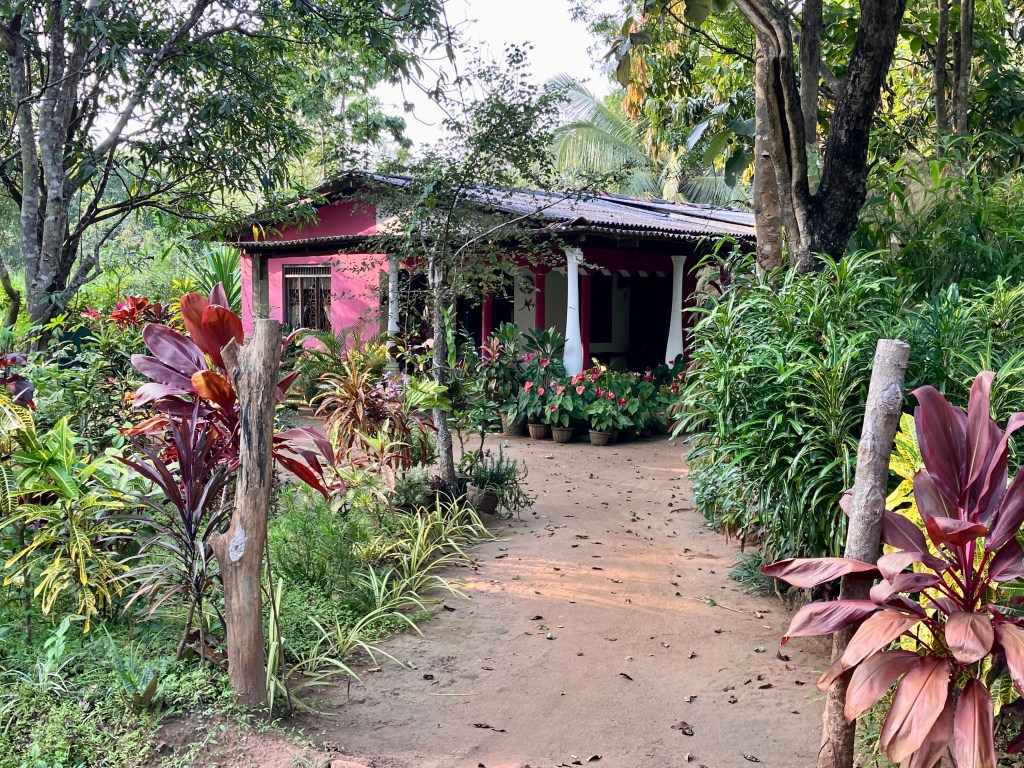
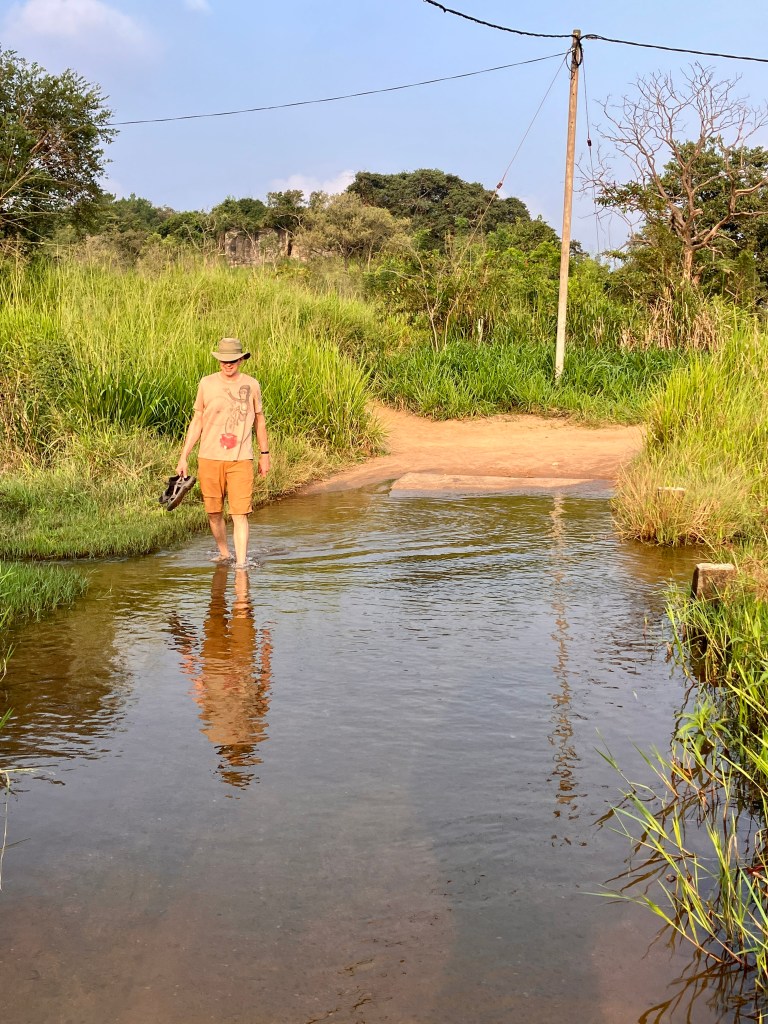
The small roads around town made for lovely walking. Sri Lankan people have an eye for design, so many lush gardens and pretty houses.An afternoon walk to the nearby lake, Kayanwala Wewa. The road crosses an outflow which makes for a refreshing wade.Relaxing by the lake.
Sri Lanka has no natural lakes. Starting in 300 BC the Kingdom began to construct reservoirs and tanks. The Sinhalese people were among the first to build artificial reservoirs to store water. These irrigation systems of the ancient world are still intact. Sri Lanka has ten thousand man made bodies of water, lakes, reservoirs, tanks, ponds, and stepwells.
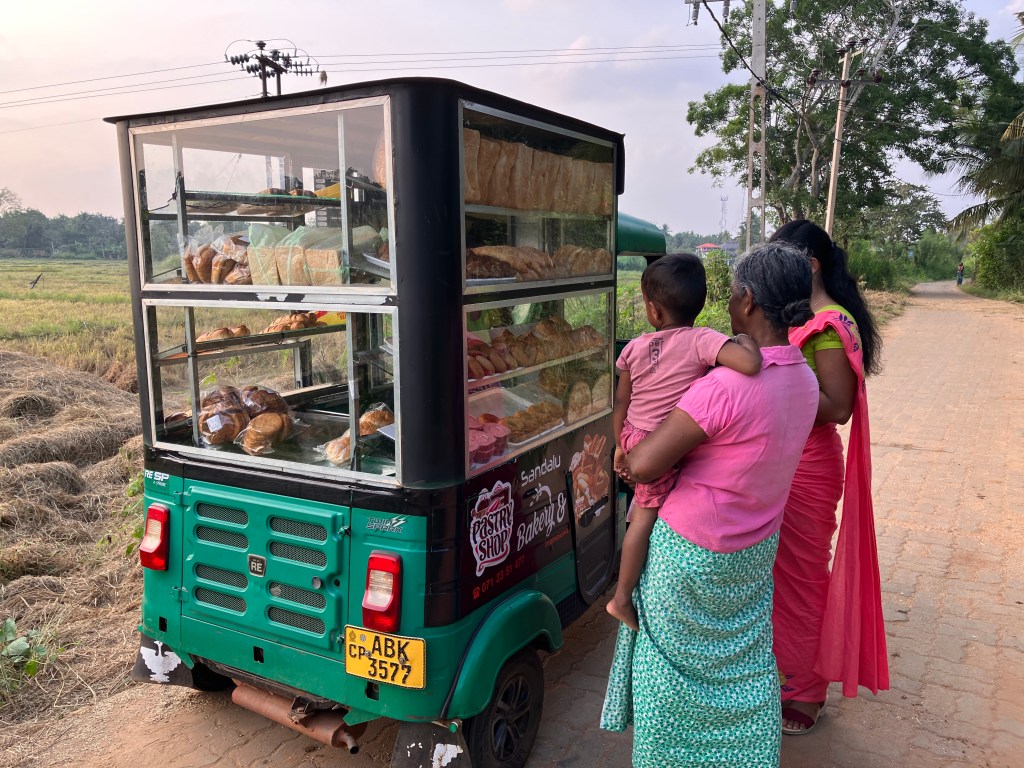
As you walk the small roads and greet locals you’ll hear an electronic version of Beethoven’s Für Elise. That signals the bread tuk tuk is near!A pastry shop on wheels. The ice cream tuk tuks play ‘It’s a Small World’.
With temperatures reaching 90f/32c in the early afternoon, our walk opportunities were limited to mornings and after 4pm. Not only is the heat and humidity oppressive, but the UV levels will burn this pale human in 15 minutes. Sunblock, long sleeves, umbrellas, that’s the only way I can get out and about.
Yes, there is an app for that. My trusty UV Lens app.
Walking the small dirt roads is not without obstacles though. Sri Lanka has so many dogs, some wearing collars and belonging to a specific house, but many many more simply stray street dogs. Most ignore you after a hopeful glance for snacks, but some bark and come rushing towards you. Not fun. We accidentally solved the dog stress problem when I deployed my collapsible umbrella while walking by a dog and it recoiled in horror. Ah ha. Shade giver and dog deterrent – the humble collapsible umbrella.
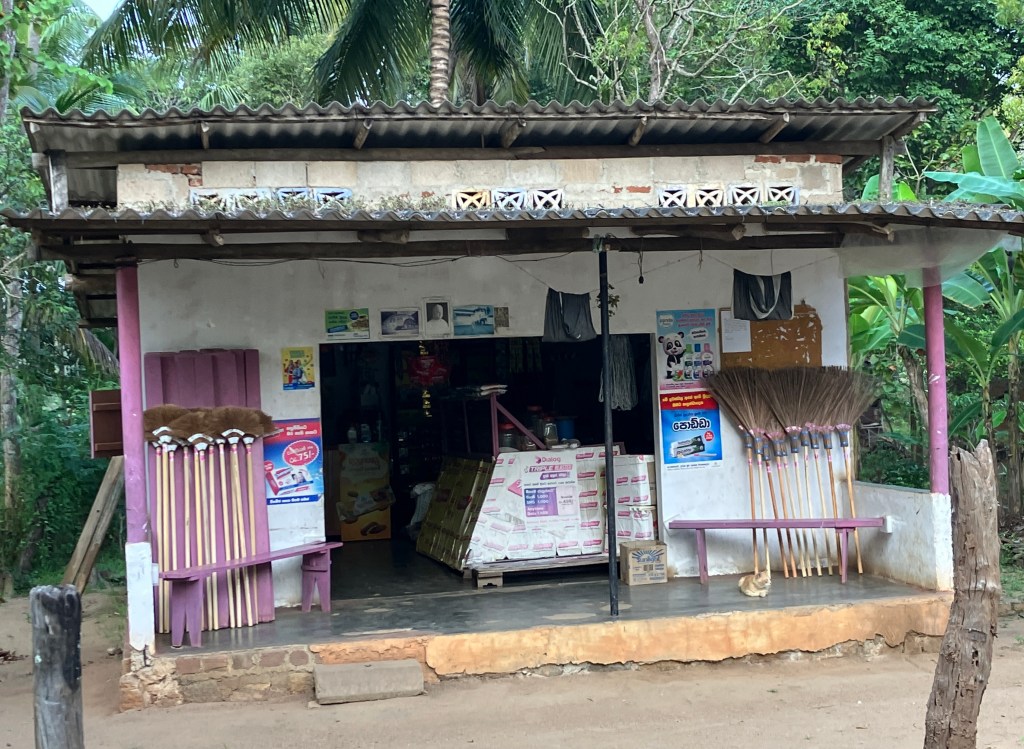
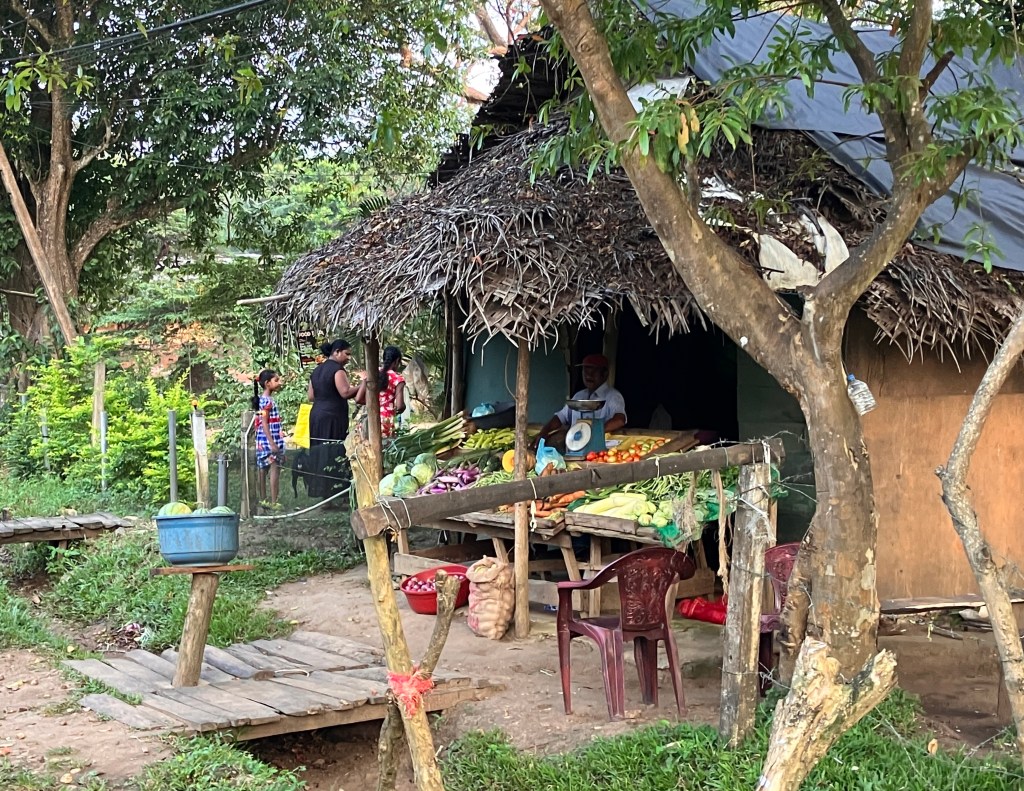
An artful fruit and veggie stand.Brooms and more.Another colorful roadside shop.
Our second full day in Sigiriya we spent visiting the ancient and Sacred City of Pollonnaruwa. We had a car and driver to take us the 45 minutes to the site, and once there we rented bicycles to explore the site and it’s many amazing artifacts. Polonnaruwa was the second capital of Sri Lanka for three centuries between the 11th to 13th century after the destruction of Anuradhapura Kingdom (which we’ll also visit) in 993.
Rich can rarely find a bike that fits him well. But he looks happy anyway.The restoration of the buildings and statues is on going.My first time on a bike since breast reduction surgery in January. I couldn’t stop smiling – cycling in hot weather is much easier than walking.Our trusty bikes in front of an ancient stupa. Since tourism has not fully rebounded we had many of the sites to ourselves. The jungle had covered many of the buildings until restoration and conservation. The before and after photos are dramatic. Exploring Pollannawura by bike. Ponds are an important part of the site. And beautiful.Tempting on a hot day. But the signs clearly forbid swimming.To enter the temple areas you must remove your hat and shoes, and put down your umbrella. As it gets later the sand gets hotter so visitors bring socks to wear.
Riding bikes around this ancient site was such a unique experience, but we did wish for better curation of the experience. Even the museum, which we visited at the end of our ride around, didn’t do a great job of giving you a sense of how people lived in Polonnaruwa. We didn’t hire a guide, which most of the visitors did, so perhaps that was a mistake on our part, but we so much prefer doing things at our own pace and we know we’re happier without a guide. From what we overheard from the guides I don’t think we missed out on much information beyond what we had from our guide book.
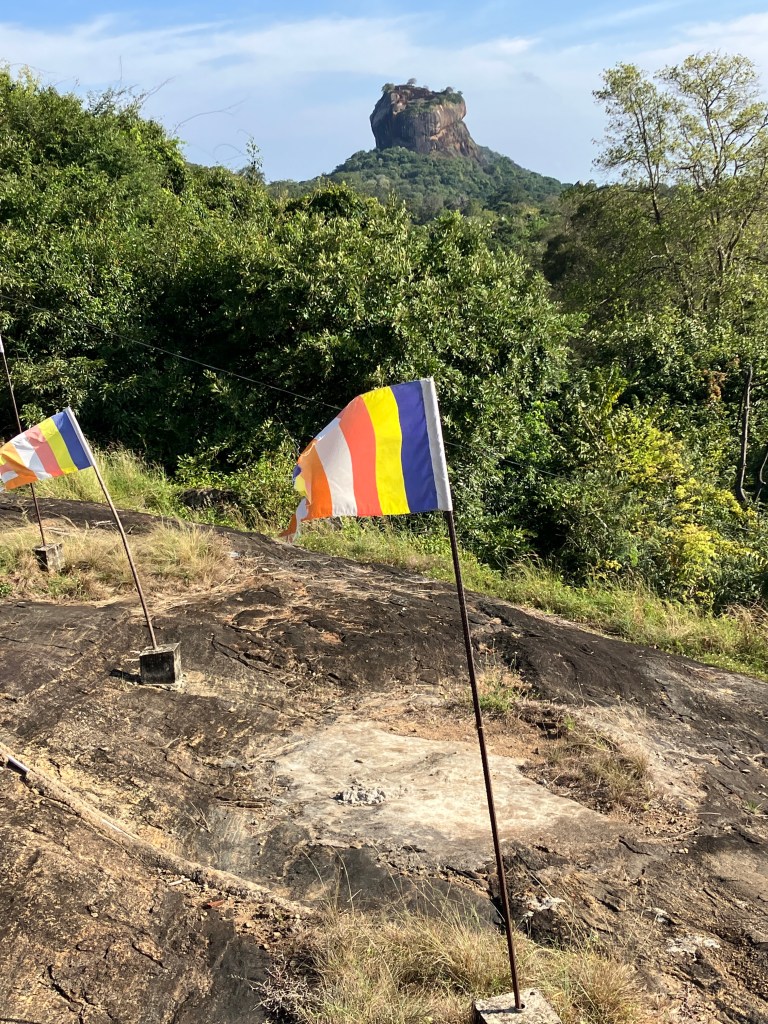
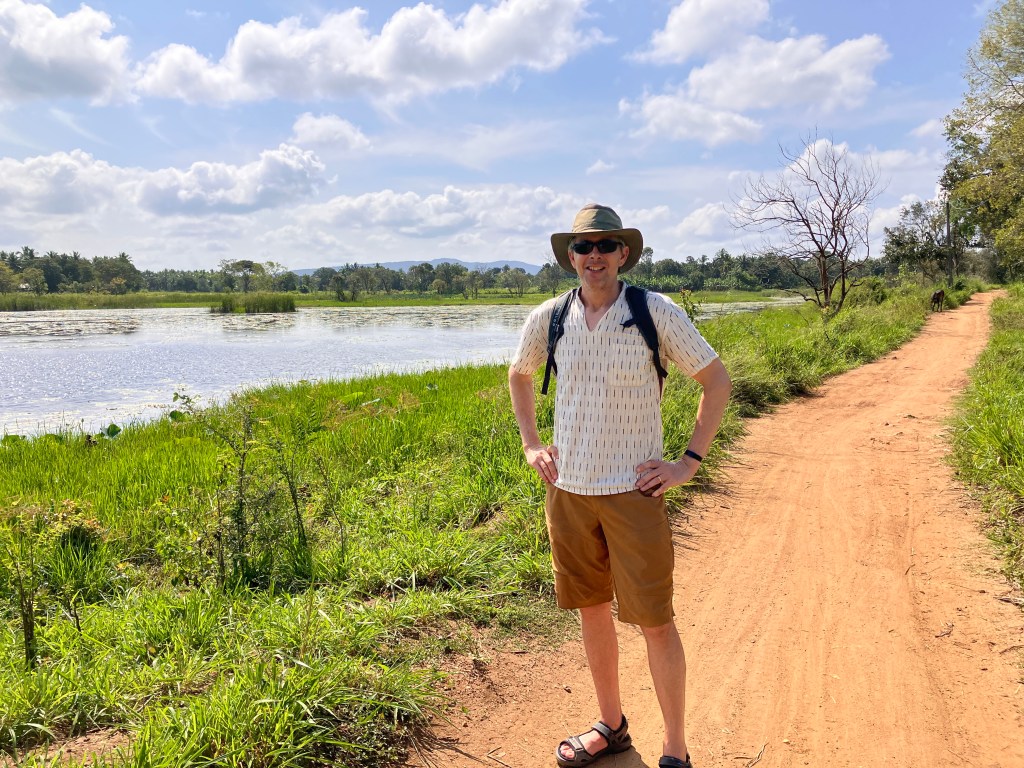
That photo bombing Sigiriya rock again, this time on a morning walk.Unable to find bikes to rent we headed out on foot for what ended up being almost a 7 mile/11 km walk. A local fishing at the lake, he had a bike. We were jealous.The roads were getting smaller, the temperature was getting hotter.
The area around Sigiriya is not only an archeological sanctuary site, but also has elephants and rice farmers. We saw an elephant from the road when being driven back from Pollannaruwa. Our long walk took us alongside many rice fields. We were fascinated to see the methods the farmers use to either keep the elephants out of the fields, or to alert an overnight watcher of the presence of an elephant so an attempt could be made to deter the elephant using loud noises.
Rice fields.Empty Lion beer cans hung on string at the edge of a rice field. Empty bags and branches- not much of a defense against an elephant.A night time elephant lookout platform. That looks like a lonely and nerve wracking job.This canal proved to be a great bird watching area. So many bright blue Kingfishers darting along it kept us distracted from the heat.A little roadside shop with chairs in the shade was a welcome sight. Two cold lemon sodas perked us up for the last mile.An umbrella is key for mid day walking, we bought this UV protection umbrella in Taipei.
You never know what you’ll see walking around small rural roads. Local folks were unfailingly friendly and helpful. We reminded ourselves that the small children had possibly never seen tourists, the three years of very little to no tourism meant that their wide eyed stares were not a comment on our hot sweaty state. It can be a bit daunting to wander the back roads, but so rewarding.
Evening bread tuk tuk, with two ever hopeful dogs. The happy travelers.
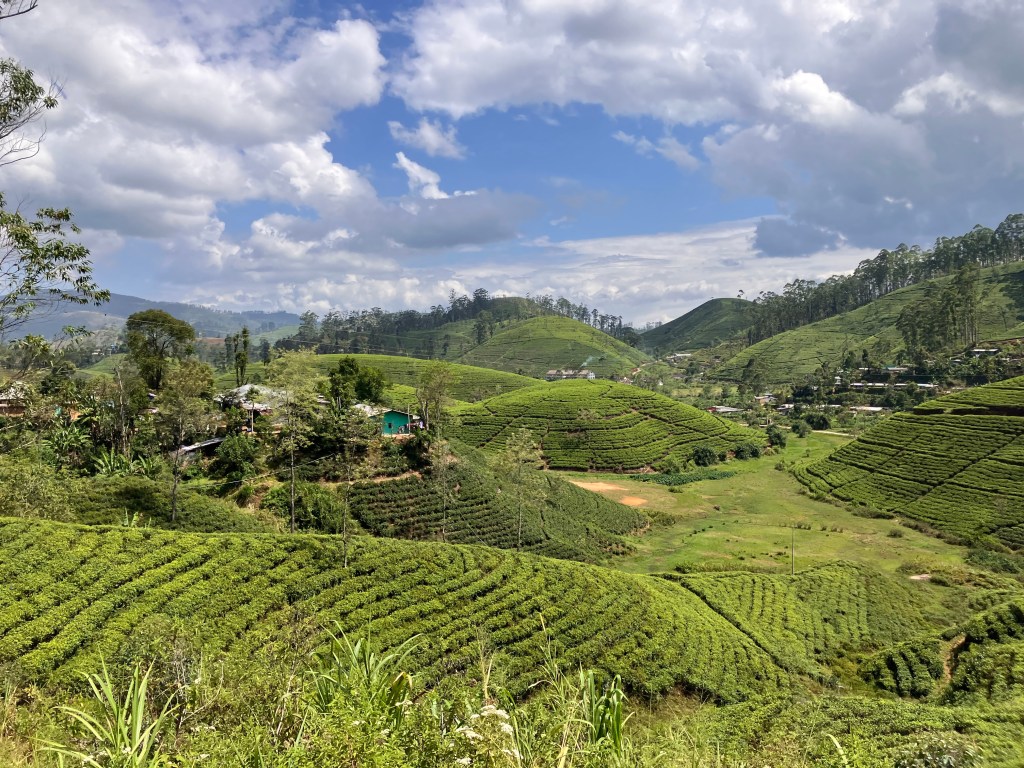
Passing through tea fields on the way from Ella to Nanuoya.
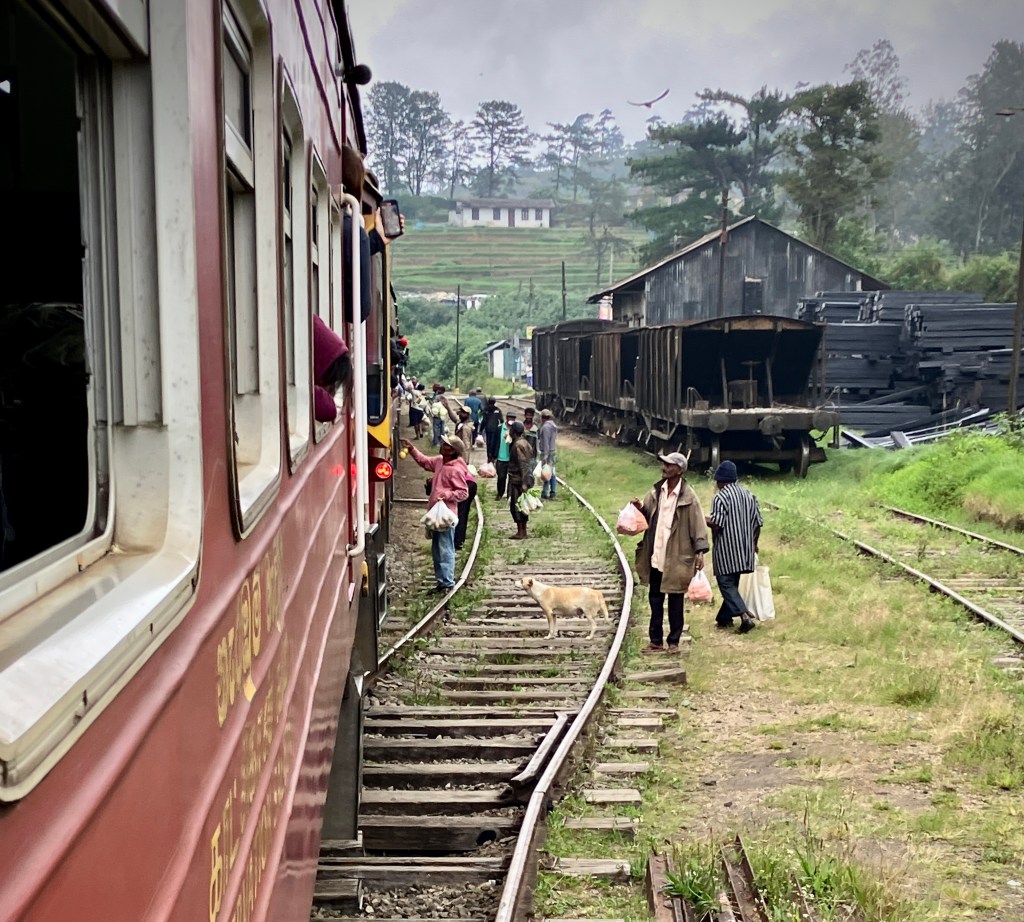
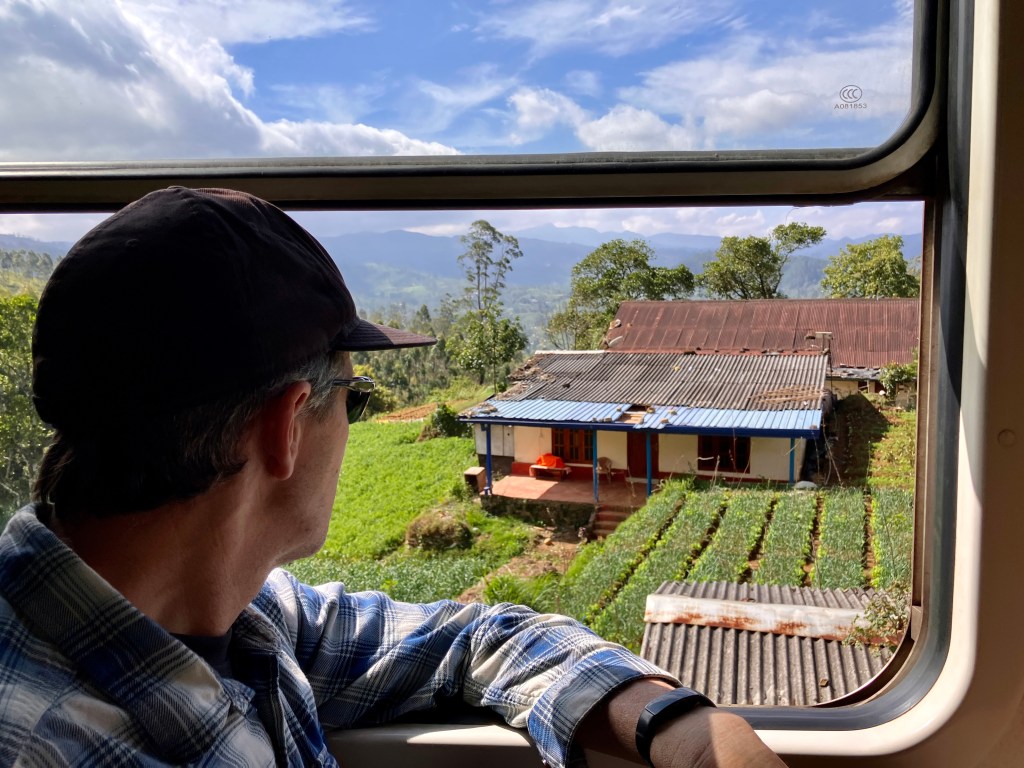
Taking trains is a big part of our travel joy. Riding trains with open windows and doors, winding through tropical jungles and tea growing areas, feeling the soft warm air on your face, seeing life as the train winds along – that is magnificent.
The hand off of the token, the loop held by the man in the white shirt. Since much of the line is a single track the token is a safety measure to assure that only one train is traveling a given section of track at any time. Rich enjoying the open window of the observation car (OBV), at the end of the train.
Our go to train advice site, The Man in Seat 61, recommends sitting in the non AC carriages to take advantage of the open windows.
Dramatic skies made the landscape even more beautiful.Buying train snacks from a vendor who walks the train, samosas and other goodies.Train snacks! Yum. Over a trestle. Obligatory head out the window shot.The observation car never filled up, but the unreserved carriages were standing room only with locals.
From what we’ve read the trains got much more crowded starting June 2022, when the rising cost of gasoline and bus tickets increased train ridership by 50%. As tourists we are able to buy our way into the comfort of the reserved carriages, but we do wonder why ticket prices for foreigners aren’t higher, as one encounters at museums and archeological sites. There is much need for upgrades to the rail system and new trains and higher tourist prices could help fund that.
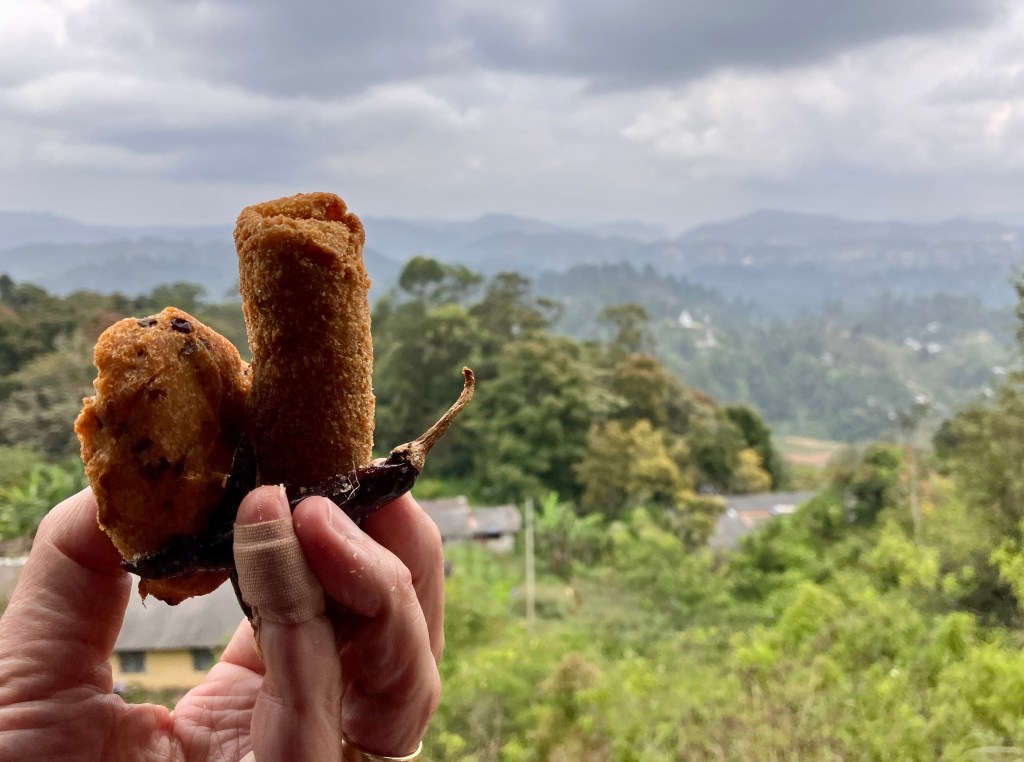
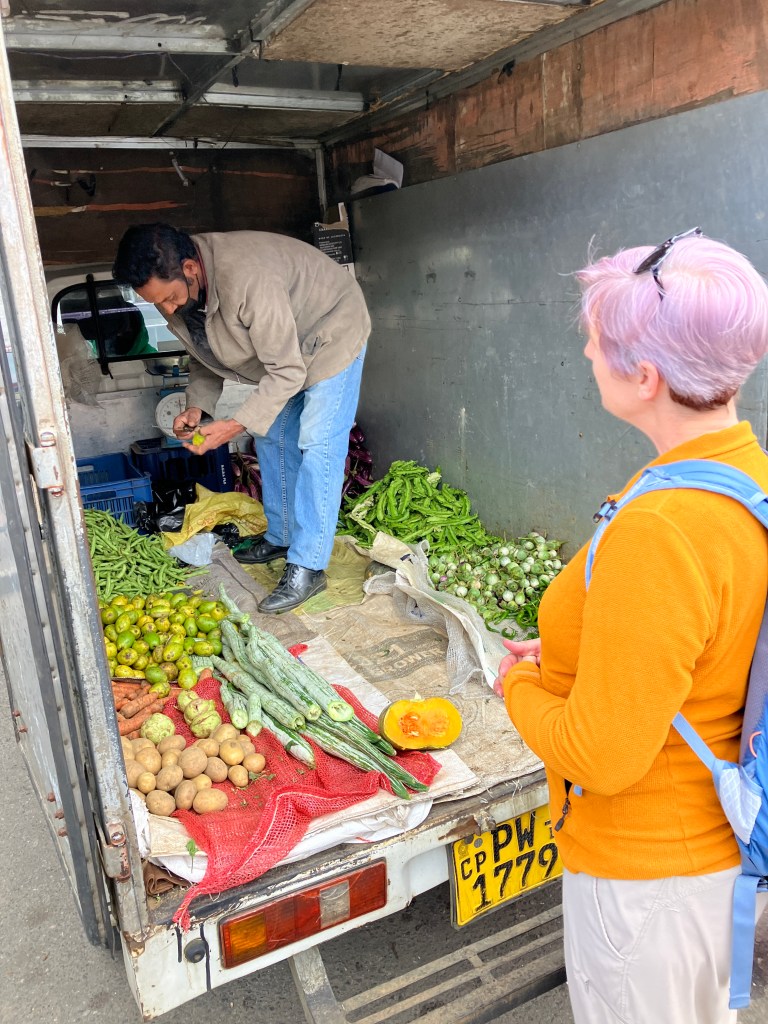
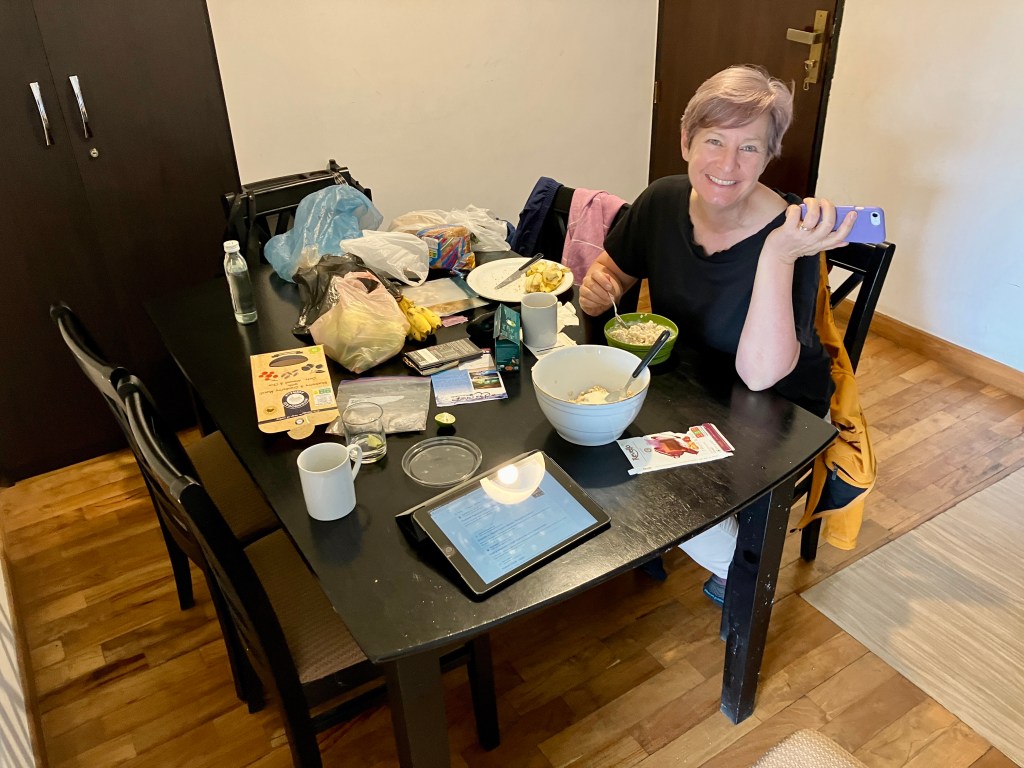
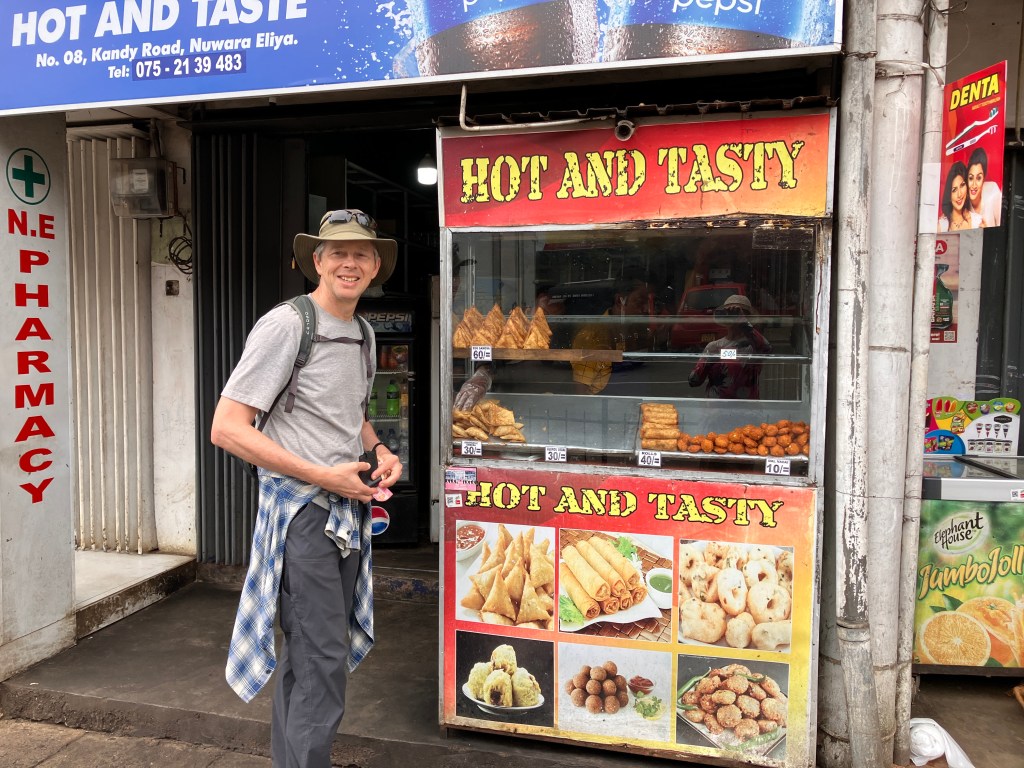
As our train waited at a passing track for another train to go by, the local farmers came out to sell vegetables to the passengers. Another reason to ride in a car with windows that open. We bought lettuce. Following our taxi driver at Nanu-oya for the 17 minute drive to Nuwara Eliya, where we had an apartment for two nights.Buying vegetables for dinner.Buying an adapter. Sockets in older buildings are different than those in new buildings so our adapter was incompatible at our next place. After more than six weeks without an apartment stay it was nice to cook dinner and to have breakfast at our own pace. Typical messy table. Headed out for a walk in the hills around Nuwara Eliya.Although there are no marked trails, using Maps Me gets us going, and friendly locals steer us to the correct path when we get confused by the many social trails. Walking the small roads and pathways is one of our favorite things to do. It can feel awkward to be so off the tourist track, but Sri Lankans have been only friendly and welcoming. Tidy houses and streets and lovely gardens make the walking so pleasant. A view across tea fields towards Sri Pada, or Adam’s Peak. 2,243 m/7,359 ft.Buying samosas and vade to have for lunch with the rest of our vegetables.
We don’t want to sweep the problems Sri Lanka is going through under the rug, and post only fun photos without acknowledging the challenges the country is facing, but in many areas you don’t see the difficulties as a tourist. You can live your tourist life blissfully unaware of the undercurrent of struggle many are still facing. If you pay attention to little things, while in line at the grocery store for example, you recognize the stress on parent’s faces as they watch the register add up, and you hear from men who worked in Dubai but came home during the pandemic and are now working towards getting employment in Japan or Korea.
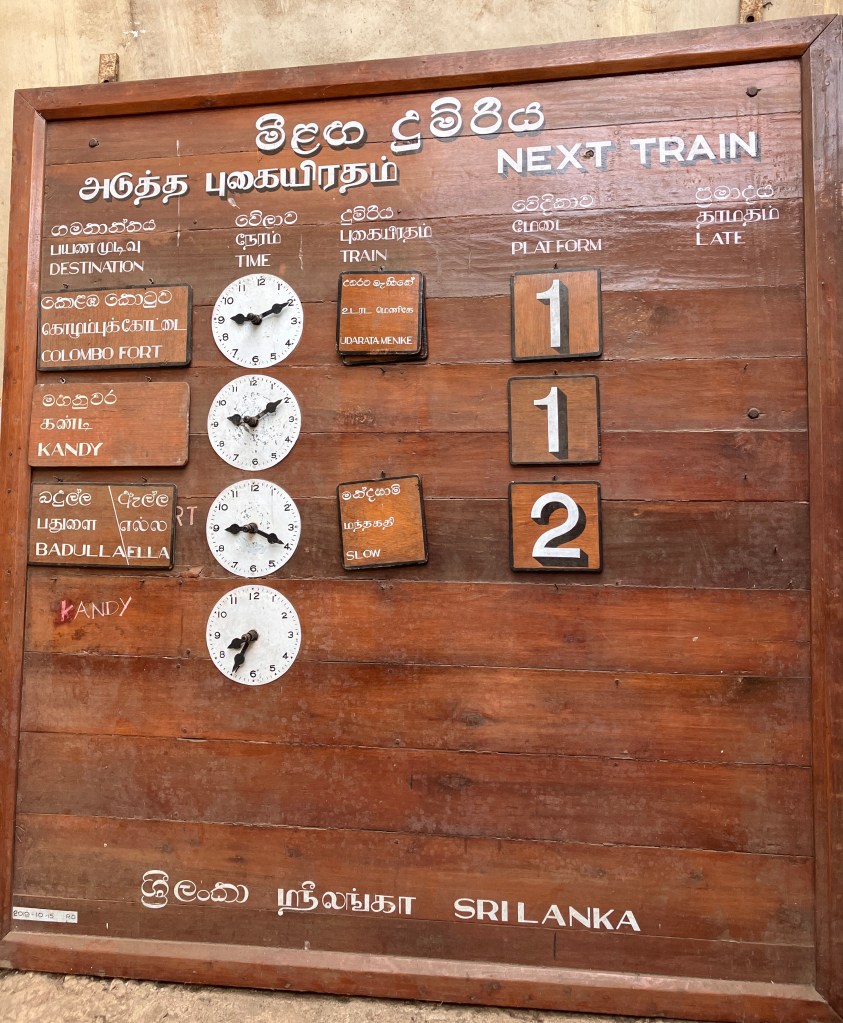
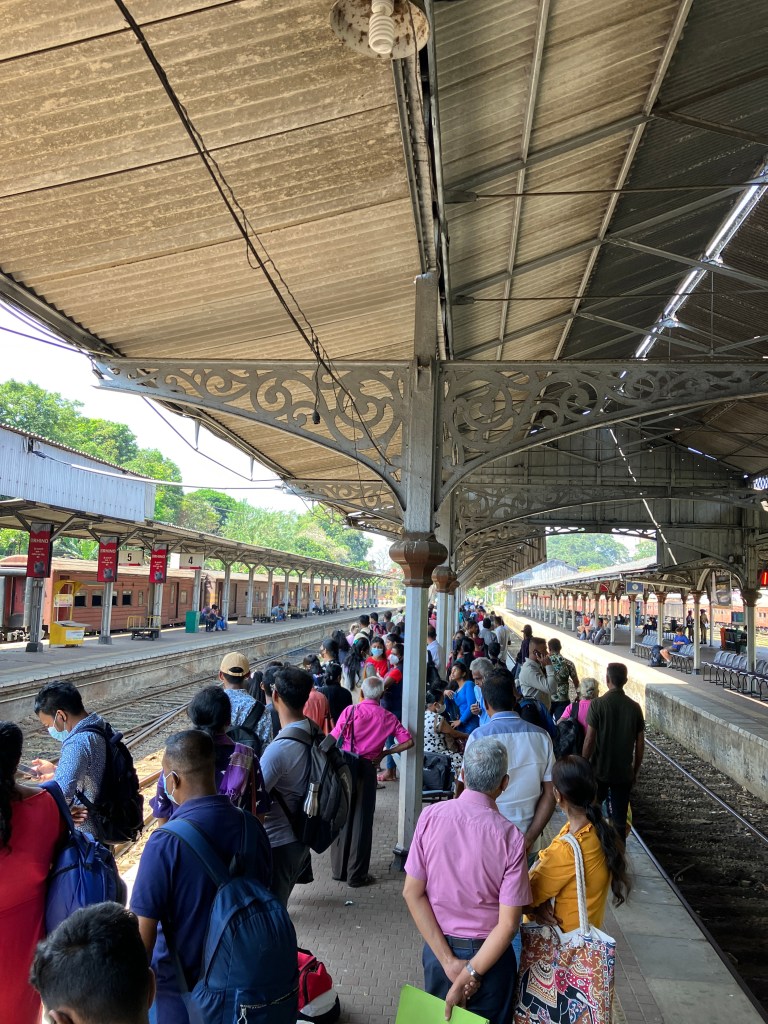
The big board at Nanu-oye station. We’re on the 9:10 to Kandy from platform 1.Rich in his element. Traveling by train.Catching glimpses of life.Still admiring the tea fields.
One of our drivers was taking Japanese classes. He had calculated that five years of work in Japan would be enough for him to come home and start a solid life for himself, his wife, and their two young daughters. As Americans who admire the bravery of immigrants, who come from a country of immigrants, we understand the determination and hope that the hard working people we meet find a way through and forward.
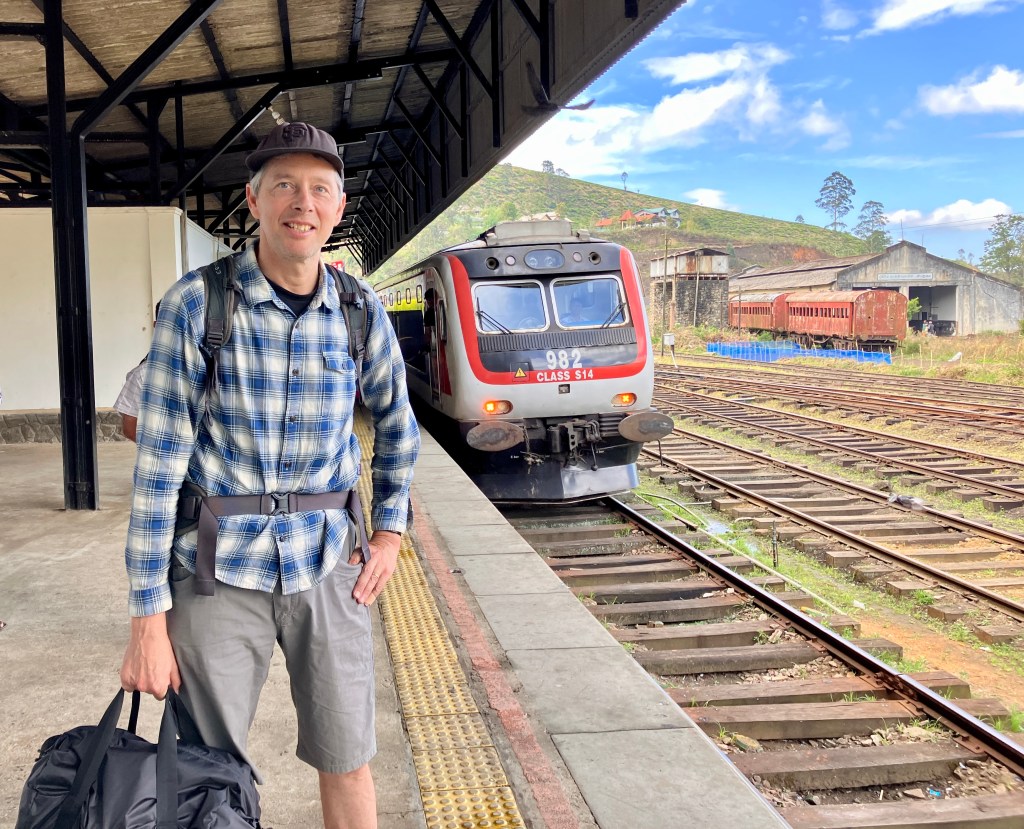
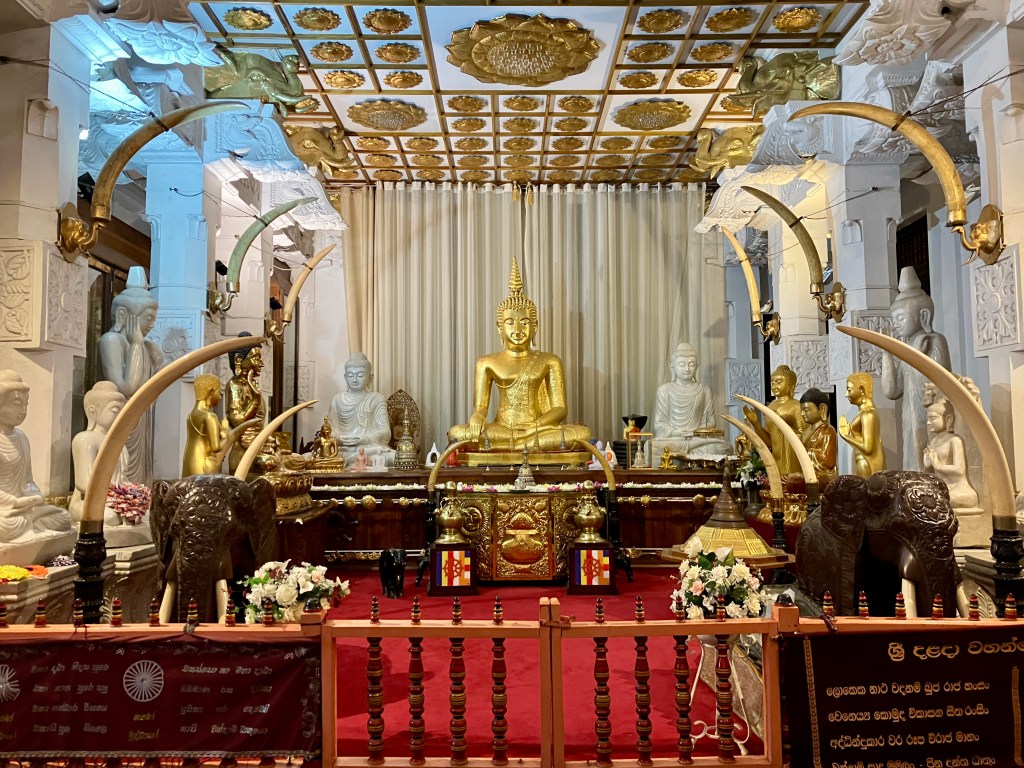
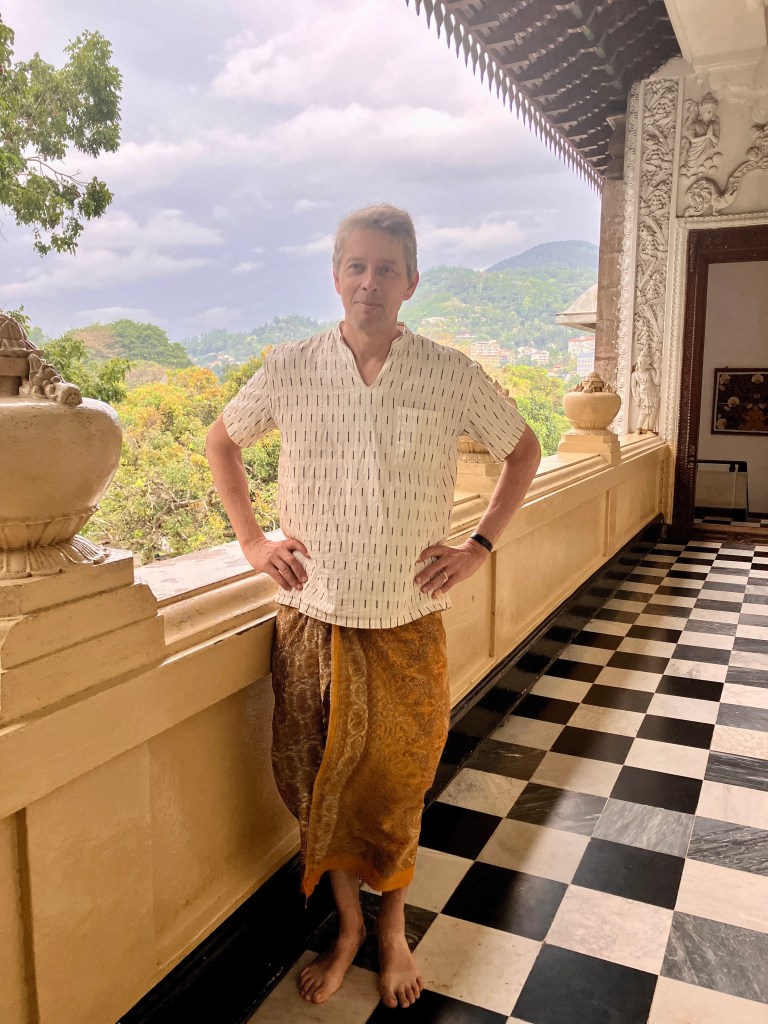
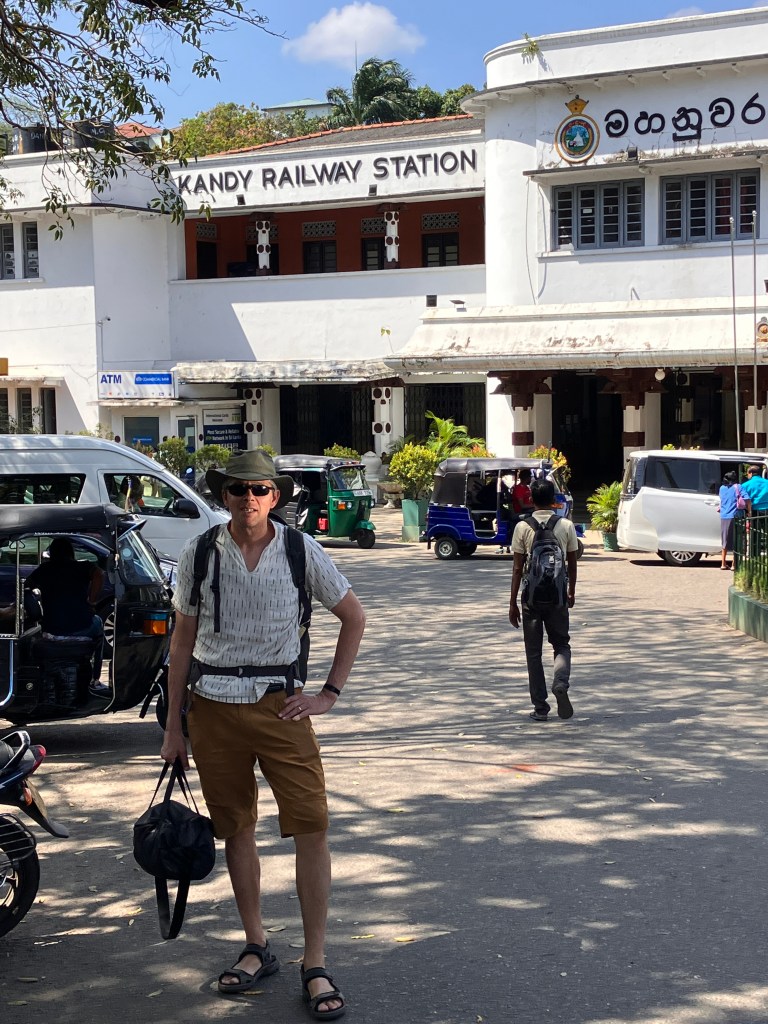
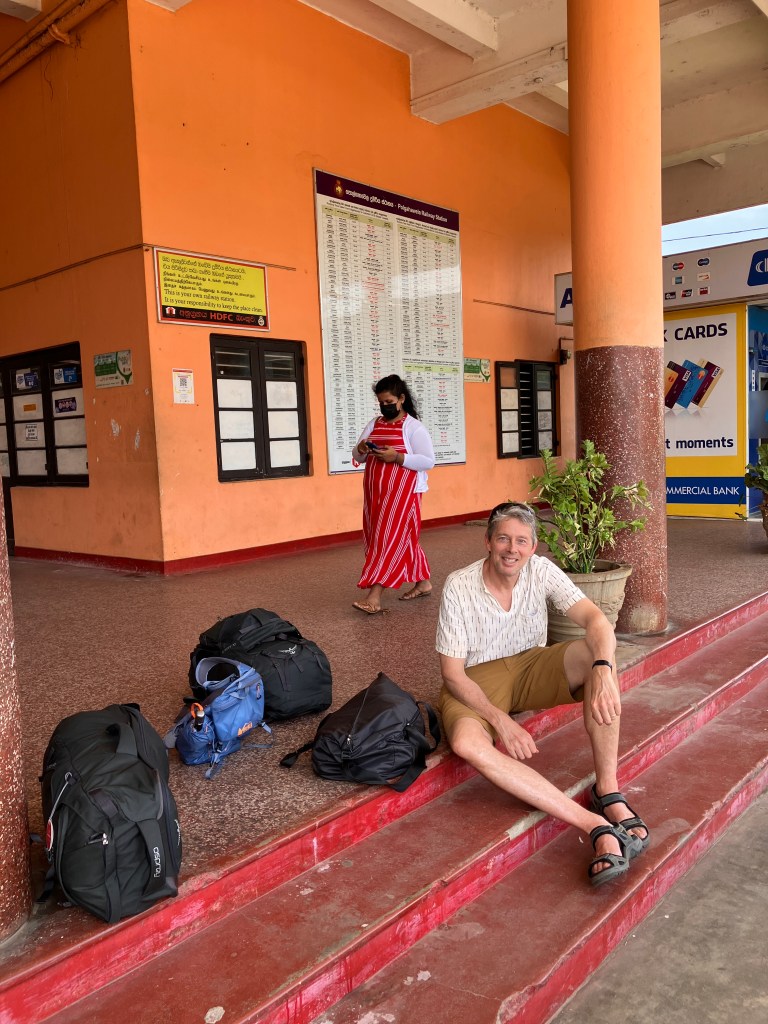
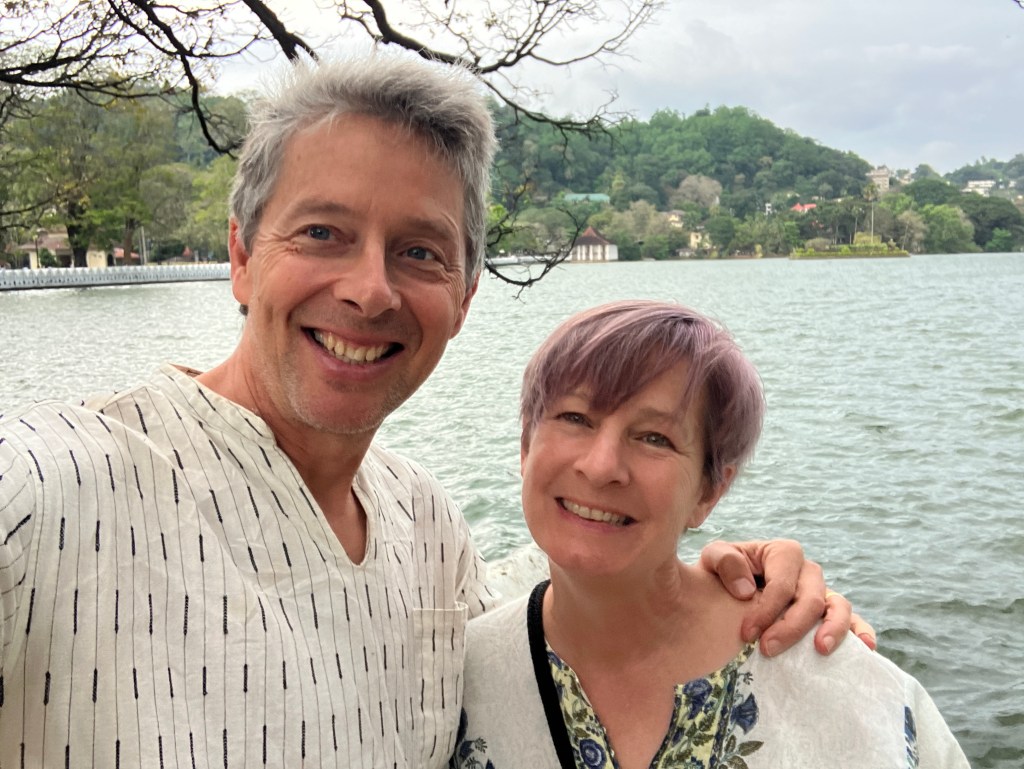
Me in my element, reading on a train. Still not tired of sticking our heads out the window to watch the train go through a curve.Our one night in Kandy gave us enough time to visit the Sri Dalada Maligawa, the Temple of the Sacred Tooth Relic, which houses the canine tooth of Buddha. My long Indian dress met the dress code, knees and shoulders covered. Rich was loaned a sarong at the security checkpoint to cover his knees.And back to the train station. The Monday morning crowd at the Kandy train station. This train goes to the capital, Colombo. Arrived at the Polgahawela Station to wait for our connection. Faced with a 3 hour wait in 90f/32f temperature, the travel planner wisely called for a Pick Me car to take us to our destination, Sigiriya, a 2 hour drive. Love of trains only goes so far.The happy travelers at Kandy Lake.
We have a few more places to visit in Sri Lanka, and I’m sure a few more rice and curry meals to eat. We wish we could support every single small business we come across, buy every trinket, and eat at every restaurant, but failing that we will tell you all that Sri Lanka is an amazing place to visit. We’re in Sigiriya now, more on that to come. Happy travels.
The backwaters of Munroe Island by gondola. We’re on the floor getting ready to duck under a low bridge.
Transportation continues to be a big topic of discussion for us. And a big source of frustration. Our stay in Fort Kochi was nice, the fort and beach area is away from the city itself, and a chill area with big trees, some small streets and lanes to walk, and friendly people.
Friendly street dogs. Perhaps too friendly. This guy followed Rich for over 20 minutes. The old and new. Cheena vala fishing nets and a cargo ship sharing space.
But like everywhere else, with cars and scooters dashing and honking, people on foot get short shrift. You are the bottom rung of the transportation ladder, and you know it.
Goats and cats, relaxing until Rich’s dog buddy chased them. The trees in Ft. Kochi are huge! The shade they provide is invaluable. Jackfruit growing in a front yard. White bougainvillea gives a stunning display.I appreciate the locals commitment to gardening. It really softens and cools the streets. These huge trees are called Rain Trees, or 5 o’clock trees. Apparently the leaves “sleep’ at night.
We learned very quickly to go out early for our walks. Before breakfast. Not only is the temperature cooler, but there are fewer cars and scooters about, so less wrangling for road space. Notice I say road space since sidewalks are pretty uncommon outside any city center commercial street- and even on some of those streets. When we caught a predawn taxi to the train station we realized the locals got out very early to walk and jog the quieter streets.
Rich at the Kochi train station. We think we’re waiting at the correct spot at the very long platform.If you could hear the dogs thoughts they would probably be thinking – “We’re helping!”Happy on a train ride to Kollam. We had two 1 AC berths, one upper and one lower, in a four berth cabin. Our cabin mate, a lovely woman from India got off two stations after we got on. She’d been on the train overnight from Bangalore.
The trains are popular since the alternative for many of these destinations is driving. We really try hard to stay off the roads in cars. The driving is tough. Not for non locals I think. And we try even harder to stay off the roads at night, other than short auto rickshaw trips in towns. On this trip we have hired a car and driver for several transfers, and it’s no picnic either. We sit in the back firmly belted in and try not to watch what’s going on as cars and scooters and buses overtake and honk and swerve. We always let our driver know we are in no rush and much more interested in safety over speed.
The top of the lighthouse in Kollam.
We were super happy with Rich’s choice of accommodation in Kollam, the Ashtamudi Villas, right on the lake. Even though all we could book was a non AC room we were fine. And we had a lovely neighbor, Karen from Plymouth UK, with whom we went out on tours facilitated by the guys running the lodge.
Making new friends at the lighthouse. After this photo we stayed to be the background of their dance video. Colorful fishing boats at the beach. The fish market is behind us. Our fantastic driver and tour guide, Sudhi, dropped us off at the market for a walk around the block. Kollam locals were so welcoming and friendly. Even wandering a market where it was pretty obvious we weren’t there to shop, they were happy to chat – and take usies! Coconut break.Coconut and snack stall.Refreshing coconut water.After you drink the coconut water the nice man hacks your coconut in two and scrapes the soft pulp/fruit clear so you can enjoy that too. Note the paper straw. A small but welcome improvement over the ubiquitous plastic straws of the world.Sudhi! If you’re lucky you have a driver/guide like Sudhi. Another benefit of a good lodge, they have connections like this. Tea and coffee on our little porch.Sudhi, Rich, and Karen. We’re headed out for a boat tour of the canals of Munroe Island.The boatmen propel the boats like Venetian gondoliers, but here you have to duck under bridges. It was a Sunday so lots of folks out to enjoy a boat ride, but the canals felt calm and peaceful. Fishermen out in the larger lagoon. Yes, there is a canal ahead. We’d been out for hours and a bathroom break was needed. Sudhi found us a friendly local who let us use her outhouse. The local temple decorated for Maha Shivaratri festival. We could do a lovely walk from the lodge along the lake into this neighborhood.Festival decorations.Such beautiful colors. A hanging dovecote. But I think those are pigeons.Our morning walks are very necessary. We have a hard time getting enough exercise due to hot weather and bad roads.I can’t ignore the trash problems. It’s terrible. Oh yes, my breast surgery recovery is going well!
It was a good time for us to come to India. After my breast reduction surgery we knew I wouldn’t be able to bike or do anything very strenuous for a while, so India was a good fit. I haven’t carried my backpack yet, on transfer days Rich wears his backpack and carries mine, but most transfers are door to door, or train station to taxi to door, so not too much toting for Rich. But, even me, always willing to lean into sloth, I want more activities that will require muscles over motors. We are accustomed to much more active lifestyles.
The happy but slightly antsy travelers. A rare electric powered auto rickshaw. Our driver to the train station stopped at his family temple and gave us both bindi marks made from kumkum paste, which is turmeric and lime juice. Again, friendliest people in India in Kerala.
Stay tuned for more India. As we say to each other, the being places in India is lovely, the getting there is the challenge.
So one thing we are noticing as we travel through parts of Southern India is the clear growth of domestic tourism since our last visit: It’s been refreshing to stay places and not be surrounded solely by European or other “western” tourists, as this makes the travel experience a bit more rewarding.
Our morning nature walk with Rajesh, our amazing guide at the Jungle Hut Lodge near Mudumalai National Reserve.
The rising middle class of India is over 200 million strong and growing, and they are influencing travel and tourism here more than ever. Foreign visits are still below 2019 levels, but domestic tourism and travel continues to grow substantially. So does India really need (or want) foreign visitors? And what happened to many of the business that catered mostly to foreign tourists?
Dusk on our safari jeep trip, just before a leopard crossed in front of us and then stalked us from the brush…one blurry IPhone photo is only evidence! The wildlife board at Jungle Hut…the Leopard sighting on February 8th was us! Lucky.
The short answer is that many of them closed and have not reopened. In the Tamil Nadu hill station of Ooty, many of the pre-Covid travelers cafes and restaurants listed in guidebooks and online had closed. And service at the ones that survived suffered serious interruptions. But fret not weary traveller, as they are being replaced by new trendy cafes, restaurants, and other businesses that a western traveller will enjoy, but will need to learn to share with local (and much hipper) Indians.
Morning walks were always after 7am, as this is when “negative elephant encounters” were less likely as they mostly passed through the lodge and village areas around dawnSerious termine mound
The modern growth and poverty reduction in India over the past 16 years is a great thing, and classic traveller towns of Asia may be legendary and great fun to meet other travelers, but they are always a curated experience. Plus, modern Indian cities and the rise of tech and related services are just as important as understanding the symbolism of old temples IMO. And modern India is going to have a big influence on the world over the next century with one of the fastest growing economies and large population growth.
Elephants pass through the area nightly in search of bamboo and other treats, and leave their scat as evidence….the more fibrous, the older the elephant.Wild boar roamed all around our tent-cabin, living in peace with the deer and monkeys
And of course you have always been able to meet “real Indians” at lower cost lodging, but often there are too extreme differences in socio-economic factors to have a relatable conversation based on common frames of references. And English is often limited to middle and upper classes or people in the tourism trade. Sure, we cherish our interactions with any local, no matter how brief or limited, but to us, it is also equally fascinating to learn about the lives of other other educated professionals in a very dynamic place.
Cheryl surveys the land near Mudumalai Cheryl’s modest buffet lunch at the jungle hut. All the South Indian food was delicious.My buffet lunch at the Jungle Hut…the cook staff loved me because I tried AND ate everything! Enjoying our coffee and tea with the free entertainment of a dozen Gray Langurs eating (and playing) in the large treeSunrise cup of joe
Or maybe you are lucky enough to have close contacts, business ties, or even family here….that is always the best experience, and you are probably meeting lots of people. But one resounding theme in the South has been how nice everyone is, especially away from the main tourist areas.
Climbing the hill to a local temple…you are never far from a temple, big or small.
So after 4 nights in Mysore, we finally headed to more remote areas near Masinagudi by hired driver/taxi. There are no train options and the vague bus info I could find involved 2 transfers. And with Cheryl still unable to carry her pack and 35c heat and sun… you get the idea. Car transfers here are affordable and often take out massive stress of uncertain buses and rickshaw connections. We’ve learned not to torture ourselves excessively in our second visit to India. It turns out this car trip included a route through the Mudumalai Tiger reserve and was delightful, as we saw two wild elephants up the hill from the car as we passed through beautiful landscape. (FYI- It was about INR5,500 or $US65 for a 2 1/2 hour trip with coffee/tea/bathroom stop…maybe 4,000 rupees if you shop around but we let our hotel arrange and the little sedan and driver was nice.)
Beautiful spotted deer were everywhere
We stayed 3 days at the “Jungle Hut” next to the Mudumalai Reserve, which is part of 4 national parks and reserves which make up the Wester Ghat Mountains biosphere. It’s a UNESCO global diversity hotspot (one of 36) so protecting the endangered and endemic species is a priority. We loved the Jungle Hut, with its great guides, food, vibe, and staff engagement.
At the Jungle Hut, with Amish and Anupriya from Bangalore. We shared great conversations and they shared excellent infused Indian Gin!Cheryl enjoying another early morning walkMagnificent trees on the dry side of the Western Ghats Morning treat of prickly pear cactus
It also appeared that the area was being managed well, with a balance of needed tourism dollars and protection of the environment. Perhaps a little more regulation of safari jeeps outside the reserve is needed, but it seemed many area residents are directly involved in the local reserves, or at least reap some of the benefits of money coming from tourism into the their villages. (There are 8 smaller villages that are part of Masinagudi). India has done a good job expanding and managing natural reserves and animal counts are increasing for tigers, elephants, leopards, panthers, bears, and other large fauna. But it’s not easy. We also saw serious anti-poaching patrols.
The busy main streets of Ooty are pretty inhospitable to walking, so we headed to the alleys and footpaths as possible.Sleepy dogs in the lower alleys of Ooty. Color abounds in Tamil Nadu
So we sadly left the Jungle Hut once again by car transfer to Ooty,, “Queen of the Hill Stations”. But as we made our way up the 36 marked hairpin curves to Ooty, all I could think was wow, what an amazing Tour de France stage this would make -:).
The lovely botantical gardens of Ooty, quiet in the morning as Indian families seem to get going a bit late. Good for us early birds.The long arm selfie straining in the morning light with more friendly local tourists. We’re all equally intrigued by each other.A cow also out for a morning stroll. Good idea.
Oh, but the logistics! And logistics are what often takes a toll on independent travelers in India. Unless you go the 5 star tour route, doing just about anything in India always seems to come with unexpected challenges or complications. (And a 5 star tour does not buy you safe roadways or clean air outside your AC cocoon.)
Despite a lack of good maps or trail system, we set out up the ridge behind our hotel determined to do some exploring on foot.Our two morning walks first took us to beautiful tea fields over the ridge
Being fiercely independent travelers, we love to find our own way, but recognize sometimes a guide or car transport is needed. But in most cases, all could be done by independent travelers if there was more information provided. Traveling in almost any other country has been easier, including recently in Morocco and Turkey (especially Turkey…a joy), as interactions are more straightforward. There are cultural differences that are hard to adapt to, even after weeks or months here. The local tourists do much better I suspect, as there is more comfort with the systems, customs, and still strict class structure.
Beautiful markings to a temple up the road
So as Cheryl likes to say repeatedly when I complain about a challenge here, “Square peg, round hole!” We are clearly more comfortable with predictable mass transit, cycling, and walking. And I am always torn about guides, as appreciate guide roles provide jobs, but so many times, guides in museums or other tourist sights are just a replacement for any form of curation, or often just repeat what you read on Wikipedia. Wildlife guides are essential and a huge benefit.
A little shrine on our narrowing road felt like a good sign that the way went through
But in my naive American perspective, it seems that if India made things easier for independent tourists, more would visit, and spend even more money. Right now, many places are just too challenging to deal with to bother with, linger, or explore further.
The road indicated on both Google and Maps.Me turned into single track through high woods….but we pressed on, as trail wear indicated people did take the way.Finally we emerged onto a wider path…the risk pays off with a nice few hours walking!And finally emerging to an outer neighborhood of Ooty where we grabbed a tuktuk back to town due to very high UV and busy roads
One positive change from 2006 is the introductions of E-visas, which has increased tourism visits significantly. But that’s only the first step, as there was still a baffling amount of forms to fly to and enter India. We first submitted all our personal and trip information to get a Visa, including photographs. Next was the mandatory info on the airline app, yet we still got caught out at check-in missing the Air Suvidha form, which was added in January for entry from “high risk” countries. We knew (and somewhat understand) the added PCR tests due to China”s surge in cases, but can’t imagine any scenario in all of India where this form will prevent one case of COVID post entry. Most governments have realized the futility of such measures when COVID is all about in country, but it shows action for politicians.
We rewarded ourselves in the more brisk evening air with Momos, a dumpling like import from Himalayan hill stations to the NorthScoping the Momo sceneCheryl smartly went for the plain fried platter while I opted for the Szechuan Style, and oh yeah, the were bloody hot! 🔥
So we have detailed e-visa with photo, the Air Suvida form, and all other COVID docs, and then get to immigration and are directed to a confusing side desk for E-visas….but first, fill out another manual form with the same info. The few (half dozen) foreign Nationals were all confused and then trying to share the agents one pen and understand why a fourth form was needed….then to immigration desk for questioning….where we were going, my job, was I young to be retired? And immigration officers seemed to be baffled by a tourist listing a hotel as address in India. We’re tourists! Cheryl somehow got less of a rigamorale. Maybe it was the purple hair. Maybe, it seemed, he was trying to be a bit playful and curious, but after all the forms, I wasn’t really in joking mood. Plus, you NEVER joke in immigration or customs unless prompted!
Had to wait an extra day, but finally got our seats in one of the of historic saloon cars. Super fun as 8 cozy folks per bay all enjoying the ride.
Then to customs ( no one there…walked through?). We then managed to get lucky and find the lone ATM inside arrivals that had cash. (Runs out later in the day apparently, so then you are forced to change cash at poor rates) And then to the one SIM card booth where were lucky to be first in line and getting two Vodaphone SIMs which took about 20-25 minutes, including new digital photos. The time was not the staff’s fault, as they had to enter endless info to register us, as apparently SIM cards are tightly controlled here out of security concerns. The SIM cards work fine and were very reasonable cost 1000INR for 28 days with 1.5GB/day plus bonus on weekends. But note that Airtel has a better network, but getting SIMs outside the airport can have additional challenges.
Happy waiting for the star attraction of Ooty IMO, the once a day “toy train” down to Mettupalaym.The scenery was dramatic and varied as we dropped 6,500 feet in elevation over 4 hours
Next we decided to use the official Airport cabs….which, oh boy, had no one waiting (red flag!). We got in and asked about the meter….as I then noticed the official one seemed to be upside down on the floor and he showed me his phone which had a “meter”. Ughh….and no seatbelts. Ok, but at least he was fairly mellow, preferring to straddle two lanes on the highway most of the way to our modest hotel in Indiranagar. The fare was 2100 INR….more than double than fares listed by Ola or Uber, which explains the lack of line and what all the locals were doing waiting outside the terminal. Welcome to India. But the good news is that a metro is being built to the airport! (Which you know we will take.)
Water filling station for the steam locomotive
I realize to most natives and past visitors to India it feels as if I’m a man waving fist at seagull. Futile. But India could attract more tourists if some things were more user friendly. The above airport process in Taiwan took 1/4 the time and 5% the stress.
The amazing narrow guage train from Ooty down to Mettupalayam
Another issue is the train reservation system for the national railway, IRCTC, can be figured out, but it takes a LOT of patience and working out the payment system for international credit cards. The website (App promised for years…) is twitchy with overlays, ads, videos, and pop up windows. Cmon India, this is your national railway…a more streamlined booking platform and App similar to most modern railways and airlines would be great.
Car ownership overall is very low in India, but major roads, highways, and cities are already overburdened, so what will happen when these rates go up even a small amount?
As Cheryl noted in our last post, there are plans to modernize and expand railway service, but will it be fast enough to keep up with the explosion of car ownership and discount air travel. These modes are definitely now the preferred way of travel for the middle and upper classes. But at a huge cost to the environment. The car ownership growth here is a time bomb, and already crippling cities, big and small, as well as killing 160,000 people a year.
Cheryl at Coimbatore Junction, one of the more modern stations we’ve encountered in India Cheryl’s fashion doppelgänger at Coimbatore Station. Proof that she has nailed the local look!
And although intercity buses fill a big transport need, most run at night only, and the many decent booking apps don’t take foreign credit cards…..still trying to crack this travel challenge with Google/Amazon Pay or PayPal. But you can generally find something the day before or last minute, but it may not be your first choice for time or comfort. But we are lucky, as we can always buy ourselves out of most situations, even if it means an expensive car hire to the next destination. Flying is often an option too, but we have vowed not to fly in country as much as possible.
Getting us to AC Car 1 in Coimbatore; most major stations now have electronics coach location signs along the platform, which is essential for a 20+car train!Arrival at Ernakulam Junction, gateway to Kochi, after a nice 4 hour train ride
So if you are still reading this rant, please know that I think India is a truly unique and fascinating place and we are savoring all the experiences as we head through Kerala now. A cultural and social anthropologists dream. A political and global force. An incredible mix of hundreds of cultures and languages that somehow keeps it together as the worlds largest democracy.
Despite some travel challenges, the experiences are unforgettable in India
But you don’t make it easy India, and maybe that’s what it’s all about. Happy travels!
In Bengaluru. A good introduction to India landing city for this trip.
Rich and I last traveled in India over 16 years ago. He and my friends will attest that I did not have a great time that last trip. As interesting and unique as I found the country, there were things younger me couldn’t get past. The inequality, for women and for those less fortunate. The crowds. The traffic. Never being left alone to enjoy anything in peace. The poverty. It was a lot.
A street in the neighborhood of Indiranagar where our hotel was. I think the large trees are Rain Trees. The shade they cast makes for a lovely cozy feel to the area. That is the metro line overhead.
I think many travelers and tourists are overwhelmed on their first trip to India. Why, friends asked, are you going back? Well, I replied, we were only in the north in our last trip and people say that North and South in India are as different as in the US. Our first good chat with a local gentleman at our first dinner in Bengaluru confirmed that. He went to North India once, he said, from his native Bengaluru, and it was so different. Like a different country. And, I’m older now, more mature, lots of grey hair. Less likely to attract negative attention. Ok, so I did have my hair dyed purple before leaving Bangkok which means no grey is showing, and I have bright purple hair. Attention? Yes. But it’s my fault this time.
Seriously amazing trees in Cubben Park.The sidewalks in Bengaluru were so welcome after Bangkok’s limited walking space. And all the trees provide lovely cool shade. Green bike lanes, though we saw very few bikes using them.
So, can my older wiser self settle in to enjoy India more than I did 16 years ago? I think so. It helps that Rich is an enthusiastic traveler in addition to being the best travel planner. We both love experiencing a place as independently as possible. Walking and taking transit as much as we can keeps us happy. Our only taxi in Bengaluru was from the airport to our hotel. All other trips were metro and walking.
The War Memorial garden, floral tributes near the obelisk. Chai at The Srirangam Cafe. More tree shaded streets in our neighborhood of Indiranagar. Riding the metro towards downtown.
Our last four hotels have all been within a block of a metro or subway line. Taipei, Taiwan, two different hotels in Bangkok, one above the MRT and one by the SkyTrain, and now Bengaluru, a block from a purple line station of the Metro. Not an accident, just good planning from Rich. We share a pretty healthy dislike of having to rely on taxis. Every car trip added to a city is a bad thing. For the air, for people’s safety, and for noise pollution. In India the noise is mostly of beeping horns, the scooters are quieter here than the motor bikes in Bangkok – thankfully. But the beeping! Incessant.
At the train station, just a short walk from the metro station.
Since I’m still recovering from breast reduction surgery Rich is carrying both backpacks. Thankfully, the train station connects to a metro stop with a dedicated walkway so for our train ride to Mysore we again avoided a taxi trip. To enter the metro system you have to put your bags through a scanner, and then be wanded by a security guard, men to one side and ladies to the other in a small curtained booth. My first time I actually stopped for the wanding, but my second time I followed the lead of the local in front of me who didn’t even break stride as she passed through the curtains.
All smiles waiting to board our first train. The platforms are very long but the carriage letters were showing on electronic signs so we knew where to wait.Masked up. Our carriage was less than half full so we did unmask.
Our destination, Mysore, is less friendly to walking trips. For starters it’s hotter here, up to 90f/32c in the afternoon, and sidewalks are not standard. We feel a bit like square pegs in round holes, but we persevere, heading out in the morning to walk to what we can, and taking auto rickshaws back in the heat of the day.
Our first stepwell.
A friend in SF sent us a link to a map of step wells in India (thank you Gisela!), and we took a taxi to this one a bit outside of town. This is a fairly simple stepwell, many are much more ornate. Built to capture water and as temples, construction of these stepwells hit its peak during Muslim rule from the 11th to 16th century – per Wikipedia.
Nanneshwar Devasthana Kalyani ನನ್ನೇಶ್ವರ ದೇವಸ್ಥಾನ ಕಲ್ಯಾಣಿ
Built in the 8th century this Kalyani, or stepwell, was cleared of garbage and restored in the past few years.
Rich added for scale.
Stepwell visit complete, we had our taxi driver head back towards town and drop us off to wait for the train museum to open. Sitting on a wall in the shade and watching Sunday morning activities was actually quite nice. On our last trip to India I don’t remember being able to sit unmolested by curious or begging locals. Here in Mysore, although there aren’t many tourists back yet, most folks walk by us with only a curious look (Rich is quite tall and I have purple hair, so not unexpected.), a smile, or an offer of an auto rickshaw.
One of favorite things, a small, quirky, somewhat overlooked museum.An Indian built carriage.A British built locomotive.
It pains me to be reminded that so much of the history tourists are encouraged to see and celebrate in India is colonial history. The railway has its roots in British rule. From an article by The Wire.IN “Between 1850 and 1910, 94% of Indian broad gauge locomotives were built in Britain and only 2.5 in India. During the Second World War, preconditions for purchases from outside of Britain were relaxed but still the overall balance remained disproportionately tilted in favour of Britain. Thus, prior to independence in 1947, India imported 14,420 locomotives from Britain, built 707 itself and purchased 3,000 from other countries.” However, we were pleased to see what to us are very familiar planning presentations for the ongoing improvements and upgrades to Indian Rail.
Planning deck, anyone? As we well know with both our backgrounds in transportation- nothing happens without plans like these. We could both easily imagine the work that went into this, I’m showing you only 2 of probably 15 pages. Fellow bureaucrats unite. Let’s get it done.
Although Mysore requires more auto rickshaw trips we are managing to walk to some destinations in the morning. The zoo. The Mysore Palace – which is the second most visited attraction in India after the Taj Mahal, apparently.
The palace is lit up on Sunday evening, and it’s free to enter the grounds which means it’s a popular family attraction. The moon was close to full, and I managed to add even more purple to myself with a new Kurta. Guess my current favorite color.
We went back to the palace on foot one morning. The neighborhood across the street from our hotel fascinates us. One thing I have found that I really enjoy when traveling is making eye contact with women, particularly women my age, and exchanging smiles. Sometimes the smile only come from me. Americans smile a lot, and if you ask other cultures we smile for no reason and it’s weird! I always make a special effort when I see women in a Niqab, the veil and face covering which leaves the eyes clear. Five years ago Rich and I were in Indonesia and both struck up independent conversations with a couple (bathroom at a train station), and she was wearing a Niqab. It made me wonder how often women in Niqab are overlooked, or even ignored, by folks who don’t feel comfortable with the idea of a women who veils or covers. In Indonesia we all laughed to see our partner walk out of the restroom chatting with their partner. When I make eye contact with a woman, of any age, and nod, and she nods and smiles back, I feel like I’ve made a connection, however small.
Navigating the cows in the neighborhood across the street from our hotel. Don’t let the dirt streets make you think this is a poorer neighborhood. The houses were quite nice. The pongol, harvest festival, occurs in mid January and many cows were still sporting their turmeric water paint jobs.
Our walk to the zoo took us through this neighborhood, and our walk to the palace. It was fun to see the children being packed into auto rickshaws for the trip to school. I counted nine children in one rickshaw. Ladies, I assume maids for the houses, were sweeping and watering down front stoops and steps, and drawing elaborate rangoli or korams in rice flour.
Rangoli with color.Spotting the rangoli was like a treasure hunt.Not every house had one, which made them even more special. Apparently the devotion to this mostly women’s art comes and goes as generations give it up or take it up.
You can understand how a simple 15 minute walk to the zoo turned into a tour of its own.
These rhesus macaque monkeys at the zoo, not in an exhibit, were the only ones we saw in Mysore. Escapees from the actual macaque exhibit we assume. This little guy was thrilled with the plastic bottle he got from a trash can.We’ve seen zoo workers in with elephants in Indonesia as well. In the US most if not all zoos keep humans and elephants quite separate. At one point elephant keeper was the most dangerous job in the US. Many Dosa were eaten.The purple lady waiting to dig in to a Dosa.In the Mysore Palace. Once we realized we were the only ones obeying a few old no photos signs, we started taking photos too.The colors. Amazing.Columns, chandeliers, stained glass skylight.
So am I better at travel in India this time? Yes and no. We are more experienced travelers, but India doesn’t really suit our travel style. It’s challenging to be independent travelers here, which is why we see so many tour groups at our hotel being loaded into an AC bus after breakfast. It’s hard to book trains, or figure out local buses, and it’s challenging to walk many places. Rich has been working out in the hotel gym, but since I’m still recovering I can only walk. No yoga or arm workouts yet, so I’m feeling antsy. But the highs of India are indeed high and I’m glad we’re here. I love seeing and learning about new things. Tomorrow we leave Mysore and head to a lodge stay near a nature reserve. It’s not great tiger viewing season, but we can always hope, and the bird watching is supposed to be amazing.
The happy travelers in an auto rickshaw that matched my color scheme.
As we pedaled along a few days ago and did the math, we realized we’d been bike touring for 48 days. That’s our longest trip ever on bikes. As I write this, on a train from Tours to Dijon, it’s day 50. It’s certainly a lot of work, not the pedaling part although that can be tough at times, but the moving most nights. The unpacking (I call it the bag barf, where I simply turn my panniers upside down and let everything cascade to the floor.), the packing, and of course the travel planning done exclusively by Rich. Each day he checks terrain and weather and towns that look nice for a stay, one night or two, the feeding of two hungry cyclists – thank goodness for hotel breakfasts – whoops, watch out for Sunday, everything closes about noon, be ready for that!
Riding to the château of Chambord on a misty cool morning.
But everyday at one point or another, while looking at the river, or a chateau in the mist, or collapsed on a bench for a tea break, we look around and say to each other- wow, this is amazing and we are so lucky.
A perfect bench for a break. Chambord in moody black and white. Yes, scaffolding. Imagine how difficult is to keep up the maintenance on a heap like this!
The things that we notice while traveling the speed we can pedal are so detailed. Wild boar in the forests on the way to Chateau Chambord. Hunters in orange vests ranged out alongside a forested patch near the river, hunting boar we assume. We stopped to watch, heard the hunting dogs baying, and saw a deer come running out of the forest across a field, followed by a hare who ran so fast and so far – completely spooked and relived that the men in orange were not after him. Gunshots rang out, we checked our brightly colored rain jackets were on for increased visibility, and pedaled away. Just another day on the bike tour, but one I hope we’ll always remember.
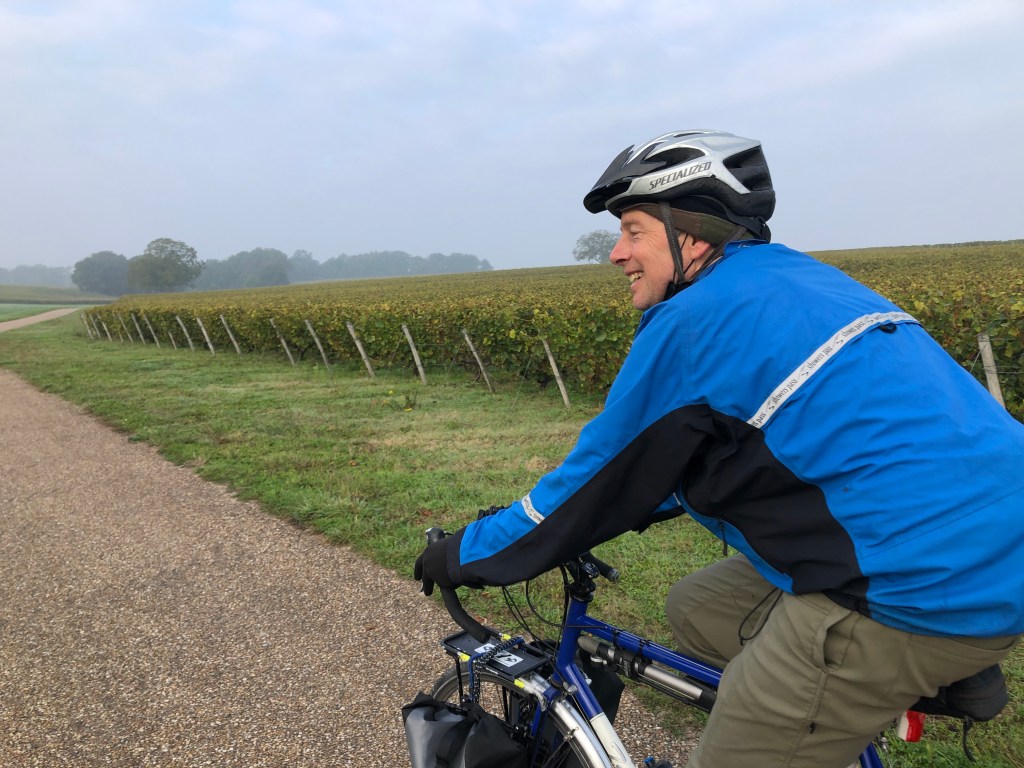
A morning ride though the vineyards.
At a Sunday stop at a bakery for sandwiches we chatted with a super nice British couple who’d been living in France for 30 years, he was a cyclist and wanted to chat about our American made bikes. As Rich described our route and we mentioned that we had taken some train hops he shook his head and his partner said, oh, he thinks trains are cheating when you’re bike touring. We don’t. We haven’t owned a car in 21 years, we’ve earned these train hops.
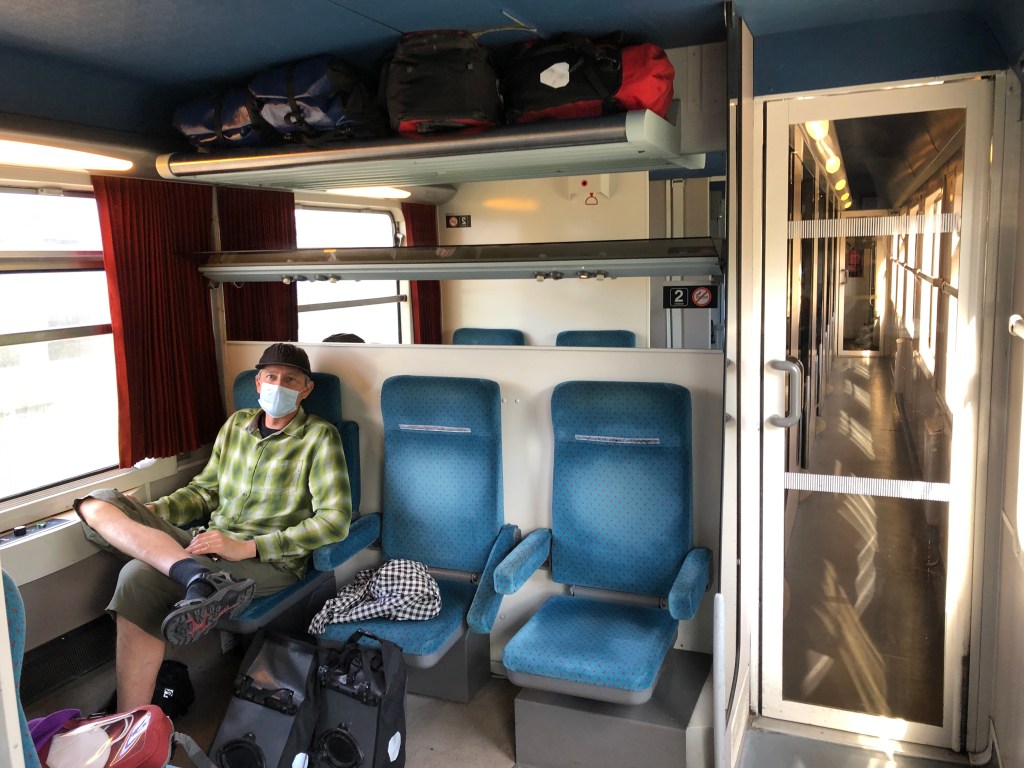
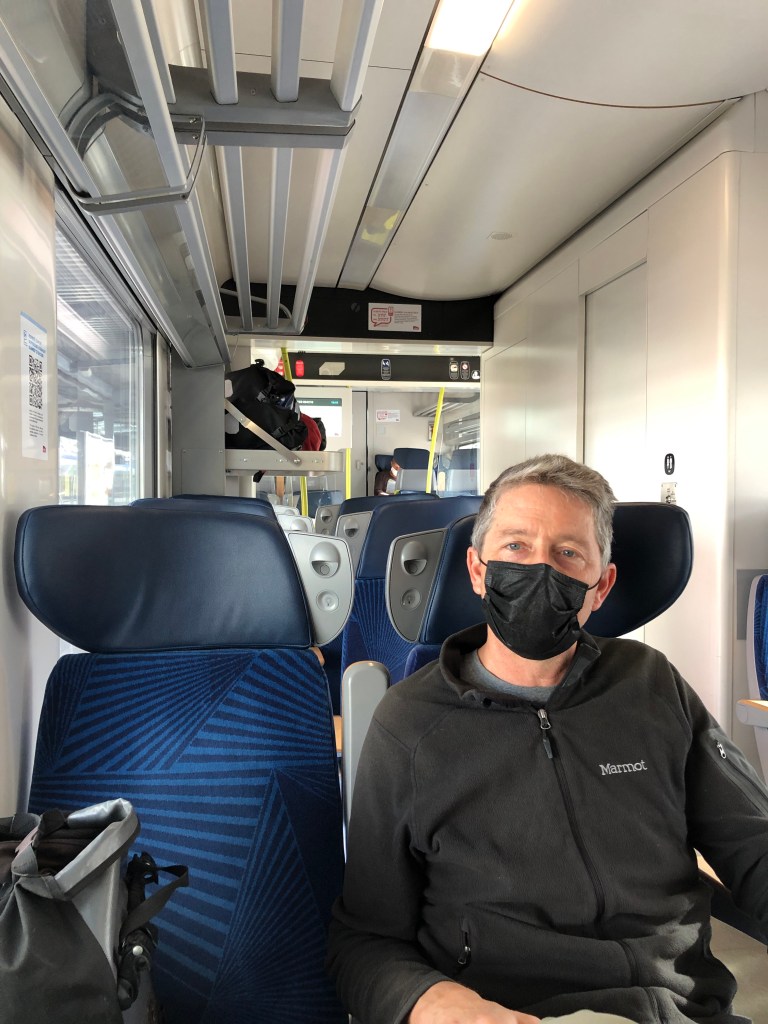
At the train station in Tours.Waiting for the nice railroad worker to lead us across the tracks at Nevers, where there are no ramps and no elevators.On our way to Dijon on a lovely new train. From Dijon in an older train car. Down that corridor are actual separate compartments.
We’re headed back to our French “home base”, looking forward to some time not moving, cooking for ourselves and hiking in addition to biking. We’ll leave the bikes there, swap our our luggage and head by train to Paris, then to London, and then to Tenby, Wales.
Seeing the world one kilometer at a time, with plenty of breaks.
We left Colmar by train on a forecast rainy day and did a 3 train hop to Nevers during which it rained very satisfyingly hard. It made me very happy to hear that rain pelt the train windows while we were warm and dry inside.
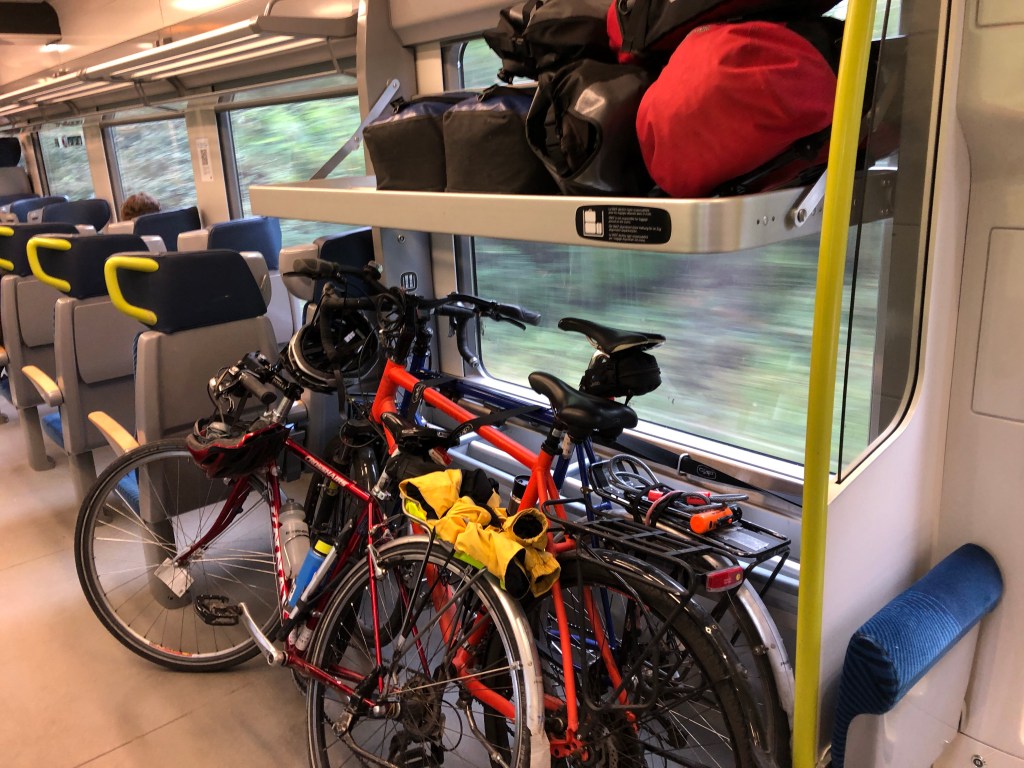
Almost all of the French trains we’ve caught have been low floor boarding with good bike space.Happy travel planner. One transfer was cross platform and the other had ramps to and from the platforms.
Train travel tip with bikes: always leave super early to ride to the train station, you never know what will suck up that extra time. So far we’ve had: crowded market day along the route, broken elevators requiring unloading and carrying bags and bikes up and down stairs, massive construction projects leading to circumnavigating the entire station, and uncooperative ticket machines (we usually book on line but the website was down.). So pad that trip with extra time. The worst that happens is that you’re early and get to hang out on the platform wondering which carriages will have the bike logo on the side – near where you’re standing or a trot down the platform?
Low floor boarding. A fan favorite.
We’ve found the local French trains, Ters or regional, reliably have a bike car at the front of the train, and usually at least one if not more further down. If you’re really not sure where the bike space will be, figure out which way the train is traveling and stand at the end of the platform where the train arrives. You’ll be able to see the marked bike cars and can always run down the platform if you need to.
Café Velo in Nevers, France. We stayed in one their lovely upstairs apartments.
Another good tip is to make sure you can take your panniers off quickly, not only to make the bike lighter to lift up stairs, but to be able to stack the bikes efficiently in the bike area. Also so that you can do a quick bag removal, toss the bags into the train and then lift your bike in all while panicking that the train will try to leave without you. The station at Nevers did not have ramps or elevators, us and three other cyclists did the unload bags, carry down carry up, wondering aloud what people with mobility issues would do. We found the answer to that question, which is hail a member of staff and they will help you cross the tracks at the end of the platform. Strictly prohibited for general use. Of course, we were also told that finding a member of staff can be difficult, but now we know.
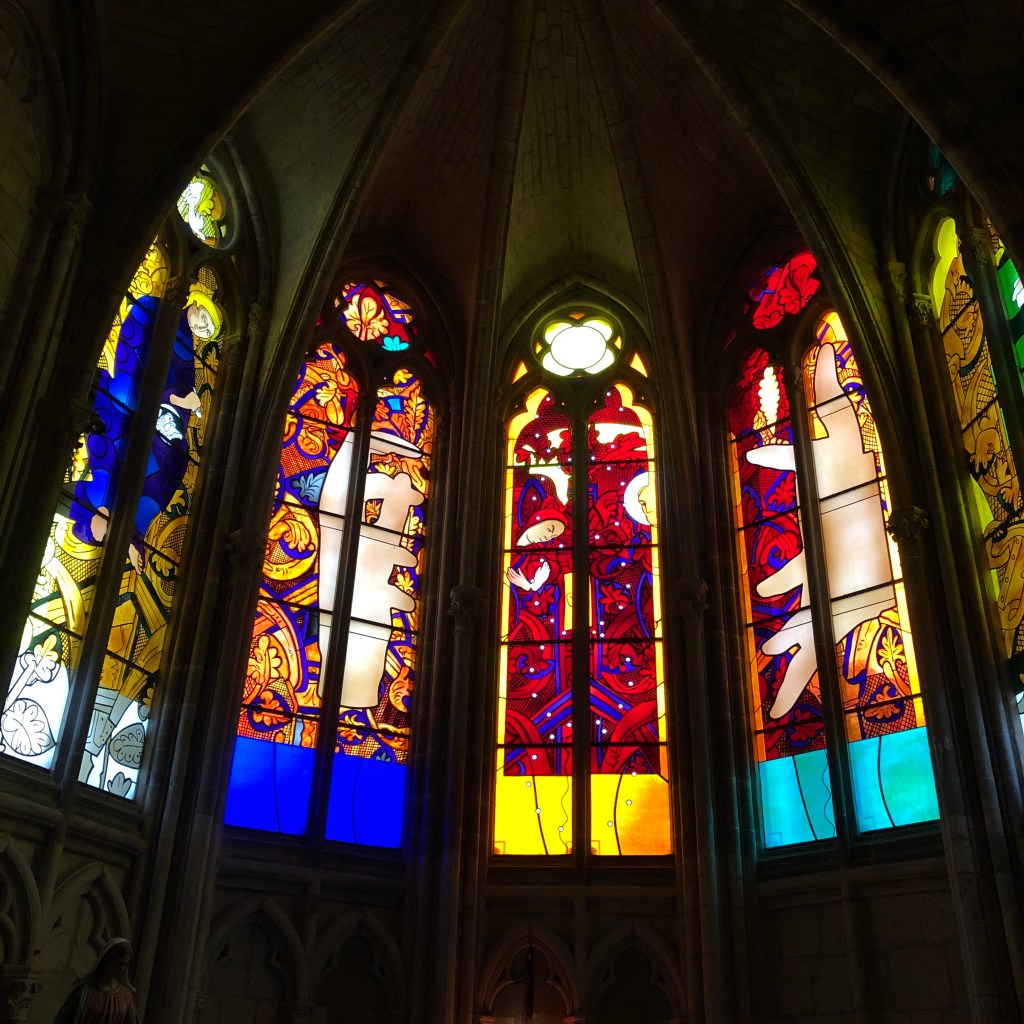
A narrow street in Nevers.The cathedral was bombed “accidentally” during WWII and rebuilt. The stained glass windows are from about 1948 and so modern. The St. James scallop shell in the upper right corner caught my attention.And then we ran into two pilgrims walking the Camino and took photos together. They had about 1,333 kms to go to Santiago Spain. They absolutely looked up to the challenge.
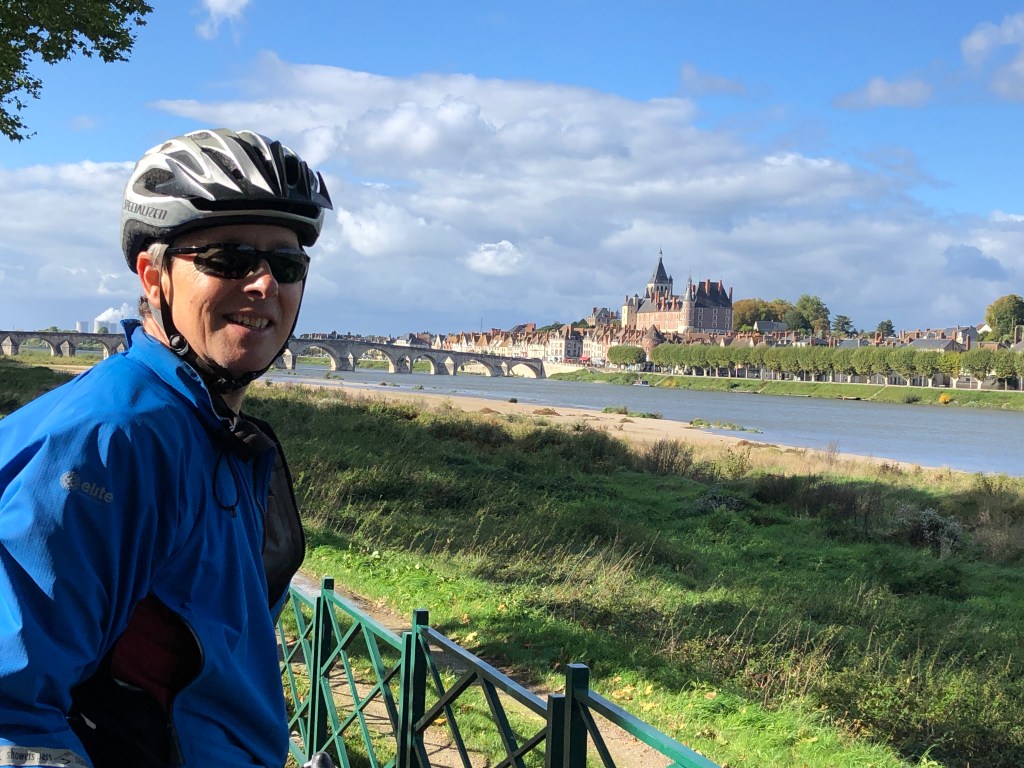
We rolled out of Nevers and started the Loire River Eurovelo Route 6, heading west.
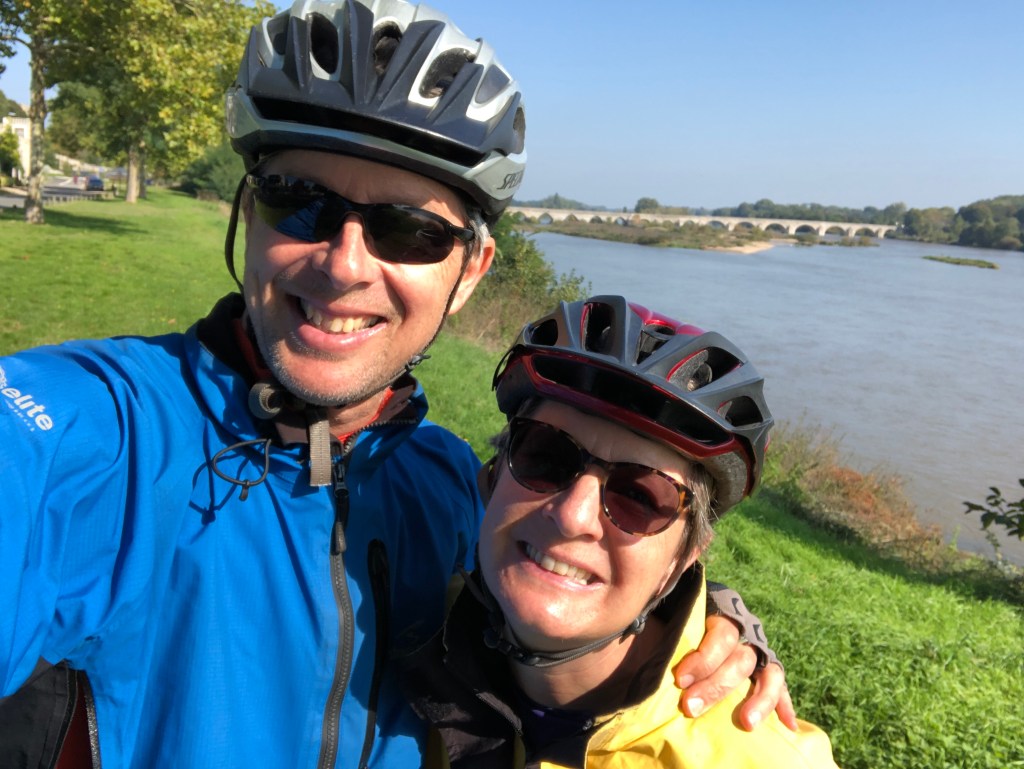
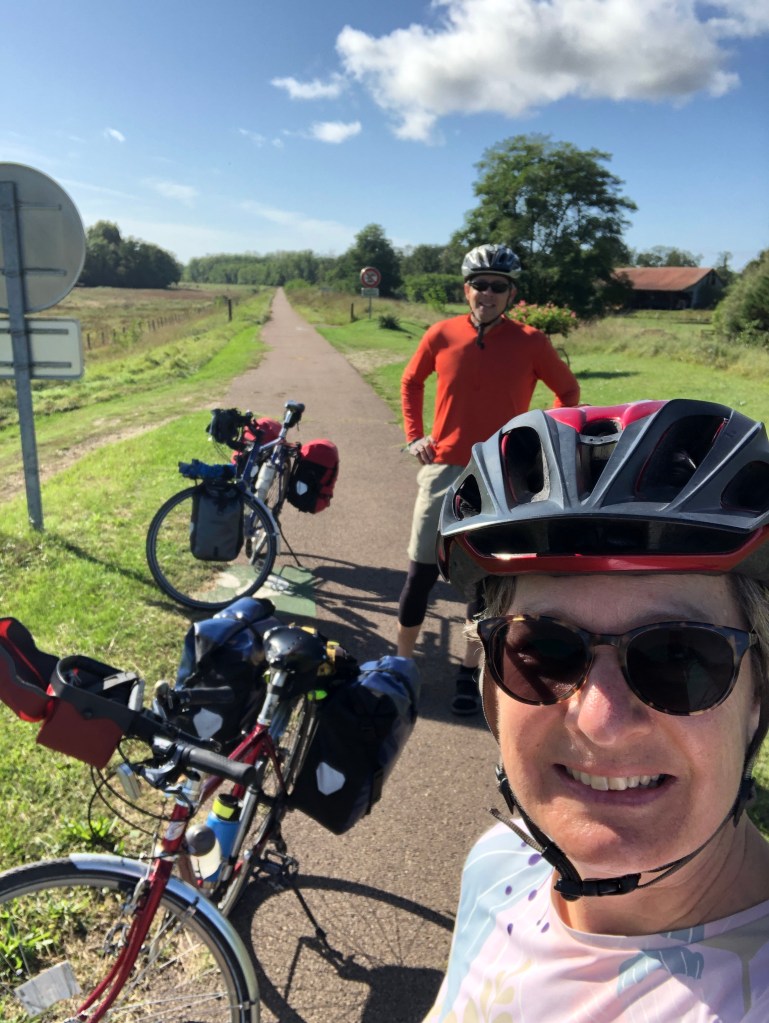
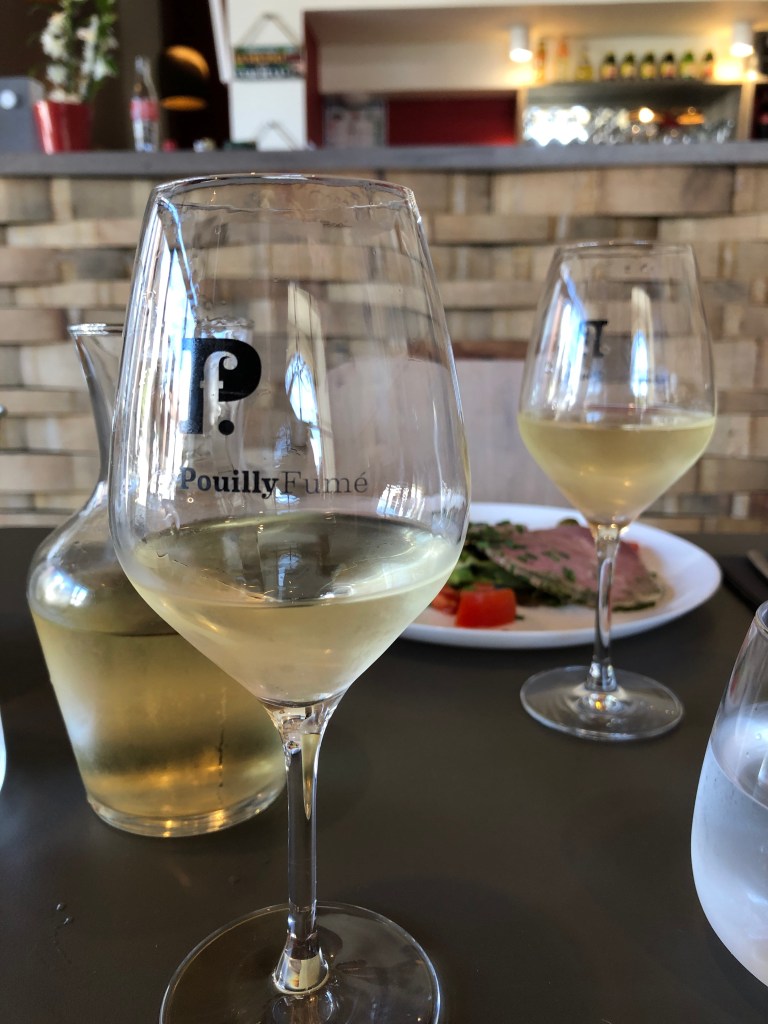
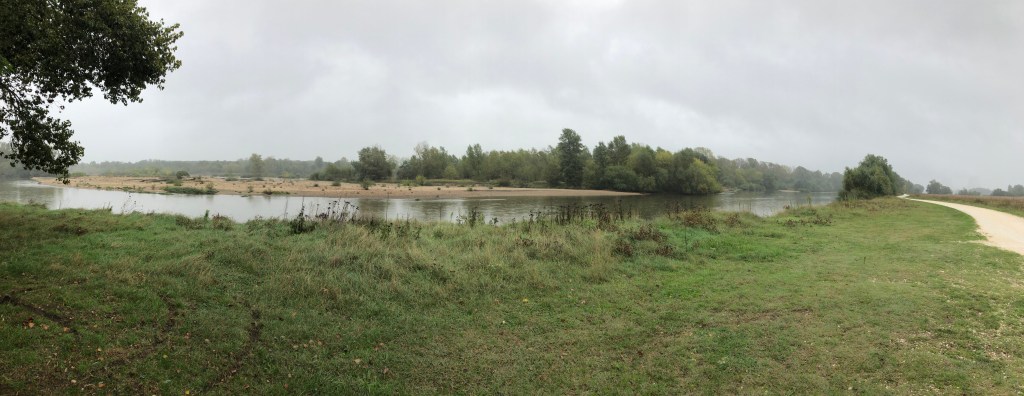
Quite a bit of levee riding at times, but those smiles mean we had tailwinds.Lunch in Pouilly Fumé, drinking… Pouilly Fumé. This canal has the unromantic name of lateral canal to the Loire. We renamed it canal of green.We hit rain and found shelter at a Loire nature center. We stayed for quite a while while the heavy rain passed through and ate everything in our food pannier. Made for a varied and interesting lunch.Met a lovely young American cyclist also sheltering from the rain, Toby. It was his first bike tour and I’d say he’s hooked.The Loire is a wild river. Loads of islands, sandbars, and very untamed banks. Amazing bird life.My new favorite style of picnic table, built up against the parapet so you can take in the view.
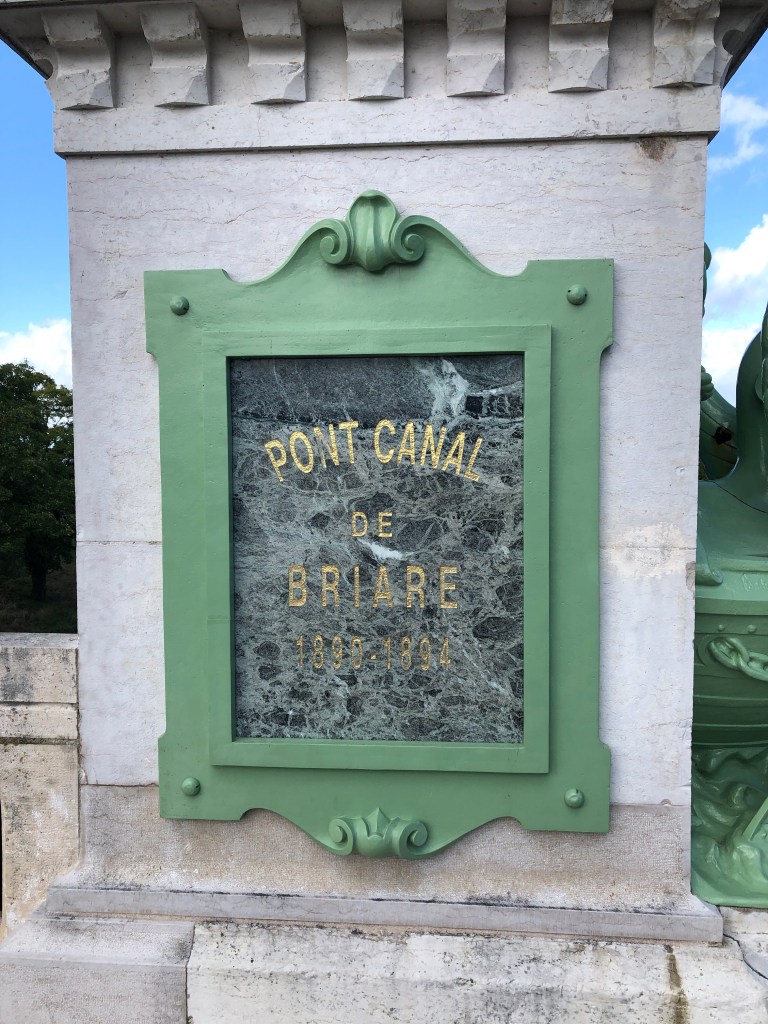
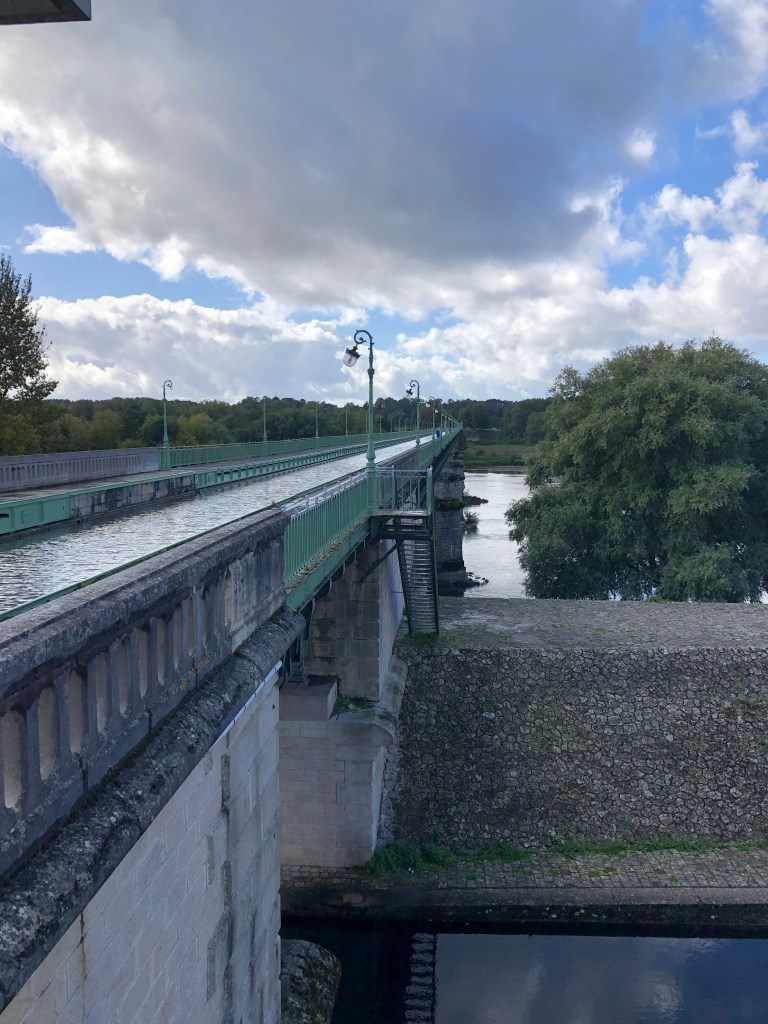
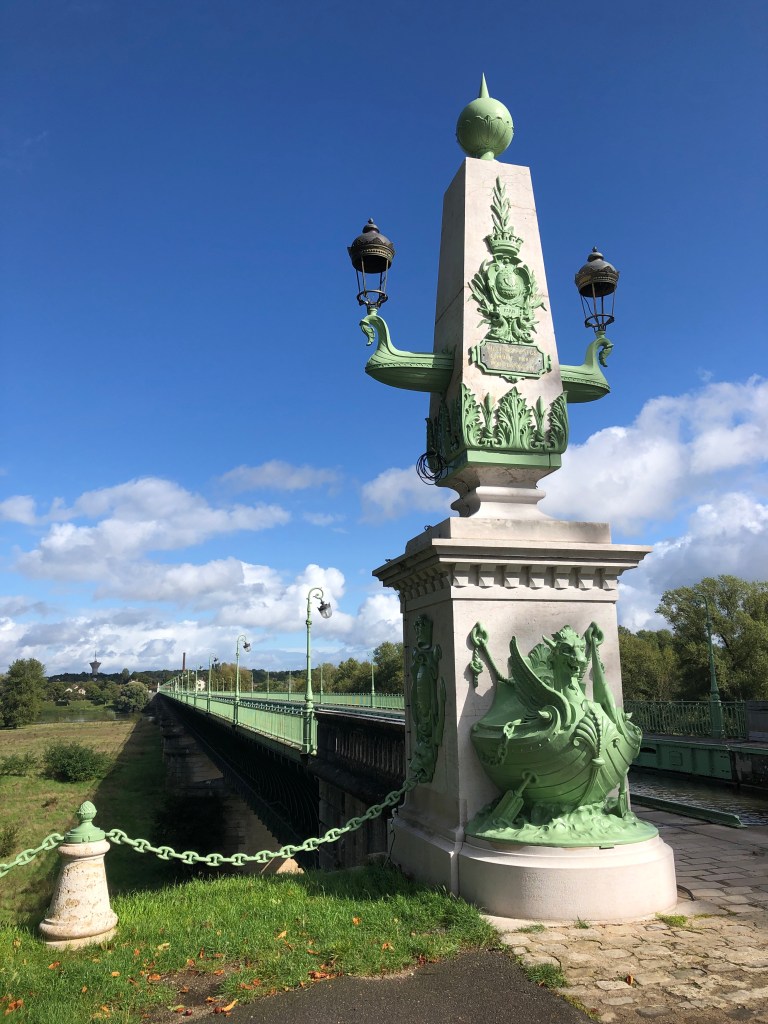
One of the joys about not having to plan too far in advance, or being so busy sorting out places to stay, so that we don’t really know what’s coming up, is being surprised by something like the Pont Canal de Briare.
And what is it, exactly, this exciting canal?Only water over water! Our old friend Lateral Canal crosses the Loire River in a 662 meter stretch of gorgeous steel and masonry. That’s almost half of a mile of aqueduct canal.Green painted creatures guard the canal.Across goes Rich. We were delighted that Eurovelo 6 travels on the canal towpath.This canal deserves all the photos. It’s a marvel.Riding into Gien. That’s the lovely Château de Gien behind an equally lovely Rich.Happy cyclists enjoying a picnic table with a view of the wild Loire River.
We may push on to the Atlantic Ocean, or we may not. There are more Châteaus to see and more wild river to enjoy. Happy pedaling.
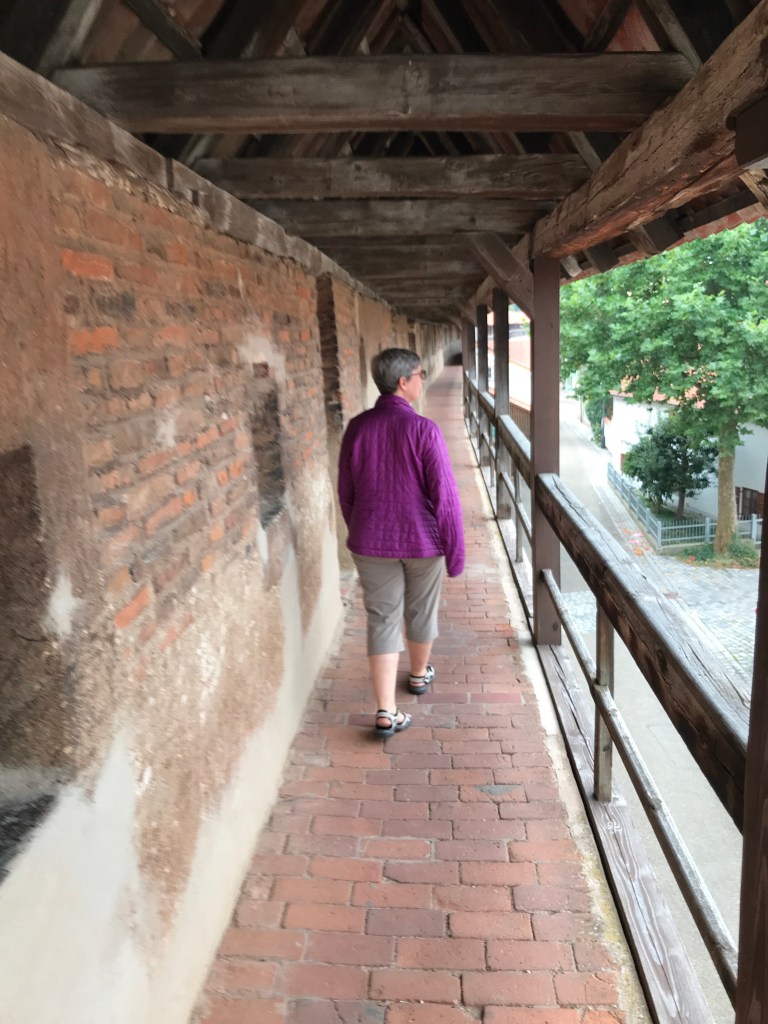
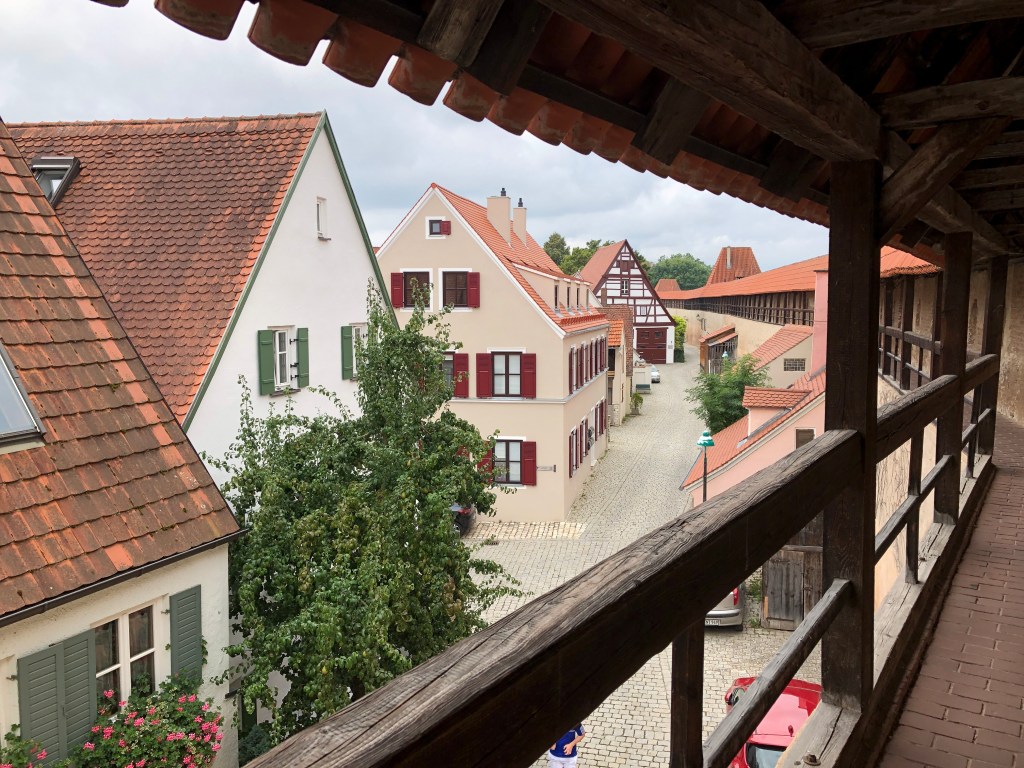
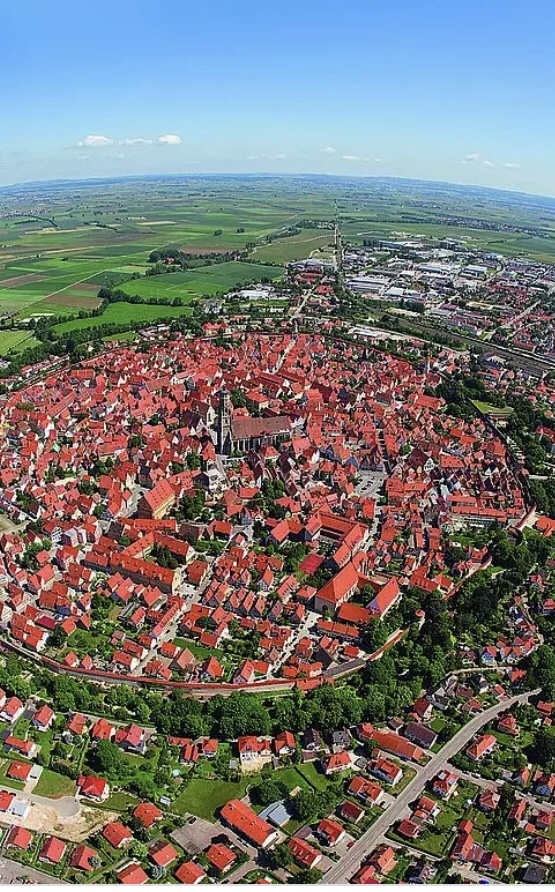
It’s our second visit to Nördlingen, the first was six years ago on our broken collarbone trip (me, 3 days into a 3 week trip), on that trip we were taking trains and had left our bikes in München. This time we biked to this walled town which is situated in a much larger crater left by a meteorite millions of years ago. The wall is a huge draw for us. It’s a very unique and cozy attraction. We spent two nights here this time.
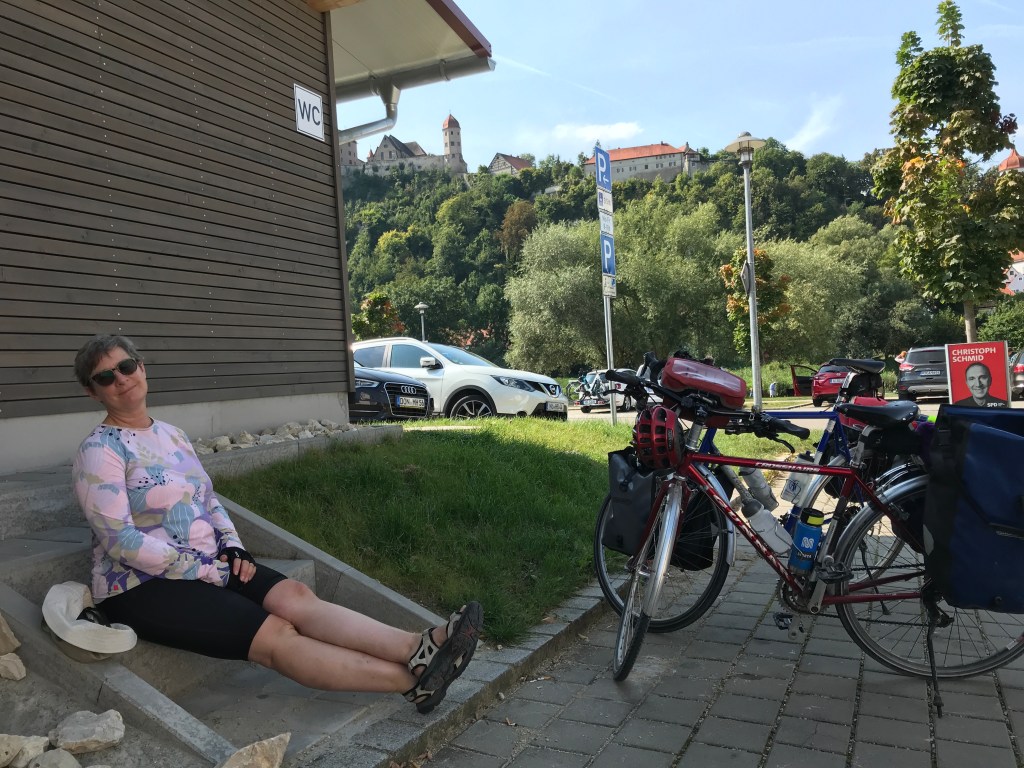
The wall walk combines some of my favorite things, car free walks, garden peeping, and house peeping.Really a unique experience to walk the intact wall. One spot had repairs being done, but the rest was walkable.There are houses whose back walls are the town wall, or which are built through the wall.Ah, the glamorous side of bike touring. Resting in the shade of a town WC. It was a long hot day riding to Nördlingen.
Between the wall and its history, and a local train museum, we had plenty to do on our rest day.
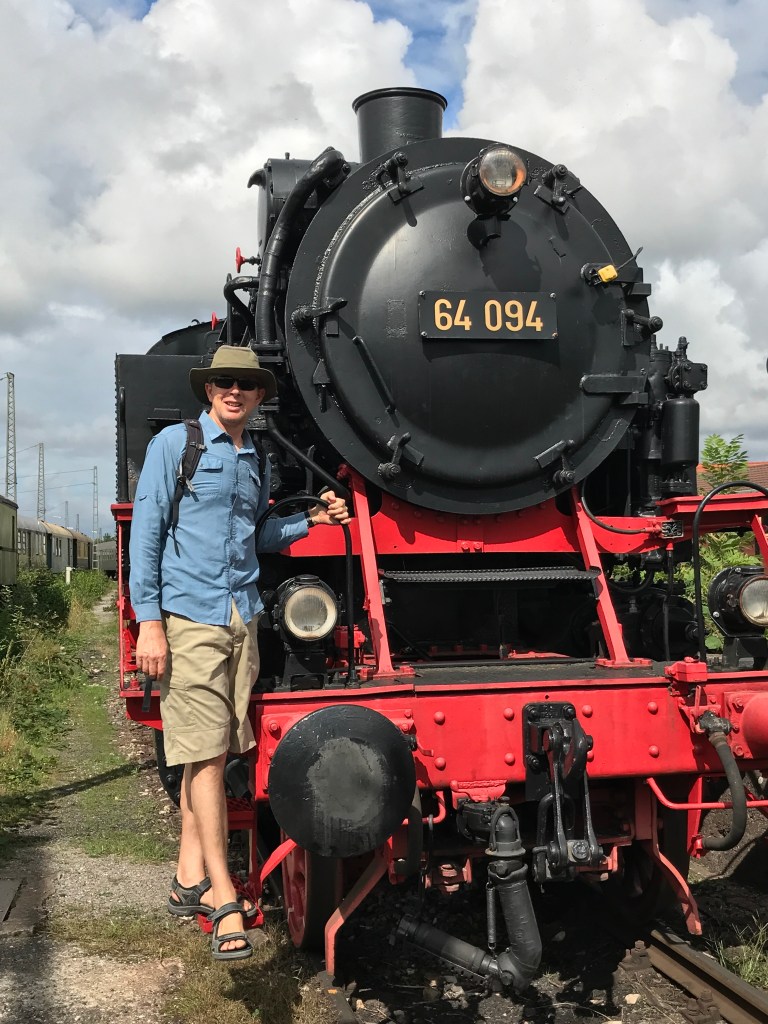
We saw this museum across the train platform the last time we were here but didn’t have time to check it out.Rich added for scale, Rich is six foot five. That is a huge piece of machinery. So many historic train locomotives and cars are just sitting on the rails, reminding us of the history of train travel. And the human capacity for innovation.Some are simply falling into decay.But many are lovingly housed and maintained. This is the roundhouse.Yes there was wine, my first Silvaner of the trip. And our first brats. This little place was set up during the Saturday market and had a line when we saw it, we quickly got in line. About 2 minutes after we got our lunch they sold out and closed up.
So where have you likely seen this charming town? In the movie Willy Wonka and the Chocolate Factory, 1971, the Wonkavator flies above the town in the final scene as it crashes out of the factory roof – remember?
If you saw the movie you likely remember a shot like this from the glass elevator.

































































 Less Car, More Life