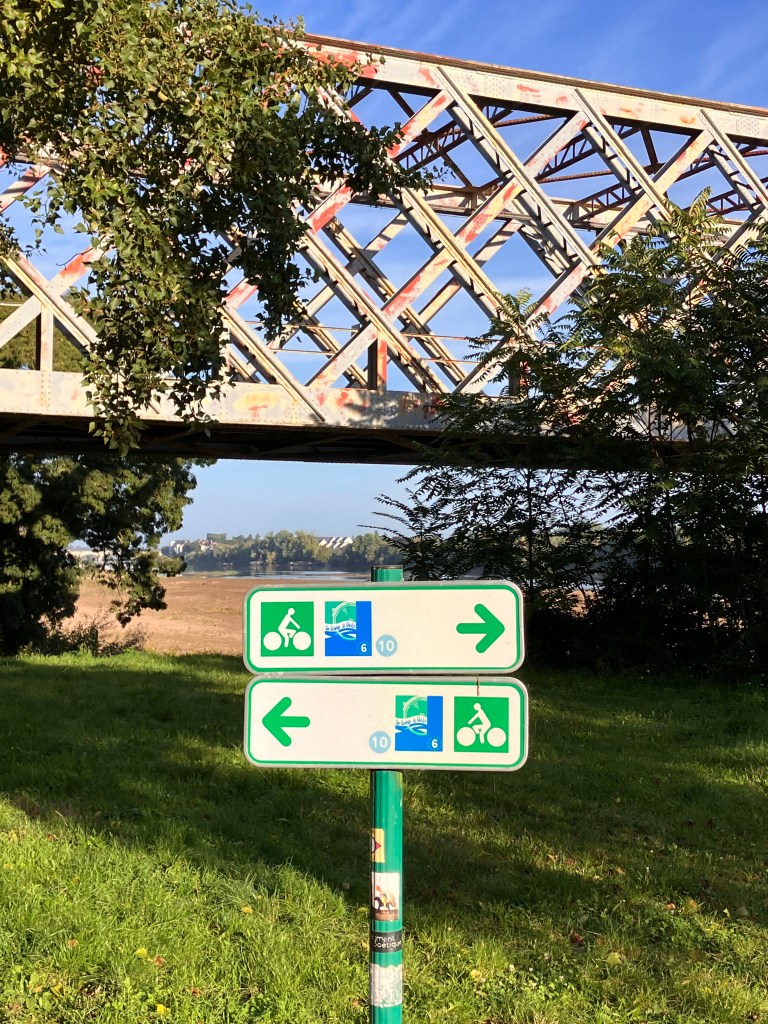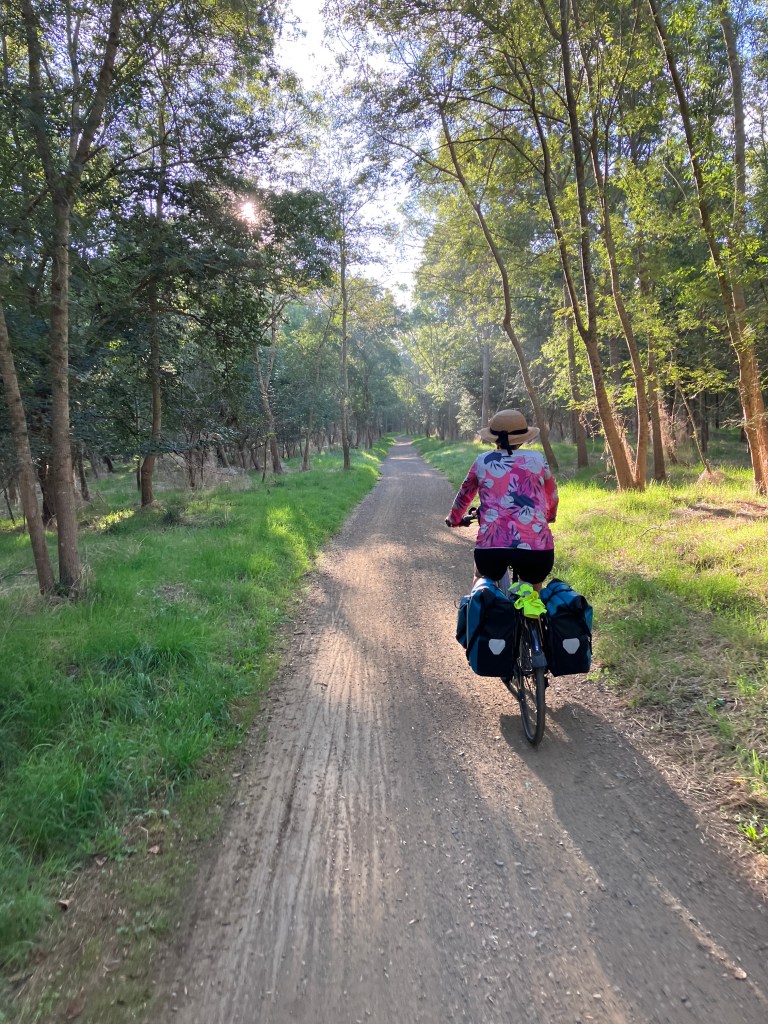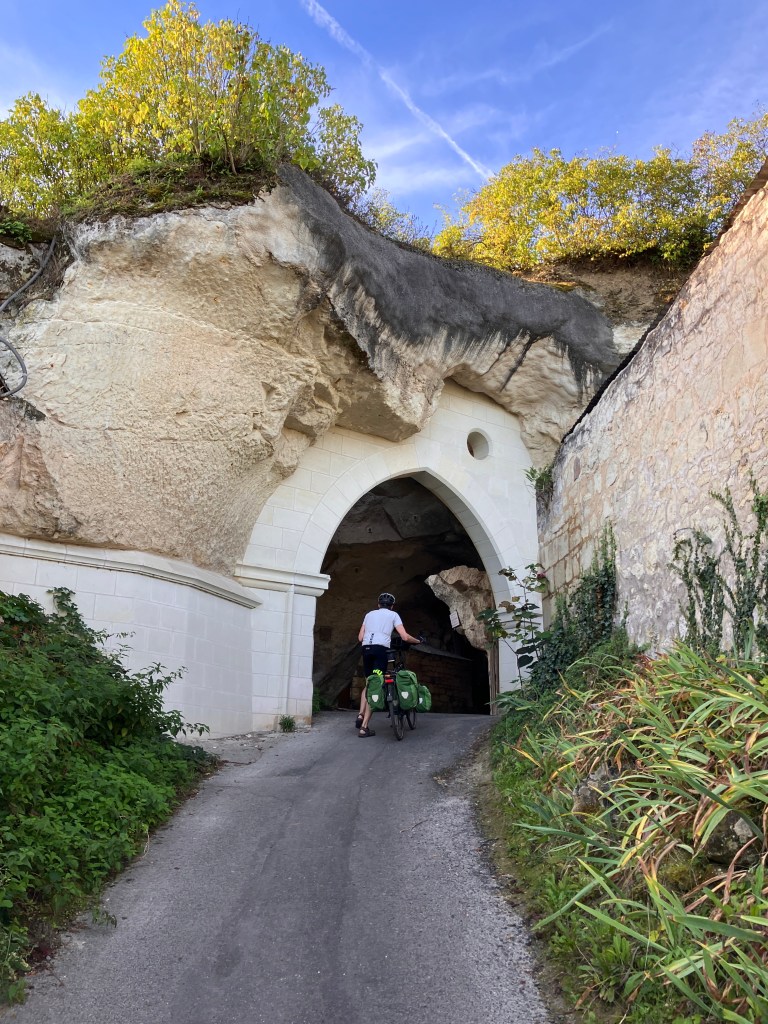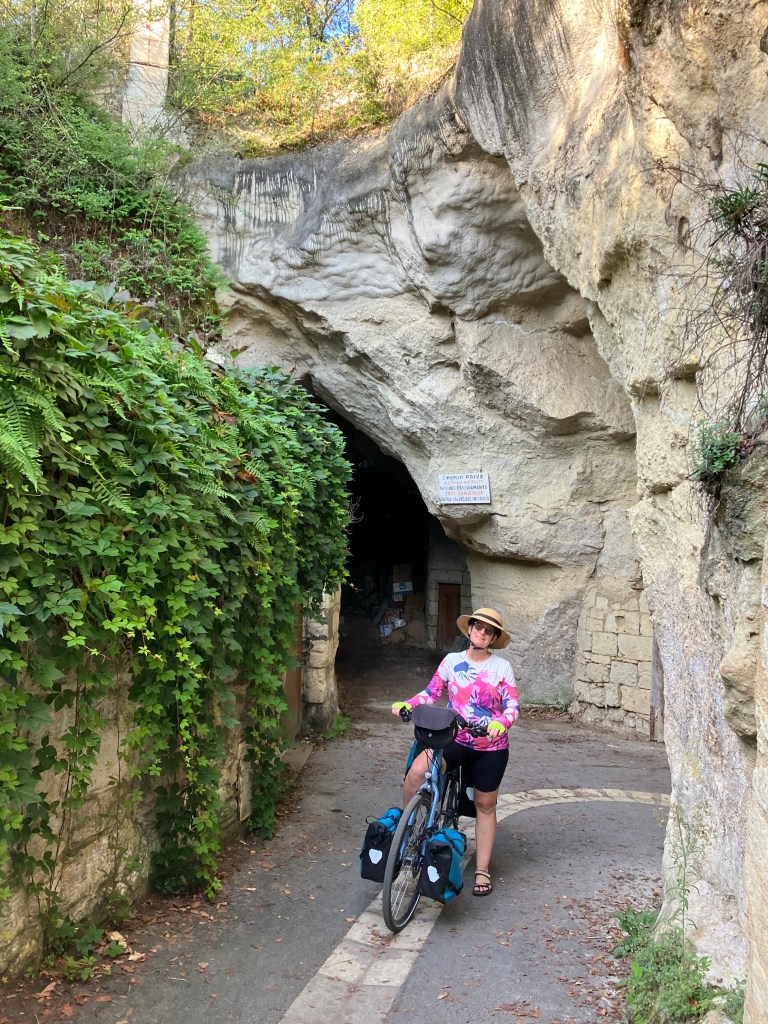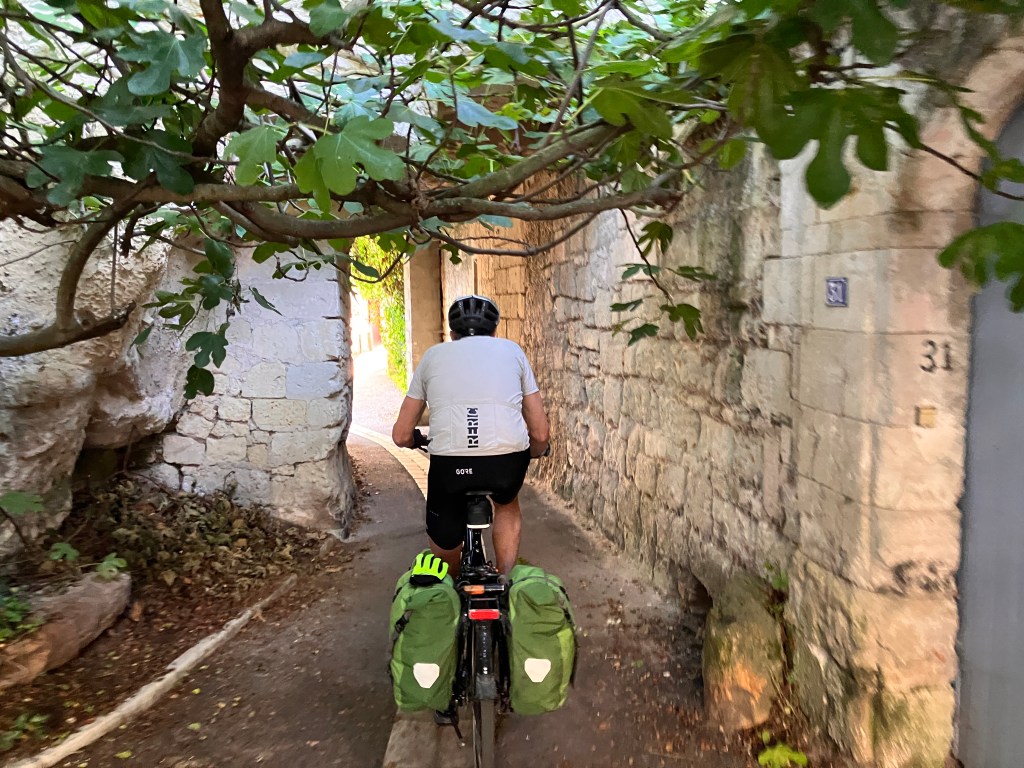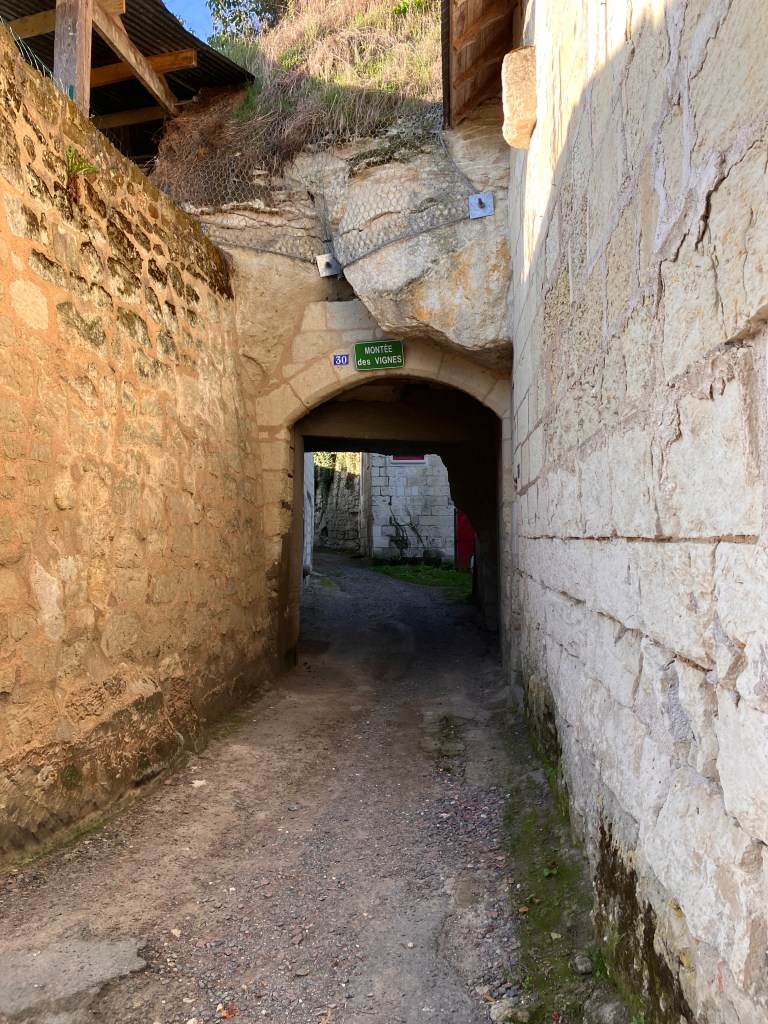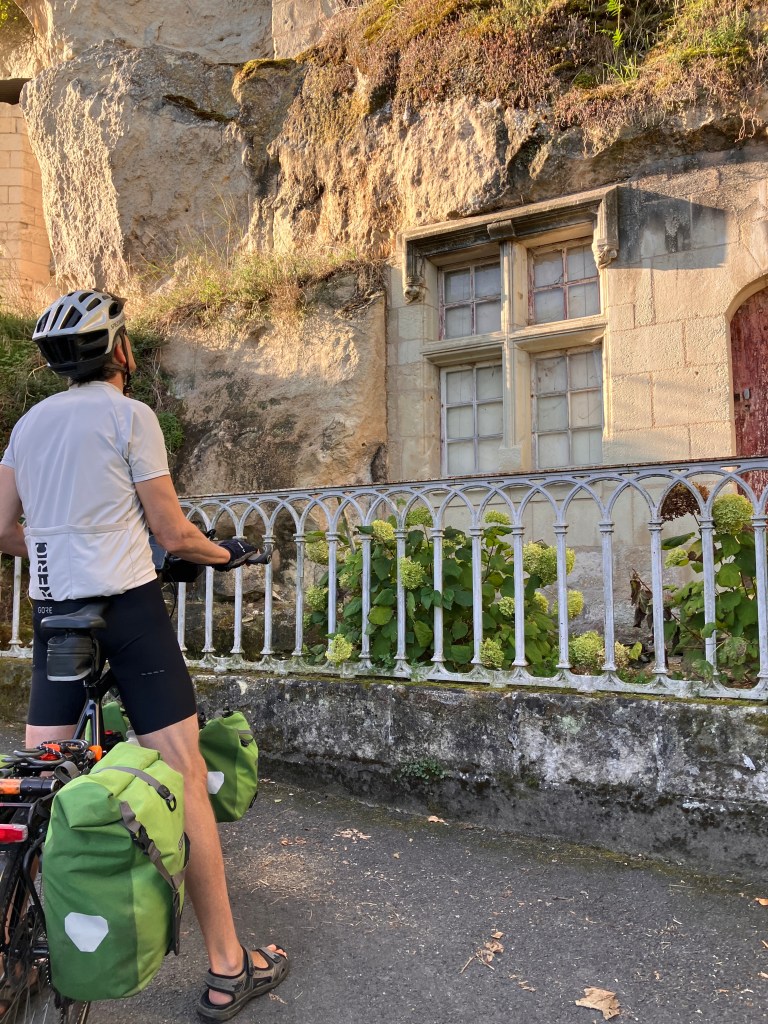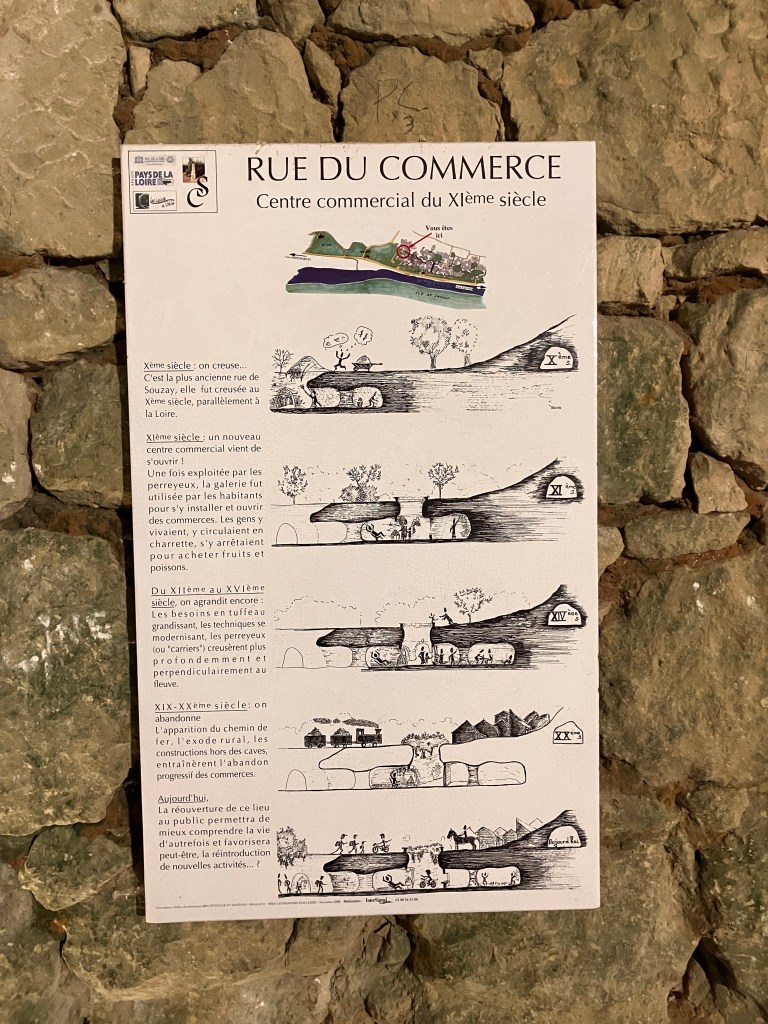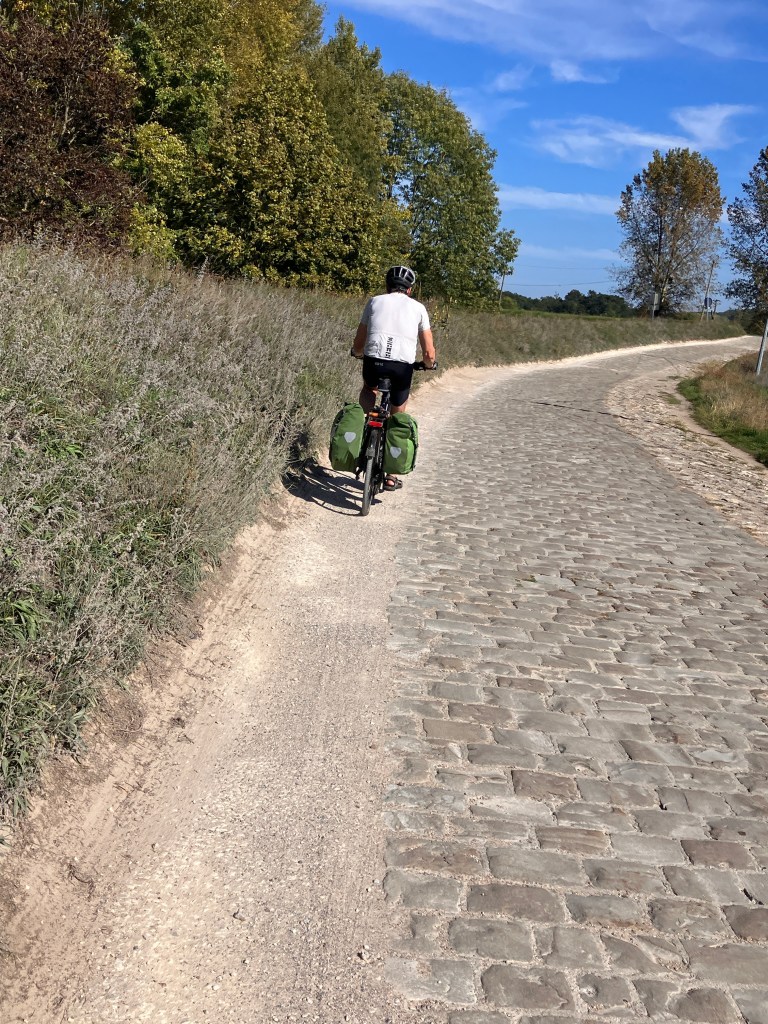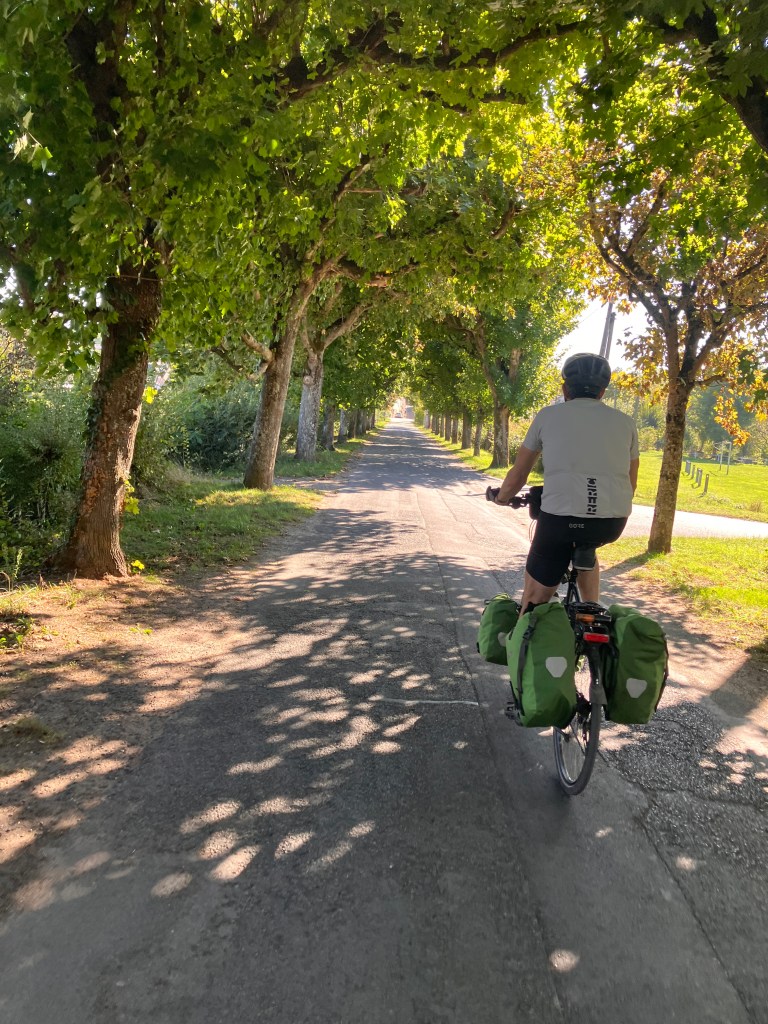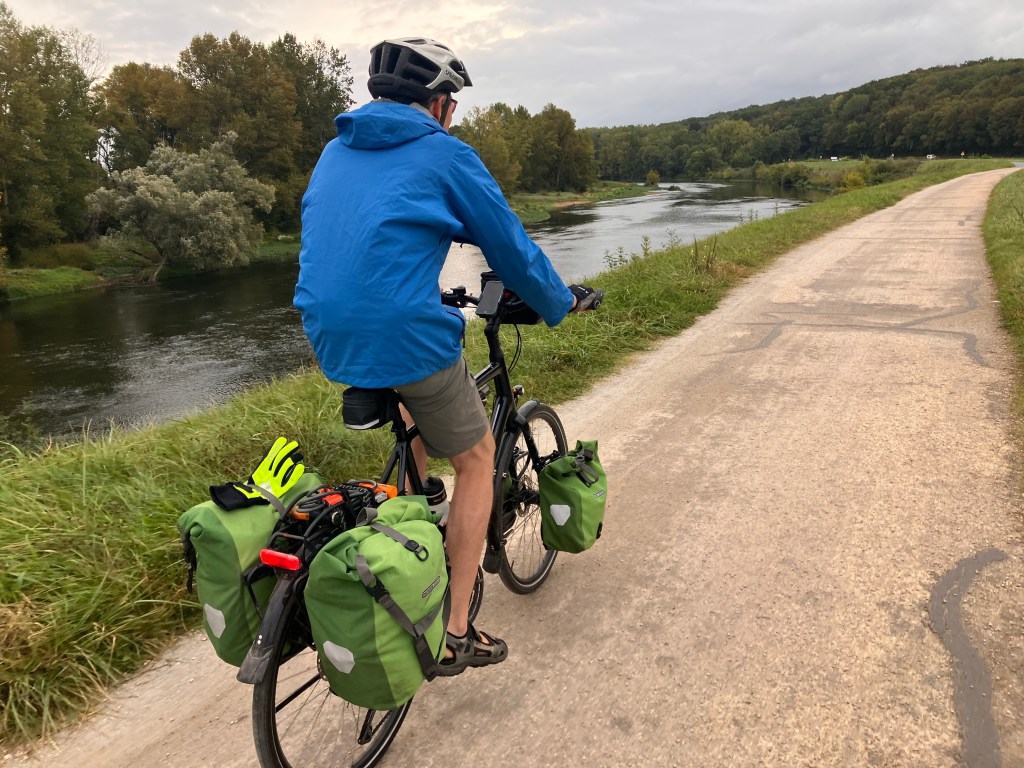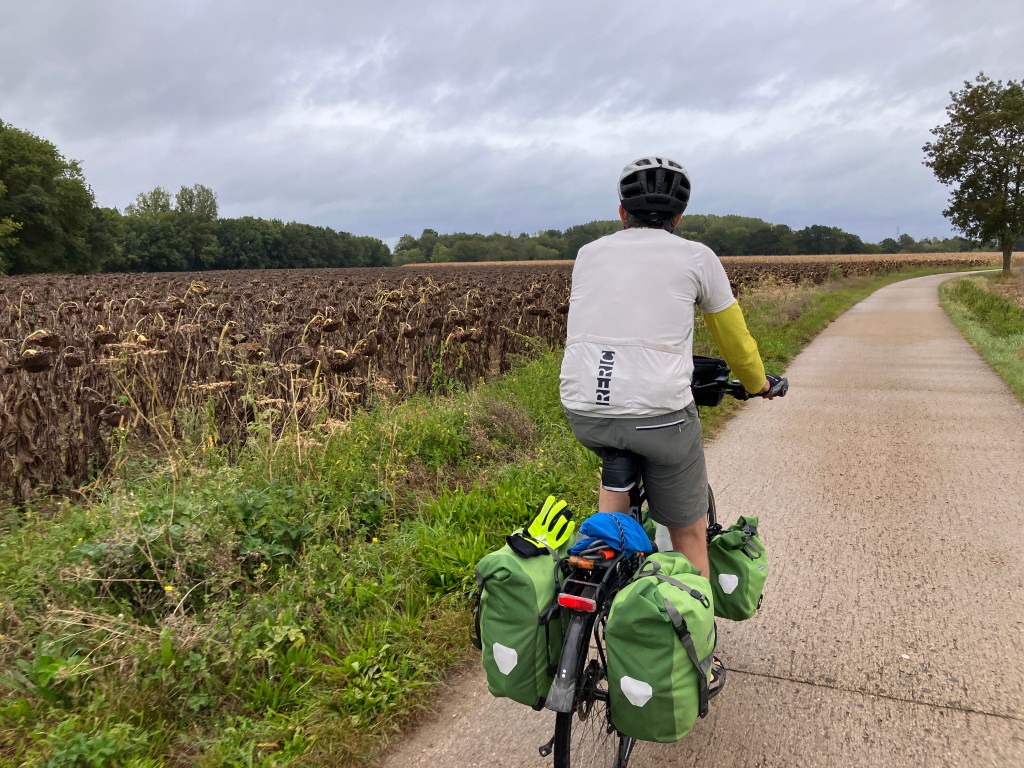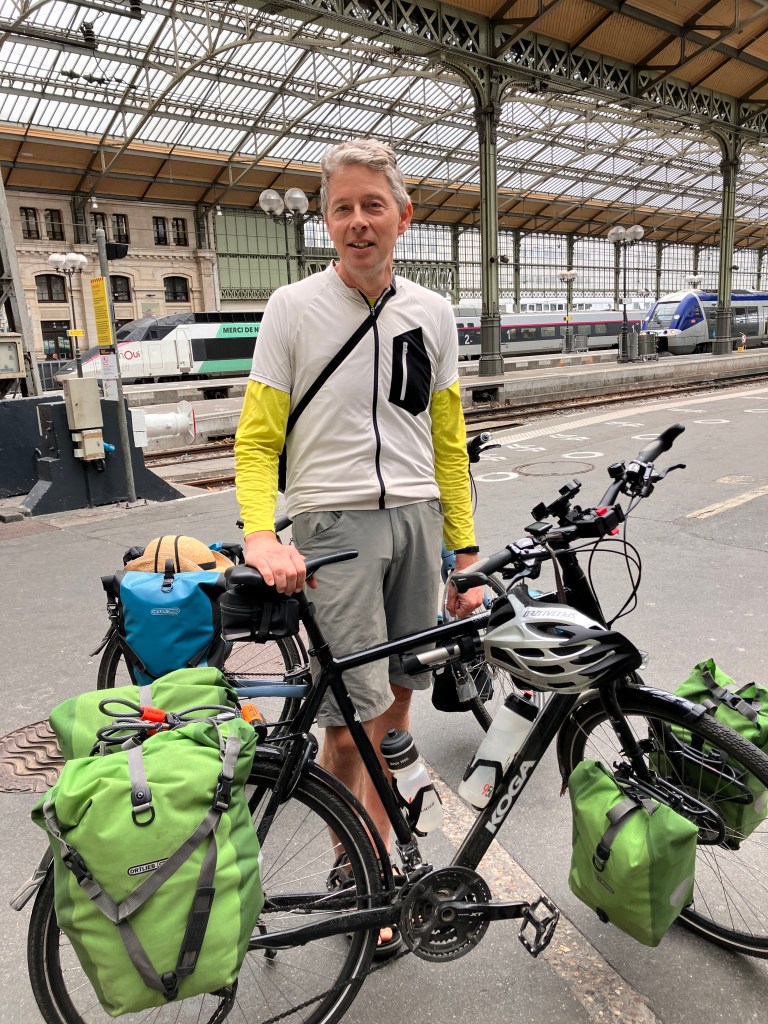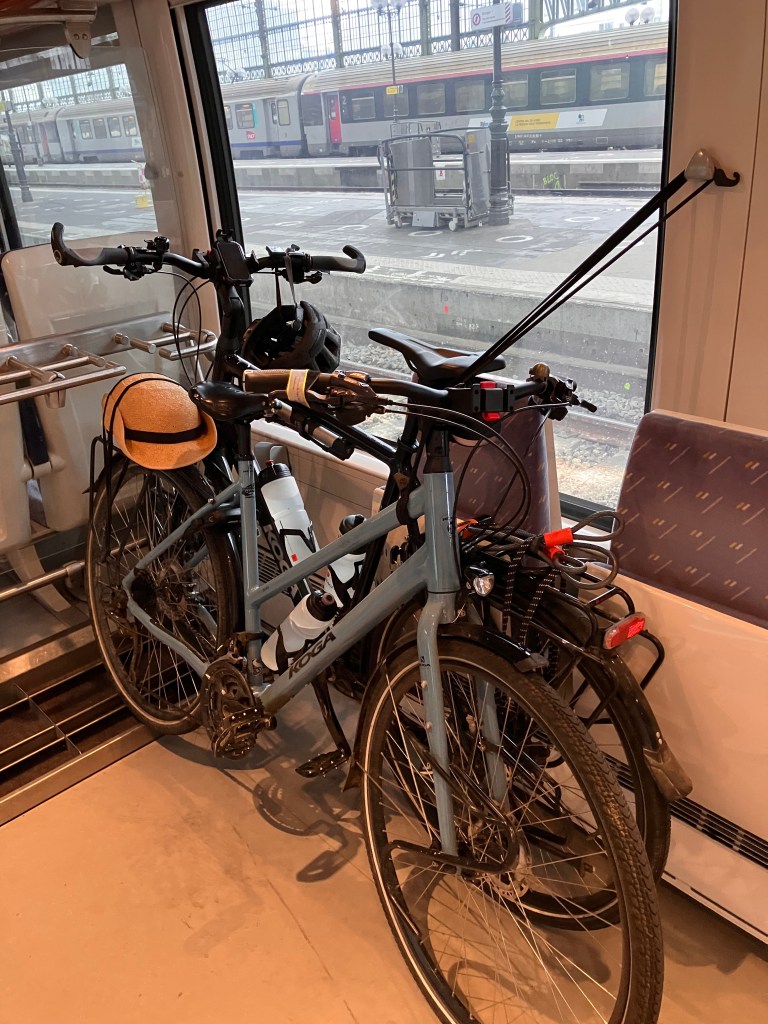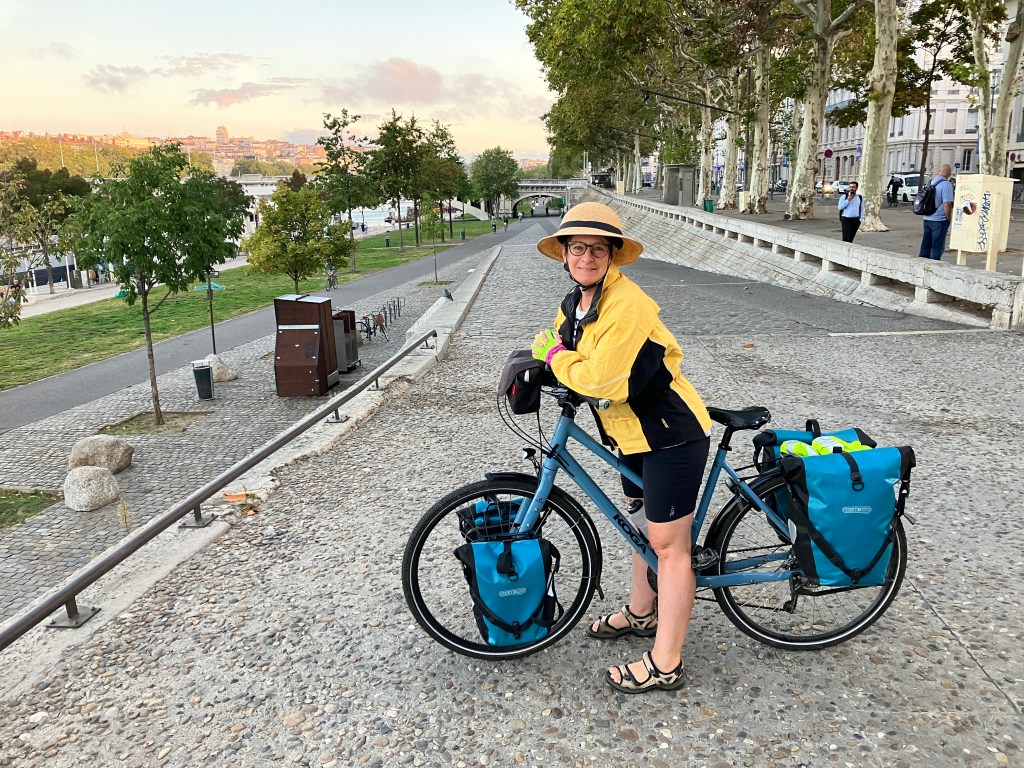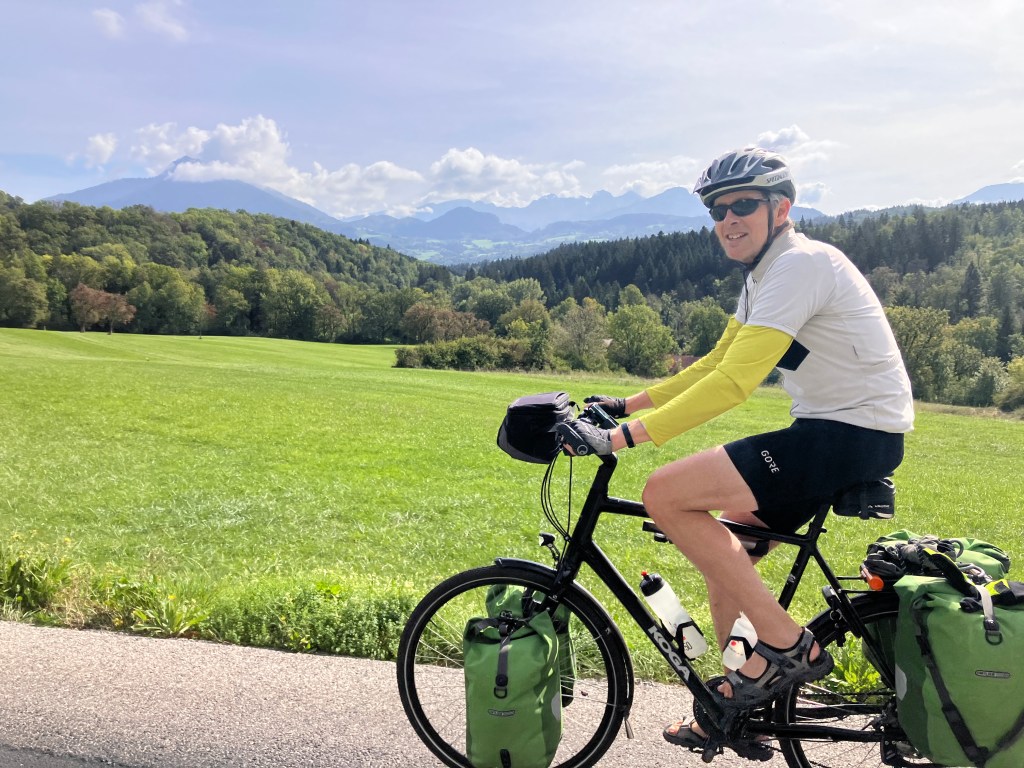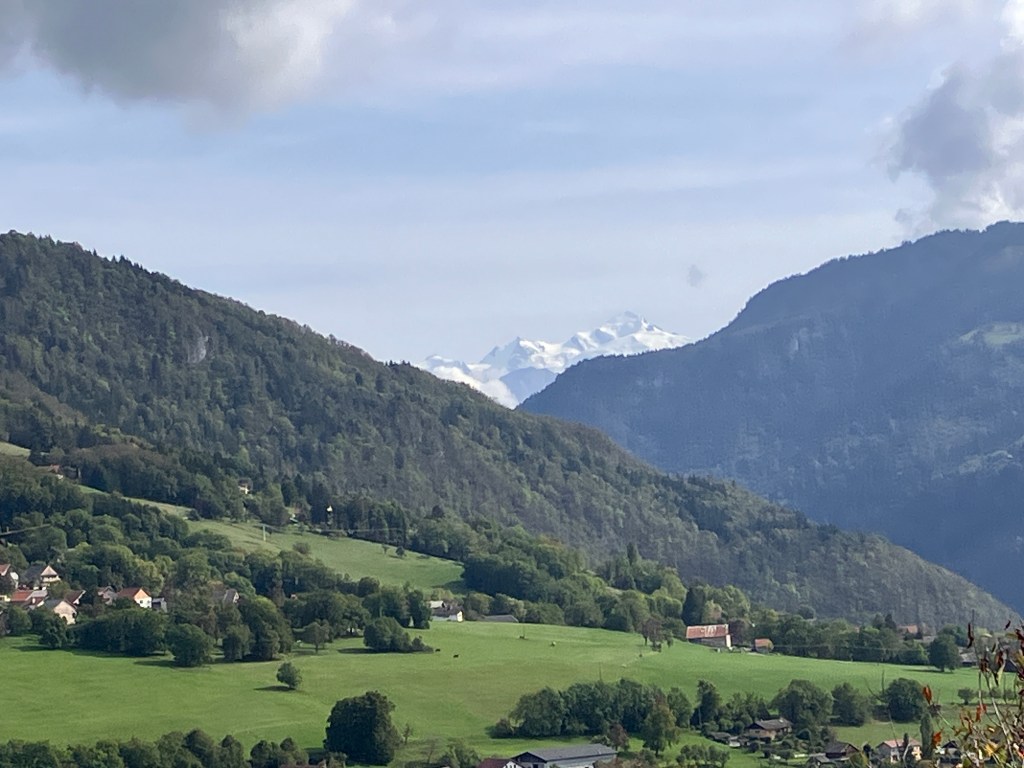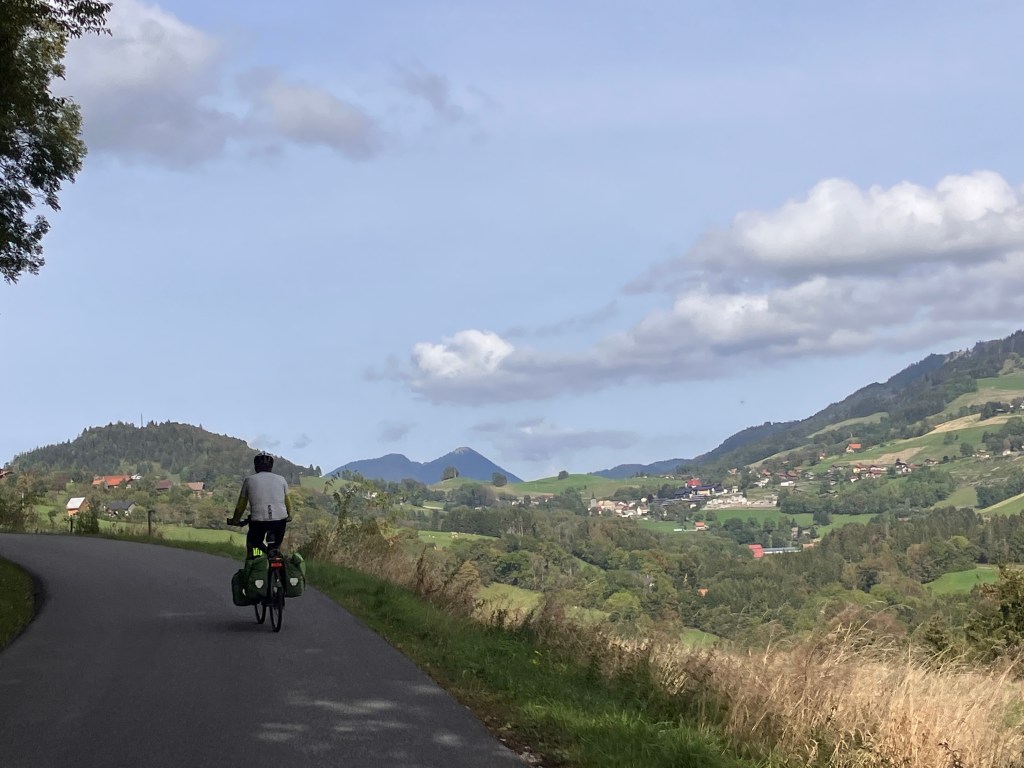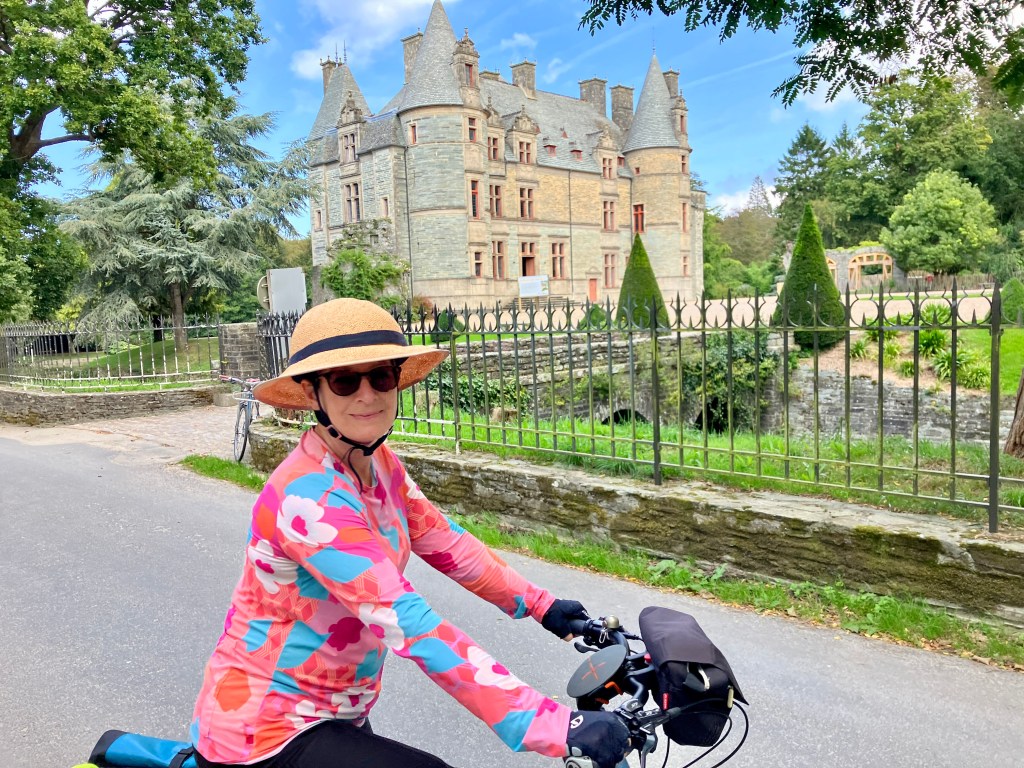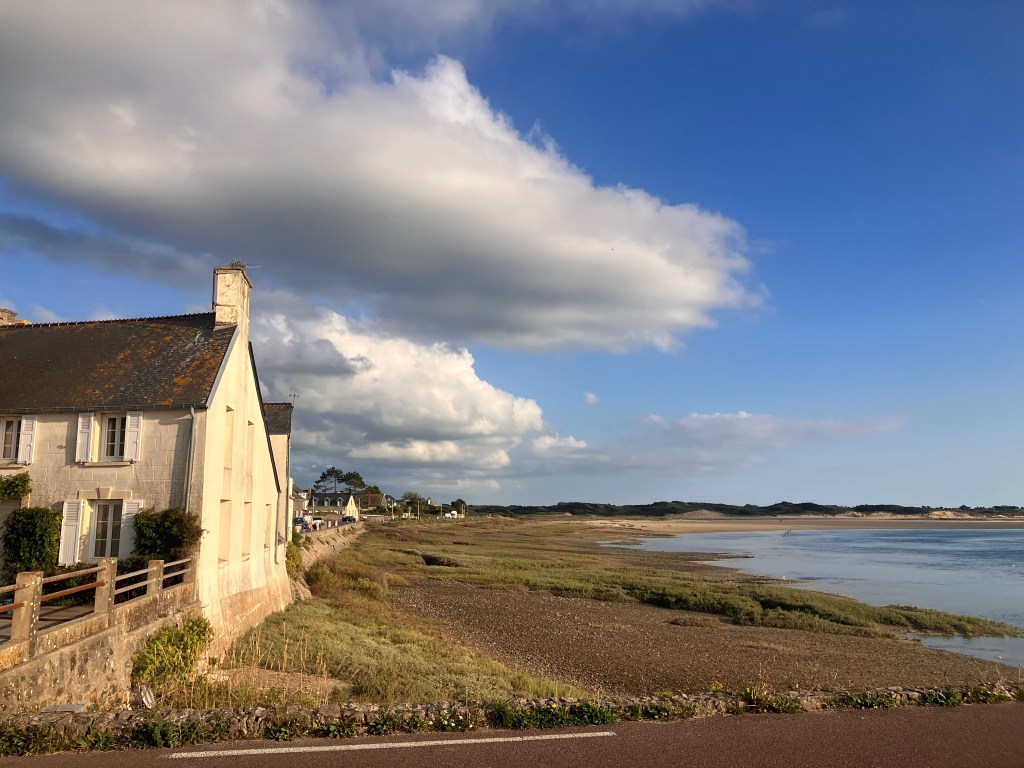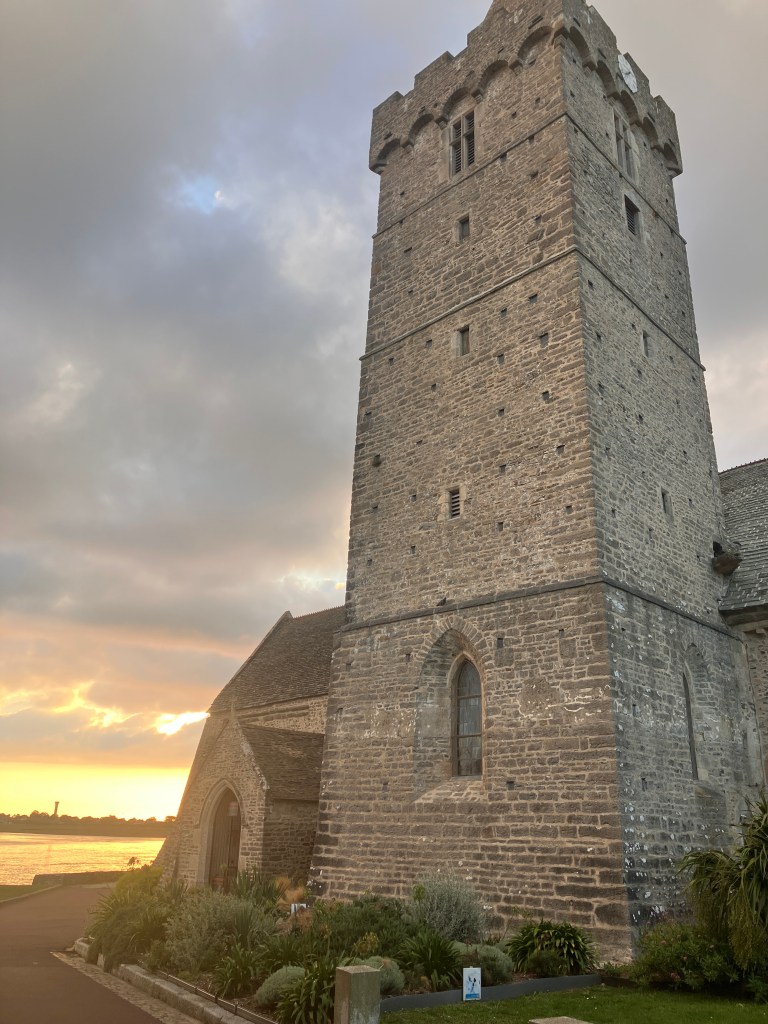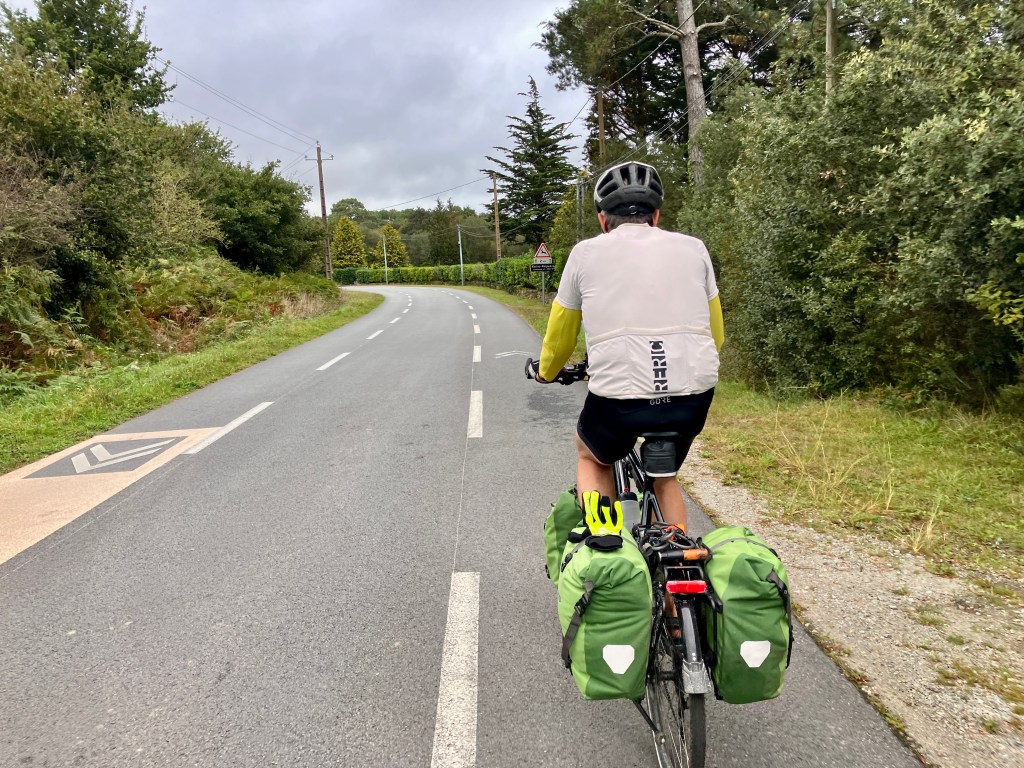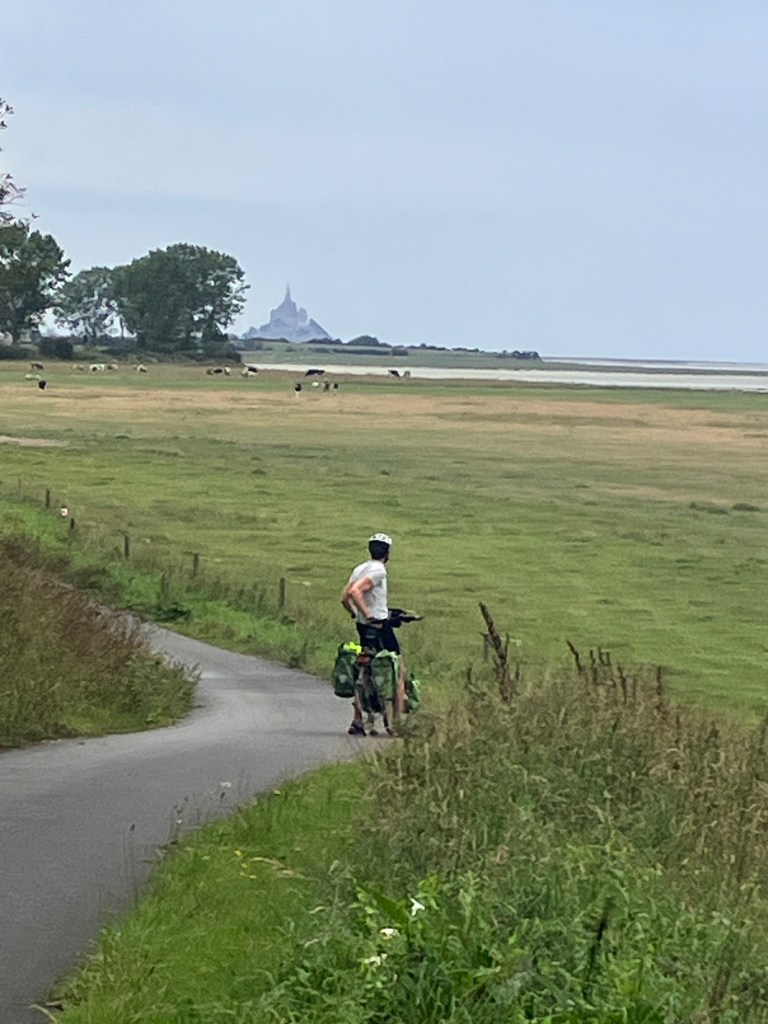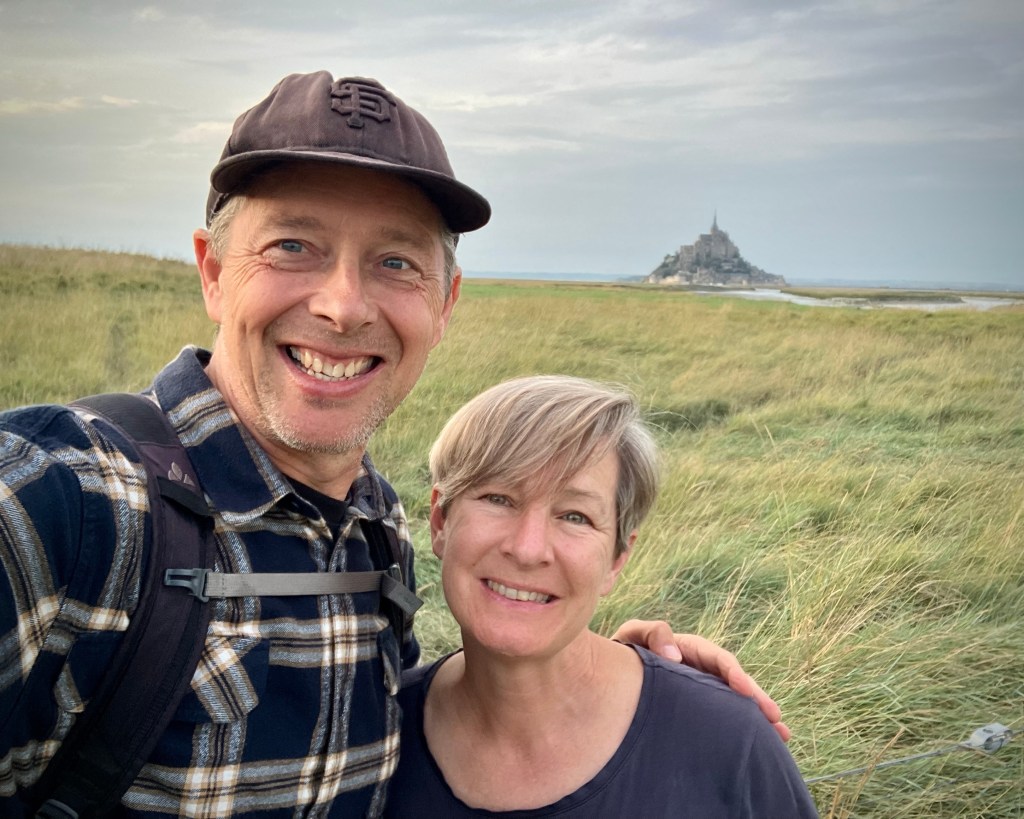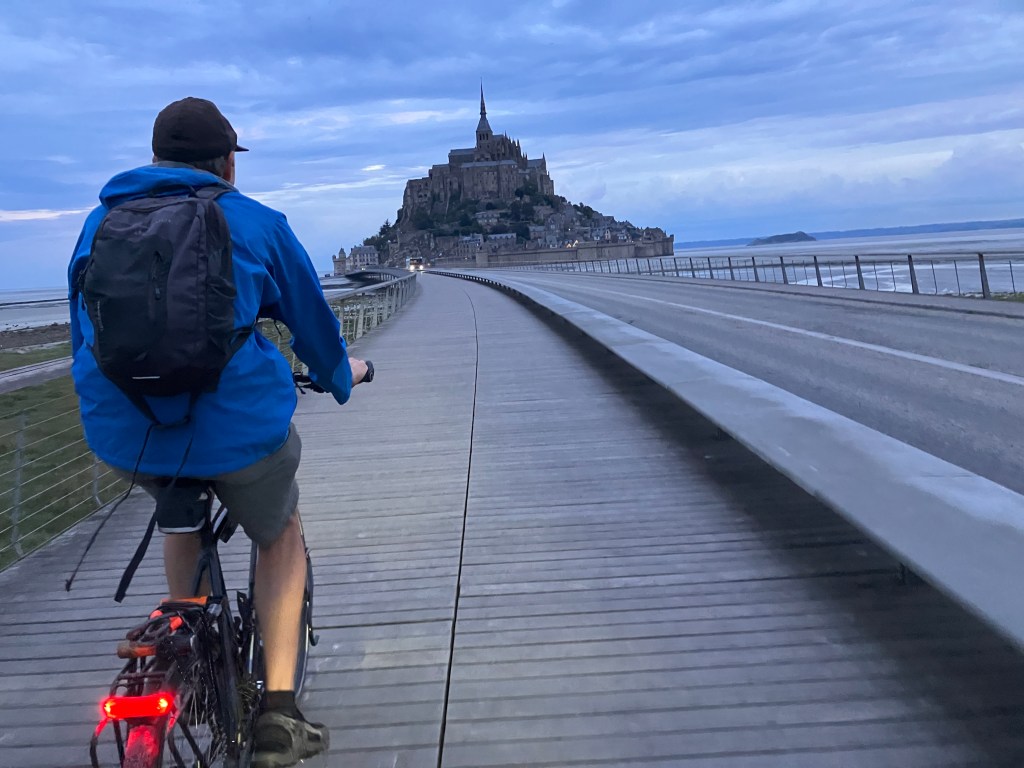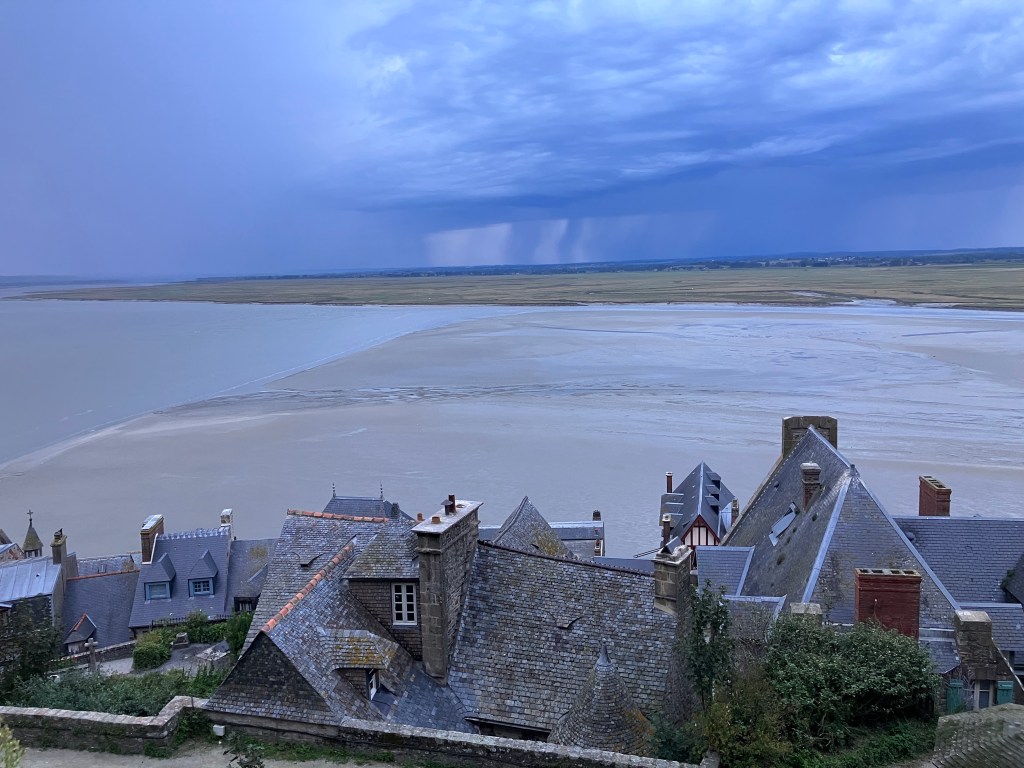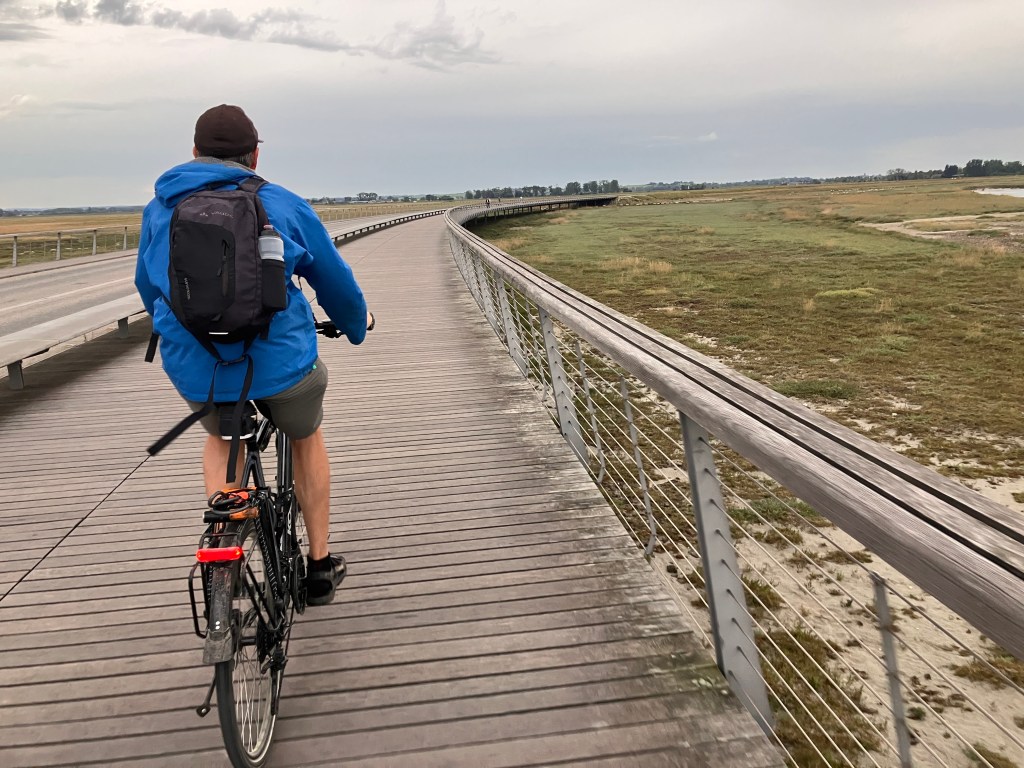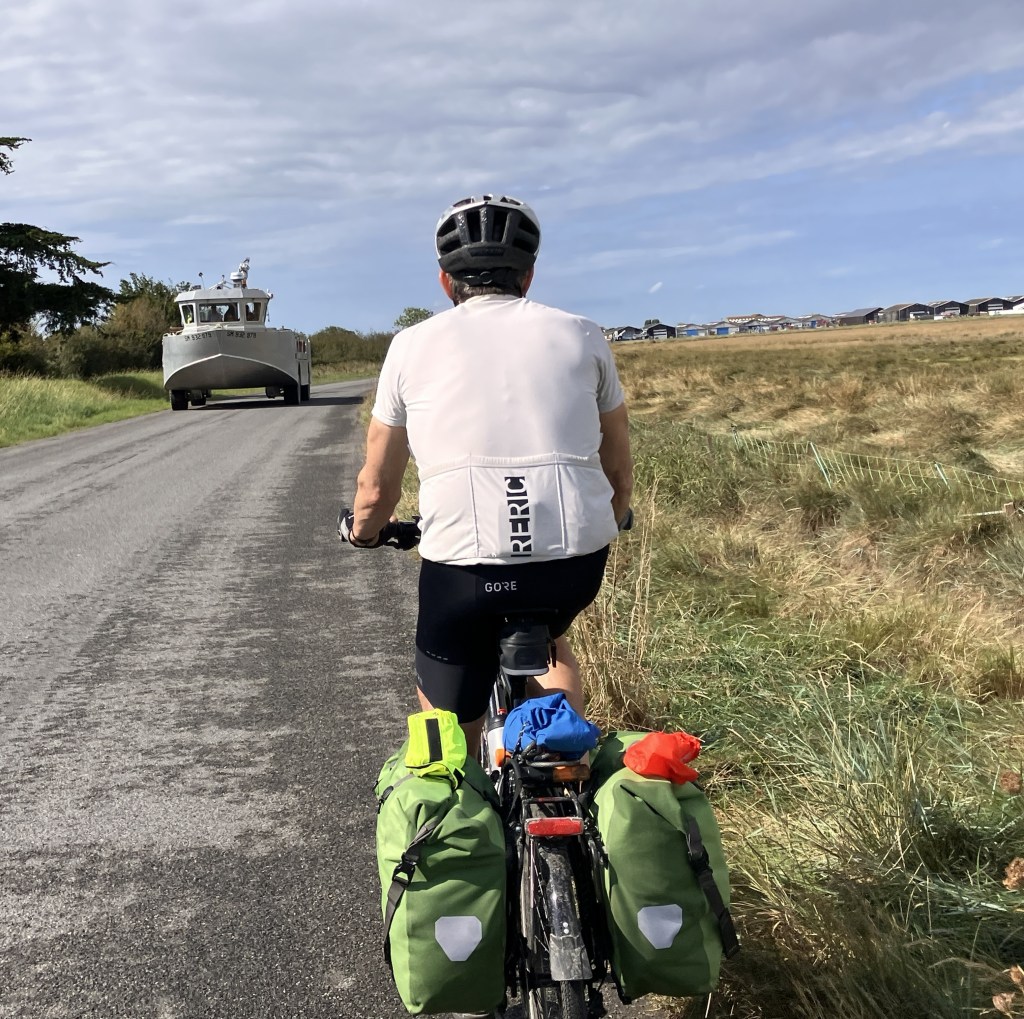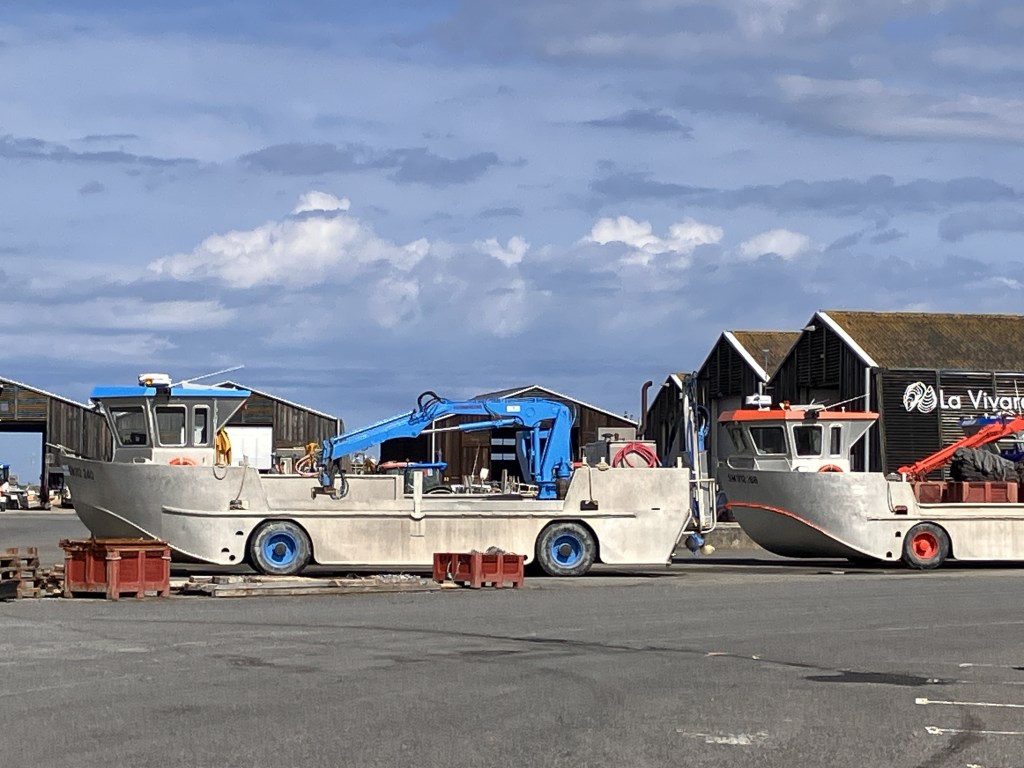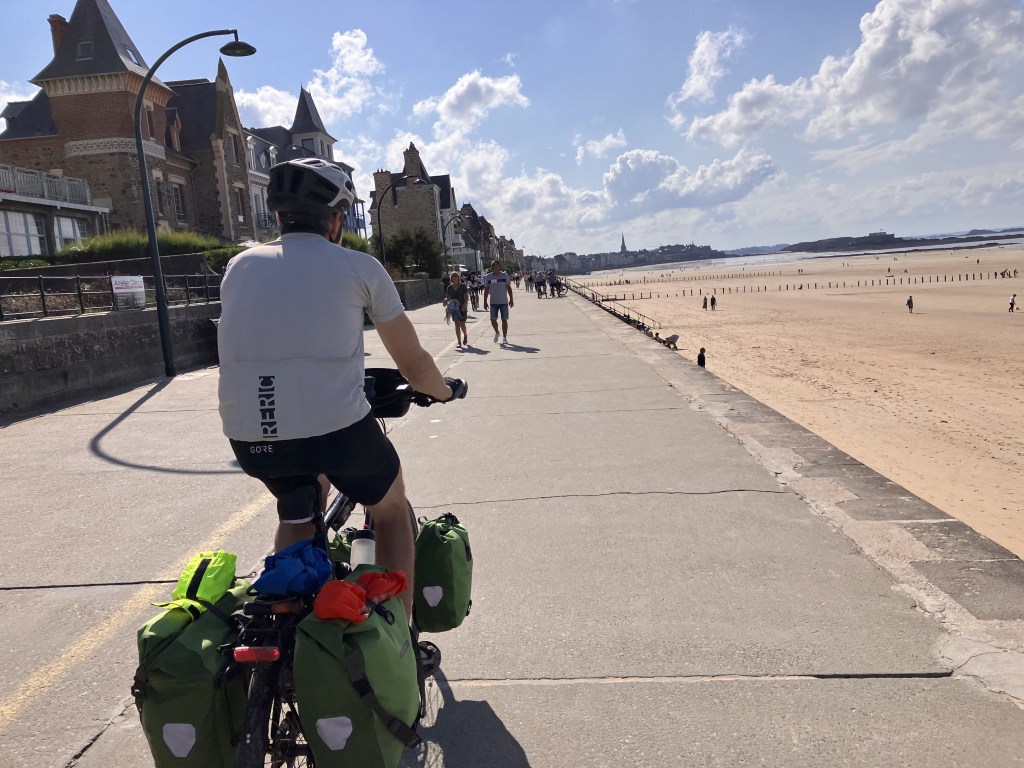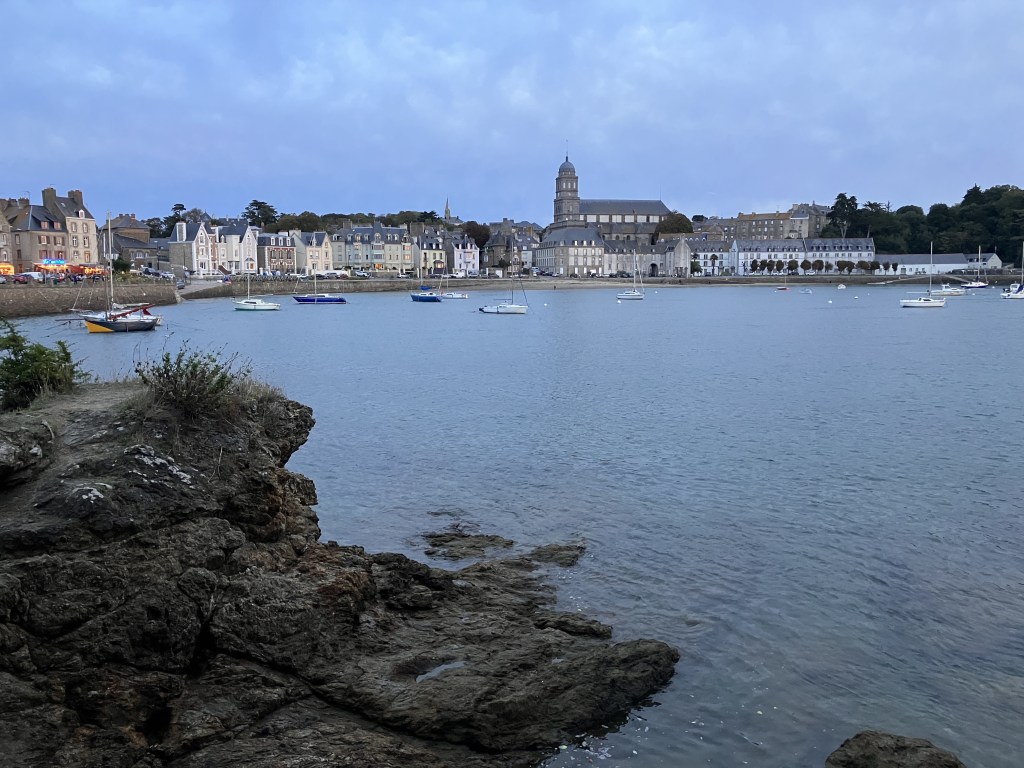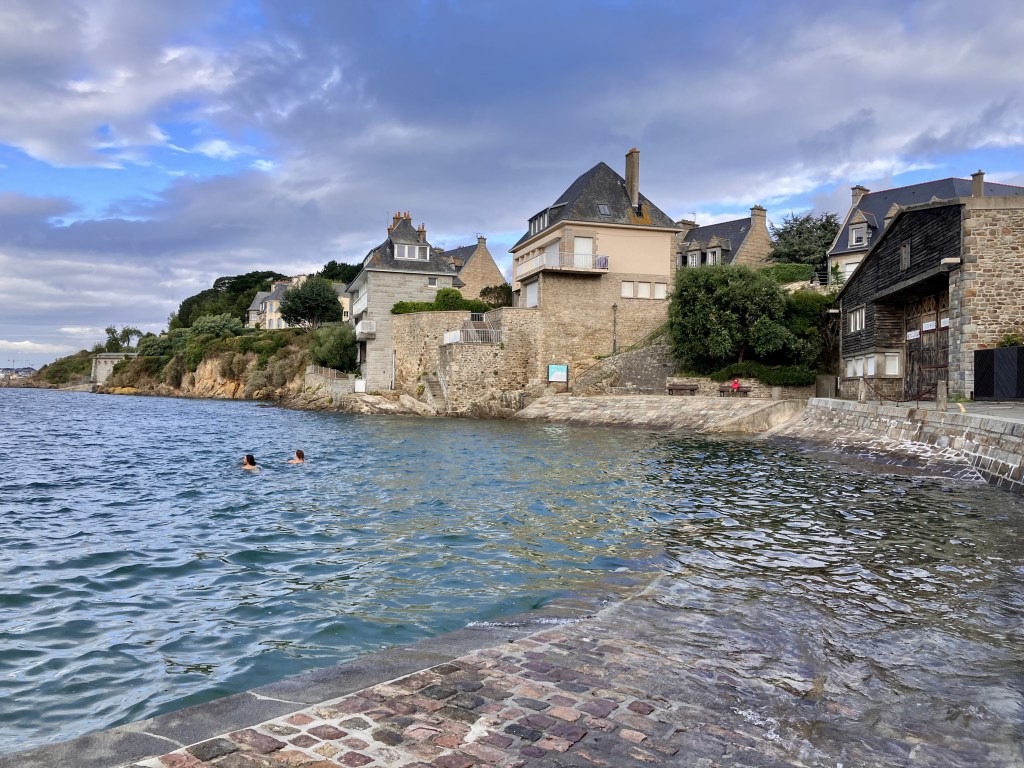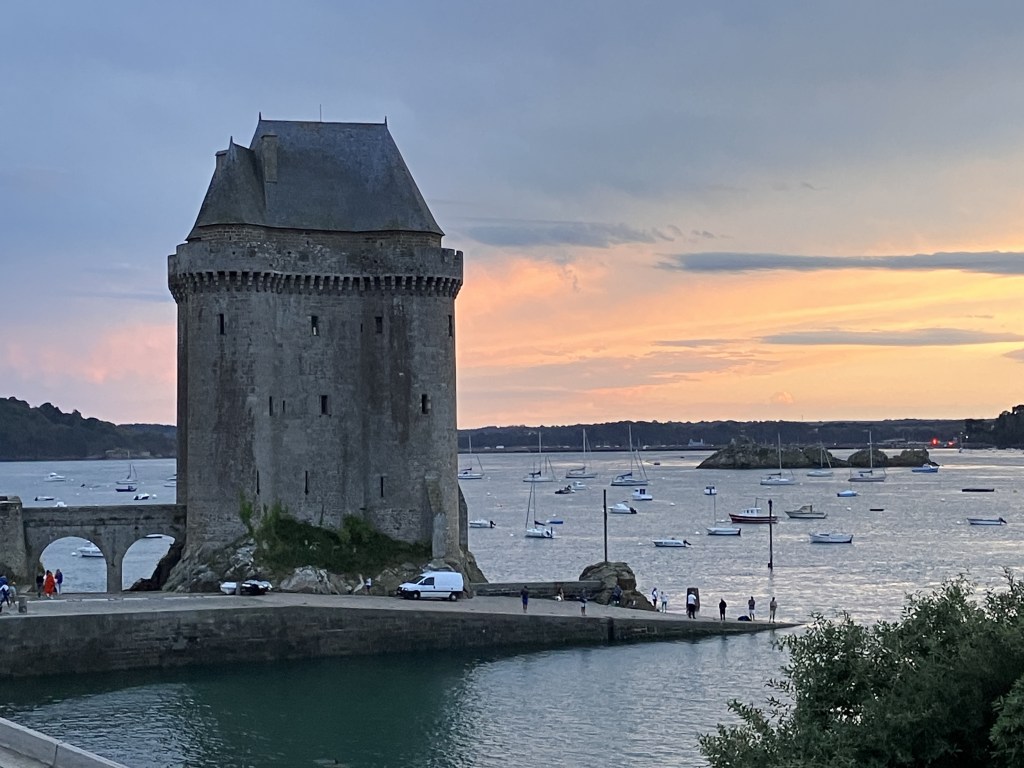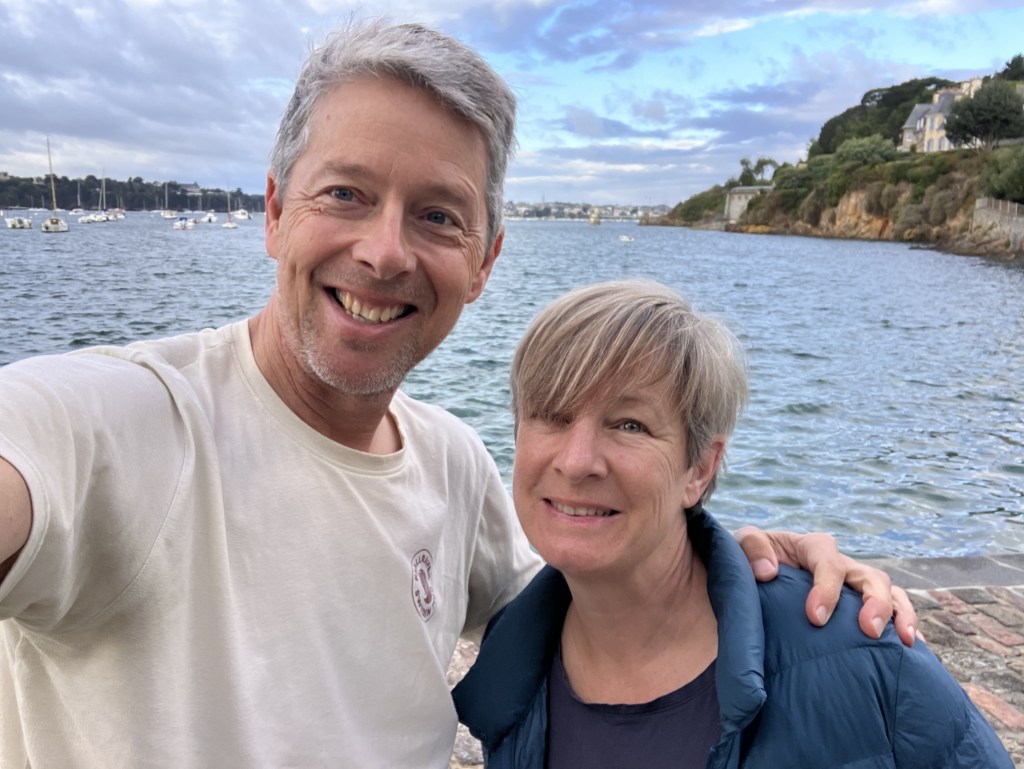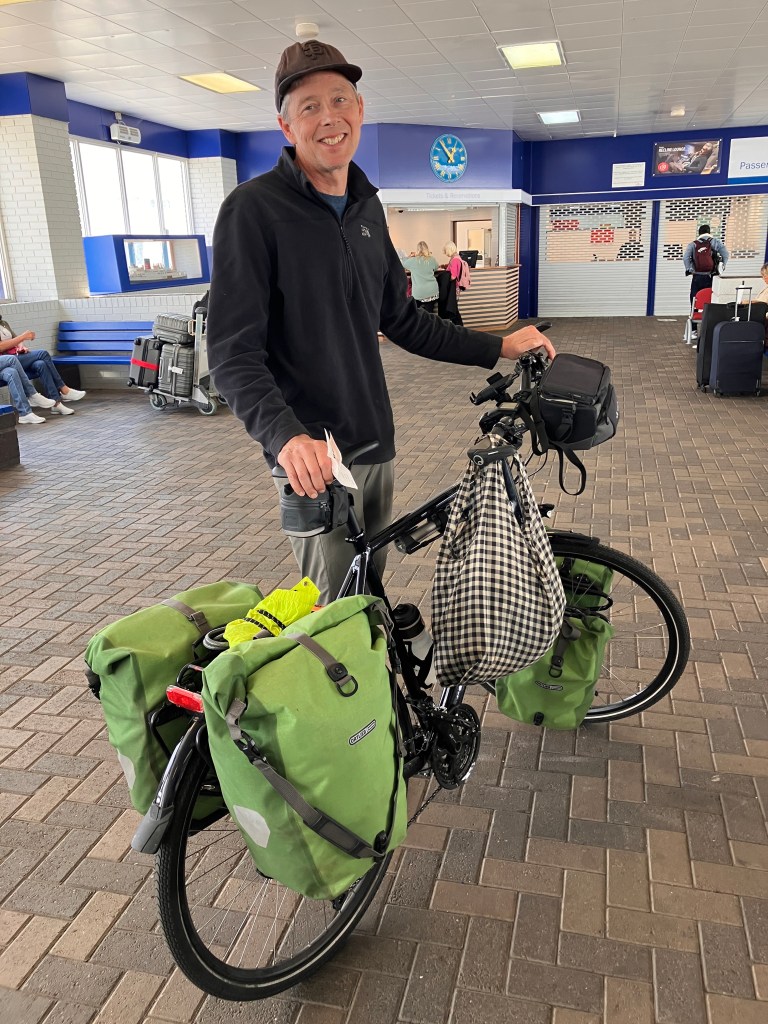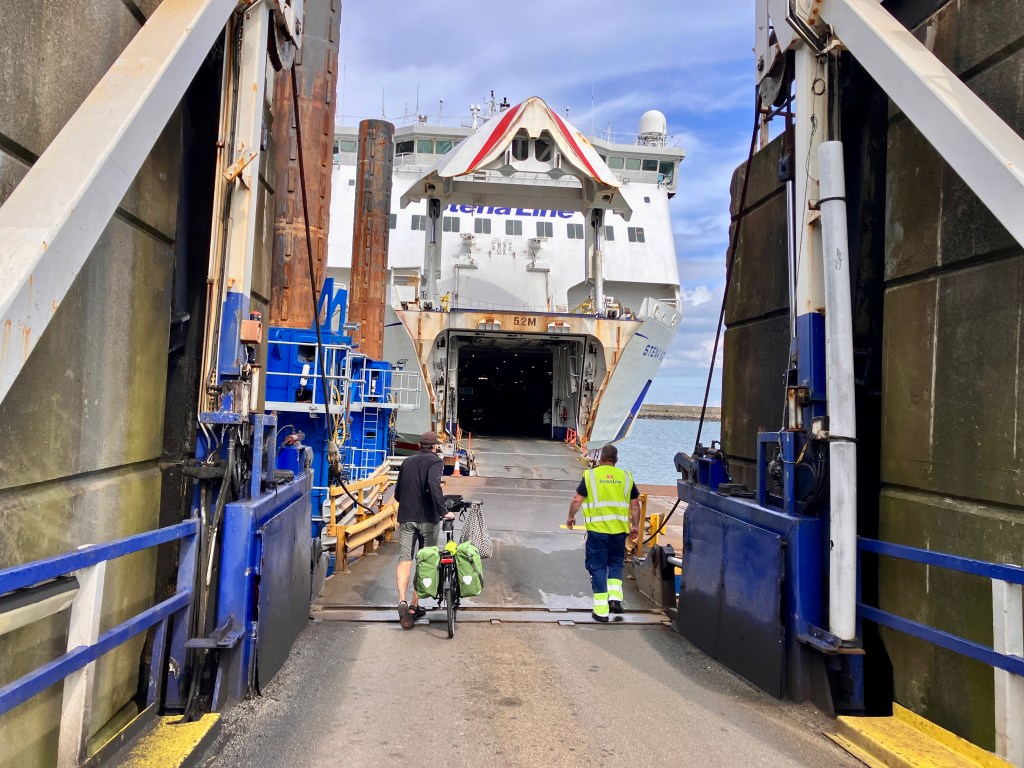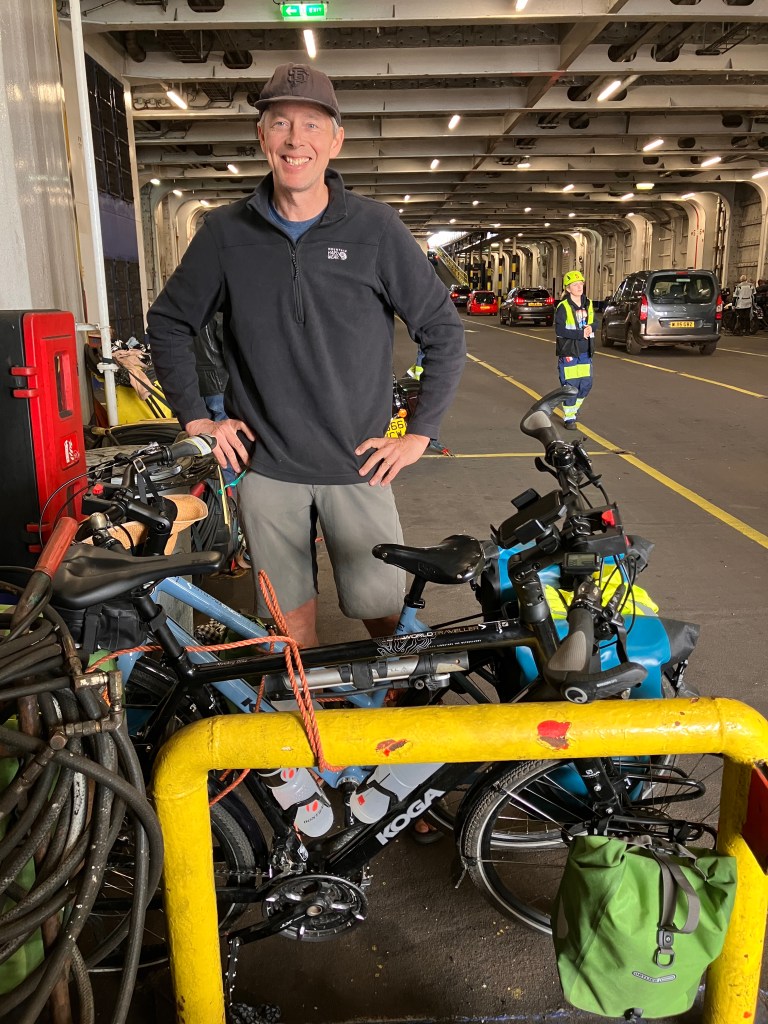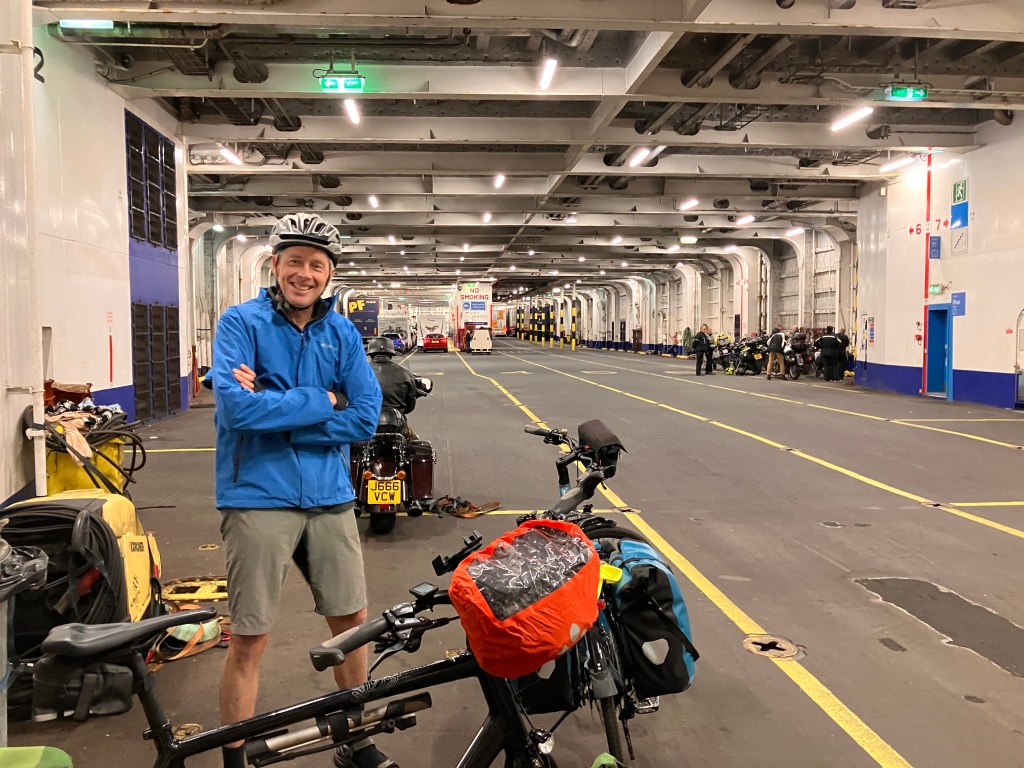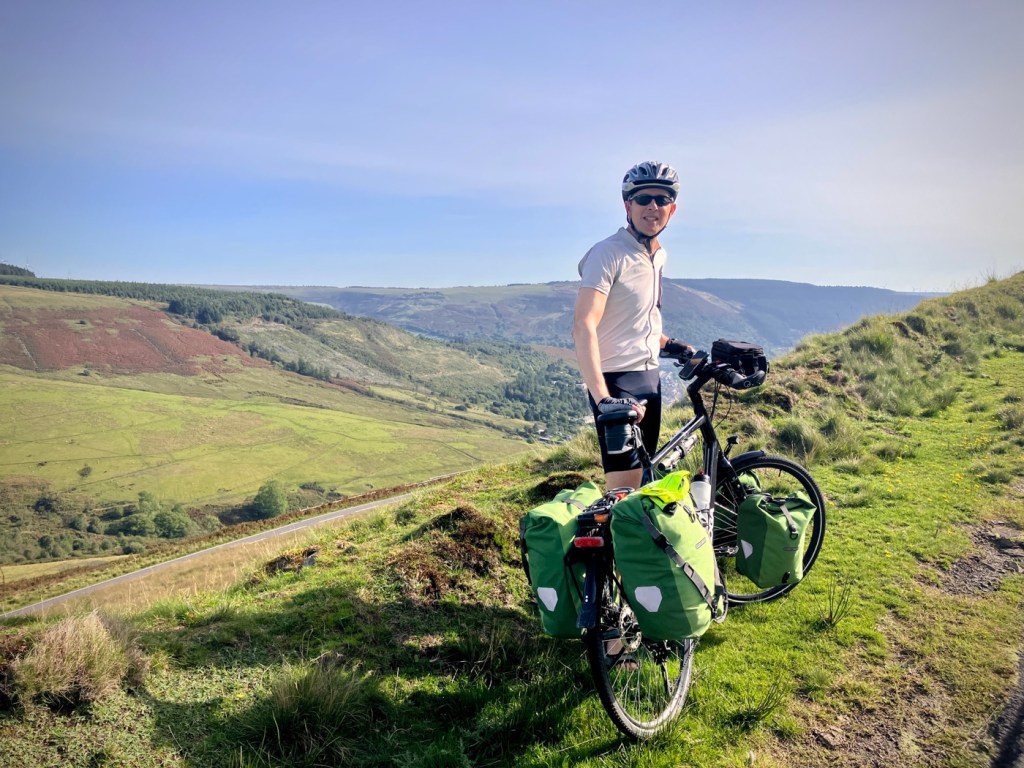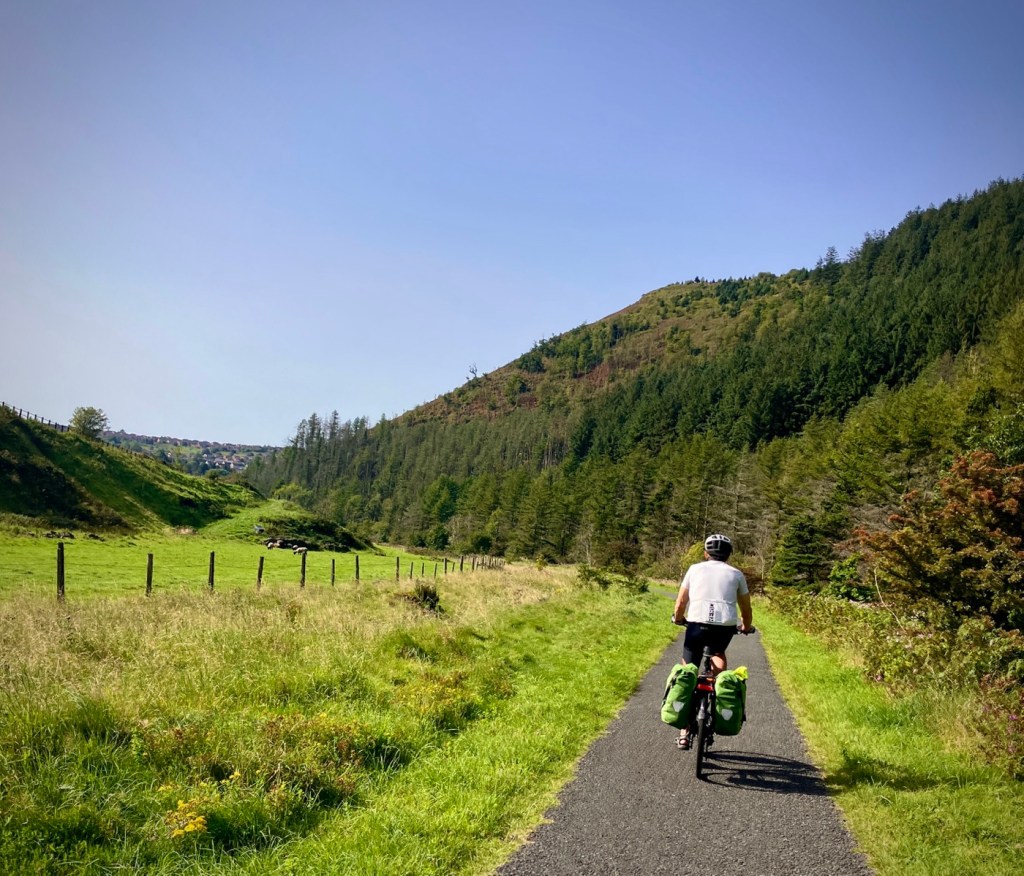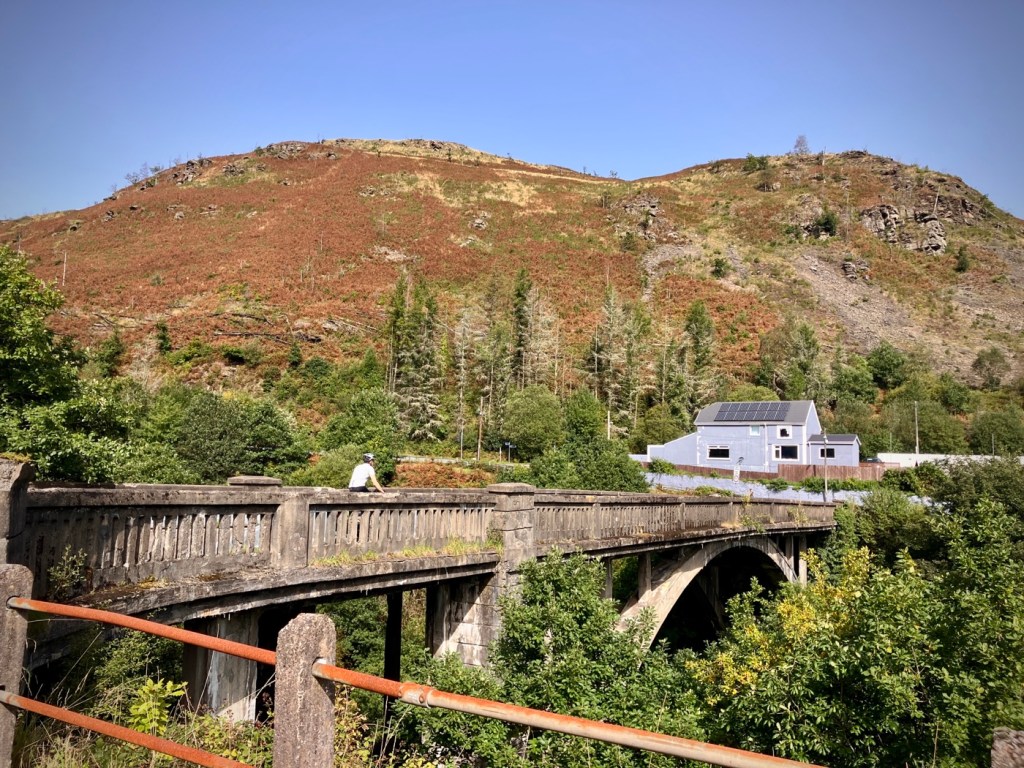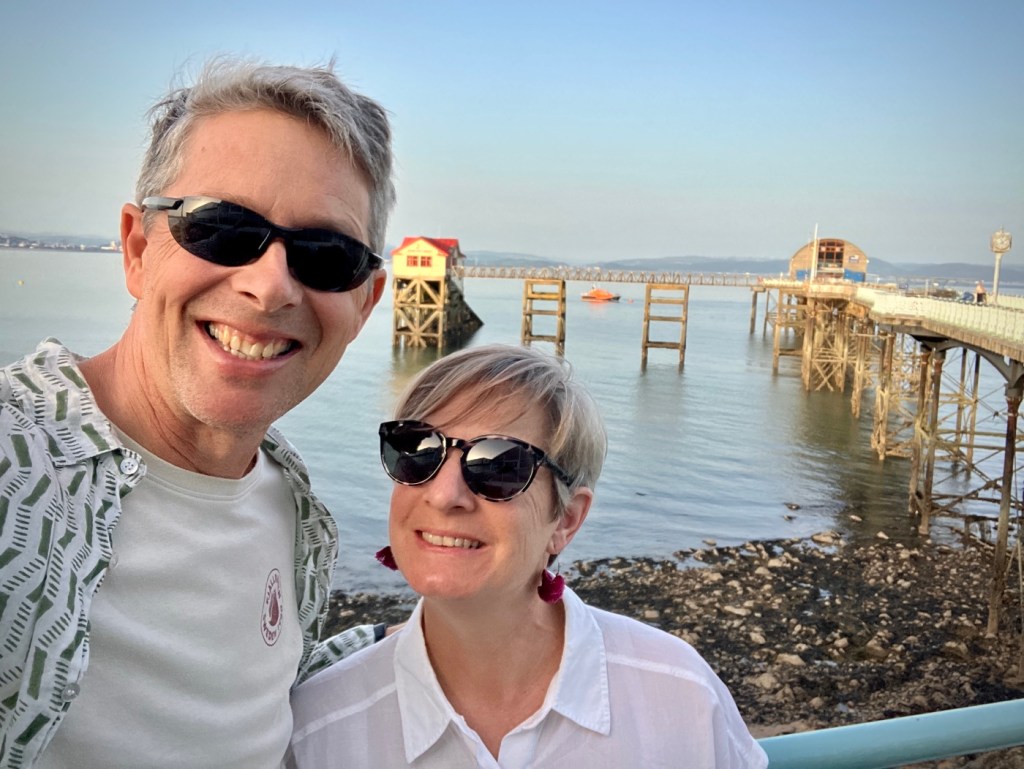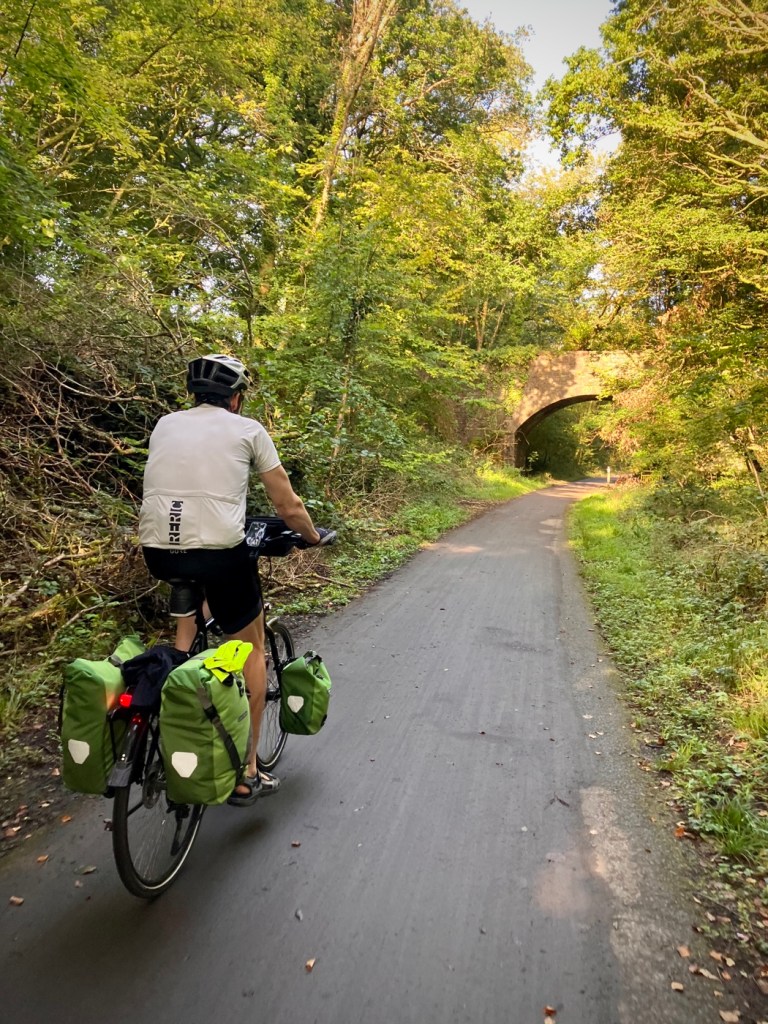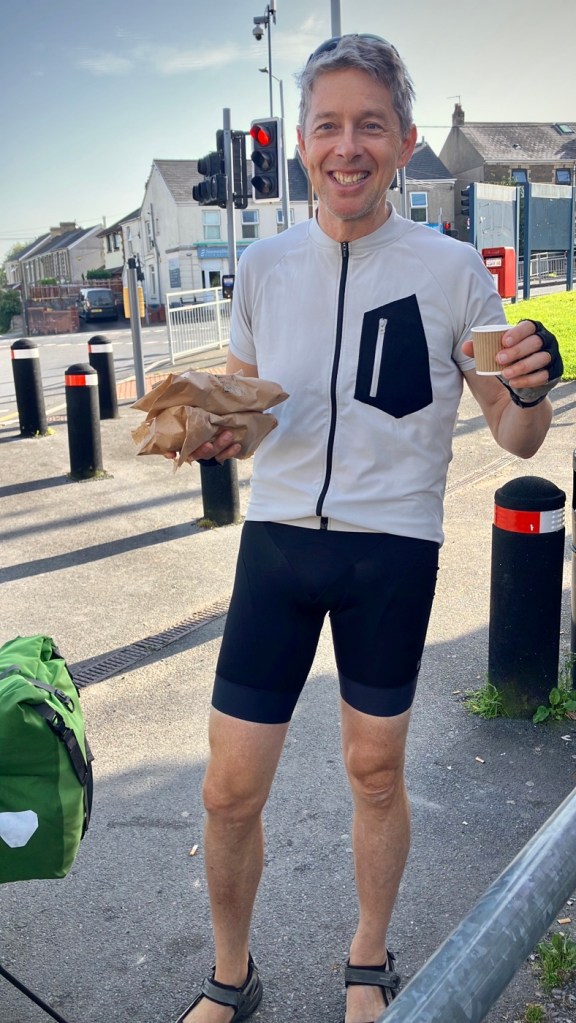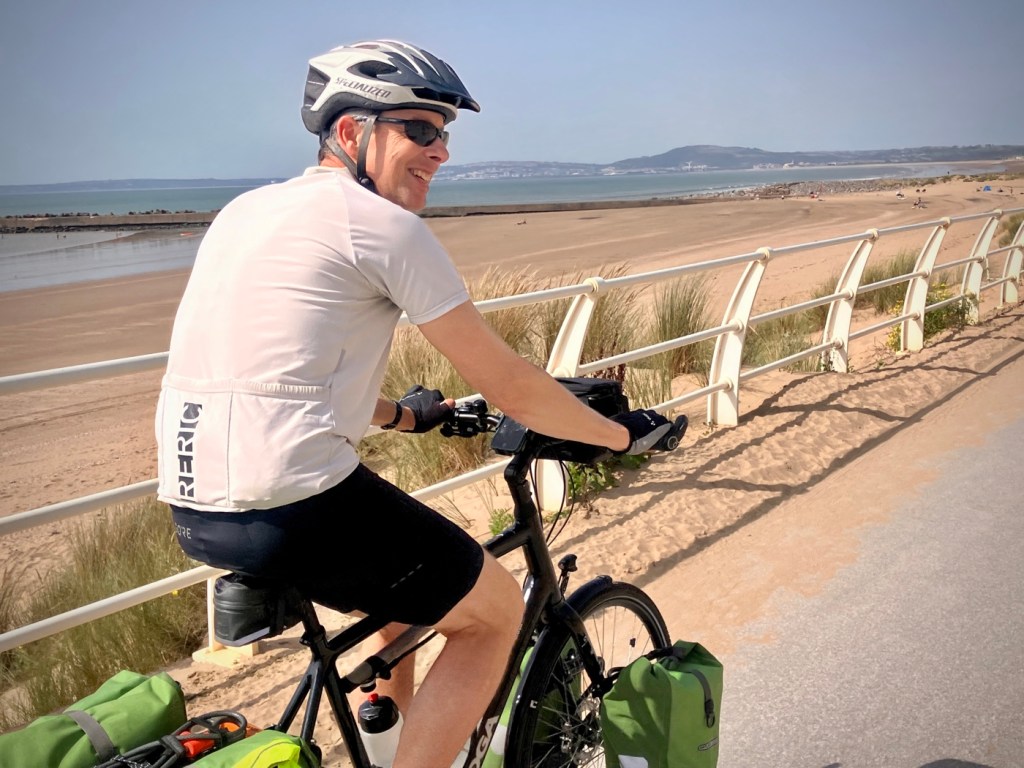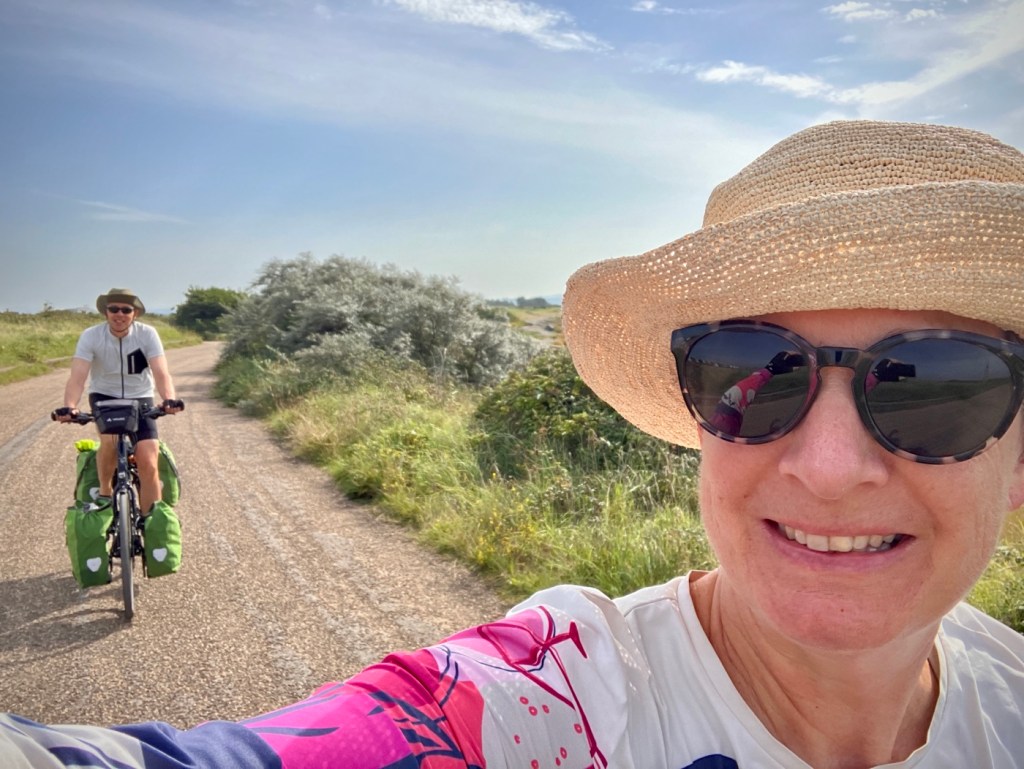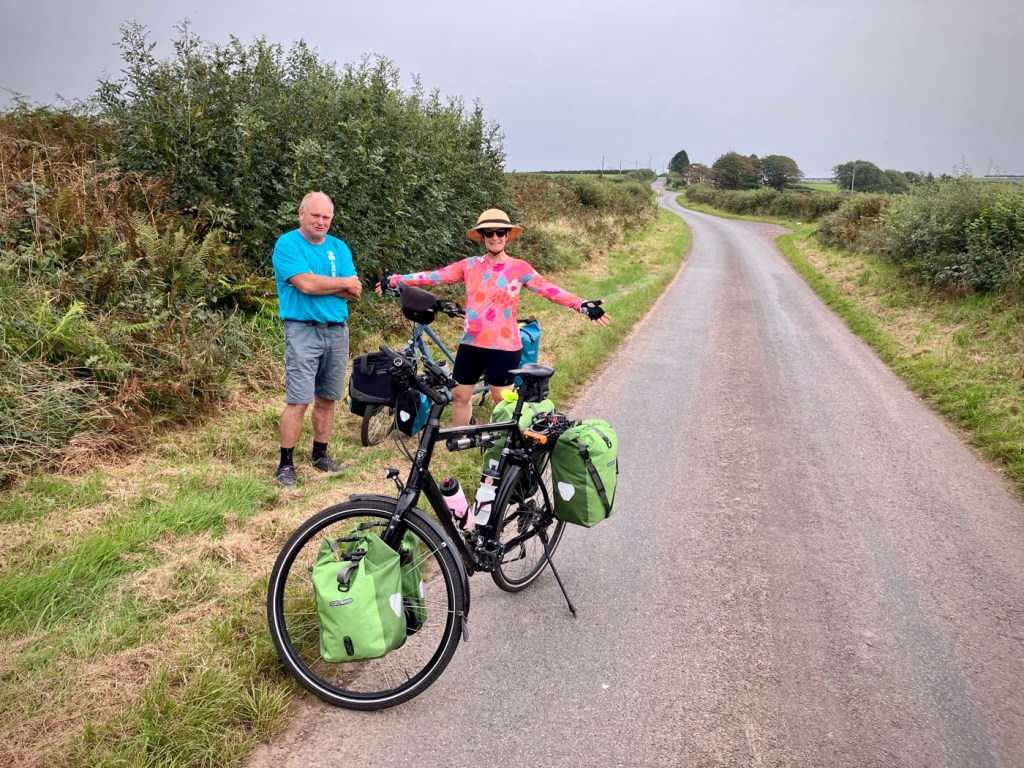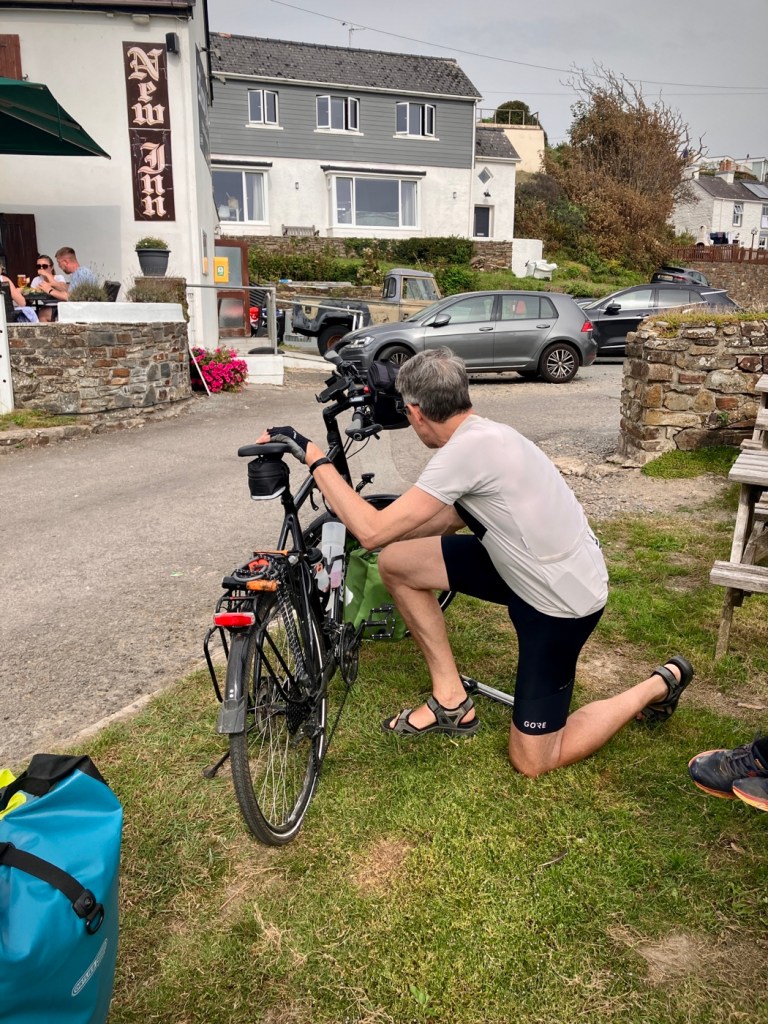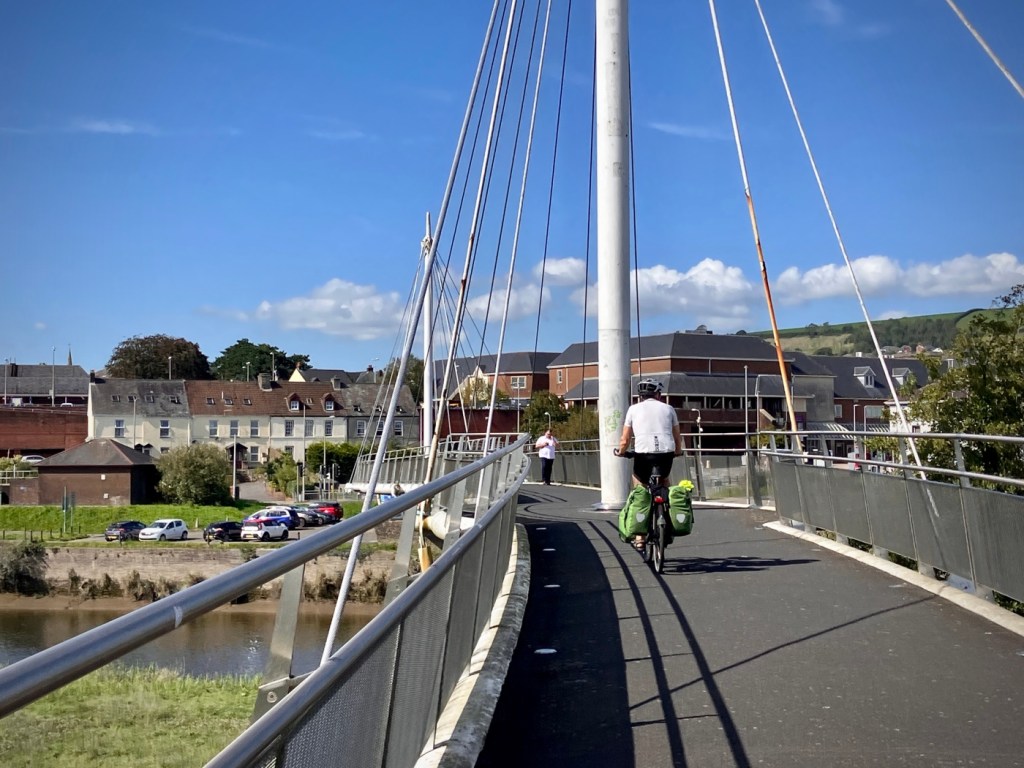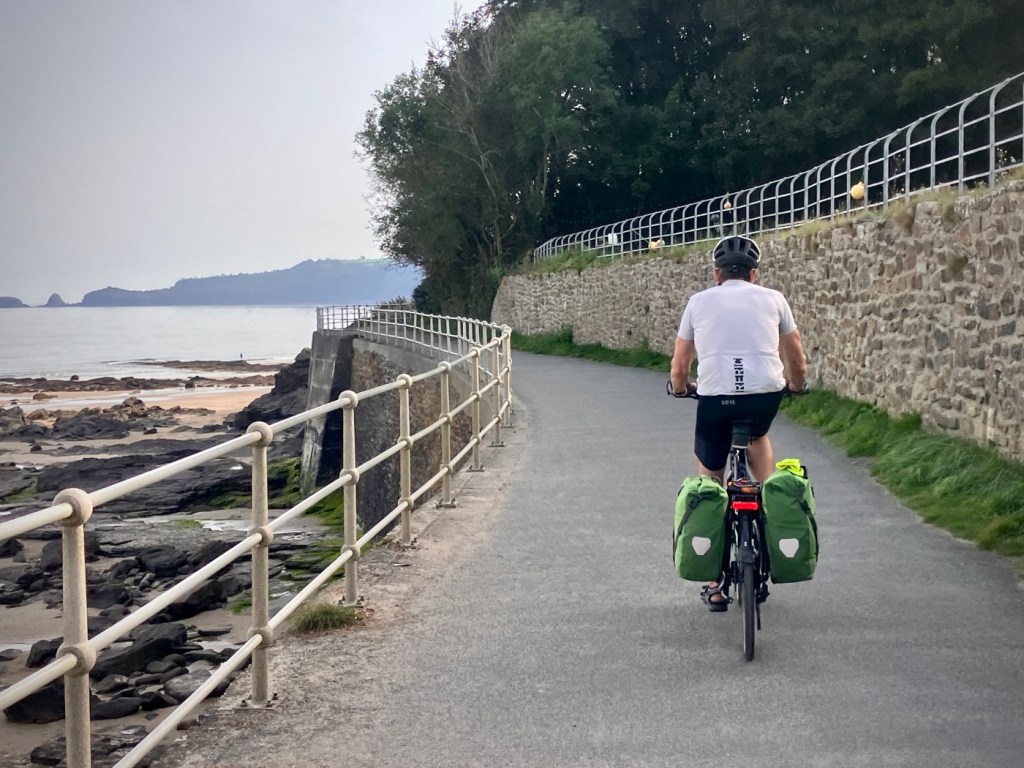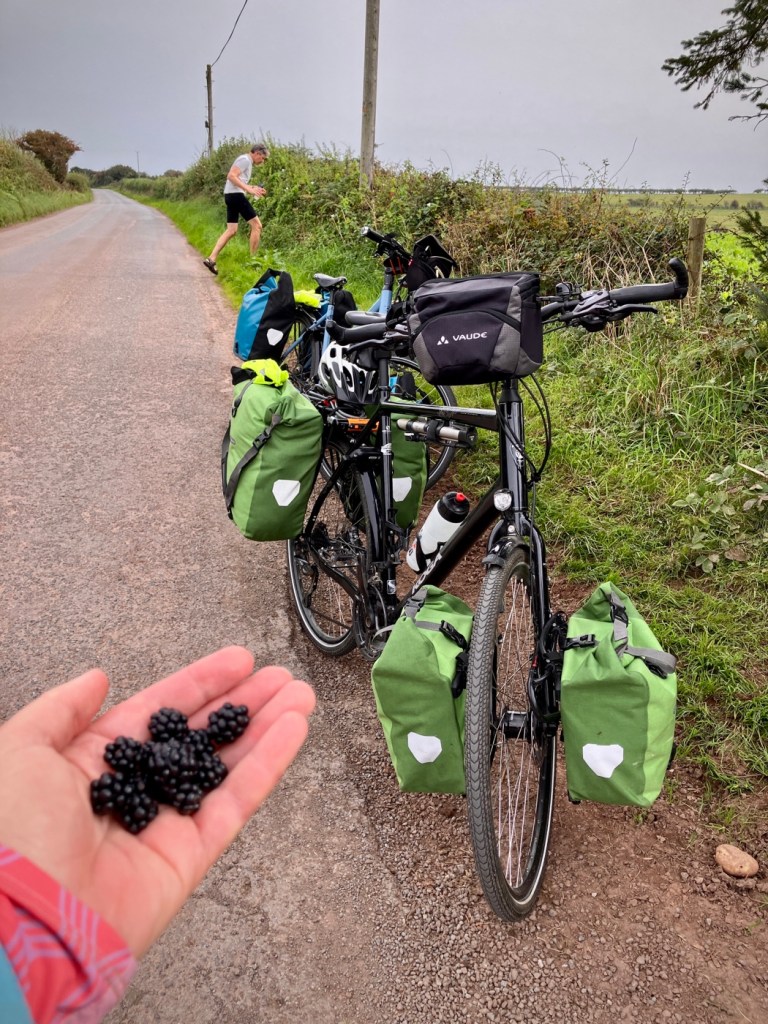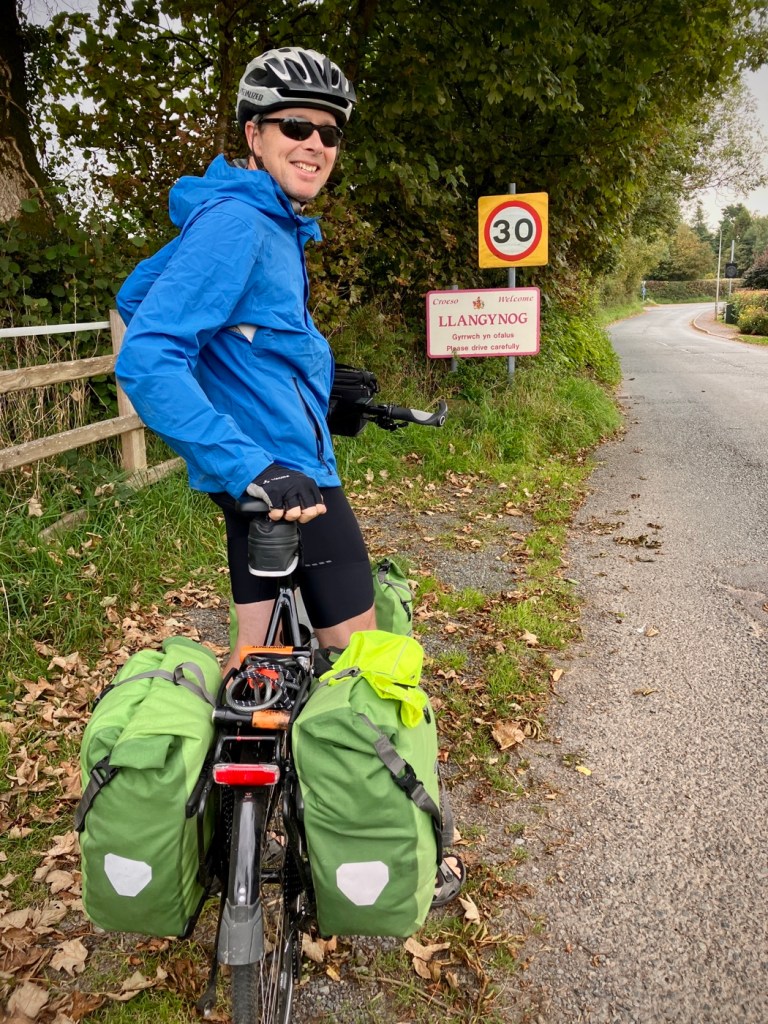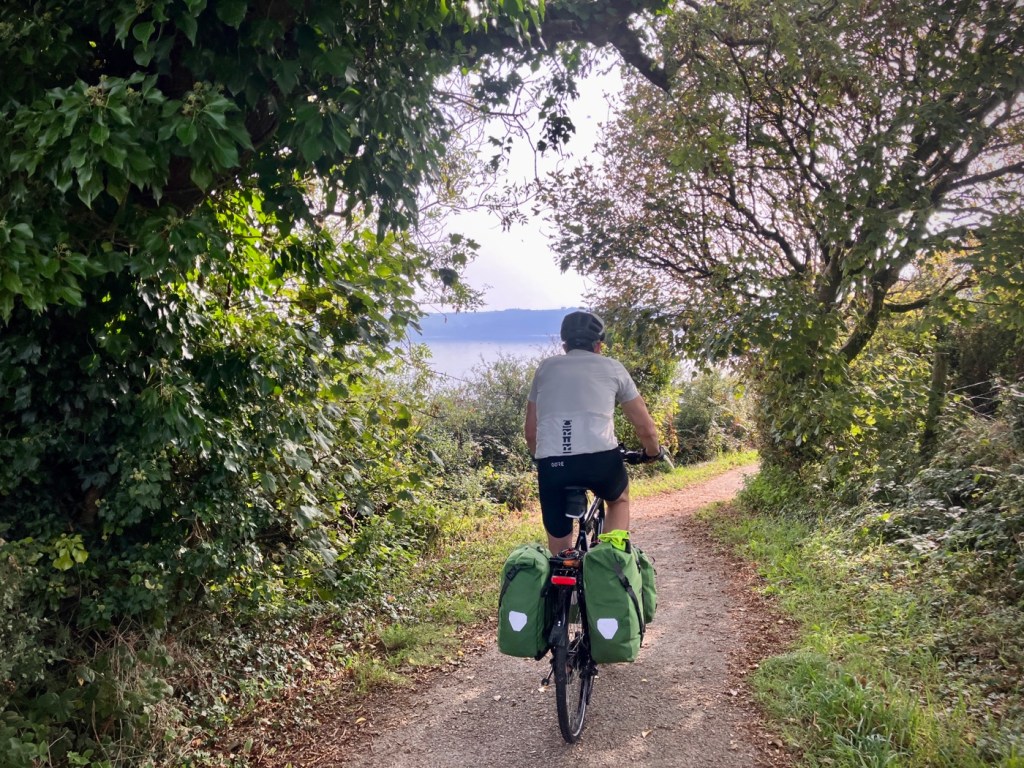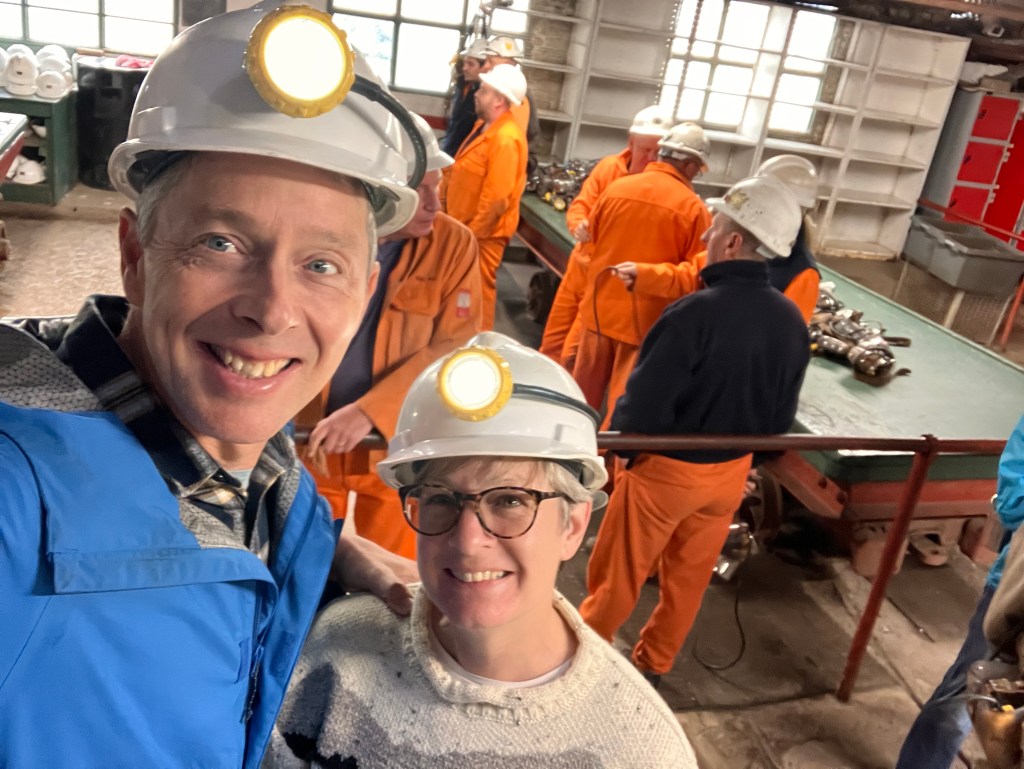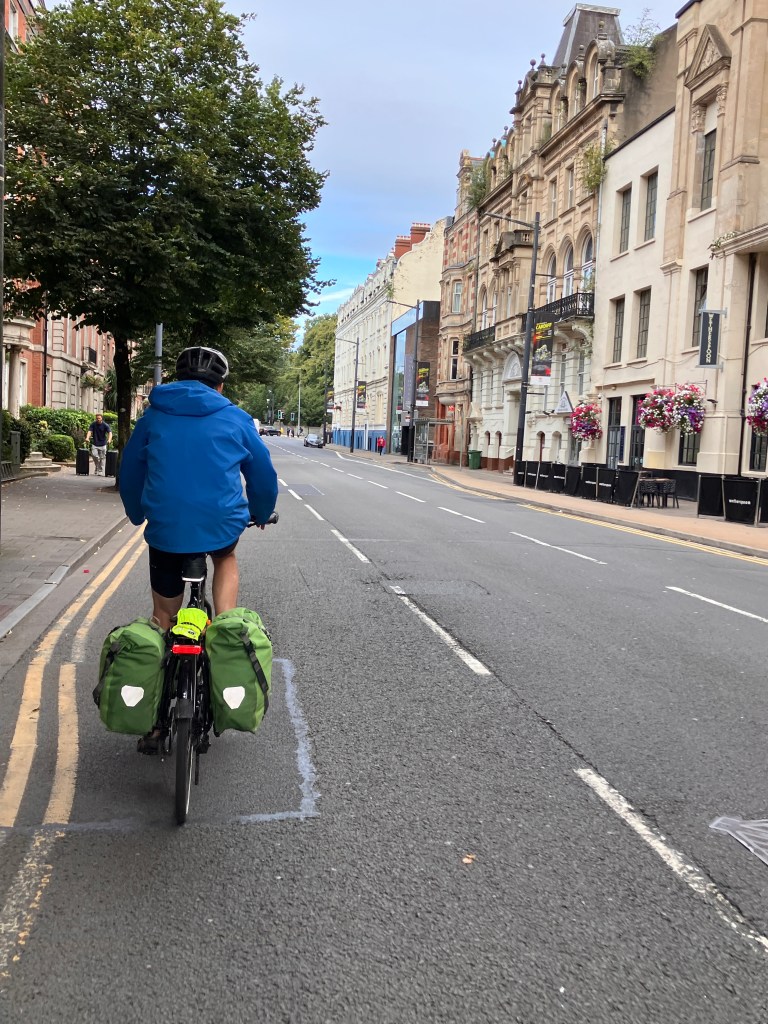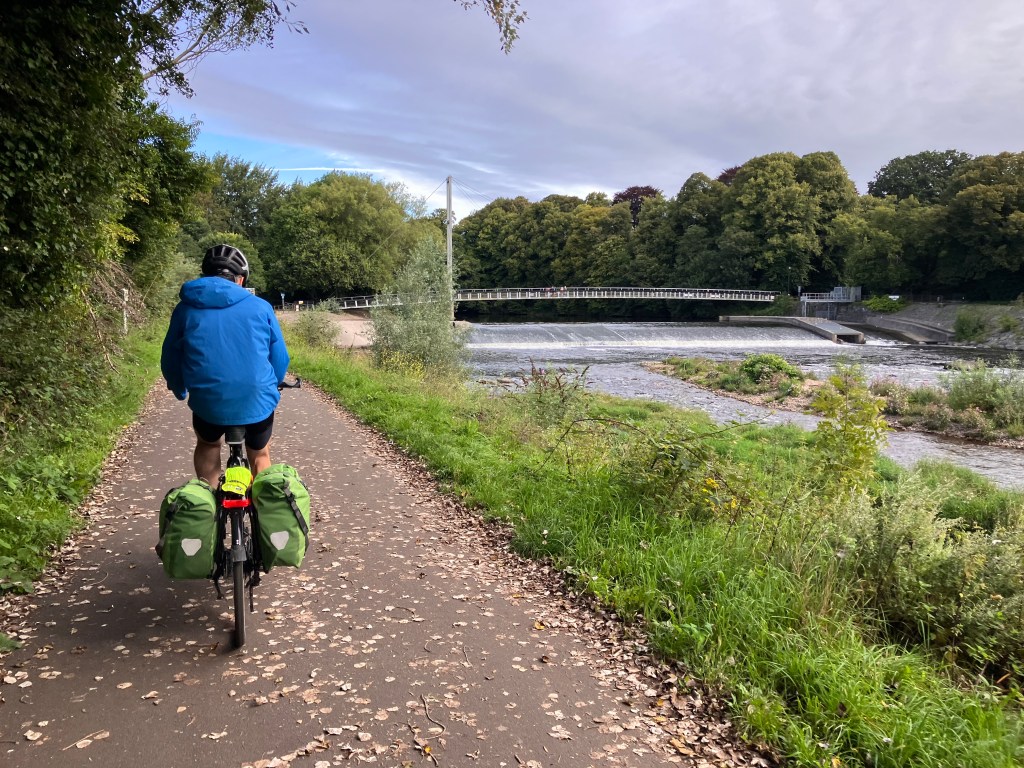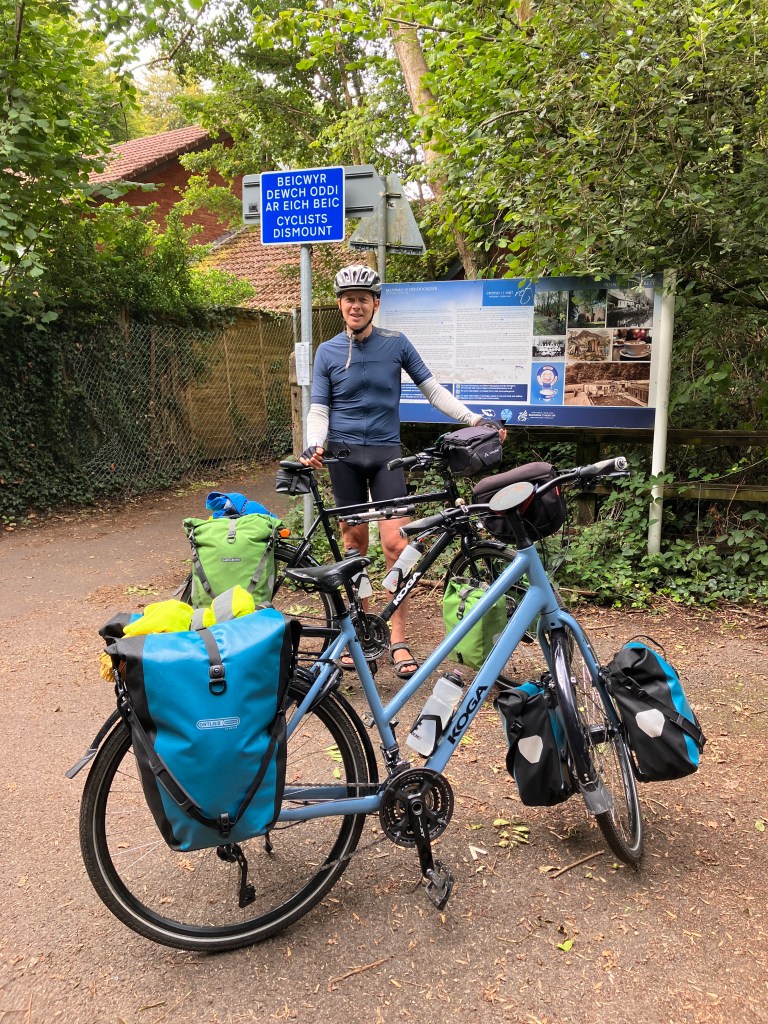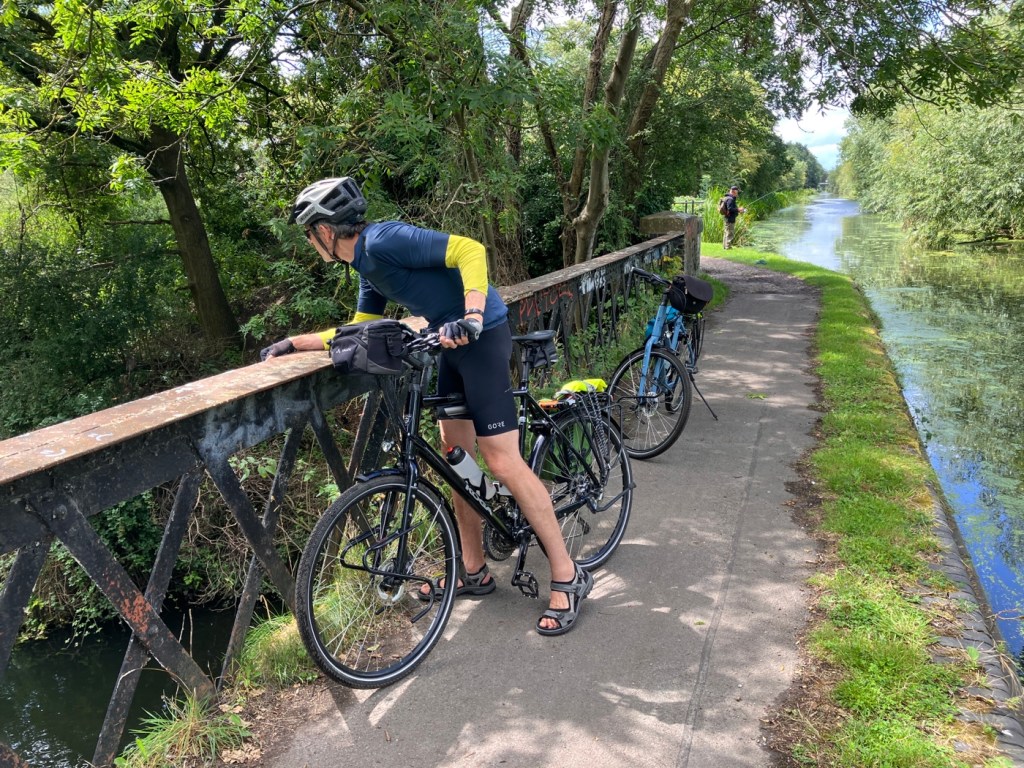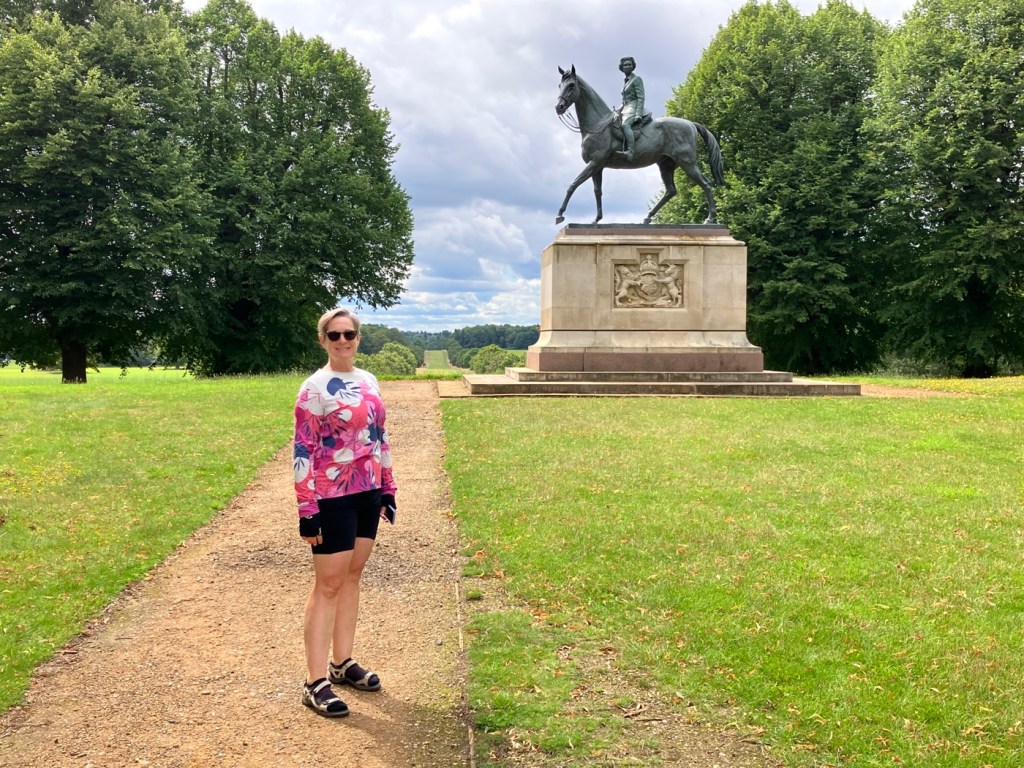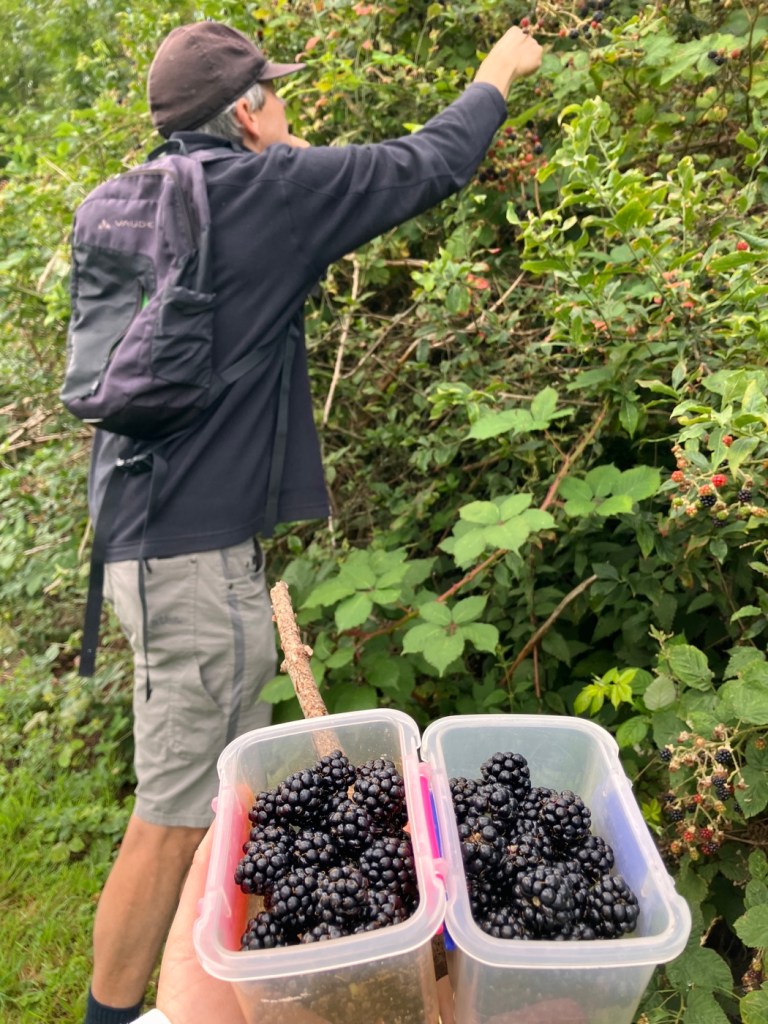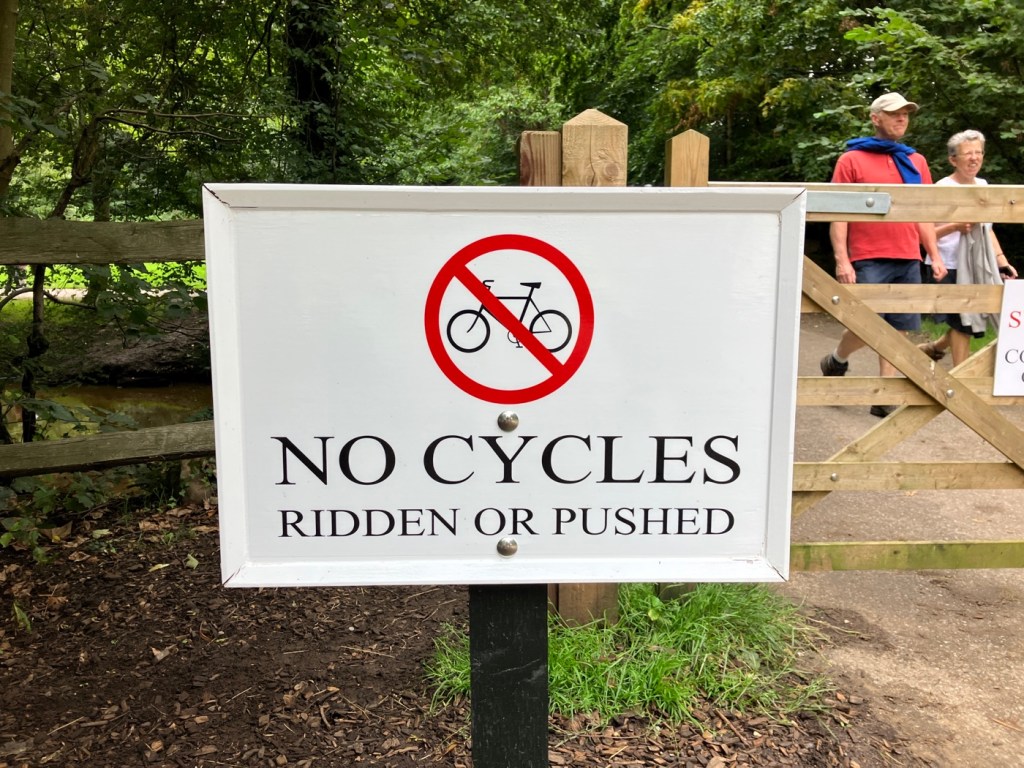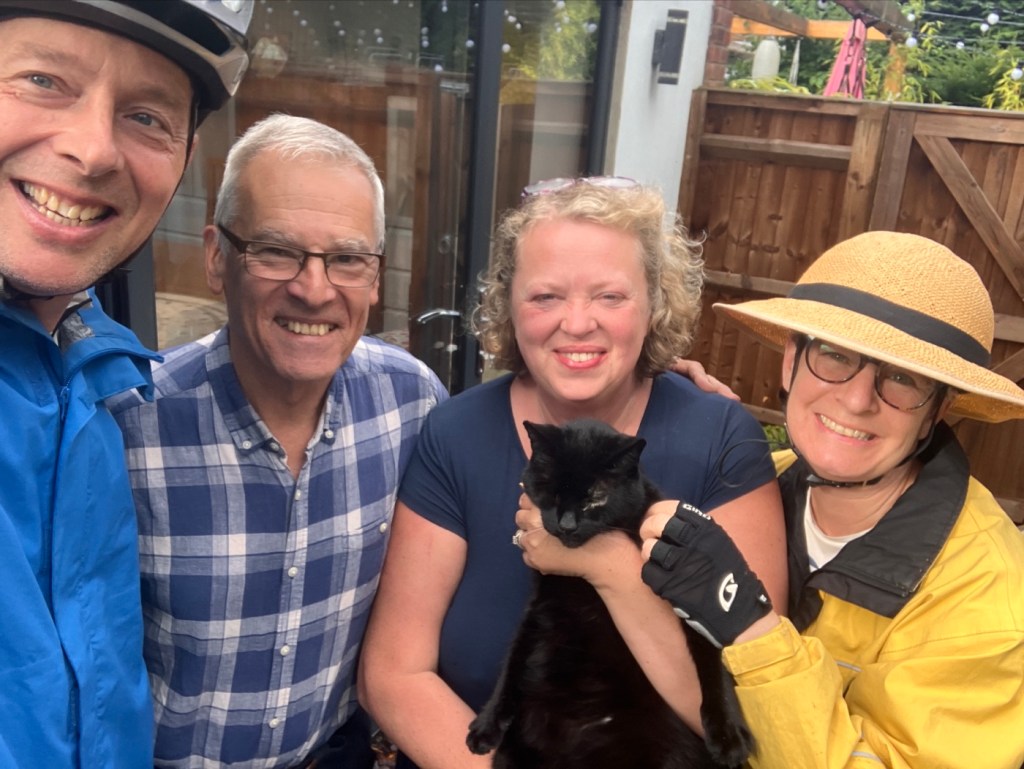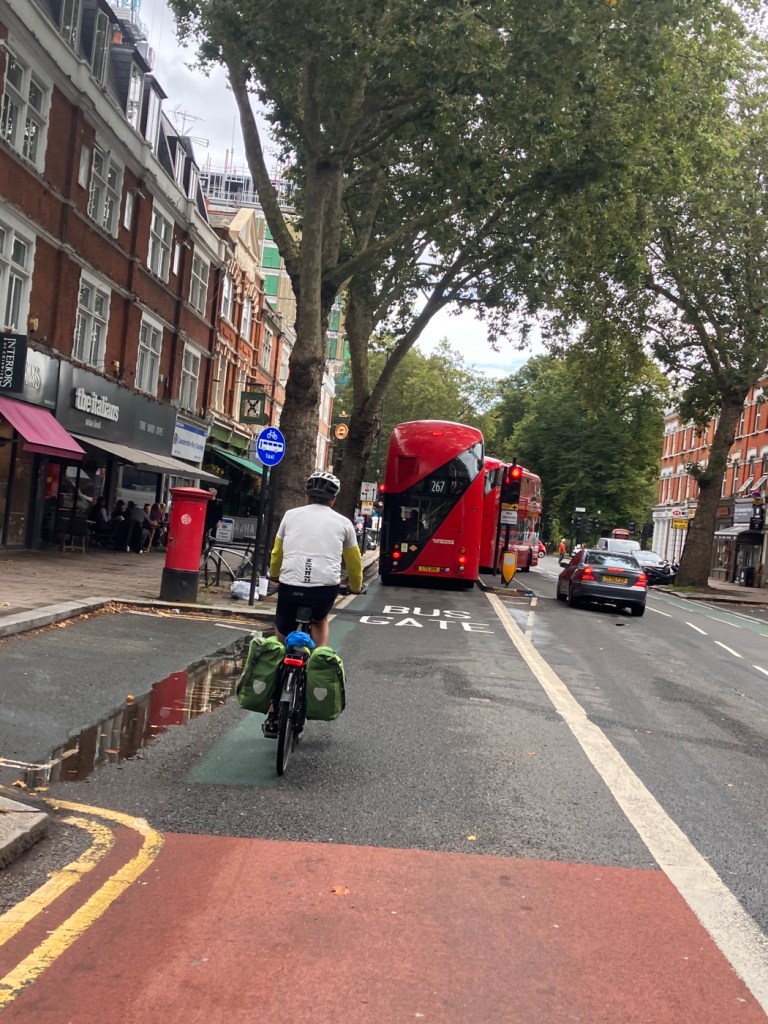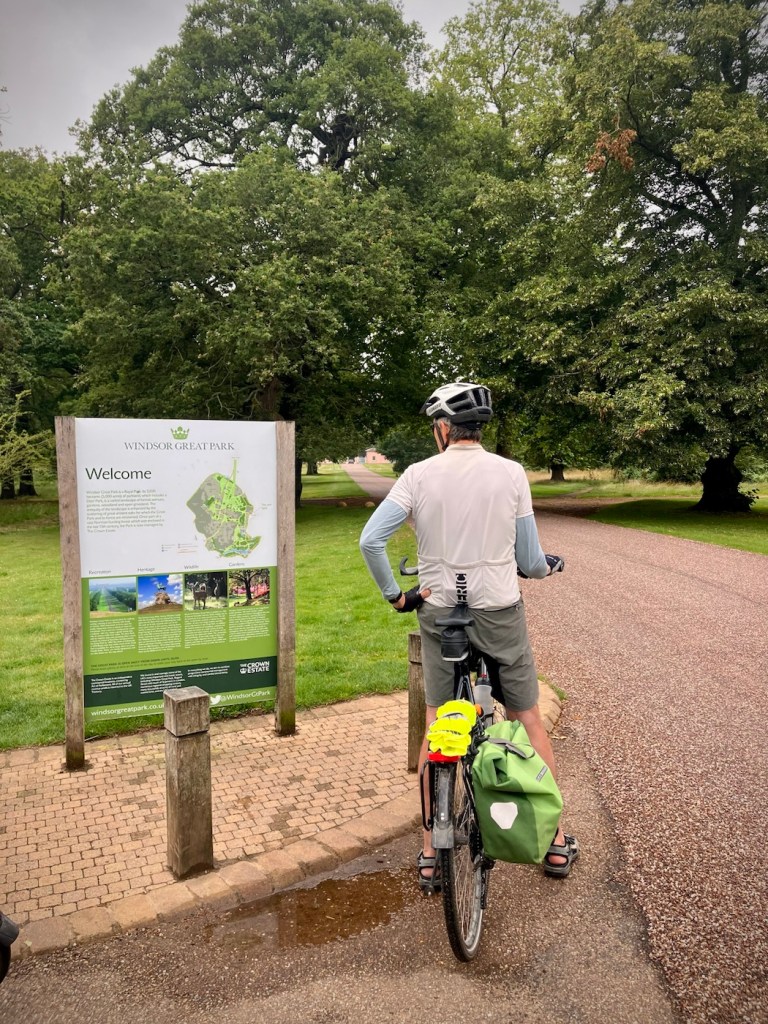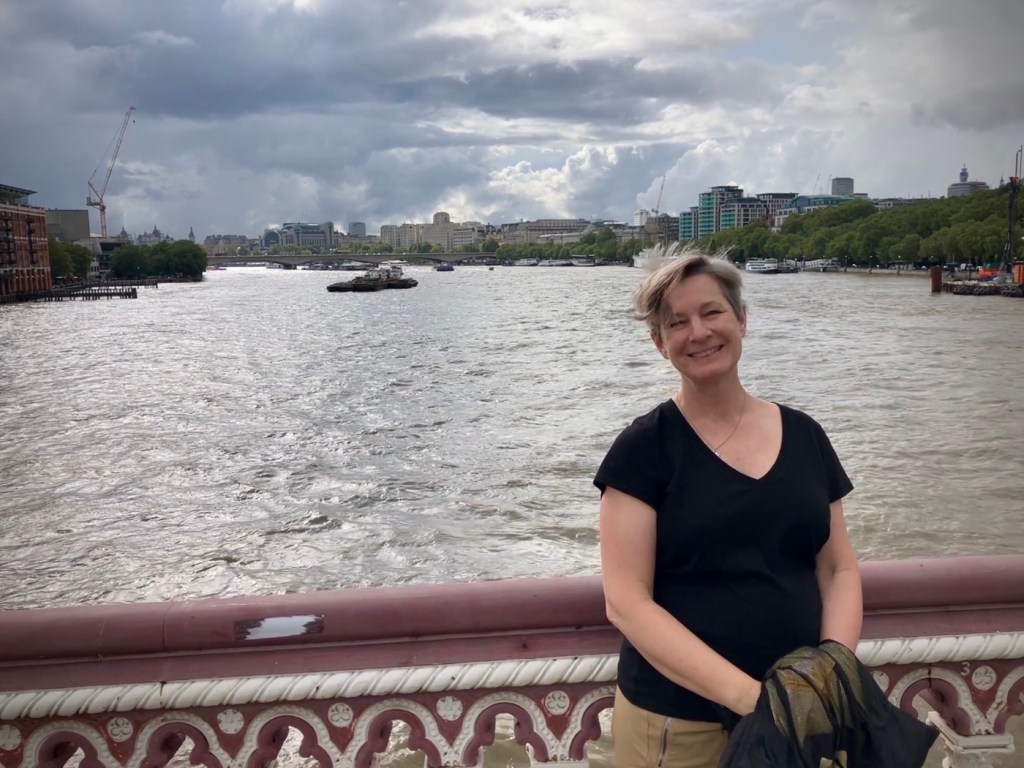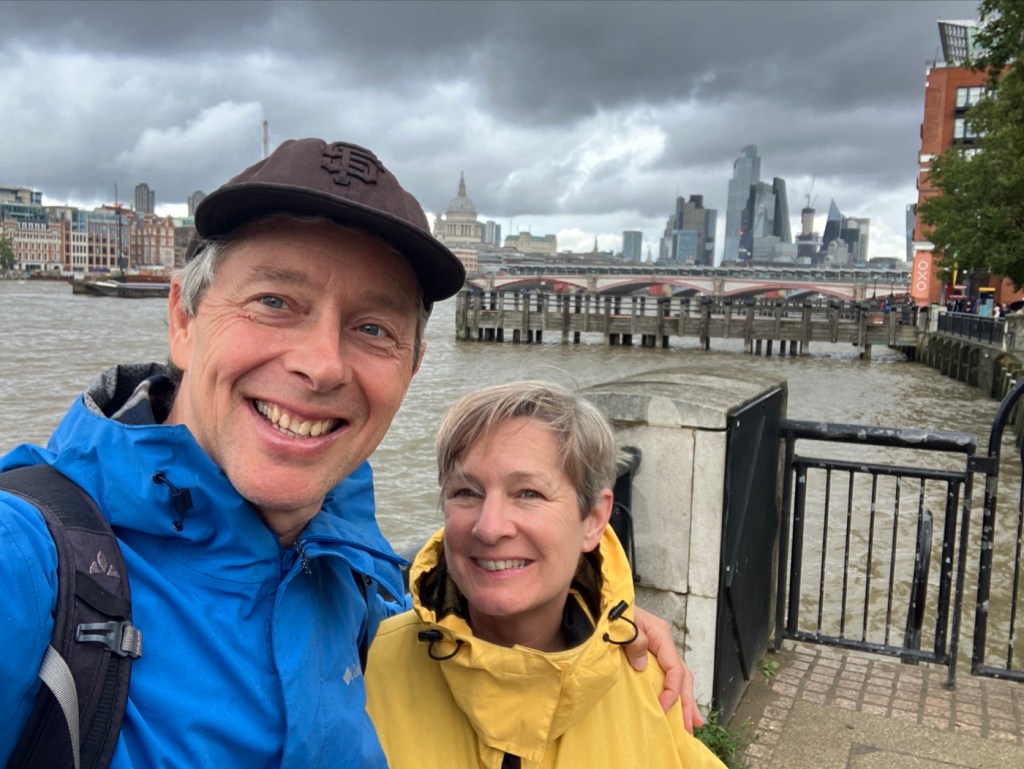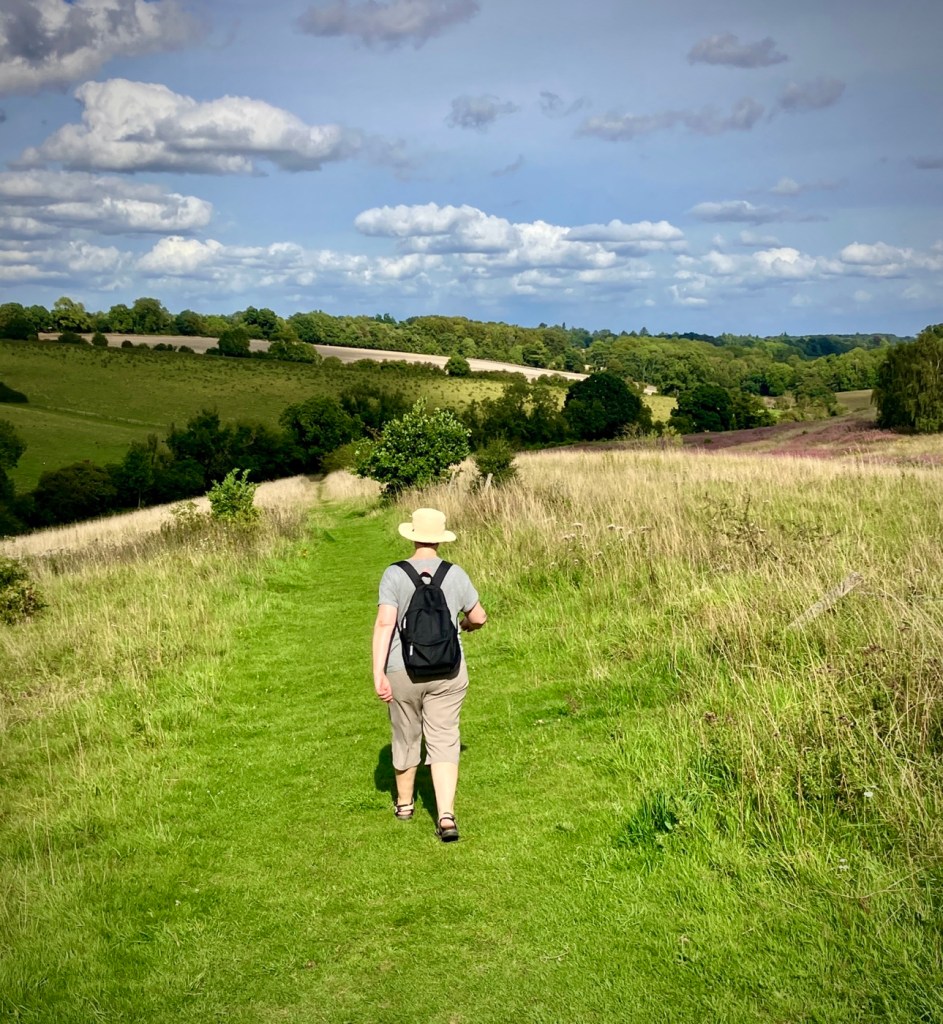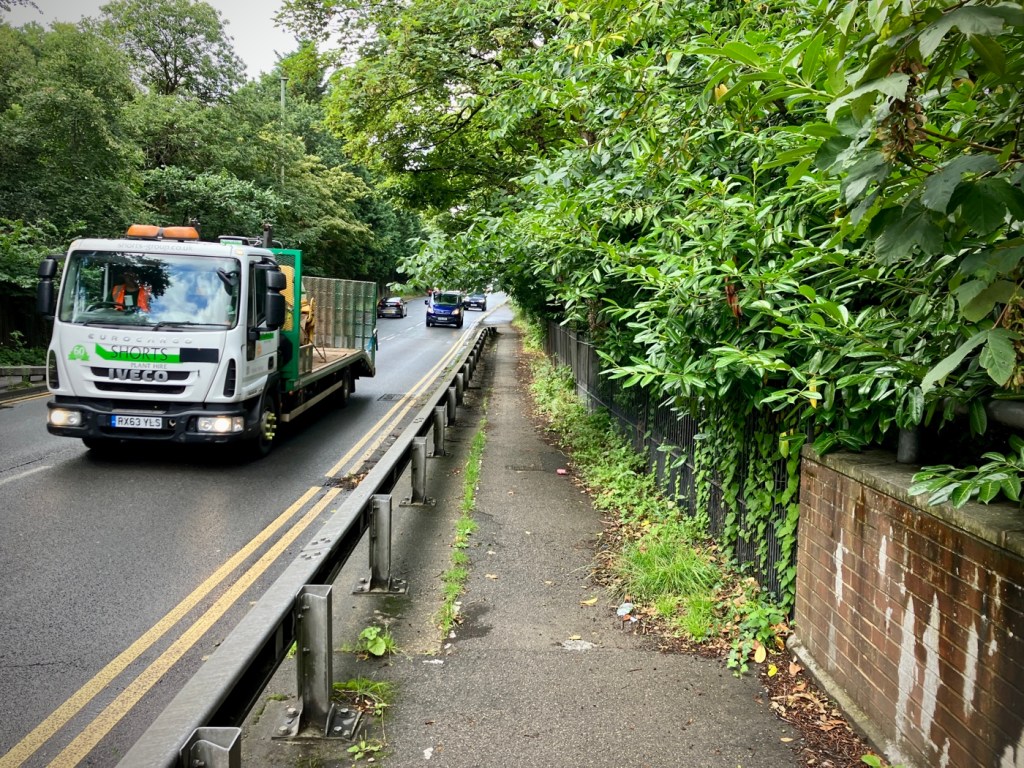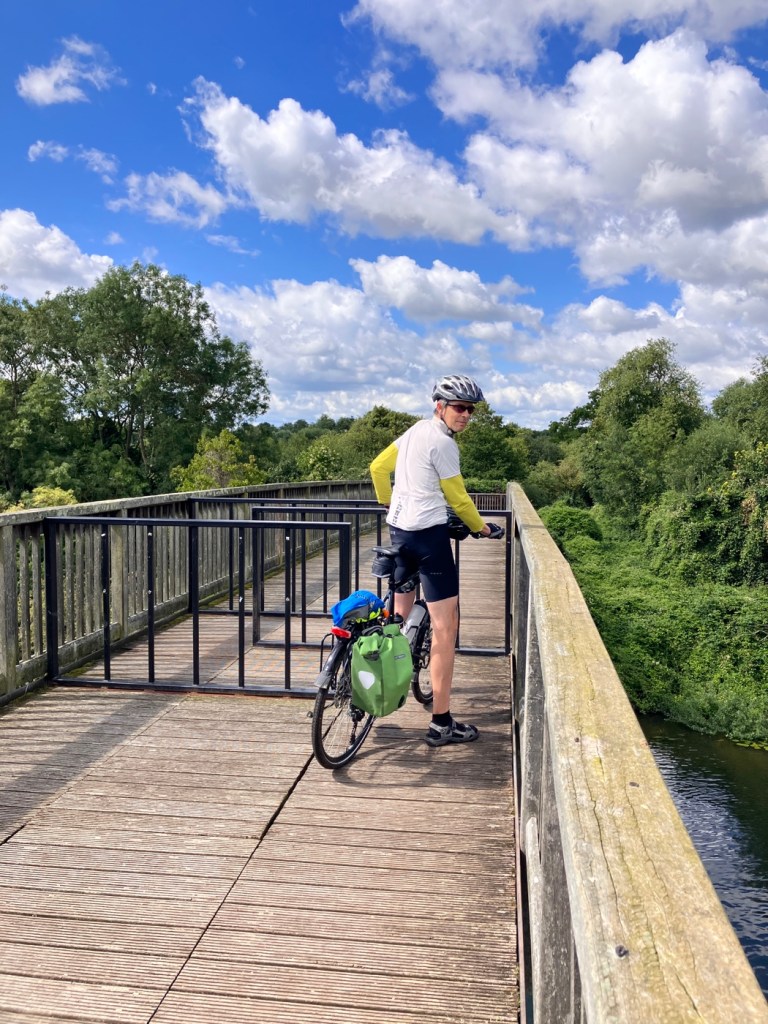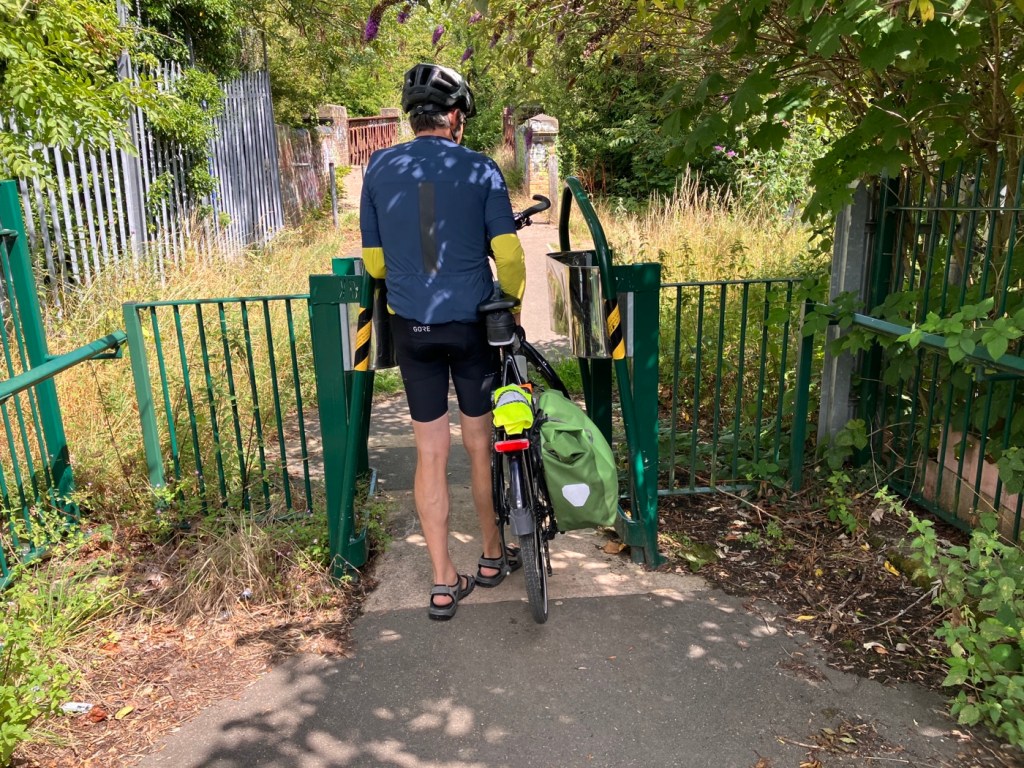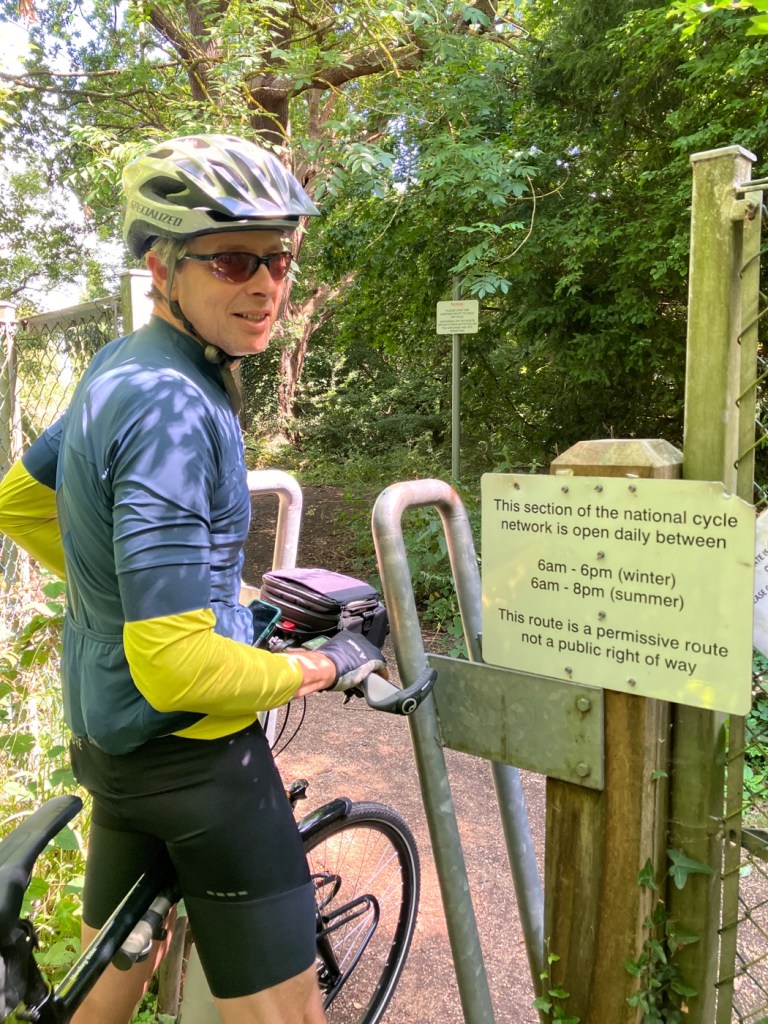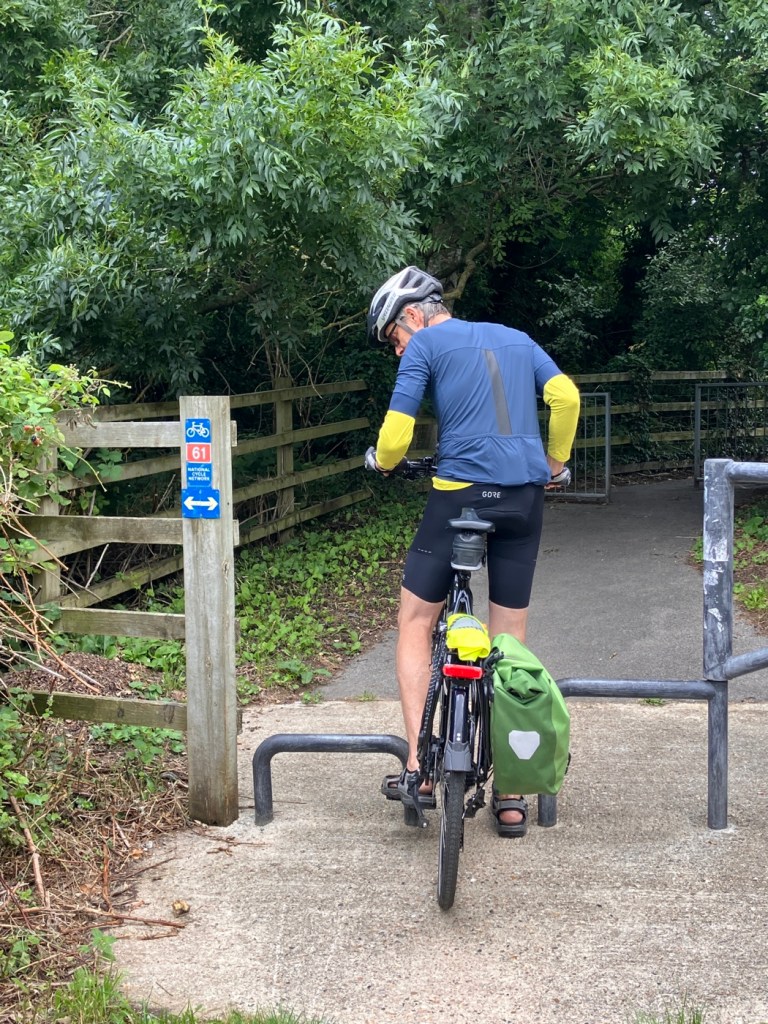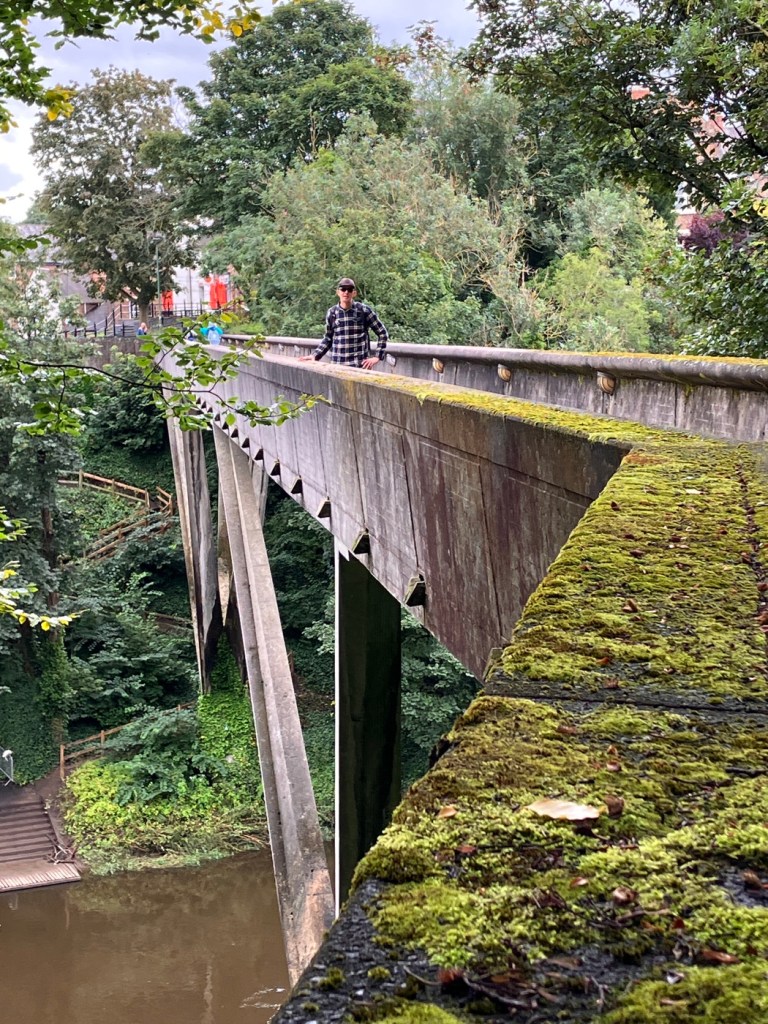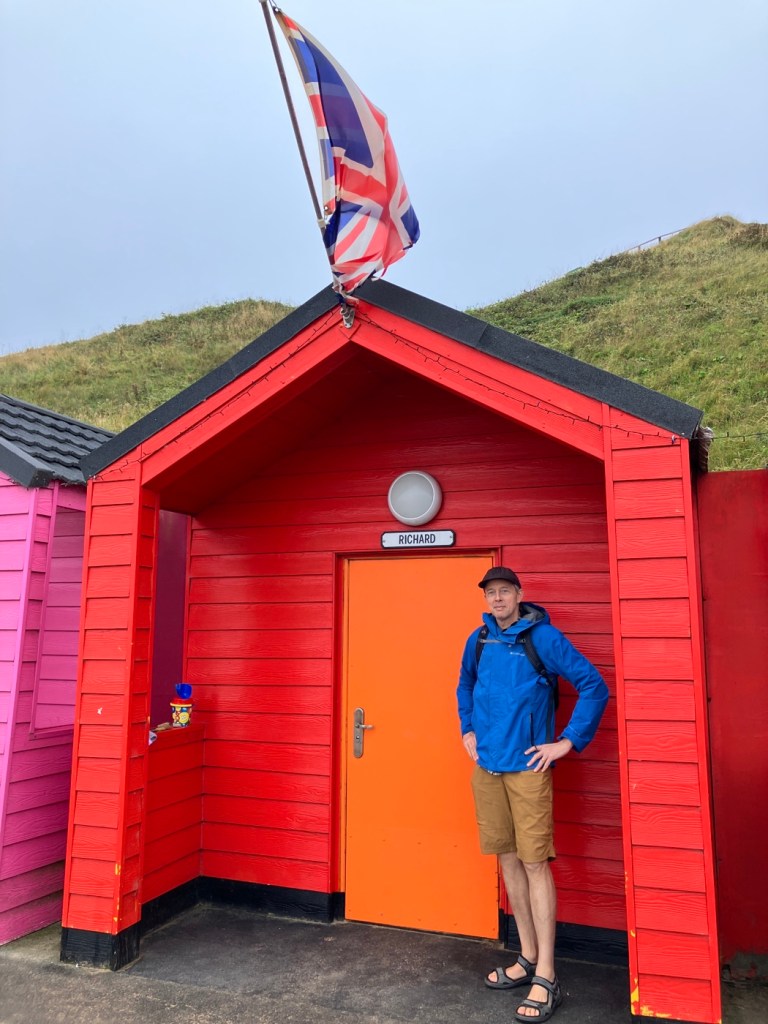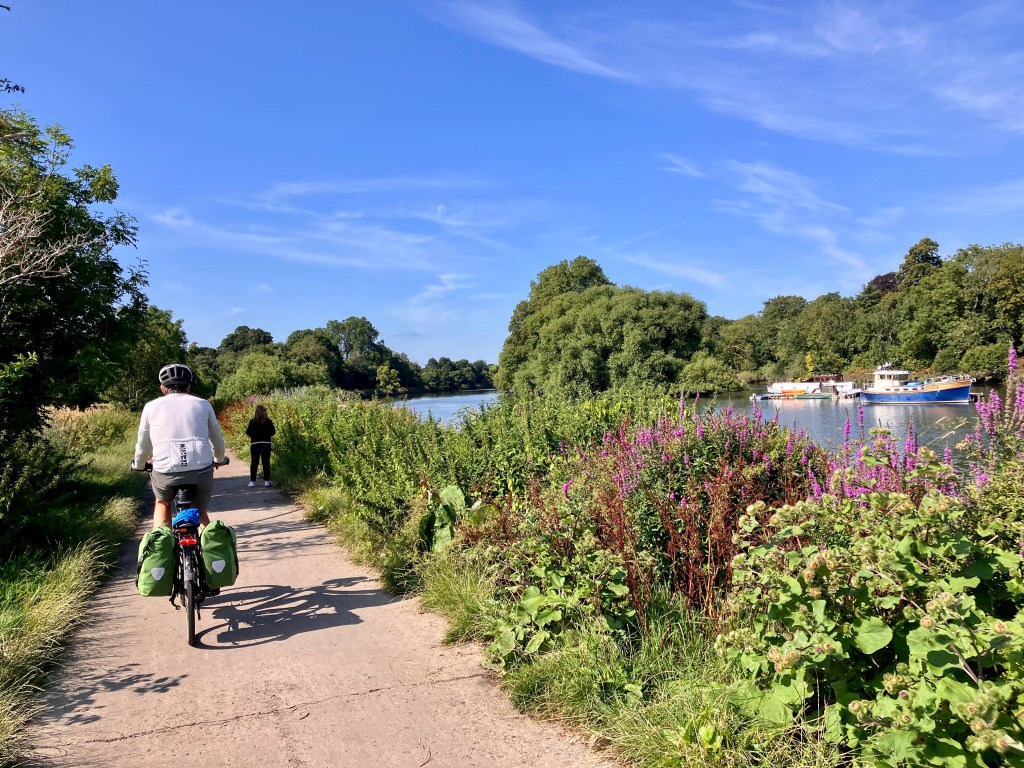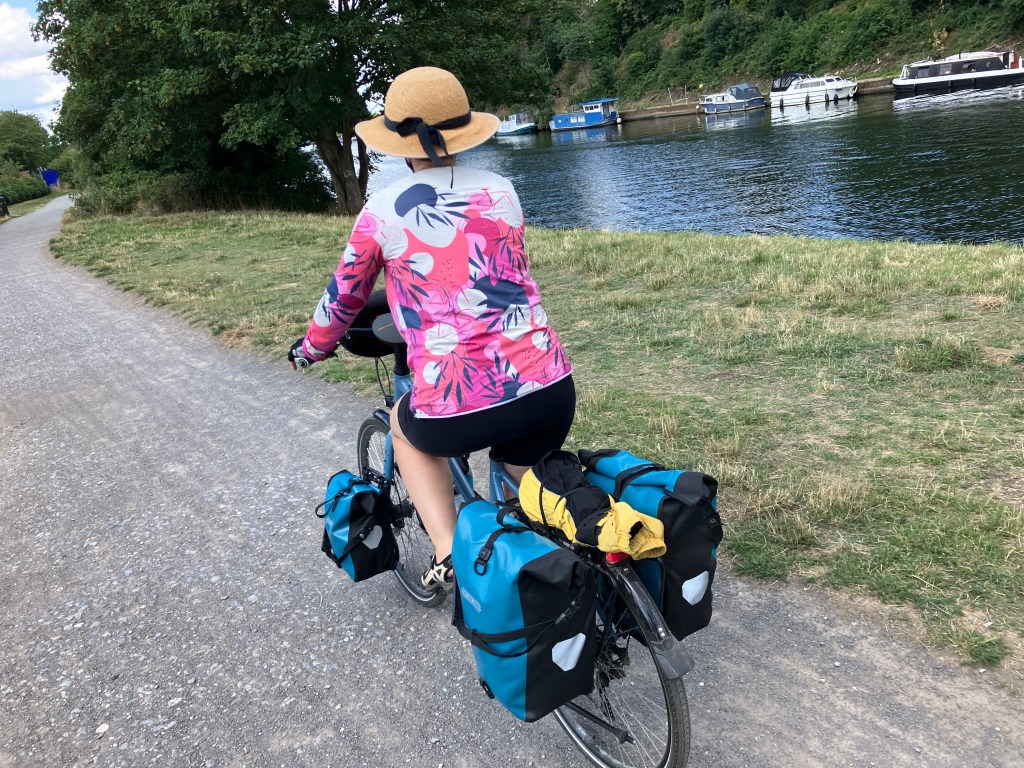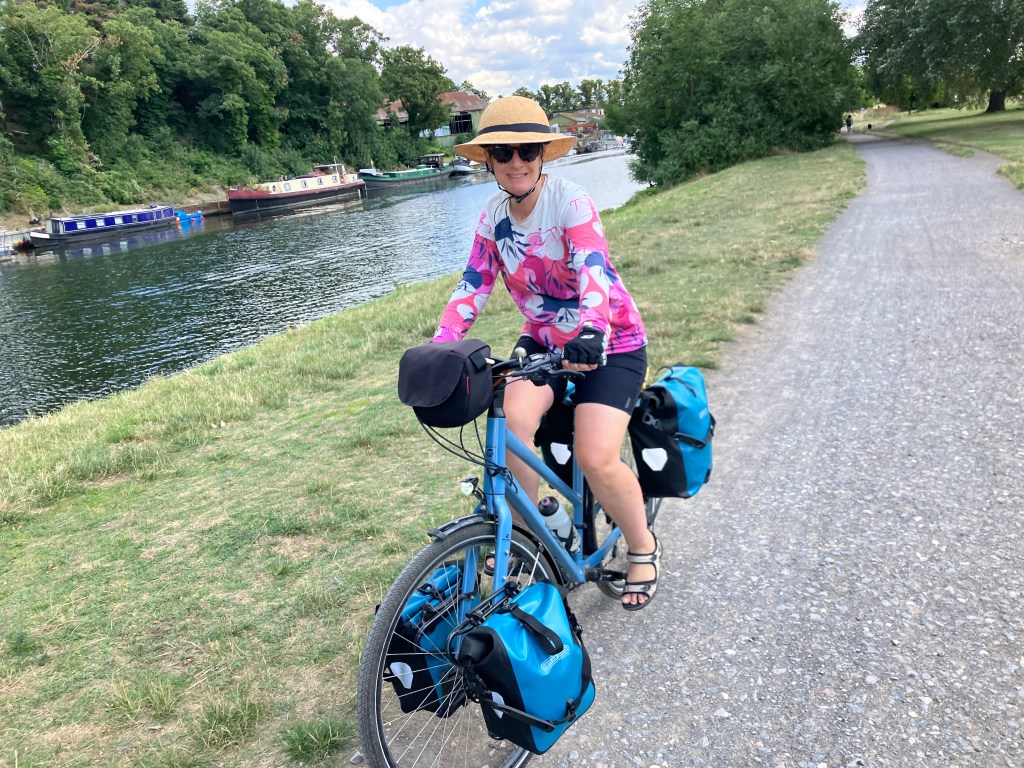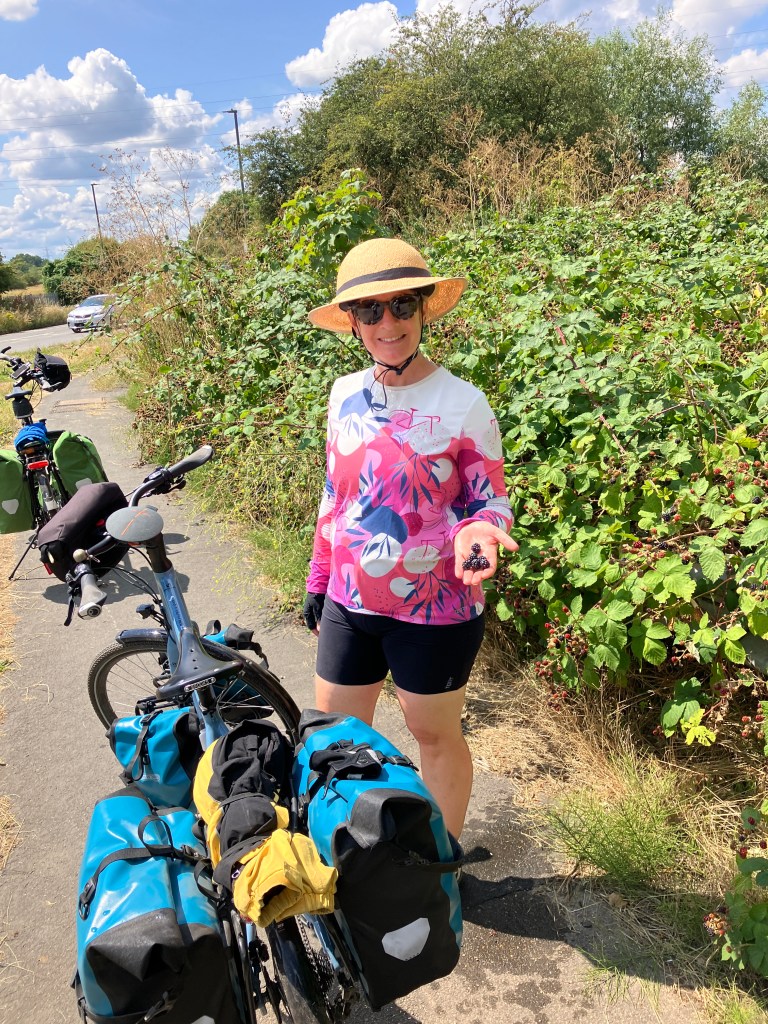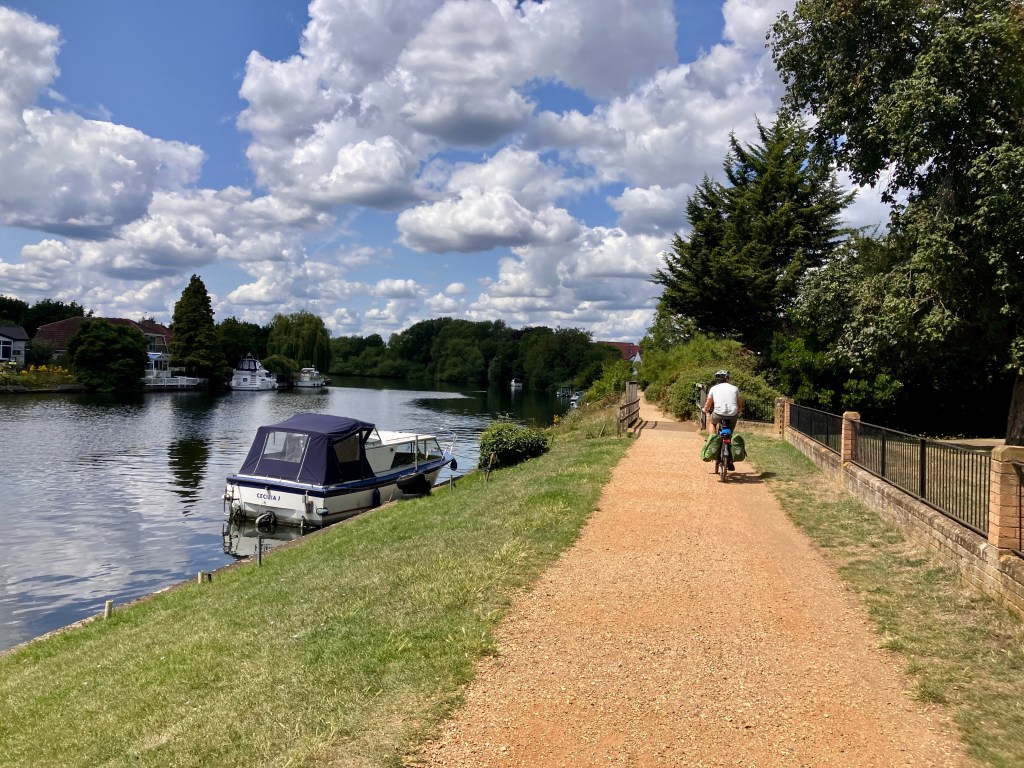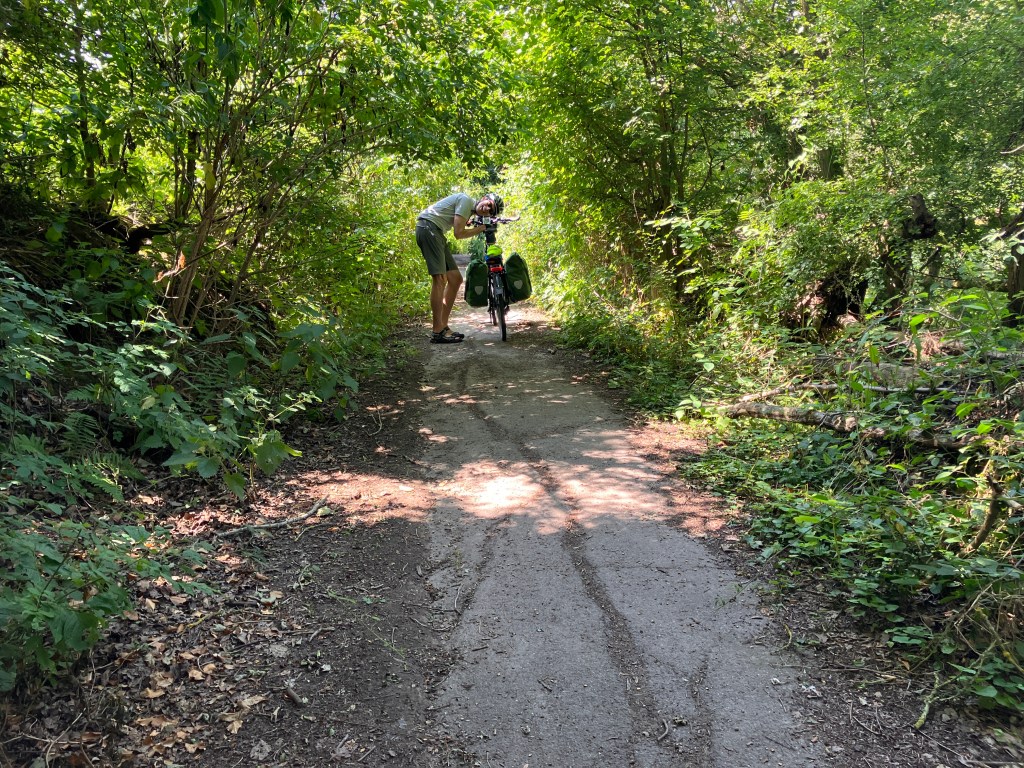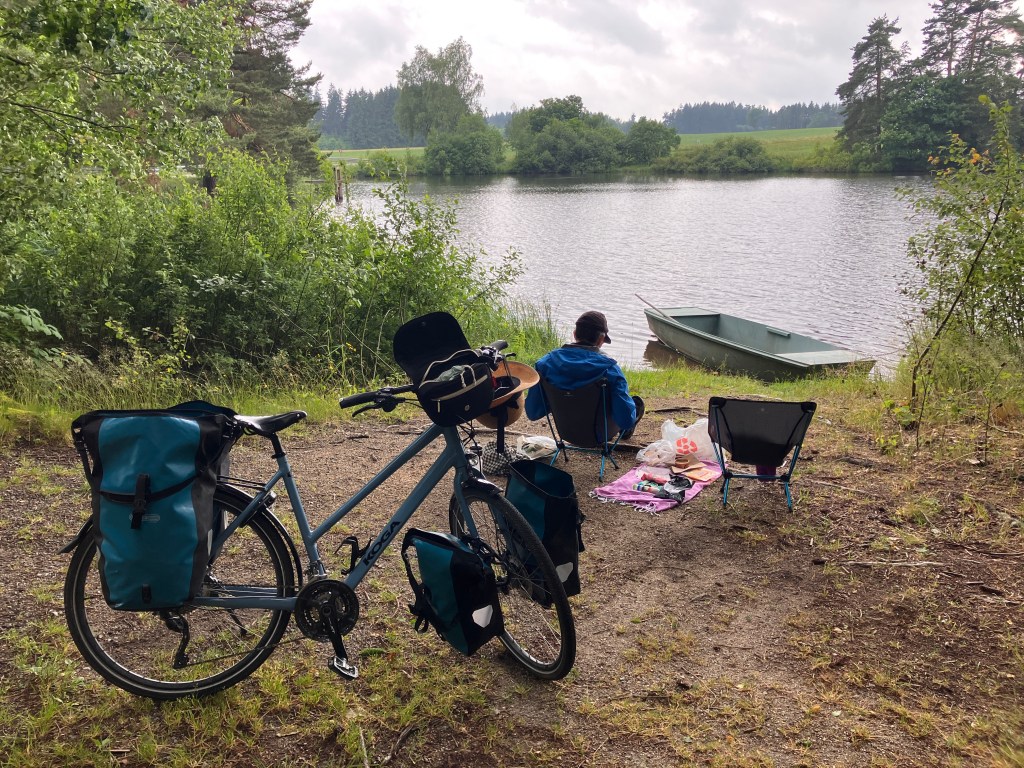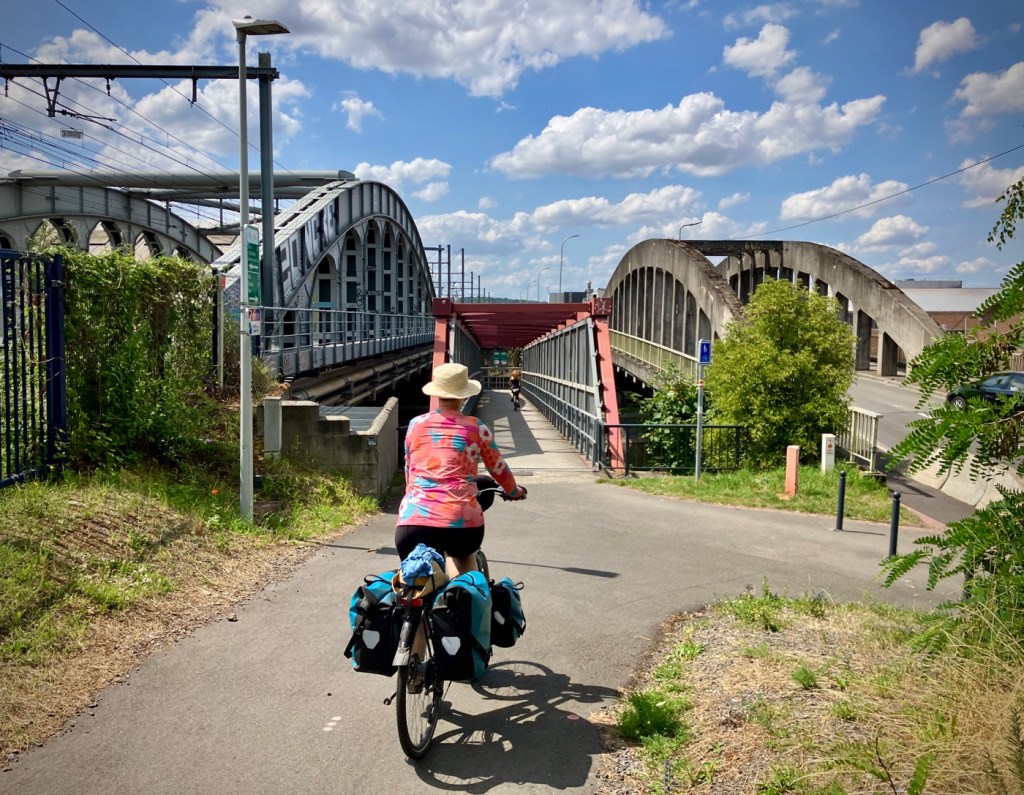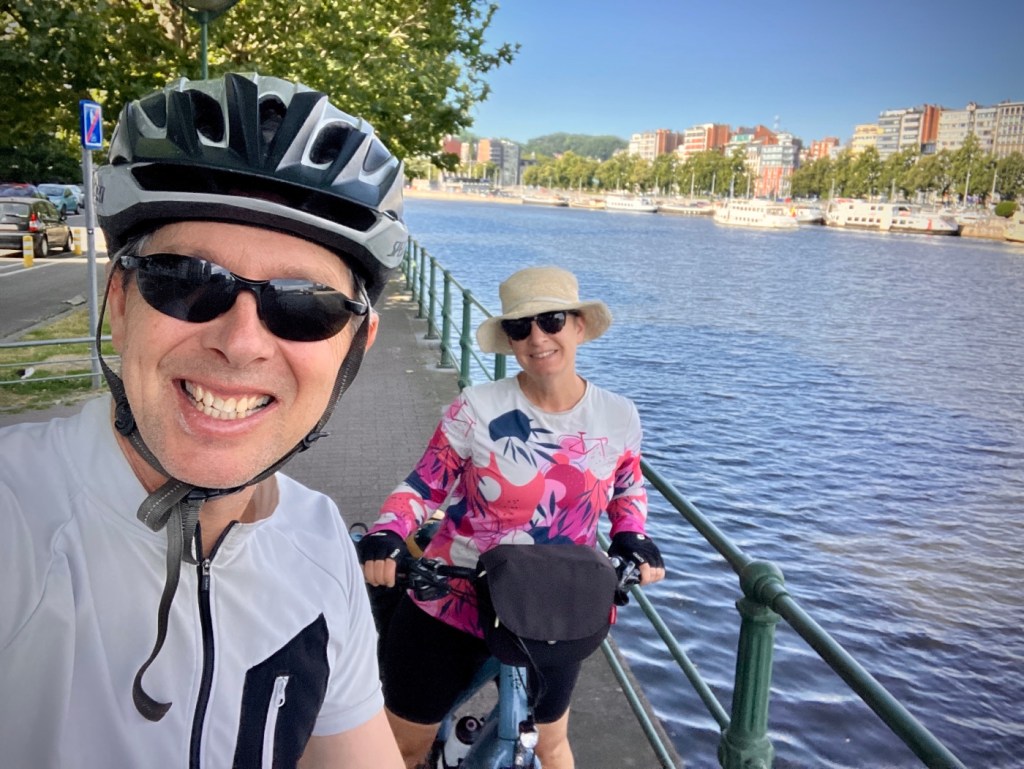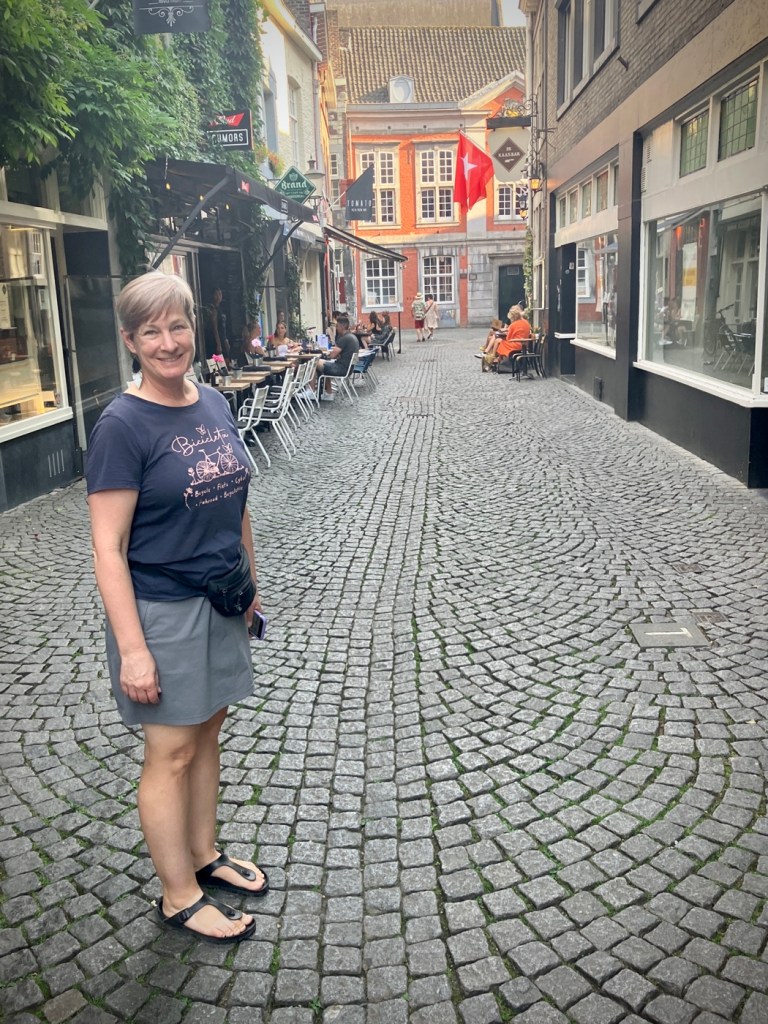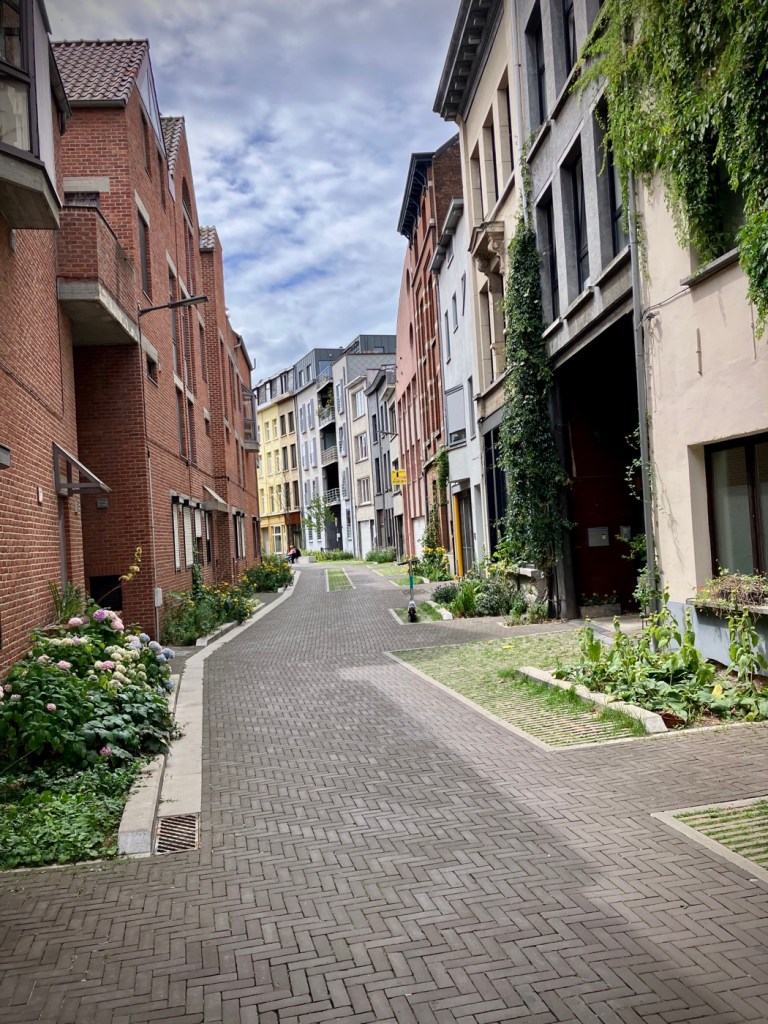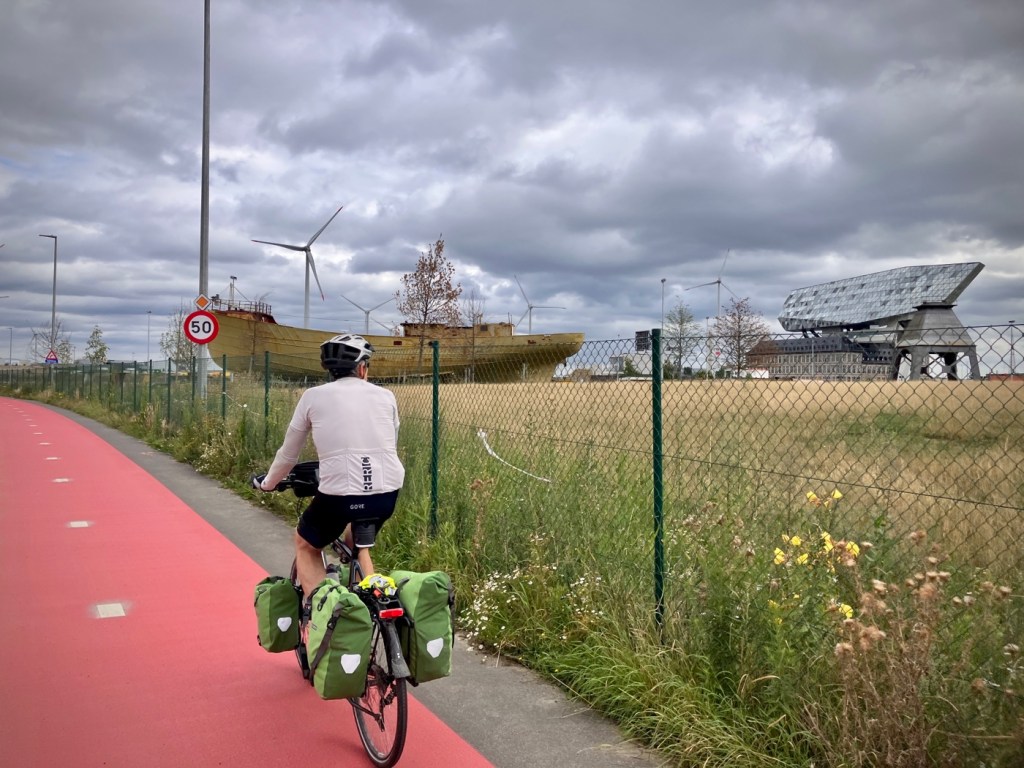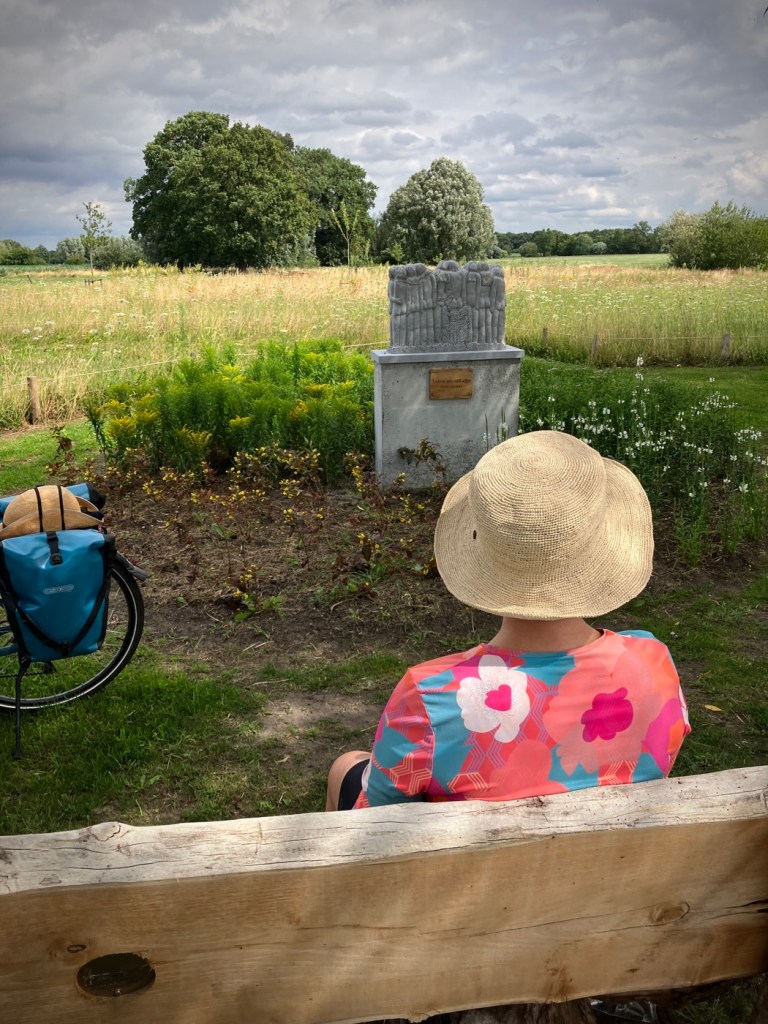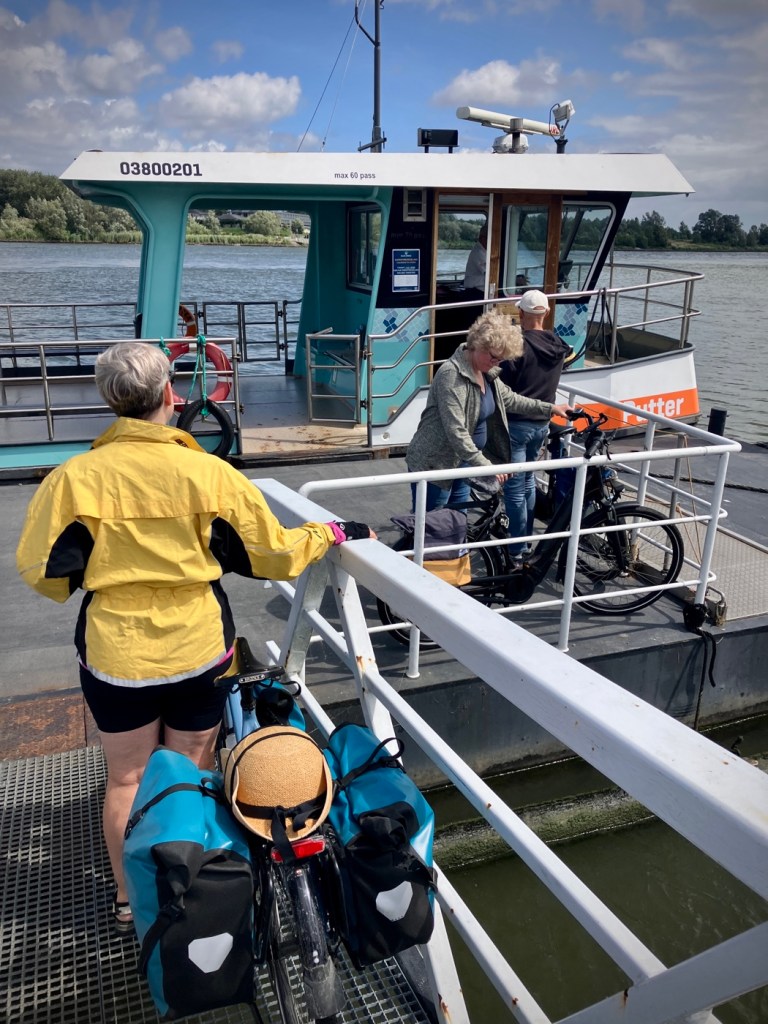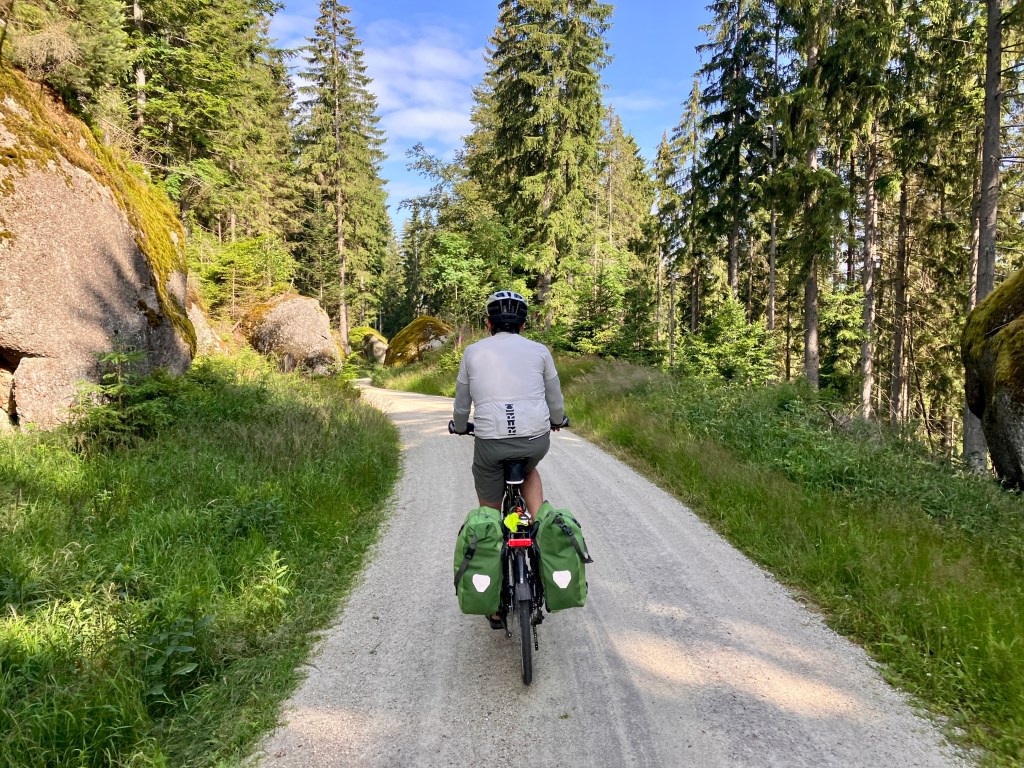
Headed out from Syon Park on a bright and mild morning.
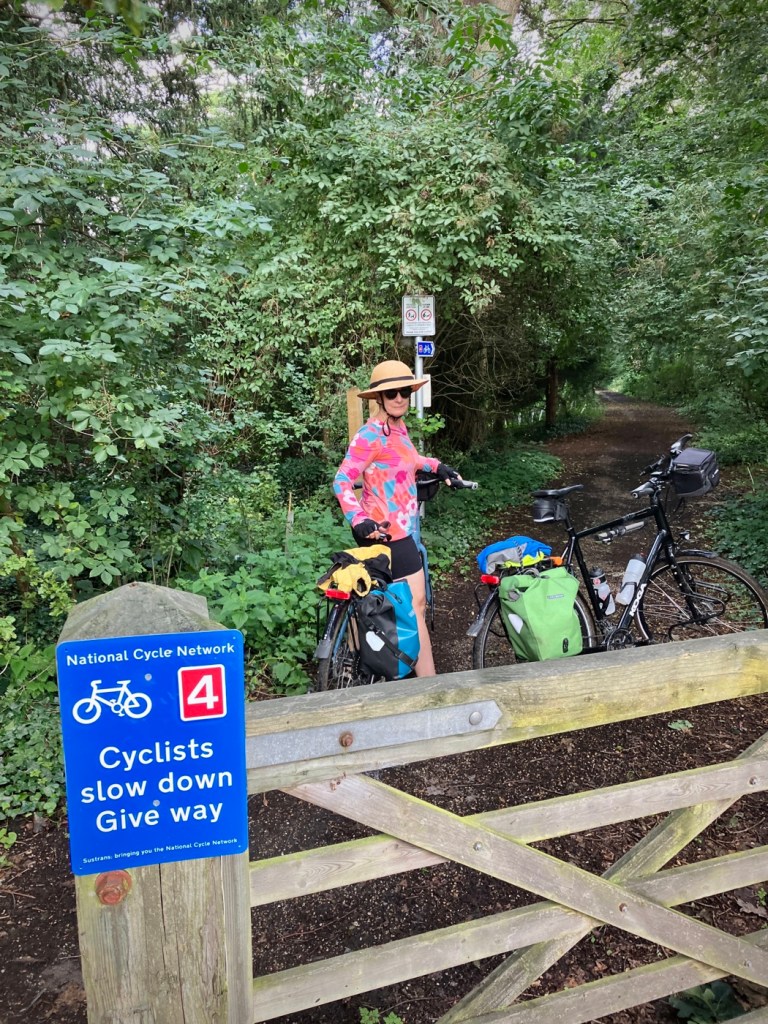
Arriving in the UK after seven weeks bike touring in Germany, Czechia, Belgium and the Netherlands is a mixture of delight- we can talk to people and have in-depth conversations and understand all the signs and announcements!, and disappointment – the cycling infrastructure in this area of the UK is like most of the US, pretty sad. Not well connected, and nothing that is going to move people away from car trips to bicycle trips. Except, just like in some US cities, in some UK cities where cycling has become a preferred mode, like London, the cycling can be great.
Riding from the Harwich ferry to the Manningtree train station was fine. Quiet morning roads, considerate drivers, but no real bike infrastructure.Adjusting to staying left is always a challenge at first. Staying out of the way at a crowded Liverpool Station in London. The next day was to be a scheduled train strike so the trains seemed extra busy.That is not just a bike lane, that’s a cycle superhighway. Finding a gap in the tourist flow to snap an usie. Us and Big Ben.
London is a great example of what good infrastructure can do for cycling in a city. This is the second time we’ve come from Holland on a ferry to Harwich, and then a train to London. The first time we were a bit nervous about crossing London on loaded touring bikes, but it was a snap, so this time we were looking forward to it. And London on a busy mid July morning, loaded with tourists, did not disappoint.
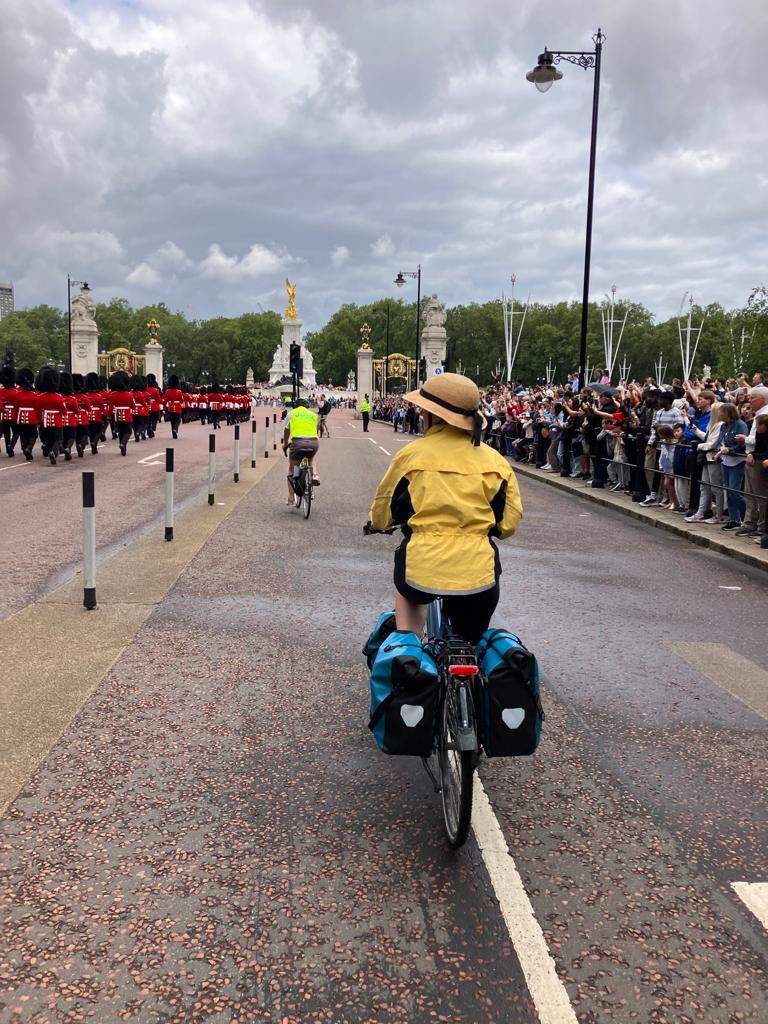
St. James’s Park. Blending in with the other cyclists.Want to feel like part of the attraction of the changing of the Guard?Hop on your bike and follow them up Birdcage Walk and Spur Road. As long as you stay behind them the busy Constables will not yell at you.
Our route took us past Buckingham Palace, which always gives me a thrill to see, and on to Hyde Park. From Hyde park we rode towards Hammersmith and joined the Thames River. First stop: pub lunch at the Blue Anchor. When we have our loaded touring bikes we make sure to sit outside somewhere we can keep on eye on the bikes. Our new bikes have spoke locks which are super easy to simply click into place, and we joke that it would take an unusual thief to be able to jump on Rich’s huge loaded bike and ride away without immediately crashing, but we are happier when we have the bikes in sight.
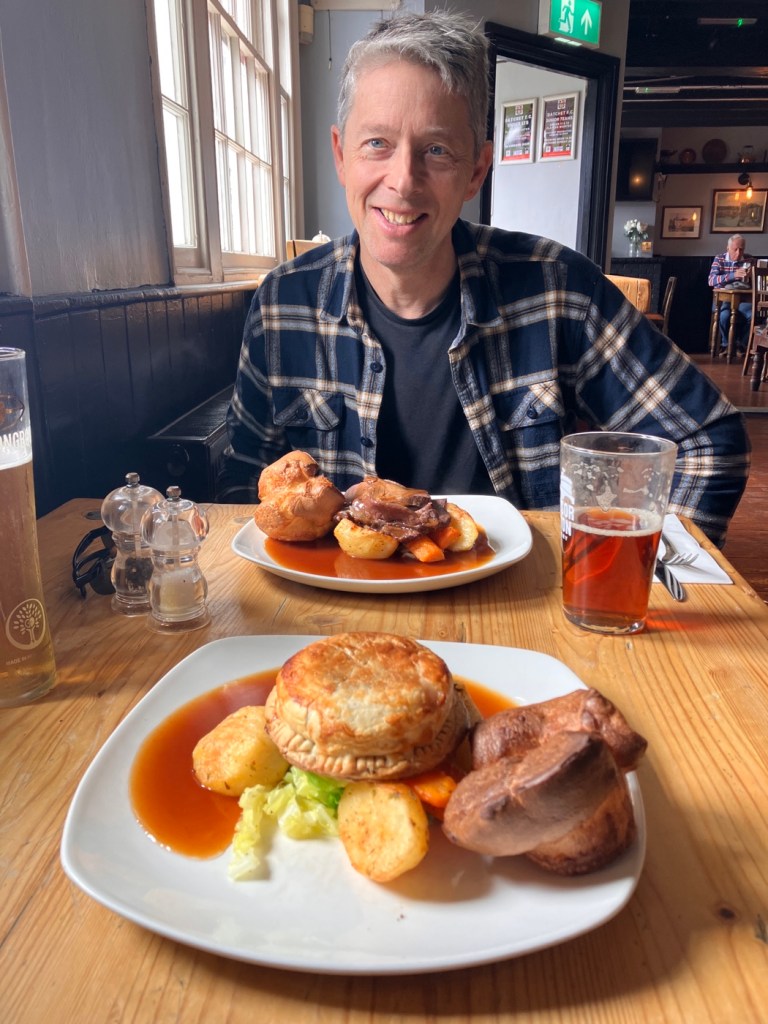
Ah, the first British pint in about ten months. Lunch along the river. This set up is a bike touring dream. The Blue Anchor on the Thames River.Always read the info plaque. I appreciate that someone went to the effort to give me a little historical context with my half pint of cider.
We decided to ride along the Thames to our hotel for the night, the Hilton at Syon Park. It would be a perfectly timed bumble to get us there at check in time. Is it the easiest or most efficient way to ride? No. But winding along the Thames Path takes you through some very scenic areas.
So many cute pubs, but we must be moving on.
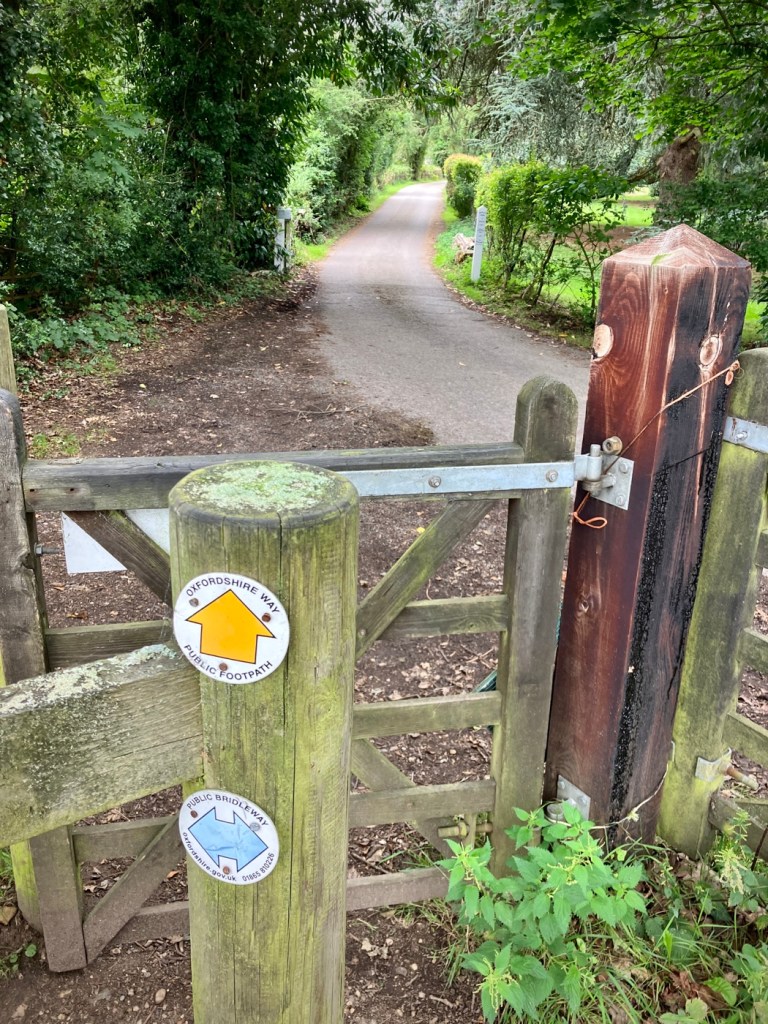
After our night in Syon Park, which would be worth exploring on a future visit, we decided to ride the Thames Path all the way to our destination just outside Windsor. Again, not a direct route, but certainly a scenic ride. It’s fun to have no idea what to expect from a route. The surprises around bends in the river, the views across the river, the varying surfaces of the Thames Path – everything was new to us.
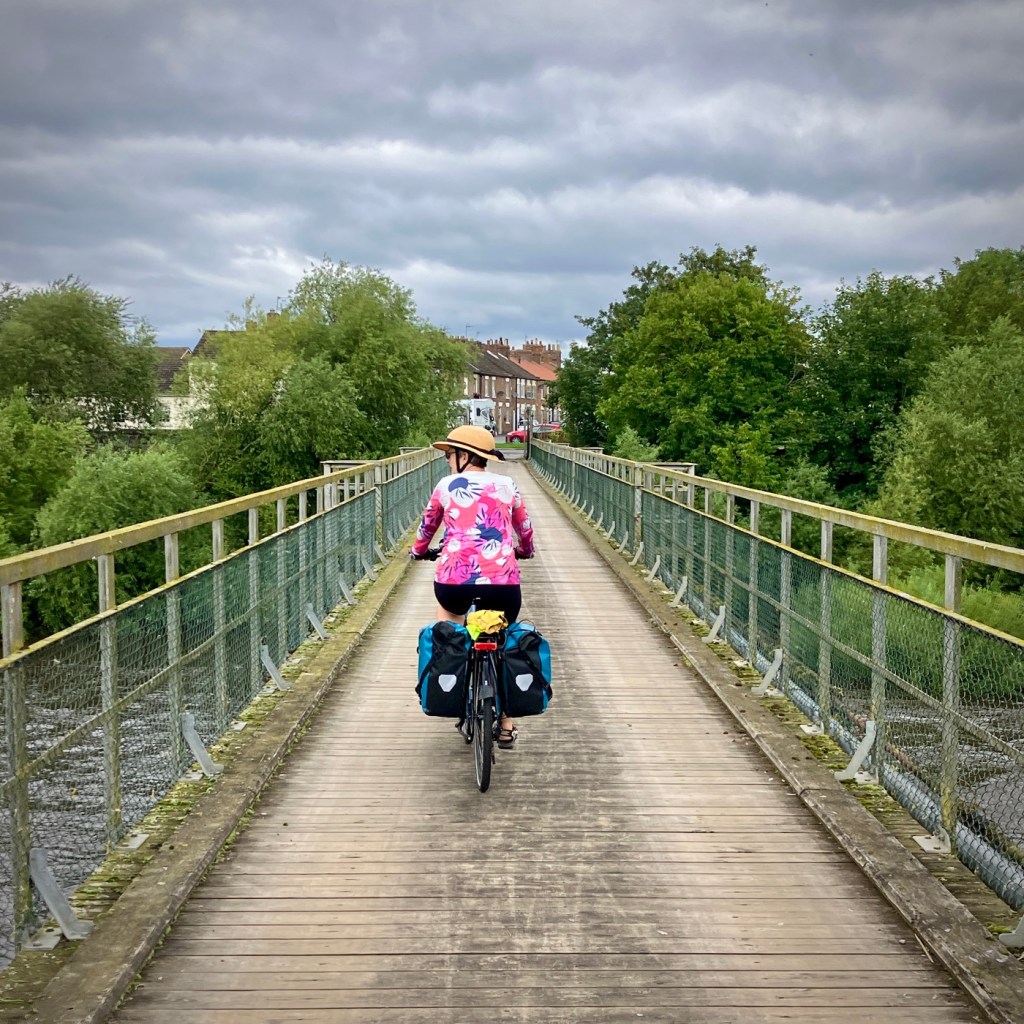
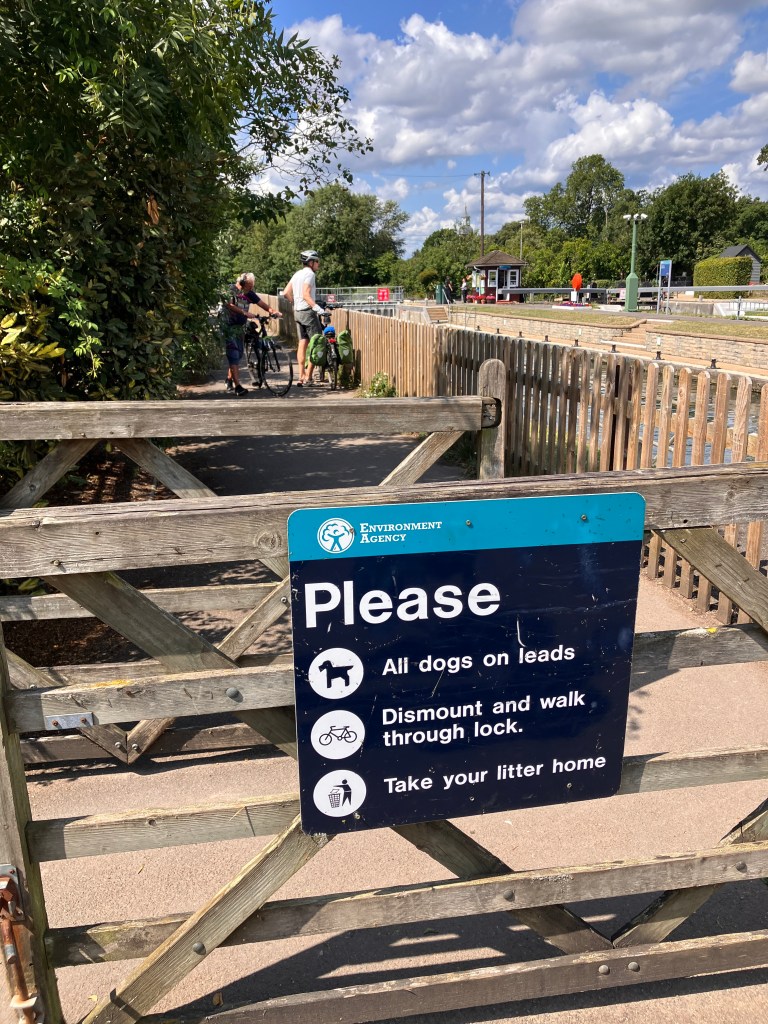
Isleworth, still in the tidal reach section of the Thames. Richmond Bridge. Still in the tidal reaches of the Thames. Teddington, just a bit along the river from Richmond, is known as the end of the tidal Thames.It was surprising to us to find such stretches of nature so close to London. A view of Marble Hill across the river.Signage along the path is quite good in places.Rich in front of Ham House. The challenge of loaded bikes is actually going inside attractions. We did not.Crossing the river again at Kingston upon Thames. The Kingston Bridge.And another attraction, Hampton Court Palace, viewed from the outside. East Mosley. So many boats!The river and path really stitches together life. Walkers, folks painting, so many families, it’s a huge attraction, but dispersed crowds.West Molesy, and me being nosy about boat life. I love seeing the occupied boats and imagining life afloat.The surface of the Thames Path varies a lot. This stretch was quite wide and fairly smooth. Some parts were choppy old asphalt or quite lumpy with tree roots. Dismount and walk through the lock area. Stop and watch the lock filling or draining as long as your patient husband can stand. Did we need to take a little foot and bike ferry across the river? No, we could have skipped the Shepperton Ferry, but how cute is this little ferry dock?A one minute ferry ride! Well worth the 6£ for two folks and two bikes. Was it?, says Rich’s expression. The ferry ride did get us blackberry adjacent though! Speed picks up as we approach our lunchtime pub stop. Heading into Staines-Upon-Thames.Another day, another riverside pub. Last Hop in Staines. Beer and cider, waiting for our pizza.Obligatory pint of cider and river photo.After lunch we left the flat river route and went through Runnymede. Up a rather overgrown path.
Our first experience cycling along the Thames River Path left us wanting more river experiences. Thankfully our temporary home for three weeks is allowing us to spend quite a bit of time appreciating the river path by bike and on foot. I would highly recommend exploring the Thames River Path to anyone spending time in or around London. After the crowds of central London it was a peaceful and eye opening experience. Why was I so surprised to see how busy the river was with small boats, narrow boats and stand up paddle boarders? The look and feel of the Thames as it runs though London, with such strong tidal flows, doesn’t prepare you for how bucolic the river quickly becomes.
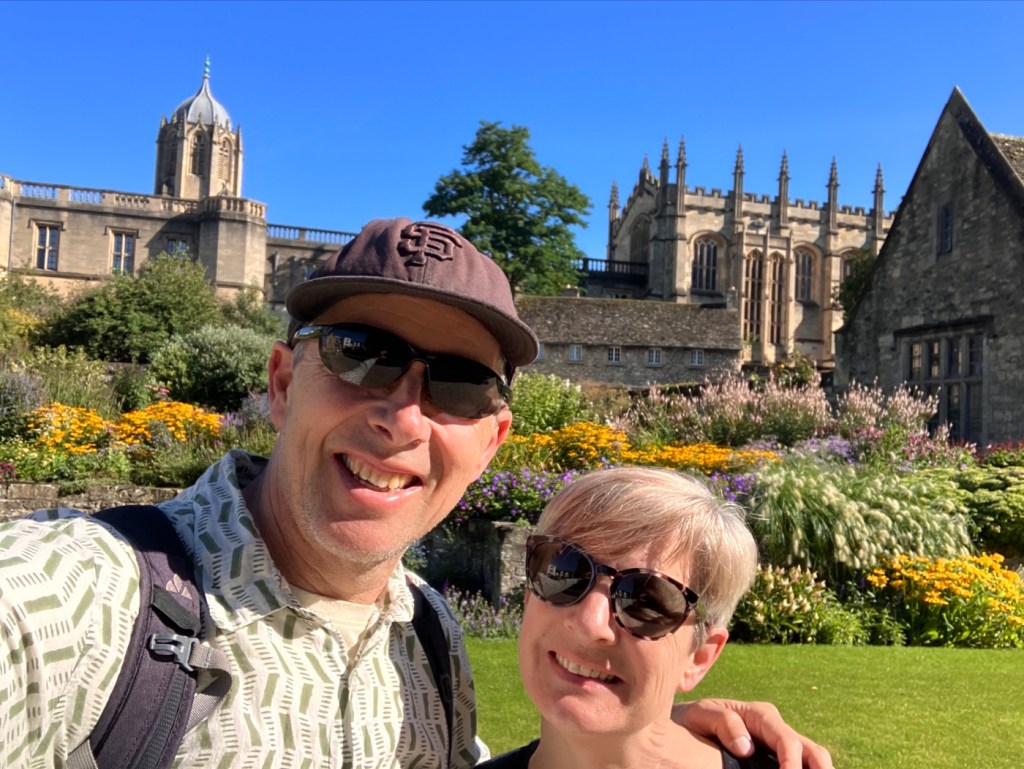
Windsor Castle. Our temporary neighbor. The Happy Travelers.
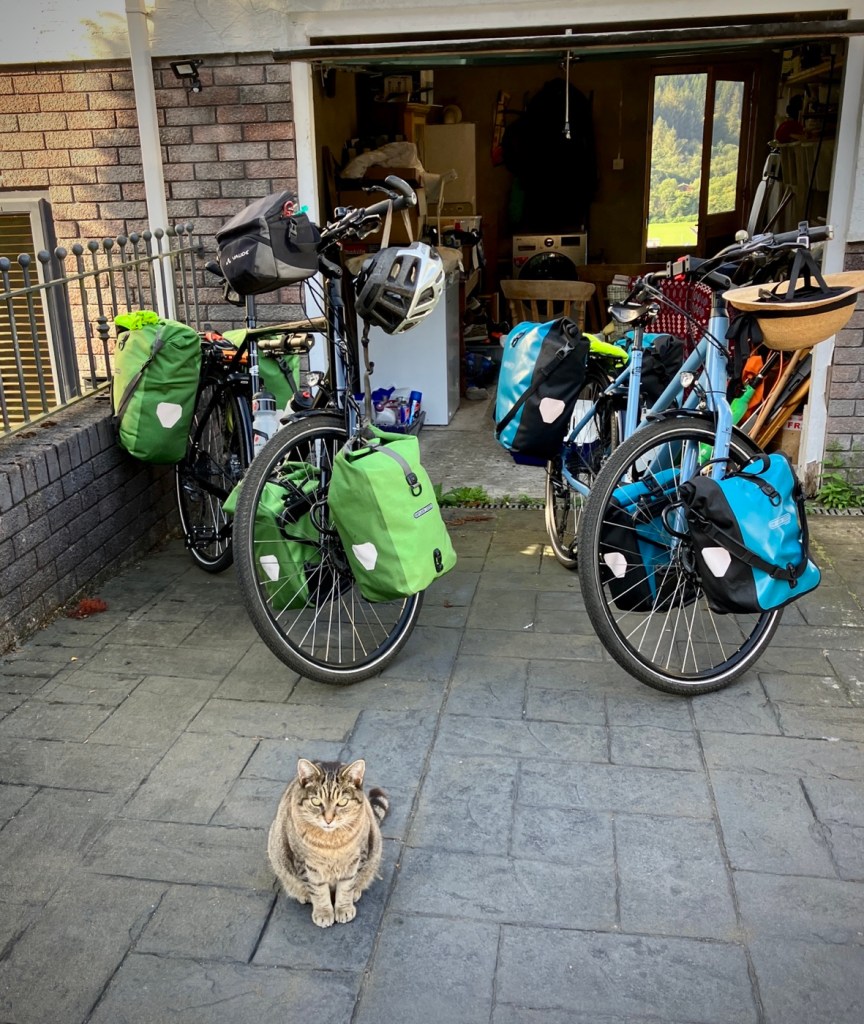
We’re enjoying being in one place for a while, and have been walking and biking and appreciating our temporary home and kitty cat. Happy summer all, and more on our summer of the Thames River soon.
We’d been touring on our old bikes for about 18 years. And, like the frog which allegedly doesn’t feel the water heating up, we didn’t really realize how different bike touring could feel. I was finding my old bike to be more and more uncomfortable, with my hands hurting and going numb on long days, or my knees being quite unhappy. Each change to new handlebars or pedals helped a bit, but after test riding a Koga touring bike in Groningen last year I knew it was time.
My old touring bike. A Gunnar Crosshairs, the frame is a cyclocross steel frame. Photo from 2022.Rich’s old bike, a Paul Taylor frame with drop handlebars. Also a steel frame. Photo from 2022.
We had toured and bike camped on our old bikes all over the place. Canada, Italy, France, Germany, the US, Denmark, Holland, Belgium, and the UK and Ireland. The upsides were that the frames were pretty lightweight and they were unique looking in Europe. It was always fun to have the bikes worked on at a bike shop on the continent and have the mechanic share how much they loved working on old steel frame bikes. Or to have another steel frame aficionado approach us outside a grocery store or bakery to admire the bikes.
In England, riding from London to Hove. 2022.
After I test rode that Koga in 2022 however, I put my foot down. That’s it, I said. I’m getting a new touring bike. Something more upright, something more comfortable. A bike built for touring. And oh wow, was that a good idea. And Rich’s Paul Taylor was already rebuilt once as he cracked the original frame from heavy touring loads on a bike designed for cyclocross.
New bikes, new panniers, same wonderful travel companion.
We decided that the new touring bikes would be our 25th wedding anniversary present to each other. If you’ve ever looked at the that funny old list of “traditional” gifts for wedding anniversaries, 25 is silver. What do we need with silver? So, to mark 25 years, which was last year, and to keep us rolling for as many more years as we have, new touring bikes it was. Sitting in a guest house room in Sri Lanka we ordered two new Koga World Traveler S bikes. Koga estimated 12 weeks to deliver our bikes to the shop we had chosen in Freiburg, Germany.
Super comfortable grips from Ergon. The wide part supports your hand during a long touring day.Rich’s grips, iPhone mount, and cycle computer.My well broken in Brooks B17S. This saddle has been on three of my bikes, my city bike, moved to my old touring bike, and now my new touring bike.
When we took trains to Freiburg to pick up the bikes, we also took with us my saddle, bike bell, and pedals from my old touring bike, and Rich took his pump. The saddle that came with his new Koga was not working for him so he bought a new saddle before we left Freiburg. A comfortable saddle is key. Of course, our first week bike touring, about day three and hour 6 of the day – neither of us could find a comfortable position on our saddles. It takes a while for your rear end to adjust to hours and hours on the bike.
The racks which came with the bikes are from Tubis, not a brand we were familiar with, and these models are custom to KogaThe front rack. Very different from what we were used to.
Although we both were a bit surprised by the front racks from Tubis, with a very low profile for your bags which keeps your center of gravity low, and no rack over the front tire at all – which is where Rich would usually have his rain jacket, we are very pleased with how sturdy they are. I like the rear set up which has two levels of tubing. The very top allows you put things under a bungie cord, and the slightly lower level is for your pannier.
My front panniers, loaded and ready to roll.
These bikes have features we didn’t have on our old bikes, such as the built in Shimano dynamo hub front and rear lights. So far we’ve only been touring in the summer so we haven’t needed the lights to actually illuminate our way, but they are excellent for being seen. The steering column has an internal steering limiter which prevents the wheel from flopping sharply to one side or the other. The frame is stout and designed for over 140kg (310 lbs) total load. It all makes for a very stable ride. We chose the Deore XT 30-speed(3×10) drivetrain over the 14 speed Rolf internal hub belt drive for ease of repairs and replacement parts globally. It’s a classic set up that we’re familiar with, and so are most/all bike mechanics you will encounter.
The front wheel of Rich’s bike. Disc brake, front light, low profile rack.Dynamo hub, and Schwable tires.
On our previous bikes I only had rear panniers, while Rich had front and rear. We traveled around to Freiburg from France, where our old touring bikes live, with all our panniers and a couple of extra bags. I bought new front panniers, and Rich was convinced, by me, to get a full set of new panniers. His old rear panniers had certainly seen better days and the style was not as easy to load and go. We were a little sad to let go of our mis-matched old school style look, but it felt nice to be fully kitted out in new gear on our new bikes. Rich left the old panniers for re-use at the bike shop.
Farm cat helping Rich on day one with a pannier adjustment.
It takes a bit of work to adjust the panniers and set the clips – which hold the panniers on the rack – and the hooks – which keep the panniers from bouncing out from the racks and thereby reduces stress on the clips – correctly. Each pannier must also be adjusted as a right or left pannier. And then you have to be able to tell them apart.
My solution is to mark the right panniers. The rear with a series of dots in permanent ink.And the front with a small evil eye charm from Türkiye.
Rich just eyeballs his clips and hooks and knows which is left and which is right. It makes loading the panniers onto the bikes faster if you can easily recognize your left versus right. For starting out in the morning, for train rides, and for adorable little foot passenger ferry rides where you might have to lift your bike down into the boat, which is easier with the bags removed, and then try to quickly reload the bags at the other side.
Crossing the Thames River.
Your panniers are identified and loaded, now what’s in those things? We got that question quite a bit in Germany and Holland, where most cyclists were day trippers with just one pannier, or out for a weekend or week with two panniers. No, we’re not camping, but we are out cycle touring for four months, we’d explain. So, rain gear and colder weather gear, which takes up space. Comfort items like my travel yoga mat and our little down pillows, and our two camping chairs. Picnic gear, lunch food and snacks. Boxes of contact lenses, tools, etc…
Two Chair Zeros from Helonix expand our lunchtime stop options.
Do we try and keep everything organized? Yes. We have reminders for ourselves of where items are. Rain gear right. Leisure left (chairs). Picnic supplies port. Does it work? Sort of. We know what’s in front instead of back, but the rule of bike touring seems to be that the item you’re looking for is in the other pannier. Hat? Oh left, definitely. Not. Open up right pannier too. It’s somewhere.
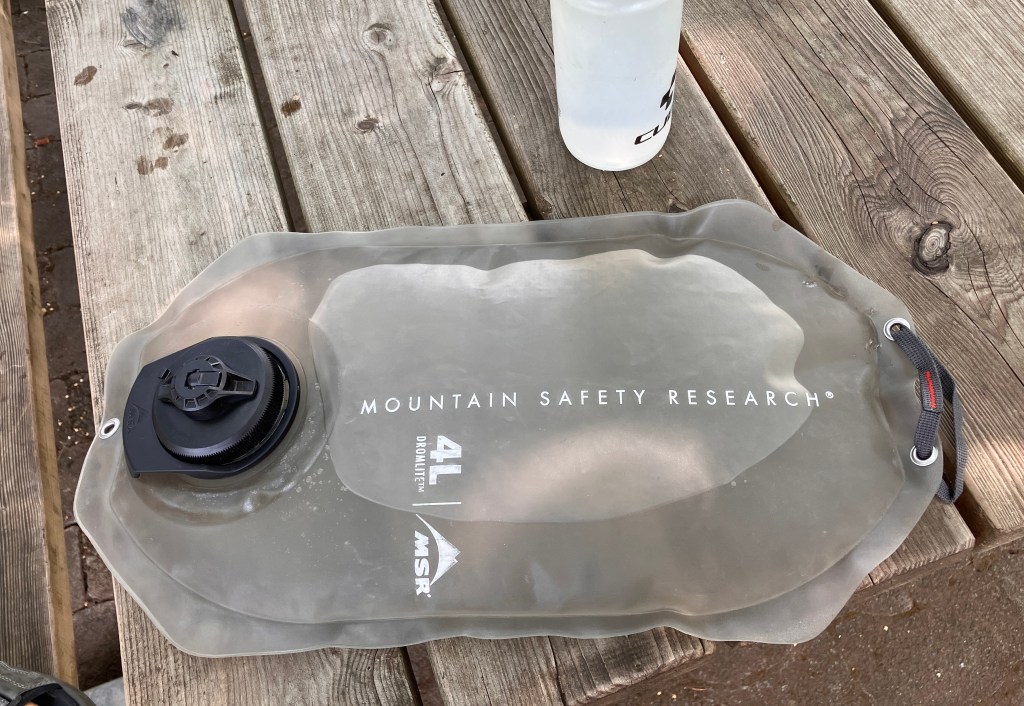
Extra water. Rich has anywhere from 1 to 4 liters of water in one of his front panniers.It’s easier to have water and avoid searching for a source. This Mountain Safety Research bag is just the trick.
We’ve learned over the years that it’s not as easy to fill water bottles during the day as you would think. Especially if you’re off the popular routes and not stopping at restaurants for lunch. Coming from California we are a bit spoiled when it comes to parks and playgrounds having a water tap. We expected more taps to be available but they are not. Water is heavy to carry, but being well hydrated is important. We always pre-game in the morning by drinking water, it’s easy to get a bit dehydrated if you’re not careful. My bike currently has only one bottle cage, and I carry an extra water bag with one more bottle worth of water. Rich has two bike bottle cages and the larger water bag. Both our frames have additional mounts that would allow an additional water bottle below the down tube. We may use this in the future.
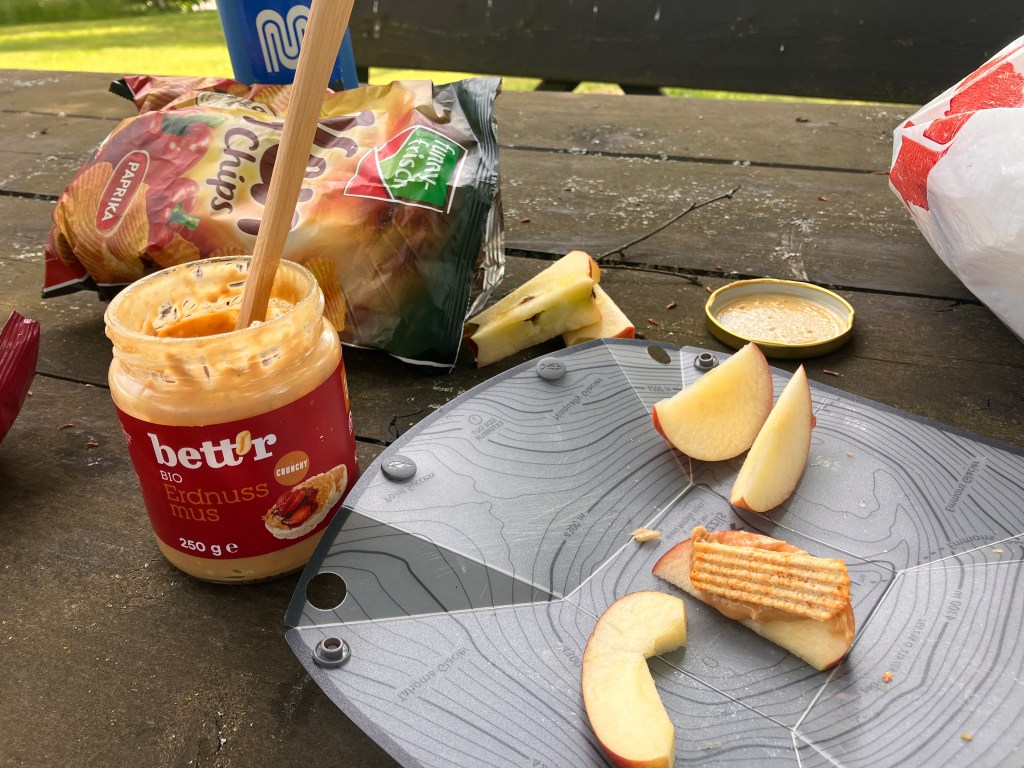
New to us this trip, two Fozzil Snap Fold bowl/plates. Love these.They work as a plate to help serve up pastries for elevensies.And they snap up to form bowls. Here they are part of a slightly messy picnic table. Two tea towels/napkins, bamboo cutlery, and one sharp Opinel knife.And opened they store nice and flat. Apple slice, peanut butter and spicy crisp? Why, yes please. Another new comfort item. Tiered spice containers by Humangear. From the top: salt, cracked black pepper, olive oil, and Mexican seasoning mix.
If we’re staying in an apartment with cooking facilities that little bit of olive oil comes in handy. It’s enough to get you through one or two dinners. And when we have the opportunity to boil eggs to take them with us for lunch or snacks, the salt and pepper are key.
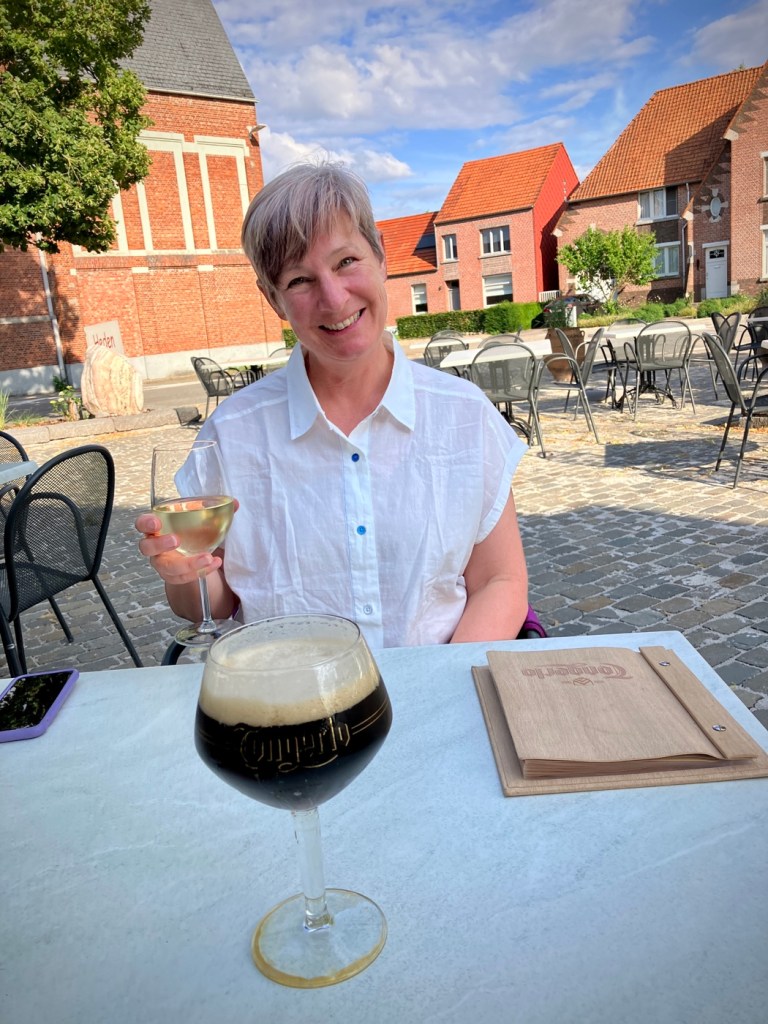
A very happy bike tourist in Antwerp.
When we first starting riding our new bikes, loaded up with panniers and front bags, we both felt as if we were on e-bikes. The feel of the strong aluminum frames and the way your pedal strokes are converted to power, not lost in the flexing of the frame, was pretty stunning. On our old bikes I could climb out of the saddle only very carefully, the sway would get out of control easily. Rich couldn’t climb out of the saddle with his full front and back pannier load. Now, we can both stand up and dance on those pedals up the hills.
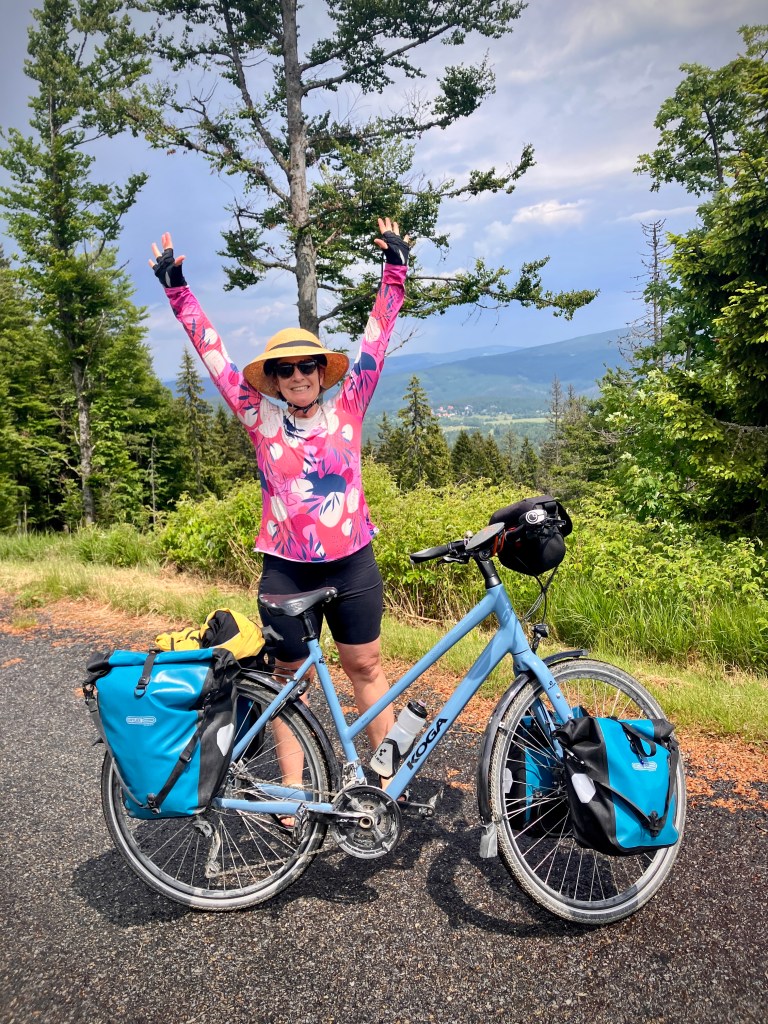
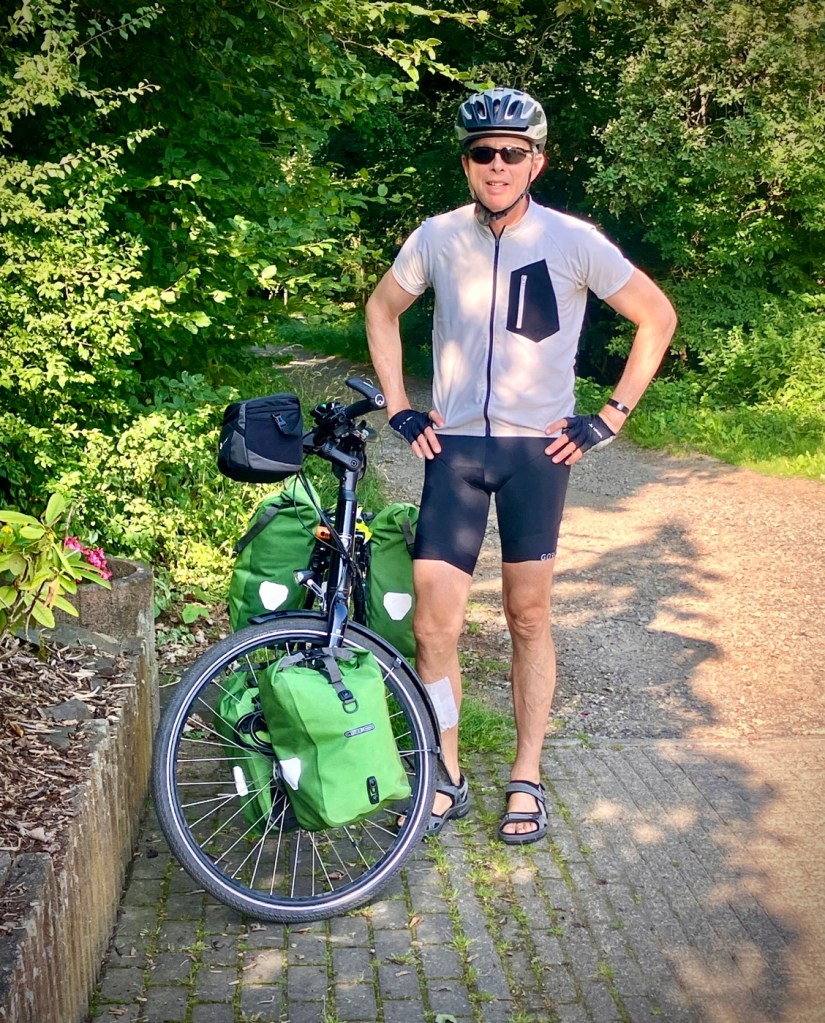
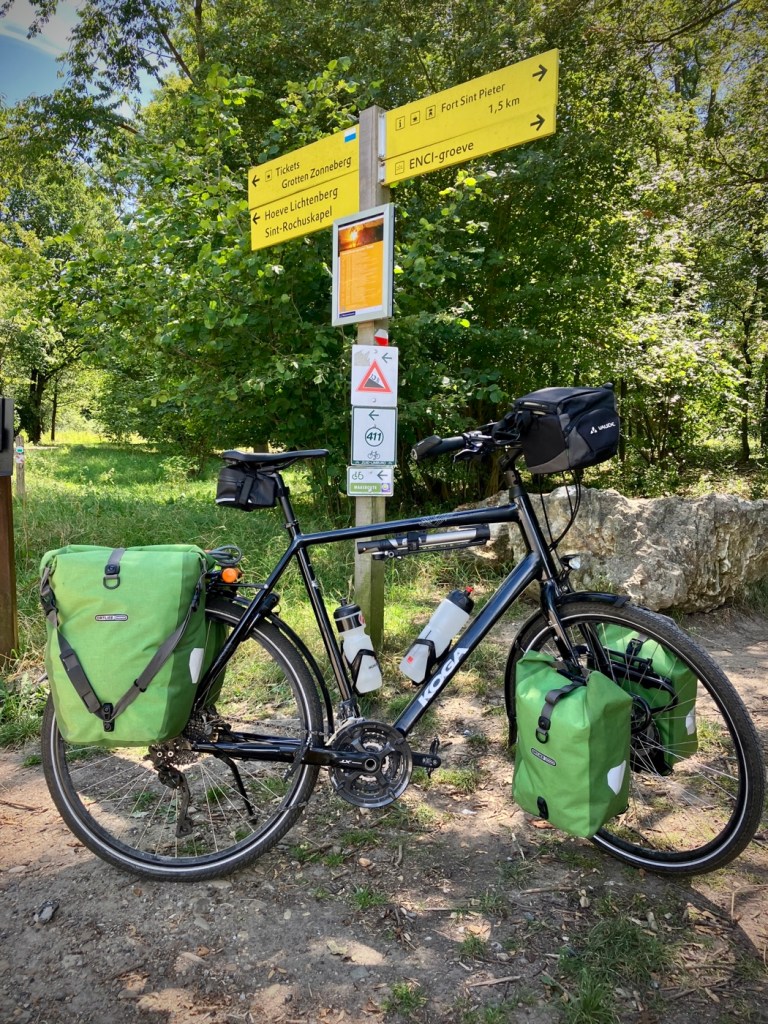
Another happy bike tourist at a high point of EuroVelo 13 in Czechia.Koga World Traveler S frame size 63 centimeters. Rich is six foot five, the upper limit for this frame size. Koga’s adjustable stem allows for perfect handlebar settings.Koga World Traveler S, step through frame, 53 centimeter. Cheryl is five foot six.
So after more than 2000km of bumpy, hilly, and cobbled roads and trails, both our bikes have delivered touring joy. Just a bit of expected regular maintenance and adjustments to the disc breaks and derailleurs. All our wheels are still perfectly true, thanks to stout rims and a 36-spoke configuration. The 700c x 39mm Schwable Evolution tires are perfect for our riding style, and handle well both on-road and on rocks, roots, and mud.
The wide frame clearance allows for much wider tires (50mm+) for more off-road performance or serious terrain. And given our confidence and love of these bikes, we might just put on some serious fat tires and take them on the first trip to Mars.
The happy travelers. Now with bikes that make us even happier.
Sometimes you are really in the groove of bike touring. The daily physical challenge, the rhythm of plotting our route, checking the weather, procuring food and lodging, and working in some fun and history along the way.
Trois Bornes: where Germany, Belgium, and the Netherlands meet. It also happens to be the highest point in the Netherlands at 322m.Morning saddle-up at our little garden apartment in Miltenberg; a long travel day ahead.
You also tend to get a few bumps and bruises along the way; maybe bang your leg on a pedal or kickstand, maybe some chain ring grease, and always a few achy spots.
Our second train from Mainz to Bonn was a long local run and crowded from the get go, but we were able to wrangle our bikes against the wall…but way too late for proper seats.Then even more bikes, including these two friendly German bikepackers heading out for a month ride to Nord Cap, Norway. Impressive!
You assume any minor nicks, scrapes, or pains will be eventually go away. And summer bike touring in the forests and fields always means nettles, bugs, and bug bites. So, as we headed out of our two day stay in Miltenberg, I still thought the growing red spot on my right leg would probably just go away…
Off the Train and headed towards Eifel NP.
Oh sure I was feeling a bit funky, but again, your body goes through ups and downs bike touring, so thought maybe this too would pass like an off day in the Tour de France. Plus we had an ambitious agenda to get us across Germany to a point where we could ride into unexplored regions of Belgium and Holland.
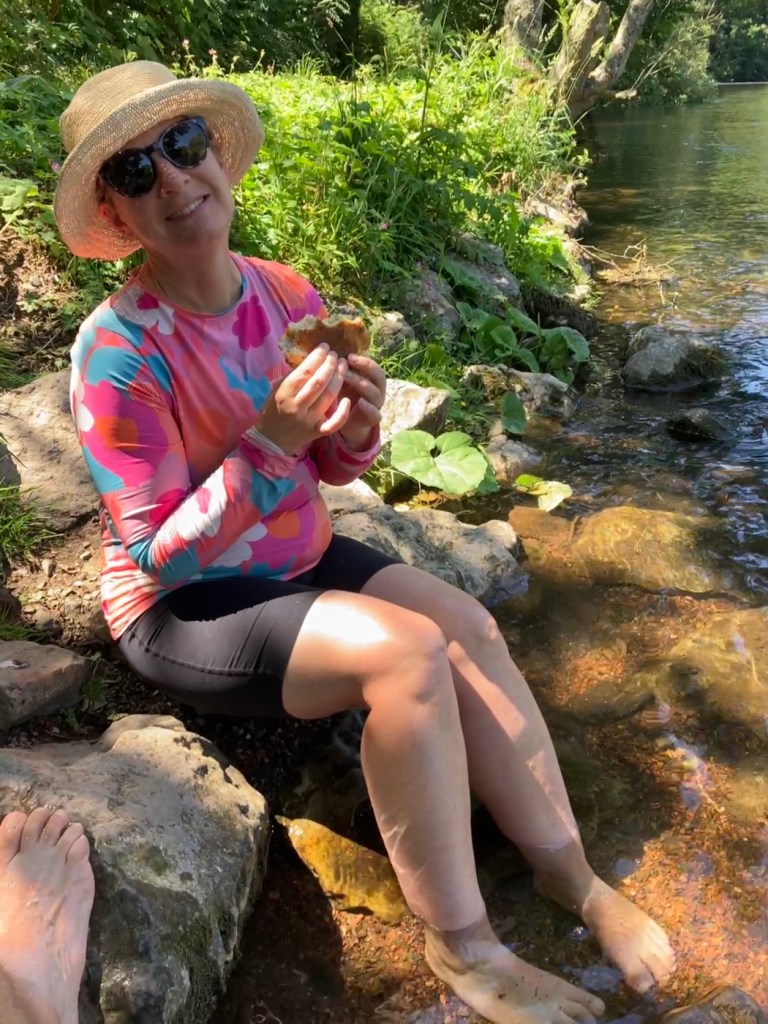
Cooling our feet in the Roer River near Heimbach, Germany
The 40k ride up the Main river to Aschaffensburg was fine and we had plenty of time to pre-board a local train to Mainz with our bikes. I had planned our route using local (RB/RE) trains that were covered by our €49 monthly tickets, and only boarding at the beginning of routes to ensure there was a spot for us and our bikes.
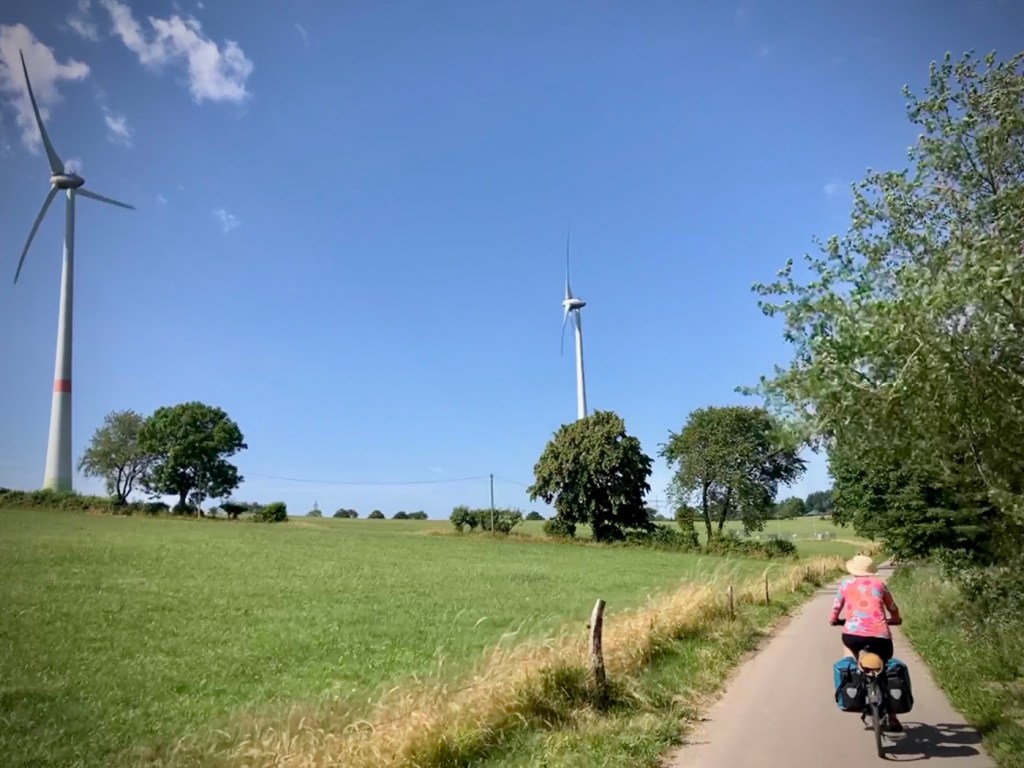
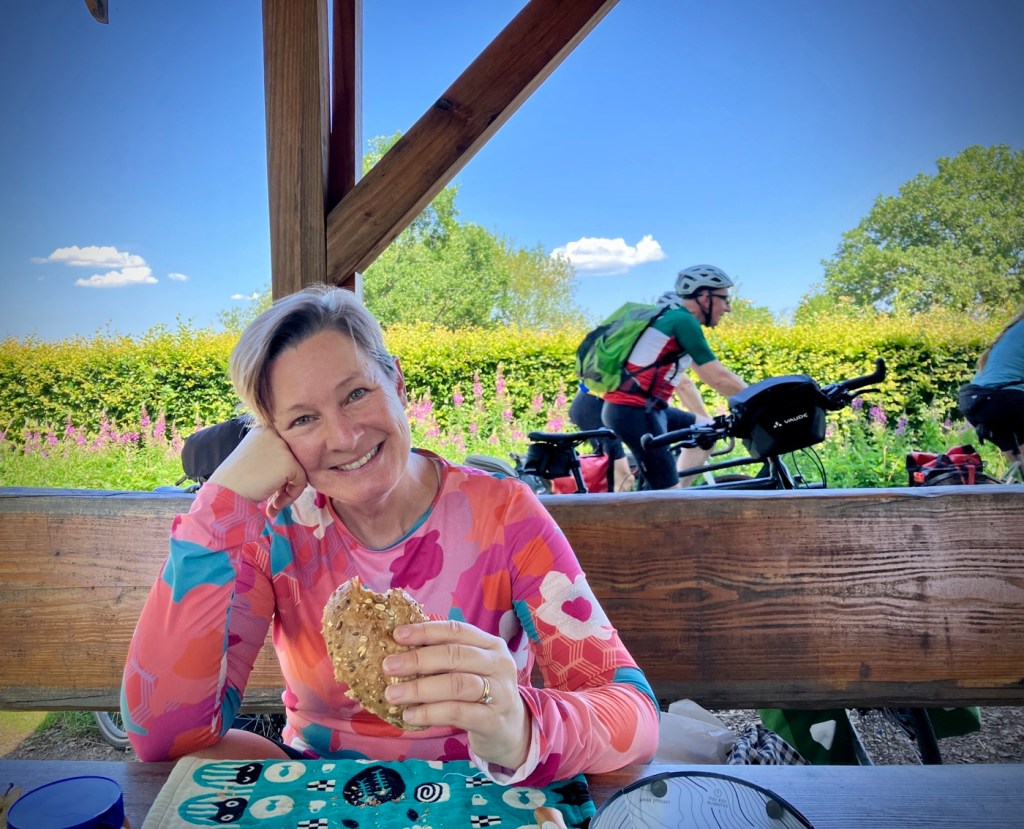
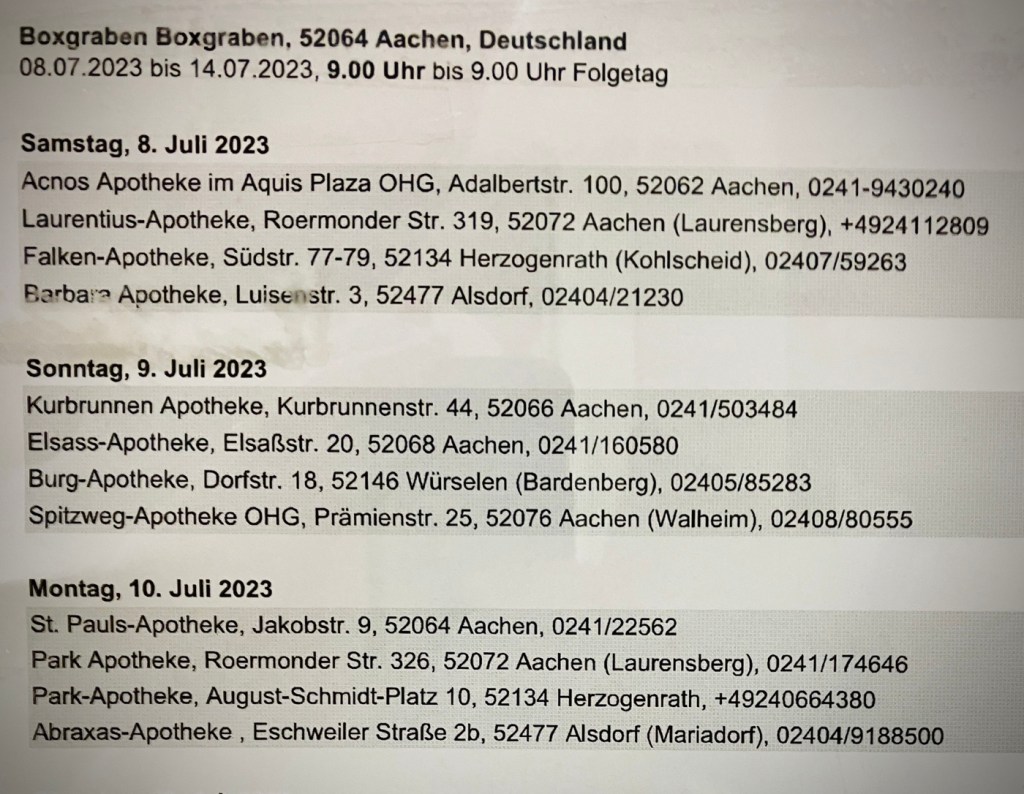
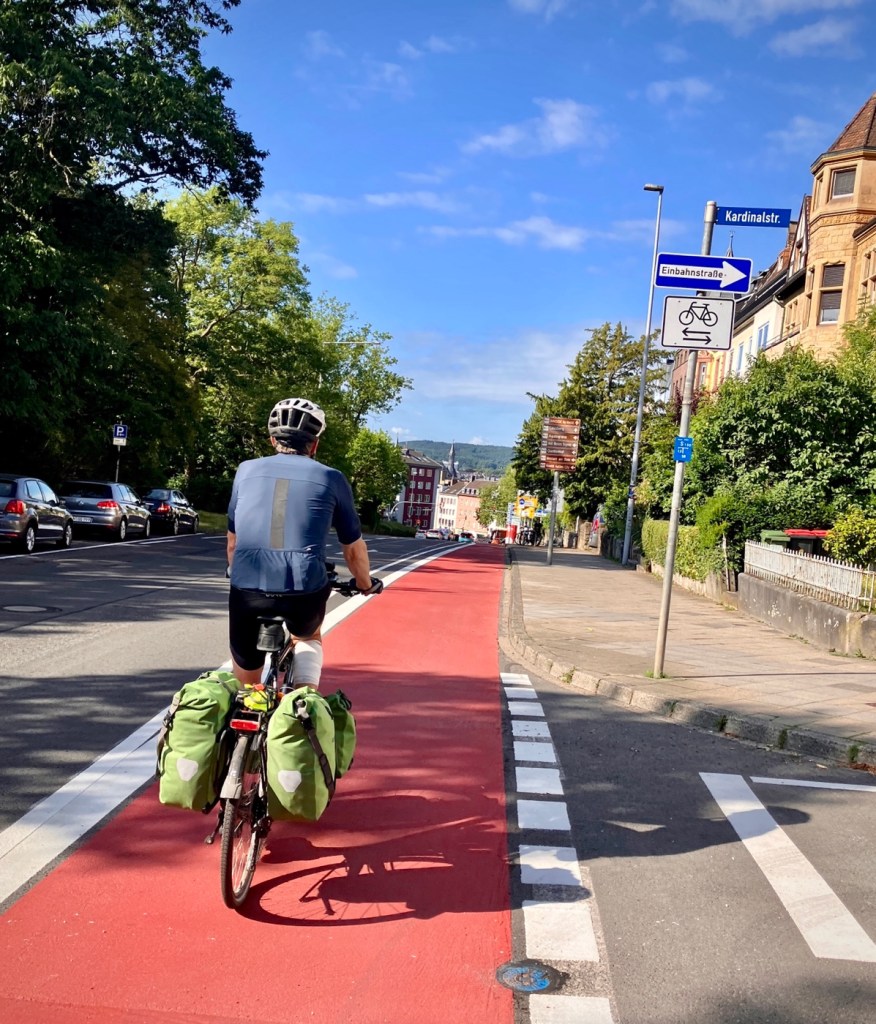
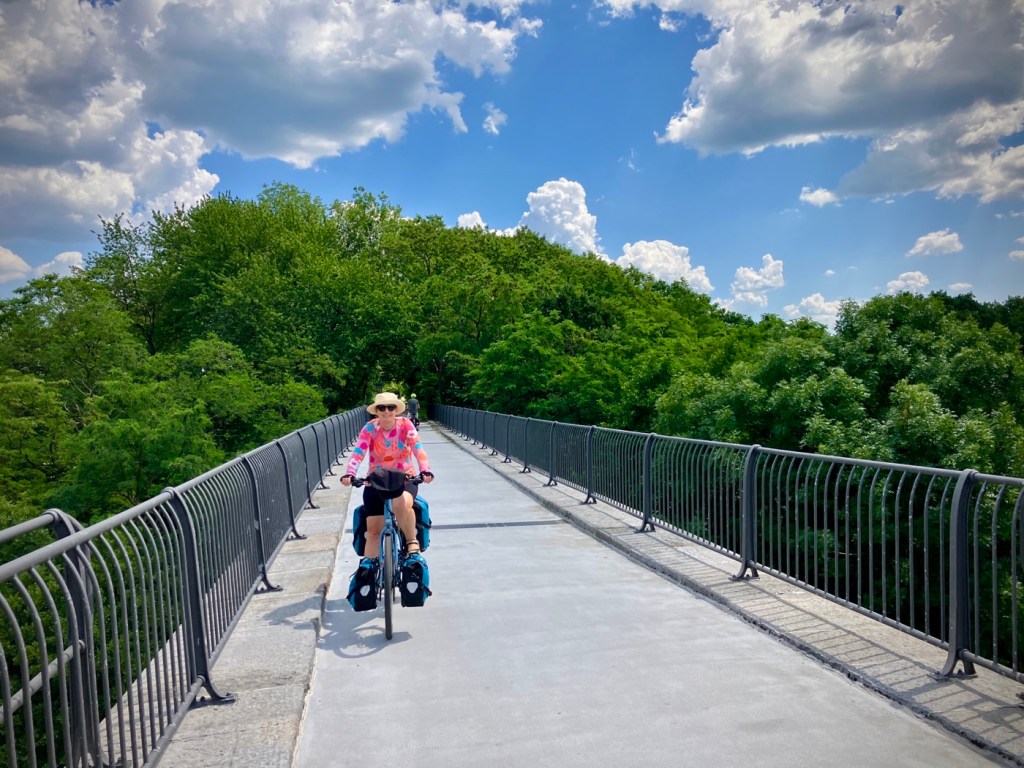
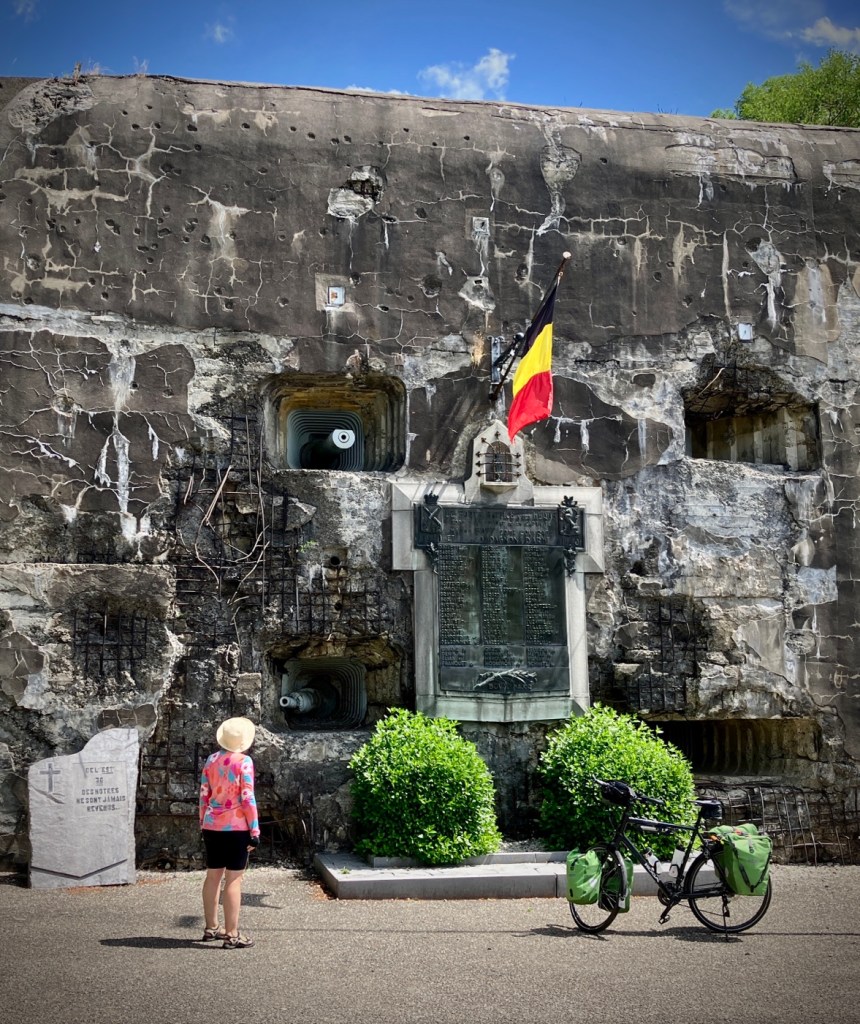
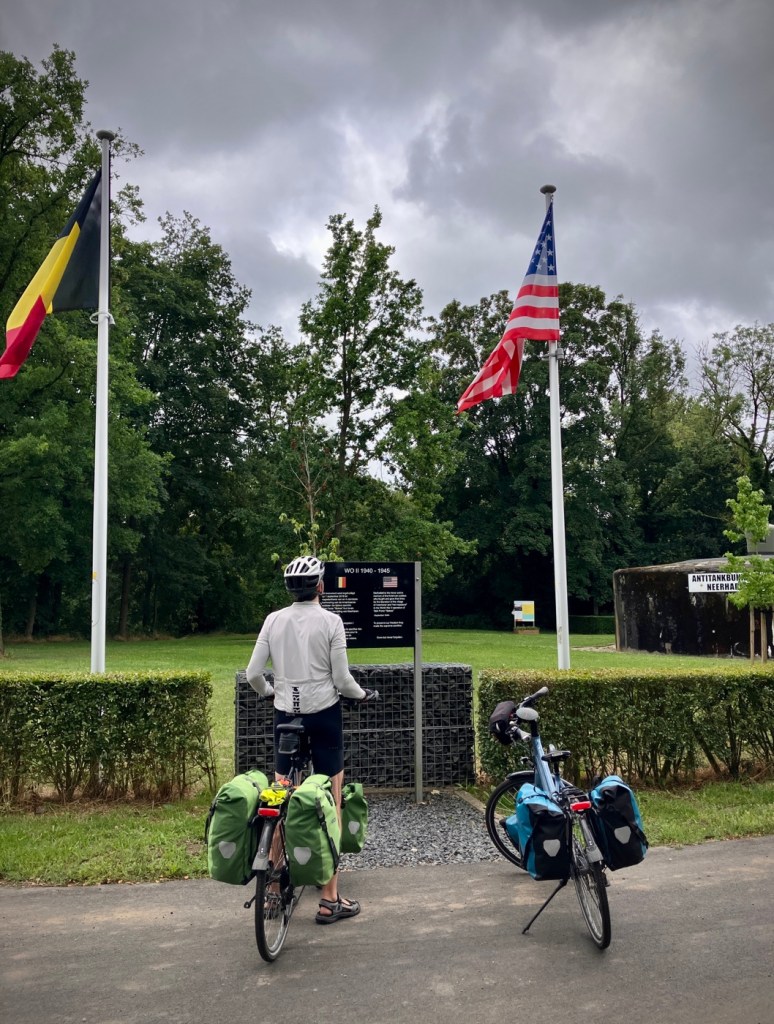
Bug bite infection now bandaged and first antibiotics in my system…still feeling apprehensive about a hot tough ride out of Eifel NP, but the doctor said it was ok to ride. Wind turbines all over the Three Border Area as it’s ridges are windy!Peanut butter and apples were our Sunday savior in Germany, when most everything is closed.The Ravel bike route has great rest areas.The rotating 24 hour pharmacy schedule in the Aachen area allowed us to fill our prescriptions on the weekend after a second visit to an urgent care and second opinion on antibiotics. A rare and new bright urban bike lane in Germany. Happy to be heading out of Aachen…now doped up on two antibiotics! After crossing into Belgium on Eurovelo 3, we appreciated the smooth pavement and well marked bikeway crossings and transitions.The rail-trail Ravel route straddles the Flemish-Wallone border and is like sailing through the sky…highly recommended.You know you are in Belgium…pavé!A small defensive bunker from WWII. This almost classifies as a “pillbox”, which are smaller square or cylindrical defensive structures still found in the area.A memorial to the soldiers who died defending the Vaals region from the Nazis in 1940.The fragility of borders and freedom haunts us again in this region.
Feeling confident after our first easy train transfer to Mainz, we waited strategically on the platform for our next key leg to Bonn. As the platform got more crowded, we knew this might be a challenge, and unfortunately the empty train rolled in further up the platform than expected. Doh! As mobs converged, we quickly passed the first car marked with some bike space to find a better car. Big mistake.
Heading into Liege, a city in transition with new streetcar and brownfield development construction engulfing it for a few tough years. Visit in 2025!
However, it turned out to only have two bike cars; and by the time we got in the door of the second car way down the platform, it was crowded. People were already on the pop down seats in the bike area with large luggage. So after some fairly aggressive negotiating, we managed to squeeze in with our bikes and 8 panniers scattered about above and below seats and on top of our bikes. Poor Cheryl was standing almost the whole 3 hour endurance test of 22 stops; while I managed to find a seat for some of the ride in the main area, after asking two young men to move over and move their bags off the seats.
Heading down the Mass (Meuse) River. Goodbye to Liege and Wallonia.
So here is the thing about the €49 tickets; many trains are busier, but the long distance local runs covered by the tickets are especially popular. Next time we’d spring for the €100 intercity train with bike reservation on a trip this long…and you probably should too.
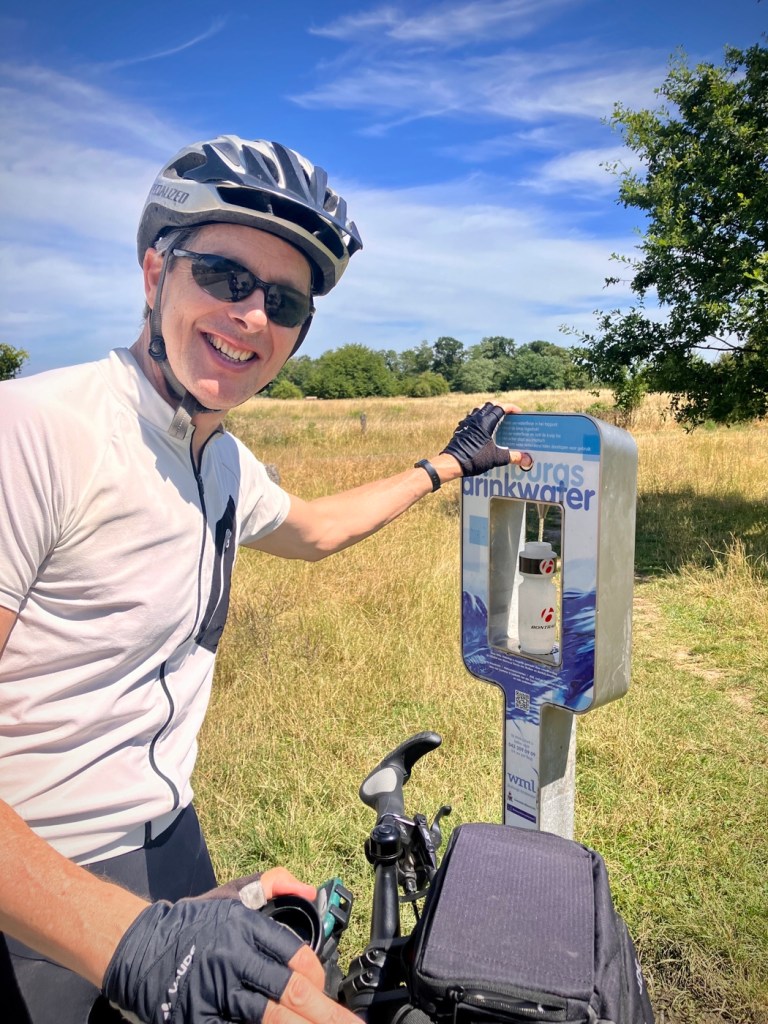
A water tap! Welcome to the Netherlands, there are almost no public water sources in Belgium or Germany.Delightful Maastricht, Netherlands…we dipped into the Netherlands just for a night. Mount Saint Peter just south of Maastricht is perched on a limestone hill; a quarry on one side and views of the Maas on the other. Bikes everywhere around Maastricht University, home to more than 22,000 students.
But the upside of these adventures is that I ended up chatting to the two young men for an hour or so, after they offered me some cookies. It turns out they were both relatively recent refuges to Germany from Iraq and Syria and had fascinating (and somewhat heartbreaking) stories of their families’ trips via Greece and Turkey, where some of their family was still “stuck”. Again, they both said that they would love to go to the U.S. someday, but were ok in Germany, but not thriving. Germany has been overly generous in accepting refuges and should rightly be proud, but it’s a fairly rigid culture to assimilate into or even find your own community within the traditional Anglo-Saxon framework. Heck, we even find Germany a bit hard to assimilate into, so we can only imagine.
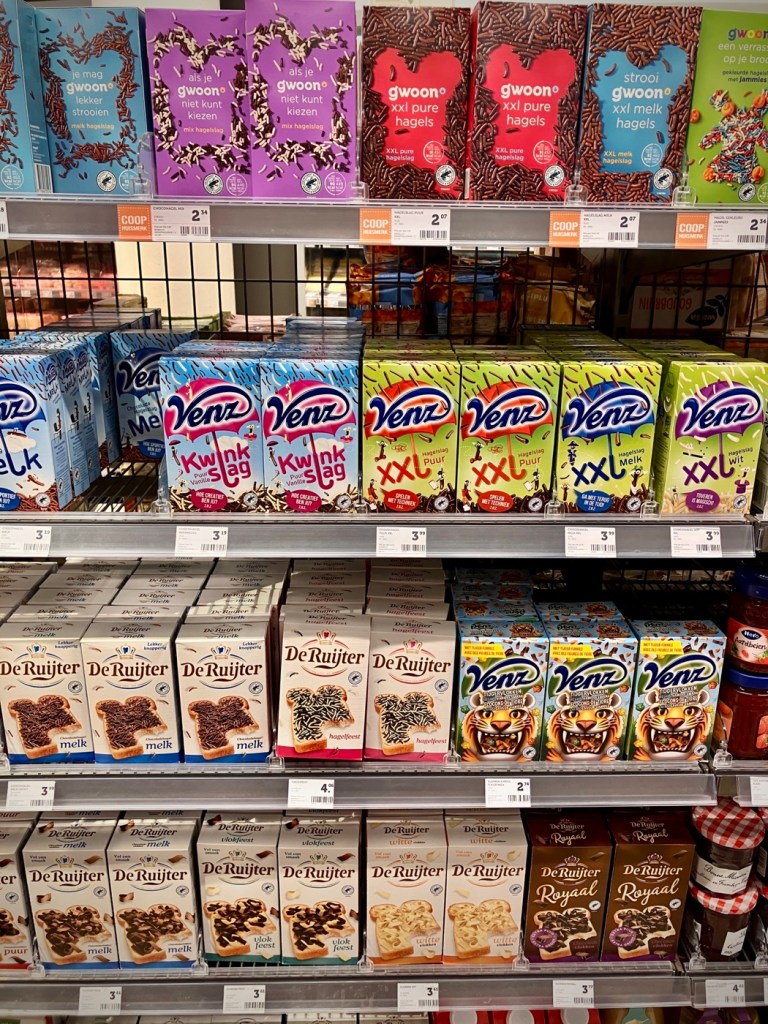
Even more toast chocolate sprinkles at the Coop to peruse…amazing how breakfast customs vary just a few miles over the border.Survived the end of a heat wave with just a fan at the lovely and historic Hotel au Quartier in central Maastricht. Still cool compared to India and Sri Lanka!
So after a difficult exit in Bonn with less than helpful commuters plowing into the train before we could get off completely and refusing to move, we headed out to ride 25k up the plateau to a little B&B room at the edge of Rheinbach. We were mentally and physically shattered, but managed to buy some groceries for an easy dinner at our room and our hosts helped us out by cooking the frozen pizza for us in their big oven.
More familiar flags and some pride and appreciation for the sacrifice the US made in the mutual defense and liberation of Europe.Great bike infrastructure continued as we crossed back into Flanders.Howdy train riders…this new Flemish bikeway is amazing!
So we headed out the next morning and I did sort of notice that the spot on my leg had continued to grow and was now over 4” x3”…hmmm? We made it to our next Guesthouse in Hasenfeld and decided, despite the heat; we’d walk down to try to see the lake. As we returned, we both realized my leg was brighter, redder, and the spot had a bullseye center. Yup, I needed to get this looked at ASAP, so asked the innkeeper about a taxi to a hospital about 30 minutes away. When I pointed to the red spot on my leg; she exclaimed in horror “Scheiste!” or some hybrid of shock in her German-Polish vernacular.
Reward for an 85k day goal reached; a short walk to a neighborhood brasserie for wine and a luscious Belgian beer near Mols, Belgium.The next day, a 75k meander to Antwerp primarily along the rural Kempenroute in Northern Flanders.
Her panic did not help. It was now Friday evening, but she was as able to get us a taxi to the urgent care clinic of the local hospital, and I was seen in less than an hour. The doctor spoke English and was pretty sure it was an infected bug bite (but not a tick) and prescribed an antibiotic course and ibuprofen. He recommended I get it looked at again in the bigger city of Aachen; where we planned to cycle the next day.
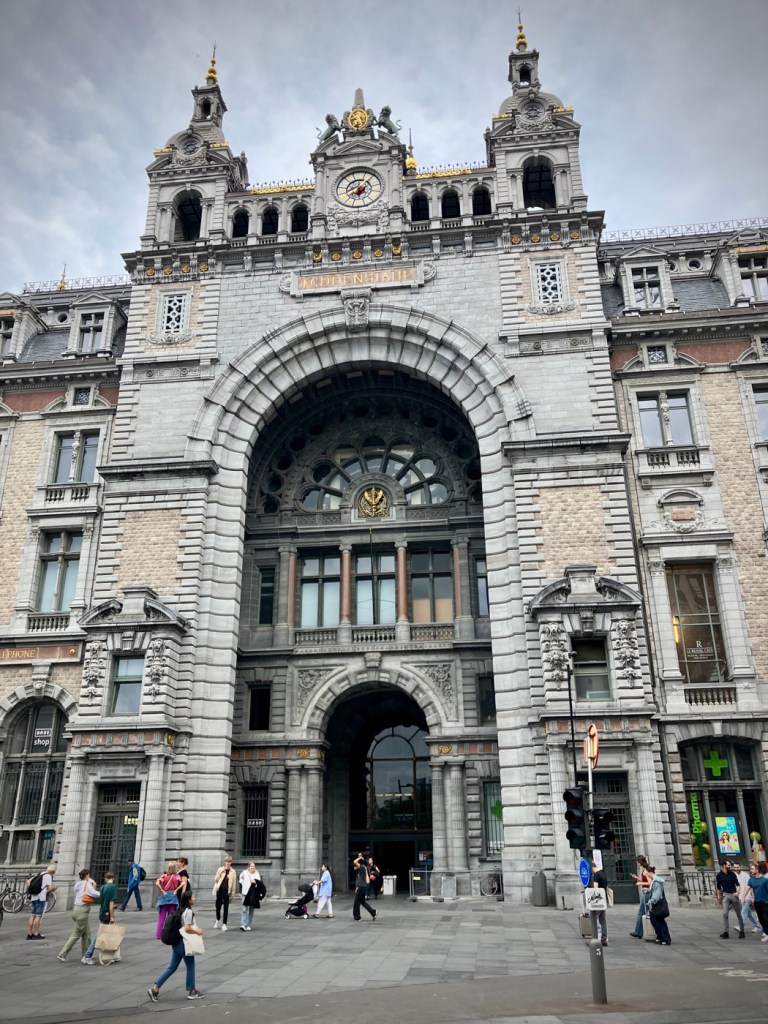
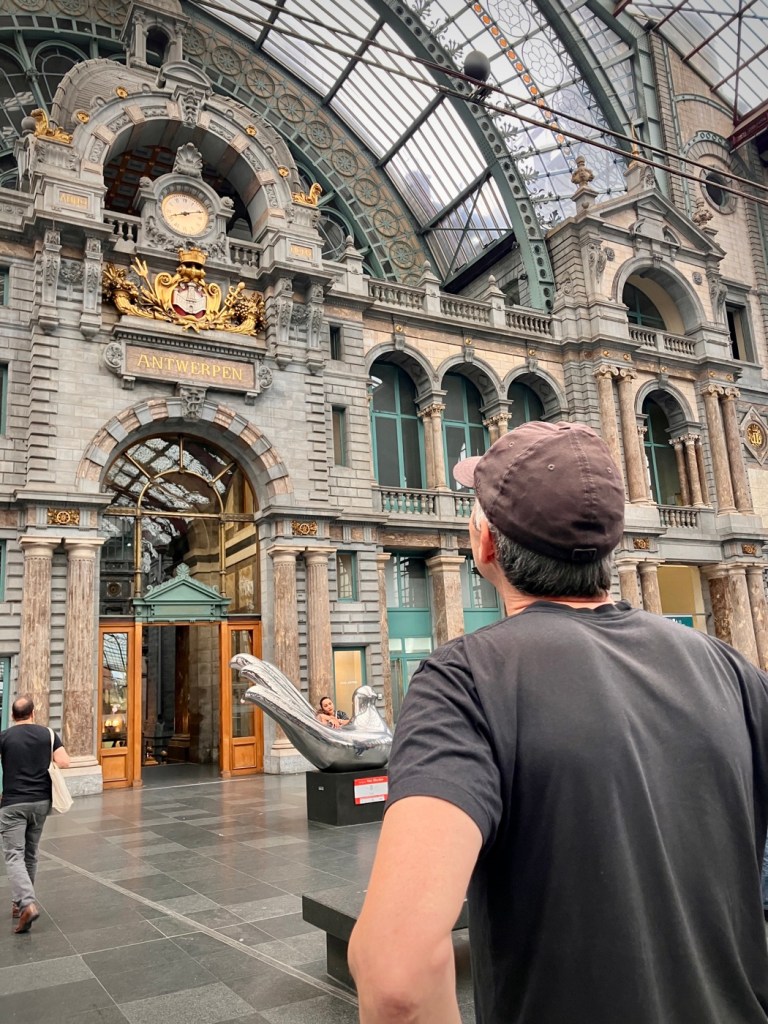
Antwerp Central.Now THIS is a train station. Wow!
Feeling mentally better with the antibiotics, we headed to Aachen on a scenic route along the Rursee, one of the largest reservoirs in Germany, and then up and over the next ridge, and finally a blissful coast down the Ravel rail route to Aachen. In Aachen, we visited another (more crowded) urgent care on Saturday evening and the Doctor seemed to have a different opinion on which antibiotic was best, so started me on another course, as well as some prednisone, to quell a possible allergic reaction to the bite. Given our (rushed/efficient?) 7 minute visit and her lack of spoken English (and super fast German), we are still not entirely sure of her opinion, but I did have a new prescription and was able to start on her advice the next morning. The amazing thing about antibiotics is how fast they work as I was already feeling better by day 2, and by day 3 the redness had dulled, and dissipated completely within the week. Not sure which antibiotic did the trick, but have been re-boosting on yogurt and other pro-biotic foods ever since.
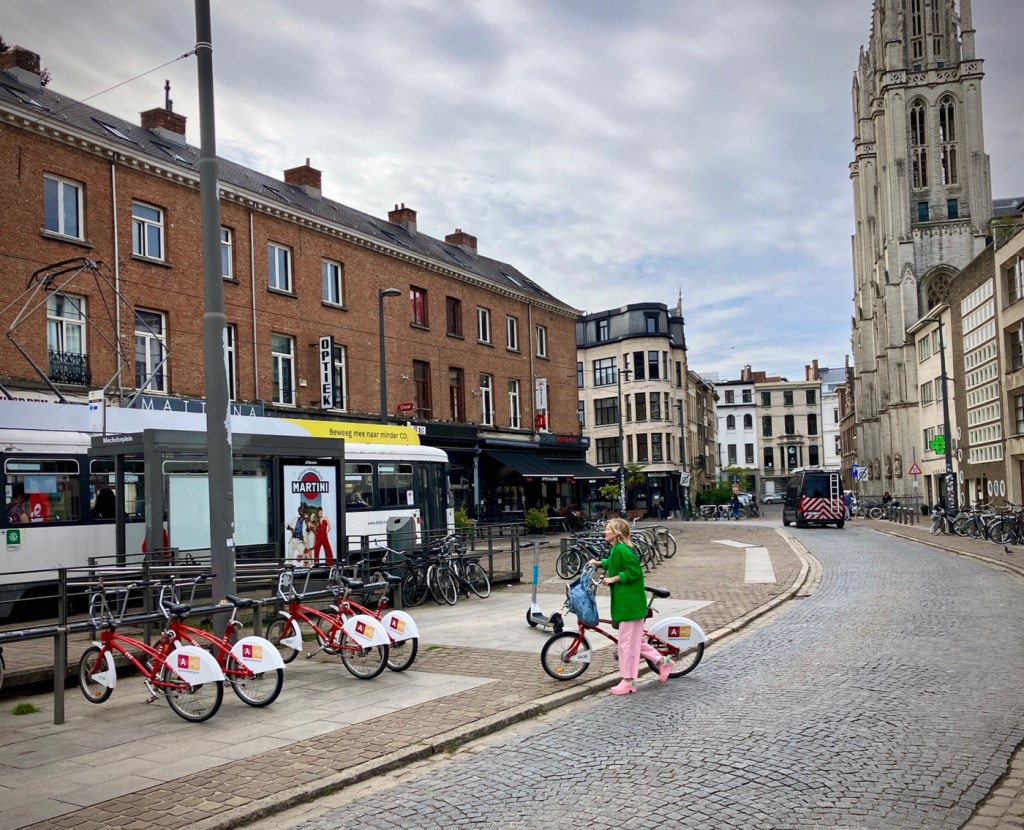
Multi-modal and car-light Antwerp.Streets are for people in central Antwerp. It was bustling in the center…just not in this morning photo -;)
So thank you again German health care system for your kindness to foreigners. And by the way, the TOTAL walk in costs, €70 (two urgent care visits), €40 (4 prescriptions), and €140 for taxis. No insurance needed. Yes, the taxis were more expensive than two urgent care visits and drugs.
The recently renovated and highly recommend Royal Museum of Fine Arts in Antwerp puts the Dutch Masters in context with modern works and a great audio guide App.The port area of Antwerp… with two ships on the horizon? Nope, on the right is the stunning Port House designed by the late Zaha Hadid. On our list to visit next time! Sculpture snack break.
So after a Sunday rest day in Aachen, we headed out on our journey towards the Belgium border and had a great ride to Liege, in the Wallonia region of Belgium. Liege has a lot of potential and we didn’t get to explore much in one night, as the whole city is pretty much torn up for a massive streetcar and streetscape redo well into 2024. From there we had an easy ramble down the Maas river to Maastricht, dipping into the dogleg of the Netherlands for a night.
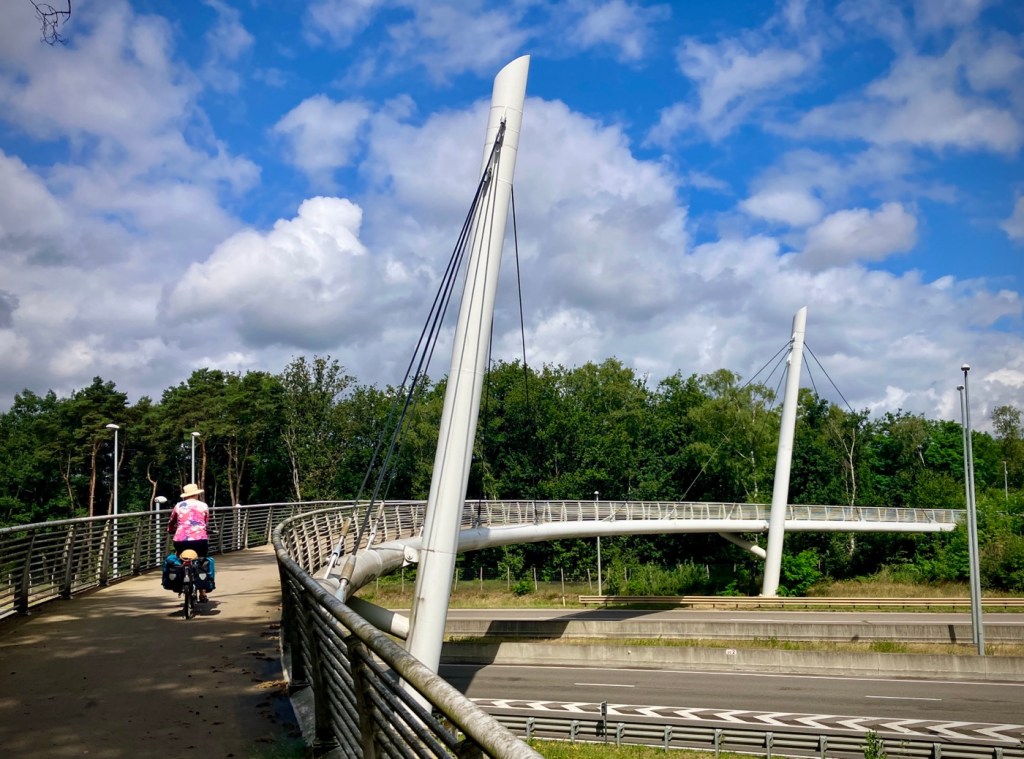
This “bikeways first” rural road layout makes car drivers work it out in the center while bikes get two wide lanes.And bridges AND tunnels designed with separate bikeways.Crossing the Oude Maas River near Dordrecht.Mind the freighters please.
Maastricht is a lively Dutch city dominated by a young (est. 1976) but highly respected state university. The vibe is very international, especially as over half the students are foreign. Feeling 100% now, I next plotted a 160k two day route to Antwerp across northern Flanders. We noticed that the bike infrastructure in Flanders is nearly equal to that of the Netherlands, as there has been a huge push to catch up to that high standard the past 20 years. Belgium also felt a bit more sophisticated and gourmet than many of the smaller places of Germany and Czechia we had spent the last month.
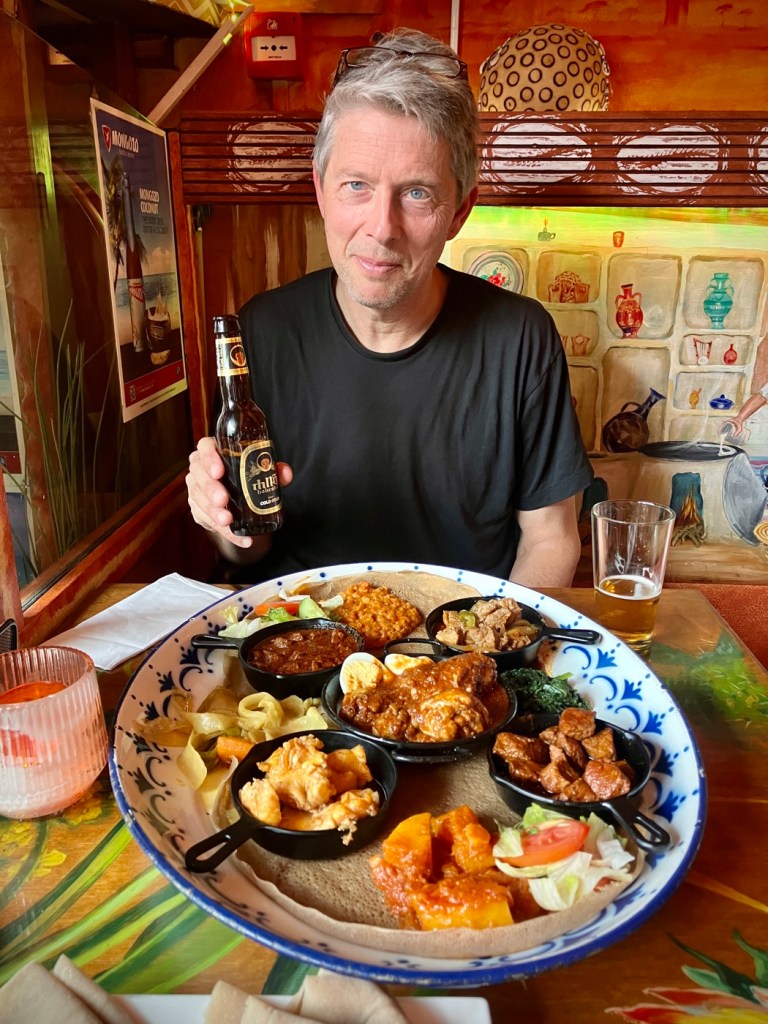
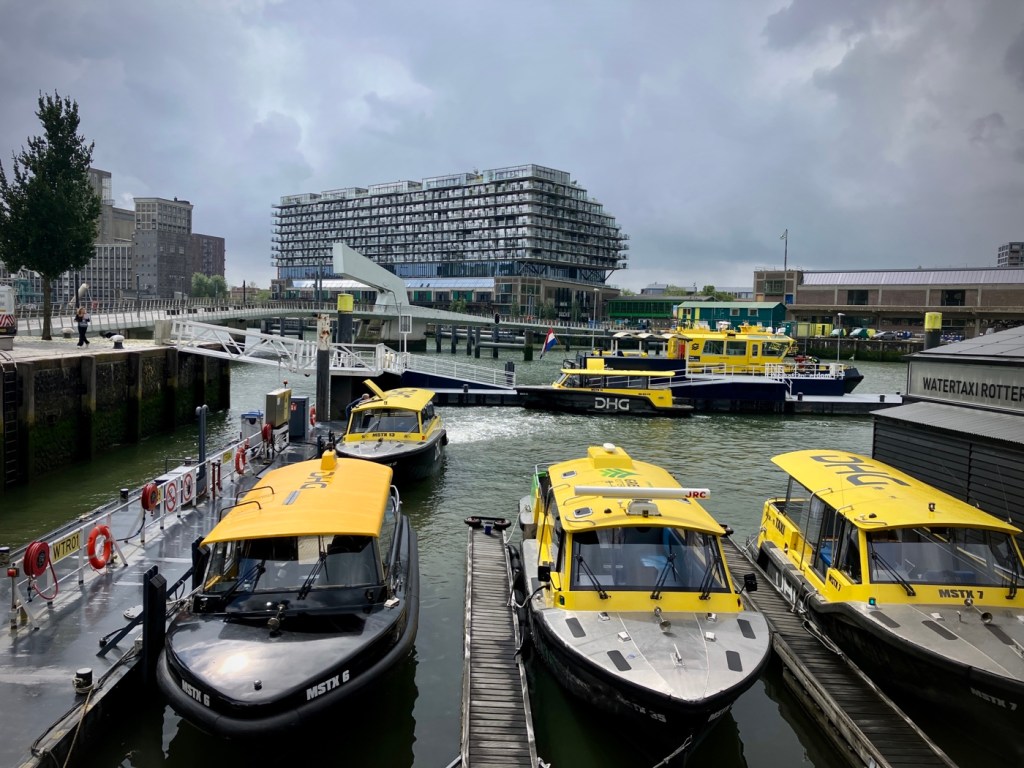
Enjoying the culinary diversity of Rotterdam at Restaurant De Smaak van Afrika.And more traditional, but delicious fare at Cafe Pierre; Dutch bitterballen, mushroom risotto, and a goat cheese and fennel tarte tartin (frites and bier a given…)Rotterdam is the largest port in Europe, so bridges, tunnels, ferries, and these typical water taxis provide key links.
I think Antwerp is one of the underrated and overlooked gems of Europe. It’s bustling, has amazing architecture, great international food, pleasant neighborhoods, and fantastic museums, such as the KMSKA and Red Line. From there, we rode two days to Rotterdam, another interesting city, although more focussed on the future and modern architecture as it was completely rebuilt after the devastation of WWII. Yes, we love the “B cities” of Europe, especially in peak tourist season. You get a more genuine experience with fewer crowds. And you can you usually get a seat, even at the most popular cafes.
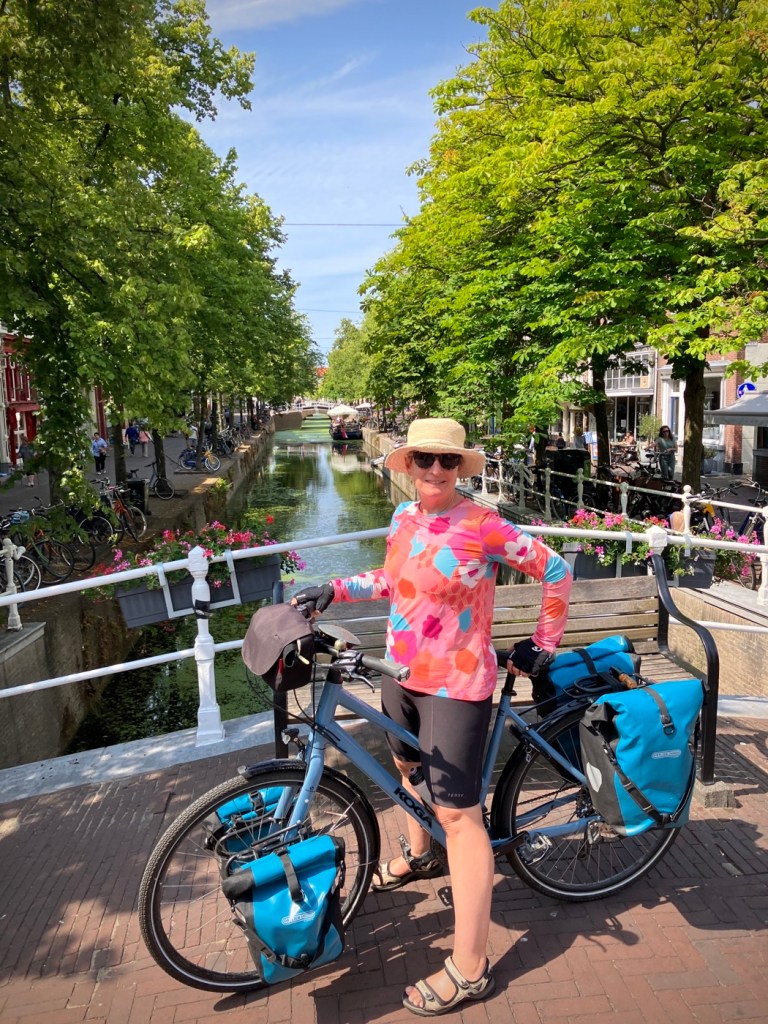
Off again towards the Hook of Holland.Time for a quick sightseeing ride around Delft on the way to our night ferry.
Our rest day in Rotterdam was well timed as heavy rain came through, perfect for exploring the Harbour areas and fantastic Dutch Photography Museum. The next day, we finally set out for our last destination on the continent, the Hook of Holland, for our overnight ferry to the UK.
Water on all sides; about a quarter of the Netherlands is below sea level, yet somehow seems closer to the sky.
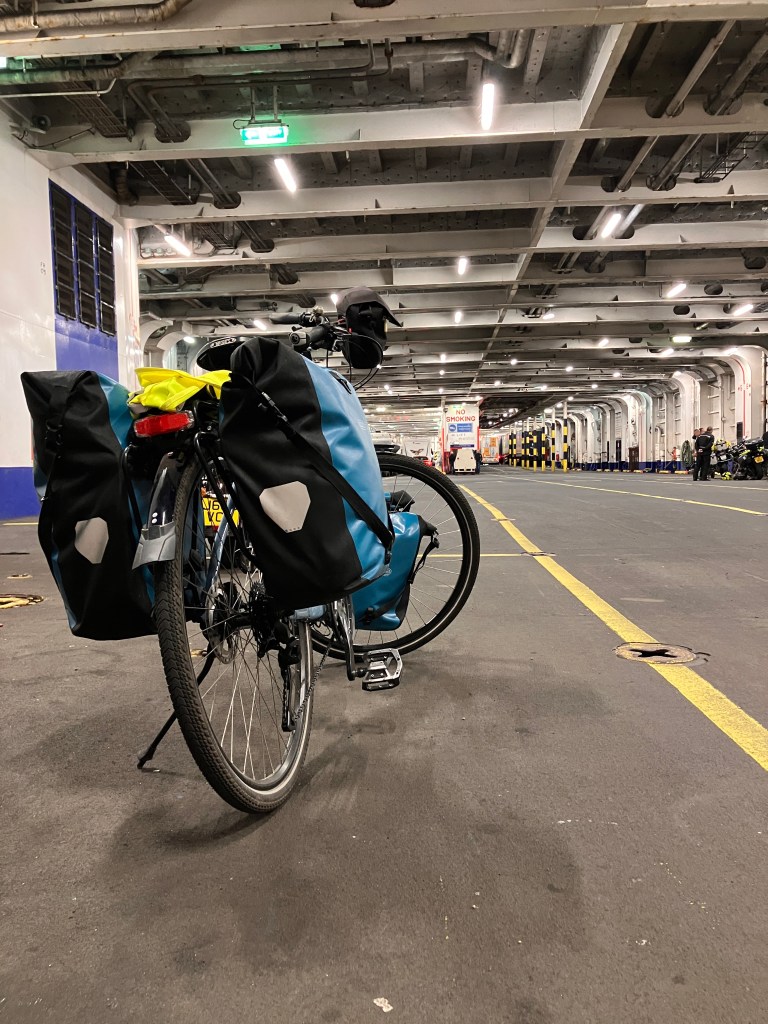
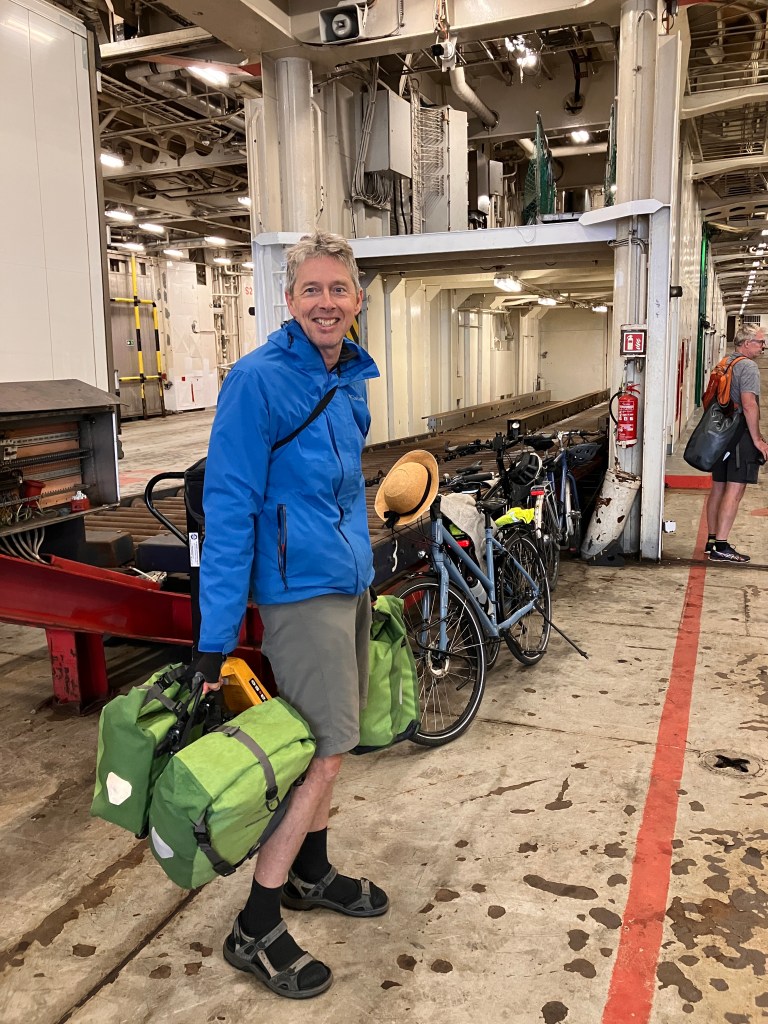
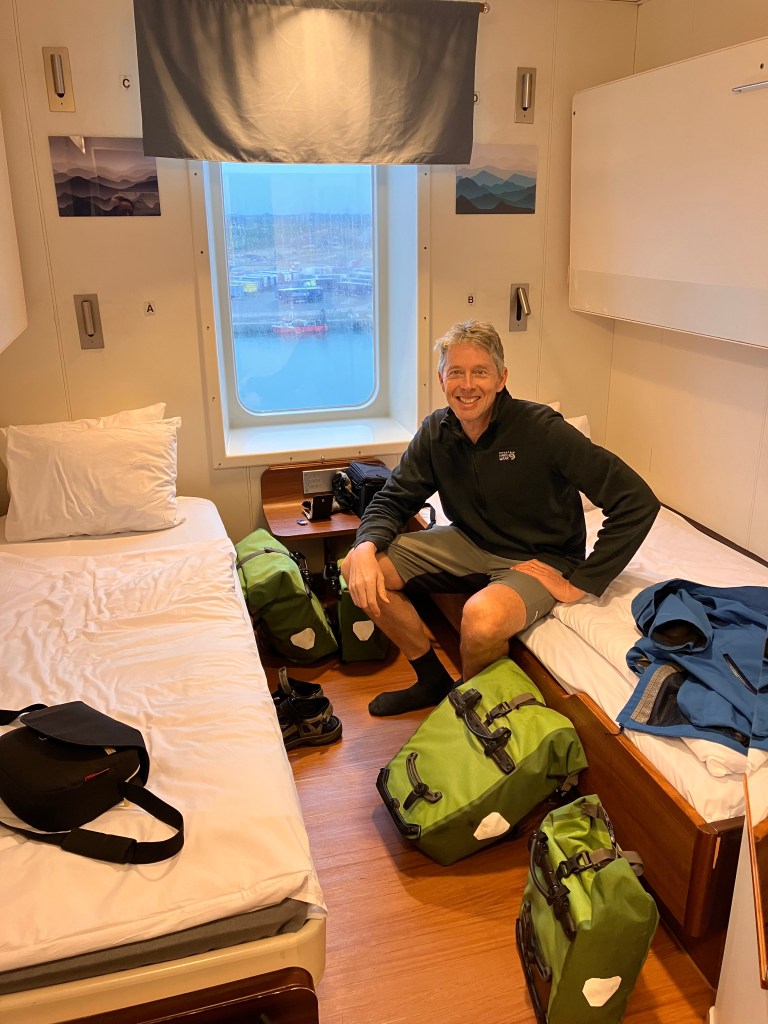
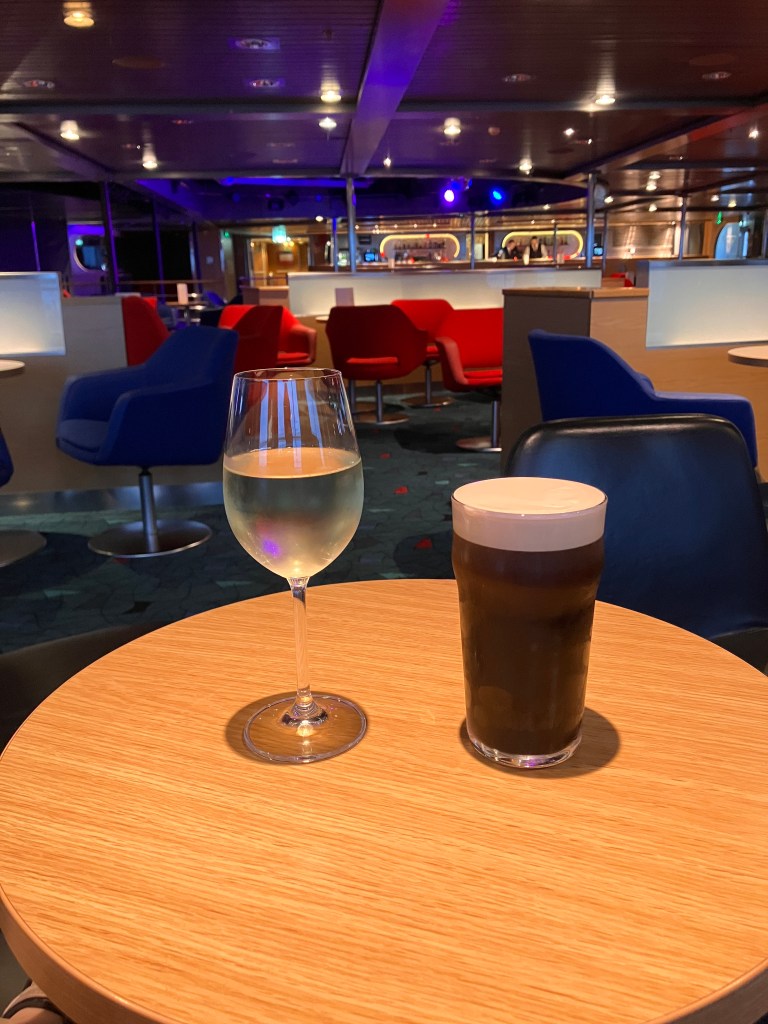
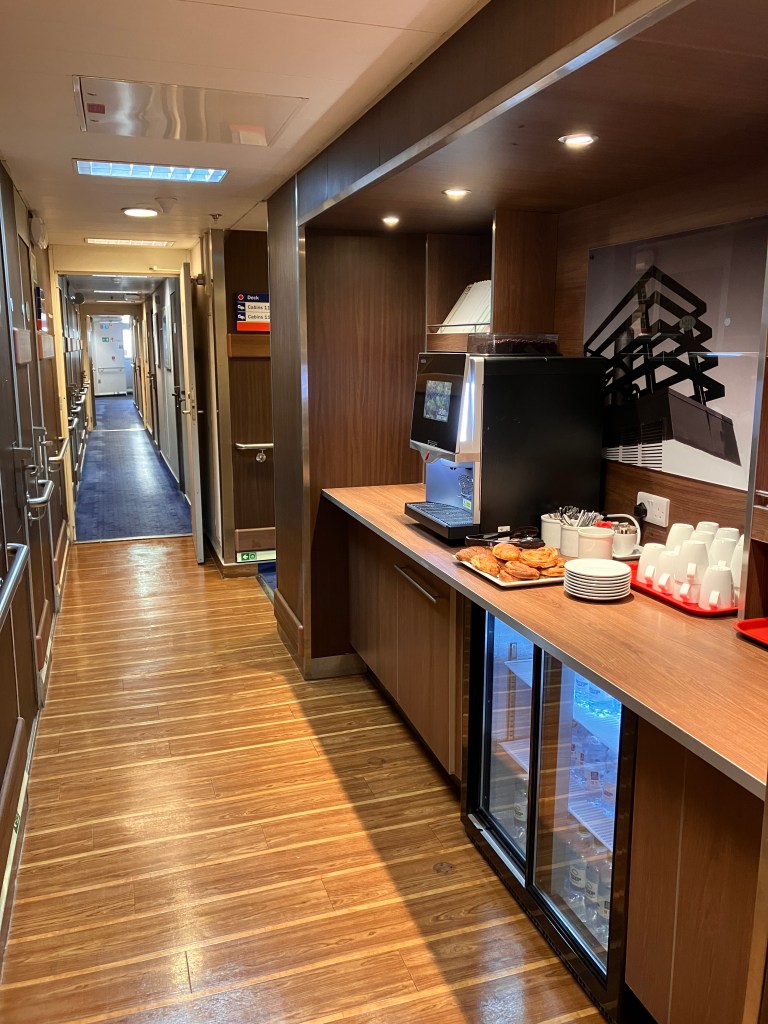
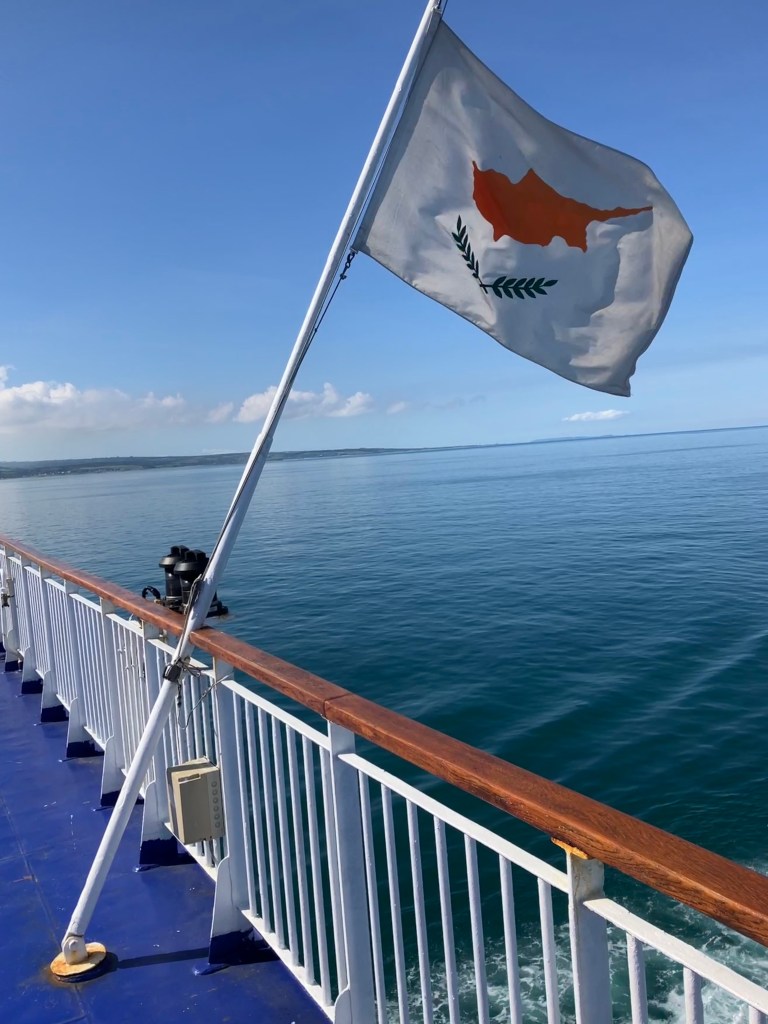
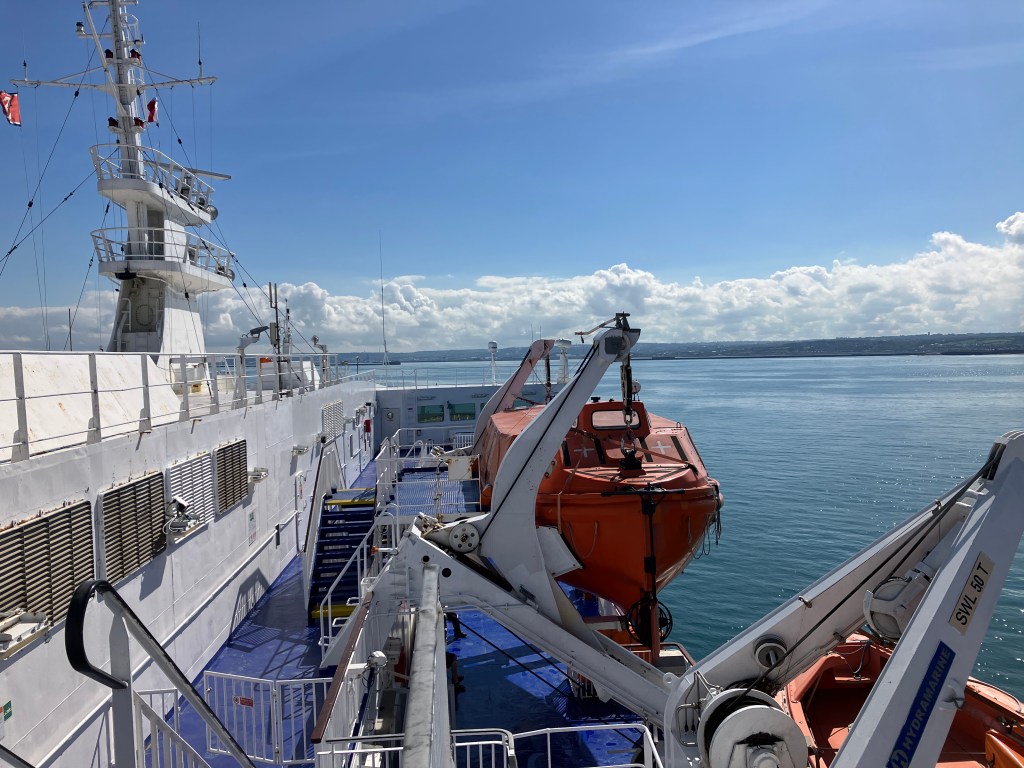
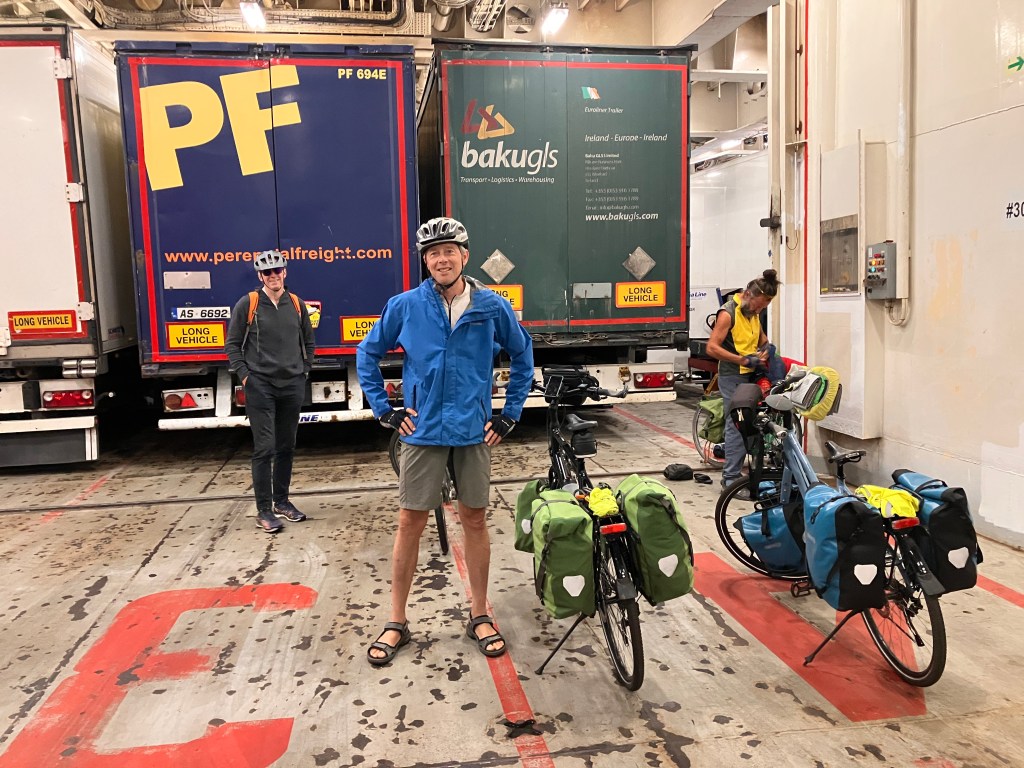
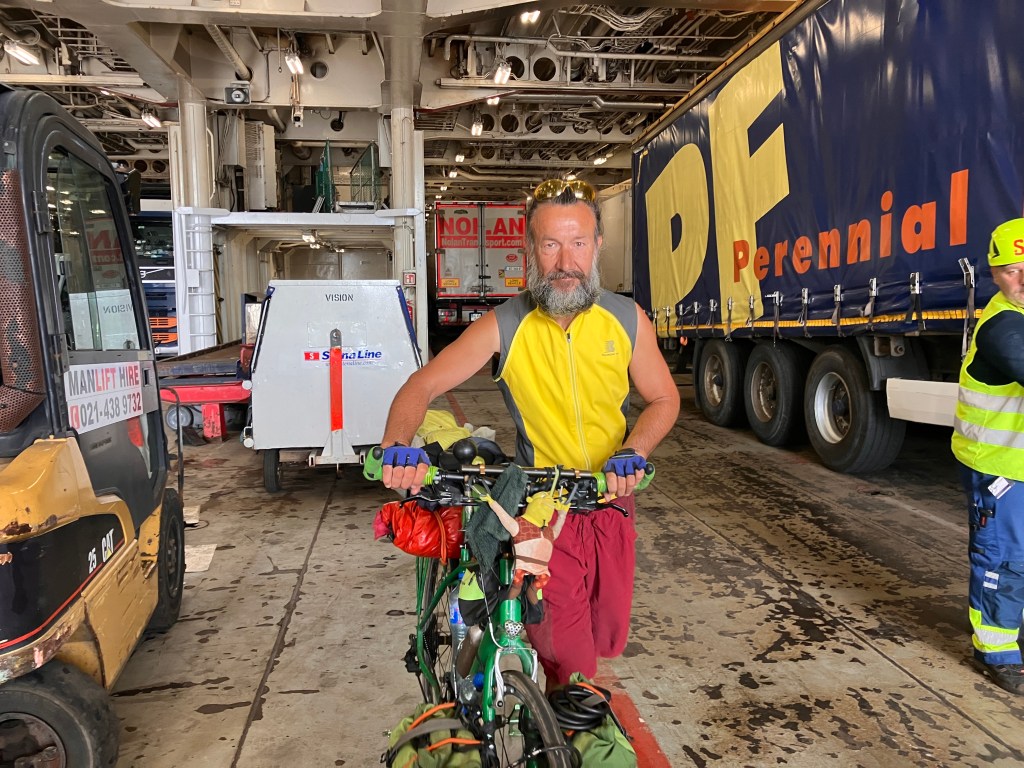
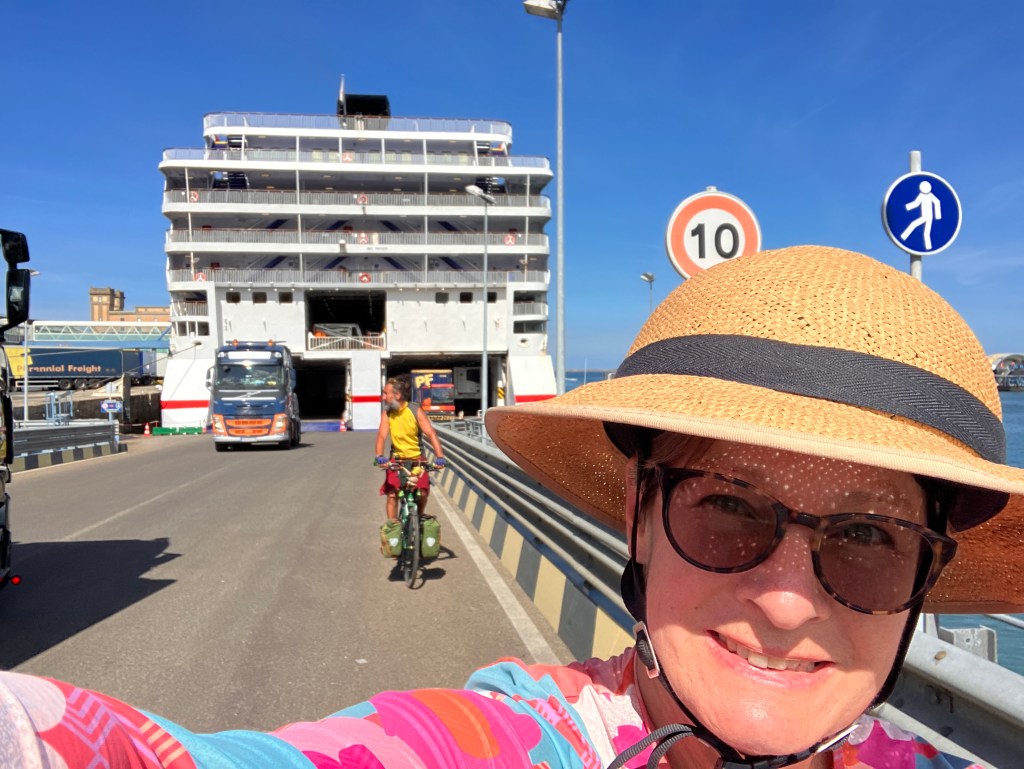
This is our favorite crossing to the UK as the Stena line is well run and bike friendly. You check in with the cars and ride onto the main car deck to park your bike, and then plenty of time to enjoy a drink in the bar, have dinner, and catch sunset as the ship sets out about 10pm. Then up to your cozy cabin to sleep. And then cycling off the ferry to our next adventures. Stay cool and note our next post will be soon!
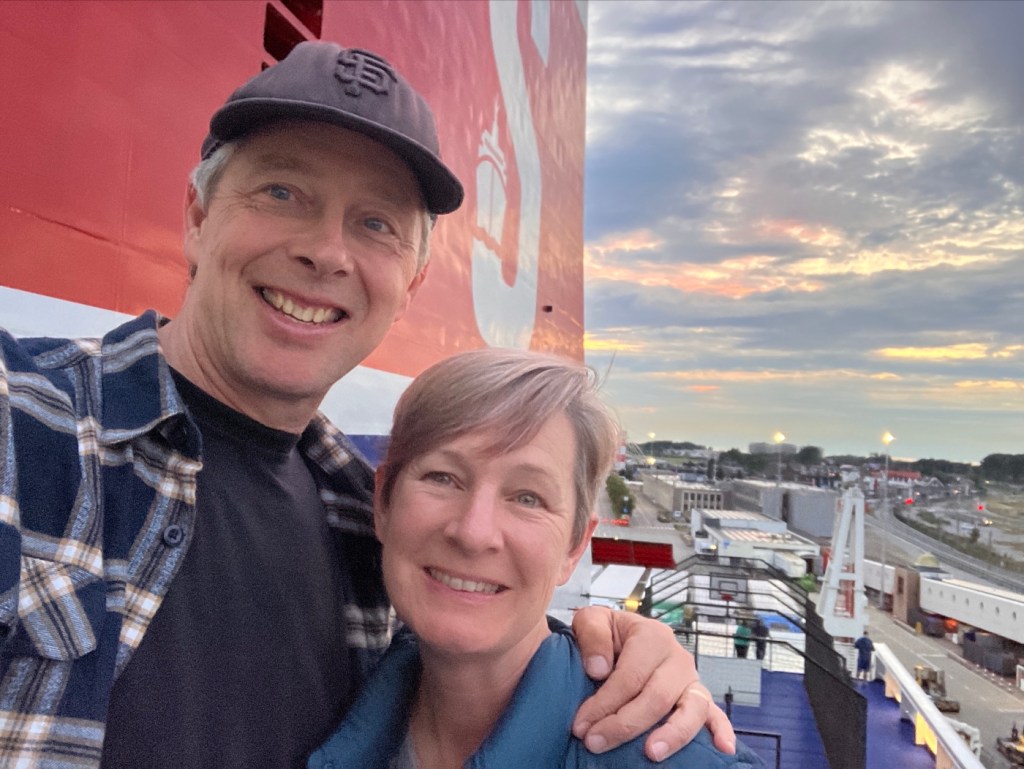
Enjoying the late sunset with my favorite traveler as we pull out of Hoek Van Holland.
Sunflowers starting to bloom in the Moravian region of Czechia. They are raised as an oil crop. And are lovely to look at.
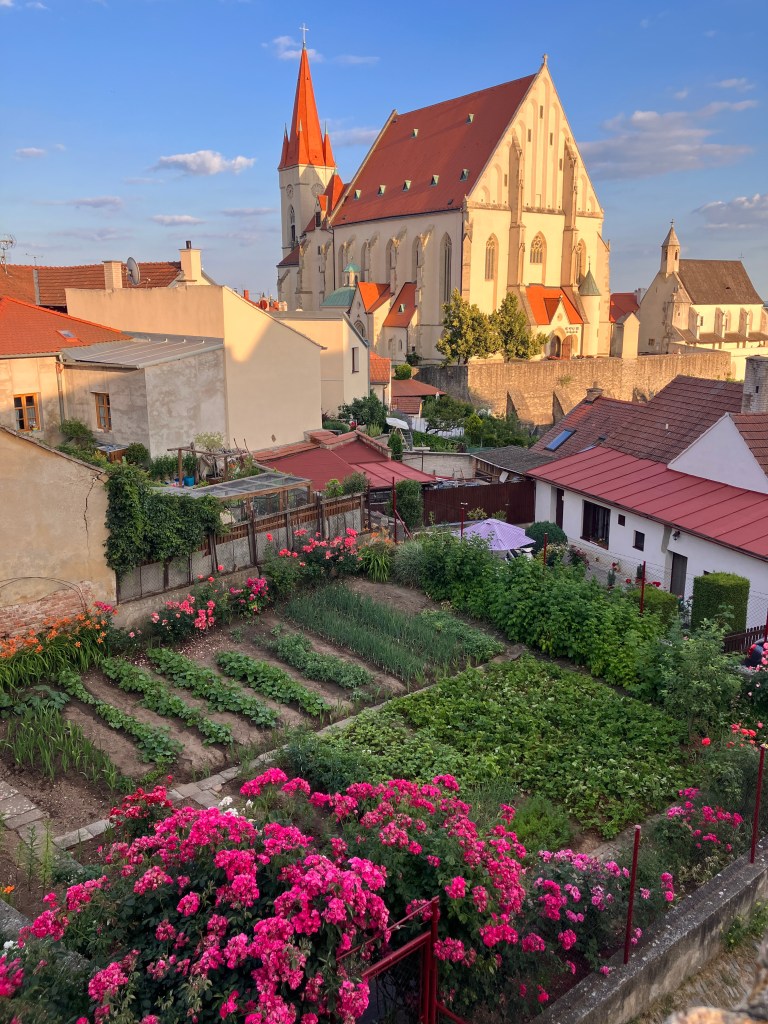
Bicycle touring is tiring. Our rest breaks in Český Krumlov and Znojmo were so lovely we decided, after a few more days riding, to take another break in Brno. As with Česky Krumlov we were just amazed at how beautiful these towns are. Although the country has a tumultuous history, most Czechia towns and cities were relatively unscathed from bombing during WW2.
Rich riding by Vranov nad Dyjí Chateau. So many stunning historical buildings.Znojmo in the evening sun. Rich relieved to have found a gap in the fence and hedge to complete our detour away from a busy road. We were too busy trying to avoid the farmer and his haying machine to get photos of us crawling and pushing the bikes through the hedge.
Hmm…sounds like a lot of rest days, you may be thinking. Well, once we left the relatively quiet and empty region of Bohemia the roads started to get busier, and the car drivers faster and less careful around cyclists. Our day into Brno was pretty awful, a busy rural road with many trucks and no shoulder, long stretches with no towns or trees, but thankfully no head wind.
I usually have this Bluetooth speaker on my handlebars to listen to music or podcasts, the flowers I gather to amuse myself.A tiny bee appreciating my tiny bouquet.
Once we got to the true outskirts of Brno we were on a cycle path again. Czechia has a lot of recreational bike riders, a lot of folks in road riding gear (mostly men), who ride fast. As we know from our bike activism in the US, women on bikes are an indicator of how safe and accessible places’ bike infrastructure is. And families. Parents with children in a cargo bike or on their own little bikes is a good sign too. We saw a few families coming into Brno along the Svratka River, but our hopes of a cycle friendly city center were not to be.
“Common path Be careful” Well, it’s something. Another lovely Czech old town square in Brno. The deck chairs were a nice touch, folks were enjoying the evening. So we did too.
We both know firsthand from years of activism and professional work the many challenges that face a city trying to become more bike and pedestrian friendly. Our own city, San Francisco, has come a long way but still struggles to make changes to the streets, fighting against the conventional beliefs that cars must have unfettered access. So we understand how hard it can be to create safe welcoming spaces for people on foot and on bikes. In many cities we joke that we should stick around create a bike and pedestrian advocacy group, Walk Bike Brno (Procházka Kolo Brno) has a nice ring to it. But there is the language challenge, and the irony of two Americans lecturing any place about sustainable transportation.
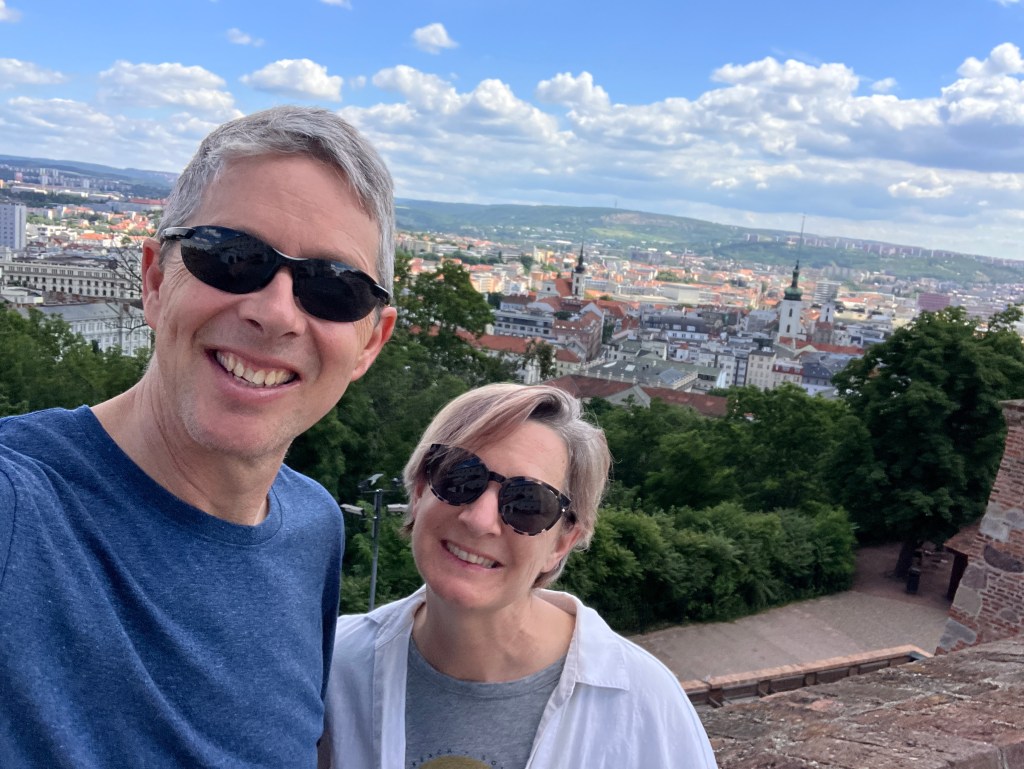
Špilberk Castle, a lovely view spot and a good cross challenge for our leg muscles that are too focused on cycling.Ouch. We’ve learned the hard way to make sure we hike on our days off the bikes. Špilberk Castle was a good hill climb.
Brno is a perfect candidate for a Copenhagen style makeover, or even a San Francisco style makeover. It’s pretty flat in the core of the city, loads of Universities, trams and buses, not a great pedestrian environment due to long traffic signals and missing connections, and really no bike infrastructure. But despite that there is a bike culture. And lots of folks walking. They could harness what they have and create a more walkable and bikeable city. Sure, the first thought is about the cost, but as Copenhagen has proved, cities get a better return on their investment from bike and pedestrian projects than car projects.
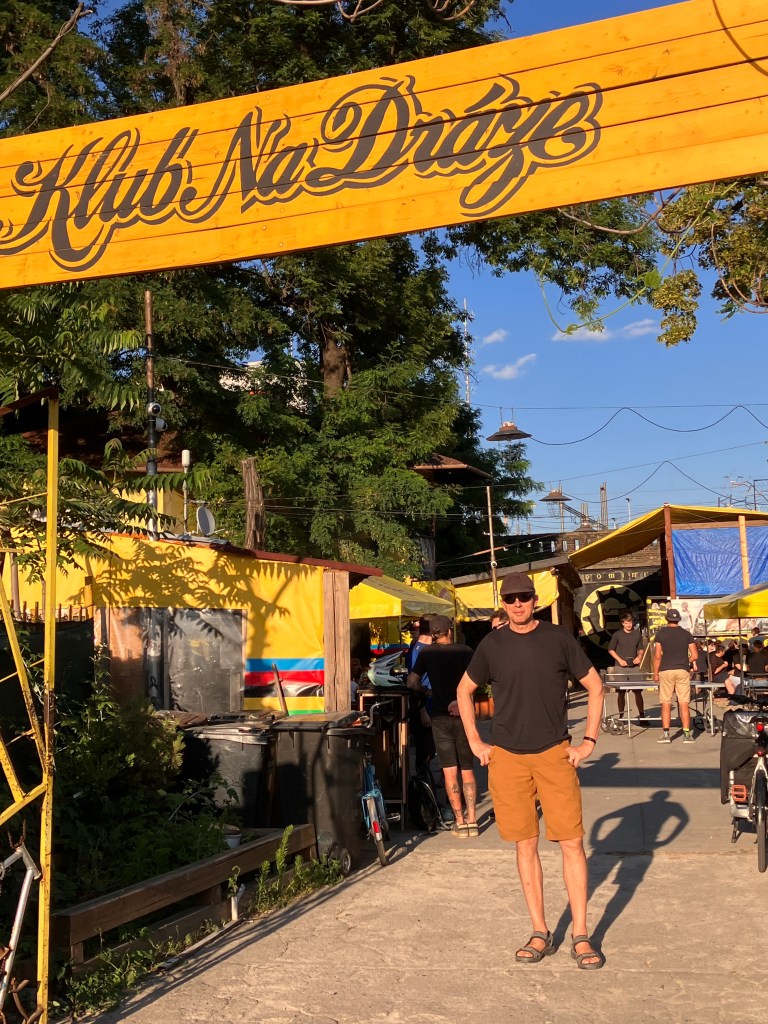
Our new favorite bicycle focused bar. FBB Klub Na Dráze (Club On The Track) proof that bicycle culture is alive and well, and very cool, in Brno.
When we get to small cities like Brno, population 380k, we appreciate how quirky culture and experimental businesses can survive in a place which has not suffered the homogenization of wealth. We look back to San Francisco, which we love dearly, but which has changed due to loads of monied folks. And the subsequent pushing out of less monied folks. Many of our favorite places and favorite people have been priced out of SF, or they left to have a more complete life elsewhere. Sometimes while traveling and enjoying a bar or restaurant we say to each other: this business could never exist in SF (or name another A list city with space and money constraints). Or if it did, it would be so expensive we wouldn’t go to it.
After the bicycle bar it was off to Bar, který neexistuje (A Bar That Doesn’t Exist).The cocktail menu was lovely. My rum based drink.And Rich’s whiskey based drink. To save you from having to do the math, $23.70 for two cocktails.A bartender using a rolling ladder to get to the top shelf liquor. Not our usual kind of evening, but the joy of travel is sampling different things.
With the sad realization that we didn’t feel very safe cycling in the south Moravian region of Czechia, we bid a fond farewell to Brno and headed to the train station.
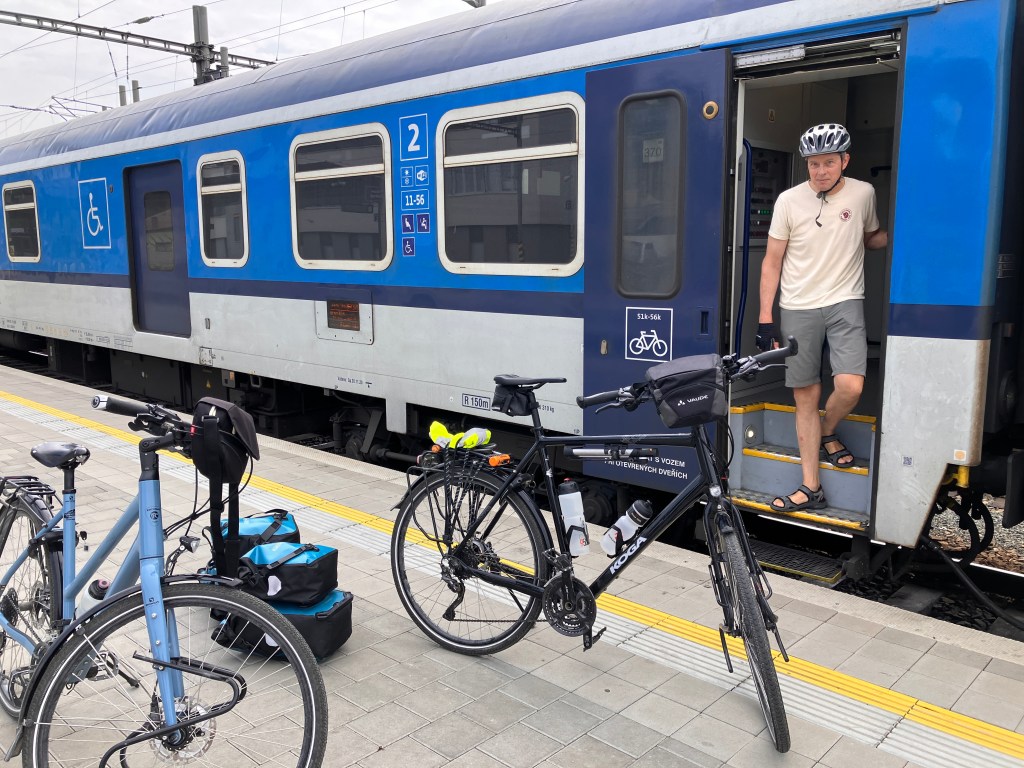
Goodbye Klub Na Dráze – keep it real.Hello train dance with loaded touring bikes! High boarding trains means removing the bike panniers. Those steps are not easy with a bike.
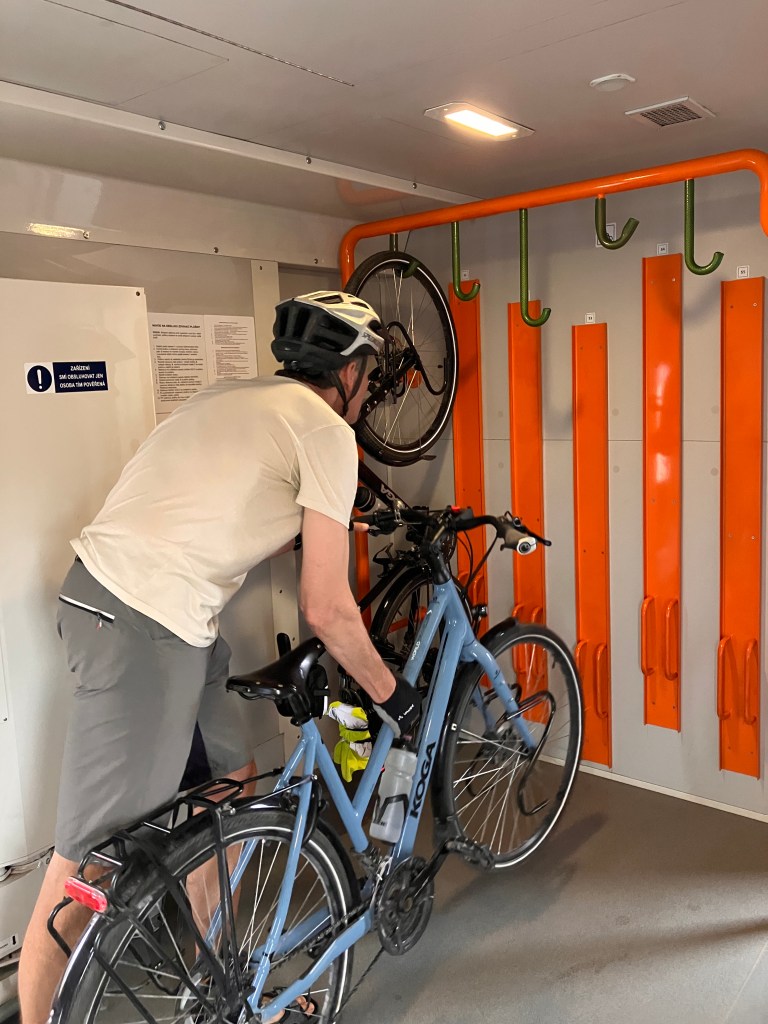
Rich does so much good work figuring out our cycling routes and train hops. If we can we get on a train at the start of its route, that allows us to get to the station early and load the bikes on the train before most folks show up. This is especially important if there is limited bike space. The Czech train did have on line booking of bike spaces and seats right near the bike space. Rich also booked the two bike slots far left, closest to the train wall, less chance of our bikes getting banged around by other bikes and train movements. These are the details that make our train travel days a bit better.
Rich getting the bikes onto the hanging hooks. Could I get my bike up there myself? Maybe.Settling in with a fully charged Kindle for our six hour train day. Oh yes, I got a haircut in Brno too. My first since Bangkok in January.
A must have for train days is food, charging cables, and an extra power source in case the outlets don’t work – which these didn’t for several hours – which also meant the AC didn’t work, and the windows don’t open. Made for a slightly clammy journey. And I don’t think we or the other three cyclists were at our freshest to start with. The one empty unreserved seat in our bay of six seats was eyed by a few people, but something kept folks from choosing it… It was all of us! We were stinky cyclists.
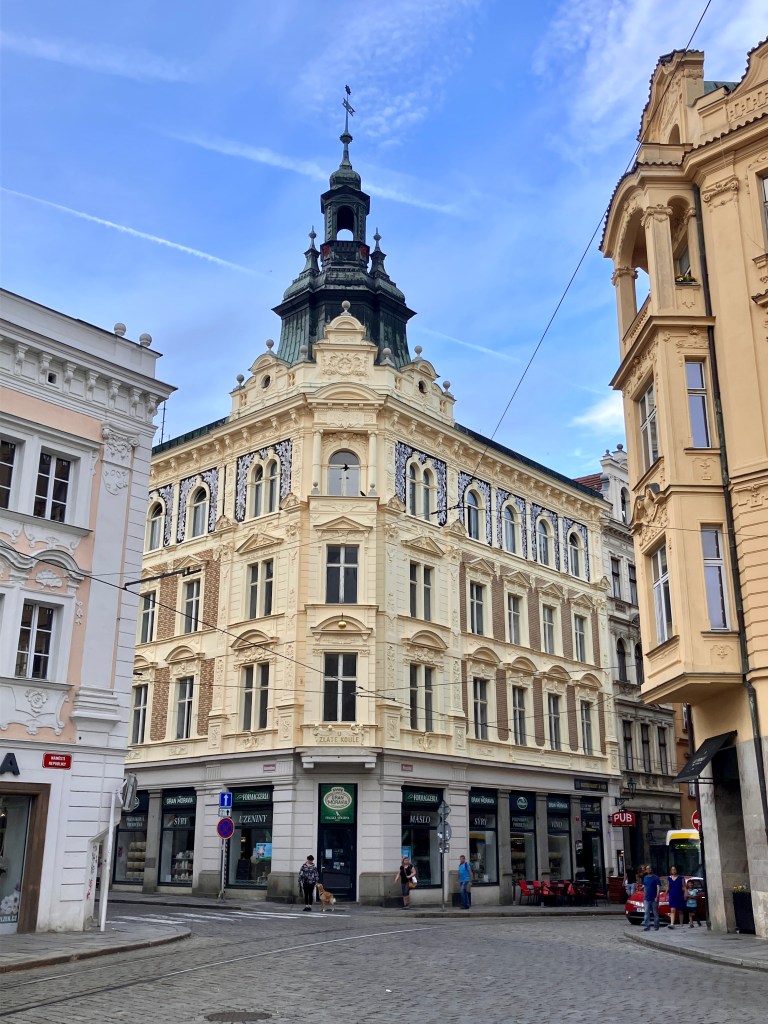
One night in Plzeň. Enough time to walk around, admire another beautiful historic square, and have dinner.Plzeň is the home of the famous Pilsner Urquell Brewery, but we were happy just walking around and skipped the brewery tour.It’s a tough time for a Tour de France fan to be traveling. Rich isn’t always able to stream le Tour, but if he can’t, we watch the wrap up show.
Our next hard date is July 18th on a ferry from Hook of Holland to Harwich, so another train hop was necessary to get us closer to the German border. So enough musing about bike infrastructure and affordability, let’s get off that train and ride.
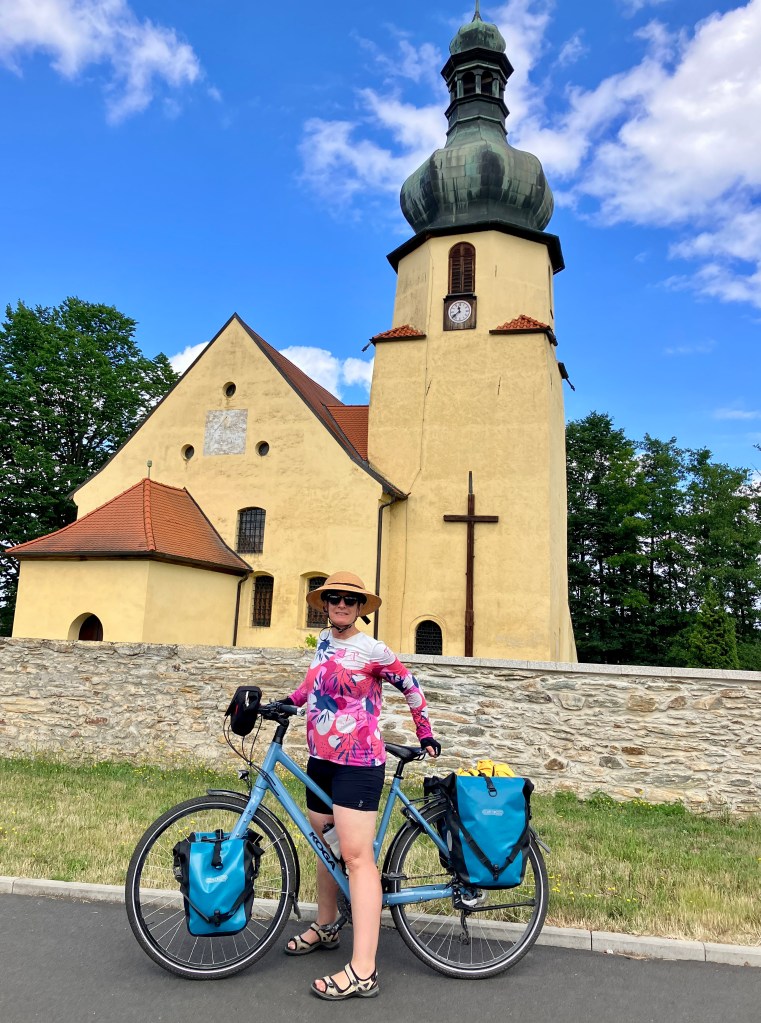
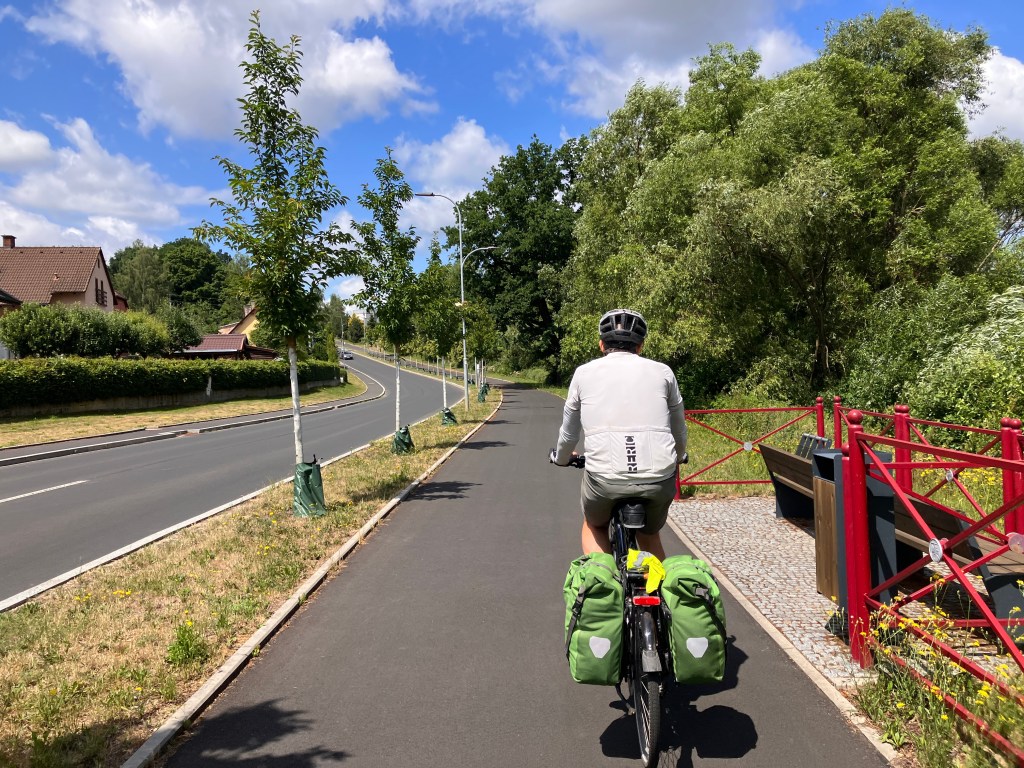
Off the train at Cheb, Chezchia, and back on the bikes. One more lovely Chezchian church and off we go.And look at that. New bike paths. And newly planted trees. Yay Chezia! I joked to Rich – maybe they’re starting at the German border and working in. Look at that signage. So many bike routes. A sign like this makes us both very happy.
We’ve been amusing ourselves by noticing the license plate country registration as drivers pass us, and we can reliably predict when a driver is German vs. Chezch. The German laws have been updated to mandate a 1.5 meter passing of cyclists, and bless those German drivers, they do leave that passing distance even when driving in Czechia. So, we were happy to cross to Germany and feel safer on the roads. Love you so much Czechia, but you’re not a fully realized cycling destination yet.
Back in Germany. After a long climb up to Fichtelsee we were so happy to have a lovely dinner at the hotel, Hotel am Fichtelsee. It’s a relief after a tough ride to have dinner right at your hotel. Such a tranquil alpine lake. The ducks were cruising over hopefully. Sorry guys, no treats for you.It stays light quite late, so we always have enough daylight and energy for an after dinner stroll.
Even though the distances we cycle in a day seem quite short compared to driving a car, we feel so immersed in nature, thanks to the good bike path network in Germany. The routes keep you away from major roads as much as possible, and when you do need to spend time on a road the speed limit is frequently lowered and drivers do exercise caution. A hill or ridge that you might not notice while driving a car, we feel with every pedal stroke up, and every gleeful down hill coasting moment.
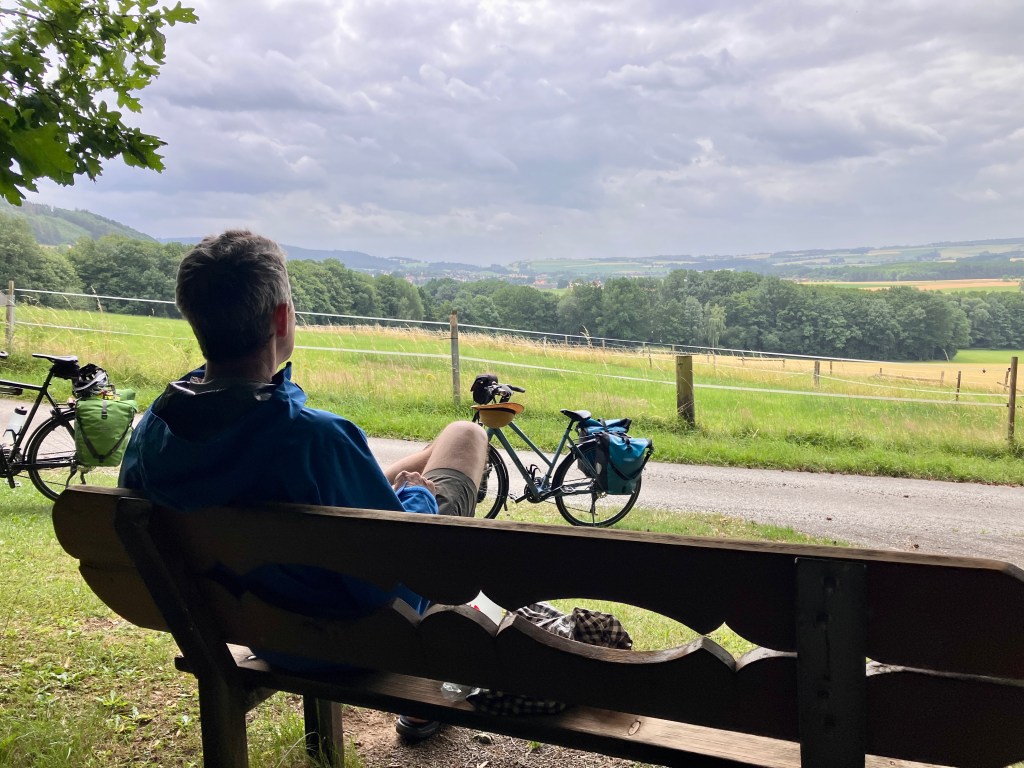
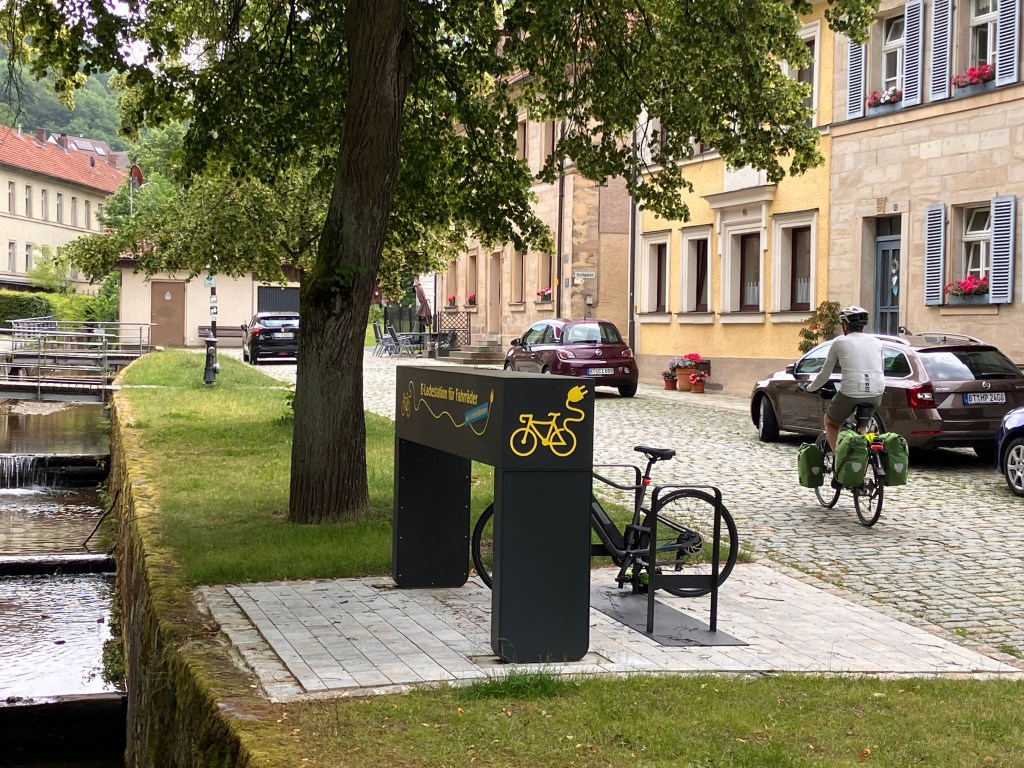
A perfect morning start, coasting downhill in the Neubauer Forst-Nord.We both love the green forest scenery. So different from Coastal California. A nice bench for a break near Bad Berneck im Fichtelgebirge. Our bikes are powered by muscles (and pastries) but I do appreciate the thought that goes in to providing charging stations for the many e-assist bikes in Germany. In Goldkronach.Ripening fields of grain. Back on the train! Taking full advantage of our German 49€ monthly ticket. Bike Lodge Spessart, outside Lohr am Main, had everything we needed after a long day of trains and pedaling into a headwind.Ready to roll. 80 km day coming. Quite flat along the Main River but that headwind would not leave us alone. Riding down the river you get glimpses of history, and it’s easy to pull over and enjoy the scene.
Bicycle touring strips you down to basics. You need food and lodging. Unless we have a rest day we don’t really do any cultural activities. But we see so much. The hours on the bikes looking at the river, or winding along vineyards, or searching for a place to stop and have a picnic lunch, are very elemental. Once we get to our destination we want a shower, some food and drinks, maybe watch a Netflix show on the iPad, and then we sleep as if we’ve been dropped to bed from a high height.
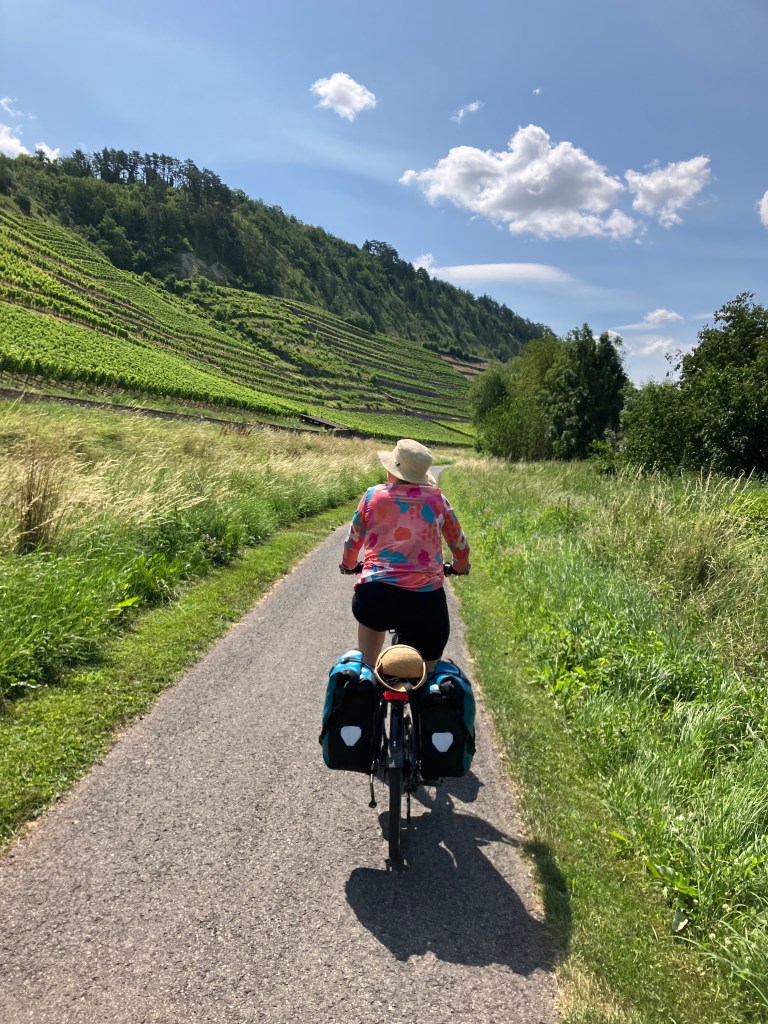
Riding down the Main River towards Miltenberg.We’re entering a wine region where one of my favorite German white wines is grown, Silvaner.Our goal in getting to Miltenberg was to get close enough to meet up with Beatte and Alex. Mission accomplished- thank you both very much for a much welcomed social break.
We have just a few more nights in Germany before we reach Belgium, and then the Netherlands. We need to get our new touring bikes to a Koga dealer for a tuneup. We’ve already ridden about 1,100 kms/800 miles on these bikes, and that’s tuneup territory. So off we go! More from the road later.
The happy and tired travelers, enjoying an after dinner walk after a long climb up to Fichtelsee.
The scruffy charm of the South Bohemian border town of Vyšší Brod.
After 10 days of breaking in our bikes, too much headwind, and a busier Danube bike touring scene, it was time for something hillier and wilder. So it was with double excitement we approached the hills and mountains separating Bavaria and Czechia. First of all, I love to cross land borders versus flying into a place. And, we both prefer the challenge of some hills in our bike tours. Well, maybe not this many hills…
A German farm road ends and the trail heads into the woods.“Over the river and through the woods to Czechia we go”.
When you cross on foot or bike, you really appreciate the significance of a border. So, as we joined Eurovelo 13, the Iron Curtain Trail, and approached the former border with the Warsaw Pact nations of our childhoods, there was still an excitement.
Suddenly a border marker where a barbed wire fence use to stand.Lush wooded highlands of the Plezn region of Sumava National Park.
We both fondly recalled a light snow falling on us 17 years ago while crossing a pass on foot with our backpacks into the younger Czech Republic outside Jelenia Góra, Poland. We got dropped by a bus on the Polish side and then walked down into Harrachov on a wooded fire road. It felt magical and adventurous.
Cheryl celebrates a high point after a very steep climb….we were ramping up fast to the relentless climbs of the region.
Many of the border crossings are now quite ordinary as developed roads have been upgraded and offer seamless connections in the EU. However, the old edges of forest, mountains, and remote villages on each side of the old divide still show scars from the divide of nearly 45 years. Isolated and cut off from either side, with strict controls on who could be near the border on the Czechia side. Many small villages have come back to life after abandonment or use only by military personnel. Many are ghost ruins and have never come back.
A promised tea break at the mythical Černé Jezero (Black Lake).The signature National Park in SW Czechia.The reward of Day 3 in Southern Sumava; beutiful river views, gentle grades, and buttery new pavement.
Consequently, this region also makes it a great place to see wildlife and unspoiled nature. Parts of the German Elbe River we cycled in 2019 had a similar dynamic, and the Elbe is still one of the wildest rivers in Central Europe
The wilds of Eurovelo 13.Finally some downhill and a morning start gliding down through the trees.
Another change since we travelled through Eastern Europe in 2006, is the expanded dominance of English as a second language. Back then, anyone over 30 likely spoke some Russian, maybe a bit of German, but with limited English except for the young and educated. Now that age divide is about 50. Ages 30 to 50 often have some English, and many under 25 have excellent English. The schools all now have some English language classes. And when we dive deeper in conversation with the more fluent people, the reasons are varried, but all focus on a desire to be connected to the world, and to appreciate western, and more specifically American culture.
Chair Zeros for the win and a shady river view break.Ready to head out for our third day in the mountains from the idyllic Penzione Ida.It’s green in Sumava NP for a reason.We soon learned that Czechs have a good sense of humor…even the sign vandals.
The first English speaker we met was a young waiter at a small resort hotel in the mountains. He was in Czechia on a limited Visa from Moldova and hoped to make enough money to advance his opportunities beyond his home country, which is still one of the poorest in Europe. (Moldova is aspiring to join the EU, but they still have some hurdles to that goal.)
Yes, the beer in Czechia is great and scientifically proven recovery beverage-:).But a brunch beer break on the Vltava River? Sort of. A refreshing Birrel Pomelo alcohol free beer on tap.
Labor shortages and global imbalances mean that people are in constant motion towards opportunity, and this only ceases if a country or region limits travel and migration. The extreme of this imbalance is the ongoing (and likely getting worse) migration wave from much of Africa into Europe. Desperation and tragedy go hand and hand as the recent and ongoing deaths in the Mediterranean exemplify. There are no easy answers, except to strongly support aid and development in struggling countries combined with humane refuge assimilation and admittance policies.
Typical of many small border areas, a new pedestrian bridge now connects Leopoldschlag, Austria to Czechia.A restored church just across the border from Hammern, Austria, but no more Czech village here. People in towns near the Iron Curtain border were displaced and the areas were either abandoned or used for security purposes.
Germany is a different country since the post 2015 Syrian refuge crisis and many would argue that it’s for the better. However, it’s easy to see how immigrants from such a vastly different culture struggle in a very rigid German culture. America does seem a bit easier on that front. But I digress.
Beautiful river towns, castles, and churches surprised us around every corner in South Bohemia. Picnicking is easy with our snap fold bowls/plates.Late spring flowers photobomb.Cheryl smiling despite knowing that a ride down to the beautiful river town always means a climb out the other side!
The second person that fascinated us was the niece of an innkeeper at a family Pension in the Sumarva National Park. She translated for her Aunt and Mom as we all chatted at the end of dinner in the rural bar/dining room that felt more like someones cosy house. As it turned out, she was just entering Junior High, and told us that she got straight As in English and Cs in Czech! She was desperate to travel to the US, and obsessed with Manga and Japanese culture as well. Her mom just listened to her in a bit of awe.
On a very local “cycle route” between Lake Lipno and Český. Panniers crossed first.
Another small pension on the massive Lake Lipno was run by a father and son, and the son, Lucas, was fluent in English based on the fact that his parents put him in an intensive English class in Kindergarten. He’s never looked back and added months in the UK to hone his English skills. He exclusively watches online content in English, including YouTube and online gaming. Apparently online gaming is done all in English and of course, is borderless.
Český Krumlov was a great choice for a multi day heat wave break off the bikes. Touristy for sure, but lots of charm and quiet nearby.The recommended Josef Seidel Museum in Český Krumlov, a beautifully restored 1905 house and photography studio.Josef Seidel, despite being German, managed to survive post WWII resettlement. His son took over the photography business and survived until the early 2000’s.Josef was the de facto historian of the regions and captured, preserved, and shared thousands of photos on glass slides from life in early 1900s South Bohemia.Very effective building traffic protection in the old town.We love the expanded hours and small markets of Czechia (versus rigid hours of Germany!) but this 24/7 off-hours staff free market was a step further. Upload your verified ID to an app and scan QR to enter and shop. Historic graphite mines near Český Krumlov.Leaving the peaceful gardens of The Orangerie in Český Krumlov.
That said, as we travelled further on along the border between Austria and Czechia, we found ourselves really off the beaten track in small valleys isolated by the former Cold War border. Our 10 words of Czech and Cheryl’s German skills have helped, but we have started to feel isolated after awhile without deep English conversations.
The local dunkel at Gasthoff Pammer in Leopoldschlag, Austria.Lunch along the EV13, rarely were we competing for a spot.
The cycling in Czechia (and a bit of Austria) has been mostly fantastic, but really challenging our first week. The terrain of Sumava NP and the Vltava River valley is rugged and steep. Although the main roads meander around the geography more gently, the cycle routes follow little travelled forest and back roads, and are often steep (10-15%+) rough in places, and relentless. But many stretches are also magical smooth pavement with little or no traffic.
“Tunak!”Little tins of tuna spread has become a staple for lunches with bread, cheese, pepper and cucumber.A more gourmet meal in Gmünd, Austria. Fresh Spargle (Asparagus) Risotto topped by lightly crusted catfish. And the local Austrian Beer to complement.
As we approached Moravia, the steepness gave way to more gentle and long undulations.The small city we are in now, Znojmo, has a pleasant old town and prominent position above the river Thaya. It’s quite busy with local tourists and a few German speaking tour groups, but otherwise seems off the international tourist radar. It’s also the heart of the Moravian wine country, so lots of wine tasting options and a great historic brewery complex.
Another unexpected surprise along our route was Glashütte Andreas Apfelthaler in little Nagelberg, Austria.These painted (somewhat creepy) gnomes are popular in the region.
You can sense this border city has rejuvenated significantly in recent years with a pretty tidy old town and lots of new housing, although it still has a decidedly Eastern European feel around the edges, with a bit of scruff and wear.
Outside Vyšší Brod …conditions really vary on Eurovelo 13 and sometime pushing 80lbs of bike load is the only option!The Austrian-Czechia border. Cheryl’s happy too since much of the border is also the high point ridgeline (or a river).
Tomorrow, we ride again towards Brno across the Znojemská wine district. We are excited to spend three days in Brno and experience some of the energy and sights of Czechia’s second largest city.
My happy face means we’re on our bikes and off the beaten path in peak tourist season.
Our Koga touring bikes are still fantastic and a joy to ride, even fully loaded. The heat, wind, and being out in the sun for 8 hours still takes it toll though, not to mention moving into and out of a pension, hotel, apartment or guesthouse every night. But now our bodies are in week four of this tour and getting stronger every day. More on the details of our bike tour in our next post. Happy pedaling!
The warm weather in Germany has the roses out in full force.
I was going to ask, why don’t Germans smile more, but that’s assuming that the American level of smiling is normal, or correct, and that everyone else is smile deficient. Americans smile a lot. Really, we do. And Californians smile even more.
Smiling for the camera when leaving Regensburg.
Friends from other countries have told us that yes, everyone is aware of the American smile habit. You can see us coming, teeth showing, faces crinkling in delight.
I know why I’m smiling here. A nice hotel, a good beer garden and a delicious glass of wine.And who could resist smiling during a picnic on the banks of Neuburg an der Donau.We smile while enjoying our German pastries.And when Rich’s new bike had a loose bottom bracket issue we smiled when greeting the very nice bike shop owner who thankfully had opening hours on Saturday morning.
I had always assumed that the American smile habit was simply that we’re mostly a friendly country. And those Americans who travel are really friendly and happy to be out and about.
There were fewer smiles on a train hop day, when we ate lunch on the station platform hiding from the sun.Both the departure station and arrival station only had stairs, which meant unloading all panniers and carrying everything down and up: very few smiles.The train system in Germany is very good, but a lot of small local stations have only stairs.
But a conversation with a friend who has lived in France, the UK, the USA, and is now back in Germany, really hit home what we were feeling in Germany with fewer smiles per human – just because they don’t smile doesn’t mean they hate you. Ah ha!
Pretty typical bike touring picnic. Falafel, cheese, cucumber, red pepper, and brötchen (bread rolls) from the bakery. Oh, and a tube of mustard and a tube of harissa for Rich.Very typical beer garden order, beer for him, wine for me. And smiles for the staff.
We love bike touring in Germany. There are so many things to enjoy and so many miles of fantastic bike paths and routes. Sure there are challenges, just like in any country. We’d happily import the Japanese convenience store culture to Germany. Germany is grocery store challenged, to our minds. All grocery stores are closed on Sunday. And there is no convenience store culture outside of Berlin. That means we have a mad rush on Saturday to stock up for Sunday cycling. Restaurants are open Sunday but we prefer to picnic for lunch.
How can you not love a country that leaves lovely treats on your pillow in hotel rooms? I stash them in my handlebar bag for emergency sugar energy. A museum dedicated to Bread and Art? These are my people. This museum in Ulm was fascinating.
And don’t forget, this country has 260 cycling routes crisscrossing the landscape. And the other cyclists are perhaps not the smiling type, not all of them, but when push comes to shove they are there for you. Railway crossing gate stuck and cyclists starting to slip under the gates? They will help you with your loaded touring bikes and keep a close watch for trains. Tight connection at a train station and having a tough time getting both bikes and 8 panniers down the train steps? The cyclist who greeted your smile with a stare and turned away is there to help you lift your bike down the stairs. Good people. Just not smiley.
Following the Donau river path. The Donau River outside our hotel in Ingolstadt.Fun fact, Ingolstadt is where Mary Shelly’s character Victor Frankenstein attended Medical School.A brewery in town, making a great pale ale, not a typical German beer. “Straight outta Altstadt”. This really made us smile.Easy to remember the beer when the brewery name is right there on the glass.A delicious plate of gnocchi and a smile.
So what is it with this American habit? Are we all just simple and happy? Well, according to a fun article I read, it has to do with how many immigrant groups or source cultures a country has. And America is just that – immigrants. 60 source cultures. When you arrived in the USA and your neighboring farmers were Polish on one side and Swedish on the other- you smiled since it was the first and most welcoming communication you had. A non verbal way to say hello, let’s get along. Before you all learned a common language smiles were your signal of cooperation and neighborliness. And that habit stuck and permeated the culture. Canada is similar, but I don’t know if they have the same reputation for loads of smiles.
Loaded up and ready to roll out of Ingolstadt.Sometimes we’re on asphalt.Sometimes it’s dirt.The smell of roses in the warm air will be an evocative memory of this trip in Germany.Enjoying a long warm evening in Regensburg, one of our favorite stops and the second time we’ve been here on bikes.We both absolutely love a city that has so much gathering space for locals. Grab a beer and dangle your legs over the river.
If you think that Americans are not welcomed, or viewed with annoyance or contempt in Germany, you are very wrong. We’ve learned to say we’re American as soon as feasible in conversation. It not only explains our smiles and enthusiasm, but very often elicits an enthusiastic response, with an offering of which relative lives where in America- a son in Chicago, a daughter in Arizona, or, as the case with our young waiter from Moldova, a wistful statement that America is his favorite country, but no, he’s never been.
Riding out of Germany.Eurovelo 13, The Iron Curtain Trail, taking us to Czechia.
As always, we are reminded that for all our faults, the US lives on as the land of opportunity for many. So we ride along, smiling at everyone. Probably viewed as a bit silly or simple by some, but for others a reminder what a country built by immigrants looks like, and acts like. And when after a little hesitation one of our broad smiles is returned by a German, we consider it a win. And if we can get a Hallo, a Guten Morgen, or a Groß Gott, that’s even better. Farewell for now Germany, we’ll see you on the return trip, and now let’s see how our American smiles are greeted in Czechia. Our first time back in 16 years and the first time with bikes.
We’re back. Back in Europe, back in France and Germany, and back on our bikes!
New blue and green camouflage on the Danube.
We spent two weeks after our return from Korea catching up with friends and family in Colorado, California, and then another week to relax and prep for cycle touring in lovely France. But flying through 17 time zones in 2 weeks was not easy. Our 12 hour flight in a packed cabin from Seoul to Dallas was a particular low point, and our circadian rhythms really took a hit. I’ve vowed from now on we’ll only fly West around the globe as it always seems easier that direction -;)
Rolling out of Ulm, Germany on Day 5. New bikes complete with matching panniers, a first for us in 20 years of cycle touring!A spring boules game with our endlessly kind hosts in the Vallèe Verte
Luckily we had some relaxed days to get over our jet lag visiting family in Grand Junction, CO. It really is easier to return when not heading into the office the next day! We were also lucky to score two saver business class seats with miles on Swiss Air (booked months ago) for our trip back to Europe.
Our typical 20 minute walk to get bread in the Vallée Verte, France. Still a bit dazed from the jet lag.La Petite Boulangerie in Habère-Poche.Baguette in hand, pastries in the pack.Wisteria in full spring bloom in the lower alps. Our hiking goal, the Pointe de Miribel. A cow posing in the Haute Savoie with Mount Blanc in the distance.Contemplating a Julie Andrews moment.
We also recharged our social souls catching up with as many friends as possible in the Bay Area. And as always, many thanks to all our families and dear friends who hosted us during our stay, including so many delicious meals. We also managed to keep a constant supply of burritos in our blood stream, hopefully holding us for months overseas.
Waiting for our train at Genève Coravin Station with our very awkward bike luggage. It took three trains to get to Freiburg from Geneva, but was seamless on Swiss and German Rail (and BTW, cheaper to book on DB than SBB App).First test ride on our new Koga World Traveller-S Bikes at the friendly and efficient Zweirad Hanser in central Freiburg.
We set off in this leg of our nomadic wanderings with a very specific goal; picking up two new touring bikes that we decided to give each other for our 25th wedding anniversary last year. We picked Koga World Traveller-S bikes, since we tried them in a shop in Groningen last year. Luckily; we found a nice shop and Koga dealer in Freiburg, Germany who were willing to take our orders over 3 months ago from Sri Lanka.
Complementary estate wine bottled by our bike shop…one bottle for each new bike -:)Freiburg is truly one of the greenest cities on earth, and our new apartment building had a massive bike garage and green roof, complete with bee hives.First of two days at a bigger bike shop in Freiburg accessory shopping, eventually getting a new seat, front and tail packs, four panniers, phone holder, and cyclocomputer.
We spent 3 days in Freiburg getting the bikes configured and tweaked to our liking and then headed out to start another planned 4+ months with our bikes. We were both a bit nervous starting out on our new set ups and were relieved to finally get pedaling again.
Hanging out at Caffé Bicicletta in sunny Freiburg, but excited to get touring!On the S-Bahn to Hinterzarten up in the Black Forest; are we touring yet??!!
The Koga signature bikes are nicely configured and allowed us a good amount of customization via their website. After some nervous days in France wondering if they’d be ready on time, we heard that they would likely be delivered to the shop in Freiburg on the day we planned to arrive! Perfect timing from the cycling gods (and Dutch Koga craftspeople). Koga strives to deliver in 12 weeks and they were pretty close as we had ordered about 13 1/2 weeks prior in Sri Lanka.
Off the train and ready to ride, but wait, first some critical provisions!Taking a break on a long first day climb, again, why didn’t we get E-bikes?!Some rough patches over the Schwarzwald on Day 1. We gave the bikes a full workout.A break in the Black Forest at one of the ubiquitous small shrines (or as Cheryl likes to say, “Cheeses with Jesus” -:).
Our first day included a short link by train to bridge a busy main road (or super steep mountain option) up to the higher parts of Black Forest. This allowed us to ride nicer roads and trails onwards to Donaueschingen. It was still a hilly and varied 52k first day with 2,500 feet of climbing and lots of dirt sections.
At the source of the Danube in Donaueschingen. The Donauquelle is a bubbling clear spring, but fed by the upstream Breg and Furtwangen rivers.EuroVelo 6 and the Danube cycle routes are a mix of buttery pavement, dirt, and gravel, but all in pretty good condition.We have been greeted by unusually warm spring weather, so always happy to find some shade.First gear quirk to resolve as my panniers both popped off the bike. Luckily, this kitty was ready to help.Off the bikes enjoying early evening light near Beuron.
But it was beautiful and the new bikes are a joy. We love our old steel bikes, but these bikes are built to be loaded, handle wonderfully, and have geometries that make long days on dirt and old town cobbles so much nicer. We opted for a classic 3×10 Deore XT drivetrain, including fantastic hydraulic disc brakes. Koga includes nice built in racks, strong kickstand, fenders, and dynamo hub lights.
Smiles on Day 2…our seat bones still didn’t hurt too much…yet.We exchanged many “Bonjours” with this nice French couple as our paces were nearly matched for a few days.There are many covered bridges on the upper Danube since it’s still small enough to span with wood.Loving my new bike.We brought our ultralight camp chair on this tour, which means any pleasant patch of shade is a potential break spot.Wishing this tunnel was open to bikes as our cycle trail went up and down and all around the first few days.An emergency Chair Zero break at the side of trail. Sometime brush and the ubiquitous stinging nettles can make finding a break spot tough in spring time.I haven’t lost Cheryl yet in her bright colors.More artistic German bridge engineering.
After 4 beautiful days cycling in the Black Forest and upper Danube, we took a rest day (Ruhetag!). Ulm is a nice small city on the Danube with a cathedral famous for having the highest spire in Europe, easy to spot cycling into town. Our rest day coincided with a local holiday in Baden-Württemberg and Bavaria, Corpus Christi.
Mandatory 11 O’Clock pastry break. This was a divinely dense cheesecake like cherry treat.
We then spent the next two days along the more agricultural parts of the Danube Valley and are now enjoying another day off the bikes in Ingolstadt. We’ve mixed our routes up a bit to try to stay in woodland as it’s been warm and sunny, but primarily have followed Eurovelo 6, “Atlantic to the Black Sea”, which runs an incredible 4700km from eastern France via the Loire and Rhine, and then along the Danube to the Black Sea.
Always love the signage and choices cycling in Europe. It’s liberating on bicycles to know you can get anywhere relatively safely.
We head out tomorrow to do another 80km to Regensburg, but after that, the upcoming sections on the Danube, especially Donau to Vienna and Budapest are some of the most popular bike touring segments in the world. (And for good reason).
Paying homage to the Schwein farmers in the area, a German diet staple.Late spring colors on the Danube
But thousands of bikes on each side of the river, with an awkward mix of the inexperienced and e-bikes thrown in, will make us a bit crazy and claustrophobic. So we plan to the explore that heart of the route more off-season, some early spring or late fall. We are always glad to trade some rain, cold weather and earlier darkness for a more peaceful experience.
A massive platter of tasty Greek food hit the spot in Riedlingen as our metabolisms started to fire up on Day 3.
But the upper segments of the Danube are much less toured, and have been generally blissful. As Cheryl knows, I’m a lot happier off the beaten track, at least a bit, and tend to break out in hives when in tourist clusters these days. Sometimes we lean in to being tourists, but other times it’s just life for us now, so we need to make our own adventure. After Regensburg, we may use our €49 monthly DeutschBahn tickets again to head east towards Czechia.
Cheryl loving her new bike in the limestone gorges of the Buchhalde-Oberes Donautal
But this is the magic of our third year of nomadic travels. We relish flexibility and the ability to change course on short notice. It’s also our third year in a row touring in Europe, and I definitely am seeing the landscape through slightly different eyes. We’ve seen hundreds of quaint squares, rivers, bridges, and old towns. Places are starting to look more normal, and a bit less exotic. But I also have a warm feeling of joy that we are able to control our destiny in life for now. Explore where we want, linger where we want. But we also have enough life experience and years of hard work to appreciate it all. And we know life can throw us all surprises at anytime, so for now, we roll on into the summer, thankful for everything.
Always a new surprise on the Eurovelo Happy to be the two friendly American cycle tourists in a little German Town no one has heard of (Riedlingen)
Remember, the smaller places can be even more rewarding than fighting the crowds in the most popular cities. Happy summer travels all and hope to see a few of you along the way!
The infrastructure on the 600+ km Cross Country Trail is frequently jaw dropping
South Korea’s rapid industrialization in the past 40 years has been astounding. It’s an economic success story and now the 15th largest economy in the World. In addition to technology and manufactured goods, it now exports its pop culture, with K-pop and K-culture huge global influencers, especially in other Asian countries. Taiwan was visibly crazy for all things Korean when we visited in January.
Getting ready to tour at the Sunbee Hotel in Insadong, SeoulReady to go. We picked up rental panniers the day prior so we could pre pack and then drop our excess baggage at the shop to be forwarded to Busan. Very convenient. A quiet Saturday morning subway ride to the bike shop
We are really enjoying Korea, but for different reasons than Japan. There is an somewhat frenetic energy here combined with a refreshing lassiez faire attitude towards many aspects of life. And again I’ve been awestruck by the differences in cultures just a few hundred miles across the Sea of Japan. Completely distinct cultures. Queues and formalities matter a bit less. And we’ve enjoyed exploring a vast array of Korean foods that we’ve never encountered in our limited Korean food dining in the U.S. There is so much more than Bibimbap and BBQ.
Rental bikes ready outside BikeNara. Now how do we get to the river?On the North Side of the Han River Path. Now this is nice!
We haven’t found as much of the coziness and singular intensity of Japan here yet. It’s certainly here, but not as prevalent. And the young folks seem to have a very different outlook than their parents, and they are visibly two worlds away from the Korea their grandparents grew up in.
We’re bike touring again, yea!The amazing infrastructure begins as we cross to the path on the South Side of the Han. Complete bike and ped paths run on both sides of the river through Seoul for over 20 miles!
They’ve also built some amazing infrastructure, including a massive national flood control program to tame the four largest rivers and make life in their paths more predictable. Part of this dam and flood control program included building long distance bike routes. The complete Cross Country Route is the most famous and runs about 650km from Incheon to Busan. We’ve wanted to check it out for a long time and luckily, there is a bike shop in Seoul that rents touring bikes and panniers, which was perfect as our beloved touring bicycles are half a world away now in France.
Pop up convenience stores and cafes along the busy stretches of the paths in Seoul. Very cool.And benches to take a break to watch the kitted out roadies of Seoul on a SaturdayConvenience store Kimchi Gimbap rolls (pork or tofu) became a staple for me along the route…a little less for Cheryl.But add a crunchy Bugle-like corn snack to the top of the Gimbap and you’ve got a winner.
The challenge for us was the fact that, short of about four days on bike shares in Japan and one speed clunker rentals in Sri Lanka, we’ve been off the bikes for 4 months, and 7 months since last touring! So, after a few days exploring a bit of Seoul, we set out by subway to the bike shop, and traded one consolidated piece of luggage for bikes and panniers. We had the bikes for 8 days, but well over 600km to cycle. Yikes.
Still smiling despite a pretty fierce headwind on Day 1.A big Sushi dinner after a shortish first day due to wind, a stop at Decathlon, and lack of identifiable lodging for another 50km.Ready to start Day 2 after our first night in a love hotel in Hanam City, still in the massive Seoul metro area.Sneaking out the discreet parking access of another love motel.
We had both brought along one pair of good fitting Lycra bike shorts from SF, as well as a long sleeved Jersey that served Cheryl hiking, and outer shorts that have served me for workouts and hiking in our travels. But that’s it for touring gear, as we didn’t want to lug a bunch off extra items for 4 months, just for a week of touring. So we bought gloves (can always use another pair) a few water bottles, and I picked up a new touring jersey with back pockets (a ‘must’ for touring IMO).
A bit of construction along the way, but always accommodated. Although this was worrying.But Day 2 amazed us through the most spectacular infrastructure stages of the route.
So fitness was one challenge, lack of kit another, and third, and most importantly, the fit of the bikes. My Giant aluminum bike fit me ok as the XL frame generally worked for reach and height, but Cheryl’s bike had too long a reach and low handlebars. Of course, both bike seats were new to our rear ends, which can always have unpredictable results…
Covered cabanas with river views.So many bike bridges.And 10 tunnels restored from the old rail line.With artful lighting inside.
But the bikes were otherwise decent, with good disc breaks, tires, a decent gear range, and a rear rack. We missed our Ortlieb front handle bar bag and fenders, but bought a some cheap top bar bags at a Decathlon.
Multi-modal corridors along a lot of the River basins The official signs helped navigate the Four Rivers Path (aka Cross Country Trail).
The cycling was about 75% on separated pathway and the route was beautiful and varied. Bridges, tunnels, dams, viaducts, and boardwalks were everywhere, making the route really fun to ride. It’s an impressive network and we felt like we saw so much of the untouristed interior that most people miss, especially once beyond massive Seoul.
Just when I need a sign.Convenience Stores are everywhere in Korea.The spring beauty continues along the Namhangang River. The flowers are lovely too.Lunch stop…yup, Gimbap again!
It was mostly pleasant, but a few stretches were very industrial, including many of the larger cities with lodging along the way. You really get a taste for the vast mountains of Korea, and the vast industrialization that has powered their unprecedented rise to the first world.
Airplane or flood control…the taming of the four rivers takes a lot.This engineer is impressed.
There were also some surprising challenges with finding lodging, as we were booking on the fly to allow for weather and other variations on daily mileage in an unknown world. But without a Korean Credit Card, only Agoda worked for booking. Other sites exist but have few listings. And we could do a whole post on Korean Love Motels (often called Hotels) but let’s just say they are a staple of lodging outside the biggest cities and vary from unsurprisingly cheesy to a more streamlined business feel. If you cycle tour, you will likely stay at one (or three as we did). They are generally clean and safe, and many rooms resemble super hi-tech man caves more than a honeymoon suite in the Poconos. One of our rooms was pretty nice, including amazing 65” UHD smart TV!
And the day ends with a rewarding dinner in the SunValley Hotel in Yeoju, not a Love Hotel and bike friendly!Day 3 right onto the path outside the hotel
But we soon got into the groove and really enjoyed 5 days of challenging riding. On Day 6 though, we decided to look at bus options to get us closer to Busan as we were both a bit tired and didn’t want to risk longer long term effects of tendinitis in my knees or Cheryl’s wrist (our weak points). We had figured out that we wouldn’t make it comfortably to Busan in time to return our bikes, and wanted to avoid the last day of heavy rain predicted. So we rode to the main bus depot in Gumi and caught a bus to the outskirts of Busan, saving us 150-200km of the trail.
Wow, more flood control awesomeness The trail profile is deceiving as many places have small ups and downs that add up, a few stretches that require dismounting.Slight Detour to our favorite convenience store chain in a farm town.
A great thing about cycling in Korea is that almost all long distance buses take bikes without charge or hassle. You just throw your bikes in the luggage compartments underneath. You’re usually no more than 20 or 30k from a bus depot, although they can be off the trail a few km or 30 depending on the segment. There is lots of info online about buses and routes, and I found KoreabyBike.com useful for an overview and general info related to the long distance trails.
Signage was sometimes tricky.We ride on, a little flatter but still some headwind…but we could use a boost…Like a surprise dumpling cafe on the trail!And then met some friendly Australians (living in New Zealand) to chat away the clicks!Kate and Pete were great fun and energetic, and had a friendly Korean film crew following them for days in a tourism plug. We’ll see if we made the cut and hope to meet them again.
Another great thing is that water, bathrooms, and convenience stores are frequent. The surfaces are generally smooth and road grit and glass was not a big issue (No flats or mechanicals for us -:). This all makes it less stressful, and makes up for the challenges of language barriers, quirky lodging, and unfamiliar food in small cities and towns.
Awesome bathrooms Korea.The glamorous start of Day 4 from another love hotel parking lot in Chungju.Day 4 brought rain, cold, and two mountain passes…plastic bag travel hack being installed in a great bus shelter (with sliding doors!).Up the big climb of Ihwa Mountain pass in a welcome lull of the rain. There was so little weekday traffic that we could easily ride in the smooth road instead of the patched bike lane.And up.Plastic bag booties on our feet and under our bike shorts helped a bit on the 43/6c decent in the rain…but it was cold.The days profile…Ihwa mountain pass is sort of the N-S continental divide of South Korea; separating the Han and Nakdong drainages.A chance to warm up climbing to one of the many cultural points of interest along the way, such as these ancient Buddha cave carvings.
But we are so glad we did the ride and are happy that we were able to get back a bit into our favorite touring groove. Nothing beats rolling down a winding path through unfamiliar terrain, never knowing who or what is around the bend.
A surprise public hot spring foot bath saves us for the home stretch of Day 4. We took about 20 minutes to thaw our feet and hands.More rain but always surprises to keep you going.And some pork and tripe stew to warm us back up that night.
By the way, navigating in Korea is not always easy as Google Maps does not really work due to strict server data hosting laws. Google maps won’t give you cycling or walking navigation. And the two most popular Korean Apps, Naver and Kakao, only take a bit of English, so you need to try to constantly cross reference names and Hangul script. Or, pick something near where you want to go on the Korean apps that is identifiable. And note we found the cycling routes suggested by Komoot in the cities to be better than Kakao, as Kakao often routes bikes on arterial sidewalks.
Day 5 into Gumi includes a kilometer of river viaduct and finally a strong tail wind!
To be honest, at first brush, Korea felt a little harsh to us after Japan and Sri Lanka. We also have been disappointed to see Korea’s embrace of long distance paths, but not urban and everyday cycling as a culture or significant solution to transport in cities, even small ones.
Bus tickets to Busan And no zombies on the bus.
It was often a bit hairy off the paths, especially in Busan, as there is very little accommodation for cyclists in most places. And consequently very few urban or suburban cyclists riding for transport. This a huge difference from Japan, where cycling in small cities was a staple, albeit on somewhat substandard shared sidewalk paths. They have some shared sidewalk paths in Korea, but most are too narrow and too pedestrianized to be practical.
The paths and countryside are so nice, but haven’t extended to city infrastructure The main bus station was 18km north of our hotel in Busan, so we were glad to be able to ride some of the Oncheoncheon corridor It reminded us of the amazing Cheonggyecheon in Seoul, but you can cycle the Oncheon. Both were restored in the 2000sOff the trails, there was little space for bikesDay 7 smiles as we rode another 18km to the bike shop…Busan is huge.Backstreets are your best bet in BusanEasy return at the partner bike shop.Bikes and panniers gone, now back to the subway.
But the country and its people have really grown on us. Cheryl will share more about our other experiences, including our 10 days in Seoul, a city that has way more to offer than it first presents. We are also pleased to see that President Yoon and his wife visited the Bidens recently in Washington DC and that the two countries have strengthened a strategic partnership and resolve to protect democracy.
The Busan Chicken was everywhere, plugging for Busan’s bid for the 2030 World ExpoEnjoying the buzzy Busan nightlife in Seomyeon.
South Korea is a great friend to keep close, and not just because they are so much fun to hang out with.
It’s been over a year since we’ve been nomading, vagabonding, wandering – whatever it is we’re doing. The transitions can be very challenging, city to county side, country to country, bike touring to backpack travel again. How do we do it without burning out, or driving each other bonkers? Our secret superpower is a home base in France, thanks to wonderful friends who hopefully know how much we appreciate it. There we can swap gear, relax in familiar and comfortable surroundings (Oh, comfy couch, we love you.), and actually be in different rooms from each other! For hours!
Those are the smiles of travelers who get to be somewhere familiar and cozy, and swap out some gear.
We are super fortunate to have a private home where we can recharge, but we also have places which are familiar and comfortable that provide the same mental break. Bristol, in the UK. A city we love and have been to three times. Hove/Brighton will be one of those places as well. Both have good public transit, lots to do and see and good for getting around the area. Izmir, Turkey is probably one of the places we’ll go back to again and feel happy knowing our way around, and what we like to do and eat. Our home town of San Francisco, of course. A place where you can navigate without a map and know the bus routes and bike routes. That feels great, wherever it is.
The relief felt when encountering French bike infrastructure again is massive.
But wait, how did we get here? As Rich mentioned in the previous post, Hove to the Haute Savior takes about 13 not always easy steps, with loaded touring bikes. Trains, a ferry, rides to and from hotels, to and from trains, trains to trains, and finally a lift the last few steep miles. We love the UK, but the French have really zoomed ahead of the British with safe, comfortable bike facilities, especially in urban areas and to connect town and cities. From getting off the ferry in the dark and rain, and directly on to a protected cycle way to our hotel, to the next morning riding the riverside path that led us into Caen for our train to Paris, it felt easy and relaxed. We both breathed a sigh of relief. Oh yeah, this is fun! Bike touring with no safe route is so stressful. Bike touring with lovely pathways and signage? A joy.
Headed from Ouistreham where the ferry docks, into Caen.Arrived at Gare Paris Saint-Lazare via train. Tick off another step. Rue de Rivoli in Paris at rush hour. Headed to our hotel in the 12 arrondissement.
Let’s take a moment to recognize what an amazing transformation Paris has undergone. 10k at rush hour with loaded touring bikes and it was not at all stressful. Even though we probably caused some near misses as we stopped at red lights and the cyclists behind us kept going – there was no cross traffic so they were being safe, just not expecting the big old loaded American touring bikes to actually stop! We got the hang of it. The quiet of Rue de Rivoli was like a forest bath. The sound of voices and bike tires. No loud engines. No car horns. Just the lovely sound of people. I’ll say it again, cities aren’t loud, internal combustion engines are loud.
Gare de Lyon, waiting for our TGV platform to be announced. One night in Paris is too short a stay, but still fun.Three trains later, yada yada yada, we made it!
So, now that our legs, backs, and bottoms are totally adapted to bike touring, after four months of travel by and with bikes, let’s mix it up!
Load up that backpack, lace up the boots, and let’s Camino.
While down in town at the weekly market, where we walked with our packs which have scallop shell Camino patches on them, a young man said to us – you have a long way to go. And then after I used my one good French phrase “I’m sorry, I don’t speak French.”, he said it again in English. (Oh, to be bilingual.) Why thank you for thinking we could and would walk all the way from the French border with Switzerland to Santiago de Compostela, Spain, but no. We will actually fly to Bilbao.
My Camino pack. Getting some air.
We try quite hard to not fly places. This will be our first flight since returning from Turkey in May. Unfortunately, avoiding air travel means you must have time, and more money than the cheap flights cost. But, we do what we can, and sometimes our chosen lifestyle means airplanes.
Lunch break on our first training day out with our packs.Second day hiking. Ready for the rain. And rain it did. We were grateful to find this shelter by a glider field so we could enjoy our lunch.
With packs on and trekking poles in hands we started walking. And walking some more. Hopefully we’ll be in good enough hiking shape for the long Camino days.
Third day. Up into to the fog we go.A very helpful and beautiful orientation table at the peak of the climb. It did clear a bit on our way back.He’s ready to Camino.Practicing the Camino picnic. My Cleverhood rain cape doubles as a ground cloth for sitting.
What a place to be able to train for the Camino. The Lower Alps are simply stunning. Varied terrain, nicely signposted routes, amazing views. And beautiful cows. Making all that delicious cheese.
Respect our cows. Words to live by. Who could not respect you? Gorgeous. The Happy Travelers on our final training hike. The sun came out to bid us farewell.
By the time you read this we will be headed to Spain. We’re meeting dear friends from California to hike part of the Camino del Norte. Adiós y Buen Camino!
Welcome back and sorry for the delay! After our wonderful 6+ weeks of exploring Ireland, we left Dublin under the threat of rain to catch an early boat to Holyhead, Wales. Our ultimate destination was a house and cat sit stay in Hove, on England’s historic south coast, and part of the lively Brighton and Hove municipality.
Cruising South Downs National Park towards the water and BrightonRiding to the Port of Dublin, which is really a work in progress.
Luckily the rain managed to hold off while we rode to the massive Dublin port and terminal area, and the Irish Sea was thankfully calmer than predicted. We also decided to try out Irish Ferries instead of Stena Line, but we’ll fill you in on all the nuances of our year of ferry, train and bike travel in an upcoming post. Stay tuned.
Posing with our new friend waiting to board the Ferry in DublinSuccessfully off the train at London Euston, at a very quiet spot at the end of a platform and 10 car Avanti West train! One other intrepid cycle tourist with us.Central London rush hour cycling was a breeze, even in a bit of rain.
Since we didn’t have time to ride all the way from Wales to Hove, we decided to train from Holyhead to London and then spend 3 relatively short days cycling to Hove via scenic back routes and footpaths. So we boarded the train in Holyhead, and after one transfer arrived in London.
Further along the Thames towards Wimbledon the roads got a lot more hectic
But unlike our last ride across London, which was on a quiet Saturday morning, we had 17km of pure evening rush hour riding from Euston Station to Wimbledon. I had found a nice guest house in Wimbledon that was bike friendly, walkable to dinner, and much cheaper than any part of Central London. It also got us a bit on our way towards Hove, and allowed a bit of the stretching of the legs after the ferry and train time.
Loved the Marple Cottage Guest House in Wimbledon
The irony of our ride was that Central London was still easy peasy due to light traffic, great bikeways, and smooth pavement. But as soon as we left the core and headed southwest into SW3, 11, and 18, the roads got a lot busier and the bike accommodation was less. The reimagined cores of global cities are now often ahead of their more suburban car oriented neighbors. Regardless, we made it to Wimbledon just fine, and were pleased to have a long 13-hour travel day over! It was then an easy walk to a great pub (The Alexandra) for dinner and some libations. We liked that the Alexandra had a sports side, non sports area, and upstairs loft, so you could choose your setting based on your mood. (Or passion for Arsenal or Liverpool!)
Finally, a bench atop Farthing Downs to have some lunch!Unsuitable for trucks means more suitable for bikes!A nice dry foot path in Sussex.
We had been to Wimbledon a few times when staying in London, as the area is nice, and walking though Richmond Park via Wimbledon Common is lovely. With easy train connections to central London, it’s a good alternative neighborhood to stay in if you want a bit less hubbub and cost than central London too.
The breakfast at the Godstone Inn was fantastic; Gourmet Full English and Avocado Toast with Scrambled Eggs.
There is no single “route” from London to Brighton and no National cycle network route that gets you there directly unless you divert fairly far east or west. You can head west via the NCR4 and 223 (rail trail-flat!) or east via the Avenue Verte, which is a good route to Paris via the Newhaven-Dieppe DFDS Ferry. We still went fairly directly and used Komoot, and a route on the Cycle.Travel site. I then tweaked each daily route to try to avoid busier roads, take in some sights, and hit sections of quiet lanes tagged by Komoot users. The big advantage of cycle touring on a leisurely schedule is that it is always easier to lengthen a journey and day as desired, but not the opposite. If you’re more time pressed, then you often have fewer choices and can be forced to take busier roads and ride through the worst of the weather.
Ready for Day 2 from Godstone.
The main roads south of London and in Sussex are all pretty busy, so we were happy to have the time to explore via smaller routes. It was also supposed to be rainy, and rain it did, so our schedule allowed us to duck under cover for showers, and not fret about excessively long days out in the wet. About 40-50k a day, but it did feel much longer on wet hilly roads, muddy paths, and stops at little sights along the way. Slow travel for sure.
Sometimes the footpaths turn foul.Cheryl trying not to shred her legs through the briars…mostly successful.Heading down into the green abyss near Ardingly via some very steep hollows.
One challenge of routing via Komoot or OS maps is knowing what the real condition of a footpath or bridleway will be. They vary widely! Smooth forest floor, decomposed rock or grass can be easy. Roots, mud, briars, and kissing gates or stiles can be a real challenge….your best bet is to look at notes/markers people have tagged in Komoot and be ready to turn around and divert back to paved roads as needed.
A memorable night at the Ardingly Inn, sharing in the shock of the Queens passing with the locals.
Even with our planning; we inevitably were on some busy stretches of A and B roads to connect up the quiet lanes, but they were not too bad for short stretches, but not recommended for longer distances, with large trucks and often mixed/no shoulders. Some A roads have bike lanes indicated on Google (light green solid lines), but these can consist of 2-3 foot shoulders, and with grit, wet roads, and high speed traffic, are not really anywhere you WANT to be. There is still a lot of work to do in the UK to make safe cycling networks complete and practical for those other than hard core sporty types. Or those with a lot of time (like us-:).
St. Martin’s Church, Westmeston.
The other variable on footpaths is how they are maintained, as clearly some landowners don’t really seem to want to accommodate the rightful access. But don’t get me wrong, the public footpath and bridleway network in the UK is an amazing thing and really allows unfettered and peaceful walking almost anywhere you want to go. We really missed this in Ireland. So as we build our perfect country, we’d take the footpath system from the UK, and the cycling access from the Netherlands.
Ready for our final short day via the Ditchling Beacon from Ardingly Cheryl’s final assault on the Ditchling Beacon! And about to cross the South Downs Way long distance walking path.Atop the Ditchling Beacon looking back towards LondonHove’s iconic beach cabins on a Saturday morning as a local triathlon finishes up.
All in all, the three days were very nice despite the rain. Sussex countryside is beautiful and the rains of the past few weeks had regreened the landscape from the late summer drought. (But not enough to fill the reservoirs again!)
The English Channel….France in the far distance!Brighton’s waterfront quay has been reimagined with eateries and art galleries….but this day required some clean up after much needed rains.It was a dramatic change from Summer to Fall over our two weeks in HoveGreat old timey rides on the Brighton Pleasure PierSteel pilings and railings take a beating on the English ChannelThe skeleton frame in the distance is all that remains of the West Pleasure Pier; which hosted up to 2 million people a year in its heyday in the early 1900s.People were a bit more friendly and laid back in Brighton and HoveDay hike via the Thameslink to Balcombe…great place to start walking right into the woods.Approaching the Ouse Valley ViaductAnother engineering marvel, the 1,500 foot long Ouse Valley Viaduct. Designed by John Rastrick and opened in 1841. It still serves the main Brighton to London line today!Great rambling on the South DownsCheryl with our morning pastries on the Undercliff walk near the Brighton Marina. (The Marina is bit of a 1970s design nightmare)
We arrived a bit early for our house sit, so decided to head to Hove Park, which is a very nice central park with a great cafe. Immediately we were greeted by a friendly cyclist who inquired about our travels and told us that would love Hove. Which we did.
The upbeat vibe of Hove
Brighton and Hove have a temperate and pleasant oceanside climate, long established LGBTQ community, art scene, good restaurants , a walkable grid, and connectivity by bus and train. It’s hilly with both broad slopes and steep valleys that frequently reward you with views. It’s also flush with parks and borders the large South Downs National Park. It really reminded me of San Francisco and is a place we would consider staying awhile.
Sunset on the Regent’s Canal during a day trip to London.The Camden Canal on one of our easy day trips to London. The narrow boaters yelled to us that it was only their second day on their new boat- they were very excited!Pub stop in London.
The rail connectivity means you can be at Gatwick airport in 30 minutes, and London in less than an hour. And you can even go all the way through London to Cambridge in 2 hours without a transfer. Getting to France is easy via Eurostar (from St. Pancras) and ferries from Portsmouth and Newhaven to the Normandy Coast.
Lots of space on the South Downs for cows and walking.That’s Cheryl at the bottom of the fascinating formation known as the Devils Dyke
So, with such great connectivity, we met friends from London on the Thameslink to hike, a friend in London for the day, and other friends in Worthing, an easy train ride west. It was also fairly bike friendly, especially along the coast. It was wonderful to get so much social time with friends.
Another engineer bucket list item? Thanks Joe and Justina for the ride!
The great waking and SDNP adjacency came in handy as we mostly parked our bikes and walked and hiked from our house sit in every direction (except the ocean). The comfy double decker bus system, with USB ports at every seat and easy contactless payment via credit card or Apple Pay (capped day fares!), was the most fun, especially along the coast.
Couldn’t miss a ride on Volk’s Railway along the waterfront. Some dedicated folks (ok train nerds!) keep this running.We loved the extremely walkable streets of Hove and Brighton…Street party around the corner from us in the Wilbury Villas neighborhood.Independent neighborhood organic store and coffee….dense and car free living means more to discover around each corner.
The two weeks flew by, and we had to pack up, clean the apartment, and say goodbye to the sweet cat we had bonded with over two weeks. So we caught a train to Portsmouth and a ferry to Caen and another 3 day journey via train and bike to the Valleé Verte.
Our sweet house sit cat…mostly blind and deaf, but incredibly affectionate.Hove Station at night with a huge new high rise neighborhood being built beyond; a great place for housing given walkability, transit, and weather.Along the miles long promenade.
But where to next you ask? Let’s just say we’ll need all the walking fitness we can muster. But another update from Cheryl is coming soon. Bon Voyage!
The happy travelers in Hove…ready to move onto France and our next adventure