Embarking on the next phase of my life after working as a full-time Civil and Transportation Engineer in the San Francisco for 30 years. My wife and I will be following our shared passions for world travel, culture, and sustainable transport.
All good things must come to an end, so after a lovely month in Paris, we finally had to close the doors to our apartment in the 12th Arrondissement. We were headed into the darkness of the UK and the approaching winter solstice. A proper northern winter will build character, we kept saying to each other. (As to why were making this choice in lieu of an island in SE Asia!?)
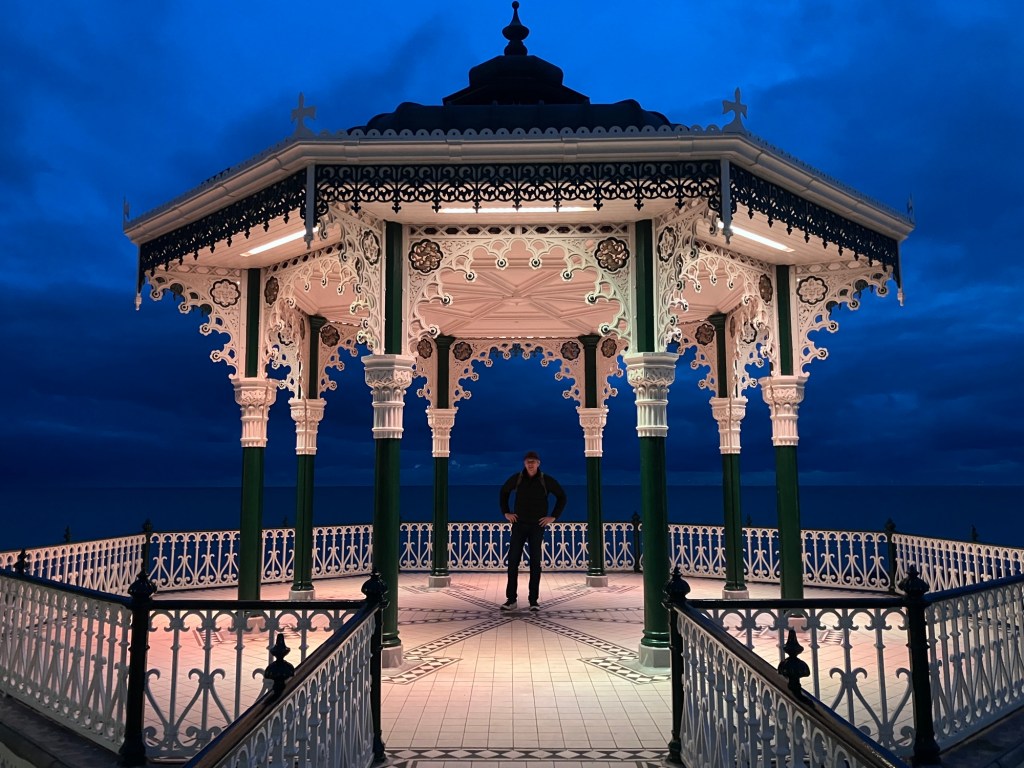
Je suis prêt, on y va!The Brighton Beach Bandstand
It’s not that we particularly wanted to leave France, but we had to get out of the Schengen zone as we were at Day 89 of our 90 day allowance, so cutting it a bit close. And there really is lot to love about the UK, even in winter. So we caught the post rush hour metro to Gare Du Nord for our 11am Eurostar to London. Yippee, a train not a plane to the UK!
Our enthusiasm for our train trip was soon tamped down after we passed through Eurostar security and immigration to find the waiting area packed to the gills, with people lined against the walls, and sitting on the floor. This of course triggered my immediate moaning about the woeful under design of the waiting area. « Hey, I’ve sized waiting areas for HSR services, and this is a mess. « We didn’t get any photos of this fiasco, but trust us that it was very crowded.
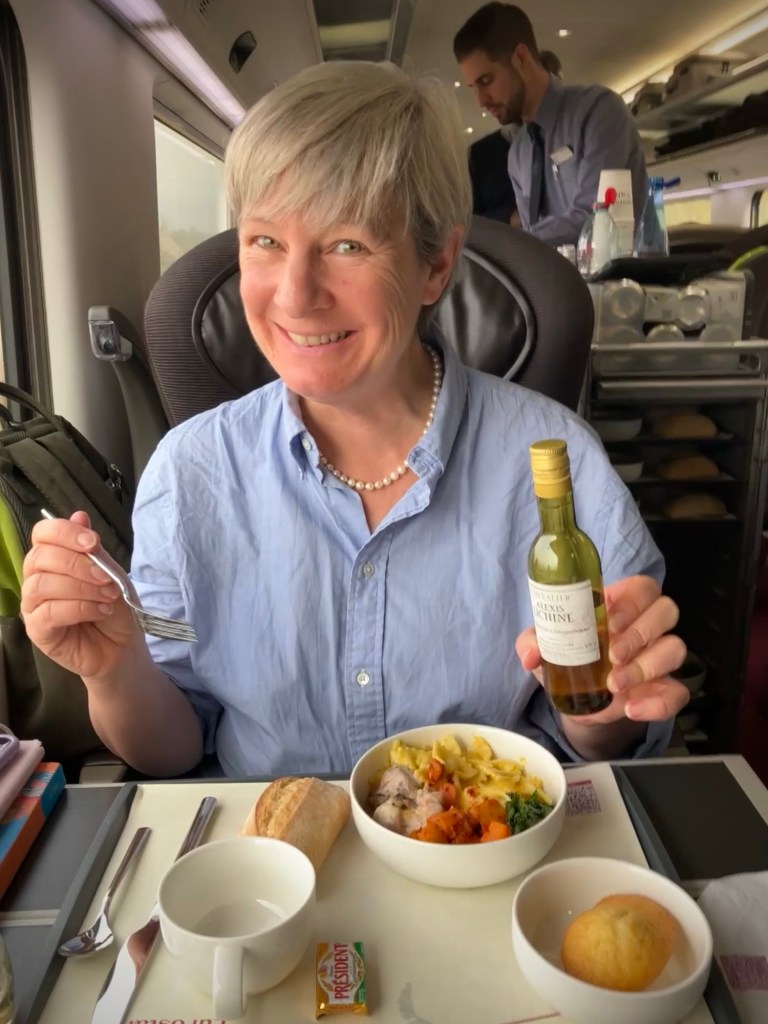
All minor travel woe is forgotten. Eurostar Plus class was nice with spacious seats and a light meal. Very civilized.
Well, as it turns out, the normal cramped quarters on the mezzanine of Gare Du Nord were stressed by the load of 3 trains worth of passengers, as the 9 and 10 o’clock trains hadn’t boarded yet due to big delays. The E320 train sets carry nearly 900 passengers full, so 3 trains full is a challenge for any building design. But the situation was exacerbated by poor info signs and an inaudible P.A. system, so we didn’t figure this out until we saw the chaos for the boarding area and an attendant holding up a tiny paddle with “9:00” on it. They should have held us 11 o’clock folks outside security, but made no indications of delays to our service, and so we were still subject to the 1 hour advance check in cut off. Eurostar can definitely do better.
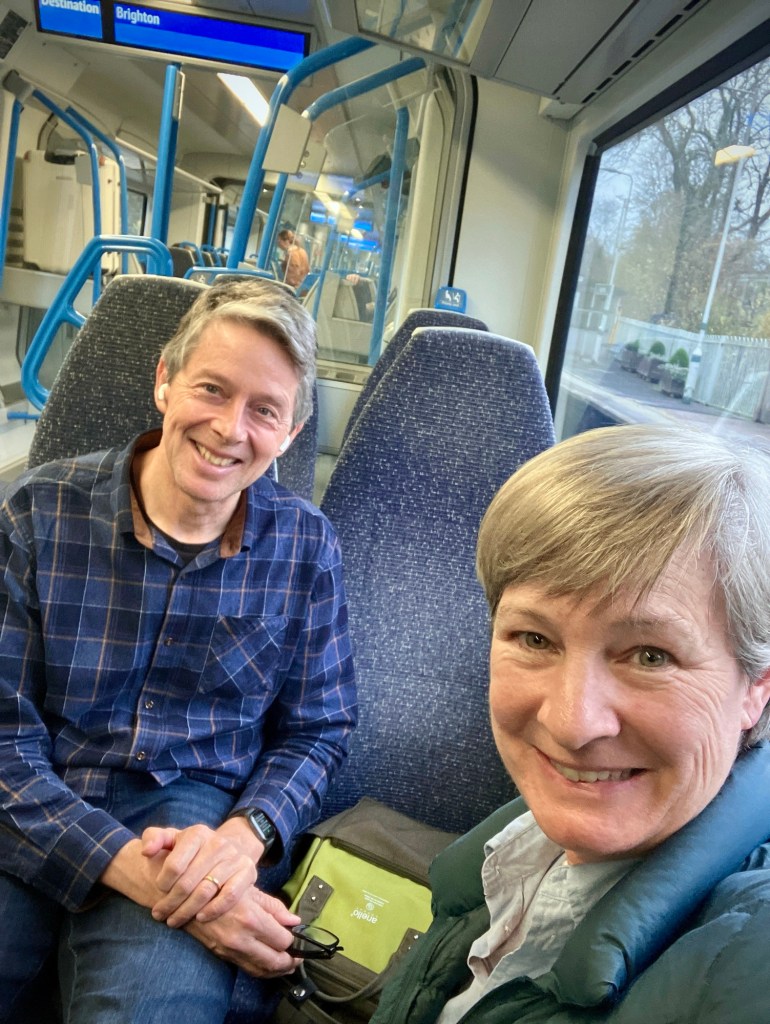
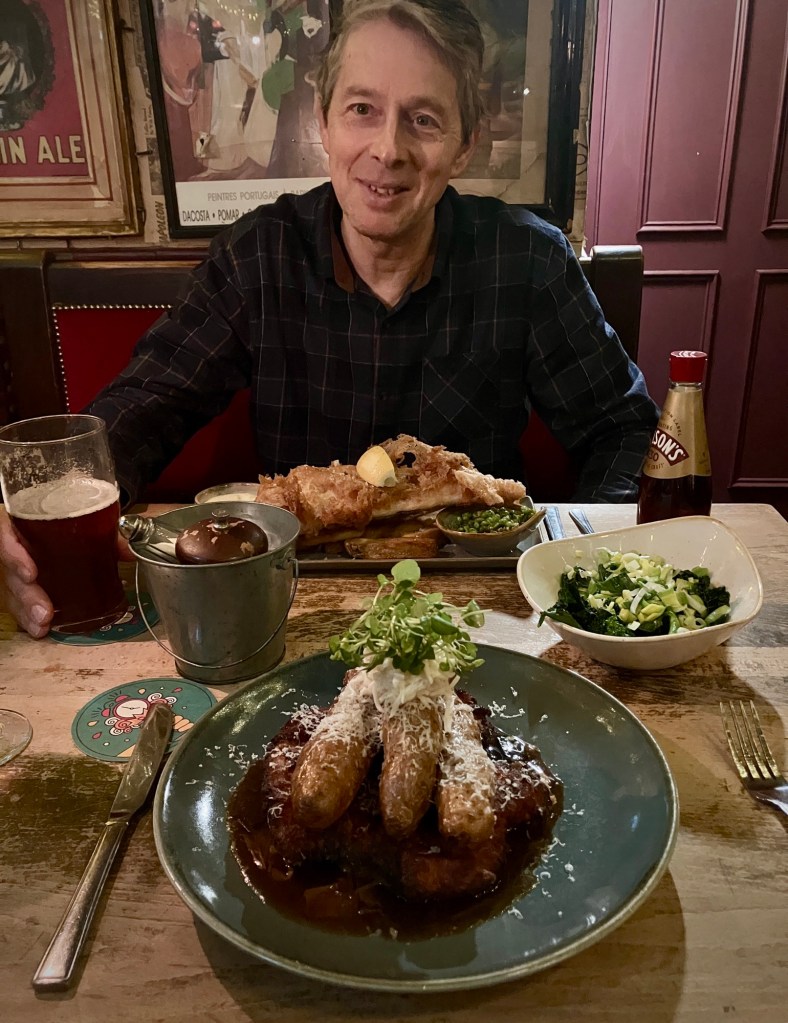
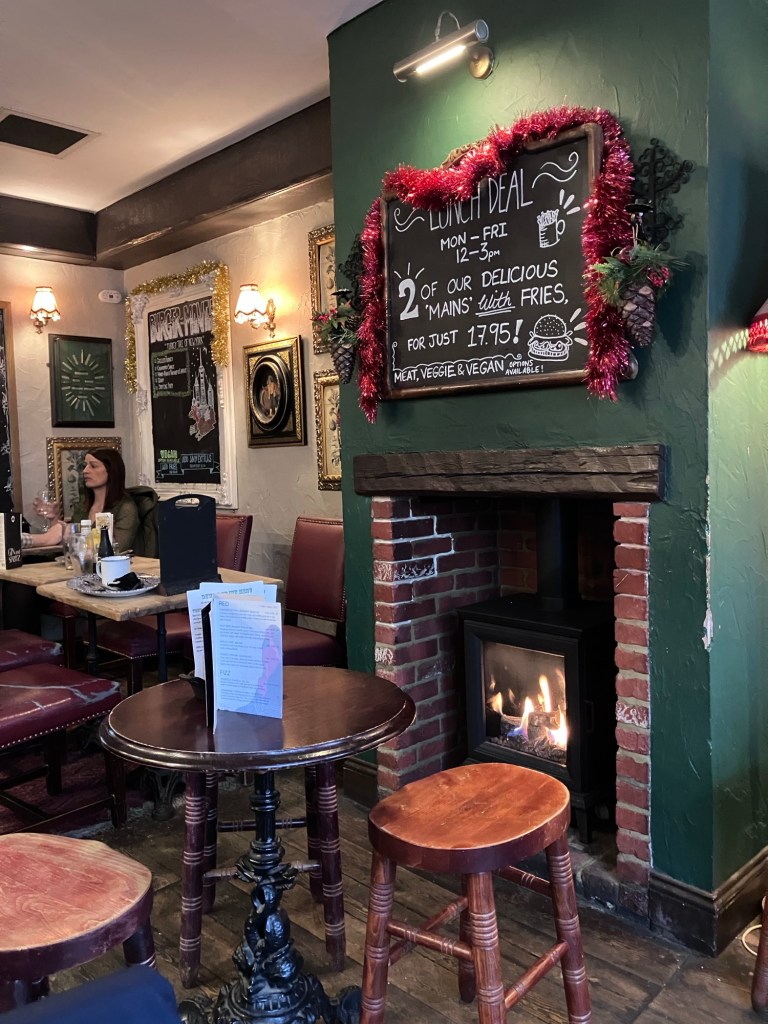
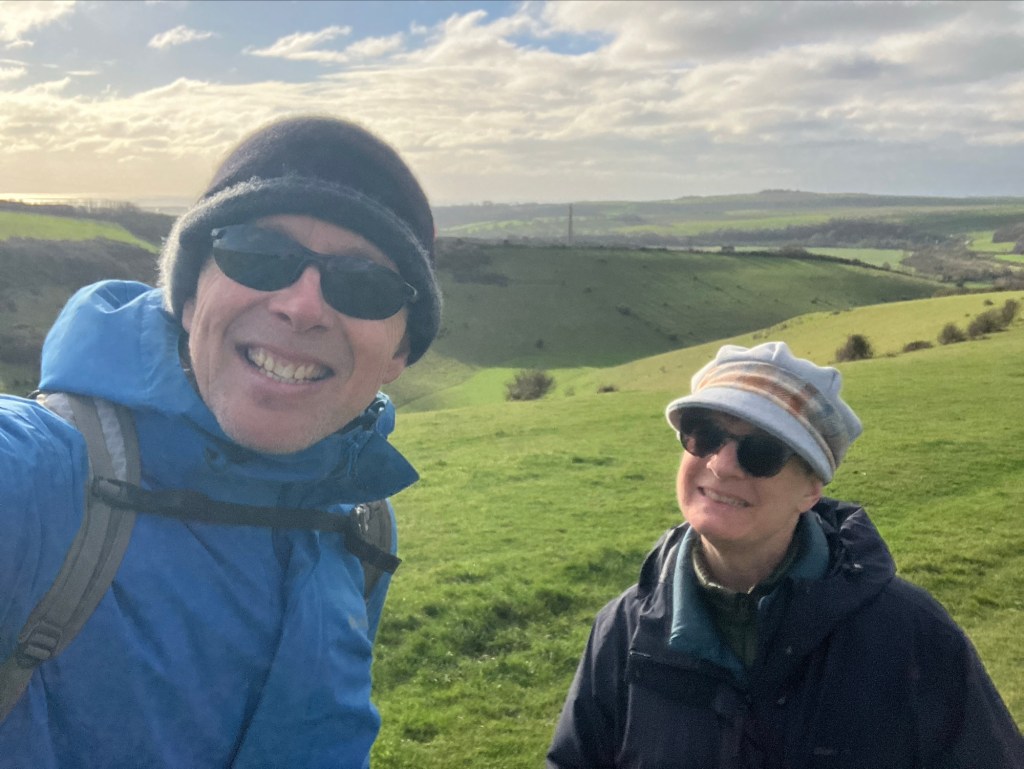
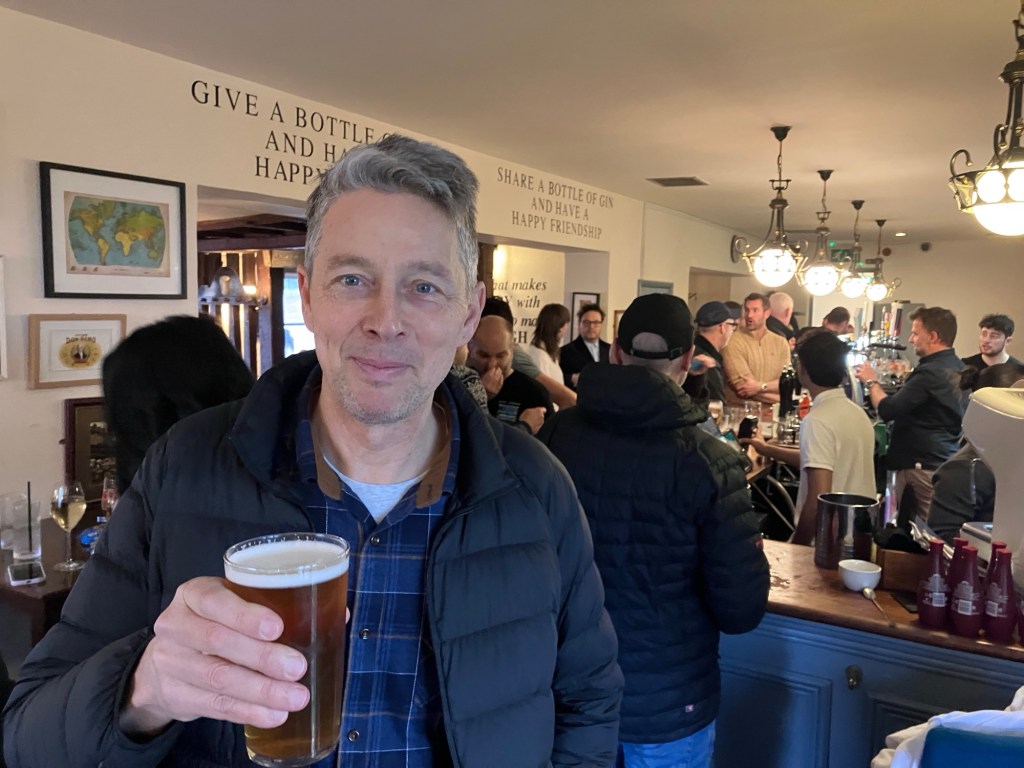
The Thameslink is fantastic. An hour to Brighton direct from St. Pancras InternationalSmiling in Brighton at the 4pm sunset!The colorful beach huts of Hove; some color through the gray.Keeping warm with a beach walk and coffee with our friends Gary and Ruth The expansive yet cosy Lion and Lobster pub in BrightonAnd my first hand pulled British craft bitter in awhile. Delicious!The cosy pubs of England are hard to beat in winter.Have a seat by the fire.Holiday cheer and lights abound.Ok, maybe we were missing Paris a little.Inside the Paris House (Le Pub) in Hove, the warmth and sounds of live Sunday night Jazz.
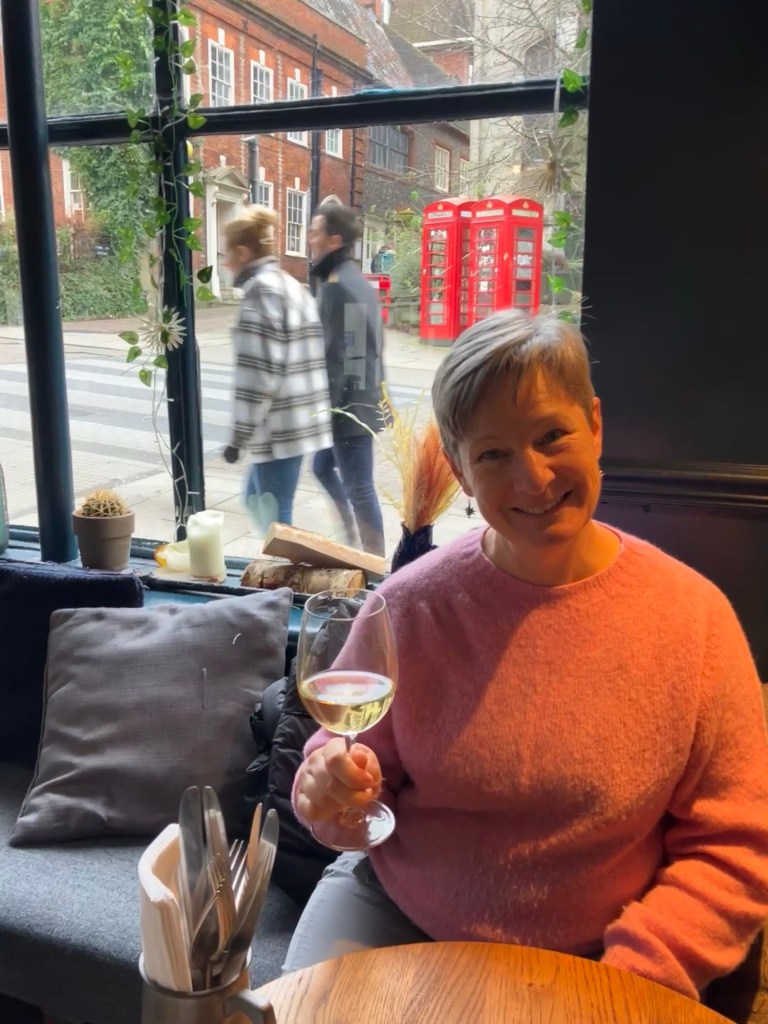
So our Eurostar train finally boarded after nearly two hours, and departed only 40 minutes late. But hey, at least we didn’t have our bikes -:) Our slightly agitated travel states soon calmed down as we took our Eurostar plus seats; which is a nice upgrade (but certainly not essential) from the standard service with the bigger business seat car layout and light meals delivered to your seat. And yes, white wine; which tasted pretty good after the misery of the waiting area and boardiing process. Note that the Plus class is a much cheaper upgrade than business/premier class, so often only €20-€40 more than standard. Eurostar business seems outrageously priced in comparison as same first class type train seats as the Plus service: just fancier food service; dedicated boarding, and a lounge….ok, the lounge might have been nice our day; but not worth €100 more each! And it would have been packed with 3 trains worth of people.
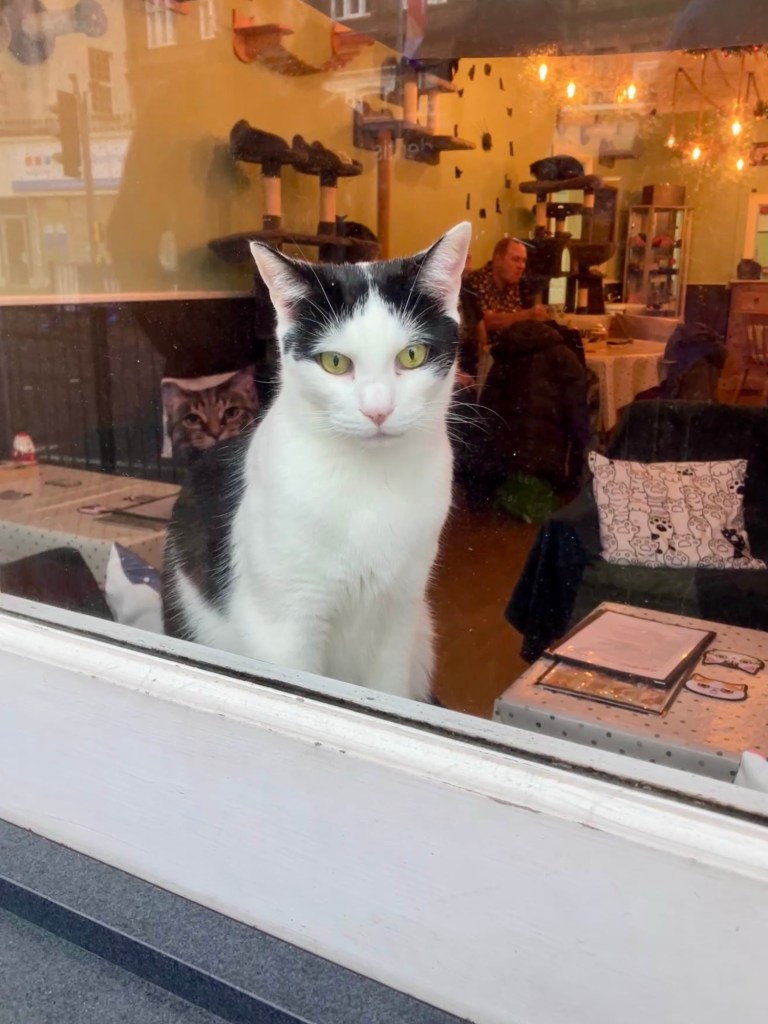
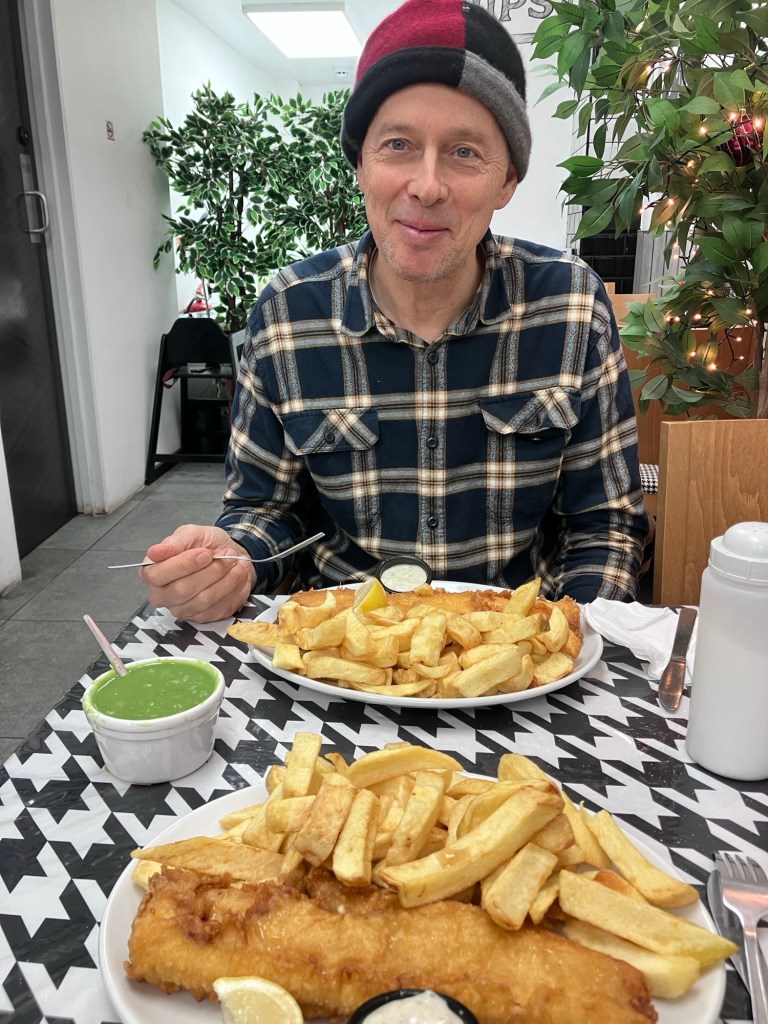
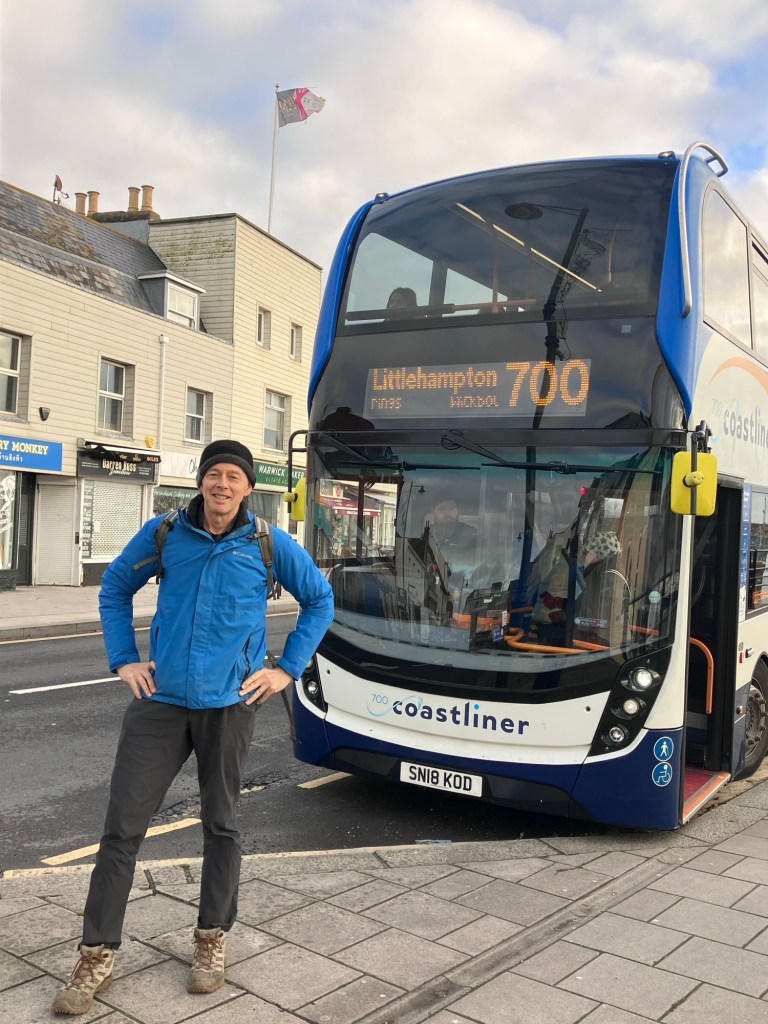
The windswept beaches of Brighton in early December Cat subtlety mocking Cheryl out in the cold.Serious winter fuel up at Sea Breeze Fish & Chips in Hove.Ready to get out and put those fish & chips to use.In addition to great trains, the Brighton/Hove area has great transit with real time info and frequent service, including up and down the south coast. The wonderful footpath system of the UK.Enjoying winter sun and views on Mill Hill above Shoreham by the Sea.Sheep looking inquisitively at us for guidance (or maybe food?).
We love returning to places we like; and we have fond memories our 2 week stay in Brighton in 2022. Ok, it was Hove, actually. This time we stayed for a week on the Hove/Brighton border and closer to the water. A great choice as it was a walkable and lively area, but less touristy than the Lanes or areas around the train station. I even went back to the same place to get a haircut as 2 years ago. Brighton was also an easy shot back to London and our next destination, Norwich.
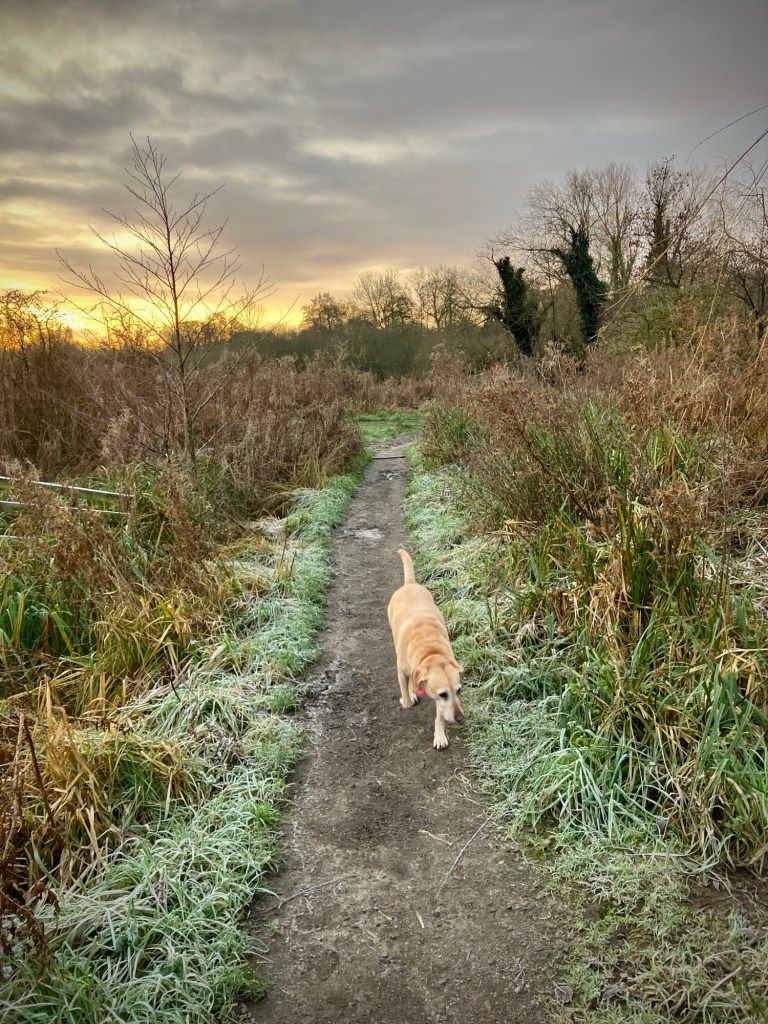
Cheryl relaxing again on the Thameslink, where we would transfer to a Greater Anglia train to Norwich.Norwich is a small city in Norfolk County with a lively center, relaxed yet sophisticated vibe, and an engaging history.Our stay in Norwich included looking after a sweet dog, and walking the dog always got us out, even on frosty morningsPre Christmas buzz in the beautiful Art Nouveau Royal Arcade in Central Norwich.
So what was our strategy for the UK winter? A pub a day, lots of walking in the short « daylight » , and catching up with some friends as possible. The dark winter days were a bit tough for these Californians, but the countryside and old cities are beautiful; and there is nothing like a cosy English pub on a cold, rainy (or snowy) day in December. You often open the door to find a warm buzz of people, pints, and if lucky, a nice fire to sit by. We often cite the footpath system and Pubs as what we would take from the UK to form our perfect Country.
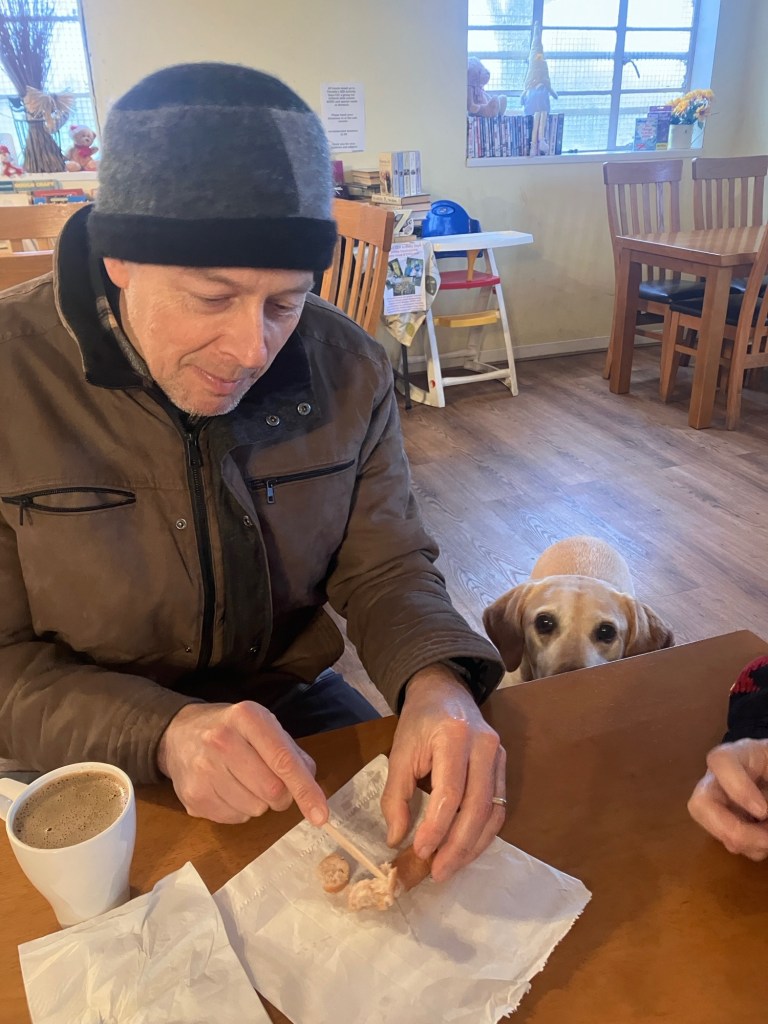
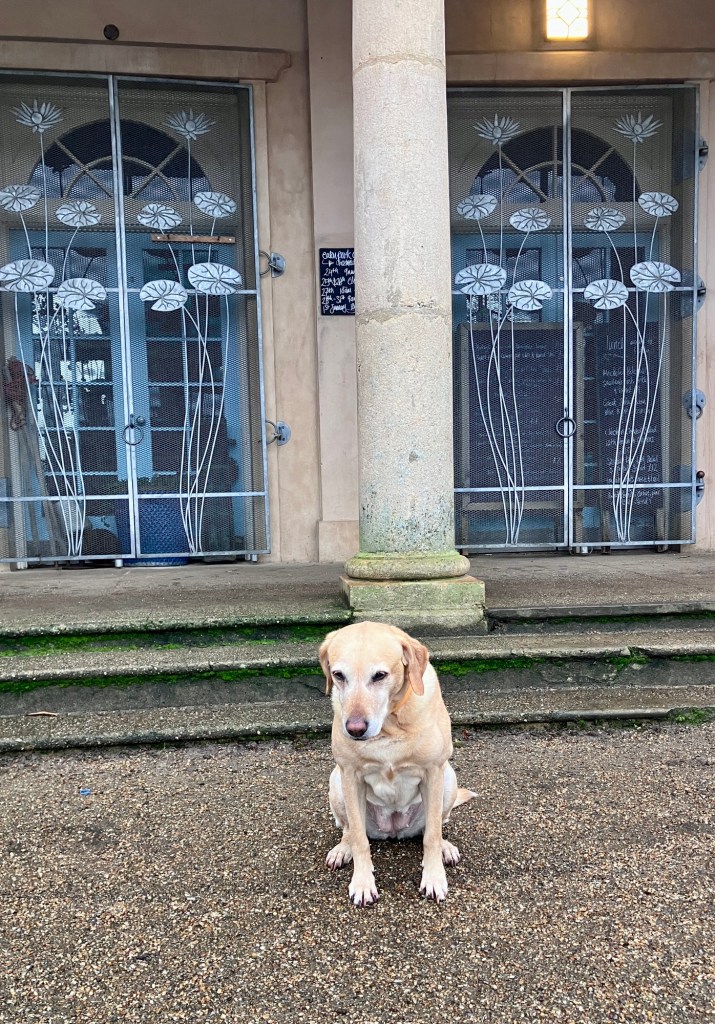
Our Norwich stay was greatly enhanced by our local friends Jon and Jane; here on the grounds of the University of East Anglia (UEA)The UEA buildings in the background are part of the Norfolk Terrace student housing, a Grade II listed architeturally significant example of 1960s modernist design by Denys Lasdun and Partners that is now in need of reconstruction.The old school Earlham Park Cafe was always a great destination on our daily dog walks, and Bindi loved their dog sausage for just £1.Bindi knows the way to Sausage Cafe (sung to the tune of “Do you know the way to San Jose”).Sad dog during the Holiday closures of our other common destination, the Eaton Park cafe. Sorry, no dog sausage or Bap today Bindi.
After a nice recuperation in the familiar grounds of Brighton, we set off to the uncharted lands of East Anglia, and specifically Norwich. We had scheduled a long house sit to take us through the New Year and I admit, I had to look up where it was on the map, even after years of roaming about the UK. It’s the hub of Norfolk County and home to about 140,000 people.
The peaceful UEA campus grounds along the Yare River.
Norwich is less than 2 hours by train from London, but a world away, and thriving with its own unique history as a center of wealth and prosperity in England going back 1000 years. During the Middle Ages it was a close second to London in stature, but started to recede during the Industrial Revolution as it had no coal or swift water to power manufacturing.
Jane showed us a stunning view of the Broads National Park at the top of St. Helens Church in Ranworth.The climb up comes with warnings.And rightly so.It was great to have Cheryl’s sister Kathy join us for a week in Norwich.Even (well behaved!) big dogs are welcome at most pubs in Norfolk County.
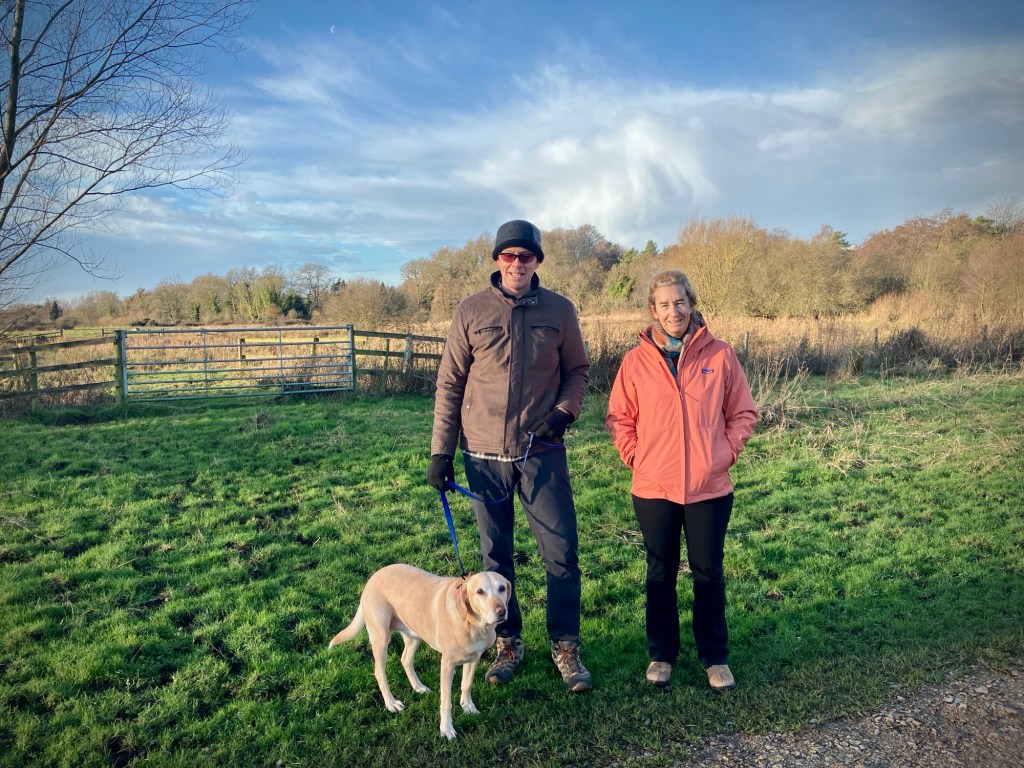
We had a nice warm cosy house and garden to call home for 3+ weeks, complete with the sweetest dog in the world. Our daily walks with her took us through the neighborhoods, parks, marshes, and rivers of the area, and certainly helped us feel at home over the holidays, especially in this dog crazy area, where dogs are welcome in almost all restaurants, pubs, and most stores. And our easy going golden lab was a popular addition to a few bus and train adventure as well, where she was welcomed and coddled by other passengers.
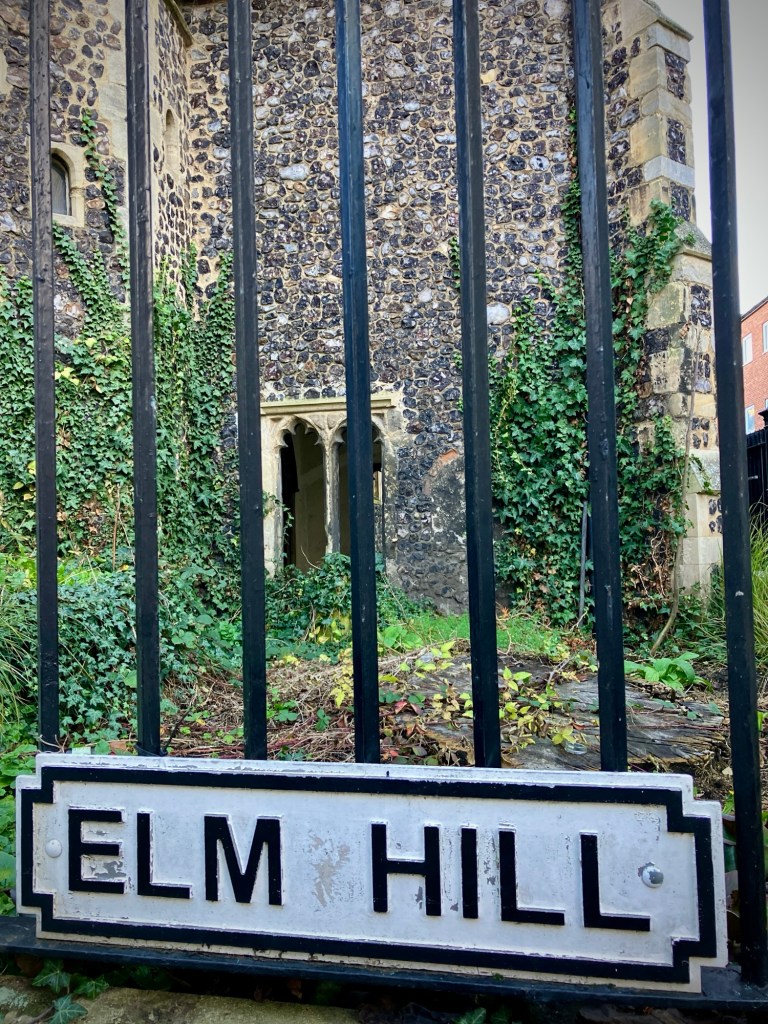
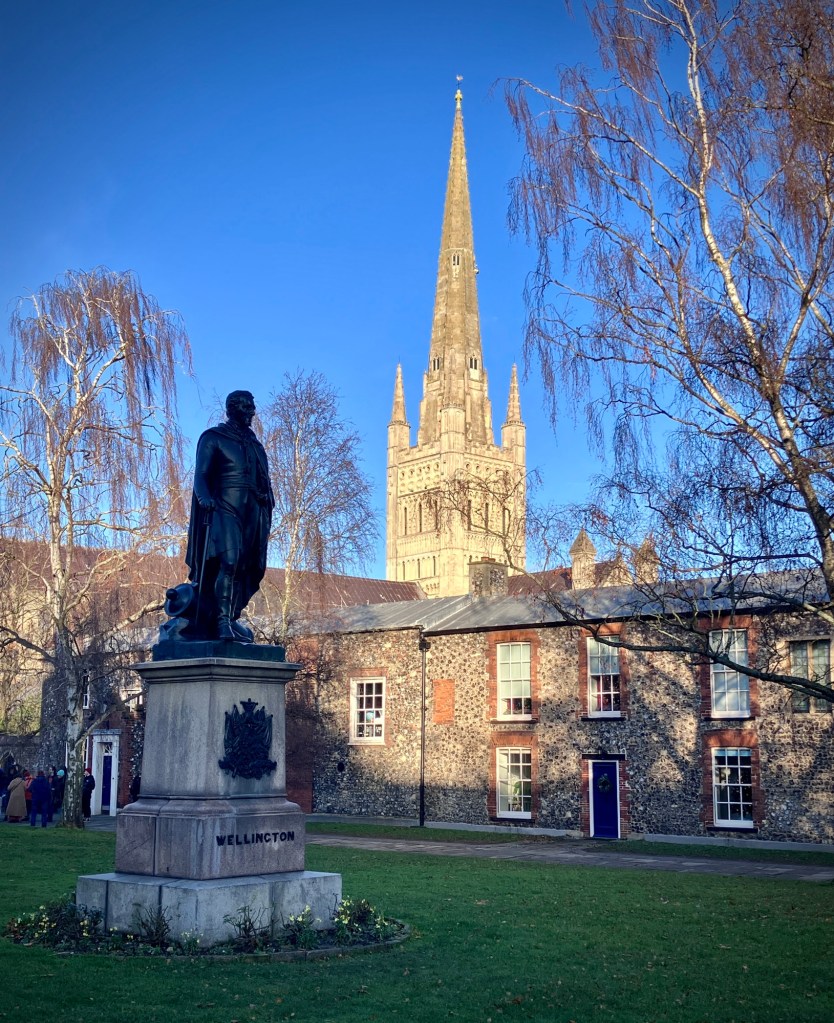
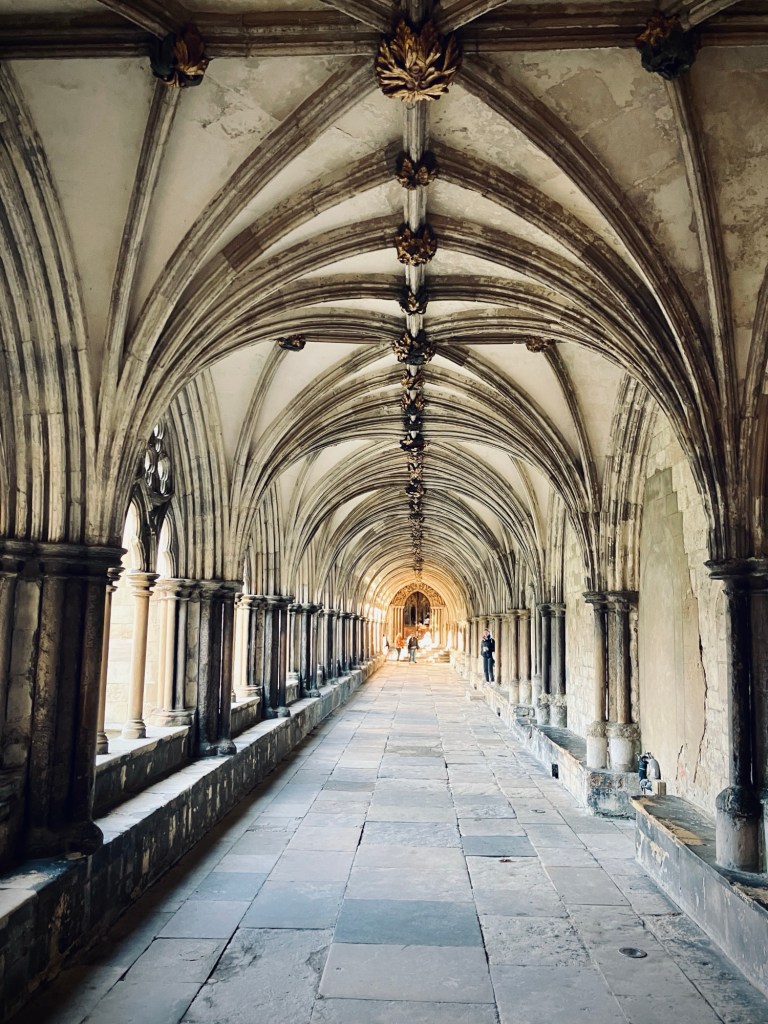
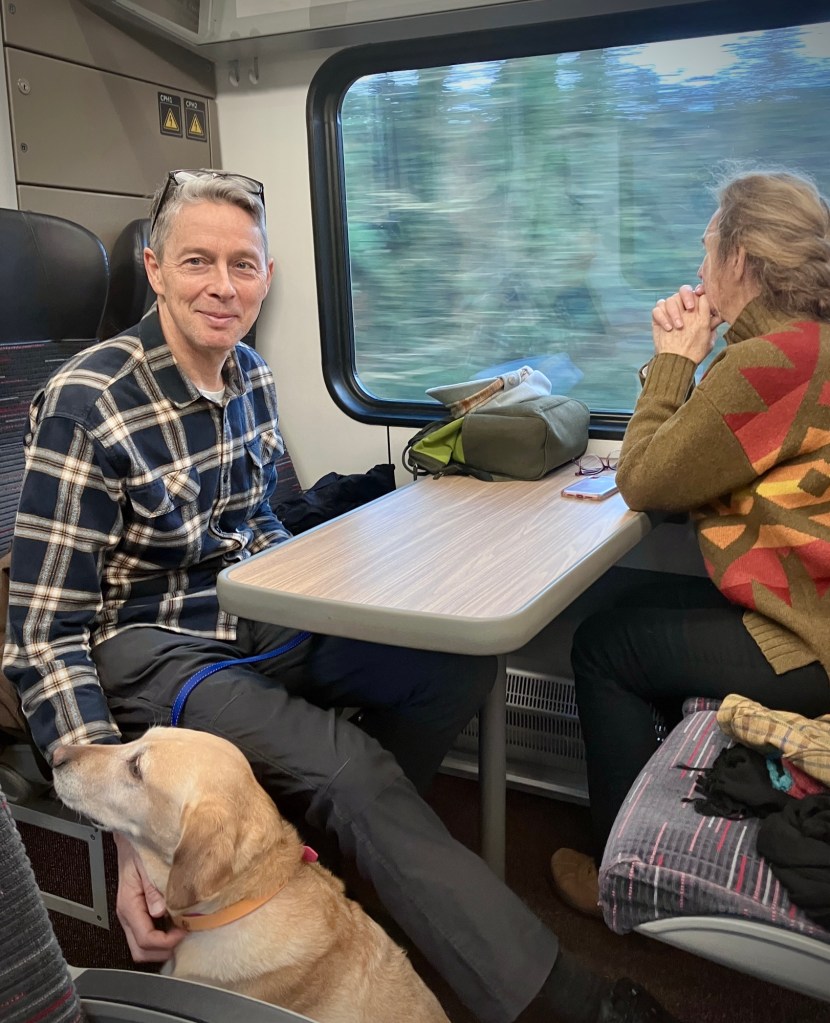
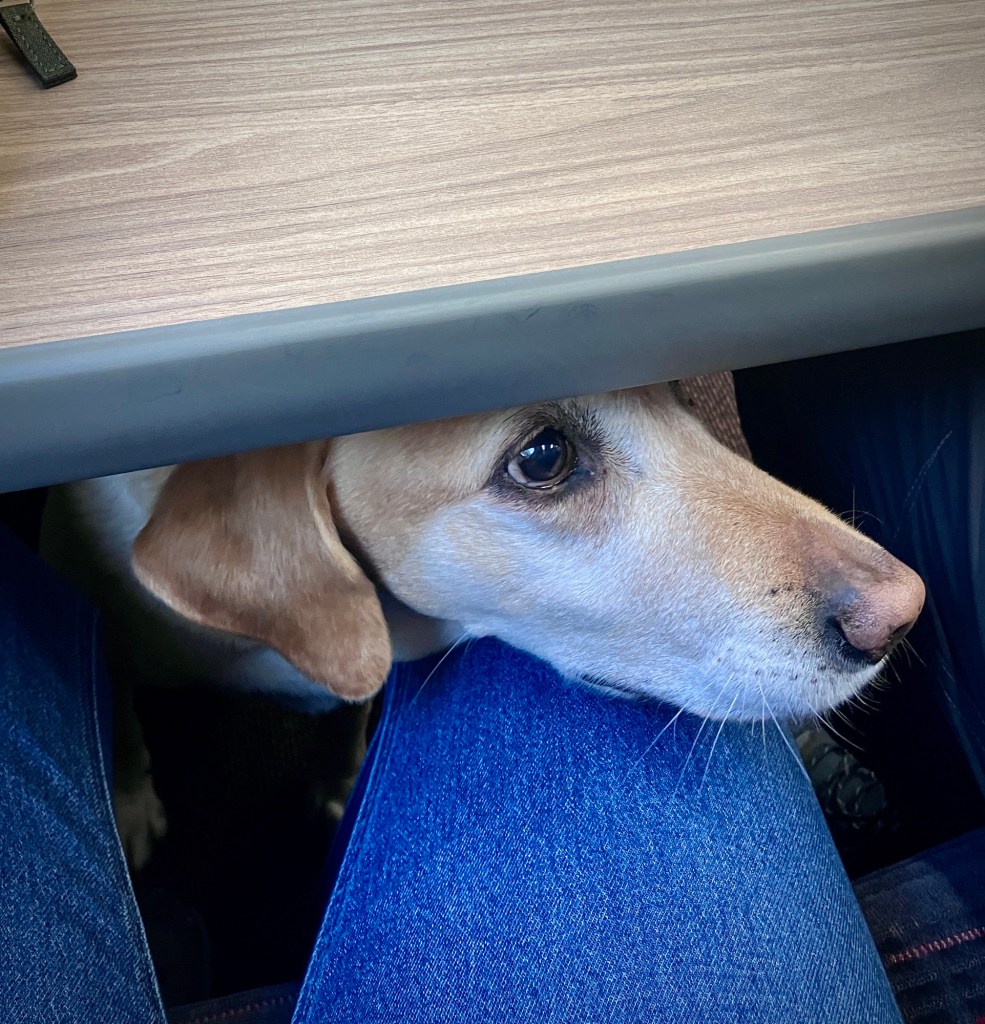
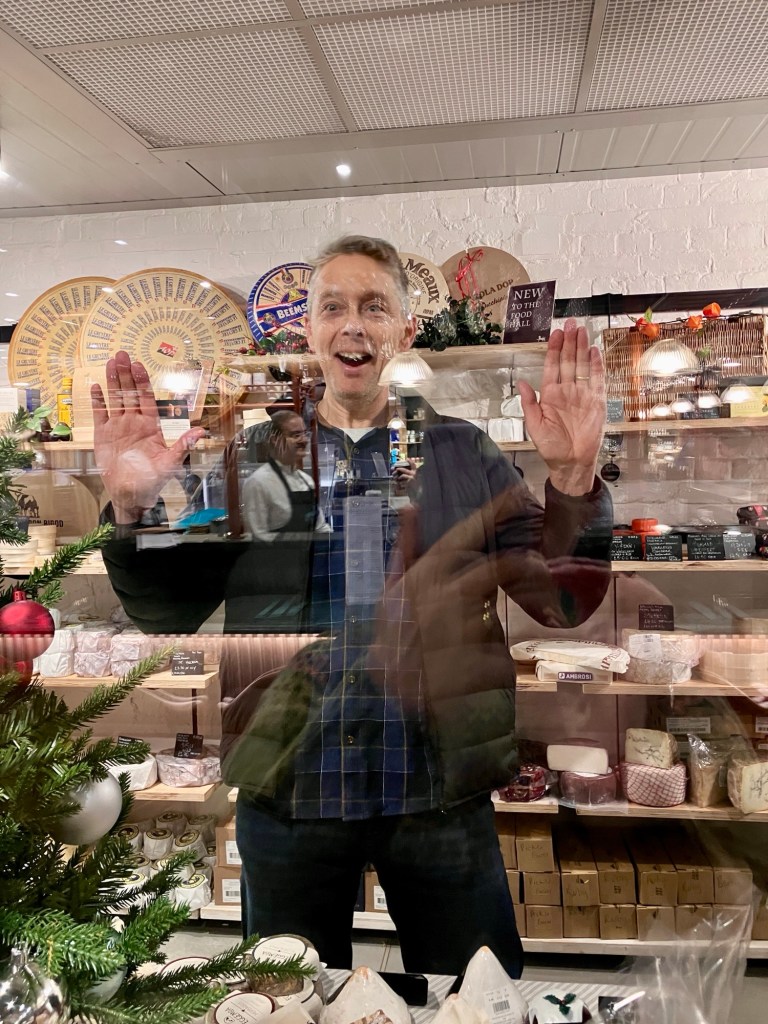
Kathy and I in busy central NorwichElm Hill is a street in the oldest part of Old Norwich and has hundred of intact Tudor era buildings dating back to the 16th Century.Lots of courtyards and alleys to explore in NorwichNorwich has the highest concentration of Medieval churches in England, so many have been repurposed for other uses, including crafts, arts spaces, and this antiques and collectibles.The spectacular Norwich Cathedral is over 900 years old at its core and sets the atmosphere in old Norwich.The Cloisters attached to the cathedral are the largest monastic cloisters in England.Bindi on the train to Comer.Bindi needed some reassurance on the train.Cheryl loved having her sister here, and a day out at the Norfolk coast in Cromer.Norwich is home to one of the best independent Department Stores in the UK , Jarrolds, which has three cafes, a massive gourmet food floor, and the more usual department store offerings.Trapped in the chilled cheese room at Jarrolds
We had a great time uncovering the layers of Norwich history and exploring the area. This is one of the joys of slow travel; diving deep into the history and culture of an area that most people from Abroad don’t even visit for a day. Norwich also has a few good small museums and we even took in a classic British holiday Pantomime performance at the impressive Art Deco Norwich Theater Royal, and almost felt like locals, as we met our friends there as well, and even understood some of the quirky local jokes and references. But not all.
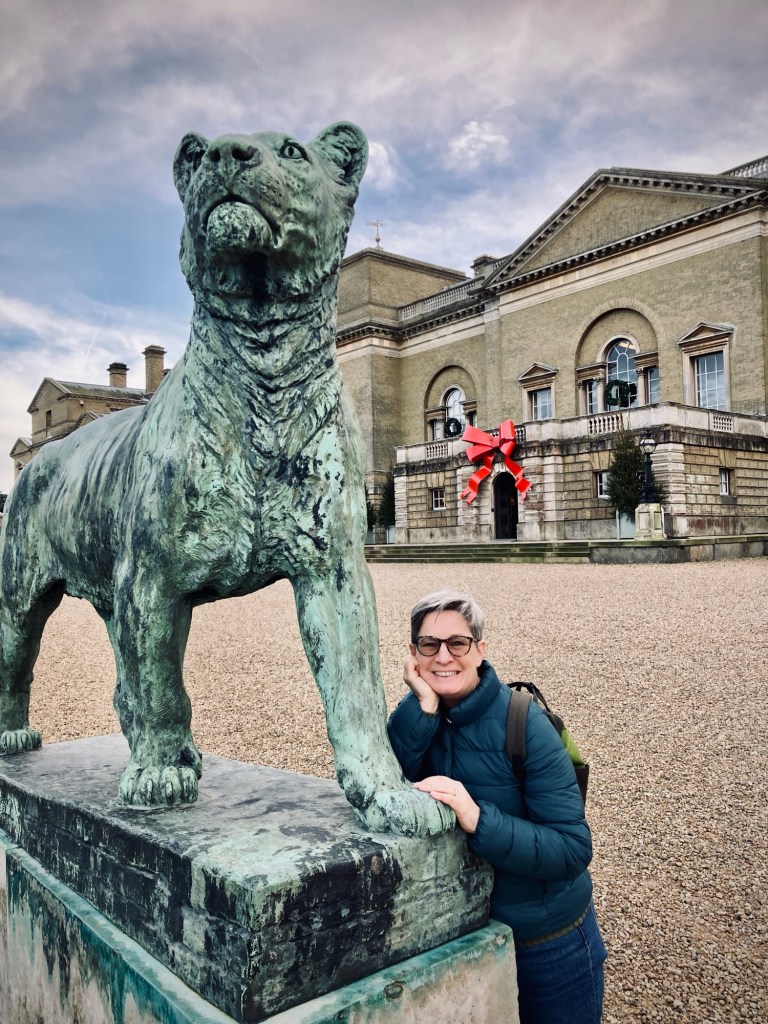
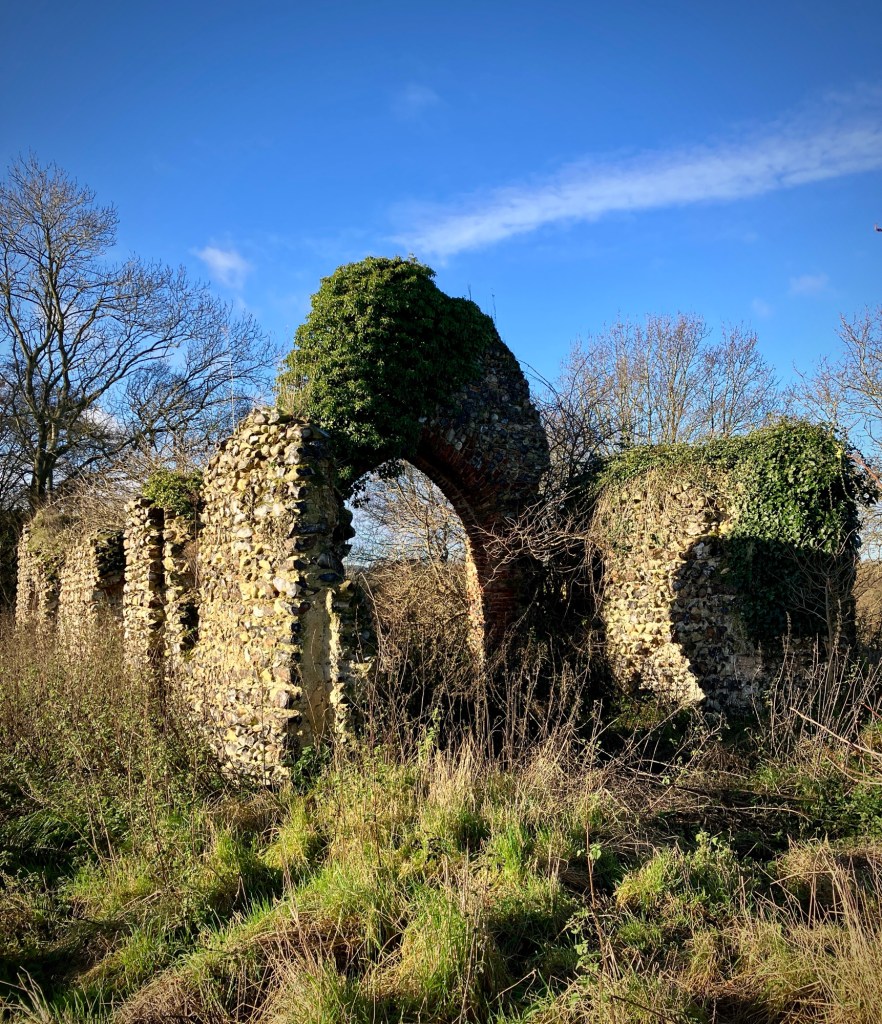
Outside Holkham Hall in Wells Next to Sea.Cheryl and Kathy enjoying a mince pie and Prosecco at Holkham Hall, during our candlelight walkthrough of the historic 18th century country club state home.The ruins of St. Saviour’s Church in Surlingham date back to the 11th century, but many of the large flint stone materials were eventually pillaged for construction in the 17th century. Amazing any of it survives.It seemed everyone in the village of Eaton (part of Norwich) headed to the pub on Christmas Day for a pint. Most pubs are open for a few hours in the afternoon just for this purpose.Or a delicious gin&tonic.
With our dog, walking up a storm was easy; but our next goal of « a pub a day » took some dedication and admittedly we missed a few days. but fear not, we doubled up on other days to catch up. We also discovered that the pubs are popular throughout the Christmas period, when so much else is closed. So to the pubs we went. Do as the locals we say.
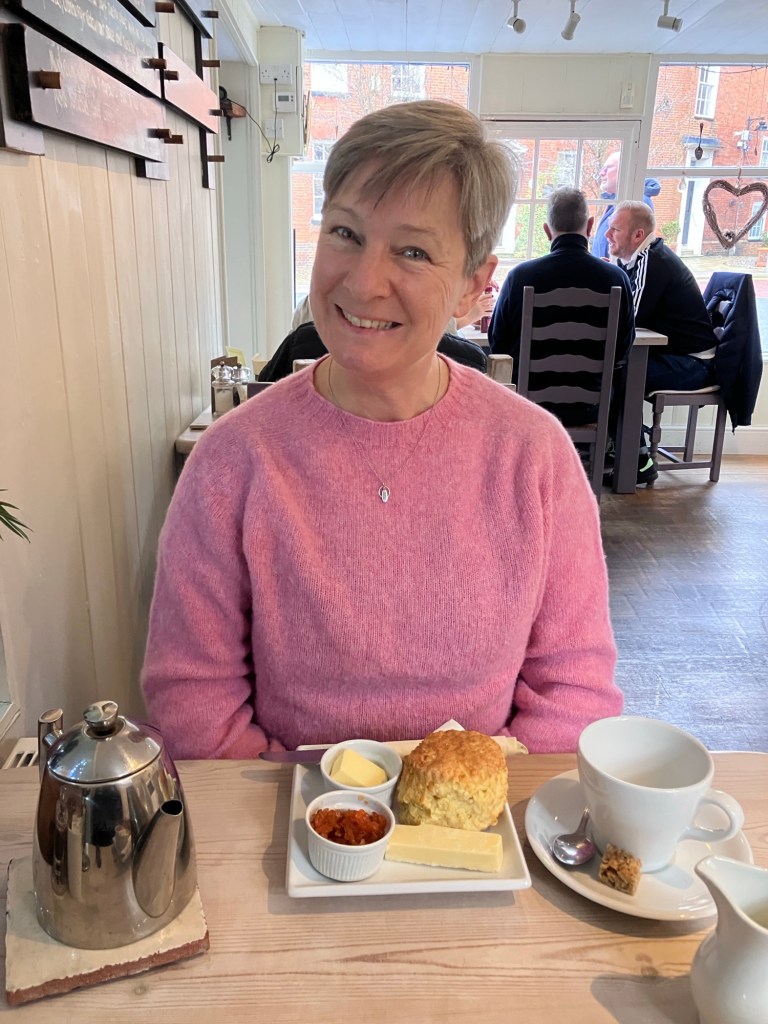
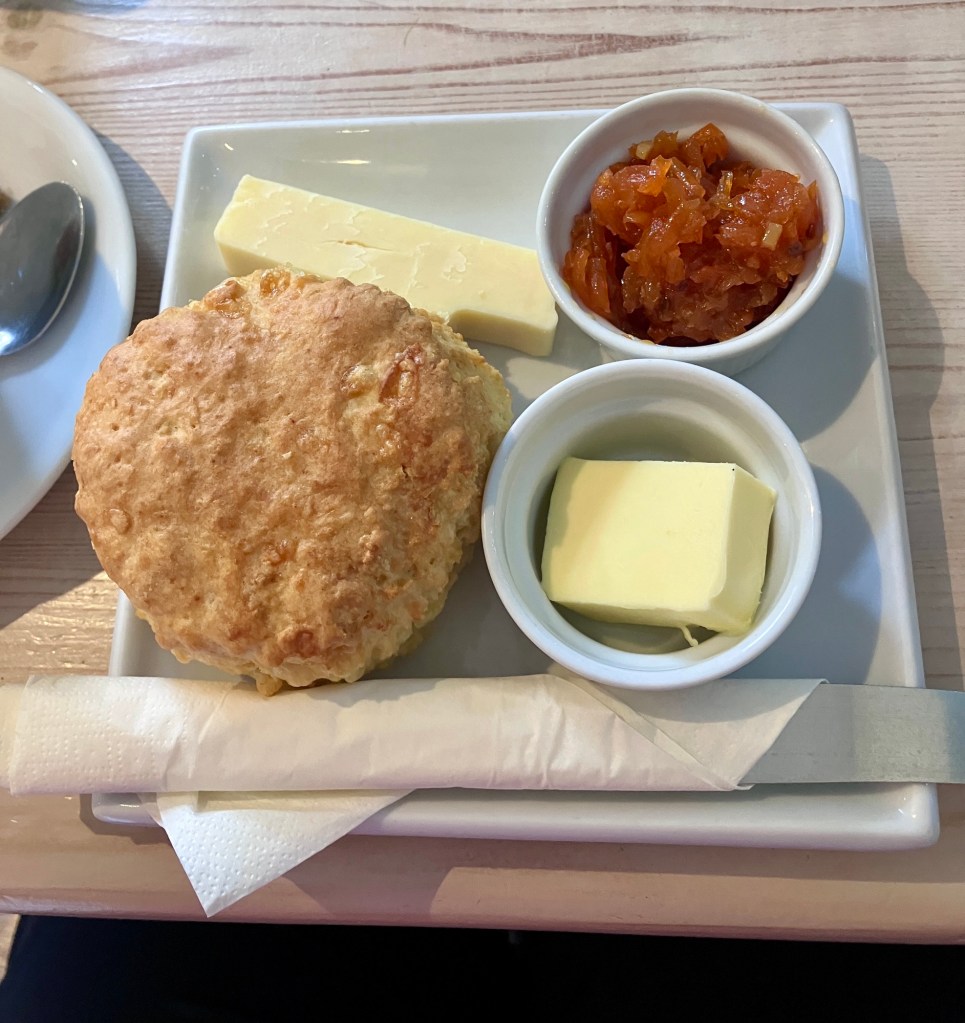
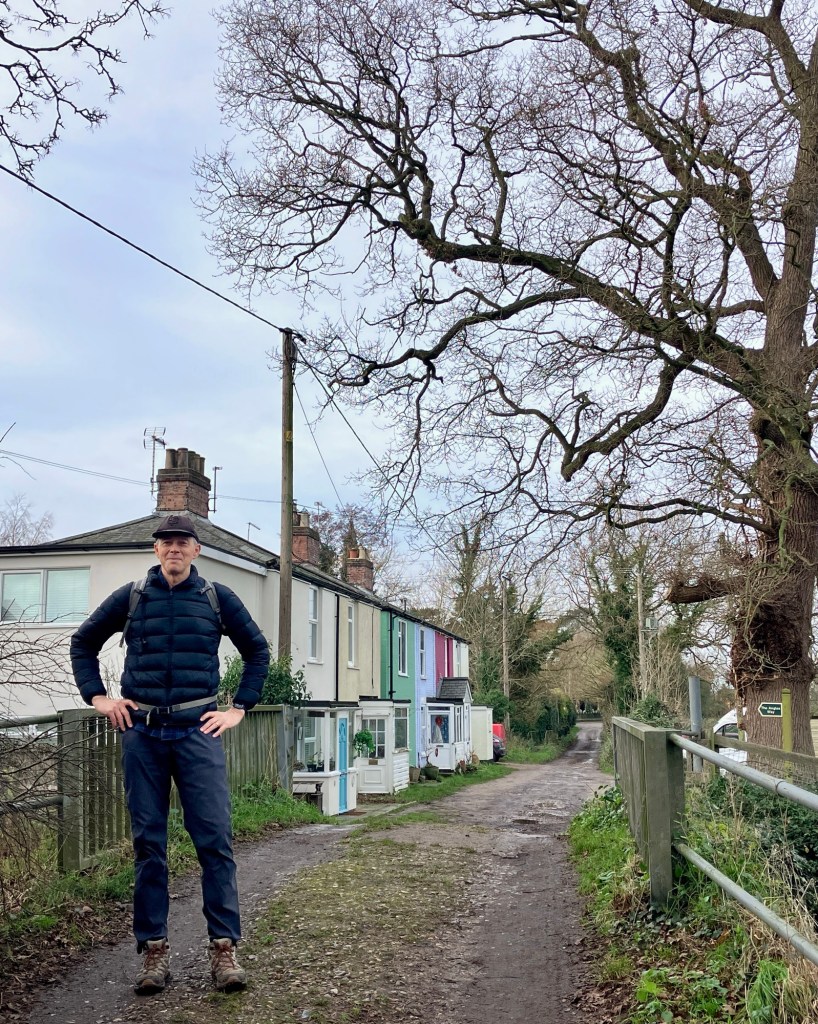
Happiness is proper tea and a scone, cheddar, and chutney plate at the Earsham Street Cafe in Bungay.Delicious and worth a stop before or after a local walk.Our 6 mile loop walk from Bungay.Part of our walk included Bighods Way, named after the local 12th century Norman family and their castle.Beautiful winter light on Bighod’s Way near Bungay.It seemed Bungay residents knew how to brighten up the winter with paint.At one of our favorite local pubs, The Alexandria, in Norwich’s Golden Triangle neighborhoodThe St. Andrew’s Pub in Central Norwich. We were really working at our “pub a day” goal.Pinot Gris and a pie.
The weather was mixed during our stay, but blessedly dry for the most part. But there were many days of gray (the grisaille!) with heavy low clouds and a bit of cold mist. But the pubs did their trick, and were a great respite on the dark sunsets (at 3:30!!). Friendly locals and lots of conversation…not to mention my favorite real ale cask bitters.
We’ll have fond memories of our time in Norfolk
We highly recommend you go a bit out of your way to see Norwich. We plan to return, but perhaps in spring or summer when we can sail on the Broads and see another side of the beautiful area. Happy New Year and new adventures!
We missed summer in Europe in 2024. Like really missed it. It was great to be in the US for the summer, but it’s been a relativley cold spring and fall in Europe. So we were thrilled to get a last gasp of pleasant fall weather in one of favorite French cities, Lyon. Some places we seek out, such as our return to Taiwan and further exploration of Malaysia earlier this year. Other places in Europe we seem to end up in more often due to their location, and Lyon is one of these places since it’s usually our train gateway to and from the Vallée Verte.
Soft autumn light on the Rhône.
This was actually our fourth visit to Lyon, and the second time this year, as we passed through for two nights in March on our spring bike tour along the Via Rhôna. In March, we caught up with some freinds staying in Lyon, and explored a few new places, but didn’t have time to dive in deeper. So we decided to return and spend a week this time, and it was really a joy, from the lovely autumn warth and sunshine (finally!) to the amazing food and friendly people.
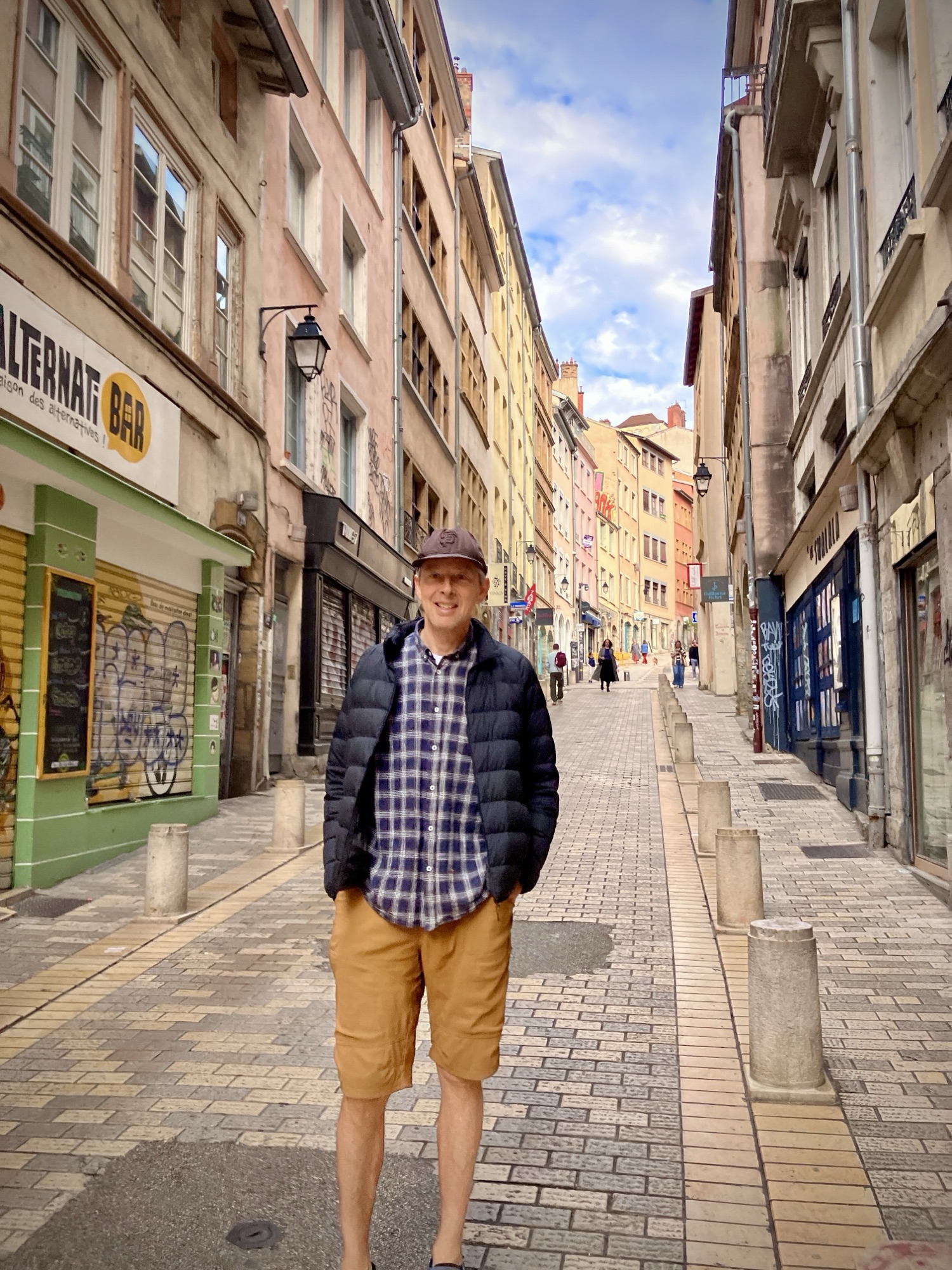
Shorts and sandals! On the pedestrianized Montée de la Grande-Côte, which takes you up to the Croix-Rousse neighborhood.A snipet of the vast Mur Du Canuts. A huge building mural depicting the rebellion of the local silk workers from 1831-1848, some of the first labor revolts of the industrialized world.
Lyon is France’s third largest city, but for many French, it’s the best. As we found out, many Lyonnais wouldn’t consider living in Paris or Marseille. It reminds me of the rivalry between New York City and Boston growing up; one clearly the biggest and dominant in cultural icononography, but the other more livable and approachable, espcially as a tourist.
Along the Saône River, which has a more industrial and gritty feel than the Rhône promendaes.
What I really enjoy about Lyon is the geography, as it has some dramatic hills at it’s edges, and the confluence of two major rivers at it’s core. You even get views of the Alps when it’s clear. It’s also very walkable and easy to get around by bike and public transit, although pales to Paris in its extent of metro and trams. I imagine the access to the Alps, Massif Central, and Mediterranean is a huge benefit with those with the means to get away regulary. Oh, and the weather is a bit nicer than Paris.
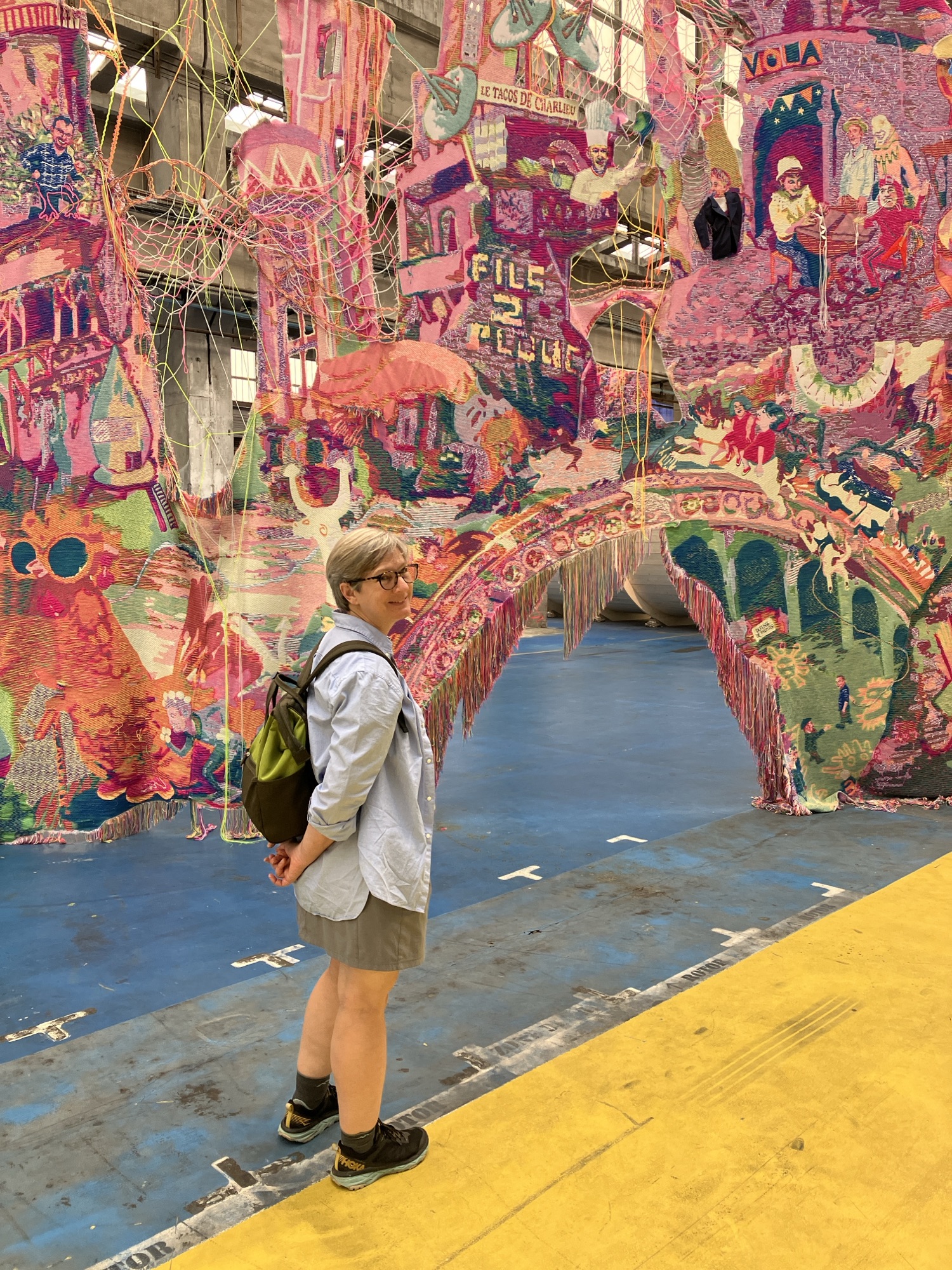
Ready to explore the Lyon Bienalle’s largest installations at the former SNCF workshops known now as “Les Grands Locos”.
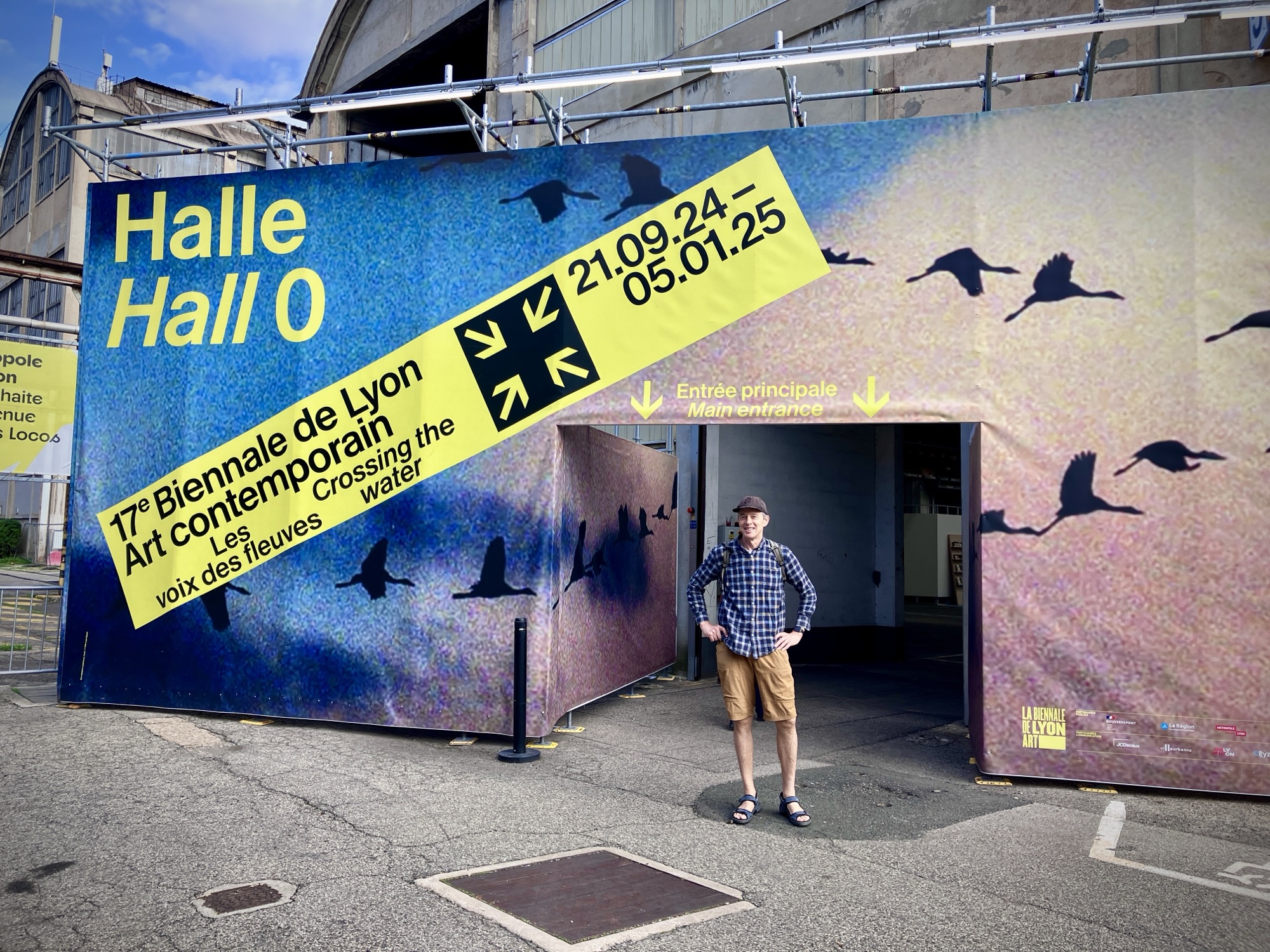
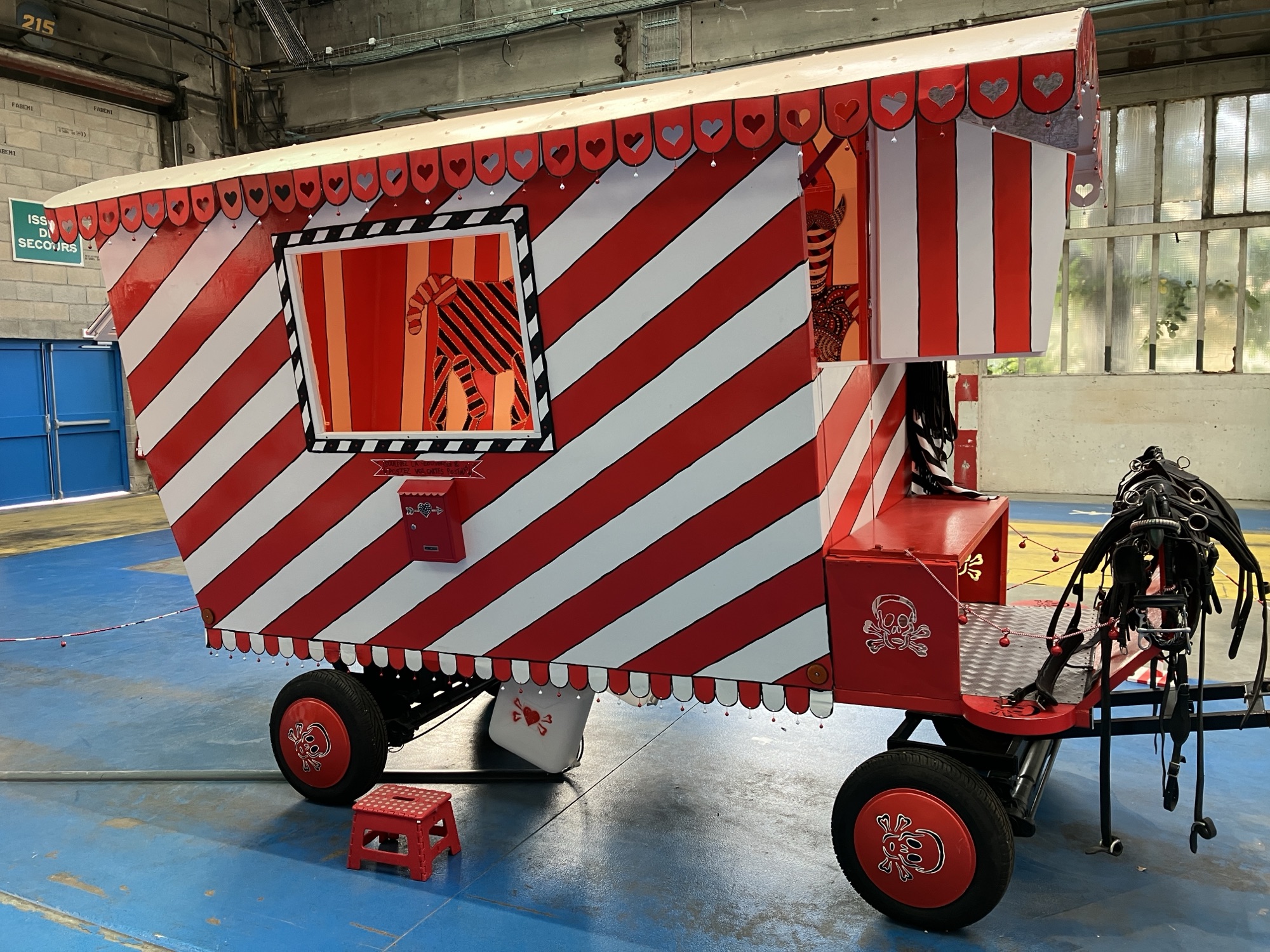
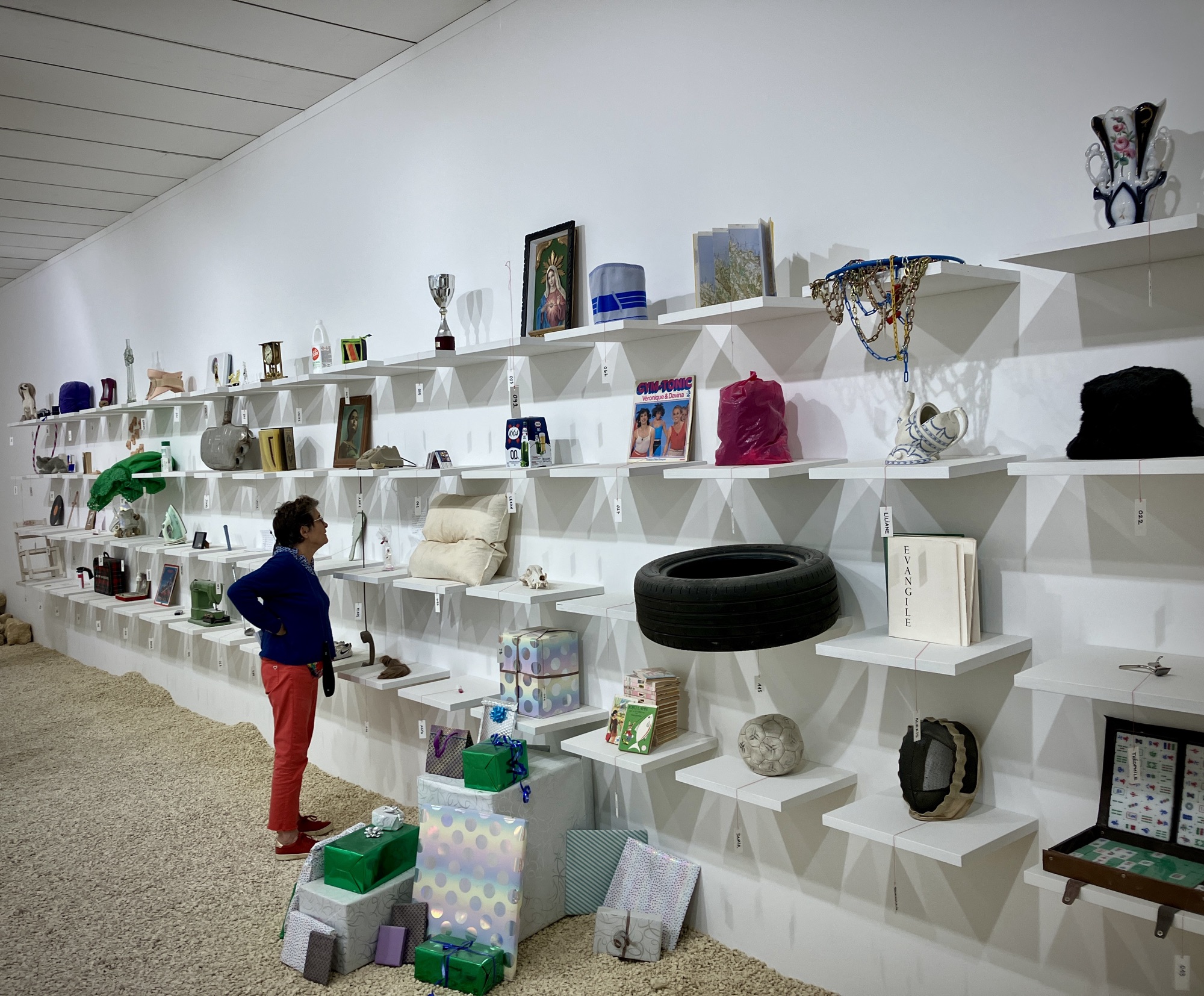
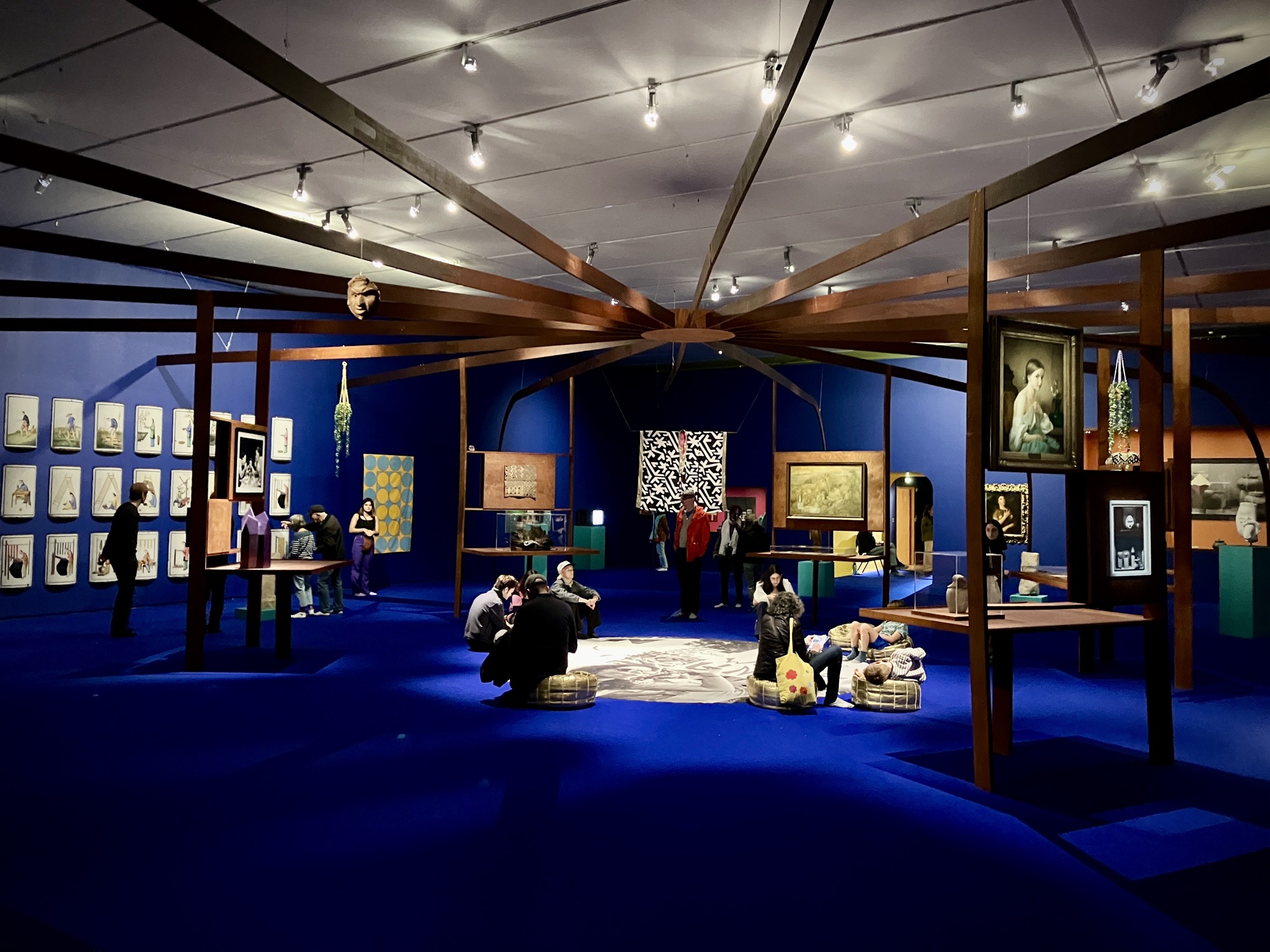
We also were lucky to time our visit with the large Biennale Art Show, which showcases about 75 artists in venues around the city. The 2024 theme of “Crossing the Water” invitied a wide array of interpretations and seemed especially pertinant to the migrations of people across the globe due to wars and economic opportunity, as well as animal life impacted by climate change.
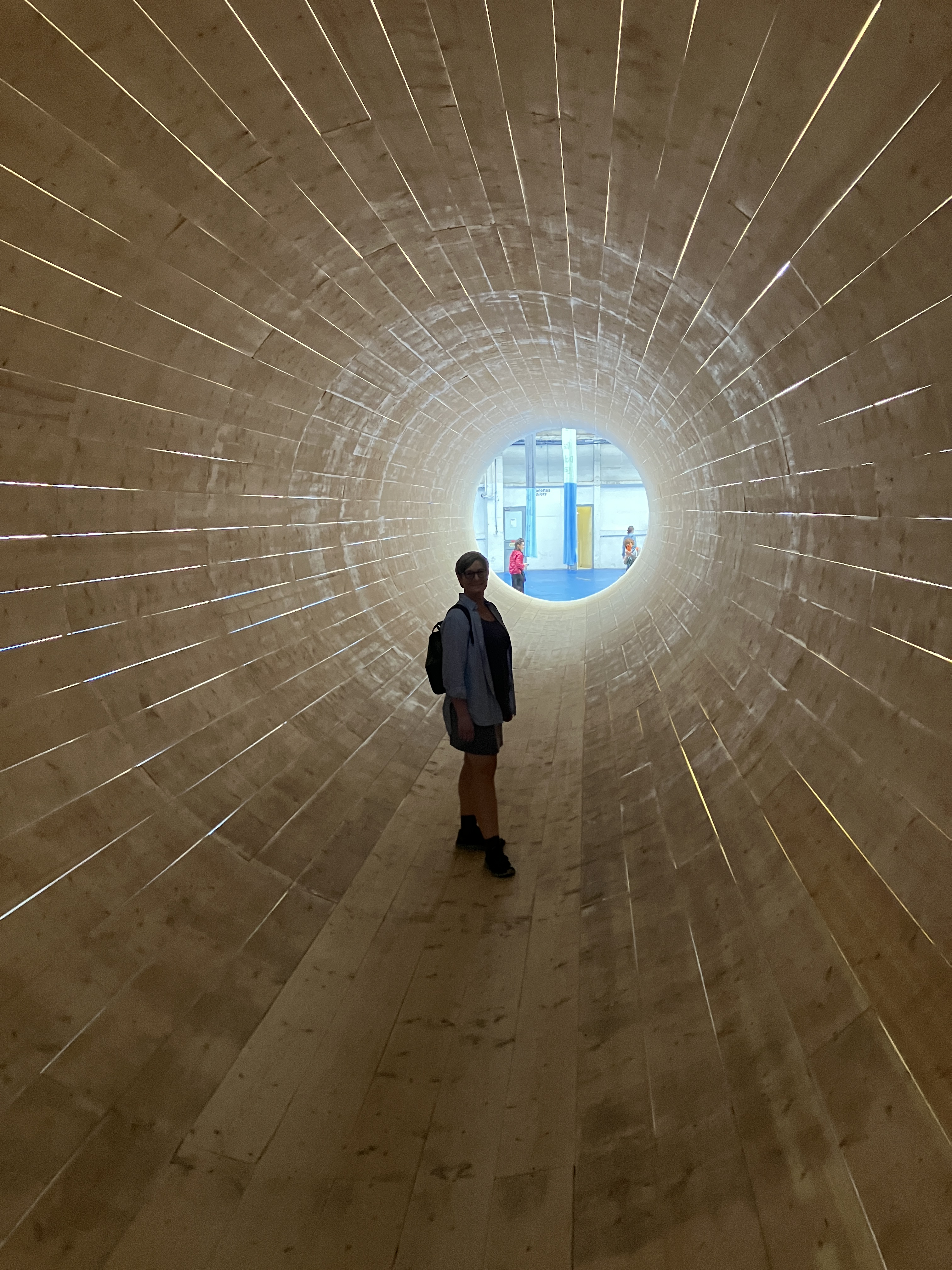
The installations at the SNCF Railyards site were often extrememly large scale and experiential like Hans Schabus – Monument for People on the MoveMona Cara – The CactusSlightly Creepy carnival installation by Clément Courgeon – The Cart of the CleverLorraine de Sagazan & Anouk Maugein – Monte di Pietà at the MAC. Labeled and recorded, the objects that compose it are linked to traumatic memories. I have also crossed the water many times, but luckily by choice.Grace Ndiritu – The Blue Room features around a hundred prehistoric, Roman, Egyptian, medieval, modern and contemporary pieces from various Lyon museums. It was part the Biennale at the Musée d’art contemporain de Lyon (MAC).
I really enjoyed the Biennale and it was well attended but did not have a crush of visitors, due to its long run and dispersed venues. The artists also seemed to represent a modern and diverse cross-section of Fench and foriegn artists, something often missing from all the classical art museums of Europe. The other musuem we really enjoyed was the recently renovated Musée Lumière. Dedicated to the cinematogorphy and the history of the Lumière family, the Musée Lumière looks back at the various technical creations of Louis and Auguste Lumière and their family. It’s well curated and has a great collection of early film equipment, as well as engaging and interactive elements, all set on the grounds of the historic building and workshops.
We reluctantly skipped the striking new Confluence Museum as the week we were in Lyon was one of the Autumn school holiday weeks and anything child and family friendly was very busy….saved for our next visit to Lyon.
The Place Des Jacobins dates back to the mid 16th Century is an important historic junction of 12 streets. The fountain was added later in 1885 after the start of the Third Republic and some disputes about content. Public art and monuments are taken seriously in France.Off the bikes and back on transit!
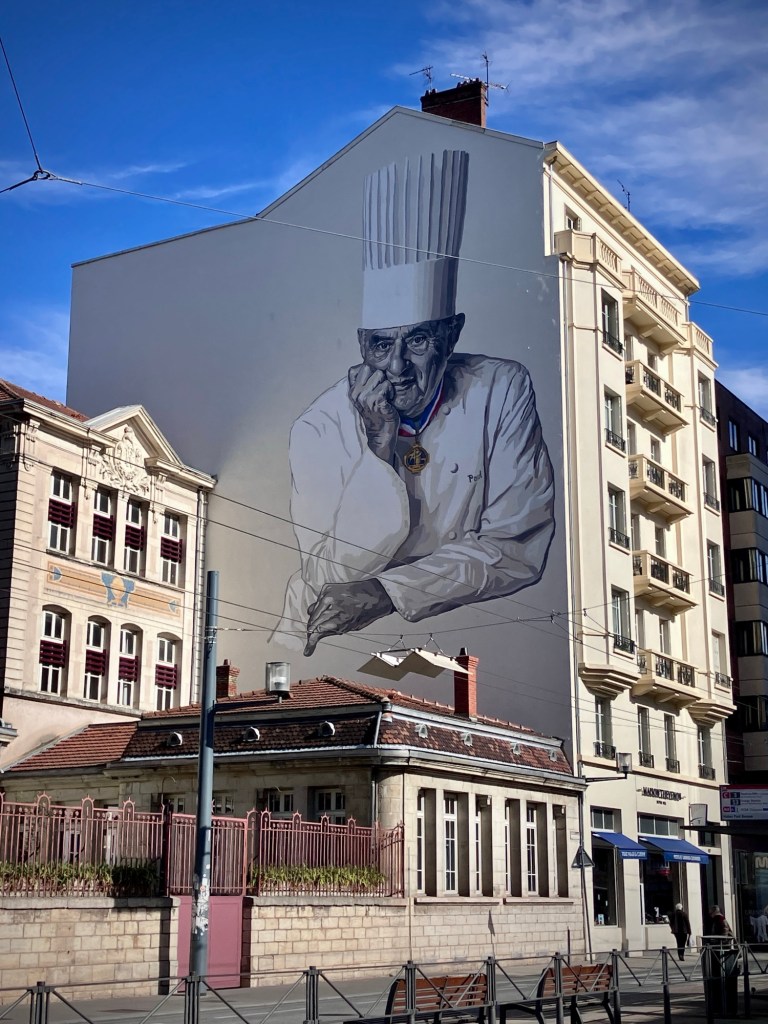
Paul Bocuse looks over the street nearby Les Halles. He is Lyon’s most famous chef and has a legacy 3 star Michelin restaurant and the new Les Halles is named in his honor.
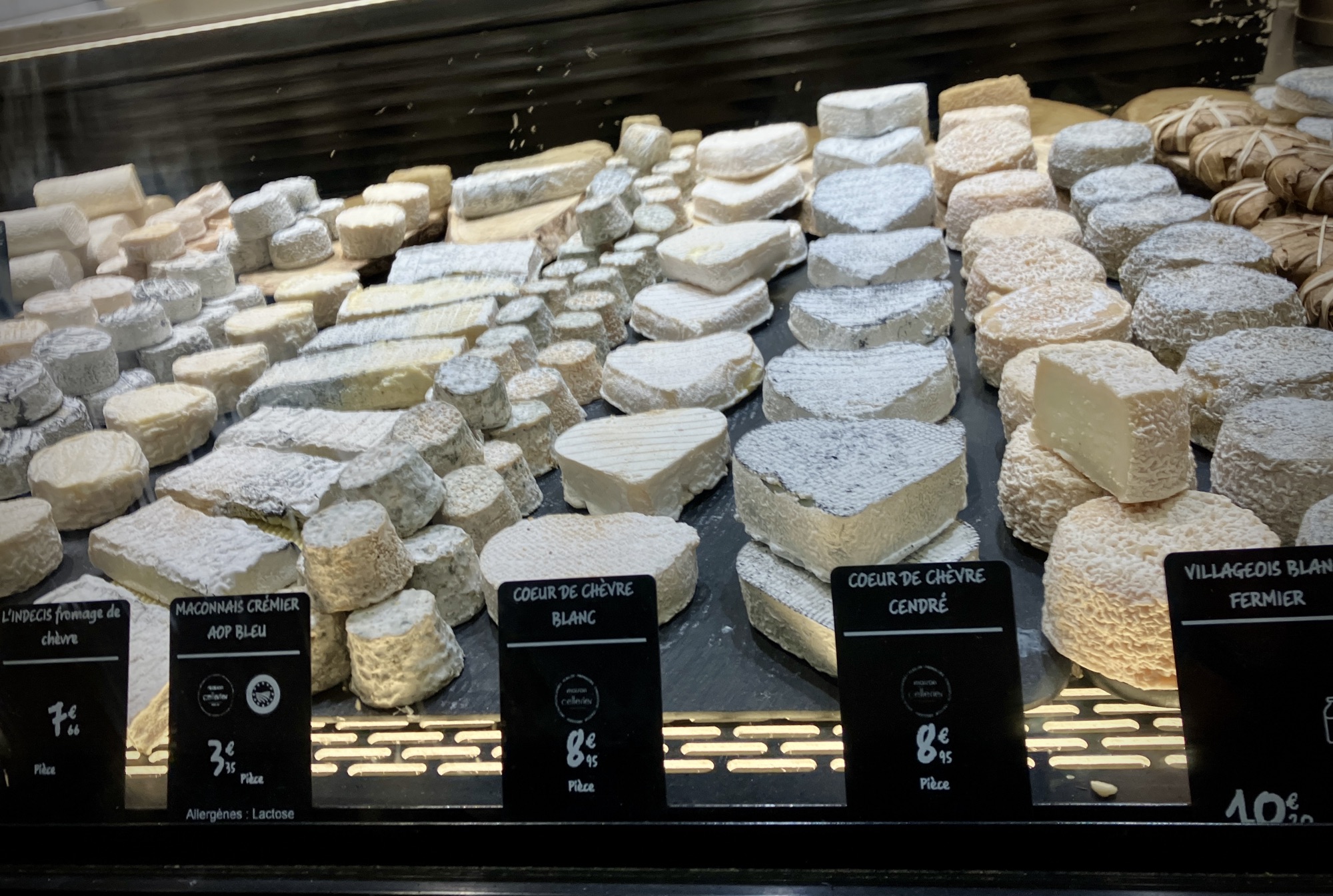
The way the locals eat and drink in Les Halles.
The food presentation at Les Halles is often like a museum installation.
We opted for a classic Moules marinière feast at Chez Lyon in Les Halles. Mussels are generally in season from August to January.
We probably could have shared a bucket, as they were huge! But sooo good.
I can do this…and I did, as well as about 1/3 of Cheryl’s bucket -;)
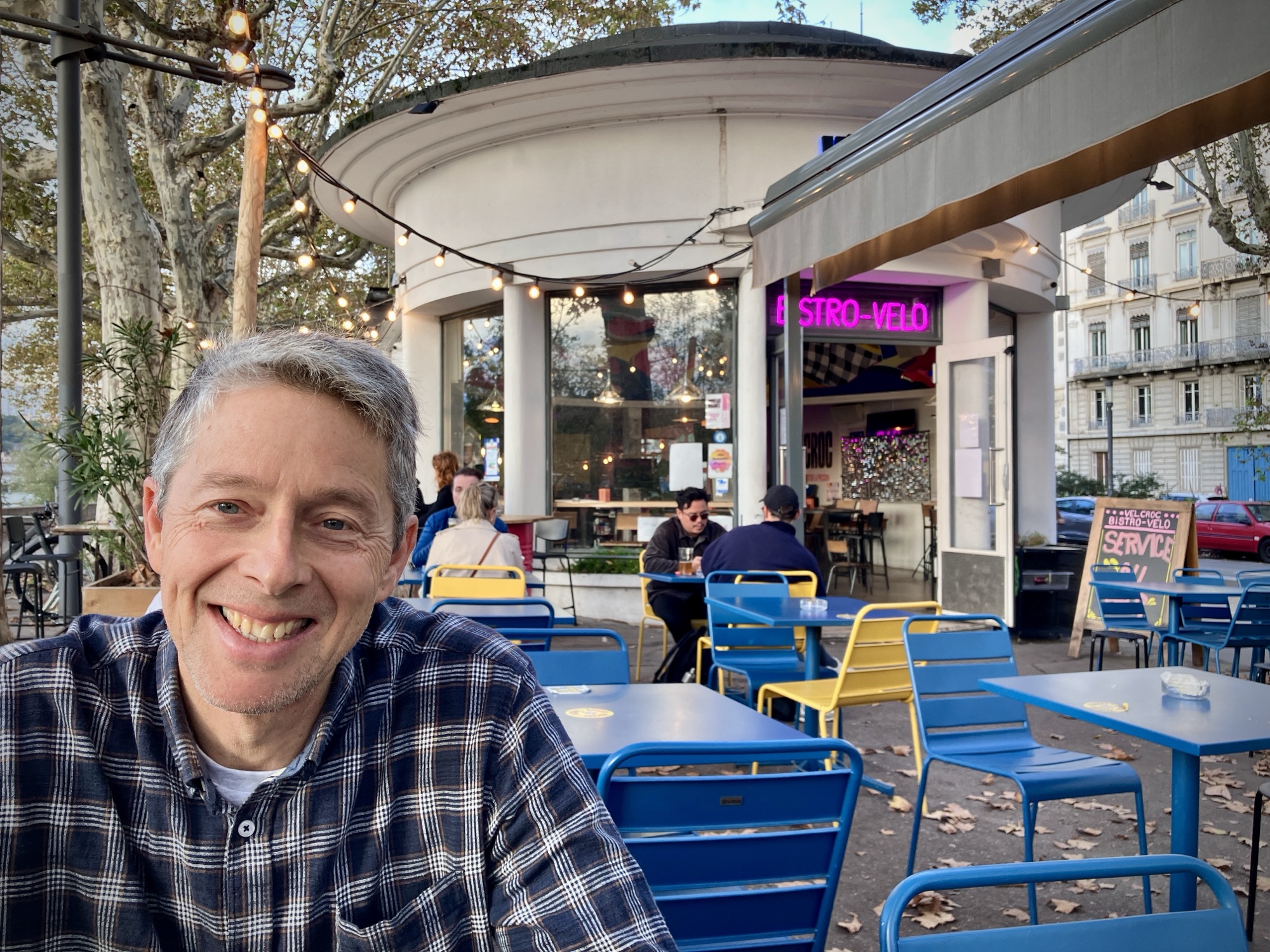
The typical chimneys of Lyon with Grafitti/Art?….how did the the street artists get up there?The famous Frédéric Bartholdi fountain featuring Amphitrite looking over the four tributaries of the Garonne River….in Bordeaux?! It was his intention to sell this to the City of Bordeaux in 1892, but Lyon scooped it up instead.We stayed in an apartment and a hotel for parts of our visit, but both were just a block from the Left Bank of the Rhone; a perfect location to access all the city and the river’s many cafes and 5km of paths, but out of the tourist zones.Lots of space for people, dogs, and bikes along the extensive Berges du Rhône.Selfie on one of my frequent runs along the Rhône, with the Mussée de la Confluence in the distance.Access in pedestrianized zones is generally controlled by retractable bollards activated by residents and delviery vehicles only. Why is this hard to transfer to US cities?
Besides the great variety of food in Lyon, we really were impressed by the lack of impactful car traffic in most nighborhoods. There are some busy main arterials, but in general, you can walk freely and cross small streets with ease. There are 7 tram and 4 underground metro lines that cover the ciy pretty well, and an extensive bike network. And as in much of France, they are investing more in public spaces for people with a huge project to expand car free space in the commercial core, not to mention a massive renovation of the always busy Lyon Part-Dieu train station. As always, the surface tram lines are a nice way to get around and sightsee as well.
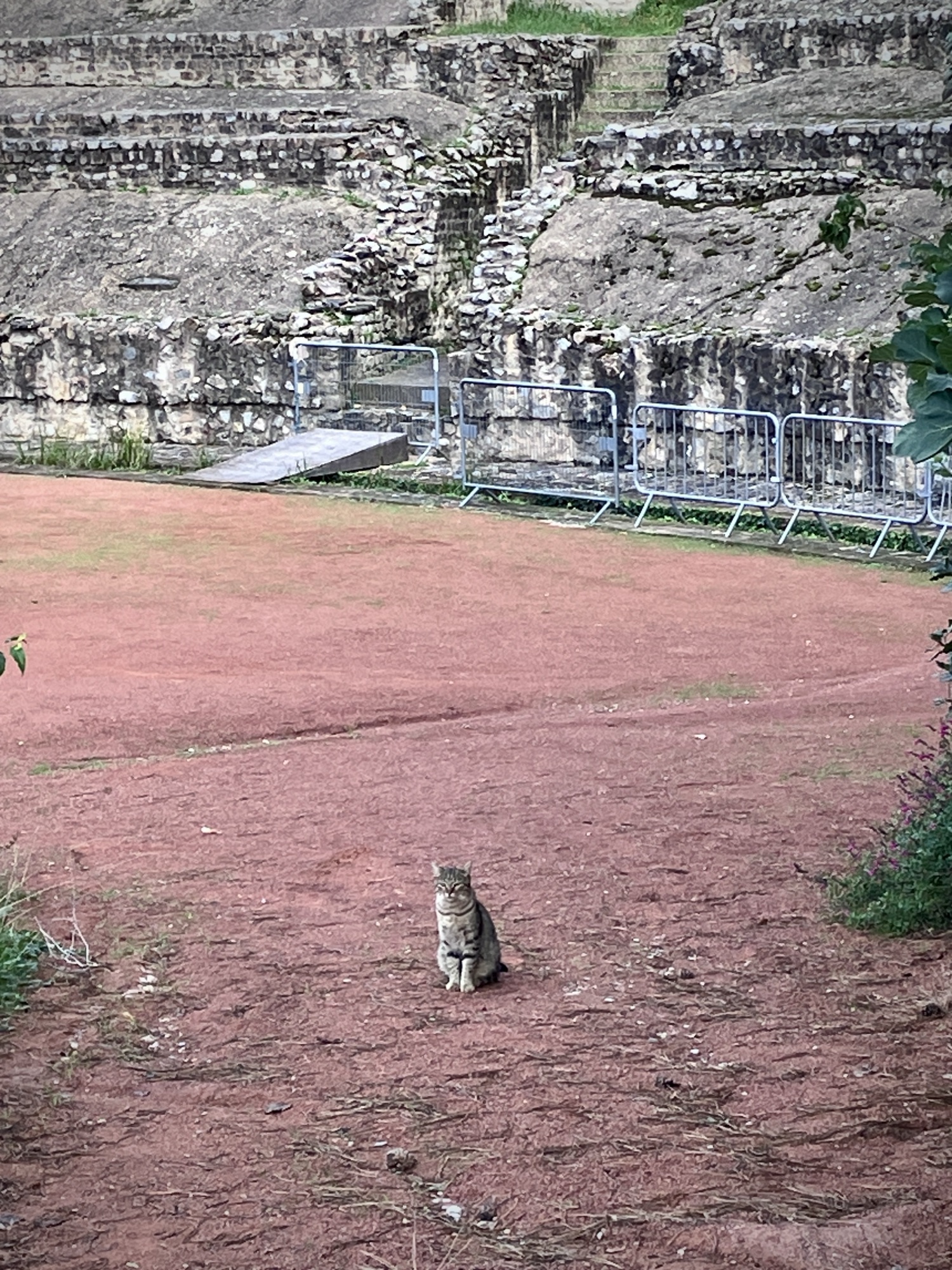
Roman ruins are tucked into Lyon in surprising locations, such as the 19AD Amphitheater of the Three Gauls in the 1st Arrondisement.Random Roman ruin fragmants yet to be pieced togther by a grad strudent, and cats…always!This cat seemed to be in some sort of guardina role. We kept our distance.Taking advantage of water collected in the ruins.
Cities with layers of history are always intriguing, and Lyon city along the Saône used to be the core of Lugdunum, a thriving Roman city dating back to 43 BC. It may have had up to 200,000 inhabitants at its peak, which is in incredible as Lyon today only has 500,000 inhabitants in the age of modern infrastructure. There is a large Gallo-Roman museum, two amphitheaters, and lots of other remnants to be seen if you want to dive deeper into this history.
Beyond the usual recycling and residential composting, we were surprised to see public compopsting bins in such a large city.Delicious dumplings at Enginomo. The culinary scene in Lyon includes a good variety of food choices, not just French Gastronomie.The “Pot Lyonnais” The usual French wine ‘pichet’ comes with a twist in Lyon as it has a thick glass bottom and only accomodates 46cl instead of the usual 50. Apparently the factory bosses used these bottles to take a little from each worker of their weekly wine rations.Notice the thick glass bottom, which also makes a “Pot Lyonnais”very stable!
Beautiful architecture, trams, and sunshine.
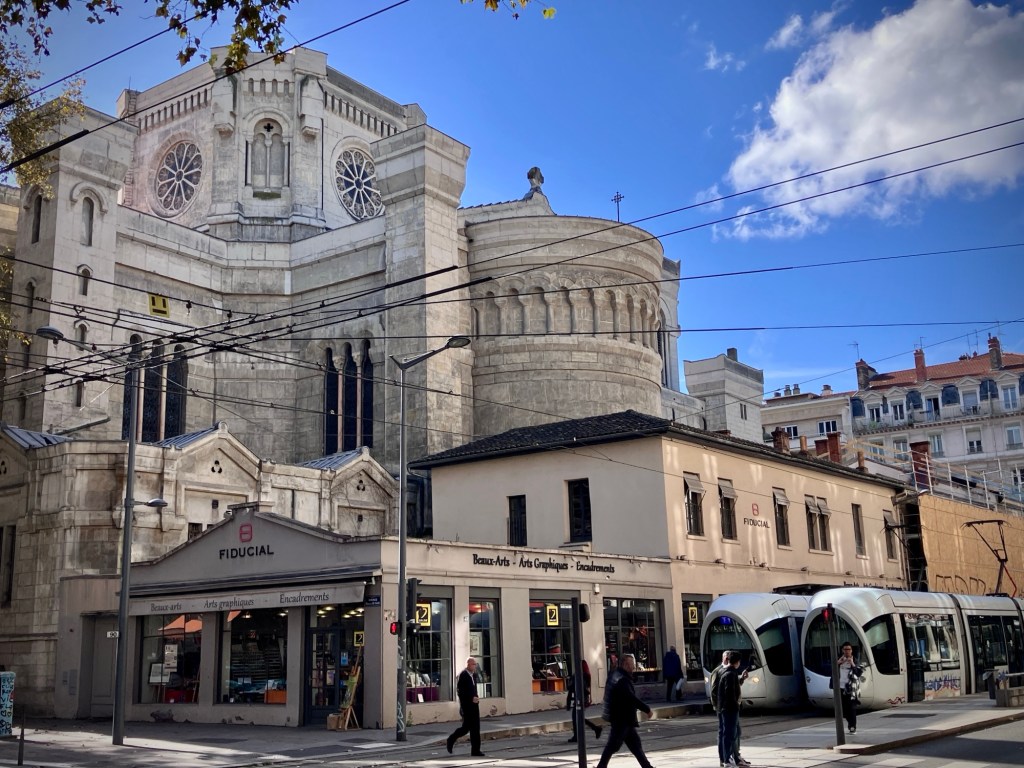
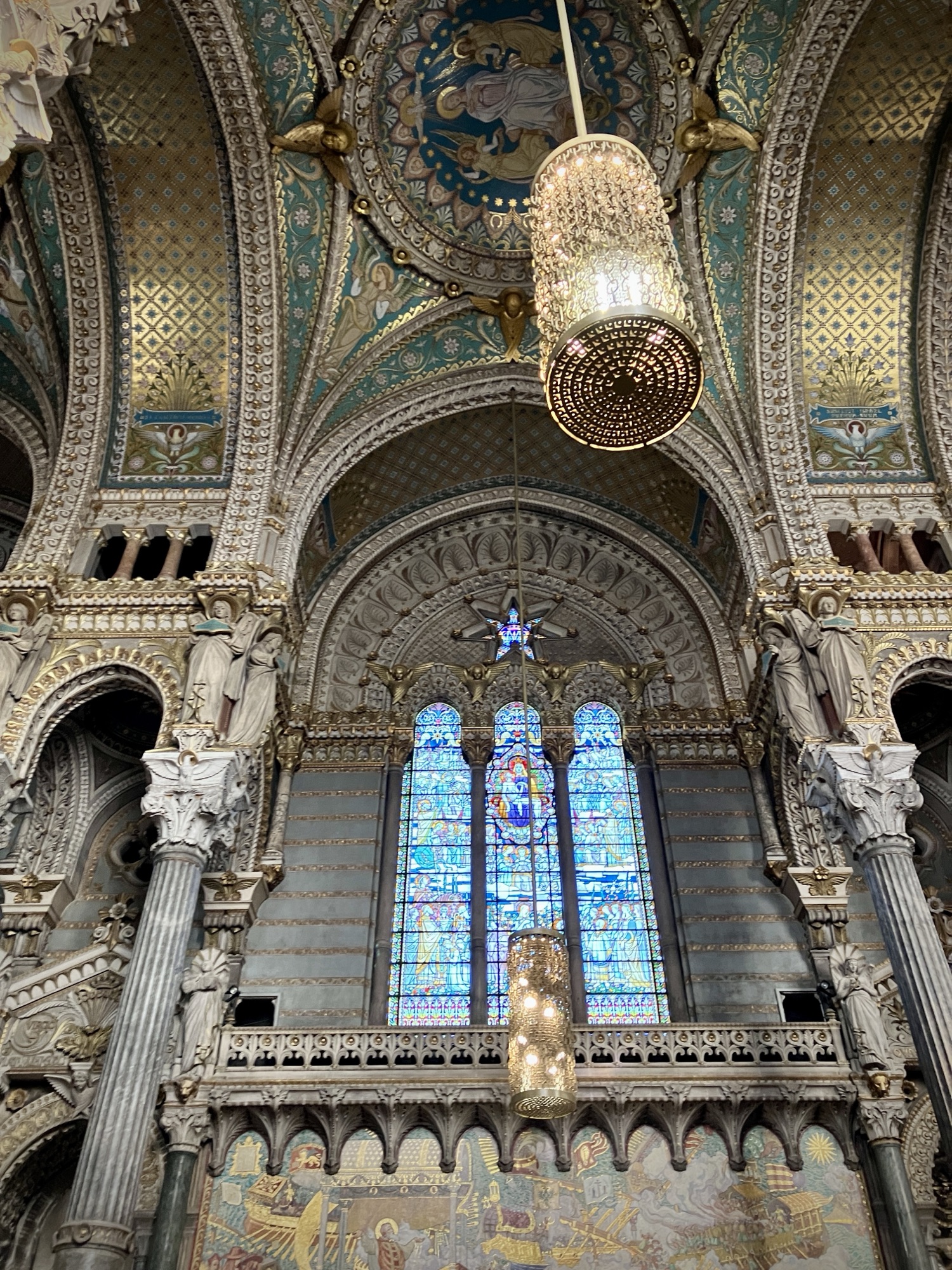
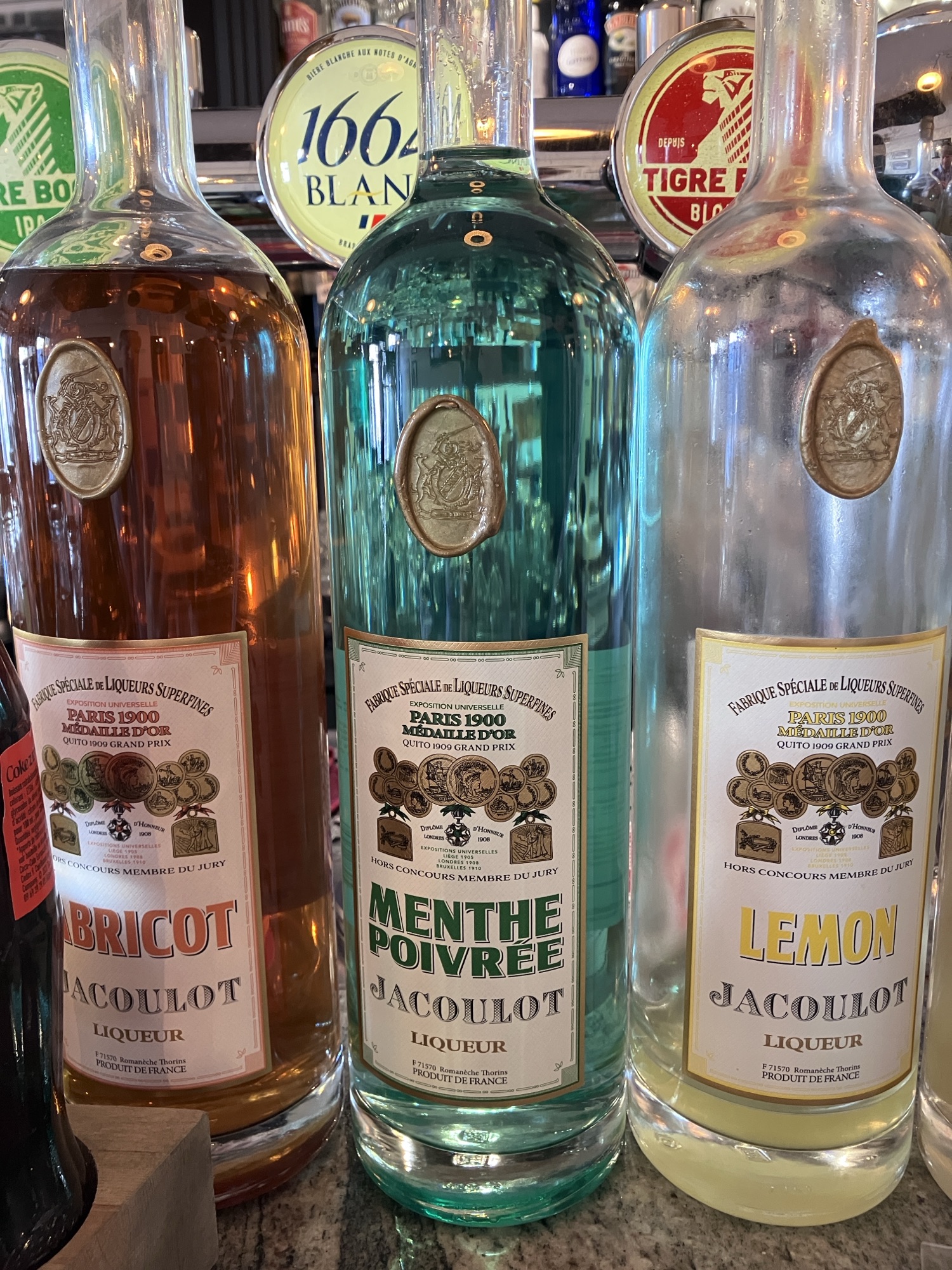
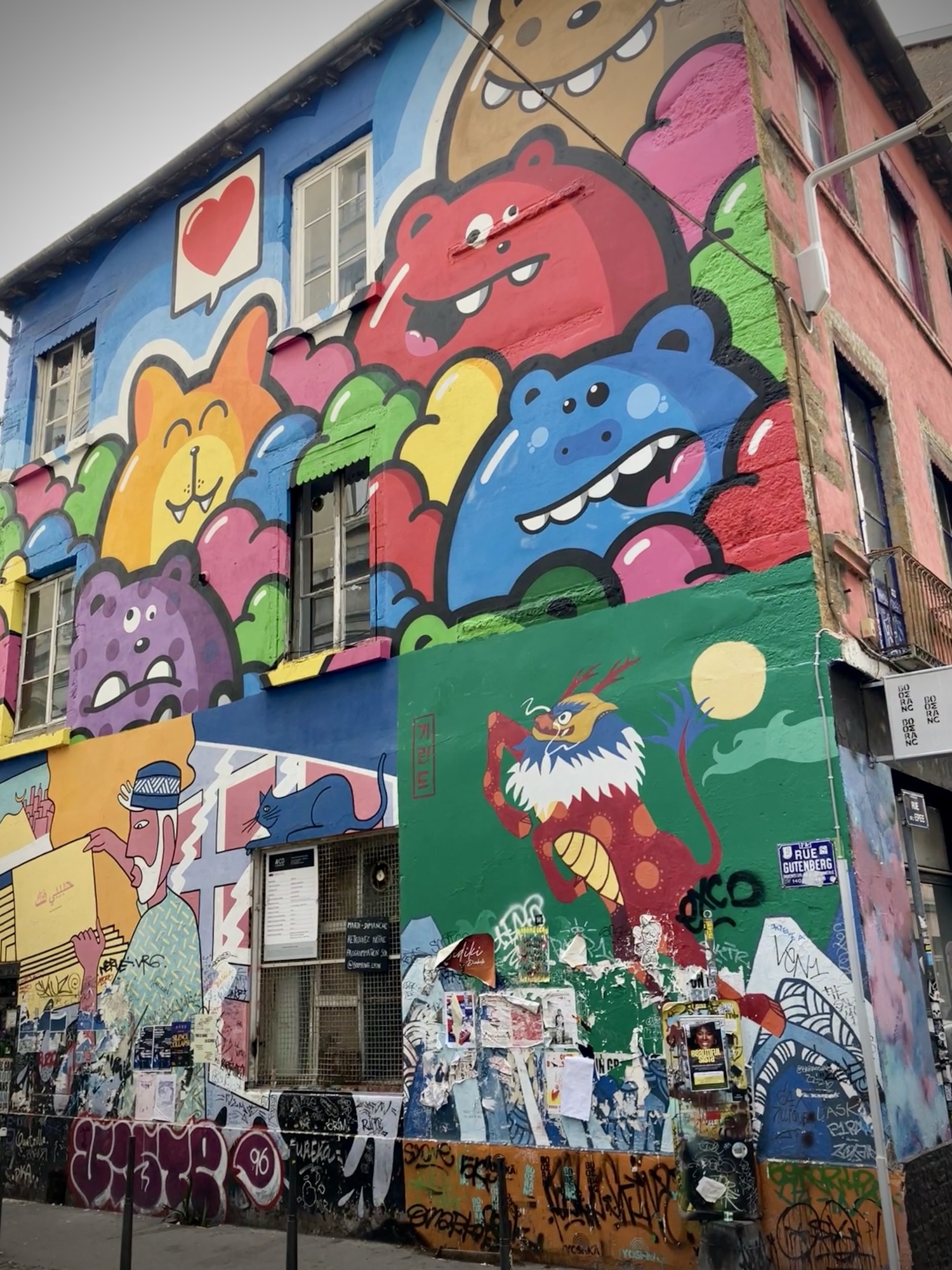
Former 19th century hospital is now the Grand Hôtel-Dieu, as well as shops and gathering spaces.Low morning autumn light on Les Célestins Theater.We used the last few minutes of our 24-hour transit pass to take the funicular up to the Basilica of Notre Dame of Fourvière. It’s impressive and one of Lyon’s top sights, with views of the city from the nearby terrace.Remains of the Gier Aqueduct which brought water to Lugdunum from over 50 miles away. Parts are still fully intact while other sections are now one with later development. Amazing.This streetscape reconstruction in Sainte-Foy-lès-Lyon was still in the archeolgical phase, as Lyon sits atop layers of history.Enjoying the nice weather on our exploration of the hills.Colorful liquor bottles caught Cheryl’s eye at a casual neighborhood bistro where we had lunch in Sainte-Foy-lès-Lyon.Sunshine on the Saône looking toward Croix-Rousse.Street Art and murals are a mainstay of Lyonnais life and there are websites dedicated to the various artists.We feel the same way.Nothing but smiles after a stimulating week in Lyon. But will this great weather last?
Lyon is not always a must see to most visitors to France, and I think it’s still a bit overlooked. Paris is amazing, but Lyon is a place you can really feel comfortable in quickly and will be rewarded by friendly people and a vibrant cultural scene. We were glad we came back for a longer look. Happy travels!
Apologies for the long gap in posts, but we’re now back in France and finally catching up on our past month of adventures. So how’d we get back to France from Salzburg? Cycling through the Alps and some trains of course!
Descending on the Alpe-Adria Route into Italy.
We really enjoyed our few days off the bikes in Salzburg, but as always, were eager to get back exploring. We find that more than two days off the bikes can put us off our game (like the Tour de France, eh?), so it felt good to roll out and head up the beautiful Salzach River towards the towering spires and massifs of the Alpes. Ok, maybe a little intimidating too.
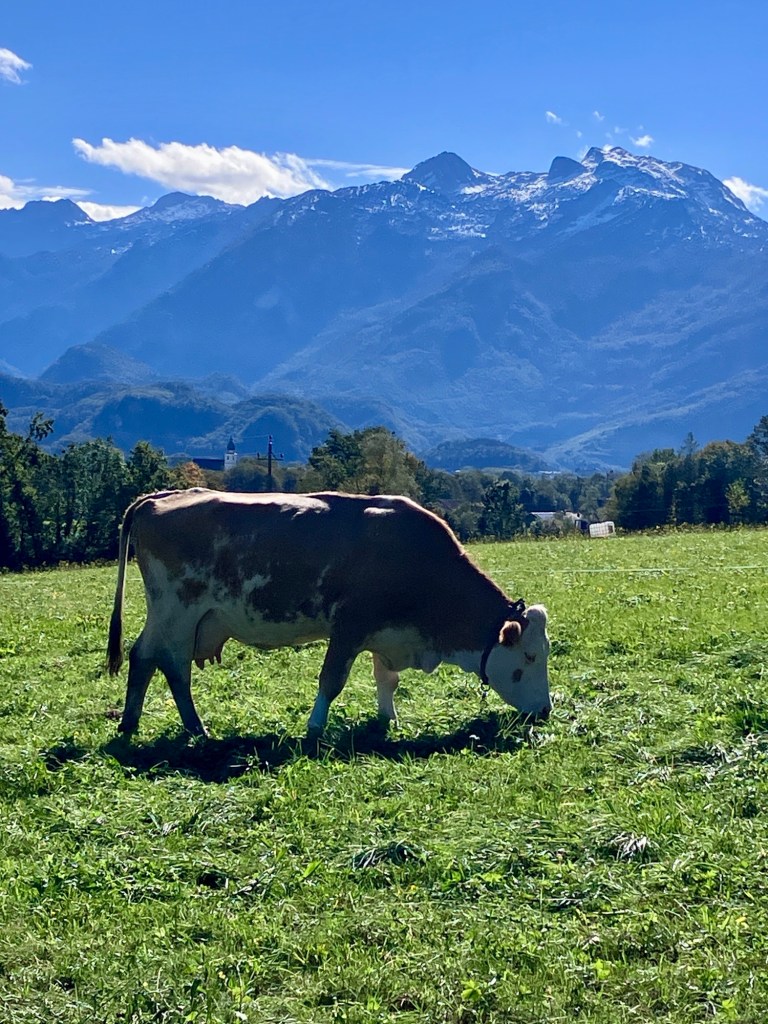
Starting up the Alpe-Adria on the Salzach River.Cows and sunshine!
The Alpe-Adria is a long distance cycling route that starts in Salzburg and covers 415 km over the Alps, all the way down to the Adriatic Sea at Grado, Italy. This spectacular route was (mostly) completed between 2006 and 2009.
I’m ready, let’s do this!The beautiful Salzach river valley.Leaving the river and approaching Route 159 and the gorge; all looks innocent.It was too hectic to take photos, so a bit of the narrow section from Google street view. Somehow looks calmer and no 18-wheelers in their views! And there is the train if you’d like.This look after the gorge sums up my feelings. « That kinda sucked! »
The first day was about 65km to the pleasant and somewhat upscale town of Sankt Johann im Pomgau. It was a tougher day than expected for a number of reasons. It was all upstream and uphill, although there were not many big climbs. Second, we had a good headwind, which made even the flat river sections tiring. Finally, there is a gap in the route that requires you to ride on a narrow two lane road through a gorge.
The route continues on route 159 to Bischofshofen, but there was now a shoulder.
The worst section is from Salzachlamm to Werfen, which has about 5km without any shoulder, lots of trucks, and a barrier hemming you in on both sides. Yes, it was a bit sketchy and we had to grit our teeth a few times as large trucks approached at good speed from both directions. But it was daytime and we were fairly confident that the regional truck and car drivers would be looking for cyclists on this stretch.
Burg Honenwerfen loomed over us as we crested a small pass along the river. These valleys have been strategic trading routes for centuries.
So although we made it just fine, we asked ourselves, “would we ride it again?” No! So we have to recommend skipping it with a quick train train hop on the S3 (S-Bahn) from Golling to Werfen. It was the only traffic impacted gap in the otherwise enjoyable Alpe-Adria route, so we hope they figure out a solution in the gorge to make it a bit less stressful. It seemed that many cyclists rode to the restaurant near Pass Lueg and either turned around or perhaps got a shuttle as we saw no cyclists on the narrow and truck filled stretch. We now know why. It would be better if you’re on fast road or bike packing setup, as you’d be narrower and faster. For now, we can add it to the many stretches of road around the world we will only ride once!
But all good in Sankt Johann with a nice meal and white wine.Day 2 of the route brought peaceful and rolling climbs away from the main roads. Our favorite kind of touring.Turning up the valley towards Bad Gastein, there a few long tunnels with protected bikeways. Noise cancelling earbuds are awesome for loud tunnel stretches!Ah, this is more like it, a new and separate bike/ped tunnel! Overall, we were impressed with Austrian cycle infrastructure as it seemed to have more recent investment than Germany.Bad Gastein.
Our next day to Bad Gastein was dramatic and all along quiet roads and paths. The profile was again mostly uphill as we continued towards the main spine of the Alps. But the long profile hid some of the up and down rolling terrain along the edge of the valley. It was fun (roller coaster!) but the last stretch up to Bad Gastein was very steep so required some pushing and patience.
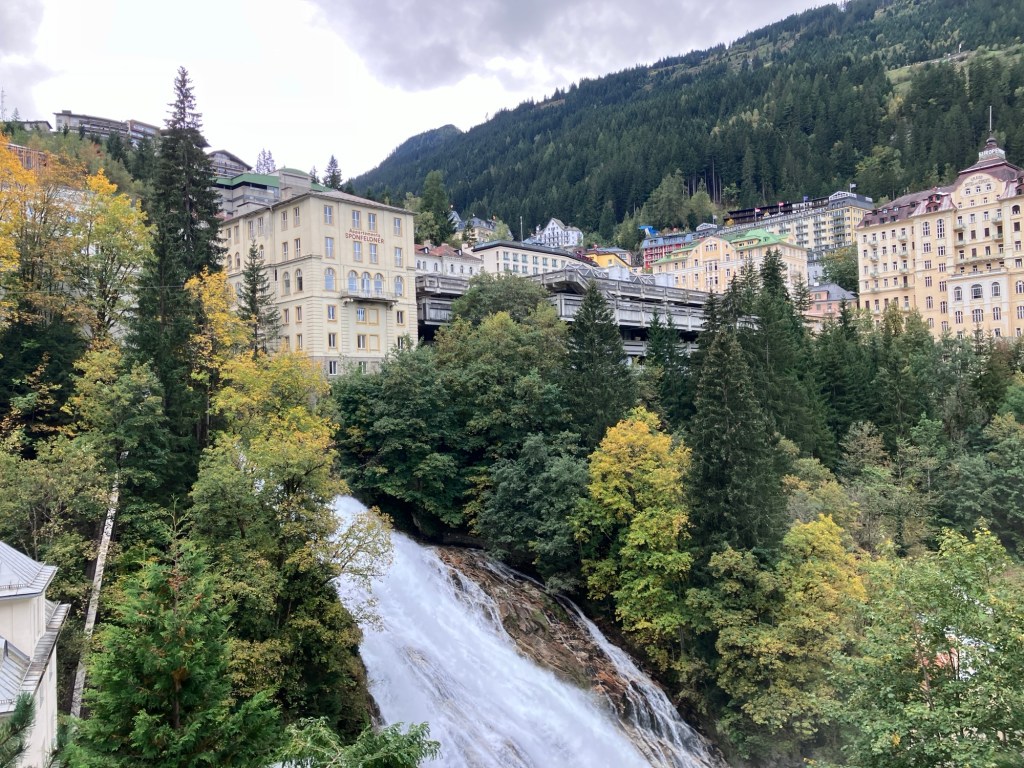
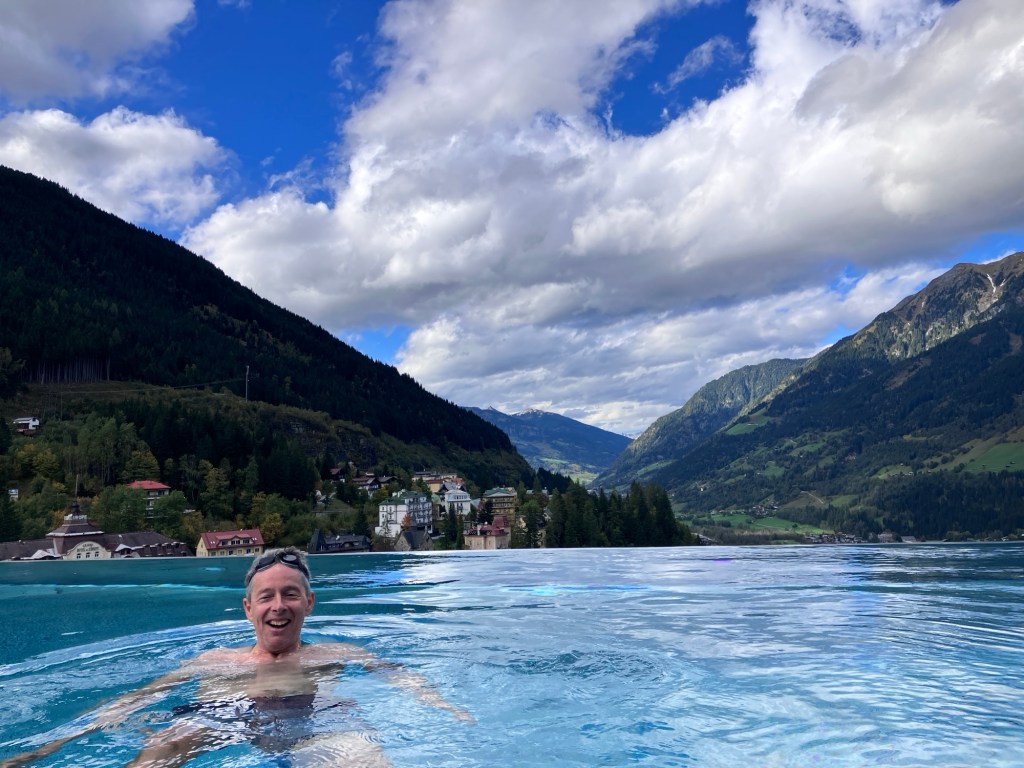
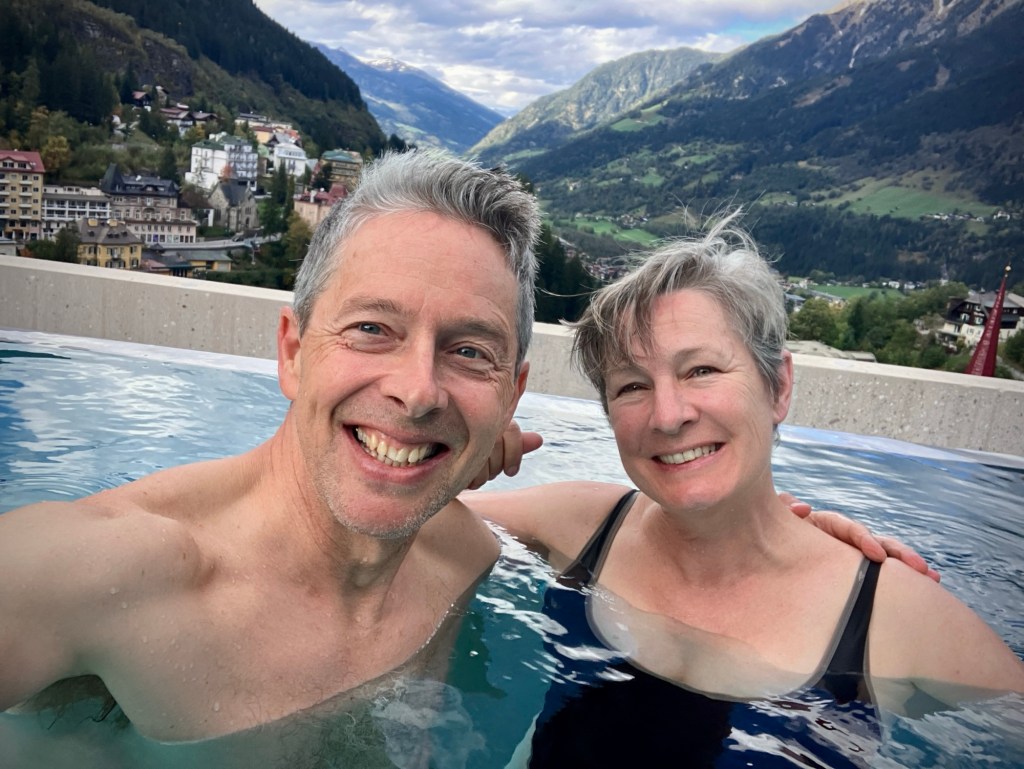
The mighty falls in Bad Gastein are a constant sight and sound in the lower part of the city.The heated rooftop infinity pool at Bade Schloss felt so good. There’s a sauna too.And great pizza refuel at Pizza Napoli, which seems to be run by one passionate chef/owner.The rewards of swing season cycle touring.The terrace at Bade Schloss looking across at their sister hotel, the Straubinger Grand. It was chilly but atmospheric.
The reward was the « discovery » of Bad Gastein, as we hadn’t ever heard of it prior to this journey. We highly recommend a stop here and staying at the Bade Schloss hotel if possible. (It was a bargain in late September) It just reopened in 2023 with a dramatic remodel to three historic buildings, as well as a new 14 story concrete tower. Ok, the tower is a bit of a sight from afar, but the rooms and rooftop pool are wonderful. And the setting next to the roaring falls incredible. It’s a faded spa town with belle epoque buildings and a bit of a Wes Anderson vibe.
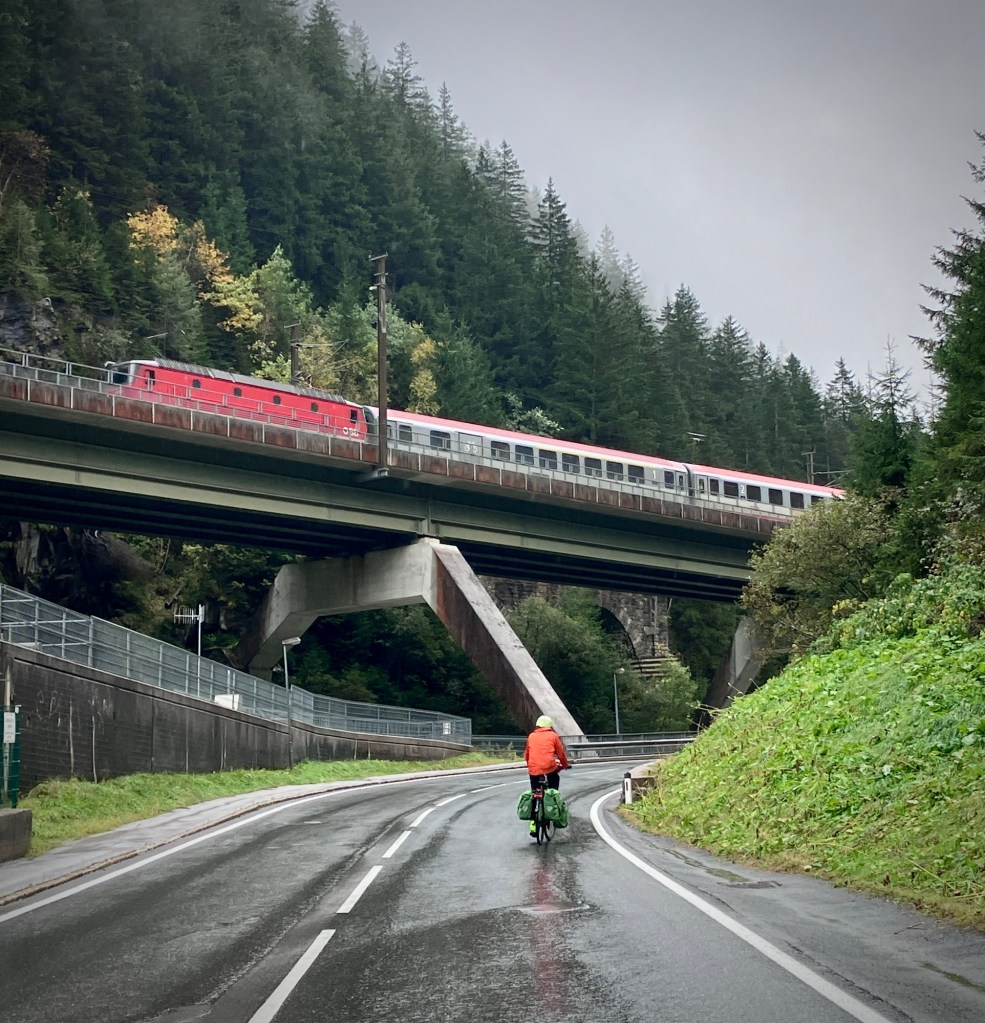
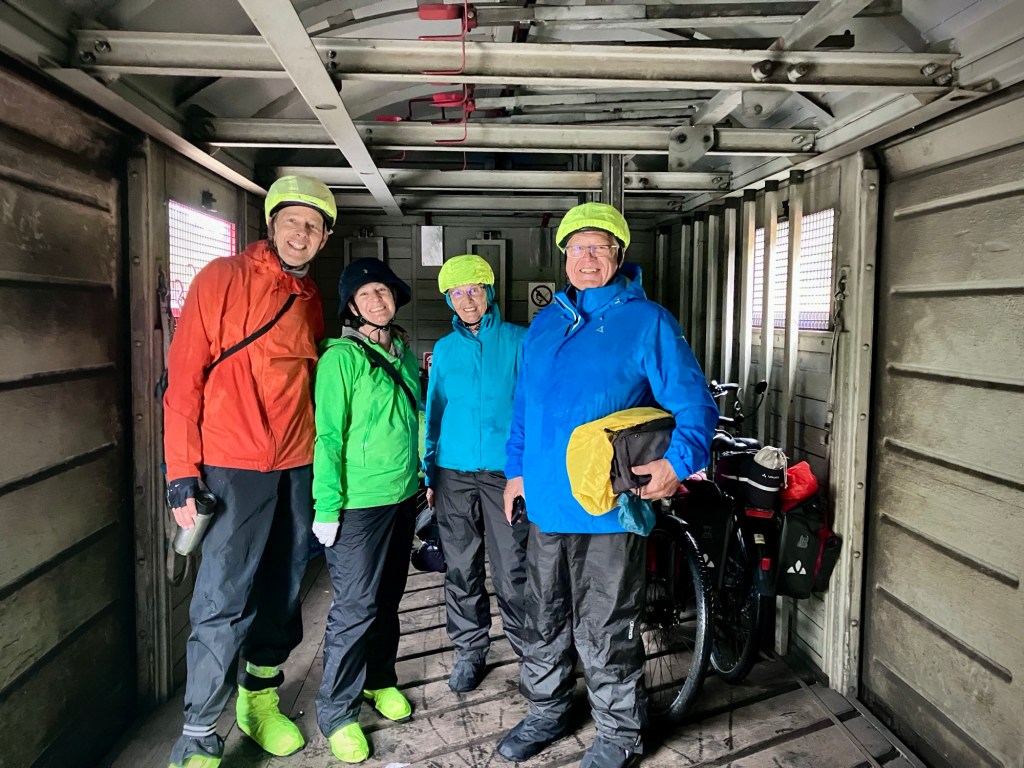
And an impressive breakfast.Fueled up for the short ride to the pass in our well used rain gear.Constant cascades to please the senses, a slight reward for all the rain.Getting close, but don’t panic, that’s not OUR train!Buying tickets for the Tauerbahn in Böckstein. Only 4 bikes on this rainy late September Day. It’s about €10 each, a bargain to avoid a 1000m climb (and snow.).No question where the bikes go.
The nice thing about stopping in Bad Gastein for the night was that it was just a relatively easy 7km climb to the train portal. Yup, the official Alpe Adria does not go up and over the highest passes, but utilizes the hourly Tauernbahn shuttle between the Austrian States of Salzburg and Carinthia. The 10 minute train ride takes cars and bikes through the mountain and is a fun way to feel both the accomplishment of a pass without the reality of a high pass, including weather challenges in late September. (Note that the tunnel will be closed until July 2025 for engineering works.)
A chance to chat with some friendly Germans from Düsseldorf. Apparently in summer, there can be over 100 bikes jammed in this train car We emerged on the Carinthian side of the tunnel to even heavier rain, so decided to try to wait it out a bit before heading down the next valley. But fun to watch the cars load on the next train.
Contrary to our hope for sunshine on the southern side of the train pass; the rain just got heavier as we headed down the fairly steep and relentless switchbacks on the other side. My disc brake pads even started to crystallize a bit trying to control my loaded tanks’ speed. But eventually the rain ended and the terrain flattened out and we made our way to Spittal am der Drau for the night. Another relatively short but memorable day.
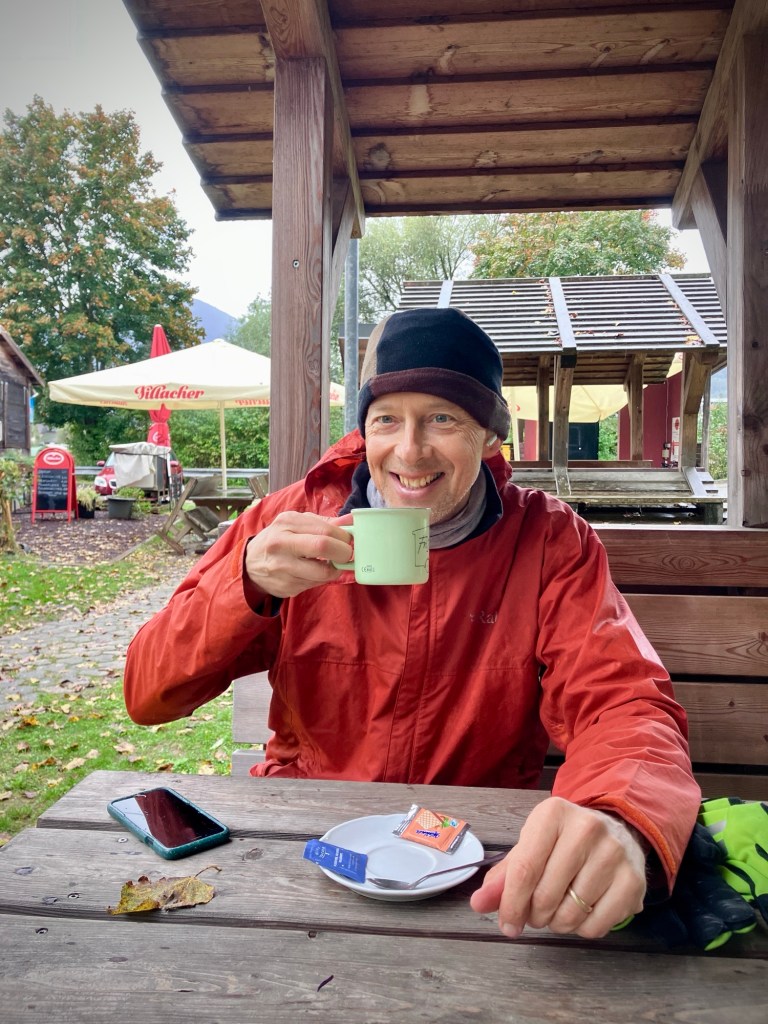
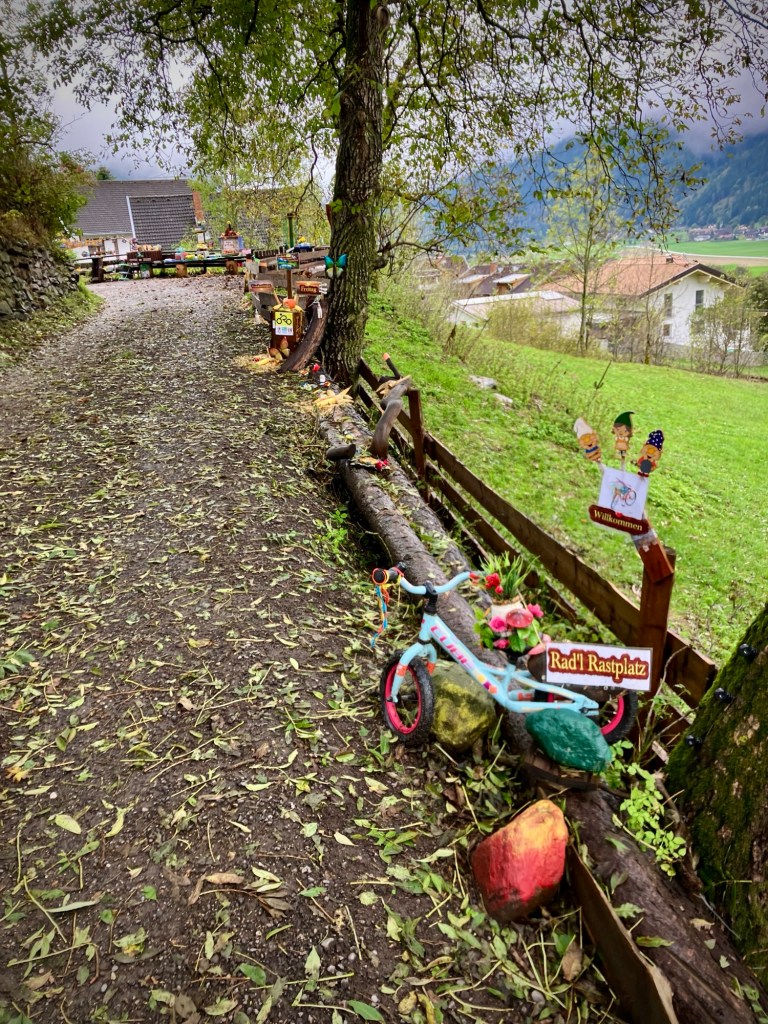
The amazing works of vertical infrastructure in the Austrian Alps.And nice rest stops.Yup, this works…if it was only sunny!And unlike most of Germany, plenty of public TrinkwasserRare spot to duck out of the rain on another mizzle-y day to Villach.A welcome coffee stand for this coffee achiever.The locals provided their own rest stops for cyclists on the Alpe-Adria. This sprawling one had lots of food, bike repair supplies and a guest book. All free with donation box -:).The friendly but somewhat incongruous Hacienda Mexicana hotel and restaurant in Spittal am der Brau. The room was good, and I’d love to say we found good Mexican Food in the middle of Austria, but …
The next day was another relentlessly rainy day with few places to stop and escape the weather. This is definitely a challenge on many long distance cycle routes; there may be lots of nice benches and even tables, but there are rarely covered rest areas, so bridge underpasses or farmers barn overhangs become your best bets.
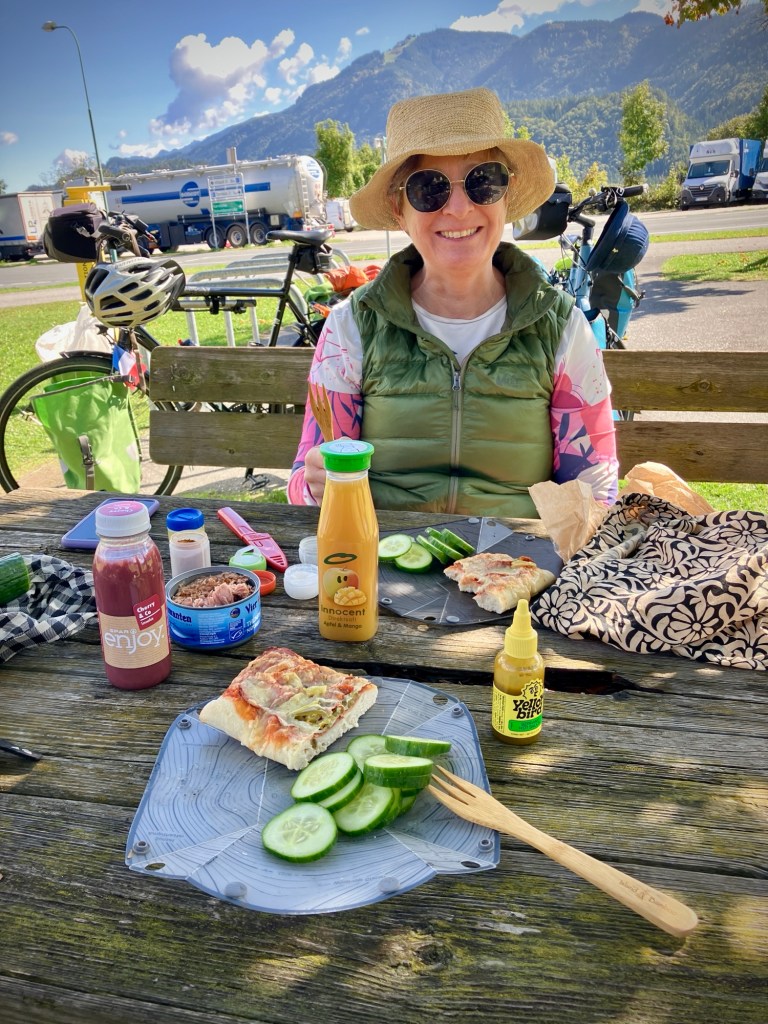
Lots of cool bridge and tunnel engineeing in Austria.Overnight in Villach, an enjoyable stop at the recommended Palais 26 Hotel.Typical picnic lunch near the Italian border. Focaccia with various toppings are the new go to quick snack at small stores and groceries Note my mini bottle of Serrano Hot Sauce -:).Near the Italian border at the pass.
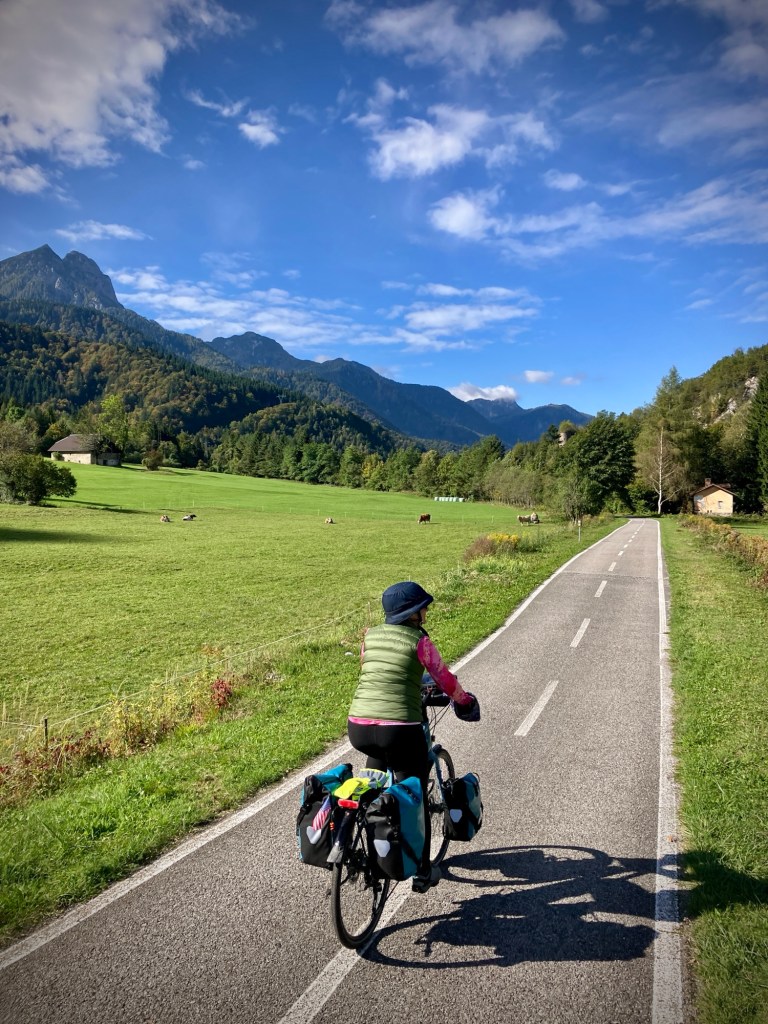
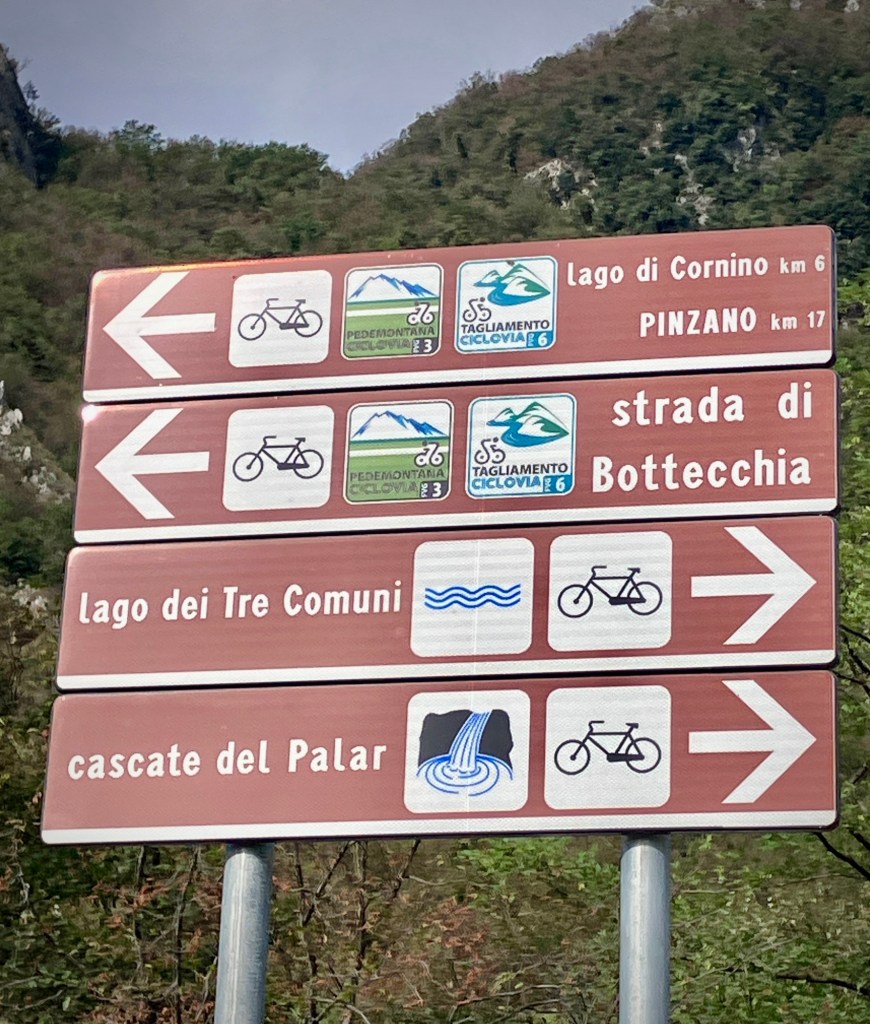
As we rode over the second pass into Italy, we could notice the terrain and vegetation changing somewhat from the north side of the Alps. The most popular and scenic part of the route is the downhill decent from Tarvisio to Venzone along the former Pontebba rail route. It’s a spectacular route of viaducts, tunnels, and waterfalls.
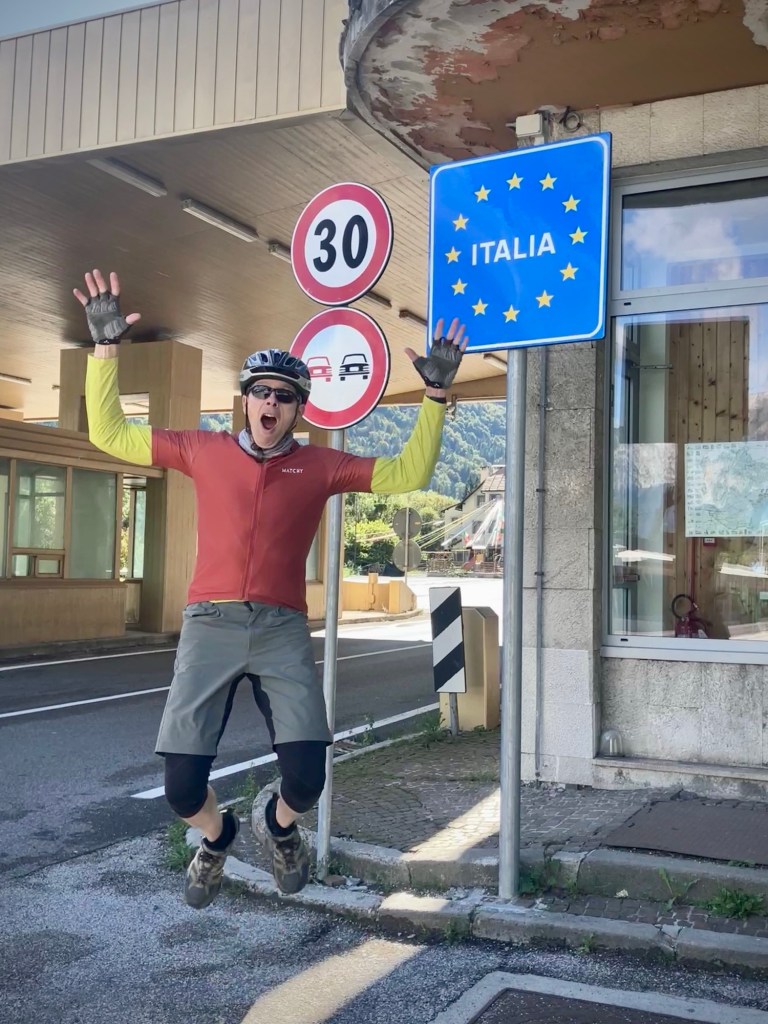
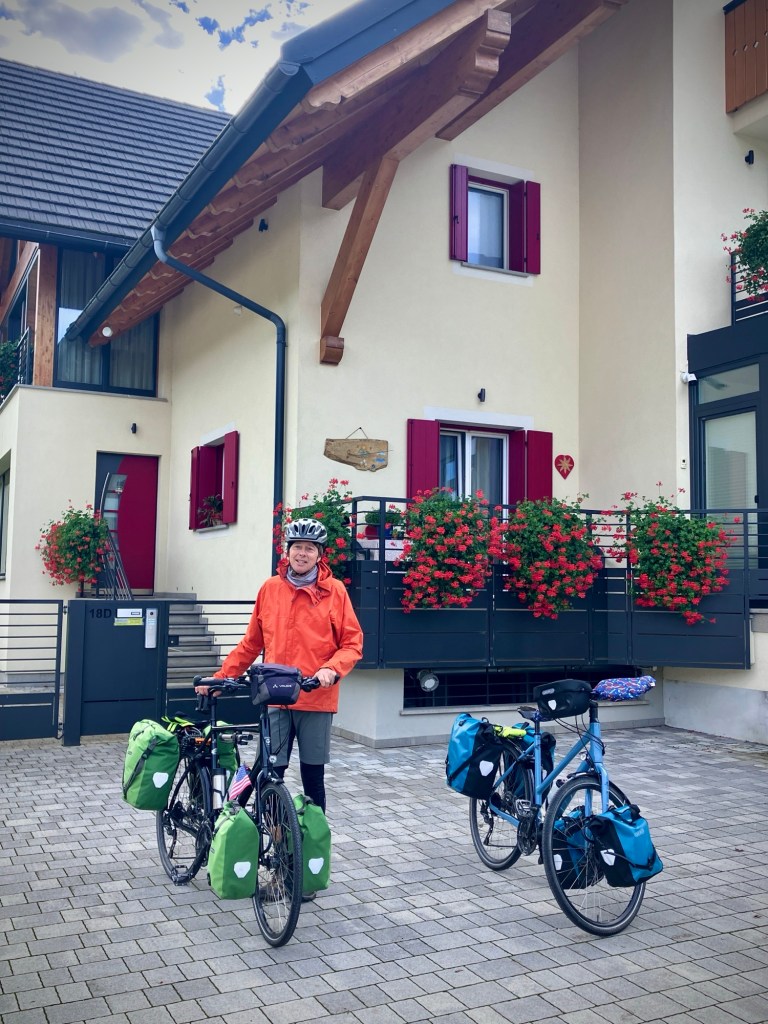
The Italian Border…we think.I was excited to be in Italy again.Cruisin’ over the crest.Also so close to Slovenia here…it was tempting!Heading out for an all downhill day from the lovely AlBuondi B&B in Camparosso.The stretch of former railway starts here and is perfect cycling bliss.The Pontebba Railway was converted into this segment of the route in the 2000s. There is a newer (and straighter) rail line that now traverses the pass and valley.And too many tunnels to count… (ok there are 22)17th c. Church = shady lunch spotMy intrepid tour client.Did we mention the perfect pavement?Always great to see a Critical Mass sticker elsewhere in the world. Not to mention an arty Woodstock -:)This 40km descent was a treat!Most of the original rail bridges were retrofitted for trail use.And constant views of the Dolomites.
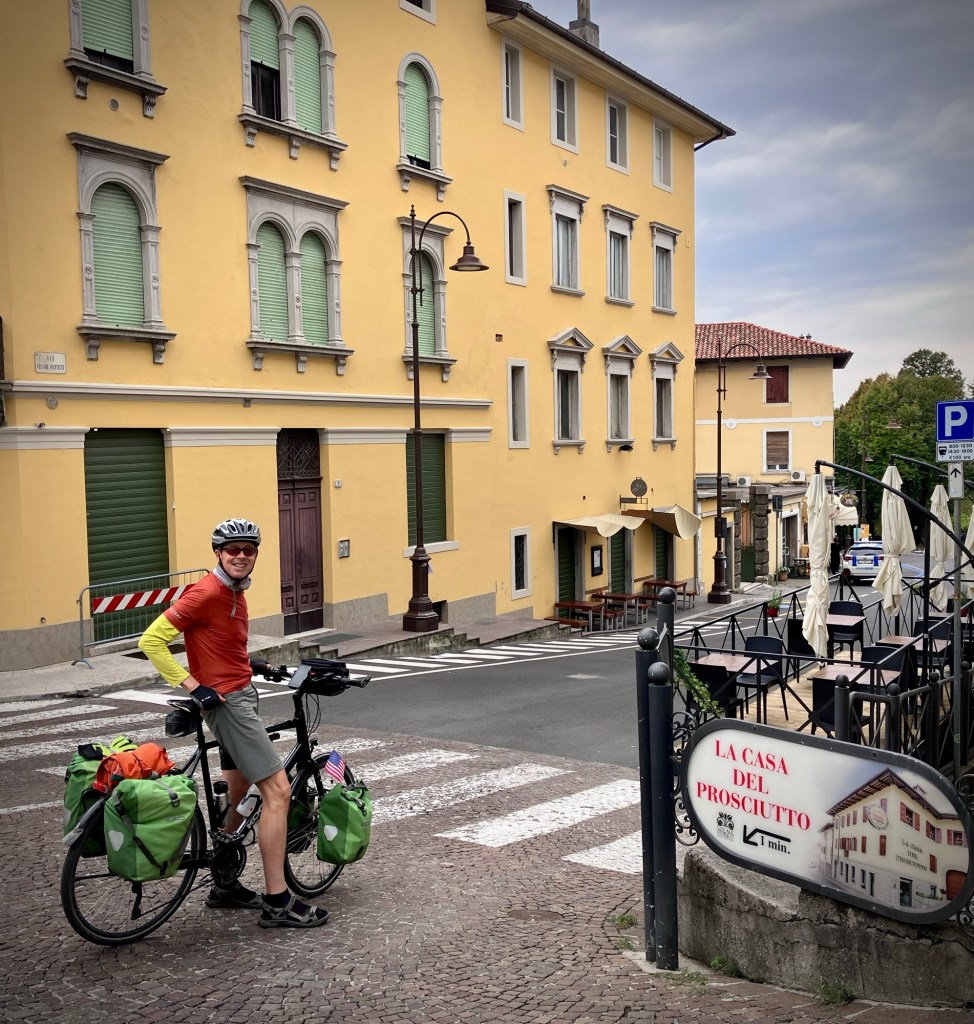
After a relaxing night at an apartment in the old town of Venzone, we took the recommendation of our cyclist host and rode an alternate route to Udine via the west side of the river valley and eventually back through San Gabriele del Fruili to Udine. The route was very nice and had some steep hills, a surprise pro bike race, and a chance to sample its famous prosciutto.
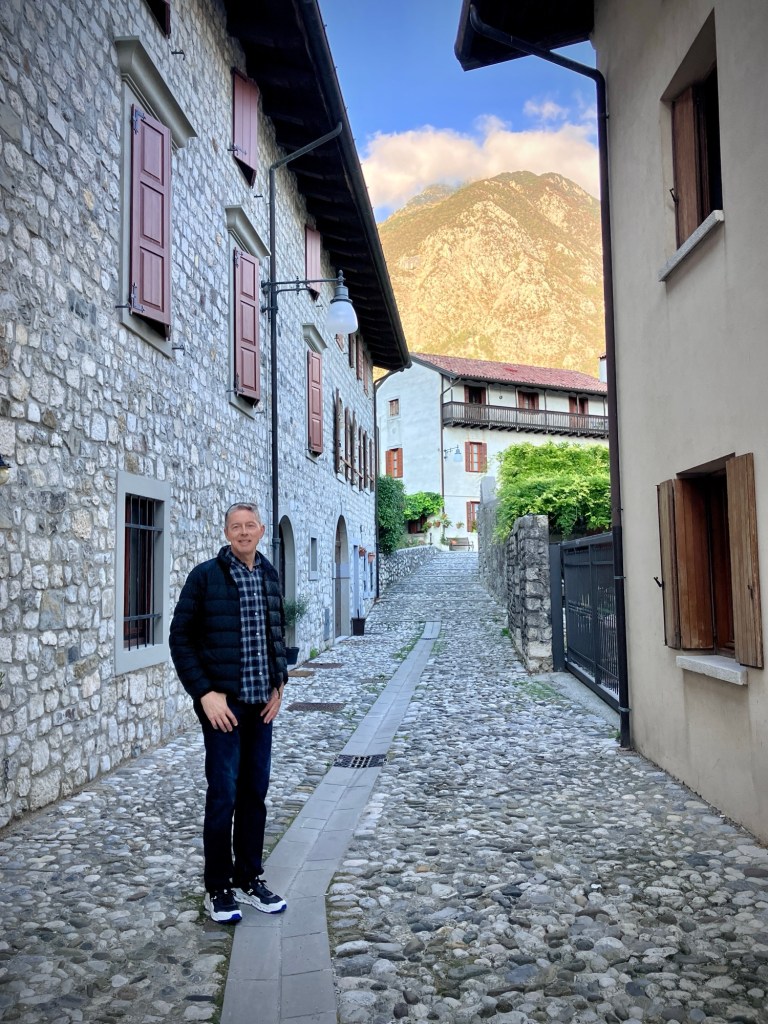
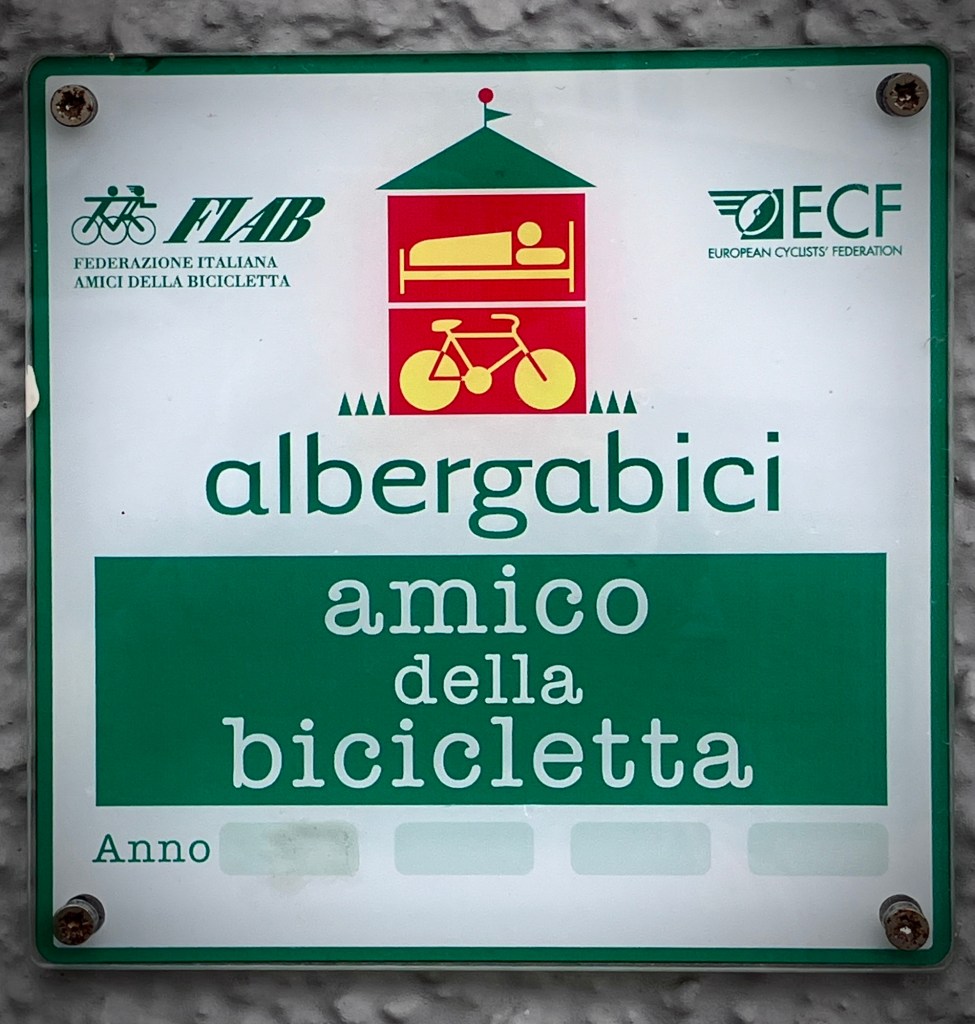
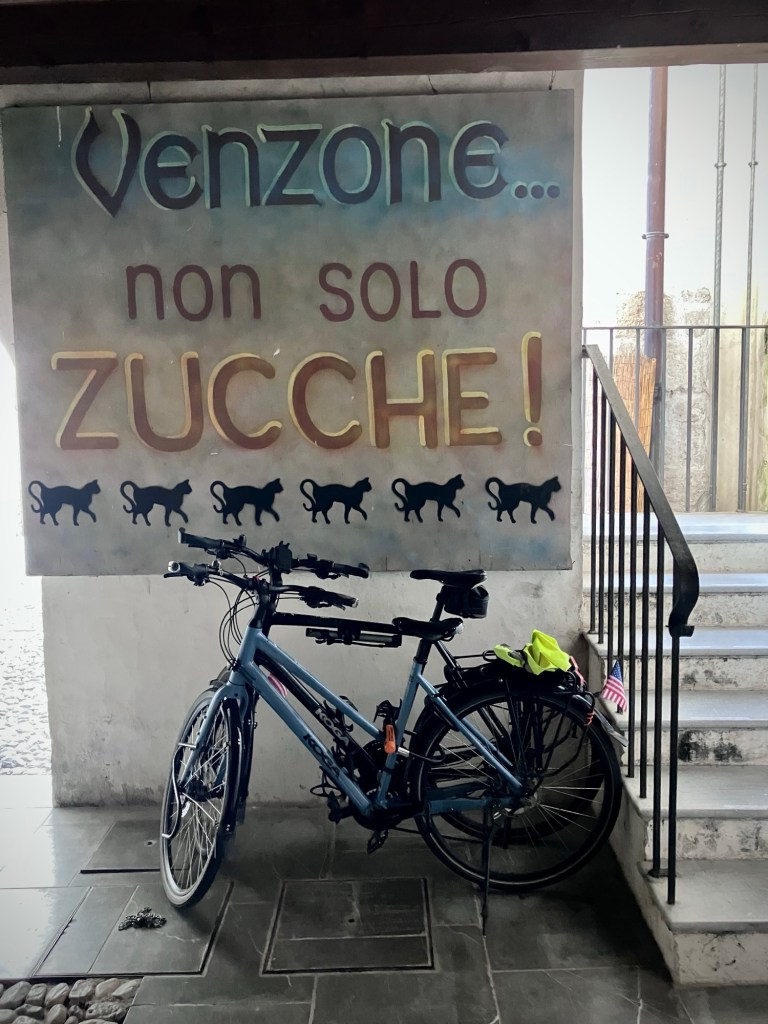
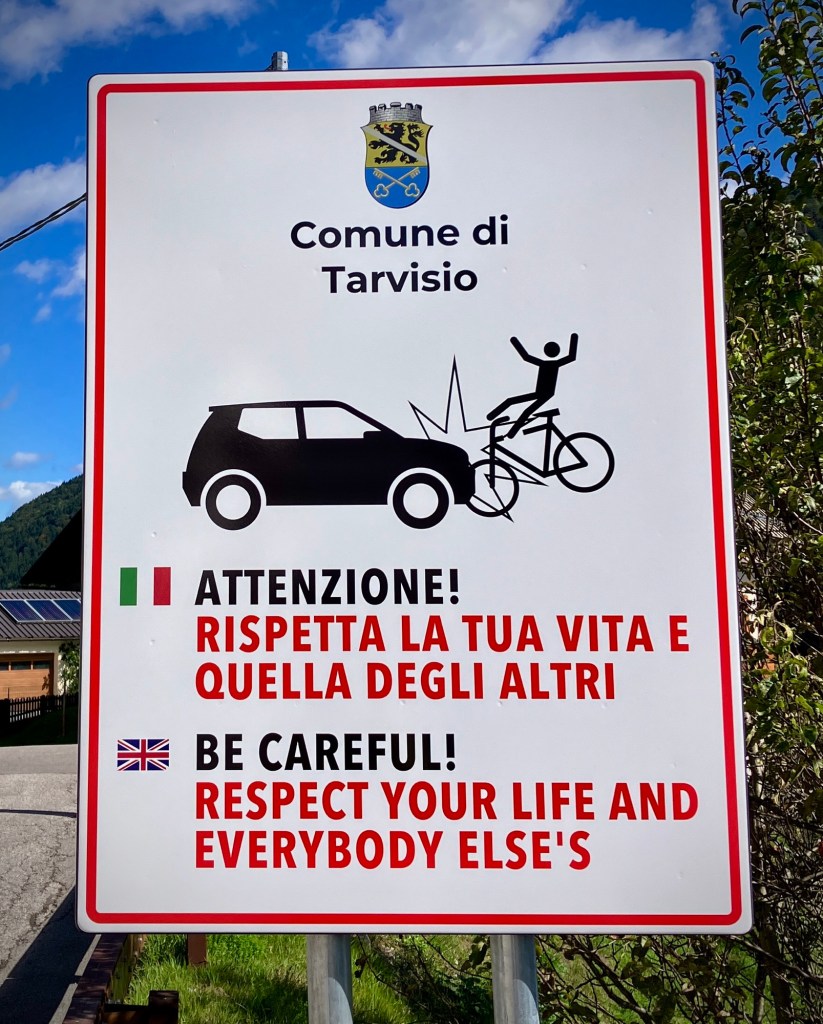
Vemzone is a tiny walled town that you can explore in a few hours.Venzone suffered two devastating earthquakes in 1976, but showed amazing resiliency by rebuilding most historic buildings block by (numbered) block.This rubble in the center of Venzone is a reminder that not everything got rebuilt from the quakes.Renato, our friendly and helpful apartment host in Venzone.The sign for bicycle friendly lodging in Italy.A chance to do proper laundry!Bike storage for the night protected by cats.The area around Venzone is now a seismic and building engineering research center, with various reinforcement and repair designs being tested in real time on historic structures.Chilly for October 1st but not raining!The beautiful and broad Tagliamento River.Off the Alpe Adria, but still nice regional routes.On the Tagliamento regional routes.The story of Ottavio Bottechia, the first Italian winner of the Tour De France was more intriguing than we imagined.This giant roadside bicycle memorial in Girona del Fruili celebrated 100 years since his historic 1924 Tour win. His body was found injured and unconscious here in 1927 and he died shortly thereafter after. Was he murdered? Too liberal for Mussolini? The mystery remains. It’s a nice reminder but we did notice that the Italian drivers were more agressive and less considerate than their Austrian counterparts.Watching for the Eurasian Gryphons at the Riserva Naturale Regionale del Lago di CorninoThe gryphons have been successfully reintroduced and protected across southern Europe. We spotted a bunch with impressive wingspans up to 8 feet.San Gabriele del Friuli is famous for its buttery and luscious prosciutto.There was a bike race starting in the center of San Gabriele, so we got our prosciutto supplies and headed out of town a quiet way down into a steep river valley. Quiet, so we thought!Suddenly not so quiet as the motorbikes cleared the way for the race.Cheryl caught on a steep climb by the field. She was not amused but the spectators were.Cheryl literally got overtaken by the peloton on her touring bike and we were still laughing about it.Finally done with our Alpe-Adria adventure; the happy cyclists in Udine, Italy
So we almost did the entire Alpe-Adria route except the last flat stretch to Prado. We diverted west at Udine towards Milan as we had a hard deadline with our long distance train back to Geneva and hoped to find some more rolling hills. But more on that soon in our next post. Ciao!
We continued our Northwest summer ramble out of Seattle and headed up I-5 about an hour and a half to Bellingham, WA.
Emerald or « Toad Lake » near Belingham, Washington.
Closer to Vancouver than Seattle, Bellingham frequently appears on “Best places to retire is the USA” lists or click bait, and for good reason. It’s a small city (90k) on Puget Sound in a beautiful natural setting, kept vibrant by the constant youthful churn of 14,000 students at Western Washington University. This was our third visit to Bellingham, but the first time we had spent a week.
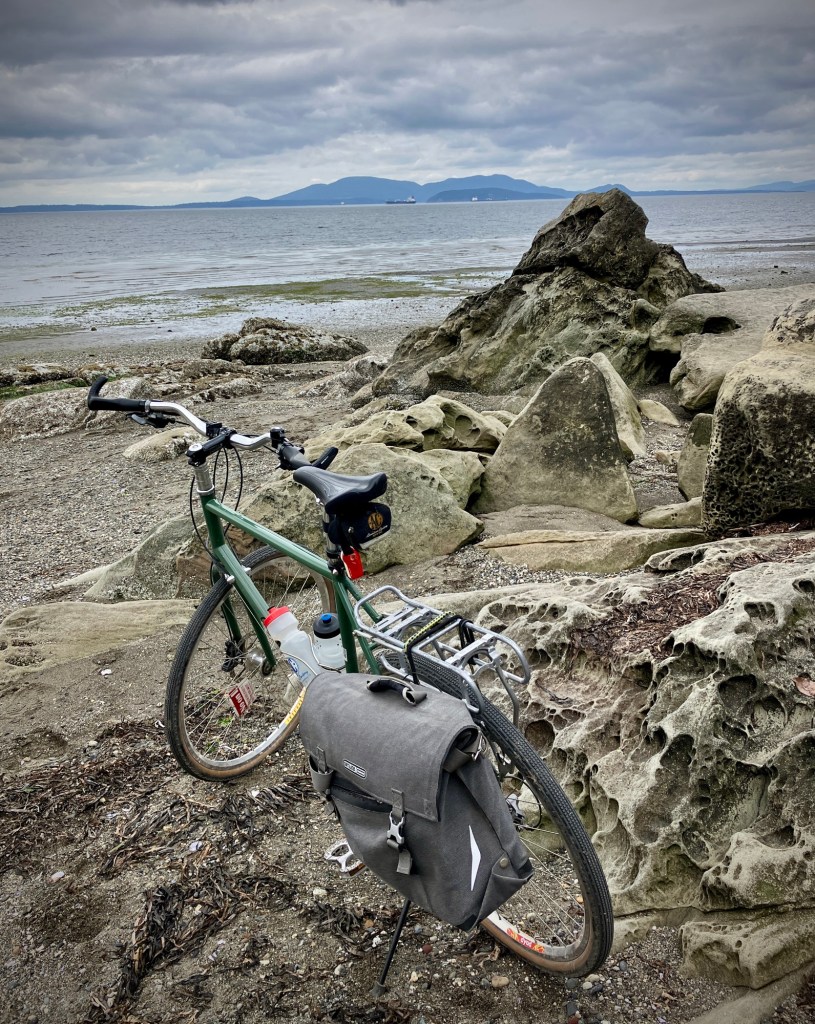
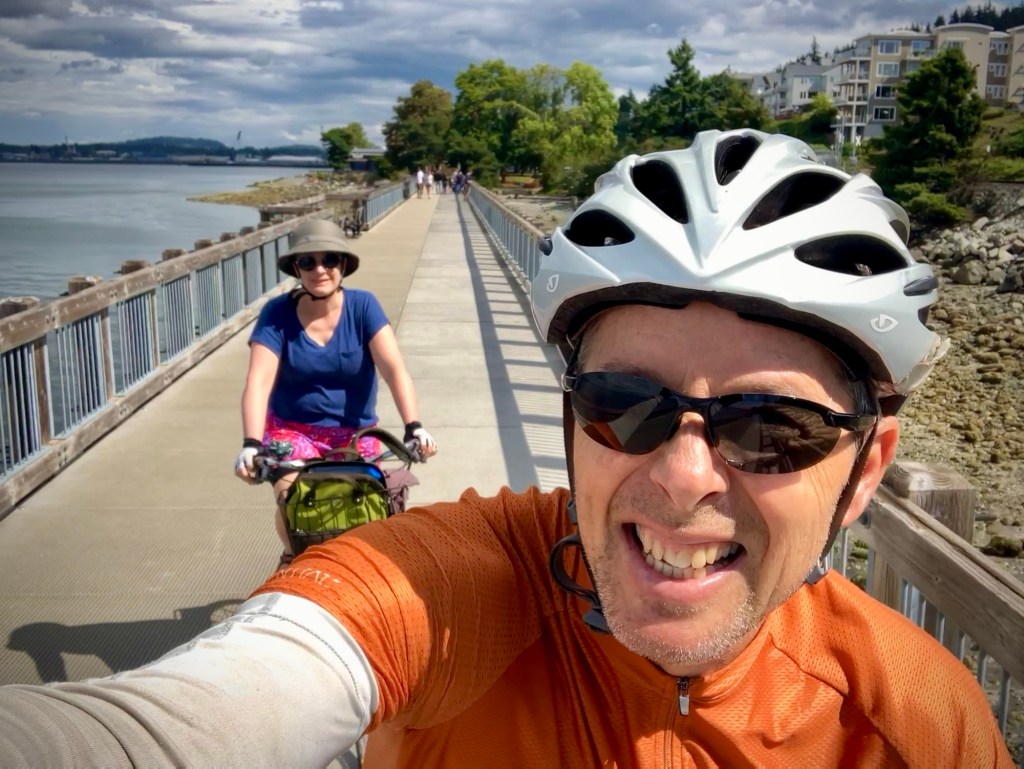
My summer bike at Clayton Beach, part of Larrabee State Park and the Chuckanut Mountains
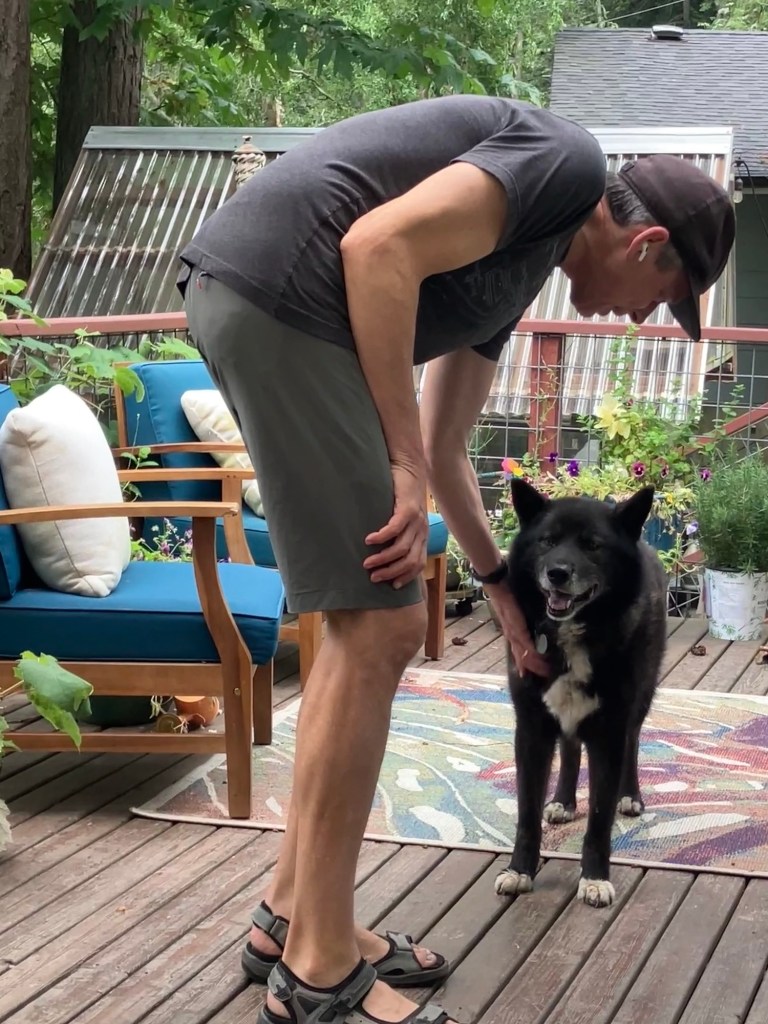
Our house sit was across from a small lake at the edge of town, but amazingly secluded up in a steep vale in the local foothills of the Cascades. Our responsibilities included a very sweet outdoor dog and seven chickens. The dog was reportedly standoffish but we soon bonded with him and enjoyed some fun walks around the lake and woods.
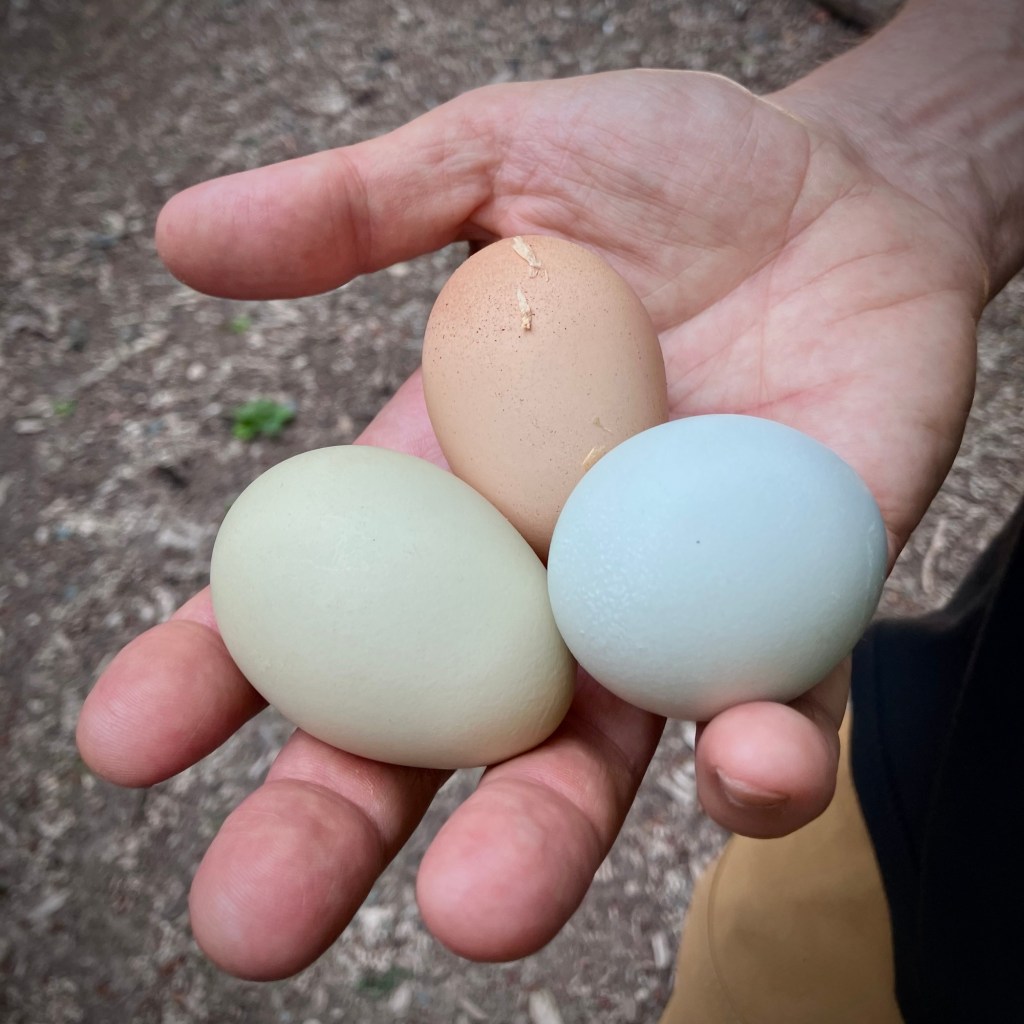
Lake loop with an enthusiastic leader Our dog letting me know he was ready for a walk!Our house sit included all the fresh eggs we could eat!
House sitting is great for really trying out new locales to see if it a place we may want to spend more time or even settle for a time. We really liked Bellingham in the summer and had considered settling here at one point, but think now that we still need a bit more city in our next home.
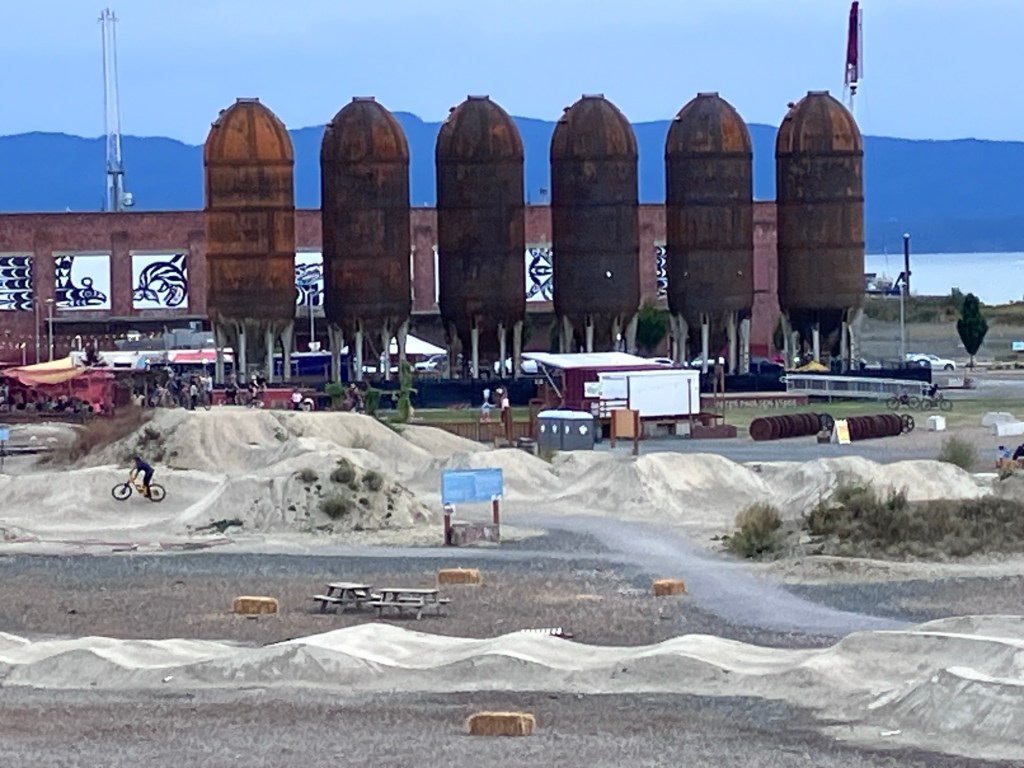
Downtown Bellingham is in the process of reimagining its industrial waterfront with popular interim uses as a wild bmx track, shipping container bars and restaurants, and summer festivals.
The Pacific Northwest and Seattle in particular are so different than the Bay Area we called home for most of the past 30 years. We are used to the pace and competition of dense SF living and you really notice the difference in the Seattle area. We are the angsty rushed city folk here. The massive amount of wealth and economic prosperity generated in San Francisco and Silicon Valley has put pressure on every aspect of living; cost, housing, services, transportation. We lived a great life in San Francisco by keeping our work and home close and cycling, walking, or transiting most places.
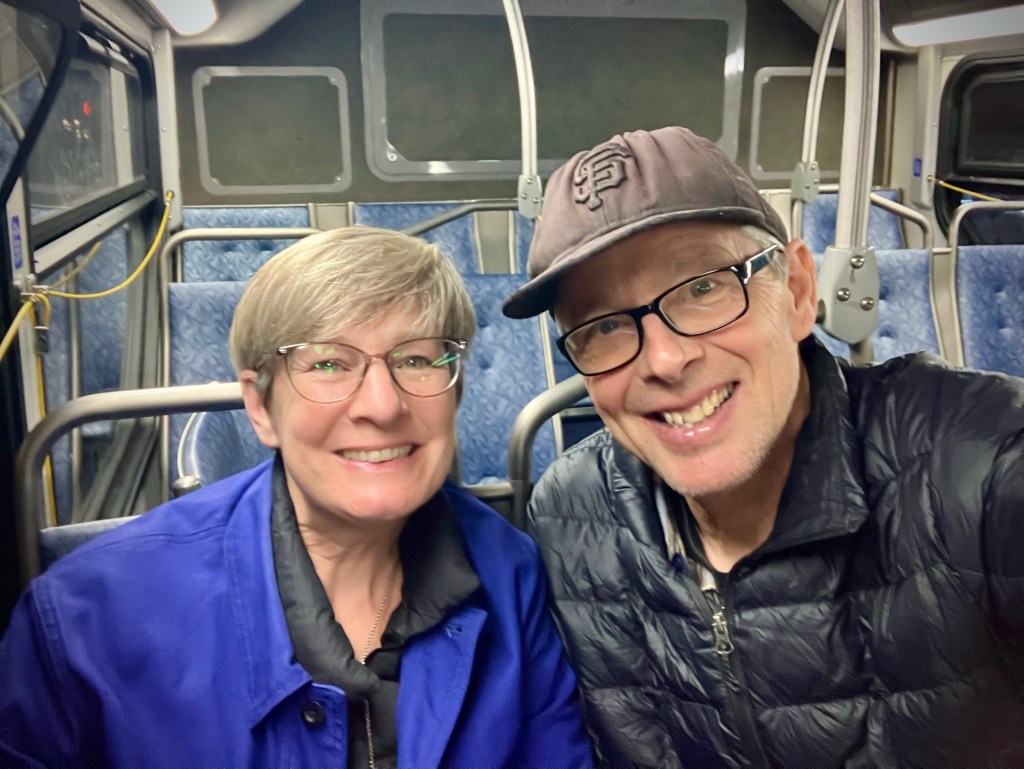
Riding the #40 bus in Seattle. It’s fairly extensive, clean and reliable, but can we live comfortably without a car here?
And our double income, no kids (DINKS) life kept us comfortable financially. But we could feel the strain the past 20 years on services and the vast gulf that was growing between “knowledge workers” and those in service or more traditional blue collar roles. San Francisco and California has tried to fight this trend with social programs (minimum wage, city health plans, affordable housing, etc) but it can’t keep up with the demand for housing. It’s a global problem in wealthier areas of the planet, but especially evident in California.
Cycling the boardwalk to the Fairhaven neighborhood of Bellingham, arguably its most charming area.The Bellingham area is unrivaled for mountain biking, including expert crazy bike only downhill runs
So back to Seattle. Seattle has a lot of the same challenges as the Bay Area, including tech wealth and escalating housing costs. But as we noted in our winter visit Seattle blogs, they ARE building more and have looser zoning laws near transit by right. (meaning NIMBYs can’t stop it) DADUs (Detached Accessory Housing Unit!), townhomes and condos are sprouting all over the city in almost every neighborhood.
Great to meet and chat with fellow nomads at a meetup in Edmunds, WA
All this fairly random looking new housing looks strange to us as we’ve hardly see any housing construction in San Francisco, except the thousands of units concentrated South of Market, Mid and Upper Market Street Areas, and a few other pockets and buildings. But they are often not in the areas where most people want to live.
Great Pho at Miss Pho in Crown Hill. The diversity and quality of the food in Seattle is first rate, but unlike SF, you may need to search for it in strip malls.
Seattle is building more where people want to live, as well as very dense high rise residential in First Hill, and the South Lake Union edge of downtown. Add to this an ever expanding light rail metro system (thanks to a $54B 2018 bond measure) and you have a fairly dynamic feel to the City. It’s almost twice the size of SF, and feels more spread out, especially from north to south. It generally doesn’t have the magical density and intimate feeling walking from neighborhood to neighborhood as San Francisco and many more trips are by car. This is a big difference for us to adjust to if we settle in Seattle.
Golden Gardens Beach Park; beautiful and swimable, if you don’t mind chilly water!The Puget Sound beaches are more for exploration than swimming
SF is dense but could and should be denser, with more new buildings all over the western half of the city, where the weather and transit are great. But NIMBYs, Prop 13, and zoning keep the city at a relative standstill. It’s created a bit of a housing doom loop, since new housing construction is so expensive, that it’s not even affordable for developers selling condos for 1-2 million each. We’ve blogged on this on our past visits, but the issue just gets bigger and bigger and plays a big role in our decision on where we might settle down next in the World (if we do -;).
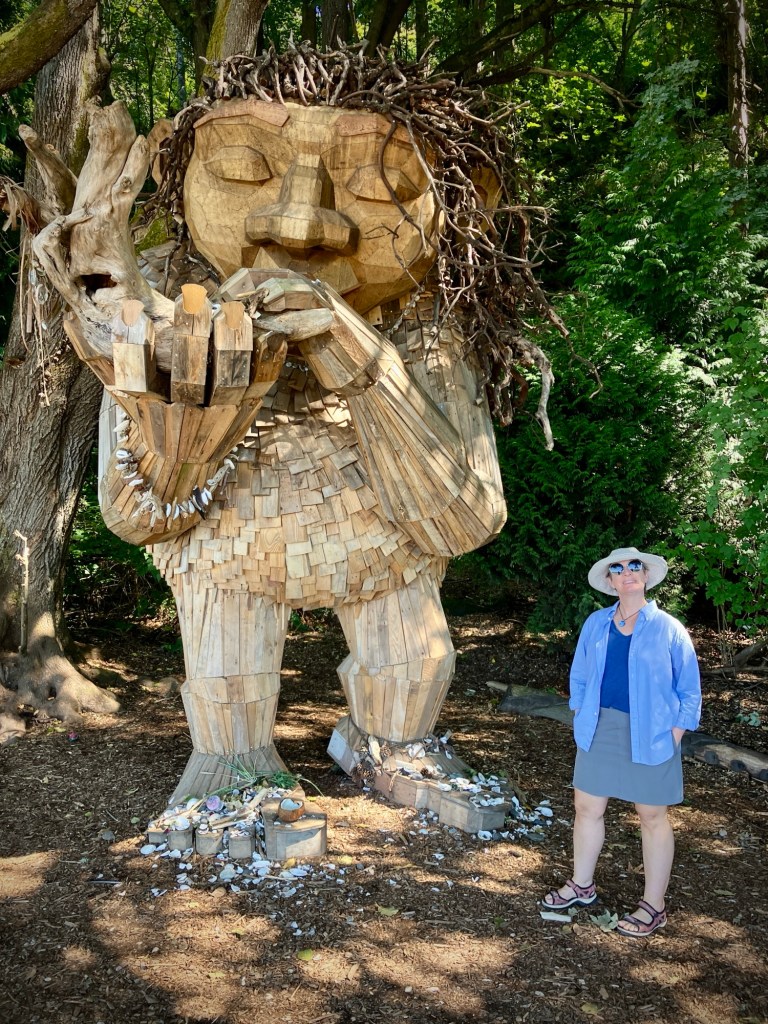
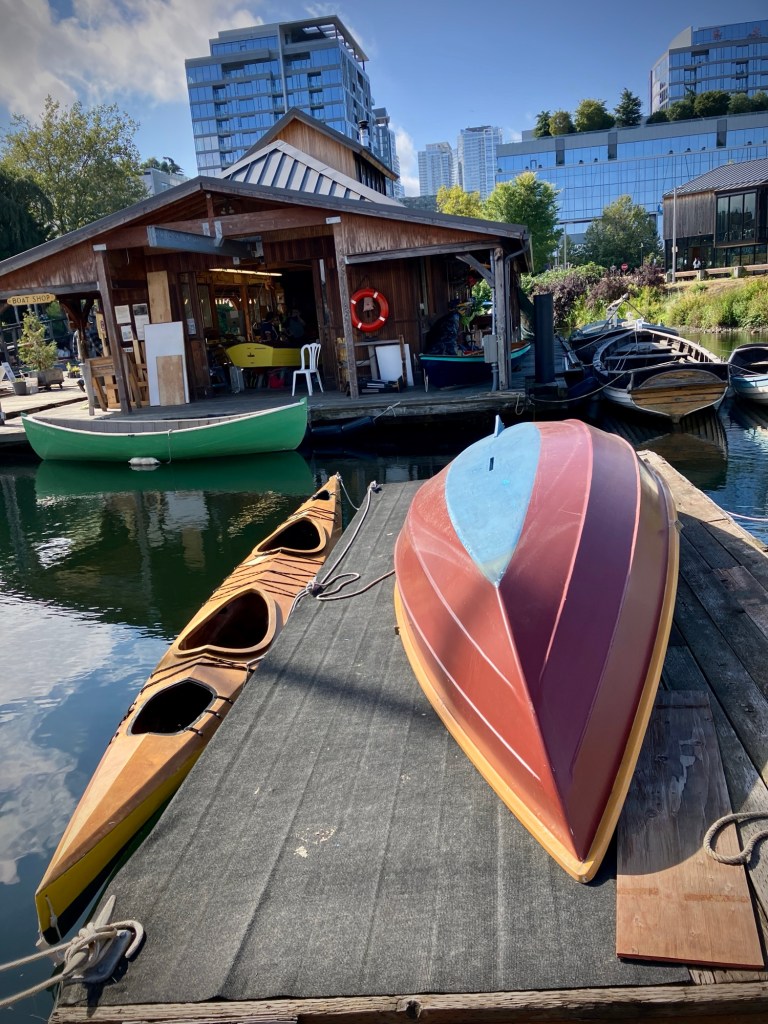
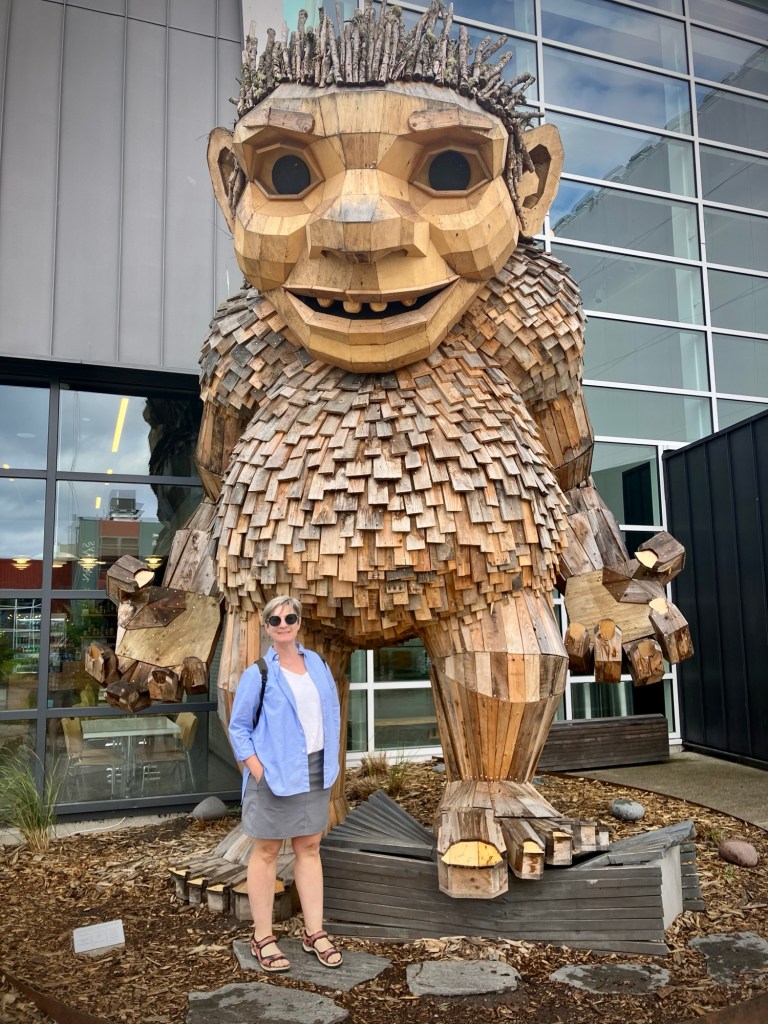
« Bruun Idon » at Lincoln Park, one of Thomas Dambu’s six troll sculptures in the region and made entirely of recycled/reused materials.The wooden boat center on Lake Union.
But to be honest, the biggest difference we noticed in Seattle this stay was the pace of life and what I like to call the “expectation of goodness.” People here are more patient and expect that you are, and are acting honestly and in the public good. A friend of mine in SF noted to me that Seattle today is what SF was like in the 80s and 90s. A bit slower, more provincial, and where everyone was not quite so full of themselves. It’s a cutthroat world in the Bay Area…not quite New York City levels yet, but noticeably more manic than the Pacific Northwest cities. Seattle’s slightly slower pace is attractive to us in our early retirement.
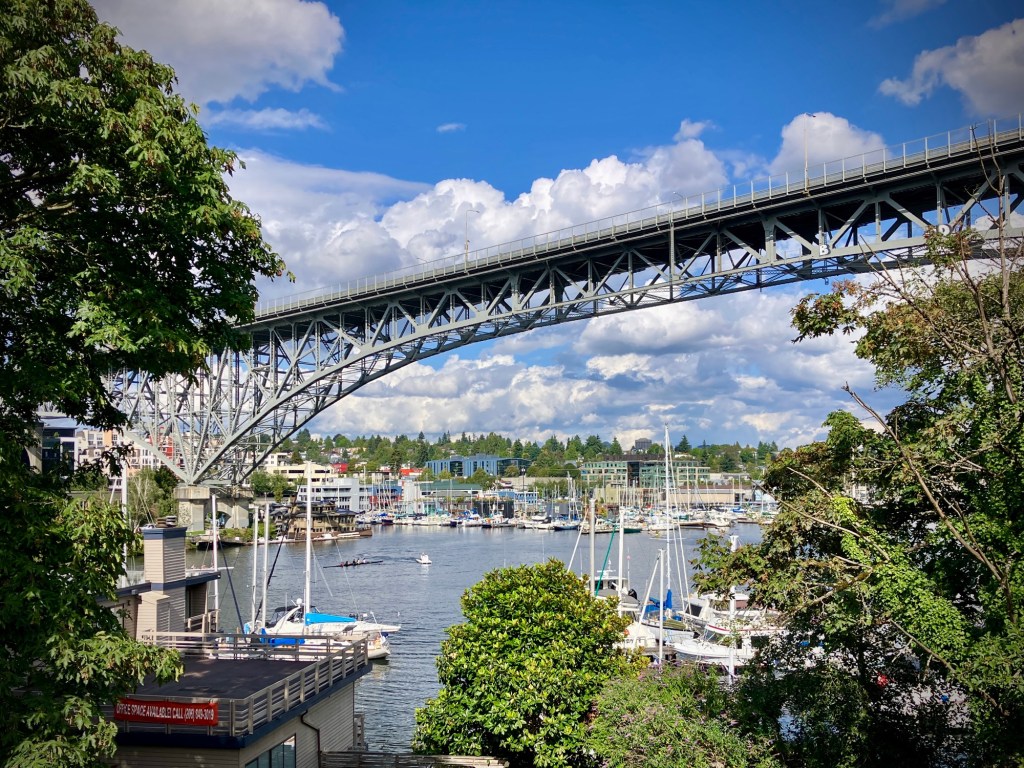
The Iconic Aurora Bridge built in 1932 connects Fremont to Queen Anne
So after a pleasant week exploring the trails and cycling paths of the beautiful Bellingham area, we headed back to Seattle for our final house sit of the trip in the Ballard/Sunset Hill neighborhood. We loved the area as it’s very quiet traffic wise and has a nice grid of roads cut off on the western side edge by a bluff and Puget Sound. There are some views toward the Olympic Mountain Range that allows you to get out of the trees.
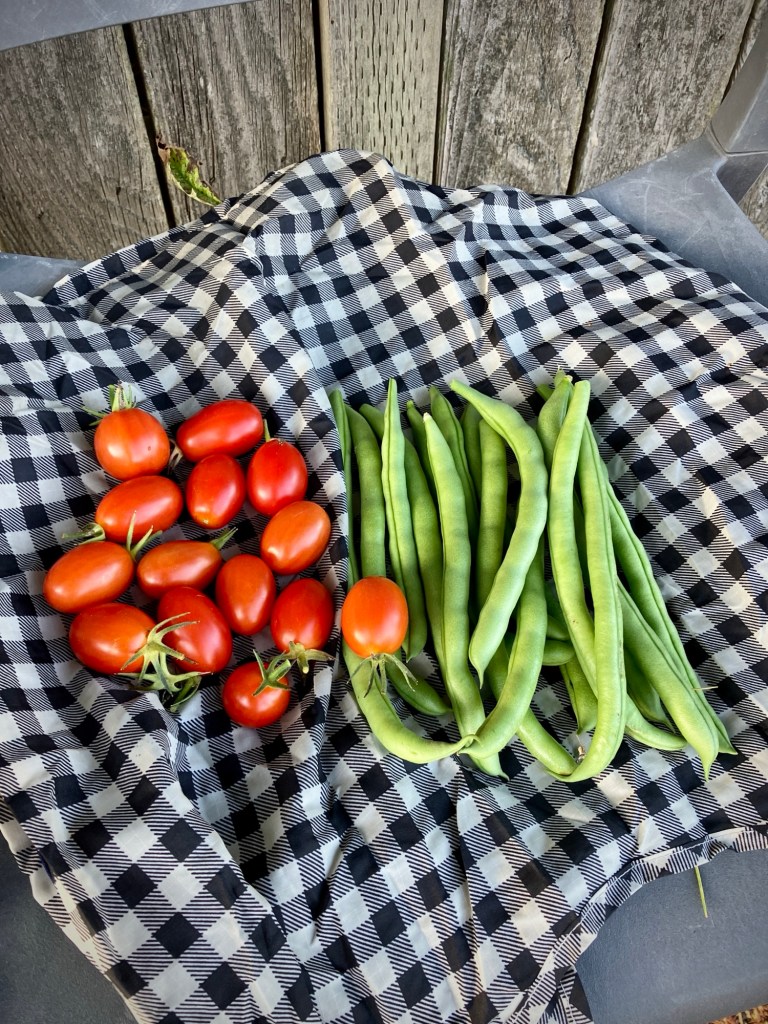
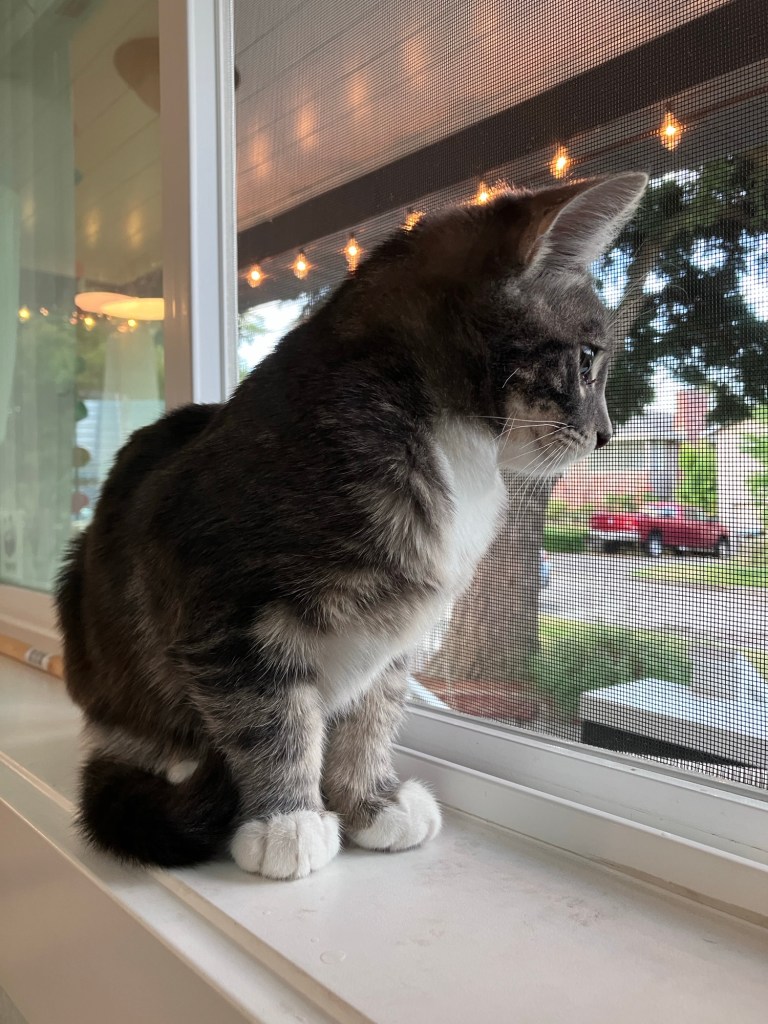
Cheryl tending our house sit Pea Patch, a community garden system throughout Seattle’s neighborhoods. Garden fresh tomatoes and beans from the Pea PatchWatch Kitten in BallardSampling some beers at Lucky Envelope, one of over a dozen craft breweries in Ballard alone!Another magnificent troll outside the National Nordic Museum in Ballard Cheryl contemplates how to get some of the endless driftwood to our future garden.Our house sit kitten testing breakfast table boundaries.
The grid layout of most of Seattle makes walking and biking very tenable, but the hills are a challenge, even coming from San Francisco!? Why? Because the large masses of each neighborhood often rise up and fall over long distances, meaning a trip back up to your house can mean climbing up gradual hills for 10, 20, or even 50 blocks! And much of the east-west geography is steep, so cross town journeys can be steep in places.
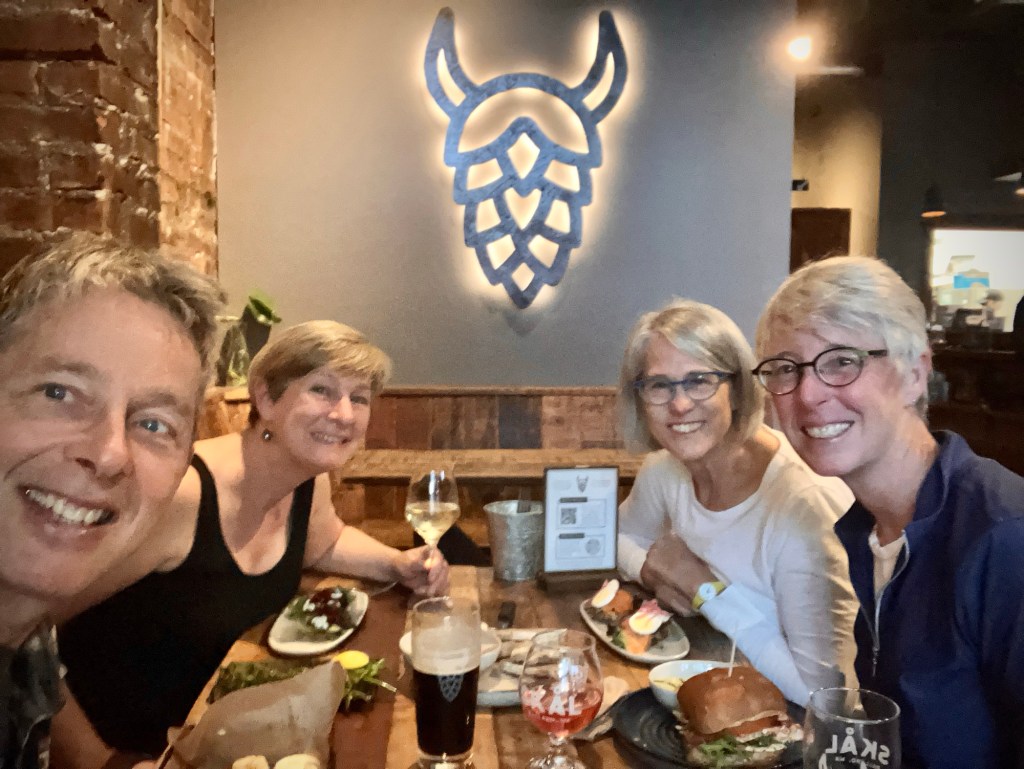
The Neighborhood Greenways are a nice way to get around by bike in Seattle. The hills and rough pavement mean that wider tires and electric assist would be a great addition for getting around realistically by bikeEnjoying Ballard’s Scandinavian roots with good friends Cecily and Christine at Skål Beer Hall.
Oh but the trees, mountains, and water interplay are so nice! And there is a good bike network with some famous long distance rail trails, such as the 20 mile Burke Gilman, which links up much of the interior shoreline of North Seattle. I was able to do a 35 mile north Lake Washington loop from North Seattle almost entirely on separated paths…very nice.
Saying goodbye to Seattle summer for now with one final swim in Lake Washington….so nice and different from the always cold S.F. Bay.
So we loaded up the rental car and headed early out of Seattle for the 2 day drive back to San Francisco, again with an overnight in Ashland. The drive is possible in one long 13+ hour day, but we never like to drive more than half of that in a day. Heck, we don’t like to drive to the grocery store, but sometimes a car is the most convenient way and it is a chance to listen to some good podcasts and music!
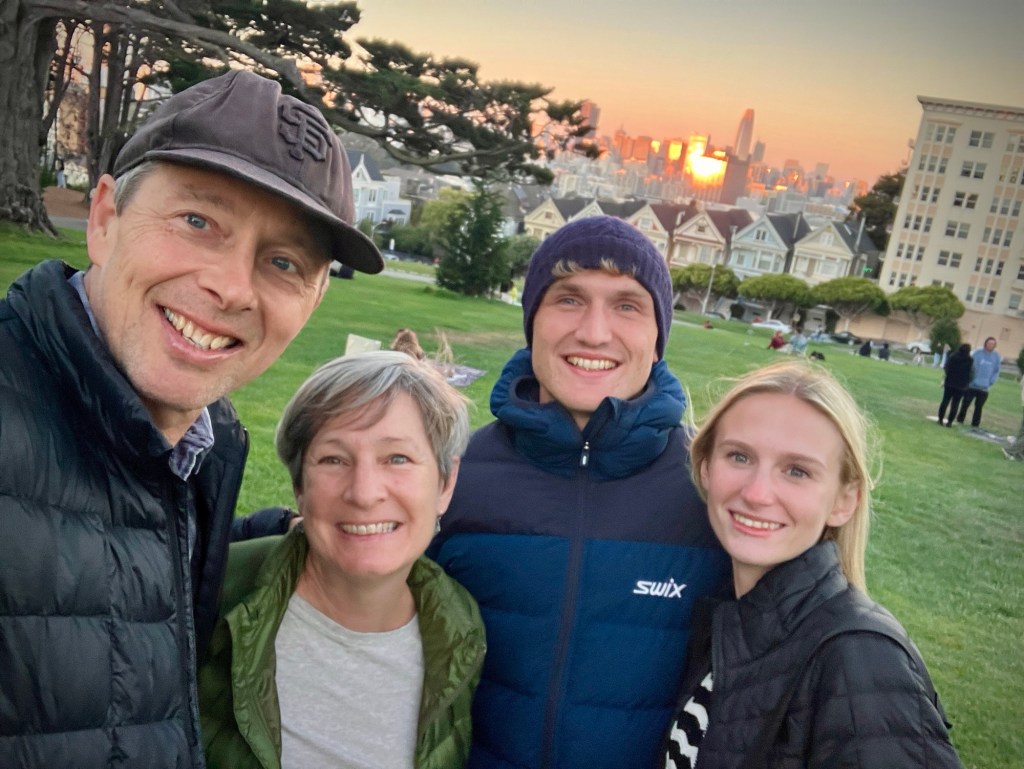
Enjoying a road bike ride back in the Bay AreaAnd saying hello to some UK friends Frank and Liv in Alamo Square on a lovely fog-free evening.
Our four days back in the Bay Area were busy with sorting gear at the storage unit, haircuts, finances, Covid/flu shots, etc. but also some nice time with friends. But we now just arrived back to our euro-base in France after a successful and fairly pleasant one-way journey on Condor Airways. (SFO-FRA-GVA)
So happy to be back in the Vallée Verte
Now we’ll relax a bit, get over our jet lag, sort our gear, and get ready to head out on the bikes for another fall bike tour adventure in a few days. More on that soon. A Bientôt!
Even on long travels, the end of any travel segment can start to drain your enthusiasm as you start thinking about the next phase of your journey, or worse, the work waiting for you back home.
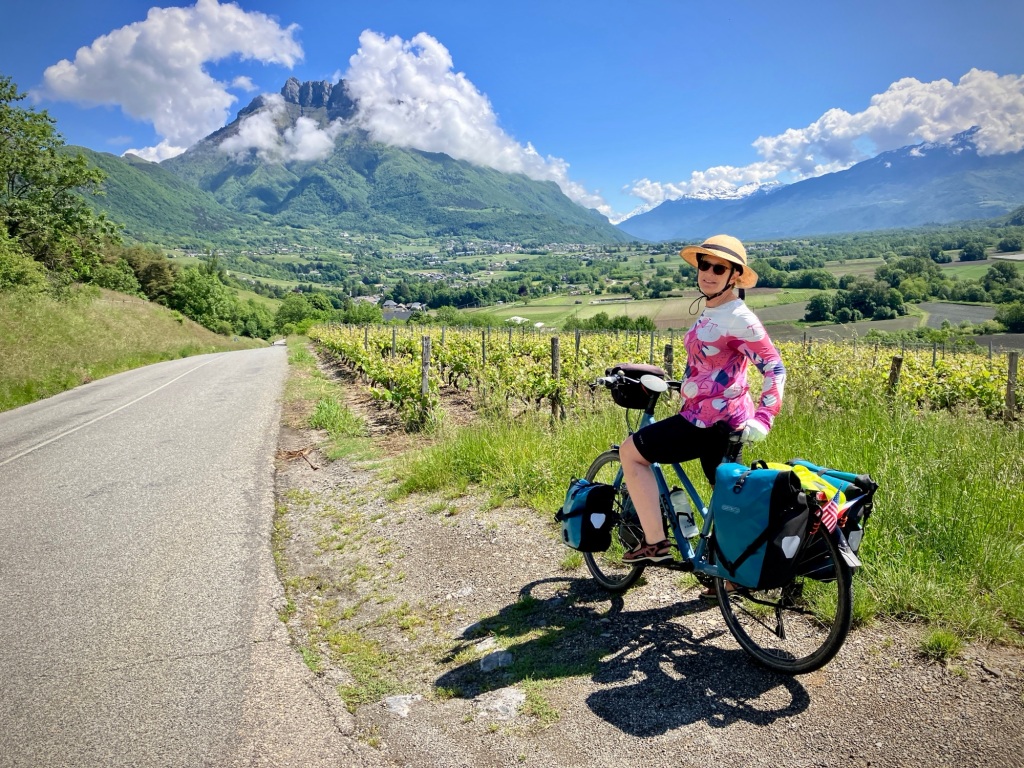
Heading to Albertville on a beautiful spring day in the Alps. Our minds are now addicted to new.
We’ve all had that end of vacation feeling or remember our childhood summers of freedom coming to a close in late August (Ugh!). But one of the reasons we gave up or locked up most of our material possessions three years ago was to experience the world without that constant end of trip deadline. No limits or boundaries. It’s a magical feeling and one I appreciate more and more as we traverse the world. We are lucky and know it. We recommend everyone tries it someday.
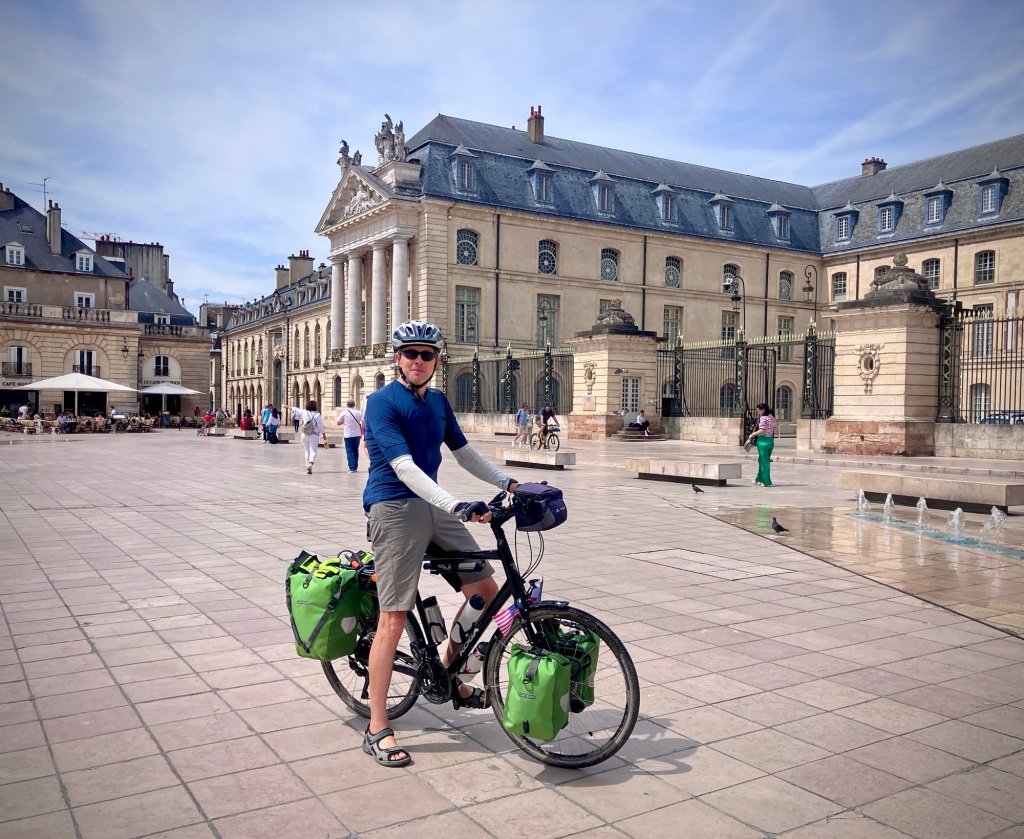
Spring in the Place de la Liberation of Dijon
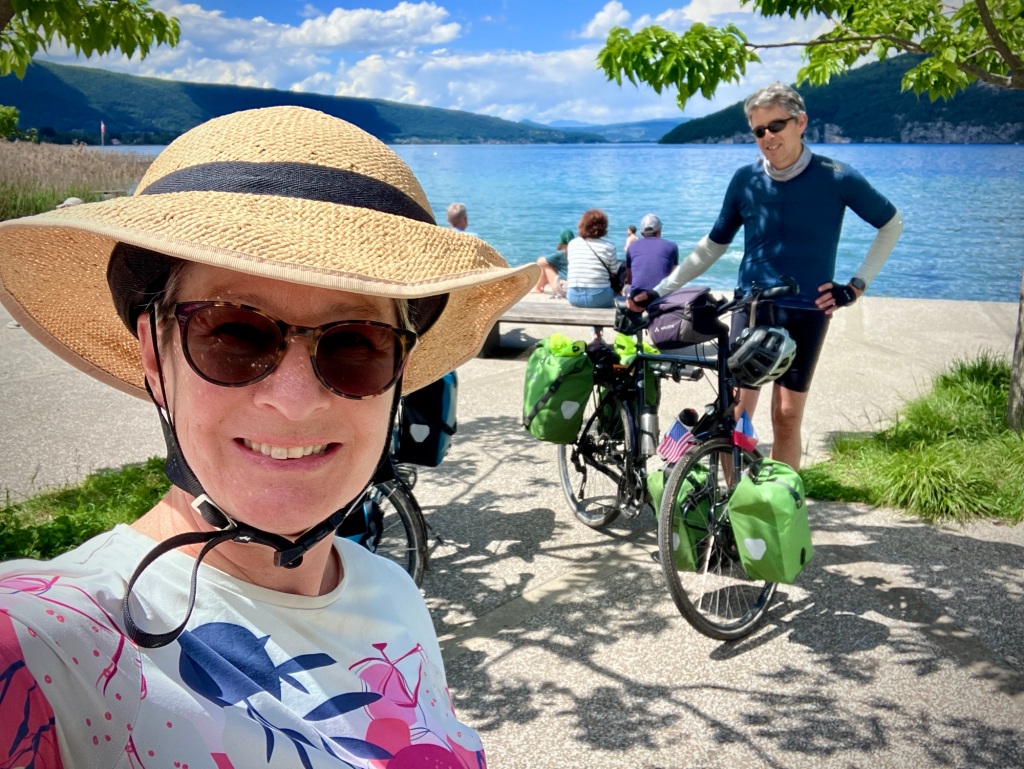
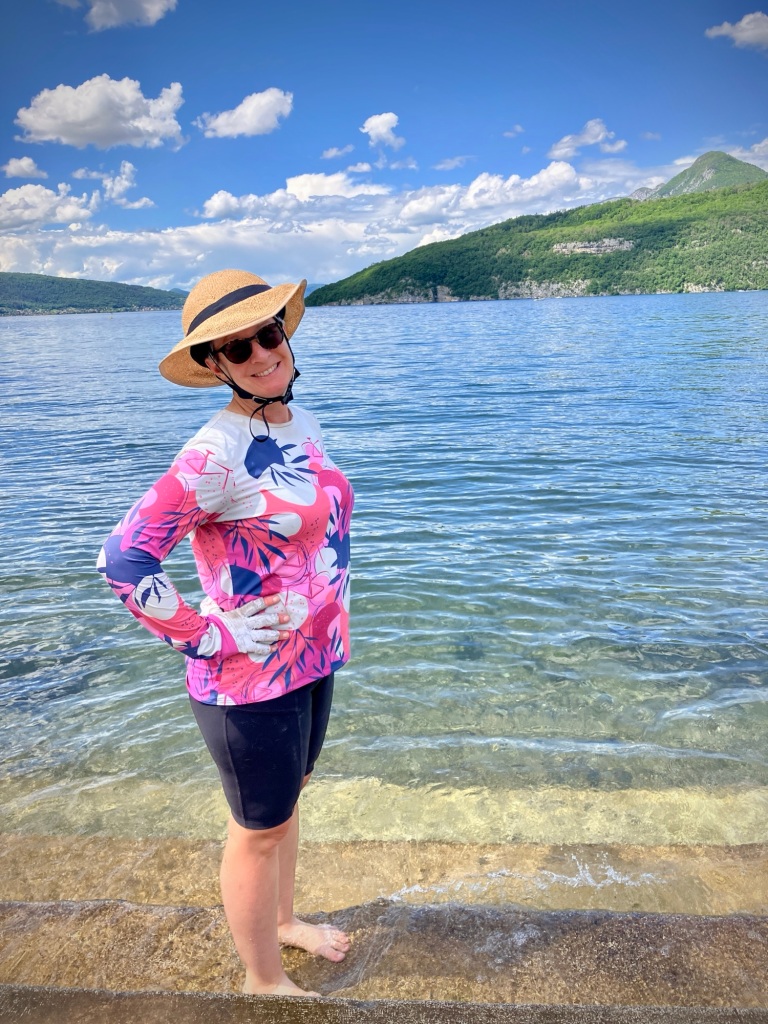
But our last few weeks of spring bike touring in France took a concerted effort to stay focused and motivated. Don’t get me wrong, parts of it were wonderful, and some warm spring (summer?) weather gave us a “vacation from our vacation” feeling in Annecy, a perfect cap to our recent journey.
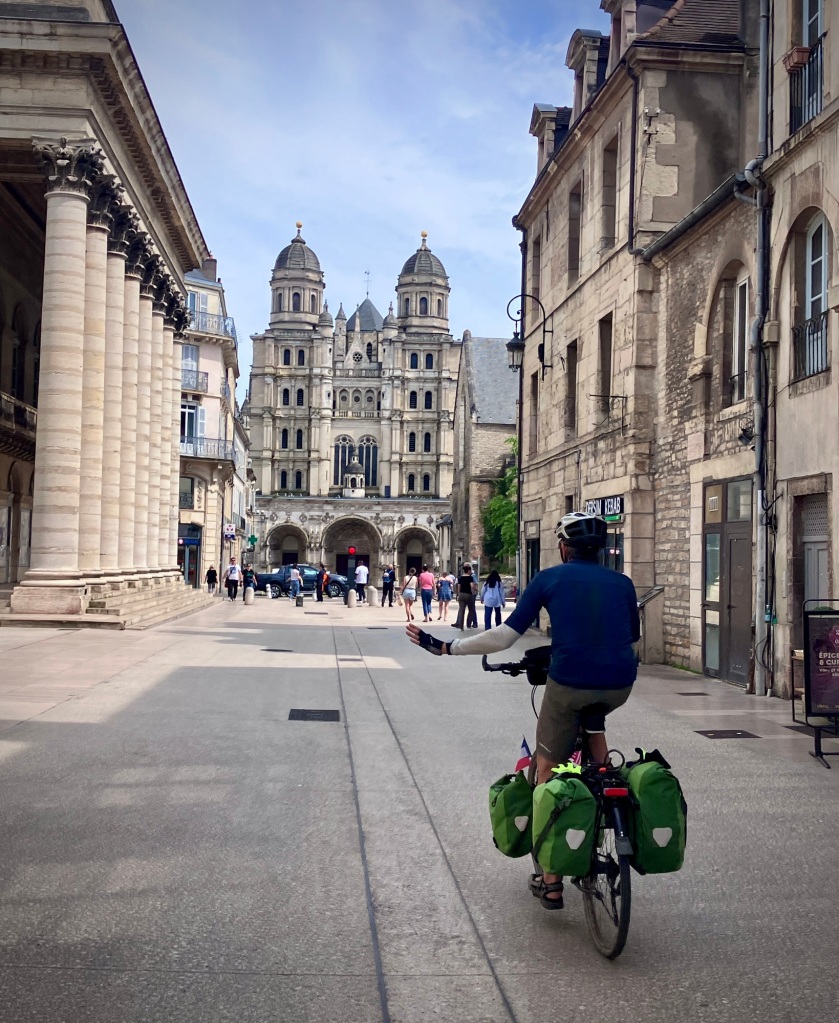
Signaling my intentions for Cheryl and the locals in Dijon. Église Saint-Michel in the distance. BTW, French cyclists don’t signal much, and seem to thrive on the organic flow familiar to the Dutch.
After a brisk morning cycle to our train hop from Les Laumes – Alésia on the Burgundy Canal, we rolled into Dijon Ville station mid-day. We were pleased to see a train platform ramp and the option of an at-grade exit to the street. Outside the station was a bikeway towards center ville. This abundance of bike infrastructure is one of the major reasons why we’ve been exploring France by bike for nearly 3 months!
Dijon Gare. We love platform access ramps; the best station solution for all when space permits.
This was our second visit to Dijon while cycle touring, but this time we planned to spend two nights to allow a bit more time to explore the beautiful city at the heart of Burgundy. It’s an extremely pleasant and lively city, with a bike and pedestrian oriented core, parks, and beautiful architecture. Free museums and a wide array of food options add to the draw. It’s also extremely well connected by train on the Paris-Lyon mainline.
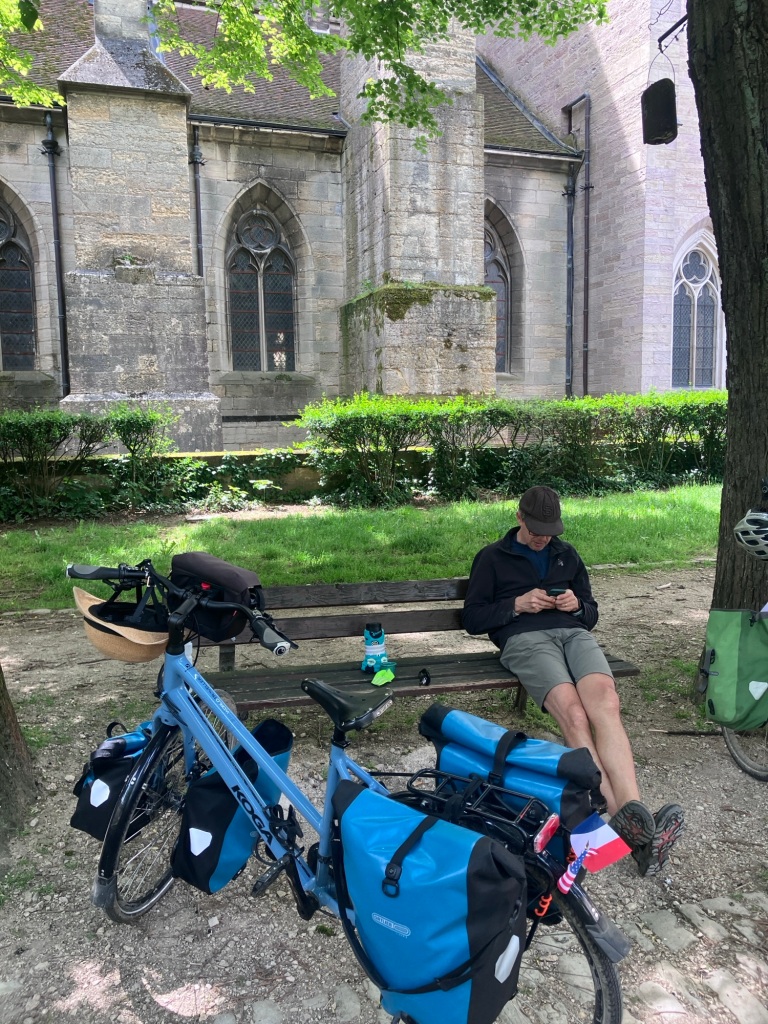
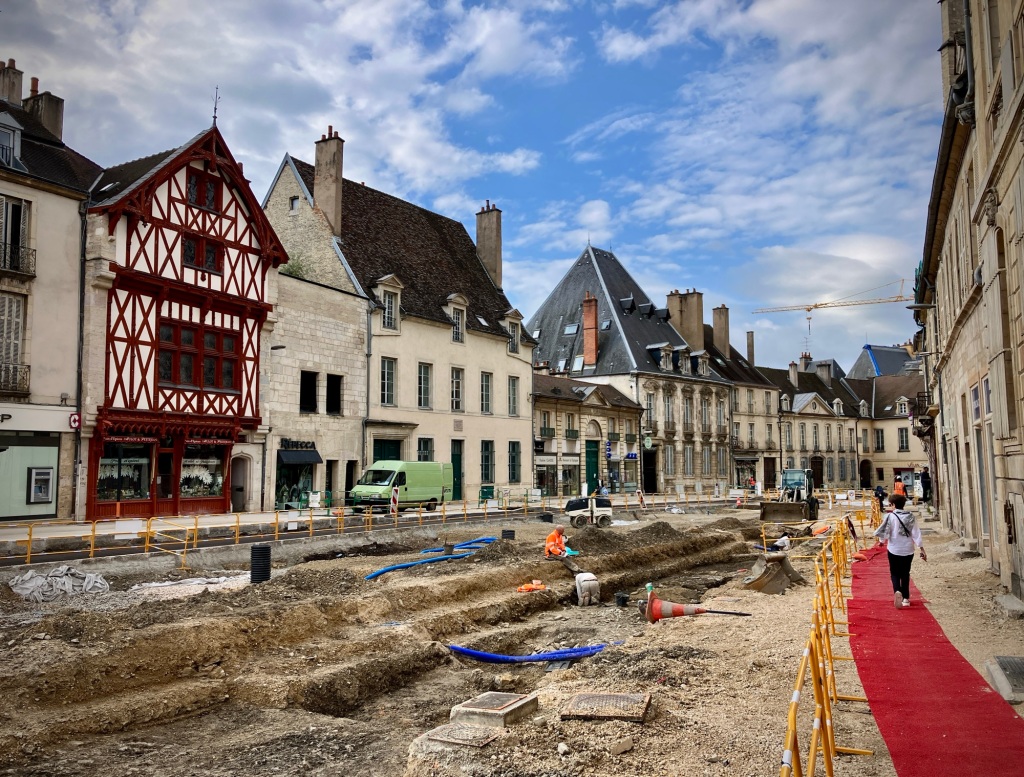
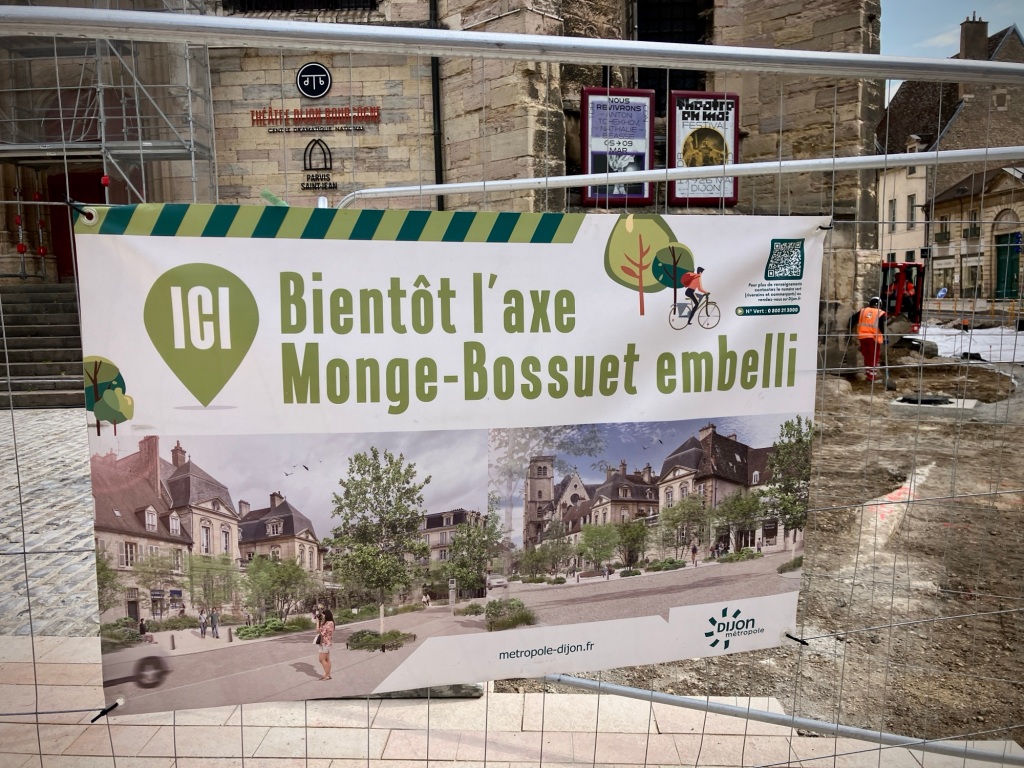
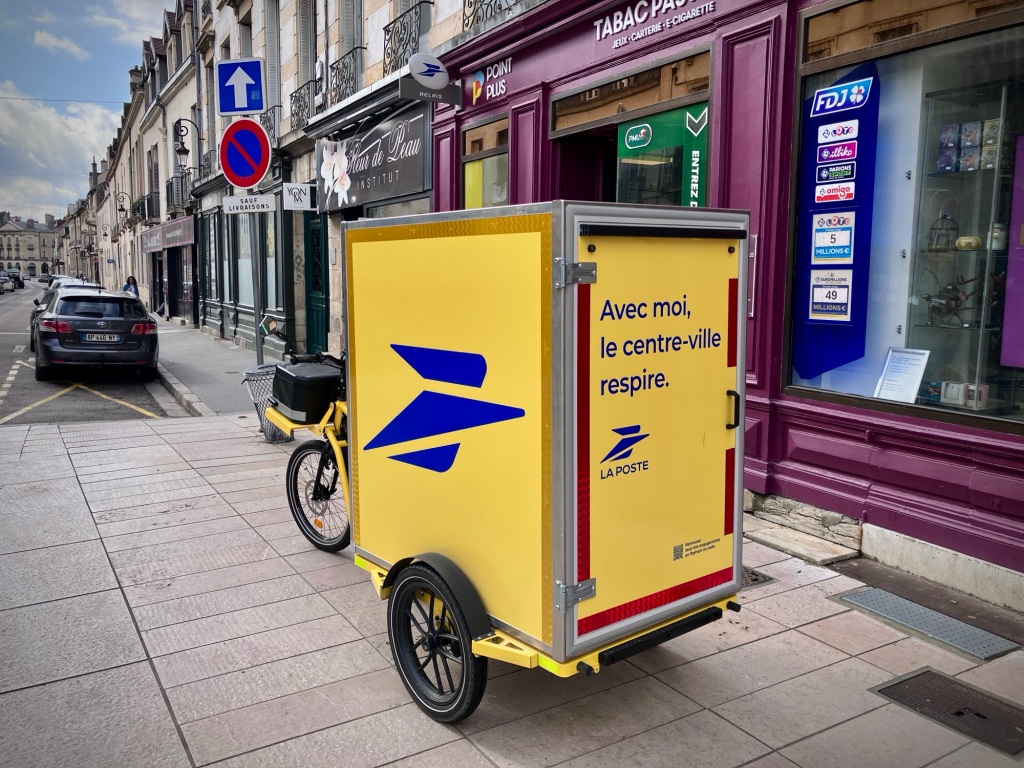
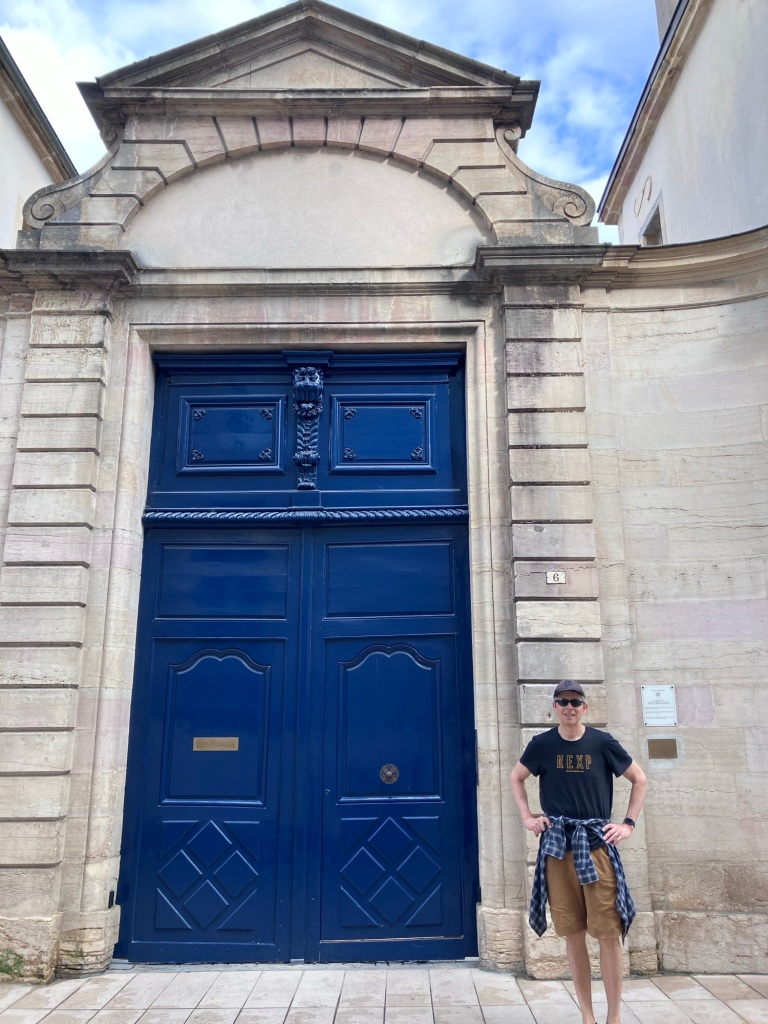
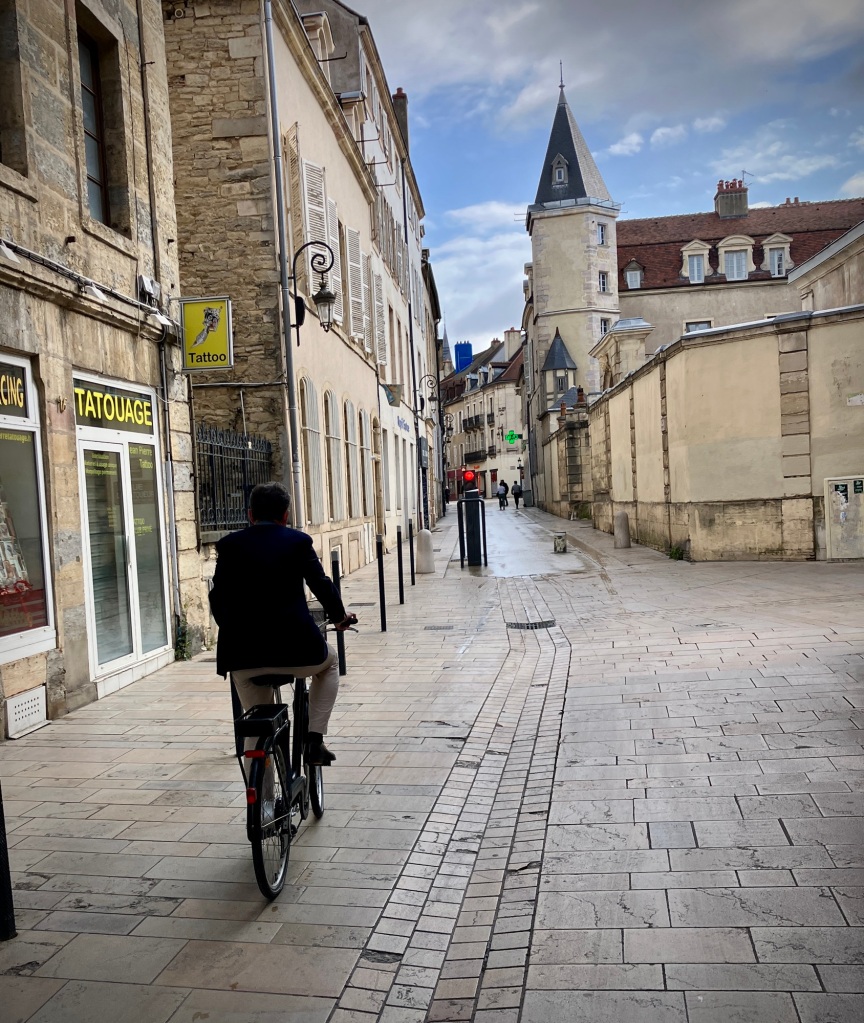
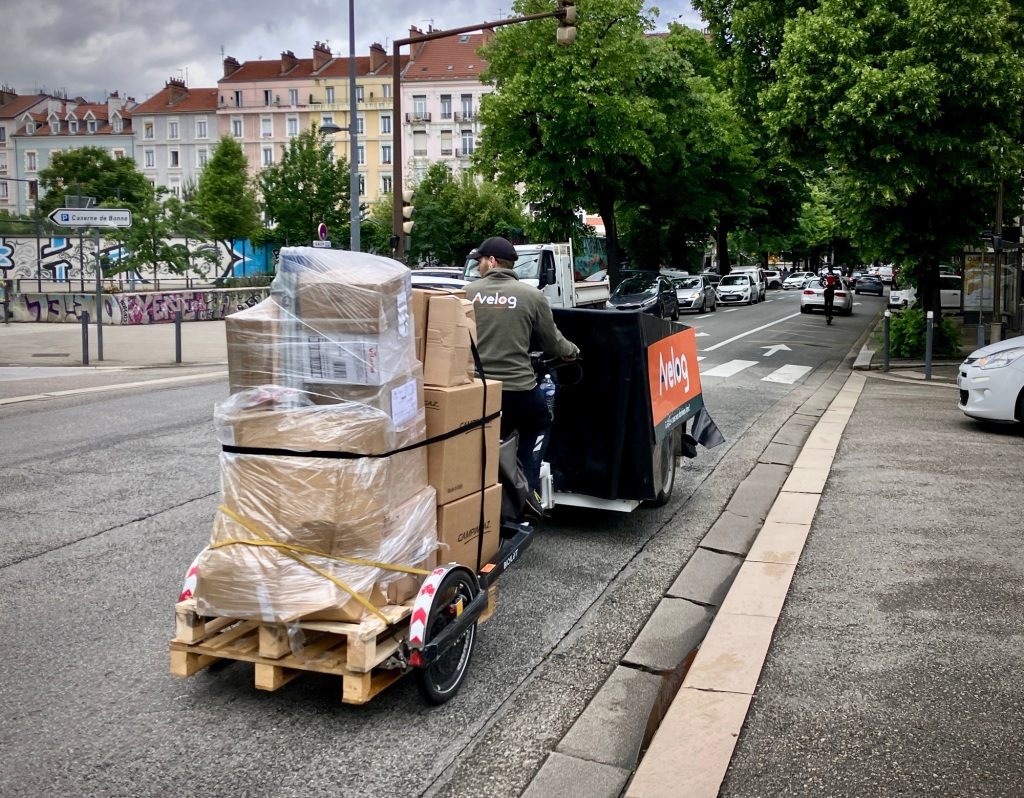
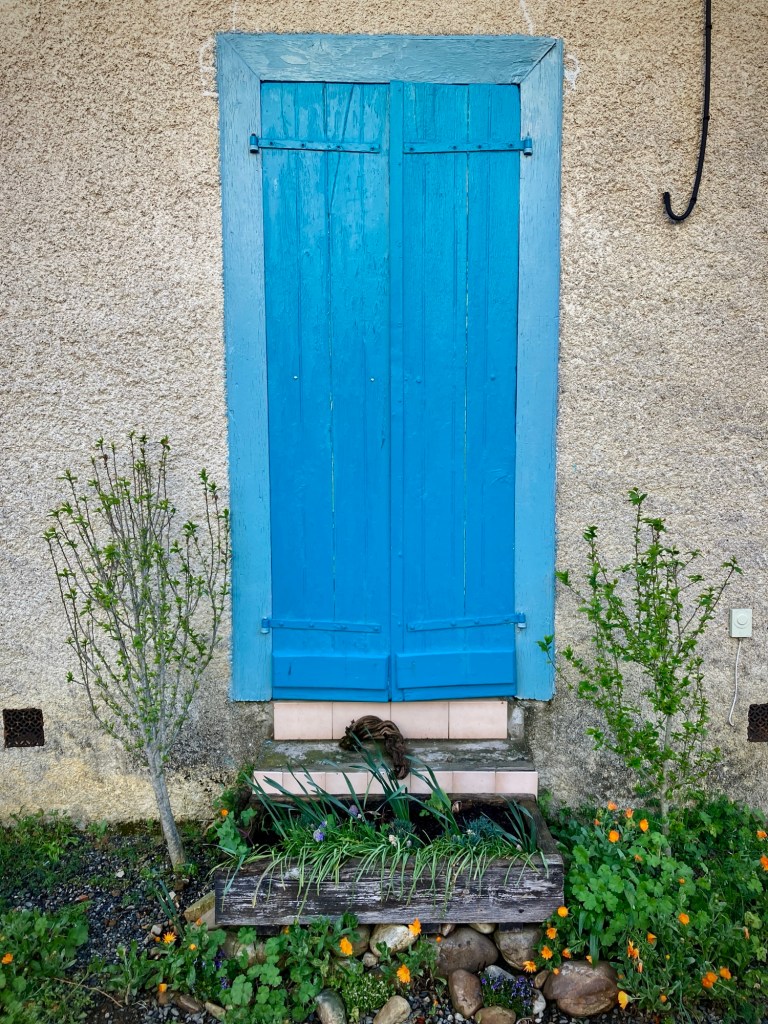
History plaques add to the joy of wandering historic Dijon. Many stately buildings with grand courtyards were built by the wealthy in the mid 1700’s. Vive la Révolution!A few hours to kill before checking into our bike friendly hotel. Often nomadic life includes sitting on park benches; maybe travel planning, reading a book, or just watching the world go by.This area of Dijon was being upgraded this year to meet the Mayor’s goals for livability. We noticed a lot of new streetscape improvements and tree planting in urban areas of France.Upgrading to City 2.0 – more walkable, more trees, and limited car traffic.E-bike cargo and mail delivery is really put to the test in France and the perfect tool for compact urban centers.What is behind these beautiful blue doors?
After enjoying a day off the bikes in Dijon, we had planned to continue south and east towards the Jura mountains and Geneva. But as I looked into the details of our planned route, I was thinking maybe we needed a Plan B.
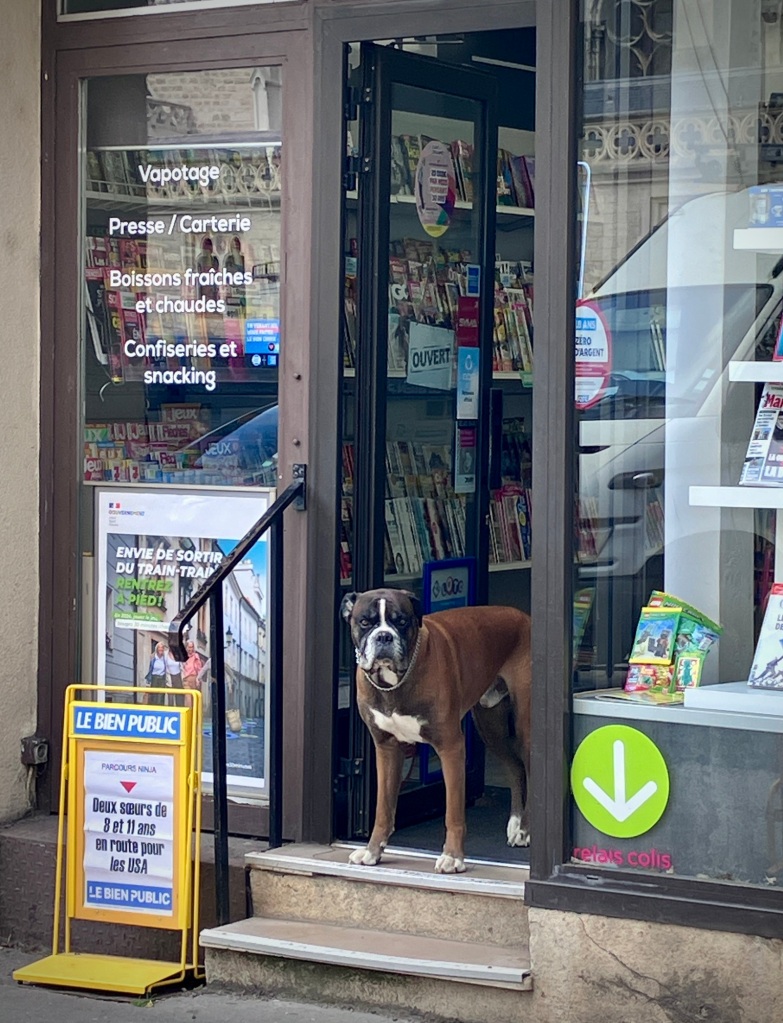
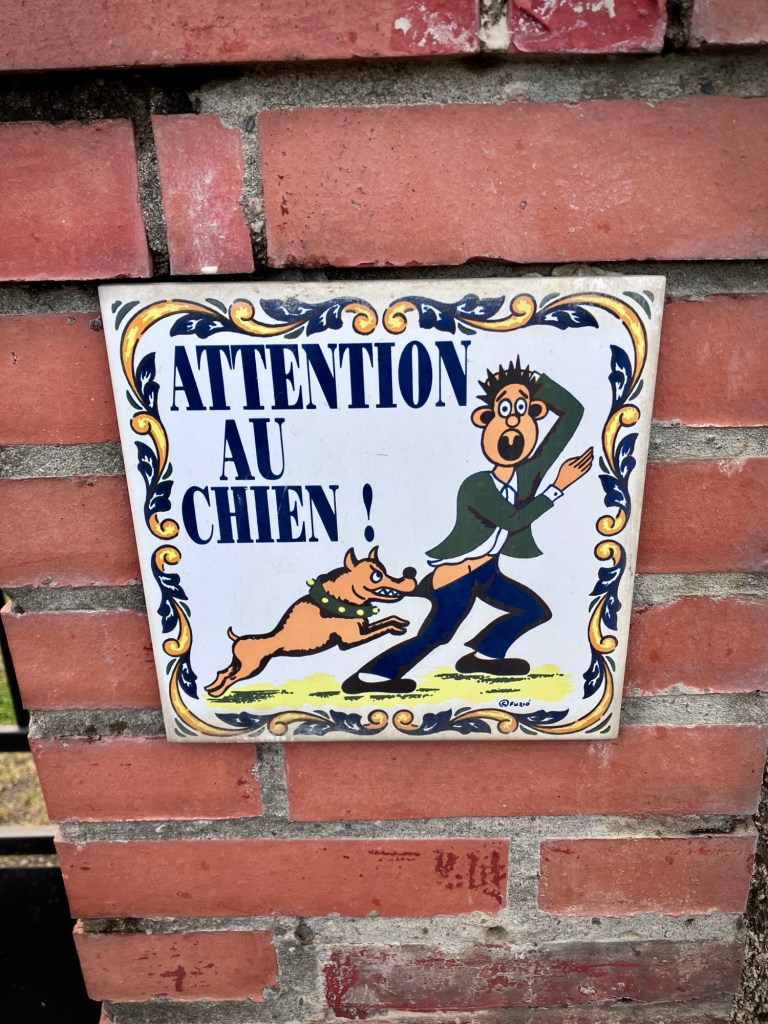
Jardin Darcy at sunset.Le chien de la Tabac.Access to the Dijon city center is controlled by retractable bollards, making it a pedestrian and bicycle oasis.
First, there was a lot of flat sections of the Burgundy canal and Doubs River to pass along with a likely headwind. Blah. Second, lodging with food in the Jura is very limited and I was challenged to find places to stay early season once we climbed up to the 3,000+ foot plateau. (Probably better to camp up there.) Third, more unseasonably cold weather and rain was predicted. No thank you.
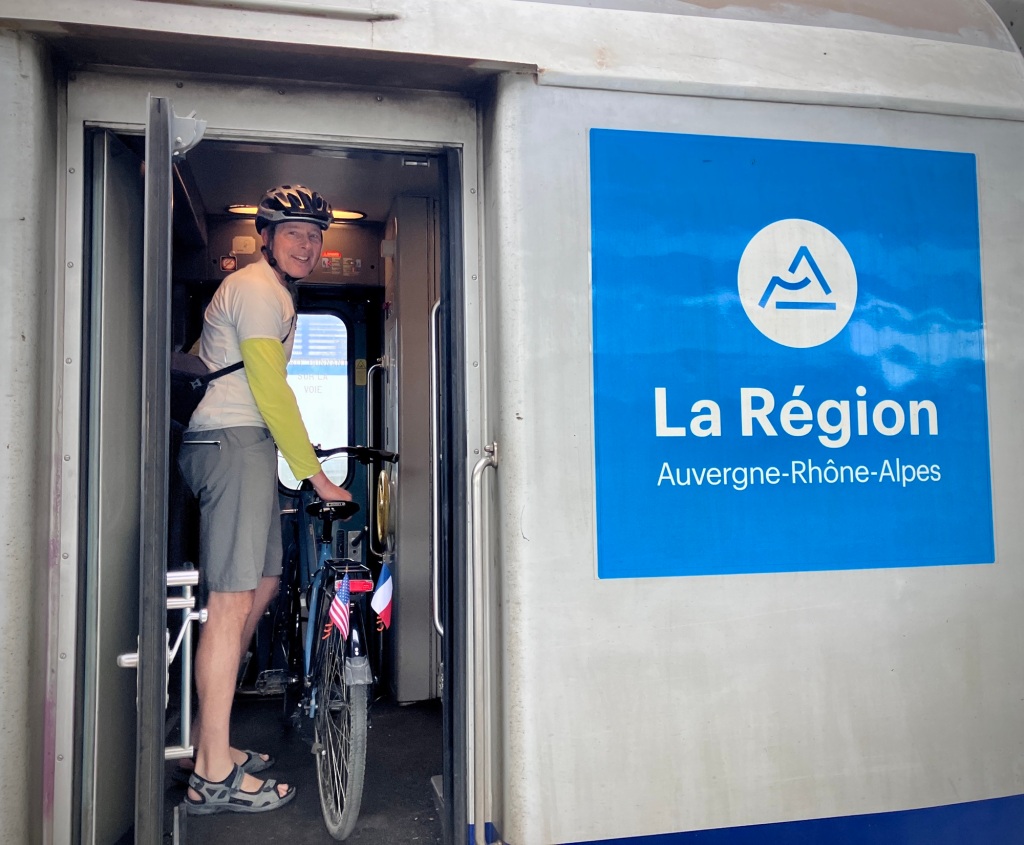
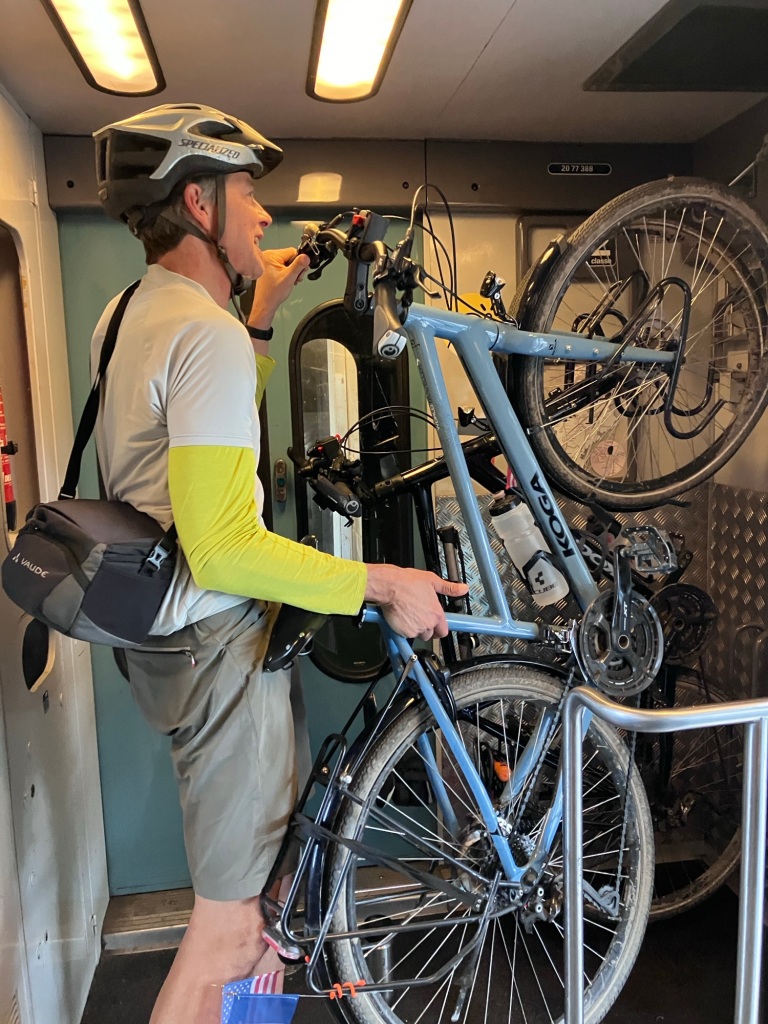
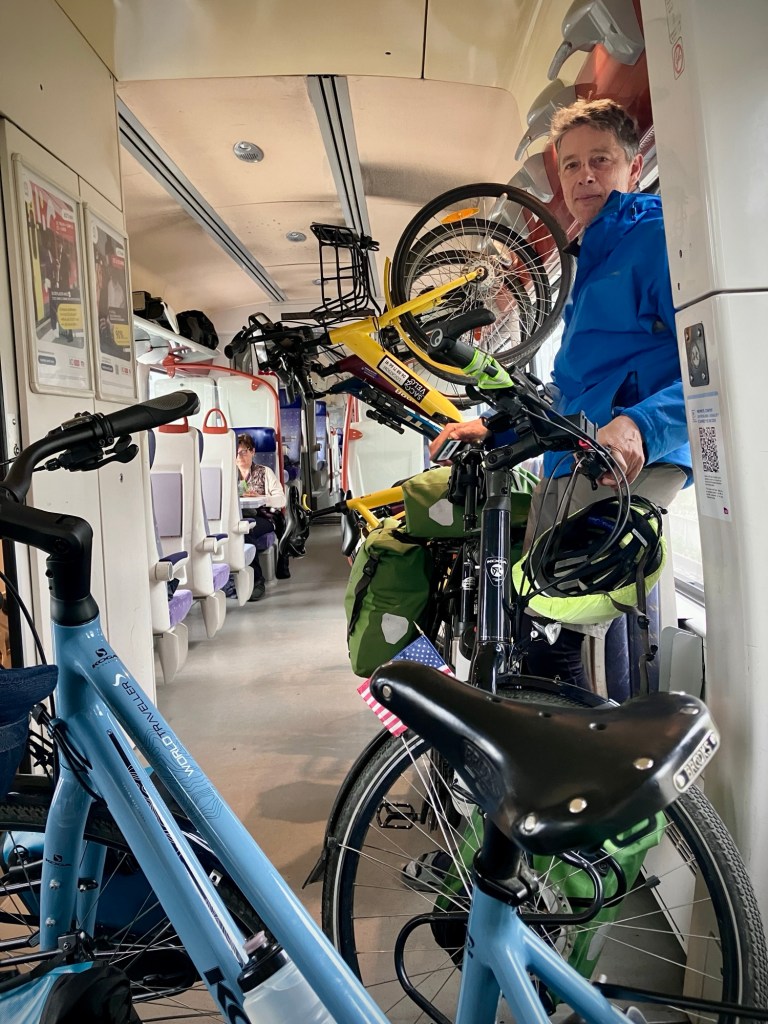
High boarding train to Lyon. Local TER trains are your best bet with bikes or IC trains with bike space reservation. TGVs also serve this corridor but have very limited bike space, so only work with advanced planning.Two hooks with pretty easy access inside.
So we pivoted last minute and instead caught a train south to Valence via Lyon, and headed up the Isère River valley into the heart of the Alps. It was the route I had originally scoped for our return to the Vallée Verte. It has a lot more lodging options, lower elevations, and trains for backup. More importantly, we were excited by this new route, which is a key component of (nomadic) life. It’s good to suffer sometimes for the sake of a goal, but also ok to make sensible choices for yourself.
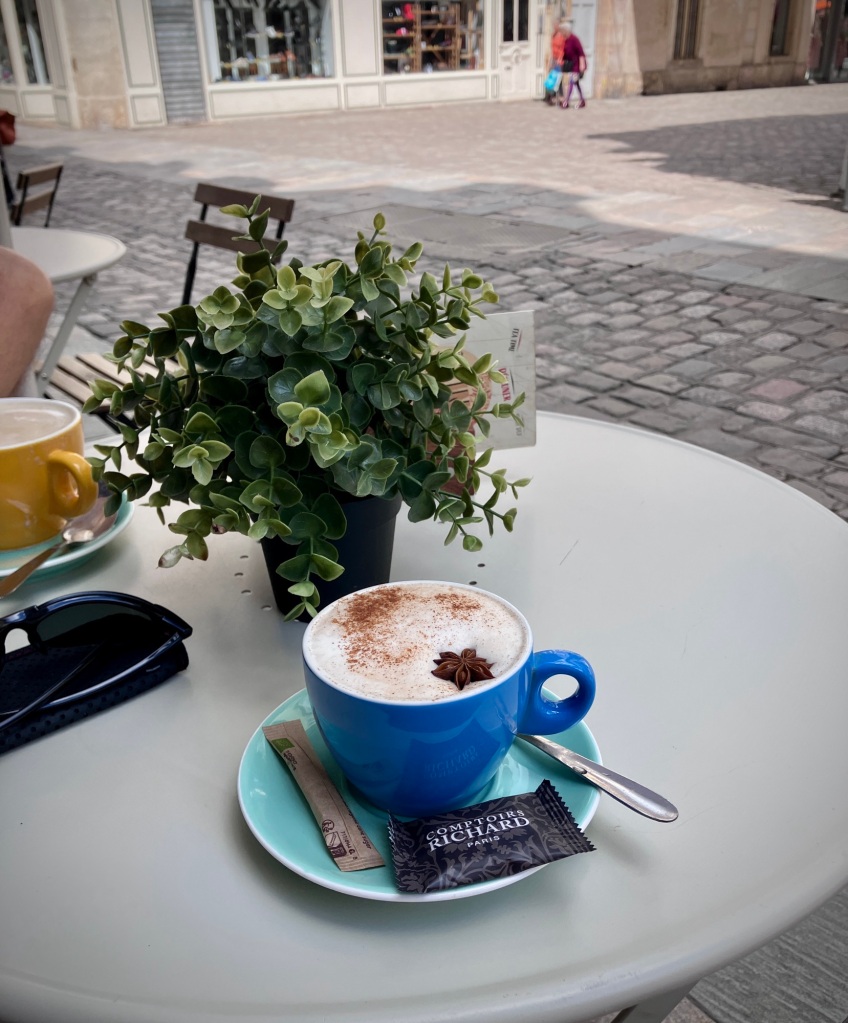
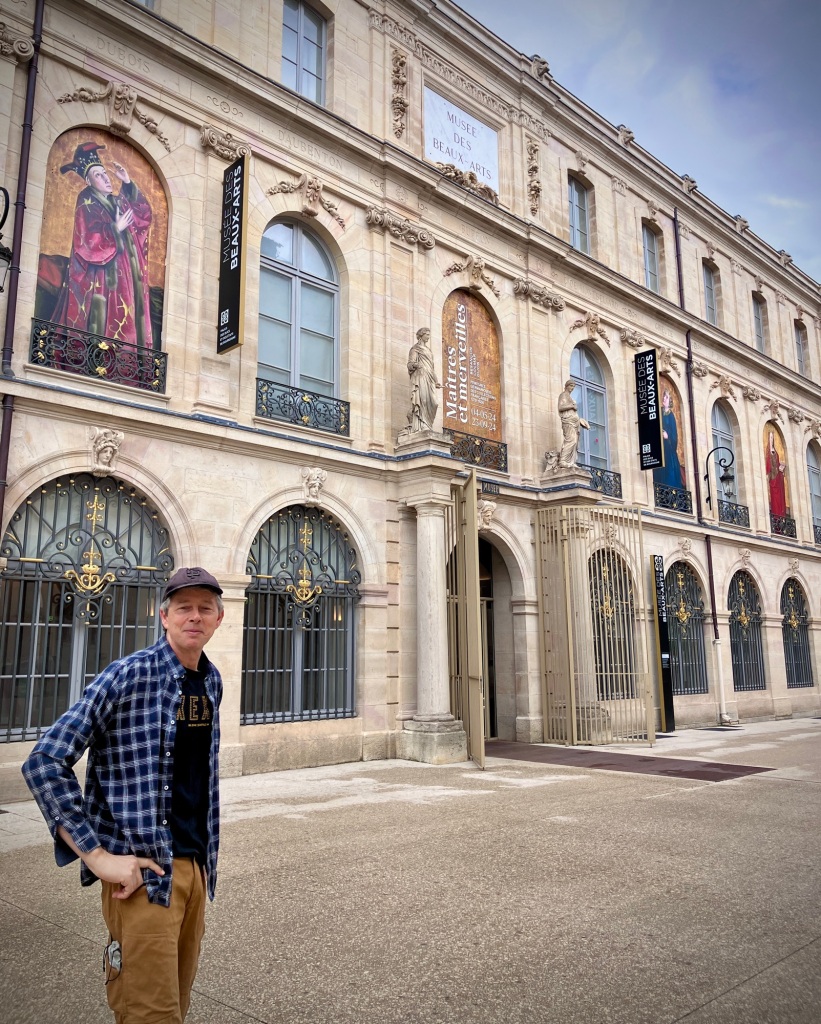
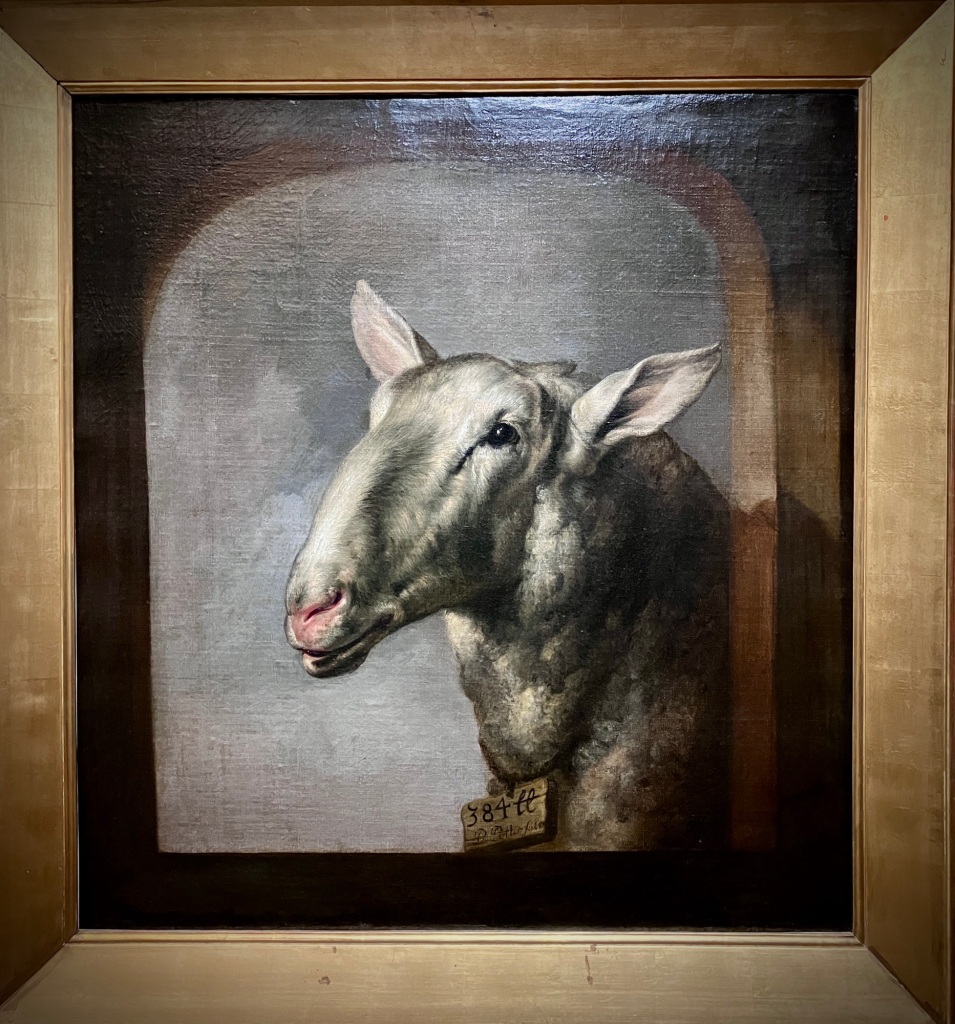
A perfect cafe to people watch in Dijon.The Musée des Beux Arts permanent collections are free and it houses a wonderful collection of art, sculpture, and antiquities.Paulus Potter’s “Head of a Sheep” at the Dijon Musée des Beaux-Arts.
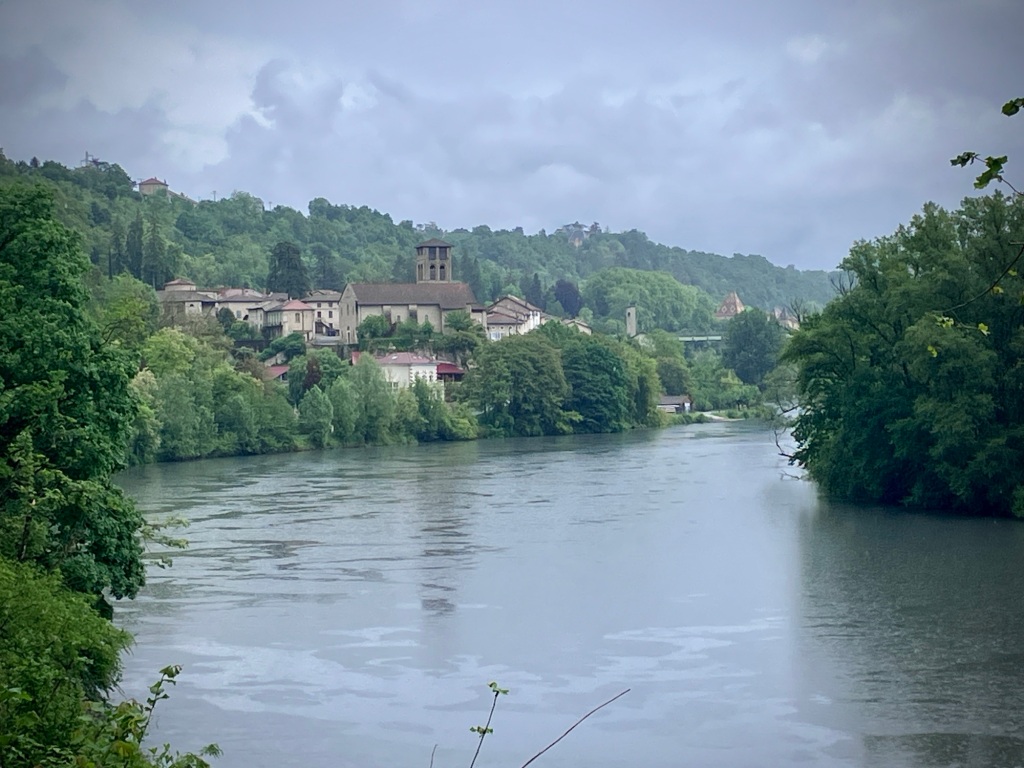
The Isère River enters the Rhône north of Valence and is the namesake of the Department that is a part of the region of Rhône-Alps. We had actually passed through Valence in March on the Via Rhôna, so had to retrace a bit of our route upstream this time. Strangely, the lower part of the Isère River is actually still in the department of the Drôme.
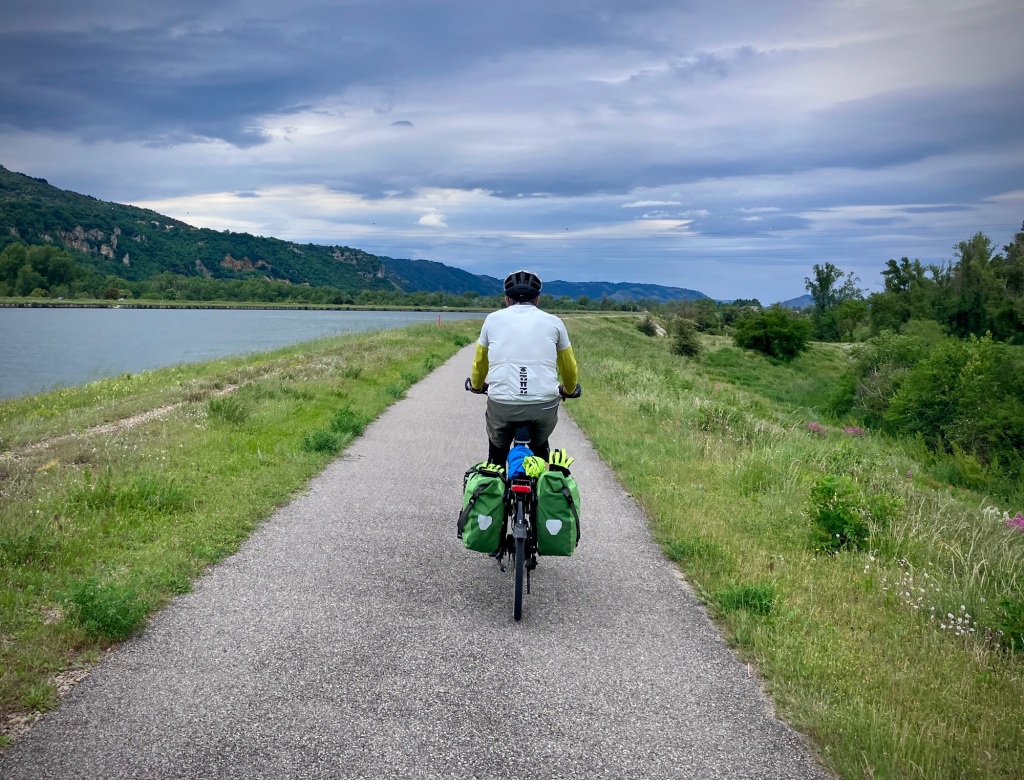
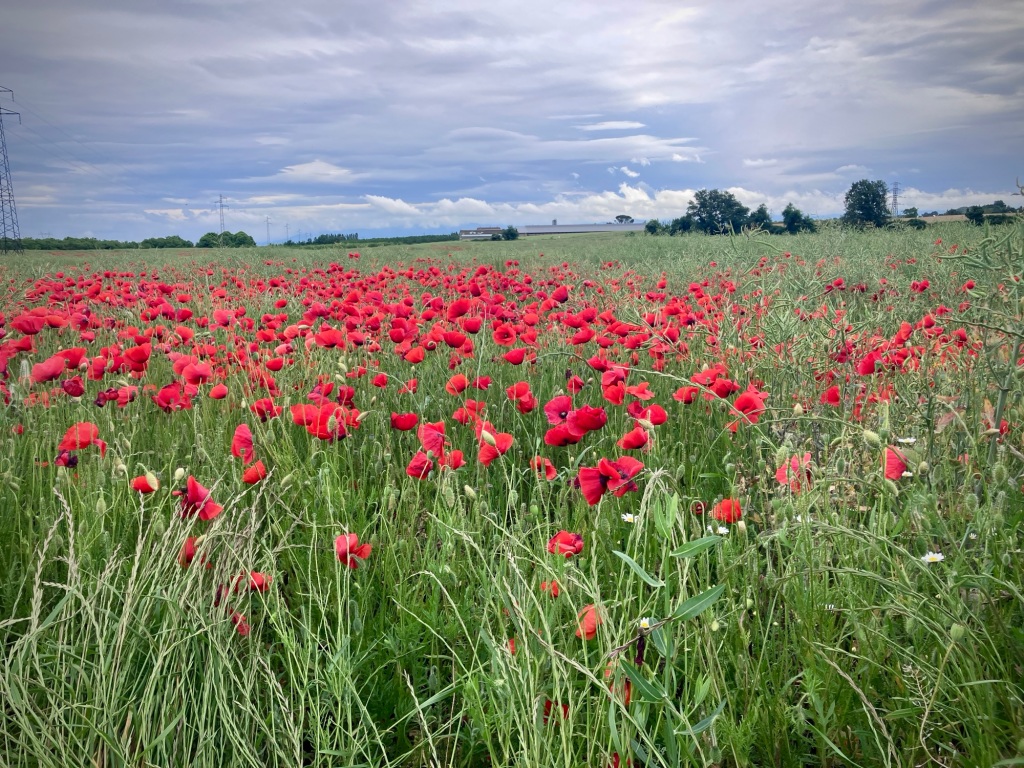
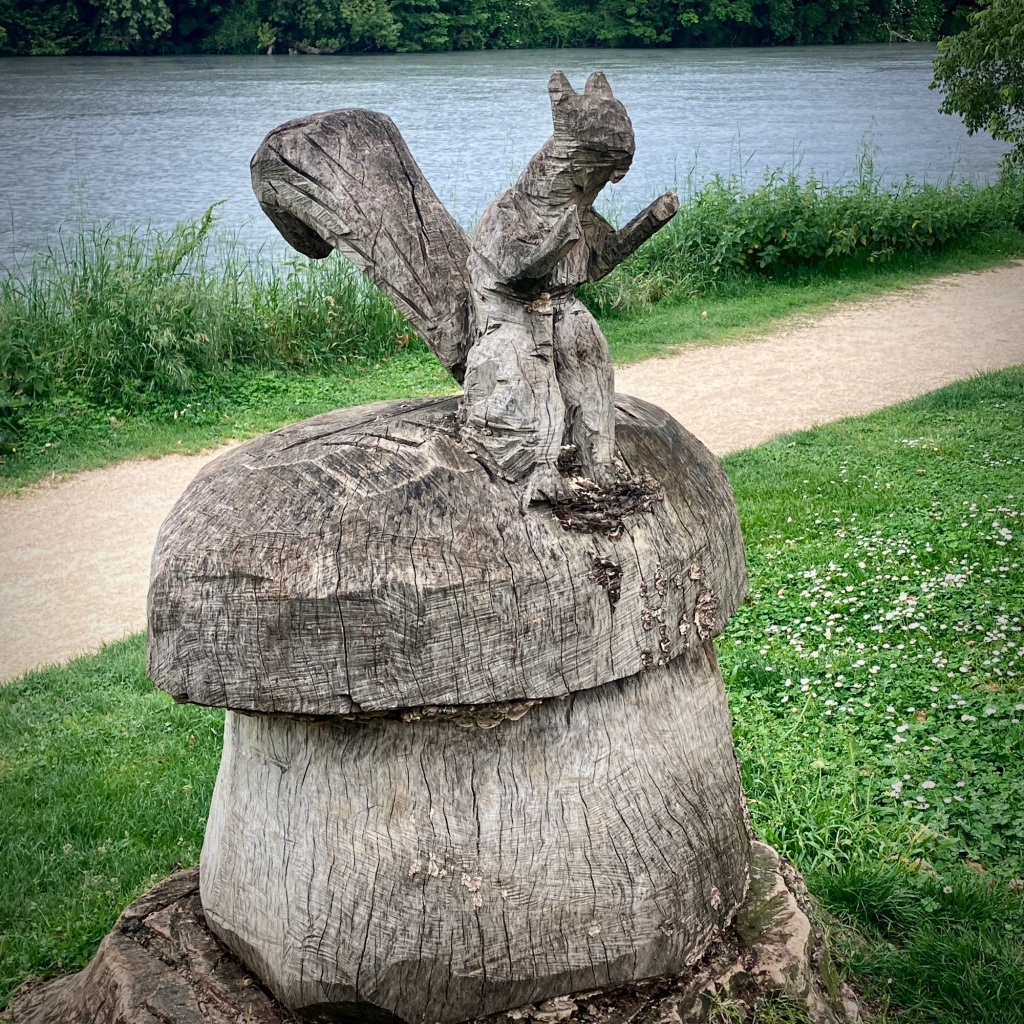
The skies are starting to look threatening as we head up the Rhône near Valence.Spring really is here!Great bike bridges on the Via Rhôna and Isère An homage to our favorite woodland creature.
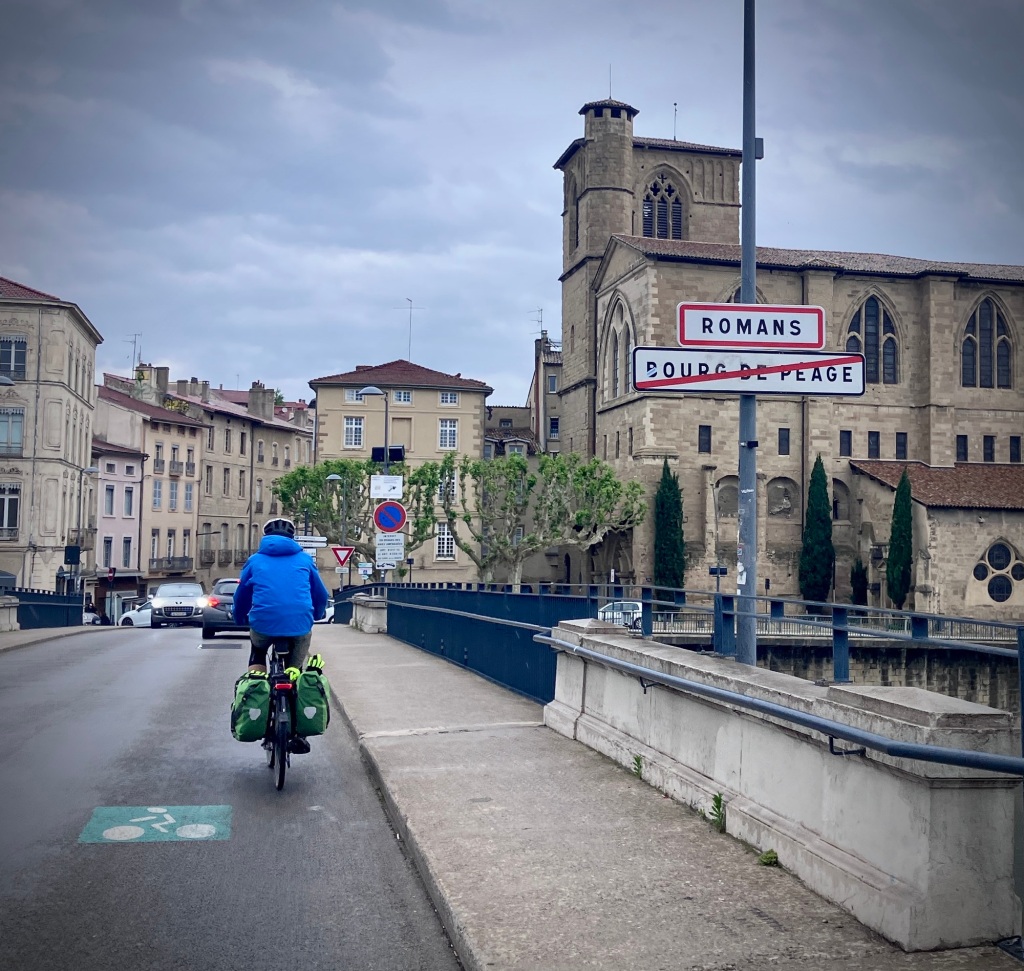
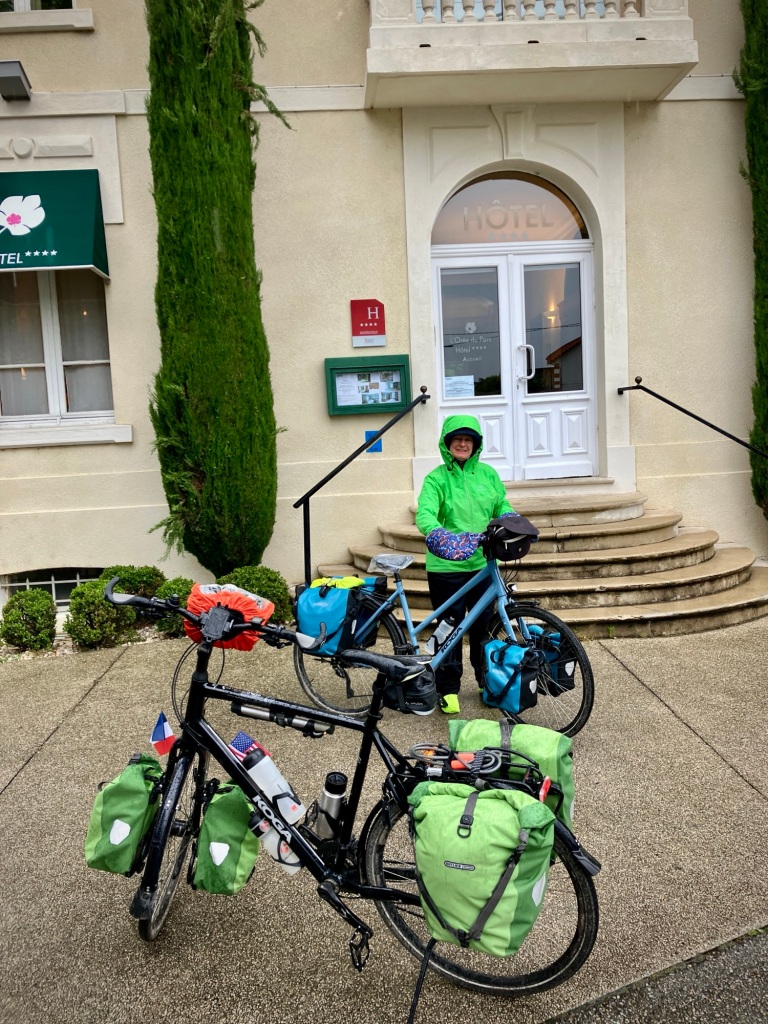
We just beat the forecast rain to our first night stay in Romans-sur-Isère, but were a bit stunned by the somewhat incessant and gridlocked traffic through this old riverside industrial city. We slogged through to get to our surprisingly charming lodging on the edge of the city, and walked back into the center of the town in the rain for dinner. We did find a (the?) fun and friendly place to get a drink and dinner and everyone was very nice to the two noticeable American cycle tourists. The town clearly gets few cycle tourists, although sits on the recently developed V63/V62 cycle route know collectively as “La Belle Via”.
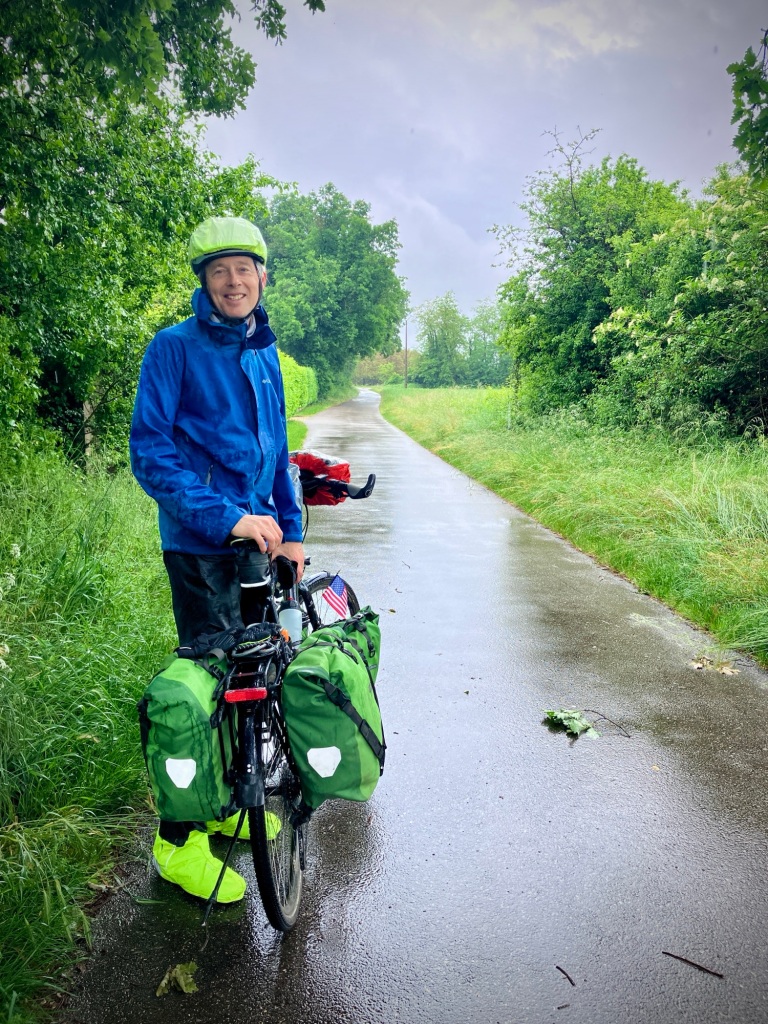
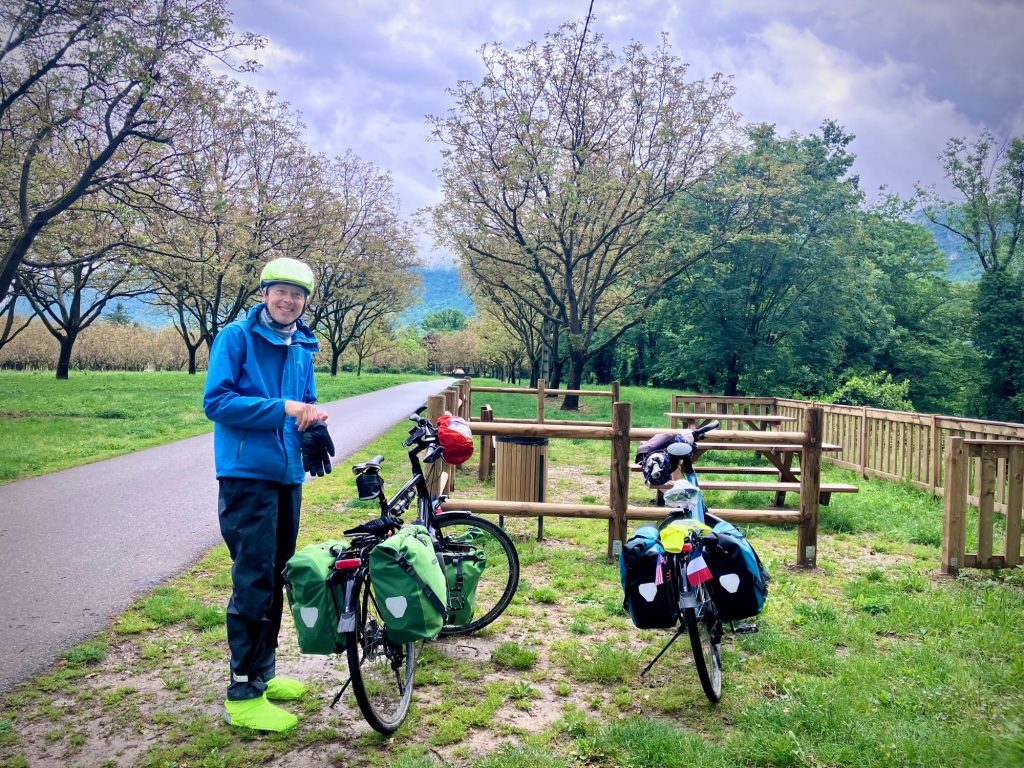
Heading into Romans-sur-Isère. We hadn’t hit the traffic jams yet.Heading out in the rain the next day from the very nice Hôtel L’Orée du Parc.Full rain suit and a feigned smile during a slight rain breakWe did manage a pastry rain break under a shop awning. Can’t let our French baked goods levels get too low.
We love to learn about the history of places, even for a one night stay, and Romans has been influenced by its strategic location on trading routes and a major river. Shoe manufacturing is still a business and there is a small museum dedicated to the industry that was unfortunately closed by the time we rolled into town. Further down river are abundant walnut orchards. On the way out of town, we learned another source of major traffic was a nuclear fuel manufacturing facility. But Romans is not a bicycle city and the bike infrastructure was sad or non-existant. There was a renovation of part of the Main Street in progress which may help the pedestrian environnement, but otherwise it seemed to be a bit overrun by cars and parking.
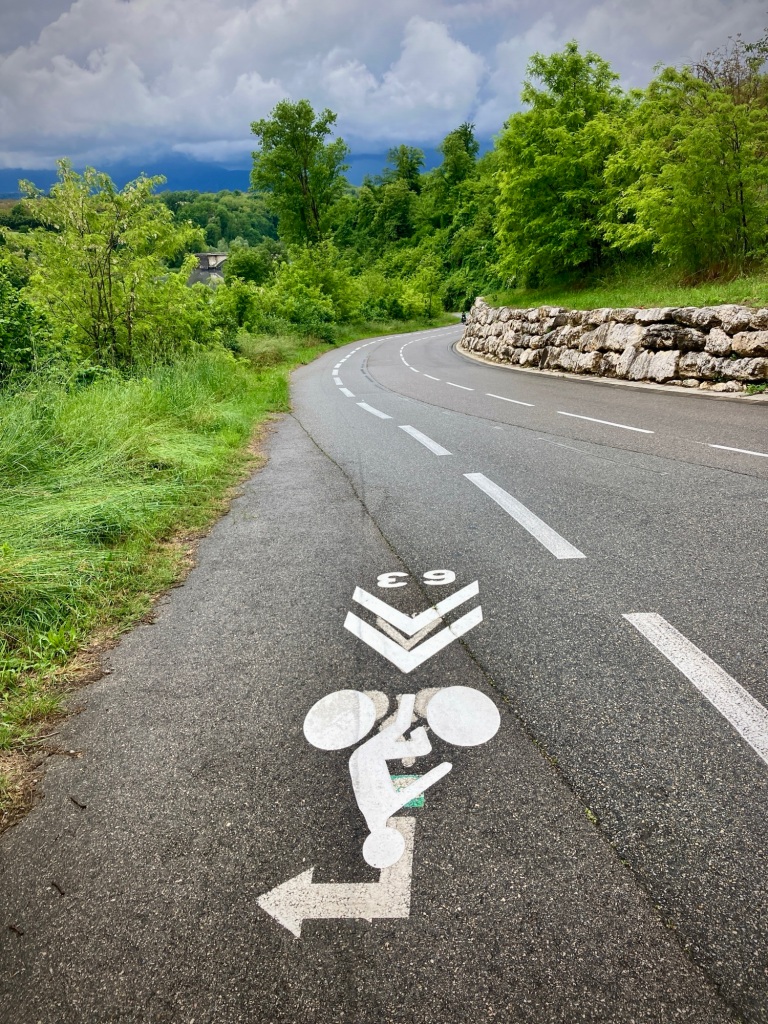
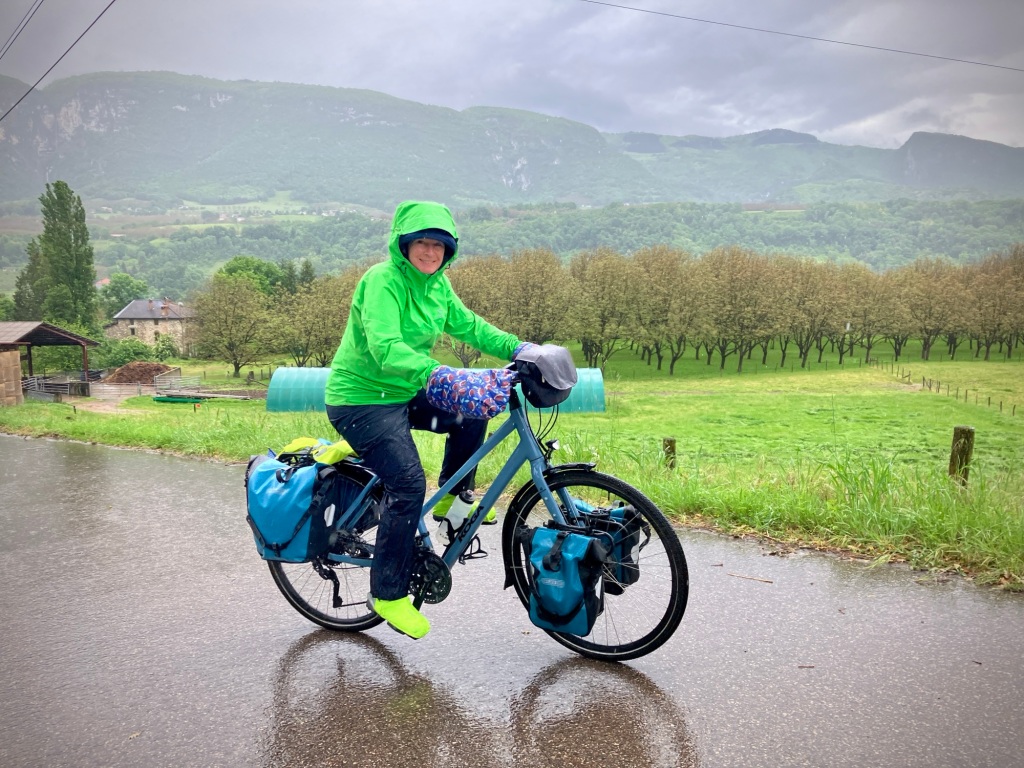
We were following the V63 cycle route up (and down) the Isère which includes some dedicated path sections, but mostly quiet roads.Hills, rain, and another forced smile.
The challenge of the next day was 84km to Grenoble which would have been manageable except it was raining out the door and rarely stopped. We had a low point this day as the traffic getting out of Romans, steep hills, and incessant rain seemed to zap the energy and motivation of Cheryl, and I could sense it. We both have our bad days, but generally one of us keeps it mentally together. Today we were both just a bit over it. Travel, rain, eating out…all of it.
The Isère river valley was beautiful, even on this moody and stormy dayA lunch snack at a welcomed picnic area was cut short as we saw a massive thunderstorm front approaching. Ride fast!
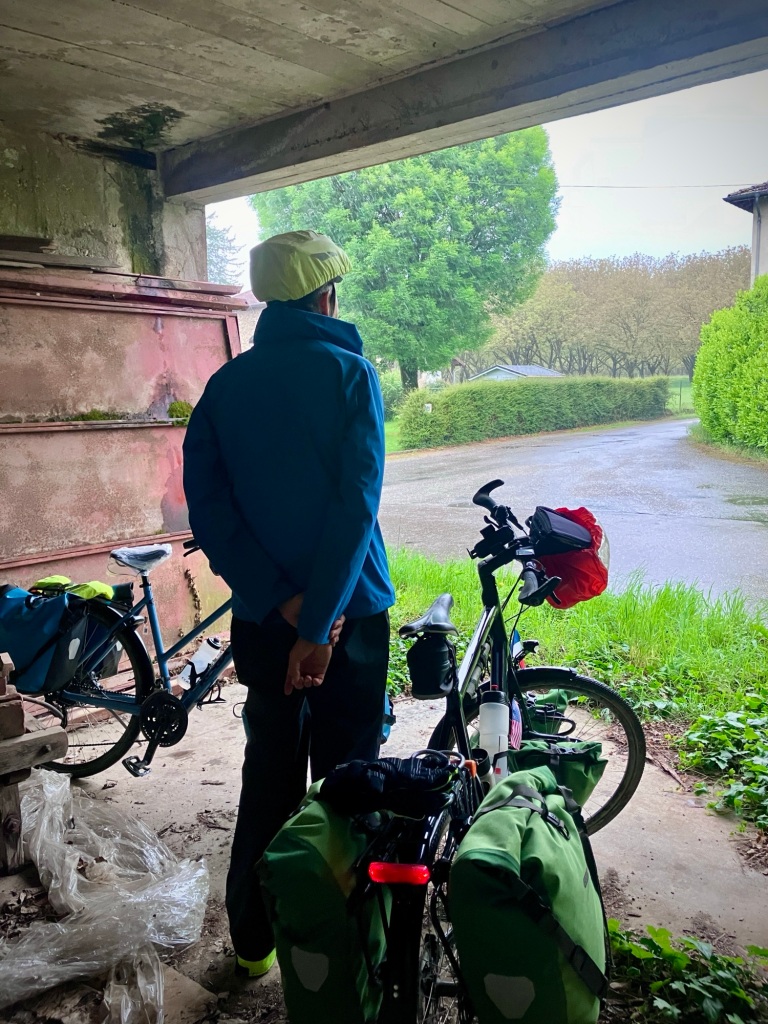
We did manage to miss the worst of an epic thunderstorm and hail in a farmers shed. Cheryl is a travel trooper and rarely complians, but the ups and downs of 10 weeks of cycle touring was weighing us both down. (I generally complain first -;) We had a train bailout option in the small town of Vinay, but arrived to just miss a train prior to a 2 hour gap in service. The days lack of progress sent me into a travel tailspin too, and let’s just say, that afternoon was one of the low points of our France sojourn.
Made it to a farmers shed just in time for the skies to open up.The rain and hail let up a bit finally so we headed back out.Rain booties on, trousers off. It’s a look.
But the sun came out as we waited for our train. and the short train hop to Grenoble was fine. The city was lively and green, and the next day was beautiful. Travel and cycle touring can propel you on a rollercoaster of emotions, but that is why we continue on. The next day IS generally better -:) .
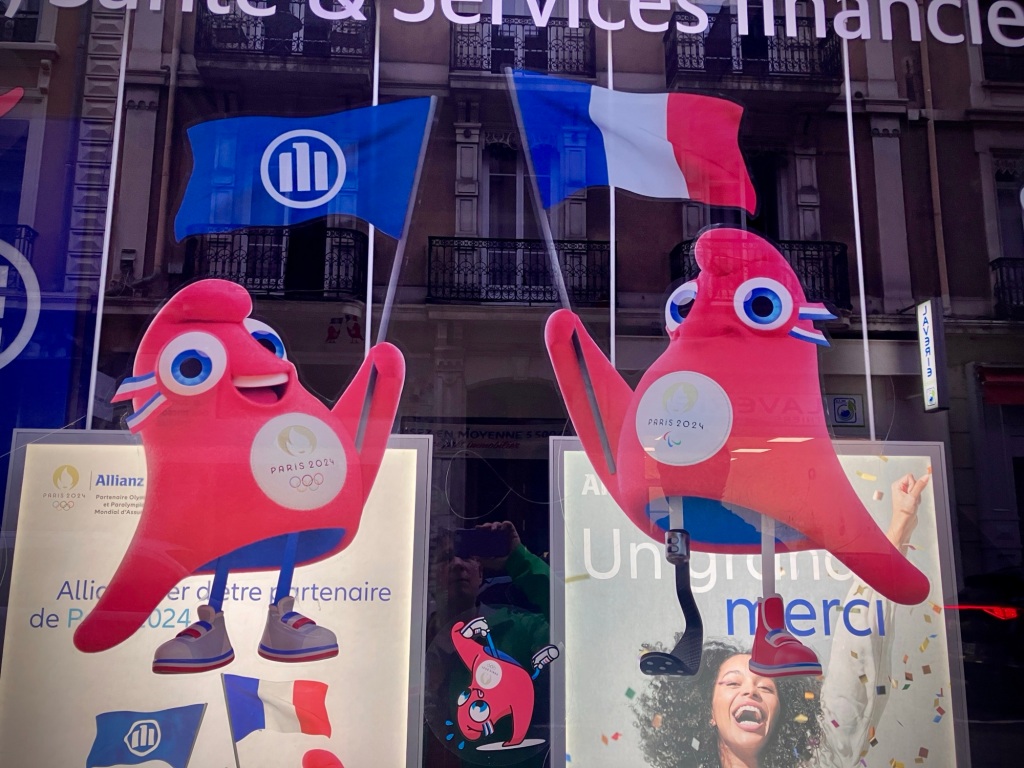
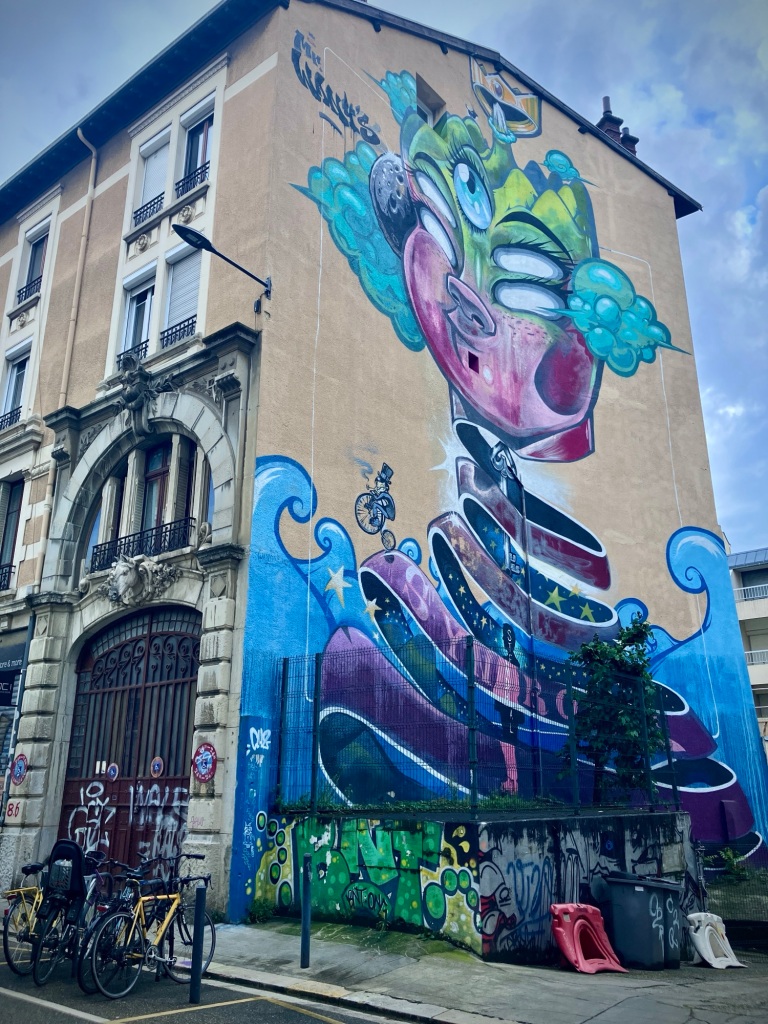
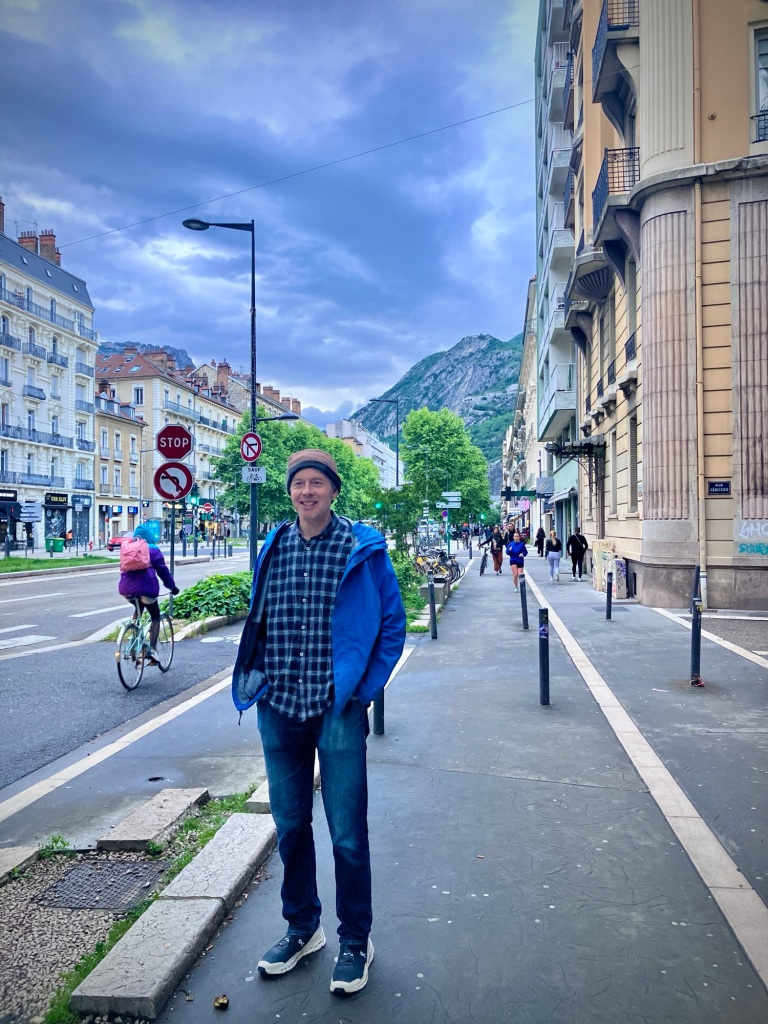
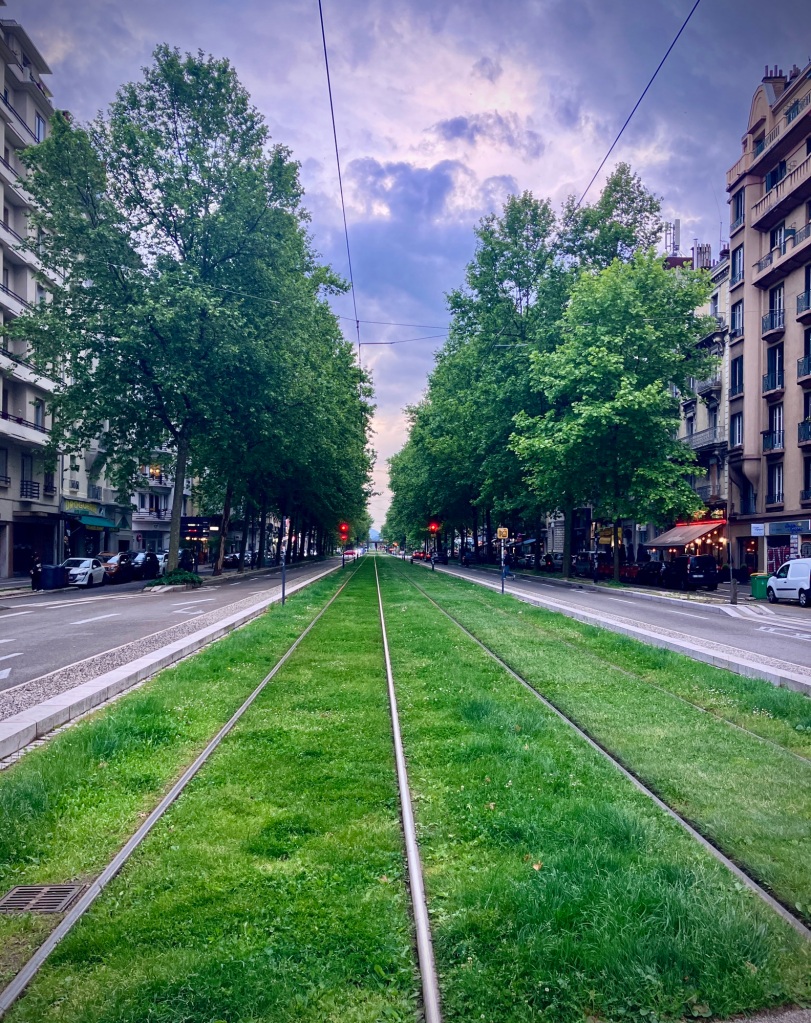
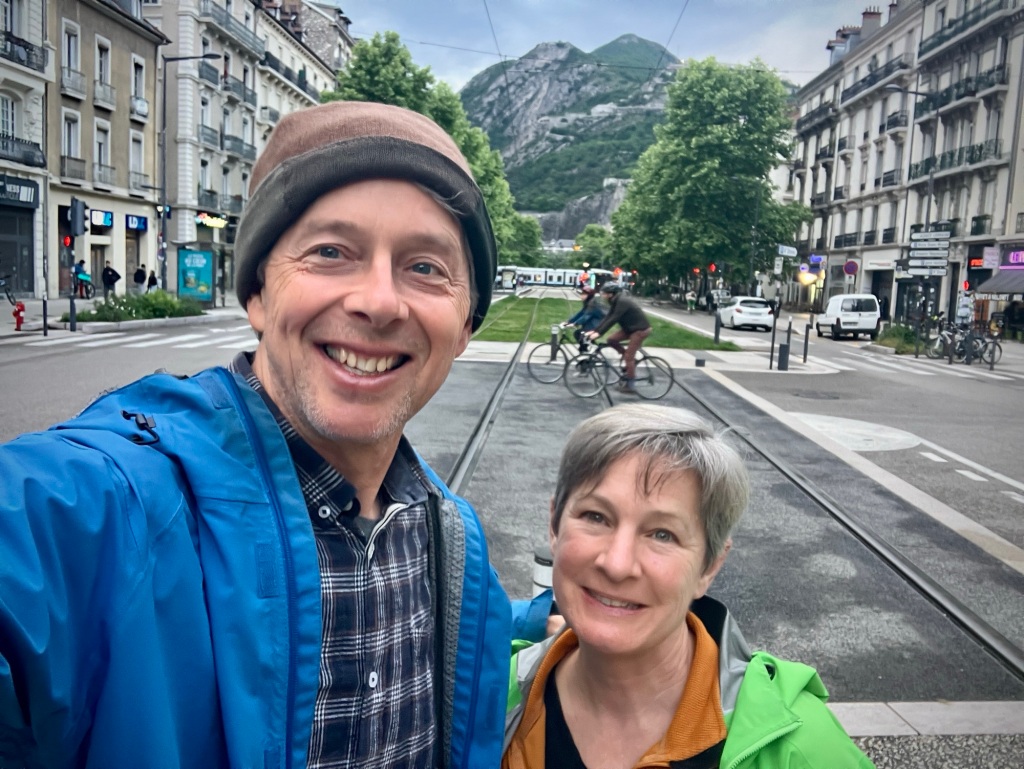
Grenoble was home to the 1968 Winter Olympics and now 700,000 people live in its region, making it the biggest metro region in the Alps.Nope, not a cute animal, but the 2024 Paris Olympic mascot takes the shape and form of a Phrygian cap; a symbol of freedom and revolution! Love the theme and inclusion of a Paralympic prosthetic leg.There was a surprising abundance of street art and murals in Grenoble.Hey, Grenoble is cool!Love the green tram tracks (but not all the rain).Next level cargo bikes in a seriously green city.Trams and bikes, what’s not to love?!The cranky travelers recovering in Grenoble and ready to explore another day.
We loved Grenoble but only stayed a night as hotels were unusually expensive due to a conference. We vowed to come back and explore more there soon as it’s nearby the Vallée Verte and has a lot of top museums, not to mention outdoor adventure in every direction. The next two days cycling further up the valley were inspiring and relatively short, so allowed for plenty of time to stop at sights, take photos, and bask in our positive attitude!
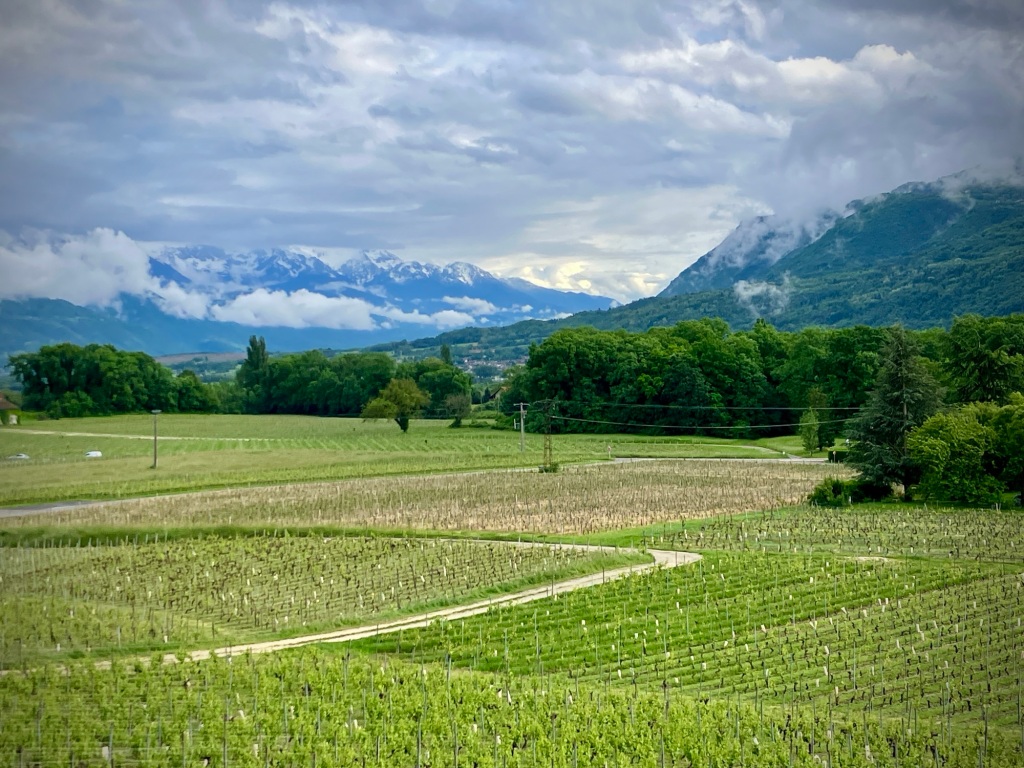
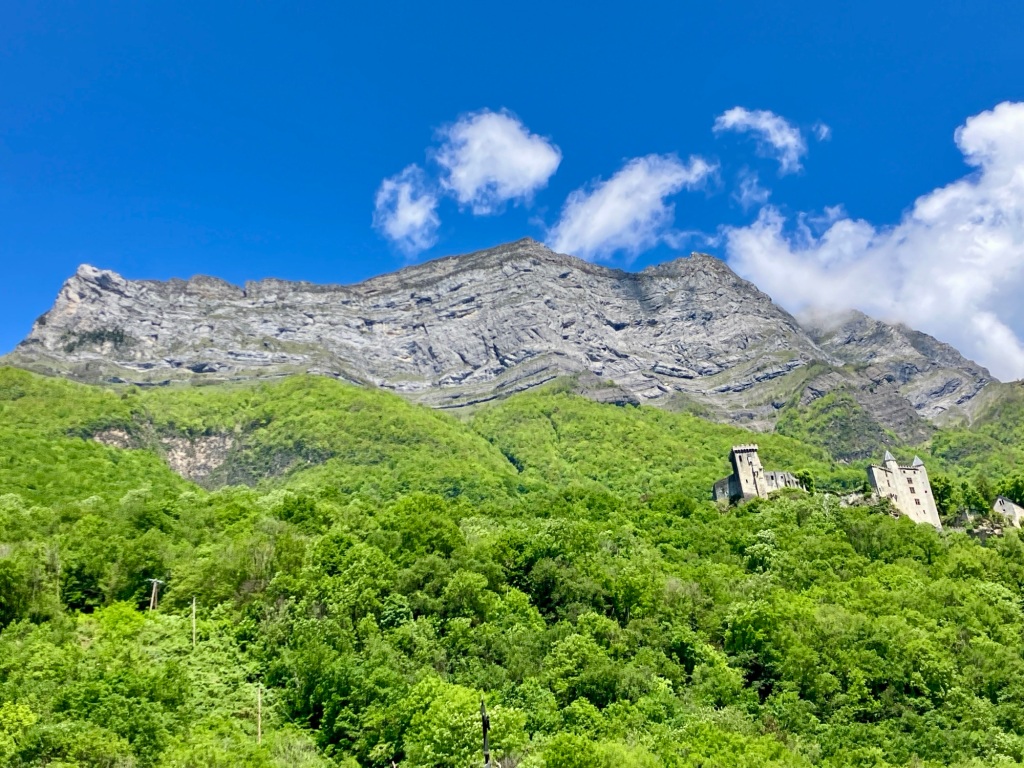
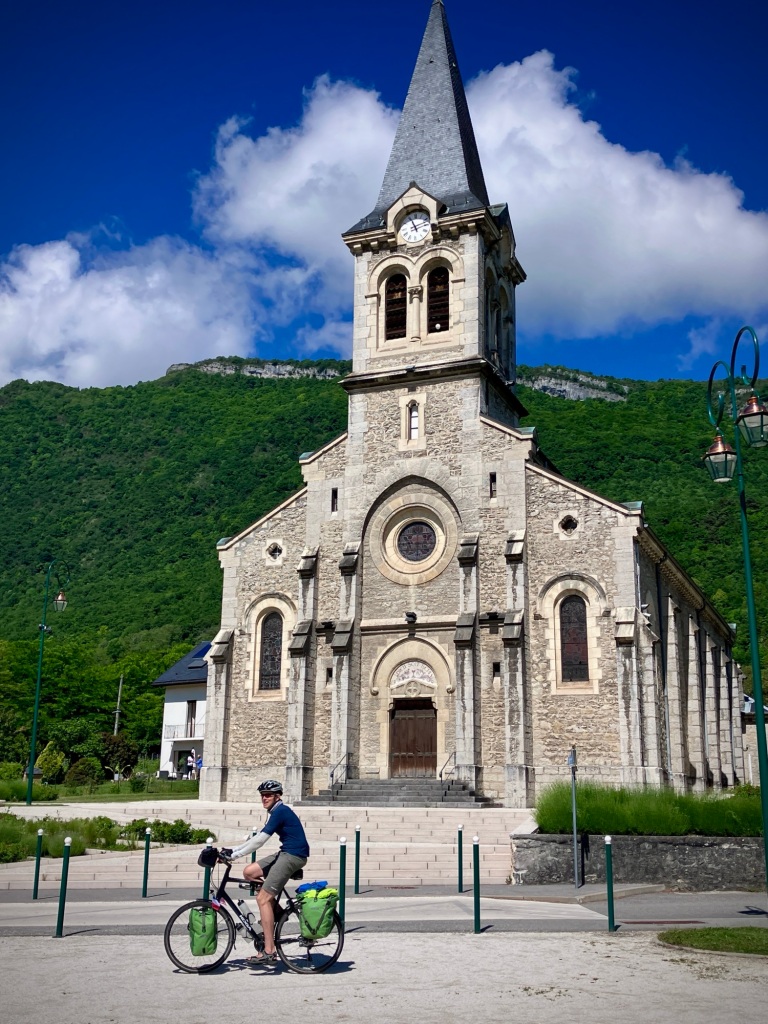
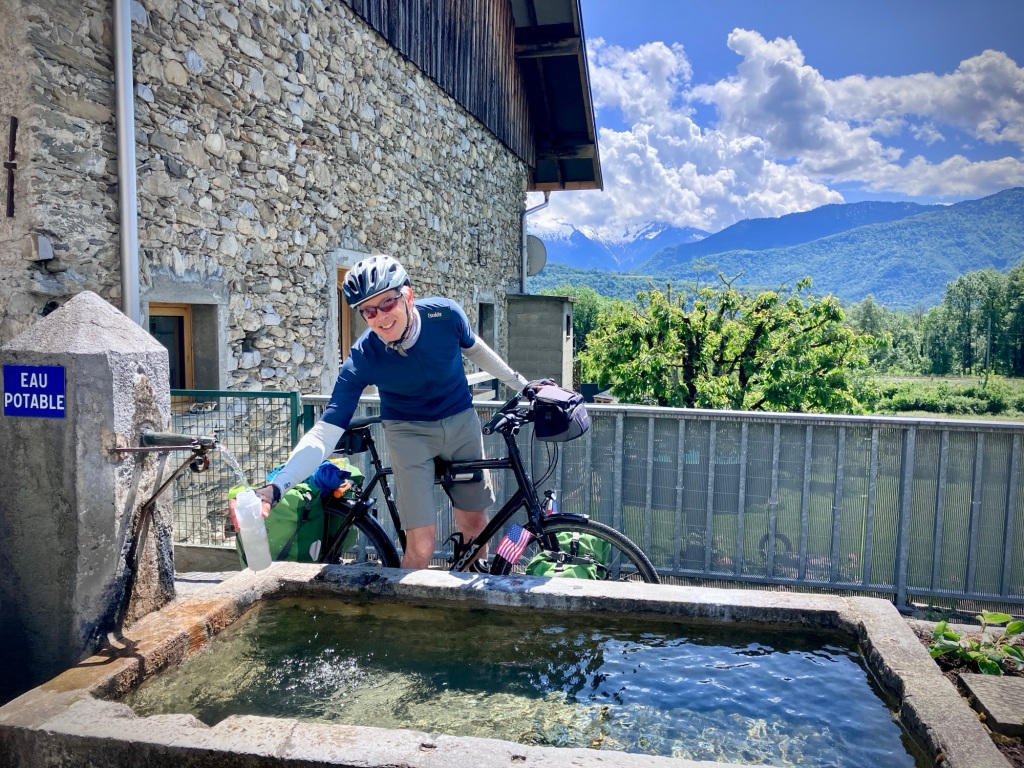
The ride out of Grenoble was flat but pleasant along the Isère River and valley.But soon heads up some small hills into the Coeur de Savoie.The Savoie wine production region near Chingin.Cheryl heading to the wine!Views and history at Chateau LaViolette, a very friendly and lovingly restored B&B in the Porte-de-Savoie. This magnificent cypress tree was over 200 years old.Views from LaViolette of vineyards famous for Mondeuse Noir and Jacquere. The infamous land sliding Mt Granier is obscured by clouds.Our next day was greeted by spectacularly blue skies cycling the D201 road to Albertville. We passed on the steep climb to the historic Château de Miolans.A wonderful day rolling through the tidy and historic villages of the Savoie.Usually there is a great water source in these mountains…just need to make sure you see the “Eau Potable” sign.The D201 road rolls up and down along the edge of the valley towards Albertville and is a great alternative to the flat V62 route in the bottom of the valley.
We found a nice little apartment in Albertville to spend the first two nights of the long Corpus Christi holiday weekend, as Albertville is actually not much of a tourist town, despite hosting the 1992 Winter Olympics. It’s pleasant enough and was a good place to relax, do laundry, and explore a bit, but otherwise would recommend other places in the Alps for scenery and charm. It has the old Olympic park and a small medieval town, Conflans, on an adjacent bluff. We realized all the charming Olympic shots you saw in 1992 were probably of Conflans, not Albertville per se.
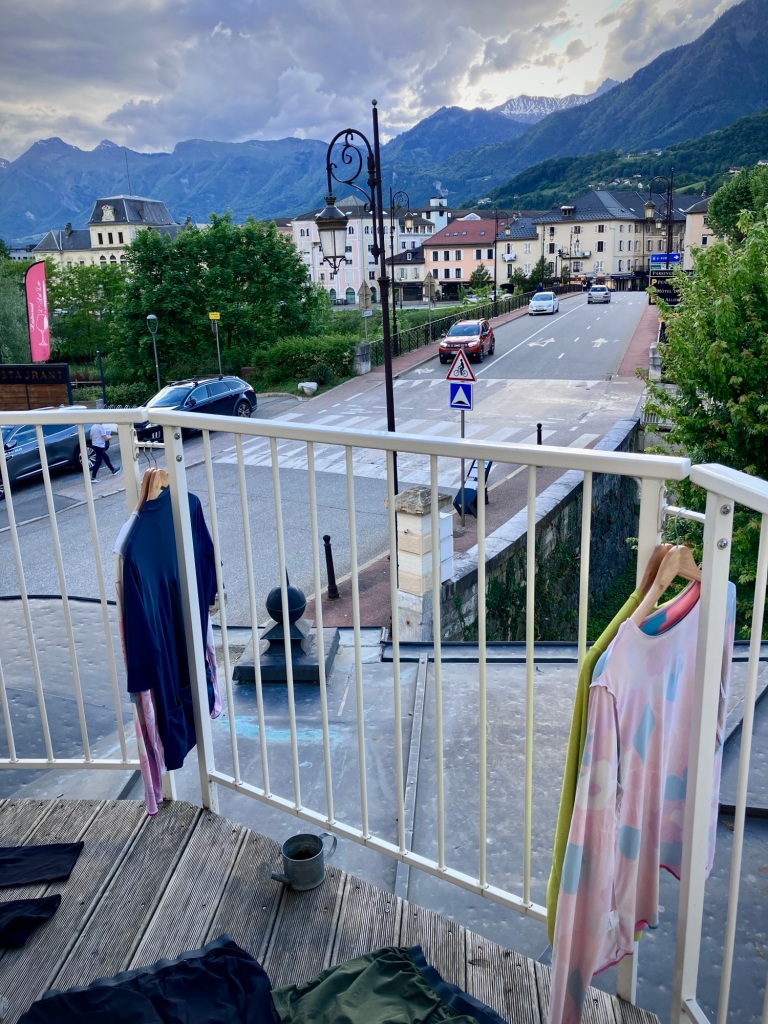
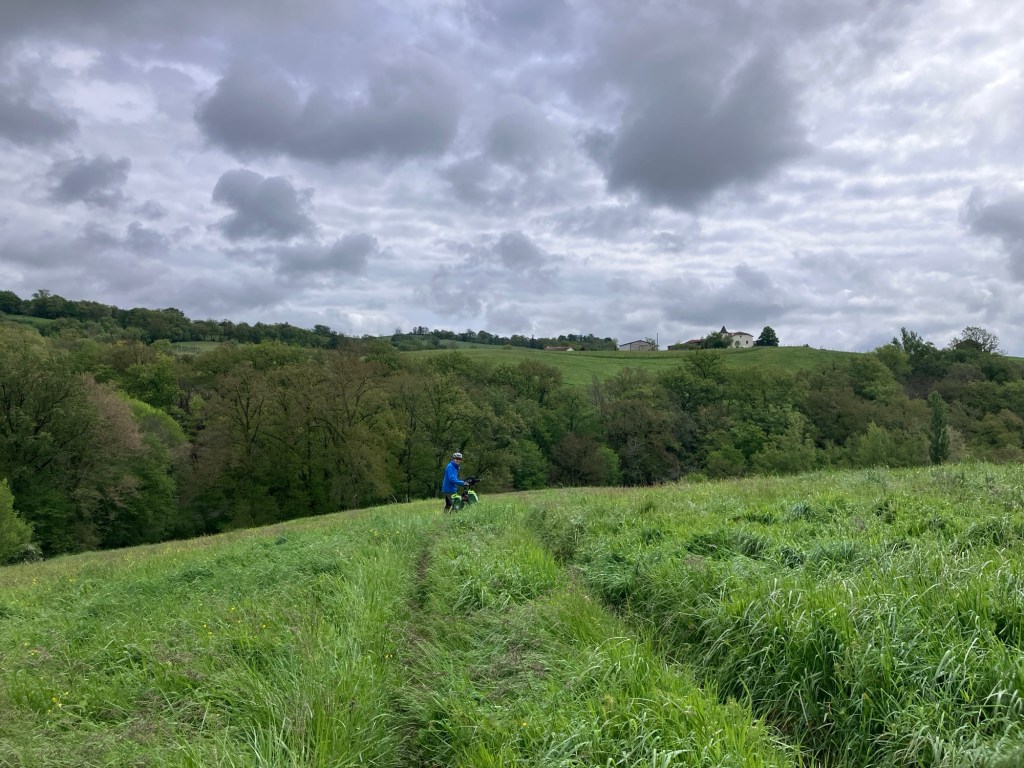
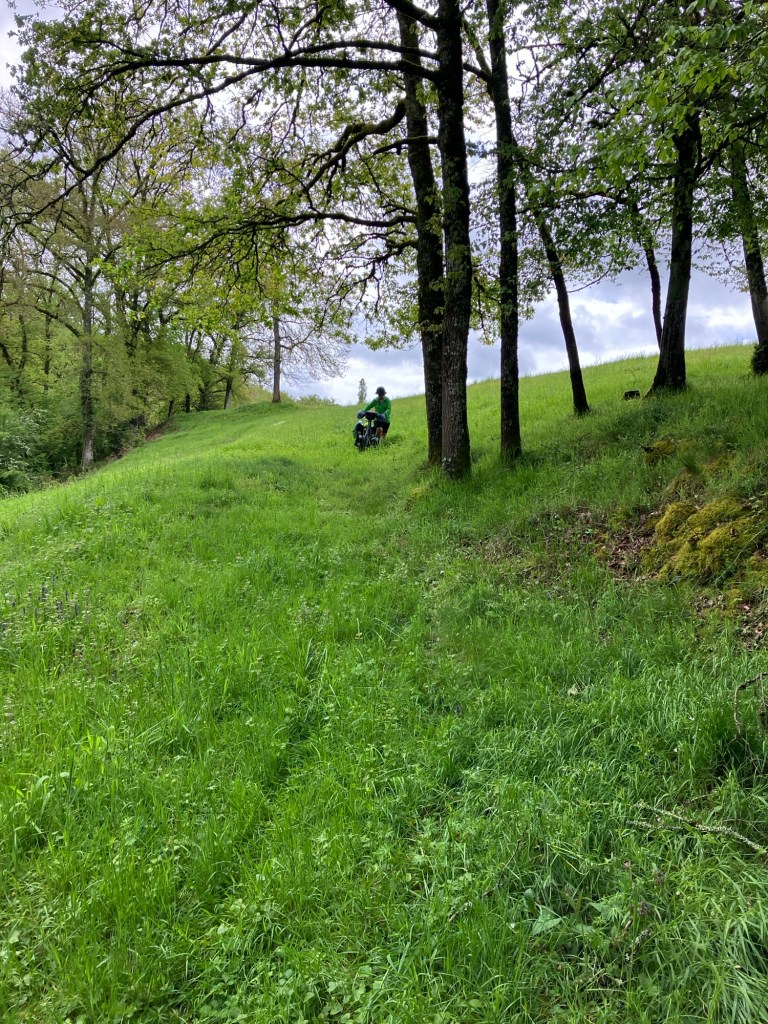
Our cozy apartment in Albertville had convenient balcony drying The medieval village of Conflans is just a short walk up the hill from downtown Albertville. We really enjoyed learning more about life and history of the Savoie at the small museum.Spring fragrance in Conflans.La Bicyclette in Albertville is a great bike themed bar with craft beers, a very pleasant garden, and of course, wine -:) .Heading out of Albertville for a short day to Annecy. How can we make this longer and more fun?Taking the rolling side gravel and dirt paths instead of the paved cycle path.Happy to snag a lunch bench on this busy holiday weekend.Another side excursion to get some views and hills.Oops, too much hill and wicked steep in parts! A bike push assist.Yup, the trail goes through this farmhouse. We’ve learned that France is quite liberal with protecting historic rights-of-way and unless there is a clear Privé sign, we press on.Cheryl enjoying the side excursion downhill.Fun descent in a bit of mud. First one to fall down buys the wine!
After Albertville, we had an easy day to Annecy planned, but I did my best to make it a bit more challenging as we couldn’t get into our apartment there until 5:30. But the weather was spectacular and the route a joy, minus a few rough patches off road. We got to the south end of Lake Annecy just after lunch, where our route joined the 40km lake loop. It seemed that most of France was outside that day as the weather was finally warm. We merged into the pathway mix of fast and slow, families and dogs, and racers kitted out still thinking they might achieve their personal Strava best weaving around thousands of people. It was fun and the scene was memorable as we got closer to the center of Annecy.
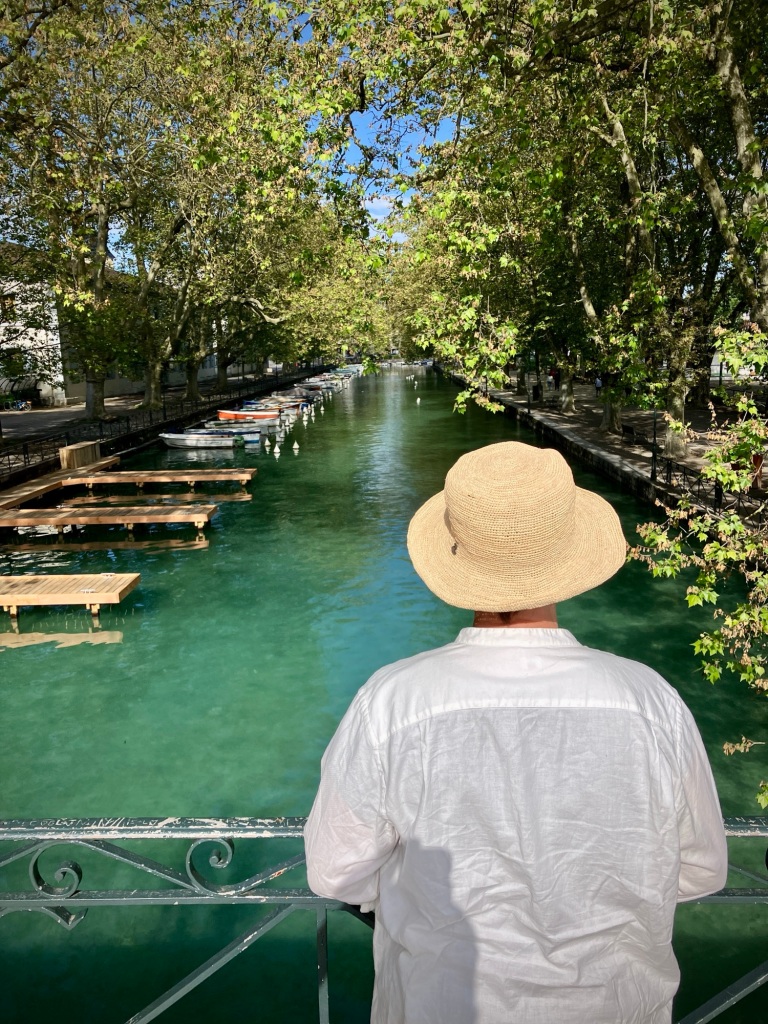
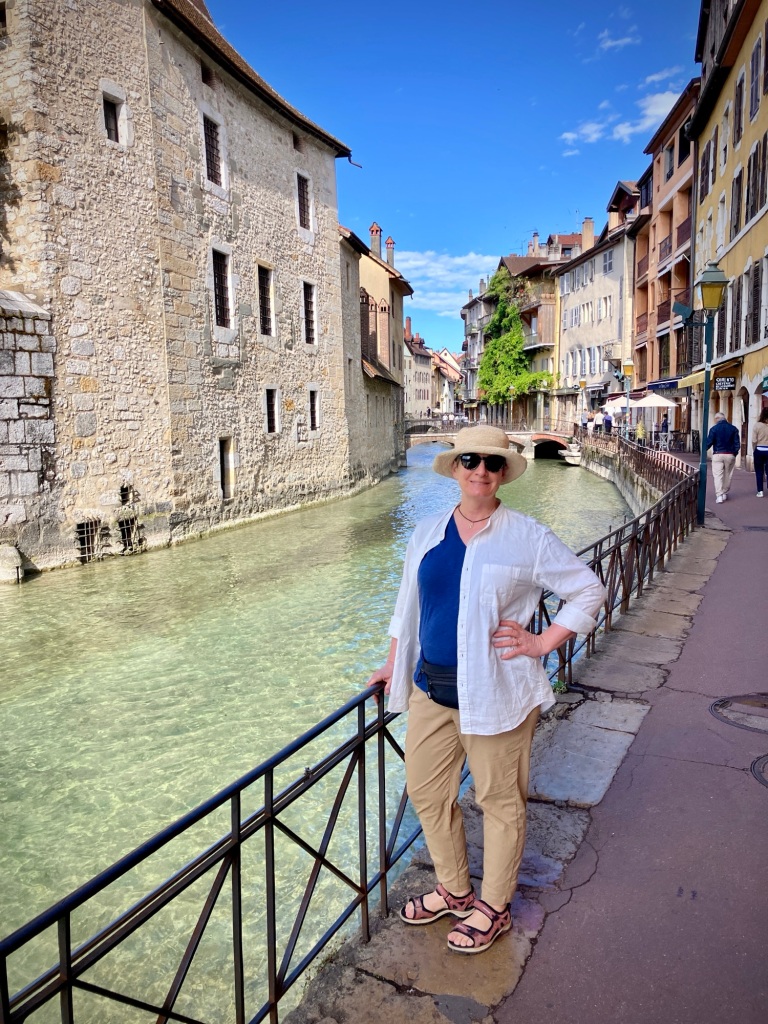
You can circle Lake Annecy on cycle routes which is a very popular day trip.The lake path was full on France the Sunday of a long holiday weekend (Corpus Christi).We were waiting for a mishap in the Sunday spring fever and lakeside chaos, but it all seemed to work out.So this is what cycle touring in warm weather is like! We felt the joy of everyone as well, since we’d been experiencing the same wet and cold spring across France.Chillin in the lake on the hottest day of our spring trip.Postcard shot, Annecy.Annecy’s lakefront has the historic aire of a long visited and cherished place for relaxation.The enchanting crystal waters of Le Thiou, a short river that flows out of Lake Annecy and is one of the clearest in the world. It eventually flows into the Fier and Rhône.
Annecy is a lovely French city with a great density, beautiful lake front, summer swimming, boating, and strolling. It benefits from easy access by train including daily direct TGVs to Paris. For our California friends…imagine a 2 hour train from San Francisco to North Lake Tahoe. We can only dream.
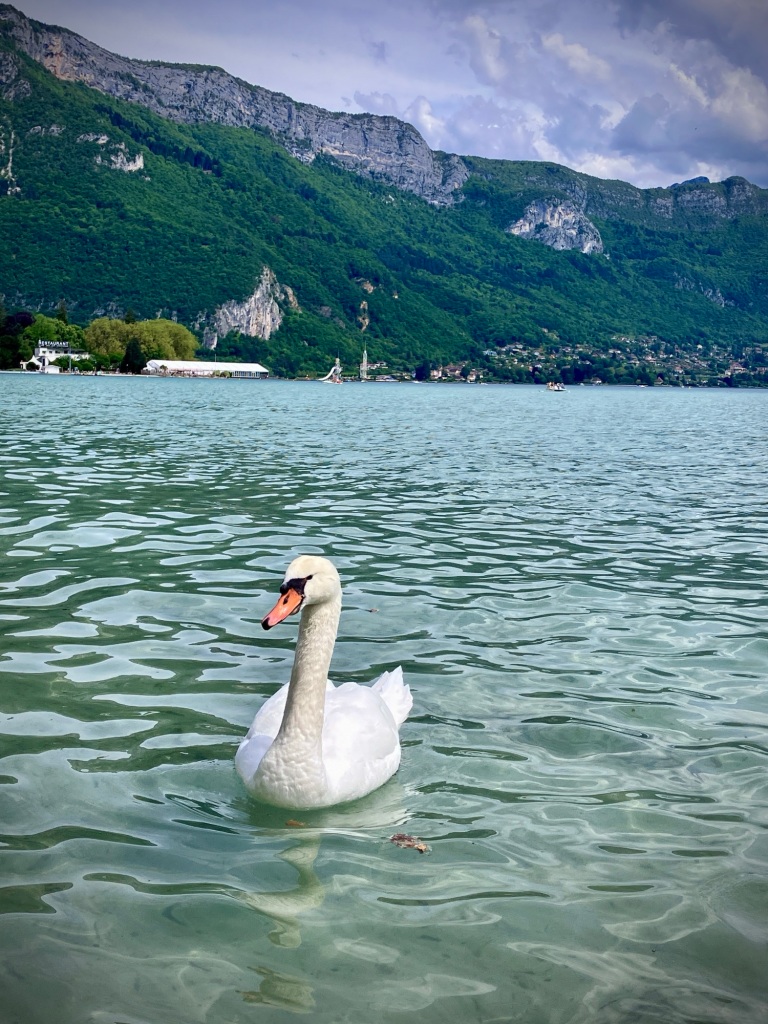
New play space for people as Annecy had recently expanded the car free core.Bollard access again keeps the lakeside traffic out of old town core.The lake and mountains are omnipresent.We stayed another night in Annecy after the holiday rush to enjoy a more tranquil experience and more swimming!Beers with friendly British cycle tourists we met on the path. Greetings Clive and Alan!Swimming with the swans.Big hair on Lake Annecy.
Our final route from Annecy to the Vallée Verte included a morning train hop as the V62 route is sadly incomplete and we’d been warned about the road near Cruseilles. The terrain is steep and rugged north of Annecy and it would be too long to do in one day as well. So we enjoyed a scenic hop on Line 2 of the recently upgraded and completed Léman Express system centered around Geneva. The trains are modern, frequent, and bike friendly. Bike space is somewhat limited, so we imagine at peak times it could be challenging, but we had a very peaceful ride on the 10am train which starts Annecy. Note that you need to buy a Swiss bike day pass if you stay on the system into Switzerland. (we did not.) The fixed price Swiss bike day pass (regardless of distance) is not a cycle friendly solution for short hops and really should be revised by SBB.
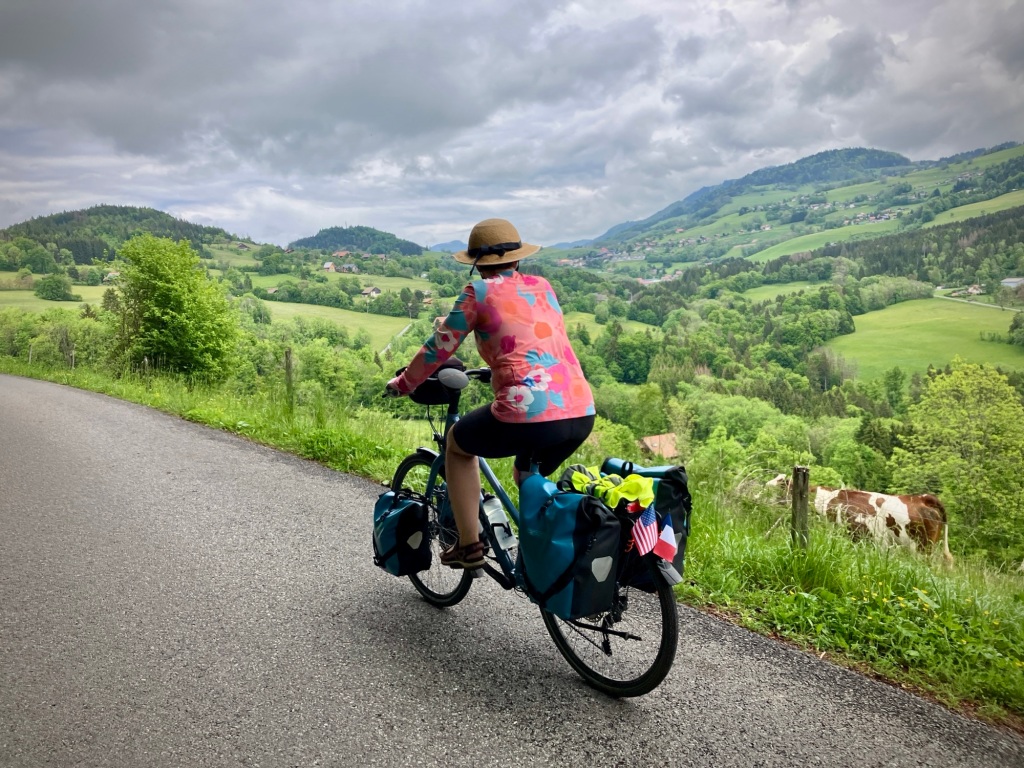
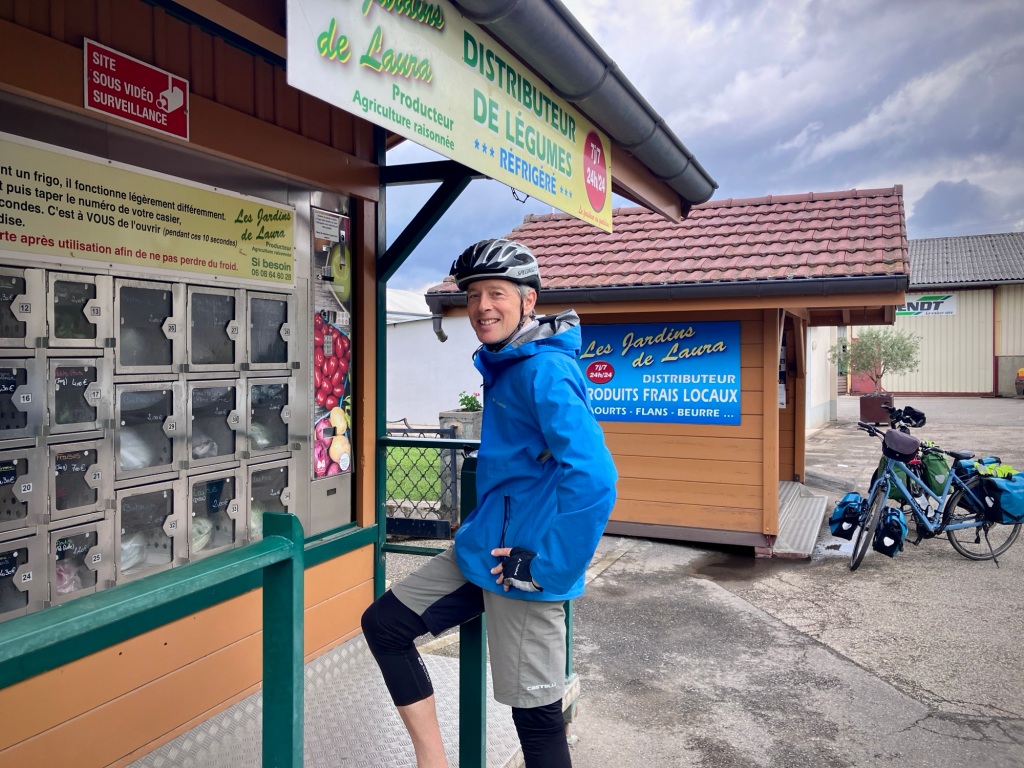
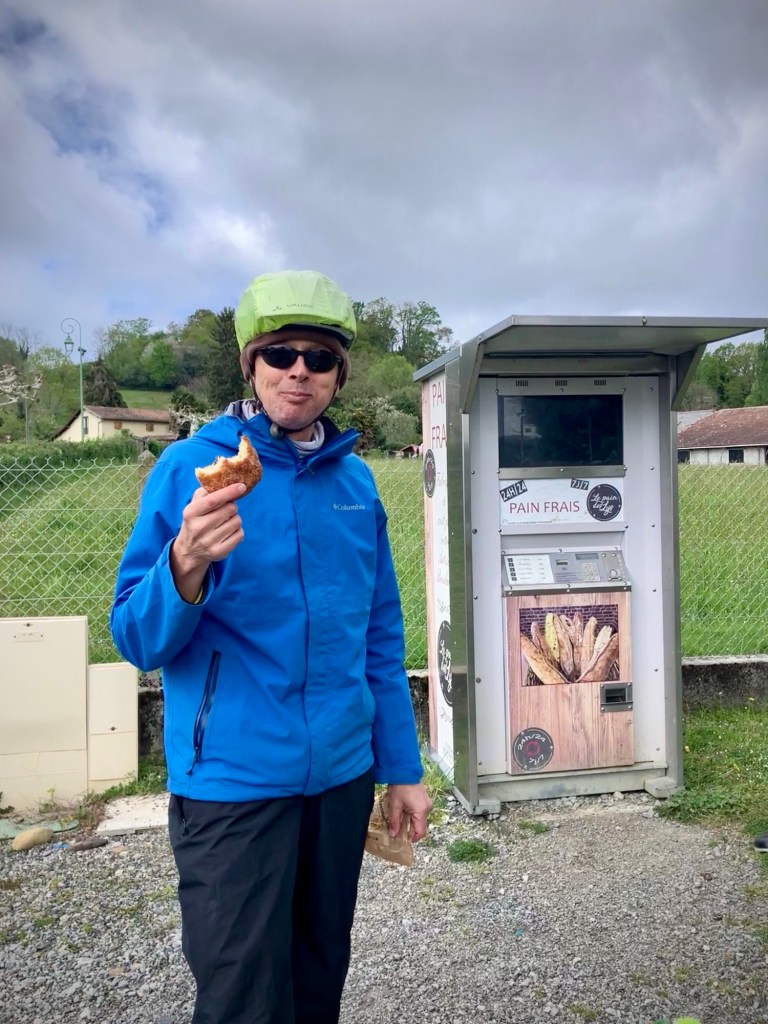
The final day push up the Col de Perret. Cheryl climbing with little effort and record speed; a testament to our almost 3 months on the bikes France does fresh vending like no others. This wonderful 24/7 farm shop had artisan yogurt, cheeses, eggs, and a wide variety of vegetables.Biggest farm vending ever near Reignier. We got fresh broccoli and some yogurt. A great solution for staffing costs while still providing access to fresh foods.Vallée Verte welcome committeeFeeding our kitchen scraps to the neighbors pig; strangely they don’t like cabbage.Reunited with our great friends and their visiting family for a spectacular day hike in the Alps.Happy to be back in the Vallée Verte after another successful bike tour.
We shaved over an hour off our last time climbing up the high valley route and felt a strong sense of accomplishment as we rolled into our friend’s house again. We appreciate everyday of our freedom. Happy travels!
After a nice rest day exploring Cahors, Cheryl and I continued our spring tour further up the valley of the Lot River. The middle Lot is a magical place of endless meandering and pretty villages with a variety of terrain to match.
Riding out of Cahors over the Devil’s Bridge The Middle Lot is still navigable with occasional weirs and locks
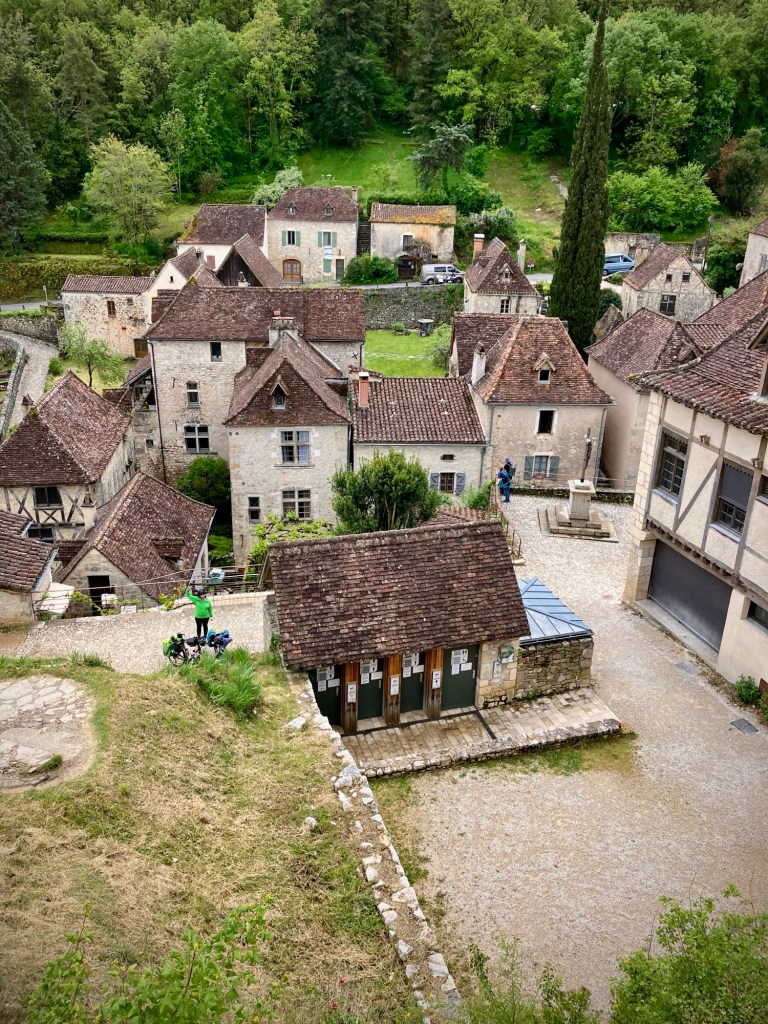
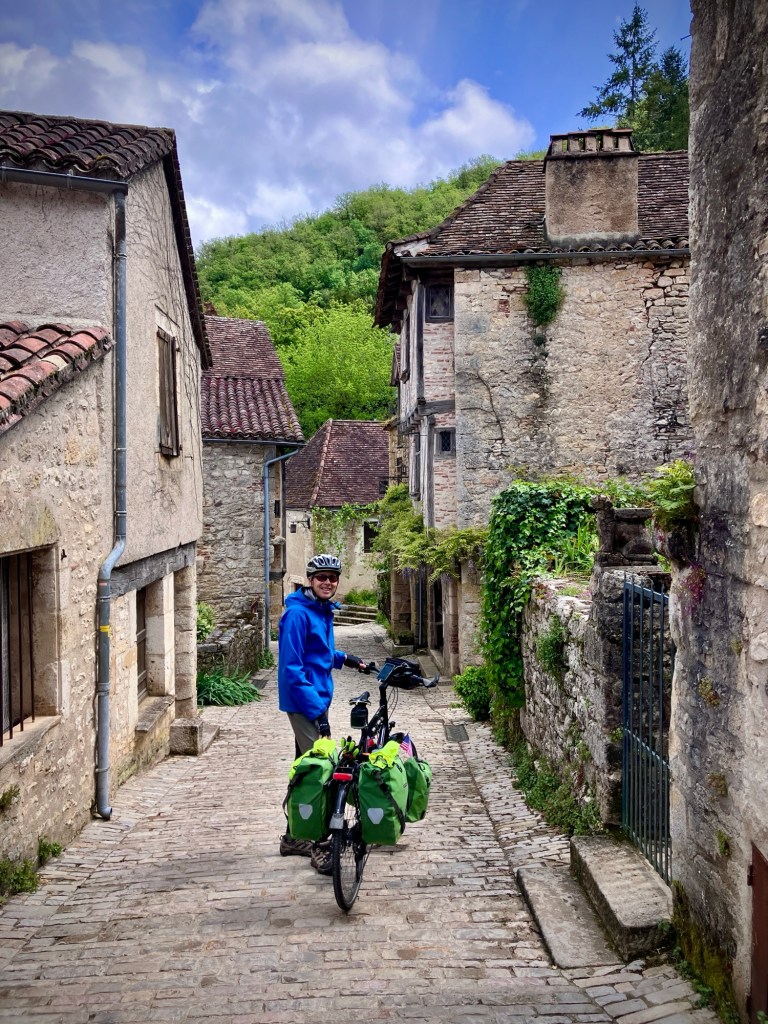
The route out of Cahors immediately took us up a hearty 300m climb over a ridge, but the reward was a descent down to the beautiful Saint Cirq de Papopie. It’s a storybook medieval village perched on a rocky edge above the Lot. Our friend Dan had mentioned his time in this area and we thank him for the tip.
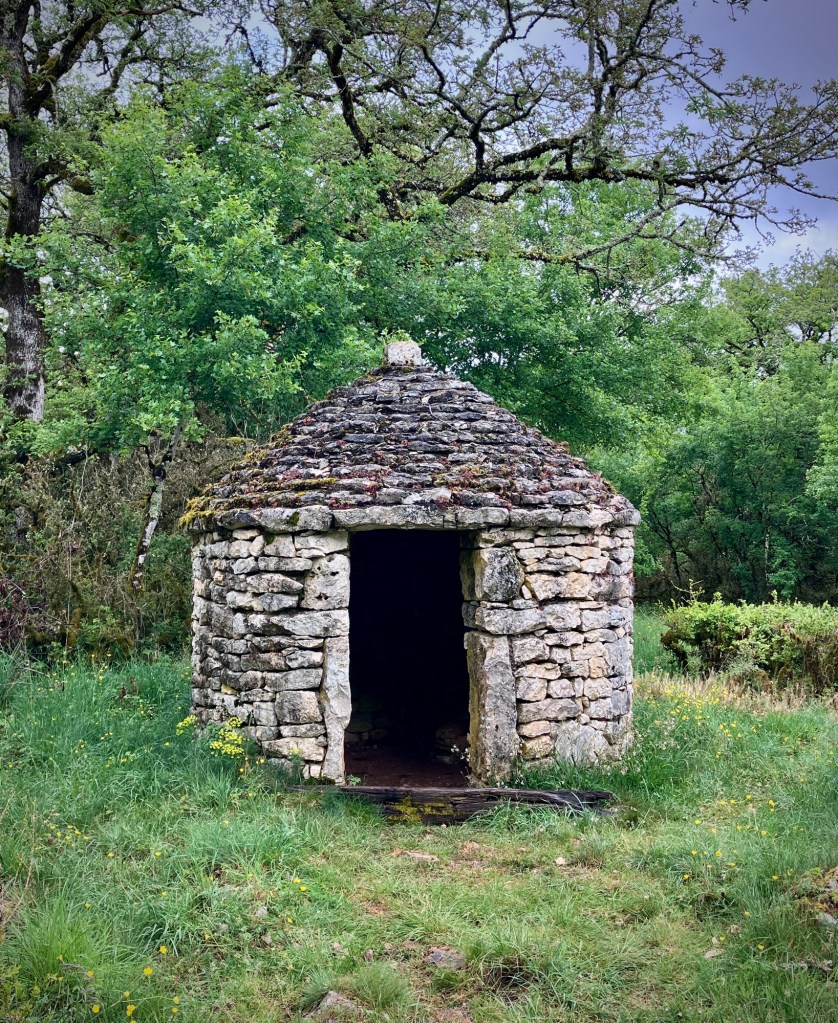
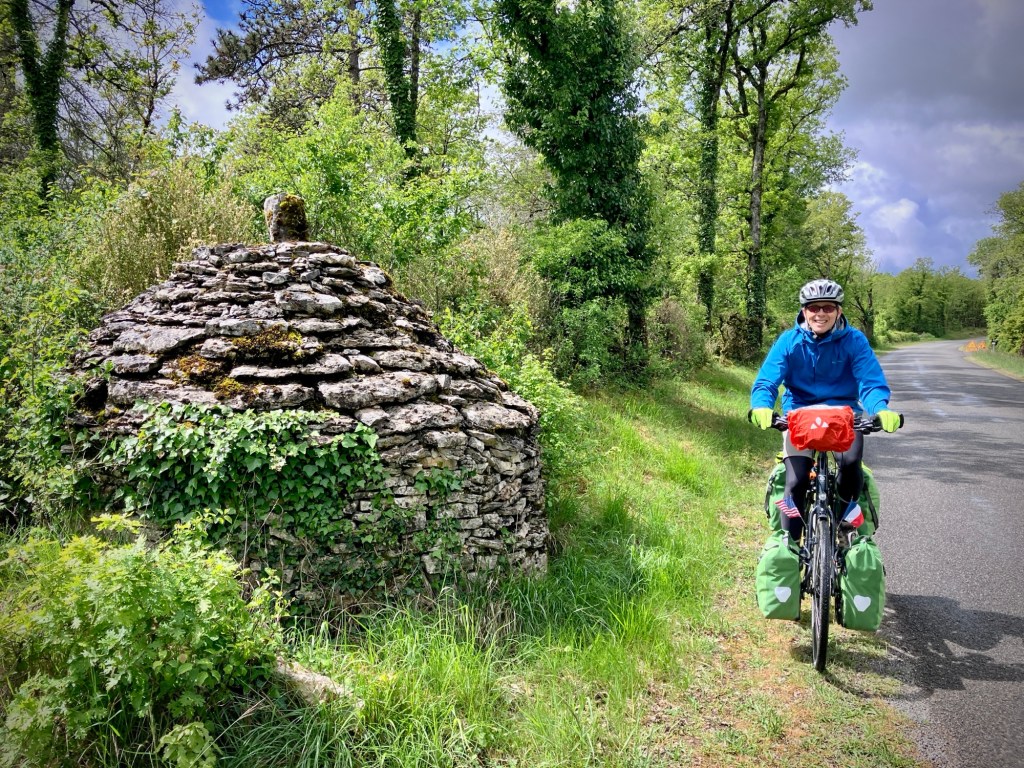
The route does not always hug the river and has some pretty decent climbs to connect the rugged and remote parts of the riverApparently we were also on the Vagabond route…very appropriate.Cheryl was fascinated with these mortarless stone buildings known as capitelles or cazelles, which are endemic to the regionAnd another oneAnd a wiff of wild mint for the descent
Apparently tourism exploded in the town after a popular French television shown voted it the most scenic place in France in 2012. We can’t disagree with that call. It was sparsely visited the weekday we passed through and is really a beautiful spot.
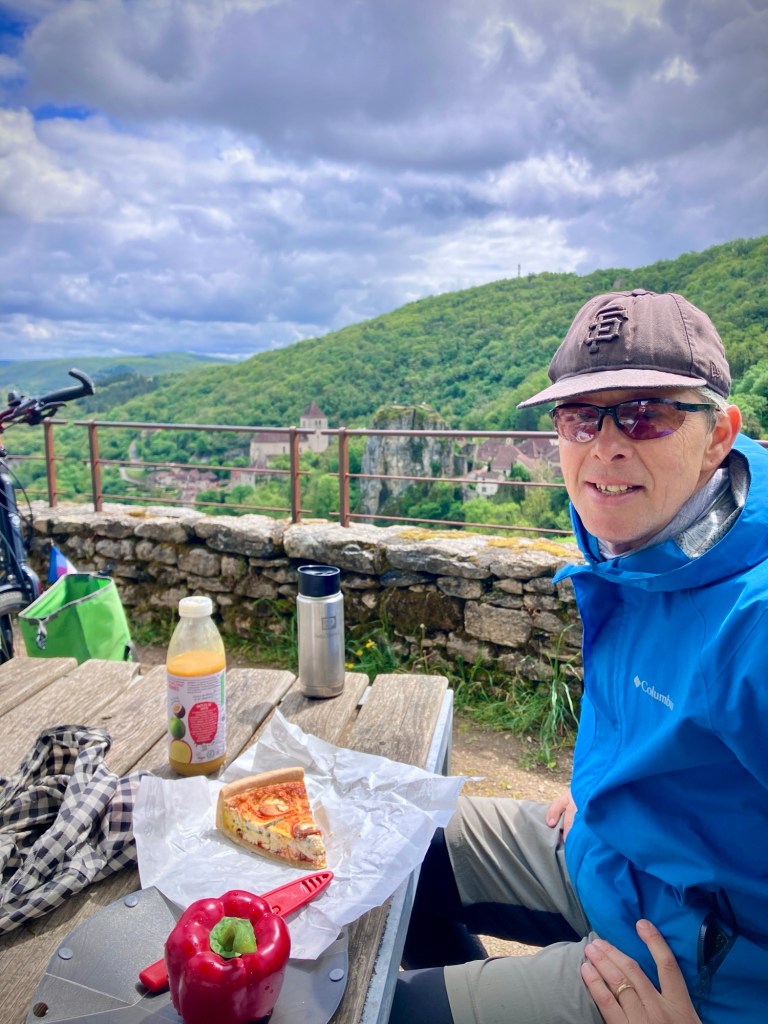
Our first view of Saint Cirq Lapopie We couldn’t pass up this prime view spot to picnic on some yummy quiche and veggiesAfter lunch ussie Sometimes I do some further exploration while Cheryl minds the bikes and maybe reads a bit. « Oh no, you go ahead »
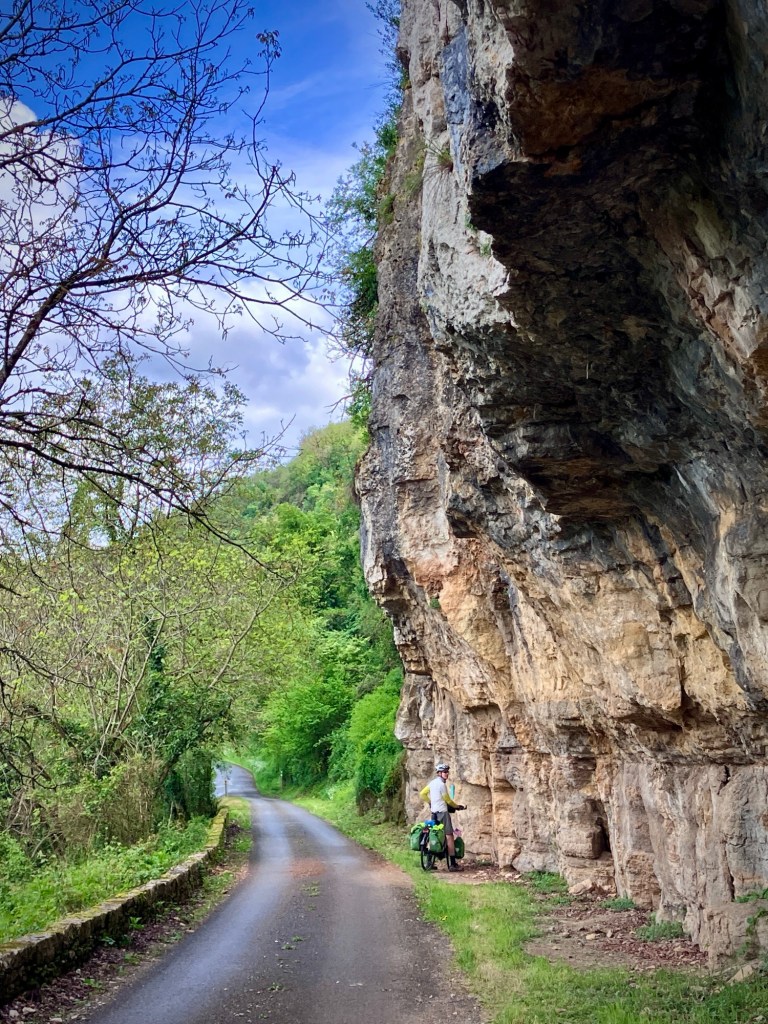
The ride from Cahors to Cajarc spans the Parc Naturel des Causses du Quercy from west to east. The villages are extremely tidy, with some restored houses, cottages, and farm buildings. There are also nice sections along the cliff walls, and the roads are not busy. We made it to the scenic village of Cajarc and our Logis inn (with dinner!) after a rewarding day of cycling, and I began to plan our next day.
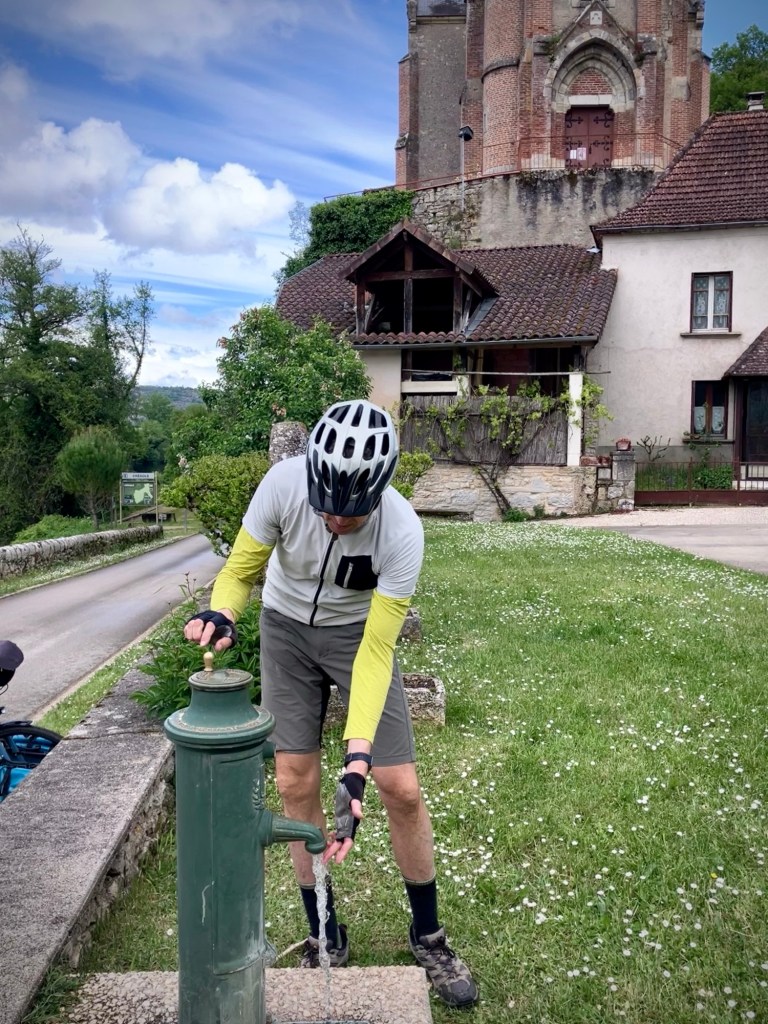
Saint Cirq feels like a movie set. Picture perfect and so tidy What’s this? Fossils on the canyon walls?We love interpretive fossil trails. This was a nautilus from the old sea bed.Many piped water taps have still been off for the « season », but we found most of the hand pump and twist wells delivered.
But the weather was starting to get tough. The next day a front was coming through with winds of 25mph and gusts to 50, and if we headed up the Lot route it would be right into the headwind. Yuck. We could shorten the day to account for the wind, but instead decided to head over the big limestone ridge to the next valley of the river Célé and the small city of Figeac.
Another interesting Komoot trail choice from our grocery diversion out of Carjac. But one of our mottos is “never go backwards!”. It usually works out.Le Célé River.Inside the ruins of the Abbey Saint Pierre, parts of which date back to the 9th-11th centuries.The ruins are atmospheric and the adjoining church has been restored and is still active.Carved stonework of the abbey.
I had picked a fairly direct route using my goto navigation App Komoot, and mentioned this to the friendly hotel host as I checked out. Good thing as he suggested an alternate route that turned out to be a gem. More climbing and longer, but it would take us deep into the scenic Célé river valley and keep us in the park longer.
The climb was quiet and the aspect of the huge limestone gorge that defines the Cele valley protected us from a lot of the wind, or at least made the ride alternate between headwind and freakish tailwinds off the canyon walls. But you can’t escape gale winds and the last 10k into Figeac were exposed and a bit hellacious, with grit blowing in our eyes and branches falling from trees. But we made it to town before the rain started to dump and salvaged a memorable day from a potentially mundane slog.
A power picnic lunch in Marchihac-sur-Célé. PB and banana on Wassa crispsCheryl demonstrating how to spread the peanut butter with the back of the wooden spoon, so it’s easier to clean -:)We are always impressed with the French dedication to a proper and social lunch. Despite the increasing cold and winds, we watched behind us as they set up tables and laid out a spread of food.
Figeac is a pleasant river town with enough of a buzz on Saturday night for us to get rejected at our first Creperie restaurant pick, so we settled on a fast and casual burger place and a beer before we had a meltdown. We were very hungry and a worn out from the wind.
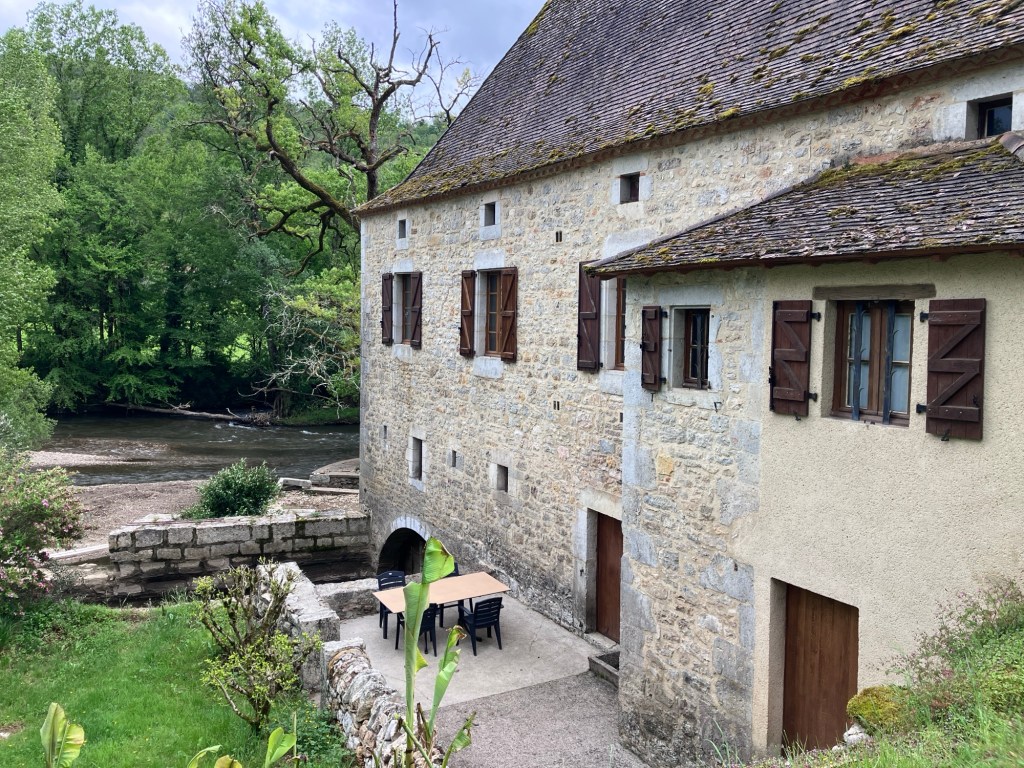
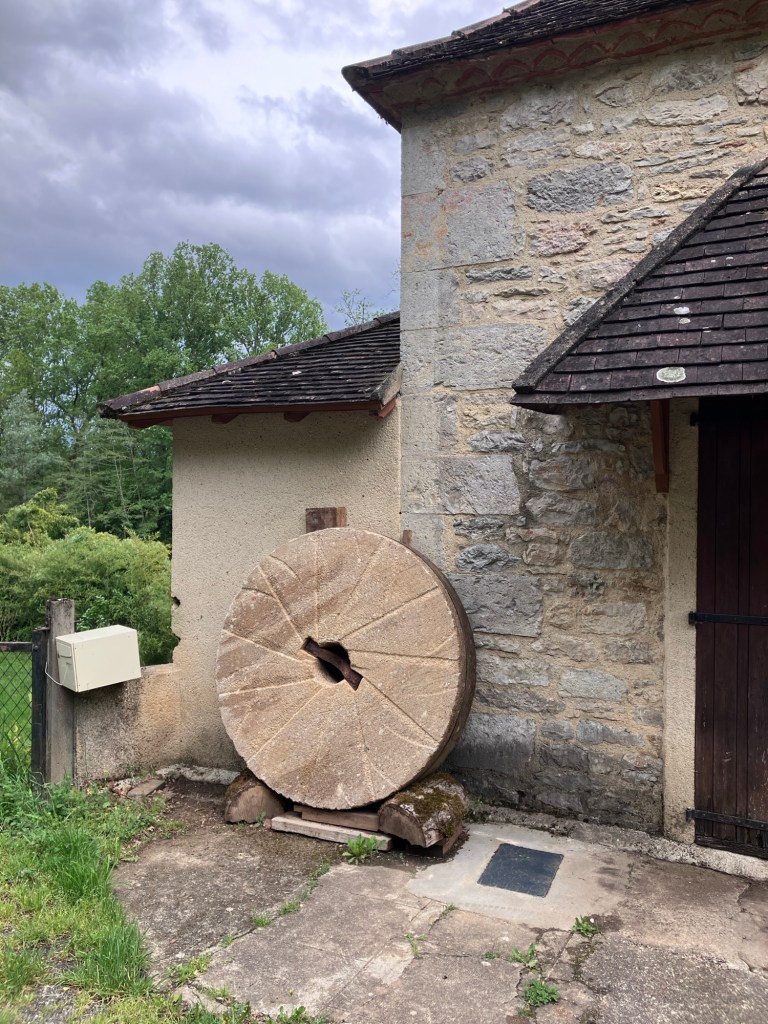
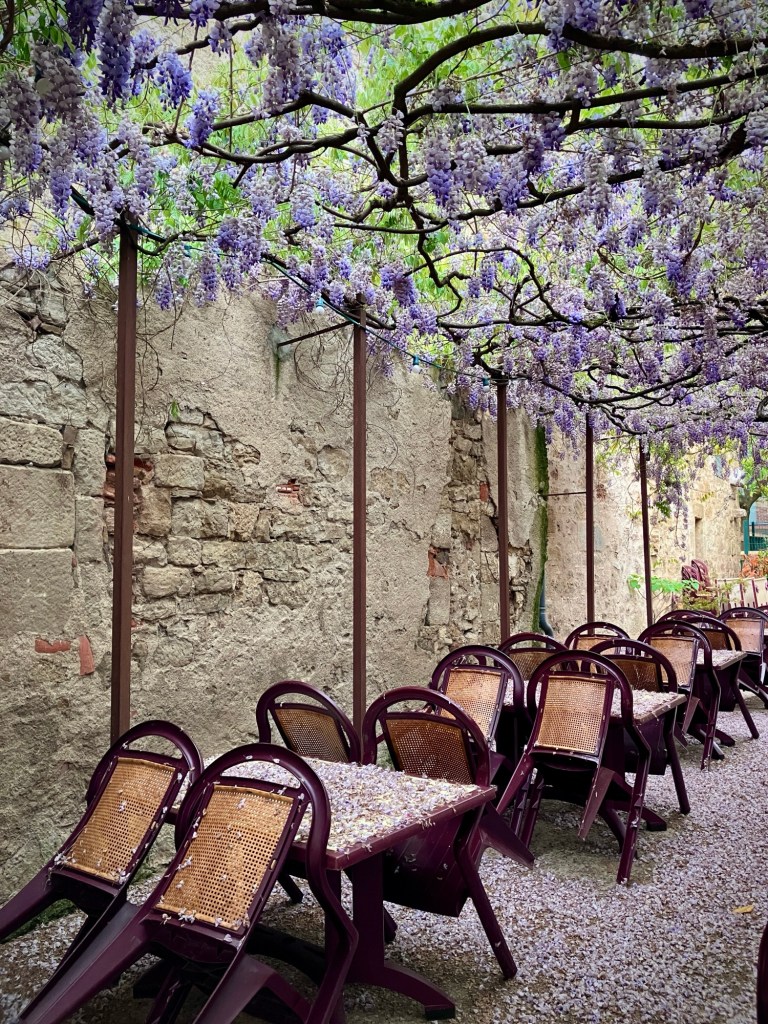
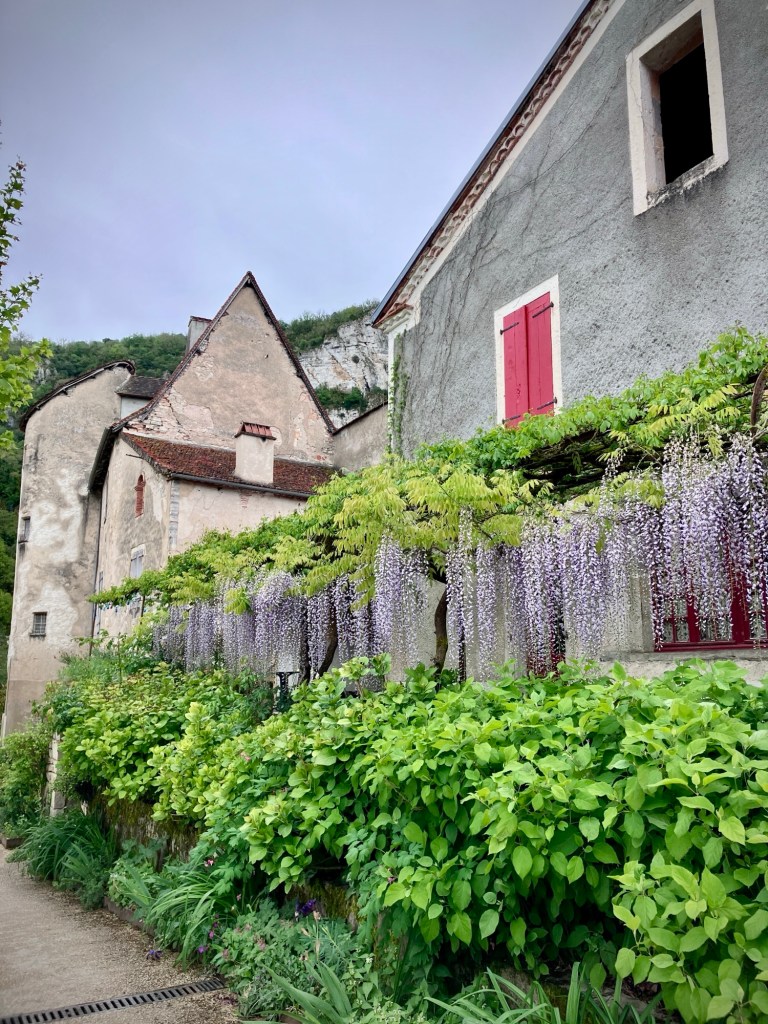
Canyon walls for wind protection, yeah!House built into canyon walls.Onwards along the Célé.A 3 star village is always worth a stop.Riding through the old town gate to find our second break stop.Et voilà, a sheltered picnic spot.This route is along one of the French Camino routes and we were surprised by the number of pilgrims/walkers we saw in this region. Almost no other cycle tourists.Another restored mill house.And accompanying millstone. Our friend Nancy says you can tell what kind of grain was processed by the groove pattern.Getting closer to Figeac, and the wind picking up.Wind filtered Wisteria pedals in old town Figeac.Hotel view of the Célé in Figeac.
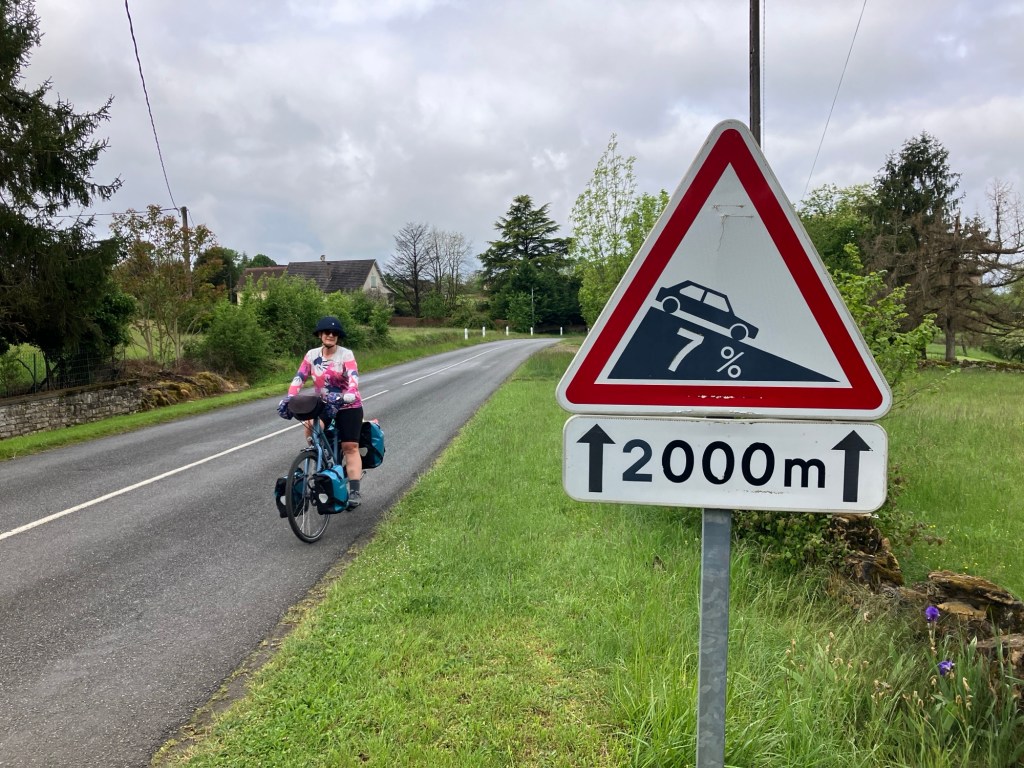
We wanted to get back to the Lot valley, so that meant going back up over the plateau of the river canyons on Sunday morning. But we are pretty strong now and Cheryl powered up over the two fairly steep climbs. Here’s the thing with loaded touring bikes, they are actually surprising easy on flats a gentle grades, even carrying 20 kilos or more. A 4 or 5% grade is pretty sustainable for longer climbs, but each percentage increase after that really makes a difference. Physics, gravity, and vectors. Over 8-10% and you may need to start serpentine S tracks across the road to keep on the saddle for a longer climb. You can even stay in the bike for short bursts of 12-15% grade, but it’s tough to sustain.
Heading out of Figeac along the Célé.This climb indicates an average grade of 7%, fairly manageable.
Touring bikes are so much more sensitive to headwind and grade than a lightweight road or mountain bike. They fly downhills with the extra weight and often act as sails with a hefty tailwind. As we continued to push up some of the steeper hills, you can’t help but think about the extra junk in your bags; the two kryptonite locks, cable, tools, 4 spare tubes (really?), ground coffee, binoculars, a small backpack, a yoga mat…extra socks and shirts, and my biggest luxury, 3 pairs of footwear. The thing is we are living on our bikes for three months and really appreciate the extra gear at times and when we are off the bikes for house sits or city stays. So we press on with twice as much weight as we could manage for a short tour.
Goodbye Figeac. Very green and lush in this wet European spring.Banana recharge, a reliable favorite.A horse intrigued by the two bright things on wheels.This is a popular hiking area with its limestone cliffs and jagged valleys.And pilgrims are sometimes sharing the road with us.Initial hazards of our descent back to the Lot.
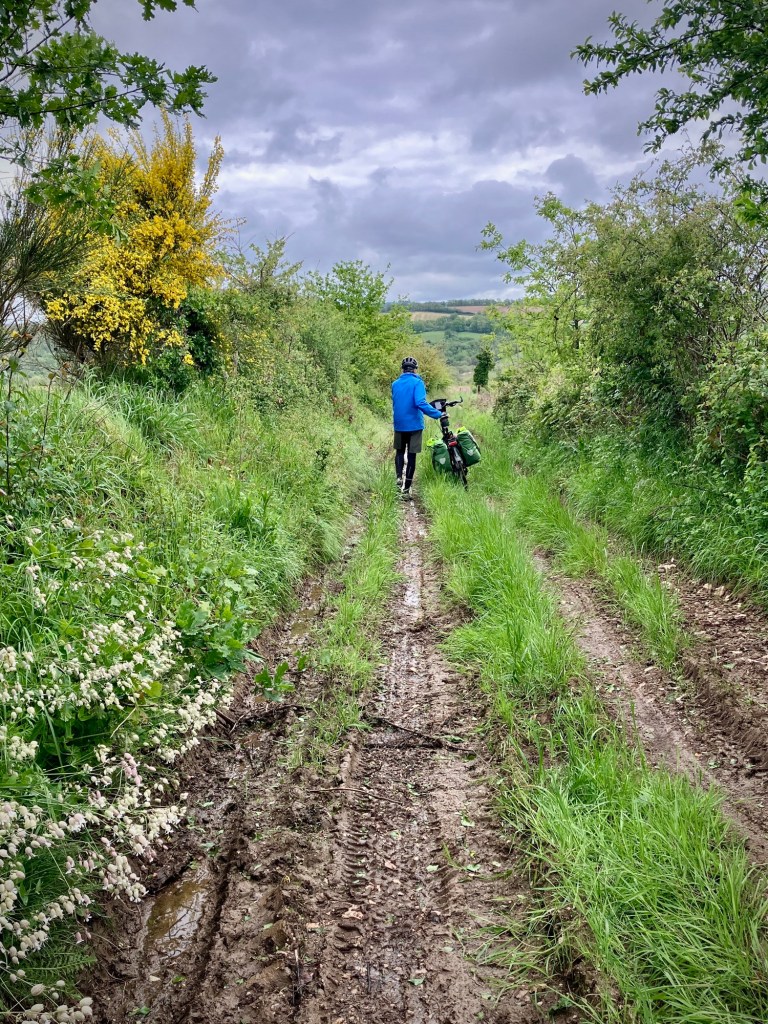
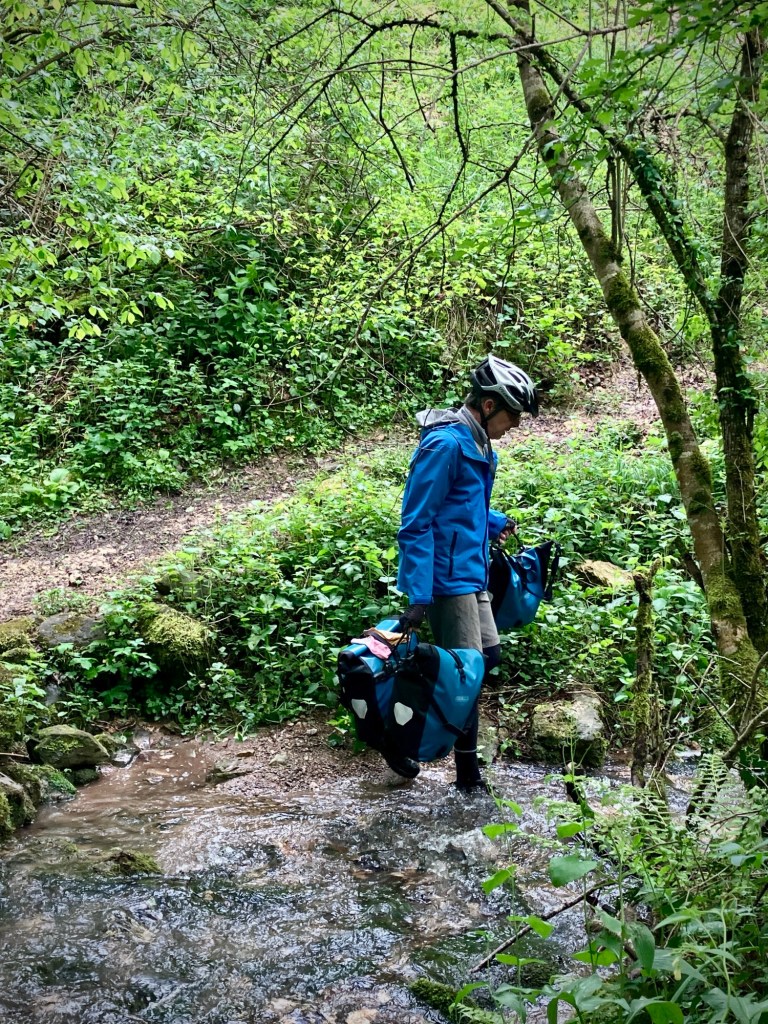
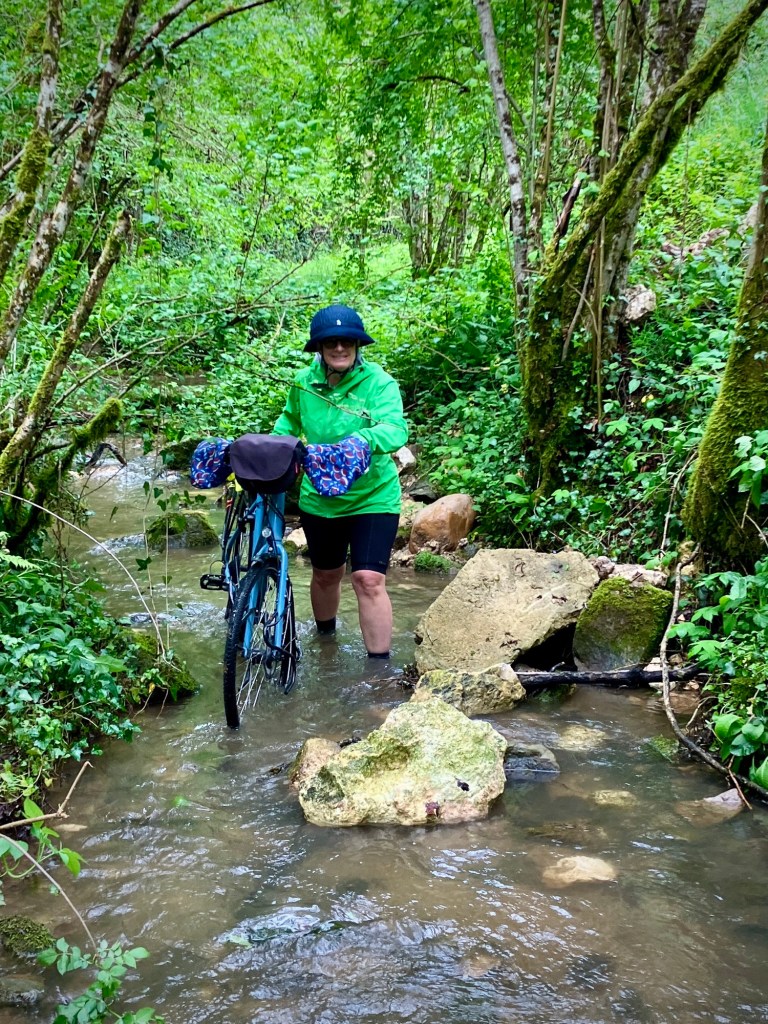
Once over the climb we followed a Komoot route that took us down the side of a mountain on a rutted farm track that turned into a rocky debris blocked ravine and creek bed with steep edges. It turned a “10 minutes flying down to the river for our coffee/tea break” into an epic reconnaissance and stream forge that ranks up as our most memorable.
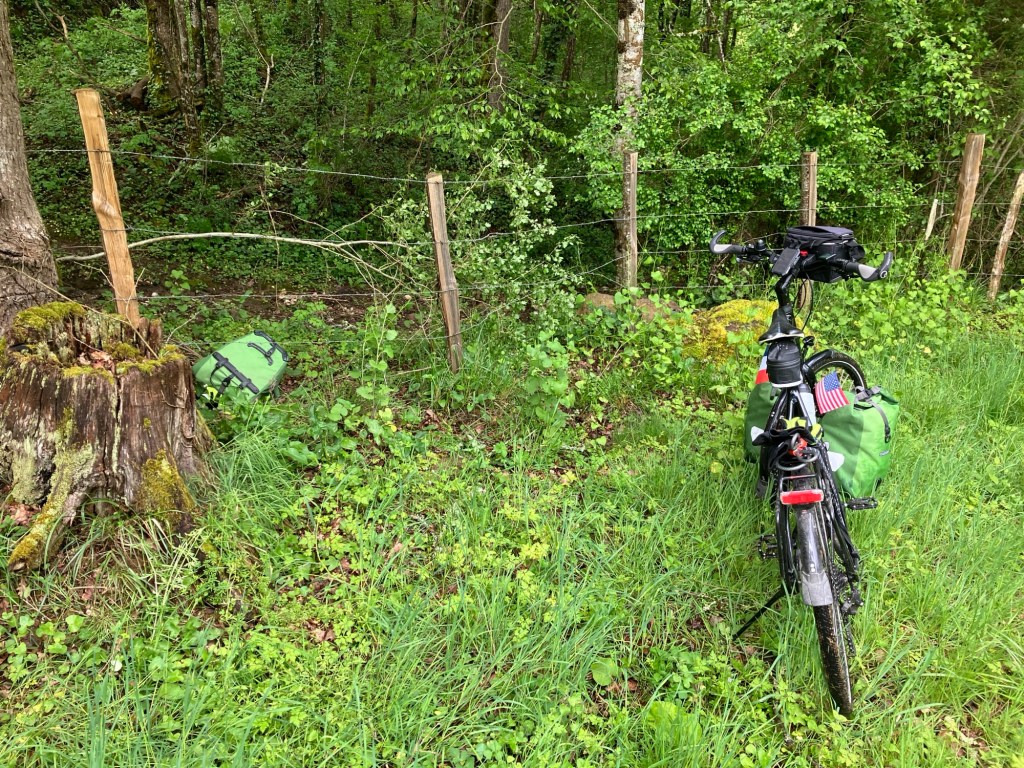
Hmm, Komoot is routing us down this muddy farm track. Better have some tea now as we discuss options. It looks like only a kilometer or so down to the valley bottom and a paved road, and the alternative was way back and up, so we decide to go for it.Hmm, the gps trail drops left down a rutted gorge blocked by tree so we decide to try to the farm field.After a reconnaissance mission to the creek gorge on foot, we found a spot where we could maneuver the barb wire and get the bikes and gear underneath. Cheryl followed determined not to turn back!A muddy mess.Resigned to walking the gear down the creek to a spot we could get up the embankment. That trail you see was blocked by a large tree fall and landslide.Yup, the water is cold.Worst Komoot routing ever!Out of this pickle. A sense of accomplishment and amazingly no torn gear or flat tires as the area was littered with thorns and briars.
So we wiped off our bags and bikes, changed into our sandals, and put our soaked shoes and socks on our racks. Luckily, we were cheered up quickly as the remaining 35km up the Lot to Entraygues-sur-Truyère was peaceful and scenic. Our room for the night in Entraygues was up a big steep hill from town, which meant a bit of pushing. But the kind host was waiting for us at the door and offered to dry our shoes by the fireplace and gave us some fresh juice and cake. We would survive. And better yet, one proper restaurant in town was indeed open Sunday night, so that meant a bit of wine to warm us up.
Back on the Lot!Riding up the Upper Lot, wet shoes getting some air on the rackSant Partèm is the Occitan name for Saint Parthem. Occitan is still spoken in southern France, and bits of Spain and Italy Saint Parthem had a bit of a hippy (baba cool!) vibe, including 60s and 70s music on a dozen mounted speakers from village end to end. We assumed it didn’t play all night?!We entered another national park briefly.We noticed the houses getting even fancier and were very well kept.And more wisteria.
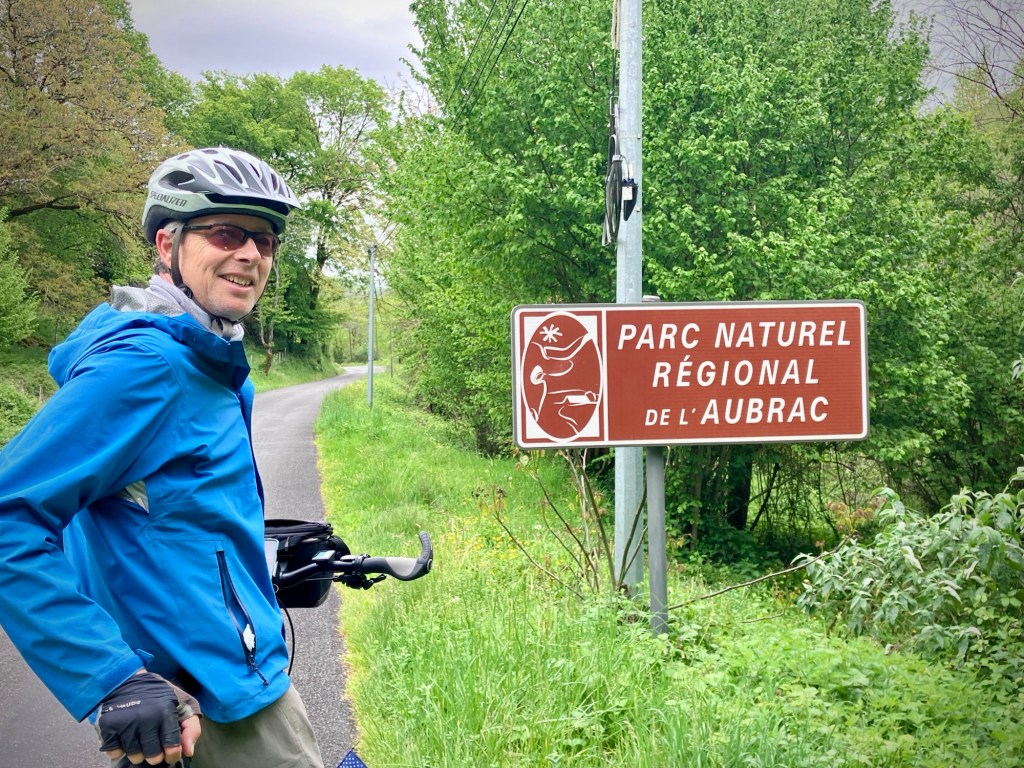
But that night set me (the travel planner) into a bit of a panic. I had planned that we would continue East on the V86 Lot route another 100k through the hilly Parc Naturel de L’Aubrac and then catch a local train north to get us closer to our booked train link to Paris. But I discovered part of that local train line was shut with replacement buses that don’t take bikes.
And the weather forecast was grim. Rain and lots of it the next day. No trains and no alternate routes out of this immensely rugged junction of mountains and river valleys. I explained this to Cheryl and she said, “Yup, we’re in a bit of a pickle.”
Le Lot route V86 continues and a somewhat mysterious sign about communities with burlesque names? Anyone?Entraygues is dramatically located at the confluence of the Lot and the Truyère rivers. The Truyère is the muddy one.
Instead I decided that heading north to Aurillac was our best option, as from there we could catch a train over the highest parts of the Massif Central. But the routes would be tough, especially in a cold rain. We could try to wait the rain out a day, but that put our train travel on May 1st, a French holiday and the trains were very limited out of Aurillac. And there were flood warnings.
So we decided to ride.
Leaving the lovely and cozy Le Clos St. George. Its verandas and views would be even more stunning in better weather.The rain was light as we started up the Truyère The first tiny shelter for a yogurt and pastry. The cold rain had already soaked us.
How do I manage difficult days for my favorite (and only) client. First off, I try to note some of the difficulties of the day, especially climbing. But the key is to not overdo it. Don’t talk about too much. I knew this day was going to be extremely challenging, both mentally and physically. Our route climbed up and down short steep climbs up the Truyere and Goal rivers, up a steep ridge climb and finally up to the huge rolling plateau that separated us from Aurilliac. We are now better at eating something every hour and staying hydrated, but it’s hard in a constant and cool rain. And there were no real towns or villages for the entire route.
It was remote and a bit creepy as we headed further off the main routes and up the Gaul River. The hills and walls were flooded with oozing water and we didn’t see a car or person for quite awhile.This tiny hamlet had a welcome little shelter and even a person who I was able to ask about our route onwards, gunshy from our Komoot mud and river adventure the day before.Not a soul outside all day, even to hike the GR65 route. Hmm, maybe it was the relentless rain, cold, or flood warnings?Finally up on the plateau after 3,000 feet of climbing, and the cows are in awe. Or dumbfounded.The rain lightened up a bit, but never stopped.
Perhaps the worst part of the route was the main road we had to join for our plateau and descent. There was an option on quieter roads, but that added another 15k and 300m of climbing, and we decided that was even worse as we were cold and a bit shattered. So we decided to grit out our teeth for the direct route. It had speeds of 80-100km and was fairly busy with fast traffic and some big trucks, with no real shoulder. But sometimes you need to take some chances and we had some pretty bright clothes and lights. Thankfully the drivers were all pretty good, and the pavement was very smooth, so it was manageable but certainly not a segment we’d relish.
At the end of 30km of wet cold and steep climbs. Cheryl was a trooper but not loving this day. This is where we got on the busy D920 main road to Aurillac. No photos.Boarding the train to Issoire the following day
But when we did finally roll into town and dripped our way through the lobby of hotel, there was not just relief, but a sense of accomplishment. We did it. It was over 1000m of relentless and occasionally steep climbing. And we could catch the train the next morning over the Massif Central to continue our tour. We were out of our little pickle. Happy travels!
People frequently ask Cheryl and I how we plan our travel filled trips and lives and it’s sometimes hard to explain. But let me try. Basically we start with a rough 6 month plan defined by our major goals and travel legs to and from continents (i.e SFO-Asia, Europe-America) We adjust these plans as needed for any Visa issues and always work around a desire to see family and friends for holidays or special occasions like weddings.
The broad and jagged Pyrenees are a stunning sight in early Spring.
For example, last fall, we blocked out a 3 month spring window in Europe that would be dedicated to bike touring before returning to the US again for a wedding in June. We also wanted to spend more time in Asia. We had no visa issues for Malaysia or Taiwan, but on the European continent, we are subject to the visa-free rules limiting us to no more than than 90 days in the Schengen zone. (Most of the EU – Ireland + Norway and Switzerland)
Cheryl descending one of the many climbs in the foothills of the French Pyrenees.
Then we factor the weather. So for a bit more warmth, we headed south first from Geneva to chase the European Spring. And winter in Asia is generally a bit cooler, as it was in the rainier season of Borneo. Add to that my desire to work on my French and we further refined our cycle touring itinerary. France, and lots of it!
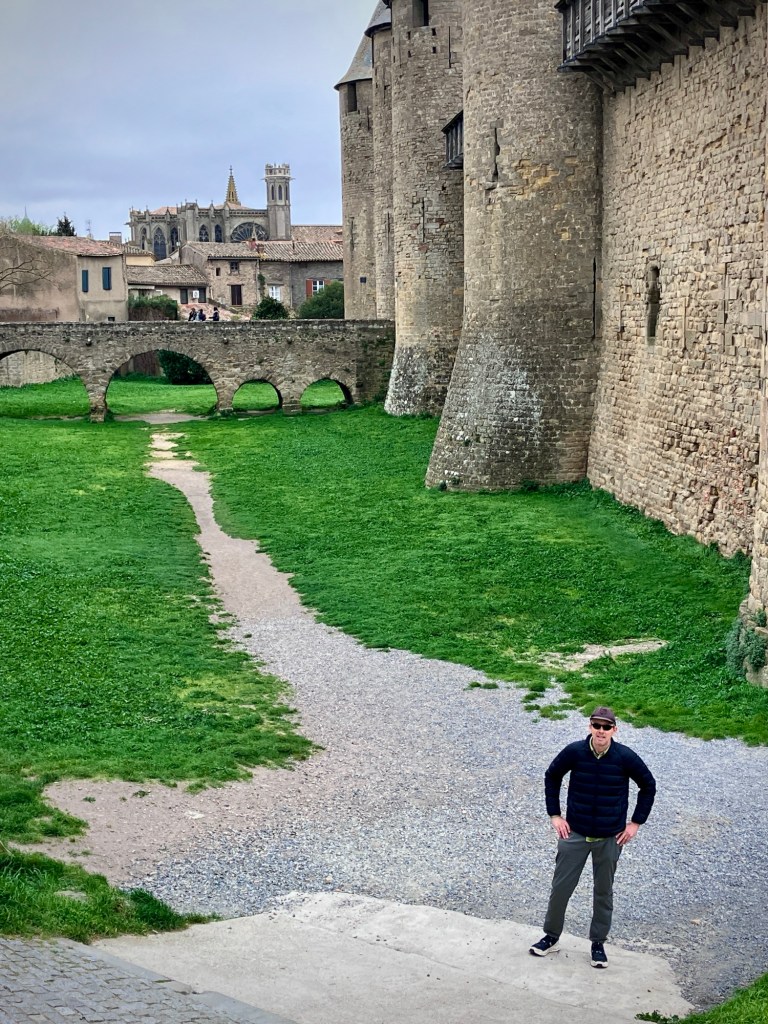
The citadel of Carcassonne is stunning and constantly appears wherever you at in town.
The next ingredient in the travel planning mix is some house sits. We love house sitting and wanted to work a few breaks in during our spring bike tour. Cheryl had been dilligently looking for sits while we were still in Asia but we didn’t find good matches until we had already set off down the Rhône. But due to Cheryl’s excellent filtering and immediate responsiveness to opportunities, we finally found good matches, and now have two one-week house sits in April. These sits formed the basis of our plans in Southwestern France.
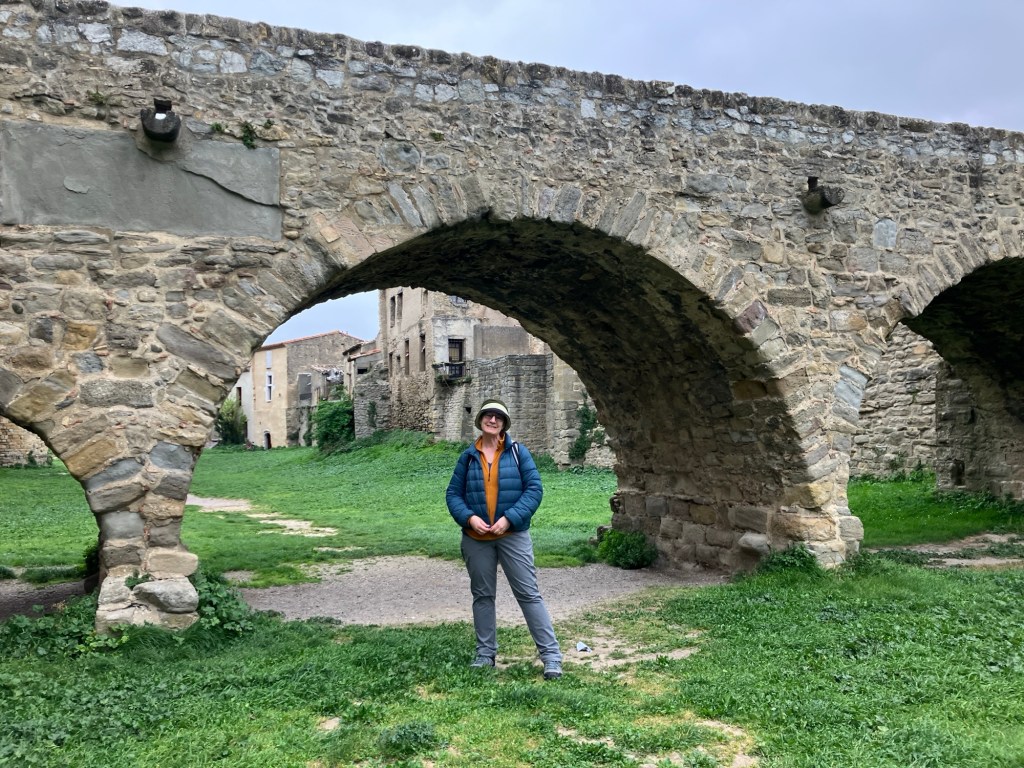
Our beautiful house sitting companion.The magnificent view of La Cité in Carcassonne from our house sit verandaChâteau Comtal, a 12th-century castle within La Cité.Cheryl inside the Citadel La Cité has some charming streets and cafes, but is pretty touristy with the requisite splash of tackiness.
The first sit was in Carcassonne; famous for its massive UNESCO world heritage medieval city and citadel that overlays a site dating back to Greco-Roman times. It’s one of the most picturesque scenes in France. We were both excited as neither of us had been there before. We were also very glad to be over our pesky colds by the time we rolled in to meet our American Ex-pat hosts.
The sit was in a large house ca. 1930 with a beautiful indoor/outdoor cat and we had a nice dinner out with our hosts at the base of the nearby La Cité. We almost always meet our hosts and often spend the evening prior to learn the ropes of the house, pets, and area. It’s one of our favorite parts of housesitting.
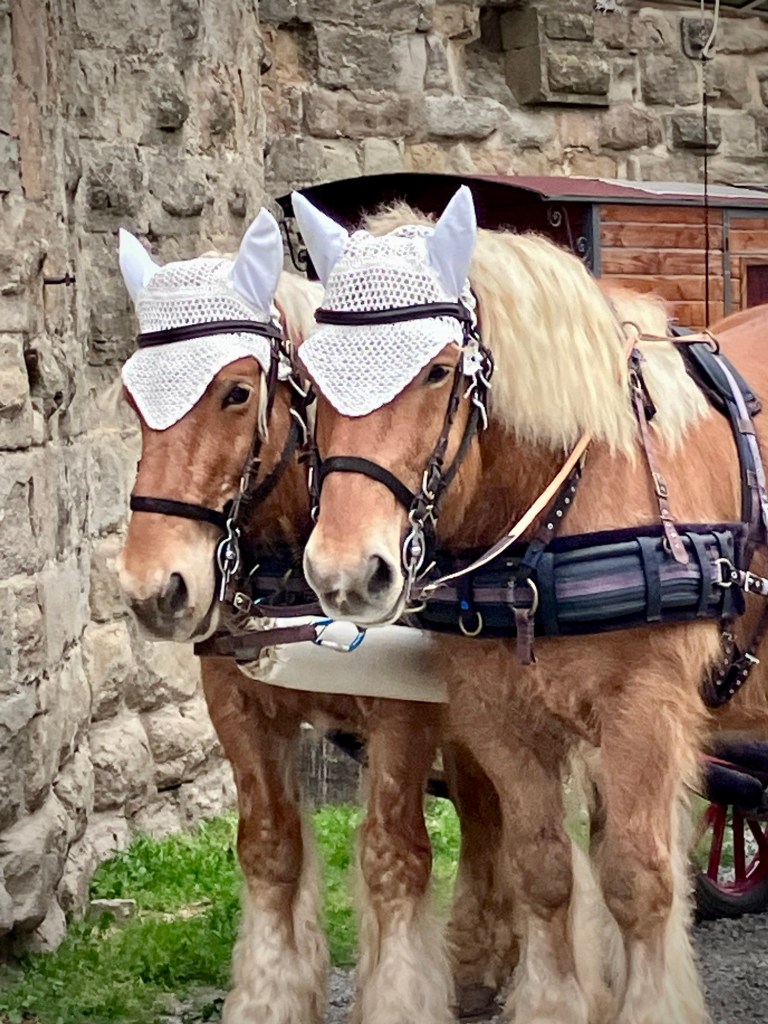
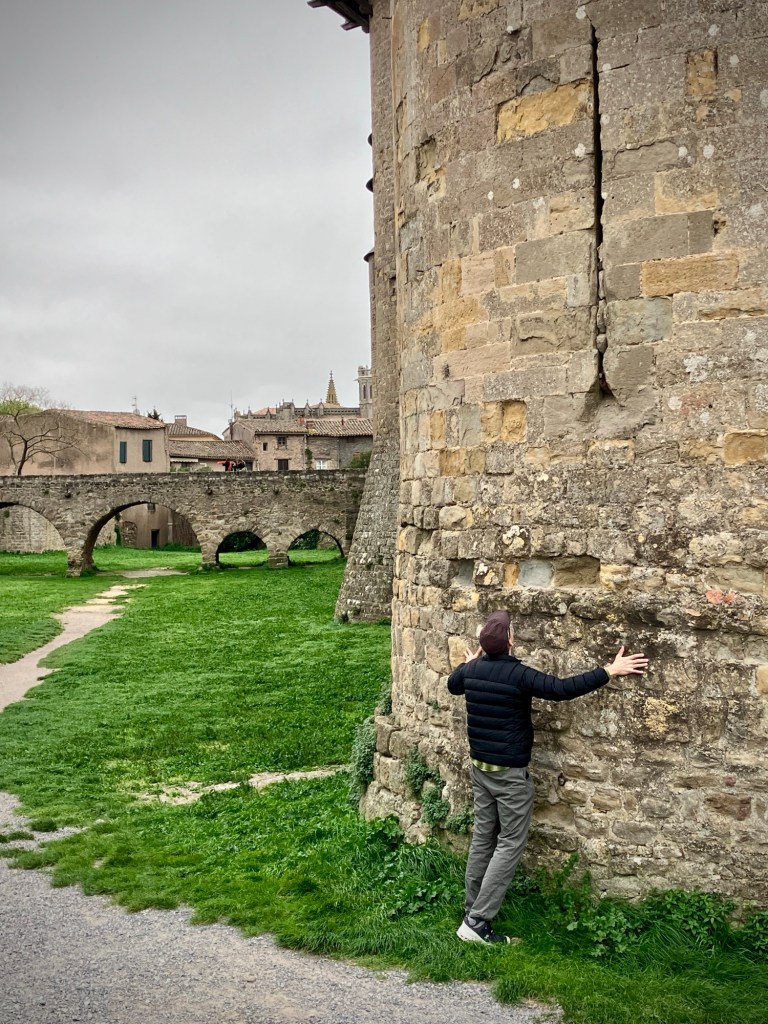
Cute draft horses, complete with adorable fly guards, can take you around the Citadel.Sizing up the fortress in La Cité.
They had mentioned in our video chat that the area was not very bike friendly, but to be honest, we often hear that from folks, but then find it later to be ok. But as we departed the pleasant Canal Du Midi path from Castelnaudary for local roads outside the city, it became apparent that they were right. Where were the nice bikeways and lanes popping up all over other French cities in the past 10 years?!
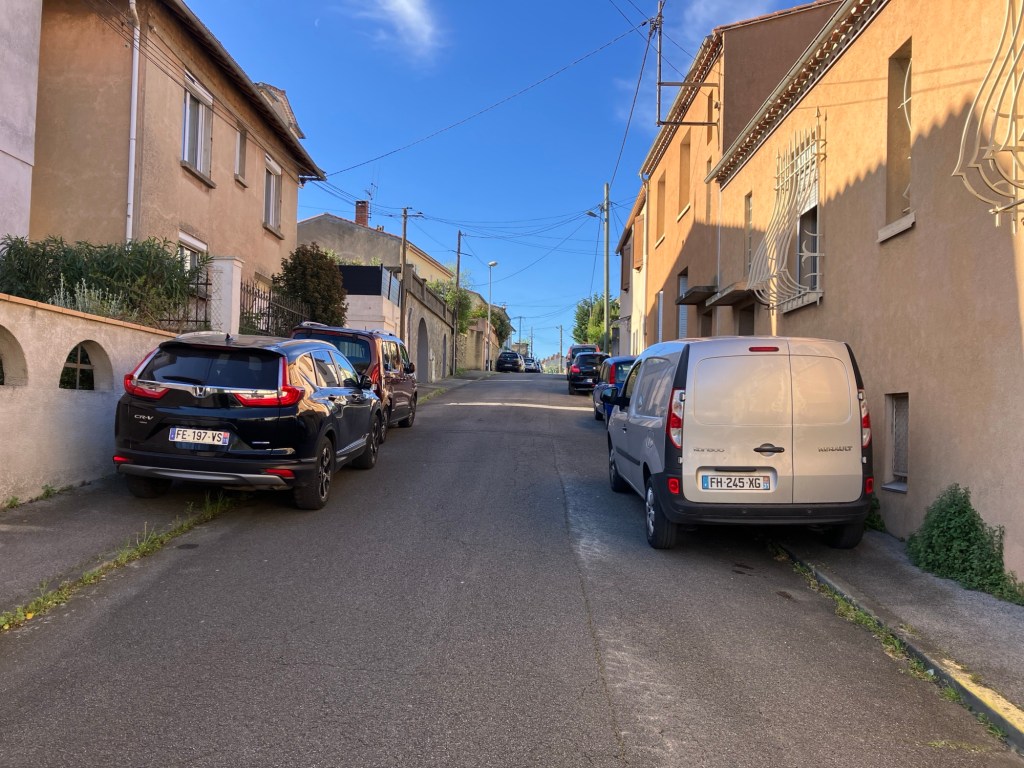
This rather sad buffered bike lane ran exactly one block near the train station.Not an inspiring walking environment on many of the newer roads around Carcassonne.Cars on the sidewalks always tells us a lot about the priorities of a place. This was typical of many neighborhoods in Carcasonne.
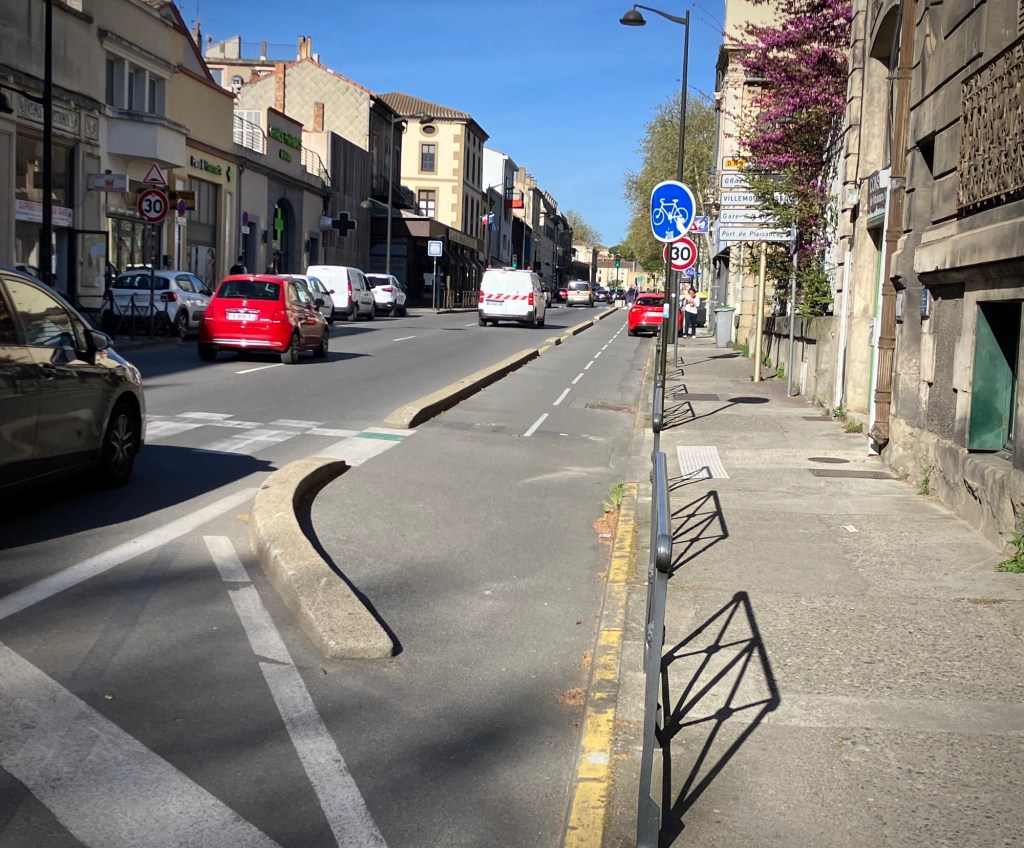
As we made our way around the “new” city (La Bastide), our Komoot bike directions had us on a 3 lane traffic filled perimeter road.”“Seriously Komoot, this is the best route!!?“ Not a bike lane or facility in sight. We did eventually find a few sad and neglected stretches of bikeways on side roads, but indeed, Carcasonne is not a bike town. Not at all. It amazed us how the vibe of transportation varies in cities by the priorities set by planners, culture, and of course, the infrastructure. We’ve especially noticed stark differences in SW France, as some places seem stuck back in the 1970’s. It especially struck us on our day trip into Toulouse. Toulouse has controlled access to the city core, wide sidewalks, abundant transit, and lots of bikes. We liked it so much that we are going to spend a few nights there as we head back north.
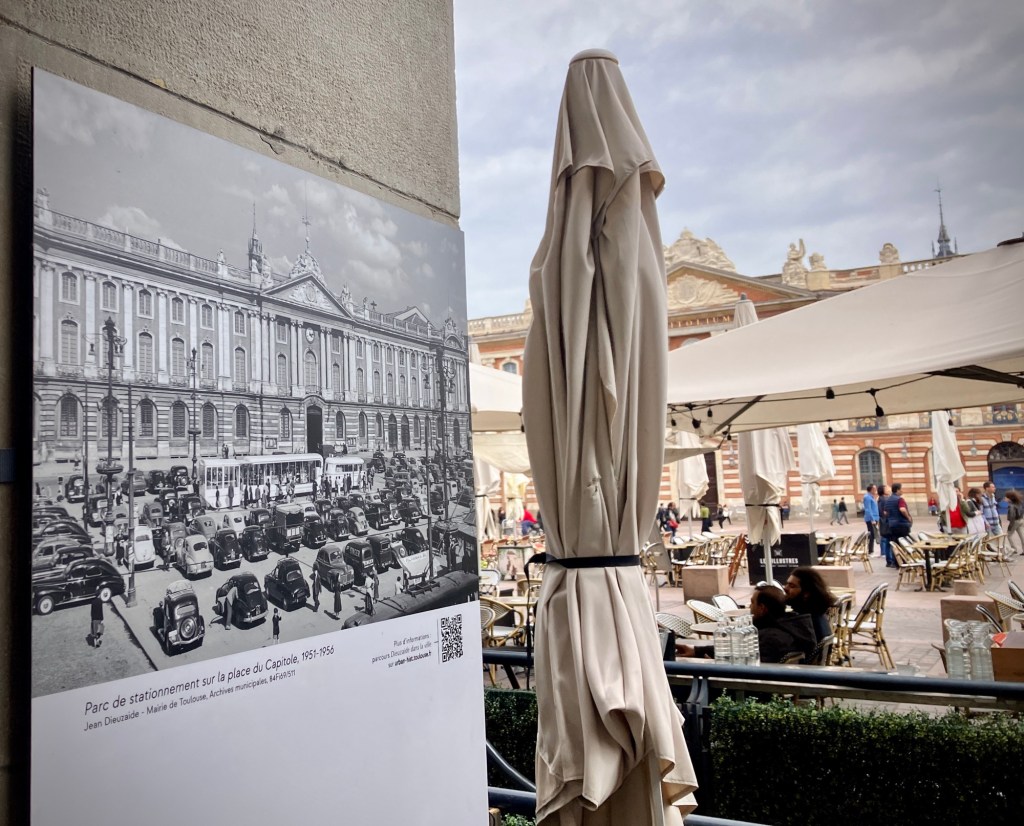
Toulouse had a car problem too in the 1950s, but now Place du Capitole is a vibrant pedestrian space. (With a garage underneath.)We expected to see some of the nicer streetscapes of France in Carcasonne, like this Dutch style intersection in Toulouse.The Pont Neuf in Toulouse only one has one lane for car traffic, wide bikeways and pedestrian space, and a dedicated bus lane.
Perhaps the city administrators in Carcasonne didn’t apply for federal or regional money. But most likely here, the overwhelming presence and management of 3 to 4 million annual visitors to the star attraction dominated the transportation planning. Get the traffic and tour buses through. It’s also very windy, including the week we were there. It was not pleasant and to be honest, didn’t make you want to be outdoors at all. Perhaps the allure of the automobile is explained a bit.
Lovely outdoor spaces in charming Toulouse where cars are kept at bay. It was also windy in Toulouse, but more protected by its sinuous old grid.
Again, for some, Carcasonne could be magical, and it does have some nice areas along the Canal du Midi and river. But as car-free walkers and bikers, it was not as enjoyable as so many other places we’ve been in France. It didn’t have a village feel, and cars seemed to be everywhere, and the core of the “new city”, Bastide Saint Louis had almost all roads open to fast moving and aggressive cars with narrow sidewalks. Certainly, we enjoyed our time relaxing in the spacious house with the cute cat, but the City itself did not make our top travel lists.
Carcasonne train station is undergoing a much needed renovation to add accessibly between platforms, but it’s not always easy to squeeze in elevator shafts in old stations. We planned for extra time when we left to transfer our bikes and bags up and down the stairs to access the platforms.
You should come to Carcassone, but probably just to visit the ancient La Cité. And since it gets millions of visitors, perhaps an early morning or late afternoon/evening would be best. (Rick Stevees concurs -:) As I noted, our visit to was also influenced by the near constant presence of winds, often blowing 20-30mph+; so cafes and outdoor dining options were less while we were there. We were starting to hypothesize that the La Cité fortress was not really built for defense from marauders, but for the incessant winds! It was nice inside the walls -:)
The first TER train from Carcassonne to Toulouse made about 10 stops and had 6 bike hooks. Crowds varied but we just held onto our bikes and leaned or used door jump seats.Changing trains in Toulouse was easy with low boarding TER trains and elevators to platforms The IC train (14143) to Lourdes had reservable spaces under a luggage rack. Perfect to store our bikes without panniers. Our assigned seats were automatically in same car with view of bikes. Nice work SNCF!Millions visit and make pilgrimages to Lourdes every year and the city has streets lined with places to buy religious goods and dozens (and dozens!) of big hotels. It felt a little like Catholic Disneyland to us.As soon as we left the station in Lourdes, we were struck by the sight of the immense basilica, Our Lady of the Rosary.But soon we were rewarded with our first views of the high Pyrenees and the endless backroads in the foothills.But the first climb reminded us both that the Pyrenees are quite rugged and the roads steep in places, like this 12-15% grade outside Lourdes. These are not the Alps.
Based on our second sit, I looked for a good route from Carcassonne in the central Pyrenees. I started from the intriguing V81 regional route which shows up on Komoot when you select bicycle touring mode. Since we only had a week, I had TER train plans to Perpignan and daily cycling routes mapped from the Mediterranean side on the East. But a few days prior, I noted massive headwinds were predicted in that area (like 20-50 mph) which make the thousands of feet of climbing and valleys even more miserable. So I revised last minute and we headed west by train to Lourdes, where more favorable (and less) wind would likely greet us for the week. And that it did. We are blessed with our freedom right now and do appreciate it every day, but you need to be flexible in plans and comfortable that it will all work out. We always learn as we go.
Dramatic skies in Tarbes, just minutes before an epic lighting and hail storm! We had made it to our hotel for the evening just in time -:).Typical small church in the Haute Pyrénées.We always love to see nice signage reminding drivers to give cyclists at least 1.5m when passing. And French drivers are pretty good at honoring the law. Mostly.A break in the weather at Lac de la Arrêt Darré
So wet set off by train from Carcassonne with a good transfer in Toulouse. We had to squeeze a bit on the first TER train and leaned with our loaded bikes near the door as the bike hooks were virtually full and impossible to use with our gear and the modest crowds. But the French are pretty easy going and helpful, so it was fine. Our second train from Toulouse to Lourdes was an Intercity and we actually had reservations for two of the three bike spaces. It was a modern train set with low boarding and leaning space for bikes and straps to secure them. Heavenly! We actually got to sit in our seats and enjoy our lunch and coffee/tea -:).
Mesmerizing layers of stone and mortar walls.Further up into the forest.Route 81 from Tarbes did indeed take us up on a huge plateau with very dramatic views and weather. Before a cold rain descended on us at the end of Day 2 to Galan.Few services out here, but wait, what’s this?! An automated boulangerie!Success, tapped my credit card and et voila, a Pain Au Chocolat, even in a tiny Pyrenean village. Vive La France!Full rain gear drying out a bit as we rode onto our Chambre D’Hote.A nice warm homemade dinner at the friendly Le Clos de la Bastide in Galan.
Lourdes is a huge pilgrimage site for Catholics and Our Lady of Lourdes is a title of the Blessed Virgin Mary recalling her apparitions in 1858 in the grotto to Saint Bernadette Soubirous, a fourteen-year-old peasant girl. The spring at the grotto is said to have healing powers, so millions come every year to seek its healing properties, often near the end of their lives. Although we didn’t go inside or see anything up close due to all our gear, the scene around the Basilica is quite unique and you can’t help but be touched by people’s faith.
Galan was a sweet little village in which to spend the night.Exploring little Galan at sunset. And a touring cyclists constant risk!
The cycling from Lourdes was immediately spectacular and sensually rewarding on a balmy spring day. And unlike some of the busier Eurovelos, the regional routes tend to have fewer cycle tourists, especially this early in the season. I like to compare the Eurovelos to National parks and local routes to State parks; Often just as spectacular with way fewer crowds. A big front came through late in the first day and it went from 77f/25c to 40f/4c in about two hours with hail the size of marbles. It coated the ground and changed the mood dramatically as we set out the next day back in a late winter feel. The storm continued a bit the next day and we battled a bit of cold rain, but it also cleared enough to see freshly coated mountains across the horizon. A memorable day of cycle touring, as so many are.
Our third day in greeted us with sunshine and spectacular views of the Haute Pyrenees. The V81 bobs and weaves in and out of valleys and over smaller ridges toward the bigger peaks across the entire French side of the range. It’s a great route.Although the V81 route was well signed and Komoot kept us on track (mostly), we’re constantly looking for a good picnic lunch spot in the next village.Abandoned chateau? Nope, no benches.We settled on this bench behind a church and a bit out of the wind. ok in a pinch.Endless rural valleys, and a lot of up and down. Almost no one in sight.Quirkyness abounds in the Pyrenees.An homage to the squirrel?!
After Tarbes, lodging along this route is pretty sparse as you only go through a few major towns/villages, but this is where Chambre D’hôtes come to the rescue as you can find lodging, dinner, and breakfast along with a great local experience and family hosts. Many of the apartment rentals in this region are more seasonal for summer or larger places with 2 or more bedrooms, which make them unpractical and poor value for an overnight stay. Another option is to duck off the route a bit to find lodging as we did near Montrejeau. In summer, more people certainly camp as well.
Lodging on this stretch of the V81 is limited this time of year, but we found a great little apartment (€55) for the night in Montréjeau. Laundry, cooking in, and bike storage!The impressive Saint-Bertrand-de-Comminges Cathedral. A site with layers of history dating back to a Roman Colony of 30,000 people. It later became a pilgrimage stop on the way to Santiago de Compostela.Up the hill and through one of the three old city gates. Car access is limited and most people park down in the valley.The ornate organ inside the basilica is considered onw of the best classical organs in Europe.Sun and coffee break outside the Basilica. We fill our stainless steel thermoses every day with coffee (me) and tea (Cheryl) as cafes and stops are few and far between in this rural region.A lending library and artistic bench. Even the smallest villages have charm and peacefulness.We lucked out when it was lunch break on this bridge construction project over the Garonne as the resting workers were fine with us passing and saved us 10km of extra peddling!After successfully charming the construction workers, we continued on in warming temperatures that gave us a taste of summer here.Cheryl thrilled to sample more artisan chocolates at 9 am from Aztek at the recently opened Halle Gourmande in Saint Gaudens.My new favorite from the same food hall, a “Jésuite” pastry.
But our six days of cycling was magical, especially as we are stronger now and the climbing is a bit more rewarding, not just painful. We both feel great after being sick for a bit. And Cheryl is now back to her champion climber status, although one or both of us still have to hike-a bike a few relentlessly steep sections. No shame in pushing a 30 kilo bike load. We are indeed carrying a lot of weight for three months of activities, and three seasons. (often all in one day). We keep discussing what winter gear we can mail back to the Haute Savoie, but then winter rears its head again and we’re glad for all the gear.
The Pyrenees have a good craft beer scene and I was thrilled to chat and taste at the friendly Brasserie Artisanale D’Ariege-Pyrénées in Saint Girons. Opened since 2005, it’s still fairly small, but excellent.More rolling hills and mountain vistas to explore.Saint-Girons was our final stop before our next house sit and is a lively and friendly market town on the Salat River.The old town of Saint Girons.The weekly Saturday market in Saint Girons is not to be missed. A huge sprawling market of fresh foods, music, crafts, and anything else you might need.Up the valley to our house sit during another unusually warm spring day in the mountains.Another day, another UNESCO world heritage site!Getting excited to reach our next adventure in Massat, but more on that next post!
So we are now at our second house sit near the small village of Massat, where we are experiencing the magic of spring in the Pyrenees and plotting our further adventure on our bikes. More on that from Cheryl soon. Happy Spring!
Although we’ve spent a lot more time in the peaceful countryside over the past three years, we still love cities. We know the potential benefits of proximity and convenience. We love efficient transit and the embedded health gains offered by traveling on foot to a myriad of urban destinations.
Petronas towers in KLCC. Where can we walk from here?
So after our Borneo adventure, we decided to return to Kuala Lumpur (KL) after 10 years and spend a week soaking up its multiethnic mix, food, and smattering of sights. It’s changed and grown a lot, and mostly for the better on the transit and walking front.
Indeed, KL has developed rapidly
So this post is about our brief experience getting around only by foot and metro for a week. First. we choose to stay in a centrally located high rise apartment complex in the KLCC (city center) that had pools, gym and was close to two major transit lines. The amenities at KL apartments and hotels are nice, and relatively affordable. And pools and a gym can be an effective way to avoid the heat of the day.
Fenced and hemmed in on a major street. It’s often single file and one way jockeying. The newer sidewalks are better.Sidewalks are often used for other uses than walking.But the food in KL is awesome, such as this curry laksa, and great food courts hidden away in shopping centers and office buildings
It’s key to note that as KL has proudly developed from a swampy tin mining village over the past 100 years into a city of over 2 million, in a region known as the the Klang valley that has over 7 million people. Its human scaled grid of walkable Kampungs has mostly been replaced and overlain by a network of developments, asphalt and slip ramps and arterials designed to move people around (almost) solely by automobile. This is a very different trajectory than some other Asian cities such as Hong Kong or Tokyo that have had layers of transit systems functioning for over a hundred years and never lost their core walkability. It’s much smaller than Bangkok and has developed much later when the automobile has been king.
The 57th floor sky pool at the Ascott Star was an experience and great way to beat the heat. We were not suffering this week.Buildings are often wrapped in one or two additional asphalt lanes for “local circulation”Masses of people fighting for measly sidewalk space near the Petronas Towers. Did I mention the food? Old school KL open air Indian Food at the Sai Hills CornerPedestrian pain by design. A ridiculous 15 second crossing at the major intersection of Jin Sultan Ismail and Jalan P Ranlee in KLCC.
This continued mega development has been masterminded by leaders, designers, and developers that see a vision of auto-only travel. But there are changes afoot as the realization that moving EVERYONE in a car is not possible with the sort of real density being built in much of KL, and especially the KLCC. We noted at least a dozen new high rise buildings under construction in the core. And they are big and tall, and often have a mall or retail.
As somewhat overwhelming and dystopian it feels at times, I think it’s really an amazing city center as the lack of a grid makes a random, somewhat circular pattern of buildings swirling around the hub of the city at KLCC Park and the beautiful Petronas twin towers. And you can walk on most streets and get between sites via transit and foot. But it’s not always easy. Cars are always first priority.
But to be fair about walking, we have to talk about the heat. My god the heat! It’s hot most of the time and only mildly dips in the evenings and early mornings. The lowest temperature EVER recorded in KL is 64F (18C), a temperature our native San Francisco barely exceeds on average day! March starts to get hotter in KL and it topped out at 95 (35C)for much for our stay. It did cool off the last few days and some rain and cloud cover kept it to 32C/89F which makes waking more bearable from midday onwards. With full sun, the vast stretches of asphalt and concrete heat up and limit the cooling possible at street level, even into late evening. But anywhere with trees is pleasant and notably cooler.
Cars blocking both ends of a bus stop in KLCC.Crossing the Saloma Link pedestrian bridge, a beautiful and critical link between KLCC and Kampung Baru that opened in 2018.Crossing the highways and Klang River to Kampung Baru.Walking through Kampung Baru makes you appreciate the immense urbanization that has occurred in the rest of KL.Old school Malaysian life in Kampung Baru.More people walking and biking in this human scaled and gridded neighborhood.
And other issues wear you down. The ubiquitous forecourts, now even more essential for ride hailing trips, dominate the streetscape. You must cross or share the space with moving cars, And slip, frontage, and garage access ways define the pedestrian environment. As a lifelong advocate (and sometimes designer) for better walking environments, KL offers a huge opportunity. Sidewalks come and go, curb heights are massive (perhaps for storm drainage?) and pedestrian crossings few and far between.
But from what we’ve experienced in our brief week, you CAN walk in a lot of KL, especially in the city center (KLCC) and adjacent dense neighborhoods.
What else do you do in KL for a week? Get a haircut at the mall!
Mass rail transit started late here, but is now starting to change the center of gravity of movement. We especially loved the new Yellow line which opened in 2022, and has excellent design standards for comfort and station access. The older lines (such as red and blue) are have lower capacity and get packed at rush hour; even requiring guards to monitor and control platform crowding from the mezzanine or concourse levels. Clearly, people want to take transit or are choosing it over the congestion and cost of car ownership. But capacity and design have not matched road building to date; but with two more metro lines being built and set to open in the next 10 years, things may get even better.
There is some tropical randomness and greenery at street level which keeps things interesting and cooler. This is Ficus racemosa, the cluster fig. Edible. Macaques eat this and humans make it into chutneys.
The City leaders are now recognizing that walking trips are essential in the core and in station areas. But outside the center neighborhood, most areas are still designed as disconnected nodes of business or residential developments with masses of parking.
Bikes are decorations only in most of KL.Bukit Bintang is another refreshingly human scaled neighborhood.The 1km pedestrian skyway links a few malls and buildings south of Petronas Towers. It’s nice to have a somewhat cooler walkway, but not a great overall solution to lousy streets.
The inefficiency adds cost to everything and may be an extra reason why KL is such the labor draw. It’s one of the few places in Malaysia where you can live and work without a car. Car ownership is a huge burden on a striving lower and middle class. All of the Borneo cities we spent time in had virtually no public transit and were fairly spread out. With modest wages; car transport and maintenance is a huge part of the monthly budget.
Some riverside amenities- like the mist cloud- make taking a walk more appealing.The boardwalk was fun to explore.
Interestingly enough, scooter culture is small in Malaysia. It’s hot, distances are far, and there is a long rainy season. It’s also further along the development scale than its neighbors like Thailand and Indonesia, where scooters are still huge. But an average car costs 5-10x more than a scooter.
This is a disease all over the developing and developed world. Many cities and suburbs in the United States lack a good walking environment and culture, so I’m not singling out KL or Malaysia, for a unique deficiency, just noting that it could be so much better with some real focus on pedestrian access, comfort, and connectivity. Wider sidewalks, more crosswalks, and more trees and canopies. New buildings need proper pedestrian access. Pedestrian signage and more dignity for pedestrians. It won’t be easy as most of the built environment of KL was really (and sometimes comically) built 100% for cars.
The colorful steps to Batu Caves – part natural wonder, part Hindu temple Sure, it’s really touristy, but at least we could take the metro here!
But we enjoyed our time in KL and managed to do everything we wanted by walking and metro, except our airport Grab trips (you can take a train from KL Central to the airport!). You need to be patient, plan your walking as early in the morning as possible, and navigate on the shady sides of major streets. KL is not going to crack any top ten walkable cities list soon, but we hope when we return again in 10 years that it has realized even more of the promise we saw on this trip.
Perhaps a Taylor Swift Fan on the MRT in Singapore?This super friendly superfan from Bangkok was ready with smiles and friendship bracelets!
After leaving KL, we got to spend part of a day in Singapore as we connected late back to Europe out of Changi Airport. We had originally planned to spend a few days in Singapore, but the Taylor Swift effect was strong and hotel prices crazy surrounding her 6 sold out shows. The only shows in SE Asia.
The beautiful Park Royal Hotel in Singapore doubles the green growing potential of its site with vertical gardens.
Singapore is a testament to dense, but livable urbanism. It’s eminently walkable and pedestrian friendly, with very little traffic. It’s achieved this by famous green design and a transit first policy. KL should strive for some of the success of its tiny neighbor.
Enough tine for a fix of delicious Chicken Rice at the Maxwell Street Hawker Center.The Singapore National Gallery is worthy of a half day exploration and made these layover travelers very happy -:)
So it’s goodbye to Asia for now. We’re now back in Europe and have started our late winter bicycle adventure…more on that soon…
Although we are fiercely independent travelers, there are times and opportunities that can be missed without an organized tour. And we really wanted to learn a bit more about the indigenous cultures of Borneo and get deeper into the jungle.
Cruising the Delok River about 5 miles from the Indonesian BorderIt was about a 4 hour drive from Kuching to the Batang Ai Lake Boat Dock
Cheryl and I both have degrees in Anthropology (+my engineering and her creative writing) which fuels an endless desire to dissect and understand what we can about local cultures and customs in a rapidly changing world. So we picked the Batang Ai 3 Day Experience led by the award winning agency out of Kuching, Borneo Adventure. It was a great choice.
A chance for coffee and tea while our guide bought much of the supplies for our trip at the large Serian Daily Market
We awoke early on our departure day with a sense of excitement as we really didn’t know what to expect of this tour, and it required some thoughtful repacking, drybags, and consolidation of our gear, with the excess being left at our hotel in Kuching. It was also still the rainy season here, so rain was likely, and tons of rain a possibility. The drive was nicely broken up by a market stop and early lunches, but we were definitely ready to board the longboat for the nearly 2 hour trip to the community and lodge. Despite some steady rain as we drove, the boat trip was mostly dry.
Across the massive 24sq km Batang Ai LakeAfter an hour crossing the Resevoir in some light rain we hit this massive log jam! It seemed impassible to us?!The front boatman was impressively strong moving logs aside as the driver in the back worked magic with the outboard motor to get us through. This logjam is almost always here and a result of currents and erosion around the reservoir basin. Arriving at Nanga Sumpa Lodge, which had recently been renovated and reopened.Settling in on the great open veranda above the river, always ready with my binoculars.The river was raging and mud colored the first day up but had magically cleared up and dropped enough to swim by the next morning.
The arms of the massive Batang Ai lake seemed to stretch forever and it was a dramatic shift in terrain and ambiance as we transitioned to the original Delok River. Although the lake/reservoir was pleasant and scenic in its own right, I couldn’t escape the artificial feel and haunting thoughts of the wild rivers that used to flow below. Thousands of Iban people were displaced by the construction of the dams and inundation of the valleys in the 1980s. On the upside, the reservoir provides a good amount of local clean hydropower. But it is what it is and we were here to support and get a glimpse of modern Iban life that still exists in the rivers above the lake. And it’s still a fascinating and unique community.
Life is only on the river here, our boatmen dropped a local downstream.Our room was pleasant, airy and did cool down at night. There is electricity only from 6:30pm to about 10:30p to charge devices. Headlamps and charging blocks really help.The “Ruai” or common area of the long house at Ulu Ai at a very quiet time. It was often full of families and kids socializing and playing games, and we later joined the kind chief and his wife for some rice wine and conversation.Many handmade items are for sale outside each families personal space. We bought a few beautifully woven baskets and decorations. It’s appreciated but not required. The lodge and tours also provide many local jobs.This bridge over the Sumpa confluence connected the lodge to the local community. This little guy wanted to come over and visit.Nanga Sumpa Lodge.
The lodge is located at a small confluence, of the larger Delok, with a calm side creek, the Sumpa, which can be used to safely store longboats in time of high water or floods. All the remaining dozen or so longhouse communities in the remote Ulu Ai are located similarly. The lodge itself is rustic with three forest rooms with bathrooms, and a few more rooms sharing a bath. It was nice to be barefoot in the lodge for three days, and felt natural. Meals are simple but tasty communal affairs, although Cheryl and I had the lodge to ourselves the second night, after four young Germans had departed.
Many longboats are still paddled/pushed for local trips and fishing, but motors are key for longer trips, especially to the primary school and health clinic downstream.Our first short trek introduced us to the long house community as well as the layout of the village above the river. Good birding too along the way despite a local teenager cranking some afternoon music -:).Wooden long boats have flat bottoms to handle very shallow water sections on the river. It’s magical to cruise through the jungle.This larger solar array had been installed just a few years ago for more constant electricity to the community. The pandemic accelerated the solar installation and arrival of satellite internet for remote learning for the kids.
After a nice trek around the community and then dinner, we headed back over to the bridge to the longhouse and meet the chief and his wife. This was a genuinely enjoyable experience and the chief was very down to earth and friendly, understanding a bit of English and facilitated by our guides native Iban and local dialect.
Our jungle trek was remarkably dry despite lots of rain the days prior. These forests are made to handle rain.Paul, our fantastic guide for three days. His community relationships and understanding of the flora and fauna were impressive. Each family has a local farming plot to grow rice and other crops, as the government and conservation efforts have mandated the transition from the traditional swidden (or slash and burn) agriculture to protect critical habitat.
We are very conscious of the voyeuristic aspects of this type of tourism, but felt Borneo Adventure’s unique and 35+ year relationship at Nanga Sumpa is positive and synergistic for all involved. It’s also very small scale. Their jungle tours are not for the faint of heart, but perfectly blend adventure with enough comfort for most travelers looking for a unique experience. So we didn’t take any photos of our interactions or the community as we walked around. Google the Nanga Sumpa longhouse if you want to see more photos to get an idea. And read this excellent article (thank you Gisela!) on the reconstruction of the long house after the 2014 fire: article here.
A farm shed in a jungle clearing A Nanga Sumpa resident heading to her farm plot. Farming here is not easy.Beautiful young bamboo shoots.Rainforest fungi.A bit of rubber is still extracted by the locals for use.A local chief’s burial jar in the jungle with tributes of coins and cigarette butts. The grave is a way to protect and retain the land.
The second day began with a river crossing to trek for a few hours through the jungle and the hope to spot an Orangutan. There are over a thousand Orangutans in the Batang Ai National Park and adjacent preserves, but this buffer area of living Iban communities is outside the parks. However, a census/review done by WWF and other agencies in 2016 estimated about 250 Apes call this area home. This resulted in increased conservation efforts and even more desire to have the local communities coexist with this population. We were pleased to see some of our significant regular donations to WWF at work and having an impact on policy and life on the ground. It has seemed to push back the logging and palm plantation encroachment as well. At least for now.
And everything is flowing.The waterfall swimming spot deep in the jungle was a place of exotic travel dreams.Cheryl enjoying the cool waters.The friendly boatmen double as talented jungle chefs and prepared a delicious local meal over a wood fire for us to enjoy.Chicken, bamboo sticky rice and assorted veggies hit the spot with a giant kettle of tea.I couldn’t believe we were here.Cut plastic chairs serve double duty in the longboats and on the beach -:).Heading back down the river: cool, full, and refreshed. Everything is on the river.
Many tourists want to see ancient cultures as they imagine them to be and seem to expect wildlife steaming out of the forest in all directions. Our brief experience brought to life the fact that life in the modern Borneo jungle is a delicate balance between preserving wild habitat, traditional cultures, and providing adequate economic and educational opportunities to thrive. It’s not an easy life. But the communal ways and semi-subsistence living was real, as were the dozen of kids joyously playing in their river paradise every afternoon (it was a school holiday week). But there is a constant mix between residents and the « outside world » After primary school, kids now go off to secondary school in cities and villages hours away (And board there). And others go off to work opportunities for years, some retuning later and some not.
A final search for Orangutans yielded some fresh nests, but alas, no viewings. We saw dozens of nests in our treks as Orangutans move constantly and build a new tree nest daily. An amazing adaptation that requires a lot of intact habitat.Cooling off back at Nanga Sumpa.
If you want to have the opportunity to see more wildlife, including deeper into Orangutan habitat, Borneo Adventures offers 4 and 6 day trips. The four young Germans we met our first night had done the extended 4 day trip and did see an Orangutan and a Civet. Wildlife viewing is a crapshoot. But no worries, we did see Orangutans a few days later outside Kuching at the Semenggoh wildlife Reserve, a 1600 acre rainforest with about 28 orangutans. It was amazing to piece together the wild jungle experience with actual viewings.
Three of the four semi-wild orangutans we saw at the Semenggoh Wildlife Reserve. There is a small baby clinging to momma.Posing next to Ritchie, the massive 145kg dominate male in the Semenggoh community.
Nanga Sumpa in 2024 was fascinating. But travel is a snapshot in time. It was undoubtably very different in 2014, before the old longhouse burned down and internet. And what about 2034? Will cell service reach here? Will the young come back and continue to support the community and longhouse way of life? Will wildlife be thriving or will there be more encroachment by logging companies?
Morning life on the River as two women head upstream.Great memories (and great coffee and tea).
This was an amazing and memorable experience for us and we will cherish the glimpse we got into a completely foreign way of life. We only hope we left some positive vibrations in return. And although we didn’t see any orangutans in the wild, we saw lots of other unique flora and fauna, including some beautiful birds. And just knowing these amazing human-like cousins are still thriving in these jungles will bring a smile to my face for a long time to come.
Ah Borneo, the name for me summons visions of exotic jungles, wildlife, beaches or mountains. And who knew Borneo was the third largest island in the world, somewhat bizarrely split between Indonesia, Malaysia, and the tiny sultanate of Brunei. We have decided to focus on the Malaysian side of Borneo as it’s a bit more tourist friendly and jumping between both sides actually involves a lot more travel and flights. Seeing more of less is still our favorite way.
The 13,500 foot Mount Kinabalu shows itself only briefly most morningsOur first sunset view in Kota Kinabalu or KK as the the locals refer to it.
We also vividly recall our great three week trip to peninsular Malaysia about 10 years ago. So as we touched down in Kota Kinabalu, the capital of the state of Sabah, we were both very excited. Not quite a new country for us, but a very new place. And there is so much to see and experience here.
Kota Kinabalu greeted us with multiple street celebrations and night markets; including the excellent Api Api food market Friday and Saturday Nights on Gaya Street.
The multi cultural melting pot is striking here with an intoxicating mix of customs, manners, religion, and of course, food. Malay (Muslim), Chinese, Indian, and a mix of indigenous and intermixed cultures means that you’ll always be guessing where someone is from.
So many choices and I was very tempted by whatever this spicy beef rib meat was going into, possibly a version of beef Rendang?But we soon saw a modest line at this stall. This was the man responsible for some magic Mee Goring…we called him grandpa, as he made each batch one (or two) at a time at a very mesmerizing pace. Luckily we got in line early as it grew to near an hour behind us!And finally perfect Penang Style Mee Goring
To add to the excitement and challenges, our travels have coincided with the lunar new year celebrations in Asia. A month long celebration of the year of the (Wooden) Dragon, with the actual lunar new year on February 10th. So my challenge as the travel planner was to figure out how to work around the potential high lodging costs and travel bottlenecks of the peak of the holiday from about the 9th to 14th. More on the success of our strategy in our next post.
Visiting Asia during the Lunar New Year period means surprise festivals and celebrations pop up everywhereVery friendly locals in KK. Cheryl was thrilled to see these young ladies lion dancing.Do not miss lunch at the Sri Latha Curry House in KK. The veggie and chicken curry sets were both colorful and flavorful.The KK Wetland Ramsar Site is close on the edge of the city and has about 2km of boardwalk walkways and viewing platforms. We visited during low tide so mudskipper and crab viewing was prime. More birds at high tide.Mud boots available if you want to wade through a short muddy section off boardwalk. We passed as nothing my size (US 14!) anyway, and the walkways were sufficient.So, since India last year, I’m now a nacent birder and Borneo has an dizzying array of species. I only spotted a few of the 80 species reported just at this wetland center.Cheryl slightly bemused at my intensity on spotting the White-Collared Kingfisher from a bird blind at the wetlands center.
We like Malaysia, but it it’s always tough for us to have to rely on cars so much to get around as there is no real public transit in Sabah. Grab is the dominant ride hail App here and it works pretty well and is cheap. So we have been using it and make sure we tip well as all ride hail and delivery drivers of the world often seem to be underpaid and under appreciated.
The Sabah museum complex has two separate museums and a dozen or so outdoor buildings from various cultures of Sabah.The outdoor cultural building area of the Sabah grounds was quite nice, and we had it to ourselves. It could use a little more curation and text on each building.The Sabah Museum Complex in KK.It is hot in Borneo. So hot and so humid, but this raised indigenous house was surprisingly cool late morning…so we sat still and appreciated the wisdom of pre a/c design.There were only a few people at the small and mildly engaging Islamic Civilization Museum, but there was a sweet cat.Athée Islamic Cultural Museum, a beduk drum from Indonesia made with palm wood, cowhide, and tied with rattan …. (SF note: this would be SO cool on Hippie Hill!).Even I couldn’t resist this sweet kitty while waiting for our return Grab ride. Grab is a ride hail App that is essential in Malaysia if you are not on a tour or renting a car.
Mount Kinabalu dominates this corner of Sabah and occasionally in clear weather, mostly the mornings, you can even see it from KK. It’s also a popular summit climb and epic if it’s clear; but we decided for a number of reasons to skip it. First off; February is still the rainy season here and climbs can be rained out or miserable. I also opted to travel light for 2+ months of travel with just my trusty Ecco sandals and very light running shoes/trainers. An additional pair of size 14 hiking boots takes half my Osprey pack. Oh, and it’s a slog up and down 8,000 feet in 36 hours with a 2am wake up.
At 4,095 meters (13,500 feet) Mount Kinabalu is impressive from a sea level sunrise in KK
There are lodging options outside the park if you have a car but keeping to our blog mantra, we just used a Grab to get to the Park HQ and stayed for 2 nights at the lodging run by Santera. It’s all a bit pricy for what you get; but you are paying for a great location next to the trails, forest and park utilty road. As well as spectacular views of the mountain when clear.
We did a loop our first afternoon up the Pandanus to the Kiau View trail…probably best in the morning when you are likely to get more views. Happy on the trail in Borneo.Fungi and spores everywhere in the slightly more temperate rain forest at 1,600m.One of the many beautiful orchids in the botanical gardens.
The hiking trails were interesting, but except for the main Silau Silau Trail, not too well maintained. The small botanical gardens boardwalk loop walk is worth doing with a guide (free at 9am or 3pm) as otherwise you’ll miss a lot.
Ok; it’s a bit muddy, steep, but all is ok on our first foray into the NP forest…then it started to rain, and with rain comes leeches.We made it to the end of the trail but Cheryl was not thrilled with her two leach discoveries… we’ll spare you photo of the welt on the bottom of her foot.And then Cheryl had to remove this from between my toes…a credit card comes in handy , but this guy had his fill of my blood.
It dumped rain for hours the second afternoon and evening, making the forest and creeks rage with water. We felt bad for the climbers that had set out that morning, but perhaps they missed the worst of it by getting to the first shelter by late afternoon.
This mini Raffesia flower startled us when pointed out by some fellow hikers.The rainforest around Mount Kinabalu is stunning in some sunlight.The Medinila were one of the delightful things blooming in FebruaryA fungus city just above the forest floor.All this mushroom needs is a gnome.No leeches on Day 2 with pants tucked into socks and no rain in the morning.We were surprised to learn of the tragic death of 18 climbers on the mountain in the large 2015 earthquake. A huge rock pinnacle let go and also trapped some 100+ climbers. The lodging in the park ranges from hostel to suites, and there is a decent and pleasant restaurant open for all meals.Pitcher plants awaiting lunch.
Getting back to KK 2 days later was a bit more challenging as no Grab drivers would respond out on the remote location (not surprisingly) and we ended up booking a car back through the park HQ. It all worked out fine; but was about double the Grab rate; even with our generous App tipping.
Back in KK for two nights, we took an early boat to Mamutik Island and were able to snag the end of a picnic table in the shade and have some time to swim with some fish in peace.Our early boat out to the island. Lots of families travelling during the peak Lunar New Year holiday. Fun to let go and be part of the celebrations.Our boat captain was definitely racing the adjacent competition to the island. We won as he kicked in large twin engines…ha!
We opted for an apartment near Jettleson Quay in a giant new high rise complex as hotels had already doubled in cost with the run up to the New Year. It was conveniently just a few minutes walk to the boat docks to the islands, but was loud with concrete block echoes, and music and road noise about due to pre-holiday festivities.
Mamutik Island and Mount Kinabalu before the rest of the daytrippers arrived. Those sole footprints are mine.Monitor Lizards roam all the islands of Tunku Abdul Rahman National Park.
I had hesitations in visiting one or more of the Islands off the coast of KK after reading about overcrowding and trash issues. We didn’t want to add to the problem, but it did seem that trash issue were more discussed pre-pandemic. We also opted for just one island, as you can visit one, two, or three islands in semi scheduled service from one of many boat/tour operators. The crowds did show up later morning but it was not bad, as trash disposal was good and the water seemed clean. Kudos to the park management for this, but they still should revamp and consolidate the many competing boat services, and work on the supply side of plastic, which is everywhere and in everything in Malaysia.
We were pleasantly surprised to see good garbage control on the island and almost no trash on the beach or in the water. Lunar New Year Instagramming was part of the attraction at these busy islands. Lots of shade as the midday sun is fierce here. Only the Westerners sat on the beach in full sun, and swim costumes are modest both for cultural norms and sun protection.Very pleasant in the shade with a breeze.Happy Travellers enjoying the Lunar New Year vibe in Borneo.At Kota Kinabalu Airport heading to our next adventure in Sarawak.
Our first week in Borneo was intense. And all peak travel has its ups and downs, but the blessing of having time is to be able to smooth out the bumps and go with the flow a bit more. Sure, Lunar New Year partying meant getting less sleep a few nights in KK, but the festivals, food, and people make up for it. We’re here now and savoring every moment. Happy New Year!